*** START OF THE PROJECT GUTENBERG EBOOK 62833 ***
Transcriber’s Notes:
Underscores “_” before and after a word or phrase indicate _italics_
in the original text.
Small capitals have been converted to SOLID capitals.
Typographical errors have been silently corrected.
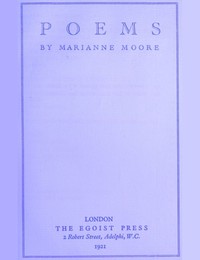
POEMS
BY MARIANNE MOORE
LONDON
THE EGOIST PRESS
_2 Robert Street, Adelphi, W.C._
1921
_Several of these poems appeared in_ THE EGOIST;
_others in_ THE DIAL, OTHERS _and_ CONTACT.
CONTENTS
PEDANTIC LITERALIST 5
TO A STEAM ROLLER 6
DILIGENCE IS TO MAGIC AS PROGRESS IS TO FLIGHT 6
THOSE VARIOUS SCALPELS 7
FEED ME, ALSO, RIVER GOD, 8
TO WILLIAM BUTLER YEATS ON TAGORE 8
HE MADE THIS SCREEN 9
TALISMAN 9
BLACK EARTH 10
“HE WROTE THE HISTORY BOOK,” IT SAID 12
YOU ARE LIKE THE REALISTIC PRODUCT OF AN IDEALISTIC
SEARCH FOR GOLD AT THE FOOT OF THE RAINBOW 12
REINFORCEMENTS 13
ROSES ONLY 13
IN THIS AGE OF HARD TRYING NONCHALANCE IS GOOD, AND 14
THE FISH 14
MY APISH COUSINS 16
WHEN I BUY PICTURES 17
PICKING AND CHOOSING 18
ENGLAND 19
DOCK RATS 20
RADICAL 21
POETRY 22
IN THE DAYS OF PRISMATIC COLOR 23
IS YOUR TOWN NINEVEH? 24
POEMS
BY MARIANNE MOORE
PEDANTIC LITERALIST
Prince Rupert’s drop, paper muslin ghost,
white torch—“with pow’r to say unkind
things with kindness, and the most
irritating things in the midst of love and
tears,” you invite destruction.
You are like the meditative man
with the perfunctory heart; its
carved cordiality ran
to and fro at first, like an inlaid and roy’l
immutable production;
then afterward “neglected to be
painful” and “deluded him with
loitering formality,
doing its duty as if it did it not,”
presenting an obstruction
to the motive that it served. What stood
erect in you, has withered. A
little “palm-tree of turned wood”
informs your once spontaneous core in its
immutable reduction.
TO A STEAM ROLLER
The illustration
is nothing to you without the application.
You lack half wit. You crush all the particles down
into close conformity, and then walk back and forth on them.
Sparkling chips of rock
are crushed down to the level of the parent block.
Were not “impersonal judgment in æsthetic
matters, a metaphysical impossibility,” you
might fairly achieve
it. As for butterflies, I can hardly conceive
of one’s attending upon you, but to question
the congruence of the complement is vain, if it exists.
DILIGENCE IS TO MAGIC AS PROGRESS IS TO FLIGHT
With an elephant to ride upon—“with rings on her fingers and bells
on her toes,” she shall outdistance calamity anywhere she goes.
Speed is not in her mind inseparable from carpets. Locomotion arose
in the shape of an elephant, she clambered up and chose
to travel laboriously. So far as magic carpets are concerned, she
knows that although the semblance of speed may attach to
scarecrows
of æsthetic procedure, the substance of it is embodied in such of
those tough-grained animals as have outstripped man’s whim to
suppose
them ephemera, and have earned that fruit of their ability to endure
blows, which dubs them prosaic necessities—not curios.
THOSE VARIOUS SCALPELS
Those
various sounds consistently indistinct, like intermingled
echoes
struck from thin glass successively at random—the
inflection disguised: your hair, the tails of two
fighting-cocks head to head in stone—like sculptured
scimitars re-
peating the curve of your ears in reverse order: your eyes,
flowers of ice
and
snow sown by tearing winds on the cordage of disabled
ships: your raised hand
an ambiguous signature: your cheeks, those rosettes
of blood on the stone floors of French châteaux, with
regard to which guides are so affirmative:
your other hand
a
bundle of lances all alike, partly hid by emeralds from
Persia
and the fractional magnificence of Florentine
goldwork—a collection of half a dozen little objects
made fine
with enamel in gray, yellow, and dragonfly blue: a lemon, a
pear
and three bunches of grapes, tied with silver: your dress, a
magnificent square
cathedral of uniform
and at the same time, diverse appearance—a species of
vertical vineyard rustling in the storm
of conventional opinion. Are they weapons or scalpels?
Whetted
to
brilliance by the hard majesty of that sophistication which
is su-
perior to opportunity, these things are rich
instruments with which to experiment but surgery is
not tentative: why dissect destiny with instruments
which
are more highly specialized than the tissues of destiny
itself?
FEED ME, ALSO, RIVER GOD,
lest by diminished vitality and abated
vigilance, I become food for crocodiles—for that quicksand
of gluttony which is legion. It is there—close at hand—
on either side
of me. You remember the Israelites who said in pride
and stoutness of heart: “The bricks are fallen down, we will
build with hewn stone, the sycamores are cut down, we will change to
cedars”? I am not ambitious to dress stones, to renew
forts, nor to match
my value in action, against their ability to catch
up with arrested prosperity. I am not like
them, indefatigable, but if you are a god you will
not discriminate against me. Yet—if you may fulfil
none but prayers dressed
as gifts in return for your gifts—disregard the request.
TO WILLIAM BUTLER YEATS ON TAGORE
It is made clear by the phrase,
even the mood—by virtue of which he says
the thing he thinks—that it pays,
to cut gems even in these conscience-less days;
but the jewel that always
outshines ordinary jewels, is your praise.
HE MADE THIS SCREEN
not of silver nor of coral,
but of weatherbeaten laurel.
Here, he introduced a sea
uniform like tapestry;
here, a fig-tree; there, a face;
there, a dragon circling space—
designating here, a bower;
there, a pointed passion-flower.
TALISMAN
Under a splintered mast,
torn from ship and cast
near her hull,
a stumbling shepherd found
embedded in the ground,
a sea-gull
of lapis lazuli,
a scarab of the sea,
with wings spread—
curling its coral feet,
parting its beak to greet
men long dead.
BLACK EARTH
Openly, yes,
with the naturalness
of the hippopotamus or the alligator
when it climbs out on the bank to experience the
sun, I do these
things which I do, which please
no one but myself. Now I breathe and now I am sub-
merged; the blemishes stand up and shout when the object
in view was a
renaissance; shall I say
the contrary? The sediment of the river which
encrusts my joints, makes me very gray but I am used
to it, it may
remain there; do away
with it and I am myself done away with, for the
patina of circumstance can but enrich what was
there to begin
with. This elephant skin
which I inhabit, fibred over like the shell of
the coco-nut, this piece of black glass through which no light
can filter—cut
into checkers by rut
upon rut of unpreventable experience—
it is a manual for the peanut-tongued and the
hairy toed. Black
but beautiful, my back
is full of the history of power. Of power? What
is powerful and what is not? My soul shall never
be cut into
by a wooden spear; through-
out childhood to the present time, the unity of
life and death has been expressed by the circumference
described by my
trunk; nevertheless, I
perceive feats of strength to be inexplicable after
all; and I am on my guard; external poise, it
has its centre
well nurtured—we know
where—in pride, but spiritual poise, it has its centre where?
My ears are sensitized to more than the sound of
the wind. I see
and I hear, unlike the
wandlike body of which one hears so much, which was made
to see and not to see; to hear and not to hear;
that tree trunk without
roots, accustomed to shout
its own thoughts to itself like a shell, maintained intact
by who knows what strange pressure of the atmosphere; that
spiritual
brother to the coral
plant, absorbed into which, the equable sapphire light
becomes a nebulous green. The I of each is to
the I of each,
a kind of fretful speech
which sets a limit on itself; the elephant is?
Black earth preceded by a tendril? It is to that
phenomenon
the above formation,
translucent like the atmosphere—a cortex merely—
that on which darts cannot strike decisively the first
time, a substance
needful as an instance
of the indestructibility of matter; it
has looked at the electricity and at the earth-
quake and is still
here; the name means thick. Will
depth be depth, thick skin be thick, to one who can see no
beautiful element of unreason under it?
“HE WROTE THE HISTORY BOOK,” IT SAID
There! You shed a ray
of whimsicality on a mask of profundity so
terrific that I have been dumbfounded by
it oftener than I care to say.
_The_ book? Titles are chaff.
Authentically
brief and full of energy, you contribute to your father’s
legibility and are sufficiently
synthetic. Thank you for showing me
your father’s autograph.
YOU ARE LIKE THE REALISTIC PRODUCT OF AN IDEALISTIC SEARCH FOR GOLD
AT THE FOOT OF THE RAINBOW
Hid by the august foliage and fruit of the grape vine,
twine
your anatomy
round the pruned and polished stem,
chameleon.
Fire laid upon
an emerald as long as
the Dark King’s massy
one,
could not snap the spectrum up for food as you have done.
REINFORCEMENTS
The vestibule to experience is not to
be exalted into epic grandeur. These men are going
to their work with this idea, advancing like a school of fish
through
still water—waiting to change the course or dismiss
the idea of movement, till forced to. The words of the Greeks
ring in our ears, but they are vain in comparison with a sight like
this.
The pulse of intention does not move so that one
can see it, and moral machinery is not labelled, but
the future of time is determined by the power of volition.
ROSES ONLY
You do not seem to realise that beauty is a liability rather than
an asset—that in view of the fact that spirit creates form we are
justified in supposing
that you must have brains. For you, a symbol of the unit, stiff
and sharp, conscious of surpassing by dint of native superiority
and liking for everything self-dependent, anything an
ambitious civilisation might produce: for you, unaided to attempt
through sheer reserve, to confute presumptions resulting from
observation, is idle. You cannot make us
think you a delightful happen-so. But rose, if you are
brilliant, it is not because your petals are the
without-which-nothing of pre-eminence.
You would look, minus
thorns—like a what-is-this, a mere
peculiarity. They are not proof against a worm, the elements, or
mildew but what about the predatory hand? What is brilliance
without co-ordination? Guarding the
infinitesimal pieces of your mind, compelling audience to
the remark that it is better to be forgotten than to be remembered
too violently,
your thorns are the best part of you.
IN THIS AGE OF HARD TRYING NONCHALANCE IS GOOD, AND
really, it is not the
business of the gods to bake clay pots. They did not
do it in this instance. A few
revolved upon the axes of their worth
as if excessive popularity might be a pot;
they did not venture the
profession of humility. The polished wedge
that might have split the firmament
was dumb. At last it threw itself away
and falling down, conferred on some poor fool, a privilege.
Taller by the length of
a conversation of five hundred years than all
the others, there was one, whose tales
of what could never have been actual—
were better than the haggish, uncompanionable drawl
of certitude; his by-
play was more terrible in its effectiveness
than the fiercest frontal attack.
The staff, the bag, the feigned inconsequence
of manner, best bespeak that weapon, self protectiveness.
THE FISH
wade
through black jade.
Of the crow-blue mussel shells, one
keeps
adjusting the ash heaps;
opening and shutting itself like
an
injured fan.
The barnacles which encrust the
side
of the wave, cannot hide
there for the submerged shafts of the
sun,
split like spun
glass, move themselves with spotlike swift-
ness
into the crevices—
in and out, illuminating
the
turquoise sea
of bodies. The water drives a
wedge
of iron through the iron edge
of the cliff, whereupon the stars,
pink
rice grains, ink
bespattered jelly-fish, crabs like
green
lilies and submarine
toadstools, slide each on the other.
All
external
marks of abuse are present on
this
defiant edifice—
all the physical features of
ac-
cident—lack
of cornice, dynamite grooves, burns
and
hatchet strokes, these things stand
out on it; the chasm side is
dead.
Repeated
evidence has proved that it can
live
on what cannot revive
its youth. The sea grows old in it.
MY APISH COUSINS
winked too much and were afraid of snakes. The zebras, supreme in
their abnormality; the elephants with their fog-colored skin
and strictly practical appendages
were there, the small cats and the parrakeet—
trivial and humdrum on examination, destroying
bark and portions of the food it could not eat.
I recall their magnificence, now not more magnificent
than it is dim. It is difficult to recall the ornament,
speech, and precise manner of what one might
call the minor acquaintances twenty
years back; but I shall never forget—that Gilgamesh among
the hairy carnivora—that cat with the
wedge-shaped, slate-gray marks on its forelegs and the resolute tail,
astringently remarking: “They have imposed on us with their pale,
half fledged protestations, trembling about
in inarticulate frenzy, saying
it is not for all of us to understand art, finding it
all so difficult, examining the thing
as if it were something inconceivably arcanic, as
symmetrically frigid as something carved out of chrysopras
or marble—strict with tension, malignant
in its power over us and deeper
than the sea when it proffers flattery in exchange for hemp,
rye, flax, horses, platinum, timber and fur.”
WHEN I BUY PICTURES
or what is closer to the truth, when I look at
that of which I may regard myself as the
imaginary possessor, I fix upon that which would
give me pleasure in my average moments: the satire upon curiosity,
in which no more is discernible than the intensity of the
mood;
or quite the opposite—the old thing, the medi-
æval decorated hat box, in which there
are hounds with waists diminishing like the waist of the
hour-glass
and deer, both white and brown, and birds and seated people; it
may be no more than a square
of parquetry; the literal biography perhaps—in letters stand-
ing well apart upon a parchment-like expanse;
or that which is better without words, which means
just as much or just as little as it is understood to
mean by the observer—the grave of Adam, prefigured by himself; a
bed of beans
or artichokes in six varieties of blue; the snipe-legged hiero—
glyphic in three parts; it may be anything. Too
stern an intellectual emphasis, i-
ronic or other—upon this quality or that, detracts
from one’s enjoyment; it must not wish to disarm anything; nor may
the approved tri-
umph easily be honoured—that which is great because something
else is small.
It comes to this: of whatever sort it is, it
must make known the fact that it has been displayed
to acknowledge the spiritual forces which have made it;
and it must admit that it is the work of X, if X produced it; of
Y, if made by Y. It must be a voluntary gift with the name
written on it.
PICKING AND CHOOSING
Literature is a phase of life: if
one is afraid of it, the situation is irremediable; if
one approaches it familiarly,
what one says of it is worthless. Words are constructive
when they are true; the opaque allusion—the simulated flight
upward—accomplishes nothing. Why cloud the fact
that Shaw is selfconscious in the field of sentiment but is
otherwise re-
warding? that James is all that has been
said of him but is not profound? It is not Hardy
the distinguished novelist and Hardy the poet, but one man
“interpreting life through the medium of the
emotions.” If he must give an opinion, it is permissible that the
critic should know what he likes. Gordon
Craig with his “this is I” and “this is mine,” with his three
wise men, his “sad French greens” and his Chinese cherries—Gordon
Craig, so
inclinational and unashamed—has carried
the precept of being a good critic, to the last extreme. And Burke
is a
psychologist—of acute, raccoon-
like curiosity. Summa diligentia;
to the humbug, whose name is so amusing—very young and ve-
ry rushed, Cæsar crossed the Alps on the “top of a
diligence.” We are not daft about the meaning but this familiarity
with wrong meanings puzzles one. Humming-
bug, the candles are not wired for electricity.
Small dog, going over the lawn, nipping the linen and saying
that you have a badger—remember Xenophon;
only the most rudimentary sort of behaviour is necessary
to put us on the scent; a “right good
salvo of barks,” a few “strong wrinkles” puckering the
skin between the ears, are all we ask.
ENGLAND
with its baby rivers and little towns, each with its abbey or its
cathedral;
with voices—one voice perhaps, echoing through the transept—the
criterion of suitability and convenience; and Italy with its equal
shores—contriving an epicureanism from which the grossness has
been
extracted; and Greece with its goats and its gourds, the nest of
modified illusions:
and France, the “chrysalis of the nocturnal butterfly” in
whose products, mystery of construction diverts one from what was
originally one’s
object—substance at the core: and the East with its snails, its
emotional
shorthand and jade cockroaches, its rock crystal and its
imperturbability,
all of museum quality: and America where there
is the little old ramshackle victoria in the south, where cigars are
smoked on the
street in the north; where there are no proof readers, no
silkworms, no digressions;
the wild man’s land; grass-less, links-less, language-less
country—in which letters are written
not in Spanish, not in Greek, not in Latin, not in shorthand
but in plain American which cats and dogs can read! The letter “a”
in psalm and calm when
pronounced with the sound of “a” in candle, is very noticeable
but
why should continents of misapprehension have to be accounted for by
the
fact? Does it follow that because there are poisonous toadstools
which resemble mushrooms, both are dangerous? In the case of
mettlesomeness which may be
mistaken for appetite, of heat which may appear to be haste, no
con-
clusions may be drawn. To have misapprehended the matter, is to have
confessed
that one has not looked far enough. The sublimated wisdom
of China, Egyptian discernment, the cataclysmic torrent of emotion
compressed
in the verbs of the Hebrew language, the books of the man who is
able
to say, “I envy nobody but him and him only, who catches more fish
than
I do,”—the flower and fruit of all that noted superi-
ority—should one not have stumbled upon it in America, must one
imagine
that it is not there? It has never been confined to one
locality.
DOCK RATS
There are human beings who seem to regard the place as craftily
as we do—who seem to feel that it is a good place to come
home to. On what a river; wide—twinkling like a chopped sea under
some
of the finest shipping in the
world: the square-rigged four-master, the liner, the battleship,
like the two-
thirds submerged section of an iceberg; the tug—strong moving
thing,
dipping and pushing, the bell striking as it comes; the steam
yacht, lying
like a new made arrow on the
stream; the ferry-boat—a head assigned, one to each compartment,
making
a row of chessmen set for play. When the wind is from the east,
the smell is of apples; of hay, the aroma increased and decreased
suddenly as the wind changes;
of rope; of mountain leaves for florists. When it is from the west,
it is
an elixir. There is occasionally a parrakeet
arrived from Brazil, clasping and clawing; or a monkey—tail and
feet
in readiness for an over-
ture. All palms and tail; how delightful! There is the sea, moving
the bulk-
head with its horse strength; and the multiplicity of rudders
and propellers; the signals, shrill, questioning, peremptory,
diverse;
the wharf cats and the barge dogs—it
is easy to overestimate the value of such things. One does
not live in such a place from motives of expediency
but because to one who has been accustomed to it, shipping is the
most congenial thing in the world.
RADICAL
Tapering
to a point, conserving everything,
this carrot is predefined to be thick.
The world is
but a circumstance, a mis-
erable corn-patch for its feet. With ambition,
imagination, outgrowth,
nutriment,
with everything crammed belligerent-
ly inside itself, its fibres breed mon-
opoly—
a tail-like, wedge-shaped engine with the
secret of expansion, fused with intensive heat
to the color of the set-
ting sun and
stiff. For the man in the straw hat, stand-
ing still and turning to look back at it—
as much as
to say my happiest moment has
been funereal in comparison with this, the con-
ditions of life pre-
determined
slavery to be easy and freedom hard. For
it? Dismiss
agrarian lore; it tells him this:
that which it is impossible to force, it is
impossible to hinder.
POETRY
I too, dislike it: there are things that are important beyond all
this fiddle.
Reading it, however, with a perfect contempt for it, one discovers
that there is in
it after all, a place for the genuine.
Hands that can grasp, eyes
that can dilate, hair that can rise
if it must, these things are important not because a
high sounding interpretation can be put upon them but because they
are
useful; when they become so derivative as to become
unintelligible, the
same thing may be said for all of us—that we
do not admire what
we cannot understand. The bat,
holding on upside down or in quest of something to
eat, elephants pushing, a wild horse taking a roll, a tireless wolf
under
a tree, the immovable critic twinkling his skin like a horse that
feels a flea, the base-
ball fan, the statistician—case after case
could be cited did
one wish it; nor is it valid
to discriminate against “business documents and
school-books”; all these phenomena are important. One must make a
distinction
however: when dragged into prominence by half poets, the result is
not poetry,
nor till the autocrats among us can be
“literalists of
the imagination”—above
insolence and triviality and can present
for inspection, imaginary gardens with real toads in them, shall we
have
it. In the meantime, if you demand on one hand, in defiance of
their opinion—
the raw material of poetry in
all its rawness and
that which is, on the other hand,
genuine then you are interested in poetry.
IN THE DAYS OF PRISMATIC COLOR
not in the days of Adam and Eve but when Adam
was alone; when there was no smoke and color was
fine, not with the fineness of
early civilization art but by virtue
of its originality, with nothing to modify it but the
mist that went up, obliqueness was a varia-
tion of the perpendicular, plain to see and
to account for: it is no
longer that; nor did the blue red yellow band
of incandescence that was color, keep its stripe: it also is one of
those things into which much that is peculiar can be
read; complexity is not a crime but carry
it to the point of murki-
ness and nothing is plain. A complexity
moreover, that has been committed to darkness, instead of granting
it-
self to be the pestilence that it is, moves all a-
bout as if to bewilder with the dismal
fallacy that insistence
is the measure of achievement and that all
truth must be dark. Principally throat, sophistication is as it al-
ways has been—at the antipodes from the init-
ial great truths. “Part of it was crawling, part of it
was about to crawl, the rest
was torpid in its lair.” In the short legged, fit-
ful advance, the gurgling and all the minutiæ—we have the classic
multitude of feet. To what purpose! Truth is no Apollo
Belvedere, no formal thing. The wave may go over it if it likes.
Know that it will be there when it says:
“I shall be there when the wave has gone by.”
IS YOUR TOWN NINEVEH?
Why so desolate?
And why multiply
in phantasmagoria about fishes,
what disgusts you? Could
not all personal upheaval in
the name of freedom, be tabood?
Is it Nineveh
and are you Jonah
in the sweltering east wind of your wishes?
I, myself have stood
there by the aquarium, looking
at the Statue of Liberty.
Printed at the Pelican Press, 2 Carmelite Street, E.C.
End of the Project Gutenberg EBook of Poems, by Marianne Moore
*** END OF THE PROJECT GUTENBERG EBOOK 62833 ***
Poems
Subjects:
Download Formats:
Excerpt
Underscores “_” before and after a word or phrase indicate _italics_
in the original text.
Small capitals have been converted to SOLID capitals.
Typographical errors have been silently corrected.
LONDON
THE EGOIST PRESS
_2 Robert Street, Adelphi, W.C._
_Several of these poems appeared in_ THE EGOIST;
_others in_ THE DIAL, OTHERS _and_ CONTACT.
PEDANTIC LITERALIST 5
TO A STEAM...
Read the Full Text
— End of Poems —
Book Information
- Title
- Poems
- Author(s)
- Moore, Marianne
- Language
- English
- Type
- Text
- Release Date
- August 3, 2020
- Word Count
- 4,222 words
- Library of Congress Classification
- PS
- Bookshelves
- Browsing: Literature, Browsing: Poetry
- Rights
- Public domain in the USA.
Related Books
Poems
by Van Vorst, Marie
English
171h 20m read

Poems
by Bacon, Josephine Daskam
English
144h 3m read
The wounded Eros
by Gibson, Charles
English
340h 47m read

Poems of love
by Wilcox, Ella Wheeler
English
267h 45m read

Poems of life
by Wilcox, Ella Wheeler
English
169h 5m read
Twelve poems
by Wharton, Edith
English
73 hours read