*** START OF THE PROJECT GUTENBERG EBOOK 51346 ***
Note: Images of the original pages are available through
Internet Archive. See
https://archive.org/details/poemoutlines00laniuoft
Transcriber's note:
Text enclosed by underscores is in italics (_italics_).
Text enclosed by equal signs is in bold face (=bold=).
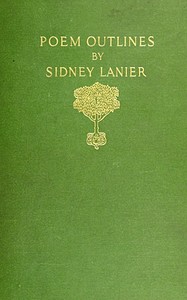
POEM OUTLINES
* * * * * *
BOOKS BY SIDNEY LANIER
PUBLISHED BY CHARLES SCRIBNER'S SONS
=Poems.= Edited by his Wife, with a Memorial by WILLIAM HAYES $2.00
WARD. With portrait. _New Edition._ 12mo
=Select Poems of Sidney Lanier.= Edited, with an _net_ $1.00
Introduction and Notes, by PROF. MORGAN CALLAWAY, JR.,
University of Texas. 12mo
=Hymns of the Marshes.= With 12 full-page illustrations, _net_ $2.00
photogravure frontispiece, and head and tail pieces.
(_Oct._) 8vo (_Postage Extra_)
=Bob.= The Story of Our Mocking Bird. With 16 full-page _net_ $1.00
illustrations in colors from photographs by A. R.
DUGMORE. _New and Cheaper Edition._ 12mo.
=Letters of Sidney Lanier.= Selections from his Correspondence, $2.00
1866-1881. With two portraits in photogravure. 12mo
=Retrospects and Prospects.= Descriptive and Historical Essays. $1.50
12mo
=Music and Poetry.= A Volume of Essays. 12mo $1.50
=The English Novel.= A Study in the Development of Personality. $2.00
_New and Revised Edition from New Plates._ Crown 8vo
=The Science of English Verse.= Crown 8vo $2.00
=The Lanier Book.= Selections for School Reading. Edited _net_ $0.50
and arranged by MARY E. BURT, in coöperation with Mrs.
LANIER. Illustrated. (_Scribner Series of School
Reading._) 12mo
BOY'S LIBRARY OF LEGEND AND
CHIVALRY
=The Boy's Froissart.= Illustrated. ALFRED KAPPES $2.00
=The Boy's King Arthur.= Illustrated $2.00
=Knightly Legends of Wales=; or, The Boy's Mabinogion. $2.00
Illustrated
=The Boy's Percy.= Illustrated $2.00
* * * * * *
POEM OUTLINES
by
SIDNEY LANIER
_The Artist: he
Who lonesome walks amid a thousand friends._
New York
Charles Scribner's Sons
MDCCCCVIII
Copyright, 1908, by Charles Scribner's Sons
Published September, 1908
[Illustration]
NOTE
It requires but little intimacy with the true artist to see that,
whether his medium of expression be words or music or the brush, much of
his finest achievement can never be given to his fellows bearing the
stamp of perfect craftsmanship. As when the painter, with hand
momentarily inspired by the fervor of the eye, fixes in a sketch some
miracle of color or line, which vanishes with each succeeding stroke of
the brush laboring to embody it in a finished picture—so the poet may
transcribe one note of his own tense heart strings; may find fluttering
words that zigzag aerially beside the elusive new-born thought; may
strike out in the rough some heaven-scaling conception—to discover too
often that these priceless fragments cannot be fused again, cannot be
joined with commoner metals into a conventional quatrain or sonnet.
At such moments, by some subtle necromancy of quivering genius, the poet
in his exaltation weaves sinuous words into a magic net with which he
snares at one cast the elfin woods fancies, the shy butterfly ideas that
flit across secluded glades of the imagination, invisible even to him at
other times; and there these delicate creatures lie, flashing forth from
the meshes glimpses of an unearthly brilliance—for all time, if he be
wise enough not to attempt to open the net and spread out their wings
for the world to see them better. Or it may be that his mood is
interrupted by the necessity for giving to the world that which it will
receive in exchange for a living, and his next vision is of a far
distant corner of the Enchanted Land. Yet these records are what they
are; they bear star dust upon their wings; they give, perhaps, his most
intimate revelation, his highest utterance.
So the following outlines and fragments left by Sidney Lanier are
presented, in the belief that they contain the essence of poetry. His
mind budded into poems as naturally and inevitably as a tree puts forth
green leaves—and it was always spring-time there. These poem-sketches
were jotted in pencil on the backs of envelopes, on the margins of
musical programmes, on little torn scraps of paper, amid all sorts of
surroundings, whenever the dream came to him. Some are mere flashes of
simile in unrhymed couplets; others are definite rounded outlines,
instinct with the beauty of idea, but not yet hewn to the line of
perfect form; one, at least, is the beginning of quite a long narrative
in verse. There are indications of more than one projected volume of
poems, as mentioned in foot-notes. All have been selected from his
papers as containing something worthy of preservation; and, while the
thought sometimes parallels that in his published work, all are
essentially new.
H. W. L.
NEW YORK, _September_, 1908.
Are ye so sharp set for the centre of the earth, are ye so hungry for
the centre of things,
O rains and springs and rivers of the mountains?
Towards the centre of the earth, towards the very Middle of things, ye
will fall, ye will run, the Centre will draw ye, Gravity will drive you
and draw you in one:
But the Centre ye will not reach, ye will come as near as the
plains—watering them in coming so near—and ye will come as near as the
bottom of the Ocean—seeing and working many marvels as ye come so near.
But the Centre of Things ye will not reach,
O my rivers and rains and springs of the mountains.
Provision is made that ye shall not: ye would be merged, ye could not
return.
Nor shall my Soul be merged in God, though tending, though tending.
[_Hymns of the Mountains,_
_and Other Poems_]
To believe in God would be much less hard if it were not for the wind.
Pray hold one little minute, I cry: O spare this once to bite yonder
poor old shivering soul in the bare house, let the rags have but a
little chance to warm yon woman round the city corner. Stop, stop, wind:
but I might as well talk to the wind: and lo, the proverb paralyzes
prayer, and I am ready to say: Good God, is it possible thou canst stop
this wind which at this moment is mocking ten thousand babies and
thin-clad mothers with the unimaginable anguish of cold—is it possible
thou canst stop this, and wilt not? Do you know what cold is? Story of
the Prisoner, &c., &c., and the stone.
The courses of the wind, and the shifts thereof, as also what way the
clouds go; and that which is happening a long way off; and the full face
of the sun; and the bow of the Milky Way from end to end; as also the
small, the life of the fiddler-crab, and the household of the marsh-hen;
and more, the translation of black ooze into green blade of marsh-grass,
which is as if filth bred heaven:
This a man seeth upon the marsh.
[_Hymns of the Marshes_]
I wish, said the poet, that you should do thus and so:
Laugh you thus, what matters a poet's wish?
The poet's wish is Nature's law.
It is for the satisfaction thereof that things are,
And that Time moves.
Observe Science in modern times proving the old poet's dreams.
Nature with all her train of powers
And Time with his ordered hours,
And Space, ... and said,
What dost thou wish, my lord?
[_Credo, and Other Poems_]
How dusty it is!
In trades and creeds and politics, much wind is about and the earth is
dry;
I must lay this dust, that men may see and breathe;
There is need of rain, and I am it.
[_Credo, and Other Poems_]
THE DYSPEPTIC
_Frown_, quoth my lord Stomach,
And I lowered.
_Quarrel_, quoth my lord Liver,
And I lashed my wife and children,
Till at the breakfast-table
Hell sat laughing on the egg-cup.
_Lie awake all night_, quoth my two Masters,
And I tossed, and swore, and beat the pillow,
And kicked with disgust,
And slammed every door tight that leads to sleep and heaven.
[_Credo, and Other Poems_]
Foul Past, as my Master I scorn thee,
As my servant I love thee, dear Past.
One of your cold jelly-fish poets that find themselves cast up by some
wave upon a sandy subject, and so wrinkle themselves about a pebble of a
theme and let us see it through their substance—as if that were a great
feat.
Cousin cloud
the wind of music
blow me into wreath
and curve of grace
as it bloweth thee.
And then
A gentle violin mated with the flute,
And both flew off into a wood of harmony,
Two doves of tone.
I have great trouble in behavior. I know what to do, I know what I at
heart desire to do; but the _doing_ of it, that is work, that labor is.
I construct in my lonesome meditations the fairest scheme of my
relations to my fellow-men, and to fellow-events; but when I go to set
the words of solitary thought to the music of much-crowded action, I
find ten thousand difficulties never suspected: difficulties of race,
temperament, mood, tradition, custom, passion, unreason and other
difficulties which I do not understand, as, for instance, the failure of
contemporary men to recognize genius and great art.
I made me a song of serenade,
And I stole in the Night, in the Night,
To the window of the world where man slept light,
And I sang:
O my Love, my Love, my Fellow Man,
My Love.
I fled in tears from the men's ungodly quarrel about God: I fled in
tears to the woods, and laid me down on the earth; then somewhat like
the beating of many hearts came up to me out of the ground, and I looked
and my cheek lay close by a violet; then my heart took courage and I
said:
"I know that thou art the word of my God, dear Violet:
And Oh the ladder is not long that to my heaven leads.
Measure what space a violet stands above the ground,
'Tis no farther climbing that my soul and angels have to do than that."
[_Written on the fly-leaf of
Emerson's "Representative
Men," between 1874 and
1879_]
While I lie here under the tree,
Comes a strange insect and poises an instant at my cheek,
And lays his antennæ there upon my skin,
Then perceiving that I have nothing of nutriment for him,
He leaves me with a quiet indifference which, do all I can,
Crushes me more than the whole world's sarcasm,
And now he is gone to the Jamestown weed, there,
And is rioting in sweetness.
I did not think so poorly of thee, dear Lord,
As that thou wouldst wait until thou wert asked
(As many think),
And that thou wouldst be ugly, like a society person,
Because thou wert not invited.
[1881]
Tender wiles, transparent guiles,
Tears exhaling into smiles.
A man does not reach any stature of manhood until like Moses he kills an
Egyptian (_i. e._, murders some oppressive prejudice of the all-crushing
Tyrant Society or Custom or Orthodoxy) and flies into the desert of his
own soul, where among the rocks and sands, over which at any rate the
sun rises dear each day, he slowly and with great agony settles his
relation with men and manners and powers outside, and begins to look
with his own eyes, and first knows the unspeakable joy of the outcast's
kiss upon the hand of sweet, naked Truth.
But let not the young man go to killing his Egyptian too soon: wait till
you know all the Egyptians can teach you: wait till you are master of
the technics of the time; then grave, and resolute, and aware of
consequences, shape your course.
Thought, too, is carnivorous. It lives on meat. We never have an idea
whose existence has not been purchased by the death of some atom of our
fleshy tissue.
O little poem, thou goest from this brain chargeable with the death of
tissue that perished in order that thou mightst live: nourish some soul,
thou that hast been nourished on a human body.
Do you think the 19th century is past? It is but two years since Boston
burnt me for witchcraft. I wrote a poem which was not orthodox: that is,
not like Mr. Longfellow's.
All roads from childhood lead to hell,
Hell is but the smoke about the monstrous fires
Kindled from }
Rising from } frictions of youth's self with self,
Passion rubbed hard 'gainst Purpose, Heart 'gainst Brain.
[1874-5]
Tolerance like a Harbor lay
Smooth and shining and secure,
Where ships carrying every flag of faith were anchored in peace.
TO THE POLITICIANS
You are servants. Your thoughts are the thoughts of cooks curious to
skim perquisites from every pan, your quarrels are the quarrels of
scullions who fight for the privilege of cleaning the pot with most
leavings in it, your committees sit upon the landings of backstairs, and
your quarrels are the quarrels of kitchens.
[1878-9]
"The Earth?" quoth a Dandelion to my Oak, "what earth? where is any? I
float, and find none!"
At that moment the wind blew.
"Nevertheless, it is here," quoth my oak, with pleasure in all his
roots, what time the dandelion was blown out of hearing.
ORNAMENT BEFORE DRESS
Who doubts but Eve had a rose in her hair
Ere fig leaves fettered her limbs?
So Life wore poetry's perfect rose
Before 'twas clothed with economic prose.
Homer before Pherecydes,
Caedmon before Alfred.
Every rule is a sign of weakness. A man needs no rules to make him eat,
when he is hungry: and a law is a badge of disgrace. Yet we are able to
console ourselves, from points of view which terminate in duty, order,
and the like advantages.
How did'st thou win her, Death?
Thou art the only rival that ever made her cold to me.
Thou hast turned her cold to me.
_I went into the Church to find my Lord.
They said He is here, He lives here.
But I could not see Him,
For the creed-tablets and bonnet-flowers._
I went into the Church to look for a poor man.
For the Lord has said that the Poor are his children, and I thought His
children would live in His house.
But in the pews sat only Kings and Lords: at least all that sat there
were dressed like Kings and Lords; and I could not find the man I looked
for, who was in rags;—presently I saw the sexton refuse admission to a
man; lo, it was my poor man, he had on rags, and the sexton said, "No
ragged allowed."
O World, I wish there was room for a poet. In the time of David and of
Isaiah, in the time of John and of Homer, there was room for a poet. In
the time of Hyvernion and of Herve and of Omar Khayyam: in the time of
Shakspere, was room in the world for a poet.
In the time of Keats there was not room:
Perhaps now there is not room.
[1881]
In the lily, the sunset, the mountain, the rosy hues of all life, it is
easy to trace God. But it is in the dust that goes up from the unending
Battle of Things that we lose Him. Forever thro' the ferocities of
storms, the malice of the never-glutted oceans, the savagery of human
wars, the inexorable barbarities of accident, of earthquake and
mysterious Disease, one hears the voice of man crying, _where art thou,
my dear Lord and Master?_
But oh, how can ye trifle away your time at trades and waste yourself in
men's commerce, when ye might be here in the woods at commerce with
great angels, all heaven at purchase for a song.
I will be the Terpander of sadness;
I will string the shell of slow time for a lyre,
The shell of Tortoise-creeping time,
Till grief grow music.
I am but a small-winged bird:
But I will conquer the big world
As the bee-martin beats the crow,
By attacking it always from Above.
Ah how I desire this matter!
I am sure God would give it to me if He could.
I am sure that I would give it to Him if I could.
(But perhaps He knows it is not good for you.)
I know that He could make it good for me.
The United States in two hundred years has made Emerson out of a
witch-burner.
BEETHOVEN
The argument of music,
I heard thy plea, O friend;
Who might debate with thee?
Heart was a little child, cried for the moon,
Brain was a man, said, nay.
Science is big, and Time is a-throb,
Hold thy heart, Heart.
Wan Silence lying lip on ground,
An outcast Angel from the Heaven of sound,
Prone and desolate
By the shut Gate.
A poet is a perpetual Adam: events pass before him, like the animals in
the creation, and he names them.
"The Improvement of the Ground is the most Natural Obtaining of Riches:
For it is our Great Mother's Blessing, the Earth: But it is slow."
[_Poems on Agriculture_]
How could I injure thee,
Thou art All and I am nought,
What harm, what harm could e'er be wrought
On thee by me?
Lo, he that hath helped me to do right (save by mere information upon
which I act or not, as I please) he hath not done me a favor: he hath
covertly hurt me: he hath insidiously deflowered the virginity of my
will; I am thenceforth not a pure Me: I am partly another.
Each union of self and self is, once for all, incest and adultery and
every other crime. Let me alone. God made me so, a man, individual,
unit, whole, fully-appointed in myself. Again I cry to thee, O friend,
let me alone.
The church having become fashionable is now grown crowded, and the Age
will have to get up from its pew and go outside soon, if only for a
little fresh air.
You wish me to argue whether Paul had a revelation: I do not care
greatly; I have had none, but roses, trees, music, and a running stream,
and Sirius.
[_Credo, and Other Poems_]
The sleep of each night is a confession of God. By whose will is it that
my heart beat, my lung rose and fell, my blood went with freight and
returned empty these eight hours?
Not mine, not mine.
Like to the grasshopper in the tall grass,
That sings to the mate he cannot see yet while,
I sing to thee, dear World;
For thou art my Mate, and peradventure thou wilt come; I wish to see
thee.
Like to the lover under the window of his Love,
I serenade thee, dear World;
For thou art asleep and thou art my Love,
And perhaps thou wilt awake and show me thine eyes
And the beauty of thy face out of the window of thy house of Time.
So large, so blue is Harry's eye,
I think to that blue Heaven the souls do go
Of honest violets when they die.
Says Epictetus, at the close of his Chapter on Præcognitions: "I must
speak in this way; excuse me, as you would excuse lovers: I am not my
own master: I am mad."
[_Credo, and Other Poems_]
—Great shame came upon me.
I wended my way to my own house
And I was sorrowful all that night,
For the touch of man had bruised my manhood,
And in playing to be wise and a judge before men,
I found me foolish and a criminal before myself.
If that the mountain-measured earth
Had thousand-fold his mighty girth,
One violet would avail the dust
For righteous pride and just.
Then why do ye prattle of promise,
And why do ye cry _this poet's young
And will give us more anon_?
For he that hath written a song
Hath made life's clod a flower,
What question of short or long?
As the big earth is summed in a violet,
All Beauty may lie in a two-lined stave.
Let the clever ones write commentaries in verse.
As for us, we give you texts,
O World, we poets.
If you do not understand them now,
Behold, hereafter an army of commentators will come:
They will imitate, and explain it to you.
THE SONG OF ALDHELM
Come over the bridge, my merchants,
Come over the bridge, my souls:
For ye all are mine by the gift of God,
Ye belong to me by the right of my love,
I love
With a love that is father and mother to men,
Ye are all my children, merchants.
_Merchant_: We have no time, we have no time to listen to idle dreams.
_Aldhelm_: But I, poor Aldhelm, say you nay;
Till ye hear me, ye have no time
Neither for trade nor travelling;
Till ye hear me ye have no time to fight nor marry nor mourn;
There is not time, O World,
Till you hear me, the Poet Aldhelm,
To eat nor to drink nor to draw breath.
For until the Song of the Poet is heard
Ye do not live, ye can not live.
O noonday ghosts that gabble of losing and gaining,
Pitiful paupers that starve in the plenteous midmost
Of bounty unbounded.
Didst thou make me?
Some say yea.
Did I make thee?
Some say yea.
Oh, am I then thy son, O God,
Or art thou mine?
Thou art more beautiful than me,
And I will worship thee.
Lo, out of me is gone more great than me:
As Him that Mother Mary bore,
Greater far than Mary was;
As one mere woman brought the Lord,
Was mother of the Lord,
Might not my love and longing be
Father of thee?
There will one day be medicine to cure crime.
This youth, O Science, he knoweth more than thee,
He knoweth that life is sweet,
But thou, thou knowest not ever a Sweet.
Tear me, I pray thee, this Flower of Sweetness-of-Life petal from petal,
number me the pistils, and above all, above all, dear Science, find me
the ovary thereof, and the seeds in the ovary, and save me these.
Thou canst not.
Thou that in thy beautiful Church this morning art reading thy beautiful
service with a breaking heart—for that thou knowest thou art reading
folly to fools, and for that thou lovest these same folk and canst not
abide to think of losing thy friends, and knowest not how to tell them
the truth and findest them with no appetite to it nor strength for
it—thou fine young clergyman, on this spring morning, there, in the
pulpit, front of the dainty ladies with their breathing clouds of
dresses and the fans gently waving in the still air—and thou, there,
betwixt the pauses while the choir and the heavenly organ tear thy soul
with music, peering down with thine eyes in a dream upon the men in the
pews, the importers, the jobbers, the stockbrokers, the great drygoods
house, some at a nod, some calculating with pencils on the fly-leaf of
the Prayer-book, some wondering how it will be with 4's and sixes
to-morrow, some vacant, three with Christ thoughts, one out of two
hundred earnest—thou that turnest despairing away from the men back to
the women whereof several regard thee with soft and rich eyes, with
yearning after the unknown whatever-there-may-be-of-better-than-this,
I have a word for thee.
Thou seest and wilt not cover thine eyes; thou dost stand at the
casement on a dewy morning, and sentimentalize over the birds that flit
by: for thou knowest a worm died in pain at each bird song, and death
sitteth in the dew; thou lookest through the rich lawn dresses of the
witch women, thou lookest through the ledger-revelries of the merchant,
thou seest quasi-religion which is hell-in-trifles before thee, thou
seest superstition black about thee,—I have a word for thee.
Come out and declare.
[_Credo, and Other Poems_]
CHOPIN
Betwixt the upper Mill-stone _Yes_
And the nether Mill-stone _No_,
Whence cometh _burr_ and _burr_ and _burr_
And much noise of quarrel,
The Miller poured the hopper full
Of corn from the bag,
And in the corn lay one violet,
(Maybe the farmer's little girl dropped it in
When the boy went to the bin to fill the bag).
And _burr_ quoth the upper Mill-stone,
And _burr you back again_ the nether,
And the violet was ground with the corn,
But passed not into the bag with the meal,
Thank God!
The odor of crushed violet flew forth
And passed about the ages;
And men here and there had a sense
Of somewhat rich and high-intense,
Dewy, fiery, dear, forlorn,
Delicate, grave, new out of the morn,
But saturate yet
With the night despair that every flower will wet.
[_Credo, and Other Poems_]
A BUSINESS TRANSACTION
The poet stepped into a grimy den,
Where the sign above the door
Said: Money to lend, in sums to suit,
On Real Estate, &c.
I want, said the Poet,
(So many thousand dollars).
So said Cent per Cent, rubbing his hands,
Where is the property?
I offer, said the Poet,
My Castle in Spain,
'Tis a lovely house,
So many rooms, acres, &c.
Ambling, ambling round the ring,
Round the ring of daily duty,
Leap, Circus-rider, man, through the paper hoop of death,
—Ah, lightest thou, beyond death, on this same slow-ambling, padded
horse of life.
Youth, the circus-rider, fares gaily round the ring, standing with one
foot on the bare-backed horse—the Ideal. Presently, at the moment of
manhood, Life (exacting ring-master) causes another horse to be brought
in who passes under the rider's legs, and ambles on. This is the Real.
The young man takes up the reins, places a foot on each animal, and the
business now becomes serious.
For it is a differing pace, of these two, the Real and the Ideal.
And yet no man can be said to make the least success in life who does
not contrive to make them go well together.
The Age is an Adonis that pursues the boar Wealth: yet shall the rude
tusk of trade wound this blue-veined thigh,—if _Love_ come not to the
rescue; Adon despises Love.
Sometimes Providence seems to have a bee in his bonnet. Else why should
hell, the greatest risk, be the most improvable fact, and himself, the
only light, be the most completely undiscoverable? If the angels are
good company, why shut us out from them? I look for good boys for my
children. Hide not your light under a bushel, is His own command: and
yet He is completely obscured under the inexorable _quid pro quo_ of
Nature and the hateful measure of Evil.
[_Credo, and Other Poems_]
The black-birds giving a shimmer of sound,
{ transparent tremors
As midday hills give forth { luminous
of heat and haze.
FOR A FLOWER DECORATION OF
SOLDIERS' GRAVES
Unto your house, O sleepers,
Unto these graves that house you since ye died,
Unto these little rooms wherein ye sleep,
A serenade of Love who sings in flowers,
If sense more dim than thought
May pierce through the deep dream of death wherein ye lie.
In a silence embroidered with whispers of lovers,
As the darkness is purfled with fire-flies.
The feverish heaven with a stitch in the side,
Of lightning.
For Pray'r the Ocean is, where diversely
Men steer their course, each to a several coast,
Where all our interests so discordant be,
Half begging God for winds that
Would send the other half to hell.
As many blades of grass as be
In all thy horizontal round,
So many dreams brood over thee.
To stand with quietude in the midst of the prodigious Unknown which we
call the World, also to look with tranquil eyes upon the unfathomable
blackness which limits our view to the little space enclosed betwixt
birth and death.
So pray we to the God we dimly hope
Against calamities we clearly know.
It may be that the world can get along without God: but _I_ can not. The
universe-finity is to me like the chord of the dominant seventh, always
leading towards, always inviting onwards, a Chord of Progress; God is
the tonic Triad, a chord of Repose.
SONGS OF ALDHELM
Songs from the Sun, Songs from the ground,
Songs from the ... stars,
Songs, { fine souls of the body of sound,
{ joined souls and bodies of sound,
... ghosts of songs that died,
Songs of Birth and of Death, of ...
Beat million-rhythmed in the heart of my hearing,
The world is all sound and still signs of sound.
It appears that if I were perfect, I could not be perfect.
For with whoever is perfect, there is nothing more to be done.
But if there were nothing more to do, I would be very sorry: that is, I
would not be perfect.
Therefore it appears that I would not be perfect if I were perfect.
[_Credo, and Other Poems_]
We know more than we know.
That the Lord is all, I know:
That I am part, I know.
But how shall we settle our provinces and diplomacies and boundaries,
the Lord and I?
Let us talk of this matter, dear Lord, I talking in silence.
_But the corruption, the rascality, the &c., &c._,
I am not afraid.
_But the stock broker, the whiskey ring_,
I am not afraid.
_Nay, but the war in the East_,
I am not afraid.
I see God about his godly affairs,
The cat-bird sits in the tree and sings
While the boy kills the &c. beneath.
The mocking-bird hanging over the street sings, though robbery, murder,
fire, &c., go on.
WATER AT DAWN
Gray iris of the eyeball earth,
Limpid Intelligence.
It is the easiest thing in the world to make one falsehood out of two
truths.
O Science, wilt thou take my Christ,
Oh, wilt thou crucify him o'er
Betwixt false thieves with thieves' own pain,
Never to rise again?
Leave me this love, O cool-eyed One,
Leave me this Saviour.
_Science_: Down at the base of a statue,
A flower of strange hue
I dug, that I might see and know the root thereof,
And lo, the statue is prone, fallen.
They did but crucify the godhead of Christ,
(_My God, my God_, He said, _why hast thou forsaken me?_)
The manhood rose and lives forever,
The Leader, the Friend, the Beloved of all men and women,
The strongest, the wisest, the dearest, the sweetest.
Come with me, Science; let us go into the Church here (say in Georgia);
let alone the youth here, they have roses in their cheeks, they know
that life is delicious, what need have they of thee? But fix thy keen
eye on these grave-faced and mostly sallow married women who make at
least half this congregation—these women who are the people that carry
around the subscription cards, and feed the preacher and keep him in
heart always. See, there is Mrs. S.: her husband and son were killed in
the war; Mrs. B.—her husband has been a thriftless fellow, and she has
finally found out the damnable fact that she is both stronger and purer
than he is, which she is, however, yet sweetly endeavoring to hide from
herself and all people; Mrs. C. D. and the rest of the alphabet in the
same condition;—Science, I grasp thee by the throat and ask thee with
vehement passion, wilt thou take away the Christ (who is to each
Deficiency in this house the Completion and Hoped Perfectness) from
these women?
To-day
The Stars tease me, as it were gadflies:
And I cannot bear the impudent reds and yellows of the flowers.
To many inarticulate
Like the great vague wind
Against the wire, one word larger
Than some languages, nowhere flippant,
My song is of all men and times and thoughts,
Therefore many, caring not
For aught save one man, this time, and finance,
Many, many listen not
Because I sing for all.
Sang I of that little king
That owns this special little time,
The world were mine; but oh, but oh,
I sing all Time that hath no king.
And if I sang this man or that,
Haply the singer's fee I win;
But part's too little: I sing all:
I know not parties, cliques, nor times.
The old Obligation of goodness has now advanced into the Delight of
goodness; the old Curse of Labor into the Delight of Labor; the old
Agony of blood-shedding sacrifice into the tranquil Delight of
Unselfishness. The Curse of the Jew of Genesis is the Blessing of the
modern Gentile. It is as if an avalanche, in the very moment of crushing
the kneeling villagers, should turn to a gentle and fruitful rain, and
be minister not of death but of life.
A GARDEN PARTY
Invitation brought by the wind, and sent by the rose and the oak. I sat
on the steps—warm summer noon—in a garden, and half cloudy with low
clouds, sun hot, rich mocking bird singing, bee brushing down a big
raindrop from a flower, where it hung tremulous. The bird's music is
echoed from the breasts of roses, and reflex sound comes doubly back
with grace of odor.—First came the lizard, dandiest of reptiles; then
the bee, then small strange insects that wear flap-wings and spider-web
legs, and crawl up the slim green stalks of grass; the catbirds, the
flowers, with each a soul—this is the company I like; the talk, the
gossip anent the last news of the spirit, the marriage of man and
nature, the betrothal of Science and Art, the failure of the great house
of Buy and Sell (see following note[1]), a rumor out of the sun, and
many messages concerning the stars.
Footnote 1:
Buy and Sell failed because Love was a partner. "This Love, now, who
is he?" said a comfortable burgher oak. "I hear much of him these
later days." Why, Love, he owneth all things: trees and land and water
power.
Oh, man falls into this wide sea of life
Like a pebble dropped by idle bands in water.
The little circle of the stir he makes
Does lessen as it widens, until Death
Comes on, and straightway the round ripple is gone out.
The grave is a cup
Wherewith I dip up
My draughts from the lake of life.
(Death, loquitor.)
Death is the cup-bearer of Heaven,
God's Ganymede, and his cup is the
grave, and life is the wine that
fills it.
Birth is but a folding of our wings.
When bees, in honey-frenzies, rage and rage,
And their hot dainty wars with flowers wage,
Foraying in the woods for sweet rapine
And spreading odorous havoc o'er the green.
All men are pearl-divers, and we have but plunged down into this
straggling salt-sea of Life—to find a pearl. This Pearl, like all
others, comes from a wound: it is the Pearl of Love after Grief.
It is always sunrise and always sunset somewhere on the earth. And so,
with a silver sunrise before him and a golden sunset behind him, the
Royal Sun fares through Heaven, like a king with a herald and a retinue.
Night's a black-haired poet, and he's in love with Day. But he never
meets her save at early morn and late eve, when they fall into each
other's arms and draw out a lingering kiss: so folded together at such
times that we cannot distinguish bright maid from dark lover; and so we
call it Dawn and Twilight—it being
Not light, but lustrous dark;
Not dark, but secret light.
These green and swelling hills, crowned with white tents,
Like vast green waves, white-foaming at the top.
Hunger and a whip: with these we tame wild beasts. So, to tame us, God
continually keeps our hearts hungry for love, and continually lashes our
souls with the thongs of relentless circumstance.
Star-drops lingering after sunlight's rain.
The earth, a grain of pollen dropped in the vast calyx of Heaven.
Our beliefs needed pruning, that they might bring forth more fruit: and
so Science came.
I, the artist, fought with a Knight that was cased in a mail of gold;
and my weapon, with all my art, would not penetrate his armor. Gold is a
soft metal, but makes the hardest hauberk of all. What shall I do to
pierce this covering? For I am hungry for this man, this business man of
stocks and drygoods, and now it seems as if there were no pleasure nor
hope nor life for me until I win him to my side.
My Desire is round,
It is a great globe.
If my desire were no bigger than this world
It were no bigger than a pin's head.
But this world is to the world I want
As a cinder to Sirius.
I am startled at the gigantic suggestions in this old story of the
Serpent who introduces knowledge to man in Eden. How could the Jew who
wrote Genesis have known the sadness that ever comes with learning—as if
wisdom were still the protégé of the Devil.
On the advantage of reducing facts—like fractions—to a common
denominator.
We explain: but only in terms of x and y, which are themselves symbols
of we know not what, graphs of mystery. We establish relations betwixt
this and that mystery. We reduce x and y to a common denominator, so
that we can add them together, and make a scientific generalization, or
subtract them, and make a scientific analysis: but more we can not do.
The mystery is still a mystery, and this is all the material out of
which we must weave our life.
I had a dog,
And his name was not _Fido_, but _Credo_.
(In America they shorten his name to "_Creed_.")
My child fell into the water:
Then in plunged Credo, and brought me out my child,
My beloved One,
Brought him out, truly,
But lo, in my Child's throat and in his limbs,
In the throat and the limbs of the child of man,
Credo's teeth had bitten deep.
(A good dog but a stern one was _Credo_)
And my child, though sound,
Was scarred in his beautiful face
And was maimed in his manful limbs
For life, alas, for life.
Thus _Credo_ saved and scarred and maimed
The Son of Man, my Child.
There was a flower called Faith:
Man plucked it, and kept it in a vase of water.
This was long ago, mark you.
And the flower is now faint,
For the water with time and dust is foul.
Come let us pour out the old water,
And put in new,
That the flower of faith be red again.
Ten Lilies and ten Virgins,
And, mild marvel to mine eyes,
Five of the Virgins were foolish,
But _all_ of the lilies were wise.
Look out, Death, I am coming.
Art thou not glad? What talks we'll have, what memories
Of old battles.
Come, bring the bowl, Death; I am thirsty.
_Cut the Cord, Doctor!_ quoth the baby, man, in the nineteenth century.
_I am ready to draw my own breath._
Whether one is an optimist or an orthodox religionist or what not, it
would seem that faith must centre upon Christ.
The Church is too hot, and Nothing is too cold. I find my proper
Temperature in Art. Art offers to me a method of adoring the sweet
master Jesus Christ, the beautiful souled One, without the straitness of
a Creed which confines my genuflexions, a Church which confines my
limbs, and without the vacuity of the doubt which numbs them. An
unspeakable gain has come to me in simply turning a certain phrase the
other way: the beauty of holiness becomes a new and wonderful saying to
me when I figure it to myself in reverse as the holiness of beauty. This
is like opening a window of dark stained glass, and letting in a flood
of white light. I thus keep upon the walls of my soul a church-wall
rubric which has been somewhat clouded by the expiring breaths of creeds
dying their natural death. For in art there is no doubt. My heart beat
all last night without my supervision: for I was asleep; my heart did
not doubt a throb; I left it beating when I slept, I found it beating
when I woke; it is thus with art: it beats in my sleep. A holy tune was
in my soul when I fell asleep: it was going when I awoke. This melody is
always moving along in the background of my spirit. If I wish to
compose, I abstract my attention from the thoughts which occupy the
front of the stage, the _dramatis personæ_ of the moment, and fix myself
upon the deeper scene in the rear.
It is now time that one should arise in the world and cry out that Art
is made for man and not man for art: that government is made for man and
not man for government: that religion is made for man and not man for
religion: that trade is made for man and not man for trade. This is
essentially the utterance of Christ in declaring that the Sabbath was
made for man and not man for the Sabbath.
Like the forest whose edges near man's dwellings are embroidered with
birds, while its inner recesses are the unbroken solid color of
solitude.
To him that humbly here will look
I'll ope the heavens wide,
But ne'er a blessing brings a book
To him that reads in pride.
Whoe'er shall search me but to see
Some fact he hath foretold,
Making my gospel but his prophecy.
My New his little Old.
To him that opens his hands upwards to me like a thirsty plant
I am Rain,
But to him that merely stands as a patron by to see me perform
I am Zero and a Drought.
Then three tall lilies floated white along
To these woods: we come from Nature,
Ambassadors, for thou gavest us consideration,
For thou said'st, Consider the lilies,
And who considers them will soon consider
And how that they did exceed the glory of Solomon.
How in the Age gone by
Thou took'st the Time upon thy knee
As a child,
A Time that smote thee in the face
Even whilst thou did kiss it,
And how it tore out thy loving eyes
Even while thou didst teach it.
The monstrous things the mighty world hath kept
In reverence 'gainst the law of reverence:
The lies of Judith, Brutus' treachery,
Damon's deceit, all wiles of war.
TO A CERTAIN THREE OAKS IN DRUID HILL PARK
Let me lean against you, my Loves,
Give me a place, my darlings,
I am so happy, so fain, so full, in your large company.
I knew a saint that said he never went among men without returning home
less a man than he was before he went forth. But it is not so with you:
I am always more a man when I converse with you. Who is so manly and so
manifold sweet as a tree? There is none that can talk like a tree: for a
tree says always to me exactly that which I wish him to say. A man is
apt to say what I did not desire to hear, or what I had no need to know
at that time. A tree knows always my necessity.
O Earth, O mother, thou my Beautiful,
Why frowns this shallow feud 'twixt me and thee?
Were I a bad son, deaf, undutiful,
Nor loved thy mother-talk, thy gramarye
Of groves, thy hale discourse of fact in terms
That mince not, yea, thy sharp cold winter
Like as the love lore thine expressive germs
Of spring do plainly petal forth,—'twere cause
Conceivable of quarrel.
HOW TWELVE STAGS PLOWED FOR SAINT LEONOR
Ere yet to brakeward stole the feeding fawn,
While grave and lone about the greenwood lay
All soft seclusions of the dimmest dawn,
Forth from his hut, in heavenly airs to pray
Fared Father Leonor, wrapt with morn and God,
New-perfected in look and limb with sleep,
Fain of each friendly tree whereby he trod,
At dew-drop salutations smiling deep.
He paced the hollow towards his pleasant goal
Where burst from out a tall oak's roots a spring,
As prayer from priviest fibres of the soul
Leaps forth in loneliness. There stood a stalwart ring
Of twelve great oaks about that middle Oak,
Which uttered forth the fount, as erstwhile stood
The sweetest Twelve of time round Him who spoke
The words that watered life's long drought of good.
Straight fell the father Leonor on his knees
Down by the foot of that Christ-Oak, and cried,
My master, while they sleep, I pray for these,
My soul's dear sons, my sixty, that abide
About my cell since first my wandering feet
In these Armoric wilds were stayed: O Lord,[2]
. . . . . .
Footnote 2:
"The Legend of St. Leonor" is given in full in Mr. Lanier's
"Retrospects and Prospects."
WHAT AM I WITHOUT THEE?
What am I without thee, Beloved?
A mere stem, that hath no flower;
A sea forever at storm, without its calms;
A shrine, with the Virgin stolen out;
A cloud void of lightning;
A bleak moor where yearnings moan like the winter winds;
A rock on sea-sand, whence the sea hath retired, and no longer claspeth
and loveth it;
A hollow oak with the heart riven thereout, living by the bark alone;
A dark star;
A bird with both wings broken;
A Dryad in a place where no trees are;
A brook that never reacheth the sea;
A mountain without sunrise thereon and without springs therein;
A wave that runneth on forever, to no shore;
A raindrop suspended between Heaven and Earth, arrested in his course;
A bud, that will never open;
A hope that is always dying;
An eye with no sparkle in it;
A tear wept, dropped in the dust, cold;
A bow whereof the string is snapped;
An orchestra, wanting the violin;
A poor poem;
A bent lance;
A play without plot or dénouement;
An arrow, shot with no aim;
Chivalry without his Ladye;
A sound unarticulated;
A water-lily left in a dry lake-bed;
Sleep without a dream and without a waking-time;
A pallid lip;
A grave whereafter cometh neither Heaven nor hell;
A broken javelin fixed in a breastplate;
A heart that liveth, but throbbeth not;
An Aurora of the North, dying upon the ice, in the night;
A blurred picture;
A lonesome, lonesome, lonesome yearning lover!
My birds, my pretty pious buccaneers
That haunt the shores of daybreak and of dusk,
Truly my birds did find to-day
A-strand out yonder on the Balsam hills
A bright bulk, where the night wave left it,
High upon the Balsam peaks.
Then my birds, my sweet, my heavenly [day prickers],
Did open up the day
Like as some castaway bale of flotsam sunlight-stuff
And jetsam of woven Easternry: one loud exclaimed
Upon brocaded silver with more silver voice:
And one, when gold embroideries flamed in golden songs of better
broidered tones,
Translated them. And one from out some rare tone-tissue in his soul
Shook fringes of sweet indecisive sound,
And purfled all that ravishment of light with ravishment of music that
not left
Heat, or dry longing, or any indictment of God,
Or question.
[_Lynn, N. C., August, 1881_]
When into reasonable discourse plain
Or russet terms of dealing and old use
I would recast the joy, the tender pain
Of the silver birch, the rhododendron, the brook,
Or, all blest particulars of beauty sum
In one most continent word that means something
To all men, to some men everything,
To one all, but one will cover with satisfaction,
That is love.
Yet I well know this tree is a selfish [saver]-up of drink
Might else have nourished these laurels:
Yea, and they did not hand round the cup
To the grass ere they drank,
Nor the grass inquire if room is here for her and the phlox.
Yet my spirit will have it that Love is the lost meaning
of this Hate, and Peace the end of this Battle.
Why? This is revelation. Here I find God: what
power less than His could fancy such wild inconsequence
and unreason as flies out of this anguish, and
Love out of this Murder.
[_Lynn, N. C., August, 1881_]
I awoke, and there my Gossip, Midnight, stood
Fast by my head, and there the Balsams sat
Round about, and we talked together.
And "Here is some news," quoth Midnight. "What is this word 'news'
whereof we hear?" begged the Balsams: "What mean you by news? what thing
is there which is not very old? Two neighbors in a cabin talking
yesterday I heard giving and taking news; and one, for news, saith
William is dead; and 'tother for news gave that a child is born at
Anne's house. But what manner of people be these that call birth and
death new? Birth and death were before aught else that we know was."
[_Credo; Hymn of the Mountains_]
[_Lynn, N. C., August, 1881_]
* * * * * *
Transcriber's note:
1. Silently corrected simple spelling, grammar, and typographical
errors.
2. Retained anachronistic and non-standard spellings as printed.
*** END OF THE PROJECT GUTENBERG EBOOK 51346 ***
Poem Outlines
Subjects:
Download Formats:
Excerpt
Note: Images of the original pages are available through
Internet Archive. See
https://archive.org/details/poemoutlines00laniuoft
Text enclosed by underscores is in italics (_italics_).
Text enclosed by equal signs is in bold face (=bold=).
=Poems.= Edited by his Wife, with a Memorial by WILLIAM HAYES $2.00
WARD. With portrait. _New Edition._ 12mo
=Select Poems of Sidney Lanier.= Edited, with an _net_ $1.00
Introduction and Notes, by PROF. MORGAN...
Read the Full Text
— End of Poem Outlines —
Book Information
- Title
- Poem Outlines
- Author(s)
- Lanier, Sidney
- Language
- English
- Type
- Text
- Release Date
- March 3, 2016
- Word Count
- 8,242 words
- Library of Congress Classification
- PS
- Bookshelves
- Browsing: History - American, Browsing: Literature
- Rights
- Public domain in the USA.
Related Books
The Oak Shade, or, Records of a Village Literary Association
English
766h 14m read

Knightly Legends of Wales; or, The Boy's Mabinogion - Being the Earliest Welsh Tales of King Arthur in the Famous Red Book of Hergest
by Lanier, Sidney
English
1632h 54m read
Bob: The Story of Our Mocking-bird
by Lanier, Sidney
English
84h 3m read

The English Novel and the Principle of its Development
by Lanier, Sidney
English
1600h 56m read
Complete Project Gutenberg William Dean Howells Works
by Howells, William Dean
English
153h 40m read

The Entire Project Gutenberg Works of Mark Twain
by Twain, Mark
English
46459h 40m read