The Project Gutenberg EBook of Petrified Forest National Monument (1953), by
National Park Service
This eBook is for the use of anyone anywhere in the United States and most
other parts of the world at no cost and with almost no restrictions
whatsoever. You may copy it, give it away or re-use it under the terms of
the Project Gutenberg License included with this eBook or online at
www.gutenberg.org. If you are not located in the United States, you'll have
to check the laws of the country where you are located before using this ebook.
Title: Petrified Forest National Monument (1953)
Author: National Park Service
Release Date: June 7, 2019 [EBook #59692]
Language: English
Character set encoding: UTF-8
*** START OF THIS PROJECT GUTENBERG EBOOK PETRIFIED FOREST NATIONAL MONUMENT ***
Produced by Stephen Hutcheson, Lisa Corcoran and the Online
Distributed Proofreading Team at http://www.pgdp.net
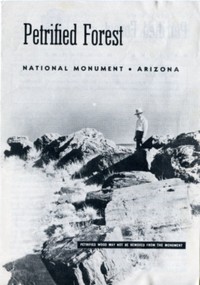
[Illustration: Cover: _Petrified Logs in the Rainbow Forest._]
Petrified Forest
NATIONAL MONUMENT · ARIZONA
[Illustration: NATIONAL PARK SERVICE · DEPARTMENT OF THE INTERIOR]
PETRIFIED WOOD MAY NOT BE REMOVED FROM THE MONUMENT
_The National Park System, of which Petrified Forest National Monument
is a unit, is dedicated to the conservation of America’s scenic,
scientific, and historic heritage for the benefit and enjoyment of the
people._
Petrified Forest National Monument, containing 85,304 acres of federally
owned land, has the greatest and most colorful concentration of
petrified wood known in the world. In the monument are six separate
“forests” where giant logs of agatized wood lie prostrate, surrounded by
numerous broken sections and smaller chips and fragments.
The area is a part of the Painted Desert of northern Arizona, a region
of banded rocks of many hues carved by wind and rain into a fantastic
landscape. Here and there beds of shale contain perfectly preserved
fossil leaves of plants of a remote age. Occasionally the bones of giant
reptiles and amphibians are washed from their burial places in the
deposits.
_PREHISTORIC INDIANS LIVED IN PETRIFIED FOREST_
The ruins of pueblos built by Indians in pre-Columbian times, from 800
to 1,400 years ago, are scattered on nearly every mesa throughout the
monument. Low mounds, strewn with blocks of sandstone and bits of broken
pottery, mark the sites of these ancient homes. Some of the dwellings,
such as the Agate House in the Third Forest, were built of blocks of
petrified wood, and smaller fragments of this material were chipped into
arrowheads, knives, and scrapers. Many petroglyphs (pictures carved into
the surface of the rock) are found on the sandstone rocks throughout the
area.
_HISTORY_
Apparently the first man to report the “stone trees” was Lieutenant
Sitgreaves, an Army officer who explored parts of northern Arizona in
1851, soon after Arizona was acquired by the United States.
The petrified forests remained largely unknown, however, until the
settlement of northern Arizona began in 1878 and the Atlantic and
Pacific, now the Santa Fe Railway, was completed across northern Arizona
in 1883. During the following years, the existence of the petrified
forests was threatened by souvenir hunters, gem collectors, commercial
jewelers, and abrasive manufacturers. Entire logs were blasted to obtain
the quartz and amethyst crystals often found within the logs, and much
agate was carried away for making jewelry. The erection of a stamp mill
near the forests to crush the petrified logs into abrasives offered the
most serious threat. Alarmed, the citizens of Arizona, through their
territorial legislature, petitioned Congress to make the area a national
reserve “so that future generations might enjoy its beauties, and study
one of the most curious results of nature’s forces.”
Following an investigation by Lester F. Ward, of the United States
Geological Survey, Petrified Forest National Monument was established by
President Theodore Roosevelt on December 8, 1906, under authority of the
Act for the Preservation of American Antiquities.
_THE GEOLOGIC STORY_
_The Forests._—About 160 million years ago, in Triassic time, northern
Arizona was probably a lowland where shifting streams spread sand and
mud over the plains. Scientists believe that the growing forests were
upstream, possibly as much as a hundred miles west and southwest of the
present petrified forests. The principal tree resembled modern pines,
but was more closely related to the Araucarian pines of South America
and Australia. Remains of two other kinds of primitive trees are also
occasionally found.
_The Trees Were Buried._—Natural processes, sometimes hastened by
destructive fires and ravages of insects, are believed to have killed
the trees. Certainly, many of them decayed on the ground, but others
fell into streams and came to rest in bays or on sand bars where rapid
burial by mud and sand prevented their decay. The deposits in which
these trees were buried eventually turned to the hard sandstones and
shales now called the Chinle formation. These were buried at least 3,000
feet beneath layers of sand and silt spread by shallow seas.
_The Logs Petrified._—The sediments in which the logs were buried
contained a large amount of volcanic ash, high in the mineral silica.
This silica was picked up by ground water, carried into the wood, and
deposited in the cell tissue. The mineral filled the wood solidly,
forming the present petrified log. However, the greater part of the
original cellulose remains. The various color patterns were caused by
oxides of iron and manganese. This particular type is known as agatized
wood. Cavities in the logs were often filled or lined with quartz
crystals.
_How the Forest Was Brought to Light._—Since the forest was buried there
have been several periods of great mountain making. Forces from deep in
the earth thrust the Rockies and Sierras upward several thousand feet,
and the land between was lifted far above its former position near sea
level. As a result of this great mountain growth, certain areas became
arid and desertlike; soon wind and rain started wearing down the great
deposits that covered this region. Large river systems carried away the
loose mud, sand, and gravel which finally found its way to the sea. Thus
the sediments that once covered the forest were removed. Finally the
layers in which the logs were buried were cut by canyons and ravines,
revealing the great petrified logs and the many bands of colored rock
that make up the Painted Desert. It is believed that the petrified logs
were cracked in many places by the weight of sediments and earthquakes
during the mountain uplift period. As the logs wash from the hillsides,
they break into sections which accumulate in piles at the base of the
cliffs. Only a small portion of the petrified forests is now exposed,
for logs occur below the surface of the ground to a depth of about 300
feet.
_Broken Log Sections._—Rhythmic vibrations of earthquakes during the
period of uplift of the land are believed to have produced fine cracks
at more or less regular intervals across the petrified logs. As erosion
of the softer material around the logs took place at the surface of the
land, the exposed cracks widened, separating the logs into sections.
_The Painted Desert._—The badlands of the Petrified Forest areas and the
Painted Desert get their color from the ancient volcanic deposits of
that region, and the surface forms are typical of desert erosion.
The material from which the badlands were sculptured originally was
deposited layer upon layer as volcanic ash. The decomposition of the ash
which released silica for petrification converted the ash into claylike
rock, called bentonite. When pure, the bentonite is nearly white, but in
the Painted Desert it is stained all shades of red, orange, maroon,
blue, purple, and yellow by iron minerals that also came from volcanic
ash.
[Illustration: _Interesting Formations in the Third Forest._]
Bentonitic beds in arid or semiarid regions erode into badlands. The
bentonite absorbs water like a sponge, swells, and disintegrates into a
fine mud. As a result, the torrential summer rains that fall in northern
Arizona rapidly cut the banded, bentonitic beds into sharp, conical
hills, turreted ridges, and sharp, interbranching canyons and ravines.
When dry, the bentonite is hard and strong, thus preserving these
intricate badlands forms during the long periods between rains. Locally,
a hard sandstone caprock may prevent rapid erosion of the shales beneath
to form an abrupt-sided, table-topped butte or mesa. The resistant
capping of the rim of the Painted Desert is composed of ancient volcanic
rock.
_INTERPRETIVE SERVICE_
All visitors are invited to see the Rainbow Forest Museum. Its exhibits
include many outstanding examples of polished petrified wood, fossils,
and minerals; charts explaining the formation of the petrified forests
and the badlands; and a diorama. Other exhibits may be seen at the
Painted Desert Museum, which is open during the summer.
During the summer months short talks are given periodically in the
Rainbow Forest Museum; and, as circumstances permit, guided tours
through the Rainbow Forest are conducted by park ranger naturalists.
All of these services are free of charge.
_TRAVEL INFORMATION_
Excellent paved approach roads make Petrified Forest National Monument
easily accessible by car, and it can be visited throughout the year. US
66, crossing the area near the Painted Desert, is the approach from the
east. Travelers from the southeast, south, and west enter from US 260.
The monument road connects these two main highways and leads through the
more interesting parts of the area. This road through the monument is
closed to through travel at night.
Travelers by rail must obtain privately operated cars in Gallup, N.
Mex., and Holbrook and Winslow, Ariz., for tours through the monument as
no scheduled tours are available.
_ACCOMMODATIONS AND SUPPLIES_
At the Rainbow Forest, a small picnic ground, equipped with table,
shade, and water supply, is available for free use in daytime only.
There are no camping facilities.
The nearest towns having cabin, hotel, store, and garage facilities are
Holbrook, Ariz., 20 miles west; Gallup, N. Mex., 92 miles east; and St.
Johns, Ariz., 42 miles southeast. Distances are from monument
headquarters.
Meals, gasoline, and souvenirs may be obtained at the Painted Desert Inn
and at the Rainbow Forest Lodge.
_ADMINISTRATION_
A superintendent is in immediate charge of the monument. Communications
should be addressed to him at Petrified Forest National Monument,
Holbrook, Ariz.
_GUIDE FOR VISITORS_
From US 66—Read down
From US 260—Read up
_Painted Desert Rim Drive._—Take road from US 66 to rim. Distance back
to US 66, via rim, about 4 miles. Beautiful view of Painted Desert.
Museum of Indian Arts and Crafts in basement of Painted Desert Inn.
_Painted Desert._—Erosion cutting across the many colored beds of shale
and sandstone produced the “Painted Desert.”
_Puerco River Ranger Station._—To enter monument, secure automobile
permit, 50 cents. Visit Puerco Indian Ruin back of ranger station. Ruin
indicates 150 to 160 rooms. Built 800 to 900 years ago. To leave
monument, get clearance.
_Newspaper Rock._—Side road ¼ mile. Fine trail—12 to 15 minutes.
Remarkable prehistoric Indian “writings” (petroglyphs) probably 800 to
900 years old. Made by chipping through outer dark sandstone surface
with sharp tool, probably of petrified wood. The many interesting
figures, symbolic designs, and characters have never been interpreted.
Please do not deface them.
_Lower Blue Forest Drive._—Fine side road—½ mile to parking area.
Typical badlands exposures.
_Blue Forest Connecting Trail._—Gravel trail—1 mile long—50 to 60
minutes. Leads to Upper Blue Forest Parking Area, where driver can meet
anyone walking across trail. Logs on 3 levels. The only forest with pink
logs. Remarkable “chip” piles.
_Upper Blue Forest Drive._—Good graveled road—3 miles to parking area.
Fine panoramic view of Blue Forest badlands and Puerco River Valley.
Conglomerate capped mesa. Head of Blue Forest Connecting Trail.
[Illustration: _Agate Bridge._]
_Agate Bridge Trail._—5 to 10 minutes. Petrified log, 111 feet long,
forms natural bridge; span about 40 feet. Erosion of sandstone by rain
water produced this bridge. Pedestal Log a short distance south.
_First Forest._—Fine side road—8 to 10 minutes. Highly colored, broken
logs very abundant, eroding from conglomerate bed that caps mesa.
_Second Forest._—Good trail—20 to 25 minutes. Peculiar white, silicified
logs; logs are fire scarred; carbonized material present. Hollow logs
show crystals in place.
_Third Forest and Agate House._—Paved trail—25 to 40 minutes. Finest
long log area—some 150 to 160 feet. Panorama Knoll gives good view.
Agate House side trail to pre-historic Indian dwelling partially
restored; built of petrified wood 800 to 900 years ago.
_Rainbow Forest._—Start from museum on all-paved trail—15 to 20 minutes.
Logs show beautiful bands of color. Old Faithful, one of the largest
logs, at top of trail. Mather Memorial on side trail.
_Rainbow Forest Museum._—Charts and exhibits tell the complete story of
the Petrified Forest. They include beautiful polished sections of
agatized wood, fossil reptiles, and amphibian skulls, bones, and teeth.
_US 260 Ranger Station._—To enter monument, secure automobile permit, 50
cents. Drive carefully. To leave monument, get clearance and information
on roads.
_Please help to maintain and protect Petrified Forest National Monument
by refraining from destroying or removing specimens of petrified wood
(no matter how small the piece) or defacing or marking ruins,
pictographs, petroglyphs, or other works of prehistoric man. If each of
the hundreds of thousands of yearly visitors took pieces of petrified
wood, there would soon be none left. Once removed, it is gone forever—it
cannot be replaced._
Your cooperation in observing the above will make it unnecessary to
impose penalties of fines or imprisonment, or both, as provided for
under the laws of the United States Government for the protection of
Petrified Forest National Monument.
You may purchase petrified wood from the monument concessioner, who gets
his supply from dealers handling wood obtained from private lands
outside of the monument.
The following items, which through their observance will tend to make
your trip and that of your neighbors more enjoyable, are listed for your
guidance:
The monument is a sanctuary for all living things. Please do not
molest the wild birds or animals or pick wild flowers.
Pets may be brought into the monument only on leash, crated, or
otherwise under physical restrictive control.
Picnicking is permitted at the headquarters picnic area only.
Unless adequately sealed, cased, broken down, or otherwise packed to
prevent their use while in the monument, firearms are prohibited
except upon written permission from the superintendent.
Professional photographers using motion picture cameras must obtain a
permit from the superintendent.
All accidents should be reported to the nearest ranger station.
The speed limit is 35 miles per hour. Please drive with caution and
heed all traffic signs.
Lost and found articles should be reported to the nearest ranger
station.
An annual fee of 50 cents is charged each automobile and motorcycle
entering the monument.
The monument road between the Rainbow Forest and the Painted Desert is
closed to through travel at night.
THE PARK RANGERS ARE HERE TO ASSIST YOU AS WELL AS TO PROTECT THE
MONUMENT AREA. WHEN IN DOUBT ASK A RANGER—THANK YOU.
[Illustration: DEPARTMENT OF THE INTERIOR · March 3, 1849]
UNITED STATES DEPARTMENT OF THE INTERIOR
Douglas McKay, _Secretary_
NATIONAL PARK SERVICE, Conrad L. Wirth, _Director_
[Illustration: PETRIFIED FOREST NATIONAL MONUMENT
ARIZONA]
PAINTED DESERT
Pilot Rock
HIGHEST POINT IN MONUMENT (EL. 6235)
CHINDE MESA
Black Forest
RIM OF PAINTED DESERT
PAINTED DESERT INN
MUSEUM
PUERCO RIVER
LITHODENDRON WASH
DEAD RIVER
Cottonwood Wash
ATCHISON TOPEKA & SANTA FE RY.
ADAMANA
TO GALLUP NEW MEXICO
U. S. 66
TO GALLUP 72 MILES
TO HOLBROOK 25 MILES
U.S. 260
TO HOLBROOK 20 MILES
TO ST. JOHNS 42 MILES
PUERCO RIVER CHECKING STATION
HIGHWAY CLOSED AT NIGHT
PARKING AREA
PETROGLYPHS
INDIAN RUINS
NEWSPAPER ROCK
Twin Buttes
The Haystacks
Blue Forest
3 MILES
PARKING AREA
First Forest
PARKING AREA
AGATE BRIDGE
SECOND FOREST
PARKING AREA
Rainbow Forest
PETROGLYPHS
The Flattops
Third Forest
RAINBOW FOREST ADMINISTRATION OFFICE HEADQUARTERS
CHECKING STATION (El. 5472)
HIGHWAY CLOSED AT NIGHT
MUSEUM
STORE
PARKING AREA
RAINBOW FOREST LODGE
Picnic Area
VICINITY MAP
PETRIFIED FOREST NAT. MON.
NAVAJO INDIAN RESERVATION
U. S. 66
Gallup
Holbrook
U. S. 260
Concho
St. Johns
NM PF 7001 Revised Aug. 1952
REVISED 1953
U. S. GOVERNMENT PRINTING OFFICE: 1953 O-F—2307
Transcriber’s Notes
—This eBook is based on a U.S. government publication which is public
domain in the United States.
—Corrected a few palpable typos.
—Within the map, transcribed labels, and added italicized text where
needed to define the context.
—In the text versions only, text in italics is delimited by
_underscores_.
End of the Project Gutenberg EBook of Petrified Forest National Monument
(1953), by National Park Service
*** END OF THIS PROJECT GUTENBERG EBOOK PETRIFIED FOREST NATIONAL MONUMENT ***
***** This file should be named 59692-0.txt or 59692-0.zip *****
This and all associated files of various formats will be found in:
http://www.gutenberg.org/5/9/6/9/59692/
Produced by Stephen Hutcheson, Lisa Corcoran and the Online
Distributed Proofreading Team at http://www.pgdp.net
Updated editions will replace the previous one--the old editions will
be renamed.
Creating the works from print editions not protected by U.S. copyright
law means that no one owns a United States copyright in these works,
so the Foundation (and you!) can copy and distribute it in the United
States without permission and without paying copyright
royalties. Special rules, set forth in the General Terms of Use part
of this license, apply to copying and distributing Project
Gutenberg-tm electronic works to protect the PROJECT GUTENBERG-tm
concept and trademark. Project Gutenberg is a registered trademark,
and may not be used if you charge for the eBooks, unless you receive
specific permission. If you do not charge anything for copies of this
eBook, complying with the rules is very easy. You may use this eBook
for nearly any purpose such as creation of derivative works, reports,
performances and research. They may be modified and printed and given
away--you may do practically ANYTHING in the United States with eBooks
not protected by U.S. copyright law. Redistribution is subject to the
trademark license, especially commercial redistribution.
START: FULL LICENSE
THE FULL PROJECT GUTENBERG LICENSE
PLEASE READ THIS BEFORE YOU DISTRIBUTE OR USE THIS WORK
To protect the Project Gutenberg-tm mission of promoting the free
distribution of electronic works, by using or distributing this work
(or any other work associated in any way with the phrase "Project
Gutenberg"), you agree to comply with all the terms of the Full
Project Gutenberg-tm License available with this file or online at
www.gutenberg.org/license.
Section 1. General Terms of Use and Redistributing Project
Gutenberg-tm electronic works
1.A. By reading or using any part of this Project Gutenberg-tm
electronic work, you indicate that you have read, understand, agree to
and accept all the terms of this license and intellectual property
(trademark/copyright) agreement. If you do not agree to abide by all
the terms of this agreement, you must cease using and return or
destroy all copies of Project Gutenberg-tm electronic works in your
possession. If you paid a fee for obtaining a copy of or access to a
Project Gutenberg-tm electronic work and you do not agree to be bound
by the terms of this agreement, you may obtain a refund from the
person or entity to whom you paid the fee as set forth in paragraph
1.E.8.
1.B. "Project Gutenberg" is a registered trademark. It may only be
used on or associated in any way with an electronic work by people who
agree to be bound by the terms of this agreement. There are a few
things that you can do with most Project Gutenberg-tm electronic works
even without complying with the full terms of this agreement. See
paragraph 1.C below. There are a lot of things you can do with Project
Gutenberg-tm electronic works if you follow the terms of this
agreement and help preserve free future access to Project Gutenberg-tm
electronic works. See paragraph 1.E below.
1.C. The Project Gutenberg Literary Archive Foundation ("the
Foundation" or PGLAF), owns a compilation copyright in the collection
of Project Gutenberg-tm electronic works. Nearly all the individual
works in the collection are in the public domain in the United
States. If an individual work is unprotected by copyright law in the
United States and you are located in the United States, we do not
claim a right to prevent you from copying, distributing, performing,
displaying or creating derivative works based on the work as long as
all references to Project Gutenberg are removed. Of course, we hope
that you will support the Project Gutenberg-tm mission of promoting
free access to electronic works by freely sharing Project Gutenberg-tm
works in compliance with the terms of this agreement for keeping the
Project Gutenberg-tm name associated with the work. You can easily
comply with the terms of this agreement by keeping this work in the
same format with its attached full Project Gutenberg-tm License when
you share it without charge with others.
1.D. The copyright laws of the place where you are located also govern
what you can do with this work. Copyright laws in most countries are
in a constant state of change. If you are outside the United States,
check the laws of your country in addition to the terms of this
agreement before downloading, copying, displaying, performing,
distributing or creating derivative works based on this work or any
other Project Gutenberg-tm work. The Foundation makes no
representations concerning the copyright status of any work in any
country outside the United States.
1.E. Unless you have removed all references to Project Gutenberg:
1.E.1. The following sentence, with active links to, or other
immediate access to, the full Project Gutenberg-tm License must appear
prominently whenever any copy of a Project Gutenberg-tm work (any work
on which the phrase "Project Gutenberg" appears, or with which the
phrase "Project Gutenberg" is associated) is accessed, displayed,
performed, viewed, copied or distributed:
This eBook is for the use of anyone anywhere in the United States and
most other parts of the world at no cost and with almost no
restrictions whatsoever. You may copy it, give it away or re-use it
under the terms of the Project Gutenberg License included with this
eBook or online at www.gutenberg.org. If you are not located in the
United States, you'll have to check the laws of the country where you
are located before using this ebook.
1.E.2. If an individual Project Gutenberg-tm electronic work is
derived from texts not protected by U.S. copyright law (does not
contain a notice indicating that it is posted with permission of the
copyright holder), the work can be copied and distributed to anyone in
the United States without paying any fees or charges. If you are
redistributing or providing access to a work with the phrase "Project
Gutenberg" associated with or appearing on the work, you must comply
either with the requirements of paragraphs 1.E.1 through 1.E.7 or
obtain permission for the use of the work and the Project Gutenberg-tm
trademark as set forth in paragraphs 1.E.8 or 1.E.9.
1.E.3. If an individual Project Gutenberg-tm electronic work is posted
with the permission of the copyright holder, your use and distribution
must comply with both paragraphs 1.E.1 through 1.E.7 and any
additional terms imposed by the copyright holder. Additional terms
will be linked to the Project Gutenberg-tm License for all works
posted with the permission of the copyright holder found at the
beginning of this work.
1.E.4. Do not unlink or detach or remove the full Project Gutenberg-tm
License terms from this work, or any files containing a part of this
work or any other work associated with Project Gutenberg-tm.
1.E.5. Do not copy, display, perform, distribute or redistribute this
electronic work, or any part of this electronic work, without
prominently displaying the sentence set forth in paragraph 1.E.1 with
active links or immediate access to the full terms of the Project
Gutenberg-tm License.
1.E.6. You may convert to and distribute this work in any binary,
compressed, marked up, nonproprietary or proprietary form, including
any word processing or hypertext form. However, if you provide access
to or distribute copies of a Project Gutenberg-tm work in a format
other than "Plain Vanilla ASCII" or other format used in the official
version posted on the official Project Gutenberg-tm web site
(www.gutenberg.org), you must, at no additional cost, fee or expense
to the user, provide a copy, a means of exporting a copy, or a means
of obtaining a copy upon request, of the work in its original "Plain
Vanilla ASCII" or other form. Any alternate format must include the
full Project Gutenberg-tm License as specified in paragraph 1.E.1.
1.E.7. Do not charge a fee for access to, viewing, displaying,
performing, copying or distributing any Project Gutenberg-tm works
unless you comply with paragraph 1.E.8 or 1.E.9.
1.E.8. You may charge a reasonable fee for copies of or providing
access to or distributing Project Gutenberg-tm electronic works
provided that
* You pay a royalty fee of 20% of the gross profits you derive from
the use of Project Gutenberg-tm works calculated using the method
you already use to calculate your applicable taxes. The fee is owed
to the owner of the Project Gutenberg-tm trademark, but he has
agreed to donate royalties under this paragraph to the Project
Gutenberg Literary Archive Foundation. Royalty payments must be paid
within 60 days following each date on which you prepare (or are
legally required to prepare) your periodic tax returns. Royalty
payments should be clearly marked as such and sent to the Project
Gutenberg Literary Archive Foundation at the address specified in
Section 4, "Information about donations to the Project Gutenberg
Literary Archive Foundation."
* You provide a full refund of any money paid by a user who notifies
you in writing (or by e-mail) within 30 days of receipt that s/he
does not agree to the terms of the full Project Gutenberg-tm
License. You must require such a user to return or destroy all
copies of the works possessed in a physical medium and discontinue
all use of and all access to other copies of Project Gutenberg-tm
works.
* You provide, in accordance with paragraph 1.F.3, a full refund of
any money paid for a work or a replacement copy, if a defect in the
electronic work is discovered and reported to you within 90 days of
receipt of the work.
* You comply with all other terms of this agreement for free
distribution of Project Gutenberg-tm works.
1.E.9. If you wish to charge a fee or distribute a Project
Gutenberg-tm electronic work or group of works on different terms than
are set forth in this agreement, you must obtain permission in writing
from both the Project Gutenberg Literary Archive Foundation and The
Project Gutenberg Trademark LLC, the owner of the Project Gutenberg-tm
trademark. Contact the Foundation as set forth in Section 3 below.
1.F.
1.F.1. Project Gutenberg volunteers and employees expend considerable
effort to identify, do copyright research on, transcribe and proofread
works not protected by U.S. copyright law in creating the Project
Gutenberg-tm collection. Despite these efforts, Project Gutenberg-tm
electronic works, and the medium on which they may be stored, may
contain "Defects," such as, but not limited to, incomplete, inaccurate
or corrupt data, transcription errors, a copyright or other
intellectual property infringement, a defective or damaged disk or
other medium, a computer virus, or computer codes that damage or
cannot be read by your equipment.
1.F.2. LIMITED WARRANTY, DISCLAIMER OF DAMAGES - Except for the "Right
of Replacement or Refund" described in paragraph 1.F.3, the Project
Gutenberg Literary Archive Foundation, the owner of the Project
Gutenberg-tm trademark, and any other party distributing a Project
Gutenberg-tm electronic work under this agreement, disclaim all
liability to you for damages, costs and expenses, including legal
fees. YOU AGREE THAT YOU HAVE NO REMEDIES FOR NEGLIGENCE, STRICT
LIABILITY, BREACH OF WARRANTY OR BREACH OF CONTRACT EXCEPT THOSE
PROVIDED IN PARAGRAPH 1.F.3. YOU AGREE THAT THE FOUNDATION, THE
TRADEMARK OWNER, AND ANY DISTRIBUTOR UNDER THIS AGREEMENT WILL NOT BE
LIABLE TO YOU FOR ACTUAL, DIRECT, INDIRECT, CONSEQUENTIAL, PUNITIVE OR
INCIDENTAL DAMAGES EVEN IF YOU GIVE NOTICE OF THE POSSIBILITY OF SUCH
DAMAGE.
1.F.3. LIMITED RIGHT OF REPLACEMENT OR REFUND - If you discover a
defect in this electronic work within 90 days of receiving it, you can
receive a refund of the money (if any) you paid for it by sending a
written explanation to the person you received the work from. If you
received the work on a physical medium, you must return the medium
with your written explanation. The person or entity that provided you
with the defective work may elect to provide a replacement copy in
lieu of a refund. If you received the work electronically, the person
or entity providing it to you may choose to give you a second
opportunity to receive the work electronically in lieu of a refund. If
the second copy is also defective, you may demand a refund in writing
without further opportunities to fix the problem.
1.F.4. Except for the limited right of replacement or refund set forth
in paragraph 1.F.3, this work is provided to you 'AS-IS', WITH NO
OTHER WARRANTIES OF ANY KIND, EXPRESS OR IMPLIED, INCLUDING BUT NOT
LIMITED TO WARRANTIES OF MERCHANTABILITY OR FITNESS FOR ANY PURPOSE.
1.F.5. Some states do not allow disclaimers of certain implied
warranties or the exclusion or limitation of certain types of
damages. If any disclaimer or limitation set forth in this agreement
violates the law of the state applicable to this agreement, the
agreement shall be interpreted to make the maximum disclaimer or
limitation permitted by the applicable state law. The invalidity or
unenforceability of any provision of this agreement shall not void the
remaining provisions.
1.F.6. INDEMNITY - You agree to indemnify and hold the Foundation, the
trademark owner, any agent or employee of the Foundation, anyone
providing copies of Project Gutenberg-tm electronic works in
accordance with this agreement, and any volunteers associated with the
production, promotion and distribution of Project Gutenberg-tm
electronic works, harmless from all liability, costs and expenses,
including legal fees, that arise directly or indirectly from any of
the following which you do or cause to occur: (a) distribution of this
or any Project Gutenberg-tm work, (b) alteration, modification, or
additions or deletions to any Project Gutenberg-tm work, and (c) any
Defect you cause.
Section 2. Information about the Mission of Project Gutenberg-tm
Project Gutenberg-tm is synonymous with the free distribution of
electronic works in formats readable by the widest variety of
computers including obsolete, old, middle-aged and new computers. It
exists because of the efforts of hundreds of volunteers and donations
from people in all walks of life.
Volunteers and financial support to provide volunteers with the
assistance they need are critical to reaching Project Gutenberg-tm's
goals and ensuring that the Project Gutenberg-tm collection will
remain freely available for generations to come. In 2001, the Project
Gutenberg Literary Archive Foundation was created to provide a secure
and permanent future for Project Gutenberg-tm and future
generations. To learn more about the Project Gutenberg Literary
Archive Foundation and how your efforts and donations can help, see
Sections 3 and 4 and the Foundation information page at
www.gutenberg.org
Section 3. Information about the Project Gutenberg Literary Archive Foundation
The Project Gutenberg Literary Archive Foundation is a non profit
501(c)(3) educational corporation organized under the laws of the
state of Mississippi and granted tax exempt status by the Internal
Revenue Service. The Foundation's EIN or federal tax identification
number is 64-6221541. Contributions to the Project Gutenberg Literary
Archive Foundation are tax deductible to the full extent permitted by
U.S. federal laws and your state's laws.
The Foundation's principal office is in Fairbanks, Alaska, with the
mailing address: PO Box 750175, Fairbanks, AK 99775, but its
volunteers and employees are scattered throughout numerous
locations. Its business office is located at 809 North 1500 West, Salt
Lake City, UT 84116, (801) 596-1887. Email contact links and up to
date contact information can be found at the Foundation's web site and
official page at www.gutenberg.org/contact
For additional contact information:
Dr. Gregory B. Newby
Chief Executive and Director
[email protected]
Section 4. Information about Donations to the Project Gutenberg
Literary Archive Foundation
Project Gutenberg-tm depends upon and cannot survive without wide
spread public support and donations to carry out its mission of
increasing the number of public domain and licensed works that can be
freely distributed in machine readable form accessible by the widest
array of equipment including outdated equipment. Many small donations
($1 to $5,000) are particularly important to maintaining tax exempt
status with the IRS.
The Foundation is committed to complying with the laws regulating
charities and charitable donations in all 50 states of the United
States. Compliance requirements are not uniform and it takes a
considerable effort, much paperwork and many fees to meet and keep up
with these requirements. We do not solicit donations in locations
where we have not received written confirmation of compliance. To SEND
DONATIONS or determine the status of compliance for any particular
state visit www.gutenberg.org/donate
While we cannot and do not solicit contributions from states where we
have not met the solicitation requirements, we know of no prohibition
against accepting unsolicited donations from donors in such states who
approach us with offers to donate.
International donations are gratefully accepted, but we cannot make
any statements concerning tax treatment of donations received from
outside the United States. U.S. laws alone swamp our small staff.
Please check the Project Gutenberg Web pages for current donation
methods and addresses. Donations are accepted in a number of other
ways including checks, online payments and credit card donations. To
donate, please visit: www.gutenberg.org/donate
Section 5. General Information About Project Gutenberg-tm electronic works.
Professor Michael S. Hart was the originator of the Project
Gutenberg-tm concept of a library of electronic works that could be
freely shared with anyone. For forty years, he produced and
distributed Project Gutenberg-tm eBooks with only a loose network of
volunteer support.
Project Gutenberg-tm eBooks are often created from several printed
editions, all of which are confirmed as not protected by copyright in
the U.S. unless a copyright notice is included. Thus, we do not
necessarily keep eBooks in compliance with any particular paper
edition.
Most people start at our Web site which has the main PG search
facility: www.gutenberg.org
This Web site includes information about Project Gutenberg-tm,
including how to make donations to the Project Gutenberg Literary
Archive Foundation, how to help produce our new eBooks, and how to
subscribe to our email newsletter to hear about new eBooks.
Petrified Forest National Monument (1953)
Subjects:
Download Formats:
Excerpt
The Project Gutenberg EBook of Petrified Forest National Monument (1953), by
National Park Service
This eBook is for the use of anyone anywhere in the United States and most
other parts of the world at no cost and with almost no restrictions
whatsoever. You may copy it, give it away or re-use it under the terms of
the Project Gutenberg License included with this eBook or online at
www.gutenberg.org. If you are not located in the United States, you'll have
to check the laws of the...
Read the Full Text
— End of Petrified Forest National Monument (1953) —
Book Information
- Title
- Petrified Forest National Monument (1953)
- Author(s)
- United States. National Park Service
- Language
- English
- Type
- Text
- Release Date
- June 7, 2019
- Word Count
- 5,675 words
- Library of Congress Classification
- F786
- Bookshelves
- Browsing: History - American, Browsing: Travel & Geography
- Rights
- Public domain in the USA.
Related Books
At home in the Smokies
by United States. National Park Service, Dykeman, Wilma, Stokely, James
English
648h 8m read
Great Smoky Mountains National Park
by United States. National Park Service
English
109h 40m read
Guide to the Canyon Area
by United States. National Park Service, Yellowstone Library and Museum Association
English
36h 9m read
Crater Lake National Park, Oregon (1958)
by United States. National Park Service
English
74h 50m read

Lee Mansion National Memorial, Arlington, Virginia (1953)
by United States. National Park Service
English
30h 14m read
Point Park, Lookout Mountain and Chattanooga Battlefields - Chickamauga and Chattanooga National Military Park, Georgia and Tennessee
by United States. National Park Service
English
27h 48m read