*** START OF THE PROJECT GUTENBERG EBOOK 74732 ***
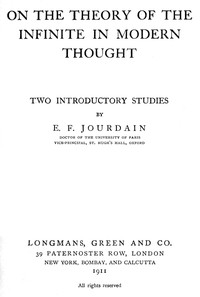
ON THE THEORY OF THE INFINITE IN MODERN THOUGHT
ON THE THEORY OF THE
INFINITE IN MODERN
THOUGHT
TWO INTRODUCTORY STUDIES
BY
E. F. JOURDAIN
DOCTOR OF THE UNIVERSITY OF PARIS
VICE-PRINCIPAL, ST. HUGH’S HALL, OXFORD
LONGMANS, GREEN AND CO.
39 PATERNOSTER ROW, LONDON
NEW YORK, BOMBAY, AND CALCUTTA
1911
All rights reserved
Of the two papers here reproduced, the first was given in 1905 to
a meeting of the women science students in Oxford; the second, in
1908, to the Philosophical Society of this College. They are printed
by request, with the author’s apologies for their incompleteness.
The lecture form has been retained. I am indebted to my brother, Mr.
P. Jourdain, for help in preparing the first lecture, and for his
revision of the text.
E. F. JOURDAIN.
ST. HUGH’S HALL, OXFORD,
_January, 1911_.
CONTENTS
I
PAGE
THE PROBLEM OF THE FINITE AND
THE INFINITE 1
II
PRAGMATISM AND A THEORY OF
KNOWLEDGE 31
I
THE PROBLEM OF THE FINITE AND THE INFINITE
The influence of mathematics on philosophy and vice versâ can be
inferred from the historical progress of both studies, though it has
not been possible till about within the last fifteen years to give
a logical explanation for the relations between them. As long as it
was believed, according to the Kantian view, that the science of
mathematics was based on intuitions of time and space, the alliance
between philosophy and mathematics could not be proved to be closer
than that between philosophy and experimental science, although the
historical fact remained that philosophy and mathematics exercised a
mutual stimulus, and developed at the same periods of history.
But mathematics, as now defined, is independent of intuitions of
space and time, and also of axioms and hypotheses.[1] Mathematics,
as now understood, is based, like formal logic, on the prerequisites
of thought, not on the notions of space and time. Here there is no
definition of number or space, but the conception of number and
space,[2] which is more complicated, can be derived from them. All
other complicated mind processes can, in the same way, be reduced to
the simple elements of the prerequisites of thought.
Such a science might exist out of conditions of time and space as we
know them. It is a science of relations rather than of mere number.
Founded, then, on the laws of symbolic logic, it is a valuable aid
and illustration to philosophy; philosophy, on the other hand, can
imagine lines for the exercise of the constructive power involved in
mathematics. It is the object of this paper to show that the close
though apparently accidental union of philosophy and mathematics
throughout the history of thought can now be explained, and that the
problems with which pure mathematics is now concerned are those which
lie at the core of philosophic thought and speculation. (Symbolic
logic has developed to meet the new demands made upon it. It does
not now reduce itself to the syllogism, as Aristotle thought it did;
the prerequisites of thought are shown to be manifold instead of
single.[3])
The use of the word philosophic in this connection suggests a
necessity for further definition. Philosophy is held to include at
least two great branches--Metaphysics and Ethics. The influence of
mathematics is most evident on the metaphysical side of philosophy;
in fact, the grouping of mathematics and metaphysics as allied
sciences tends to bring out the essential distinction between
metaphysics and ethics, and--though not by any means to imply a break
in their real relation--to show where this has been misunderstood.
No philosophy has been equally strong on both sides; they represent
different forms of activity of the human mind; but it is still true,
and from the conditions always must be, that an ethical system grows
out of metaphysics as practice follows precept and conduct implies
belief. The new definition of mathematics does not touch these
consequences; it merely marks the limits within which philosophy on
the metaphysical side can submit to, or rest upon, the conclusions of
mathematics.
As to the historical relation between metaphysics and mathematics,
the subject is so vast that we shall only attempt a very rapid
generalisation of its results on the growth of the conception of
the Finite and the Infinite. (Of course, there are many other sides
of the relation which might be studied.) The general result of the
inquiry has been, as far as we can judge, that metaphysics has
exercised an inspiring force on mathematics, and mathematics has
defined and strengthened the conceptions of metaphysics at every
critical stage in the history of philosophy. But where metaphysics
has been treated as the proof of science, where it has been laid
down as the foundation for exact knowledge, the results have not
corresponded with the truth of experience, and the quality of thought
has become degenerate. Progress depends on the right perception of
the relations between the sciences and parts of philosophy.
Such progress is especially evident in the early Greek and in the
modern periods, while the large period from the Christian era to the
Renaissance gives examples of the unfortunate reversal of the parts
of metaphysics and science and consequent confusion of thought.[4]
The problems of the metaphysician are no doubt in a sense always the
same; but this is equally true of the problems of any other science.
The methods by which the problems are attacked and the adequacy
of the solutions they receive vary, from age to age, in close
correspondence with the general development of science. Every great
metaphysical conception has exercised its influence on the general
history of science, and in return every important movement in science
has affected the development of metaphysics. The metaphysician could
not if he would, and would not if he could, escape the duty of
estimating the bearing of the great scientific theories of his time
upon our ultimate conceptions of the nature of the world as a whole.
Every fundamental advance in science thus calls for a restatement and
reconsideration of the old metaphysical problems in the light of the
new discovery.
* * * * *
During the Greek period mathematics was the only branch of science
which was at all developed, and its development coincided with
the age of the philosophers. Thus when Plato spoke of science he
always meant mathematics. And even later, when the physical sciences
had begun to develop, Aristotle put mathematical ideas into close
connection with metaphysical ones when he stated that they occupied
the middle term between the ideal and the sensible. Both Plato and
Aristotle referred to and depended upon mathematical proofs and
illustrations of philosophical questions. During this Greek period
the conception of Infinity took shape. The pre-Platonic notion,
reproduced again later in the decline of Socratic theory by the
Stoics, was that the Infinite was the aggregate of the Finite; the
Platonic and Aristotelian theory, that, namely, of the most vigorous
moment of Greek thought, was that the Infinite was _more_ than the
aggregate of the Finite; that it had a self-determined existence from
which the Finite had been derived. Existence, as known to man, was
treated as a compromise between the Finite and the Infinite.
Neo-Platonism altogether separated the Infinite from the Finite. In
the Alexandrine metaphysics, which represented a decadent stage of
philosophy and its deviation from the sciences, the conception of
the Infinite became less clear and logical; it diverged from the
view which had been affected by mathematical thought, and tended
to assimilate to itself the ideas of perfection and universality,
which, philosophically speaking, are conceptions distinct from that
of Infinity--universality referring to a common principle of unity,
and perfection involving the moral ideal. Real progress was deferred
by the too rapid coherence of ideas only partially analysed and
understood. Thinkers passed quickly from the exclusive contemplation
of subject to that of object and back again,[5] each new period
negativing all previous experience, till the result was the exclusion
of an imperfectly analysed Relative and Finite from an insufficiently
apprehended Absolute and Infinite.
After the Christian era Greek philosophy drifted off into
scholasticism and lost touch of reality, the grammar of Aristotelian
logic replacing the vital connection of ideas. St. Anselm, it is
true, attempted to find a rational proof of the existence of God, and
identified Him with the Infinite of Greek thought; but St. Thomas
Aquinas led away the argument to a discussion as to how far form and
matter, separately considered, shared in the quality of Infinity. (He
thought form did, but not matter.) An overpowering sense of mystery,
joined to a premature desire for definition without scientific
analysis, sapped the vigour of mediæval thought.
Throughout the middle ages, then, we see the conditions of the Greek
period reversed: philosophy during the second period is not, as
in the first, engaged in giving a stimulus to the efforts of pure
reason; rather the intuitions of philosophy are treated as axiomatic,
and a false superstructure of knowledge, alien to experience and
reality, is erected upon these foundations. Philosophy, in fact, is
used as a general basis for science. The parts of philosophy and
mathematics, correctly though imperfectly seen by the Greeks, are in
the second period exchanged, and the result is confusion of idea.
The notion of the Infinite, as in the Alexandrine metaphysics, is
held to include perfection and universality, and does not exist as a
conception apart from these.
After the Renaissance, the scholastic philosophy falling into disuse,
the attempt to find an explanation of the Cosmos, a synthesis of the
universe, was abandoned, and replaced by the Cartesian idea--the
inference of existence from thought, and the limitation of the sphere
of inquiry to that which could be known by the ego. New scientific
and mathematical discoveries kept pace with this new analysis and
development of thought,[6] and the surer ground in philosophy was
definitely allied with the work of the mathematical mind. The
philosophical thesis developed from “The Infinite is the negation
of the Finite,” to “The Infinite presupposes the Finite and does
not exclude it.” The problem of the Finite and the Infinite became
the great idea of the age, and there was a reversion to the Greek
notion of existence as a compromise between the two, and almost the
hint of a coming explanation of them. In the decline of Cartesian
philosophy, when it drifted off into Pantheism, there was only a
vague conception of the Infinite, and we trace a tendency to identify
the notion of Infinity with that of the Cosmos. In mediæval thought
the idea of the Infinite had become confused with that of the Perfect
and Universal; in the modern period the effort to give a concrete
expression to the notions of Infinity, Perfection, and Universality
diverted the ideas from their relation to the Creator and applied
them to the Creation.
Kant, who gave a new impulse to some parts of the Cartesian idea,
neglected both mathematical proofs and the search for a metaphysical
Absolute. In avoiding the subject he helped to perpetuate the
vague descriptions of the Finite and the Infinite, uncorrected by
mathematical thought, which had been the currency of the philosophy
of his age, and which corrupted the philosophy of the succeeding
century. The nineteenth century produced nothing more than guesses
at truth, which were, perhaps, not very far wrong, and which the
present century is engaged in correcting and substantiating. The
same vagueness afflicted both mathematics (theory of functions)
and philosophy. Fichte, Schelling, and Hegel, particularly Hegel,
identify the metaphysical Absolute with reality, infinity, and the
universal. The ideas of continuity and infinity are not separated by
them from those of perfection and universality, nor from one another,
and their nature is not understood.
Leaving aside the French neo-critical School (Renouvier) and the
English School (Spencer)--the first of whom deny the Infinite,
thus acting in opposition to mathematical reasoning, while the
second perpetuate Kant’s error of considering the Infinite, though
thinkable, as unknowable (Dr. Caird has pointed out that this
position is illogical)--we arrive at a moment in history which is
more fruitful in result on the mathematical side, and will, no doubt,
have an effect on metaphysics. For, owing to recent discoveries
in Germany and England, mathematics is now in a position to give
greater support than before to the intuitions of philosophy.
Hitherto, philosophers have been reluctant to allow full value to
the mathematical conceptions of Infinity, and with some justice, as
the notion had not been sufficiently analysed. Philosophers, who
never attempted the analysis, have been inclined to accept certain
contradictions in their conception as inherent in the nature of
Infinity. Within the last twenty-five years Cantor and Dedekind have
cleared up the notion of continuity, and Russell has given greater
precision to the idea, and has applied this reasoning to philosophy.
Present-day metaphysicians seem to be divided into two groups; on
the one side, those who consider in philosophy the value of a theory
of being, and, on the other, those who chiefly consider the value
of a theory of knowledge, _i.e._ the Epistemologists. The first
group, devoting themselves to psychology, evolution, and history,
have no _necessary_ belief in the Infinite. The Epistemologists,
whose work is founded on Kant, discuss the theory of knowledge and
enumerate the conditions of knowledge. Their argument may not touch,
but does not exclude, the notion of the Infinite. The position of
the Epistemologist has been made infinitely more secure by recent
mathematical work. That of the psychologist remains almost untouched.
It is necessary now to examine more closely the mathematical results
to which reference has been made.
In general terms it may be said that mathematics has, as a study,
led immediately from the nature of the subject to the perception
of the Infinite, and to a knowledge of the connection between the
Infinite and the Finite. The simplest form in which the idea can be
put is stated by St. Augustine, who said that numbers considered
individually were finite, but considered as an aggregate were
infinite.[7] Before St. Augustine, and after him down the long
stream of philosophic thought, the theologian and the philosopher
have turned to mathematics for illustrations of the infinitely great
and infinitely little, as developed from the concrete processes of
arithmetic and geometry. The recurring decimal in arithmetic, the
properties of the circle and ellipse in geometry, of the cone in
conic sections, and of the surd in algebra, all touch the problem of
number and space on the side of Infinity.
In higher mathematics it is possible to start from the idea of the
Finite and reach the conception of the Infinite; or to reverse the
process, and from the Infinite to deduce the Finite. Thus in the
familiar puzzle of the subdivision of the parts of a straight line
by halving the remainder, there will be a crowding and a coalescing
of the points of division towards one end of the line, the points of
division getting infinitely nearer, but the steps will never meet.
Here in the centre of a straight line--a limited straight line--we
are confronted with the problem of Infinity.
Again, from a series of finite numbers we can gain the notion of an
infinite series. Take two series which have a correspondence with one
another. If for every element of the one we can choose an element of
the other, and of the other there is an element for the one, when at
any point we cut off its progress to infinity, this happens:--
One series, if summed up, will give a larger numerical result than
the other, and therefore can be said to be greater than the second.
Let us call the first series A, and the second B. Let us now imagine
the two series, though starting at a definite point, are never cut
at the further end. Then to all infinity series B is without certain
numbers which series A possesses, _and as an infinite series_ is
smaller than series A. But, on the other hand, when neither series
is cut, series B retains its correspondence with series A. Thus we
attain a definition of an infinite series. It is such that the part,
while being less than the whole, has yet a complete correspondence
with the whole. The whole is greater than the part, but take away
the part from the whole and that which remains corresponds to it _in
infinity_, because the test of summing the series (which would give
a contrary result) involves limitation, and thus cannot be applied.
Subtraction can take place in Infinity without loss.
By reversing this process, and by starting from the theory of the
Infinite, we may gain some idea of the discovery of the Finite. So
Dedekind and Russell define finite numbers not only in the usual way
as those which can be reached by mathematical induction, starting
from 0 and increasing by 1 at each step, but also as those of classes
which are _not_ similar to the parts of themselves obtained by taking
away single terms. That is the reversal of the process applied just
now. Dedekind also has deduced the Finite from the Infinite by a
novel process. He predicates a world of thought which we each and all
possess, filled with thoughts and things, to each thing corresponding
a thought. There are thus two “trans-finite” series in the minds of
each and all of us; we cannot say when the series of thoughts and
things will end; but they have number, though it is infinite number.
(Number exists wherever there is a correspondence, one to one,
between two aggregates.) But in this _Gedankenwelt_, says Dedekind,
there is one thing to which there is no corresponding thought: that
is the ego. Each man is part of his own world of thought, but
there is no thought of himself in his mind corresponding exactly to
himself, as a thought in his mind corresponds to another object.[8]
Two important results follow from Dedekind’s theory: first, the
existence of a finite number one, the number of the ego, as deduced
from the _Gedankenwelt_ of two infinite systems; second, by putting
together all the _Gedankenwelts_ there are or may be, we get the
notion of series of series, which seems to transcend Infinity, and
it gives us the conditions which are possibly gathered up in the
Absolute. Now the argument from the Finite to the Infinite and the
converse process may both be employed in mathematics (or both may
be neglected, as in the elementary methods of calculation used in
arithmetic). A discussion has taken place in the _Hibbert Journal_ on
the relative value of the two methods. Keyser, in an article called
the Axiom of Infinity, argued that one method, that of Dedekind,
should be exclusively developed. Russell answered him, stating that
it was not necessary to hold exclusively to either. If the Finite
and the Infinite can in turn be deduced from one another, neither
conception can be truly called an axiom. The real axiom is existence,
which includes both, and which is defined by mathematicians as that
which is _not self-contradictory_.
Now the problem of Infinity includes also that of continuity; in
other words, the problem of number includes that of _cardinal_ and
_ordinal_ number. It is time to get to the mathematical definition of
number, which we have found as a conception can be attached both to
the Finite and to the Infinite. What is number in mathematics?
Take any collection of things--we call that an _aggregate_. If an
aggregate corresponds one to one with another aggregate, they are
both said to have a number, and the same number. Subtract from the
idea of an aggregate the idea of quality or kind, and order or
arrangement, what is left is its _cardinal number_. If you subtract
quality and not order, the result is an _ordinal number_. This
reasoning applies both to finite and infinite aggregates; in fact,
the Infinite may be said to possess most of the properties which
we attach to the Finite. Two infinite aggregates, for example, can
have an ordinal correspondence, and infinite aggregates submit, like
finite ones, to arithmetical processes.
The mathematician analyses still more closely the relation between
the Finite and the Infinite, as follows:--
He starts from the aggregate, which he analyses into the Finite
and the Infinite, and the latter he analyses into the Transfinite
and the Absolute. Of these two elements, one only has till just
lately been the subject of mathematical treatment--the one called
the Transfinite. It is the transfinite subdivision of the Infinite
to which the idea of number is applicable, and which is, therefore,
in a sense inseparable from the Finite. Infinite numbers or series
ought then to be more correctly described as _Transfinite_. But the
processes of mathematics do not end here; they reach up to the idea
of the _Absolute Infinite_, the conception of which has been attained
in recent years by mathematical work. The results of this work may
now be briefly summarised.
I. The Absolute appears to have the same relation to the Transfinite
as the Transfinite to the Finite. If the Finite deals with numbers,
and the Transfinite with series of numbers, the Absolute deals
with series of series. Thus there are at least two examples of the
Infinite within our grasp which lead up to the idea of the Absolute.
One is the class of all classes of propositions; the other is the
series of all worlds of thought, in Dedekind’s sense.
II. The Finite, Transfinite, and Absolute can be further defined in
this way. There is no greatest finite number, but there is a least
transfinite number, which has been called Aleph 0, and which can
be proved to be greater than any possible finite number, however
large, because if there were a last number it must be smaller than
the sum of the whole series. There are unending series of Alephs or
infinite numbers, which are as distinct from one another in idea
as 1 is from 0, and which can no more be derived from one another
by a mathematical process than 1 can be derived from 0, but can
be reached in the same way by induction. Beyond the Transfinite we
cannot discover in the Absolute the idea of least or of greatest.
III. The relation of cardinal and ordinal number also throws some
light on the Finite, Transfinite, and Absolute. In the Finite,
cardinals and ordinals are parallel to one another; in the
Transfinite they strikingly diverge; in the Absolute we cannot trace
any connection between cardinals and ordinals, _i.e._, it is possible
to have an ordinal series to which there can be no corresponding
cardinal number or type.[9]
IV. If arithmetical processes are applied to the Finite, Transfinite,
or Absolute, we get interesting results. We know the effect of
addition, multiplication, and raising to a power, on the Finite.
The first two processes have been applied to the Alephs; the last
has been formulated, but the mathematical results have not yet been
brought to a satisfactory conclusion. Broadly speaking, we may say
that the raising of an Aleph to a power may make it transcend the
Finite and the Transfinite and melt into the Absolute. Thus all
mathematical processes which find their goal in the Absolute would
find their annihilation there. No finite mathematical conception
would be applicable to it.
Now the conception of this Absolute Infinite, of which the aggregate
of all ordinal numbers is perhaps a symbol,[10] has been subjected to
criticism. Some mathematicians[11] think that it exists, but has no
number. It is discovered by a logical process, but defies analysis
and the application to it of the notion of number. All mathematical
conceptions find in it their aim and conclusion. The importance of
this theory, its practical importance, lies in the very much simpler
mathematical formulæ that can be produced now that the logical
process is shown to extend from the Finite to the Absolute Infinite
(in the same way that the labour of summing a series arithmetically
by statement and addition is shortened by the application of
algebraical principles which depend on larger knowledge). Its
philosophical importance is great: the Absolute is here, as
elsewhere, the goal of human thought, and is the mathematician’s name
for the highest power discoverable by human reason.
It would be very interesting to discuss the probable attitude of a
Pascal or a Hegel to these mathematical conceptions, if they had been
aware of them. Take Pascal’s puzzle of the Finite and the Infinite.
He thought that if the Finite could be subtracted from the Infinite,
the Infinite would thereby lose some of its quality of infinity. How
differently would it have appeared to him had he realised that an
aggregate infinite cardinal can have subtracted from it either finite
or transfinite terms: if transfinite terms, many different answers
result, giving different degrees of transfinity: if only finite terms
are taken away, the Infinite remains in its entirety.
How, again, would Hegel have rejoiced in a definition of thought and
existence which would bridge over the logical gulf in his system!
Hegel asserted that thought and existence were one. He is objected
to by many philosophers, who ask where is the _tertium quid_ which
makes it possible to reach from one to the other, or predicate their
essential unity? But the mathematician defines existence as something
which is not self-contradictory. Thought, then, to him is a form
of existence, for thought is not self-contradictory; but the two,
thought and existence, are not necessarily conterminous.[12] Hence,
to say that non-contradiction is a fundamental condition of true
thinking is as much as to say that it is a fundamental characteristic
of real existence, and he identifies thought with reality.
Dr. Caird remarks that the secular conscience conceives of the
Infinite as opposed to the Finite; the religious conscience treats
the Infinite as real, presupposed by the illusory Finite. Where does
the truth lie? Mathematics does not admit the necessity of adopting
either view at the expense of the other.
Metaphysics standing alone produces results that may be disproved,
but cannot be proved. Mathematics standing alone produces results
that are susceptible of proof. Both are based on logic, and rest on
the prerequisites of thought. Together they are a field for the best
powers of human reason: metaphysics supplies insight, intuition,
imagination; mathematics offers the indubitable proof and translates
the ideal into the actual.
But the element in philosophical thought which, employing the
psychological method, tends to the discussion of a theory of being
rather than that of knowledge, and thus to the realisation of an
ethical system rather than to metaphysical discovery, is averse from
accepting these conclusions. It remains, therefore, for us to examine
the criticism offered by the psychological school on what they call
the mathematising of philosophy; and it will be found that the attack
deals both with the ground of the alliance and its results.
A typical exponent of this school is Moisant, who, in the _Revue
Philosophique_ for January 1905, attacked what he considered to be
the characteristic of modern philosophy and also its vice. It will
be observed that at the outset he reverses the _rôles_ of philosophy
and mathematics as we have apprehended them. Philosophy, he says,
should expect to be inspired by mathematics, but should avoid its
method. Next, he connects the modern movement with the theories of
Leibniz, who aimed at substituting general formulæ for elementary
forms of reason and calculation. These short cuts, which seem to the
mathematician to liberate the mind from a burden which prevents it
from employing its full activity, seem to the psychologist to tend to
a mechanical method, in which the thinker is only aware of premises
and results, and in which the mathematical concept tends to replace
the real idea. Then he attacks the new definition of mathematics as
the science of relations, asserting that it still contains notions of
space.[13]
Finally, he comes to the real question at issue, and enters into
the comparison of a metaphysical and a mathematical problem. He
takes as his subject the argument from the known to the unknown.
Descartes had said that argument should lead from the known to
the unknown, simple to complex, and had defined the first as that
which could be known without the help of the second. This logical
order of reasoning has been attributed to mathematics, but has been
considered to be inapplicable to philosophy. Mathematics, in its
recent development, by the argument from the Finite to the Infinite
and back again, starts from two propositions, neither of which can
be said to be axiomatic, because each in turn can be proved from
the other, but in the course of argument from either mathematics
makes use of the logical process. The real axiom, as has been shown,
is that of _existence_ or _being_. A metaphysical argument has the
same root--that of existence--but a metaphysical problem deals with
paradoxes, with questions which are sometimes defined as having two
answers, each equally correct, and sometimes as yielding no answer
at all. The method of thesis, antithesis, and synthesis is in the
Hegelian logic applied to their solution.
A mathematical and a metaphysical problem are not, then, problems of
the same kind to be solved by the same method; nor is the conception
of the mathematical Absolute reached in the same way as that of
the metaphysical Absolute. We are even unable to say how far they
correspond except in respect of their absoluteness.[14] But the
contention of the mathematician to-day and of the epistemologist
school of philosophy is not the identity of methods and results in
the two sciences. It is the axiom of existence on which they both
depend: the law of thought by which all methods are developed, and,
above all, the _correlative value of each science to the other_,
which allows us, in developing our knowledge from the standpoint
of the two sciences, to recognise something of the greatness of the
Absolute principle to which they both reach up, and in which their
being consists.
FOOTNOTES:
[1] Of course, if we comprehend in our view only elementary
geometrical and algebraical science, it is easy to
show that they _do_ demand both axioms and intuitions.
Take, _e.g._ Euclid I. I., where in the construction
it is necessary to employ intuition for the assertion
that the arcs really cut one another. There is no
logical certainty that they do; in fact, in some other
conditions, _e.g._ in those of other space dimensions,
they might not.
[2] This is, of course, not the space of experience. Logic
and mathematics deal with implications of thought. See
B. Russell (_Hibbert Journal_, 1904, pp. 809-12), who
has shown that in all pure mathematics it is only the
implications that are asserted, not the premiss or the
consequence, as mathematicians used formerly to assume.
[3] De Morgan, Peirce, Schröder, and B. Russell have worked
out the logic of relations as well as the syllogism.
[4] See Taylor, “Elements of Metaphysics,” p. 13.
[5] See Dr. Caird, “Evolution of Theology in the Greek
Philosophers.”
[6] So Galileo, Newton, Huygens were philosophers in
science. Descartes, Pascal, Leibniz were mathematicians
as well as philosophers.
[7] See S. Augustine, _De Civitate Dei_, Book XII. ch.
xix.: “Ita vero suis quisque numerus proprietatibus
terminatur, ut nullus eorum par esse cuicumque alteri
possit. Ergo et dispares inter se atque diversi sunt,
et singuli quique finiti sunt, et omnes infiniti sunt.”
[8] See R. Dedekind, _Was sind und was sollen die Zahlen?_
1893.
[9] Two transfinite aggregates can have an ordinal
correspondence with one another.
[10] See G. Cantor, _Zur Lehre vom Transfiniten_. 1890.
[11] _e.g._ Mr. P. Jourdain, _Philosophical Magazine_.
1904.
[12] The same result is hinted at by Mr. Taylor.
Taylor, “Elements of Metaphysics,” p. 22.
[13] Linear order, 1, 2, 3, &c. Circular. A CD B,
A CD B.… The latter, it is true, involves the idea
of separation. But this idea can be developed from
those of inclusion and exclusion, which belong to the
fundamental laws of thought.
[14] The Absolute, according to a recent metaphysical
thinker, is “a conscious life which embraces the
totality of existence, all at once, and in a
perfect systematic unity, as the content of its
experience.”--Taylor, “Elements of Metaphysics,” p. 60.
II
PRAGMATISM AND A THEORY OF KNOWLEDGE
The question before us is the relation of Pragmatism to a body of
knowledge.
(_a_) One question at issue between the Idealist[15] and the
Pragmatist has to do with the way in which each defines knowledge
and gauges its ultimate aim. Both say that knowledge is relative,
but one school asserts that the human mind slowly and laboriously
uncovers or discovers what Goethe calls the “Living garment of
Deity,” _i.e._ the world of nature, and comes into a heritage of
scientific truth which increasingly corresponds to the subject of his
faith; the other claims that we live in a self-evolving universe in
which in the course of long ages a new heaven and a new earth may be
created which are not foreseen or implied in present conditions. In
other words, the Idealist finds the Divine in human life; he finds
in his own small corner of the universe the microcosm and symbol of
Infinity: the Pragmatist considers that nothing _is_ which is not a
result of human action, and lowers the Divine element to the result
of individual human activity. A compromise between the two ideas on
new and interesting lines has recently been made by Bergson. The
Christian doctrine of Immanence and Transcendence also combines them.
Now the increase of a body of knowledge would seem to depend on
the comparison of the successful working out of hypotheses with
the discrepancies from theory that from time to time appear. Taken
together, proofs and discrepancies point to the evidence of a larger
law. This is Hegel’s logic, and the principle, so far as it is
here implied, is not denied in modern times, for no one wishes to
found a logic on a study of discrepancies as such. Even W. James
says, “Whenever you once place yourself at the point of view of any
higher synthesis you see exactly how it does, in a fashion, take up
opposites into itself.”[16] In fact, without the notion of unity,
that of discrepancy could not exist: there must be a background on
which the differences appear. The ultimate unity is symbolised in the
Idealist doctrine of an Absolute.
The Absolute of Idealistic thought is not, however, now conceived
of (as the Pragmatist would have us believe) as an abstract unity,
but as one involving a social bond, and hence relations which can
be described as personal, if we remember that the Personality of
the Absolute transcends our notion of human personality. Such a
conception of the term Absolute, a new reading of the theory of
the One and the Many, has been led up to by Bradley and Royce by
methods of logic, and without any reference to dogma. It has been
conveniently expressed by Taylor. The argument is briefly that
ultimate Reality must be One, Many, and Personal.
“For our conclusion that mere truth cannot be the same thing as
ultimate reality was itself based upon the principle that only
harmonious individuality is finally real, and this is the very
principle employed by the intellect itself whenever it judges one
thought-construction relatively higher or truer than another.”[17]
And again:--
“If we speak of existence as a society, then we must be careful to
remember that the individual unity of a society is just as real a
fact of experience as the individual unity of the members which
compose it, and that when we call the Absolute a society rather than
a self, we do not do so with any intention of casting doubt upon its
complete spiritual unity as an individual experience.”[18]
The Absolute has been stated in modern thought to be One, Many, Real,
and Personal or Social, and these terms of its qualification have
been successively arrived at.
W. James’s words ring hollow when he attempts to dissociate such a
conception from the reality of which it is the crown and inclusive
symbol, and type and essence. “I personally,” he says, “give up the
Absolute. I find it entangles me in metaphysical paradoxes that are
inacceptable.” He allows that there may be a God, though limited
in power and goodness, “one helper amongst others, _primus inter
pares_ in the midst of all the shapers of the great world’s fate.”
In such a system, as H. Jones has pointed out, “there is neither in
the universe nor in God any principle to inspire or guide, or in any
way to bring about the amelioration desired. The process is guided
by no end. The universe begins by being an aggregate of accidents,
pluralistic, discontinuous, irrational, and, of itself, cannot become
otherwise. There is nothing actual within to change its character.…
God is himself finite, helpless to bring about this great change, a
part, and no more, of a universe broken in fragments.”
Another form, and a very scholarly one, of the argument against
the existence of an Absolute has been stated by Bax in the “Roots
of Reality.” He appears to have reached the conclusion that the
_telos_, the goal of human thought, is not an Absolute involving
any notion of fixity, but that it may be conceived of as a “moving
synthesis.” He argues that everything of which we are conscious in
the universe is seen against a background which itself moves, and
is only realisable or distinguishable if it shifts upon something
relatively motionless behind it. He concludes, therefore, that by
analogy there is no Absolute, since what we perceive always implies
something against which we perceive it; thus that there is no goal by
which and at which the spirit of man can find rest. On his theory we
could never claim to reach the conception of an Absolute, though he
admits the progressive character of human thought, and the increasing
reach, lucidity, and depth of the human mind. The true answer to this
argument is that it proves exactly what it sets out to disprove.
As it is acknowledged that only the permanent or the relatively
permanent can produce the phenomena of change, so _the appearance
of the goal of thought as a moving synthesis would presuppose an
Absolute as a ground reality_.[19]
If in truth we were able to apprehend entirely the source of all
life and the background of all experience, we might say that it did
not exist for us _as an Absolute_, but the fact that whatever we
perceive postulates an unending series behind it, carries with it
the proof of an Absolute Infinite. (This conclusion is led up to by
the mathematician’s idea of the series of all finite and transfinite
ordinal numbers.) Some part of this argument has been already
suggested in Ormond’s “Foundations of Knowledge,” and so far was used
by Mr. Illingworth in the “Doctrine of the Trinity.”[20]
“From a deeper metaphysical point of view it is the concept of
evolution itself that must submit to the determination of knowledge,
for it will be found that in so far as it becomes epistemologically
necessary to ground relative processes in an Absolute experience,
just so far will it become necessary also to connect the evolutionary
aspect of the world itself with a ground reality that is stable,
and involves the flux of change only as transcending and including
it.”[21]
The further answer that any judgment, even the Pragmatist’s “judgment
of value,” implies an Absolute has been stated in his Oxford
Lectures[22] by Professor H. Jones.
(_b_) The next point we should like to work out is the relation of
fact to law. The Pragmatist denies scientific law and also logic,
and makes his appeal to facts. No conclusion can be drawn from that
denial except by the use of logic itself. If he consistently denied
logic, his position would be unassailable by logic, but he uses the
method he denies, and is thus open to attack. On the subject of the
Laws of Science the Pragmatist points out truly that there is no
actual continuity between a fact and a law. But laws are concepts,
the result of mental activities; they are themselves subject to the
laws of logic. “They were means, and you make them ends,” complains
the Pragmatist. That is just what nature herself does. She perfects
means, such as the means of supporting life, and then these become
ends. Language, again, is at first a means, and then becomes an end.
So does any science change its character to the onlooker. A law, too,
though it generalises facts, is a limit on absolute generalisation.
It thus stands midway between the abstraction and the fact. The
Pragmatist, however, opposes to law what he calls a new fact--what
should rather be called a hypothesis. He asserts that in every event,
action, experiment, there is a margin unseen and unrecognised by
us; that at every moment, therefore, the unknown, the unexpected,
may take shape and voice and denounce all our careful and reasoned
conclusions. “Why should the sun rise to-morrow because he has
risen to-day and yesterday?” asks the Pragmatist. “We are making
an enormous assumption,” he says, “in claiming the uniformity of
Nature and the principle of causality.” The Idealist answers that the
Pragmatist makes a larger assumption in doubting the truth of the
principles, which though relative and not absolute, still do work
out in practice, than the Idealist does in his act of faith. In fact,
the act of faith is rational as well as natural; it is the act of
doubting that is in this case due to a mere scholastic quibble. It is
the Idealist and not the Pragmatist who makes his appeal to the truth
of facts. Each day that the sun goes on rising finds the Idealist in
a better philosophical position and the Pragmatist in a worse, except
on the assumption that the link between man and the external world
is a false imagination. Let us emphasise:--It is the Pragmatist who
quibbles with logic, and the Idealist who appeals to facts.
(_c_) Now there are certain facts and certain deductions from facts,
well known to mathematicians, which we should like to quote here as
having a bearing on the theory of the Absolute, because they deal
with aspects of Infinity, and mark a connection between the world as
we know it and the concepts of the philosopher. All have the support
of science, and furnish the Idealist philosopher with examples which
support his theories, and strengthen his position in the face of the
Pragmatist attack. They have to do with the theory of Infinity as
shown in:--
I. The Indefinite Regress.
II. Infinite series.
III. Dimensions in space and time.
Before entering upon them we must repeat that the question of number
and series in mathematics is independent of the assumptions of space
and time. As a science, mathematics could exist outside them: order
is not necessarily spatial or temporal. Our conclusions, therefore,
cannot be attacked on the ground that they are based on Euclidean
conceptions of space: they are based on the laws of logic.
I. THE INDEFINITE REGRESS
Hume and, later, Kant argued that by the principle of association
when we think of one quality of a thing the others are naturally
brought before our minds, and thus that we get into the habit of
attributing to the notion of the thing a certain group of qualities.
And it is true that we do attend to a thing all at once, including
in the notion of it all the qualities which we know belong to it.
Now experience, according to Leibniz, gives us an example of a
unity which embraces a multiplicity of detail. Thus a thing is one
substance as embodying an individual experience, and its qualities
belong to it in the same sense as the constituents of experience
belong to the single experience. These qualities are in relation.
(The Pragmatist denies the existence of relations as part of a
higher unity.[23]) But they are not only relation, since relation
always implies something more than itself. Let us take the example
of number. Numbers could never have been counted if there had not
been things to count. Now suppose each quality could be analysed
into a new relation, we should still not get rid of the quality. At
each stage there remains a quality in relation, and this goes on
to Infinity. Such a constant subdivision perhaps results from our
finite experience seizing facts in a disjointed way. When we analyse
a law in its working, we always do seem to come to this Indefinite
Regress. Now it has been the reproach against metaphysics, as uttered
by the Pragmatist, that there is no correspondence in scientific fact
to this road into Infinity.
W. James asserts: “But in point of fact, nature doesn’t make eggs by
making first half an egg, then a quarter, then an eighth, &c., and
adding them together. She either makes a whole egg at once or none
at all, and so of all her other units. It is only in the sphere of
change, then, where one phase of a thing must needs come into being
before another phase can come, that Zeno’s paradox gives trouble.
And it gives trouble then only if the successive steps of change be
infinitely divisible.”[24]
The sphere of change, however, one would answer, includes all nature,
and science in its discoveries acts on the hypothesis that these
steps of change may be infinitely divisible. Royce held to it firmly
that any consistent attempt to make an orderly arrangement of the
terms of an infinite whole must lead to the Indefinite Regress. And
he further shows the connection with the fact that an infinite series
can be adequately represented by a part of itself.
In the Boyle Lecture, delivered in Oxford in 1908, on the properties
of radium, two facts emerged which show that the Indefinite Regress
is now recognised in science.
First, that in the region of experiment we become aware of groups of
elements allied to radium, which seem, in the number of individuals
in their groups, to follow a simple arithmetical progression.
Secondly, that radio-active elements lose in activity at a certain
rate, which always represents an exact proportion of the mass which
remains. The tremendous disintegrating force slackens in exact
relation to the time which passes, so that the smaller the morsel
the less the relative loss of mass. Here, then, is the Indefinite
Regress. In the world of fact as well as of ideas we are dealing with
aspects of Infinity.[25]
II. INFINITE SERIES
There are other aspects of Infinity which we can get at by studying
series, and which in the conception of series of series give strength
and point to the philosophic conception of an Absolute.
Prof. C. Keyser develops this thought, and shows (in two recent
articles, January and April 1909, in the _Hibbert Journal_) that
certain theological dogmas, such as the doctrine of the Trinity,
and certain attributes of the Divine Being, such as Omniscience and
Omnipresence, are entirely conceivable by the human mind if regarded
without the paralysing limitations of the Finite. He shows that in
our mathematical formulæ which have to do with infinite series we
have the exact replica of what to the lay, non-mathematical mind seem
to be the paradoxes of the Athanasian Creed. He first shows that in
a mathematical analogy points of view about an Infinite Being, even
if partially discordant, may all be true if regard is had to His
Infinity.[26]
Further, he shows that certain assumptions, such as _the whole
is greater than its part_, are inapplicable to Infinite Being.
The conception of a Trinity in Unity in which “none is afore or
after other, none is greater or less than another, but the whole
three persons are co-eternal together and co-equal” is rationally
conceivable by the mathematician who is familiar with the theory of
manifolds.[27]
We have, he shows, three infinite manifolds:--
E of the even integers.
O of the odd ones.
F of the fractions having integers for their terms.
No two of these have a single element in common, yet the three
together constitute one manifold M, that is exactly equal in wealth
of elements to _each_ of its infinite components.
Again, there is the apparent opposition between the Omniscience of
God and the freedom of man. The antithesis disappears if we realise
that from the point of view of Infinites the dignity and power of
Omniscience remain the same, even if some part of experience is not
yet drawn into the sphere of Omniscience.[28]
Here we have the present conceived of as a moving plane separating
the unknown from the known. The “past” can be said to be known,
though its content changes every instant. This is the real answer
to W. James’s cry that he could accept an Absolute if it had even
the fragment of an “other.” There can be this “other,” and yet the
Absolute still remains an Absolute.
The doctrine of _Omnipresence_ follows from the argument of the
Continuum (which is the aggregate of all real numbers). Thus the
number of points in space of infinite dimension is no greater than
the number of points in any part of space as known to us. The whole
is incarnate in every part, because to each part, in however small an
atom, corresponds a point in the universal whole, and the number of
points in a space of infinite dimensions is equal to the number of
points in a straight line however small.
And this is true not merely of points but also of forces. “The
Universe is dynamic, charged throughout with innumerable modes of
motion. Each point, however, of any moving thing--an ion of gas, a
vibrating fibre of brain--is represented by a corresponding point
in S (a small typical atom), and so within the tiny sphere--indeed,
in every room, however small--the whole dynamics of the universe
is depicted completely and co-enacted by motion of points and
transformation of point configurations. There in miniature proceed at
once the countless play and interplay of every kind of motion, small
and large, simple and complex, the quivering dance of the molecule,
the wave and swing of universal æther.”[29]
III. DIMENSIONS IN SPACE
There is another argument, one relating to the theories of time
and space, which greatly affects the conception of omnipresence.
This is the argument of the many dimensions, called by Keyser the
“radiant concept of hyper-space, which only a generation ago was
regarded, even by mathematicians--most adventurous of men--as being
purposeless and vain, but which meanwhile has advanced so rapidly to
commanding position that even the following statement by Poincaré,
in his recent address before the International Mathematical Congress
at Rome on ‘L’Avenir des Mathématiques,’ is well within the limits
of conservatism: ‘Nous sommes aujourd’hui tellement familiarisés
avec cette notion que nous pouvons en parler, même dans un cours
d’université, sans provoquer trop d’étonnement.’ The fact is that the
doctrine already exists in a vast and rapidly growing literature,
flourishes in all the scientific languages of the world, and in its
essential principles has become for mathematics as orthodox as the
multiplication table.”
The present position of the theory is briefly this: If there did
not exist a fourth dimension, we could not be aware of a third as
such, and so on. Are we then looking out upon a third dimensional
world, and realising it as such because we are mentally capable of
conceiving dimensions beyond it? Our world sensibly contains one
dimensional and two dimensional facts--the first such as a time
series, for which one number is sufficient to fix a point, and the
second such as a plane where position can be fixed by two numbers.
Does our world contain facts of other dimensions?
“All particles of air are four-dimensional in magnitude when,
in addition to their position in space, we also consider the
variable densities which they assume, as they are expressed
by the different heights of the barometer in the different
parts of the atmosphere. Similarly all conceivable spheres in
space are four-dimensional magnitudes, for their centres form
a three-dimensional point-aggregate, and around each centre a
one-dimensional totality of spheres, the radii of which can be
expressed by every numerical magnitude from zero to infinity.
Further, if we imagine a measuring-stick of invariable length to
assume every conceivable position in space, the positions so obtained
will constitute a five-dimensional aggregate. For in the first place
one of the extremities of the measuring-stick may be conceived to
assume a position at every point of space, and this determines for
one extremity alone of the stick a three-dimensional totality of
position, and, secondly, as we have seen above, there proceeds from
every such position of this extremity a two-dimensional totality
of directions, and by conceiving the measuring-stick to be placed
lengthwise in every one of these directions, we shall obtain all the
conceivable positions which the second extremity can assume, and
consequently the dimensions must be 3 + 2 or 5 …” &c., &c.[30]
Mathematicians have for long done problems in the seventh and eighth
dimensions. They have told us that you cannot tie a knot in the
second dimension, because there is no up or down, and the threads
would not cross--nor in the fourth, because the knot would pull out
in a new direction and would not hold. But it has only lately been
realised that fourth and other dimensions may be actual fact in the
world round us. Of course, from the point of view of a point there
are only three dimensions to be known, but to a line in the same
space there are five, to the surface probably six. Our intelligence
at present does not go beyond the point; but if we could think of
space from the point of view of a solid, worlds upon worlds would
rise before our view.
Of the fourth dimension we can discover some facts by analogy. We
can count the edges of its typical figure, and apply thought to
determining some of its conditions. But a more interesting subject
of research is the inquiry into the light thrown by the theory of
four dimensions on the determination of certain atoms in chemistry,
that are known to be distinct elements, but could only be determined
actually in another dimension.[31]
“In chemistry, the molecules of a compound body are said to consist
of the atoms of the elements which are contained in the body, and
these are supposed to be situated at certain distances from one
another and to be held in their relative positions by certain
forces. At first the centres of the atoms were conceived to lie in
one and the same plane. But Wislicenus was led by researches in
paralactic acid to explain the differences of isomeric molecules of
the same structural formulæ by the different positions of the atoms
in _space_. In fact, four points can always be so arranged in space
that every two of them may have any distance from each other; and the
change of one of the six distances does not necessarily involve the
alteration of any other.
“But suppose our molecule consists of five atoms? Four of these
may be so placed that the distance between any two of them can be
made what we please. But it is no longer possible to give the fifth
atom a position such that each of the four distances by which it
is separated from the other atoms may be what we please. On the
contrary, the fourth distance is dependent on the three remaining
distances, for the space of experience has only three dimensions. If,
therefore, I have a molecule which consists of five atoms, I cannot
alter the distance between two of them without at least altering some
second distance. But if we imagine the centres of the atoms placed
in a four-dimensioned space, this can be done; all the ten distances
which may be conceived to exist between the five points will then be
independent of one another. To reach the same result in the case of
six atoms we must assume a five-dimensional space, and so on.”[32]
Here we see that if chemistry as a science is bound to take account
of all its facts, the scientist is confronted with a problem of
dimensions that is really a problem of Infinity applied not, as in
the other cases quoted, to number, but to space.
And there is a reason which explains why the same problem tends
to appear in these different ways. Both time and space can be
most correctly thought of as _series_: the former known to us as
possessing one direction, though possibly involving more, and the
latter three, though possibly involving more. Time is not a thing nor
a condition, but it is the way in which we are enabled to apprehend
the relations of actions to one another. The assumption of the
Pragmatist, that a different date in history is a new condition which
might affect a chemical experiment, is meaningless, unless by that he
intends to say that at the different date new conditions prevailed.
The general conclusion of recent thought is then to establish
the Idealist position more strongly by an appeal to mathematical
argument. This argument is strengthened by finding at the present
time some support in scientific fact and experiment. The Idealist
therefore appeals to fact, and his position rests ultimately on a
truth which has its aspects of conformity with scientific experiment
and with logical or mathematical proof.
FOOTNOTES:
[15] This word is used here in the most general and
inclusive sense as applying to all thinkers who accept
the reality of relations as part of a higher Unity.
[16] “A Pluralistic Universe,” p. 99.
[17] Taylor, “Elements of Metaphysics,” p. 312.
[18] _Ibid._, p. 350.
[19] A succession of what is disconnected is not
change. Change is a succession within an identity:
if not within the identity, there is no change, only
analysis and re-grouping. The closer our knowledge is
of ourselves or anything else, the more we see that
_change is the expression in time of an identity_.
[20] Illingworth, “The Doctrine of the Trinity,” p. 6.
[21] Ormond, “Foundations of Knowledge,” p. 19.
[22] 1908-10.
[23] James, “A Pluralistic Universe,” p. 80.
[24] “A Pluralistic Universe,” p. 230.
[25] See A. T. Cameron, “Radio-Chemistry,” p. 17: “The
curves illustrate two further points. They approach
constant value towards the end of a month, but it is
seen that they reach a final value only at infinite
time. This property is common to all such curves; it
illustrates the fact that the _life_ of a radio-active
element is infinite.” It is explained in the same book
(p. 31) that “infinity is only a relative term; in
this connection it only means a longer time than we
can measure.”
[26] His theology is not so good as his mathematics;
he seems to think that in the Creed we assert our
belief in the Incomprehensible, in the sense of
that which is “not capable of being seized by the
mind,” instead of in that which is “untrammelled by
limitations.” The word is _immensus_, best translated
infinite.
[27] _Hibbert Journal_, 1909, pp. 626-28.
[28] _Hibbert Journal_, 1909, p. 629.
[29] _Hibbert Journal_, 1909, p. 632.
[30] Schubert, “Mathematical Essays and Recreations,”
pp. 70, 71.
[31] See Van t’ Hoff, _La Chimie dans l’espace_, and
Schubert, “Mathematical Essays and Recreations,” pp.
88-89.
[32] Schubert, “Mathematical Essays and Recreations,”
pp. 88-89. See also Mach, “Conservation of Energy”
(trans. Open Court Publishing Co.).
Printed by BALLANTYNE, HANSON & CO.
Edinburgh & London
Transcriber’s Note:
Words and phrases in italics are surrounded by underscores, _like
this_. Footnotes were renumbered sequentially and were moved to the
end of the chapter. Words may have inconsistent hyphenation in the
text. One misspelled word was corrected.
*** END OF THE PROJECT GUTENBERG EBOOK 74732 ***
On the theory of the infinite in modern thought
Subjects:
Download Formats:
Excerpt
ON THE THEORY OF THE
INFINITE IN MODERN
THOUGHT
DOCTOR OF THE UNIVERSITY OF PARIS
VICE-PRINCIPAL, ST. HUGH’S HALL, OXFORD
LONGMANS, GREEN AND CO.
39 PATERNOSTER ROW, LONDON
NEW YORK, BOMBAY, AND CALCUTTA
1911
Of the two papers here reproduced, the first was given in 1905 to
a meeting of the women science students in Oxford; the second, in...
Read the Full Text
— End of On the theory of the infinite in modern thought —
Book Information
- Title
- On the theory of the infinite in modern thought
- Author(s)
- Jourdain, Eleanor F. (Eleanor Frances)
- Language
- English
- Type
- Text
- Release Date
- November 12, 2024
- Word Count
- 10,004 words
- Library of Congress Classification
- BD
- Bookshelves
- Browsing: Mathematics, Browsing: Philosophy & Ethics
- Rights
- Public domain in the USA.
Related Books
Pragmatism and idealism
by Caldwell, William
English
1377h 24m read
An enquiry concerning the principles of natural knowledge
by Whitehead, Alfred North
English
957h 42m read
Six metaphysical meditations
by Descartes, René
English
616h 14m read
Kant-breviarium: Kant világnézete és életfelfogása
by Kant, Immanuel
Hungarian
746h 42m read
Kennisleer contra Materie-Realisme: Bijdrage tot "Kritiek" en Kantbegrip
by Polak, Leo
Dutch
2106h 9m read
Chance, Love, and Logic: Philosophical Essays
by Peirce, Charles S. (Charles Sanders)
English
1600h 32m read