*** START OF THE PROJECT GUTENBERG EBOOK 65563 ***
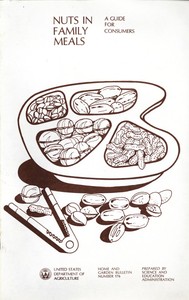
NUTS IN FAMILY MEALS
A GUIDE FOR CONSUMERS
UNITED STATES DEPARTMENT OF AGRICULTURE
HOME AND GARDEN BULLETIN NUMBER 176
_PREPARED BY_
SCIENCE AND EDUCATION ADMINISTRATION
CONTENTS
Page
Buying nuts 1
Kinds available 1
How nuts are marketed 2
Cost 2
Form to buy 2
Signs of quality 3
Amount to buy 3
Storing nuts 3
Preparing nuts for use 4
Shelling nuts 4
Removing skins 4
Roasting or toasting nuts 5
Cutting nuts 5
Recipes 5
Index to recipes 14
Prepared by
Consumer and Food Economics Institute
Science and Education Administration
On January 24, 1978, four USDA Agencies—Agricultural Research Service
(ARS), Cooperative State Research Service (CSRS), Extension Service
(ES), and the National Agricultural Library (NAL)—merged to become a new
organization, the Science and Education Administration (SEA), U.S.
Department of Agriculture.
This publication was prepared by the Science and Education
Administration’s Federal Research staff, which was formerly the
Agricultural Research Service.
Issued May 1970
Slightly revised September 1971
Approved for reprinting September 1978
Washington, D.C.
For sale by the Superintendent of Documents, U.S. Government Printing
Office
Washington, D.C. 20402
Stock No. 001-000-01461-7
NUTS IN FAMILY MEALS:
_A Guide for Consumers_
Nuts contribute rich flavor and crunchy texture to many kinds of foods.
Nuts are not only tasty—but nutritious as well. Familiar dishes take on
new interest when nuts are added.
Nuts are filling because of their fat content and may prevent
between-meal hunger pangs that encourage nibbling.
Most common nuts contain about 10 to 25 percent protein and can be an
added source of protein in meals. Peanuts are highest in protein with
about 25 percent. Coconuts and chestnuts contain very little protein.
This bulletin is a guide to buying, storing, and using nuts. Recipes
feature nuts in main dishes, vegetables, salads, soups, breads,
sandwiches, desserts, and snacks. Approximate calorie values for
commonly used nuts are listed on page 2.
BUYING NUTS
Kinds Available
Many of the nuts on the market—such as almonds, pecans, filberts,
English walnuts, and black walnuts—are grown in this country. Almonds
are produced only in California. English walnuts and filberts are
produced commercially only in California, Oregon, and Washington.
Macadamia nuts are grown in Hawaii and California, and pine nuts (also
called piñon or indian nuts) are grown to some extent in the Southwest.
Imported pine nuts are sometimes called pignolias.
Other kinds of imported nuts include pistachios from the Middle East,
brazil nuts from South America, cashews from India and Africa, and
coconuts from the West Indies, Central America, and the Philippines.
Chestnuts, although grown in the United States, are usually imported
from southern Europe.
Peanuts are not nuts as widely believed; they belong to the pea and bean
family—the legumes. They are included here because they are used as nuts
in family meals and snacks. Peanuts grow in abundance in the United
States. Three common varieties are Virginia, Runner, and Spanish. The
shelled Virginia peanut is long and slender; the Runner, small and
stubby; and the Spanish peanut, round.
Chestnuts are available only in Winter, but most other nuts are
available in some form the year-round.
How Nuts Are Marketed
Nuts may be purchased shelled or unshelled with the exception of
cashews, which are sold only shelled. Most nuts sold in shells are not
roasted. However, peanuts are usually roasted, and chestnuts are
sometimes roasted. If peanuts or chestnuts are roasted, this must be
shown on the label.
Shelled nuts are sold raw or roasted and, sometimes, blanched. Roasted
nuts may be unsalted, salted, or spiced. Shelled nuts may be purchased
ground, or in whole kernels, broken pieces, slivers, and slices.
Shelled nuts are available in bulk and in plastic bags, glass jars, and
cans of various sizes. Labels on the containers show the weight and,
sometimes, the cup measure.
One of the most common ways of marketing peanuts is in the form of
peanut butter.
Although fresh coconuts are often available, coconut is generally found
in packages or cans. Canned coconut may contain more moisture than
coconut in foil or plastic packages. Frozen prepared coconut is also
stocked in some markets.
Cost
Shelled nuts and processed coconut cost more than nuts in shells, but
they are convenient and take less storage space.
Because shelled nuts vary widely in price, it’s a good idea to compare
costs of different brands, forms, and package sizes before buying.
Mixed nuts are priced according to the kinds of nuts and their
proportions in the mix.
CALORIES IN COMMONLY USED NUTS
The list below shows the approximate number of calories for shelled
nuts:
_Calories_
_Kind of nut_[1] _per ounce_ _per ¼ cup_
Almonds, unblanched 170 210
Brazil nuts 185 230
Cashews, roasted 160 195
Chestnuts 55 80
Coconut, fresh, shredded, packed 100 110
Filberts 180 215
Peanuts, roasted 165 210
Peanut butter 165 380
Pecans, halves 195 185
Pistachios 170 185
Walnuts, black, chopped 180 195
Walnuts, English, halves 185 160
[1]Nutmeats are whole and not roasted unless so indicated. Chopped nuts
weigh slightly more than whole nuts per cup and are therefore higher
in calories per cup.
Form To Buy
Buy the most convenient or economical form of nutmeats for your purpose.
Whole nut kernels make attractive snacks and garnishes. Broken pieces,
which are often less expensive and take less preparation, may be used in
any food where appearance of the nuts is not important. Slivered or
sliced nuts save time and work in preparing garnishes and other foods.
Ground nuts impart nut flavor without crunchy texture.
Shredded or thread-type coconut makes an attractive garnish for salads
and desserts. Flaked coconut is usually preferred for pies and cakes
because it is easier to cut and serve. Moist or very moist coconut may
be desirable to use in foods that are somewhat dry.
Signs of Quality
Nuts in the shell
Choose clean nuts that are free from splits, cracks, stains, or holes.
Do not buy moldy nuts—they may not be safe to eat.
Shelled nuts
Nutmeats should be plump and fairly uniform in color and size. Limp,
rubbery, dark, or shriveled kernels may be stale. These visual qualities
can be judged in transparent packages.
Sometimes antioxidants are added to delay the onset of rancidity—thus
extending the shelf life of packaged nutmeats. When antioxidants, or
other preservatives, are added, they are listed on the package. Only
those approved by the Food and Drug Administration are used.
Peanut butter
Peanut butter should have a rich nutty flavor and should spread easily.
Crunchy peanut butter is produced by adding pieces of peanuts to regular
peanut butter.
Stabilizers are often added to peanut butter to retard oil separation.
Salt and, occasionally, sweeteners are added for flavor.
Coconut
A good fresh coconut is heavy for its size. Before purchasing, shake the
coconut to be sure it contains milk. Avoid cracked coconuts and those
with wet, moldy eyes.
Amount To Buy
One pound of unshelled nuts will give the following approximate weight
and volume of shelled nuts:
_Ounces_ _Cups_
Almonds, Whole 6⅓ 1¼
Brazil nuts, Whole 7⅔ 1½
Coconut, shredded 8⅓ 3
Filberts, whole 7⅓ 1½
Peanuts, roasted 11⅔ 2⅓
Pecans, halves 8½ 2¼
Walnuts, black, chopped 3½ ¾
Walnuts, English, halves 7¼ 2
STORING NUTS
To maintain best eating quality, most nuts need protection from oxygen
in the air and from high temperatures that may cause the fat in the nuts
to become rancid.
Nuts in the shell retain high quality longer than shelled nuts. Whole
nuts become rancid less quickly than nuts in pieces. Unroasted nuts keep
better than roasted ones.
Nuts in the shell keep well in a nut bowl at room temperature for a
short period of time. For prolonged storage, keep them in a cool, dry
place. Avoid storing nuts in a damp place.
Shelled nuts will keep fresh for several months stored in tightly closed
containers in the refrigerator. Shelled nuts in unopened cans keep well
in a cool, dry place but will maintain good quality longer in the
refrigerator or freezer.
Shelled or unshelled nuts can be frozen in tightly closed freezer
containers at 0° F. or lower.
Fresh coconuts in the shell retain good quality up to a month in the
refrigerator. Containers of ready-to-eat coconut keep best in the
refrigerator.
Peanut butter will keep its quality longer in the refrigerator than at
room temperature.
Chestnuts are perishable at room temperature but will keep several
months in the refrigerator in loosely covered containers or in
ventilated plastic bags.
Shelled, blanched chestnuts (whole or chopped) may be frozen for longer
storage. Pack them in tightly closed freezer containers and freeze
immediately at 0° F. or lower. Use in cooking without defrosting.
PREPARING NUTS FOR USE
Many nuts are ready for use as purchased. Others require shelling, skin
removal, roasting or toasting, or merely cutting into pieces.
Shelling Nuts
Everyone has a favorite way of cracking nuts. Some prefer using a
nutcracker, and others a hammer on a hard surface.
Hard shells are easier to crack and nutmeats break less often if nuts
are first soaked in warm water several hours or overnight. Spread
nutmeats and let them stand a few hours to dry before storing.
To open a coconut, pierce the “eyes” with an ice pick or large nail, and
drain the liquid from the coconut.
To remove the shell easily, bake the drained coconut at 350° F.
(moderate oven) for 20 to 30 minutes, or put it in the freezer for an
hour. Then place the coconut on a firm surface, and tap the shell
lightly with a hammer in several places until it cracks. Separate the
meat from the shell.
Removing Skins
Removing thick skins from some shelled nuts gives them a delicate flavor
and improves appearance. This may be done by placing nuts in boiling
water (called blanching) or by roasting.
_Almonds and peanuts._—To blanch shelled almonds or Virginia or Runner
peanuts, put them into boiling water and let stand 3 minutes. Drain.
Slide skins off with your fingers. Spread nuts on absorbent paper to
dry. Roasting also will loosen the skins of peanuts, either shelled or
unshelled. See page 5.
_Filberts._—Spread nuts in a single layer in a shallow baking pan. Bake
at 300° F. (slow oven) for 10 to 15 minutes or until heated through,
stirring occasionally. Cool slightly, and slip skins off with your
fingers.
_Chestnuts._—Blanch chestnuts by putting them in boiling water and
letting stand 2 minutes. Remove a few at a time, cool slightly, then
peel with a paring knife. If nuts are difficult to peel, return them to
the hot water for a minute or two. Roasting also will loosen the skins
of chestnuts (see below). Remove shells and skins while nuts are warm.
_Coconut._—Use a vegetable parer to remove the brown skin.
Roasting or Toasting Nuts
Roasting or toasting enhances the flavor and color of nuts.
Roasting is done in the oven. Peanuts and chestnuts are commonly roasted
in the shell.
Toasting may be done in the oven or on top of the range.
_To roast or toast shelled nuts._—Mix 1 teaspoon cooking oil or melted
fat with each cup of nutmeats, if desired, for richer flavor and even
browning.
To roast or toast, spread nuts on a shallow pan or baking sheet. Heat at
350° F. (moderate oven) for 5 to 12 minutes, or until lightly browned,
stirring occasionally.
Toasting may also be done in a heavy pan on top of the range. Heat
nutmeats slowly for 10 to 15 minutes until lightly browned, stirring
frequently.
Nuts continue to brown slightly after removing from heat, so avoid
overbrowning.
Sprinkle hot roasted nuts with salt, if desired.
Cool nuts on absorbent paper.
_To roast or toast processed coconut._—Use method for shelled nuts
without added fat.
_To roast peanuts in the shell._—Spread peanuts in a shallow pan and
roast at 350° F. (moderate oven), stirring occasionally, for 15 to 20
minutes.
To test doneness, remove a nut from the oven and shell it. The skin
should slip off easily and the kernel should be lightly browned and have
a roasted flavor.
_To roast chestnuts in the shell._—Slash through the shells on the flat
side of the nuts. Place chestnuts, cut sides up, on a baking sheet.
Roast at 400° F. (hot oven) until tender—about 20 minutes. Insert fork
through cut in shell to test tenderness.
Cutting Nuts
Chop or cut nuts on a board with a knife that has a long, straight
cutting edge, or use a nut chopper.
Sliver or slice nuts, while still warm and moist from blanching, with a
thin, sharp knife blade.
_RECIPES_
The versatile nut may come to the dinner table in a variety of ways—as
an ingredient in cooking or as a garnish.
Nuts are also popular as a snack or served with appetizers.
Try the nut recipes that follow. All recipes give the number of calories
for a specified amount of food. In some cases, the variation of a recipe
has a lower calorie value.
Ideas for using nuts to complement familiar recipes are also included.
Using Nuts ... in Main Dishes
Chestnut stroganoff
_6 servings, about ¾ cup each_
Beef, boneless, tender, lean, cut in julienne 1½ pounds
strips
Fat or oil 1 tablespoon
Butter or margarine 2 tablespoons
Flour 2 tablespoons
Onion salt ½ teaspoon
Celery salt ½ teaspoon
Paprika ½ teaspoon
Salt ¼ teaspoon
Beef bouillon or beef broth 1¼ cups
Sour cream ½ cup
Cooking sherry 1 tablespoon, if desired
Chestnuts, cooked, mashed (see note) 1 cup
Baked potatoes or cooked rice or noodles As desired
Lightly brown the meat in fat or oil in a frypan over moderate heat.
Drain off any excess fat.
Melt butter or margarine in a saucepan. Blend in flour and seasonings.
Add bouillon or broth slowly, stirring constantly. Stir and cook until
smooth and bubbly. Remove from heat.
Blend in sour cream, sherry, and chestnuts.
Add chestnut sauce to meat. Heat just until mixture bubbles, stirring
constantly.
Serve over potatoes, rice, or noodles.
Note: To prepare mashed chestnuts: Cook 1¼ cups shelled, blanched
chestnuts in 1¼ cups boiling water in a covered saucepan for about 30
minutes or until tender. Drain and mash.
_Calories per serving:_ About 380 for stroganoff excluding potatoes,
rice, or noodles.
VARIATION
_Gourmet chestnut sauce._—Omit the meat. Serve sauce over cooked meat,
potatoes, rice, or noodles. About 180 calories per serving of sauce, ⅓
cup each.
Nut stuffing
_About 2 cups or 6 servings, ⅓ cup each_
Butter or margarine ¼ cup
Onion, finely chopped ¼ cup
Celery (stalks and leaves), chopped ¼ cup
Mushrooms, chopped ¼ cup
Salt 1 teaspoon
Thyme ½ teaspoon
Poultry seasoning ¼ teaspoon
Cayenne pepper Dash
Garlic salt Dash
Bread cubes or coarse, soft crumbs 2 cups
Chicken or beef bouillon or meat broth ½ cup
Nuts (pecans, cashews, almonds, filberts, or ¾ cup
roasted peanuts), finely chopped
_Preheat oven to 325° F. (slow)._
_Grease a 1-quart baking dish._
Melt fat in a heavy pan.
Add onion, celery, mushrooms, and seasonings.
Cook a few minutes until celery is tender but still crisp, stirring
occasionally.
Add bread, bouillon or broth, and nuts. Mix lightly but well.
Put stuffing into baking dish. Bake 25 to 30 minutes, or until slightly
browned.
Note: Stuffing may be used as a filling for chicken or breast of veal or
lamb.
_Calories per serving:_ About 200.
VARIATION
_Chestnut stuffing._—Use blanched, chopped chestnuts in place of other
nuts. About 140 calories per serving.
Mediterranean chicken
_6 servings, ¾ cup each_
Butter or margarine 1 tablespoon
Onion, finely chopped 1 tablespoon
Celery, chopped ½ cup
Green beans, frozen, french-style 10-ounce package
Pimiento, chopped 1 tablespoon
Chicken, cooked, diced 2 cups
Cream of mushroom soup, condensed 2 cans, 10½ ounces each
Oregano ½ teaspoon
White pepper As desired
Cashew or roasted peanut halves ⅔ cup
Parsley, minced 1 tablespoon, if desired
Melt fat in 2- or 3-quart saucepan.
Add onion, celery, and beans.
Cover and simmer over low heat about 15 minutes, stirring occasionally,
until beans are tender.
Add pimiento, chicken, soup, and seasonings. Cook 10 minutes longer to
blend flavors, stirring as needed to prevent sticking.
Stir in nuts.
Sprinkle with parsley before serving, if desired.
_Calories per serving:_ About 310 with cashews; 315 with peanuts.
VARIATION
_Mediterranean tuna._—Omit fat and chicken. Cook onion, celery, and
beans in ½ cup water instead of fat. Use a 13-ounce can of water-pack
tuna, drained, in place of chicken, and almonds in place of other nuts.
Continue as in “Mediterranean chicken.” About 305 calories per serving.
_Using Nuts ... in Salads_
Golden cheese salad
_6 servings_
Lemon-flavored gelatin 3-ounce package
Boiling water 1 cup
Cream cheese, chilled 1½ ounces
Nuts (pecans, macadamias, or roasted ⅓ cup
peanuts), chopped
Crushed pineapple 2 cups
Carrots, shredded 1 cup
Lettuce leaves As desired
Dissolve gelatin in boiling water.
Chill.
Cut cream cheese into 18 cubes.
Coat cream cheese cubes with nuts and roll into balls.
Stir pineapple and carrots into gelatin. Add cream cheese balls.
Chill several hours or overnight until firm.
Serve on lettuce leaves.
_Calories per serving:_ About 185.
Stuffed date salad
_6 servings_
Dates, pitted 18
Peanut butter, crunchy 3 tablespoons
Grapefruit, chilled, sectioned 2
Salad greens As desired
Fill the dates with the peanut butter.
For each salad, arrange three stuffed dates with grapefruit sections on
crisp salad greens.
_Calories per serving:_ About 135.
_Nut-Salad Suggestions_
_6 servings_
_Chicken-nut in tomato cups._—Add ½ cup cashew, almond, or roasted
peanut halves to chicken salad just before serving. Core 6 tomatoes; cut
into wedges partially through each tomato. Top tomatoes with salad.
_Waldorf-date._—Add ½ cup pitted, chopped dates to a tart waldorf salad.
Gently stir in ½ cup pecans, English walnuts, or roasted peanuts. Serve
immediately.
_Waldorf-grape._—Add ½ cup seeded, quartered red grapes to waldorf
salad. Gently stir in ½ cup chopped pecans, English walnuts, or roasted
peanuts. Sprinkle with cinnamon, if desired. Serve immediately.
_Shrimp-nut in tomato cups._—Add ½ cup cashew or almond halves to shrimp
salad. Serve in tomato cups.
_Using Nuts ... in Soups_
Cream of cashew soup
_6 servings, about ⅔ cup each_
Butter or margarine 1 tablespoon
Celery, finely chopped 2 tablespoons
Onion, finely chopped 2 tablespoons
Flour 2 tablespoons
Milk 1 cup
Chicken broth or bouillon 2 cups
Salt ⅛ teaspoon
Pepper As desired
Hickory salt or worcestershire sauce ¼ teaspoon
Salted cashews, finely chopped 1 cup
Paprika or minced parsley As desired
Melt fat in a heavy saucepan.
Add celery and onion. Cook, stirring frequently, until tender.
Blend in flour.
Gradually stir in liquids, salt, pepper, hickory salt or worcestershire
sauce, and nuts.
Bring to boil, stirring as needed. Cook 1 minute longer.
Garnish, as desired, with parsley or paprika.
Note: If preferred, grind 1 cup of nuts and use in place of chopped
nuts. Reduce flour to 1 tablespoon.
_Calories per serving:_ About 190.
VARIATION
_Cream of peanut butter soup._—Omit the cashews. Reduce flour to 1
tablespoon. Blend in ¾ cup peanut butter before adding liquids. About
245 calories per serving.
_Using Nuts ... in Breads_
Peanut butter muffins
_12 muffins_
Milk 1 cup
Egg, slightly beaten 1
Oil or melted fat ¼ cup
Flour, unsifted 2 cups
Baking powder 1 tablespoon
Salt 1 teaspoon
Sugar ¼ cup
Peanut butter ½ cup
_Preheat oven to 400° F. (hot)._
_Grease muffin tins._
Blend milk into egg and add fat.
Mix dry ingredients thoroughly; mix in peanut butter only until mixture
is crumbly.
Add liquid and mix slightly, leaving batter lumpy.
Half fill muffin tins with batter.
Bake 20 to 25 minutes, or until golden brown.
_Calories per muffin:_ About 210.
Fruit nut bread
_1 loaf_
Light brown sugar, packed ⅔ cup
Shortening ¼ cup
Eggs 2
Flour, unsifted 2 cups
Baking powder 2 teaspoons
Baking soda ½ teaspoon
Salt ½ teaspoon
Milk 1 cup
Candied fruit, chopped ¾ cup
Lemon rind, grated 1 teaspoon
Brazil nuts, English walnuts, or pecans, ½ cup
chopped
_Preheat oven to 350° F. (moderate)._
_Grease a 9- by 5- by 3-inch loaf pan._
Beat sugar, shortening, and eggs until creamy.
Mix dry ingredients thoroughly.
Stir dry ingredients and milk alternately into egg mixture. Add fruit,
lemon rind, and nuts to last portion of flour mixture before stirring
into batter.
Pour into baking pan.
Bake about 1 hour or until toothpick inserted in center of loaf comes
out clean.
Cool on rack 10 minutes before removing from pan. Finish cooling on
rack.
_Calories per ½-inch slice:_ About 175.
VARIATIONS
_Coconut-orange bread._—Omit candied fruit, lemon rind, and nuts. Add 1
cup flaked coconut and 1 tablespoon grated orange rind. About 145
calories per ½-inch slice.
_Nut bread._—Omit candied fruit and lemon rind. Use 1 cup chopped nuts
in recipe and add ½ teaspoon vanilla. About 165 calories per ½-inch
slice.
_Using Nuts ... in Desserts_
Coconut cream pudding
_6 servings, ⅓ cup each_
Cornstarch 3 tablespoons
Sugar ¼ cup
Salt ½ teaspoon
Milk 2 cups
Egg yolks, beaten 2
Butter or margarine 2 tablespoons
Vanilla 1 teaspoon
Shredded or flaked coconut ½ cup
Whipped topping If desired
Mix cornstarch, sugar, and salt in heavy saucepan.
Gradually blend in milk.
Stir over moderate heat about 7 minutes or until mixture thickens.
Stir a little of the hot mixture into egg yolks; then stir yolks into
remaining hot mixture. Cook 1 minute longer, stirring constantly.
Mix in fat, vanilla, and coconut.
Serve warm or chilled. Add whipped topping, if desired.
Note: _For this recipe, use only clean eggs with no cracks in shells._
_Calories per serving:_ About 190 without topping.
EASY METHOD
Combine egg yolks with milk before stirring into cornstarch mixture.
Pudding will not be quite as creamy.
VARIATION
_Coconut cream pie._—Fill a baked 8-inch pastry shell with pudding. Add
whipped topping and sprinkle with toasted coconut. Cut into six
servings. About 308 calories per serving without topping.
Toasted coconut pie shell
_8-inch pie shell, 6 servings_
Coconut (less moist type) 1½ cups
Butter or margarine 3 tablespoons
Stir coconut in a large frypan over low heat until toasted.
Stir fat into toasted coconut.
Press mixture evenly into 8-inch piepan. Chill.
Note: Fill pie shell with a cooled pudding-type filling. Or fill with
ice cream and place in freezer for a few minutes until set.
_Calories per serving of pie shell:_ About 160.
VARIATION
_Baked coconut pie shell._—Melt fat and mix with untoasted coconut.
Press into piepan. Bake at 300° F. for 30 minutes or until browned.
Pecan chess pie
_9-inch pie, 8 servings_
Brown sugar, packed 1 cup
Granulated sugar ½ cup
Flour 1 tablespoon
Eggs 2
Milk ¼ cup
Butter or margarine, melted ½ cup
Vanilla 1 teaspoon
Pecans, chopped ¾ or 1 cup, as desired
Pastry shell, unbaked 9-inch
_Preheat oven to 375° F. (moderate)._
Mix sugars and flour.
Beat in eggs and milk.
Stir in fat, vanilla, and nuts.
Pour mixture into pastry shell.
Bake 40 minutes or until a knife inserted in the center comes out clean.
Cool before serving.
_Calories per serving:_ About 475 with ¾ cup nuts; 500 with 1 cup nuts.
VARIATIONS
_Pecan tarts._—Divide dough for 9-inch pie into 12 parts. Roll into thin
circles and fit into 2½-inch muffin tins. Add filling. Baking time will
be slightly less than for pie. About 315 calories each with ¾ cup nuts;
330 with 1 cup nuts.
_Peanut pie or tarts._—Use roasted peanuts for the nuts. Calories will
be about the same.
Peanut butter cookies
_4½ dozen cookies_
Shortening 1 cup
Peanut butter 1 cup
Granulated sugar 1 cup
Brown sugar, packed 1 cup
Eggs 2
Vanilla 1 teaspoon
Flour, unsifted 2½ cups
Salt ½ teaspoon
Baking soda ¾ teaspoon
Baking powder ½ teaspoon
_Preheat oven to 375° F. (moderate)._
Beat shortening and peanut butter together until creamy.
Gradually add sugars, beating thoroughly.
Beat in eggs and vanilla.
Mix remaining ingredients and stir into peanut butter mixture.
Shape dough into 1-inch balls. Place about 2 inches apart on an
ungreased baking sheet.
Flatten each by pressing criss-cross with a fork.
Bake 10 to 15 minutes until lightly browned.
Remove from baking sheet while warm.
_Calories per cookie:_ About 110.
Sundae nut sirup
_About ¾ cup, 6 servings_
Butter or margarine 2 tablespoons
Pecans or English walnuts, chopped ½ cup
Brown sugar, packed ¼ cup
Water 2 tablespoons
Light corn sirup 2 tablespoons
Melt fat in a small frypan.
Add nuts and cook over low heat, stirring as needed, until nuts are
lightly browned.
Stir in remaining ingredients. Simmer 2 minutes.
Note: Serve warm over ice cream.
_Calories per serving of sirup:_ About 150.
Nut meringue shells
_6 large or 12 small shells_
Cream of tartar ¼ teaspoon
Egg whites 3
Salt ¼ teaspoon
Sugar ¾ cup
Pecans, chopped 1 cup
_Preheat oven to 250° F. (very slow)._
Add cream of tartar to egg whites and beat until foamy.
Add salt and continue beating until soft peaks form.
Add sugar gradually, beating constantly, until very stiff peaks form.
Fold in chopped nuts.
Drop meringue in 6 or 12 mounds, as desired, onto heavy brown paper or
aluminum foil on a baking sheet.
Using the back of a spoon, form a hollow in the center of each mound.
Bake 1 hour. Turn off heat and let meringues cool in oven (1 to 1½
hours).
Note: Serve filled with ice cream or a cooled pudding.
_Calories per meringue shell:_ Large, about 240; small, about 120.
Fruit and nut sauce
_About 1½ cups, 6 servings_
Sweetened frozen fruit (strawberries, red 10-ounce package
raspberries or mixed fruit), thawed, drained
Liquid from frozen fruit plus water 1 cup
Sugar ¼ cup
Cornstarch 1 tablespoon
Raisins, chopped 1 tablespoon, if desired
Lemon juice 2 tablespoons
Rum extract ¼ teaspoon, if desired
Pecans, toasted, chopped ¼ cup
Cut large pieces of fruit into bite-size pieces.
Stir fruit liquid gradually into sugar, cornstarch, and raisins in a
saucepan.
Cook over medium heat, stirring constantly, until clear and thickened.
Add lemon juice, rum extract, pecans, and fruit.
Note: Serve over ice cream or warm cake.
_Calories per serving of sauce:_ About 125.
VARIATION
_Coconut-fruit sauce._—Omit raisins and pecans. Toast ¼ cup flaked
coconut; sprinkle over the fruit sauce. About 105 calories per serving.
SAUCES THAT BRIGHTEN VEGETABLES
Recipe for 6 servings How to serve
Chinese—Melt 3 tablespoons butter Mix with cooked drained cabbage,
or margarine. broccoli, asparagus, or green beans.
Stir in 4 teaspoons soy sauce, ¼
teaspoon onion salt, and ⅛
teaspoon white pepper. Heat.
Add ¼ cup slivered, toasted almonds.
Sour cream—Mix ⅔ cup sour cream, ¼ Serve over hot baked potatoes,
teaspoon grated onion, ½ teaspoon asparagus spears, sliced cucumbers,
salt, and ⅛ teaspoon white pepper. or beet salad.
If desired, add 1 teaspoon
horseradish and ⅛ teaspoon ground
dill seed. Chill.
Stir in ⅓ cup chopped, toasted
almonds or pecans.
Sweet-sour—Blend 2 tablespoons Combine with cooked drained onions,
cornstarch, 3 tablespoons sugar, beets, or cabbage.
and ½ teaspoon salt into 1
tablespoon melted butter or
margarine.
Gradually stir in 1 cup vegetable
cooking liquid and water. Cook,
stirring constantly, until
thickened and clear.
Blend in 3 tablespoons lemon juice
or vinegar. Heat with vegetable.
Sprinkle with ⅓ cup chopped
almonds, English walnuts, or
pecans.
Lemon—Blend 2 tablespoons flour, ½ Serve over cooked drained
teaspoon salt, and ⅛ teaspoon cauliflower, broccoli, asparagus,
onion salt into 2 tablespoons or potatoes.
melted butter or margarine.
Gradually stir in 1 cup milk. Cook,
stirring constantly, until
thickened.
Remove from heat. Blend in 2
teaspoons lemon juice and a few
drops of yellow food coloring.
Add ⅓ cup toasted almonds, cashews,
English walnuts, or pecans.
_Other Nut Favorites_
Nippy cheese-nut dip
_About 1 cup_
Cream cheese, softened 2 packages, 3 ounces each
Mayonnaise ¼ cup
Onion salt ¼ teaspoon
Hickory salt ¼ teaspoon
Garlic salt Few grains
Nuts (pecans, toasted almonds, cashews, or ½ cup
roasted peanuts), finely chopped
Blend cream cheese with mayonnaise and seasonings. Stir in nuts.
Note: Serve with chips or crackers.
_Calories per tablespoon:_ About 90 with pecans or cashews; 95 with
almonds or peanuts.
Sugar-and-spice nuts
_About 4 cups_
Butter or margarine, melted 1 tablespoon
Egg white, slightly beaten 1
Unroasted almonds, English walnuts, and/or 2 cups
pecans
Sugar 1 cup
Salt ½ teaspoon
Cinnamon 1½ teaspoons
Nutmeg ¾ teaspoon
Allspice ¾ teaspoon
_Preheat oven to 300° F. (slow)._
Slowly stir melted fat into beaten egg white. Stir in nuts.
Mix sugar and spices.
Spread about one fourth of the sugar mixture in a 10- by 15-inch shallow
baking pan.
Coat a few nuts at a time in remaining sugar mixture, and arrange in the
pan.
Sprinkle rest of sugar mixture over nuts.
Bake 15 to 20 minutes, or until nuts are lightly browned.
Remove nuts from oven; stir gently to separate nuts.
Cool. Store in tightly closed container.
_Calories per tablespoon:_ About 35.
Cocktail nuts
_About 3½ cups_
Butter or margarine 2 tablespoons
Salted mixed nuts with peanuts 1 pound
Onion or hickory salt 1 teaspoon
Paprika ½ teaspoon
_Preheat oven to 300° F. (slow)._
Melt fat in a shallow baking pan in the oven.
Remove pan from oven and stir nuts into fat. Sprinkle with seasonings.
Bake 15 to 20 minutes or until nuts are heated through, stirring
occasionally.
Cool. Store in tightly closed container.
_Calories per tablespoon:_ About 55.
For Extra Flavor, Add Nuts
It takes only a little imagination to make “company fare” of plain food.
Special recipes are not always needed. Many of your favorite foods are
more delicious when you add nuts. Start with these suggestions:
• Serve sour cream with nuts on meat or baked potatoes.
• For waffles, biscuits, or muffins, stir nuts into blended dry
ingredients before adding liquid.
• Mix honey or crisp bits of bacon with peanut butter for a sandwich
filling; or use peanut butter and cheese slices for a grilled sandwich
filling.
• Add nuts to meat, poultry, or seafood salads.
• Try slivered or sliced nuts in tossed vegetable salads.
• Mix coconut with food coloring for garnish.
• Roll ice cream balls in tinted or toasted coconut or chopped nuts.
Freeze balls separately until set.
• Use toasted coconut or toasted, chopped nuts as a quick topping for
cream pie or ice cream pie.
• Sprinkle cupcakes with nuts before baking and skip the frosting.
• For a spread on crackers or celery, add finely chopped roasted peanuts
to cream cheese that has been blended with a little milk.
• Perk up your next vegetable souffle. Add finely chopped nuts along
with the vegetable.
INDEX TO RECIPES
Page
Breads:
Coconut-orange bread 9
Fruit nut bread 9
Nut bread 9
Peanut butter muffins 8
Desserts:
Baked coconut pie shell 10
Coconut cream pie 9
Coconut cream pudding 9
Coconut-fruit sauce 11
Fruit and nut sauce 11
Nut meringue shells 11
Peanut butter cookies 10
Peanut pie or tarts 10
Pecan chess pie 10
Pecan tarts 10
Sundae nut sirup 11
Toasted coconut pie shell 10
Main Dishes:
Chestnut stroganoff 6
Chestnut stuffing 7
Gourmet chestnut sauce 6
Mediterranean chicken 7
Mediterranean tuna 7
Nut stuffing 6
Other Nut Favorites:
Cocktail nuts 13
Nippy cheese-nut dip 13
Sugar-and-spice nuts 13
Salads:
Chicken-nut in tomato cups 8
Golden cheese 7
Shrimp-nut in tomato cups 8
Stuffed date 7
Waldorf-date 8
Waldorf-grape 8
Sauces for Vegetables:
Chinese 12
Lemon 12
Sour cream 12
Sweet-sour 12
Soups:
Cream of cashew 8
Cream of peanut butter 8
U.S. GOVERNMENT PRINTING OFFICE: 1978 O-271-282
Transcriber’s Notes
—Silently corrected a few typos.
—Retained publication information from the printed edition: this eBook
is public-domain in the country of publication.
—In the text versions only, text in italics is delimited by
_underscores_.
*** END OF THE PROJECT GUTENBERG EBOOK 65563 ***
Nuts in Family Meals: A Guide for Consumers
Subjects:
Download Formats:
Excerpt
NUTS IN FAMILY MEALS
A GUIDE FOR CONSUMERS
_PREPARED BY_
SCIENCE AND EDUCATION ADMINISTRATION
Page
Buying nuts 1
Kinds available 1
How nuts are marketed 2
Cost 2
Form to buy...
Read the Full Text
— End of Nuts in Family Meals: A Guide for Consumers —
Book Information
- Title
- Nuts in Family Meals: A Guide for Consumers
- Author(s)
- United States. Agricultural Research Service. Consumer and Food Economics Research Division
- Language
- English
- Type
- Text
- Release Date
- June 7, 2021
- Word Count
- 4,889 words
- Library of Congress Classification
- TX
- Bookshelves
- Browsing: Cooking & Drinking, Browsing: Nutrition
- Rights
- Public domain in the USA.
Related Books
Family fare
by United States. Agricultural Research Service. Human Nutrition Research Division, United States. Agricultural Research Service. Consumer and Food Economics Research Division, Institute of Home Economics (U.S.)
English
436h 47m read
Money-Saving Main Dishes
by United States. Agricultural Research Service. Human Nutrition Research Division, United States. Agricultural Research Service. Consumer and Food Economics Research Division
English
271h 37m read
Home Canning of Meat and Poultry
by United States. Agricultural Research Service. Consumer and Food Economics Research Division
English
115h 19m read