Non fare ad altri....
This eBook is for the use of anyone anywhere at no cost and with almost
no restrictions whatsoever. You may copy it, give it away or re-use it
under the terms of the Project Gutenberg License included with this
eBook or online at http://www.gutenberg.org/license.
Title: Non fare ad altri...
Author: Roberto Bracco
Release Date: November 05, 2011 [EBook #37934]
Language: Italian
Character set encoding: UTF-8
*** START OF THIS PROJECT GUTENBERG EBOOK NON FARE AD ALTRI.... ***
Produced by Carlo Traverso, Claudio Paganelli, Barbara Magni, and the
Online Distributed Proofreading Team at http://www.pgdp.net.
This file was produced from images generously made available by The
Internet Archive.
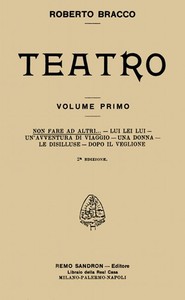
ROBERTO BRACCO
TEATRO
VOLUME PRIMO
*NON FARE AD ALTRI...* — LUI LEI LUI —
UN’AVVENTURA DI VIAGGIO — UNA DONNA —
LE DISILLUSE — DOPO IL VEGLIONE
2ª EDIZIONE.
REMO SANDRON — Editore
Libraio della Real Casa
MILANO-PALERMO-NAPOLI
PROPRIETÀ LETTERARIA
_I diritti di riproduzione e di traduzione sono riservati per
tutti i paesi, non escluso il Regno di Svezia e quello di
Norvegia._
È assolutamente proibito di rappresentare questi lavori senza il
consenso scritto dell’Autore _(Art. 14 del Testo Unico 17
Settembre 1882)_.
Published in Palermo, 10th. June Privilege of Copyright in the
United States reserved under the Act approved March 3rd. 1905,
by Roberto Bracco and Remo Sandron.
Off. Tip. Sandron — 126 — I — 290312.
_NOTA DELL’EDITORE._
_(Dalla edizione precedente)_
_Compilando — con un necessario ritardo — il primo volume del «Teatro»
di_ Roberto Bracco, _ho voluto raccogliere, oltre le sue prime commedie
in un atto e il dramma_ «Una donna», _anche qualche curioso saggio della
sua più spicciola e più leggera produzione scenica che andava fino alla
fiaba con «couplets» alla francese e fino allo «scherzo comico» per
«cafè-chantant». Mi è parso opportuno dare a questo primo volume la
impronta fedele di quella varietà saltuaria con cui Roberto Bracco, tra
una corrispondenza amena destinata al_ «Capitan Fracassa» _e una
canzoncina destinata alla festa di Piedigrotta, tra una novelletta e un
articolo critico, inavvedutamente, cominciava ad esercitare le sue
facoltà di commediografo. Erano prove involontarie, pigre e rade, non
determinate che da circostanze occasionali._
_Alla ribalta esordì, infatti, scrivendo la breve commedia buffa_ «Non
fare ad altri...» _per soddisfare la insistente richiesta di Ermete
Novelli, già in rinomanza di attor comico. Aveva pubblicate, dopo il
volume delle_ Frottole di baby, _alcune novelle dialogate, chiamandole
«novelle in un atto» e ne dovette rifare due per la scena:_ «Lui Lei
Lui» _e_ «Un’avventura di viaggio», _perchè Arturo Garzes volle
rappresentare la prima, Pia Marchi la seconda. E i quattro atti di_ «Una
donna» _sarebbero rimasti — com’è noto — seppelliti nella sua scrivania,
se un suo amico intimo, Valentino Gervasi, non li avesse rivelati alla
gentile precocità artistica di Tina di Lorenzo, appena diciottenne. I
fogli del manoscritto uscirono quasi ingialliti dal nascondiglio dove
avevano dormito per quattro o cinque anni. L’autore li rinverdì mutando
qualche cosa, e li consegnò al suggeritore._
_Queste poche notizie, e qualche altra che i lettori troveranno più
avanti, mi sono sembrate necessarie a completare la fisonomia di questo
primo volume del «Teatro» di_ Roberto Bracco.
_Intanto, mi compiaccio di annunziare la ristampa dei volumi già
pubblicati: anche di quelli che sono ora alla seconda edizione. Sarà una
ristampa che l’Autore curerà personalmente, sicchè alcune inesattezze
del testo spariranno. Di qualche lavoro, come per esempio, del dramma_
«Maternità», _qualche pagina sarà addirittura mutata, perchè il testo
delle precedenti edizioni non è sempre identico a quello che l’Autore
preferisce per le rappresentazioni._
Maggio, 1909.
REMO SANDRON.
————
NON FARE AD ALTRI....
_Commedia in un atto_
rappresentata per la prima volta al _Sannazaro_ di _Napoli_ da _Ermete
Novelli_, la sera del _22 dicembre 1886_.
PERSONAGGI:
_Il Commissario di polizia._
_Il Brigadiere Malomone._
_La guardia Fasanisi._
_Oscar Gentiletti._
_La signora Betta._
La scena è in una piccola città di provincia.
N. B. Quando questa farsa fu scritta, il _Commissario di Polizia_ si
chiamava _Ispettore_. Ma nel testo della farsa qui riprodotto, essendo
quello ancora talvolta recitato da qualche attor comico, è adottato
l’attuale titolo di _Commissario_.
ATTO UNICO.
_Il gabinetto del_ _Commissario di Polizia_: — _scrivania, scaffali,
seggiole_, ecc.
SCENA I.
IL COMMISSARIO, IL BRIGADIERE, LA GUARDIA.
_(Il Commissario è seduto presso la sua scrivania con aria grave e
autorevole. Ritti, innanzi a lui, stanno il brigadiere Malomone, che è
molto grasso, fornito di foltissimi mustacchi, di foltissime
sopracciglie, di occhi truci, e la guardia Fasanisi, che è un omino
magro, sottilissimo.)_
_Il Commissario_
_(ai due)_ Continuate, dunque, continuate.
_Il Brigadiere_
Erano circa le undici, quando io attraversavo per caso quella via...
_Il Commissario_
Questo particolare me lo avete già favorito parecchie volte.
_Il Brigadiere_
E mi trovavo a una quarantina di passi dal luogo del disastro.
_Il Commissario_
Quale disastro?
_Il Brigadiere_
La caduta dell’uomo dall’alto del muricciolo.
_Il Commissario_
Voi accorreste al tonfo...
_Il Brigadiere_
Al tonfo?... _(Riflette)_ Al tonfo?... Non lo so.
_Il Commissario_
Ma che cosa non sapete?
_Il Brigadiere_
_(con stupida importanza)_ Non so se fu proprio un... tonfo.
_Il Commissario_
Non sentiste cadere l’uomo?
_Il Brigadiere_
Feci di più, signor Commissario: sentii e vidi: ma, quanto al tonfo, in
coscienza, non posso dire nulla di esatto.
_Il Commissario_
Bestia!
_Il Brigadiere_
Proprio così. «Siete una bestia!»... dissi io alla guardia Fasanisi,
perchè non s’era trovata puntualmente un poco prima al posto dove l’uomo
doveva cadere. Un buon piantone certe cose le prevede; e Fasanisi, ieri
sera, era precisamente lui di piantone alla strada che rasenta il
giardino appartenente alla Signoria Vostra.
_Il Commissario_
Ed egli accorse con voi, che..., come mi avete fatto sapere,
attraversavate...
_Il Brigadiere_ _e_ _Il Commissario_
_(insieme)_... per caso quella via.
_La Guardia_
Io accorsi prima di lui.
_Il Commissario_
Andate avanti, Malomone!
_Il Brigadiere_
Sì, signor Commissario: avanti, sempre!
_Il Commissario_
Che pensaste quando vedeste quell’uomo precipitato giù dal muro che
separa la strada dal giardino di casa mia?
_Il Brigadiere_
Io subito pensai: quest’uomo... è un uomo precipitato giù dal muro che
separa la strada dal giardino del signor Commissario di polizia.
_Il Commissario_
Evidentemente, egli, dal giardino, voleva uscire di nascosto...
_Il Brigadiere_
Ed io, senza perdere tempo, gli domandai: perchè volevate uscire di
nascosto dal giardino del signor Commissario di polizia?
_Il Commissario_
L’uomo s’imbarazzò?
_Il Brigadiere_
_(riflette)_ Non lo so... perchè era ancora disteso a terra.
_Il Commissario_
E che rispose?
_Il Brigadiere_
Rispose: _(riflette)_ «Ho un fianco rotto.» Allora io gli dissi: «voi
siete un ladro.» Allora egli mi disse: «sì, sono un ladro.» Allora io
gli dissi: «voi siete in arresto.» Allora egli mi disse: «sì, sono in
arresto.»
_Il Commissario_
Non oppose resistenza?
_Il Brigadiere_
Signor Commissario, si lasciò arrestare come un galantuomo. Io e
Fasanisi, gentilmente, lo afferrammo per il collo e lo andammo a
depositare in prigione.
_Il Commissario_
Cammin facendo, che aspetto ebbe?
_Il Brigadiere_
_(riflette)_ Signor Commissario, nessun aspetto!
_Il Commissario_
Dio buono, voglio dire: che contegno serbò?
_Il Brigadiere_
Ah! il contegno non lo so.
_Il Commissario_
_(canzonando)_ Perchè forse era ancora disteso a terra?
_Il Brigadiere_
No. Cammin facendo, non era più disteso a terra. Era...
_Il Commissario_
In piedi?
_Il Brigadiere_
Nemmeno. Era... zoppicante.
_Il Commissario_
_(alla guardia)_ E voi, Fasanisi, avete altro da aggiungere?
_La Guardia_
Sì, signor Commissario.
_Il Commissario_
Aggiungete!
_La Guardia_
_(a voce alta)_ Io accorsi prima di lui.
_Il Brigadiere_
Non è vero!
_La Guardia_
_(alzando viepiù la voce)_ Io accorsi prima di lui...
_Il Commissario_
Basta così, Fasanisi! Il brigadiere ha ragione, perchè è vostro
superiore. E questo è tutto ciò che avevate da aggiungere?
_La Guardia_
Questo. _(Continua a dire per conto suo, borbottando:)_ Io accorsi prima
di lui... Io accorsi prima di lui...
_Il Commissario_
Ora è necessario _(scrivendo in fretta un biglietto)_ ch’io sappia che
cosa è riuscito a rubarmi quel farabutto. Fasanisi, questo biglietto a
casa mia. _(Glielo consegna.)_ Subito!
_La Guardia_
_(va via borbottando ancora:)_ Io accorsi prima di lui...
_Il Commissario_
Eh, perbacco! Un ladro che va a rubare in casa del Commissario di
polizia deve essere un bel cretino! Che ne dite, Malomone?
_Il Brigadiere_
Ecco, signor Commissario. Una volta mi avvenne un fatto simile. Un
mariuolo, senza curarsi ch’io ero un brigadiere di polizia, mi rubò il
fazzoletto dalla saccoccia.
_Il Commissario_
Oh! imbecille!
_Il Brigadiere_
Chi?
_Il Commissario_
Voi!
_Il Brigadiere_
_(piantandosi da bravo militare)_ Precisamente! L’imbecille è sempre il
derubato!
_Il Commissario_
_(seccato)_ Malomone, introducete l’arrestato. _(Il brigadiere esce.)_ E
adesso facciamo la conoscenza di quest’altro bell’arnese! _(Pensando e
ricordandosi)_ Sicuro! Alle undici pomeridiane, io entro in casa... È
evidente: il ladro teme di essere sorpreso, si dà alla fuga, e
patapuffete! giù dal muricciolo. Si lascia arrestare perchè... ha un
fianco rotto, e, cammin facendo, serba, come assicura Malomone, un
contegno... zoppicante. Tutto mi è completamente chiaro, e con me non
c’è troppo da scherzare...
SCENA II.
IL COMMISSARIO, IL BRIGADIERE _e_ OSCAR.
_Il Brigadiere_
_(entra, tirando pel braccio Oscar Gentiletti, che è un bel giovine
sulla trentina, elegantemente vestito.)_ Ecco il malfattore!
_Oscar_
Eh! non c’è bisogno di trascinarmi così...
_Il Commissario_
_(a Oscar, in tono burbero e dignitoso)_ Avanzatevi!
_Oscar_
_(lievemente zoppicando, si avanza e s’inchina cortesemente)_ Servo suo,
cavaliere.
_Il Commissario_
_(con orgogliosa compiacenza)_ Ma come fate a sapere che sono cavaliere?
_Oscar_
Le si legge in fronte.
_Il Commissario_
Grazie! _(Dopo averlo guardato attentamente da capo a piedi, chiama a sè
il brigadiere:)_ Malomone, venite qua. _(Il brigadiere gli si accosta.)_
Sentite, _(Sottovoce, all’orecchio)_ Siete certo d’avermi introdotto
l’individuo che arrestaste iersera?
_Il Brigadiere_
Vostra Signoria mi crederebbe capace d’introdurle un individuo per un
altro?
_Il Commissario_
No, ma gli è che quegli abiti... quel volto... quel... quel...
_Il Brigadiere_
Gli si vede subito il delinquente, signor Commissario.
_Il Commissario_
Credete che gli si veda subito? Quand’è così, _(disponendosi a
scrivere)_ procediamo all’interrogatorio. _(A Oscar, bruscamente)_ Ehi!
dico, il vostro nome?
_Oscar_
Oscar Gentiletti.
_Il Commissario_
Età?
_Oscar_
Trent’anni.
_Il Commissario_
_(piano, al brigadiere)_ Malomone, trent’anni! Non li dimostra.
_Il Brigadiere_
_(con profonda convinzione e sicurezza)_ Ma li ha!
_Il Commissario_
_(a Oscar)_ Domicilio?
_Oscar_
Strada San Petronio, numero sette, primo piano, porta a destra.
_Il Commissario_
Professione?
_Oscar_
_(subitamente)_ Ladro.
_Il Commissario_
_(annotando, tra sè)_ Evviva la franchezza! _(Con disgusto)_ Sicchè, voi
avete dedicata la vostra vita...?
_Oscar_
A rubare.
_Il Commissario_
_(violentemente)_ Vergogna!
_Oscar_
_(con delicatezza insinuante)_ Scusi, cavaliere, abbia la cortesia di
astenersi da qualunque commento o rimbrotto. Veda, è questione di
vocazione: lei fa il Commissario di polizia, io faccio il ladro. E in
questo momento, ne sono tanto più lieto, inquantochè, essendo ladro, io
ho il piacere di poterle dedicare la mia servitù.
_Il Commissario_
_(imbarazzandosi)_ Oh!... troppo buono... Accomodatevi... si accomodi...
prego... segga... deponga... il cappello.
_Oscar_
_(sedendo e posando il cappello)_ Per accontentarla...
_Il Commissario_
Dunque..., signor ladro..., voi confessate... lei confessa che ieri sera
s’intromise nel giardino di casa mia per...
_Oscar_
_(premuroso)_ Per commettere un furto.
_Il Commissario_
Ma...
_Oscar_
_(con risentimento)_ Metterebbe ella in dubbio la mia parola?
_Il Commissario_
Oh no!, tutt’altro! Le pare! Ma..., ed ecco ciò che stavo per dire,...
come va, egregio signor ladro, come va che le saltò il ticchio di
commettere un furto proprio in mia casa, — in casa del Commissario di
polizia?
_Oscar_
Le dirò... I pubblici funzionarii sono la mia specialità.
_Il Commissario_
Ah! me ne compiaccio. E..., perdoni, veh, se l’importuno con tante
domande, ma, sa, se io non domandassi, lei non mi risponderebbe...
Dunque, dicevo: come fece per intromettersi nel giardino?
_Oscar_
In un modo semplicissimo: sfuggendo alla vigilanza d’una guardia... che
dormiva, e scavalcando il muro dove questo è molto basso.
_Il Commissario_
_(al brigadiere)_ Malomone, sentite, eh?
_Il Brigadiere_
Sento, signor Commissario.
_Il Commissario_
La guardia dormiva.
_Il Brigadiere_
Signor Commissario, quella guardia che dormiva era la guardia Fasanisi.
Potevano essere circa le undici quando io attraversavo....
_Il Commissario e Il Brigadiere_
_(insieme)_... per caso quella via.
_Il Commissario_
Lo so. Tacete, ora. _(A Oscar)_ E... se non sono troppo indiscreto...,
dica: perchè, poi, nella fuga, ella andò a scavalcare il muro dove esso
è più alto?
_Oscar_
Capirà: non avevo mica l’intenzione di capitombolare, io. Ma gli è che
non ero pratico del giardino. Era quella la prima volta che ci mettevo
il piede, e, nel buio, correndo, sbagliai la strada.
_(Involontariamente)_ Un’altra volta, starò più attento... Pardon...
dico per dire....
_Il Commissario_
_(alzandosi e avvicinandosi a Oscar)_ E se dice per fare, s’inganna a
partito, perchè, sa, con tutto il rispetto dovuto a un ladro per bene
come lei, la giustizia provvederà.
_Oscar_
Torniamo a bomba, cavaliere. Su questo, siamo d’accordo. Io m’intromisi
nel suo giardino per commettere un furto.
_Il Commissario_
Benone! _(Con furberia ed intimità, sedendogli accanto)_ Dal giardino,
ella passò nel salottino di casa mia....
_Oscar_
Appunto: in quel grazioso salottino turco... con quei ventaglioni...
quei tappeti... quelle anfore... quel microscopico scrignetto di
madreperla....
_Il Commissario_
Sì, lo scrignetto è carino. L’ho comperato all’Esposizione di Parigi, e
ci tengo!
_Oscar_
Ha ragione!... E quei _biscuits_ civettuoli!... E quei gingilli!... Oh!
un salottino delizioso!
_Il Commissario_
Pih! non c’è malaccio; ma, per ora, sa, è abbozzato. Bisogna che io
faccia ancora delle spese.... E se lei mi onorerà... _(correggendosi e
impacciandosi)_ Cioè... no: se lei... mi ruberà... cioè....
_Oscar_
_(vivamente)_ Io ho già rubato, cavaliere! Ho già rubato!
_Il Commissario_
Dunque, reo confesso?
_Oscar_
Nè più, nè meno.
_Il Commissario_
_(dopo aver ammiccato al brigadiere)_ Tanto meglio! Ci dica, ora, che
cosa ha rubato. I danari contenuti nello scrigno?
_Oscar_
No!
_Il Commissario_
I ninnoli d’argento?
_Oscar_
No!
_Il Commissario_
Gli oggetti d’avorio?
_Oscar_
No!
_Il Commissario_
Il tamtam giapponese?
_Oscar_
No!
_Il Commissario_
I ventagli? le anfore? i tappeti? le seggiole? i muri?
_Oscar_
No! No!
_Il Commissario_
_(infuriato)_ Ma allora che diavolo ha rubato, lei?
_Oscar_
Già! Che diavolo ho rubato, io?
_Il Commissario_
Probabilmente, ella tentò di rubare, ma non potette consumare il furto.
_Oscar_
Che ho da dirle...?
_Il Commissario_
_(in tono confidenziale)_ E sa lei perchè non riescì a consumarlo?
_Oscar_
No....
_Il Commissario_
Lei non riescì a consumarlo, perchè verso le undici....
_Il Brigadiere_
... io attraversavo per caso quella via....
_Il Commissario_
Zitto, Malomone! Non è questa la ragione. _(A Oscar)_ Lei non riescì a
consumare il furto perchè verso le undici sentì un rumore.
_Oscar_
_(di scatto)_ Verissimo!
_Il Commissario_
Ebbene, _(con alterigia)_ quel rumore... ero io!
_Oscar_
Ahimè, cavaliere, le giuro sul mio onore che ella giunse a tempo!
_Il Commissario_
Sicchè, lei ritira la confessione?
_Oscar_
La ritiro!
_Il Commissario_
_(tutto tronfio, ritornando alla scrivania)_ E adesso, Malomone,
facciamo il nostro dovere e procediamo alla regolare perquisizione
dell’arrestato.
_Oscar_
Ma sono già stato perquisito ieri sera.
_Il Commissario_
Malomone, trovaste armi bianche?
_Il Brigadiere_
No, signor Commissario.
_Il Commissario_
Armi da fuoco?
_Il Brigadiere_
Da fuoco, soltanto una scatola di fiammiferi.
_Il Commissario_
Frugaste nelle saccocce? Sequestraste oggetti, carte, grimaldelli?
_Il Brigadiere_
Non sequestrai, signor Commissario, perchè non frugai.
_Il Commissario_
Cosicchè, è necessaria una seconda e minuta perquisizione.
_Il Brigadiere_
_(s’avvicina a Oscar.)_
_Oscar_
_(in orgasmo)_ Le assicuro, cavaliere, che se avessi qualche cosa da
esibire alla giustizia, mi farei un pregio di offrirla a lei. Ma è
inutile fare una perquisizione quando non c’è nulla da trovare...
_Il Commissario_
_(con sussiego)_ Le perquisizioni si fanno quasi sempre allo scopo di
non trovare niente! Malomone, perquisite.
_Il Brigadiere_
_(mette le mani addosso a Oscar.)_
_Oscar_
_(ribellandosi)_ Ah! questo poi no! _(cerca di svincolarsi.)_
_Il Commissario_
_(con austerità e calore)_ Signor ladro, lasciate che l’autorità
competente eserciti pienamente il suo potere sulla vostra persona!
_Oscar_
_(convellendosi)_ Ma mi fa il solletico!
_Il Brigadiere_
_(cacciandogli le mani nelle saccocce e palpandolo dappertutto)_ Taci,
furfante!
_Oscar_
Ah ah ah... mi fa il solletico....
_Il Brigadiere_
_(cavando fuori gli oggetti a uno a uno)_ Signor Commissario, un
orologio _(con solennità)_ à remontoir. Catena... idem! La scatola di
fiammiferi... suddetta! Un portasigari... senza sigari! Un fazzoletto
_(annusandolo)_ profumato, molto profumato... _(Porge tutto al
Commissario.)_
_Il Commissario_
_(annusando anche lui il fazzoletto)_ Opoponax!
_Il Brigadiere_
_(spalancando gli occhi come per una allarmante scoperta)_ Perdio!
_(Indi, continua a frugare.)_
_Oscar_
Basta, ora! Basta!
_Il Brigadiere_
Taci, furfante! _(palpa ancora)_... E questo è un portafogli... gravido
anzi che no! _(Lo consegna al Commissario.)_
_Oscar_
_(pallidissimo)_ È fatta!
_Il Commissario_
Non c’è altro?
_Il Brigadiere_
Non c’è altro.
_Il Commissario_
_(con grande gravità)_ Esaminiamo i reperti. _(Osserva l’orologio, la
catena, la scatola, il fazzoletto, il portasigari, e borbotta:)_
Orologio à remontoir, — catena... idem, — eccetera... eccetera...
_(Quindi, apre il portafogli e ne guarda il contenuto, mentre Oscar,
affisandolo, allibisce e, senza fiatare, aspetta. — A un tratto, il
Commissario, cavando una fotografia da una busta, spalanca gli occhi, e,
con un gesto di raccapriccio, esclama tra sè:)_ Il ritratto di mia
moglie!
_Il Brigadiere_
_(notando l’emozione)_ Il signor Commissario ha forse trovato...?
_Il Commissario_
_(furibondo)_ Un corno!
_Il Brigadiere_
Del signor Commissario?
_Il Commissario_
_(padroneggiandosi)_ Ritiratevi, voi!
_Il Brigadiere_
_(andandosene)_ Sarà un oggetto di grande valore. _(via)_.
SCENA III.
IL COMMISSARIO _e_ OSCAR.
_Oscar_
_(resta immobile, con gli sguardi fissi a terra.)_
_Il Commissario_
_(abbandona la testa fra le mani, e, dopo una lunga pausa, si risolve,
dignitosamente e autorevolmente, a parlare.)_ Questo, o signore, è il
ritratto di mia moglie.
_Oscar_
No!
_Il Commissario_
Come «no»? Non mi verrete voi a insegnare la faccia di mia moglie!
_Oscar_
Ebbene, ne convengo: questo è... presso a poco... il ritratto di sua
moglie. Ma... l’ho rubato. Glie l’avevo detto io. Cavaliere, la prego di
credere che io sono un ladro.
_Il Commissario_
Oh! finiamola! C’è la dedica che vi smentisce. _(legge:)_ «Al mio Oscar
— Betta». E poi, più sotto: «Ore dieci e mezzo, 25 ottobre 1883»: la
data di ieri. _(Continuando a leggere:)_ «Prologo del nostro amore». —
Orrore!... _(si mette le mani nei capelli.)_
_Oscar_
Via, cavaliere, non si disperi così! Che cos’è, poi, un prologhetto?!
_Il Commissario_
_(con solennità)_ Come vedete, o signore, voi non siete più un ladro;
_(con disprezzo)_ voi siete semplicemente un uomo come un altro!
_Oscar_
_(desolato)_ Sventurato me!
_Il Commissario_
Ed io non sono più il Commissario di polizia: no! _(Con pari disprezzo)_
io sono un marito... come tanti altri! _(Pausa.)_ Prendete i vostri
oggetti, signore. _(Glieli rende.)_ Questo ritratto mi basterà per fare
arrossire quella donna! _(Lo rimette nella busta, e lo caccia in una
tasca interna del soprabito.)_ Sarò inesorabile!
_Oscar_
Cavaliere, lei mi è testimonio che io ho fatto tutto il possibile per
salvarla. Le raccomando: glielo dica; mi giustifichi lei; non mi faccia
fare una cattiva figura!
_Il Commissario_
_(con gentilezza)_ Oh! non dubiti! Lei si è regolato benissimo: da
perfetto gentiluomo.
_Oscar_
Grazie, cavaliere!
SCENA IV.
IL COMMISSARIO, OSCAR, BETTA _e_ LA GUARDIA.
_La Guardia_
_(di dentro)_ È permesso?
_Il Commissario_
Entrate.
_La Guardia_
_(fermandosi sulla soglia)_ Signor Commissario, ho consegnato il
biglietto alla sua signora. Ella è qui!
_Oscar_
Lei!
_Il Commissario_
Giunge a proposito. Dite che favorisca.
_La Guardia_
_(va via.)_
_Betta_
_(entra disinvolta)_ Son venuta io stessa a... _(Sorpresa e sconcertata,
tra sè)_ Oscar!... _(Al commissario, sforzandosi di nascondere
l’impressione ricevuta)_ Son venuta io stessa a....
_Il Commissario_
_(trattenendo l’ira)_ A darmi i chiarimenti che desidero.
_Betta_
Si tratterebbe d’un furto commesso in casa nostra. Mi pare che m’hai
scritto così. Ma come? Ma quando? Non capisco. In casa ho rovistato
dappertutto, e non manca assolutamente nulla.
_Il Commissario_
Ah sì? Assolutamente nulla? Il caso è davvero singolare. Un ladro è,
senza dubbio, penetrato in casa nostra poco prima delle dieci e mezzo di
iersera; e quindi, dandosi alla fuga, è cascato dal muro del giardino e
s’è fracassato....
_Betta_
_(ansiosa)_ S’è fracassato?...
_Il Commissario_
_(sogghignando)_ Quasi niente; ma, in compenso, è stato arrestato!
_Betta_
_(parlando a stento)_ Ma era, poi, certamente un ladro?
_Il Commissario_
Non è vero, Oscar Gentiletti? Avete voi confessato d’essere un ladro?
_Oscar_
_(balbettando)_ Sì, cavaliere....
_Betta_
_(ha un sorriso di gratitudine.)_
_Il Commissario_
E, intanto, in casa nostra, non manca assolutamente nulla! Anzi, forse,
chi sa, a cercar bene,... ci si troverebbe qualche cosa di più!
_Betta_
È strano!
_Il Commissario_
È stranissimo! Ma udite, udite, moglie mia, quest’altro particolare
anche più strano. Io ho fatto perquisire il ladro.... Ebbene, gli è
stato trovato indosso... _(ringhiando)_ il vostro ritratto! _(in fretta,
cava di tasca una fotografia e gliela getta innanzi.)_
_Betta_
_(raccogliendo il ritratto e animandosi d’un subito)_ Il ritratto della
nostra serva!!?
_Il Commissario_
_(in un sussulto di rabbia e mortificazione, tra sè)_ Maledetto!... mi
sono sbagliato!...
_Betta_
_(riacquistando coraggio)_ E c’è perfino una dedica, e che dedica! È
firmata «Teresina», e dice: _(legge:)_ «Al mio _amatisime Cucù_».
_Il Commissario_
_(fingendo meraviglia)_ _Cucù_!?
_Betta_
_Cucù_!
_Oscar_
_Cucù_!!
_Betta_
Ah! ora comprendo!... _(Con malizia)_ Il signore... come si chiama?...
insomma il signor _Cucù_... è un ladro di cuori. Ma è discreto. Si
contenta di rubare quello delle serve.
_Oscar_
_(tra sè, rallegrandosi)_ Magnifico!
_Il Commissario_
_(a Betta, fremendo)_ Smettete, signora moglie! Il ritratto trovato
indosso a lui è un altro... _(Lo cerca nelle tasche.)_
_Betta_
_(seria)_ Prego, signor marito. Se possedeste il ritratto della nostra
serva senza averlo trovato indosso all’amante di lei, l’_amatisime Cucù_
non sarebbe più lui _(indicando Oscar)_, ma, caro Commissario, sareste
voi! A conti fatti, non vi resta che mettere in libertà l’amante. Quanto
a me, provvederò a mettere in libertà... la serva!
SCENA V.
IL COMMISSARIO, OSCAR, BETTA, IL BRIGADIERE, _poi_ LA GUARDIA.
_Il Commissario_
_(mordendosi le labbra, suona il campanello. Il brigadiere compare)_
Malomone, liberate il signore!
_Il Brigadiere_
Il ladro?
_Il Commissario_
Ma che ladro!... Purtroppo, egli è innocente!
_Il Brigadiere_
_(avvicinandosi a Oscar e stringendogli la mano)_ Le mie
congratulazioni!
_Oscar_
_(piano a Malomone)_ Sì, sì, ma sarebbe meglio che pensaste ai casi
vostri quando alle undici della sera state in colloquio amoroso... con
qualche Teresina... presso il giardino del Commissario!
_Il Brigadiere_
_(a bassa voce, in preda a una forte commozione)_ Avete detto al signor
Commissario d’avermici visto?!
_Oscar_
Naturalmente. _(Tra sè)_ Ora li servo io tutti e due! _(A Malomone)_
Egli aspetta che vi discolpiate.
_Il Brigadiere_
_(con una risoluzione coraggiosa si rivolge al Commissario, gridando.)_
Signor Commissario!...
_Il Commissario_
_(che era assorto, salta dalla sedia.)_ Cos’è?!
_Il Brigadiere_
Erano circa le undici quando io... non attraversavo per caso quella via.
_Il Commissario_
_(infastidito)_ Non me ne importa niente!
_Il Brigadiere_
Io debbo discolparmi, signor Commissario!
_Il Commissario_
Auff! Discolpatevi, ma... velocemente.
_Il Brigadiere_
Noi due ci parlavamo, è vero; ma essa era dentro, ed io ero fuori!
_Il Commissario_
Essa, chi?
_Il Brigadiere_
Teresina.
_Il Commissario_
_(trasalendo)_ Teresina!?
_Il Brigadiere_
_(piantandosi militarmente e portando la mano alla visiera, come se
urgesse il saluto militare.)_ Signor commissario..., è la natura che lo
vuole! Io sono giovane... ella è giovane... siamo giovani tutti e due...
Ci vedemmo, ci piacemmo, ci guardammo, ci parlammo, ci amammo.
_Betta_
Oh! questa è carina! Il brigadiere è il rivale di _Cucù_.
_Il Commissario_
_(scoppiando)_ Ed è così, Malomone, che la sera vegliate alla sicurezza
della città? Voi mentite al Commissario di polizia, voi testimoniate il
falso, voi disonorate la divisa di brigadiere! La vostra condotta,
Malomone, è scandalosa. _(Suona il campanello. Si avanza la guardia
Fasanisi.)_ Fasanisi, mettete agli arresti il brigadiere Malomone.
_La Guardia_
Insieme col ladro?
_Il Commissario_
No! del ladro non so che farmene!
_La Guardia_
_(a Malomone)_ Brigadiere Malomone, in nome della legge io vi arresto!
_Il Brigadiere_
_(consegnandogli tragicamente la daga)_ Teresina, tutto per te! _(A un
cenno di Fasanisi, va via a passi gravi, col capo chino e le braccia
piegate.)_
_La Guardia_
_(seguendolo maestosamente)_ Io accorsi prima di lui....
_Oscar_
_(tutto cerimonioso, va a stringere la mano al Commissario)_ Cavaliere,
scusi l’incomodo....
_Il Commissario_
_(inconsciamente cerimonioso anche lui, l’accompagna sino alla porta)_
Oh! si figuri....
_Oscar_
Fortunatissimo d’averla conosciuta....
_Il Commissario_
La fortuna è tutta mia.... Si conservi...
_Oscar_
A rivederla.
_Il Commissario_
A rivederla.
_Oscar_
_(esce.)_
_Betta_
_(si avvicina al Commissario: gli sorride sardonicamente, e, con voce
melliflua, gli dice:)_ Quando amate sul serio, caro Commissario, siete
vendicativo coi vostri rivali. Avete punito il brigadiere... della
serva; ma non avete sentito il bisogno di punire il ladro... della
moglie.
_Il Commissario_
_(solenne)_ Signora! Vi prego di credere... che la legge non è uguale
per tutti! Cioè no.... Che diavolo mi fate dire!...
_(Sipario.)_
*** END OF THIS PROJECT GUTENBERG EBOOK NON FARE AD ALTRI.... ***
A Word from Project Gutenberg
We will update this book if we find any errors.
This book can be found under: http://www.gutenberg.org/ebooks/37934
Creating the works from public domain print editions means that no one
owns a United States copyright in these works, so the Foundation (and
you!) can copy and distribute it in the United States without permission
and without paying copyright royalties. Special rules, set forth in the
General Terms of Use part of this license, apply to copying and
distributing Project Gutenberg™ electronic works to protect the Project
Gutenberg™ concept and trademark. Project Gutenberg is a registered
trademark, and may not be used if you charge for the eBooks, unless you
receive specific permission. If you do not charge anything for copies of
this eBook, complying with the rules is very easy. You may use this
eBook for nearly any purpose such as creation of derivative works,
reports, performances and research. They may be modified and printed and
given away – you may do practically _anything_ with public domain
eBooks. Redistribution is subject to the trademark license, especially
commercial redistribution.
The Full Project Gutenberg License
_Please read this before you distribute or use this work._
To protect the Project Gutenberg™ mission of promoting the free
distribution of electronic works, by using or distributing this work (or
any other work associated in any way with the phrase “Project
Gutenberg”), you agree to comply with all the terms of the Full Project
Gutenberg™ License available with this file or online at
http://www.gutenberg.org/license.
Section 1. General Terms of Use & Redistributing Project Gutenberg™
electronic works
*1.A.* By reading or using any part of this Project Gutenberg™
electronic work, you indicate that you have read, understand, agree to
and accept all the terms of this license and intellectual property
(trademark/copyright) agreement. If you do not agree to abide by all the
terms of this agreement, you must cease using and return or destroy all
copies of Project Gutenberg™ electronic works in your possession. If you
paid a fee for obtaining a copy of or access to a Project Gutenberg™
electronic work and you do not agree to be bound by the terms of this
agreement, you may obtain a refund from the person or entity to whom you
paid the fee as set forth in paragraph 1.E.8.
*1.B.* “Project Gutenberg” is a registered trademark. It may only be
used on or associated in any way with an electronic work by people who
agree to be bound by the terms of this agreement. There are a few things
that you can do with most Project Gutenberg™ electronic works even
without complying with the full terms of this agreement. See paragraph
1.C below. There are a lot of things you can do with Project Gutenberg™
electronic works if you follow the terms of this agreement and help
preserve free future access to Project Gutenberg™ electronic works. See
paragraph 1.E below.
*1.C.* The Project Gutenberg Literary Archive Foundation (“the
Foundation” or PGLAF), owns a compilation copyright in the collection of
Project Gutenberg™ electronic works. Nearly all the individual works in
the collection are in the public domain in the United States. If an
individual work is in the public domain in the United States and you are
located in the United States, we do not claim a right to prevent you
from copying, distributing, performing, displaying or creating
derivative works based on the work as long as all references to Project
Gutenberg are removed. Of course, we hope that you will support the
Project Gutenberg™ mission of promoting free access to electronic works
by freely sharing Project Gutenberg™ works in compliance with the terms
of this agreement for keeping the Project Gutenberg™ name associated
with the work. You can easily comply with the terms of this agreement by
keeping this work in the same format with its attached full Project
Gutenberg™ License when you share it without charge with others.
*1.D.* The copyright laws of the place where you are located also govern
what you can do with this work. Copyright laws in most countries are in
a constant state of change. If you are outside the United States, check
the laws of your country in addition to the terms of this agreement
before downloading, copying, displaying, performing, distributing or
creating derivative works based on this work or any other Project
Gutenberg™ work. The Foundation makes no representations concerning the
copyright status of any work in any country outside the United States.
*1.E.* Unless you have removed all references to Project Gutenberg:
*1.E.1.* The following sentence, with active links to, or other
immediate access to, the full Project Gutenberg™ License must appear
prominently whenever any copy of a Project Gutenberg™ work (any work on
which the phrase “Project Gutenberg” appears, or with which the phrase
“Project Gutenberg” is associated) is accessed, displayed, performed,
viewed, copied or distributed:
This eBook is for the use of anyone anywhere at no cost and with
almost no restrictions whatsoever. You may copy it, give it away
or re-use it under the terms of the Project Gutenberg License
included with this eBook or online at http://www.gutenberg.org
*1.E.2.* If an individual Project Gutenberg™ electronic work is derived
from the public domain (does not contain a notice indicating that it is
posted with permission of the copyright holder), the work can be copied
and distributed to anyone in the United States without paying any fees
or charges. If you are redistributing or providing access to a work with
the phrase “Project Gutenberg” associated with or appearing on the work,
you must comply either with the requirements of paragraphs 1.E.1 through
1.E.7 or obtain permission for the use of the work and the Project
Gutenberg™ trademark as set forth in paragraphs 1.E.8 or 1.E.9.
*1.E.3.* If an individual Project Gutenberg™ electronic work is posted
with the permission of the copyright holder, your use and distribution
must comply with both paragraphs 1.E.1 through 1.E.7 and any additional
terms imposed by the copyright holder. Additional terms will be linked
to the Project Gutenberg™ License for all works posted with the
permission of the copyright holder found at the beginning of this work.
*1.E.4.* Do not unlink or detach or remove the full Project Gutenberg™
License terms from this work, or any files containing a part of this
work or any other work associated with Project Gutenberg™.
*1.E.5.* Do not copy, display, perform, distribute or redistribute this
electronic work, or any part of this electronic work, without
prominently displaying the sentence set forth in paragraph 1.E.1 with
active links or immediate access to the full terms of the Project
Gutenberg™ License.
*1.E.6.* You may convert to and distribute this work in any binary,
compressed, marked up, nonproprietary or proprietary form, including any
word processing or hypertext form. However, if you provide access to or
distribute copies of a Project Gutenberg™ work in a format other than
“Plain Vanilla ASCII” or other format used in the official version
posted on the official Project Gutenberg™ web site
(http://www.gutenberg.org), you must, at no additional cost, fee or
expense to the user, provide a copy, a means of exporting a copy, or a
means of obtaining a copy upon request, of the work in its original
“Plain Vanilla ASCII” or other form. Any alternate format must include
the full Project Gutenberg™ License as specified in paragraph 1.E.1.
*1.E.7.* Do not charge a fee for access to, viewing, displaying,
performing, copying or distributing any Project Gutenberg™ works unless
you comply with paragraph 1.E.8 or 1.E.9.
*1.E.8.* You may charge a reasonable fee for copies of or providing
access to or distributing Project Gutenberg™ electronic works provided
that
- You pay a royalty fee of 20% of the gross profits you derive from
the use of Project Gutenberg™ works calculated using the method you
already use to calculate your applicable taxes. The fee is owed to
the owner of the Project Gutenberg™ trademark, but he has agreed to
donate royalties under this paragraph to the Project Gutenberg
Literary Archive Foundation. Royalty payments must be paid within 60
days following each date on which you prepare (or are legally
required to prepare) your periodic tax returns. Royalty payments
should be clearly marked as such and sent to the Project Gutenberg
Literary Archive Foundation at the address specified in Section 4,
“Information about donations to the Project Gutenberg Literary
Archive Foundation.”
- You provide a full refund of any money paid by a user who notifies
you in writing (or by e-mail) within 30 days of receipt that s/he
does not agree to the terms of the full Project Gutenberg™ License.
You must require such a user to return or destroy all copies of the
works possessed in a physical medium and discontinue all use of and
all access to other copies of Project Gutenberg™ works.
- You provide, in accordance with paragraph 1.F.3, a full refund of
any money paid for a work or a replacement copy, if a defect in the
electronic work is discovered and reported to you within 90 days of
receipt of the work.
- You comply with all other terms of this agreement for free
distribution of Project Gutenberg™ works.
*1.E.9.* If you wish to charge a fee or distribute a Project Gutenberg™
electronic work or group of works on different terms than are set forth
in this agreement, you must obtain permission in writing from both the
Project Gutenberg Literary Archive Foundation and Michael Hart, the
owner of the Project Gutenberg™ trademark. Contact the Foundation as set
forth in Section 3. below.
*1.F.*
*1.F.1.* Project Gutenberg volunteers and employees expend considerable
effort to identify, do copyright research on, transcribe and proofread
public domain works in creating the Project Gutenberg™ collection.
Despite these efforts, Project Gutenberg™ electronic works, and the
medium on which they may be stored, may contain “Defects,” such as, but
not limited to, incomplete, inaccurate or corrupt data, transcription
errors, a copyright or other intellectual property infringement, a
defective or damaged disk or other medium, a computer virus, or computer
codes that damage or cannot be read by your equipment.
*1.F.2.* LIMITED WARRANTY, DISCLAIMER OF DAMAGES – Except for the “Right
of Replacement or Refund” described in paragraph 1.F.3, the Project
Gutenberg Literary Archive Foundation, the owner of the Project
Gutenberg™ trademark, and any other party distributing a Project
Gutenberg™ electronic work under this agreement, disclaim all liability
to you for damages, costs and expenses, including legal fees. YOU AGREE
THAT YOU HAVE NO REMEDIES FOR NEGLIGENCE, STRICT LIABILITY, BREACH OF
WARRANTY OR BREACH OF CONTRACT EXCEPT THOSE PROVIDED IN PARAGRAPH 1.F.3.
YOU AGREE THAT THE FOUNDATION, THE TRADEMARK OWNER, AND ANY DISTRIBUTOR
UNDER THIS AGREEMENT WILL NOT BE LIABLE TO YOU FOR ACTUAL, DIRECT,
INDIRECT, CONSEQUENTIAL, PUNITIVE OR INCIDENTAL DAMAGES EVEN IF YOU GIVE
NOTICE OF THE POSSIBILITY OF SUCH DAMAGE.
*1.F.3.* LIMITED RIGHT OF REPLACEMENT OR REFUND – If you discover a
defect in this electronic work within 90 days of receiving it, you can
receive a refund of the money (if any) you paid for it by sending a
written explanation to the person you received the work from. If you
received the work on a physical medium, you must return the medium with
your written explanation. The person or entity that provided you with
the defective work may elect to provide a replacement copy in lieu of a
refund. If you received the work electronically, the person or entity
providing it to you may choose to give you a second opportunity to
receive the work electronically in lieu of a refund. If the second copy
is also defective, you may demand a refund in writing without further
opportunities to fix the problem.
*1.F.4.* Except for the limited right of replacement or refund set forth
in paragraph 1.F.3, this work is provided to you ‘AS-IS,’ WITH NO OTHER
WARRANTIES OF ANY KIND, EXPRESS OR IMPLIED, INCLUDING BUT NOT LIMITED TO
WARRANTIES OF MERCHANTIBILITY OR FITNESS FOR ANY PURPOSE.
*1.F.5.* Some states do not allow disclaimers of certain implied
warranties or the exclusion or limitation of certain types of damages.
If any disclaimer or limitation set forth in this agreement violates the
law of the state applicable to this agreement, the agreement shall be
interpreted to make the maximum disclaimer or limitation permitted by
the applicable state law. The invalidity or unenforceability of any
provision of this agreement shall not void the remaining provisions.
*1.F.6.* INDEMNITY – You agree to indemnify and hold the Foundation, the
trademark owner, any agent or employee of the Foundation, anyone
providing copies of Project Gutenberg™ electronic works in accordance
with this agreement, and any volunteers associated with the production,
promotion and distribution of Project Gutenberg™ electronic works,
harmless from all liability, costs and expenses, including legal fees,
that arise directly or indirectly from any of the following which you do
or cause to occur: (a) distribution of this or any Project Gutenberg™
work, (b) alteration, modification, or additions or deletions to any
Project Gutenberg™ work, and (c) any Defect you cause.
Section 2. Information about the Mission of Project Gutenberg™
Project Gutenberg™ is synonymous with the free distribution of
electronic works in formats readable by the widest variety of computers
including obsolete, old, middle-aged and new computers. It exists
because of the efforts of hundreds of volunteers and donations from
people in all walks of life.
Volunteers and financial support to provide volunteers with the
assistance they need, is critical to reaching Project Gutenberg™’s goals
and ensuring that the Project Gutenberg™ collection will remain freely
available for generations to come. In 2001, the Project Gutenberg
Literary Archive Foundation was created to provide a secure and
permanent future for Project Gutenberg™ and future generations. To learn
more about the Project Gutenberg Literary Archive Foundation and how
your efforts and donations can help, see Sections 3 and 4 and the
Foundation web page at http://www.pglaf.org .
Section 3. Information about the Project Gutenberg Literary Archive
Foundation
The Project Gutenberg Literary Archive Foundation is a non profit
501(c)(3) educational corporation organized under the laws of the state
of Mississippi and granted tax exempt status by the Internal Revenue
Service. The Foundation’s EIN or federal tax identification number is
64-6221541. Its 501(c)(3) letter is posted at
http://www.gutenberg.org/fundraising/pglaf . Contributions to the
Project Gutenberg Literary Archive Foundation are tax deductible to the
full extent permitted by U.S. federal laws and your state’s laws.
The Foundation’s principal office is located at 4557 Melan Dr.
S. Fairbanks, AK, 99712., but its volunteers and employees are scattered
throughout numerous locations. Its business office is located at 809
North 1500 West, Salt Lake City, UT 84116, (801) 596-1887, email
[email protected]. Email contact links and up to date contact
information can be found at the Foundation’s web site and official page
at http://www.pglaf.org
For additional contact information:
Dr. Gregory B. Newby
Chief Executive and Director
[email protected]
Section 4. Information about Donations to the Project Gutenberg Literary
Archive Foundation
Project Gutenberg™ depends upon and cannot survive without wide spread
public support and donations to carry out its mission of increasing the
number of public domain and licensed works that can be freely
distributed in machine readable form accessible by the widest array of
equipment including outdated equipment. Many small donations ($1 to
$5,000) are particularly important to maintaining tax exempt status with
the IRS.
The Foundation is committed to complying with the laws regulating
charities and charitable donations in all 50 states of the United
States. Compliance requirements are not uniform and it takes a
considerable effort, much paperwork and many fees to meet and keep up
with these requirements. We do not solicit donations in locations where
we have not received written confirmation of compliance. To SEND
DONATIONS or determine the status of compliance for any particular state
visit http://www.gutenberg.org/fundraising/donate
While we cannot and do not solicit contributions from states where we
have not met the solicitation requirements, we know of no prohibition
against accepting unsolicited donations from donors in such states who
approach us with offers to donate.
International donations are gratefully accepted, but we cannot make any
statements concerning tax treatment of donations received from outside
the United States. U.S. laws alone swamp our small staff.
Please check the Project Gutenberg Web pages for current donation
methods and addresses. Donations are accepted in a number of other ways
including checks, online payments and credit card donations. To donate,
please visit: http://www.gutenberg.org/fundraising/donate
Section 5. General Information About Project Gutenberg™ electronic
works.
Professor Michael S. Hart is the originator of the Project Gutenberg™
concept of a library of electronic works that could be freely shared
with anyone. For thirty years, he produced and distributed Project
Gutenberg™ eBooks with only a loose network of volunteer support.
Project Gutenberg™ eBooks are often created from several printed
editions, all of which are confirmed as Public Domain in the U.S. unless
a copyright notice is included. Thus, we do not necessarily keep eBooks
in compliance with any particular paper edition.
Each eBook is in a subdirectory of the same number as the eBook’s eBook
number, often in several formats including plain vanilla ASCII,
compressed (zipped), HTML and others.
Corrected _editions_ of our eBooks replace the old file and take over
the old filename and etext number. The replaced older file is renamed.
_Versions_ based on separate sources are treated as new eBooks receiving
new filenames and etext numbers.
Most people start at our Web site which has the main PG search facility:
http://www.gutenberg.org
This Web site includes information about Project Gutenberg™, including
how to make donations to the Project Gutenberg Literary Archive
Foundation, how to help produce our new eBooks, and how to subscribe to
our email newsletter to hear about new eBooks.
Non fare ad altri...
Subjects:
Download Formats:
Excerpt
This eBook is for the use of anyone anywhere at no cost and with almost
no restrictions whatsoever. You may copy it, give it away or re-use it
under the terms of the Project Gutenberg License included with this
eBook or online at http://www.gutenberg.org/license.
Read the Full Text
— End of Non fare ad altri... —
Book Information
- Title
- Non fare ad altri...
- Author(s)
- Bracco, Roberto
- Language
- Italian
- Type
- Text
- Release Date
- November 5, 2011
- Word Count
- 6,994 words
- Library of Congress Classification
- PQ
- Bookshelves
- IT Teatro in prosa, Browsing: Literature, Browsing: Performing Arts/Film, Browsing: Fiction
- Rights
- Public domain in the USA.
Related Books
Parassiti: Commedia in tre atti
by Antona-Traversi, Camillo
Italian
706h 27m read
Più che l'amore: Tragedia moderna - Preceduta da un discorso e accresciuta d'un preludio d'un intermezzo e d'un esodio.
by D'Annunzio, Gabriele
Italian
605h 22m read
Le tragedie, gl'inni sacri e le odi di Alessandro Manzoni
by Manzoni, Alessandro
Italian
3171h 19m read
La mandragola - La Clizia - Belfagor
by Machiavelli, Niccolò
Italian
533h 15m read
Tristano e l'ombra: Commedia romantica in tre atti
by Stefani, Alessandro de
Italian
223h 16m read
La trilogia di Dorina: Commedia in 3 atti
by Rovetta, Gerolamo
Italian
270h 20m read