*** START OF THE PROJECT GUTENBERG EBOOK 73636 ***
[Illustration: THERE WAS NOW NO TURNING BACK FOR TRIM.]
NEW
NICK CARTER
WEEKLY.
_Entered according to Act of Congress in the year 1897 by Street &
Smith, in the Office of the Librarian of Congress, Washington, D. C._
_Entered as second class Matter at the New York, N. Y., Post Office._
_Issued weekly._ _Subscription price, $2.50 per year._ _March 13, 1897._
No. 11. STREET & SMITH, Publishers. NEW YORK. 29 Rose St., N. Y. 5 Cents.
TRIM IN THE WILDS;
OR,
HUNTING A CRIMINAL ON THE DARK CONTINENT.
By the Author of “NICK CARTER.”
CHAPTER I.
THE KING OF THE NARUGAS.
“Well, young man, I think we can tell you where Miller has gone and that
is about all the good it’ll do us or you either!”
“If I know where he is I can get him!”
“That’s what you Yankees call a bluff, isn’t it?”
“I’ll show my cards if you call my hand!” was the dry response.
“What do you mean by that?”
“I see that you have never played poker, chief. If you did you’d
understand the meaning of the word bluff.
“I’m simply telling you if you think I’m bluffing all you’ve got to do
is to give me a chance to show whether I mean what I say or not; and to
make it perfectly plain I’ll say again that if you know where Miller is I
shall be able to go and get him.”
Trim was in police headquarters at Kimberley, South Africa.
He was talking with the chief of police and the subject of their
conversation was a plan that Trim had proposed for the capture of a
dangerous criminal who was wanted, not only by the police of Kimberley,
but of Cape Town also.
Trim had had two experiences with this criminal, whose name was Jemmy
Miller.
In the first instance Miller, who was a steeple climber by trade, had
attempted to murder Trim, and failing, had escaped capture at the time by
the exercise of his wonderful skill in climbing.
An account of this matter has been published in “Trim in Cape Town,” No.
9 NEW NICK CARTER WEEKLY.
Detective business had brought Trim to Kimberley, where he had exposed
a gang of robbers who had obtained possession of a vast quantity of
diamonds.
During the investigation of this matter he had again come across Miller
and it was certain that the steeple climber was connected with the
diamond thieves.
He had given them warning of Trim’s approach and while the young
detective and the old sailor, who was his companion in Africa, were busy
with other members of the gang, Miller had made good his escape.
After all the other members of the gang had been captured Trim had made
up his mind that for his own satisfaction he would undertake to put
Miller behind the bars.
When he returned from an all-night chase after the last of the robbers,
he told the chief of police that if his local detectives would make
an effort to find in which direction Miller had gone he, Trim, would
undertake to give chase and bring the fellow to justice.
The chief had willingly consented to this plan and on the following
morning Trim called at headquarters to learn what progress had been made.
After a long sleep the boy felt as fresh and active as ever and eager to
begin work. It therefore made him impatient when the chief sneered at his
confidence in his ability to catch Miller.
“I’ve heard of the great American game of poker,” remarked the chief,
“but I have never played it, so I won’t try to talk about bluffing again.
“What I mean to say is that while we all admire your courage and
shrewdness and while we are willing to admit that you’ve done the colony
a great service I must say that you are now undertaking something that is
beyond your powers.
“It would be a more sensible thing for you to drop it entirely. Miller
won’t trouble us again and besides that——”
The chief paused and Trim said:
“Speak up, chief, you needn’t be afraid of hurting my feelings.”
“Well, then, you Americans think that you’re about as smart a nation as
there is in the world, and that you can do everything.
“I’d have you understand that we are no spring chickens down here in
Africa, and what you’re trying to do we have tried and given up.
“It would be just as well for your reputation and for us, if you would
drop the matter.
“Amuse yourself in Kimberley as long as you like for you will always be
welcome, and admit that there’s one detective problem that you can’t
solve.”
“You make me dead crazy to get to work,” retorted Trim. “What is this
problem that you fellows haven’t been able to solve? I thought that
Miller was comparatively a new criminal to you.”
“So he is. We never heard of him until he skipped up from Cape Town to
escape you.
“The problem existed long before we ever heard of Miller, and I’ll tell
you all about it.”
“I wish you would, for you have stirred up my curiosity.”
“All right, then, it’s not a long story. It begins back about ten years
ago.
“This town was more of a frontier settlement then than it is now, and it
was not such an easy thing to preserve order. I had been on the police
force for some time and had gained the rank of sergeant.
“There was always plenty to do in those days, for the diamond diggings
attracted desperate characters from all parts of the world.”
“Just like any mining camp in that respect,” remarked Trim.
“Undoubtedly, although I’ve never had experience in any other.
“Well, we were doing our best to shape things into some kind of order and
we thought we were getting along pretty well, when there was a series of
the most outrageous and terrifying crimes.
“It seemed as if a perfect fiend had broken loose and taken up his
residence in Kimberley. You’ve heard about Jack the Ripper, I suppose?”
“Certainly!” answered Trim.
“This fellow was not a Jack the Ripper, but I speak of that famous
criminal simply because our fiend and Jack were alike in two respects.
“Each was bloodthirsty, and each was wonderfully successful in escaping
capture.
“The victims of our fiend were all men, however, so that there was no
other resemblance to the savage who gave London such a scare a few years
ago.
“I don’t suppose it is necessary for me to go into the details of the
various crimes that startled, bewildered, and exasperated us.
“I will only say that murder was the object in every case and that the
crime was committed by strangulation.”
“Did he choke his victims with his fingers?” asked Trim.
The chief shook his head.
“I think not,” he said. “There were marks upon the victim’s throat that
proved strangulation beyond any shadow of doubt, but they were not
finger marks.”
“What were they, then?”
“We have always supposed that they were made by a bowstring.”
“That suggests,” said Trim, “that the murderer was a Chinese or a Malay,
or some such fellow?”
“No. We thought that for a time, too, and every Chinese in the colony was
under suspicion. We learned better. The murderer was a white man——”
“Then you finally got on to him?”
“Oh, yes. We learned a good deal about him and we know now where he is.”
“And you don’t try to capture him?”
“No.”
“Well, that is interesting. Excuse my interruptions and go on.”
The chief smiled.
“I thought you’d see before long,” he remarked, “that we have a very
pretty problem here in Kimberley and that it takes more than a young
American’s pluck and shrewdness to solve it.
“It would take too long to tell how, after seven or eight murders had
been committed within the space of as many months and all without doubt
by the same man, how we finally got on the right track.
“So let it pass for the present that we did get started and that we found
the murderer to be a man named Mulvey.
“Mulvey was an ex-convict. He had been a soldier and I think also a
sailor, for it is certain that he had knocked about the world much more
than most men.
“His object in committing murder in such a wholesale manner may have been
partly robbery, but I’m inclined to think that it was more a mania for
killing.
“The important thing is, however, that Mulvey discovered that he was
suspected just about as soon as we began to think that he was our man.
“Then he disappeared. Of course we took that fact as positive proof that
he was the man we were after.
“We telegraphed to all parts of the southern continent where the
telegraph reached, to have the police look out for him.
“The authorities of neighboring countries like the Orange Free State and
the Dutch Republic gladly united with us in an effort to run him down.
“If he had gone from Kimberley to any civilized town we certainly should
have known it, for we had his picture and description complete. He could
not have escaped us.
“After some weeks of vain looking for him in the white settlements we
were forced to conclude that Mulvey had either become a solitary wanderer
or hermit, or that he had joined a tribe of savages.
“Meantime we had been looking up his past record as far as possible, and
from that we came to the conclusion that he had joined the savages rather
than become a solitary wanderer.”
“What was his record?” asked Trim.
“As I said, he had been a soldier and a convict but previously to his
turning up in Kimberley we learned that he had been living in Central
Africa, and that he was on mighty good terms to say the least, with the
Narugas.
“The Narugas are a small tribe who live in Gordonia in the western part
of Bechuanaland.
“Gordonia is several hundred miles from here and to reach it one has
to travel across an unsettled country and cross the lands of several
uncivilized tribes.
“Most of the natives there are peaceful enough now, for they have had
their fill of resisting John Bull’s soldiers.
“I speak of that because if you wish to travel to Gordonia there is no
very great difficulty in your way.
“I don’t think that any of the tribes would resist your progress,
although it is possible always that some of them should be up to mischief.
“I’m getting ahead of my story and will return to the time when we came
to the conclusion that Mulvey had joined a native tribe.
“We learned, as I say, that he had been on good terms with the Narugas.
“His crimes had been so horrible and many that it was determined to make
every effort to capture him.
“Accordingly, a squad of police was organized for the purpose of going to
the Narugas to learn whether Mulvey was there and to bring him back.
“We went. It was a long, tiresome journey and we came back empty-handed.”
“Did the Narugas show fight?”
“Not exactly. They were too shrewd for that.
“They knew that fight meant war and that war meant the overrunning of
their territory by the British army. They avoided that but they pursued a
policy of retreat and hiding in such a way that we could never come up to
more than two or three of them at a time.
“They live in an extremely mountainous district where it is very
difficult to make one’s way through the forest.
“Naturally they know every foot of the ground and can get about much
easier than white men. We had our knapsacks and other baggage to lug
along. They had none.
“We were so satisfied that Mulvey was with them somewhere that we made
prisoners of two or three and kept them with us trying to induce them to
tell the truth.
“We didn’t succeed, but we became more and more satisfied that Mulvey was
one of them.
“They referred to their chief as Malva and it is our belief that that is
their way of pronouncing Mulvey.
“After we had scoured the mountains as well as we could we came back to
Kimberley.
“The authorities here were not altogether satisfied with what we had done
and sent out another expedition. I was with the second expedition, also.
“We went so far as to capture two or three of the tribe’s men and start
back to Kimberley with them, intending to use them as hostages.
“We let it be understood among the Narugas that if they wanted their men
back again they must surrender Mulvey.
“This, you must understand, was only after another thorough campaign
among the hills in which, as before, we would learn of the existence of a
village only to go there and find it deserted.
“We could never come across more than two or three natives at one time.
“We had started back to Kimberley, taking our prisoners with us. After
being on the march about three days a messenger overtook us.
“He gave us a note written on the bark of a tree in very bad English,
but if you had seen it your skill as a detective would have told you that
the bad English was merely a disguise.
“The man who wrote it understood English as well as we do. It was an
attempt on his part to pretend that he was a savage chief who had learned
a little of our language from missionaries.
“We had not then, and I have not now, the slightest doubt that Mulvey
wrote that note.”
“What did it say?” asked Trim.
“It was to the effect that if we didn’t release his men he would see to
it that the bowstring should be applied in Kimberley and that more than
one man would come to the town for the purpose of committing murder.
“It was quite a long note. It contained a promise that if the tribe were
let alone Mulvey would give us no more trouble.
“If we persisted in bothering the tribe the savages would send every year
several of its members to Kimberley for the purpose of committing secret
murder.
“Well, we thought it over and continued on to Kimberley with our
prisoners, telling the messenger that we would send him word after we had
seen the great chiefs of the city.
“The great chiefs thought it over. It was certain beyond a doubt that
Mulvey had joined the Narugas. That was one thing.
“There wasn’t much doubt that he would put his scheme of revenge into
operation if we persisted in pursuing them.
“The Narugas live, as I have told you, at a distance of several hundred
miles. We had their promise that the crimes with which we had been
troubled should cease entirely.
“That promise might not amount to anything, but as we had already spent
a great deal of money and energy in trying to get hold of Mulvey, it was
decided that it would be worth while to test that promise.
“If the crimes ceased altogether and Mulvey never returned to
civilization we would be so much the gainer.
“He was as harmless to us out there as if we had hanged him in the prison
yard.
“On the other hand if there should be so much as one more crime of that
character that could be traced to Mulvey or his tribe we would then be
justified in asking the military authorities to take action and simply
wipe the Narugas off the earth.
“On the whole, as I have said, it seemed better to give this white chief
a chance to keep his promise, so we sent our captives back to Gordonia
with a message to their chief telling him our decision.
“The promise has been kept.”
“And haven’t you had any further trouble with Mulvey?” asked Trim.
“Not a particle; but there is one thing in the case that we don’t like.”
“What is that?”
“Mulvey’s little kingdom has become the refuge of some of the worst
criminals in this part of the country.
“When a murderer, for example, finds that the officers are after him so
sharply that he can’t escape them by any other means, he lights out for
Gordonia.
“When he gets there I suppose that he is received by King Mulvey and made
a member of the tribe. At any rate we never hear of him again.
“Up to date we have not felt much like disturbing the Narugas on this
account because it would mean a war of extermination, and as it was with
Mulvey so it is with every other criminal who goes there.
“Once he gets among the Narugas we have no further trouble with him, so
perhaps the city is just as well off as if we caught and hanged every
murderer that we tried to.
“At the same time, if it could be done without calling out the military
forces, we should all be very glad to have Mulvey and his white
companions brought back.”
“How many whites are there with him?” asked Trim.
“There are four desperate men whom we know of that we suppose are now
among the Narugas with him. Miller will make the fifth.”
“Ah! Then he has started for Gordonia, has he?”
“Without the shadow of a doubt! We have traced his steps to the extent
that we are satisfied that he has gone there.
“He had twenty-four hours’ start. If we should send a hundred horsemen
out after him and scatter them over a big extent of territory we might
perhaps overtake him, but it strikes me that the most sensible thing is
to let him go.
“Once he gets started toward Gordonia, as our experience shows, we shall
have no further trouble with him.”
“But you say that you’d like to have Mulvey and Miller and the other
whites brought to justice?”
“Well, if it could be done without a war it would make things look
better. Yes, we should like it.”
“Then,” said Trim, rising, “I’m going to take an excursion to the Narugas
and see what I can do.”
CHAPTER II.
HALTED BY SAVAGES.
The chief leaned back in his chair and drew a long breath.
“That will mean,” he said, “one smart American the less in the world.”
“Well, I don’t think,” retorted Trim. “If you fellows could go out there
and come back alive I don’t see why I shouldn’t.”
The chief shrugged his shoulders.
“Our expedition,” he said, “was made up of older men than you are, and
when a fellow gets old enough to have a beard on his face he understands
that caution is quite as important to success as courage.”
“I suppose you’re thinking,” responded Trim, “that I shall go out there
and hit the first head I see?”
“Well, it doesn’t strike me as if you would be able to get along without
a row. You don’t seem to be a fellow who will stand very much nonsense,
and I just give you warning that these savages in Central Africa often
make trouble for travelers and unless they are handled carefully the
result is likely to be bloodshed.”
“You don’t know me,” remarked Trim. “I shall come back alive unless I’m
carried off by a fever or an accident.”
“Of course I hope you’ll succeed in coming back alive.
“There isn’t the remotest chance that you’ll be able to get hold of
Mulvey or any of his white men, although it is possible that you may run
across Miller if you start at once.
“It’ll take him some time to go to Gordonia, and he may lose his way. If
you should come across him I advise you to come back with him and let the
others go.”
“I’ll see about that, chief, if it happens that I find Miller on the way.
“Meantime, if you have got any pointers that you can give about the roads
and so on, I will be glad to have them.”
The chief rather unwillingly told Trim about the various travelers’
routes across Bechuanaland, and gave him, also, some little information
about the many tribes whose territory he would have to pass.
At the end of the conversation Trim returned to his hotel where his old
friend, Dobbin, was awaiting him, and together they made preparations for
a journey westward.
Although Dobbin had learned to have confidence in Trim’s judgment, he was
nevertheless a little in doubt about this excursion to the Narugas.
“What’s the good of it, lad?” he asked. “Why don’t ee take things easy a
bit?”
“I don’t see any fun in sitting still, old fellow,” was Trim’s response.
“No, that ee don’t.”
“Would you rather stay quietly here in Kimberley until I come back?”
“Bless yer brave heart, no, lad. I could not sleep of nights if I thought
ee was trampin’ across the wilderness without me by to look out for ee.”
“Well, if you can stand the journey I certainly hope you’ll come along.”
“I don’t suppose I can stan’ it as well as I could if there was a good
ship’s deck under me feet, an’ perhaps I’ll not be able to walk as fast
as you like, anyway——”
“I don’t think we shall do much walking!” interrupted Trim. “We shall
travel by donkey.”
“Donkeys, is it?”
“Yes. It seems that is the animal that is used in this part of the world
for long journeys.”
“Well, then, if the donkeys can stan’ it I fancy an old sailor like me
can.”
As it was necessary that they should have a party of attendants as well
as a large supply of provisions and a quantity of articles like glass
beads to give to the savages, they were kept very busy for a full day in
making ready.
Trim did not regard the time as lost, for he had no hope whatever of
overtaking Miller, the man he was especially interested in, before
arriving at the country of the Narugas.
Besides that his ambition was thoroughly aroused now. He would not be
content to return with Miller alone.
His American pride had been touched by the chief’s sneers and he wanted
to return to Kimberley either with all the white criminals who had
escaped justice or at least with information that they were no longer
alive.
It was for the reason that he hoped to bring back a number of prisoners
that he engaged a rather large party of attendants.
Two of these were white men whom he had picked out as fellows likely to
be daring and faithful and the others were half-civilized natives who
had made many similar journeys as the carriers and servants of ordinary
travelers.
The party started early in the morning. The single railway that runs
through Kimberley was of no use to them, as its general direction is
north and south.
For a long distance they were to proceed almost due west, and therefore
from the very start they traveled upon donkeys.
Little needs be said of the first three days of their march. During that
time they traveled upon a well-beaten road and passed several settlements
of white men.
As long as they were in the boundaries of Cape Colony there was no
probability that they would be interfered with by natives, or that they
would meet with other than ordinary adventures.
This proved to be the case and it was not until they were well over the
borders of Bechuanaland that their journey became especially interesting.
It was all interesting to Trim, however, because he was seeing a new
part of the world and getting acquainted with methods of life that were
unfamiliar to him.
At the end of the third day they camped near a small stream.
They had hardly begun to make their arrangements for the night when three
black men appeared from the edge of the forest not far away and slowly
approached them.
“Those be different lookin’ niggers than any we have seen yet, lad,”
remarked Dobbin, eying the newcomers suspiciously.
“I reckon you’ll find them much the same as the rest,” responded Trim.
“They’re probably curious about us and take the same sort of interest in
us that children do in a circus parade.”
This, in fact, had been the kind of attention they had received thus far
in the journey.
Wherever they went the black men whom they passed stared at them
open-mouthed, and when they went into camp or paused for dinner they were
often watched at a little distance by groups of natives.
Up to this time no natives had spoken to them.
These three came straight up to the camp and stopped at a little distance
from Trim and Dobbin, who were seated carelessly upon a box.
One of the black men made a motion with his hand. Trim did not know what
it meant, but he promptly imitated the motion and stood up.
“I presume that means how do you do,” he said to Dobbin.
The black then said a few words in his own language.
Among Trim’s party there were several who could act as interpreters, and
Trim beckoned one of them to his side.
“What has the dark-complexioned gentleman got to say?” asked Trim.
“He demands to know,” was the reply, “who you are and what your purpose
is in being here.”
“Ask him who he is and by what right he makes such a demand?” said Trim.
The interpreter spoke to the black man, who replied promptly in words
that the interpreter translated as follows:
“We are elders of the tribe of Pombas. We live at peace with all men and
trouble none who don’t come bringing war.
“We own this land, although the great white queen has asked for it. We
have no trouble with the great white queen, but we still have the right
to live here.”
“The great white queen,” added the interpreter, “is her Majesty, the
Queen of England.”
“I suppose so,” responded Trim, “and they seem to have a good deal of
respect for her. I reckon we shan’t have any trouble with them.
“Tell them that we are the sons of the western stars and that we are
passing through their country simply on our way to where the stars have
their thrones.
“Let them understand that we don’t intend to give them any trouble, and
that we shall return by this same way at a later day.”
The interpreter delivered this speech which the black men received with
solemn interest. Then they conversed together for a moment.
At length, facing again toward Trim, they made another speech through
their spokesman.
The interpreter grinned as he turned to his employer to translate it.
“They say,” he said, “‘that it is the custom of well-meaning travelers to
pay for the privilege of camping in this territory.’”
“We’ll settle that quick enough, then,” responded Trim. “Tell them that
they shall be liberally rewarded.”
With this he opened the box upon which he and Dobbin had been sitting,
and took from it a handful of the cheapest kind of beads and other such
ornaments.
The eyes of the savages glistened as they saw the trinkets.
Trim gave them each a few of these articles and then held his hands over
their heads, making gestures slowly and solemnly.
“Tell them,” he said to the interpreter, “that the western stars look
kindly at them.”
The interpreter did as directed, whereupon the savages dropped upon their
knees, touched their foreheads to the earth, mumbling all the time, and
then departed.
“See here, Dobbin,” exclaimed Trim. “You’ve got to keep a straight face
at such times as this!”
“Lord bless ee, lad,” returned Dobbin; “how could a man keep straight
when ye was goin’ all through that monkey business?”
“It meant everything to them,” responded Trim, “and if you don’t stop
grinning when such fellows are around you’ll break the snap.”
“I’ll be as sober as a deacon after this,” Dobbin declared.
They saw no more savages that night and met none during the next day’s
journey.
On the day following, however, as it came on toward evening they observed
that they were followed by half a dozen blacks who seemed to be doubtful
whether they should come up to the party or not.
Trim did not like their actions and was prepared in his own mind for
trouble.
He consulted a map of the territory that he had taken with him and found
that he was now in the land of the Massais.
“In times past,” he said to himself, “the Massais have given a good deal
of trouble to the great white queen and we are now so far from any white
settlement that we may have to look sharp.”
The blacks followed along after them for several miles.
At last the travelers made ready to camp at the shore of a small lake.
As before Trim and Dobbin sat upon a box while their employees did the
work.
Trim kept his eyes upon the blacks, who now approached rapidly.
When they came up their leader spoke in loud tones and in what appeared
to be a threatening manner.
The interpreter whom Trim summoned was evidently uneasy.
“It’s the same question,” he said. “They demand to know by what right you
are traveling here and why you camp in this spot?”
“Give them the same answer back,” responded Trim.
“Tell them I want to know what right they have to ask questions, anyhow.”
So the interpreter spoke, and after the black had answered he said:
“They say that they are warriors belonging to the tribe of Massais.”
“Is that all they say?”
“That is all.”
Trim reflected quickly.
“The very fact that they announce themselves as warriors is a threat. I
shall have to meet them on their own ground.”
He arose and spoke to the blacks as if they could understand him. His
voice was loud and stern.
“Go back to your tribe!” he said. “I will not waste words with warriors.
If your tribe has anything to say to me it will send its elders.”
The blacks listened in evident surprise at the boy’s tones and manner.
When the interpreter had translated his remarks they looked still more
surprised.
They conversed with each other for a moment and then slowly departed.
“That was a good bluff!” remarked Trim, with a long breath.
“I don’t half understand it, lad,” said Dobbin, seriously.
“The point is,” explained Trim, “that these tribes are governed by men
whom they call elders, and as I understand them, the warriors have no
right to act without the advice of the elders.
“If the elders should make up their minds that we ought to be slaughtered
our case would be hopeless, but it’s my opinion that when they threaten
the only way to meet them is by keeping up a bold front and giving them
threats in return.
“As long as the stock of glass beads holds out I am willing to buy peace
from all the tribes of Africa, but that must be done through the elders
and not through the warriors.”
“I suppose ye are right, lad. In fact I have no doubt of it, but if it
was to come to a fight with those chaps——”
“You and I could do up that little party single-handed!” interrupted
Trim; “but if it came to two or three thousand of them where would we be
then?”
Dobbin threw up his hands in despair.
“I hope they don’t come back!” he said.
About an hour later supper had been eaten and the travelers were
preparing to bunk for the night, when they saw a larger party of blacks
approaching.
Among them were the warriors who had addressed them. The blacks came
close up to the camp and this conversation followed, the speeches being
translated of course, by an interpreter.
“You have sent for the elders of the Massais,” began the chief black man,
“and we are here.”
“You are mistaken,” Trim responded. “We didn’t send for the elders, but
that is no matter. We are glad to see you. You are welcome.”
“Who are you and why are you here?” asked the black.
“We are travelers, as you see. We are at peace with the Massais and
simply intend to cross their territory.”
“We think you don’t mean peace.”
“But we do mean peace! We have no wish to trouble the Massais and we are
willing to make gifts to the elders to show our good will.”
As in the previous case Trim and Dobbin opened the box and took out a
quantity of trinkets.
They approached the savages with these.
The eyes of the black men glistened with interest as they saw the
trinkets, but they did not put out their hands to receive them. Trim
accordingly laid the trinkets at their feet.
“You see,” he said, “we come as friends.”
The speaker for the black men looked doubtful.
“We will take your presents,” he said, after a moment, “and let you go in
peace, but you must go back, not forward!”
Trim answered sternly to this.
“We shall go forward, not back! The Massais must not stand in our way!”
Trim’s determined manner evidently made an impression upon the blacks,
for the elders consulted together for several minutes.
The warriors in the party meantime strolled impudently within the camp
itself and having untied one of the donkeys, were starting off with it.
“Stop that!” commanded Trim. “Bring that animal back or there’ll be
trouble right here!”
The elders called to the warriors, who unwillingly brought the donkey
back and then withdrew to a little distance.
“We’ll think it over,” said the spokesman, finally, “but the white man
must not go from this place until we have had more talk.”
With this they gathered up their trinkets and marched away.
Trim paced up and down for several minutes in anxious thought after they
had gone.
“Be ee goin’ to turn back, lad?” asked Dobbin.
“No, I’m not!” answered Trim; “but I’ll admit that the situation is
serious.
“We cannot afford to make enemies of this big tribe, and we cannot afford
to show them that we are afraid of them, either.
“Perhaps I ought to have offered them another handful of playthings.
We’ll try that on in the morning.
“Somehow or other, Dobbin, I’m going to make these fellows give us a free
pass to the furthest side of their territory.
“If those mischief-making warriors can be kept quiet for another day I
think we shall be all right.
“One thing is certain: we shall have to stay in camp here until we get
the permission of the elders to go forward.”
CHAPTER III.
THE SPIT OF PEACE.
The camp was not troubled by the savages during the night.
Trim waked up several times to take a look around and on each occasion
the pickets told him that they had seen watchmen of the savages approach
near enough to the camp to see that it was quiet, and then retire again.
It was clear, therefore, that the Massais were simply watching Trim to
see that he did not go without their permission.
When morning came he found that several hundred blacks were gathered at
a spot a little way from the camp, and directly upon the route that he
would have followed had he proceeded with his journey to the westward.
The savages were making no noise, and but for the bows and spears they
had with them would have seemed like an ordinary crowd of curiosity
seekers.
Trim rightly judged that this was a part at least of the native army.
There could be no mistaking their purpose in gathering at that particular
place.
It was their intention to prevent the white man from going on.
The half-civilized blacks employed by Trim were nervous at this
spectacle, but the lad ordered them to go about preparations for
breakfast just as if nothing had happened.
Breakfast was eaten in the camp, not one of the white men there appearing
to pay the least attention to the Massai warriors.
After breakfast Trim stretched himself upon the ground and waited for
what might happen next.
Presently three blacks approached from the direction of the army; Trim
recognized them as the elders with whom he had talked the evening before.
He arose promptly, stepped forward to meet the elders, bowing and making
broad gestures with his arms to indicate his respect; then he held out
his hand for the chief elder to shake.
The elder took the hand solemnly, grasped it, muttered a few words, then
let it go.
“Tell him,” said Trim to the interpreter, “that the white traveler is
anxious to go on, and that he is waiting because he wishes to do so
without giving the Massais unnecessary trouble.”
The interpreter spoke as directed, and the elder after listening gravely
replied:
“He says,” translated the interpreter, “that he admires the white
traveler and does not wish him to come to harm; he thinks, therefore,
that the white traveler had better face to the rising sun and so escape.
“He assures you that if you do so no one of his warriors will be
permitted to touch you.”
“Tell him,” said Trim, sternly, “that the white traveler proposes to go
toward the setting sun, and that there must be no delay about it.”
“Those warriors,” suggested the interpreter, timidly, “could overcome the
whole of us easily.”
“Tell him what I said!” exclaimed Trim, sharply.
The interpreter therefore turned to the elder and while he was speaking
Trim and Dobbin reopened the box of trinkets.
They took out double handfuls of them and brought them to the elders,
who on this occasion received the articles from the white man’s hands.
They were evidently greatly pleased, although they tried to look serious
and unmoved.
Many of the trinkets were intended for wearing as if they were jewelry.
The elders could not resist the temptation of stringing the beads around
their necks, putting the cheap bracelets on their arms, etc., to see how
they looked.
This done, they strutted up and down for several minutes, speaking to
each other and apparently discussing the wonderful value of the articles.
The chief elder went to one of the others, took a bracelet from his
arm and put it on his own; the other jabbered at him apparently in
indignation, whereupon the chief elder took the smallest string of beads
from his own neck and gave it to the one from whom he had taken the
bracelet.
“I reckon,” remarked Trim to Dobbin, “that the scheme is working pretty
well; these fellows are like children after all.
“The leader is bound to have the best of it, and the others are more
likely to quarrel with him than with us.”
Presently the elder put on a very solemn expression, marched up to Trim
and held out his hand.
Trim took and shook it gravely.
“He says he likes you better than before,” said the interpreter.
“Tell him,” responded Trim, “that the white traveler considers that he
is the greatest man in this country, and that if he will wait a minute
the white traveler will present him with the most important offering of
respect that he possesses.”
The interpreter translated and the elder’s eyes fairly burned with
excited curiosity.
“Ee’ve got him all right when he shakes hands with ee, haven’t ee, lad?”
asked Dobbin.
“Shaking hands is not enough for these people,” Trim replied, “if they
were whites a handshake might be a sign of faithful friendship; as it is,
I’ve got to wait for a stronger expression from them.”
Saying this he was rummaging in the box of trinkets.
Down at the bottom was an opera hat that Trim had put in with the idea
that it might come handy for just such an emergency.
It may be explained that an opera hat is an article very commonly worn by
swells in civilized life.
It is a hat that has springs in the crown by means of which it can be
crushed as flat and very similar in appearance to a platter.
Work the springs in the opposite way, and the hat becomes a regulation
stove-pipe.
It has not the shiny appearance of the tall silk hat, but in other
respects it is exactly like it.
The hat lay in its flat condition at the bottom of the box.
When Trim took it out and approached the elder the latter looked
surprised and disappointed; he had evidently hoped for something bright,
and he would have probably been tickled with a baby’s rattle.
Trim stood before the elder and handed his own hat to Dobbin; then he
worked the springs of the opera hat, almost bursting with laughter as he
saw the elder’s eyes bulge with surprise at the change that occurred in
the article.
Very gravely Trim then placed the hat on his own head; after leaving it
there a moment he took it off and set it on the head of the savage.
The black man swelled with pride, he puffed out his cheeks and strutted
up and down before his companions with the most comical air of importance.
Dobbin was so nearly overcome with a desire to laugh that he coughed
violently, and had to hide in Trim’s tent to keep from spoiling the
effect of the proceeding.
Pretty soon the elder put his hands up to the hat and took it from his
head with great care; he seemed to be afraid that it would drop and break.
He felt of the crown, looked inside, and was apparently very puzzled.
Trim saw what was in the great man’s mind, so he stepped up to the elder,
held out his hand for the hat, took it, and with a smart blow pushed the
top of the crown down to the rim, thus restoring the hat to the shape of
a platter.
The elder’s jaw dropped as if he feared that the beauty and usefulness of
the thing had been destroyed.
Trim quickly worked the springs again in the opposite direction, and
again the hat assumed its stove-pipe appearance.
Then the lad handed the hat back to the elder. The latter timidly pressed
his hand against the top of the crown. He was a little afraid of it at
first, but presently he had crushed it, and the next moment he had worked
the springs outward.
Then for at least a dozen times he amused himself in opening and shutting
the hat, while his two companions looked on with admiring and envious
curiosity. At length the chief elder put the hat on his head and held out
his hand to Trim, at the same time jabbering rapidly.
It was a long speech. The interpreter translated it all to Trim, but the
long and short of it was that while the elder was very grateful and had
the biggest sort of respect for the young white traveler, he was still
of the opinion that it would be better if the white traveler should face
about and go to the east.
“Well,” thought Trim, “he hasn’t withdrawn his army yet, but I’ve made
some progress; he isn’t threatening any longer, but on the other hand he
seems to be advising me.
“I wonder if he fears that his army won’t obey him?”
After a moment of reflection, Trim said to the interpreter:
“Tell him that it is very important for the white traveler to go on to
the west; it would be impossible for him to turn back, even if by going
on he should go to certain death.
“Ask him if he knows any reason why the white traveler should be afraid
to go on.”
After this had been translated to the elder there was another long speech.
“He says,” translated the interpreter, “that he thinks the white traveler
is not like other travelers.”
“He believes that you are going to see a man, and he is very certain that
that man will make trouble for you.”
“What does he care about that?” exclaimed Trim, wonderingly. “What
business is it of his whether I get into trouble beyond his country or
not?”
“From what he says,” responded the interpreter, “I think he means that
he has some kind of an arrangement with the Narugas for stopping an
expedition like this.”
“I began to think it was something of that kind,” said Trim.
“Tell him that I fear no trouble, and that I shall go on whether he gives
permission or not.”
When this had been translated the elder looked solemnly at Trim for a
moment, and then held out his hand.
“Third time never fails,” remarked Dobbin, who was watching the scene
from the shelter of the tent.
Trim was not yet satisfied, however. He knew that three handshakes from
this tribe was not enough to be a promise of friendship.
“Tell him I’d like to look at his army,” he said.
This was translated and the elder promptly turned toward the big crowd of
blacks and beckoned to Trim to go with him.
Trim promptly followed, and Dobbin fearing that his young friend was
about to be led into a trap got up from the tent and ran after.
The interpreter went along also, and Trim made a number of complimentary
remarks about the appearance of the soldiers.
“I believe,” he thought, as he looked the crowd over, “that half a dozen
pistol shots would scatter this gang, but what good would that do if one
of their poisoned arrows should happen to scratch my skin?
“We must get out of this peacefully, and I think we shall manage to do
it.”
The elder told about the courage of his men, and how they had fought all
surrounding tribes successfully, and how they had yielded to the great
white queen because of her magnificent presents to them, and not because
of her armies.
Trim took it all in as soberly as possible, and told the chief elder that
this meeting was one of the greatest pleasures of his life.
At length the chief elder addressed the army, saying but a few words and
waving his hand commandingly. At that the soldiers, most of whom had been
squatted on the ground, rose and began slowly to go away.
They had no more than started when the chief elder once more extended his
hand to Trim, and, having grasped it, spat upon the lad.
“By all that’s decent!” roared Dobbin, in a great rage, “I won’t stan’
that, not even if he is the king of all Africa!”
The old sailor started forward with his fists doubled up to revenge the
insult. He would have mauled the chief elder to a pulp before the army
could have had time to shoot an arrow if it had not been for Trim.
“Hold on, Dobbin!” he cried, sternly. “Keep your shirt on and go back to
camp. This is the best thing that could have happened.”
“Hey!” answered Dobbin, stopping short not so much because of Trim’s
stern command as because of the perfect amazement with which he saw Trim
give the chief elder’s hand a hearty shake and then spit upon him.
After that the chief elder shook Trim’s hand again, made three or four
gestures and walked away.
“Now we can go on,” said Trim, turning to the astonished Dobbin. “And we
shan’t have any trouble from the Massais.”
“Whoever heard of a white man letting a nigger spit on him?” exclaimed
the sailor.
“Well, I have,” returned Trim. “I heard of it before I started on this
trip, and it was what I was waiting for.
“When the Massai shakes hands and spits on you it means that he is
forever at peace with you, and nothing could induce him to do you an
injury; so I say we’re all right now, and we’ll break camp and lose no
more time here.”
CHAPTER IV.
AN EXECUTION.
It proved that Trim was entirely right.
They passed several Massai villages during that forenoon’s march, but in
none of them were they interrupted in the least.
Trim told the men to push their donkeys on as fast as possible, for now
that he had time to think of it it struck him that the adventure with
these savages had a good deal of meaning for him.
The elder did not regard him as an ordinary traveler. The elder was quite
certain that he was going to find a man who would make trouble.
“Now what does that mean?” thought Trim. “These tribes see white
travelers once in a while. How can they learn to tell a trader or some
scientific explorer from a man who is going out on detective business?
“There’s only one explanation to it, and that is that Miller, while on
his way to the Narugas, warned the Massais that he might be pursued.
“If these savages have some kind of an arrangement with the Narugas, what
is more likely than that they would try to scare a pursuer back?
“We have got out of the trouble with them peacefully, but some of those
warriors who interfered with us first were evidently disappointed at the
orders to let us go on.
“Now it would not be at all surprising if one or two of those same
fellows should go ahead and warn the Narugas that we are coming.
“If the Narugas are really as desperate as the Kimberley police think, we
may have loads of trouble with them before we get through.”
This prophecy was well justified by later results, but the Narugas were
yet a long way off, and Trim found plenty to interest him before he
arrived at the borders of their territory.
On the second day after the adventure with the Massais they came to the
Orange River.
This river is one of the greatest in the world. It flows westward into
the Atlantic Ocean.
Trim’s men told him that a great deal of time and trouble would be saved
by floating down the river on rafts for somewhat more than a hundred
miles.
It would take him a little out of his course to do this, and yet it would
bring him to the borders of the Narugas’ territory.
It would save time because if he proceeded overland he would have to
cross several mountain ranges where there were no roads, and where the
climbing would be very difficult even for the well trained donkeys.
This seemed to Trim to be a sensible suggestion, especially as traveling
by raft is one of the common ways of journeying in Africa.
Accordingly, he went into camp there and during the rest of the day and a
part of the night he and his men worked at making two rafts.
It was not a very difficult matter, for the rafts consisted principally
of trees cut down, stripped of their branches, and bound together with
tough vines that grew along the banks of the river in abundance.
Less than a whole day was lost in this operation, and when the rafts were
done it was found that they would easily hold the entire party, donkeys
included.
The current of the river at that spot was not swift, and when the journey
was resumed the men had no difficulty at all in guiding the rafts by
means of poles so that they kept in mid stream and avoided rocks and
shallow places.
Later in the day they came to rapids, and there they had more trouble.
It was nothing of a very serious nature, but it required their men to
keep on the jump all the time in order to prevent the rafts from bumping
against rocks or being thrown against the banks of the river which there
was very crooked.
The most serious difficulty came when one of the donkeys was pitched
overboard as the second raft whirled rapidly around a big rock in the
very middle of the river.
Trim was on the first raft. He looked back when he heard the cries of his
men and saw the donkey struggling helplessly in the current.
The men were for letting the little beast go, but Trim thought
differently.
“Each donkey,” he said, “is of as much use as a man, and that one must be
saved.”
He accordingly steered his raft to shore and ordered the second one to
halt just below the rapids where the water ran smoothly. Then he waded
into the middle of the stream and waited for the donkey to come down to
him.
The frightened beast was struggling with the current trying desperately
to make for the shore, but being carried along by the force of the water
in spite of all he could do.
“If the little rascal could get his feet on the ground,” thought Trim,
“he’d get out.”
The donkey didn’t succeed in getting a foothold, and before long he came
tumbling along to where Trim stood waist deep waiting for him.
Trim caught the donkey around the neck and tried to drag him toward his
own raft near the shore.
The donkey evidently did not understand Trim’s plan, and more than that
he had a mind of his own, such as it was.
He brayed and bellowed while he kicked and struggled to get loose from
Trim’s clutch. The lad held on like death.
“Keep quiet, you idiot!” he shouted. “If you want to get drowned, this is
the surest way of doing it. Let me alone and I’ll get you out of this.”
It need not be said that the donkey did not understand these remarks.
Trim spoke just as any one will in dealing with animals, hardly conscious
of the fact that animals have no language.
He laughed even as he did so at the thought of the peculiar spectacle he
presented struggling in the middle of a river with a frightened donkey.
It had its funny side, but it was a hard struggle just the same, for
Mr. Donkey was bound that he would kick himself free and make for the
opposite shore, while Trim was equally determined that he should yield
and go to the raft.
In the course of the struggle the donkey’s head went under the surface.
When it came up his bray gurgled and he threw out two or three quarts of
water.
“Behave yourself!” roared Trim, who the next instant was carried under.
“I’ll bet a shillin’ on the donkey,” shouted Dobbin, who was howling with
laughter from his position on the raft near the shore.
“Even money on the man!” cried one of the whites who was on the other
raft further down stream.
“If you fellows would shut up your hollering and come out here,” shouted
Trim, “we might get the durned beast out of it.”
“I wouldn’t let a donkey duck me, not I,” cried Dobbin.
“That’s all right,” retorted Trim, “I’ll save the little rascal, see if I
don’t.”
Between the force of the current and the struggles of the donkey Trim
found it impossible to keep his footing or to make any progress toward
the shore.
He was being borne gradually, though steadily, down the stream. Meantime
the donkey did not cease his efforts to make for the other shore, and
Trim kept his arm around the beast’s neck as desperately as if his own
life depended on success.
So they went stumbling and slipping down stream until at length they were
at the bottom of the rapids and thus near the second raft.
One of the men there held out a pole to Trim which he grasped and so was
pulled alongside.
The water there was so deep that he could not touch bottom, and it was
useless to try to lift the donkey out. The only thing to do was to push
the raft into shallow water near shore.
This was done, and after not a little splashing and obstinate resistance
on the part of the donkey, the beast was finally hauled on board, where
he shook himself and uttered a long-drawn bray.
“That may mean joy because he got out,” said Trim, “but it certainly
doesn’t mean gratitude to me for saving him.”
Seeing how the affair was coming out, Dobbin had had the first raft
pushed from shore, and he was now abreast of the second.
“When we get to England, lad,” he cried, “I’ll have the humane society
give ee a brass medal for kindness to animals.”
“I’d be proud of it,” retorted Trim, as he leaped across to his own raft.
On the evening of that day they went into camp at a place where the river
was broad and where there was level land on each bank.
During the most of the journey they had been floating between rugged
mountains, and for many a mile they would have found it difficult to
make a landing.
Some distance down the river Trim saw smoke rising. One of his native
employees told him that there was a village there, and that the people
who lived in it had been beaten in war by the Narugas.
“The Narugas must be near by, then,” remarked Trim.
“Yes,” replied the black man, “they’re not very far away; in fact, you
might call this their land.”
“How so?”
“Because the tribe that live here, the Bangwas, are now under the power
of the Narugas.
“The Bangwas once upon a time were a powerful tribe, but there are not
many of them left now, and when they made war on the Narugas a few years
ago, they were badly beaten.
“It would have been possible for the Narugas to kill them all off, but
they didn’t do so; instead they allowed the chief to return to this
village, where he rules his tribe as if he were independent, but in
reality he is under control of the king of the Narugas.”
“I shall have to get acquainted with that chief,” thought Trim.
Aloud he said:
“Are the Bangwas peaceable toward white men?”
“Enough so,” was the reply. “They would make no resistance if we were
passing down the river, but it’s just as well that they shouldn’t see us
on land.
“If we stay in camp here through the night, we can pass their village
early to-morrow morning on the rafts without attracting their attention.”
Trim nodded and turned away. He had learned enough to convince him that
he ought to make an effort to see the Bangwas, for if they were under
the control of the Narugas it was almost certain that some of the latter
tribe would be in the village.
He said nothing to his companions about his thoughts, but after the camp
was quiet for the night he cautiously left it alone and started along the
bank of the river toward the distant village.
Before going he had taken the precaution to arrange his revolvers in his
sleeves.
Usually when traveling in the wilderness, Trim did not carry his
revolvers in this fashion, as they might have been in his way when it was
necessary to do rough work.
It seemed to him now that it would be well to be prepared for trouble
because it was more than likely that information about his approach
had been carried on ahead, either by Miller himself, or by some of the
Massais.
Although it was long after sundown when Trim set out, he had no
difficulty in locating the village of the Bangwas, for the savages had
built a huge fire which threw its light far up into the sky.
Trim approached it cautiously, for it struck him that the building of a
fire meant that some kind of celebration was in progress, and that all
the natives would be stirring.
He had no wish to be seen by them until he had had a chance to observe
them and make up his mind what he ought to do.
He found that the village was not built close to the river bank, but on
higher land two or three hundred yards away.
This, he learned later, was because the river overflowed its banks at
certain seasons of the year.
Between the village and the river there was a broad stretch of open land
from which all trees and bushes had been cleared away.
When Trim came to this he could see the fire at the head of this open
stretch, and he had no difficulty in distinguishing the forms of natives
who were circling slowly around it.
As they did so they kept up a strange kind of singing, accompanied by a
peculiar beating upon an instrument like a drum.
Trim supposed that this was some kind of religious ceremony.
For fear that the light of the fire would reveal him if he ventured
into the open space, he made his way toward the village through the
underbrush, always keeping near enough to the edge to see the fire.
He had come within a few rods of the fire and could not have gone much
further without entering the village itself, when the singing ceased.
The men who had been circling around the fire gathered in a group at one
side.
From one of the huts a savage, who was evidently their king, came out and
began to speak in a loud voice.
A moment later three or four others brought from another hut a man whose
hands were bound behind his back.
They made this man kneel before the king. The latter then continued his
speech, which the others interrupted occasionally with loud shouts.
At the end of the speech, all except the man who was kneeling waved
spears and clubs in the air.
Trim was very much interested. As yet he had no idea of the meaning of
this ceremony, but he had not long to wait before it was horribly clear.
After the spears and clubs had been waved and the men had shouted several
times, the king stepped back a few paces.
Trim could see that he was still engaged in looking on and directing
whatever work was in hand.
One of the men in the party dropped his spear and climbed a small tree
that grew not far from the fire.
Soon the tree began to shake and bend under his weight, and still the
man climbed up. The tree bent lower and lower until at last the man was
hanging to its topmost branches, his feet dangling downward.
His weight bent the tree double, and some of his companions reaching up,
caught him by the feet and pulled him down.
He still clung to the tree, so that its top was bent clear down to the
level of the ground.
Several others then laid hold of the tree and kept it from springing back
to its upright position.
Meantime the man who had been kneeling put his head forward upon the
ground and cried out in evident terror.
Trim, of course, could not understand the words used by the savages, but
it was very plain that this fellow was badly frightened.
While the savages were busy in bending the tree over, the frightened man
began to crawl toward the king.
The latter raised his arm, evidently as a signal, for several of the
others leaped upon the kneeling man and dragged him to the spot where
the top of the tree was held down.
For a moment, then, Trim could not see what was going on, because the
savages were gathered in such a thick group.
After a moment most of them near the treetop withdrew to the edge of the
fire, leaving only three or four of their companions and the kneeling man
by the treetop. Those who were left were evidently still holding the tree
down.
There was a moment of perfect silence. Then the king raised his arm again
and uttered one word in a terrible voice.
Immediately the men who were holding down the treetop sprung aside. At
the same moment Trim realized what was being done and was so horrified
and excited that he jumped from his concealment and began to go across
the open space toward the house.
He was too late. The tree sprung back to its upright position, carrying
with it the body of the man who had been kneeling.
A cord had been fastened about his neck and tied to the treetop. The
result of the operation was that his neck was broken.
Trim had witnessed an execution; whether of a criminal or simply of
someone who had displeased the king, or of some member of a neighboring
tribe, he could not tell.
CHAPTER V.
SURPRISED IN CAMP BY A STRANGE ENEMY.
The victim’s body had not ceased to sway back and forth with the motion
of the tree before the savages discovered the presence of a stranger.
Trim’s first feeling had been that he would prevent that execution, but
he saw he was too late, at the same time that he saw that he had been
observed. He therefore walked calmly forward, as if he was familiar with
the place and had no fear of the savages.
His boldness served him a good turn, for if he had made a hostile
movement the savages undoubtedly would have fallen upon him at once and
made an end of him.
As it was three or four of them armed with spears strolled out from the
circle around the fire and confronted him.
Trim halted at once and remarked quietly:
“I wish to speak with the king.”
The warriors looked at him in astonishment. One of them turned about and
said something to the king, who motioned with his hand toward the group
at the fire.
At this signal another man left the group, came forward and addressed
Trim in broken English.
“What you want?” he asked.
“I am a traveler,” Trim replied, “and I came to your village because I
saw the light of the fire. I should like to buy food and pay my respects
to the mighty king of the Bangwas.”
The interpreter translated this speech to the king, who thought a moment,
made a reply, and walked into his hut.
“His majesty,” said the interpreter, “wishes you to come in.”
The warriors stood aside and Trim advanced to the king’s house. It was
nothing more than a shanty such as no western miner would have put up
with.
The king was seated on the ground. Trim remained standing while the
interpreter came in and stood at his side.
For a moment the king looked Trim over, scowling, and then spoke to the
interpreter, who translated.
“His majesty say you very young and that more white men must be with you
somewhere.”
“That is true,” Trim responded.
The king then asked what Trim was there for, and he answered much as he
had in the case of the other savages who had questioned him. He concluded
by promising the king valuable presents for food.
Of course Trim needed no provisions, but this way seemed to be the best
for getting on good terms with the tribe.
The king thought a long time and at length said, through the interpreter:
“You saw the execution?”
Trim admitted this.
“You intend to tell the English people about it,” remarked the king.
Trim saw that the king was very much disturbed and he understood the
reason.
The English who control that part of Africa try to make the savages live
according to civilized laws. The king believed that if a description of
this execution should be given to the English there would be trouble for
him and his tribe.
Trim was thinking fast in order to find out what to say that should cause
the king to be less suspicious, when a warrior hastily entered the hut,
knelt before the king and spoke rapidly.
The king was evidently greatly interested.
He glanced at Trim with more curiosity than ever, and at length said,
through the interpreter:
“I know now why you are here. You’re going to make war on the Narugas.”
“I don’t intend to harm any black man or any black tribe,” responded Trim.
“It doesn’t matter,” retorted the king, “you are an enemy to the Narugas.”
He then gave a command which was not translated, but Trim understood it
well enough when two warriors entered the hut, took him by the shoulders
and ran him rapidly out to the fire.
The boy made no resistance, but he was on the alert for he knew that
trouble was coming.
He was left at the edge of the fire while all the savages who had been
standing there withdrew to one side.
The two warriors who had rushed him to the spot then took up their
positions in front of the king’s house, while one of them took a bow that
was hanging on the wall of the hut, and selected an arrow from a quiver
that leaned beside it.
“Tell the king,” said Trim to the interpreter, who appeared in the
door of the hut, “that I know what he intends to do. Tell him that the
Bangwas’ arrows cannot hurt me!”
This remark was translated to the king, who merely grunted and evidently
gave a command to the warriors, one of whom raised the bow and aimed the
arrow directly at Trim.
The boy stood still, apparently not alarmed, and watched the savage as he
took careful aim.
A moment later there was a twang as the savage let go the string and an
arrow shot forward. At that instant Trim raised his right arm suddenly.
There was a loud report, and the arrow, broken in two, fell harmlessly
mid-way between him and the savage who had shot it.
A cry of wonder went up from the crowd.
They had not seen the weapon which Trim had fired, but they had seen the
flash that seemed to come from his empty hand.
They saw him now standing as before at the edge of the fire with both
hands at his sides.
The king got up and stood at the door of his hut looking on with as much
wonder as the rest of them.
“It would be just as well,” thought Trim, “to sneak out of this while
they are paralyzed with surprise, because they might jab one of those
poisoned arrows into me while I’m not looking.”
So he said aloud:
“The king made a mistake in trying to kill me. I shall return now to my
people. If you let me alone I shall not harm you, but if you try to kill
me I shall come again with my people and death will leap from both my
hands.”
Saying this he raised his arm again quickly, and fired one of the
concealed revolvers in such a way that the bullet broke the point of a
spear that was held by a warrior near the king’s house.
This time the savages drew back, muttering with more astonishment.
Trim walked slowly toward the river and as he went the savages were
careful to get out of his way.
As soon as he arrived at the edge of the underbrush he went quickly in
among the small trees for fear that if he continued down the open stretch
arrows might be sent after him from behind.
Once among the trees he turned around and looked back at the fire. He saw
the savages still standing motionless with surprise.
The boy watched them for a moment wondering what they would do and was
about to start on again when he saw all the savages turn their heads
toward the further side of the fire.
Immediately after that they all knelt and a moment later a man came
striding into view, who in spite of the darkness Trim recognized as a
white man.
“Ah!” thought Trim. “Perhaps I shall learn something here, after all.”
The white man spoke in a loud voice so that Trim caught his words.
“What was that shot?” he said.
Trim then saw the king and the interpreter approach the white man and
answer him.
Their words could not be distinguished, and when the white man spoke
again he lowered his voice.
Trim could see that the white man made a quick movement of surprise, and
turned his head in the direction of the river.
“I’ll bet a string of glass beads, old chap,” said Trim to himself, “that
you’re wondering who I am and where I am.
“Great Scott! Suppose this fellow should be King Mulvey himself! What a
snap it would be to disable him with just one little pistol shot and run
him back to Kimberley as a prisoner.
“That wouldn’t do, though. Miller is the man I’m after, and besides
Mulvey there are four others who are wanted in Kimberley, and I shan’t
feel that I’ve kept up my reputation if I don’t succeed in bringing them
all back.
“No, Mulvey, if that’s your name, I shall have to let you go for the
present, but I’ll see you later, or I’m no American.”
Trim watched the scene until the white man withdrew into the darkness
beyond the fire and the savages went to their huts.
The boy was sorely tempted to make an attempt at the capture of the white
man.
“I could talk with him,” he thought, “and with him in my possession there
would be more chance of my getting at the rest of his gang unobserved.”
He stood up and looked around him. It was a dark night, but just beyond
the village he could see the outlines of steep hills. They were without
doubt thickly wooded.
“It would be a mighty foolish thing to do,” he concluded, “to try for
that man in the night, and in a strange woods, and without the slightest
idea of where he is going.
“No, the best thing will be to stick to the other course.”
So he turned to the river and came at length to his own camp.
Early in the morning Trim was aroused by the sounds of his men making
ready for departure.
He opened his eyes long enough to give orders for all to breakfast on
shore, and to awaken him again when they were ready to start.
Then he turned over and the next second was sound asleep again.
Dobbin looked after the arrangements. He had just finished his own
breakfast and was preparing to help drive the donkeys on to the raft when
his attention was attracted by a strange sound at a distance.
All the others listened also.
“It’s an elephant,” said one of the blacks.
“Never heard an elephant trumpet like that before,” replied Dobbin,
doubtfully.
“It’s an elephant, though,” insisted the black, slapping one of the
donkeys and driving him hurriedly onto the raft.
“We’d better get aboard as soon as possible.”
“May be no danger,” remarked another black.
The first black shook his head.
“That elephant has must.”
“Must what?” asked Dobbin.
The blacks then explained to him that _must_ is the word for a strange
madness that sometimes attacks elephants. They then become like maniacs
and destroy everything that comes in their way.
At such times elephants are the most dangerous animals in the world.
One of the blacks ran to the top of a low knoll near the river’s edge and
immediately hurried back crying:
“It’s a big bull and he’s coming straight for this spot.”
“By Jove! Yes!” cried one of the white employees. “You can tell by the
marks around here that this is an elephant’s ford. They are in the habit
of coming here, and we are in their way.”
The men hustled the donkeys on to the rafts and one was pushed off from
shore with most of the party aboard.
Dobbin ran up to Trim, who was sleeping peacefully, and shook him.
“Wake up, lad!” he cried, hastily. “They say there’s an insane elephant
making for ee.”
“A what?” demanded Trim, sleepily.
“There’s an elephant amuck, lad. Stir your steps or he’ll stamp on ee.”
Even then there came the sound of furious trumpeting just over the knoll
beyond the camp.
Trim had read enough about elephants to know that when they are troubled
with this madness it is well to be out of their way, and seeing that
everything was ready for departure he jumped up and hurried to the raft.
Half a dozen blacks were on board with poles ready to push the raft into
mid stream.
Just as Trim landed he discovered that his pocket spyglass which often
proved of use to him, had slipped from his pocket and was back on the
bank.
“Push out!” he cried, as he leaped again for shore. “I’ll be after you in
a minute.”
“Lord bless ee, lad!” cried Dobbin, in terror. “Don’t do that. Come back!”
Then seeing that Trim was determined to go back to the camp, which was
but a few yards away, Dobbin also made an effort to get on the land. The
men on the raft held him back.
“I’ll be all right!” shouted Trim.
He dashed to the spot where he had been lying, picked up his spyglass and
started back to the raft.
Just as he was stooping to pick up the glass the elephant appeared over
the brow of the knoll. He was trumpeting madly and swinging his trunk
from side to side.
Trim’s foot caught in a vine as he neared the water’s edge and he fell
full length. The elephant saw him and he came tearing down the slope
after him.
“Lord save us!” cried Dobbin. “He’ll stamp the poor lad’s life out!”
Trim was on his feet in an instant, and facing the giant beast.
He drew his revolver, although he knew how poor a weapon it was in
fighting such an animal.
A pistol bullet could not do more than pierce the tough skin of the
creature. Nevertheless, he shot and his hand was never steadier or his
nerves cooler.
The elephant rose on his hind legs, trumpeting with pain. Trim had put
out one of his eyes.
The lad then thought that he could make for the raft, but in his fall he
had got to the edge of the river where there was deep, thick mud.
He knew that he could not leap across it, and if he attempted to walk
across he would get stuck there.
There was nothing for it but that he must run up the shore a few paces to
a point where the ground was harder at the water’s edge.
This kept him directly in front of the enraged elephant, but the risk had
to be taken.
He would have fired at the elephant’s other eye if he could have had an
opportunity to aim at it. The great beast was raging about and swinging
his trunk so that there was no getting a mark of any kind that would be
useful.
The elephant’s trunk happened to crash against a tree that grew near the
bank. Instantly the elephant coiled his trunk about the tree and with a
mighty wrench tore it roots and all from the ground and hurled it aside.
This would have been Trim’s opportunity if it had not been that the tree
in being thrown by the elephant brushed against him and knocked him over.
Dobbin and the blacks upon the raft were watching the scene in helpless
terror.
The elephant then evidently got his well eye on Trim, for he bounded
forward with his trunk upraised. He brought it down just as Trim was
struggling to his feet.
“I’m not going to let you step on me, you brute!” thought Trim,
desperately, as he threw both arms about the elephant’s trunk.
The boy had not a very clear idea of what he could do by this, but he
felt that it gave him his only chance to keep out from under the giant
animal’s feet.
The elephant bellowed and pranced about wildly. He coiled his trunk
around Trim, who did not need to hang on, for it held him fast and raised
him high up into the air.
The blacks on the raft fell upon their knees and put their faces in their
hands.
They were perfectly certain of what would happen. The elephant intended
to dash Trim to the ground with such force that every bone in his body
would be broken.
He held the boy poised in air for an instant, just as a ball player
sometimes holds the ball in his hand at arm’s length before he throws;
then he swayed his trunk backward and forward more and more each time.
Finally, with another terrific roar he whirled the trunk back as far as
he could and then let it shoot forward.
Trim had kept his eyes open during all this, and his mind was at work
as rapidly and clearly as ever. He, too, realized what the insane beast
wanted to do.
Just as the trunk began to shoot forward he fired his revolver into the
finger-like end of the trunk.
The flesh there is soft and sensitive.
The elephant’s roar changed to a snort of pain, the grip of the trunk
was released, and Trim, instead of being hurled down to the ground, shot
outward from the swaying trunk, flew through the air not less than forty
feet and fell into the river.
He prepared himself for the dive as he went, and consequently struck the
water in such a way that the breath was not knocked out of him.
He went under, but came up again almost at once, as gracefully as if he
had dived from a plank into a mill pond.
“Push out from shore, you frightened chumps!” he shouted, “and take me
aboard.”
The blacks on the raft, amazed at hearing his voice behind them, when
they supposed that he was being dashed to pieces upon the ground, jumped
to their poles and pushed out.
A moment later Trim climbed on board and laid hold of the poles with
them, for he thought it still possible that the elephant might pursue and
as long as there was shallow water the big beast might make things hot
for them.
The big beast evidently had enough of it, however. He stood on the bank,
raising his huge feet up and down, swinging his trunk, and trumpeting
loudly.
The men on the rafts got into mid stream, where the water was deep, and
then allowed the current to push them on.
The last they saw of the elephant he had waded into the river and
crouched down there apparently trying to ease his wounded eye and trunk
by holding them under water.
CHAPTER VI.
THE BATTLE IN THE MEADOW.
It was not long after the adventure with the elephant when Trim took
out the pocket spyglass that he had risked his life to save and looked
through it at the top of a distant hill on the northern side of the river.
“Ee took big chances to get that play-thing, lad,” remarked Dobbin,
solemnly.
“Huh!” grunted Trim.
“If ee keep up that kind of fool play,” continued the old sailor, “ye’ll
never live long enough to be hanged.”
Trim grunted again.
“Come, lad,” persisted Dobbin; “do let an ole fellow like me give ee a
bit of advice. It’s all well enough to be brave an’ do ee duty to the law
an’ hunt down criminals, but ee have got yer own life to think of an’ ee
shouldn’t forget that ee have friends and relations, perhaps, who think
well of ee.
“It would be a sore day for ole Dobbin, to mention the poorest of your
friends, if he should have to go back thinkin’ of ee as stamped to death
by an elephant or murdered by these heathen savages.”
“Dobbin,” said Trim, suddenly, putting down the glass; “you’re not the
least of my friends. You are one of the best I ever had, and I have got
relations, too, that I haven’t seen for a long time.
“I’ll give you my word that I will try to be careful in the future for
your sake and for theirs, and I’ll promise, too, that after we get
through with this case I won’t be persuaded to do any more detective work
of any kind until I get back to America.”
“It does me heart good to hear ee say that, lad!” exclaimed Dobbin.
“Just the same,” continued Trim, “I’m glad I went back after this
spyglass.”
“Aye! I suppose ee thinks a good deal of the little thing.”
“It’s almost as useful to me as my revolver. Take it, Dobbin, and bring
it to bear on the top of that rocky hill off to the north.”
Dobbin looked as directed, and after a minute he exclaimed:
“Well, well!”
“What do you see?” asked Trim.
“It’s a white man, lad.”
“That’s right, and he’s looking at us, isn’t he?”
“I think so.”
Dobbin handed the glass back to Trim.
“Now, then,” said Trim, “just think a minute. We are hundreds of miles
from the nearest white settlement. This part of Africa is so little known
that the maps don’t pretend to give the courses of rivers.
“Mighty few explorers have been here, and the long and short of it is
that that white man off on the hill is one of the men we want to meet!”
“Ee think he’s one of those that have joined the Narugas, lad?”
“I haven’t a doubt of it. Let’s see what the blacks have to say.”
Trim questioned his men and learned from them that although the Narugas’
territory had not been reached, nevertheless they were not many miles
from it.
They told him that the place where they expected to make a landing would
be reached by another day’s journey.
Further questions brought out the fact that the second expedition of the
police against Mulvey and the Narugas had landed at that spot.
“That settles it, then,” said Trim. “We won’t land there.
“By this time Miller certainly has reached them unless he has been
prevented from doing so by savage tribes. That isn’t likely, for it looks
as if the Massais, at least, had helped him on.
“Now the white men who came to the drunken camp undoubtedly learned that
a party of white travelers had been there.
“This fellow off on the hilltop may be the same man. If not he’s at least
one of them who is on the lookout and who is therefore aware of our
approach.
“That being the case, the most natural thing in the world for Mulvey and
his men would be to prepare an ambush at the landing or near it where the
second police expedition went ashore.”
Trim believed that he and his party were better armed than the Narugas
would be, and that therefore, if it came to a battle the chances would be
in his favor.
Of course he did not wish to have bloodshed, if it could be avoided. He
was especially anxious that none of his own men should be injured as a
result of the undertaking.
He thought, therefore, that it would be not only better to avoid a battle
at the landing, but that it would be a good plan to go on shore and force
a way through the wilderness in the hope of coming on the Narugas who
might be in waiting at the landing.
“The chances are,” so his thoughts ran, “that Mulvey and his white
companions will be there, and if they prepare an ambush for us it will be
the best chance in the world to bag the whole lot of them by surprising
the ambush.”
Trim determined to make a try for this, and accordingly after the rafts
had drifted down stream until they were out of sight of the hill, where
he had seen the white man watching him, ordered his men to make a landing.
They had to go down stream several miles further before they could find
a place where there seemed to be any possibility of driving the donkeys
through the forest and over the hills.
Even at the place where they finally landed the forest was so dense that
it was impossible to ride the donkeys through it. The little beasts were
therefore loaded with the baggage of the expedition, while the men walked
beside them.
By referring to his map Trim found that it was about here that the Orange
River made an immense curve in shape somewhat like a horseshoe.
Trim’s party had landed at one toe of this horseshoe, so to speak, and
the spot where his men had intended to land was at the other toe.
To reach the other toe by river would mean a journey of many miles,
whereas to go there in a straight line overland would be but a few miles.
These few miles by land, however, lay across steep and thickly-wooded
mountains. It would doubtless take longer to go by land than it would by
water.
This fact did not disappoint Trim at all. On the other hand it seemed to
him to be very much in his favor, for he was anxious to give the white
criminals who were the leaders of the Narugas time to go down to the
other landing and prepare their ambush, if that should be their plan.
On the theory that they would do this Trim reasoned that they would wait
there for the party on the rafts to appear.
If the rafts did not appear they would simply keep on waiting and so give
Trim time to cross the mountains and fall upon them from the rear.
He was thinking over this plan while the party was preparing to start
into the forest, and just before the start was made he cut the cords that
bound the rafts to the bank and with one of the long poles pushed them
both out into the current.
“I suppose that’s all right, lad,” Dobbin remarked, “but seems to me it’s
possible we may want to use those rafts again.”
“It is possible,” returned Trim.
“You see,” continued Dobbin, “we may find we cannot force a way over
these mountains.”
“Well, if we can’t,” said Trim, “we can make new rafts.
“Meantime, if those two float down the river, as I hope they will, they
may help us.”
Dobbin was unable to see how this was possible, and Trim was too busy
just then to explain.
The worst of their journey overland was at the very beginning, for
the undergrowth in the forest was so dense that in many places it was
necessary to stop and cut a path with hatchets.
This made progress extremely slow, and when it came nightfall they were
not more than half way up the mountain slope.
Fortunately for Trim his men were a contented lot. They admired his
courage and determination, and were perfectly willing to do anything that
he wished.
It often happens to travelers in Central Africa that their natives desert
them. If this had happened to Trim he would have been indeed in a bad
way, but his employees were faithful.
Early the next morning Trim climbed a tall tree and made an examination
of the surrounding country.
His experience in the wild districts of America proved of use to him now,
for his trained eyes discovered signs of a pass between the mountains
that was certain to be easier than the course they were taking over them.
Accordingly he led the party through the forest along the side of the
mountain until they came to a gully that seemed to extend far inland.
It was the bed of what had once been a stream. A little brook was even
now trickling through it to the river, but for the most part the gully
was dry.
The sure-footed donkeys had no difficulty whatever in climbing along this
natural path, and the result was that for several miles the party made
comparatively rapid progress.
As they went further up the gully became smaller, and at last they had to
force their way again through a section of forest.
The undergrowth here was not as thick as it was at the river bank, and it
was not long before they crossed the highest point of the ledge and began
to descend.
Shortly after that they came as Trim had hoped they would to another
stream.
This time the bed of the stream was not dry but it nevertheless allowed
of a much easier passage down the mountain than could have been found by
going directly through the forest.
They followed along this stream sometimes upon its banks, sometimes
wading in it, until they came to the top of a waterfall.
There Trim called to the party to halt until he should be able to find a
way down the ledge.
There was a descent of about fifty feet and the spray that came up from
below hung like a cloud over the edge of the precipice.
Glad of a chance to rest, the men threw themselves upon the ground while
Trim wandered along the edge of the cliff.
He had no sooner got beyond the cloud of spray than he stopped abruptly
and took out his spyglass. The spray rising from the waterfall had
concealed the country lying around completely.
From where he now stood he could see the Orange River less than a mile
away. It took little reflection to show him that the river at this point
reached the other toe of the horseshoe to which he was going.
He could see that from the base of the cliff the mountain sloped gently
to the river bank, and he could also see a spot where undoubtedly the
former police expedition had landed.
It was a meadow on which not a single tree grew. This meadow was not
broad but it extended inland for something like half a mile.
What aroused Trim’s interest most, however, was not the meadow which
afforded such a convenient place for landing but two specks floating down
the river.
A glance through his glass showed him that they were the rafts upon which
he and his party had been sailing.
“Now,” he thought, “if that doesn’t bring the enemy from under cover I
shan’t know where to find them.”
He turned his glass to the edges of the meadow, moving it slowly so as to
inspect its entire length from the river bank to where it ended in the
forest again.
He had not long to look before he saw something that satisfied him
greatly. Several men were coming out from the edge of the forest and
crossing the meadow toward the river.
Trim could see that their attention had been taken by the empty rafts.
There was no doubt that they had been in hiding at the meadow’s edge
waiting for the white travelers to land from their rafts at that
convenient point.
Seeing the rafts floating down empty they had come from under their
cover as Trim had hoped that they would, and were approaching the river
doubtless wondering what had become of the travelers.
“Perhaps they’ll think that we were slaughtered by that drunken tribe,”
thought Trim, but he immediately reflected that this could not be, for by
this time the Narugas and their white leaders could have been informed as
to the escape of the travelers at that point.
“Anyhow,” thought Trim, as he looked at the men through his glass, “there
are three whites in that gang down there which proves that I was not
much mistaken in my theory as to what they would do.
“There aren’t more than a dozen blacks with them. It’s too good a chance
to lose. I must get our net out and make an effort to snare that entire
party.”
Trim hurried along the edge of the cliff until he found a place where the
donkeys could descend. Then he went back to the edge of the falls and
told his men what he had seen and what he wished to do.
They were perfectly willing and ready to make the attempt with him.
Working as rapidly as possible they got the donkeys and all the baggage
of the expedition down to the bottom of the cliff, where they found it
necessary to proceed along its base toward the waterfall because the
ground was too steep and the forest too thick to proceed further just
there.
Trim had seen that from the bottom of the falls the ground sloped gently.
“We don’t want the donkeys with us,” he said to the men, “and we might as
well leave them here.”
There was a great hollow in the cliff back of the falls.
This is often the case in waterfalls, and Trim was not surprised to find
that he could make his way in there without difficulty.
It took some coaxing to get the donkeys to go in, for they were
apparently frightened at the roar of the falling water. Once inside,
however, they were quiet enough and Trim left them tied to the rough
edges of rocks so that they might not slip away and fall into the stream.
It was really a good hiding place, for back of the donkeys and the
baggage which was also taken in there was a mountain ledge.
In front was the sheet of falling water, and the only way in was at the
sides by a passage that only one or two men could enter at a time, and
which could not be seen from outside without hunting for it.
It did not take long to get the donkeys and the baggage in place. Then
Trim and his men went out into the open air again and started down toward
the meadow.
They went cautiously, for there was no telling but that the white men and
their black companions might be hid somewhere in their course.
Trim and his party arrived at the edge of the meadow without meeting
anybody.
Pausing there and looking toward the river they saw that the party whom
Trim had seen from the top of the cliff were on the bank of the river.
They had managed somehow to catch one of the rafts and had dragged it to
the shore.
“No doubt they’re wondering,” said Trim to Dobbin, “what has become of
the men who were traveling on it.
“Now, men, we must keep in the edge of the woods and get down as close to
the river as we can before they realize what we are up to. Then we’ll see
if we can stampede them.
“If we succeed, as we probably shall, drive off the blacks and capture
the white men.”
Trim’s men understood so well what his object was that they did not need
more definite instructions. They were all excited and anxious for success.
They kept just far enough from the edge of the forest to be concealed by
the trees and yet not so far that they could not look out upon the meadow
and see what the enemy were doing.
Trim grew more and more hopeful as they advanced, but he had not yet come
to the point that he wanted to reach before making his attack when he
saw that the enemy were turning about and starting up the meadow on the
opposite side.
The boy was badly disappointed.
“They’re half facing us now,” he thought, “and so we can’t catch them so
much by surprise. Maybe, too, they are already suspicious of what has
happened, though I don’t much think they’re as shrewd as all that.
“At all events, it is no use of our trying to keep concealed any longer,
for with every step they take they get further away from us.”
“Now, men,” he said aloud; “we must make a charge. Remember, I want you
to scatter the blacks, but not slaughter them.
“Don’t shoot to kill unless I say the word!”
There was just an instant’s pause for every man to get ready for the
charge, then Trim gave the command in ringing tones and the entire party
pushed from under cover of the forest and made for the blacks and their
white leaders.
There was no question about the surprise with which the attack was
received. The entire body of the enemy stood still.
“Surrender!” shouted Trim at the top of his voice, while he aimed his
revolver at one of the whites.
The blacks in the enemy’s party immediately took to their heels and made
for the other side of the meadow.
At the same instant one of the white men in Trim’s party lost his head
through the excitement of the affair and fired at the retreating blacks.
He stood almost beside Trim at the moment and the smoke from his rifle
shut out the view for the fraction of a second.
That brief time completely changed the whole affair. It might have gone
just as Trim had planned it, although it is possible, too, that the three
whites might have made a stubborn fight. However, what happened was this:
Trim called to his man angrily not to fire until he was ordered to do
so, and jumped aside in order to get out of the smoke where he could see
clearly.
He jumped just in time to escape a bullet that was sent by one of the
white enemies for that spot.
The bullet missed Trim and struck the faithful Dobbin in the shoulder.
“Ah, lad, I’m hit!” cried Dobbin, as he stumbled and fell to the ground.
Trim’s heart sank like lead. It seemed to him at that instant as if the
capture of all the criminals in the world was not worth the life of his
faithful old friend.
He turned from the enemy and bent hastily over Dobbin.
“It’s not a fatal wound, old fellow!” he cried. “Keep your courage up! I
shall take care of you whatever happens.”
“Don’t mind me, lad, fight it out!” groaned Dobbin.
“Fire, men!” cried Trim, now thoroughly aroused to make a fight in behalf
of his wounded companion.
The men needed no second bidding, but before they had fired a shot the
three whites had turned about and ran for the cover of the forest.
Trim’s men shot wildly. None of the whites were hit, and the little
battle ended therefore with a complete upsetting of Trim’s plans and with
the only damage inflicted upon his side.
“It’s another case of retreat,” he said to himself. “If I don’t get
Dobbin out of this the poor old fellow will be done for.
“We’ve got to get under cover ourselves and get out of this.”
He called one of the whites to him and between them they got Dobbin under
the shelter of one of the trees. The old sailor groaned with pain, and
Trim saw that his wound needed a good deal of attention.
“If it wasn’t for this,” he said, “I’d make a break for those fellows on
the other side of the meadow and we’d settle this thing here and now. But
I’ve got to take care of Dobbin first.
“We must go back to the hiding-place under the falls; then we’ll see what
the rest of us can do.”
CHAPTER VII.
HOLDING THE FORT.
Dobbin was carried by the two white men in the party up the mountain
slope to the base of the falls. Trim and the blacks marched in the rear
in order to resist any attack that might be made upon them by the Narugas.
“It seems to me,” thought Trim, “that Mulvey and his men won’t stop now
until they have made an effort at least to slaughter us or drive us out
of the country.
“Miller is undoubtedly with them, and has told them what he knows or
thinks he knows of me. They will understand, therefore, that I’m not
regularly connected with the British police, and that in fighting me they
are not necessarily fighting against the English Government.
“For that reason they won’t have so much hesitation about shooting us
down.
“When the chief of the Kimberley police was here leading an expedition
against them, the Narugas, under their white leader, took great pains not
to kill their enemies.
“That was because they did not want to excite the English authorities
into sending a powerful army into this country; so at that time they
pursued a policy of retreat and hiding.
“It’s almost certain to be different with me. They think that they have
defeated us in this little skirmish on the meadow and there’s no denying
that they’re right.
“That will lead them to follow up their advantage by making an attack on
us while we are supposed to be frightened and disabled.
“Well, let them come on. As long as I can get Dobbin into a place of
safety I don’t care much what happens.”
Progress up the mountain was slow because the men had to go carefully in
order to save Dobbin from injury.
His wound was a painful one, and in spite of his pluck, he showed that he
was suffering intensely.
There were frequent halts for rest, therefore, and Trim began to fear
that the Narugas might come up and detect them before they had reached
the falls.
This did not happen, however, but just as the party came close to the
base of the falls he looked back and caught a glimpse of a part of the
meadow.
He then saw that a very large body of blacks was crossing it.
The blacks were going slowly and were scattered over a considerable
portion of the meadow.
“That shows,” said Trim to himself, “that they are directed by
intelligent white men.
“They think that we are hiding in the forest at the edge of the meadow,
they don’t exactly know where; therefore they scatter their men so that
if we opened fire on them we should not be able to do as much damage as
if the men went forward in a bunch.
“That’s the white man’s style of warfare. They won’t find us down there,
and they’ll probably come further up the mountain.
“There must be three or four hundred of them. I don’t believe that many
of the blacks have firearms. Even if they have, I reckon that we fellows
will be able to give them a hot afternoon’s work.”
Trim said nothing to his companions about the advancing party of Narugas
until Dobbin had been taken under the falls and made comfortable upon a
dry shelving rock there.
Then Trim explained the situation to the two white men, and told them
what he thought was the best plan for meeting the attack.
There were weapons enough in the party to give each man either a revolver
or a rifle.
Not more than three men at the very most could stand together at either
of the entrances to the cave beneath the falls.
Trim stationed a white man and two blacks at each of these entrances.
“Now then,” he said, “I’m going to attend to Dobbin’s wound. The enemy
can’t possibly get at us through the falls. The only way that they can
get in here is by coming in the same way that we did.
“Three men at each entrance is as good as a thousand.
“When they come up, if they attack, fire at them until you have emptied
every cartridge, then stand back and let three other men take your places.
“Those who have fired will reload at once, ready to jump in again as soon
as the second three have fired.
“In this way,” Trim concluded, “we can keep up a battle as long as we
have got a cartridge left, and I should be surprised if our ammunition
doesn’t hold out as long as theirs does.”
“We’ve got a big advantage in shooting from under cover,” remarked one of
the whites.
“Yes,” responded Trim, “but they outnumber us a good many times. If the
savages are as desperate as savages sometimes are, they may force an
entrance in spite of anything.”
“Let them try it!” muttered the white man, looking carefully at his rifle.
The blacks in the party were silent, but Trim knew that they could be
depended on.
They were not experienced fighters, but they were in a situation where it
was perfectly certain that they had got to fight for their lives, and he
therefore had faith that they would stand to their guns manfully. Having
arranged his men for the attack, Trim gave all his own attention to
Dobbin.
From his earliest boyhood Trim had had experience in the western parts
of America in caring for men who were injured, either by accident or as a
result of shooting affairs.
He knew therefore just what to do for Dobbin, and he had been wise enough
to include in the baggage taken by the party a quantity of bandages,
salves, and other matters that were necessary for the proper dressing of
wounds.
It appeared that the ball had entered Dobbin’s shoulder, struck a bone,
turned upward, and passed out.
This made a long, irregular wound which was very painful, but which, as
Trim soon saw, was not dangerous, provided it were treated right.
It gave him a great relief to discover that the ball had gone out.
“If I had to pick lead out of you, Dobbin,” he said, cheerfully, “there
wouldn’t be so much fun in it.”
“Perhaps ee calls it fun to lie here with a broken shoulder, lad?”
returned Dobbin.
“Oh, no. I know it isn’t fun, but you’re not going to die, and more than
that, your shoulder isn’t broken.”
“Not broken, hey? Then why can’t I move my right arm, and what makes that
horrible ache along the bone there?”
“The bullet has plowed all along the bone, and of course that hurts, but
I’m sure nothing is broken, and if you’ll be patient, I’ll have you fixed
up in a few minutes so that you’ll be more comfortable.”
“I’ve got all the patience there is, lad. I only wish that I could be up
and take a hand in the fight!”
“There wouldn’t be room for you,” responded Trim.
Meantime he was busy cutting away Dobbin’s clothing, and applying
bandages and cleansing the wound.
“Ye work like a regular saw-bones, lad,” muttered Dobbin, after a time.
“I’ve done this sort of thing before,” he responded.
With all his skill and speed it took Trim a good many minutes to get the
shoulder so bandaged that Dobbin could be left alone.
The task was not quite completed when one of the blacks came to him and
said:
“The Narugas are coming up the mountain, and we have just seen them
through the trees a little way below.”
“I wonder if they’ll think that we’re in here?” Trim reflected.
Aloud he said:
“Tell the men at each entrance not to fire until attacked. Let the enemy
go by if they will.”
It proved that the attacking party had not suspected the hiding-place of
Trim and his companions.
They had never noticed the entrance to the big cavern under the falls. As
they went further up the mountainside they were more and more puzzled to
think what had become of their foes.
The white man who guarded the entrance through which the donkeys had been
driven saw a dozen or more blacks pass within a hundred feet of him and
examine the ground.
It was evident that they saw the tracks of the donkeys. It was just
as clear that they were puzzled because the tracks all pointed in one
direction.
They stopped a moment and consulted, and then began to follow the tracks
along, gradually approaching the falls.
Trim, still busy with Dobbin’s needs, did not know what was happening
until he heard the report of firearms at one of the entrances.
The white man in charge there had waited until the savages were less than
fifty feet away. It seemed to him that the very next instant they would
discover the hiding-place and make an attack.
He believed it to be right and wise to get in the first blow;
accordingly, he told the blacks who were keeping watch with him to fire.
One of the blacks had a shotgun, the other a revolver, the white had a
fine rifle.
The three weapons went off together, and evidently each shot took effect,
for three of the attacking party staggered back and fell to the ground.
The others stood stock still in amazement for just a second and then
began to dash down the slope.
“Ye’re needed where the fight is, lad,” said Dobbin. “Go and help the
fellows an’ don’t mind me.”
“Well,” returned Trim, “you can rest for a few minutes anyway. I’ll go
and see what’s up and come back.”
He hurried to the entrance to the cave and found the three guards
exulting over their easy victory. “I’ll bet,” exclaimed the white, “that
they were surprised when they saw shots coming from the waterfall. I
don’t believe they saw us at all, and probably they can’t tell exactly
where we are.
“I shouldn’t wonder if they think that the waterfall is enchanted.”
“Perhaps they do!” responded Trim; “but the white leaders will know
better. The fight is only just begun.”
Even at that moment they heard a voice somewhere down among the trees
shouting angrily.
The words could not be understood, for they were spoken in the Naruga
language, but Trim was certain that the voice was that of a white man.
It proved that he was not mistaken when a moment later a large number of
savages were seen approaching up the hill toward the falls and among them
he distinguished one of the whites whom he had seen on the meadow.
It looked as if the blacks were alarmed and were advancing unwillingly.
The white kept up his shouting, from which it was easy to guess that he
was determined that Trim and all of his companions should be slaughtered.
“Give me room there,” he said, quietly, to one of the guards.
The guard stepped back and Trim took his place at the mouth of the cave.
The mist rising from the waterfall floated before him, and it was often
so dense that he could not see through it.
He waited until the light breeze that was blowing cleared away the cloud
of spray for a moment, and then drew upon the white leader of the Narugas.
At that moment the leader was standing perhaps two hundred feet away
looking in the direction of the falls. He was trying to locate the enemy.
“This is where we are, boss!” shouted Trim, as he pulled the trigger.
The leader apparently caught sight of Trim just as the revolver spoke,
for he leaped aside and made for a tree.
He was too late. The pistol ball sped faster than he could, and it struck
him as Trim had intended, in the right arm.
“He won’t shoot again to-day,” thought Trim, “unless he’s left-handed.”
The shot caused a panic among the savages who had been driven on to the
attack by their leader. Trim could see them turning about and getting
down hill as fast as they could on their hands and knees. Not one of them
ventured to rise.
Trim’s companions wanted to fire after them, but the boy forbade them.
“There’s no sense in killing them unnecessarily,” he said; “let them
scoot if they want to. A scare is just as good for them as a beating.”
At that moment there was a sound of firing at the other entrance to the
cave.
Leaving his guards with orders to fight off any further attack that might
be made, Trim hurried around under the falls, passing Dobbin and the
donkeys, until he came to the other entrance.
That was even narrower than the first, and much more difficult of use.
The water came down so close to the side of the ledge there that the
guards stationed at that point were wet to the skin by the splashing of
drops and spray.
Much the same thing had happened there as at the first entrance. A party
of savages had come up on that side of the stream and the guards had
opened fire on them. The result was that the blacks retreated. Trim heard
there also the tones of a voice shouting angry commands. He tried in
vain to get a glimpse of the man, and presently became aware from the
direction from which the voice came that the speaker was making his way
across the stream to the other side of the falls.
As there were no savages in sight, Trim returned to the first entrance
and again took the place of one of the guards there.
He could see that the man whom he had shot had struggled to his feet and
was now leaning against a tree in such a way that the greater part of his
body was protected.
Presently he recognized the voice that he had heard issuing commands upon
the other side of the falls, and then he saw a white man striding toward
the wounded man with a rifle in his hands.
“What’s the matter now?” cried the new-comer, in plain English. “You
cowardly sneak! why didn’t you lead your men up to the falls as I told
you to?”
“They went back on me,” was the reply, “and I won’t be called a sneak,
either!”
It was difficult to see exactly what happened because the men were so far
down among the trees, but there was the sound of two shots fired almost
together. After that all was still.
“I wonder,” thought Trim, “if these two have had a long standing quarrel
and have now shot each other? I shall have to find out about it.”
CHAPTER VIII.
KING MULVEY’S BRIDGE.
He returned to Dobbin, finished what was necessary to do in caring for
the sailor’s wound, and then took a look at the guards at each entrance.
Everything seemed to be in as good condition as could be asked, for the
men were as determined as ever to repel any and all attacks upon them.
Not a sound had been heard from the savages outside.
“I’m going to make an exploration,” said Trim to the white man on guard
at the first entrance, “and I may not get back until after dark.
“When I do I’ll give you a signal so that you may be sure not to fire at
me.
“Your best plan will be to call any one to a halt who approaches, and if
he doesn’t say Kimberley, shoot him down; if he says Kimberley, you can
know that it is me.”
The guards told him that they understood, and Trim accordingly left the
cavern. He went down the slope to the spot where he had heard the two
shots.
There he found the bodies of two whites. One was dead, and the other, the
man whom he had wounded was dying from a second wound inflicted by his
companion.
“Give me something to drink,” this man groaned as he saw Trim.
Trim placed a flask of liquor to the man’s lips immediately. It revived
him to a considerable extent, but Trim could see that he had not long to
live.
“I suppose you’re the plucky American detective?” this man muttered. “I’m
glad to set eyes on you before I die.”
“What do you know about me?” asked Trim.
“I know all that Jem Miller could tell,” was the faint reply. “He came
out to join us, and told such tremendous stories of what you could do
that all the blacks were scared half to death.
“They were still more frightened when shortly after Miller came a couple
of fellows that belonged to the Massais tribe arrived with still more
stories.
“I confess I was rather frightened myself and I advised Mulvey and the
others to light out for the west coast and let you waste your time
hunting for us among the mountains.
“They wouldn’t have it so. They got the idea that I was treacherous, and
that’s why Starkey shot me.”
“Is Starkey the dead man there?”
“Yes. I knew he would lay for me, and I tried to get the drop on him
first. Well, I’ve got to go. I know that well enough, and I can tell you,
young fellow, that you’ve still got a big job ahead of you if you imagine
that you are going to break up Mulvey’s rule here or get your man Miller.”
“I’m going to see Mulvey now.”
“You are, hey? Where do you think you’ll find him?”
“I think you’ll tell me just where to go.”
The dying man looked at Trim with a curious smile.
“Well now,” he muttered at length, “if I could only live to see the fun.
I can’t do that, but I won’t spoil it.
“Go down to the end of the meadow and you’ll find a trail leading up the
mountain at the other side. Follow that trail straight up the rocks and
you’ll come to Mulvey’s palace.
“Miller will be there, and so will the others by the time you get there.
You’ll have a good time.”
The dying man muttered a few words that Trim could not distinguish, his
strength failed rapidly and a moment later his heart stopped beating.
“I haven’t a doubt,” thought Trim, as he went on down the mountain, “that
that chap gave me the right steer; at the same time he probably means
that I shall step right into the lion’s den, so to speak, and a good time
I’m likely to have to be sure in keeping the beasts off.”
He kept eyes and ears open as he went down the mountain for any sign or
sound of the enemy.
When he came to the edge of the meadow he looked out toward the river and
saw a number of blacks hurrying toward the bank where apparently they
were boarding a raft.
“It looks as if the blacks were being scared out of the country,” thought
Trim. “That is not surprising when one thinks that fears have been so
stirred up by the stories of Miller and the Massais and by the shots that
came at them from the waterfall.”
Believing that he had nothing to fear from the blacks now, he went
directly across the meadow without attempting to conceal himself, and at
the end found just such a trail as the dying criminal had told him about.
It led up a very steep mountain, and at times he had to cling to roots
and bushes in order to get along; sometimes it led along the very face of
a precipice, and at others he had to pull himself up by gripping the edge
of the rock above his head.
It was a strange path, but he was sure that he was making no mistake, for
he could see many marks to show that others had taken exactly the same
course.
There were scratches evidently made by the nails in men’s boots, and many
a bush and root was rubbed almost bare where it had been grasped by many
hands.
He came at length to the edge of a precipice that dropped sheer down at
least three hundred feet.
He could not tell for a moment which way the path ran here, but he
followed along the edge of the precipice in the same general direction
in which he had been traveling until he came to a point where less than
fifty feet away was another steep wall of rock.
Between him and the second wall was a deep chasm. It reminded him of the
canyons with which he had become familiar in Western America.
He recalled also the small canyon that he had managed to cross during one
of his adventures in Australia, but in this place there were no trees
large enough to enable him to climb them and bend the tops down until he
could drop down on the other side.
“I’m not so certain, anyway,” he said to himself, “that I want to get
across. Yes, I am, though, and I see the way.”
A little further away he saw that there was a rope stretched directly
from one side of the chasm to the other.
He now proceeded very cautiously for the presence of that rope there
showed him that he was on the track of white men. He listened constantly
for any sound of human beings, but heard none.
At last he came to the spot where the rope was fastened at his side of
the chasm. It was made fast upon a tree trunk which grew at the very
edge, and five or six feet below it there was a little shelf of rock just
big enough for a man to stand on.
The rope went straight across to the other side of the chasm, where it
was fastened above a broader shelf of rock. The shelving at this side
would have held three or four men comfortably.
“This is their bridge,” thought Trim. “I wonder if they get across by a
hand-over-hand act. If they do they are all good athletes.”
He saw that there was a small cord lying along the side of the rope
across the chasm. He pulled this cord and found that it yielded.
He kept on pulling until he had drawn across to this side a pulley block
that rolled upon the larger rope.
There was a hook attached to this, and Trim saw that by catching to this
hook he could swing himself out over the chasm and be carried then by his
own weight so far toward the other side that he could at least get his
feet upon the shelf of rock there.
“This pulley block may be for freight purposes only,” he thought, “but
I’ll make a passenger car out of it this time.”
It occurred to Trim that if he should take hold of the hook with his
hands, he might be at disadvantage if anything should happen that would
make it necessary for him to use his hands. He thought of making a
sling out of two or three handkerchiefs, which he could slip under his
shoulders and tie to the hook, but he feared that handkerchiefs would not
be strong enough to sustain his weight.
While he was thinking of this matter he saw another cord lying at the
edge of a rock.
He went to this and found that it had been left there evidently for just
the purpose that he needed.
At the end of it was a long piece of stout cloth that could be used for a
sling, and from the marks upon it, it was apparent that this was what it
had been used for.
The ends of the cloth were tied to an iron ring. It seemed clear that
the members of Mulvey’s gang in crossing the chasm were in the habit of
fastening this sling under their arms, hitching the ring to the pulley
hook and so sliding across the rope.
The rope tied to the sling was undoubtedly for throwing or drawing the
sling from one side of the chasm to the other; so Trim put the sling
under his arms, hung the ring upon the hook and jumped with all his force
out over the chasm.
The wheel in the pulley block worked easily along the rope, and he slid
therefore rapidly toward the other side.
He was just about half way across the chasm when two white men suddenly
appeared around the corner of the ledge on the opposite side and jumped
down to the shelf where he intended to land.
They were armed with knives, and were as desperate looking characters as
it had ever been his misfortune to meet.
They watched him coming with savage grins. There was no turning back for
Trim; once started on that peculiar kind of journey, he was obliged to go
as far as the pulley block would take him.
He uttered a loud scream and began to kick his legs about as if he were
trying to stop the pulley. The men on the shelf roared with laughter.
They believed that Trim was frightened out of his senses. This was
exactly what he wanted them to believe, and it was for that reason that
he screamed and kept on screaming while the sliding block brought him
nearer and nearer to the shelf.
It all took but a few seconds, and before the white savages had ceased
to shake with laughter as they were thinking how their plucky enemy was
overcome with fear, Trim was at the edge.
They reached out to grasp him, each extending one arm and holding the
other back to strike with a knife.
Trim suddenly pulled himself up until his chin was level with the pulley
block, at the same time doubling up his knees so that they touched his
chin.
Instantly his body straightened as he threw his feet forward with all the
force that he could command. The white men, still laughing and confident
of success, were taken completely by surprise.
Trim’s left foot caught one of the men upon the neck and the other
squarely upon the forehead.
Both staggered back, and the one who was struck in the neck lost his
balance and tumbled with a loud howl of terror into the chasm. The other
dropped his knife and clutched blindly at Trim’s leg to prevent himself
from falling.
This clutch caused Trim to slide still further along the rope so that in
a half second he was directly over the shelf. He did not let go of the
pulley block yet.
Before he ventured to do that he gave the white man another vigorous
kick. The fellow, already half stunned, let go his leg and rolled over
the edge to join his companion three hundred feet below.
Then Trim dropped to the shelf with a sigh of relief.
“I reckon there’ll be no more trouble from them,” he said to himself,
“and that accounts for four of these six men that I came to find. Now for
the others.”
He listened a moment, and was certain that he heard approaching footsteps.
“I must have the rest of these fellows alive,” he thought, “or nobody
will believe that I have met them.”
With this he hastily drew his knife and cut the small cord that was used
for pulling the pulley block from one side of the chasm to the other.
In a moment this cord was dangling from his hands down the side of the
chasm. Rapidly he coiled it up and held it as he would a lariat.
The sound of the footsteps had ceased. Trim cautiously made his way
around the corner of the ledge from where he had seen his two enemies
appear.
A few strides brought him to level ground beyond the edge of the chasm.
He thought he saw a figure dodging among the trees at a little distance.
He lay flat on the ground and waited. Presently he saw a white man
drawing carefully near the edge of the chasm.
“This must be King Mulvey,” thought Trim, “and it looks as if he had
heard my shrieks and the howls of one of those fellows and had come out
to see what was going on.”
This was indeed the case. Mulvey, who was dressed more like a savage than
a white man, and who carried a fine cord in one hand, crept to the edge
of the rock and looked over. From that point he could see down to the
shelf where Trim had had his struggle.
Nobody was in sight. Mulvey drew himself up and looked around in evident
surprise and alarm.
“That cord,” thought Trim, “is undoubtedly the one with which he
committed his murders. He did the Chinese bowstring act with it, and he
has done it for the last time, although he’s got it now with the hope of
twisting it around my neck.”
Mulvey once more looked over as if he still hoped to see some sign of his
men below.
Trim arose and advanced carefully toward him. Mulvey heard him, and
started up suddenly.
This was what Trim wanted, for it gave him a good mark for his throw.
There was a whir of flying rope, and the next instant Mulvey’s neck was
in a noose.
Trim drew the cord so tight that the man could hardly breathe. Then he
went up to him, and at the point of a revolver compelled him to lead the
way to his castle.
This castle proved to be little more than a hut, but in it was the
steeple-jack, Jemmy Miller, too frightened to make any resistance.
Both men were at Trim’s mercy, Mulvey because by a single jerk of the
cord Trim could have choked him to death, Miller because he knew that
Trim was ready to fire at any sign of flight.
It took them many long hours to return to the waterfall by a roundabout
route, for Trim would not attempt to take his prisoners down the steep
path by which he had climbed up.
They arrived at last, however, and on the next day began to journey back
to Kimberley. They met with no adventures of importance on the way back,
and it is sufficient to say that Trim was received with great enthusiasm
by the officials of that city.
He left Mulvey and Miller there to be dealt with according to the law,
and, faithful to his promise to Dobbin, set out for America, where he
found plenty of detective work to do.
His first experience upon his return home is told in “Trim Changes Cars;
or, Taking Big Chances for a Quick Capture,” in No. 12 of the NEW NICK
CARTER WEEKLY.
[THE END.]
BOOKS FOR EVERYBODY.
TEN CENTS EACH.
The following list of books will be found useful, entertaining, and
full of instructive information for all. They are handsomely bound in
attractive covers, printed on good quality paper, illustrated, and are
marvels of excellence. These books have never before been offered at such
a low figure. The price, 10 cents each includes postage.
USEFUL AND INSTRUCTIVE INFORMATION.
Album Writer’s Assistant.
Short Hand for Everybody.
How to Do Business.
Amateur’s Manual of Photography.
Mills’ Universal Letter-Writer.
Boys’ Own Book of Boats.
The Book of Knowledge.
Everyday Cook Book.
The Taxidermist Manual.
Good Housekeeping.
GAMES AND SPORTS.
The Hunter and Angler.
The Complete Angler.
Riding and Driving.
Poe’s Foot-Ball.
Campbell’s Lawn Tennis.
The Complete Checker Player.
Backgammon and Bagatelle.
Out Door Sports.
The Young Gymnast.
The International Cricket Guide.
Amateur and Professional Oarsman’s Manual.
Complete Training Guide for Amateur
Dunn’s Fencing Instructor.
Capt. Webb’s Swimming Instructor.
Aquatic Guide; or, Yachting and Sailing.
FORTUNE-TELLING.
Napoleon’s Book of Fate.
Cupid’s Dream Book.
Zola’s Dream Book.
TRICKS.
Herrman’s Black Art.
The Way to Do Magic.
Heller’s Hand Book of Magic.
Herrman’s Tricks with Cards.
RECITATIONS AND READINGS.
The Peerless Reciter.
The Young Elocutionist.
Select Recitations and Readings.
The Standard Reciter.
These books will be sent prepaid upon receipt of =10 cents each=. When
ordering, please be particular to send the full title of the book
desired, also your full name and address. The books are 10 cents each,
postage free. Address
MANUAL LIBRARY, 25 Rose st., New York.
BOOK OF KNOWLEDGE.
One thousand facts worth remembering will be found in this book. It is
a guide to rapid wealth, the secrets of trade, etc. In the druggist
department will be found cures for all complaints and how to compound
them. Also contains chapters on manufacturing all household and toilet
articles. Arts and Sciences, Dyes, Printing Inks, Horses, Mixing Paints,
and all general recipes. The book contains over one hundred pages, and
will be sent postpaid to any address on receipt of =ten cents=. Address
MANUAL LIBRARY, 25 Rose street, New York.
THE LEADERS
[Illustration]
New Nick Carter Weekly
5 Cents.
The best detective stories will be found in this publication.
Tip Top Weekly
5 Cents.
Stories of school, fun, college, travel and adventure.
Red, White and Blue
5 Cents.
Army and Navy war stories of bravery of boy heroes who wore the blue and
the gray.
Diamond Dick, Jr.
5 Cents.
Contains stories of the most fascinating Western romance.
The Old Log Cabin
10 Cents.
The celebrated Gentleman Joe’s stories are published in this weekly.
These publications are 32 pages, and bound in handsome illuminated covers.
_LATEST ISSUES OF NEW NICK CARTER WEEKLY._
5—Trim Among the Bushmen; or, Searching for a Lost Mine in Australia. By
the author of “Nick Carter.”
6—Trim’s Double Header; or, Snaring Human Game with Decoys. By the author
of “Nick Carter.”
7—Trim on the Safety Valve; or, Taking Long Chances with Death. By the
author of “Nick Carter.”
8—Trim’s Troublesome Tiger; or, How His Prisoner Escaped the Gallows. By
the author of “Nick Carter.”
9—Trim in Cape Town; or, The Man with a Strange Limp. By the author of
“Nick Carter.”
10—Trim in the Diamond Fields of Kimberley. By the author of “Nick
Carter.”
11—Trim in the Wilds; or, Hunting a Criminal on the Dark Continent. By
the author of “Nick Carter.”
12—Trim Changes Cars; or, Taking Big Chances for a Quick Capture. By the
author of “Nick Carter.”
13—Trim in the Main Shaft; or, Hunting Criminals a Thousand Feet
Underground. By the author of “Nick Carter.”
14—Trim Shoots the Grain Chute; or, A Surprise Party on Board the Falcon.
By the author of “Nick Carter.”
15—Trim’s Round-up in Detroit; or, a Long Chase Ended in a Hurry. By the
author of “Nick Carter.”
_STREET & SMITH, Publishers, New York._
_FOR SALE BY ALL NEWSDEALERS._
*** END OF THE PROJECT GUTENBERG EBOOK 73636 ***
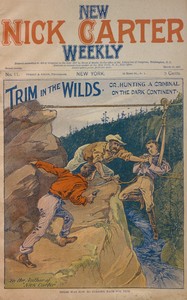
New Nick Carter weekly, No. 11, March 13, 1897: Trim in the wilds; or, hunting a criminal on the dark continent
Download Formats:
Excerpt
[Illustration: THERE WAS NOW NO TURNING BACK FOR TRIM.]
NEW
NICK CARTER
WEEKLY.
_Entered according to Act of Congress in the year 1897 by Street &
Smith, in the Office of the Librarian of Congress, Washington, D. C._
_Entered as second class Matter at the New York, N. Y., Post Office._
_Issued weekly._ _Subscription price, $2.50 per year._ _March 13, 1897._
No. 11. STREET & SMITH, Publishers. NEW YORK. 29 Rose St., N. Y. 5...
Read the Full Text
— End of New Nick Carter weekly, No. 11, March 13, 1897: Trim in the wilds; or, hunting a criminal on the dark continent —
Book Information
- Title
- New Nick Carter weekly, No. 11, March 13, 1897: Trim in the wilds; or, hunting a criminal on the dark continent
- Author(s)
- Carter, Nicholas (House name)
- Language
- English
- Type
- Text
- Release Date
- May 15, 2024
- Word Count
- 23,511 words
- Library of Congress Classification
- PS
- Bookshelves
- Browsing: Crime/Mystery, Browsing: Literature
- Rights
- Public domain in the USA.
Related Books
Lord Lister No. 0030: De Directeur der Koloniale Vereeniging
by Matull, Kurt, Blankensee, Theo von
Dutch
311h 31m read
Lord Lister no. 0053: Een huwelijksreis
by Matull, Kurt, Blankensee, Theo von
Dutch
320h 19m read
Lord Lister No. 0312: In de klauwen van een woekeraar
by Matull, Kurt, Blankensee, Theo von, Hageman, Felix (Leonard Felix)
Dutch
315h 58m read
Lord Lister No. 0029: Het Indische raadsel
by Matull, Kurt, Blankensee, Theo von
Dutch
308h 55m read
Lord Lister No. 0122: De wedrennen van York
by Matull, Kurt, Blankensee, Theo von, Hageman, Felix (Leonard Felix)
Dutch
263h 20m read
Lord Lister No. 0028: De koning van de club
by Matull, Kurt, Blankensee, Theo von
Dutch
309h 56m read