*** START OF THE PROJECT GUTENBERG EBOOK 47999 ***
[Illustration: Quartz, Rhode Island.]
[Illustration: Amethyst crystals, Mexico.]
U.S. Department of the Interior
U.S. Geological Survey
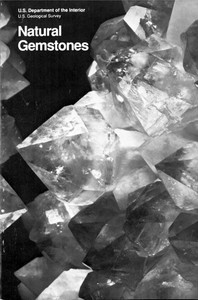
Natural
Gemstones
Searching for gemstones in the United States is a popular recreational
activity for collectors and hobbyists
Natural gemstones
A _natural gemstone_ is a mineral, stone, or organic matter that can be
cut and polished or otherwise treated for use as jewelry or other
ornament. A precious gemstone has beauty, durability, and rarity,
whereas a semiprecious gemstone has only one or two of these qualities.
A _gem_ is a gemstone that has been cut and polished.
Diamond, corundum (ruby and sapphire), beryl (emerald and aquamarine),
topaz, and opal are generally classed as precious stones. All other
gemstones are usually classed as semiprecious.
A _mineral_ is any naturally formed homogeneous inorganic material.
A _mineralogist_ is a person who studies the formation, occurrence,
properties, composition, and classification of minerals.
A _gemologist_ is a person who has successfully completed recognized
courses in gemology (the science and study of gemstones) and has proven
skills in identifying and evaluating gem materials.
A _lapidary_ is a cutter, polisher, or engraver of precious stones.
Geologic environment
Gemstones are not plentiful. Gemstones do not form “ore” deposits in the
normal sense.
Gems, when present at all, tend to be scattered sparsely throughout a
large body of rock or to have crystallized as small aggregates or fill
veins and small cavities.
Even stream gravel concentrations tend to be small—a few stones in each
of several bedrock cracks, potholes, or gravel lenses in a stream bed.
The average grade of the richest diamond kimberlite pipes in Africa is
about 1 part diamond in 40 million parts “ore.” Kimberlite, a plutonic
igneous rock, ascends from a depth of at least 100 kilometers (60 miles)
to form a diatreme (narrow cone-shaped rock body or “pipe”). Moreover,
because much diamond is not of gem quality, the average stone in an
engagement ring is the product of the removal and processing of 200 to
400 million times its volume of rock.
Gemstones occur in most major geologic environments.
Each environment tends to have a characteristic suite of gem materials,
but many kinds of gems occur in more than one environment. Most
gemstones are found in igneous rocks and alluvial gravels, but
sedimentary and metamorphic rocks may also contain gem materials.
Examples of geologic environments in which gemstones are found:
_Pegmatite_—a coarse-grained intrusive igneous rock body, occurring as
dikes (a tabular-shaped body), lenses, or veins in the surrounding rock.
_Stream gravels_ (_placers_)—deposits of heavier and more durable than
average minerals that have been eroded out of the original rock. Often
tourmaline, beryl, and many other gem-quality minerals have eroded out
of the original rock in which they formed and have moved and been
concentrated locally by water in streams. Sapphires in Judith Basin
County, Montana, were first found when the gravels were worked for gold
from 1895 to 1930.
_Metamorphic rocks_—rocks that have been altered by great heat,
pressure, or both. Garnet, for example, is commonly found as crystals in
gneiss and mica schist.
[Illustration: Quartz with phantoms, Brazil.]
[Illustration: Aquamarine, Brazil.]
Mineral gemstones
Hardness and specific gravity are two of the major characteristics of
gemstones.
Hardness of a gemstone is its resistance to scratching and may be
described relative to a standard scale of 10 minerals known as the Mohs
scale. F. Mohs, an Austrian mineralogist, developed this scale in 1822.
According to Mohs’ scale, the hardness of—
Talc is 1
Gypsum is 2
Calcite is 3
Fluorite is 4
Apatite is 5
Feldspar is 6
Quartz is 7
Topaz is 8
Sapphire is 9
Diamond is 10
Specific gravity is the number of times heavier a gemstone of any volume
is than an equal volume of water; in other words, it is the ratio of the
density of the gemstone to the density of water.
_The 16 mineral gemstone groups listed below are highly prized for their
beauty, durability, and rarity_:
Beryl (hardness: 7.5-8 Mohs)
Beryllium aluminum silicate
Specific gravity: 2.63-2.91
_Emerald_: Intense green or bluish green
_Aquamarine_: Greenish blue or light blue
_Morganite_: Pink, purple pink, or peach
_Heliodore_: Golden yellow to golden green
_Red beryl_: Raspberry red
_Goshenite_: Colorless, greenish yellow, yellow green, brownish
Chrysoberyl (hardness: 8.5 Mohs)
Beryllium aluminum oxide
Specific gravity: 3.68-3.78
_Chrysoberyl_: transparent yellowish green to greenish yellow and pale
brown
_Alexandrite_: red in incandescent light and green in daylight
_Cat’s eye_: usually yellowish or greenish
Corundum (hardness: 9 Mohs)
Aluminum oxide
Specific gravity: 3.96-4.05
_Ruby_: Intense red
_Sapphire_: Blue
Diamond (hardness: 10 Mohs)
Carbon
Specific gravity: 3.51
Colorless to faint yellowish tinge, also variable
Feldspar (hardness: 6-6.5 Mohs)
Two distinctly different alkali alumino silicates: the Plagioclase and
the Alkali Feldspar Series
Specific gravity: 2.55-2.76
Plagioclase Series—
_Labradorite_: Colorful, iridescent, also transparent stones in
yellow, orange, red, and green
_Sunstone_: Gold spangles from inclusions of hematite
_Peristerite_: Blue white iridescence
Alkali Feldspar Group—
_Orthoclase_: Pale yellow, flesh red
_Amazonite_: Yellow green to greenish blue
_Moonstone_: Colorless; also white to yellowish, and reddish to bluish
gray
Garnet (hardness: 6.5-7.5 Mohs)
A group of silicate minerals
Specific gravity: 3.5-4.3
_Almandine_: Orangy red to purplish red
_Almandine-spessartine_: Reddish orange
_Andradite_: Yellowish green to orangy yellow to black
_Demantoid_: Green to yellow green andradite
_Topazolite_: Yellow to orangy yellow
_Grossular_: Colorless; also orange, pink, yellow, and brown
_Tsavorite_: Green to yellowish green
_Hessonite_: Yellow orange to red
_Pyrope_: Colorless; also pink to red
_Chrome pyrope_: Orange red
_Pyrope-Almadine_: Reddish orange to red purple
_Pyrope-Spessartine_: Greenish yellow to purple
_Malaia_: Yellowish to reddish orange to brown
_Color-change garnet_: Blue green in daylight to purple red in
incandescent light
_Rhodolite_: Purplish red to red purple
_Spessartine_: Yellowish orange
_Uvarovite_: Emerald green
Jade (hardness: 6 Mohs)
_Nephrite_
Calcium magnesium silicate
Specific gravity: 2.9-3.1
White, deep green, creamy brown
_Jadeite_
Sodium aluminum silicate
Specific gravity: 3.1-3.5
White, leafy and blue green, emerald green, lavender, dark blue green
and greenish black, deep emerald-green
Lapis lazuli (hardness: 5-5.5 Mohs)
A rock composed mainly of the mineral lazurite with variable amounts
of pyrite (brassy flecks) and white calcite
Specific gravity: 2.7-2.9
[Illustration: Diamond Star of Sierra Leone.]
Deep blue, azure blue, greenish blue (bluish color with flecks of
white and gold)
Opal (hardness: 5.5-6.5 Mohs)
Hydrated silica
Specific gravity: 1.98-2.25
_White opal_: Opaque, porcelain-like white material; colors resemble
flashes or speckles
_Black opal_: Flashes and speckles appear against black background
_Water opal_: A transparent, colorless opal is the background for
brilliant flashes of color
_Fire opal_: Reddish or orange opal
Peridot [Olivine] (hardness: 7 Mohs)
Magnesium iron silicate
Specific gravity: 3.22-3.45
Olive to lime green
Quartz (hardness: 7 Mohs)
Silicon dioxide or silica
Specific gravity: 2.65
Coarsely crystalline varieties of silica—
_Rock crystal_: Colorless
_Amethyst_: Purple
_Citrine_: Yellow to amber
_Morion_: Black
_Smoky quartz or cairngorm_: smoky gray to brown
_Rose quartz_: Translucent pink
_Green quartz or praziolite_: Green
Cryptocrystalline varieties of silica—
_Chalcedony and Jasper_ (_variable_)
_Agate_: Bull’s eye agate, Iris or fire agate, Onyx, Sardonyx.
_Bloodstone or heliotrope._ _Carnelian._ _Chrysoprase._ _Moss agate._
_Plasma._ _Prase._ _Sard._ _Jasper._
Spinel (hardness: 8 Mohs)
Magnesium aluminum oxide
Specific gravity: 3.58-4.06
_Balas ruby_: Red
_Almandine spinel_: Purple red
_Rubicelle_: Orange
_Sapphire spinel and ghanospinel_: Blue
_Chlorspinel_: Green
[Illustration: Candelabra: white quartz, blue-capped red elbaite, and
tan albite, California.]
Topaz (hardness: 8 Mohs)
Aluminum silicate fluoride hydroxide
Specific gravity: 3.5-3.6
Wine yellow, pale blue, green, violet, or red
Tourmaline (hardness: 7-7.5 Mohs)
Complex aluminum borosilicate (Elbaite, Dravite, Uvite)
Specific gravity: 3.03-3.25
_Achorite_: Colorless
_Brazilian emerald_: Green
_Dravite_: Brown
_Indicolite_: Dark blue
_Rubellite_: Pink to red
_Siberite_: Violet
_Verdilite_: Green
Turquoise (hardness: 5-6 Mohs)
Hydrous copper aluminum phosphate
Specific gravity: 2.6-2.8
Sky blue; greenish blue
Zircon (hardness: 7.5 Mohs)
Zirconium silicate
Specific gravity: 4.6-4.7
_Jargon_: Variable
_Matura diamond_: Colorless
_Hyacinth_: Yellow, orange, red, brown
[Illustration: The Hooker Emerald, Colombia.]
Birthstones
Month of birth Gemstone Color
January Garnet Dark red
February Amethyst (Quartz) Purple
March Aquamarine (Beryl) or Bloodstone Pale blue
(Quartz)
April Diamond or Rock Crystal (Quartz) Colorless
May Emerald (Beryl) Bright green
or Chrysoprase (Quartz) Pale green
June Pearl or Moonstone (Feldspar) Cream
July Ruby (Corundum) or Carnelian Red
(Quartz)
August Peridot Pale green
or Sardonyx (Quartz) Brown and white
September Sapphire (Corundum) Pale to dark blue
or Lapis Lazuli Deep blue
October Opal or Tourmaline Variegated
November Topaz or Citrine (Quartz) Yellow
December Turquoise Sky blue
Organic gemstones
The four organic gemstone groups listed below are highly prized for
their beauty and rarity. However, they are not as durable as gemstones
from minerals:
Amber (hardness: 2-2.5 Mohs)
A mixture of hydrocarbons
Specific gravity: 1.05-1.096
Hard fossil resin or sap of ancient pine trees. Usually amorphous (lacks
crystalline structure). Sometimes mined, sometimes gathered on
seashores.
Varies from transparent to semitransparent and generally from light
yellow to dark brown, but can be orange, red, whitish, greenish-brown,
blue, or violet. Can be dyed in any color.
Takes a fine polish. Used mainly in making beads or other ornaments.
Coral (hardness: 3.5-4 Mohs)
Formed mainly of calcite (calcium carbonate) or conchiolin, a horny
organic substance
Specific gravity: 2.60-2.70
Each coral polyp, a tiny marine animal that lives in enormous colonies,
extracts calcium carbonate from the sea and exudes it to build a
protective home around and above itself. Each generation of polyps dies
in its protective home and each succeeding generation builds on top of
its predecessor.
Gem coral ranges from semitranslucent to opaque and occurs in white,
pink, orange, red, blue, violet, golden, and black. The black and golden
corals are largely horny organic substances, not calcium carbonate.
The finest coral is used to make figurines, cameos, carvings, and beads.
Jet (hardness: 2.5-4 Mohs)
Carbon plus various hydrocarbon compounds
Specific gravity: 1.30-1.32
This compact velvet-black coal takes a good polish and is often cut into
beads, bracelets, and a wide range of decorative and useful objects.
Pearl (hardness: 2.5-4.5 Mohs)
Formed within a mollusk, such as an oyster, that deposits a substance
called _nacre_ around an irritant that entered the
organism
Specific gravity: 2.71
Pearl-bearing mollusks are found in both salt and fresh water.
Salt-water pearls of gem quality are usually preferred for jewelry; they
are produced almost entirely by the mollusk _Pinctada_. Fresh-water
pearls are produced by various clams and mussels.
Natural pearls come in various shapes: round, pear, drop, egg, and
others. They also come in various colors, such as white, cream, light
rose, cream rose, black, gray, bronze, blue, dark blue, blue green, red,
purple, yellow, and violet.
Buyer beware
Inexperienced buyers must take whatever steps are needed to ensure that
gems they intend to purchase are exactly what the seller purports them
to be and that they are being offered at a fair market price.
More and more synthetic gems—and inferior grades and cuts of natural
gems—are being sold to unwary buyers by unscrupulous sellers.
Since 1935, the mining of gemstones in the United States has been
almost entirely a recreational activity of mineral collectors and hobbyists.
In recent years, very few individuals have derived their entire income
from gemstones mined by themselves.
This is not to say that the proprietors of roadside rock shops buy all
of their stock from others. Rock shops are abundant in areas of the
United States that are rich in gem materials, and the shops tend to
specialize in the local gem commodities, most of which the proprietors
gather.
Rather than doing the mining themselves, owners of land that has a
deposit of gem-quality minerals sometimes charge hobbyists for the right
to collect gemstones. For example, diamond in Arkansas, opal in Idaho,
and agate in Oregon and Washington are mined by hobbyists under this
“fee digging” arrangement.
However, the flow of money into the local economy by paying these small
fees and by the purchase of gemstones is minor compared to the money the
enthusiasts spend for lodging and other living expenses while visiting
an area to dig for gemstones.
Several kinds of natural gemstones have been found in every State of the
United States, but much larger deposits of the most precious kinds are
found outside the United States.
The 1990 U.S. output of natural gemstones was primarily from Tennessee,
California, Arizona, Arkansas, Montana, Nevada, and Maine.
An estimated 80,000 visitors found a total of 315 carats of diamonds in
the Crater of Diamonds State Park in Arkansas. There were sizeable
yields of freshwater pearls in Tennessee, turquoise in Arizona and
Nevada, tourmaline in Maine, and tourmaline, kunzite, and garnet in
California.
Gemstones: Value of U.S. production vs. imports, 1986 and 1989[1]
Production 1986 1989
Natural $9.3 million $43.0 million[2]
Synthetic 10.3 23.5
$19.6 $66.5
Mine employment 300 800
Imports for consumption: $4.18 billion $5.00 billion
Apparent reliance on imports over 99% 98%
exports[3]
[1]Estimated.
[2]Including freshwater pearls natural, and cultured.
[3]Imports - exports + adjustments for Government and industry stock
changes. Source: _Mineral Commodity Summaries_, 1991, U.S. Bureau of
Mines.
U.S. production of commercial gems includes agate, beryl, freshwater
pearl, garnet, jade, jasper, mother-of-pearl, opal, peridot, quartz,
sapphire, tourmaline, and turquoise.
Except for the few gem diamonds found each year in Arkansas, U.S.
diamond production is very low.
Yet exploration for diamonds continues in Alaska, Colorado, Michigan,
Minnesota, Wisconsin, and Wyoming. A diamond mining project at the
Crater of Diamonds State Park in Arkansas is still being evaluated by
the State.
World diamond reserves are estimated to be about 300 million carats,
including near-gem materials but not diamonds of abrasive quality.
Most of the reserves are in southern Africa, Siberia, and western
Australia. It is difficult to estimate reserves because the value of a
given deposit varies with the market for the gems.
[Illustration: Jade nephrite, China.]
[Illustration: The Hope Diamond, India.]
Chemical formulas of gemstones
Beryl BeࠣAlࠢSiࠦO₁ࠨ
Chrysoberyl BeAlࠢOࠤ
Coral CaCOࠣ
Corundum AlࠢOࠣ
Diamond C
Feldspar Plagioclase Series:
(Na,Ca)Al(Al,Si)SiࠢOࠨ
Alkali Feldspar Group:
Mixtures of Orthoclase—KAlSiࠣOࠨ and
Albite—NaAlSiࠣOࠨ
Garnet Almadine—FeࠣAlࠢ(SiOࠤ)ࠣ
Andradite—CaࠣFeࠢ(SiOࠤ)ࠣ
Grossular—CaࠣAlࠢ(SiOࠤ)ࠣ
Pyrope—MgࠣAlࠢ(SiOࠤ)ࠣ
Spessartine—MnࠣAlࠢ(SiOࠤ)ࠣ
Uvarovite—CaࠣCrࠢ(SiOࠤ)ࠣ
Jade Nephrite—Caࠢ(Mg,Fe)ࠥ(SiࠨOࠢࠢ) (OH)ࠢ
Jadeite—NaAl(SiࠢOࠦ)
Lapis lazuli Lazurite—(Na,Ca)ࠨ(AlSiOࠤ)ࠦ (SOࠤ,S,Cl)ࠢ
Opal Hydrated Silica—SiOࠢ·_n_HࠢO
Peridot (Mg,Fe)ࠢ(SiOࠤ)
Quartz SiOࠢ
Spinel MgAlࠢOࠤ
Topaz AlࠢSiOࠤ(F,OH)ࠢ
Tourmaline XYࠣAlࠦ(BOࠣ)ࠣ(SiࠦO₁ࠨ) (OHࠤ)
[X is usually Na but may be replaced by Ca;
Y is one of several metal ions]
Turquoise CuAlࠦ(POࠤ)ࠤ(OH)ࠨ·4HࠢO
Zircon ZrSiOࠤ
Some ways to contact a local rock, mineral, or gem club
If you have access to the most recent April Buyer’s Guide issue of the
_Lapidary Journal_ magazine, scan its lists of gem and mineral clubs in
the United States and other countries. (The address of the _Lapidary
Journal_ is given in the list of journals cited below.)
Talk to a member of the geology or earth science department of your
local college or university.
Talk to a member of the science department of your local high school.
Write to the—
Eastern Federation of Mineralogical and Lapidary Societies
Box 10119
Alexandria, VA 22310-0119
or the
Midwest Federation of Mineralogical and Geological Societies
306 Somonauk
Park Forest, IL 60466
Check the phone book for your nearest rock and mineral shop and talk to
the owners.
Role of the U.S. Geological Survey (USGS)
The USGS reports deposits that seem likely to contain gemstones. It is
not a function of the USGS to exploit such resources.
USGS geologists perform continuing research on kimberlites, the initial
source of diamonds. Not all kimberlites are diamond-bearing, and some of
the research is directed to learning what indications you look for
during exploration to distinguish fertile from barren kimberlite. USGS
geologists are compiling a U.S. map showing the locations of known
kimberlites.
Selected general references
A trip to your local library is the best first step toward understanding
gemstones and toward planning a trip to gem and rock shops or to places
where you may be able to collect gemstones.
A list of _Selected references on rocks, minerals, and gemstones_ is
compiled and updated every two years by the USGS Geologic Inquiries
Group, 907 National Center, Reston, VA 22092; (703) 648-4383. The list
has three sections: selected guides for rockhounds and hobbyists,
general references for all ages, elementary school to adult, and
periodicals.
The guides in Section I tell about equipment needed for collecting,
etiquette of collecting, map reading, organizing a collection,
collecting localities by States, mineral societies, mineral show dates
and locations, and rock, mineral, and fossil dealers.
The references below focus mainly on natural gemstones and the gems made
from them rather than on synthetic gemstones, rocks, or other nongem
minerals.
_Minerals Yearbook_
The relatively few pages on gemstones in the multivolume _Minerals
Yearbook_ provide data on sources, kinds, and volume of domestic
production, domestic consumption, prices, and foreign trade. This U.S.
Bureau of Mines yearbook is in the reference sections of many major
libraries. It can be purchased from the Superintendent of Documents,
U.S. Government Printing Office, Washington, DC 20402.
_Books_
_Gemology_, Cornelius S. Hurlbut Jr. and Robert C. Kammerling: John
Wiley & Sons, New York, 1991, 2nd ed.
_Gemstones and Their Origins_, Peter C. Keller: Van Nostrand Reinhold,
1990.
_Color Encyclopedia of Gemstones_, Joel Arem: Van Nostrand Reinhold, New
York, 1987, 2nd ed., 68 p.
_Gemstones for Everyman_, B.W. Anderson: Van Nostrand Reinhold, 1976,
268 p.
_Gems and Precious Stones_, Curzio Cipriani and Alessandro Boreli;
Valerie Palmer, translator: Kennie Lyman, U.S. editor: Simon and
Schuster, New York, 1986, 384 p.
_Gem and Crystal Treasures_, Peter Bancroft: Mineralogical Record,
Carson City, NV, 1984, 488 p.
_Planet Earth—Gemstones_, Paul O’Neil and the editors of Time-Life
Books: Time-Life Books, Arlington, VA, 1983, 176 p.
_Gemstones of the World_, Walter Schumann (translated by Evelyne Stern):
Sterling, New York, 1984, 256 p.
_Gems & Crystals from the American Museum of Natural History: An
illustrated guide to the history, lore, and properties of the gems and
minerals of one of the world’s greatest collections_, Anna S. Sofiandes
and George E. Harlow: Simon & Schuster, New York, 1990, 208 p.
_The Gem Collection_ (Treasures in the Smithsonian Series No. 1), P.E.
Desautels: Smithsonian Institution, Washington, 1983, 77 p.
_Gemstones of North America_, John Sinkankas: D. Van Nostrand Company,
Inc., Princeton, 1959, 675 p.
_Gems and Precious Stones of North America—A popular description of
their occurrence, value, history, archeology, and of collections in
which they exist_, G.F. Kunz: Dover Publishing, New York, 1968 (reprint
of a classic work dated 1892), 367 p.
_Emerald and Other Beryls_, John Sinkankas: Chilton Way, Radnor, PA,
1981, 665 p.
_Handbook of Gem Identification_, R.T. Liddicoat Jr.: Gemological
Institute of America, Santa Monica, CA, 1981 (11th ed.), 450 p.
_Field Collecting Gemstones and Minerals_, John Sinkankas: Geoscience
Press, Prescott, AZ, 1988, 2nd ed., 397 p.
_Prospecting for Gemstones and Minerals_ [Formerly _Gemstones and
Minerals: How and Where to Find Them_], John Sinkankas: Van Nostrand
Reinhold, New York, 1970, 2nd ed., 397 p.
_Mineral & Gem Trails of Delaware, Virginia, Maryland, North Carolina_,
Ed and Bert Sloan: EDSCO, Box 79, Oneonta, NY 13820, 1978, 52 p.
_Gem Testing_, B.W. Anderson: Butterworth, Woburn, MA, 1980, 9th ed.,
384 p.
_Gemology_, C.S. Hurlbut Jr. and G.S. Switzer: Wiley, New York, 1979,
596 p.
_Gems and Jewelry_, Joel Arem: Bantam Books, New York, 1975, 159 p.
_Gem Cutting: A Lapidary’s Manual_, John Sinkankas: Van Nostrand
Reinhold, New York, 1962, 2nd ed., 297 p.
[Illustration: Lavender-hued rose quartz, Brazil.]
_Journals_
_Gems and Gemology_ (quarterly). Articles on gemstone localities,
identification, and history. Includes annual index, lab notes, book
reviews, and gemological abstracts. Published by the Gemological
Institute of America, 1660 Stewart Street, Santa Monica, CA 90404.
_Lapidary Journal_ (monthly). Articles on gemstones, locality
information, expeditions to find sources of gemstones, gemcraft, club
news, show news, product news, and book reviews. Published by the
Lapidary Journal, Devon Office Center, Suite 201, 60 Chestnut Avenue,
Devon, PA 19333-1312.
_Rocks & Minerals_ (bimonthly). Features articles of interest to
students of mineralogy, geology, and paleontology. Includes articles
about gemstone localities. Regularly lists announcements of hundreds of
mineral, rock, and gem shows (local, State, national, Canadian, and
European). Includes media reviews, museum notes and announcements, and
classified ads. Published by Heldref Publications, 4000 Albermarle
Street, NW., Washington, DC 20016.
_Jewelers’ Book Club—Catalog_ (annual). Catalog of more than 550
jewelry-related publications from more than 250 publishers. Includes
video- and audio-cassettes and book reviews. _Jewelers’ Book Club—News_
(quarterly) informs members of new titles and provides book reviews.
Published by the Jewelers Book Club, Chilton Way, Radnor, PA 19089.
_Videocassettes_
_Gemstones of America_ (60 minutes), Smithsonian Institution, 1991, can
be ordered for $29.95 from the Museum Shop, Attention: Mail Order Clerk,
National Museum of Natural History, 10th Street and Constitution Avenue,
NW., Washington, DC 20560; (202) 357-1535.
_Splendid Stones._ This National Geographic Society special details the
evolution from raw material to cut and polished gem, outlines many of
the steps involved in marketing gemstones, and examines some of the
world’s most famous jewelry collections. It can be ordered for $95 from
the National Geographic Society, 17th and M Streets NW., Washington, DC
20036.
Acknowledgments
The U.S. Geological Survey is grateful to the following individuals for
their assistance:
Harvey E. Belkin, Geologist, Geological Survey, U.S. Department of the
Interior, Reston, VA.
Gordon T. Austin, “Gem Stones,” _Mineral Commodity Summaries 1991_,
Bureau of Mines, U.S. Department of the Interior, Washington, DC.
Robert E. Thaden, “Gem Stones,” in _United States Mineral Resources_,
Geological Survey Professional Paper 820, U.S. Government Printing
Office, Washington, 1973, p. 247-250.
Jane Jenness, Minerals Information Office, U.S. Geological Survey,
Washington, DC.
Photographs
All photographs are courtesy of The Smithsonian Institution.
Transcriber’s Notes
--Retained publication information from the printed edition: this eBook
is public-domain in the country of publication.
--In the text versions only, text in italics is delimited by
_underscores_.
--In the ASCII version only, subscripted numbers are preceded by
underscore and delimited by brackets.
End of the Project Gutenberg EBook of Natural Gemstones, by Various
*** END OF THE PROJECT GUTENBERG EBOOK 47999 ***
Natural Gemstones
Subjects:
Download Formats:
Excerpt
U.S. Department of the Interior
U.S. Geological Survey
Searching for gemstones in the United States is a popular recreational
activity for collectors and hobbyists
A _natural gemstone_ is a mineral, stone, or organic matter that can be
cut and polished or otherwise treated for use as jewelry or other
ornament. A precious gemstone has beauty, durability, and rarity,
whereas a semiprecious gemstone has only one or two of these qualities.
A _gem_ is a gemstone that has been cut and...
Read the Full Text
— End of Natural Gemstones —
Book Information
- Title
- Natural Gemstones
- Author(s)
- Geological Survey (U.S.)
- Language
- English
- Type
- Text
- Release Date
- January 16, 2015
- Word Count
- 3,576 words
- Library of Congress Classification
- QE
- Bookshelves
- Browsing: Nature/Gardening/Animals, Browsing: Science - General
- Rights
- Public domain in the USA.