The Project Gutenberg EBook of Mound State Monument, Moundville, Alabama, by
Alabama Museum of Natural History
This eBook is for the use of anyone anywhere in the United States and most
other parts of the world at no cost and with almost no restrictions
whatsoever. You may copy it, give it away or re-use it under the terms of
the Project Gutenberg License included with this eBook or online at
www.gutenberg.org. If you are not located in the United States, you'll have
to check the laws of the country where you are located before using this ebook.
Title: Mound State Monument, Moundville, Alabama
Author: Alabama Museum of Natural History
Release Date: April 4, 2019 [EBook #59208]
Language: English
Character set encoding: UTF-8
*** START OF THIS PROJECT GUTENBERG EBOOK MOUND STATE MONUMENT, MOUNDVILLE, ALABAMA ***
Produced by Stephen Hutcheson and the Online Distributed
Proofreading Team at http://www.pgdp.net
_Mound State Monument_
MOUNDVILLE ALABAMA
_Museum Paper_ 20 (_Revised_)
[Illustration: Decorative border]
Archaeological Museum
CONTENTS
Archaeological Museum Cover
The Prehistoric Inhabitants of Moundville 3
Their Physical Appearance 3
Their Dress and Ornamentation 4
Their Houses 4
Their Food 5
Their Implements 5
Their Religion 7
Other Activities 8
Their Burial Customs 8
Moundville Indian Pottery 8
What to See at Mound State Monument 12
How to Reach the Monument 16
Administration of the Monument 16
Map of Mound State Monument 18
Rules and Regulations 19
Erskine Ramsay Archaeological Research Center 21
Picnic Facilities 21
Milestones
1200-1400[1] Great prehistoric city grows and thrives on banks of
Warrior River, West-Central Alabama.
1500[1] City deserted.
1897 Town of Carthage, white settlement at site of deserted
city, renamed Moundville because of numerous Indian
mounds within its limits.
1905-1906 First archaeological excavations made at Moundville by
Clarence B. Moore of the Philadelphia Academy of
Natural Sciences.
1923 Moundville Historical Society organized to arouse
interest in preservation of mounds. Mrs. Jeff Powers,
Jr., President.
1929 Alabama Museum of Natural History begins
archaeological investigations at Moundville after
purchasing 175 acres which include most of the 40
mounds in that area.
1933 Mound State Park established with the aid of the
Federal Emergency Conservation Work Agency.
1935 Temporary museum building constructed at Mound State
Park.
1938-39 Alabama Museum purchases additional land, enlarging
Mound State Park to 301 acres which includes all the
mounds in the area.
1938 Mound State Park renamed Mound State Monument.
Civilian Conservation Corps, directed by National Park
Service and the Alabama Museum of Natural History,
begins large-scale development of area.
1939 May 10, New Archaeological Museum dedicated.
1947 September 24, Dedication of Laboratory Unit of Erskine
Ramsay Archaeological Research Center.
1949 Completion of Picnic Building: Memorial to Nelson
Jones.
[1]Approximate dates.
MOUND STATE MONUMENT
• _OPEN ALL YEAR_ •
[Illustration: Museum building]
_A blisful lyf, a paisible and a swete, Ledden the peples in the
former age_
—_Chaucer, Former Age, line 2_
The Black Warrior River winds slowly among the rolling southern
foothills. On the banks of this river many centuries ago there
flourished a great Indian metropolis. Here dwelt a pleasant and
contented people whose story is not of warring braves but of peaceful
artisans. Theirs were days not of strife and treachery, but of quiet
toil and worship. These people, given to pottery-making and the building
of fine temples, have vanished long ago. The eloquence of their
handiwork endures. Their pottery, lodged in the muddy earth, emerges as
fresh proof that “a thing of beauty is a joy forever”. Their temples,
decayed these many years, are yet in evidence, for the pyramidal
substructures of these temples—earth mounds of imposing size and
number—remain.
The mounds and the story of the people who built them, a story recorded
in clay and stone and native metal, are preserved today at Mound State
Monument.
THE PREHISTORIC INHABITANTS OF MOUNDVILLE
Their physical appearance.
The Indians dwelling in the ancient city, though of medium stature, were
well built and muscular. Their faces were finely molded and handsome.
Considered stylish were “flattened heads”. Head-flattening was caused by
strapping the young Indian to a wooden cradle board. The pressure of the
leather thongs on the soft bones of the baby’s head caused a flattening
which remained throughout life. Such a head seems to have become a mark
of good rearing, and greatly to be desired, for many mothers went so far
as to strap sand bags on their children’s heads to induce this
flattening.
[Illustration: A Moundville Indian skull that was not flattened.]
[Illustration: This Moundville Indian skull shows the result of
artificial head-flattening.]
Their dress and ornamentation.
Leather and fabrics woven of vegetable fibres were fashioned into
garments. In extremely cold weather robes made of feathers may have been
worn over the rest of their clothing.
The Moundville Indians, both men and women, were fond of personal
adornment. They wore ear plugs, bracelets and arm bands of copper, and
beads and pendants of bone, stone, shell and copper. Many of their
pendants, carved with intricate and delicate designs, would invoke the
envy of women of today. Long hairpins were made of bone, and
considerable time was devoted to hairdressing.
[Illustration: A STONE PENDANT ONCE WORN BY A MOUNDVILLE INDIAN.]
Their houses.
From virgin forests the Moundville Indians gathered logs and poles to
construct frameworks for their homes. Of reeds and canes gathered along
the river they wove house walls, plastering them with thick coatings of
moistened sand and clay. Thatched roofs were made of heavy swamp grass.
A hole was left in the center to serve as a chimney. The floors were of
hard-packed clay frequently covered with sand. These structures were
neat, comfortable and weatherproof.
[Illustration: SHELL BEADS WHICH ONCE ADORNED A MOUNDVILLE INDIAN.]
Their food.
Living in a temperate climate amid forests teeming with wild game and
streams abundant with fish, the Moundville Indians had little
difficulty, experienced few uncertainties, in obtaining their food. In
addition to meat and fish obtained from forest and stream there were
vegetables from fertile fields which produced with little man-made
effort an ample supply of maize, squash, beans and pumpkins.
Their implements.
A community of skilled artisans, these people fashioned many tools for
food-getting, shelter-making and clothing-manufacture as well as for
more aesthetic pursuits. With nets woven of vegetable fibre and barbless
fishhooks of bone and copper they took fish from nearby streams and
lakes. With small, skillfully chipped arrowheads they brought down fowl.
Ingenious traps ensnared large game. Stone fleshers were used for
stripping the meat and dressing the leather. With bone awls and needles
sharpened on grinding stones they sewed leather garments. Stone mortars
and pestles pulverized their grain. Stone chisels and axes felled, with
the aid of fire, trees for their homes and temples. Cups and forks and
spoons carved from shell were their cooking and eating utensils.
[Illustration: A MOUNDVILLE INDIAN’S SHELL CUP.]
[Illustration: COPPER FISHHOOK USED AT MOUNDVILLE IN PREHISTORIC
TIMES.]
[Illustration: A MEMENTO OF ABORIGINAL RELIGIOUS CEREMONIES AT
MOUNDVILLE.]
Their religion.
Of paramount importance to the Moundville Indian was his religion. The
mounds, on which he worshiped, are enduring monuments to the strength
and fervor of his faith. Tons and tons of clay, loam and sand he carried
to form these towering structures. Atop the earth pyramids he built
great wooden temples and special dwelling houses for chieftans and
priests.
Ceremonies performed in the temples were elaborate and colorful. Priests
attired in symbolic costumes, and bearing numerous esoteric
accoutrements, directed the rituals. Ceremonial trappings included
beautiful copper breast plates, shell gorgets, and stone discs and
pendants, all delicately carved with intricate, allegorical designs.
Among these designs were depictions of the skull and arm-bone, the hand
and all-seeing eye, entwined rattlesnakes, and the horned or plumed
serpent. Similar designs are found in the symbolic art of the Indians of
Central America and Mexico, the Mayas and Aztecs.
[Illustration: PIPES WHICH THE MOUNDVILLE INDIANS MOLDED FROM CLAY.]
Other activities.
Games and contests were popular among the Moundville Indians. One
favorite game had the combined features of our football and baseball.
Another was similar to a combination of bowling and shuffleboard.
Tobacco-smoking was practiced not as a habit but as a ceremony.
Beautiful pipes—some carved from stone, others molded from clay—were
smoked through a long cane stem, the bowl resting on the ground. Some
pipes were shaped to resemble the human body. Others were carved or
molded in the shape of birds, animals and insects.
Their burial customs.
The dead were buried with care and respect. Belief in immortality was
expressed by placing material goods near the deceased to sustain him in
the other world. His treasured belongings, usually pottery vessels,
beads, bracelets and other ornaments, were buried with him.
The Moundville Indian built no burial mounds. His dead were buried in
cemetery areas within the city. Usually burial was made in a pit large
enough to accommodate the body at full length. Sometimes, however,
burial was made in a small pit, the body being drawn up in a flexed
position. Burial of the skeleton after it had been stripped of flesh was
sometimes practiced.
MOUNDVILLE POTTERY
The very nature of the Moundville Indian’s surroundings provided
security and leisure. His time was not consumed in constant search for
food and warmth, and to squander his time, grow fat and lazy, was not in
him. His skill and versatility required expression, which he found in
the art of pottery-making.
[Illustration: THE MOUNDVILLE POTTER WAS A SKILLED CRAFTSMAN.]
[Illustration: VARIETY OF FORM CHARACTERIZES MOUNDVILLE POTTERY.]
[Illustration: POTTERY BEAKER WITH A SYMBOLIC DESIGN.
After the beaker was removed from the ground by the archaeologist
the incised lines were filled with white paint in order to emphasize
the design.]
He manufactured great quantities of pottery for domestic use. Moistening
clay which he took from the river bank, he kneaded into it particles of
crushed shell. This was to keep the molded clay from cracking when it
hardened. He shaped the clay into jars, pots, bowls and other
utilitarian objects, hardening them with fire. This domestic ware was
plain, bearing no decoration.
It was through non-utilitarian ware, exquisitely decorated, that the
Moundville Indian wrought careful and lasting expression of his
artistry. The potter used only his finest clay for this ware. After
forming the clay into some delicately molded vessel, then hardening it
with fire, he dipped the vessel into a black “wash” which coated it with
a smooth, black film. The coloring agent contained in this “wash” was
derived, indirectly, from plants.
Usually the potter decorated the vessel with some intricate design,
often incising the lines on the vessel before it was hardened, at other
times scratching them on the hardened vessel. Sometimes the etched or
incised lines of the design were filled with red paint, derived from
iron ore, which gave the design a striking appearance on the polished
black surface of the vessel.
Water bottles, bowls, pots, shallow dishes, and effigy vessels were made
of this thin, black ware. Their forms included frog, duck, beaver,
rabbit, eagle, bat, owl, fish, shell and even human shapes.
Designs incised or engraved on this ware depicted the plumed or horned
serpent, the ivory-billed woodpecker, eagle, sun, human hand and eye,
skull and armbones, and numerous others.
Sometimes vessels were decorated with red and white paint (derived from
iron and lead ore) instead of being “washed” black. This type of
decoration was not common, however.
WHAT TO SEE AT MOUND STATE MONUMENT
The Mounds
The present-day visitor to Mound State Monument may see, on the 300-acre
Monument tract, 40 mounds which are the remnants of the Moundville
Indians’ great city.
The visitor will be interested in identifying these mounds as
_domiciliary_ (as distinguished from burial mounds and effigy mounds
found at other Indian sites). These domiciliary mounds, which were
erected as substructures for temples and other important buildings, are
rectangular truncated-pyramids. Their sizes vary. The largest, called
Mound “B” (see map), is 58½ feet high and covers almost two acres.
Prehistoric Lakes
The several lakes within the Monument area are restorations, made after
considerable research, of prehistoric reservoirs. The forty- to
sixty-foot bluff at the ancient city’s river front made the Warrior
River an impractical source of water supply. These lakes, therefore, may
have been used to catch and hold water for daily use and for fishing.
ERSKINE RAMSAY ARCHAEOLOGICAL RESEARCH CENTER
Already constructed through the generosity of Dr. Erskine Ramsay,
Birmingham, Alabama, Honorary Chairman of the Board of Regents of the
Museum, is a large and spacious laboratory building, in which all
archaeological material comprising the Museum’s vast collection is
suitably and adequately housed. Space is available for students to study
any phase of the subject in which they may be interested. (See
photograph on page 20.)
Also completed in the Research Center is one cottage in which a married
student might be housed during the period of his studies.
Yet to be constructed are two cottages, a dormitory for unmarried
students, and a house for the resident archaeologist.
[Illustration: MOUND “B” AND VISITORS.]
[Illustration: RESTORED PREHISTORIC LAKE AT MOUND STATE MONUMENT.]
The Archaeological Museum
Arrangement.
The archaeological museum houses an exhibit hall and two _in situ_
burial groups. The exhibit hall makes up the main part of the building.
The in situ burial groups are enclosed in wings at the north and south
ends of the exhibit hall.
Design.
Design of the building itself was based on ideas used by the Moundville
Indian in shaping and decorating his artifacts. The classic three-step
motif expressed in the three roof levels of the museum, and used over
the doorway, was a favorite design element of the Moundville artist. The
skull and arm-bone design making up the parapet frieze was copied from a
design on a Moundville Indian pot (_see photograph on p._ 11). The
medallion over the entrance is an enlarged reproduction of a stone
pendant once owned by a Moundville Indian (_see photograph on p._ 4).
This pendant as well as the pot from which the frieze was copied may be
seen in the exhibit hall.
Main exhibit hall.
Displays in the exhibit hall are designed to illustrate (1) a brief
history of prehistoric man, (2) cultural traits and physical
characteristics of the prehistoric Moundvillian, and (3) physical
features of Mound State Monument.
A brief story of prehistoric mankind is given in the three wall cases to
the visitor’s left as he enters the museum. Cultural traits of the
Moundville Indian are illustrated in the eight cases along the back
wall, and in the five table cases in the exhibit hall. Physical features
of Mound State Monument are depicted in the three wall cases to the
visitor’s left as he leaves the museum.
Burial groups.
The north wing of the museum (to the Visitor’s left as he enters the
building) encloses seventeen _in situ_ burials. The south wing (to the
visitor’s left as he leaves the building) encloses forty such burials.
These fifty-seven burials, together with their accompanying pottery,
ornaments and other artifacts, have been uncovered and left in the
ground exactly as they were found.
These burials had been placed in a cemetery area, not a mound. Most of
the burials were approximately one and one-half feet under the surface
of the ground, although some were only four inches underground and
others were three feet. The original ground-level is demonstrated in the
exhibit by lines drawn around the edges of the pits.
Studies of Moundville skeletal remains have revealed the sex and
individual age (_i.e._, how old the individual was at the time of
burial) of each burial, as well as certain physical defects. Effects of
head-flattening, a practice described elsewhere on these pages, are
apparent on many of the skulls.
[Illustration: IN SITU BURIALS IN NORTH WING OF MUSEUM.]
[Illustration: IN SITU BURIALS IN SOUTH WING OF MUSEUM.
BURIALS HAVE BEEN UNCOVERED AND LEFT IN THE GROUND JUST AS THEY WERE
FOUND.]
HOW TO REACH THE MONUMENT
By automobile.
Mound State Monument is located on Alabama Highway No. 13 (paved) at the
edge of the town of Moundville, Alabama, seventeen miles south of
Tuscaloosa, Alabama. The dividing line of Tuscaloosa and Hale Counties
runs through the Monument area.
By train or bus.
Moundville Alabama, is located on the A.G.S. Railroad, a part of the
Southern Railway System, which operates passenger trains between New
York and New Orleans _via_ Birmingham, Tuscaloosa, Moundville and
Meridian. Greyhound buses running from Tuscaloosa to Mobile pass through
Moundville.
ADMINISTRATION OF MOUND STATE MONUMENT
Mound State Monument is owned by the Alabama Museum of Natural History,
University, Alabama.
The Monument is open daily, including Sundays and holidays, from 8:00
A.M. until dark, the year around. A caretaker, equipped to guide the
visitor and offer any other assistance, resides on the Monument grounds.
A small admission charge is made to the Monument Museum. Special rates
are available to groups provided reservations and arrangements are made
in advance. Free showing of sound movies illustrating Moundville Indian
culture may be arranged for at the Administration Building. Arrangements
for group visits should be made by addressing: The Curator, Alabama
Museum of Natural History, University, Alabama.
[Illustration: Museum building and pond]
[Illustration: SPECIAL VISITS BY SCHOOL CLASSES AND OTHER CIVIC
GROUPS MAY BE ARRANGED.]
[Illustration: Visiting group]
MAP OF MOUND STATE MONUMENT
[Illustration: MOUNDS ARE DESIGNATED BY LETTERS.]
RULES AND REGULATIONS
• Briefed •
Mound State Monument exists as an instrument for PRESERVATION. Visitors
are requested to aid the Monument administration by carefully observing
the following regulations. These rules are enforced for the comfort and
convenience of the visitor as well as for the protection of scenic and
archaeologic features.
Automobiles.
Monument roadways are altogether recreational in character and the speed
of vehicle traffic is therefore limited to 15 miles per hour. Drive
carefully for the protection of yourself and other visitors.
Grounds.
The Monument is a wildlife sanctuary. Birds and animals must not be
molested. HUNTING AND FISHING ARE PROHIBITED. Firearms or air rifles
must not be carried within the Monument boundaries.
Trees and shrubs must not be broken. Do not carve initials on or pull
the bark from trees. Flowers must not be picked. _The injury or
defacement of any natural feature is prohibited._
Private Operators and Advertising.
To solicit or sell anything, no matter of what nature, except by persons
holding contract with Mound State Monument is prohibited.
No advertising, or distribution of placards or advertising matter, is
permitted on the Monument grounds.
Fires.
Fires are one of the greatest perils to the natural features of the
Monument. Smokers are requested to exercise care in the disposal of
matches, cigarettes _etc. Picknickers must confine fires to designated
areas and extinguish them completely before leaving._
Picknickers.
All visitors are welcome to utilize the public picnic area and
campground. Picnicking must be confined to sites designated by the
caretaker.
Do not throw paper, lunch refuse or other trash on the roads, trails, or
elsewhere. Deposit all such debris in the receptacles provided for that
purpose. Picnickers may burn combustible rubbish in incinerators.
Special permission must be obtained to use picnic areas after dark.
Buildings and Archaeologic Features.
To mar or deface any building, or to mark, disturb or injure any
archaeologic feature on the Monument grounds, is a violation of the law.
Caretaker and Guides.
The caretaker and guides are here to help and advise you as well as to
enforce regulations. Consult them about anything pertaining to the
Monument.
[Illustration: View of mound, lake, and museum]
[Illustration: ERSKINE RAMSAY ARCHAEOLOGICAL RESEARCH LABORATORY.]
[Illustration: PICNIC BUILDING, MEMORIAL TO NELSON JONES.]
ERSKINE RAMSAY ARCHAEOLOGICAL RESEARCH CENTER
As mentioned earlier, the laboratory unit and one cottage of the
Research Center have been completed. Archaeological material, including
skeletons from the Museum’s extensive excavations in the Tennessee
Valley Region in Alabama, its earlier work in Eastern Arkansas, surface
collections from all over Alabama and from scattered excavations in many
parts of the state, has been assembled in especially designed storage
racks in the main part of the building. Our plan is to have all of the
Museum’s archaeological material, photographs, field notes, and library
at this central point, where any part of it may be studied and
comparisons made with other parts. Archaeologists are invited to avail
themselves of the opportunity thus afforded.
Artifacts of clay, bone, shell, copper, flint, and stone are packed in
pasteboard cartons which are numbered according to site and type of
material. Skeletal material is packed in butter tubs and pasteboard
cartons. All bones have been carefully cleaned, soaked in permanent
hardener, and catalogued. All records of excavations, surveys, profiles,
field notes, topographic sheets, index catalogues, et cetera are also
housed in the building.
We are proud to have such a fine lot of material available in one
building.
PICNIC BUILDING
This building, on a high bluff overlooking the Warrior River, was
covered in the original master plan for the area. It was made possible
through a large donation by two friends of the Museum who wish that
their identity be withheld.
The central section of the building is equipped with banquet type tables
and folding chairs, having a seating capacity of about 200. In the west
wing is a fully equipped kitchen and large barbecue pit. In the east
wing are rest rooms, with outside entrances.
Around the building is a large concrete terrace which is equipped with
portable tables and built-on seats, each with a capacity of eight
people. The terrace will accommodate about 300 people.
Through special arrangement with the Director, the Curator, or the Park
Manager, the building may be reserved for picnic groups having their own
lunches, or for parties wishing to use kitchen facilities.
Charges for school groups with their own lunches: 10c each; for other
parties having their own food: $5.00 minimum, or 10c each, whichever
amount is the larger; with somewhat more being charged for use of
kitchen facilities, depending upon type of food preparation required.
Coca-Cola dispensing machine is available in the building.
[Illustration: Back cover]
Transcriber’s Notes
—Silently corrected a few typos.
—Retained publication information from the printed edition: this eBook
is public-domain in the country of publication.
—Collated Table of Contents against actual headings, and added one entry
to make them correspond.
—In the text versions only, text in italics is delimited by
_underscores_.
End of the Project Gutenberg EBook of Mound State Monument, Moundville,
Alabama, by Alabama Museum of Natural History
*** END OF THIS PROJECT GUTENBERG EBOOK MOUND STATE MONUMENT, MOUNDVILLE, ALABAMA ***
***** This file should be named 59208-0.txt or 59208-0.zip *****
This and all associated files of various formats will be found in:
http://www.gutenberg.org/5/9/2/0/59208/
Produced by Stephen Hutcheson and the Online Distributed
Proofreading Team at http://www.pgdp.net
Updated editions will replace the previous one--the old editions will
be renamed.
Creating the works from print editions not protected by U.S. copyright
law means that no one owns a United States copyright in these works,
so the Foundation (and you!) can copy and distribute it in the United
States without permission and without paying copyright
royalties. Special rules, set forth in the General Terms of Use part
of this license, apply to copying and distributing Project
Gutenberg-tm electronic works to protect the PROJECT GUTENBERG-tm
concept and trademark. Project Gutenberg is a registered trademark,
and may not be used if you charge for the eBooks, unless you receive
specific permission. If you do not charge anything for copies of this
eBook, complying with the rules is very easy. You may use this eBook
for nearly any purpose such as creation of derivative works, reports,
performances and research. They may be modified and printed and given
away--you may do practically ANYTHING in the United States with eBooks
not protected by U.S. copyright law. Redistribution is subject to the
trademark license, especially commercial redistribution.
START: FULL LICENSE
THE FULL PROJECT GUTENBERG LICENSE
PLEASE READ THIS BEFORE YOU DISTRIBUTE OR USE THIS WORK
To protect the Project Gutenberg-tm mission of promoting the free
distribution of electronic works, by using or distributing this work
(or any other work associated in any way with the phrase "Project
Gutenberg"), you agree to comply with all the terms of the Full
Project Gutenberg-tm License available with this file or online at
www.gutenberg.org/license.
Section 1. General Terms of Use and Redistributing Project
Gutenberg-tm electronic works
1.A. By reading or using any part of this Project Gutenberg-tm
electronic work, you indicate that you have read, understand, agree to
and accept all the terms of this license and intellectual property
(trademark/copyright) agreement. If you do not agree to abide by all
the terms of this agreement, you must cease using and return or
destroy all copies of Project Gutenberg-tm electronic works in your
possession. If you paid a fee for obtaining a copy of or access to a
Project Gutenberg-tm electronic work and you do not agree to be bound
by the terms of this agreement, you may obtain a refund from the
person or entity to whom you paid the fee as set forth in paragraph
1.E.8.
1.B. "Project Gutenberg" is a registered trademark. It may only be
used on or associated in any way with an electronic work by people who
agree to be bound by the terms of this agreement. There are a few
things that you can do with most Project Gutenberg-tm electronic works
even without complying with the full terms of this agreement. See
paragraph 1.C below. There are a lot of things you can do with Project
Gutenberg-tm electronic works if you follow the terms of this
agreement and help preserve free future access to Project Gutenberg-tm
electronic works. See paragraph 1.E below.
1.C. The Project Gutenberg Literary Archive Foundation ("the
Foundation" or PGLAF), owns a compilation copyright in the collection
of Project Gutenberg-tm electronic works. Nearly all the individual
works in the collection are in the public domain in the United
States. If an individual work is unprotected by copyright law in the
United States and you are located in the United States, we do not
claim a right to prevent you from copying, distributing, performing,
displaying or creating derivative works based on the work as long as
all references to Project Gutenberg are removed. Of course, we hope
that you will support the Project Gutenberg-tm mission of promoting
free access to electronic works by freely sharing Project Gutenberg-tm
works in compliance with the terms of this agreement for keeping the
Project Gutenberg-tm name associated with the work. You can easily
comply with the terms of this agreement by keeping this work in the
same format with its attached full Project Gutenberg-tm License when
you share it without charge with others.
1.D. The copyright laws of the place where you are located also govern
what you can do with this work. Copyright laws in most countries are
in a constant state of change. If you are outside the United States,
check the laws of your country in addition to the terms of this
agreement before downloading, copying, displaying, performing,
distributing or creating derivative works based on this work or any
other Project Gutenberg-tm work. The Foundation makes no
representations concerning the copyright status of any work in any
country outside the United States.
1.E. Unless you have removed all references to Project Gutenberg:
1.E.1. The following sentence, with active links to, or other
immediate access to, the full Project Gutenberg-tm License must appear
prominently whenever any copy of a Project Gutenberg-tm work (any work
on which the phrase "Project Gutenberg" appears, or with which the
phrase "Project Gutenberg" is associated) is accessed, displayed,
performed, viewed, copied or distributed:
This eBook is for the use of anyone anywhere in the United States and
most other parts of the world at no cost and with almost no
restrictions whatsoever. You may copy it, give it away or re-use it
under the terms of the Project Gutenberg License included with this
eBook or online at www.gutenberg.org. If you are not located in the
United States, you'll have to check the laws of the country where you
are located before using this ebook.
1.E.2. If an individual Project Gutenberg-tm electronic work is
derived from texts not protected by U.S. copyright law (does not
contain a notice indicating that it is posted with permission of the
copyright holder), the work can be copied and distributed to anyone in
the United States without paying any fees or charges. If you are
redistributing or providing access to a work with the phrase "Project
Gutenberg" associated with or appearing on the work, you must comply
either with the requirements of paragraphs 1.E.1 through 1.E.7 or
obtain permission for the use of the work and the Project Gutenberg-tm
trademark as set forth in paragraphs 1.E.8 or 1.E.9.
1.E.3. If an individual Project Gutenberg-tm electronic work is posted
with the permission of the copyright holder, your use and distribution
must comply with both paragraphs 1.E.1 through 1.E.7 and any
additional terms imposed by the copyright holder. Additional terms
will be linked to the Project Gutenberg-tm License for all works
posted with the permission of the copyright holder found at the
beginning of this work.
1.E.4. Do not unlink or detach or remove the full Project Gutenberg-tm
License terms from this work, or any files containing a part of this
work or any other work associated with Project Gutenberg-tm.
1.E.5. Do not copy, display, perform, distribute or redistribute this
electronic work, or any part of this electronic work, without
prominently displaying the sentence set forth in paragraph 1.E.1 with
active links or immediate access to the full terms of the Project
Gutenberg-tm License.
1.E.6. You may convert to and distribute this work in any binary,
compressed, marked up, nonproprietary or proprietary form, including
any word processing or hypertext form. However, if you provide access
to or distribute copies of a Project Gutenberg-tm work in a format
other than "Plain Vanilla ASCII" or other format used in the official
version posted on the official Project Gutenberg-tm web site
(www.gutenberg.org), you must, at no additional cost, fee or expense
to the user, provide a copy, a means of exporting a copy, or a means
of obtaining a copy upon request, of the work in its original "Plain
Vanilla ASCII" or other form. Any alternate format must include the
full Project Gutenberg-tm License as specified in paragraph 1.E.1.
1.E.7. Do not charge a fee for access to, viewing, displaying,
performing, copying or distributing any Project Gutenberg-tm works
unless you comply with paragraph 1.E.8 or 1.E.9.
1.E.8. You may charge a reasonable fee for copies of or providing
access to or distributing Project Gutenberg-tm electronic works
provided that
* You pay a royalty fee of 20% of the gross profits you derive from
the use of Project Gutenberg-tm works calculated using the method
you already use to calculate your applicable taxes. The fee is owed
to the owner of the Project Gutenberg-tm trademark, but he has
agreed to donate royalties under this paragraph to the Project
Gutenberg Literary Archive Foundation. Royalty payments must be paid
within 60 days following each date on which you prepare (or are
legally required to prepare) your periodic tax returns. Royalty
payments should be clearly marked as such and sent to the Project
Gutenberg Literary Archive Foundation at the address specified in
Section 4, "Information about donations to the Project Gutenberg
Literary Archive Foundation."
* You provide a full refund of any money paid by a user who notifies
you in writing (or by e-mail) within 30 days of receipt that s/he
does not agree to the terms of the full Project Gutenberg-tm
License. You must require such a user to return or destroy all
copies of the works possessed in a physical medium and discontinue
all use of and all access to other copies of Project Gutenberg-tm
works.
* You provide, in accordance with paragraph 1.F.3, a full refund of
any money paid for a work or a replacement copy, if a defect in the
electronic work is discovered and reported to you within 90 days of
receipt of the work.
* You comply with all other terms of this agreement for free
distribution of Project Gutenberg-tm works.
1.E.9. If you wish to charge a fee or distribute a Project
Gutenberg-tm electronic work or group of works on different terms than
are set forth in this agreement, you must obtain permission in writing
from both the Project Gutenberg Literary Archive Foundation and The
Project Gutenberg Trademark LLC, the owner of the Project Gutenberg-tm
trademark. Contact the Foundation as set forth in Section 3 below.
1.F.
1.F.1. Project Gutenberg volunteers and employees expend considerable
effort to identify, do copyright research on, transcribe and proofread
works not protected by U.S. copyright law in creating the Project
Gutenberg-tm collection. Despite these efforts, Project Gutenberg-tm
electronic works, and the medium on which they may be stored, may
contain "Defects," such as, but not limited to, incomplete, inaccurate
or corrupt data, transcription errors, a copyright or other
intellectual property infringement, a defective or damaged disk or
other medium, a computer virus, or computer codes that damage or
cannot be read by your equipment.
1.F.2. LIMITED WARRANTY, DISCLAIMER OF DAMAGES - Except for the "Right
of Replacement or Refund" described in paragraph 1.F.3, the Project
Gutenberg Literary Archive Foundation, the owner of the Project
Gutenberg-tm trademark, and any other party distributing a Project
Gutenberg-tm electronic work under this agreement, disclaim all
liability to you for damages, costs and expenses, including legal
fees. YOU AGREE THAT YOU HAVE NO REMEDIES FOR NEGLIGENCE, STRICT
LIABILITY, BREACH OF WARRANTY OR BREACH OF CONTRACT EXCEPT THOSE
PROVIDED IN PARAGRAPH 1.F.3. YOU AGREE THAT THE FOUNDATION, THE
TRADEMARK OWNER, AND ANY DISTRIBUTOR UNDER THIS AGREEMENT WILL NOT BE
LIABLE TO YOU FOR ACTUAL, DIRECT, INDIRECT, CONSEQUENTIAL, PUNITIVE OR
INCIDENTAL DAMAGES EVEN IF YOU GIVE NOTICE OF THE POSSIBILITY OF SUCH
DAMAGE.
1.F.3. LIMITED RIGHT OF REPLACEMENT OR REFUND - If you discover a
defect in this electronic work within 90 days of receiving it, you can
receive a refund of the money (if any) you paid for it by sending a
written explanation to the person you received the work from. If you
received the work on a physical medium, you must return the medium
with your written explanation. The person or entity that provided you
with the defective work may elect to provide a replacement copy in
lieu of a refund. If you received the work electronically, the person
or entity providing it to you may choose to give you a second
opportunity to receive the work electronically in lieu of a refund. If
the second copy is also defective, you may demand a refund in writing
without further opportunities to fix the problem.
1.F.4. Except for the limited right of replacement or refund set forth
in paragraph 1.F.3, this work is provided to you 'AS-IS', WITH NO
OTHER WARRANTIES OF ANY KIND, EXPRESS OR IMPLIED, INCLUDING BUT NOT
LIMITED TO WARRANTIES OF MERCHANTABILITY OR FITNESS FOR ANY PURPOSE.
1.F.5. Some states do not allow disclaimers of certain implied
warranties or the exclusion or limitation of certain types of
damages. If any disclaimer or limitation set forth in this agreement
violates the law of the state applicable to this agreement, the
agreement shall be interpreted to make the maximum disclaimer or
limitation permitted by the applicable state law. The invalidity or
unenforceability of any provision of this agreement shall not void the
remaining provisions.
1.F.6. INDEMNITY - You agree to indemnify and hold the Foundation, the
trademark owner, any agent or employee of the Foundation, anyone
providing copies of Project Gutenberg-tm electronic works in
accordance with this agreement, and any volunteers associated with the
production, promotion and distribution of Project Gutenberg-tm
electronic works, harmless from all liability, costs and expenses,
including legal fees, that arise directly or indirectly from any of
the following which you do or cause to occur: (a) distribution of this
or any Project Gutenberg-tm work, (b) alteration, modification, or
additions or deletions to any Project Gutenberg-tm work, and (c) any
Defect you cause.
Section 2. Information about the Mission of Project Gutenberg-tm
Project Gutenberg-tm is synonymous with the free distribution of
electronic works in formats readable by the widest variety of
computers including obsolete, old, middle-aged and new computers. It
exists because of the efforts of hundreds of volunteers and donations
from people in all walks of life.
Volunteers and financial support to provide volunteers with the
assistance they need are critical to reaching Project Gutenberg-tm's
goals and ensuring that the Project Gutenberg-tm collection will
remain freely available for generations to come. In 2001, the Project
Gutenberg Literary Archive Foundation was created to provide a secure
and permanent future for Project Gutenberg-tm and future
generations. To learn more about the Project Gutenberg Literary
Archive Foundation and how your efforts and donations can help, see
Sections 3 and 4 and the Foundation information page at
www.gutenberg.org
Section 3. Information about the Project Gutenberg Literary Archive Foundation
The Project Gutenberg Literary Archive Foundation is a non profit
501(c)(3) educational corporation organized under the laws of the
state of Mississippi and granted tax exempt status by the Internal
Revenue Service. The Foundation's EIN or federal tax identification
number is 64-6221541. Contributions to the Project Gutenberg Literary
Archive Foundation are tax deductible to the full extent permitted by
U.S. federal laws and your state's laws.
The Foundation's principal office is in Fairbanks, Alaska, with the
mailing address: PO Box 750175, Fairbanks, AK 99775, but its
volunteers and employees are scattered throughout numerous
locations. Its business office is located at 809 North 1500 West, Salt
Lake City, UT 84116, (801) 596-1887. Email contact links and up to
date contact information can be found at the Foundation's web site and
official page at www.gutenberg.org/contact
For additional contact information:
Dr. Gregory B. Newby
Chief Executive and Director
[email protected]
Section 4. Information about Donations to the Project Gutenberg
Literary Archive Foundation
Project Gutenberg-tm depends upon and cannot survive without wide
spread public support and donations to carry out its mission of
increasing the number of public domain and licensed works that can be
freely distributed in machine readable form accessible by the widest
array of equipment including outdated equipment. Many small donations
($1 to $5,000) are particularly important to maintaining tax exempt
status with the IRS.
The Foundation is committed to complying with the laws regulating
charities and charitable donations in all 50 states of the United
States. Compliance requirements are not uniform and it takes a
considerable effort, much paperwork and many fees to meet and keep up
with these requirements. We do not solicit donations in locations
where we have not received written confirmation of compliance. To SEND
DONATIONS or determine the status of compliance for any particular
state visit www.gutenberg.org/donate
While we cannot and do not solicit contributions from states where we
have not met the solicitation requirements, we know of no prohibition
against accepting unsolicited donations from donors in such states who
approach us with offers to donate.
International donations are gratefully accepted, but we cannot make
any statements concerning tax treatment of donations received from
outside the United States. U.S. laws alone swamp our small staff.
Please check the Project Gutenberg Web pages for current donation
methods and addresses. Donations are accepted in a number of other
ways including checks, online payments and credit card donations. To
donate, please visit: www.gutenberg.org/donate
Section 5. General Information About Project Gutenberg-tm electronic works.
Professor Michael S. Hart was the originator of the Project
Gutenberg-tm concept of a library of electronic works that could be
freely shared with anyone. For forty years, he produced and
distributed Project Gutenberg-tm eBooks with only a loose network of
volunteer support.
Project Gutenberg-tm eBooks are often created from several printed
editions, all of which are confirmed as not protected by copyright in
the U.S. unless a copyright notice is included. Thus, we do not
necessarily keep eBooks in compliance with any particular paper
edition.
Most people start at our Web site which has the main PG search
facility: www.gutenberg.org
This Web site includes information about Project Gutenberg-tm,
including how to make donations to the Project Gutenberg Literary
Archive Foundation, how to help produce our new eBooks, and how to
subscribe to our email newsletter to hear about new eBooks.
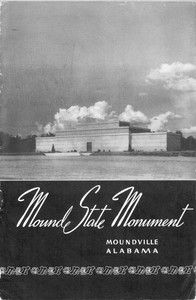
Mound State Monument, Moundville, Alabama
Subjects:
Download Formats:
Excerpt
The Project Gutenberg EBook of Mound State Monument, Moundville, Alabama, by
Alabama Museum of Natural History
This eBook is for the use of anyone anywhere in the United States and most
other parts of the world at no cost and with almost no restrictions
whatsoever. You may copy it, give it away or re-use it under the terms of
the Project Gutenberg License included with this eBook or online at
www.gutenberg.org. If you are not located in the United States, you'll have
to check the laws...
Read the Full Text
— End of Mound State Monument, Moundville, Alabama —
Book Information
- Title
- Mound State Monument, Moundville, Alabama
- Author(s)
- Alabama Museum of Natural History
- Language
- English
- Type
- Text
- Release Date
- April 4, 2019
- Word Count
- 6,674 words
- Library of Congress Classification
- E011
- Bookshelves
- Browsing: Archaeology, Browsing: History - American
- Rights
- Public domain in the USA.