*** START OF THE PROJECT GUTENBERG EBOOK 55149 ***
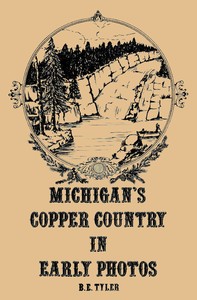
MICHIGAN’S
COPPER COUNTRY
IN
EARLY PHOTOS
BY
B. E. TYLER
[Illustration: Decorative glyph]
L.O.C.—77-71925
S.B.N.—0-912382-21-X
Reprinted 1977
By
[Illustration: BLACK LETTER PRESS
Grand Rapids, Michigan]
Art Work by Robert Nelson
INTRODUCTION TO THE NEW EDITION
History, with all of its ramifications, is a complex subject. Often,
students pursue it with only the written word in hand, in an attempt to
gain a deeper, and more meaningful understanding of it. This is usually
the case because other means of historical relation are not available,
or completely nonexistent. The strict narration of facts is not a
sufficient means alone for broadening one’s knowledge of the past.
Whenever the written word can be complemented with other media, for
example, worthwhile actual photographs, a more complete understanding of
the past is experienced. Literally, a picture is worth a thousand words,
and the student can gain, for himself, a more penetrating insight into
his subject which words alone cannot always provide him.
In publishing _Michigan’s Copper Country In Early Photos_, a pictorial
account of the Copper Country around 1900, the Black Letter Press has
made a more complete understanding of the region possible by
supplementing its written histories with the varied collection of
photographs. The area’s setting, its people, and their work are
portrayed. Originally, the book was published as, _Souvenir of the
Copper Country Upper Peninsula of Michigan_. Copies of this original
work are extremely scarce today.
In his introduction to the original publication, B.E. Tyler, the
publisher, states that the Copper Country is a place of natural beauty,
with the mining of copper from the bowels of the earth as the district’s
major industry. This was written in 1903, and the pictures presented in
the volume’s pages offer supportive evidence to his words. However, time
has moved on, and much has both changed and remained the same in the
Copper Country.
Tyler mentions a picture of the Cliff Mining Camp, and relates that the
work has been abandoned, but, “almost every house that was ever erected
there is standing.” This is no longer true. All structures have been
dismantled, and all that remains of the once proud and fabulous Cliff
mine are a few poor rock piles.
The many gabled, and uniquely constructed Quincy Rock House was to be
found in Hancock, and it was reputed to be the most photographed mine
structure of its kind in the country. It was destroyed by fire in 1956.
The Douglas House, a famous meeting place, and hotel, in Houghton still
remains, although its appearance has been altered, and its surroundings
have changed.
The Kerredge Theater, in Hancock, was completed in 1902, with some seats
costing as much as forty dollars for a single performance. Popular
shows, Shakespearian plays, and operas, were presented on its stage.
Copper mining no longer remains the major industry of the area. Once
where many shafts were sunk deep into the earth, and their rockhouses
lined the horizon, only a few remain today as reminders of a bygone era,
standing as ever vigilant sentinels, guarding what may be left of their
once rich copper deposits. Gone are the giant hoisting machines used to
bring copper ore to the surface. Gone are the miners, who labored hard
by candlelight with simple hand tools, replaced by today’s modern miner
using his battery operated head lamp, and power machinery when work is
available. Only exploratory and experimental work is presently being
conducted in the Copper Country.
One aspect of the Copper Country which remains relatively unchanged is
its rugged natural beauty. The sparkling clear deep blue waters of
chilling Lake Superior still crash upon its rocky tree lined shores. A
green mantle of dense forests covers much of the land, which in places
is wild and mountainous. Water still rushes over spectacular falls as it
flows onward toward the world’s largest fresh water lake. Past and
present residents, and many visitors, have witnessed the scenic
panorama, with some insisting that the climate of the Copper Country has
an exhilarating, and refreshing therapeutic affect upon them.
Suggested reading material on the Copper Country might include the
following titles that are considered to be of more than passing
interest: _Red Metal_, by C. Harry Benedict, _Prehistoric Copper Mining
in the Lake Superior Region_, edited by Roy W. Drier, and Octave J.
DuTemple, _Boom Copper_, by Angus Murdock, and _The Cliff_, by Donald
Chaput. Also of worthwhile reading are such historical novels on the
region as, _Where Copper Is King_, by James Wright, published in 1905,
and, _The Long Winter Ends_, by Newton G. Thomas.
Another beneficial book is, _A True Description of the Lake Superior
Country_, written by John St. John, and originally published in 1846. It
was republished by the Black Letter Press in 1976, and it provides its
readers with a rare and invaluable first hand account of early Copper
Country settings. Of particular interest are the author’s descriptions
of the region’s geologic development, and of the early copper mines.
_Michigan’s Copper Country In Early Photos_ adds a new dimension to the
historiography of the Copper Country, providing in pictures what the
student may not grasp from the written word.
Richard A. Cebelak
Grand Rapids, Michigan
March, 1977
The simple beauty of the Copper Country of Michigan, the vastness of its
enterprises and the activity of its marts are impressive in their very
nature. Their pictures are more pleasing when left unmarred by wordy
descriptions. Scenes may be absorbed and grasped by the eye which no
language can describe.
This book is a simple collection of pictures, characteristic of scenes
which are familiar to those acquainted with the Copper Country. The
effort has been put forth to make it as comprehensive as possible.
The winning of the copper from the earth constitutes the dominant
industry of the district, and is deserving of first place in a
representation of the Copper Country. All features of the industry are
shown—in the depths of the mine; on the surface, where the world’s most
massive machinery furnishes power to actuate the air drills and operate
the hoisting cables; in the mills and smelters, where the metal is
refined into copper bullion; along the wharves, where ships are laden
with the product, to carry it to lower lake ports, whence it is
distributed throughout the world.
Historic points of interest are given. There is a picture of the old
Cliff Mining Camp, one of the earliest, and, in its day, one of the most
populous and prosperous communities in the Upper Peninsula. To-day
almost every house that was ever erected there is standing, most of them
dating back nearly half a century, but the place is deserted—hundreds of
houses with bare walls staring out through bleak windows, and scarcely a
dozen souls to inhabit them. The old mine workings are abandoned for
more profitable deposits of mineral.
Pictures are given which show the natural beauty of the Copper Country.
Pleasing views are so bountifully bestowed by nature that it is a
difficult task to choose the most impressive. But enough are given to
create a taste for more—a taste that can be gratified to its fullest
only by rambling among the vales and hills, through the forests and
along the banks of the quiet streams and the shores of the mighty
Unsalted Sea.
The new South Range is thoroughly pictured. This is the young giant
which in the last five years has forged forward and wrought from the
ground which was the rooting place for an unbroken forest a group of
copper mining camps that stand to-day close rivals to the older camps
which have been half a century in the making.
Such pictures constitute within themselves a story of beauty, power and
pathos which no words can enhance. Those responsible for the book have
drawn from its preparation a wealth of pleasure. Courtesies have been
extended from all sources, in recompense for which the sincerest
expression of appreciation is now extended. May those into whose hands
the book shall come glean from it all the subtle meaning and all the
stirring thoughts which its pictures are capable of inspiring. It will
then be an epic, indeed—a poem, a song, a burst of harmony beyond the
power of words to utter.
B. E. Tyler,
Publisher,
Houghton, Mich.
Copyright, 1903, by B. E. Tyler, Houghton, Mich.
[Illustration: Houghton 1897]
[Illustration: ASSAYERS MICHIGAN COLLEGE OF MINES.]
[Illustration: HOTEL DEE, HOUGHTON, MICH.]
[Illustration: SHELDEN-DEE BUILDING, HOUGHTON, MICH.]
[Illustration: MICHIGAN COLLEGE OF MINES, HOUGHTON, MICH.]
[Illustration: DOUGLAS HOUSE, HOUGHTON, MICH.]
[Illustration: A. Haas Brewing Co.
Houghton.]
[Illustration: National Bank of Houghton]
[Illustration: Quincy Rock House]
[Illustration: _Hancock from Portage Lake_]
[Illustration: _Calumet & Hecla Mine_]
[Illustration: _Lake Linden_]
[Illustration: _Portage Lake_]
[Illustration: Paine Memorial Library
Painesdale.]
[Illustration: Freda Park, Copper Range]
[Illustration: _Trimountain Mine
Copper Range R.R._]
[Illustration: QUINCY SMELTERS, HANCOCK]
[Illustration: CHAMPION MILL ON COPPER RANGE R.R.]
[Illustration: Students - M.C.M.
Isle Royale Mine, Houghton.]
[Illustration: Quincy Mine.
GOING UNDER GROUND.]
[Illustration: N.Y. Cent. Boat Unloading at
Copper Range R.R. Dock]
[Illustration: Winter]
[Illustration: Company G 3^rd Rg. Mich. Nat. Guards
Houghton.]
[Illustration: Rock House
Quincy Mine]
[Illustration: Divers at Work
Trimountain Intake, L. S.]
[Illustration: Quincy Hill]
[Illustration: Coal Hoist
Copper Range R.R.]
[Illustration: Michigan College Mines
Houghton]
[Illustration: TRIMOUNTAIN MILL on COPPER RANGE R.R.]
[Illustration: Lake Superior Foxes]
[Illustration: Hodge Foundry]
[Illustration: Underground
Champion Mine]
[Illustration: Mill Mine Jct.
Copper Range R.R.]
[Illustration: Five Million Pounds of Copper Ready for Shipment,
Houghton, Mich.]
[Illustration: Mining Students
Underground]
[Illustration: Public School Bl’g’s
Hancock.]
[Illustration: Catch of Fish]
[Illustration: Baltic
on
COPPER RANGE R.R.]
[Illustration: Baltic Mine
Copper Range R.R.]
[Illustration: Excursion
Copper Range R.R.]
[Illustration: Quincy Stamp Mill]
[Illustration: Timbermen
Champion Mine]
[Illustration: TIONESTA]
[Illustration: Trammers
Baltic Mine]
[Illustration: Lower Falls
FIRE STEEL RIVER
Copper Range R.R.]
[Illustration: STANLEY G. WIGHT, President. C. M. GARRISON, Sec.
& Treas.
This mass of pure Copper, weighing about 6,000 lbs., was found upon
the property of the Minong Mining Company situated at McCargo Cove,
on Isle Royal, L. S. It was taken from an ancient mine Pit 16½ feet
deep, and is just as discovered, showing ancient stone hammer
marks.]
[Illustration: Oseeola Stamp Mill]
[Illustration: Freda Park]
[Illustration: ATLANTIC MINE
ATLANTIC]
[Illustration: Cliff Mine.
Oldest Mine on Lake Superior]
[Illustration: FIRE STEEL RIVER
COPPER RANGE R.R.]
[Illustration: TRIMOUNTAIN MILL ON COPPER RANGE R.R.]
[Illustration: RIPLEY FALLS]
[Illustration: Hoist
Champion Mine]
[Illustration: -Storm- Freda Park
Copper Range R.R.]
[Illustration: CHAMPION MILL
COPPER RANGE R.R.]
[Illustration: CHICAGO, MILWAUKEE & ST. PAUL RAILWAY, RUNNING IN
CONNECTION WITH COPPER RANGE RAILROAD.]
[Illustration: MOHAWK AND WOLVERINE STAMP MILLS.]
[Illustration: _C. & H. Smelting Wks._]
[Illustration: U.S. SHIP CANAL
Lake Superior]
[Illustration: PROFILE ROCK
C.R.R.R.]
[Illustration: Hancock Fire Dept.]
[Illustration: Tamarack Mill “New”]
[Illustration: Quincy Street
Hancock.]
[Illustration: DOLLAR BAY DOCK]
[Illustration: QUINCY COAL DOCK]
[Illustration: “Jumbo”
Hoist C. & H. mine
CALUMET.]
[Illustration: HOUGHTON FIRE DEPT.]
[Illustration: Underground Trolly
Quincy Mine]
[Illustration: “The Swing”
—Freda Park—]
[Illustration: KERREDGE THEATRE]
[Illustration: Construction Work.
Copper Range R.R.]
[Illustration: Catholic Hospital
Hancock]
[Illustration: Isle Royale Hoist]
[Illustration: Adventure Mill
COPPER RANGE R.R.]
[Illustration: “GRAYLING” OTTER RIVER—COPPER RANGE R.R.—TYLER—]
[Illustration: Tables
Champion Mill]
[Illustration: UPPER SECTION HUNGARIAN FALLS]
[Illustration: Redridge Dam
C.R.R.R.]
[Illustration: S.S. Northwest.]
[Illustration: —Citizens National Bank—
Houghton.]
[Illustration: —Baltic Mill—
COPPER RANGE R.R.—TYLER]
[Illustration: _LAKE ROWLAND
C.R.R.R._]
[Illustration: Tamarack Stamp Mill.]
[Illustration: AGATE BEACH—FREDA PARK]
[Illustration: —Picnic—
Freda Park]
[Illustration: Amphidrome.
Houghton.]
[Illustration: Red Jacket Shaft, Calumet. Mich.,
Deepest Vertical Shaft in the World.
Over 6,000 feet deep.]
[Illustration: TRIMOUNTAIN MILL ON COPPER RANGE R.R.]
[Illustration: Quincy Stamp Mill]
[Illustration: Fishing Party
Houghton]
[Illustration: STORM—LAKE SUPERIOR]
[Illustration: THE DAILY MINING GAZETTE
W. R. DASKAN & CO. HARDWARE POST OFFICE]
[Illustration: Paine Memorial Library
Paine]
[Illustration: Hungarian Falls
Copper Range R.R.]
[Illustration: CHAMPION MINE
C.R.R.R.]
OTHER AVAILABLE REPRINTS FROM THE AWARD WINNING BLACK LETTER PRESS
Altrocchi, J.C.—Wolves Against The Moon. (Great Lakes Fur Trade Novel)
752 pp. Map end papers. $13.95
Ballard, J.Z.—The Indian Captivity, or The Long Lost Jackson Boy.
(Jackson, Mich.). 112pp. Illus. Wraps. $2.95
Butterfield, C.W.—Brule’s Discoveries & Explorations. 186pp. Illus.
Wraps. $3.75
Cook, S.F.—Drummond Island. The Story of the British Occupation.
142pp. Illus. Folding map. Wraps. $3.75
Dadd, B.—Great Trans-Continental Railroad Guide. 1869. Illus. new
reprint. 244pp. Wraps. $3.95
Grover, F.R.—A Brief Hist. of Les Cheneaux Islands. Reprint of the
original edition. 140pp. Illus. Wraps. $2.95
Harwood—Early Stories of the Great Lakes. Wraps. 185 pp. Illus. $5.25
Husband, J.—The History of the Pullman Car. 161pp. Illus. Cloth. d/j.
$9.95
Inglis, J.G.—Northern Mich. Handbook for Travelers. 1898. Reprint Ed.
188pp. Maps & Photos. $3.75
Jennings, C.B.—The Grand Rapids Fire Dept. 1889. Well Illus. Five
color cover. Wraps. 80pp. $3.95
Johnson, I.A.—The Michigan Fur Trade. 1634-1850. With new
introduction. 201pp. Cloth. $9.95
Kane, G.F.—Myths & Legends of the Mackinacs and the Lake Region. 159
pp. Illus. New Reprint. $3.75
Livingston, L.R.—From Coast to Coast with Jack London. 135pp. Illus.
Cloth. D/J. $6.00
Newton, S.—Mackinac Island & Sault Ste. Marie. 188 pp. Illus. Wraps.
$5.25
Newton, S.—The Story of Saulte Ste. Marie and Chippewa County Mich.
200pp. Illus. Wraps. $5.25. Cloth. $9.95
St. John, John—A True Description of the Lake Superior Country.—Cloth.
Maps in Pocket. 118 pp. $10.95
Tuttle, C.R.—History of Grand Rapids, Mich. 1874. Reprint of 1st Hist.
of G.R. 156pp. Early Ads. Wraps. $3.75
VanFleet, J.A.—Summer Resorts of the Mackinaw Region, Etc. 1882.
Illus. 50pp. Wraps. $2.75
White, J.E.—Railway Mail Service a Hist. Of. 1910. Limited Ed.
Reprint. Numbered. Cloth. 312pp. Illus. $10.95
_Dealers send for discount schedule & Catalog_
Transcriber’s Notes
—Retained publication information from the printed edition: this eBook
is public-domain in the country of publication.
—Silently corrected a few palpable typos.
—Transcribed handwritten in-photo captions.
—In the HTML version, added page numbers for convenient reference.
—In the text versions only, text in italics is delimited by
_underscores_.
End of the Project Gutenberg EBook of Michigan's Copper Country in Early
Photos, by B. E. Tyler
*** END OF THE PROJECT GUTENBERG EBOOK 55149 ***
Excerpt
MICHIGAN’S
COPPER COUNTRY
IN
EARLY PHOTOS
L.O.C.—77-71925
S.B.N.—0-912382-21-X
Reprinted 1977
By
[Illustration: BLACK LETTER PRESS
Grand Rapids, Michigan]
History, with all of its ramifications, is a complex subject. Often,
students pursue it with only the written word in hand, in an attempt to
gain a deeper, and more...
Read the Full Text
— End of Michigan's Copper Country in Early Photos —
Book Information
- Title
- Michigan's Copper Country in Early Photos
- Author(s)
- Tyler, B. E.
- Language
- English
- Type
- Text
- Release Date
- July 19, 2017
- Word Count
- 2,372 words
- Library of Congress Classification
- F516
- Bookshelves
- Browsing: History - American, Browsing: History - General
- Rights
- Public domain in the USA.