The Project Gutenberg EBook of Memorandum to the Government of the United
States on the Recognition of the Ukrainian People's Republic, by Julian Batchinsky
This eBook is for the use of anyone anywhere at no cost and with
almost no restrictions whatsoever. You may copy it, give it away or
re-use it under the terms of the Project Gutenberg License included
with this eBook or online at www.gutenberg.org
Title: Memorandum to the Government of the United States on the Recognition of the Ukrainian People's Republic
Author: Julian Batchinsky
Release Date: August 27, 2010 [EBook #33551]
Language: English
Character set encoding: ISO-8859-1
*** START OF THIS PROJECT GUTENBERG EBOOK RECOGNITION OF UKRAINIAN PEOPLE'S REP. ***
Produced by The Online Distributed Proofreading Team at
https://www.pgdp.net (This file was produced from images
generously made available by The Internet Archive/American
Libraries.)
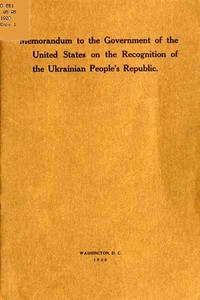
Memorandum to the Government of the
United States on the Recognition of
the Ukrainian People's Republic.
1920
PUBLISHED BY
FRIENDS OF UKRAINE
345 MUNSEY BUILDING
WASHINGTON, D.C.
[Illustration: Map of Ukraine]
UKRAINIAN MISSION
WASHINGTON, D.C.
May 12, 1920.
The Honorable, The Secretary of State,
Department of State, Washington.
Sir:
In view of the present status in eastern Europe, and in deference
to the unsettled affairs of the territory of the former Russian
empire, which are now pressing for a definite solution, I, as the
representative of the Government of the Ukrainian People's Republic,
conceive it to be my duty to submit for your consideration this
memorandum setting forth the just claims of the Ukrainian people to
political and economic independence. As a consequence of the facts
herein explained, I respectfully ask the Government of the United
States of America to extend recognition to the Ukrainian People's
Republic as a free state.
The national aspirations of Ukraine embrace political liberation for
all Ukrainians, consolidation of all free Ukrainians into one state,
the erection of a constitutional democratic republic, and economic
co-operation with neighboring and other states.
Ukraine's claim to independence is based upon the following principal
grounds:
(1) The existence of the Ukrainians as a well-defined, separate,
group-conscious race, with a continuous historic and cultural
tradition;
(2) Their occupation, over a period of centuries, of the lands where
they now dwell;
(3) Their age-long efforts, increasingly of popular origin, to achieve
and maintain political independence;
(4) The obvious interest and desire of the entire Ukrainian population
to organize and sustain its economic life free of exploitation by
neighbors and foreign powers; and
(5) The crying need for a new order in eastern Europe, and the
permanent elimination of the historic struggle between Poland and
Russia to control the natural resources of Ukraine.
By all the canons of ethnology and history, the Ukrainians form a
distinct racial unit. In America there has been a popular impression
that Ukraine is merely a province of Russia, identified with it
linguistically and racially. This is a misapprehension. The leading
anthropologists, even among the Russians, agree that the Ukrainians
constitute a physical type clearly different from the Great Russians,
the White Ruthenians or the Poles. In culture and temperament they
display peculiarities which permeate their whole social and moral
nature. Their language is a separate Slavic tongue, and not merely a
dialect of the Great Russian.
"Between Ukrainians and Russians," says Sir Donald Mackenzie Wallace, a
learned student of Russia, "there are profound differences of language,
customs, traditions, domestic arrangements, mode of life and communal
organizations. Indeed, if I did not fear to ruffle unnecessarily the
patriotic susceptibilities of my Great Russian friends who have a pet
theory, I should say that we have here two distinct nationalities...."
"The historic development," says the official statement of the Russian
Imperial Academy of Sciences, "contributed toward the creation of two
nationalities: the Great Russian and the Ukrainian. The historic life
of the two peoples failed to develop a common language for them. On the
contrary, it really strengthened those dialectic variances with which
the ancestors of the Ukrainians, on the one hand, and those of the
Great Russians, on the other, made their appearance in history. And, of
course, the living Great Russian idiom, as it is spoken by the people
of Moscow, Riazan, Archangel, Yaroslavl or Novgorod cannot be called a
'Pan-Russian' language as opposed to the Ukrainian of Poltava, Kiev or
Lviv (Lemberg)."
The Ukrainian race is as nearly autochthonous as any in central or
eastern Europe. A brief survey of history shows that, for more than one
thousand years, the Ukrainians and their forbears have continued to
occupy approximately the same lands which they now inhabit, except for
temporary recessions and re-colonizations caused by Mongol invasions.
In the ninth century they were already settled in the vast and fertile
plains and woodlands lying between the Carpathian Mountains and the Sea
of Azov, and embracing the valleys of the Dniester, Pruth, Boh, Dnieper
and Donetz.
Organized government in Ukraine began with the ancient state of Kiev.
The ascendancy of Kiev also marks the period of Ukraine's greatest
political expansion. From the ninth to the thirteenth century, Kiev was
the center of the economic, intellectual and political life of eastern
Europe, uniting the entire ethnographic Ukrainian territories. The name
by which this state was known was "Russ," taken from the name of the
reigning dynasty. This term was later appropriated by the Great
Russians. "Because of the Byzantine commerce, learning and craft,"
observes the Polish historian Zakrzewski, "Kiev, the 'mother of Russ
cities,' was for the Poland of the eleventh and twelfth centuries what
Rome had been for earlier Germans." The French geographer Reclus
notices that academies flourished at Kiev and Ostrog before the Great
Russians owned a single high school, and draws attention to the fact
that Russia, during the regenerative period of Peter the Great,
received her teachers from Ukraine.
The fall of Kiev and Ukraine's subsequent loss of autonomous statehood
in the fourteenth century can only be ascribed to the old system of
military conquest. The affairs of eastern Ukraine became confused and
decadent through the constant Mongol pressure which began in the
thirteenth century. One hundred years later, part of western Ukraine
also, weakened by frequent Tatar invasions, fell a prey to Poland, to
whom she was a tempting prize because of her rich soil.
The Polish conquest of Ukraine started in 1340 and, after thirty-five
years of the bitterest warfare, the Poles succeeded in annexing an area
of land approximately coextensive with the present provinces of Kholm
and Eastern Galicia. This they never succeeded in assimilating, in
spite of the most tremendous efforts. Simultaneously Volhynia and other
northern Ukrainian territories became confederated with Lithuania in
order to gain protection against the Tatars. The marriage of the
Lithuanian king to the Queen of Poland and the union of the two realms
drew these Ukrainian lands also in 1386 into an informal union with the
Polish empire which, in 1569, in spite of Ukrainian protests, was made
definite, and lasted until 1648.
In that year the whole Ukrainian people rose, under the leadership of
Bohdan Khmelnitsky, and put an end to this union, which was
incompatible with their interests and with their type of civilization.
Then, anticipating further Polish efforts to destroy the newly won
independence of Ukraine, and menaced by other foes, particularly the
Turks, then the strongest military power in eastern Europe, the
Ukrainians concluded an agreement of confederation with the Czar of
Muscovy in 1654. It is interesting to recall that Khmelnitsky was
expressly advised against this step by Oliver Cromwell, who declared
that the Czar would never permanently recognize a free people.
The most important clauses in the treaty of 1654 guaranteed a freely
chosen supreme head for the Ukrainian state, called a "hetman"; the
right to engage in diplomatic relations with other states, except
Poland and Turkey, when the cognizance of the Czar was necessary; free
trade with all foreign nations; the complete independence of the
judicial system; the right to choose a leader for the army, over whom
the "hetman" had supreme control; and, lastly, the independence of the
Ukrainian Church.
Muscovy did not live up to these terms, and the result was a succession
of Ukrainian uprisings, directed now against Russia just as they had
formerly been aimed at Poland. In the last quarter of the seventeenth
century, Russia and Poland made common cause and partitioned Ukraine,
making the Dnieper the frontier between their two empires. The most
important rebellion against this last measure was that led by Mazeppa
in 1709, which was quelled by Peter the Great. After the time of
Mazeppa, Russia's policy of repression was pursued openly and
ruthlessly. Peter instituted a supervision over the autonomous
Ukrainian administration, vesting authority in Muscovite officers,
through whose hands passed everything pertaining to the hetman's
chancellery. In 1722 the power of the hetmans was cut down to nothing.
In 1764 Catherine II. abolished the office altogether.
Meanwhile, in order to assure possession of Ukraine, the Russian
government was making every effort to assimilate the Ukrainian people.
One step toward accomplishing this was the suppression of Ukrainian
literature. In 1720 a special censorship over the publication of
Ukrainian books was established in Kiev. In 1769 even the printing of
Ukrainian primers was forbidden, and Russian text-books were introduced
in spite of the protests of Ukrainian educators.
Step by step, national feeling was stifled in Ukraine. In 1775, the
"Zaporogian Sitch," the last bulwark of Ukraine's autonomy, and the
basis of the Ukrainian Army, was destroyed. In 1783 the peasants of
Ukraine, free since 1648, when they had thrown off Polish domination,
were again subjected by the Russian government to serfdom in its most
cruel form. Hundreds of thousands of free peasants and Cossacks,
together with millions of acres of Ukrainian land, were distributed
among the favorites of Catherine II.
This measure had the effect of crushing the resistance to Russification
among the Ukrainian nobility, and estranged them from the common
people. The serfdom of the small farmer was so profitable for the
gentry that the preponderance of the aristocracy became superficially
Russian. Under pressure of Russian schooling, administration and
military service, they adopted the Russian language and political
ideas. To achieve this desirable result, the Muscovite government did
not hesitate to persecute ruthlessly anything that could be held as a
reminder of the republican régime in Ukraine. At the same time, an
analogous Polonization of the upper classes was being carried out in
western Ukraine. The last quarter of the century witnessed a temporary
eclipse of the Ukrainian spirit of nationalism.
The French Revolution released forces that had been imprisoned in the
hearts and minds of the people. A wave of nationalistic feeling swept
through Europe, bringing inspiration to the Slavs as well as to their
western brothers. Every branch of the Slavic race awoke to a
realization of its history, its traditions and its great men. The
Ukrainians shared in this renaissance. Between the revived nationalism
and the spirit of democracy a natural alliance presently sprang up.
Especially in the Dnieper district, there began an enthusiastic study
of the country's history, and a perusal of old documents and popular
traditions. The keenest interest was manifested in everything
pertaining to ethnography, philology and popular culture. It was the
tardy recognition of the people as guardians of national culture which
did much to break down the lack of sympathy which had so long prevailed
between the nobles and the lower classes.
But the Ukrainian movement was confronted by a bitterly hostile
Russophile bureaucracy. It is remarkable that Russo-Ukrainian policies
should have remained so static from the time of Peter the Great onward,
while a number of changes were taking place in Russo-Polish relations.
Yet such was the case. The Ukrainian language was restricted time and
again. Ukrainian economic life was hampered in several ways. The
Ukrainian serfs, upon their liberation in 1861, had been granted
smaller allotments than the Russian serfs. This resulted in
overpopulation of the agricultural districts, emigration and a high
death rate. The lack of schools made remote the possibility of
improving farming methods. Ukrainian industry suffered a set-back
through the unfavorable tariff policies adhered to by the Russian
government and by the fact that no banks, except those with central
offices in Moscow or Petrograd, were allowed to establish branches in
Ukraine.
Nevertheless, the nineteenth century witnessed a notable growth of
Ukrainian national feeling. The early years of the century constitute
the period of literary rebirth. Then followed the educational work
among the common people. Private schools were organized, and pamphlets
and books were distributed. Cultural organizations were formed, and a
pronounced interest in science was displayed. This entire revival so
alarmed the Russian government that, in 1878, the Czar prohibited by
ukase almost all publications in the Ukrainian language. Still, the
literary impulse was not suppressed. It transferred itself to Eastern
Galicia and Switzerland and, in spite of grave obstacles, succeeded in
winning for the Ukrainian a worthy place among Slavonic literatures.
Side by side with the cultural advance, a political reawakening of the
Ukrainian people was taking place. It was appreciated by the Ukrainians
that political liberty for their land and race was expressly
conditioned upon the overthrow of the Czarist government. Accordingly
they bent their efforts in that direction. Ukrainians organized and
took a leading part in the Decembrist uprising of 1825. In the
subsequent revolutionary movement they were again prominent, and
two-thirds of the leaders were natives of Ukraine. The events of March,
1917, were largely made possible by the Ukrainian regiments stationed
in Petrograd, who refused any further allegiance to the Romanovs and
became supporters of the newly created authorities. Later on, the
Ukrainians were the first of the subject nations of the Russian empire
to organize their own government. On November 20, 1917, Ukraine was
proclaimed an independent nation by the Central Rada, the provisional
Ukrainian parliament. The struggle to win recognition for this
independence is still in progress.
The expediency of Ukraine's claim to exist as a self-governing nation
does not, however, rest merely upon racial, ethnological and historical
bases. There are primary economic considerations which press for its
admittance to the circle of free nations.
The Ukrainian people inhabit a land 330,000 square miles in extent,
with a population of 45,000,000. This territory is not merely
abundantly self-supporting, but is, in fact, one of the richest areas
on the earth's surface. Four-fifths of the entire extent lie within a
belt of deep, black earth, which produces bounteous crops of wheat,
barley, rye, oats, sugar-beets, fruit, tobacco and vegetables. Under the
Ukrainian ethnographic territory lie mineral riches: coal, petroleum,
iron, manganese, salt, phosphate, kaolin, graphite and many other
substances of commercial value.
In the normal pre-war period, Ukraine used to supply about 5,000,000
tons of grain for export annually. Most of this was wheat. The last
three years, particularly 1919, have seen good harvests in Ukraine. At
the present moment, when western Europe is unable to feed herself,
Ukraine has an excess remaining from the crops of 1917, 1918 and 1919,
to an amount of not less than 10,000,000 tons of different kinds of
grain. Besides this, the country can guarantee a minimum yearly export
of 300,000 to 600,000 tons of sugar; 9,000 tons of tobacco; 17,000 tons
of sugar-beet seeds; and 10,000 tons of flax and hemp yarn. Besides
these products, Ukraine used to export annually before the war: 65,000
tons of eggs; 6,500 tons of raw hides; 12,000 tons of pork and dressed
poultry; 9,000 tons of beef; 240,000 head of beef cattle; 15,000 head
of horses; 130,000 hogs; and large quantities of wool, feathers and
hops.
In minerals, Ukraine may export in a short time as much as 100,000 tons
of manganese ore annually; 500,000 tons of iron ore; and considerable
amounts of phosphates, salt and soda. With reorganization of
transportational facilities, she can furnish from 6,000,000 to
10,000,000 tons of coal and coke, as well as benzol toluol, anthracen
phenol, naphthalin and other valuable coal tar derivatives; about
90,000 tons of coal tar; sulphuric acid, ammonium salts and many other
raw and semi-manufactured products.
The preceding enumeration of the physical resources of Ukraine shows
how mistaken is the conception that Ukraine could not maintain an
economic existence independent of Russia. If a country possessing such
extraordinary natural advantages and wealth as Ukraine cannot stand
alone, how can one justify the independence of Italy, Greece, Poland,
Jugoslavia, Finland and other European nations whose right to autonomy
is not questioned, but whose natural endowments are far less favorable
to economic freedom.
The converse of the same proposition; viz., that Russia cannot live
without Ukraine, will not survive impartial criticism. Although it is
quite clear that, in reasoning to this end, other interests than those
of Ukraine supervene, it is nevertheless worth while to examine this
point of view in order to expose its falsity.
The three fundamental bases of opposition usually advanced are: (1)
Ukraine is the granary of Russia and is necessary to Russia for a large
part of her food supply; (2) Ukraine separates Russia from the Black
Sea and Sea of Azov, thereby closing the outlet to the Mediterranean;
(3) Ukraine possesses a supply of coal and iron which is necessary to
Russia.
The first objection is refuted by an examination of statistics. Figures
for the years previous to the war show consistently that Ukraine's
exportations of cereals to other parts of the Russian empire did not
reach more than 10 to 15% of her total export; i.e., about 36,000,000
bushels annually. Nearly all of this was destined for Poland, Lithuania
and White Ruthenia. Russia proper never consumed more than a very small
fraction of Ukraine's grain. She did not need it then and will not need
it in the future. She is virtually self-sustaining in cereals, and the
small surplus needed can readily be obtained from the fields of Siberia
and the region of the Volga.
The second allegation, that Russia needs the Ukrainian ports on the
Black Sea and the Sea of Azov, is readily disposed of by a reference to
Russian maritime experience. The official Russian statistics of the
traffic of merchandise by rail show no southern port which served as an
outlet for the products of the territories situated north of the ethnic
frontier of Ukraine, with the single exception of Rostov-on-the-Don.
Novorosseysk was the port used by the Ukrainian Cossacks of Kuban and
the northern Caucasus. Up to the present time, Russia proper has
depended almost exclusively upon the Baltic ports. By special treaties
with the new Baltic states, Russia is assuring herself a continued use
of their ports. There is no reason why, if it should appear necessary
and advisable, a similar conciliatory agreement with Ukraine could not
arrange for a common use of the Black Sea ports.
With regard to Ukraine's coal resources, it is true that the Donetz
basin furnished 70% of the total coal output of the former Russian
empire, and the Donetz basin is mostly within the ethnographic limits
of Ukraine. But it is also a fact that four-fifths of this coal was
consumed in Ukraine itself, and that northwestern Russia and the Baltic
provinces never used the coal from the Donetz basin, because it could
not compete in price with English or German coal. Furthermore, northern
and central Russia are well supplied with wood and peat, and with coal
from the vicinity of Moscow. Ukraine has very little wood or peat, and
the exhaustion of the Donetz basin for the sake of Russian industries
would leave her without fuel resources. The Urals and Siberia, too, are
supplied with local coal, while in the Kuznetsky district in west
Siberia are vast deposits, scarcely worked as yet because of the lack
of railway lines into Siberia.
The iron fields of the Urals and of other provinces of Russia proper
have not been extensively exploited, and before the war Ukraine did
indeed furnish three-fourths of all the iron supply of the former
Russian empire. But the beds of iron ore in Ukraine are not very large,
and it would be erroneous to assume that they could adequately supply
the needs of all Russia for any long period of time. In any case, it is
safe to conclude that, if the metallurgical development of Russia is
continued and her mines consistently worked, she will be entirely able
to get along without iron imports from Ukraine.
Finally, there is no obstacle to permanent economic co-operation of
Ukraine and Russia, and brisk commercial dealings between the two
independent states. But political disentanglement is a first requisite.
The richness of Ukraine has always made it a tempting region for
exploitation by neighboring states. This is more than ever true today.
If such exploitation is not to be carried on at the expense of and to
the detriment of the Ukrainian people, a separate state organization is
necessary to assume protection over their economic interests.
It cannot be too strongly emphasized that a free Ukraine does not imply
an economically isolated Ukraine. Constant traffic with friendly
foreign powers is desired by all the Ukrainian political parties.
Ukraine lacks machinery, capital and trained experts. The railroad
question is of enormous importance. Before the Revolution, all of the
rail lines of Ukraine yielded considerable profits, especially those
known as the Southwestern Railroads. But Russia did not see fit to use
this income in the construction of further roads and, as a result,
Ukraine possesses a very inconsiderable network of railroads: only
about 11,115 miles. This is much less than the country needs. The war
almost completely wrecked and demoralized even this inadequate
transportational system. The railroads must be rebuilt, and the
insufficiently developed public highways must be improved and extended.
The regulation of navigable rivers is another matter of great
importance, and the vast available power possibilities of the rapids of
the Dnieper and other streams must be exploited. Central power stations
must be erected, new methods introduced in mining, grain elevators
built and agriculture, milling, sugar refining and other industries
given an upward impetus by the application of scientific management and
fresh capital.
Inability to contest the force of the foregoing historic and economic
considerations has led certain foes of Ukrainian independence to make
the assertion that the Ukrainian national movement is artificially
stimulated and does not receive support from the masses of the
population. This contention is controverted by the most obvious facts.
For more than two years the Ukrainians have been actively fighting for
their liberty, in spite of almost incredible obstacles. They have had
no support from any foreign source in this struggle; they were attacked
at one and the same time by the Bolsheviki and anti-Bolsheviki: they
were blockaded; they were unable to secure ammunition or sanitary
supplies. They did not give up, because they realized that the question
was one of life or death. No other nation in modern times has fought
for its independence under such difficult circumstances, and none has
expressed its desire for freedom more strongly. The plebiscite of blood
is the most sincere evidence of the will to self-determination.
However, prolonged and stubborn fighting has not been the only way in
which the Ukrainian people have shown their desire to be free. They
have had several opportunities to manifest their wish in a more
peaceful and regular manner. Thus, the Central Rada, which represented
all classes of Ukrainians, and included in addition representatives of
the various non-Ukrainian nationalities in the land, proclaimed
Ukraine's independence in 1917. When, in December of the same year, the
Bolshevik propagandists questioned the representative character of the
Central Rada, a general congress of the workers and peasants of Ukraine
was called, and this congress, chosen after the Bolshevik method, made
haste to affirm its support of the Central Rada by a vote of 2,000 to
70. There was also in 1917 a formal election of deputies to the
All-Russian Constituent Assembly. Ukraine elected 230 deputies in all.
Of those, 75% or 175 members, were Ukrainian nationalists.
After the overthrow of the pro-German Hetman Skoropadsky in 1918, and
assumption of authority by the Directorate, even the Ukrainian
communists declared themselves in favor of a free Ukraine and protested
to the Russian Soviet Government against its proposed invasion. Their
protest went unheeded, and when the Russian Bolsheviki occupied Kiev
and endeavored to impose their system upon Ukraine, they found no
Ukrainians who were willing to co-operate with them. The result was a
so-called "Ukrainian Soviet Government," which is in reality anything
but Ukrainian. The head is a Roumanian, Rakovsky, and the régime is
nothing but a local agency of the Moscow government.
It is noteworthy that the Government of the Ukrainian People's
Republic, headed by General Petlura, which I have the honor to
represent, is the only government which the Ukrainian people have been
willing to support. On the other hand, they have revolted against all
foreign invaders who have attempted to impose their own rule upon the
Ukrainians. The Germans, the Bolsheviki and the forces of General
Denikin all met with vigorous resistance. If now the Polish forces are
in Ukraine and the population does not oppose them, it is because the
Poles are acting in conjunction with the Ukrainian forces under
Petlura, as their allies.
It is also necessary to consider the opinion entertained in some
circles that an independent Ukraine must inevitably fall under the
influence of Germany and become a German outpost in eastern Europe. The
reason generally advanced as a basis for this suspicion is that Ukraine
concluded a separate peace with Germany in February, 1918, at Brest
Litovsk. In this connection, it should be remembered that Roumania,
too, concluded a separate peace with Germany. Yet Roumania has
continued to be considered an ally of Germany's opponents, and it is
everywhere recognized that she only negotiated with Germany because of
the bitter fact that she was forced to do so. Ukraine was in far worse
condition than Roumania when she concluded her peace with Germany.
Roumania had at least an organized state and a loyal army. Ukraine's
government was in its infancy, its state organization was slight, and
its army consisted chiefly of the remnants of the demoralized Russian
forces. The Ukrainian leaders were faced by several wars; on the one
hand by the war with Germany, Austria-Hungary, Turkey and Bulgaria; and
now on the other, by the new conflict with the Russian Soviet
Government. Under the circumstances, Ukraine had to choose between
submitting entirely to the Bolsheviki, in which case the country would
be over-run by Germans anyway, or making any kind of outright peace
with Germany and then hoping for the best.
Subsequent events proved that Germany never had any interest in a
permanently independent Ukraine. Toward the end of the war, she was in
desperate need of foodstuffs. Today she wants, not merely foods, but
also a new and fruitful field for banking, commercial exploitation and
the sale of German goods. Germany has grown to consider eastern Europe
as a natural market for her products. What she wants is a Greater
Russia, whether it be Czarist, Bolshevist or Constitutional. Under the
circumstances, it is more plausible to suspect the Germans of plotting
to re-establish "Russia, one and indivisible," than to regard them as
friendly to a free Ukraine.
At the present moment, the recognition of the Ukrainian People's
Republic is a matter of international expediency, because there can be
no peace in eastern Europe as long as Ukraine is subjected to any
neighboring nation. Proposals to deal with the Ukrainian people as if
they had no moral right to self-determination are an obvious
contradiction to the principles enunciated by President Wilson at the
time of America's entrance into the war against Germany and her allies.
The attempt to carry them into effect can only result in continued
unrest in eastern Europe. The relegation of all Ukraine to Russia would
mean at best the arbitrary compulsion of the Ukrainians to a federation
which, if advisable, should come at their own instance and of their own
free will; not because of outside pressure. At worst, it would renew
their servitude. The partition of the country between Poland and Russia
will not only produce continued restlessness and discontent within
Ukraine itself, but will also continuously tempt Poland and Russia to
make war on one another, in order to extend their respective spheres of
influence. An independent Ukrainian state, on the contrary, would
establish a balance of power in eastern Europe, which must be regarded
as the surest guarantee of peace in that portion of the world.
The foregoing statement covers, in outline form, the main grounds upon
which Ukraine bases her claim to independence. This memorandum is
presented to you, Mr. Secretary, in the hope that the Ukrainian
situation will be thoroughly examined, and it is my earnest belief that
a careful study of Ukrainian affairs will sustain the request for
recognition of the Ukrainian People's Republic which I have the honor
herewith to submit.
I am, my dear Sir,
Your very obedient servant,
JULIAN BATCHINSKY,
_Diplomatic Representative of the Ukrainian People's Republic_.
OTHER PAMPHLETS PUBLISHED
BY
THE FRIENDS OF UKRAINE
1. Bolshevism and Ukraine. Two cents.
2. Ukraine, Poland and Russia and the Right of the Free Disposition of
Peoples. By S. Shelukhin. Ten cents.
3. Protest of the Ukrainian Republic to the United States Against the
Delivery of Eastern Galicia to Polish Domination. Ten cents.
4. The Jewish Pogroms in Ukraine. By Julian Batchinsky, Israel Zangwill
and others. Ten cents.
5. Ukraine and Russia. By Woldemar Timoshenko, Vice Director of the
Economic Institute at the Academy of Sciences of Ukraine. Ten cents.
6. What About Ukraine? Editorials of New Orleans Times-Picayune, N.Y.
Times and N.Y. Tribune. Five cents.
7. Trade With Ukraine. Ukraine's Natural Wealth, Needs and Commercial
Opportunities: The Ukrainian Co-operative Societies and Their
Influence. By Emil Revyuk. Ten cents.
8. Inhuman Blockade Strangling a Nation. Letters and Messages from
Stricken Ukraine. Ten cents.
9. Ukraine and the Ukrainians. A Handbook of Concise Information
Regarding the Country, People, History and Industry of Ukraine. By Emil
Revyuk. Ten cents.
Address all communications to
FRIENDS OF UKRAINE
345 Munsey Building :: :: :: Washington, D.C.
End of the Project Gutenberg EBook of Memorandum to the Government of the
United States on the Recognition of the Ukrainian People's Republic, by Julian Batchinsky
*** END OF THIS PROJECT GUTENBERG EBOOK RECOGNITION OF UKRAINIAN PEOPLE'S REP. ***
***** This file should be named 33551-8.txt or 33551-8.zip *****
This and all associated files of various formats will be found in:
https://www.gutenberg.org/3/3/5/5/33551/
Produced by The Online Distributed Proofreading Team at
https://www.pgdp.net (This file was produced from images
generously made available by The Internet Archive/American
Libraries.)
Updated editions will replace the previous one--the old editions
will be renamed.
Creating the works from public domain print editions means that no
one owns a United States copyright in these works, so the Foundation
(and you!) can copy and distribute it in the United States without
permission and without paying copyright royalties. Special rules,
set forth in the General Terms of Use part of this license, apply to
copying and distributing Project Gutenberg-tm electronic works to
protect the PROJECT GUTENBERG-tm concept and trademark. Project
Gutenberg is a registered trademark, and may not be used if you
charge for the eBooks, unless you receive specific permission. If you
do not charge anything for copies of this eBook, complying with the
rules is very easy. You may use this eBook for nearly any purpose
such as creation of derivative works, reports, performances and
research. They may be modified and printed and given away--you may do
practically ANYTHING with public domain eBooks. Redistribution is
subject to the trademark license, especially commercial
redistribution.
*** START: FULL LICENSE ***
THE FULL PROJECT GUTENBERG LICENSE
PLEASE READ THIS BEFORE YOU DISTRIBUTE OR USE THIS WORK
To protect the Project Gutenberg-tm mission of promoting the free
distribution of electronic works, by using or distributing this work
(or any other work associated in any way with the phrase "Project
Gutenberg"), you agree to comply with all the terms of the Full Project
Gutenberg-tm License (available with this file or online at
https://gutenberg.org/license).
Section 1. General Terms of Use and Redistributing Project Gutenberg-tm
electronic works
1.A. By reading or using any part of this Project Gutenberg-tm
electronic work, you indicate that you have read, understand, agree to
and accept all the terms of this license and intellectual property
(trademark/copyright) agreement. If you do not agree to abide by all
the terms of this agreement, you must cease using and return or destroy
all copies of Project Gutenberg-tm electronic works in your possession.
If you paid a fee for obtaining a copy of or access to a Project
Gutenberg-tm electronic work and you do not agree to be bound by the
terms of this agreement, you may obtain a refund from the person or
entity to whom you paid the fee as set forth in paragraph 1.E.8.
1.B. "Project Gutenberg" is a registered trademark. It may only be
used on or associated in any way with an electronic work by people who
agree to be bound by the terms of this agreement. There are a few
things that you can do with most Project Gutenberg-tm electronic works
even without complying with the full terms of this agreement. See
paragraph 1.C below. There are a lot of things you can do with Project
Gutenberg-tm electronic works if you follow the terms of this agreement
and help preserve free future access to Project Gutenberg-tm electronic
works. See paragraph 1.E below.
1.C. The Project Gutenberg Literary Archive Foundation ("the Foundation"
or PGLAF), owns a compilation copyright in the collection of Project
Gutenberg-tm electronic works. Nearly all the individual works in the
collection are in the public domain in the United States. If an
individual work is in the public domain in the United States and you are
located in the United States, we do not claim a right to prevent you from
copying, distributing, performing, displaying or creating derivative
works based on the work as long as all references to Project Gutenberg
are removed. Of course, we hope that you will support the Project
Gutenberg-tm mission of promoting free access to electronic works by
freely sharing Project Gutenberg-tm works in compliance with the terms of
this agreement for keeping the Project Gutenberg-tm name associated with
the work. You can easily comply with the terms of this agreement by
keeping this work in the same format with its attached full Project
Gutenberg-tm License when you share it without charge with others.
1.D. The copyright laws of the place where you are located also govern
what you can do with this work. Copyright laws in most countries are in
a constant state of change. If you are outside the United States, check
the laws of your country in addition to the terms of this agreement
before downloading, copying, displaying, performing, distributing or
creating derivative works based on this work or any other Project
Gutenberg-tm work. The Foundation makes no representations concerning
the copyright status of any work in any country outside the United
States.
1.E. Unless you have removed all references to Project Gutenberg:
1.E.1. The following sentence, with active links to, or other immediate
access to, the full Project Gutenberg-tm License must appear prominently
whenever any copy of a Project Gutenberg-tm work (any work on which the
phrase "Project Gutenberg" appears, or with which the phrase "Project
Gutenberg" is associated) is accessed, displayed, performed, viewed,
copied or distributed:
This eBook is for the use of anyone anywhere at no cost and with
almost no restrictions whatsoever. You may copy it, give it away or
re-use it under the terms of the Project Gutenberg License included
with this eBook or online at www.gutenberg.org
1.E.2. If an individual Project Gutenberg-tm electronic work is derived
from the public domain (does not contain a notice indicating that it is
posted with permission of the copyright holder), the work can be copied
and distributed to anyone in the United States without paying any fees
or charges. If you are redistributing or providing access to a work
with the phrase "Project Gutenberg" associated with or appearing on the
work, you must comply either with the requirements of paragraphs 1.E.1
through 1.E.7 or obtain permission for the use of the work and the
Project Gutenberg-tm trademark as set forth in paragraphs 1.E.8 or
1.E.9.
1.E.3. If an individual Project Gutenberg-tm electronic work is posted
with the permission of the copyright holder, your use and distribution
must comply with both paragraphs 1.E.1 through 1.E.7 and any additional
terms imposed by the copyright holder. Additional terms will be linked
to the Project Gutenberg-tm License for all works posted with the
permission of the copyright holder found at the beginning of this work.
1.E.4. Do not unlink or detach or remove the full Project Gutenberg-tm
License terms from this work, or any files containing a part of this
work or any other work associated with Project Gutenberg-tm.
1.E.5. Do not copy, display, perform, distribute or redistribute this
electronic work, or any part of this electronic work, without
prominently displaying the sentence set forth in paragraph 1.E.1 with
active links or immediate access to the full terms of the Project
Gutenberg-tm License.
1.E.6. You may convert to and distribute this work in any binary,
compressed, marked up, nonproprietary or proprietary form, including any
word processing or hypertext form. However, if you provide access to or
distribute copies of a Project Gutenberg-tm work in a format other than
"Plain Vanilla ASCII" or other format used in the official version
posted on the official Project Gutenberg-tm web site (www.gutenberg.org),
you must, at no additional cost, fee or expense to the user, provide a
copy, a means of exporting a copy, or a means of obtaining a copy upon
request, of the work in its original "Plain Vanilla ASCII" or other
form. Any alternate format must include the full Project Gutenberg-tm
License as specified in paragraph 1.E.1.
1.E.7. Do not charge a fee for access to, viewing, displaying,
performing, copying or distributing any Project Gutenberg-tm works
unless you comply with paragraph 1.E.8 or 1.E.9.
1.E.8. You may charge a reasonable fee for copies of or providing
access to or distributing Project Gutenberg-tm electronic works provided
that
- You pay a royalty fee of 20% of the gross profits you derive from
the use of Project Gutenberg-tm works calculated using the method
you already use to calculate your applicable taxes. The fee is
owed to the owner of the Project Gutenberg-tm trademark, but he
has agreed to donate royalties under this paragraph to the
Project Gutenberg Literary Archive Foundation. Royalty payments
must be paid within 60 days following each date on which you
prepare (or are legally required to prepare) your periodic tax
returns. Royalty payments should be clearly marked as such and
sent to the Project Gutenberg Literary Archive Foundation at the
address specified in Section 4, "Information about donations to
the Project Gutenberg Literary Archive Foundation."
- You provide a full refund of any money paid by a user who notifies
you in writing (or by e-mail) within 30 days of receipt that s/he
does not agree to the terms of the full Project Gutenberg-tm
License. You must require such a user to return or
destroy all copies of the works possessed in a physical medium
and discontinue all use of and all access to other copies of
Project Gutenberg-tm works.
- You provide, in accordance with paragraph 1.F.3, a full refund of any
money paid for a work or a replacement copy, if a defect in the
electronic work is discovered and reported to you within 90 days
of receipt of the work.
- You comply with all other terms of this agreement for free
distribution of Project Gutenberg-tm works.
1.E.9. If you wish to charge a fee or distribute a Project Gutenberg-tm
electronic work or group of works on different terms than are set
forth in this agreement, you must obtain permission in writing from
both the Project Gutenberg Literary Archive Foundation and Michael
Hart, the owner of the Project Gutenberg-tm trademark. Contact the
Foundation as set forth in Section 3 below.
1.F.
1.F.1. Project Gutenberg volunteers and employees expend considerable
effort to identify, do copyright research on, transcribe and proofread
public domain works in creating the Project Gutenberg-tm
collection. Despite these efforts, Project Gutenberg-tm electronic
works, and the medium on which they may be stored, may contain
"Defects," such as, but not limited to, incomplete, inaccurate or
corrupt data, transcription errors, a copyright or other intellectual
property infringement, a defective or damaged disk or other medium, a
computer virus, or computer codes that damage or cannot be read by
your equipment.
1.F.2. LIMITED WARRANTY, DISCLAIMER OF DAMAGES - Except for the "Right
of Replacement or Refund" described in paragraph 1.F.3, the Project
Gutenberg Literary Archive Foundation, the owner of the Project
Gutenberg-tm trademark, and any other party distributing a Project
Gutenberg-tm electronic work under this agreement, disclaim all
liability to you for damages, costs and expenses, including legal
fees. YOU AGREE THAT YOU HAVE NO REMEDIES FOR NEGLIGENCE, STRICT
LIABILITY, BREACH OF WARRANTY OR BREACH OF CONTRACT EXCEPT THOSE
PROVIDED IN PARAGRAPH 1.F.3. YOU AGREE THAT THE FOUNDATION, THE
TRADEMARK OWNER, AND ANY DISTRIBUTOR UNDER THIS AGREEMENT WILL NOT BE
LIABLE TO YOU FOR ACTUAL, DIRECT, INDIRECT, CONSEQUENTIAL, PUNITIVE OR
INCIDENTAL DAMAGES EVEN IF YOU GIVE NOTICE OF THE POSSIBILITY OF SUCH
DAMAGE.
1.F.3. LIMITED RIGHT OF REPLACEMENT OR REFUND - If you discover a
defect in this electronic work within 90 days of receiving it, you can
receive a refund of the money (if any) you paid for it by sending a
written explanation to the person you received the work from. If you
received the work on a physical medium, you must return the medium with
your written explanation. The person or entity that provided you with
the defective work may elect to provide a replacement copy in lieu of a
refund. If you received the work electronically, the person or entity
providing it to you may choose to give you a second opportunity to
receive the work electronically in lieu of a refund. If the second copy
is also defective, you may demand a refund in writing without further
opportunities to fix the problem.
1.F.4. Except for the limited right of replacement or refund set forth
in paragraph 1.F.3, this work is provided to you 'AS-IS' WITH NO OTHER
WARRANTIES OF ANY KIND, EXPRESS OR IMPLIED, INCLUDING BUT NOT LIMITED TO
WARRANTIES OF MERCHANTIBILITY OR FITNESS FOR ANY PURPOSE.
1.F.5. Some states do not allow disclaimers of certain implied
warranties or the exclusion or limitation of certain types of damages.
If any disclaimer or limitation set forth in this agreement violates the
law of the state applicable to this agreement, the agreement shall be
interpreted to make the maximum disclaimer or limitation permitted by
the applicable state law. The invalidity or unenforceability of any
provision of this agreement shall not void the remaining provisions.
1.F.6. INDEMNITY - You agree to indemnify and hold the Foundation, the
trademark owner, any agent or employee of the Foundation, anyone
providing copies of Project Gutenberg-tm electronic works in accordance
with this agreement, and any volunteers associated with the production,
promotion and distribution of Project Gutenberg-tm electronic works,
harmless from all liability, costs and expenses, including legal fees,
that arise directly or indirectly from any of the following which you do
or cause to occur: (a) distribution of this or any Project Gutenberg-tm
work, (b) alteration, modification, or additions or deletions to any
Project Gutenberg-tm work, and (c) any Defect you cause.
Section 2. Information about the Mission of Project Gutenberg-tm
Project Gutenberg-tm is synonymous with the free distribution of
electronic works in formats readable by the widest variety of computers
including obsolete, old, middle-aged and new computers. It exists
because of the efforts of hundreds of volunteers and donations from
people in all walks of life.
Volunteers and financial support to provide volunteers with the
assistance they need are critical to reaching Project Gutenberg-tm's
goals and ensuring that the Project Gutenberg-tm collection will
remain freely available for generations to come. In 2001, the Project
Gutenberg Literary Archive Foundation was created to provide a secure
and permanent future for Project Gutenberg-tm and future generations.
To learn more about the Project Gutenberg Literary Archive Foundation
and how your efforts and donations can help, see Sections 3 and 4
and the Foundation web page at https://www.pglaf.org.
Section 3. Information about the Project Gutenberg Literary Archive
Foundation
The Project Gutenberg Literary Archive Foundation is a non profit
501(c)(3) educational corporation organized under the laws of the
state of Mississippi and granted tax exempt status by the Internal
Revenue Service. The Foundation's EIN or federal tax identification
number is 64-6221541. Its 501(c)(3) letter is posted at
https://pglaf.org/fundraising. Contributions to the Project Gutenberg
Literary Archive Foundation are tax deductible to the full extent
permitted by U.S. federal laws and your state's laws.
The Foundation's principal office is located at 4557 Melan Dr. S.
Fairbanks, AK, 99712., but its volunteers and employees are scattered
throughout numerous locations. Its business office is located at
809 North 1500 West, Salt Lake City, UT 84116, (801) 596-1887, email
[email protected]. Email contact links and up to date contact
information can be found at the Foundation's web site and official
page at https://pglaf.org
For additional contact information:
Dr. Gregory B. Newby
Chief Executive and Director
[email protected]
Section 4. Information about Donations to the Project Gutenberg
Literary Archive Foundation
Project Gutenberg-tm depends upon and cannot survive without wide
spread public support and donations to carry out its mission of
increasing the number of public domain and licensed works that can be
freely distributed in machine readable form accessible by the widest
array of equipment including outdated equipment. Many small donations
($1 to $5,000) are particularly important to maintaining tax exempt
status with the IRS.
The Foundation is committed to complying with the laws regulating
charities and charitable donations in all 50 states of the United
States. Compliance requirements are not uniform and it takes a
considerable effort, much paperwork and many fees to meet and keep up
with these requirements. We do not solicit donations in locations
where we have not received written confirmation of compliance. To
SEND DONATIONS or determine the status of compliance for any
particular state visit https://pglaf.org
While we cannot and do not solicit contributions from states where we
have not met the solicitation requirements, we know of no prohibition
against accepting unsolicited donations from donors in such states who
approach us with offers to donate.
International donations are gratefully accepted, but we cannot make
any statements concerning tax treatment of donations received from
outside the United States. U.S. laws alone swamp our small staff.
Please check the Project Gutenberg Web pages for current donation
methods and addresses. Donations are accepted in a number of other
ways including including checks, online payments and credit card
donations. To donate, please visit: https://pglaf.org/donate
Section 5. General Information About Project Gutenberg-tm electronic
works.
Professor Michael S. Hart was the originator of the Project Gutenberg-tm
concept of a library of electronic works that could be freely shared
with anyone. For thirty years, he produced and distributed Project
Gutenberg-tm eBooks with only a loose network of volunteer support.
Project Gutenberg-tm eBooks are often created from several printed
editions, all of which are confirmed as Public Domain in the U.S.
unless a copyright notice is included. Thus, we do not necessarily
keep eBooks in compliance with any particular paper edition.
Most people start at our Web site which has the main PG search facility:
https://www.gutenberg.org
This Web site includes information about Project Gutenberg-tm,
including how to make donations to the Project Gutenberg Literary
Archive Foundation, how to help produce our new eBooks, and how to
subscribe to our email newsletter to hear about new eBooks.
Memorandum to the Government of the United States on the Recognition of the Ukrainian People's Republic
Download Formats:
Excerpt
The Project Gutenberg EBook of Memorandum to the Government of the United
States on the Recognition of the Ukrainian People's Republic, by Julian Batchinsky
This eBook is for the use of anyone anywhere at no cost and with
almost no restrictions whatsoever. You may copy it, give it away or
re-use it under the terms of the Project Gutenberg License included
with this eBook or online at www.gutenberg.org
Title: Memorandum to the Government of the United States on the Recognition of the...
Read the Full Text
— End of Memorandum to the Government of the United States on the Recognition of the Ukrainian People's Republic —
Book Information
- Title
- Memorandum to the Government of the United States on the Recognition of the Ukrainian People's Republic
- Author(s)
- Bachynskyi, IUliian
- Language
- English
- Type
- Text
- Release Date
- August 27, 2010
- Word Count
- 7,928 words
- Library of Congress Classification
- D501
- Bookshelves
- Browsing: History - European, Browsing: History - General
- Rights
- Public domain in the USA.