Lui lei lui
This eBook is for the use of anyone anywhere at no cost and with almost
no restrictions whatsoever. You may copy it, give it away or re-use it
under the terms of the Project Gutenberg License included with this
eBook or online at http://www.gutenberg.org/license.
Title: Lui lei lui
Author: Roberto Bracco
Release Date: November 05, 2011 [EBook #37933]
Language: Italian
Character set encoding: UTF-8
*** START OF THIS PROJECT GUTENBERG EBOOK LUI LEI LUI ***
Produced by Carlo Traverso, Claudio Paganelli, Barbara Magni, and the
Online Distributed Proofreading Team at http://www.pgdp.net.
This file was produced from images generously made available by The
Internet Archive.
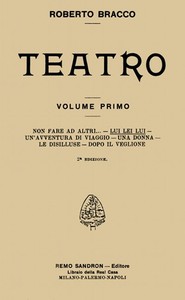
ROBERTO BRACCO
TEATRO
VOLUME PRIMO
NON FARE AD ALTRI... — *LUI LEI LUI* —
UN’AVVENTURA DI VIAGGIO — UNA DONNA —
LE DISILLUSE — DOPO IL VEGLIONE
2ª EDIZIONE.
REMO SANDRON — Editore
Libraio della Real Casa
MILANO-PALERMO-NAPOLI
PROPRIETÀ LETTERARIA
_I diritti di riproduzione e di traduzione sono riservati per
tutti i paesi, non escluso il Regno di Svezia e quello di
Norvegia._
È assolutamente proibito di rappresentare questi lavori senza il
consenso scritto dell’Autore _(Art. 14 del Testo Unico 17
Settembre 1882)_.
Published in Palermo, 10th. June Privilege of Copyright in the
United States reserved under the Act approved March 3rd. 1905,
by Roberto Bracco and Remo Sandron.
Off. Tip. Sandron — 126 — I — 290312.
————
LUI LEI LUI.
_Commedia in un atto._
rappresentata per la prima volta al _Sannazaro_ di _Napoli_, dalla
Compagnia _Pasta_, nel 1887.
PERSONAGGI:
_Giulio_.
_Clotilde_, sua moglie.
_Federico_.
_Domenico_, servo.
Epoca attuale.
ATTO UNICO.
_Salottino elegante. Armi, coltelli e zaini da caccia alle pareti. Un
pianoforte. Due porte laterali. Una porta in fondo, la quale, aperta,
incornicia la veduta del parco verdeggiante._
SCENA I.
GIULIO, _poi_ IL SERVO.
_Giulio_
_(solo, intento ad aggiustare i mazzolini di fiori freschi nei vasi di
maiolica)_ Come sono grazioso, io, in questa delicata operazione di
fanciulla quindicenne! Ecco: la primavera mi dà delle gentilezze
sopraffine, dei gusti squisiti e poetici, di cui sono io stesso
meravigliato. Carino, questo insieme di rose tee e di mughetti! _(Al
servo, che entra)_ Che c’è, Domenico?
_Il Servo_
La signora ha ordinato tutto il pranzo. Soltanto, desidera sapere se
lei, come _entre-mets_, preferisce i fagiolini al pomodoro o i pisellini
al burro.
_Giulio_
_(con severità)_ Ma queste sono cose che non mi riguardano. Voi sapete,
Domenico, che io mi rimetto al gusto del mio amico Federico. Andate
piuttosto a interrogare lui. È lui, oramai, che si occupa delle cose di
casa: ve l’ho detto tante volte! _(Si sdraia sopra una poltrona che è
accanto al tavolino coi fiori.)_
_Il Servo_
C’è poi il commesso del signor Compagnoni. Ha dei saggi di vino da
mostrarle, per definire quell’affare.
_Giulio_
_(svogliato)_ Dio buono, quale affare?
_Il Servo_
Non so, mi ha detto così.
_Giulio_
Sarà forse qualche affare che mi sta trattando il mio amico, quel caro
Federico. Dite a lui tutto. _(Chiamando:)_ Federico! Federico!
_(Pausa.)_ Starà in giardino. Domenico, andate a cercarlo, mostrategli i
saggi di vino, chiedetegli se preferisce i fagiolini o non so che altro,
e lasciatemi tranquillo. _(Sbadiglia)_ Ah!
_Il Servo_
_(va via.)_
_Giulio_
_(guardando di nuovo i fiori)_ Carino, carino questo insieme di rose tee
e di mughetti! Piacerà certamente anche a mia moglie: mughetti e rose
tee: che sfumature! che armonia di colori! Oh la pittura e la botanica!
Come le amo! Se avessi fatto il pittore, sarei diventato... il primo
botanico del mondo!
SCENA II.
FEDERICO _e_ GIULIO, _poi_ IL SERVO.
_Federico_
_(entra dalla porta a destra, pian piano, guardando attorno con occhio
inquieto, senza esser veduto da Giulio. Ha l’aria turbata, e dal suo
volto traspare un misto di malinconia e di timidezza. Avvicinatosi a
Giulio, gli mette lievemente una mano sulla spalla.)_
_Giulio_
_(alzandosi, voltandosi, squadrandolo da capo a piedi, gli domanda, in
un tono fra di fastidio e di sorpresa.)_ Ohè, dico, che hai?
_Federico_
_(dà un profondo sospiro.)_
_Giulio_
Che hai?
_Federico_
_(facendo un gesto annunziante una deliberazione irremissibilmente
presa, dice con voce ferma, che è, però, uno sforzo:)_ Giulio, ti voglio
parlare.
_Giulio_
A me?
_Federico_
Sì, a te.
_Giulio_
Dio buono, parliamo sempre, noi, e parliamo tanto che la tua volontà non
mi sembra mica una cosa spiccatamente nuova.
_Federico_
Giulio, da un mese io sono in casa tua....
_Giulio_
E puoi aggiungere, con legittimo orgoglio, che completi la mia arcadica
felicità. Gli alberi fioriscono, gli augelli garriscono, le farfalle
s’inseguono, il ruscelletto mormora, io mangio molto e bene, dormo
dolcissimamente, posseggo una moglie che è un tesoretto, posseggo te che
sei un amico carissimo: tutto sommato, io sono un uomo felice. Questa è
la villeggiatura del mio corpo e del mio spirito! Metti all’occhiello
questo bottoncino di rosa, _(glielo dà)_ e va a passeggiare.
_Federico_
Ebbene, Giulio, io li ringrazio, ti ringrazio assai della cordiale
ospitalità che hai voluto accordarmi....
_Giulio_
Bada: ti permetto anche di ringraziarmi, ma non in questo tono flebile e
sentimentale.
_Federico_
Sì, ti ringrazio vivamente, ma....
_Giulio_
Ma?...
_Federico_
Ho risoluto: me ne vado!
_Giulio_
_(scherzando)_ E chi ti dà il diritto di prendere delle risoluzioni in
casa mia?
_Federico_
No, Giulio, me ne vado sul serio, e me ne vado subito. Vedi, sono venuto
appunto a salutarti.
_Giulio_
_(guardandolo fisso)_ O sei matto... e allora fai bene ad andartene, o
non lo sei... e allora perchè te ne vai?
_Federico_
_(dopo breve riflessione)_ Senti: tu hai tanta amicizia per me ed hai
tanto spirito per te, che io sarei colpevole e sarei uno sciocco se ti
nascondessi la verità.
_Giulio_
_(in caricatura)_ Il momento è solenne! Ti ascolto.
_Federico_
_(dopo lunga reticenza)_ Giulio, io... io... io amo tua moglie.
_Giulio_
_(con un soprassalto di paura, smettendo l’ aria burlesca)_ E me lo dici
in faccia?!
_Federico_
_(mortificato)_ Ho creduto di darti una prova di lealtà, rivelandoti
questa mia... solitaria sventura.
_Giulio_
_(alquanto commosso)_ Te ne ringrazio! _(Avvicina due seggiole, e, molto
amichevolmente, invita Federico a sedere. Siedono.)_ _(Pausa.)_ Dunque?
_Federico_
Dunque, me ne vado.
_Giulio_
Eh! capisco i tuoi... i tuoi... i tuoi....
_Federico_
Ragionamenti.
_Giulio_
Ragionamenti! Oh! non c’è dubbio, giustissimi ragionamenti! Certo... non
c’è altro mezzo... per....
_Federico_
Per risparmiare al mio cuore mille sofferenze, e a te....
_Giulio_
_(con ansia)_ A me?...
_Federico_
_(subito)_... lo scrupolo di avermele imposte.
_Giulio_
Soltanto questo?
_Federico_
Soltanto.
_Giulio_
_(rinfrancato, stringendogli la mano)_ Sei delicatissimo!
_Federico_
Credimi, ho lungamente lottato contro il nemico ch’è venuto a turbare la
mia felicità, e con grande dolore ho dovuto confessare a me stesso di
non averlo saputo vincere. Sulle prime, dopo pochi giorni che io ero
qui, con voi, in questo villino fatto a posta per destare i più gentili
desiderii, ho sperato, mi sono lusingato....
_Giulio_
_(titubante)_ Come sarebbe a dire che ti sei lusingato?
_Federico_
Mi sono lusingato che il nuovo sentimento che nasceva in me, fosse un
misto di gratitudine e di amichevole simpatia: fosse, cioè, una doverosa
conseguenza delle cortesie usatemi da tua moglie. Ma, che vuoi! Altro
che gratitudine! altro che amichevole simpatia! Il quadretto evidente
della vostra felicità,... della vostra unione,... della vostra.... come
ho da dire?... della vostra intimità,... cagionava in me certi
turbamenti, certe strane indicibili smanie, che sono andate, ogni
giorno, aumentando, sino a diventare... un martirio.
_Giulio_
Oh povero amico mio! Hai ragione, perbacco!... Hai ragione. Quella
benedetta Clotilde è così carina!
_Federico_
Carina?! Qualche cosa di più!
_Giulio_
_(entusiasmandosi anche lui)_ È graziosissima, ne convengo.
_Federico_
E poi è una donna che non somiglia a nessun’altra!
_Giulio_
Bravo! A nessun’altra!
_Federico_
È mite ed è altera.
_Giulio_
È buona ed è furba....
_Federico_
È gran dama ed è bambina.
_Giulio_
Ventidue anni, sai: non più di ventidue!
_Federico_
È tanto ingenua ed è piena di fascini!
_Giulio_
E che fascini! Se tu sapessi!
_Federico_
_(con calore)_ Insomma, tu sei un uomo invidiabile, ed io... sono un
infelice!
_(Si alzano. Federico rimane in un canto, nervoso, preoccupato, con la
testa bassa.)_
_Il Servo_
_(entra, vede Federico, va difilato da lui, e gli domanda:)_ Preferisce
i fagiolini al pomodoro o i pisellini al burro?
_Federico_
_(con uno sgarbo)_ Oh! non mi seccate, adesso!
_Giulio_
_(al servo)_ Andate via, Domenico. Abbiamo certi pisellini per la
testa!...
_Il Servo_
Vuol dire che oggi faremo a meno dell’_entre-mets_. _(Via.)_
_Giulio_
_(guardando Federico, che è inquieto, gli si accosta con dolcezza)_ Via,
càlmati.... Tu te ne andrai. Io, capisci, mi annoierò molto senza di
te.... Ah! si stava tanto bene in tre! Ma non c’è che fare! Non bisogna
essere egoisti. Vedo anch’io che la tua dimora qui, fra noi due, sarebbe
per te un vero supplizio. Finchè si trattasse di amare in silenzio e di
serbare nel cuore questo affetto solingo e di frenarlo, reprimerlo,
nasconderlo, eh! ti direi: fammi il piacere di rassegnarti e non mi
lasciare; ma assistere alle tenerezze che la donna da te amata prodiga
quotidianamente a suo marito, no! In verità, questo è superiore alle
forze umane. Partenza, dunque, partenza! È doloroso per me, ma per te è
necessario. Sei ammalato, e devi guarire.
_Federico_
_(sospirando)_ Lo spero! _(Commosso)_ Mi permetti di abbracciarti?
_Giulio_
Fa pure.
_Federico_
_(abbracciandolo)_ Grazie!
_Giulio_
_(confidenzialmente)_ E dimmi.... Tu, in qualche momento di
allucinazione, di debolezza, di inconscienza — l’amore certe volte fa di
questi scherzi! — non le hai fatto capire qualche cosa?
_Federico_
_(senza esitare, sinceramente)_ Mai!
_Giulio_
_(con pari ed inconsiderata sincerità)_ Ti confesso che io, al tuo
posto, avrei fatto qualche corbelleria.
SCENA III.
CLOTILDE, GIULIO, FEDERICO.
_Clotilde_
_(entra dal giardino, canticchiando.)_
_Giulio_
_(sottovoce a Federico)_ Lei.
_Federico_
_(continuando a parlare con Giulio, sforzandosi di sembrare disinvolto e
alzando la voce)_ Ah! già, sicuro... la giornata è bellissima.
_Giulio_
E tu, ingrato ai benefizi della natura, te ne vai proprio oggi.
_Clotilde_
Chi è, chi è che se ne va?
_Federico_
Io!
_Giulio_
Lui.
_Federico_
Precisamente. Me ne vado... perchè....
_Giulio_
È naturale... se ne va... perchè... Eh?.... Cosa?...
_Clotilde_
Avete l’aria di due collegiali che abbiano fatto insieme o che contino
di fare una qualche scappatella.... Questa partenza improvvisa, questo
contegno misterioso.... Andiamo, su, giustificatevi. _(A Federico)_
Perchè partite? _(A Giulio)_ E tu, perchè lo lasci partire?
_Federico_
Affari.
_Giulio_
Affari, mia cara....
_Clotilde_
Voi, signor Federico, avete degli affari? Si avvicina la fine del mondo!
Il vostro affare più grave e più urgente è stato sempre mio marito.
_Federico_
Non ti dico di no....
_Clotilde_
Ed ora volete abbandonarlo! Volete condannare lui e me a un tête-à-tête
campestre, continuo, inevitabile, che potrebbe minare il nostro amore
coniugale? Un tête-à-tête obbligato e non mai interrotto può generare
facilmente una pericolosa reazione.
_Federico_
Sicchè, per voi due io sono stato sinora....
_Clotilde_
Un’eccellente interruzione, e quindi un preservativo dell’amore
coniugale.
_Federico_
_(ridendo a malincuore)_ Ah! Ah! un preservativo!
_Giulio_
_(secondandolo)_ Ah! ah! un preservativo!
_Federico_
_(fingendo gaiezza)_ Signora Clotilde, permettetemi, io vado a preparare
le mie valige.
_Clotilde_
Ma, in sostanza, che vi abbiamo fatto di male?
_Giulio_
_(spontaneamente)_ Io, niente!
_Clotilde_
Allora io?
_Federico_
Voi, anzi....
_Giulio_
Come «anzi»?
_Federico_
_(impappinandosi)_ Anzi... appunto... viceversa... ma non crediate...
oh, vi pare!... tutt’altro!... Giulio, non è vero?
_Giulio_
È verissimo!
_Clotilde_
È verissimo che l’aria della campagna produce un triste effetto sui
vostri nervi e sulla vostra intelligenza. Partite sì, partite e al più
presto possibile! In queste condizioni diventereste insopportabile a voi
stesso e a noi!
_Federico_
_(convulso, fuori di sè)_ Oh non temete: parto, fuggo, volo, e non mi
vedrete mai più. Mi dimetto da preservativo.
_Clotilde_
Fate benissimo!
_Federico_
_(piano a Giulio)_ Lo vedi come mi tratta!... _(Via per la porta a
destra.)_
SCENA IV.
GIULIO _e_ CLOTILDE
_Giulio_
_(rimane come interdetto, a bocca aperta, guardando fisso la porta da
cui è uscito Federico.)_
_Clotilde_
_(stupita, dopo qualche istante di silenzio, come se chiedesse
spiegazione)_ Giulio?
_Giulio_
_(va fino alla porta per assicurarsi che Federico non possa udire; poi
si accosta a Clotilde con circospezione e, fra il grave e il gioviale,
le dice a voce bassa:)_ Vuoi sapere la vera ragione della sua partenza?
_Clotilde_
Tu hai una voglia matta di dirmela.
_Giulio_
E te la dico subito. Federico è innamorato di te!
_Clotilde_
_(sorpresa)_ E sei tu, mio marito, che vieni a raccontarmi queste cose?!
_Giulio_
E perchè no? Che la gente s’innamori di te è un fatto che mi lusinga, e,
francamente, non m’impensierisce....
_Clotilde_
Eh, bada: dicono così tutti i mariti ingannati.
_Giulio_
Cattiva! Vorresti rendermi geloso, ma non cavi un ragno dal buco.
_Clotilde_
Lasciamo stare il ragno, e pensiamo un poco al tuo disgraziato e
innamorato amico.
_Giulio_
Poverino! Faceva pietà. Mi ha parlato delle lotte dell’animo suo, delle
torture che noi due, senza sapere e senza volere, gli abbiamo inflitte,
e finalmente ha concluso che solo separandosi da noi potrebbe ricuperare
una certa tranquillità di spirito. Era commosso. Aveva le lagrime agli
occhi.... E ha voluto perfino abbracciarmi.
_Clotilde_
Perchè?
_Giulio_
Non lo so. Mi ha abbracciato.
_Clotilde_
_(rammaricata)_ Intanto, eccoci soli.
_Giulio_
_(rammaricato)_ Senza un cane che ci tenga compagnia.
_Clotilde_
E chi mi suonerà la sera... un approssimativo duetto del «Faust»,... un
verosimile valtzer di Strauss... una canzonetta qualunque?
_Giulio_
E con chi andrò a caccia, io?
_Clotilde_
E con chi attaccheremo briga tutti e due?
_Giulio_
Oh! davvero che questo innamoramento è stato un fulmine a ciel sereno.
_(Restano pensosi.)_
_Clotilde_
Giulietto....
_Giulio_
Clotilduccia....
_Clotilde_
Un’idea!
_Giulio_
Sentiamo.
_Clotilde_
Non c’è altro espediente che di gettare acqua sul fuoco. In mezz’ora, ci
scommetto, io spegnerò la fiamma che strugge il tuo misero ed innocente
amico, e renderò un servizio a lui e un altro a noi. Egli resterà.
_Giulio_
Ottimamente; ma, spegnere?!... Si fa presto a dire.
_Clotilde_
Una donna, che, senza averne nè l’intenzione nè il sospetto, è riuscita
a farsi amare, può, molto facilmente riuscire, quando ne abbia la ferma
volontà, a farsi odiare.
_Giulio_
_(invogliato)_ Odiare?... Qui è inutile giungere sino all’odio. Basta
l’indifferenza, basta uno stato... di tranquilla freddezza.
_Clotilde_
Basta l’indifferenza? Basta uno stato di tranquilla freddezza? Affidalo
a me. Farò abbassare io la sua temperatura.
_Giulio_
_(contento, fregandosi le mani)_ Sei un demonio, ma sei un angelo.
_(Vedendo venire Federico, munito di valige)_ Ecco l’uomo! Signora
Clotilde, noi vi affidiamo il suo cuore e le sue valige. _(Via di corsa
dal giardino.)_
SCENA V.
CLOTILDE _e_ FEDERICO.
_Federico_
_(comparisce portando con ambo le mani due valige e il cappello.
Incontrandosi con Clotilde, resta sconcertato e impacciato.)_
_Clotilde_
_(incrociando le braccia)_ Mio buon signor Federico, io sono qui.
_Federico_
_(appena inchinandosi)_ Signora....
_Clotilde_
_(dopo una pausa)_ Partite?
_Federico_
_(mostrando le valige)_ Non lo vedete? Parto.
_Clotilde_
_(lo guarda e ride.)_
_Federico_
_(s’inchina di nuovo e sta per andare)_ Signora....
_Clotilde_
Ih! che fretta. _(Federico si ferma.)_ Venite qua. _(Poi, in tono
imperativo)_ Avvicinatevi, vi dico.
_Federico_
_(riluttante, s’avvicina a lei.)_ Eccomi.
_Clotilde_
_(con un sorrisetto beffardo)_ Dunque, è tutto un dramma questa vostra
partenza repentina?
_Federico_
_(trasalendo)_ Un dramma?
_Clotilde_
Sì, un dramma complicato e terribile, che si riassume in queste cinque
parole: mi amate e mi fuggite!
_Federico_
_(ansioso, meravigliato, mortificato)_ E chi ve l’ha detto?
_Clotilde_
Mio marito.
_Federico_
_(lasciandosi cascar di mano le valige e il cappello)_ Lui stesso!
_(Resta trasecolato e confuso.)_
_(Pausa.)_
_Clotilde_
Bisogna convenire che il caso è perfettamente nuovo, e che voi siete un
tipo affatto speciale di persona innamorata. Sentite: come moglie del
vostro fiducioso amico, via... vi lodo; ma come donna, in fede mia, vi
biasimo.
_Federico_
Come moglie mi lodate e come donna mi biasimate.... Non capisco.
_Clotilde_
Insomma, mi spiego meglio! Voi, amico, siete, non si può negare,
ammirevolissimo: ma voi, uomo, eh! mio caro, voi uomo siete...
deplorevole!
_Federico_
_(sempre confuso)_ Sono delle distinzioni sottili.
_Clotilde_
_(canzonando)_ Non mi pare. Sentiamo: definite la parola «uomo».
_Federico_
_(pensando molto)_ «Uomo... Uomo....» Veramente non trovo una
definizione precisa.
_Clotilde_
Me ne congratulo.
_Federico_
Aspettate.... Ne ho letta una pochi giorni fa, in un dizionario.
_(Ricordando:)_ «Uomo» termine generico,... che abbraccia anche la
donna.
_Clotilde_
Voi, invece, abbracciate i mariti delle donne!
_Federico_
Io abbraccio i mariti delle donne?!
_Clotilde_
Mio marito, non lo avete forse voluto abbracciare?
_Federico_
Ah sì, perchè egli che conosce i vostri fascini, mi ha compianto, mi ha
consigliato....
_Clotilde_
Vi siete fatto anche consigliare da lui?! È straordinario!
_Federico_
Siete squisitamente crudele!
_Clotilde_
E voi, squisitamente grottesco!
_Federico_
Signora Clotilde, io non pretendo opporre nessuna resistenza agli
assalti del vostro spirito. Io mi arrendo, io mi dichiaro vinto, e non
vi chiedo che il permesso di partire.
_Clotilde_
Vi arrendete a me? Ma io mi affretto a cedervi a voi stesso. Vi
dichiarate vinto? Ma voi non avete neanche combattuto. Mi chiedete il
permesso di partire? Ma io non vi ho chiesto il sacrificio di restare.
Voi potete andare o rimanere come meglio vi aggrada, senza che turbiate
menomamente la pace domestica. Se poi credete di dovervi allontanare per
salvar me da un pericolo, rassicuratevi: in ogni caso, mi avreste già
salvata.
_Federico_
No, signora Clotilde, voi non mi comprendete. Il pericolo è mio.
_Clotilde_
E quale? Temete che mio marito vi sorprenda nell’atto di farmi una
dichiarazione d’amore? Questo no, perchè, oramai, mi avete già fatto la
vostra dichiarazione, affidandola, anzi, con gentile pensiero, alle cure
stesse di mio marito. Temete di innamorarvi più di quanto siate
innamorato? E questo nemmeno è possibile, perchè l’amore aumenta o dopo
un trionfo o dopo un fiasco; ma voi, che non osate sperare un trionfo,
non avete altro scopo che quello di eliminare il fiasco. Voi siete
come... come una nave incagliata in un banco di arena: non potete più
andare nè innanzi nè indietro, ma non potete essere capovolto dalla
tempesta. _(Va a sedere sul divano.)_
_Federico_
_(le si siede accanto, riflettendo)_.... Eppure, signora Clotilde, voi,
oggi, così atroce, così spietata verso di me, avete, nel vostro
linguaggio, qualche cosa che... — vi parrà strano... — quasi preferisco
alle gentili cortesie abituali....
_Clotilde_
Buon segno: è la medicina amara che ristora l’infermo.
_Federico_
Già! Io mi sento ristorato. Io mi sento meglio. E allora, ve ne prego,
continuate, continuate a tormentarmi. Deridetemi, beffeggiatemi,
sferzatemi senza misericordia, e quando, all’ultimo, mi avrete
completamente guarito, io non vi chiederò più il permesso di partire, ma
vi chiederò il permesso di restare! Ecco, se mi aveste trattato sempre
così, se foste stata con me sempre scortese, ruvida, sarcastica,
impertinente, io forse non mi sarei innamorato di voi.
_Clotilde_
_(con inconsapevole eccitamento e con accento accelerato)_ E avreste
avuto torto, fanciullo che siete! La cortesia per la donna è una
formalità, la dolcezza è una educazione, la bontà... è un’abitudine. Una
donna che è con voi buona, dolce, cortese, non fa che rappresentare bene
la sua parte di donna. Invece _(nervosa)_ l’indizio di probabile amore è
precisamente uno scatto di collera, un impeto di rabbia, un gesto o una
frase di disprezzo, di alterigia, d’impazienza, insomma una nota
stridula che dispiace e che piace, un frizzo, una malignità, una
cattiveria e sinanche, qualche volta, una insolenza. _(Federico,
ascoltando attentamente, le si è accostato a poco a poco, assai
dappresso, e, in questo punto, ella, sempre più nervosa, sbuffando, si
alza a un tratto e, cambiando tono, aggiunge:)_ E adesso andate via, e
non mi annoiate più!
_Federico_
_(resta ancora seduto, contemplandola. Poi, lentamente si alza e va a
raccogliere il cappello e le valige.)_
_Clotilde_
Che fate?
_Federico_
V’obbedisco.
_Clotilde_
_(bruscamente)_ Aspettate. Mi obbedirete più tardi. Per ora, cercate di
rendervi utile, piacevole, divertente, o almeno tollerabile....
_Federico_
_(rimettendo a terra valige e cappello — con modestia)_ Non sarà facile.
_Clotilde_
_(con burbanza crudele non rispondente alla parola)_ Facilissimo.
_(Siede vicino al pianoforte e soggiunge con accento di comando:)_
Sedete lì, molto lontano da me.
_Federico_
_(siede nel punto della stanza più lontano da lei.)_
_(Pausa.)_
_Clotilde_
Ma voi non dite niente: non parlate, non ridete, non piangete, non
suonate?
_Federico_
_(subito)_ Volete che suoni?
_Clotilde_
Sì: suonate.
_Federico_
_(non si muove.)_
_Clotilde_
Avete udito? Ho detto suonate.
_Federico_
Non posso.... Per suonare bisognerebbe che io m’avvicinassi a voi.
_Clotilde_
Dio buono, quante inutili esagerazioni!
_Federico_
_(andando in fretta a sedere presso il piano)_ Va bene, va bene! Siamo
perfettamente d’accordo!
_Clotilde_
Suonate... il solito duetto del Faust.... Cioè, no: il duetto del Faust
è eccessivamente sentimentale.
Suonate piuttosto.... Suonate quello che volete, purchè suoniate male,
molto male! Non ho nessuna voglia di commuovermi per la vostra musica.
_Federico_
Suonerò la serenata di Schubert. _(Comincia a suonare, stonando molto.)_
_Clotilde_
_(pestando con una mano la tastiera)_ No, no! Così è troppo male.
_Federico_
_(trattenendo la mano di Clotilde sulla tastiera)_ Ma è la vostra mano
che guasta la mia musica, ed io voglio punire questa perfida mano
incantevole. _(Glie l’afferra e furiosamente gliela bacia più volte.)_
_Clotilde_
_(alzandosi con sdegno ostentato)_ Signor Federico!
_Federico_
_(umile e compunto, alzandosi anche lui)_ Signora Clotilde!...
_Clotilde_
Voi dimenticate i vostri doveri!
_Federico_
Certamente!
_Clotilde_
Voi abusate dell’ospitalità!
_Federico_
Certamente!
_Clotilde_
Voi tradite l’amicizia!
_Federico_
Certamente!
_Clotilde_
Voi siete un mostro!
_Federico_
Certamente!
_Clotilde_
E ne siete pentito?
_Federico_
Neanche per sogno!
_(Pausa.)_
_Clotilde_
Federico!
_Federico_
Clo... Clo....
_Clotilde_
Cos’è «clo clo»?
_Federico_
No.... Volevo dire: «Clo...tilde».
_Clotilde_
_(con curiosità genuina)_ Si può sapere perchè mi amate?
_Federico_
_(dopo qualche istante di riflessione)_ Non lo so.
_Clotilde_
Ora ve lo dico io: perchè sono la moglie del vostro più caro amico.
Credete a me, è una specie di fatalità. Moglie, marito ed amico intimo,
ecco i tre personaggi che presentano una serie infinita di combinazioni
comiche e tragiche, e che dànno alla storia dell’amore il maggior
contingente quotidiano. Se si hanno dinanzi due amici indivisibili,
l’uno celibe e l’altro ammogliato, si può ciecamente, novantanove volte
su cento, invidiare il celibe e compiangere l’ammogliato. Notate: ho
detto che si può invidiare il celibe novantanove volte su cento; non ho
detto cento volte su cento, per rendere omaggio a voi, che nessuno, in
fede mia, potrebbe invidiare. In fondo, gli è che siete una pasta
eccezionale di amico intimo. E anzi... io scommetterei....
_Federico_
Scommettereste?
_Clotilde_
Che andrete immediatamente a raccontare a mio marito....
_Federico_
Che cosa?
_Clotilde_
Che mi avete baciata la mano... con una certa violenza.
_Federico_
E se glielo raccontassi davvero?
_Clotilde_
Io... non me ne sorprenderei, ed egli... non vi crederebbe. Del resto,
concludiamo. Si tratta o di confermare la disgraziata dichiarazione che
mi avete fatta per mezzo di lui o di smentirla e... di riabilitarvi. Se
dichiarate d’amarmi ancora, dovete partire; se dichiarate di non amarmi
più, potete restare. Decidete, dunque, e rispondetemi subito: dopo il
colloquio che abbiamo avuto, mi amate ancora o non mi amate più?
_Federico_
_(raccapezzandosi e irradiandosi)_ Ebbene... ho deciso.
_(Entusiasticamente prorompe:)_ Io non vi amo, non vi amo, non vi amo!
SCENA VI.
GIULIO, CLOTILDE _e_ FEDERICO.
_Giulio_
_(entrando dal giardino e avanzandosi con gioia)_ Che sento! Questo è un
grido di vittoria.
_Clotilde_
Vittoria completa! Guarigione istantanea! Egli resta.
_Federico_
_(con trasporto)_ Ah sì! Resto!
_Clotilde_
Ti avevo promesso che gli avrei abbassata la temperatura? Bell’e fatto!
_Giulio_
_(a Federico, canzonandolo)_ Ti ha abbassata la temperatura?
_Federico_
Sotto zero!
_Giulio_
_(celiando, a Clotilde)_ Ma, demonietto d’un dottore, come hai potuto
guarirlo così presto?
_Clotilde_
Eh, caro mio, noi donne sappiamo... dove mettere le mani.
_Giulio_
_(a Federico)_ Te lo dicevo io! Che donnina è mia moglie!
_Federico_
Meravigliosa!
_Clotilde_
Io non ho fatto che il mio dovere, e voi, signor Federico, andate subito
a depositare di nuovo le valige nella vostra stanzetta.
_Giulio_
_(afferrando le valige, tutto gaio e brillante)_ Ma lo servo io! Lo
servo io! _(Corre dentro.)_
_Federico_
_(profittando dell’assenza di Giulio, in un momento di slancio, dice
appassionatamente a Clotilde:)_ Clotilde, io vi adoro!
_Clotilde_
_(con un rapido gesto, gli rimprovera l’imprudenza.)_
_Giulio_
_(ritornando in fretta, sente la dichiarazione appassionata, ma, senza
sospettare di nulla, esclama, ridendo:)_ Ah burlone! burlone! Volevi
farmi paura con quel tuo «vi adoro!»; ma non ci sei riuscito! No, non ci
sei riuscito!
_Federico_ _e_ _Clotilde_
_(celando l’imbarazzo e la sorpresa, si guardano tra loro e guardano
Giulio.)_
_Federico_
_(sforzandosi, finge di ridere della burletta.)_
_(Poi ride anche Clotilde. Poi Giulio ride più forte di lei, Federico
ride più forte di lei e di lui, e, ridendo ognuno più forte dell’altro,
ridono clamorosamente ed esageratamente tutti e tre.)_
_(Sipario.)_
*** END OF THIS PROJECT GUTENBERG EBOOK LUI LEI LUI ***
A Word from Project Gutenberg
We will update this book if we find any errors.
This book can be found under: http://www.gutenberg.org/ebooks/37933
Creating the works from public domain print editions means that no one
owns a United States copyright in these works, so the Foundation (and
you!) can copy and distribute it in the United States without permission
and without paying copyright royalties. Special rules, set forth in the
General Terms of Use part of this license, apply to copying and
distributing Project Gutenberg™ electronic works to protect the Project
Gutenberg™ concept and trademark. Project Gutenberg is a registered
trademark, and may not be used if you charge for the eBooks, unless you
receive specific permission. If you do not charge anything for copies of
this eBook, complying with the rules is very easy. You may use this
eBook for nearly any purpose such as creation of derivative works,
reports, performances and research. They may be modified and printed and
given away – you may do practically _anything_ with public domain
eBooks. Redistribution is subject to the trademark license, especially
commercial redistribution.
The Full Project Gutenberg License
_Please read this before you distribute or use this work._
To protect the Project Gutenberg™ mission of promoting the free
distribution of electronic works, by using or distributing this work (or
any other work associated in any way with the phrase “Project
Gutenberg”), you agree to comply with all the terms of the Full Project
Gutenberg™ License available with this file or online at
http://www.gutenberg.org/license.
Section 1. General Terms of Use & Redistributing Project Gutenberg™
electronic works
*1.A.* By reading or using any part of this Project Gutenberg™
electronic work, you indicate that you have read, understand, agree to
and accept all the terms of this license and intellectual property
(trademark/copyright) agreement. If you do not agree to abide by all the
terms of this agreement, you must cease using and return or destroy all
copies of Project Gutenberg™ electronic works in your possession. If you
paid a fee for obtaining a copy of or access to a Project Gutenberg™
electronic work and you do not agree to be bound by the terms of this
agreement, you may obtain a refund from the person or entity to whom you
paid the fee as set forth in paragraph 1.E.8.
*1.B.* “Project Gutenberg” is a registered trademark. It may only be
used on or associated in any way with an electronic work by people who
agree to be bound by the terms of this agreement. There are a few things
that you can do with most Project Gutenberg™ electronic works even
without complying with the full terms of this agreement. See paragraph
1.C below. There are a lot of things you can do with Project Gutenberg™
electronic works if you follow the terms of this agreement and help
preserve free future access to Project Gutenberg™ electronic works. See
paragraph 1.E below.
*1.C.* The Project Gutenberg Literary Archive Foundation (“the
Foundation” or PGLAF), owns a compilation copyright in the collection of
Project Gutenberg™ electronic works. Nearly all the individual works in
the collection are in the public domain in the United States. If an
individual work is in the public domain in the United States and you are
located in the United States, we do not claim a right to prevent you
from copying, distributing, performing, displaying or creating
derivative works based on the work as long as all references to Project
Gutenberg are removed. Of course, we hope that you will support the
Project Gutenberg™ mission of promoting free access to electronic works
by freely sharing Project Gutenberg™ works in compliance with the terms
of this agreement for keeping the Project Gutenberg™ name associated
with the work. You can easily comply with the terms of this agreement by
keeping this work in the same format with its attached full Project
Gutenberg™ License when you share it without charge with others.
*1.D.* The copyright laws of the place where you are located also govern
what you can do with this work. Copyright laws in most countries are in
a constant state of change. If you are outside the United States, check
the laws of your country in addition to the terms of this agreement
before downloading, copying, displaying, performing, distributing or
creating derivative works based on this work or any other Project
Gutenberg™ work. The Foundation makes no representations concerning the
copyright status of any work in any country outside the United States.
*1.E.* Unless you have removed all references to Project Gutenberg:
*1.E.1.* The following sentence, with active links to, or other
immediate access to, the full Project Gutenberg™ License must appear
prominently whenever any copy of a Project Gutenberg™ work (any work on
which the phrase “Project Gutenberg” appears, or with which the phrase
“Project Gutenberg” is associated) is accessed, displayed, performed,
viewed, copied or distributed:
This eBook is for the use of anyone anywhere at no cost and with
almost no restrictions whatsoever. You may copy it, give it away
or re-use it under the terms of the Project Gutenberg License
included with this eBook or online at http://www.gutenberg.org
*1.E.2.* If an individual Project Gutenberg™ electronic work is derived
from the public domain (does not contain a notice indicating that it is
posted with permission of the copyright holder), the work can be copied
and distributed to anyone in the United States without paying any fees
or charges. If you are redistributing or providing access to a work with
the phrase “Project Gutenberg” associated with or appearing on the work,
you must comply either with the requirements of paragraphs 1.E.1 through
1.E.7 or obtain permission for the use of the work and the Project
Gutenberg™ trademark as set forth in paragraphs 1.E.8 or 1.E.9.
*1.E.3.* If an individual Project Gutenberg™ electronic work is posted
with the permission of the copyright holder, your use and distribution
must comply with both paragraphs 1.E.1 through 1.E.7 and any additional
terms imposed by the copyright holder. Additional terms will be linked
to the Project Gutenberg™ License for all works posted with the
permission of the copyright holder found at the beginning of this work.
*1.E.4.* Do not unlink or detach or remove the full Project Gutenberg™
License terms from this work, or any files containing a part of this
work or any other work associated with Project Gutenberg™.
*1.E.5.* Do not copy, display, perform, distribute or redistribute this
electronic work, or any part of this electronic work, without
prominently displaying the sentence set forth in paragraph 1.E.1 with
active links or immediate access to the full terms of the Project
Gutenberg™ License.
*1.E.6.* You may convert to and distribute this work in any binary,
compressed, marked up, nonproprietary or proprietary form, including any
word processing or hypertext form. However, if you provide access to or
distribute copies of a Project Gutenberg™ work in a format other than
“Plain Vanilla ASCII” or other format used in the official version
posted on the official Project Gutenberg™ web site
(http://www.gutenberg.org), you must, at no additional cost, fee or
expense to the user, provide a copy, a means of exporting a copy, or a
means of obtaining a copy upon request, of the work in its original
“Plain Vanilla ASCII” or other form. Any alternate format must include
the full Project Gutenberg™ License as specified in paragraph 1.E.1.
*1.E.7.* Do not charge a fee for access to, viewing, displaying,
performing, copying or distributing any Project Gutenberg™ works unless
you comply with paragraph 1.E.8 or 1.E.9.
*1.E.8.* You may charge a reasonable fee for copies of or providing
access to or distributing Project Gutenberg™ electronic works provided
that
- You pay a royalty fee of 20% of the gross profits you derive from
the use of Project Gutenberg™ works calculated using the method you
already use to calculate your applicable taxes. The fee is owed to
the owner of the Project Gutenberg™ trademark, but he has agreed to
donate royalties under this paragraph to the Project Gutenberg
Literary Archive Foundation. Royalty payments must be paid within 60
days following each date on which you prepare (or are legally
required to prepare) your periodic tax returns. Royalty payments
should be clearly marked as such and sent to the Project Gutenberg
Literary Archive Foundation at the address specified in Section 4,
“Information about donations to the Project Gutenberg Literary
Archive Foundation.”
- You provide a full refund of any money paid by a user who notifies
you in writing (or by e-mail) within 30 days of receipt that s/he
does not agree to the terms of the full Project Gutenberg™ License.
You must require such a user to return or destroy all copies of the
works possessed in a physical medium and discontinue all use of and
all access to other copies of Project Gutenberg™ works.
- You provide, in accordance with paragraph 1.F.3, a full refund of
any money paid for a work or a replacement copy, if a defect in the
electronic work is discovered and reported to you within 90 days of
receipt of the work.
- You comply with all other terms of this agreement for free
distribution of Project Gutenberg™ works.
*1.E.9.* If you wish to charge a fee or distribute a Project Gutenberg™
electronic work or group of works on different terms than are set forth
in this agreement, you must obtain permission in writing from both the
Project Gutenberg Literary Archive Foundation and Michael Hart, the
owner of the Project Gutenberg™ trademark. Contact the Foundation as set
forth in Section 3. below.
*1.F.*
*1.F.1.* Project Gutenberg volunteers and employees expend considerable
effort to identify, do copyright research on, transcribe and proofread
public domain works in creating the Project Gutenberg™ collection.
Despite these efforts, Project Gutenberg™ electronic works, and the
medium on which they may be stored, may contain “Defects,” such as, but
not limited to, incomplete, inaccurate or corrupt data, transcription
errors, a copyright or other intellectual property infringement, a
defective or damaged disk or other medium, a computer virus, or computer
codes that damage or cannot be read by your equipment.
*1.F.2.* LIMITED WARRANTY, DISCLAIMER OF DAMAGES – Except for the “Right
of Replacement or Refund” described in paragraph 1.F.3, the Project
Gutenberg Literary Archive Foundation, the owner of the Project
Gutenberg™ trademark, and any other party distributing a Project
Gutenberg™ electronic work under this agreement, disclaim all liability
to you for damages, costs and expenses, including legal fees. YOU AGREE
THAT YOU HAVE NO REMEDIES FOR NEGLIGENCE, STRICT LIABILITY, BREACH OF
WARRANTY OR BREACH OF CONTRACT EXCEPT THOSE PROVIDED IN PARAGRAPH 1.F.3.
YOU AGREE THAT THE FOUNDATION, THE TRADEMARK OWNER, AND ANY DISTRIBUTOR
UNDER THIS AGREEMENT WILL NOT BE LIABLE TO YOU FOR ACTUAL, DIRECT,
INDIRECT, CONSEQUENTIAL, PUNITIVE OR INCIDENTAL DAMAGES EVEN IF YOU GIVE
NOTICE OF THE POSSIBILITY OF SUCH DAMAGE.
*1.F.3.* LIMITED RIGHT OF REPLACEMENT OR REFUND – If you discover a
defect in this electronic work within 90 days of receiving it, you can
receive a refund of the money (if any) you paid for it by sending a
written explanation to the person you received the work from. If you
received the work on a physical medium, you must return the medium with
your written explanation. The person or entity that provided you with
the defective work may elect to provide a replacement copy in lieu of a
refund. If you received the work electronically, the person or entity
providing it to you may choose to give you a second opportunity to
receive the work electronically in lieu of a refund. If the second copy
is also defective, you may demand a refund in writing without further
opportunities to fix the problem.
*1.F.4.* Except for the limited right of replacement or refund set forth
in paragraph 1.F.3, this work is provided to you ‘AS-IS,’ WITH NO OTHER
WARRANTIES OF ANY KIND, EXPRESS OR IMPLIED, INCLUDING BUT NOT LIMITED TO
WARRANTIES OF MERCHANTIBILITY OR FITNESS FOR ANY PURPOSE.
*1.F.5.* Some states do not allow disclaimers of certain implied
warranties or the exclusion or limitation of certain types of damages.
If any disclaimer or limitation set forth in this agreement violates the
law of the state applicable to this agreement, the agreement shall be
interpreted to make the maximum disclaimer or limitation permitted by
the applicable state law. The invalidity or unenforceability of any
provision of this agreement shall not void the remaining provisions.
*1.F.6.* INDEMNITY – You agree to indemnify and hold the Foundation, the
trademark owner, any agent or employee of the Foundation, anyone
providing copies of Project Gutenberg™ electronic works in accordance
with this agreement, and any volunteers associated with the production,
promotion and distribution of Project Gutenberg™ electronic works,
harmless from all liability, costs and expenses, including legal fees,
that arise directly or indirectly from any of the following which you do
or cause to occur: (a) distribution of this or any Project Gutenberg™
work, (b) alteration, modification, or additions or deletions to any
Project Gutenberg™ work, and (c) any Defect you cause.
Section 2. Information about the Mission of Project Gutenberg™
Project Gutenberg™ is synonymous with the free distribution of
electronic works in formats readable by the widest variety of computers
including obsolete, old, middle-aged and new computers. It exists
because of the efforts of hundreds of volunteers and donations from
people in all walks of life.
Volunteers and financial support to provide volunteers with the
assistance they need, is critical to reaching Project Gutenberg™’s goals
and ensuring that the Project Gutenberg™ collection will remain freely
available for generations to come. In 2001, the Project Gutenberg
Literary Archive Foundation was created to provide a secure and
permanent future for Project Gutenberg™ and future generations. To learn
more about the Project Gutenberg Literary Archive Foundation and how
your efforts and donations can help, see Sections 3 and 4 and the
Foundation web page at http://www.pglaf.org .
Section 3. Information about the Project Gutenberg Literary Archive
Foundation
The Project Gutenberg Literary Archive Foundation is a non profit
501(c)(3) educational corporation organized under the laws of the state
of Mississippi and granted tax exempt status by the Internal Revenue
Service. The Foundation’s EIN or federal tax identification number is
64-6221541. Its 501(c)(3) letter is posted at
http://www.gutenberg.org/fundraising/pglaf . Contributions to the
Project Gutenberg Literary Archive Foundation are tax deductible to the
full extent permitted by U.S. federal laws and your state’s laws.
The Foundation’s principal office is located at 4557 Melan Dr.
S. Fairbanks, AK, 99712., but its volunteers and employees are scattered
throughout numerous locations. Its business office is located at 809
North 1500 West, Salt Lake City, UT 84116, (801) 596-1887, email
[email protected]. Email contact links and up to date contact
information can be found at the Foundation’s web site and official page
at http://www.pglaf.org
For additional contact information:
Dr. Gregory B. Newby
Chief Executive and Director
[email protected]
Section 4. Information about Donations to the Project Gutenberg Literary
Archive Foundation
Project Gutenberg™ depends upon and cannot survive without wide spread
public support and donations to carry out its mission of increasing the
number of public domain and licensed works that can be freely
distributed in machine readable form accessible by the widest array of
equipment including outdated equipment. Many small donations ($1 to
$5,000) are particularly important to maintaining tax exempt status with
the IRS.
The Foundation is committed to complying with the laws regulating
charities and charitable donations in all 50 states of the United
States. Compliance requirements are not uniform and it takes a
considerable effort, much paperwork and many fees to meet and keep up
with these requirements. We do not solicit donations in locations where
we have not received written confirmation of compliance. To SEND
DONATIONS or determine the status of compliance for any particular state
visit http://www.gutenberg.org/fundraising/donate
While we cannot and do not solicit contributions from states where we
have not met the solicitation requirements, we know of no prohibition
against accepting unsolicited donations from donors in such states who
approach us with offers to donate.
International donations are gratefully accepted, but we cannot make any
statements concerning tax treatment of donations received from outside
the United States. U.S. laws alone swamp our small staff.
Please check the Project Gutenberg Web pages for current donation
methods and addresses. Donations are accepted in a number of other ways
including checks, online payments and credit card donations. To donate,
please visit: http://www.gutenberg.org/fundraising/donate
Section 5. General Information About Project Gutenberg™ electronic
works.
Professor Michael S. Hart is the originator of the Project Gutenberg™
concept of a library of electronic works that could be freely shared
with anyone. For thirty years, he produced and distributed Project
Gutenberg™ eBooks with only a loose network of volunteer support.
Project Gutenberg™ eBooks are often created from several printed
editions, all of which are confirmed as Public Domain in the U.S. unless
a copyright notice is included. Thus, we do not necessarily keep eBooks
in compliance with any particular paper edition.
Each eBook is in a subdirectory of the same number as the eBook’s eBook
number, often in several formats including plain vanilla ASCII,
compressed (zipped), HTML and others.
Corrected _editions_ of our eBooks replace the old file and take over
the old filename and etext number. The replaced older file is renamed.
_Versions_ based on separate sources are treated as new eBooks receiving
new filenames and etext numbers.
Most people start at our Web site which has the main PG search facility:
http://www.gutenberg.org
This Web site includes information about Project Gutenberg™, including
how to make donations to the Project Gutenberg Literary Archive
Foundation, how to help produce our new eBooks, and how to subscribe to
our email newsletter to hear about new eBooks.
Lui lei lui
Subjects:
Download Formats:
Excerpt
This eBook is for the use of anyone anywhere at no cost and with almost
no restrictions whatsoever. You may copy it, give it away or re-use it
under the terms of the Project Gutenberg License included with this
eBook or online at http://www.gutenberg.org/license.
Read the Full Text
— End of Lui lei lui —
Book Information
- Title
- Lui lei lui
- Author(s)
- Bracco, Roberto
- Language
- Italian
- Type
- Text
- Release Date
- November 5, 2011
- Word Count
- 7,002 words
- Library of Congress Classification
- PQ
- Bookshelves
- IT Teatro in prosa, Browsing: Literature, Browsing: Performing Arts/Film, Browsing: Fiction
- Rights
- Public domain in the USA.
Related Books
Parassiti: Commedia in tre atti
by Antona-Traversi, Camillo
Italian
706h 27m read
Più che l'amore: Tragedia moderna - Preceduta da un discorso e accresciuta d'un preludio d'un intermezzo e d'un esodio.
by D'Annunzio, Gabriele
Italian
605h 22m read
Le tragedie, gl'inni sacri e le odi di Alessandro Manzoni
by Manzoni, Alessandro
Italian
3171h 19m read
La mandragola - La Clizia - Belfagor
by Machiavelli, Niccolò
Italian
533h 15m read
Tristano e l'ombra: Commedia romantica in tre atti
by Stefani, Alessandro de
Italian
223h 16m read
La trilogia di Dorina: Commedia in 3 atti
by Rovetta, Gerolamo
Italian
270h 20m read