*** START OF THE PROJECT GUTENBERG EBOOK 48923 ***
JOSEPH PENNELL’S PICTURES
OF WAR WORK IN AMERICA
* * * * *
JOSEPH PENNELL’S PICTURES OF WAR WORK IN ENGLAND
Reproductions of a Series of Drawings and Lithographs of the Munition
Works made by him with the permission and authority of the British
Government. With notes by the Artist and with an Introduction by H. G.
Wells. 51 Plates. Octavo. $1.50 net.
JOSEPH PENNELL’S PICTURES OF THE WONDER OF WORK
Reproductions of a Series of Drawings, Etchings, Lithographs made by him
about the World, 1881-1915. With impressions and notes by the Artist. 33
plates. $2.00 net.
JOSEPH PENNELL’S PICTURES IN THE LAND OF TEMPLES
Reproductions of a Series of Lithographs made by him in the Land of
Temples, March-June, 1913, together with impressions and notes by the
Artist. 40 plates. $1.50 net.
JOSEPH PENNELL’S PICTURES OF THE PANAMA CANAL
Reproductions of a Series of Lithographs made by him on the Isthmus of
Panama, January-March, 1912, together with impressions and notes by the
Artist. 28 Plates. $1.50 net.
OUR PHILADELPHIA
BY ELIZABETH ROBINS PENNELL
ILLUSTRATED BY JOSEPH PENNELL
_Regular Edition._ Containing one hundred and five reproductions of
Lithographs by Joseph Pennell. Quarto, 7½ by 10 ins. xiv + 552 pages.
Handsomely bound in red buckram, boxed $7.50 net.
_Autograph Edition._ Limited to 289 copies (now very scarce). Contains
ten drawings reproduced by a new lithographic process in addition to the
illustrations that appear in the regular edition. Quarto, xiv + 552
pages. Specially bound in genuine English linen buckram in City colors,
in cloth-covered box. $18.00 net.
THE LIFE OF JAMES MCNEILL WHISTLER
BY ELIZABETH ROBINS PENNELL
AND JOSEPH PENNELL
_New and Revised Edition_
The Authorized Life, with much new matter added which was not available
at the time of issue of the elaborate two-volume edition, now out of
print. Fully illustrated with 97 plates reproduced from Whistler’s
works. Crown 4to, xx + 450 pp. Whistler binding, deckle edge. $4.00 net.
Three-quarter levant morocco. $8.50 net.
NIGHTS
ROME--VENICE
In the Æsthetic Eighties
LONDON--PARIS
In the Fighting Nineties
BY ELIZABETH ROBINS PENNELL
Large Crown 8vo, 16 illustrations. $3.00 net
PHILADELPHIA: J. B. LIPPINCOTT CO.
* * * * *
JOSEPH PENNELL’S PICTURES
OF WAR WORK IN AMERICA
REPRODUCTIONS OF A SERIES OF LITHOGRAPHS
OF MUNITION WORKS MADE BY HIM
WITH THE PERMISSION AND AUTHORITY OF
THE UNITED STATES GOVERNMENT, WITH
NOTES AND AN INTRODUCTION BY THE ARTIST
[Illustration]
PHILADELPHIA AND LONDON
J. B. LIPPINCOTT COMPANY
1918
COPYRIGHT, 1918, BY JOSEPH PENNELL
PUBLISHED JANUARY, 1918
PRINTED BY J. B. LIPPINCOTT COMPANY
AT THE WASHINGTON SQUARE PRESS
PHILADELPHIA, U. S. A.
INTRODUCTION--MY LITHOGRAPHS OF WAR WORK
I have come back from the Jaws of Death--back from the Mouth of Hell--to
my own land, my own people. I have never passed such an exciting year in
my life--and beside, I hope I have been able to accomplish something in
my work which shall show one phase of the Wonder of the World’s Work of
to-day. I was honoured a year ago by being permitted by the Rt. Hon.
David Lloyd George, then Minister of Munitions in England, to make
drawings in the various factories and works and shipyards which were
engaged in war work in that country--and the records of what I saw were
published as lithographs of War Work in England and in a previous volume
in this series. Now, though I do not believe in war, I do not see why
some pictorial record of what is being done to carry on the war should
not be made--made from an artist’s standpoint--for we are in it--being
in the world--but I am not of it.
When my work--or as much of it as I was allowed to do--was finished and
exhibited and published--I was invited by the French Minister of
Munitions, M. Albert Thomas, to visit the front and make studies of
similar subjects in France, but--owing to a combination of unfortunate
circumstances--though I went to France twice during the Summer of this
year, I was unable to get anything of importance. This was my fault, or
my misfortune--I failed--and the memory of my failure will haunt me, and
be a cause of regret to me, all my life--unless I am able to wipe out my
failure--in another visit to France. But though I failed to make any
drawings--any records of the subjects I was so freely shown--I was shown
on my two visits many subjects, which were supremely interesting, could
I have but drawn them--had I been able to do so they would have been
worth doing. Not only was I taken to the front, which was not the part I
saw, picturesque, but I was also taken to see some of those parts of
France which have been fought over, some of the towns which have been
destroyed, some of the land which is desolate, and I have also seen some
of the French munition factories. Then I came home, for I believe the
place for an American at the present time is at home. And on my arrival
I was authorized to make records by our Government similar to those I
had made in England, and had failed to make in France--what I have done
in the United States is shown in this book.
I have had more opportunities of seeing what is being done in war work
in England, France and the United States than any one else--and in a
fashion that no one else has been permitted to see. I have seen war in
the making. Yet I did not do these drawings with any idea of helping to
win the war, but because for years I have been at work--from my earliest
drawings--trying to record The Wonder of Work, and work never was so
wonderful as it is to-day. And never had any one such help--such aid,
such encouragement given him to record its wonder--and by the
Governments of the three great countries which are engaged in “this
incredibly horrible, absolutely unnecessary war, easily avoided war,” to
quote a British Statesman.
Not only have I seen the Wonder of Work in these three lands--but before
the war I saw it in Belgium, Germany and Italy. I have drawn it
everywhere, save in Luxembourg, and there, too, I have seen it--but made
no drawings--for it was so easy to get to that land--and so that country
was put off for a more convenient season--a season I fear which will
never come again. I am not going to make comparisons--but I am going to
say that the Wonder of Work is more wonderful in the United States than
anywhere else in the world to-day. True, we are not working with that
unbelievable energy which the French and English--yes, the English--have
put at last into their work--but we do so much more--with so much
less--appearance of work--we are working for the Allies--but they are
not working for us. And we are doing for them what they cannot do for
themselves. In Europe the war worker works all day and every day in the
year. Here most of the great industrial works have only added war work
to their peace work, in Europe scarce anything else but war work is
being done.
And also in America the women have not to any extent gone into the
factories, mills and shipyards of the country. And I hope they never
will. I have never seen a woman shell maker here, yet I know of
factories in France and England where there are scarce any work people,
save women, one where there are ten thousand women. Here they are only
making fuses and doing other light work, but I have not seen a woman at
a lathe as I have seen them in France and England. I have never seen a
woman ship builder here--yet I have seen women in shipyards abroad doing
work that men would have grumbled at when put to it--because it was
thought hard work--before the war.
And I am glad that our women are not forced to undertake such work, and
hope they never may be, for I have seen the black side of this work,
which already has led to strikes and labour troubles in Europe--and when
the war is over, will lead to greater trouble--for the Captains of
Industry in Europe tell me that women run machines better than men--they
devote themselves to the machine--never try to improve it--to make
changes in it--only to keep it going and in good order, while the man is
always trying to improve it, to make it do more, so that he can do less.
“Stick matches in it,” one manager said--while the women just run the
machines as they are shown how.
But making shells is more interesting than washing dishes, or waving
flags and marching in parades--and more exciting--but there will be an
end to that some day; and the lathes--which have been turned to war
work--will be turned back to peace work--and the question is, will the
women go back to their dishes?--and if they do not there will be more
trouble. I have seen a women’s strike--or a little of it--for with the
manager who was showing me around, I left at once. It was not an
orderly, peaceful, or womanly strike. That shop was no place for me.
Those women were not lady-like.
But just as the greatest human energy has been given to war work, given
to make things to explode, to kill, to destroy; so the greatest machines
have been turned to do this work with the greatest skill and accuracy
and the greatest speed--the workers are but a necessary detail--and it
is the working of the great machinery in the great mills which I find so
inspiring--so impressive--for the mills are shrines of war. The mills
are the modern temples and in them do the people worship. And if only
the engines turned out were engines of peace--how much better would the
world be--but everything made in a war factory is made to destroy and to
be destroyed. But one must not think of that, for if one did the war
would stop, and not every one wants it to stop--or it would stop
to-day--a universal demand for peace would make peace,--really would
have prevented war. But war work in America is the most wonderful work
in the world and that is the reason why I have drawn some of the work I
have seen--seen in these endless looms of time--where history is being
woven. The attitude of the workman toward the artist is curious; in
France he understands, in England he looks down on you as a poor thing
who has to work--in America you are regarded as a fellow workman, as an
artist is!
I want to thank the Secretaries of the Navy and of War, Messrs. Daniels
and Baker, Mr. Creel and the other members of the Board and staff of the
Committee on Public Information, and the various heads of the various
sub-departments of the Army and Navy, who stood my pestering and
querying and obtained for me permission to visit every industrial
establishment I wanted. In every plant, camp, yard, works, field, which
I wanted to work in--I was taken to, and treated with courtesy. I should
like to thank and mention by name the various officials, government and
civilian, who gave me every facility to see and to draw everything I
wished in the War Works they directed--but we are at war--and I am not
permitted to say where these drawings were made, and if I mentioned the
names of some of the directors of these works the places in which I made
the drawings would be known. As it is, I imagine many of them are pretty
well known already.
Finally I wish to thank my life-long friend, Dr. F. P. Keppel--who
suggested, directed, arranged, calmed down and cheered up all those with
whom I was brought in most interesting contact. He knows what he did and
I know--and I shall not forget.
PHILADELPHIA, THANKSGIVING DAY, 1917 JOSEPH PENNELL
LIST OF ILLUSTRATIONS
THE KEEL I
UNDER THE SHED II
THE ARMOR PLATE PRESS III
IN THE LAND OF BROBDIGNAG: THE ARMOR PLATE BENDING PRESS IV
BUILDING THE BATTLE SHIP V
MAKING A TURBINE ENGINE VI
MAKING PROPELLER BLADES VII
THE PROW VIII
READY TO START IX
THE COLLIER X
BUILDING SUBMARINE CHASERS XI
BUILDING DESTROYERS. NO. ONE XII
BUILDING DESTROYERS. NO. TWO XIII
IN THE DRY DOCK XIV
THE OLD AND THE NEW XV
SUBMARINES IN DRY DOCK XVI
THE TRANSPORTS XVII
READY FOR SERVICE AGAIN XVIII
THE BALLOON SHED XIX
THE LARKS XX
MAKING RIFLES XXI
THE FORGES XXII
CASTING SHELLS XXIII
FORGING SHELLS: THE SLAVES OF THE WHEEL XXIV
THE WHITE AND THE BLACK HAMMERS XXV
SHELL FACTORY NO. TWO: FROM SHOP TO SHOP XXVI
SHAPING A GUN FROM AN INGOT XXVII
THE GUN PIT. NO. ONE XXVIII
THE GUN PIT. NO. TWO XXIX
THE GUN FACTORY XXX
THE BIGGEST LATHE IN THE WORLD XXXI
THE GUN TESTING GROUND XXXII
THE RIVETERS XXXIII
BUILDING ENGINES FOR THE ALLIES XXXIV
THE FLYING LOCOMOTIVE XXXV
THE CAMP: THE NEW ARCHITECTURE XXXVI
I
THE KEEL
The shipyards are endless and their forms are endless and ever new--but
I never before found one where from the water I could look down on the
ship while it grew as it did here, amid its forests, its walls--which
it, in turn, would soon tower over.
[Illustration]
II
UNDER THE SHED
It seemed as though this yard was built for me, and if it was not that I
found it so practical, I should have thought it only pictorial.
But in the shed in rows, in piles, in layers, lay every part of the ship
ready to fit together--all in order. As I drew, boats and boilers came
out of the shop and went to their places on board.
[Illustration]
III
THE ARMOR PLATE PRESS
The English maker rolls rapidly his armor plate in heat and smoke and
flame. The American slowly presses it, but with a press so powerful it
will crush the huge ingot--so sensitive that it will not crack a watch
crystal placed under it.
[Illustration]
IV
IN THE LAND OF BROBDIGNAG: THE ARMOR PLATE BENDING PRESS
Only Swift never imagined, and Gulliver never saw, presses and ladles
and chains and cranes like these, but I have seen them, and there is no
imagination in my study of the press or the ladle. A press so powerful
it will slowly bend the thickest plate. A ladle so big the men were lost
in it.
[Illustration]
V
BUILDING THE BATTLE SHIP
Inside the huge shed where she was built and launched she lay getting
her finishing touches--or rather those that could be given her, for her
masts were too big to finish, her turrets were being fitted and her
turbines put in--and soon she would begin her life of terror and
horror.
[Illustration]
VI
MAKING A TURBINE ENGINE
This is the finest shop, in which the most impressive work of modern
times is done and it is “somewhere in America”; and as I worked away
after five, one man said--“Wot’s yer hours, mate?”
[Illustration]
VII
MAKING PROPELLER BLADES
Blue in the shadows and such blue--gold in the lights and such
gold--were those blades--in this great shop--and as I worked the engine
steamed in and carried one of the propellers off, to fit in the ship,
standing in the dock just outside.
[Illustration]
VIII
THE PROW
“Very pretty drawing,” said the officer when I showed him this leering,
staring, slobbering monster, the spirit of war, a creation of our time
and our country. It is fascinating but intolerable.
[Illustration]
IX
READY TO START
Dignified, solemn, immense she stood, held to the long dock by the great
cables; and the great cranes swung great carloads of war work aboard
her, as fast as the engines could bring them.
On land she was guarded by marines. In the air the Planes were guarding
her.
[Illustration]
X
THE COLLIER
This is a Freighter and Collier and the huge erections on its decks are
cranes and derricks, by which other ships are coaled and loaded at sea.
The system is not new, but I imagine many landsmen, like myself, till I
drew it, had never seen such a creature.
[Illustration]
XI
BUILDING SUBMARINE CHASERS
All round the big ship the little boats gathered--being built out of
doors, anywhere near the water, into which the crane swings them as soon
as they are ready. It is like this they are being built all over the
country.
[Illustration]
XII
BUILDING DESTROYERS. NO. ONE
Amid the great ways, the little destroyers are built. While the work of
building is going on, there seem to be no workmen about--though the
noise they make is terrible. The various parts of the ships lie about
apparently in confusion, but the crane knows what it wants and where to
find it, and picks it up and carries it to its proper place. It is only
when the men knock off that you see what an army is engaged in
shipbuilding. And it was too funny to be told as I went about--I must
not smoke--yet hundreds of drills and riveters were shedding showers of
sparks and there is nothing but iron to be seen.
[Illustration]
XIII
BUILDING DESTROYERS. NO. TWO
How the cranes minister to the ships, carrying them the things they
want, lowering them gently into the places where they belong and then
hovering over the vessels they are building to see that everything is in
its proper place--the cranes do it all--the men who run them are mere
details.
[Illustration]
XIV
IN THE DRY DOCK
These are the things that tower--that shine--whose power is
terrible--but their smile does not make glad.
The admiral said he could not see the ship like that--“Don’t you wish
you could?” was the only answer I could think of.
[Illustration]
XV
THE OLD AND THE NEW
Whether the old wooden ship is finer in line than the new steel monster
is more than I can decide, but I do know that both are well worth
drawing.
[Illustration]
XVI
SUBMARINES IN DRY DOCK
There they lay in long lines--soon to be ready to start on their
venturesome voyages.
[Illustration]
XVII
THE TRANSPORTS
The spoils of war, for what had been great traders were now to be great
troop ships--and with their transformation what an awful change has come
to our world.
[Illustration]
XVIII
READY FOR SERVICE AGAIN
Just as retired Officers have offered their services again to the
Country--so these old Ships, even more pictorial than the new, are being
found places where they can do their “bit.”
[Illustration]
XIX
THE BALLOON SHED
I only know of this one “balloon shed” in the country--probably in
design it is out of date--but pictorially it is fine.
[Illustration]
XX
THE LARKS
“Hark, Hark the Lark,” this one sings a song too, all his own, as he
soars up to greet the coming sun, then away to battle or to train for
it. Our Lark.
[Illustration]
XXI
MAKING RIFLES
Gallery after gallery is like this in the great building, all filled
with tiny men working at tiny machines making the tiny guns they fight
with; and over them hangs the flag of the country, put there, the
director told me--not by the management--but by the men.
[Illustration]
XXII
THE FORGES
How fine are the forges--but one man said as I drew the figure leaning
back to rest--“Hully gee! He’s got Creeper all right. Look at his
pants!” But the noise is awful--and one day as I sat on a bit of boiler
a roar ten times worse than ever before broke out beneath me and I
jumped right off, and from the boiler crawled a grimy human who, putting
his hand to his mouth, yelled “What yer making all that racket fur?”
[Illustration]
XXIII
CASTING SHELLS
Slowly the ladle moves, carried by the crane man, steered by the
workmen, goggled and gloved--I had no time to draw those details. Into
each mould it dropped just enough molten metal to make a shell head. And
when all the moulds were filled, a man from another shop dropped
in--“Say, what youse up to now?” “Me--I’m makin’ shells for the Kaiser.”
“What! an’ here?” “Sure”--and as a French Inspector passed--“Ain’t we
sending ’em to him as quick as we kin?”
[Illustration]
XXIV
FORGING SHELLS: THE SLAVES OF THE WHEEL
No composition could be finer, no movement more expressive, no grouping
more perfect, and yet all this was happening every day and all day in an
oily, dirty, greasy, smoky shell factory where no artist had ever worked
before and the workmen, black men, were turning the big shell, under the
big hammer, by the big capstan wheel that held it, and I noted in the
shop that the black men saw more in my drawings than the white, yet
there’s only one black painter in the country.
[Illustration]
XXV
THE WHITE AND THE BLACK HAMMERS
The biggest hammer in the world, said the foreman, maybe--any way the
Shop was amongst the most pictorial of all those I have drawn devoted to
shell making.
“Say, friend,” said the workman, “won’t they let yer use a machine, in
war time, is that why youse does it by hand?”
[Illustration]
XXVI
SHELL FACTORY NO. TWO: FROM SHOP TO SHOP
The contrast between the dark old shop and bright new one was wonderful.
“Pretty good, Dad,” said a precocious apprentice. I suppose they don’t
mean anything but compliments, still I never fail to lose my temper,
then the peace maker appears--“Don’t mind that kid, mate, he dunno no
better, he’s edurkated.” “Say, wot paper’s it comin’ out in--I’ll buy
that paper.” That was a compliment.
[Illustration]
XXVII
SHAPING A GUN FROM AN INGOT
When the ingot comes from the furnace, it is put in this press, deep
buried in a pit, and the hot metal is compressed into the shape of a
section of a great Gun--then it is taken out and bored and planed and
finally, after about a year of work, the gun is ready to do its work.
[Illustration]
XXVIII
THE GUN PIT. NO. ONE
These Pits which I have drawn in Europe and America have the greatest
individuality of all the processes of war industry. The buildings are
most impressive, towering, windowless, sombre without, very spacious
within, filled with strong shadows and strange shapes.
And as I looked out from the blackness to the ore crane, making new
ranges of Alps on its hillside, I wanted a gun--or rather wanted to know
how it was moved.
“Why, bring him one,” said the manager--and it came and posed while I
drew, and was such a good sitter. And so I find my studio and my models
wherever I work.
[Illustration]
XXIX
THE GUN PIT. NO. TWO
No better proof could be shown of the way each big plant puts big
character into its products than this and the previous drawing. Here
everything is done deep down under ground; in the other shop it is all
above, away up high in the air. And one day, they told me, the President
of the Company passed with a party--and he saw a man, tired out, sitting
with his head in his hands. “Why don’t you clean out the pit, boy?”
“Well, Sammie, if you want to know why, you go down an’ find out for
yourself.”
[Illustration]
XXX
THE GUN FACTORY
So like a British one, that I wonder which one got the idea of
arrangement of the Shop from the other. Here the guns are turned; and
one man said to me: “Well, I don’t know whether I’ll be drafted by the
U. S.--but I do know, I’d sooner waste my time makin’ guns, than spend
it havin’ ’em shot at me by some Dutchman.”
[Illustration]
XXXI
THE BIGGEST LATHE IN THE WORLD
Many of the subjects I have chosen are probably the “biggest in the
world” and the most impressive, too--that is the reason why I have drawn
them. I have seen great lathes and great guns in Europe, but this one is
certainly greater than any other.
“You couldn’t do that, Fatty,” said the man.
“Couldn’t I,” said the other. “You bet I could if I had been drawin’
lathes as long as him!” It was the second one I have drawn.
[Illustration]
XXXII
THE GUN TESTING GROUND
Into the rocky cliff great holes had been bored, and into them the Guns
mounted on their carriages, by the great gantry, were fired, passing
through wires hung from screens, to test their velocity. One thing that
interested me, standing behind the guns--interested me too much,
really--was, that there was no smoke, save that which came out of the
hole where the shells exploded. And another fact was, that I could not
see the shell in its flight--nor can those at whom it is fired--it goes
so fast the sound cannot keep up with it. Sight cannot follow it.
[Illustration]
XXXIII
THE RIVETERS
What perpendicular cathedral is as full of mystery as this shop. I know
of none and I know most of them, and when the fires glow on the work
altar, and the great jaws pierce and rivet the boiler plates, then is
heard the Hymn of Work.
[Illustration]
XXXIV
BUILDING ENGINES FOR THE ALLIES
In serried lines they stood--first one for Russia--then one for
France--and on the other side several for ourselves--and I said, “Why,
this is Ford’s idea!” for the parts came in at the sides of the shop and
the finished engine steamed out at the end. “Oh, yes!” said the manager,
“only we have been doing it twenty years,” and now they build a
locomotive in four days.
[Illustration]
XXXV
THE FLYING LOCOMOTIVE
Yes, locomotives can soar--can fly--and, like Mahomet’s coffin, stand in
the air; and they do these things in a blaze of glory--because the shop
where they are built is not big enough to shift them about in any other
way. As the engine sailed toward me I tried to make a note of it. “Why
would you like to draw it?” said the manager, as I frantically went on
making notes of the approaching monster. “Which end would you like up?”
He made a signal, they don’t talk in these shops, it stopped and there
it hung. “Bring on another,” signalled the manager--and so I drew and so
the creature posed till I had finished--an excellent model in a
wonderful studio.
[Illustration]
XXXVI
THE CAMP: THE NEW ARCHITECTURE
In the centre of the new city is something like a long train of box
cars--yet when you see their sides you find they are houses. As you look
they grow--and from a few holes in the ground till the building is
finished takes about forty-five minutes, the architects tell me. They
are better built than the English Munition towns--they are
unbelievable--these Cities of fifty thousand inhabitants built while the
army was formed. This drawing is but a bit of one of them--to right and
to left and behind the town stretched--the embodiment of usefulness,
respectability--a triumph of ugliness and energy.
[Illustration]
End of the Project Gutenberg EBook of Joseph Pennell's Pictures of War Work
in America, by Joseph Pennell
*** END OF THE PROJECT GUTENBERG EBOOK 48923 ***
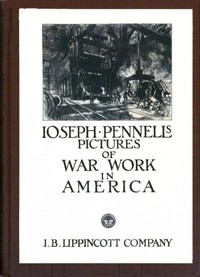
Joseph Pennell's Pictures of War Work in America - Reproductions of a series of lithographs of munition works made by him with the permission and authority of the United States government, with notes and an introduction by the artist
Subjects:
Download Formats:
Excerpt
JOSEPH PENNELL’S PICTURES
OF WAR WORK IN AMERICA
JOSEPH PENNELL’S PICTURES OF WAR WORK IN ENGLAND
Reproductions of a Series of Drawings and Lithographs of the Munition
Works made by him with the permission and authority of the British
Government. With notes by the Artist and with an Introduction by H. G.
Wells. 51 Plates. Octavo. $1.50 net.
Reproductions of a Series of Drawings, Etchings, Lithographs made by him
about the World, 1881-1915....
Read the Full Text
— End of Joseph Pennell's Pictures of War Work in America - Reproductions of a series of lithographs of munition works made by him with the permission and authority of the United States government, with notes and an introduction by the artist —
Book Information
- Title
- Joseph Pennell's Pictures of War Work in America - Reproductions of a series of lithographs of munition works made by him with the permission and authority of the United States government, with notes and an introduction by the artist
- Author(s)
- Pennell, Joseph
- Language
- English
- Type
- Text
- Release Date
- May 10, 2015
- Word Count
- 4,577 words
- Library of Congress Classification
- NE; D501
- Bookshelves
- Browsing: Art & Photography, Browsing: History - Warfare
- Rights
- Public domain in the USA.
Related Books
Joseph Pennell's Pictures of the Wonder of Work - Reproductions of a Series of Drawings, Etchings, and Lithographs, Made by Him about the World, 1881-1915, with Impressions and Notes by the Artist
by Pennell, Joseph
English
219h 29m read

Ypres to Verdun - A Collection of Photographs of the War areas in France & Flanders
by Kennedy, Alex. B. W. (Alexander Blackie William)
English
618h 32m read
Our sentimental journey through France and Italy - A new edition with Appendix
by Pennell, Elizabeth Robins, Pennell, Joseph
English
637h 39m read

The Illustration of Books - A Manual for the Use of Students, Notes for a Course of Lectures at the Slade School, University College
by Pennell, Joseph
English
424h 46m read

Two Pilgrims' Progress; from fair Florence, to the eternal city of Rome
by Pennell, Elizabeth Robins, Pennell, Joseph
English
549h 31m read

Joseph Pennell's pictures of the Panama Canal - Reproductions of a series of lithographs made by him on the Isthmus of Panama, January—March 1912, together with impressions and notes by the artist
by Pennell, Joseph
English
115h 21m read