*** START OF THE PROJECT GUTENBERG EBOOK 66638 ***
IRELAND IN FICTION.
IRELAND IN FICTION
_A GUIDE TO_
IRISH NOVELS, TALES, ROMANCES,
AND FOLK-LORE
BY
STEPHEN J. BROWN, S.J.
_Author of A Reader’s Guide to Irish Fiction,
A Guide to Books on Ireland, etc._
Do chum glóire Dé agus Onóra na h-Éireann.
MAUNSEL AND COMPANY, LIMITED,
DUBLIN AND LONDON.
1916.
CONTENTS.
PAGE
PREFACE vii.
PREFACE TO _A Reader’s Guide to Irish Fiction_ (1910) x.
ACKNOWLEDGMENTS xiv.
SIGNS, ABBREVIATIONS, ETC. xvii.
IRISH FICTION UNDER NAMES OF AUTHORS ARRANGED ALPHABETICALLY 1
APPENDIX:
A.—SOME USEFUL WORKS OF REFERENCE 261
B.—PUBLISHERS AND SERIES 264
C.—IRISH FICTION IN PERIODICALS 270
D.—CLASSIFIED LISTS:
I.—HISTORICAL FICTION 273
II.—GAELIC EPIC AND ROMANTIC LITERATURE 279
III.—FOLK-LORE AND LEGEND 282
IV.—FAIRY TALES FOR CHILDREN 283
V.—CATHOLIC CLERICAL LIFE 284
VI.—HUMOROUS BOOKS 285
INDEX OF TITLES AND SUBJECTS 287
PREFACE.
It may be well to state at the outset in what respects the present work
differs from _A Reader’s Guide to Irish Fiction_ published in 1910, and
now out of print. The differences may be reduced to four:—
(1). The number of books dealt with is almost double that of the earlier
work.
(2). The arrangement is quite new. In the former work the books were
classified according to subject matter: in this they are arranged under
the names of the Authors, these names being arranged alphabetically.
Some lists are appended in which the books are classified as historical
novels, Folk-lore, Gaelic Epic and Romantic Literature, &c.
(3). A combined title and subject index has been provided, both of
which were lacking in the earlier book. Some new matter is given in the
Appendix, in particular some notes on fiction in Irish periodicals.
(4). In _A Reader’s Guide_, &c., a few notes on Authors were added at the
end. In the present work biographical notes on a large proportion of the
Authors are given immediately before the notes on their books.
Apart from these differences, the two works have the same scope and aim.
In both, the scope includes all works of fiction published in volume
form, and dealing with Ireland or with the Irish abroad, and such works
only. The present book, therefore, is not, any more than was the earlier
book, a guide to the works of Irish novelists—else, Goldsmith, for
instance, might surely claim a place. Neither is it, properly speaking,
a book of advice as to what is best to read. The aim has been to provide
descriptive notes of an _objective_ nature, to record facts, not to set
forth personal views and predilections. This is a book of reference pure
and simple; it neither condemns nor recommends. In this respect it
differs from several other guides to fiction which at first sight it
seems to resemble. The Abbé Bethléem’s most valuable _Romans à lire et
romans à proscrire_ has been mentioned in the former preface. Its title
proclaims its character. Of a similar nature are some works by members of
my own Order that have since come to my knowledge. It will be useful to
record their titles:
1. P. Gerardo Decorme, S.J.—Lecturas recomendables. (Barcelona:
Luis Gili). 1908.
2. P. Pablo Ladron de Guevara, S.J.—Novelistas malos y buenos.
Pp. 523. (Bilbao). 1910.
3. Was soll ich lesen? Ein Ratgeber [advice giver] für
Studierende (Trier), 1912.
4. Guide de Lecture. (Brussels). Second ed., 1912. A
magnificent 4to volume of 1032 pp., compiled by a Belgian
Jesuit, Fr. Schmidt, and constituting the catalogue of his
great Bibliothèque Choisie of 200,000 volumes.
No. 1 devotes only a chapter to fiction. No. 2 contains a critical
examination from a moral point of view of 413 Spanish writers, 1,220
French, 150 English, 98 German, as well as Russian, Belgian, &c. No. 3
devotes a section to _Schöne Literatur_ giving notes and bibliographical
details. Symbols are used to indicate the suitability of the books to
readers of various ages. The same plan is followed in No. 4, but to a
much fuller extent, and the whole work is on a larger scale.
Enough has been said, I think, in the former preface as to the object
aimed at in the notes. I have tried to make that object clear: I am far
from thinking that it has always been attained, even in this revised
work. Some of the excuses for incompleteness that held good for the first
steps into an almost untrodden field have no doubt ceased to have the
same force. I have had time to explore new ground, and to survey anew
that already occupied. On the other hand the years that have slipped away
since the former book have been filled by many duties that left little
time for literary work. Yet, though I am unable to say with confidence
that this work is bibliographically exhaustive, I trust that, for
practical purposes, for the purposes for which it is intended, it may be
found reasonably complete. For the achievement of even this result I can
by no means claim all the credit. My obligations to my numerous helpers
are very great indeed, as will appear from the Acknowledgements.
One further point needs to be dwelt upon—the non-inclusion of works
of fiction written in the Irish language. I cannot do better in this
connection than quote from the preface to a former work[1] in which this
same point came up for explanation:—“I have not included books in the
Irish language. My reasons for this are threefold. In the first place
my own knowledge of Irish is not yet sufficient to enable me even to
edit satisfactorily notes of books in Irish.... In the second place I do
not think that a bibliography of works in Irish should be made a mere
appendage or sub-section, as it would inevitably be, of a work such as
the present. Lastly, it may well be doubted whether the time be yet come
for doing this work in the way that it deserves to be done.” This last
reason is partly based on the fact of the great mass of Irish literature
still remaining in MS., a quantity probably much greater than what has
been printed and published. The publication of the National Library’s
bibliography is mentioned in the Appendix on Gaelic literature as an
additional reason for my omission of books in Irish.
Nevertheless, the omission of books in the Irish language from a Guide to
Irish Fiction remains an anomaly, one of the many anomalies produced by
the historic causes that have all but destroyed the Irish language as the
living speech of Ireland.
DUBLIN, _September_, 1915.
[1] _A Guide to Books on Ireland_, Part I. (Hodges & Figgis), 1912.
PREFACE TO A READERS GUIDE TO IRISH FICTION (1910).
The present GUIDE TO IRISH FICTION is intended by the Author as the first
part of a work in which it is hoped to furnish notes on books of all
kinds dealing with Irish subjects.
Before explaining the scope of this section of the work it may be well,
in order to forestall wrong impressions, to say at once what it is _not_.
In the first place, then, it does not lay claim to be a bibliography. By
this I do not mean that I am content to be inaccurate or haphazard, but
simply that I do not aim at exhaustive completeness. In the second place,
it is not a catalogue of books _by Irish writers_. Lastly, it does not
deal exclusively with books printed or published in Ireland.
The Author’s aim has been to get together and to print in a convenient
form a classified list of novels, tales, &c. (whether by Irish or by
foreign writers), bearing on Ireland—that is, depicting some phase of
Irish life or some episode of Irish history—and to append to each title a
short descriptive note.
Two things here call for some explanation, viz., the list of titles and
the descriptive notes.
As to the former, I have, with some trifling exceptions, included
everything that I have been able to discover, provided it came within
the scope of the work, as indicated above. It has been thought well to
do this, because a vast amount of fiction that, from an artistic or from
any other point of view, is defective in itself may yet be valuable
as a storehouse of suggestion, fact, and fancy for later and better
writers. For was it not worthless old tales and scraps of half-mythical
history that held the germs of “Hamlet” and “Macbeth,” “King Lear” and
“Othello”? There remains, indeed a large class of novels and tales that,
so far as one may judge, can serve no useful purpose. It may be thought
that with such books the best course to pursue is to allow them to
pass into merited oblivion. But it must be remembered that booksellers
and publishers will naturally continue to push such books because it
is their business to do so, and the public will continue to buy them
because it has ordinarily no other means of knowing their contents than
the publisher’s announcement, the title, or—the cover. A “Guide” would,
therefore, surely shirk an important portion of its task if it excluded
worthless books, and thereby failed to put readers on their guard.
Next, as regards the descriptive notes: there are three points which
I should wish to make clear—the source of the information contained
in these notes; their scope, that is, the nature and extent of the
information with which they purpose to furnish the reader; and, thirdly,
the tone aimed at throughout the work.
Information about the books has been obtained in various ways. A
considerable number have been read by the Author. Indeed, there are few
writers of note included in the Guide about whose works he cannot speak
from first-hand knowledge. Of the books that remain the great majority
have been specially read for this work by friends, and a full account of
the same written by them according to a formula drawn up for the purpose.
In all cases, except in a very few—and these have been indicated—the
wording of the final note is mine. In the few cases referred to, printed
reviews or notices of the books have been drawn upon, the source of the
note being mentioned in each instance.
A word about the _scope_ of the notes. My chief object in undertaking
this work was to help the student of things Irish. This object determined
the character of the notes. A few years ago there appeared in France
an excellent work, entitled _Romans à lire et Romans à proscrire_
(Cambrai: Masson), by the Abbé Bethléem, which has since passed through
many editions. In this work novels are classed _au point de vue moral_.
In the rare cases in which the books included in my list contain
matter objectionable from a moral or a religious standpoint, I have not
hesitated to remark the fact in the note. This was, however, but a small
part of the task. It will be clear likewise, from what has been said that
my object is not to attempt _literary_ criticisms of Irish fiction. Such
literary appreciations are to be found in other works already published,
accounts of several of which will be found in the Appendix. True, a
certain amount of criticism is often needed lest the account given of a
book should be misleading, but it has been avoided wherever it did not
seem to further the main purpose. This purpose, let me repeat, is, above
all, to give _information_ to intending readers. I have, therefore,
endeavoured, as well as might be, in the small space available, simply
to give a clear idea of the contents of the books. In a good many cases
I have further attempted an appreciation, or rather a characterization,
of the book in question, but this was not always possible nor, indeed,
necessary.
Of the tone adopted in these notes little need be said. I did not
consider that it would further my purpose to aim at that literary flavour
and epigrammatic turn of phrase affected, and with reason, by reviewers
in many periodicals. Moreover, to do so would have been inconsistent with
brevity. Then, I must disclaim all intention of saying “clever” things
at the expense of any book, however low it may deserve to be rated. I
have endeavoured to avoid, too, the technicalities of criticism. Lastly,
I trust the little work has not been rendered suspect to any class of
Irishmen by the undue intrusion of religious or political bias.
Apology might well be made here for the defects of the work. They will,
I fear, be but too evident. But it should be borne in mind that, with
the exception of Mr. Baker’s works, to which I cannot sufficiently
acknowledge my indebtedness, I have had no guide upon the way, since no
writer, so far as I am aware, has hitherto dealt in this way with Irish
fiction as a whole.
It may be asked, for whom especially this book is meant? In the first
place, I hope it may be useful to the general reader who wishes to
study Ireland. Next, it may help in the important and not easy task
of selection those who have to buy books for any purpose, such as the
giving of presents, the conferring of prizes in school or out of it, the
stocking of shops and libraries—in other words, booksellers, library
committees, heads of schools and colleges, librarians, pastors, and many
others. Again, it may be of some service to lecturers and to popular
entertainers. I have some hopes, too, that coming writers of Irish
fiction, from seeing what has been done and what has not yet been done,
may get from it some suggestions for future work. It may even help in a
small way towards the realization of a great work not yet attempted, the
writing of a history of Anglo-Irish literature.
ACKNOWLEDGMENTS
(_Reader’s Guide, etc._)
My best thanks are due, in the first place, to the authorities of
Clongowes Wood College, without whose constant aid and encouragement my
task would have been impossible.
Next, I wish to thank those publishers who courteously sent me copies
of a number of their books, viz., the Irish publishers, Messrs. Gill;
Duffy; Sealy, Bryers and Walker; Maunsel; and Blackie: and the London
publishers, Messrs. Macmillan; Nelson; Methuen; Dent; Chatto and Windus;
Burns and Oates; Sands; Blackwood; Nutt; Elliot Stock; and Smith, Elder.
I should like to give greater prominence to the publications of these
firms. The plan of this book prevents me from doing so but I may say that
this little work, which will, I hope, help to make known their books,
could not have appeared but for their generosity.
To those who, as already mentioned, have aided in the work by reading
books, and supplying information about them, my sincerest thanks are
hereby tendered. I should be glad, if it were possible, to express here
my obligations to each individually, but I must, for obvious reasons,
limit myself to this general acknowledgment. There are, however, some
whom, on account of special obligations on my part, I shall have the
pleasant task of thanking by name. To Mr. E. A. Baker, M.A., D.LITT.,
Librarian of the Woolwich Public Library, I am indebted both for kind
permission to quote from his books and for constant advice and suggestion
given with the greatest cordiality. To Dr. Conor Maguire, of Claremorris,
I owe most of my notes of books on Irish Folk-lore, and to Mr. Edmund
Downey, the well-known author and publisher, notes on Lever’s books,
together with many useful suggestions. Mr. Francis J. Bigger, M.R.I.A.,
of Belfast, the always ready and enthusiastic helper of every Irish
enterprise, has aided me with valuable advice and no less valuable
encouragement. Mr. J. P. Whelan, Librarian of the Kevin Street Public
Library, Dublin, has rendered me every assistance in his power. Dr. J.
S. Crone of London, Editor of the _Irish Book Lover_, has on several
occasions kindly opened to me the pages of his periodical. Lastly, I must
acknowledge here, with sincere thanks, much help of various kinds given
me by many members of my own Order, and notably, Rev. M. Russell, S.J.;
Rev. M. Corbett, S.J.; Rev. P. J. Connolly, S.J., and the Rev. J. F. X.
O’Brien, S.J.—the last of whom very kindly undertook the tedious labour
of revising my proofs.[2]
[_Additional (Present Work)._]
My obligations to my various kind helpers in the present work are even
greater than in the case of the former book, and I am at a loss for an
adequate expression of them. My thanks have, of course, been privately
conveyed, but there are some collaborators who have had so large a
share in the making of this book that I cannot but place on record its
indebtedness towards them.
For valuable work in the British Museum Library extending over a
considerable length of time I have to thank Mrs. Pearde Beaufort, Miss
C. J. Hamilton, and Miss G. B. Ryan. For much tedious labour in the
rearrangement of the matter contained in the earlier book, I am indebted
to the Misses Chenevix Trench (who also supplied many notes), and to Mrs.
O’Neill, of Dundalk. To Dr. Crone, whose readiness to help when any Irish
literary enterprise is afoot is inexhaustible, I owe many corrections,
suggestions, and additions, and the laborious task of revising my MS.
and correcting my proofs. Mr. Edmund Downey, of Waterford, has kindly
read part of the proofs. Many books have been read for me and notes
supplied by Lady Gilbert; Mrs. Concannon, of Galway; Mrs. L. M. Stacpoole
Kenny, of Limerick; Miss J. F. Walsh, of Derry; Miss R. Young, of
Galgorm Castle, Co. Antrim; Mrs. Macken, of the National University;
Fr. MacDwyer, of Killybegs; and, perhaps most of all, Fr. J. Rabbitte,
S.J., of St. Ignatius College, Galway. Mr. D. J. O’Donoghue, Librarian of
the National University, has given me many suggestions, as well as some
useful notes on fiction in Irish periodicals. Mr. Frank Macdonagh also
has been very helpful with notes and corrections. I owe likewise a debt
of gratitude to the authorities and the staff of the National Library
for their courtesy and helpfulness. Nor must I omit a word of thanks to
the publishers (including all the Irish publishers, and Messrs. Flynn,
of Boston), who, as on a former occasion, made my task much lighter by
supplying me with review copies of their books.
Lastly to all the others, and they are many, who have in various ways
given me help my very sincere thanks are hereby tendered.
For the matter contained in my notes on the Authors, I am much indebted
to Mr. D. J. O’Donoghue’s _Poets of Ireland_, and to the pages of the
IRISH BOOK LOVER.
[2] Through an unfortunate oversight the earlier work contained no
mention of much kind help rendered me by several students of St.
Patrick’s College, Maynooth, notably by Rev. J. Henaghan and Rev. J.
Pinkman, at present priests on the mission. I now gratefully acknowledge
this help.
SIGNS, ABBREVIATIONS, ETC.
b. = born.
c. (before dates) = approximately.
d. = died, daughter.
ed. = edition, edited, editor, educated.
q.v. = which may be referred to.
n.d. = no date printed in the book referred to.
_sqq._ = and following (years or pages).
=C.B.N.= = Catholic Book Notes.
=D.R.= = The Dublin Review.
=I.B.L.= = The Irish Book Lover.
=I.E.R.= = The Irish Ecclesiastical Record.
=I.M.= = The Irish Monthly.
=N.I.R.= = The New Ireland Review.
=T. Lit. Suppl.= = The Times Literary Supplement.
=C.T.S.I.= = Catholic Truth Society of Ireland.
=S.P.C.K.= = Society for the Promotion of Christian Knowledge.
=R.T.S.= = Religious Tract Society.
=Allibone= = Allibone’s _Critical Dictionary of English
Literature_.
=Baker= = Baker’s Guides (_see_ Appendix A) a 2 indicates
that the new ed. has been used.
=Krans= = Krans’s _Irish Life in Irish fiction_. (Appendix
A).
=Read= = _The Cabinet of Irish Literature._ (Appendix A).
=I. Lit.= = _Irish Literature_ in twelve Vols. (Appendix A).
=N.Y.= = New York.
The _place of publication_ has been mentioned in the case of books not
published in Dublin or in London. A list of the Irish publishers will be
found in Appendix B.
The _price_ of most new novels on first publication is 6_s._, not
net. When new fiction is issued at a lower price than that this price
is usually net. I have not thought it useful to insert the prices of
books no longer to be had otherwise than from second-hand booksellers:
second-hand prices are constantly varying. The publication _Book-Prices
Current_ might be usefully consulted in some reference library. The price
I have given is usually the latest price mentioned in the Publishers’
catalogue.
_Dates_ in square brackets, thus [1829], indicate dates of first
publication. Besides these I have mentioned the date of the latest
edition I am aware of.
The names of an Author placed within square brackets is an indication
that the name in question did not appear on the title page of the book to
which it is now affixed, the book having been published anonymously, or
under a pen-name.
Inverted commas are used thus “M. E. Francis” to indicate a _pen-name_.
The writers’ works are entered under the name most familiar to the
public, under Katharine Tynan and Rosa Mulholland rather than under Mrs.
Hinkson and Lady Gilbert. However, in the case of old books I have not
thought it useful to place the book under the literary disguise. I have
entered them under the real name, with a cross-reference. I fear that
perfect uniformity and consistency has not been secured, but hope that
the book’s usefulness—utility, and not scientific precision, has been the
aim—is not thus impaired.
The _publishers_ mentioned are, so far as I have succeeded in discovering
them, the publishers not of the first, but of the latest edition.
Books published under a pseudonym which obviously could not be a real
name, I have entered as anonymous, except where I have come to know the
real name, in which case it will be found under the real name, with a
cross reference from the pseudonym.
When the note depends mainly or exclusively on a single already published
authority or source, this authority or source is indicated at the end of
the note.
IRISH FICTION UNDER NAMES OF AUTHORS, ARRANGED ALPHABETICALLY.
=ANONYMOUS.=
⸺ ADVENTURER, THE.
In Mitchel’s _Life of Hugh O’Neill_ there is a note in
reference to his wooing of Sir Henry Bagenal’s sister, stating
that a novel was published founded on this story, and entitled
_The Adventurer_. (Query in I.B.L., vol. iv., p. 161.) This
book does not seem to be in the British Museum Library, but
I have found in an old catalogue a book with the title “The
Adventurers; or, Scenes in Ireland in the Reign of Elizabeth,
1825.” This is probably the book referred to by Mitchel.
⸺ ADVENTURES OF FELIX AND ROSARITO, THE; or, The Triumph of Love and
Friendship. Pp. 58. (Title-p. missing). 1802.
The hero is one Felix Dillon. Though the story begins and ends
in Dublin, its scene is chiefly France, and afterwards Spain.
⸺ ADVENTURES OF MR. MOSES FINEGAN, AN IRISH PERVERT. (N.Y.: _Benziger_).
$0.30.
⸺ ALBION AND IERNE: A Political Romance; by “An Officer.” Pp. 192.
(_Marcus Ward_). 1886.
An allegory in which the personages stand for countries and
institutions. Ierne is of course Ireland, Albion is England.
Then there are minor characters, such as Dash, Dupe, Plan,
Sacrifice. Under this form the relations between the two
countries and the possible results of separation are exhibited.
Ends with the happy marriage of Albion with Kathleen, Ierne’s
sister, and the burial of the hereditary feud.
⸺ ANNA REILLY, THE IRISH GIRL. (N.Y.: _Pratt_). $1.50.
⸺ BALLYBLUNDER: an Irish story. Pp. 291. (LONDON: _Parker_). 1860.
Scene: the N.E. coast of Ireland, with its rugged rocks
and lofty cliffs. The plot concerns the kindly family
of “Ballyblunder,” on whose estate sheep are constantly
being killed. A priest instigates to the crime, and
encourages the perpetrators. Mr. Kindly’s son goes out to
track the sheep-killers; a friend of his is murdered, and
Brady, the murderer, falls off a cliff and is killed. The
Kindlys eventually sell the estate. Some social scenes are
interspersed. Written in a spirit of religious intolerance.
⸺ BALLYRONAN.
“A wonderfully interesting story, written in an easy, rattling
style, with cleverly conceived plot, abundant humour, and no
lack of incident. There is an unmistakably Irish atmosphere
about it, and it bespeaks an intimate personal knowledge of the
people, not only in regard to their speech, but also as to many
of their characteristic ways and customs.”—(_Press Notices_).
⸺ BLACK MONDAY INSURRECTION. Pp. 135-328.
Bound up with “The Puritan,” _q.v._ The story opens at Bandon
with the rescue of two of the principal characters who had
been kidnapped by Rapparees. Then follows the taking of Bandon
by McCarthy More. The battles of the Boyne and Aughrim, the
sieges of Athlone and Limerick are also dealt with, the two
latter being described in detail. Standpoint: Williamite. The
Irish are “barbarians,” “brave and savage bacchanalians;” the
Rapparees are “infernal banditti,” &c., but on the whole the
tone is not violent. Through it all runs an interesting and
curious story of the private fortunes of several persons. See
_The Last of the O’Mahonys_.
⸺ BOB NORBERRY; or, Sketches from the Note Book of an Irish Reporter; ed.
by “Captain Prout.” Pp. 360. Eighteen good illustr. by Henry MacManus,
A.R.H.A., and others. Dedicated to C. Bianconi. (_Duffy_). 1844.
The Author (Pref.) tells us that he has written the book to
vindicate the character of his countrymen, and to show Irish
affairs to Englishmen in their true light. Accordingly we
have, not so much a novel, as a series of crowded canvases
depicting nearly every phase of life in Ireland from a period
before the Union to the date of this book. It begins with
the marriage of the hero’s grandparents in Dublin at the
end of the 18th century (1780). We have a glimpse of penal
laws at work and of agrarian disturbances, but the Author is
especially at pains all through the book to set forth how the
law works in Ireland. There are swindling attorneys, bribed
and perjured jurors, packed benches, partisan judges, endless
proceedings in Chancery, and so on. Young Bob is sent first
to a private school, then to Stonyhurst (an account is given
of the Jesuits). He is first intended for the priesthood and
goes to Louvain, but finally becomes a reporter on a Dublin
paper. Here we have a picture of low journalism. Bob shows
up several frauds of self-styled philanthropists, describes
trial at Assizes of Lord Strangeways’ evicted tenants. This
brings in much about the agrarian question. The book ends with
his elopement to the Continent and marriage with Lady Mary
Belmullet. There are innumerable minor episodes and pictures.
There is no literary refinement in the style, and the colours
of the picture are laid on thickly.
⸺ BRIDGET SULLIVAN; or, The Cup without a Handle. A Tale. 1854.
⸺ BY THE BROWN BOG; by “Owen Roe and Honor Urse.” Pp. 296. (_Longmans_).
Illustr. by silhouettes. 1913.
An imitation of the Somerville and Ross stories, but with their
leading features exaggerated. For Flurry we have Fossy, for
Slipper Tinsy Conroy. Instead of by an R.M. the stories are
told by a young D.I. There is the same background of comic
and filthy peasants, the same general Irish slovenliness and
happy-go-luckiness, and universal drunkenness. The brogue is
made the most of. Moonlighters of a very sinister kind appear
once or twice. The incidents are such as hunting, racing, the
local horseshow, country petty sessions, &c. They are very well
told, with a jaunty style, and in a vein of broad comedy. There
is a chapter purporting to relate experiences in “The Black
North,” but for the most part the scene is West Cork. Some of
these sketches appeared in the BADMINTON MAGAZINE.
⸺ BYRNES OF GLENGOULAH, THE. Pp. 362. (U.S.A.)
“The incidents related in this tale really and truly occurred,
though not in the consecutive order in which they are placed”
... viz., “the trial and execution, in February, 1846, at the
town of Mullingar, Co. Westmeath, of Bryan Seery for the murder
of Sir Francis Hopkins, Bart.” “The characters introduced are
all real.” (Pref.) A sad and touching story of the heartless
treatment of the Irish peasantry by certain of the landlords,
picturing the deep religious faith of the former, and their
patient resignation in their sufferings. The plot, which is
vigorously worked out, centres in the execution of Bryan Seery
for the attempted murder of Sir Francis Hopkins, a crime of
which he was innocent.
⸺ CAVERN IN THE WICKLOW MOUNTAINS, THE; or, Fate of the O’Brien Family.
Two Vols. 12mo. (Dublin, _printed for the Author_). 1821.
Told in letters between “Augustus Tranton” and “Sir Edward
Elbe.” Said on title-p. to be “a tale founded on facts.” Seems
to be a re-issue in a slightly altered form of THE UNITED
IRISHMAN, _q.v._ The story is related to “Aug. Tranton” by a
gentleman (O’Brien) who had been a U.I., and as a result had
lost all, and was then in hiding in a cave near the Dargle
river.
⸺ CHARACTERISTIC SKETCHES OF IRELAND AND THE IRISH. 16mo. Pp. 288.
(HALIFAX). 1849.
A reprint of an earlier publication by Philip Dixon Hardy,
the fourth edition of which appeared in 1842. Contents: I.
By Carleton:—“The Horse Stealers,” “Owen McCarthy,” “Squire
Warnock,” “The Abduction,” “Sir Turlough.” II. By Lover:—“A
Legend of Clanmacnoise” (_sic_), “Ballads and Ballad Singers,”
“Paddy Mullowney’s Travels in France.” III. By Mrs. Hall:—“The
Irish Agent,” “Philip Garraty.”
⸺ CHARLES MOWBRAY; or, Duelling, a tale founded on fact. Pp. 82. (CORK).
1847.
By the author of “The Widow O’Leary.” Dr. B., whose parents
live at Y. (probably Youghal), has a practice in England. He is
challenged to fight a duel by Sir J. C. He is killed, and his
parents both die from the shock. A dull little book, with much
moralising.
⸺ COLONEL ORMSBY; or, the genuine history of an Irish nobleman in the
French service. Two Vols. (DUBLIN). 1781.
In form of letters between the Colonel and Lady Beaumont,
couched in the most amatory terms. There is no reference to
Ireland and little to the history of the gallant Colonel: the
correspondence is all about the private love affairs of the
writers.
⸺ DUNSANY: an Irish Story. Two Vols. 12mo. Pp. 278 + 308. (LONDON.) 1818.
The principal character and a few of the others, _e.g._, Mrs.
Shady O’Blarney (!), happen to be born in Ireland, and there is
talk of the usual tumbled-down castle somewhere in Ireland, but
at this the Irishism of the story stops. The scene is England,
the persons wholly English in sympathy and education. A
sentimental and insipid story dealing chiefly with the marrying
off of impecunious sons and daughters. Interesting as giving a
picture, seen from an English standpoint, of the Irish society
of the day. No politics.
⸺ EARLY GAELIC ERIN; or, Old Gaelic Stories of People and Places.
(DUBLIN). 1901.
⸺ EDMOND OF LATERAGH: a novel founded on facts. Two vols. (DUBLIN). 1806.
Two lovers kept apart by cruel circumstances and villainous
plots meet at last and are happy. This thread serves to connect
many minor plots, which bring us from Ireland (near Killarney)
to England and then the continent and back again, and introduce
a great variety of personages. These latter are nearly all of
the Anglo-Irish Protestant gentry—Wharton, Wandesford, Peyton,
Ulverton, Blackwood, Elton—no Irish name is mentioned. Great
profusion of incident, but not very interestingly told. No
historical or social background. Relates rather a large number
of instances of misconduct. Speaks of “paraphernalia of Popish
doctrine,” yet one of the best characters is Father Issidore
(_sic_).
⸺ EDMUND O’HARA: an Irish Tale. Pp. 358. (DUBLIN: _Curry_). 1828.
By the author of “Ellmer Castle.” A controversial story of
an anti-Catholic kind. The hero goes to Spain to be educated
for the priesthood. He meets Hamilton, who indoctrinates him
with Protestantism. They are wrecked off the Irish coast. A
priest refuses them the money to take them home to the North of
Ireland, while the Protestants generously give it. He falls in
love with Miss Williams, who insists on a year’s probation so
that he may be sufficiently “adorned with Christian graces.”
But he dies, and she marries Hamilton.
⸺ ELLMER CASTLE. Pp. 320. (DUBLIN: _Curry_). 1827.
By the author of “Edmund O’Hara,” _q.v._ Henry Ellmer travels,
and comes back converted to convert his family. He causes only
anger and disturbance. They turn him out, and he departs with
a blessing. But after some adventures returns to his father’s
deathbed. Contains much controversial matter.
⸺ EMERALD GEMS. (BOSTON). 1879.
“A Chaplet of Irish Fireside Tales, Historic, Domestic, and
Legendary. Compiled from approved sources.”
⸺ FATHER BUTLER; or, Sketches of Irish Manners. 16mo. (PHILADELPHIA).
1834.
I am not sure whether this is the American edition of a little
Souper tract by Carleton (_q.v._) published by Curry in 1829,
in which Father Butler finally is convinced of the falsity of
his religion and becomes a Protestant.
⸺ FATHER JOHN; or, Cromwell in Ireland (1649); by “S. E. A.” Pp. 477.
(_Whittaker_, later _Gill_). Still reprinted. [1842].
A well told story, with a love interest and a mystery admirably
sustained to the end. The plot largely turns on the misfortunes
and sufferings brought about by Father John’s fidelity to
the secrecy of the confessional, a fidelity which the author
strongly condemns. The hero is a young Irish Protestant, who
before the close of the story has converted to his faith such
of the Catholic personages of the tale as do not rank as
villains. The moral of the story is the iniquity and falseness
of the Catholic religion, for which the author throughout
displays a very genuine horror. The author’s political
sympathies are Ormondist, but Owen Roe O’Neill is favourably
described. The massacres of Drogheda and Wexford are described.
It is “by the Author of ‘The Luddite’s Sister,’ ‘Richard of
York,’” &c.
⸺ FAVOURITE CHILD, THE; or, Mary Ann O’Halloran, an Irish tale: by a
retired priest. (DUBLIN). 1851.
⸺ FOLK-LORE AND LEGENDS (Ireland); edited by “C. J. T.” 16mo. Pp. 192.
(_Gibbings_). 1889.
A volume of a good popular series which includes vols. on
Oriental, English, German, American, and other folk-lores.
Thirty-three tales chosen from published collections, chiefly
Croker’s. A good selection. Humorous and extravagant element
not too prominent. Some in dialect. Some titles:—“Fuin”
(_sic_), “MacCumhal and the Salmon of Knowledge,” “Flory
Cantillon’s Funeral,” “Saint Brandon” (_sic_), and “Donagha,”
“Larry Hayes,” and “The Enchanted Man,” “The Brewery of
Egg-shells,” “The Field of Boliauns,” &c.
⸺ FORD FAMILY IN IRELAND, THE. Three Vols. (LONDON: _Newby_). 1845.
Ford, an English merchant comes to the west coast of Ireland
to pursue a business speculation in grain, and brings his
family. He is imprisoned owing to a misunderstanding, and his
daughter marries an officer, Macalbert, who becomes chief of
the pikemen, and eventually dies on the scaffold. Period: ’98,
soon after the landing of French at Killala. Point of view:
very sympathetic towards Ireland and anti-Orange. No religious
bias. A pathetic and a dramatic story.
⸺ FRANK O’MEARA; or, The Artist of Collingwood; by “T. M.” Pp. 320.
(DUBLIN: _McGlashan & Gill_). 1876.
Frank, of the tenant class, falls in love with the landlord’s
daughter, Fanny. Their love is discovered, and Frank finds
it best to emigrate to Australia. Here he has various
adventures—bush-rangers, gold-diggings, and so on. A comic
element is afforded by the sayings and doings of his man,
Jerry Doolin. Meanwhile F’s father and his friend, another
widower, contend for the favours of the widow Daly—rather broad
comedy—while Fanny, without losing her place in society, is
running a bookshop while waiting for Frank. All is well in the
end. A very pleasant story in every respect. “Collingwood” is a
village near Melbourne. Part of the story takes place at Bray.
⸺ GERALD AND AUGUSTA; or, The Irish Aristocracy. Pp. 320. (_Cameron &
Ferguson_). 6_d._ paper.
How Gerald, orphan son of Lord Clangore, is brought up in
London to be anti-Irish, while his sister is brought up by a
Mr. Knightly (a stay-at-home Irish squire absorbed in Ireland)
to love Ireland. How chance brings Gerald to Ireland where he
is quite won over to her cause. This chance is a wreck off the
W. coast of Ireland resulting in Gerald’s falling temporarily
into the hands of “Captain Rock.” Many amusing adventures and
situations follow. The author’s sympathies are all for Ireland,
but they are not blind or unreasoned sympathies. Very ably
written both in style and construction.
⸺ HAMPER OF HUMOUR, A; by Liam. Pp. 176. (_Gill_). 2_s._ 1913.
A series of character and _genre_ studies—the shy man, the
drunken driver who wakes to find himself in a hearse and thinks
it is his own funeral, the returned American, the magistrates
who do a good turn for their friends. In this last and in
several other sketches (notably in the two concerned with Cork
railways) there is a note of satire. There is plenty of genuine
humour to justify the title. The Cork accent is cleverly hit
off; practically all the sketches are more or less Corkonian.
⸺ HARRY O’BRIEN: a Tale for Boys. (N.Y.: _Benziger_. 0.25 net. _Burns and
Lambert_). 1859.
By the author of “Thomas Martin.” A little pious and moral
Catholic story. The scene is laid in London.
⸺ HERMITE EN IRLANDE, L’. Two Vols. 12mo. (PARIS: _Pillet Ainé_). 1826.
“Ou observations sur les mœurs et usages des irlandais au
commencement du xix siècle.” Interspersed with stories,
occupying a large part of the book. Titles:—“Le Cunnemara,”
“Le naufrage,” “Mogue le Boiteux,” “Le rebelle,” “La sorcière
de Scollough’s Gap,” “Les bonnes gens,” “Les cluricaunes,”
“Bill le Protestant,” “Turncoat Watt ou l’apostat,” “Le double
vengeance,” “Le retour de l’absent,” etc. These are obviously
taken for the most part from Whitty’s book, _q.v._
⸺ HONOR O’MORE’S THREE HOMES. (N.Y.: _Benziger_). 0.25 net.
⸺ HUGH BRYAN: The Autobiography of an Irish Rebel. (BELFAST). Pp. 478.
1866.
Scene: Valley of Blackwater, Lismore. Time: end of eighteenth
century (1798) and beginning of nineteenth century. May be
described as a Souper story. Purports to be a moving picture
of the last struggle of the Gael against the English Planter,
ending in failure, and resulting, in the hero’s case, in
conversion to Protestantism. He finally marries an escaped nun
whom he meets in an English town while engaged in slum-work.
⸺ IRISH BUBBLE AND SQUEAK, THE. Pp. 160. (LONDON: _Clarke & Beeton_).
1854.
“A selection [thirty-five in all] of the most popular Irish
tales, anecdotes, wit, and humour, illustrative of the manners
and customs of the Irish peasantry.” There is many a hearty
laugh in these stories, especially for ourselves, for in them
the Irishman always comes out on top. Some of the titles
are:—“Serving a writ in Ireland,” “Anecdotes of Curran,” “Irish
Bulls,” “Paddy Doyle’s Trip to Cork,” “Lending a Congregation,”
&c. &c.
⸺ IRISH COQUETTE, THE: a novel. Vol. I. 1844.
No more published. Scene: an old Castle in the South of Ireland.
⸺ IRISH EXCURSION, THE; or, I Fear to Tell You. Four Vols. Pp. 1205.
(DUBLIN: _Lane_). 1801.
How Mrs. M’Gralahan and family came to London and what they
heard and saw and did there. The Irish are represented as
dishonest, extravagant, and many other things, but all this
and more is to be remedied by the great panacea—the Union—and
the last of the four volumes closes with, “Bless the Beloved
Monarch of the Union.” Full of political discussions and of
lectures delivered to Ireland. What the Author “fears to tell”
us is not clear.
⸺ IRISH FAIRY TALES. Illustrated by Geoffry Strahan. (_Gibbings_). 2_s._
6_d._
A neat little volume, prettily illustrated, suitable as a
present for children.
⸺ IRISH FIRESIDE STORIES, TALES AND LEGENDS. Pp. 400. (N. Y.: _Kenedy_).
63 cents. net. Illustr. 1910.
“It brings out very well the true Irish wit, for which that
race is famous.”—(_Publ._).
⸺ IRISH GIRL, THE: a Religious Tale. Pp. 102. (LONDON: _Walker_). One
engraving by Parris. 1814. Second ed. same year.
By the Author of “Coelebs Married.” The girl begins life in a
mud hut in the filthiest and most disgusting conditions. She
is found in a barn and taken in by kindly English people, and
after a little management becomes a Protestant at the age of
fourteen, and indeed quite a theologian in her way. A visit
to a church in Cork and to Ardman, near Youghal, where the
dust of St. Dillon is sold by the bushel for miracle purposes,
completes her conversion. The book is full of the vilest
slanders against the Catholic Church. The Irish are represented
as murderers and savages driven on by their priests.
⸺ IRISH GUARDIAN, THE: a Pathetic Story; by “A Lady.” Two Vols. (DUBLIN).
1776.
Told in a series of letters to Miss Julia Nesbitt, Dublin, from
Sophia Nesbitt, of “Brandon Castle,” in Co. Antrim, and from
Sabina Bruce, of “Edenvale,” Co. Antrim. The two Miss Nesbitts
fall in love, and the course of their love affairs forms the
chief subject of the letters. These are dated 1771. There is
some vague description of Irish places, but feminine matters,
chiefly, absorb the writers. To be found in Marsh’s Library,
Dublin.
⸺ IRISH LOVE TALES. (N. Y.: _Pratt_). $1.50.
⸺ IRISHMAN AT HOME, THE. Pp. 302. (_McGlashan & Orr_). Five Woodcuts by
Geo. Measom. 1849.
“Characteristic Sketches of the Irish Peasantry.” In part
reprinted from the DUBLIN PENNY JOURNAL. “The Whiteboy” (1828)
Cahill, a _scullogue_, hanged an innocent man, for which the
Whiteboys cut out his tongue. “The Rockite” is a man who
took the oath of the secret society when drunk and had to go
through with the business. “The Wrestler,” description of the
Bog of Allen and of a wake. “The False Step,” a pathetic story
of an Irish girl’s ruin, her broken heart, and her mother’s
death. “The Fatal Meeting” (1397). How a Palmer meets Raymond
de Perrilleaux at St. Patrick’s Purgatory in Lough Derg, and
what came of the meeting. They nearly all depict wild times.
There is no religious bias, an absence of humour, and much
description of scenery.
⸺ IRISHMAN, THE; or, The Favourite of Fortune. Two Vols. (LONDON). 1772.
⸺ IRISHMEN, THE: a Military-Political Novel; by “A Native Officer.” Two
Vols. 12mo. (LONDON: _Newman_). 1810.
Title-page:—“Wherein the idiom of each character is carefully
preserved and the utmost precaution constantly taken to
render the ebullitionary phrases peculiar to the sons of Erin
inoffensive as well as entertaining.” Told in letters between
Major O’Grady and Major-General O’Lara, Miss Harriet O’Grady,
and Lady Arabella Fitzosborne. The letters are full of italics
and of the trifling gossip of fashionable or domestic life. The
personages all live in England. Letters from Patrick O’Rourke
to Taddy McLenna—heavy humour. Seem to contain no politics save
a passing reference to the war then (1808) in progress.
⸺ IRISH PEARL, THE: a Tale of the Time of Queen Anne. Pp. 98. (DUBLIN:
_Oldham_). 1850.
Reprinted from the CHRISTIAN LADIES’ MAGAZINE for 1847 and
published for charitable purposes. A religious tale of a
strongly Evangelical and anti-Roman character, in which Father
Eustace, the hermit of Gougane Barra, relates to Lady Glengeary
his own conversion to Protestantism and that of her mother.
Lady G., in her turn, relates her conversion to Lady Ormond,
who tells the story to Queen Anne.
⸺ IRISH PLEASANTRY AND FUN. Pp. 380. 9¼ + 7 in. (_Gill_). 3_s._ 6_d._ 16
illustr. by J. F. O’Hea. [1892] 1910.
Still reprinted without change, and is as popular as ever.
Seventy-two stories, fourteen anonymous, the bulk of the
remainder by Carleton, Lover, and Lever. Maginn, Maxwell, and
M. J. Barry are represented by two each; Irwin, Lefanu, Lynam,
Coyne, Sullivan by one each. Practically all the tales are
of the Lover (_Handy Andy_, _q.v._) type, genuinely funny in
their way, but broadly comic, farcical, and full of brogue. The
illustrations are some of them clever, but inartistic and of
the most pronouncedly Stage-Irish kind.
⸺ IRISH PRIEST, THE; or, What for Ireland? Pp. 171. 16mo. (_Longman,
Brown, Green, &c._). 1847.
“This sees the light with the earnest hope that it may
conciliate prejudice, disarm opposition....” The Author speaks
of his “intensest sympathy for a despoiled, neglected, ill-used
people.” Supposed to be a MS. given to a doctor in the W. of
Ireland by a doctor on his deathbed. Sentimental and emotional
in style. A rambling series of incidents in priest’s life,
with much moralising of a non-Catholic tone. Incidents of
land agitation given, without explanation of their causes.
Suggestions to make Ireland an ideal place, &c.
⸺ IRISH WIDOW, THE; or, A Picture from life of Erin and her Children; by
author of “Poor Paddy’s Cabin.” Pp. 205. 12mo. (LONDON: _Wertheim and
Macintosh_). 1855.
Like the Author’s former work, this deals with the religious
question in Ireland from a Protestant (Evangelical) standpoint.
But in this case the personages are drawn from the middle
classes, the causes of their enslavement to Rome being set
forth. It is full of religious controversy. See ch. xvi. “The
Fruits of an Irish Church Missions sermon,” and ch. xviii.,
“Priest and Landlords.”
⸺ JIM EAGAN. (N.Y.: _Pratt_). $1.00.
⸺ KATE KAVANAGH. (N.Y.: _Benziger_). 0.45 net.
⸺ LAST DROP OF ’68, THE: a Picture of Real Life with Imaginary
Characters; by “An Irish Bramwellian.” Pp. 127. (_Hodges Figgis_). 1_s._
1885.
Begins in Dublin, the teller being a Dublin lawyer, but nearly
all the incidents take place out of Ireland. All the personages
are more or less disreputable, including the teller, but
especially the hero, Helgate, who is a thorough blackguard. The
story consists chiefly in the doings of this latter, a drunken,
swindling wretch, who deceives foolish people and lives on
them. The writer does not seem to adopt any definite moral
attitude. ’68 refers to the _vintage_ of that year.
⸺ LAST OF THE O’MAHONYS, THE; and other historical tales of the English
settlers in Munster. Three Vols. (_Bentley_). 1843.
Contents:—1. “The Title-story.” 2. “The Physician’s Daughter.”
3. “The Apprentice.” 4. “Emma Cavendish.” 5. “The Puritan.”
6. “Black Monday.” Scene: Co. Cork and chiefly around Bandon.
All deal with troublous times of 17th century as seen from the
settlers’ point of view, with which the Author is in sympathy.
The Irish are painted in no flattering colours. Useful
historical notes are appended. Longer notices of Nos. 5 and 6
are given as specimens of the whole.
⸺ LEGENDS AND FAIRY TALES OF IRELAND. With 50 wood engravings. Large
12mo. (N.Y.: _Kenedy_). 63 cents net.
Being a complete collection of all the Fairy Tales published
by Crofton Croker and embodying the entire volumes of Kenedy’s
_Fictions of the Irish Celts_.
⸺ LIFE IN THE IRISH MILITIA; or, Tales of the Barrack Room. Pp. 255.
(LONDON: _Ridgway_). 1847.
The dedication (to O’Connell) is dated 1834, and the first
words of the book are “In the summer of 1833....” A very
eccentric book, intended by the Author (a lady) as a satire
on the “fashionable depravities of the times,” with intent
to “exhibit folly and vice to public scorn and reproach.”
(Pref.). She is out against proselytism, bigotry, hypocrisy,
aristocracy, race-hatred between Ireland and England, and all
abuses that bear heavily on the people. This book consists of
various parts:—I. “The Sojourner in Dublin”—a young Englishman
who lives in lodgings and tells what he sees and hears. II.
“The Modern Pharisees of the city of Shim-Sham in Ireland,”
in the form of a story. III. “Life in the Irish Militia”—a
fierce attack on the militia, especially a Northern and a Kerry
regiment. IV. “A Visit to Killarney.” V. An Allegorical Tale.
⸺ MAD MINSTREL, THE; or, The Irish Exile. (_Murray_). 1812.
⸺ MICK TRACY, THE IRISH SCRIPTURE READER; or, The Martyred Convert and
the Priest; by “W. A. C.” (_Partridge_). 3_s._ 6_d._ Illustr., but
without reference to the story. _n.d._
The hero is “a day labourer reared in the R.C. communion but
through mercy enabled to see its delusions and to escape from
them.” He is denounced by the priest and assaulted by the
parishioners. These are prosecuted, but the only result is
moonlighting, murder, and the kidnapping of converts. Yet the
converts multiply. The reproduction of the brogue is ludicrous.
See _Tim Doolin_.
⸺ MISTLETOE AND THE SHAMROCK, THE; or, The Chief of the North. (GLASGOW:
_Cameron & Ferguson_). 6_d._
In C. & F.’s “Sensation Series of Sixpenny Novels.”
⸺ MY OWN STORY: a Tale of Old Times. Pp. 168. (_Curry_). One illustr. by
Geo. Petrie, engraved by Kirkwood. 1829.
James O’Donnell is sworn in by a priest and joins the rebels,
but later he is made a “Bible Christian,” turns traitor, and is
eventually hanged. Period: some time in reign of George III.
The country about Fort nan Gall and the woods of Coolmore are
described.
⸺ NATIONAL FEELING; or, The History of Fitzsimon: a Novel, with
Historical and Political Remarks; by “An Irishman.” Two Vols. (_Dublin_).
1821.
A straggling story of the adventures in Ireland (Co. Mayo
and Dublin) and abroad of Edward F. Tells of the progress of
his wooing of Matilda, which is much interfered with by the
machinations of a wicked lord. There are also some minor love
affairs. Pp. 103 _sqq._ of Vol. I. contain some pictures of
Dublin life at the time, introducing public personages such
as the Duke of Leinster, Lady Rossmore, Mr. Justice Fletcher,
Alderman M’Kenny, &c. The hero goes to the U.S. and then to S.
America. The title of the tale seems to be due to his meeting
various peoples—Greeks, Argentiners, Chilians, &c.—fighting for
their national independence. See pp. 206, 217, 222. I failed to
come across Vol. II. Preface shows Author to be Nationalist in
his Irish views.
⸺ NICE DISTINCTIONS: a Tale. Pp. 330. (_Hibernia Press Offices_). 1820.
Scene: Co. Wicklow. The Courtneys of Glendalough Abbey have
a tutor named Charles Delacour, who makes friends with the
clergyman’s family—Mr. Vernon and his wife, son, and daughters.
Presented ultimately with a living, he marries Maria Vernon.
Many subordinate characters of no importance are introduced
into this invertebrate tale, the style of which is stilted and
unnatural.
⸺ OLD COUNTRY, THE: a Christmas Annual. Pp. 200. Demy 8vo. (_Sealy,
Bryers_). 1_s._ 1893.
Irish Stories (and Poems) by Katherine Tynan, F. Langbridge,
Dick Donovan, Edwin Hamilton, W. B. Yeats, Edmund Downey, Nora
Wynne, &c., &c.
⸺ OUTCAST, THE: a Story of the Modern Reformation. Pp. 172. (_Curry_).
1831.
The “Outcast” was educated for the priesthood, read Voltaire
and Rousseau, but did not finally awake to the error of the
Roman “system” until he had read _Italy_, by Lady Morgan. He
ceases to believe in Catholicism; is turned out by his father,
while his mother dies of a broken heart. There is a description
of the Slaney. Contains much that would be extremely offensive
to Catholics and some remarks about Confession and Mass that
would appear to them blasphemous.
⸺ PASSION AND PEDANTRY: a Novel illustrative of Dublin Life. Three Vols.
(LONDON: _Newby_). 1853.
A somewhat ordinary tale of the fortunes of young Charles
Desmond, an army officer, is made the vehicle for a careful and
detailed picture of manners and customs at the period, and for
a presentation of the Author’s views on things Irish, though
with little reference to politics or to religion. The plot,
such as it is, turns chiefly on the question whether Charles
will come in for his old uncle’s money and will, in spite of
whispering tongues, marry the lady—both of which he does. The
conversation of some of the personages is full of pedantry and
of quotations in various languages. Dublin life well portrayed
by a keen observer.
⸺ PEAS-BLOSSOM; by the Author of “Honour Bright.” (_Wells, Gardner_).
3_s._ 6_d._ 30 illustr. by Helen Miles. C. 1911.
“‘Peas-blossom’ may be described as a rollicking, respectable
Irish story, the names of the juvenile pair of heroes being Pat
and Paddy.... An exceptionally readable volume.”—(TIMES).
⸺ PHILIP O’HARA’S ADVENTURES [and other tales]. Pp. 144. (_Chambers_).
1885.
A young man’s adventures in the American Civil War. Only the
first story has the slightest connection with Ireland.
⸺ POOR PADDY’S CABIN; or, Slavery in Ireland. By “An Irishman.” Pp. xii.
+ 242. 12mo. (LONDON: _Wertheimer & Macintosh_). 2_s._ 6_d._ Second
edition. 1854.
“A true representation of facts and characters,” names of
persons and places being disguised. “His [the Author’s] aim has
been, along with a matter-of-fact representation of the real
state of things in Ireland, to exhibit in a parable ... a just
and true view of what the gracious dealings of the Almighty
always are.” (Pref.). A pamphlet in story form written against
the Catholic Church in Ireland and in support of the “Irish
Reformation Movement.” Appendix, giving with entire approval a
bitterly anti-Catholic article from the TIMES of November 29th,
1853 (?), and others of like nature from the MORNING ADVERTISER
(Oct. 22nd, 1853). The characters are drawn from the peasant
class.
⸺ POPULAR TALES AND LEGENDS OF THE IRISH PEASANTRY. Pp. 404. (DUBLIN: _W.
F. Wakeman_). Illustr. by Samuel Lover. 1834.
Fifteen stories, including two by Carleton and one by Mrs. S.
C. Hall. Five are by Denis O’Donoho, three by J. L. L., and
one each by J. M. L. and B. A. P. Titles:—“Charley Fraser,”
“The Whiteboy’s revenge,” “Laying a ghost,” “The wife of two
husbands,” “Mick Delany,” “The lost one,” “The dance,” “The
Fetch,” “The 3 devils,” “The Rebel Chief, 1799,” &c., &c.
⸺ PRIESTS AND PEOPLE: a No-rent Romance; by the Author of “Lotus,” etc.
Three Vols. (LONDON: _Eden, Remington_). 1891.
“Lotus” is by I. M. O. A book inspired by the bitterest dislike
and contempt for Ireland. The views expressed by the young
English soldier (p. 101) seem throughout to be those of the
author. The interest turns almost entirely on the relations
between landlord, tenant, and League, and no effort is spared
to represent the two latter in the most odious light. It is the
work of a practised writer, and the descriptions are distinctly
good and the story well told. The brogue is painfully
travestied. The author is ignorant of Catholic matters.
⸺ PROTESTANT RECTOR, THE. Pp. 216. (_Nesbit_). 1830.
At the hospitable Protestant rectory even the priest is
received. This priest “performed several masses on Sundays”:
he is frequently drunk. He goes to Rome and, at the “fearful
sight” of the Pope treated as God, he recoils in disgust,
and is converted. On his return he is again welcomed at the
Rectory, where he converts many and dies a holy death.
⸺ PURITAN, THE. Pp. 134.
The interest of this story turns chiefly on the religious
differences of the times. The author is for “the calm and
rational service of the Church of England” as against the new
fanaticism of the Parliamentarians. The characters, such as
those of Obadiah Thoroughgood and Lovegrace, are well-drawn.
There is but little local colour and no description of scenery.
The scene is laid at Bandon, Co. Cork. Bound up in one vol.
with “Black Monday Insurrection,” _q.v._, being Vol. III. of
_The Last of The O’Mahonys_.
⸺ RIDGEWAY; by “Scian Dubh.” Pp. xx. + 262 (close print). (BUFFALO:
_McCarroll_). 1868.
“An historical romance of the Fenian invasion of Canada,” June,
1866. Introd. (pp. xx. close print) gives a view of Irish
history and politics from a bitterly anti-English point of
view. England has been “a traitor, a perjurer, a robber, and an
assassin throughout the whole of her infamous career.” Append.
gives in 5 pp. an “Authentic Report” of the invasion of Canada,
Fenianism is fully discussed, especially in ch. vi. Career of
Gen. O’Neill, ch. vii. A love story of an ordinary kind is used
as a medium for politics and historical narrative.
⸺ ROBBER CHIEFTAIN, THE. Pp. 342. Post 8vo. (_Duffy_). 2_s._ [1863].
Still in Print.
Scene chiefly Dublin Castle. Cromwellian cruelties under Ludlow
depicted, and early years of Restoration. The Robber Chieftain
is Redmond O’Hanlon, the Rapparee. The Ven. Oliver Plunket is
also one of the characters. Some incidents suggest Catholic
standpoint, but in places the book reads like a non-Catholic
(though not anti-Catholic) tract. The hero and heroine are
Protestant. Full of sensational incidents, duels, waylayings
by robber bands, law court scenes, tavern brawls. Also many
repulsive scenes of drunkenness among the native Irish, and
of murder, wild vengeance, and villainy of all kinds. Hardly
suitable for young people.
⸺ ROMAN CATHOLIC PRIEST, THE. Pp. 298. (_Curry_). One illustr. by
Kirkwood. 1827.
A Catholic boy, Doyle, risks his life and saves a Protestant
boy from drowning. The boy’s father out of gratitude offers to
send Doyle to T.C.D., guaranteeing that “he will not have to
make even a temporary renunciation of his religion.” But the
priest refuses, and soon Doyle becomes a Protestant.
⸺ SAINT PATRICK: a National Tale of the Fifth Century; by “An Antiquary.”
Three Vols. (EDIN.: _Constable_). 1819.
A romance of love and vengeance and druidical mysteries into
which St. Patrick enters as one of the _dramatis personæ_.
There are plenty of exciting incidents, some fine scenes, and
a very good picture of druidism in the fifth century. Very
well written but for the unfortunate introduction of modern
Irish brogue and Scotch dialect. The religious point of view
is Church of Ireland, and there is an effort to represent the
Christianity of those days as essentially different from the
Catholicism of these. Scene: chiefly Tara, Dunluce, the Giant’s
Causeway, the Bann.
⸺ SEPARATIST, THE; by “A New Writer.” Pp. 323. (_Pitman_). 6_s._ 1902.
The love story of Stella Mertoun, who is a Royalist, and Philip
Venn, who is on the Parliamentary side in the Civil War. Only
a small portion of the action takes place in Ireland. The
author’s sympathies are with the Puritans, but the bias is not
pronounced.
⸺ SIEGE OF MAYNOOTH, THE; or, Romance in Ireland. Two Vols. (CHELSEA:
_Ridgeway_). 1832.
A very long novel with a rather confused plot, but containing
good scenes. Purports to be a MS. given to her descendant by
the old Countess of Desmond, who has fallen on evil days, and
relating stirring incidents of the Desmond wars and of the
rebellion of Silken Thomas, including the attack on Desmond
castle by the Butlers, the defeat and capture of Lord Grey in
Glendalough, the escape of Lord Thomas Fitzgerald from the
Black Castle of Wicklow, and the siege and betrayal of the
Castle of Maynooth. Written on the whole from the Irish point
of view.
⸺ SIR ROGER DELANEY OF MEATH; by “Hal.” Pp. 228. (_Simpkin, Marshall_).
6_s._ 1908.
The Sir Roger of the story (he is “10th baron Navan”) is an
elderly married man, blustering, cursing, lying, cheating,
but described in such a way that one does not see whether the
author means him for a hero or not. He falls in love with Lady
Kitty, who is in love with somebody else. Sir Roger tries to
get the latter into disreputable situations. They fight a duel,
and the curtain falls on Sir Roger mortally wounded. The book
is quite devoid of seriousness.
⸺ SMITH OF THE SHAMROCK GUARDS; by “An Officer.” (_Stanley Paul_).
⸺ STORIES OF IRISH LIFE, PAST AND PRESENT; by “Slieve Foy.” Pp. 160.
(_Lynwood_), 1_s._ 1912.
Ten stories, amusing and pathetic, some of which have appeared
in the WEEKLY FREEMAN and the IRISH EMERALD.
⸺ STORY OF NELLY DILLON, THE; by the author of “Myself and my Relatives.”
Two Vols. (LONDON: _Newby_). 1866.
Nelly Dillon, daughter of a Tipperary farmer, is abducted in
suspicious circumstances by a former lover, who is a Ribbonman
and illicit distiller. She is disowned by her parents but
befriended and sheltered by Bet Fagan, a fine character. The
latter prevails upon the abductor, when under sentence of
death, to clear Nelly Dillon’s character in presence of the
parish priest, who afterwards tells the facts from the altar.
The parents wish to receive Nelly back, but she rejects their
advances and dies. A sad story, well told, and with a healthy
moral.
⸺ TALES AND LEGENDS OF IRELAND. Two Vols. (CORK: _Bolster_). 1831.
“Illustrative of society, history, antiquities, manners, and
literature, with translations from the Irish, biographical
notices, essays, etc.”
⸺ THOMAS FITZGERALD THE LORD OF OFFALEY; by “Mac Erin O’Tara, the last of
the Seanachies.” Three Vols. (LONDON). 1836.
“The first of a projected series illustrative of the history
of I.” (Title-p.). See also Introd. (pp. xxx.) containing some
interesting remarks about Irish historical fiction. Claims to
“give the history as it really occurred.” The book is a quite
good attempt to relate the rebellion of Silken Thomas in a
romantic vein (though with no love interest) and to picture
the times. The conversations, though somewhat long-drawn-out,
are in very creditable Elizabethan English, redolent of
Shakespeare. Opens with a description of Christmas in Dublin in
1533. The Author is not enthusiastically Nationalist, but is
quite fair to the Irish side.
⸺ TIM DOOLIN, THE IRISH EMIGRANT. Pp. 360 (close print). (_Partridge_).
3_s._ 6_d._ Illustr. Third ed., 1869.
By the Author of “Mick Tracy” (_q.v._). Tim, son of a
small farmer in Co. Cork, as a result of his conversion to
Protestantism, has his house burned down and his cattle killed.
He emigrates to U.S.A., but soon passes to Canada, and helps to
repel the Fenian raid. He is joined by his family, and all live
happily at Castle Doolin. Less offensive than “Mick Tracy” in
its allusions to religious controversies.
⸺ UNITED IRISHMAN, THE; or, The Fatal Effects of Credulity. Two Vols.
(DUBLIN). 1819.
A United Irishman who had escaped from Dublin Castle by
the heroism of a sister, tells the tale of his woes to an
Englishman, who meets him by accident. The latter in turn tells
his story, equally woeful. The writer seems to be a Catholic
and to sympathize more or less with the United Irishman. The
book contains material for a good story, but it is told in a
rambling manner, without art, and is full of sentimentality. No
attempt to picture events or life of the times.
⸺ VERTUE REWARDED; or, The Irish Princess. A New Novel. Pp. 184. 16mo.
(LONDON: _Bentley_). 1893.
This is No. III. in Vol. xii. of “Modern Novels,” printed for
R. Bentley, 1892-3. Dedicatory Epist. “To the Incomparable
Marinda.” (Pref.) “To the ill-natured reader.” A petty foreign
prince in the train of William III. falls in love with an Irish
beauty whom he sees in a window when passing through Clonmel.
The story tells of the vicissitudes of his love suit. It is
eked out by several minor incidents. Nothing historical except
the mention of the siege of Limerick.
⸺ VEUVE IRLANDAISE ET SON FILS, LA; Histoire véritable. Pp. 36. (PARIS:
_Delay_). 1847.
A little Protestant religious tract telling how a poor Irish
widow was brought round to Protestant ideas by means of Bible
readings.
⸺ WEIRD TALES. Irish. 256 pp. 18mo. (_Paterson_). [1890].
Eleven tales selected from Carleton (“The Lianhan Shee”), Lover
(“The Burial of O’Grady”), Lever, Croker (“The Banshee”), Mrs.
Hall, and J. B. O’Meara, together with some anonymous items.
⸺ WILLIAM AND JAMES; or, The Revolution of 1689; by “A Lady.” Pp. xiv. +
354. (DUBLIN). 1857.
“An Historical Tale, in which the leading events of that ...
period of our history ... are faithfully and truly narrated.”
Introduces William III., James II., Tyrconnell, Sarsfield,
Richard Hamilton, &c. Describes Boyne and Aughrim. Scene
chiefly Co. Fermanagh. Tone strongly Protestant (there are
digressions on religious matters), but without offensiveness to
the other side. It is a rather rambling, ill-connected story,
the work of a prentice hand. The initials of the author seem to
be J. M. M. K.
=[ABRAHAM, J. Johnstone]=, a native of Coleraine. B.A., 1898; M.D.,
T.C.D., 1908; a consulting Surgeon in London; now serving in R.A.M.C.
Author of _The Surgeon’s Log_.
⸺ THE NIGHT NURSE. Pp. 318. (_Chapman & Hall_). 6_s._ Fifth edition.
1913. 2_s._
Life in a Dublin hospital, carefully observed. Sex problem of
“the greater and the lesser love,” studied in a distinctly
“biological” way. As foil to the main characters, who are
of the respectable Protestant classes, we have “R.C.’s” of
a most undesirable type, and, in the background, the wholly
disreputable Irishry of a western town. The four plagues of
Ireland are Priests, Politicians, Pawnbrokers, and Publicans,
according to one of the personages. The medical interest is
prominent throughout. By the same Author: _The Surgeon’s Log_.
=ADAMS, Joseph.=
⸺ UNCONVENTIONAL MOLLY. Pp. 320. (_Methuen_). 6_s._ 1913.
The young heir of the old rackrenting absentee comes (from
Cambridge) incognito among his tenantry in the West and lives
their life. He meets the heroine who gives its title to the
book—with the expected result. The rest is a series of little
episodes—fishing in a western mountain-stream, a day’s shooting
on a moor, a sail on Clew Bay, a petty sessions court, a
matchmaking, a fair, &c., &c., all with a splendid setting of
Western scenery. Might be written by a sympathetic and kindly
visitor who had enjoyed his holiday.
=ALEXANDER, Eleanor.= Born at Strabane, daughter of the late Dr.
Alexander, Archbishop of Armagh (d. 1911), and of Mrs. Cecilia Frances
Alexander, both of them well known as poets. Educated at home. Has
written verse for the SPECTATOR and for other periodicals. At the
outbreak of war was preparing for publication a collection of Ulster
stories illustrative of the peculiar humour of the North. Her _Lady
Anne’s Walk_, a miscellany of historical reminiscence woven round a place
and one who walked there long ago, contains an excellent bit of Ulster
dialect—the talk of the old gardener.
⸺ THE RAMBLING RECTOR. Pp. 344. (_Arnold_). Third impression, 1904.
(N.Y.: _Longmans_). 1.50.
A story of love, marriage, and social intercourse among
various classes of Church of Ireland people in Ulster. Draws
a sympathetic picture of clerical life, the hero being a
clergyman. Every character, and there are very many interesting
types, is drawn with sure and distinct traits. There are no
mere lay figures. John Robert is a curious and amusing study
of a certain type of servant. Full of shrewd observation and
knowledge of human nature, at least in all its outward aspects.
Very well written. By the same author: _Lady Anne’s Walk_, _The
Lady of the Well_, &c.
=ALEXANDER, Evelyn.=
⸺ THE HEART OF A MONK. Pp. 318. (_Long_). 6_s._ 1910.
The love story of Ivor Jermyn, who for reasons connected with
an hereditary family curse is induced by his mother to become a
Benedictine. During a vacation five years after his profession
he meets his former love at a country house, and a liaison
is formed. Taxed with this by his rival, the shock makes
him see the family “ghost”—the “old man of horror.” A fatal
illness results, and he leaves the field to his rival. Written
pleasantly and lightly. Shows little knowledge of Catholic ways
and doctrines.
⸺ THE ESSENCE OF LIFE. Pp. 320. (_Long_). 6_s._ 1911.
Youth is “the Essence of Life,” as exemplified in the heroine’s
crowded moments in the social life of Dublin and London,
closing with her marriage with Lord Portstow, but shadowed by
the tragedy of a beautiful actress, who turns out to be her
mother. The novel does not rise above the commonplace.—[TIMES
LIT. SUPPL.].
=ALEXANDER, L. C.=
⸺ THE BOOK OF BALLYNOGGIN. Pp. 315. (_Grant, Richards_). 6_s._ 1902.
Stories of a miscellaneous kind, mostly humorous, told in a
pleasant and readable style. Shows little knowledge of Irish
life. The peasantry are treated somewhat contemptuously. The
interest at times turns on the absurdities of Irish politics
and of Irish legal proceedings.
=ALEXANDER, Miriam (Mrs. Stokes).= Born at Birkenhead. Educated at home,
except for a short period at Alexandra College, Dublin. Has almost
finished another novel, dealing this time with modern Irish life. Was
much interested in the Gaelic League till alienated from it by recent
events.
⸺ THE HOUSE OF LISRONAN. Pp. 312. (_Melrose_). 6_s._ 1912.
A tale of the Williamite wars. Dermot Lisronan vows vengeance
on the brutal Dutchman who has driven him from his ancestral
home and been the death of his mother. The book is the story
of that vengeance. Dermot by a strange fatality marries the
daughter of this Dutchman, and some fine psychological and
human interest is afforded by the struggle in her mind between
love (the love of Dermot’s once bosom friend Fitz Ulick)
and wifely duty. The book is full of exciting and dramatic
incidents and situations, and never flags from the lurid
beginning to the tragic close. The characters are clearly drawn
and they are worth drawing:—Bartley, the Hedge-schoolmaster;
Taaffe, the besotted coward, sorry product of Williamite rule;
Father Talbot, the devoted priest of penal days; Barry Fitz
Ulick, a kind of Sir Launcelot, and the rest. William III.
is painted in darkest colours, and the penal days that he
inaugurated are shown in their full horror, though as an offset
to this we have a picture of the persecution of Huguenots in
France.
N.B.—This novel gained a 250 guinea prize by the unanimous
award of three competent judges. Six editions were sold in less
than two months.
⸺ PORT OF DREAMS, THE. Pp. 351. (_Melrose_). 6_s._ 1912.
Dedication: To Caitlín ni Houlihan. A stirring and vivid
romance of Jacobite days (18th century) in Ireland, containing
some intensely dramatic episodes, _e.g._, the escape of Prince
Charles Edward. There are many threads in the narrative,
but the chief interest, perhaps, centres in a Jacobite who,
having served the cause well for twenty years, finds himself
confronted with the spectre of physical cowardice. To save
the cause from disgrace, his cousin Denis takes his place on
the scaffold. The girl marries Clavering for the same reason,
not for love. The author interrupts her narrative at times to
express her views on Celticism (for which she is enthusiastic),
religious persecution, and modern degeneracy.
⸺ RIPPLE, THE. Pp. 367. (_Melrose_). 6_s._ 1913.
Opens in Mayo (Achill scenery described), but soon shifts to
Poland and then to France. Adventures of Deirdre van Kaarew
(daughter of a recreant Irishman who has Dutchified his name
and turned Protestant), who has followed her brother to rescue
him from the designs of a hated kinsman. She falls in love
with Maurice de Saxe (of whom a careful and vivid portrait is
drawn), and the story of this “friendship” takes up much of
the book. She refuses him in the end, and marries the hated
kinsman. A fine plot, full of dramatic incidents.
⸺ MISS O’CORRA, M.F.H. (_Melrose_). 6_s._ 1915.
Miss O’Corra, who has become a rich heiress, leaves her
English home and comes to hunt in Ireland. She is quite
ignorant of equine matters, and various amusing difficulties
beset her. She meets her fate in the person of a young Irish
sportsman.—(_Press_).
=ALEXANDER, Rupert.=
⸺ MAUREEN MOORE: a Romance of ’98. Pp. viii. + 355. (_Burleigh_). 6_s._
1899.
A well told story, introducing Lord Edward and the other
leaders. Maureen, an American, is the niece of John Moore, who
is driven into rebellion by the persecution of the “Yeos.”
His two sons, one a captain in the army, the other a priest,
also join the rebel ranks. A love interest with cross purposes
pervades the story. Larry Farrell is a great character,
performing wonderful deeds of bravery and having equally
wonderful escapes. The book leans entirely to the rebel side.
The fight at New Ross and the atrocities of Wexford are vividly
described.
=ALGER, Horatio.= Author of over fifty books for Boys.
⸺ ONLY AN IRISH BOY. (N.Y.: _Burt_). $0.75. 1904.
=ANCKETILL, W. R.=
⸺ THE ADVENTURES OF MICK CALLIGHIN, M.P.: A Story of Home Rule; and THE
DE BURGHOS: A Romance. Pp. 243. (_Tinsley_). Seven rather rough illustr.
1874. Second ed., Belfast, 1875. 1_s._
1. Mick Callighin leaves Ballypooreen, somewhere near the
Galtees, of which there is a fine description, for Dublin and
then London. He meets his future wife in Kensington Gardens.
The plot is slight, but there is a good deal of pleasant wit,
many political hits, and much satire, not of Home Rule but of
Home Rulers.
2. Arthur Mervyn meets Col. de Burgho and his daughter, home
from Italy. An Italian count, who is also a pirate, carries off
Nora, but she is rescued and married to Arthur. A pretty story,
with some good descriptions of life among the better classes in
the West of Ireland.
=ANDREWS, Elizabeth, F.R.I.A.=
⸺ ULSTER FOLKLORE. Pp. 121. (_Stock_). 5_s._ net. Fourteen illustr.,
mainly from photos. 1914.
A series of papers read before local learned societies or
contributed to archæological journals. An endeavour to deal
with the folk belief in fairies from an archæological point of
view. The conclusion is that the “souterrains” were originally
the abode of a primitive pigmy race. Imbedded in these pages
(the outcome of much personal research) are many good fairy and
folk stories.
=ANDREWS, Marion.=
⸺ COUSIN ISABEL. Pp. 147. (_Wells Gardner, Darton_). 1_s._ 6_d._ Two
illustr. 1903.
A tale, for young people, of the Siege of Londonderry, the
hardships of the defenders, and their brave patience. Isabel,
a veritable angel of mercy for her uncle and cousins is
a pleasant study. Another fine character is old Geoffrey
Lambrick, drawn from a quiet life and his tulips into the smoke
of battle.
=[ARCHDEACON, Matthew].=
⸺ LEGENDS OF CONNAUGHT, TALES, &c. Pp. 406. (DUBLIN: _John Cumming_).
1829.
Seven stories:—“Fitzgerald,” “The Banshee,” “The Election,”
“Alice Thomson,” “M’Mahon,” “The Rebel’s Grave,” “The
Ribbonman.” “Almost every incident in each tale is founded on
fact.” (Pref.). The first story (165 pp.) depicts Connaught “in
a wild and stormy state of society” towards the close of the
eighteenth century, and records the wild deeds and memorable
exit of the very widely known individual who is its hero.
⸺ CONNAUGHT: a Tale of 1798. Pp. 394. (DUBLIN: _printed for M.
Archdeacon_). 1830.
The Author was “from infancy in the habit of hearing details
of ‘the time of the Frinch’” ... and has “had an opportunity
of frequently hearing the insurrectionary scenes described by
some of the Actors themselves.” (Pref.) The Author is loyalist,
but not bitterly hostile to the rebels. The rebellion is not
painted in roseate colours, but it is not misrepresented.
Humbert’s campaign is vividly described, but history does not
absorb all the interest. The love story (the lovers are on
the rebel side) is told with zest, and there is abundance of
exciting incident. Quite well written.
⸺ SHAWN NA SAGGARTH, THE PRIESTHUNTER. (_Duffy_). 6_s._ 1843.
A tale of the Penal times.
=ARCHER, Patrick, “MacFinegall.”= Born at Oldtown, North County Dublin,
about fifty years ago. Lives in Dublin, where he is a Customs Official.
⸺ THE HUMOURS OF SHANWALLA. Pp. 162. (_Gill_). 2_s._ 6_d._ Frontisp.
photo of Author. [1906]. New edition, 1_s._ 6_d._ 1913.
A series of sketches exhibiting the humorous side of village
life in the North County Dublin district, or thereabouts.
Quite free from caricature; in fact tending to set the
people described in a favourable light, and to make them
more appreciated. There is a portrait of a priest, earnest,
persevering, and wholly taken up with his people’s good.
Thoroughly hearty, wholesome humour.
=ARGYLE, Anna.=
⸺ OLIVE LACY. Pp. 365. (PHILADELPHIA: _Lippincott_). 1874, and earlier
editions.
Scene: Wicklow during rebellion. Story told in first person
by Olive Lacy, a peasant’s daughter, adopted into a country
gentleman’s family. Castlereagh and Curran are introduced. A
good specimen of the latter’s table talk is given. Olive’s
father becomes a United Irishman, is betrayed by a foreign
monk (who goes about in a habit and cowl!), escapes, is
rearrested, and finally is shot. A general description of
the rising is given. Tone, healthy. Story well told, but for
some improbabilities. Wrote also: _Cecilia; or, The Force of
Circumstances_. N.Y.: 1866; _Cupid’s Album_; _The General’s
Daughter_.
=ARTHUR, F. B.=
⸺ THE DUCHESS. (_Nelson_).
Scene: mainly in Donegal. Standpoint: Protestant and English.
Not unfair to peasantry. A pleasantly told little story. The
hero implicated in Fenian movement, and arrested, escapes from
prison through the cleverness of his little daughter, “the
Duchess.”
=[ASHWORTH, John H.]= Author of _The Saxon in Ireland_.
⸺ RATHLYNN. Three Vols. (_Hurst & Blackett_). 1864.
A young Englishman, son of “Admiral Wyville,” takes up and
works a property in a remote district in Ireland. Told in first
person. The chief interest seems to lie in jealousies and
consequent intrigues arising out of love affairs.
=“ATHENE”= _see_ =HARRIS=.
=AUSTIN, Stella.=
⸺ PAT: A Story for Boys and Girls. (_Wells Gardner_). 2_s._ 6_d._ Illustr.
“One of the prettiest stories of child life. Even the
adult reader will take a great liking to the lively Irish
Boy”—(CHRISTIAN WORLD). By the same Author: _Stumps_,
_Somebody_, _Tib and Sib_, _For Old Sake’s Sake_, &c., &c.
=“AYSCOUGH, John” [Mgr. Bickerstaffe Drew].= The Author is a Catholic
priest (a convert), now (August, 1915) acting as a chaplain in the
British Army in France. He is one of the best-known writers of the day.
⸺ DROMINA. Pp. 437. (_Arrowsmith_). 6_s._ 1909.
The Author brings together in a queer old castle on the
Western coast the M’Morrogh, descendant of a long line of
Celtic princes, his children by an Italian wife, his French
sister-in-law, a band of gypsies of a higher type, whose king
is Louis XVII. of France, rescued from his persecutors of the
Terror and half-ignorant of his origin. These are some of the
personages of the tale. It is noteworthy that not one of the
characters has a drop of English blood. I shall not give the
plot of the story. The last portion is full of the highest
moral beauty. The lad Enrique or Mudo, son of Henry M’Morrogh
(whose mother was an Italian) and of a Spanish gypsy princess,
is a wonderful conception. When the Author speaks, as he does
constantly, of things Catholic (notably the religious life and
the Blessed Sacrament) he does so not only correctly but in a
reverential and understanding spirit. The one exception is the
character of Father O’Herlihy, which is offensive to Catholic
feeling, and unnatural. The moral tone throughout is high. One
of the episodes is the seduction of a peasant girl, but it is
dealt with delicately and without suggestiveness.
=BANIM, John and Michael “The O’Hara Family.”= John Banim (1798-1842) and
Michael Banim (1796-1876) worked together, and bear a close resemblance
to one another in style and in the treatment of their material; but the
work of John is often gloomy and tragic; that of Michael has more humour,
and is brighter. They have both a tendency to be melodramatic, and can
picture well savage and turbulent passion. They have little lightness of
humour or literary delicacy of touch, but they often write with vigour
and great realistic power. The object with which the “O’Hara” Tales were
written is thus stated by Michael Banim: “To insinuate, through fiction,
the causes of Irish discontent and insinuate also that if crime were
consequent on discontent, it was no great wonder; the conclusion to be
arrived at by the reader, not by insisting on it on the part of the
Author, but from sympathy with the criminals.”
P. J. Kenedy, of New York, publishes an edition of the Banims’
works in ten volumes at seven dollars the set.
=BANIM, John.=
⸺ JOHN DOE; or, The Peep o’ Day. 1825.
The story of a young man who, for revenge, joins the
Shanavests, a secret society, terrible alike to landlord,
tithe-proctor, and even priest. The first of the _Tales by the
O’Hara Family_, republished separately by _Simms & M’Intyre_,
1853; and _Routledge_, _n.d._
⸺ THE FETCHES. (_Duffy_). [1825].
A gloomy story, turning on the influence of superstitious
imaginations on two nervous and high-strung minds. The fetch is
the spirit of a person about to die said to appear to friends.
The story is somewhat lightened by the introduction of two
farcical characters.
⸺ THE NOWLANS. Pp. 256 (close print). [1826], 1853, &c.
The temptation and fall of a young priest, resulting in misery
which leads to repentance. Contains some of Banim’s most
powerful scenes.
⸺ PETER OF THE CASTLE. Pp. 191. (_Duffy_). [1826].
A sensational and romantic tale. The opening chapters (by
Michael Banim) give a detailed description of country
matchmaking and marriage festivities at the time, c. 1770.
⸺ THE BOYNE WATER. Pp. 564. (_Duffy_). 2_s._ [1826]. Many editions since.
In this great novel, which is closely modelled on Scott, scene
after scene of the great drama of the Williamite Wars passes
before the reader. Every detail of scenery and costume is
carefully reproduced. Great historical personages mingle in the
action. The two rival kings with all their chief generals are
represented with remarkable vividness. Then there are Sarsfield
and Rev. George Walker, Galloping O’Hogan the Rapparee, Carolan
the bard, and many others. The politics and other burning
questions of the day are thrashed out in the conversations.
The intervals of the great historical events are filled by the
adventures of the fictitious characters, exciting to the verge
of sensationalism, finely told, though the _deus ex machina_
is rather frequently called in, and the dialogue is somewhat
old-fashioned. The wild scenery of the Antrim coast is very
fully described, also the scenes through which Sarsfield passed
on his famous ride. The standpoint is Catholic and Jacobite,
but great efforts are made to secure historical fairness. The
book ends with the Treaty of Limerick.
⸺ THE ANGLO-IRISH OF THE NINETEENTH CENTURY. Three Vols. (_Colburn_).
[1828]. Republ. in one volume by Duffy in 1865 under title _Lord
Clangore_.
Opens in London. Several members of Anglo-Irish Society are
introduced—the Minister (Castlereagh) and the Secretary (Wilson
Croker). There are long disquisitions on Emancipation, the
conversion of the peasantry, &c. Gerald Blount, younger son of
an Irish peer, has all the anti-Irish bias of this set. Flying
after a duel he reaches Ireland, where he has many exciting
adventures with the Rockites. Finally he succeeds to the title
and settles down. The “double” (or mistaken identity) plays
a part in this story, as in so many of Banim’s. A meeting of
the Catholic Association with O’Connell and Shiel debating is
finely described, also a Dublin dinner-party, at which Scott’s
son appears. The early part is somewhat tedious, but the later
scenes are powerful.
⸺ THE CONFORMISTS. Pp. 202. (_Duffy_). [1829].
Period: reign of George II. A very singular story, whose
interest centres in the denial under the Penal Laws of the
right of education to Catholics. A young man, crossed in love,
resolves to become a “conformist” or pervert, and thus at once
disgrace his family, and oust his father from the property.
⸺ THE DENOUNCED; or, The Last Baron of Crana. Pp. 235. (_Duffy_). [1826].
(_Colburn_). 1830. (N.Y.: _Benziger_). 0.75.
Deals with the fortunes of two Catholic families in the period
immediately following the Treaty of Limerick. Depicts their
struggles to practise their religion, and the vexations they
had to undergo at the hands of hostile Protestants. The tale
abounds in incident, often sensational. There is a good deal in
the story about the Rapparees.
⸺ THE CHANGELING. Three Vols. Pp. 315 + 350 + 414. (LONDON). 1848.
Published anonymously. Preface tells us it was written some
few years before date of publication. Scene: City of Galway
and Connemara (including Aran). The main plot is concerned
with the mystery surrounding the heir of Ballymagawley, got
out of the way in early childhood by the present owner, Mr.
Whaley, but returning in disguise to claim his rights. The
interest is threefold:—First, Mr. Whaley’s awful secret unknown
to the daughter, whom he loves with his whole soul, and who
returns his love, and the desperate efforts he makes to avert
the revelation; 2nd, the study of character: Clara Whaley,
high-souled, intellectual, unworldly, scorning fashion and
flirtation, the astute worldly intellectual Hon. Augustus
Foster, the empty-headed Miss Fosters and so on; 3rd, a series
of quite admirable and amusing vignettes of the _petite
bourgeoisie_ of Galway—the vulgar and showy Mrs. Heffernan
with her absurd accent, the match-making Mrs. Flanagan (an
inimitable portrait), the mischief-making Peter Harry Joe,
Considine the Butler, the consequential Captain O’Connor, and
the endless flirtations of the marriageable young ladies. The
peasantry are well drawn, but it is quite an outside view
of their life. The conversations are clever, but sometimes
tediously long, as are also the Author’s reflections.
=BANIM, Michael.=
⸺ CROHOORE OF THE BILLHOOK. (_Duffy_). [1825].
Has been a very popular book. The action lies in one of the
darkest periods of Irish history, when the peasantry, crushed
under tithe-proctor, middleman, and Penal laws, retorted by the
savage outrages of the secret societies. One of these latter
was the “Whiteboys,” with the doings of which this book largely
deals. The Author does not justify outrage, but explains it by
a picture of the conditions of which it was an outcome. A dark
and terrible story. The scene is Kilkenny and neighbourhood. It
must be added that most of the characters savour strongly of
what is now known as the “stage Irishman.”
⸺ THE CROPPY. Pp. 420. (_Duffy_). 2_s._ Still reprinted. [1828].
Opens with a long and serious historical introduction. There
follow many pages of a love story of the better classes which
is, perhaps, not very convincing. Samples of the outrages by
which the people were driven to revolt are given. Then there
are many scenes from the heart of the rebellion itself, some
of them acquired from conversation with eye-witnesses. The
attitude is that of a mild Nationalist, or rather Liberal,
contemplating with sorrow not unmixed with contempt the savage
excesses of his misguided countrymen. The rebellion is shown
in its vulgarest and least romantic aspect, and there are
harrowing descriptions of rebel outrages on Vinegar Hill and
elsewhere. The one noble or even respectable character in the
book, Sir Thomas Hartley, is represented as in sympathy with
constitutional agitation, but utterly abhorring rebellion. The
other chief actors in the story are unattractive. They have
no sympathy with the insurgents, and the parts they play are
connected merely accidentally with the rebellion. There is much
movement and spirit in the descriptive portions.
⸺ THE MAYOR OF WINDGAP. Pp. 190. (_Duffy_). [1834].
Romantic and sensational—attempted murders, abductions, &c. Not
suitable for the young. Interest and mystery well sustained.
Scene: Kilkenny in 1779. There was a Paris edition, 1835.
⸺ THE BIT O’ WRITING.
This is the title-story of a volume of stories. First published
in London, 1838. It may be taken as typical of Michael Banim’s
humour at his best. It is a gem of story-telling, and, besides,
a very close study of the ways and the talk of the peasantry.
The “ould admiral,” with his sailor’s lingo, is most amusing.
It was republished along with another story, _The Ace of
Clubs_, by Gill, in a little volume of the O’Connell Press
Series, pp. 144, cloth, 6_d._, 1886. The original volume, with
twenty stories, is still published by Kenedy, New York.
⸺ FATHER CONNELL. Pp. 358. [1840].
The scene is Kilkenny. The hero is an Irish country priest. The
character, modelled strictly (see Pref.) on that of a priest
well known to the author, is one of the noblest in fiction.
He is the ideal Irish priest, almost childlike in simplicity,
pious, lavishly charitable, meek and long-suffering, but
terrible when circumstances roused him to action. Interwoven
with his life-story is that of Neddy Fennell, his orphan
protégé, brave, honest, generous, loyal. Father Connell is
his ministering angel, warding off suffering and disaster,
saving him also from himself. The last scene, where, to save
his protégé from an unjust judicial sentence, Father Connell
goes before the Viceroy, and dies at his feet, is a piece of
exquisite pathos. There is an element of the sombre and the
terrible. But the greater part of the book sparkles with a
humour at once so kindly, so homely, and so delicate, that
the reader comes to love the Author so revealed. The episodes
depict many aspects of Irish life. The character-drawing is
masterly, as the best critics have acknowledged. There is Mrs.
Molloy, Father Connell’s redoubtable housekeeper; Costigan,
the murderer and robber; Mary Cooney, the poor outcast and her
mother, the potato-beggar; and many more. The Author faithfully
reproduces the talk of the peasants, and enters into their
point of view. Acknowledged to be the most pleasing of the
Banims’ novels.
⸺ THE GHOST HUNTER AND HIS FAMILY. (_Simms & M’Intyre_). [1833]. 1852.
Still published by P. J. Kenedy, New York: 75 cents. An
intricate plot skilfully worked out, never flagging, and with a
mystery admirably sustained to the end. Gives curious glimpses
of the life of the times (early nineteenth century), as seen
in a provincial town (Kilkenny). But the style often offends
against modern taste. The book soon turns to rather crude, if
exciting, melodrama. Moreover, though the Author is always on
the side of morality, there is too much about abduction, &c.,
and too many references to the loose morals of the day to make
it suitable reading for certain classes.
⸺ THE TOWN OF THE CASCADES. Two Vols. Pp. 283 + 283. (_Chapman & Hall_).
1864.
Scene: sea-board town in West. A powerful story in which the
chief interest is a tragedy brought about by drink. The town
seems to be Ennistymon, Co. Clare. The characters belong to the
peasant class, and of course are drawn with thorough knowledge.
The work could easily go in one not very large volume.
=“BAPTIST, Father”= _see_ =Mgr. R. B. O’BRIEN=.
=BARBOUR, M. F.=
⸺ THE IRISH ORPHAN BOY IN A SCOTTISH HOME. Pp. 87. (LONDON). [1866]. 1872.
“A sequel to ‘The Way Home,’ &c.” A little religious tract
(Protestant) in story form.
=BARDAN, Patrick.=
⸺ THE DEAD-WATCHERS. Pp. 83. (MULLINGAR: _Office of_ WESTMEATH GUARDIAN).
1891.
“And other Folk-lore Tales of Westmeath.” The author is a
member of the Royal Society of Antiquaries. Intended as a
contribution to folk-lore. But the title-story (54 pp.) is a
fantastic story told in melodramatic modern English, and has
little or no connexion with folk-lore. The remainder consists
of ghost stories, spirit-warnings, superstitions, chiefly of
local interest. Appended are a few explanatory notes of some
value.
=BARLOW, Jane.=
⸺ IRISH IDYLLS. Pp. 284. (_Hodder & Stoughton_). 6_s._ [1892]. Ninth ed.
(N.Y.: _Dodd & Mead_). 2.00. 1908.
Doings at Lisconnell, a poverty-stricken little hamlet, lost
amidst a waste of unlovely bogland. These sketches have been
well described as “saturated with the pathos of elementary
tragedy.” Yet there is humour, too, and even fun, as in the
story of how the shebeeners tricked the police. The illustrated
edition contains about thirty exceptionally good reproductions
of photographs of Western life and scenery.
⸺ KERRIGAN’S QUALITY. Pp. 254. (_Hodder & Stoughton_). 6_s._ Eight
Illustr. [1893]. (N.Y.: _Pratt_). 1.75. Second edition.
In this story the peasants only appear incidentally. The main
characters are Martin Kerrigan, a returned Irish-Australian;
the invalid Lady O’Connor; her son, Sir Ben; and her niece,
Merle. The story is one of intense, almost hopeless, sadness,
yet it is ennobling in a high degree. It is full of exquisite
scraps of description.
⸺ STRANGERS AT LISCONNELL. Pp. 341. (_Hodder & Stoughton_). 6_s._ [1895].
(N.Y.: _Pratt_). 1.75.
A second series of Irish Idylls, showing the Author’s
qualities in perhaps a higher degree even than the first. A
more exquisite story than “A Good Turn” it would be hard to
find. Throughout there is the most thorough sympathy with the
poor folk. The peasant dialect is never rendered so as to
appear vulgar or absurd. It is full of an endless variety of
picturesqueness and quaint turns. No problems are discussed,
yet the all but impossibility of life under landlordism is
brought out (see p. 15). There are studies of many types
familiar in Irish country life—the tinkers; Mr. Polymathers,
the pedagogue (a most pathetic figure); Mad Bell, the crazy
tramp; and Con the “Quare One.” It should be noted that, though
there is in Miss Barlow’s stories much pathos, there is an
entire absence of emotional gush.
⸺ MAUREEN’S FAIRING. Pp. 191. (_Dent_). Six Illustr., of no great value.
[1895]. (N.Y.: _Macmillan_). 0.75.
Eight little stories reprinted from various magazines in a very
dainty little volume. Like all of Jane Barlow’s stories, they
tell of the “tear and the smile” in lowly peasant lives, with
graceful humour or simple, tender pathos. The stories are very
varied in kind.
⸺ MRS. MARTIN’S COMPANY. (_Dent_). Uniform with _Maureen’s Fairing_.
[1896]. (N.Y.: _Macmillan_). 0.75.
“Seven stories, chiefly of a light and humorous kind, very
tender in their portrayal of the hearts of the poor. There
is a touching sketch of child-life and a police-court
comedy.”—(_Baker_).
⸺ FROM THE EAST UNTO THE WEST. Pp. 342. (_Methuen_). 1_s._ 8vo. Cloth.
First ed., 1898; new ed., 1905.
The first six of this collection of fifteen stories are tales
of foreign lands—Arabia, Greece, and others. The remainder deal
with Irish peasant life. They tell of the romance and pathos
that is hidden in lives that seem most commonplace. “The Field
of the Frightful Beasts” is a pretty little story of childish
fancies. “An Advance Sheet” is weird and has a tragic ending.
⸺ FROM THE LAND OF THE SHAMROCK. Pp. 318. (_Methuen_). 5_s._ (N.Y.:
_Pratt_). 1.75. 1900. (N.Y.: _Dodd & Mead_). 1.50.
Fourteen stories, some humorous, some pathetic, including some
of the author’s best work. There is the usual sympathetic
insight into the eccentricities and queernesses of the minds
of the peasant class, but little about the higher spiritual
qualities of the people, for that is not the author’s province.
Among the most amusing of the sketches is that which tells the
doings of a young harum-scarum, the terror of his elders.
⸺ THE FOUNDING OF FORTUNES. Pp. 335. (_Methuen_). 1_s._ Cloth. 8vo.
[1902]. New ed. 1906.
The tale of how Timothy Galvin, a ragged urchin living in
a mud cabin and remarkable only for general dishonesty and
shrewd selfishness, is given a start in life by an ill-gotten
purse, and rises by his mother wit to wealth. The study of the
despicable character of the parvenu is clever and unsparing.
Other types are introduced, the landlord of the old type,
and two reforming landlords, who appear also in _Kerrigan’s
Quality_. The book displays Jane Barlow’s qualities to the full.
⸺ BY BEACH AND BOGLAND. Pp. 301. (_Fisher Unwin_). 6_s._ One Illustr.
1905.
Seventeen stories up to the level of the author’s best, the
usual vein of quiet humour, the pathos that is never mawkish,
the perfect accuracy of the conversations, and the faithful
portrayal of characteristics. The study in “A Money-crop
at Lisconnell,” of the struggle between the Widow M’Gurk’s
deep-rooted Celtic pride and her kind heart, is most amusing.
As usual, there are delightful portraits of children.
⸺ IRISH NEIGHBOURS. Pp. 342. (_Hutchinson_). 1907.
Seventeen stories of Irish life, chiefly among the peasantry.
They have all Miss Barlow’s wonted sympathy and insight, her
quiet humour and cheerful outlook.
⸺ IRISH WAYS. Pp. 262. (_George Allen_). 15_s._ Sq. demy 8vo. Sixteen
Illustr. in colour. Headpieces to chapters. 1909.
Chapter I., “Ourselves and Our Island,” gives the author’s
thoughts about Ireland, its outward aspect, the peculiarities
of its social life, its soul. It includes an exquisite
pen-picture of Irish landscape beauty. The remaining fourteen
sketches are “chapters from the history of some Irish country
folk,” whom she describes as “social, pleasure-loving,
keen-witted,” but “prone to melancholy and mysticism.” The last
sketch is a picture, almost photographic in its fidelity, of
a little out-of-the-way country town and its neighbourhood.
The illustrations are pretty, and the artist, who, unlike many
illustrators of Irish books, has evidently been in Ireland, has
made a great effort to include in his pictures as much local
colour as possible. Yet it seems to us that un-Irish traits
often intrude themselves despite him.
⸺ FLAWS. Pp. 344. (_Hutchinson_). 6_s._ 1911.
Embroidered upon an exceptionally involved plot—four times we
are introduced to a wholly new set of characters—we have the
author’s usual qualities, minute observation and depiction of
curious aspects of character, snatches of clever picturesque
conversation, an occasional vivid glimpse of nature. But in
this case the caste is made up of spiteful, petty, small-minded
and generally disagreeable personages. They are nearly all
drawn from the middle and upper classes in the South of
Ireland, Protestant and Anglicized. The snobbishness, petty
jealousies, selfishness of some of these people is set forth
in a vein of satire. The incidents include an unusually tragic
suicide.
⸺ MAC’S ADVENTURES. (_Hutchinson_). 6_s._ 1911.
Eight stories in which Mac, or rather Macartney Valentine
O’Neill Barry, who is four years old in the first and six in
the last, plays a leading part. Indeed he is quite a little
_deus ex machina_, or rather a good fairy in the affairs of his
elders. Mac is neither a paragon nor a youthful prodigy. He
is just a natural child, with a child’s love of mischief and
“grubbiness,” and full of quaint sayings. Bright and genial in
tone.—(_Press Notices_).
⸺ DOINGS AND DEALINGS. Pp. 314. (_Hutchinson_). 6_s._ 1913.
Thirteen stories, all but one (the longest) dealing with
peasant life in the author’s wonted manner. Perhaps scarcely so
good as some of her earlier collections.
⸺ A CREEL OF IRISH STORIES. (_Methuen_). 1_s._ Cloth. 8vo. (N.Y.: _Dodd &
Mead_). 1.25.
The first of these, “The Keys of the Chest,” is a curious
and original conception, showing with what strange notions a
child grew up in a lonely mansion by the sea. The story of the
suicide is a gem of story-telling. “Three Pint Measures” is a
comic sketch of low Dublin life.
⸺ ANOTHER CREEL OF IRISH STORIES. Published, I believe, in U.S.A. (On
sale by _Pratt_: N.Y.). 1.75.
=[BARRETT, J. G.], “Erigena.”=
⸺ EVELYN CLARE; or, The Wrecked Homesteads. Pp. viii. + 274. (DERBY:
_Richardson_). 1870.
“An Irish story of love and landlordism.” Crude melodrama with
all the usual accessories—a landlord, “Lord Ironhoof,” and an
agent, “Gore”—eviction, agrarian murders, a disguised priest,
and secret Mass, a poteen still, an elopement, a changeling
brought up in wealth, a lover supposed drowned, and an innocent
man unjustly convicted. No sense of reality. Scene: West of
Ireland, _c._ 1850. Several anachronisms.
=BARRINGTON, F. Clinton.=
⸺ FITZ-HERN; or, The Irish Patriot Chief. Pp. 122. (GLASGOW: _Cameron &
Ferguson_). _n.d._
Scene: Galway Bay. Crude melodrama, without historical
significance. Wicked married bishops, scheming foreign monks,
and coarse fat friars are the villains of the piece. But
the hero, a smuggler of noble birth, always escapes from
their clutches, and finally marries the heroine. Specimen of
dialect:—“Arrah, gorrah, avic, father John, it’s the Pope o’
Rome ye bate, out and out.” (p. 13).
=BARRON, Percy.=
⸺ THE HATE FLAME. Pp. 382. (_Hodder & Stoughton_). 6_s._ 1908.
The story of a noble life wrecked by racial hatred. The hero,
a young Englishman, Jack Bullen, fights a duel, in Heidelberg,
with an Irish student, and kills him. This deed comes in after
years between him and the Irish girl (cousin of the slain
student, and pledged against her will to vengeance by his
father) whom he was to marry—and this through the plotting of
her rejected lover and a priest. Bullen had, for the upraising
of the Irish people, started a great peat factory in Ireland,
and it had prospered. This work is wrecked by the same agency
that ruins his private happiness. Throughout the book the
Author attacks all the cherished ideas of Irish Nationalism and
of the present Irish revival, and sets over against them the
ideals of England and his personal views. Much bitterness is
shown against the priests of Ireland. The scene-painting and
the handling of situation and of narrative are very clever.
There is nothing objectionable from a moral point of view.
=BARRY, Canon William, D.D.= Born in London, 1849. Educated at
Oscott and Rome. He is a man of very wide learning, a theologian and
a man-of-letters, known in literature both by his novels (_The New
Antigone_, &c.) and by important historical and religious works. Is now
Rector of St. Peter’s, Leamington.
⸺ THE WIZARD’S KNOT. Pp. 376. (_Unwin_). 6_s._ Second ed. (N.Y.:
_Pratt_). 3.00. 1900.
Dedicated to Douglas Hyde and Standish Hayes O’Grady. Scene:
coast of South-west Cork during famine times, of which some
glimpses are shown. There is a slight embroidery of Irish
legend and a good deal about superstition, but the incidents,
characters, and conversations have little, if any, relation
to real life in Ireland. It is mainly a study of primitive
passions. It might be described as a dream of a peculiarly
“creepy” and morbid kind. It is wholly unlike the Author’s _New
Antigone_.
=BAYNE, Marie.=
⸺ FAIRY STORIES FROM ERIN’S ISLE. Pp. 131. (_Sands_). 2_s._ 6_d._ net.
Illustr. by Mabel Dawson and John Petts. 1908.
Pretty and attractive picture-cover. Six little stories told
in pretty, poetic style, one about a fairy changeling, another
about the mermaids. The “Luck of the Griddle Darner” is in
pleasant swinging verse. So is the “Sleep of Earl Garrett.”
Though intended for small children, none of the stories are
silly.
=BENNETT, Louie.= Born in Dublin, educated there by private tuition and
in London. Has done some journalistic work, but is chiefly interested
in social questions, in particular the woman’s movement and pacifism.
Resides near Bray, Co. Wicklow.
⸺ THE PROVING OF PRISCILLA. Pp. 303. (_Harper_). 1902.
Scene: varies between Mayo and Dublin. Story of an ill-assorted
marriage. The wife, daughter of a Protestant rector, is a
Puritan of the best type, simple, religious, and sincere. The
husband is a fast man of fashion, who cannot understand her
“prejudices.” After much bickering they part. Troubles fall on
both. In the end his illness brings them together again—each
grown more tolerant. Quiet and simply but well written, with
nothing objectionable in the treatment.
⸺ PRISONER OF HIS WORD, A. Pp. 240. (_Maunsel_). 6_s._ Handsome cover.
1908. New edition. 1s. 1914.
“A tale of real happenings” (sub-title). Opens at Ballynahinch,
Co. Down, in June, 1797. A pleasant, exciting romance, written
in vigorous and nervous style. A young Englishman joins
the Northern rebellion. He pledges himself to avenge his
friend taken after the fight at Ballynahinch, and hanged as
a rebel. The story tells how he carries out the pledge. The
only historical character introduced is Thomas Russell. His
pitiful failure in 1803 to raise another rebellion in Ulster is
related. The little heroine, Kate Maxwell, is finely drawn.
=BERENS, Mrs. E. M.=
⸺ STEADFAST UNTO DEATH. Pp. 275. (_Remington_). Frontisp. by Fairfield.
1880.
“A tale of the Irish famine of to-day.” Period: 1879-80. Place:
Ballinaveen, not far from Cork. Black Hugh, a kind of outlaw
of the mountains is the hero. He had loved Mrs. Sullivan
before she married the drunken, worthless Pat. He promises her
when she is on her deathbed to care for the children she is
leaving, and the worthless husband. Hugh takes the blame of the
latter’s crime, and is hanged in Dublin. The family is rescued
by benevolent English people. A well-told, but very sad story.
The people’s miseries are feelingly depicted. Standpoint of a
kind-hearted Englishwoman who pities, but does not in the least
understand Ireland.
=BERTHET, Elie.=
⸺ DERNIER IRLANDAIS, LE. Three Vols. 16mo. (BRUXELLES: _Meline_). 1851.
Ireland in the eighteen forties. Abortive rising under one of
the O’Byrnes of Wicklow (_Le dernier Irlandais_). O’Connell
looms in the background as the opponent of all this. The
rebellion, which at once fizzles out, is the result of an
insult to O’Byrne’s sister by a _roué_ named Clinton. O’B.
flies to Cunnemara (_sic_) with Nelly Avondale, daughter of the
landlord of Glendalough, is besieged there in a fortress. Nelly
returns to marry the above-mentioned _roué_ and O’B. flies.
The Author is evidently not consciously hostile to Ireland,
but he is totally ignorant of it. The peasants are travestied.
They are all drunkards, slovenly, sly, mean, lawless. Some
descriptions of scenery in Wicklow and Connemara.
=BERTHOLDS, Mrs. W. M.=
⸺ CONNOR D’ARCY’S STRUGGLES. (N.Y.: _Benziger_). 2_s._ 1914.
=BESTE, Henry Digby, 1768-1836.= Son of the prebendary of Lincoln. Became
a Catholic 1798. An interesting biographical sketch of him (largely
autobiographical) is prefixed to the novel here noticed. It includes a
full account of his conversion.
⸺ POVERTY AND THE BARONET’S FAMILY: An Irish Catholic Novel. Pp. xxxii. +
415. (LONDON: _Jones_). 1845.
Bryan O’Meara, son of a poor Irish migratory labourer, is
educated as a gentleman by Sir Cecil Foxglove, of Denham,
near Grantham, in gratitude for the rescue of his child by
Bryan’s father. Coming to man’s estate, and being refused by
the Baronet’s daughter he returns to his father’s people at
Athlone, where for some time he plays at being a farmer’s
lad—and at rebellion. But a fortunate chance puts great
wealth into his hands, and he returns to marry the Baronet’s
daughter. Interesting glimpses of Catholic life in penal days
(the story opens in 1805) when Catholicism was at the lowest
ebb in England. The DUBLIN REVIEW says (1848, Vol. xxiv., p.
239): “The hero is a pious pedant, a truculent fellow, and a
self-conceited proser. The story itself is purposeless; bitter
in sentiment, and swamped in never-ending small-talk.” The
“small-talk,” however is, if anything, over-serious and moral.
=“BIRMINGHAM, George A.”= Rev. James Owen Hannay, M.A., Canon of St.
Patrick’s Cathedral (1912). Born 1865, son of Rev. Robert Hannay, vicar
of Belfast. Educated at Temple Grove, East Sheen; Haileybury; T.C.D.
Curate of Delgany, Co. Wicklow. Rector of Westport, 1892-1913. Has
resigned this cure in order to devote himself to literature. Is a member
of the General Synod of the Church of Ireland. He has shown himself
equally at home in political satire, humorous fiction and historical
fiction. He is in sympathy with the ideals of the Gaelic League, and
has actively shown this sympathy. He seems on the whole Nationalist in
his views, but has nothing in common with the Parliamentary Party. His
earlier books showed strong aversion for the Catholic Church, but, except
perhaps in _Hyacinth_, he has never striven to represent it in an odious
light, and he is an enemy of all intolerance.
⸺ THE SEETHING POT. Pp. 299. (_Arnold_). 6_s._ 1904.
Main theme: the apparently hopeless embroilment of politics
and ideas in Ireland. Many aspects of Irish questions and
conditions of life are dealt with. Many of the characters are
types of contemporary Irish life, some are thinly disguised
portraits of contemporary Irishmen, _e.g._, Dennis Browne,
poet, æsthete, egoist; Desmond O’Hara, journalistic freelance
(said to be modelled on Standish O’Grady); Sir Gerald
Geoghegan, nationalist landlord; John O’Neill, the Irish
leader, who is deserted by his party and ruined by clerical
influence; and many others. All this is woven into a romance
with a love interest and a good deal of incident.
⸺ HYACINTH. (_Arnold_). 6_s._ 1906.
An account, conveyed by means of a slight plot, of contemporary
movements and personages in Ireland. Most of these are
satirized and even caricatured, especially “Robeen” Convent, by
which seemed to be meant Foxford Mills, directed by the Sisters
of Charity (see NEW IRELAND REVIEW, March, 1906). A grasping,
unscrupulous selfishness is represented to be one of the chief
characteristics of the Catholic Church in Ireland.
⸺ THE BAD TIMES. Pp. 312. (_Methuen_). 6_s._ [1907]. New edition, 1_s._
1914.
Period: chiefly Isaac Butt’s Home Rule movement. Stephen
Butler, representative of a landlord family of strong
Nationalist sympathies, determines to work for Ireland. He
joins the Home Rule Party, but he hates agrarian outrage, and
so, through the Land League, becomes unpopular in his district
in spite of all he has done. The author introduces types of
nearly every class of men then influential in Ireland: a priest
who favours and a priest who opposes the new agrarian movement,
an incurably narrow-minded English R.M., an old Fenian, and so
on. The impression one draws from the whole is much the same
as that of the _Seething Pot_. The Author’s views are strongly
National, and there is no bitter word against any class of
Irishmen, _except_ the present Parliamentary Party.
⸺ BENEDICT KAVANAGH. Pp. 324. (_Arnold_). 6_s._ 1907.
Dedication in Irish. Foreword in which the Author states that
by “Robeen” Convent he did not intend Foxford (cf. _Hyacinth_).
A criticism of Irish political life, free from rancour, and
from injustice to any particular class of Irishmen, showing
strong sympathy for the Gaelic League, and all it stands for.
The hero is left at the parting of the ways, with the choice
before him of “respectability” and ease, or work for Ireland.
The book should set people asking why is it that Irishmen—no
matter what their creed or politics—cannot work together for
their common country?
⸺ THE NORTHERN IRON. Pp. 320. (_Maunsel_). Bound in Irish linen. 1907.
New ed. at 1_s._, 1909. Cheap ed. (_Everett_), 7_d._, 1912.
Scene: Antrim; a few incidents of the rising woven into a
thrilling and powerful romance. Splendid portraits—the United
Irishmen James Hope, Felix Matier, and Micah Ward, the loyal
Lord Dunseverick, chivalrous and fearless, Finlay the Informer,
and others. Vivid presentment of the feelings and ideas of
the time, without undue bias, yet enlisting all the reader’s
sympathies on the side of Ireland.
⸺ SPANISH GOLD. (_Methuen_). 6_s._ 1908. Cheap ed., 1_s._ (N.Y.:
_Doran_). 1.20.
A comedy of Irish life, full of the most amusing situations.
Scene: a lonely island off the coast of Connaught, in which
treasure is hidden. The action consists of the adventures of
various people who come to the island—an Irish chief secretary,
a retired colonel, a baronet, a librarian, a Catholic priest,
and a Protestant curate. This last, the Rev. J. J. Meldon, is
a most original creation. There are touches of social satire
throughout, but without bitterness or offensiveness.
⸺ THE SEARCH PARTY. Pp. 316. (_Methuen_). 6_s._ 1909. (N.Y.: _Doran_).
1.20.
“How a mad Anarchist made bombs in a lonely house on the west
coast of Ireland, and imprisoned the local doctor for fear lest
he should reveal the secret. Mr. Birmingham’s irresponsible
gaiety and the knowledge of Irish character revealed in
his more serious fiction carry the farce along at a fine
pace.”—(TIMES LIT. SUPPL.).
⸺ LALAGE’S LOVERS. Pp. 312. (_Methuen_). 6_s._ (N.Y.: _Doran_). 1.20.
1911.
The main idea—in so far as the book is serious—may be stated
thus:—How much can one young person (aetat 14 _sqq._) of
perfect candour and fearlessness do to upset the peace of
comfortable people, who are jogging along in the ruts of
convention and compromise. Lalage begins with her governess,
then tries the bench of bishops, but causes most consternation
by disturbing an election with her Association for the
Suppression of Public Lying. The whole is full of fun and
laughter. L. has been well described as “an especially
enterprising and slangy schoolboy in skirts.”
⸺ THE MAJOR’S NIECE. Pp. 302. (_Smith, Elder_). 6_s._ 1911.
Rev. J. J. Meldon in new situations. Major Kent expects from
Australia a grown-up niece, who turns out to be a naughty
little girl of ten. Mr. Meldon had made innumerable plans for
the reception and treatment of the young lady. How does he face
the new situation? There are capital minor characters—Doyle the
hotel keeper, and Father MacCormack, and the housekeeper, Mrs.
O’Halloran.
⸺ THE SIMPKINS PLOT. Pp. 384. (_Nelson_). 2_s._ net. (N.Y.: _Doran_).
1.20. 1911.
Scene: “Ballymoy.” Problem: how to get rid of Simpkins, a
meddlesome busybody. The interest of the plot mainly turns
on the amusing manœuvres of Rev. J. J. Meldon (the hero of
_Spanish Gold_) to marry Simpkins to a mysterious “Miss King,”
a lady supposed to be identical with a Mrs. Lorimer, recently
acquitted, against the opinion of the Judge, of the murder
of her husband. Full throughout of fun, clever talk, and
deftly sketched character study. Sabina Gallagher, Sir Gilbert
Hawksby, and Major Kent are all well done, and there is no
mistaking the nationalities.
⸺ THE INVIOLABLE SANCTUARY. Pp. 370. (_Nelson_). 2_s._ 1912.
How Frank Mannix comes for vacation to Rosnacree (in the
wildest west of Ireland) in all the glory and dignity of a
Haileybury prefect. How, owing to a sprained ankle, he is
obliged to spend the time sailing in the bay with Priscilla,
his fifteen-year-old madcap cousin. How various exciting
adventures follow, including the finding, in most unexpected
and comical circumstances, by a Cabinet Minister of his
daughter, who had eloped with a clergyman, and how Frank and
Priscilla were responsible for the reconciliation. Told with
all the Author’s sense of fun and _flair_ for comic situations.
But why must _all_ Irish peasants appear as liars?
⸺ THE RED HAND OF ULSTER. Pp. 318. (_Smith, Elder_). 6_s._ Cheap ed.,
6_d._ 1912.
How an Irish-American millionaire runs a revolution in Ireland,
sweeping into his plans the rabid Orangemen, who are in deadly
earnest, the Tory M.P. who only meant to bluff, and members of
the Irish Tory aristocracy who meant nothing in particular.
Of this class is poor Lord Kilmore, who tells the story, and
was an unwilling actor in the whole business. The book is a
mixture of shrewd satire (_e.g._, Babberley, M.P., the Dean,
and McConkey) in which all parties receive their share, and of
Gilbertian extravaganza. The _dénouement_ is both amusing and
unexpected.
⸺ DOCTOR WHITTY. Pp. 320. (_Methuen_). 6_s._ 1913.
Types and humours of a west Connaught village—the P.P., the
Protestant Rector, Colonel Beresford, Thady Glynn, proprietor
of “The Imperial Hotel,” chairman of the League, and popular
demagogue, J.P., general philosopher, and “ipse dixit” of the
village, and then the Doctor himself, genial, sociable, “all
things to all men” to an extent that gets him into fixes, and
that is not easily reconcilable with the moral order. There are
broadly comical situations from which the Doctor extricates
himself, and emerges radiant as ever. The seamy side of Irish
life is depicted in the Author’s usual vein of satire.
⸺ GENERAL JOHN REGAN. Pp. 324. (_Hodder & Stoughton_) 6_s._ Second ed.,
1913.
A very slight plot, centering in the erection of a statue to
an imaginary native of Ballymoy. The real interest lies in the
Author’s satirical pictures of Irish life, and in his humorous
delineations of such types as Dr. O’Grady, Doyle the dishonest
hotel-keeper, Major Kent, whom we have met in _Spanish Gold_,
Thady Gallagher, the editor of the local paper, and a rather
undignified and not wholly honest P.P. The thesis, if there
be any, would seem to be that the Irishman is so clever and
humorous that he will allow himself to be gulled, and will even
gull himself for the pleasure of gulling others.
⸺ MINNIE’S BISHOP, and Other Stories of Ireland. Pp. 320. (_Hodder &
Stoughton_). 6_s._ 1915.
Not all of these stories deal with Ireland, and those that do
are very varied in character. Some are in the Author’s most
humorous vein, others are more serious in tone. In several he
pokes fun at Government methods in the West, and some show the
comic side of gun-running, despatch-riding, and other Volunteer
activities. In the background, at times, is a vision of the
hopeless poverty of the Western peasant’s lot.
=BLACK, William.= Born in Glasgow, 1841. One of the foremost of
English nineteenth century novelists. Published his first novel 1864;
thirty-three others appeared before his death in 1898, at Brighton, where
he had long resided.
⸺ SHANDON BELLS. Pp. 428. (_Sampson, Low_). 2_s._ 6_d._ [1883]. (N.Y.:
_Harper_). 0.80. New and revised ed. 1893.
Scene: partly in London, partly in city and county of Cork. A
young Irishman goes to London to make his fortune. Disappointed
in his first love, he turns to love of nature. The book has all
the fine qualities of W. Black’s work. Sympathetic references
to Irish life and beautiful descriptions of Irish scenery in
Cork. Willy Fitzgerald, the hero, had for prototype William
Barry, a brilliant young Corkman and a London journalist.
=“BLACKBURNE, E. Owens.”= Elizabeth O. B. Casey, 1848-1894. Born at
Slane, near the Boyne. Lived the first twenty-five years of her life
in Ireland; then went to London to take up journalistic work. In 1869
her first story was accepted, and in the early seventies her _In at
the Death_ (afterwards published as _A Woman Scorned_) appeared in THE
NATION. To the end she used the pen-name “E. Owens Blackburne.” Other
works of hers were _A Modern Parrhasius_, _The Quest of the Heir_,
_Philosopher Push_, _Dean Swift’s Chest_, _The Love that Loves alway_.
“Her stories are mostly occupied with descriptions of Irish peasant life,
in which she was so thoroughly at home that she has been compared to
Carleton. They are for the most part dramatic and picturesque; and she
understood well the art of weaving a plot which should hold the reader’s
interest.”—(_Irish Lit._).
⸺ A WOMAN SCORNED. Three Vols. (_Tinsley_). [1876]. Also one Vol.
(_Moxon_). 1878.
Out-at-elbows Irish household—upper class—brother, sister, and
young step-sister (the heroine) Katherine. Captain Fitzgerald
falls in love with Katherine. The elder sister (the woman
scorned) filled with jealousy plots to marry K. to a rich
elderly suitor. The plot miscarries, and she dies a miserable
death. Scene: near the Boyne. Some good descriptions of river
scenery.
⸺ THE WAY WOMEN LOVE. Three Vols. (_Tinsley_). 1877.
Hugh O’Neill, a Donegal man, after an unsuccessful career as
an artist in London, settles near Weirford (Waterford). He has
two daughters—Moira, handsome, proud of her ancient lineage and
a poet, and Honor, plain and domestic. The story is concerned
with the loves of these two. Local society cleverly hit off.
Local newspapers and their editors come in for a good deal
of banter; several real characters, thinly disguised, being
introduced. Brogue very well done.
⸺ A BUNCH OF SHAMROCKS. Pp. 306. (N.Y.: _Munro_: “_Seaside Library_”).
[1879]. 1883.
A collection of tales and sketches, illustrating for the most
part the gloomier side of the national character, viewed,
apparently, from a Protestant standpoint. In one, “The Priest’s
Boy,” there is much pathos.
⸺ MOLLY CAREW. Three Vols. (_Tinsley_). _n.d._ (1879).
A tale of the unrequited love of an Irish girl of talent, but
of humble origin, for a selfish and ruffianly English author
named Eugene Wolfe. She falls in love with him as a child and
then, in young womanhood, falls still more deeply in love with
the ideal of him which she forms from his books. Nothing can
kill or even daunt this love, and for its sake she undergoes
the supremest sacrifices, but all in vain. The two chief
characters are carefully and consistently drawn, and there are
some dramatic scenes. The action passes chiefly in London,
whither Molly Carew had followed her ideal.
⸺ THE GLEN OF SILVER BIRCHES. Two Vols. (_Remington_). 1880. (N.Y.:
_Harper_). 1881.
Nuala O’Donnell’s extravagant father has mortgaged his estate
in the Donegal Highlands, near Glenvich (The Glen of Silver
Birches). A scheming attorney tries to get the family into his
toils, and to marry N. The scheme is defeated, and N. marries
Thorburn, an English landlord, who has bought the neighbouring
estate. Some good characters, _e.g._, kindly old Aunt Nancy and
N.’s nationalist poet cousin.
⸺ THE HEART OF ERIN: An Irish story of To-day. Three Vols. (N.Y.:
_Munro_: “_Seaside Library_”). [1882]. 1883.
Standish Clinton, a clever speechmaker, raises himself to a
foremost position in Parliament. Getting into higher social
circles he breaks with his faithful Mary Shields. The mystery
of his birth is cleared up in the end, and he succeeds as
lawful heir to the family mansion of the Hardinges. The
campaign of the Land League, with which the Author is in
sympathy, forms the background. The famous letter of Dr. Nulty,
of Meath, is cited as an argument for land reform. Interesting
picture of the peasantry.
=BLAKE-FORSTER, Charles Ffrench.=
⸺ A COLLECTION OF THE OLDEST AND MOST POPULAR LEGENDS OF THE PEASANTRY OF
CLARE AND GALWAY.
⸺ THE IRISH CHIEFTAINS; or, A Struggle for the Crown. Pp. 728, demy 8vo.
(_M’Glashan & Gill_). 1872.
An account, in the form of a tale, of the Williamite Wars, from
the landing of James II. at Kinsale to the surrender of Galway,
with all the battles and sieges (except Derry). Into this is
woven large sections of the family history of the O’Shaughnessy
and Blake-Forster clans of Co. Galway. This latter story
is carried past the Treaty of Limerick down to the final
dispossession of the O’Shaughnessys in 1770. It includes many
episodes in the history of the Irish Brigade in France and of
the history of the period at home (including the Penal Laws and
the doings of the Rapparees). A surprising amount of erudition
drawn from public and private documents is included in the
volume. The notes occupy from p. 429 to 573. An Appendix,
pp. 574 to end, contains many valuable documents, relating
largely to family history, but also to political history. The
standpoint is Jacobite and national.
=“BLAYNEY, Owen,” Robert White.=
⸺ THE MACMAHON; or, The Story of the Seven Johns. Pp. x + 351.
(_Constable_). 6_s._ 1898.
Founded on a County Monaghan tradition. Colonel MacMahon
escaping from the defeat at the Boyne entrusts his infant son
to John M’Kinley, a settler. The boy grows up, falls in love
with M’Kinley’s daughter, and after unsuccessfully pleading
his cause with the father, abducts her. M’Kinley calls to
his aid six other settlers of the name of John, pursues the
fugitives, seizes them, and hangs MacMahon on the windmill at
Carrickmacross. A powerful story giving a faithful picture of
the times. Ulster dialect good.
=[BLENKINSOP, A.]=
⸺ PADDIANA; or, Scraps and Sketches of Irish Life, Past and Present. Two
Vols. (_Bentley_). [1847]. Second ed. 1848.
By the Author (an Englishman, _see_ p. 2) of _A Hot Water
Cure_. Contents:—1. “Mr. Smith’s Irish Love.” 2. “Mick Doolan’s
Head.” 3. “Still-Hunting.” 4. “A Mystery among the Mountains.”
5. “The Adventure of Tim Daley.” 6. “Mrs. Fogarty’s Tea
Party.” 7. “A Quiet Day at Farrellstown.” 8. “A Duel.” 9.
“Mr. H⸺.” 10. “The Old Head of Kinsale.” 11. “Barney O’Hay.”
12. “Headbreaking.” 13. “Cads, Fools, and Beggars.” 14. “The
Mendicity Association.” 15. “The Dog-Fancier.” 16. “Dublin
Carmen.” 17. “Horses.” 18. “Priests: Catholic and Others.”
19. “An Irish Stew.” Vol. II.—1. “Executions.” 2. “Ronayne’s
Ghost.” 3. “The Last Pigtail.” 4. “The Green Traveller.” 5.
“Larry Lynch.” 6. “Potatoes.” Then (pp. 142-275) follows “Irish
History”—scraps from various Irish annals and histories, told
in a facetious and anti-Irish spirit. All the old calumnies are
raked up and set down here. The Author concludes that the Irish
are an uncivilized people, and that their national character
is “a jumble of contradictions.” The stories are told with
considerable verve.
=BLESSINGTON, Countess of.= Marguerite Power, born near Clonmel, 1789,
daughter of Edmund Power and Ellen Sheehy. In 1818 she married the Earl
of Blessington, and became a leader of society in London, afterwards in
Paris, and then again in London. Wrote upwards of thirty books—novels,
travel, reminiscences, &c. Died 1849.
⸺ THE REPEALERS; or, Grace Cassidy. (LONDON). [1833].
“Contains scarcely any plot and few delineations of character,
the greater part being filled with dialogues, criticisms, and
reflections. Her ladyship is sometimes sarcastic, sometimes
moral, and more frequently personal. One female sketch, that of
Grace Cassidy, a young Irish wife, shows that the Author was
most at home among the scenes of her early days.”—(_Chambers’_
CYCLOPÆDIA OF ENGLISH LITERATURE).
⸺ COUNTRY QUARTERS. Three Vols. (LONDON: _Shoberl_). [1850]. Port. Second
ed. 1852.
In Vol. I., pp. iii.-xxiii., memoir of Author by M. A.
P. Scene: South of Ireland (descriptions of Glanmire and
references to Waterford and to the Blackwater), among county
and garrison people. There is a great deal about their
courtships and marriages, much small talk and pages of
reflections. Grace, the heroine, is loved by two officers,
friendly rivals. Mordaunt makes Vernon propose. V. is refused,
but M. is too poor to marry. However, after many vicissitudes,
Grace is united to M. Full of sentimentality.
=BLOOD SMITH, Miss=, _see_ =“DOROTHEA CONYERS.”=
=BODKIN, M. M’Donnell, K.C.=; County Court Judge of Clare since 1907.
Born 1850. Son of Dr. Bodkin, of Tuam, Co. Galway. Educated at Tullabeg
Jesuit College; Catholic University. Was for some years Nationalist
M.P. for North Roscommon. Besides works of fiction, has published an
historical work on Grattan’s Parliament. Resides in Dublin.—(WHO’S WHO).
⸺ POTEEN PUNCH. (_Gill_). 1_s._ 1890.
“After-dinner stories of love-making, fun, and fighting,”
supposed to be told in presence of Lord Carlisle, one of the
Viceroys, in a house at Cong, whither he had been obliged to
go, having been refused a lodging at Maam by order of Lord
Leitrim. The stories are of a very strong nationalist flavour,
some humorous, some pathetic.
⸺ PAT O’ NINE TALES. (_Gill_). 1894. (N.Y.: _Benziger_). 0.90.
Stories of various kinds, all pleasantly told. The first
and longest is a pathetic tale, introducing an eviction
scene vividly described. Among other stories there is “The
Leprachaun,” humorous, and told in dialect; a “ghost” story; a
story of unlooked for evidence at a trial; a tale of Fontenoy,
&c. The last, “The Prodigal Daughter,” is, from its subject,
hardly suitable for certain classes of readers.
⸺ LORD EDWARD FITZGERALD. Pp. 415. (_Chapman & Hall_). 1896.
The story of the earlier years of Lord Edward is woven into the
love-story of one Maurice Blake. Pictures Irish social life
at the time in a lively, vivid way. Hepenstal, the “walking
gallows,” Beresford and his riding school, the infamous
yeomanry and their doings, these are prominent in the book. The
standpoint is strongly national. “History supplies the most
romantic part of this historical romance. The main incidents
of Lord Edward’s marvellous career, even his adoption into
the Indian tribe of the Great Bear, are absolutely true. Some
liberties have, however, been taken with dates.”—(Pref.).
⸺ THE REBELS. Pp. 358. (_Duffy_). 2_s._ [1899]. (N.Y.: _Benziger_). 0.60.
1908.
Sequel to _Lord Edward_. Later years of Lord Edward’s life.
Shows Castlereagh and Clare planning the rebellion. Shows us
Government bribery and dealings with informers. Some glimpses
of the fighting under Father John Murphy, also of Humbert’s
invasion and the Races of Castlebar. A stirring and vigorous
tale, strongly nationalist.
⸺ SHILLELAGH AND SHAMROCK. (_Chatto_). 3_s._ 6_d._ 1902.
Short stories dealing mainly with the wild scenes of old
election days. Pictures of evictions and the old-time
fox-hunting, whiskey-drinking landlord. Always on the peasants’
side. Tales full of voluble humour and “go.” The peasants’ talk
is faithfully and vividly reproduced.
⸺ IN THE DAYS OF GOLDSMITH. Pp. 309. (_Long_). 6_s._ 1903.
A panegyric of Goldsmith, dealing with the part of his
life spent in England. Conversations introducing Reynolds,
Beauclerk, Johnson, etc., the latter’s talk recorded with
Boswellian fidelity. A picture, too, of the life and manners of
the day drawn with such frankness as to render the book unfit
for the perusal of certain classes of readers.
⸺ PATSY THE OMADHAUN. Pp. 260. (_Chatto_). 3_s._ 6_d._ (N.Y.:
_Benziger_). 0.60. 1904.
A dozen short stories, in which the village tailor recounts the
exploits of Patsy, who proves to be by no means the fool he
seems, and extricates himself and his friends from all kinds
of comical situations. All told in broadest brogue. Somewhat
farcical comicality.
⸺ TRUE MAN AND TRAITOR. (_Duffy_). 1910.
The career of Robert Emmet from his Trinity days to his tragic
end, told in the Author’s usual spirited fashion. Emmet is
represented as an able and practical organizer, but the story
of his love for Sarah Curran is not neglected. The historical
facts are thoroughly leavened with romance—Emmet’s perilous
voyage to France in a fishing-hooker, the detailed accounts of
his interviews with Napoleon, the character of Malachi Neelin,
the traitor: these and many other things are blended with the
narrative of real events.
=[BOLES, Agnes], “J. A. P.”=
⸺ THE BELFAST BOY. Pp. 464. (_Nutt_). 5_s._ 1912.
Opens in Belfast during the great riots of twenty-five years
ago. The hero, falsely accused of murder, flees to South
Africa, where he becomes a millionaire, and is known as “The
Belfast Boy.” The heroine, when she is going out to marry him,
omits to mention that she is leaving a son and his father (the
villain) in Belfast. These are conveniently got rid of, one by
lightning, the other by lightning-like small-pox. Several real
persons are introduced as personages in the story. Many of the
incidents are sensational, there is much dialect, and the style
in places is far from refined. An intense love for Belfast and
its surroundings pervades the book.—(_Press Notices_).
=BOVET, Madame.=
⸺ TERRE D’EMERAUDE.
=BOWLES, Emily.=
⸺ IRISH DIAMONDS: A Chronicle of Peterstown. Pp. 219. (_Richardson_).
1864.
A story of landlord and tenant, of illicit distilling, and
of proselytising. A Bible reader, an agent, and the sister
of a landlord are the villains of the piece. Tone strongly
Catholic and anti-Protestant. There is a love interest and a
certain amount of adventure, which are not made subordinate
to the pictures of Souperism. In 1878 a writer in the DUBLIN
REVIEW said of it: “It has not been surpassed since it was
written.... The characters are so well drawn that even those
in barest outline are interesting and individual.... Told in
the brightest, most natural, and most quietly humorous way.”
Miss B. published more than a dozen other books, largely
translations.
=BOYCE, Rev. John, D.D.= [From _Inishowen and Tirconnell_, by W. J.
Doherty]. Born in Donegal, 1810. Ordained, Maynooth, 1837. Emigrated to
U.S.A., 1845. Died 1864. Besides the three novels mentioned in the body
of this work, he published lectures on the Influence of Catholicity on
the Arts and Sciences, Mary Queen of Scots, Queen Elizabeth, Charles
Dickens, Henry Grattan, &c.
⸺ SHANDY MAGUIRE; or, Tricks upon Travellers. (N.Y.: _Pratt_). 1.75.
[1848]. Also (_Richardson_) 1855, and _Warren_, Kilmainham, _n.d._
“First appeared in a Boston periodical, with the pen-name of
Paul Peppergrass. It attracted at once the attention of Bishop
Fenwick of Boston. Dr. Brownson, in his QUARTERLY REVIEW,
pronounced upon the book the highest eulogium, and assigned
to the writer a place equal if not superior to any writers of
Irish romance. _Shandy Maguire_ was recognised by the London
Press and the DUBLIN REVIEW as a work of great merit. It has
been successfully dramatized and translated into German” (from
_Inishowen and Tirconnell_, by W. J. Doherty).
⸺ THE SPAEWIFE: or, The Queen’s Secret. [1853]. Still in print. (BOSTON:
_Marlier_). 1.50.
Begins at Hampton Court. The facility with which Father Boyce
makes Nell Gower, the Scotch Spaewife (a woman gifted with
second sight), discourse in broad Scotch dialect, in contrast
with the stately and imperious language of Elizabeth, displays
an unusual power of transition. No finer character could
be depicted than Alice Wentworth, daughter of Sir Geoffrey
Wentworth, the representative of an old English Catholic
baronetage, who suffered persecution under Elizabeth; whilst
Roger O’Brien, attached to the Court of Mary Queen of Scots,
affords an opportunity of presenting the high-spirited and
brave qualities that ought to belong to an Irish gentleman.
Elizabeth appears in anything but a favourable light.
⸺ MARY LEE; or, The Yankee in Ireland. (U.S.A.). (N.Y.: _Pratt_). 1.75.
(BALTIMORE: _Kelly & Piet_). 1864. Pp. 391. Frontisp. by J. Harley.
The last story written by this Author, for whom see General
Note. It is considered to display an intimate knowledge of
Irish character and to contain an excellent description of the
typical Yankee. The scene is Donegal. Time 185-.
=BOYLE, William.= Born in Dromiskin, Co. Louth, 1853; educated St. Mary’s
College, Dundalk. Has written many poems, songs, and plays, including
some of the best of modern Irish comedies. The atmosphere of his stories
is thoroughly Irish and their humour and pathos are genuine.
⸺ A KISH OF BROGUES. (_O’Donoghue_). Pp. 252. 2_s._ 6_d._ 1899.
The humour and pathos of country life, Co. Louth. The Author
knows the people thoroughly, and understands them. There is
much very faithful character-drawing of many Irish peasant
types and a few good poems.
=BOYSE, E. C.=
⸺ THAT MOST DISTRESSFUL COUNTRY. Three Vols. (_F. V. White_). 1886.
A tale of love and marriage. Scene: first in Wexford, opening
with pleasant pictures of country-house life and merry-making.
Then there is an account of some minor incidents of the
rebellion, viewed from loyalist standpoint, with insistence on
savage cruelty of rebels. Then the scene shifts to London, and
thence to Dublin, where we have pictures of life in military
society. Finally, the scene is transferred to Tuam, where word
is brought of Humbert’s campaign in the West. Pleasant style,
but the conversations, full of chaff and nonsense, are long
drawn out. Author says in preface that the incidents are taken
from private letters or accounts of eye-witnesses.
=BRAY, Lady.=
⸺ EVE’S PARADISE. (_Wells, Gardner_). 6_s._ Etched frontispiece and
title-page.
“Lady B.’s descriptions of child life are admirable,
well-observed, and cleverly done.”—(PALL MALL GAZETTE).
⸺ A TROUBLESOME TRIO; or, Grandfather’s Wife. (_Wells, Gardner_). 2_s._
6_d._ Second ed.
=BRERETON, F. S.=
⸺ IN THE KING’S SERVICE. Pp. 352. (_Blackie_). Attractive cover. Eight
Illustr. by Stanley L. Wood. (N.Y.: _Scribner_). 1.50. _n.d._ (1901).
Exciting adventures, abounding in dramatic climaxes, of an
English cavalier during Cromwell’s Irish campaign. Chief scenes
of latter described from English cavalier standpoint. Burlesque
brogue. Juvenile.
=BREW, Margaret W.= Wrote much for the IRISH MONTHLY and other Irish
periodicals.
⸺ THE BURTONS OF DUNROE. Three Vols. Pp. 934. (_Tinsley_). 1880.
Scene: Munster _c._ 1810, also Dublin and (in third vol.)
Spain, when the hero, William Burton, takes part in the
Peninsular War. Robert marries beneath him, and is disinherited
by disappointed father, who had meant him for his cousin
Isabella. Rose, Robert’s wife dies. Robert goes to the wars,
and returns covered with glory to marry Isabel and settle down
in respectable prosperity. Conventional and a little dull. Much
brogue as comic relief to the prevailing appeal to the tender
feelings.
⸺ CHRONICLES OF CASTLE CLOYNE. Three Vols. (_Chapman & Hall_). 1886.
Highly praised by the TIMES, the STANDARD, the MORNING POST,
the SCOTSMAN, &c., &c. The IRISH MONTHLY says: “It is an
excellent Irish tale, full of truth and sympathy, without
any harsh caricaturing on the one hand, or any patronizing
sentimentality on the other. The heroine, Oonagh M’Dermott, the
Dillons, Pat Flanagan, and Father Rafferty are the principal
personages, all excellent portraits in their way; and some of
the minor characters are very happily drawn. The conversation
of the humbler people is full of wit and common sense; and
the changes of the story give room for pathos sometimes
as a contrast to the humour which predominates. Miss Brew
understands well the Irish heart and language; and altogether
her “Pictures of Munster Life” (for this is the second title
of the tale) is one of the most satisfactory additions to the
store of Irish fiction from _Castle Rackrent_ to _Marcella
Grace_.”
=[BRITTAINE, Rev. George].= Was Rector of Kilcormack, Diocese of Ardagh.
Died in Dublin, 1847. The ATHENÆUM of December 14, 1839, said of the
first three works mentioned below: “The sad trash which is here put
forward as a portraiture of the social condition of the Irish peasantry
needs no refutation; in his ardour to calumniate, the Author has
forgotten that there are limits to possibility, and that when they are
overstepped the intended effect of the libel is lost in its absurdity.”
All this writer’s books seem to have appeared anonymously.
⸺ CONFESSIONS OF HONOR DELANY. Pp. 86. (DUBLIN: _Tims_). 1_s._ 6_d._
[1830]. Third ed., 1839.
She admits getting a pension as a reward for “turning.”
⸺ IRISH PRIESTS AND ENGLISH LANDLORDS. Pp. 249. (DUBLIN: _Tims_). [1830].
Second ed., 1839; others 1871, 1879.
“By the author of _Hyacinth O’Gara_.” A priest has authority
from a bishop to marry a girl to a man against her will. She
refuses, and subsequently dies—a martyr for the Protestant
faith.
⸺ RECOLLECTIONS OF HYACINTH O’GARA. Pp. 64. (DUBLIN: _Tims_). 6_d_. Fifth
ed., 1839.
The above three books were originally written by Rev. Geo.
Brittaine, Rector of Kilcormack, Co. Limerick. They were
“re-written and completely revised” by Rev. H. Seddall, Vicar
of Dunany, Co. Louth, and published by Hunt, London, 1871.
They are frankly proselytising tales designed “to give a
true picture of the Irish peasantry, and how priestcraft has
wound itself into all their concerns.” (Pref.) The peasantry
are represented as exceedingly debased, the priesthood as
conscienceless and selfish tyrants. Religion is practically the
sole theme throughout. There is practically no reference to
contemporary questions. One reviewer says: “There is nothing
more graphic in all the pages of _The Absentee_, or _Castle
Rackrent_ than the account of Kit M’Royster’s disclosures to
his brother, the Popish Bishop, about the heretical purity
of their niece; or the description of Priest Moloney’s
oratory about the offerings at the funeral of old Mrs.
O’Brien.”—CHRISTIAN EXAMINER.
⸺ IRISHMEN AND IRISHWOMEN. Pp. 219. (DUBLIN: _Tims_). 1831.
⸺ JOHNNY DERRIVAN’S TRAVELS. Pp. 36. (DUBLIN: _Tims_). 6_d._ [1833].
Second ed., 1839.
Not religious in subject. Deals with Irish amusements,
drinking, &c.
⸺ MOTHERS AND SONS. Pp. 297. (DUBLIN: _Tims_). 1833.
A lady turns Methodist at the age of 44. The Author thereby
takes occasion to condemn dyed hair and wigs, and many other
things. The story includes a murder of which a Curate is the
victim. The murderer dies howling for the priest.
⸺ NURSE M’VOURNEEN. Pp. 33. (DUBLIN: _Tims_). Second ed., _c._ 1839.
⸺ THE ELECTION. Pp. 331. (DUBLIN: _Tims_). 1840.
Election manœuvres described. There is a murder in the story.
Tone very anti-Catholic.
=[BRONTE, Rev. Patrick, B.A.].= 1777-1861. A county Down man, father of
the famous novelists.
⸺ THE MAID OF KILLARNEY; or, Albion and Flora. Pp. 166. (_Baldwin_).
[1818]. 1898.
Albion, an Englishman, visits Killarney, and falls in love with
Flora Loughlean. The tale exhibits the anti-Catholic bias of
the time.
=BROOKE, Richard Sinclair, D.D.= (1802-1882). Incumbent of Mariners’
Church, Kingstown, afterwards Rector of Eyton. Published several volumes
of verse and prose. Father of Stopford Brooke.
⸺ THE STORY OF PARSON ANNALY. Pp. 429. (_Drought_). 1870.
A long, rather involved story, in part reprinted from DUBLIN
UNIVERSITY MAGAZINE. It contains some excellent descriptions of
Donegal scenery—Glenveagh and Barnesmore.
=BROPHY, Michael=, ex-Sergeant, R.I.C.
⸺ TALES OF THE ROYAL IRISH CONSTABULARY. Pp. xx. + 192. (DUBLIN: _Bernard
Doyle_). 2_s._ [1888]. 1896.
Intended as the first volume of a series. Introduction gives
a condensed history of the Force. This is followed by a long
story founded on facts—“The Lord of Kilrush, Fate of Marion,
and Last Vicissitudes of Lord Edward Fitzgerald’s Estate.” This
tells how Sub-Constable Butler, a real “character,” bought in
the Encumbered Estates Court the property of Lord Edward near
the Curragh of Kildare, but was subsequently dispossessed—a
curious tale, containing much out-of-the-way information,
including an enquiry into the parentage of Pamela. Then follow
“Episodes of ’48” (Ballingarry, &c.), and “The Story of a
Sword,” (8 pp.) Sub-Constable Butler and Sub-Inspector Tom
Trant are amusing personages.
=BROWN, Rev. J. Irwin.= Minister of the Scottish Church in Rotterdam, and
son of Rev. Dr. Brown, of Drumachose, Derry, in his time a well-known
public speaker, and a defender of the Irish tenant farmers.
⸺ IRELAND: Its Humour and Pathos. (ROTTERDAM: _J. M. Bredee_). 1910.
The book contains some racy stories, and is bright and readable
throughout.—I.B.L.
=BRUEYRE, Loys.= Born in Paris, 1835. A French folk-lorist,
Vice-President of the _Société des Traditions Populaires_. A frequent
contributor to French folk-lore periodicals.
⸺ CONTES POPULAIRES DE LA GRANDE BRETAGNE. Pp. 382. (PARIS: _Hachette_).
Contains 100 tales. A very few are English (chiefly Cornish),
none are Welsh. The majority are Scotch (largely from
Campbell’s collection) but there are a good many Irish, taken
from Croker and Kennedy. The book is entirely in French.
=BUCHANAN, Robert=, 1841-1901. Born in Staffordshire, son of Robert
B., “Socialist, Missionary, and Journalist.” Educated at Glasgow.
Published many volumes of poetry and several plays, among others a
dramatised version of Harriett Jay’s _Queen of Connaught_ (_q.v._). In
1876 published his first novel—_The Shadow of the Sword_. Many others
followed. In 1874 he settled at Rosspoint, Co. Mayo, but left Ireland in
1877. _Father Anthony_ was written during this period, but not published
till later. _See_ the notice in D.N.B., and the LIFE, published in 1903,
by Harriet Jay, his adopted daughter.
⸺ FATHER ANTHONY. (_Long_). 6_s._ Sixteen illustr. Many editions. 1903.
New edition, 6_d._ 1911.
Scene: a country village in the West of Ireland. Father Anthony
is a young priest, who for his brother’s sake has sacrificed
a career in the world to devote himself to God’s poor. He
finds himself called upon in virtue of his sacred office to
keep the secret of the confessional when by a word he could
save his brother from the hangman’s hands. The pathos of the
young priest’s agony of mind is depicted with great power and
sympathy. The other priest, Father John, is drawn as the true
parish priest of the old type, blood and bone of the people,
jovial, homely, lovable and beloved. The Author, though alien
in faith and race, tells us that he knew intimately and loved
both priests and people during his stay in Ireland.
⸺ THE PEEP-O’-DAY BOY: A Romance of ’98. (_Dicks_). 6_d._ _n.d._
A conventional sensational tale, little above the “shilling
shocker,” with oath-bound societies meeting in under-ground
caverns, abductions, informers, an absentee landlord, the
Earl of Dromore, whose daughter loves the expatriated owner,
The O’Connormore, and soforth. The three chapters on the
insurrection are from Cassell’s _History of Ireland_. The story
is scarcely worthy of this Author.
=BUCKLEY, William.= Born in Cork, and educated there at St. Vincent’s
Seminary and the Queen’s College. His first literary work appeared in
MACMILLAN’S MAGAZINE. Resides in Dublin.
⸺ CROPPIES LIE DOWN. Pp. 511. (_Duckworth_). 6_s._ 1903.
Scene: Wexford, the year of the rising. The Author banishes
all romance and artistic glamour, and deals with the horrors
of the time in a spirit of relentless realism. Quite apart
from historical interest, the book is thrilling as a story of
adventure. The tone is impartial, but the writer clearly means
the events and scenes described to tell for the Irish side.
The NEW IRELAND REVIEW says that “it sketches the origin
and course of the Wexford insurrection with a conscientious
accuracy which would do credit to a professed historian”; and
it praises the Author’s “exceptional literary ability” and the
“intense reality of his characters.” “Rather more than justice
is done to the English authorities (_e.g._, Castlereagh),
to the Irish Protestants, and even to the government
spies.”—(_Baker_, 2).
⸺ CAMBIA CARTY AND OTHER STORIES. Pp. 230. (_Maunsel_). 1_s._ 1907.
Close descriptions of lower and middle classes in modern
Youghal. In places will be unpleasant reading for the people
of Youghal. Picture of Cork snobbery decidedly unfavourable to
Cork people, and on the whole disagreeable and sordid.
=BUGGE, Alexander=, Professor in University of Christiania, ed.
⸺ CATHREIM CELLACHAIN CAISIL: The Victorious Career of Cellachain of
Cashel. Pp. xix. + 171. (_Christiania_). 1905.
The original Irish text, from the Book of Lismore, is edited in
a scholarly way and accompanied with an English translation,
notes, and index. There is an interesting introduction. It is a
story of the struggles of Cellachan and the Danes in the tenth
century.
=BULLOCK, Shan F.= Born Co. Fermanagh, 1865. Son of a Protestant
landowner on Lough Erne. Depicts with vigour and truth the country
where the Protestant North meets the Catholic and almost Irish-speaking
West. There is at times a curious dreariness in his outlook which mars
his popularity. But his work is “extraordinarily sincere, and at times
touched with a singular pathos and beauty.... He writes always with
evident passion for the beauty of his country, and an almost pathetic
desire to assimilate, as it were, national ideals, of which one yet
perceives him a little incredulous.”—(_Stephen Gwynn_).
⸺ THE AWKWARD SQUADS. (_Cassell_). 5_s._ 1893.
The Author’s first book. Has all the qualities for which his
subsequent books are remarkable. It is a study of the people
of his native country—the borders of Cavan and Fermanagh—their
political ideas, general outlook, humours and failings,
their peculiar dialect and turns of thought. Four stories in
all:—“The title story,” “The White Terror,” “A State Official,”
“One of the Unfortunates.”
⸺ BY THRASNA RIVER. Pp. 403. (_Ward, Lock)_. 6_s._ Illustr. 1895.
The experiences of two lads on an Ulster farm in the district
where the Author lays nearly all his scenes. There are many
clever studies of peasant types. The hero is an Englishman, an
amusing character. The story of his unsuccessful love-affair
with the “Poppy Charmer” is told by one of the lads familiar
to us as Jan Farmer. There is no approach to anything
objectionable in the book. Chapter XXI., “Our Distressful
Country,” is good reading.
⸺ RING O’ RUSHES. Pp. 195. (_Ward, Lock_). 1_s._ 6_d._ (CHICAGO:
_Stone_). 1.00. 1896.
A cycle of eleven stories dealing with various aspects of
Ulster life in the neighbourhood of Lough Erne. In “His
Magnificence” an enriched peasant returns to his native
village and tries to show off his grandeur. “Her Soger Boy”
recounts a mother’s innocent fraud and her soldier lad’s savage
retaliation.—(_Baker_, 2).
⸺ THE BARRYS. Pp. 422. (_Methuen_). 1_s._ Full-sized cloth. 1899. (N.Y.:
_Doubleday_). 1.25.
Book I. has its scene on Innishrath, an island in Lough Erne.
Frank Barry, on a visit from London to his uncle, betrays a
peasant girl named Nan. In Book II. we find Nan in London. She
discovers Frank’s treachery. So does Frank’s wife, and the
nemesis of his deeds overtakes him. But Nan finds consolation
with her still faithful lover, Ted. A study in temperaments.
⸺ IRISH PASTORALS. Pp. 308. (_Grant Richards_). 6_s._ (N.Y.: _McClure_).
1.50. 1901.
A series of pictures—the Planters, the Turf-cutters, the
Mowers, the Haymakers, the Reapers, the Diggers, &c.—forming
an almost complete view of life among the rural classes in
Co. Cavan. These pictures are the setting for country idylls,
humorous, pathetic, or tragic. In all there is the actuality,
the minute fidelity that can be attained only by one who has
lived the life he describes and has the closest personal
sympathy with the people. The descriptions of natural scenes,
the weather, &c., are admirable.
⸺ THE SQUIREEN. Pp. 288. (_Methuen_). 1_s._ Cloth, full-sized. (N.Y.:
_McClure_). 1.50. 1903.
A study of Ulster marriage customs. Jane Fallon is practically
sold to the Squireen by her family, and, after long resistance,
yields, and marries him. Tragic consequences follow. Most of
the characters are Ulster Protestant peasants. “The Squireen”
is a study of the old type of fox-hunting gentleman-farmer.
⸺ THE RED LEAGUERS. Pp. 315. (_Methuen_). 6_s._ (N.Y.: _Pratt_). 0.75.
1904.
Scenes from an imaginary rebellion in Ireland, purporting to
be related by a Protestant who has sided with the rebels and
captains the men of Armoy, a barony a little to the north of
the Woodford River (the Thrasna of the story), which enters
Lough Erne about two miles to the west of where the River Erne
flows into the same. England having left Ireland almost without
a garrison, the Protestants are all (except in a few places)
killed or taken, the Irish Republic triumphs. Then the country
gives itself up to an orgy of thoughtless rejoicing and more
or less drunken revelling. In “a handful of weeks” the “land
is hungry, wasted, lawless, disorganized, an Ireland gone
to wrack.” The story closes with the news of English troops
landing in Cork and Derry and Dublin. The author does not write
simply from the standpoint of the dominant class, much less is
he merely anti-Catholic and anti-Irish. He merely lacks faith
in the wisdom and staying power of Irish character. He tries to
show the actualities of the rebellion in their naked realism,
eschewing all romance. He succeeds in being strangely vivid and
realistic without apparent effort. Of the leaders on the Irish
side one is a coward and a swaggerer, another is bloodthirsty,
all are selfish and vulgar. The heroes are in the opposite camp.
N.B.—The scene of this story is also the scene of the Author’s
other North of Ireland studies and sketches.
⸺ THE CUBS. Pp. 349. (_Werner Laurie_). 6_s._ 1906.
A story of life in an Irish school, recognized by old
schoolfellows of the Author as bearing a strong resemblance
to the Author’s old school of Farra, near Mullingar. It is
naturally thought to be partly autobiographical. It is the
history of a great friendship. It includes also some scenes of
home life.
⸺ DAN THE DOLLAR. (_Maunsel_). 3_s._ 6_d._ [1906]. New edition. 1908.
A study of national character and of human nature in which
the touch is delicate, sure, and true. The whole study is
concentrated on five persons. First there is the picture of
the neglected farm of the happy, easy-going Felix. His wife
is a contrast with him in all, yet they agree perfectly.
Then there is Mary Troy, a Catholic girl living with them, a
beautifully-drawn character, and Felim, the dreamer of dreams.
Into their lives suddenly comes Dan, who after years of hard,
sordid striving in the States, has made his pile. He brings his
hard, practical American materialism to bear on the improvement
of “this God-forsaken country,” with what result the reader
will see. There is a love story of an exceptional kind, handled
with much subtlety and knowledge of human nature. There is much
pathos and moral beauty in the story.
⸺ MASTER JOHN. Pp. 281. (_Werner, Laurie_). 6_s._ 1909.
Master John is a strong man, who makes his way in the world
and returns wealthy to settle in Fermanagh. The place he buys
has a curse upon it, and strange things happen. The story is
told by an old retainer—now a car-driver—whose verbosity and
ramblingness are very quaint and amusing.
⸺ HETTY: The Story of an Ulster Family. Pp. 322. (_Laurie_). 6_s._ 1911.
Essentially what the sub-title suggests, a domestic story, with
careful delineation of character for its chief interest. Old
Dell is perhaps the central figure, an old Northern farmer,
reserved, silent, conservative, with his love of the land and
his unwillingness to part with his authority, even to the end.
Then there is the contrast between Hetty, quiet, retiring,
peace-loving, and her wilful, wayward younger sister Rhona,
lively, quick of tongue, and beautiful. The coming of Rhona
makes shipwreck of poor Hetty’s happiness and well-nigh brings
tragedy into the family life. A quiet, slow-moving story,
intensely faithful to reality. “Problems” are in the background
but are not wearisomely worked out. There is an occasional
gleam of humour, but there is much true pathos.
=BUNBURY, Selina.= Daughter of Rev. Henry Bunbury. Born about 1804,
probably in Kilsaran House, County Louth, and lived at Beaulieu. First
work published in 1821, and for fifty years she was a prolific author,
her last appearing in 1870. After the death of her parents, she began to
travel, and visited every country in Europe except Turkey, recording her
adventures in many volumes. Her most successful work was _Coombe Abbey_:
an Historical Tale of the Days of James 1st. (_Curry_, Dublin, 1843). She
died at Cheltenham sometime in “the seventies,” and some of her works are
still reprinted.
⸺ CABIN CONVERSATIONS AND CASTLE SCENES. Pp. 173. (_Nisbet_). One
illustr. 1827.
Period 1815, but public events are not dealt with.
⸺ MY FOSTER BROTHER. Pp. 134. (_Tims_). [1827]. Second edition, 1833.
Alick, foster-brother to Mr. Redmond’s boy, converts the
latter, Bible in hand. The boy dies a pious death.
⸺ THE ABBEY OF INNISMOYLE: A Tale of another Century. Pp. 336. (_Curry_).
[1828]. Second edition, 1829. Engraved frontisp.
Consists largely of the history of the Abbey from its
foundation in the twelfth century. The story is very rambling
and obscure. Introduces, incidentally, a “cold, ambitious
plotting Jesuit,” and inveighs against the “monstrous creed
of Jesuitism.” The Abbey is in “an unfrequented part of the
north-western coast of Ireland.” We take leave of it in
Protestant hands.
⸺ TALES OF MY COUNTRY. Pp. 301. (_Curry_). 1833.
Viz. 1. “A visit to Clairville Park, and the Story of Rose
Mulroon.” 2. “An Arrival at Moneyhaigue, and the Doctor’s
Story of Eveleen O’Connor.” 3. “A Tale of Monan-a-gleena.” 4.
“Six Weeks at the Rectory.” In 3 the Irish are represented
as cherishing a diabolical thirst for vengeance. 4 is a long
lecture. 1 is a ’98 story.
⸺ SIR GUY D’ESTERRE. Two Vols. (_Routledge_). 1858.
Sir Guy is a young soldier in the train first of Sir Philip
Sidney, then of Essex. Before the latter he comes to
Ireland—“the cursedest of all lands,” in his opinion—where he
is captured, and taken to the Castle of the O’Connors. Here
he falls in love, and here begin his troubles. Enemies plot
his ruin. He is thrown into the Tower, but is released by
Essex, and goes with him to Ireland on his fatal campaign.
Careful and vivid portraits of Elizabeth, Essex, Hugh O’Neill,
and other historical characters. A vigorously-written and
interesting historical novel, not Nationalist, but fair and
even sympathetic to Ireland. No religious bias. Essex meeting
with O’Neill, V. II., p. 151.
=BURKE, Edmund.=
⸺ A CLUSTER OF SHAMROCKS. Pp. 312. (_Lynwood_). 6_s._ 1912.
“Very pleasing and human tales of humble life, Swiss, Breton,
Norwegian, English, &c.; some of them rather in the school of
Hans Anderson.”—(T. LIT. SUPPL.). “Pleasantly-written short
stories drawn from many sources, home and Continental. There is
a purity of feeling about them which renders them exceptionally
suitable for young people.”—I.B.L. The Author shows himself a
lover of flowers and of nature generally. Press notices speak
of him as Mr. E. Burke, of Liverpool, an M.A. of T.C.D.
=BURKE, John.=
⸺ CARRIGAHOLT: a Tale of Eighty Years ago. Pp. 77. (_Hodges Figgis_),
1_s._ 1885.
A story of Ireland (S.W.) in early days of 19th century. Shows
us the goodnatured spendthrift landlord, the gombeenman, the
nice young ladies whose education has been “finished” in
Belgium, the young men of property whose objects in life are
sport and attentions to the young ladies; and the scapegrace
youth, who narrowly escapes being hanged for forgery.
=BURROW, Charles Kennett.=
⸺ PATRICIA OF THE HILLS. Pp. 330. (_Lawrence & Bullen_). 6_s._ 1902.
A love story of which the incidents take place during the
Famine years and the Young Ireland movement. With the latter
the hero, who tells the story, is clearly in sympathy,
though no controversial matter is introduced. The characters
(exceptionally well drawn) are types, but also very live
personalities. Locality not indicated. An interesting and
uncommon tale. By same author: _The Lifted Shadow_, _The Way of
the Wind_, &c.
=BURTON, J. Bloundelle.=
⸺ THE LAND OF BONDAGE. (_F. V. White_). 6_s._ 1904.
Ireland and England in 1727; then the colony of Virginia,
adventures with Indians, &c. The last pages bring us to
1748.—(_Nield_).
=BUTLER, A.=
⸺ SHAMROCK LEAVES. (_Sealy, Bryers_). Pp. 84. 1_s._ 1886.
“The (five) stories are founded—not upon unreliable, secondhand
information—but _bona fide_ facts.”—(_Preface_). “A kindly
Irish spirit runs through these Tales.”—NATION.
=BUTLER, Mary E.= Mrs. O’Nowlan. Daughter of Peter Lambert Butler,
and granddaughter of William Butler, of Bunnahow, Co. Clare. Educated
privately, and at Alexandra College, Dublin. Married (1907) the late
Thomas O’Nowlan, Professor of Classics and Irish in University College,
and at Maynooth. Lives in Dublin.—(CATH. WHO’S WHO).
⸺ A BUNDLE OF RUSHES. Pp. 150. (_Sealy, Bryers_). 1_s._ 1899.
A little volume of short stories, pleasantly written; Irish
in tone and poetic. Well received by the Press, and by the
public—(_Press Notice_). Fifteen stories in all. Six are prose
idyls of ancient Celtic inspiration, nine are lively little
modern sketches in which he and she get happily married in the
end.—(_I.M._).
⸺ THE RING OF DAY. Pp. 360. (_Hutchinson_). 6_s._ 1906.
A romance the interest of which centres in the aspirations
of the Irish Ireland movement. Highly idealized, but full of
intense earnestness and conviction. The characters are types
and talk as such. Eoin, however, is a strong personality.
=BUTT, Isaac.= Born in Glenfin, Co. Donegal, 1813. Son of Rev. Robert
Butt, Rector of Stranorlar. Educated Royal School, Raphoe, and T.C.D.
Helped to found the DUBLIN UNIVERSITY MAGAZINE, 1833, and was editor from
1834-38. Was called to the Bar and distinguished himself there. Opposed
O’Connell and Repeal. Defended Smith O’Brien, 1848, and the Fenian
prisoners in 1865-9. Became a Home Ruler, practically founded the party
in 1870, and worked strenuously for it. Died 1879. Wrote important works
on many subjects, Irish and other.
⸺ IRISH LIFE IN COURT AND CASTLE. Three Vols. (LONDON). 1840.
Story of a young barrister named Tarleton, who while studying
in London forms a firm friendship with Gerald MacCullagh
(really O’Donnell), who becomes a nationalist leader. The
latter, in spite of himself, sees the national movement drift
into one of incendiarism and robbery, resulting, among other
things, in a night attack (fully described) on Merton Castle,
somewhere in Co. Clare. Tarleton refusing to give up his friend
is disowned by his father, and comes to live in a Dublin
boarding house. There are good pictures of Dublin life, the
amusing foibles of a peculiar section of the upper classes
being well hit off. The Author gives his views on the various
questions of the day. Shows how the Bar was injured by the
prevalent jobbery. There are a good many incidents, but perhaps
they scarcely rescue the book from being dull.
⸺ THE GAP OF BARNESMORE. Three Vols, each about 335 pp. (LONDON). 1848.
“A tale of the Irish Highlands and the Revolution of 1688.”
Appeared without the author’s name. An attempt to portray,
without partisan bias, the events of the time and the heroism
of both sides in the Williamite Wars. The whole question at
issue between the colonists and the native Irish is well
discussed in a conversation between Father Meehan, representing
the latter, and Captain Spencer, representing the former. Every
word of it applies, as it was meant to apply, to modern times.
⸺ CHAPTERS OF COLLEGE ROMANCE. Pp. 344. (LONDON). 1863.
A reprint of stories that first appeared in the DUBLIN
UNIVERSITY MAGAZINE, some of them as far back as 1834. The
purpose and character of these stories is well described in
Preface:—“When I say that these pages are the romance of truth,
I mean that they are true.... I am very sure that if I succeed
in simply bringing before the reader’s eyes the life and the
death of many whom I myself remember gay and light-hearted....
I shall have done something towards impressing on his mind the
lesson, ‘remember thy Creator.’” He tells us also, “I was much,
very much longer an inmate of Alma Mater than falls to the
average of her sons.” Five Stories, tragic for the most part,
viz. I. “The Billiard Table” (ruinous results of gambling.) II.
“Reading for Honours” (a harrowing story of the fatal results
of jealousy). III. “The Mariner’s Son.” IV. “The Murdered
Fellow; an incident of 1734.” V. “The Sizar,” “a story of a
young heart broken in the struggle for distinction.”
⸺ CHILDREN OF SORROW.
An obituary notice in, I think, the IRISH TIMES describes this
as Butt’s first essay in fiction, but the book is not in the
British Museum Library, and I have been unable to trace it.
=BUXTON, E. M. Wilmot-=, _see_ =WILMOT-BUXTON=.
=[BYRNE, E. J.].= Author of _Without a God_.
⸺ AN IRISH LOVER. Pp. 271. (_Kegan Paul_). 6_s._ 1914.
A melodrama full of plot and murder and hair-breadth escape,
in which the hero wins his way to the heroine through unheard
of perils from swindlers, assassins, jealous rivals, and all
the other _dramatis personæ_ of melodrama. Yet the hero and
heroine start with a peaceful youth in Tipperary as members
of the small farmer class. Parents oppose the match, and the
hero goes to Dublin, where he falls into the hands of a gang
of desperadoes. Then the scene shifts to America, to return
to Ireland only for the wedding bells of the close. The Irish
peasant at home is appreciatively described, his intense spirit
of faith being dwelt on.
=CADDELL, Cecilia Mary=, 1814-1877.
⸺ NELLIE NETTERVILLE; or, One of the Transplanted. (N.Y.: _Catholic
Publication Co._). 1878.
“A tale of Ireland in the time of Cromwell.”
=CALLWELL, J. M.= Mrs. Callwell, a member of the famous family, the
Martins of Ross, Galway, is a frequent contributor to BLACKWOOD’S
MAGAZINE, and Author of _Old Irish Life_, 1912.
⸺ A LITTLE IRISH GIRL. Pp. 240. (_Blackie_). 2_s._ 6_d._ Four good
pictures by Harold Copping. (N.Y.: _Pratt_). 1.25. 1908.
Scene: West of Ireland. The doings and adventures of a lot of
very natural and “human” children, particularly the bright,
wild little heroine, and Manus, a typical English-reared
schoolboy. Peasants seen in relation to better class, but
treated with sympathy and understanding. No moralizing.
=CAMPBELL, Frances.= A county Antrim woman.
⸺ LOVE, THE ATONEMENT. Pp. 345. (_Digby, Long_). 6_s._ Second edition.
1902.
A very pretty and highly idealized little romance of marriage,
with a serious lesson of life somewhere in the background all
the while. It opens—and closes—in an old baronial mansion
somewhere in the West of Ireland, but the chief part of the
action passes amid vice-regal society in Australia. Two quaint
Australian children furnish delightful interludes.
=CAMPBELL, J[Iain] F., of Islay.=
⸺ POPULAR TALES OF THE WEST HIGHLANDS. Four Vols., containing in all
cxxxi. + 1743 pp. (PAISLEY: _Gardner_). [1861]. New edition, an exact
reprint of first, 1890. Handsome binding.
Ranks among the world’s greatest collections of folk-lore. Of
great scientific value to the folk-lorist, for each tale is
“given as it was gathered in the rough.” (Preface). Moreover,
the table of contents gives, besides title of story, name of
teller and of collector, date and place of telling. Most, if
not all of the stories are in origin Irish. The Gaelic text
is given along with translation. Exceptionally interesting
Introduction—untechnical, pleasantly written, and full of
curious information.
=CAMPBELL, J. F.=
⸺ THE CELTIC DRAGON MYTH. Pp. li. + 172. (EDINBURGH: _Grant_). 6_s._ net.
Good illustr. in colour by Miss R. A. Grant-Duff. 1911.
The Author set down the whole Celtic Dragon legend—perhaps
the most important and widespread of myths, and the basis of
the state-myth of England, Russia, and Japan—in English, on
the authority of many oral sources accessible between 1862
and 1884. To this is here added “The Geste of Fraoch and the
Dragon” in Gaelic, with translation by G. Henderson, Lecturer
in Celtic at Glasgow University. Also Gaelic text of “The Three
Ways,” and “The Fisherman.” Introduction, 40 pp., and Notes.
Full of Irish names, references, and incidents. The English of
the translation is simple and pleasant. The whole book is very
well turned out.
=CAMPBELL, John Gregorson, of Tiree.=
⸺ THE FIANS. Pp. xxxviii. + 292. (_Nutt_). 7_s._ 6_d._ net. One illustr.
by E. Griset. 1891.
Introduction by A. Nutt treats of nature and antiquity of
Gaelic folk-tales, theories about the Fenian cycle, and
the classification of texts composing it, and makes some
interesting remarks about its value and import. His notes
at the end chiefly consist of references to D’Arbois de
Jubainville’s _List of Irish Sources_, and to Campbell of
Islay’s _Leabhar na Féinne_. The book collects a mass of
floating and fragmentary oral tradition about the Fians.
Sources entirely oral, many of the translators knowing no
word of English. Through the greater part of the book the
collector gives the substance of what he heard, but he gives
also verbatim in Gaelic, with an English translation, many
tales, poems, ballads. Nature-myth, God-myth, folk-fancy and
hero tale, prose and poetry, are mingled. Naturally the quality
varies a good deal. Some of the tales are extravagant and even
silly. Many are so corrupted in oral transmission as no longer
to be intelligible. Some are very archaic, some modern. A
few are noble heroic legends in verse, but the literal prose
translation makes them somewhat obscure. Index.
=CAMPION, Dr. J. T.= Born in Kilkenny, 1814. Contributed much verse
and some prose stories to National papers, such as THE NATION, UNITED
IRISHMAN, THE IRISH FELON, IRISH PEOPLE, SHAMROCK, &c., &c.
⸺ THE LAST STRUGGLES OF THE IRISH SEA SMUGGLERS. Pp. 119. (GLASGOW:
_Cameron & Ferguson_). 1869.
Scene: Wicklow coast, around Bray head, “about 50 years ago.”
Struggles between smugglers and Government officials, with a
love interest, and a moral. Has the elements of a very good
story, but is long drawn out, and is told in a turgid style
repugnant to modern taste.
⸺ MICHAEL DWYER, THE INSURGENT CAPTAIN. Pp. 128. (_Gill_). 1_s._ 6_d._
Very cheap paper and print. _n.d._
A reprint of a book first published many years ago. An
account of the life, exploits, and death of a Wicklow outlaw,
1798-1805. The anecdotes are for the most part given as handed
down among the Wicklow peasantry. They are not arranged in
any special order. Many of them are so wonderful as to be
scarcely credible, yet most of them are, in the main, well
authenticated. The style is turgid and highflown to the verge
of absurdity.
=CANNING, Hon. Albert S.=, D.L. for Counties Down and Derry. Born 1832,
second son of 1st Baron Garvagh. Resides in Rostrevor, Co. Down. Has
published about thirty works, chiefly on Scott, Macaulay, Dickens, and
Shakespeare. Also religious works, and two books about Ireland.
⸺ BALDEARG O’DONNELL: a Tale of 1690. Two Vols. (_Marcus Ward_). 1881.
This O’Donnell was for a short time an independent,
half-guerilla, leader on the Irish side. Afterwards, on the
promise of a pension, he deserted to the English. “He had
the shallowness, the arrogance, the presumption, the want of
sincerity and patriotism of too many Irish chiefs”—(D’Alton:
_History of Ireland_).
⸺ HEIR AND NO HEIR. Pp. 271. (_Eden Remington_). 5_s._ 1890.
The scene opens in Dalragh (Garvagh, Co. Derry), shifts to
London and back again. Time: the eve of the outbreak of
’98. The people, with their sharply divided religious and
political opinions are well described, and the northern accent
and idiom ring true. Two priests, Father O’Connor and his
curate, O’Mahony, the one imbued with loyalist principles, the
other leaning towards the United Irishmen, are naturally and
sympathetically drawn. The plot is founded on the well known
story of the disinheritance of George Canning, the father
of the Prime Minister, here called Randolph Stratford, a
good-hearted and popular scapegrace, easily led astray. It is a
pleasant, healthy, and well told tale.
=CANNON, Frances E.=
⸺ IERNE O’NEAL. Pp. 446. (_Whitcomb & Tombs_). 3_s._ 6_d._ net. 1911.
A long, gentle, and pleasing tale of an Irish girl of good
family, from her childhood with her grandfather in Ireland to
her life in London society (including a little turn as factory
girl) and her marriage.—(TIMES LIT. SUPPL.).
=“CARBERY, Ethna”; Anna Macmanus.= Mrs. Macmanus, wife of Seumas
Macmanus, was a Miss Johnston. She was born in Ballymena, Co. Antrim,
in 1866. Her early death in 1902 robbed her friends of a most lovable
personality, and Ireland of one of the most promising of her poets.
Her poems in _The Four Winds of Erinn_ are full of passionate love of
Ireland. A short notice of her life will be found prefixed to the volume
just mentioned.
⸺ THE PASSIONATE HEARTS. Pp. 128. (_Gill_). 2_s._ 1903.
Studies of the heart, tender, passionate, and deep, told in
language of refined beauty. No one else has written, or perhaps
ever will write, like this, of pure love in the heart of a pure
peasant girl. These are prose poems, as perfect in artistic
construction as a sonnet. They are full too of the love of
nature, as seen in the glens and coasts of Donegal. They are
all intensely sad, but without morbidness and pessimism.
⸺ IN THE CELTIC PAST. Pp. 120. (_Gill_). 1904.
Contents: “The Sorrowing of Conal Cearnach”; “The Travelling
Scholars;” “Pursuit of Diarmuid and Grainne;” “The Death of
Diarmuid O’Dubhine;” “The Shearing of the Fairy Fleeces;” “How
Oisin convinced Patric the Cleric,” &c. Told in refined and
poetic language.
=CAREY, Mrs. Stanley.=
⸺ GERALD MARSDALE: a Tale of the Penal Times. (N.Y.: _Benziger_). 1.50,
0.30, 0.63.
Sub-title:—or, “The Out-Quarters of St. Andrew’s Priory: a Tale
of the reign of Queen Elizabeth.” This story was announced for
serial publication in DUFFY’S HIBERNIAN MAGAZINE, 1861, and ran
through the Vols. for 1862-63 under its sub-title.
=CARLETON, William.= Born in Prillisk, Clogher, Co. Tyrone, 1794. His
father, a tenant farmer, who supported fourteen children on as many
acres, was remarkable for his extraordinary memory and had a thorough
acquaintance with Irish folk-lore. The family was bilingual. Carleton
was chiefly educated at hedge-schools and at a small classical school
at Donagh (Co. Monaghan). Somewhere about 1814 Carleton made the Lough
Derg Pilgrimage, afterwards described in a story with that title written
for the CHRISTIAN EXAMINER. About the same period he seems to have
gradually lost his faith, and subsequently he became a Protestant, but
for most of his life was indifferent to all forms of religion. After many
vicissitudes he came to Dublin, where he had very varied and painful
experiences in the effort to make a living. He wrote for the CHRISTIAN
EXAMINER, the FAMILY MAGAZINE, the DUBLIN UNIVERSITY MAGAZINE, &c. He
also wrote for the NATION, though, as Mr. O’Donoghue says, “Carleton
never was a Nationalist, and was quite incapable of adopting the
principles of the Young Irelanders.” What he wrote from the Nationalist
standpoint was written through the need of earning his bread. For, though
famous long before his death, he never freed himself from money troubles.
Died 1869. _See_ D. J. O’Donoghue’s _Life of Carleton_, two vols., which
includes Carleton’s Autobiography.
⸺ AMUSING IRISH TALES. Two Series in One. Fourth edition. 256 pp.
(Published 5_s._).
Not to be confounded with _Traits and Stories of the Irish
Peasantry_, by the same Author. This is an entirely different
work. Contains:—“Buckram Back, the Country Dancing Master”;
“Mary Murray, the Irish Matchmaker”; “Bob Pentland, the Irish
Smuggler”; “Tom Gressley, the Irish Sennachie”; “Barney
M’Haigney, the Irish Prophecy Man,” and ten others.
⸺ ANNE COSGRAVE.
“A vigorous attempt to exhibit the manners and customs, and
especially the religious feelings, of the Ulster people. Some
of the chapters are very graphic, and there is no lack of
Carleton’s peculiar humour.”—(_O’Donoghue_).
⸺ FATHER BUTLER AND THE LOUGH DERG PILGRIM: Sketches of Irish Manners.
Pp. 302. (_Curry_). 1829.
Published anonymously. Two of Carleton’s most virulently
anti-Catholic writings. The second, in particular, contains
passages which, for Catholics, are blasphemous.
⸺ THE POOR SCHOLAR; and other Tales. Pp. 252. (_Duffy_). 1_s._ Still in
print. [1830].
Selections, comprising some of Carleton’s best work, and
quite free from religious and political rancour. _The
Poor Scholar_ is full of human interest. Carleton works
powerfully upon all our best feelings in turn. Particularly
touching is his picture of the depth and tenderness of family
affections (he was himself a doting father). The pictures of
the hedge-schoolmaster’s brutalities, and of the days of the
pestilence are vivid. He is in this story altogether on the
side of the peasant. This little volume contains also eight
other stories, humorous for the most part, all excellent.
⸺ TALES OF IRELAND. [1834].
Contains: “The Death of a Devotee;” “The Priest’s Funeral;”
“Lachlin Murray and the Blessed Candle;” “Neal Malone;” “The
Dream of a Broken Heart,” &c. This last has been described as
one of the purest and noblest stories in our literature; but
the remainder are among Carleton’s feeblest efforts, and are
full of rank bigotry.
⸺ FARDOROUGHA THE MISER. Pp. 280. (_Downey_). [1839]. _n.d._ (N.Y.:
_Haverty_). 0.50.
Prefaces by the Author and by D. J. O’Donoghue. A powerful
novel, full of strong character study, and of deep and tragic
pathos, relieved by humorous scenes. Carleton tells us that all
the characters save one are drawn from originals well known to
himself. The original of the miser’s wife, a perfect type of
the Catholic Irish mother, was his own mother. Una O’Brien is
one of the loveliest of Carleton’s heroines. Honor O’Donovan
is scarcely less admirable. The mental struggles of the miser,
torn between the love of his son and the love of his money, are
finely depicted.
⸺ THE FAWN OF SPRINGVALE; THE CLARIONET, AND OTHER TALES. Two Vols. 1841.
⸺ PADDY GO EASY AND HIS WIFE NANCY. (_Duffy_), 1_s._ [1845]. Still
reprinted.
Racy sketch of humorous and good-natured but lazy, thriftless,
good-for-nothing Irishman, drawn with much humour and with the
faithfulness of a keen observer. But the book leaves on the
reader the absurd impression that this character is typical of
the average peasant. The story is a prototype of the famous
_Adventures of Mick M’Quaid_. The first title of this book was
originally _Parra Sastha_.
⸺ VALENTINE M’CLUTCHY. (_Duffy_). 2_s._ [1845]. Numerous editions since.
Still reprinted. (N.Y.: _Sadleir_). 1.50.
A detailed study of the character and career of an Irish
land agent of the worst type. It puts the reader on intimate
terms with the prejudices, feelings, aims, and manners of
the Orangemen of the day, and bitterly satirizes them.
It gives vivid pictures of both Anglican and Dissenting
proselytizing efforts. Written from a strongly national
and even Catholic standpoint. Contains several remarkable
character studies. There is Solomon M’Slime, “the religious
attorney,” sanctimonious, canting, hypocritical; Darby O’Drive,
M’Clutchy’s ruffianly bailiff, a converted Papist; the Rev. Mr.
Lucre, a very superior absentee clergyman of the Establishment,
and an ardent proselytizer; the old priest, Father Roche, very
sympathetically drawn. The bias throughout is very strong and
undisguised. There are some grotesquely and irresistibly comic
scenes, but there are also fine scenes of tragic interest.
“Nothing in literature,” says Mr. O’Donoghue, “could be more
terrible than some of the scenes in this book.” He calls it
“one of Carleton’s most amazing efforts.” Of the book as a
whole, Mr. Krans says: “It is one of the most daring pictures
of Irish country life ever executed.” And Mr. G. Barnett Smith
speaks of the eviction scene as “unexampled for its sadness and
pathos.”
⸺ RODY THE ROVER. (_Duffy_). 1_s._ [1845]. Still in print.
Study of the origin of Ribbonism, and of its effects upon
countryside. The hero is an emissary of the Society. The
latter is represented as organized and worked by a set of
self-interested rascals who deluded the peasantry with hopes
of removing grievances, whilst they themselves pursued their
personal ends, and were often at the same time in the pay of
the Castle. The Government spy system is denounced.
⸺ DENIS O’SHAUGHNESSY GOING TO MAYNOOTH. Pp. 200. (_Routledge_). 1845.
Illustrated by W. H. Brooke.
⸺ ART MAGUIRE. (_Duffy_). 1_s._ [1847]. Still reprinted. (N.Y.:
_Sadleir_). 0.15.
The story of a man ruined by drink. Conventional and obviously
written for a purpose, yet enlivened by scenes of humour and
pathos, written in Carleton’s best vein. Dedicated in very
flattering terms to Father Theobald Mathew, and irreproachable
from a Catholic point of view. Incidentally there is an
interesting picture of one of Father Mathew’s meetings. Father
Mathew himself thought highly of the book.
⸺ THE BLACK PROPHET. Pp. 408. (_Lawrence & Bullen_). [1847]. Introd. by
D. J. O’Donoghue, and Illustr. by J. B. Yeats. 1899. (N.Y.: _Sadleir_).
1.50.
The plot centres in a rural murder mystery, but there are many
threads in the narrative. As a background there is the Famine
and typhus-plague of 1817, described with appalling power and
realism. Of this the Author himself was a witness, and he
assures us that he has in no wise exaggerated the horrors. All
through there are passages of true and heart-rending pathos,
lit up by the humorous passages of arms between Jemmy Branigan
and his master, the middleman, Dick o’ the Grange. Many
peculiar types of that day appear: Skinadre the rural miser,
Donnell Dhu the Prophecyman. There is not a word in the book
that could hurt Catholic or national feeling.
⸺ THE EMIGRANTS OF AHADARRA. [1847]. (_Routledge_). 1_s._ (N.Y.:
_Sadleir_). 1.50.
A story of rural life, depicting with much beauty and pathos
the sadness of emigration. The book is first and foremost a
love story and has no didactic object. It contains one of
Carleton’s most exquisite portraits of an Irish peasant girl.
The struggle between her love and her stern and uncompromising
zeal for the faith is finely drawn. O’Finigan, with his
half-tipsy grandiloquence, is also cleverly done. A kindly
spirit pervades the book, and it is almost entirely free from
the bad taste, coarseness, and rancour which show themselves at
times in Carleton.
⸺ THE TITHE-PROCTOR. (BELFAST: _Simms & M’Intyre_). [1849].
Founded on real events, the murder of the Bolands, a terrible
agrarian crime. Written in a mood of savage resentment against
his countrymen. D. J. O’Donoghue says of this book: “It is
a vicious picture of the worst passions of the people, a
rancorous description of the just war of the peasantry against
tithes, and some of the vilest types of the race are there
held up to odium, not as rare instances of villainy, but as
specimens of humanity quite commonly to be met with.” Yet there
are good portraits and good scenes. Among the former are Mogue
Moylan, the Cannie Soogah, Dare-devil O’Driscoll, Buck English,
and the Proctor himself. The latter, hated of the people, is
painted in dark colours. “As a study of villainy,” says Mr.
O’Donoghue, “the book is convincing. There is one touching and
fine scene—that in which the priest stealthily carries a sack
of oats to the starving Protestant minister and his family.”
“As a study of Irish life,” says Mr. O’Donoghue again, “even
in the anti-tithe war time it is a perversion of facts, and a
grotesque accumulation of melodramatic horrors.”
⸺ JANE SINCLAIR; or, The Fawn of Springvale. [1849].
A melancholy story of middle-class life, with many truthful
touches, but overcharged with a sentiment that to modern taste
appears somewhat strained and somewhat insipid. Contains a
highly eulogistic portrait of a dissenting minister, John
Sinclair—Calvinistic, didactic, but warm-hearted and truly
charitable.
⸺ TALES AND SKETCHES OF IRISH LIFE AND CHARACTER. (DUBLIN). Plates by
Phiz. 1845. This is the original 1_s._ edition of the following and
_Amusing Irish Tales_, _ante_.
⸺ TALES AND SKETCHES OF THE IRISH PEASANTRY. 1851.
Is as good as the _Traits_, and has, moreover, little that is
objectionable.
⸺ THE SQUANDERS OF CASTLE SQUANDER. [1852]. Two Vols. Pp. 326 + 311.
Illustr.
An attempt to present the life of the gentry, a task for which
Carleton was imperfectly qualified. “It reminds one,” says Mr.
O’Donoghue, “at a superficial examination, of Lever, but is far
inferior to any of that writer’s works. It is full of rancour
and rage, and makes painful and exasperating reading: the best
that can be said for it is that there are pages here and there
not unworthy of the Author’s better self. The latter part of
the book is an acrid political argument.” There is an amusing
story of a trick played upon a gauger.
⸺ WILLY REILLY AND HIS DEAR COLLEEN BAWN. (_Duffy_). 2_s._ [1855]. 1908.
Introduction by E. A. Baker, M.A., LL.D., who included this in
his series, “Half-Forgotten Books.” (_Routledge_). 2_s._ 1904.
The most popular of Carleton’s works, having passed through
more than fifty large editions. A pleasant, readable romantic
melodrama, founded on the famous ballad, “Now rise up, Willy
Reilly,” which refers to an episode of the Penal days, _c._
1745-52. It is practically free from political and religious
bias, but is greatly inferior to his earlier works.
⸺ THE BLACK BARONET. Pp. 476, close print. (_Duffy_). 2_s._ [1856]. Still
reprinted.
A tragedy of upper-class society life. The interest lies
chiefly in the intricate plot, which, however, is distinctly
melodramatic. There is little attempt to portray the manners of
the society about which the book treats, and there is little
character-drawing. The tragedy is relieved by humorous scenes
from peasant life. In the Preface the Author tells us that the
circumstances related in the story really happened. Contains a
touching picture of an evicted tenant, who leaves the hut in
which his wife lies dead and his children fever-stricken to
seek subsistence by a life of crime. “There is nothing,” says
G. Barnett Smith in THE XIXTH. CENTURY (Author of notice of C.
in D.N.B.), “more dramatic in the whole of Carleton’s works
than the closing scene of this novel.” And he rates it very
high.
⸺ THE EVIL EYE; or, the Black Spectre. (_Duffy_). 2_s._ [1860]. Still
reprinted.
“Probably the weakest of his works.” Perilously near the
ridiculous in style and plot.
⸺ REDMOND O’HANLON. Pp. 199. 16mo. (_Duffy_). 1_s._ [1862]. Still
reprinted.
The exploits of a daring Rapparee. A fine subject feebly
treated. From National point of view the book is not inspiring.
Very slight plot, consisting mainly in the rescue by O’Hanlon
of a girl who had been abducted. Moral tone good. An appendix
(32 pages) by T. C. Luby gives the historical facts connected
with the hero.
⸺ THE RED-HAIRED MAN’S WIFE. Pp. viii. + 274. (_Sealy, Bryers_). 1889.
Exploits of one Leeam O’Connor, a notorious “lady-killer.”
One of the chief characters Hugh O’Donnell is implicated in
the Fenian movement. Father Moran and Rev. Mr. Bayley, the
priest and the rector, bosom friends, are finely portrayed.
There are flashes here and there of Carleton’s old powers.
Mr. O’Donoghue (_Life of Carleton_, ii., p. 321) states that
part of the original MS. was destroyed in a fire, and that the
missing portions were supplied after Carleton’s death by a Mr.
MacDermott and published, first in the CARLOW COLLEGE MAGAZINE
(1870), then in book form as above.
⸺ TRAITS AND STORIES OF THE IRISH PEASANTRY. Many editions, _e.g._
(_Routledge_). One Vol. 3_s._ 6_d._ N.Y.: (_Dutton_). 1.50.
Perhaps the best is that edited in four volumes, 3_s._ 6_d._
net each, by D. J. O’Donoghue, and published in 1896 by Dent.
Its special features are: handsome binding, print, and general
get-up; reproduction of original illustrations by Phiz;
portraits of Carleton; inclusion of Carleton’s Introduction;
biography and critical introduction by Editor. The original
edition first appeared in 1830-33. Contents: (1) “Ned M’Keown;”
(2) “Three Tasks;” (3) “Shane Fadh’s Wedding;” (4) “Larry
M’Farland’s Wake;” (5) “The Station;” (6) “An Essay on Irish
Swearing;” (7) “The Battle of the Factions;” (8) “The Midnight
Mass;” (9) “The Party Fight and Funeral;” (10) “The Hedge
School;” (11) “The Lough Derg Pilgrim;” (12) “The Donagh, or
the Horse Stealers;” (13) “Phil Purcel, the Pig Driver;” (14)
“The Leanhan Shee;” (15) “The Geography of an Irish Oath;” (16)
“The Poor Scholar;” (17) “Wildgoose Lodge;” (18) “Tubber Derg;”
(19) “Dennis O’Shaughnessy going to Maynooth;” (20) “Phelim
O’Toole’s Courtship;” (21) “Neal Malone.”
This work constitutes the completest and most authentic picture
ever given to us of the life of the peasantry in the first
quarter of the last century. It is the more interesting in that
it depicts an Ireland wholly different from the Ireland of our
days, a state of things that has quite passed away. Speaking
of the _Traits_, Mr. D. J. O’Donoghue says that, “taken as a
whole, there is nothing in Irish literature within reasonable
distance of them for completeness, variety, character-drawing,
humour, pathos and dramatic power.” And most Irishmen would
be at one with him. About the absolute life-like reality of
his peasants there can be no doubt. But reserves must be made
as to his fairness and impartiality. To the edition of 1854
he prefixed an introduction, in which he states his intention
“to aid in removing many absurd prejudices ... against his
countrymen,” and in particular the conception of the “stage
Irishman.” He then enters into a vindication and a eulogy of
the national character which is fully in accord with national
sentiment. But many of the stories were originally written for
a violently anti-national and anti-Catholic periodical. Some of
the _Traits_ were consequently marred by offensive passages,
some of which the author himself afterwards regretted. He
frequently betrays the rancour he felt against the religion
which he had abandoned. The Catholic clergy in particular he
never treated fairly, and in some of the _Traits_ ridicule is
showered upon them, _e.g._, in “The Station.” Yet in others,
_e.g._, “The Poor Scholar,” things Catholic are treated with
perfect propriety. In 1845 Thomas Davis wrote for the NATION
a very appreciative article on Carleton. The illustrations by
Phiz are very clever, but many of them are simply caricatures
of the Irish peasantry.
⸺ STORIES FROM CARLETON, with an Introduction by W. B. Yeats. Pp. xvii. +
302. (_Walter Scott_), 1_s._ _n.d._
Contains: “The Poor Scholar;” “Tubber Derg;” “Wildgoose Lodge;”
“Shane Fadh’s Wedding;” “The Hedge School.” Mr. Yeats says of
Carleton: “He is the greatest novelist of Ireland, by right of
the most Celtic eyes that ever gazed from under the brows of
storyteller.”
=CARMICHAEL, Alexander.=
⸺ DEIRDRE AND THE LAY OF THE CHILDREN OF UISNE. Pp. 146. (_Gill_, &c.).
1905.
Orally collected in 1867 from the recital of John MacNeill
(aged 83), of the Island of Barra. Scotch-Gaelic and English
on opposite pages. Differs from the average Irish version in
numerous details.
=CARROLL, Rev. P. J.=
⸺ ROUND ABOUT HOME: Irish Scenes and Memories. Pp. 234. (U.S.A.: _Notre
Dame, Ind._). $1. 1915.
Idylls of Irish country life (West Limerick), told with
simplicity and genuine sympathy in language charged with
feeling, and often of much beauty. Memory has no doubt cast
a golden haze over the scenes and persons, idealizing them
somewhat, yet they are very real for all that. They are nearly
all in the form of stories, and are told with zest. Some
are sad enough, but with a sadness that is softened by the
kindly genial spirit of the teller. The writer is of course in
complete sympathy with the people. Many queer types (Micky the
Fenian, the bell-man, Mad Matt the tramp, the polite beggar,
the believer in ghosts, &c.) are studied in these sketches.
“There is not one of the twenty-six sketches that is not in its
way a masterpiece.”—(C.B.N.).
=CASEY, W. F.=
⸺ ZOE: a Portrait. Pp. 376. (_Herbert & Daniel_). 6_s._ 1911.
A study from the life of an exceedingly unpleasant Dublin
girl, an inveterate society flirt. The plot is chiefly
concerned with her treatment of her various suitors, including
a loveless marriage, contracted with one of them in order to
spite another. Incidentally there are other clever character
studies—Major Delaney, Barry Conway, Maurice Daly. Some are
doubtless studies from life. Incidentally there is a clever and
accurate picture of the Dublin middle-class, with its golf, its
bridge, and its theatres. The Author has written successful
plays for the Abbey Theatre.—(_Press Notices_).
=CASSIDY, Patrick Sarsfield.=
⸺ GLENVEAGH; or, The Victims of Vengeance. (BOSTON). 1870.
First appeared in the BOSTON PILOT; afterwards in book form.
The Author was born at Dunkineely, Co. Donegal, 1852. In 1869
or so he emigrated to America, where he became a journalist.
Deals with the celebrated Glenveagh trials, arising from
difficulties between landlord and tenant, at which the author
had been present in boyhood. He wrote also _The Borrowed
Bride_: a Fairy Love Legend of Donegal. Pp. 255. (N.Y.:
_Holt_). 1892. A long story in verse.
=CAWLEY, Rev. Thomas.=
⸺ AN IRISH PARISH, ITS SUNSHINE AND SHADOWS. Pp. 189. (BOSTON: _Angel
Guardian Press_). 1911.
Stories collected from magazines in which they first appeared
(“Irish Rosary,” “C.Y.M.,” “Irish Packet”). Giving pictures
drawn with knowledge and skill, and considerable humour of
local celebrities and their political careers. Satirises the
shady side of local politics, and depicts the ruin wrought by
drink. But the moral is not too much obtruded. Father Cawley is
a curate in Galway City.
⸺ LEADING LIGHTS ALL: a Contentious Volume. Pp. 129. (GALWAY: _The
Connaught Tribune_). 6_d._ 1913.
Reprinted from “An Irish Parish,” _q.v._
=[CHAIGNEAU, William].=
⸺ THE HISTORY OF JACK CONNOR. Two Vols. 12mo. (DUBLIN). Plates. [1751].
Fourth edition. 1766.
Dedicated to Lord Holland (then Henry Fox). A series of
adventures of Jack Connor alias Conyers. Born 1720, son of
a Williamite soldier. Though affecting to be on the side
of morality, the writer describes minutely a long series
of scandalous adventures in Dublin, London, Paris, &c.,
of the hero. The intervals between these are filled up by
disquisitions of various kinds, _e.g._, the schemes of
benevolent landlords, &c. Facetious tone affected throughout.
No real description of contemporary manners or of politics.
The foreword to this edition gives us to understand that the
previous edition contained still more objectionable matter.
Gives fairly accurately the average Protestant’s views of
priests and “popery” at the time.
=CHARLES, Mrs. Rundle.=
⸺ ATTILA AND HIS CONQUERORS. Pp. 327. (S.P.C.K.). 2_s._
Episodes of the inroad of the Huns and their contact with
Christianity, chiefly in the person of St. Leo, from whose
writings much of the matter is borrowed. Two young Irish
converts of St. Patrick are carried off by British pirates.
The story tells of their adventures on the Continent. St.
Patrick’s historical Epistle to Coroticus is introduced. The
story is somewhat in the conventional Sunday School manner,
being obviously intended solely for the conveyance of moral
instruction. Has no denominational bias.
=CHISHOLM, Louey.=
⸺ CELTIC TALES. Pp. 113. 12mo. (_Jack_). 1_s._ 6_d._ (N.Y.: _Dutton_).
Eight coloured pictures by K. Cameron. [1905]. 1911, &c.
In “Told to the Children” series. Three tales:—“The Star-eyed
Deirdre,” “The Four White Swans,” “Dermat and Grauna.”
Moderately well told.
=CHRISTINA, Sister M.=, a native of Youghal, and now a member of the
Community of Loreto Convent, Fermoy, Co. Cork. Her only published volume
hitherto is the book noted below, but she has written serials both in
French and in English for various periodicals, “Kilvara,” “The Forbidden
Flame,” “A Modern Cinderella,” “Sir Rupert’s Wife,” “A Steel King” (all
Irish in subject), “Yolanda,” “A Royal Exile,” “Une gerbe de lis,” “Mis
à l’épreuve,” are some of the titles. She is an enthusiast in the cause
of a literature which, while genuinely Irish, should be also Catholic in
spirit.
⸺ LORD CLANDONNELL. Pp. 166. (_Washbourne_). 2_s._ 1914.
An ingenious and pious little story, pleasantly written, with
abundance of incident (secret marriage, lost papers, rightful
heir restored to his own in wonderful manner), and many
characters. The scene shifts between Donegal, Italy, America,
and Rostrevor. The Clandonnell family, in spite of the bigoted
old Lord, is brought back into the Catholic Church.—(I.B.L. and
C.B.N.).
=CHURCH, Samuel Harden.=
⸺ JOHN MARMADUKE. (_Putnam_). 6_s._ 0.50. [1889]. Fifth edition, 1898.
Opens 1649 at Arklow. Captain M., who tells the story, is an
officer under the Cromwellian General Ireton. Closes shortly
after massacre of Drogheda. The author says in his _Oliver
Cromwell, a History_ (p. 487): “He (Cromwell) had overthrown a
bloody rebellion in Ireland, and transformed the environment
of that mad people into industry and peace.” Elsewhere he
speaks of Cromwell’s “pure patriotism, his sacrifice to duty,
his public wisdom, his endeavour for the right course in every
difficulty.” The novel is written in the spirit of the history,
a panegyric of Cromwell. It is full of battles, sieges, and
exciting adventures. The Author tells us that he “went to
Ireland, traced again the line of the Cromwell Invasion, and
gave some studious attention to the language and literature of
the country” (Pref.). Anti-Catholic in tone.
=CLARK, Jackson C.=
⸺ KNOCKINSCREEN DAYS. Pp. 308. (_Methuen_). 6_s._ Illustr. 1913.
Episodes in a Lough Neagh-side village conceived in a vein of
broad comedy, in which Mr. Peter Carmichael, a young squire
on the look-out for amusement and his irresponsible—and
resourceful—friend Billy Devine are the chief characters. How
the two of them defeated the Nationalist candidate for the
dispensary, and how two members of the Force arrested the
County Inspector on a charge of Sunday drinking. The local
colour and the dialect are perfect, and the local types well
sketched.
=CLARKE, Mrs. Charles M.; “Miriam Drake.”=
⸺ STRONG AS DEATH. Pp. 538. (ABERDEEN: _Moran_). 6_s._
The scene is laid in Ulster: the personages are Irish
Presbyterians. The Author’s sympathies are with the rebels,
but she does justice to the men on the loyalist side. The book
contains many stirring adventures, but is far removed from mere
sensationalism (Publ.).
=CLERY, Arthur E.; “A. Synan.”= Born in Dublin, 1879. Educated at
Clongowes Wood College, Catholic University School. Professor of Law in
University College, N.U.I., since 1910. Author of _The Idea of a Nation_,
and of some books on law. Usual pen-name “Chanel.”
⸺ THE COMING OF THE KING: a Jacobite Romance. Pp. 143. (_C.T.S. of
Ireland_). 1_s._ Pretty binding. 1909.
Deals with an imaginary landing of James II. to head a rising
in Ireland. Scene: first on shores of Bantry Bay, then in
Celbridge. A plot to seize Dublin Castle, in which the
King is aided by Swift, fails through divisions caused by
sectarian hatred. A rapidly moving story with many exciting
situations. Though no elaborate picture of the times is
attempted, innumerable small touches show the Author’s thorough
acquaintance with their history and literature. The style is
pleasant, and the conversations seldom jar by being too modern
in tone.
=COATES, H. J.=
⸺ THE WEIRD WOMAN OF THE WRAAGH; or, Burton and Le Moore. Four Vols. Pp.
1224. (LONDON: _Newman_). 1830.
Wild adventures in 1783 _sqq._ The Wraagh is a cave near
Baltinglass. The scene frequently shifts from one part of
Ireland to another—Cork, Wicklow, Kilkenny, Cashel (historical
sketch given), &c. Kidnappings, hairbreadth escapes from
robbers, a duel, love story of Walter (whose identity is long
a mystery) with Lena Fitzgerald, and their final marriage.
Several long stories are sandwiched in here and there. Tone
quite patriotic. Well-written on the whole.
⸺ LUCIUS CAREY; or, The Mysterious Female of Mora’s Dell. Four Vols. Pp.
1007. (LONDON: _Newman_). 1831.
Dedicated to O’Connell. Lucius goes over to England with his
followers, fights in the Royalist cause, and finally returns
to Ireland. Sympathies: Royalist, and Irish. But the noble
characters are for the most part English, some of the Irish
characters being little better than buffoons. The book is full
of Astrology. There are some interesting allusions to Irish
heroic legend.
⸺ THE WATER QUEEN; or, The Mermaid of Loch Lene, and other Tales. Three
Vols. (LONDON: _Newman_). 1832.
A very romantic story of Killarney in the days of Elizabeth’s
wars with Hugh O’Neill. Sir Bertram Fitzroy, a gallant young
Englishman, comes over with Essex, and is sent down to
Killarney. He becomes friendly with the Irish and falls in love
with the “Mermaid” Eva, a young lady who chose this disguise
for greater safety. She wins him to love Ireland. They are kept
apart by the schemes of the villain O’Fergus, standard bearer
to O’Neill. But, after a scene of considerable dramatic power
in which O’Fergus is slain, they are united again. There are
many adventures, and much fighting. Killarney well described.
In sympathy with Ireland. No religious bias.
=COGAN, J. J.=
⸺ OLD IRISH HEARTS AND HOMES: A Romance of Real Life. Pp. 271.
(MELBOURNE: _Linehan_). 3_s._ [_n.d._]. New edition, 1908.
A series of episodes, somewhat idealised by memory, from the
annals of an Irish Catholic family of the well-to-do farmer
class. There is not much literary skill, but this is made up
for by the evident faithfulness and the intrinsic interest of
the pictures. Old de Prendergast is admirably drawn. Brings
out well how thoroughly penetrated with religious spirit many
such families in I. are. A sad little boy-and-girl love story
runs through the book. Scene: Dublin (election of Alderman well
described) and West Wicklow.
=COLLINS, William.= (1838-1890). A Tyrone man who emigrated to Canada and
U.S.A.
⸺ DALARADIA. (N.Y.: _Kenedy_). 36 cents net.
“A tale of the days of King Milcho,” the time of St. Patrick.
=COLTHURST, Miss E.= “A Cork lady of marked poetical ability. She
wrote also some prose works, such as _The Irish Scripture Reader_,
_The Little Ones of Innisfail_, &c. Most of her works were publ. anon.
She was associated with the Rev. E. Nangle’s mission to Achill” (D. J.
O’Donoghue, _Poets of Ireland_).
⸺ THE IRISH SCRIPTURE READER.
⸺ IRRELAGH: or, The Last of the Chiefs. Pp. 448. (LONDON: _Houlston &
Stoneman_). 1849.
Dedication dated from Danesfort, Killarney. Scene: Killarney.
Time: towards the close of 17th century, but there is no
reference to historical events, and the tone and the atmosphere
are quite modern. A Waldensian pastor comes to live in the
family of the O’Donoghue, and converts that family and some
of the neighbouring chieftains’ families. A great deal of
Protestant doctrine is introduced; Catholic doctrines (_e.g._,
the Rosary, p. 49) are referred to with strong disapproval.
There is a slight love interest and some vague descriptions of
scenery. The style is somewhat turgid.
⸺ THE LITTLE ONES OF INNISFAIL.
=COLUM, Padraic.= Born in Longford, 1881. Has published several plays,
which have been acted with success in the Abbey Theatre and elsewhere;
a volume of verse; and a very interesting social study of Ireland, _My
Irish Year_.
⸺ A BOY IN EIRINN. Pp. 255. (N.Y.: _Dutton_). Frontisp. in colour and
four Illustr. by Jack B. Yeats. 1913. New ed. (_Dent_), 1915.
Third volume in “Little Schoolmate Series.” Adventures of
peasant lad, Finn O’Donnell at home in the Midlands and on his
way to Dublin by Tara in the time of the Land War. Charming
pictures of the world as seen with the wondering eyes of a
child. Finn learns Irish legend and history from stories told
by his grandfather, a priest, and others. The pictures of
things seen and lived in Ireland are what one might expect
from the Author of _My Irish Year_—literal reality vividly but
very simply presented. This boy is not idealised; he is very
life-like and natural. The Author does not “write down” to
children.
N.B.—In this case at least the reader would do well to take
the book _before_ the Preface, which latter is by the general
editor of the series.
=CONCANNON, Mrs., _née_ Helena Walsh.= Born in Maghera, Co. Derry, 1878.
Educated there and at Loreto College, St. Stephen’s Green, Dublin;
also at Berlin, Rome, and Paris. M.A. (R.U.I.) with Honours in Mod.
Lit. Besides the story mentioned below, she has published _A Garden of
Girls_ (Educational Co. of Ireland), and is about to publish a Life of
St. Columbanus which won against noteworthy competitors a prize offered
by Dr. Shahan of the Catholic University of America. Has contributed
to Catholic magazines. Resides in Galway. Her husband is prominently
connected with the Gaelic League, and she herself reads and speaks Irish.
⸺ THE SORROW OF LYCADOON. 12mo. Pp. 150. (C.T.S.I.: _Iona Series_), 1_s._
1912.
Story of the life and martyrdom (1584) of Dermot O’Hurley and
of the first mission of the Jesuits to Ireland. The author
has an “historic imagination” of exceptional vividness. The
incidents and the colouring are both solidly based on historic
fact. But erudition is never allowed to obtrude itself on the
reader. The characters are flesh and blood, and the story has a
pathetic human interest of its own. It is told with much charm
of style.
=CONDON, John A., O.S.A.= Born in Dungarvan, Co. Waterford, in 1867.
Educated locally at the Augustinian Seminary and at Castleknock College.
Became an Augustinian 1883. Has studied in Rome and travelled in U.S.A.
and Canada. He has resided in various parts of Ireland—New Ross, Cork,
Dublin. Has held positions of special trust in his Order.
⸺ THE CRACKLING OF THORNS. Pp. 175. (_Gill_). 3_s._ 6_d._ Six Illustr. by
M. Power O’Malley. 1915.
Ten stories of various types. The majority are of the
high-class magazine type and very up-to-date in subject and
treatment, but here and there one comes upon bits of real life
observed at first hand and pictured with genuine feeling.
Several are Irish-American, and their interest turns on the
sorrow and hardship of emigration. The last, “By the Way,” in
which Sergeant Maguire, R.I.C., spins yarns, is full of the
most genuine Irish humour (dialect perfect), and is a fine
piece of story-telling.
=CONYERS, Dorothea.= Born 1871. Daughter of Colonel J. Blood Smyth,
Fedamore, Co. Limerick. Has published, besides the works here mentioned,
_Recollections of Sport in Ireland_. Resides near Limerick. It may be
said of her books in general that they are humorous, lively stories of
Irish sport, full of incident, with quick perception of the surfaces and
broad outlines of character. Her _dramatis personæ_ are hunting people,
garrison officers, horse dealers, and the peasantry seen more or less
from their point of view.
⸺ THE THORN BIT. Pp. 332. (_Hutchinson_). 6_s._ 1900.
An earlier effort, with the Author’s qualities not yet
developed. Society in a small country town, days with the
hounds, clever situations.
⸺ PETER’S PEDIGREE. Pp. 326. (_Arnold_). 6_s._ 1904.
Perhaps the best of the lot. Hunting, horse-dealing, and
love-making in Co. Cork.
⸺ AUNT JANE AND UNCLE JAMES. Pp. 342. (_Hutchinson_). 6_s._ 1908.
A sequel to the last, with the same vivid descriptions of
“runs” and “deals.” A murder trial enters into the plot.
⸺ THE BOY, SOME HORSES, AND A GIRL. Pp. 307. (_Arnold_). 6_s._ 1908.
Of the same type as the last and scarcely inferior. Irish
peasants and servants are described with much truth as well as
humour. Full of glorious hunts and pleasant hunting people.
⸺ THREE GIRLS AND A HERMIT. Pp. 328. (_Hutchinson_). 6_s._ 1908.
Life in a small garrison town. Many droll situations.
⸺ THE CONVERSION OF CON CREGAN. Pp. 327. (_Hutchinson_). 6_s._ 1909.
Thirteen stories, dealing mostly with horses and hunting. Full
of shrewd wit and kindly humour. Shows a good knowledge of
Irish life and character, and an understanding of the relations
between the classes. One of the stories is a novel in itself.
⸺ THE STRAYINGS OF SANDY. Pp. 362. (_Hutchinson_). 6_s._ and 1_s._ 1909.
The externals of Irish country life as seen by a London
business man on a holiday. Study of Irish character as seen
chiefly in sporting types—needy, good-natured, spendthrift—as
contrasted with the Englishman, wealthy, businesslike, and
miserly. Contact with Irish life softens the Englishman’s
asperities. Full of genuinely humorous and amusing adventures
of Sandy with race-horses and hounds, and other things.
The brogue is not overdone and we are not, on the whole,
caricatured. Scene: West coast.
⸺ TWO IMPOSTORS AND TINKER. Pp. 344. (_Hutchinson_). 6_s._ 1910.
One impostor is Derrick Bourke Herring who, under his namesake
cousin’s name, took up the Mullenboden hounds, and the other
was his sister Jo who, in man’s clothes, acted as whip. Tinker
is a yellow mongrel who does many wonderful things in the
course of the story. The main interest centres in the doings
of these three, chiefly in the hunting field. A melodramatic
element is introduced by the attempt of the father of the
wealthy heiress Grania Hume to steal her jewels. Of course
there are love affairs also. A breezy story, with much lively
incident and pleasant humour.
⸺ SOME HAPPENINGS OF GLENDALYNE. (_Hutchinson_). 6_s._ 1911.
Eve O’Neill is under the guardianship of The O’Neill, an
eccentric, rapidly growing into a maniac. His mania is
religious, he has a passion for horse-racing, and keeps
the heir Hugh O’Neill (supposed to be dead) shut up in
a deserted wing of the old mansion. Here this latter is
accidentally discovered by Eve, and then there are thrilling
adventures. Atmosphere throughout weird and terrifying in
the manner of Lefanu. Peasantry little understood and almost
caricatured.—(_Press Notice_).
⸺ THE ARRIVAL OF ANTONY. Pp. 348. (_Hutchinson_). 6_s._ 1912.
Anthony Doyle, brought up from childhood in Germany, and with
the breeding of a gentleman, comes home to help his old uncle,
a horsedealer living in an old-fashioned thatched farmhouse
in a remote country district in Ireland. Tells of the wholly
inexperienced Antony’s adventures among horse-sharpers, of his
devotion to his old uncle, and of the social barriers that for
long keep him aloof from his own class and from his future
wife. The backwardness and slovenliness of Irish life are a
good deal exaggerated, but the story is very cleverly told,
with a good deal of dry humour. The Author’s satire is not
hostile.
⸺ SALLY. Pp. 307. (_Methuen_). 6_s._ 1912.
How Sally Stannard charms the hero from his melancholia more
efficaciously than the hunting in Connemara on which he was
relying for his cure. Has all the appearances of a story dashed
off carelessly and in haste for the publishers. Nothing in it
is studied or finished.
⸺ OLD ANDY. Pp. 309. (_Methuen_). 6_s._ 1914.
Peasant life in Co. Limerick.
⸺ A MIXED PACK. Pp. 296. (_Methuen_). 6_s._ 1915.
A collection of stories of very various type—hunting sketches,
the strange experience of an engine driver, the adventures of a
traveller for a firm of jewellers.
⸺ MEAVE. Pp. 336. (_Hutchinson_). 6_s._ 1915.
Here the scene is laid in England, and the characters are
English, all but a wild little Irish girl, Meave, who plays one
of the chief parts. The story is full of hunting scenes.
=CONYNGHAM, Major David Power, LL.D.; “Allen H. Clington.”= Born in
Killenaule, Co. Tipperary. Took part, along with his kinsman Charles
Kickham, in the rising of 1848. Fought in the American Civil War in the
’Sixties, after which he engaged in journalism until his death in 1883.
Wrote many works on Irish and American subjects.
⸺ FRANK O’DONNELL: a Tale of Irish life; edited by “Allen H. Clington.”
Pp. 370. (_Duffy_). 5_s._ 1861.
Tipperary in the years before (and during) the Famine of 1846.
Glimpses of Tipperary homes, both clerical and lay. Almost
every aspect of Irish life at the time is pictured—the Famine,
Souperism, an Irish agent and his victims (ch. xii.), how St.
Patrick’s Day is kept, Irish horse races (ch. ii.), &c. “I
have shewn how the people are made the catspaw of aspiring
politicians [elections are described] and needy landlords.”
Author says the characters are taken from real life. They
are for the most part very well drawn, _e.g._, Mr. Baker, “a
regular Jack Falstaff,” full of boast about wonderful but
wholly imaginary exploits; and Father O’Donnell. A pleasant
little love-story runs through the book. The whole is racy
of the soil. The dialect is good, but the conversations of
the upper class are artificial and scarcely true to life.
Introduces the episode of the execution of the Bros. C⸺ in N⸺.
⸺ SARSFIELD; or, The Last Great Struggle for Ireland. (BOSTON:
_Donahue_). Port. of Sarsfield. 1871.
The Author calls this a historical romance, but the element
of romance is very small. Ch. I. gives a backward glance over
Ireland’s national struggle in the past. The nominal hero
is Hugh O’Donnell and the heroine Eveleen, granddaughter of
Florence McCarthy, killed on the Rhine. But Sarsfield is
the central figure, and the Author contrives to give us his
whole career. There is plenty of exciting incident, partly
fictitious—forays of the Rapparees, captures, escapes. In spite
of the schemes of the villain rival, Saunders, hero and heroine
are united. The historical standpoint seems fair if not quite
impartial.
⸺ THE O’DONNELLS OF GLEN COTTAGE. Pp. 498. (N.Y.: _Kenedy_). _n.d._
(1874). Still in print.
Scene: Tipperary during the Famine years. The fortunes of
a family in the bad times. Famine and eviction and death
wreck its peace, and things are only partially righted after
many years. The author, whose view-point is nationalist
and Catholic, vividly describes the evils of the time—the
terrible sufferings of the Famine, eviction as carried out
by a heartless agent, souperism in the person of Rev. Mr.
Sly, judicial murder as exemplified by the execution of the
M’Cormacks.
⸺ THE O’MAHONY, CHIEF OF THE COMERAGHS. Pp. 268. (N.Y.: _Sadlier_). 1879.
A tale of Co. Waterford in 1798, written from a strongly Irish
and Catholic standpoint. Depicts the tyranny of the Protestant
gentry, the savagery of the yeomanry. Typical scenes are
introduced, _e.g._, a flogging at the cart’s tail through the
streets of Clonmel, seizures for tithes, the execution of
Father Sheehy (an avowed anachronism), &c. Chief historical
personages: Sir Judkin Fitzgerald, the “flogging” Sheriff, and
Earl Kingston. A vivid picture, though obviously partisan, and
marred by some inartistic melodrama.
⸺ ROSE PARNELL, THE FLOWER OF AVONDALE. Pp. 429. (N.Y.: _Sadlier_). 1883.
A tale of the rebellion of ’98.
=COSTELLO, Mary.=
⸺ PEGGY THE MILLIONAIRE. (_C.T.S. of Ireland: Iona Series_). 1_s._ 1910.
The story of an Irish girl living in “Loughros,” in the West
of Ireland, some fifty years ago. She is the third and plain
daughter of a disappointed “fine lady,” who has married a
country doctor out of pique, and rues her fate for the rest of
her life, as she cannot appreciate her husband’s good heart
and he cannot give her luxuries and grandeur. To this home
Peggy comes from school. And the book tells us, with plenty of
good fun in the telling, how she made her fortune and how she
scattered happiness and blessings around her.—(_Press Notice_).
=COTTON, Rev. S. G.=
⸺ THE THREE WHISPERS, AND OTHER TALES. Pp. 256. (DUBLIN: _Robertson_).
_c._ 1850.
In the title story we have two attempted suicides of parents
distraught with grief, the return of a former convict, and an
inheritance for the people who were dying with hunger. Dublin
is the scene. The next story, “Grace Kennedy,” takes place in
the Queen’s Co.: a mother murders her boy, the sister holds the
corpse to the fire and “nestles beside him.” In “The Foundling”
the mother drowns herself, but some charitable Protestants
rescue her child and bring him up in their religion. “Ellen
Seaton” tells how Ellen’s father goes off to be a priest and
her mother to be a nun, and deals with the efforts made by
priests and nuns to get hold of her. Finally she converts her
nun jailer and both escape. In some of these stories the Author
introduces very vulgar brogue, with coarse expressions.
=CRAIG, Richard Manifold=, 1845-1913. Born in Dublin, and educated
there. He entered the army as surgeon, and retired with the rank of
Lieut.-Colonel. His other works of fiction—_A Widow Well Left_, _All
Trumps_, _A Sacrifice of Fools_, &c.—do not deal with Irish subjects.
⸺ THE WEIRD OF “THE SILKEN THOMAS.” Pp. 230. (ABERDEEN: _Moran_). 1900.
The story of how Lord Thomas Fitzgerald was drawn into revolt
by the treachery of a private enemy. Purports to be a narrative
written at the time by Martyn Baruch Fallon, “scrivener and
cripple,” a loyal inhabitant of Maynooth, with some account
of the latter’s private affairs. Written in quaint, antique
language difficult to follow, especially at the outset of the
book. It seems of little value from an historical point of view.
⸺ LANTY RIORDAN’S RED LIGHT.
I am not certain whether this story appeared in book form. It
is not in the B. Museum Library.
=CRAIG, J. Duncan, D.D.=
⸺ BRUCE REYNALL, M.A. Pp. 271. (_Elliot Stock_). 3_s._ 6_d._ 1898.
Author of “Real Pictures of Clerical Life in Ireland,” and of
several learned works. A story of an Oxford man who came to
Ireland as _locum tenens_ in the most disturbed time, and found
life a good deal more exciting than at his English curacy.
The Orangemen are very favourably represented. In the preface
to the following work the Author says of this, “The Reign of
Terror which prevailed in Ireland while the horrors of the Land
League were brooding over the land, and a picture of which I
have endeavoured to delineate in _Bruce Reynall_.”
⸺ REAL PICTURES OF CLERICAL LIFE IN IRELAND. Pp. 351. (_Elliot Stock_).
[1875]. 1900.
The first six chapters are autobiographical, the remaining
sixty-five are a series of anecdotes and stories in which
the Catholic clergy and the doctrines of the Church appear
to great disadvantage. The lawlessness and brutality of the
peasantry are also much insisted on, and the conversion of
Ireland to Protestantism seems to obsess the writer. Some of
the incidents related are improbable in the extreme, and it is
not clear from the Preface to what extent the Author intended
them as narratives of actual fact. At all events they are told
in the form of fiction. There are also gruesome reminiscences
of agrarian disturbances and of the Fenian outbreak, and a
chapter against Home Rule. The Author was born in Dublin in
the twenties, of Scottish parents. He went to T.C.D. in 1847.
He was long Vicar of Kinsale. He was remarkable as the author
of several important works on the Provençal language and
literature. He died in 1909.
=CRANE, Stephen, and BARR, Robert.=
⸺ THE O’RUDDY. (_Methuen_). 6_s._ 1904.
Has been well described as a fairy story for grown-ups, with
plenty of humorous incident—love affairs, duels, &c. The
O’Ruddy is a reckless, rollicking, lovable character. There is
little or no connexion with real life.—(THE ACADEMY).
=CRAWFORD, Mrs. A.=
⸺ LISMORE. Three Vols. (LONDON: _Newby_). 1853.
A rambling and sentimental tale, the scene of which is Southern
Ireland (Lismore and Ardmore) and Italy in 1659-60. It is in
no sense historical, nor does the Author seem to have any
knowledge of the period dealt with. The personages live in
“suburbs” and ring the “breakfast-bell.” An amusing ignorance
of Catholic matters is evidenced. The plot is confused and
without unity.
=CRAWFORD, Mary S.; “Coragh Travers.”=
⸺ HAZEL GRAFTON. Pp. 350. (_Long_). 6_s._ 1911.
Hazel leaves Bournemouth and her school days and two rejected
suitors—both curates—to live with her adoring parents in the
W. of Ireland. She and Denis Martin fall in love, but the
course of love does not run smooth. The two are kept apart
by their parents, who are intent on other matches. A quarrel
completes the breach, but all comes right in the end by help
of a divorce and a death. Trips to Dublin and to Bundoran and
the performances of a genuine stage-Irishman are introduced to
enliven the tale.
=CRAWFORD, Michael George.=
⸺ LEGENDARY STORIES OF THE CARLINGFORD LOUGH DISTRICT. Pp. 201, close
print. (NEWRY: _Offices of “The Frontier Sentinel”_). 1_s._ 1914.
Thirty-four stories, embodying the legends of a district
exceptionally rich in memories of old Gaelic Ireland—Cuchulain
and the Red Branch—and also with great Irish-Norman families
like the De Courcys and De Burgos. By a writer thoroughly
acquainted with the district.
=CRICHTON, Mrs. F. E.= Born in Belfast, 1877; educated at a private
school near Richmond. Travelled much in Italy, Switzerland, and Germany.
Besides the three novels noted below she publ. some short stories, a
little book _The Precepts of Andy Saul_, based on the character of an old
gardener, and some books for children.
⸺ THE SOUNDLESS TIDE. Pp. 328. (_Arnold_). 6_s._ 1911.
Life of country gentry and peasantry in County Down. With the
latter the Author is particularly effective, bringing out their
characteristics with quiet “pawky” humour. Especially, there is
Mrs. M’Killop and her wise saws. But the Colonel and his wife
are also very well drawn. There is pathos as well as humour.
Noteworthy also are the descriptions of sea-coast scenery, and
the story of the fight on the “twalth”—(I.B.L.). It is a simple
tale of lover’s misunderstandings. Religious strife is pictured
with perhaps undue insistence.
⸺ TINKER’S HOLLOW. Pp. 336. (_Arnold_). 6_s._ 1912.
A charming and delicately-told love story, with a background
of life among the Presbyterians (both the better class, and
the peasantry and servants) near a small town in Co. Antrim.
Shows an intimate and sympathetic knowledge of the people that
furnishes the characters of the story. The dialect is perfectly
reproduced. There is a pleasant picture of the bright and
sunny Sally Bruce growing from girlhood into womanhood amid
the dull austerity of Coole House, in the society of her two
maiden aunts and her bachelor uncle. There are pleasant gleams
of Northern humour, not a few gems of rustic philosophy, and
vignettes of Antrim scenery. The human interest is, however,
strongest of all.
⸺ THE BLIND SIDE OF THE HEART. Pp. 299. (_Maunsel_). 6_s._ 1915.
The story of Dick Sandford’s choice between his cousin
Betty—English like himself—bright, charming, wholly of this
world, and Ethne Blake whom he meets while on a visit to
Ireland. The book is really a study, or rather an imaginative
presentment of this strange, almost unearthly, figure as
typifying the mystic, faery side of the Celtic temperament,
and of the background of haunted Irish landscape and peasant
fairy-lore, against which she moves. The vital difference in
the two temperaments, Celt and Saxon, is suggested throughout.
The peasantry of the remote mountain glens are pictured with
sympathy and insight.
=CROKER, Mrs. B. M.=, wife of Lieut.-Col. Croker, late Royal Munster
Fusiliers; daughter of Rev. W. Sheppard, Rector of Kilgefin, Co.
Roscommon; educated at Rockferry, Cheshire. She spent fourteen years in
the East, whence the Eastern subjects of some of her novels. These number
nearly forty. She resides for the most part in London and Folkestone.
⸺ A BIRD OF PASSAGE. Pp. 366. (_Chatto & Windus_). [1886.] New edition.
1903.
A love story, beginning in the Andamans. There is a lively
picture of garrison life, including the clever portrait of
the “leading lady” (and tyrant), Mrs. Creery. The lovers are
separated by the scheming of an unsuccessful rival. The girl
first lives a Cinderella life, with disagreeable relations in
London, then is a governess, and finally (p. 256) goes to a
relation in Ireland. Then there are amusing studies of Irish
types—carmen (Larry Flood, with his famous “Finnigan’s mare”),
and servants, and a family of broken-down gentry. Things come
right in the end.
⸺ IN THE KINGDOM OF KERRY. (_Chatto & Windus_). 3_s._ 6_d._ 1896.
“Seven sketchy little stories of poor folk, written in light
and merry style.”—(_Baker_).
⸺ BEYOND THE PALE. (_Chatto & Windus_). 3_s._ 6_d._ and 6_d._ (N.Y.:
_Fenno_). 0.50. 1897.
Story of an Irish girl of good family, who is obliged to train
horses for a living, but ends successfully. Scene: a hunting
county three hours’ journey from Dublin. Much stress is laid
on the feudal spirit of the peasantry, who are viewed from the
point of view of the upper classes, but sympathetically.
⸺ TERENCE. Pp. 342. (_Chatto & Windus_). 6_s._ Six illustr. by Sidney
Paget. (N.Y.: _Buckles_). 1.25. 1899.
Scene: an anglers’ hotel in Waterville, Co. Kerry, and the
neighbourhood, which the Author knows and describes well. A
tale of love and foolish jealousy. The personages belong to
the Protestant upper classes. The chief interest is in the
working out of the plot, which is well sustained all through.
“Contains comedy of a broad and sometimes vulgar kind, turning
on jealousy and scandal.”—(_Baker_ 2).
⸺ JOHANNA. Pp. 315. (_Methuen_). 1903.
The story of a beautiful but very stupid peasant girl who,
forced by a tyrannical stepmother to fly from her home in
Kerry, sets off for Dublin. On the way she loses the address
of the house she is going to, is snapped up by the keeper of a
lodging-house, and there lives as a slavey a life of dreadful
drudgery and of suffering from unpleasant boarders.
⸺ A NINE DAYS’ WONDER. Pp. 310. (_Methuen_). 6_s._ [1905].
How Mary Foley, brought up for twenty-one years in an Irish
cabin, is suddenly claimed as his daughter by an English
peer, and becomes Lady Joseline Dene. How she gives Society a
sensation by her countrified speech and manners, and by her
too truthful and pointed remarks, but carries it by storm in
the end, and marries her early love. The writer has a good
knowledge of the talk of the lower middle classes. There is no
bias in the story, which is a thoroughly pleasant one.
⸺ LISMOYLE: an Experiment in Ireland. Pp. 384. (_Hutchinson_). 6_s._ 1914.
The six months’ visit of a young English heiress to the
stately, dilapidated mansion of Lismoyle, in the Co. Tipperary,
involving a comedy of courtship, many amusing situations, and
some description of the small social affairs of the county. No
Irish “problem” is touched upon.
The Scenes of some others of her novels are laid partly in
Ireland, _e.g._, TWO MASTERS (_Chatto_), 1890; and INTERFERENCE
(_Chatto_), 1894.
=CROKER, T. Crofton.= Born in Cork, 1798; died in London, 1854. Was one
of the most celebrated of Irish antiquaries, folk-lorists, and collectors
of ancient airs. He helped to found the Camden Society (1839), the Percy
Society (1840), and the British Archæological Association (1843). Was a
Fellow of the Society of Antiquaries, and of many Continental societies.
Wrote or edited a great number of works. His leisure hours were spent
in rambles in company with a Quaker gentleman of tastes similar to his
own. In these excursions he gained that intimate knowledge of the people,
their ideas, traditions, and tales, which he afterwards turned to good
account.
⸺ LEGENDS OF THE LAKES. [1829]. Illustr. by Maclise.
Killarney. A series of stories, similar to those in the _Fairy
Legends_, of fairies, ghosts, banshees, &c.
⸺ KILLARNEY LEGENDS. Pp. 294. 16mo. (LONDON: _Fisher_). Some steel
engravings (quite fanciful). [1831]. Second edition, 1879.
An abbreviated ed. of _Legends of the Lakes_. Second ed. was
edited by Author’s son, T. F. D. Croker. Topographical Index.
⸺ FAIRY LEGENDS AND TRADITIONS OF THE SOUTH OF IRELAND. New and complete
edition. Illustr. by Maclise & Green. 1882.
First appeared 1825; often republished since. Classified under
the headings:—The Shefro; the Cluricaune; the Banshee; the
Phooka; Thierna na oge (_sic_); the Merrow; the Dullahan,
&c. “I make no pretension to originality, and avow at once
that there is no story in my book which has not been told
by half the old women of the district in which the scene
is laid. I give them as I found them” (Pref.). This is the
first collection of Irish folk-lore apart from the peddler’s
chap-books. Dr. Douglas Hyde (Pref. to _Beside the Fire_) calls
this a delightful book, and speaks of Croker’s “light style,
his pleasant parallels from classics and foreign literature,
and his delightful annotations,” but says that he manipulated
for the English market, not only the form, but often the
substance, of his stories. Scott praised the book very highly
in the notes to the 1830 ed. of the _Waverley Novels_, as well
as in his _Demonology and Witchcraft_. The original ed. was
trans. into German by the Bros. Grimm, 1826, and into French by
P. A. Dufour, 1828.
=CROKER, Mrs. T. Crofton.=
⸺ BARNEY MAHONEY. [1832].
“Has for a hero an Irish peasant, who conceals under a vacant
countenance and blundering demeanour shrewdness, quick
wit, and, despite a touch of rascality, real kindness of
heart.”—(_Krans_).
=CROMARTIE, Countess of; Sibell Lilian Mackenzie, Viscountess of Tarbat,
Baroness of Castlehaven and Macleod.= Born 1878. Lives at Castle Leod,
Strathpeffer, N.B. Publ. _The End of the Song_, 1904, _The Web of the
Past_, _The Golden Guard_, &c.
⸺ SONS OF THE MILESIANS. Pp. 306. (_Eveleigh, Nash_). 1906.
Short stories, some Irish, some Highland Scotch, somewhat in
the manner of Fiona MacLeod’s beautiful _Barbaric Tales_. The
stories deal with various periods from the time of the Emperor
Julian to the present day, and they are vivid pictures of
life and manners at these different epochs. The standpoint is
thoroughly Gaelic, and there is much pathos and much beauty in
the tales.
⸺ THE DAYS OF FIRE. Pp. 114. (_Wellby_). Artistic cover in white and
gold. 1908.
The scene is laid in Ireland in the days of the first
Milesians, but does not deal with historical events. Tells of
the love of Heremon the King for a beautiful slave. Full of
sensuous description in a smooth, dreamy style. Frankly pagan
in spirit.
⸺ THE GOLDEN GUARD. Pp. 407. (_Allen_). 6_s._ 1912.
“A tale of ‘far off things and battles long ago,’ when King
Heremon the Beautiful, who reigned at Tara over Milesian and
Phoenician ..., fought with his Golden Guard against the
Northern Barbarians. Lady Cromartie gives fire and passion to
the shadowy figures, filling her imaginative pages with crowded
hours of love and fighting, toil, pleasure, and vigorous
life.”—(T. LIT. SUPPL.).
=CROMIE, Robert.= Born at Clough, Co. Down, the son of Dr. Cromie. Was on
the staff of Belfast NORTHERN WHIG, and died suddenly about ten years ago.
⸺ THE SHADOW OF THE CROSS. Pp. 326. (_Ward & Locke_). 6_s._ 1902.
A sympathetic study of Ulster Presbyterian life is the
background for the romance, ending in tragedy, of a young
minister. Besides the occasional dialect (well handled) there
is little of Ireland in the book, but the story is told with
much skill, and never flags. Bromley, an unbeliever, almost a
cynic, but a true man and unselfish to the point of heroism, is
a remarkable study. The author has also published _The Crack of
Doom_, _The King’s Oak_, _For England’s Sake_, &c.
=CROMMELIN, May de la Cherois.= Born in Ireland. Daughter of late S.
de la Cherois Crommelin, of Carrowdore Castle, Co. Down, a descendant
of Louis Crommelin, a Huguenot refugee, who founded the linen trade in
Ulster. Educated at home. Early life spent in Ireland; resided since in
London; has travelled much. Publ. more than thirty novels.—(WHO’S WHO).
_Queenie_ was the Author’s first novel. _A Jewel of a Girl_ deals with
Ireland and Holland.
⸺ ORANGE LILY. Two Vols., afterwards One Vol. (_Hurst & Blackett_). 1879.
The story of Lily Keag, daughter of a Co. Down Orangeman,
who, to the disgust of her social circle, falls in love with
her father’s servant boy. The latter goes to America, and
thence returns, a wealthy man, to claim Lily. The scenery is
well described and the dialect well rendered. A healthy and
high-toned novel.
⸺ BLACK ABBEY. Pp. 447. (_Sampson, Low_). [1880]. 1882.
We are first introduced to a delightful circle, the three
children of Black Abbey (somewhere in Co. Down) and those about
them, their German governess and Irish nurse and their playmate
Bella, born in America, granddaughter of the old Presbyterian
minister. The picture of their home-life is pleasant and
life-like, with a vein of quiet humour. Then they grow up
and things no longer run smoothly. Bella, by her marriage,
well-nigh wrecks four lives, including her own, but things seem
to be righting themselves as the story closes. The dialect of
the Northern servants is very well done. The tone of the book
is most wholesome though by no means “goody-goody.”
⸺ DIVIL-MAY-CARE; alias Richard Burke, sometime Adjutant of the Black
Northerns. Pp. x. + 306. (_F. V. White_). 6_s._ 1899.
A series of humorous and exciting episodes, forming the
adventures of an officer home from India on sick leave. Most of
them are located in Antrim. No religious or political bias, but
a tinge of the stage Irishman.
⸺ THE GOLDEN BOW. (_Holden & Hardingham_). 6_s._ _c._ 1912.
Story of the sorrows and suitors, from her unhappy childhood
to a happy engagement, of an Irish girl, who is poor, proud,
and pretty. A lovable character is Judith’s crippled sister
Melissa. Scene: N. of Ireland. There is a good deal of dialect,
and the ways of the peasantry are faithfully depicted.
=CROSBIE, Mary.= Born in England. Educated privately and at various
English schools. Has frequently visited and stayed in Ireland. Her first
novel, _Disciples_, was publ. in 1907; but it was the second that was
most successful, three editions being called for within a short time.
⸺ KINSMEN’S CLAY. Pp. 389. (Close print). (_Methuen_). 6_s._ First and
second editions. 1910.
Main theme: wife and lover waiting for invalid and impossible
husband to die. The treatment of this theme and that of a minor
plot makes the book unsuited for certain classes of readers.
Moreover, the tone is alien to religion. God is “perhaps the
flowering of men’s ideals under the rain of their tears.” But
the tone is not frankly anti-moral. The personages are all of
the country Anglo-Irish gentry, except one peasant family, and
this shows up badly. The types are drawn with much skill, and
there is constant clever analysis of moods and emotions. The
story brings out in a vague way the transmission through a
family of ancestral peculiarities.
⸺ BRIDGET CONSIDINE. Pp. 347. (_Bell_). 6_s._ 1914.
Bridget’s father is the son of a broken-down shopkeeper
somewhere beyond the Shannon, but clings to aristocratic
notions. She grows up in London along with “Lennie-next-door,”
but her mind outgrows his. She goes to stay W. of the Shannon
as secretary to a rich lady. There she becomes engaged to Hugh
Delmege, a young landowner. All her yearnings seem fulfilled,
yet somehow it is not what she had expected; a short separation
from Hugh still further opens her eyes, and she returns
disillusioned. This is the bare skeleton: it does not do
justice to the philosophy and the style of the book, both of
which are remarkable.
=CROSBIE, W. J.=
⸺ DAVID MAXWELL. (_Jarrold_). 6_s._ 1902.
’98 from the loyalist standpoint, and adventures in Mexico and
South Texas, &c. “David” is “Scotch-Irish.”—(_Baker_, 2).
=CROSFIELD, H. C.=
⸺ FOR THREE KINGDOMS. Pp. 241. (_Elliott Stock_). 1909.
“Recollections of Robert Warden, a servant of King James.” By
a series of accidents the teller finds himself on board one of
the ships that raises the blockade of Derry; he escapes and
goes to Dublin, where he has exciting adventures. Tyrconnell
is introduced—a very unfavourable portrait; and the hero goes
through the Boyne Campaign. Told in lively style, with plenty
of incident.
=CROTTIE, Julia M.= Born in Lismore, Co. Waterford. Educated privately
and at the Presentation Convent, Lismore. Contributed to the CATHOLIC
WORLD, N.Y., and to other American Catholic periodicals, also to the
MONTH, the ROSARY, &c. She resides in Ramsay, Isle of Man.
⸺ NEIGHBOURS. Pp. 307. (_Unwin_). 6_s._ 1900.
Pictures of very unlovely aspects of life in a small stagnant
town. Twenty separate sketches. Wonderfully true to reality
and to the petty unpleasant sides of human nature. The gossip
of the back lane is faithfully reproduced, though without
vulgarity. The stories are told with great skill.
⸺ THE LOST LAND. Pp. 266. (_Fisher Unwin_). 6_s._ [1901]. 1907.
“A tale of a Cromwellian Irish town [in Munster]. Being the
autobiography of Miss Annita Lombard.” A picture of the
pitiful failure of the United Irishmen to raise and inspirit a
people turned to mean, timid, and crawling slaves by ages of
oppression. Thad Lombard, sacrificing fortune, home, happiness,
and at last his life for the Lost Land, is a noble figure. The
book is a biting and powerful satire upon various types of
anglicized or vulgar or pharisaical Catholicism (the author is
a Catholic). The whole is a picture of unrelieved gloom. The
style, beautiful, and often poetic, but deepens the sadness.
Thad Lombard, a hundred years before the time, pursues the
ideals of the Gaelic League. Period: _c._ 1780-1797.
=CROWE, Eyre Evans=, 1799-1868. Though born in England, this
distinguished historian and journalist was of Irish origin, and was
educated at Trinity. In BLACKWOOD he first published several of his Irish
novels. Though imperfectly acquainted with the art of a novelist this
writer is often correct and happy in his descriptions and historical
summaries. Like Banim he has ventured on the stormy period of 1798, and
has been more minute than his great rival in sketching the circumstances
of the rebellion.—(Chambers’s _Cyclopædia of English Literature_).
⸺ TO-DAY IN IRELAND. Three Vols. (LONDON: _Knight_). 1825.
Four stories:—1. “The Carders.” 2. “Connemara.” 3. “Old and
New Light.” 4. “The O’Toole’s Warning.” The scene of 1 is
“Rathfinnan,” on Lough Ree, not far from Athlone. It is a very
dark picture of the secret societies and of the peasants in
general, but an equally merciless picture of certain types
of the Ascendancy class, notably a Protestant curate and
Papist-hunter named Crosthwaite. The hero Arthur Dillon (a true
hero of romance) is a young Catholic student of T.C.D., who
narrowly escapes being implicated in the secret societies. He
dreams of rebellion, and is nearly caught in the meshes of a
villainous-plotting Jesuit. There is a love story, with a happy
ending. 2. Is a burlesque story telling how M’Laughlin, a sort
of King of Connemara, escaped his debtors in a coffin. Some
smuggling episodes. Description of the fair of Ballinasloe, p.
196. Much about wild feudal hospitality and lawlessness. 3. Is
a satirical study of Protestant religious life at “Ardenmore,”
Co. Louth. “Sir Starcourt Gibbs” seems obviously intended as a
portrait of Sir Harcourt Lees, an Evangelical Orange leader in
Dublin in the twenties and thirties.
⸺ CONNEMARA OU UMA ELEIÇÃO NA IRLANDA: Romance Irlandez tradusido por
C[amillo] A[ureliano] da S[ilva] e S[ousa] (PORTO). 1843.
⸺ YESTERDAY IN IRELAND. Three Vols., containing two long stories, viz.:
1. “Corramahon.” Pp. 600. Large loose print.
O’Mahon, an Irish Jacobite soldier of fortune, is the hero. The
plot consists mainly of the intertwined love stories of men and
women separated by barriers of class, creed, and nationality.
Good picture of politics at the time. Hardships of Penal days
illustrated (good description of Midnight Mass). Ulick O’More,
the Rapparee, is a fine figure. Interest sustained by exciting
incidents. Scene laid near town of Carlow.
2. “The Northerns of ’98.” Pp. 367.
Scene: Mid-Antrim. Adventures of various persons in ’98 (Winter
and Orde are the chief names). Feelings and sentiments of the
times portrayed, especially those of United Irishmen. Battle of
Antrim described. Author leans somewhat to National side.
=[CRUMPE, Miss].= Daughter of Dr. Crumpe (1766-1796), a famous physician
in Limerick. According to the Madden MSS., she wrote several other novels.
⸺ GERALDINE OF DESMOND; or, Ireland in the Reign of Queen Elizabeth.
Three Vols. (LONDON: _Colburn_). 1829.
Dedicated to Thomas Moore. A story of the Desmond Rebellion
1580-2, (battle of Monaster-ni-via, the massacre of Smerwick,
&c.) with, as personages in the story, the chief historical
figures of the time:—the Desmonds and Ormonds, Fr. Allen,
S.J., Sanders, Sir Henry Sidney, Sir William Drury, Dr.
Dee the Astrologer, Queen Elizabeth herself. The Author has
worked into the slight framework of her story an elaborate and
careful picture of the times, the fruit, she tells us, of years
of study and research. As a result the romance is overlaid
and well-nigh smothered with erudition, apart even from the
learned notes appended to each volume. The Author is obviously
inspired by a great love and enthusiasm for Ireland, and takes
the national side thoroughly. The book is ably written, but
resembles rather a treatise than a novel.
⸺ THE DEATH FLAG; or, The Irish Buccaneers. Three Vols. (LONDON). 1851.
=CUNINGHAME, Richard.=
⸺ THE BROKEN SWORD OF ULSTER: A brief relation of the Events of one of
the most stirring and momentous eras in the Annals of Ireland. Crown 8vo.
(_Hodges & Figgis_). 3_s._ 6_d._ 1904.
Account of chief events. Not in form of fiction. Tone somewhat
anti-national (_cf._ authorities chiefly relied on). Moral:
Ireland’s crowning need is to accept the teaching of St. Paul
on charity. This is “the God-provided cure for all her woes.”
This Author wrote also _In Bonds but Fetterless_, 1875.
=CURTIN, Jeremiah=, 1840-1916. Born in Milwaukee, educated at Harvard.
A distinguished American traveller, linguist, and ethnologist. Has
translated great numbers of books from the Russian and the Polish, and
has published many works on the folk-lore of the Russians, Magyars,
Mongols, American Aborigines, &c. Visited Ireland in 1887 and 1891.
⸺ MYTHS AND FOLK-LORE OF IRELAND. (_Sampson, Low_). 9_s._ Etched
frontispiece. 1890.
“Twenty tales” says Douglas Hyde (Pref. to _Beside the Fire_),
“told very well, and with much less cooking and flavouring
than his predecessors employed.” The tales were got from
Gaelic speakers through an interpreter (Mr. Curtin knowing
not a word of Gaelic). Beyond this fact he does not tell us
where, from whom, or how he collected the stories. Dr. Hyde
says again, “From my own knowledge of Folk-lore, such as it
is, I can easily recognise that Mr. Curtin has approached the
fountain-head more nearly than any other.”
⸺ HERO TALES OF IRELAND, collected by. Pp. lii. + 558. (_Macmillan_).
7_s._ 6_d._ 1894.
Learned introduction speculates on origin of myths of primitive
races. Compares Gaelic myths with those of other races,
especially North American Indians. Contends that the characters
in the tales are personifications of natural forces and the
elements, and that the tales themselves in their earliest form
give man’s primitive ideas of the creation, &c. The volume
consists of twenty-four folk-lore stories dealing chiefly with
heroes of the Gaelic cycles. Not interesting in themselves, and
with much sameness in style, matter, and incident. There is
some naturalistic coarseness here and there, and the tone in
some places is vulgar. The stories were told to the Author by
Kerry, Connemara, and Donegal peasants, whose names are given
in a note on p. 549.
⸺ TALES OF THE FAIRIES AND OF THE GHOST WORLD. Pp. ix. + 198. (_Nutt_).
1895.
Preface by Alfred Nutt. This collection supplements the two
previous collections. It is collected from oral tradition
chiefly in S.-W. Munster. Illustrates the present-day belief
of the peasantry in ghosts, fairies, &c. There are thirty
tales, many of them new. A good number of them are, of course,
grotesque and extravagant. They contain nothing objectionable,
but obviously are hardly suitable for children.
=CURTIS, Robert.=
⸺ THE IRISH POLICE OFFICER. Pp. vii. + 216. (_Ward, Lock_). 1861.
Six short stories, reprinted from DUBLIN UNIVERSITY MAGAZINE,
entitled “The Identification,” “The Banker of Ballyfree,” “The
Reprieve,” “The Two Mullanys,” “M’Cormack’s Grudge,” “How ‘The
Chief’ was Robbed.” They deal chiefly with remarkable trials in
Ireland. “They are all founded upon facts which occurred within
my own personal knowledge; and for the accuracy of which not
only I, but others, can vouch.”—(Pref.). Author was Inspector
of Police, and published (1869) _The History of the R.I.C._ and
_The Trial of Captain Alcohol_. Pp. 48. (_McGlashan & Gill_).
1871.
⸺ RORY OF THE HILLS. Pp. 356. Post 8vo. (_Duffy_). 2_s._ [1870]. Still in
print.
A faithful and sympathetic picture of the peasant life and
manners at the time (early nineteenth century). The Author,
a police officer, has drawn on his professional experiences.
The tale, founded on fact, is an edifying one despite the
unrelieved villainy of Tom Murdock. The influence of religion
is felt throughout, especially in the heroic charity of the
heroine even towards the murderer of her lover. Peasant speech
reproduced to the life.
=CURRAN, H. G.= (1800-1876). Natural son of John Philpot Curran, and a
barrister.
⸺ CONFESSIONS OF A WHITEFOOT. Pp. 306. (_Bentley_). (Edited by G. C. H.,
Esq., B.L.). 1844.
The supposed teller began as a supporter of “law and order,”
but the conviction of the abuses of landlordism is forced upon
him by experience and observation, and he ends by joining the
secret society of the Whitefeet. He makes no secret of the
crimes of this body, and many of them are described in the
course of the narrative.
=CUSACK, Mary Frances=, known as “The Nun of Kenmare.” Originally a
Protestant, she became a Catholic and a Poor Clare. From her convent
in Kenmare she issued quite a library of books on many subjects—Irish
history, general and local, Irish biography, stories, poems, works of
piety and of instruction. Subsequently she left her convent, went to
America, and reverted to Protestantism. Died Leamington, 1899, aged 70.
She has published her autobiography.
⸺ NED RUSHEEN; or, Who Fired the First Shot? Pp. 373. (_Burns & Oates._
BOSTON: _Donahoe_). Four rather mediocre Illus. 1871.
A murder mystery. The hero is wrongly accused, but is acquitted
in the end. The real culprit (scapegrace son of the victim,
Lord Elmsdale) confesses when dying. The mystery is well kept
up to the end. Indeed, the explanation of it is by no means
clear, even at the close. The moral purpose is kept prominently
before the reader throughout. Tone strongly religious and
Catholic, the Protestant religion being more than once
compared, to its disadvantage, with the Catholic.
⸺ TIM O’HALLORAN’S CHOICE; or, From Killarney to New York. Pp. 262.
(LONDON: _Burns_). [1877]. 1878.
“This little story gives a strong picture of the heroic faith,
sufferings, and native humour of the Irish poor.”—(_Press
Notice_). When Tim is dying a priest and a “Souper” contend for
possession of his boy Thade. Tim is faithful to his Church,
but after his death the boy is kidnapped by the proselytisers.
He escapes, and is sheltered by a good Catholic named O’Grady.
Subsequently he finds favour with a rich American, who takes
him off to New York.
=D’ARBOIS DE JUBAINVILLE, Henri.= Born in Nancy, 1827. Died 1910.
Educated in École des Chartes. A biographical notice of him, followed
by a bibliography of his works, will be found in the _Revue Celtique_
(Vol. 32, p. 456, 1911), which he edited for many years. The list of his
works contains 238 items, the greater number of which concern Celts.
Perhaps rather more than half deal with Ireland. They include a _Cours
de Littérature Celtique_ in 12 vols., a history of the Celts, a work on
the Irish mythological cycle, and a catalogue of the epic literature of
Ireland. That on the Irish mythological cycle has been well translated by
R. I. Best (_Hodges & Figgis_). 1903. Pp. xv. + 240.
=D’ARCY, Hal.=
⸺ A HANDFUL OF DAYS. Pp. 319. (_Long_). 6_s._ 1914.
“How John O’Grady left his irritating wife and selfish children
to revisit the home of his fathers in I. for a short time;
how he met ... Mary O’Connor ...; how he fell in love, and
told her so—forgetting to mention the irritating wife, &c....
The picture of the old Irish priest, Mary’s uncle, is the one
redeeming feature of a mawkish, unsatisfactory tale.”—(T. LITT.
SUPPL.). This fairly describes the story. Non-Catholic, but not
prejudiced. Scene: Glendalough.
=DAMANT, Mary.= The Author is a daughter of General Chesney, the Asiatic
explorer.
⸺ PEGGY. Pp. 405. (_Allen_). 1887.
_Domestic_ life in North Antrim previous to, and during, the
Rebellion of 1798. “Many of the facts of my little tale were
told me in childhood by those, whose recollection of the rising
was rendered vivid by desolate homes, loss of relations,
&c.”—(Pref.). Eschews historical or political questions.
Favourable to “poor deluded peasants.” Thinks little of United
Irishmen who are “imbued with the poison of revolutionary
principles.” Well and pleasantly written in autobiographical
form.
=DAUNT, Alice O’Neill=, 1848-1915. Was the only daughter of W. J. O’Neill
Daunt. Contributed to THE LAMP, IRELAND’S OWN, and other magazines. She
wrote many little stories, as serials or in book form, for the most part
religious (Catholic) and didactic.
⸺ EVA; or, as the Child, so the Woman. Pp. 107. 16mo. (_Richardson_).
1_s._ 1882.
One of a little series of Catholic Tales for the young. A sad
little story, full of piety. Scene in Ireland, but the story is
not specially Irish in any way.
=DAUNT, W. J. O’Neill.= Born in Tullamore, 1807. Son of Joseph Daunt, of
Ballyneen, Cork. Became a Catholic about 1827. Was in Repeal Association
from the first, and remained to the end one of O’Connell’s most loyal
co-operators. Died 1894. His biography has been published under the
title, _A Life Spent for Ireland_, 1896.
⸺ SAINTS AND SINNERS. Two Vols. aftds. One Vol. (_Duffy_). (N.Y.:
_Pratt_). 0.50. 1843, &c.
“The reader who expects in this narrative what is commonly
called the plot, or story, of a novel will, we fairly warn
him, be disappointed. Our object in becoming the historian of
Howard is merely to trace the impressions produced on his mind
by the very varied principles and notions with which he came in
contact” (beginning of chap. xiii.). The book is, besides, a
very satirical study of various types of Ulster Protestantism,
and a controversial novel, reference to Scripture and to
various Catholic authorities being frequently given in
footnotes. The story, a slight one, moves slowly, but the
situations have a good deal of humour.
⸺ HUGH TALBOT. Pp. 473. (_Duffy_). 1846.
“A Tale of the Irish confiscations of the 17th century,”
_i.e._, the reign of James I. Scene varies between England,
Ireland, and Scotland. Opens in 1609. Portrait of James I. No
other historical personage. Persecution, arrest, and adventures
of Father Hugh Talbot. Chief interest lies in the picture of
the times, which is carefully drawn. The story, however, is
well told, the conversations clever and fairly natural, the
character-drawing good. The Author is strongly opposed to
religious persecution. The Irish localities are not specified.
⸺ THE GENTLEMAN IN DEBT. Pp. 339. (_Cameron & Ferguson_). 1_s._ (N.Y.:
_Pratt_). 1.50. [1848]. 1851, &c.
Adventures of a penniless young gentleman trying to get a
position. Depicts (after Lever), first life in Galway, among
impecunious, fox-hunting, hard-drinking, duelling squires
(Blakes, Bodkins, and O’Carrolls); then the vapid life of
Castle aristocracy in the Dublin of the time, with its
place-hunting and ignoble time-serving. Incidentally (for the
author does not moralise) we have glimpses of the working
of the Penal laws. The story is an unexciting one of rather
matter-of-fact courtship and of domestic intrigue. There are
not a few amusing scenes, nothing objectionable, and little
bias. A striking character study is that of the Rev. Julius
Blake, who is of the tribe of Pecksniff, but with quite
distinctive features.
=[DEACON, W. F.].=
⸺ THE EXILE OF ERIN; or, the Sorrows of a Bashful Irishman. Two Vols.
(_Whittaker_). 1835.
Early 19th century. Adventures of a villain of the worst type
in Ireland, England, and on the Continent. Commits almost every
conceivable crime, including bigamy and embezzlement. Acts
every part from strolling player to journalist and political
partisan. Tells all this in first person. Incidentally the
book is a bitter satire on Ireland, Irish priests, Irish
politicians. Represents the “O’Connellite rabble” as capable
of any outrage and O’Connell himself (under the name of
O’Cromwell) as a political adventurer. Author admits not being
Irish.
⸺ ADVENTURES OF A BASHFUL IRISHMAN. (LONDON). 1862.
This is a new ed. of _The Exile of Erin; or, the Sorrows of a
Bashful Irishman_.
=DEASE, Alice.= Daughter of J. A. Dease, of Turbotstown, Co. Westmeath.
Lives Simonstown, Coole, Co. Westmeath.—(CATH. WHO’S WHO).
⸺ THE BECKONING OF THE WAND. Pp. 164. (_Sands_). 3_s._ 6_d._. Very
tastefully bound. 1908. (N.Y.: _Benziger_). 1.00. Cheap edition, 1_s._
6_d._ 1915.
We are used to having depicted with painful realism all our
faults, all the defects of Irish life on the material side.
This little book denies none of these, but it shows another
side of the Irish character, the deep-rooted, intense Catholic
faith, the union with the supernatural, that brightens even the
most squalid lives. The anecdotes, which are true, are related
with delicate insight by one who knows and loves the people.
There is a vivid sketch of a Lough Derg pilgrimage.
⸺ OLD-TIME STORIES OF ERIN. Pp. 215. (_Browne & Nolan_). 2_s._ Illustr.
by C. A. Mills. 1908.
Sixteen old Gaelic hero legends retold in simple, lucid style
for children. Most of them are well known: “The Wise Judgment
of Cormac Mac Art;” “The Neck Pin of Queen Macha;” “The
Chivalry of Goll Mac Morna,” &c.
⸺ GOOD MEN OF ERIN. (_Browne & Nolan_). 2_s._ Six Illustr. 1910.
Stories of a quaint legendary kind connected with nine Irish
Saints. Prettily told.
⸺ THE MARRYING OF BRYAN; and Other Stories. Pp. 83. (_Sands_). 7_d._
Coloured frontisp. (N.Y.: _Benziger_). 0.50. Second edition. 1911.
Six little tales, slight in theme, but delicately wrought. They
are the poetry of real life, mostly Irish peasant life. A moral
may be gleaned from each, but there is no irritating insistence
on it. One tells how, through his love for birds and his fear
of frightening them, a good old P.P. loses his chance of a
canonry. Another tells of the beautiful neighbourly charity of
the Irish peasant. Four are love stories. They are perfect of
their kind.
⸺ SOME IRISH STORIES. Pp. 96. (_C.T.S._). 6_d._ Stiff wrapper. 1912.
Eight little stories similar in character and qualities to
_Down West_, _q.v._
⸺ THE LADY OF MYSTERY. Pp. 159. (_Duffy_). 2_s._ 1913.
Better class Catholic family life somewhere in the
West—O’Malleys, Dillons, Burkes. Two interwoven love-stories,
a mystery of identity, and the story of a philanthropic
enterprise, the Drinagh Mills. Thoroughly Catholic atmosphere
and moral purpose.
⸺ DOWN WEST, and Other Sketches of Irish Life. Pp. 119. (ROEHAMPTON: _The
Catholic Library_). 1_s._ Preface by Sir H. Bellingham. 1914.
Glimpses of real life in Connemara and Aran (described p. 48
_sq._), dealing less with outward incidents than with the
beauty of the people’s faith, the hardness of their lot, the
joys and sorrows of their lives. Told with a very delicate
suggestiveness, full of touches of humour and of feeling,
without preaching or moralising, by one in thorough sympathy
with the people, and alive, too, to all the influences of
nature. The dialect is reproduced with great fidelity.
=DEASE, Charlotte.=
⸺ CHILDREN OF THE GAEL. Pp. 196. (_Washbourne_). 2_s._ 6_d._ (N.Y.:
_Benziger_). 0.75. 1911.
Eight little studies—vignettes—of Irish peasant types,
evidently drawn direct from real life. They are in narrative
form, but in most the incident is slight. They give curiously
vivid glimpses of the life of the poor, of which the Author
has intimate knowledge. The tone is Catholic and “Gaelic.” The
Author avoids phonetic renderings of peasant dialect.
=DEBENHAM, Mary H.=
⸺ CONAN THE WONDER WORKER. Pp. 302. (_National Society_). 3_s._ 6_d._
Four or five illustr. (N.Y.: _Whittaker_). 1902.
Norway, _c._ 912-3. Conan is a Christian Scot (_i.e._,
Irishman) who is captured by a Viking, and brought to Norway.
In time he converts the Viking and his family. A good story for
children and even for grown-ups.
⸺ THE SHEPHERD PRIOR; and other Stories for Sunday Evenings. Pp. 252.
(_National Society_). 2_s._ 6_d._ Four illustr. by Violet M. Smith.
(N.Y.: _Whittaker_). 1907.
Written for children in a religious vein, with a moral
attached. Only one story deals with Ireland, “The Great
Handwriting.” In it the conversion of the King’s daughters by
St. Patrick is prettily told. Protestant, but not unsuited to
Catholic children.
=DEENEY, Daniel.=
⸺ PEASANT LORE FROM GAELIC IRELAND. Second edition. Pp. 80. (_Nutt_).
1_s._ Stiff wrapper. 1901.
Relates to the Donegal Highlands and Connemara, in the latter
of which (at Spiddal, I believe) the writer taught Irish.
Consists of illustrations of the peasants’ belief in the
preternatural world of spirits and fairies and influences,
with examples of common superstitious practices. The writer,
if he does not share these beliefs, at least is very far from
despising them. “The majority of them [the items included]
were related to me in the broken English of a Western
peasant”—(Introd.). The book is chiefly interesting to
folk-lorists.
The same Author’s _Tales and Superstitions of the Connaught
Peasants_. (_Nutt_), 1_s._, 1901, is a collection similar to
the preceding.
=DENANCE, L. V.=
⸺ O’SULLIVAN, DERNIÈRE INSURRECTION DE L’IRLANDE. Pp. 130. (LIMOGES:
_Ardant et Thibant_). 1874?
Historical introd. very favourable to Ireland. Scene of story:
Cork. Relates incidents of ’98, including French expedition.
Told by O’S. himself, part of whose adventures take place in
Africa. The last page brings him back to Ireland.
=DENNY, Madge E.=
⸺ IRISH TOWN AND COUNTRY TALES. Pp. 232. (_Sealy, Bryers_). 1_s._ An ugly
cover.
Pleasant little tales, some of them humorous, written in a
light, breezy style. Many of them deal with love and courtship,
and are sentimental enough, but not in the least objectionable.
=DENVIR, John.= Born 1834. Lived nearly all his life in England
(Liverpool, London, and Birmingham). Throughout his long career has never
ceased to work for Ireland. Conducted for some years the CATHOLIC TIMES.
Publ. _The Irish in England_ and his own autobiography, _The Life Story
of an Old Rebel_ (1910), new ed., 1914. He is still living in London. He
has publ. there a considerable number of popular books about Ireland,
including “Denver’s Irish Library,” booklets at a penny each.
⸺ THE BRANDONS: a Story of Irish life in England. Pp. 153. (_Denver’s
Irish Library_). 2_s._ 6_d._ Paper 1_s._ 1903.
An Italian carbonaro tragedy that by a strange combination of
circumstances comes into a peaceful back water of Liverpool,
Homer’s Gardens, and mingles with the lives of its Irish
inhabitants. A romantic interest is added by the love of
Hugh and Jack Brandon for Rose Aylmer. Jack’s self-sacrifice
is rewarded in the end. There are several pleasant Irish
characters besides Hugh and Jack—Father MacMahon, genial,
generous, and fatherly; Mick Muldowney and his wife, rough
customers enough, but always cheery, and willing to share their
last crust with anyone in need.
⸺ OLAF THE DANE. Pp. 103. (_Sealy, Bryers_). 6_d._ Paper.
Scene: Donegal. Extraordinary story, full of sensational
incidents. It turns chiefly on a prophecy made in the ninth
century about men then living, which is fulfilled in their
descendants of the nineteenth century. One of these latter
is endowed with supernatural powers. There are some pretty
faithful pictures of the peasantry.
=[DERENZY, M. G.].=
⸺ THE OLD IRISH KNIGHT: a Milesian Tale of the Fifth Century. Pp. 186.
(LONDON: _Poole & Edwards_). 1828.
By the Author of _A Whisper to a Newly-married Pair_,
_Parnassian Geography_, &c. In spite of an apparent effort to
be archæologically correct the book is full of rather absurd
anachronisms. There are already in Ireland abbeys with long
lines of arches, there is talk of the finest organ in Europe
being purchased for one of them, and so on. The story does not
hang together. It is merely a string of disjointed incidents,
most of them wholly improbable.
=D’ESPARBÈS, Georges.=
⸺ LE BRISEUR DE FERS. Pp. 316. (PARIS: _Louis-Michaud_). 3_fr._10.
[1908]. New edition, 1911.
Dedication (to Colonel Arthur Lynch), and Preface (telling
about the erection of the Humbert Memorial at Ballina).
Humbert’s invasion told in impassioned and somewhat high-flown
language. Describes some of the episodes with extraordinary
vividness. Based mainly on reliable works, but not strictly
historical. The Author is a distinguished writer, and very
prolific, having produced a long series of novels, volumes of
verse, &c. Born 1863 in the department of Tarn-et-Garonne.
=DEVINE, D. C.= Is a native of Tubbercurry, Co. Sligo, where at present
he is a National School Teacher. Is a man of about 45.
⸺ FAITHFUL EVER, and Other Tales. Pp. 280. (_Duffy_). 2_s._ 1910.
Eleven stories of Sligo peasant life. The Author has thorough
sympathy with the aspects of life about which he writes. Three
of the tales are love stories, one is a story of ’67, others
are humorous, _e.g._, “Meehaul M’Cann’s Wooing.” We have a
glimpse of the dance, the pattern, rustic courtship, lake and
mountain scenery. The Author avoids politics, but the Catholic
atmosphere is pronounced, throughout. The literary standard is,
perhaps, not of a high order.
⸺ BEFORE THE DAWN IN ERIN. Pp. 308. (_Duffy_). 2_s._ [1913]. Second
edition. 1914.
A story of landlord, agent, and tenant in the County Sligo,
about the eighteen thirties or forties, bringing out what a
hostile agent can do to make the lot of the peasants a very
hard one, and showing how in the end his machinations are
brought to nought thanks to Father Pat. This latter and Father
Tom are fine types of Irish priests. The Author has a good eye
for characters and a keen sense of humour.
=DILLON, Patricia.= Born in Dublin. Educated chiefly in France. Has lived
most of her life in London. Has written for periodicals on historical
subjects for the most part.
⸺ EARL OR CHIEFTAIN. Pp. 140. (_C.T.S. of Ireland_). 1_s._ 1910.
The opening career of Hugh O’Neill looked at on its romantic
side, including his marriage with Mabel Bagenal. Other historic
characters appear in the tale, notably Feagh MacHugh O’Byrne.
=DODGE, W. P.=
⸺ THE CRESCENT MOON. Pp. 125. (_Long_). 1_s._ 6_d._ 1911.
A little love story, told skilfully enough in letters from
Sir Desmond Fitzgerald to his brother in S. Africa.—[T. LIT.
SUPPL.].
=DOLLARD, Rev. J. B.=
⸺ THE GAELS OF MOONDHARRIG. Pp. 124. (_Sealy, Bryers_). 6_d._
A collection of pleasant, breezy tales of the exploits,
especially in hurling, of the young men of Moondharrig (South
Kilkenny), showing an intimate knowledge and love of the people
of the author’s native place. An unobtrusive spirit of piety
runs through it.
=DORSEY, Anna Hanson.=[3] Born Georgetown, D.C., 1815. Received into the
Catholic Church, 1840. She is a pioneer of Catholic light literature
in the States. Nearly all her stories—there are more than thirty of
them—have a religious purpose, but as a rule this is not too much forced
on the reader. She was a Laetare medallist, described as the highest
honour the Church in America can bestow. Some titles of her books
are—_Tears on the Diadem_, _Dummy_, _Tangled Paths_, _Warp and Woof_, and
her last _Palms_, which was by many considered her best.
[3] Her daughter, Ella Loraine Dorsey, has written even more than Mrs. A.
H. Dorsey, and is one of the most prominent figures in American Catholic
literature.
⸺ THE HEIRESS OF CARRIGMONA. Pp. 381. (BOSTON: _Murphy_). Third thousand.
(_Washbourne_). 4_s._ 1910.
Scene: Co. Wicklow and Western U.S.A. Chiefly concerned
with the fortunes of an Irish peasant family named Travers,
especially the son, who goes to America, gets into trouble,
is rescued, and then⸺. A strong warning against emigration
is conveyed in this latter part of the story. Mrs. Dorsey’s
peasants here, as usual, are lifelike and interesting. Their
best qualities—trust in Providence, resignation under trial,
piety, self-sacrifice—are well brought out. The brogue is not
overdone. Anti-Irish characters are represented as mean and
hypocritical.
⸺ MONA THE VESTAL. Pp. 163-324. (N.Y.: _Christian Press Association
Publishing Co._). _n.d._
Bound in same vol. as “Norah Brady’s Vow” and under latter
title. An endeavour to place the heroic virtues of new
Christians in contrast with the decaying Druidic paganism. The
writer claims the Abbé McGeoghegan’s authority (also that of
Mooney and Carey) for her descriptions of the Ireland of the
time. But, with the exception of the incident of Patrick’s
arrival at Tara, the story and its setting are purely imaginary
and ideal. The Druids worship in vast temples with long
corridors and fine carvings. Tara is a great city of marble
palaces.
⸺ NORA BRADY’S VOW. Pp. 160. (N.Y.: _Christian Press Association
Publishing Co._). 0.50. _n.d._
Nora is only a servant girl, but is, without suspecting it,
a true heroine. But she is no saint, and has a sharp tongue
in her head. Her witty sallies are cleverly reproduced. The
author tells us that Nora was a “real and living person.” John
Halloran takes part in the rising of ’48, and is obliged to
fly to America. Nora vows not to settle down in life until the
fortunes of the Hallorans are restored. She goes to America,
works to support the family, which has been ruined by an
informer, and at length finds Halloran and reunites the family
once more. Scene: near Holy Cross Abbey on the Suir; afterwards
Boston. On the whole the tone and style are very emotional, but
with an emotion that rings true. This is relieved by not a few
gleams of pleasant humour. Irish dialect well done. Sympathy
strongly national.
⸺ THE OLD HOUSE AT GLENARAN. (N.Y.: _Benziger_). 0.80. In print.
(_Washbourne_). 4_s._
=DOTTIN, Henry Georges.= Born 1863 in France. Prof. of Greek Lit. (1905)
at the University of Rennes. Has contributed to learned reviews and has
published several learned works, _La religion des Celtes_, 1903; _La
Bretagne et le Culte du passé_, 1903.
⸺ CONTES IRLANDAIS TRADUITS DU GAËLIQUE. Pp. 274. (_Rennes_). 1901.
Tales, thirty-five in number, collected in Connaught and
republished from the “Annales de Bretagne,” tome x.
N.B.—A book with the title of “Contes Irlandais” was published
by Messrs. Gill, of Dublin, 70 pp., 4to, 7_s._ 6_d._ It
consists of extracts from the untranslated portion of Douglas
Hyde’s “Leabhar Sgeuluigheachta” translated into French by M.
Georges Dottin, with the original Irish text in Roman letters
on the opposite page.
⸺ CONTES ET LÉGENDES D’IRLANDE. Pp. 218. (_Le Havre_). 3_fr._ 50. 1901.
See previous item. Thirty-eight tales translated from Irish
texts, published without translation in the Gaelic Journal
since 1882. Collected in all parts of Ireland, _e.g._, Les
exploits de Fion MacCumhail et de son géant Seachrin. Fion
MacCumhail et son pouce de science. Le Gobán Saor et Saint
Moling. La belle fille rusée du Gobán Saor. Le trèfle à quatre
feuilles, &c.
=DOUGLAS, James.= Born in Belfast of a Tyrone family. Is assistant
editor and literary critic of the London STAR. Author of _The Man in the
Pulpit_, _Adventures in London_, &c. Contributes to ATHENÆUM, BOOKMAN, &c.
⸺ THE UNPARDONABLE SIN. Pp. x + 418. 6_s._ (_Grant Richards_). 1907.
Falls into two parts. Part I. describes upbringing of a boy
in Belfast (Bigotsborough). Pictures sectarian hatred leading
to riots, in one of which, vividly described, the hero loses
a little brother. Other characters finely portrayed are “Jane
the Nailor” and the then Head Master of the Model School (“the
Castle”). In Part II. the boy has become a great preacher. All
London flocks to hear him, but he is beset with doubts and
difficulties. W. B. Yeats and Miss Maud Gonne are introduced
under thinly disguised names. The first part has been called by
editor of I. B. L. “the finest delineation of Belfast boyhood
ever penned.” The second part has been not inaptly described as
“the dream of an opium-eater.”
=DOWLING, Richard.= Born in Clonmel, Co. Tipperary, 1846. Educated St.
Munchin’s, Limerick. Much of his life was passed in journalistic work,
first for the NATION, then for London papers. He edited the short-lived
comic papers ZOZIMUS and YORICK, and was a leading spirit in another,
IRELAND’S EYE. In 1879 came his Irish romance, _The Mystery of Killard_;
but he found that there was no public at the time for Irish novels, so he
devoted himself to writing sensational stories for the English public.
He published some delightful volumes of essays, _Ignorant Essays_ and
_Indolent Essays_. These deal with all kinds of subjects in a quaint,
humorous, fanciful vein. Other novels—_The Sport of Fate_, _Under St.
Paul’s_, _The Weird Sisters_, &c., seventeen or so in all.
⸺ THE MYSTERY OF KILLARD. Pp. 357. (_Tinsley Bros._) [1879]. New edition,
1884.
A tale of the Clare coast and its fishing population (drawn
with much skill and fidelity) half a century back. The story
centres in a mysterious and romantic rock unapproachable by sea
and connected with the land by a single rope only. There is a
mysterious owner, or rather a series of them, and mysterious
gold. But the central idea of the book (one of the most
original in literature, it has been justly called) is the study
of a deaf-mute who, by brooding on his own misfortune, grows to
envy and then to hate his own child, because the child can hear
and speak.
⸺ SWEET INNISFAIL. Three Vols. (_Tinsley_). 1882.
Scene: chiefly the neighbourhood of Clonmel. The interest is
mainly in the plot, which is full of dramatic adventure and of
movement, without any very serious study of Irish character.
⸺ OLD CORCORAN’S MONEY. Pp. 310. (_Chatto & Windus_). Crown 8vo. Cloth.
3_s._ 6_d._ 1897.
Money is stolen from an old miser. The interest of the
complicated plot centres in the detection of the thief. Clever
sketches of life in a southern town. Characters carefully and
faithfully drawn, especially Head-Constable Cassidy, R.I.C.
⸺ ZOZIMUS PAPERS. (N.Y.: _Kenedy_). 38 cents net. 1909.
“A series of comic and sentimental tales and legends of
Ireland.” The title is most misleading. There are six pages of
an introduction dealing with Michael Moran, a famous Dublin
“character,” nicknamed Zozimus. The rest of the book consists
of a series of stories by Carleton, Lover, Lever, Barrington,
&c. The contents have nothing to do with Dowling nor with the
famous periodical ZOZIMUS.
=DOWNE, Walmer.=
⸺ BY SHAMROCK AND HEATHER. Pp. 325. (_Digby, Long_). 1898.
Scene: mainly in Ards of Down, near Strangford Lough, but
shifts to Edinburgh, London, and Capetown. Theme: an American
girl visiting her father’s native place in Ireland. Consists
largely of gossip about the characters introduced, not rising
above this level. The writer likes Ireland and the Irish,
but knows little of them. There is an air of unreality and
improbability about the whole book. Some prejudice against
Church of Ireland clergymen is displayed.
=DOWNEY, Edmund; “F. M. Allen.”= Born (1856) and educated in Waterford.
Being the son of a shipbroker, he came to know well the various sea types
that frequent a port. Went to London at twenty-two, and became partner
in the firm of Ward and Downey. Retired in 1890, and in 1894 founded
Downey & Co. Both of these firms, especially the latter, did a great deal
for the publishing of Irish books. His writings are many and varied.
They include humorous sketches, extravaganzas, sea stories, fairy tales,
sensational stories, a biography of Lever, a volume of reminiscences, and
a history of Waterford, and the two novels, _Clashmore_ and the _Merchant
of Killogue_. He at present carries on a publishing business in Waterford.
⸺ IN ONE TOWN. (_Ward & Downey_). 2_s._ [1884].
A seafarer’s life ashore. Scene: a port not unlike Waterford.
Many portraits of old salts, &c., drawn from life. Some
descriptions of scenery. “By turns romantic, pathetic, and
humorous”—(Review).
⸺ ANCHOR WATCH YARNS. Pp. 315. (_Downey_). [1884]. Seventh edition. _n.d._
Yarns told in a quaint nautical lingo by old salts around the
inn fire in a seaport town. The characters of the tellers
are very cleverly brought out in the telling. Full of humour
without mere farce.
⸺ THROUGH GREEN GLASSES. (_Ward & Downey_). Various prices from 6_s._ to
6_d._ [1887]. Many editions since.
This now famous book belongs to the same class as the
_Comic History of England_, but its humour is much superior
in quality. It consists of a series of historical or
pseudo-historical episodes purporting to be related by a
humorous Waterford countryman, Dan Banim, as seen from his
point of view. Kings and princes, saints and ancient heroes,
all play their parts in the delightful comedy, and talk in the
broadest brogue. “From Portlaw to Paradise,” one of the best
known, may be taken as a type. King James’s escape after the
Boyne is also admirably done.
⸺ THE VOYAGE OF THE ARK. (_Ward & Downey_). 1_s._ [1888]. Several
editions since.
The scriptural narrative of Noah and the Ark is made the basis
for a series of farcical episodes related in brogue.
⸺ FROM THE GREEN BAG. (_Ward & Downey_). 2_s._ 6_d._ and 1_s._ 1889.
More stories by “Dan Banim,” like those in _Through Green
Glasses_. The Pope and St. Patrick, Horatius and Julius Cæsar
figure in the stories. We cannot see that these stories are
“irreverent” in any serious sense, though they have sometimes
been taxed with irreverence.
⸺ BRAYHARD. (_Ward & Downey_). 2_s._ 6_d._ 1890.
Extravaganza founded on legends of the Seven Champions of
Christendom. Full of jokes, repartees, and comic situations.
⸺ CAPTAIN LANAGAN’S LOG. (_Ward & Downey_). 2_s._ (N.Y.: _Pratt_). 1.75.
1891, and since.
Story of an Irish-Canadian lad who runs away to sea, and goes
through all sorts of adventures full of excitement and fun.
⸺ GREEN AS GRASS. (_Chatto & Windus_). 3_s._ 6_d._ (N.Y.: _Pratt_). 1.75.
1892.
More “Dan Banim” stories. The first, running to 160 pages, is
a humorous account of Dermot MacMurrough’s love affair with
Devorgilla, and his betrayal of Ireland. Another tells how the
Earl of Kildare found out that Lambert Simnel was an imposter
by the latter’s skill in cooking griddle cakes.
⸺ THE ROUND TOWER OF BABEL. (_Ward & Downey_). 1_s._ Several editions;
first, 1892.
Further adventures in foreign parts of descendants of the Co.
Waterford voyagers in the Ark.
⸺ THE LAND-SMELLER. (_Ward & Downey_). [1892], and several editions since.
Yarns of sea-captains.
⸺ THE MERCHANT OF KILLOGUE: a Munster Tale. Three Vols. (_Heinemann_).
1894.
The Author’s first attempt at serious fiction, and one of his
finest works.
⸺ BALLYBEG JUNCTION. Pp. 276. (_Downey_). Very well illustr. by John F.
O’Hea. (N.Y.: _Pratt_). 1.75. 1895.
A comedy of southern Irish life, full of fun, without farcical
exaggeration, and true to reality.
⸺ PINCHES OF SALT. Pp. 246. (_Downey_). 3_s._ 6_d._ 1895.
Nine Irish tales, mostly humorous, not told in dialect; full
of keen observation of Irish life.—(Review). “The Eviction at
Ballyhack,” and “The Viceroy’s Visit” are among the best.
⸺ GLIMPSES OF ENGLISH HISTORY. (_Downey_). 3_s._ 6_d._ Illustr. by J. F.
Sullivan. 1901.
Versions of episodes in English History told by “Dan Banim” in
his usual dialect.
⸺ THE LITTLE GREEN MAN. Pp. 152. (_Downey_). Illustr. very tastefully by
Brinsley Lefanu.
The pranks of the Leprechaun and his dealings with his human
friend Denis. A delightful fairy-tale, told with a purpose,
which does not take anything from its interest.
⸺ CLASHMORE. Pp. 406. (WATERFORD: _Downey_). 1_s._ [1903]. New edition.
1909.
A tale of a mystery centering in the strange disappearance of
Lord Clashmore and his agent. The story is healthy in tone, and
never flags. There is a pleasant love interest. The dénouement
is of an original and unexpected kind. The scene is the
neighbourhood of Tramore and Dunmore, Co. Waterford. There is
little or no study of national problems or national life, but
some shrewd remarks about things Irish are scattered here and
there in the book. The characters are not elaborately studied,
but are well drawn.
⸺ DUNLEARY: Humours of a Munster Town. Pp. 323. (_Sampson, Low_). 6_s._
1911.
Fourteen capital yarns told with great verve and go just for
the sake of the story. They are all humorous, just avoiding
uproarious farce. The personages of the stories are the various
queer types to be met with in a small southern port:—the
convivial spirits in the local semi-genteel club, those of
lower degree who foregather in the bar parlour of the “Dragon,”
the rival editors of the local papers, the candidates for the
harbour mastership, the skippers of the Dunleary steam-packet
company, the professional jail-bird—Micky Malowney, and
the “general play boy” Jeremiah Maguire. There is no stage
Irishism, and no politics. Dunleary is, of course, W—rf—d.
=DOYLE, J. J.=
⸺ CATHAIR CONROI, and other Tales. (_Sealy, Bryers_). 6_d._
Written for the Oireachtas, 1902, and now translated by the
Author from his own Irish original. They are for the most part
Munster folk-lore.
=“DOYLE, Lynn”; Leslie A. Montgomery.= Born Downpatrick, Co. Down.
Educated at Educational Institution, Dundalk. Has written a successful
play, “Love and Land.” Is a bank-manager, residing at Skerries, Co.
Dublin.
⸺ BALLYGULLION. Pp. 249. (_Maunsel_). 6_s._ Handsome cover. 1908. Cheap
edition. 1_s._ 1915.
A dozen stories supposed to be told by one Pat Murphy, in
the humorous brogue affected by country story-tellers. Comic
character and incident in neighbourhood of Northern town.
Considerably above the usual books of comic sketches. A good
example of the humour is “The Creamery Society”—the visit of
the Department’s expert, and his failure to make butter from
whitewash, and the difficulties that arise incidentally between
Nationalists and Orangemen, followed by Father Connolly’s
famous speech. Perhaps “Father Con’s Card-table” ought to have
been omitted.
=[DOYLE, M.]; “M. E. T.”=
⸺ EXILED FROM ERIN. Pp. 266. (_Duffy_). _n.d._ (N.Y.: _Benziger_). 0.45.
A homely, pleasant tale relating the pathetic life-story of two
brothers of the peasant class. The scene of the first part of
the tale is laid in Shankill, Vale of Shanganagh, Co. Dublin,
afterwards it changes to Wales, and then to America. The Author
tells us that his story is a true one, and that his endeavour
throughout has been to draw a faithful and sympathetic picture
of the life of the humbler classes. The sorrow and misfortune
of emigration is feelingly rendered.
=“DRAKE, Miriam”=; =Mrs. Clarke=, _née_ =Marion Doak= (_q.v._). Born
Dromard, Co. Down.
=DREISER, Theodore.=
⸺ JENNIE GERHART. (_Harper_). 6_s._ $1.35. 1911.
“A piece of industrial realism, inartistic and undramatic, but
thoroughly honest and full of serious thought. The fortunes
of two immigrant families, German and Irish, are contrasted.
Jennie is the daughter of the unsuccessful German, and falls
a victim to the pleasure-loving son of the enterprising
Irishman, who illustrates the dangers of our ... social
organization.”—(_Baker_ 2).
=DROHOJOWSKA, Mme. la Comtesse.=
⸺ RÉCITS DU FOYER, LÉGENDES IRLANDAISES, SCÈNES DE MŒURS. Pp. 208.
(PARIS: _Josse_). 1861.
Introd. very favourable to Ireland, but based on insufficient
and not first-hand information. It dwells chiefly on Irish
religious faith; also on superstition in Ireland. Then come the
legends—King Laura Lyngsky, Glendalough (King O’Toole’s Goose),
Donaghoo (a learned schoolmaster, who found a gold mine); King
O’Donoghue (Killarney), Grace O’Malley and Queen Elizabeth,
The King of Claddagh, John O’Glyn (a fisherman who marries a
mermaid, and joins her in the sea), James Lynch, &c.
=DUFF GORDON, Lady.=
⸺ STELLA AND VANESSA. Trans. (_Ward, Lock_). [1850: _Bentley_]. 1859.
Days of Swift, _c._ 1730. From the French of Léon de Wailly.
The scene is laid entirely in Ireland. The story opens at
Laracor. Swift is, of course, one of the central figures.
=DUGGAN, Ruby M.=
⸺ ONLY A LASS. Pp. 169. (_Sealy, Bryers_). 6_d._ Paper.
A sensational story with nothing really Irish about it. The
only Irish character is almost a caricature.
=DUNBAR, Aldis.=
⸺ THE SONS O’ CORMAC; an’ Tales of other Men’s Sons. Pp. x. + 240.
(_Longmans_). 6_s._ Eight illustr. by Myra Luxmoore. 1904.
“Some of the old heroic legends retold by a humorous Irishman
for children.”—(_Baker_). The stories (there are twelve) are
very clever, picturesque, and, like all good tales of faërie,
full of unconscious poetry.—_I.E.R._
=DUNN, Joseph.=
⸺ THE ANCIENT IRISH EPIC TALE: TÁIN BO CUALGNE, THE CUALGNE CATTLE RAID.
Now for the first time done entire into English out of the Irish of the
Book of Leinster and allied Manuscripts. Pp. xxxvi. + 382. Demy 8vo.
(_Nutt_). 25_s._ 1914.
Pref., on Irish Epic in general, and on the Táin in particular.
The Editor calls it “the wildest and most fascinating saga
tale, not only of the entire Celtic world, but even of all
Western Europe.” The work is a scholarly one, the various MSS.
being carefully collated by means of marginal- and foot-notes.
The Irish text is not given. Index of place and personal names.
A somewhat archaic style is adopted, but this is not overdone.
“The Táin,” says the Ed. truly, “is one of the most precious
monuments of the world’s literature.” The Ed. is a professor in
the Catholic University of Washington, D.C., U.S.A.
=[DUNN, N. J.].=
⸺ VULTURES OF ERIN: a Tale of the Penal Laws. Pp. 530 (N.Y.: _Kenedy_).
1.50. One woodcut. 1884.
Edward Fitzgerald is robbed of his property by his enemy,
Templeton, who accuses him falsely of a murder instigated by
himself. Shemus M’Andrew plots and plans to save Fitzg., but
the latter is nevertheless condemned to death, and his wife
loses her reason. He escapes, however, and after many years
returns with proof of T.’s guilt. The wife recovers, and all
ends happily. Scene: between Slieve Bouchta and Lough Derg.
Religion not formally introduced, but Catholic bias very
strong. Penal laws denounced, and scripture-readers appear in
unfavourable light.
=DUNNE, Finley Peter.=
⸺ THE DOOLEY BOOKS:—
1. MR. D. IN PEACE AND WAR. (_Routledge_). Seventh edition,
1906.
2. MR. D.’S PHILOSOPHY. (_Heinemann_). 3_s._ 6_d._ Illustr.
1901.
3. MR. D.’S OPINIONS. (_Heinemann_). 3_s._ 6_d._ 1905.
4. MR. D. IN THE HEARTS OF HIS COUNTRYMEN. 1909.
5. OBSERVATIONS BY MR. D. (_Heinemann_). 3_s._ 6_d._
6. DISSERTATIONS BY MR. D. (_Harper_). 6_s._
7. MR. DOOLEY SAYS. (_Heinemann_). 3_s._ 6_d._ 1910.
A series of fictitious conversations purporting to take place
over the counter of his bar in Archey Road, a seedy Irish
quarter of New York, between Mr. Dooley, “traveller, historian,
social observer, saloon-keeper, economist, and philosopher,”
who has not been out of his ward for twenty-five years “but
twict,” and his friend Hennessy. From the cool heights of life
in the Archey Road Mr. Dooley muses, philosophizes, moralizes
on the events and ideas of the day. He talks in broad brogue
(perhaps overdone), but his sayings are full of dry humour,
and the laugh is always with him. Many of these sayings have
the point and brevity of epigrams. No ridicule is cast on
Irish character, with which the Author, himself an Irishman,
obviously sympathizes. The view of politics, &c., is wholly at
variance with that which comes to us from the English Press.
=DUNNE, F. W.=
⸺ THE PIRATE OF BOFINE: an historical romance. Three Vols. 12mo.
(LONDON). 1832.
A strange medley of melodramatic episodes. The story jumps from
place to place in the most bewildering way, and wholly without
warning to the reader. Scene laid in various parts of the W.
of I. (Boffin, Galway, Bantry, &c.) in reign of Henry VIII.
Historical characters are introduced, but without historical
background. Style: “Know you aught of my maternal parent.”
(Vol. III., p. 15). “Fire flashed from his eyes, and death sat
upon his gleaming blade,” and soforth.
=“EBLANA,”= _see_ =ROONEY=.
=ECCLES, Charlotte O’Connor; “Hal Godfrey.”= Died 1911. Was a daughter
of A. O’C. Eccles, of Ballingard Ho., Co. Roscommon. She wrote first for
Irish periodicals. Later she went to London, and became a prominent lady
journalist there. Her _The Rejuvenation of Miss Semaphore_ is a very
clever and witty novel.
⸺ ALIENS OF THE WEST. Pp. 351. (_Cassell_). 6_s._ 1904.
Six stories reprinted from the AMERICAN ECCLESIASTICAL REVIEW
(Catholic), and the PALL MALL MAGAZINE. Scene: “Toomevara,” an
Irish country town of about 2,000 inhabitants, near Shannon
estuary. Life in this town is depicted in a realistic and
objective way, without moralizing, and without obtrusive
religious or political bias. Yet there are lessons—the miseries
of class distinctions and of social and religious cleavage; the
disasters of education above one’s sphere (even in a convent).
There is much pathos in the death of the peasant boy-poet, and
in the faithfulness of the servant girl to the fallen fortunes
of the family. A serious and earnest book.
=EDELSTEIN, Joseph.=
⸺ THE MONEYLENDER. Pp. 110. (DUBLIN: _Dollard_). Illustr. by Phil Blake.
1908.
A strangely realistic story of Jewish life in Dublin, told with
rude power. Written by a Jew, it gives a dreadful picture of
the life of the poor in Dublin slums, and of the misery wrought
by the Jewish moneylender, who grows rich on their misery. The
Jew, Levenstein, who is driven on in his evil course by desire
to avenge the sufferings of his persecuted race is a revolting,
yet a pathetic figure.
=EDGE, John Henry, M.A., K.C.= Born 1841. Son of late John Dallas Edge,
B.L. Lives in Clyde Road, Dublin.
⸺ AN IRISH UTOPIA. Pp. 296. (_Hodges & Figgis_). 3_s._ 6_d._ Frontisp.,
View of Glendalough. 1906 and 1910. Fourth ed. (_Cassell_), with fine
portraits and interesting autobiographical introduction, 1915.
“A Story of a Phase of the Land Problem.” Scene: Wicklow
County and Shropshire, England. A slender plot, telling of the
abortive attempt of a younger twin to oust the rightful heir
from title and property, ending with a lawsuit in which some
well known lawyers are introduced under slightly disguised
names. Father O’Toole is a very pleasant character study. The
famous “J.K.L.” Dr. Doyle, Bishop of Kildare and Leighlin,
figures in the story. The standpoint is that of an Irish
Conservative, without religious bias, and sympathizing with
certain Irish grievances. Humour, pathos, and brogue are absent.
⸺ THE QUICKSANDS OF LIFE. Pp. 392. (_Milne_). 6_s._ 1908.
Scene: first half in England, portion of second half on
an estate somewhere in the South of Ireland. The interest
centres chiefly in the plot, which is complicated, a great
many of the personages passing through quite an extraordinary
number of vicissitudes. Though the Author is never prurient,
a considerable number of dishonest “love” intrigues are
introduced, treated in a matter-of-fact way as every-day
occurrences. Of Ireland there is not very much. The land
troubles furnish incidents for the story, but are not
discussed. The Irish aristocracy shows up somewhat badly in
the book. Some tributes are paid to the virtues of the Irish
peasantry.
=EDGEWORTH, Maria.= Scott, in his Preface to _Waverley_ (1829), speaks
of “the extended and well-merited fame of Miss Edgeworth, whose Irish
characters have gone so far to make the English familiar with the
character of their gay and kind-hearted neighbours of Ireland.” And he
continues: “Without being so presumptuous as to hope to emulate the rich
humour, the pathetic tenderness, and admirable tact, which pervade the
works of my accomplished friend, I felt that something might be attempted
for my own country, of the same kind as that which Miss Edgeworth has so
fortunately achieved for Ireland.” She came of an old County Longford
family, but was born in England in 1767; her father was a landed
proprietor at Edgeworthstown, Co. Longford, whose life she afterwards
wrote. Most of her long life was spent in Ireland. She came to know the
Irish peasantry very well, though from outside, and also the country life
of the nobility and gentry. She had much sympathy for Ireland, but was
unable to understand that radical changes were needful if the grievances
that weighed upon the country were to be removed. She died in 1849. The
circulation of her books has been enormous, and they are still frequently
reprinted both in these countries and in America.[4]
Uniform editions of her works: (1) Macmillan, with excellent
illustrations, 2_s._ 6_d._ and 3_s._ 6_d._ each; pocket
edition, 2_s._, and leather, 3_s._ (2) Dent, in twelve vols.,
2_s._ 6_d._ each, very tasteful binding, etched frontisp.,
ed. by W. Harvey. Messrs. Routledge also publish _Stories of
Ireland_; introduction by Professor Henry Morley; 1_s._
[4] An able and certainly not over-enthusiastic estimate of Miss
Edgeworth will be found in the DUBLIN REVIEW, April, 1838, p. 495, _sq._
⸺ WORKS, collected in eighteen Vols. 1832.
⸺ TALES AND MISCELLANEOUS PIECES. Nine Vols. (LONDON). 1848.
These were received with a chorus of praise by critics, such
as Lord Jeffery, Lord Dudley, and Sir James Mackintosh. Scott
called them “a sort of essence of common sense.”
⸺ CASTLE RACKRENT. (_Macmillan, &c._). (N.Y.: _Pratt_). 0.75. [1800].
A picture of the feudal gentry in the latter half of the
seventeenth century, in the form of reminiscences by an old
retainer of the glories of the family he had served. One
after another, he tells the careers of his various masters,
the wild waste and endless prodigality of one, the skinflint
exactingness of another. There is no religious bias nor
discussion of problems, the chief interest being the ingenuous
and unquestioning devotion of the old servant and his quaint
observations. The literary merits of the book are usually rated
very high.
⸺ THE ABSENTEE. (_Macmillan, &c._). (N.Y.: _Pratt_). 0.75. [1809].
A vivid impression of the Irish nobility trying to dazzle
London society, and to prove itself more English than the
English themselves, while the English great ladies mock at
their parvenu extravagance and outlandish ways. The fine lady
spends her days in social emulation, while her lord sinks to
the company of toadies and hangers-on, until the conscience of
the young heir is aroused by a tour in Ireland, and he brings
the family back to their estates. The peasants are drawn purely
in their relation of grateful and patient dependents.
⸺ ENNUI. [1809].
The Earl of Glenthorn, an English-bred absentee landlord, is
afflicted with _ennui_. He determines to attempt a cure by a
visit to Ireland, and the cure is effected in a very unlooked
for way. The Author draws in an amusing and vivid way the
contrast, as felt by Lord Glenthorn, between English tastes,
prejudices, and decorum and the strange Irish ways, which
surprise him at every turn.—(_Krans_).
⸺ ORMOND. Pp. 379. (_Macmillan, Dent, &c._) [1817].
Pictures of the scheming, political, extravagant gentry,
especially of a type of the Catholic country gentleman, the
good-natured, happy-go-lucky Cornelius O’Shane, known to his
worshipping tenantry as King Corny. There is also a sketch
of Paris society, to which Ormond, the attractive, impulsive
young hero, is introduced by an officer of the Irish Brigade.
Generally thought the most interesting, gayest, and most
humorous of Miss Edgeworth’s books.
⸺ TALES FROM MARIA EDGEWORTH. (_Darton_). 10_s._ 6_d._ Illustr. by Hugh
Thomson. 1912.
Introd. by Austin Dobson.
⸺ MISS EDGEWORTH’S IRISH STORIES (A Selection).
Ed. by Malcolm Cotter Seton, M.A., in _Every Irishman’s
Library_ (The Talbot Press). [In preparation].
=“EDWARDES, Martin”; E. L. Murphy.= Son of Mr. W. M. Murphy, of Dartry.
⸺ THE LITTLE BLACK DEVIL. Pp. 190. (_Everett_). 3_s._ 6_d._, and 1_s._
1910.
A first novel by a new Irish writer. Scene: Bantry and London.
The story of a young Irishman who, badly treated at home by
his guardian, goes to London to make his fortune. His heart
is broken by an adventuress, but in the end he marries a true
woman. A little immature, but pleasant, and suitable for any
class of readers.
=EDWARDS, R. W. K.=
⸺ UNCHRONICLED HEROES. Pp. 119. (DERRY: _Gailey_). 1_s._ 1888.
A rather feeble story of the Siege of Derry. Walker and
Mackenzie are introduced, the former highly lauded, the latter
disparaged. Appendix (filling nearly half the book) gives
extracts from scarce documents relating to the siege.
⸺ THE MERMAID OF INISH-UIG. Pp. 248. (_Arnold_). 3_s._ 6_d._ 1898.
To Inish-Uig, a western island with a primitive people, comes
a new lighthouse keeper, a scoundrel and a hypocrite, who
leads “Black Kate” astray. He tries to turn to account the
illicit stilling propensities of the people, but is foiled in
an amusing way. Father Tim and a Presbyterian minister on the
mainland are two finely drawn characters. The islanders are
well described, and their dialect well rendered.
=EGAN, Maurice Francis, M.A., LL.D.= Born Philadelphia, 1852. Educated
La Salle Coll., Philadelphia and Georgetown Coll., Washington. Was Prof.
of English Literature in Catholic University of Washington till his
appointment as American Ambassador at Copenhagen. Has edited several
periodicals, and has contributed to most of the noteworthy periodicals in
the States. Has published many books on a great variety of subjects. His
father was from Tipperary.
⸺ THE SUCCESS OF PATRICK DESMOND. Pp. 400. (NOTRE DAME, INDIANA: _Office
of Ave Maria_). 1893.
A novel with a purpose. “The Author does not waste much space
on descriptions or impersonal reflections, nor does he trust
to sensational incidents. The development of feeling and
character, very often as revealed in natural conversation,
seems to be his strong point. He knows his own people best, but
we are sorry that he considers Miles and Nellie to be typical
of the manners and dispositions of that class of the Irish race
in the United States. The book is so cleverly written that one
might cull from its pages a very respectable collection of
epigrams.”—(_I. M._).
⸺ THE WILES OF SEXTON MAGINNIS. Pp. 380. (N.Y.: _Century Co._). Illustr.
by A. J. Keller. 1909.
=[EGAN, Pierce].= (1772-1849).
⸺ REAL LIFE IN IRELAND; or, the Day and Night Scenes, Rovings, Rambles,
and Sprees, Bulls, Blunders, Bodderation and Blarney, of Brian Boru,
Esq., and his elegant friend Sir Shawn O’Dogherty, exhibiting a Real
Picture of Characters, Manners, &c., in High and Low Life, in Dublin and
various parts of Ireland, embellished with humorous coloured engravings
from original designs by the most eminent Artists, “by a real Paddy.”
[1821].
Messrs. Methuen in 1904 reprinted the book from the fourth ed.
which was publ. by Evans & Co. The title-p. well describes
the book. Brian and his friend were what were then called
bucks and bloods. There is much absurdity, and extreme
exaggeration. The follies and vagaries of the two heroes are
told in a facetious and roistering style. There is not a little
coarseness. But the book is interesting for its side-lights on
the period, 1820-1830. Geo. IV.’s visit is described in a vein
of burlesque. The illustrations are even more vulgar than the
text, but have a similar interest.
=EGAN, P. M.=
⸺ SCULLYDOM: an Anglo-Irish Story of To-day. Pp. 360. (_Maxwell_). 2_s._
Picture boards. 1886.
Scene: Kilkenny. Time: 1880-84. Lucifer Scully, moneylender,
by degrees becomes possessed of much land, and grinds down
the tenants. They revolt, and this gives opportunity for good
descriptions of evictions and reprisals. Fred O’Brien, a fine
character whose sweetheart is spirited away by the villainy of
Scully, goes in pursuit of her, and has many adventures and
disappointments before all ends happily. Mickey Crowe and his
love episodes supplies the comic relief. The tone is strongly
National, and the dialect well done. The Author has also
written “A History and Guide to Waterford.”
=ELIZABETH, Charlotte.= [Mrs. Charlotte Elizabeth Tonna, 1790-1846].
⸺ THE ROCKITE. [1832].
The Tithe War (_c._ 1820) from Protestant standpoint. Captain
Rock was a famous leader of Whiteboys during the anti-tithe
war. The _Memoirs of Captain Rock_ were published anonymously,
1824, in Paris, by Thomas Moore.
⸺ DERRY: A Tale of the Revolution. Pp. xxiv. + 317. (_Nisbet_). [1839].
Sixth edition. 1886, and since.
Story of the Siege of Derry, written from ultra-Protestant
standpoint. The proceeds of the sale of the book are to be
devoted to teaching the Protestant religion “in their own
tongue to the Irish-speaking aborigines of the land.”—(Pref.).
The Author says elsewhere that “Popery is the curse of God upon
a land.” And the expression of similar views is very frequent
in the book.
=ELRINGTON, H.=
⸺ RALPH WYNWARD. Pp. 310. (_Nelson_). 2_s._ Attractive binding. Good
illustr. _n.d._ (1902).
Youghal in the days of Queen Elizabeth. A tale of adventure in
wild times, ending in the sack of Youghal during the Desmond
Wars. Without bias. Told by Ralph himself, a descendant of the
8th Earl of Desmond, who runs away from his home in England.
The 16th Earl and Sir Richard Boyle (afterwards the Great Earl
of Cork) appear in the story. Juvenile.
⸺ THE SCHOOL-BOY OUTLAWS. Pp. 266. (_Simpkin_). 2_s._ 6_d._ Six illustr.
1905.
Life at a school in the South of Ireland “for the sons of
the gentry.” Incidents of resistance to masters attempting a
reform. Two of the boys Jerry and Fitzgerald (who tells the
story, and is “the son of a well-known Dublin clergyman),” run
away, and live as outlaws. The accession of Queen Victoria
(1837) is the means of obtaining their pardon. A pleasant tale
for boys, free from religious or political bias.
=ENNIS, Alicia Margaret.=
⸺ IRELAND; or, The Montague Family.
=ENSELL, Mrs.=
⸺ THE PEARL OF LISNADOON. Pp. 126. (_Elliot Stock_). 1886.
Scene: Killarney in the time following O’Connell’s
imprisonment. Aims to prove that the landlords were extremely
ill-treated, and that the Irish are uncivilised, and more or
less savage. Strong Protestant bias. Usual pictures of agrarian
crime.
=ERVINE, St. John G.= Born Belfast, 1883. Has published four plays, three
of which have been successfully acted at the Abbey Theatre. Hopes to
publish a new novel, _Changing Winds_, in the near future.
⸺ EIGHT O’CLOCK, and Other Stories. Pp. 128. (_Maunsel_). 2_s._ 6_d._
1913.
Reprinted from various periodicals. Six out of the seventeen
are Irish in subject. There is the sketch of Clutie John, a
queer old North of Irelander, whose profession is “fin’in’
things.” “The Well of Youth,” a fantastic and humorous story
about the Well of St. Brigid in the Vale of Avoca—told in North
of Ireland dialect! In “The Fool,” John O’Moyle, a little
“astray in his mind,” gives an English tourist some eye-opening
facts about the condition of peasant farms (Catholic
and Protestant) in Donegal. “The Match” is a satire on
match-making. In “Discontent” a young Antrim boy on Lurigedan
tells of the hunger of the country-bred for the excitements of
town life. “The Burial” is concerned with life in Ballyshannon.
Clever and finished. The remainder deal with English life.
⸺ MRS. MARTIN’S MAN. Pp. 312. (_Maunsel_). 6_s._ 1915.
Theme: the triumph of an injured wife over a situation that
would have finally wrecked the lives of most women—her
desertion by an unfaithful husband, and, still harder to face,
his return after sixteen years, a worthless drunken lout, to
live with her again. Mrs. Martin is the book, which is both a
careful character study and a page of life-philosophy. But the
minor characters are good—the Presbyterian clergyman, verbose
and self-sufficient (a very unfavourable portrait), the canting
and narrow-minded Henry Mahaffy, and Mrs. Martin’s Man himself.
There is a somewhat drab background of lower middle-class life
in Ulster (Ballyreagh (= Donaghadee) and Belfast). A very
remarkable book that has had a deservedly great success. As for
its moral aspect, the Author is against cant, hypocrisy, and
intolerance; he is somewhat contemptuous towards religion: he
is never salacious, but there is an occasional sensuousness in
his treatment of a painful subject.
=ESLER, Mrs. Erminda Rentoul.= Daughter of Rev. Alexander Rentoul, M.D.,
D.D., of Manor Cunningham, Co. Donegal. Lives in London, and contributes
to CORNHILL, CHAMBERS’S, QUIVER, SUNDAY AT HOME, and many other
periodicals. Author of _The Way of Transgressors_ (1890), _Youth at the
Prow_, _The Awakening of Helena Thorpe_.
⸺ THE WAY THEY LOVED AT GRIMPAT: Village Idylls. (_Sampson Low_). 1893.
⸺ A MAID OF THE MANSE. Pp. 315. (_Sampson, Low_). 1895.
A story of Presbyterian clerical life in Co. Donegal forty
years ago. A pleasant, readable story, with a well wrought
plot. There is both pathos and humour in the book, and as a
picture of manners it is true to life, if somewhat idyllic.
⸺ THE WARDLAWS. (_Smith_). 3_s._ 6_d._ 1896.
“A grave domestic story worked out on a basis of character,
laid in an Irish rural district.”—(_Baker_).
⸺ THE TRACKLESS WAY. Pp. 465. (_Brimley Johnson_). 6_s._ 1903.
“The story of a man’s quest for God.” (Sub-t.). Scene: chiefly
“Garvaghy, Co. Innismore,” in Ulster. The book is a searching
study of the inward religious and outward social life of a
Presbyterian minister, Gideon Horville, his difficulties,
aspirations, friendships, disappointment in marriage. He is
dismissed by his Church for teaching erroneous doctrines,
begins to write, and subsequently helps his great friend
Lord Tomnitoul in his religious and socialistic schemes. The
Author’s religious attitude is equally opposed to Catholicism,
to Calvinism, and, indeed, to Christianity. The background,
Horville’s social circle, with its meannesses, spites, and
petty jealousies, is not a pleasant one. The Author writes with
thorough knowledge. There are no politics.
=“ESMOND, Henry.”=
⸺ A LIFE’S HAZARD: or, The Outlaw of Wentworth Waste. Three Vols.
(_Sampson, Low_). 1878.
Scene: N. Co. Dublin. A sensational tale—abducted heir, forged
will, usurped title, jealousy, revenge, attempted murders,
perjury, &c. The outlaw, O’Grady, a T.C.D. man and a barrister,
heads a popular rising, twice escapes execution, and performs
wonderful deeds, always appearing in the nick of time to rescue
beauty in distress, or upset the schemes of the false lord.
There is much brogue—of a sort. The supernatural is frequently
introduced.
=FABER, Christine.= This is said to be a pen-name. An American Catholic
writer. Other novels—_An Original Girl_ (1901), _Ambition’s Contest_,
_A Fatal Resemblance_, _Reaping the Whirlwind_ (1905), _A Chivalrous
Deed_, _The Guardian’s Mystery_, _A Mother’s Sacrifice_. All of these are
published by P. J. Kenedy of New York.
⸺ CARROLL O’DONOGHUE; a Tale of the Irish Struggles of 1866 and of recent
times. Pp. 501. Pretty cover. (_Duffy_). 3_s._ 6_d._ 1903.
Scene laid chiefly in Kerry, at the time of the Fenian
movement, though it is not a narrative of the latter. A very
dramatic story finely wrought out. Full of local colour,
humour, and pathos.
=“FALY, Patrick C.”; John Hill.=
⸺ NINETY-EIGHT: being the Recollections of Cormac Cahir O’Connor Faly
(late Col. in the French Service) of that awful period. Collected and
edited by his grandson, Patrick C. Faly, Attorney-at-Law, Buffalo, N.Y.
(_Downey_). Illustr. A. D. M’Cormick. 1897.
Cormac is heart and soul with the rebels. Life in Dublin, 1798,
described. Then we are brought all through the scenes of the
rising.
=FARADAY, Winifred, M.A.=
⸺ THE CATTLE RAID OF CUALNGE. (Táin bó Cuailnge). An ancient Irish prose
epic [Grimm Library, No. 16]. Pp. xxi. + 141. (_Nutt_). 4_s._ (N.Y.:
_Scribner_). 1.25. 1904.
A close student’s translation from the _Leabhar na h-Uidhri_
and the _Yellow Book of Lecan_. No notes, but interesting and
scholarly introduction.
=FENNELL, Charlotte and J. P. O’CALLAGHAN.=
⸺ A PRINCE OF TYRONE. Pp. 363. (_Blackwood_). 1897.
The amours of Seaghan O’Neill. Seems worthless from an
historical point of view. O’Neill appears as little better than
a villain of melodrama.
=FERGUSON, R. Menzies, D.D.= Author of _Rambles in the Far North_, &c.
⸺ THE OCHIL FAIRY TALES. Pp. 157. (_Nutt_). 3_s._ 6_d._ Illustr. 1913.
Most of the Tales related in this Book are founded on local
tradition: they are the echoes of that Celtic folk-lore which
is fast dying out. The western spurs of the Ochill hills and
the country lying between the Allan Water and the River Forth
form the scenes of the curious cantrips of the Wee Folk, once
so firmly believed in by the people of a former generation.
The purpose of the Author is to preserve some of those curious
tales which are still floating in the popular mind. In another
generation it will be too late.—(_Publ._).
=FERGUSON, Sir Samuel.= Born Belfast, 1810. Son of John Ferguson, of
Collen House, Co. Antrim. Educated Academical Institution, Belfast, and
T.C.D. Was first deputy keeper of the public records in Ireland. Was a
noted antiquarian, but is best known as one of the best of our Irish
poets. Most of his poetry deals with the heroic period of early Ireland.
Died 1886. See _Sir Samuel Ferguson in the Ireland of his Day_, by Lady
Ferguson. Besides the _Hibernian Nights_, Sir Samuel wrote also a very
amusing if not very reverent sketch, “Father Tom and the Pope,” which had
the unique distinction of being reprinted in BLACKWOOD’S MAGAZINE, 1910.
⸺ HIBERNIAN NIGHTS ENTERTAINMENTS. Three Vols. Pp. 146 and 184 and 278.
(_Sealy, Bryers_). 1_s._ each, paper; 2_s._ cloth. [1887]. Still in print.
Written by the Author in early youth. Supposed to be told in
1592 by Turlough O’Hagan, O’Neill’s bard, to Hugh Roe O’Donnell
and his companions imprisoned in Dublin Castle. They are almost
entirely fictitious, but give many details of locality and of
the contemporary manners, customs, and modes of fighting. There
is an historical introduction. Contents: “Children of Usnach,”
“The Capture of Killeshin,” “Corby MacGillmore,” “An Adventure
of Seaghan O’Neill’s,” and the “Rebellion of Silken Thomas.”
Popular in style and treatment.
⸺ THE “RETURN OF CLANEBOY.” Pp. 43-98.
Relates how Aodh Duidhe O’Néill regained (_c._ 1333) his
territory of Claneboy in Antrim on the death of William
de Burgh, Earl of Ulster. The story is rather an ordinary
one—fighting and intrigues. There is some description of men
and manners and of County Antrim scenery.
⸺ THE “CAPTURE OF KILLESHIN.” Pp. 98-146.
A tale of the struggle of the Leinster Clans—chiefly the
O’Nolans—with the English settlers. Full of stirring incidents,
including a battle most vividly described. Period: end of 14th
century.
⸺ “CORBY MACGILLMORE.” Pp. 140.
Scene: North Antrim at the beginning of the fifteenth century.
A Franciscan preaches Christianity to the MacGillmores, who had
relapsed into barbarism and paganism. There is a very warlike
and un-Christian abbot in the story. The chief interest is the
enmity between the Clan Gillmore and the Clan Savage of North
Down, and the events, dark and tragic for the most part, that
result from it.
⸺ THE “REBELLION OF SILKEN THOMAS.” Pp. 278.
The main features of the rebellion are told in form of romance.
The real hero is Sir John Talbot, who first joins Lord Thomas
but afterwards leaves him. The story of Sir John’s private
fortunes occupies a large part of the narrative. The author is,
of course, perfectly acquainted with the history of the time.
=FIELD, Mrs. E. M.= This Author (born 1856) is daughter of J. Story,
J.P., D.L., of Bingfield, Co. Cavan. Besides _Ethne_, she has published
several other novels, _e.g._, _At the King’s Right Hand_.
⸺ DENIS. Pp. viii. + 414. (_Macmillan_). 2_s._ [1896]. Still in print.
A story of the Famine. Interesting portrait of Young Ireland
leader. Standpoint rather anti-national. Dedicated “to my
kinsfolk and friends among the landowners of Ireland.”
⸺ ETHNE. Pp. 312. (_Wells, Gardner_). 3_s._ 6_d._ Three or four good
Illustr. [1902]. Third edition. 1911.
A tale of Cromwell’s transplantation of the Irish to Connaught.
Purports to be taken partly from the diary of Ethne O’Connor,
daughter of one of the transplanted, and partly from the
“record” of Roger Standfast-on-the-Rock. The former is
converted to the religion of the latter by a single reading of
the Bible. The interest of the book is mainly religious.
=FIGGIS, Darrell.= Born Gleann-na-Smol, Co. Dublin, 1882. Was taken to
India in infancy and remained there till he was ten years old. Was put
into a London business house, and did not abandon this walk of life, in
which his fortunes were sometimes low enough, till about 1909, the date
of his first volume of poems, _A Vision of Life_. Since then he has been
engaged in journalism and literature. He has taken an active part in the
national movement in Ireland. For the past five years he has spent every
winter in Achill, where he now lives permanently. Has, among other works,
two novels, _Broken Arcs_ and _Jacob Elthorne_, and is now engaged on an
Irish story.
=FILDES, H. G.=
⸺ “TRIM” AND ANTRIM’S SHORES. Pp. 312. (_Greening_). 6_s._ 1904.
Account of holiday trip, supposed to be taken by the writer (an
Englishman) and his friend, “Trim,” to the coast of Antrim,
also Lough Neagh, and a few other places. Consists mainly of
humorous incidents treated more or less in the _Three Men in a
Boat_, or rather the _Three Men on the Bümmel_ style, but much
inferior. Little or no description of Antrim.
=FINLAY, T. A., S.J., M.A.; “A. Whitelock.”= Born 1848. Educated at
Cavan College, at Amiens, and at the Gregorian University, Rome. Entered
Irish Province S.J., 1866. Commissioner of Intermediate Education, 1900;
Vice-President of Irish Agricultural Organisation Society; Ex-Fellow of
Royal Univ. of I.; Editor, THE LYCEUM and then THE NEW IRELAND REVIEW
(1894-1910); President of Univ. Hall, Dublin, since 1913.—(CATH. WHO’S
WHO).
⸺ THE CHANCES OF WAR. (_Gill_). [1877]. New edition, 1908, and
(_Fallon_), 2_s._ 6_d._ 1911.
Aims (cf. Preface) to indicate the causes that led to failure
of Confederation of Kilkenny. Represents in the characters
introduced the aims and motives of the chief actors in the
events of the period, such as Owen Roe O’Neill, Rinuccini,
Sir Charles Coote, &c. There is a spirited description of the
first relief of Derry, the Battle of Benburb, Ireton’s siege
of Limerick. The hero is an exile returned from a continental
army. Between him and the heroine the villain Plunkett
interposes his schemes. Scene: chiefly an island in Lough Derg.
Though the main aim is historical, this fact in no way detracts
from the interest and excitement of the romance. Written in a
style above that of the majority of Irish historical novels.
Standpoint: Catholic and national, but free from violent
partisanship.
=FINN, L. A.=
⸺ BARNEY THE BOYO.[5] Pp. 180. (_Ireland’s Own Library_). 6_d._ _n.d._
How B. is, with many sighs of relief, sent forth by his native
village to found his fortune on a subscribed capital of £4
2_s._ 10_d._ How he is involved in the Castle Jewels mystery,
wins the “Ardilveagh Cup” at the Horse Show, swims the Channel,
and has many other topical adventures, succeeding always by his
native wit. Plenty of broad popular humour, somewhat in the
vein of Mick McQuaid.
[5] A Midland word for the Western “playboy” or general wag and practical
joker.
=FINN, Mary Agnes.=
⸺ NORA’S MISSION. Pp. 268. (_Washbourne_). 2_s._ 6_d._ (N.Y.:
_Benziger_). 1.75. [1911]. Second edition. 1914.
The mission was to bring back her uncle, who had settled in
Australia, both to his Church and to his country, and she
successfully carried it out: his wife and daughters, too,
“adapted themselves speedily to Irish manners and customs.” And
her visit to Australia unravelled some mysteries which we shall
not reveal. Scene laid in I. and most of characters Irish.
The “brogue” is avoided, but the conversation is somewhat
stilted and unnatural. The book is nicely printed and prettily
bound.—(_C.B.N._).
=FINNEY, Violet G.=
⸺ THE REVOLT OF THE YOUNG MACCORMACKS. Pp. 227. (_Ward & Downey_).
Illustr. by Edith Scannell. (N.Y.: _Pratt_). 1.50. 1896.
A story written for children and much appreciated by them. The
four young MacCormacks are very live and real children. Their
delightfully novel pranks are told in a breezy, natural style.
Many a “grown-up” will find interest in the book. Scene: partly
in Dublin, partly in West of Ireland.
⸺ A DAUGHTER OF ERIN. Pp. 224. (_Blackie_). 2_s._ 6_d._ Well illustr. by
G. Demain Hammond.
A bright little story, free from “problems,” “morals,”
morbidness, and prejudice. It tells how Norah’s hostility and
dislike to her cousin, John Herrick, gradually changes to love
in spite of herself. Her old lover accepts the inevitable like
a brave man, and loses his life in trying to do a service,
for her sake, to the favoured suitor. The Irish characters
are capitally sketched—Mrs. Ryan and Judy, the Rector’s
housekeeper. Bertie, the spoilt little invalid, is drawn to the
life. So, too, is the somewhat sententious old Rector.
=FITZGERALD, John Godwin.=
⸺ RUTH WERDRESS, FATHER O’HARALAN, AND SOME NEW CHRISTIANS. Pp. 340.
(_Blackwood_). 6_s._
An argument in narrative form against the celibacy of the
Catholic priesthood. Ruth W., flying from a home made unhappy
by evangelicalism, takes refuge with Fr. O’H., P.P. of
Blossomvale, who receives her into the Catholic Church. Fr.
O’H. falls madly in love with her, and there are a series of
situations, compromising and equivocal in appearance. Under
extraordinary circumstances the two are forced into a merely
formal marriage. We need not reveal the sequel. There is a
great deal about Catholic usages, priests, nuns, &c., with
which the Author shows considerable superficial acquaintance.
The Author is cautiously fair in detail, but the general
impression produced is sometimes distinctly unfavourable to
Catholicism. The New Christians are a sect of latter-day
evangelicals whom the Author satirises severely. One scene we
consider particularly offensive to Catholic feeling and highly
improbable into the bargain.
=[FITZGERALD, M. J.].=
⸺ THE MAKING OF JIM O’NEILL. Pp. 140. 16mo. (_C.T.S.I.: Iona Series_).
1910.
The story of the course of a young man’s vocation to the
priesthood, of his life at a typical Irish provincial seminary,
and of his vacations at home. The doings of the seminarians
are described frankly, not being at all idealised. The tale is
pleasantly and plainly told, without much analysis of motive or
of emotion. It is a vivid glimpse of the making of a priest.
=FITZGERALD, Rev. T. A., O.F.M.= Born Callan, Co. Kilkenny, 1862. Brought
up in Thurles; ed. at Christian Bros. Schools and St. Patrick’s College.
Became a Franciscan in 1879. Spent five years in Rome, and twenty in
Australia. Since his return to Ireland has learned the Irish language,
and has taken part in the revival movement. Witness his _Stepping Stones
to Gaeldom_.
⸺ HOMESPUN YARNS: WHILE THE KETTLE AND THE CRICKET SING. Pp. 222.
(_Gill_). 3_s._ 6_d._ Illustr. 1914.
Eighteen tales and sketches of Irish life—at home and in exile.
For the most part humorous, with genuine and spontaneous
humour. But pathos is often not far off, and edification is to
be got, though it is not thrust upon the reader. The sketches
of life in the slums and back streets of Dublin show the Author
at his best, for his errands of mercy have made him know them
thoroughly.
⸺ FITS AND STARTS. (_Gill_). 1915.
Another series of sketches similar to the previous, but
here, besides making the acquaintance of Cook Street, Great
Britain Street, and Chancery Lane, we have glimpses of Dalkey,
Kingstown, Rathmines, and even Lower Leeson Street. “The
Adventures of Black Pudden” is an exceptionally comic story.
=FITZPATRICK, Kathleen.=
⸺ THE WEANS AT ROWALLAN, Pp. 234. (_Methuen_). 6_s._ Illustr. Second
edition. 1905.
“We think it is one of the best books about children published
since the days of Mrs. Ewing.”—(_Speaker_). “Amusing and
pleasant. Some of the fun is tinged with the unconscious pathos
of child-life, and the mixed mirth and melancholy of the Irish
peasantry.”—(_Athenæum_).
=FITZPATRICK, Mary; Mrs. W. C. Sullivan.= Born in Barony of Farney, Co.
Monaghan, but belongs to the Fitzpatricks of Ossory. Educated in Dublin
and Paris. In 1894 married Dr. W. C. Sullivan, son of the late Dr. W. K.
Sullivan, President of the Queen’s College, Cork. Has contributed a good
deal to periodicals in Ireland and in America. Her writings are marked by
love for Ireland, and faith in Her future.
⸺ THE ONE OUTSIDE. Pp. 245. (_Maunsel_). 3_s._ 6_d._ 1914.
Eight stories, six of which are Irish in subject. Seven of
the stories are tragedies. “The Doctor’s Joke” is the only
comedy. The title story tells how the father, after sixteen
years of absence, bread-winning in England, comes home to
find that the wife and children of the reality are far other
than what his dreams had pictured, and his wife has a similar
disillusionment. He is an outsider, and he realises it
bitterly. Painful tragedy is the outcome. The 2nd is a tragedy
of blighted hopes. The 3rd a lighter story laid in Fenian
times. 4. W. of Ireland. Love’s young dream destroyed by the
plotting of an ambitious and masterful old woman. Atmosphere
of loneliness and terror given to the whole. 5. A London slum
tragedy, with Irish characters. 6. A study in character, and
a peasant love-tale. All are told in beautiful and refined
language, often charged with pathos. The situations are
dramatic. The whole manner, the atmosphere, and the sentiment
are Irish.
=FITZPATRICK, T., LL.D.= Born, 1845, in Co. Down. Became a teacher in
early life. He was attached successively to Blackrock Coll., Dublin; St.
Malachy’s, Belfast; Athenry, Galway, and Birr schools. Of the last he was
headmaster in 1876. Was author of a serious historical work—_The Bloody
Bridge and other Studies of 1641._ Died 1912 in Dublin.
⸺ JABEZ MURDOCK, by “Banna Borka.” Two Vols. Pp. 300 + 335. (_Duffy_).
1_s._ 6_d._ (Two vols. in one). [1887]. 1888 still in print.
Scene: South Co. Down. The central figure is a rascally Scotch
settler who dabbles in poetry, and attains to wealth as “ajint”
by unscrupulous means. Between the episodes of his life are
interlarded scenes illustrating nearly every aspect of peasant
life at the time, all minutely and vividly described, and
conversations in which the problems of the times are discussed.
A good deal of humorous incident and character. The Author
evidently writes from first-hand knowledge. He is on the
Catholic and popular side. Period: first quarter of nineteenth
century.
⸺ THE KING OF CLADDAGH. Pp. 249. (_Sands_). Frontisp. ancient map of
Galway in 1651. 1899.
Galway City and County during Cromwellian period. Atrocities of
the eight years’ rule of the Roundheads. Forcible and vivid.
Point of view: National and Catholic.
=FITZSIMON, Miss E. A.=
⸺ THE JOINT VENTURE: A Tale in Two Lands. Pp. 327. (N.Y.: _Sheehy_). 1878.
Scene: opens in a valley of the Knockmealdowns, passes to
U.S.A. in ch. 7 (p. 109). Was a first novel, and so somewhat
immature. High moral and Catholic tone (perhaps somewhat
aggressive at times). Attacks Protestant divorce laws. One of
the best incidents, perhaps, is Mrs. Ned O’Leary’s conversion
to Catholicism.—(_Press Notices_). This was republ. in 1881
under title _Gerald Barry; or, The Joint Venture_.
=“FLOREDICE, W. H.”=
⸺ MEMORIES OF A MONTH AMONG THE “MERE IRISH.” Pp. xxix. + 321. (_Keegan,
Paul_). [1881]. Second edition, 1886.
A record of conversations held and things seen, but especially
of legends, stories, and anecdotes heard from the peasantry
during a stay made by the Author when a youth at Doe Castle,
near the head of Sheephaven, Co. Donegal. Owen Gregallah
(Gallagher?), an old water-bailiff, with whom the Author
used to go fishing, tells many of these latter, in the local
dialect, which is faithfully reproduced. The stories are
interesting in themselves, and very well told. Dr. Mahaffy
referred in the _Academy_ to one of them as the funniest Irish
story in print. There is no condescension in the Author’s
tone. He likes and respects, as well as enjoys, his peasant
companions. He seems to be an American. The Preface to the
second ed. gives a humorous account of the difficulties of
travel in Donegal in those days. N.B.—The title on the cover is
“‘Mere Irish’ Stories.”
⸺ DERRYREEL. Pp. vi. + 184. (LONDON: _Hamilton, Adams_). 1886.
“A collection of stories from N.W. Donegal.” This writer
published also a volume entitled _Floredice Stories_.
=FLYNN, T. M.= Was living at Carrick-on-Shannon at the time of writing
these sketches.
⸺ A CELTIC FIRESIDE: Tales of Irish Rural Life. (_Sealy Bryers_). 1_s._
1907.
Nine little tales—tragedies and comedies—of Irish life in
country and city. Many little touches show how well the Author
knows Irish life. He has a power, too, of making the truth of
his pictures go home to our hearts.—(_N.I.R._).
=FOREMAN, Stephen.=
⸺ THE OVERFLOWING SCOURGE, Pp. 335. (_Alston Rivers_). 6_s._ 1911.
Career of an unprincipled lawyer, who gains judgeship by a
series of crimes and keeps it by crimes even more heinous. A
greatly overdrawn picture of a dark and unpleasant side of
life. Such incidents as a packed jury condemning unjustly the
presiding judge’s son (with the judge’s own approbation) to
penal servitude seem wholly improbable. The parson and his
wife afford a gleam of humour. Although some of the worst of
the characters are Protestants, there are several apparent
sneers at things Catholic. “It is not written virginibus
puerisque.”—(_I.B.L._). The career of Blanco Hamilton seems
to be founded on that of Judge Keogh, and the incidental
references are to the latter’s times. Other novels of this
writer, a Corkman, living in Cork, are _The Errors of the
Comedy_, _The Fen Dogs_, _The Terrible Choice_.
=FORSTER, C. F. Blake-=, _see_ =BLAKE-FORSTER=.
=FRANCILLON, Robert E.=
⸺ UNDER SLIEVE BÁN: a Yarn in Seven Knots. Pp. 275. (N.Y.: _Holt_). 1881.
It originally appeared as a Christmas Annual with Coloured Illustrations.
Pp. 128. (_Grant_). 1_s._
A story of faithful love laid (at least its opening and closing
scenes) in Wexford (“Dunmoyle”). Period about 1798. Michael
and Phil both love Kate Callan. Kate loves P. best, and M.
goes away. Returning after three years, he finds Kate mourning
P., said to be lost at sea. M. and Kate are married, but on
the evening of the marriage M. meets P. M. “disappears,” but
in foreign parts meets P.’s French wife. The two couples are
united again. Kate is shot in the rebellion, but survives to
discover that M. was the best man after all. Dialect natural
but refined.
=“FRANCIS, M. E.”; Mrs. Blundell.= Born at Killiney Park, near Dublin.
Is the daughter of Mr. Sweetman, of Lamberton Park, Queen’s County; and
was educated there and in Belgium. In 1879 she married the late Francis
Blundell, of Liverpool. This home of her married life is the background
of many of her stories—(_Ir. Lit._). Among her books are: _Whither_
(1892), _In a North Country Village_, _A Daughter of the Soil_, _Among
Untrodden Ways_, _Maimie o’ the Corner_, _Pastorals of Dorset_, _The
Manor Farm_, _The Tender Passion_ (1910), and several others, besides
those noticed in this book—about thirty in all. All Mrs. Blundell’s
writings are noted for their delicacy of sentiment, deftness of touch,
pleasantness of atmosphere. They are saved from excessive idealism by
close observation of character and manners. Her Irish stories show
sympathy and even admiration for the peasantry.
⸺ THE STORY OF DAN, (LONDON: _Osgood, M’Ilvaine_). (BOSTON: _Houghton_).
0.50. 1894.
“A brief tale, told with directness and tragic simplicity
of a magnanimous peasant, who adores with infatuation a
worthless girl, and sacrifices himself uselessly and blindly.
Friendly portraits of Irish country people are among the minor
characters.”—(_Baker_).
⸺ FRIEZE AND FUSTIAN. (_Osgood_). 3_s._ 6_d._ 1896.
The book is in two parts—the first a reflection or picture
of the mind and soul of the Irish peasant, the second of
that of the English peasant. The comparison or contrast is
not elaborated nor insisted upon. The pictures are there,
the reader judges. A series of short stories or studies form
the traits of the pictures, bringing out such points as the
kindness of the poor to one another, a mother’s love, a
mother’s pride in her son become priest, a servant’s fidelity,
and various stories of love. All told with delicate feeling and
insight. The Author has lived among both peoples. There is a
good deal of dialect.
⸺ MISS ERIN. Pp. 357. (_Methuen_). 6_s._ [1898]. Included in Benziger’s
(N.Y.) series of Standard Catholic Novels at 2_s._; also $1.00.
The story of a girl who, brought up as a peasant, afterwards
becomes a landowner. She tries to do her best for her tenants,
and her difficulties in the task are well depicted, the Author
fully sympathizing with Irish grievances. There are some
sensational scenes—among them an eviction. The love interest is
well sustained, and the character-drawing very clever.
⸺ NORTH, SOUTH, AND OVER THE SEA. Pp. 347. (_Country Life, and Newnes_).
Charming Illustr. by H. M. Brock. 1902.
Somewhat on the plan of _Frieze and Fustian_ by the same
Author, _q.v._ Three parts, each containing five stories or
sketches. The first part deals with North of England life, the
second with South of England, the third with Ireland. Humble
life depicted in all. In last part the subject of the first
sketch (an amusing one) is a rustic courtship of a curious
kind; 2, an old woman dying in the workhouse; 4 and 5, a
rural love-story. Studies rather of the minds and hearts of
poor Irish folk than of their outward ways. The author has
reproduced almost perfectly that brogue which is not merely
English mispronounced, but practically a different idiom
expressing a wholly different type of mind.
⸺ THE STORY OF MARY DUNNE. Pp. 312. (_Murray_). 6_s._ 1913.
The love story of Mat, “the priest’s boy,” for Mary, beginning
as a sweet and tender idyll in the home in Glenmalure, ending
in the tragedy of a law-court scene, where the hero is on trial
for murder and Mary faces worse than death in telling the story
of her wrongs—she has been an innocent victim of the white
slave traffic. Full of exquisite scenes, with touches of humour
as well as pathos. But in the main the book is a tragedy.
Its purpose seems clearly to be a warning and an appeal. The
poignant consequences of Mary’s undoing are not suitable for
every class of reader, but there is nothing approaching to
prurient description.
⸺ DARK ROSALEEN. Pp. 392. (_Cassell_). 6_s._ 1915.
The story of a “mixed marriage” between Norah, a Connemara
peasant girl, and Hector, a young engineer of Belfast origin.
They go to live at Derry. Bitterness and misunderstanding come
to blight their love, and the end is tragedy. The two points of
view, Protestant and Catholic, are put with impartiality.—(T.
LIT. SUPPL.).
=FREDERIC, Harold.=
⸺ THE RETURN OF THE O’MAHONEY: a Romantic Fantasy. Pp. 279.
(_Heinemann_). 3_s._ 6_d._ Three Illustr. 1893.
Scene: South-west Cork in Fenian times. The O’M., who comes
to Muirisc is not the real O’M. at all, but a Mr. Tisdale,
who has managed to secure the papers of the real O’M., who is
not aware of his own origin and real name. T. becomes a model
landlord, and is beloved of all. Tries his hand at Fenianism,
but soon abandons it and goes abroad to foreign wars. O’Daly,
left as manager, thrusts himself into his master’s place. But
a young American engineer (the real O’M. of course) turns up
and spoils his plans, but does not reveal his own identity till
after Tisdale’s death. Besides this there are numerous exciting
incidents and several mysteries. The characters are well drawn.
The Author is distinctly favourable to Ireland, and seems to
have a good knowledge of the country.
=FREMDLING, A.=
⸺ FATHER CLANCY. Pp. 358. (_Duckworth_). 1904.
Father Clancy is an unselfish devoted country parish priest,
beloved of his people, unworldly and simple to a fault. His
virtue serves to throw into deeper shadow the character of
his curate, Father O’Keeffe, who is an abandoned and vicious
ruffian. The purpose of the book is not at all clear to the
average reader.
=FROST, W. H.=
⸺ FAIRIES AND FOLK OF IRELAND. Pp. xvi. + 290. (N.Y.: _Scribner’s_). Ill.
by Sidney Richmond Burleigh. 1900.
=FROUDE, James Anthony.= 1818-1894. This celebrated writer had already
published his _History of England_ when, in 1869, he came to live (for
the summer) at Derreen, Kenmare, Co. Kerry, where he began his _The
English in Ireland in the Eighteenth Century_ (first vol. appeared 1872).
Like most of F.’s books, it provoked numerous answers, among others that
of Father Thomas Burke, O.P., _Froude on Ireland_. The novel mentioned
below embodies his chief ideas on Ireland.
⸺ THE TWO CHIEFS OF DUNBOY, Pp. 456. (_Longmans_). 3_s._ 6_d._ [1889].
Several editions since.
Scene: the O’Sullivan’s country in south-west Cork. Period:
1750-98. The ideas expressed in the Author’s _The English in
Ireland_ put into the form of fiction. Thesis: if the English
had from the first striven to replace the hopeless Celt by
Anglo-Saxon and Protestant colonists she would have avoided her
subsequent troubles in Ireland, and all would have been well.
The English character (Colonel Goring) is throughout contrasted
with the Irish (Morty Sullivan), the whole forming a powerful
indictment of Ireland and the Irish as seen by Froude.
=FULLER, J. Franklin; “Ignotus.”= Born 1835. Is a native of Derryquin,
near Sneem, Co. Kerry. In his young days he was a close friend of the
priest (Fr. Walsh) who was the original of A. P. Graves’s “Father
O’Flynn.” As architect to the Ecclesiastical Commissioners and to the
Church Representative Body he has travelled extensively through Ireland
and has lived in various parts of it—North, South, East, and West—always
on friendly terms with his Catholic neighbours. He resides in Dublin.
⸺ CULMSHIRE FOLK. Pp. 384. (_Cassell_). [1873]. Third edition, _n.d._
The plot is concerned with Sidney Bateman, heir of a family
that has come down in the world, his struggles against
misfortune, and his eventual attainment of fortune and
happiness. But the chief interest is the kindly, thoughtful
study of character and motive, of human nature in fact, also
in the picture of the ways of the little society (largely
clerical, _e.g._, the egregious Mr. M’Gosh) of Culmshire.
Lady Culmshire, woman of the world, but with a warm and true
heart within, is the central figure and is a very pleasant,
happily drawn portrait. The Irish interest is (1) the excellent
description of the homecoming of Sidney Bateman to the
ancestral castle of Rathvarney, in the wilds of Kerry, which
are well described; (2) the doings of Tim Conroy, a sort of
Mickey Free, and the Leveresque stories told of him by Capt.
Howley; (3) the portrait of the old P.P. of Rathvarney, Fr.
Walsh (the original of Graves’s “Father O’Flynn”).
⸺ JOHN ORLEBAR, CLERK. Pp. 293. (_Cassell_). [1878]. Second edition,
_n.d._
The plot of a villainous attorney, Joe Twinch, and his clerk,
an absconding Fenian, to cheat the rightful heiress out of
the Arderne estates. Dr. Packenham, a personal friend of
Orlebar, who had married the heiress, suspects foul play and
comes to Kerry, where the first Lady Arderne had for some
time resided, to make enquiries. He puts up at Rathvarney
(see _Culmshire Folk_), meets Tim and Fr. Walsh (who helps to
unravel the mystery), and sees something of Ireland in the
sixties (pp. 240-274). This something, it must be confessed,
is chiefly squalor, described, however, in a humorous and not
unsympathetic way.
=FURLONG, Alice.=
⸺ TALES OF FAIRY FOLKS, QUEENS, AND HEROES. Pp. 212. (_Browne & Nolan_).
2_s._ Four or five Illustr. by F. Rigney. Pretty cover. 1909.
Stories from ancient Gaelic Literature simply and pleasantly
told. Contents:—“Illan Bwee and the Mouse;” “Country under
Wave;” “The Step Mother;” “The Fortunes of the Shepherd’s Son;”
“The Golden Necklet;” “The Harp of the Dagda Mor;” “The Child
that went into the Earth;” and several others.
=GALLAHER, Miss Fannie; “Sydney Starr.”= Daughter of Frederick Gallaher,
one time Ed. of FREEMAN’S JOURNAL.
⸺ KATTY THE FLASH. (_Gill_). 1880.
Very low life in Dublin, with no attempt to idealise the rags
and filth and squalor; but clever and realistic.—(_I.M._).
⸺ THY NAME IS TRUTH. Three Vols. (_Maxwell_). 1884.
Incidentally describes the Hospice for the Dying, Harold’s
Cross, and the inner working of a daily newspaper office.
Cleverly written. The conversations are natural, and the human
interest strong. The politics of the time (1881) are discussed,
but they are not the main interest.
=GAMBLE, Dr. John.= I take the following account of this writer from
a note on him contributed by Mr. A. A. Campbell, of Belfast, to the
IRISH BOOK LOVER (September, 1909): Dr. Gamble was born in Strabane,
Co. Tyrone, in the early ’seventies of the eighteenth century. He was
educated in Edinburgh. He devoted most of his life to a study of the
people and characteristics of Ulster. He used to make frequent journeys
on foot, or by coach, through the country, chatting with everyone he
met, picking up story and legend and jest, and noting incidents. All his
writings were imbued with a deep sympathy for his fellow-countrymen. As a
vivid picture of the Ulster of his day his books are invaluable. They did
much to produce in England a kindly feeling for his countrymen. He died
in 1831.
⸺ SARSFIELD. Three Vols. 12mo. (LONDON). 1814.
The hero is a young Irishman who, under the name of Glisson, is
a French prisoner of war at Strabane. Aided by the daughter of
the postmaster he escapes, and wanders all over Ulster, where
the wildest excitement about the threatened French invasion
prevailed. Thence he goes to Scotland, England, and abroad.
He fights with Thurot at the Siege of Carrickfergus, and
eventually returns to Strabane, where he meets with a tragic
ending. The Author embodies in the story many local traditions
and much of his own observation and experience. Well worthy of
republication.
⸺ HOWARD. Two Vols. 12mo. (LONDON). 1815.
“The subject of the following tale was born in a remote part
of Ireland ... my principal character is not altogether an
imaginary one.” The hero of this autobiography is Irish. The
scene is London. The central incident is his seduction of a
young lady who after attempting suicide dies of remorse and
chagrin.
⸺ NORTHERN IRISH TALES. Two Vols. 8vo. (LONDON). 1818.
“Stanley,” the first tale tells the adventures of a young
profligate, son of a Derry Alderman, chiefly in Dublin. After
life of debauch he gets married, but goes bankrupt. His wife
dies, he attempts suicide, is rescued, and plunges once more
into vice. The rest of the story tells of his determined
pursuit of a young lady, ending in a murder for which he is
tried and hanged. It is founded on a romantic episode well
known in Ulster, the courtship and murder of Miss Knox,
of Prehen, near Derry, by Macnaughton, and his subsequent
execution for the crime. “Nelson” is a story of the American
Revolutionary War. Vol. II. contains only one tale, “Lesley.”
The hero is a North of Ireland man, whose travels and love
adventures on the Continent and at home are described. The
Author indulges in a good deal of moralizing.
⸺ CHARLTON; or, Scenes in the North of Ireland. Three Vols. 12mo.
(LONDON). [1823]. New edition, 1827.
Depicts, with sympathy for the views of the United Irishmen,
the state of Ireland during the years that immediately preceded
the rebellion. The hero is a young surgeon in a N. of Ireland
town who is tricked into becoming a United Irishman, and leads
the rebels at Ballynahinch. Under the name of Dimond the Rev.
James Porter is introduced, and many quotations are made from
his satire “Billy Bluff.” Northern dialect very well done.
=GAUGHAN, Jessie.= Born in Shropshire; one parent Irish, the other
Scotch. Educated in Paisley and in Ursuline Convent, Sligo. Besides
the book here mentioned she has publ. serially in I.M. _The Brooch of
Lindisfarne_, and has in preparation a story dealing with Ireton’s days
in Limerick.
⸺ THE PLUCKING OF THE LILY. Pp. 220. (_Washbourne_). 1912.
Reprinted from I.M. 1911-2. A charming little story of
Elizabethan times in Ireland (_c._ 1589-94), telling the
love-story of Eileen daughter of Earl Clancarthy and Florence
M’Carthy. Their love is crossed by the policy of Elizabeth,
who, for State purposes, wants an English husband for Eileen,
and not till the end are the two lovers united again. The
historical setting and colouring are accurate, but never
interfere with the story. The tone is Catholic, but not
obtrusively so. Good portrait of Elizabeth. Burleigh (in a
favourable light), Sir Warham St. Leger, and other historical
personages appear.
=GAY, Mrs. Florence, _née_ Smith.= Born in Molong, N.S.W., Australia. Is
an ardent imperialist, but proud of the strain of Celtic blood in her
family, and sympathetic towards Ireland. Resides in Surrey.
⸺ DRUIDESS, THE. Pp. 195. (_Ouseley_). 2_s._ 6_d._ 1908.
Cormac, a youth of Pictish royal blood, has a mission from
his dying father to rescue from the Saxons the mother of his
intended bride. His adventures in carrying out this mission
bring him from Damnonia (between the Yeo and the Axe) to
Ireland (Glendalough, Tailltenn, Donegal). He is present at
the half-pagan festival of Beltaine, and at the Convention
of Drumceat. At the latter he meets St. Columba, who is
sympathetically described. The story deals largely with the
lingerings of Paganism in Ireland. Several battles between
Saxons and Britons are described. The savage manners of the
time are pictured with realistic vividness. The wild scenes
of adventure follow one another without a pause. Intended for
“boys and others.”
=[GETTY, Edmund].=
⸺ THE LAST KING OF ULSTER. Three Vols. (LONDON: _Madden_). 1841.
Ostensibly a tale, in reality a kind of historical miscellany
of Elizabethan times, containing memoirs, anecdotes, family
history, &c., of the O’Neills, O’Donnells, and other Irish
chiefs. The Author was one of the best of our Northern
antiquaries.
=GIBBON, Charles.=
⸺ IN CUPID’S WARS. Three Vols. (_F. V. White_). 1884.
The scene is laid in Kilkenny in 1798 or thereabouts, but
both the topographical and historical settings are of the
vaguest—there is very little local colour, and practically no
depiction of historical events, though there is much about
rebellion and secret societies. The story is thoroughly
melodramatic: it has no serious purpose, but the tone is
wholesome. The characters of the story are all represented as
Catholics. This Author wrote upwards of thirty other novels.
=[GIBSON, Rev. Charles Bernard].= (1808-1885). Was chaplain at Spike
Island, and sometime minister of the Independent congregation at Mallow,
Co. Cork, but afterwards joined the Church of England. He was made
M.R.I.A. in 1854. He wrote a _History of Cork City and County_ (1861),
and five or six other works, including _Historical Portraits of Irish
Chieftains and Anglo-Norman Knights_, 1871.
⸺ THE LAST EARL OF DESMOND. Two Vols. (_Hodges & Smith_). 1854.
Extensive pref., introd. (summarising history of Earls of
Desmond), and notes. Scene: Mallow, various parts of Munster,
and the Tower of London. All the great personages of the time,
English and Irish, figure in the story, but several fictitious
characters are introduced, and many fictitious episodes are
throughout the story mingled with the facts of history. The
main plot turns on the Sugán Earl’s love for, and marriage
with, Ellen Spenser (an imaginary daughter of the poet). The
bias is strongly anti-Catholic. Fr. Archer, S.J., is the
villain of the piece, stopping at no crime to gain his ends.
It is also, though not to the same extent, anti-Irish. He
relies for his facts entirely on _Pacata Hibernia_ (point of
view wholly English). The Irish chiefs are made to speak in
vulgar modern-Irish dialect (“iligant,” “crattur,” “yr sowls
to blazes,” &c., &c.). The humour is distinctly vulgar, as in
the case of the Author’s other novel. Raleigh is one of the
personages.
⸺ DEARFORGIL, THE PRINCESS OF BREFFNY. Pp. 287. (LONDON: _Hope_). [1857].
Second edition (_Longmans_). 1884. Pp. xxiv. + 284.
Story of Diarmuid MacMurrough’s abduction of the wife of
O’Ruairc of Breffni, and subsequent events, including an
account of the Norman Invasion. The tone throughout is
anti-National and most offensive to Catholic feeling. The
frequent humorous passages are nearly always vulgar, and in
some instances coarse. There are many absurdities in the course
of the narrative.
=GIBSON, Jennie Browne.=
⸺ AILEEN ALANNAH. Pp. 86. (_Stockwell_). 1_s._ net. One good illustr.
1911.
Desmond Fitzgerald and Aileen have been sweethearts
from childhood, D. has to go to America. Percy Gerrard
intercepts their letters, and tries to marry Aileen. She is
broken-hearted, and goes as nurse to a London hospital. Percy
at the point of death confesses his wickedness, and No. 27 in
one of the wards turns out to be⸺. Scene: at first Donegal. A
very pleasant story, full of kindly Irish people, entirely free
from bigotry, and with an excellent though unobtruded moral
purpose.
=“GILBERT, George;” Miss Arthur.= Has written also _In the Shadow of the
Purple_ (1902), and _The Bâton Sinister_ (1903).
⸺ THE ISLAND OF SORROW. Pp. 384. (_Long_). 6_s._ 1903.
Deals, in considerable detail, with political and social life
in the Ireland of the time. The circles of Lord Edward and
Pamela Fitzgerald (centering in Leinster House), of the Emmet
family (at the Casino, Milltown), and of the Curran family
(at the Priory, Rathfarnham) are fully portrayed and neatly
interlinked in private life. The whole romance of Emmet and
Sarah Curran is related. There are many portraits—Charles James
Fox, Curran (depicted as a domestic monster), many men of
the Government party, above all, Emmet. This portrait is not
lacking in sympathy, though the theatrical and inconsiderate
character of his aims is insisted on. The whole work shows
considerable power of _dramatizing_ history, and is made
distinctly interesting. “The author,” says Mr. Baker, “tries to
be impartial, but cannot divest himself of an Englishman’s lack
of sympathy with Ireland.” The book is preceded by a valuable
list of authorities and sources.
=GILL, E. A. Wharton.=
⸺ AN IRISHMAN’S LUCK. (_Hodder & Stoughton_). 6_s._ 1914.
“A domestic tale of young folk in a British settlement in
Manitoba, and of the Canadian contingent in the Boer War.”—(T.
LIT. SUPPL.).
=GODFREY, Hal=, _see_ =CHARLOTTE O’C. ECCLES=.
=GOODRICH, Samuel Griswold; “Peter Parley.”= Born 1793 in Connecticut.
Author of 170 volumes, the list of them, with notes, occupying 7½ columns
of Allibone, of which 116 appeared under pseud. “Peter Parley.” Seven
millions had, according to the Author, been sold at date of Allibone.
⸺ TALES ABOUT IRELAND AND THE IRISH. 16mo. Pp. 300. (LONDON: _Berger_).
[1834]. 1836, 1852, 1856. _n.d._ _c._ 1865.
In Ch. I. there is a short account of the physical features,
climate, etc., of I. Pages 20-140 give a popular account of
Irish history from the English point of view, but on the whole
not unfair to Ireland. At p. 150 commences a pleasant little
description of a tour round I., with some little account of
antiquities seen on the way; also occasional legends and
stories connected with places. Illustrated by a number of small
nondescript woodcuts of no value. The above work seems to be
a portion of the Author’s _Tales about Great Britain_. First
publ. Baltimore, 1834.
=GRANT, John O’Brien; “Denis Ignatius Moriarty.”= The former of these two
names is signed to a dedication in _The Wife Hunter_, one of the “Tales
by the Moriarty Family.” I am not sure that it is not as fictitious as
the second.
⸺ THE HUSBAND HUNTER. Three Vols. 1839.
A society novel. Scene: Kerry, _c._ 1830. There is very little
plot, and the matrimonial complications (a Russian prince and
a German baron are involved) of the lady who gives to the
story its title form by no means the central episode. The
conversations are rather artificial and the humour a little
insipid. Pleasant portrait of a priest of the old sporting
type. Nothing objectionable.
⸺ INNISFOYLE ABBEY. Three Vols. (LONDON). 1840.
A story dealing with the religious question in Ireland, as seen
from a Catholic standpoint. It is full of able controversy
and shows keen observation. The hero Howard’s Protestant
and anti-Irish prejudices are made to give way as the real
situation of things is forced in on him. The restoration of
Innisfoyle Abbey is one of the main incidents. Some of the
incidents are taken from facts, _e.g._, the Rathcormac tithe
massacre. These incidents are related with energy and pathos.
But in general the story is of a lighter character, full of
broad Irish humour, and placing the sayings and doings of our
Orange fellow-countrymen in a point of view as ludicrous as it
is horrible. “A rambling, spirited, and racy tale, eccentric
and even absurd sometimes, but very original and entertaining.”
“This writer is known as the author of several amusing and
clever novels.”—(_D. R._).
=GRAVES, Alfred Perceval.= Born in Dublin, 1846, but his family resided
in Kerry. Son of late Dr. Graves, Bp. of Limerick. Educated at Windermere
Coll. and T.C.D. Was Inspector of Schools from 1875-1910. For eight years
Hon. Sec. of Irish Literary Society. Publ. upwards of seventeen books,
nearly all on Irish subjects—poems, songs (including the famous “Father
O’Flynn”), translations from the Irish, essays. Resides in Wimbledon.
⸺ THE IRISH FAIRY BOOK. (_Fisher Unwin_). Illustr. by George Denham.
1909. A new ed. at 3_s._ 6_d._, with fresh introd., is forthcoming.
A collection of fairy, folk, and hero-tales, nearly all
selected from books already published, together with poems by
Mangan, Tennyson, Nora Hopper, &c. Also tales from Standish
H. O’Grady, Brian O’Looney, Thomas Boyd, Mrs. M’Clintock,
Mrs. Ewing, Douglas Hyde, O’Kearney, &c. All are inspired by
Gaelic originals. “The book is one to delight children for its
simple, direct narratives of wonder and mystery,” while the
fairy mythology will interest the student of the early life
of man. The illustrations are as fanciful and elusive as the
beings whose doings are told in the tales. Mr. Graves’s Preface
is a popular review of the origin and character of fairy
lore.—(_Press Notice_).
=GREER, James.=
⸺ THREE WEE ULSTER LASSIES; or, News from our Irish Cousins. (_Cassell_),
1_s._ 6_d._ Illustr. by old blocks. 1883.
The three lassies are Bessie Strong, the Ulster-Saxon, a
landlord’s daughter; Jennie Scott, the Ulster-Scot, a farmer’s
daughter; and Nelly Nolan, the Ulster-Kelt, a peasant girl.
The Author insists throughout on the vast superiority of the
English and Scotch elements of the population—“the grave,
grim, hardy, sturdy race.” Interlarded with texts and hymns.
In the end Nelly, after an encounter with the priest and
stormy interviews with the neighbours, is converted and goes
to America. The Author died in Derry in 1913 at an advanced
age. He edited a _Guide to Londonderry and the Highlands of
Donegal_, 1885, which went through several editions.
=GREER, Tom.= Was born at Anahilt, Co. Down, a member of a well known
Ulster family. Ed. at Queen’s College, Belfast. M.A. and M.D., Queen’s
University, and practised in Cambridge. Unsuccessfully contested North
Derry as a Liberal Home Ruler, 1892, and died a few years afterwards. The
central idea of this tale was suggested by the old Co. Derry folk tale of
Hudy McGuiggen. See HARKIN, Hugh.
⸺ A MODERN DÆDALUS. Pp. 261. (LONDON: _Griffith, Farran_, &c.). 1885.
The introd. is signed John O’Halloran, Dublin, 30th Feb.,
1887! A curious story, told in first person, of a Donegal
lad who learned the secret of aerial flight by watching the
sea-birds. He flies over to London. Is in the House of Commons
for a debate. Parnell is well described. The way Parliament
and the Government and the Press dealt with the new invention
is cleverly and amusingly told. Jack, the hero, is imprisoned
but escapes, and on his return there is a successful rising in
Ireland, who establishes her independence by her air fleet.
The book is full of politics (Nationalist point of view).
An eviction scene in Donegal—“The Battle of Killynure”—is
described. Shrewd strokes of satire are aimed at the Tories
throughout.
=GREGORY, Lady.= Daughter of Dudley Persse, D.L., of Roxborough, Co.
Galway. She has identified herself with the modern Irish literary
movement. Besides the books here noted she has written a great many plays
for the Abbey Theatre. Her home is Coole Park, Gort, Co. Galway.
⸺ CUCHULAIN OF MUIRTHEMNE. Pp. 360. (_Murray_). 6_s._ Pref. by W. B.
Yeats. (N.Y.: _Scribner_). 2.00. 1902.
The Cuchulain legends woven into an ordered narrative. The
translation for the most part is taken from texts already
published. Lady Gregory has made her own translation from them,
comparing it with translations already published. “I have fused
different versions together and condensed many passages, and I
have left out many.” The narrative is not told in dialect, but
in the idiom of the peasant who speaks in English and thinks
in Gaelic. “I have thought it more natural to tell the stories
in the manner of thatched houses, where I have heard so many
legends of Finn, &c. ... than in the manner of the slated
houses where I have not heard them.” The matter also is often
such as the peasant Seanchuidhe might choose; the clear epic
flow being clogged with garbage of the Jack-the-Giant-killer
type. Fiona MacLeod says very well of the style that it is
“over cold in its strange sameness of emotion, a little chill
with the chill of studious handicraft,” and speaks elsewhere of
its “monotonous passionlessness” and its “lack of virility.”
Yet to the book as a whole he gives high, if qualified, praise.
W. B. Yeats, in his enthusiastic Preface, speaks of it as
perhaps the best book that has ever come out of Ireland. All
these remarks apply also to the following work.
⸺ GODS AND FIGHTING MEN. Pp. 476. (_Murray_). 6_s._ Pref. by W. B. Yeats.
(N.Y.: _Scribner_). 2.00. 1906.
Treats of: Part I. “The Gods” (Tuatha De Danaan, Lugh, The
Coming of the Gael, Angus Og, the Dagda, Fate of Children
of Lir, &c.); II. “The Fianna” (Finn, Oisin, Diarmuid, and
Grania). The Finn Cycle is treated as being wholly legendary.
⸺ A BOOK OF SAINTS AND WONDERS. (_Murray_). 5_s._ 1907.
A series of very short (half page or so) and disconnected
stories of fragmentary anecdotes. Told in language which is
a literal translation from the Irish, and in the manner of
illiterate peasants. First, there are stories of the saints,
all quite fanciful, of course, and usually devoid of definite
meaning. Then there is the Voyage of Maeldune, a strange piece
of fantastic imagination often degenerating into extravagance
and silliness. The book is not suitable for certain readers
owing to naturalistic expressions.
⸺ THE KILTARTAN WONDER-BOOK. Pp. 103. 9 in. + 7. (_Maunsel_). 3_s._ 6_d._
net. Illustr. by Margaret Gregory. Linen cover. 1910.
Sixteen typical folk-tales collected in Kiltartan, a barony in
Galway, on the borders of Clare, from the lips of old peasants.
“I have not changed a word in these stories as they were told
to me.”—(Note at end). But some transpositions of parts have
been made. It does not appear whether the stories were told
to Lady Gregory in Irish or in English. Nothing unsuited to
children. All the tales are distinctly _modern_ in tone if not
in origin. The illustrations are quaint and original, with
their crude figures vividly coloured in flat tints.
=GRIERSON, Elizabeth.=
⸺ THE CHILDREN’S BOOK OF CELTIC STORIES. Pp. 324. (_Black_). 6_s._ Twelve
very good illustrations in colour from drawings by Allan Stewart. 1908.
Sixteen fairy, folk, and hero-tales, partly Irish, partly
Scotch, dealing, among other things, with wonderful talking
animals that prove to be human beings transformed, adventures
of king’s sons amid all kinds of wonders, &c. One is “The Fate
of the Children of Lir,” and there are five or six about Fin.
There is little or no comicality. The style is simple and
refined, free from the usual defects of folk-lore. The book is
beautifully and attractively produced.
⸺ THE SCOTTISH FAIRY BOOK. Pp. 384. (_Fisher Unwin_). 6_s._ 100 Ill. by
M. M. Williams. 1910.
Same series as Mr. A. P. Graves’s _Irish Fairy Book_, _q.v._
Illustr. in a similar way. Not all of these tales will be new
to Irish children.
=GRIERSON, Rev. Robert.= Resides at 41 Ormond Road, Rathmines. His two
books are long out of print. I have been unable to obtain information
about them. They are not in the British Museum Library.
⸺ THE INVASION OF CROMLEIGH: a Story of the Times.
⸺ BALLYGOWNA. (ABERDEEN: _Moran_). 1898.
=GRIFFIN, Gerald.= Is one of our foremost novelists of the old
school. Born 1803, died 1840. Brought up on the banks of the Shannon,
twenty-eight miles from Limerick, at twenty he went to London, where all
his writing was done. Two years before his death he became a Christian
Brother. “He was the first,” says Dr. Sigerson, “to present several of
our folk customs, tales, and ancient legends in English prose.” P. J.
Kenedy, of New York, publishes an edition of his works in seven volumes,
and Messrs. Duffy have an edition in ten vols. at 2_s._ each.
⸺ HOLLAND TIDE. Pp. 378. (_Simpkin & Marshall_). 1827.
First series of _Tales of the Munster Festivals_, _q.v._ Often
published separately.
⸺ THE COLLEGIANS; or, The Colleen Bawn. (_Duffy_). 2_s._ [1828]. Still
reprinted. (N.Y.: _Benziger_). 0.75. A new ed. forthcoming (_Talbot
Press_). 2_s._ 6_d._
Pronounced the best Irish novel by Aubrey de Vere, Gavan Duffy,
and Justin M’Carthy. Its main interest lies in its being a
tragedy of human passion. The character of Hardress Cregan,
the chief actor, is powerfully and pitilessly analysed. Eily
O’Connor is one of the most lovable characters in fiction.
Danny Man, with his dog-like fidelity; Myles, the mountainy
man, simple yet shrewd; Fighting Poll of the Reeks; Hardress
Cregan’s mother, are characters that live in the mind, like the
memories of real persons. There are pictures, too, of the life
of the day, the drunken, duelling squireen, the respectable
middle-class Dalys, the manners and ways of the peasantry,
whose quaint, humorous, anecdotal talk is perfectly reproduced,
but who are shown merely from without. The scene is laid partly
in Limerick and partly in Killarney. Dion Boucicault’s drama
“The Colleen Bawn” is founded on this story, which itself is
founded on a real murder-trial in which O’Connell defended the
prisoner and which Griffin reported for the press.
⸺ CARD-DRAWING, &c. 1829.
Second series of _Tales of the Munster Festivals_, _q.v._
⸺ THE CHRISTIAN PHYSIOLOGIST. Tales illustrative of the Five Senses. Pp.
xxvi. + 376. (_Bull_). 1830.
The tales are:—1. _The Kelp Gatherers_; 2. _The Day of Trial_;
3. _The Voluptuary Cured_; 4. _The Self Consumed_; and, 5. _The
Selfish Crotarie_. All are clever little stories of ancient and
modern Ireland, several of which have been reprinted separately.
⸺ THE INVASION. Very long. (_Duffy_). 2_s._ [1832]. Still reprinted.
(N.Y.: _Benziger_). 0.75.
Scene: chiefly the territory of the O’Haedha sept on Bantry
Bay. The story deals chiefly with the fortunes of the
O’Haedhas, but there are many digressions. The innumerable
ancient Irish names give the book a forbidding aspect to one
unacquainted with the language. The narrative interest is
almost wanting, the chief interest being the laborious and
careful picture of the life and civilization of the time, the
eve of the Danish Invasions. The archæology occasionally lacks
accuracy and authority, but these qualities are partly supplied
in the notes, which are by Eugene O’Curry. The invasion
referred to is an early incursion on the coasts of West Munster
by a Danish chief named Gurmund. Some of the characters are
finely drawn, _e.g._, the hero, Elim, and his mother and Duach,
the faithful kerne.
⸺ THE RIVALS. 1832.
Third series of _Tales of the Munster Festivals_, _q.v._
⸺ TALES OF THE MUNSTER FESTIVALS. (N.Y.: _Pratt_). 0.50.
Scene: the wild cliffs and crags of Kerry and West Clare.
Theme: the play of passions as wild and terrible as the scenes;
yet there are glimpses of peasant home-life and hospitality,
and many touches of humour. The tales appeared in three series,
1827, 1829, and 1832. The first (Holland Tide) contained the
_Aylmers of Ballyaylmer_, a story about a family of small
gentry on the Kerry coast, with many details of smuggling; _The
Hand and Word_, _The Barber of Bantry_, with its picture of
the Moynahans, a typical middle-class family, like the Dalys
in _The Collegians_, and several shorter tales. The second
series contains _Card-drawing_, _The Half-Sir_, and _Suil Dhuv
the Coiner_, which deals with the “Palatines” of Limerick. The
third series contains _The Rivals_ and _Tracy’s Ambition_.
These are sensational stories. The first has an interesting
picture of a hedge-school, the second brings out the people’s
sufferings at the hands of “loyalists” and government
officials. They contain several instances of seduction and of
elopement. Perhaps the best of these is _Suil Dhuv the Coiner_.
The characters of the robbers who compose the coiner’s gang are
admirably discriminated, and the passion of remorse in _Suil
Dhuv_ is pictured with a power almost equal to that of _The
Collegians_.
⸺ TALES OF MY NEIGHBOURHOOD. Three Vols. (_Saunders & Otley_). 1835.
Vol. 1 contains _The Barber of Bantry_. Vol. 2. Three sketches
and the dramatic ballad _The Nightwalker_. Vol. 3. Eight short
sketches and the poems _Shanid Castle_ and _Orange and Green_.
⸺ THE DUKE OF MONMOUTH. Pp. 423. (_Maxwell_). 1842.
A clever historical novel, dealing with this unfortunate
nobleman and the battle of Sedgmoor. Two Irish soldiers, Morty
and Shemus Delany, supply the comic relief. The fine ballad,
_The Bridal of Malahide_, first appears here, and the song, “A
Soldier, A Soldier.”
⸺ TALES OF A JURY ROOM. Pp. 463. (_Duffy_). 2_s._ [1842]. Still reprinted.
The scenes of three of these tales are in foreign lands—Poland,
the East, France in the days of Bayard. The remaining ten
are Irish. Among them are fairy tales, tales of humble life,
an episode of Clontarf, a story of the days of Hugh O’Neill,
and several, including the Swans of Lir, that deal with
pre-Christian times. All are well worth reading, especially
“Antrim Jack”—Macalister, who died to save Michael Dwyer.
=GRIFFITH, George.=
⸺ THE KNIGHTS OF THE WHITE ROSE. Pp. 311. (_J. F. Shaw_). 3_s._ 6_d._
Several good illustr. by Hal Hurst. 1908.
The adventures of three young soldiers, an Englishman (the
hero), an Irishman, and a Scotchman, in a Royalist crack
regiment. Lively descriptions of fighting before Derry and at
the Boyne. Good outline of the campaign but little historical
detail or description. Told in pleasant style with plenty of
go. For boys.
=GRIMSHAW, Beatrice.= An Irish Authoress, born in Cloona, Co. Antrim.
Hitherto her novels do not deal directly with Ireland, but some of her
chief characters are Irish. Thus Hugh Lynch, a Co. Clare man, is the hero
of her _When the Red Gods Call_ (Mills & Boon), 1910, and Geo. Scott,
a typical Belfastman, plays a prominent part in _Guinea Gold_ (Mills &
Boon), 1912. These novels deal with New Guinea life.
=GRINDON, Maurice.=
⸺ KATHLEEN O’LEOVAN: a Fantasy. Pp. 107. Two illustr. (_Simpkin,
Marshall_). 1896.
Levan, grandson of an O’Leovan who had settled in England,
visits the home of his ancestors, Castle Columba, Kilronan, and
meets the heroine.
=GUINAN, Rev. Joseph.= Father Guinan is P.P. of Dromod, in Co. Longford.
Before his appointment to an Irish parish he passed five years in
Liverpool. This gave him “the fresh eye,” the power to see things which,
had he remained in Ireland, he might never have observed. His books deal
with two things—the life of the poorest classes in the Midlands and the
life of the priests. Of both he has intimate personal knowledge, and for
both unbounded admiration. He writes simply and earnestly. To the critic
used only to English literature, his work may seem wanting in artistic
restraint, for he gives free vein to emotion. But this is more than
atoned for by its obvious sincerity.
⸺ SCENES AND SKETCHES IN AN IRISH PARISH; or, Priests and People in Doon.
(_Gill_). 2_s._ Fourth edition. 1906.
A faithful picture of typical things in Irish life: the
Station, the Sunday Mass, the grinding of landlordism, the
agrarian crime, the eviction, the emigration-wake. See
especially the chapter “Sunday in Doon.” This is the Author’s
first novel and is somewhat immature.
⸺ THE SOGGARTH AROON. (_Gill & Duffy_). 2_s._ 6_d._ (N.Y.: _Benziger_).
1.00. Second edition, 1907. Third, 1908.
Pathetic experiences of a country curate in an out-of-the-way
parish, where the people’s faith is strong and their lives
supernaturally beautiful. The Soggarth shares the few joys and
the many sorrows of their lives.
⸺ THE MOORES OF GLYNN. Pp. 354. (_Washbourne_). 3_s._ 6_d._ (N.Y.:
_Pratt_). 2.00. [1907]. Third edition. 1915.
The fortunes of a family of four children whose mother is a
beautiful and lovable character. The book is full of pictures
of many phases of Irish life, the relations between landlord
and tenant, priests and people, evictions, emigration, a
“spoiled priest.” A typical description is the realistic
picture of the pig fair. Full of true pathos, with an
occasional touch of kindly humour.
⸺ THE ISLAND PARISH. Pp. 331. (_Gill_). 1908.
The work of an ideal young priest in Ballyvora, a kind of
Sleepy Hollow where all is stagnation, poverty, and decay.
The picture of these squalid conditions of life is one of
photographic and unsparing exactness. Yet with loving insight
the Author shows the peasant’s quiet happiness, beauty of soul,
and downright holiness of life in the midst of all this. There
is no plot, the book is a series of pictures loosely strung
together. There is a chapter on Lisdoonvarna.
⸺ DONAL KENNY. (_Washbourne_). 1910. (N.Y.: _Benziger_). 1.10.
Donal tells his own story—his mother’s early death, followed
by his father’s rapid fall into habits of drink; his own early
struggles; his love for Norah Kenny; his search for traces of
her real identity; and the happy ending of it all. Displays all
the Author’s knowledge of Irish life in sketches of priests and
people. Especially good is the character study of the faithful
old nurse, Nancy, with her quaint sayings.—(_Press Notice_).
⸺ THE CURATE OF KILCLOON. Pp. 282. (_Gill_). 3_s._ 6_d._ 1913.
Labours, sorrows, and consolations of a young priest in
a very out of the way country parish. He had been very
distinguished at Maynooth and seemed thrown away on such a
place as Kilcloon, but he finds that there is work there worth
his doing—temperance to be promoted, the Gaelic League to be
established, industries to be fostered. The story has the same
qualities as the Author’s former books, and in fact differs
little from them.
=GWYNN, Stephen.= Born in Donegal, 1864. Eldest son of Rev. John Gwynn
of T.C.D. Is a grandson of William Smith O’Brien. Educated St. Columba’s
College, Rathfarnham, and Oxford, where he read a very distinguished
course. Since 1890 he has published a great deal—literary criticism,
translations, Irish topography, journalism, novels, politics. Has been
Nationalist M.P. for Galway City since 1906, and is one of the most
active members of the Irish Parliamentary Party.
⸺ THE OLD KNOWLEDGE. (_Macmillan_). 6_s._ 1901.
A book quite unique in conception. Into the romance are woven
fishing episodes and cycling episodes and adventures among
flowers. There are exquisite glimpses, too, of Irish home life,
and the very spirit of the mists and loughs and mountains of
Donegal is called up before the reader. But above all there
is the mystic conception of Conroy, the Donegal schoolmaster,
whose soul lives with visions, and communes with the spirits of
eld, the nature gods of pagan Ireland.
⸺ JOHN MAXWELL’S MARRIAGE. (_Macmillan_). 6_s._ 1903.
Scene: chiefly Donegal, _c._ 1761-1779. A strong and intense
story. Interesting not only for its powerful plot, but for
the admirably painted background of scenery and manners, and
for its studies of character. It depicts in strong colours
the tyranny of Protestant colonists and the hate which it
produces in the outcast Catholics. One of the main motives of
the story is a forced marriage of a peculiarly odious kind. In
connexion with this marriage there is one scene in the book
that is drawn with a realism which, we think, makes the book
unsuitable for certain classes of readers. The hero fights on
the American side in the war of Independence, and takes a share
in Nationalist schemes at home.
⸺ THE GLADE IN THE FOREST. Pp. 224. (_Maunsel_). 1_s._ Cloth. 1907.
Seven short stories, chiefly about Donegal, five of them
dealing with peasant life, of which the Author writes with
intimate and kindly knowledge. “The Grip of the Land” describes
the struggles of a small farmer and the love of his bleak
fields that found no counterpart in his eldest boy, who has his
heart set on emigration. Compare Bazin’s _La Terre qui Meurt_.
All the stories had previously appeared in such magazines as
the CORNHILL and BLACKWOOD’S.
⸺ ROBERT EMMET. (_Macmillan_). 6_s._ Map of Dublin in 1803. 1909.
An account of the Emmet rising related with scrupulous
fidelity to fact and in minute detail. The Author introduces
no reflections of his own, leaving the facts to speak. His
narrative is graphic and vivid, the style of high literary
value. The minor actors in the drama—Quigley, Russell,
Hamilton, Dwyer—are carefully drawn. Though he gives a
prominent place in the story to Emmet’s romantic love for Sarah
Curran, Mr. Gwynn has sought rather to draw a vivid picture of
the event by which the young patriot is known to history than
to reconstruct his personality.
=HALL, E.=
⸺ THE BARRYS OF BEIGH. Pp. 394. (_M’Glashan & Gill_). [1875.]
Scene: banks of Shannon twenty miles below Limerick. Story
opens about 1775.
=HALL, Mrs. S. C.= Born in Dublin, 1800. Brought by her mother (who was
of French Huguenot descent) to Wexford in 1806. Here she lived, mixing
a good deal with the peasantry, until the age of fifteen, when she was
taken away to London, and did not again return to Wexford. Wrote nine
novels, and many short stories and sketches. Besides the works noticed
here, she and her husband produced between them a very large number of
volumes. See his _Reminiscences of a Long Life_. Two vols. London. 1883.
A reviewer in BLACKWOOD’S describes her work as “bright with an animated
and warm nationality, apologetic and defensive.” She died in 1881.
⸺ SKETCHES OF IRISH CHARACTER. Pp. 443. (_Chatto & Windus_). 7_s._
6_d._ With Sixty-one Illustrations by Maclise, Gilbert, Harvey, George
Cruikshank, &c. [1829]. 1854 (5th), 1892, &c., &c.
Mrs. Hall intends in these sketches to do for her village
of Bannow, in Wexford, what Miss Mitford did for her
English village. This district, she says, “possesses to a
very remarkable extent all the moral, social, and natural
advantages, which are to be found throughout the country.”
The author proclaims (cf. Introduction) her intention “so
to picture the Irish character as to make it more justly
appreciated ... and more respected in England.” She applies
to the peasantry the saying “their virtues are their own;
but their vices have been forced upon them.” Again she
says, “the characters here are all portraits.” Yet it must
be confessed that the standpoint is, after all, alien, and
something strangely like the traditional stage Irishman appears
occasionally in these pages. There is, however, not a shadow of
religious bias. The “Rambling Introduction” makes very pleasant
reading.
⸺ LIGHTS AND SHADOWS OF IRISH LIFE. Three vols. (long). (_Colburn_). 1838.
In five parts:—1. “The Groves of Blarney” (whole of Vol.
I.). 2. “Sketches on Irish Highways during the Autumn of
1834” (whole of Vol. II.). 3. “Illustrations of Irish Pride”
(two stories). 4. “The Dispensation.” 5. “Old Granny.” No. 1
“derives its title from an occurrence ... in ... Blarney ...
about the year 1812.”—(_Pref._). It is a thoroughly good story,
telling how Connor in order to win the fair widow Margaret,
his early love, takes an oath against drinking, flirting, and
faction-fighting for a year, and how a vengeful old tramp woman
makes him break it on the very last day. Amusingly satirical
portrait of the little Cockney, Peter Swan. Author’s sympathies
thoroughly Irish. Contents of Vol. II.:—“The Jaunting Car,”
“Beggars,” “Naturals,” “Servants,” “Ruins” [or stories told _a
propos_ of them], &c. The dialect is very well done, full of
humour and flavour. Characters all drawn from peasant class.
⸺ STORIES OF THE IRISH PEASANTRY. Pp. 302, (close print). (_Chambers_).
[1840]. 1851, &c.
Aims to reconcile landlords and peasantry. To this end tries
to show each to what their enmity is due and how they may
remedy the evil. The stories are to show the peasantry that
their present condition is due to defects in the national
character and in the prevailing national habits—chiefly drink,
early marriages, laziness, conservatism, superstition. The
Authoress has a good grasp of the ways of the people, but her
reasoning is peculiar. When a peasant, driven to desperation by
a cruel eviction, swears vengeance, this is put down to innate
lawlessness, sinfulness, and a murderous disposition. Twenty
stories in all, some melodramatic, some pastoral.
⸺ THE WHITEBOY. (_Ward, Lock, Routledge_). 2_s._, and 6_d._ [1845].
Several eds. since. (N.Y.: _Pratt_). 0.50.
In the height of the Whiteboy disturbances, which are luridly
described, a young Englishman comes to Ireland with the
intention of uplifting the peasantry and bettering their lot.
After some terrible experiences he at length succeeds to a
wonderful extent in his benevolent purposes. The book is of a
didactic type.—(_Krans_).
⸺ THE FIGHT OF FAITH: a Story of Ireland. Two Vols. (_Chapman & Hall_).
[1862]. 1869.
Opens at Havre in 1680 with a Huguenot family about to fly
from persecution. Their ship is wrecked off the Isle of Wight,
where the little girl Pauline is rescued and adopted by an old
sea-captain. The scene then changes to Carrickfergus, then held
by Schomberg. Geo. Walker is introduced, and the story ends
with the battle of the Boyne (the fight of faith). View-point
strongly Protestant.
⸺ NELLY NOWLAN, and Other Stories. Popular Tales of Irish Life and
Character. Seventh edition, with numerous Illustr. Demy 8vo. (LONDON).
1865.
Contains twenty-five delightful tales of Irish life, with
numerous illustrations by Maclise, Franklin, Brooke, Herbert,
Harvey, Nichol, and Weigall; “Sweet Lilly O’Brian,” “Mary
Ryan’s Daughter,” “The Bannow Postman,” “Father Mike,” and
twenty-one other tales. As a graphic delineator of Irish life
and character, no other writer has dealt with the subject so
delightfully and truly as Mrs. Hall. She wrote many volumes on
the subject, of which this is the best.
⸺ TALES OF IRISH LIFE AND CHARACTER. (_T. N. Foulis_). 5_s._ With Sixteen
Illustr. in colour from the famous Irish paintings of Erskine Nichol,
R.S.A. 1909.
=HALPINE, Charles Graham; “Private Myles O’Reilly.”= Born in Oldcastle,
Co. Meath, 1829. Son of Rev. N. J. Halpin (_sic_). Ed. T.C.D. Took up
journalism and went first to London, where he came to know some of the
young Irelanders, and thence to America. Became a well-known journalist.
Fought through the Civil War. His songs became very well-known throughout
the Union. D. 1868. Publ. also a series of prose sketches, _Baked Meats
of the Funeral_, and a vol. of reminiscences.
⸺ MOUNTCASHEL’S BRIGADE; or, The Rescue of Cremona. Pp. 151 (close
print). (DUBLIN: _T. D. Sullivan_). Fifth ed., 1882.
Episodes in the story of the Irish Brigade in the service of
France. The narrative is enlivened with love affairs, duels,
and exciting adventures very well told.
⸺ THE PATRIOT BROTHERS; or, The Willows of the Golden Vale. (DUBLIN).
Sixth ed. 1884. One ed., pp. 173 (small print), _n.d._, was publ. by A.
M. Sullivan.
Sub-title: A page from Ireland’s Martyrology. A finely written
romance dealing with the fate of the brothers Sheares,
executed in 1798. Their story is followed with practically
historical exactitude, a thread of romance being woven in. A
good account of the politics of the time, especially of the
elaborate spy-system then flourishing, is given, but not so
as to interfere with the interest of the tale. There are fine
descriptions of the scenery of Wicklow, in which the action
chiefly takes place, and especially of the Golden Vale between
Bray and Delgany.
=HAMILTON, Catherine J.= Born in Somerset of Irish parents, her father
being from Strabane and her mother from Queen’s Co. Ed. chiefly by her
father, a vicar of the Ch. of England. At his death, in 1859, removed to
Ireland and lived there more than thirty years. Publ. at twenty-five her
first story, _Hedged with Thorns_. Wrote verse for the ARGOSY and Irish
stories for the GRAPHIC; contributed regularly to WEEKLY IRISH TIMES and
IRELAND’S OWN, including several serials. At present resides in London.
Author of _Notable Irishwomen_ (1904), _Women Writers, their Works and
Ways_ (1892), &c.
⸺ MARRIAGE BONDS; or, Christian Hazell’s Married Life. Pp. 439. (_Ward,
Lock_). _n.d._ (1878).
First appeared in THE ENGLISHWOMAN’S DOMESTIC MAGAZINE. An
unhappy marriage of a sweet, loving, sensitive nature to a man
of a hard, selfish character, who treats his wife with studied
neglect and discourtesy. Christian comes from her native
English manor house to live with Alick Hazell in an ugly,
ill-managed Irish country house, among disagreeable neighbours
somewhere on the S.E. coast of Ireland. He hates the people,
and is a bad landlord. She has no friend until the arrival
of his brother Eustace, whose mother was Irish and who loves
Ireland. Almost unawares they fall in love, but E. is a man of
honour, and C. is faithful to her husband to the very end. The
author is on Ireland’s side, though somewhat apologetically and
vaguely. Good picture of bitterly anti-Irish narrow-minded type
of minor country gentry.
⸺ THE FLYNNS OF FLYNNVILLE. Pp. 250. (_Ward, Lock_). 1879.
A story of the sensational kind, founded on the murder of a
bank-manager by a constabulary officer called Montgomery, and
the subsequent trial, which many years ago excited considerable
interest. Scene: S. of Ireland.
⸺ TRUE TO THE CORE: a Romance of ’98. Two Vols. (_F. V. White_). 1884.
The story of the love of a Kerry peasant girl for the ill-fated
John Sheares. The interest is that of plot, history being quite
of minor importance, and centres in the scheming of his various
enemies to compass the destruction of John Sheares in spite
of all the efforts of his guardian angel, Norah Nagle. There
is not one really sympathetic character. Sheares is a mere
dreamer; Norah is generous and faithful, but lies and “barges”
on occasion; almost all the rest, except Norah’s peasant lover,
are fools or villains of the blackest sort. Disagreeable
picture of the Dublin of the day. The story is told with
considerable verve and carries one along. The Author is not at
all hostile, but seems unstirred to any feeling of enthusiasm
for the cause of Ireland.
⸺ DR. BELTON’S DAUGHTERS. Pp. 169. (_Ward, Lock_). 1890.
Alice the second marries a curate in the W. of Ireland and
struggles to keep up on small means a good appearance. Her
husband is an incurable optimist.
⸺ THE LUCK OF THE KAVANAGHS. (_Sealy, Bryers_). 6_d._ 1910.
Strange adventures of an emigrant Irish boy.
=HAMILTON, Edwin, M.A., B.L., M.R.I.A.= Born 1849. Resides at Donaghadee,
Co. Down. Author of _Dublin Doggerels_ (1880), _The Moderate Man_ (1888,
_Downey_). The two following books are not in the British Museum Library.
⸺ BALLYMUCKBEG. 1885.
Political satire.
⸺ WAGGISH TALES. (_Sealy, Bryers_). 1897.
=HAMILTON, John, of St. Ernan’s. “An Irishman” [N.M.].=
⸺ THE THREE FENIAN BROTHERS. (_Macmillan_). 18mo. 1866. 1_s._
Paul, Mark, and Ned Ryan, sons of a well-to-do farmer, were
enticed into joining the Brotherhood, the two former by
Patrick Mahoney, the village schoolmaster. Ned had served
in the Federal Army (U.S.A.), and was sent back to Ireland
as a captain. “The characters and careers of the brothers
are vividly depicted in an interesting tale, the dialogue is
pointed, often witty.... In the unfolding of the story much
light is incidentally thrown on the state of feeling in Ireland
in 1865-6.” The Author has told his life-story in _Sixty Years’
Experience as an Irish Landlord_, and given his views in
_Thoughts on Ireland by an Irish Landlord_ (1886).
=“HAMILTON, M.”; Mrs. Churchill-Luck=, _née_ =Spottiswoode-Ashe=. Is a
native of Co. Derry. Publ. also _The Freedom of Harry Meredith_, _M’Leod
of the Camerons_, _A Self-denying Ordinance_, _Mrs. Brett_, _The Woman
who Looked Back_, &c.
⸺ ON AN ULSTER FARM. Pp. 143. (_Everett_).
A realistic sketch of the life of a workhouse child sent out to
service to a particularly unlovable set of hard Scotch Ulster
folk. Interesting as a study of character and as an exposure
of the misery attendant on the working of certain parts of
the workhouse system. This subject is also treated in Rosa
Mulholland’s _Nanno_, _q.v._
⸺ ACROSS AN IRISH BOG. (_Heinemann_). 1896.
An ugly, but very powerful, tale of seduction in Irish peasant
life. The study of the ignominious aspirations of the seducer,
a Protestant clergyman, after social elevation forms the pith
of the book. The difficulty of his position, technically on a
level with the gentry, though he is wholly unequal to them in
breeding, is brought out.
⸺ BEYOND THE BOUNDARY. Pp. 306. (_Hurst & Blackett_). 1902.
Scene: first in London, afterwards among Ulster peasantry
(dialect cleverly reproduced). Theme: a curiously ill-assorted
marriage. Brian Lindsay, son of Presbyterian Ulster peasants,
had during a panic deserted his men in action. Afterwards he
had been decorated mistakenly, instead of the man who had died
to save him. In London he meets this man’s sister, a solitary
working girl, but a lady. They are married, and he takes her
home. Disillusionment on the wife’s part follows, and Brian is
threatened with the discovery of his secret. What came of it
all is told in a beautiful and convincing story. Not gloomy
nor morbid. Running through the main plot is the story of
poor little French Pipette, deserted by the foolish, selfish,
mother, whom she adores. Old Lindsay, dour and godly, is very
well done. An element of humour is found in the characters of
Miss Arnold of the venomous tongue; fat little Mr. Leslie, who
loves his dinners; and Maggie, the Lindsay’s maid-of-all-work.
=HANNAY, Rev. James Owen=, _see_ =“GEORGE A. BIRMINGHAM.”=
=HANNIGAN, D. F.= Was born at Dungarvan, 1855. Ed. at St. John’s,
Waterford, and Queen’s College, Cork. Called to Irish bar, and formerly a
journalist in Dublin; is now in America. Contributed a long serial, _The
Moores of Moore’s Court_, to the MONITOR, 1879, and other stories to the
Dublin press.
⸺ LUTTRELL’S DOOM. Pp. 76. (ABERDEEN: _Moran_). 1_s._ 1896.
Purports to be extracts from an Irish gentlewoman’s diary kept
between 1690 and 1726.
=HANNON, John.= Born at Isleworth, 1870. Son of John Hannon, of
Kildorrery, Co. Cork. Ed. at St. Edmunds, England. For long engaged
in educational work, he afterwards took up journalism. He resides in
Isleworth.—(CATH. WHO’S WHO).
⸺ THE KINGS AND THE CATS: Munster Fairy Tales. Pp. 78. Size 6¾ × 9¾
(_Burns & Oates_). 2_s._ 6_d._ Thirteen illustr. by Louis Wain. 1908.
Handsomely produced. Preface by Father M. Russell, S.J.
Introductory verse by Katharine Tynan. Stories gleaned from old
Irish peasants in England. Full of quaint, amusing turns of
expression.
=HANRAHAN, P. R.=
⸺ EVA; or, the Buried City of Bannow.
Mentioned in the notice of this Author in O’Donoghue’s _Poets
of Ireland_.
=[HARDY, Miss].=
⸺ MICHAEL CASSIDY; or, The Cottage Gardener: a tale for small beginners.
(_Seeley_). [1840]. 1845.
By the Author of “The Confessor: a Jesuit tale of the times
founded on fact” [viz., Miss Hardy]. Cushing. The 1845 ed. has
a Pref. by C. B. Tayler. It is an attempt to urge people to
small allotments, green crops, rotation, economy, and hard work.
=HARDY, Philip Dixon.= _c._ 1794-1875. Was a bookseller and editor of
various Dublin periodicals. Publ. several volumes of verse, some books on
Irish topography, and some religious works of a strongly anti-Catholic
character.
⸺ LEGENDS, TALES, AND STORIES OF IRELAND. Pp. 328. (DUBLIN: _John
Cumming_). 1837.
Dedicated to Sir W. Betham. Hardy was the first editor of
the DUBLIN PENNY JOURNAL. His tales of Irish life deal with
fairies, faction-fights, smugglers, and burlesque or tragic
adventures in a manner by no means without vivacity and
cleverness, though the trail of the “stage-Irishman” is over
most of his work. This edition was illustrated in a somewhat
coarse and stage-Irish fashion. Other works of this Author
were:—_Essays and Sketches of Irish Life and Character_;
_Ireland in 1846-7, considered in reference to the rapid growth
of Popery_, and several works on Irish topography.
=HARKIN, Hugh= (1791-1854). For good account of this writer supplied by
his son, see O’Donoghue’s _Poets of Ireland_.
⸺ THE QUARTERCLIFT: or, the Adventures of Hudy McGuiggen. (BELFAST), _c._
1841. In shilling monthly parts. Illustrated.
An amusing story founded on the old Co. Derry folk tale of a
“gommeral” named Hudy McGuiggin, who didn’t see why he couldn’t
fly. So he made himself wings out of the feathers of a goose.
Arrayed in these, he jumped off a high mountain (still shown
by the peasantry), and of course came to grief. Strange to
say, he recovered and lived to be an old man. This and other
incidents are related with great verve and truth, and many well
pourtrayed characters are introduced. See GREER, Tom.
=[HARRIS, Miss S. M.]; “Athene.”= Fourth daughter of a Co. Down farmer,
the late William Harris, of Ballynafern, Banbridge. The family has been
long resident in Belfast.
⸺ IN THE VALLEYS OF SOUTH DOWN. Pp. viii. + 155. (BELFAST: _M’Caw,
Stevenson, & Orr_). 1898.
Rupert Stanwell is kept apart from Mabel Mervyn, for his
parents want him to marry a rich American heiress; but the
two are joined in the end, and all is well. Conventional and
unobjectionable, without any special local colour.
⸺ GRACE WARDWOOD. Pp. 269. (_Duffy_). 2_s._ 6_d._ Tasteful binding. 1900.
A domestic tale of middle class folk in Co. Down. Several
love stories intertwined. Gracefully written but “feminine,”
and not very mature in style. Contains little that is
characteristically Irish, except some legends introduced
incidentally.
⸺ DUST OF THE WORLD. Pp. vi. + 293. (_Allen_). 6_s._ 1913.
Sub-t.: “An historical romance of Belfast in the 17th century.”
Introduces the Earl of Donegall, the lord of the soil; Lady
Donegall who, to the annoyance of Bp. Jeremy Taylor, has
hankerings after Presbyterianism; George Macartney, the
Sovereign or Mayor; and other Belfast townsfolk of the day.
Swift is an anachronism in this story, and there are no grounds
in history for the portrait given of Patrick Adair, an early
Presbyterian minister. Lord Donegall is made to talk with a
brogue, while a butcher’s wife talks in the best of English.
=HARTLEY, Mrs.=, _née_ =May Laffan=. Born in Dublin. Widow of the late W.
N. Hartley, F.R.S. Her brother William Laffan was at the head of Laffan’s
Agency. For some considerable time past she has done no literary work.
⸺ HOGAN, M.P. Pp. 491. (_Macmillan_). 3_s._ 6_d._ [1876]. New ed. 1882.
Picture of Dublin society, showing how Catholics are
handicapped by their want of education and good breeding,
due, in the Author’s view, to wholly wrong system of Catholic
education. Discursive and garrulous. Full of social manœuvres,
petty intrigues, gossip, and scandal. Convent education from
within.
⸺ THE HON. MISS FERRARD. [1877]. (_Macmillan_). 1882. 3_s._ 6_d._
The Hon. Miss F. is the only daughter of the ancient and
broken-down house of the Darraghmores. The father squanders
his income faster than he gets it, and has to keep moving from
place to place, living chiefly on credit. Miss F. is brought up
in this inconsequent, semi-gipsy family, with wild harum-scarum
brothers. The Author does not blink the consequent shortcomings
of the heroine. Amusing things happen when she goes to live
with her maiden aunts at Bath—an unsuccessful experiment.
Her choice between her Irish farmer lover and the admirable
English Mr. Satterthwaite—we shall not reveal. Good minor
characters—Cawth, the old servant of the family; Mr. Perry,
the family lawyer. “The Author represents the interiors of all
Irish households of the middle classes as repulsive in the
extreme.... There is in them an innate vulgarity of thought,
with an atmosphere of transparent pretension.”—(SATURDAY REV.,
xliv., 403).
⸺ FLITTERS, TATTERS, AND THE COUNSELLOR. (_Macmillan_). 3_s._ 6_d._
[1879]. New ed., 1883.
Four stories: (1) Three little Dublin street arabs, nicknamed
as in title. Lively and realistic portraits. Poignant and
sympathetic picture of slum misery and degradation. (2) Deals
with the same subject. (3) Glasgow slum life. (4) Lurid and
revolting story of conspiracy and murder in a country district.
There are those who consider No. 1 quite the most perfect thing
that has been written about Dublin life.
⸺ THE GAME HEN. (DUBLIN). 1880.
⸺ CHRISTY CAREW. Pp. 429. (_Macmillan_). 2_s._ [1880]. New ed., 1883;
still in print.
Written in spirit of revolt against Catholic discouragement
of mixed marriages, showing the social disabilities which it
draws upon Catholics. Several portraits of priests, _e.g._, a
collector of old books and a model priest. Studies of various
aspects of Catholic life.
⸺ ISMAY’S CHILDREN. (_Macmillan_). 2_s._ [1887].
Tale of Fenian times, little concerned with political aims, but
rather with personal fortunes of the lads who are drawn into
the midnight drillings. Little political bias, but sympathies
with “the quality.” Close studies of Irish middle-class
domestic life. Scene: Co. Cork. The ATHENÆUM pronounced this
novel to be “the most valuable and dispassionate contribution
towards the solution of that problem [the Irish character]
which has been put forth in this generation in the domain of
fiction.”
=HATTON, Joseph.=
⸺ JOHN NEEDHAM’S DOUBLE. Pp. 208. 16mo. (_Maxwell_). 1_s._ Paper. _n.d._
(1885)
“A story founded on fact,” viz., John Sadleir’s career, his
fraud on the Tipperary Bank, &c. An exciting and melodramatic
story. Needham poisons his “double,” Joseph Norbury, and
deposits his body on Hampstead Heath, then escapes to America,
is tracked and arrested, but dramatically takes poison when
under arrest. Told with considerable verve. Thirty of this
Author’s books are enumerated by Allibone.
=HARVEY, W.=
⸺ IRISH LIFE AND HUMOUR. Pp. 221. (STIRLING: _Eneas Mackey_). 2_s._ 6_d._
1906.
A collection of short, witty anecdotes and jokes, four or five
to a page. Source: not indicated, but they are obviously culled
from periodicals, or from previous collections of the kind. A
few seem to be taken from serious biographies. They are given
without comment, exactly as he found them, says the Author
(Pref.). They exhibit no religious nor racial bias (witness the
last chapter on Priest and People), but throughout you have the
“Paddy” of the comic paper, and in many places the traditional
Stage-Irishman whirls his shillelagh and “hurroos for ould
Oireland” in a wholly impossible brogue. The stories are
classified under various heads, but for convenience only. They
do not illustrate national traits nor phases of national life.
The above is an abridgment of a larger work [1st ed., 1904,
without illustr.] with the same title, of which a new edition,
pp. 488, twelve illustrations in colour, 5_s._ net, has been
issued (August, 1909) by Simpkin, Marshall, & Co. More recently
a cheap ed. has been issued at 1_s._, pp. 206, paper covers,
with some poor illustr.
=“HASLETTE, John.”=
⸺ DESMOND ROURKE: Irishman. (_Sampson, Low_). 6_s._ 1911.
Scene: South America. The hero is intended to be typically
Irish. The story is described as racy and dashing, and has
received high praise from the Press. We understand that the
Author’s real name is Vahey, and that he lives at the Knock,
near Belfast (1911); see I. B. L., Vol. IV., p. 73. He had
before this novel already published two others. He is of
Huguenot descent, but was b. and ed. in Ireland.
=HAYENS, Herbert.=
⸺ AN AMAZING CONSPIRACY. Pp. 247. (S.P.C.K.). 2_s._ 6_d._ Illustr. by
Adolf Thiede. _n.d._ (1914).
An exciting boys’ adventure story, opening in an island of
the W. coast of Ireland, where mysterious events take place,
but passing chiefly in Guatemala, where the hero goes through
thrilling adventures in various revolutions.
=HEALY, Cahir.=
⸺ A SOWER OF THE WIND. Pp. 168. (_Sealy, Bryers_). 6_d._ Paper. _c._ 1910.
Scene: the Donegal coast. A sensational and romantic story.
Local Land League doings described. The author writes of the
people with knowledge and sympathy.
⸺ THE ESCAPADES OF CONDY CORRIGAN. (N.Y.: _Benziger_). 0.50 net.
=[HEMPHILL, Barbara].=
⸺ THE PRIEST’S NIECE. Three Vols. (_Hurst & Blackett_). 1855.
In the first two volumes there is nothing about Ireland. In the
third the scene shifts to Cashel, and there are some attempts
to picture Irish life. The Author is not anti-Catholic nor
anti-Irish: she is amusingly ignorant of Catholic matters
and is not interested in Ireland. P. 37—a scene of Irish
lawlessness (capture of a private still). P. 40—unpleasant
description of a wake. The plot hinges mainly on the strife
in the hero’s mind between his love for Ellen, the penniless
peasant girl, to whom he owes several rescues from the
Shanavests, and the heiress to marry whom would be to save his
father from ruin.
=HENDERSON, George.=
⸺ THE FEAST OF BRICRIU: an Early Gaelic Saga. (_Irish Texts Society_).
6_s._ 1899.
Belongs to Cuchullin cycle. C. contends in a series of
competitive feats with Conall and Loigare for the championship
of Ulster ... the origin of the contest being the desire of B.
to stir up strife among his guests. Introd. and notes.
⸺ SURVIVALS IN BELIEF AMONG THE CELTS. Pp. 340. Demy 8vo. (EDINBURGH:
_MacLehose_). 10_s._ net. 1911.
The Author is Lecturer in Celtic language and literature in
the University of Glasgow. The book consists of the substance
of a series of lectures on Folk Psychology. It is a study in
Celtic “psychical anthropology”—practically a study of magic,
superstitions, and other survivals of primitive paganism. Deals
chiefly with the Scottish Highlands, but there are frequent
allusions to Irish folklore and legend. Highly technical in
conception and language.
=[HENDERSON, Rev. Henry]; “Ulster Scot.”= Was for many years a
Presbyterian minister in Holywood, Co. Down, and wrote for BELFAST WEEKLY
NEWS _Woodleigh Hall, a Tale of the Fenians_, and _The Moutrays of
Clonkeen_.
⸺ THE TRUE HEIR OF BALLYMORE. Pp. 80. Demy 8vo. (BELFAST). 1_s._
Wrappers. 1859.
Sub-t.:—“Passages from the history of a Belfast Ribbon Lodge.”
Frontisp.—the insignia of Ribbonism. An anti-Ribbon pamphlet
in the form of a story. Relates the machinations of a certain
Ribbon lodge for the destruction of Protestantism, and, in
particular, the scheme whereby a Catholic widow is made to
inveigle Col. Obrey into marriage. The latter drives out his
sister and nephew, and Ballymore is invaded by a low-class
drinking set of Catholics, who finally bring the poor Colonel
to his grave. Subsequently it transpires that Mrs. Connor’s
husband was alive all the time, and the Colonel’s nephew
comes into his own. The book is full of the awful crimes
of Ribbonism, and closes thus:—“No statesmanship, no good
government will ever deliver our land from Ribbon disloyalty,
outrages, and savage assassinations until Romanism is
extirpated from the country. Ribbonism is the offspring of
Romanism.”
⸺ THE DARK MONK OF FEOLA: Adventures of a Ribbon Pedlar. (_Office of_
BELFAST NEWS LETTER). c. 1859.
“The first part contains a very affecting episode illustrative
of the evils which are certain to follow the union of
Protestant women with men who belong to the Roman Catholic
faith. To all Protestants the story cannot fail to be
interesting; and Orangemen, especially, will peruse it with
peculiar pleasure.”—(DOWNSHIRE PROTESTANT).
⸺ THE SANDY ROW CONVERT.
=HENRY-RUFFIN, Mrs. M. E.=
⸺ THE NORTH STAR. Pp. 356. (BOSTON: _Little, Brown_). $1.50 net. Six good
Ill. by Wilbur D. Hamilton. [1904]. 1908.
Scene: Norway and Ireland. The story of how Olaf Trygvesson,
the exiled king of Norway, returned as a Christian champion,
and overthrew his pagan rival. The wild brutal paganism of the
time is depicted with realism. There is an interesting account
of a great gathering in Dublin, and a sketch of Olaf’s life in
exile amid his Irish hosts. There is also a love interest. Mrs.
Henry-Ruffin is the only daughter of the late Thomas Henry, of
Mobile, Alabama.
=HENTY, G. A.= Born 1832, in Cambridgeshire. He spent some time in
Belfast in his capacity of Purveyor to the Forces. D. 1902. One of the
greatest, perhaps quite the greatest, of writers for boys. His eighty-six
or more published stories deal with almost all countries and every period
of history. All his stories are sane and healthy and told in the manner
that boys love. Their historical side is carefully worked out.
⸺ FRIENDS THOUGH DIVIDED. (_Frowde and Hodder & Stoughton_). 3_s._ 6_d._
Excellent coloured Illustr. Attractive binding and general get-up. (N.Y.:
_Burt_). 1.00. [1883]. New eds.
A fine boys’ adventure-story of the Civil War. Scene: mainly
Great Britain, but at end shifts to Ireland for the Siege of
Drogheda, which is well described. Good account of Cromwell,
the two Charles, Argyll. Sympathies of writer clearly royalist.
Ireland represented to be in state of semi-barbarism. Juvenile.
⸺ ORANGE AND GREEN. (_Blackie_). 5_s._ Handsome binding; eight Illustr.
by Gordon Browne. (N.Y.: _Burt_). 1.00. [1887]. 1907.
Adventures of two boys (one a Protestant, the other a Catholic)
in the Williamite Wars. Battles of Boyne, Aughrim, sieges of
Athlone, Cork, and Limerick, described. Impartial. Williamite
excesses condemned. Sarsfield’s action after Limerick severely
dealt with.
⸺ IN THE IRISH BRIGADE. Pp. 384. (_Blackie_). 6_s._ Twelve excellent
illustr. by Chas. M. Sheldon. (N.Y.: _Scribner_). 1.50. 1901.
Adventures of Desmond Kennedy, officer of the Irish Brigade,
in the service of France, during the War of the Spanish
Succession—chiefly in Flanders and Spain. The facts are based
on O’Callaghan’s _History of the Irish Brigade_ and Boyer’s
_Annals of the Reign of Queen Anne_. No Irish Nationalist could
quarrel with the views expressed in the Author’s Preface.
=HEYGATE, W. E.=
⸺ WILD SCENES AMONG THE CELTS. Pp. 114. (_Parker_). 6_d._ 1859.
One of a series “Tales for Young Men and Women” (Church of
England). This volume contains the two following tales:—
THE PENITENT.—How Shossag, a prince of S. Leinster, was
accessory to his brother’s murder. How punishment overtook him,
and how he ended his life as a penitent at the feet of St.
Piran of Cornwall. Period _c._ 410 A.D.
THE FUGITIVE.—A story of crime, and its punishment in the
person of a Pictish chief. St. Columba has a prominent place
in the story. Of him a sympathetic and appreciative picture
is drawn. Scene: Scottish mainland, Iona, and N. Connaught,
_c._ 590-597. This Author has written a dozen other historical
stories. See NIELD. The two above noted are quite suitable for
Catholic children.
=HICKEY, Rev. P.=
⸺ INNISFAIL. Pp. 284. (_Gill_). 3_s._ 6_d._ [1906]. (N.Y.: _Pratt_).
1.75. Third ed. 1907.
Life-story of a young priest from early youth to departure for
Australia, largely told in letters from college, with verse
interspersed. Sketches of life in Tipperary (fox-hunt, school
scenes, &c.).
=HINKSON, H. A.= Born in Dublin, 1865. Married Katharine Tynan, 1893
(_q.v._). Ed. Dublin High School, T.C.D., and in Germany. Called to the
English Bar, 1902. Until the last few years he has resided in England. He
now lives in Claremorris, Co. Mayo, for which county he is R.M.
⸺ GOLDEN LADS AND GIRLS. Pp. 312. (_Downey_). 1895.
A love story of the upper middle classes. Pictures of western
(Galway) county family life, and of student life in Trinity,
both strongly reminiscent of Lever. Good portraits of Irish
types, the country doctor, the unpopular agent, the reforming
landlord (English and a convert to Catholicism); the Protestant
country clergyman, &c. This latter portrait is rather
satirical. The tone on the whole is nationalist and Catholic.
⸺ FATHER ALPHONSUS. Pp. 282. (_Unwin_). 1898.
The life-story of two young seminarians. One of these, finding
he has no vocation, leaves before ordination, and has no reason
to repent the step. The other, ignoring uneasy feelings that
trouble may come of it later, becomes a priest. Afterwards he
meets with a certain lady, a recent convert from Protestantism.
A mutual attachment springs up, and eventually they are
married. The circumstances, as arranged by the novelist, are
so strange as almost to seem to palliate this sin, were it not
for his omission of one factor, viz., that particular form of
divine help towards the doing of duty which Catholics call
the _gratia status_. The erring priest ends his life in a
Carthusian monastery. The tone throughout is almost faultless
from a Catholic standpoint. Indeed, though there are several
passionate scenes, rendering the book unfitted for certain
readers, the moral tone is high. Some of the characteristics of
Irish social life are admirably portrayed.
⸺ UP FOR THE GREEN. Pp. 327. (_Lawrence & Bullen_). 6_s._ 1898.
“For several of the incidents related in this story, the Author
is indebted to the narrative of Samuel Riley, a yeoman [Quaker]
of Cork, who was captured by the rebels, while on his way to
Dublin, in September, 1798.” This worthy man discovers the
rebels to be very different from what he had taken them to
be. A healthy, breezy tale with more adventure than history.
Standpoint: thoroughly national. There is quiet humour in the
quaintly told narrative of the Quaker. Castlereagh, Major Sirr,
Grattan, Lord Enniskillen figure in the story.
⸺ WHEN LOVE IS KIND. Pp. 320. (_Long_). 1898.
A wholesome Irish love-story of the present day. The hero,
Rupert Standish, is a soldier and a soldier’s son. The story
brings out the comradeship which may exist between father and
son. The page-boy, Peter, with his gruesome tales, is a curious
study. There are many passages descriptive of scenes and
incidents in Ireland.
⸺ THE KING’S DEPUTY. Pp. 236. (_Lawrence & Bullen_). 6_s._ (CHICAGO:
_M’Clurg_). 1.25. 1899.
Period: the days of Grattan’s Parliament, of which a vivid
picture is drawn, and of the viceroyalty of the Duke of
Rutland. The interest is divided between a love story and the
story of a plot of the Protestant aristocracy to establish an
independent Irish Republic on the Venetian model. Grattan,
Curran, Napper Tandy, Sir John Parnell, Sir Boyle Roche, Father
Arthur O’Leary, &c., are introduced. Descriptions (historically
accurate) of the Hell-Fire Club and the Funny Club.
⸺ SIR PHELIM’S TREASURE. Pp. 255. (S.P.C.K.) 1_s._ 6_d._ Illustr. W. S.
Stacey. _n.d._ (1901).
A boy’s adventure-story of search for treasure. No “moral” or
lesson. Good description of Crusoe-life on a little island off
the Irish coast. Pleasant style; no tediousness nor dullness.
⸺ THE POINT OF HONOUR. (_Lawrence & Bullen_). 6_s._ (CHICAGO: _M’Clurg_).
1.50. 1901.
“Stories about the quarrelsome, bottle-loving, duelling gentry
of the eighteenth century.”—(_Baker_).
⸺ SILK AND STEEL. Pp. 336. (_Chatto & Windus_). 6_s._ Picture cover. 1902.
Adventures of an Irish soldier of fortune at the Court of
Charles I., in the Netherlands, and in Ireland. Brisk and
picturesque in style. Sketch of Owen Roe and description of
Benburb. The hero is Daniel O’Neill, a nephew of Owen Roe.
Full of historical incidents and personages, _e.g._, the Earl
of Essex, Father Boethius Egan, Lord Antrim. Point of view:
national.
⸺ FAN FITZGERALD. Pp. 340. (_Chatto & Windus_). 6_s._ 1902.
Young Dick Burke, brought up in England, feels the call of the
Celt, and returns to his inherited estates with intent to be
a model landlord. We are told in a lively and amusing style
how he succeeds or fails. The Author is nationalist, but by no
means a bitter partisan.
⸺ THE WINE OF LOVE. 1904.
Deals mainly with the upper classes in the West of Ireland.
Abuses of landlordism not spared. Picture of horse-dealing,
fox-hunting, and card-playing lives. Also picture of typically
good landlords. Standpoint on the whole national and even
Catholic. Style: breezy and vigorous. Good knowledge shown of
inner lives and feelings of all classes.
⸺ THE SPLENDID KNIGHT. Pp. 262. (_Sealy, Bryers_). Illustr. by Lawson
Wood. 1905.
Adventures of an Irish boy in Sir Walter Raleigh’s expedition
up the Orinoco. A brisk and entertaining narrative.
⸺ GOLDEN MORN. Pp. 303. (_Cassell_). Frontisp. 1907.
Tells the strange adventures in Ireland, London, and France
of Captain O’Grady. At Leopardstown Races his mare breaks her
neck, just at the finish; the Captain loses a fortune, and is
fain to depart on his travels—but “all is well that ends well,”
and it is so with Captain O’Grady.
⸺ O’GRADY OF TRINITY. (_Lawrence & Bullen_). 6_s._ Re-issued by C. H.
White at 6_d._ 1909.
Fun, frolic, and love in a student’s career. A gay and
wholesome novel. Sympathetic picture of Trinity College life.
Highly praised by Lionel Johnston.
⸺ THE CONSIDINE LUCK. Pp. 300. (_Swift_). 6_s._ 1912.
It was popularly believed that the estate could not pass from
Considine hands. Sir Hugh C. dies, and lo! the estate is found
to be mortgaged to Mr. Smith, of London. Mr. Smith arrives, and
brings with him his English notions which he proceeds to carry
out to the disgust of the locality. He refuses all attempts
to buy him out, but the Considine luck comes to the rescue,
and the estate falls once more into the hands of a Considine.
Pleasant, light style.
=HOARE, Mrs.=
⸺ SHAMROCK LEAVES; or, Tales and Sketches of Ireland. Pp. 237.
(_M’Glashan_). 1851.
If one could abstract from the bits of gossipy anecdote
intended as links to the principal stories, this book consists
of several studies, touching and true to the reality, of the
lives of the poor, and in particular of their sufferings during
and after the Famine years. Written with much sympathy for the
lowly, and a vivid sense of actuality. Most of the tales have a
moral, but it does not spoil the story.
=HOBHOUSE, Violet.= Born 1864. Eldest daughter of Edmund McNeill, D.L.,
of Craigdunn, Co. Antrim. Married Rev. Walter Hobhouse, second son of
Bishop Hobhouse. She was devoted to Irish traditions, folklore, &c., and
could speak Irish, but was a keen Unionist, and in 1887 and the following
years spoke much against Home Rule on English platforms. After her death
in 1902 a small volume of poems, serious and deeply religious, _Speculum
Animae_ was printed for private circulation.
⸺ AN UNKNOWN QUANTITY. Pp. 382. (_Downey_). 6_s._ 1898.
⸺ WARP AND WEFT. (_Skeffington_). 3_s._ 6_d._ 1899.
“A conscientious rendering of homely aspects of life in Co.
Antrim.”—(_Baker_).
=HOCKING, Rev. Joseph.=
⸺ ROSALEEN O’HARA. Pp. 352. (_Hodder & Stoughton_). 3_s._ 6_d._ and 1_s._
Two illustr. 1913.
A product of the Home Rule controversy. The Author is a noted
anti-Catholic writer, but he is also a Liberal, and desirous of
defending Liberalism from the charge of seeking to establish
Rome Rule in Ireland. Home Rule, so reads the story, would mean
Rome Rule for some years, but would ultimately lead to the
emancipation of the Irish from the thralldom of priestcraft and
dogma. The story tells of Denis who unexpectedly discovers that
he is heir to an Irish estate, and neighbour of Elenore Tyrone,
whom he had seen and loved. A quarrel and the attractions
of the beautiful “Fenian,” Rosaleen, separate the two for a
time. The Author clearly knows little or nothing of Ireland,
but he would like to be benevolent in tone to “dear old
beautiful Erin.” By the same Author: _Follow the Gleam_, _The
Wilderness_, _The Jesuit_, _The Scarlet Woman_, and some thirty
other novels.
=HOEY, Mrs. Cashel=, _née_ =Sarah Johnston.= Born at Bushy Park, Co.
Dublin, 1830. Wife of the well-known Irish journalist, John Cashel Hoey
(d. 1892). Has published more than twenty-seven volumes, _e.g._, _The
Question of Cain_ (1882), _The Lover’s Creed_, _No Sign_ (1876), _The
Queen’s Token_, _A Stern Chase_, &c., &c. She became a Catholic in 1858.
D. 1908.
=HOLLAND, Denis.= A well-known Irish journalist. Born in Cork about 1826.
He founded THE IRISHMAN, 1858. _See_ Pigot’s _Recollections of an Irish
Journalist_, and D. J. O’Donoghue’s _Poets of Ireland_.
⸺ DONAL DUN O’BYRNE: A Tale of the Rising in Wexford in 1798. Pp. 224.
(_Gill_). 1_s._ _n.d._
The story of the rising (including Oulart, Tubberneering,
Gorey, and Ross, and the guerilla warfare after Vinegar Hill)
from an insurgent’s point of view. The book is full of scenes
of blood, and breathes a spirit of vengeance. The narrative is
not remarkable. Some of the scenes border on indelicacy.
⸺ ULICK O’DONNELL: an Irish Peasant’s Progress. 1860.
A romantic and pleasant story. Adventures in Liverpool and
elsewhere in England of a clever peasant lad from Newry. He
wins his way by his sterling qualities, and returns prosperous
to his native Co. Down. Author tries to bring out contrasting
characteristics of English and Irish.
=HOLT, Emily S.=
⸺ UNDER ONE SCEPTRE; or, Mortimer’s Mission. (_Shaw_). 3_s._ 6_d._ 1884.
Career of Roger Mortimer, Earl of March and Ulster (1374-98)
in Monmouthshire, Ireland, and London. He was lieutenant of
Ulster, Connaught, and Meath. Richard II. declared him heir to
the throne, but later grew jealous of his popularity. He was
slain at Kells in battle with Art McMurrough Kavanagh. Juvenile.
=HOPKINS, Tighe.= Born 1856. Son of Rev. W. R. Hopkins, Vicar of Moulton,
Cheshire. Besides the work mentioned here this Author ed. Carleton’s
_Traits and Stories_ in the “Red Letter Library,” and wrote _Kilmainham
Memories_, several novels, and various other works. Resides at Herne
Bay. Has written many other novels:—_For Freedom_, _The Silent Gate_,
_Tozer’s_, _’Twixt Love and Duty_, &c.
⸺ THE NUGENTS OF CARRICONNA. Three Vols., afterwards one Vol. (_Ward &
Downey_). 1890.
Main theme: an old impoverished family suddenly enriched
by Australian legacy. Interwoven there is an interesting
love-story. Anthony Nugent, eccentric, of astronomical tastes,
has on his housetop a telescope which plays a prominent part
in the story. Brogue well done. The dramatic interest centred
in an Inspector of Police, a type probably very rare in Irish
fiction.
=HOPPER, Nora; Mrs. W. H. Chesson.=
⸺ BALLADS IN PROSE. Pp. 186. (_Lane_). 5_s._ Beautifully bound and
printed. 1894.
Strange, wayward tales of far-off pagan days in which one moves
as in a mist of dreams. Soaked with Gaelic fairy and legendary
lore. The prose pieces, all very short, are interspersed with
little poems, that are slight and frail as wreaths of vapour.
Some of the stories are symbolical. They are told in simple and
graceful prose.
=HUDSON, Frank.= This Author, after many years’ work for Dublin
periodicals, went to London early in the ’eighties. He wrote a few Irish
sporting novels of a light and humorous kind.
⸺ THE ORIGIN OF PLUM PUDDING, and other Irish Fairy Tales. Illustr. by
Gordon Browne. 1888.
Only one of these five stories is genuinely Irish—“Shaun
Murray’s Challenge,” the scene of which is Dalkey. The
title-story tells how a drunken man one evening threw his sack
of groceries into a pot on the fire, and in the morning found a
plum-pudding.
⸺ THE LAST HURDLE: a Story of Sporting and Courting. Pp. 304. (_Ward &
Downey_). 1888.
Life in an Irish county family of the old stock, with
sympathy for the poor around them. Good idea of refined
Irish country life and its easy-going ways. A story full of
sport, gaiety, and dramatic incidents, turning mainly on the
winning of the heroine by the hero in spite of the plots of
the rival. Good and bad landlords are contrasted. An eviction
scene is described, with full sympathy for the victims.
Shamus-the-Trout, a poacher, is a very picturesque figure.
⸺ RUNNING DOUBLE: a Story of Stage and Stable. Two Vols. (_Ward &
Downey_). 1890.
Scene: varies between England, Dublin, and “Ennisbeg.” There
are remarks on Irish life, scenery, and customs, but the chief
interest is sporting—fishing, racing, betting. The stage part
is in England. There is very little plot. All ends in a double
wedding.
=HUGHES, Mrs. Kate Duval.=
⸺ THE FAIR MAID OF CONNAUGHT: and other Tales for Catholic Youth. Pp.
178. (N.Y.: _Kenedy_ and _Benziger_). 1.25, 0.60, 0.30. 1889.
=HULL, Eleanor.= Born in Ireland of a Co. Down family. Daughter of Prof.
Edward Hull, the eminent geologist, long Director of the Geological
Survey of Ireland. Ed. at Alexandra Coll., Dublin, and in Brussels. Has
written much—chiefly on Irish literature, folk-lore, and history—for
various periodicals. Is the Author of eight important books on Irish
subjects:—_Pagan Ireland_, _Early Christian Ireland_, _A Text-Book of
Irish_ [Gaelic] _Literature_, _The Poem-Book of the Gael_. Has for many
years studied Old Irish under the best professors, and it is her chief
pleasure and interest. Founded in 1899 the Irish Texts Society, and
has been its Hon. Secretary ever since. Is President of Irish Literary
Society in London.
⸺ THE CUCHULLIN SAGA IN IRISH LITERATURE. Pp. lxxx. + 316. (_Nutt_). 1898.
A collection of fourteen stories relating to Cuchulin,
translated from the Irish by various scholars (Meyer, O’Curry,
Stokes, Windisch, O’Grady, Duvan, &c.). A more valuable
work, says Fiona MacLeod (in substance), for students of
Gaelic legend and literature than the more recent works by
Lady Gregory. The book is not cast in an artistic mould. It
merely contains the rude materials from which epic and lyric
inspiration may be drawn. Important and valuable Introduction
deals with literary qualities of the Saga, its historical
aspects and its mythology. Map of Ireland to illustrate
Cuchulin Saga. Appendix contains chart of Cuchulin Saga. Notes
pp. 289-297.
⸺ CUCHULAIN, THE HOUND OF ULSTER. Pp. 279. (_Harrap_). 5_s._ net.
Illustr. in colour by Stephen Reid. [1909].
Intended for young, but not very young readers. Told in modern
language, free from Gaelicisms, archaisms, and difficult names.
The story is continuous, not told in detached episodes. The
style, though without the strange wild grandeur of Standish
O’Grady, is on the whole beautiful. The story itself is full
of the spirit of heroism and chivalry. It is selected and
adapted from many sources (indicated in Appendix), and the epic
narrative is not mixed with puerile or absurd episodes. Some of
the illustrations are excellent, others tend, perhaps, too much
to quaintness.
=HUME, Martin.=
⸺ TRUE STORIES OF THE PAST. Pp. xi. + 226. (_Eveleigh Nash_). 5_s._ net.
1911.
Ed. with introd. by R. B. Cunningham Grahame. Eight stories
from History. i. “How Rizzio was Avenged;” ii. “A Rebellious
Love-match;” iii. “Prince and Pastry Cook;” iv. “The Revenge of
John Hawkins;” v. “The Scapegoat;” vi. “Sir Walter [Raleigh]’s
Homecoming;” vii. “Cloth of Gold and Frieze.” Some of these
treat of the amours of great personages. Their standpoint is,
of course, English and Protestant. viii. “The Last Stand of the
O’Sullivans” is told with much spirit, and with sympathy for
the Irish cause. It does not include the famous retreat of the
O’Sullivans.
=HUNGERFORD, Mrs.= Born 1855. Daughter of Canon Hamilton, Rector of Ross,
Co. Cork. Ed. in Ireland. Her early home was St. Brenda’s, Co. Cork.
Wrote upwards of forty-six novels dealing with the more frivolous aspects
of modern society. They had a great vogue in their day. The most popular
of all was, perhaps, _Molly Bawn_ (1878). Most of her books appeared
Anon. Her plots are poor and conventional, but she possessed the faculty
of reproducing faithfully the tone of contemporary society. She died at
Bandon 1897.—(D.N.B.).
⸺ MOLLY BAWN. (_Smith, Elder_). 6_s._ and 2_s._ (BOSTON: _Caldwell_).
0.75. [1878].
“A love tale of a tender, but frivolous and petulant Irish
girl, who flirts and arouses her lover’s jealousy, and
who offends against the conventions in all innocence. A
gay and witty story spiced with slang, and touched with
pathos.”—(_Baker_).
⸺ A LITTLE IRISH GIRL; and other Stories. (LONDON: _Whitefriars Libr._).
1891.
⸺ THE O’CONNORS OF BALLYNAHINCH. Pp. 261. (_Heinemann_). 1_s._ 6_d._ 1896.
A domestic story of love and marriage in the Author’s lightest
vein. The characters belong chiefly to the landlord class, a
local carman being the only peasant introduced. There is no
expression of political views. The scene is laid in Cork.
⸺ NORA CREINA. Pp. 328. (_Chatto & Windus_). 1903.
A love-story from start to finish, without pretence of the
study of character. The story of how Norah is won from dislike
to love is pleasantly told. No politics. Peasants hardly
mentioned. Scene not specified.
=HUNT, B.=
⸺ FOLK TALES OF BREFFNY. Pp. viii. + 197. (_Macmillan_). 3_s._ 6_d._ 1913.
Breffny, _i.e._, Cavan and Leitrim. Many of these stories—there
are twenty-six of them, all very short—“were told by an
old man, who said he had more and better learning nor the
scholars,” and are a curious mixture of literary language,
and a very peculiar and picturesque peasant dialect. They are
somewhat off the ordinary lines of folk-lore stories, and are
told in a quaint drily-humorous vein.
=HYDE, Dr. Douglas, LL.D., D.Litt.; “An Craobhin Aoibhinn.”= Son of
late Rev. Arthur Hyde, Frenchpark, Co. Roscommon. Ed. T.C.D. Has been
President of the Gaelic League since its foundation in 1893. Is Professor
of Modern Irish in the National University of Ireland.
⸺ BESIDE THE FIRE. Gaelic Folk-stories. Collected, ed. (Irish text facing
English), and trans. by D. H. With Introd., Notes on Irish text, and
Notes on tales, by Ed. and Alfred Nutt. Pp. lviii. + 204. (_Nutt_). 7_s._
6_d._ 1891.
Extremely interesting and valuable Preface (50 pages) by the
Author, in which he reviews what had been hitherto done for
Irish folk-lore, remarks on the genesis of the folk-tale, its
affinities with the Scotch folk-tale, and tells us where and
from whom and in what circumstances he got his stories, ending
by some explanations of the style of his translations. The
preface is followed by some critical remarks on it by Alfred
Nutt. The English of the translations is that of the peasants.
This is the first really scientific treatment of Irish
folk-lore.
⸺ THE ADVENTURES OF THE LAD OF THE FERULE.
⸺ THE ADVENTURES OF THE CHILDREN OF THE KING OF NORWAY. (_Irish Texts
Society_). 1899.
Two Irish romantic tales of the 16th and 17th centuries,
ed. and transl. for the first time with introd., notes, and
glossary. The “Lad” is a mysterious being who appears to
Murough, son of Brian Boru, and carrying home for him the
spoils of a miraculous hunting, demands as reward a certain
ferule that lies at the bottom of a lake. Murough slays a
serpent, and delivers the land of the Ever Young, which lies
at the bottom of the lake. The second is a long story of
enchantment and marvellous adventures.—(_Baker_, 2).
⸺ An Sgéalaidhe Gaedhealach: Connaught Folk Tales. Three Parts. With
French Trans. by Georges Dottin. (_Rennes_). Parts 1 and 2, 10_s._; Part
3, 2_s._ 1901.
⸺ LEGENDS OF SAINTS AND SINNERS. Pp. xiv. + 295. (_Talbot Press: Every
Irishman’s Library_). 2_s._ 6_d._ 1915.
Forty-six stories described by the Author as Christian
folk-lore, all translated for the first time from the Irish,
and for the most part gathered from the lips of the people
by the Author himself, who has been gathering folklore for
twenty-five years. Each tale is preceded by a preface giving
all the details of its collection, origin, character, &c., that
are of interest to the folk-lorist as well as to the general
reader. The tales are compared with similar tales occurring in
foreign countries.
=INGELOW, Jean. 1820-1897.=
⸺ OFF THE SKELLIGS. Three Vols. (_Keegan Paul._ BOSTON: _Roberts_).
[1872]. Second ed., _c._ 1881.
Has no other connection with Ireland than the episode of the
picking up near the Skellig Island, off Waterville, Co. Kerry,
of a boat’s crew that had escaped from a burning ship.
=IRVINE, Alexander.= B. in town of Antrim of very poor parents. Was a
newsboy in Antrim, a coal-miner in Glasgow, a Marine. Began again at
the bottom in N.Y. 1888, and went through extraordinary experiences. Is
a Socialist. Lives in Peekskill, N.Y. See his autobiography _From the
Bottom Up_. (_Heinemann_). 1910.
⸺ MY LADY OF THE CHIMNEY CORNER. Pp. 224. (_Nash_). 3_s._ 6_d._ net.
Eight eds. in three or four months. 1914.
Sub-t.:—“A story of love and poverty in Irish peasant life.”
The central figure—almost the only figure in the book—is Anna
Gilmore, a poor woman living in Pogue’s Entry, in the town of
Antrim. Brought up as a pious Catholic by Catholic parents,
she marries a Protestant against their wish. Henceforth she
has renounced Catholicism, having chosen, as she says, love
instead of religion. To show that her choice was of the better
part seems to be the purpose of the Author. The book is a
lovingly-drawn portrait, with slight incidents, and the many
wise sayings of Anna as traits. There is a strong evangelical
religious atmosphere throughout. The story is largely in
dialect. It is laid in Famine times; yet there are several
mention of Fenians, which seems to spell Catholic. The book
would be better understood by a reading of the Author’s
autobiography, _From the Bottom Up_.
=IRVINE, G. Marshall, B.A., M.B.=
⸺ THE LION’S WHELP. Pp. 406. (_Simpkin_). 6_s._ 1910.
Introd. (by J. Campbell, M.A., M.D., F.R.C.S., LL.D. (_Hon.
Causa_)) says, “In writing _The Lion’s Whelp_ Dr. Irvine has
set before himself two main objects. He desires to inculcate
on the medical profession the necessity which exists for the
education of the public in all that pertains to the maintenance
of health ... and he wishes to impress upon the public all
that is summed up in the time-worn adage—‘Prevention is better
than cure.’” Incidentally, the book is also a satire against
professional make-believe. Scene varies between Belfast, the
North of England, and Denver City, U.S.A. The hero, Dan Nevin,
starts his career as a doctor, with high ideals—too high,
as he discovers, for real life. The story is concerned with
his love-affair and various other adventures. A fine plot,
well worked out, with several striking characters. Moral tone
high. Religion scarcely touched upon. There are interesting
descriptions of Co. Down scenery and of life in Queen’s
College, Belfast. The Author is a doctor, practising in Co.
Armagh.
=IRWIN, Madge.=
⸺ THE DIAMOND MOUNTAIN; or, Flowers of Fairyland. (DUNDALK: _The
Dundalgan Press_). 1_s._ Illustr. by A. Donnelly. 1908. Cover in white
and gold.
=IRWIN, Thomas Caulfield.= 1823-1892. Is better known as a poet than as
a prose-writer. Yet he wrote one hundred and thirty tales of various
length, essays on many subjects, and an historical romance “From Cæsar to
Christ.” He was of unsound mind for a number of years before his death.
⸺ WINTER AND SUMMER STORIES AND SLIDES OF FANCY’S LANTERN. Pp. 252. Close
print. (_Gill_). 1879.
Contents: 1. “Old Christmas Hall;” 2. “The First Ring”; 3.
“An Irish Fairy Sketch”; 4. “The Miser’s Cottage”; 5. “By
Moonlight”; 6. “By Gaslight”; 7. “A Visit to a Great Artist”;
8. “Falstaff’s Wake”; 9. “A Scene in Macbeth’s Castle”; 10.
“Julio”; 11. “A Death”; 12. “Visions of an Old Voyage from Rome
to Asia”; 13. “The Shores of Greece”; 14. “Theocritus”; 15. “A
Glimpse of Arcadia”; 16. “A Ballad of Old Dublin” (verse); 17.
“Corney McClusky” (verse); 18. “Ethel Maccara”; 19. “Pausias
and Glycera”; 20. “Manon and her Spirit Lover”; 21. “An Ancient
Aryan Legend”; 22. “A Florentine Fortune”; 23. “Insielle’s
Dimple and Fan.”
Miscellaneous sketches and stories. Several are literary
_jeux-desprit_ (_e.g._, 8, 9, 10). Others slight studies of
curious little aspects of life, rather imaginary than real.
For the most part, however, they are peculiar, weird tales,
several touching the preternatural, but not morbid. The prose
is poetic, imaginative, and of high literary qualities—at times
comparable with those of de Quincey, _e.g._, in No. 4, p. 72,
_sq._ Here and there are exquisite pen-pictures. Several of the
tales have Irish settings. No. 4 has curious pictures of old
Dublin, _c._ 1770.
=JACOBS, Joseph.=
⸺ CELTIC FAIRY TALES. Pp. xvi. + 274. (_Nutt_). 6_s._ Complete edition.
[1891]. Third, 1902.
Eight full-page plates and numerous illustrations in the text
by J. D. Batten. The pictures are exquisite, and could scarcely
be more appropriate. Interesting and valuable Notes and
References at end, about 30 pages, giving the source of each
tale and parallels. The tales are drawn mainly from previous
printed collections. The twenty-six tales include some Scotch
and Welsh. Some are hero-tales, as “Deirdre,” and “The Children
of Lir”; some folk-tales; some drolls, _i.e._, comic anecdotes
of feats of stupidity or cunning. There are practically no
fairy-tales properly so called. The tales are admirably
selected, and are told in simple, straightforward language.
⸺ MORE CELTIC FAIRY TALES. Pp. xvi. + 234. (_Nutt_). 6_s._ Complete
edition.
All that has been said of the first series can be applied to
the second, which is in every way worthy of its predecessor.
Twenty stories. The two volumes may fairly be said to
constitute the most representative and attractive collection of
Celtic tales ever issued.
⸺ CELTIC FAIRY TALES. By Joseph Jacobs and J. D. Batten. (_Nutt_). 3_s._
6_d._
⸺ MORE CELTIC FAIRY TALES. By the same Authors. (_Nutt_). 3_s._ 6_d._
The above are children’s editions of these well-known books.
The text is practically the same as in the complete edition,
but there are two or three illustrations omitted, as well as
the Introduction and Notes. The tales are well known to be
admirably suited to children.
N.B.—The same writers have edited _English Fairy Tales_, _More
English Fairy Tales_, _Indian Fairy Tales_, and _The Book of
Wonder Voyages_, which includes the voyage of Maelduin.
=“JAMES, Andrew”; James Andrew Strahan, LL.D.=, a Belfast man, Prof. of
Jurisprudence in the Queen’s Univ. there.
⸺ NINETY-EIGHT AND SIXTY YEARS AFTER. (_Blackwood_). 3_s._ 6_d._ 1911.
In two parts. Part I. (four short stories) is told in dialect
(correctly rendered) by an old schoolmaster, and relates
incidents of the rebellion in Presbyterian Ulster, in which
the narrator’s father had played a part on the loyalist side.
Shows thorough understanding of the political and social
conditions of the time, and is written in evident sympathy with
the rebels, though with no blind partisanship. Part II. (four
chapters of a longer story) introduces the supernatural, ghosts
of ’98 returning to influence events sixty years after. A book
of much power and truth.
=JARROLD, Ernest.=
⸺ MICKEY FINN IDYLLS. Pp. 281. (N.Y.: _Harper_). 1899. Introd. by Charles
A. Dana (N.Y. _Sun_).
Reprinted from the SUNDAY SUN, LESLIE’S WEEKLY, &c. Micky is a
youngster of 9 or 10, born of Irish parents, settled at Coney
Island, where the scene of the idylls is laid. A good deal of
humour and some pathos. A goat figures largely in the sketches.
⸺ MICKY FINN’S NEW IRISH YARNS. N.Y. 1902.
=JAY, Harriett.= A sister-in-law and adopted daughter of the late Robert
Buchanan, Scottish poet and novelist. She lived for some years in Mayo,
and the result of her observations was two good novels. She wrote also
_Madge Dunraven_, and some other novels.
⸺ THE QUEEN OF CONNAUGHT. (_Chatto & Windus_). Picture boards. 2_s._
_n.d._ (1875).
How an Englishman, John Bermingham, fell in love with and
married the descendant of an old western family. How he
tried, but failed, to reform with English ideas the Connaught
peasantry. Told with considerable power and insight. Note
especially the description of a police hunt over the mountains
in the snow. Has been dramatised.
⸺ THE DARK COLLEEN. Three Vols. (_Bentley_). 1876.
Scene: an island off the W. coast. Morna Dunroon finds a French
sailor, survivor of a shipwreck. She afterwards marries him,
but he abandons her and goes back to France. She follows him,
and passes through strange adventures, but he is still false
to her. Nemesis follows in the end. Father Moy is a fine
portrait of a priest. The dialect and the scenery are both true
to the reality, the description of the storm at the close is
particularly well done.
⸺ THE PRIEST’S BLESSING; or, Poor Patrick’s progress from this world to a
better. Pp. 308. (_F. V. White_). Two eds. 1881.
A most objectionable book from a Catholic point of view. Very
hostile picture of priesthood of Ireland who keep the people
in “bovine ignorance.” The two specimens that appear in the
story are villains of the worst type. One is 25, and has been
seven years a priest! He drinks heavily, and works miracles. By
another a respectable peasant is incited to murder. The views
of politics can only be described as “Orange.”
⸺ MY CONNAUGHT COUSINS. Three Vols. (_F. V. White_). 1883.
Jack Kenmare goes to his uncle’s place in Connaught, and has a
pleasant time in company with his cousins. He becomes engaged
to one of them, who writes stories. Several of these are given.
An excellent moral tale, and a glimpse of happy Irish life in a
country house. The political point of view is not Nationalist:
neither is it hostile to Ireland.
=JEBB, Horsley.=
⸺ SPORT ON IRISH BOGS. Pp. 192. (_Everett_). 1_s._ Paper. 1910.
Farcical Irish stories by a Londoner who occasionally shoots
and fishes in Ireland. Peasants made grotesque, but Author has
no hostile intentions. Nondescript dialect. “A Home in Calery”
is quite different, and makes very pleasant reading. “Sister
Eugenia” is an agreeable, melodramatic story.
=JESSOP, George H.= B. in Ireland; ed. at Trinity. Went to U.S.A., 1873.
Edited JUDGE (1884), and contributed to other humorous papers. Wrote
some very successful plays. He died in 1915 at Hampstead. Another of his
novels is _The Emergency Men_, a novel in which he pictures the land
troubles in Ireland from the anti-popular point of view.
⸺ GERALD FRENCH’S FRIENDS. Pp. 240. (_Longmans_). Well illustr. 1889.
Six stories reprinted from the CENTURY MAGAZINE, 1888. Gerald,
a spendthrift son of good family, takes to journalism, and
goes to San Francisco. There he meets various types of his
fellow-countrymen, and the stories are about these. “All the
incidents related in this book are based on fact, and several
of them are mere transcripts from actual life.... The purpose
is to depict a few of the most characteristic types of the
native Celt of the original stock, as yet unmixed in blood, but
modified by new surroundings and a different civilization.” An
excellent work, and perhaps the Author’s best.
⸺ WHERE THE SHAMROCK GROWS. (_Murray & Evenden_). 3_s._ 6_d._ 1911.
A rather commonplace story. The characters are mostly of the
squireen class, notably the drunken Mat O’Hara. There are two
love stories, both having happy conclusions, to which the
racehorse Liscarrick largely contributes. “The paper is poor
and the binding tawdry.”—(I.B.L.) “The writer has only put on
record that part of his experience which can be reconciled with
conceptions derived from Lever.”—(IRISH TIMES).
⸺ DESMOND O’CONNOR. Pp. 320. (_Long_). 6_s._ 1914.
The “Wild Geese” in Flanders. Desmond is the “Lion of the Irish
Brigade.” A love story that moves through camps and courts,
siege, battle, adventure, misunderstanding, to a happy ending,
under the aegis of the _Grand Monarque_. Told with spirit and
verve.
=JOHNSTON, Miss.=
⸺ ELLEN: A Tale of Ireland. Pp. 139. 16mo. (LONDON). 1843.
A curious and rather meaningless little story. Ellen O’Rorick,
daughter of a drunken tavern keeper, of Leixlip, goes to
England, and mixes in high society. Forgotten and looked down
upon by her childhood’s friend, whom she loves, she marries
in succession two elderly, rich men, and then settles in
Ireland to a life of philanthropy, having meanwhile become a
Protestant. A good deal of moralising.
=JOHNSTON, M. L.=
⸺ MAVOURNEEN; or, The Children of the Storm. Pp. 233. (_Walter Scott_).
1904.
Kitty O’Neill on her way to her aunt at Lostwin, in England,
is saved from a wreck by Ralph Whitteridge, of that place.
Kitty grows up, and has several suitors, but meets Ralph again,
and marries him in spite of the aunt who wishes her to marry
Edward, the Squire. Some of the action takes place at Malhay,
in the S. of Ireland, Kitty’s native place. Kitty dies, and
Ralph takes to drink, but is rescued by a former rival, and on
the voyage out to S. Africa proves his sterling worth, but is
drowned in a storm along with his little boy, Curly. Author’s
knowledge of Ireland very slight. Brogue poor. No anti-Catholic
bias.
=JOHNSTON, William=, of Ballykilbeg, 1829-1902. Was in his day one of
the most strenuous opponents of Home Rule, a leader of Orangemen, and
Unionist M.P. for Belfast during many years. His novels reflect his
political opinions.
⸺ NIGHTSHADE. (BELFAST: _Aicken_). 2_s._ Portrait. [_c._ 1870]. Many
editions; the last _c._ 1902.
The hero, Charles Annandale, a young Ulster landlord and an
Oxfordman, returns to Ireland in the thick of the agrarian
agitation. His agent is shot by Ribbonmen, who had been
previously absolved by the priest. He is an unsuccessful
candidate for Parliament. The election is well described, the
Author probably drawing on his experiences at Downpatrick in
1857. Among the characters is Rev. Mr. Werd (Dr. Drew, of
Belfast). The sister of Charles’s betrothed is entrapped by
a Jesuit, who poses as her guardian, and immured in a Paris
convent, but is released after a lawsuit. There is much
denunciation of “prowling Jesuits,” “Liberal Protestants,” and
“Puseyite Traitors.”
⸺ UNDER WHICH KING. Pp. 308. (_Tinsley_). 1873.
A plain historical narrative, with little plot, and no
character drawing of the various events of 1688-91—Derry, the
Boyne, &c. Very strong Williamite bias.
=JONES, T. Mason.=
⸺ OLD TRINITY: a Tale of real life. Three Vols. 1867.
Period, _c._ 1850. Scene: T.C.D., Ossory, and Co. Limerick.
Career, told by himself of a brilliant young Trinity man,
including a love story. A fine piece of narrative. But the
chief source of interest, perhaps, is the account of the land
troubles of the day, as the very sympathetic picture of the
sufferings of the peasantry during and after the Famine years.
It includes portraits, drawn with feeling and admiration,
of an Ossory P.P., and of a dissenting minister. There are
pointed criticisms of educational methods and a study, none too
favourable, of life in T.C.D. The Author ran THE TRIBUNE in
Dublin in the fifties, and was afterwards well-known in England
as a lecturer of the Reform League.
=JOYCE, James A.= B. of Galway parentage about thirty years ago. Was
a student of Clongowes Wood College and of University Coll., Dublin.
Published some years ago a small book of verse that has been much
admired, entitled _Chamber Music_. Is at present in Trieste.
⸺ DUBLINERS. Pp. 278. (_Grant, Richards_). 3_s._ 6_d._ 1914.
Seventeen _genre_ studies in the form of stories picturing
life among the Dublin lower-middle and lower classes, but
from one aspect only, viz., the dark and squalid aspect. This
is depicted with almost brutal realism, and though there is
an occasional gleam of humour, on the whole we move, as we
read, in the midst of painful scenes of vice and poverty. His
characters seem to interest the author in so far as they are
wrecks or failures in one way or another. He writes as one who
knows his subject well.
=JOYCE, Patrick Weston, M.A., LL.D.= 1827-1914. B. at Ballyorgan, Co.
Limerick. Ed. at private schools; graduated at T.C.D. In 1845 he entered
the service of the Commissioners of National Education. He rose to be
principal of the Marlborough Street Training Schools, Dublin. Elected
M.R.I.A., 1863; President of Royal Society of Antiquaries. Wrote several
histories of Ireland, of one of which 86,000 copies were sold. Publ.
works on Irish place-names, Irish music, a grammar of the Irish language,
a social history of Ancient Ireland, &c., &c. D. Jan., 1914. He was
writing practically up to the day of his death.
⸺ OLD CELTIC ROMANCES. Pp. xx. + 474. (_Longmans_). [1879]. Third ed.,
revised and enlarged. 1907.
Thirteen tales, selected and translated from the manuscripts of
Trinity College and of the Royal Irish Academy. Some had been
already published, but in a form inaccessible to the public,
and in _literal_ translations made chiefly for linguistic
purposes. The author justly claims that this is “the first
collection of the old Gaelic prose romances that has ever
been published in fair English translation.”—(_Pref._). The
translations are, as the Author says, in “simple, plain, homely
English.” He has made little or no attempt to invest them with
the glamour of poetry. The text is preceded by some particulars
concerning these tales and their origin, and followed by notes
and a list of proper names. The tales are: “The Fates of the
Children of Lir, Tuireann and Usnach”; “The Voyages of Mailduin
and of the Sons of O’Corra”; “The Pursuit of the Gilla Dacker
and of Dermat and Grania”; “Connla of the Golden Hair”; “Oisin
in Tir-na-nOge,” &c. “I would bring out,” said Dr. Richard
Garnett, Librarian of the British Museum “Joyce’s _Irish
Romances_ in the cheapest possible form and place them in the
hands of every boy and girl in the country.”
=JOYCE, Robert Dwyer.= Brother of the preceding. B. Glenosheen, Co.
Limerick, 1830. Graduated in Queen’s Coll., Cork. Went to U.S.A. in 1866,
where he was very successful as a doctor. Returned to Ireland, 1883, and
died the same year. He is perhaps better known as a poet than as a prose
writer.
⸺ LEGENDS OF THE WARS IN IRELAND. Pp. 352. (BOSTON: _Campbell_). 1868.
Thirteen historical and semi-historical legends, told by
a thoroughly good story-teller, with plenty of colour and
exciting incident and without clogging erudition. “A Batch of
Legends” includes the story of the monks of Kilmacluth and
the wonderful bird, a story of love in the ’45 (Culloden,
&c.), a legend about Murrough of the Burnings, _c._ 1663, how
Patrick saved the life of his servant Duan, Black Hugh Condon’s
vengeance on the English, _c._ 1601; and another, “The Master
of Lisfinry,” the takings and retakings of Youghal during the
Desmond rebellion, story of a lost child found. “The Fair
Maid of Killarney”—the taking of Ross Castle by Ludlow during
Cromwellian wars. “An Eye for an Eye”—knightly combats during
the Bruce invasion, 1315. “The Rose of Drimnagh”—abduction
of Eleanora de Barneval of Drimnagh (near Inchicore) by the
O’Byrnes. “The House of Lisbloom,” a legend of Sarsfield and
the Rapparees, an exciting story. “The Whitethorn Tree,” a
strange tale of Rapparees and Puritans, abductions and rescues
and fights. “The First and Last Lords of Fermoy,” 1216 and 1660
(the faithless Charles II.) “The Little Battle of Bottle Hill”
is another Rapparee story. “The Bridal Ring,” a story of Cahir
Castle. “Rosaleen; or, the White Lady of Barna”—end of 18th
century.
P.S.—Some of these Legends were publ. without the name of the
Author in cheap paper ed. by Cameron & Ferguson, of Glasgow,
under title, _Galloping O’Hogan, and other tales_, _n.d._
⸺ IRISH FIRESIDE TALES. Pp. 376. (_Boston_). 1871.
Sixteen stories, some historical (or pseudo-historical), some
legendary, some serious, some comic. The scenes are laid in
various parts of Ireland, and at various periods. Told in
very pleasant if somewhat old-fashioned style. Contents—“The
Geraldine and his Bride Fair Ellen”; “The Pearl Necklace”
(a love story of Kilmallock); “The Building of Mourne”
(Cork—Legend); “A Little Bit of Sport” (four comic stories);
“Madeline’s Vow” (modern); “The Golden Butterfly” (Co. Clare);
“Creevan, the Brown Haired”; “Mun Carberry and the Phooka”; “a
story of Dublin life in the days of Queen Ann,” &c. Very little
dialect.
=JUBAINVILLE, H. d’Arbois de.=
⸺ TÁIN BO CUALNGE. ENLÈVEMENT DU TAUREAU DIVIN ET DES VACHES DE COOLEY.
Pp. 190. (PARIS: _Champion_). En livraisons. 1907-9.
“La plus ancienne épopée de l’Europe occidentale traduite
par H. d’A. de J., Membre de l’Institut, Prof. au College de
France, avec la collaboration de MM. Alexandre Smirnoff et
Eugène Bibart.”
=KAVANAGH, Rev. M.=
⸺ SHEMUS DHU; the Black Pedlar of Galway. (_Duffy_). 2_s._ [LONDON:
1867]. Very many editions. Still in print. (N.Y.: _Benziger_). 0.60.
Life in and about Galway during Penal times. The peasantry are
portrayed as well as the citizens and the upper classes. The
plot is somewhat rambling, yet the book is interesting. In
Allibone this is said to be by Maurice Dennis Kavanagh, LL.D.,
called to the Bar at the Middle Temple, 1866.
=KEARY, Miss Annie.= B. at Bilton Rectory, nr. Wetherby, Yorkshire,
1825. Her father, a Galway man, was rector of the parish. She wrote
many novels, _Early Egyptian History_, _The Nations Around_, _Heroes
of Asgard_, &c. She had very little personal knowledge of Ireland. D.
1879.—(D.N.B.). _See_ Memoir of Annie Keary, by her sister, 1882.
⸺ CASTLE DALY: The Story of an Irish House thirty years ago. Pp. 576.
(_Macmillan_). 3_s._ 6_d._ [1875]; often reprinted. Fourth ed., 1889.
(PHILADELPHIA: _Porter_). 1.00.
Period: the Famine years and Smith O’Brien rising. The
sufferings of the people sympathetically described. The Young
Ireland movement dwelt on both from an English and an Irish
standpoint. All through the book constant contrast between
English and Irish characters, showing their incompatibility,
and on the whole the superiority of the English; yet the book
shows sympathies with Home Rule, to which one of the chief
characters is converted. There are some descriptions of scenery
in Connemara.
=KEEGAN, John.=
⸺ LEGENDS AND POEMS. Pp. 552. (_Sealy, Bryers_). 3_s._ 6_d._ 1907.
Memoir of Author by D. J. O’Donoghue, pp. v.-xxxiii. He was a
self-educated Midlands peasant, who lived in the first half of
the last century. This miscellany consists of (_a_) Six tales
of the Rockites, the brutal doings of a secret society that
flourished about 1830; (_b_) Legends and tales of the peasantry
of Queen’s County and North Munster; (_c_) Pp. 289-446,
“Gleanings in the Green Isle,” a series of letters written in
1846 to DOLMAN’S, a London Catholic magazine, which deals with
Irish country life, and are interspersed with stories; (_d_)
Pp. 493-552, Poems.
=KEIGHTLEY, Sir Samuel R.= B. Belfast, 1859. Son of S. Keightley, of
Bangor, Co. Down. Ed. Queen’s Coll., Belfast. Contested Antrim as Indep.
Unionist (1903), and S. Derry as Liberal (1910). Member of Senate of
Queen’s Univ. Resides in Lisburn, Co. Antrim. Other works:—_A King’s
Daughter_, _The Cavaliers_, _Heronford_, &c.
⸺ THE CRIMSON SIGN. Pp. 189. (_Hutchinson_). 6_s._, and 6_d._ (N.Y.:
_Harper_). 1.50. [1894].
Adventures of a Mr. Gervase Orme, “sometime lieutenant in
Mountjoy’s (Williamite) regiment of foot,” previous to and
during the siege of Derry. The story is told with great verve,
and is full of romantic and exciting adventure. There is little
or no discussion of politics, and no bitter partisan feeling.
⸺ THE LAST RECRUIT OF CLARE’S. (_Hutchinson_). (N.Y.: _Harper_). 1.50.
[1897]. 1908.
A stirring and exciting story of the Irish Brigade in Jacobite
days, told in bold, dashing style. Strong pro-Jacobite feeling.
Part of the story takes place at Kilmallock, Co. Limerick,
the rest on the Continent—Tournay, Fontenoy, &c. Madame de
Pompadour is one of the historical personages.
⸺ THE PIKEMEN. Pp. viii + 311. Well illustrated. (_Hutchinson_). 6_s._
1903.
The supposed “narrative of Rev. Patrick Stirling, M.A., of
Drenton, Sangamon Co., Ill., U.S.A., formerly of Ardkeen, Co.
Down,” telling his experiences in the Ards of Down (district
between Strangford Lough and the sea) during the rising.
Presbyterian-Nationalist bias. Strong character study. Faithful
descriptions of scenery. The study of the Government spy is
especially noteworthy.
⸺ A BEGGAR ON HORSEBACK. Pp. 319. (_Long_). 1906.
A swaggering young bravo—a faint imitation of Barry
Lyndon—tells his adventures in Dublin and on the Continent in
the days of the drinking, gambling, out-at-elbows squireens
(end of eighteenth century). The hero is thus described:—“I
should like to have seen the man who at cards, drinking punch,
riding or selling a horse, deludhering a woman, or winging his
man had any advantage of Rody Blake” (p. 12). A facetious,
swashbuckler tone is adopted throughout.
⸺ RODY BLAKE.
The preceding book seems to have been publ. also under this
title, or possibly this is a sequel, but I failed to come
across it, in spite of much research.
=KELLY, Eleanor F.= Resides in Dublin. She is a constant contributor to
Catholic periodicals here and in the States.
⸺ BLIND MAUREEN; and other Stories. Pp. 160. (_Washbourne_). 2_s._ _n.d._
(1913).
Ten short stories reprinted from THE CATHOLIC FIRESIDE, and
other Catholic magazines. High moral tone, characterisation
good, dialogue (often in dialect) natural. St. Antony plays a
prominent part. “The Fate of the Priest Hunter” is a tale of
18th century persecution in Ireland.
⸺ OUR LADY INTERCEDES. Pp. 210. (_Washbourne_). 2_s._ 6_d._ 1913.
Twelve stories, several of which are Irish, devoted to showing
the care of the Blessed Virgin for those who invoke her. One
relates to Cromwellian times, but for the most part the stories
relate to the present time.
⸺ THE THREE REQUESTS; and other Stories. Pp. 192. (_Duffy_). 3_s._ 6_d._
1914.
Twelve little stories, Irish in subject. The interest of the
story is always quite subordinate to the religious and moral
interest. The tales deal with answers to prayer (two of them
are about prayers to St. Antony), the evils of emigration,
and of proselytism, the reward of charity, &c., one is a
ghost-story. They are told with great simplicity.
=KELLY, Peter Burrowes.= 1811-1883. B. Stradbally, Queen’s Co. Took an
active part in politics, and was a noted speaker. Died in Dublin.
⸺ THE MANOR OF GLENMORE; or, The Irish Peasant. Three Vols. (LONDON: _Ed.
Bull_). 1839.
Scene: Stradbally, in the Queen’s County. Most of the
personages of the tale and many of its incidents are real.
The country is very well described; the book has many
interesting incidents; peasant life is pictured with knowledge
and sympathy. The last year of the agitation for Catholic
Emancipation is the period dealt with. The famous Clare
election is described, and there is a character sketch of
Dr. Doyle (“J.K.L.”). It criticised strongly the Protestant
ascendancy and landlord party, dwells upon the doings of
Orangemen and of Whiteboys, and the attempts to reconcile the
two factions.
=KELLY, William Patrick.= B. 1848. Son of John Kelly, of Mount Brandon,
Graigue, Co. Kilkenny. Ed. Clongowes Wood College and R.M.A. Woolwich.
Late R. Artillery. Lives in Harrogate. Has written seven or eight other
stories, chiefly semi-historical adventure stories.
⸺ SCHOOLBOYS THREE. Pp. 320. (_Routledge_). 3_s._ 6_d._ Eight illustr.
(good). [1895]. Several new eds.
A story of school-boy life at Clongowes Wood College in the
early ’sixties, told in a pleasant and picturesque style, and,
almost all through, with frank fidelity to reality. It is full
of lively incident. Was highly praised by the leading literary
reviews.
=[KEMBLE, Ann]; “Ann of Swansea.”=
⸺ GERALD FITZGERALD; an Irish Tale. Five Vols (!). (LONDON: _Newman_).
1831.
Gerald, whose Catholic wife has deserted him, lives in an
old half-ruined family castle, near Armagh. The book is
an interminable (1698 pp.) series of petty scandals and
flirtations, gossip, and matchmaking among the titled persons
living in “Doneraile Castle,” and “Lisburn Abbey.” The insipid
affairs of an out-of-date _beau monde_. This Author also wrote
_Uncle Peregrine’s Heiress_, _Conviction_, _Guilty or not
Guilty_, and many other stories.
=KENNEDY, Patrick; “Harry Whitney.”= Born in Co. Wexford, 1801. In
1823 he removed to Dublin, and for the greater part of his life he
kept a bookshop in Anglesea Street. His sketches of Irish rural
life as he had known it are told with spirit, and with a kind of
photographic literalness and exactness. They are very free from anything
objectionable. Dr. Douglas Hyde, speaking of his folk-lore, says that
“many of his stories appear to be the detritus of genuine Gaelic
folk-stories filtered through an English idiom and much impaired and
stunted in the process. He appears, however, not to have adulterated them
very much.” In the Pref. to _Evenings in the Duffrey_ he says (and the
remarks apply to his other books), “On all other points [viz., than the
matrimonial fortunes of his hero and heroine] there is not a fictitious
character, nor incident in the mere narrative, nor legend related, nor
ballad sung, which was not current in the country half a century since.
The fireside discussions were really held, and the extraordinary fishing
and hunting adventures detailed, as here set down.” He died in 1873.
⸺ LEGENDS OF MOUNT LEINSTER. Pp. 283. 16mo. (_Dublin_). 1855.
Title of a miscellany published under pseudonym of “Harry
Whitney.” Contains: “Three Months in Kildare Place,” “Bantry
and Duffrey Traditions,” “The Library in Patrick Street”; in
all nine sketches, four of which are stories supposed to be
told at fireside of Wexford farm-house. Careful picture of
manners and customs. No. 1 is a story of the time of Brian,
_c._ 1001 A.D. 3. A love-tale of the days of Sarsfield. 6.
Penal days, a hunted priest.
⸺ FICTIONS OF OUR FOREFATHERS. 1859.
⸺ LEGENDARY FICTIONS OF THE IRISH CELTS. (_Macmillan_). [1866]. Several
eds. since.
Over 100 stories, given, for the most part, “as they were
received from the story-tellers with whom our youth was
familiar.” They are derived from the English-speaking peasantry
of County Wexford. They include “Household Stories” (wild and
wonderful adventures), “Legends of the Good People” or fairies,
witchcraft, sorcery, ghosts and fetches, Ossianic, &c.,
legends, and “Legends of the Celtic Saints.” All these are in
this book published for the first time. All through there is an
interesting running comment, introductory and connective. The
book is hardly suitable for children.
⸺ THE BANKS OF THE BORO. Pp. 362. (_M’Glashan & Gill_). 2_s._ [1867]. New
ed., 1875, &c.
Into the tissue of a pleasant and touching story of quiet
country life in North-west Wexford the Author has woven a
collection of tales, ballads, and legends, some of which are
of high merit. They contain a wealth of information on local
customs and traditions. Incidentally, Irish peasant character
is truthfully painted in all its phases—grave, gay, humorous,
and grotesque. The moral standard is very high throughout.
There are many vivid descriptions of scenery. The whole is told
in a simple, pleasant, genial style. The Author tells us that
the chief incidents, circumstances, and fireside conferences
mentioned in the book really occurred.
⸺ EVENINGS IN THE DUFFREY. Pp. 396. (_M’Glashan & Gill_). 2_s._ 1869.
A kind of sequel to the _Banks of the Boro_. The adventures
of the hero, Edward O’Brien, are continued, the story being,
as before, interspersed with legends and ballads. It has the
same good qualities as the earlier book, the tone being again
thoroughly healthy.
⸺ THE FIRESIDE STORIES OF IRELAND. Pp. 162. 32mo. (_M’Glashan & Gill_).
1_s._ 6_d._ 1870.
“A good book” (Douglas Hyde in _Beside the Fire_). Fifty tales,
chiefly fairy and folk-lore, but of very varied types, full of
local colour and interest. Many of them are of the kind found
in the folk-tales of all nations, but have an unmistakably
Irish (not stage-Irish) savour. Moreover, they are told with
vivacity, quaintness, and sly humour. A good selection,
suitable for readers of any age or class.
⸺ THE BARDIC STORIES OF IRELAND. Pp. 227. (_M’Glashan & Gill_). 2_s._
[1871].
Fifty-eight stories, founded, some on pagan myth, others on
historical traditions of great families. All were originally
found in poetic form, and many of them retain much of their
poetic qualities. Many are told with a singular humorous
naïveté. In all the language is simple but very adequate and
dignified. They are free from anything that would make them
unsuitable for the young.
⸺ THE BOOK OF MODERN IRISH ANECDOTES. Pp. 192. 12mo. New ed. (_Gill_).
6_d._ Has passed through several editions and is still in print. 1913.
“Has no higher ambition than that of agreeably occupying a
leisure hour.”—(_Pref._). “It has entered into the present
writer’s purpose to draw the attention of his readers to the
principal events in the history of his country since the
Revolution of 1691.”—(_Pref._). Anecdotes of Swift, Sheridan,
Curran, Moore, O’Connell, &c. Stories of duelling, gaming,
hunting, shooting, acting, electioneering, drinking. Taken
from such Authors as R. R. Madden, W. J. Fitzpatrick, Sir John
Gilbert, Sir Jonah Barrington, Hon. Edward Walsh, &c., &c. Free
from coarseness, and practically free from the Stage-Irishman.
In the new ed. there are about 200 proverbs transl. from the
Irish and an Index.
=KENNEDY, Rev. John J.=
⸺ CARRIGMORE; or, Light and Shade in West Kerry. Pp. 128. (_Office of
Chronicle_: WANGARATTA). 1909.
=KENNY, Mrs. Stacpoole.= D. of J. R. Dunne, of Ennistymon, Co. Clare, and
wife of T. H. Kenny, of Limerick, near which city she resides.
⸺ JACQUETTA. Pp. 227. (_Washbourne_). 2_s._ 6_d._ (N.Y.: _Benziger_).
0.75. 1910.
Scene: Kilrush, Co. Clare, and London. The story of an
Irish-Australian girl who comes to live in Ireland with her
uncle, Dr. Desmond. She had contracted an unhappy marriage, but
believed her husband dead. The story tells how she finds him,
and the fate that overtakes him. There is also the love-story
of Dr. Desmond. In the end all is well with uncle and niece.
⸺ LOVE IS LIFE. Pp. 317. (_Greening_). 6_s._ 1910.
The heroine, Iseult Dymphna Macnamara, whose mother was French,
lives at the Court of Louis XIV. at the time when James II.
held his exiled Court at St. Germain. She loves the son of
Sarsfield, but is forced by circumstances into a loveless
marriage with a noble and chivalrous Frenchman, St. Amand, whom
the king had chosen for her. St. Amand goes off to the wars
(Steenkirk and Landen), and meantime the king pursues Iseult
with amorous attentions. To avoid them she flies to Ireland.
Here we get a glimpse of the Penal days in Co. Clare. All comes
right when Iseult comes to love her husband. Brightly and
entertainingly told.
⸺ CARROW OF CARROWDUFF. Pp. 331. (_Greening_). 6_s._ 1911.
Scene: West County (obviously Clare). The hero, son of an
unpopular landlord, whose cattle have been houghed and
otherwise maimed, goes, in spite of warnings, to a wake among
the tenantry. This wake is described as a scene of savagery.
On his return he is “shot at” and wounded, and there comes
to nurse him a young nun with whom, before her entrance into
religious life, he had fallen in love. It turns out that
she had entered the convent in a moment of pique. The hero
accordingly proposes, and they are married by the death-bed of
his father, who has fallen a victim to the League.
⸺ THE KING’S KISS. Pp. 288. (_Digby, Long_). 6_s._ 1912.
A kind of sequel to _Love is Life_. How Iseult, who tells the
story, buys the life of her cousin Harry Macnamara by a kiss
given to Louis XIV. This, though innocent on her part, was the
beginning of her troubles. Her enraged husband rides post-haste
to Versailles to tell Louis what he thinks of him. St. Armand
disappears, and Iseult almost dies of fever; but through
a whole series of plots and court intrigues and exciting
adventures things right themselves at last. James II., the
Duchess of Tyrconnell, and many other historical persons play a
part in the romance.
⸺ OUR OWN COUNTRY. Pp. 142. (_Duffy_). 2_s._ 1913.
Sequel to _Carrow of Carrowduff_, with same personages. Several
interwoven love stories—in particular that of an English
Protestant gentleman (converted in the course of the tale)
with Mrs. Monsel, a widow, mother-in-law to Corona Carrow, who
tells part of the story. The _dénouement_ has a deep religious
interest, which indeed is the chief interest of the whole book.
⸺ DAFFODIL’S LOVE AFFAIRS. Pp. 320. (_Holden & Hardingham_). 6_s._ 1913.
A story of life among gentlefolk. Scene: near Carlingford and
in London. D.’s mother, of a good but impoverished family, has
five daughters on her hands, and the way in which these are
married off, partly owing to her matchmaking exertions, forms
the burden of the story. For the most part it is a light and
vivacious story of social life and flirtations, but an element
of tragedy is introduced in one of the subsidiary love-stories,
that of D.’s sister Kit, who was thus punished for a flirtation
carried on with Sir Dermot de Courcy while his wife was still
alive.
⸺ MARY: A Romance of West County. Pp. 273. (_Washbourne_). 2_s._ 6_d._
1915.
On leaving her convent school in Dublin, Mary goes home to
realise for the first time that her father not only cares
little for her but dislikes her (her birth had cost her
mother’s life). But in the long run she wins his love. There
is a double love story—her own and that of her madcap, slangy,
tomboy cousin Benigna. The Author is persistently vivacious and
sprightly (calling in slang to her assistance) in a way that
might irritate. There is no repose or quiet beauty about the
style.
=KENNY, Louise.=
⸺ THE RED-HAIRED WOMAN: Her Autobiography. Pp. 400. (_Murray_). 6_s._
1905.
The interest centres in an old county family of Thomond, the
O’Currys. Characters typical of various conditions of life in
Ireland: an unpopular, police-protected landlord, a landowner
with an encumbered estate, an upstart usurer, faithful
retainers, evicted tenants, etc. (_N.I.R._, Dec., 1905).
=KENNY, M. L.=
⸺ THE FORTUNES OF MAURICE CRONIN. Three Vols. (_Tinsley_). 1875.
A very long novel with a very complicated plot and without a
trace of brightness or of humour. The plot turns chiefly on
a case of mistaken identity. Maurice returns from soldiering
in India to find that he is really heir to the estates of the
Grace family, and can marry Mary Grace, his cousin, whom his
putative mother had thought to be his sister. No national
interest. Date 184-. Places such as Deverell’s Chase, Desmond’s
Tower, Rathcroghan, are mentioned.
=KERR, Eliza.=
⸺ SLIEVE BLOOM. Pp. 153. (_Wesleyan Conference Office_). Three illustr.
1881.
A little non-controversial Methodist story for young people.
Tells (in the present tense throughout) how May and Willie
lived a very poor life with their maternal grandmother, but
by the coming of their father’s mother were raised to better
circumstances. Nice descriptions of Mountmellick, the Bog of
Allen, and Slieve Bloom.
⸺ KILKEE. Pp. 193. (_Wesleyan Methodist School Union_). Third ed. 1885.
A moral and religious (but not controversial) tale. Adventures
of two boys near the Pollock Hole Rocks, Kilkee, the scenery
around which is well described. On all occasions the boys quote
Scripture texts, and the piety of the personages concerned is
constantly insisted on.
⸺ KEENA KARMODY, &c.: A Tale. Pp. 192. (_Wesleyan Methodist Sunday School
Union_). 1887.
Also _The Golden City_, _Hazel Haldene_, and four or five
others.
=KETTLE, Rosa Mackenzie.=
⸺ ROSE, SHAMROCK, AND THISTLE. Pp. 286. (_Fisher, Unwin_). 6_s._ 1893.
“A Story of two Border Towers.” Rhoda Carysfort, an Irish girl,
comes to live with her English cousins, and eventually marries
a Scotch laird. Except for the heroine’s nationality there is
nothing Irish about the story, though the Author’s sympathies
are with Ireland. The tone is very “respectable” and somewhat
prim. It seems intended as a book of instruction for girls.
=KICKHAM, Charles J.= B. Mullinahone, Co. Tipperary, 1828. Began early
to write for nationalist papers—THE NATION, THE CELT, THE IRISHMAN, THE
IRISH PEOPLE. Most of his contributions were verse, but to THE SHAMROCK
he contributed his chief novels. He threw himself into the Fenian
movement, was arrested along with John O’Leary, and sentenced to fourteen
years’ penal servitude. His health never recovered from this period of
prison. He died in 1882 at Blackrock, near Dublin. See the short _Life_
by J. J. Healy, publ. 1915 by Messrs. Duffy. Besides the novels mentioned
below, Kickham wrote the following short stories:—“Poor Mary Maher” (a
sad tale of ’98); “Never Give Up,” “Annie O’Brien,” “Joe Lonergan’s Trip
to the Lower Regions” (Irish life in the fifties, dealing largely with
land troubles); “White Humphrey of the Grange: A Glimpse of Tipperary
fifty years ago”; “Elsie Dhuv” (a story of ’98, full of incident, much
of it humorous). These tales have been collected for publication in the
near future by Mr. William Murphy, of Blackrock. K. knew thoroughly and
loved intensely his own place and people. He had wonderful powers of
observation and a great fund of quiet humour.
⸺ SALLY CAVANAGH. (_Duffy_). 2_s._ [1869]. (N.Y.: _Benziger_). 0.75. New
ed. 1902.
Kickham’s first story. Contains in germ all the great qualities
of _Knocknagow_. We feel all through that it is the work of a
man of warm, tender, homely heart—a man born and bred one of
the people about whom he writes. It is a simple and natural
tale of love among the small farmer class. Sally Cavanagh’s
tragedy is due to the combined evils of landlordism and
emigration. Some of the saddest aspects of the latter are dwelt
upon. The book is quite free from declamation and moralizing,
the events being left to tell their own sad tale. Perhaps the
noblest characters in the book are the Protestant Mr. and Mrs.
Hazlitt. There is no trace of religious bigotry. There are
touches of humour, too—for example, the love affairs of Mr.
Mooney and the inimitable scene between Shawn Gow and his wife.
⸺ KNOCKNAGOW. Pp. 628. (_Duffy_). 3_s._ 6_d._ [1879]. Upwards of 14 eds.
since. (N.Y.: _Benziger_). 1.25.
One of the greatest, if not the greatest, of all Irish novels.
Yet it is not so much a novel as a series of pictures of life
in a Tipperary village. We are introduced to every one of its
inhabitants, and learn to love them nearly all before the end.
Everything in the book had been not only seen from without
but _lived_ by the Author. It is full of exquisite little
humorous and pathetic traits. The description of the details
of peasant life is quite photographic in fidelity, yet not
wearisome. There is the closest observation of human nature
and of individual peculiarities. It is realism of the best
kind. The incidents related and some of the discussions throw
much light on the Land Question. The Author does not, however,
lecture or rant on the subject. Occasionally there are tracts
of middle-class conversation that would, I believe, be dull for
most readers.
⸺ FOR THE OLD LAND. Pp. 384. (_Gill_). 2_s._ [1886]. New ed. 1914. (N.Y.:
_Benziger_). 0.75.
Main theme: the fortunes and the sufferings of an Irish family
of small farmers under the old land system. The peasant’s love
of home and the bitter sadness of emigration are brought out in
the unfolding of the tale. All through there runs a love-tale
told with the Author’s usual restraint, simplicity, and
delicate analysis of motive. There is a humorous element, too,
amusing bailiffs and policemen furnishing much of it. Constable
Sproule driving home the pigs is capitally done. Rody Flynn is
a grand old character, evidently sketched from life.
⸺ THE PIG-DRIVING PEELERS.
Appears in one of the “Knickerbocker Nuggets,” entitled
“Representative Irish Tales.” Compiled, with Introd. and notes
by W. B. Yeats. (N.Y.: _Putnam_). Two Vols. _n.d._
=KING, Richard Ashe; “Basil,” “Desmond O’Brien.”= The Author is (1914)
Staff Extension Lecturer of Oxford and London Universities. Has
contributed a good deal to the CORNHILL and to the PALL MALL GAZETTE, and
is reviewer for TRUTH. Has written, besides the books noticed here, _Love
the Debt_, _A Drawn Game_, _A Coquette’s Conquest_, and many others.
Also a life of Swift. B. Co. Clare. Ed. at Ennis Coll. and T.C.D. He
gave up in the eighties his living in the Church of England and began
contributing to FREEMAN’S JOURNAL, TRUTH, &c. “He is,” says W. P. Ryan in
his _The Irish Literary Revival_, “intensely Celtic, but too candid to
overlook the Celt’s failings.” For some time in the eighties he lived in
Blackrock, Co. Dublin. See Mrs. Hinkson’s _Reminiscences of Twenty-five
Years_, pp. 282-3.
⸺ THE WEARING OF THE GREEN. Pp. 299. (_Chatto & Windus_). 2_s._ 6_d._
1886.
A story of the course of true love, in which the lovers are
long kept apart by many untoward happenings. The writer’s
sympathies and the characters of his story are Protestant,
yet there is no hostility to Catholics, and one of the
pleasantest characters in the book is Father Mac. One of the
minor incidents of the story is connected with the Fenian
conspiracy. The chief interest of the book lies, perhaps, in
the drawing of the lesser characters. In his delineation of all
the English personages the Author is unsparingly caustic. The
book is brightly written; the conversation particularly good;
there is a vein of sarcasm throughout, and plenty of incident.
The author evidently sympathises with Irish grievances, and is
proud of his country.
⸺ BELL BARRY. (_Chatto_). 2_s._ 1891.
“An exciting story, laid in I., then in Liverpool, and in part
aboard a liner. The Irish servants and other minor characters
... provide a good deal of humorous talk.”—(_Baker_).
⸺ A GERALDINE. Two Vols. 1893. (_Ward & Downey_).
A story of almost contemporary life, largely concerned with
land troubles in Ireland. The heroine, a very attractive
character and a woman of great resourcefulness, is the daughter
of a rack-renting squireen, and is a contrast to the remainder
of the family, which is weak, idle, and selfish. Other
unpleasant characters are a villainous attorney and a bigoted
and pedantic clergyman. Some of the duties which the R.I.C.
have to perform are severely commented upon. The Author takes
the popular side. The incidents are related with spirit and
humour.
=KING, Toler.=
⸺ ROSE O’CONNOR: A Story of the Day. Pp. 173. (CHICAGO: _Sumner_). Second
ed. 1881.
Rose O’C. and Tim Brady love each other. Tim has to go to
America. Meanwhile the famine years come in Ireland. Rose’s
family is reduced to extremities, and she is compelled to
promise marriage to Tim’s rival in order to save it. But Tim
returns in the nick of time. Locality not indicated. Purpose,
to contrast the tyranny of landlordism with the refinement and
gentleness of the Irish peasantry. The tone is Catholic, but
not aggressively so.
=KINGSTON, W. H. G.=
⸺ PETER THE WHALER. Pp. 252. (_Blackie: Library of Famous Books_). 1_s._
Full size. Cloth. One Illustr. At present in print.
Peter associates with low company in his Irish home and gets
into such scrapes that he has to be sent to sea. The rest is a
fine series of adventures such as boys love. Here and there a
good moral lesson is slipped in, not too obtrusively. K. was a
great writer for boys. Allibone enumerates 161 of his works.
=KNOWLES, Richard Brinsley.= 1820-1882. B. Glasgow. Son of the dramatist,
James Sheridan Knowles, a Cork man who ended as a Baptist preacher. Was
at first a barrister, but took up journalism as a profession. In 1849
he became a Catholic. In 1853 _sq._ ed. of ILLUSTRATED LONDON MAGAZINE.
_Glencoonoge_ originally appeared as a serial in the MONTH.
⸺ GLENCOONOGE. Three Vols. (_Blackwood_). 1891.
Three threads of romance skilfully intertwined, the chief of
which is the love story of an English girl of gentle birth
and a splendid young Irish peasant. The scene is an inn in
a valley somewhere on the South-west coast. The valley as
described bears a strong resemblance to Glengarriff. The story
is eminently sane and natural, reading like a record of real
events. It is full of human interest, and is written in a
style unaffected yet charmingly literary. There are some good
portraits—the Protestant Rector, the lovable Father John,
Conn Houlahan, the hero, Old Mr. Jardine, the O’Doherty. The
description of an Irish Sunday is one of the most beautiful
in fiction. The book shows understanding sympathy for Irish
characteristics and ideals.
=[KNOX, Rev. J. Spencer]; “An Irish Clergyman.”=
⸺ PASTORAL ANNALS. Pp. 397. (LONDON: _Seeley_). [1840]. Second ed., 1841.
Contents:—“The Sick Parish,” “The First Death,” “The Sermon,”
“The Warning,” “The Private Still,” “The Pluralist,” “The Inn,”
“The School,” “Ribbonism” (a very unfavourable picture of
bailiffs, process-servers. Very fair towards Catholics); “The
Night,” “The Starving Family,” “The Birth,” “The Soup Shop”
(Famine of 1817), “Death by Starvation,” “The Confessional”
(a plea for private confession), “Family Worship,” “Tithe
Setting,” “Lough Derg” (facetious in tone. Lough D. pilgrimage
= “a scene of mockery and dissoluteness”). A series of
studies—for the most part careful and sympathetic—of peasant
life as seen by a liberal-minded and kindly Protestant Rector.
The part of Ireland dealt with would appear to be Donegal.
=“LAFFAN, May,”= _see_ =HARTLEY=.
=LALOR, Desmond.=
⸺ LOUGHBAR. Pp. 252. (_Stockwell_). 6_s._ 1914.
Adventures, not of a very remarkable kind, of a young doctor in
the W. of Ireland, locality indefinite. He is presented with a
practice, and a furnished house. There is a ghost, but he is
not a real one, and rather commonplace. The whole thing is very
_couleur de rose_, everybody being nicely married off, and the
descriptions do not give the impression of things seen.
=LANE, Elinor Macartney.=
⸺ KATRINE. (_Harper_). 6_s._ 1909.
“An Irish-American love-story with scenes of planters’ life
in South Carolina. The Authoress has a keen appreciation of
the psychology of the Irish character, and in her portrayal
of Dermott MacDermott and Katrine Dulany, she successfully
indicates the lights and shades of that puzzling combination of
mysticism and practicality.”—(IRISH TIMES).
=LANGBRIDGE, Rev. Frederick.= Rector of St. John’s, Limerick. Chaplain
district asylum. B. Birmingham, 1849. Ed. there, and at Oxford. D.Litt.,
T.C.D., 1907. Has publ. many volumes of poetry, and some plays.—(WHO’S
WHO).
⸺ MISS HONORIA. Pp. 216. (WARNE: _Tavistock Library_). 1894.
Sub-t.: “A tale of a remote corner of Ireland,” viz.,
“Carrowkeel,” a seaside village. Miss Honoria, a woman of 32,
full of piety and zeal, the prop of the parish, has never
known love till she meets Sebert, to whom she becomes engaged,
Sebert writes beautiful letters from London. Miss H. goes there
to find Sebert making love to her niece “Daisy.” H. stands
aside, and S. marries Daisy. They return to Ireland, where
S. makes love to a poor girl. She is drowned. H. dies, and
S. becomes an East End missionary. There is much sentiment.
Some pretty descriptions of scenery, and some good minor
characters—“Kevin Kennedy” and “Corney the Post.”
⸺ THE CALLING OF THE WEIR. Pp. 304. (Large print). (_Digby, Long_). 1902.
A love story of Protestant middle classes. Scene: near the
Shannon Weir and Falls of Donass, Co. Limerick. Two girls
become engaged to two men rather through force of circumstances
than for love. Problem: are the circumstances such as to
justify Mary in marrying the man she does not love. In a
strange way it comes about that each girl marries the other’s
fiancé, and finds happiness. Not without improbabilities, but
lively and piquant in style. Irish flavour and humour provided
by Mrs. Mack, the housekeeper, and Constable Keogh. By same
Author: _The Dreams of Dania_, _Love has no Pity_, &c.
⸺ MACK THE MISER. Pp. 125. (_Elliott Stock_). 1907.
A tale of middle class Protestant life in Limerick, turning on
the vindication of the supposed miser’s character by a young
girl. The tendency of the book is moral and religious.
=LANGBRIDGE, Rosamond.= Dau. of preceding. B. Glenalla, Donegal. Brought
up and ed. privately in Limerick. Has contributed short stories and
articles to the MANCHESTER GUARDIAN and to other periodicals. Her
attitude towards Ireland has been expressed in a fine passage worthy to
be quoted. “Nationalist by sympathy and inclination, but not by contact
or association, and belonging to no particular party or clique she
[the Author] believes in Ireland as the Land of Spiritual Happiness;
as the Land which has kept itself innocent, religious, and vividly
individualistic, in face of the wave of undistinguishable sameness which
is engulfing all national idiosyncrasy, and tends towards becoming the
Esperanto of the soul. Ireland she believes in as the Child-Soul amongst
nations, not to be deceived or bought, but perceiving and desiring with
incorruptible ingenuousness those things which alone make individual, as
well as national life worth while: Faith and Freedom before Subordination
and Sophistication, and the Traffic of the Heart to the Traffic of the
Mart.” Their necessary brevity must give to the following notes an
impression of want of sympathy. They scarcely do full justice to all the
qualities of the books.
⸺ THE FLAME AND FLOOD. Pp. xii. + 339. (_Fisher, Unwin_; _First Novel
Library_). 1903.
A love-story. The lovers marry other people _not_ for love.
It is only the presence of a child that prevents the heroine
from leaving her husband for her lover. There are accordingly
curious situations, but nothing positively immoral in the tone.
The story is well constructed. Scene: partly in Ireland, partly
in England.
⸺ THE THIRD EXPERIMENT. Pp. 300. (_Fisher, Unwin_). 1904.
The scene is laid amid very low class society in an Irish town.
The interest centres in a young girl who is reared on charity,
but finally marries a fairly respectable tradesman. The
personages of the story seem to be Protestants, but religion is
scarcely touched on. The brogue is very thick, but the stage
Irishman humour is absent. There is a persistent attempt to
study types and characters.
⸺ AMBUSH OF YOUNG DAYS. Pp. vii. + 344. (_Duckworth_). 1906.
The scene is laid in a temperance hotel. The central character
is a young girl, daughter of proprietor, who is given to
telling out the truth in a most unnecessary and inconvenient
manner. The lodgers come prominently into the story, and the
heroine ends by marrying one of them.
⸺ THE STARS BEYOND. Pp. vii. + 375. (_Nash_). 1907.
A problem novel dealing with an ill-assorted marriage—the
wife’s name (symbolic) is “Vérité,” the husband’s “Virtue”;
hence the clash. Religion enters largely into the book. Types
of Irish Protestant clergy. The writer’s sympathy seems to
waver between Catholicism and Protestantism, but the heroine
rejects both. The servants’ talk in conventional brogue.
⸺ IMPERIAL RICHENDA. Pp. 313. (_Alston Rivers_). 6_s._ 1908.
Scene: a small watering-place near Dublin. A fantastic comedy,
somewhat vulgar in places, but on the whole amusing, abounding
as it does in bright dialogue, and in absurdly comical
situations. Some shrewd strokes of satire are aimed at Dublin
Society, and there are piquant sayings on other subjects.
The central figure is a young lady who takes a situation as
waitress in a small hotel. Her character is so equivocal that
the book cannot be recommended for general reading.
=LARMINIE, William. B.= 1849, in Co. Mayo. D. at Bray, 1900. Was many
years in the Civil Service. He is better known as a poet, Author of
_Glanlua_ and _Fand_, than as a folk-lorist.
⸺ WEST IRISH FOLK-TALES AND ROMANCES. Pp. xxvi. + 258. (_Elliot Stock_).
3_s._ 6_d._ 1898.
Taken down, by the editor, between 1884 and 1898, word for word
in Irish from peasants in Galway (Renvyle), Mayo (Achill),
and Donegal (Glencolumbkille and Malinmore), and translated
literally. Interesting introduction on the origin and sources
of folk-lore. At the end are some remarks on phonetics,
which do not show a deep knowledge of the Irish system of
orthography, and specimens of the tales in Irish written
phonetically. The book is primarily for folk-lorists and some
naturalistic expressions render it unsuitable reading for the
young. There are eighteen stories in all.
N.B.—The Author tells us (introduction) that besides the
tales in this book, he has in his possession many others not
yet published. This collection, a large one, is preserved in
safety, but still awaits publication.
=“LAUDERDALE, E. M.”; Mrs. Moore.=
⸺ TIVOLI. Pp. 278. (CORK: _Guy_). 1886.
A family story (landlord class) laid first at Deer Park, near
Cork, afterwards in England, whither the family retires to be
out of the Land League agitation. This last is referred to
with evident aversion. The interest turns largely on a mystery
of identity. The Author knows the Cork district well, and
describes localities accurately. Her sympathies are clearly not
nationalist. The religious attitude is one of tolerance.
=LAWLESS, Hon. Emily.= B. in Ireland, 1845. Eldest d. of Lord Cloncurry.
Came to know the W. of Ireland through her associations with the home of
her mother’s family. Her mother was a Miss Kirwan, of Castle Hackett, Co.
Galway. _See_ Miss Lawless’s _Traits and Confidences_ for some memories
of her childhood. She went a good deal among the people in her natural
history excursions. She had wide knowledge of Irish history, as her
volume on _Ireland_ in the History of the Nations Series bears witness.
She wrote several books besides those here noted. D. 1913. For a good
article on her _see_ NINETEENTH CENTURY, July, 1914.
⸺ HURRISH. Pp. 342. (_Methuen_). [1886]. 1902.
Scene: a wild and poverty-stricken district in Clare. A view of
the bad days of the ’eighties by one to whom the Land League
stands for “lawlessness and crime.” The people are depicted as
half-savage. The story is a gloomy one, full of assassinations
and the other dark doings of the Land League. The picture it
gives of an Irish mother will jar harshly on the feelings of
most Irishmen. The Irish dialect is all but a caricature. Yet
the story met with an immediate and extraordinary success. In
a vol. publ. by Mr. Gladstone in 1892, _Special Aspects of the
Irish Question_, he says of _Hurrish_, “She has made present to
her readers, not as an abstract proposition, but as a living
reality, the estrangement of the people of Ireland from the
law.... As to the why of this alienation, also, she has her
answer (p. 309 of first ed.), ‘The old long-repented sin of the
stronger country was the culprit.’ She thinks there was a sin,
a deep sin, and (so I construe her) an inveterate sin, but a
sin now purged by repentance.”
⸺ WITH ESSEX IN IRELAND. Pp. 298. (_Methuen_). 6_s._ [1890]. New ed.,
1902.
A narrative of Essex’s Irish expedition, 1599, purporting to
be related by his private secretary. Pictures Elizabethan
barbarity in warfare. It has a strange element of the uncanny
and supernatural. Hints at the spell that Ireland casts over
her conquerors. Written in quaint Elizabethan English which
never lapses into modernness.
⸺ GRANIA: the Story of an Island. (_Smith, Elder_). 3_s._ 6_d._, and
2_s._ 6_d._ [1892].
A sympathetic picture of life in the Aran Islands, where
existence is a struggle against the elements. There are typical
characters, such as Honor, the saintly and patient, with her
eyes on the life beyond, and Grania, young and impetuous, and
longing for joy as she battles with the endless privations of
her stern lot, and the lover, Irish alike in his goodness and
in his vices. The success of this book exceeded even that of
_Hurrish_. Swinburne thought it “just one of the most exquisite
and perfect works of genius in the language” (in a letter).
⸺ MAELCHO. Pp. 418. (_Methuen_). 1_s._ (N.Y.: _Appleton_). 1.50. [1895].
1905.
Gloomy picture of misery and devastation during the Desmond
rebellion. An English boy escaping from a night attack
finds refuge in a Connemara glen among the native Irish
(O’Flaherties), hideous wretches of savage appearance
and uncouth tongue. Then comes a confused account of the
melodramatic struggles of Fitzmaurice and his wild followers
against the English, noble, steady, and civilized. There is a
vague impression throughout of an Irish race without ideals or
religion, inevitably losing ground, moved by no impulse but
love of strife and cringing superstition. But the cruelties of
the English at the time are not in any way slurred over.
⸺ TRAITS AND CONFIDENCES. Pp. 272. (_Methuen_) 6_s._ 1897.
A volume of stories and sketches, founded for the most part
on fact. Some are autobiographical episodes of childhood.
There is an incident of ’98, an incident of the Land War,
and two episodes of Irish history, the story of Geroit Mor,
Earl of Kildare, and that of Art Macmurrough, told in vivid,
romantic style without political bias. Again, there are
extremely interesting “memories” of the Famine of 1846-7.
On pages 142-150 is a remarkable description of Connemara.
The story-telling is full of vivacity and picturesqueness,
reminding one of French storytellers, such as Daudet. The book
is filled from first to last with Ireland.
⸺ THE BOOK OF GILLY. Pp. 285. (_Smith, Elder_). Four illustr. by Leslie
Brooke. 1906.
Scene: a small island in Kenmare Bay. Gilly is an
eight-year-old boy sent to Inishbeg for a few months by his
father, Lord Magillicuddy, who is in India. The book makes
a marvellous pen-picture of life and scenery in this remote
corner of Ireland.
=LAWLESS, Emily, and Shan F. BULLOCK.=
⸺ THE RACE OF CASTLEBAR. Pp. 364. (_Murray_). 6_s._ 1914.
The story of Humbert’s invasion of Ireland in 1798, as seen
by the narrator, an Englishman named Bunbury, fresh come
to Ireland. B. is represented as an honest, unprejudiced,
if somewhat phlegmatic personage. The historic events are
presented with great vividness and vigour. The Authors aim at
painstaking objectivity. On the one side the sufferings of the
Catholics and the harsh treatment of the rebels are painted in
strong colours. The portraits both of the rebel leaders and of
the Orangemen are far from flattering. The narrative is largely
based on that written at the time by Dr. Stock, the excellent
Protestant Bishop of Killala. Bunbury is made to spend some
weeks at his palace.
=LEAHY, A. H.= B. in Kerry in 1857. Is a Fellow of Pembroke Coll.,
Cambridge.
⸺ THE COURTSHIP OF FERB. Square 16mo. Pp. xxix. + 100. (_Nutt_). 2_s._
Two illustr. by Caroline Watts. 1902.
Vol. I. of Irish Saga Library. Elegantly produced in every way.
An English version of Professor Windisch’s German translation
of an old Irish romance from the _Book of Leinster_ (twelfth
century). The verse of the original is translated here into
English verse, the prose into prose. “In the verse-translations
endeavour has been made to add nothing to a literal rendering
except scansion and rhyme.”—(Pref.). The tale itself is a kind
of preface to the great Tàin. It is not of very striking merit,
but is told in simple, dignified language. The translation
reads very well. A literal translation of all the poetry is
given at the end.
⸺ ANCIENT HEROIC ROMANCES OF IRELAND. Two Vols. Small 4to. Vol. I., pp.
xxv. + 197. Vol. II. pp. ix. + 161. (_Nutt_). 8_s._ net. 1905.
Contents: Vol. I. “The Courtship of Etain”; “MacDatho’s Boar”;
“The Death of the Sons of Usnach” (Leinster Version); “The
Sick Bed of Cuchulainn”; “The Combat at the Ford” (Leinster
Version). Vol. II. “The Courtship of Fraech”; “The Cattle Spoil
of Flidias”; “The Cattle Spoil of Dartaid”; “The Cattle Spoil
of Regamon.” The Preface deals with Irish Saga literature in
general and in particular with the sagas here translated. Each
piece is preceded by a special Introduction dealing with its
sources and character. At the end of Vol. I. (pp. 163-197)
are copious notes explaining difficulties and giving literal
translations. At the end of Vol. II. is a portion of the Text
of “The Courtship of Etain,” with interlinear translation.
Elsewhere the Text is not inserted. The book is “an attempt to
give to English readers some of the oldest romances, in English
literary forms, that seem to correspond to the literary forms
which were used in Irish to produce the same effect.”—(Pref.).
The translation is partly in prose, partly in verse. The former
is dignified and fully worthy of the subject, literal and yet
in literary English. The verse does not seem to us to reach as
high a level. It is very varied as to metre, yet the poetic
spirit seems to be wanting.
N.B.—The theme of “The Courtship of Etain,” though not coarse
or prurient, is such as to render it unfit for the young.
=LEAHY, Walter T.=
⸺ COLUMBANUS THE CELT. Pp. 455. (PHILADELPHIA: _Kilner_). $1.50. 1913.
The eventful career of the great St. Columbanus (d. 615) in
the form of fiction. Father Leahy bases his story on the
narrative of Jonas, a monk of Bobbio, who wrote the founder’s
life about the middle of the seventh century. But some of the
incidents (notably the incipient love story) are unhistorical.
The Author does little to reproduce the colour and “atmosphere”
of these distant times. He even falls into somewhat glaring
anachronisms. Yet much is done to make the story interesting.
=LEAMY, Edmund.= B. Waterford, 1848, and educated there. Was for many
years in Parliament as M.P. for Waterford and afterwards for Kildare. Was
a kindly man and a delightful story-teller, beloved of children. He died
in 1904.
⸺ IRISH FAIRY TALES. Pp. xix. + 155. [1889]. New ed. (_Gill_). 2_s._
6_d._ With Introd. by Mr. John E. Redmond, M.P., and Note by T. P. G.
Delightful Illustr. by George Fagan. Cr. 8vo. Handsome art linen binding.
1906. (N.Y.: _Benziger_). 0.90.
Sources of inspiration: O’Curry and Joyce. Child audience aimed
at throughout. Hence naïveté in style. At times there is a
simple, sweet beauty of language, and some passages, especially
in the last tale, of true prose poetry. Some useful notes at
end.
⸺ THE FAIRY MINSTREL OF GLENMALURE. Pp. 48. 4to. (_Duffy_). 1_s._ Cover
design and many very pretty illustrations by C. A. Mills.
Adventures of Irish children in an Irish fairyland of giants
and little old men and little old women. Told in refined
and graceful style, quite free from brogue, for very little
children, with here and there an unobtrusive moral.
⸺ BY THE BARROW RIVER, and Other Stories. Pp. 281. (_Sealy, Bryers_).
3_s._ 6_d._ Portrait. 1907.
Twenty dramatic, exciting stories, including several good ghost
stories, tales of the exploits of the Irish Brigade, of early
Ireland, of tragedy, and of comedy. By a capital story-teller.
The book would make an excellent present or prize.
⸺ GOLDEN SPEARS, and other Fairy Tales. (N.Y.: _Fitzgerald_). Cover
design in colours by Corinne Turner. 1911.
This is simply a new American ed. of _Irish Fairy Tales_.
=LEE, Aubrey.=
⸺ A GENTLEMAN’S WIFE. Pp. 328. (EDINBURGH: _Morton_). 6_s._ 1904.
Part I. tells how a peasant girl is, after a week’s
acquaintance, enticed from her home by a man who, it
transpires, is already married. In Part II. their daughter,
adopted by a saintly English clergyman, learns her parentage
on the morrow of her engagement. She releases her betrothed;
but a year afterwards marries a charming elderly baronet (the
“gentleman” of the story). The first part is rather coarse. The
book is witty, the plot well worked out, some of the characters
most amusing; the end unexpected. By the same Author: _John
Darker_.
=LEFANU, J. Sheridan.= B. in Dublin, 1814. Ed. T.C.D. Contributed largely
to DUBL. UNIV. MAGAZINE, of which he became ed. and owner, as well as of
the DUBLIN EVENING PACKET and EVENING MAIL. D. 1873. His chief power was
in describing scenes of a mysterious or grotesque character, and in the
manipulation of the weird and the supernatural.
This Author also wrote _Uncle Silas_, _In a Glass Darkly_, _The
Tenants of Malory_, _Willing to Die_, _The Rose and Key_, _The
Evil Guest_, _The Room in the Dragon Volant_, _A Chronicle of
Golden Friars_, _Checkmate_, _The Watcher_, _Wylder’s Hand_,
_All in the Dark_, _Guy Deverel_, _Wyvern Mystery_, &c. Nearly
all published by Downey & Co. Messrs. Duffy publ. a set of
eight of his novels at 3_s._ 6_d._ each.
⸺ THE COCK AND ANCHOR: A Tale of Old Dublin. Pp. 358. (_Duffy_). 3_s._
6_d._ [1845]. 1909.
A dreadful story of the conspiracy of a number of
preternaturally wicked and inhuman villains to ruin a young
spendthrift baronet, and to compel his sister to marry one
of themselves. The threads of the story are woven with
considerable skill. The tale, a gloomy one throughout, reaches
its climax in a scene of intense and concentrated excitement.
The time is the Viceroyalty of the Earl of Wharton, the story
ending in 1710, but, except for the incidental introduction
in one scene of Addison, Swift, and the Viceroy himself, the
events or personages of the time are not touched upon. There
are some slight pictures of the life of the people of the
period, but of Ireland there is nothing unless it be the talk
of some comic Irish servants.
⸺ THE FORTUNES OF COL. TORLOGH O’BRIEN. Pp. 342. (_Routledge_). 3_s._
6_d._ Twenty-two Plates by Phiz. [_Anon._: 1847]. Several other eds. 1904.
Reckoned among the three or four best Irish historical novels.
Main theme: the efforts of the hero, an officer in the Jacobite
army, to regain possession of his estates in Tipperary, which
are held by the Williamite, Sir Hugh Willoughby, whose daughter
O’Brien loves. There are many minor plots and subordinate
issues, among them the unscrupulous and nearly successful
conspiracy against Sir Hugh. The history is not the main
interest, but there is an account of the causes of Jacobite
downfall, descriptions of James’s Court at Dublin, and a
fine description of Aughrim. There are excellent pictures
of scenery, and some skilful though roughly drawn character
sketches. The action closes shortly after the Treaty of
Limerick.
⸺ THE HOUSE BY THE CHURCHYARD. (_Duffy_). 3_s._ 6_d._ [1863].
“A sensational story with a mystery plot based on a murder.
Black Dillon, a sinister and ingenious ruffian, is a grim
figure of melodramatic stamp. The setting gives scenes of
social life in a colony of officers and their families near
Dublin.”—(_Baker_, 2).—Chapelizod.
⸺ THE PURCELL PAPERS. Three Vols. (_Bentley_). 1880.
Short stories collected and ed. by Mr. A. P. Graves, with
short memoir of the Author prefixed. For the most part they
are either rollicking comic stories, told in broad brogue, or
tales of mystery and terror in the vein of this Author’s longer
novels. Examples of the former are:—“Billy Malowney’s taste of
love and glory” and “The Quare Gander.” These are not meant as
“stage-Irish” ridicule, but as pure fun. Examples of the latter
type:—“Passages in the Secret History of an Irish Countess”
and “A Chapter in the history of a Tyrone family.” There are
also pure adventure stories, such as:—“An Adventure of Hardress
Fitzgerald, a Royalist Captain.” All are admirably told. All
but one are of Irish interest. They were originally contributed
to the DUBLIN UNIV. MAGAZINE.
=LENIHAN, D. M.=
⸺ THE RED SPY: A Story of Land League Days. Pp. 236. (_Duffy_). 3_s._
6_d._ _n.d._ (in print).
Appears to be largely autobiographical. A story of Land
League days, full of incident. The interest chiefly turns
on the interplay of plot and counterplot, in which the
various parties—the moonlighters, the Castle, and Parnell’s
followers—figure. The centre of all the plots is McGowan, the
“Red Spy,” a secret service agent of the Castle. The scene
shifts from America to Ireland—Dublin, Kildare, the Kerry
border (good description), Lisdoonvarna. Types well studied—the
genial landlord Col. O’Hara; the sporting squire Sir Thady
Monroe; the weak-minded oppressor Sir Richard A⸺; the American
journalist, &c. The “Red Spy” in real life was “Red Jim”
McDermott.
=LEPPER, J. H.=
⸺ CAPTAIN HARRY. (_Sealy, Bryers_). 6_d._ 1908.
“Tale of Parliamentary Wars, introducing the principal
characters who took part on the Royalist and the Parliamentary
sides.”
⸺ FRANK MAXWELL. (_Sealy, Bryers_). 6_d._ Paper.
Adventures of an Irish Puritan planter’s son, who by an unlucky
series of accidents finds himself on the royalist and Irish
side just before the rebellion of 1641. The central incident
of the story is the journey of one Hugh O’Donnell to Glasgow,
where he meets Charles secretly, and is returning as Viceroy
when he is wrecked, and Frank Maxwell along with him, on the
coast of Antrim. The Irish are, on the whole, represented as
rather bloodthirsty and barbaric, especially “Hugh O’Donnell.”
A good “adventure” book.
=LESTER, Edward.=
⸺ THE SIEGE OF BODIKE: A Prophecy of Ireland’s Future. Pp. 140. (LONDON:
_Heywood_). 1886.
A political skit written from a strongly Tory standpoint, in
which the Author tells us how _he_ would deal with the Irish
question. The time is 188-, yet an imaginary Fenian rebellion
is described. Kilkenny falls into the hands of the enemy,
and a bomb is dropped from a balloon on Bodike, a village in
Kilkenny. The whole is wildly improbable, but it is probably
meant to be so.
=LETTS, W. M.= A granddaughter of Alexander Ferrier, Esq., of Knockmaroon
Park, Co. Dublin, where she spent many summers. She resides in Blackrock,
Co. Dublin. Ed. at St. Anne’s, Abbots Bromley, and Alexandra College,
Dublin. Has written _Diana Dethroned_, _Christina’s Son_, _The Rough
Way_ (Wells, Gardner), short Irish stories for children in the MONTH and
other periodicals. She is coming to be very well known as a poet, and has
written some plays for the Abbey Theatre.
⸺ THE MIGHTY ARMY. Pp. 128. (_Wells, Gardner_). 5_s._ net. Ill. by
Stephen Reid. 1912.
Stories from the lives of saints, including St. Columba.
=LEVER, Charles.= Born (1806) in Dublin, of English parentage; graduated
at T.C.D. Wrote much for the NATIONAL MAGAZINE, the D.U. MAGAZINE,
BLACKWOOD’S, the CORNHILL, &c. Consul in Spezzia, 1858, and at Trieste,
1867. Here he died in 1872. Is by far the greatest of that group of
writers who, by education and sympathies, are identified with the English
element in Ireland. He was untouched by the Gaelic spirit, was a Tory in
politics, and a Protestant. “His imagination,” says Mr. Krans, “did not
enable him to see with the eyes of the Catholic gentry or the peasantry.
He knew only one class of peasants well—servants and retainers, and he
only knew them on the side they turned out to their masters. Most of his
peasants are more than half stage-Irishmen.” He had no sympathy with the
religious aspirations of Catholics, and his pictures of their religious
life are sometimes offensive. These are his limitations. On the other
hand, his books are invariably clean and fresh, free from vulgarity,
morbidness, and mere sensationalism. His first four books overflow with
animal spirits, reckless gaiety, and fun. It has been well remarked
by his biographer, W. J. Fitzpatrick, that his genius was much more
French than English. After _Hinton_ he is more serious, more attentive
to plot-weaving, and to careful character-drawing. His books give a
wonderful series of pictures of Irish life from the days of Grattan’s
Parliament to the Famine of 1846. Many of these pictures, though true to
certain aspects of Irish life, create a false impression by directing
the eye almost exclusively to what is grotesque and whimsical. Lever’s
portrait gallery is one of the finest in fiction. It includes the
dashing young soldiers of the earlier books; the comic characters, an
endless series; diplomatists, doctors, lawyers, politicians, usurers,
valetudinarians, aristocrats, typical Irish squires, adventurers,
braggarts, spendthrifts, nearly all definite and convincing. See Art,
in BLACKWOOD, Apr., 1862, and in DUBL. REV., 1872, Vol. 70, p. 379.
Also Edmund Downey’s book, _Charles Lever: his Life and Letters_. Many
of Lever’s novels were originally published in shilling monthly parts,
with two illustrations by “Phiz” (Hablot K. Browne), and had as great
a vogue as those of Dickens. There have been many editions since by
_Routledge_ (3_s._ 6_d._) and _Chapman & Hall_ (2_s._), with and without
illustrations, but the finest ever issued is:—
⸺ COMPLETE NOVELS. Edited by the Novelist’s Daughter. Thirty-seven Vols.
(_Downey_). Publ. £19 18_s._ Cloth. 1897-9.
The only complete and uniform ed. of Lever. Contains all
the original steel engravings and etchings by “Phiz” and
Cruikshank, and many ill. by Luke Fildes and other artists.
Ed. and annotated by means of unpublished memoranda found
among Author’s papers. Lever’s prefaces are printed, and
bibliographical notes appended to each story.
⸺ HARRY LORREQUER. Pp. 380. (N.Y.: _Dutton_). 1.00. [1839].
The first of Lever’s rollicking military novels. The hero is
a dashing young English officer, who comes to Cork with his
regiment, and there passes through what the Author calls “a
mass of incongruous adventures. Such was our life in Cork,
dining, drinking, riding steeplechases, pigeon-shooting, and
tandem-driving.” The book abounds in humorous incidents, and
is packed with good stories and anecdotes. All sorts of Irish
characters are introduced. There are sketches of Catholic
clerical life in a vein of burlesque. The latter part of the
story takes the reader to the Continent (various parts of
France and Germany), where we meet Arthur O’Leary, afterwards
made the hero of another story. Mr. Baker describes the book
well as “very Irish in the stagey sense, very unreal.”
⸺ CHARLES O’MALLEY. Pp. 632, close print. (N.Y.: _Putnam_). 1.00. [1841].
From electioneering, hunting, and duelling with the Galway
country gentry, the scene changes to Trinity, where the hero
goes in for roistering, larking, and general fast living with
the wildest scamps in town. Then he gets a commission in the
dragoons, and goes to the Peninsula (p. 147). There he goes
through the whole campaign, and ends by viewing Waterloo from
the French camp. Throughout, the narrative is enlivened by the
raciest and spiciest stories. The native Irish, where they
appear, are drawn in broad caricature. “Major Monsoon” was the
portrait of a real personage, and so was the tomboy Miss “Baby
Blake.” “Mickey Free” is the best known of Lever’s farcical
Irish characters.
⸺ JACK HINTON. Pp. 402. (BOSTON: _Little, Brown_). 5.00. [1843].
Adventures of a young English officer who arrives in Ireland
during the Viceroyalty of the Duke of Grafton. The hero’s Irish
experiences include steeplechasing, fox-hunting, “high life”
in Dublin, a glimpse of society life in the Castle, love,
duelling, and murder. But Lever wrote the book to show how
Irish character and Irish ways differed wholly from English,
and he represents Hinton as constantly having his prejudiced
English eyes opened with a vengeance. This novel contains some
of Lever’s most famous characters: Corny Delaney, Hinton’s
body servant; Mr. and Mrs. Paul Rooney, parvenu leaders of
Dublin society; Father Tom Loftus, Lever’s idea of the jolly
Irish priest; Bob Mahon, the devil-may-care impecunious Irish
gentleman; most of all Tipperary Joe. “For these,” says the
Author (Pref.,) “I had not to call upon imagination.” Tipperary
Joe was a real personage. For the last 100 pages the scene
shifts to Spain, France, and Italy. Throughout, event succeeds
event at reckless speed. There are some scenes of Connaught
life, and a fine description of a meeting of “The Monks of the
Screw.”
⸺ TOM BURKE OF “OURS.” Pp. 660. (N.Y.: _Dutton_). [1844].
The early scenes (150 pp.) of Tom’s life (told throughout in
the first person) take place in Ireland. Lever tells us (Pref.)
that he tried to make Tom intensely Irish before launching
him into French life. Tom enlists, but in consequence of a
quarrel with a fatal ending has to fly the country. He goes
to France, then under the First Consul, and joins the army.
Military, civil, and political life at Paris is described with
wonderful vividness and knowledge. These form a background to
the exciting and dramatic adventures and love affairs of the
hero. Then there is the Austerlitz campaign fully described;
then life at Paris in 1806. Then the campaign of Jena. Finally,
we have a description of the last campaign that ended with
the abdication at Fontainebleau. The portrait of Napoleon is
lifelike and convincing. Lever throws himself thoroughly into
his French scenes. A pathetic episode is the love of Minette,
the Vivandière, for Tom, and her heroic death at the Bridge
of Montereau. Darby the Blast is a character of the class of
Mickey Free and Tipperary Joe, yet quite distinct and original.
The scene near the close where Darby is in the witness-box is
a companion picture to Sam Weller in court, and is one of the
best things of its kind in fiction.
⸺ ARTHUR O’LEARY. Pp. 435. (N.Y.: _Dutton_). 1.00. [1844].
Rather a collection of stories of adventure than a novel. Lever
has worked into it many of his own experiences in Canada, and
also at Göttingen. There is a good deal about Student life in
Germany. Many stories (of the Napoleonic wars chiefly) are
told by the various characters all through the book. Some
contemporary critics thought this the best of Lever’s books.
⸺ ST. PATRICK’S EVE. Pp. 203. (_Chapman & Hall_). illustr. by “Phiz.”
(N.Y.: _Harper_). [1845].
A short and somewhat gloomy tale of a period that Lever knew
well—the pestilence of 1832. Scene: borders of Lough Corrib.
The life described is that of the small farmer and the peasant
struggling to make ends meet. Faction-fighting is dealt with in
the opening of the tale, and the relations between landlord and
agent and tenantry, at the period, are described with insight.
“When I wrote it, I desired to inculcate the truth that
prosperity has as many duties as adversity has sorrows.” It is
far the most national of Lever’s stories, and there is a depth
of feeling and of sympathy in it that would surprise those
acquainted only with _Charles O’Malley_ and _Harry Lorrequer_.
⸺ THE O’DONOGHUE. Pp. 369. (_Routledge_). [1845].
Scene: Glenflesk (between Macroom and Bantry) and Killarney.
Period: from just before to just after the French expedition to
Bantry. The O’Donoghue, poor and proud, is intended as a type
of the decaying Catholic gentry of ancient lineage, living
in a feudal, half-barbaric splendour, beset by creditors and
bailiffs whom fear of the retainer’s blunderbuss alone kept
at a distance. Mark O’Donoghue, proud, gloomy, passionate,
filled with hatred of the English invader, wears a frieze
coat like the peasants, sells horses, hunts and fishes for a
livelihood. He joins the United Irishmen, who are represented
as making an ignoble traffic of conspiracy, and takes part
in Hoche’s attempted invasion. Other characters are: Kate
O’Donoghue, educated abroad; Lanty Lawler, horse-dealer, who
supplies plenty of humour; in particular Sir Marmaduke Travers,
a well-meaning but self-sufficient Englishman, who, knowing
nothing of Ireland, makes ludicrous attempts to better his
tenants’ condition. “I was not sorry to show,” says Lever
(Pref.), “that any real and effective good to Ireland must have
its base in the confidence of the people.” For this book Lever
was bitterly accused of Repeal tendencies.
⸺ THE MARTINS OF CRO’ MARTIN. Pp. 625. (N.Y.: _Harper_). 1856. [1847].
Scene: chiefly Connemara; the novel opening with a fine picture
of the old-time splendours of Ballynahinch Castle, the seat of
the “Martins.” For awhile the scene shifts to Paris during the
Revolution of 1830. The story illustrates the practical working
of the Emancipation Act. Martin is a type of the ease-loving
Irish landlord, “shirking the cares of his estates, with an
immense self-esteem, narrow, obstinate, weak, without ideas,
and with a boundless faith in his own dignity, elegance, and
divine right to rule his tenants” (Krans). Rejected by his
tenantry at an election he quits the country in disgust,
leaving them to the mercies of a Scotch agent. Lever pictures
vividly the sufferings of the people both from this evil
and from the cholera, drawing for the latter upon his own
experiences when ministering to cholera patients in Clare. He
says of the people that “no words of his could do justice to
the splendid heroism they showed each other in misfortune.”
Mary Martin is one of Lever’s most admirable heroines. There
is a fine study, also, of a young man of the people, son of a
small shopkeeper in Oughterard, who, by his sterling worth,
raises himself to the highest positions.
⸺ THE KNIGHT OF GWYNNE. (PHILADELPHIA: _Peterson_). 1847.
A close study, based on considerable knowledge, of the ways
and means adopted by the English Government to destroy the
Irish Parliament. Castlereagh figures in no flattering
fashion. Con Heffernan is a type of his unscrupulous tools.
The Knight himself is an engaging portrait of a lovable old
Irish gentleman, frank, high-spirited, courteous, chivalrous.
At first placed in ideal circumstances for the display of
all his best qualities, he shows himself no less noble in
meeting adversity. Other notable characters are Bagenal Daly
(a portrait of Beauchamp Bagenal), the villainous attorney
Hickman, and Mr. Dempsey, the story-telling innkeeper. In
describing the coasts of Antrim and Derry and the country about
Castlebar and Westport, Lever draws upon his own experiences.
⸺ ROLAND CASHEL. Pp. 612. [1850]. (N.Y.: _Harper_). 1849.
Opens with wonderfully vivid and picturesque description of
life in the Republic of Columbia. A harum-scarum young Irish
soldier of fortune almost promises marriage to the daughter
of a Columbian adventurer. Then he learns he is heir to a
large property in Ireland, and he immediately returns there.
In Dublin the daughters of his lawyer, Mr. Kennyfeck, and
others try to capture the young heir, but instead he falls
in love with a penniless girl. Then there are exciting and
romantic adventures. The villain, Tom Linton, with the
intention of ruining Roland, introduces him to fast society,
nearly implicates him with the young wife of Lord Kilgoff;
the Columbian adventurer turns up to claim him; he is charged
with murder; but eventually all is well. Lady Kilgoff is an
admirably drawn character, as also is the Dean of Drumcondra,
a portrait of Archbishop Whately. In the last chapter there
is a passage which seems to show how Lever realized that the
anglicized society of the Pale is far from being the true
Ireland. Incidentally, too, the evils of landlordism are
touched upon.
⸺ THE DALTONS; or, Three Roads in Life. Pp. 700. (N.Y.: _Pratt_). 1.50.
[1852].
The longest and most elaborate of Lever’s novels. Subject: the
careers of Peter Dalton, an absentee Irish landlord—needy,
feckless, selfish, Micawberish—and his children, on the
Continent in Germany, Austria, and Italy. Some of the leading
characters are involved in the Austro-Italian campaign of 1848,
and in the Tuscan Revolution. There is a study—a flattering
one—to Austrian military life, and lively, amusing pictures of
Anglo-Italian life in Florence. A noteworthy character is the
Irish Abbé d’Esmonde, who towards the close of the book takes
part in some dramatic incidents during a visit to Ireland,
undertaken in the cause of the Church. There is in the book a
good deal about “priest-craft.”
⸺ MAURICE TIERNAY. (N.Y.: _Harper_). 1.00. [1852].
Adventures of a young Jacobite exile in many lands, 1793-1809.
Opens with vivid description of “The Terror.” Later Maurice
joins the Army of the Rhine, and then Humbert’s expedition to
Ireland. The latter is fully related, and also the capture and
death of Wolfe Tone. After some adventures in America, the hero
returns to Europe, and is in Genoa during its siege by the
Austrians. Taken prisoner by the latter, he escapes and joins
Napoleon, of whose Austrian campaign a brilliant description is
given. Napoleon and some of his great marshals loom large in
the story, and the military life of the period on the Continent
is described. But perhaps the best part of the book is the
account of Humbert’s invasion of Ireland.
⸺ CON CREGAN. Pp. 496. (PHILADELPHIA: _Peterson_). [1854].
Lever describes his hero as the “Irish Gil Blas.” Born on the
borders of Meath, Cregan goes to Dublin, where he has some
exciting experiences, ending in his being carried off in the
yacht of an eccentric baronet. He is wrecked on an island off
the coast of North America. Here he meets a runaway negro
slave, Menelaus Crick, one of the most striking characters
in the book. There follow experiences (tragic and comic) in
Quebec, and afterwards in Texas and Mexico, life in which is
described with remarkable vividness and wealth of colour. At
last Cregan returns to Ireland, and marries a Spanish lady whom
he had met in Mexico.
⸺ SIR JASPER CAREW. Pp. 490. (N.Y.: _Harper_). [1855].
The early part (152 pages) deals with the career of the hero’s
father, a wealthy Irish gentleman of Cromwellian stock, who has
estates and copper and lead mines in Wicklow. He goes to Paris,
allies himself by a secret marriage with the party of the Duke
of Orleans, then returns to Ireland, where he kills a Castle
official in a duel, receiving himself a mortal wound. His widow
is deprived of the property, and left in poverty. She retires
to Mayo, with her son, Jaspar. In this part there are elaborate
pictures of politics in the early days of the Irish Parliament,
and of the wild, extravagant social life of the period. Jasper
goes to France, is involved in revolutionary plots, is sent to
London as secret agent, and there has interviews with Pitt and
Fox. Finally he returns to Ireland to claim his birthright.
The story is told in the first person, and Lever intended the
narrative to reveal the intimate character of the teller. The
book is crammed with adventure. It was a favourite with the
Author.
⸺ THE FORTUNES OF GLENCORE. Pp. 395. (N.Y.: _Pratt_). 1.50. [1857].
Intended (_see_ Pref.) as an experiment to bear out (or the
contrary) his conviction that “any skill I possess lies in the
delineation of character and the unravelment of that tangled
skein that makes up human motives.” The scene at first is in
a castle on the shores of the Killaries, between Mayo and
Galway; afterwards it is on the Continent. Lord Glencore is a
passionate, proud, soured man, misanthropical and suffering
from disease. A scandal connected with his wife has filled
him with hatred and bitterness. He determines to disown his
son, who, after a terrible scene, runs away from home. The
book is largely taken up with the adventures in Italy and
elsewhere of Sir Horace Upton, a distinguished diplomatist
and a valetudinarian, together with the doings and sayings
of his follower, Billy Traynor, formerly poor scholar,
hedge-schoolmaster, fiddler, journalist, now unqualified
medical practitioner—a strange character drawn from a real
personage. Many of the characters are cosmopolitan political
intriguers. In the end Lady Glencore’s innocence is established.
⸺ DAVENPORT DUNN. (PHILADELPHIA: _Peterson_). 1859.
The astonishing histories of two adventurers. Dunn is an
ambitious, clever man who by shady means lifts himself into
a high position as a financier and launches into immense
financial schemes. This character was drawn from John Sadlier,
Junior Lord of the Treasury, who was the associate of Judge
Keogh in “The Pope’s Brass Band,” (so-called) and closed
an extraordinary career by committing suicide on Hampstead
Heath. Grog David, a blackleg, rivals Dunn in another sphere,
his sporting cheats being as vast as the other’s financial
swindles. Davis’ high-hearted daughter, Lizzie, is a
finely-drawn character.
⸺ ONE OF THEM. Pp. 420. (N.Y.: _Harper_). 0.50. (1861).
Scene varies between Florence and the North of Ireland, many of
the incidents described being real experiences of his own gone
through in each of these places. Lever having been asked which
of his novels he deemed best suited for the stage, replied
that if a sensation drama were required, he thought _One of
Them_ a good subject. Deals largely with the adventures on the
Continent of a queer type of Irish M.P.; but its outstanding
character is Quackinboss, a droll specimen of Yankee.
⸺ BARRINGTON. (N.Y.: _Pratt_). 0.50. [1862].
A novel of social and domestic life in the middle classes.
Scene: a queer little inn, “the Fisherman’s Home,” on the banks
of the Nore, Co. Kilkenny. Here the Barringtons live. Among
the striking characters are the fire-eating Major M’Cormack;
Dr. Dill, an excellent study of a country medical man, and
his lively daughter, Polly. The interest largely turns on
the disgrace and subsequent vindication of Barrington’s son,
George. In this Lever portrays his own son and his career.
⸺ A DAY’S RIDE. Pp. 396. (N.Y.: _Pratt_). 1.50. [1863].
The whimsical adventures of Algernon Sydney Potts, only son
of a Dublin apothecary. An extravaganza in the vein of _Don
Quixote_, and quite unlike Lever’s other works. Potts’s
experiences begin in Ireland, but most of them take place on
the Continent.
⸺ THE DODD FAMILY ABROAD. Pp. 565. (N.Y.: _Pratt_). 0.50. [1863-65.]
Humorous adventures on the Continent of an Anglo-Irish family
filled with preposterously false ideas about the manners and
customs of the countries they visit. Told in a series of
letters in which the chief personages are made the unconscious
exponents of their own characters, follies, and foibles, each
character being so contrived as to evoke in the most humorous
form the peculiarities of all the others. There are many acute
reflections on Irish life, especially in the letters of Kenny
Dodd to his friend in Bruff (Co. Limerick). Kenny Dodd is a
careful and thoughtful character-study. The Author considered
Kate Dodd to be the true type of Irishwoman. Biddy Cobb,
servant of the Dodds, is one of Lever’s most humorous women
characters. Lever held that he had never written anything equal
to “The Dodds.”
⸺ LUTTRELL OF ARRAN. (N.Y.: _Pratt_). 1.50. [1865].
Opens in Innishmore, Aran Islands, off the coast of Galway.
Luttrell, a proud, morbid man of broken fortunes arrives there
with his wife, the daughter of an Aran peasant. The latter
dies, leaving an only son, Harry. Shortly afterwards Sir
Gervais Vyner, a wealthy Englishman, calls at the island in his
yacht, and renews acquaintance with Luttrell. Vyner then goes
to Donegal, where he meets with and adopts a beautiful peasant
girl. The interest turns largely on the success of Vyner’s
experiment in making a fine lady out of the girl. She is one
of Lever’s most charming heroines. After many vicissitudes she
comes to Innishmore. Here she meets Harry, who had returned
from an adventurous career at sea, and they are married. Tom
O’Rorke, who keeps an inn in a wild part of Donegal, provides
a good deal of the humour. His inveterate hatred of everything
English, his wit and his audacity (not always commendable),
mark him out for special mention. There is also an amusing
American skipper.
⸺ TONY BUTLER. (N.Y.: _Pratt_). 1.50. [1865].
Scene: partly in North of Ireland, partly on the Continent.
Tony gets a post in the diplomatic service, and has many
adventures, strange, humorous, or stirring. Diplomatic life
(Lever was a British Consul abroad for most of his days) is
described with a cunning hand. Some of Tony’s experiences take
place during the Garibaldian war. The most striking figure in
the book is Major M’Caskey, the noisy, swaggering, impudent
soldier of fortune. Skeff Damer, the young diplomat, is also
interesting, and Dolly Stewart is a most pleasing study.
⸺ SIR BROOKE FOSBROOKE. [1866]. (_Routledge, &c._). 3_s._ 6_d._ (N.Y.:
_Harper_). 0.50.
“Reproduces much of the humour and frolic of his earlier tales,
the mess-room scene in the officers’ quarters at Dublin, with
which the drama opens, recalling the sprightly comedy of Harry
Lorrequer. The vigorous story that follows contains much more
serious characterization and portraiture of real life than the
earlier books.”—(_Baker_).
⸺ THE BRAMLEIGHS OF BISHOP’S FOLLY. (N.Y.: _Harper_). 0.50. [1868].
Scene of first portion: North of Ireland, near Coleraine, Co.
Londonderry; afterwards Italy. Deals with the experiences of a
rich English banker and his family, who come to Ireland, but
the central figure is the selfish old peer, Viscount Culduff,
a neighbouring landowner, on whose estate coal is found. Much
of the novel deals with the exploiting of the Culduff mine. Tom
Cutbill, a bluff, vulgar, humorous engineer, who comes to work
this mine, provides most of the fun, which is scattered through
the story. All the characters are vividly drawn, among others
that of a young Irish Protestant clergyman, the only one that
appears prominently in Lever’s pages. The mystery that runs
through the book is kept veiled with great cleverness to the
very end. Finally, the book is packed with witty epigrammatic
talk.
⸺ LORD KILGOBBIN. (N.Y.: _Harper_). 1.00. [1872].
Lever’s last novel. It pictures social and political conditions
in Ireland about 1865, the days of the Fenians. The book is
marked by almost nationalist sympathies, one of the finest
characters being Daniel Donogan, Fenian Head-Centre and
Trinity College student, who while “on his keeping” is elected
M.P. for King’s County. Matthew Kearney, styled locally Lord
Kilgobbin, is a shrewd, good-natured, old-fashioned type of
broken-down Catholic gentility, living in an old castle in
King’s County. His daughter Kate, is a high-spirited, clever,
and amiable girl, but the real heroine is the brilliant Nina
Kostalergi, of mixed parentage (the mother Irish, the father a
Greek prince and adventurer), who bewitches in turn Fenians,
soldiers, politicians, and Viceregal officials. A remarkable
creation is Joe Atlee, a kind of Bohemian student of Trinity,
cynical, indolent, but miraculously clever and versatile. It
teems with witty talk and dramatic situations. Throughout there
is food for thought about the affairs of Ireland. Has been
illustr. by Luke Fildes (Macmillan). 3_s._ 6_d._
⸺ GERALD FITZGERALD. (N.Y.: _Harper_). 0.40. [First ed. in book form,
1899].
The hero is a legitimate son of the Young Pretender,
offspring of a secret marriage with an Irish lady. Recounts
his surprising adventures and his relations with Mirabeau
(whose death is powerfully described), the poet Alfieri,
Madame Roland, the Pretender himself, whose court at Rome is
described, &c., &c. There is little humour, the book being a
sober historical or quasi-historical romance. There are some
passages offensive to Catholic feeling.
Lever also wrote:—_A Rent in a Cloud_; _That Boy of Norcott’s_;
_Paul Goslett’s Confessions_; _Nuts and Nutcrackers_, 1845;
_Tales of the Trains_, 1845; _Horace Templeton_, 1848;
_Cornelius O’Dowd_, 1873.
=LIPSETT, Caldwell.=
⸺ WHERE THE ATLANTIC MEETS THE LAND. Pp. 268. (_Lane_). 3_s._ 6_d._ net.
1896.
Sixteen stories, many of them artistically constructed, and
told with literary grace and finish. The Irish character is
viewed from an unsympathetic and, at times, hostile standpoint.
Only a few of the stories deal with the peasants or have any
special bearing on Irish life. Two or three deal with seduction
in rather a light manner.
=LIPSETT, E. R.=
⸺ DIDY. Pp. 301. (_Duckworth_). 6_s._ $1.30. Eight full-page Illustr. by
Joseph Damon. 1912.
Published in U.S.A. by the John Lane Co., N.Y., under the title
of _The House of a Thousand Welcomes_ (price 1.50), this being
the name of a boarding house in New York opened by Mr. and
Mrs. Dunleary and their daughter Didy, who have emigrated from
Cork. The story is chiefly concerned with the lodgers in this
house—the eccentric Dr. O’Dowd, a journalist, and the son of
a big landlord in Ireland—all of whom fall in love with Didy.
The last named is successful, and he makes the journalist, a
Protestant named Healy (the remainder of the personages are
Catholics), editor of the principal Irish Unionist paper,
which he owns, in order “to make it a message of peace to all
Ireland.” The author avoids religious or political bias, and
tells a merry, good-humoured story.
=“LISTADO, J. T.”=
⸺ MAURICE RHYNHART. Two Vols. (_Chapman & Hall_). 1871.
“Or, A few passages in the life of an Irish rebel.” The hero,
descended from a Williamite soldier, “in every respect the very
model of a respectable young Protestant,” is a clerk in Selskar
(Wexford) and in love with Miss Rowan, socially much above him.
An ardent young Irelander, he joins the local branch and works
might and main for the movement. Soon he is “on his keeping,”
but escapes to London. There he marries Miss Rowan. After many
hardships they go to Australia, where he rises to be Premier
and is knighted. Returns, and is made M.P. for Selskar. Reminds
one of the career of Sir C. Gavan Duffy. Splendidly told, the
interest never flagging. Protestant dissenting tea-parties hit
off cleverly. The whole atmosphere of the critical summer of
’48 is reproduced with vividness and fidelity. Dialogue good
and characterisation life-like.
=LOCHHEAD, A.=
⸺ SPRIGS OF SHILLELAH. Pp. 158. (DUNDEE: _Leng_). 1907. 6_d._
Sixteen humorous sketches, “founded on fact—more or less,”
reprinted from the PEOPLE’S FRIEND.
=LOGAN, J.=
⸺ THE McCLUSKY TWINS. Pp. 112. (_Drane_). 1912. 1_s._
A tale of twin tomboys, who provide gossip for an Ulster
countryside. Dialect well handled.—(I.B.L.).
=LOUGH, Desmond.=
⸺ THE BLACK WING. (_“Ireland’s Own” Library_). 6_d._ _n.d._ (1914).
A story of secret societies and of revenge. Scene: Kerry and
Corsica. Unconvincing, but unobjectionable.
⸺ RED RAPPAREE. Pp. 179. (_“Ireland’s Own” Library_). 6_d._ _n.d._
Thrilling adventures and hairbreadth escapes of Cahir Ronayne,
who has taken to the road in revenge for his father’s
execution. A fair lady is involved, also a dissolute lord, and
there are plenty of plots and counter plots, duels and combats.
=LOUGHNAN, Edmond Brenan.=
⸺ THE FOSTER SISTERS. Three Vols. (_Tinsley_). 1871.
Opens in Sligo, near Lough Arrow. Largely concerned with an
intricate family history and mysteries of identity. Scene soon
shifts to Paris, where many of the personages have gone and
where most of the action takes place. The chief interest is a
very melodramatic murder in the secret room of the _Chat Noir_,
and the subsequent tracing of the crime to the murderer, a
typical stage villain. The story is pretty well told, but the
conversations are most artificial.
=LOVER, Samuel.= B. in Dublin, 1797. Was not only a novelist but a
musician, a painter, and a song-writer (he wrote some 300 songs, and
composed the music for most of them). He ed. the DUBLIN NATIONAL MAGAZINE
and the SATURDAY MAGAZINE. D. 1868. _See_ “Lives” by J. A. Symington and
Bayle Bernard. “Lover,” says Mr. D. J. O’Donoghue, “is first and last
an Irish humourist.” Readers should bear this fact in mind. His humour
is of the gay, careless, rollicking type. He is sometimes coarse, but
never merely dull. He does not caricature the Irish character, for his
sympathies were strongly Irish; but wrote to amuse his readers, not to
depict Irish life. He was often accused by his friends of exaggerating
the virtues of his countrymen, and it may be admitted that he sometimes
did so. “The chief defect of his novels,” says Maurice Francis Egan,
_q.v._, “is that they were written with an eye on what the English reader
would expect the Irish characters to do.”
⸺ RORY O’MORE. Pp. 452. (_Constable_). 3_s._ 6_d._ [1837]. (N.Y.:
_Dutton_). 1.00. 1897.
Introduction and notes by D. J. O’Donoghue, who considers this
to be Lover’s best long story. A tale of adventure in 1798,
with a slight historical background. National in sentiment,
without being unfairly biased. Contains some of Lover’s best
humour, especially the endless drollery and whimsicalities of
the hero, Rory. Some of the types are very true to life. There
are passages of genuine pathos. Tries to prove that the more
heinous atrocities in ’98 were due to a few desperadoes.
⸺ HANDY ANDY. Pp. 460. (_Constable_). 3_s._ 6_d._ Portrait of Lover.
[1842]. 1898. Critical Introd. and Notes by D. J. O’Donoghue. (N.Y.:
_Dutton_). 1.00.
A series of side-splitting misadventures of a comic, blundering
Irishman. Does not pretend to be a picture of real Irish life,
yet, though exaggerated, it is not without truth. Besides
Andy’s adventures there are scenes from the life of the
harum-scarum gentry, uproarious dinners, a contested election,
practical jokes. The characters include peasants, duellists,
hedge-priests, hedge-schoolmasters, beggars, and poteen
distillers. There is a good deal of vulgarity.
⸺ TREASURE TROVE; or, He Would be a Gentleman. Pp. 469. (_Constable_).
3_s._ 6_d._ [1844]. Many since. (BOSTON: _Little, Brown_). 1.00. 1899.
Critical introduction by D. J. O’Donoghue. Adventures of a
somewhat stagey hero, Ned Corkery, with the Irish Brigade in
the service of France and of the Young Pretender. Fontenoy,
and the ’45 in Scotland, are introduced. The novel, says
the editor, can only be called pseudo-historical. The
writer had but imperfectly mastered the history, and treats
it unconvincingly. The humour is below the author’s usual
standard, but the interest is well sustained. It is coarse and
vulgar in parts.
⸺ LEGENDS AND STORIES OF IRELAND. Two Vols. Pp. xix. + 240, and xvi +
274. (_Constable_). 3_s._ 6_d._ each. [1832 and 1834; many editions
since]. 1899. (N.Y.: _Sadlier_). 1.50.
Introductions by the Author and by the editor, D. J.
O’Donoghue. A miscellany consisting chiefly of humorous stories
with regular plots. It contains also some old legends told
in comic vein, yarns told by guides and boatmen, and several
serious stories. There is nothing to offend Catholic feeling.
There is a most sympathetic sketch of a priest and a story
about the secret of the confessional that any Catholic might
have written. The peasantry are seen only from outside, though
the author mixed much among them. They are not caricatured,
though chiefly comic types are selected. There is plenty of
brogue, faithfully rendered on the whole. The first volume
contains a humorous essay on Street Ballads, with specimens.
Lover is at his best in uproariously laughable stories such us
“The Gridiron” and “Paddy the Sport.”
⸺ FURTHER STORIES OF IRELAND. Pp. 220. (_Constable_). 3_s._ 6_d._ 1899.
Critical and biographical introduction (pp. xxviii.) by D. J. O’Donoghue.
Chiefly very short, humorous sketches. Some are stories written
around various national proverbs.
⸺ IRISH HEIRS: A Novel. Pp. 173. (N.Y.: _Dick & Fitzgerald_). Illustr.
187-.
Mentioned in catal. of N. Y. Library. _Treasure Trove_ bore on
original title-page the announcement that it was “the first of
a series of accounts of Irish Heirs.”
=LOVER and CROKER.=
⸺ LEGENDS AND TALES OF IRELAND. Pp. 436. (_Simpkin, Marshall_, &c.).
_n.d._ Now in print.
Contains:—Lover’s _Legends and Tales of Ireland_ (twenty-four
in all), and Croker’s _Fairy Legends of the South of Ireland_.
“Croker and Lover,” says W. B. Yeats, “full of the ideas of
harum-scarum Irish gentility, saw everything humourized. The
impulse of the Irish literature of their time came from a class
that did not—mainly for political reasons—take the people
seriously, and imagined the country as a humorist’s Arcadia;
its passion, its gloom, its tragedy they knew nothing of.
What they did was not wholly false; they merely magnified an
irresponsible type, found oftenest among boatmen, carmen, and
gentlemen’s servants, into the type of a whole nation, and
created the Stage-Irishman.”—(Introd. to _Fairy and Folk-tales
of the Irish Peasantry_).
=LOWRY, Frank M.=
⸺ THE DUBLIN STATUES “AT HOME”: A New Year’s Tale. 4to. (_Sealy,
Bryers_). Illustr. with Seven Cartoons. 1912.
=LOWRY, Mary.=
⸺ THE ENCHANTED PORTAL. Pp. 142. (_Sealy, Bryers_). 6_d._ Paper. _c._
1910.
Scene: Antrim coast, whose scenery is vividly pictured. A novel
of romance, intrigue, and adventure, pleasant and healthy in
tone, but fanciful and somewhat unreal.
Author has also written _The Clans of Ireland_, _Old Irish Laws
and Customs_, and _The Story of Belfast_.
=“LYALL, Edna”; Ada Ellen Bayley.= Was born and educated at Brighton,
and resided there and at Eastbourne. Her first story, _Won by Waiting_,
appeared in 1879. Titles of eighteen of her books are to be found in
Mudie’s LIST.
⸺ DOREEN. Pp. 490. (_Longmans_). Various prices from 6_d._ to 6_s._
[1894]. 1902.
Doreen, daughter of an old ’48 man and Fenian, and herself an
ardent Nationalist, is a professional singer, but helps the
Home Rule cause by her singing. The chief interest is a love
story, but in the background there is the national struggle
and a vivid picture is drawn of the feelings of those engaged
on both sides. The author is on the nationalist side, and the
most striking figure in the book is Donal Moore, a Nationalist
member. The first ed. was dedicated to Gladstone.
=LYNAM, Col. William F.= Belonged to the 5th Royal Lancashire Militia.
Lived at Churchtown Ho., Dundrum, 1863-87, and then at Clontarf till his
death in 1894. He was a Catholic and a man of much piety. He lived a very
retired life.
⸺ MICK McQUAID.
Magazine stories that have never been published in a volume
do not come within the scope of this work. But I think an
exception must be made in this case. The serial or series of
serials centering in the character of Mick McQuaid has made a
record in literature. It began in the pages of the SHAMROCK on
Jan. 19th, 1867. With short interruptions it has been running
ever since in the pages of that periodical, and is running
still, though the Author died in 1894. The following are some
of the series that appeared:—1. “M. McQ.’s Conversion,” 1867;
2. “M. McQ., the Evangeliser,” 1868-9; 3. “M. McQ. Under
Agent,” 52 chapters, 1869-70; 4. “M. McQ., M.D.,” 28 ch., 1872;
5. “M. McQ., M.P.,” 51 ch., 1872-3; 6. “M. McQ., Solicitor,” 43
ch., 1873-4; 7. “M. McQ.’s Spa,” 91 ch., 1876-8; 8. “M. McQ.,
Alderman,” 61 ch., 1879-80; 9. “M. McQ., Moneylender,” 47 ch.,
1880-1; 10. “M. McQ., Gombeen Man,” 48 ch., 1881-2; 11. “M.
McQ.’s Story,” 1884; 12. “M. McQ., Workhouse Master,” 1885; 13.
“M. McQ., Sub-Sheriff,” pt. 1, 47 ch., 1888-9; 14. “M. McQ.,
Sub-Sheriff,” pt. 2, 1889; 15. “M. McQ., Stockbroker,” 61 ch.,
1889-90; 16. “M. McQ., Removable,” 1890.
The Author himself tired of Mick McQuaid, and tried to put
other creations in the field:—“Dan Donovan,” “Corney Cluskey,”
“Japhet Screw,” “Sir Timothy Mulligan,” and so on. But after a
few chapters the readers invariably demanded “Mick” again, and,
if the Author had not new adventures ready, he had to reproduce
the already published adventures. More than once editors tried
to drop the series, but the circulation which was 60,000 fell
at once, and “Mick” had to appear again. Apart from their issue
in the SHAMROCK many of “Mick’s” adventures were reproduced
in penny numbers, and sold far and wide. After the Author’s
death the editors simply reproduced the series over again.
Harry Furniss began his artistic career by illustrating _Mick
McQuaid_. Besides _Mick McQ._ another humorous series, _Darby
Darken, P.L.G._, ran in the IRISH EMERALD.
=LYNCH, E. M.=
⸺ KILBOYLAN BANK; or, Every Man his own Banker. Pp. 240. (_Kegan Paul_).
3_s._ 6_d._ 1896.
Father O’Callaghan returning from Italy greatly impressed by
what he has seen of the Raffeisen Banking System at work, tries
to start a similar system in Kilboylan. The book is the story
of his efforts, difficulties, and final success. The local
types—landlord, strong farmer, miller, publican, schoolmaster,
“pote,” and “chaney merchant” are cleverly hit off, and their
conversation rings true. The book is primarily a lesson in
economics, but the characters are well brought out, and a
little love-story runs through the whole. Miss Lynch also wrote
for Sir Charles Gavan Duffy’s “New Irish Library” a story
adapted from the French—_A Parish Providence_. It was intended
to teach certain economic lessons to Irishmen.
=LYNCH, Hannah.= B. in Dublin. Lived much in Spain, in Greece, and in
France, publishing various articles and books about them, notably a
book on Toledo and _French Life in Town and Country_. Among her novels
are _Prince of the Glades_, _Dr. Vermont’s Fantasy_, _Daughters of
Men_, _Jimmy Blake_, _Clare Monroe_. She was associated with Miss Anna
Parnell in the Ladies’ Land League in the eighties. When UNITED IRELAND
was suppressed she carried the type to Paris, and the paper was issued
there. Mrs. Hinkson says of her,[6] “She was one of the few people I have
known who eat, drink, and dream books, and not many can have given to
literature a more passionate delight and devotion.”
[6] _Reminiscences_, p. 76-7.
⸺ THROUGH TROUBLED WATERS. Pp. 460. (_Ward, Lock_). 1885.
Scene: chiefly Carantrila House, Dunmore (“Cardene”) near
Tuam, Co. Galway. Opens with an impending lawsuit about the
inheritance of “Cardene.” It is settled by Mrs. St. Leger
giving it up to her brother-in-law for a large sum. Henceforth
she plots to get it back for her son. In later years he comes
on a visit to the place. He falls in love with Nora Dillon, but
carries on an innocent flirtation with a peasant girl. He is
accused of seduction, the real culprit being Nora’s brother,
and denounced from the altar. This latter scene is well done.
But the truth comes out, and all is well with Hartley and Nora.
The portrait drawn of one of the two priests introduced is
rather satirical, but the tone is Catholic throughout.
⸺ AUTOBIOGRAPHY OF A CHILD. Publ. Anon. Pp. 306. (_Blackwood_). 6_s._
1899.
Clearly genuine autobiography. Begins in little village in
Kildare, but at five or six the child is taken to Dublin.
Story of an unhappy childhood, for she was treated with great
harshness by sisters and mother. Had some friends, however,
among them an old gentleman, who believed himself to be
Hamlet and O’Donovan Rossa, then a young lad. (_See_ p. 609
in BLACKWOOD’S MAGAZINE, vol. 164, where the story appeared
serially). Her unhappiness was continued at the convent school,
near Birmingham, where she was educated. Everything is set
down, including a flogging she received and an account of her
first confession. A very curious book, very well written.
=LYON, Capt. E. D.= Late 68th Durham Light Infantry.
⸺ IRELAND’S DREAM: a Romance of the Future. Two Vols. (_Sonnenschein_).
1888.
A forecast of Ireland under Home Rule. Contains much about
relations of Orangemen and Catholics, the National League,
secret societies, emigration, and so on. Represents an Ireland
hopelessly “gone to the dogs”—no security for life or property,
murder rife, prosperity gone, &c. Written in flippant style,
betraying bitter contempt for Irish nationalism.
=LYSAGHT, Mrs.=
⸺ REX SINGLETON; or, The Pathway of Life. (_Wells, Gardner_). 2_s._
Illustr. Third ed., _c._ 1911.
Thoroughly a boy’s book, full of the adventures and pranks of
an Irish boy.—(Publ.).
=LYSAGHT, Sidney Royse.= Eldest son of T. R. Lysaght, of Mintinna, Co.
Cork. Has published three volumes of verse between 1886 and 1911. Lives
in Somerset.
⸺ HER MAJESTY’S REBELS. Pp. 488. (_Macmillan_). 6_s._ 1907.
In a prefatory note the Author tells us that though the career
of his hero resembles that of Charles Stewart Parnell, Connor
Desmond is not intended as a portrait of Parnell. “There is
an historical basis for the structure of the story—not for
the persons.” A political novel, written mainly about the
course of national life in Ireland, 1875-1891. The central
figure most obviously reproduces the career and even the
personal characteristics of Parnell, who is well and even
sympathetically portrayed. The writer’s view-point is free,
on the whole, from party bias. He is convinced that a Royal
residence in Ireland would be a sure antidote to seditious
tendencies. There is a strong love interest. The Author
depicts many scenes of Irish life among various classes.
The hero is “involved in flagitious relations with several
women.”—(_Baker_, 2).
=LYTTLE, Wesley Guard; “Robin.”= Born, 1844, at Newtownards, Co. Down.
Was successively a junior reporter, a school teacher, a lecturer on
Dr. Corry’s _Irish Diorama_, a teacher of shorthand, an accountant, an
editor. Started, in 1880, THE NORTH DOWN AND BANGOR GAZETTE, a strong
Liberal and Home Rule paper. Afterwards owned and edited THE NORTH DOWN
HERALD. Died 1896.
⸺ ROBIN’S READINGS. Eight Vols.
Series of humorous stories, poems, and sketches in the dialect
of a Co. Down farmer, of which he had a thorough mastery.
Some verse as well as prose. The Author gave several thousand
recitals in various parts of the three kingdoms. The success of
the above books was immediate and remarkable. They have enjoyed
great popularity ever since. The character of these readings
may be seen from the following titles:—V. I. “Adventures of
Paddy McQuillan”—“a simple country fellow”—“his trip tae
Glesco”—“his courtships”—“his wee Paddy”—“his twins”—“his tay
perty.” V. II. “The adventures of Robin Gordon”—“Peggy and
how I courted her”—“Wee Wully”—“the fechtin’ dugs”—“Robin
on the ice”—“dipplemassy.” V. III. “Life in Ballycuddy, Co.
Down”—“my brither Wully”—“kirk music”—“the General Assembly of
1879” (exciting scenes, Robin’s oration)—“the royal visit to
Ireland”—“the Ballycuddy Meinister”—“wee Paddy’s bumps,” &c.,
&c.
⸺ SONS OF THE SOD: a Tale of County Down. (BANGOR). 1_s._ Paper. 1886.
A racy story dealing with the peasantry of North Down which the
Author knew well, and could depict admirably. The tale gives a
picture of their merry-makings, courtships, humours, joys, and
sorrows—wakes, weddings, evictions, &c., &c.
⸺ BETSY GRAY. Pp. 116. (BANGOR). 1_s._ 3_d._ [1888]. New ed. (BELFAST:
_Carswell_). Revised by F. J. Bigger. 1913.
Betsy Gray, the heroine (founded on a real personage) takes
part in the rebellion, and fights at Ballynahinch. A story of
thrilling interest. Relates events that preceded rebellion,
dwelling much on the atrocities of the yeomanry, then describes
in full the chief incidents of the rebellion. Introduces Wm.
Steele Dickson, William Orr, H. Joy McCracken, Henry Munro,
and Mick Maginn—the informer. “The Author has gone over every
inch of the ground, and has hunted up old documents and old
traditions indefatigably.” In entire sympathy with rebels.
There is a good deal of local dialect, and much local colour.
⸺ THE SMUGGLERS OF STRANGFORD LOUGH.
“A melodramatic romance of an old-fashioned type, founded on
facts. What with murder, robbery, abduction, smuggling, secret
societies, and underground caverns, the reader is carried
breathlessly along from start to finish. The local dialect is
well conveyed.”—(I.B.L.). The headquarters of the smugglers
was Killinchy, and the period of the story the end of the
eighteenth century.
⸺ DAFT EDDIE. Pp. 162. (BELFAST: _Carswell_). 6_d._ 1914.
A re-issue of _The Smugglers of Strangford Lough_.
=MACALISTER, R. A. Stewart, M.A., F.S.A.= B. Dublin, 1870. At present
Professor of Irish Archæology in the National University. Author of
a series of learned works on Palestine exploration, the Philistines,
Ecclesiastical Vestments, Irish Epigraphy and Archæology, &c.
⸺ TWO IRISH ARTHURIAN ROMANCES. Pp. ix. + 207. (_Nutt, for Irish Texts
Society_). 10_s._ 6_d._ net. 1908.
Text and transl. on opposite pages. Contains two stories:—The
Story of the Crop-eared Dog and The Story of Eagle-Boy. They
are of the Wonder-voyage type. Arthur plays a secondary part.
“The dreamland of _gruagachs_ and monstrous nightmare shapes is
here as typically a creation of Irish fancy as in any of the
stories of the Finn cycle.”... “Eagle-Boy is a striking story,
displaying ... no small constructive ingenuity and literary
feeling.”—(_Introd._).
=M’ANALLY, D. R., Jr.=
⸺ IRISH WONDERS. Pp. 218. (_Ward, Lock_). Illustr. (pen and ink), H. R.
Heaton. 1888.
“The ghosts, giants, pookas, demons, leprechawns, banshees,
fairies, witches, widows, old maids, and other marvels of
the Emerald Isle. Popular tales as told by the people.
Collected during a recent lengthy visit, in the course of
which every county in the Island was traversed from end to
end.”—(_Title-page and Pref._). Very broad brogue. Somewhat
“Stage-Irish” in tone.
=“MACARTHUR, Alexander”; Mrs. Nicchia=, _née_ =Lily MacArthur=. At
present residing in New York.
⸺ IRISH REBELS. Pp. 219. (_Digby, Long_). 3_s._ 6_d._ _n.d._ (1893).
“O’Donoghue,” the hero, a young Catholic T.C.D. student,
is deputed by the secret societies to shoot a landlord. He
escapes at the time, and has a successful career at the bar, in
parliament, and also in love, for he marries the girl of his
choice, a daughter of “Judge Kavanagh,” a bitter Orangeman.
But years afterwards his crime becomes known to some of his
friends, and the discovery kills his wife. The Author is
entirely favourable to the national cause. Parnell is mentioned
several times. The central figure is not O’D., but “Lowry,” a
remarkable portrait, probably drawn from life.
=M’AULIFFE, E. F.=
⸺ GRACE O’DONNELL: A Tale of the 18th Cent. Pp. 220. (CORK: _Guy & Co._).
1891.
Ireland in Penal times, middle of 18th century (Fontenoy, 1745,
is introduced). Period fairly well illustrated—sufferings
of Catholics, tithe-proctors, hedge-schools, etc. Scene
varies between Galway, Madrid, London, Dublin, and Paris. The
characters all belong to the better class, and the tone of the
story may be described as “genteel”: there is nothing specially
national about it. Author wishes to show “how many claims
each [Catholic and Protestant] has on the other for love and
admiration.” Some poems are included.
=MACCABE, William Bernard.= B. in Dublin, 1801. Was a journalist for the
greater part of his life, first in Dublin, then for fifteen years in
London, and again in Dublin from 1852-57. Wrote many Catholic works. Died
at Donnybrook, 1891.
⸺ AGNES ARNOLD. Three Vols. (LOND.: _Newby_). 1861.
A well constructed plot, with many fine dramatic scenes and
much truthful character drawing. Shows the courses by which the
people were driven into rebellion in 1798. The Author tells us
that much of the materials were gleaned from his conversations
in his boyhood with Wm. Putnam MacCabe, one of the insurgent
leaders. Scene: Wexford.
=M’CALL, Patrick J.= B. in Dublin, 1861, and ed. at Catholic University
School, Leeson Street. Much better known as a poet by his _Irish
Noinins_, _Songs of Erin_, _Irish Fireside Songs_, and _Pulse of the
Bards_ than as a prose writer. Resides in Patrick Street, Dublin.
⸺ FENIAN NIGHTS’ ENTERTAINMENTS. Pp. 132. (DUBLIN: _T. G. O’Donoghue_).
[1895].
Twelve evenings of story-telling at a Wexford fireside. The
stories are mostly Ossianic legends, but there are a few fairy
tales. They purport to be told by a farmer with all the arts
of the shanachie—the quaintness, the directness, the pithy
sayings, the delightful digressions, and the gay humour. They
are, of course, in dialect.
=M’CALLUM, Hugh and John.= Ed. an original collection of the poems of
Ossian, Orrann, Ullin, and other bards who flourished in the same age.
(_Montrose_). 1816.
=M’CARTHY, Justin.= B. in Cork, 1830, and ed. there. Began there his
literary career of over sixty years. In 1853 he went to Liverpool, and
thence to London in 1860. From that time till his death in 1912 he lived
almost exclusively in England. But he never lost touch with Ireland.
For many years he was a Nationalist M.P., and from 1890-96 was Chairman
of the Party. His works number over forty, many of them dealing with
Ireland—novels, history, biography, reminiscences, &c.
⸺ A FAIR SAXON. Pp. 386. (_Chatto & Windus_). 3_s._ 6_d._ [1873]; several
since. New ed. about 1907.
Main theme: the love of an English girl for Maurice FitzHugh
Tyrone, an Irish M.P., famous in the House as a clever and
insuppressible opponent of the Government. Much of the story
(a complicated one) is concerned with the efforts of another
lover of the Fair Saxon to supplant Tyrone, and also to get
him to violate the conditions of a legacy. The latter are (1)
that Tyrone shall not marry before forty; (2) that he shall
not join the Fenians; (3) that he shall not fight a duel. His
efforts meet with a wonderful succession of alternate success
and failure. Incidentally we have glimpses of Fenian plotting,
the Fenian movement being portrayed with little sympathy. The
characters are nearly all insipid or vicious worldlings, drawn
in a satirical and sometimes cynical vein. Such is Mrs. Lorn,
the rich American widow, of fast life. The heroine, and to a
certain extent the hero, are exceptions. The precocious young
American, Theodore, is one of the best things in the book.
⸺ MAURICE TYRONE. (_Benziger_). 0.75. The American ed. of _A Fair Saxon_.
⸺ MONONIA. Pp. 383. (_Chatto & Windus_). 6_s._ [1901]. New edition, 1902.
Scene: a large Munster town, presumably Cork. Time: the
attempted rising in 1848. The chief interest is the unfolding
in action of the various characters. Some of these are
strikingly and distinctively portrayed. The treatment of
the love element is original, the course of true love being
smooth from the start. Here and there are pleasant bits of
description. The standpoint is Catholic and nationalist, but
without anti-English feeling, several of the principal and most
admirable characters being English. A happy love story runs
through the book.
=M’CARTHY, Justin Huntley.= S. of preceding. B. 1860. Ed. University
College School, London. Began writing 1881. Nationalist M.P. 1884-1892,
during which period he was an ardent politician. Publ. _England under
Gladstone_ (1884), and in the same year a successful play, “The
Candidate.” Then followed _Hours with Great Irishmen_, _Ireland since
the Union_, _The Case for Home Rule_, &c., and a number of books, poems,
tales, &c., on Oriental subjects. His knowledge of our myth and legend
has been described as comprehensive and exhaustive. He has publ. many
other novels and plays and volumes of verse. But of late years the
theatrical world has claimed him wholly.
⸺ LILY LASS. Pp. 150. (_Chatto & Windus_). 1_s._ 6_d._ 1889.
Picture from nationalist point of view of Young Ireland
movement, especially in Cork. Full of sensational incidents,
told with much verve.
⸺ THE ILLUSTRIOUS O’HAGAN. (_Hurst & Blackett_). 1905. (N.Y.: _Harper_).
1.50, &c.
Melodramatic adventures of two cosmopolitan adventurers of
Irish origin, in various parts of Europe and, in particular,
among the courts of the petty German princes, where very fast
living prevails. The picture we are given of these latter is
frank enough. The colouring is brilliant, the style bright and
swift. Copyrighted for the stage.
⸺ THE O’FLYNN. Pp. 352. (_Hurst & Blackett_). 1_s._ (N.Y.: _Harper_).
1.50. 1910.
O’Flynn is a swashbucklering, swaggering soldier of fortune,
who has seen service in the Austrian army. The story tells of
the varying fortunes of O’F. and of Lord Sedgemouth in their
rivalry for the hand of the Lady Benedetta Mountmichael. Both
suitors are in the service of King James, and the scene varies
between Dublin Castle and Knockmore, a castle “in the heart of
the Wicklow hills.” Full of more or less burlesque plots and
stratagems and surprises. Written in a pleasant but reckless
and rattling style. Smacks strongly of the stage throughout,
indeed it was originally a successful play before appearing in
book form. Incidents not historical. _Not for young people._
⸺ THE FAIR IRISH MAID. Pp. 344. (_Mills & Boon_). 6_s._ (N.Y.: _Harper_).
1.30. 1911.
Ireland a few years after the Union; but not political. Mr.
McC., in his usual vein of gay romanticism, takes his beautiful
maiden from Kerry to London, where in the modish days of the
Dandies she is for a time the reigning toast. But she is
true to her Kerry lover, whom she finds in London lost and
ruined, and whom she rescues and enables to produce his Irish
play. Other characters are Lord Cloyne, the Irish ascendancy
landlord, Mr. Rubie, the English M.P. who has come to visit
and improve Ireland, and an antiquary who wants to buy a round
tower and provides many amusing situations.—(_Press notices_).
=M’CARTHY, Michael J. F.= B. Midleton, Co. Cork. Ed. Vincentian Coll.,
Cork; Midleton College, Cork; T.C.D. After the appearance of _Five Years
in Ireland_ in 1901, “has written and spoken against the power exercised
by the Roman Catholic Church in politics and in education. Started and
conducted Christian Defence Effort in opposition to Home Rule, 1911-14.”
Author of _Priests and People in Ireland_, _Rome in Ireland_, &c.—(WHO’S
WHO).
⸺ GALLOWGLASS. Pp. 540. (_Simpkin, Marshall_). 6_s._ 1904.
Purports to portray the social and political life of various
classes in a typical South of Ireland town (“Gallowglass”).
Written in a vein of bitter satire. Peasant, shopkeeper,
politician, and especially priest, are held up to unmeasured
scorn. Aspersions are cast upon Catholic teachings and
practices. Eviction scenes, the workings of a secret society,
political meetings, a scene in Parliament, serve the writer for
his purpose in various ways.
=M’CHESNEY, Dora.=
⸺ KATHLEEN CLARE. Pp. 286. (_Blackwood_). Six Illustr. by J. A. Shearman.
1895.
Story of Wentworth, Earl of Strafford’s Viceroyalty in Ireland,
told in form of diary purporting to be written by a kinswoman
of Strafford’s, who sees him in his home life and acquires
extraordinary love and reverence for him. The tale of his
execution is pathetically told. Quaint Elizabethan English.
Pretty Elizabethan love-songs interspersed.
=M’CLINTOCK, Letitia.=
⸺ A BOYCOTTED HOUSEHOLD. Pp. 319. (_Smith, Elder_). 1881.
Period, _c._ 1880. Mr. Hamilton is a model as a man and
landlord. His family is in very reduced circumstances owing to
“No-Rent Campaign.” Then we have various incidents of the land
war—threatening letters, burning of hay, and finally the eldest
son is brutally murdered by tenants on whom favours had been
heaped. The beautiful home life, sympathetic love affairs, &c.,
of the Hamiltons are dwelt upon as pointing the contrast with
the wickedness of the League and the meaningless ingratitude
of the peasantry. Sympathies of Author wholly with landlords.
The Hamilton boys were all educated at Rugby, and the general
outlook of the family is English. Scene: King’s Co. and Donegal
alternately.
=M’CLINTOCK, Major H. S.=
⸺ RANDOM STORIES; chiefly Irish. Pp. 147. (BELFAST: _Marcus Ward_).
Illustr. _n.d._ _c._ 1885.
A collection of unobjectionable smoke-room yarns, more or less
original, and more or less humorous. Illustr. somewhat crude.
=M’CRAITH, L. M.= Mrs. L. M. M’Craith Blakeney, of Loughloher, Cahir, Co.
Tipperary. B. 1870. Ed. in Ireland and at Cheltenham. Has written also
_The Suir from its Source to the Sea_, _The Romance of Irish Heroines_,
_The Romance of Irish Heroes_, &c. In these and other writings her aim
has been to popularise Irish local history and antiquities in the hopes
of fostering a love of country, especially in the young.
⸺ A GREEN TREE. Pp. 221. (_Sealy, Bryers_). 3_s._ 6_d._ 1908.
A pleasant family story with a sympathetically, though somewhat
dimly-sketched, Irish background. All through there is the
contrast between English and Irish ideals. One or two peculiar
Irish types are well drawn.
=MACDERMOTT, S.=
⸺ LEIGH OF LARA: a Novel of Co. Wicklow. (_Gill?_). 1_s._ 6_d._
A slight but pleasant tale, told in straightforward manner,
without character-study, scene-painting, problems, or politics.
Deals with the false and misunderstood position of a man who
has been entrusted with the charge of his sister-in-law, while
his brother is abroad “on his keeping,” and the complications
that arise from this position.
=MACDERMOTT, W. R.=
⸺ FOUGHILOTRA: A Forbye Story. Pp. 326. (_Sealy, Bryers_). _c._ 1906.
Sub-t.:—A memorial of the Ulster handloom weavers. A
sociological study, in form of novel, of the history and
development of a family. Scene: shore of Lough Neagh. Time:
present day, though the family history goes back two hundred
years. The forceful and pungent dialect in which it is written
is quite natural and true to life. An unusual and noteworthy
book—interesting alike for its plot, its clever character-study
and the thoughtfulness that pervades it. Has considerable
humour, and nothing in the least objectionable. This author
also has published, under the pen name of “A. P. O’Gara,” _The
Green Republic_.
=MACDONAGH, Michael.= B. Limerick, 1862. Ed. Christian Bros.’ Schools.
At twenty-two joined the staff of FREEMAN’S JOURNAL. From 1894 to the
present has been on staff of TIMES, and he lives in London. His father,
Michael O’Doherty MacDonagh, was a Donegal man, a printer and poet.
Has been writing about Ireland all his life in an immense variety of
periodicals, and has published about a dozen books, many of them relating
to Parliament, of great historic value.
⸺ IRISH LIFE AND CHARACTER. Pp. 382. (_Hodder & Stoughton_). 6_s._ Many
editions, the 5th being in 1905.
Object: “To give a clear, full, and faithful picture of
Irish life and character, illustrated by anecdotes and by
my own experience during a twelve years’ connexion with
Irish journalism.” “I have admitted into my collection only
anecdotes that are truly genuine, really humorous, and
certainly characteristic of the Irish people.” “The face of
Ireland as seen in these pages is always puckered with a
smile.”—(_Pref._). May be described as anecdotes, chiefly
comic, classified and accompanied by a running commentary.
Chapters: The Old Irish Squire; Duelling; Faction Fighting;
Some Delusions about Ireland (_e.g._, “Stage-Irishman”); Bulls;
In the Law Courts; “Agin the Government”; Irish Repartee and
Sarcasm; Love-making in Ireland (its matter-of-factness, &c.);
Humours of Politics In and Out of Parliament; The Ulster
Irishman; The Jarvey; The Beggar; Sunniness of Irish Life, &c.
It is to be observed that the laugh is often against the Irish
throughout, and perhaps our national failings are rather more
prominent here than our national virtues, the serious side of
Irish life being scarcely touched on at all.
=M’DONNELL, Randal William.= B. in Dublin, 1870. Son of Randal M’Donnell,
Q.C. Ed. Armagh Royal School. B.A., T.C.D. Was for a time assistant
librarian in Marsh’s Library, and now a L.G.B. inspector. Has published
also three volumes of verse.
⸺ KATHLEEN MAVOURNEEN. Pp. 270. (_Sealy, Bryers_). 2_s._ Frontisp. 1898.
Pictures first the causes and events that led to the rebellion,
Tone’s visit to America, his schemes, the French invasion. Then
vivid description of the outbreak in Wicklow, the fight at
Tubberneering, the battle of New Ross, the capture and death of
Lord Edward Fitzgerald.
⸺ WHEN CROMWELL CAME TO DROGHEDA. Pp. 147. (_Gill_). 2_s._ 6_d._ Map of
Drogheda and map of Ireland in time of Cromwell. (N.Y.: _Benziger_).
0.90. 1906.
“Edited from the record of Clarence Stranger,” an officer in
the army of Owen Roe O’Neill. Covers principal events from
Cromwell’s landing to the Plantation, including defence of
Clonmel.
⸺ MY SWORD FOR PATRICK SARSFIELD. Pp. 201. (_Gill_). 3_s._ 6_d._ 1907.
Adventures of Phelim O’Hara (character well drawn), a colonel
in Sarsfield’s horse, who witnesses siege of Derry, battle of
the Boyne, two sieges of Limerick. Much history, varied by
startling adventures.
⸺ ARDNAREE. Pp. 227. (_Gill_). 1911.
“The story of an English girl in Connaught, told by herself.”
Mainly a record of social life (tea-parties, military balls,
&c.), with a good deal of fairly mild love-making. The ’98
insurrection (landing of French at Killala, &c.) forms a kind
of background but is little spoken of. The Author hits off
cleverly enough the outlook and language of a narrator such as
the heroine.
=MACDOUGALL, Rev. J.=
⸺ CRAIGNISH TALES, collected by. Notes on the War Dress of the Celts by
Lord A. Campbell. Pp. xvi. + 98. (_Nutt_). 5_s._ 20 plates. 1889.
⸺ FOLK AND HERO TALES. Pp. xxx. + 311. Demy 8vo. (_Nutt_). 7_s._ 6_d._
net. Three Illustr. by E. Griset. 1891.
Introduction by A. Nutt deals with aims of study of folk-lore,
and various theories of the origin of this latter, and the
value of Celtic folk-lore.
Ten tales collected in district of Duror (Argyllshire) between
Summer of 1889 and Spring of 1890, obtained from a labouring
man named Cameron, who had them in his boyhood from Donald
MacPhie and others. As folk-lore they are thoroughly reliable
and genuine, the Gaelic text given after each story being
written at the narrator’s dictation with painstaking accuracy.
The stories are typical folk-tales—a string of marvellous
adventures of some hero with giants and enchanted castles and
witches, &c., &c.—often grotesque and extravagant and devoid
of moral or other significance beyond the mere narrative....
Free from coarseness. Finn is the hero in several of these
tales. Good Index. 50 pp. of Notes, devoted chiefly to variant
versions of the tales, explanations of terms and comparisons
with other tales.
=M’DOWELL, Lalla.=
⸺ THE EARL OF EFFINGHAM. Pp. 280. (_Tinsley_). 1877.
Time: the forties, in Ballyquin, Co. Galway. It is a kind of
appeal in story form to the Irish landlords to stay at home
and “right Ireland’s wrongs.” The good points in the Irish
character are well brought out, the brogue is well reproduced,
and there is much humour. There are some glimpses of Dublin
society. The bias is somewhat Protestant.
=“MACEIRE, Fergus.”=
⸺ THE SONS OF EIRE. Three vols. (LOND.: _Newby_). 1872.
Author styles himself “The last of the Sons of Eire,” an old
broken-down Irish family living in Hampshire (Vol. II. brings
them back to Ireland). A long autobiography, with a multitude
of rather trifling incidents, much conversation, and a good
deal of moralising. The portrait of the writer’s mother is
interesting and curious. The Author seems Catholic and Irish in
sympathies. In the end the teller marries the betrothed of his
brother Brian, the real hero, who has been killed in a skating
accident.
=MACGILL, Patrick.= “The Navvy Poet.” B. Glenties, Co. Donegal, 1891. Ed.
at National school until he was twelve. At fourteen began to write verse
for the DERRY JOURNAL. Soon after set out for Greenock with 10_s._ in his
pocket. “Since then I have done all sorts of things, digging, draining,
farming, and navvying.” In 1912 was a plate-layer on the Caledonian
Railway.—(I.B.L., III., p. 71). His poems are _Songs of a Navvy_,
_Gleanings from a Navvy’s Scrap Book_, and _Songs of the Dead End_. Is
now a soldier in the London Irish Rifles, and has written a good account
of military life in _The Amateur Army_. A series of sketches from the
firing line, entitled _The Red Horizon_, is in preparation.
⸺ CHILDREN OF THE DEAD END. Pp. 305. (_Herbert Jenkins_). 6_s._ 1914.
“Most of my story is autobiographical.”—(_Foreword_). It opens
in the Glenties with a faithful picture of the people and their
hard life. The scene then shifts to Scotland and depicts the
toils and temptations that beset the men, and especially the
girls, in their sordid and insanitary surroundings. The hero
goes on tramp with “Moleskin Joe,” a philosophic vagabond,
finely described; and the shifts they are put to and the scenes
they come through all bear the mark of truth, as does the wild
life led by the navvies at Kinlochleven. The description of
these scenes in a London newspaper led to his employment on the
press. The hero’s love for Norah Ryan is purely and touchingly
delineated, and, save for one unhappy gibe at the P.P., the
book is unobjectionable.
⸺ THE RAT PIT. Pp. 308. (_Jenkins_). 1915.
The story of Norah Ryan, the heroine of _The Children of the
Dead End_, from her childhood in Western Donegal to her death,
a woman of the streets, in a Glasgow slum. A heartrending
story from start to finish, with scarcely a gleam of cheer.
The Author has exceptional powers of observation and gifts
of description, and the book is extraordinarily realistic.
But the realism and the sombreness being exclusive, the
effect is exaggerated even to falseness. Farley McKeown is
impossibly villainous, the picture of the wake revolting
because undiscerning, Norah’s innocence overdrawn. Yet on the
whole the Author’s claim that it is a transcript from life,
life seen and lived by him, is doubtless well sustained. There
are several needless sneers at the priests, _e.g._, p. 286,
which is wantonly unpleasant. The Author is not prurient, but
he describes plainly and vividly scenes in Glasgow brothels.
Good picture of the conditions of life of the Irish migratory
labourers.
=[M’GOVERN, Rev. J. B.]; “J. B. S.”= Of St. Stephen’s Rectory,
Chorlton-on-Medlock, Manchester. An enthusiast for Irish archæology and a
frequent contributor on his favourite subject to N. & Q., CORK ARCHAEOL.
JOURNAL, the ANTIQUARY, &c.
⸺ IMELDA, or Retribution: a Romance of Kilkee. (_Tinsley_). 7_s._ 6_d._
1883.
Scene: varies between Kilkee and Meenahela on the one hand
and Italy on the other. The story is concerned with the
faithlessness of Imelda Lestrange, an Irish girl, to her
affianced Florentine lover, Gasper Bicchieri, whom she had
met at Kilkee, and the Nemesis that befalls her in the
faithlessness of her new lover—and husband—Monckton, who
deserts her for his cousin, Teresa Dempsey. Most of this
happens at Kilkee. The end is tragedy. Forty years later Gasper
returns to Kilkee to brood in the scene of the catastrophe of
his life. There is little or no characterisation or study of
motive. The story opens in 1829.
=M’HENRY, James, M.D.= B. Larne, Co. Antrim, 1785. Ed. Dublin and
Glasgow. Lived 1817-1842 in U.S.A. From 1842 till his death in 1845 he
was U.S. consul at Derry. Publ. several volumes of verse (Mr. O’Donoghue
enumerates nine) and several novels besides those mentioned below.
⸺ THE INSURGENT CHIEF. Pp. 128, very close print. (_Gill_). Bound up with
HEARTS OF STEEL. _n.d._
Adventures of a young loyalist during the rebellion in the
North, pleasantly told, but with improbabilities and a good
deal of the _deus ex machina_. Gives the very best description
of the scenes in Belfast and Larne leading up to the Battle
of Antrim and the consequent defeat of the “United men,” many
of whom were personally known to the Author. The leaders are
referred to by name, and the heroic death of Willy Neilson
pathetically described. The famous rebel ballad of “Blaris
Moor” is put into the mouth of a ballad singer in Belfast, and
the northern dialect is excellently rendered.
The original title of this was _O’Halloran; or, The Insurgent
Chief_, [1824], Philadelphia, three vols., and in same year
London, one vol. Republ. frequently in Glasgow (_Cameron &
Ferguson_) and Belfast (_Henderson_).
⸺ THE HEARTS OF STEEL. (_Gill_). 6_d._ [1825]. Still in print.
A story full of sensational adventure. There is a good deal
about the Oak Boys and Steel Boys, Ulster Protestant secret
societies which indulged in agrarian outrages as a protest
against various abuses. The writer praises the Presbyterian
religion somewhat at the expense of the Catholic. Some of
the incidents related are rather coarse. Includes legends of
Carrickfergus, also a good deal of verse.
=MACHRAY, Robert.= B. 1857. Formerly Prof. of Ecclesiastical History in
St. John’s University College, Manitoba. War editor, DAILY MAIL, 1904-05.
Between 1898 and 1914 has publ. a dozen novels, besides other works.
⸺ GRACE O’MALLEY, Princess and Pirate. Pp. viii. + 338. (_Cassell_).
6_s._ 1898.
Purporting to be “Told by Ruari Macdonald, Redshank and Rebel,
The same set forth in the Tongue of the English.” Scene:
various points on the west coast from Achill to Limerick. To a
dual love story—of Grace (= Grania Waile) and Richard Burke,
Ruari (the hero) and Eva, Grace’s foster-sister—are added
many stirring descriptions of sea-fights and escapes, sieges
and hostings. Historical personages, such as Sir Nicholas
Malbie, the Earl of Desmond, and Stephen Lynch of Galway, are
introduced. The moral tone is entirely good. The point of view
is Grace O’Malley’s.
=M’ILROY, Archibald.= B. Ballyclare, Co. Antrim, 1860. Entered first the
banking and then the insurance business. Took part in public life in his
native county and in Co. Down. For the last three years of his life,
which was ended in the Lusitania disaster, 1915, he lived in Canada.
⸺ THE AULD MEETIN’ HOOSE GREEN. Pp. 260. (BELFAST: _M’Caw, Stevenson &
Orr_). 1898.
Stories of the Co. Antrim peasantry. Time: thirty or forty
years ago. Imitative of the “Kailyard” school in England. An
intimate picture of Ulster Presbyterianism and its ways of
thought. Has both humour and pathos. Is offensive to no creed
or class. Ulster-Scot dialect true to life. Titles of some of
the stories:—“Two Little Green Graves,” “At Jesus’ Feet,” “The
Old Precentor Crosses the Bar.”
⸺ WHEN LINT WAS IN THE BELL. (_Unwin_). 1898.
⸺ BY LONE CRAIG LINNIE BURN. Pp. 153. (_Unwin_). 1900.
“Two series of local stories of the Scoto-Irish folk of Ulster,
the chat of village gossips, character-sketches of doctor,
minister, agent, and inn-keeper: quaint blends of Scottish and
Irish traits. Most of the tales of idyllic kind.”—(_Baker_).
The reviewer in the IRISH MONTHLY says of the second of the
above: “It is a wonderfully realistic picture of various grades
of social life in a little country town in the North ... giving
amusing glimpses of the working of practical Presbyterian
theology in the rustic middle class.... Leaves on the reader
a very remarkable impression of truthfulness and reality.”
In this second novel there is some humour and a good deal of
pathos. The same remarks apply here as to _The Auld Meetin’
Hoose Green_.
⸺ A BANKER’S LOVE STORY. Pp. 247. (_Fisher Unwin_). 1901.
The story opens in “the Union Bank, Spindleton” (the Ulster
Bank, Belfast), the various types of bank directors and
clerks being cleverly described—the mischief-making Blake,
the jolly Harry Burke, &c. The scene shifts to “Craig Linnie”
(Ballyclare), where George Dixon’s love story begins. He
is transferred to Ballinasloe (good description of the big
fair). Through no fault of his own he comes under a cloud, but
eventually matters clear up and all ends happily. The Author
knows his Ulster types thoroughly.
⸺ THE HUMOUR OF DRUID’S ISLAND. Pp. 127. (_Hodges, Figgis_; and _Mullan_,
BELFAST). 2_s._ 6_d._ 1902.
Scene: “Druid’s Island” is Islandmagee, Co. Antrim. A series of
very short anecdotes told to one another by the Presbyterian
country people, in their peculiar Scoto-Irish dialect, and full
of the dry, “pawky” humour of the North. Gives glimpses of the
manners and life of the place.
=MACINNES, Rev. D.=
⸺ FOLK AND HERO TALES. Collected, ed. (in Gaelic), and trans. by; with
a Study on the Development of the Ossianic or Finn Saga, and copious
Notes by Alfred Nutt. Pp. xxiv. + 497. (_Nutt_). 15_s._ net. Portrait of
Campbell of Islay and two Illustr. by E. Griset. 1890.
Gaelic and English throughout on opposite pages. The tales
were taken down at intervals during 1881-2, chiefly from the
dictation of A. MacTavish, a shoemaker of seventy-four, a
native of Mull. The tales are typical folk-tales, full of
giants, monsters, and other mythic and magic beings. They
are often quaint, imaginative and picturesque, but abound in
extravagance and absurdity. In Mr. Nutt’s notes (pp. 443 to
end) he studies chiefly—(1) What relation, if any, obtains
between the folk-tales current in Scotland and the older Gaelic
literature; (2) what traces of early Celtic belief and customs
do these tales reveal. They are very elaborate and scholarly.
Good Index.
=M’INTOSH, Sophie.= Born at Kinsale, where she resided for many years,
until her marriage with Rev. H. M’Intosh, of Methodist College, Belfast.
In her sketches she describes faithfully and vividly the people of her
native town.—(IRISH LIT.).
⸺ THE LAST FORWARD, and Other Stories. Pp. 152. (_Brimley Johnson_). Five
Illustr. by Jack B. Yeats. 1902.
Ten Irish school and football stories, with plenty of schoolboy
language and slang, told in lively, stirring style, never dull.
=McKAY, J. G.=
⸺ THE WIZARD’S GILLIE; or, Gille A’Bhuidseir and Other Tales. Ed. and
transl. by J. G. McKay. (_St. Catherine’s Press_). 3_s._ 6_d._ 1915.
A selection from the MS. collection of the tales gathered by
the late J. F. Campbell, of Islay (_q.v._), and preserved
in the Advocates’ Library, Edinburgh. The Gaelic and the
translation are given on opposite pages. Some of the titles are
“Donald Caol Cameron,” “The Carpenter MacPheigh,” “The Sept of
the Three Score Fools.”
=MACKAY, William.=
⸺ PRO PATRIA: the Autobiography of a Conspirator. Two Vols.
(_Remington_). 1883.
The narrator, Ptolemy Daly, is a weak, conceited youth,
given to hysterics and poetry. Full of visions of Robert
Emmet, he joins the staff of “The Sunburst,” the organ of
an insurrectionary movement led by Phil Gallagher, a fine
character, evidently modelled on T. C. Luby. At the critical
moment Daly plays the traitor and decamps to England. Isaac
Butt and John Rea are introduced, under thinly disguised
names. Scene: Dublin and Wicklow. Written in ironical vein:
Daly’s only “Speech from the Dock” was on a charge of drunk
and disorderly. The Author was one of three brothers, all
well-known London journalists. He was born in Belfast in 1846.
Wrote also _A Popular Idol_ and _Beside Still Waters_.
=MACKENZIE, Donald A.=
⸺ FINN AND HIS WARRIOR BAND; or, Tales of Old Alban. Pp. 248.
(_Blackie_). 2_s._ 6_d._ 1910.
Stories, arranged in a connected series, of the Fenian cycle,
adapted for children from twelve to fourteen or thereabouts.
Told in picturesque language, but perfectly simple and
direct. For the most part folklore, full of magic and wonder,
nine-headed giants and fire-breathing dogs. But here and
there the antique hero-tale appears, as in the Battle of
Gavra and the death of Dermaid. Localities mostly Scotch. The
illustrations (6 coloured, 34 in black and white) are charming
in every way. Picture cover.
=MACKENZIE, R. Shelton.=
⸺ BITS OF BLARNEY. (N.Y.: _Redfield_). [1854]. (N.Y.: _Alden_). 1884.
“A series of Irish stories and legends collected from the
peasantry,” familiar to the Author in youth (see pref.). It is
a volume of miscellanies. Includes three stories of Blarney
Castle told in serio-comic manner by a schoolmaster; some
local legends of Finn McCool, &c.; eccentric characters (the
bard O’Kelly, Father Prout, Irish dancing masters, Charley
Crofts, Buck English); Irish publicists; sketches of Grattan
and O’Connell (the former enthusiastic, the latter not wholly
favourable—O’C. “the greatest professor of Blarney these latter
days have seen or heard”). He speaks of O’C. from personal
knowledge. On the whole thoroughly nationalist in tone. The
Author, b. in Co. Limerick, 1809, educated Cork and Fermoy,
was a journalist in London, afterwards in New York, and wrote
or edited many valuable works, historical and biographical. D.
1880.
=M’KEON, J. F.=
⸺ ORMOND IDYLLS. Pp. 144. (_Nutt_). 1_s._ Paper. 1901.
Scene: Co. Kilkenny. Eight little sketches of peasant life,
pathetic and sad. In one a glimpse is given with knowledge and
sympathy of the work of a country priest.
=M’LENNAN, William.=
⸺ SPANISH JOHN. Pp. 270. (_Harper_). 6_s._ Eighteen v. g. Illustr. by F.
de Myrbach. 1898.
Adventures of Col. John McDonnell from the Highlands, when a
lieutenant in the regiment Irlandia, in the service of the K.
of Spain, operating in Italy (1744-6). At the Scots College in
Rome, whither he had been sent to be made a priest, he had met
a young student, a Mr. O’Rourke. This latter, now a chaplain in
the Irish Brigade, saves McD.’s life on the field of Villetri.
Subsequently the two are sent by the Duke of York to Scotland
on a mission to Prince Charlie. They find that all is lost.
Characters admirably drawn, notably the humorous, warm-hearted,
heroic Father O’Rourke.
=“MACLEOD, Fiona”; William Sharp.= B. Paisley, 1856. Ed. Glasgow Univ.
Spent his boyhood in the West Highlands and Islands and became imbued
with love for things Celtic. Even as late as 1899 it was positively
stated that, in spite of conjectures to the contrary, William Sharp and
Fiona MacLeod were not the same person, and Mrs. Hinkson says in her
_Twenty-five Years’ Reminiscences_ that she is not yet convinced that
they were.
⸺ THE LAUGHTER OF PETERKIN. Pp. 288. (_Constable_). Four Drawings by S.
Rollenson. 1897.
“A re-telling of old tales of the Celtic Wonder-World.
Contains: ‘The Laughter of Peterkin’; ‘the Four White Swans
(Sons of Lir)’; ‘the Fate of the Sons of Tuireann’; ‘Darthool
and the Sons of Usnach.’” Told in language of great beauty and
simplicity.
⸺ SPIRITUAL TALES. (EDINB.: _Geddes_). 1897.
⸺ TRAGIC ROMANCES. (EDINB.: _Geddes_). 1897.
⸺ BARBARIC TALES. (EDINB.: _Geddes_). 1897.
⸺ THE DOMINION OF DREAMS. (_Constable_). 1899.
⸺ THE SIN-EATER, and Other Tales. (_Constable_). 1899.
⸺ THE WASHER OF THE FORD, and Other Tales. (_Constable_). 1899.
⸺ The collected works written under the above pen-name (between 1894 and
1905). Ed. by his widow, and publ. by _Heinemann_ in seven Vols., 5_s._
net each. Three Vols. have appeared, viz.:—I. _Pharais; The Mountain
Lovers_. II. _The Sin Eater; The Washer of the Ford_ (April). Pp. 450.
III. _The Dominion of Dreams; Under the Dark Star_ (April). Pp. 438. The
following are announced:—IV. _The Divine Adventure; Iona_, &c. V. _The
Winged Destiny._ VI. _The Silence of Amor; Where the Forest Murmurs._
VII. _Poems and Dramas._
Some titles of the stories in these three vols.:—“Morag of the
Glen,” “The Dan-nan-Ron,” “The Sin-Eater,” “The Flight of the
Culdees,” “The Harping of Cravetheen,” “Silk o’ the Kine,”
“Cathal of the Woods,” “St. Bride of the Isles,” “The Awakening
of Angus Ogue,” “Three Marvels of Iona,” &c.
These books of Fiona Macleod’s are, for the most part, shadowy,
elusive dream-poems in prose, wrought into a form of beauty
from fragments of old Gaelic tales heard in the Western isles
(where the Author lived for years) from fishermen and crofters.
They are full of the magic of words subtly woven, of vague
mystery, and of nature—wind and sea and sky. He strives to
infuse into his stories the sadder and more mystic aspects of
the Gaelic spirit, as he conceives it. “I have not striven to
depict the blither Irish Celt.” But many of his stories are
simply Irish legends, _e.g._, _The Harping of Cravetheen_. The
Author thus describes his work: “In certain sections are tales
of the old Gaelic and Celtic Scandinavian life and mythology;
in others there is a blending of paganism and Christianity; in
others again are tales of the dreaming imagination having their
base in old mythology, or in a kindred mythopæic source....
Many of these tales are of the grey wandering wave of the
West, and through each goes the wind of the Gaelic spirit which
turns to the dim enchantment of dreams.” On the other hand,
some of these stories deal with life in modern Gaelic Scotland,
_e.g._, _The Mountain Lovers_, which, however poetically told,
is after all a tale of seduction. _The Winged Destiny_, amid
much matter of a different nature, contains several tales of
Gaelic inspiration.
=MACLEOD and THOMSON.=
⸺ SONGS AND TALES OF ST. COLUMBA AND HIS AGE. By Fiona Macleod and
J. Arthur Thomson. Third edition. Large paper 4to. (EDINB.: _Patrick
Geddes_). 6_d._ nett.
=M’MAHON, Ella.= Dau. of late Rev. J. H. MacMahon, Chaplain to the
Lord-Lieutenant. Ed.: home. Has written much for various magazines and
periodicals, and particularly on historical and archæological subjects.
Has publ. about seventeen novels. Now resides in Chelsea.—(WHO’S WHO).
⸺ FANCY O’BRIEN. (_Chapman & Hall_). 6_s._ 1909.
A tragedy of city life centering in the betrayal and desertion
of Bridgie Doyle by Fancy O’Brien. Full of human interest,
careful and skilful study of character and motive. Catholic
in sympathy. “In its minor details the book is true to life,
photographic in its realism.” The story is of high dramatic
and literary excellence. In the account of the Easter Monday
excursion to Bray “the story of Bridgie’s undoing is told with
a rare combination of poetry, force, and restraint.”—(N.I.R.,
Aug., 1909).
⸺ THE JOB. Pp. 383. (_Nisbet_). 6_s._ 1914.
Sir Thady, a Cromwellian-Irish baronet, grows interested
in his Irish surroundings on his estate of Ballymaclashin.
He ceases to haunt the Bath Club, Piccadilly, and takes to
starting carpet factories (_The Job_). Many of the incidents
are furnished by the difficulties that beset the task owing to
the amateurish innocence of the baronet and the stupidity of
his local helpers. And besides there are the love affairs of
Sir Thady and the English Miss Devereux. The point of view is
Anglo-Irish, the “mere” Irish being regarded _de haut en bas_
as rather impossible, thriftless, poor people, in short, as a
problem to be dealt with philanthropically. The style is easy
and pleasant.
=MACMANUS, Miss L.= Holds a distinct place among Irish authors of
to-day as being one of the very few writers of Irish historical
fiction who write from a thoroughly national standpoint. Her books are
straightforward, stirring tales, enthusiastically Irish, free from
tedious disquisitions, but based on considerable historical research.
She is a worker in the ranks of the Gaelic League, and in her Co. Mayo
(Kiltimagh) home does much for the cause of Irish Ireland. She is
interested in folklore, and some of the tales she has collected have
recently been publ. in the FOLKLORE JOURNAL. Some of her stories in the
Dublin weeklies deal in the weird and the mysterious. The following have
been publ. by The Educational Co. of Ireland as penny pamphlets:—_In the
High King’s Camp_, _A Battle Champion_, _Felim the Harper_, _The Prince
of Breffny’s Son_, _How Enda went to the Iceland_, _The Leathern Cloaks_.
She has publ. two serials in SINN FEIN: _The Professor in Erin_ and _One
Generation Passeth_.
⸺ THE SILK OF THE KINE. Pp. 282. (_Fisher Unwin_). 3_s._ 6_d._ (N.Y.:
_Harper_). 1.00. 1896.
Scene: chiefly Connaught and south-west Ulster during the
Parliamentary Wars. The heroine is a daughter of the Maguire of
Fermanagh. Her capture by the Roundheads, her rescue from the
man-hunters by a Parliamentarian officer, her condemnation to
slavery in St. Kitt’s, and her escape, are told in vivid and
thrilling style. It is a story for young readers especially.
⸺ LALLY OF THE BRIGADE. (_Duffy_). 2_s._ 1_s._ (BOSTON: _Page_). 25_c._
1899.
Adventures, during the War of the Spanish Succession, of a
Colonel of the Brigade, who, after many thrilling experiences,
distinguishes himself at Cremona, and marries a girl whom he
had met during the war under romantic circumstances. The tale
is lively and interesting, and makes one realize somewhat
of the intrigues and dangers of war.... Young readers may
derive a great deal of amusement and instruction from the
book.—(N.I.R.). Lally is a young captain in the regiment of
Dillon. “James III.,” Louis XIV., Prince Eugène, Marshall
Villeroy, and General O’Mahony all appear in the story.
⸺ NESSA. Pp. 147. (_Sealy, Bryers_). 2_s._ (N.Y.: _Benziger_). 0.60.
_n.d._ (1904).
A tale of the Cromwellian Plantation, characterized by a simple
unpretentious style and considerable power of description, both
of character and scenery.—(_Press notices_). The little book
was highly praised by the ACADEMY and by the IRISH TIMES. It
is, of course, strongly national in sentiment. Scene: an old
castle near Lough Conn, Co. Mayo.
⸺ IN SARSFIELD’S DAYS. Pp. 306. (_Gill_). Illustr. 1907.
“A Passage from the Memoirs of Brigadier Niall MacGuinness
of Iveagh, sometime captain in Sarsfield’s Horse.” Scene:
Limerick during Siege. Includes account of Sarsfield’s Ride and
of the repulse of William’s assault. The plot hinges on the
disappearance of Balldearg O’Donnell’s cross, which Iveagh is
suspected of having stolen. The central figure is perhaps the
wayward and imperious Ethna Ni Briain. The story moves rapidly,
unencumbered by descriptions or digressions. The scenes are
vivid and dramatic. The Author’s play, “O’Donnell’s Cross,” is
founded on this novel. Publ. in U.S.A. (N.Y.: _Buckles_), 1.50,
under title _The Wager_.
⸺ NUALA. Pp. 322. (_Browne & Nolan_). 3_s._ 6_d._ Four Illustr. by Oswald
Cunningham. 1908.
Tells how the only child, aged fifteen, of the head of the
O’Donnells, then in the service of the Austrian Government, is
entrusted by her father just before his death with the mission
of obtaining the Cathach, or battle-book of the O’Donnells,
from the monks at Louvain. On the way she passes through
exciting adventures, being captured by some of Napoleon’s
soldiers. Gen. Hoche figures in the story. Juvenile.
=MACMANUS, Seumas.= B. Mountcharles, Co. Donegal, 1870. Son of a peasant
farmer. Was for some years a National School teacher, but subsequently
turned entirely to journalism. Has written for most of the Irish papers
and magazines and for many English and American periodicals. Is well
known in the States, where he frequently goes on lecturing tours.
⸺ SHUILERS FROM HEATHY HILLS. Pp. 102. (MOUNTCHARLES: _G. Kirke_). 1893.
The Author’s earliest poems and three prose sketches:—“Micky
Maguire” (the last of the hedge schoolmasters), “How you bathe
at Bundoran,” and “A Trip with Phil M’Goldrick.”
⸺ THE LEADIN’ ROAD TO DONEGAL. Pp. 246. (_Digby, Long_). 3_s._ 6_d._
(N.Y.: _Pratt_). 2.00. [1896]. Second ed., 1908; others since.
Twelve short stories of the Donegal peasantry, full of very
genuine, if somewhat broad, humour and drollery. They are not
meant as pictures of peasant life. The dialect is exaggerated
for humorous purposes, and at times the fun goes perilously
near “Stage-Irishism.” But they are never coarse or vulgar.
⸺ ’TWAS IN DHROLL DONEGAL. (_Gill_). 1_s._ Third ed., 1897.
Eight tales dealing with the humorous side of the home-life of
Donegal peasants. A few, however, are folk-tales of the Jack
the Giant-killer type. Told with verve and piquancy and with
unflagging humour, but the skill in story-telling is naturally
not as developed in this as in the Author’s later work, drawing
a good deal upon humorous padding to aid the intrinsic humour
of the incidents.
⸺ THE BEND OF THE ROAD. (_Gill, Duffy_). 2_s._, 3_s._ (N.Y.: _Pratt_).
1.75. [1897].
This is a sequel to _A Lad of the O’Friels_,[7] but consists
of detached sketches, and is not told in the first person.
Most of the sketches are humorous, notably “Father Dan and
Fiddlers Four”; but there is pathos, too, as in “The Widow’s
Mary,” a scene at a wake before an eviction. The Introduction
is an admirable summing up of the peculiarities, emotions, and
vicissitudes of life in an out-of-the-way Donegal countryside.
[7] Yet seems to have been publ. before it. I give the dates as they are
given (doubtless by the Author) in the _Literary Year Book_.
⸺ THE HUMOURS OF DONEGAL. (_Unwin_). (N.Y.: _Pratt_). 1.50. [1898].
Seven stories admirably told, and full of the richest and most
rollicking humour. In the first only, viz., “When Barney’s
Thrunk Comes Home,” is there a touch of the pathetic. It would
be hard to beat “Shan Martin’s Ghost,” and “Why Tómas Dubh
Walked,” and “How Paddy M’Garrity did not get to be Gauger.”
“One St. Patrick’s Day” gives the humorous side of Orange and
Green rivalry.
⸺ THROUGH THE TURF SMOKE. (_Fisher Unwin_). 2_s._ (N.Y.: _Doubleday_.
TORONTO: _Morang_). 2.00. [1899]. 1901.
Simple tales of the Donegal peasantry. There is both pathos
and humour—the former deep, and at times poignant; the latter
always rich and often farcical. The Author writes with all the
vividness of one who has lived all he writes about. He has full
command of every device of the story-teller, yet never allows
his personality to show except, as it should, through the
medium of the actors.
⸺ IN CHIMNEY CORNERS. Pp. 281. (N.Y.: _Harper_). Illustr. by Pamela
Colman Smith. 1899.
“Subtle, merry tales of Irish Folk-lore.”—(_Pref._). The
stories are very similar in kind to the same Author’s _Donegal
Fairy Tales_. There is the same quaint, humorous, peasant
language, the same extravagances and impossibilities. The
illustrations are very numerous. They are very brightly
coloured, but for the most part extremely bizarre.
⸺ THE BEWITCHED FIDDLE, and Other Irish Tales. Pp. ix. + 240. (N.Y.:
_Doubleday and McClure_). 1900.
Ten short stories, humorous for the most part, but one, “The
Cadger Boy’s Last Journey,” moving and pathetic. They are
an exact reproduction in dialect and phraseology of stories
actually heard by the Author at Donegal firesides, and the
fidelity of the reproduction is perfect.
⸺ DONEGAL FAIRY STORIES. Pp. 255. (_Isbister_). 1902. (N.Y.: _McClure_).
Dedication in Irish and English. Thirty-four full-page pen
and ink drawings, signed “Verbeek.” These latter are quaint
and amusingly grotesque. The stories are folk-tales, told
just as the peasantry tell them, without brogue, but with all
the repetitions, humorous extravagances and naïveté of the
folk-tale. They are just the thing for children, and are quite
free from coarseness and vulgarity.
⸺ THE RED POACHER. (N.Y.: _Funk & Wagnalls_). 0.75. 1903.
⸺ A LAD OF THE O’FRIELS. Pp. 318. (_Gill_; _Duffy_). 2_s._, 2_s._ 6_d._,
3_s._ (N.Y.: _Pratt_). 2.00. [1903]. Third ed., 1906.
In this book one actually seems to have been living among the
childlike and quaint yet deep-natured, true, and altogether
lovable little circle of Knocknagar, and to have shared
its joys and sorrows. Every character described stands out
altogether distinct, old Toal a’Gallagher the sententious;
his wife, Susie of the sharp tongue; their son, Toal the
“Vagabone,” with his wild pranks; the grandiloquent “Masther,”
and all the rest. Through it all runs the simple love story of
Dinny O’Friel and Nuala Gildea, companions from childhood. The
book is full of deep, but quiet and restrained, feeling. The
description of the pilgrimage to Lough Derg has much beauty.
⸺ DOCTOR KILGANNON. (_Gill_). 1_s._ (Wrapper). Well illustr. 1907.
A string of loosely-connected after-dinner stories chiefly
about comic duelling and electioneering. Told with pleasant
drollery.
⸺ YOURSELF AND THE NEIGHBOURS. Pp. 304. (N.Y.: _Devin Adair Co._). Five
Illustr. by T. Fogarty. 1914.
A picture by one who has lived it of the life of the Donegal
peasant—not their outward life merely, but their most intimate
thoughts and beliefs, hopes and joys, their whole outlook on
things. The Author is discerning and sympathetic in a high
degree. “Yourself and Herself” gives a Donegal man’s life
story from “the barefoot time” through love and marriage to
“evening’s quiet end.” Some of the remaining stories show
the Author’s humour at its best—the Homeric struggles of
the “priest’s boy” with the New Curate and the Tartar of a
postmistress, the “come home Yankee,” and so on.
=M’NALLY, Mrs.=[8]
⸺ ECCENTRICITY. Three Vols. (over 1,000 pp.). (DUBL.: _Cumming_). 1820.
An endless series of love affairs between charming ladies and
wealthy gentlemen, all of the upper classes, very proper, very
stilted, and dull. The eccentricity is on the part of an old
soldier who is a misanthrope and a hermit, but resolves to
return to normal life and renew acquaintance with his daughter.
He descends upon the friend’s family in which he has left her,
carries off another by mistake, &c. The plot never really moves
on.
[8] So the name is given on the title-page, and it seems improbable
that this Author is the same as the Author of the following item, first
because there is a difference of thirty-four years between the dates,
and secondly because the two books are wholly unlike. But the B. Museum
Catal. assigns both to the same person.
=M’NALLY, Louisa.=
⸺ THE PIRATE’S FORT. Pp. 210. (_Hodges & Smith_). 1854.
The fort is Dunalong, on Inisherkin, in Baltimore Bay, a
stronghold of the O’Driscoll’s towards close of 16th cent.
English ship captured. O’D.’s natural son, a ferocious pirate,
falls in love with captain’s daughter. She is true to her
English officer. The beautiful daughter of O’D. saves her
from his fury. Vengeance of the English—destruction of the
fort—double wedding of the two fair maids to two English
officers. A prominent rôle is assigned to money-grabbing, idle,
besotted Franciscan friar.
=MACNAMARA, Lewis.=
⸺ BLIND LARRY: Irish Idylls. (_Jarrold_). 3_s._ 6_d._ 1897.
“Artless records of life among the very poor in West of
Ireland, the fruit of kindly observation, and, obviously,
essays in the _Thrums_ style. Larry is a poor blind fiddler,
whose one joy in life is his son, and he turns out a reproach
to his father. “Katty’s Wedding” is a very Irish bit of farce,
and “Mulligan’s Revenge” expresses the vindictive passions of
the Celt, an episode of jealousy and crime, alleviated at the
close by repentance and reconciliation.”—(_Baker_).
=MACNAMARA, Rachel Swete.=
⸺ SPINNERS IN SILENCE. Pp. 317. (_Blackwood_). 6_s._ 1911.
Fingal and Lutie are lovers somewhere in the wilds of Ireland.
Enter an Interloper (a danseuse of doubtful reputation),
who falls genuinely in love with F., and tries to win him.
She fails, and exit. The atmosphere is very ideal and the
language, especially the conversations, somewhat high-flown.
Author writes well, and is clearly sympathetic to Ireland. The
housekeeper cousin of “county family” status, with her genteel
notions, is well sketched.
=M’NULTY, Edward.= B. 1856, Randalstown, Co. Antrim. Ed. in the
Incorporated Society’s School, Aungier St., Dublin, where he was
a schoolmate and intimate of G. B. Shaw. Contributes to various
periodicals—IRISH SOCIETY, THE OCCULT REVIEW, &c., and has written a
play, “The Lord Mayor,” for the Abbey Theatre. Satirizes Irish failings,
but is proud of being an Irishman himself. Resides in Ranelagh, Dublin.
⸺ MISTHER O’RYAN. Pp. 271. (_Arnold_). 3_s._ 6_d._ 1894.
A priest, squat, red-faced, whiskey-loving, unspeakably vulgar,
and a ruffian to whom he is disgracefully related, organize a
branch of the “Lague,” and boycott a farmer who will not join.
The latter’s daughter dies tragically in consequence. The
typical “pesint” is introduced as cringeing, priest-ridden, and
wholly degraded. Impossible brogue throughout.
⸺ SON OF A PEASANT. Pp. 342. (_Arnold_). 1897.
A great advance on _Misther O’Ryan_, _q.v._ A tragic-comedy
of life among lower middle class people in a small provincial
town. The “son of a peasant” is Clarence Maguire, an obscure
young schoolmaster, who in the end comes in for great wealth
and all but wins the daughter of Sir Herbert O’Hara, an
impoverished gentleman. A sub-plot is furnished by the love
affairs of Constable Kerrigan and his determined efforts after
promotion. The plot affords the Author scope for many genuinely
humorous scenes, especially those in the Flanagan family, which
are admirably done, and for the clever portrayal of some of
the meaner aspects of human nature—class pride, servility, the
worship of the moneyed man, time serving, &c. The plot largely
turns on an absurd superstition about changelings. This leads
to the hideous tragedy of the close. The book is marred by a
travesty of the brogue. Otherwise it is not anti-national.
⸺ MAUREEN. Pp. 343. (_Arnold_). 6_s._ 1904.
Of the same type as _Misther O’Ryan_. One of the priests
introduced trades with a miraculous statue on the superstition
of the people; the other is a sleek, smooth fop, thoroughly and
heartlessly vicious. There is little else besides this in the
book.
⸺ MRS. MULLIGAN’S MILLIONS. (_Hurst & Blackett_). 6_s._ 1908.
A broad farce, with Irish people (of the worst stage-Irish
type) as actors, and a small, vulgar Irish town for scene.
Mrs. Mulligan is a very low species of tramp. She is supposed
suddenly to come in for a fortune, and her relations tumble
over one another in efforts to gain her favour—until the bubble
bursts. There is much caricature of Irish traits and manners.
Local journalism is specially ridiculed.—(_News cuttings_).
=M’SPARRAN, Archibald.=
⸺ THE LEGEND OF M’DONNELL AND THE NORMAN DE BORGOS. Pp. 213, close print.
16mo. (_Gill_). 1_s._ [BELFAST, 1829]. Still in print.
Writer (1795-1850?) was a school-master in Derry, who emigrated
to America in 1830, where he published _Tales and Stories of
the Alleghenys_ and _The Hermit of the Rocky Mountains_. A
tale of the struggles between O’Neills, O’Donnells, O’Cahans,
M’Quillans, M’Donnells, and other Ulster septs. Scene:
northern portions of Antrim, Derry, and Donegal. The work of a
half-educated man. A rambling story marked by frequent lapses
from literary good taste and numerous grammatical mistakes.
The peasantry talk in broad modern brogue, full of “arrah,”
“musha,” “tare-an-ouns,” &c. Shows a considerable though
undigested knowledge of Irish history and topography. The book
had considerable vogue both here and in U.S.A.
=MACSWEENEY, Rev. Patrick M., M.A.= One of the most erudite of Irish
priests. Was Chancellor’s Gold Medallist in the Royal University. Was
afterwards Professor of Mod. Lit. in Holy Cross College, Clonliffe. Is at
present editor of the IRISH ECCLESIASTICAL RECORD.
⸺ THE MARTIAL CAREER OF CONGHAL CLÁIRINGHNEACH. Pp. lxvii. + 225. (_Nutt,
for Irish Texts Society_). 1904.
Ed. for the first time with all the apparatus of
scholarship—critical study of the Tale or Saga, literary study
of the text, grammatical study, notes, glossary, and index. The
story belongs to the pre-Cuchulainn stage of the Red Branch
Cycle. Conghal is supposed to have reigned from 177 to 162 B.C.
=MACWALTER, J. G., F.R.S.L., &c.=
⸺ TALES OF IRELAND AND THE IRISH. Pp. 224. (_Farquhar Shaw_). 1854.
Wrote also _The Irish Reformation Movement_, 1852; _Modern
Mystery_, 1854, &c. The object of these three stories is to
point out the wickedness and the evil influence, especially in
Ireland, of the Catholic Church. In “Betty Bryan’s Fortune,”
Thady becomes a Protestant, and all goes well with him: the
sign of the Cross is called a charm; and there is a description
of Beltaine superstitions. In “The Terry Alt,” a girl is seized
just after marriage and immured in a convent for life: the
conspirators are a monk, a priest, and “Blackboys.”
=MADDEN, M. S.=
⸺ THE FITZGERALD FAMILY. (R.T.S.). 2_s._ Three cold. ill. by Victor
Prout. 1910.
The family is left very poor on death of father, a C. of I.
clergyman. Rich and vulgar relations adopt Barry and Moya, the
former of whom becomes an unbearable bounder, the latter a
heartless flirt. The rest of the family remains very poor, very
good, and rather dull. There is an occasional mention of Irish
peasants and the Irish language. Apart from this, the persons,
their doings, and the atmosphere are wholly un-Irish. The story
has a moral purpose that is good and not too obtrusive.
=MAGENNIS, Peter.= A retired National School teacher. B. near
Derrygonnelly, Co. Fermanagh, in 1817, the son of a farmer. D. 1910, aged
93, at his birth-place.
⸺ THE RIBBON INFORMER: a Tale of Lough Erne. Pp. 158. (LONDON). 1874.
An unskilfully constructed, rambling narrative, interspersed
with indifferent verse. The Author says in his Preface: “This
novel is founded on fact, almost every incident in it actually
occurred, and many of them within the recollection of the
writer. It contains local traditions and legendary lore. It
treats of highway robbery, illicit distilling, rural manners,
party feeling, and a rather disorganized state of society.”
⸺ TULLY CASTLE: a Tale of 1641. Pp. 266. (ENNISKILLEN: _Trimble_). 1877.
A very crude, rambling tale, bringing in a few incidents of
the Confederate War and several historic characters, but
mainly taken up with private love affairs, abductions, &c. No
character study and no real portrayal of the times. Occasional
vulgarity. Scene: chiefly the shores of Lough Erne.
=MAGINN, J. D.=
⸺ FITZGERALD, THE FENIAN. Two Vols. Pp. 576. (_Chapman & Hall_). 1889.
Deals with Fenian and Land League movements. The Author is
unacquainted with the history and organization of Fenianism.
The land agitation he represents as forced upon an unwilling
peasantry by a kind of murder-club in America. Scene: mainly
Co. Sligo. Parnell and Biggar are brought in under assumed
names, and are broadly caricatured. The portrayal of Butt
is truer to reality and less marred by bias. The Author is
uninformed and, on the whole, uncomprehending: hence some
absurd statements about things Irish, some objectionable (but
evidently unintentionally so) references to the Catholic
Church, and a quite impossible Irish brogue. But he is on the
whole not unfriendly to Ireland.
=MAGINN, William.= B. Cork, 1793. Ed. T.C.D. Began early to write for the
magazines (BLACKWOOD’S, &c.), chiefly parodies and other _jeux d’esprit_.
Went to London, 1823, where, in 1830, he established FRASER’S MAGAZINE,
which with Carlyle, Thackeray, Maclise, Prout as contributors, for some
years was at the head of English periodical literature. He fell more and
more into habits of drunkenness, and engaged in disreputable journalism.
Writing to the end, he died in 1842. Thackeray drew a portrait of him as
Captain Shandon in _Pendennis_. Many memoirs of him have been written.
His “Bob Burke’s Duel with Ensign Brady” is said to be the raciest Irish
story ever written.
⸺ MISCELLANIES: Prose and Verse. (LONDON). [First collection, 1840].
Selections ed. by “R. W. Montagu.” 1885. (N.Y.: _Scribner_). 9.60.
Contains “Bob Burke’s Duel,” “The Story without a Tail,” and
other Irish stories, published in magazines between 1823 and
1842. These stories are told mostly in a vein of broad comedy.
Their characters are roysterers and swaggerers. Maginn was a
man of brilliant gifts. The fantastic humour and wild gaiety of
his stories give them an original flavour. Maginn was a high
Tory and an Orangeman.—(_Krans_). Dr. Mackenzie edited, in
1857, _The Miscellanies of William Maginn_ (5 vols.), published
in America. Contents:—Vols. I. and II. “The O’Doherty Papers.”
III. “The Shakespeare Papers.” IV. “Homeric Ballads.” V. “The
Fraserian Papers,” with a life of the Author.
=MAHONY, Martin Francis; “Matthew Stradling.”= B., Co. Cork, 1831. D.
1885. Was a nephew of “Father Prout.” Also wrote _Cheap John’s Auction_.
⸺ THE IRISH BAR SINISTER. Pp. 136. LONDON. 1872.
“New ed. in four chapters.” The original was publ. by Gill,
Dublin, 1871. Really a pamphlet showing up the place-hunting
whiggery that prevailed in the Irish Bar at that time,
and giving a picture of Irish politics after the Fenian
insurrection, and at the outset of the Home Rule movement.
⸺ THE MISADVENTURES OF MR. CATLYNE, Q.C. An Autobiography. Two Vols.
(_Tinsley_). 1873.
Elaborates the idea of the above-mentioned work. Depicts, under
assumed names, well-known Irish lawyers of the day. Intrigues
of the candidate for a small Irish borough, and his difficulty
in placating all parties well described. This originally
appeared in FRASER’S MAGAZINE. There is little plot, and no
romantic interest.
⸺ JERPOINT. An ungarnished Story of the Time. Three Vols. (_Chapman &
Hall_). 1875.
A satirical study of parvenus, snobs, and various curious
types, very cleverly characterised. The story is chiefly
concerned with the Courtneys, risen from the publichouse to
county-family importance. P. 49 _sq._ gives an excellent
picture of a meet, with a study of the personages present. Full
of close observation and excellent descriptions. Among the best
portraits are those of the Hanlon family, always shabby and
out-at-elbows, yet ever struggling with fortune. We are not
told the situation of “the Cathedral City of Jerpoint on the
Sea.”
=MALONE, Molly.= A Dublin lady, married to a Mr. Riordan, living in
Carlow.
⸺ THE GOLDEN LAD. 16mo. (_C.T.S. of Ireland: Iona Series_). 1_s._ 1910.
A study of Dublin slum-children, told with humour, insight, and
sympathy, by one who thoroughly knows their ways. The dialect
is faithfully rendered.
=MANNERS, T. Hartley.=
⸺ PEG O’ MY HEART. Pp. 320. (_Hodder & Stoughton_). 1913.
“Novelized” from a popular play. Peg is daughter of an Irish
agitator of the eighties who goes to America in the troubled
times. On the death of Peg’s mother her father returns to
Ireland, and lives there for many years, till bright prospects
call him back to America. But the main part of the action is
taken up with Peg’s visit of a month to her English relations
in Scarborough. The Author rather overdraws the contrast
between English and Irish types. There is much clever dialogue.
Ends with passing of second reading of Home Rule Bill, and the
glorification of the one-time agitator.
=MANNIX, Mary E.=
⸺ MICHAEL O’DONNELL; or, The Fortunes of a Little Emigrant. (BOSTON:
_Flynn_). 0.60. [1900]. In print, 1910.
“Michael, an honest, industrious youngster, not too good to
use his fists when attacked by other boys, comes to the U.S.,
and steps into an excellent situation after three months
of walking across the Continent. By a series of innocent
misunderstandings, combined with hostile malice, he is made to
appear guilty of theft; but the truth is soon manifest.... Told
with much animation and liveliness.”—(AMERICAN ECCLES. REV.)
Juvenile.
⸺ PILGRIM FROM IRELAND. (BOSTON: _Flynn_). 0.36. In print, 1910.
=MAPOTHER, Mary J.=
⸺ THE DONALDS: an Irish Story (_Gill_). 6_s._ _c._ 1879.
Not in British Museum Library.
=MARSH, Mrs.=
⸺ THE NEVILLES OF GARRETSTOWN. Three Vols. (_Saunders & Otley_). 1860.
The main plot is a somewhat slight story of a lost heir
returning to claim his inheritance, which had been usurped
by an intruder. But the chief interest lies in the numerous
side incidents and digressions which are designed to portray
various phases of the life of the times. Opens and closes at
Clonmel, but the scene shifts to Dublin, Bantry, Paris, and
other places. Introduces Jacobite conspiracies, street-rioting,
hedge schools, city entertainments, political discussions, the
working of the Penal laws, and historical personages, such
as Primate Stone, Thurot, Prince Charles Edward, Archbishop
Dillon, and many others. Is more or less on the side of the
English colony, but is not unfair to any party. Has little or
no character study, and not much human interest, but abounds in
incident.
=MARTIN, Miss H. L.=
⸺ CANVASSING. (_Duffy_). Still in print. (N.Y.: _Kenedy_). [1832].
Published as one of the O’Hara’s tales. An elaborate tale of
matchmaking and marriage among the upper classes, written with
a moral purpose. Incidentally there is a good picture of an
election contest in the first quarter of the nineteenth century.
=MARTINEAU, Harriet.=
⸺ IRELAND: a Tale. Pp. 136. (LONDON: _Fox_). 1832.
Appeared in a series of illustrations of political economy.
Written in the cause of the Irish poor, aiming to show “how
long a series of evils may befal individuals in a society
conducted like that of Ireland, and by what a repetition
of grievances its members are driven into disaffection and
violence.” Shows three sources of evils—thriftlessness in
tenants, rapacity in landlords, misplaced benevolence.
=MASON, Miss.=
⸺ KATE GEARY; or, Irish Life in London. (LONDON: _Dolman_). 1853.
“A Tale of 1849.” “The specific object of this work is to
exemplify the various ways in which the poor are placed at a
disadvantage, and the misery and, almost of necessity, the
crime that ensue from their present crowded condition.” “Miss
M. describes the life of one who might be called a Sister
of Charity living in the world.... She tells us she has
witnessed the incidents of her tale, which are described with
vivacity.... The Author has entangled her heroine in a love
affair, which, in itself, is very frigid and tedious.”—(D.R.).
=MASON, A. E. W.=
⸺ CLEMENTINA. (_Methuen_). 2_s._ Eight illustr. by Bernard Partridge.
[1901]. Second ed., 1903. (_Nelson_). New ed., 7_d._ 1911.
The story of the romantic escape in 1720 of the Princess
Clementina Sobieski from Austria, and how she was conducted to
Rome to be married to the Pretender by the Chevalier Charles
Wogan, member of an Anglo-Irish family of Clongowes Wood, in
the County Kildare. Some glimpses of the Irish Brigade. A
lively narrative. Mr. Baker calls it “a particularly close
imitation of Dumas.”
⸺ THE FOUR FEATHERS. Pp. 338. (_Smith, Elder_). 6_s._ (_Nelson_). 7_d._
[1903]. 1912.
Scene varies between London, Devonshire, the Soudan, and
Donegal (Ramelton and Glenalla), the scenery of which latter
is finely described. The theme is original and striking. The
hero, an English soldier, is all his life haunted by the fear
of showing “the white feather” at a critical moment. He resigns
his commission rather than risk in a campaign his reputation
for courage. This action brings on him the dreaded imputation
of cowardice. How he redeems his honour is finely told. A
delicate soul-study. The heroic self-sacrifice of Jack Durance
still further raises the moral worth of the book.
=MASON JONES=, _see_ =JONES=.
=MATHEW, Frank.= A grand-nephew of Father Mathew, the Apostle of
Temperance. B. 1865; ed. Beaumont, King’s College School, and London
University. The writer of the Preface to the New Ed. of the _Cabinet of
Irish Literature_ says: “A good many people of excellent judgment look
upon Mr. Mathew as the Irish novelist we have been so long awaiting....
He does not write merely from the point of view of a sympathetic
outsider. He has the true Celtic temperament, with the advantage of
education, inherited and otherwise, over the peasants of genius who have
so long represented the Irish spirit.” Wrote also _Father Mathew, his
Life and Times_, _One Queen Triumphant_, _The Royal Sisters_, &c. Resides
in London.
⸺ AT THE RISING OF THE MOON. Pp. 240. (_M’Clure_). 3_s._ 6_d._
Twenty-seven good Illustr. (N.Y.: _M’Clure_). 1.50. 1893.
Twenty tales (memories of the old days, says the Author),
picturing many phases of peasant life on the West coast:
incidents of the moonlighting days, faction fights, the joke
of the potheen-makers, the attachment of priests and people,
the hardships of the poor, the days of sorrow, the love of home
and country. Told with sympathy in simple but literary style.
Dialogue clever and full of bright snatches of Celtic humour.
⸺ THE WOOD OF THE BRAMBLES. (_Lane_). 6_s._ 1896.
Gives a grotesque picture, intended for vivid realism, of
the rebellion. The rebels are comic savages, their leaders
(the priests included) little better than buffoons. It is
a burlesque ’98. It is well, however, to add the following
estimate from the prefatory essay to the new edition of _The
Cabinet of Irish Literature_: “A born critic here and there
will find out that Mr. Frank Mathew’s _Wood of the Brambles_ is
as full of wit, wisdom, observation, and knowledge as genius
can make it; but to the ordinary reader it is deliberately and
offensively topsy-turvy, and there’s an end of it.”
⸺ THE SPANISH WINE. Pp. 180. (_Lane_). 3_s._ 6_d._ 1898.
A tale of Dunluce Castle, Co. Antrim, in the days when the
MacDonnells from Scotland were Lords of Antrim, and Perrott was
Elizabeth’s deputy. The story is told in form of reminiscence,
the actual movement of the plot occupying only a few hours.
Little attempt at description of scenes or times. The Author’s
sympathies are with the MacDonnells, who were on the English
side at the time. The book has been greatly admired, especially
for the vividness of its historical atmosphere and its poetic
and romantic glamour.
⸺ LOVE OF COMRADES. (_Lane_). 3_s._ 6_d._ 1900.
“Ultra romantic. The sprightly daughter of a Wicklow squire,
bosom friend of Lord Strafford (then Lord Lieutenant
of Ireland), goes on a perilous journey disguised as a
gallant, with a message of life or death to Strafford at
Dublin.”—(_Baker_, 2).
=MATURIN, Charles Robert.= 1782-1824. Born in Dublin, and educated at
Trinity College. Was a clergyman of the Church of Ireland, and all
his life the sworn enemy of Catholicism and of Presbyterianism, both
of which, especially the latter, he treats unsparingly in some of his
books. Besides his novels he wrote tragedies, such as “Bertram,” and
bloodcurdling melodramas, such as “Fredolpho.” In his way of life he
was somewhat of an oddity—the madness of genius, his admirers said—and
this is reflected in his works. “His romances attracted Scott and
Byron, and many critics have given them great though qualified praise.
Bombastic extravagance of language, tangled plots, and impossible
incidents characterize them all. A remarkable eloquence in descriptions
of turbulent passion is his strong point.” Besides the novels mentioned
below, he wrote _Melmoth, the Wanderer_, generally considered his
masterpiece, and “_The Albigenses_, his last and best (1824), which was
pronounced by BLACKWOOD to be ‘four volumes of vigour, extravagance,
absurdity, and splendour’” (compiled from Krans and Read). It should be
noted that this writer sometimes violates good morals by indecency. Mr.
N. Idman, of Lotsgotan, Helsingfors, Finland, is at present engaged on
a study of M. which he intends to publish. The 1892 ed. of _Melmoth_
contains an introductory memoir of M., a bibliography, and a criticism of
each of his works.
⸺ THE WILD IRISH BOY. Three Vols. 12mo. (LONDON). [1808]. 1814, 1839.
Republ. in “The Romancists’ and Novelists’ Library,” two vols.
(_Clements_), 1839. The original ed. was anon.—by the Author
of “Montorio” [_i.e._, “Dennis Jasper Murphy”]. Intended as
an exposition of the unhappy condition of Ireland and as a
picture of the life and manners of the time. The former is
soon lost sight of, but the latter is well carried out. The
hero is a strong Nationalist who works wholly for Ireland’s
cause. Apart from this graver purpose, interest is sustained
by a succession of exciting incidents and by good character
drawing. There is little plot, a great deal of sentiment,
and a great many disreputable intrigues, without, however,
objectionable details. The scene varies between Dublin and the
W. of Ireland—life in the family of a Protestant landowner and
in that of a Catholic feudal chief. Period, _c._ 1806-8. The
society depicted is that of the aristocratic classes. Author’s
standpoint full of sympathy and even admiration for Ireland,
strongly Protestant (Ch. of I.) and anti-“Roman.”
⸺ LE JEUNE IRLANDAIS. Four Vols. (PARIS). 1828.
Traduction per Madame la Comtesse de Molé.
⸺ THE MILESIAN CHIEF. Four Vols. 12mo. (LONDON). 1812.
“Was generally well received by the critics. Even Talfourd,
who had been rather hard on his first novel (_The Fatal
Revenge_), said of this: ‘There is a bleak and misty grandeur
about it which, in spite of all its glaring defects, sustains
for it an abiding place in the soul.’”—(C. A. Read). Deals
with the “prehistoric” Milesian invasion. Gustave Planche
in his critique on M. says of this book, “C’est un livre où
étincellent ça et là des pages magnifiques.”
⸺ CONNAL OU LES MILESIENS. Traduit de l’anglais par Madame la Comtesse
[de Molé]. Four tom. (PARIS). 1828.
⸺ WOMEN; or, Pour et Contre. Three Vols. [1818].
Young de Courcy rescues Eva, who had been carried off to be
made a Catholic of by a fanatical grandmother, and he falls in
love. This brings him into Calvinistic Methodist circles in
Dublin. These the Author describes minutely and with satire.
The Methodist gloom and coldness drive the hero to the company
of a brilliant actress (really Zaira, Eva’s mother). He is long
torn between the two, but finally goes to Paris with Zaira.
There he deserts her for another. There is a fine description
of Z.’s despair. Eva dies of decline, and de Courcy, repentant,
soon follows. “A moral and interesting tale.” “The full praise
both of invention and of execution must be allowed to Mr. M.’s
sketch of Eva.” As regards Methodism, Mr. M. “has used the
scalpel, not, we think, unfairly but with professional rigour
and dexterity.”—(From a review by Sir Walter Scott in the
EDINB. REV., xxx., 234).
⸺ EVA; ou, Amour et Religion. Traduit de l’anglais sur la 2e éd. par M. 4
tom. (PARIS). 1818.
=MATURIN, Edward.= Son of the preceding.
⸺ THE IRISH CHIEFTAIN; or, The Isles of Life and Death. Pp. 316, v. close
print. 16mo. (GLASGOW: _Griffin_). 1848.
A wild story, in which historical names (O’Ruarc of Breffny,
Dermod MacMurrough, Strongbow, Eva, Devorgilla) are given to
the personages, but which has no foundation in history. The
incidents are supposed to take place some short time after the
Norman invasion, but the book bristles with anachronisms. It is
a series of thrilling adventures, fighting, revenge, murders,
hairbreadth escapes, and so forth. Highly melodramatic,
sentimental, and extravagant.
⸺ BIANCA: a Tale of Erin and Italy. Two Vols. 660 pp. (N.Y.: _Harper_).
1852.
An outlandish sort of story, full of murders, perhaps a dozen,
if not more. Nearly all the characters have some terrible
secret connected with their past; hardly any of them are
legitimate children. A duel between two brothers, and banshees,
and mysterious ladies with dark prophesyings, etc., and all the
fee-faw-fum of the times when all this was popular.
=MAXWELL, W. Hamilton.= 1792-1850. He was a clergyman of the Church of
Ireland, with a parish at Ballagh, in the wilds of Connaught, but was
largely relieved of pastoral duties by the absence of a flock. He divided
his leisure between field sports of all kinds and the writing of books.
_Wild Sports of the West_, _Stories of Waterloo_, and _The Bivouac_ were
the most successful of these; they are still much read. He tells a story
capitally, with verve and spirit, and his situations are as exciting as
those of any modern novelist. Maxwell was the first writer of military
novels: he is the forerunner and even the inspirer of Lever. Mr. Baker
describes his _Stories of Waterloo_ as “A farrago of Irish stories,
sensational, with a dash of Hibernian character and local colouring.”
This book is still to be had (Routledge, 2_s._), and a new ed. publ. by
The Talbot Press, Dublin (Every Irishman’s Library), and ed. by Lord
Dunraven, has recently (Sept., 1915) appeared of his _Wild Sports_.
⸺ O’HARA. Two Vols. (_Andrews_). [1825].
A Protestant landowner casts in his lot with the United
Irishmen. The Government attaints him of treason; he is tried
by a jury of drunken bigots, and hanged as a traitor. His
son, the hero of the tale, then throws himself heart and soul
into the rebellion. The interest centres in the accounts
of the fighting in the North. The hero is a leader at the
battle of Antrim. Some light is thrown on the nature of the
friction between the Catholic and the Protestant commanders,
which constantly threatens the disruption of the rebel
forces.—(_Krans_). Publ. anon.
⸺ THE DARK LADY OF DOONA. [1836]. Also (_Smith, Elder_) 1837. Pp. 306.
(BELFAST) 1846. (LOND.) 1854. (_Warne_). 6_d._ 1891.
“A weak historical novel, in Scott’s manner, which attempts
a picture of sixteenth-century life.”—(_Krans_). The heroine
is Grace O’Malley. The story opens in 1601, but there is a
retrospective portion going back to tell the early life of the
heroine. A tale of love and wild vengeance. In the story figure
the heir of the Geraldines (who marries Grace’s granddaughter),
Hugh O’Neill, and Sir Richard Bingham. Grace joins the latter
against O’Neill. Well written on the whole.
⸺ LA DAME NOIRE DE DOONA. Roman historique traduit par Pâquis. Two tom.
(PARIS). 1834(!).
⸺ ADVENTURES OF CAPT. BLAKE; or, My Life. (_Routledge_). 6_d._
[_Bentley_, 1835]. 1838. Third ed., 1882.
Really two practically independent stories, that of Major Blake
and that of his son, the Captain. The former is far the more
interesting, giving a good account of Gen. Humbert’s invasion
and of the manners of the peasantry at the time (especially
their open-hearted hospitality and kindliness), and some nice
descriptions of Connaught scenery. But for an absurd scene of
confession in a courthouse no religious bias is displayed. The
remaining two volumes are a rambling series of miscellaneous
adventures in Portugal, Paris, and London, consisting largely
of amorous episodes not edifying, to say the least, and told in
a facetious and somewhat vulgar strain.
⸺ THE ADVENTURES OF HECTOR O’HALLORAN AND HIS MAN, MARK ANTONY O’TOOLE.
(_Warne_). 6_d._ Paper. (N.Y.: _Pratt_). 0.30. [1842]. _n.d._ (recently
reprinted).
The hero is the son of a landlord and ex-soldier living in the
South of Ireland. Beginning with an attack on the castle by
local malcontents, Hector and his man pass through a series
of adventures (some of which are described with considerable
“go”), first in Dublin, then in London, and finally in the
Peninsular War under Wellington. Most of the incidents take
place amid the lowest society, and some of them are distinctly
coarse. There is no character-drawing and little or no attempt
to picture the life of the period. The military experiences in
Spain form, perhaps, the best part of the book. There is no
sympathy for Ireland, and there are some gibes at Catholicism.
⸺ THE ADVENTURES OF CAPT. O’SULLIVAN. Three Vols. (_Colburn_). [1848].
1855.
“Or adventures civil, military, and matrimonial of a gentleman
on half-pay.” Some of these take place near “Ballysallagh,” in
Connaught, where the hero is stationed, his duties being mainly
to keep down the Ribbonmen and to hunt for illicit stills.
Attitude towards the former somewhat bloodthirsty. The two
chief houses belong to the priest and the tithe-proctor, the
task of the latter being described as the grinding of money
“out of the wretched serfs.” Little plot, long and tedious
conversations.
⸺ ERIN GO BRAGH; or, Irish Life Pictures. Two Vols. (_Bentley_).
Portrait. 1859.
A posthumous collection of short stories originally contributed
to BENTLEY’S MISCELLANY and other magazines. Written in the
light, rollicking, high-spirited vein characteristic of
Maxwell. Many of them are recollections of actual experience.
Prefaced by biographical sketch by Dr. Maginn.
⸺ LUCK IS EVERYTHING; or, The Adventures of Brian O’Linn. Pp. 440.
(_Routledge_). (N.Y.: _Pratt_). 3.00. 1860.
An infant, child of a dying mother who had been abducted, is
landed on Innisturk. He is adopted by the head man there, grows
up, goes to England, and after many exciting adventures, love
episodes, and hair-breadth escapes, finds out his own origin
and succeeds to ancestral estates. Originally appeared as
serial (with illustrations on steel by John Leech) under the
title of _Brian O’Linn_ in BENTLEY’S MISCELLANY.
=MAYNE, Thomas Ekenhead.= Son of a well-known bookseller of Belfast, was
fast earning for himself a considerable literary reputation, but died at
32, 1899.
⸺ THE HEART O’ THE PEAT: Irish Fireside and Wayside Sketches. Pp. 214.
(BELFAST: _W. Erskine Mayne_). 1_s._ Paper. 1899.
“These are all Irish stories, written on the spot, with a
faithfulness that can be felt in every line. There is no
attempt at meretricious workmanship, no maudlin sentimentality,
no mock heroics. They are simple tales, simply told; but
occasionally the restraint, which is everywhere discernible, is
relaxed for a moment, and the fire of the poet glows in half a
dozen lines, as a landscape or a sea-piece is enthusiastically
drawn, or some incident touches the gentle human heart of the
writer.”—(James H. Cousins, in SINN FEIN).
=“MEADE, L. T.”; Elizabeth Thomasina Toulmin Smith.= She was a daughter
of Rev. R. T. Meade, of Nohoval, Co. Cork. She was b. at Bandon. She
lived in England from 1874 till her death in 1915. Mudie’s catalogue
enumerates 185 of her novels, many of which were stories for school
girls. Of these novels several, no doubt, besides those here mentioned,
relate to Ireland.
⸺ THE O’DONNELLS OF INCHFAWN. (_Hatchards_). 6_s._ 1887.
⸺ THE WILD IRISH GIRL. Pp. 444. (_Chambers_). 6_s._ Eight coloured
Illustr. by the well-known PUNCH artist, Lewis Baumer. 1910.
Warm-hearted, impulsive Patricia has been allowed to run wild
at her own sweet will in Ireland. She is brought to London,
finds the conventional restraints of society too narrow for
her, and as a consequence gets into many amusing and harmless
scrapes, and out of them again.—(_Press Notices_).
⸺ DESBOROUGH’S WIFE. Pp. 319. (_Digby, Long_). 6_s._ One Illustr. 1911.
Scene: near Tralee, in Kerry. Patrick D. contracts a runaway
marriage with a beautiful peasant girl. He falls heavily in
debt, finds that his mother, on whom he had relied, is even
more heavily involved, and that the only way out is a marriage
with a rich heiress. Patrick basely yields, and the poor wife
consents to “disappear,” but in a strange way, connected with a
certain “silent room” in the D. mansion, whose secret we shall
not divulge, things right themselves at last. Peter Maloney,
Patrick’s faithful foster-brother, is curiously similar to
Griffin’s Danny Mann. The moral tone is high.
⸺ PEGGY FROM KERRY. Pp. 330. (_Chambers_). 6_s._ Pretty cover and eight
coloured Illustr. by Miss A. Anderson. 1912.
Peggy is the daughter of a poor Irish peasant and of an
officer. She is now an orphan, but has been adopted by an
English friend of her father’s and sent to an English boarding
school. The story is made up of plots and petty jealousies
amongst the schoolgirls. Peggy, though much ridiculed for
her dreadful brogue, triumphs over her special enemy and the
latter’s followers and ends by being popular and happy.
⸺ KITTY O’DONOVAN. Pp. 330. (_Chambers_). 5_s._ Six good coloured
Illustr. by J. Finnemore. 1912.
Doings in a select English boarding school, where the pretty
heroine from Kerry comes scatheless through the spiteful plots
of her jealous rivals, and is crowned Queen of the May. There
is a pretty description of Kerry scenery, but most of the
action takes place outside of Ireland.
⸺ THE PASSION OF KATHLEEN DUVEEN. Pp. 284. (_Stanley Paul_). 6_s._ 1913.
“A tale of the novelette class about a young Irishman forced
into crime and faithlessness to his young wife by his family’s
need of money.”—[TIMES LIT. SUPPL.]. Another “Colleen Bawn”
story. Brilliant young officer marries penniless girl.
Financial straits. Murder; and nemesis.
⸺ AT THE BACK OF THE WORLD. (_Hurst & Blackett_). 6_s._ _n.d._
Scene: “Arranmore,” on the sea coast of Cork. Sheila O’Connor
is long sundered from her lover by the suspicion, shared by
herself, that he is the murderer of her father, the Squire.
Whether they are ever united again we leave the reader to
discover. There are many scenes that show us the life of the
peasantry, in particular their religious customs. The book
seems free from bias, and the brogue is not exaggerated.
=[MEANY, Mary L.].=
⸺ CONFESSORS OF CONNAUGHT; or, The Tenants of a Lord Bishop. Pp. viii. +
319. (PHILADELPHIA: _Cunningham_). [1864]. _n.d._ (still in print).
Hardly a story: rather a relation of real incidents in
which the names are thinly disguised. Turns chiefly on the
proselytising efforts of Lord Plunkett, Protestant Archb. of
Tuam, resulting in the Partry evictions. Archb. MacHale,
Father Patrick Lavelle, Mgr. Dupanloup, and J. F. Maguire play
parts in the tale. Written with strong Catholic bias, but among
the chief characters are a Protestant minister and his wife,
who are represented as estimable in every way. Style lively,
and at times humorous. Dialogue good and natural. The Author is
a great admirer of William Smith O’Brien. She has also publ.
_Grace Morton; or, The Inheritance_. _A Catholic Tale._
=MEANY, Stephen Joseph.= B. nr. Ennis, Co. Clare, 1825. A noted
journalist, first in his native Clare, then in Dublin. In 1848 he was
imprisoned for some months. Then he went to Liverpool, where he founded
the first English Catholic paper outside London—THE LANCASHIRE FREE
PRESS. Went to U.S.A., 1860. Returned to England, and was arrested on a
charge of Fenianism, 1867, and sentenced to 15 years. D. N.Y., 1888. His
“Life” has been written by John Augustus O’Shea.
⸺ THE TERRY ALT: a Tale of 1831. Three Vols. 1841.
The “Terry Alts” was a name adopted by the secret agrarian
agitators in Munster, previously known as “Whiteboys.” Not in
British Museum Library.
=[MEIKLE, James.]=
⸺ KILLINCHY; or, The Days of Livingston. Pp. 156. 12mo. (BELFAST:
_McComb_). 1839.
Description of Presbyterian life in Ulster immediately after
the Scottish Plantation, with biographical details concerning
Rev. John Livingston, a Scot from Kilsyth, who was minister of
Killinchy, Co. Down, from 1630-5. Story element slight. The
Author was a schoolmaster in the district.
=MELVILLE, Theodore.=
⸺ THE IRISH CHIEFTAIN AND HIS FAMILY. Four Vols. Pp. 910. (LONDON: _Lane,
Newman_). 1809.
The chieftain is The O’Donoghue of Killarney, dispossessed for
loyalty to the Stuarts. His family, that of Lord Roskerrin, a
Williamite, rewarded with an estate, and an exiled Venetian
are the _dramatis personæ_. Scene: chiefly Killarney. Period,
only vaguely indicated, 18th century. Conrad O’D. the hero,
falls in love with the daughter of the hated Lord R. There are
kidnappings and highly sensational adventures of all kinds,
told in a romantic manner, among others how Conrad helps to
reinstate the exiled Venetian grandee. Author’s sympathies
thoroughly on the Irish side, but does not seem unfair to the
English. He wrote also _The White Knight_, _The Benevolent
Monk_, &c. Good descriptions of Killarney.
=MEREDITH, George.= B. Portsmouth, 1828. He had, as he used to boast,
both Welsh (from his father) and Irish blood (from his mother) in his
veins. Ed. chiefly in Germany. The writer of his life in the ENCYCLOPEDIA
BRITTANICA says of him, “In Meredith went the writer who had raised the
creative art of the novel, as a vehicle of character and constructive
philosophy, to its highest point.... The estimate of his genius formed
by “an honourable minority,” who would place him in the highest rank of
all, by Shakespeare, has yet to be confirmed by the wider suffrage of
posterity.” He died in 1909.
⸺ CELT AND SAXON. Pp. 300. (_Constable_). 6_s._ 1910.
Left unfinished, like Dickens’s _Edwin Drood_. The plot has
hardly begun to work out. The chief interest lies in the
purpose which was—the author tells us—to contrast English,
as typified in John Bull, to the description of whose
characteristics a whole chapter is devoted, with Celtic
character and ideals. This purpose is manifest throughout the
book. There is a set of Irish and a set of English characters,
and within these two sets are types differing widely from
one another. One of the most pronounced types of Irishman is
married to a lady of peculiarly English characteristics, and
the resulting ménage affords the author scope for much dry
humour. A romantic episode is just beginning to develop. The
highly-wrought Meredithian style is as distinctive as in his
former books, and there are stray glimpses of the Meredithian
philosophy.
=“MERRY, Andrew”; Mrs. Mildred H. G. Darby=, _née_ =Gordon-Dill=. B.
1869, in Sussex, d. of a North of Irelander, a cousin of Sir Samuel Dill,
and of an English mother. Ed. at home. Married in 1889 J. C. Darby, Esq.,
D.L. Her writings are noted for their impartial standpoint as regards
Irish questions, and for their virile style. Never in the criticisms of
her literary work has it been suggested that the pen-name hid a woman.
⸺ THE GREEN COUNTRY. Pp. viii. + 378. (_Grant, Richards_). 1902.
Little studies, humorous or pathetic, of the Irish people of
to-day. Both the landlord class and the peasantry, Catholics
as well as Protestants, figure in the tale. The Author makes
(_c.f._ Pref.) her characters responsible for the views they
express. She applies herself with insight and sympathy and
without bias to a careful presentation of various aspects of
the national character, its shadows no less than its lights.
But there is no preaching. The story entitled “The love of God
or Men” is full of true religious feeling.
⸺ PADDY RISKY; or, Irish Realities of To-day. Pp. 367. (_Grant,
Richards_). 1903.
Seven stories dealing with aspects of Irish life from the
landlord and Unionist point of view, yet tone not anti-Irish,
nor unjust to any class. The spirit is that of Davis’ “Celt and
Saxon,” quoted at outset:—
“What matter that at different times
Your fathers won this sod?
In fortune and in name we’re bound
By stronger links than steel,” &c.
One story shows the hardship of compulsory sale of grass lands.
Another deals (delicately) with seduction in peasant life. Most
of the characters in the stories are peasants of the Midlands.
Charming descriptions of Irish scenery.
⸺ THE HUNGER: Being Realities of the Famine Years in Ireland, 1845-1848.
Pp. 436. (_Melrose_). 6_s._ 1910.
This is, in the form of fiction, a narrative of happenings in
one district, with a plot and personal drama and talk proper
to the novel, and all of these show the gifts of a practised
and able novelist; but “every incident,” the writer assures
us, “is fact, not fiction.” His matter is mainly derived from
oral statements, helped and verified from books, records, and
trustworthy private sources; and in an introduction Mr. Merry
deals with the causes and characteristics of the famine, the
horrors of which were such that even many of the incidents
here selected had to be modified in their details to become
publishable.—(TIMES LIT. SUPPL.).
=MEYER, Kuno.= B. Hamburg, 1858. Ed. Hamburg and Leipzig. Lecturer in
Teutonic Languages at Univ. Coll., Liverpool, 1884; Professor, 1895.
Founded the ZEITSCHRIFT FUR CELTISCHE PHILOLOGIE, 1895, and, along with
Whitley Stokes, the ARCHIV. FUR CELTISCHE LEXICOGRAPHIE, 1898; founded
the School of Irish Learning in Dublin, 1903; Prof. of Celtic in Univ.
of Berlin since 1911. Has publ. a long series of most valuable works on
Celtic-Irish subjects.
⸺ THE VISION OF MACCONGLINNE: a Twelfth Century Irish Wonder-Tale.
(_Nutt_). 7_s._ 6_d._ net. 1892.
“Transl. by K. Meyer, literary introd. by W. Woolner. A
primitive tale combining two elements—satire of the Abbot
and Monks of Cork, and the vision of the Lake of Milk, which
reveals to the gleeman MacConglinne how King Cathal may be
delivered from the demon of gluttony that has been the bane of
his land. Full of extravagance and comic fancy.”—(_Baker_, 2).
⸺ THE VOYAGE OF BRAN, SON OF FERBAL, TO THE LAND OF THE LIVING. An old
Irish saga, now first edited, with translation. Notes and Glossary by
Kuno Meyer. With an Essay upon the Irish Vision of the Happy Otherworld,
and the Celtic Doctrine of Rebirth by Alfred Nutt. [Grimm Library, Vols.
4 and 6].
Vol. I. “The Happy Otherworld.” Pp. xviii. + 331. 1895.
Vol. II. “The Celtic Doctrine of Rebirth.” Pp. xii. + 352.
1897. (_Nutt_). 10_s._ 6_d._ each.
⸺ LIADAIN AND CUIRITHIR. (_Nutt_). 1_s._ 6_d._ 1902.
An Irish love-story of the ninth century, partly in prose,
partly in verse. Old Irish text and English translation.
Introduction by Editor. Interesting chiefly to the student of
Old Irish and the folk-lorist.
=MILLIGAN, Alice and W. H.=
⸺ SONS OF THE SEA KINGS. Pp. 404. (_Gill_). 6_s._ Ten illustr. by J.
Carey. 1914.
Based on the Scandinavian sagas—the Burnt Njal, Snorri
Sturleson’s Saga of Olaf, Tryggvesons, the Heimskringla,
&c. Iceland is the centre of these sagas, but Ireland looms
in the background, for the hero, Kiartain, comes of famous
Irish-Danish stock. The Authors have vividly realised and
vividly pictured these far times (end of 10th century). The
tone and “atmosphere” of the sagas has been preserved with
great fidelity, and the tale, told in language of much dignity
and beauty, is of high dramatic force and interest. Miss
Milligan is well known as poetess, journalist, and lecturer on
Irish subjects. Resides in Bangor, Co. Down.
=[MILLINGEN, John Gideon].= B. Westminster, 1782. Son of a Dutch
merchant. Served as Surgeon in Peninsular War under Wellington,
1809-1814. Wrote many plays, a history of duelling, and other works. D.
1862. (Boase).
⸺ ADVENTURES OF AN IRISH GENTLEMAN. Three Vols. (_Colburn & Bentley_).
1830.
A very unpleasant book. Only the opening and closing scenes
are in Ireland (neighbourhood of Bantry Bay, Skibbereen, and
Tralee), the interval being filled by adventures in Portugal
(where the Inquisition is held up to obloquy), and in Paris
(where Freemasonry is praised and convents vilified). These
adventures are, for the most part, more or less scandalous
“love” affairs. At the outset there is a good deal about Irish
disaffection and lawlessness. The Author seizes every occasion
to drag in the confessional, the Pope, &c., and to inveigh
against them.
=MONTGOMERY, J. W.=
⸺ MERVYN GRAY; or, Life in the R.I.C. (EDINBURGH: _Cameron & Ferguson_).
1_s._ _c._ 1875.
The Author was a native of Virginia, Co. Cavan. He was
a zealous antiquary, and wrote on antiquarian subjects.
Published, besides the above, two volumes of verse and one of
prose sketches. D. Bangor, Co. Down, 1911.
=MOORE, F. Frankfort.= B. in Limerick, 1855, but brought up and ed. in
Belfast. Began to write at 16. For sixteen years worked on staff of
BELFAST NEWS-LETTER. See his _Journalist’s Note Book_, 1894. All this
time he was turning out at least one book a year. In 1893 he scored a
great success with his _I Forbid the Banns_. Since then his output has
been very large. He resides at Lewes.
⸺ THE JESSAMY BRIDE. (_Hutchinson_). 6_s._ (N.Y.: _Fenno_). 50c. 1897.
The story of the last years and death of Goldsmith, told with
all the Author’s well-known verve. Full of dialogue, witty
and lively, yet not merely flashy, in which Johnson, Burke,
Garrick, and other wits and worthies of the day take part. The
central theme is Goldsmith’s attachment to the beautiful Mary
Horneck, called the Jessamy Bride. There is much true pathos in
the story, and not a word that could offend susceptibilities.
⸺ CASTLE OMERAGH. (_Constable_). 2_s._ 6_d._ (N.Y.: _Appleton_). 1.50.
1903.
Scene: the West of Ireland (Co. Clare) during Cromwell’s
invasion. The central figures are the Fawcetts, a Protestant
planter family, whose sympathies have become Irish. The eldest
son is an officer in the army of O’Neill. The second, the hero,
is literary and unwarlike, and inclined to Quakerism. A Jesuit
friend of the family figures prominently in the story, and is
presented in a very favourable light. The Drogheda massacre and
Cromwell’s repulse at Clonmel are included.
⸺ THE ORIGINAL WOMAN. Pp. 343. (_Hutchinson_). 1904.
Thesis: whatever culture may have done for the modern woman,
she reverts to the instincts of the original woman in the
crisis of a life-decision. Scene: first, country house in
Galway. The heroine is a typical modern girl of the best kind.
The hero, who is also the villain, is a singularly attractive
personality, the complicated workings of whose mind the Author
delights to analyse. Later the scene changes to Martinique.
Here an element of the supernatural and uncanny enters the
story. The style is witty, the character-drawing very clever.
⸺ CAPTAIN LATYMER. (_Cassell_). 6_s._ Also 6_d._ ed. 1908.
A sequel to _Castle Omeragh_. The eldest Fawcett is condemned
by Cromwell to the West Indies, but escapes along with the
daughter of Hugh O’Neill, nephew of Owen Roe. There are
exciting adventures. The book, as does _Castle Omeragh_, gives
a faithful picture of the times.
⸺ THE ULSTERMAN: a Story of To-day. Pp. 323. (_Hutchinson_). 6_s._ 1914.
A very candid, plainspoken, and judicious picture of life in
North-East Ulster. Pictures what the TIMES LIT. SUPPL. calls
“the unsympathetic materialism, the drab ugliness of a life
which finds its chief recreation in religious strife, and
much of its consolation in strong drink.” But dwells upon the
sterling good qualities that go to counterbalance these others.
Opens in a mid-Antrim town on the eve of “the 12th.” Story of
a bigoted Ulster mill-owner whose sons eventually marry into
Catholic families of a lower class. Not political.
⸺ THE LADY OF THE REEF. Pp. 348. (_Hutchinson_). 6_s._ 1915.
A young English artist in Paris suddenly inherits a
property in North Co. Down, and arrives to find himself in
a puzzling environment. Cleverly sketched characters are
introduced—MacGowan, the pushful attorney, the excellent parson
Gilliland, and the dipsomaniac captain. Then there is a wreck,
a rescue, and enter the “Lady of the Reef.” The sequel tells
whether she accepts the artist or not.—(I.B.L. and T. LIT.
SUPPL.).
=MOORE, George.= A distinguished poet, novelist, dramatist, and art
critic. Was born in Ireland, 1857, of a Catholic family of Co. Mayo, many
of whose members were distinguished nationalists. He has produced some
twenty books. Much of Mr. Moore’s education has been acquired in France,
with the result that, as Dr. William Barry says, “he is excessively,
provokingly un-English.” At the same time he has little but scorn for
things Irish. He has, as he tells us in _Confessions of a Young Man_,
abandoned the Catholic Church. He may be said to be at war with all
prevailing types of religion and current codes of morality. His books
bear abundant evidence of the fact. Many of them treat of most unsavoury
topics, and that with naturalistic freedom and absence of reserve.
They were consequently excluded from lending libraries such as Mudie’s
and Smith’s. Many critics rank Mr. Moore very high as a psychologist
and as a critic. An interesting article on him will be found in G. K.
Chesterton’s _Heretics_. His non-Irish stories include _Evelyn Innes_,
_Sister Theresa_, _Esther Waters_, _A Mummer’s Wife_, _Celibates_, _Vain
Fortune_, _A Mere Accident_, &c. Within the last two or three years he
has published at intervals three vols. of reminiscences entitled _Ave,
Salve, Vale_, in which no privacies are respected and which in other
respects resemble his novels.
⸺ A DRAMA IN MUSLIN. Pp. 329. (_Vizetelly_). 1886.
Period: just before and just after the Phœnix Park murders.
Some attention is given to Land League tyranny before, and
coercion after. The interest centres in a party of girls
educated at a convent school at St. Leonard’s, and their
subsequent adventures in Irish society looking for husbands,
and all eventually going to the bad, with two exceptions. Of
these latter, one is a mad missionary and a Protestant, who
becomes a Catholic and a nun, the other is a free-thinker and
an authoress, a combination which the Author considers natural.
For the Irish peasant the Author has only disgust. The picture
of a Mass in an Irish chapel (pp. 70-72) would be offensive and
painful to a Catholic. Re-issued as _Muslin_, 1915.
⸺ THE UNTILLED FIELD. (_Unwin_). 6_s._ (PHILADELPHIA: _Lippincott_).
1.50. [1903]. New ed. (_Heinemann_). 1914.
A series of unconnected sketches of Irish country life, most
of which deal with relations between priests and people—evil
effects of religion on the latter, banishing joy, producing
superstition, killing art. In some of the stories priests are
depicted favourably. In the first the subject of the nude in
artist’s models is treated with complete frankness. Another
contains warnings against emigration. Some of the sketches are
exquisite; most of them, religious bias apart, true to life.
Has been transl. into Irish under title _An t-Ur Gort_ by P.
O’Sullivan.
⸺ THE LAKE. Pp. 340. (_Heinemann_). 6_s._ 1905. (N.Y.: _Appleton_). 1.50.
“A vague and inchoate novel with some passionate and delightful
descriptions of Nature. The theme, very indecisively worked
out, is that of a young priest’s rebellion against celibacy,
stimulated by the attractions of a girl whom he drove from the
parish because she had gone wrong.”—(_Baker_). Scene: Connaught
and Kilronan Abbey. The story seems meant to uphold the purely
Hedonistic view of life.
=MOORE, Sidney O.=
⸺ THE FAMILY OF GLENCARRA: a Tale of the Irish Rebellion. Pp. 154.
(_Bath_). Six illustr. of little value. _n.d._ (1858).
Ninety-eight (Humbert’s Invasion) seen from the standpoint
of the “Irish Society” (a proselytising organisation). The
book is intended to set forth “the ignorance and degradation
peculiar to the Romish districts of Ireland,” and tells how
Aileen who was engaged to one of the rebels (a murderer) is
converted, and endeavours to convert others, with varying
success. The book is full of calumnies against, and grotesque
misrepresentations of, the Catholic Church. It closes with an
appeal to the “Daughters of England” for funds for the Irish
Society.
=MORAN, D. P.= Editor since its inception of the LEADER (Dublin). A
Waterford man.
⸺ TOM O’KELLY. Pp. 232. (_Duffy_). 3_s._ 6_d._ 1905.
An ugly picture of lower middle class life in a small Irish
provincial town. It depicts the vulgarity and shoneenism
of this class, its drunkenness, its efforts to imitate the
well-to-do Protestant better classes, &c., &c. Unsparing
ridicule is showered upon Nationalist politics and politicians.
The unpleasantness of the picture is somewhat relieved by the
doings of Tom O’Kelly and the juvenile Ballytowners. Very
slight plot.
=MORAN, J. J.=
⸺ THE DUNFERRY RISIN’. (_Digby, Long_). 1894.
A study of the Fenian movement. The EVENING SUN of London
devoted a two-column review to the book, written by an old
participator in the Fenian movement (we understand that the
writer was the late J. F. X. O’Brien, M.P.), in which the story
was described as one of the most vivid pictures of the Irish
Republican Brotherhood and their movement that had yet been
written.
⸺ IRISH STEW. (_Digby, Long_). 1895.
A collection of humorous stories. “Jack Arnold’s Tour,” the
longest story, may be taken as typical. It relates the comical
adventures of an English visitor at Bundoran. The stories are
remarkable for their spirited and racy dialogue.
⸺ STORIES OF THE IRISH REBELLION. (ABERDEEN: _Moran_). 1_s._ 6_d._
Short stories, noteworthy for vividness and dramatic power (for
example, the story of Leonie Guiscard and Teeling). Humour and
pathos alternate. Neither is overdone.—(Publ.).
⸺ TWO LITTLE GIRLS IN GREEN. (ABERDEEN: _Moran_). 6_s._ 1898.
Land League story—extreme popular point of view; gives vivid
idea of feelings of people during hottest years of the
agitation. Introduces amiable Englishman who sees justice done
for his tenants. Clear and pleasant style.—(IRISH MONTHLY).
⸺ IRISH DROLLERIES. (_Drane_). 3_s._ 6_d._ 1909.
Ten comic stories such as “Pat Mulligan’s Love-making,”
a bashful young man “proposing” by proxy; “Miss Mullan’s
Mistake,” story of an elderly spinster who answers a
matrimonial advertisement with amusing results. Others are:
“Torsney’s Ghost,” “O’Hagan’s Golden Weddin’,” “Tim Mannion the
Hero,” “The Wake at Mrs. Doyle’s,” and so on.—(_Press Notice_).
“Mr. Moran has done much good work as a publisher of Irish
books in Aberdeen. In his humorous sketches of Irish life he
has ever striven to eschew the ‘Stage-Irishman’ type of vulgar
comicality. He writes much for various papers. Besides the
books noted here, he has published _A Deformed Idol_, &c.”
=MORGAN, Lady.= She was the daughter of a poor Dublin actor,
named Owenson, and was born in 1777. Her self-reliance, gaiety,
and accomplishments won her a prominent place in the literary
and social life of Dublin. She married Sir T. C. Morgan,
physician to the Lord Lieutenant. She protests energetically
in her books against the religious and political grievances
of Ireland. “Her books are a sign of the growth of a broader
spirit of Irish nationality and reflect the growing interest in
Irish history and antiquities.”—(_Krans_). She is said to have
published more than seventy volumes. Her satires of the higher
social life of Dublin are spirited and readable even to-day,
but their tone is often sharp and bad-tempered. She caught
well the outward drolleries of the lower classes: postillions,
innkeepers, Dublin porters, &c.; but she seldom looks beneath
the surface. It has been well said that her novels are
“thoroughly Irish in matter, in character, in their dry humour,
and cutting sarcasm; no less than in their vehemence and
impetuosity of feeling.” Twenty-two of her works are mentioned
by Allibone. She died in 1859.
⸺ ST. CLAIR; or, the Heiress of Desmond. [1803]. 1807, 1812.
“_St. Clair_, in sentiment and situation a weak imitation of
Werter, introduces an Irish antiquary, who discourses upon
local legends and traditions, ancient Irish MSS., and Celtic
history, poetry, and music.”—(_Krans_). Aims at upsetting the
notion of the possibility of platonic love between the sexes
without any approach to real attachment. Into the description
of places and scenes the Authoress worked much of her Connaught
experience.
⸺ ST. CLAIR EN OLIVIA ... MET PLATEN. Dutch trans. by F. van Teutem.
(AMSTERDAM). 1816.
⸺ THE WILD IRISH GIRL. [1806]. (N.Y.: _Haverty_). 1.50. (_Routledge_).
_n.d._ 6_d._
A love story of almost gushing sentiment. The scene is the
barony of Tirerragh, in Sligo (where the book was actually
written). Here the “Prince” of Inismore, though fallen on evil
days, still keeps up all the old customs of the chieftains, his
ancestors. He wears the old dress, uses the old salutations,
has his harper and his shanachie, &c. His daughter, Glorvina,
is the almost ethereal heroine. The personages of the book
frequently converse about ancient Irish history, legend,
music, ornaments, weapons, and costumes. There is much acute
political discussion and argument in the book. It is fervently
on the side of Irish nationality. “Father John” is a fine
character modelled on the then Dean of Sligo. It contains
many other portraits drawn from real life. Its success at
the time was enormous. In two years it passed through seven
editions.—(Fitzpatrick, Krans, &c.).
⸺ O’DONNEL. Pp. 288. (_Downey_). 2_s._ 6_d._ [1814]. 1895.
The central figure of this tale is a scion of the O’Donnells
of Tyrconnell, proud, courteous, travelled, who has fought
in the armies of Austria and of France, and finally that of
England. He is a type of the old Catholic nobility, and his
story is made to illustrate the working of the Penal laws.
Nearly all the personages of the story are people of fashion,
mostly titled. There is much elaborate character-study, and not
a little social satire. The native Irish of the lower orders
appear in the person of M’Rory alone, a humorous faithful old
retainer, whose conversation is full of bulls. Lady Singleton,
the meddling, showy, flippantly talkative woman of fashion,
and Mr. Dexter, the obsequious, a West Briton of those days,
are well drawn. The main purpose of the book, says the Author,
was to exhibit Catholic disabilities. There are interesting
descriptions of scenery along the Antrim coast and in Donegal.
As fiction it is slow reading, yet Sir Walter Scott speaks
highly of it.
⸺ FLORENCE MACARTHY. (N.Y.: _Sadlier_). 1.50. 1816.
Combines, as so many of Lady Morgan’s books do, political
satire with a romantic love tale. A kidnapped heir asserts
his claim to a peerage and estates and unwittingly woos the
romantic Florence, to whom he had been betrothed in his youth.
Mr. Fitzpatrick calls the book “an exceedingly interesting
and erudite novel,” and tells us how, before attempting
it, she had “saturated her memory with a large amount of
reading which bore upon the subject of it.” The character of
Counsellor Con Crawley constitutes a bitter attack on Lady
Morgan’s unscrupulous enemy, John Wilson Croker. The half-mad
schoolmaster, Terence Oge O’Leary, is a curious type.
⸺ THE O’BRIENS AND O’FLAHERTYS. Three eds. in one year. [1827]. (N.Y.:
_Haverty_).
May be said to have for its object Catholic Emancipation, yet
the author was no admirer of O’Connell, and in this book keen
strokes of satire are aimed at the Jesuits, and even at the
Pope. Mr. Fitzpatrick says that “though professedly a fiction
it is really a work of some historical importance, and may
be safely consulted in many of the details by statistic or
historic writers.” He tells us also that it “contains a few
coarse expressions; and, in common with its predecessors,
exhibits a somewhat inconsistent love for republicanism and
aristocracy.” The novel is the story of a young patriot who,
expelled from Trinity College along with Robert Emmet and
others, becomes a volunteer and a United Irishman, and is
admitted to the councils of Tone, Napper Tandy, Rowan, and
the rest. After ’98 (which is not described in detail) he
goes to France, where he rises to be a General, and marries
the heroine. The book depicts with vividness and fidelity the
manners of the time (hence the occasional coarseness). There
are lively descriptions of Castle society in the days of the
Duke of Rutland. Lord Walter Fitzgerald was the original of
“Lord Walter Fitzwalter.”
⸺ LES O’BRIEN ET LES O’FLAHERTY OU L’IRLANDE EN 1793 is the title of a
French translation of the preceding by J. Cohen. Three Vols. (PARIS: _C.
Gosselin_). 1828.
⸺ DRAMATIC SCENES FROM REAL LIFE. Two Vols. (_Saunder’s & Otley_). [1833].
Contains a piece entitled “Mount Sackville.” “It possesses a
great deal of her peculiar power, has much truth, and much good
feeling, alloyed with some angry prejudice. There are some
scenes inimitable for their racy humour, and the characters
of Gallagher, the orange-agent, his ally the housekeeper, and
Father Phil, are worthy the hand that sketched M’Rory and the
Crawley family.... The Whiteboy scenes, though forcibly drawn,
are perhaps too melodramatic. Shows much bitterness against the
Repealers.”—(DUBL. REV.).
=MORIARTY, Denis Ignatius.= Ed. by.
⸺ THE WIFE HUNTER AND FLORA DOUGLAS. Three Vols.[9] (_Bentley_). 1838.
Prefatory notice signed by “John O’Brien Grant,” of Kilnaflesk,
the teller of the story. K. is “situated in a remote corner
of the kingdom,” near Bandon (vol. II., p. 186); it is
an old rambling family mansion, dating from 1713. We are
introduced to a set of hard-drinking, Orange squireens. The
hero, refused by his nurse’s daughter Mary, has a “go” at a
rich heiress, merely to better himself. He also, in company
with Morrough O’Driscoll, a “restless, blustering, dexterous,
successful, ambitious, amusing and farcical genius,” throws
himself into politics. Then there are a number of burlesque
electioneering scenes. Duly elected, the hero goes to Dublin,
meets Charlemont, &c., in high society. Hero marries Mary
after all; then, on her death, rescues an heiress and marries
her.... A third matrimonial venture is unsuccessful. There is
no seriousness in the book.
[9] The first two (pp. 342 + 332) are taken up by _The Wife Hunter_.
=MORRIS, E. O’Connor.=
⸺ KILLEEN: a Study of Girlhood. Pp. 348. (_Elliot Stock_). 1895.
Scene: “Killeen Castle,” Queen’s County. The plot turns on
misunderstandings that keep lovers apart. The characters are
of the Anglo-Irish and English upper classes. The book is
religious and moral in tone, the standpoint Protestant. Peasant
character sympathetically treated.
⸺ CLARE NUGENT. Pp. 324. (_Digby, Long_). 1902.
A rather sentimental tale of an Irish girl who goes to work
in England, in order to retrieve the fallen fortunes of the
family. This a particularly successful marriage enables her to
do, and all ends most ideally. An ordinary plot, somewhat long
drawn out. One or two charming descriptions of Irish scenery.
⸺ FINOLA. Pp. 304. (_Digby, Long_). 6_s._ 1910.
Scene: chiefly Dublin at the present day. Murrough O’Brien is
to get a great inheritance on condition of marrying Finola
de Burgh. He gives his consent. Then he is ordered off to
S. Africa. On his return he falls in love with a certain
Kathleen Burke, and is resolved to lose his inheritance for
her sake. The situation has been planned by the romantic Lady
Mary Eustace. Her plans nearly turn out in an unforeseen way.
The interest then settles on the identity of Kathleen Burke.
Several of the characters are well sketched. Notably, Eleanor
Butler, a sharp and amusing spinster.
=MORRIS, W. O’Connor.= B. 1824 at Kilkenny. Son of B. Morris, Rector of
Rincurran, near Kinsale. Ed. in England. Became a County Court Judge. He
devoted himself largely to politics; was a Liberal Unionist, strongly
opposed to Home Rule, and especially to the land agitation. Was himself
a good landlord, and an estimable man. D. 1904. _See_ his reminiscences,
_Memories and Thoughts of a Life_.
⸺ MEMOIRS OF GERALD O’CONNOR. Pp. 311. (_Digby, Long_). 1903.
Reminiscences (told in the first person) of one Gerald
O’Connor, an ancestor of the Author. “Compiled partly from
old documents and papers in my possession, partly from
reminiscences handed down from father to son during five
generations, and partly from my own researches.”—(Pref.).
But the Author has freely filled in gaps in the authentic
records and supplied colouring, though there is practically
no dialogue. O’Connor served in the Williamite Wars, 1689-91,
emigrated to France with Sarsfield, and joined the staff of
Marshal Villars. Was in all the great battles of the War of the
Spanish Succession. The Author describes effects on Ireland of
conquest and confiscation from point of view of O’Connor, but
admits in Preface that he himself looks at modern Ireland from
the landlord’s standpoint.
=MULHOLLAND, Clara.= Is a sister of Lady Gilbert. Was born in Belfast,
but left it at an early age, and was educated at convents in England
and Belgium. The style of her stories is simple and bright, their tone
thoroughly wholesome. Even when there is nothing directly about religion,
they breathe an atmosphere of Catholicism. All of them can safely and
with profit be given to the young. Many of them are specially meant
for young readers. Some of her non-Irish stories are _The Miser of
Kingscourt_, _A Striking Contrast_.
⸺ PERCY’S REVENGE. (_Gill_). 1887.
Irish and Catholic.
⸺ LITTLE MERRY FACE AND HIS CROWN OF CONTENT. (_Burns & Oates_). 1889.
Stories for children. Irish and Catholic.
⸺ LITTLE SNOWDROP AND OTHER STORIES. Pp. 192. (_Washbourne_). 2_s._ 6_d._
Illustr. 1889.
The scene of the principal story, a great favourite with
children, is laid in Killiney, near Dublin. It tells of a child
kidnapped by gypsies.
⸺ THE LITTLE BOGTROTTERS. Pp. 188. (BELFAST: _Ward_; BALTIMORE, U.S.A.:
_John Murphy_). Illustr. _n.d._
The child heroine actually loves her prospective step-mother,
and is delighted at the approaching marriage. During the
honeymoon Elise visits her cousins the Sullivans in Ireland—a
pleasant houseful of harum-scarum boys and girls, with whom
Elsie has many adventures. “Father John” is a fine type of
Irish priest.
⸺ DIMPLING’S SUCCESS. Pp. 150. (N.Y.: _Benziger_). _n.d._
Reminds one of _Little Lord Fauntleroy_, but Dimpling O’Connor
not only wins her stern old grandfather’s heart, but wins him
to the Catholic Church. There are plenty of adventures and a
good deal of piety, not of the goody-goody description.
⸺ KATHLEEN MAVOURNEEN. Pp. 143. (BALTIMORE: _Murphy_). 1890.
A cruel Donegal landlord fearing that his son is becoming
attached to Kathleen Burke, daughter of a poor tenant of one
of his farms, evicts Mrs. Burke. This blow kills her. Kathleen
goes as a governess to London, and there the lovers meet again.
But the hero has seen the error of his father’s ways, and
goes into Parliament. In the end he and his father too become
Catholics, and all ends well. For young people.
⸺ LINDA’S MISFORTUNES, AND LITTLE BRIAN’S TRIP TO DUBLIN. (_Gill_).
(N.Y.: _Benziger_). 0.70 net. [_c._ 1892]. Still in print.
Two stories, the first and longer not being concerned with
Ireland. The second is a delightful little children’s story.
⸺ IN A ROUNDABOUT WAY. Pp. 224. (_Washbourne_). 2_s._ 6_d._ 1908.
Main theme: a plot to defraud an orphan girl of inherited
property, which in a strange manner fails, and all is well
again. Scene: first, London, then Donegal, of the scenery of
which the Author gives vivid descriptions. The life of the
peasants and their relations with their priests are depicted
with sympathy and feeling.
⸺ TERENCE O’NEILL’S HEIRESS. Pp. 358. (_Browne & Nolan_). 3_s._ 6_d._
Illustr. by C. A. Mills. (N.Y.: _Benziger_). 1.35. 1909.
A pleasant story of a young girl left an unprovided orphan, who
is cared for by generous relatives, whom in their hour of need
she strives to repay. Suspected of a theft, she is vindicated
only after much sorrow and heart-burning. The heroine is a
noble and beautiful character. Refined and sensitive, loving
music and art, she is obliged to take service as a governess in
an English family. There she meets the great trial of her life,
but also the final crown of her happiness.
⸺ SWEET DOREEN. (_Washbourne_). 3_s._ 6_d._ 1915.
Poverty and misery in Ballygorst have reached a climax. At the
suggestion of the Agent, Father Ryan goes to Dublin to get
the Landlord to do something. The latter is respectful, but
will do nothing. Just as Father Ryan is going the Landlord’s
daughter and her American friend Laura come in. They will go to
Ballygorst, and Papa is persuaded to be of the party. The story
tells how they came, met “Sweet Doreen” and her brothers and
sister, and met with many adventures, pleasant and unpleasant,
in the effort to do good.
=MULHOLLAND, Rosa; Lady Gilbert.= Born in Belfast, about 1855. She spent
some years in a remote mountainous part of the West of Ireland. Of the
rest of her life most has been passed in Ireland, where she still lives.
In her early literary life she received much help and encouragement from
Dickens, who highly valued her work. She has written much poetry of
high literary quality and “marked by a thought and diction peculiar to
herself.”—(IRISH LIT.). Her novels are intensely Catholic, though without
anti-Protestant feeling, and intensely national. But their most striking
quality is a literary style of singular purity and grace, and a quiet
beauty very different from the flash and rattle of much recent writing.
She has publ. several vols. of verse. Among her non-Irish novels may be
mentioned _The Late Miss Hollingford_, _The Squire’s Granddaughter_, _The
Haunted Organist_. Lady Gilbert has also written many children’s stories
full of originality and playful fancy.
⸺ DUNMARA. By “Ruth Murray.” Three Vols. (_Smith, Elder_). 1864.
Wrecked on the coast Ellen, of mysterious antecedents, is taken
into the family of Mr. Aungier, or Dunmara Castle, in the
West. Strange household—the half-witted Miss Rowena, the dark,
vindictive Miss Elswitha, with unpleasant family history in
the background. A will is discovered making Ellen heiress of
Dunmara, but revealing to her that she is the daughter of a man
formerly slain by Mr. Aungier, who had asked her in marriage.
This long keeps the two apart, but they are married in the end.
Little Irish colour. Written in somewhat strained style and at
times over-emotional.
⸺ HESTER’S HISTORY. Pp. 237. (_Chapman & Hall_). 1869.
Pastoral life in the Glens of Antrim at the time of the
Union, the main theme being a love story. Humour and tragedy
alternate. Incidents of the rebellion of ’98, including an
attack on a castle in the Glens by the English soldiery. Some
historical characters are introduced. During part of the action
the scene shifts to London. The story was written at the
request of Charles Dickens, and he thought highly of it.
⸺ ELDERGOWAN; and Other Tales (three). (_Marcus Ward_). Illustr. 1874.
“Eldergowan” is a very careful and clever study of a girl’s
varying moods. “It is an excellent example of artistic work
and perfect in its way.” “Mrs. Archie” is a comedy in which
the chief actors are the antiquated family of the MacArthurs,
dwelling in the glens of Antrim. The third story, “Little Peg
O’Shaughnessy” is written in a lively style, with plenty of
interest of a healthy “real” kind.—(I.M.).
⸺ THE WILD BIRDS OF KILLEEVY. Pp. 311. (_Burns & Oates_). (N.Y.:
_Benziger_). 1.10. [1883].
An exquisite little tale, not of the realistic sort, but sweet
and ideal. Kevin and Fanchea are little peasant playmates
together in Killeevy. Kevin is dull at his books, but full
of the love of nature. Fanchea is a fairy with a bird-like
voice. One day she is stolen by gipsies, then by strange
fortune gets into the upper stratum of society. Kevin goes
out into the world to look for her. He gets education and
becomes a poet. After long years they meet again and all is
well. Killeevy is an Irish-speaking district where the people
treasure religiously their Irish MSS. Here and there there
are pen-pictures of much beauty. It is not of course a mere
children’s book. It has been well said of the book: “It is our
own world after all, seen through the crystal of pure language,
artistic sense, and joyous perception of natural beauty.”
⸺ THE WALKING TREES; and Other Tales. Pp. 256. (_Gill_). 1885.
Contains “The Girl from under the Lake,” an Irish fairy tale,
occupying about one-third of the book. It is charmingly told.
⸺ MARCELLA GRACE: an Irish Novel. (_Kegan, Paul_). 6_s._ 1886.
A story with an elaborate plot, full of dramatic incident.
Incidentally the evils of landlordism and Fenianism are dwelt
upon, the former in the picture drawn of the hovels, the
starved land, and the meek misery of the people—and here the
author is at her best. The minor characters are clearly and
sympathetically drawn, evidently from life. There is much
sadness and even tragedy in the story. The Phœnix Park Murders
are touched upon.
⸺ A FAIR EMIGRANT. Pp. 370. (_Kegan, Paul_). 2_s._, &c. [1889]. New ed.,
1896, &c.
Period: about the ’seventies. Scene: at first in America
(farming life), then in Ireland, north coast of Antrim. A love
story. The heroine, one of those whom all must love, is an only
daughter, whose mission in life is to clear her dead father’s
reputation. Full of romantic incident. There is a picture of
the landlord class of the time, and there are many good things
about the vexed economic and social questions of the day. The
book has the Author’s usual grace of diction, sincerity of
thought, and fine descriptions of scenery. It was very highly
praised in Irish, English, and Scotch literary journals.
⸺ NANNO. Pp. 287. (_Grant Richards_). 3_s._ 6_d._ 1899.
A rural love-story. Scene: Dublin and Youghal and Ardmore. The
heroine is a girl born in the workhouse, who is saved from
its dangerous and degrading atmosphere, and raised, by true
affection and by living among good country people, to high
moral feeling and purpose and to the heights of self-sacrifice.
The most realistic and the strongest of Lady Gilbert’s works.
Esteemed by the literary critics and by herself to be the best
of her novels. It is based on facts, and it occasioned the
reform of certain abuses in workhouses.
⸺ ONORA. Pp. 354. (_Grant Richards_). 1900.
A story of country life in Waterford in the days of the
Land League. Eviction scenes. Life in Land League huts on
the Ponsonby Estate. Has a strong emotional interest, with
much study of the family affections and of the interplay of
character. Many touches of humour. Highly praised in English
literary reviews. Incidentally there are glimpses of Mount
Melleray and of the scenery on the Blackwater. The sterling
goodness of obscure people is rendered with womanly sympathy.
Interwoven with the main story is that of Norah’s little lame
poet brother Deelan, a pathetic episode. Also folk-tales and
ballads.
⸺ TERRY. Pp. 112. (_Blackie_). Thirteen good illustr. by E. A. Cabitt.
1902.
Scene: West of Ireland. A story for children, about a girl and
boy of an adventurous turn, relating their doings while living
with their grandmother and their nurse, their parents being
away in Africa.
⸺ THE TRAGEDY OF CHRIS: The Story of a Dublin Flower-Girl. (_Sands_).
[1903]. Second ed., 2_s._ 6_d._ 1914.
Sheelia, the little workhouse girl, is boarded out with Mary
Ellen Brady, and lives a happy life with her in her cottage in
the fold of the hills. But Mary Ellen dies, and Sheelia, to
escape dependence on the worthless cousins of her dead “Mammy,”
runs away to Dublin. Here she is friendless and penniless
till she becomes a flower-girl under the tutorship of Chris.
Tragedy comes when Chris disappears (she had been decoyed away
to London and made a “white slave”), and Sheelia makes it her
life work to find her again. She does so, but in the saddest
circumstances. The pitiful story is told with perfect delicacy.
Scene: Dublin, various other parts of Ireland, and London.
⸺ THE STORY OF ELLEN. Pp. 434. (_Burns & Oates_). 5_s._ 1907.
This is a reprint of an earlier story entitled _Dunmara_
(Smith, Elder), _q.v._
⸺ OUR SISTER MAISIE. Pp. 383. (_Blackie_). 6_s._ Illustr. by G. Demain
Hammond, R.I. 1907.
Maisie, aged eighteen, comes from Rome to take charge of a
whole family of step-brothers and sisters. She owns an island
off the West coast. The family goes there. The children, after
many vicissitudes, turn out clever, develope special aptitudes,
and put these to use in helping the poor islanders in various
ways. There is a pretty love-story towards the close.
⸺ COUSIN SARA. Pp. 399. (_Blackie_). 6_s._ Eight fine illustr. by Frances
Ewan. 1908.
An ideal love-story woven into a strong plot. There is tragedy
and humour with touches of heroism. High ideals are set forth.
The scene varies between the North of Ireland, Italy, and
London. The central idea of the story is this: Sara’s father, a
retired soldier, has a talent for the invention of machinery.
One of his inventions is stolen, and then patented by one whom
he had trusted. Then Sara shows her true worth.
⸺ A GIRL’S IDEAL. Pp. 399. (_Blackie_). Bound in solid gift-book style;
cover attractive though not in perfect taste; many illustr. 1908.
Tells how an Irish-American girl comes to Ireland to spend a
huge fortune to the greatest advantage of her country. There
is also a love interest. Incidentally there is a description
of the Dublin Horse Show; a number of folklore tales are
told by Duncie, and there are good descriptions of Connaught
scenery. The book is rather crowded with somewhat characterless
personages, and there are improbabilities not a few.
⸺ THE GIRLS OF BANSHEE CASTLE. Pp. 384. (_Blackie_). 3_s._ 6_d._ Illustr.
by John Bacon. _n.d._
Three girls, brought up in poverty by a governess in London,
migrate to Galway to occupy the castle, pending the discovery
of the missing heir. The latter turns up, but is not what he
was thought to be, and there are complications. The girls hear
a great deal of folk-lore and legend from the servants and from
the peasantry.
⸺ CYNTHIA’S BONNET SHOP. (_Blackie_). 5_s._ Eight illustr. by G. Demain
Hammond, R.I.
“Cynthia, daughter of an impoverished Connaught family, wants
to support a delicate mother. She and her star-struck sister
go to London, where Cynthia opens a bonnet shop. How they
find new interests in life is told with mingled humour and
pathos.”—(_Publ._).
⸺ GIANNETTA: A Girl’s Story of Herself. (_Blackie_). 3_s._ Six full-page
illustr. by Lockhart Bogle.
“The story of a changeling who is suddenly transferred to
the position of a rich English heiress. She develops into
a good and accomplished woman, and has gained too much
love and devotion to be a sufferer by the surrender of her
estates.”—(_Publ._).
⸺ THE RETURN OF MARY O’MURROUGH. Pp. 282. (_Sands_). 2_s._ (N.Y.:
_Benziger_). 0.75. [1908]. Cheap ed., 1915.
Illustrated by twelve exceptionally good photos of Irish
scenery and types. Scene: near Killarney. The girl comes back
from the States to find her lover in jail, into which he had
been thrown owing to the perjury and treachery of some of the
police. We shall not reveal the sequel. The story is told with
a simplicity and restraint which render the pathos all the
more telling. It is faithful to reality, deeply Catholic, and
wholly on the side of the peasantry, of whose situation under
iniquitous laws a picture is drawn which can only be described
as exasperating.
⸺ THE WICKED WOODS. Pp. 373. (_Burns & Oates_). New ed. 1909.
The hero is a scion of a family in which a curse, uttered
against one of its founders by poor peasants whom he had
dispossessed, had worked ruin for many generations. He is
wholly unlike his ancestors, yet he, too, in a strange and
tragic manner, falls under the influence of the curse—for
a time. The story tells how he escapes from the terrible
trial. Incidentally the best qualities of the peasantry are
beautifully shown forth, especially the charity of the poor to
one another.
⸺ THE O’SHAUGHNESSY GIRLS. Pp. 383. (_Blackie_). 6_s._ Eight pleasant
half-tone ill. by G. Demain Hammond. (N.Y.: _Benziger_). 1.50. 1910.
Scene: partly in London, partly by the Blackwater, in Munster,
where live Lady Sibyl O’Shaughnessy and her two unmarried
daughters. Of these latter, Lavender lives at home, takes an
interest in things Gaelic, and has fireside ceilidhes. The
other, Bell, runs away and goes on the stage. The search for
Bell and the discovery of the identity of a mysterious boy on
the O’S. farm constitute the main incidents of a delightful
story. There is a love interest. The moral of the whole (not
too obtrusive) is “Do the work that’s nearest, though it’s dull
at times.”
⸺ FATHER TIM. Pp. 314 (large print). (_Sands_). 2_s._ 6_d._ net. One
coloured illustr. (_Benziger_). 0.90. 1910. Still in print.
Father T. is a zealous curate, first in a Dublin mountain
parish, afterwards in a parish among the Dublin slums. The
interest centres in his influence and work among upper and
lower classes alike. The story tells, too, of the varying
fortunes of other people that come into his life. Harrowing
pictures are drawn of the Dublin slums. Written with the
Author’s habitual literary charm. The plot is slight, but the
incidents follow one another rapidly and the interest does not
flag.
⸺ FAIR NOREEN: the Story of a Girl of Character. (_Blackie_). 6_s._
Illustr. by G. Demain Hammond. (N.Y.: _Benziger_). 1.50. 1911.
⸺ TWIN SISTERS: An Irish Tale. Pp. 392. (_Blackie_). 6_s._ 1912.
⸺ NORAH OF WATERFORD. Pp. 251. (_Sands_). 3_s._ 6_d._ 1915.
A republication of _Onora_.
=MURPHY, Con. T.=
⸺ THE MILLER OF GLANMIRE: an Irish Story. Pp. 227. (CHICAGO: _Baker_).
Illustr. 1895.
=MURPHY, James.= B. Glynn, Co. Carlow, 1839. Ed. locally. He entered
the teaching profession, and was for some years Principal of the
Public Schools at Bray, Co. Wicklow, being appointed in 1860. He was
successively Town Clerk of Bray and Prof. of Mathematics in Cath. Univ.
and in Blackrock Coll. He resides in Kingstown. He has written more than
twenty-five novels, eleven of which have been published. Others he hopes
to publish in the near future.
⸺ THE HAUNTED CHURCH. (LOND.: _Spencer Blackett_). 4 eds.
The story of a treasure buried by buccaneers in an old
graveyard near Dublin, telling how the chief characters of the
tale, after many exciting adventures in Peru at the time of the
revolution there, eventually find the treasure and also the
heir to the earldom of Glenholme.
⸺ THE SHAN VAN VOCHT: a Tale of ’98. Pp. 347. (_Gill_). 2_s._ 6_d._
_n.d._ [1883]. Several since.
A melodramatic story, full of hairbreadth escapes, related with
a good deal of dash, and at times of power. Tells of Tone’s
negotiations in Paris leading to the various attempted French
invasions of Ireland, with a detailed and vivid account of
that in which Admiral Bompart was defeated in Lough Swilly and
Tone himself captured, also details of the latter’s trial and
execution.
⸺ THE FORGE OF CLOHOGUE. Pp. 332. (_Sealy, Bryers, and Gill_). [1885].
5th ed., 1912.
The story opens on Christmas Eve, 1797, and ends with the
battle of Ross, including very stirring descriptions of the
battle there and at Oulart. As is usual with this Author, the
plot is somewhat loose, there are improbabilities, and the love
interest is of a stereotyped kind; yet the reader is carried
along by the quick succession of exciting incident. Of course
the standpoint is national. A good idea is given of the state
of the country at the time.
⸺ THE HOUSE IN THE RATH. Pp. 291. (_Sealy, Bryers_). 2_s._ [1886]. Fifth
ed., 1909.
Has the usual qualities of this Author’s stories: plenty of
exciting and dramatic incident, and stirring descriptions—among
the latter the battle of Camperdown. Deals with Wolfe Tone’s
efforts to obtain aid from France for the United Irishmen and
with the plans of the latter at home. Lord Edward Fitzgerald
and Oliver Bond appear. There are pictures, too, of the
atrocities of the yeomanry. Interwoven with these events there
is a romance of private life centering in the cleverly drawn
characters of Teague, the Fiddler, and Kate Hatchman. As usual,
the Author makes much use of “the long arm of coincidence.”
⸺ CONVICT No. 25; or, The Clearances of Westmeath. Pp. 324. (_Duffy_).
3_s._ 6_d._ [1886]. Fifth ed., 1913.
Depicts landlordism in its worst days and at its worst—about
forty or fifty years ago. A complicated and somewhat
melodramatic plot in which probability is a good deal strained.
A slight love story runs through the book.
⸺ THE FORTUNES OF MAURICE O’DONNELL. 1887, and two others since.
⸺ HUGH ROACH, THE RIBBONMAN. (_Duffy_). 1_s._ [_c._ 1887]. Fourth ed.,
1909.
One of the most popular of the author’s stories. The
leading incidents are founded on occurrences of the time.
Full of thrilling and dramatic situations and historical
pictures.—(FREEMAN).
⸺ LUKE TALBOT. Pp. 278. (_Sealy, Bryers_). 1_s._ 1890. Sixth ed. in
preparation.
A sensational story, filled, without any interval of dullness,
with exciting adventures—sea battles, wrecks, hairbreadth
escapes, fighting under Wellington in Spain, &c., &c. The
main theme is a murder committed by a wicked land agent in
Ireland—Malcolm M’Nab—and of which Luke is suspected on strong
circumstantial evidence. All through the book, until just the
end, M’Nab is on top, but right finally triumphs. There is no
attempt at character drawing and very little probability.
⸺ THE FLIGHT FROM THE CLIFFS. Pp. 266. (_Duffy_). 1911.
Author’s avowed intention—to present Irish and Catholic view
of the Confederation War. With the political and military
events of the time in mingled the romance of Walter Butler
(the hero), who is on the Confederate side, and the daughter
of Inchiquin. Owen Roe and Father Luke Wadding are prominent
in the tale. Careful description of Benburb. Scene laid in
many parts of Ireland (Dublin, Wicklow, Cork, Donegal, &c.),
and in Spain and Rome. Full of exciting adventures, battles,
sieges, &c. Illustr. very numerous. They are crude, but serve
to enliven the narrative.
⸺ LAYS AND LEGENDS OF IRELAND. (_Duffy_). 1912.
Twelve in prose and five in verse. Includes two of Author’s
best short stories—“Maureen’s Sorrow” and “At Noon by the
Ravine,” as well as several of his best known ballads.
⸺ THE INSIDE PASSENGER. (_Duffy_). 1913.
The mail coach from Limerick is overtaken by a snow-storm
near the old castle of Bullock, near Dalkey, and held up by
a snowdrift. Passengers have to get out and shelter in the
castle. To while away the time they tell stories each more
weird and wonderful than the preceding, and all referring
indirectly to the Inside Passenger. Towards morning the I. P.,
the coachman, and the six brass-bound boxes are found to have
disappeared. The story tells what befell on the head of this
and how the mystery was finally solved.
=MURPHY, Nicholas P.= D. 1914. Ed. Clongowes Wood College. Was a member
of the English Bar.
⸺ A CORNER IN BALLYBEG. Pp. 256. (_Long_). 6_s._ 1902.
A collection of short, humorous sketches of life in a midland
village in Ireland at the present day. The dialect is well
done. The book is not written in a spirit of caricature.
=MURRAY, John Fisher.= B. Belfast, 1811. Ed. there and T.C.D. Wrote much
for Irish and English periodicals, including the NATION and the UNITED
IRISHMAN. D. Dublin, 1865.
⸺ THE VICEROY. Three Vols. (LOND.). 1841.
Deals with Dublin official life, satirizing it unmercifully.
First appeared in BLACKWOOD’S MAGAZINE. The Author was born in
Belfast in 1811; died 1865. Wrote for the NATION, the UNITED
IRISHMAN (1848), the DUBLIN UNIVERSITY MAGAZINE, &c. Graduated
M.A. in T.C.D., 1832.
=NAUGHTON, William.=
⸺ THE PRIEST’S BOY: a Story of Irish Rural Life. (DUBLIN: _Hunter_).
1_s._ 1914.
=NEVILLE, Elizabeth O’Reilly.=
⸺ FATHER TOM OF CONNEMARA. (N.Y.: _Rand, McNally Co._). $1.50. Illustr.
[1902]. 1903.
Rural life in W. of Ireland.
=NEVILLE, Ralph.=
⸺ LLOYD PENNANT: a Tale of the West. Two Vols. (_Chapman & Hall_). 1864.
First ran as a serial in “Duffy’s Hibernian Magazine,” 1863.
Well-written and exciting melodrama, with a good plot, but very
quiet and plain in style. The hero, who bears an assumed name,
and is really heir of an old Anglo-Irish family, joins the
British navy. He is unjustly accused of disloyalty and intimacy
with Lord Edward Fitzgerald. But all ends well, including his
love affair with Kate Blake, daughter of a family that plays a
principal part in the story. The Humbert invasion is touched
upon, especially the Castlebar “Races.” There is a good deal
about the ways of gombeen men and middlemen in the West.
Sympathies national. Wrote also _The Squire’s Heir_, 1881.
=NEWCOMEN, George.=
⸺ A LEFT-HANDED SWORDSMAN: a Romance of the Eighteenth Century. Pp. 239.
(_Smithers_). 6_s._ 1900.
The life and doings of Cicely Grattan and of her adopted son
Victor La Roche, a noble and generous youth, brave and skilled
in sword-play—examples respectively of womanly virtue and manly
character. The interest centres chiefly in Cicely’s wrecked
love affairs and in Victor’s successful ones. Abundance of
incident sustains the interest throughout, and the book gives a
fairly good picture of society in the Dublin of the day, with
not a little reference to its loose morals.
=NEWTON, W. Douglas.=
⸺ THE NORTH AFIRE. Pp. 204. (_Methuen_). 2_s._ 1914.
Sub-t.: “A non-political story of Ulster’s war.” By a Catholic
Conservative.
=NOBLE, Mrs. Nicholas; [Madge Irwin].=
⸺ DRUIDEAN THE MYSTIC, and Other Irish Stories. Pp. 93. Sq. 12mo.
(DUNDALK: _W. Tempest_). 1_s._ 6_d._ 1913.
Three little stories, only the last of which has a definite
plot, and a poem. They deal with peasant life. They are told
in a dialect which is not very sure of itself nor very true to
reality. The nine little illustrations by J. E. Corr and the
excellent printing and general get-up make the book very dainty.
=NOBLE, E.=
⸺ AN IRISH DECADE. Pp. 110. (_Digby, Long_). _n.d._ (1891).
Three stories:—1. “The O’Donol (_sic_) Rent,” 1879-80; 2.
“Rosie,” 1885; 3. “By Kerry Moonlight,” 1889. 1. How a
thriftless young farmer went in for anti-rent agitation and
brought ruin on himself and his young wife. 2. Story of a
resisted eviction ending in tragedy. 3. The “moonlighter” phase
of the land war. All three stories are written to show the
wickedness and the uncalled for nature of the land agitation.
They are nicely written and constitute a clever piece of
special pleading. In 2, the priest is represented as “heartily
sympathetic with the Cause but utterly unsympathetic with
gratuitous demonstrations of mass violence.”
=O’BRIEN, Charlotte Grace.= B. 1845. A dau. of William Smith O’Brien, the
Young Ireland leader who in 1848 was condemned to death for high treason,
a sentence afterwards commuted to transportation. Lived nearly all her
life in Co. Limerick. Worked strenuously on behalf of Irish emigrants.
Took active part in Nationalist politics and in the Gaelic League. Became
a Catholic towards the end of her life. D. 1905. See _Charlotte Grace
O’Brien, Selections from her Writings and Correspondence_, with a memoir
by Stephen Gwynn [her nephew]. (_Maunsel_). 1909.
⸺ DOMINICK’S TRIALS: an Irish Story. Pp. 120. (_Gall & Inglis_). _n.d._
(1870).
A little tract in story form, telling how Dominick was
converted by his Bible, lost his job as farmer’s scarecrow,
converts his sister Judy, and is sent with her to a Protestant
orphanage in England, after which “they never lost an
opportunity of turning any poor benighted Roman Catholic to the
light of God’s truth.”
⸺ LIGHT AND SHADE. Two Vols. Pp. 287, 256. (_Kegan, Paul_). 1878.
A tale of the Fenian rising by the daughter of William Smith
O’Brien. A double love story runs through the book. The
descriptions of the scenery of the Shannon and neighbouring
districts are derived from livelong observations. Tone pure and
healthy, dialect perfect. Of this story Stephen Gwynn says:
“Violent, even melodramatic, in incident, it lacks the power of
characterisation, but it has many passages of beauty.... She
worked largely upon material gathered from the lips of men who
had been actors in the Fenian rising.”
=O’BRIEN, Dillon.= B. 1817, at Kilmore, Co. Roscommon. Ed. at St.
Stanislaus Coll., Tullabeg. Went to U.S.A. and settled in St. Paul, Minn.
Wrote a good deal of verse and several novels of Irish-American life. D.
1882. His serial _Dead Broke_, in the IRISH MONTHLY of 1882, is a good
example of his pleasant, gay manner of telling a story.
⸺ THE DALYS OF DALYSTOWN. (U.S.A., ST. PAUL). 1866.
⸺ FRANK BLAKE. (U.S.A., ST. PAUL). 1876.
=O’BRIEN, FitzJames.=
⸺ THE POEMS AND STORIES OF FITZJAMES O’BRIEN. Pp. lxii. + 485. (BOSTON:
_Osgood_). 1881.
Coll. and ed., with sketch of Author, by W. Winter. FitzJames
O’Brien was one of the most distinguished of Irish-American
writers. B. Limerick, 1838. Ed. T.C.D. D. 1862. He is a master
of the weird and eerie, after the manner of Lefanu (_q.v._)
and Poe. His prose works are little if at all concerned with
Ireland.
⸺ THE DIAMOND LENS, and Other Stories. (LOND.). 1887.
Sketch of Author prefixed. Contains no Irish stories.
=O’BRIEN, Hon. Georgina.= Eldest dau. of the late Lord O’Brien of
Kilfenora, Lord Chief Justice of Ireland.
⸺ THE HEART OF THE PEASANT, and Other Stories. Pp. 277. (_Sisley_). 6_s._
1908.
Twelve stories of various types. Some have a slight meaning
behind the mere tale. Four or five do not concern Ireland, and
several others do not touch peasant life. The tone is on the
whole sympathetic towards the external aspects of Catholicism.
The stories do not deal in politics or in problems. They are
chiefly little aspects of life and feeling. The last and
longest is a very modern story of the love affair of Rev. Mark
Dibbs and a certain Lady Glynn.
⸺ A TWENTIETH CENTURY HERO. Pp. 308. (_Maunsel_). 6_s._ 1913.
The scene and most of the characters of this story are
English. Some Irish interest, however, is afforded by Mr. and
Mrs. Flanagan, the latter bright, thrifty, busy; the former
of the happy-go-lucky type, content to let his wife do the
bread-winning.
=O’BRIEN, Morrough.=
⸺ THE LEAGUE OF THE RING and TORN APART. (_Ireland’s Own Library_). 6_d._
_n.d._ (1914).
Exciting stories of mysteries unravelled by the great Irish
detective, Dermod O’Donovan. Villainy is defeated and
couples are happily married. Quite healthy in tone, but very
sensational. The scene is Belfast and neighbourhood.
=O’BRIEN, Mgr. Richard Baptist; “Father Baptist.”= B. at Carrick-on-Suir,
1809. D. 1885. A distinguished priest, who was Dean of Limerick. Was
well-known in religious and philanthropic works. He wrote poems for the
NATION under the pen-name of “Baptist.”
⸺ AILEY MOORE. Pp. 311. (_Duffy_). 3_s._ 6_d._ [1856]. Fifth ed. _n.d._
(N.Y.: _Benziger_). 0.60.
Period: the years before and after ’48. Plot pleasant, but
main interest abundance of side incidents, character studies
and details of Irish life, introduced chiefly to picture the
evils of misgovernment prevailing at the time. The style is
agreeable, though there are rather lengthy moralizings. It was
advertised by Dolman as “showing how Eviction, Murder, and such
like pastimes are managed and Justice administered in Ireland.”
⸺ JACK HAZLITT, A.M. Pp. 380. (_Duffy_). Third ed. _n.d._ Still in print.
(N.Y.: _Benziger_). 0.60. [1875].
The Preface tells us that Jack Hazlitt, whose fortunes are
followed in this book, was a real person known to the Author,
and that many of the adventures recorded are true. Scene:
first, banks of Shannon (King’s County or Westmeath), then
America. Story of sensational kind, but with many moral
lessons, often verging on homilies, directed chiefly against
free-thought and undenominational education.
⸺ THE D’ALTONS OF CRAG. Pp. 283. (_Duffy_). 2_s._ 1882. (N.Y.:
_Benziger_). 0.60. [1882].
A tale laid in a time of helplessness and hopelessness, in
which the Author gives “many illustrations of the beautiful and
devoted love that has ever bound together the people and the
priests of Ireland.”—(_Pref._). The Author tells us that every
one of the main incidents is based on fact, and that many of
the characters are portraits of real persons. The story is told
with great vigour, and is full of diversified incident of no
humdrum or commonplace character.—(IRISH MONTHLY).
=O’BRIEN, William.= B. Mallow, Co. Cork, 1852. Ed. Cloyne diocesan
seminary and Queen’s Coll., Cork. Early engaged in journalism. He long
edited UNITED IRELAND, to which he contributed much prose and verse. He
is one of the best known and most remarkable of modern Irish politicians.
He has been prosecuted nine times for political offences, and spent more
than two years in prison, where _When We Were Boys_ was written. Has been
Member of Parliament, except for short intervals, since 1883.
⸺ WHEN WE WERE BOYS. Pp. 550. (_Longmans_). 6_s._ 1890. Frequently
republished.
One of the most remarkable of Irish novels. A tale of Ireland
in Fenian times. Scene: Glengarriff, Co. Cork. A very brilliant
book, sparkling with epigram and metaphor. Full of criticism,
argument, thought and dream about Ireland. The story itself is
strong in romantic and human interest. The characterization is
full of life and reality, yet many of the characters are types.
In the course of the tale many aspects of Irish life, among
all classes, pass in review. There are many touches of satire.
Over all the characters and scenes the author’s exuberant
imagination has cast a glare as of the footlights, making them
stand out in vivid colours and clear outlines. Yet there is
little or no distortion or misrepresentation. The Author’s
sympathies are strongly nationalist and Catholic, yet national
failings are not blinked, and some of the portraits of priests
are distinctly satirical. The central interest, perhaps, is the
romantic excitement, enthusiasm, and exaltation of an impending
rising.
⸺ A QUEEN OF MEN. Pp. 321. (_Unwin_). [1898]. Third ed., 1899. There is a
cheap ed. in paper covers.
Scene: Galway City, Clare Island, and the opposite coast, just
before the great War of the Earls. A very highly-coloured
romance, full of flashy and dramatic sensation, told with an
exuberance of language that sometimes exceeds, but at times
is very effective. Some of the descriptive pieces are quite
above the common and attain remarkable vividness. The book was
written in the midst of the scenes described. An effective
device to secure colour is the frequent interjection of Gaelic
phrases phonetically spelt. The heroine of the tale is the
famous Gránia Ni Mháille, who appears not only as dauntless
sea-queen of the O’Malleys, but above all in her womanly
character. Fitzwilliam, Bingham, and Perrott also appear,
the last as a hero. Though many of the incidents are quite
fictitious and few happened exactly as narrated, yet some of
those which might seem most incredible to anyone unacquainted
with the State Papers could be paralleled by real happenings.
Some of the incidents narrated are: the Composition of
Connaught, the disgrace of Perrott, the wrecking of the Armada
on the Connaught coast, Gránia’s visit to Elizabeth. With
Gránia’s love story is entwined another, that of Cahal O’Malley
and Nuala O’Donnell.
=O’BRIEN, Mrs. W.= Wife of preceding; _née_ Sophie, dau. of Herman
Raffalovich, of Paris. She is a convert to Catholicism, and a thoroughly
naturalised Irishwoman for many years past. She has written also a book
of reminiscences, _Under Croagh Patrick_. I have also seen mentioned as
by her a book entitled _Amidst Mayo Bogs_.
⸺ ROSETTE: a Tale of Dublin and Paris. Pp. 266. (_Burns & Oates_). 1907.
Diary of Rosette, only child of a Parisian bourgeois family.
Deals chiefly with the life of this family in Paris, and
afterwards in Dublin. There is no sensationalism. Rosette’s
religious development is thoughtfully worked out, and there is
good character-drawing (_e.g._, Rosette’s artistically inclined
mother and the old servant, Mélanie). The point of view is, of
course, distinctly feminine. The style is pretty and graceful.
=O’BYRNE, Dermot.=
⸺ CHILDREN OF THE HILLS. Pp. 148. (_Maunsel_). 2_s._ 6_d._ _n.d._ [1913].
Seven stories reprinted from THE IRISH REVIEW and ORPHEUS
(an art periodical). They belong to the literary movement
associated with the Abbey Theatre. They have the weird
imaginativeness and the flavour of the occult and uncanny of
Yeats’s prose stories, together with the vivid word-painting
of “Fiona McLeod.” The Author delights in the portrayal of
primitive and savage passions on the one hand, and on the other
in the suggestion of the wild landscapes, rock-strewn and
mist-shrouded, of Western Donegal (_e.g._, Glencolumbcille, in
“Ancient Dominions”). These stories of pure fancy are strangely
interwoven with settings of extreme realism—drunken tinkers,
peasants, &c. Only here and there have we remarks like the
following (p. 123):—“But those who are intimate with the soul
of the Gaelic peasant know that the God of the Christian is
only one amongst a Pantheon of hidden dominations lovely and
terrible, though the priest at the altar may thunder anathemas
from a fettered intelligence,” &c. The reviewer in the TIMES
LIT. SUPPL. pointed out the real defect of these stories—they
are wanting in heart.
=O’BYRNE, D.=
⸺ THE SISTERS AND GREEN MAGIC. Pp. 76. (_Daniel_). 2_s._ 6_d._ net. 1912.
=O’BYRNE, M. L.=
⸺ THE PALE AND THE SEPTS. Two Vols. (_Gill_). [1876].
The design is to illustrate, in all its cruelty, treachery,
greed, and unscrupulousness, the steady advance of the English
settlement. Yet by no means all the English are painted as
villains. We are shown the forces of government at work at
home in the Castle. Careful portraits of Archbishop Loftus
and the old Earl of Kildare. Descriptions of battle of
Glenmalure, Hungerford’s massacre at Baltinglass, the capture
and recapture of Glenchree, &c., &c. Fine description of
scenery, _e.g._, Gougane Barra. The religious persecutions
are vividly portrayed. Highly praised by the ATHENÆUM. The
original sub-title was “Or, The Baron of Belgard and the Chiefs
of Glenmalure. A Romance of the 16th Century, by Emelobie de
Celtis.”
⸺ LEIXLIP CASTLE. Pp. 649. (_Gill_). [1883]. Others since.
Period: years 1690 _sqq._ Deals with battle of Boyne, flight
of James II., sieges of Limerick and Athlone, the battle of
Aughrim—all fully and vividly described. Standpoint: strongly
national and Catholic. Gives pleasant insight into the
private lives of some Catholic families at the time and their
difficulties with Protestant neighbours. Narrative somewhat
tedious and slow-moving.
⸺ ILL-WON PEERAGES; or, An Unhallowed Union. Pp. 716. (_Gill_). 1884.
At the outset of this book we are introduced in a series of
pictures to the homes of representative people of various
parties, and long, imaginary political conversations between
the prominent men of the time are given. Then there is a full
account of the rebellion from the battle of Kilcullen to
Vinegar Hill. Practically every noteworthy personage of the
time is described in private and in public life. The romantic
interest is entirely subservient to the historical, yet there
is plenty of adventure. The bias is ultra-nationalist. The
style, and especially the descriptions, were highly praised by
a reviewer in the TABLET.
⸺ ART MACMURROUGH O’KAVANAGH. Pp. 706. (_Gill_). [1885].
A full account of the life and exploits of Art MacMurrough,
with many adventures of fictitious characters, and much
description of the manners and life of the times within and
without the Pale. In the conversations the Author attempts to
reproduce the spoken English of the time, with a lamentable
result. They are full of _yclept_, _eftsoons_, _by my halidom_,
_marry_, &c., &c., so as to be unintelligible at times. The
speech of the Irish characters is nearly as full of Gaelic
expressions. “Many of the events narrated in this story are
supplied from tradition,” says the Author. But she has been at
much pains to utilize undoubtedly authentic sources. The style,
on the whole, is pleasant.
⸺ THE COURT OF RATH CROGHAN. Pp. 465. (_Gill_). 2_s._ 6_d._ 1887.
The story of the Norman Invasion of Ireland, together with the
series of events that led to it, and the consequences that
followed, the central idea being that it was the treachery and
disunion of her own princes that wrought the ruin of Ireland.
All the chief men connected with the events narrated play
prominent parts in the story. St. Laurence O’Toole is finely
drawn. The last Ard Righ, Roderick, is shown weak and unfit to
rule in perilous times. Strongbow is a leading character; his
death is vividly described. Art MacMurrough is, of course, the
villain. The style is somewhat highflown and often loaded with
antiquated phrases and latinized expressions. Yet the story,
apart from its historical value, which is considerable, has a
strong interest of its own.
⸺ LORD ROCHE’S DAUGHTERS OF FERMOY. Pp. 344. (_Sealy, Bryers_). (N.Y.:
_Pratt_). 1.50. 1892.
In the course of this romance the whole history of the Wars of
the Confederation of Kilkenny and of the Cromwellian Invasion
is related. The story is described by the Author as “a very
encyclopædia of tragedies.” The Author is strongly on the side
of Owen Roe O’Neill as against the Confederate Catholics of the
Pale, and, of course, the Puritans. A fine series of adventures
and of historical pictures, but spoiled by frequent lapses from
literary good taste.
=O’BYRNE, W. Lorcan.= B. in Dublin, 1845. Son of Christopher O’Byrne, of
Ballinacor, Co. Wicklow. Delighted from earliest youth in Irish lore of
all kinds. Held a position in the Education Office during the greater
part of his life. D. 1913. His books, though popular in style, were the
result of much patient research.
⸺ A LAND OF HEROES. Pp. 224. (_Blackie_). 2_s._ 6_d._ Well illustr. by J.
H. Bacon. (N.Y.: _Scribners_). 1.25. 1899.
“Intended to reach the level of children.” Very interesting
Introduction. The book is a series of Irish hero tales from
various cycles, including the best-known (Sons of Tuirean, Lir,
Usnach, &c.), and the Romance of the early kings very much as
in Miss Hull’s _Pagan Ireland_. The book contains a larger
number of tales than any other except the most expensive. The
bare story is told without any attempt to work up the materials
into poetic or dramatic form.
⸺ KINGS AND VIKINGS. Pp. 240. (_Blackie_). 2_s._ 6_d._ Six illustr. by
Paul Hardy. _n.d._ (1900). (N.Y.: _Scribners_). 1.25.
Drawn from published translations of Gaelic MSS., _e.g._,
Standish H. O’Grady’s _Silva Gadelica_; Dr. Todd’s edition
of the _Wars of the Gael and Gall_; Dr. O’Donovan’s _Battle
of Magh Rath_, &c. Contents: stories of early Christian
times, chiefly from the lives of St. Patrick, St. Brigid, St.
Columbkille, and St. Brendan; the trial of the Bards; the
battles of Dunbolg, Moira, &c.; stories of the Danish invasions
and in particular of Brian Borumha. Full of good information,
but not strong in narrative interest.
⸺ CHILDREN OF KINGS. Pp. 240. (_Blackie_). 2_s._ 6_d._ Illustr. by Paul
Hardy. 1904.
“The aim of this book is to present tales from Three Cycles of
Romance, viz., the Cuchulain, the Ossianic, and the Arthurian,
interwoven after the manner of a Celtic design” (Introduction).
The chief characters of the three cycles appear in various
stories (there are thirty-one in all). A truly wonderful
knowledge of the period embraced by these tales is displayed in
the book, but the glamour of romance and the magic of words are
wanting.
⸺ THE KNIGHT OF THE CAVE; or, The Quest of the Pallium. Pp. 248.
(_Blackie_). 2_s._ 6_d._ Six illustr. by Paul Hardy. 1906.
A thin thread of narrative connecting much interesting and
valuable information about historical events and about the life
of the people at the period. The hero passes from England, then
laid waste by the wars of Stephen’s reign, to Ireland, where
we are shown in great detail the civil and ecclesiastical life
of the day. Thence he accompanies St. Malachi to Clairvaux on
a visit to St. Bernard. Then he visits Italy—Tivoli, Horace’s
Sabine Farm, and Rome, whose antiquities are described at
length. Finally, he returns to Ireland, whose state is again
dwelt upon. The narrative is relieved by exciting adventures
and by stories told incidentally. The Author’s erudition is
extensive and accurate. The title refers to St. Patrick’s
Purgatory, Lough Derg.
⸺ THE FALCON KING. Pp. 240. (_Blackie_). 2_s._ 6_d._ Six illustr. by Paul
Hardy. Picture Cover. 1907.
“A series of historical episodes (beginning in Wales, 1146),
vignettes of contemporary life, and stories from Celtic
and Icelandic sagas and Norman French _chansons de geste_,
illustrating events, manners, and religion.... Shows Henry II.
and his barons engaged in the conquest of Ireland, and gives
a good account of Dermot MacMurrough, and also of life in
Dublin.”—(_Baker_, 2).
=[O’CONNELL, Mrs. K. E.]=, of Leenane, Co. Galway; =“Aroon.”=
⸺ NOREEN DHAS. Pp. 62. (_Sealy, Bryers_). 1_s._ 1902.
A pretty love-story of Connemara (the Killaries). The Author is
for the language movement, and strongly opposed to the bargain
marriages of the West.
⸺ WHITE HEATHER. Pp. 62. (_Sealy, Bryers_). 1_s._ 1903.
Three tales of Connemara. The first is a graceful little fairy
story, the third a story of faithful love.
=O’CONNOR, Barry.=
⸺ TURF-FIRE STORIES, and Fairy Tales of Ireland. Pp. 405. (N.Y.:
_Kenedy_). 0.63. Illustr. with woodcuts. 1890.
“The greater number of the following sketches are original;
the others have been transcribed, and in most cases materially
altered, from the musty pages of some ‘Quaint and curious
volumes of forgotten lore.’” (Pref.) Most of the stories
are comic. The persons and incidents are mostly drawn from
peasant life. Most of them are capitally told. A few are
somewhat journalistic and hurriedly written. There is no
caricaturing nor “Stage Irishism.” Some are legends of places,
others typical fairy or folk tales. There are a large number
of woodcuts, which, however, have no connection with the
letter-press.
=[O’CONNOR, Joseph K.]; “Heblon.”=
⸺ STUDIES IN BLUE. (_Sealy, Bryers_). 2_s._ Illustr. by C. A. Mills.
_n.d._ (_c._ 1903).
Sketches, true to life, and cleverly told, of the most
disreputable side of Dublin slum-life, as seen, chiefly, in the
Police Courts. Amusing, but at times verging on vulgarity.
=O’DONNELL, Lucy.=
⸺ ST. PATRICK’S CATHEDRAL. Pp. 86. (DUBLIN: _Curry_). 1855.
The fortunes of the house of Desmond in the 16th century,
and chiefly those of Lord James Fitzgerald (son of the great
Earl) who became a Protestant, and was therefore rejected
by his people and retired to England. The story opens with
a Protestant service in St. Patrick’s Cathedral in 1581. It
contains interesting allusions to Glendalough, Dublin, and
Adare. Author’s viewpoint Protestant.
=O’DONOGHUE, ⸺.=
⸺ THE PRINCE OF KILLARNEY. (LONDON).
=O’DONOVAN, Gerald.=
⸺ FATHER RALPH. Pp. 494. (_Macmillan_). 6_s._ Six impressions within a
few months. 1914.
An anti-clerical and modernist novel by an Author with inside
knowledge of the Catholic Church in Ireland. It is the story
of a young priest from his birth until we take leave of him
(_défroqué_) on board a ship leaving Ireland. In the course
of the narrative there is presented a general view of Irish
life as seen from the standpoint of such writers as M. J.
F. M’Carthy, W. P. O’Ryan, and “Pat,” but clerical life
is depicted with far more minute knowledge than by any of
these. Sensational features such as the amours of priests,
nuns, &c., are avoided, though much innuendo is indulged in.
All the estimable characters in the book are represented
as either Modernists, or else voteens and people who avoid
thinking on serious problems. The Bishop, Father Molloy, and
Ralph’s mother, as depicted by the Author, are revolting in
the extreme. Except in rare instances all the outward details
of Irish life are true to reality, but seen with jaundiced
eyes. It may fairly be said that there is scarcely a page
of this book that does not appeal in one form or another to
non-Catholic prejudice.
⸺ WAITING. Pp. 387. (_Macmillan_). 6_s._ 1914.
Maurice Blake is a young National Schoolmaster, an ideal
teacher, an enthusiast for Irish Ireland and for industrial
revival. He falls foul of Father Mahon, the P.P., who is made
as odious as possible. Maurice cannot get a dispensation to
marry Alice Barton, a Protestant, and is compelled to marry her
in a registry office. Maurice is selected as candidate by his
constituency but, through the agency of Fr. Mahon, is set aside
in favour of a worthless drunkard, and a mission is preached
by “Seraphists.” Ch. XXIII., describing this mission, is most
offensive and vulgar. Minor characters are Driscoll, the
former Master; Breslin, editor and free-thinker; Fr. Malone,
a lovable character; Dr. Hannigan with his “diffident, humble
manner covering the pride of Lucifer”; Fr. Cafferley, fond of
tea parties in publicans’ back parlours, &c. THE CHURCH TIMES
says of the book, “It is much more angry and malevolent than
its predecessor,” and the TIMES LIT. SUPPL., in an article
obviously written by a non-Catholic, “It is a bitter and,
if true, a deadly attack on the priesthood, and an almost
rancorous indictment of the practice and influence of the Roman
Catholic Church in Ireland.”
=O’DONOVAN, Michael.=
⸺ MR. MULDOON. Pp. 328. (_Greening_). 6_s._
Scene: Dublin and suburbs. A book for an idle hour, recounting
the whimsical adventures of the hero and his experiments with
professions of all kinds. Humour broad, but not vulgar.
=O’DONOVAN ROSSA=, _see_ =ROSSA=.
=O’FLANAGAN, James Roderick, B.L., M.R.I.A.=
⸺ BRYAN O’REGAN. 1866.
The Author was b. at Fermoy in 1814, and wrote some important
works on Irish biography and topography, such as _The
Blackwater in Munster_; _The History of Dundalk_ (with John
Dalton); _Lives of the Lord Chancellors of Ireland_; _The
Munster Circuit_; _The Irish Bar_. Founded the FERMOY JOURNAL,
and published his autobiography, _An Octogenarian Literary
Life_, Cork, 1896.
⸺ CAPTAIN O’SHAUGHNESSY’S SPORTING CAREER. Two Vols. 1872.
⸺ GENTLE BLOOD.
A novel founded on the remarkable Yelverton Marriage Case at
Killowen, Co. Down, mentioned in the Author’s Autobiography.
=[O’FLANAGAN, T.]; “Samoth.”=
⸺ NED M’COOL AND HIS FOSTER BROTHER. Pp. 281. (DERRY: printed at Offices
of DERRY JOURNAL). 1871.
Sub-t., “An Irish tale founded on facts.” The Author was a
native of Castlefin, Co. Donegal. He wrote also _Strabane and
Lifford_, _The Consequences of a Refusal_, &c.
=OGLE, Thomas Acres.=
⸺ THE IRISH MILITIA OFFICER. Pp. 314. 12mo. (DUBLIN: no name of publ.).
1873.
“The tale embraces the services of the old Wexford Regiment
from 1810 to its disbandment in 1816, and is a true picture
of the rollicking and free life of that half-disciplined
soldiery.” (Pref.). Full of stories, good, bad, and
indifferent, told with considerable spirit. One chapter goes
back to ’98, and gives some interesting personal reminiscences.
There are a good many love affairs. The Author is a firm
loyalist, and something of an Orangeman, but displays little
bias. The scene is laid in various parts of Ireland.
=O’GRADY, Standish.= B. 1846, at Castletown Berehaven, on Bantry Bay,
Co. Cork, of which his father was rector. Ed. at home and in Tipperary,
and at T.C.D. Was called to the Bar, but his main occupations have
been literary. Besides the works here mentioned he has written much
on literary, political, and economic subjects, and is one of the most
distinguished of living Irish writers.
⸺ HISTORY OF IRELAND. The Heroic Period.[10] Two Vols. Pp. xxii. + 267 +
348. (_Sampson, Low_). 1878.
Described by the Author (Pref.) as “the reduction to its
artistic elements of the whole of that heroic history taken
together, viewing it always in the light shed by modern
archæologians, frequently using the actual language of the
bards, and as much as possible their style and general
character of expression.”... “Through the loose chaotic mass
... I have endeavoured to trace the mental and physical
personality of the heroes and heroines, and to discover the
true order of events.” The chapter headings read like those of
a novel—“Only a Name,” “Perfidy,” “In Vain,” “Swift Succour.”
Vol. I. deals with the Fianna, Cuchulain, the Cattle-raid of
Cuailgne. Vol. II. is entirely taken up (all but the first 88
pp.) with the Cuchulain cycle. The above work is carefully
to be distinguished from the Author’s _History of Ireland,
Critical and Philosophical_. Vol. I. (all publ.) pp. 468
(Sampson, Low), 1881. In the Pref. to this latter he says, “The
books already published by me on this subject are portions of a
work in which I propose to tell the History of Ireland through
the medium of tales, epic or romantic.”
[10] This is not a work of fiction. But it seems well to mention it here
for it is really an elaborate re-telling of the ancient Irish hero-myths
and romances.
⸺ RED HUGH’S CAPTIVITY. 1889.
An early ed. of _The Flight of the Eagle_, _q.v._
⸺ FINN AND HIS COMPANIONS. Pp. 182. Size, 4 × 6½. (_Unwin, Children’s
Library_). Illustr. by J. B. Yeats. 1892.
Delightful tales of the heroic age of the Fianna told in poetic
but very simple language. Will appeal not to children only but
to all. Part IV., “The Coming of Finn,” is particularly fine.
“Most of these tales are, I think, quite new.”—(Preface).
⸺ THE BOG OF STARS. Pp. 179. (_Fisher Unwin, New Irish Library_). 2_s._
1893.
Stories and pictures, nine in number, of Ireland in the
days of Elizabeth “not so much founded on fact as in fact
true.”—(Pref.). (1) How a drummer-boy saved Clan Ranal from
destruction by the Deputy; (2) A sketch of Philip O’Sullivan,
historian, soldier, and poet; (3) The destruction of the
O’Falveys by Mac an Earla of the Clan M’Carthy; (4) The
vengeance of the O’Hagans on Phelim O’Neill; (5) A sketch
of Sir Richard Bingham, the infamous but mighty Captain of
Connaught; (6) How the English surprised by treachery Rory Og
O’More and his people; (7) The story of Brian of the Ramparts
O’Rourke; (8) Don Juan del Aquila, the heroic defender of
Kinsale; (9) Detailed and vivid description of the battle
of the Curlew Mountains from the Irish point of view. These
have all the great qualities of the _Flight of the Eagle_,
and indicate the same views of history—the selfishness and
frequent savagery of some of the Irish chieftains, their hatred
of one another, their constant readiness to submit to the
Queen’s grace when it suited—all this is brought out. Yet the
Author is on the side of Ireland: he dwells on what is heroic
in our history, he paints the Elizabethan deputies and their
subordinates in dark colours.
⸺ COMING OF CUCHULAINN. Pp. 160. (_Methuen_). Six good illustrations by
D. Murray Smith. 1894.
The story of the hero’s boyhood told in epic language, full
of antique colour and simile, and rising at times to wild
grandeur. The great shadows of ancient De Danaan gods are never
far from the mortal heroes who figure in the saga.
⸺ THE GATES OF THE NORTH. New ed. Pp. 151. (_Sealy, Bryers_). 3_s._ 6_d._
1908.
A sequel to the preceding, telling the heroic tale of how
Cuchulainn held the fords of Ulster alone against the hosts of
Maeve. It is even fuller than is the first book of the myth
and lore of the primitive Gael. There is a very interesting
introduction by the Author.
⸺ LOST ON DHU CORRIG. Pp. 284. (_Cassell_). Nine good illustr. 1894.
Strange adventures among the caves and cliffs of the west
coast, with a touch of the uncanny, and some interesting and
curious things about seals.
⸺ THE CHAIN OF GOLD. Pp. 304. (_Fisher Unwin_). Sixteen good illustr.
Nice cover. 1895.
A story of adventure on the wild west coast of Ireland. Curious
and original plot, with an element of the supernatural.
⸺ ULRICK THE READY. New ed. (_Sealy, Bryers_). 3_s._ 6_d._ [1896]. 1908.
Period: last years of Elizabeth’s reign. Scene: the country of
O’Sullivan Beare, the south-west corner of Cork. Weaves the
battle of Kinsale and the siege of Dunboy into the story of the
young O’Sullivan, Ulrick. Full of vividly presented details
of the public and private life of the time, and of novel and
suggestive presentments of its political and social ideals.
These it brings home to the reader as no history could do. Yet
the story is not neglected. Standpoint: impartial, on the whole.
⸺ IN THE WAKE OF KING JAMES. Pp. 242. (_Dent_). 4_s._ 6_d._ 1896.
A wild and nightmare-like tale. Scene: a lonely castle on
the west coast inhabited by a gang of Jacobite desperadoes.
Contains no historical incidents.
⸺ FLIGHT OF THE EAGLE. Pp. 298. (_Sealy, Bryers_). 3_s._ 6_d._ [_Lawrence
& Bullen_, 1897]. New ed., 1908. (N.Y.: _Benziger_). 1.10.
The historical episode of the kidnapping of Hugh Roe O’Donnell
and his escape from Dublin Castle evoked in a narrative
of extraordinary dramatic power and vividness. The Author
has breathed a spirit into the dry bones of innumerable
contemporary documents and State Papers, so that the men of
Elizabethan Ireland seem to live and move before us. The
effect is greatly strengthened by the vigour and rush of the
style, which reminds one of that of Carlyle in his _French
Revolution_. The Author has peculiar and decided views about
Elizabethan Irish politics. “The authorities for the story,”
he tells us in his Preface, “are the _Annals of the Four
Masters_, the _Historia Hiberniæ_ of Don Philip O’Sullivan
Beare, O’Clery’s _Life of Hugh Roe_, and the _Calendar of State
Papers, Ireland_, from 1587 forward.”
=O’GRADY, Standish Hayes.= B. 1832, Co. Limerick. Was a fluent Irish
speaker, and his knowledge of the language and of Irish traditions was,
according to those who knew him, unrivalled. Evidence of this will be
found in his _Catalogue of the Irish MSS. in the British Museum_, never
finished, but, as far as it goes, a mine of Gaelic lore. Was one of the
founders of the Ossianic Society. D. 16th October, 1915.
⸺ SILVA GADELICA. Two Vols. Demy 8vo. (_Williams & Norgate_). 1892.
Vol. I., pp. 416, contains Irish text (Roman letters); Vol.
II., pp. xxxii. + 604, contains Preface, Translation, and
Notes. Thirty-one tales and other pieces, all taken from
ancient MSS., such as the _Book of Leinster_, the _Leabhar
Breac_, &c. Fifteen are from MSS. in the British Museum. Out of
the thirty-one, only six or seven had been published before.
Ranged under four heads—(I.) Hagiology, or Stories of early
Irish saints; (II.) Legend, historical or romantic; (III.)
Ossianic lore; (IV.) Fiction, some of which is humorous.
The Irish text is presented in a difficult and archaic
dialect, much as if, says a critic, _Robinson Crusoe_ and the
_Anglo-Saxon Chronicle_ were to be printed in the dialect of
Chaucer. The Author in his Preface discusses and describes his
sources most minutely. Forty years of study intervened between
the Author’s previous publication, _Diarmaid and Grainne_,
for the Ossianic Society (1853), and this. The English of his
translation, though sometimes affected, is vigorous, rich,
varied, often picturesque and on the whole thoroughly worthy
of the subject. Twenty-eight pages of notes and corrections.
Indexes: A, of personal and tribal names; B, of place-names.
=O’HANLON, Canon John; “Lageniensis.”= B. Stradbally, 1821. From
1842-1857 he was in U.S.A., where he was ordained. He published eighteen
important works dealing with Irish history, archæology, and especially
hagiography, his great _Lives of the Irish Saints_, nine vols. of which
appeared, being a lasting monument to his research. He died in 1905.
⸺ IRISH FOLK-LORE: Traditions and Superstitions of the Country: with
Humorous Tales. (_Cameron & Ferguson_). Pp. viii. + 312. 2_s._ 1870.
A miscellany containing folk-lore proper, studies in popular
superstition viewed as remnants of paganism, historical
episodes, tales, &c., gathered from ancient MSS., with a great
store of antiquarian and historical information about all
periods of our annals and very many parts of Ireland. Much of
all this is drawn from rare and not easily accessible sources.
Contains chapters on Druidism, Legendary Voyages, Dungal the
Recluse. A type of the humorous stories is the capital “Mr.
Patrick O’Byrne in the Devil’s Glen.” The book is intended for
the general public rather than for folklorists. It is pleasant
and chatty in style. The source of the stories is not, as a
rule, indicated by the Author.
⸺ THE BURIED LADY: a Legend of Kilronan. (DUBLIN). 1877.
⸺ IRISH LOCAL LEGENDS. Pp. 133. (_Duffy_). 1_s._ First publ. 1896; still
in print.
A collection of thirty stories picked up by the Author
during holidays in various parts of Ireland, and “received,
mostly, from accidental and familiar intercourse with the
peasantry.”—(Pref.). The place with which the legend is
connected is indicated in each case. The legends are of a
very miscellaneous nature, local incidents, fairy stories,
ghost stories, old hero stories, &c. A considerable number of
counties are represented by one or more stories.
=O h-ANNRACHAIN, Michea.= B. New Ross, Co. Wexford. Ed. Christian Bros.’
Schools and Collegiate Academy, Carlow. Has written a good deal for the
press. Is an ardent worker in the Language Movement.
⸺ A SWORDSMAN OF THE BRIGADE. Pp. 231. (_Sands_). 3_s._ 6_d._ 1914.
A fine stirring adventure story of the doings of one of the
“Wild Geese” in Sheldon’s division of the Irish Brigade in the
service of France. Scene: Flanders, Bavaria, Italy, and Dublin.
_c._ 1703. Told in a breezy way and thoroughly Irish in spirit.
=O’HARE, Hardress.=
⸺ CONQUERED AT LAST: from Records of Dhu Hall and its Inmates. A Novel.
Three Vols. 1874.
=O’HIGGINS, Brian; “Brian na Banban.”= B. Kilskyre (Cill Scire), Co.
Meath, 1882; ed. there. Came to Dublin about twelve years ago and threw
himself into the work of the Gaelic League, for which he became a
travelling teacher (múinteoir taistil) in Cavan and Meath. Has publ. two
books in Irish. Has for years past been a frequent contributor to the
Catholic and Irish press at home and in America and Australia. His songs
are popular at Irish-Ireland concerts all over the country.
⸺ BY A HEARTH IN EIRINN. (_Gill_), 1_s._ 1908.
The gay and humorous side of the language movement seen from a
League point of view—the Seonín, the Feis, the Gaelic Christmas
hearth. One sketch gives a glimpse of the early years of John
Boyle O’Reilly.
⸺ GLIMPSES OF GLEN-NA-MONA. Pp. 115. (_Duffy_). 6_d._ Paper. 1908.
Sketches of peasant life in a remote glen (place not
indicated). Almost wholly taken up with the sadness and the
miseries of emigration. Simple, pathetic, and religious.
⸺ FUN O’ THE FORGE. (DUBLIN: _Whelan_). 1915.
A collection of humorous stories.
=O’Kane, Rev. W. M.= B. 1872, at Millisle, Co. Down. Son of Capt. Francis
O’Kane, of Weymouth and Millisle. Ed. Royal Academical Institution,
Belfast, and at Queen’s Coll., Belfast; B.A. and LL.B., R.U.I. Was Curate
in Banbridge and Belfast and is at Present Incumbent of Ashbourne,
Derbyshire. Author of _The King’s Luck_ and _Guppy Guyson_.
⸺ WITH POISON AND SWORD. Pp. 402. (_Mills & Boon_). 6_s._ 1910.
Love story and adventures in 1561 or thereabouts of Cormac
O’Hagan, follower and friend of Shane O’Neill, his escape from
the Tower, his rescue of Marjorie Drayton, his share in the
battle of Armagh where Shane defeats the Deputy, his going with
Shane to visit Elizabeth, and many sensational adventures in
consequence. He finally gives up Ireland altogether, settles
in England, and he and his descendants ever after are good
Englishmen. One of the chief characters is the ever resourceful
Dickie Toogood.
=O’KEARNEY, Nicholas.= Trans.
⸺ THE STORY OF CONN-EDA; or, The Golden Apples of Loch Erne, from the
Irish. Pp. 17. (LONDON: _J. R. Smith_). 1855.
Reprinted from the Proceedings of the “Cambrian Archæological
Association.”
=O’KEEFFE, Christopher M.=
⸺ THE KNIGHTS OF THE PALE. Pp. viii. + 263. (GLASGOW: _Cameron &
Ferguson_). 1857 and 1870.
Sub-title, “Ireland 400 Years Ago.” First appeared in _The
Celt_. The Author was sentenced about 1866 to penal servitude
for Fenianism, was released about 1877, went to U.S.A., and
died in Brooklyn about 1889. Wrote also a Life of O’Connell in
two vols. “The object of the story is to give the impression
which a prolonged study of Irish antiquities has produced on
the Author’s mind.”—(Pref.). Interspersed with the narrative
are several pieces of verse, some original, some translated by
the Author from the Gaelic. The period is the middle of the
15th century.
=O’KELLY, Seumas.=
⸺ BY THE STREAM OF KILMEEN. (_Sealy, Bryers_). 6_d._ Paper. _c._ 1910.
Ten short sketches of the little tragedies and comedies of
the lives of the humbler classes. They are simple, true, and
sincere. The scene is Clare or Galway.
=O’KENNEDY, Father Richard.= P.P. of Fedamore, Co. Limerick.
⸺ COTTAGE LIFE IN IRELAND.
“Father O’Kennedy was born in 1850, was educated in Limerick
and in Maynooth. Has been for a long time contributor to
various Irish and American magazines, notably the IRISH
MONTHLY. He knows his people intimately, and knows how to
interest us in the simple pains and pleasures of the poor....
His style is charming. He has an eye for the simplicities of
life.”—(IRISH LIT.). His stories and sketches are known and
appreciated in the U.S. even more than at home in Ireland.
=O’LEARY, C.=
⸺ THE IRISH WIDOW’S SON; or, The Pikemen of ’98. (BOSTON). 1869.
Wrote also _The Last Rosary_ (BOSTON), 1869.
=O’MAHONY, Nora Tynan.= A sister of Katharine Tynan, _q.v._ Dau. of the
late Andrew C. Tynan, of Whitehall, Clondalkin, Co. Dublin. Married John
O’Mahony (d. 1904), a brilliant Irish barrister. She has written much for
Irish and American periodicals and has just published a vol. of poems
which has been highly praised. Her work is simple, gentle, with many
touches of beauty. The atmosphere is always Irish and Catholic.
⸺ UNA’S ENTERPRISE. Pp. 241. (_Gill_). Neat binding. 1907.
Struggles of a young girl of good social position to maintain
her widowed mother and little brother and sister. She
eventually does this by means of poultry farming, of which much
is said. There is little distinctively Irish in the story. The
style is graceful and pleasing.
⸺ MRS. DESMOND’S FOSTER CHILD. (_Browne & Nolan_). 1_s._ 6_d._ 1912.
=O’MEARA, Graves.=
⸺ OWEN DONOVAN, Fenian. (_Sealy, Bryers_). 6_d._ Paper. 1909.
Adventures of a Fenian in England, and of his lady-love, a
_prima donna_ at Covent Garden. Plenty of sensation, of a crude
and improbable type. A “time-slayer,” as the Author calls it.
=O’MEARA, Kathleen; “Grace Ramsay.”= B. Dublin, 1839. Dau. of Dennis
O’Meara, of Tipperary, and granddaughter of Barry O’M., Napoleon’s
surgeon. She went with her parents to Paris at an early age, and it
is doubtful whether she afterwards visited her native land. D. N. B.
enumerates fifteen of her works, six of which were novels. D. 1888.
⸺ THE BATTLE OF CONNEMARA. (_Washbourne_). 1878.
A story of priests and people in Connaught in the days of
the Soupers by an Author distinguished in other fields of
literature. The scene is laid partly in Paris. Noteworthy
characters are Mr. Ringwood, an English convert clergyman,
and Father Fallon, an Irish country priest. The plot turns
mainly on the conversion of an English lady who had married an
Irishman and settled in Connaught. Controversy is avoided.
=O’MULLANE, M. J., M.A.= B. 1889 in Sligo. Gained an honours diploma
in education in the National University. Is Principal of the National
Examining Institute of Ireland, Professor of Mod. Languages in Christian
Schools, Westland Row, and of Irish in Spiddal Summer Irish College,
Galway. He has contributed serials on Irish historical subjects to OUR
BOYS. He has done much to spread among the people knowledge of and
interest in the heroic period of early Gaelic Ireland by means of his
excellent penny C.T.S.I. pamphlets, soon, we hope, to be given a more
permanent form. The following are the titles:—
_Craobh Ruadh; or, the Red Branch Knights._ Two parts. 1910.
This is partly a serious study of the subject, partly a
retelling of the old sagas.
_The Tuatha de Danaan; or, the Children of Dana._ Two parts.
_Links with the Past._ Containing “Lug-na-Gall” (a legend of 1642),
“Green are the Distant Hills,” “The Origin of Lough Gill,” “Melcha,” “The
Wooing of Eithne.”
_The Coming of the Children of Miledh._
_Finn MacCoole._
_Biroge of the Mountain_, and Other Tales, viz.:—“The Recovery of the
Táin Bo Cuailgne,” “The First Water-Mill in Ireland,” “The Wooing of
Moriath,”—all tales of early Ireland.
_The Return of the Red Hand._ A story of Dunamase, fortress of the
O’Moores in the year 1200.
These nine pamphlets are very well but not pretentiously
written. They are written with good knowledge of the period
referred to, but are not overloaded with archæology. In
footnotes the pronunciation of the Gaelic names is given
phonetically. The first eight of these booklets, together
with Fr. Skelly’s _Cuchulainn of Muirthemne_ (_q.v._) form an
excellent introduction to Ireland’s Heroic Period and to our
saga literature.
=O’NEILL, John.=
⸺ HANDRAHAN, the Irish Fairy Man; and Legends of Carrick[-on-Suir].
Edited by Mrs. S. C. Hall and publ. 1854. (LONDON: _Tweedie_). Pp. 187.
The Author was born in Waterford, 1777. Lived the last years
of his chequered life in poverty in London. Published several
volumes of verse, chiefly on Temperance subjects, and a drama
entitled _Alva_. D. _c._ 1860. The above is a very good and
original story. Handrahan is a kind of herb-doctor skilled in
potions and in charms against the fairies.
⸺ MARY OF AVONMORE; or, The Foundling of the Beach. Three Vols.
N.B.—This is not in the British Museum Library or elsewhere
that I know of, but is given a prominent mention in all his
biographies.
=“O’NEILL, Moira,” Mrs. Skrine=, _née_ =Nesta Higginson=. Author of
the well-known _Songs of the Glens of Antrim_. Her home was long in
Cushendun, Co. Antrim. She has also published _An Easter Vacation_, 1893.
The scene laid in an English watering place. A frequent contributor to
BLACKWOOD’S MAGAZINE.
⸺ THE ELF ERRANT. Pp. 109. (_A. H. Bullen_). Seven illustr. by W. E. F.
Britten. New ed., 1902.
An excursion into Fairyland. A fanciful tale, told in exquisite
and simple language, with elves and fairies for characters.
All through there is a subtle comparison, which only the grown
and thoughtful children will notice, of English and Irish
character. This latter by no means interferes with the interest
of the book for children, but makes it well worth reading by
the grown-ups.
Republished, Christmas, 1909, by _Sidgwick & Jackson_. 3_s._
6_d._
=O’REILLY, Gertrude M.=
⸺ JUST STORIES. Pp. 233. (N.Y.: _Devin-Adair Co._). $1.00. 1915.
The Author came to America from Ireland in 1907. Agnes Repplier
says of the book: “These Irish stories are as good as good can
be; gay, sad, amusing, pathetic, human. I like the stories
themselves; I like the way they are told. They don’t suggest
‘plot,’ but bits of real life.” In the Pref. the Author says:
“Thoughts go back to the long restful days beside Galway Bay,
to the still evenings in the Cork hills.... These little
stories are the fruit of these moments of retrospection.” There
is much dialect, well reproduced.
=“O’REILLY, Private Myles,”= _see_ =HALPINE=.
=ORPEN, Mrs.=
⸺ CORRAGEEN IN ’98. (_Methuen_). 6_s._ (N.Y.: _New Amsterdam Book Co._).
Pp. 325. 1.50. 1898.
“Written with sympathy for the loyalists. A realistic
description of the more horrible features.”—(_Baker_).
=O’RYAN, Julia and Edmund.=
⸺ _IN RE_ GARLAND. (_Richardson_). 1873.
Time: after Famine of 1846, when the Encumbered Estates Court
was in full swing. Cleverly written, and showing intimate
knowledge of Munster ways of speech and thought among the
farming and lower classes. Good taste and strong faith in the
people and in the people’s faith are everywhere discernible.
The writers eschew all moralizing and also all description of
scenery.—(IRISH MONTHLY).
=O’RYAN, W. P.; “Kevin Kennedy.”= B. near Templemore, Co. Tipperary,
1867. Lived for several years in London, where he took an active share
in the activities of the Southwark Irish Literary Club and the Irish
Literary Society: he has written a history of their beginnings. Was
editor of THE PEASANT and of its successors, THE IRISH PEASANT and THE
IRISH NATION. In these he mingled anti-clericalism with much excellent
writing strongly national in tone. _The Plough and the Cross_ is largely
autobiographical. Publ. 1912, _The Pope’s Green Island_.
⸺ THE PLOUGH AND THE CROSS. Pp. 378. (_The Irish Nation_). 1_s._ 1910.
A story, how much of which is fact we do not learn, woven round
certain real events of recent date, and in particular the
stopping of a paper of which the Author was editor. Many of the
characters may be recognised as portraits of real personages,
among others the Author himself, Mr. T. P. O’Connor, Geo.
Moore, Mr. James McCann, Mr. Edward Martyn, and Mr. Sweetman.
The book is largely taken up with conversations in which
the Author gives expression to his peculiar views on many
subjects. Many of these belong to the class of ideas known
collectively to Catholics as Modernism. Throughout the book
there is constant criticism of the Irish clergy, much of this
criticism being put into the mouths of “progressive” priests.
The personages and the series of events dealt with are highly
idealized. Distinctly well written, but somewhat “exalté” in
style. Scene: Dublin and the Boyne Valley.
_See_ =RYAN, W. P.=
=O’SHAUGHNESSY, Tom.=
⸺ TERENCE O’DOWD; or, Romanism To-day. Pp. 350. (PHILADELPHIA:
_Presbyterian Board of Publication_). _n.d._
“An Irish story founded on facts.” Scene near Mt. Nephin and
the Deel, Co. Mayo. A long diatribe against the Catholic
Church, representing it in the most odious light, in order,
says the Introd., to warn Protestants that it is the same
monstrously wicked system as ever. Ignorance, squalour,
rudeness, and brutality are the terms constantly used to
describe the Irish peasantry. The tone is often facetious and
sarcastic. The peasants, including “Father McNavigan,” speak an
extraordinary jargon. Appendices give extracts from Kirwan’s
letter to Bishop Hughes.
=O’SHEA, James.=
⸺ FELIX O’FLANAGAN, an Irish-American. Pp. 206. (CORK: _Flynn_). 1902.
The story of an Irish peasant lad, first in Ireland as clerk
in a shop and commercial traveller in a small way, then in
America as labourer, soldier, and business man. Good picture of
farming and provincial town life in Ireland of the day. Point
of view Catholic and strongly nationalist. The book almost a
sermon against drink and emigration. Style and handling of plot
somewhat immature.
=O’SHEA, John Augustus; “The Irish Bohemian.”= 1840-1905. B. Nenagh.
Ed. Catholic Univ. Went to London, 1859. Was war correspondent and
writer on THE STANDARD for twenty-five years. Was a man of extraordinary
versatility—journalist, writer on continental politics, lecturer,
dramatist, Irish politician. He was a member of the Southwark Irish
Literary Club, 1885, _sqq._ Mr. W. P. Ryan speaks of him as drawing upon
his own experiences of “merry and dashing life” in Tipperary for his
stories—“Conal O’Rafferty” and others. See his _Leaves from the Life of a
Special Correspondent_ and _Random Recollections_.
⸺ MILITARY MOSAICS: a Set of Tales, &c. Pp. viii. + 303. (_Allen_). 1888.
=[O’SULLIVAN, Rev. P. P.]; “An Ulster Clergyman.”=
⸺ THE DOWNFALL OF GRABBUM. Pp. 148. (BELFAST: _Carswell_). 6_d._ Illustr.
1913.
A political skit on the then situation in Ulster. Grabbum =
the English Garrison in Ireland; Drudge, his devoted dupe =
Orangeism. Farmer John Bull sends Grabbum over to Pat to help
him, and is amazed at the result. The moral is the beneficial
effects (including an Anglo-American alliance) of Home Rule.
Irish public men—F. J. Bigger, Sir Roger Casement, Douglas
Hyde, &c., are introduced under thin disguises. The tone is, of
course, light and facetious.
=OUTRAM, Mary Frances.=
⸺ BRANAN THE PICT. Pp. 356. (_R.T.S._). 2_s._ 6_d._ Coloured frontisp.
1913.
“An exceedingly well-written tale of the times of St. Columba,
based on the ‘life’ by Adamnan. The hero and his associates are
fictitious, but the setting of the story is worked out with
remarkable care.”—(C.B.N.). _In the Van of the Vikings_ is by
the same Author.
=“PARLEY, Peter,”= _see_ =GOODRICH=.
=[PARNELL, William, M.P.].= Wrote also _An Historical Apology for the
Irish Catholics_ (1807). He was knight of the shire for Wicklow and
brother of Lord Congleton. He died 1821. (See Moore’s Memoirs, vii.,
109). Charles Stewart Parnell came of the same family.
⸺ MAURICE AND BERGHETTA; or, the Priest of Rahery. Pp. xxiv. + 213.
(BOSTON and LONDON). [1819]. Second ed., 1825.
“Dedicated to the Catholic priesthood of Ireland.” “The
character of Maurice is drawn from a person who not many years
ago was a ploughman. The Author’s object is not to write a
novel but to place his observations on the manners of the
Irish peasantry in a less formal shape than that of a regular
dissertation.”—(Introd.). Related by Father O’Brien. The love
of Maurice O’Neal for Berghetta Tual, their marriage and
subsequent fortunes, misfortunes, and romantic adventures, till
they rise to be grandees of Spain. The coincidences are rather
far-fetched and improbable and the characters not very real.
Many moral lessons are inculcated.
=[PATRICK, Mrs. F. C.].=
⸺ THE IRISH HEIRESS. (LONDON). 18—.
=PAUL, Major Norris.=
⸺ MOONLIGHT BY THE SHANNON SHORE. Pp. 312. (_Jarrold_). [1888].
An anti-Land League novel, describing the terrorism of that
organisation and the sufferings it entailed. The plot is the
love-story of John Seebright, an Englishman, for the Irish
Eveline Wellwood, who is persecuted by the League. Devoid of
humour and almost of romance. The dialect is well handled,
and the writer clearly knew well his Limerick and Clare. But
the tone of the book is on the whole bitter and somewhat
narrow-minded.
⸺ EVELINE WELLWOOD. (_Jarrold_). 1892.
This is simply another ed. of _Moonlight by the Shannon Shore_.
=PECK, Mrs. F.=
⸺ THE LIFE AND ACTS OF THE RENOWNED AND CHIVALROUS EDMUND OF ERIN,
commonly called Emun ac Knuck or Ned of the Hills, &c. Two Vols. Pp. 345,
300. (DUBLIN: _Tegg_). Other eds., 1841. Ten good illustr. by B. Clayton.
Sub-title: “An Irish Historical Romance of the Seventh
Century founded on facts and blended with a brief and pithy
epitome of the origin, antiquity, and history of Ireland.” An
extraordinary and rather eccentric production, written in a
strain of exaggerated enthusiasm for Ireland. The facts are
supposed to be taken mainly “from some very ancient documents
found amongst the papers of the late Dr. Andrews, Provost
of T.C.D.,” whose grandniece the Author was. To the novel
she appends “a Circular Letter,” relating her matrimonial
differences with her husband, Capt. P. She also wrote _Tales
for the British People_, and became a Catholic.
=PELHAM, Gordon.=
⸺ SHEILA DONOVAN, a Priest’s Love-Story. Pp. 295. (_Lynwood_). 1911.
“Stephen Glynn loves Sheila D., and there is never the smallest
reason why he should not marry her. Both are represented
as sweet and good, and he is a clergyman. After their sin
Stephen’s whole mind is set on religious atonement: he joins a
religious order, leaving Sheila to struggle on alone with her
child. He breaks his vows, and all is apparently to end happily
when, acting under a misapprehension, he drowns himself.”—(T.
LIT. SUPPL.)
=PENDER, Mrs. M. T.=, _née_ =O’Doherty=. B. Co. Antrim. Ed. at home, at
Ballyrobin National School and Convent of Mercy, Crumlin Road, Belfast.
Has contributed much prose and verse to various Irish periodicals.
⸺ THE GREEN COCKADE. Pp. 380, close print. (_Sealy, Bryers_). 3_s._ 6_d._
A love story, the scene of which is laid in Ulster during the
rebellion. Full of romantic adventures. Historical characters
introduced: Lord Edward Putnam M’Cabe, and especially Henry
Joy M’Cracken. Battle of Antrim described, but remainder
of incidents almost entirely fictitious. No attempt at
impartiality. The Government side is painted in the darkest
colours.
⸺ THE LAST OF THE IRISH CHIEFS.[11]
A sensational romance of the time of Sir Cahir O’Doherty’s
rising and the governorship of Paulett in Derry. _c._ 1608.
[11] I have not been able to ascertain whether this novel was ever
reprinted in volume form from the periodical in which it appeared as a
serial.
=PENROSE, Mrs. H. H.=, _née_ =Lewis=. B. Kinsale. Ed. at Rochelle
School, Cork. Took honours in T.C.D. in German and English Literature.
In addition to her novels she has written innumerable stories for the
magazines, _e.g._, TEMPLE BAR and the WINDSOR. Resides in Surrey. Besides
the novels mentioned below, _As Dust in the Balance_ and _An Unequal
Yoke_ are partly concerned with Ireland.
⸺ DENIS TRENCH. Pp. 432. (_Alston Rivers_). 6_s._ 1911.
Denis and his sister on their mother’s death are left in doubt
about the character and identity of their father, whom they
had seen only in their infancy, and who, as a matter of fact,
had left his wife in order to become a Roman Catholic priest.
This priest acts as a kind of providence to his two children,
and reveals himself only on his death bed. The Authoress seems
quite unacquainted with Catholic practice, but does not depict
it in a hostile spirit. The scene is partly in Ireland, but the
only trace of Irish interest is an occasional reference to a
mysterious quality in the Celtic blood of the hero and heroine,
and the character of the poor girl Stella Delaney, whom Denis
marries.
⸺ A FAERY LAND FORLORN. Pp. 312. (_Alston Rivers_). 6_s._ 1912.
Life among better-class Protestant folk in a little seaside
town in the S. of Ireland. The main interest is furnished
by the sad love story of Evelyn Eyre. Mr. Eyre, gentle and
bookloving, and Capt. Donovan, given to drink and a tyrant
in his family, are neighbours and close friends till a
misunderstanding brings estrangement and leads to a tragedy,
resulting in the separation—for ever, as it proves—of Evelyn
and her lover Terence Donovan. The story is wholesome and human
and free from religious or other bias. Aunt Kitty, a lovable
old maid, provides an element of humour.
⸺ BURNT FLAX. Pp. 319. (_Mills & Boon_). 6_s._ 1914.
The Land League agitation from landlord standpoint. Excellent
but over-firm landlord, hired agitator, attempt on landlord’s
life. The rent-payers are brutally murdered by leaguers, who
are represented as drunken and credulous. There is some good
character drawing: Tinsy O’Halloran the half-witted boy, is
original: Father O’Riordan is represented as a good sensible
priest. The brogue is travestied.
=[PERCIVAL, Mrs. Margaret].=
⸺ THE IRISH DOVE; or, Faults on Both Sides. Pp. 206. (DUBLIN:
_Robertson_). 1849.
By the Author of _Rosa, the Work Girl_. Helen Wilson, whose
mother was Irish, inherits an estate in Kerry. After years of
residence in India and then in England, she comes to live in
Ireland, grows to love the people, and spends what is left of
her failing life in teaching the natives the New Testament in
Irish. The interest of the book lies in its picture of and
apology for, the attempt made (chiefly by “The Irish Society”)
in the first half of the 19th century to convert the Irish to
Protestantism through the medium of the Irish language. The
witness it gives to the bitterly anti-Irish feeling prevailing
in England at the time is interesting. The peasantry is
represented as debased and priest-ridden, but their condition
is ascribed in part to English hostility and to absenteeism.
=PETREL, Fulmar.=
⸺ GRANIA WAILE. Pp. 285, large print. (_Unwin_). Frontispiece and map.
1895.
A fanciful story written around the early life and after-career
of the O’Malley Sea-queen. Her robbing, when only a young girl,
of the eagle’s nest, her desperate sea-fights, and her many
other adventures make pleasant reading. The atmosphere of the
period is well brought out. But few of the incidents narrated
are historical facts.
=PICKERING, Edgar.=
⸺ TRUE TO THE WATCHWORD. Pp. 299. (_Warne_). 3_s._ 6_d._ Eight illustr.
1902.
A spirited account of the siege of Derry from the point of view
of the besieged. Full of hairbreadth escapes and of desperate
encounters with the Irishry, who are spoken of throughout as
ferocious savages. Apart from this last point there is no
noteworthy falsification of history. For boys.
=POLLARD, Eliza F.=
⸺ THE KING’S SIGNET. (_Blackie_, and U.S.A.: _Scribner_).
France in the days of Madame de Maintenon, and Ireland during
Williamite wars. B. of the Boyne described. Juvenile.
=POLSON, Thomas R. J.=
⸺ THE FORTUNE TELLER’S INTRIGUE. Three Vols. (DUBLIN: _McGlashan_). 1847.
“Or, Life in Ireland before the Union, a tale of agrarian
outrage.” An unusually objectionable and absurd libel on the
priests and people of Ireland. The latter are represented
as slavishly submissive to the former, who are spoken of as
“walking divinities.” The priests attend their dupes at their
execution for agrarian crimes, telling them that they are
martyrs for the faith. The scene is Co. Clare.
The Author, an Englishman, and originally a private soldier,
owned and edited the FERMANAGH MAIL for about forty years.
=PORTER, Anna Maria.= Born, 1780, in Durham. Died 1832. Was daughter of
a surgeon of the 6th Inniskilling Dragoons, of Ulster extraction, and a
sister of Jane Porter, author of _The Scottish Chiefs_, &c. She published
more than nineteen books.
⸺ HONOR O’HARA. Three Vols. (_Longmans_). [1826]. American ed., _Harper_,
1827. Two Vols.
The scene is laid in the N. of England, and the book has no
relation to Ireland except that the heroine is supposed to be
of Irish origin.
⸺ THE LAKE OF KILLARNEY. Pp. 350. (LONDON). New ed., 1839.
Described by the Author as “a harmless romance, which, without
aiming to inculcate any great moral lesson, still endeavours to
draw amiable portraits of virtue.”—(Pref.). An old-fashioned
novel in the early Victorian sentimental manner. The plot is
laid chiefly in Killarney (of which there is some description)
and Dublin, at the time of the earlier Napoleonic wars, when
Dublin had its parliament and was the centre of fashion. The
plot is intricate, but turns chiefly on the mischances and
misunderstandings that keep apart the hero, Felix Charlemont,
and the heroine, Rose de Blaquière. This latter name was the
title of later editions of this book, _e.g._ (LONDON: _C. H.
Clare_), 1856.
=POWER, Marguerite A.=
⸺ NELLY CAREW. Two Vols. (_Saunders & Otley_). Engraved frontisp. 1859.
The heroine, daughter of an Irish landlord, is driven by the
scheming of a crafty French stepmother (once her governess)
into marriage with an Irish roué, and leads a life of bitter
humiliation. But her honour is stainless through it all, and
there is a happy ending. Characters (_e.g._, Larry McSwiggan)
are for the most part capitally drawn. The moral is good. The
brogue is well done. This Author, a niece of the Countess of
Blessington, wrote also _Evelyn Forrester_, 1856, and _The
Foresters_, 1857.
=POWER, V. O’D.=
⸺ BONNIE DUNRAVEN: a Story of Kilcarrick. Two Vols. (589 pp.).
(_Remington_). 1881.
A very sympathetic and pleasant love story of modern life in
Co. Cork. The characters are thoroughly natural and human, and,
moreover, thoroughly Irish. Conversations good. But perhaps
the chief merit of the story is its faithful reproduction of
South of Ireland “atmosphere,” especially by word-pictures of
Southern scenes—the coasts, the Blackwater, Mount Mellaray.
Was highly praised by THE ATHENÆUM, THE ACADEMY, and by the
Catholic Press.—(I.M.).
⸺ THE HEIR OF LISCARRAGH. (_Art and Book Co._). 1892.
A story in which the romantic elements are very strong.
⸺ TRACKED. (_“Ireland’s Own” Library_). 6_d._ Paper covers. 1914.
A wholesome and pleasant story of unrequited love and of
jealousy. Scene: Innishowen (Co. Donegal). A well-worked out
plot, with good descriptions of scenery. Peasants depicted with
sympathy and understanding.
=PRESTON, Dorothea.=
⸺ PADDY. (_Sealy, Bryers_). 1_s._ Twenty coloured illustrs.
Paddy’s dreams and adventures in Celtic Fairyland.
=PREVOST, Antoine Francois=; called =Prevost d’Exiles=, 1697-1763.
⸺ LE DOYEN DE KELLERINE. Histoire morale composée sur les mémoires d’une
illustre famille d’Irlande; et ornée de tout ce qui peut rendre une
lecture utile et agréable. (LA HAYE: _P. Poppy_). 1744.
A trans. of this under title _The Dean of Coleraine_. _A Moral
History founded on the Memoirs of an Illustrious Family in
Ireland_, was printed in London (Vol. I.) and Dubl. (Vols. II.
and III.) in 1742; another ed. 1780. The work was originally
publ. in Paris, 1735, and there were further editions in 1750,
1821 (six vols.), &c. The Author was a French abbé, and a very
voluminous author, having published upwards of 200 vols. There
is a selection of his works in 39 vols. in the Library of
T.C.D. His chief title to fame is the romance _Manon Lescaut_.
The present is a well written, though very long, story, showing
how the teller of the tale, the Dean or P.P. of Coleraine, in
Antrim, watched with more than a father’s anxious care over the
fortunes of his two half-brothers and sister. Their several
characters appear admirably in the telling, especially that of
the poor good Dean, unworldly, unselfish, deeply affectionate,
but over anxious and almost over conscientious. His efforts
to keep his wayward charges in the straight path amid the
allurements of Paris are very well told. There is nothing in
the least objectionable. There is an air of reality about the
whole, though the style is old-fashioned. Towards the close the
Dean acts as a Jacobite agent in Ireland.
=PURDON, K. F.= B. in Enfield, Co. Meath, and has always resided there.
Ed. at home, in England, and at Alexandra College, Dublin. Has written
much for Irish and English periodicals, her first encouragement coming
from the IRISH HOMESTEAD. She also owes much to the helpfulness of
Richard Whiteing, the well-known writer.
⸺ CANDLE AND CRIB. Pp. 42. 12mo. (_Maunsel_). 1_s._ Christmas, 1914.
Quietly but tastefully bound. Four good illustr. in colour by
Beatrice Elvery. An exquisite little Christmas idyll telling
of the strange way Art Moloney brought his new wife home to
Ardenoo for Christmas.
⸺ THE FOLK OF FURRY FARM. Pp. 315. (_Nisbet_). 6_s._ 1914.
A story of life at Ardenoo, somewhere in the Midlands,
depicting in the most intimate way the conversation, manners,
humours, kindliness of the people. Told as if by one of
themselves with the strange phraseology, the unexpected turns,
the often poetic figurativeness of the best shanachies. Miss
Purdon writes as one with close and accurate knowledge of the
home-life, at least in its outward aspects, of the small farmer
class to which the chief characters belong. The matrimonial
affairs of Michael Heffernan and his sharp-tongued sister Julia
are humorously told, and the Author is almost a specialist in
tramps. Pref. by “Geo. Birmingham,” giving a sketch of the
Irish Literary movement.
=QUIGLEY, Rev. Hugh; “A Missionary Priest.”= 1818-1883. B. in Co. Clare,
studied in Rome, and was there ordained for the American Mission. Was
Rector of the University of St. Mary, Chicago, but resigned and laboured
among the Chippewa Indians and among miners in California. Died in Troy,
N.Y.
⸺ THE CROSS AND SHAMROCK. Pp. 240. (_Duffy_). 2_s._ (N.Y.: _Benziger_).
0.60. Still in print. [1853].
Religious and moral instruction conveyed in the form of a story
of the trials and sufferings (amounting at times to martyrdom)
of a family of orphan children at the hands of various types
of proselytisers. A harsh and satirical tone is adopted
in speaking of American Protestantism. Incidentally there
are sidelights on several phases of American life, notably
rail-road construction. Full sub-t.:—“Or, how to defend the
faith, an Irish-American Catholic tale of real life descriptive
of the temptations, trials, sufferings, and triumphs of the
children of St. Patrick in the great republic of Washington.”
⸺ THE PROPHET OF THE RUINED ABBEY; or, A Glance of the Future of Ireland.
Pp. 247. (_Duffy_). 1863.
“A narrative founded on the ancient ‘Prophecies of Culmkill’
and on other predictions and popular traditions among the
Irish.”—(Title p.). To keep alive these traditions is the
Author’s first aim, his second “to keep alive and kindle in the
bosoms of the Irish Catholic people of this republic genuine
sentiments both of patriotism and religion.”—(Pref.). Fr. Senan
O’Donnell, under sentence of death in town of Cloughmore,
Co. Waterford, at the hands of the British Government, is
rescued by his brother. In the first part of the book there is
abundance of stirring incident, thrilling escapes, &c., but the
latter part becomes more wildly improbable and unreal as it
proceeds. Fr. Senan is wrecked off coast of Clare and lives for
years in a cave in cliffs of Moher with a little boy, rescued
from the eagles. Time: about 1750-1798. Bitterly anti-English
sentiment throughout. Only by an incident in the last few pages
are the title and sub-titles justified.
⸺ PROFIT AND LOSS; or, the Life of a Genteel Irish-American. Pp. 458.
(N.Y.: _T. O’Kane_). 1873.
Purpose: to teach Catholic piety and to guard youth from
danger. The genteel Irish-American is Michael Mulrooney, who
was driven out of Ireland by the tyranny of the landlord class.
The first twenty-five pp. tell us of his troubles in Ireland.
=QUINLAN, May.=
⸺ IN THE DEVIL’S ALLEY. Pp. 262. (_Art and Book Co._). 3_s._ 6_d._
Illustr. very cleverly and humorously by the Author. 1907.
Sketches of the lowest life in the East End of London, chiefly
among the poorest Irish. Told with sympathy, close observation,
and quiet humour. There is pathos too, but the Author never
strains it nor forces the note. _Sunt lachrimae rerum._
The Author is the dau. of Judge Quinlan, late of Victoria,
Australia.
=READ, Charles Anderson.= 1841-1878. Born near Sligo. Was for some
years a merchant in Rathfriland, Co. Down. Went to London, 1863. Was an
industrious and able writer, and a man full of enthusiastic admiration
for Ireland, its people, and its literature. Produced numerous sketches,
poems, short tales, and nine novels, the most notable of the latter being
_Love’s Service_; but better known are his _Aileen Aroon_ and _Savourneen
Dheelish_, of which the LONDON REVIEW said: “We are presented with a view
of agrarian crime in its most revolting aspect, and there is no false
glamour thrown around any of the characters. Many of the incidents are
highly dramatic, while the dialogue is bright and forcible.” The above
notice is taken from an article by Mr. Charles Gibbon in the _Cabinet of
Irish Literature_, edited by Mr. Read himself.
⸺ SAVOURNEEN DHEELISH; or, One True Heart. 16mo. (LONDON: _Henderson_),
1_s._ [1869]. 1874, 7th ed.
First appeared in THE WEEKLY BUDGET. A melodramatic but finely
told story. The principal incident is the historic tragedy
utilised by Carleton in his “Wild Goose Lodge.” Especially
thrilling is the scene where Kate Costelloe gives the evidence
which she knows will bring her brother and her lover to the
gallows. Barney Fegan, a jovial pedlar, plays a conspicuous
part. The usual devices of evictions, murders, Whiteboys,
traitors, trials, secret caves, &c. Scenery well described:
brogue well done. The fair at Keady is a noteworthy piece of
description. Scene: the district round Dundalk.
⸺ AILEEN AROON; or, The Pride of Clonmore. (LONDON: _Henderson_). 1_s._
[1870.]. Sixth ed. _n.d._
First appeared in THE WEEKLY BUDGET. Garratt O’Neill is
falsely accused of murder. His sweetheart Aileen on her way to
Downpatrick to defend him is abducted by his enemy. Suspected
of infidelity, she is driven from her home, but is befriended
by Father Nugent, an unfrocked priest, and his Fenian band, who
lurk in the Mourne Mountains. After many thrilling episodes and
hairbreadth escapes the lovers are united at last. Sensational
but well-told, and containing some good descriptions.
=READE, Amos.=
⸺ NORAH MORIARTY; or, Revelations of Irish Life. (_Blackwood_). Two Vols.
1886.
“A romance bound up with the story of the Land League, its
rise ... in 1880, its development, and the outrages and bitter
sufferings endured by the victims.”—(_Baker_).
=READE, Mrs. R. H.=
⸺ PUCK’S HALL. Pp. 254. (BELFAST: _Charles W. Olley_). 1889.
Scene: Newcastle, Co. Down. A pleasant story, told in a
straightforward way, with good characterisation. By the same
Author:—_Milly Davidson_, _Dora_, _Silver Mill_, &c.
=REED, Talbot Baines.=
⸺ SIR LUDAR. Pp. 343. (_R.T.S._). Seven illustr. by Alfred Pearse.
[1889]. Cheap reprints (_“Leisure Hour” Office_), 6_d._, 1910, and
(_Boys’ Own Paper_). 1913.
Adventures of an English ’prentice boy in company with Sir
Ludar, who is a son of Sorley Boy MacDonnell of Dunluce
Castle, Co. Antrim. There is a constant succession of exciting
incidents. The retaking of Dunluce from the English is the
most noteworthy. The heroes are on board the Armada during
its fight with the English. The tone is not anti-Irish, but
occasionally unfair to Catholics. It is a book for boys.
The Author (1852-1893) was a son of Sir Chas. Reed, M.P.,
F.S.A., Deputy Governor of the Irish Society, and nephew of
John Anderson, the Belfast bibliographer. He had a great love
for Ireland and her people, and always delighted in visiting
her shores.
⸺ KILGORMAN. Pp. 420. (_Nelson_). Six illustr. (good). 1906.
Scene: mainly in Donegal. Relates adventures of Donegal
fisherboy, first at home, then in Paris during Reign of
Terror, then at battle of Camperdown, then in Dublin, where he
frequents meetings of United Irishmen and meets Lord Edward.
Standpoint: not anti-Irish, but hostile to aims of United
Irishmen. Full of exciting adventure. Juv.
=REID, Forrest.=
⸺ THE BRACKNELS: a Family Chronicle. Pp. 304. (_Arnold_). 6_s._ 1911.
This unpleasant and, we hope, abnormal family is that
of a self-made Belfast merchant. The book is a study in
temperaments; Mr. Bracknel himself, a harsh man, with little
humanness, without affection, except a certain regard for an
illegitimate child of past days; the daughter Amy, in love with
Rusk, the tutor, and ready to go to any lengths to win him; the
wilful, selfish, elder son; above all, Denis, the youngest,
morbid, dreamy, the victim of delusions, engaging in strange
pagan worship, yet with amiable traits. There is not a trace of
religion in the chronicle of this family.
⸺ FOLLOWING DARKNESS. Pp. 320. (_Arnold_). 6_s._ 1912.
A soul study in form of autobiography. The hero is a son of
a Co. Down schoolmaster. He is brought up amid uncongenial
people and in uncongenial circumstances, first amid the Mourne
Mountains, then in sordid Cromac St., Belfast. His soul
sickens with the dreariness of the education, and especially
of the religion that is imposed on him, and the father, a
hard, unresponsive man, is perversely blind to the genius (an
artistic and somewhat moody temperament) and aspirations of the
young man—with consequences almost fatal. He is thrown back on
himself. Hence intense introspection and then an outlet sought
in occult sciences. There is a love story, too, but it is of
minor importance. The book is but a fragment, and has no real
conclusion. The style is exceptionally good.
⸺ AT THE DOOR OF THE GATE. Pp. 332. (_Arnold_). 6_s._ 1915.
“One needs no knowledge of Belfast and its people to appreciate
nine-tenths of what Mr. Reid here describes; there can be
no question that his characters are true to life: the small
family at the combined post office and lending library; the
hardworking, clean, and grim Mrs. Seawright, her two sons
Martin and Richard, her adopted daughter Grace ... all this one
thoroughly appreciates as one admires the sustained skill with
which in a succession of small strokes Mr. Reid builds up his
admirable story.”—(TIMES LIT. SUPPL.).
=RHYS, Grace.= “Mrs. Rhys (_née_ Little) was born at Knockadoo, Boyle,
Co. Roscommon, 1865. She is youngest daughter of J. Bennett Little, and
married, in 1891, Ernest Rhys, the poet.... Her novels deal with Irish
life, which she knows well, and are written with sympathetic insight,
tenderness, and tragic power.”—(IRISH LIT.).
⸺ MARY DOMINIC. Pp. 296. (_Dent_). 1898.
The main theme is the seduction of a young peasant girl by the
son of the landlord, and the nemesis that overtook the seducer
after many years. The story is told with exceptional power and
pathos. There is no prurient description, unless one half-page
might be objected to on this score. The peasants are natural
and life-like, but there is something strangely repellant
in the pictures of the upper classes. There are incidents
bringing out the darker aspects of the land-war. There is no
anti-religious bias.
⸺ THE WOOING OF SHEILA. (_Methuen_). 6_s._ [1901]. Second ed., 1908.
(N.Y.: _Holt_). 1.50.
A gentleman, from unnatural motives, deliberately brings up
his son as a common labourer. The boy falls in love with and
marries a peasant girl, whom he had saved from the pursuit of a
rascally young squire. On her marriage morning she learns that
her husband has killed her unworthy lover. She at once leaves
her husband, but a priest induces her to return, and the crime
is hushed up in a rather improbable manner. As in the Author’s
other books, there is a subtle charm of style, delicate
analysis of character, and fair knowledge of peasant life.
⸺ THE PRINCE OF LISNOVER. (_Methuen_). 1904.
Ireland in the early ’sixties. Has same qualities as _Mary
Dominic_. Devotion of the people to the old and dispossessed
“lord of the soil” is touchingly brought out. A pretty
girl-and-boy love story runs through the whole.
⸺ THE CHARMING OF ESTERCEL. Pp. 318. (_Dent_). 6_s._ 1913.
A love story of Ireland in the days of O’Neill and Essex. The
main interest lies in the story of how Estercel is brought to
love his cousin Sabia, and in the adventures of the former,
an O’Neill and the envoy of the great Hugh, in Dublin and in
Ulster. But the historical background is well painted and the
historical personages carefully studied. The hero’s wonderful
horse, Tamburlaine, is a strange and original “character”
in the piece, and there is a splendid description of how he
carried his master from Dublin home to the North. The Author
writes with sympathy for Ireland. The charm of the style
is enhanced by her sympathy with wild nature and delicate
perception of its sights and sounds.
=RHYS, Rt. Hon. Sir John, M.A., D.Litt.= B. Cardiganshire, 1840. Ed.
Bangor and Oxford. Also at the Sorbonne, College de France, Heidelberg,
Leipsic, and Göttingen. Prof. of Celtic at Oxford since 1877. Member of
innumerable learned societies and royal commissions. He has read many
valuable papers on Celtic subjects before the R.I.A. Publ. a long series
of works on Celtic subjects, _e.g._, _Celtic Heathendom_, 1886.
⸺ CELTIC FOLK-LORE, Welsh and Manx. Two Vols. Pp. xlvi. + 718. (OXFORD:
_Clarendon Press_). 10_s._ 1901.
Stories gathered partly by letter, partly _viva voce_,
classified and critically discussed. The group of ideas, he
concludes, connected with the fairies is drawn partly from
history and fact, partly from the world of imagination and
myth, the former part representing vague traditions of earlier
races. Many subsidiary questions are raised, _e.g._, magic, the
origin of druidism, certain aspects of the Arthurian legends,
&c. Ch. x. deals with Difficulties of the Folk-lorist; Ch. xi.
with Folk-lore Philosophy; Ch. xii. with Race in Folk-lore and
Myth. Throughout constant references are made to and frequent
parallels drawn with Irish folk-lore, _e.g._, the Cuchulainn
cycle.
=RIDDELL, Mrs.= _née_ =Charlotte E. Cowan=. Born at Carrickfergus,
1832. Published her first book 1858, since when she has written nearly
forty novels. All of these are remarkably clever, and some have been
very popular. They deal chiefly with social and domestic life among
the Protestant upper and middle classes. The scene is laid in London,
Hertfordshire, Lincolnshire, Scotland, &c. Few deal with Ireland. We may
mention _George Geith of Fen Court_ (1864), _City and Suburb_ (1861),
_A Life’s Assize_ (1870), _Above Suspicion_ (1875), _Too Much Alone_,
_Susan Drummond_, _Race for Wealth_, _Head of the Firm_. Her books are
noteworthy for the intimate knowledge of the proceedings of law and the
business world of London which they display. D. 1906.
⸺ MAXWELL DREWITT. [1865]. New illustr. ed., 1869. (_Arnold_).
A rather lengthy but well-told tale of adventures in Connemara,
including an old-fashioned election (time, 1854) and a
well-described trial for robbery on the Drogheda and Dundalk
Railway. The plot is well constructed and the characters,
mainly of the landlord class, sympathetically depicted. The
peasantry are faithfully, if somewhat humorously, delineated.
Dr. Sheen, the dispensary doctor, and his patients are well
pourtrayed.
⸺ A STRUGGLE FOR FAME. 1883. Several eds.
Partly autobiographical. Describes a young girl and her father
sailing from Belfast with her MS. to win her way in London. Her
experiences of publishers and love affairs.
⸺ BERNA BOYLE. Pp. 443. (_Macmillan_). 6_s._ [1884]. 1900, &c.
A love story of the Co. Down about fifty years ago. Deals
mainly with the trials of a young lady, who suffers much from
suitors with disagreeable relatives. The characters are mainly
drawn from a rather uninspiring and unsympathetic type of
Ulster folk. Perhaps the most striking feature is the character
of Berna’s mother, a vulgar, pushful, foolish woman. There is
humour not a little in the situations and characters. The story
suffers from its great length.
⸺ THE BANSHEE’S WARNING, and Other Tales. (LONDON: _Macqueen_). 6_d._
Paper. 1903.
Six stories, four having some concern with Ireland. The first
tells how the Banshee goes to London to warn the scapegrace
son of an Irish family, who is a clever surgeon, yet always
plunged in debt. It is a study of a strange personality. “A
Vagrant Digestion” humorously relates the journeyings of the
hypochondriacal Vicar of Rathdundrum in search of health.
“Mr. Mabbot’s Fright” and “So Near, or the Pity of It” both
illustrate the honesty and the proper pride of the Irish. The
latter is pathetic. The former is humorous, is full of life and
movement, and contains fine descriptions of the coast-drive
from Belfast to Larne in the old days, and of an exciting
run-away.
=RIDDALL, Walter.=
⸺ HUSBAND AND LOVER. Pp. 304. (_Swift_). 6_s._ 1913.
The love affairs of a London journalist who comes to Ireland,
marries Doris, and makes love to Laura.—(T. LIT. SUPPL.). The
Author, who was the second son of the late Dean Riddall of
Belfast, died in 1913, at the age of forty.
=“RITA”; Mrs. Desmond Humphreys.= Author of a great many novels: Mudie’s
list enumerates 58, amongst them _Peg the Rake_ and _Kitty the Rag_,
both introducing Irish elements, and _The Masqueraders_ describing the
wanderings and social experiences of two Irish singers.
⸺ THE SIN OF JASPER STANDISH. Pp. 342. (_Constable_). 1901.
Scene: one of the midland counties. The story is founded on
the Newtonstewart, Co. Tyrone, tragedy, where a scoundrelly
inspector of police murders the local bank-manager, then
himself conducts the investigation, but is unmasked and brought
to justice by the English heroine and her housekeeper. A
morbid and sensational type of book, with not a few traces
of religious and national bias. The English characters are
belauded, the Irish for the most part represented as fools.
There is much “stage-Irish” dialogue.
⸺ A GREY LIFE. Pp. 347. (_Stanley Paul_). 6_s._ 1913.
Scene: a boarding-house in Bath kept by three reduced ladies,
with whom Rosaleen O’Hara passes (in the later 1870’s) the
three or four years covered by the story. The central figure is
the Chevalier Theophrastus O’Shaughnessy, a charming, scholarly
man, with sad stories of his past to tell.
=ROBINSON, F. Mabel.=
⸺ THE PLAN OF CAMPAIGN. Two Vols. (_Vizetelly_). 1888.
Scene: Dublin, except for a chapter at Dromore and a visit to
London. Deals with the famous agrarian “Plan of Campaign” in
the eighties, viewed with Nationalist sympathies. Religion
is not discussed. A number of men and women of the educated
classes meet to talk politics. They go to see evictions, and
vivid but heartrending pictures of these are drawn. A bad
landlord is killed by a gentleman named Considine. The latter’s
friend, Talbot, helps him to escape, but his daughter Stella
dies of grief. Considine, who is an unbeliever, shoots himself.
The story is a good one and skilfully worked out.
=ROCHE, Hon. Alexis.=
⸺ JOURNEYINGS WITH JERRY THE JARVEY. (_Smith, Elder_). 6_s._ 1915.
Two of these sketches first appeared in the CORNHILL. “One
of the most mirth-provoking collection of sketches that has
appeared for many a long day. There is a laugh in every page
and a roar in every chapter. Yet it is all pure comedy:
only once does the Author descend to farce.... a delightful
book.”—(I.B.L.). The Author, son of 1st Baron Fermoy, was born
in 1853, and died in 1915.
=ROCHE, Regina Maria.= 1765-1845. A once celebrated novelist. For many
years before her death she lived in retirement at Waterford. Wrote also
_The Vicar of Lansdowne_ (1793), _Maid of the Hamlet_, _The Monastery of
St. Columba_, &c., &c.
⸺ THE CHILDREN OF THE ABBEY. Four Vols. 12 mo. [1798]. (_Mason_). Twelfth
ed., 1835; others 1863, 1867.
A sentimental story of a very old-fashioned type. The
personages are chiefly earls and marquises, the heroines have
names like Amanda, Malvina, &c. Though in this novel Irish
places (Enniskillen, Dublin, Bray) are mentioned, the book does
not seem to picture any reality of Irish life. This is still
on Mudie’s list. It was republ. in U.S.A. at Hartford, Exeter,
Philadelphia, and N.Y.
⸺ THE MUNSTER COTTAGE BOY. Four Vols. Pp. 1195. (LONDON: _Newman_). 1820.
A little girl, Fidelia, grows up without knowing who her
parents are. Bad people try to exploit her: a servant named
Connolly tries to save her, but she falls from one misfortune
into another, till finally she meets her father, and finds
herself an heiress. Interminable conversations and intricacies
of episode. A multitude of characters, who are for the most
part English in Ireland. No humour, nor style.
⸺ THE BRIDAL OF DUNAMORE. Pp. 888. (LONDON: _Newman_). 1823.
A character study of Rosalind Glenmorlie, beautiful but haughty
and ambitious, and of the misery she caused to many and finally
to herself. It is tragedy almost all through. The scene in
“Dunamore,” on E. coast of Ireland. The character of the
heroine is overdrawn and exaggerated, like most of the Author’s
_dramatis personæ_.
⸺ THE TRADITION OF THE CASTLE; or, Scenes in the Emerald Isle. Four Vols.
Pp. 1414. 1824.
A very long story, with a multitude of characters. The aim
seems to be to plead that Irishmen should reside in their
own country and work for its welfare. Scenery of Howth,
Artoir-na-Greine, a place near Dublin, and Killarney. Dialect
good. No discussion of religious matters, but a good deal
of politics. The story opens during last session of Irish
Parliament, and, in a discussion between husband and wife, the
Author’s nationalist sentiments appear. Donoghue O’Brien, the
hero, is long kept apart from his Eveleen Erin, but they are
united in the end.
⸺ THE CASTLE CHAPEL. Three Vols. Pp. 963. (LONDON: _Newman_). 1825.
A story of a family of O’Neills of St. Doulagh’s Castle,
somewhere in Ulster, early nineteenth century. Eugene falls
in love with Rose Cormack, his sister’s companion, and they
make vows of marriage in the chapel by moonlight. Eugene,
who dabbles in phrenology and seems somewhat of a fool, goes
away. On his return he is told that Rose has been killed in an
accident. In reality she has been taken away by her father,
a Mr. Mordaunt, former owner of the castle, who has poisoned
his wife. Rose becomes an heiress, dies abroad, and leaves her
fortune to the O’Neills, and an apology for her duplicity. A
queer, outlandish sort of story.
=ROCHFORT, Edith.=
⸺ THE LLOYDS OF BALLYMORE. Two Vols. (_Chapman & Hall_). 1890.
A domestic story, told with simplicity and feeling. The Lloyds
belong to the Protestant landlord class, as do most of the
personages in the tale. Period: 1881: the Land League days.
Scene: the Midlands and afterwards Dublin. The first part of
the plot turns on the agrarian murder of Mr. Lloyd, the trial,
and execution of the murderer; the second on Tom Lloyd’s being
suspected of a bank-robbery when the Lloyds are living in very
straitened circumstances. All through runs a delicately told
and very sympathetic love story. The land question is viewed
from the landlord standpoint, but discussed without excessive
bitterness. Conversations natural and peasant dialect good.
=RODENBERG, Julius.=
⸺ DIE HARFE VON IRLAND: Märchen und dichtung in Irland. Pp. 299. 16mo.
(LEIPZIG: _Grunow_). 1861.
Contains:—I. Thirteen Irish melodies, with music. II. Tales.
III. Poems and songs transl. into German verse. At the end
are useful notes, and at p. 283 a list of sources. These are
chiefly the DUBLIN AND LONDON MAGAZINE for 1825-7. Two are
given as “mündlich” (gathered orally). Titles such as:—The
land in the sea, the wizard of Crunnaan, two stories of the
Leprechaun, the land of the ever young (Tír na n-óg), the fairy
handkerchief of the Phuka, the fair Nora, &c.
=ROGERS, R. D.=
⸺ THE ADVENTURES OF ST. KEVIN, and Other Irish Tales. (_Swan
Sonnenschein_). Pp. 266. [1897]. 1907.
A dozen humorous sketches, well told, giving the old legends
in a modern comic setting, much in the vein of Edmund Downey’s
_Through Green Glasses_. The brogue is faithfully rendered.
=ROLLESTON, T. W.= B. 1857, at Shinrone, King’s Co. His father was County
Court Judge for Tipperary. Ed. St. Columba’s, Rathfarnham, and T.C.D.
Lived some years on the Continent, but has since lived alternately in
London and in Dublin. Has written much verse. Also several literary,
philosophical, and biographical works. Was the first secretary of the
Irish Literary Society, London.
⸺ MYTHS AND LEGENDS OF THE CELTIC RACE. Pp. ix. + 457. (_Harrap_). 7_s._
6_d._ Sixty-four full-page illustr. by Stephen Reid—excellent. (N.Y.:
_Crowell_). 2.50. 1911.
A very handsome volume, beautifully printed and bound.
Contents:—1. The Celts in ancient history. 2. The religion of
the Celts. 3. The Irish invasion myths. 4. The early Milesian
kings. 5. Tales of the Ultonian cycle. 6. Tales of the Ossianic
cycle. 7. The voyage of Maeldun. 8. Myths and Tales of the
Cymry. Elaborate Glossary and Index. From about p. 106 onwards
the legends, sagas, &c., are not simply discussed but told as
stories. The résumé of early Celtic history, with the customs,
art, religion, and influence of the race, is very valuable; but
the main interest lies in his complete survey of the cycles of
Irish myth and legend. The editor claims that he has “avoided
any adaptation of the material for the popular taste.” Some
very unfortunate (to say the least) remarks about religion (see
pp. 47 and 66) might well have been omitted.
⸺ THE HIGH DEEDS OF FINN, and Other Bardic Romances of Ancient Ireland.
Pp. lv. + 214. (_Harrap_). 5_s._ Sixteen illustr. by Stephen Reid. (N.Y.:
_Crowell_). 1.50. 1910.
Introduction long, but very interesting, by the well-known man
of letters (author of nearly thirty volumes), Rev. Stopford
Brooke. Deals with the relationships and contrasts between the
various cycles of Irish bardic literature and their several
characteristics—and this in a style full of literary charm. The
stories told by Mr. Rolleston (than whom few more competent
could be found for the work) are re-tellings in a style
graceful and poetic, but simple and direct, of ancient Gaelic
romances, some already told in English elsewhere, others now
first appearing in an English dress. They are drawn from all
three cycles above mentioned. Source for each mentioned at end
of book. Some of these tales are already well known, such as
Oisin in the Land of Youth, and the Children of Lir. The style,
it may be added, has not the fire and the dramatic force of
Standish O’Grady, but it has good qualities of its own.
=ROONEY, Miss Teresa J.; “Eblana.”= B. 1840. D. in 1911.
⸺ THE LAST MONARCH OF TARA. Pp. 311. (_Gill_). 2_s._ [1880]. (N.Y.:
_Benziger_). 0.80. 1889, &c.
Period: reigns of Tuathal and Diarmaid O Cearbhail. Scene:
chiefly the district around Tara. Aims to present a detailed
picture of the daily life and civilization of Ireland at
the time. Chief events: the murder of Tuathal, the judgment
of Diarmaid against Columbkille, followed by the battle
of Cooldrevne, and finally the Cursing and Abandonment of
Tara. The story is slight and moves slowly; there is no love
interest. The historical events are not all, perhaps, very
certain, but the author has brought very great industry and
erudition (from the best sources) to the portrayal of the life
of the time. The edition (of 1889) was revised and corrected by
Canon U. J. Bourke, M.R.I.A., and is admirably produced.
⸺ EILY O’HARTIGAN, an Irish-American Tale. (_Sealy, Bryers_). 2_s._ 1889.
Time of the Volunteers. Chief incidents in tale: Battle of
Bunker’s Hill, and Irish Declaration of Independence in 1782.
A disagreeable person of the name of Buck Fox (the name under
which the story originally appeared) takes up quite too large
a space in this book; and he and his friends, with their
_soi-disant_ English accents, are most decided bores. The point
of view is strongly national.—(I.M.).
⸺ THE STRIKE. (_Sealy, Bryers_). 6_d._ 1909.
“A stirring tale of Dublin in the eighteenth century, when
Ireland stood well ahead in industrial activity, and the Dublin
Liberties were the hub of Irish Industrialism.”
=RORISON, E. S.=
⸺ A TASTE OF QUALITY. Pp. 319. (_Long_). 6_s._ 1904.
Family life among Protestant upper middle class folk in a
country district—very pleasant and refined society. A kindly,
human story, eminently true to life, without bias of any
kind. One becomes quite familiar with the cleverly-drawn
characters—the kindly, cultured Archdeacon and his sister;
patient, crippled Larry, with his cheery slang; devoted Auntie
Nell, bringing comfort and brightness where she goes; the
Austrian countess; and the twins.
=ROSSA, Jeremiah O’Donovan.=
⸺ EDWARD O’DONNELL: a Story of Ireland of Our Day. Pp. 300. (N.Y.:
_Green_). 1884.
Scene somewhere near Fethard, Co. Tipperary, during Land League
agitation. The Author’s sympathies are against the L.L. and for
the physical force party, often called dynamiters at the time.
The book is full of the agrarian question, viewed with bitterly
anti-landlord bias. Eviction scenes, boycotting, midnight
conspiracy. Satirical portrait of the pious landlord—Catholic
attorney who battens on the miseries of the poor; also of
various landlord types. In the case of “Father Tim” the
portraits shows all the weak spots, but without bitterness
or disrespect. See ch. 18, Fr. Tim’s sermon against the
dynamiters. Good picture of a dispensary doctor’s life and
difficulties. Well written, but rather a pamphlet than a story.
It is believed in many quarters that Rossa did not write a word
of this story;[12] the edition I examined has on the title-page
what purports to be a facsimile of Rossa’s signature. Rossa
was b. in Rosscarbery, Co. Cork, 1831. Died in U.S.A., 1915,
and was given a public funeral in Dublin. He was a well known
Fenian leader, was condemned for treason-felony in 1865, and
sentenced to perpetual imprisonment, but was subsequently
released and went to New York, where he edited THE UNITED
IRISHMAN.
[12] In a contribution to I.B.L. for Sept., 1915, Mr. Edmund Downey
unhesitatingly assigns the book to the late Edward Moran, brother of the
present Ed. of THE LEADER.
=RUFFIN, Mrs. M. E. HENRY-=, _see_ =HENRY-RUFFIN=.
=RUSSELL, Maud M.=
⸺ SPRIGS OF SHAMROCK; or, Irish Sketches and Legends. Pp. 134. (_Browne &
Nolan_). 6_d._ 1900.
“The little books show how full of charm and fascination the
holiday resorts of Ireland really are.”—(LADY’S PICTORIAL).
=RUSSELL, T. O’Neill; “Reginald Tierney.”= B. near Moate, Co. Westmeath,
1828. Son of Joseph Russell, a Quaker. Was devoted from about 1858 till
the end of his life to the revival of the Irish language. During the
Fenian movement he was an object of suspicion. He emigrated, and spent
thirty years in U.S.A. Returning in 1895, he threw himself heart and soul
into the Gaelic Revival. D. 1908.
⸺ TRUE HEART’S TRIALS. (_Gill_). 1_s._ and 1_s._ 6_d._ Still in print,
1910.
A rather rambling tale of the troubles of a pair of lovers.
Scene: first, the Lake district of Cavan and Westmeath, where
we have a glimpse of squireen life. Afterwards the backwoods
north of Albany, U.S.A. Both light and shade of American
colonist life depicted. There are many laughable episodes in
the book.
⸺ DICK MASSEY. Pp. 300. (_Gill_). 1_s._ 1860. New ed., poor print, 1908.
Famine in 1814 and following years, as background for a story
full of incident, humour, and pathos, with faithful pictures
of many sides of Irish life—the emigrant ship, a wedding,
relations of good and bad landlords with tenants. Altogether on
the side of the peasant. Original title:—_The Struggles of Dick
Massey; or, the battles of a boy_, by “Reginald Tierney.”
=RUSSELL, Violet.= Is the wife of George Russell, “A.E.,” Ed. of the
IRISH HOMESTEAD and a well-known poet.
⸺ HEROES OF THE DAWN. Pp. 251. (_Maunsel_). 5_s._ Sixteen black and white
drawings and four coloured illustr. by Beatrice Elvery. _n.d._ [1913].
Stories of the Fionn cycle, drawn from Standish O’Grady’s
_Silva Gadelica_ and from the _Transactions of the Ossianic
Society_, and retold, with a pleasant simplicity and
directness, for children. “I would have you see in them,” says
the dedication, “a record of some qualities which the heroes
of ancient times held to be of far greater worth than anything
else—an absolute truthfulness and courtesy in thought and
speech and action; a nobility and chivalry of mind, &c....” But
the Author leaves the reader to draw his own moral and does not
force it on him. The illustrations are charming, and the whole
book is produced with great artistic taste.
=RYAN, W. P.=, _see also_ =O’RYAN, W. P.=
⸺ THE HEART OF TIPPERARY. Pp. 256. (_Ward & Downey_). 1893.
A romance of the Land League, but not too much taken up with
politics. Nationalist. Introd. by William O’Brien, M.P.
⸺ STARLIGHT THROUGH THE ROOF. Pp. 240. (_Downey_). 1895. Under pseudonym
“Kevin Kennedy.”
Scene: an inland village of Munster (presumably in Co.
Tipperary). A tale of peasant life—Utopian reforms realized by
a returned emigrant, opposed by land agents and a landlord’s
priest; partial conversion of the latter to the people’s side;
arrest of reformer on false charge of murder; breaking open of
prison, and rescue, &c. An early and crude effort in fiction.
Pleasant, emotional style. Very strong Nationalist bias.
=“RATHKYLE, M. A.”=
⸺ FAREWELL TO GARRYMORE. Pp. 127. (_Sealy, Bryers_). 1_s._ net. 1912.
A simple little tale of life in an Irish village, showing
knowledge of the country-folk and of their ways of thought and
speech; also a thorough understanding of children. The Author
is Miss M. Younge, of Upper Oldtown, Rathdowney.
=SADLIER, Mrs. James=,[13] _née_ =Madden=. Born at Cootehill, 1820. D.
1903. In 1844 she went to Canada, where the rest of her life was spent.
Between 1847 and 1874 she wrote frequently for the principal Catholic
papers in America. In 1895 she received the Laetare Medal. “Each of her
works of fiction had a special object in view, bearing on the moral
and religious well-being of her fellow Irish Catholics.” She says: “It
is needless to say that all my writings are dedicated to the one grand
object: the illustration of our holy Faith by means of tales or stories.”
Her sympathies are strongly nationalist. Besides the books here noticed,
she also published _The Red Hand of Ulster_, and a large number of
religious works. Flynn of Boston publishes a uniform ed. of her works at
0.60 each vol. Many of them were, naturally, originally published by the
firm of her husband, James Sadlier.
[13] _i.e._, Mary A. Sadlier, to be carefully distinguished from Anna T.
Sadlier, her daughter, born in Montreal. The latter has written nearly as
much as her mother, but her works are not concerned with Ireland.
⸺ THE FATE OF FATHER SHEEHY. Pp. 178 + appendix 76. (_Duffy_). 1_s._
6_d._ Still in print. [_c._ 1845]. (N.Y.: _Benziger_). 0.60.
The story (true, though told in form of fiction) of how the
heroic patriot-priest was judicially murdered at Clonmel in
1766 by the ascendancy faction, backed by the Government.
Appendix by Dr. R. R. Madden, giving full details of the trial,
depositions of witnesses, &c.
⸺ WILLY BURKE. Pp. 224. (_Duffy_). 1_s._ 6_d._ [_c._ 1850]. In print,
1909.
Story of two Irish emigrant boys left orphans in the States,
and their struggles with temptations against their Faith. One
is a model boy; the other goes off the track, but is brought
back again. A moral and religious story, full of Catholic faith
and feeling. It might, however, be not unreasonably considered
somewhat “goody-goody.”
⸺ NEW LIGHTS; or, Life in Galway. Pp. 443. (N.Y.: _Sadlier_). [1853].
Peasant life in Famine times. Written with a strong sympathy
for the sufferings of the people, and with admiration for
their virtues. There is a good deal about the proselytism
or “souperism” that was rife at the time. The evils of
landlordism, resulting in evictions, &c., are depicted. There
is no love interest.
⸺ THE BLAKES AND FLANAGANS. Pp. 391. (N.Y.: _Kenedy_). 60 cents. net; and
(_Duffy_) 2_s._ 6_d._ [1855]. 1909.
Life among lower middle class Irish in New York, showing
in a somewhat satirical way, evil effects of public school
education. The moral purpose, though fairly evident, does not
detract from the naturalness of the story. The conversation is
particularly lifelike.
⸺ THE CONFEDERATE CHIEFTAINS. Pp. 384. Demy 8vo. (_Gill_). 4_s._ Many
editions. [1859]. Still in print. (N.Y.: _Benziger_). 0.60 net.
A romance of a popular kind, without great literary
pretensions, giving a good picture of the events of the time,
written from a Catholic standpoint, and sympathising with
the Old Irish party led by O’Neill, who is the hero of the
tale. All the chief men of the various parties figure in the
narrative. Full expression is given to the Author’s sympathies
and dislikes, yet without, we believe, historic unfairness.
⸺ BESSY CONWAY; or, The Irish Girl in America. Pp. 316. (N.Y.: _Kenedy_).
60 cents. net. Print rather poor. _n.d._ [1861].
Theme of story: influence of religion on character. Object
(as stated in Pref.): to point out to Irish girls in America
(especially servants) “the true and never-failing path to
success in this life, and happiness in the next.” Bessy,
daughter of Tipperary farmer, leaves for America. She finds
when on board that Henry Herbert, son of her father’s landlord,
a Protestant, is without encouragement from her, following her
through love. The story tells how a change came over the wild
young man, how he became a Catholic, and married Bessy; how
the two of them made their fortunes in N. Y., and how Bessy
came home just in time to stop the eviction of her father in
the Famine year. Readable, with touches both of humour and of
pathos. Highly moral and religious in tone.
⸺ THE RED HAND OF ULSTER; or, the Fortunes of Hugh O’Neill. (LONDON and
DUBLIN), _c._ 1862.
Mentioned in most lists of this Author’s works, but not in
British Museum Library.
⸺ THE HERMIT OF THE ROCK. Pp. 320. (_Gill_). 2_s._ 6_d._ _n.d._ [1863].
In print.
Story of Irish society in the ’sixties. The “hermit,” who
tends the graves and monuments on the Rock of Cashel, is a
sort of Irish “Old Mortality,” and is a storehouse of legend
and tradition. The story is by no means a tame one: there is
a murder mystery, and sensation, though the latter does not
degenerate into melodrama.
⸺ THE DAUGHTER OF TYRCONNELL: a Tale of the Reign of James I. Pp. 160.
(_Duffy_), 1_s._ (N.Y.: _Kenedy_). 60 cents, net. [1863]. Still in print.
Sufferings of Mary O’Donnell, daughter of the exiled Earl of
Tyrconnell, at the hands of James I., who adopted her and
wished her to marry a Protestant. She dresses as a man and
escapes to the Continent, where she enters a convent. Founded
on a tradition recorded in MacGeoghegan’s _History of Ireland_.
James is painted in very dark colours; Mary is almost too good
for real life.
⸺ CON O’REGAN; or, Emigrant Life. Pp. 405. (N.Y.: _Kenedy_). 60 cents.
[1864]. 1909.
A powerful anti-emigration novel, depicting the hardships of
Irish emigrants in the New England states in the ’forties.
Thoroughly Catholic and sympathetic to the Irish, but does not
conceal their faults.
⸺ THE OLD HOUSE BY THE BOYNE. Pp. 319. (_Gill_). 2_s._ 6_d._ [1865]; also
(LONDON) 1888. New ed., 1904. (N.Y.: _Benziger_). 0.60.
Scene: Drogheda. Many descriptions of old historic spots, and
much legendary lore. There is a love interest, also, but the
book is hardly up to the Author’s usual standard. At the outset
of the book Drogheda is well described.
⸺ THE HEIRESS OF KILORGAN. Pp. vi. + 420. (N.Y.: _Kenedy_). 60 cents.
[1867]. New ed., 1909.
“A slight and very simple thread of fiction connects throughout
the series of historical sketches constituting these ‘Evenings
with the old Geraldines.’”—(Pref.). The plan is similar to
that of _Hibernian Nights Entertainments_ (Ferguson), _q.v._
At Kilorgan, near the Maigue, in Co. Limerick, dwell a poor
family of descendants of the Geraldines. They are visited by
an Englishman, who has (without their knowledge) bought the
old place in the courts. Every night of his stay a story is
told, the intervals being filled in by somewhat insipid love
episodes, long poems (by Mrs. Hernans, Longfellow, Gerald
Griffin, &c.), and songs. The stories are a series of episodes
from Geraldine history from Gerald FitzWalter in Wales to
the Sugán Earl, _c._ 1598, together with a few miscellaneous
romantic stories. They are simply and interestingly told. Some
are hardly for children. An Appendix gives some Geraldine
documents.
⸺ MACCARTHY MÓR. Pp. 277. (N.Y.: _Kenedy_). [1868]. At present in print.
_n.d._
Life and character of Florence MacCarthy Mór based on his _Life
and Letters_ by Daniel M’Carthy. M’Carthy is said by the Author
(Pref.) almost to merit the name of the Munster Machiavelli.
The book presents a striking picture of the struggles of the
great families of the day to preserve faith and property amid
the petty persecutions of the government and the intrigues of
rivals. Chief events introduced: battles of Pass of Plumes,
Curlew Mountains, and Bealanathabuidhe. Elizabeth, Cecil,
Burleigh, the Northern Earls, the “Sugán” Earl, Sir Henry
Power, &c., appear incidentally. The scene varies between
the Killarney district, West Carbery, the Council Chamber of
Elizabeth, and the Tower. The episode of the marriage of the
daughter of MacCarthy Mór to Florence MacCarthy Reagh forms the
theme of Miss Gaughan’s _The Plucking of the Lily_, _q.v._
⸺ MAUREEN DHU. Pp. 391. (N.Y.: _Sadlier_). [1869].
A tale of the Claddagh, the famous fishing village beside
Galway city. Its manners and ways are described in detail and
with fidelity. Tells how the beautiful daughter of the chief
fisherman is wooed and won from all competitors by a wealthy
young merchant of the city. The plot is well sustained and
interesting, though somewhat complicated and hampered by
digressions.
=SANBORN, Alvan Francis.=
⸺ MEG McINTYRE’S RAFFLE, and Other Stories. Two Vols. (BOSTON: _Small &
Maynard_). $1.25 each. 1896.
“Studies of the poorest classes in a great city, the pathos
often ghastly in its intensity. The title-story is an Irish
idyll.”—(_Baker_, 2).
=SAVAGE, Marmion W.= 1805-1872. B. Dublin. Ed. T.C.D. He was a government
official in Dublin for some years, and at that time wrote for DUBL.
UNIV. MAGAZINE. In 1856 he went to London, and there edited several
periodicals. He was a witty and clever novelist, very popular in his
day. Wrote also _Bachelor of the Albany_, _My Uncle the Curate_, _Reuben
Medlicott_, _A Woman of Business_.
⸺ THE FALCON FAMILY. (_Chapman & Hall_). [1845]. (_Ward, Lock_). New ed.,
1854.
“The best known and choicest of the author’s numerous
stories. It is intended as a satire on the leaders of the
Young Ireland Party; and some of the satire is very keen
and amusing, but as political pictures his sketches are no
better than caricatures.”—(_Read_). John Mitchel, reviewing
it (THE NATION, 13th Decr., 1845), calls it “another of those
pamphlet-novels that infest the literary world ... though
too obviously the production of an Irishman, is as obviously
intended and calculated for the English market.... We have had
some opportunities of acquaintance with the men the writer
attempts to satirize, and do unfeignedly declare that we have
never met (them).... In short, this book is a very paltry and
ill-conditioned performance.”
=SAVILE, Mrs. Helen.=
⸺ LOVE THE PLAYER. (_Sonnenschein_). 6_s._ 1899.
“A tragic plot, with sketches of Irish life, and unpleasant
specimens of humanity in the rector and rector’s wife in the
Protestant community of Tuleen. Old Micky Hogan, the sexton, is
depicted with humour.”—(_Baker_, 2). By the same Author: _The
Wings of the Morning_.
⸺ MICKY MOONEY, M.P. Pp. 250. (BRISTOL: _Arrowsmith_). Illustr. by Nancy
Ruxton. 1902.
Career of the hero from bog-trotter to M.P. As a background, a
vulgar and absurd caricature of Irish life. Humour throughout
of a very broad kind. Characters speak in an impossible brogue.
=SCHLICHTTRULL, Aline Von.=
⸺ DER AGITATOR VON IRLAND. Pp. 1043. (BERLIN: _Otto Janke_). 1859.
O’Connell is the hero, but there are a multitude of characters,
chiefly of the ruling classes. Politics are much discussed, the
Author’s sympathies being pretty clearly on the Catholic and
Nationalist side. Scene partly in Ireland, partly in England,
where the reader listens to speeches in the House of Lords.
=SCHOFIELD, Lily.=
⸺ ELIZABETH, BETSY, AND BESS. (_Duckworth_). 6_s._ 1912.
“The purport of the Author is to reveal the varied charm and
grace of a delightful Irish girl’s character between the
ages of thirteen and eighteen or so.... A vital, significant
portrait.”—(T. LITT. SUPPL.). Scene: partly at “Castlemorne,”
partly in a big English school near Liverpool.
=SCOTT, Florence, and HODGE, Alma.=
⸺ THE ROUND TOWER. Pp. 229. (_Nelson_). 1_s._ 6_d._ Pretty picture cover.
1906.
A very slight story centering in the landing of the French
at Killala in 1798. Adventures of two small English boys. An
interesting but one-sided glimpse of some of the episodes of
the time. For boys.
=SENIOR, Dorothy.=
⸺ THE CLUTCH OF CIRCUMSTANCES; or, The Gates of Dawn. Pp. 333. (_Black_).
Frontisp. 1908.
An Arthurian romance, with Finola, daughter of Cormac, King
of Leinster, as heroine. She is married to a brutal husband,
but in the end is united to her true love. Not, however,
without passing through a long series of adventures, rescues by
knights errant, escapes, &c. Has all the usual elements of the
romantic _chanson de geste_—tourneys, rose-gardens, adventures
in the green-wood. Told in highly romantic manner, but with
the romance is blended a curious element of the modern problem
novel.
=SEYMOUR, St. John D.=
⸺ IRISH WITCHCRAFT AND DEMONOLOGY. Pp. 256. (_Hodges & Figgis_). 5_s._
net. 1914.
A very competent piece of work from a scientific point of view.
From the point of view of fiction it is full of weird and
uncanny stories, gleaned from all sorts of sources.
=SEYMOUR, St. John D., B.D., and HARRY L. NELIGAN, D.I., R.I.C.=
⸺ TRUE IRISH GHOST STORIES. (_Hodges & Figgis_). 3_s._ 6_d._ 1914.
Author says in Pref.: “For myself I cannot guarantee the
genuineness of a single incident in this book—how could I, as
none of them are my own personal experience. This at least
I _can_ vouch for, that the majority of the stories were
sent to me as first or second-hand experiences by ladies and
gentlemen whose statement on an ordinary matter of fact would
be accepted without question.” The names of some contributors
are mentioned. The stories are classified partly according to
locality, partly according to the type of ghost in question. A
final chapter gives a kind of Apologia for the book. Index of
place names. The telling is, perhaps, a little monotonous and
dull.
=SHAND, Alexander Innes.= 1832-1907. A Scotchman who interested himself
in the Irish land question and wrote _Letters from the West of Ireland,
1884_. Other novels of his were _Against Time_ and _Shooting the Rapids_.
⸺ KILCARRA. Three Vols. (_Blackwood_). 1891.
The influence of a good and sweet-natured woman on selfish men,
with the Land League agitation in Co. Galway for a background.
The peasantry are depicted as wild and lawless and mere tools
of the Land League, but as capable of much good. The shooting
of landlords is sheer barbarism, no attempt being made by
the Author to set forth its causes. The plot is furnished by
the efforts of the hero, Capt. Martin Neville, to trace the
murderer of a previous owner of the Kilcarra estate, and also
by the story of his love for his cousin Ida, or rather hers for
him. There is much about the relations between landlord and
tenant.
=SHARP, William=, _see_ =“FIONA MACLEOD.”=
=SHEEHAN, M. F.=
⸺ NEATH SUNNY SKIES: Stories of the Co. Waterford. Pp. 123. (_Waterford
News_). 6_d._ 1912.
A series of simple tales well told and true to life.
=SHEEHAN, Canon Patrick A., D.D.= B. 1852. Educated at St. Colman’s,
Fermoy, and Maynooth. Spent two years (1875-77) on English mission in
Devonshire. Parish Priest of Doneraile from 1895 till his death in
1913. His books deal chiefly with Catholic clerical life in Ireland—a
subject which he was the first to deal with from within. He brought to
bear on the features and problems of Irish life a deeply thoughtful and
cultured mind. He did not indulge in thoughtless panegyric of Irish
virtues, but touched firmly, though sympathetically, upon our national
shortcomings and failings. His ideals are of the loftiest, yet never of
an unsubstantial and airy, kind. His style is influenced too much perhaps
in his earlier books by his very wide reading in many literatures, but
particularly in Greek, German, Italian, and English. Besides the novels
mentioned here, he has published two books of studies and reflections,
viz., _Under the Cedars and the Stars_, and _Parerga_; also a book of
poems, _Cithara Mea_, and a selection of _Early Essays and Lectures_.
⸺ GEOFFREY AUSTIN, STUDENT. (_Gill_). 3_s._ 6_d._ Fifth ed., 1908.
Story of life in a secondary school, near Dublin, nominally
controlled by the clergy, but in reality left to the care of
a grinder of more than doubtful character. A most uncatholic
worldliness prevails at Mayfield, and the standards of conduct
and of religion are very low. Geoffrey’s faith is weakened and
well-nigh ruined. The curtain falls upon him as he goes out to
face the world, and we are left to conjecture his fate. Has
been transl. into French under title _Geoffroy_.
⸺ THE TRIUMPH OF FAILURE. Pp. 383. (_Burns & Oates_). [1899].
A sequel to the preceding. It is a close and sympathetic
soul-study. Geoffrey loses all his worldly hopes and falls
low indeed. He suffers the shipwreck of his faith. But in
this valley of humiliation he learns strength to rise and
conceives far different hopes, and we leave him on the heights
of atonement and of regeneration. The book is philosophic in
tone, and is enriched with many elevating thoughts from German,
French, and English moralists. It is said to have been the
Author’s favourite. It has been translated into many languages,
_e.g._, French, under title _Le succès dans l’échec_ (1906),
and German as _Der Erfolg des Misserfolgs_ (_Press of the
Missionaries of Steyl_), M. 6.
⸺ MY NEW CURATE. Pp. 480. (_Art and Book Co._). 6_s._ Eighteenth ed.
Eighteen rather poor illustr. [1899]. New ed. (_Longmans_), 2_s._ 6_d._
1914. (BOSTON: _Marlier_). 1.50.
Into a sleepy, backward, out-of-the-way parish comes a splendid
young priest, cultured, energetic, zealous, up-to-date. He
succeeds in many reforms, but the moral of the whole would seem
to be, “Nothing on earth can cure the inertia of Ireland,” or
rather, perhaps, “You cannot undo in a day the operations of
300 years.” The old parish priest tells the story. There is
in the book intimate sympathy with, and love of, the people,
their humours, and foibles, and virtues. There is plenty of
very humorous incident. Delightful moralizings, like those
in the Author’s _Under the Cedars and the Stars_. It is
full of undidactic lessons for both priests and people. The
religious life of the people is, of course, much dwelt on,
and a good deal of light is thrown on the private life of the
priests. Transl. into French (_Mon nouveau vicaire_), Dutch
(_Mijn nieuwe kapelaan_, by M. van Beek, 1904), German (_Mein
neuer Kaplan_, Bachem, M. 6.), Italian, Spanish (_Mi nuevo
coadjutor_, Herder), Hungarian, Slovene, Ruthenian.
⸺ LUKE DELMEGE. Pp. 580. (_Longmans_). 6_s._ 1901.
The life-story of a priest. The main theme of this great novel
is the setting forth of the spiritual ideals of the race and of
the heights of moral beauty and heroism to which these ideals
can lead. A strong contrast is drawn between the ideals which
the hero sees at work around him during his stay in England,
and those which he finds at work at home. Many phases and
incidents of Irish life are shown—the home-life of the priest,
the eviction, the funeral, scenes in Dublin churches, the
beauty of Irish landscape. One of the best, if not the best,
of Irish novels. Yet as a “problem” novel it is strangely
inconclusive. Luke seems to die with his life-questions
unanswered. Trans. into French, _Luke Delmege, âmes celtiques
et âmes saxonnes_; German, _Lukas Delmege_, trans. Ant. Lohr.
(_Habbel_), M. 6, 1906, sixth ed.; and Hungarian. Canon Sheehan
used to say of this book that its central idea was the doctrine
of vicarious atonement.
⸺ GLENANAAR. Pp. 321. (_Longmans_). 6_s._ [1905]. New ed., 1915. 2_s._
6_d._
“Tainted blood, inherited shame, is a terrible thing amongst a
people who attach supreme importance to these things.” This is,
perhaps, the central theme of the story. The narrative opens
in 1829 with the famous Doneraile Conspiracy trial in Cork,
when O’Connell, summoned in hot haste from Derrynane, was just
in time to save the lives of the innocent prisoners. The story
traces to the third generation the strange fortunes of the
descendants of one of the informers in this trial. There are
glimpses of the famine of ’48 and of the spirit of the men of
’67. The story of Nodlag is a touching and beautiful one, and
the episode of the returned American is very well done. Trans.
into German, _Das Christtagskind_ (STEYL: _Mission Press_), M.
2.50.
⸺ THE SPOILED PRIEST, and Other Stories. Pp. 213. (_Gill_ and _Burns &
Oates_). 5_s._ Nine illustr. by M. Healy. 1905.
Eight stories. The title-story gives a glimpse of the workings
of an ecclesiastical seminary, and also of the Irish peasants’
attitude towards a student who has been refused ordination.
“Remanded” is the story, founded on fact, of a hero-priest of
Cork. “The Monks of Trabolgan” is a curious, fanciful story of
Ireland at some future period. The remaining tales, “Rita, the
Street Singer,” “A Thorough Gentleman,” and “Frank Forest’s
Mince-Pie,” &c., do not deal with Ireland. Has been transl.
into German and Dutch.
⸺ LOST ANGEL OF A RUINED PARADISE. Pp. vi. + 168. (_Longmans_). 3_s._
6_d._
Three schoolgirls on leaving college take part in tableau as
_Parcae_ or Fates. They announce in make-believe the fates
of their companions. A mysterious voice from the audience
announces their own. The story tells how their fates worked
out. The first part of the drama takes place in Dublin, but
after a time the scene shifts to London. Transl. into French as
_Ange égaré d’un paradis ruiné_.
⸺ LISHEEN; or, the Test of the Spirits. Pp. 454. (_Longmans_). 6_s._
1907. New ed., 1914, 2_s._ 6_d._
The conception is that of Tolstoi’s _Resurrection_, with the
scene transferred to Kerry. It is the story of how a young
man of the Irish landlord class determines to put to the test
of practise his ideals of altruism. To this end he abandons
the society of his equals and lives the life of a labourer.
He finds how full of pain and heartburning and disappointment
is the way of the reformer. There are many reflections on the
national character and its defects are not whittled down. The
book has two main themes—the greed and callousness of Irish
landlords, and the inability of the Englishman to understand
Irish character.
⸺ THE BLINDNESS OF DR. GRAY; or, The Final Law. (_Longmans_). 6_s._ 1909.
New ed., 1914. 2_s._ 6_d._
The interest of this novel centres partly in its pictures of
clerical life, partly in a charming love story of an uncommon
type. The central figure is drawn with care and thoroughness.
He is a strict disciplinarian, a rigid moralist, who worships
the law with Jansenistic narrowness and hardness. But as the
story goes on we discover beneath this hard surface unsuspected
depths of human kindness. He himself finds out before the end
that it is love, not law, that rules the world. The story
contains many beautiful and touching scenes, and some fine
description, notably in the South African portion of the book.
There is some incidental criticism of various features of Irish
life—popular politics, religious divisions, the Gaelic League,
the change in the mentality of the people, and there is in it
food for thought about some of our besetting faults. Considered
by many to be the Author’s most finished and most powerful
work. Transl. into German, _Von Dr. Grays Blindheit_, with
introductory sketch (EINSIEDELN: _Benziger_). M. 6. 1911.
⸺ MIRIAM LUCAS. Pp. 470. (_Longmans_). 6_s._ [1912]. New ed., 1914. 2_s._
6_d._
Miriam is the daughter of wealthy Protestant parents in
Glendarragh, in the W. of Ireland. Her mother, on becoming a
Catholic, is driven by domestic persecution into evil ways,
and subsequently disappears. Society ostracizes Miriam, who,
in revolt against it, goes to Dublin, where, in alliance with
a young visionary Trinity student, she flings herself into the
Socialist movement. Her efforts end in a disastrous strike.
For a time she staves off crime and tragedy, but it comes at
last. Book III. brings her to New York in search of her mother,
whom she discovers sunk to the lowest moral depths. The story
hinges partly, too, on the lifting of the curse of Glendarragh
by Miriam and the hero, who makes her happy in the end. There
are not a few fine dramatic situations, but the plot does not
hang together. The book is meant to deal with Irish social
and religious problems and to picture certain phases of Irish
life. The life pictured is chiefly that of the Protestant
upper classes, of whom a severe and satirical portrait is
drawn. There are just a few glimpses of peasant life. The
Author raises more problems than he solves, and the prevailing
impression left upon the reader is one of gloom. Has been
transl. into German.
⸺ THE GRAVES AT KILMORNA. Pp. 373. (_Longmans_). 6_s._ 1915.
An attempt to set forth the spirit of the Fenian movement of
1867, and even to contrast it with subsequent movements, to
the great disadvantage of the latter; for the Author thought
that the fire of Nationality has burned very low since ’67.
The heroes are James Halpin (apparently intended for Peter
O’Neill Crowley, who fell in ’67) and Miles Cogan, Fenians and
unselfish patriots. There is some good character drawing, but
the interest of plot and incident is slight, the chief interest
being the vein of very ideal philosophy which runs through the
book. The Author is gloomy and pessimistic about modern Ireland.
=SHERLOCK, J.=
⸺ THE MAD LORD OF DRUMKEEL. Pp. 199. (_Sealy, Bryers_). 3_s._ 6_d._ 1909.
“An unexciting chronicle of the solitary Lord Barnabweel,
his quaint experiments with his Irish property and tenantry,
and the story of his son who left him, married in a Dublin
lodging-house, and became a famous musician.”—(TIMES’ LIT.
SUPPL.).
=SIDGWICK, Ethel.=
⸺ HERSELF. (_Sidgwick & Jackson_). 1912.
The story of an Irish girl in Paris and of her life and love
affairs there. Pleasantly written, and giving a kindly account
of the Irish character. (_Press Notice_).
=SIGERSON, Hester.=
⸺ A RUINED RACE; or, the Last Macmanus of Drumroosk. (_Ward & Downey_).
6_s._ 1890.
A very gloomy view of Ireland. The Author displays intimate
knowledge of Irish scenes, idioms, and characteristics.
Period: middle of nineteenth century. Pictures with painful
fidelity and much power the misfortunes of a once happy and
prosperous couple belonging to the well-to-do peasant class.
Misery seems to dog their steps from one end of the book to
the other. The girl dies in the workhouse, the man takes to
drink and is killed in an accident. Seems to aim at picturing
the difficulties and sufferings of the peasantry, especially
under the old land system. The Author was the wife of Dr. Geo.
Sigerson.
=SIME, William.= B. Wick, Caithness, 1851. D. Calcutta, 1895. Author
of several other works of fiction—_King Capital_, _To and Fro_,
_Boulderstone_.
⸺ THE RED ROUTE; or, Saving a Nation. Three Vols. (_Sonnenschein_). 1884.
Scene: West and South of Ireland, beginning with Galway, where
the hero, Finn O’Brien, goes to college and suffers much both
from collegians and peasantry. Finn becomes a Fenian, but falls
in love with an English widow who had become a Catholic to
escape the pursuit of bishops and parsons of her own Church.
The heroine is a Claddagh girl, whose love for an English
captain, Jeffrey, is crossed by the fact that she is a Fenian.
One of the love affairs ends happily, the other tragically. The
Author is not anti-Irish, but knows little about Ireland. He
drags in priests “smelling strongly of whiskey” and nuns who
have broken their vows.
=SIMPSON, John Hawkins.=
⸺ POEMS OF OISIN, Bard of Erin. Pp. 280. (_M’Glashan & Gill_). 1857.
Translated into English prose from Irish by the Author with
help of native speakers. Contents: Oisin, Bard of Erin
(introductory by the Author); Deardra; Conloch Son of Cuthullin
(_sic_); The Fenii of Erin and Fionn MacCumhal; Dialogue
between Oisin and St. Patrick (pp. 61-184); Mayo Mythology
(various Fenian Tales); The Battle of Ventry.
=SKELLY, Rev. A. M., O.P.=
⸺ CUCHULAIN OF MUIRTHEMNE. Pp. 48. (C.T.S.I.). 1_d._ 1908.
A paper read before the Catholic Literary Society, Tralee. The
Cuchulain epic briefly but admirably related. Passages of verse
from Ferguson and De Vere are skilfully interwoven. Excellent
notes at the end explain difficulties and references.
=SMART, Hawley.=
⸺ THE MASTER OF RATHKELLY. (_F. V. White_). Fifth ed. 1890.
A stirring story of love and sport in “Co. Blarney” in “the
eighties.” Mr. Eyre, one of the “ould stock,” gets into
difficulties with his tenants, who stop the “Harkhallow”
hounds and boycott him. Written from the English and landlord
standpoint. The dialect is wonderfully good and the “horsey”
scenes well done. The Author was a well-known sporting
novelist; 1833-1893.
=SMITH, Agnes; Mrs. Lewis.=
⸺ THE BRIDES OF ARDMORE: A Story of Irish Life. Pp. 393. (_Elliott,
Stock_). Frontisp.—view of Ardmore. 1880.
Ardmore, Co. Waterford, in twelfth century. A few descriptions
of scenery, but little local colour, and almost no historical
_mise-en-scène_. The chief object of the story appears to be
to picture forth a “primitive” Irish Church, unconnected with
Rome, and resembling the modern Church of Ireland in many
of its features. The priests are all married. Indeed their
matrimonial affairs and the cruel interruption of these by
decrees from Rome provide the greater part of the incidents.
The tone is not bitter towards Catholicism, but innocently
patronising and didactic.
=[SMITH, John].=
⸺ IRISH DIAMONDS. Pp. 183. 16mo. (_Chapman & Hall_). 1847. (_Gibbings_).
Five Illus. by “Phiz.” 1890.
Chapters:—On the Road, Young Ireland, Irish Wit, Irish Life,
Irish Traits, The Latter End. Humorous Irish anecdotes, rather
above the average “pigs, poteen, and praties” type, frankly
meant to amuse, but showing not a little knowledge of and
sympathy with Irish traits. When the book was written the
Author was “one of the editors of the LIVERPOOL MERCURY.”
=SMYTH, Patrick G.= B. Ballina, Co. Mayo, about 1856. Was in early years
a National School teacher. Besides his novels, he wrote verse for several
Irish periodicals between 1876-1885. For some time he was engaged on a
Chicago paper.
⸺ THE WILD ROSE OF LOUGH GILL. Pp. 306. (_Gill_). 2_s._ 6_d._ [1883].
Fifth ed., 1904. (_Benziger_). 0.85.
Though nominally not the heroes, Owen Roe O’Neill and Miles
the Slasher are the chief figures in this fine novel of the
Wars of the Confederation. A love-story is interwoven with the
historical events. The view-point is thoroughly national. The
style abounds in imagery and fine descriptive passages. The
novel is one of the most popular ever issued in Ireland. The
story ends shortly after the fall of Galway in 1652. The scene
is laid partly in Co. Sligo, where (near Lough Gill) one of the
most thrilling episodes, founded on a still living tradition,
takes place.
⸺ KING AND VIKING; or, The Ravens of Lochlan. Pp. 200. (_Sealy, Bryers_).
1_s._ _n.d._ (1889).
Tireragh (Co. Sligo) in 888, the date assigned by the Four
Masters to a great battle fought between the men of Connaught
and the Danes. The wars between Danes and Irish furnish the
chief interest of the book, but there is also the story of
the feud between Ceallach the tanist of Hy Fiachrach and
Dungallach, a rival. Much information, drawn from reliable
sources, is given regarding the Irish clans, their customs, and
their territories.
=SOMERVILLE, Edith Œnone, and “MARTIN, Ross.”= Miss Violet Martin, of
Ross, Co. Galway. Miss Somerville is dau. of the late Col. Somerville, of
Drishane, Skibbereen, Co. Cork. Both Authors are granddaughters of Chief
Justice Charles Kendal Bushe. Amongst their other works are _Naboth’s
Vineyard_, _Beggars on Horseback_, and _Through Connemara in a Governess’
Cart_ (illust.).
⸺ AN IRISH COUSIN. Pp. iv. + 306. (_Longmans_). 3_s._ 6_d._ [First ed.,
1889]; new ed., quite re-written, 1903. Ten illustr. by E. Œ. Somerville.
Modern country-house life in Co. Cork. A serious study of the
slow awakening of a young man to the realization that there are
things in life more real to him than horses and dogs. His love
for a clever cousin returned from Canada has a tragic ending.
The characters of the tale are drawn from Protestant county
society. Clever description of Durrus, the ramshackle home of
the Sarsfields. Miss Jackson-Croly’s “At Home” and the run with
the Moycullen hounds are said to be worthy of Lever.
⸺ THE REAL CHARLOTTE. (_Longmans_). 3_s._ 6_d._ [1894]. Three Vols.
(_Ward & Downey_).
A dark tale of a world “weary, stale, flat, and unprofitable.”
An unscrupulous woman works the ruin of a sweet-natured,
ill-trained girl. Scene: Irish country neighbourhood.
Characters, land agents, farmers, great ladies, drawn with
impartial and relentless truth. Pronounced by many critics to
be worthy of Balzac.
⸺ THE SILVER FOX. Pp. 195. (_Longmans_). 3_s._ 6_d._ [1898]. (_Lawrence
and Bullen_).
The chief interest of this story lies in some sporting scenes
in the West of Ireland. The peasantry are seen from an
uncomprehending standpoint, and the chief figures are people
of fashion, of no particular nationality. “Broadly speaking,
the novel may be said to exhibit in a dramatic form the
extraordinary hold which superstition still possesses on the
minds of the Irish peasantry.”—(_Spectator_).
⸺ SOME EXPERIENCES OF AN IRISH R.M. Pp. iv. + 310. Thirty-second
thousand. (_Longmans_). 3_s._ 6_d._ Thirty-one illustr. (pen and ink
sketches) by E. Œ. Somerville. 1899.
Racy, humorous sketches of hunting and other episodes in the
south and west. The Author’s most successful work originally
appeared in THE BADMINTON MAGAZINE.
⸺ ALL ON THE IRISH SHORE. Pp. iv. + 274. Eighteenth thousand.
(_Longmans_). 3_s._ 6_d._ Ten illustr. by E. Œ. Somerville. 1903.
Sketches of fox-hunting, horse-dealing, racing, trials for
assault between neighbours, petty boycotting, rural larking,
full of sprightly and rollicking humour. Chief characters, the
petty county gentry. The peasantry are drawn in caricature,
usually friendly, and are shown in relation to their social
superiors, not in their own life and reality. If these sketches
were taken seriously, the peasantry would appear as drunken,
quarrelsome, lying, dirty, unconsciously comical—with scarcely
a single redeeming trait. The scene is south-western Cork.
_All on the Irish Shore_ has been described (IRISH MONTHLY) as
“a blend of Lover and Lever (in his coarser rollicking days)
refined by some of the literary flavour of Jane Barlow, but
with none of the insight and sympathy of _Irish Idylls_. The
same may be said of the _Experiences of an Irish R.M._, which
moreover, contains here and there passages needlessly offensive
to national feeling.” Titles of some chapters:—Fanny Fitz’s
Gamble, A Grand Filly, High Tea at McKeown’s, A Nineteenth
Century Miracle, &c.
N.B.—Messrs. Longmans have (April, 1910) issued a new uniform
edition of the works of Somerville and Ross, at 3_s._ 6_d._ per
volume.
⸺ FURTHER EXPERIENCES OF AN IRISH R.M. Pp. 315. (_Longmans_). 3_s._ 6_d._
1908.
⸺ SOME IRISH YESTERDAYS. Eleventh thousand. (_Longmans_). 3_s._ 6_d._
Fifty-one illustr. by E. Œ. Somerville. 1908.
Admirable illustrations of Connemara scenery, clever sketches
of “natives” (usually of the lowest type). Light magazine
sketches written in clever, racy style. Subjects: Holidays
in Aran and Connemara and Carbery, picnics, country house
anecdotes, superficial studies of peasants in Connemara and
Cork. “In Sickness and in Health” pays a tribute to the
strength of the marriage bond in Ireland.
⸺ DAN RUSSELL, THE FOX. Pp. 340. (_Methuen_). 6_s._ 1911.
Miss Rowan comes over to Ireland and takes “Lake View,” in
the midst of a hunting district in S. Munster. She falls in
love—for the time—with John Michael, handsome, and the most
valiant of huntsmen, but a child of nature whose whole mind
is absorbed in hounds and horses. Hence complications. The
Author’s usual pictures of hunting scenes and happy-go-lucky
country gentry. Mrs. Delanty, the sharp and devious widow, is
a curious portrait. Dan Russell is scarcely more than a minor
character in the piece. It is a story about which we cannot
speak favourably.
⸺ IN MR. KNOX’S COUNTRY. (_Longmans_). 6_s._ Eight full-page illustr. in
chalk. 1915.
Eleven sketches of the same type as the _Experiences of an
Irish R.M._, with some new _dramatis personæ_ in the old
localities.
=SQUIRE, Charles.=
⸺ THE BOY HERO OF ERIN. Pp. 240. (_Blackie_). 2_s._ 6_d._ Handsome cover.
Four good illustr. by A. A. Dixon. 1907.
The Cuchulainn Saga told in simple and clear, but somewhat
unemotional and matter-of-fact, style. Sources: Miss Hull’s
_Cuchulainn Saga_ and Miss Winifred Faraday’s _Cattle Raid of
Cuailgne_ (_q.v._). The Author holds Cuchulainn to be a hero
“not less brave and far more chivalrous than any Greek or
Trojan” (Pref.), and thinks that the ancient Gael “invented the
noble system of conduct which we call courtesy.”
⸺ CELTIC MYTH AND LEGEND, Poetry and Romance. Pp. 450. (_Gresham
Publishing Co._). Four Plates in colour by J. H. F. Bacon; fourteen in
monochrome by the same and others, and a few photos, _n.d._
A kind of digest of the chief published translations of ancient
Irish and Welsh saga and romance, preceded by four short
essays on the interest of Celtic mythology, and the sources
of our knowledge of it, the origin of the Britons and their
religion (44 pp. in all). Pp. 47-248 are a summary of Gaelic
myth, &c., and pp. 250-395 of British ditto. Then there is an
essay on survivals of Celtic paganisms, and an Append. giving
brief bibliogr. Index. The myths and romances are not related
as a tale is told; they are merely placed on record, almost
stripped of their poetry, along with all the extravagances
and absurdities that disfigure them, chiefly through modern
corruptions. Of little or no interest for young people.
=STACE, Henry.=
⸺ THE ADVENTURES OF COUNT O’CONNOR in the Dominions of the Great Mogul.
Pp. 343. (_Alston Rivers_). 1_s._ [1907]. 1909.
A string of impossible situations and thrilling escapes,
purporting to be the adventures of an Irish soldier of fortune
in India about 1670, related by himself. The Count frequently
discourses of the honour of an Irish gentleman, and never acts
up to it. His character is that of a thorough rascal. The book
contains many disreputable adventures in harems.
=STACPOOLE KENNY, Mrs.= _see_ =KENNY=.
=STACPOOLE, H. de Vere.= Son of Rev. William Church Stacpoole, D.D., of
Kingstown, Co. Dublin. Ed. Malvern College, and St. Mary’s Hospital,
London. Is a qualified medical man, but does not practise. Has travelled
much. Resides near Chelmsford. Has publ. about twenty-two novels.—(WHO’S
WHO). Some of these have been very successful, _e.g._, _The Blue Lagoon_.
⸺ PATSY. Pp. 362. (_Fisher Unwin_). 6_s._ 1908.
A gay and humorous story of a house-party in a country
mansion somewhere in “Mid-Meath.” Full of amusing characters,
cleverly sketched, _e.g._, the Englishman, Mr. Fanshawe, and
the naughty and natural children. Above all there is Patsy,
the page-boy, an odd mixture of soft-hearted simplicity and
preternatural cuteness. He is the _deus ex machina_ of the
piece, causes all sorts of entanglements, and unravels them
again in the strangest way. There is just a little study of
national characteristics, but no politics nor problems.
⸺ GARRYOWEN: The Romance of a Racehorse. Pp. 352. (_Fisher Unwin_). 6_s._
1910.
“A rattling good story ... Moriarty the trainer is a gem—Mickey
Free redivivus, as full of tricks as a bag of weasels. The
Author knows his Irish peasantry inside and out, and the only
blot on an exceptional book is a needless disquisition on the
rights and wrongs of ‘cattle-driving.’”—(I.B.L.).
⸺ FATHER O’FLYNN. Pp. 245. (_Hutchinson_). 1_s._ 1914.
The idea of the book, which is dedicated to Sir E. Carson and
Mr. Redmond, is (see Pref.) to show the Catholic priest as the
chief factor in present-day Irish life. The priest in question
is represented in a favourable and friendly spirit, though
perhaps hardly “at his best,” as the Author suggests. The
chief interest is perhaps a love affair, conducted chiefly on
horseback, which is told in a lively and spirited way.
=STAVERT, A. A. B.=
⸺ THE BOYS OF BALTIMORE. Pp. 212. (_Burns & Oates_). 2_s._ 6_d._ 1907.
A splendid boy’s story. Rich in the vein of adventure, of sport
and fight by land, of war by sea, of captivity and slavery.
With this there is a solid, but not too obtrusive, lesson of
the value of faith and piety in a boy’s life. The piety of
the young heroes has nothing mawkish about it. The tone is
Catholic. The brogue is very badly imitated.—(N.I.R.). Scene
changes from Cork to Africa, and thence to London. Strafford,
Wentworth, Laud, and Charles I. appear in the story.
=STEPHENS, James.= B. Dublin, 1884. Worked for some years in a
solicitor’s office, but has definitely taken to literature. His first
published volume was _Insurrections_, since which two other volumes
of verse have appeared, and a fourth is about to appear. Has resided
principally in Paris for the past two years, but is now living in Dublin,
where he holds the position of Registrar at the National Gallery of
Ireland. His writings have met with an enthusiastic reception from the
critics.
⸺ THE CHARWOMAN’S DAUGHTER. Pp. 228. (_Macmillan_). 3_s._ 6_d._ 1912.
Publ. in U.S.A. under title _Mary, Mary_.
A study of the soul of a simple girl of the people and its
development amid the surroundings of a Dublin tenement house
and of the Dublin streets—her girlhood, her dreams for the
future, her love affairs. The incidents are quite subordinate
to the psychological interest. The atmosphere of the reality is
carefully reproduced if somewhat idealised. There is nothing
morbid nor sensational in the book. This, the Author’s first
published novel, and many think his best, first appeared in THE
IRISH REVIEW.
⸺ THE CROCK OF GOLD. Pp. 312. (_Macmillan_). Many reprints. 1912.
Described, accurately enough, by THE TIMES as “this delicious,
fantastical, amorphous, inspired medley of topsy-turveydom.”
A fantasy in which human beings with Irish names, Irish gods
and fairies, and the god Pan are mingled to bewilderment. And
the whole is leavened with what may or may not be the Author’s
philosophy. “Love is unclean and holy” ... “Virtue is the
performance of pleasant actions.” “Philosophy would lead to
the great sin of sterility.” These sentences are isolated from
the context, but they seem to indicate the general trend—the
philosophy of Pan. However, there is much besides this in the
torrent of wayward thought and fancy that is here let loose.
The pictures of nature are finely and delicately touched. And
there is humour of a strange kind not easy to define.
⸺ HERE ARE LADIES. Pp. 349. (_Macmillan_). 5_s._ 1913.
Fragments of the Author’s peculiar philosophy of life conveyed
in odds and ends of stories and sketches. Some are pure fancy,
some are very closely observed bits of real life; some are
humorous, with a kind of sardonic humour; some whimsical,
some border on pathos. Many deal with various phases of
married life. Little poems are sandwiched between the tales.
The book is full of aphorisms, indeed the style is a riot
of curious metaphor, flights of fancy, unexpected turns of
phrase. The last piece (pp. 277-348) consists of a series of
disquisitions by an old gentleman in the style of the Autocrat
of the Breakfast Table. An Irish flavour is noticeable at
frequent intervals. The idiom (not the brogue) of Anglo-Irish
conversation is well reproduced.
⸺ THE DEMI-GODS. Pp. 280. (_Macmillan_). 5_s._ 1914.
The travels through Ireland of Patsy McCann, tinker and general
rascal, and his daughter Mary, in company with three angels,
become tinkers for the nonce. Patsy is a very human and a very
real tinker, an ugly specimen of a disreputable class. The
wanderings of this strange company form a thin thread on which
is strung a medley of strange fancies, wayward comments, scraps
of very excellent description, and glimpses of low life in
its most sordid aspects (_e.g._, the drab Eileen Cooley, who
appears at intervals). There is an effort to picture not only
the outward doings, experiences, and sensations of the tramps,
but also their outlook, such as it is, upon life, their makings
of a philosophy, and the morality of the roads.
=STEUART, John A.= Author (born 1861) of _A Millionaire’s Daughter_,
_Self Exiled_, _In the Day of Battle_, _The Minister of State_, _Wine
on the Lees_, _The Eternal Quest_, _A Son of Gad_, _The Rebel Wooing_,
&c., &c. Was born in Perthshire; lived in Ireland, America, and England.
Edited PUBLISHERS’ CIRCULAR, 1896-1900.
⸺ KILGROOM. Pp. 228. (_Low_). 6_s._ and 2_s._ 6_d._ [1890]. 1900.
The interest of the story turns on incidents of the Land War
in a southern county. The Author takes the popular side, and
paints the evils of landlordism in the darkest colours. Most of
the characters are humble folk, including an amusing Scotchman,
Sandy M’Tear. The story tells how a thirst for vengeance,
engendered by oppression, takes possession of the young
peasant, Ned Blake, almost stifling his love for his betrothed
and ruining his life.
=STEVENSON, JOHN.= Is a member of the printing and publishing firm of
McCaw, Stevenson & Orr, of Belfast. He made his first hit with _Pat
McCarty, Farmer of Antrim: His Rhymes, with a Setting_ (1903), in part
reprinted from THE PEN, a magazine run by the employes of his company.
⸺ A BOY IN THE COUNTRY. Pp. 312. (_Arnold_). 5_s._ Illustr. by W. Arthur
Fry. 1913.
A lad sent for his health to the care of an aunt in Co. Antrim
tells his experiences and observations, his thoughts and
dreams, and he tells them charmingly. Stories and anecdotes of
the lives of the folk among whom he lives, told with insight
and sympathy.
=STEWART, Agnes M.=
⸺ GRACE O’HALLORAN. (_Gill._ N.Y.: _Benziger_). 0.60 net. [1857]. 1884,
&c.
Sub-title: “Ireland and Its Peasantry.” “Another of A.
Stewart’s pious little stories.... The reader will fail to
discover much originality or force; but in these days it is no
small praise to say there is nothing to condemn.”—(D.R.). Miss
S. wrote a great number of stories between 1846 and 1887. All
are highly moral in aim and tone, a series of them having for
titles the various moral virtues.
⸺ FLORENCE O’NEILL; or, The Siege of Limerick. 1871.
Also publ. under title _Florence O’Neill_, or, The Rose of
Saint Germain.
⸺ THE LIMERICK VETERAN; or, The Foster Sisters. (N.Y.: _Benziger_). 0.60
net. 1873.
=STEWART, Miss E. M.=
⸺ ALL FOR PRINCE CHARLIE; or, The Irish Cavalier. Pp. 270. (_Duffy_).
1_s._ Very cheap paper and print. _n.d._
The ’45 from a strongly Catholic and Jacobite standpoint.
The story opens in an old castle in Bantry Bay, where the
hero and heroine meet before the former goes off to fight for
Prince Charlie. Various adventures during the raid on England
and the retreat, and a complicated plot turning on the close
resemblance between the hero and a twin brother, supposed dead,
but who plays the traitor and the spy. All is well in the end.
Some glimpses of penal laws at work. A little comic relief is
afforded by the talk of Paddy O’Rafferty. Dialect poor.
=STEWART, Rev. J.=
⸺ THE KILLARNEY POOR SCHOLAR. Pp. 164. 16mo. (LONDON). [1845]. Third ed.,
1846. New ed., 1866.
Sub-t.:—“Comprising the most remarkable features of the
enchanting scenery of the Irish lakes, interspersed with
sketches of real character.” In pref. Author claims thorough
knowledge of places and people described. His object is to
impress a high moral tone upon the mind. “A moral is deduced
from every incident: a moral established by every dialogue.”
This aim is fully carried out in the little story, which is
merely a peg whereon to hang a moral, and is very sentimental.
=STOKER, Bram.= 1847-1912. B. in Dublin. Ed. T.C.D., where he had a
distinguished career. Entered Civil Service and was called to the
Bar, but subsequently for twenty-seven years secretary to Sir Henry
Irving. Wrote also _Dracula_, _Miss Betty_, _The Mystery of the Sea_,
_Snowbound_, &c., &c.
⸺ THE SNAKE’S PASS. Pp. 372. (_Collier_). 1_s._ New ed. [1891]. (N.Y.:
_Harper_). 0.40. 1909.
A tale written around the strange phenomenon of a moving bog.
Scene: the Mayo coast, which is finely described. Hidden
treasure, prophetic dreams, attempted murder, and much love and
sentiment are bound up with the story. The sentiment is pure
and even lofty. There is no bigotry nor bias, and no vulgar
stage-Irishism. Andy Sullivan, the carman, is drawn with much
humour and kindliness, but we cannot consider “Father Pether” a
true type of Irish priest.
=STOKES, Whitley.= Ed.
⸺ THE DESTRUCTION OF DÁ DERGA’S HOSTEL. (PARIS: _Bouillon_). 1902.
“Conary becomes king on condition that he abide by certain
bonds (_geasa_) imposed on him by his fairy kinsfolk. Having
transgressed these conditions, he comes to his death in a
great affray with outlaws, who attack the hostel. Portents
and marvels are characteristic of the story from beginning to
end.”—(_Baker_, 2).
=“STRADLING, Matthew,”= _see_ =MAHONY, Martin F.=
=STRAHAN, Samuel A. K., M.D.=
⸺ THE RESIDENT MAGISTRATE. (LONDON: _Alexander & Shepherd_). 1_s._ 1888.
A tale of the “Jubilee Coercion days.” The leading character is
founded on Captain Plunket of “Don’t hesitate to shoot” fame.
With the doings of this personage (which look like clippings
from the STAR newspaper of those days) is mingled the story
of a persecuted heroine suffering from an uncommon form of
mania (in which the Author was a specialist). Dr. Strahan was
a Belfast man. The materials of the story are handled, we
think, with but little skill. Another of his stories, _Dead yet
Speaketh_ (Arrowsmith), was founded on the sudden death in his
chambers in the Temple of an Irish fellow-student of the Author.
=STRAIN, E. H.=
⸺ A MAN’S FOES. Pp. 467. (_Ward, Lock_). 6_s._ Illustr. by A. Forestier.
(N.Y.: _New Amsterdam Book Co._). 0.50. [1895.] Three Vols.
A strongly conceived and vigorously written historical tale
of the siege of Derry. Point of view aggressively English and
Protestant. The personages in the story often express bitterly
anti-Catholic sentiments, but only such as may reasonably
be supposed to have been freely expressed at the period.
The Author, a Scottish lady resident in Ayrshire, has also
published four other works of fiction.
=“SWAN, Annie S.”; Mrs. Burnett Smith.= B. Mountskip, Goresbridge, N.B.
Ed. Edinburgh. Has written a great many novels. Resides in England or at
Kinghorn, Scotland.—(WHO’S WHO).
⸺ A SON OF ERIN. Pp. 344. (_Hutchinson_). 6_s._ Six illustr. 1899 and
1907.
Scene: first Edinburgh, then chiefly Co. Wicklow. Period: just
before retirement of Butt and rise of Parnell, who is one of
the personages of the tale. The interest turns on the discovery
of the identity of a child abandoned in Edinburgh when an
infant. No love interest. Titles of over sixty of her novels
will be found in Mudie’s list.
=SYKES, Jessica S. C.=
⸺ THE M’DONNELLS. Pp. 299. (_Heinemann_). 6_s._ 1905.
Aims at presenting picture of early Victorian manners and
morals as seen in the life of this (rather unattractive)
family, of Irish origin, but living in England, and in their
surroundings. It was a period lacking in ideals and unstirred
by new ideas, artistic, literary, or other. The Author paints
it stupid, gross, and material, and seems to sum it up as
“humbug” (from a review in the ATHENÆUM).
Lord Charles Beresford, in a letter to the writer (see Pref.),
acknowledges the book as “a true picture of English and Irish
life in the upper circles of society five and forty years
ago,” and that “it explains the idiocrasies (_sic_) of the
Irish people, both Nationalist and Orange, and gives a clear
explanation of the real causes of the unceasing discontent and
strife existing in our sister isle.” “I have tried to give
a description of the condition ... to which English females
of position were reduced by a wave of Evangelical cant and
exaggerated morality....”—(Pref.). Has written also _Algernon
Casterton_ and _Mark Alston_.
=“SYNAN, A.,”= _see_ =CLERY, A. E.=
=TAUNTON, M.=
⸺ THE LAST OF THE CATHOLIC O’MALLEYS. (_Washbourne._ N.Y.: _Kenedy_).
Scene: Western Mayo, about 1798, but no historical events are
introduced. An unpretentious little story, telling how Grace
is married at fifteen against her will to a disreputable young
man. He grows fond of her, and dies penitent three years after.
Their child is stolen by a too fond nurse. The child grows up
and joins the navy. Years after, Grace, who has married a naval
officer, gets her sailor son back.
=TAYLOR, Mary Imlay.=
⸺ MY LADY CLANCARTY. Pp. 298. (_Gay & Bird_). Illus. by A. B. Stephens.
1905.
“Being the true story of the Earl of Clancarty and Lady
Elizabeth Spencer.” Donough McCarthy, a Jacobite nobleman,
married in childhood to wealthy heiress of English Whig family,
does not meet his bride again till many years later, and then
in strange circumstances. Scene: England in days of William
III., with glimpses of Ireland in the background. Appears to be
founded on Tom Taylor’s play, _Clancarty_.
=TEMPLETON, Herminie.=
⸺ DARBY O’GILL AND THE GOOD PEOPLE. (N.Y.: _McClure_). 1.50. 1903.
=TENCH, Mary F. A.= Resides in London, and writes a good deal for the
periodicals.
⸺ AGAINST THE PIKES. Pp. 357. (_Russell_). _n.d._ (1903).
How the sins of the fathers are visited upon the children to
the third and fourth generation. Phil O’Brien, returning to
Ireland after long years of sin and suffering in Australia,
finds his first love unchanged in heart—only to see her taken
from him by death. He foregoes for her sake revenge on the man
who had wrecked his life, and dies to save his enemy. Though
the characters are Irish, there is little about Irish life
(nothing about pikes). The whole book is very sad, the pathos
of the close is painful, “_navrant_.” By the same Author:
_Where the Surf Breaks_, _A Prince from the Great Never-Never_,
&c.
=THACKERAY, William Makepeace.= The great novelist paid only one visit
to Ireland (1842), the immediate outcome of which was his _Irish Sketch
Book_ (1843). The tone of this book gave great offence to Irishmen
generally. Sir Samuel Ferguson severed his connection with the DUBLIN
UNIVERSITY MAGAZINE because Lever, then editor, accepted Thackeray’s
dedication. He could speak of the Young Irelanders only in terms of
ridicule—witness his ballad “The Battle of Limerick”—though he was a
personal friend of Gavan Duffy. He derived some of the incidents of
_Barry Lyndon_ from the chap-book, _Life of Freney_, which he read one
night in Galway. Many of the characters in his greater novels are Irish,
_e.g._, “The O’Mulligan,” said to be founded on W. J. O’Connell; “Capt.
Shandon,” whose original was Dr. Maginn; “Capt. Costigan” and his famous
daughter, “the Fotheringay,” said to be suggested by the dramatic triumph
of Miss O’Neill, afterwards Lady Becher. “Ye hate us, Mr. Thackeray, ye
hate the Irish,” said to him Anthony Trollope’s old Irish coachman. “Hate
you? God help me, when all I ever loved on earth was Irish!” and his eyes
filled with tears.—(_Trollope_). His wife was Irish.
⸺ THE MEMOIRS OF BARRY LYNDON, ESQ. [1844]. Many editions in all styles.
The autobiography of a blackguard and a cad, a compound of
every vice—meanness, mendacity, licentiousness, heartless
selfishness. Add to these swagger, vulgarity, and a fire-eating
audacity, which, however, is always on the safe side, and you
have the portrait of the hero as painted by himself. All the
characters are vicious or contemptible or both, the English
and other foreigners no better than the Irish. Lyndon (real
name Redmond Barry) belongs to an ancient and decayed family,
once aristocratic. The story tells how he fights a duel at
home in Ballybarry, falls in with swindlers in Dublin, deserts
from the army, serves under Frederick the Great in the Seven
Years’ War, becomes a professional but aristocratic gamester,
marries (after a desperate struggle) the rich Lady Lyndon,
blazes through a brief season in Dublin (1771), worries his
wife into her grave, and finally runs through all his wealth.
There is some humour in places, but it is grim and sardonic,
and does not relieve the picture. Moral (see footnote near the
close)—“Do not as many rogues succeed in life as honest men?
More fools than men of talent?” Founded in part on the strange
marriage of Andrew Bowes and the Countess of Strathmore at end
of eighteenth century.
=THOMAS, Edward.=
⸺ CELTIC STORIES. Pp. 128. (OXFORD: _The Clarendon Press_). 1911.
“The Boyhood of Cuhoolin,” “Father and Son,” “The Battle of the
Companions” (C. and Ferdia), “The Death of C.,” “Deirdre and
Naisi,” “The Palace of the Quicken Trees,” “The Land of Youth.”
The rest (pp. 82-end) are Welsh tales. Told very plainly
and briefly, yet not dully. The diction is quite modern and
prosaic. The grotesquer folk-lore elements are not excluded.
The Author has also publ. _Norse Stories_ and many other works
on a variety of subjects.
=THOMPSON, E. Skeffington.= Was a granddaughter of John Foster, last
Speaker of the Irish House of Commons. She was an ardent Nationalist.
About 1889 she and her sister Mrs. Rae founded the Southwark Junior Irish
Literary Society.
⸺ MOY O’BRIEN. Pp. 300. (_Gill_). 3_s._ 6_d._ [1887]. New ed., 1914.
Deals with the politics of the day, but not to the neglect of
the story, which shows considerable literary power, though
containing but little incident. Strongly patriotic in tone.
There is no religious bias. Treats of social and political life
in Ireland thirty or forty years ago. Ends with many happy
marriages. First appeared in U.S.A. in HARPER’S (IRISH MONTHLY).
=THOMSON, C. L.=
⸺ THE CELTIC WONDER WORLD. Pp. 155. (_Horace Marshall_). 1902.
No. 2 of the _Romance Readers_. Irish, Welsh, and Breton
stories edited for children. Very pretty and imaginative
illustr. by E. Connor. The tales are taken from good
sources—Whitley Stokes, Standish O’Grady, Crofton Croker,
“Atlantis,” O’Curry, the Mabinogion, &c. Contains “Deirdre,”
“Ossian in the Land of Youth,” Cuchulainn stories, &c., told in
simple but not childish language.
=THURNEYSEN, Rudolf.=
⸺ SAGEN AUS DEM ALTEN IRLAND. Pp. 152. Demy 8vo. (BERLIN: _Wiegandt &
Grieben_). 1901.
Short introd., then very briefly (in German, of course) the
chief Irish sagas—the Courtships of Etain and of Fraoch,
Mesgedra, Bricriu, episodes from the Cuchulainn cycle, the
birth of Conachar, the Vision of MacConglinne, &c.
=THURSTON, E. Temple.= His novels are for the most part a series of
studies or rather pamphlets on the action and influence of the Catholic
Church on human nature. His conclusions are usually hostile to that
Church. His writings give constant evidence of misconception of Catholic
doctrine. Incidentally Irish types and scenes are introduced, and the
writer is fond of comments on Irish life and character. Moreover, his
first four books aim at “brutal” realism, or naturalism. His recent book,
_The City of Beautiful Nonsense_, is a reaction to Idealism. Besides
his Irish novels, noticed below, he has written _Sally Bishop_, _The
Evolution of Katherine_, _The Realist_, and other tales (more or less
anti-Christian in tendency), and _Mirage_.
⸺ THE APPLE OF EDEN. Pp. 323. (_Chapman & Hall_). 1905.
An argument against the celibacy of the clergy, conveyed in
the story of a young priest—his childhood, inexperience, life
at Maynooth, first experiences in confessional. Here he meets
the woman whom he had loved. He tells her that, but for the
fact that she is married, he would break all ties for her sake.
There is much study of Irish life (in Waterford), but the
Author has nothing good to say about anything Irish, country
doctors and priests being especially attacked.
⸺ TRAFFIC. Pp. 452. (_Duckworth_). 1906.
Scene: Waterford and London. Has been well described by the
ATHENÆUM as a pamphlet in guise of a story, the thesis being
that the refusal of the right of divorce in the Catholic Church
may lead in practice to results disastrous to morality. This is
conveyed in the story of a girl who leaves an unworthy Irish
husband, and goes to London, where, being obliged to refuse
an offer of marriage from an honourable Protestant, she takes
to the streets. Contains strange misconceptions of Catholic
doctrine and morality.
⸺ THE GARDEN OF RESURRECTION. Pp. 307. (_Chapman & Hall_). 6_s._ [1911].
1912.
Sub-t.: “Being the love story of an ugly man”—viz., Bellairs,
a confirmed bachelor, who tells his own story. Overhears in
restaurant conversation of a young man, from which he learns
that the latter is about to marry a young West Indian girl
named Clarissa, but cares only for her money. Bellairs is
struck with pity for her, and determines to tell Clarissa of
the worthlessness of Harry. He goes to the W. of Ireland, where
Harry had left her in charge of two maiden aunts. She will not
believe him, and goes to London with Harry. He betrays and
deserts her: she comes back forlorn to Bellairs, and they are
married. The writer has a keen feeling for nature, and there
is much description. The character study is careful and the
style is full of pleasant whimsicalities. The “Cruikshank” and
“Bellwattle” of _The Patchwork Papers_ reappear here.
⸺ THIRTEEN. Pp. 279. (_Chapman & Hall_). 1912.
Short stories reproduced from magazines. Three of the thirteen
are little bits of Irish—Wexford—life:—“The Little Sisters of
Mercy,” “An Idyll of Science,” and “Holy Ann.” The rest deal
with London. There is sentimentality and mannerism, but the
literary craftsmanship is very good.
⸺ THE PASSIONATE CRIME: a Tale of the Faerie. Pp. 311. 6_s._ (_Chapman &
Hall_). 1915.
“The story of a strange murder—the murderer a poet—solitary
among the romantic atmosphere of the lonely Irish
hills.”—(TIMES LIT. SUP.).
=THURSTON, Katherine Cecil.= B. Cork in 1875. Dau. of Paul Madden, a
friend of Parnell, and at one time nationalist mayor of Cork. She began
to write only in 1903, and married E. Temple Thurston, _q.v._ Died at
Cork, 1911. In this short period appeared six or seven novels. Of _John
Chilcote, M.P._, her greatest success, it is estimated that 200,000
copies were sold in America alone.
⸺ THE GAMBLER. (_Hutchinson_). 6_s._, and 6_d._ _n.d._ (1906). (N.Y.:
_Harper_). 1.50.
A psychological study of an Irish woman’s character. Treats of
Protestant upper middle class society, but questions of creed
do not enter into the book. The scene for about the first third
of the book is laid in Ireland, in an out-of-the-way country
district. Then it shifts to Venice, and afterwards to London.
In both places the heroine moves in a smart set, whose empty
life and petty follies are well drawn. There is a problem of
pathetic interest centering in two ill-assorted marriages. The
part about Irish life, showing the foolish pride of some of the
Irish gentry, is skilfully and sympathetically done.
⸺ THE FLY ON THE WHEEL. Pp. 327. (_Blackwood_). 6_s._ (N.Y.: _Dodd &
Mead_). 1.50. 1908.
Middle class Catholic society in Waterford, pictured, without
satire, in its exterior aspects by one quite familiar with
them. The heroine is an impulsive, self-willed girl in revolt
against conventionality. With her Stephen Carey, a middle-aged
man, conventionally married, falls in love and is loved in
return. The theme on the whole is treated with restraint,
yet there are passionate scenes. The complication is ended
by the intervention of a priest, whose character is very
sympathetically drawn. The end of all is the suicide of the
girl.
=THYNNE, Robert.=
⸺ RAVENSDALE. Three Vols. (_Tinsley_). 1873.
An attempt to represent the men and motives of the Emmet
insurrection. Point of view Unionist. Free from caricature,
vulgarity, patois, and conventional local colour. Scene at
first in England, but mainly Dublin and Co. Wicklow. Deals with
fortunes of a family named Featherstone—loyalists, with one
exception, Leslie, who is a friend of Emmet. Michael Dwyer,
Emmet, Lord Kilwarden, &c., figure in the tale. Love, hatred,
murder, incidents of 1803, Emmet’s trial, escape of Leslie and
his ultimate restoration keep up the interest to the end, when
the real murderer confesses.
⸺ TOM DELANY. Three Vols. (_Tinsley_). [1873]. 1876.
Begins with sale, in Encumbered Estates Court, of Mrs.
Delany’s property in the West. The family then emigrate to
Melbourne, where the rest of the story takes place. Most of
the characters, however, are Irish, from Sergeant Doolan to
Mr. Brabazon. There are various love-affairs, ending some
brightly, others sadly; and there are pictures of life in the
gold-diggings. Eventually the estate is restored, and the
family comes back to Ireland.
⸺ STORY OF A CAMPAIGN ESTATE. Pp. 429. (_Long_). 6_s._ Several editions.
1899.
A tale of the Land League and the Plan of Campaign, written
from the landlord’s point of view. The estate is placed near
the Curragh of Kildare. The chief characters are nearly all
drawn from the Protestant middle and upper classes. There is
also a fanatical Land League priest, and a peacemaking one, of
whom a favourable portrait is drawn. “More cruel,” says the
hero, “more selfish, more destructive than our fathers’ loins
is the little finger of this unwritten law of the land—this
juggernaut before which the people bow, and are crushed.” The
question is ably argued out in many places in the book. The
Author seems to identify the Land League with the worst secret
societies, such as the Invincibles. The tone is not violent;
there is no caricaturing, and no brogue.
⸺ IRISH HOLIDAYS. Pp. 317. (_Long_). 6_s._ 1898, 1906, &c.
Story of an Englishman who goes down to spend his holidays
with the Rev. John Good, Curate of Coolgreany, somewhere in
the Bog of Allen, six miles from Birr and six from Banagher.
Chiefly concerned, apart from a few sporting incidents, with
aspects of agrarian agitation. Traditional English Conservative
standpoint, accentuated by ignorance of Irish history and
present conditions, and by ludicrous misconceptions. Fanciful
descriptions of moonlighting, in which the peasantry appear as
a mixture of fools and ruffians. But little humour, and that
unconscious. No objectionable matter from religious or moral
standpoint.
⸺ BOFFIN’S FIND. Pp. 324. (_Long_). 6_s._ 1899 and 1906.
An exciting tale of Australian life in the fifties. One of the
characters is a stage-Irishman of the earlier Lever type, who
in one chapter relates his experiences with the Ribbonmen.
⸺ JOHN TOWNLEY. Pp. 346. (_Drane_). 1901.
A political novel, “the last of a trilogy of Irish
disaffection.”—(Pref.). J. T. is an Anglican clergyman who
becomes a Catholic and, later, a priest. He comes to Ireland,
where he finds the priests immersed in politics and using
the confessional for political purposes. He is involved
in circumstances of a tragic kind, and to escape from a
disagreeable situation he goes to S. Africa, where he reverts
to Protestantism. Dwells much on boycotting, moonlighting and
murder. Describes the Phœnix Park murders, the subsequent
trial, and the murder of the informer. The interest is
exclusively political.
=TOTTENHAM, G. L.=
⸺ TERENCE McGOWAN, the Irish Tenant. Two Vols. (_Smith, Elder_). 1870.
Depicts, from the landlord’s point of view, the land struggle
in the sixties. This view-point is, in general, that “poor
backward, barbarous, benighted Ireland” owed whatever good it
possessed to the landlord class: the influence of the priest
was evil: and Ireland’s troubles due mainly to the lawlessness
and unreasonableness of the people and the weakness of the
government. But the writer is not without knowledge of the
people, and his pictures of life are probably true enough
in the main. The story is well told, and the love story of
Terence and Kathleen O’Hara and their sad fate is feelingly
related. The book brings out well the evil results of the rule
of a thoroughly unsympathetic landlord in the person of the
English Mr. Majoribanks. An idea is given of how elections were
conducted at the time. This Author wrote also _Harry Egerton_,
_Harcourt_, and other novels.
=TOWNSHEND, Dorothea.=
⸺ THE CHILDREN OF NUGENTSTOWN and their Dealings with the Sidhe.[14] Pp.
176. (_Nutt_). 3_s._ 6_d._ Eight good illustr. by Ruth Cobb. 1911.
The young Nugents, two boys and a girl, go to visit their Aunt
in her tumbledown old family place near Cork. The children get
into touch with the fairies, and as a result family papers are
recovered and fortune smiles once more on the Nugents.
[14] i.e., Fairies.
=“TRAVERS, Coragh,”= _see_ =CRAWFORD, Mary S.=
=TRENCH, W. Stewart.= 1808-1872. Was land agent in Ireland to the
Marquess of Lansdowne, the Marquess of Bath, and Lord Digby. Owing to
his very admirable character he came to be respected by the people. His
opinion of Irish character was very high. His views will be found set
forth more fully in his _Realities of Irish Life_.
⸺ IERNE. (_Longmans_). Two Vols. 1871.
“A study of agrarian crime ... in which the Author used
material collected for a history of Ireland, which he refrained
from publishing owing to the feeling occasioned by the
controversy over the Irish Land Bill. He endeavours ... to
show the causes of the obstinate resistance by the Irish to
measures undertaken for their benefit, and to show the method
of cure.”—(_Baker_).
=TROLLOPE, Anthony.= 1815-1882. Lived in Ireland, 1841-1859, at
Banagher and at Clonmel. Finished in Ireland his first two novels, _The
MacDermotts_ (1844), and _The Kellys and O’Kellys_ (1848), both failures
with the public. He claims to have known the people, and was sympathetic
but anti-nationalist. It would be out of place here to dwell on the place
in English literature of the Author of _Barchester Towers_ and _The
Warden_ and _Orley Farm_, and the rest. An admirable contemporary article
on his novels will be found in DUBLIN REVIEW, 1872, Vol. 71, p. 393.
The following deserves quotation: “This Englishman, keenly observant,
painstaking, absolutely sincere and unprejudiced, with a lynx-like
clearness of vision, and a power of literal reproduction of which his
clerical and domestic novels, remarkable as they exhibit it, do not
furnish such striking examples, writes a story as true to the saddest
and heaviest truths of Irish life, as racy of the soil, as rich with the
peculiar humour, the moral features, the social oddities, the subtle
individuality of the far west of Ireland as George Eliot’s novels are
true to the truths of English life.”
⸺ THE MACDERMOTTS OF BALLYCLORAN. (_Lane_). 1_s._ [1844]. 1909.
Scene: Co. Leitrim. Chief characters: the members of a
broken-down Catholic county family. Miss MacDermott is engaged
to a Sub-Inspector of police. This latter, because of certain
difficulties that stand in the way of their marriage, attempts
to elope with her. Her brother comes on the scene, and there
is an affray, in which the Sub-Inspector is killed. Young
MacDermott is tried and publicly hanged. This is the mere
outline. More interesting is the background of Irish rural
life, seen in its comic and quaint aspect, by an observant and
not wholly unsympathetic Englishman. The portrait of the grand
old Father John M’Grath is most life-like and engaging, but
the pictures of low life in the village and among the illicit
stills is vulgar in tone and the humour somewhat coarse. The
book is spoken of by a competent critic, Sir G. O. Trevelyan,
as in some respects the Author’s best. The Author himself
considers this his best plot. It has been spoken of as “one of
the most melancholy books ever written.”
⸺ THE KELLYS AND THE O’KELLYS. (_Chapman & Hall_). [1848]. New ed., 1907.
(_Lane_). 1_s._
Scene: Dunmore, Co. Galway, at the time of O’Connell’s trial,
1844. Mainly a love story of the upper classes. Some clever
portraits, _e.g._, Martin Kelly, the Widow Kelly, and the
hero, Frank O’Kelly, Lord Ballindine. Picture of hard-riding,
hard-drinking, landlord class. A much more cheerful story than
the preceding. It is fresh and genuinely humorous, and the
human interest is very strong. The seventh London ed. appeared
in 1867.
⸺ CASTLE RICHMOND. Pp. 474. (_Harper, Ward, Lock_). 2_s._ [1860]. Fifth
London ed., 1867. Still in print.
Scene: Co. Cork during the Famine years, 1847, and following,
with which it deals fully. Tale of two old Irish families.
The plot is commonplace enough but redeemed by great skill in
the treatment, by admirable delineation of character, and by
the drawing of the background. Absolutely cool and free from
partisanship, he yet draws such a picture of those dreadful
times as, in days to come, it will be difficult to accept as
free from exaggeration. It is a graphic and terrible picture.
The noble character of Owen Fitzgerald is finely drawn. There
are touches of pleasant humour and of satire.
⸺ PHINEAS FINN, the Irish Member. (_Bell_). 1866.
⸺ PHINEAS REDUX. (_Bell_). 1874.
A study of political personalities. The scene is London, and
the story is little, if at all, concerned with Ireland.
⸺ THE LAND LEAGUERS. Three Vols. (_Chatto & Windus_). 1883.
Story of an English Protestant family who buy a property
and settle in Galway. The book was never finished, and has,
perhaps, little interest as a novel. But the life and incidents
of the period are well rendered, notably the trials of people
who are boycotted. Much sympathy with the people is displayed
by the Author, and, on the whole, fair views of the faults and
misunderstandings on both sides are expressed. The plot turns
on the enmity of a peasant towards his landlord, whom he tries
to injure in every way. The landlord’s little son is the only
witness against the peasant. The child is murdered for telling
what he knows. There is some harsh criticism of Catholic
priests.
=TROTTER, John Bernard.= 1775-1818. Of a Co. Down family, and brother of
E. S. Ruthven, M.P. for Dublin. Ed. T.C.D.; B.A., 1795. Barrister, and
private secretary to Charles James Fox. Died in great poverty in Cork.
His _Walks in Ireland_ is his best known work, though he wrote many other
works, literary and political.
⸺ STORIES FOR CALUMNIATORS. Two Vols. (DUBLIN: _Fitzpatrick_). 1809.
“Interspersed with remarks on the disadvantages, misfortunes,
and habits of the Irish.” Dedicated to Lord Holland. A
remarkable book in many ways. Through the medium of three
stories, largely based on fact, the Author sets forth instances
of the sad aftermath of the rebellion, illustrating the tragic
consequences that may ensue if those in authority listen to
the voice of slander and condemn on suspicion. The stories
are told to a Mr. Fitzmaurice by persons related to the
victims, and Mr. F.’s own romance is interwoven with the tale.
Incidentally the Author gives his own views on Irish politics,
views full of the most kindly tolerance and of true patriotic
feeling without _ráiméis_. He seems not a Catholic, but is most
friendly towards Catholics. He is strongly in favour of the
Irish language, of land reform, and of the higher education of
women—astonishing views considering the period.
=TURK, S. A.=
⸺ THE SECRET OF CARRICFEARNAGH CASTLE. (_Washbourne_). 2_s._ [1912].
Second ed., 1915.
“It has a somewhat sensational plot; but it certainly displays
the deep piety, patriotism, and Christian charity of Erin’s
sons and daughters.”—(Publ.).
=TYNAN, Katherine; Mrs. H. A. Hinkson.= Born in Dublin, 1861, ed.
Dominican Convent, Drogheda. Lived for many years in England, but now
resides in Co. Mayo. Her stories aim at the purely romantic. As they are
not concerned with the seamy side of life, their atmosphere is almost
entirely happy and ideal. They are never morbid nor depressing. They do
not preach, and are not of the goody-goody type. The style is pleasant
and chatty, with plenty of colour, often full of the poet’s vivid sense
impressions. The tone is thoroughly Catholic, the sentiment Irish.
Mrs. Hinkson is a very prolific writer. Besides the novels mentioned,
and several volumes of poems, she has written several novels which are
not concerned with Ireland, _e.g._, _A Red Red Rose_, _The Luck of the
Fairfaxes_, _Dick Pentreath_, _For Maisie_, _Mary Gray_, &c. In choice of
subject she has made a speciality of broken-down gentlefolk, and often
introduces Quakers into her stories.
⸺ A CLUSTER OF NUTS. Pp. 242. (_Lawrence & Bullen_). 1894.
Seventeen short sketches written for English periodicals.
Subject: daily life of the peasantry—the village “characters,”
a spoilt priest, the migrating harvesters, and a pathetic
picture of a poor old village priest. Charming descriptions of
scenery, not too long drawn out. Much tender and unaffected
pathos.
⸺ AN ISLE IN THE WATER. Pp. 221. (_Black_). 1895.
Fifteen short pieces collected out of various English
periodicals. The scene of about half of them is an unnamed
island off the West coast. The scene of the other is Achill.
The title does not cover the rest. Sketches chiefly of
peasant life, in which narrative (sometimes told in dialogue)
predominates. The stories are very varied. There are pathetic
sketches of young girls: “Mauryeen,” “Katie,” “How Mary came
Home”; tales of the supernatural, such as “The Death Spancel”;
“A Rich Woman,” a racy story of legacy hunting; while heroic
self-sacrifice is depicted in “The Man who was hanged” and “A
Solitary.” The last two pieces in the book are not stories:
they are musings or subjective impressions.
⸺ THE WAY OF A MAID. Pp. 300. (_Lawrence & Bullen_). 1895.
Domestic and social life in Coolevara, a typical Irish country
town, chiefly among Catholic middle class folk. It is a simple
and pleasant story of love and marriage with a happy ending.
⸺ A LAND OF MIST AND MOUNTAIN. Pp. 195. (_Catholic Truth Society_). 1895.
Short sketches of Irish life written with the Author’s
accustomed tenderness and simple pathos. Noteworthy are the
tales that contain Jimmy, the Wicklow peasant lad, who loves
all animals; the prodigal who returns after twenty years, and
the exiles Giuseppe and Beppo, in their queer little Dublin
shop. Real persons—Rose Kavanagh, Ellen O’Leary, and Sarah
Atkinson—are introduced in a fictitious setting.
_The Land I Love Best_ is another series of eight tales issued
by the same publishers about 1898. 200 pages.
⸺ THE DEAR IRISH GIRL. (_Smith, Elder_). 6_s._ (CHICAGO: _McClurg_). 1.50.
Motherless, and an only child, Biddy O’Connor brings herself
up in a big, lonely Dublin house. Dr. O’Connor lives amid his
memories and his books. Biddy is a winsome girl, and keeps
the reader’s heart from the time we first meet her with the
homeless dogs of Dublin as her favourite companions to the day
when she weds the master of Coolbawn. The chief charm of the
book lies in the picture of life amid the splendid scenery
of Connaught. The book has a pleasant atmosphere of bright
simplicity and quick mirthfulness. The SPECTATOR calls it
“fresh, unconventional, and poetic.”
⸺ SHE WALKS IN BEAUTY. Pp. 310. (_Smith, Elder_). (CHICAGO: _McClurg_).
1.50. 1899.
Three delightful girls of a class which the Author delights to
picture—impoverished gentry and their love affairs. The minor
characters, servants, village people, &c., are very humorous
and true to life. In this story the course of true love is by
no means smooth, but all is well at the last. The scene varies
between “Carrickmoyle” and London.
⸺ A GIRL OF GALWAY. (_Blackie_). 5_s._ Handsome gift-book binding. 1900.
She stays with her grandfather, a miserly old recluse living
in the wilds of Connemara, seeing nobody but his agent, an
unscrupulous fellow, in whom he has perfect confidence. A love
affair is soon introduced. It seems hopeless at first, but
turns out all right owing to a strange unlooked for event.
Pleasant and faithful picture of Connemara life.
⸺ THREE FAIR MAIDS. Pp. 381. (_Blackie_). 6_s._ [1900]. (N.Y.:
_Scribner_). 1.50. Twelve illustr. by G. Demain Hammond. 1909.
The three daughters of Sir Jasper Burke are of the reduced
county family class, about which the Author loves to write. The
expedient of receiving paying guests results in matrimony for
the three girls. With this simple plot there are all the things
that go to make Katharine Tynan’s works delightful reading:
insight into character, impressions of Irish life, lovable
personalities of many types.
⸺ A DAUGHTER OF THE FIELDS. (_Smith, Elder_). 6_s._ (CHICAGO: _McClurg_).
1900.
“Another gracious Irish girl. Well educated, and brought
up to a refined and easy life, she applies herself to the
drudgery of farm work rather than desert her toiling mother;
but the novelist finds her a husband and a more fortunate
lot.”—(_Baker_).
⸺ A UNION OF HEARTS. Pp. 296. (_Nisbet_). 2_s._ 6_d._ and 1_s._ 6_d._
_n.d._ [1900].
A typical example of Mrs. Hinkson’s stories. The main plot is
a simple, idyllic love-story. The hero, much idealized, is
an Englishman who tries to do good to his Irish tenants in
his own way, and hence incurs their hatred, for a time. The
heroine is an heiress come of a good old stock. Several of the
characters are cleverly sketched: old Miss Lucy Considine and
her antiquarian brother, in particular. Scenes of peasant life
act as interludes to the main action, which lies in county
family society. All the chief persons are Protestants, but the
religious element is quite eliminated from the book.
⸺ THAT SWEET ENEMY. (_Constable_). 6_s._ (PHILADELPHIA: _Lippincott_).
1.50. 1901.
“A sentimental story of two Irish girls, children of a decayed
house; their love affairs, the hindrance to their happiness,
and the matrimonial _dénouement_.”—(_Baker_).
⸺ A KING’S WOMAN. Pp. 155. (_Hurst & Blackett_). 6_d._ [1902]. 1905.
Told by Penelope Fayle, a young Quaker gentlewoman, a loyalist
or King’s woman, but sympathetic to the Irish. Scene: a
Leinster country house in 1798. No descriptions of the
fighting, but glimpses of the cruelty of Ancient Britons,
yeomanry, &c., and of the dark passions of the time. Racy,
picturesque style, with exciting incidents and dramatic
situations.
⸺ THE HANDSOME QUAKER. Pp. 252. (_A. H. Bullen_). 1902.
Eighteen exquisite little stories and sketches dealing, nearly
all, with the lives of the poorest peasantry. They have all the
Author’s best qualities.
⸺ LOVE OF SISTERS. Pp. 344. (_Smith, Elder_). 6_s._ [1902]. Third ed.
1908.
The scene varies between the West of Ireland and Dublin.
A love-story, in which the central figures are Phillippa
Featherstonhaugh and her sister, Colombe: a contrast in
character, but each lovable in her own way. The plot turns on
the unselfish devotion of the former, who, believing that her
lover has transferred his affections to her sister, heroically
stands aside. We shall not reveal the _dénouement_. The minor
characters are capital, all evidently closely copied from life.
There are the elderly spinsters, Miss Finola and Miss Peggy,
and quite a number of charming old ladies, the country priest
and the sisters’ bustling, philanthropic mother, always in a
whirl of correspondence about her charities, and others equally
interesting.
⸺ A DAUGHTER OF KINGS. (_Nash_). 6_s._ (N.Y.: _Benziger_). 1.25. 1903.
The daughter of a broken-down aristocratic county family is
obliged to take service as chaperon in an English family.
Careful study of girl’s lovable character. Contrast between the
pride and poverty of Witches’ Castle, Co. Donegal, and opulence
of English home.
⸺ THE HONOURABLE MOLLY. Pp. 312. (_Smith, Elder_). Second impression,
1903.
The Honourable Molly is of mixed Anglo-Irish aristocratic (her
father was a Creggs de la Poer) and Scoto-Irish middle class
origin (her mother’s people were O’Neills and Sinclairs).
She has two suitors, one is from her mother’s people, the
other is the heir to Castle Creggs and the title. Both are
eminently worthy of her hand. She finally chooses one,
after having accepted the other. Has all the sweetness and
femininity of Katherine Tynan’s work. Is frankly romantic but
not mawkish. There is no approach to a villain. There is some
quiet and good-natured satire of old-fashioned aristocratic
class-notions. The portraits of the two old maiden aunts are
very clever.
⸺ JULIA. Pp. 322. (_Smith, Elder_). 6_s._ Second impression, 1904.
How a baseless slander nearly ruined the life of Julia, the
Cinderella of her family, how she was nearly lost to her lover,
and by what strange turns of fortune she was restored. The
chief characters belong to two branches of a Kerry family,
whose history is that of many another in Ireland. Julia’s
mother is a splendid type of the old-fashioned Irish matron.
There is touching pathos in the picture of the Grace family
(minor personages of the tale)—a mother’s absolute devotedness
to a pair of thankless and worthless daughters. The old parish
priest, too, is well drawn.
⸺ THE ADVENTURES OF ALICIA. (_White_). 6_s._ 1906.
“A characteristically winning story of a poor young Irish
girl, who had to serve English employers, but, in spite of
all temptations, remained true to her Irish lover.”—(_Press
Notice_).
⸺ THE STORY OF BAWN. Pp. 312. (_Smith, Elder_). 6_s._ (CHICAGO:
_McClurg_). 1.50. 1906.
One of the Author’s prettiest stories. Family of high standing
falls into the meshes of money-lender. The daughter consents to
marry him—but the plot need not be revealed. The scene appears
to be Co. Kerry in the early ’sixties, but there seem to be
some anachronisms.
⸺ HER LADYSHIP. Pp. 305. (_Smith, Elder_). 6_s._ (CHICAGO: _McClurg_).
1.25. Second impression, 1907.
Lady Anne Chute is mistress of a vast estate in Co. Kerry. From
the moment of her succession to the property she resolves to
act the part of Providence in her people’s lives. She sets
about improving their condition, founding industries, &c., and
with full success. This is the background to a love-story.
Old Miss Chenevix, once a “lady,” but now living almost on
the verge of starvation in an obscure quarter of Dublin, is
a pathetic figure. Pathetic also is the devotion of her old
servant to the fallen fortunes of the family. Then there is the
picture, drawn with exquisite sympathy, of the poor girl dying
of consumption, and of how her religion exalted and brightened
her last days. The descriptions or rather impressions of nature
which brighten the story are peculiarly vivid.
⸺ THE HOUSE OF THE CRICKETS. (_Smith, Elder_). 1908.
A story of Irish peasant farmer life. The heroine lives, with
her brothers and sisters, a life of abject slavery, ruled by a
tyrannical and puritanical father. In this wretched home she
and her brother, Richard, develop noble qualities of character
and mind. The members of the family are very life-like
portraits, and the picture of Irish life is drawn with much
care and skill.
⸺ MEN AND MAIDS. Pp. 294. (_Sealy, Bryers_). 3_s._ 6_d._ Illustr. by
Dorothea Preston. 1908.
A collection of short stories, chiefly thoroughly romantic
love-stories. “A Big Lie” is, however, of a different
character, and the Author has hardly ever written a more
delightful story.
⸺ PEGGY THE DAUGHTER. Pp. 335. (_Cassell_). 1909.
A romance of Ireland in early Victorian days. A young
spendthrift nobleman, a widower, runs away with Priscilla, a
Quakeress, and also an heiress. The description of the pursuit
is exciting and dramatic. The penalty of his deed is a long
imprisonment, from which he issues a sadder and wiser man.
Priscilla’s care of his little daughter, Peggy, in the meantime
is a pathetic story. The plot suggested by the attempted
abduction by Sir H. B. Hayes of the Quakeress, Miss Pike, of
Cork.
⸺ COUSINS AND OTHERS. Pp. 319. (_Laurie_). 1909.
Eleven stories. The title story, the longest (there are nine
chapters) tells how a shabby branch of an old Irish family
finally won recognition by means of a marriage with the
supposed heir and by the finding of certain old family papers.
Contains some goodnatured satire on the snobbishness of Irish
county society. One of the remaining stories is Irish in
subject. All show the Author’s best qualities—freshness, charm,
and cheerful optimism.
⸺ THE HANDSOME BRANDONS. (_Blackie_). 3_s._ 6_d._ New ed. Illustr. by G.
Demain Hammond.
How a marriage between scions of two ancient Irish houses heals
a long-standing feud.
⸺ THE HOUSE OF THE SECRET. Pp. 314. (_James Clarke_). 6_s._ 1910.
The story of Maeve Standish’s self-sacrifice in the
sorrow-shadowed home of her father’s old friend, Miss Henrietta
O’Neill, of her ultimate good fortune, and finally of her happy
marriage. The setting is entirely Irish.—(_Press Notice_).
⸺ HEART O’ GOLD; or, The Little Princess. Pp. 344. (_Partridge_). 3_s._
6_d._
Story of how Cushla MacSweeney and her sister, left as orphans,
are carried off from their tumbled-down Irish home and brought
up at Tunbridge Wells. How Cushla returns at twenty-one full
of dreams for the improvement of Ireland, and is aided in her
plans by a young man whom she afterwards marries. Full of the
Author’s interesting character-studies.
⸺ THE STORY OF CECILIA. Pp. 304. (_Smith, Elder_). 6_s._ (N.Y.:
_Benziger_). 1.00. 1911.
Scene: Kerry and Dublin. Two stories, of mother and daughter,
Ciss and Cecilia, interwoven. Ciss’s fiancé is reported killed.
She loses her reason and persuades herself that a Dr. Grace,
who is of peasant extraction, is her lover come back. To save
her from the asylum Lord Dromore, her cousin and guardian,
has to consent unwillingly to the marriage. The absent
lover returns, but she does not meet him for twenty years.
Meanwhile Ciss’s mésalliance is causing trouble in the course
of Cecilia’s love for Lord Kilrush. But all ends happily. The
characters are mainly drawn from the denationalised Irish upper
classes. The story is told with much charm.
⸺ PRINCESS KATHARINE. Pp. 320. (_Ward_). 6_s._ 1912.
A girl educated much above her mother’s condition in life and
mixing in upper class society.
⸺ ROSE OF THE GARDEN. Pp. 312. (_Constable_). 1912.
The story of Lady Sarah Lennox (1745-1826) in the form of
fiction. A good many Irish members of the _beau monde_ appear
in the tale. It is not for young readers. See _The Life and
Letters of Lady Sarah Lennox_, edited by the Countess of
Ilchester and Lord Stavordale. Two vols. (_Murray_).
⸺ A SHAMEFUL INHERITANCE. Pp. 324. (_Cassell_). 6_s._ 1914.
“Katharine Tynan, in her gentle way, puts before us the growing
up of the boy Pat in ignorance of the disgrace (a jewel
robbery) of his mother and the suicide of his father, and the
effect upon him of the disclosure. A lovable and spiritual
Father Peter plays a leading part in it all.”—(T. LITT.
SUPPL.). Pat finds his mother in time to comfort her deathbed,
and in the end marries an old friend. Somewhat vague, and not
free from inconsistencies.
⸺ COUNTRYMEN ALL. Pp. 238. (_Maunsel_). 2_s._ 1915.
A volume of stories and sketches, very varied in its contents,
from well-told but rather unconvincing little melodramas like
“The Fox Hunter” and “John ’a Dreams” to very vivid glimpses
of life, _choses vues et vécues_. These show various sides
of Irish life and character; an unpleasant side in “The
Ruling Passion” (a woman discussing her own funeral with
her daughter), as well as the pleasant and lovable aspects.
“The Mother” and “The Mother of Jesus” are little studies of
exquisite tenderness. Several of the sketches are humorous,
for instance the weird episode, “Per istam sanctam unctionem,”
related by a priest. The scene of several seems to be the
neighbourhood of Dublin.
⸺ THE HOUSE OF THE FOXES. Pp. 307. (_Smith, Elder_). 6_s._ 1915.
The Turloughmores are overshadowed by a curse made long ago by
an old woman wounded to death by the hounds of a former Lord
T. when hunting. According to the curse, every head of the
house must die a violent death, in forewarning of which foxes
will be seen in twos and threes about the house for some time
before. The actual Lord T. is expected home from his yachting
cruise, his wife ever in dread of the doom. He is wrecked
and apparently lost, but Meg Hildebrand, who is staying at
the castle, discovers the almost dying lord in mysterious
circumstances. He dies in his bed, his heir is married into a
lucky house, and the curse is said to be lifted. Founded on
a legend (still current) of a well-known Irish family. Many
threads of various interest are woven into the tale.
⸺ MEN, NOT ANGELS, and Other Tales told to Girls. (_Burns & Oates_).
3_s._ 6_d._ Many full-p. illustr. 1915.
Dainty stories, healthy and pleasant in tone, not weakly
sentimental, definitely Catholic in character. Laid in various
countries—England, France, Switzerland, as well as Ireland.
Sympathetic studies of priests.
=UPTON, W. C.=
⸺ UNCLE PAT’S CABIN. Pp. vi. + 284. (_Gill_). 1882.
“Or life among the agricultural labourers of Ireland.” “All the
facts relative to the agricultural labourer in these pages can
be vouched for.”—(Pref.). Describes vividly the long struggle
of a labourer against adversity, the evils arising out of the
competition for the land. A graphic picture of the conditions
of the poor. Scene: Co. Limerick in the years from 1847 to
1880 or so. The writer was a carpenter working at Ardagh,
who afterwards went to America. The chapters relating to a
parliamentary contest are less valuable than the rest of the
book. Lecky, in his “_History of Ireland in the Eighteenth
Century_” (Vol. 3, ch. 8, pp. 413-14 in a footnote), speaks of
the book as “one of the truest and most vivid pictures of the
present condition of the Irish labourer.”
=VAIZEY, Mrs. G. de Horne.=
⸺ PIXIE O’SHAUGHNESSY.
Scene: first, a fashionable English girls’ school, afterwards a
half-ruined castle in the West of Ireland. The book is taken up
with the amusing scrapes and other adventures of a wild little
Irish girl, and with the love affairs of her sisters. Gives
a good, if somewhat overdrawn, picture of Irish character,
especially of traditional Irish hospitality.
⸺ MORE ABOUT PIXIE. (_R.T.S._). 6_d._ 1910.
⸺ THE FORTUNES OF THE FARRELLS. Pp. 190. (_Leisure Hour Library Office_).
6_d._ 1911.
=VANCE, Louis Joseph.=
⸺ TERENCE O’ROURKE, Gentleman Adventurer. Pp. 393. (_E. Grant Richards_).
1906.
Thrilling adventures of a penniless soldier, who goes about Don
Quixote-wise rescuing distressed damsels—each more beautiful
than the last—fighting duels, and so forth. A good story of its
class, and free from anything objectionable.
=VEREKER, Hon. C. S., M.A., F.G.S.=
⸺ OLD TIMES IN IRELAND. Three Vols. (_Chapman & Hall_). 1873.
The Author was commandant of the Limerick City Artillery
Militia and son of Lord Gort. Chiefly heavy light-comedy,
with conventional characters and an air of unreality about
the whole. The humour, the dialect, the characteristics of
the various personages, all are highly exaggerated. A Lord
Lieutenant, a Duke, the absurd Mr. and Mrs. O’Rafferty, the
still more absurd love-sick schoolmaster, ruffianly Terry Alts,
figure, among many others, in the tale.
=VERNE, Jules.=
⸺ FOUNDLING MICK (P’tit Bonhomme). Pp. 303. (_Sampson, Low_). Seventy-six
good illustr. 1895.
The very varied and often exciting adventures of a poor waif.
Rescued from a travelling showman at Westport, Co. Mayo, he is
sent to a poor school in Galway, resembling the workhouse in
_Oliver Twist_. Further adventures bring him to Limerick, and
then to Tralee, and afterwards to many other parts of Ireland.
The book is written in thorough sympathy with Ireland, and in
particular with the sufferings of the poor under iniquitous
Land Laws, though at times with a little exaggeration. There
is a vivid description of an eviction. Other aspects of Irish
life are touched on, and with considerable knowledge. Dublin,
Belfast, Killarney, Bray, are some of the places described. The
spirit is Catholic: witness the kindly words on page 8 about
Irish priests.
=“WALDA, Viola.”=
⸺ MISS PEGGY O’DILLON; or, the Irish Critic. (_Gill_). 1890.
=WALSHE, Miss E. H.=
⸺ THE FOSTER BROTHERS OF DOON. Pp. 394. (_R.T.S._). Illustr. _n.d._ (_c._
1865).
The foster-brothers are Myles Furlong, a Co. Wexford blacksmith
on the rebel side in the rising of ’98, and Capt. Butler, a
loyalist. Their respective adventures amid the historic events
of the time are very well told. The Captain’s election as M.P.
for Doon is well described. Putnam McCabe, Hamilton Rowan,
Tone, Curran, and Jackson appear in the tale. Dialect good.
Leans to loyalist side. “Written from a decidedly Protestant
standpoint.”—(_Nield_).
⸺ GOLDEN HILLS. (_R.T.S._). 1865.
The Famine.
⸺ THE MANUSCRIPT MAN; or, the Bible in Ireland. Pp. 226. (_R.T.S._). 1869.
In the biographical note prefixed to this story we are told
that the Author was all her life interested and actively
engaged in evangelical work. She was born in Limerick,
1835, died 1868. The story tells how a family of Protestant
landowners succeeded in distributing among their Catholic
tenantry copies of the Bible in Irish, and thereby converted
a number of them to Protestantism. The converts afterwards
emigrate and settle in America. Scene: apparently West
Connaught. Throughout, “Romanism” and “Romish” practices are
contrasted with Protestantism, greatly to the disadvantage of
the former. The book is well and interestingly written.
=WARD, Mrs.=
⸺ WAVES ON THE OCEAN OF LIFE: a Dalriadian Tale. Pp. 322. (_Simpkin_).
1869.
Domestic life, with glimpses of religious and political strife
in Ulster at close of eighteenth century truthfully delineated.
Scene: Lough Erne and Antrim, the scenery of Dunluce and
the Causeway described, and some real incidents introduced.
Sympathetic towards the people, and does not disparage the ’98
insurgents.
=WATSON, Helen H.=
⸺ PEGGY, D.O.: the Story of the Seven O’Rourkes. Pp. 312. (_Cassell_).
3_s._ 6_d._ Four coloured plates from drawings by Gertrude Steele. 1910.
The story told by a little lame girl of fourteen of a proud
Irish family reduced to a cheap flat, and living in discomfort
and anxiety without losing their cheerfulness of heart. There
is both humour and pathos. We are introduced to some pleasant
and lovable children.
=WENTZ, Walter Yeeling Evans.=
⸺ THE FAIRY-FAITH IN CELTIC COUNTRIES: Its Psychica Origin and Nature.
(RENNES: _Imprimerie Oberthur_). 1909.
The Author is Docteur ès Lettres, France; A.M., Stanford
College, California; Member of Jesus College, Oxford; an
American, and a pupil of Sir John Rhys, _q.v._ An investigation
and discussion of “that specialised form of belief in a
subjective realm inhabited by subjective beings which
has existed from prehistoric times until now in Ireland,
Scotland, Man, Wales, Cornwall, and Brittany.” The Author, a
believer in the existence of fairies, went himself through
many parts of the countries above mentioned and spoke with
and studied the peasantry. Divisions of work: I. The Living
Fairy Faith Psychically Considered. II. The Recorded Fairy
Faith Psychically Considered. III. The Cult of Gods, Spirits,
Fairies, and the Dead. IV. The Fairy Faith Reconstructed.
=[WEST, Jane].= 1758-1852. B. in London; the wife of a farmer in
Northamptonshire. Author of _A Gossip’s Story_.
⸺ THE HISTORY OF NED EVANS: A Tale of the Times. Two Vols. (_Dublin_).
[1796]. 1805.
Title-p.:—“Interspersed with moral and critical remarks;
anecdotes and characters of many persons well known in the
polite world; and incidental strictures on the present state of
Ireland.” The hero is supposed to be the son of a Welsh parson.
The story opens in 1779, and is the love story of the Lady
Cecilia, daughter of Lord Ravensdale, and the hero, who turns
out in the end to be the true Lord Ravensdale. The story is
full of incident. Ch. xxii. brings the hero to Ireland. He has
some adventures in Dublin, which is partly described; then goes
down to Ravensdale, which is seventy-six miles from Dublin. He
goes to the American war, and has many adventures with Indians,
narrow escapes, &c.; but finally returns to wed Cecilia. The
story is highly moral and sentimental, with a religious tone.
The characters are mainly of the Anglo-Irish gentry—Lord
Rivers, Lord Squanderfield, &c. The then state of Ireland is
but slightly dwelt on.
=[WESTRUP, Margaret]; Mrs. W. Sydney Stacey.= Author of _Elizabeth’s
Children_.
⸺ THE YOUNG O’BRIENS. Pp. 347. (_Lane_). 6_s._ 1906.
Doings of a family of Irish children left with an aunt in
London during their father’s absence in India. With all their
fun and pranks the children pine in London and long for the
meadows and the woods of their home in Kilbrannan.
=WEYMAN, Stanley.=
⸺ THE WILD GEESE. (_Hodder & Stoughton_). 6_s._ 1908. (N.Y.:
_Doubleday_). 1.50. New thin paper ed., pp. 384, 2_s._ 1911.
Story of an abortive rising in Kerry in reign of George I.,
with exciting situations and a love interest. Style clear and
vigorous. Irish characters nearly all vacillating, treacherous,
and fanatical. Generally considered as giving an unreal idea of
the times.
=WHISTLER, Rev. Charles Watts.= B. 1856. Author of a series of admirable
stories for boys.
⸺ A SEA QUEEN’S SAILING. (_Nelson_). 3_s._ 6_d._ 1907.
The Vikings about A.D. 935, time of Hakon the Good. Adventures
of, among others, an Irish prince with the Vikings. Scene:
northern and Irish coasts. Juvenile.
⸺ A PRINCE ERRANT. (_Nelson_). 2_s._ 6_d._ 1908.
S.W. Wales, Cornwall, and Ireland about A.D. 792. Saxon,
Briton, Norseman, and Dane. Juvenile.
=WHITE, Captain L. Esmonde.=
⸺ IRISH COAST TALES OF LOVE AND ADVENTURE. Pp. 307. (_Smith, Elder_).
1865.
Contains two tales—(1) “The Black Channel of Cloughnagawn;” (2)
“The Lovers of Ballyvookan.” Dr. Small goes to the west as a
dispensary doctor, and meets the various types of character.
The pursuit of a slave ship is well described, as are the
men who man the western hookers, and know every turn of the
dangerous Black Channel. The second deals with the wreck
of H.M.S. Wasp and the love story of Norah Flynn. Both are
exciting stories. The brogue is fairly good.
=[WHITTY, Michael James].= (1795-1873).
⸺ TALES OF IRISH LIFE. Two Vols. 12mo. (LONDON: _Robins_). Six illustr.
by Cruikshank. 1824.
“Illustrative of the manners, customs, and condition of
the people.” Contents:—“Limping Mogue,” “The Rebel,” “The
Absentee,” “The Robber,” “The Witch of Scollough’s Gap,” “The
Informer,” “The Poor Man’s Daughter,” “Poor Mary,” “North and
South, or Prejudice Removed” (showing, see especially pp.
29 _sq._, V. II., the Author’s freedom from bigotry), “The
Priest’s Niece,” “The Last Chieftain of Erin,” “Turn-coat
Watt” (Proselytism), “Protestant Bill,” &c. Intended “to
disabuse the public mind and communicate information on a
subject confessedly of importance.” Excellent stories by a
journalist very well known in his day. B. Wexford, 1795, he
came to London in 1821. In 1823 he was appointed editor of the
LONDON AND DUBLIN MAGAZINE, in which he published his work on
Robert Emmet. From 1829 till his death he lived and worked in
Liverpool. His LIVERPOOL DAILY POST, 1855, was the first penny
daily paper.—(D.N.B.). His son, E. M. Whitty (1827-1860), was a
brilliant journalist, and wrote a novel: _Friends in Bohemia_,
and _Parliamentary Portraits_.
=WHYTE-MELVILLE, Major G. J.= (1821-1878). Had Irish connections and
wrote many novels. Killed in hunting field—a death he had often described.
⸺ SATANELLA: A story of Punchestown. Pp. 307. (_Chapman and Hall_). 1873.
2_s._ other eds.
A racy story of sportsmen and soldiers. Opens in Ireland and
scene shifts to London. The talk of grooms and trainers fairly
well done. The fate of the heroine and the famous black mare,
both called “Satanella,” is tragic.
=WILDE, Lady; “Speranza.”= Well known as a poet of the NATION, one of
the most passionately patriotic of them all. B. in Wexford, 1826. D. in
London, 1896.
⸺ ANCIENT LEGENDS OF IRELAND. Pp. 350. (_Ward & Downey_). 6_s._ 1888.
A collection of fairy stories, legends, descriptions of
superstitious practices, medicals cures and charms, robber
stories, notes on holy wells, &c., taken down from the
peasantry, some in Gaelic, some in English. The legends, &c.,
are preceded by a learned essay on the origin and history of
legend, and the book concludes with chapters on Irish art and
ethnology and a lecture by Sir W. Wilde on the ancient races
of Ireland. Contains a vast amount of matter useful to the
folk-lorist, to the general reader, and even to the historian.
The stories are rather pathetic and tender than humorous. Wrote
also _Ancient Cures, Charms, and Superstitions of Ireland_,
_Driftwood from Scandinavia_, _The American Irish_, &c.
=WILLIAMS, Charles.= B. Coleraine, 1838. D. London, 1904. The celebrated
war correspondent of the DAILY CHRONICLE and STANDARD; first editor of
EVENING NEWS, and founder of the Press Club. Wrote a _Life of Sir Evelyn
Wood_.
⸺ JOHN THADDEUS MACKAY. Pp. 327. (_Burleigh_). (1889). 6_s._
In this clever novel the Author draws upon his recollections
of early days in Ulster. The hero, “a stickit minister,” goes
out to India in company with a “Howley” father, so named after
a famous Archbishop of Canterbury, and both learn charity
and brotherly love and see the narrowness of their own views
through mixing with the natives. Many real personages are
introduced under thinly disguised cognomens, thus “Rev. Thomas
Trifle” is the late Rev. Thomas Toye, of Belfast.
=WILLS, William Gorman.= B. Kilkenny, 1828. D. London, 1891. Poet,
Painter, Dramatist, and Novelist. Ed. T.C.D. Son of Rev. James Wills,
also a prolific writer. Wills is better known as a dramatist, having
written no fewer than thirty-three plays, amongst the finest of them
being _Charles I._, _Olivia_, and _Faust_. Amongst his other novels
are _Life’s Foreshadowings_, which first appeared as a serial in IRISH
METROPOLITAN MAGAZINE, 1857-8; _The Wife’s Evidence_, founded on an Irish
tragedy, where a man named McLaughlin was hanged for a murder committed
by his mother; _Old Times_, _Notice to Quit_, _David Chantry_, besides a
long poem, _Melchior_.
⸺ THE LOVE THAT KILLS. Three Vols. (_Tinsley_). 1867.
“It [the above novel] drew striking pictures of the relations
between landlord and tenant in Ireland, the Irish Famine, and
the Rebellion of 1848: and it showed a warm glow of sympathy
with the Irish peasantry, which no one would have suspected in
a man apparently so wholly out of touch with politics.” [From
“Life of W. G. Wills” by Freeman Wills. LONDON. 1898].
=WILMOT-BUXTON, E. M.=
⸺ BRITAIN LONG AGO: Stories from Old English and Celtic Sources.
(_Harrap_: _Told through the Ages_ series).
⸺ OLD CELTIC TALES. Pp. 128, large clear type. (_Harrap_). 6_d._ 1910.
One of Harrap’s “All-Time Tales,” a series of supplementary
readers for young children. The first tale is “The Children of
Lir,” told in three-and-a-half pages. The rest are from the
Mabinogion and other Welsh sources. Six or seven moderately
good full page ill. (one col.). Neat cover. Remarkably cheap.
=WINGFIELD, Hon. Lewis Strange.= B. 1842. Son of 6th Lord Powerscourt.
Ed. Eton and Bonn. Lived a very strange life, trying as experiments
various rôles—actor, nigger minstrel, attendant in a mad-house, traveller
in Algeria and China, painter, &c., &c. Wrote many novels and books of
travel. D. 1891.
⸺ MY LORDS OF STROGUE. Three Vols. (_Bentley_). 1879.
“A Chronicle of Ireland from the Convention to the Union.”
History and romance curiously intermingled, _e.g._, Robert
Emmet’s Insurrection is purposely ante-dated by two years and
a half. “The prominence given to such unpleasant personages as
Mrs. Gillin makes the book unsuitable at least for the lending
libraries of convents.”—(I.M.). The Author is fair-minded and
not anti-national.
=WOODS, Margaret L.= B. Rugby, 1856. Dau. of late Dr. Bradley, Dean of
Westminster. Ed. at home and at Leamington. Lives in London. Author of
about a dozen volumes—novels, poems, and plays.
⸺ ESTHER VANHOMRIGH. Pp. 347. (_Murray_). 1891.
A clever and interesting psychological study of the relations
between Swift and the two Esthers, Johnson and Vanhomrigh, the
latter being the chief centre of interest. The scene: partly in
Ireland, partly in England. The political events and questions
of the time are scarcely touched upon, but the atmosphere,
language, and costume of the time have evidently been carefully
studied, and are vividly reproduced. Swift’s relations to these
two women are represented in a convincing and sympathetic
manner. There is nothing objectionable in the tone of the book.
⸺ THE KING’S REVOKE. Pp. 334. (_Smith, Elder_). 6_s._ (N.Y.: _Dutton_).
1.50. Second impression. 1905.
The strange adventures of Patrick Dillon, an officer in
the Spanish army, in the course of his attempt to set free
Ferdinand VII. of Spain, imprisoned in France by Napoleon
I. Its pictures of Catholic life in Spain are not always
flattering, though doubtless not intentionally offensive.
=[WRIGHT, E. H.].=
⸺ ANDRÉ BESNARD. (CORK). 1889.
A tale of Old Cork, giving good descriptions of its people,
buildings, &c. Period: that preceding the times of the
Volunteers. A tale of courtship and adventure. One of the chief
characters is Paul Jones, the celebrated American admiral.
Published under pen-name “G. O’C.”
=WRIGHT, John, A.M.=
⸺ THE LAST OF THE CORBES: or, The MacMahon’s Country. Pp. 342.
(_Macrone_). 1835.
Described on title-p. as “a legend connected with Irish history
in 1641.” A plain tale, devoid of description, excitement, and
historical “atmosphere,” chiefly concerned with a family named
Willoughby. The writer is anti-Puritan but not pro-Irish. He
mentions the deed of the traitor O’Connolly with approval, and
dwells much on the excesses of the insurgents. Heber Macmahon
(afterwards Bishop of Clogher), Sir Phelim O’Neill, and Roger
Moore are introduced into the story. The writer was rector of
Killeevan, Co. Monaghan.
=WRIGHT, R. H.=
⸺ A PLAIN MAN’S TALE. Pp. 192. (BELFAST: _McCaw, Stevenson & Orr_). 1904.
Adventures of a young Yorkshireman who, about the ’98 period,
sails for Ireland and lands at Island Magee, in Antrim.
Exciting episodes—love-making, smuggling, &c. Not concerned
with the rising. For boys.
⸺ THE SURPRISING ADVENTURES OF MY FRIEND PATRICK DEMPSEY. (_Sealy,
Bryers_). 6_d._ 1910.
=WYNDHAM, Eleanor.=
⸺ THE WINE IN THE CUP. Pp. 380. (_Werner Laurie_). 6_s._ 1909.
Scene laid in Rathlin Island, but the book cannot be said to
depict the life of the place with fidelity to real conditions.
By same Author: _The Lily and the Devil_, 1908.
=WYNNE, Florence.=
⸺ THE KING’S COMING. Pp. 489. (_Skeffington_). 6_s._ 1904.
The king is “Edward VII. of England and I. of Ireland” (_sic_).
Nearly half the book is composed of minute descriptions of his
reception in various parts of Ireland. The rest is chiefly
made up of long discussions (mostly by the hero and heroine)
on religion, divorce, loyalty, Irish history, the position of
the Church of Ireland, and landlords. The Author seems to be
strongly “loyal,” a High-Church member of the C. of I., an
ardent Home-Ruler, and a Gaelic enthusiast. But no bias is
displayed _against_ any class or creed, though the Author does
not seem partial to the landlord class, unpleasant specimens
of whom are introduced. Written with obvious sincerity and
earnestness.
=“WYNNE, May”; Miss N. W. Knowles.= Writes much for magazines, and has
published some twenty books. Has much sympathy with Ireland and the
Irish. Resides in Kent.
⸺ LET ERIN REMEMBER. Pp. 312. (_Greening_). 6_s._ 1908.
A sensational romance of the Norman invasion of Ireland, very
similar in kind to the Author’s _For Church and Chieftain_,
_q.v._ The Irish are depicted as a wild, passionate people,
torn by murderous feuds, led by selfish, unscrupulous
chieftains. The Normans, who appear in the story, Strongbow in
particular, are represented as gentle and courteous knights.
⸺ FOR CHURCH AND CHIEFTAIN. Pp. 314. (_Mills & Boon_). 6_s._ 1909.
A romance of the thrilling and popular type. Full of wonderful
coincidences and the still more wonderful escapes of the
heroes from the clutches of their enemies. The story is little
concerned with historical events and persons. The Earl of
Desmond, Archbishop O’Hurley, Dowdall, and Zouch are introduced
occasionally. The tone is healthy, the standpoint Irish and
Catholic.
⸺ FOR CHARLES THE ROVER. Pp. 324. (_Greening_). 6_s._ (N.Y.: _Fenno_).
1.50. Third ed., 1909.
Scene: Cork city, and the neighbourhood of Kenmare. Adventures
of Hugh Graham, a Scotchman, in recruiting for the Irish
Brigade in company with Morty Oge O’Sullivan, a gay, reckless,
debonnair type of Irish chieftain. On the other side are the
brainless Whig fop, Sir Henry Morton, and O’Callaghan, a spy in
King George’s pay. The unfortunate love-story of O’Callaghan’s
beautiful sister and the happier love of the sister of Morty
are interwoven with the narrative. The Author’s sympathies are
Irish and Jacobite.
=WYNNE, George Robert, D.D.= Archdeacon of Aghadoe, Rector of St.
Michael’s, Limerick, and Canon of St. Patrick’s, Dublin. Author of a
number of religious works: _The Light of the City_, _Spiritual Life in
its Advancing Stages_, &c.
⸺ NOT PEACE BUT A SWORD. Pp. 190. (_R.T.S._). _n.d._ (1897).
Relates how Miss Sybil Marchant, a young English lady,
succeeded in converting to Protestantism some members of a
poor family of Joyces in Connemara. Is concerned chiefly with
the trials of the new converts at the hands of friends and the
clergy. Tone not bitter towards Catholicism, which however, is
regarded from the Low Church, strongly Protestant, standpoint.
The story is pleasantly told.
⸺ BALLINVALLEY; or, A Hundred Years Ago. Pp. 244. (_S.P.C.K._). 2_s._
6_d._ Two illustr. by J. Nash. 1898.
Scene: Wicklow, whose scenery is well described. Rebellion
seen from Protestant and loyalist standpoint. Rebels appear as
recklessly brave savages. Battles of New Ross and Hacketstown
described. Characters well brought out. Some aspects of the
life of the times described, notably stage-coach travelling and
illicit distilling. Brogue not well reproduced. Based, says the
Pref., chiefly on Lecky, but also on Maxwell, Musgrave, and
Hay. There is a good deal about gold-mining in Co. Wicklow.
=YEATS, William Butler.= B. 1865, at Sandymount, Co. Dublin. Son of J.
B. Yeats, R.H.A., a distinguished Irish artist. Ed. Godolphin School,
Hammersmith, and Erasmus Smith School, Dublin. Went to London in 1888,
and there, in 1889, publ. his first volume of verse. Since then many
others have appeared, and he is now known as one of the foremost poets of
the day, perhaps the only Irish poet whose name is familiar to students
of European literature outside of Ireland, and it is true to say with
Mrs. Hinkson in her _Reminiscences_, “All the world that cares about
literature knows of his work to-day.” He was for a number of years
actively interested in spiritism and magic, and there is more of this
than of genuine folk-lore in his writings. What there is of folklore in
them seems to have been gleaned during visits to his mother’s people in
Sligo. His prose is that of a poet full of changing colour and strange
rhythm and vague suggestion.
⸺ FAIRY AND FOLK-TALES OF THE IRISH PEASANTRY. Pp. 326. (_W. Scott_).
3_s._ 6_d._ and 1_s._ [1888]; often republ.
Introd. and notes by Ed. The Tales, sixty-four in number, are
selected from previously published collections (Croker, Lover,
Kennedy, Wilde, &c.), including several examples of poetry
about the fairies. They are classed under these heads:—The
Trooping Fairies, The Solitary Fairies, Ghosts, Witches, Tir
na-n-óg, Saints and Priests, The Devil, Giants, &c. Each
class is introduced by some general remarks. There is nothing
objectionable but it is hardly a book for children. The weird
and grotesque element largely predominates.
⸺ IRISH FAIRY AND FOLK-TALES. Twelve full page illustr. by James
Torrance. (_W. Scott_). 3_s._ 6_d._
⸺ JOHN SHERMAN, and DHOYA. Pp. 195. (_Fisher Unwin_). 1891.
_John Sherman_ is not wild and fantastic like _The Secret
Rose_, &c., but a pleasant narrative dealing with life in
Ballah (Sligo), the scene at times shifting to London. The
descriptions both of scenery and character are full of quaint
little touches of very subtle observation. The style is
remarkable for a dainty simplicity, lit up now and then by a
striking thought or a brilliant aphorism. _Dhoya_ (last 25 pp.)
is a wild Celtic phantasy.—(I.M.). Published under the pen-name
of “Ganconagh.”
⸺ IRISH FAIRY TALES. Ed. with Introd. by. Pp. 236. 16mo. (_Fisher
Unwin_). 2_s._ 6_d._ Illustr. by J. B. Yeats. Third impress. 1892.
A dainty little volume, very popular with children. None of the
stories included in it are to be found in the same Author’s
_Irish Fairy and Folk-tales_.—(_W. Scott_).
⸺ THE SECRET ROSE: Irish Folk-lore. Illustr. by J. B. Yeats. Pp. 265.
(_Maunsel_). 3_s._ 1898. (N.Y.: _Dodd & Mead_). 2.00.
Wild, formless tales, altogether from the land of dreams, told
with the Author’s accustomed magic of word and expression, but
to the ordinary reader well-nigh meaningless. In one of these
tales some monks solemnly crucify a wandering gleeman because
he had dared complain of the filthy food and lodging which they
had given him. This tale may fairly be taken as typical of much
that is in the book.
⸺ THE CELTIC TWILIGHT. Pp. 235. (_A. H. Bullen_). 3_s._ [1893]. New ed.,
enlarged, 1902. (N.Y.: _Macmillan_). 1.50.
Disconnected fragments of dim beliefs in a supernatural world
of fairies, ghosts, and devils, still surviving among the
peasantry. Told in a style often beautiful, but vague and
elusive, by a latter-day “pagan,” who would fain share these
beliefs himself. The talk of half-crazy peasants, the Author
tells us, is set down as he heard it. To the ordinary reader
the book cannot but seem full of puerilities. The peasants of
whom the Author speaks are chiefly those of North-Eastern Sligo.
⸺ STORIES OF RED HANRAHAN: The Secret Rose: Rosa Alchemica. Pp. 228.
(_Bullen_). 6_s._ net. 1913.
The first ed., 1897, had the general title _The Secret Rose_,
_q.v._ In the present volume the revised ed., which appeared in
Mr. Yeats’s collected works, 1908, has been followed.
=YOUNG, Ella.= B. 1867, at Fenagh, Co. Antrim. Is a graduate of the
Royal, now the National, University. Is chiefly interested in the old
tales of the Irish MS. collections and in folk-lore gathered directly
from the people. Has published a volume of poems and many articles and
tales in the MANCHESTER GUARDIAN, THE IRISH REVIEW, IRISH YEAR BOOK, &c.,
and in American and New Zealand periodicals. Her writings are full of
the influence of the Celtic Revival, in which movement she numbers many
friends.
⸺ THE COMING OF LUGH. (_Maunsel_). 6_d._ net. 1909.
“A Celtic Wonder-tale Retold” for the young. A dainty little
volume in which is prettily told the story of Lugh Lamh Fada’s
sojourn in Tir-na-nOg and his return to Erin with the Sword of
Light to drive out the Fomorians. The illustrations by Madame
Gonne-MacBride are very well done.—(_Press Notice_).
⸺ CELTIC WONDER TALES. Pp. 202. (_Maunsel_). 3_s._ 6_d._ Illustr. by Maud
Gonne. 1910.
Tales of the ancient days of De Danaan gods and heroes—of Angus
and Midyir and Lugh and the Gobhaun Saor. Told in rhythmic
and musical language and with much beauty of expression, but
most of the tales are altered quite out of their antique and
primitive form by a strong flavour of modern mysticism and
symbolism of the school of Yeats and A. E. “Conary Mor,” the
finest (we think) of the tales, is perhaps freest from this.
The first two or three are most influenced by it. Tales like
“A Good Action,” “The Sheepskin,” strike a different and,
as it seems to us, a discordant note, viz., broadly comical
episodes, in which the actors are gods. Includes The Children
of Lir and the Children of Turann (under title “The Eric Fine
of Lugh”), and the Coming of Lugh. Original and artistic Celtic
cover design, head-pieces, and tail-pieces. Four coloured
illustr. The first two are mystic and symbolic. Most Catholics
would consider them very much out of place here. The book is
beautifully produced.
APPENDIX A.
SOME USEFUL WORKS OF REFERENCE.
=1. IRISH LITERATURE.= Ten Vols. 4126 pp., exclusive of introductory
essays, which average over 20 pp.
Originally published by John D. Morris & Co. Afterwards taken over by the
De Bower Elliot Co., Chicago, and brought out in 1904.
Edited by Justin M’Carthy, M.P., with the help of an advisory committee,
including Stephen Gwynn, M.P., Lady Gregory, Standish O’Grady, D. J.
O’Donoghue, Douglas Hyde, LL.D., J. E. Redmond, M.P., G. W. Russell (“A.
E.”), J. J. Roche, LL.D., of the BOSTON PILOT, Prof. W. P. Trent, of
Columbia University, Prof. F. N. Robinson, of Harvard, H. S. Pancoast,
and W. P. Ryan; with Charles Welsh as Managing Director.
_Scope and Object_: To give a comprehensive, if rapid, view of the whole
development of Irish Literature from its earliest days. In the words
of the Editor, it is “an illustrated catalog of Ireland’s literary
contributions to mankind’s intellectual store.”
_The Choice of Extracts_ is determined by two canons: literary value
and human interest. The Library gives examples of “all that is best,
brightest, most attractive, readable, and amusing,” in the writings of
Irish authors. There is no dry-as-dust. The extracts comprise mythology,
legend, folklore, poems, songs, street-ballads, essays, oratory, history,
science, memoirs, fiction, travel, drama, wit, and humour. The vast
majority are chosen as being specially expressive of Irish nationality.
Choice is made both from the Gaelic and the Anglo-Irish literatures, but
the ancient Gaelic literature is given solely in translation. A volume
(the tenth) is given to _modern_ Gaelic literature, the Irish text and
English translation being given on opposite pages. This volume also
contains brief biographies of ancient Gaelic authors. The extracts are
never short and scrappy, but nearly always complete in themselves.
_Other Special Features_: Three hundred and fifty Irish authors
are represented by extracts. Of these one hundred and twenty are
contemporaries, the great modern intellectual revival being thus very
fully represented.
The extracts are given under the name of the authors, and these names are
arranged alphabetically, beginning in Vol. I. with Mrs. Alexander, and
ending with W. B. Yeats in Vol. IX.
To the extracts from each author there is prefixed a biographical
notice, including, in many cases, a literary appreciation by a competent
authority, and a fairly full bibliography.
Each volume contains an article, by a distinguished writer, on some
special department of Irish literature. Thus, the Editor-in-Chief gives
a general survey of the whole subject. W. B. Yeats writes on Irish
Poetry, Douglas Hyde on Early Irish Literature, Dr. Sigerson on Ireland’s
Influence on European Literature, Maurice Francis Egan on Irish Novels,
Charles Welsh on Fairy and Folk Tales, J. F. Taylor, K.C., on Irish
Oratory, Stephen Gwynn on the Irish Theatre, &c.
_Index_ of authors, books quoted from, titles and subjects dealt
with—exceptionally full and valuable (over 80 pp.).
_Publisher’s Work_: 1. Illustrations, over 100 (several in colour),
consisting of facsimiles of ancient Irish MSS., and of ancient prints and
street-ballads, portraits of Irish authors, views of places, objects,
scenery and incidents of Irish interest.
2. Letterpress—large and clear type.
3. Binding—cloth, and half-morocco.
4. Price—has varied a good deal since first publication.
=2. THE CABINET OF IRISH LITERATURE.= Four Vols. Super royal 8vo. Pp.
311 + 324 + 346 + 369. (_Gresham Publishing Co._). 8_s._ 6_d._ each.
Illustrations in black and white by J. H. BACON, C. M. SHELDON, W.
RAINEY, &c., and portraits. 1903.
_Editors_: Originally planned by C. A. Read, who collected matter for the
first three volumes of the original edition. Completed and edited by T.
P. O’Connor, M.P. New edition brought out by Mrs. Katharine Tynan Hinkson.
_New edition_: The original edition (1879) was published by Blackie.
The new edition contains about the same quantity of matter, but large
portions of the original edition have been omitted to make room for new
matter, which occupies the whole of the fourth volume and a large part of
the third. A new Introduction (pp. xi.-xxxiv.) has been prefixed. It is a
general survey of Irish literature.
_Scope, arrangement, &c._: The authors are arranged chronologically.
There is first a sketch (full and carefully done) of each author’s
life and works; then follow extracts, as a rule very short, from his
works. The principle of selection is to give such extracts as would best
illustrate the author’s style, to avoid anything hackneyed, and “anything
that would offend the taste of any class or creed.”
In the original edition there was, perhaps inevitably, little of Irish
Ireland, still less of Gaelic Ireland. That has been to a certain extent
remedied in the new edition. But the old edition had the advantage of
containing a mass of information about little known writers and of
extracts from curious and rare books.
=3. BAKER, Ernest A., M.A., D.Lit., F.L.A.=
⸺ A GUIDE TO THE BEST FICTION IN ENGLISH. Sq. 4to. Pp. 813.
(_Routledge_). 21_s._ New ed., enlarged and thoroughly revised. [1902,
_Sonnenschein_]. 1913.
This new edition is a superb work, deserving the title of an Encyclopedia
of English Fiction. It gives information in descriptive notes of
between 7,000 and 8,000 works of fiction, including particulars of
publishers (both in England and in U.S.A.), prices, and date of
publication. It comprises every description of novel, translations
of important continental and even non-European fiction, and of early
stories and sagas from the Norse and from Celtic languages. The Guide is
selective—not everything in the novel line is included—but it is most
comprehensive. The _arrangement_ is first by nationalities (English,
American, Celtic, pp. 517-521, French, &c.). Each of these divisions is
subdivided according to the century in which the book was published,
and the entries under the various centuries are arranged alphabetically
according to names of authors. The _Index_, which runs to 170 pp., gives
full reference to Authors, Titles, and Subjects. Every specific subject
illustrated in the works is indexed with extraordinary accuracy and
completeness.
4. ⸺ A GUIDE TO HISTORICAL FICTION. Pp. xii. + 566. 1914.
A new ed. of the Author’s _History in Fiction_; a companion to the
preceding and uniform with it in size, publisher, and price. As in
the case of the former work, full bibliographical particulars and
descriptive notes are given. The main _arrangement_ is according to
countries. Under each country it is chronological. The Index (140 pp.)
gives information as full as in the preceding work. The standard of
selection is “the extent to which a story illustrates any given period of
history.”—(_Pref._). Ireland is not dealt with separately, the history of
the British Isles being taken as a whole.
5. ⸺ HISTORY IN FICTION. Two Vols. 16mo. Pp. 228 + 253. (Routledge).
2_s._ 6_d._ each. _n.d._ (1906).
“A kind of dictionary of historical romance from the earliest sagas
to the latest historical novel.”—(_Pref._). Aims to include “every
good work of prose fiction dealing with past times.”—(_Pref._). Full
bibliographical particulars (date, price, publisher) are given about
each book. In most cases a short descriptive note is added. The entries
average seven on a page. The titles are arranged first in order of
countries. Thus in Vol. I., pp. 1-128 deal with English History; pp.
129-154, with Scotch; pp. 155-167, with Irish, and so on. Vol. II., pp.
1-56, U.S.A.; pp. 61-117, France; pp. 118-131, Germany, and so on. The
books dealing with the history of each particular country are arranged in
order of date. A copious Author, Title, and Subject Index is appended to
each volume. We retain the note on this book as, though now in a sense
out of date, it is still in print, and its price makes it more generally
available than is the new edition.
=6. NIELD, Jonathan.=
⸺ A GUIDE TO THE BEST HISTORICAL NOVELS AND TALES. Pott 4to. Pp. xviii. +
522. (_Elkin Mathews_). 8_s._ nett. [1902, pp. viii. + 124]. Fourth ed.,
rev. and enlarged. 1911.
Introd. pp. 16 defends historical fiction. The work is in two parts—the
main body as it appeared in the third ed., and a supplement nearly as
large. Each is separately indexed. Each part is arranged in chronological
order. The titles of the books, the author and publisher, the subject
are arranged in three vertical columns. Prices are not given. On pp. 119
_sq._ there is a supplementary list of noteworthy semi-historical novels.
On p. 129 a list of fifty representative historical novels. The Author
appends suggested courses of juvenile reading and a valuable _Bibliogr._
The _Indexes_ are (1) Author and title, (2) Title only. The former give
the dates of publication of the books. The number of novels noted is
about 3,000. Ireland is, of course, not dealt with separately, as the
histories of the various countries are mingled in one chronological list.
=7. BUCKLEY, J. A., M.A., and W. T. WILLIAMS, B.A.=
⸺ A GUIDE TO BRITISH HISTORICAL FICTION. Pp. 182. (_Harrap_). 2_s._ 6_d._
1912.
Intended for teachers of Secondary and Elementary schools. Chronological
order with author- and title-indexes. Neatly arranged for ready
reference. Full notes on each novel. A good many Irish novels are
included.
=8. KRANS, Horatio Sheafe.=
⸺ IRISH LIFE IN IRISH FICTION. Pp. 338. (N.Y.: _Macmillan Co._). 6_s._
6_d._ net. 1903.
The Author is a Professor of Columbia University.
_Scope of work_: A survey and criticism of the leading Irish novelists of
the first half of the nineteenth century in so far as give us a picture
of the national life and character.
_Contents_: Chap. i. A general survey of Irish society during the period
treated by the novelists, _e.g._, 1782-1850, based on O’Neill Daunt’s
_Eighty-five Years of Irish History_, Justin M’Carthy’s _Outline_, J.
E. Walshe’s _Ireland Sixty Years Ago_, Barrington’s Reminiscences, &c.
Chap. ii. The novelists of the Gentry. Chap. iii. The novelists of the
Peasantry. Chap. iv. Types met with in the novels and typical incidents
taken from them. Chap. v. Literary estimate. Then there is a “list of the
more important stories and novels of Irish life by Irish writers whose
literary activity began before 1850.” Throughout copious quotations are
made.
_Treatment_: Wholly free from bias. Marked by broad-minded, judicial
spirit, thorough interest in and sympathy with the subject, wide
knowledge, and a remarkable gift of literary characterization. On the
whole a work which I can scarcely praise too highly.
=9.= The following book may be mentioned as possibly useful to reviewers,
teachers, and others:—
=WHITCOMB, Selden L.=
⸺ THE STUDY OF A NOVEL. (_Heath_). 1906.
It is “the result of practical experience in teaching the novel, and its
aim is primarily pedagogical.”—(_Pref._). Contents:—External Structure,
Consecutive Structure, Plot, The Settings, The Dramatis Personæ,
Characterization, Subject Matter, Style, Influence, Rhetoric, Æsthetics,
Analysis.
10. THE IRISH BOOK-LOVER. Published by Salmond & Co. Monthly. 2_s._ 6_d._
per annum, post free.
This excellent little periodical, edited by Dr. J. S. Crone, Kensal
Lodge, Kensal Green, London, N.W., is entirely devoted to Irish books
and their authors, and is the only publication of the kind. Beginning
in August, 1909, and appearing monthly since then, its six volumes are
a most valuable storehouse of Irish book lore of all kinds. As regards
fiction, it reviews most of the Irish novels that appear, has many
articles on Irish novelists past and present, and supplies a quarterly
classified bibliography of current Irish literature, in which there is a
section for fiction. The obligations of the present work towards it are
very great.
APPENDIX B.
PUBLISHERS AND SERIES.
1. The Principal Irish Publishers:—
DUBLIN: MESSRS. BROWNE & NOLAN, Nassau Street.
” JAMES DUFFY & CO., Westmoreland Street.
” THE EDUCATIONAL CO. OF IRELAND, Talbot Street.
” M. H. GILL & CO., O’Connell Street.
” HODGES & FIGGIS, Grafton Street.
” MAUNSEL & CO., Ltd., 96 Middle Abbey Street.
” SEALY, BRYERS & WALKER, Middle Abbey Street.
” ALEX. THOM & CO., Middle Abbey Street.
BELFAST: ERSKINE MAYNE.
MCCAW, STEVENSON & ORR.
CORK: GUY & CO.
NOTE.—None of these publishers, with the exception of Messrs. Maunsel,
has a London house. The London address of Messrs. Maunsel is 40 Museum
Street, W.C.
=2. IRISH NATIONAL TALES AND ROMANCES.= Nineteen Vols. (_Colburn_). 1833.
By LADY MORGAN (_O’Briens and O’Flahertys_), J. BANIM (_The
Anglo-Irish_), E. E. CROWE (_Yesterday in Ireland_), THOMAS COLLEY
GRATTAN (_Tales of Travel_), &c. This series is occasionally to be met
with on sale at second hand.
=3. DOWNEY & CO.’S IRISH NOVELISTS’ LIBRARY.= EDMUND DOWNEY, General
Editor. Biographical sketch prefixed to each volume, and portrait of
Author. Price, 2_s._ 6_d._, cloth.
Included:—
O’DONNEL. By LADY MORGAN. Biography by Mrs. Cashel Hoey.
ORMOND. By MARIA EDGEWORTH. Biography by Mrs. Cashel Hoey.
FARDOROUGHA THE MISER. By W. CARLETON. Biography by D. J.
O’Donoghue.
THE EPICUREAN. By THOMAS MOORE. Biography by E. Downey.
RORY O’MORE. By SAMUEL LOVER. Biography by Mrs. Cashel Hoey.
THE COLLEGIANS. By GERALD GRIFFIN. Biography by E. Downey.
THE O’DONOGHUE. By CHARLES LEVER. Biography by E. Downey.
TORLOGH O’BRIEN. By J. SHERIDAN LEFANU. Biography by E. Downey.
Downey & Co. issued, 1902, paper-covered, well printed, on good paper,
a Sixpenny Library of Novels, many of which were by Irish authors such
as Lever, Banim, Lady Morgan, Lover, and Carleton. Irish novels were
included in several other series published by this firm.
=4. CHEAP POPULAR FICTION= published by CAMERON & FERGUSON, of Glasgow.
The publications of this firm were taken over by MESSRS. WASHBOURNE, who
keep in print such of them as were of any value.
THE GREEN AND THE RED; or, Historical Tales and Legends of
Ireland. Picture boards, 1_s._
GERALD AND AUGUSTA; or, the Irish Aristocracy: A Novel, 1_s._
THE MISTLETOE AND THE SHAMROCK: a National Tale. 1_s._
BILLY BLUFF AND THE SQUIRE: a Picture of Ulster in 1796. 6_d._
THE IRISH GIRL; or, the True Love and the False. 6_d._
THE KNIGHTS OF THE PALE; or, Ireland 400 Years Ago. 256 pp.
6_d._
=5. SEALY, BRYERS & WALKER’S SIXPENNY LIBRARY OF FICTION.=
OWEN DONOVAN, FENIAN. By GRAVES O’MARA. A Tale of the ’67
Rising.
CAPTAIN HARRY. By J. H. LEPPER. A Tale of the Royalist Wars.
A SOWER OF THE WIND. By CAHIR HEALY. A Tale of the Land League.
OLAF THE DANE. By JOHN DENVIR. A Story of Donegal.
THE GAELS OF MOONDHARRIG. By REV. J. DOLLARD. A Tale of the
Famous Kilkenny Hurlers.
FRANK MAXWELL. By J. H. LEPPER. A Royalist Tale of 1641.
PAUL FARQUHAR’S LEGACY. By J. G. ROWE. A Thrilling Tale of
Mining Life in South Africa.
ONLY A LASS. By RUBY M. DUGGAN. A Tale of Girl School Life.
THE STRIKE. By T. J. ROONEY. A Tale of the Dublin Liberties.
BULLY HAYES, BLACKBIRDER. By J. G. ROWE. An Adventure Tale of
the South Seas.
THE ENCHANTED PORTAL. By MARY LOWRY. A Tale of the Giant’s
Causeway.
STORMY HALL. By M. L. THOMPSON. A Thrilling Tale of Adventure.
TOLD IN THE TWILIGHT. By ROBERT CROMIE. A Romance of the
Norwegian Fjords.
BY THE STREAM OF KILMEEN. By SEAMAS O’KELLY. Exquisite Sketches
of Irish Life.
THE MACHINATIONS OF CISSY. By MRS. PIERRE PATTISON. A Tale of a
Sister’s Jealousy.
WHEN STRONG WILLS CLASH. By ANNIE COLLINS. A Tale of Love and
Pride.
THE HUMOURS OF A BLUE DEVIL IN THE ISLE OF SAINTS. By ALAN
WARRENER. A Tale of the Love Escapades of a certain Captain.
THE HONOUR OF THE DESBOROUGHS. By RITA RICHMOND. Concerns the
Love Affairs of Honor Desborough, and a fight for an Estate.
THE LUCK OF THE KAVANAGHS. By C. J. HAMILTON. Relates the
extraordinary Adventures of an Emigrant Irish Boy.
THE DOCTOR’S LOCUM-TENENS. By LIZZIE C. READ.
LADY GREVILLE’S ERROR. By MRS. WATT.
SWEET NELLIE O’FLAHERTY. By T. A. BREWSTER.
=6. “IRELAND’S OWN” LIBRARY.=
This excellent popular periodical, the circulation of which in England
and abroad as well as in Ireland is very considerable, is bringing out
cheap reprints of stories and other features that have appeared in its
pages. The following is a list of the Library to date:—
RED RAPPAREE. By DESMOND LOUGH.
BARNEY THE BOYO. By L. A. FINN.
THE BLACK WING. By DESMOND LOUGH.
TRACKED. By V. O’D. POWER.
IRELAND’S OWN SONG BOOK.
THE LEAGUE OF THE RING and TORN APART. By MORROUGH O’BRIEN.
Each price 6_d._ Address:—“THE PEOPLE” PRINTING AND PUBLISHING WORKS,
Wexford; or, 11 Sackville Place, Dublin.
=7. DUFFY’S POPULAR LITERATURE.= Messrs. DUFFY publish and keep in print
very cheap editions of the standard Irish novelists.
(1) The following by Carleton: _The Black Baronet_, _The Evil Eye_,
_Valentine M’Clutchey_, _Willy Reilly_, _Art Maguire_, _Paddy-go-Easy_,
_The Poor Scholar_, _Traits and Stories_ (1_s._); _The Red Well_, _Rody
the Rover_, _Redmond Count O’Hanlon_. (2) All Griffin’s works, at 2_s._
each. (3) All Kickham’s novels. (4) Banim’s _Boyne Water_ and _The
Croppy_, at 2_s._ 6_d._ each. (5) Many stories by Lever, Mgr. O’Brien,
Mrs. Sadlier, &c., noticed in the body of this work.
Besides these, Messrs. Duffy issue seven or eight series of popular
fiction. The volumes of these series are neatly, in many cases
tastefully, bound, and very cheap. Many, however, are old-fashioned
in turn-out, and printed from old founts. The majority of the stories
are moral and religious in tendency, but by no means all. The literary
standard in some is not very high, but in many it is good. Of “Prize
Library,” Series I. (42 titles), Mrs. Sadlier’s _Daughter of Tyrconnell_
is an example; of II. (20 titles), the same author’s _Willy Burke_; of
III. (24 titles), Curtis’s _Rory of the Hills_, and Anon. _The Robber
Chieftain_. Series IV. has 16 titles, 2_s._ 6_d._ each; V., 15 titles, at
3_s._; VI., 9 titles at 3_s._ 6_d._ There is also a “Popular Library” at
6_d._, “for the instruction of youth,” and a “Juvenile Library,” with 24
stories, at 1_d._ each.
=8. MESSRS. M. H. GILL & SONS.=
This firm (originally McGlashan, then McGlashan & Gill) has behind it a
long history of publication, most of the books issued by it being Irish
in subject. At present the catalogue of its publications contains various
popular series or “libraries” at more or less uniform prices. None of
these consist exclusively of fiction. The “Green Cloth Library” is one of
them.
=9. THE CATHOLIC TRUTH SOCIETY OF IRELAND (C.T.S.I.).=[15]
The main object of this Society is religious and moral propaganda, but it
aims also at fostering among the people an interest in their country—its
history, antiquities, ruins, scenery, &c. Cheap popular fiction is
one of the chief vehicles of this propaganda, and it has published
in the fifteen years of its existence—it was founded in 1899—upwards
of a hundred penny booklets, besides the shilling series mentioned
below. Nearly all these stories are Irish in subject. Most of them are
distinctively Catholic in tone, and a number of them aim directly or
indirectly at religious instruction. But there are a fairly considerable
number which simply tell tales of ancient Ireland in pagan as well as
in Christian times. The importance of the work of this Society may be
gathered from the fact that since its start it has distributed over seven
million copies of its publications. All that can be done here is to give
a list of the stories published by the C.T.S.I., indicating the nature of
the contents of some of them.
T. B. CRONIN.—THE COLLEEN FROM THE MOOR.
⸺ THE BOY FROM OVER THE HILL.
These are two stories of Kerry life, deservedly popular.
MARY MAHER.—THE IRISH EMIGRANT’S ORPHAN.
LADY GILBERT (ROSA MULHOLLAND).—A MOTHER OF EMIGRANTS.
NANO TOBIN.—NANCY DILLON’S CHOICE and FROM TEXAS TO INCHRUE.
A. CUNNINGHAM.—PASSAGE TICKETS.
Four emigration stories.
E. F. KELLY.—KEVIN O’CONNOR.
Religious persecutions in 17th cent. at home and in convict
settlements.
ALICIA GOLDING.—ELLEN RYAN.
Land troubles.
PATRICIA DILLON.—IN THE WAKE OF THE ARMADA.
Home life of native Irish chiefs and their intercourse with
continent, end of 16th century.
MARY T. MCKENNA.—MAUREEN DOHERTY: the Story of a Trinket.
ANNA M. MARTIN.—MAHON’S LEAP.
S. Sligo in ’98.
ALICE DEASE.—ON THE BROAD ROAD.
A Story of the White Slave Traffic.
K. M. GAUGHAN.—SHEELAH: the Story of a Mixed Marriage.
MYLES V. RONAN, C.C.—WOMAN’S INFLUENCE: a Dublin Hospital Romance.
⸺ THE HOUSE OF JULIANSTOWN; or, a Flight for the Faith.
Days of the Volunteers. Historically true.
M. SULLIVAN.—THE DESERTER AND OTHER STORIES.
Very nicely told.
MACDONAGH (MARY L.), _née_ BURROUGHS PARKER.—THREE TIPPERARY BOYS.
One of whom, a minister’s son, is converted and marries Delia.
LADY GILBERT.—AVOURNEEN.
A waif cast up by the sea on the island of Inishglas, and his
life among the islanders.
⸺ THE GHOST IN THE RATH.
⸺ MRS. BLAKE’S NEXT OF KIN.
DELIA GLEESON.—WHERE THE TURF FIRES BURN.
Others by Lucy M. Curd, Nora F. Degidon, S. A. Turk, &c., and a
series of thirteen stories entitled THE EMERALD LIBRARY.
For M. J. O’Mullane’s stories, see in the body of the book under his name.
=TEMPERANCE STORIES.=
A BATCH OF SACRIFICES. By Rev. FREDERICK C. KOLBE, D.D.
THE STRIKE; or, The Drunkard’s Fate.
THE BROKEN HEART and THE MISER’S DEATH.
DONAL’S EXTRAVAGANCE. By Rev. DAVID MCKEE, C.C.
REAPING THE WHIRLWIND. By MOLLY MALONE.
HELENA’S SON. By NORA F. DEGIDON.
THE CHILD OF HIS HEART. By MARY T. MCKENNA.
MIKE HANLON’S MOTHER-IN-LAW. By K. GAUGHAN.
MORE TEMPERANCE STORIES. By ALICE DEASE.
=THE IONA SERIES.= A new venture of the Irish Catholic Truth Society.
Consists of 16mo volumes, prettily bound in cloth, with frontispiece.
Price 1_s._
THE COMING OF THE KING. A Jacobite Romance. By ARTHUR SYNAN.
HIAWATHA’S BLACK ROBE. Father Marquette, S.J. By E. LEAHY.
PEGGY THE MILLIONAIRE. By MARY COSTELLO.
EARL OR CHIEFTAIN? The Romance of Hugh O’Neill. By PATRICIA
DILLON.
ISLE OF COLUMBCILLE. A Pilgrimage and a Sketch. By SHANE LESLIE.
THE GOLDEN LAD. A Story of Child Life. By MOLLY MALONE.
A LIFE’S AMBITION. Ven. Philippine Duchesne. By M. T. KELLY.
THE MAKING OF JIM O’NEILL. A Story of Seminary Life. By M. J. F.
NICHOLAS CARDINAL WISEMAN. By REV. JOSEPH E. CANAVAN, S.J.
THE SORROW OF LYCADOON. By MRS. THOMAS CONCANNON, M.A.
THE EMPEROR MARCUS AURELIUS. A Study in Ideals. By JOHN C. JOY,
S.J.
A GROUP OF NATION BUILDERS—O’DONOVAN, O’CURRY, PETRIE. By REV.
P. M. MACSWEENEY, M.A.
[15] O’Connell Street, Dublin.
=10. THE CATHOLIC TRUTH SOCIETY.=
Address, 69 Southwark Bridge Rd., London, S.E. This is the original
Society, founded in 1884, on the model of which the Irish, Scottish, and
Australian bodies were founded. It has on its lists a few Irish stories.
Lady Gilbert has written a certain number for it, _e.g._, _Penal Days_,
_Nellie_. Her sister Clara Mulholland has published through it a little
shilling volume: _Some Stories_ (also in penny parts); Katharine Tynan
another shilling volume: _The Land I love best_; Alice Dease: _Some Irish
Stories_, 6_d._ (and in penny parts); and “M. E. Francis” has also some
stories.
=11. MESSENGER OFFICE.=
The Office of the little periodical THE IRISH MESSENGER OF THE S. HEART,
Gt. Denmark St., Dublin, publishes penny booklets of a kind similar to
those of the Catholic Truth Societies. Here are some of the titles:—
JOE CALLINAN. (In its 20th thousand).
No. 18 BLANK ST. (85th thousand).
THE TRAIL OF THE TRAITOR. (35th thousand). A story of
Cromwell’s sack of Wexford.
KATHLEEN’S PILGRIMAGE. (25th thousand). A tale of Lough Derg.
TEMPERANCE STORIES. By M. A. C. (15th thousand).
The fiction in the IRISH MESSENGER itself and in the MADONNA is almost
always of an Irish complexion. The circulation of the former of these is
over 170,000 a month.
=12. EVERY IRISHMAN’S LIBRARY.=
A new (Autumn, 1915) enterprise of THE TALBOT PRESS, 89 Talbot Street,
Dublin. The aim is to bring out in a cheap (2_s._ 6_d._) but worthy
form both well-known works by Irishmen about Ireland and new works. The
Editors-in-chief are Mr. Alfred Percival Graves, Prof. William Magennis,
and Dr. Douglas Hyde. It hopes to include every department of Irish
literature—poetry, fiction, oratory, sport and travel, history, wit and
humour, essays and belles lettres, politics, biography, art, music and
the drama. Each book is in the hands of a competent editor, so that none
of the books in the series are mere reprints. The volumes have been
designed, printed, and bound (cloth, Celtic design in green and gold) in
Ireland. The publication has been greatly interfered with by the war.
The first six volumes, which are as follows, do not include a work of
fiction, but Griffin’s “Collegians” and Carleton’s Stories will be in the
next batch.
Now Ready:—
THOMAS DAVIS. Selections from his Prose and Poetry. Edited by
T. W. ROLLESTON, M.A.
WILD SPORTS OF THE WEST. By W. H. MAXWELL. Edited by the EARL
OF DUNRAVEN.
LEGENDS OF SAINTS AND SINNERS. From the Irish. Edited by
DOUGLAS HYDE, LL.D.
HUMOURS OF IRISH LIFE. Edited by CHARLES L. GRAVES, M.A.
(Oxon.).
IRISH ORATORS AND ORATORY. Edited by Professor T. M. KETTLE,
National University of Ireland.
THE BOOK OF IRISH POETRY. Edited by ALFRED PERCEVAL GRAVES, M.A.
=13. MAUNSEL & Co., Ltd.=
Has in course of publication two series of novels and stories by Irish
writers, viz.:—
(1). A series at 1_s._, bound in red cloth, crown 8vo size, with
excellent paper and printing. It includes the following books:—
THE NORTHERN IRON. By GEORGE A. BIRMINGHAM.
BALLYGULLION. By LYNN DOYLE.
THE GLADE IN THE FOREST. By STEPHEN GWYNN.
THE PRISONER OF HIS WORD. By LOUIE BENNETT.
CAMBIA CARTY. By WILLIAM BUCKLEY.
(2). A series at 2_s._, crown 8vo., cloth; equal in get-up to the average
6_s._ novel. The following is a list of the books hitherto published in
this series:—
MRS. MARTIN’S MAN. By ST. JOHN G. ERVINE.
THE BLIND SIDE OF THE HEART. By F. E. CRICHTON.
COUNTRYMEN ALL. By KATHARINE TYNAN.
THE ONE OUTSIDE. By MARY FITZPATRICK.
=14. AMERICAN PUBLISHERS OF IRISH BOOKS.=
A great many American publishers bring out books on Irish subjects: few
specialize in this line. On the whole little new fiction of an Irish
complexion is published in the States. On the other hand a large number
of Irish tales and novels which have been allowed to go out of print in
this country are still reprinted and sold on the “other side.” Many such
books will be found in the catalogues of such firms as Benziger Bros., of
New York; P. J. Kenedy, of the same city; Flynn, of Boston; John Murphy
Co., of Baltimore; McVey, of Philadelphia, &c. J. S. Pratt, of 161 6th
Ave., nr. 12th St., N.Y., publishes a catalogue containing Irish items
exclusively.
APPENDIX C.
IRISH MAGAZINE FICTION.[16]
There is a wealth of Irish fiction buried in the volumes of long extinct
Irish periodicals and others still existing. Most people will have
pleasurable recollections of stories read by them in one or other of
the magazines which they were accustomed to read in youth—recollections
which are only occasionally confirmed on a second reading in after life.
I can still recall with delight many stories of Irish and even of alien
characters which appeared in THE SHAMROCK, YOUNG IRELAND, THE LAMP,
and other periodicals—not to speak of the numerous tales, serial and
otherwise, which were a feature of the weekly editions of the ordinary
Irish newspapers. Perhaps in some future edition of “A Guide to Irish
Fiction” it may be possible to appraise some of the more notable of these
stories and their authors. Meanwhile, it is worth recalling that in the
old DUBLIN AND LONDON MAGAZINE, 1825-7, there is much admirable Irish
fiction, chiefly by Michael James Whitty and Denis Shine Lawlor. The same
may be said, in a more restricted sense, of that in THE DUBLIN PENNY
JOURNAL, THE DUBLIN JOURNAL OF TEMPERANCE, SCIENCE, AND LITERATURE, THE
IRISH PENNY JOURNAL, THE IRISH PENNY MAGAZINE, and, above all, in THE
DUBLIN UNIVERSITY MAGAZINE, which in its forty odd years of existence
added enormously to the general body of Irish literature. A good word
must also be said for Duffy’s HIBERNIAN and FIRESIDE magazines, which
carried on the work down to about the seventies. THE IRISH MONTHLY,
most valuable of all in its services to the literature of the country,
encouraged a host of clever novelists and sketch writers, though, as
in the case of THE DUBLIN UNIVERSITY MAGAZINE, much of its output has
been gathered into volumes, there is still much to be gleaned. Much of
the work already referred to is partly accessible in the libraries, but
where is one to consult the stores of fiction—often charming and mostly
interesting—which appeared first (and last) in the pages of THE SHAMROCK,
YOUNG IRELAND, THE IRISH FIRESIDE, THE LAMP (especially during John
F. O’Donnell’s editorship), THE IRISH EMERALD, and other more recent
magazines? So far as I know, there are no complete sets of these in any
library. But some of our best writers began their literary career by
writing for these humble periodicals, and even authors who had arrived
did not deem it beneath their dignity to contribute their maturer work.
But it is a large question how much of this fiction is of permanent
value. I have no doubt myself that a judicious collector could make many
discoveries if an enterprising publisher could be found to give the
results to the public. But perhaps that is not even worth discussing in
these stormy days.
D. J. O’DONOGHUE.
[16] I have thought it best to insert Mr. O’Donoghue’s note as it stood,
though my doing so involved certain repetitions in the following note.
IRISH FICTION IN PERIODICALS.[17]
I.—DEFUNCT PERIODICALS.
I should have liked to include in this work the fiction, at least
the serial fiction, that lies buried in the back numbers of Irish
periodicals. I was obliged to make up my mind, regretfully enough, that
this was impossible. All that I have found practicable is to insert here
a general note giving the names and dates, with occasional remarks, of
some of the more noteworthy of Irish periodicals, omitting of course such
as contain no fiction.
Of the eighteenth century literary periodicals, such as Droz’s LITERARY
JOURNAL (1744-8) and Walker’s HIBERNIAN MAGAZINE (1771-1811), it is
unnecessary to say much, as the little fiction they contain is not of a
very Irish character. But in Watty Cox’s famous IRISH MAGAZINE, which
began in 1807 and ran to 1815, there are excellent Irish stories. To THE
DUBLIN AND LONDON MAGAZINE (1825-27) M. J. Whitty and Denis Shine Lawlor,
both noteworthy writers, contributed Irish tales of a sympathetic and
national character. Whitty collected his into a volume, which is noted in
the body of this work. A serial about Robert Emmet and another entitled
“The Orangeman” ran in this periodical. Bolster’s QUARTERLY (1826-31) and
THE DUBLIN MONTHLY MAGAZINE (1830), afterwards revived in 1842-3 as THE
CITIZEN OR DUBLIN MONTHLY MAGAZINE, call for no special comment though
they contain a certain amount of fiction. The latter, for instance, had
a story of 1641, “Lord Connor of Innisfallen,” and, in the 1842 revival,
“Gerald Kirby, a tale of ’98.” Some of Carleton’s _Traits and Stories_
first saw the light in this magazine. THE DUBLIN PENNY JOURNAL (1832-6),
first edited by Philip Dixon Hardy, contains a large proportion of
Carleton’s stories, and many others signed McC., S. W., J. H. K., E. W.,
&c. In fact, it is full of matter interesting from an Irish point of view.
Then there was THE IRISH PENNY JOURNAL, THE IRISH PENNY MAGAZINE, and THE
IRISH METROPOLITAN MAGAZINE, 1857 _sqq._ This last was not very Irish in
tone; its eyes were upon the ends of the earth, but an occasional Irish
story such as “Life’s Foreshadowings” is to be found in it.
Much was done for Irish periodical literature by the firm of James Duffy.
Duffy’s IRISH CATHOLIC MAGAZINE, 1847 _sq._, contains much interesting
Irish matter, but little fiction except a serial, “King Simnel and
the Palesmen,” which, however, seems to have been dropped after the
thirteenth chapter. Duffy’s HIBERNIAN MAGAZINE appeared in the early
sixties. It had many of Carleton’s stories[18] and several serials, such
as “Raymond de Burgh, or the Fortune of a Stepson, A Romance of the
Exodus,” and “Winifred’s Fortune,” a story of Dublin in the days of Queen
Anne.
Other ventures of Duffy’s were THE ILLUSTRATED DUBLIN JOURNAL (1862) and
Duffy’s FIRESIDE MAGAZINE.
In the fifties came a periodical whose title seems a faint premonition
of the Irish revival—THE CELT, 1857 _sq._ It had a curious series of
articles on Ireland’s temptations, failings, and vices. There were
sketches of the South of Ireland by Aymer Clington, and C. M. O’Keeffe’s
“Knights of the Pale” ran in it as a serial.
The sixties were, as we have seen, catered for by some of Duffy’s
ventures. In the middle of the seventies appeared THE ILLUSTRATED
MONITOR, afterwards THE MONITOR, published by Dollard, a Catholic
magazine which ran for about eight volumes. Vol. I. contains two serials,
“The Moores of Moore’s Court,” by D. F. Hannigan, and “High Treason,”
which is not of Irish interest. Other serials that ran in subsequent
volumes were “Julia Marron, a tale of Irish peasant life,” by “Celt,” and
“The False Witness; or, the martyr of Armagh,” by A. M. S.
In 1877 THE DUBLIN UNIVERSITY MAGAZINE reached its 89th volume and
became THE UNIVERSITY MAGAZINE, losing thereby its distinctively Irish
character. In the forty odd years of its existence this magazine
collected a great body of first-rate Irish literature.
Then there was YOUNG IRELAND, THE IRISH FIRESIDE, and THE LAMP
(especially during the editorship of John F. O’Donnell). In these and
others such some of the best of our Irish writers began their literary
careers.
As we near our own times the number of periodicals of all kinds that have
appeared and disappeared—most of them after a very brief career—becomes
bewildering. But the fact that they have run their course within our own
memory makes detailed reference to them the less necessary. It is not
many years since THE IRISH PACKET closed its career, an excellent little
popular periodical that was edited by Judge Bodkin. The Irish Literary
movement produced several periodicals, for the most part perhaps somewhat
exotic—DANA, SAMHAIN, BELTAINE, &c., &c. Their latest successor, and
to our way of thinking much the best of them—THE IRISH REVIEW—is only
just deceased. The Gaelic movement, too, has produced its periodicals,
but naturally most, if not all, of the fiction they contain is in
the national language. The two best of these, THE GAELIC JOURNAL and
GADELICA, have most unhappily come to an end, the former after quite a
considerable career, the latter after a short one.
I have said nothing of the provincial press, though there were excellent
literary periodicals in Cork and Belfast,[19] nor of the weekly editions
of the ordinary daily papers, which sometimes contain fiction of very
good quality.
It would be impossible to give here even a bird’s-eye view of the fiction
of the Irish-American press. I may, however, mention a very fine review,
the GAEL, of New York, which reached its twenty-third and last volume in
1904. It has contributions from all our leading present day Irish writers.
[17] In the compilation of this short survey I am indebted for useful
notes to Dr. J. S. Crone.
[18] _E.g._, “The Man with the Black Eye,” “The Rapparee,” and “The
Double Prophecy.”
[19] Notably a periodical of fine national spirit which was run by Miss
Alice Milligan and “Ethna Carbery,” THE SHAN VAN VOCHT (1896-1899).
II.—CURRENT PERIODICALS.
The IRISH MONTHLY may fairly, I think, claim mention in the first place
for, to the best of my knowledge, its forty-three years constitute a life
longer than that of any other still surviving Irish literary review.[20]
In it, under the sympathetic guidance and the kind encouragement of
Father Matthew Russell, its founder and for forty years its editor, many
authors well known to-day began the making of their literary reputations.
It contains many serials, not a few of which have since appeared in book
form. “The Wild Birds of Killeevy” first ran in its pages.
THE IRISH ROSARY is in its nineteenth volume. It is one of the very few
Irish periodicals that has succeeded in maintaining itself as a well
illustrated magazine, and it has done so at the exceptionally low price
of fourpence. Fiction forms a large proportion of its contents, which are
never stodgy nor yet what is called goody-goody.
THE CATHOLIC BULLETIN is comparatively a new-comer, but already quite a
number of volumes, including Fr. Fitzgerald’s two books (_q.v._), have
been reprinted from its pages. Its tone is thoroughly Irish.
Then there are innumerable little periodicals which, unlike the three
just mentioned, contain stories of an almost exclusively religious or
moral character, such as the ANNALS OF ST. ANTONY, THE MESSENGER OF THE
SACRED HEART, &c.
The excellent IRELAND’S OWN, a popular weekly on the lines of ANSWERS and
TIT-BITS, deserves a word of mention. Its library of reprints is referred
to elsewhere.
Besides these there are the weekly numbers of the daily papers already
referred to and the periodicals devoted to Gaelic literature, a list of
which will be found in the section of this Appendix, entitled Gaelic Epic
and Romantic Literature.
In America many periodicals publish Irish fiction from time to time, but
practically the only periodicals the contents of which are predominantly
Irish are of an almost exclusively political character. THE CATHOLIC
WORLD has published Irish serials, _e.g._, in the seventies, “The Home
Rule Candidate: a tale of New Ireland,” by the author of “The Little
Chapel at Monamullin.” Several of Canon Sheehan’s novels first appeared
in American periodicals.
[20] THE DUBLIN REVIEW and THE IRISH ECCLESIASTICAL RECORD, which are
older, not being, properly speaking, literary reviews.
APPENDIX D.
I.—IRISH HISTORICAL FICTION.
The following is a select list: it does not aim to include all the
historical novels mentioned in the body of this work. But many novels
that, as literature, are of very little value have been included in order
to cover periods not otherwise dealt with in fiction.
DALARADIA. WILLIAM COLLINS.
_c._ 500-1016. KINGS AND VIKINGS. LORCAN O’BYRNE.
500-507. THE LAST MONARCH OF TARA. T. J. ROONEY.
_c._ 550-597. BRANAN THE PICT. MARY FRANCES OUTRAM.
_c._ 560-615. COLUMBANUS THE CELT. WALTER T. LEAHY.
_c._ 584-592. THE DRUIDESS. MRS. FLORENCE GAY.
_c._ 650. THE LIFE AND ACTS OF EDMOND OF ERIN. MRS. F. PECK.
THE INVASION. GERALD GRIFFIN.
888. KING AND VIKING. P. G. SMYTH.
935. A SEA QUEEN’S SAILING. C. W. WHISTLER.
_c._ 1130-1151. THE KNIGHT OF THE CAVE. W. LORCAN O’BYRNE.
1152-1172. DEARFORGIL, THE PRINCESS OF BREFFNY. C. B. GIBSON.
The Invasion and After.
1169. THE FALCON KING. LORCAN O’BYRNE.
1167-1198. THE COURT OF RATH CROGHAN. MISS M. L. O’BYRNE.
LET ERIN REMEMBER. MAY WYNNE.
1333. THE RETURN OF CLANEBOY. SIR SAMUEL FERGUSON.
1373-1399. UNDER ONE SCEPTRE. EMILY S. HOLT.
1375-1417. ART MURROUGH O’KAVANAGH. M. L. O’BYRNE.
_c._ 1397. THE CAPTURE OF KILLESHIN. SIR SAMUEL FERGUSON.
_c._ 1410. CORBY MacGILLMORE. SIR SAMUEL FERGUSON.
The Geraldines.
THE HEIRESS OF KILORGAN. MRS. J. SADLIER.
Silken Thomas.
1533-7. THOMAS FITZGERALD THE LORD OF OFFALY.
1532-1537. THE WEIRD OF “THE SILKEN THOMAS.” R. MANIFOLD-CRAIG.
1534-5. THE SIEGE OF MAYNOOTH.
1534-5. THE REBELLION OF SILKEN THOMAS. SIR SAMUEL FERGUSON.
Seaghan O’Neill.
1559-1567. A PRINCE OF TYRONE. CHARLOTTE FENNELL AND J. P.
O’CALLAGHAN.
The Desmond Wars.
_c._ 1560. THE PALE AND THE SEPTS. M. L. O’BYRNE.
1565. RALPH WYNWARD. H. ELRINGTON.
_c._ 1577. FOR CHURCH AND CHIEFTAIN. MAY WYNNE.
1577-1582. MAELCHO. EMILY LAWLESS.
1580-2. GERALDINE OF DESMOND. MISS CRUMPE.
Grania Ni Mhailie (Grace O’Malley).
_c._ 1585-1590. A QUEEN OF MEN. WILLIAM O’BRIEN, M.P.
_c._ 1579 _sq._ GRACE O’MALLEY, PRINCESS AND PIRATE. ROBERT MACHRAY.
_c._ 1585. GRANIA WAILE. FULMAR PETREL.
_c._ 1585. THE DARK LADY OF DOONA. W. H. MAXWELL.
Elizabethan Persecutions.
THE SPAEWIFE. REV. JOHN BOYCE, D.D.
1584. THE SORROW OF LYCADOON. MRS. T. CONCANNON.
Elizabethan Ireland.
1585-1590. SIR LUDAR. TALBOT BAINES REED.
HIBERNIAN NIGHTS ENTERTAINMENTS. SIR SAMUEL FERGUSON.
THE BOG OF STARS. STANDISH O’GRADY.
1580-1600. THE SPANISH WINE. FRANK MATHEW.
The War of the Earls.
1587. FLIGHT OF THE EAGLE. STANDISH O’GRADY.
1601-1602. ULRICK THE READY. STANDISH O’GRADY.
EARL OR CHIEFTAIN. PATRICIA DILLON.
THE ADVENTURER.
THE RED HAND OF ULSTER. MRS. SADLIER.
THE CHARMING OF ESTERCEL. GRACE RHYS.
_c._ 1597. MacCARTHY MOR. MRS. JAMES SADLIER.
1599-1603. LAST EARL OF DESMOND. C. B. GIBSON.
THE BROKEN SWORD OF ULSTER. RICHARD CUNINGHAME.
SIR GUY D’ESTERRE. SELINA BUNBURY.
1599. WITH ESSEX IN IRELAND. EMILY LAWLESS.
Ireland under James I. and Charles I.
1608. THE LAST OF THE IRISH CHIEFS. MRS. M. T. PENDER.
1603. THE DAUGHTER OF TYRCONNELL. MRS. JAMES SADLIER.
1609. HUGH TALBOT. W. J. O’NEILL DAUNT.
1633. KATHLEEN CLARE. DORA MCCHESNEY.
1640. FRANK MAXWELL. J. H. LEPPER.
The Confederation and the Parliamentary Wars.
1641-1652. THE CONFEDERATE CHIEFTAINS. MRS. JAMES SADLIER.
1641-1652. THE WILD ROSE OF LOUGH GILL. P. G. SMYTH.
1642-1652. THE CHANCES OF WAR. REV. T. A. FINLAY, S.J.
1644. CAPTAIN HARRY. J. H. LEPPER.
_c._ 1645. SILK AND STEEL. H. A. HINKSON.
1645. FRIENDS THOUGH DIVIDED. G. A. HENTY.
1647-1654. LORD ROCHE’S DAUGHTERS OF FERMOY. M. L. O’BYRNE.
THE FLIGHT FROM THE CLIFFS. JAMES MURPHY.
1649. WHEN CROMWELL CAME TO DROGHEDA. RANDAL M’DONNELL.
1649. IN THE KING’S SERVICE. F. S. BRERETON.
1649. CASTLE OMERAGH. F. FRANKFORT MOORE.
1649. JOHN MARMADUKE. SAMUEL HARDEN CHURCH.
_c._ 1649. THE SILK OF THE KINE. MISS L. MACMANUS.
Roundhead Rule.
1652-1660. THE KING OF CLADDAGH. T. FITZPATRICK.
1654. CAPTAIN LATYMER. F. FRANKFORT MOORE.
1654. ETHNE. MRS. FIELD.
1654. NESSA. L. MACMANUS.
The Williamite Wars.
1671-1748. MEMOIRS OF GERALD O’CONNOR. W. O’CONNOR MORRIS.
1680. THE FIGHT OF FAITH. MRS. S. C. HALL.
1685-1691. THE BOYNE WATER. J. BANIM.
1689. TRUE TO THE WATCHWORD. E. PICKERING.
1689-1690. A MAN’S FOES. E. H. STRAIN.
1689. THE KNIGHTS OF THE WHITE ROSE. GEORGE GRIFFITH.
1689. DERRY. CHARLOTTE ELIZABETH.
1690. IN SARSFIELD’S DAYS. MISS L. MACMANUS.
1690. LEIXLIP CASTLE. M. L. O’BYRNE.
1689-91. THE FORTUNES OF COL. TORLOGH O’BRIEN. J. SHERIDAN
LE FANU.
1689-1691. MY SWORD FOR PATRICK SARSFIELD. RANDAL M’DONNELL.
1689-1690. THE CRIMSON SIGN. S. R. KEIGHTLEY.
1689-1691. ORANGE AND GREEN. G. A. HENTY.
BALDEARG O’DONNELL. HON. ALBERT S. CANNING.
THE HOUSE OF LISRONAN. MIRIAM ALEXANDER.
1689-1770. THE IRISH CHIEFTAINS. CHARLES FFRENCH BLAKE-FORSTER.
The Eighteenth Century.
_c._ 1696. THE DENOUNCED. JOHN BANIM.
1696. REDMOND O’HANLON. WILLIAM CARLETON.
1690-1726. LUTTRELL’S DOOM. D. F. HANNIGAN.
_c._ 1698. THE COMING OF THE KING. ARTHUR SYNAN.
_c._ 1705-1710. THE COCK AND ANCHOR. J. SHERIDAN LE FANU.
_c._ 1712. ESTHER VANHOMRIGH. MARGARET L. WOODS.
1761-1764. THE HEARTS OF STEEL. JAMES M’HENRY, M.D.
1770. ANDRÉ BESNARD.
1770. IN THE DAYS OF GOLDSMITH. M. M’D. BODKIN.
_c._ 1771. THE JESSAMY BRIDE. F. FRANKFORT MOORE.
1750-1798. THE TWO CHIEFS OF DUNBOY. J. A. FROUDE.
1760. SARSFIELD. DR. JOHN GAMBLE.
1766. THE FATE OF FATHER SHEEHY. MRS. JAMES SADLIER.
The Irish Brigade.
A SWORDSMAN OF THE BRIGADE. M. O’HANNRACHAIN.
_c._ 1702. MOUNTCASHEL’S BRIGADE. BRIGADIER-GEN. C. G. HALPINE.
_c._ 1702. LALLY OF THE BRIGADE. MISS L. MACMANUS.
1703-1710. IN THE IRISH BRIGADE. G. A. HENTY.
1719. CLEMENTINA. A. E. W. MASON.
SPANISH JOHN. WILLIAM MCLENNAN.
_c._ 1745. THE LAST RECRUIT OF CLARE’S. S. R. KEIGHTLEY.
_c._ 1745. TREASURE TROVE. SAMUEL LOVER.
Grattan’s Parliament and the Union.
_c._ 1785. THE KING’S DEPUTY. H. A. HINKSON.
1780-1797. THE LOST LAND. JULIA M. CROTTIE.
1782-1803. MY LORDS OF STROGUE. LEWIS WINGFIELD.
1793-1798. THE O’BRIENS AND O’FLAHERTYS. LADY MORGAN.
1797-1801. ILL-WON PEERAGES. M. L. O’BYRNE.
_c._ 1800. THE KNIGHT OF GWYNNE. CHARLES LEVER.
Ninety-eight in the North.
THE INSURGENT CHIEF. JAMES MCHENRY.
O’HARA. W. H. MAXWELL.
THE NORTHERN IRON. GEORGE A. BIRMINGHAM.
THE GREEN COCKADE. MRS. M. T. PENDER.
STRONG AS DEATH. MRS. CHARLES M. CLARKE.
THE NORTHERNS OF ’98. EYRE EVANS CROWE.
A PRISONER OF HIS WORD. LOUIE BENNETT.
NINETY-EIGHT AND SIXTY YEARS AFTER. “ANDREW JAMES.”
BETSY GRAY. W. G. LYTTLE.
THE PIKEMEN. S. R. KEIGHTLEY.
Ninety-eight in Wexford.
THE FORGE OF CLOHOGE. JAMES MURPHY.
THE CROPPY. MICHAEL BANIM.
CROPPIES LIE DOWN. WILLIAM BUCKLEY.
AGNES ARNOLD. WILLIAM BERNARD MACCABE.
NINETY-EIGHT. “PATRICK C. FALY” (JOHN HILL).
MAUREEN MOORE. RUPERT ALEXANDER.
KATHLEEN MAVOURNEEN. RANDAL M’DONNELL.
THE IRISH WIDOW’S SON. C. O’LEARY.
CORRAGEEN IN ’98. MRS. ORPEN.
ROSE PARNELL. D. P. CONYNGHAM.
OLIVE LACY. ANNA ARGYLE.
THE WOOD OF THE BRAMBLES. FRANK MATHEW.
UP FOR THE GREEN. H. A. HINKSON.
THE O’MAHONY, CHIEF OF THE COMERAGHS. D. P. CONYNGHAM.
1798-1805. MICHAEL DWYER, THE INSURGENT CAPTAIN. DR. CAMPION.
Humbert in the West.
1798. THE ROUND TOWER. FLORENCE SCOTT and ALMA HODGE.
1793-1809. MAURICE TIERNAY. CHARLES LEVER.
CONNAUGHT: A TALE OF 1798. M. ARCHDEACON.
1798. LE BRISEUR DE FERS. GEORGES D’ESPARBES.
THE RACE OF CASTLEBAR. EMILY LAWLESS and SHAN
F. BULLOCK.
The United Irishmen.
TRUE TO THE CORE. C. J. HAMILTON.
THE PATRIOT BROTHERS. CHARLES GRAHAM HALPINE.
1798. THE SHAN VAN VOCHT. JAMES MURPHY.
_c._ 1796. LORD EDWARD FITZGERALD. M. M’DONNELL BODKIN.
1792-1798. KILGORMAN. TALBOT BAINES REED.
1796. THE REBELS. M. M’DONNELL BODKIN.
1796-1797. THE HOUSE IN THE RATH. JAMES MURPHY.
1797. THE O’DONOGHUE. CHARLES LEVER.
Emmet.
1803. ROBERT EMMET. STEPHEN GWYNN.
TRUE MAN AND TRAITOR. M. M’D. BODKIN.
1803. RAVENSDALE. ROBERT THYNNE.
1797-1803. THE ISLAND OF SORROW. GEORGE GILBERT.
The Nineteenth Century.
1817. THE BLACK PROPHET. WILLIAM CARLETON.
1829. GLENANAAR. CANON P. A. SHEEHAN.
1830. HUGH ROACH THE RIBBONMAN. JAMES MURPHY.
_c._ 1830. THE MANOR OF GLENMORE. PETER BURROWES KELLY.
1831. THE TERRY ALT. STEPHEN JOSEPH MEANY.
IRISH LIFE IN COURT AND CASTLE. (ISAAC BUTT.)
1843. THE KELLYS AND THE O’KELLYS. ANTHONY TROLLOPE.
The Famine and Young Ireland.
THE HUNGER. ANDREW MERRY.
1845-1848. CASTLE DALY. MISS KEARY.
1846-1847. CASTLE RICHMOND. ANTHONY TROLLOPE.
1848. MONONIA. JUSTIN M’CARTHY.
1848. LILY LASS. JUSTIN HUNTLY M’CARTHY.
1848. THE FALCON FAMILY. MARMION SAVAGE.
1848. MAURICE RHYNHART. J. T. LISTADO.
Fenianism.
1865-6. THE THREE FENIAN BROTHERS. JOHN HAMILTON.
THE GRAVES AT KILMORNA. CANON P. A. SHEEHAN.
1866. CARROLL O’DONOGHUE. CHRISTINE FABER.
1865-1883. FITZGERALD, THE FENIAN. J. D. MAGINN.
1865. WHEN WE WERE BOYS. WILLIAM O’BRIEN, M.P.
1866. RIDGEWAY. “SCIAN DUBH.”
1867. THE DUNFERRY RISIN’. J. J. MORAN.
1867. LIGHT AND SHADE. CHARLOTTE GRACE O’BRIEN.
Home Rule, &c.
1870. THE BAD TIMES. G. A. BIRMINGHAM.
_c._ 1870. A SON OF ERIN. ANNIE S. SWAN.
1875-1891. HER MAJESTY’S REBELS. S. R. LYSAGHT.
II.—GAELIC EPIC AND ROMANTIC LITERATURE.
I have thought it well to set apart from the mass of Anglo-Irish
fictional literature and to put together in a list that portion of our
national fiction which draws its inspiration from ancient Gaelic sources.
To do this with any sort of completeness, it would be necessary, of
course, to deal with the whole body of fiction that has been written in
the Irish language. Reasons have been given in the Preface stating why
this task was not undertaken. A further reason presented itself some
two years ago, viz., the appearance of the magnificent work published
in 1913 by the National Library—_Bibliography of Irish Philology and
of Printed Irish Literature_ (price 5_s._). In this scholarly work the
literature of Gaelic epic, saga, and romance is scientifically classified
and described with the greatest bibliographical accuracy. For me to
attempt that task over again would be little better than an impertinence.
It might even be thought, and not unnaturally, that the present list is
wholly superfluous. Yet perhaps it may not be without its utility, owing
to the fact that in the work just referred to descriptive notes are not
provided. This list, then, is practically an excerpt from that work, with
the addition of some notes that may be useful. The notes will be found in
the body of the book.
O’GRADY, STANDISH HAYES. SILVA GADELICA.
FARADAY, WINIFRED, M.A. THE CATTLE RAID OF CUAILNGE.
MEYER, KUNO. THE VOYAGE OF BRAN, SON OF FERBAL, TO THE LAND OF
THE LIVING.
⸺ LIADAIN AND CUIRITHIR.
⸺ THE VISION OF MACCONGLINNE.
JOYCE, P. W. OLD CELTIC ROMANCES.
GREGORY, LADY. CUCHULAIN OF MUIRTHEMNE.
⸺ GODS AND FIGHTING MEN.
SKELLY, REV. A. M., O.P. CUCHULAIN OF MUIRTHEMNE.
O’MULLANE, M. FINN MACCOOLE: His Life and Times, and other
pamphlets published by the C.T.S. of Ireland. See under name
O’Mullane.
HULL, ELEANOR. THE CUCHULLIN SAGA IN IRISH LITERATURE.
⸺ CUCHULAIN THE HOUND OF ULSTER.
ROLLESTON, T. W. THE HIGH DEEDS OF FINN, and other Bardic
Romances of Ancient Ireland.
⸺ MYTHS AND LEGENDS OF THE CELTIC RACE.
RUSSELL, VIOLET. HEROES OF THE DAWN (Stories of Finn and the
Fianna).
O’GRADY, STANDISH. FINN AND HIS COMPANIONS.
⸺ THE COMING OF CUCHULAINN.
⸺ THE GATES OF THE NORTH.
⸺ HISTORY OF IRELAND: Heroic Period.
LEAHY, A. H. THE COURTSHIP OF FERB.
⸺ ANCIENT HEROIC ROMANCES OF IRELAND.
SQUIRE, CHARLES. THE BOY HERO OF ERIN.
⸺ CELTIC MYTH AND LEGEND.
O’BYRNE, W. LORCAN. CHILDREN OF KINGS.
⸺ A LAND OF HEROES.
MACLEOD, FIONA. THE LAUGHTER OF PETERKIN, etc.
CARBERY, ETHNA. IN THE CELTIC PAST.
HOPPER, NORA; MRS. W. H. CHESSON. BALLADS IN PROSE.
DEASE, ALICE. OLD-TIME STORIES OF ERIN.
BUXTON, E. M. WILMOT. OLD CELTIC TALES RETOLD.
M’CALL, P. J. FENIAN NIGHTS’ ENTERTAINMENTS.
YOUNG, ELLA. THE COMING OF LUGH.
⸺ CELTIC WONDER TALES.
SIMPSON, JOHN HAWKINS. POEMS OF OISIN, BARD OF ERIN.
CARMICHAEL, ALEXANDER. DEIRDRE AND THE LAY OF THE CHILDREN OF
UISNE.
THOMAS, EDWARD. CELTIC STORIES.
CHISHOLM, LOUEY. CELTIC TALES.
FURLONG, ALICE. TALES OF FAIRY FOLKS, QUEENS, AND HEROES.
CAMPBELL, J. F. THE CELTIC DRAGON MYTH.
HENDERSON, GEORGE. THE FEAST OF BRICRIU.
MACSWEENEY, P. M. MARTIAL CAREER OF CONGHAL CLÁIRINGHNEACH.
HYDE, DOUGLAS. ADVENTURES OF THE LAD OF THE FERULE.
⸺ ADVENTURES OF THE CHILDREN OF THE KING OF NORWAY.
MACALISTER, R. A. S. TWO IRISH ARTHURIAN ROMANCES.
STOKES, WHITLEY. THE DESTRUCTION OF DÁ DERGA’S HOSTEL.
BUGGE, A. CATHREIM CELLACHAIN CAISIL.
THURNEYSEN, RUDOLF. SAGEN AUS DEM ALTEN IRLAND.
DOTTIN, GEORGES. CONTES ET LÉGENDES D’IRLANDE.
D’ARBOIS DE JUBAINVILLE. COURS DE LITTÉRATURE CELTIQUE.
⸺ TÁIN BO CUALNGE.
Owing to a mistake the note on this writer and his books will be found
partly on p. 68 and partly on p. 125.
DUNN, JOSEPH. THE ANCIENT IRISH EPIC, TÁIN BO CUALNGE.
Many of our heroic legends and ancient sagas have been retold in
English verse. Though fiction in verse does not come within the scope
of the present Guide, yet it may be of interest to mention here a few
of these poetic renderings of ancient Gaelic tales. Sir Samuel Ferguson’s
_Congal_, _Conary_, _Lays of the Red Branch_, and _Lays of the Western
Gael_; Aubrey de Vere’s _Foray of Queen Maeve_; Robert Dwyer Joyce’s
_Blanid_ and _Deirdre_; John Todhunter’s _Three Irish Bardic Tales_;
Douglas Hyde’s _Three Sorrows of Story-telling_; Herbert Trench’s _The
Quest_; Katharine Tynan’s “Diarmuid and Gráinne” in her _Shamrocks_; Mrs.
Hutton’s stately blank verse translation of _The Táin_; and, last year,
Dr. Geo. Sigerson’s _The Saga of King Lir_; also _The Red Branch Crests_,
a trilogy by Charles L. Moore; _The Death of Oscar_ by Alice Sargant.
Hector MacLean has collected in the Highlands and presented in English
verse _Ultonian Hero Ballads_, which, as the title implies, are of Irish
origin. For notes and bibliographical particulars of the above see _A
Guide to Books on Ireland_, Part I. (_Hodges & Figgis_), 1912.
For an introduction to Gaelic Literature the reader may be referred to:—
DOUGLAS HYDE. STORY OF EARLY GAELIC LITERATURE.
MISS HULL. PAGAN IRELAND.
⸺ TEXT-BOOK OF IRISH LITERATURE.
MATTHEW ARNOLD. INTRODUCTION TO THE STUDY OF CELTIC LITERATURE.
It may be useful to subjoin here a list of publications (periodical and
other) which contain, generally along with other matter, ancient Gaelic
tales. I can give here only a bare list, but it will serve to give an
idea of what has already been accomplished in this field.
(a) Publications of the following Societies:—
The Gaelic Society. 1808. One volume.
The Ossianic Society. Six big volumes concerned exclusively
with the Fenian Cycle. 1854-1861.
The Irish Archæological Society and the Celtic Society,
afterwards united as the Irish Archæological and Celtic
Society. Twenty-seven volumes.
The Royal Historical Archæological Association. Nine volumes.
The Irish Texts Society. Thirteen volumes; five or six more in
preparation.
The Gaelic League. Oireachtas publications, &c., &c.
The Society for the Preservation of the Irish Language.
The Celtic Society. 1847-55. Six volumes.
The Iberno Celtic Society. 1820. One volume.
The Royal Irish Academy. Transactions. 1786-1907.
” ” Proceedings, 1836-1915, in progress.
” ” Todd Lecture Series, 1889-1911.
(b) Periodicals:—
ATLANTIS.
THE GAELIC JOURNAL.
ERIU. Organ of the School of Irish Learning; in progress.
THE CELTIC REVIEW of Edinburgh. Seven volumes; in progress.
LA REVUE CELTIQUE. Collected in thirty-six volumes; in progress.
ZEITSCHRIFT FUR CELTISCHE PHILOLOGIE. Collected in eight or
nine volumes; in progress.
THE CELTIC MAGAZINE. Thirteen volumes. 1876-88.
THE GAEL (N.Y.).
GADELICA. Three or four volumes.
GUTH NA MBLIADHNA (Highland Gaelic and English); in progress.
(c) Various:—
Kuno Meyer’s _Anecdota Oxoniensia_.
_Irische Texte_ of Windisch and Whitley Stokes. Five volumes,
3793 pp., exclusive of introductory matter.
O’Curry: _Manuscript Materials of Ancient Irish History_.
⸺ _Manners and Customs of the Ancient Irish_ (Appendices).
De Jubainville: _L’Epopée Celtique en Irlande_.
Windisch’s great edition of the _Táin_, pp. xcii. + 1120.
Leipzig. 1905.
III.—LEGENDS AND FOLK-TALES.
CROKER, THOMAS CROFTON. FAIRY LEGENDS AND TRADITIONS OF THE
SOUTH OF IRELAND.
⸺ KILLARNEY LEGENDS.
⸺ LEGENDS OF THE LAKES.
WILDE, LADY; “SPERANZA.” ANCIENT LEGENDS OF IRELAND.
KENNEDY, PATRICK. LEGENDARY FICTIONS OF THE IRISH CELTS.
⸺ THE FIRESIDE STORIES OF IRELAND.
⸺ FICTIONS OF OUR FOREFATHERS.
⸺ THE BARDIC STORIES OF IRELAND.
⸺ LEGENDS OF MOUNT LEINSTER.
O’HANLON, CANON JOHN; “LAGENIENSIS.” IRISH FOLK LORE:
Traditions and Superstitions of the Country, with Humorous
Tales.
⸺ IRISH LOCAL LEGENDS.
BLAKE-FORSTER, CHARLES FFRENCH. A COLLECTION OF THE OLDEST AND
MOST POPULAR LEGENDS OF THE PEASANTRY OF CLARE AND GALWAY.
JOYCE, ROBERT DWYER. LEGENDS OF THE WARS IN IRELAND.
⸺ FIRESIDE STORIES OF IRELAND.
BARDAN, PATRICK. THE DEAD-WATCHERS.
CURTIN, JEREMIAH. MYTHS AND FOLK-LORE OF IRELAND.
⸺ HERO TALES OF IRELAND.
⸺ TALES OF THE FAIRIES AND OF THE GHOST WORLD.
HYDE, DOUGLAS. BESIDE THE FIRE. Gaelic Folk-stories.
⸺ AN SGÉALAIDHE GAEDHEALAC.
⸺ LEGENDS OF SAINTS AND SINNERS.
LARMINIE, WILLIAM. WEST IRISH FOLK-TALES AND ROMANCES.
YEATS, W. B. THE CELTIC TWILIGHT.
⸺ THE SECRET ROSE: Irish Folk-lore.
⸺ FAIRY AND FOLK-TALES OF THE IRISH PEASANTRY.
GREGORY, LADY. A BOOK OF SAINTS AND WONDERS.
DEENEY, DANIEL. PEASANT LORE FROM GAELIC IRELAND.
DUNBAR, ALDIS. THE SONS O’ CORMAC; an’ Tales of other Men’s
Sons.
M’ANALLY, D. R., Jr. IRISH WONDERS.
KENNEDY, P. J. IRISH FIRESIDE STORIES, TALES AND LEGENDS.
⸺ LEGENDS AND FAIRY TALES OF IRELAND.
O’CONNOR, BARRY. TURF FIRE STORIES AND FAIRY TALES OF IRELAND.
LOVER AND CROKER. LEGENDS AND TALES OF IRELAND.
ANON.; C. J. T., ed. FOLK-LORE AND LEGENDS (IRELAND).
O’NEILL, JOHN. HANDERAHAN, THE IRISH FAIRY MAN, and LEGENDS OF
CARRICK-ON-SUIR.
BRUEYRE, LOYS. CONTES POPULAIRES DE LA GRANDE BRETAGNE.
RHYS, PROF. JOHN. CELTIC FOLK-LORE, WELSH AND MANX.
WENTZ, WALTER YEELING EVANS. THE FAIRY-FAITH IN CELTIC
COUNTRIES: Its Psychical Origin and Nature.
HUNT, B. FOLK TALES FROM BREFFNI.
ANDREWS, ELIZABETH. ULSTER FOLKLORE.
CRAWFORD, M. G. LEGENDS OF THE CARLINGFORD LOUGH DISTRICT.
DOYLE, J. J. CATHAIR CONROI, &c.
HENDERSON, GEO. SURVIVALS IN BELIEF AMONG THE CELTS.
HARDY, P. DIXON. LEGENDS, TALES, AND STORIES OF IRELAND.
DROHOJOWSKA, COUNTESS. RÉCITS DU FOYER.
KEEGAN, JOHN. LEGENDS AND POEMS.
RODENBERG, JULIUS. DIE HARFE VON IRLAND.
SEYMOUR, ST. JOHN D. IRISH WITCHCRAFT AND DEMONOLOGY.
⸺ TRUE IRISH GHOST STORIES.
It may be of interest to mention, as specimens, some of the chief
collections of Scottish Gaelic folk-lore, for it is, at bottom, identical
with that of Gaelic Ireland.
CAMPBELL, J. F., OF ISLAY. POPULAR TALES OF THE WEST HIGHLANDS.
WAIFS AND STRAYS OF CELTIC TRADITION. A Series initiated and
directed by Lord Archibald Campbell. It comprises four volumes:—
Vol. I.—CRAIGNISH TALES. Ed. by Rev. J. MacDougall.
Vol. II.—FOLK AND HERO TALES. Ed. by Rev. D. MacInnes.
Vol. III.—FOLK AND HERO TALES. Ed. by Rev. J. MacDougall.
Vol. IV.—THE FIANS. Ed. by John Gregorson Campbell of Tiree.
FERGUSON, R. M. THE OCHIL FAIRY TALES.
MCKAY, J. G. THE WIZARD’S GILLIE.
MACKENZIE, D. A. FINN AND HIS WARRIOR BAND.
IV.—FAIRY TALES FOR CHILDREN.
GRAVES, ALFRED PERCEVAL. THE IRISH FAIRY BOOK.
BAYNE, MARIE. FAIRY STORIES FROM ERIN’S ISLE.
HANNON, JOHN. THE KINGS AND THE CATS: Munster Fairy Tales.
GRIERSON, ELIZABETH. THE CHILDREN’S BOOK OF CELTIC STORIES.
MACMANUS, SEUMAS. DONEGAL FAIRY STORIES.
⸺ IN CHIMNEY CORNERS.
LEAMY, EDMUND. THE FAIRY MINSTREL OF GLENMALURE.
⸺ IRISH FAIRY TALES.
YEATS, W. B. IRISH FAIRY TALES.
IRISH FAIRY TALES. Illustr. by Geoffrey Strahan (GIBBINGS).
DOWNEY, EDMUND; “F. M. ALLEN.” THE LITTLE GREEN MAN.
FURLONG, ALICE. TALES OF FAIRY FOLKS, QUEENS, AND HEROES.
O’NEILL, MOIRA. THE ELF ERRANT.
IRWIN, MADGE. THE DIAMOND MOUNTAIN; or, Flowers of Fairyland.
PRESTON, DOROTHEA. PADDY.
THOMSON, C. L. THE CELTIC WONDER WORLD.
JACOB, JOSEPH. CELTIC FAIRY TALES.
⸺ MORE CELTIC FAIRY TALES.
V.—CATHOLIC CLERICAL LIFE.
BANIM, MICHAEL. FATHER CONNELL.
BANIM, JOHN. THE NOWLANS.
NEVILLE, E. O’REILLY. FATHER TOM OF CONNEMARA.
CARLETON, WILLIAM. THE POOR SCHOLAR, and Other Tales.
⸺ DENIS O’SHAUGHNESSY GOING TO MAYNOOTH. (In TRAITS AND
STORIES).
⸺ FATHER BUTLER.
MCCARTHY, M. J. F. GALLOWGLASS.
MOORE, GEORGE. THE LAKE.
MCNULTY, EDWARD. MISTHER O’RYAN.
⸺ MAUREEN.
HINKSON, H. A. FATHER ALPHONSUS.
BUCHANAN, ROBERT. FATHER ANTHONY.
FREMDLING, A. FATHER CLANCY.
SHEEHAN, CANON P. A. MY NEW CURATE.
⸺ LUKE DELMEGE.
⸺ THE SPOILED PRIEST, and Other Stories.
⸺ THE BLINDNESS OF DR. GRAY; or, The Final Law.
Most of Canon Sheehan’s books deal directly or indirectly with
the priestly life.
GUINAN, REV. J. SCENES AND SKETCHES IN AN IRISH PARISH; or, Priests and
People in Doon.
⸺ THE SOGGARTH AROON.
⸺ THE ISLAND PARISH.
And, in fact, practically all his books.
HICKEY, REV. P. INNISFAIL.
THURSTON, E. TEMPLE. THE APPLE OF EDEN.
O’DONOVAN, GERALD. WAITING.
⸺ FATHER RALPH.
ANON. THE PROTESTANT RECTOR.
⸺ THE ROMAN CATHOLIC PRIEST.
⸺ THE IRISH PRIEST.
⸺ FATHER JOHN; or, Cromwell in Ireland.
⸺ PRIESTS AND PEOPLE.
FULLER, J. FRANKLIN. CULMSHIRE FOLK (“Father O’Flynn”).
JAY, HARRIETT. THE DARK COLLEEN.
⸺ THE PRIEST’S BLESSING.
ARCHDEACON, MATTHEW. SHAWN NA SOGGARTH.
STACPOOLE, H. DE VERE. FATHER O’FLYNN.
It would be easy to extend this list, as many novelists introduce Irish
priests, at least incidentally.
VI.—HUMOROUS BOOKS.
The word “humour” is used here in a wide sense to cover wit and
comicality or broad comedy, as well as humour in the strict sense of the
word. The present list is not a selection of the best samples of Irish
humour. It merely brings together a number of books which are entirely
or mainly of a humorous character. Humour of a greatly superior order
is often to be found here and there in books of a predominantly serious
purpose—in _My New Curate_, for instance, or in _Knocknagow_.
O’DONOGHUE, D. J. THE HUMOUR OF IRELAND.
MACDONAGH, MICHAEL. IRISH LIFE AND CHARACTER.
HARVEY, W. IRISH LIFE AND HUMOUR.
KENNEDY, PATRICK. THE BOOK OF MODERN IRISH ANECDOTES.
LEVER, CHARLES. A DAY’S RIDE.
⸺ THE DODD FAMILY ABROAD.
The rollicking novels of Lever’s earlier manner might all be
included here.
LOVER, SAMUEL. HANDY ANDY.
⸺ FURTHER STORIES OF IRELAND.
MACMANUS, SEUMAS. THE LEADIN’ ROAD TO DONEGAL.
⸺ THE HUMOURS OF DONEGAL.
⸺ ’TWAS IN DHROLL DONEGAL.
⸺ DOCTOR KILGANNON.
DOWNEY, EDMUND. THROUGH GREEN GLASSES.
⸺ GREEN AS GRASS.
⸺ FROM THE GREEN BAG.
And most of his other books; see pp. 75-77.
BODKIN, M. M’D. PAT O’ NINE TALES.
⸺ POTEEN PUNCH.
⸺ PATSY THE OMADHAUN.
“HEBLON.” STUDIES IN BLUE.
DUNNE, F. P. THE DOOLEY BOOKS.
ARCHER, PATRICK. THE HUMOURS OF SHANWALLA.
DOYLE, LYNN. BALLYGULLION.
MCILROY, ARCHIBALD. THE HUMOUR OF DRUID’S ISLAND.
MORAN, J. J. IRISH STEW.
⸺ IRISH DROLLERIES.
BIRMINGHAM, G. A. SPANISH GOLD.
⸺ THE MAJOR’S NIECE.
And those of his books that are mentioned on pp. 28 and 29.
CRANE, STEPHEN, and BARR, ROBERT. THE O’RUDDY.
O’DONOVAN, MICHAEL. MR. MULDOON.
WRIGHT, R. H. THE SURPRISING ADVENTURES OF MY FRIEND PATRICK DEMPSEY.
GILL, M. H. & Co., Publ. IRISH PLEASANTRY AND FUN.
LYTTLE, W. G.; “ROBIN.” ROBIN’S READINGS.
MAGINN, WM. MISCELLANIES.
FITZGERALD, REV. T. A. HOMESPUN YARNS.
⸺ FITS AND STARTS.
HARKIN, HUGH. THE QUARTERCLIFT.
BLENKINSOP, A. PADDIANA.
CONYERS, DOROTHEA. Most of her sporting novels are humorous. See pp. 55
_sqq._
ROGERS, R. D. THE ADVENTURES OF ST. KEVIN.
ROCHE, HON. ALEXIS. JOURNEYINGS WITH JERRY THE JARVEY.
LANGRIDGE, ROSAMUND. IMPERIAL RICHENDA.
JEBB, HORSLEY. SPORT ON IRISH BOGS.
⸺ THE IRISH BUBBLE AND SQUEAK.
There are some humorous stories in LEFANU’S “Purcell Papers” that make
us regret that he did not give us more in the same vein. CARLETON’S
“Stories” are a miscellany containing episodes of the wildest fun
amid much that is gloomy, and scenes of pleasant and kindly humour
interspersed with traits of savagery and of fanaticism.
INDEX.
This is, in the main, an index of _titles_. Some selected subjects have
also been indexed, viz., the more important of those occurring in the
notes. Subjects dealt with in the classified lists (Appendix D) have not
been indexed here.
Abbey of Innismoyle, The; 40.
Absentee, The; 81.
Across an Irish Bog, 107.
Adventurer, The; 1.
Adventurers, The; 1.
Adventures of a Bashful Irishman, 69.
Adventures of an Irish Gentleman, 180.
Adventures of Alicia, The; 248.
Adventures of Capt. Blake, The; 175.
Adventures of Capt. O’Sullivan, The; 176.
Adventures of Count O’Connor, The; 239.
Adventures of Felix and Rosarito, The; 1.
Adventures of Hector O’Halloran, The; 176.
Adventures of Mick Callighin, M.P., 16.
Adventures of Mr. Moses Finegan, 1.
Adventures of St. Kevin, and other Irish Tales, The; 220.
Adventures of the Children of the King of Norway, 118.
Against the Pikes, 239.
Agitator von Irland, Der; 226.
Agnes Arnold, 154.
_Agrarian Agitation_, 1, 2, 3, 5, 6, 7, 9, 10, 11, 12, 13, 18, 20,
24, 26, 27, 33, 36, 37, 48, 49, 59, 67, 102, 123, 129, 136,
140, 148, 152, 154, 156, 169, 178, 194, 195, 210, 211, 212,
215, 220, 221, 227, 242, 243, 244, 245.
Aileen Alannah, 96.
Aileen Aroon, 215.
Ailey Moore, 195.
Albion and Ierne, 1.
Aliens of the West, 79.
All for Prince Charlie, 237.
All on the Irish Shore, 233.
Amazing Conspiracy, An; 110.
Ambush of Young Days, 135.
_America, Irish in_; 10, 11, 13, 40, 41, 43, 51, 55, 64, 73, 77, 79,
82, 110, 114, 144, 171, 189, 191, 196.
Amusing Irish Tales, 46.
Anchor Watch Yarns, 75.
Ancient Heroic Romances of Ireland, 137.
Ancient Irish Epic Tale, The Táin, An; 78.
Ancient Legends of Ireland, 254.
André Besnard, 256.
Anglo-Irish of the Nineteenth Century, The; 19.
Anna Reilly, the Irish Girl; 1.
Anne Cosgrave, 46.
Another Creel of Irish Stories, 24.
_Antrim_, 6, 19, 27, 60, 63, 65, 68, 86, 87, 101, 115, 119, 150, 160,
161, 173, 184, 188, 189, 207, 210, 215, 236, 256.
Apple of Eden, The; 241.
Ardnaree, 158.
_Armagh_, 94, 127, 205.
_Arran Islands_, 20, 70, 136, 146, 233.
Arrival of Antony, The; 56.
Arthurian Romances, Two Irish; 153.
Art Maguire, 48.
Arthur O’Leary, 142.
Art MacMurrough O’Kavanagh, 198.
At the Back of the World, 177.
At the Door of the Gate, 216.
At the Rising of the Moon, 173.
Attila and his Conquerors, 52.
Auld Meetin’ Hoose Green, The; 160.
Aunt Jane and Uncle James, 56.
_Australia_, 5, 28, 43, 88, 112, 116, 129.
Autobiography of a Child, 151.
Awkward Squads, The; 38.
Bad times, The; 27.
Baldearg O’Donnell, 45.
Ballads in Prose, 116.
Ballinvalley, 257.
Ballybeg Junction, 76.
Ballyblunder, 1.
Ballygowna, 100.
Ballygullion, 77.
Ballymuckbeg, 106.
Ballyronan, 1.
Banker’s Love Story, A; 161.
Banks of the Boro, The; 128.
Banshee’s Warning and other Tales, The; 218.
Barbaric Tales, 163.
Bardic Stories of Ireland, The; 128.
Barney Mahoney, 62.
Barney the Boyo, 88.
Barrington, 145.
Barry Lyndon, Memoirs of; 240.
Barrys, The; 39.
Barrys of Beigh, The; 103.
Battle of Connemara, The; 206.
Beckoning of the Wand, The; 69.
Before the Dawn in Erin, 72.
Beggar on Horseback, A; 126.
_Belfast_, 33, 27, 74, 84, 102, 108, 119, 161, 195, 216, 218, 251.
Belfast Boy, The; 33.
Bell Barry, 132.
Bend of the Road, The; 166.
Benedict Kavanagh, 27.
Berna Boyle, 218.
Beside the Fire, 118.
Bessy Conway, 224.
Betsy Gray, 153.
Bewitched Fiddle and other Irish Tales, The; 166.
Beyond the Boundary, 107.
Beyond the Pale, 61.
Bianca, 175.
Bird of Passage, A; 61.
Bit o’ Writing, The; 21.
Bits of Blarney, 162.
Black Abbey, 63.
Black Baronet, The; 49.
Black Monday Insurrection, 1.
Black Prophet, The; 48.
Black Wing, The; 148.
Blakes and Flanagans, The; 224.
Blind Larry, 168.
Blind Maureen and other Stories, 126.
Blindness of Dr. Gray, The; 230.
Blind Side of the Heart, The; 60.
Bob Norberry, 2.
Boffin’s Find, 243.
Bog of Stars, The; 202.
Bonnie Dunraven, 213.
Book of Ballynoggin, The; 15.
Book of Gilly, The; 137.
Book of Modern Irish Anecdotes, The; 128.
Book of Saints and Wonders, A; 99.
Boycotted Household, A; 156.
Boyne Water, The; 19.
Boy Hero of Erin, The; 234.
Boy in Eirinn, A; 54.
Boy in the Country, A; 236.
Boy, Some Horses, and a Girl, The; 56.
Boys of Baltimore, The; 235.
Bracknells, The; 216.
Bramleighs of Bishop’s Folly, The; 146.
Branan the Pict, 209.
Brandons, The; 71.
Brayhard, 76.
Bridal of Dunamore, The; 219.
Brides of Ardmore, The; 232.
Bridget Considine, 64.
Bridget Sullivan, 2.
_Brigade, Irish_; 15, 31, 50, 81, 105, 112, 122, 126, 138, 149, 163,
165, 204, 215, 253, 257.
Briseur de Fers, Le; 72.
Britain Long Ago, 255.
Broken Sword of Ulster, The; 66.
“Bruce Reynall, M.A.”; 59.
Bryan O’Regan, 201.
Bunch of Shamrocks, A; 30.
Bundle of Rushes, A; 42.
Buried Lady, The; 204.
Burnt Flax, 211.
Burtons of Dunroe, The; 35.
By a Hearth in Eirinn, 205.
By Beach and Bogland, 23.
By Lone Craig Linnie Burn, 161.
Byrnes of Glengoulah, The; 2.
By Shamrock and Heather, 75.
By the Barrow River and other Stories, 138.
By the Brown Bog, 2.
By the Stream of Kilmeen, 206.
By Thrasna River, 38.
Cabin Conversations and Castle Scenes, 40.
Calling of the Weir, The; 134.
Cambia Carty and other Stories, 38.
_Cameron and Ferguson’s Publications_. Append. B., 265.
Canvassing, 172.
Candle and Crib, 213.
Captain Harry, 140.
Captain Lanagan’s Log, 76.
Captain Latymer, 181.
Captain O’Shaughnessy’s Sporting Career, 201.
“Capture of Killeshin, The”; 86.
Card Drawing, 100.
_Carlow_, 65.
Carrigaholt, 41.
Carrigmore, 129.
Carroll O’Donoghue, 85.
Carrow of Carrowduff, 129.
Castle Chapel, The; 220.
Castle Daly, 125.
Castle Omeragh, 181.
Castle Rackrent, 81.
Castle Richmond, 244.
Cathair Conroi, 77.
_Catholic Truth Societies._ Append. B.
Cathreim Cellachain Caisil, 38.
Cattle Raid of Cualnge, The; 85.
_Cavan_, 38, 39, 118.
Cavern in the Wicklow Mountains, The; 3.
Celt and Saxon, 178.
Celtic Dragon Myth, The; 44.
Celtic Fairy Tales, 120.
Celtic Fireside, A; 90.
Celtic Folk-lore, Welsh and Manx, 217.
Celtic Stories, 240.
Celtic Tales, 52.
Celtic Myth and Legend Poetry and Romance, 234.
Celtic Twilight, The; 258.
Celtic Wonder Tales, 259.
Celtic Wonder World, The; 240.
Chain of Gold, The; 203.
Chances of War, The; 87.
Changeling, The; 20.
Chapters of College Romance, 42.
Characteristic Sketches of Ireland and the Irish, 3.
Charles Mowbray, 3.
Charles O’Malley, 141.
Charlton, 95.
Charming of Estercel, The; 217.
Charwoman’s daughter, The; 235.
Children of Kings, 199.
Children of Nugentstown, The; 243.
Children of Sorrow, 43.
Children of the Abbey, The; 219.
Children of the Dead end, 159.
Children of the Gael, 70.
Children of the Hills, 197.
Children’s Book of Celtic Stories, The; 99.
Christian Physiologist, The; 100.
Christy Carew, 109.
Chronicles of Castle Cloyne, 35.
_Clare_, 21, 74, 99, 101, 124, 129, 136, 181, 196, 206.
Clare Nugent, 186.
Clashmore, 77.
Clementina, 172.
_Clongowes Wood College_, 53, 123, 127, 172.
Cluster of Nuts, A; 246.
Cluster of Shamrocks, A; 41.
Clutch of Circumstances, The; 227.
Cock and Anchor, The; 139.
Collection of the Oldest and Most Popular Legends of the Peasantry of
Clare and Galway, A; 31.
Collegians, The; 100.
Colonel Ormsby, 3.
Columbanus the Celt, 138.
Coming of Cuchulainn, 203.
Coming of Lugh, The; 259.
Coming of the King, The; 53.
Conan the Wonderworker, 70.
Con Cregan, 144.
Confederate Chieftains, The; 224.
Confessions of a Whitefoot, 67.
Confessions of Con Cregan, 144.
Confessions of Harry Lorrequer, 141.
Confessions of Honor Delany, 35.
Confessors of Connaught, 177.
Conformists, The; 19.
Connal ou les Milesiens, 174.
Connaught, A Tale of 1798; 17.
Connemara, 65.
_Connemara_, 5, 20, 26, 57, 70, 71, 92, 125, 136, 143, 193, 200, 218,
233, 247.
Connor D’Arcy’s Struggles, 26.
Con O’Regan, 225.
Conquered at Last, 205.
Considine Luck, The; 114.
Contes et Légendes d’Irlande, 74.
Contes Irlandais traduits du Gaëlique, 73.
Contes Populaires de la Grande Bretagne, 37.
Conversion of Con Cregan, The; 56.
Convict No. 25, 192.
Corby MacGillmore, 86.
_Cork_, 1, 2, 5, 6, 11, 13, 16, 20, 25, 26, 29, 31, 32, 38, 56, 71,
92, 93, 100, 104, 113, 118, 124, 135, 141, 155, 177, 180, 191,
196, 198, 203, 113, 229, 232, 233, 243, 244, 249, 256, 257.
Corner in Ballybeg, A; 193.
Corrageen in ’98, 208.
Cottage Life in Ireland, 206.
Countrymen All, 250.
Country Quarters, 32.
Court of Rath Croghan, The; 198.
Courtship of Ferb, The; 137.
Cousin Isabel, 16.
Cousins and Others, 249.
Cousin Sara, 190.
Crackling of Thorns, The; 55.
Craignish Tales, 158.
Creel of Irish Stories, A; 24.
Crescent Moon, The; 72.
Crimson Sign, The; 125.
Crock of Gold, The; 235.
Crohoore of the Billhook, 20.
Croppies Lie Down, 37.
Croppy, The; 20.
Cross and Shamrock, The; 214.
Cubs, The; 39.
Cuchulain of Muirthemne (Gregory), 99.
Cuchulain of Muirthemne (Skelly), 231.
Cuchullin Saga in Irish Literature, 117.
Cuchulain, the Hound of Ulster, 117.
Culmshire Folk, 93.
Curate of Kilcloon, The; 102.
Cynthia’s Bonnet Shop, 190.
Daffodil’s Love Affairs, 129.
Daft Eddie, 153.
Dalaradia, 54.
D’Altons of Crag, The; 196.
Daltons, The; 144.
Dalys of Dalystown, The; 195.
Dame Noire de Doona, La; 175.
Dan Russell, the Fox, 234.
Dan the Dollar, 40.
Darby O’Gill and the good people, 239.
Dark Colleen, The; 121.
Dark Lady of Doona, The; 175.
Dark Monk of Feola, The; 111.
Dark Rosaleen, 92.
Daughter of Erin, A; 88.
Daughter of Kings, A; 248.
Daughter of the Fields, A; 247.
Daughter of Tyrconnell, The; 225.
Davenport Dunn, 145.
David Maxwell, 64.
Days of Fire, The; 62.
Day’s Ride, A; 145.
Dead-Watchers, The; 22.
Dearforgil, the Princess of Breffny, 96.
Dear Irish Girl, The; 246.
Death Flag, The; 66.
Deirdre and the Lay of the Children of Uisne, 51.
Demi-Gods, The; 236.
Denis, 87.
Denis O’Shaughnessy going to Maynooth, 48.
Denis Trench, 211.
Denounced, The; 19.
Dernier Irlandais, Le; 26.
_Derry_, 39, 45, 82, 83, 87, 92, 101, 108, 128, 125, 143, 158, 212,
238.
Derry, 83.
Derryreel, 90.
Desborough’s Wife, 177.
Desmond O’Connor, 122.
Desmond Rourke, 110.
Destruction of Dá Derga’s Hostel, The; 237.
Diamond Lens and other Stories, The; 195.
Diamond Mountain, The; 119.
Dick Massey, 223.
Didy, 147.
Dimpling’s Success, 187.
Divil-May-Care, 63.
Doctor Kilgannon, 167.
Doctor Whitty, 29.
Dodd Family Abroad, The; 145.
Doings and Dealings, 24.
Dominick’s Trials, 194.
Dominion of Dreams, The; 163.
Donalds, The; 171.
Donal Dun O’Byrne, 115.
Donal Kenny, 182.
_Donegal_, 17, 30, 34, 36, 45, 51, 66, 74, 85, 90, 98, 103, 110, 133,
146, 159, 165, 166, 167, 172, 184, 187, 193, 213, 216, 248.
Donegal Fairy Stories, 166.
Dooley Books, 79.
Doreen, 150.
_Down_, 25, 60, 63, 86, 90, 108, 115, 119, 126, 152, 153, 181, 201,
215, 218.
Downey & Co. Appendix, 265.
Downfall of Grabbum, The; 209.
Down West, and other sketches of Irish Life, 70.
Doyen de Kellerine, Le; 213.
Drama in Muslin, A; 182.
Dramatic Scenes from Real Life, 185.
Dr. Belton’s Daughters, 106.
_Drink_ (see Temperance), 8, 11, 21, 48, 181.
Dromina, 18.
Druidean the Mystic and other Irish Stories, 194.
Druidess, The; 95.
_Dublin_, 1, 9, 10, 11, 12, 14, 16, 17, 24, 34, 42, 51, 54, 61, 69,
75, 85, 89, 95, 106, 109, 116, 118, 123, 124, 126, 139, 144,
146, 156, 171, 173, 190, 191, 193, 194, 197, 201, 208, 219,
222, 235, 242, 246, 248, 250.
Dublin Statues “At Home,” The; 150.
_Dublin University_, see _Trinity College_.
Dubliners, 123.
Duchess, The; 17.
_Duffy and Sons._ Appendix, 266.
Duke of Monmouth, The; 101.
Dunferry Risin’, The; 183.
Dunleary, 77.
Dunmara (Mulholland), 188.
Dunmore, 244.
Dunsany, 3.
Dust of the World, 108.
Earl of Effingham, The; 158.
Earl or Chieftain, 72.
Early Gaelic Erin, 3.
Eccentricity, 167.
Edmond of Lateragh, 3.
Edmund O’Hara, 4.
Edward O’Donnell, 222.
Eight O’Clock and other stories, 84.
Eily O’Hartigan, 221.
Eldergowan and other Tales, 188.
Election, The; 36.
Elf Errant, The; 207.
Elizabeth, Betsy, and Bess, 227.
Ellen, 122.
Ellmer Castle, 4.
_England, Irish in_; 12, 30, 33, 34, 57, 80, 92, 107, 114, 115, 116,
119, 122, 134, 171, 177, 186, 206, 227.
Emerald Gems, 4.
Emergency Men, The; 122 (Jessop).
Emigrants of Ahadarra, The; 48.
Enchanted Portal, The; 150.
Enlèvement du taureau divin, 125.
Ennui, 81.
Erin-go-bragh, 176.
Escapades of Condy Corrigan, The; 110.
Essence of Life, The; 14.
Esther Vanhomrigh, 255.
Ethne, 87.
Eva, or Buried City of Bannow, 107.
Eva. Daunt (Alice O’Neill), 68.
Eva. Maturin (C.R.), 174.
Eveline Wellwood, 210.
Evelyn Clare, 24.
Evenings in the Duffrey, 128.
Eve’s Paradise, 35.
Evil Eye, The; 49.
Exiled from Erin. Doyle (M.), 77.
Exile of Erin, The; 68.
Faery Land Forlorn, A; 211.
Fair Emigrant, A; 189.
Fairies and Folk of Ireland, 93.
Fair Irish Maid, The; 156.
Fair Maid of Connaught, 116.
Fair Noreen, 191.
Fair Saxon, A; 155.
Fairy and Folk Tales of the Irish Peasantry, 258.
Fairy-Faith in Celtic Countries, The; 252.
Fairy Legends and Traditions of the South of Ireland, 62.
Fairy Minstrel of Glenmalure, The; 138.
Fairy Stories from Erin’s Isle, 25.
_Fairy Tales._ Append. D. IV.
Faithful Ever and other Tales, 72.
Falcon Family, The; 226.
Falcon King, The; 199.
Family of Glencarra, The; 182.
Fancy O’Brien, 164.
Fan Fitzgerald, 114.
Fardorougha the Miser, 47.
Farewell to Garrymore, 223.
Fate of Father Sheehy, The; 224.
Father Alphonsus, 113.
Father Anthony, 37.
Father Butler, 4, 46.
Father Clancy, 93.
Father Connell, 21.
Father John, 4.
Father O’Flynn, 235.
Father Ralph, 200.
Father Tim, 191.
Father Tom of Connemara, 193.
Favourite Child, The; 4.
Fawn of Springvale, etc., 47.
Feast of Bricriu, The; 111.
Felix O’Flanagan, an Irish-American, 209.
Fenian Nights’ Entertainments, 154.
_Fenians_, 11, 13, 27, 50, 51, 59, 89, 92, 106, 109, 115, 119, 132,
146, 150, 154, 155, 162, 170, 183, 189, 194, 196, 206, 215,
230, 231.
_Fermanagh_, 13, 38, 40, 164, 169, 212.
Fetches, The; 18.
Fians, The; 44, 94.
Fictions of our Forefathers, 127.
Fight of Faith, The; 105.
Finn and His Companions, 202.
Finn and His Warrior Band, 162.
Finn MacCoole, 207.
Finola, 186.
Fireside Stories of Ireland, The; 128.
Fits and Starts, 89.
Fitzgerald Family, The; 169.
Fitzgerald, The Fenian; 170.
Fitz-Hern, 24.
Flame and Flood, The; 134.
Flaws, 23.
Flight from the Cliffs, The; 192.
Flight of the Eagle, 203.
Flitters, Tatters and the Counsellor, 109.
Florence Macarthy, 184.
Florence O’Neill, 237.
Flynns of Flynnville, The; 106.
Fly on the Wheel, The; 242.
_Folk-Lore and Legends._ Append. D. III.
Folk of Furry Farm, The; 214.
_Folk Tales_, see Folk-Lore.
Folk and Hero Tales (Macdougall), 94, 158.
Folk and Hero Tales (MacInnes), 161.
Folk Tales of Breffny, 118.
Following Darkness, 216.
For Charles the Rover, 257.
For Church and Chieftain, 257.
Ford Family in Ireland, 4.
Forge of Clohogue, The; 192.
For the Old Land, 131.
For Charles the Rover, 257.
For Three Kingdoms, 64.
Fortunes of Col. Torlogh O’Brien, The; 139.
Fortunes of Glencore, The; 145.
Fortunes of Maurice Cronin, The; 130.
Fortunes of Maurice O’Donnell, The; 192.
Fortunes of the Farrells, The; 251.
Fortune-Teller’s Intrigue, The; 212.
Foster Brothers of Doon, The; 252.
Foster Sisters, The; 148.
Founding of Fortunes, The; 23.
Foundling Mick, 251.
Foughilotra, 157.
Four Feathers, The; 172.
Frank Blake, 195.
Frank Maxwell, 140.
Frank O’Donnell, 57 (Conyngham).
Frank O’Meara, 5.
Frieze and Fustian, 91.
Friends though Divided, 112.
From the East unto the West, 23.
From the Green Bag, 76.
From the Land of the Shamrock, 23.
Fugitive, The; _see_ Wild Scenes among the Celts.
Fun o’ the Forge, 205.
Further Experiences of an Irish R.M., 233.
Further Stories of Ireland, 149.
Gaels of Moondharrig, The; 72.
Galloping O’Hogan, 19.
Gallowglass, 156.
_Galway_, 20, 24, 31, 51, 69, 90, 112, 125, 141, 146, 151, 158, 159,
160, 190, 196, 226, 227, 231, 232, 244, 245.
Gambler, The; 242.
Game Hen, The; 109.
Gap of Barnesmore, The; 42.
Garden of Resurrection, The; 241.
Garryowen, 235.
Gates of the North, The; 203.
General John Regan, 29.
Gentle Blood, 201.
Gentleman in Debt, The; 69.
Gentleman’s Wife, A; 138.
Geoffrey, Austin, Student, 228.
Gerald and Augusta, 5.
Gerald Fitzgerald. (Kemble), 127.
Gerald Fitzgerald. (Lever), 147.
Gerald Ffrench’s Friends, 122.
Geraldine, A; 132.
Gerald Marsdale, 46.
Geraldine of Desmond, 65.
_Ghost Stories, Irish_; 14, 16, 153, 166, 227.
Ghost Hunter and his Family, The; 21.
Giannetta: Girl’s Story of Herself, A; 190.
Girl of Galway, A; 247.
Girl’s Ideal, A; 190.
Girls of Banshee Castle, The; 190.
Glade in the Forest, The; 103.
Glenanaar, 229.
Glencoonoge, 133.
Glen of Silver Birches, The; 30.
Glenveagh, 51.
Glimpses of English History, 76.
Glimpses of Glen-na-Mona, 205.
Gods and Fighting Men, 99.
Golden Bow, The; 63.
Golden Guard, The; 63.
Golden Hills, 252.
Golden Lad, The; 171.
Golden Lads and Girls, 112.
Golden Morn, 114.
Golden Spears and other Fairy Tales, 138.
Good Men of Erin, 70.
Grace O’Donnell, 154.
Grace O’Halloran, 236.
Grace O’Malley, Princess and Pirate, 160.
Grace Wardwood, 108.
Grania, 136.
Grania Waile, 211.
Graves at Kilmorna, The; 230.
Green as Grass, 76.
Green Cockade, The; 210.
Green Country, The; 179.
Green Tree, A; 157.
Grey Life, A; 219.
Guide to British Historical Fiction, A; 263.
Hamper of Humour, A; 5.
Handrahan, The Irish Fairy Man, 94, 207.
Handful of Days, A; 68.
Handsome Brandons, The; 249.
Handsome Quaker, The; 247.
Handy Andy, 149.
Harfe von Erin, Die; 220.
Harry Lorrequer, 141, 144.
Harry O’Brien, 5.
Hate Flame, The; 24.
Haunted Church, The; 191.
Hazel Grafton, 60.
Heart of the Peasant and other Stories, The; 195.
Heart of Erin, The; 31.
Heart of a Monk, The; 14.
Heart o’ Gold, 249.
Heart o’ the Peat, The; 176.
Hearts of Steel, The; 160.
Heart of Tipperary, The; 223.
Heiress of Carrigmona, The; 75.
Heiress of Kilorgan, The; 225.
Heir and no Heir, 45.
Heir of Liscarragh, The; 213.
Here are Ladies, 236.
Her Ladyship, 248.
Her Majesty’s Rebels, 152.
Hermite en Irland, L’; 5.
Hermit of the Rock, The; 225.
Heroes of the Dawn, 223.
_Hero Tales._ Append. D. II.
Hero Tales of Ireland, 66.
Herself, 231.
Hester’s History, 188.
Hetty, 40.
Hibernian Nights’ Entertainments, 86.
High Deeds of Finn and other Bardic Romances of Ancient Ireland,
The; 221.
History in Fiction, 87.
History of Ireland, Heroic Period, 202.
History of Jack Connor, The; 52.
History of Ned Evans, The; 253.
Hogan, M.P., 109.
Holland-Tide, 100.
Homespun Yarns, 89.
Honor O’Hara, 212.
Hon. Miss Ferrard, The; 109.
Honor O’More’s Three Homes, 5.
Honourable Molly, The; 248.
Honour of the Desboroughs, The. Appendix B.
House by the Churchyard, The; 139.
House in the Rath, The; 192.
House of a Thousand Welcomes, The. _See_ Didy, 147.
House of Lisronan, The; 15.
House of the Crickets, The; 249.
House of the Foxes, The; 250.
House of the Secret, The; 249.
Howard, 94.
Hugh Bryan, 5.
Hugh Roach the Ribbonman, 192.
Hugh Talbot, 69.
_Humour, Irish._ Append. D. VI.
Humour of Druids Island, The; 161.
Humours of Donegal, The; 166.
Humours of Shanwalla, The; 17.
Hunger, The; 179.
Hurrish, 136.
Husband and Lover, 218.
Husband Hunter, The; 97.
Hyacinth, 27.
Ierne, 244.
Ierne O’Neal, 45.
Island of Sorrow, The; 97.
Island Parish, The; 102.
Illustrious O’Hagan, The; 155.
Ill-won Peerages, 198.
Imperial Richenda, 135.
In a Glass Darkly, 139.
In Chimney Corners, 166.
Imelda, 159.
In a Roundabout Way, 187.
In Cupid’s Wars, 96.
In Mr. Knox’s Country, 234.
Innisfail, 112.
Innisfoyle Abbey, 97.
In one Town, 75.
_In Re_ Garland, 208.
In Sarsfield’s Days, 165.
Inside Passenger, The; 193.
Interference, 61.
In the Celtic Past, 46.
In the Days of Goldsmith, 33.
In the Devil’s Alley, 214.
In the Irish Brigade, 112.
In the Kingdom of Kerry, 61.
In the King’s Service, 35.
In the Valleys of South Down, 108.
In the Wake of King James, 203.
Inside Passenger, The; 193.
Insurgent Chief, The; 160.
Invasion, The; 100.
Invasion of Cromleigh, The; 100.
Inviolable Sanctuary, The; 28.
Ireland: Its Humour and Pathos, 37.
Ireland, a Tale, 172.
Ireland; or, The Montague Family, 84.
Ireland’s Dream, 152.
_Ireland’s Own Library_, 68, 88, 105, 148, 195, 213.
Irish Bar Sinister, The; 170.
Irish Bubble and Squeak, 6.
Irish Coast Tales, 253.
Irish Chieftain, The; 174.
Irish Chieftain and his family, The; 178.
Irish Chieftains, The; 31.
Irish Coquette, The; 6.
Irish Cousin, An; 232.
Irish Decade, An; 194.
Irish Diamonds. (Smith, John), 232.
Irish Diamonds. (Bowles, Emily), 33.
Irish Dove, The; 211.
Irish Drolleries, 183.
Irish Excursion, The; 6.
Irish Fairy Book, The; 98.
Irish Fairy Tales. (Yeats), 258.
Irish Fairy and Folk Tales, 258.
Irish Fairy Tales. (Strahan), 6.
Irish Fairy Tales. (Leamy), 138.
Irish Fireside Stories, Tales and Legends, 6.
Irish Fireside Tales, 124.
Irish Folk-lore, 204.
Irish Girl, The; 6.
Irish Guardian, The; 6.
Irish Heirs, 149.
Irish Heiress, The; 210.
Irish Holidays, 243.
Irish Idylls, 22.
Irish Life and Character, 157.
Irish Life in Irish Fiction, 87.
Irish Life in Court and Castle, 42.
Irish Life and Humour, 110.
Irish Local Legends, 204.
Irish Lover, An; 43.
Irish Love Tales, 6.
Irishman at Home, The; 7.
Irishman, The; 7.
Irishman’s Luck, An; 97.
Irishmen and Irish Women, 36.
Irishmen, The; 7.
Irish Militia Officer, The; 201.
Irish National Tales and Romances, 264.
Irish Neighbours, 23.
Irish Orphan Boy in a Scottish Home, The; 21.
Irish Parish, its Sunshine and Shadows, An; 57.
Irish Pastorals, 39.
Irish Pearl, The; 7.
Irish Police Officer, The; 67.
Irish Pleasantry and Fun, 7.
Irish Priest, The; 7.
Irish Priests and English Landlords, 35.
Irish Rebels, 154.
Irish Scripture Reader, The; 54.
Irish Stew, 183.
Irish Town and Country Tales, 71.
Irish Utopia, An; 80.
Irish Ways, 23.
Irish Widow, The; 8.
Irish Widow’s son, The; 206.
Irish Witchcraft and Demonology, 227.
Irish Wonders, 153.
Irrelagh, 54.
Island of Sorrow, The; 97.
Island Parish, The; 102.
Isle in the Water, An; 246.
Ismay’s Children, 109.
Jabez Murdock, 90.
Jack Hazlitt, 195.
Jack Hinton, 141.
Jacquetta, 129.
Jane Sinclair, 49.
Jennie Gerhart, 78.
Jerpoint, 171.
Jessamy Bride, The; 181.
Jeune Irlandais, Le; 174.
Jim Eagan, 8.
Job, The; 164.
Johanna, 61.
John Doe, 18.
John Marmaduke, 52.
John Maxwell’s Marriage, 103.
John Needham’s Double, 109.
John Thaddeus Mackay, 254.
Johnny Derrivan’s Travels, 36.
John Orlebar, Clk.; 93.
John Sherman, and Dhoya, 258.
John Townley, 243.
Joint Venture, The; 90.
Journeyings with Jerry the Jarvey, 219.
Jubainville, D’Arbois de, 44, 68.
Julia, 248.
Just Stories, 208.
Kate Geary, 172.
Kate Kavanagh, 8.
Kathleen Clare, 156.
Kathleen Mavourneen. (Mulholland), 187.
Kathleen Mavourneen. (M’Donnell, Randal William), 158.
Katrine, 133.
Katty the Flash, 94.
Keena Karmody, 130.
Kellys and the O’Kellys, The; 244.
Kerrigan’s Quality, 22.
_Kerry_, 8, 61, 85, 94, 97, 101, 106, 129, 148, 156, 177, 211, 229,
248, 250.
Kilboylan Bank, 151.
Kilcarra, 227.
_Kildare_, 12, 53, 59, 136, 140, 151, 172, 197, 242. [Tynan (K.),
_passim_].
Kilgorman, 216.
Kilgroom, 236.
Kilkee, 130.
_Kilkenny_, 18-21, 72, 83, 96, 140, 162.
_Killarney_, 3, 8, 36, 54, 78, 84, 100, 124, 178, 212.
Killarney Legends, 62.
Killarney Poor Scholar, The; 237.
Killeen, 186.
Killinchy, 178.
Kiltartan Wonder-Book, The; 99.
King of Claddagh, The; 90.
Kings and the Cats, The; 107.
Kings and Vikings, 199.
King and Viking, 232.
King’s Coming, The; 256.
_King’s Co._, 156.
King’s Deputy, The; 113.
King’s Kiss, The; 129.
King’s Revoke, The; 256.
King’s Signet, The; 212.
King’s Woman, A; 247.
Kinsmen’s Clay, 64.
Kish of Brogues, A; 34.
Kitty O’Donovan, 177.
Knight of Gwynne, The; 143.
Knight of the Cave, The; 199.
Knights of the Pale, The; 205.
Knights of the White Rose, The; 101.
Knockinscreen Days, 53.
Knocknagow, 130.
Lad of the Ferule, The; 118.
Lad of the O’Friels, A; 167.
Lady of Mystery, The; 70.
Lady of the Reef, The; 181.
Lake, The; 182.
Lake of Killarney, The; 212.
Lalage’s Lovers, 28.
Lally of the Brigade, 165.
Land I love best, The; 242 (Tynan).
_Land League_, 10, 27, 31, 59, 110, 112, 135, 136, 139, 170, 182,
183, 189, 210, 211, 215, 220, 222, 223, 227, 242.
Land Leaguers, The; 245.
Land of Bondage, The; 41.
Land of Heroes, A; 199.
Land of Mist and Mountain, A; 246.
Land-Smeller, The; 76.
Lanty Riordan’s Red Light, 59.
Last Drop of ’68, The; 8.
Last Earl of Desmond, The; 96.
Last Forward, The; 161.
Last Hurdle, The; 116.
Last King of Ulster, The; 96.
Last Monarch of Tara, The; 221.
Last of the Catholic O’Malleys, The; 239.
Last of the Corbes, 256.
Last of the Irish Chiefs, 210.
Last of the O’Mahonys, The; 8.
Last Recruit of Clare’s, The; 126.
Last Struggles of the Irish Sea Smugglers, The; 44.
Laughter of Peterkin, The; 163.
Lays and Legends of Ireland, 193.
Leading Lights All, 51.
Leadin’ Road to Donegal, The; 165.
League of the Ring, The; 195.
Le Briseur de Fers, 72.
Left-handed Swordsman, A; 194.
Legendary Fictions of the Irish Celts, 128.
Legendary Stories of the Carlingford Lough District, 60.
Légendes irlandaises, 78.
Legend of M’Donnell and the Norman de Borgos, The; 169.
Legends and Poems, 125.
Legends and Stories of Ireland, 149.
Legends and Fairy Tales of Ireland, 8.
Legends and Tales of Ireland, 150.
Legends of Connaught, 16.
Legends of Mount Leinster, 127.
Legends of Saints and Sinners, 119.
Legends of the Lakes, 62.
Legends of the Wars in Ireland, 124.
Legends, Tales and Stories of Ireland, 108.
_Leitrim_, 118, 244.
Leigh of Lara, 157.
Leixlip Castle, 198.
Let Erin Remember, 257.
Liadain and Cuirithir, 180.
Life and Acts of the Renowned and Chivalrous Edmund of Erin, The;
210.
Life in the Irish Militia, 8.
Life’s Hazard, A; 85.
Light and Shade, 194.
Lights and Shadows of Irish Life, 104.
Lily Lass, 155.
_Limerick_, 1, 2, 13, 19, 31, 51, 57, 87, 100, 101, 112, 126, 134,
139, 158, 165, 193, 198, 210, 215, 251.
Limerick Veteran, 237.
Linda’s Misfortunes and Little Brian’s Trip to Dublin, 187.
Lion’s Whelp, The; 119.
Lisheen, 229.
Lismore, 59.
Lismoyle, 61.
Little Black Devil, The; 82.
Little Bogtrotters, The; 187.
Little Green Man, The; 76.
Little Irish Girl, A; 43 (Callwell).
Little Irish Girl, 118 (Hungerford).
Little Merry Face and his Crown of Content, 186.
Little ones of Innisfail, The; 54.
Little Snowdrop and other Stories, 187.
Lloyd Pennant, 193.
Lloyds of Ballymore, The; 220.
_London, Irish in_; 5, 19, 29, 30, 39, 42, 75, 81, 82, 89, 98, 107,
129, 134, 148, 154, 156, 172, 175, 176, 187, 191, 218, 229,
242, 245.
_Longford_, 54.
Lord Clandonnell, 52.
Lord Clangore, _see_ The Anglo-Irish, 5.
Lord Edward Fitzgerald, 32.
Lord Kilgobbin, 146.
Lord Roche’s Daughters of Fermoy, 198.
Lost Angel of a Ruined Paradise, 229.
Lost Land, The; 64.
Lost on Dhu Corrig, 203.
Loughbar, 133.
_Louth_, 34, 65.
Love is Life, 129.
Love of Comrades, 173.
Love of Sisters, 248.
Love that Kills, The; 255.
Love, the Atonement, 43.
Love, the Player, 226.
Lucius Carey, 53.
Luck is everything, 176.
Luck of the Kavanaghs, 106.
Luke Delmege, 229.
Luke Talbot, 192.
Luttrell of Arran, 146.
Luttrell’s Doom, 107.
Mack the-Miser, 134.
MacCarthy Mor, 225.
McCluskey Twins, The; 148.
MacDermotts of Ballycloran, The; 244.
M’Donnells, The; 238.
Macmahon, The; 31.
Macmahon’s Country; _see_ Last of the Corbes.
Mac’s Adventures, 24.
Mad Lord of Drumkeel, The; 230.
Mad Minstrel, The; 8.
Maelcho, 136.
Maid of the Manse, A; 85.
Maid of Killarney, The; 36.
Major’s Niece, The; 28.
Making of Jim O’Neill, The; 89.
Manor of Glenmore, The; 126.
Man’s Foes, A; 238.
Manuscript Man, The; 252.
Marcella Grace, 189.
Marriage Bonds, 106.
Marrying of Bryan, and other Stories, The; 70.
Mary, 130.
Mary Dominic, 216.
Mary Lee, 34.
Mary, Mary; _see_ The Charwoman’s Daughter (Stephens).
Mary of Avonmore, 207.
Martial Career of Conghal Cláiringhneach, 169.
Martins of Cro’ Martin, 143.
Master John, 40.
Master of Rathkelly, The; 231.
Maureen, 168.
Maureen Dhu, 226.
Maureen Moore, 16.
Maureen’s Fairing, 22.
Maurice and Berghetta, 209.
Maurice Rhynhart, 147.
Maurice Tiernay, 144.
Maurice Tyrone, _see_ A Fair Saxon, 155.
Mavourneen, 122.
Maxwell Drewitt, 218.
_Maynooth_, 12, 102, 206, 241.
_Mayo_, 9, 15, 25, 135, 165, 251.
Mayor of Windgap, The; 20.
_Meath_, 31.
Meave, 57.
Meg McIntyre’s Raffle, 226.
Memoirs of Barry Lyndon, Esq., The; 240.
Memoirs of Gerald O’Connor, 186.
Memories of a Month among the “Mere Irish,” 90.
Men and Maids, 249.
Men, Not Angels, 250.
Merchant of Killogue, The; 76.
Mermaid of Inish-uig, The; 82.
Mermaid of Loch Lene (sub-t. of _The Water Queen_, _q.v._), 54.
Mervyn Gray, 180.
_Methodists_, 130, 161, 174.
Michael Cassidy, 108.
Michael Dwyer, The Insurgent Captain, 45.
Michael O’Donnell, 171.
Mickey Finn Idylls, 121.
Mick McQuaid, 150.
Mick Tracy, 9.
Micky Mooney, M.P., 226.
_Midlands_, 179, 214, 218, 220.
Mighty Army, The; 140.
_Migratory Labourers_, 159 (The Rat Pit), 26 (Poverty, &c.).
Milesian Chief, The; 174.
Military Mosaics, 209.
Miller of Glanmire, The; 191.
Minnie’s Bishop, 29.
Miriam Lucas, 230.
Miscellanies, 170.
Misadventures of Mr. Catlyne, Q.C., 170.
Miss Erin, 92.
Miss Honoria, 133.
Miss O’Corra, M.F.H., 15.
Miss Peggy O’Dillon, 252.
Misther O’Ryan, 168.
Mistletoe and the Shamrock, The; 9.
Mixed Pack, A; 57.
Modern Daedalus, A; 98.
Molly Bawn, 117.
Molly Carew, 30.
_Monaghan_, 31, 89.
Mona the Vestal, 73.
Moneylender, The; 80.
Mononia, 155.
Moonlight by the Shannon Shore, 210.
Moores of Glynn, The; 102.
More about Pixie, 251.
Mothers and Sons, 36.
Mountcashel’s Brigade, 105.
Moy O’Brien, 240.
_Mr. Dooley_, 79.
Mr. Dooley says, 79.
Mr. Muldoon, 201.
Mrs. Desmond’s Foster Child, 206.
Mrs. Martin’s Company, 22.
Mrs. Martin’s Man, 84.
Mrs. Mulligan’s Millions, 168.
Munster Cottage Boy, The; 219.
My Connaught Cousins, 12.
My Foster Brother, 40.
My Lady Clancarty, 239.
My Lady of the Chimney Corner, 119.
My Lords of Strogue, 255.
My New Curate, 228.
My Own Story, 9.
Mystery of Killard, The; 74.
My Sword for Patrick Sarsfield, 158.
Myths and Folk-lore of Ireland, 66.
Myths and Legends of the Celtic Race, 221.
Nanno, 189.
National Feeling, 9.
Neath Sunny Skies in Waterford, 228.
Ned McCool and his Foster Brother, 201.
Ned Rusheen, 67.
Neighbours, 64.
Nellie Carew, 212.
Nelly Netterville, 43.
Nelly Nowlan, and other Stories, 105.
Nessa, 165.
Nevilles of Garretstown, The; 171.
New Lights, 224.
Nice Distinctions, 9.
Night Nurse, The; 14.
Nightshade, 123.
Nine Days’ Wonder, A; 61.
Ninety-Eight, 85.
Ninety-Eight and Sixty Years after, 121.
Nora Creina, 118.
Nora Brady’s Vow, 73.
Nora Moriarty, 215.
Norah of Waterford, 191.
Nora’s Mission, 88.
Noreen Dhas, 200.
North Afire, The; 194.
Northern Irish Tales, 95.
Northern Iron, The; 27.
Northerns of ’98, The; 65.
North, South and over the Sea, 92.
North Star, The; 111.
Not Peace but a Sword, 257.
Nowlans, The; 19.
Nuala, 165.
Nugents of Carriconna, The; 116.
Nurse M’Vourneen, 36.
O’Briens and O’Flahertys, The; 184.
Ochil Fairy Tales, The; 86.
O’Connors of Ballynahinch, The; 118.
O’Donel, 184.
O’Donnells of Glen Cottage, The; 58.
O’Donnells of Inchfawn, The; 177.
O’Donoghue, The; 142.
Off the Skelligs, 119.
O’Flynn, The; 155.
O’Grady of Trinity, 114.
O’Hara, 175.
Olaf the Dane, 71.
Old Andy, 57.
Old Celtic Romances, 123.
Old Celtic Tales, 255.
Old Celtic Tales Retold, 255.
Old Corcoran’s Money, 75.
Old Country, The; 9.
Old House at Glenaran, The; 73.
Old House by the Boyne, The; 225.
Old Irish Hearts and Homes, 54.
Old Irish Knight, The; 72.
Old Knowledge, The; 103.
Old Times in Ireland, 251.
Old-Time Stories of Erin, 69.
Old Trinity, 123.
Olive Lacy, 17.
O’Mahony, The; 58.
On an Ulster Farm, 107.
One of Them, 145.
One Outside, The; 89.
Only a Lass, 78.
Only an Irish Boy, 16.
Onora, 189.
Orange and Green, 112.
Orange Lily, 63.
_Orangemen_, 4, 29, 47, 59, 63, 65, 77, 111, 123, 127, 152, 154, 166,
185, 209.
Original Woman, The; 181.
Original Collection of the Poems of Ossian, Orann, Ullin, An; 154.
Origin of Plum Pudding, The; 116.
Ormond, 81.
Ormond Idylls, 162.
O’Ruddy, The; 59.
O’Shaughnessy Girls, The; 191.
O’Sullivan, dernière insurrection, etc., 71.
Our Lady Intercedes, 126.
Our Own Country, 129.
Our Sister Maisie, 190.
Outcast, The; _see_ Wild Scenes among the Celts.
Overflowing Scourge, The; 91.
Owen Donovan, 206.
Paddiana, 31.
Paddy, 213.
Paddy go Easy and his Wife Nancy, 47.
Paddy Risky, 179.
Pale and the Septs, The; 197.
Parish Providence, A; 151.
Parra Sastha, _see_ Paddy-go-Easy, 47.
Passion and Pedantry, 10.
Passionate Crime, 241.
Passionate Hearts, The; 45.
Passion of Kathleen Duveen, The; 177.
Pastoral Annals, 133.
Pat, 18.
Pat o’ Nine Tales, 32.
Patricia of the Hills, 41.
Patriot Brothers, The; 105.
Patsy, 234.
Patsy the Omadhaun, 33.
Pearl of Lisnadoon, The; 84.
Peasant Lore from Gaelic Ireland, 71.
Peas-Blossom, 10.
Peep-o’-Day Boy, The; 37.
Peggy, 68.
Peggy, D.O., 252.
Peggy from Kerry, 177.
Peggy the Daughter, 249.
Peggy the Millionaire, 58.
Peg o’ my Heart, 171.
_Penal Laws_, 31, 65, 125, 127, 129, 171, 184, 237.
Penitent, The; _see_ Wild Scenes among the Celts.
Percy’s Revenge, 186.
Peter of the Castle, 19.
Peter’s Pedigree, 56.
Peter the Whaler, 132.
Philip O’Hara’s Adventures, 10.
Phineas Finn, 245.
Pig-Driving Peelers, The; 131.
Pikemen, The; 126.
Pilgrim from Ireland, 171.
Pinches of Salt, 76.
Pirate of Bofine, The; 79.
Pirate’s Fort, The; 167.
Pixie O’Shaughnessy, 251.
Plain Man’s Tale, A; 256.
Plan of Campaign, The; 219.
Plough and the Cross, The; 208.
Plucking of the Lily, The; 95.
Poems and Stories of FitzJames O’Brien, 195.
Poems of Oisin, Bard of Erin, 231.
Point of Honour, The; 113.
Poor Paddy’s Cabin, 10.
Poor Scholar and other Tales, The; 46.
Popular Tales of the West Highlands, 44.
Popular Tales and Legends of the Irish Peasantry, 10.
Port of Dreams, The; 15.
Poteen Punch, 32.
Poverty and the Baronet’s Family, 26.
_Presbyterian Peasantry_, 39, 60, 63, 84, 107, 160, 161, 209.
_Priests, Irish._ Append. D. V.
Priests and People, 10.
Priest’s Blessing, The; 121.
Priest’s Boy, The; 193.
Priest’s Niece, The; 110.
Prince Errant, A; 253.
Prince of Killarney, The; 200.
Prince of Lisnover, The; 217.
Prince of Tyrone, A; 86.
Princess Katharine, 250.
Prisoner of his Word, A; 25.
Profit and Loss, 214.
Pro Patria, 162.
Prophet of the Ruined Abbey, The; 214.
_Proselytism_, 4, 6, 7, 9, 11, 26, 33, 35, 40, 47, 54, 70, 87, 177,
254.
Protestant Rector, The; 11.
Proving of Priscilla, The; 25.
P’tit Bonhomme (_see_ Foundling Mick), 251.
Puck’s Hall, 215.
Purcell Papers, The; 139.
Puritan, The; 11.
Quarterclift, The; 108.
Queen of Connaught, The; 121.
Queen of Men, A; 196.
_Queen’s County_, 58, 126, 186.
Quicksands of Life, The; 80.
Race of Castlebar, The; 137.
Ralph Wynward, 83.
Rambling Rector, The; 14.
Random Stories, 157.
_Rathlin Island_, 256.
Rathlynn, 17.
Rat-Pit, The; 159.
Ravensdale, 242.
Real Charlotte, The; 232.
Real Life in Ireland, 83.
Real Pictures of Clerical Life in Ireland, 59.
Rebellion of Silken Thomas, The; 86.
Rebels, The; 32.
Récits du Foyer, 78.
Recollections of Hyacinth O’Gara, 36.
Red-Haired Man’s Wife, The; 50.
Red-haired Woman, The; 130.
Red Hand of Ulster, The (Birmingham), 29.
Red Hand of Ulster, The (Sadlier), 224.
Red Hugh’s Captivity, 202.
Red Leaguers, The; 39.
Redmond O’Hanlon, 49.
Red Poacher, The; 167.
Red Rapparee, 148.
Red Route, The; 231.
Red Spy, The; 139.
Repealers, The; 32.
Resident Magistrate, The; 238.
Return of Claneboy, The; 86.
Return of Mary O’Murrough, The; 190.
Return of the O’Mahoney, The; 92.
Revolt of the Young MacCormacks, The; 88.
Rex Singleton, 152.
Ribbon Informer, The; 169.
Ridgeway, 11.
Ring of Day, The; 42.
Ring O’ Rushes, 38.
Ripple, The; 15.
Rivals, The; 101.
Robber Chieftain, The; 11.
Robert Emmet, 103.
Robin’s Readings, 152.
Rockite, The; 83.
Rody Blake, 126.
Rody the Rover, 48.
Roland Cashel, 143.
Roman Catholic Priest, The; 11.
Rory of the Hills, 67.
Rory O’More, 149.
Rosaleen O’Hara, 115.
_Roscommon_, 195, 216.
Rose de Blaquière; _see_ The Lake of Killarney (Porter).
Rose O’Connor, 132.
Rose of the Garden, 250.
Rose Parnell, 58.
Rose, Shamrock, and Thistle, 130.
Rosette, 197.
Round about Home, 51.
Round Tower, The; 227.
Round Tower of Babel, The; 76.
Ruined Race, A; 231.
Running Double, 116.
Ruth Werdress, 88.
Sagen aus dem alten Irland, 240.
Saint Patrick, 11.
Saints and Sinners, 68.
Sally, 57.
Sally Cavanagh, 131.
Sandy Row Convert, The; 111.
Sarsfield (Gamble), 94.
Sarsfield (Conyngham), 57.
Satanella, 254.
Savourneen Dheelish, 215.
Scenes and Sketches in an Irish Parish, 102.
Schoolboys Three, 127.
School-Boy Outlaws, The; 84.
_Scotland, Irish in_; 21, 64, 94, 159.
Scottish Fairy Book, The; 100.
Scullydom, 83.
Sea Queen’s Sailing, A; 253.
Search Party, The; 28.
Sea Stories; _see_ Downey, 75-77.
Secret of Carrickfearnagh Castle, The; 245.
Secret Rose, The; 258.
Seething Pot, The; 27.
Separatist, The; 12.
Sgéalaidhe Gaedhealach, An; 118 (Hyde).
Shadow of the Cross, The; 63.
Shameful Inheritance, A; 250.
Shamrock Leaves (Butler), 41.
Shamrock Leaves (Hoare), 114.
Shandon Bells, 29.
Shandy Maguire, 34.
Shan Van Vocht, The; 192.
Shawn na Saggarth, 17.
Sheila Donovan, 210.
Shemus Dhu, 125.
Shepherd Prior, The; 70.
She Walks in Beauty, 246.
Shillelagh and Shamrock, 33.
Shuilers from Heathy Hills, 165.
Siege of Bodike, The; 140.
Siege of Maynooth, The; 12.
Silk and Steel, 114.
Silk of the Kine, The; 164.
Silva Gadelica, 204.
Silver Fox, The; 233.
Simpkins Plot, The; 28.
Sin of Jasper Standish, The; 218.
Sin-Eater, The; 163.
Sir Brooke Fosbrooke, 146.
Sir Guy d’Esterre, 41.
Sir Jasper Carew, 144.
Sir Ludar, 215.
Sir Phelim’s Treasure, 113.
Sir Roger Delaney of Meath, 12.
Sisters and Green Magic, The; 197.
Sketches of Irish Character, 104.
Slieve Bloom, 130.
_Sligo_, 72, 232, 258.
Smith of the Shamrock Guards, 12.
Smugglers of Strangford Lough, The; 153.
Snake’s Pass, The; 237.
Soggarth Aroon, The; 102.
Some Experiences of an Irish R.M., 233.
Some Happenings of Glendalyne, 56.
Some Irish Stories, 70.
Some Irish Yesterdays, 233.
Songs and Tales of St. Columba and his Age, 164.
Son of a Peasant, 168.
Son of Erin, A; 238.
Sons o’ Cormac, The; 78.
Sons of Eire, 159.
Sons of the Milesians, 62.
Sons of the Sea Kings, 180.
Sons of the Sod, 153.
Sorrow of Lycadoon, The; 55.
Soundless Tide, The; 60.
_Soupers_, 4, 5, 33, 57, 133, 167, 206, 224.
Sower of the Wind, A; 110.
Spaewife, The; 34.
Spanish Gold, 28.
Spanish John, 163.
Spanish Wine, The; 173.
Spinners in Silence, 168.
Spiritual Tales, 163.
Splendid Knight, The; 114.
Spoiled Priest, The; 229.
_Sporting Novels_, 56, 57, 61, 69, 88, 114, 116, 141, 146, 161, 231,
233, 235, 254.
Sport on Irish Bogs, 122.
Sprigs of Shamrock, 222.
Sprigs of Shillelagh, 148.
Squanders of Castle Squander, The; 49.
Squireen, The; 39.
Starlight through the Roof, 223.
Stars Beyond, The; 135.
Steadfast unto Death, 26.
Stella and Vanessa, 78.
Stories for Calumniators, 245.
Stories from Carleton, 50.
Stories of Irish Life, Past and Present, 12.
Stories of Red Hanrahan, 258.
Stories of the Irish Peasantry, 104.
Stories of the Irish Rebellion, 183.
Story of a Campaign Estate, 242.
Story of Bawn, The; 248.
Story of Cecilia, The; 250.
Story of Conn-Eda, The; 205.
Story of Dan, The; 91.
Story of Ellen, The; 189.
Story of Mary Dunne, The; 92.
Story of Nellie Dillon, The; 12.
Story of Parson Annaly, 36.
St. Clair, 184.
St. Patrick’s Cathedral, 200.
St. Patrick’s Eve, 142.
Strangers at Lisconnell, 22.
Strayings of Sandy, The; 56.
Strike, The; 222.
Strong as Death, 53.
Struggle for Fame, A; 218.
Studies in Blue, 200.
Success of Patrick Desmond, The; 82.
Surprising Adventures of my Friend Patrick Dempsey, The; 256.
Survivals in Belief among the Celts, 111.
Sweet Doreen, 187.
Sweet Innisfail, 74.
Swordsman of the Brigade, A; 204.
Táin Bo Cualgne (de Jubainville), 125.
Do., (Windisch). Append. D. II.
Tales about Great Britain. _See_ Tales about Ireland and the Irish,
97.
Tales and Legends of Ireland, 12.
Tales and Sketches of the Irish Peasantry, 49.
Tales and Superstitions of the Connaught Peasants, 71.
Tales from Maria Edgeworth, 81.
Tales of a Jury Room, 101.
Tales of Fairy Folk, Queens and Heroes, 94.
Tales of my Country, 41.
Tales of Ireland, 47.
Tales of Ireland and the Irish (MacWalter), 169.
Tales about Ireland and the Irish, 97 (Goodrich).
Tales of Irish Life (Whitty), 254.
Tales of Irish Life and Character, 105.
Tales and Sketches of Irish Life and Character, 49.
Tales of the Royal Irish Constabulary, 36.
Tales of the Fairies and of the Ghost World, 66.
Tales of my Neighbourhood, 101.
Tales of the Munster Festivals, 101.
Taste of Quality, A; 222.
_Temperance_ (_see_ Drink), 8, 11, 21, 48, 121.
Terence, 61.
Terence McGowan, the Irish Tenant, 243.
Terence O’Dowd, 208.
Terence O’Neill’s Heiress, 187.
Terence O’Rourke, Gentleman Adventurer, 251.
Terre d’Emeraude, 33.
Terry, 189.
Terry Alt, The; 178.
That Most Distressful Country, 34.
That Sweet Enemy, 247.
Third Experiment, The; 134.
Thirteen, 241.
Thomas Fitzgerald, the Lord of Offaley, 12.
Thorn Bit, The; 55.
_Tipperary_, 57, 58, 61, 109, 131, 222, 223, 224.
Tivoli, 135.
Three Fair Maids, 247.
Three Fenian Brothers, The; 106.
Three Girls and a Hermit, 56.
Three Requests, The; 126.
Three Wee Ulster Lassies, 98.
Three Whispers, The; 58.
Through Green Glasses, 75.
Through the Turf Smoke, 166.
Through Troubled Waters, 151.
Thy Name is Truth, 94.
Tim Doolin, 13.
Tim O’Halloran’s Choice, 67.
Tinker’s Hollow, 60.
Tithe-Proctor, The; 48.
To-day in Ireland, 65.
Tom Burke of “Ours,” 142.
Tom Delaney, 242.
Tom O’Kelly, 183.
Tony Butler, 146.
Torn Apart, 195.
Town of the Cascades, The; 21.
Tracked, 213.
Trackless Way, The; 85.
Tradition of the Castle, The; 220.
Through Troubled Waters, 151.
Traffic, 241.
Tragedy of Chris, The; 189.
Tragic Romances, 163.
Traits and Confidences, 136.
Traits and Stories of the Irish Peasantry, 50.
Treasure Trove, 149.
“Trim” and Antrim’s Shores, 87.
_Trinity College_, 33, 112, 114, 123, 141, 146, 147, 154, 185, 230.
Triumph of Failure, The; 208.
Troublesome Trio, A; 35.
True Heart’s Trials, 222.
True Heir of Ballymore, The; 111.
True Irish Ghost Stories, 227.
True Man and Traitor, 33.
True Stories of the Past, 117.
True to the Core, 106.
True to the Watchword, 212.
Tully Castle, 170.
Turf-Fire Stories and Fairy Tales of Ireland, 200.
’Twas in Dhroll Donegal, 166.
Twentieth Century Hero, A; 195.
Twin Sisters, 191.
Two Chiefs of Dunboy, The; 93.
Two Impostors and Tinker, 56.
Two Irish Arthurian Romances, 153.
Two Little Girls in Green, 183.
Two Masters, 61.
_Tyrone_, 46, 54, 86, 139, 155, 218.
Ulick O’Donnell, 115.
Ulrick the Ready, 203.
Ulster Folklore, 16, 94.
Ulsterman, The; 181.
Una’s Enterprise, 206.
Unchronicled Heroes, 82.
Uncle Pat’s Cabin, 251.
Uncle Silas, 139.
Unconventional Molly, 14.
Under one Sceptre, 115.
Under Slieve Ban, 91.
Under Which King? 123.
Union of Hearts, A; 247.
United Irishman, The; 13.
_United States, Irish in_; 10, 13, 119, 121, 133, 143, 144, 147, 207,
214, 221, 223, 224, 225, 253.
Unknown Quantity, An; 115.
Unpardonable Sin, The; 74.
Untilled Field, The; 182.
Up for the Green, 113.
Valentine M’Clutchy, 47.
Vertue Rewarded, 13.
Veuve Irlandaise, La; 13.
Viceroy, The; 193.
Victorious Career of Cellachain of Cashel, The; 38.
Vision of MacConglinne, The; 180.
Voyage of Bran, Son of Ferbal, to the Land of the Living, The; 180.
Voyage of the Ark, The; 76.
Vultures of Erin, 79.
Wager, The; _see_ In Sarsfield’s Days (MacManus).
Waggish Tales, 106.
Waiting, 201.
Walking Trees, The; 188.
Wardlaws, The; 85.
Warp and Weft, 115.
Washer of the Ford, 163.
_Waterford_, 32, 58, 75, 76, 83, 177, 189, 207, 214, 228, 241, 242.
Water Queen, The; 54.
Waves on the Ocean of Life, 252.
Way of a Maid, The; 246.
Way they loved at Grimpat, The; 84.
Way Women Love, The; 30.
Weans at Rowallan, The; 89.
Wearing of the Green, The; 132.
Weird of “The Silken Thomas,” The; 59.
Weird Tales, 13.
Weird Woman of the Wraagh, 53.
West Irish Folk-tales and Romances, 135.
_West Meath_, 2, 22, 192, 222.
_Wexford_, 4, 16, 34, 37, 91, 104, 115, 128, 147, 154, 241, 252.
When Cromwell came to Drogheda, 158.
When Lint was in the Bell, 161.
When Love is Kind, 113.
When we were Boys, 196.
Where the Atlantic meets the Land, 147.
Where the Shamrock Grows, 122.
Whiteboy, The; 104.
White Heather, 200.
Whitethorn Tree, The; 124.
Wicked Woods, The; 191.
_Wicklow_, 3, 9, 17, 26, 44, 45, 53, 73, 80, 105, 144, 156, 157, 162,
173, 209, 242.
Wife Hunter, The; 185.
Wild Birds of Killeevy, The; 188.
Wild Geese, The; 253.
Wild Irish Boy, The; 174.
Wild Irish Girl, The; (“Meade”), 177.
Wild Irish Girl, The; (Morgan), 184.
Wild Rose of Lough Gill, The; 232.
Wild Scenes among the Celts, 112.
Wiles of Sexton Maginnis, The; 82.
William and James, 13.
Willy Burke, 224.
Willy Reilly and his Dear Colleen Bawn, 49.
Wine in the Cup, The; 256.
Wine of Love, The; 114.
Winter and Summer Stories, and Slides of Fancy’s Lantern, 120.
With Essex in Ireland, 136.
With Poison and Sword, 205.
Wizard’s Gillie, The; 162.
Wizard’s Knot, The; 25.
Woman Scorned, A; 30.
Women, 174.
Wood of the Brambles, The; 173.
Wooing of Sheila, The; 217.
Young O’Briens, The; 253.
Yourself and the Neighbours, 167.
Yesterday in Ireland, 65.
Zoe: A Portrait, 51.
Zozimus Papers, 75.
*** END OF THE PROJECT GUTENBERG EBOOK 66638 ***
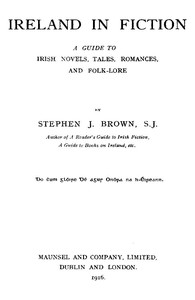
Ireland in Fiction: A Guide to Irish Novels, Tales, Romances, and Folk-lore
Download Formats:
Excerpt
_A GUIDE TO_
IRISH NOVELS, TALES, ROMANCES,
AND FOLK-LORE
BY
STEPHEN J. BROWN, S.J.
_Author of A Reader’s Guide to Irish Fiction,
A Guide to Books on Ireland, etc._
MAUNSEL AND COMPANY, LIMITED,
DUBLIN AND LONDON.
1916.
PREFACE vii.
PREFACE TO _A Reader’s Guide to...
Read the Full Text
— End of Ireland in Fiction: A Guide to Irish Novels, Tales, Romances, and Folk-lore —
Book Information
- Title
- Ireland in Fiction: A Guide to Irish Novels, Tales, Romances, and Folk-lore
- Author(s)
- Brown, Stephen J. M. (Stephen James Meredith)
- Language
- English
- Type
- Text
- Release Date
- October 31, 2021
- Word Count
- 158,653 words
- Library of Congress Classification
- Z
- Bookshelves
- Browsing: Encyclopedias/Dictionaries/Reference, Browsing: History - General, Browsing: Literature
- Rights
- Public domain in the USA.