The Project Gutenberg EBook of David Edwardes: Introduction to Anatomy 1532, by
Charles Donald O'Malley and Kenneth Fitzpatrick Russell
This eBook is for the use of anyone anywhere in the United States and
most other parts of the world at no cost and with almost no restrictions
whatsoever. You may copy it, give it away or re-use it under the terms
of the Project Gutenberg License included with this eBook or online at
www.gutenberg.org. If you are not located in the United States, you'll
have to check the laws of the country where you are located before using
this ebook.
Title: David Edwardes: Introduction to Anatomy 1532
Author: Charles Donald O'Malley
Kenneth Fitzpatrick Russell
Release Date: April 25, 2019 [EBook #59357]
Language: English
Character set encoding: UTF-8
*** START OF THIS PROJECT GUTENBERG EBOOK INTRODUCTION TO ANATOMY 1532 ***
Produced by Stephen Hutcheson, Dave Morgan and the Online
Distributed Proofreading Team at http://www.pgdp.net
DAVID EDWARDES
Introduction to
Anatomy
1532
A FACSIMILE REPRODUCTION
WITH ENGLISH TRANSLATION AND
AN INTRODUCTORY ESSAY
ON ANATOMICAL STUDIES IN
TUDOR ENGLAND
BY
C. D. O’MALLEY
AND
K. F. RUSSELL
STANFORD UNIVERSITY PRESS
Stanford, California
1961
_English translation and Introduction_
© C. D. O’Malley _and_ K. F. Russell, 1961
PRINTED IN GREAT BRITAIN
AT THE UNIVERSITY PRESS, OXFORD
BY VIVIAN RIDLER
PRINTER TO THE UNIVERSITY
TO THE MEMORY OF
CHARLES SINGER
FRIEND AND MENTOR
CONTENTS
INTRODUCTION 1
NOTES TO THE INTRODUCTION 25
FACSIMILE REPRODUCTION 31
ENGLISH TRANSLATION 53
Grateful acknowledgements are made for assistance from the National
Science Foundation in the preparation of this work; to the British
Museum for permission to photograph the only copy of David Edwardes’s
_Introduction_ known to be in existence; and to the Wellcome Trust whose
help made the publication of this work possible.
INTRODUCTION
On 22 August 1485 the battle of Bosworth provided its victor with the
throne of England. Richard III died sword in hand and was
unceremoniously buried in the Grey Friars at Leicester, and on that same
day the victor, Henry Tudor, was as simply crowned and acclaimed by his
troops as Henry VII. So began the Tudor dynasty in England which was to
last until the death of Elizabeth in 1603, to be one of the most
colourful periods of English history and to witness the arrival of the
Renaissance in England. Later than its manifestation on the Continent,
but thereby reaping the benefits of continental developments, English
humanism as a result was soon to become no mean rival. The development
of English literature is too well known for comment, while classical
studies, and especially those in Greek, were to rival their continental
counterpart by the end of the first quarter of the sixteenth century.
Science, however, and more particularly medicine, were laggards.
In those closing years of the fifteenth century which ushered in the new
Tudor monarchy the art of healing derived from two sources, the
universities of Oxford and Cambridge and the organizations of barbers
and surgeons. At Oxford medical teaching was organized by the fifteenth
century, and medicine constituted one of the four faculties of the
university together with theology, law, and arts. Yet at Oxford, as at
Cambridge, the medical curriculum was long to remain medieval.[1] Both
schools had taken their model from Paris, but whereas Parisian medicine
had begun to stir and advance in the fifteenth century, the English
universities remained somnolent. At Cambridge the degree of Doctor of
Medicine required altogether twelve years of study based upon lectures
and discussions drawn from medieval sources. While it is true that two
years of this time were to be spent in the practice of
medicine—seemingly a borrowing from the methods of Montpellier—there was
no provision for human anatomical study,[2] although this was recognized
and demonstrated with some slight annual regularity to the Parisian
students from the latter fifteenth century onward.
If we turn to the other source of healing, the organizations of the
barbers and the surgeons, in so far as anatomy was concerned the
situation was no better and, indeed, it may be said to have been worse
in view of the obvious relationship which ought to have obtained between
surgery and anatomy. In London the fraternity of barbers existed as
early as 1308,[3] and the craft of surgery as a body distinct from that
of the barbers is recorded in 1368.[4] Both barbers and surgeons sought
to establish rules of professional conduct for the members of their
respective organizations as well as a period of time and a curriculum to
be satisfied by aspirants to barbery or to surgery. Despite the efforts
of the surgeons to control the practice of surgery, relegating to the
barbers only the most simple and menial tasks, certain of the more
ambitious barbers sought to go beyond such activities as beard-trimming,
cutting, and phlebotomy, and this determination gave rise in the first
quarter of the fifteenth century to the barber-surgeon[, no longer
acting in the normal occupation of the barber and clearly divorced from
his old trade.[5]
Throughout the fifteenth century the barber-surgeons and surgeons appear
to have remained on fairly amicable terms, presumably carrying on much
the same sort of practice. The surgeons, who took precedence on
occasions of solemnities and festivities, were perhaps somewhat better
trained, but nowhere is there any record that such training required the
study of human anatomy.[6] One learned the trade by apprenticeship to a
surgeon and by consulting textbooks of surgery. From surviving
manuscripts it is possible to determine what these textual guides were:
primarily such as those of the celebrated fourteenth-century surgeons,
Gui de Chauliac and Henri de Mondeville. It is true that late medieval
surgeons were accustomed to introduce the surgical subject by a short
anatomical preface, medieval in character, the result of cursory and
incomplete post-mortem examinations, but hardly sufficient to permit a
proper grasp of anatomy even were that possible of attainment from
literary sources.
Hence the opening of the Tudor dynasty in England witnessed a medicine
and a surgery lacking the essential and fundamental knowledge of the
human structure. The traditions of English medicine were medieval, and
medieval medicine had not concerned itself especially with anatomy. If
we compare continental medicine of the same period the situation is
found to be considerably different. In the course of the fifteenth
century anatomy was being practised—diffidently to be sure, but
nevertheless recognized and employed in Paris where the first human
dissection, in the form of a brief autopsy, had been performed in
1407.[7] The first human anatomy mentioned in the _Commentaries_ of the
Medical Faculty of Paris was performed in 1477-8 on the body of an
executed criminal,[8] but the incident is recorded without any
suggestion of its being a novelty and so raises the possibility that
there may have been other dissections in previous years. The practice of
human anatomy was even earlier in Italy where there is record of an
autopsy in 1286,[9] and in 1316 Mundinus, called the ‘Restorer of
Anatomy’, completed his _Anothomia_ in which he describes his systematic
dissection of the human body. Official decree permitted the practice of
human dissection in many cities, especially those with medical schools,
and such official recognition was granted at Bologna in 1405[10] and at
Padua in 1429.[11] Elsewhere similar recognition of human dissection was
obtained at Montpellier in 1340,[12] at Lerida in 1391,[13] at Vienna in
1435,[14] and at Tübingen in 1485.[15] As a consequence, by the opening
of the sixteenth century a series of anatomical texts, based in varying
degrees upon human dissection, began to appear, such as those of
Benedetti, Achillini, and Berengario da Carpi.
The difference can be explained, at least in part, by the fact that on
the Continent the classical revival of the Renaissance had caused or was
causing medieval tradition to be replaced by that of classical
antiquity. The Renaissance represented an effort to revive the spirit
and interests of the classical world, and classical antiquity had been
much interested in the structure of man. Especially important was the
recovery of the Greek language and literature since it made possible the
recovery of the writings of the great classical physicians, notably
Hippocrates and Galen, for generally speaking classical Greece had shown
more interest in human anatomy than had classical Rome. This recovery
had occurred first in Italy, then moved northward across the Alps and
only in the early sixteenth century did it reach England.
While even earlier some Englishmen had travelled to Italy to study the
classical revival at its source, and even to study the more advanced
Italian medicine of Padua, it may be said that Thomas Grocyn was the
first significant leader of the new classical movement in England, in
particular the recovery of Greek. He had managed to learn some Greek
even in England, but it was not until after a trip to Italy in 1488,
where he spent two years, that he returned to instil Oxford with an
enthusiasm for classical Greek humanism.[16] But if Grocyn is of
importance as an English pioneer in the recovery of Greek and Hellenic
studies, of far greater importance for the present subject was Grocyn’s
lifelong friend and ultimately the executor of his estate, Thomas
Linacre.
Linacre looms very large in the revival of classical medicine which gave
a general impetus toward a better and more modern medicine. Born at
Canterbury about 1460 he was led ultimately by his studies to Oxford
where he became a fellow of All Souls College in 1484.[17] Although by
this time he could make some beginnings of the study of the revived
classical literature, and even Greek, at Oxford, nevertheless it was
still desirable if possible to pursue such studies in Italy, and with
the opportunity offered him, Linacre travelled to that land about 1487,
remaining at least until 1496,[18] in which latter year he received the
degree of Doctor of Medicine from the University of Padua.[19]
Returned to England, Linacre taught Greek at Oxford. Grocyn was his
friend, Sir Thomas More his pupil, and upon the arrival at Oxford of
Erasmus, that great classical scholar likewise became an intimate, all
of them enthusiasts and promoters of Greek studies.
However, as a physician Linacre had a special bent toward the Greek
medical classics. This was manifested by the appearance in 1517 of his
translation of Galen’s book _On Hygiene_. In 1519 this was followed by
the _Method of Treatment_, in 1521 by the book _On Temperaments_, and
two years later by the _Natural Faculties_ and _On the Use of Pulses_.
In 1524 just after Linacre’s death a sixth translation, that of Galen’s
_Differences of Symptoms_ and _Causes of Symptoms_, appeared. As yet
very few physicians in England knew Greek, but they all knew Latin, and
these accurate translations into clear, straightforward Latin made a
considerable portion of Galen’s medical writings available for the first
time. The contrast between medieval medical writings and those of Galen
which had now been made available seemed to emphasize that general
Renaissance belief that civilization had reached its peak in classical
times and that much could be gained by a return to classical teachings,
in this instance the teaching of classical physicians. It is true that
only the Galenic books on medicine had been translated, but they were
sufficient to whet the appetite for more, and as the new generation of
physicians arose, now trained in Greek, if the pattern were followed,
they would turn to the Galenic writings on anatomy in the original
language as well as to those of Hippocrates.[20] The first of this
younger generation who is recorded to have come under this Greek medical
influence and made this possibility a reality produced two remarkable
pioneer efforts: the first recorded dissection of a human body in
England about 1531 and the first book on anatomy written in England,
published in 1532, or, reckoned according to the Gregorian calendar,
1533.
The person responsible for these two milestones was named David
Edwardes, or, in the Latin form he employed, Edguardus. However, very
little is known of his life and activities. He was admitted as a scholar
to Corpus Christi College, Oxford, on 9 August 1517, and the register of
admissions indicates that he was then fifteen years old and a native of
Northamptonshire.[21] He became Bachelor of Arts in 1522[22] although
for a time previous to this, in 1521, he appears briefly to have held
the readership in Greek, substituting for the regular reader, Edward
Wotton, then abroad.[23] In 1525 Edwardes became Master of Arts,[24] and
thereafter received a fellowship in the college. He is further mentioned
in the account book of the college for 1527-8 as receiving 38_s._
9_d._,[25] presumably for further teaching of Greek.
Corpus Christi College had been founded in 1515-16 chiefly through the
magnanimity of Richard Foxe, Bishop of Winchester, and was provided with
its statutes in 1517. The founder, strongly interested in the newly
revived classical learning had provided for a chair of Greek, which, as
has been mentioned, was briefly held by Edwardes in an interim capacity,
while the first president of the college, John Claymond, was likewise a
strong advocate of the new learning.
Perhaps not sufficient stress has been placed upon the contribution made
by physicians, at least in England, to the revival of Greek studies,
although it is sometimes difficult to determine which of the two
disciplines, medicine or Greek, was the impulsion to the study of the
other. Both Linacre and Wotton were serious students of Greek before
they undertook medical studies, but once embarked upon medicine, both of
them having studied at Padua, not only did they become especially
conscious of the failings of medieval medicine in contrast to the
classical, but the philosophical and literary aspects of Galen’s
writings must have caused them to retain a concern with Greek literature
as a whole even though their primary consideration had come to be a
single facet of the body of that literature. Furthermore, the scientific
nature of their interest permitted no equivocation in their knowledge of
the language. Translations of Galen or Hippocrates required an
exactitude beyond that of purely literary treatises. But whatever the
relevancy of such remarks, it is certainly of significance that among
the first teachers of Greek in England were Linacre, Clement, and
Wotton, all physicians, and for our present purpose as it relates to
David Edwardes, it should be noted that two of these men, Clement and
Wotton, were associated with Corpus Christi College.
In addition to the stress upon Greek studies which must inevitably have
led Edwardes to the classical Greek writers upon medicine and conducted
him along the pathway already marked out by Thomas Linacre, there were
in the college certain possibly more direct influences towards an
interest in medicine which have already been alluded to. In short, John
Clement, the early lecturer of Greek[26] was a physician and friend of
Linacre as well as a fellow in the College of Physicians of London which
Linacre had inaugurated in 1518, while still another student of medicine
was Edward Wotton, Reader in Greek and later physician to Henry VIII,
for whom Edwardes had briefly substituted.
Still another incentive toward medical study may have been a requirement
in chapter 25 of the original statutes. In accordance with this all
fellows of the college who held the degree of Master of Arts were
required to assume holy orders, unless deputed to the study of medicine.
It has been suggested that recipients of this exception were originally
expected to attend to the medical needs of the other inmates of the
college,[27] and it seems likely that Edwardes was one of these
_medicinae deputati_.
Our next record indicates that he had removed to the University of
Cambridge where in 1528-9, and upon payment of 3_s._ 4_d._[28] and after
lecturing publicly upon Galen’s _De Differentiis Febrium_, he was
incepted in medicine with recognition of ‘seven years study of
medicine’, presumably at Oxford.[29]
In his only known book, to be considered later, Edwardes informs us that
his first practice of medicine had been ‘at Bristol, having left my
teachers only shortly before and begun to swim without any support’,[30]
although it is not clear whether this represented a brief interlude
between Oxford and Cambridge or after he had received his degree of
Doctor of Medicine. Whatever the case may have been, the few remaining
autobiographical references are to his practice in and around Cambridge.
As a member of the Faculty of Medicine, it is possible that Edwardes was
criticized for devoting an excessive amount of time to his private
practice, since in 1530-1 permission was granted him to be excused from
a statutory requirement of attendance at ‘all congregations, masses and
exequies’.[31] Nevertheless he participated in the examinations of at
least two students, one in 1537-8[32] and the other in 1540-1.[33]
Edwardes’s little book, to which reference was made above, was published
in London in 1532 [O.S.] by Robert Redman. It is composed of two
treatises of which the first, entitled _On Symptoms and
Prognostications_ (_De Indiciis et Praecognitionibus_), deals with
uroscopy and medical prognostication, and since it represents merely the
continuation of a medieval tradition it is of little importance except,
as has been said, for its few autobiographical details. In his practice
of medicine Edwardes appears to have represented, as we might expect, a
combination of the old and the new. While giving support to uroscopy and
displaying some sympathy toward folk medicine, he also gave allegiance
to Hippocrates and Galen, and like his continental colleagues of this
period he was not averse to the introduction of a word or even several
lines of Greek into his text, so indicating his enthusiasm for and his
ties with the classical revival. Furthermore, he was certainly one of
the first English physicians to appreciate Linacre and terms him ‘the
most learned physician of his age’.[34]
The second treatise, _A Brief but Excellent Introduction to Anatomy_
(_In Anatomicen Introductio Luculenta et Brevis_), is, as has been
mentioned, the first work published in England which was devoted solely
to anatomy, and therefore despite its brevity it deserves some
consideration in the general history of medicine and even greater
consideration in that of English medicine. Turning our attention now to
this treatise on anatomy it should be first noted that although printed
in the same volume with the work on medical symptoms and sharing a
common title-page with that work, the treatise on anatomy has a separate
dedication to Henry Howard (1517?-1547), Earl of Surrey. It had been at
the request of Henry VIII that this young nobleman took up residence at
Windsor and lived there from 1530 to 1532 as the companion of Henry’s
son, the Duke of Richmond. Since Edwardes had dedicated the first
treatise to the Duke of Richmond on 21 December 1532, it is not
difficult to comprehend his choice of the duke’s companion for the
second dedication which bears the date 1 January 1532, or, according to
the Gregorian calendar, 1533. There is nothing remarkable about this
latter dedication, which contains the usual flattery, except for the
final passage. There the author remarked upon the ignorance of anatomy
among physicians, sometimes with lethal results. He recognized that the
subject of anatomy was a difficult one, hence his treatise has been
written with brevity and clarity. Later, as he promised, if opportunity
were to be granted to him he would write a more elaborate work.
Hereafter, if God permit, I shall compose a complete book of anatomy
in which I shall further the opinions of all the learned, to which my
own opinion will be added. I could have done this at present but not,
however, with the same effort or with the form of an introduction
preserved. It remains that this little book, which we have enlisted in
the service of the commonwealth, may be pleasing to you, for it
recognizes the existence of those very few unlearned physicians by
whose mistakes many perish, from which this fact will be gathered,
that no parts of the body should be unknown to physicians.
This promise of a more extensive work in which the author was to include
his independent anatomical observations, presumably based on further
human dissection, appears not to have been fulfilled or, at any rate,
there is no record of any such later and more extended anatomical
treatise by Edwardes.
The text of this _Introduction to Anatomy_ fills no more than fifteen
small pages, and its very brevity must have made it virtually useless;
even the author says that it ‘is indeed a slight work’. The plan of
presentation is that which had been popularized by Mundinus and was
required by the relative speeds with which the different parts of the
body succumbed to putrefaction during the course of dissection. Thus
Edwardes first describes the lower venter, that is, the abdomen,
abdominal cavity, and pelvis, next the thorax, and finally the brain and
nervous system. Within his very brief presentation no mention is made of
the extremities while, relative to the limits of the discussion, a
preponderance of attention has been devoted to what were considered the
organs of nutrition and blood manufacture.
The anatomical nomenclature is mildly astonishing, especially when one
considers the time and place of composition. But if one considers that
Edwardes was sufficiently learned in Greek to act as Reader in Greek at
his college for a short period, it will not be too amazing to find him
somewhat scornful of the terms employed by those he calls ‘Barbarians’,
that is, the European school influenced by Moslem medical writers,
chiefly through the _Canon_ of Avicenna, which employed an anatomical
terminology drawn from Latin and from curious hybrid forms partly Latin,
partly Greek, partly Arabic and in some parts from Hebrew. Edwardes, on
the contrary, employs classical Greek terminology as, for example,
omentum rather than the medieval _zirbus_ and mesenteric in preference
to _meseraic_. In so far as his description extends, his nomenclature is
as ‘modern’, if not more so, than that of some of the more learned
anatomists on the Continent. Yet, while his vocabulary may be more
modern his anatomy is not. Indeed, in the introduction he remarked, as
has been mentioned, that in the future he hoped to write a more
extensive work ‘to which my own opinion will be added’. By implication,
then, in this first brief treatise he had drawn upon earlier
authorities, and while we might expect that this student of Greek would
turn to Galen and Hippocrates this is true only in part. The liver as he
describes it is medieval, the three-chambered heart is Aristotelian,
derived from those ‘Barbarians’ he scorned.
While the treatise is noteworthy as the first work written in England
solely devoted to anatomy, the text intrinsically is of little further
value except for one statement referring to the emulgent, or renal
veins. ‘In the body of that one whom we dissected very recently the left
branch had a higher place of origin. Very often, however, the opposite
occurs, so that the right emulgent vein is carried higher in the body.’
Here we have the first reference to human dissection in England, in
which, moreover, the anatomist observing through his own eyes rather
than those of past authorities, noted a variation from the commonly
given description of the emulgent veins, a description derived from
Galen’s anatomical studies on animals.
Little more can be said about Edwardes. He seems to have died about
1542,[35] and perhaps this explains why the larger work was never to be
published. Perhaps, had he remained at Oxford, he might have established
an anatomical tradition, and so provided the influence which his book
was not to have. Today only one copy of this little treatise is known,
that in the library of the British Museum, and no consideration appears
to have been paid to it from Edwardes’s day to the present. However, its
virtual extinction was not the result of hard usage by students such as
that which determined the almost complete annihilation of Vesalius’
_Tabulae Anatomicae_. As has been said, no contemporary mentioned
Edwardes, despite the fact that his book was published in London. The
edition must have been a small one, and copies were not likely to have
been preserved as other and better works on anatomy began to be imported
from the Continent.
Meanwhile the universities continued their drowsy course so far
unaffected in any way by the efforts of an alumnus of one of them. The
barber-surgeons and surgeons appear to have been equally unproductive of
anything new, still leaning upon earlier continental writers. Yet a few
individuals recognized the need for improvement. Well before the
surgeons of England received official encouragement for anatomical study
the surgeons of Edinburgh had asked for and obtained bodies for
dissection. On 1 July 1505 the magistrates of Edinburgh granted a Seal
of Cause to the Guild of Surgeons and Barbers, and this was confirmed by
James IV on 13 October 1506. Among the clauses regulating the practice
of the barbers and the surgeons is one giving them the body of one felon
each year for an anatomy:
... and that we may have anis [once] in the yeir ane condampnit man
efter he be deid to mak antomell of, quhairthraw we may haif
experience, ilk ane to instrict vtheris ... and that na barbour,
maister nor seruand, within this burgh hantt [practise] vse nor exerce
the craft of Surregenrie without he be expert and knaw perfytelie the
thingis abouewritten.[36]
Edinburgh, therefore, was the cradle of anatomical study in the British
Isles. In England Thomas Linacre had founded the College of Physicians
of London in 1518 with the idea of its being a select body of physicians
to raise medical standards and maintain them through its power of
licensing to practice. The need of more modern surgical texts was
indicated by the publication in 1525 of a translation of the work of the
late fifteenth-century German surgeon, Hieronymus Brunschwig, which
contained a brief section on anatomy, but there appears to have been no
attempt to produce a new and up-to-date surgery in England. The fact was
that the more advanced books from continental Europe proceeded to
smother any continuance of independent native efforts, and in the field
of anatomy this makes the early appearance of David Edwardes’s little
treatise an astonishing chronological anomaly in the history of English
anatomical writing. The importance of anatomy was now to be recognized,
but it would be a long time before another native English treatise on
the subject was published.
The introduction of the officially recognized, and even encouraged,
study of human anatomy into England was the result of influences brought
to bear from several sources: the desire of King Henry VIII to improve
the practice of medicine and surgery in England and possibly, too, with
thoughts for a higher quality of military surgery; and the desire, as
well, of some of the more thoughtful surgeons, of whom Thomas Vicary was
probably one. So it was that in 1540 the Company of Barbers was united
with the Fraternity of Surgeons to form what was called the United
Company of Barber-Surgeons of which Thomas Vicary was named Master in
1541, an event handsomely commemorated in a painting commissioned from
Hans Holbein the younger.[37]
In the Charter by which the union was officially sanctioned, a statement
is to be found which was to be of particular importance to the
advancement of anatomical knowledge:
the sayd maysters or governours of the mistery and comminaltie of
barbours and surgeons of London, and their successours yerely for ever
after their sad discrecions at their free liberte and pleasure shal
and maie have and take without contradiction foure persons condempned
adiudged and put to deathe for feloni by the due order of the kynges
lawe of thys realme for anatomies without any further sute or labour
to be made to the kynges highnes his heyres or successours for the
same. And to make incision of the same deade bodies or otherwyse to
order the same after their said discrecions at their pleasures for
their further and better knowlage instruction insight learnyng and
experience in the sayd scyence or facultie of surgery.[38]
It is of interest to note that very soon after the Charter had been
granted, Thomas Vicary approached the Lord Mayor and Aldermen of London
to make sure that the Barber-Surgeons should receive the bodies of the
felons for anatomical study. It would seem that the Court of Aldermen
were not sure how they should direct their Sheriffs, for the Minutes of
the Court for 14 December 1540 state:
... Item, Master Laxton & Master Bowes, Shreves of this Citye, prayed
the Advyse of this howse for & concernying the Delyuerye ouer of one
of the dedde bodyes of the Felons of late condempned to dethe within
this Citye, And requyred of the seyd Master Shreves by Master Vycary &
other the surgeons of this Citye for Annotamye, Accordyng to the
fourme of an Acte of parlyament thereof lately made. And Agreyd that
the same Acte be first seen & then Master Shreves to work ther
after.[39]
With human dissection material assured, the United Company proceeded to
appoint a Reader of Anatomy, the first perhaps being Thomas Vicary, and
although the intervening records of the company are not complete, it is
known that in 1546 Dr. John Caius, lately returned from Padua, where he
had been acquainted with and even lived for a time with the celebrated
anatomist Andreas Vesalius, was appointed and held the position of
Reader of Anatomy for the next seventeen years. In his brief
autobiography Caius refers to these dissections which he performed ‘for
almost twenty years’, and adds, ‘By the wish of the most illustrious
prince Henry VIII, King of England, I performed them in London before
the surgeons; among the physicians at that time there was no
dissection.’[40] It may be assumed, however, that by ‘physicians’ Caius
was referring to those of London rather than to those of the
universities. Nevertheless, his remark helps to explain the lack of
anatomical works which might have competed with those of the Continent.
The physicians, although better trained in languages than the surgeons
and, we may assume, literary exposition, were as yet not interested in
the subject of anatomy.
Nevertheless it does seem somewhat incredible that the physicians were
so late in taking up the practice of human dissection. While it is
always dangerous to exceed the limits of evidence, this peculiar
situation in regard to the College of Physicians of London requires that
attention be called to a statute of the college reproduced by Munk who
gives it the date 1569-70.[41] According to this authority, the terms
employed in the statute, reproduced below in translation, suggest that
human anatomical dissection was already being employed by the physicians
of the college at the time, although it seems impossible to determine
whether or not the reference is to a period earlier than 1565 when
Elizabeth granted them four bodies annually for anatomical purposes.[42]
However, it seems unlikely that the college, which was so concerned with
the enforcement of laws concerning medicine would itself perform an
illegal action and therefore that Elizabeth’s grant to the college most
likely introduced it to human dissection. Furthermore, one wonders just
how frequently the college employed its new right, and in this respect
it is interesting to note that there is no reference either to
Elizabeth’s grant or to any dissection at all in the _Annals_ of the
college as written by John Caius.[43]
Although the study of human anatomy was now officially recognized and
regularly pursued, at least in London, it would be incorrect to believe
that native English anatomical writings would be forthcoming to continue
the course modestly established by David Edwardes. The apathy or even
hostility of physicians toward anatomical studies was an obstacle
experienced earlier on the Continent and referred to by Vesalius who
contributed no small share to the growth of anatomy’s respectability in
the eyes of physicians. However, the time lag between the Continent and
England had resulted in a disregard of anatomical studies by English
physicians at the very times when continental physicians had begun to
interest themselves in the subject and publish anatomical studies. As a
result it was inevitable that for such Englishmen as were interested in
anatomy it was easier to import the more advanced and elaborate
continental texts, and dependence on such alien works was for long to be
the regular pattern. But even with these advanced, contemporary works
available, the practice continued among the surgeons of republishing old
and obsolete anatomico-surgical treatises of late medieval times. If
such a practice was dictated by an elementary knowledge, certainly the
continuance of it would not lead to any development.
In 1544 a Flemish engraver named Thomas Lambrit, better known under his
pseudonym of Geminus, engraved on copper a series of anatomical figures
plagiarized from the _Fabrica_ and _Epitome_ of Vesalius. Geminus
displayed the plates, which are of considerable artistic merit, indeed,
the first of high quality to be produced in England, to King Henry VIII.
That monarch, aware of the need of anatomical books to bolster the
anatomical teaching now in progress, urged Geminus to publish his
engravings. Never one to scorn the chance of gain, Geminus proceeded to
follow this royal advice in the succeeding year (1545) and added to his
plates a dedication to the king and the text of Vesalius’ _Epitome_.[44]
For some peculiar reason the completely innocent John Caius has
occasionally been blamed as the impetus to this plagiarized publication
despite the fact that Geminus states plainly in his preface that Henry
VIII was responsible for his decision to publish.
While the illustrations plagiarized from Vesalius may have been of some
pedagogical value, the text of the _Epitome_ certainly was no anatomical
manual, and the fact that it was in Latin, which many if not most of the
surgeons could not read, gave it even less value.
It was perhaps at least partly for these reasons that Thomas Vicary
appears to have issued in 1548 an anatomical text in English entitled _A
Profitable Treatise of the Anatomie of Mans Body_. No copy of it is
known to exist today, and its existence is realized only through mention
of it on the title-page of an edition published in 1577 by the surgeons
of St. Bartholomew’s Hospital and a reference to it in 1565 by another
surgeon, John Halle, who refers to Vicary as ‘the firste that euer wrote
a treatyse of Anatomye in English (to the profite of his brethren
chirurgiens and the helpe of younge studientes) as farre as I can
learne’.[45] However, to refer to the ‘profite’ and ‘helpe’ to be
obtained from Vicary’s treatise is to reveal the deplorable state of
anatomical studies in England at the time and to cause one to wonder if
Halle had read by way of contrast the continental writings of that
period. It seems very likely that what has been termed Vicary’s anatomy
was nothing other than a copy of a manuscript, presently in the Wellcome
Historical Medical Library in London, dated 1392 and merely a
compilation of Lanfranc, Henri de Mondeville, and Gui de Chauliac, the
most recent of them dead in 1367. Thus not only was Vicary’s work not
based upon dissection, except for a secondhand account of crude
fourteenth-century autopsy, but it represented a definite case of
retrogression.
The next anatomical publication in England was a new edition in 1553 of
Geminus’s plagiarized anatomical plates, but this time with an English
text by Nicholas Udall, best known as the author of the first important
English comedy, _Ralph Roister Doister_, and utterly lacking in
knowledge of anatomy. In consequence one may correctly hazard that this
work, published with commercial rather than pedagogical motives, would
not contribute much to knowledge of anatomy in England, even though the
text was now in English. It is true that Vesalius’ descriptions of his
illustrations were put into English, the first translation into English
of any portion of the _Fabrica_, but the text which now replaced the
_Epitome_ of the earlier edition of 1545, like Vicary’s work, is
predominantly indebted to that same fourteenth-century manuscript
compiled from the writings of late medieval surgeons. Finally, the
sheets of this work were reissued in 1559 with a new preface written by
Richard Eden which aimed to delude the public into the belief that the
publication had been revised.
About this time, too, a small series of anatomical fugitive sheets with
superimposed flaps made their appearance in England. One, at least, had
two leaves of English text to explain the woodcut and is nearly always
discovered bound into the 1559 reissue of Geminus’s book. The fugitive
sheets, like their continental predecessors and followers, added very
little to anatomical knowledge and must have been for popular
consumption.
If we turn now for a moment to give consideration to continental
activity during the same period, there is no difficulty in observing the
superiority of publications abroad. In 1543 the _Fabrica_ of Vesalius
was published, in 1545 the _De Dissectione_ of Rivière and Estienne, in
1555 the revised and much improved second edition of the _Fabrica_, in
1556 _Composicion del Cuerpo Humano_ of Valverde, and in 1559 the _De Re
Anatomica_ of Colombo. It is little wonder that these foreign texts
overwhelmed the English market and prevented any initiative which might
have led to the publication of any but the most rudimentary manuals,
presuming that there was in England anyone who had pursued the study of
anatomy sufficiently to be in a position to compete with the continental
authorities. On the other hand, the superiority of the foreign
publications owed part of that superiority to the fact that they were
the work of much better educated physicians who had undertaken the study
of anatomy, whereas in England the subject was yet very largely under
the control of the less learned and less articulate surgeons who thought
of anatomy more as a limited body of technical information required for
surgery rather than a field of knowledge to be studied for itself and
capable of indefinite expansion. David Edwardes had sought to set
medicine on the right course, but to no avail. While in time the
Faculties of Medicine in the two universities would pay some lip-service
to anatomy, yet some considerable time was to pass before they became
genuinely interested in the subject.
In 1549 a royal examination of the Oxford statutes led to a declaration
that they were ‘antiquated, semi-barbarous and obscure’, and new ones
were substituted. In regard to medicine it was declared that before
receiving the degree of Bachelor of Medicine the student must see two
anatomical dissections, and himself perform two dissections before
receiving his licence to practice. Before receiving the degree of Doctor
of Medicine he was required to observe two or three more
dissections.[46] This, however, seems more likely to have been the ideal
than the reality and echoes a similar but normally unfulfilled
requirement in fifteenth-century Paris. It is more likely that the
frequency with which anatomy was conducted at Oxford would have depended
upon the particular interest of the Professor of Medicine, such as
Walter Bayley (1529-93) who became Regius Professor of Medicine in 1561
and who at his death left his ‘skeleton of bones in Oxford’ to his
successor in the chair.[47] However, no Reader in Anatomy was appointed
at Oxford until 1624. Indeed, the founder of the readership, Richard
Tomlins, recognized the situation in his grant by noting that the study
of anatomy was
more particularly necessary for the faculties and Artes of Phisicke
and Chirurgery, the perfection whereof doth much avayle to the safety
health and comfort of the whole Commonwealth in the conservation of
theire persons: And that there is as yet in neither of the
Vniversities of this Kingdome (thoughe otherwise the most florisshing
of the whole Christian world) any such Anatomy Lecture founded or
established.[48]
If we may believe John Caius, writing after the middle of the century,
the first early enthusiasm for Greek studies had worn off among
physicians. Caius, himself a very competent Grecist, wrote in advocacy
of the study of Greek medicine in the Greek language, that
as each is more capable in his own tongue so he is consistent and
always remains himself which contributes much to clarity, since each
tongue has its own idioms and inexpressible terms which when
translated do not retain the same emphasis or a like grace. In short,
translators some times do not understand certain things, elsewhere
they fall asleep, do not retain exactness of diction, restrain
freedom, and since we are all human and so desirous of variety, from
time to time they slip so that not only may there be obscurity but
even ambiguity.
Nevertheless, wrote Caius, in his day ‘everyone turns to the Latin
editions and no one touches the Greek’.[49]
It is certainly true that after that first generation of men like
Linacre, there was little interest in England in the original language
of Galen and Hippocrates. The surgeons, certainly, knew no Greek, and
the physicians were not interested in anatomy. There was to be little
controversy, therefore, as to the meaning of any of Galen’s anatomical
terms and less likelihood of investigating and disputing Galenic
assertions. Acceptance without demur of the translation was a long step
toward unquestioned acceptance of the content of the original. Hence it
appears that by the middle of the sixteenth century the authority of
Galen in Latin dress, or of his commentators, was not very likely to be
opposed. On the Continent it had been instances of questions and
opposition which had brought about anatomical advancement by resort to
the only arbiter of doubts and questions, that is, the cadaver.
With conditions as they have been portrayed it is no wonder, therefore,
that little initiative was displayed in England. The most popular of the
foreign works in England, as on the Continent, appears to have been the
_De Re Anatomica_ of Colombo which held its position until well after
the opening of the seventeenth century. It was excellent for its time,
not certainly the equal of the _Fabrica_, but on the other hand much
cheaper to purchase, less bulky to hold, and not so detailed as to be
confusing. It was probably this particular work in its several editions
which more than any other prevented the appearance of a native English
anatomical text.
In 1578 John Banister published a book entitled _The Historie of Man,
sucked from the Sappe of the most approued Anathomistes_. The title
indicates the character of the work, drawn from continental authorities,
and especially from Colombo, despite the fact that Banister was Reader
in Anatomy to the United Company and therefore in a position to
undertake independent researches. Indeed, a contemporary painting shows
Banister in his capacity as Reader standing beside an open copy of
Colombo’s _De Re Anatomica_.[50]
It is clearly apparent that English anatomy in the Tudor period remained
far behind that of the Continent, at least on the basis of such books as
were published in England, and thereby renders that modest but early
effort of David Edwardes all the more curious.
Edwardes, it must be recalled, had presented his brief treatise in the
same form which was being employed on the Continent, and we may assume
that it represented his method. What he did was to ignore medieval
writers and return directly to Galen, the supreme authority of that age,
the ‘Prince of Physicians’. Coupled with this, he had begun to dissect,
first, it may be assumed, for better comprehension of Galen but
ultimately by Edwardes or his successors, discrepancies between the text
of Galen and the observed anatomy would at once have indicated the
classic error and the path to knowledge. Such was the course of
continental development, but English anatomy of the period was faced by
an insurmountable obstacle.
Whereas the medical faculties of continental universities came to accept
anatomy, such was not to be the case with English medicine until well
into the seventeenth century. As a result, anatomy was not an end in
itself but rather a limited field of knowledge learned in so far as it
might be usefully applied in surgery.
There were, of course, some Englishmen whose training and knowledge were
superior to the quality demonstrated in English texts, men who had had
Paduan training such as Caius and Harvey. But even Caius remained a
Galenist when continental anatomy had become Vesalian, and Harvey,
despite his thoroughly scientific attitude in respect to physiology,
remained very conservative in his approach to purely anatomical
problems, seeking authority not only in Galen but in the even more
ancient Aristotle.
Under these conditions it seems remarkable that such great contributions
were made to physiology in seventeenth-century England. The
contributions of Harvey, Boyle, Hooke, and Lower form an amazing
contrast to the static and even retrograde position of anatomy in the
preceding century. In 1565 John Halle, a distinguished surgeon,
published his _Anatomy or Dissection of the Body of Man_ which was
largely a translation of the surgery of Guido Lanfranc who died in 1315,
yet fifty-one years later Harvey had arrived at the circulation of the
blood.[51]
NOTES TO THE INTRODUCTION
[1]Maurice Davidson, _Medicine in Oxford_, Oxford, 1953, pp. 15 ff.
[2]H. D. Rolleston, _The Cambridge Medical School_, Cambridge, 1932, pp.
1 ff.
[3]J. F. South, _Memorials of the Craft of Surgery in England_, ed.
D’Arcy Power, London, 1886, pp. 14-15; Austin T. Young, _The Annals
of the Barber-Surgeons of London_, London, 1890, p. 24.
[4]South, op. cit., pp. 15-18.
[5]Ibid., pp. 20 ff; Young, op. cit., pp. 40 ff.
[6]South, op. cit., pp. 81 ff.
[7]Ernest Wickersheimer, ‘Les premières dissections à la Faculté de
Médecine de Paris’, _Bulletin de la Société de l’Histoire de Paris
et de l’Ile-de-France_, 1910, xxxvii. 162-3.
[8]_Commentaires de la Faculté de Médecine de l’Université de Paris
(1395-1516)_, Paris, 1915, p. 286.
[9]_Cronica Fratris Salimbene_ (Monumenta Germaniae Historica:
Scriptores), Hanover, 1905-13, p. 613.
[10]Robert von Töply, in Puschmann, _Handbuch der Geschichte der
Medizin_, Jena, 1903, ii. 199.
[11]Ibid., p. 201.
[12]Ibid., p. 209.
[13]M. Roth, _Andreas Vesalius Bruxellensis_, Berlin, 1892, p. 13.
[14]Töply, loc. cit., p. 212.
[15]Ibid.
[16]Montagu Burrow’s, ‘Memoir of William Grocyn’, _Collectanea, Second
Series_ (Oxford Historical Society), Oxford, 1890, pp. 332 ff.
[17]J. N. Johnson, _The Life of Thomas Linacre_, London, 1835, pp. 1-12.
[18]G. B. Parks, _The English Traveller to Italy. The Middle Ages (to
1525)_, Stanford, Calif., 1955, pp. 457-60.
[19]R. J. Mitchell, ‘Thomas Linacre in Italy’, _English Historical
Review_, 1935, l. 696.
[20]This sequence was followed in Paris where in particular Guinther of
Andernach and Jacobus Sylvius were proceeding from their study of
Galen’s medical writings to those of an anatomical nature.
[21]Thomas Fowler, _The History of Corpus Christi College_, Oxford,
1893, p. 381; _Register of the University of Oxford_, ed. Boase,
Oxford, 1885, ii. 128, where he is mentioned as ‘David Edwardys,
disciple of the dyalectic art’.
[22]Ibid.
[23]Fowler, op. cit., pp. 58 and n., 85 n., 369 and n.
[24]_Register_, p. 128.
[25]Fowler, op. cit., p. 370 n.
[26]Ibid., p. 369.
[27]Ibid., p. 372.
[28]_Grace Book_ Β, ed. Mary Bateson, Cambridge, 1905, pt. ii, pp. 148,
150.
[29]_Grace Book_ Γ, ed. William George Searle, Cambridge, 1908, p. 242.
[30]_De Indiciis et Praecognitionibus_, London, 1532, Ei^r.
[31]_Grace Book_ Γ, p. 254.
[32]Ibid., p. 326.
[33]Ibid., p. 353.
[34]_De Indiciis et Praecognitionibus_, C₃^r.
[35]There is record of the probate of his will in that year in the
Vice-Chancellor’s Court in the University of Cambridge with mention
of his wife Alice. The actual will, however, appears to be no longer
in existence. Information kindly supplied by Miss H. E. Peek,
Archivist of the University of Cambridge.
[36]J. D. Comrie, _History of Scottish Medicine_, London, 1932.
[37]_The Paintings of Hans Holbein_, ed. Ganz, London, 1956, nos. 218,
219.
[38]Young, op. cit., p. 588.
[39]Guildhall, Repertory 10, f. 186, 14 Dec. 1540.
[40]_De Libris Propriis_, p. 90, in _The Works of John Caius_, M.D., ed.
Venn, Cambridge, 1912.
[41]William Munk, _The Roll of the Royal College of Physicians of
London_, London, 1878, iii. 351. The statute is cited from Goodall’s
MS., _On College Affairs_, pp. 55-56: ‘Among our elders the
Anatomical Lecture was considered of such importance that according
to everyone’s recollection very few Fellows sought to be excused
from that duty except for very grave reasons. However, lest it
happen that frequent dispensations of that sort should become usual
and customary and thence, so it was feared, lest such a useful
institution should gradually perish, they decided to prevent it
through the statutes, by slight penalties in the beginning and
afterward increased and more severe according to the danger. We
desiring to follow their prudent regulation, lest hereafter we admit
Fellows into the Society influenced by a like hope of always
declining this duty and not giving their attention seriously to that
task: We establish and Order that for those refusing the duty of the
ordinary anatomical lecture and wishing to be released wholly from
that duty, the penalty of paying the College twenty pounds, unless
because of very serious obstacles approved by the President and a
majority of the Fellows in plenary session. In cases of lesser
importance in which there is not sought a continuing exemption but a
deferment from lecturing for a time, we leave to the judgment of the
President how far this ought to be granted to the applicants; but
the deferment granted may not exceed seven months. In which case
also we wish that deferment from the first lecture may not be
granted in favor of the succeeding lecturer, but that he be held to
observe the time ordered for him by the President, as if there were
no such deferment.’
[42]Charles Goodall, _The Royal College of Physicians of London_,
London, 1684, pp. 34-37: ‘Elizabeth by the grace of God, Queen of
England, France & Ireland, defender of the faith &c. Greetings to
all those reached by the present letter. Our father of noble memory
Henry VIII, formerly King of England, among certain other decrees
for the well-being and usefulness of his kingdom of England,
especially watching over the health of his subjects, through his
Letters Patent instituted in perpetuity a College of certain grave
men of medicine who practised medicine publicly in his City of
London and its suburbs within seven miles of that city. In the name
of the President of the College and the Fellowship of the faculty of
medicine of London, he incorporated them in the corporate and
political body, and he granted to the same President and College of
Fellowship aforesaid and to its successors diverse liberties and
privileges. Our same father not only confirmed those Letters Patent
and all things contained in them through his _Senatus Consultum_ or
Parliament held in the fourteenth and fifteenth years of his reign,
but also he increased and amplified the same statute in many ways.
Since our said father granted this pious design for the well-being
of the commonwealth, assuredly day by day there will be manifestly
great advancement if to the aforesaid President, College or
Fellowship and their successors forever we grant what is especially
necessary for those professing medicine, certain human bodies
annually for dissection. Know that we, not only deservedly renewing
the famous institution of our said father, but also considering the
responsibility of our royal office to provide as much as possible
for the assured health and security of our subjects, of our special
grace and from our certain knowledge and genuine affection for our
people, we grant presently and for our heirs and successors to the
aforesaid President of the College or Fellowship of the aforesaid
faculty of medicine of London, and their successors or assigns, that
they may have and receive annually and forever in future times, at
one time or at different times of the year, at the discretion,
desire and liberty of the aforesaid President during the time of his
existence and of his successors, one, two, three or four human
bodies for dissection and anatomization, which have been condemned
and executed according to the common law of this kingdom for theft,
homicide or whatever felony, or have been condemned and executed
according to the common law of this kingdom for theft, homicide or
whatever felony within the County of Middlesex or within the
aforesaid City of London or elsewhere within sixteen miles of the
aforesaid City in whatever County.... And that it be permitted to
the same President of the College and aforesaid Fellowship and their
successors and whatever others of their assigns, professors or
experts, to dissect and to divide the same bodies or otherwise
according to their will and judgment, with that reverence which
ought to be granted to human flesh, for the increment of knowledge
of medicine and experiment of the same, and for the health of our
liegemen without the contradiction of anyone. And this without
rendering or paying any one any sum of money or any sums of money
for the same. Provided always that when from time to time an anatomy
of this sort has been undertaken and completed that the aforesaid
bodies be given funeral and burial at the expense of the President
and his successors....
Westminster, 24 February, in the seventh year of our reign’
[43]Caius was not only a confirmed Galenist, but with the passing years
ever a more conservative and literal Galenist, and his anatomical
lectures to the surgeons were described by Bullein in his _Little
Dialogue_ of 1579 as ‘reveiling ... the hidden jewels and precious
treasures of Cl. Galenus’. It seems likely that, whatever anatomical
lectures were given in the College of Physicians, they must, at
least for a time, have been of like character. In the _Annals_ of
the college as written by Caius we find that as late as the year
1559 a certain Joannes Geynes was subject to disciplinary action
because of his assertion that Galen had been guilty of error. He was
required to state that ‘I Joannes Geynes confess that Galen did not
err in those things for which I criticized him’, _Annales a Collegio
Condito_, pp. 53-54, in _The Works of John Caius_, ed. Venn,
Cambridge, 1912. Such conservatism carried over to the study of
anatomy would certainly have been detrimental to any advancement of
knowledge.
[44]_Compendiosa totius Anatomie delineatio, aere exarata per Thomam
Geminum._
[45]_Selected Writings of Sir D’Arcy Power_, Oxford, 1931, p. 115.
[46]H. M. Sinclair and A. H. T. Robb-Smith, _A Short History of
Anatomical Teaching in Oxford_, Oxford, 1950, p. 10.
[47]Ibid., p. 11.
[48]Ibid.
[49]Caius, loc. cit., p. 104.
[50]This portrait shows Banister giving the Visceral lecture at
Barber-Surgeon’s Hall in 1581; of small size and painted by an
unknown artist on two pieces of paper joined down the middle, it is
nevertheless sufficiently detailed for us to discover that Banister
is using the octavo edition of Colombo’s work printed in Paris in
1572. The portrait is now laid down in an album of anatomical
drawings, also painted for Banister, which was formerly owned by
William Hunter and is now preserved in the Hunterian Museum,
Glasgow. The drawings consist of views of the skeleton, the
superficial muscles, nerves and veins drawn in colour on a dark
ground with some skill. Singer, in his _Evolution of Anatomy_,
London, 1925, p. 174, suggests that the skeletal figures are
probably the earliest prepared in England which were actually drawn
from the bones. This could well be true, but Banister based his
drawing of the nerves on a plate of Charles Estienne, 1545, and his
figures of the superficial muscles and veins are possibly based on
Valverde. Other relics of Banister can be seen at Cambridge. The
University Library has a book-like casket containing a small ivory
skeleton and the _écorché_ figure of a man given to the library by
Banister in 1591. King’s College Library has a copy of _The Historie
of Man_ presented by the author in 1596.
[51]Books printed on the Continent were freely available in England, and
it could be argued that this was one reason why so few anatomical
texts were published in the Tudor period. It has already been noted
that Colombo’s _De Re Anatomica_ in the octavo edition of Paris,
1572, was used by Banister in his visceral lecture. This could well
have been the text recommended to apprentices of Barber-Surgeon’s
Hall. Such imported books were, of course, published in Latin and
were therefore suitable to the students of the College of Physicians
and those of Oxford or of Cambridge. It seems likely that the
students at Barber-Surgeons’ Hall created a demand for more simple
texts in the vernacular and this is surely the reason for the
continued popularity of such books as Thomas Vicary’s archaic text.
[Illustration: page image]
DE IN-
DICIIS ET PRAE
cognitionibus, opus ap-
prime utile medicis,
Dauide Edguardo
Anglo authore.
EIVSDEM IN
Anatomicen introductio
luculenta et breuis.
_1532_
[Illustration: page image]
EXIMIO
AC ILLVSTRI D. HENRICO
Surrensi Comiti Da. Edguardus
medicus S. D.
QVOTIES MIHI
in memoriā uenit Hen-
rice nobilium Comitum
decus, et quanto in ho-
nore fuerit tuus auus a-
pud Anglos omneis, cū ob insignem illā
uirtutē suam et fortunatos in rebus bel-
licis succæssus, tum ob prudentiam suam
minime uulgarem in administranda re
publica, dum uiueret: et quam dextere eti-
am his diebus quotidie gerantur res om-
nes tuo patri præclarissimo, quæcunqꝫ ad
nos Anglos pertinent: non possum satis
admirari genus istud tuum, non horum
adeo caussa, ut quod et te in hac ætate cō-
stitutum, uideam, supra quam dici potest
[Illustration: page image]
in multis alijs adolescentibus, ad ea quæ
te meliorem reddant tam serio animum
appellere. Istud quidem ego haud scio,
naturę́ ne illius beneficio ascribere debeā
è qua nobis editus es, an superis, qui et tu-
is bene uertunt, et Anglis nostris fauent.
Vtcumqꝫ est, reipublicæ nostræ commo-
do fore speramus, quod factum est, atqꝫ
eo magis, quo tu diutius rebus bonis stu-
dueris. Ita namqꝫ sequentem ætatem in-
structior adibis, et cōsuetudo interim bo-
na tuum animum stabiliet, ne ad peiora
in posterum facile decidas. Quanto uero
magis et consilio ualebis, et prudentia,
tanto meliorem sui gubernatorem habe-
bit Norfolcia tuæ stirpi credita, ubi patri
succædes hæres prædiorum, tantoq́ꝫ inte-
rea utilior Comes eris Surrensi populo
tuo, ac tanto demum magis Anglis om-
nibus expetitus, ut reipublicæ negotia
suscipias, quæ omnia et honorum tibi in-
cremento futura sunt et tuorum omnium
[Illustration: page image]
honestamento quæ omnia et certum est
consequi posse te, si ut cœpisti iuuenileis
annos transiges. Vt magnam in te spem
reponimus, te et patris aui tui similem fu-
turum, quòd et ingeniū tuum et morum
grauitas talia nobis polliceātur. Ego tibi
et maximos succæssus precor et optima-
rum omnium rerum augmentum uber-
rimum. Atqꝫ ut hic annus totus ab inicio
fœlix tibi tuisq́ꝫ sit, iterum precor. Quo
omine et hanc nostram in Anatomicen
introductionem tibi dedico. Vt enim
hæc artis medicæ pars omnibus comper-
ta non est, sic et quod difficillima nonnul-
la complectatur, facilem exigit instituti-
onem, qua lectores quasi manu ducantur
ad id, cui innitūtur. Istud opus exiguum
quidem est, sed medicis et Chirurgis om-
nibus per quam utile, quod et plurima
paucis explicat. Nihilo obscuri, nihil af-
fectati continet, sed omnibus eorum in-
genijs expositissimum, qui nec tardi sunt,
[Illustration: page image]
nec ad scientias inutiles. In quo, si quæ
discrepent à communibus medicorū sen-
tencijs, nemo miretur: quòd neqꝫ doctis-
simi eadē his de rebus sentiant. Ego post
hac, si deus permittet, librum condam ab-
solutæ Anatomices, in quem doctissimo-
rum omnium opiniones colligam, qui-
bus et mea sententia interponetur. Potui
et id iam facere, sed nec eodem tamen la-
bore, neqꝫ seruato introductionis decoro.
Superest ut hic libellus tibi gratus sit
quem in reipublicæ commodum cōscrip-
simus. Reddet enim pauciores indoctos
medicos, quorum uicio plurimi intereunt
à quo et hic fructus percipietur,
ut nullæ corporis partes me
dicis non sint notis-
sime. Vale. Can-
tabrigiæ, Cal.
Ianua-
rij.
[Illustration: page image]
DAVIDIS
EDGVARDI ANGLI IN
Anatomicen introductio.
INFERIOR
uenter totus (hinc e-
nim humani corpo-
ris incipere dissecti-
onem oportet, quòd
is locus ocyssime pu-
trescat) à prima cute ad peritonæū Græ-
cis ἐπιγάστριον, Barbaris Mirach appella-
tur cuius quidem hæ partes sunto.
CVTIS IN superficie quæ totum oc-
cupat corpus, sensus omnis expers. Cu-
tis tenuissima superficiali cuti subiecta et
subtensa, sensilis. Græci eam ὑποδερµα
dicunt. Pinguetudo quædam totum uen-
trem occupans, cuti sensili citra medium
substrata.
NERVOSA et tenuis membrana
[Illustration: page image]
hæc continuo sequitur. Membrana rur-
sus è musculis ortum habens huic statim
subiungitur, ubi recta mox linea appa-
ret in medio.
MVSCVLI obliqui duo descenden-
tes uersus imum uentrem his subiacent.
Musculis obliquis ascendentibus sub his
locus est. Recti duo musculi uendicant lo-
cum proximum. Atqꝫ infimi omnium
sunt musculi transuersi. Octo igitur hi
sunt quorum ferè singulis sunt suæ tuni-
cæ neruosæ quibus à se inuicem discri-
minantur.
SVBTENDITVR his aponeurωsis
siue potius membrana quædam spissa et
tenax quam aliqui falsò peritonæum ap-
pellant. Hactenus de Epigastrio et eius
partibus.
CERTÈ peritonæum neruosa pars
est, tactu mollis, tenacitatis mediocris, to-
tum uentrem occupans, et aponeurωsi si-
[Illustration: page image]
ue membranæ quam dixi subsidēs. Græ-
ci id illi nomen indiderunt. Barbari Si-
phacid uocant.
ZIRBVS siue omentum subperito-
næo exporrigitur. Adipis quoddam
genus Zirbus est, ex neruosis filis tenu-
iqꝫ neruorum substantia adiposa constās
priore adipe minus crassū. Intestina plu-
rima et imum uentriculum operit, et ali-
menti coctionem expedit.
INTESTINA à uentriculo exori-
untur, è quibus quod rectum et lon-
ganon appellatur, omnium intestinorum
infimum est, et siccum alui onus conti-
net, et inter nates caput exerit, ut onus
deponat. Colon illi continuatur, et in
ascensu renem sinistrum ambit, et ad uen-
triculi latera dextrosum cædit. Quod
Græci τυφλον et µονόφθαλµον, Romani
cæcum intestinum et unoculum uocant,
colo accrescit, cuius unicus est meatus, al-
[Illustration: page image]
tera enim extremitate clauditur, ut coctio-
ni subseruiat cōmodius, uentriculi cuius-
dam modo. Hinc igitur rei nomen. Atqꝫ
intestina quidem crassiora tot sint.
ILEON excipit cæcum, intestinum
in crebros intortum sinus a qua figura et
Græci nomen illi fecerunt παρα του ἐιλεῖ-
σθαι .i. ab inuoluendo, cuius morbus et
iliacus dicitur. Illi ieiunum adheret. Hoc
ieiuni nomen corporum dissectores in-
testino dederunt ab euentu quòd semper
inane reperiatur, et nihil continere. Iecur
enim auulsit prius quicquid haberet in se
ieiunum. Assurgit supra hæc intestina
omnia, duodenum quod ieiuno inferne,
superne Pylωro affigitur. Græcis δωδεκα
δάκτῦλοµ uocatur à duodecim digitorū
mensura. Tria hæc substantiæ suæ ratio-
ne appellentur gracilia intestina.
VENTRICVLVS sub transuerso
septo locatus est, cuius os superius in
[Illustration: page image]
quod œsophagus terminatur, stoma-
chus proprie appellatur, inferius per
q__uod_ intestina alimentū deriuatur πυλωρος
dicitur.
LIEN RARAE sustantiæ uiscus,
uentriculo adiacet ad sinistrum latus
et iecur ad dexterum Hypochondrium,
hoc rotundum, ac quadam tenus lunare,
illud oblongum, ac ueluti quadratum.
Vtriusqꝫ horum gibbosa pars ad inferio-
res costas pertinet. Quod in alterutro cō-
cauum est, id et uentriculo est proximum.
Iecur sanguinē gignit. Lien eundē repur-
gat ab atrabile. Inuaugescit Lien cū reli-
qui corporis dispendio. Iecoris magnitu-
do totius corporis compagi utilis est,
quòd sanguinē et naturalē spiritū summi-
nistret ubertim. Iecur habet suas penu-
las quos Græci λοβούς nominant, inter-
dum treis, interdum plureis, in cuius ca-
uo et uessicula fellis prominet, qua san-
[Illustration: page image]
guis à bile defecatus et purus euadit.
Cuius utiqꝫ uessiculæ exhalatione et tran-
spiratu inficiuntur nonnunquam duode-
num et ieiunum, nonnunquam et pungi
se senciunt, si transpiratus maior sit et bi-
lis mordacior.
À IECORIS concauo uena portæ
oritur: multis exilibus iecoris uenis con-
currentibus ex quibus ea una constat. E
diuerso rursus in innumeras eadem spar-
gitur parteis, uenarumq́ꝫ immensam red-
dit multitudinem, quæ postea passim in-
testinis propè omnibus inseruntur, ad
mistis unâ membranulis adiposis, ut nu-
trimentalem substantiam iecori suppedi-
tent in sanguinis generationem. Chilus
namqꝫ cibusq́ꝫ à uentriculo statim ad in-
testina demittitur concædente exitū py-
lωro, ubi primum accæperit uentriculus
quantum usibus suis sufficiat, et coctio-
nem suam perægerit qui nisi et in sangui-
[Illustration: page image]
nis naturam transmutandus sit, parum
admodum in reliqui corporis nutricio-
nem contulerit. Hunc ergo usum præ-
stant numerosæ hæ uenulæ, ut optimum
nutrimenti succū haud satis adhuc coctū
interaneis exugant, et iecoris cauo man-
dent, quo illic sanguis fiat. Quas nimi-
rum uenulas et Meseraicas, et Mesenteri-
cas Græco uocabulo nominare licebit.
Latini eas lacteis uocant. Ad harum mu-
nimen ne per ramificationis frequentiam
ualentiore corporis motu earum qúæuis
distrahantur dilanientúr ue, quo firmius
constent singulæ sibi uenulæ duodeno
πανκρεασ adhæret, glandulosa scilicet ca-
ro, quæ et καλλίκρεασ Græcis uocatur in-
terdum.
SANGVIS meat à iecoris cōcauo, in
quo paulo āte formatus est, ad gibbū
iecoris, non qualis tamen omnino factus
fuerit in cauo, sed syncerior et simplicior,
[Illustration: page image]
utrâqꝫ bile ab eo secreta, et ad concæpta-
cula sua transmissa, ut corpori salubriter
alendo et gignēdis spiritibus inculpatior
sit. À gibbo uero et in totum undiqꝫ cor-
pus porrigitur sanguis, per uenam cauā
(Græcis κοιλη dicitur) et multiplices eius
uenæ ramos. Hæc profecto uena reliquas
omneis corporis uenas inagnitudine su-
perat, et à iecoris oritur gibbo. À qua per
mediam spinam descendēte unus utrinqꝫ
ramos renes petit, alterutro ramo in pal-
mi longitudinem protenso.
HI CONCAVAE uenæ rami ue-
næ sunt emulgentes. Quem nouissi-
me secuimus, illi leuus ramus in corpore
alciorem exortus sui locum habebat. Sę-
pissime tamen contra fit, ut emulgens
dextera uena sublimius in corpus effera-
tur. His emulgentibus uenis natura uti-
tur ad deferendam sanguinis aquositatē
et bilem à iecore ad renes. Totidem et ar-
[Illustration: page image]
teriarum ramuli, eodem situ, et á magna
Aorta arteria cauam uenam subeunte, in
æquam longitudinem procurrunt in re-
nes, sub emulgentibus uenis, bile et san-
guine aquoso cor exonerantes, quibus et
arteriarum emulgentium nomen est.
DESCENDVNT et à sinistris e-
mulgentibus uena et arteria in sinistræ
partis testem. Seminales eæ sunt meatus
sanguine et spiritu turgentes, fœminas in
his contenta seminis materia procreat,
quód humor sit aquosus et coctionem
desyderet. Meatus seminales itidem arte-
ria et uena à dexteris demittūtur in dexte-
rum testem, uerum à uenæ cauæ et Aortæ
arteriæ truncis excrescentes, ac proinde
succus in eis minus aquosus, ac probe cō-
coctus, maribus generandis aptior est.
In his meatibus sanguis percoquitur, qui
póst ad glandulosam testium carnē trans-
latus, seminis formam acquirit.
[Illustration: page image]
RENES solida et dura uiscera sunt,
non sentientia, uis attractrix in eis pollet
plurimum. Sanguinem ab aquositate ac
bile purgant. Sed sanguinem retinent, ut
quo alantur reliquum humorem expri-
munt. Eis enim ὀυρῆτῆρες adnectūtur .i.
urinarij meatus, candidi fistulosi, ac ten-
siles, qualeis nimirum ad uesicam pertine-
re dixeris et eius substantiæ confineis esse.
SEPTVM transuersū est mēbranosa
quædam substantia, uitalia et natura-
lia membra intercursans. Græcis διάφραγ-
µα dicitur. Interraneis uim expultricem
firmat, spiritui destinatis membris inscri-
bitur, fumidosqꝫ uapores coërcet ne cor-
dis, aut cerebri, uiuidos spiritus offuscent.
Cui supernę affigitur neruosa tunica quæ
Thoracem intrinsecus uestit, et pectoris
costas statis intersticijs deligat, quam tu-
nicam Græci πλεῦραν bona ex parte no-
mināt, aliqnando uero ὑποζωµα ijsdem
[Illustration: page image]
uocatur. Huius inflammatione fit Pleu-
relis, morbi nomine à tunica ducto.
A PLEVRA iuxa spinam nascitur
et membrana pulmones et intimū
Thoracem æquis portionibus per media
distinguens. Mediastinum uulgo appel-
latur, pulmonibus tanto commodo infi-
tum ut alterius pulmonis uicium alteri fa-
cile ex eo non communicetur. Certè pul-
mones in medio pectoris palacio habi-
tant, cordis et cerebri spiritus recreant, ca-
lorem attemperant, et præfocationis peri-
culum auertunt, quibus et suæ sunt pe-
nulle perinde atqꝫ iocinori. Habent et cor
perpetuo in quibusdam ueluti amplexi-
bus blandissimarum nutricum more, et
qualitatum quendam concentum acci-
nunt, quo singulas corporis particulas de
mulceant, et uegetas faciant. E mediasti-
ni parte illa quæ medios habet pulmo-
nes, profert se membrana egregie spissa,
[Illustration: page image]
duraq́ꝫ, qua cor circumquaqꝫ integitur
περικαρδιον Græcitas nominat. Hæc tue
tur cor, ne ab aduenticijs afficiatur, nè ue
asperginoso fomento careat, quo feruori
suo moderetur. Hæc et uireis cordis unit,
et halituosos illinc spiritus uehemēti mo-
tu dissolui prohibet. Hic cor se condit
princeps membrum, et in turbinem fasti-
giatū uiscus, tribus intus uentriculis con-
cauum ac assidue palpitans, cui et suæ
sunt utrinqꝫ auriculæ in quibus superest
quam longissime uita. In sinistro cordis
uentriculo spiritus et exigui sanguinis se-
des est, à qua uenalis arteria progrediens
pulmones subit aëremq́ꝫ ab eis concipit
præparatiorem, quem in cordis sinus in-
troducat, ne importunius æstuent. Dex-
ter uentriculus plurimū et calidissimum
sanguinem continet. In hunc iecoris uena
caua per mediam spinam scandit ac uita-
lis spirtus fomitem infundit. À quo et ue-
[Illustration: page image]
na arterialis in pulmones copiosum san-
guinem eructat. Medio dexteri et sinistri
uentriculo, sanguis temperatus, et quan-
titate mediocris, inest. Ab hoc magna ar-
teria cui Aorte nomen, nascitur uitalis spi-
ritus uehiculum, ea susqꝫ deqꝫ perpetuo
agitatur contrarijs motibus dilatatione
et constrictione, ac secatur demum in ra-
morū myriadas ut percalēteis toto corpo-
re parteis miti flatu refocillet. De mēbris
uitalibus huc usqꝫ sermonē produximus.
MEMBRANA ossosum capitis or-
bem forinsecus obducens, περικρα-
νιον Grecis appellatur, et dura est, et spissa
et tenax, et exteriori cerebri tunicæ, du-
ram matrem eam uulgo uocant, in sub-
stantia conformis. Pendet et affixa duræ
matris tunica pericranio, sic naturæ ui-
sum est, ne in contactu cerebro efficiat,
subter quam et tenuis mollisq̀ꝫ membra-
na, pia mater ei nomen est, cerebrum in-
[Illustration: page image]
uoluit et nutrit, crebris uenis aspersa.
Dure matri et ipsius cerebri substantiæ
continuatur, et cerebri uentriculos pene-
trat. Hinc se, proxime, oculis offert ipsum
cerebrum, et eius uentriculi, et postico ca-
pitis inditum cerebellum, a quo et me-
dulla spinæ in uertebras descendit. Hinc
et plexus reticularis (rete mirabile triuia-
libus uocatur) summo cerebello, è crebris
uenarum ac arteriarum mutuo sese can-
cellantibus filamentis, phantasiam sui
præbet, in quo spiritus uitalis a corde sur-
sum uectus per arterias dum plenius co-
quitur rarescit, et animalis fit spiritus: sen-
sus et motus caussa in uniuerso corpore.
Neruorum enim fons cerebrum est ner-
ui uero spiritus animalis sunt deferētia ua-
sa, qui à medulla spinæ (Nucha barbaris
dicitur) in omneis corporis particulas di-
geruntur. Quin et à cerebroseptem neruo-
rum coniugationes procædunt. Bini ner-
[Illustration: page image]
ui antrorsum nareis spectant, olfactus ni
mirum organa. Bini ad oculos feruntur,
in itinere sese intersecantes, è quibus uidē-
di facultas. Alij bini motum oculis, bini a
lij linguæ motum et gustum tribuunt. E
duobus et uentriculis sensu pollet, quo mi-
nus appetentia illi desit, è totidem et exili-
bus neruis sapores discernit palatum.
Vnus postræmum neruus utrinqꝫ por-
rectus ab uno principio, auribus largitur
dexteræ et sinistræ, ne surditate extundan-
tur. Hæc sunt quæ de membris animali-
bus abs me per compendium dicta, intro-
ductionē hanc in Anatomicen iusta pro-
lixitate finiāt. Cætera enim quæ ad hanc
tractationem pertinent, in alio opere pro-
sequemur: ubi ad Anatomices omneis nu-
meros sermonem accommodabimus.
EXCVDEBAT ROB. REDMA-
nus Londini Anno
M. D. XXXII.
CVM PRIVILEGIO.
_To the Distinguished and Illustrious
Henry, Earl of Surrey._
_David Edwardes, Physician, Sends Greetings_
How often, Henry, I have recalled the honourable achievements of those
noble dukes, in what great honour all Englishmen held your grandfather
during his lifetime for his remarkable ability and happy successes in
warfare, as well as his extraordinary prudence in the administration of
civil affairs; and also at present how expertly everything that pertains
to us English is daily managed by your famous father. I cannot
sufficiently admire your family, but not so much for those reasons as
because I see you established above what can be said for many other
young men in this age, and turning your mind so seriously to those
things which will render it better. I am by no means certain whether I
ought to ascribe this to the benefit of that stock from which you have
been brought forth to us, whether to the gods who through you smile upon
and favour us English. However it may be, let us hope what has occurred
will be to the advantage of our commonwealth, and that the more so since
you have pursued worth-while things for so long a time. Thus you will
approach the next age better prepared, and good habits will meanwhile
strengthen your mind so that later you will not easily fall into worse.
But the more you may be strengthened by counsel and prudence, with
confidence placed in your family, so much the better guidance will
Norfolk have when you succeed as heir to your father’s estates.
Meanwhile how much more useful you will be to your people as Earl of
Surrey, and finally so much the more will all Englishmen desire you to
undertake the affairs of the commonwealth. There is no doubt that you
can achieve all these things which will be to the increase of your
honours and to the honour of your family.
As your talent and gravity of character promise, so we have great hope
that you will be like your father and grandfather. I wish you both the
greatest successes and the most fruitful increase of all the best
things. And once more I wish that this whole year from its beginning may
be happy for you and yours. With this augury I dedicate to you this our
introduction to anatomy. For as this part of the art of medicine is not
known to all, because it is something very difficult to comprehend, it
requires an easy arrangement by which readers, as if led by the hand to
it, may lean upon it. This is indeed a slight work, but wholly useful
for all physicians and surgeons, because it explains many things
briefly. It contains nothing obscure, nothing elaborate, very readily
accessible to the talents of all those who are neither dull nor
ill-adapted to matters of knowledge. In this, if anything differs from
the common opinions of physicians, let no one be astonished because the
learned do not believe the same in these matters.
Hereafter, if God permit, I shall compose a complete book of anatomy in
which I shall further the opinions of all the learned, to which my own
opinion will be added. I could have done this at present but not,
however, with the same effort or with the form of an introduction
preserved. It remains that this little book, which we have enlisted in
the service of the commonwealth, may be pleasing to you, for it
recognizes the existence of those very few unlearned physicians by whose
mistakes many perish, from which this fact will be gathered, that no
parts of the body should be unknown to physicians. Farewell. Cambridge.
1 January.
THE INTRODUCTION TO
ANATOMY OF
DAVID EDWARDES
ENGLISHMAN
The whole lower venter—for thence it is necessary to begin the
dissection of the human body because that part putrefies very
readily—from the outer skin to the peritoneum is called EPIGASTRION by
the Greeks and _mirach_[1] by the Barbarians, of which the following are
the parts.
The superficial skin which covers the whole body is completely
insensitive. The skin lying and stretched under the very thin and
superficial skin is sensitive.[2] The Greeks call it HYPODERMA. A kind
of fat occupies the whole venter and is spread under the sensitive skin
except for the middle.
A sinewy and thin membrane immediately follows this. A membrane taking
origin from the muscles is subjoined firmly to this where a straight
line appears in the middle.[3]
Two oblique descending muscles[4] lie under these toward the lowest
venter. The oblique ascending muscles[5] are placed under these. Two
rectus muscles have a close relationship. And lowest of all are the
transverse muscles.[6] Therefore there are these eight for which there
are nearly individual sinewy coverings by which they are distinguished
from one another.
An aponeurosis, or rather a thick and firm membrane, is stretched under
them which some falsely call the peritoneum. So much for the epigastrium
and its parts.
Certainly the peritoneum is a sinewy part, soft to the touch, of
ordinary firmness, occupying the whole venter, and resting under the
aponeurosis or membrane which I mentioned. The Greeks gave that name to
it. The Barbarians call it _siphac_.
The _zirbus_ or omentum is extended under the peritoneum. The _zirbus_
is a kind of fat derived from sinewy threads and the slender adipose
substance of the nerves; it is less thick than the fat previously
mentioned. It covers much of the intestines and the lowest part of the
stomach and assists the coction of aliment.
The intestines take origin from the stomach; of them, that which is
called rectum and _longanon_[7] is the lowest of all the intestines and
contains the dry burden of the bowel, and its head extends outward
between the nates so that it may dispose of its burden. The colon is
continuous with it and in its ascent goes around the left kidney, and at
the sides of the stomach it falls away to the right.[8] What the Greeks
call TYPHLON and MONOPHTHALMON, the Romans the blind intestine and
one-eyed,[9] is attached to the colon, of which it is the only passage;
for the other end is closed so that it may assist coction more suitably
in the manner of the stomach. Hence the name for the thing. And such is
the number of the thicker intestines.
The caecum is continuous with the ileon,[10] an intestine twisted into
numerous sinuses; from its shape the Greeks gave it the name PARA TOU
EILEISTHAI, that is, from its involvement; and its disease is called
_iliacus_. The jejunum follows it. Dissectors of bodies gave this name
jejunum to the latter intestine because of the fact that it is always
found empty and contains nothing. For the liver first snatches away
whatever the jejunum might contain. Above all these intestines arises
the duodenum which is continuous below with the jejunum and above with
the pylorus. It is called DŌDEKA DAKTYLOM by the Greeks from the measure
of twelve fingers. These three [intestines] by reason of their substance
are called the slender intestines.
The stomach is located under the diaphragm, of which the upper mouth
ends in the oesophagus, properly called _stomachus_; the lower opening
through which aliment is sent into the intestines is called PYLŌROS.
The spleen is an organ of rare substance and lies at the left side of
the stomach; the liver being in the right hypochondrium. The latter is
rounded and to some degree lunate, the former longish and somewhat
quadrate. The gibbous part[11] of each of these extends toward the lower
ribs, because there is a concavity in each of them which is very close
to the stomach. The liver gives rise to the blood.[12] The spleen purges
it of black bile. The spleen increases with loss to the rest of the
body. The size of the liver is useful to the whole bodily structure,
because it provides copious blood and natural spirit. The liver has
lobes which the Greeks call LOBOUS, sometimes three, sometimes more,[13]
and in its hollow extends the gall bladder by which the blood is freed
of bile and issues forth pure. It is especially by exhalation and
transpiration of this bladder that the duodenum and jejunum are
sometimes stained;[14] sometimes they are irritated if there is a very
large transpiration of particularly corrosive bile.
From the hollow of the liver[15] arises the portal vein which is formed
from the concurrence of the many slender veins of the liver. On the
other hand, it divides again into innumerable parts and gives off an
immense multitude of veins which afterward are inserted here and there
into almost all the intestines and to the little adipose membranes mixed
together, so that they provide nutritional substance for the liver in
the generation of blood. For chyle and food are sent down from the
stomach directly to the intestines; the pylorus yields an exit as soon
as the stomach has received as much as suffices for its uses and has
accomplished its coction. Unless it be transmuted into the nature of
blood [this food] contributes very little toward the nourishment of the
rest of the body. Therefore these numerous venules serve to draw out
from the intestines the best juice of the nutriment as yet not
sufficiently concocted, and deliver it to the hollow of the liver where
the blood is made. Doubtless those venules can be called meseraics, or
by the Greek word mesenterics. The Latins call them milk veins.[16] For
their protection, lest in their numerous ramifications some of them be
torn apart or rent by a more vigorous motion of the body, the PANKREAS,
that is, glandular flesh which is sometimes called KALLIKREAS by the
Greeks, attaches to the duodenum so that the venules may individually be
more firmly supported.
The blood passes from the hollow of the liver, in which it was formed a
little earlier, to the gibbosity[17] of the liver; however, it is not
the same kind as was made in the hollow but more pure and simple, since
both biles have been strained from it and transmitted to their
receptacles so that the blood may be more unsullied for nourishing the
body wholesomely and for producing spirits. From the gibbosity the blood
is extended throughout the whole body through the vena cava—called KOILĒ
by the Greeks—and by the many branches of that vein. This vein surpasses
all the rest of the veins of the body in size and arises from the
gibbosity of the liver. Descending from this through the middle of the
spine, one [branch] on each side seeks the kidneys, each branch
extending a palm’s length.
These branches of the vena cava are the emulgent veins.[18] In the body
of that one whom we dissected very recently the left branch had a higher
place of origin.[19] Very often, however, the opposite occurs, so that
the right emulgent vein is carried higher in the body. Nature employs
these emulgent veins for carrying down the watery part and bile of the
blood from the liver to the kidneys. A like number of little branches of
arteries in the same site, from the great aorta artery going under the
vena cava, run an equal length into the kidneys under the emulgent
veins, unburdening the heart of bile and watery blood; these have the
name of emulgent arteries.
A vein and artery descend from the left emulgents into the testis of the
left side. They are the seminal passages swollen with blood and spirit;
the seminal matter contained in them procreates females, because their
humour is watery and requires coction. Seminal passages, likewise an
artery and vein, are extended downward from the right [emulgents] into
the right testis; but having arisen from the trunks of the vena cava and
aorta artery, therefore the juice in them is less watery, and properly
concocted is more suited for the generation of males. In these passages
blood is concocted, and afterward transferred to the glandular flesh of
the testes it acquires the form of semen.[20]
The kidneys are solid and hard organs, not sentient, and the attractive
force in them is very powerful. They purge the blood of its watery part
and bile, but they retain [some of] the blood so that they may be
nourished by it and expel the rest of the humour. For the OURĒTĒRES are
attached to them,[21] that is, the urinary passages, whitish, reed-like
and tensile which it may be said extend to the bladder and are similar
to its substance.
The diaphragm is a membranous substance, running between the vital and
natural members. It is called DIAPHRAGMA by the Greeks. It strengthens
the expulsive force in the intestines, it is assigned to the members
selected for spirit, and it curbs the smoky vapours lest they blacken
the vigorous spirits of the heart and brain. Above, there is affixed to
it a sinewy covering[22] which clothes the thorax inwardly and binds the
pectoral ribs to the interstitial spaces, which covering the Greeks in
good part name PLEURA, but sometimes it is called HYPOZŌMA[23] by them.
By its inflammation pleurisy occurs, the name taken from the covering.
From the pleura near the spine arises a membrane separating the lungs
and lower thorax into equal parts through the middle. It is commonly
called the mediastinum, and is so well adapted to the lungs that a
defect of one lung is not easily communicated to the other.[24]
Certainly the lungs inhabit the middle palace of the chest, invigorate
the spirits of the heart and brain, temper the heat and avert the danger
of suffocation, and have lobes like the liver. They hold the heart
constantly in a kind of embrace in the manner of very caressing nurses
and sing a harmony of qualities by which they soothe the individual
parts of the body and make them vigorous. From that part of the
mediastinum which holds the middle of the lungs, a thick and hard
membrane appears which completely covers the heart,[25] called in Greek
PERIKARDION. This protects the heart lest it be afflicted by accidental
things; and lest it lack the moistening fomentation by which its heat is
moderated. It unites the forces of the heart and prevents the exhaled
spirits from being dispersed by vehement motion. Here the heart
establishes itself, prince of members[26] and an organ sharpened into
[the shape of] a top; hollow within; continuously palpitating by its
three ventricles,[27] with an auricle on each side in which life remains
the longest.[28] The seat of the spirit and a small amount of blood is
in the left ventricle of the heart, from which the pulmonary vein
advances and enters the lungs to receive better-prepared air from
them;[29] this it introduces into the ventricles of the heart lest they
become unduly heated. The right ventricle contains more and very hot
blood. The vena cava rises into this[30] through the middle of the spine
and pours in the tinder of the vital spirit from the liver. From this
the pulmonary artery belches much blood into the lungs. In the ventricle
between the right and left there is tempered blood of slight quantity.
From this ventricle the large artery called the aorta arises, the
vehicle of the vital spirits; it is constantly agitated up and down by
the contrary motions of dilatation and constriction, and finally it is
divided into myriads of branches so that it revivifies the living parts
in the whole body by a gentle flatus. This is the end of the account of
the vital members.
The membrane covering the bony roundness of the head outwardly is called
PERIKRANION by the Greeks, and it is hard, thick and firm, and conforms
in substance to the exterior covering of the brain which is commonly
called the dura mater. The covering of the dura mater hangs affixed to
the pericranium, so it seemed to nature, lest in contact it have an
effect on the brain; under this covering a thin and soft membrane, which
is called the pia mater, sprinkled with numerous veins, envelops and
nourishes the brain. It is continuous to the dura mater and the
substance of the brain, and it penetrates the ventricles of the brain.
Hence the brain displays itself very clearly to the eyes, both its
ventricles and the cerebellum placed at the rear of the head from which
the medulla descends into the vertebrae of the spine. Here the reticular
plexus (commonly called the _rete mirabile_), woven together from
numerous slender threads of veins and arteries at the summit of the
cerebellum, displays its _phantasia_; in it the vital spirit carried
upward from the heart through the arteries, having been fully concocted
and rarefied, becomes animal spirit, the cause of sensation and motion
in the whole body. For the brain is the source of the nerves, but the
nerves are the vessels which distribute animal spirit;[31] from the
medulla of the spine (it is called _nucha_ by the Barbarians) they are
distributed to all parts of the body. Furthermore, there extend from the
brain seven pairs of nerves.[32] Two nerves look forward to the
nares,[33] the olfactory organs. Two are carried to the eyes,[34]
intersecting in their course, from whence comes the faculty of vision.
Another two [carry] motion to the eyes,[35] another two give motion and
taste to the tongue.[36] From two the stomach acquires sensation[37] so
that appetite may not be lacking to it, and from as many slender nerves
the palate distinguishes flavours.[38] Finally, from a single origin one
nerve is extended on each side, provided for the right and for the left
ear lest they be struck by deafness.[39] These things which have been
said by me briefly regarding the animal members, within the proposed
limits, end this introduction to anatomy. Other matters which pertain to
this subject I shall discuss in another work where we shall adapt the
discourse to all aspects of anatomy.
Printed by Rob. Redman in London
M.D.XXXII
With Privilege
Footnotes
[1]The term _mirach_ means the anterior abdominal wall, but here
Edwardes refers to the abdominal wall as venter. Lower venter proper
means the abdomen or abdominal cavity together with the pelvis.
[2]There is confusion here for, of course, the skin of the body is most
sensitive. The subcutaneous tissues, on the other hand, are
relatively insensitive.
[3]He refers to the aponeurosis of the external oblique muscle. It joins
with its fellow of the opposite side in the mid-line at the linea
alba.
[4]External oblique muscles.
[5]Internal oblique muscles.
[6]Transversus abdominis.
[7]_Longanon_ is the medieval Latin term for rectum. In the text which
follows it will be noted that Edwardes describes the intestines from
below upwards.
[8]The hepatic flexure of the colon.
[9]The caecum was termed the _monoculus_ by medieval anatomists. There
is no mention of the appendix; this was first described in 1523 by
Berengario da Carpi.
[10]The ileum.
[11]The curved surface.
[12]Galen maintained that the major veins had their origin in the liver.
[13]Multiple lobes to the liver was another teaching of Galen derived
from comparative anatomy.
[14]Post-mortem staining of the viscera with bile is very common.
[15]The porta hepatis.
[16]This is a good account of the function of the lymphatic vessels.
[17]The gibbosity of the liver is its curved, upper surface.
[18]The emulgent veins are the renal veins.
[19]This is normal in man but in some animals the right renal vessels
arise higher than the left. It will be noted that he speaks from his
own experience. It is a pity that he qualifies this statement in the
next sentence with a reference to the then current teaching, derived
from Galen.
[20]The fallacious idea of the testis filtering off the sperm from the
blood brought down to it by the testicular artery lasted a long
time. Note too the old fallacy of the left testis producing a female
foetus and the right producing a male.
[21]The ureters.
[22]The pleura.
[23]Either Edwardes or the printer was at fault in the form of the Greek
script, while the word has more the meaning of diaphragm than of
pleura.
[24]Edwardes is obviously aware of the individuality of each pleural
sac.
[25]The pericardium.
[26]Note that the heart is the most important organ of the body.
[27]The three-ventricled heart was a myth which remained entrenched in
anatomy until Niccolò Massa (1536) and Vesalius. Leonardo da Vinci
showed that there were only two ventricles but his drawings were not
seen by his contemporaries.
[28]Edwardes is to a degree correct when he says that life remains
longest in the auricles. Slow contraction of the auricles can be
seen for a short time after contraction of the ventricles has
ceased. This passage could suggest that he practised vivisection.
[29]Note the persistence of the old idea that the left ventricle
contains air.
[30]The medieval anatomists regarded the right and left atria as part of
the corresponding ventricle, hence they stated that the venae cavae
opened into the right ventricle. Edwardes’s acceptance of the old
theory is interesting for just above this in the text he mentions
the auricles as separate chambers.
[31]Galen taught that the nerves were hollow and carried the animal
spirit from the brain to the periphery. The vital spirit (air) was
carried by the arteries to the brain where, in the _rete mirabile_
it was transformed into the animal spirit.
[32]The ancient idea that there were seven pairs of nerves did not
disappear from anatomical teaching until Thomas Willis in 1664
increased the number to nine and Samuel Thomas Soemmerring in 1778
established the modern order of numbering the nerves into twelve
pairs. In the account which follows Edwardes does not follow the
ancient description of the cranial nerves. According to Galen, and
indeed Vesalius, the olfactory nerves were not regarded as separate
entities; moreover the glossopharyngeal, vagus, and accessory nerves
were part of a single nerve. Edwardes does not describe the
trigeminal or facial nerves nor the trochlear or abducent. The
trochlear nerve had been described by Alessandro Achillini in 1520.
The abducent nerve was to be described later by Eustachius.
[33]Olfactory nerves. That Edwardes regarded them as functional units is
worthy of note.
[34]Optic nerves (the ancient first pair).
[35]Oculomotor nerves (the ancient second pair).
[36]A combination of the modern hypoglossal and trigeminal nerves (the
seventh and third pairs).
[37]Vagus nerves (part of the sixth pair).
[38]Glossopharyngeal nerves (part of the sixth pair).
[39]Auditory nerves (part of the fifth pair).
Transcriber’s Notes
—Retained publication information from the printed edition: this eBook
is public-domain in the country of publication.
—Corrected a few palpable typos.
—In the text versions only, text in italics is delimited by
_underscores_.
End of the Project Gutenberg EBook of David Edwardes: Introduction to
Anatomy 1532, by Charles Donald O'Malley and Kenneth Fitzpatrick Russell
*** END OF THIS PROJECT GUTENBERG EBOOK INTRODUCTION TO ANATOMY 1532 ***
***** This file should be named 59357-0.txt or 59357-0.zip *****
This and all associated files of various formats will be found in:
http://www.gutenberg.org/5/9/3/5/59357/
Produced by Stephen Hutcheson, Dave Morgan and the Online
Distributed Proofreading Team at http://www.pgdp.net
Updated editions will replace the previous one--the old editions will
be renamed.
Creating the works from print editions not protected by U.S. copyright
law means that no one owns a United States copyright in these works,
so the Foundation (and you!) can copy and distribute it in the United
States without permission and without paying copyright
royalties. Special rules, set forth in the General Terms of Use part
of this license, apply to copying and distributing Project
Gutenberg-tm electronic works to protect the PROJECT GUTENBERG-tm
concept and trademark. Project Gutenberg is a registered trademark,
and may not be used if you charge for the eBooks, unless you receive
specific permission. If you do not charge anything for copies of this
eBook, complying with the rules is very easy. You may use this eBook
for nearly any purpose such as creation of derivative works, reports,
performances and research. They may be modified and printed and given
away--you may do practically ANYTHING in the United States with eBooks
not protected by U.S. copyright law. Redistribution is subject to the
trademark license, especially commercial redistribution.
START: FULL LICENSE
THE FULL PROJECT GUTENBERG LICENSE
PLEASE READ THIS BEFORE YOU DISTRIBUTE OR USE THIS WORK
To protect the Project Gutenberg-tm mission of promoting the free
distribution of electronic works, by using or distributing this work
(or any other work associated in any way with the phrase "Project
Gutenberg"), you agree to comply with all the terms of the Full
Project Gutenberg-tm License available with this file or online at
www.gutenberg.org/license.
Section 1. General Terms of Use and Redistributing Project
Gutenberg-tm electronic works
1.A. By reading or using any part of this Project Gutenberg-tm
electronic work, you indicate that you have read, understand, agree to
and accept all the terms of this license and intellectual property
(trademark/copyright) agreement. If you do not agree to abide by all
the terms of this agreement, you must cease using and return or
destroy all copies of Project Gutenberg-tm electronic works in your
possession. If you paid a fee for obtaining a copy of or access to a
Project Gutenberg-tm electronic work and you do not agree to be bound
by the terms of this agreement, you may obtain a refund from the
person or entity to whom you paid the fee as set forth in paragraph
1.E.8.
1.B. "Project Gutenberg" is a registered trademark. It may only be
used on or associated in any way with an electronic work by people who
agree to be bound by the terms of this agreement. There are a few
things that you can do with most Project Gutenberg-tm electronic works
even without complying with the full terms of this agreement. See
paragraph 1.C below. There are a lot of things you can do with Project
Gutenberg-tm electronic works if you follow the terms of this
agreement and help preserve free future access to Project Gutenberg-tm
electronic works. See paragraph 1.E below.
1.C. The Project Gutenberg Literary Archive Foundation ("the
Foundation" or PGLAF), owns a compilation copyright in the collection
of Project Gutenberg-tm electronic works. Nearly all the individual
works in the collection are in the public domain in the United
States. If an individual work is unprotected by copyright law in the
United States and you are located in the United States, we do not
claim a right to prevent you from copying, distributing, performing,
displaying or creating derivative works based on the work as long as
all references to Project Gutenberg are removed. Of course, we hope
that you will support the Project Gutenberg-tm mission of promoting
free access to electronic works by freely sharing Project Gutenberg-tm
works in compliance with the terms of this agreement for keeping the
Project Gutenberg-tm name associated with the work. You can easily
comply with the terms of this agreement by keeping this work in the
same format with its attached full Project Gutenberg-tm License when
you share it without charge with others.
1.D. The copyright laws of the place where you are located also govern
what you can do with this work. Copyright laws in most countries are
in a constant state of change. If you are outside the United States,
check the laws of your country in addition to the terms of this
agreement before downloading, copying, displaying, performing,
distributing or creating derivative works based on this work or any
other Project Gutenberg-tm work. The Foundation makes no
representations concerning the copyright status of any work in any
country outside the United States.
1.E. Unless you have removed all references to Project Gutenberg:
1.E.1. The following sentence, with active links to, or other
immediate access to, the full Project Gutenberg-tm License must appear
prominently whenever any copy of a Project Gutenberg-tm work (any work
on which the phrase "Project Gutenberg" appears, or with which the
phrase "Project Gutenberg" is associated) is accessed, displayed,
performed, viewed, copied or distributed:
This eBook is for the use of anyone anywhere in the United States and
most other parts of the world at no cost and with almost no
restrictions whatsoever. You may copy it, give it away or re-use it
under the terms of the Project Gutenberg License included with this
eBook or online at www.gutenberg.org. If you are not located in the
United States, you'll have to check the laws of the country where you
are located before using this ebook.
1.E.2. If an individual Project Gutenberg-tm electronic work is
derived from texts not protected by U.S. copyright law (does not
contain a notice indicating that it is posted with permission of the
copyright holder), the work can be copied and distributed to anyone in
the United States without paying any fees or charges. If you are
redistributing or providing access to a work with the phrase "Project
Gutenberg" associated with or appearing on the work, you must comply
either with the requirements of paragraphs 1.E.1 through 1.E.7 or
obtain permission for the use of the work and the Project Gutenberg-tm
trademark as set forth in paragraphs 1.E.8 or 1.E.9.
1.E.3. If an individual Project Gutenberg-tm electronic work is posted
with the permission of the copyright holder, your use and distribution
must comply with both paragraphs 1.E.1 through 1.E.7 and any
additional terms imposed by the copyright holder. Additional terms
will be linked to the Project Gutenberg-tm License for all works
posted with the permission of the copyright holder found at the
beginning of this work.
1.E.4. Do not unlink or detach or remove the full Project Gutenberg-tm
License terms from this work, or any files containing a part of this
work or any other work associated with Project Gutenberg-tm.
1.E.5. Do not copy, display, perform, distribute or redistribute this
electronic work, or any part of this electronic work, without
prominently displaying the sentence set forth in paragraph 1.E.1 with
active links or immediate access to the full terms of the Project
Gutenberg-tm License.
1.E.6. You may convert to and distribute this work in any binary,
compressed, marked up, nonproprietary or proprietary form, including
any word processing or hypertext form. However, if you provide access
to or distribute copies of a Project Gutenberg-tm work in a format
other than "Plain Vanilla ASCII" or other format used in the official
version posted on the official Project Gutenberg-tm web site
(www.gutenberg.org), you must, at no additional cost, fee or expense
to the user, provide a copy, a means of exporting a copy, or a means
of obtaining a copy upon request, of the work in its original "Plain
Vanilla ASCII" or other form. Any alternate format must include the
full Project Gutenberg-tm License as specified in paragraph 1.E.1.
1.E.7. Do not charge a fee for access to, viewing, displaying,
performing, copying or distributing any Project Gutenberg-tm works
unless you comply with paragraph 1.E.8 or 1.E.9.
1.E.8. You may charge a reasonable fee for copies of or providing
access to or distributing Project Gutenberg-tm electronic works
provided that
* You pay a royalty fee of 20% of the gross profits you derive from
the use of Project Gutenberg-tm works calculated using the method
you already use to calculate your applicable taxes. The fee is owed
to the owner of the Project Gutenberg-tm trademark, but he has
agreed to donate royalties under this paragraph to the Project
Gutenberg Literary Archive Foundation. Royalty payments must be paid
within 60 days following each date on which you prepare (or are
legally required to prepare) your periodic tax returns. Royalty
payments should be clearly marked as such and sent to the Project
Gutenberg Literary Archive Foundation at the address specified in
Section 4, "Information about donations to the Project Gutenberg
Literary Archive Foundation."
* You provide a full refund of any money paid by a user who notifies
you in writing (or by e-mail) within 30 days of receipt that s/he
does not agree to the terms of the full Project Gutenberg-tm
License. You must require such a user to return or destroy all
copies of the works possessed in a physical medium and discontinue
all use of and all access to other copies of Project Gutenberg-tm
works.
* You provide, in accordance with paragraph 1.F.3, a full refund of
any money paid for a work or a replacement copy, if a defect in the
electronic work is discovered and reported to you within 90 days of
receipt of the work.
* You comply with all other terms of this agreement for free
distribution of Project Gutenberg-tm works.
1.E.9. If you wish to charge a fee or distribute a Project
Gutenberg-tm electronic work or group of works on different terms than
are set forth in this agreement, you must obtain permission in writing
from both the Project Gutenberg Literary Archive Foundation and The
Project Gutenberg Trademark LLC, the owner of the Project Gutenberg-tm
trademark. Contact the Foundation as set forth in Section 3 below.
1.F.
1.F.1. Project Gutenberg volunteers and employees expend considerable
effort to identify, do copyright research on, transcribe and proofread
works not protected by U.S. copyright law in creating the Project
Gutenberg-tm collection. Despite these efforts, Project Gutenberg-tm
electronic works, and the medium on which they may be stored, may
contain "Defects," such as, but not limited to, incomplete, inaccurate
or corrupt data, transcription errors, a copyright or other
intellectual property infringement, a defective or damaged disk or
other medium, a computer virus, or computer codes that damage or
cannot be read by your equipment.
1.F.2. LIMITED WARRANTY, DISCLAIMER OF DAMAGES - Except for the "Right
of Replacement or Refund" described in paragraph 1.F.3, the Project
Gutenberg Literary Archive Foundation, the owner of the Project
Gutenberg-tm trademark, and any other party distributing a Project
Gutenberg-tm electronic work under this agreement, disclaim all
liability to you for damages, costs and expenses, including legal
fees. YOU AGREE THAT YOU HAVE NO REMEDIES FOR NEGLIGENCE, STRICT
LIABILITY, BREACH OF WARRANTY OR BREACH OF CONTRACT EXCEPT THOSE
PROVIDED IN PARAGRAPH 1.F.3. YOU AGREE THAT THE FOUNDATION, THE
TRADEMARK OWNER, AND ANY DISTRIBUTOR UNDER THIS AGREEMENT WILL NOT BE
LIABLE TO YOU FOR ACTUAL, DIRECT, INDIRECT, CONSEQUENTIAL, PUNITIVE OR
INCIDENTAL DAMAGES EVEN IF YOU GIVE NOTICE OF THE POSSIBILITY OF SUCH
DAMAGE.
1.F.3. LIMITED RIGHT OF REPLACEMENT OR REFUND - If you discover a
defect in this electronic work within 90 days of receiving it, you can
receive a refund of the money (if any) you paid for it by sending a
written explanation to the person you received the work from. If you
received the work on a physical medium, you must return the medium
with your written explanation. The person or entity that provided you
with the defective work may elect to provide a replacement copy in
lieu of a refund. If you received the work electronically, the person
or entity providing it to you may choose to give you a second
opportunity to receive the work electronically in lieu of a refund. If
the second copy is also defective, you may demand a refund in writing
without further opportunities to fix the problem.
1.F.4. Except for the limited right of replacement or refund set forth
in paragraph 1.F.3, this work is provided to you 'AS-IS', WITH NO
OTHER WARRANTIES OF ANY KIND, EXPRESS OR IMPLIED, INCLUDING BUT NOT
LIMITED TO WARRANTIES OF MERCHANTABILITY OR FITNESS FOR ANY PURPOSE.
1.F.5. Some states do not allow disclaimers of certain implied
warranties or the exclusion or limitation of certain types of
damages. If any disclaimer or limitation set forth in this agreement
violates the law of the state applicable to this agreement, the
agreement shall be interpreted to make the maximum disclaimer or
limitation permitted by the applicable state law. The invalidity or
unenforceability of any provision of this agreement shall not void the
remaining provisions.
1.F.6. INDEMNITY - You agree to indemnify and hold the Foundation, the
trademark owner, any agent or employee of the Foundation, anyone
providing copies of Project Gutenberg-tm electronic works in
accordance with this agreement, and any volunteers associated with the
production, promotion and distribution of Project Gutenberg-tm
electronic works, harmless from all liability, costs and expenses,
including legal fees, that arise directly or indirectly from any of
the following which you do or cause to occur: (a) distribution of this
or any Project Gutenberg-tm work, (b) alteration, modification, or
additions or deletions to any Project Gutenberg-tm work, and (c) any
Defect you cause.
Section 2. Information about the Mission of Project Gutenberg-tm
Project Gutenberg-tm is synonymous with the free distribution of
electronic works in formats readable by the widest variety of
computers including obsolete, old, middle-aged and new computers. It
exists because of the efforts of hundreds of volunteers and donations
from people in all walks of life.
Volunteers and financial support to provide volunteers with the
assistance they need are critical to reaching Project Gutenberg-tm's
goals and ensuring that the Project Gutenberg-tm collection will
remain freely available for generations to come. In 2001, the Project
Gutenberg Literary Archive Foundation was created to provide a secure
and permanent future for Project Gutenberg-tm and future
generations. To learn more about the Project Gutenberg Literary
Archive Foundation and how your efforts and donations can help, see
Sections 3 and 4 and the Foundation information page at
www.gutenberg.org Section 3. Information about the Project Gutenberg
Literary Archive Foundation
The Project Gutenberg Literary Archive Foundation is a non profit
501(c)(3) educational corporation organized under the laws of the
state of Mississippi and granted tax exempt status by the Internal
Revenue Service. The Foundation's EIN or federal tax identification
number is 64-6221541. Contributions to the Project Gutenberg Literary
Archive Foundation are tax deductible to the full extent permitted by
U.S. federal laws and your state's laws.
The Foundation's principal office is in Fairbanks, Alaska, with the
mailing address: PO Box 750175, Fairbanks, AK 99775, but its
volunteers and employees are scattered throughout numerous
locations. Its business office is located at 809 North 1500 West, Salt
Lake City, UT 84116, (801) 596-1887. Email contact links and up to
date contact information can be found at the Foundation's web site and
official page at www.gutenberg.org/contact
For additional contact information:
Dr. Gregory B. Newby
Chief Executive and Director
[email protected]
Section 4. Information about Donations to the Project Gutenberg
Literary Archive Foundation
Project Gutenberg-tm depends upon and cannot survive without wide
spread public support and donations to carry out its mission of
increasing the number of public domain and licensed works that can be
freely distributed in machine readable form accessible by the widest
array of equipment including outdated equipment. Many small donations
($1 to $5,000) are particularly important to maintaining tax exempt
status with the IRS.
The Foundation is committed to complying with the laws regulating
charities and charitable donations in all 50 states of the United
States. Compliance requirements are not uniform and it takes a
considerable effort, much paperwork and many fees to meet and keep up
with these requirements. We do not solicit donations in locations
where we have not received written confirmation of compliance. To SEND
DONATIONS or determine the status of compliance for any particular
state visit www.gutenberg.org/donate
While we cannot and do not solicit contributions from states where we
have not met the solicitation requirements, we know of no prohibition
against accepting unsolicited donations from donors in such states who
approach us with offers to donate.
International donations are gratefully accepted, but we cannot make
any statements concerning tax treatment of donations received from
outside the United States. U.S. laws alone swamp our small staff.
Please check the Project Gutenberg Web pages for current donation
methods and addresses. Donations are accepted in a number of other
ways including checks, online payments and credit card donations. To
donate, please visit: www.gutenberg.org/donate
Section 5. General Information About Project Gutenberg-tm electronic works.
Professor Michael S. Hart was the originator of the Project
Gutenberg-tm concept of a library of electronic works that could be
freely shared with anyone. For forty years, he produced and
distributed Project Gutenberg-tm eBooks with only a loose network of
volunteer support.
Project Gutenberg-tm eBooks are often created from several printed
editions, all of which are confirmed as not protected by copyright in
the U.S. unless a copyright notice is included. Thus, we do not
necessarily keep eBooks in compliance with any particular paper
edition.
Most people start at our Web site which has the main PG search
facility: www.gutenberg.org
This Web site includes information about Project Gutenberg-tm,
including how to make donations to the Project Gutenberg Literary
Archive Foundation, how to help produce our new eBooks, and how to
subscribe to our email newsletter to hear about new eBooks.
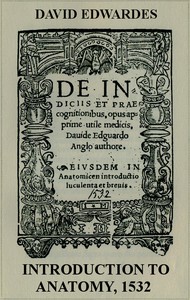
Introduction to Anatomy, 1532 - With English translation and an introductory essay on anatomical studies in Tudor England by C.D. O'Malley and K.F. Russell.
Subjects:
Download Formats:
Excerpt
The Project Gutenberg EBook of David Edwardes: Introduction to Anatomy 1532, by
Charles Donald O'Malley and Kenneth Fitzpatrick Russell
This eBook is for the use of anyone anywhere in the United States and
most other parts of the world at no cost and with almost no restrictions
whatsoever. You may copy it, give it away or re-use it under the terms
of the Project Gutenberg License included with this eBook or online at
www.gutenberg.org. If you are not located in the United States,...
Read the Full Text
— End of Introduction to Anatomy, 1532 - With English translation and an introductory essay on anatomical studies in Tudor England by C.D. O'Malley and K.F. Russell. —
Book Information
- Title
- Introduction to Anatomy, 1532 - With English translation and an introductory essay on anatomical studies in Tudor England by C.D. O'Malley and K.F. Russell.
- Author(s)
- Edguard, David
- Language
- English
- Type
- Text
- Release Date
- April 25, 2019
- Word Count
- 18,553 words
- Library of Congress Classification
- QM
- Bookshelves
- Browsing: History - General, Browsing: Science - General, Browsing: Teaching & Education
- Rights
- Public domain in the USA.