*** START OF THE PROJECT GUTENBERG EBOOK 60159 ***
Transcriber’s Notes
Text between _underscores_ represents text printed in italics in the
source document, text between =equal signs= represents bold face text,
and text between ~tildes~ represents bold face and italic text.
Superscript texts are represented by ^{text}.
More Transcriber’s Notes may be found at the end of this text.
IDENTIFICATION OF THE LARGER FUNGI
DEDICATION
To my parents who encouraged my interests in mushrooms and toadstools
and my wife who, later, was sympathetic to my studies and assisted in
the production of the manuscript.
Hulton Group Keys
IDENTIFICATION OF THE LARGER
FUNGI
by
ROY WATLING, B.Sc., Ph.D., M.I.Biol.
Principal Scientific Officer,
Royal Botanic Garden, Edinburgh
_Editor of series_: Antony R. Kenney, M.A., B.Sc.
©
1973
R. Watling
A. R. Kenney
ISBN 0 7175 0595 2
First published 1973 by Hulton Educational Publications Ltd.,
Raans Road, Amersham, Bucks.
Reproduced and printed by photolithography and bound in
Great Britain at The Pitman Press, Bath
PREFACE
This is one of a series of books intended to introduce field-biology to
students, particularly the sixth form and early university student. The
present work is ecologically biased in order to emphasise a rather
neglected aspect of the higher fungi.
Few books on fungi have ever been designed for students. This book is
aimed primarily at this level, but if the interested amateur is assisted
and encouraged by this same text my hopes will have been doubly
achieved. Many amateurs interested in higher fungi wish only to name
their collections, or know approximately what they are before sampling
them as an addition to their diet. An understanding of our commoner
species at an early age will allow the ‘budding’ mycologist to tackle
the much needed study of the more critical forms. Mycology is still at a
descriptive stage, but it is hoped this will soon be changed and fungi
of all kinds will be studied as part and parcel of courses in ecology.
It is of course quite impossible to cover all the species in such a
small volume as this present one, but it is hoped that the examples
which have been carefully chosen are sufficiently common throughout the
country for any student to collect them in a single season. The
examples, except for very few, in fact appear in the list of higher
fungi found about the Kindrogan Field Centre, Perthshire, Scotland,
compiled from the collections made by students attending my field course
there.
The present work is arranged in three parts: the agarics are dealt with
first, the non-agarics next, both with particular reference to their
major habitat preferences, and lastly a catalogue of those more
specialised habitats which are frequently encountered. All parts are
supported at the end by lists in tabular form of those species expected
to be found in any one habitat. Keys to the major groups, families and
genera, are included to widen the scope of the book and place the
examples chosen and illustrated in the text in their position in
classification.
In the description the synonymy has been very severely pruned and only
covers the commonly seen names; they are included as part of the general
information under each species. In order for the student to expand
unfamiliar names a list of references is added at the end of the work.
The common names of the fungi, whenever possible, have been adopted from
a list produced by Dr Large, the author of _The Advance of the Fungi_,
an exciting tale of fungal parasites. The authorities for the names of
the fungi described have been reduced to accord with the minimum
requirements set out by the Code of Botanical Nomenclature. After each
description a list of references to coloured plates is given and while
some of these illustrations are not of the highest quality they are
adequate, and, more important, they are widely available. Any technical
terms appearing in the description are explained in the glossary,
although they have been kept to a minimum; the difficulty of expressing
colours has been overcome by consistently referring to one colour chart
only, (a chart designed originally for the use of mycologists and
available from Her Majesty’s Stationery Office).
I have not indicated the edibility of a particular species unless there
is no doubt as to the edibility of it, related species and those species
with which it might be easily confused. Many fungi are notoriously
difficult to identify and when one has approximately 3,000 species of
larger fungi in the country the task is even more difficult. It would be
folly therefore to indicate edibility for all the fungi described in a
book such as this; the golden rule which should be adopted is not to eat
any of the fungi one collects in the woods and fields. A fault of most
popular treatments is that they are biased towards the human diet and
selection of species is done on this basis; in the present work
selection of examples within the 270 pages has been difficult and two
factors have been particularly considered to ensure that (i)
representatives of all the major groups of fungi and genera have been
covered and (ii) a coverage has been attempted of all the common
ecological niches.
I am fully aware that the taste of a fungus may be distinctive to that
species or to a group of closely related species, but it is only a spot
character and the tasting of one’s finds is neither necessary nor
advisable; indeed it is not used in this book. The odour, however, has
been indicated whenever distinctive.
CONTENTS
_Page_
Preface 5
Introduction 9
Where to look 9
Collecting 10
Examination 11
Microscopic examination 12
Key to major groups of Larger Fungi 21
A. Agarics and their relatives 22
Key to major genera 22
(i) Agarics of woodlands and copses 27
(a) Mycorrhizal formers 27
(b) Parasites 59
(c) Saprophytes--Wood-inhabiting or lignicolous agarics 64
(d) Saprophytes--Terrestrial agarics 78
(ii) Agarics of pastures and meadows 95
(a) Agarics of rough & hill-pastures 95
(b) Agarics of chalk-grassland & rich uplands 108
(c) Agarics of meadows and valley-bottom grasslands 114
(d) Fairy-ring formers 118
(e) Agarics of urban areas--lawn and parkland agarics 122
(f) Agarics of wasteland and hedgerows 126
B. Bracket fungi and their relatives 135
Key to major genera 135
(i) Pored and toothed fungi 140
(a) Colonisers of tree trunks, stumps and branches 140
(b) Destroyers of timber in buildings 154
(c) Colonisers of cones 158
(d) Terrestrial forms 160
(ii) Cantharelles and related fungi 162
(iii) Fairy-club fungi 166
(iv) Resupinate fungi 176
C. The Jelly fungi--Key to major groups with examples 179
D. The Stomach fungi; puff-balls and their relatives--Key to
major groups with examples 186
E. Cup fungi and allies 198
F. Specialised Habitats 207
(i) Fungi of dung and straw heaps 207
(ii) Fungi of bonfire sites 216
(iii) Fungi of bogs and marshes 222
(a) _Sphagnum_ bogs 222
(b) Alder-carrs 226
(iv) Fungi of beds of herbaceous plants 227
(v) Fungi of moss-cushions 230
(vi) Heath and mountain fungi 231
(a) Moorland fungi 231
(b) Mountain fungi & Basidiolichens 236
(vii) Sand-dune fungi 238
(viii) Subterranean fungi 243
(ix) Fungal parasites 246
G. Appendix 249
(i) Species lists of specialised habitats 249
(ii) Glossary 260
(iii) Simple experiments with Fairy-rings 264
(iv) Development of the Agaric fruit-body 266
(v) References 269
H. Index 271
_Cover transparency supplied by John Markham, F. R. P. S., F. Z. S._
INTRODUCTION
The term larger fungus refers to any fungus whose study does not
necessarily require more than a low-powered lens to see most of the
important morphological features. Using such a term cuts across the
existing scientific classification, for it includes the more obvious
fungi bearing their spores on specialised reproductive cells called
basidia, fig. 5, and a few of those whose spores are produced inside
specialised reproductive cells called asci. The term is useful, however,
even though it embraces a whole host of unrelated groups of fungi; it
includes the polypores, fairy-clubs, hedgehog-fungi, puff-balls and
elf-cups, as well as the more familiar mushrooms and toadstools--or
puddockstools as they are often called in Scotland. Specimens of all
these groups will find their way some time into the collecting baskets
of the naturalist when he is out fungus-picking, along with probably a
few jelly-fungi and less frequently one or two species of the rather
more distantly related group, the morels. The biggest proportion of the
finds, however, on any one collecting day in the autumn, when the larger
fungi are in their greatest numbers, will be of the mushrooms and
toadstools; these are, collectively, more correctly called the agarics.
The early botanists and pioneer mycologists of the nineteenth century
recognised the fact that the fungi both large and small are ecologically
connected to the herbaceous plants and trees among which they grow, but
many mycologists since have tended to neglect these early observations.
Although the importance of the fungi in the economy of the woodland,
copse, field and marsh is well-known, mycologists and ecologists alike
have been rather slow to appreciate that the fungi can be just as good
indicators of soil conditions, if not better, than many other plants.
Perhaps it is rash to attempt such a treatment as you find here because
we know so little of the reasons why a particular fungus prefers one
habitat to another. However, it is envisaged and hoped that, if a
framework is provided, accurate field-notes can gradually be accumulated
and many of the secrets yet to be uncovered explained.
_Where to look_
Fungi can be found in most situations which are damp at some time of the
year. Searching for fungi can begin as soon as the spring days become
warm, although even in the colder periods of winter several finds can
be made. In summer it gets very dry and this necessitates collecting in
damper areas, such as marshes, alder-carrs, swamps and moorland bogs.
After a heavy storm in summer, on the edges of paths and roadsides,
woodland banks, in clearings in woods and in gardens, fungi can be
collected within a few days of the rain, but collecting normally reaches
a climax in August-September, the precise date depending on the locality
and the individual character of the particular year.
All woodlands are worth visiting, particularly well-established woods
with a mixture of trees. Pure pine-woods do not seem to be as good as
pine-woods with scattered birch; plantations are often disappointing
except after heavy rain or late in the season, even well into November
in mild years. Pure birch and beech, the latter particularly when on
chalky soils, are excellent areas to visit. Oak is possibly not as good
but areas with willow and alder have many unique species. The edge of
woods, sides of paths or clearings are usually more productive areas to
search in than is the depth of the wood, and a small plot of trees can
be much more rewarding than a large expanse of woodland. After some time
one is able to judge the sort of place which will yield fungi. Rotten
and burnt wood are very suitable substrates for they retain the moisture
necessary for growth of fungi even in dry conditions, so allowing
fructification to take place.
Grasslands including hill-pastures, established sand-dunes, etc., are
often excellent, but of course they are much more dependent on the
weather to produce favourable conditions for fungal development than
woodland areas where the changes in the humidity and temperature are
less extreme; prolonged mist or mild showery weather favour the fruiting
of the grassland fungi. Dung in both woods and fields is an excellent
although ephemeral substrate; many species of fungi characterise dung
whilst others will grow in manured fields, on straw-heaps or where man
has distributed the habitat.
_Collecting_
The collecting of larger fungi should not be considered a haphazard
pursuit; careless collecting often results in many frustrating hours
being spent on the identification of inadequate material, which is also
not suitable after for preservation as reference material. A few good
specimens are infinitely better than several poor ones; one is always
tempted to collect too much and then collections are inevitably
discarded. Always try to select specimens showing all the possible
stages of development from the smallest buttons to the expanded caps.
Sometimes such a range is not possible and one must be satisfied with
either a couple or only one fruit-body.
Carefully dig up or cut from the substrate the entire fungus and handle
it as little as possible. A strong pen-knife or fern-trowel is admirable
for the job. The associated plants should be noted, especially trees,
and if one is unable to identify the plants or woody debris retain a
leaf or a piece of wood for later identification. One should note in a
field-notebook any features which strike one as of interest, such as
smell, colour, changes on bruising, presence of a hairy or viscid
surface.
For transporting home the specimens should be placed in tubes, tins or
waxed paper which are themselves kept in a basket. The smallest specimen
can go in the first, the intermediate-sized forms in the tins or waxed
paper and the larger ones laid in the basket or placed in large paper
bags; plastic bags are not suitable except for very woody fungi. Thus an
assortment of tins, tubes and various sizes of pieces of waxed paper are
essential before setting out on a collecting trip. The specimens should
be placed in the waxed paper such that they can be wrapped once or twice
and the ends twisted as if wrapping a sweet.
_Examination_
_Once home always aim at examining the specimens methodically._
The first necessity is to determine whether the fungus, which has been
collected, has its spores borne inside a specialised reproductive cell
(ascus) i.e. Ascomycete, or on a reproductive cell (basidium) i.e.
Basidiomycete. By taking a small piece of the spore-bearing tissue,
mounting in water, gently tapping it and examining under a low power of
the microscope this can be easily ascertained. The tapping out is best
done with the clean eraser of a rubber-topped pencil. There are several
different shaped asci and basidia; the latter structures are more
important in our study because the Ascomycetes are in the main composed
of microscopic members.
The following procedure is necessary for the examination of your find:--
Select a mature cap of an agaric from each collection, cut off the stem
and set the cap gills down on white paper, or if the specimen is small
or is a woody or toothed fungus, or consists of a club or flattened
irregular plate, place the spore-bearing surface (hymenium) face down on
a microscope glass slide. The smaller specimens must be placed in tins
with a drop of water on the cap to prevent drying out. Even with the
larger specimens it is desirable to place a glass slide somewhere under
the cap between the gills and the paper, and if possible to enclose the
species carefully in waxed paper or in a tin. Whilst you are waiting for
the spore-print to form, notes must be made on the more easily
observable features; one is not required at this stage to examine the
microscopic characters.
All the characters which may change on drying must be noted immediately,
and these include colour, stickiness, shape, smell and texture. A
sketch, preferably in colour, however rough, can give much more
information than many score words.
Cut one fruit-body, longitudinally down with a razor or scalpel or a
sharp knife if the fruit-body is woody, and sketch the cut surfaces,
fig. 1A-B. These sketches and the rest of the collection notes should be
made such that identification and future comparisons can be achieved.
Thus always note the characters in the same order for each description.
A table of the important characters is provided here, but this is meant
as a guide not as a questionnaire. The attachment of the gills, pores or
teeth to the fruit-bodies when once the fungus is in section should be
always noted (see p. 20).
The spore-print when complete should be allowed to dry under normal
conditions and then the spore-mass scraped together into a small pile. A
microscope cover-slip should be placed on the top of the pile and
lightly pressed down. The colour of the spore-print (or deposit) can
then be compared with a standard colour chart and the spores making up
the print examined in water under a microscope.
_Microscopic examination_
When one is more experienced with fungi it will be found necessary to
carry out many microscopic observations, but when commencing the study
it is necessary only to have an ordinary microscope; a calibrated
eyepiece-micrometer is an advantage as is an oil-immersion lens. An
examination of the spores is always necessary; the examination of
features such as the sterile cells on the gill and stem, etc., varies
with the fungus under observation. Spores should if at all possible be
taken from a spore-print and mounted on a microscope slide, either in
water or in a dilute aqueous solution of household ammonia. Although for
mycologists it is often necessary to measure spores to within a ½ micron
(µm) this book has been so arranged that one only really has to
distinguish between a spore which is small (up to 5 µm), medium (5-10
µm), long (10-15 µm), or large if globose and very long (if over 15 µm);
this is not strictly accurate, but serves the purpose for an
introductory text. It is important to describe the character of the
spore, i.e. ornamentations, whether a hole (germ-pore) is present at one
end and/or a beak (apiculus) at the other (fig. 5). With white or pale
coloured spores it is useful to stain either the spore or the
surrounding liquid with a dye--10% cotton blue solution is admirable, or
a solution of 1·5 g iodine in 100 ml of an aqueous mixture containing 5
g of potassium iodine and 100 g of chloral hydrate. Both these dyes must
be accurately made up if the study of the fungi is to be taken at all
seriously; because some of the chemicals used above are not normally
required by students, a chemist must make up the reagents for you. Often
the spores turn entirely or partially blue-black or pale blue or
purplish red in the iodine solution--a useful character.
[Illustration: Fig. 1. Dissection of a toadstool as recommended by the
author. For explanation see text.]
Material in good condition is always required and one of the first
things the student needs to do is train himself to collect sufficient
material in good condition. The steps by which all the structures of the
fungus used in the text can be observed are outlined below:--
Fig. 1 shows the cuts required to furnish suitable sections in order to
observe the various structures and patterns of tissue which are
important.
1. Carefully place the longitudinal section (AB) of the fruit-body which
has been sketched gill-face down under a low power or dissecting
microscope. Hairs or gluten on the cap, if present, will be made visible
by focusing up and down (figs. 2 and 3A) and/or those on the stem (fig.
3B). When any part of the cut fruit-body is not being examined retain it
in a chamber containing damp paper or moist moss; this will assist the
cells to retain their turgidity, for they frequently collapse on drying
and are difficult to observe except after performing often lengthy and
special techniques.
If only one fruit-body is available, then cut along CD and mount in a
tin box on a slide in order to obtain a spore-print (otherwise see
paragraph 6).
2. Cut off a complete gill (E) and quickly mount on a dry slide. Under
the low power of a microscope, the cystidia on the gill-margin will be
visible (fig. 4); it will be seen whether the spores are arranged in a
particular pattern (fig. 5) and whether the basidia are 2-spored or
4-spored. In white-spored toadstools it is difficult sometimes to
determine whether the basidia are 2- or 4-spored so one must confirm the
observations by other techniques.
[Illustration: Fig. 2.
Fig. 3.
Fig. 4.
Fig. 5.
Fig. 6.]
A section of the gill accompanied by a small piece of cap-tissue, as in
E, will confirm the presence or absence of noticeable cystidia (or
hairs) on the cap. Now mount the section bounded by FG and HI in a drop
of water containing either a drop of washing-up liquid and/or glycerine;
the soapy liquid helps to expel any water which may tend to cling to the
gill-margin amongst the cystidia and the glycerine stops the mount from
drying out whilst further sections for comparison are cut and examined.
It is at this time that the structure of the outermost layer of the cap
can be examined, e.g. whether it is made up of a turf-like structure;
the presence or absence of cystidia on the cap can be also confirmed
(fig. 7A-C). It is frequently necessary to tap the mount in order to
spread the tissue slightly and expose the elements; this can be done
very efficiently by light pressure from the end of a pencil to which an
eraser is attached. Cut off along line JK to eliminate marginal cystidia
from confusing the picture and mount both pieces separately.
3. Cut out a wedge of tissue from the fruit-body (L) so as to have
several gills attached to some cap-tissue; until one is familiar with
the variability of facial and marginal cystidia, carefully cut along the
line PQ (note: the cut is made one-third of the distance from the cap
margin, thus eliminating the possibility of large numbers of marginal
cystidia being examined in error for facial cystidia). Now make a second
cut along the line of RS so that finally a small block of tissue remains
(M).
Mount on a dry slide with the plane through PQ face down on the slide
and observe under a low magnification, to assess whether cystidia on the
gill-face are present or absent, and if present their general shape and
whether numerous or infrequent (fig. 8).
Mount in water/washing-up mixture as outlined above and tap gently with
the rubber attached to the end of a pencil; evenly distributed pressure
should be given. If the gills appear to be too close then rotate the
rubber a little whilst pressing in order to spread the tissue.
4. Using a low power of a microscope and looking down into the plane RS
of the unmodified block M or a similar block, one obtains by this simple
technique a very accurate idea as to the structure of the trama of the
gill (fig. 9). The organisation of this tissue is very important in
classification, some groups of toadstools having what has been described
as regular trama (fig. 9C), others irregular (fig. 9D), inverse (fig.
9B) or divergent (fig. 9A). This same tissue may be thick or sparse to
wanting, coloured or not. Such sections are often better than attempts
at very thin sections unless very specialised techniques are used. There
are few satisfactory thicknesses between the two extremes; the thick
sections you can do and the very thin requiring expert techniques.
[Illustration: Fig. 7.
Fig. 8.
Fig. 9.
Fig. 10.]
5. Take out a small block of tissue T as indicated in the figure (fig.
1). Mount immediately and repeat as in 3. This will allow the outer
layer of the cap to be more clearly seen (fig. 7A-C) and also the
structure of the flesh (fig. 10). The latter may be composed of a
mixture of filaments and ‘packets’ or ‘nests’ of rounded cells (i.e.
heteromerous), or of filaments, only some of which may be inflated (i.e.
homoiomerous); but when individual cells are swollen they never form
distinct groups. By very similar techniques it is possible to show that
the more woody fungi can have flesh composed of one of four types of
cells (Corner, 1932): these types depend on whether distinctly thickened
cells (plate 47) are present with the actively growing hyphae or not
(pp. 140-150), whether hyphae are present which bind groups of hyphae
together, etc. (plate 46).
6. Remove stem along line CD and cut out small blocks of tissue as
indicated (U, V and W). Mount immediately and examine as in paragraph 3,
for cystidia, etc. (see fig. 3).
Whilst all these sections are being cut and processed a second
fruit-body, if available, should be set to drop spores; this is done by
cutting off the cap from the stem and placing it either entirely or in
part, and with gill-edges down, on a slide in a tin.
7. Z is a ‘scalp’ of a cap; a thin sliver from the cap is placed on a
slide in a drop of water (modified with washing-up liquid, etc. as
above). After placing a cover-slip over the tissue it is tapped gently;
this will show if the cap is composed of globose to elliptic elements or
if it is composed of strictly filamentous units (figs. 6A & B). Care
must be taken not to reverse the section when transferring it to the
mountant, either by turning the scalpel or by allowing the surface
tension of the liquid to pull the section upside down. The construction
of any veil fragments will also be seen in this mount, and if a loose
covering of veil is present this should be removed before observation so
that it does not obscure the fundamental structures.
8. Examine the stipe of the fruit-body used above under a low power or
with a dissecting microscope in order to ascertain whether there are any
remains of veil and/or vegetative mycelium. If found, mount immediately
in the solution containing iodine mentioned above and examine.
Of course it is difficult to carry out the above system the first time
and be successful in seeing everything, indeed in being able to cut all
the sections 1-8. Practice makes perfect, so why not practise with a ¼
lb of mushrooms from the grocer before the autumn season starts. In this
way you will have overcome the difficulties without having to experiment
with your collections.
CHARACTERISTICS FOR THE IDENTIFICATION OF HIGHER FUNGI WITH CAPS
Locality G. Ref. Date
Habitat notes soil type pH
vegetational community
solitary; in troops or rings
Draw or preferably paint exterior and vertical section of fruit-body
MACROSCOPIC CHARACTERS
CAP
General characters:
diameter shape consistency
colour: when immature when mature
when wet when dry
Surface
dry, moist, greasy, viscid, glutinous, peeling easily or not,
smooth, matt, polished, irregularly roughened, downy, velvety,
scaly, shaggy
Margin
regular, wavy incurved or not
smooth, rough, furrowed striate or not
Veil, if present
colour abundance or scarcity
distribution at margin, whether appendiculate or dentate
consistency, whether filamentous, membranous
GILLS, or pores or teeth etc.
remote, free, adnate, adnexed, emarginate, subdecurrent, decurrent
crowded or distant distinctly formed or not
shape interveined or not
easily separable from the cap-tissue or not
consistency (whether brittle, pliable, fleshy or waxy)
thickness width
colour: when immature at maturity
number of different lengths or number of layers
obvious features of gill-edge, tube-edge, e.g. colour, consistency
STEM
central, eccentric or lacking shape
dimensions: length thickness
hollow or not
colour: when immature when mature
consistency (whether fleshy, stringy, cartilaginous, leathery or
woody)
surface characters (whether fibrillose, dry, viscid, scaly or
smooth)
characters of stem-base
Veil, if present characters
Volva, if present characters
Ring, if present
whether single or double whether membranous or filamentous
whether persistent, fugacious or mobile whether thick or thin
whether apical, median or basal
FLESH
colour in cap: when wet when dry
colour in stem: when wet when dry
colour changes if any when exposed to air
presence or absence of milk-like or coloured fluid
(note: colour when exuded on fruit-body immediately and after some
time and when dabbed on to a clean cloth or paper handkerchief and
exposed to the air).
SMELL before and after cutting --relate to a common every day odour
MICROSCOPIC CHARACTERS
BASIDIOSPORES
colour in mass colour under microscope.
shape size type of ornamentation, if any
size and shape of germ-pore, if present
iodine reaction of spore-mass:--blue-black to dark violet
(amyloid); red-purple (dextrinoid); yellow-brown or brown
(non-amyloid)
BASIDIA number of sterigmata
CAP-FLESH type of constituent cells
GILL-TISSUE type and arrangement of cells between adjacent
hymenial faces
CAP-SURFACE type of cells composing the outermost layer--whether
filaments or rounded cells
STERILE CELLS--CYSTIDIA
presence or absence of sterile cells:--
on gill-edge on gill-margin
on cap on stem
shape, estimation of size, thick or thin-walled, hyaline or not
types of ornamentation, etc.
Key to the major classes of Larger Fungi
Spores borne externally on stalks on a clavate to cylindrical cell
Basidiomycotina
Spores produced within a clavate, cylindrical or subglobose cell
Ascomycotina
Key to major groups based on character of basidium and fruit-body shape
1. Basidia either produced in a hymenium or in a mass, and until
maturity contained within a closed fruit-body Gasteromycetes
Basidia produced in a layer of cells (hymenium) and exposed to the
air before the maturity of the spores (Hymenomycetes) 2
2. Basidia simple, a single cell (fig. 5) (Homobasidiae) 3
Basidia usually septate, or if simple then fruit-body gelatinous
and often collapsing to form a skin when dried (Heterobasidiae) 4
3. Fruit-body usually fleshy, soft and easily decaying (putrescent),
hymenium spread over the surface of gills, ridges or within tubes
Agaricales (p. 22)
Fruit-body with hymenium smooth or spread-out on teeth, ridges or
plates or if within tubes then fruit-body tough and leathery
Aphyllophorales (p. 135)
4. Basidia divided 5
Basidia simple and apex drawn out into two long necks Plate 61 (p.
185) Dacrymycetales (p. 180)
5. Basidia divided transversely by one to three horizontal septae
Plate 60 (p. 183) Auriculariales (p. 182)
Basidia divided into two or four cells by vertical septae Plate 61
(p. 185) Tremellales (p. 184)
A. AGARICS AND THEIR RELATIVES
Key to major genera
1. Spores distinctly coloured in mass and coloured individually under
the microscope 2
Spores not, or faintly, coloured in mass and hyaline under the
microscope 25
2. Spores blackish or some shade of brown 8
Spores pinkish 3
3. Stem laterally attached to the cap or absent
_Claudopus_ (and some species of _Clitopilus_)
Stem centrally attached to the cap 4
4. Stem with a cup-like structure enveloping the base _Volvariella_
Stem lacking any special structure at its base 5
5. Gills not attached to the stem (free), or with part attached to
and descending down the stem (decurrent) 6
Gills attached to the stem but not descending down the stem 7
6. Gills remote to free from the stem _Pluteus_
Gills distinctly attached and descending down the stem
_Clitopilus_ (see also _Eccilia_ p. 102)
7. Gills broadly attached to the stem (adnate) _Entoloma_
Gills narrowly attached to the stem (adnexed)
_Leptonia_ & _Nolanea_
8. Stem laterally attached to the cap _Crepidotus_
Stem centrally attached to the cap 9
9. Spore-print some shade of brown 10
Spore-print blackish to purplish black 18
10. Spore-print bright rust-brown 11
Spore-print dull clay-brown or ochraceous 16
11. Stem with the veil girdling the stem (ring), or cobweb-like
(cortina) 12
Stem without the veil girdling the stem or when present then
easily lost 13
12. Stem with distinct ring or ring-zone _Pholiota_ & related genera
Stem with cobweb-like veil or faint filamentous ring-zone
_Cortinarius_ & _Gymnopilus_
13. Gills attached to the stem but not descending down the stem
(adnexed to adnate) 14
Gills free of the stem, or distinctly attached to and running down
the stem (decurrent), and then often joined together at the apex
of the stem or at their base 15
14. Cap-surface composed of rounded cells _Conocybe_
Cap-surface composed of filamentous cells _Galerina_
15. Gills free of the stem and the whole fruit-body very fragile
_Bolbitius_
Gills attached to and running down the stem (decurrent), easily
separable from the cap-tissue and frequently veined at apex of
stem _Paxillus_
16. Cap scaly, fibrillose and roughened _Inocybe_
Cap smooth, greasy or viscid 17
17. Cap-surface composed of rounded cells _Agrocybe_
Cap-surface composed of filamentous cells _Naucoria_ & _Hebeloma_
18. Gills or complete fruit-body becoming liquefied _Coprinus_
Neither the gills nor fruit-body collapsing into a slurry of cells
19
19. Gills free to remote from the stem or attached and descending down
the stem (decurrent) 20
Gills attached in some way to the stem but not descending down the
stem (adnate to adnexed) 21
20. Gills decurrent; stem possessing a cobweb-like veil
_Gomphidius_ and _Chroogomphus_
Gills remote or free; stem possessing a usually persistent ring
_Agaricus_
21. Gills distinctly spotted or distinctly mottled; stem stiff but
breaking with a snap when bent; growing on dung or in richly
manured areas _Panaeolus_
Gills not spotted or distinctly mottled; stem cartilaginous or
not, and fruit-body growing on dung or not 22
22. Gills broadly attached to the stem (adnate) and with a veil
girdling the stem _Stropharia_
Gills narrowly attached to the stem (adnexed) or with concave
dentation near the stem (sinuate), or if adnate then lacking a
ring 23
23. Gills with concave indentation near the stem (sinuate) and cap and
stem with a cobweb-like veil _Hypholoma_
Gills attached to the stem but lacking a distinct concave
indentation near the stem 24
24. Stem stiff but breaking with a snap when bent; edge of cap
incurved at first and cap-surface composed of filamentous cells
_Psilocybe_
Stem fragile; edge of cap straight even when young and cap-surface
composed of rounded cells _Psathyrella_
25. Fruit-body fleshy and readily decaying, often firm but never tough
26
Fruit-body tough and not easily decaying 47
26. Parasitic on other agarics _Nyctalis_
Not parasitic on other agarics 27
27. Spore-bearing layer on fold-like often forked gills or simply on
irregularities 28
Spore-bearing layer (hymenium), on distinct well-formed gills 29
28. Spore-bearing layer on fold-like gills _Cantharellus_
Spore-bearing layer on surface of irregularities _Craterellus_
29. Cap easily separable from the stem 30
Cap not easily separable from the stem 31
30. Stem with girdling veil (ring) and/or with a persistent cup-like
structure at the base (volva); cap usually with warts or scales
distributed on its surface _Amanita_
Stem with a ring but lacking a volva; cap surface powdery, hairy
or scaly _Lepiota_ & related genera
31. Cap, stem and gills brittle; stem never stiff and either exuding
a milk-like juice or not; spores with spines or warts which stain
blue-black in solutions containing iodine 32
Cap, stem and gills soft or if stem stiff then snapping when bent;
gills never brittle 33
32. Fruit-body exuding a milk-like fluid _Lactarius_
Fruit-body not exuding milk-like fluid _Russula_
33. Gills thick, watery and lustrous (waxy) or with a bloom as if
powdered with talc; often brightly coloured 34
Gills not waxy and rarely over 1·5 mm thick 36
34. Gills rather watery and lustrous (waxy); spores smooth 35
Gills rigid not watery, with powdery bloom; spores with distinct
spines _Laccaria_
35. Fruit-body with a distinct veil and growing in woods; cap often
viscid or pale coloured _Hygrophorus_
Fruit-body lacking a veil and usually growing in fields; cap
usually brightly coloured and sometimes viscid _Hygrocybe_
36. Stem with girdling veil (ring) and/or stem not attached to the
centre of the cap (eccentric) 37
Stem central and lacking a ring 38
37. Stem central and possessing a ring _Armillaria_
Stem not centrally attached to the cap
members of the ‘_Pleurotaceae_’ (p. 74)
38. Stem fibrous 39
Stem stiff only in the outer layers 42
39. Gills with a concave indentation near the stem (sinuate) 40
Gills attached to and descending down the stem (decurrent) 41
40. Spores with warts which darken in solutions containing iodine
_Melanoleuca_
Spores not so colouring in solutions containing iodine
_Tricholoma_ & related genera
41. Spores with warts which darken in solutions containing iodine
_Leucopaxillus_
Spores not so colouring in solutions containing iodine
_Tricholoma_ & related genera
42. Gills thick and with rather blunt edges
_Cantharellula_ & _Hygrophoropsis_
Gills thin and with distinct and sharp edges 43
43. Gills attached to and descending down the stem (decurrent); cap
often depressed at the centre and sterile cells absent from the
gills and the surface of the cap _Clitocybe_ & _Omphalina_
Gills attached to the stem but not descending down the stem
(adnate to adnexed) or if descending then distinct sterile cells
on the gills, cap and stem 44
44. Cap-edge straight and usually striate when young; cap thin and
somewhat conical and gills descending down the stem or not
_Mycena_ & related genera
Cap-edge incurved, non-striate and cap rather fleshy; gills not
descending down the stem 45
45. Stem dark and woolly at least in the lower half and the cap
viscid; fruit-bodies growing in clusters on tree-trunks
_Flammulina_
Stem not dark and woolly 46
46. Cap viscid and stem usually rooting; fruit-body growing directly
on wood or attached to wood by long strands or cords of mycelium
(rhizomorphs) _Oudemansiella_
If cap viscid then fruit-body neither attached to wood by cords of
mycelium nor stem with a rooting base _Collybia_ & related genera
47. Stem central and gills often interconnected by veins; cap can be
dried and later revived, purely by moistening
_Marasmius_ & related genera
Stem not attached to the centre of the cap and fruit-body although
persistent not easily revived to natural shape after once being
dried 48
48. Spore-print blue-black with solutions containing iodine 49
Spore-print yellowish in solutions containing iodine 50
49. Gills toothed or notched along the edges _Lentinellus_
Gills even along their edges and not toothed _Panellus_
50. Gills appearing as if split down their middles _Schizophyllum_
Gills not splitting 51
51. Gills notched or toothed along their edges _Lentinus_
Gills even along their edges and not toothed _Panus_
52. Spore print yellowish, purplish, black or pink 53
Spore-print some shade of brown, but without purplish flush 56
53. Spore-print yellowish or pinkish 54
Spore-print purplish brown or blackish 55
54. Spore-print yellowish _Gyroporus_
Spore-print pinkish _Tylopilus_
55. Spore-print purplish brown _Porphyrellus_
Spore-print blackish and spores ornamented _Strobilomyces_
56. Cap glutinous and stem with or without girdling veil (ring);
within the tubes the sterile cells (cystidia) cluster together
_Suillus_
Cap at most viscid and then only in wet weather and sterile cells
within the tubes individually placed 57
57. Stem-surface covered with distinct black or dark brown or white
then darkening scales; spore-print clay-brown with or without a
flush of cinnamon-pinkish brown _Leccinum_
Stem-surface covered completely or in part with a network or
pattern of faint lines or pale yellow or red-rust but never black
dots; spore-print olivaceous buff _Boletus_ & related genera
(i) Agarics of woodlands and copses
(a) Mycorrhizal formers
~Leccinum scabrum~ (Fries) S. F. Gray
Birch rough stalks or Brown birch-bolete.
_Cap_: width 45-150 mm. _Stem_: length 70-200 mm; width 20-30 mm.
_Description_: Plate 1.
Cap: convex and becoming only slightly expanded at maturity, pale
brown, tan or buff, soft, surface dry, but in wet weather becoming
quite tacky, smooth or streaky-wrinkled and cap-margin not overhanging
the tubes.
Stem: white, buff or greyish, roughened by scurfy scales which are
minute, pale and arranged in irregular lines at the stem-apex, and
enlarged and dark brown to blackish towards the base.
Tubes: depressed about the stem, white becoming yellowish brown at
maturity, with small, white pores which become buff at maturity and
bruise distinctly yellow-brown or pale pinkish brown when touched.
Flesh: watery, very soft in the cap lacking distinctive smell and
either not changing on exposure to the air or only faintly becoming
pinkish or pale peach-colour.
Spore-print: brown with flush of pinkish brown when freshly prepared.
Spores: very long, spindle-shaped, smooth, pale honey-coloured under
the microscope and more than 14 µm in length (14-20 µm long × 5-6 µm
broad).
Marginal cystidia: numerous and flask-shaped. Facial cystidia: sparse,
similar to marginal cystidia.
_Habitat_ & _Distribution_: Found in copses and woods containing birch
trees, or even accompanying solitary birches.
_General Information_: This fungus is recognised by the pale brown
cap, the white, unchanging or hardly changing flesh and the cap-margin
not overhanging the tubes. There are several closely related fungi
which also grow with birch trees but they need some experience in
order to distinguish them. This fungus was formerly placed in the
genus _Boletus_, indeed it will be found in many books under this
name. Species of _Leccinum_ are edible and considered delicacies in
continental Europe. The majority can be separated from the other
fleshy fungi with pores beneath the cap, i.e. boletes, by the black to
brown scaly stem and rather long, elongate spores. The scales on the
stem give rise to the common name ‘Rough stalks’ which is applied to
this whole group of fungi.
_Illustrations_: F 39C; Hvass 253; LH 122; NB 155⁶; WD 89¹.
~Suillus grevillei~ (Klotzsch) Singer
Larch-bolete
_Cap_: width 30-100 mm. _Stem_: width 15-20 mm; length 50-70 mm.
_Description_: Plate 2.
Cap: convex or umbonate at first, later expanding and then becoming
plano-convex, golden-yellow or rich orange-brown, very slimy because
of the presence of a pale yellow sticky fluid.
Stem: apex reddish and dotted or ornamented with a fine network,
cream-coloured about the centre because of the presence of a ring
which soon collapses, ultimately appearing only as a pale yellow zone;
below the ring the stem is yellowish or rusty brown, particularly when
roughly handled.
Tubes: adnate to decurrent, deep yellow but becoming flushed
wine-coloured on exposure to the air, with angular and small
sulphur-yellow pores which become pale pinkish brown to lilaceous or
pale wine-coloured when handled.
Flesh: with no distinctive smell, pale yellow immediately flushing
lilaceous when exposed to the air, but finally becoming dingy
red-brown, sometimes blue or green in the stem-base.
Spore-print: brown with distinct yellowish tint when freshly prepared.
Spores: long, ellipsoid, smooth and pale honey when under the
microscope, less than 12 µm in length (8-11 µm long × 3-4 µm broad).
Marginal cystidia: in bundles and encrusted with amorphous brown, oily
material. Facial cystidia: similar in shape and morphology to marginal
cystidia.
_Habitat_ & _Distribution_: Found on the ground accompanying larch
trees either singly or more often in rings or troops.
_General Information_: This fungus is easily recognised by the poorly
developed ring, overall golden-yellow colour and pale yellow
viscidness on the cap which comes off on to the fingers when the
fruit-body is handled. There are several closely related fungi
which also grow with coniferous trees, e.g. _Suillus luteus_ Fries,
‘Slippery jack’, but many need experience in order to identify them.
All these fungi were formerly placed in the genus _Boletus_, because
of the fleshy fruit-body with pores beneath the cap. The larch-bolete
receives its common name from the close relationship of the fungus
with the larch. On drying _S. luteus_ and _S. grevillei_ may strongly
resemble one another but the former can be distinguished when fresh by
the chocolate brown, sepia, or purplish brown cap and the large
whitish, lilac-tinted ring.
[Illustration: Plate 1. Fleshy fungi: Spores borne within tubes]
[Illustration: Plate 2. Fleshy fungi: Spores borne within tubes]
Species of _Suillus_ are edible and rank highly in continental
cook-books, although they have disagreeably gelatinous-slimy caps, a
character, in fact, which helps to separate them from other fleshy
pore-fungi.
_Illustrations_: F 41a; Hvass 257; ML 187; NB 104⁴; WD 84².
~Boletus badius~ Fries
Bay-coloured bolete
_Cap_: width 70-130 mm. _Stem_: width 34-37 mm; length 110-125 mm.
(36-40 mm at base).
_Description_: Plate 3.
Cap: hemispherical, minutely velvety, but soon becoming smooth and
distinctly viscid in wet weather, red-brown flushed with date-brown
and darkening even more with age and in moist weather to become
bay-brown.
Stem: similarly coloured to the cap but paler particularly at the
apex, smooth or with faint, longitudinal furrows which are often
powdered with minute, dark brown dots.
Tubes: adnate or depressed about the stem, lemon-yellow but
immediately blue-green when exposed to the air and with angular,
rather large similarly coloured, pores which equally rapidly turn
blue-green when touched.
Flesh: strongly smelling earthy, pale yellow but becoming pinkish in
centre of the cap, and blue in the stem and above the tubes when
exposed to the air, but finally becoming dirty yellow throughout.
Spore-print: brown with a distinct olivaceous flush.
Spores: long, spindle-shaped, smooth, honey-coloured under the
microscope and greater than 12 µm in length (13-15 µm long × 5 µm
broad).
Marginal cystidia: numerous, flask-shaped and slightly yellowish.
Facial cystidia: scattered and infrequent and similar to marginal
cystidia in shape.
_Habitat_ & _Distribution_: Found in woods, especially accompanying
pine trees, but often found fruiting on the site of former coniferous
trees, even years after the trunks or the stumps have been removed.
_General Information_: This fungus is recognised by the rounded,
red-brown cap, coupled with the pale yellow flesh and greenish yellow
tubes, both of which become greenish blue when exposed to the air.
There are several species in the genus _Boletus_ which stain blue at
the slightest touch or when the flesh is exposed to the air, e.g. _B.
erythropus_ (Fries) Secretan, a common bolete with a dark olivaceous
cap, orange pores and red-dotted stem.
The flesh of some species of _Boletus_, e.g. _B. edulis_ Fries,
however, remains unchanged or at most becomes flushed slightly
pinkish. Although many people say they recognise _B. edulis_, the
‘Penny-bun’ bolete--a name derived from the colour of the cap, there
is some doubt as to whether the true _B. edulis_ is common in Britain
as we are led to believe. _B. edulis_ and its relatives are highly
recommended as edible (see p. 35). _B. badius_ is also edible, but it
is ill-advised to eat any bolete which turns blue when cut open.
_Illustrations_: _B. badius_--F 38c; Hvass 248 (not very good); LH
191; NB 109⁵; WD 85¹. _B. edulis_: F 42a; Hvass 246; LH 191; NB 143³.
General notes on Boletes
There are nearly seventy boletes recorded for the British Isles and
evidence of others which have as yet not been fully documented. As a
group they are characterised by being fleshy, possessing a central stem
and producing their spores within the tubes, and not on gills as in the
common mushroom. It is the first character by which the boletes differ
so markedly from the other pored fungi, such as the ‘Scaly Polypore’
(see p. 140).
The boletes have long been classified in the genus _Boletus_, but
instead of referring all the pored, fleshy fungi to a single large genus
several genera are now recognised. The separation of these genera is
based on differences in colour of the spore-print and differences in the
anatomy of the tubes, cap and stem, etc., e.g. members of the genus
_Suillus_ have colourless or pale coloured dots on the stem exuding a
resin-like liquid in wet weather, which is clear and glistening in some
species but turbid and whitish in others, gradually darkening and
hardening so that the stem is ultimately covered in dark brown or
reddish smears or spots; members of the genus _Leccinum_ on the other
hand never exude liquid and have coarse or fine roughenings on the stem
which are usually dark, but may commence white and ultimately darken
depending on the species; many species of _Boletus_ possess a very
distinct raised network all over the stem, whilst others have it present
only in part, or have minute, often brightly coloured, dots replacing
it.
[Illustration: Plate 3. Fleshy fungi: Spores borne within tubes]
Within this single, yet not particularly large, group of fungi, several
biological phenomena are demonstrable. There is good evidence that the
majority of British boletes are mycorrhizal; several species are known
to be associated only with one species of tree or group of closely
related tree-species. Thus _Suillus grevillei_ and _S. aeruginascens_
(Secretan) Singer grow in association with larch trees; _S. luteus_ and
_Boletus badius_ in contrast grow in association with pine trees;
_Leccinum scabrum_ with birch trees; _L. aurantiacum_ (Fries) S. F.
Gray, with poplar trees and _L. quercinum_ (Pilát) Green & Watling, with
oak trees.
_Boletus edulis_ can be separated into several distinct subspecies which
are associated with different trees; the two commonest subspecies are
those associated with birch and with beech trees. It is well known that
although present in this country during the warmer periods of the
Ice-Age, larch neither survived the intense cold of the last advance of
the ice nor migrated back into Britain after the ice had melted. Thus
all larches which we see in Britain have been planted by man. There is
little doubt that mycelia of many fungi were introduced along with these
plants very probably including the mycelium of the larch-bolete. A
similar pattern can be seen with other introduced trees, although not to
such a marked degree, e.g. spruce trees. The beech tree, however, is
native to the south of England, unlike the larch returning to this
country after the ice had melted; it has been planted extensively
outside its former range in northern areas of the British Isles taking
with it its associated fungi. There is some evidence that some stocks of
beech and fungi have been introduced from continental Europe in
comparatively recent times.
A parallel, yet inexplicable association is found between the bolete
_Suillus bovinus_ (Fries) O. Kuntze and its close relative _Gomphidius
roseus_ (Fries) Karsten where the mycelium of two fungi are found
intertwined forming a close association! Parasitism although rare is
also found amongst the boletes, and an uncommon parasitism at that--a
fungus on a fungus; for example in Britain although infrequent _Boletus
parasiticus_ Fries grows attached and ultimately replaces the
spore-tissue of the common earth-ball (_Scleroderma_, see p. 192).
Those fungi which grow on dead and decaying substrates are called
saprophytes and although the greater number of higher fungi would be
included in this class of organisms the character is infrequent amongst
the boletes. One British example of this type of fungus is the rare
_Boletus sphaerocephalus_ Barla which grows on woody debris.
Chemists have long been interested in boletes, for as noted above the
flesh of some species when exposed to the atmosphere turns vivid
colours, a feature often incorporated into the Latin name, e.g. _Boletus
purpureus_ Persoon, from the purple colours produced whenever the
fruit-body is handled. The reaction appears to be an oxidation where in
the presence of an enzyme and oxygen a pigmented substance or substances
are produced. What the significance of these colour-changes is in nature
is as yet unknown; however, what is interesting is that many of the
chemicals involved are unique and have only recently been analysed
completely; they are related to the quinones.
There is little doubt that it is this rapid and intense blueing of the
flesh of many boletes that has lead to a belief that they are poisonous.
It is uncertain whether there are any truly toxic species of _Boletus_
but several have unpleasant smells and tastes which make them very
unattractive. _Boletus edulis_ is the important ingredient, however,
which gives the distinctive taste to so-called dried mushroom soup.
Thousands of fruit-bodies are collected annually in the forests of
Europe to be later dried and processed for incorporation into soup.
Boletes appear to form an important part of the diet of several rodents
and deer and in Scandinavia in the diet of reindeer.
Probably one of the most obscure of our British boletes is
_Strobilomyces floccopus_ (Fries) Karsten, the ‘Old Man of the Woods’.
It has a black, white and grey woolly, scaly cap and stem, and the flesh
distinctly reddens when exposed to the air. The spores are almost
spherical, purple-black in colour and covered in a coarse network when
seen under the microscope. All these characters readily separate
_Strobilomyces_ from all other European boletes; however, in
Australasia, members of this and related genera form a very important
part of the flora.
~Chroogomphus rutilus~ (Fries) O. K. Miller
Pine spike-cap
_Cap_: width 30-150 mm. _Stem_: width 10-18 mm; length 60-120 mm.
_Description_:
Cap: convex with a pronounced often sharp umbo, wine-coloured, flushed
with bronze-colour at centre and yellow or ochre at margin, viscid but
soon drying and then becoming paler and quite shiny.
Stem: yellowish orange, apricot-coloured or peach-coloured, streaked
with dull wine-colour, spindle-shaped or narrowed gradually to the
apex from a more or less pointed base.
Gills: arcuate-decurrent, distant, at first greyish sepia then dingy
purplish with paler margin, but finally entirely dark purplish brown.
Flesh: lacking distinctive smell and reddish yellow or pale tan in the
cap, rich apricot- or peach-colour towards the stem-base.
Spore-print: purplish black.
Spores: very long, spindle-shaped, smooth, olivaceous purple and
greater than 20 µm in length (20-23 × 6-7 µm).
Marginal cystidia: cylindrical to lance-shaped and up to 100 × 15 µm.
Facial cystidia: similar to marginal cystidia.
_Habitat_ & _Distribution_: Found in pine woods, usually solitary or
in small groups. Fairly common throughout the British Isles and
characteristic of Scots Pine woods.
_General Information_: This fungus can be distinguished by the
purplish or wine-coloured cap and the gills being pigmented from
youth. There is only one other British species of this genus, i.e. _C.
corallinus_ Miller & Watling.
_Chroogomphus_ is separated from _Gomphidius_ by the flesh having an
intense blue-black reaction when placed in solutions containing
iodine, and the gills being coloured from their youth. In many books
_Chroogomphus_ is placed in synonymy with the genus _Gomphidius_.
However, _Gomphidius glutinosus_ (Fries) Fries, _G. roseus_ (Fries)
Karsten and _G. maculatus_ Fries all have whitish gills when immature
which gradually darken, and their flesh simply turns orange-brown in
solutions of iodine. _G. glutinosus_ is uniformly grey in colour and
is most frequently found under spruce and other introduced conifers:
_G. roseus_ has a pale-pinkish coloured cap and white stem, and grows
with pine; _G. maculatus_ grows under larch and is flushed lilaceous
at first but becomes strongly spotted with brown when handled.
_Illustrations_: Hvass 192; LH 213; WD 83^{a}.
[Illustration: Plate 4. Fleshy fungi: Spores blackish and borne on
gills]
~Paxillus involutus~ (Fries) Karsten
Brown roll-rim
_Cap_: width 50-120 mm. _Stem_: width 8-15 mm; height 30-75 mm.
_Description_:
Cap: at first convex with a strongly inrolled, downy margin, but then
expanded and later frequently depressed towards the centre,
clay-coloured, ochre or yellow-rust, slightly velvety but becoming
smooth or sticky particularly in wet weather and readily bruising
red-brown when fresh.
Stem: central or slightly eccentric, thickened upwards,
fibrillose-silky, similarly coloured to the cap but typically streaked
with red-brown particularly with age.
Gills: ochre or yellow-brown then rust and finally darker brown,
decurrent, crowded, often branched and united about the apex of the
stem; easily peeled from the flesh with the fingers and rapidly
becoming red-brown on handling.
Flesh: thick, soft and with slightly astringent smell and yellowish to
brownish but becoming red-brown after exposure to the air.
Spore-print: rust-brown.
Spores: medium-sized, ellipsoid, smooth, deep yellow-brown and rarely
greater than 10 µm in length (8-10 × 5-6 µm).
Marginal cystidia: numerous lance-shaped or spindle-shaped.
Facial cystidia: scattered and similar in shape to marginal cystidia.
_Habitat_ & _Distribution_: Found on heaths and in mixed woods,
particularly where birch has or is now growing, or even accompanying
solitary birch trees.
_General Information_: This fungus is easily recognisable by the
strongly inrolled, woolly margin of the cap and yellow-brown gills
which are easily separable from the cap-flesh. _P. rubicundulus_ P. D.
Orton is similar but grows under alder and has yellow gills unchanging
when handled and dark scales on the cap. _P. atrotomentosus_ (Fries)
Fries and _P. panuoides_ (Fries) Fries both grow on coniferous wood
and have smaller spores; the former is recognised by the dark brown to
almost black shaggy stem and the latter by the shell-shaped cap devoid
almost completely of a stem.
_Illustrations_: F 41c; Hvass 189; LH 185; NB 115⁸; WD 70².
[Illustration: Plate 5. Fleshy fungi: Spores brown and borne on gills]
~Cortinarius pseudosalor~ J. Lange
_Cap_: width 60-125 mm. _Stem_: width 15-25 mm; length up to 180 mm.
_Description_:
Cap: bell-shaped or bluntly conical only slightly expanding with
maturity, smooth or wrinkled at centre but often furrowed at the
margin, slimy, brown with a distinct olive flush when in fresh
condition and becoming ochraceous brown and shiny when dry.
Stem: usually swollen to some degree about the middle, slimy
particularly towards the base, whitish throughout when young except
for a faint amethyst or violaceous flush in the lower part; as the
slime dries the stem becomes shiny and the outer surface breaks up
into fibrillose scales or scaly, irregular ring-zones.
Flesh: lacking distinct smell, white with ochraceous flush in the cap,
white in the stem, thick and soft in the cap but fibrous in the stem.
Gills: adnate, broad, rather thick, frequently veined and distant,
ochraceous brown and finally deep rust-brown.
Spore-print: rust-colour.
Spores: long, slightly almond-shaped in side view, finely warted
throughout and not less than 12 µm in length (13-14 × 7-8 µm).
Marginal cystidia: ellipsoid or club-shaped, hardly different from the
surrounding undeveloped basidia.
Facial cystidia: absent.
_Habitat_ & _Distribution_: Found on the ground in copses and woods
especially those containing beech.
_General Information_: Recognised by the conical, grooved cap and the
slimy spindle-shaped stem with a distinct violaceous flush; this
fungus is often misnamed _C. elatior_ Fries but this is a much less
common fungus. There are several closely related fungi, but these grow
with other tree-species and need much more experience to distinguish
one from the other. _C. pinicola_ P. D. Orton is one such species
growing in the litter under _Pinus sylvestris_, Scots Pine; this
species is fairly common in the remnant pine woods of Northern
Scotland. The large size, sticky or glutinous cap and stem indicate
that this fungus belongs to _Cortinarius_, subgenus _Myxacium_.
_Illustrations_: Hvass 145; LH 162; NB 119; WD 60¹.
[Illustration: Plate 6. Fleshy fungi: Spores brown and borne on gills]
General notes on Cortinarii
The genus _Cortinarius_ is the largest genus of agarics in the British
Isles, indeed in Europe and North America--perhaps in the world. It
includes some of our most beautiful agarics, yet it is one of the least
satisfying to the mycologist because of the difficulties experienced in
identifying collections--partly because many species are so seldom seen.
_Cortinarius_ contains just under two hundred and fifty recognisable
British species, although recent research has shown that many more are
yet to be described from this country as new to science. Except for some
very characteristic species the individual members within the genus
_Cortinarius_ are often very difficult to separate one from the other;
however, _Cortinarius_ is one of our least difficult genera to recognise
in the field owing to the presence when mature of rust-coloured gills
and a cobwebby veil which extends from the margin of the cap to the
stem. This structure is termed a cortina (Fig. 14) and in young
specimens covers the gills with delicate filaments. As the cap expands
the cottony or cobwebby filaments are stretched and either disappear
entirely or may collapse to form a ring-like zone of filaments on the
stem. In some species a second completely enveloping veil is also found,
and this veil is viscid in one distinct group of which _C. pseudosalor_
already described is a member. The gills in the genus are variable in
colour when young although constant for a single species; they may be
lilaceous purple, orange, brown, red, yellow-ochraceous or tan, but
ultimately in all members at maturity they become rust-colour. The
spores under the microscope are richly coloured, yellow to red-brown and
are frequently strongly warted; in mass they are rust-brown and this
character coupled with the presence of the cobweb-like veil
characterises the genus.
Within the genus _Cortinarius_ there is a wide range of characters
varying from species with distinctly sticky caps and stems, some with
sticky caps and dry stems to those with both dry caps and stems. A few
species are very large and fleshy whilst others are quite slender and
many of the latter rapidly change colour on drying out and are then said
to be hygrophanous. However, although there is such a large spectrum of
characters in a single genus the species all have in common the cortina
and rust-coloured gills, the latter often appearing as if powdered with
rusty dust.
Utilising the characters mentioned above this very large genus can be
split into the following six sections, called by the mycologist
subgenera:
a. Large to medium sized fleshy agarics with viscid caps and
stems--_Myxacium_
b. Large, fleshy agarics with viscid or tacky caps when fresh but dry
stems--_Phlegmacium_
c. Large to medium sized agarics with dry, scaly or humid caps and dry
stems which if orange tawny are robust--_Cortinarius_
d. Medium, rarely large, agarics with dry, silky to innately
fibrillose caps, slender stems and frequently with at least part of
the fruit-body yellow, orange or reddish--_Dermocybe_
e. Medium to small agarics with silky fibrillose, non-hygrophanous
caps which may become tacky in wet weather and then usually with
robust, clavate-bulbous stems--_Sericeocybe_
f. Small, less frequently medium or large agarics, all with distinctly
hygrophanous caps--_Hydrocybe_.
In several continental books some or all of these divisions are
recognised as distinct genera in their own right. The subgenus
_Telamonia_ which occurs in many texts was formerly thought to differ
from _Hydrocybe_ in the presence of a universal veil; the universal veil
is a second veil which completely envelopes the fruit-body when it is
young and is in addition to the cortina. However, the modern treatment
would seem to suggest that the presence of the universal veil is not of
the utmost importance and so the two subgenera are incorporated into
one. The name _Hydrocybe_ reflects the character of changing colour as
it dries out because of the loss of water. Within each subgenus the
species are distinguished by the colour of the young gills and of the
cap, the veil colour and texture, and microscopic characters of the
spores, particularly their size.
The majority of species of _Cortinarius_ are mycorrhizal and like the
boletes possess very specific relationships with tree species. Thus some
are typical of coniferous woodland and others typical of deciduous
woodland in general, whilst others typify woods of a particular tree,
e.g. beech, oak, birch, pine, larch. Some species are characteristic of
woods on limestone or chalky soils (calcareous) whilst others are
characteristic of woods on sandy, heathy acidic soils. For example,
_Cortinarius armillatus_ (Fries) Fries which is found in damp woods and
possesses one or more cinnabar-red or scarlet zones on the stem and red
fibrils at the stem-base appears to be connected with birch. Several
species are associated with native trees whilst others have undoubtedly
been introduced from abroad. They are very important in the economy of
the woodland ecosystem.
One of the most beautiful and easily distinguished of our British
species is _Cortinarius violaceus_ (Fries) Fries which has uniformly
deep violet-coloured stem and cap and coloured cystidia on the
gill-margin, a character unusual in _Cortinarius_.
No species are known to be truly poisonous and many species are known to
be edible, but many are too small to be of any value. Some of the larger
species are regarded as good to eat, but frequently are too scarce. Thus
the necessity for experience to recognise the different species, coupled
with their often unpleasant tastes make them an unimportant group of
agarics for eating.
~Russula ochroleuca~ (Secretan) Fries
Common yellow russula
_Cap_: width 50-100 mm. _Stem_: width 20-35 mm; length 50-100 mm.
_Description_: Plate 7.
Cap: yellow-ochre or dull yellow becoming paler with age, or flushed
faintly greyish green, convex but soon expanding and becoming flat or
depressed in the centre, smooth, or granular when young and slightly
tacky in wet weather, faintly striate at the margin.
Stem: white at first then flushed slightly greyish, smooth or
wrinkled, firm at first but quickly becoming soft and fragile.
Flesh: brittle, firm at first then soft, white, yellow under
cap-centre.
Gills: white at first then flushed pale cream-colour, brittle, adnexed
to free, rather distant.
Spore-print: faintly cream when freshly prepared.
Spores: medium-sized, hyaline, broadly ellipsoid or subglobose to
almost globose, coarsely ornamented with prominent warts which stain
blue-black when mounted in solutions containing iodine and which are
faintly interconnected by low ridges, about 8 × 7 µm in size (9-10 ×
7-8 µm).
Marginal cystidia: prominent, lance- to spindle-shaped and often
filled with oily material.
Facial cystidia: similar in shape to marginal cystidia and projecting
some distance from the gill-face.
_Habitat_ & _Distribution_: Commonly found in mixed woods from summer
until late autumn.
_General Information_: Easily recognised by the ochre-yellow cap, very
pale cream-coloured spore-print and greying stem. Two other
yellow-capped species of Russula are commonly found. R. claroflava
Grove with yellow spore-print and blackening fruit-body which grows
with birches in boggy places, and R. lutea (Fries) S. F. Gray which is
much smaller, having a cap up to 50 mm and very deep egg-yellow gills
and spore-print; it grows in deciduous woods.
_Illustrations_: F 22a; Hvass 226; LH 119; NB 137¹; WD 49¹.
General notes on the genus _Russula_
A large genus with nearly one hundred distinct species in the British
Isles and several others yet unrecognised or undocumented. This genus is
composed generally of large toadstools often beautifully coloured,
indeed the majority have brightly coloured caps in reds, purples,
yellows or greens depending on the species although a few are
predominantly white bruising reddish brown or grey to some degree.
Such large and distinctive fungi one would think would be the easiest
members of our flora to identify, unfortunately they are not. They form
a group quite isolated in their relations, the only close relatives
being members of the genus _Lactarius_, to be dealt with later (see p.
50). The flesh of members of both _Lactarius_ and _Russula_ contains
groups of rounded cells, a feature unique amongst agarics and explains
why in _Russula_ the fruit-bodies, cap and gills and sometimes the stem
are brittle and easily break if crushed between the fingers. The
fruit-body does not exude a milky liquid when the flesh is broken.
The spore-print varies, depending on the species involved, from white to
deep ochre and individual spores are covered in a coarse ornamentation
which is composed of isolated warts or warts interconnected by raised
lines, or mixtures of both. The ornamentation stains deep blue-black
when the spores are mounted in solutions containing iodine and the
pattern which is produced appears in many cases to be of a specific
character.
The majority of the species, if not all north-temperate species are
mycorrhizal and the familiar host-tree fungus relationship can be
recognised:--
_R. claroflava_ Grove, with birch in boggy places, _R. emetica_
(Fries) S. F. Gray with pine in wet places, _R. betularum_ Hora with
birch in grassy copses and _R. sardonia_ Fries with pines. Brief notes
are here included giving the basic characters of eight common species,
but it must be appreciated the identification of many species within
this genus is difficult.
~R. atropurpurea~ (Krombholz) Britz.
Blackish purple russula
_Cap_: width 50-100 mm. _Stem_: width 14-25 mm; length 60-80 mm.
Cap: deep reddish purple but becoming spotted with either cream-colour
or white blotches.
Stem: white but becoming flushed greyish or stained brownish with age.
Gills: white then very pale yellow.
Flesh: white in cap and stem.
Spore-print: white.
On the ground in mixed woods and copses, particularly those containing
oak.
[Illustration: Plate 7. Fleshy but brittle fungi: Spores whitish and
borne on gills]
~Russula cyanoxantha~ (Secretan) Fries
_Cap_: width 50-150 mm. _Stem_: width 10-30 mm; length 50-100 mm.
Cap: lilac, bluish to purple often with green tints.
Stem: pure white.
Gills: pure white.
Flesh: white.
Spore-print: white.
Common in deciduous woods, especially beech-woods.
~R. emetica~ (Fries) S. F. Gray
Emetic russula
_Cap_: width 50-100 mm. _Stem_: width 8-15 mm; length 25-70 mm.
Cap: bright scarlet fading with age to become spotted pinkish,
slightly viscid when moist.
Stem: spongy, fragile.
Flesh: white.
Gills: pure white.
Spore-print: pure white.
In pine woods usually in boggy areas.
~R. fellea~ (Fries) Fries
Geranium-scented russula
_Cap_: width 40-75 mm. _Stem_: width 10-20 mm; length 30-75 mm.
Cap: tacky when fresh, straw-coloured or pale tawny brown.
Stem: similarly coloured to the cap.
Gills and flesh: pale straw-colour and smelling of House Geraniums
(i.e. Pelargoniums).
Spore-print: cream-coloured.
Common under beech.
~R. foetens~ (Fries) Fries
Foetid russula
_Cap_: width 70-170 mm. _Stem_: width 15-30 mm; length 50-90 mm.
Cap: slimy, dingy yellow to tawny, margin strongly furrowed and
ornamented with raised bumps.
Stem: whitish then flushed or spotted with rust-brown.
Gills: straw-coloured, often spotted brown with age and beaded with
watery droplets when growing under moist conditions.
Flesh: white to cream, brittle and with foetid-oily smell.
Spore-print: pale cream-colour.
Common in deciduous woods.
~R. mairei~ Singer
_Cap_: width 30-75 mm. _Stem_: width 7-15 mm; length 35-70 mm.
Cap: scarlet red but developing creamy areas with age, dry.
Stem and gills: white but with a distinct although faint greenish grey
flush, the former fairly firm.
Flesh: white.
Spore-print: pure white.
Commonly accompanying beech, even individual trees in gardens.
~R. nigricans~ (Mérat) Fries
Blackening russula
_Cap_: width 75-200 mm. _Stem_: width 15-35 mm; length 25-75 mm.
Cap: cream-coloured then flushed sooty brown, finally black as if
scorched by proximity to bonfire.
Stem: white then dark brown.
Gills: pale ochre reddening when bruised, thick and very distant.
Flesh: white slowly dull red on cutting then brown and finally
changing soot-colour after some time.
Spore-print: white.
Common in deciduous woods.
~R. xerampelina~ (Secretan) Fries
_Cap_: width 50-140 mm. _Stem_: width 15-30 mm; length 40-60 mm.
Cap: deep blood-red or brownish red.
Stem: white with a flush of red towards the base.
Gills: cream then ochraceous.
Flesh: white staining brownish and smelling strongly of fish- or
crab-paste, and staining dark green when a crystal of green iron
sulphate is rubbed into it.
Spore-print: deep cream-colour.
Common in mixed woods; a very variable fungus with many colour-forms,
but easily recognised by the green reaction with ferrous sulphate.
~Lactarius turpis~ (Weinm.) Fries
Ugly milk-cap
_Cap_: width 60-200 mm. _Stem_: width 10-25 mm; length 40-75 mm.
_Description_:
Cap: firm, convex usually with a central depression at maturity, dark
olive-brown or dark greyish olive with a yellow-tawny, woolly margin
when young which soon disappears, and the whole cap becomes sticky
with age and turns deep purple when a drop of household ammonia is
placed on it.
Stem: short, stout, similarly coloured to the cap except for the
distinctly ochraceous apex, slimy and pitted.
Gills: crowded, cream-coloured to pale straw-coloured, but soon
spotted with dirty brown, particularly when bruised.
Flesh: white or greyish ochre exuding a milk-like liquid which lacks a
distinct smell and is white and unchanging when exposed to the air.
Spore-print: pale pinkish buff.
Spores: subglobose or ellipsoid and covered in a network of strongly
developed, raised lines interconnected by finer ones, both of which
stain blue-black in solutions containing iodine, generally 8 × 6 µm in
size (7-8 × 6-7 µm).
Marginal cystidia: lance- or spindle-shaped and filled with oily
contents.
Facial cystidia: similar to marginal cystidia.
_Habitat_ & _Distribution_: Common in woods and copses, or on heaths
especially in boggy places but always where birch is growing.
_General Information_: Easily recognised by the dull colours and
purple reaction with alkali; there is no British species with which
_L. turpis_ can be mistaken. The purple reaction is similar to that
found in the familiar school laboratory reagent litmus, for the
compound found in _L. turpis_ turns purple in alkali and reddens in
acidic solutions. First discovered by Harley in 1893 this reaction
marked the beginning of a whole series of chemical studies on the
agarics which has led to the discovery of many unique compounds.
_Illustrations_: Hvass 214 (but too green); LH 213; NB 113³; WD 38¹.
General notes on the genus _Lactarius_
There is little doubt that the genus _Russula_ and the genus _Lactarius_
are closely related; in fact they stand aside from the other agarics
in the very important character mentioned on page 46. In Europe the
easiest distinction between the two genera is that members of the genus
_Lactarius_ exude a milk-like juice which may be white or variously
coloured depending on the species involved (e.g. purple in _L. uvidus_
(Fries) Fries, yellow in _L. chrysorheus_ Fries). The cap, stem and
frequently the gills are brittle and when broken liberate the milk-like
liquid; when the fruit-body is dry, however, the presence of this liquid
may be difficult to demonstrate. The spores have a blue-black
ornamentation under the microscope when mounted in iodine, and although
when in mass the colours are not as varied as those found in the genus
_Russula_ there is every likelihood that they will play an important
role in the classification of the group in the future. The colour of the
spore-print has been rather neglected, although the genus includes some
rather unusual fungi.
[Illustration: Plate 8. Fleshy and milking fungi: Spores whitish and
borne on gills]
The odours of many species are very distinct and vary from the smell of
coconut and spice to those of various flowers; an odour commonly met
with is termed ‘oily rancid resembling butter which has become mouldy’;
in early books it was described as being the smell of bed-bugs!
The majority of the species are undoubtedly mycorrhizal: thus _L.
torminosus_ is found with birch, _L. deliciosus_ and _L. rufus_ with
conifers and _L. quietus_ with oak. Brief notes are given on additional
species:--
~L. camphoratus~ (Fries) Fries
Curry-centred milk-cap
_Cap_: width 20-50 mm. _Stem_: length 20-50 mm; width 4-6 mm.
Cap and stem: red-brown.
Gills: reddish brown.
Flesh: reddish buff with an aromatic odour resembling spices which
becomes very strong when dried and exudes a pale thin milk-like
liquid.
Common in conifer woods and plantations.
~L. deliciosus~ (Fries) S. F. Gray
Saffron milk-cap
_Cap_: width 50-120 mm. _Stem_: length 20-60 mm; width 15-25 mm.
Cap: viscid, dirty greyish ochre with flush of tawny but soon becoming
greenish with age.
Stem: dirty buff or greyish ochre, spotted with green particularly
with age or on handling.
Gills: orange-yellow bruising deep orange but becoming green with
time.
Flesh: pinkish to apricot-coloured but becoming green with age and
exuding a rich orange-red fluid which gradually becomes greyish green.
Frequent in conifer woods and plantations.
~L. glyciosmus~ (Fries) Fries
Coconut-scented milk-cap
_Cap_: width 20-50 mm. _Stem_: length 30-50 mm; width 5-8 mm.
Cap: usually with a central ‘bump’, greyish lilac, dull and minutely
scaly or velvety.
Stem: white to pale yellowish.
Gills: pale yellowish to flesh-coloured then flushed lilaceous.
Flesh: pale yellowish or flushed lilaceous, smelling strongly of
desiccated coconut and exuding a white unchanging milk-like liquid.
In woods and on heaths, particularly where birch is growing.
~L. quietus~ (Fries) Fries
Oak milk-cap
_Cap_: width 30-80 mm. _Stem_: length 40-80 mm; width 10-15 mm.
Cap and stem: milky cocoa-coloured, zoned with reddish brown.
Gills: pale ochraceous then flushed red-brown.
Flesh: similar to gills, smelling strongly of rancid oil, and exuding
a white, thin milk-like liquid which becomes very, very faintly yellow
on exposure to the air.
Common wherever oak is growing.
~L. rufus~ (Fries) Fries
Rufous milk-cap
_Cap_: width 50-90 mm. _Stem_: length 50-90 mm; width 10-15 mm.
Cap: dark red-brown with a distinct, usually sharp ‘bump’ in centre.
Stem: pale red-brown throughout or whitish at base.
Gills: pale reddish brown and exuding a white, unchanging milk-like
fluid.
In pine woods and less frequently with birches on acid heaths.
~L. torminosus~ (Fries) S. F. Gray
Woolly milk-cap
_Cap_: width 40-150 mm. _Stem_: length 60-100 mm; width 15-30 mm.
Cap: pale strawberry-pink or pale salmon colour, distinctly zoned,
slimy when wet at centre and strongly shaggy fibrillose at margin.
Stem and gills: pale strawberry colour.
Flesh: tinged salmon-pink and exuding a white unchangeable milk-like
liquid.
Frequent where birches grow.
~Amanita muscaria~ (Fries) Hooker
Fly agaric
_Cap_: width 100-175 mm. _Stem_: width 30-40 mm; length 150-275 mm.
_Description_:
Cap: bright scarlet to orange-red with scattered whitish or yellowish
fragments of veil particularly towards the centre and hanging down
from the margin, viscid when moist, striate at margin with age.
Stem: white, striate above the soft easily torn, although prominent,
ring which is white above and yellow below; stem-base swollen and
ornamented with patches of yellowish or white veil-fragments which
form concentric rings or ridges of tissue.
Gills: white, free, crowded, fairly thick, minutely toothed at their
edge.
Flesh: soft, lacking distinctive smell, or at times slightly earthy
and white, yellowish below cap-centre.
Spore-print: white.
Spores: long, hyaline under the microscope, ellipsoid, smooth about 10
× 7 µm in size (10-13 × 7-8 µm).
Marginal cystidia: composed of chains of swollen, hyaline cells.
Facial cystidia: absent.
_Habitat_ & _Distribution_: Found in birch-woods, less frequently
collected in the vicinity of conifers; wide-spread and fairly common,
but it is erratic in its appearance giving the impression of being
absent from a locality until one season it suddenly fruits in
profusion.
_General Information_: An easily recognised fungus because of its
striking colour. It is also very familiar and well-known because it
appears so often on Christmas cards, and features commonly in
illustrations in children’s story-books. The fungus contains a poison
which formerly was used to kill flies--hence the common name of ‘Fly
agaric’ and the scientific name from the latin name for the house-fly.
The red skin of the cap, where the major amount of the poison resides,
was cut up with a little milk and sugar or honey; flies attracted to
this sweet concoction inadvertently ate the poison and later perished.
This fungus has a very well documented and long history and appears in
the legends of many countries. It is featured in Greek mythology,
Slavic and Scandinavian folk-lore and indeed appears in the
pre-history of Indian tribes of N.E. Asia. It has even been connected
with the formation of certain sects within the early Christian church.
_Illustrations_: F. frontispiece; Hvass 1; LH 117; NB 113¹; WD 2¹.
[Illustration: Plate 9. Fleshy fungi: Spores white and borne on gills]
Notes on the genus _Amanita_
The genus _Amanita_ contains many important mycorrhizal fungi including
the ‘Blusher’, _A. rubescens_ (Fries) S. F. Gray, the ‘Tawny grisette’,
_A. fulva_ Secretan, and the ‘False death-cap’, _A. citrina_ S. F. Gray.
The first grows on heaths and in woods with a variety of trees; _A.
fulva_ frequently grows with birch and _A. citrina_ with several leafy
trees although its var. _alba_ (Gillet) E. J. Gilbert appears to be
confined to beech woods. However, there is some evidence that many
members of the genus in drier more southern countries than Britain, are
non-mycorrhizal. In fact the genus as a whole may be southern-temperate
in its distribution. In the British Isles the number of species of
_Amanita_ recorded decreases as one goes north, or the frequency of
single species except for a few widespread forms falls off northwards.
In a few cases a more familiar southern species is replaced in similar
habitats by another species, e.g. _A. phalloides_ (Fries) Secretan is
replaced by _A. virosa_ Secretan the ‘Destroying angel’ in Scotland, and
_A. citrina_ frequently in the north by _A. porphyria_ (Fries) Secretan.
Species of _Amanita_ are usually large conspicuous fungi and the genus
contains some of our best known agarics. One, _A. muscaria_ (Fries)
Hooker has already been mentioned, but the genus also includes the
‘Death-cap’ _A. phalloides_ and ‘Caesar’s mushroom’ _A. caesarea_
(Fries) Schweinitz, a fungus not found in this country but considered to
be superior in edibility to all other fungi; thus edible and deadly
poisonous species are found closely related and this simply emphasises
how important it is not to eat the agarics one finds in the woods and
fields except when accompanied by a ‘real’ expert. Deaths or near
fatalities in Europe and North America are recorded annually due to the
eating of fungi belonging to this genus.
The poisonous qualities of the fungi in this genus--only a very small
amount of poison is often sufficient to produce fatal results--has led
to a close connection between these fungi and black magic and the
supernatural. This connection is even more emphasised when it is learnt
that some have an intoxicating effect. Hence the long history mentioned
earlier.
Members of the genus _Amanita_ are characterised by their anatomy and
certain macroscopic features; the former is illustrated under _A.
muscaria_, i.e. the divergent gill-trama. The main macroscopic character
of note is the presence of a volva at the base of the stem and it is
the details of this volva which helps to distinguish different species.
_A. phalloides_ has a distinct, loose, membranous sheath, in _A.
citrina_ the volva is reduced to a narrow rim around the bulbous stem
and in _A. rubescens_ and _A. muscaria_ the volva is simply a series of
concentric zones of woolly scales. All the four species noted above
possess a ring, but _A. fulva_ the ‘Tawny grisette’ and _A. vaginata_
(Fries) Vittadini the ‘Grisette’ only possess a volva; this has lead to
the use of the generic name _Amanitopsis_ in many books, now no longer
considered necessary.
The veil in _Amanita_ is probably the most highly developed amongst our
common agarics and from Appendix iv it can be seen how the scaly cap and
stem originate and how the volva differs from the ring. The volva and
cap-scales constitute what has been called the universal veil and the
ring which stretches from the cap margin to the stem has been termed the
partial veil.
The spores of species of _Amanita_ are large and their shape and
chemical reactions help to distinguish the different species within the
genus. One of the most interesting features, however, is that the
spore-mass, although usually described as white, in many species is not
white but flushed greenish grey, etc. The slight subtleties in colour of
the spore-print assist in classification.
The following notes may be instructive in conjunction with the
information above (for common names see above).
(i) Possessing a ring on the stem:--
~A. citrina~ S. F. Gray
_Cap_: width 55-80 mm. _Stem_: width 18-22 mm; length 70-80 mm.
A lemon-yellow or whitish capped agaric with bulbous stem-base, white
patches of volva on cap and white stem with flesh strongly smelling of
new potatoes.
Spores: almost globose and measuring 9-10 × 7-8 µm.
~A. excelsa~ (Fries) Kummer
_Cap_: width 75-140 mm. _Stem_: width 20-28 mm; length 85-120 mm.
A greyish or brownish capped agaric with clavate stem-base, grey
patches of volva on the cap and white concentrically scaly stem with
flesh unchanged on exposure to the air.
Spores: broadly ellipsoid and measuring 9-10 × 8-9 µm.
~A. rubescens~ (Fries) S. F. Gray
_Cap_: width 70-120 mm. _Stem_: width 12-25 mm; length 65-100 mm.
A reddish fawn or pinkish buff capped agaric with swollen stem-base,
pinkish or flesh-coloured patches of volva on cap and reddish
concentrically scaly stem with flesh becoming reddish when exposed to
the air.
Spores: ellipsoid and measuring 9-10 × 5-6 µm.
~A. pantherina~ (Fries) Secretan
‘Panther’
_Cap_: width 48-95 mm. _Stem_: width 12-20 mm; length 65-100 mm.
An olive-brown or smoky brown capped agaric with only slightly swollen
stem-base, white patches of volva on the cap and white concentrically
scaly stem with unchanging flesh.
Spores: ellipsoid and measuring 8-12 × 7 µm.
~A. phalloides~ (Fries) Secretan
_Cap_: width 70-85 mm. _Stem_: width 12-20 mm; length 85-120 mm.
A greenish or yellow-olive capped agaric with stem sheathed in
membranous volva, white patches of volva on cap and smooth, white stem
with white flesh.
Spores: broadly ellipsoid and measuring 10-12 × 7 µm.
(ii) Lacking ring on stem:--
~A. fulva~ Secretan
_Cap_: width 40-60 mm. _Stem_: width 10-15 mm; length 100-150 mm.
A thin, tawny-brown agaric with stem sheathed in membranous volva and
pale tawny, slightly scaly stem.
Spores: globose and 10-12 µm in diameter.
~A. vaginata~ (Fries) Vittadini
Differs from _A. fulva_ in the cap being metallic grey or silvery in
colour.
(b) Parasites
~Armillaria mellea~ (Fries) Kummer
Honey-fungus
_Cap_: width 50-150 mm. _Stem_: width 10-12 mm; length 75-150 mm.
_Description_: Plate 10.
Cap: at first convex then more or less flattened or slightly
depressed, very variable in colour, yellowish, olive, buff,
sand-coloured or some shade of brown, at first covered in small,
brownish or ochraceous scales which give the young cap a velvety
aspect, but gradually the scales disappear with age except at the
cap-centre; margin striate and usually paler than centre of the cap.
Stem: equal or swollen at base, often several grouped together, white
at apex above a whitish, rather thick, ring which is flushed with
olive-yellow or red-brown at its margin; stem-base fibrillose, whitish
but finally red-brown at maturity.
Gills: adnate or slightly decurrent, whitish then flushed flesh colour
and developing brownish spots with age or in cold, wet weather.
Flesh: with rather strong and unpleasant smell, white or flushed
pinkish in the cap, brown and stringy in the stem.
Spore-print: very pale cream colour.
Spores: medium-sized, hyaline, ellipsoid, less than 10 µm in length
(8-9 × 5-6 µm).
Marginal cystidia: variable, hyaline, cylindric and not
well-differentiated.
Facial cystidia: absent.
_Habitat_ & _Distribution_: This fungus grows in troops or is found
joined at the base to form clusters. It is always attached to old
trees, trunks, stumps and buried wood, either directly or by its
vegetative stage which darkens and aggregates to form strands
resembling boot-laces which are called rhizomorphs.
_General Information_: This rather variable, and therefore often
perplexing, fungus causes a destructive rot of trees and can travel
long distances through the soil with the use of its rhizomorphs. It
commonly grows on several species of broad-leaved trees, but can also
colonise conifer trees. It also attacks garden shrubs, such as
privet-hedges, and is particularly destructive to Rhododendrons
causing a wilt of the whole shrub and subsequent death; it has also
been recorded as attacking potatoes. The actively growing mycelium
which can often be found growing under the bark of infected trees,
exhibits a luminosity if freshly exposed and placed in a darkened
room. The rhizomorphs of _A. mellea_ are highly specialised structures
composed of mycelial threads some of which have become rather more
differentiated than is normally found in the vegetative stage of other
agarics.
_Illustrations_: F 27a; Hvass 26; LH 93; NB 141¹; WD 4³.
~Pholiota squarrosa~ (Fries) Kummer
Shaggy Pholiota
_Cap_: width 50-120 mm. _Stem_: width 17-25 mm; length 95-125 mm.
_Description_: Plate 11.
Cap: convex, but expanding and becoming flattened with a slight
central umbo, ochre-yellow to yellowish rust-colour and covered with
dark brown recurved scales which are particularly dense at the centre.
Stem: variable in length and thickness depending on how it is attached
to the substrate, whether in a deep crack or wound, or in a
depression, and how many specimens are in the cluster; its colour is
similar to that of the cap, exhibits a small, dark brown fibrillose,
torn ring or ring-zone and is ornamented with recurved red-brown
scales below that ring.
Gills: broadly adnate with a decurrent tooth and crowded, yellowish at
first then rust-coloured.
Flesh: with strong, pleasant but pungent smell, yellowish brown, soft
in the cap, fibrous in the stem.
Spore-print: rich rust-brown.
Spores: medium-sized, pale brown under the microscope, smooth,
ellipsoid, and 6-8 × 4 µm in size.
Marginal cystidia: spindle-shaped, hyaline, numerous.
Facial cystidia: flask-shaped with a small apical appendage and
becoming rich yellow when immersed in solutions containing ammonia.
_Habitat_ & _Distribution_: Common in clusters in woods, gardens or
parks, on wood or at the base of the trunks of broad-leaved trees in
summer and autumn.
[Illustration: Plate 10. Fleshy fungi: Spores white and borne on gills]
_General Information_: Although rather a common easily recognisable
and aesthetically pleasing fungus growing in its characteristic
clusters at the base of trees, it is a weak parasite entering the
living tissue after invading decayed areas of the tree. This is the
reason why when branches are broken off trees by wind, snow or storms,
they should be carefully trimmed to remove ragged edges and the wound
treated with a protective tar to stop the entry of rain, cold and
fungus spores. Other more destructive fungi may enter a tree through
such wounds; _P. squarrosa_ frequently attacks mountain ash or rowan.
It is recognised by the dry scaly cap and stem which helps to
distinguish it from the sticky capped _P. aurivella_ (Fries) Kummer
with similar habitat preferences but wider spores (6-9 × 4-5 µm). _P.
adiposa_ (Fries) Kummer is found on beech trees and it, too, has a
viscid cap, but the spores are 5-6 × 3-4 µm in dimensions.
_Illustrations_: Hvass 134; LH 149; WD 54².
[Illustration: Plate 11. Fleshy fungi: Spores rust-brown and borne on
gills]
(c) Saprophytes--wood inhabiting or lignicolous agarics
~Hypholoma fasciculare~ (Fries) Kummer
Sulphur-tuft
_Cap_: width 20-50 mm. _Stem_: width 6-13 mm; length 40-100 mm.
_Description_:
Cap: sulphur-yellow, flushed with sand-colour or red-brown at centre
then ochraceous yellow throughout, convex at first with margin
incurved and clothed with fibrillose remnants of a yellow-olive veil,
but then becoming flattened and losing evidence of that veil.
Stem: equal or flexuous, usually with several joined at base,
similarly coloured to the cap, fibrillose streaky or with some fibrils
from the veil stretching from the cap to the stem in young specimens.
Gills: sinuate and crowded, at first sulphur-yellow then olive-green,
but finally with a flush of purple-brown.
Flesh: with rather strong and unpleasant smell, yellow throughout.
Spore-print: purple-brown.
Spores: medium-sized, ellipsoid or ovoid, smooth, purple-brown and
less than 10 µm in length (6-8 × 4 µm).
Marginal cystidia: flasked-shaped, short, cylindric and hyaline.
Facial cystidia: more swollen than marginal cystidia and with silvery
contents which yellow in solutions containing ammonia.
_Habitat_ & _Distribution_: The sulphur-tuft grows in dense clusters
on and around old stumps of broad-leaved trees, and can be found
throughout the year; it also grows on conifers, but less frequently.
_General Information_: It may be recognised by the greenish tint of
the immature gills and of the young cap. _H. capnoides_ (Fries) Kummer
grows on the wood of coniferous trees and has a much more ochraceous
brown cap and stem than the sulphur-tuft and slightly larger
spores--7-8 × 4-5 µm. _H. sublateritium_ (Fries) Quélet grows on
hardwoods but is bigger than _H. fasciculare_ and has a brick-coloured
cap and very sturdy stem (spores 6-7 × 3-4 µm).
_Illustrations_: F 37b; Hvass 176; LH 147; NB 141⁵; WD 76².
[Illustration: Plate 12. Fleshy fungi: Spores purplish brown and borne
on gills]
~Flammulina velutipes~ (Fries) Karsten
Velvet-shank
_Cap_: width 20-80 mm. _Stem_: width 5-10 mm; length 35-60 mm.
_Description_:
Cap: bright sand-colour or slightly red-brown at centre, convex at
first then flattened with age, smooth, slimy because of the presence
of a sticky elastic skin, rather rubbery to the touch.
Stem: cylindrical or slightly swollen towards the base, dark brown and
densely hairy or velvety, tough and rubbery to handle.
Gills: adnexed, very unequal and somewhat distant, pale yellow,
gradually becoming buff as the spores mature.
Flesh: with rather pleasant smell, yellowish, watery and soft.
Spore-print: white.
Spores: medium-sized, hyaline, ellipsoid and about 8 × 3-4 µm in Size
(7-9 × 3-4 µm).
Marginal cystidia: hyaline, elongate, broadly flask-shaped.
Facial cystidia: similar to marginal cystidia.
_Habitat_ & _Distribution_: Found in clusters on old stumps, fallen
trunks and on the wounded parts of standing trees.
_General Information_: This fungus can be recognised by the clustered
habit, the viscid, bright tawny cap and the dark velvety stem. This is
one of the few agarics which occurs regularly late in the season, even
appearing in the winter, although it can be seen growing in its
familiar groups at almost any time of the year. This fungus holds a
rather isolated position in classification and was once placed in the
genus _Collybia_. It may be found in several books under this last
genus.
_Illustrations_: F 18b; Hvass 80; LH 109; NB 141³; WD 21⁴.
[Illustration: Plate 13. Fleshy fungi: Spores white and borne on gills]
~Mycena galericulata~ (Fries) S. F. Gray
Bonnet mycena
_Cap_: width 25-50 mm. _Stem_: width 3-6 mm; length 50-125 mm.
_Description_:
Cap: conical or bell-shaped then expanding but retaining a central
umbo, never completely flattened, smooth, greyish, pale sepia or dirty
white and striate with darker lines from the margin to the centre.
Stem: similarly coloured to the cap, smooth, shiny, tough and usually
noticeably downy at base.
Gills: at first white flushed distinctly pale pink with age, uncinate,
rather distant and sometimes with interconnecting veins.
Flesh: white with little or no distinctive smell.
Spore-print: white.
Spores: medium-sized, hyaline, broadly ellipsoid, smooth, about 10 × 7
µm in size (9-12 × 6-8 µm) and staining bluish grey when mounted in
solutions containing iodine.
Marginal cystidia: club-shaped but the apex ornamented with blunt
hairs of varying lengths.
Facial cystidia: absent.
_Habitat_ & _Distribution_: Commonly found, in all but the coldest
months, in woods, parks or gardens, often in dense clusters on stumps
and fallen trunks of broad-leaved trees.
_General Information_: This is one of our commonest members, and one
of the largest in the genus _Mycena_; many species in this genus are
quite small yet are nevertheless very important components of the
woodland flora decomposing leaves, twigs, etc., and contributing in
this way to the recirculating of organic matter.
The name _Mycena_ is derived from the same Greek word as that which
refers to the country around the ancient city of Mycenae in the plain
of Argos, and from whence Agamemnon came and gathered his forces to
invade Troy to reclaim Helen his wife. It has been suggested that this
similarity in name came about through the necessity for an army
stationed in Argos, early in the history of Ancient Greece, to rely on
the mushrooms found on the plains about to save the soldiers from
starvation.
_Illustrations_: F 17a; Hvass 119; LH 109; NB 133⁸; WD 26³.
[Illustration: Plate 14. Fleshy fungi: Spores white and borne on gills]
~Pluteus cervinus~ (Fries) Kummer
Fawn pluteus
_Cap_: width 40-100 mm. _Stem_: width 10-15 mm; length 75-125 mm.
_Description_:
Cap: conical, rapidly expanding and then becoming plano-convex or
flattened with only a slight but persistent umbo, dark brown, umber or
vandyke brown, viscid when wet and often with radiating fibrils.
Stem: white, streaked to varying degrees with dark brown fibrils,
cylindrical or slightly swollen towards the base, where it is attached
to the substrate.
Gills: remote, very crowded, thin, at first white then distinctly
salmon-pink.
Flesh: with pleasant smell, white and soft.
Spore-print: dull salmon-pink.
Spores: medium-sized, very faintly buff under the microscope, broadly
ellipsoid and 7-8 × 5-6 µm in size.
Marginal cystidia: flask-shaped, the majority with three or four hooks
at the distinctively thick-walled apex.
Facial cystidia: similar to marginal cystidia but sometimes intermixed
with those lacking hooks.
_Habitat_ & _Distribution_: This fungus grows singly or in groups on
old stumps and fallen trunks throughout the year except for the most
wintry months; it is commonest in autumn.
_General Information_: This fungus may also grow on old sawdust heaps,
a habitat which is often very worth while examining in detail by the
interested amateur during wet seasons. In summer sawdust heaps dry out
but after a good soaking, which, of course, can be applied
artificially by frequent watering with a hose or watering-can, many
interesting fungi develop. On sawdust heaps containing conifer debris
a larger species with black or dark brown edge to the gills is
found--_P. atromarginatus_ Kühner.
The peculiar pointed cystidia found on the gill-edge and on the
gill-face of _P. cervinus_ were thought by some early mycologists to
stop mites and insect larvae from crawling up between the gills and
damaging the developing spores. There is no evidence that this
actually takes place in nature; the real purpose of these obscure
structures is unknown and has been little studied.
_Illustrations_: Hvass 127; LH 121; NB 135¹; WD 50².
[Illustration: Plate 15. Fleshy fungi: Spores pinkish and borne on
gills]
~Gymnopilus penetrans~ (Fries) Murrill
_Cap_: width 20-50 mm. _Stem_: width 4-7 mm; length 20-50 mm.
_Description_:
Cap: convex then becoming flattened at maturity, dry, slightly scaly,
golden tawny, or rusty yellow and when young with the remnants of a
rapidly disappearing yellow cortina hanging from the margin.
Stem: yellow above and red-brown or orange-tawny below and darkening
on bruising; veil forming a delicate fibrillose zone in the upper part
of the stem which is soon lost on excessive handling.
Gills: adnate to slightly decurrent, thin and crowded, at first golden
yellow, but soon spotted rust colour.
Flesh: yellow and lacking distinctive smell.
Spore-print: rich orange-tawny.
Spores: medium-sized, ellipsoid, finely roughened and deep yellow
brown under the microscope, less than 10 µm in length (7-8 × 5-4 µm).
Marginal cystidia: hyaline, flask-shaped with long often slightly
irregular neck.
Facial cystidia: similar to the marginal cystidia, but often broader.
_Habitat_ & _Distribution_: This fungus is found on sticks or twigs or
chips of coniferous wood, particularly in plantations.
_General Information_: Although it has only comparatively recently
been recognised in Britain it is very wide-spread. It has been
confused with, indeed described under, the name of the less-common
fungus _Gymnopilus sapineus_ (Fries) Maire which also grows in conifer
woods; it is easily distinguished, however, by its spotted gills. Both
the fungi above can be found in books under the old name _Flammula_,
from the bright colour of the caps of many of its constituent members,
but _Flammula_ has been used for a genus of flowering plants also and
this has precedence.
_Illustrations_: F 29a; Hvass 152 not very good; LH 175 not very good;
NB 109⁶.
[Illustration: Plate 16. Fleshy fungi: Spores rust-brown and borne on
gills]
Notes on the artificial family group ‘_Pleurotaceae_’--the Oyster
mushrooms
One of the common features of lignicolous fungi is the fact that they
lack a distinct stem or if one is present it is attached to one side of
the cap, i.e. lateral. However, in the past the correlation of the
habitat with lack of stem has induced mycologists to define a single
family to include all these forms. After studying the anatomy and
microscopic characters this grouping has been found to be entirely
artificial and simply reflects how the morphology is tied up intimately
with the ecology of a species.
In this one family members of the genera _Panus_, _Panellus_,
_Lentinus_, _Lentinellus_, _Crepidotus_, _Pleurotellus_, and _Pleurotus_
have all been grouped together, but some of the genera are more related
to the polypores referred to later (p. 135); many of those with brown
spores are better placed with _Cortinarius_ and some of those with white
or cream-coloured spores are better placed close to _Mycena_ and
_Tricholoma_. This leaves as a residue the genus _Pleurotus_, a genus
which although rather heterogeneous contains one familiar member, i.e.
the common Oyster mushroom, _Pleurotus ostreatus_.
~Pleurotus ostreatus~ (Fries) Kummer
Oyster mushroom
Grows up to 150 mm across.
Cap: flattened, shell-shaped, smooth or slightly cracked, deep bluish
grey, gradually becoming brownish with age and finally dark buff.
Stem: absent or very short, passing gradually into one side of the
cap.
Gills: white flushing dirty yellow with age, rather distant and deeply
decurrent.
Flesh: white, soft and with very pleasant smell.
Spore-print: pale lilac.
Spores: long, hyaline, oblong under the microscope and 10-11 × 4 µm in
size.
Marginal and facial cystidia: absent.
_Habitat_ & _Distribution_: Common, clustered in tiers on stumps,
trunks, posts, etc.
_General Information_: This fungus is not infrequent on old
telephone-poles and forms white sheets of mycelium immediately under
the bark of fallen trees. Although frequent in autumn it may be found
throughout the year and is easily recognised by its size and
bracket-like, shell-shaped caps. It surprisingly has a pale lilac
spore-print and not as might be expected a white spore-print. In the
var. _columbinus_ Quélet the young caps are a beautiful peacock-blue;
this variety frequently grows on poplars.
_Illustrations_: F 125²; Hvass 109; LH 107; NB 125²; WD 31¹.
[Illustration: Plate 17. Wood-inhabiting, fleshy but leathery fungi:
Spores whitish or brownish and borne on gills--‘Pleurotaceae’]
~Panus torulosus~ (Fries) Fries is a tough, funnel-shaped, yellowish
cinnamon fungus with oblong-ellipsoid, small, hyaline spores measuring
5-6 × 3 µm and changing yellowish not bluish grey in iodine solutions.
~Panellus stipticus~ (Fries) Karsten forms tiers of pale
cinnamon-brown, more or less kidney-shaped, scurfy caps on old wood
and has egg-shaped, hyaline, small spores measuring 4 × 2-3 µm which
become bluish grey in iodine solutions.
~Lentinellus cochleatus~ (Fries) Karsten forms irregular lobed and
twisted, flattened or funnel-shaped dirty brownish caps with a
fragrant smell, toothed gill-edges and almost spherical, small,
hyaline spores measuring 5 × 4 µm which become bluish grey in iodine
solutions.
_Lentinellus_ apparently has very close affinities to _Auriscalpium_,
‘the Ear pick fungus’, (p. 158) both in the structure of the spores
and the anatomy of the fruit-body.
~Lentinus lepideus~ (Fries) Fries forms very tough fruit-bodies with
convex or flattened, pale yellowish caps and stems ornamented with
dark tawny or brown scales. The stem is often eccentric and buried in
cracks or soft rotten wood on which it grows; the spores are
non-amyloid. It grows on pine stumps but also on decaying or
unprotected railway sleepers and wooden paving blocks, joists, etc.,
made of conifer wood. When the fungus fruits in a darkened
environment, such as a cellar, the mushroom-like fruit-bodies are not
produced but are replaced by slender branched structures similar to
the ‘Stag’s horn’ or ‘Candle-snuff fungus’ (p. 206), or to certain of
the Fairy Club fungi (p. 172). Similar growths have been recorded for
_Polyporus squamosus_ which grows on hard wood timber and is described
in detail later (p. 140).
~Crepidotus mollis~ (Fries) Kummer
Soft slipper toadstool
Cap: up to 45 mm across and in tiers, sessile, shell-shaped or
kidney-shaped, smooth, rubbery and brownish ochre in colour.
Gills: pale buff then cinnamon-brown and finally flushed snuff-brown,
thin and crowded.
Flesh: watery, gelatinous beneath the skin of the cap and whitish
buff.
Spore-print: warm brown.
Spores: ellipsoid, smooth, medium-sized, pale buff under the
microscope and 8-9 × 5-5·5 µm in size.
Easily recognised by the soft elastic cap which can be stretched
without breaking, the brown gills and pale buff spores. (See Plate 49,
p. 153.)
_Illustrations_: LH 177; NB 145³; WD 69¹.
The artificiality of classifying all those agarics with both a
spoon-shaped or bracket-shaped fruit-body, and a reduced (or lacking)
stem is further exemplified by the presence of similar genera in other
groups of fungi. For instance _Claudopus_ is typified by pink, angular
spores (Plate 28) and _Clitopilus_ is characterised by longitudinally
ridged spores, i.e. they are not angular in all optical sections but
only when seen end on (see p. 101). An example of the former is _C.
parasiticus_ (Quélet) Ricken which grows on dead remains of woody
fungi, and of the latter _C. passackerianus_ (Pilát) Singer which may
invade mushroom beds. Both species are quite small though the last
fungus is similarly coloured to the more familiar _Clitopilus
prunulus_ (Fries) Kummer, ‘The Miller’, so common in woods and fields.
Thus in the British Isles agarics with eccentric stems may be found,
in the white, brown and pink-spored groups--and in the tropics and
subtropics the picture is completed by the existence of the genus
_Melanotus_ in the black-spored agarics. _M. bambusinus_ Pat. grows on
bamboos and _M. musae_ (Berk. & Curt.) Singer grows on dead leaves and
debris of bananas; the latter is also a probable agent in the decay of
fibres in the tropics.
(d) Saprophytes--terrestrial agarics
~Melanoleuca melaleuca~ (Fries) Murrill
_Cap_: width 40-110 mm. _Stem_: width 50-80 mm; length 50-90 mm.
_Description_:
Cap: dark brown, umber or vandyke when moist, hygrophanous and
becoming very much paler on drying almost tan, convex then flattened
sometimes umbonate, smooth or wrinkled.
Stem: white or whitish covered in brownish fibrils which increase in
number with age or after handling; solid, rather elastic and slightly
swollen towards the base.
Gills: white, broad, crowded and as if cut out from behind before
joining the stem.
Flesh: with pleasant smell, soft, white, becoming brownish with age,
particularly in the stem.
Spore-print: very pale ivory-colour.
Spores: medium-sized, ellipsoid, hyaline under the microscope and
roughened by distinct dots which become blue-black when mounted in
solutions containing iodine, 8 × 4-5 µm.
Marginal cystidia: spear- or sword-shaped, roughened with crystals at
the top and appearing as if barbed like fish-spines.
Facial cystidia: numerous and similar to marginal cystidia.
_Habitat_ & _Distribution_: Common in autumn in woods; also found in
pastures.
_General Information_: A very common fungus which is rather confusing
to the beginner because of its variation in colour, brought about by
the change in colour with change in content of water. However, this
fungus can be easily recognised by the unusually ornamented cystidia
found on the gill-faces and gill-margins. This character and the fact
that the spores possess amyloid ornamentation define in part the genus
_Melanoleuca_. In many books this common fungus is found under the
genus _Tricholoma_; however, members of this latter genus have neither
amyloid ornamented spores nor barbed cystidia.
_Illustrations_: LH 103; WD 13¹.
[Illustration: Plate 18. Fleshy fungi: Spores white and borne on gills]
~Clitocybe infundibuliformis~ (Weinm.) Quélet
Common funnel-cap
_Cap_: width 20-60 mm. _Stem_: width 8-13 mm; length 35-75 mm.
_Description_:
Cap: yellowish ochre flushed slightly pinkish buff or cinnamon but
later pale tan on ageing or drying, funnel shaped.
Stem: colour like cap or slightly darker, flexible but firm and solid.
Gills: white or faintly flushed buff, decurrent and crowded.
Flesh: with pleasant slightly floral smell, white, soft and fairly
thin.
Spore-print: white.
Spores: medium-sized, hyaline, tear-drop shaped, smooth, 6-7 × 3-4 µm
and not blueing when mounted in solutions containing iodine.
Marginal cystidia: little different from young basidia in dimension
and shape, although some may have a short apical prolongation.
Facial cystidia: absent.
_Habitat_ & _Distribution_: Woods, copses, heaths and hill-pastures
from summer to autumn.
_General Information_: An easily recognisable fungus because of its
graceful stature, thin, funnel-shaped pinkish buff cap and
tear-drop-shaped spores. Several _Clitocybe_ species grow in
woodlands, many of them appearing later in the season when colourful
agarics are rarer.
The genus _Clitocybe_ is characterised by the fleshy cap with incurved
margin when young, fibrous, fleshy stem and decurrent gills. _C.
clavipes_ (Fries) Kummer has a smoky brown, top-shaped cap, fragile
stem which also has a distinct swelling at its base, and strong rather
unpleasant smell. _C. nebularis_ (Fries) Kummer is similar, but is
pale cloudy grey, has a less fragile stem and a fairly pleasant smell.
This species if often covered in a bloom which develops further as the
fruit-body deteriorates. The agaric _Volvariella surrecta_ (Knapp)
Singer is a rare parasite of _C. nebularis_ (see p. 247) and it has
been suggested that this bloom may in fact belong to this species.
However, I have on several occasions tried to encourage the bloom to
reproduce by keeping hoary looking fruit-bodies of _C. nebularis_ in a
damp-chamber, but as yet I have never been successful.
Nevertheless, it is an exercise which would be of great interest to
continue and a source of great excitement if the small pink-spored
agaric were produced. _C. fragrans_ (Fries) Kummer is a small, sweetly
aromatic-smelling species found in frondose woods, and _C. langei_
Hora, is a mealy-smelling species of conifer plantations.
_Illustrations_: F 16a; Hvass 55; LH 95; WD 16².
[Illustration: Plate 19. Fleshy fungi: Spores white and borne on gills]
~Hebeloma crustuliniforme~ (St Amans) Quélet
Fairy-cake mushroom
_Cap_: width 40-80 mm. _Stem_: width 8-12 mm; length 38-85 mm.
_Description_:
Cap: pale yellow buff or pale tan with a distinct reddish buff or
cinnamon-brown tint, darkening only slightly with age; smooth, at
first tacky to the fingers, but then dry and shiny at centre, convex
and hardly expanding.
Stem: cylindrical or slightly swollen towards the base, whitish and
with a flush of pinkish buff at apex, and covered all over in small,
white scales.
Gills: sinuate, crowded, pale clay-colour or buff, but finally dull
dark yellow ochre except for the distinct white margins which are
beaded in wet weather with droplets of liquid.
Flesh: whitish with a very strong smell of radishes.
Spore-print: dark clay-colour.
Spores: long, slightly almond-shaped, pale brown under the microscope,
distinctly warted and about 11 × 6 µm in size (10-12 × 6-7 µm).
Marginal cystidia: cylindrical to skittle-shaped with slightly to
distinctly swollen apex.
Facial cystidia: absent.
_Habitat_ & _Distribution_: Common in autumn on the ground by
pathsides and in woodland clearings.
_General Information_: Recognisable by the uniform cinnamon or pinkish
buff cap, white woolly scales on the stem and distinctive, strong
smell of radish. There is some evidence that this species may on
occasions be mycorrhizal; further field studies are required.
There are several closely related fungi which are difficult for the
amateur to differentiate from _H. crustuliniforme_; there is no doubt
that there are several species present in the British Isles which do
not appear in the Check List of British Agarics & Boleti; in fact, it
would appear that there are several yet to be described as new to
science. Although individual species are fairly difficult to delimit,
the genus _Hebeloma_ itself is easily recognised, most members being
medium sized with brown sinuate gills, whitish, yellowish, or pinkish,
i.e. pale, caps and white-powdered stems. The word ‘crustulin’ which
appears in the Latin name of _H. crustuliniforme_ is itself from the
Latin and means small cake, referring to the cap-shape, which remains
fairly constant throughout the fungus’ growth. The common name is
derived from this also.
[Illustration: Plate 20. Fleshy fungi: Spores dull brown and borne on
gills]
~Inocybe geophylla~ (Fries) Kummer
Common white inocybe
_Cap_: width 10-25 mm. _Stem_: width 3-6 mm; length 30-50 mm.
_Description_:
Cap: conical with incurved margin then bell-shaped and retaining a
distinct umbo even when mature, silvery white then ivory and finally
pale tan particularly centrally and silky fibrillose throughout.
Stem: slender, cylindrical but for a small swelling at the base, silky
and shining with a few fibrils from a former cortina which may be
brownish due to spores adhering to it at maturity.
Gills: adnexed to free, crowded, pale ochraceous becoming
clay-coloured.
Flesh: white with smell of newly dug potatoes, strong when fresh.
Spore-print: clay-colour.
Spores: medium sized, ellipsoid or slightly French-bean-shaped,
smooth, yellow-brown under the microscope and 9-11 × 4-5 µm in size.
Marginal and facial cystidia: flask- to spindle-shaped with distinctly
thickened walls and frequently ornamented with crystals apically.
_Habitat_ & _Distribution_: Common in troops in woodland clearings, by
pathsides or on the edges of ditches bordering woods.
_General Information_: This fungus is easily recognised by the very
pale uniform colour, the colour of the spore-print, silky umbonate cap
and small size. The cortina connects the cap-margin and the stem and
consists of a cobwebby structure which collapses at maturity.
A violet coloured variety, var. _lilacina_ Gillet is frequently found,
in fact, even accompanying var. _geophylla_; it differs only in the
lilac-colour of the cap and stem. _I. geophylla_ is a member of the
very large genus _Inocybe_, further members of which will be dealt
with later (see p. 238).
The genus is well defined with dull-yellow spore-print, well
differentiated sterile cells on the gill-edge (and often on the
gill-face) and the cobweb-like veil, or cortina, stretching from the
cap-margin to the stem and easily observed in young specimens. The
genus is split into three distinct groups: those with smooth spores,
those with nodulose spores and those with subglobose spores ornamented
with long projections. _I. geophylla_ is included in the first group.
The group which includes the nodulose-spored members has been elevated
to the rank of genus by some authors, i.e. _Astrosporina_--a name
referring to the spore-shape eg., _I. asterospora_.
_Illustrations_: F 13a (too blue); LH 155; NB 139⁵; WD 65⁴.
[Illustration: Plate 21. Fleshy fungi: Spores dull brown and borne on
gills]
~Laccaria laccata~ (Fries) Cooke
Deceiver
_Cap_: width 12-28 mm. _Stem_: width 4-8 mm; length 15-60 mm.
_Description_:
Cap: hygrophanous, reddish brown or brick-colour becoming ochraceous
on drying, but can be rapidly returned to the original colour by
placing on the top a drop of water which is rapidly absorbed; fragile,
convex at first then flattened or depressed about centre, smooth or
surface scaley, striate at margin when moist.
Stem: similarly coloured to the cap, fibrous, cylindrical, tough and
usually with white woolly base.
Gills: adnate with or without a decurrent tooth, thick, distant and
pinkish or pale reddish-brown, powdered with white when mature.
Flesh: red-brown, soft in the cap and fibrous in the stem.
Spore-print: pure white.
Spores: medium sized, hyaline under the microscope and spherical, 7-8
µm in diameter and beautifully spiny.
Marginal and facial cystidia: absent.
_Habitat_ & _Distribution_: Common in troops in woodland, copses, on
heaths; in fact it may be found in nearly all possible habitats.
_General Information_: This is a very common agaric which in the
future will probably be split into several distinct species;
unfortunately it is as variable as it is common, hence the common name
‘deceiver’; it is often mistaken at first glance for many other
species quite unrelated. I have seen even the most experienced
mycologist pick up rather unfamiliar specimens of _Laccaria laccata_
in mistake for a species of _Lactarius_ or a species of _Collybia_,
etc. I would hate to say more because I have been ‘deceived’ myself on
more than one occasion. _L. laccata_ appears to be a composite
species, but because of the difficulty in defining some of the
characters the splitting of the species has not as yet been
satisfactorily solved. The smell, however, may well give a clue for
some specimens smell very strongly of radish whilst others are
odourless.
~L. proxima~ (Boudier) Patouillard, differs in having ellipsoid
spores; it is larger in stature and is common in wet places.
~L. amethystea~ (Mérat) Murrill, differs in the deep violet or
amethyst-colour of the fruit-body and commonly grows in shaded woods.
~L. bicolor~ (Maire) P. D. Orton, which is less frequent, has
lilaceous gills and violaceous mycelium at the base of the stem.
_Illustrations_: Hvass 66; NB 133¹; WD 20².
[Illustration: Plate 22. Fleshy fungi: Spores white and borne on gills]
~Mycena sanguinolenta~ (Fries) Kummer
Small bleeding mycena
_Cap_: width 10-17 mm. _Stem_: width 2-4 mm; length 50-80 mm.
_Description_:
Cap: bell-shaped or conical expanding only slightly with age and so
remaining umbonate, reddish-brown, striate to the margin from the
darker apex and blotched age with red-brown spots.
Stem: pale reddish brown, very slender, fragile, woolly at the base
and exuding a red-brown juice when broken.
Gills: adnate, fairly distant, whitish to flesh-colour with a dark
red-brown edge and not noticeably becoming blotched with red-brown.
Flesh: with no distinctive smell, reddish-brown and very thin.
Spore-print: white.
Spores: medium sized, hyaline, ellipsoid to pip-shaped, smooth about
10 µm long (9-10 × 4-5 µm) and becoming bluish grey when mounted in
solutions containing iodine.
Marginal cystidia: awl-shaped, pointed at the apex, swollen below and
filled with dark red-brown contents.
Facial cystidia: absent.
_Habitat_ & _Distribution_: Solitary or in small groups on poorly kept
lawns, in woods and copses; it is particularly frequent in the beds of
needles found in pine woods.
_General Information_: This fungus is easily recognised by the slender
habit, reddish juice exuded when broken and habitat preferences.
_Mycena haematopus_ (Fries) Kummer is larger and grows in tufts on
wood, but also has a red-brown juice which, however, spots the gills.
Another very common species of Mycena is _M. galopus_ (Fries) Kummer
which has a greyish or brownish cap and exudes a milk-like juice. The
related _M. leucogala_ (Cooke) Saccardo is almost black (see p. 216).
These agarics exuding juice when broken have a flesh composed of
filaments, a very different flesh-structure to species of _Lactarius_
(see p. 50) and although their spores are amyloid they do not turn
blue-black in iodine because of the presence of amyloid crests and
warts. There are few additional species of agaric which exude a
milk-like liquid, but the majority of these are tropical or
subtropical. The second names or epithets for the four species
mentioned above all refer to the ‘latex’--sanguinolenta--bleeding,
_haematopus_ blood-foot; _galopus_, milk-foot and _leucogala_, white
milk. For notes on Mycena one is referred to p. 68 describing _M.
galericulata_ (Fries) S. F. Gray.
_Illustrations_: WD 28⁴.
[Illustration: Plate 23. Fleshy, milking fungi: Spores white and borne
on gills]
~Collybia maculata~ (Fries) Kummer
Spotted tough-shank
_Cap_: width 80-130 mm. _Stem_: width 5-20 mm; length 50-158 mm.
_Description_:
Cap: white but soon becoming spotted with reddish-brown, finally
cream-colour with red-brown blotches, convex then becoming flattened,
fleshy, firm and tough.
Stem: white becoming streaked red-brown, thickest in the middle,
longitudinally furrowed or striate and often narrowed downwards into a
long irregular root embedded in the deep litter.
Gills: very crowded, cream-coloured, becoming spotted red-brown with
age.
Flesh: with pleasant smell, white and fibrous in the stem.
Spore-print: pinkish cream-colour.
Spores: small, almost spherical, hyaline under the microscope, about 5
µm in diameter (4-5 × 5 µm) and not blueing when placed in solutions
containing iodine.
Marginal and facial cystidia: absent.
_Habitat_ & _Distribution_: Common in troops in woods, particularly
beech but also found in pine woods and on heaths.
_General Information_: Easily recognised by the crowded, narrow, cream
coloured gills and the cap being entirely white when young, but which
rapidly becomes spotted red-brown as it develops. ‘Maculatus’ means
spotted and refers to the red-brown blotches which develop irregularly
on the cap, stem and gills as the fruit-body matures.
The genus _Collybia_ is characterised by the fruit-body being tough,
the cap-margin incurved at first and the spore-print white or whitish.
The common fungus _C. maculata_ has always been assumed to have a
white spore-print but if a cap is placed on a piece of white paper
gills-down and left for twelve hours there is a surprise in store for
the careful observer.
_Illustrations_: F 15a; Hvass 77; LH 101; NB 103⁴; WD 21².
[Illustration: Plate 24. Fleshy fungi with tough stem: Spores white to
cream and borne on gills]
The specialised substrates of certain species of _Marasmius_ and related
genera
A whole series of very small fungi are found in woodland communities
which appear to be closely related one to another because their caps are
usually tough, although membranous, dry rapidly yet do not decay, and,
moreover, revive on remoistening. Their gills are also rather tough and
their spores always white in mass. They are placed in the genus
_Marasmius_. _Collybia_ or _Marasmius peronatus_ (Fries) Fries the ‘wood
woolly foot’ is one of our larger more familiar agarics related to this
group, but whereas it grows on all kinds of leafy detritus, even wood,
these small fungi appear to be very specific to the substrate on which
they grow.
~M. androsaceus~ (Fries) Fries grows both on heather and on pine-needles
(see p. 231).
Cap: whitish or pinkish buff.
Stem: black and hair-like.
Spores: pip-shaped and 7-9 × 3-4 µm.
~M. buxi~ Fries grows on box leaves.
~M. epiphylloides~ (Rea) Saccardo & Trotter grows on ivy leaves.
~M. graminum~ (Libert) Berkeley grows on grass stems.
Cap: red-brown.
Stem: dark brown.
Spores: pip-shaped, 8-12 × 4-6 µm.
~M. hudsonii~ (Fries) Fries grows on holly leaves.
~M. perforans~ (Fries) Fries grows on pine needles (now placed in the
genus _Micromphale_).
~M. undatus~ (Berkeley) Fries grows on bracken stems.
Cap: reddish brown or greyish and wrinkled.
Spores: egg-shaped, 8-9 × 6-7 µm.
Except for their rather special requirements as to substrate preference,
these species have in common small size, rather tough horny stems and
cap composed of erect ornamented cells.
Several agarics which grow on cones have also been placed in
_Marasmius_. They are frequent in spring and early summer the
fruit-bodies being attached by a very long rooting stem and cord of
fluffy hyphae to buried cones in conifers. The biology of these fungi is
still unknown, but the cones to which they are attached are always
closed yet buried often several inches beneath the surface of the
soil. It is yet to be found whether the spores of the agaric infect
the cones after they drop or whether the cones fall because they have
become infected. How do the cones become so deeply buried? Are squirrels
or rodents involved? All the species which grow on cones have brown or
tawny caps and yellowish brown stems.
[Illustration: Plate 25. Fleshy fungi with wiry to tough stem: Spores
white and borne on gills, fruit-body frequently reviving when moistened]
~Strobilurus stephanocystis~ (Hora) Singer has cystidia with rounded
heads and grows on pine-cones.
~S. tenacellus~ (Fries) Singer has pointed cystidia and grows on
pine-cones.
~S. esculentus~ (Fries) Singer has lance-shaped cystidia and grows on
spruce cones.
~Baeospora myosura~ (Fries) Singer is tough and pale-coloured and is
similar in general characters to species of _Strobilurus_, but has
amyloid spores and fruits on pine-cones in the autumn.
When discussing the specialised plant-substrates, such as cones, one
must mention the small brown-spored, pale buff coloured agaric _Tubaria
dispersa_ (Persoon) Singer, or _Tubaria autochthona_ (Berkeley & Broome)
Saccardo, which grows on the ground under hawthorns, often in troops in
summer and autumn, attached to old hardened hawthorn berries.
(ii) Agarics of Pastures and Meadows
(a) Agarics of rough and hill pastures
~Hygrocybe pratensis~ (Fries) Donk
Butter mushroom
_Cap_: width 20-80 mm. _Stem_: width 5-12 mm; length 30-70 mm.
_Description_:
Cap: convex then expanding to become plano-convex with a broad low
umbo, tan, pale russet or even yellowish buff throughout or slightly
darker at the centre.
Stem: gradually thickened upwards, similarly coloured to the cap or
paler if the cap is dark russet.
Gills: pale buff, deeply decurrent and often connected up at their
bases by veins.
Flesh: buff or pale tan, thick and soft in the cap, slightly fibrous
in the stem.
Spore-print: white.
Spores: medium-sized, ellipsoid to egg-shaped, hyaline under the
microscope, 7-8 × 5 µm in size and not becoming bluish grey in
solutions containing iodine.
Marginal and facial cystidia: absent.
_Habitat_ & _Distribution_: Common in pastures or on heaths from early
summer to late autumn.
_General Information_: A fungus easily recognised by the uniform
buff-colour of the stem, cap and gills. As one might expect from the
common name it is edible; it is held in high regard by many
mushroom-pickers.
Although ‘pratensis’ specifically means fields, reflecting the habitat
of the fungus, this and related species can also be found on heaths
and pastures often intermixed and forming a most interesting flora.
The following are perhaps the most commonly seen:
_H. lacma_ (Fries) Orton & Watling and _H. cinerea_ (Fries) Orton &
Watling are similar in stature, but metallic grey in colour except for
the persistently yellow stem-base in _H. lacma_.
_H. subradiata_ (Secretan) Orton & Watling is flesh-coloured or
brownish and _H. virginea_ (Fries) Orton & Watling is white.
_H. nivea_ (Fries) Orton & Watling and _H. russocoriacea_ (Berkeley &
Miller) Orton & Watling are much smaller, the former white and
odourless and the latter off-white with a very strong smell of
incense.
_Illustrations_: F 12^{b}; Hvass 95; LH 77; NB 33²; WD 33³.
[Illustration: Plate 26. Fleshy fungi: Spores white and borne on thick,
waxy gills]
~Hygrocybe psittacina~ (Fries) Wunsche
Parrot hygrophorus
_Cap_: width 12-25 mm. _Stem_: width 3-8 mm; length 30-60 mm.
_Description_:
Cap: very slimy with colourless sticky fluid, deep bluish green when
fresh, but becoming more and more ochraceous-orange with age or
completely fading out to a yellow ochre, bell-shaped at first then
expanded except for central umbo.
Stem: like the cap very slimy, apple-green or bluish green throughout
but becoming ochraceous like the cap except at the apex which is
persistently green.
Gills: adnate yellow or apricot-coloured, greenish towards their base,
broad, distant and rather tough.
Flesh: whitish, tinged green in the cap and yellow or apricot-colour
in the stem.
Spore-print: white.
Spores: medium-sized, hyaline, ellipsoid, not blue-grey in solutions
containing iodine and 8-9 × 4-5 µm in size.
Marginal and facial cystidia: absent.
_Habitat_ & _Distribution_: Common in grassland and hill-pastures, but
it also occurs in copses and woodlands.
_General Information_: This fungus is easily recognised by the
distinctive colours, but it is rather deceptive for the cap and the
stem soon become faded; however, the green colouration persists at the
apex of the stem and it is by this that in the faded state the fungus
can still be identified. _H. laeta_ (Fries) Kummer fades to similar
colours but the cap is flesh-colour at first or sordid brown and the
gills are flesh-coloured or greyish; it prefers upland pastures and
heathland: its spores are smaller, being 5-7 × 4 µm.
_Illustrations_: F 12a; Hvass 92; LH 79; NB 33⁶; WD 34⁵.
General notes on Hygrophori
_Hygrophori_ are some of our most colourful groups of agarics, many are
brightly coloured with caps in reds, greens, yellows, oranges, etc., the
colour often accentuated by the usually slimy aspect. Traditionally the
genus _Hygrophorus_ has been split into three groups as follows:--
_Limacium_ with slimy cap, adnate to decurrent gills and slimy or
tacky stem which may also often be ornamented with dots, especially
towards the top.
_Camarophyllus_ with dry cap, smooth and fibrous stem and decurrent
gills.
_Hygrocybe_ with thin, fragile, sticky or moist cap, smooth fibrillose
stem and gills varying from free to decurrent.
The last two sections have been joined together into the single genus
_Hygrocybe_ and all the members seem to be saprophytic or intimately
associated with grassland communities. The first section _Limacium_ now
makes up the genus _Hygrophorus_ and its members are thought to be
mycorrhizal with trees, e.g. _H. hypothejus_ (Fries) Fries with pine,
the ‘Herald of the winter’ because it occurs at the end of the fungus
season and _H. chrysaspis_ Métrod, a whitish, sickly-smelling fungus
under beech. Results from examining the anatomy of the gills appears to
confirm these divisions. All the Hygrophori have a homogeneous flesh,
white spores, central, fleshy stem and thick, waxy gills;
microscopically this group of fungi can be recognised by the very long
basidia.
The following are common examples of the genus Hygrocybe:--
~H. calyptraeformis~ (Berkeley & Broome) Fayod has a rose-pink,
conical cap which expands to become upturned at the edge with age.
~H. coccinea~ (Fries) Kummer has a bright scarlet cap which becomes
yellow-ochre on drying and a yellow base to a scarlet stem.
~H. conica~ (Fries) Kummer has an orange to red stem and sharply
conical cap which turns blackish with age and whose gills when cut
exude a clear watery liquid.
~H. flavescens~ (Kauffman) Singer has a slimy, golden yellow cap and
similarly coloured stem.
~H. chlorophana~ is similar, but has a lemon-yellow cap and stem.
~H. punicea~ (Fries) Kummer is a large and robust species, similar in
colour to _H. coccinea_ but with a white base to the stem.
~H. unguinosa~ (Fries) Karsten has a smoky grey, very slimy cap and
stem.
~H. nitrata~ (Persoon) Wunsche is as dull coloured as _H. unguinosa_,
but is not slimy, and in addition strongly smells of cleaning fluid or
bleaching-powder. It is one of three dull coloured, strong
bleaching-powder-smelling species found in Britain. _H. ovina_ is
another, but is darker than _H. nitrata_ and becomes red when bruised
or cut.
[Illustration: Plate 27. Fleshy brightly coloured fungi: Spores white
and borne on thick, waxy gills]
~H. metapodia~ (Fries) Moser has a sooty brown fibrillose-streaky cap
and stem. The gills are distant and grey, and the fruit-body may reach
up to 100 mm across. It is probably the biggest of our native species
of _Hygrocybe_.
For completion examples of _Hygrophorus_ include:
~H. bresadolae~ Quélet has a slimy orange-yellow cap, yellow gills and
yellow, slimy, smooth stem. It is found under larch trees.
~H. chrysaspis~ Métrod has ivory white cap, stem and gills which soon
become flushed with rust-brown and finally the whole fruit-body
becomes red-brown. The stem is slimy and white dotted at the apex. It
grows in beech woods.
~H. hedrychii~ Velenovsky has a slimy cream-coloured cap flushed with
pale peach colour. The gills and stem are cream and the latter slimy
and dotted at the top. It is found in pine woods.
~H. hypothejus~ (Fries) Fries has an olive-brown slimy cap, yellow
stem and gills; the stem is slimy and smooth. It is found in pine
woods and under pines on heaths.
~H. pustulatus~ (Persoon) Fries has an ash-grey cap brownish towards
its centre, viscid white stem with dark grey dots at the apex and
white gills. _H. agathosmus_ (Secretan) Fries is similar, but smells
strongly of bitter almonds. Both species are found in plantations.
Species of the genus _Hygrophorus_ are infrequently encountered in
Britain, although twenty species are recorded for the British Isles.
They are ecologically distinct from members of the genus _Hygrocybe_
in preferring woodland communities to grassland areas; they are
probably mycorrhizal. The anatomy of the fruit-body is also rather
different to that found in _Hygrocybe_; the gill-trama is bilateral as
in _Leccinum_ (p. 27), _Suillus_ (p. 28), _Boletus_ (p. 31),
_Chroogomphus_ (p. 36), _Paxillus_ (p. 38) and _Amanita_ (p. 54).
Members of the genus _Hygrocybe_ have regular to irregular
gill-tramas. In fact, although both genera are united into a single
family, the Hygrophoraceae is based on one character common to both,
i.e. the long basidium; there is every indication that the genus
_Hygrocybe_ has greater affinity to _Omphalina_ in the
Tricholomataceae (p. 232).
Surprisingly enough in North America many of our familiar grassland
species including _H. pratensis_ are to be found in deep shaded
woodland!
Angular, pink-spored agarics--Rhodophyllaceae
The name of the family refers to the pink gills and it unites all those
fungi with a salmon-pinkish buff spore-print and whose spores are
angular in all optical sections. There are a few agarics, e.g.
_Clitopilus prunulus_ (Fries) Kummer with ridged spores which appear
angular in end-on view, but which are ellipsoid in both side and face
views and so are considered less related.
The family _Rhodophyllaceae_ by some authorities contains one genus
_Rhodophyllus_, more correctly called _Entoloma_; in the British Isles
five constituent genera are recognised, but they will have to be more
critically defined to make a more meaningful classification. At the
moment, many of the species are poorly documented and it would appear
that anatomical studies will assist in the future in the recognition of
species-groups.
If one selects the eight most distinctive shaped spore-types exhibited
in members of this family, then when their spores are examined side-on a
feature is available for correlation with the traditional field
characters, such as cap scaliness and gill-attachment. The most
distinctive spore-shape is Type G, found in _Nolanea staurospora_
Bresadola, which is probably the most common and widespread species of
the family. It grows in woodlands, grassland and on lawns and will be
dealt with later (p. 122). The other spore types are illustrated and
range from irregularly rhomboid to elongate angular.
The majority of the members of this group grow in grassland,
hill-pastures and meadows and distinct communities containing members of
this family and of the _Hygrophoraceae_ can be recognised. It is not
proposed to deal in detail with any individual members because they can
be so easily confused with each other by the specialist let alone by the
amateur.
However, the genera as at present accepted are as follows:--
1. ~Entoloma~ in its original sense contains agarics with fleshy caps,
fibrous stems and sinuate or adnexed gills, e.g. _Ent. clypeatum_
(Fries) Kummer with grey to yellow-brown cap, found growing with
members of the apple and rose-family in the summer and early autumn.
This genus corresponds to _Calocybe_ in the white-spored agarics (p.
110).
2. ~Leptonia~ contains those agarics with rather thin caps whose
margin is incurved, cartilaginous stems and adnate to adnexed, rarely
decurrent, gills and whose cap flesh is indistinct from that of the
stem, e.g. _Lept. serrulata_ (Fries) Kummer with dark blue to
violet-blue cap and dark blue edge to the gills. This genus approaches
the tough-shanks (_Collybia_) in the white-spored genera (p. 90).
3. ~Nolanea~ is characterised by agarics with delicate caps, whose
flesh is distinct from that of the stem and whose edge is straight and
pressed against the fragile stem when young, and the adnexed or
adnate, rarely decurrent, gills, e.g. _N. staurospora_ (see p. 122).
_N. cetrata_ (Fries) Kummer with yellow-brown to tan-coloured cap is
found from spring to autumn in conifer woodland, especially
plantations. The genus corresponds to _Mycena_ in the white-spored
agaric genera (p. 68).
4. ~Eccilia~ is a small genus containing agarics with thin, membranous
caps and distinctly decurrent gills, e.g. _E. sericeonitida_ P. D.
Orton with convex, then umbilicate, silky greyish brown cap. This
genus corresponds to _Omphalina_ in the white-spored agarics (p. 232).
5. ~Claudopus~ has three British representatives, all of which have a
very small stem which may even be absent, e.g. _C. depluens_ (Fries)
Gillet grows on soil and _C. parasiticus_ (Quélet) Ricken grows on old
decaying fruit-bodies of woody fungi. This genus corresponds to
_Pleurotellus_ in the white-spored genera and to _Crepidotus_ in the
brown-spored genera (p. 77).
[Illustration: Plate 28. Fleshy fungi: Spores pinkish and angular and
borne on gills - Rhodophyllaceae]
~Cystoderma amianthinum~ (Fries) Fayod
_Cap_: width 15-35 mm. _Stem_: width 4-8 mm; length 15-30 mm.
_Description_:
Cap: pale ochraceous yellow to sand-colour, convex then expanded, with
central umbo and often radially wrinkled-reticulate, covered
completely in powdery granules when fresh but these gradually
disappear with age or on excessive handling.
Stem: slender, white above a narrow, easily lost ring which is
composed of floccose, ochraceous yellow granules which also clothe the
lower part of the stem.
Gills: adnate, cream-coloured and crowded.
Flesh: yellowish with a strong smell of new-mown hay.
Spore-print: white.
Spores: small to medium sized, hyaline under the microscope, smooth,
ellipsoid, 5-7 × 3-4 µm and becoming blue-grey when mounted in
solutions containing iodine.
Marginal and facial cystidia: absent.
_Habitat_ & _Distribution_: Frequently found amongst grass on heaths,
in hill-pastures and in woodlands from summer to autumn.
_General Information_: This fungus is recognised by the
gill-attachment and the powdery-scurfy cap formed by the breaking up
of an enveloping veil composed of thick-walled, rounded cells, similar
to those on the surface of the stem.
This fungus was formerly placed in the genus _Lepiota_ because of the
ring but the veil in _Cystoderma amianthinum_ is formed in quite a
different way to the ring in the true parasol mushrooms. The gills are
also adnate and not free as in the true species of _Lepiota_ (see p.
112). _C. carcharias_ (Secretan) Fayod is found under similar
conditions, but is white or flesh-coloured. _C. cinnabarinum_
(Secretan) Fayod is also found in short grass and moss, but has a
cinnabar-red, floccose cap and _C. granulosum_ (Fries) Fayod is
yellowish brown with non-amyloid spores and adnexed gills.
Many authorities prefer to connect this small group of closely related
species more to members of the _Tricholomataceae_ (i.e. the family
which contains the Wood Blewits (p. 131), _Mycena_ (p. 68, etc.) than
to the parasol mushrooms--_Lepiota_ (p. 112).
_Illustrations_: Hvass 23; LH 129; NB 103⁷; WD 8⁴.
[Illustration: Plate 29. Fleshy fungi: Spores white and borne on gills]
~Hygrophoropsis aurantiaca~ (Fries) Maire
False chanterelle
_Cap_: width 25-70 mm. _Stem_: width 4-7 mm; length 25-50 mm.
_Description_:
Cap: bright orange-yellow or apricot, fleshy, soft, depressed at
centre and with wavy, incurved, slightly downy margin.
Stem: yellow at apex, rich red-brown or orange about the middle and
sometimes dark brown at the very base.
Gills: decurrent, deep orange, thin, crowded, repeatedly forked and
easily separable from the cap-tissue.
Flesh: yellowish, pale in the cap, darker in the stem.
Spore-print: white.
Spores: medium sized, hyaline under the microscope, ellipsoid or
pip-shaped, smooth, 7-8 × 4 µm and red-brown when mounted in solutions
of iodine.
Marginal and facial cystidia: absent.
_Habitat_ & _Distribution_: Common in woodlands, particularly with
pines, and on heaths or in rough hill-pastures.
_General Information_: This fungus is recognisable by the orange or
yellow cap and stem and the decurrent gills. It was formerly placed in
_Cantharellus_ because of the colours, white spores and the decurrent
gills, but it really differs in many other respects. It is true,
however, that it is frequently confused with the true Chanterelle
(_Cantharellus cibarius_ Fries, p. 162) by those who do not inspect
their specimens carefully. The gills are thin, plate-like as in other
agarics and not fold-like as in _Cantharellus_ (see p. 162). The
Chanterelle is edible and sought after as a delicacy, but there are
varying reports as to the edibility of _Hygrophoropsis_. Certainly it
is not of the best quality and there is evidence for it causing
upsets: therefore it is best to take the name ‘False Chanterelle’ at
face value and treat this fungus as truely false; ‘aurantiaca’ means
orange-coloured and refers to the colour of the fungus.
A pale form is frequently collected, particularly in hill-pastures,
and is probably worthy of specific recognition. The cap is ochraceous
yellow to cream and the stem distinctly dark in the lower half.
There is some confusion as to the true position in classification of
this fungus. The anatomical details of the fruit-body parallel those
of _Paxillus involutus_ (Fries) Fries (see p. 38) although the
spore-print is white. There is little doubt that future research will
answer this problem.
_Illustrations_: Hvass 183; LH 185; NB 103¹; WD 16³.
[Illustration: Plate 30. Fleshy fungi: Spores white and borne on gills]
(b) Agarics of chalk-grassland and rich uplands
~Agaricus campestris~ Fries
Field mushroom
_Cap_: width 40-100 mm. _Stem_: width 12-20 mm; length 40-80 mm.
_Description_:
Cap: rounded then expanding to become plano-convex, fleshy with the
margin incurved at first, initially pure white, but soon becoming
cream-colour and at maturity streaked brownish particularly at the
centre.
Stem: white with a simple, very thin, white ring which becomes
brownish on rubbing and is easily lost with age or by handling.
Gills: free, pink but finally umber-brown at maturity.
Flesh: white, flushed reddish when cut especially in the stem.
Spore-print: cigar-brown, with hint of purple.
Spores: medium sized, ellipsoid or egg-shaped, smooth, small, 7-8 ×
4-5 µm and dark brown under the microscope.
Marginal and facial cystidia: absent. Basidia 4-spored.
_Habitat_ & _Distribution_: The field-mushroom grows amongst grass in
pastures, etc., and also on old lawns where it may form fairy-rings.
_General Information_: This is the common wild, edible mushroom for
which many people have in the past unwisely substituted many quite
unrelated species. Deaths have often been caused by lack of careful
observation when selecting wild fungi for the table; this only
emphasises why white mushrooms found in fields should not be casually
eaten.
~A. arvensis~ Secretan the Horse-mushroom is also edible, but is much
bigger (up to 180 mm), creamy white and bruises slightly yellowish on
handling; it also has larger spores (7-10 × 5 µm), club-shaped cells
on the gill-edge, gills commencing white and not pink, and the
presence of a complex ring.
~A. xanthodermus~ Genevier the ‘Yellow-staining mushroom’ has even
smaller spores than the field mushroom, i.e. 5-6 × 4 µm and a rather
strong, unpleasant smell; if eaten many people subsequently suffer
from stomach-pains and this shows that even amongst those fungi which
the scientist would call true mushrooms, i.e. those fungi in the genus
_Agaricus_, there are some poisonous members. Thus it is always
necessary to have wide experience before one collects fungi for eating
and until this is achieved all specimens should be discarded.
_Illustrations_: Field mushroom--Hvass 163; LH 133; NB 31⁶; WD 71².
Horse mushroom--Hvass 160; LH 135; WD 72¹. Yellow-staining
mushroom--Hvass 159; WD 71³.
[Illustration: Plate 31. Fleshy fungi: Spores purple-brown and borne on
gills]
~Calocybe gambosum~ (Fries) Singer.
St George’s mushroom
_Cap_: width 70-100 mm. _Stem_: width 15-25 mm; length 50-70 mm.
_Description_:
Cap: creamy white, ivory or light buff, slightly darker at the centre
with age, fleshy, rounded and with wavy margin, finally expanding to
become plane-convex; the margin is incurved and slightly downy at
first.
Stem: firm, rather thick, white at the top, creamy or buff below and
slightly downy when fresh.
Gills: sinuate to adnexed with a slight decurrent tooth, white to pale
buff.
Flesh: with a very strong smell of meal, white and thick.
Spore-print: white.
Spores: small, ellipsoid, smooth, hyaline under the microscope, 5-6 ×
3-4 µm and not becoming blue-grey with solutions containing iodine.
Marginal and facial cystidia: absent.
_Habitat_ & _Distribution_: Found amongst grass in base rich pastures,
often in fairly large rings from April to June and on golf-courses
particularly those near the sea.
_General Information_: The common name refers to the early appearance
of this agaric; St George’s Day is April 23rd, and this mushroom is
found about this time in favourable years, its fruiting often
extending into early June, particularly if the fruiting is retarded by
a cold and wet spring. It is easily recognised by the pale colour of
the cap, strong mealy smell, but particularly by its appearance in
spring. In each new year it is probably the first of the larger
agarics to appear. This species will be found in most books under the
genus _Tricholoma_, but differs from typical members of this group in
the anatomy and chemistry of the gill-tissues.
The Latin name ‘gambosum’ is derived from ‘gamba’ meaning a hoof and
this reflects the shape of the fleshy cap as it pushes up through the
grass. Another much older name is _Tricholoma georgii_ (Fries) Quélet
which was used by Clusius and is derived from the legend of St George.
_Illustrations_: Hvass 28; LH 83; WD 9².
[Illustration: Plate 32. Fleshy fungi: Spores white and borne on gills]
~Lepiota procera~ (Fries) S. F. Gray
Parasol mushroom
_Cap_: width 70-200 mm. _Stem_: width 12-20 mm; length 100-250 mm.
_Description_:
Cap: dull brown or greyish brown, oval or rounded at first, but later
becoming bell-shaped, finally expanding but for the central umbo and
the surface breaking up into shaggy scales.
Stem: straight, tapering upwards from a slightly bulbous base, felty
at first but then the surface breaking up into small patches which
finally resemble the pattern of a snake-skin; there is also a large,
thick, white ring which is brown below and becomes loose on the stem.
Gills: remote, white, crowded and fairly broad.
Flesh: white, thin, soft.
Spore-print: white.
Spores: very long, ellipsoid with a germ-pore, hyaline under the
microscope about 16 × 10 µm (14-17 × 9-12 µm), and becoming reddish
brown in solutions containing iodine.
Marginal cystidia: variable, elongate balloon-shaped and hyaline.
Facial cystidia: absent.
_Habitat_ & _Distribution_: Found from summer until mid-autumn, on the
outskirts of copses, in fields, at edges of woodland or in woodland
clearings; it is sometimes found in very large rings.
_General Information_: When this fungus first appears through the soil
it resembles a drum-stick with the margin of the unexpanded cap
tightly hugging the stem. It is an easily recognised fungus because of
its straight and graceful stature with large cap and tall stem. It is
one of our best edible fungi and cannot be confused with any other
agaric. _L. rhacodes_ (Vittadini) Quélet is not as elegant and has
much smaller spores.
_Illustrations_: F 26a; Hvass 15; LH 125; NB 31¹; WD 5¹.
[Illustration: Plate 33. Fleshy fungi: Spores white and borne on gills]
(c) Agarics of meadows and valley-bottom grasslands
~Psilocybe semilanceata~ (Secretan) Kummer
Liberty caps
_Cap_: width 8-14 mm; height up to 18 mm. _Stem_: width 4-6 mm; length
50-70 mm.
_Description_:
Cap: sharply conical, in fact often with a very distinct apical point,
never or very rarely becoming expanded, often fluted and puckered at
the incurved margin, smooth, viscid, pale buff or clay colour, but
soon flushed with greyish green at maturity and becoming free of the
fibrils of veil which ornament the margin when young.
Stem: slender, tough and smooth, similarly coloured to the cap and
sometimes blueing at the base when picked.
Gills: adnate to adnexed, crowded, purplish black except for white
edge.
Flesh: white or pallid.
Spore-print: purple-brown.
Spores: long, ellipsoid, slightly lemon-shaped, smooth and with a
distinct germ-pore at one end and 12-14 × 7 µm in size.
Marginal cystidia: bottle-shaped with an elongate tapering neck, with
thin walls which at most become pale honey in solutions containing
ammonia, unlike the cystidia of _Hypholoma_ (p. 64).
_Habitat_ & _Distribution_: Commonly growing amongst grass in fields
near farm-yards, on heaths and by roadsides; often it occurs in small
troops.
_General Information_: _Psilocybe semilanceata_ is recognised by the
uniquely shaped cap; ‘semilanceata’ means half spear-shaped, from the
papilla at the top of the cap, giving it a pointed aspect. However,
the common name is more descriptive and comes from the fact that these
caps resemble the helmets worn by French soldiers in the early part of
the century.
This fungus was once very isolated amongst British agarics, but now it
has been united with a group of small purplish brown-spored fungi
formerly placed in the genus _Deconica_. What is of more interest is
the fact that unlike many British agarics the cap often does not
expand fully in order to release the spores. In this way it allows
mycologists to hypothesise on how certain of the enclosed, stalked
Gastromycetes evolved in some of the desert regions of the world.
_Illustrations_: LH 149; NB 33¹¹; WD 78⁷.
[Illustration: Plate 34. Fleshy fungi: Spores purple-brown and borne on
gills]
~Conocybe tenera~ (Fries) Fayod
Brown cone-cap
_Cap_: width 10-20 mm. _Stem_: width 3-6 mm; length 70-100 mm.
_Description_:
Cap: very hygrophanous, sand colour, orange-yellow or ochraceous brown
tinted cinnamon when fresh but drying uniformly yellow-ochre, thin,
fragile, striate when moist, but soon non-striate as water is lost
from the cap.
Stem: tall, slender and similarly coloured to the cap, straight,
fragile, minutely striate from the top to bottom with what appears to
be minute powdery granules.
Gills: adnate then becoming free, crowded, ochraceous and finally
cinnamon-rust in colour.
Flesh: russet when moist but rapidly becoming yellowish as the
fruit-body dries.
Spore-print: rust-brown.
Spores: long, ellipsoid, with thick, bright yellow-brown walls and
distinct germ-pores at their ends when seen under the microscope, and
over 10 µm in length (11-12 × 6 µm.)
Marginal cystidia: pinheaded or skittle-shaped.
Facial cystidia: absent.
_Habitat_ & _Distribution_: This fungus grows in ones and twos, more
rarely in troops amongst grass.
_General Information_: This is one member of a whole complex group of
ochraceous, brown, tawny or cinnamon-brown capped agarics which
superficially appear to be the same, but on closer examination the
expert can split them into several distinct species. The use of
microscopic characters is essential and outside the scope of this book
or the ordinary mushroom-picker’s manual. However, the closely related
_C. lactea_ (J. Lange) Métrod can be more easily distinguished for it
has a white or cream-coloured cap and stem. It also has larger broadly
ellipsoid spores, measuring 12-14 × 6-9 µm, but the same shaped cells
on the gill-edge.
_Illustrations_: LH 153; NB 35⁴; WD 68².
[Illustration: Plate 35. Fleshy fungi: Spores brown and borne on gills]
(d) Fairy-ring formers
Many agarics grow in circles, but not all of them produce zones in the
vegetation. It is the distinct zonation caused by the ‘fairy-ring
champignon’ _Marasmius oreades_ (Fries) Fries and related fungi which
have given rise to the name of Fairy-ring and which resulted in the
foundation of many folk tales.
A fairy-ring can be divided into four distinct zones, a central zone of
fairly normally developed vegetation on the outside of which is a green,
actively growing zone of grass; outside this is a zone composed of brown
or dead vegetation. The outermost zone again appears to be far more lush
than the normal grass in the vicinity and it is in this last zone that
the fruit-bodies of the fungus causing the pattern appear.
A generalised explanation of the zoning appears to be as follows:--
In the outermost zone the actively growing mycelium decomposes soil
constituents and liberates nitrogenous material which is in turn taken
up by the plant roots nearby and utilised for their growth. In the
penultimate zone the grass is dead, probably not caused by a direct
parasitic attack but by the mycelial threads filling the air-spaces in
the soil and so inhibiting water flow. This destruction of the delicate
balance of water and air found in any soil induces drying out and
gradual death of the plants whose roots permeate the soil. Behind the
dead-zone is vegetation which shows increased vigour apparently due to
plant-nutrients being released by the decaying mycelium and
plant-material, whose death has been caused by the presence of the
fungus. The innermost zone is not so stimulated.
With nothing more than graph and tracing paper, a tape-measure,
note-book and pencil, pieces of cane about four inches long, and
coloured dye or indian ink, it is exciting to assess the annual radial
growth of fairy-rings and to correlate these with environmental
conditions. This can be carried out on a school lawn or on a home lawn;
the method and further experiments are given in Appendix iii.
[Illustration: Plate 36. Fairy-ring fungus--~Marasmius oreades~]
~Marasmius oreades~ (Fries) Fries
Fairy-ring champignon
_Cap_: width 25-60 mm. _Stem_: width 5-9 mm; length 30-80 mm.
_Description_:
Cap: pinkish tan with slight flush of brown at centre, hygrophanous
and drying out buff-coloured or clay-coloured, convex at first then
expanding to become plane, but for an obtuse umbo which is retained at
the centre.
Stem: pale buff, tough, flexible and smooth.
Gills: adnexed, pale cream colour or pinkish buff and fairly distant.
Flesh: whitish or pinkish tan, smelling of cherry laurel (cyanic).
Spore-print: white.
Spores: medium sized, hyaline, pip-shaped, smooth, not staining bluish
grey when mounted in solutions containing iodine and about 10 × 6 µm
in size (9-11 × 5-6 µm).
Marginal and facial cystidia: absent.
_Habitat_ & _Distribution_: This agaric is very common from May to
October on lawns and grass-verges.
_General Information_: _M. oreades_ forms well developed fairy-rings,
and is easily recognised by its tough nature, pale colours and ability
to revive after having been dried. This ability to revive in moist
weather even after the fruit-body has been dried by the sun or wind is
a character which was used to distinguish members of the genus
_Marasmius_. However, this is a very subjective character and since
microscopic techniques were introduced and used widely in the study of
agarics the genus has been delimited rather more critically.
_Marasmius_ is close to _Collybia_ (p. 90), in fact many species
appear in one book in one genus and in another book in the second
genus; _M. oreades_ itself is not a typical member of the genus.
_Marasmius_ seems to be a much more important genus in the tropical
and subtropical regions of the world; we have already mentioned how
some of the small species of _Marasmius_ in Europe grow only on leaves
of a particular plant (see p. 92). _M. androsaceus_ (Fries) Fries (see
p. 231) is the horse-hair fungus.
_Illustrations_: F 19a; Hvass 81; LH 115; NB 35¹; WD 24¹⁰ (not very
good).
[Illustration: Plate 37. Fleshy fungi reviving when moistened even after
drying: Spores white and borne on gills]
(e) Agarics of urban areas--lawn and parkland agarics
~Nolanea staurospora~ Bresadola
_Cap_: width 20-40 mm. _Stem_: width 3-5 mm; length 45-70 mm.
_Description_:
Cap: bell-shaped at first then expanded, hygrophanous, date-brown,
striate when moist but pale fawn or tan and non-striate when dry, and
usually becoming quite silky-shiny.
Stem: slender, fragile, greyish brown, silky fibrillose-striate and
shiny.
Gills: almost free, crowded and pale greyish brown when young, but
finally flesh coloured.
Flesh: brownish and smelling very strongly of meal when cut or broken
between the fingers.
Spore-print: salmon-pink with flush of cinnamon.
Spores: medium sized, fawn under the microscope, star-shaped with 4-6
prominent angles, 9-10 × 7-9 µm, smooth and with no germ-pore.
Marginal and facial cystidia: absent.
~Nolanea sericea~ (Mérat) P. D. Orton
Silky nolanea
_Cap_: width 25-40 mm. _Stem_: width 5-9 mm; length 25-50 mm.
_Description_:
Cap: convex then flattened or with slight umbo, umber-brown with a
greyish cast which becomes accentuated as the cap dries out and
finally becoming silky-shiny; the margin is incurved and striate at
first but on expanding it becomes non-striate with time.
Stem: short, fibrillose, greyish brown, shining and white at the base,
very fragile and often snaps just above the soil-level when collected.
Gills: crowded, adnate and pale greyish brown then pinkish brown.
Flesh: with a strong smell of new meal, brownish becoming paler as it
dries out.
Spore-print: salmon-pink.
Spores: medium sized, smooth, pale fawn under the microscope, angular
almost cubic and 10-13 × 8-9 µm in size.
Marginal and facial cystidia: absent.
_General Information_: _Nolanea staurospora_ is very common amongst
grass, in many habitats such as on heaths, and in woodlands and
copses, but it is particularly common in pastures and on lawns. It is
difficult to separate from close relatives on field-characters,
except for the strong mealy smell; however, it is recognised
immediately by the spore-shape, in fact stauro--means a cross and
spora--spore!
[Illustration: Plate 38. Fleshy fungi: Spores pinkish and angular, and
borne on gills]
Because of the flattened cap and gill-shape _N. sericea_ (Mérat) P. D.
Orton was first placed in _Entoloma_, but for a long time it was one
of the smallest members of that genus. The European species of
_Nolanea_ have recently been critically analysed, and now that closely
related species to the silky _Nolanea_ have been found, it appears
better placed in _Nolanea_ although it is still found under _Entoloma_
in many books. The Latin word ‘sericeum’ means silky and refers to the
silky cap and stem of this fungus which is a very noticeable feature
when the fungus is collected in the dry state. The common name which
has been given to this fungus also refers to the silky nature of the
fruit-body.
_Illustrations_: _N. staurospora_--LH 181; ND 31²; WD 52². _N.
sericea_--LH 181; WD 52⁵.
~Panaeolus foenisecii~ (Fries) Schroeter
Brown hay-cap
_Cap_: width 12-28 mm. _Stem_: width 3-6 mm; length 40-60 mm.
_Description_:
Cap: semiglobate to convex and hardly expanding even with age, smooth,
expallent, dull cinnamon-brown or dark tan-colour, becoming
clay-colour or pale cinnamon-colour from centre outwards on drying and
so sometimes appearing as if it is zoned.
Stem: slender, fragile, smooth and pale cinnamon-brown, except at apex
where it is dotted with white; it is usually more brownish below.
Gills: adnate, crowded, pale brown and mottled, but becoming more
uniformly umber-brown except for whitish margin.
Flesh: whitish or pale cinnamon colour.
Spore-print: purple-brown.
Spores: long, lemon-shaped under the microscope, dull brown, warted
all over but for the distinct germ-pore; 12-15 × 7-8 µm in size.
Marginal cystidia: variable spindle-shaped with flexuous neck and
subcapitate apex, about 5-6 µm wide.
Facial cystidia: absent.
_Habitat_ & _Distribution_: Common amongst short grass on lawns, in
pastures, on grass-verges, etc., from May until October.
[Illustration: Plate 39. Fleshy fungi: Spores purple-brown and born on
gills]
_General Information_: _P. foenisecii_ is recognised under the
microscope by the ornamented spores; this character was used to
separate this fungus in the new genus _Panaeolina_. However, although
the spore-print is not exactly black the stature, mottled gills and
anatomy conform closely with _Panaeolus sphinctrinus_ (Fries) Quélet
and _P. rickenii_ Hora (see p. 210 and below respectively). The same
fungus has been placed in _Psilocybe_ (see p. 114), but it has little
in common with members of that genus. The word ‘foenisecii’ means
hay-harvest, reflecting the habitat of growing in fields. This fungus
is variable in colour depending on its state of turgidity; it can be
easily confused with other species of _Panaeolus_ when moist and with
certain species of _Conocybe_ when dry. _P. rickenii_ is an equally
common agaric growing on similar or slightly less base-rich
soil-types. It has a distinctly bell-shaped reddish brown cap with a
pale incurved margin which in wet weather is, like the entire stem,
beaded with droplets of liquid. This gives the fungus a glistening
appearance when seen fresh and as it dries these droplets are lost and
the cap becomes slightly zoned. The stem is pale reddish-brown with a
strong frosted appearance because of the minute hairs which cover it.
I have no doubt that the classification of these fungi will be
assisted by careful analysis of the shapes of the hairs found in the
different species.
_Illustrations_: _Panaeolina foenisecii_--LH 145; WD 78⁴. _Panaeolus
rickenii_--LH 145.
(f) Agarics of wasteland and hedgerows
~Coprinus comatus~ (Fries) S. F. Gray
Lawyer’s wig
_Cap_: width 30-60 mm; height 80-200 mm. _Stem_: width 10-20 mm;
length 80-250 mm.
_Description_: Plate 40.
Cap: at first cylindrical or oval then bell-shaped, fleshy, fragile,
white and covered with woolly, whitish, shaggy scales which have brown
tips; the centre of the cap is smooth and yellow to ochraceous whilst
the margin becomes striate and lilaceous and finally black as the
tissue liquefies (autodigests) and the margin rolls up to expose new
areas of spore-bearing tissue.
Stem: tall, white, smooth and tapered towards the apex, with a white
ring which can easily move up and down the stem with handling, and
which soon disappears with age.
[Illustration: Plate 40. Fleshy fungi becoming reduced to an inky mass:
Spores black and borne on gills]
Gills: free at first, white then pink and finally black, becoming
gradually dissolved into a black fluid from the base of the cap
upwards.
Flesh: white, thin, except immediately in the central area of the cap.
Spore-print: blackish-purple.
Spores: long, elongate-ellipsoid, large and about 13 × 5-8 µm in size,
(12-15 × 7-9 µm).
Marginal cystidia: elongate club-shaped to balloon-shaped, hyaline and
thin-walled.
Facial cystidia: absent.
_Habitat_ & _Distribution_: Grows in clusters on rich ground, in
gardens, on sides of newly prepared roads and central reservations of
motor-ways, on path-sides, in cultivated fields and on rubbish dumps;
it grows from spring to autumn and sometimes occurs in huge troops.
_General Information_: Easily recognised by its size, the shape of the
cap with its scaly surface and from its resemblance to a ‘judge’s
wig’; it is frequently called the ‘lawyer’s wig’ and whereas some
common names are not very descriptive and one has to use a lot of
imagination to conjure up what the common name implies, in this case
it is not so. It is also known as the ‘shaggy cap’ or ‘shaggy
ink-cap’. Ink or inky cap is, however, a common name for many species
of the genus _Coprinus_ (see p. 211-4).
The unrelated _Lyophyllum decastes_ (Fries) Singer and _L. connatum_
(Fries) Singer are also common fungi growing on roadsides, on soil and
compost-heaps. They too break through embankments, soil, paths, etc.,
producing large craters and mounds of debris.
_Illustrations_: _Coprinus comatus_--F 34^{b}; Hvass 172; LH 137; NB
35⁵; WD 82². _Lyophyllum decastes_--LH 81; WD 14².
~Lacrymaria velutina~ (Fries) Konrad & Maublanc
Weeping widow
_Cap_: width 45-90 mm. _Stem_: width 8-14 mm; length 50-125 mm.
_Description_: Plate 41.
Cap: convex then expanded with obtuse central umbo, dull clay-brown or
date-brown and at first covered with flattened, woolly fibrils which
are gradually lost with age; the margin is incurved and fringed with
remnants of the veil.
Stem: fragile, pale dingy-coloured or clay-coloured at apex, dull
brown below the ring-zone which consists of white fibrils; later in
development these fibrils catch the spores and the stem becomes black
and fibrillose-scaly, particularly below the ring-zone.
[Illustration: Plate 41. Fleshy fungi: Spores blackish and borne on
gills]
Gills: sinuate, crowded and very dark brown or almost black with
distinct white margin which is covered in tiny beads of liquid in
moist weather.
Flesh: pale buff.
Spore-print: almost black.
Spores: long, dark brown, lemon-shaped and warted with distinct and
prominent germ-pore and 10-12 × 6-7 µm in size.
Marginal cystidia: club-shaped or with a distinctly rounded head.
Facial cystidia: absent.
_Habitat_ & _Distribution_: Common on the ground near newly built
houses, on roadsides, tips and paths in woods, either solitary or in
groups; it is also found in pastures.
_General Information_: The fibrillose scaly cap and stem and the
almost black gills which frequently have liquid droplets at their edge
separate this species from all other agarics and microscopically it
can be easily recognised by the warted spores. ‘Velutina’ means
velvety and refers to the texture of the cap-surface, of the young
fruit-body. The genus name _Lacrymaria_ refers to this peculiar, but
certainly not unique, phenomenon, of exuding liquid from cells on the
gill-edge. This has been compared with weeping and ‘lacrymans’ means
weeping; the common name reflects this also--weeping widow (cf. p.
154).
This fungus has had a chequered history, for it is also known in some
books as _Hypholoma lacrymabunda_ (again meaning weeping) or _H.
velutina_; the anatomy of the fungus, however, is quite different to
_Hypholoma_ (e.g. _H. fasciculare_ p. 64). More recently it has found
a place in _Psathyrella_, but it seems unsatisfactorily placed there
because of the warty spores, black spore-print and fibrillose
cap-surface; it warrants a separate genus, i.e., _Lacrymaria_. _L.
pyrotricha_ (Fries) Konrad & Maublanc is the only other British
species of this genus but it has a bright orange cap colour; it is
rare.
_Illustrations_: Hvass 180; LH 141; WD 86³.
~Lepista nuda~ (Fries) Cooke
Wood blewits
_Cap_: width 70-100 mm. _Stem_: width 10-15 mm; length 70-100 mm.
_Description_: Plate 42.
Cap: rounded then flattened or slightly depressed in the centre,
smooth, bluish lilac, or violaceous when young but gradually with age
becoming reddish-brown, with or without a flush of wine colour.
Stem: similarly coloured to the cap, equal, fleshy, elastic,
fibrillose and streaky.
Gills: adnate with or without a decurrent tooth, crowded, lilac and
easily separable from the cap-tissue by the fingers.
Flesh: bluish violaceous, but drying out dirty buff in the base of the
stem.
Spore-print: flesh-coloured.
Spores: medium-sized, ellipsoid appearing smooth but very minutely
roughened under the microscope, although it is very difficult to see
except with a good instrument (6-8 × 4-5 µm in size).
Marginal and facial cystidia: absent.
_Habitat_ & _Distribution_: Widespread in troops or small groups in
copses and under hedgerows and not uncommon in flower-beds in gardens
in late autumn and early winter especially on compost heaps and in
rhubarb patches which have been mulched with piles of moribund leaves.
_General Information_: This fungus was originally placed in
_Tricholoma_, but due to differences in anatomy and the distinctly
coloured and ornamented spores it has been placed along with ‘common
blewits’ _T. personatum_ (Fries) Kummer (or better _L. saeva_ (Fries)
P. D. Orton), in the genus _Lepista_. This genus which is also called
_Rhodopaxillus_, again referring to the pinkish spore-print, is not
found in many of the easily obtainable books. One should look for the
fungus under _Tricholoma_, from which it can be separated easily by
the beautiful colour.
Both the ‘wood blewits’ and ‘common blewits’ have been regularly sold
in markets in England within the last fifty years. They are edible and
considered of high quality. In their fresh state they are easily
recognised, but as they age they become browned and so resemble many
other less desirable fungi.
_Illustrations_: F 17^{d}; Hvass 49; LH 91; NB 125²; WD 12³ (a bit too
pastel).
[Illustration: Plate 42. Fleshy fungi: Spores pale pinkish and borne on
gills]
~Agaricus bisporus~ (J. Lange) Pilát
Common mushroom
_Cap_: width 40-100 mm. _Stem_: width 15-25 mm; length 50-75 mm.
_Description_: Plate 43.
Cap: rounded gradually expanding to become plane, whitish with
numerous brown radiating fibrils and with the margin irregular because
of fragments from the ring which are left there after expansion of the
cap.
Stem: short, cylindrical, smooth, bruising reddish-brown when handled
and with a narrow ring which soon collapses and disappears.
Gills: free, pink at first then purple-brown, narrow and crowded.
Flesh: solid, thick, firm and slowly flushing brownish on cutting.
Spore-print: purple-brown.
Spores: medium-sized, broadly ellipsoid, purple-brown under the
microscope, less than 10 µm long, (6-8 × 5-6 µm).
Marginal cystidia: club-shaped, 10-12 µm at apex.
Facial cystidia: absent.
Basidia: 2-spored.
_Habitat_ & _Distribution_: Frequent on manure heaps, straw heaps, on
road scrapings and around garden plants.
_General Information_: This fungus is recognised by the dark fibrils
on the cap, the 2-spored basidia easily seen with the low power of a
microscope, and the pink gills when young. Much confusion has existed
over this fungus and its nearest relatives. It is similar to the
‘Cultivated mushroom’, _A. hortensis_ (Cooke) Pilát, which is offered
for sale in shops. However, it differs in several minor details and it
may be that _A. bisporus_ is the fungus from which the cultivated
mushroom developed, very probably unconsciously by man, but the
history of the cultivated mushroom is very obscure. The cultivated
mushroom when bought in British shops is white but in the United
States two varieties are sold, one with the brownish fibrils
predominating and a snow-white one where the fibrils do not darken;
the former is frequently found in Europe. The white form is sometimes
found in gardens where spent-mushroom spawn is used as mulching around
fruit-trees but it has a rounder cap than _A. bisporus_. The
cultivated mushroom accounts for an annual income of £14 million in
the British Isles.
_Illustrations_: _A. hortensis_--LH 133 (as the forma _albida_); NB
31⁷; WD 71¹. _A. bisporus_--Hvass 161; LH 133.
[Illustration: Plate 43. Fleshy fungi: Spores purple-brown and borne on
gills]
B. BRACKET-FUNGI AND THEIR RELATIVES
_Key to major genera_
A group of fungi which includes the bracket fungi, hedgehog fungi,
fairy-clubs and their relatives; in the majority of species the margin
continues to grow through the favourable part of the season and so often
envelopes leaves, grass, etc.
1. Spore-bearing layer (hymenium) quite smooth, spread over veins or
shallow pores; fruit-body top-shaped, fan-shaped or club-shaped,
or spread over the substrate (resupinate) 2
Spore-bearing layer lining the inner surface of tubes or borne on
warts or spines 17
2. Fruit-body club-shaped, coral-shaped or distinctly funnel-shaped,
fan-like or resembling an agaric 3
Fruit-body resupinate or with poorly developed cap 11
3. Fruit-body coral-like or club-shaped with clubs grouped or
branched 4
Fruit-body resembling an agaric or funnel-shaped to fan-shaped 9
4. Fruit-body large, branched with flattened and curled lobes and so
resembling a cauliflower _Sparassis_
Fruit-body of single or grouped clubs or if branched then not
resembling a cauliflower, the lobes being cylindrical or only
slightly flattened and hardly bent 5
5. Fruit-body small arising from a seed-like structure or growing
attached to dead herbaceous plant remains 6
Fruit-body medium to large, simple or branched and usually growing
on the ground; one large species grows on wood 7
6. Fruit-body arising from a seed-like body embedded in the
plant-tissue or found loose in the soil _Typhula_
Fruit-body on dead plant-remains but seed-like structure absent
_Pistillaria_
7. Fruit-body much branched; spores ornamented (see also _Thelephora_
below) _Ramaria_
Fruit-body simple or if with well-developed branches then spores
smooth 8
8. Fruit-body branched irregularly with many to few branches, grey,
white or drab-coloured; spores large, subglobose and smooth
_Clavulina_
Fruit-body club-shaped or if branched then brightly coloured and
spores not large and subglobose
_Clavaria_, _Clavulinopsis_ & _Clavariadelphus_
9. Fruit-body resembling an agaric with spores borne on fold-like,
often forked and shallow ridges and veins, and often brightly
coloured
_Cantharellus_ (compare carefully with _Craterellus_ below)
Fruit-body funnel-shaped or fan-shaped 10
10. Fruit-body often drab colour or greyed with smooth or slightly
veined outer surface _Craterellus_
Fruit-body wrinkled, irregular or smooth and powdery, lilaceous to
chocolate-brown in colour _Thelephora_
11. Fruit-body sessile or resupinate and fleshy; spores borne on veins
united to form shallow pores 12
Fruit-body resupinate or bracket-like, and spore-surface veined or
rugulose but lacking distinct pores 13
12. Spores colourless _Merulius_
Spores brown _Serpula_
13. Spore-bearing layer containing long, brown spines _Hymenochaete_
Fruit-body lacking spines although often having encrusted sterile
cells 14
14. Surface of fruit-body more or less radiately veined _Phlebia_
Surface of fruit-body not radiately veined 15
15. Spores brown _Coniophora_
Spores colourless 16
16. Flesh distinctly formed and fruit-body with or without a well
formed cap _Stereum_ & related genera
Flesh poorly differentiated and fruit-body lacking a cap
members of the Corticiaceae (including _Peniophora_ &
_Hyphodontia_ p. 176)
17. Spores borne on teeth or spines 18
Spore-bearing layer lining tubes or elongate pores 22
18. Fruit-body with central stem; agaric-like but not attached to
cones 19
Fruit-body encrusting or bracket-like, or with lateral stem if
resembling an agaric 20
19. Fruit-body fleshy _Hydnum_ and related genera
Fruit-body rubbery or tough _Hydnellum_ and related genera
20. Fruit-body growing attached to cones and cap with lateral stem
_Auriscalpium_
Fruit-body not on cones and distinct stem lacking 21
21. Spores borne on a series of radially arranged knotches resembling
gills _Lentinellus_
Spores borne on a resupinate layer of spines
_Mycoacia_ and related genera
22. Tubes free one from another _Fistulina_
Tubes united to form a distinct tissue 23
23. Fruit-body perennial and exhibiting more than one layer of tubes
24
Fruit-body annual although the fruit-body can persist in a dried
depauperate form for several months 27
24. Spores brown 25
Spores colourless 26
25. Large, brown, sterile cells present in the tubes; spores simple
_Phellinus_ & _Cryptoderma_
Brown, sterile cells absent from tubes; spores complex _Ganoderma_
26. Large woody fruit-body with crust-like top _Fomes_
Medium sized to small, fleshy-tough fruit-body with downy or
crust-like top _Oxyporus_, _Fomitopsis_ & _Heterobasidion_
27. Spores borne in labyrinth-like or elongate pores, or cap either
poorly developed or absent, and only resupinate pore-surface
present 28
Spores borne in distinct pores on well-developed woody
fruit-bodies 31
28. Spores borne in labyrinth-like pores _Daedalea_ & _Daedaleopsis_
Spores borne in elongate pores like very thick gills, or
fruit-body completely resupinate 29
29. Spore-layer lining elongate pores
_Lenzites_ (white) & _Gloeophyllum_ (brown)
Spore-layer consisting of a resupinate pore-layer 30
30. Pore-layer totally resupinate; flesh very poorly developed
_Fibuloporia_ and related genera
Fruit-body resupinate or developing ill-formed caps at the margin;
flesh well-developed and quite tough
_Datronia_, _Gloeoporus_ & _Bjerkandera_
31. Fruit-body with a distinct stem 32
Fruit-body sessile or with a poorly developed stem, or if merely
with a basal swelling then pores bruising 33
32. Pores dark-coloured but spores pale-coloured in mass
_Coltricia_ (also see _Phaeolus_ below)
Pores white or creamy, foot often darkened or black, and spores
hyaline _Polyporus_
33. Pores brightly coloured, red, lilaceous or orange to
apricot-colour 34
Pores never as brightly coloured, cream, white, grey or in some
shade of brown 35
34. Pores red to orange-red _Pycnoporus_
Pores lilac to violaceous, or lilaceous orange to apricot colour
_Hapalopilus_ (orange-apricot) & _Hirschioporus_ (lilaceous)
35. Pore-surface brown or dark grey and spores often colourless 36
Pore-surface white or creamy, or yellow; spores hyaline 38
36. Pore-surface firm and grey _Bjerkandera_
Pore-surface greenish yellow, bruising brown or yellow-brown and
darkening with age 37
37. Fruit-body lacking a stem, rust-brown, breaking easily, cheesy and
with silky sheen _Inonotus_
Fruit-body with a broad basal hump, fibrillose spongy with yellow
margin to cap _Phaeolus_
38. Tubes forming a layer quite distinct from the flesh; fruit-body
fleshy and tough 39
Tubes not forming a layer distinct from the flesh; fruit-body
woody or corky 43
39. Pore-surface bright yellow; upper surface yellow or orange
_Laetiporus_
Pore-surface white 40
40. Fruit-body medium to large, shell-shaped, whitish brown or silvery
grey on top; on birch _Piptoporus_
Fruit-body often frond-like, infrequently shell-shaped and if on
birch then small 41
41. Fruit-body fan- or frond-shaped, composed of innumerable more or
less complete caps joined together at their base or to half-way
_Grifola_ & _Meripilus_
Fruit-body neither fan-shaped nor frond-shaped and compound 42
42. Fruit-body wholly pale-coloured white, cream, ivory, etc.
_Tyromyces_
Fruit-body except pores usually some shade of brown _Polyporus_
43. Cap thick, corky or woody and pores medium or large
_Trametes_ & _Pseudotrametes_
Cap thin but leathery and pores small _Coriolus_
(i) Pored and toothed fungi
(a) Colonisers of tree trunks, stumps and branches
~Polyporus squamosus~ Fries
Scaly polypore
_Cap_: 100-300 mm. _Stem_: width 25-50 mm; length 25-75 mm.
_Description_:
Cap: fan-shaped or semicircular, spreading horizontally with age,
ochre-yellow or straw-coloured with dark brown, flattened scales in
concentric zones which are much more dense at the centre.
Stem: short, stout, white at apex and netted with pale creamy buff
about middle, but dark brown or black towards the base and attached to
the side of the cap.
Tubes: whitish to yellowish and decurrent with large, angular,
irregularly fringed, whitish or cream-coloured pores.
Flesh: with strong, not very pleasant smell, cream-coloured or white.
Spore-print: white.
Spores: long, oblong or elongate ellipsoid, hyaline under the
microscope (10-15 × 4-5 µm) and not blueing in solutions containing
iodine.
_Habitat_ & _Distribution_: An easily recognisable fungus growing on
stumps and old living trees, especially of sycamore and elm where it
often forms tiers of caps from late spring until autumn; however, they
decompose rapidly and almost completely disappear by the next year
when new fruit-bodies may appear in the same place, a phenomenon which
may take place for several consecutive seasons.
_General Information_: The genus _Polyporus_ is in most text-books, a
big and unwieldy genus joining together all fleshy, annual fungi
possessing tubes; even the boleti (see p. 32) have been included! Many
of these species are now considered less closely related one to
another than previously thought. Boleti differ from polypores,
however, in their less tough and distinctly putrescent fruit-body, and
in the fact that the margin of the cap extends but does not continue
to grow during the life-cycle; the margin of the polypore fruit-body
is active and may burst into growth again when favourable weather
conditions occur. The ‘Scaly polypore’ has a flesh which consists of
two types of hyphae: (i) hyphae of unlimited growth with abundant
protoplasmic contents which stain easily and which collapse on drying;
and (ii) thick-walled, strengthening hyphae which bind the thin walled
hyphae together. _Laetiporus sulphureus_ (Fries) Murrill ‘Sulphur
polypore’ has a single type of hyphae in the tubes, i.e. thin walled
generative, and only a few binding hyphae in the flesh. It has an
orange cap with a rather thick, sulphur or chrome-yellow margin,
sulphur-yellow tubes and pores and yellow, then pale buff, flesh. The
spore-print is white and the spores hyaline, pip-shaped and medium
sized, (5-7 × 4-5 µm).
_Illustrations_: _P. squamosus_--F 43^{b}; Hvass 267; LH 75; NB 129¹;
WD 94¹. _L. sulphureus_--Hvass 268; LH 73; NB 129³; WD 94².
[Illustration: Plate 44. Woody fungi: Spores white and borne within
tubes--fruit-body annual]
Some common annual polypores
~Piptoporus betulinus~ (Fries) Karsten
Birch polypore
Cap: 75-200 mm, kidney-shaped or hoof-shaped, smooth, covered by a
thin, separable and greyish silvery or pale brownish skin; cap-margin
thick, incurved and projects beyond the tubes.
Stem: rudimentary, simply a small hump below which the fungus
develops.
Tubes, pores and spore-print: white.
Spores: sausage-shaped, and thin-walled hyaline under the microscope
and very narrow, (5-6 × 1-2 µm). It grows on birch throughout the
country where it causes a sap wood-rot which finally converts the
inner timber to a red-brown friable mass. The flesh, which contains
thickened binding hyphae, is used for mounting insects and for
sharpening knives, hence the common name ‘Razor-strop fungus’.
_Illustrations_: Hvass 269; LH 67; NB 117⁴; WD 93³.
~Inonotus hispidus~ (Fries) Karsten
Shaggy polypore
Cap: 100-250 mm, kidney-shaped, yellow-brown to rust-brown, but
finally almost black, at first covered with shaggy hairs, but these
tend to mat together with age.
Stem: absent.
Tubes and flesh: rust-colour; pores at first yellow, but finally
red-brown.
Spore-print: yellow-brown.
Spores: medium sized (8-9 × 7-8 µm) and globose under the microscope.
It grows on various broad leaved trees, especially ash where it causes
a spongy, white heart-wood rot. The flesh contains hyphae with thick,
brown walls.
_Illustrations_: LH 63; WD 96¹.
[Illustration: Plate 45. Woody fungi--annual polypores]
~Phaeolus schweinitzii~ (Fries) Patouillard
Cap: 100-300 mm, bracket-shaped or tub-shaped, dark brown with a
knobbly, velvety, roughened and grooved surface; margin at first
golden yellow.
Stem: absent or short, thick and brown.
Tubes and pores: greenish yellow.
Flesh: deep rust-brown.
Spore-print: greenish yellow.
Spores: medium sized, greenish under the microscope, ellipsoid and
about 8 × 4 µm in size, (7-8 × 3-4 µm). This fungus is found on
conifers or near conifer stumps where it is attached to the roots; it
causes a brown cubical heart-wood rot; the flesh of the fruit-body is
composed of only one type of hyphae.
_Illustrations_: LH 67; NB 111³; WD 95¹.
~Meripilus giganteus~ (Fries) Karsten
Giant polypore
Cap: 75-100 mm, or even up to 200 mm wide, grouped and forming a tuft
of caps up to 750 mm across. The individual caps are fan-shaped,
pliable, rather thin and yellow-brown to snuff-brown with their
margins wavy and cream colour or yellowish.
Stem: replaced by a united mass of caps.
Tubes, pores and flesh: white and very soft, but becoming black on
bruising.
Spores: small, pip-shaped, hyaline under the microscope and 5-6 × 4-5
µm. This fungus is a common sight forming masses at the base of
broad-leaved trees; it is common on beech. It is a soft, fibrous
polypore as a result of the lack in the flesh of thick-walled
specialised hyphae.
_Illustrations_: Hvass 277; LH 73; NB 129⁴; WD 93¹.
The spores of all the annual polypores described above do not blue
when placed in solutions containing iodine.
~Coriolus versicolor~ (Fries) Quélet
Many zoned polypore
_Cap_: 25-60 mm. _Stem_: absent.
_Description_: Plate 46.
Cap: semi-circular, flattened, thin, tough and flexible when fresh
with the surface velvety and marked with smoother, paler concentric
zones giving a pattern of yellow-brown, grey or darker greenish grey
zones; the margin is thin and is the palest of the zones and may be
wavy or lobed.
Tubes: white with small, round and rough-edged to angular white or
cream-coloured pores which become yellowish with age.
Flesh: white, tough and continuous with the tube tissue and so not
allowing one to detect any difference between the tissues.
Spore-print: white.
Spores: medium sized, oblong and hyaline under the microscope, and 6-8
× 2-3 µm; not blueing in solutions containing iodine.
_Habitat_ & _Distribution_: Very common on stumps, trunks and fallen
branches of various trees, especially beech; it is to be found
throughout the year.
_General Information_: It is often associated with nodulose masses of
fungal tissue which are covered in small poroid areas and are very
confusing when found by the beginner; they are simply growth-forms of
_Coriolus versicolor_; such forms are frequently found on old
house-timbers exposed to the weather, particularly window frames where
it forms a distinct rot. Its flesh consists of thin-walled hyphae and
binding hyphae as in _Polyporus squamosus_ as well as an additional
thick-walled type called skeletal hyphae. It would appear that several
polypores are capable of producing the amorphous growths mentioned
above, some of which contain hyphal fragments called conidia.
The bands of colour on the cap of the ‘many zoned polypore’ are
retained after drying and from a group of fruit-bodies the most
attractively zoned can be selected, mounted on small pieces of wood or
cardboard and fitted at the back with a pin. Such preparations make
very attractive brooches and have been used even by modern designers
to contrast with their fashion creations.
There are many pale tubed polypores growing on wood. _Daedalea
quercina_ Fries ‘Mazegill’, grows on oak and has irregular maze-like
pores; _Lenzites betulina_ (Fries) Fries, grows on birch, has tough
plates which resemble the gills of an agaric. _Datronia mollis_
(Fries) Donk forms thick spreading resupinate patches on beech,
sometimes with irregular dark brown caps formed by the upturned
margin. Several species of _Tyromyces_ occur in Britain and are
characterised by their white pores and tubes and the white or
pale-coloured caps. _Bjerkandera adusta_ (Fries) Karsten has a grey
pore-surface and is also frequently found on beech.
_Illustrations_: F 44a; LH 69; NB 117³; WD 51².
~Ganoderma europaeum~ Steyaert
Common ganoderma
_Cap_: 100-350 mm. _Stem_: absent.
_Description_: Plate 47.
Cap: bracket-shaped, rather flat at margin but humpy and irregular
about the middle, frequently concentrically zoned, smooth and only
slightly shiny; its margin is whitish or pale greyish.
Tubes: red-brown or cinnamon-brown, obscurely layered and with small,
white pores flushed with pale cinnamon-brown, but deep red-brown when
rubbed or with age.
Flesh: with a fragrant smell, deep red brown and felty-fibrous.
Spore-print: dark cinnamon-brown.
Spores: long, oval with truncate apex, smooth, but reticulate on the
inner surface of the inner wall giving the spores a patterned
appearance when seen under the microscope; 10-11 × 6-7 µm in size.
_Habitat_ & _Distribution_: This fungus is common on various trees,
especially beech and can be found throughout the year.
_General Information_: This common _Ganoderma_ is perennial and
distinguished from other polypore groups by the complex spores. _G.
applanatum_ (Fries) Karsten is closely related, but differs in the
thinner fruit-body with a thin margin, and the pale cinnamon-brown
flesh; the flesh of both species contains thick-walled binding and
strengthening hyphae as well as the generative hyphae.
So sensitive are the pores to bruising that if a drawing or writing is
executed on the lower surface with a pin, needle or similar sharp
instrument and the fungus dried, the red-brown lines produced are
retained and the pattern preserved. Several fungus paintings prepared
in this way were made in the early part of the century, many beautiful
ones having originated in the eastern part of North America.
[Illustration: Plate 46. Woody fungi: Spores white and borne within
tubes or on thickened plates]
_Fomes fomentarius_ whose important characters are described below has
frequently been confused with _Ganoderma europaeum_. It is common
growing on birch in Scotland, but is less frequent south of Perth, and
then grows probably more frequently on beech which is similar to the
pattern found on the continent of Europe. However, it has grown in
former periods in England on birch, for it was found commonly amongst
birch timbers in an excavation of an early Mesolithic lake side
village near Scarborough, Yorkshire.
_Illustrations_: NB 125³; WD 160².
Some perennial polypores. Plate 48.
~Fomes fomentarius~ (Fries) Kickx
Tinder fungus
Cap: 90-300 mm, hoof-shaped, thick, broadly attached to the substrate,
zoned with yellow-brown and shades of grey; its margin is blunt and
fawn or pale brownish.
Tubes: layered, cinnamon-brown with pale cinnamon pores with a whitish
bloom.
Flesh: cinnamon-brown or buff and woolly.
Spore-print: white.
Spores: elongate, ellipsoid, very long, hyaline under the microscope,
15-18 × 5-6 µm, and not ornamented. The flesh contains both thick- and
thin-walled hyphae. It grows on birch and less frequently on beech.
The flesh has been used in dentistry, in manufacturing fancy articles,
such as mats, and was the basis of the tinder used in flint-boxes.
_Illustrations_: LH 65; NB 117¹; WD 100¹.
~Phellinus igniarius~ (Fries) Quélet ‘Willow Fomes’, grows on willows
and causes their heart-rot. It is a rust-brown, woody fungus with a
hard crust and brown tubes and flesh. The spore-print is white and
composed of small, spherical, hyaline spores, 5-6 µm in diameter. The
flesh contains thin- and thick-walled hyphae.
_Illustrations_: LH 63; WD 99³.
[Illustration: Plate 47. Woody Fungi: Spores brown and borne within
tubes--fruit-body perennial]
~Oxyporus populinus~ (Fries) Donk, grows on various sorts of
broad-leaved trees, particularly poplars and often becomes covered in
mosses and algae. It has a pale buff or cream-coloured cap, white
flesh, pores, tubes and spores.
_Illustrations_: LH 67.
~Cryptoderma pini~ (Fries) Imaz, grows on conifers often several feet
above the ground. It has a woody, deeply cracked upper surface, dark
red-brown flesh, tubes and pores. Its spores are small, broadly
ellipsoid and brown.
~Heterobasidion annosum~ (Fries) Brefeld
Root fomes
Variable, sometimes possessing a cap, sometimes resupinate except for
the upturned margin, flattened or shell-shaped, red-brown to blackish
at the centre but pale at the margin, which when seen from below is
always white. The tubes are in layers and like the pores, flesh and
spore-print are white. The spores are broadly ellipsoid, small,
smooth, hyaline and 4-5 × 4 µm. The flesh is fairly tough as it
contains both generative hyphae and skeletal hyphae. It is frequent on
the roots and lower parts of stems of many trees and shrubs causing a
rapid heart-rot of conifers and extensive damage to young trees.
_Illustrations_: LH 67; NB 111¹; WD 98¹.
The spores of all the perennial polypores described above do not blue
when placed in solutions containing iodine.
[Illustration: Plate 48. Woody fungi: Spores borne within
tubes--perennial polypores]
~Schizophyllum commune~ Fries
Split-gill fungus
_Cap_: 10-25 mm. _Stem_: width 2-4 mm; length 2-4 mm.
_Description_:
Cap: greyish fawn becoming whitish when dry, fan or kidney-shaped,
often lobed and covered in close-set hairs and with incurved margin.
Stem: absent or the cap simply narrows into a stem-like bump.
Gills: replaced by a series of grey-brown plates which when dry appear
as if to split longitudinally and their edges roll back.
Flesh: brownish but drying whitish.
Spore-print: white.
Spores: medium sized, oblong, hyaline under the microscope, not
blueing in solutions containing iodine and 6-7 × 2-5 µm in size.
Facial and marginal cystidia: absent.
_Habitat_ & _Distribution_: Grows on fallen branches, trunks, dead
wood, etc.
_General Information_: Easily recognised by the ‘gills’ radiating from
a point and becoming ‘split’ when dry. Specimens of _Schizophyllum_
sealed by A. H. R. Buller in a tube in 1911 have been shown on
remoistening to unroll their gills and shed variable spores, after 52½
years--probably a world record! The split-gill is a rather unique
British fungus which appears to be much more closely related to the
polypores than to the agarics--although it has for a long time been
associated with the Oyster mushroom (p. 74). In fact, the splitting
gills are two adjacent shallow dishes with spores produced on their
inner surfaces. The cups separate on drying and therefore only
superficially resemble gills splitting down the centre.
Another fungus which can also be associated with the idea of cups is
_Fistulina hepatica_ Fries ‘the Beef-steak fungus’. This fungus is a
polypore in the widest sense. It may grow up to 250 mm wide and is
reddish-brown or liver-coloured with reddish tubes and pale
flesh-coloured pores; the tubes although free are aggregated together
and can be easily separated individually with the fingers. This fungus
is edible although very strong in taste, it produces a serious decay
of oaks.
_Illustrations_: _S. commune_--LH 105; NB 125⁶; WD 69³. _F.
hepatica_--F 43³ (lower figure); Hvass 278; LH 75; NB 129²; WD 101⁴.
[Illustration: Plate 49. Woody fungi: Spores white and borne on
split-‘gills’]
(b) Destroyers of timber in buildings
~Serpula lacrymans~ (Fries) Karsten
Dry-rot fungus
_Description_:
Fruit-body: usually widely spreading, but sometimes forming a distinct
bracket with the upper surface silvery or smokey grey, flushed with
lilac or rose or yellowish.
Stem: absent and replaced by a series of dirty white or greyish
mycelial threads or strands which can be traced up to 100 mm over the
substrate.
Flesh: thin, dirty yellowish and composed of only one type of hypha.
Spores: borne in shallow pores which are part of a complicated network
of rust-brown folds and ridges.
Spore-print: rust-brown.
Spores: medium sized, golden yellow, thick-walled and broadly
ellipsoid, and 8-10 × 5-6 µm in size.
Cystidia: absent.
_Habitat_ & _Distribution_: On worked wood in buildings and less
commonly in timber-yards. It can be found throughout the year.
_General Information_: This fungus forms fan-like structures and
strands of mycelium which pass along beams and joists and through
plaster. Where there is a bad case of dry-rot, the room or building
will have an unpleasant musty smell and when actually growing the
fungus exudes droplets of water on the mycelium and fruit-body, i.e.
weeping, hence the name ‘lacrymans’--weepy. It is a very important and
destructive agent causing damage to floors and skirting boards, to
joists and beams. It is a frequent pest of old houses and therefore of
many of our cities. This fungus does not appear to have been found in
the wild in Europe, but there is a record from the Himalayas. There
are, however, very closely related species found on soil or
wood-detritus. The Dry-rot fungus darkens the wood and produces a rot
which makes the wood crack into small cubes or rectangular blocks.
This fungus was formerly placed in _Merulius_, but this genus should
be retained for hyaline-spored fungi, e.g. _M. tremellosus_ Fries, a
species which grows even in winter on stumps of various trees in our
woods.
_Illustrations_: LH 53; WD 103³.
[Illustration: Plate 50. Dry-rot fungi--leathery and tough spores borne
in shallow irregular pores]
~Coniophora puteana~ (Fries) Karsten
Cellar or Wet-rot fungus
_Description_:
Fruit-body: variable in size, resupinate, composed of one type of
hypha only and with a sterile whitish cream or yellow margin.
Spore-bearing tissue: an irregularly wrinkled or humpy, yellowish
surface which then becomes olive-green or bronze-colour.
Spore-print: olivaceous brown.
Spores: olive-brown under the microscope, smooth, ellipsoid,
thick-walled and 12-14 × 8-9 µm in size.
Cystidia: absent.
_Habitat_ & _Distribution_: This fungus causes wet-rot in houses, but
may also be found on stumps and fallen trunks in woodland.
_General Information_: The fungus causes a discolouration of worked
timber and induces longitudinal cracking with only a few lateral
hair-like cracks unlike timber attacked by the dry-rot fungus (see p.
154).
_Illustrations_: WD 103⁵.
~Fibuloporia vaillantii~ (Fries) Bondarsev & Singer
_Description_:
Fruit-body: a resupinate layer of pores with cream-coloured or white
sterile radiating margin.
Spore-bearing tissue: distributed within a series of small often
shallow, white or ivory tubes.
Spore-print: white.
Spores: smooth, hyaline under the microscope, oblong 5-7 × 3-4 µm.
Cystidia: absent.
_Habitat_ & _Distribution_: The dry-rot of houses, particularly in
roof-systems.
_General Information_: _Fibuloporia vaillantii_ is recognised by the
white, resupinate pore-surface and fairly tough nature due to the
presence of strengthening hyphae. Just as the genus _Polyporus_ was
found to be composed of several quite different elements (see pp.
140-44) and has since been split up into a number of different genera,
the genus _Poria_ has also been fragmented; one of the constituent
genera is _Fibuloporia_. _Amyloporia xantha_ (Fries) Bondarsev &
Singer differs in having amyloid tissue and cystidia encrusted with
crystals. The flesh contains both simple hyphae and thickened
structural hyphae. It is yet another member of the large old unwieldy
genus _Poria_ and causes decay of worked wood, particularly the
timbers of benching and staging in greenhouses. _A. xantha_ has a
sulphur-yellow pore-surface and is rather cheesy when handled.
[Illustration: Plate 51. Wet and Dry-rot fungi--leathery and tough and
spores borne within shallow pores or on an uneven surface]
(c) Colonisers of cones
~Auriscalpium vulgare~ S. F. Gray
Ear-pick fungus
_Cap_: 8-12 mm. _Stem_: width 4-6 mm; length 40-75 mm.
_Description_:
Cap: kidney-shaped or semicircular, thin, date- or umber-brown, hairy,
but paler towards the margin.
Stem: erect, slender, hairy, particularly at the base, and attached at
the side of the cap (excentric).
Gills: replaced by flesh-coloured, then greyish brown spines.
Flesh: brown.
Spore-print: white.
Spores: small, hyaline, minutely spiny, spherical, 4-5 µm in diameter,
and becoming blue-grey in solutions containing iodine.
Cystidia: flask-shaped with oily contents.
_Habitat_ & _Distribution_: This fungus is always found on fallen
pine-cones and occurs from early summer to autumn.
_General Information_: The ear-pick fungus is easily recognised by the
slender, elegant habit, excentrically placed cap, substrate preference
and dark colours. It cannot be confused with any other fungus.
Recently it has been shown that the ‘agaric’ _Lentinellus cochleatus_
(Fries) Karsten (p. 76) is more closely related to _Auriscalpium_ than
this fungus is to other spine-bearing forms and _Lentinellus_ is to
the other agarics. Both fungi possess thick-walled cells in the flesh
and oil-containing hyphae; they are placed in the family
_Auriscalpiaceae_.
Another laterally stemmed Hedgehog fungus differs in possessing
distinctly gelatinised teeth and preference for conifer wood and not
cones. Examination of the basidia of this fungus shows that it is more
closely related to the jelly-fungi, _Exidia_ and _Tremella_ (p. 184)
than to Hedgehog fungi such as _Auriscalpium_ or _Hyndum repandum_
Fries (p. 160). This false nature is reflected in the name of the
genus to which it belongs, _Pseudohydnum_, and the very gelatinous
texture in the specific name ‘_gelatinosum_’: the fungus is
_Pseudohydnum gelatinosum_, or as it used to be called _Tremellodon
gelatinosum_.
_Illustrations_: Auriscalpium vulgare--WD 103⁶. Pseudohydnum
gelatinosum--WD 105⁹.
[Illustration: Plate 52. Tough or leathery fungi: Spores white and borne
on spines--Ear pick fungus]
(d) Terrestrial forms
~Hydnum repandum~ Fries
Wood-hedgehog
_Cap_: 50-75 mm width. _Stem_: width 10-17 mm; length 45-65 mm.
_Description_:
Cap: rather thick, fleshy, pinkish buff or tan, paler at its incurved
and often lobed margin.
Stem: short, stout and powdered with white roughenings and often
attached to the cap to one side of the centre.
Gills: replaced by awl-shaped, pinkish buff spines which are unequal
in length and run down the top of the stem.
Flesh: white, firm and with a pleasant smell.
Spore-print: whitish.
Spores: medium sized, hyaline under the microscope, smooth, broadly
ellipsoid, 7 × 6-7 µm, and not becoming bluish grey in solutions
containing iodine.
Cystidia: absent.
_Habitat_ & _Distribution_: The ‘wood-hedgehog’ grows on the ground in
mixed woods and is easily recognised by its colour and fleshy texture.
_General Information_: The closely related, smaller, red-brown species
_H. rufescens_ Persoon grows with conifers. _Hydnum_ was formerly a
genus which contained several entities, now not considered closely
related. Thus the following genera have been delimited in addition to
those related to _Hydnum repandum_ and _H. rufescens_, and
_Auriscalpium_ described on p. 158.
_Sarcodon_: Fruit-body fleshy: spores brown and ornamented with
irregular bumps, e.g. _S. imbricatum_ (Fries) Karsten.
_Phellodon_: Fruit-body tough and fibrous: spores white and ornamented
with small spines, e.g. _P. niger_ (Fries) Karsten.
_Hydnellum_: Fruit-body tough and fibrous: spores brown and ornamented
with irregular bumps and bosses, e.g. _H. scrobiculatum_ (Secretan)
Karsten.
_Bankera_: Fruit-body fleshy: spores white and ornamented with small
spines, e.g. _B. fuliginoalbum_ (Fries) Pouzar.
_Illustrations_: Hvass 280; LH 61; NB 153³; WD 53⁴; Z 61.
[Illustration: Plate 53. Tough or leathery fungi: Spores whitish and
borne on spines]
(ii) Chanterelles and relatives
~Cantharellus cibarius~ Fries
Chanterelle
_Cap_: 30-100 mm. _Stem_: width 15-25 mm; length 30-70 mm.
_Description_:
Cap: convex then flattened, irregularly wavy, more or less top-shaped,
depressed and smooth or slightly roughened at centre, egg-yellow or
lemon-chrome with flush of orange and with the margin incurved at
first.
Stem: short, stout, tapered downwards, fleshy and similarly coloured
to the cap.
Gills: replaced by irregularly branched yellow folds which may form a
network near the margin and at the apex of the stem over which the
folds run down irregularly (decurrent).
Flesh: with pleasant, fruity smell, yellow but paler on drying.
Spore-print: pale cream-colour.
Spores: medium sized, ellipsoid, thin-walled, smooth, 8-10 × 5-6 µm in
size and not becoming bluish grey in solutions containing iodine.
Marginal and facial cystidia: absent.
Basidia: 2-8 spored.
_Habitat_ & _Distribution_: Very common in troops in deciduous woods
especially those with beech and oak.
_General Information_: Easily recognised by its folds and absence of
true gills beneath the cap and the overall yellow colour. This fungus
is the edible chanterelle of the continental market, where it is
considered of very high quality; it can be purchased in this country
in tins. _C. friesii_ Quélet is of a bright apricot colour with
lilaceous or rose-coloured flesh. The ‘false chanterelle’
_Hygrophoropsis aurantiaca_ (Fries) Maire already discussed (see p.
106) has true gills and is reddish orange in colour.
_Illustrations_: Hvass 182; LH 59; NB 123²; WD 83¹.
[Illustration: Plate 54. Fleshy but firm fungi: Spores pale-coloured and
borne on irregular folds (False gills)]
~Craterellus cornucopioides~ (Fries) Persoon
Horn of plenty
_Cap_: 22-80 mm. _Stem_: width 15-25 mm; length 25-80 mm.
_Description_:
Cap: funnel-shaped, membranous to leathery, but limp, dark brown or
almost black in wet weather, but on drying becoming dull brown or
sepia, slightly scaly and with irregularly wavy margin.
Stem: short, blackish and hollow.
Gills: absent, replaced by a smooth to irregularly wrinkled, ash-grey
surface.
Flesh: sepia but drying out greyish ochre.
Spore-print: cream-colour.
Spores: medium sized, hyaline under the microscope, ellipsoid, smooth,
10-11 × 6-7 µm in size and not blueing in solutions containing iodine.
Marginal and facial cystidia: absent.
Basidia: usually 2-spored.
_Habitat_ & _Distribution_: Often in very large troops in woods,
especially under beech.
_General Information_: This fungus is recognised by the peculiar shape
and dull colours which conceal it so well amongst the dead leaves and
woodland debris; in the shade of the tree-canopy it is easily
overlooked. _Craterellus sinuosus_ (Fries) Fries is a much smaller
species with dirty ochraceous fertile surface and brownish grey cap
and stem.
‘Cornucopioides’ means like (oides) a horn of plenty, a familiar
object in mediaeval paintings as part of heathen festivities full and
overflowing either with fruit or wine, or both!
_Illustrations_: Hvass 186; LH 59; NB 123¹; WD 83⁴.
[Illustration: Plate 55. Fleshy but leathery fungi: Spores pale-coloured
and borne on irregular wrinkles]
(iii) Fairy-club fungi
~Clavulina rugosa~ (Fries) Schroeter
Wrinkled club
_Cap_: absent. _Fruit-body_: length 50-100 mm; width 7-13 mm.
_Description_:
Fruit-body: club-shaped, simple with blunt apex or irregular blunt
branches, white or dirty cream colour, often thickened upwards and
marked with longitudinal wrinkles or grooves and the whole surface of
the club bearing spores.
Stem: absent or extremely short.
Flesh: white.
Spore-print: white.
Spore: medium sized, broadly ellipsoid to subglobose, hyaline under
the microscope and not turning bluish grey in iodine solutions, 9-10 ×
7-8 µm in size.
Cystidia: absent.
Basidia: 2-spored.
_Habitat_ & _Distribution_: Frequent on the ground in woods,
especially in the shade of beech trees or in conifer plantations.
_General Information_: Two very closely related species are to be
found in similar localities and are equally as common; they are _C.
cristata_ (Fries) Schroeter with strongly branched white fruit-body,
each branch ending in pinkish or lavender-white, divided, sharply
pointed branchlets and _C. cinerea_ (Fries) Schroeter with irregular
greyish or dark grey branches with a flush of violaceous.
These three species are very closely related; in fact so many
intermediates between the extreme morphological forms are known that
some authorities have considered them simply forms of a single
species. All these species lack cystidia.
rugosa--wrinkled, referring to the spore-bearing surface.
cristata--crested, referring to the branchlets.
cinerea--ash-grey, referring to the colour.
All these species are often found blackened by the growth of the
microscopic fungus, _Helminthosphaeria clavariae_ (Tulasne) Fuckel.
_Illustrations_: _C. rugosa_--LH 55; WD 104⁵. _C. cristata_--LH 55; NB
153⁵; WD 104². _C. cinerea_--WD 104¹.
[Illustration: Plate 56. Fleshy but firm fungi: Spores pale-coloured and
borne on club-shaped fruit-bodies]
~Clavaria vermicularis~ Fries
White spindles
_Cap_: absent. _Fruit-body_: width 6-10 mm; length 50-85 mm.
_Description_: Plate 56.
Simple or very rarely branched, but not forked below the soil-level,
densely tufted, spindle-shaped, pure white with sharp, often slightly
brownish, tips, when old it is wavy, often twisted, compressed and
fragile.
Stem: absent.
Flesh: whitish.
Spore-print: white.
Spores: small, pip-shaped, smooth, hyaline under the microscope, 4-5 ×
3 µm in size, and not becoming bluish grey in iodine solutions.
Cystidia: absent.
_Habitat_ & _Distribution_: Common in autumn amongst grass in fields,
less frequent in woods.
_General Information_: _Clavulinopsis fusiformis_ (Fries) Corner,
‘Golden spindles’ is similar to _C. vermicularis_, but forms dense
tufts of canary-yellow, very fragile clubs joined in 2’s or 3’s below
the soil level; the spores are also slightly different, being almost
globose, hyaline under the microscope and 5-7 µm in diameter.
_Clavaria fumosa_ Fries is similar to _C. vermicularis_ and forms
tufts of very fragile mouse-grey clubs with brownish tips; it produces
elongate ellipsoid spores measuring 6-8 × 3-4 µm which are hyaline
under the microscope. _C. vermicularis_ and _C. fumosa_ differ from
_Clavulinopsis_ in hyphal construction, but the differences are rather
difficult to demonstrate to the beginner. _Clavulinopsis helvola_
favours similar habits to _C. fusiformis_ and although yellow in
colour differs in the more orange-yellow colouration, but more
particularly in the spores being rounded, 5-6 µm in diameter with
large angular spines.
The earth-tongues, i.e. members of the family _Geoglossaceae_ which
are also found in pastures belong to an unrelated group of fungi, the
Ascomycetes. If the clubs are crushed and examined under the
microscope rows of sacs (asci) containing long thread-like ascospores
are found--no basidia are to be seen.
_Illustrations_: _Clav. fusiformis_--WD 104⁹. _C. vermicularis_--WD
104¹⁰. _C. fumosa_--Hvass 303; WD 104¹¹. _Clav. helvola_--Hvass 300;
WD 105¹.
[Illustration: Plate 57. Club-shaped and coral fungi]
~Clavulinopsis corniculata~ (Fries), Corner (p. 171).
_Cap_: absent. _Fruit-body_: complex; width 20-30 mm; length 20-40 mm.
_Description_: Plate 57.
Fruit-body: shape depending on the length of grass in which it grows
but always branching strongly from its base, composed of a dense
compact tuft of egg-yellow or orange-tawny branches which are either
irregular or of equal length and so they form a flattened top to the
fruit-body complex, the branchlets are slender, forked 2- or 3-times,
with their apices narrowed or curved.
Stem: very downy at the base.
Flesh: pale yellow.
Spore-print: white.
Spores: medium sized, hyaline under the microscope, smooth, spherical
and 5-7 µm in diameter, not becoming bluish grey in iodine solutions.
Cystidia: absent.
_Habitat_ & _Distribution_: Common amongst grass in fields or on
grassy path sides in woodland.
_General Information_: _Clavulinopsis corniculata_ is recognised by
the branched habit and the smooth spores; _Ramaria ochraceo-virens_ is
of similar form, but has an overall duller colour and turns green on
bruising, grows in pinewoods and has finely roughened brownish spores.
_Calocera viscosa_ also has an erect, bright golden or orange-yellow
fruit-body which becomes more orange on drying. It is repeatedly
branched and usually has a long, tough-rooting base. However, the
spore-print is dirty yellowish and the fruit-body, which grows on
coniferous wood, is viscid and elastic, a character reflected in the
name ‘viscosa’. Microscopically the basidium of _Calocera_ is shaped
like a tuning-fork and is not clavate as in _Clavulinopsis
corniculata_. It appears to be more related to the jelly-fungi (see p.
180).
_Illustrations_: _Clavulinopsis corniculata_--LH 55; NB 6; WD 104³.
_Calocera viscosa_--Hvass 304; LH 225; NB 149³; WD 107⁸.
~Typhula erythropus~ Fries.
_Cap_: absent. _Fruit-body_ up to 20 mm high.
_Description_:
Fruit-body: upper fertile portion club-shaped and not more than half
the length, white, surmounting a reddish brown, thread-like, often
wavy or twisted stem which is attached at its base to an ellipsoid
bead-like structure, called a sclerotium.
Spore-print: white.
Spores: oblong, smooth, hyaline under the microscope, 6-7 × 2 µm in
size and not becoming bluish grey in iodine solutions.
Cystidia: absent.
_Habitat_ & _Distribution_: Not uncommon on dead leaves and twigs or
dead herbaceous stems.
~Pistillaria micans~ Fries.
_Cap_: absent. _Fruit-body_: up to 10 mm high.
_Description_:
Club-shaped or oblong, rose-pink hardly differentiated from the
similarly coloured stem, and arising at most from a small pad of
filaments.
Spore-print: white.
Spores: broadly ellipsoid to pip-shaped, smooth, hyaline under the
microscope, about 10 × 6 µm (8-11 × 5-7 µm) in size and not becoming
bluish grey in iodine solutions.
Cystidia: absent.
_Habitat_ & _Distribution_: Not uncommon on dead herbaceous stems and
leaves, especially those in damp places.
_Illustrations_: _T. erythropus_ WD 105¹⁰. _P. micans_ WD 105⁷.
General notes on the club-fungi
Early mycologists believed that the club-shaped nature of the fruit-body
was important in the classification of these fungi. Thus the Earth
Tongues (_Geoglossum_, see Plate 57), the Stag’s horn fungi and
relatives (_Xylosphaera_ see p. 204), both Ascomycete groups, the
Dacrymycetales (a group of jelly-fungi, see p. 180) and the true
fairy-clubs were all classified together. It was the ‘Father of
Mycology’, the Swede, Elias Fries, who in 1821, as in many other groups
of fungi, made an attempt to make some sense of the chaos. By very
careful observations, and what is so amazing without using a microscope,
he was able to separate the tough stemmed and gelatinous stemmed groups
from the more slender or coral-like ones. Fries was a very keen observer
and noticed features which many modern authorities miss in the field
because they rely too heavily on the microscope. Fries’ system was used
almost unchanged until the second half of this century; its beauty was
its simplicity in that it joined together in one group all those fungi
with simple basidia and the spore-bearing tissue distributed all around
a simple club or around the branches of a complex fruit-body resembling
a coral. However, by a careful examination of the microscopic
structures, such as the spores and hyphae and the development of the
fruit-body, it has been found necessary to separate these fungi still
further. The ecology of the club-fungi has assisted in an understanding
of these proposed divisions.
The larger many branched clavarias, more correctly placed in the genus
_Ramaria_, are to be found on bare soil in woodlands and plantations;
_R. ochraceo-virens_ is common in conifer plantations and can be
recognised by the long ornamented spores, which characterise this group
of fungi, and the fact that the sandy-coloured fruit-body becomes dark
olive-green on bruising (see p. 170).
_Clavariadelphus pistillaris_ is the largest of our simple club-fungi;
it may grow up to 200 mm high and 50 mm wide. This fungus has a wrinkled
outer surface and sometimes the apex of the club becomes flattened and
lacks basidia; this suggests a possible relationship, perhaps
evolutionary, to the primitive chanterelles (see p. 162)--also woodland
fungi. _Clavulina_, a complex group of dull or whitish, branched
fruit-bodies, has been described earlier and the genus is characterised
by the large spores and 2-spored basidia; they are woodland fungi also.
The grassland species are often simple in structure belonging in the
main to the genus _Clavulinopsis_ (see p. 170) and the now much reduced
genus _Clavaria_ (see p. 168). Although really complex, some of these
species of _Clavulinopsis_ are branched only below the soil level and
thus appear as single clubs amongst the grass. Perhaps the single club
has evolved especially to grow amongst blades of grass. _C.
corniculata_, however, is well branched and the head is tight and
compact and often flattened close to the ground. The same fungus in
woodland is more open and because of this it was thought to be a
different species to the grassland form. It is the simple club which
dominates the form of those species which grow on herbaceous debris and
grass-stems; indeed several species of _Typhula_ cause diseases of grass
particularly those of lawns where they have suffered damage because of
cold or long periods under the snow. Some of these small fungi produce a
small hard mass of fungal tissue about the size of a lupin seed (called
a sclerotium). This is a resting body from which the club-shaped almost
filament-like fruit-body later develops.
~Thelephora terrestris~ Fries
Earth-fan
_Cap_: absent. _Fruit-body_: width 20-40 mm; height 30-50 mm.
_Description_:
Fruit-body: erect, fan-shaped or effused with upturned margin, tough
but thin and fibrous, chocolate-brown or cocoa-coloured, scaly from
radiating fibrils and with fringed, pale buff or wine-coloured margin.
Gills: absent and replaced by a wrinkled or irregularly granular, dark
lilaceous grey or cocoa-coloured surface.
Flesh: brown and thin.
Spore-print: purplish brown.
Spores: medium sized, dark brown under the microscope, warted-angular
and 8-9 × 6-7 µm in size.
Cystidia: absent but basidia often filled with brown contents.
Basidia: 2-4 spored.
_Habitat_ & _Distribution_: Found on the ground in woods, especially
pine woods; also on heathland growing up vegetation and incorporating
it into the fruit-body’s shape.
_General Information_: There is some evidence to suggest that this
fungus can form mycorrhiza with pine trees under certain conditions.
Although it may be easily passed over because it is perfectly
camouflaged it is quite easy to recognise when collected. _T. palmata_
(Bulliard) Patouillard, is a bigger, less frequently seen species more
coral-like in shape; it also grows in pine woods. When the fruit-body
of _T. terrestris_ spreads over the soil or plant debris it resembles
other members of the family to which it belongs, i.e.
_Thelephoraceae_; species of _Tomentella_. They also have warty
angular spores, purplish brown colours, and wrinkled or puckered
spore-bearing surfaces. _Tomentella_ spp., however, are resupinate or
encrusting and so do not form caps, even at the margin of the
fruit-body. _Tomentella_ is one of the many genera which were classed
collectively as resupinate fungi because they lack a cap and form
crusts. This group ‘the resupinates’ consists of a whole series of
quite unrelated fungi.
_Illustrations_: LH 53; NB 47⁸.
[Illustration: Plate 58. Club and Fan-shaped fungi]
(iv) Resupinate fungi
When mycologists talk generally about ‘resupinates’ they are referring
to a whole group of Basidiomycetes whose spore-bearing layer is exposed,
the cap highly reduced or completely lacking, and the fungus adhering to
the surface of the substrate which may be soil, wood, grasses, etc., at
the point which would have been the cap of an agaric. Probably members
of the group are the most commonly seen yet it is one of the most
commonly ignored groups of fungi--by naturalists and mycologists alike;
they form ‘white wash’ on old sticks, dark coloured discolourations on
trunks, etc. It is an entirely artificial group of many quite unrelated
elements united on the common factor of having either a reduced or
primitive fruit-body consisting only of a sheet of tissue. However,
these same fungi have a uniting factor in that they frequent the same
ecological sites, e.g. on muddy soil in bogs, under overhangs of banks
and stream sides, undersides of logs, trunks, branches and twigs, hidden
in cracks of old stumps or spreading over carpets of conifer needles or
dead leaves and sedges.
By studying the anatomy of the fruit-body and the characters of the
spores certain relationships can be found which relate many of these
fungi to several other groups of fungi we have dealt with in earlier
chapters.
It is only possible to mention here the group as a whole for all the
species really require very careful examination, often necessitating
several hours of microscope work. They should be left by the beginner
until more experience is obtained and advice of an expert easily
available.
Although the group mainly contains saprophytes, a few are parasitic.
‘Silver-leaf disease’ of almonds and fruit trees is caused by _Stereum
(chondrostereum) purpureum_ (Persoon) Fries; it has a purple fruiting
surface, and greyish upper surface when ever this is formed at the
margin.
There are several species of _Stereum_ in Britain, three species of
which when handled in the fresh state stain red: _S. sanguinolentum_ (A.
& S.) Fries, a pale coloured species on conifer wood, _S. rugosum_
(Pers.) Fries a similar coloured species on beech, birch and especially
hazel, and _S. gausapatum_ Fries an ochraceous yellow species on oak,
often forming a pocket rot of the timber. However, the commonest member
of the genus is an orange-tawny coloured species with a greyish buff,
hairy cap, _S. hirsutum_ (Willd) Fries. It grows on many trees of
broad-leaved wood and can be found wherever twigs, branches, trunks or
stumps have been lying out in the rain; it does not bleed.
[Illustration: Plate 59. Resupinate fungi]
Those species of resupinate fungi which resemble members of this genus,
i.e. those with a distinct tough, although poorly developed, cap, are
called stereoid.
‘Red thread disease’ of grass which often causes unsightly red patches
on lawns and school and corporation playing-fields is caused by
_Corticium fuciforme_ (Berkeley) Wakefield. Fungi belonging to this
genus produce fruit-bodies which ‘scramble’ over the substrate; for
example, if one searches old elder trees throughout the year one will
certainly find a ‘white wash’ fungus of this type, _Hyphodontia sambuci_
(Pers.) J. Eriksson. Fungi with this type of fruit-body are called
corticoid.
The two major types are illustrated along with some of the bizarre
microscopic structures one finds in the resupinates; such structures are
useful in classification and identification, and their beauty and
intricacy make up for the surprisingly simple fruit-body shape and
texture.
C. THE JELLY FUNGI
_Key to the major groups_
The jelly fungi or Hymenomycetous heterobasidiae is a complex group of
fungi and not only includes our common jelly fungi but many microscopic
forms some of which are parasitic. The group is divided into three main
divisions depending on the position of the cross-walls within the
basidium, or whether the basidium is in the shape of a tuning-fork. They
are probably not closely related one to another.
=Auriculariales= (Basidia divided into cells by transverse walls)
1. Fruit-body lacking a cap and more or less forming a gelatinous
coating on plant-debris _Helicobasidium_
Fruit-body with more or less distinct cap, gelatinous but tough 2
2. Fruit-body ear-like or cup-shaped; upper surface with grey hairs
and lower surface lilaceous brown or wine-coloured _Hirneola_
Fruit-body at first cup-shaped but then spreading; upper surface
grey and hairy, and lower surface purplish. _Auricularia_
=Tremellales= (Basidia divided into cells by longitudinal walls)
1. Fruit-body with distinct stem and spines on lower surface
_Pseudohydnum_
Fruit-body lacking a well-developed stem, either reduced to a small
lobe or entirely absent 2
2. Fruit-body flattened or disc-shaped, often with warts or veins on
the surface; spores more or less sausage-shaped _Exidia_
Fruit-body brain-like or with irregular bumps, sometimes lobed or
irregular and encrusting 3
3. Fruit-body brain-like or with bumps or bosses; spores rounded or
ovoid _Tremella_
Fruit-body encrusting woody or herbaceous material; spores
ellipsoid _Sebacina_
=Dacrymycetales= (Basidia resembling the shape of a tuning-fork)
1. Fruit-body club-shaped or coral-like _Calocera_
Fruit-body top-shaped or with irregular bumps 2
2. Fruit-body top-shaped _Femsjonia_
Fruit-body cushion- or brain-like, or with irregular bumps
_Dacrymyces_
~Dacrymyces stillatus~ Nees ex Fries
_Fruit-body_: 3-6 mm.
_Description_:
Fruit-body: cushion or brain-like, often irregular, lacking any
evidence of stem, yellow or orange, gelatinous, covered entirely by
spore-bearing tissue.
Spore-print: yellowish.
Spores: long, cylindrical or oblong, and slightly curved and 12-15 ×
5-6 µm in size; they characteristically have 2 to 4 cross-walls
dividing the interior of the spore (see below).
Cystidia: absent.
_Habitat_ & _Distribution_: Common on all sorts of old wood,
particularly on fence-posts, wooden railway-sleepers and other worked
timber outside, e.g. sides of summer-houses and garden sheds. It is
also found on twigs and branches in woods and copses.
_General Information_: This fungus is found throughout the year, but
it is much more obvious under damp conditions when it is strongly
gelatinised and very soft; when dry it almost disappears. The tissue
bearing the basidia (perfect state) is yellow, when orange there is a
predominance of asexually produced spores called arthrospores
(conidia).
_D. deliquescens_ is only another name for the same fungus. There are
several species of _Dacrymyces_ with which _D. stillatus_ can be
confused, but can only be separated with certainty by using a
microscope. The Coral-spot fungus, frequently found in gardens,
produces gelatinous, pink protuberances on wood especially that of
sycamore, and may easily be mistaken for species of _Dacrymyces_. It
consists entirely of asexually produced spores (conidia) of the
Ascomycete _Nectria cinnabarina_. The perfect state appears late in
the year as grouped, small, blood-red flask-shaped fruit-bodies
containing envelopes of spores. It is quite unrelated to _Dacrymyces_.
~Calocera viscosa~ (Fries) Fries described earlier (p. 170) is closely
related to _Dacrymyces_. The much smaller, and probably equally as
common, _Calocera cornea_ (Fries) Fries is simple, club-shaped and
yellow, but darkens to become orange on drying. It grows up to 10 mm
high and occurs on all sorts of wood; it is especially common on wet
beech trunks. It approaches _Dacrymyces_ more than the much larger _C.
viscosa_.
_Illustrations_: _D. deliquescens_--LH 225; NB 149⁷; WD 107¹⁰. _C.
cornea_--WD 107⁹.
~Hirneola auricula-judae~ (St Amans) Berkeley
Jew’s ear
_Fruit-body_: width 20-75 mm.
_Description_:
Fruit-body: cup or ear-shaped, red-brown or deep wine-colour,
gelatinous with its upper surface, velvety and clothed in greyish or
olivaceous hairs.
Spore-bearing layer: reddish or purplish brown, smooth or veined and
translucent.
Spore-print: white.
Spores: very long, hyaline under the microscope, oblong, curved and
narrowed towards their base, 16-18 × 6-8 µm in size.
Cystidia: absent.
_Habitat_ & _Distribution_: On dead branches of all kinds and
particularly common throughout the year on elder.
_General Information_: Easily recognised by the wine-coloured,
cup-shaped or ear-shaped fruit-body; it is often called _Auricularia
judae_ in many books. Its Latin name is reflected in the common
name:--_auricula_ ear and _judae_, of a jew. This fungus is supposed
to be a reappearance, as a warning to us all, of Judas, who on
betrayal of Christ hung himself from an elder tree.
~Auricularia mesenterica~ (S. F. Gray) Persoon, ‘Tripe-fungus’, is
bracket-shaped with a hairy upper surface and reddish purple or deep
purple lower surface which when fresh has a greyish bloom due to the
formation of the spores.
There are several fungi in the group Auriculariales in Britain, but
many of them are inconspicuous and are identified with difficulty
except by the expert. _Sebacina incrustans_ (Fries) Tulasne is a
common more obvious example of the resupinate forms. It grows as a
cream or ivory-coloured, soft fruit-body encrusting twigs, leaves,
grass and soil.
_Illustrations_: LH 225; NB 149¹; WD 107¹.
[Illustration: Plate 60. Jelly fungi]
~Exidia glandulosa~ (St Amans) Fries
Witch’s butter
_Fruit-body_: width 15-50 mm.
_Description_:
Fruit-body: sessile or shortly stalked, blackish, variable in shape,
rounded, flattened, disc-shaped or convolute, gelatinous with its
under surface tomentose and free from the substrate.
Fruiting surface: uppermost, wavy and folded, and with numerous
wart-like projections.
Spore-print: white.
Spores: long, hyaline, cylindrical, sausage-shaped and 12-15 × 5 µm in
size.
Cystidia: absent.
_Habitat_ & _Distribution_: Frequent in crowded groups on stumps, logs
and fallen branches of broad-leaved trees, especially those of ash;
common throughout the year.
_General Information_: _Tremella foliacea_ (S. F. Gray) Persoon and
_Tremella mesenterica_ Hooker are similar but more convoluted with
leaf-like lobes. The former is cinnamon brown and occurs on conifer
wood and its spores are 7-9 × 5-7 µm, whilst the latter is bright
golden yellow or orange-yellow and occurs on broad-leaved trees. _T.
mesenterica_ has spores 7-8 × 5-6 µm, often accompanied or replaced by
small, asexually produced spores.
Glandulosa--means full of glands and refers to the glands of the upper
surface of the Witch’s butter.
The convoluted fruit-body of the _Tremella_ spp. is reflected in the
word foliacea--leafy, and mesenterica--middle intestine. The last
species is also often called the ‘Yellow brain-fungus’.
_Illustrations_: _Exidia glandulosa_--LH 225; NB 149⁴; WD 107³.
_Tremella mesenterica_--LH 225; NB 149⁵; WD 107⁶.
[Illustration: Plate 61. Jelly fungi]
D. THE STOMACH FUNGI
The Gasteromycetes are a complex mixture of higher fungi united in
virtue of their spores being enclosed in a fruit-body and not forcibly
ejected from the basidium; the group includes the puff-balls and their
relatives.
_Key to some groups_
1. Fruit-body growing beneath the surface of the soil (hypogeous)
False truffles (including _Hymenogaster_, _Rhizopogon_)
Fruit-body not growing beneath the soil-surface 2
2. Spores in a slimy mass on a specialised fruit-body arising from an
egg-like structure Stinkhorns (_Phallus_ & _Mutinus_)
Spores powdery at maturity or in small capsules 3
3. Spores powdery at maturity and contained within the fruit-body 4
Spores enclosed in a small capsule or group of capsules in a
cup-like structure, resembling the eggs within the nest of a bird
Bird’s nest fungi (including _Crucibulum_ & _Cyathus_)
4. Spores intermixed with threads within the fruit-body from which
they are dispersed through a specialised pore at its apex
Puff-balls and Earth-stars (_Lycoperdon_ & _Geastrum_)
Spores not mixed with threads within the fruit-body and not
dispersed through special structure but through cracks as the
fruit-body weathers Earth-Balls (_Scleroderma_)
The Gasteromycetes is an unnatural group of predominantly saprophytic
higher fungi many of which are extremely grotesque and strange in their
morphology. Instead of the spores being formed asymmetrically on the
basidium as is found in the agarics, the spores of members of this group
are usually more or less symmetrically attached to their sterigmata or
may even be seated directly (sessile) on the basidium. The whole group,
even if unnatural, can, however, be regarded under one heading as a
biological unit. Until something better is suggested and supported by
evidence the existence of this group is very convenient.
Usually the basidia project into cavities within the fruit-body in which
the spores themselves are released as the fruit-body gradually
matures--hence the name Gastero-mycetes: ‘stomach-fungi’. In a few more
advanced forms, the puff-balls of temperate countries, for instance, the
spores escape from these cavities through a pore or pores in the outer
wall of the fruit-body, and in the stinkhorns the spores are exposed as
a sticky mass because the smell of the material in which they are held
is attractive to flies. In forms which have subterranean (or hypogeous
p. 243) fruit-bodies there is no special opening and here the spores are
dispersed by insects and small mammals. In the bird’s nest fungi the
spores are enclosed in separate packets within a saucer or cup-like open
structure.
Recently it has been shown by examination of the microscopic structure
of the fruit-bodies and spores that certain genera of the Gasteromycetes
are more closely related to the agarics than many of them are between
themselves.
It is believed that some of the Gasteromycetes may have evolved from
more familiar fungi by adaptation to arid or semi-arid conditions.
Although this is not true for all the Gasteromycetes within this one
group of fungi, a whole series of methods of overcoming the
disadvantages connected with non-violent disposal of spores has evolved.
These methods include both changes in structure and ecology; only a few
have evolved a mycorrhizal relationship with higher plants.
~Lycoperdon pyriforme~ Persoon
Stump puff-ball
_Fruit-body_: width 20-50 mm; height 40-75 mm.
_Description_:
Fruit-body: more or less pear-shaped, pale brownish often with a
slight hump on the top, scurfy on the outside with tiny pointed
granules which soon fall off or become rubbed off by abrasion,
particularly after careless handling.
Stem: consisting of rather small cells and connected at the base by
long, white, branched cords of mycelium which permeate the substrate.
Spore-mass: white at first then greenish yellow and finally
olive-brown and formed around a sterile column.
Spores: small, olive, minutely warted but appearing smooth under the
student microscope; 4 µm in diameter and intermixed with long, olive
coloured, branched hyphal threads 4-5 µm broad and of irregular wall
thickness.
_Habitat_ & _Distribution_: This puff-ball grows in huge clusters on
stumps and logs, or can be traced to buried pieces of wood; it occurs
from summer to late autumn.
_General Information_: There are several species of _Lycoperdon_ in
this country, some quite small and several rather infrequent. _L.
pyriforme_ is the only one which grows on wood; ‘pyriforme’ means
pear-shaped and is derived from the shape of the fruit-body.
~L. perlatum~ Persoon is also a common puff-ball; it is pestle-shaped
or top-shaped, whitish or tan with minutely roughened, globose spores
measuring 4 µm in diameter. The fruit-body is covered in a mixture of
large and small, fragile spines which leave a network when rubbed off.
It grows in woods and on heaths.
~L. foetidum~ Bonorden is similar to _L. perlatum_, but the spines are
umber or vandyke-brown; it also grows both in woods and upland
pastures, particularly the latter.
_Illustrations_: _L. pyriforme_--Hvass 316; LH 219; NB 155³; WD 109³.
_L. perlatum_--Hvass 315; LH 217; NB 155²; WD 110².
[Illustration: Plate 62. Puff-balls]
~Langermannia gigantea~ (Persoon) Rostkovius
Giant puff-ball
_Fruit-body_: diameter 300-450 mm (-1,050 mm).
_Description_:
Fruit-body: round or slightly flattened on the top, smooth or cracked
into small scales, white but becoming flushed yellowish with age and
finally olive-brown when old, frequently the outer layer dries and
breaks away to expose the powdery spore-mass within.
Stem: absent or only present as a small cone of tissue.
Spore-mass: whitish, cream-coloured and finally olive-brown.
Spores: small, brownish, minutely warted and spherical, 4-5 µm in
diameter and intermixed with thick-walled, branched, brown hyphae, 3-5
µm broad.
_Habitat_ & _Distribution_: On the ground in copses, at the edges of
woods, under hedges or on refuse tips, and sometimes in gardens. It
may appear in the same place year after year, and has been recorded
growing beneath the rafters in houses.
_General Information_: When young it is white inside or cream-coloured
before the spores have developed and can then be cut into slices and
cooked. I have seen it on sale in markets in N. America and it is
collected for food by many in Europe. Its pumpkin-shape with a
circumference of anything up to 1,050 mm makes this fungus easily
recognisable. The number of spores produced by a fruit-body measuring
400 × 280 mm has been calculated by A. H. R. Buller as
7,000,000,000,000 spores!
~Calvatia utriformis~ (Fries) Jaap (= _C. caelata_ (Persoon) Morgan)
has a goblet-like shape and a distinct, sterile base composed of large
cells with a prominent membrane separating them from the spore-mass;
the spores are 4-5 µm diameter, smooth and spherical.
~C. excipuliformis~ (Fries) Perdeck (= _C. saccata_ (Vahl.) Morgan) is
pestle-shaped with a well developed stem. The spore-mass is composed
of warted, globose spores, 4-5 µm in diameter.
~Bovista nigrescens~ Persoon is very similar in shape to the Giant
puff-ball, but is very much smaller; it lacks a stalk, being attached
to the substrate only by mycelial cords. It commences white, but then
darkens to become purplish brown at maturity when it also breaks from
its moorings and rolls about in the wind.
The last three species are found on heaths, in pastures or on the
ground in woods.
_Illustrations_: _C. gigantea_--Hvass 312; LH 217; NB 371; WD 109⁷.
_B. nigrescens_--Hvass 311; LH 219; NB 37³.
[Illustration: Plate 63. Puff-Balls]
Earth-stars and Earth-balls
The earth-stars, i.e. species of _Geastrum_, are closely related to the
puff-balls, but differ in having two very distinct and separate
enclosing walls, the outer one splitting at maturity to expose a
‘puff-ball’ within; an example of the genus is _G. triplex_ Jungh, found
in parks or under beech trees or _G. rufescens_ Pers. (illustrated) in
mixed woodland. The outer skin splits in different ways in different
species: in some it splits like a star--hence the common name of
Earth-star, in some the spore-mass is raised as if on stilts. There are
several species of _Geastrum_ recorded for Britain, but they are
decidedly uncommon.
The Earth-balls are, however, far from uncommon and may be met with from
early summer until late autumn in any wood particularly those on sandy
soils. They are unrelated to the earth-stars.
Earth-balls
~Scleroderma citrinum~ Persoon
Common earth-ball
_Fruit-body_: diameter 25-75 mm.
_Description_:
Fruit-body: rounded or flattened on top, sometimes lobed, very firm,
yellow or clay colour, scaly, thick, white within or pinkish, if cut
when immature, and then purplish black as the spores mature.
Stem: absent or reduced to a small group of mycelial cords.
Spore-mass: purplish black.
Spores: medium to large, dark brown, 8-13 µm in diameter and covered
with a delicate network.
_Habitat_ & _Distribution_: On the ground in woods or on heaths.
_General Information_: This fungus is found in many books under the
name of _S. aurantium_. _S. verrucosum_ Persoon is closely related,
but has a stem-like rooting base and an umber brown spore-mass. The
spores are also slightly different; they are 10-14 µm in diameter and
ornamented with spines and ridges.
The earth-balls appear to have characters in common with the false
truffles, indeed sometimes they grow partially buried in the sandy
soil of woods. Like the false truffles they have been used to
adulterate pâté as a cheap substitute for true truffles (see p. 244).
It is not wise, however, to eat earth-balls as there are cases of
poisoning known. Although truffle-like, they should be avoided except
under the guidance of an expert, as with agarics.
_Illustrations_: _Geastrum triplex_--Hvass 307; LH 221; NB 155¹.
_Scleroderma citrinum_--Hvass 320; LH 223; NB 155⁵; WD 111³.
[Illustration: Plate 64. Earth-balls and Earth-stars]
Stinkhorns
~Phallus impudicus~ Persoon
Common stinkhorn
_Fruit-body_: Egg: 30-60 mm in diameter--then _Cap_: 25-40 mm and
_Stem_: width 18-25 mm; length 100-150 mm.
_Description_:
Fruit-body: commencing as a white, silky egg-like structure full of
jelly in which is embedded a conical cap attached only at its apex to
a cylindrical white, spongy, hollow stem.
Cap: covered in a slimy mass of dark olive-coloured spores at
maturity.
Stem: cylindrical, rapidly elongating, white, spongy and hollow.
Spore-mass: dark olive-green, smelling strongly, foetid.
Spores: small, pale olive, oblong and 3-5 × 2 µm in size.
_Habitat_ & _Distribution_: Common from summer to autumn on the ground
in woods and in gardens.
_General Information_: Easily recognised by its shape and evil smell
which can be detected at some distance. The unburst eggs are called
‘witches eggs’. Under favourable conditions the egg bursts and the
stem elongates carrying the cap and spore-mass with it. The spore-mass
is attractive to flies and they feed upon it; spores stick to their
feet and so are transported from one place to another.
The very similar _P. hadriani_ Persoon is frequently found in
sand-dunes; it differs in having a lilaceous colour to the egg. An
interesting variety of the common stinkhorn is uncommonly found and
differs in having a skirt-like frill beneath the cap. The jelly in the
egg is a water-store and is used by the fungus to expand rapidly.
~Mutinus caninus~ (Persoon) Fries, the ‘Dogs stinkhorn’, is found
around old stumps or on piles of leaves. It has the spore-mass
covering an orange-red pear-shaped cap which is itself fused to the
stem.
The stinkhorns and their allies appear to be commoner in warmer
countries where they take on many bizarre shapes. Other than the three
species noted above stinkhorns are rarely found in this country, but
when they are it would appear they have been introduced with foreign
imports such as timber, ornamental plants, vegetables etc.
Eggs of phalloids brought into the laboratory can be surrounded by wet
tissues or blotting paper and then allowed to develop further in a
dish or box. Provided the skin covering the spores is not broken or
injured the fungus will not smell and therefore before it becomes
unpleasant, the whole mechanism of expansion can be studied.
_Illustrations_: Hvass 323; LH 215; NB 153¹; WD 108¹.
[Illustration: Plate 65. Stinkhorns]
Birds nest fungi
~Crucibulum laeve~ (de Candolle) Kambly
_Fruit-body_: diameter 8-12 mm.
_Description_:
Fruit-body: ochraceous brown or sand-colour, downy and then smooth,
truncate, cup-shaped with the cup at first closed by a yellowish
membrane which finally splits to expose a group of pale brown or dingy
whitish, circular, lens-shaped ‘eggs’ (peridioles), scattered on a
shiny pale ochraceous interior.
Spores: medium-sized, in packets within ‘eggs’, ellipsoid, hyaline,
smooth and 8-10 × 4-6 µm in size.
_Habitat_ & _Distribution_: Common in crowded groups on dead twigs,
fern stems, straw and wheat stubble.
_General Information_: _Cyathus_ differs from _Crucibulum_ in the more
complex fruit-body which consists of three layers, and the peridioles
forming on distinct stalks. Two species are frequently seen: _Cyathus
striatus_ Persoon has a grey, fluted inner surface to the cup and
strongly hairy red-brown outer surface; the spores measure 16-22 ×
9-10 µm. _Cyathus olla_ Persoon has a smooth, shiny, grey surface and
minutely silky, yellowish grey outer surface. _C. striatus_ is found
on twigs, and about dead stumps; _C. olla_ is more frequent in gardens
on herbaceous debris and dead pieces of perennial flowers--or even in
plant pots.
~Sphaerobolus stellatus~ Persoon is more distantly related and grows
on decaying leaves, bracken fronds, partially buried twigs and dung.
It is an intriguing fungus because it possesses a remarkable
spore-dispersal mechanism. The inner layer of the fruit-body when ripe
suddenly turns inside out catapulting the inner spore-mass to
distances of anything up to 4,200 mm, that is a distance of 1,000
times the size of the fruit-body. The fruit-body is externally whitish
or pale yellow, but this layer splits into lobes like a star exposing
the bright orange inner surface and pale spore-mass.
_Illustrations_: _Crucibulum laeve_--LH 223; WD 111⁷. _Cyathus
striatus_--LH 223; WD 111⁹. _Sphaerobolus stellatus_--LH 223; WD 111⁵.
[Illustration: Plate 66. Bird’s nest fungi]
E. CUP FUNGI AND ALLIES
_General Notes._
The Ascomycetes differ from all the other fungi so far dealt with in
that the spores develop enclosed in a microscopic envelope or
sac--called the ascus. Usually eight spores are produced in each ascus
and they are often dispersed violently into the air. Elf-cups and morels
are typical Ascomycetes, but the group also includes innumerable minute
forms of the microscopic fungi, small discs, minute flask-like
structures, some of which are parasitic on leaves and stems of higher
plants. In number the large species of Ascomycetes are few when compared
with the others and therefore can only be given but a mention in the
present account. When collected the Ascomycetes can be distinguished
from the Basidiomycetes by simply examining a slice of the
spore-producing tissue where the tell-tale asci will be seen (see p.
21). If the fruit-body is placed in a tin when collected and opened in a
warm room all the mature asci explode at once producing a cloud of
spores visible in the air immediately over the fruit-body.
~Aleuria aurantia~ (Fries) Fuckel
Orange-peel fungus or Scarlet elf-cup
_Fruit-body_: diameter 25-50 mm.
_Description_:
Fruit-body: cup-shaped then undulating and becoming flattened,
irregular, sometimes split and lacking a stem.
Inner surface: bright orange.
Outer surface: whitish and minutely downy.
Flesh: thin and white.
Spores: very long, ellipsoid, ornamented with a coarse network which
projects at each end, and 17-24 × 9-11 µm in size; eight contained in
an elongate, cylindric ascus.
_Habitat_ & _Distribution_: Common on bare soil in woods and open
spaces, on road verges, between stone sets and on lawns.
[Illustration: Plate 67. Cup-fungi]
~Peziza repanda~ Persoon
Elf-cup
_Fruit-body_: diameter 20-50 mm.
_Description_: Plate 67.
Fruit-body: cup-shaped with white, crenulate margin, becoming expanded
and undulating, and lacking a stem.
Inner surface: light chestnut brown.
Outer surface: whitish or pale fawn and finely scurfy.
Flesh: whitish or fawn, and appearing as if layered.
Spores: very long, ellipsoid, smooth and 15-16 × 9-10 µm in size;
eight contained in an elongate, cylindrical ascus.
_Habitat_ & _Distribution_: On bare soil in woods, farm-yards,
hedgerows, etc.
_General Information_: There are many different species of _Peziza_
classified on the shape and ornamentation of the spores and colour of
the fruit-body--see pp. 216 and 220. _P. badia_ is darker, although
similar in other ways; it is found on pathsides in woods and has
roughened spores.
~Morchella esculenta~ St Amans
Common morel
_Cap_: width 30-40 mm; length 35-60 mm. _Stem_: width 15-25 mm; length
50-80 mm.
_Description_:
Fruit-body: consisting of a head with a honeycomb-like arrangement of
narrow ridges surrounding angular and often slightly elongated,
shallow pits, on a cylindric or swollen stem.
Cap: brownish grey then reddish brown or ochraceous brown.
Stem: cylindrical or slightly enlarged at the base, brittle, hollow,
minutely scurfy and/or furrowed.
Flesh: ochraceous.
Spore-print: cream.
Spores: very long, broadly ellipsoid, pale honey, smooth but for some
small granules at each end, and 16-23 × 11-14 µm in size; eight
contained in an elongate cylindrical ascus.
_Habitat_ & _Distribution_: Infrequent in gardens, on river-banks,
sites of bonfires, etc., in spring.
_Illustrations_: F7^{c}; LH 41; NB 41³.
[Illustration: Plate 68. Morels and related fungi]
~Gyromirta esculenta~ (Persoon) Fries
Turban-fungus
_Cap_: width 30-40 mm; length 35-45 mm. _Stem_: width 15-25 mm; length
50-80 mm.
_Description_: Plate 68.
Fruit-body: consisting of a subglobose, more or less lobed, wrinkled
and convoluted head on a short stem.
Cap: yellow-brown to reddish brown and becoming hollow or chambered.
Stem: flesh-coloured or creamy grey and powdery.
Flesh: yellow-buff, darker in the cap.
Spores: very long, ellipsoid, usually containing two or more yellowish
oil drops and 18-22 × 9-12 µm in size; eight contained in an elongate
cylindrical ascus.
_Habitat_ & _Distribution_: This fungus is found in the spring, under
conifers, but also on railway embankments, river banks, etc. This
fungus is also known as the ‘Lorel’ or ‘Elephant’s ears’.
_General Information_: _Mitromorpha semilibera_ (Fries) Léville
differs from species of _Morchella_ in that the head is for its
greater length free from the stalk. It is frequently found in the
spring in gardens, tennis courts, etc.
_Illustrations_: G. esculenta--F 6^{d}; Hvass 327; LH 39.
~Helvella crispa~ Fries
Common white helvella
_Cap_: width 18-28 mm. _Stem_: width 8-12 mm; length 40-65 mm.
_Description_:
Fruit-body: consisting of a saddle-shaped cap on a short stem.
Cap: convoluted towards the centre, two lobed, wavy at the margin,
white or cream-coloured.
Stem: cylindric and hollow, white or cream-coloured and unevenly and
deeply longitudinally furrowed.
Flesh: thin and pale.
Spores: very long, broadly ellipsoid, with a large central oil drop
and 18-20 × 10-13 µm in size; eight contained in an elongate
cylindrical ascus.
_Habitat_ & _Distribution_: Frequent in damp woods with deciduous
trees, from early summer until autumn.
_General Information_: Plate 68.
~Helvella lacunosa~ Fries, ‘Slate grey Helvella’ is similar in stature
but differs in being ash-grey or dark grey.
~Leptopodia elastica~ (St Amans) Boudier is better placed in the genus
_Helvella_. It differs in having a slender, smooth, cylindric stem and
irregularly 2-3 lobed, yellow or tan-coloured cap.
~Cyathipodia macropus~ (Fries) Dennis is sometimes placed in
_Helvella_. It differs in having a grey cup-shaped cap on a long,
slender stem. The spore-bearing tissue in the last species is the
inner surface of the cup whilst in _Helvella_ and _Leptopodia_ it is
on the outer surface of the saddle-like cap.
~Mitrula paludosa~ Fries, the ‘Bog beacon’, is a similar fungus
growing in spring to early autumn on old leaves and detritus in
swamps. It is widespread and has a bright orange head on a white
stem--as the common name might suggest. It grows to a height of about
20 mm.
_Illustrations_: _H. crispa_--F 6^{e}; Hvass 331; LH 41. _H.
lacunosa_--F 6^{b}; Hvass 330; LH 39; NB 153⁴. _L. elastica_--Hvass
332; LH 39. _C. macropus_--F 6^{a}; LH 39.
~Rhizina undulata~
Pine fire fungus
_Fruit-body_: width 20-60 mm, or several coalescing.
_Description_: Plate 69.
Fruit-body: chestnut-brown to rust colour with a distinct white or
cream margin, fleshy, smooth, concave and thrown up into irregular
humps.
Stem: lacking, but undersurface pale, ochraceous, and bearing numerous
cylindrical branched, whitish root-like structures, 1-2 mm thick.
Flesh: reddish brown, tough and fibrous.
Spores: very, very long, spindle-shaped with two or more internal
droplets, with hyaline extensions at each end, and 22-40 × 8-11 µm in
size; eight contained in an elongate cylindrical ascus.
_Habitat_ & _Distribution_: Infrequent in pine woods but common at the
sites of bonfires in pine woodlands.
~Daldinia concentrica~ (Fries) Cesati & de Notaris
Cramp-balls
_Fruit-body_: diameter 20-40 mm × 20-60 mm.
_Description_:
Fruit-body: date-brown at first finally black or dark brownish black,
tough, minutely pimply over entire surface although at first covered
in a powdery dust of asexual spores (conidia).
Stem: lacking.
Flesh: pale grey or buff, concentrically zoned with darker purplish
black layers below which are small, black dots.
Spores: very long, black, ellipsoid with one flattened side and 12-17
× 6-9 µm in size; eight contained in an elongate cylindrical ascus.
_Habitat_ & _Distribution_: Common on old deciduous wood, particularly
of ash and beech.
_General Information_: These two fungi are unrelated; the first is
related to the disc-fungi, like species of _Peziza_, whilst _Daldinia_
is related to the Dead man’s finger fungus. _Rhizina undulata_ has
been shown to be able to attack roots of pine or larch trees and cause
death. _Daldinia_ is a pure saprophyte rotting down wood into more
simple compounds later to be incorporated into the soil-system. The
common name ‘Cramp-balls’ refers to the old belief that if one of the
fruit-bodies is carried in the pocket it saves the possessor from
cramp and rheumatism. The other common name for the same fungus is
‘King Alfred’s cakes’. The black colour of the fruit-body is like that
of charred cakes--resembling the cakes in the legend which King Alfred
allowed to burn.
_Illustrations_: _R. undulata_--LH 37; NB 111⁶. _D. concentrica_--F
7^{b}; LH 47; NB 147⁷.
~Xylosphaera polymorpha~ (Mérat) Dumortier
Dead man’s fingers
_Fruit-body_: width 10-20 mm; length 30-60 mm.
_Description_:
Fruit-body: more or less club-shaped, irregularly or evenly lobed at
apex, at first light brown due to development of asexually produced
spores (conidia) but finally almost black.
Stem: black and short.
Flesh: white, fibrous and tough.
[Illustration: Plate 69. Cup-fungi allies]
Crust: black, thin, pimply with the protruding tips of the perithecia,
and sometimes irregularly furrowed.
Spores: very long, fusiform with one flattened side, black and 20-32 ×
5-9 µm in size; eight contained in an elongate cylindrical ascus.
_Habitat_ & _Distribution_: Common either solitary or in clusters on
dead stumps or on buried wood, especially that of beech. This fungus
may be found throughout the year.
~Xylosphaera hypoxylon~ Dumortier
Stag’s horn fungus
_Fruit-body_: width 4-8 mm; length 25-60 mm.
_Description_: Plate 69.
Fruit-body: slender, subcylindrical to strap-shaped and usually forked
repeatedly near the tip, white at first due to production of conidia
and then black or dark brown and covered in pimples.
Stem: black and hairy.
Spores: very long, bean-shaped, black and 11-14 × 5-6 µm in size;
eight in an elongate ascus.
_General Information_: Another name for _X. hypoxylon_ is
‘Candle-snuff fungus’. Other club-shaped ascomycetes include members
of the genus _Geoglossum_ (already mentioned p. 172) and members of
the genus _Cordyceps_. Plate 69.
~Cordyceps militaris~ (St Amans) Link, the ‘Scarlet caterpillar
fungus’, produces orange-red or orange, minutely roughened
fruit-bodies up to 50 mm high, which grow on larvae and pupae of moths
buried in the soil. It is not infrequent late in the autumn in pasture
land.
~C. ophioglossoides~ (Fries) Link produces long (up to 100 mm high)
yellow stemmed, dark and rough headed fruit-bodies growing on the
subterranean fungus _Elaphomyces_--see p. 244.
~C. capitata~ (Fries) Link also grows on fungi beneath the soil
surface but has a rounded head. _Leotia lubrica_ Persoon the ‘Gum-drop
fungus’ is similarly coloured but grows on soil under trees and is
gelatinous. It grows in autumn and is quite common and in fact more
related to the Discomycetes than to _Cordyceps_.
_Illustrations_: _X. polymorpha_--F 7^{d}; LH 47; NB 147⁶. _X.
hypoxylon_--F 7^{e}; LH 47; NB 147⁵. _C. militaris_--LH 48.
F. SPECIALIZED HABITATS
(i) Fungi of dung and straw heaps
~Bolbitius vitellinus~ (Fries) Fries
Yellow cow-pat toadstool
_Cap_: width 20-40 mm. _Stem_: width 2-5 mm; length 30-60 mm.
_Description_:
Cap: chrome-yellow or lemon-yellow when young, paling with age at
margin to become cinnamon-buff, bell-shaped but rapidly expanding to
become plane or slightly umbonate, smooth, viscid but soon drying;
margin striate then radially grooved, often split and the whole cap
soon collapsing.
Stem: slender, whitish, cream colour to pale yellow, at apex covered
in small, white floccose scales but downy at the base, fragile and
soon collapsing.
Gills: adnexed or free, cinnamon-buff, thin and crowded.
Flesh: yellowish, very thin and lacking distinct smell.
Spore print: rust-brown.
Spores: long, yellow-brown under the microscope, ellipsoid with a very
distinct germ-pore about 13 × 8 µm in size (11-15 × 6-9 µm).
Facial cystidia: rare, balloon-shaped.
Marginal cystidia: swollen, flask-shaped with a variable, elongate
neck.
_General Information_: This fungus is common on horse droppings or
other manures, but it may also be found amongst grass in pastures and
in sand-dunes, and gardens on piles of rotting grass stems or straw.
It is easily recognised by the colour and rapid expansion of the cap
and the sudden collapse of the whole fruit-body. ‘Vitellinus’ means
yolk of an egg and refers to the persistently bright yellow
cap-centre, so obvious even when the fruit-body collapses. This
collapsing is not one of autodigestion as described for members of the
genus _Coprinus_. It is variable both in size and habitat, and I even
have records of the fungus growing within herbaceous stems.
_Illustrations_: LH 153; WD 80⁶.
~Stropharia semiglobata~ (Fries) Quélet
Dung-roundhead
_Cap_: width 10-35 mm. _Stem_: width 4-7 mm; length 25-50 mm.
_Description_:
Cap: hemispherical or slightly umbonate, sometimes flattened and
hardly expanding even with age, very viscid, smooth, pale yellow-ochre
or yellowish tan.
Stem: slender, straight, white then yellowish, smooth, viscid, but
then dry and shiny below an imperfectly formed, thin ring.
Gills: adnate, almost triangular in shape, crowded, dark brown to
purplish black, but with ochraceous areas at maturity.
Flesh: pale ochre.
Spore-print: purplish brown.
Spores: very long, dark brown under the microscope, smooth, ellipsoid
with large germ-pore and about 18 × 10 µm in size (17-20 × 9-10 µm).
Facial cystidia: spindle-shaped, thin-walled and filled with amorphous
contents which become yellow in solutions containing ammonia.
Marginal cystidia: spindle-shaped or flask-shaped, numerous,
thin-walled and typically yellowing as above.
_General Information_: ‘Semiglobata’ means hemispherical and refers to
the shape of the cap of _S. semiglobata_; it is a very variable fungus
in both size of the cap and the prominence of the ring. The
Dung-roundhead grows only on dung which is acidic in its soil status,
whilst _Panaeolus semiovatus_ (Fries) Lundell next described (p. 210)
grows on slightly to distinctly base-rich dung. This may explain why
in Britain the Dung-roundhead is the commoner of the two species.
However, _P. semiovatus_ was formerly placed in the genus _Stropharia_
because of its blackish spores and distinct ring. The spores of
_Stropharia_ in the mass are violaceous black whilst those of _P.
semiovatus_ are brownish black. Under the microscope they are also
differently coloured and have different chemical compositions as their
reaction with dilute solutions of ammonia shows; the spores of the
first species turn purplish olive in ammonia and those of the second
species become very dark brown.
_Illustrations_: F 33^{b}; Hvass 171; LH 153; NB 31⁵; WD 75³.
[Illustration: Plate 70. Dung-fungi]
Mottle-gills--on dung from Spring until Autumn.
~Panaeolus semiovatus~ (Fries) Lundell
_Cap_: width 20-70 mm. _Stem_: width 5-10 mm; length 80-160 mm.
_Description_:
Cap: oval or bell-shaped, not expanding, dingy whitish or pale clay
colour, smooth, slimy when moist, but soon drying and then becoming
shiny, often wrinkled and cracked, and ornamented with fragments of
veil at the margin.
Stem: dull, straight, rather rigid, tapering upwards, white, and
striate at apex above a whitish erect and membranous, often
collapsing, ring; yellowish below the ring and whitish and cottony at
the slightly swollen base.
Gills: adnate, greyish then black, mottled and crowded.
Flesh: whitish or pale ochre.
Spore-print: black.
Spores: very long, very dark brown under the microscope with large
obvious germ-pore and 18 × 10 µm (16-20 × 9-11 µm) in size.
Facial cystidia: flask-shaped and with amorphous contents.
Marginal cystidia: numerous, flask-shaped.
~Panaeolus sphinctrinus~ (Fries) Quélet
_Cap_: width 15-35 mm. _Stem_: width 3-6 mm; length 60-95 mm.
_Description_:
Cap: bell-shaped, hardly expanding, expallent, dark grey to olivaceous
black, much paler when dry and zoned when half dry; margin ornamented
with a white fringe of veil fragments.
Stem: long, slender, straight, rather rigid but fragile, grey and
completely powdered with white.
Gills: adnate, crowded and grey then blackened, mottled throughout
except at the white fringed edge.
Flesh: reddish brown.
Spore-print: black.
Spores: long, very dark brown under the microscope, broadly
lemon-shaped with large germ-pore, smooth and 14-15 × 9-10 µm in size
(14-19 × 8-10 × 10-12 µm).
Facial cystidia: absent.
Marginal cystidia: numerous, cylindrical, flexuous and hyaline.
General Information: _P. sphinctrinus_ is recognised by the overall
grey colouration and very distinct white fringe to the cap-margin.
_P. campanulatus_ (Fries) Quélet which is said to be common is in
fact infrequent and many records really refer to _P. sphinctrinus_.
The word _semiovatus_ means half ovate and refers to the shape of the
cap in _P. semiovatus_. _Sphinctrinus_ means banded, referring to the
zoned cap of the fungus when it is partially dry.
_Illustrations_: _P. semiovatus_--LH 145; WD 77³. _P.
sphinctrinus_--NB 41⁵; WD 78¹.
~Coprinus cinereus~ (Fries) S. F. Gray
Dung-heap ink-cap
_Cap_: width 20-40 mm. _Stem_: width 4-8 mm; length 50-100 mm.
_Description_:
Cap: oval then rapidly expanding, covered at first in a mass of dense,
white or greyish woolly scales which break up into patches and finally
leave the cap shiny, brownish grey at centre and striate and dark grey
at the margin.
Stem: white, covered particularly towards the base with white, woolly
scales, long, fragile, tapering upwards and at the base often
elongated into a ‘tap root’ buried in the dung.
Gills: free, white but then rapidly dissolving into a black liquid.
Flesh: thin and whitish.
Spore-print: violaceous black.
Spores: medium sized, ellipsoid, smooth with a distinct germ-pore and
10-12 × 5-6 µm in size.
Facial cystidia: absent.
Marginal cystidia: inflated and large.
_General Information_: It is found on manure heaps, on straw dung and
on silage heaps: very common throughout the year.
_C. macrocephalus_ (Berkeley) Berkeley is very closely related to _C.
cinereus_, but differs in having much larger spores over 12-15 × 7-9
µm, a long cap and a stem which lacks a rooting base.
_Coprinus radiatus_ (Fries) S. F. Gray is smaller in stature and also
differs in spore-size (11-14 × 6-7 µm). _C. pseudoradiatus_ Kühner &
Josserand is minute and has even smaller spores (7-9 × 4-5 µm). The
dung-heap ink-cap has long been used by scientists in genetic studies,
usually under the name of _C. lagopus_ (Fries) Fries. However, this
latter species, although similar, grows only on woodland detritus; it
has narrower spores. The dung-heap ink-cap may be referred to in other
books as _C. fimetarius_ Fries or _C. macrorhizus_ (Fries) Rea and
whilst _cinereus_ means grey referring to the colour, _fimetarius_
means dung--from the habitat, and _macrorhizus_ refers to the long
rooting base found in some specimens.
_Illustrations_: LH 137; NB 41¹⁰; WD 81⁴.
The genus _Coprinus_--or Ink-caps
The genus _Coprinus_ is easily recognised from all other agarics by the
structure and development of the fruit-body. In the field, most species
of the genus can be recognised by the gradual conversion of the gills,
and often the cap tissue into a black liquid resembling ink--hence the
name inky-caps. The conversion of the gills to an inky mass is called
autodigestion and the process is complete within a few hours; this
mechanism enables spores to be dispersed immediately they have ripened.
Unlike other agarics the spores are not shot off into the spaces between
the gills, but directly into the air. The gills are parallel-sided in
_Coprinus_ and not wedge-shaped as in more normal agarics, and in order
to achieve spore dispersal the gills must disintegrate; Coprini are very
specialised.
_Coprinus_ is a large genus with over seventy members in the British
Isles, many of which are strictly dung-loving. It is impossible to give
more than one example in full here, for although many of the large
species can be recognised on sight the smaller ones require the aid of a
microscope. The interested student must therefore refer to more advanced
texts, but in order to demonstrate the diversity of the Coprini and how
they are classified the following key to the sections of _Coprinus_ will
be found useful.
1. Cap naked of any veil fragments, either smooth or covered in minute
hairs 2
Cap covered when young by powdery or hairy veil, particles of which
either may persist on the cap until maturity or may disappear
quickly 3
2. Cap completely naked--group Nudi, e.g. _C. miser_ (Karsten) Karsten
Cap with hairs giving it a frosted appearance--group Setulosi, e.g.
_C. ephemerus_ (Fries) Fries, _C. pellucidus_ Karsten and _C.
bisporus_ J. Lange
3. Veil on the cap composed under the microscope of rounded cells
giving the cap a floccose powdery appearance--group Vestiti, e.g.
_C. patouillardii_ Quélet, _C. niveus_ (Fries) Fries and _C.
ephemeroides_ (Fries) Fries
Veil on the cap composed under the microscope of elongate cells,
either like thin-hairs or strings of sausages 4
4. Veil on the cap composed under the microscope of strings of
sausage-shaped cells--group Lanatuli, e.g. _C. cinereus_, _C.
pseudoradiatus_, _C. radiatus_ (see p. 211)
Veil on the cap composed under the microscope of thick- or
thin-walled, flexuous or straight, filamentous, hardly inflated
cells--group Impexi, e.g. _C. filamentifer_ Kühner, _C.
vermiculifer_ Dennis.
[Illustration: Plate 71. Dung-fungi--The genus ~Coprinus~]
General notes on dung-loving fungi and their habitats
Dung fungi are highly satisfactory for demonstrating the diversity and
morphology of a group of related organisms within a single ecological
system, as representatives of most of the major groups of fungi usually
grow on dung after a period of incubation. Dung will always produce
characteristic fungi whatever time of year it is collected.
Dung is best incubated in a light place, for example on a window sill,
in a warm room on layers of blotting paper or other absorbent material.
For rabbit-pellets and samples of similar size petri-dishes are ideal,
but for cow, horse and similar types of dung large covered dishes such
as casseroles or sandwich containers are very good. Samples should not
be kept in airtight containers for long periods of time as under such
conditions animal life present rapidly breaks down the dung and induces
anaerobic conditions. Instead larvae and earthworms should be excluded
from the sample as they decompose the dung and inhibit fungal growth but
their activity can be reduced, if causing a problem, by spraying the
sample lightly with a proprietary fly-kill aerosol.
By keeping the dung under constant observation during incubation a whole
succession of fungi can be seen. Thus the first fungi to appear are the
moulds which although numerous need a microscope for their
identification. The moulds are followed by a series of Ascomycetes
(_Sporormia_ & _Sordaria_ with flask-shaped fruit-bodies and
_Iodophanus_, _Coprobia_ and _Cheilymenia_ with disc-shaped
fruit-bodies), which are best sought with the use of a powerful
hand-lens or a stereoscopic binocular microscope when their full beauty
will be revealed. However, because they need the aid of instruments even
to see them they cannot be considered larger fungi. The fruit-bodies of
the Basidiomycetes are readily seen with the naked eye, but a hand-lens
is still very useful for observing features of the cap and stem,
particularly the veil characters. The Basidiomycetes usually conclude
the succession of fungi found on dung and soon after this state the dung
is colonised by mosses and higher plants and later it is fully
incorporated into the soil.
[Illustration: Plate 72. Dung-fungi: Cup fungi and allies]
Dung is a very useful substrate for studying succession. However,
equally interesting results can be obtained from observing the fungi
which appear on a stump, colonise a newly laid lawn, or indeed those
growing on refuse such as a cast-out rug; microscopic and larger fungi
are all to be found.
If the dung cannot be incubated immediately it should be dried quickly,
for most dung-fungi will survive such treatment and grow when the sample
is remoistened. The blotting-paper on which the dung is placed should be
kept moist throughout the incubation period.
One large discomycete (up to 80 mm across) occurring on manure-heaps
must, however, be mentioned, this is _Peziza vesiculosa_ St Amans (see
p. 200); the inner surface of this cup-fungus becomes detached from the
flesh at maturity and forms blisters.
(ii) Fungi of bonfire-sites
~Pholiota highlandensis~ (Peck) A. H. Smith
Charcoal pholiota
_Cap_: width 20-50 mm. _Stem_: width 4-8 mm; length 25-60 mm.
_Description_: Plate 73.
Cap: convex then flattened and slightly umbonate, smooth, very sticky
at first, but becoming shiny when dry, orange-yellow to sand-colour;
the margin is first incurved and ornamented with filaments from the
veil, but these are soon lost.
Stem: dirty yellow, darker towards the base, cylindric or narrowed
downwards and covered in small fibrillose scales.
Gills: clay-coloured then dull brown, adnate and crowded.
Flesh: yellowish.
Spore-print: dull rust-brown.
Spores: medium-sized, ellipsoid, smooth, dull brown under the
microscope and 7-8 × 3-4 µm in size.
Facial cystidia: spindle-shaped with obtuse apex.
Marginal cystidia: similar to facial cystidia but usually smaller.
_General Information_: This fungus which occurs from spring to autumn
is recognised by the habitat, colour of the fruit-body and the
spore-size. It is known in many books as _Flammula carbonaria_
(Fries) Kummer, but the genus _Flammula_ is no longer used for it
refers to a flowering plant in the buttercup family.
_P. highlandensis_ is the same fungus as that referred to as _Pholiota
carbonaria_ by European Mycologists, but this name cannot be used for
it refers to an entirely different N. American species.
‘Highlandensis’, in fact, refers to the locality where the present
fungus was first found in the United States of America. The true _P.
carbonaria_ A. H. Smith has only been found once in Europe and this
only recently in the south of England. It differs in the reddish
orange scales on the stem; indeed it is a much brighter fungus than
the common charcoal _Pholiota_.
~Tephrocybe anthracophila~ (Lasch) P. D. Orton
_Cap_: width 1-4 mm. _Stem_: width 1 mm; length 2-5 mm.
_Description_: Plate 73.
Cap: blackish when wet, drying sooty brown, slightly depressed in the
centre, smooth, and viscid.
Stem: sooty brown, tough and smooth.
Flesh: sooty brown.
Gills: whitish then grey, adnate and not very crowded.
Spores: medium sized, subglobose, 4-6 × 4-5 µm in diameter and
minutely roughened.
Spore-print: white, not blueing in solutions of iodine.
_General Information_: _T. atrata_ also grows on burnt soil and is
very closely related, but differs in its spores being broadly
ellipsoid and smooth. _Mycena leucogala_ also grows on burnt soil (see
p. 88).
_Illustrations_: _T. anthracophila_--LH 83. _T. atrata_--WD 4^{b}.
~Psathyrella pennata~ (Fries) Pearson & Dennis
Bonfire brittle-cap
_Cap_: width 10-30 mm. _Stem_: width 1-3 mm; length 30-40 mm.
_Description_:
Cap: conical or bell-shaped then expanding and slightly umbonate,
whitish because of a coating of dense fibrils, but soon becoming
brownish as these are lost.
Stem: short, stout, white and densely floccose.
Gills: slightly adnate, pale brownish grey with pink tinge, then
dark-brown.
Spore-print: purplish brown.
Spores: medium sized, oval, ellipsoid with an obvious germ-pore,
purplish brown under the microscope and 8-9 × 4-5 µm in size.
Marginal & facial cystidia: flask-shaped, hyaline with either a short
or long neck.
The brown-spored _Hebeloma anthracophila_ Maire is similar.
~Coprinus angulatus~ Peck
Bonfire ink-cap
_Cap_: width 4-25 mm. _Stem_: 1-3 mm; length 15-30 mm.
_Description_:
Cap: dark red-brown at first, then orange-brown, especially at the
margin and appearing as if frosted all over, conical at first but
rapidly expanding at the margin and becoming grey-brown, strongly
striate and deliquescent, leaving finally only a central red-brown
umbo.
Stem: white and minutely hairy.
Gills: free, dirty whitish then black.
Spore-print: black-brown.
Spores: medium sized, dark brown under the microscope, lobed like the
hat of a bishop and 8-11 × 6-8 × 5-7 µm in size.
Marginal cystidia: bottle-shaped, very variable.
Facial cystidia: similar to marginal cystidia.
_General Information_: It must be noted that this fungus has spores
which require three quite different measurements to describe the
dimension. Another species of _Coprinus_ found on burnt soil is _C.
lagopides_ Karsten which resembles _C. cinereus_ (Fries) S. F. Gray
(p. 211); it is typified, however, by the rounded spores.
[Illustration: Plate 73. Fungi of bonfire-sites]
General notes on fungi of burnt sites
Several common fungi found at the sites of bonfires have their closest
relatives amongst various groups of microscopic fungi more than amongst
the large forms already discussed. Keeping a close watch at the site of
a former bonfire day by day, week by week and month by month is very
rewarding and shows a further example, like the dung habitat, of a
tightly knit community of various groups of fungi.
_Peziza repanda_ Persoon has been discussed in detail above (p. 200);
its close relatives _P. petersii_ Berkeley & Curtis (brown with grey
tints and with spores finely warted and measuring 10-12 × 5-6 µm), _P.
praetervisa_ Bresadola (violet or mauve and with spores finely warted
and measuring 11-13 × 6-8 µm), _P. violacea_ Persoon (dark violet with
smooth spores measuring 13-15 × 7-9 µm) and _P. echinospora_ Karsten
(dark chocolate brown with spores densely warted and 14-18 × 7-10 µm in
size) all grow on the sites of old bonfires or around charred root
stumps. _Rhizina undulata_ also found by charred stumps has been
described on p. 203. These are large to medium sized disc-fungi, but
there are many much smaller species which cannot be dealt with here,
such as species of _Anthracobia_ and _Trichophaea_. Pyrenomycetes are
also found on charred wood and soil. Probably the commonest species of
fungus met with is a pale reddish orange to rose-pink disc-fungus seated
on a white mycelial mat; this is _Pyronema omphalodes_ (St Amans)
Fuckel. _Morchella esculenta_ St Amans and _M. elata_ Fries (see p. 200)
appear to grow on the sites of garden bonfires or where cinders have
been spread on the soil surface. The stimulus for fruiting appears to be
due to the release of mineral nutrients during the process of burning.
Competition from other fungi appears to be reduced so rapid colonisation
by the bonfire fungi (carbonicoles) after the period of sterilisation
ensures their development. Many similar fungi were found about bomb- and
shell-craters on the continent during the two World Wars.
One microscope fungus, however, must be mentioned when considering
bonfires and that is _Neurospora sitophila_ Shear & Dodge so much used
in genetical studies. It can be found as the conidial state on burnt
soil and is called ‘Baker’s mould’ because it is frequently found
growing on refuse in the hot moist conditions of bakers’ kitchens.
[Illustration: Plate 74. Fungi of bonfire-sites]
(iii) Fungi of bogs and marshes
(a) _Sphagnum_ bogs
~Hypholoma elongatum~ (Fries) Ricken
_Cap_: width 12-20 mm. _Stem_: width 3-5 mm; length 50-80 mm.
_Description_: Plate 75.
Cap: bell-shaped but rapidly expanding to become plane, honey-yellow
with a greyish green tint, slightly striate at the margin and also
with a few remnants of a fibrillose veil when very young, but these
are soon lost.
Stem: slender, smooth, whitish at the apex and yellow-brown or
honey-yellow below.
Gills: adnate and distant, pale ochraceous honey-yellow then lilaceous
grey and finally sepia.
Flesh: yellowish in the cap, red-brown in the stem and lacking a
distinct smell.
Spore-print: purplish brown.
Spores: long, ellipsoid, fairly thick-walled, olivaceous brown under
the microscope and with a small germ-pore, smooth and 10-12 × 6-7 µm
in size.
Marginal cystidia: flask-shaped and hyaline.
Facial cystidia: flask-shaped with contents which turn yellowish in
solutions containing ammonia.
_General Information_: This fungus which appears from early summer to
late autumn is recognised by the almost uniform ochraceous colour with
hint of olive and its habit of growing in troops. The word elongatum
means elongated and refers to the shape of the stem which pushes up
through the _Sphagnum_ and in order to disperse its spores it must
elongate so that it just pushes up above the bog-surface. _H.
polytrichi_ is closely related to _H. elongatum_ but has a paler cap
and stem and it grows in moss, particularly _Polytrichum_ in
woodlands; the spores of _H. polytrichi_ are paler, slightly narrower
and slightly thinner, but they have a much more distinct germ-pore.
Both the above species have been formerly placed in _Psilocybe_, but
they are more correctly classified in _Hypholoma_ along with the
sulphur-tuft fungus (see p. 64) because of the cortina-like veil and
specialised facial cystidia.
_Illustrations_: WD 78⁵.
~Tephrocybe palustris~ (Peck) Donk
_Cap_: width 12-30 mm. _Stem_: width 3-5 mm; length 50-75 mm.
_Description_: Plate 75.
Cap: bell-shaped then plane-convex, but finally depressed at centre,
watery buff to greyish with flush of ochre or smoky grey, striate to
centre when moist, but drying out non-striate and uniformly ochraceous
buff.
Stem: thin, rather long, smooth, similarly coloured to the cap or
paler, fragile and whitish woolly at the base.
Gills: dirty whitish, adnate with a tooth and not very crowded.
Flesh: thin, watery buff, drying out ochraceous and with a strong
smell of new meal.
Spore-print: white.
Spores: medium sized, hyaline under the microscope, oval, not turning
blue-grey in solutions of iodine, and 6-7 × 4-5 µm in size.
Marginal and facial cystidia: absent.
_General Information_: This fungus which grows from late spring to
autumn is usually associated with a greying and finally a killing of
the _Sphagnum_, noticeable from a distance even in the absence of the
fruiting-bodies as paler patches in the rich green bog. Another agaric
found only in _Sphagnum_ bogs is _Omphalina sphagnicola_ (Berkeley)
Moser with decurrent gills and long, elongate, hyaline spores.
At the margin of _Sphagnum_ bogs, the fungus _Mycena bulbosa_ can be
found attached to the base of tufts of rushes.
Potting up a sward of _Sphagnum_ and retaining it in a warm greenhouse
during winter favours the bog agarics to fruit when other larger fungi
are not available.
~Mycena bulbosa~ (Cejp) Kühner
_Cap_: width 3-6 mm. _Stem_: width 1 mm; length 10-15 mm.
_Description_:
Cap: dirty white, greyish and very gelatinous.
Stem: very thin, hyaline with a very distinct hairy, basal disc.
Gills: crowded, adnexed, very short and whitish.
Spore-print: white, but because it is so small it is often difficult
to see.
Spores: medium sized, hyaline under the microscope, ellipsoid, not
blueing in solutions of iodine, and 8-10 × 4 µm in size.
Marginal cystidia: clavate or ventricose, hyaline and smooth.
Facial cystidia: absent.
_Illustrations_: T. palustris LH 83.
~Galerina paludosa~ (Fries) Kühner
_Cap_: width 10-20 mm. _Stem_: width 3-5 mm; length 50-90 mm.
_Description_:
Cap: conico-convex expanding slightly but retaining the central umbo,
striate to half-way, sand-colour to red-brown, hygrophanous, minutely
floccose because of remnants of veil distributed over its surface, but
soon becoming smooth.
Stem: long, buried amongst the _Sphagnum_, red-brown and flecked with
white fibrils, except at the finely hairy apex, the fibrils typically
form a distinct but easily lost ring.
Gills: almost horizontal, adnate to subdecurrent, pale at first and
then rust-brown.
Spore-print: rust-brown.
Spores: medium-sized, ovate to slightly lemon-shaped, minutely warty,
honey-brown under the microscope and about 10 × 6 µm in size, (9-11 ×
6-7 µm).
Facial cystidia: absent.
Marginal cystidia: hyaline, almost cylindrical or bottle-shaped with
an inflated base.
_General Information_: This species grows from spring to early autumn
in _Sphagnum_ bogs; several other species of _Galerina_ are also found
in the same localities:--
(i) _G. sphagnorum_ (Fries) Kühner has a convex cap, fibrillose silky
and ochraceous brown stem, but it lacks the ring-zone so typical of
_G. paludosa_. The smell is like that of meal when crushed and the
gills are emarginate.
(ii) _G. tibiicystis_ (Atkinson) Kühner has a rapidly expanding cap
which becomes plano-convex or depressed at maturity; it also lacks a
ring-zone, but the stem in this species is finely hairy because of the
presence of numerous pin-shaped cells which can be seen only with the
aid of a lens. The gills are broadly adnate.
_Illustrations_: _G. paludosa_--LH 175.
[Illustration: Plate 75. Fungi of marshes]
(b) Alder-carrs
~Naucoria escharoides~ (Fries) Kummer
_Cap_: width 12-30 mm. _Stem_: width 1-3 mm; length 25-45 mm.
_Description_: Plate 76.
Cap: pale yellowish ochre, but becoming darker ochraceous with age,
scurfy, convex but then flattened, or with its edge upturned; the
margin is slightly striate when moist.
Stem: slender, pale to dirty yellowish ochre but darker brown at base,
slightly fibrillose, particularly at first because of filaments from a
veil, but these are soon lost.
Gills: pale tan to brownish ochre with a paler, floccose margin,
adnate and crowded.
Flesh: yellowish ochre but lacking a distinct smell.
Spore-print: clay-colour.
Spores: medium sized, almond-shaped, pale brown under the microscope,
warted and 10-11 × 5-6 µm in size.
Marginal cystidia: swollen below, but drawn out into a hair-like apex.
Facial cystidia: absent.
_General Information_: Although this is a common species growing in
damp places under alder it is difficult except with an expert eye to
separate it from several closely related species which are also found
in similar places. At present it is not known whether these fungi are
favoured by the water-logged base-rich, reducing soils found nowhere
else except under alder, or if they have a special relationship with
the tree. There is ample evidence that soil conditions in alder woods
are rather different from those found in other woodlands, but whatever
the reason _Naucoria escharoides_ is only found under alder--in fact
this species has been placed in the genus _Alnicola_ because of this
character--_cola_ meaning inhabitant and _Alnus_ the tree of that
name. Willow-carrs have not been as extensively studied as alder-carrs
but there is evidence that a store of mycological information is still
to be obtained from these places. Several species of _Naucoria_ have
been described from only willow-carrs, while others are to be found
under both alder and willows; about eight species are known to grow
under alder. The word _escharoides_ means scab-like and refers to the
cap which when freshly collected is minutely scaly and appears scabby.
_Illustrations_: LH 163; WD 67¹.
(iv) Fungi of beds of herbaceous plants
Beds of herbaceous plants provide protection for many small agarics and
collecting can be conducted in these situations from spring to early
winter. The buffered environments under the herbs is humid and
relatively still, and this allows the development of the small often
delicate fruit-bodies of certain species to continue unimpeded.
Nettle-beds or mixtures of nettle and dog’s mercury have very rich
floras under the shelter of their leaves and stems, either on the bare
soil or plant debris.
On herbaceous stems
~Coprinus urticicola~ (Berkeley & Broome) Buller
_Cap_: width 4-7 mm. _Stem_: width 1 mm; length 10-15 mm.
_Description_: Plate 76.
Cap: white then greyish, globose at first and then expanding to become
plane with upturned margin covered, at first, with scales from a veil
which at the centre are white-tipped with ochre.
Stem: white and slightly downy.
Spore-print: brownish black.
Spores: elliptic-ovoid, only slightly compressed with distinct
germ-pore, dark brown under the microscope and 6-8 × 5 µm in size.
Marginal cystidia: ellipsoid to pyriform and hyaline.
Facial cystidia: elongate cylindric larger than marginal cystidia.
On bare soil
~Leptonia babingtonii~ (Bloxam) P. D. Orton
_Cap_: 5-15 mm. _Stem_: width 1 mm; length 20-50 mm.
_Description_: Plate 76.
Cap: grey to sepia or greyish brown entirely scaly-hairy, at first,
but then fibrillose.
Stem: silvery grey to grey-sepia and silky fibrillose.
Gills: greyish pink.
Spore-print: greyish pink.
Spores: very long, wavy angular in outline, very pale honey under the
microscope and 14-20 × 7-9 µm.
Marginal cystidia: club-shaped or balloon-shaped and hyaline.
Facial cystidia: absent.
So very different to other species of _Leptonia_ is it that it should
be classified in Dr. Pilát’s genus _Pouzaromyces_.
~Conocybe mairei~ Watling
_Cap_: width 5-10 mm. _Stem_: width 1 mm; length 10-40 mm.
_Description_:
Cap: pale to deep ochraceous or buff, minutely tomentose.
Stem: flexuous, whitish or very pale ochraceous.
Gills: pale buff then ochraceous.
Spore-print: ochraceous.
Spores: medium sized, ellipsoid or slightly almond-shaped with small
germ-pore and 6-8 × 3-4 µm in size.
~Flammulaster granulosa~ (J. Lange) Watling
_Cap_: 4-15 mm. _Stem_: width 1 mm; length 10-25 mm.
_Description_:
Cap: ochraceous to date-brown, darker at the centre and granular scaly
throughout.
Stem: similarly coloured to the cap and similarly roughened, except
for the slightly smoother paler apex.
Spores: ellipsoid to almond-shaped, very pale brown under the
microscope and 8-10 × 4-5 µm in size.
Marginal cystidia: cylindric-wavy, hyaline.
Facial cystidia: absent.
Depending on the herbaceous constituents the fungus-flora will vary.
Certain species are found on all sorts of herbaceous debris, but
others are much more specific to their substrate preferences. Beds of
Butterbur, Coltsfoot or Impatiens are also good hunting places, as are
beds of sedges in fenland. In many of these localities agarics with
reduced fruit-bodies looking like disc-fungi are frequently seen. We
have already discussed the specific requirements of certain species of
_Marasmius_ (see p. 92).
[Illustration: Plate 76. Fungi of alder-carrs and from under herbaceous
plants]
(v) Fungi of moss-cushions
Many small species grow amongst moss cushions on tree trunks, tucked in
crevices in walls or on the tops of old buildings. However, there is one
genus of agarics, i.e. Galerina which is probably more typical than any
other of such situations. There are many members of this genus whose
small caps are found in the autumn pushing up through the moss plants.
Plate 78.
~Galerina hypnorum~ (Fries) Kühner
_Cap_: width 4-6 mm. _Stem_: width 1 mm; length 20-40 mm.
_Description_:
Cap: hemispherical or bell-shaped, hygrophanous, orange-yellow,
sand-colour, smooth and striate almost to the cap-centre.
Stem: smooth and similarly coloured to the cap.
Gills: yellow-tawny then rust-coloured, adnate emarginate, rather
broad and somewhat distant.
Flesh: thin, yellow-tawny and with a smell of new meal.
Spore-print: rust-colour.
Spores: medium-sized, almond-shaped, golden yellow under the
microscope, slightly roughened and 10-11 × 6-7 µm in size.
Marginal cystidia: flask-shaped or cylindrical with slight swelling at
the apex.
Facial cystidia: absent.
~Galerina mycenopsis~ (Fries) Kühner
_Cap_: width 6-15 mm. _Stem_: width 1 mm; length 30-60 mm.
_Description_:
Cap: similarly coloured to _G. hypnorum_, but with a few white silky
fibrils.
Stem: coloured as the cap, but with white silky fibrils when young.
Gills and flesh: as in _G. hypnorum_, but it has no smell.
Spore-print: rust-colour.
Spores: medium-sized, ellipsoid, pale golden yellow under the
microscope, smooth and 9-11 × 5-6 µm in size.
Marginal cystidia: club-shaped, cylindrical and with distinct rounded
heads.
Facial cystidia: absent.
_General Information_: _G. mniophila_ (Lasch) Kühner is similar to or
slightly larger than _C. mycenopsis_, but differs in its dull
honey-coloured cap and stem, and distinctly roughened spores. _G.
calyptrata_ P. D. Orton is small and has been long confused with _G.
hypnorum_; it, however, is of a much brighter orange-colour, with
distinct white fibrils on the cap and has spores which have a distinct
envelope, sometimes separating as a loose covering. _G. vittaeformis_
(Fries) Moser is a red-brown fungus with 2-spored basidia, facial
cystidia, minutely hairy stem, and very rough spores; it grows in moss
in pastures as well as on moss-cushions.
(vi) Heath and mountain fungi
(a) Moorland fungi
~Marasmius androsaceus~ (Fries) Fries
Horse-hair toadstool
_Cap_: width 5-15 mm. _Stem_: width 1 mm; length 30-60 mm.
_Description_: Plate 77.
Cap: whitish to pale smoke-brown with a distinct wine-coloured tinge,
membranous, flattened, or umbilicate and radially wrinkled.
Stem: thread-like, black or very dark brown, horny and usually
springing from a black horse-hair-like mycelium.
Gills: whitish or dirty flesh-colour, adnate and crowded.
Flesh: white in the pileus and black in the stem.
Spore-print: white.
Spores: medium-sized, pip-shaped, not blueing in solutions containing
iodine and measuring 7-9 × 3-4 µm in size.
Marginal cystidia: oval or ellipsoid, covered on the upper half with
small pimple-like projections.
Facial cystidia: absent.
_General Information_: This fungus is common in troops from late
summer until winter on dead and dying heather. It is also found in
woods on leaves and twigs, particularly in plantations on conifer
needles. It is easily recognised by the dark horse-hair-like stem
which becomes bent and twisted on drying and the small, pinkish
flesh-coloured cap. The word _androsaceus_ means, and refers to, the
stem which resembles the tough and wiry fronds of some of the red
algae, such as _Ahnfeldtia_ which is found around our sea-shores.
_Illustrations_: LH 115; NB 47¹; WD 24⁴.
~Omphalina ericetorum~ (Fries) M. Lange
_Cap_: width 5-20 mm. _Stem_: width 2 mm; length 10-20 mm.
_Description_:
Cap: variable in colour, straw-colour, cream-colour, bistre or grey,
convex then flat or slightly depressed, radially grooved to the centre
when moist; the margin is scalloped.
Stem: slender, similarly coloured to the cap, except for a brownish
wine-coloured zone at the very apex, thickened upwards and smooth with
a white and woolly base.
Gills: adnate to decurrent, white then cream-colour or yellowish,
triangular in shape, very distant and often connected by veins.
Flesh: pale cream-colour.
Spore-print: white.
Spores: medium sized, hyaline under the microscope, broadly ellipsoid,
or pip-shaped, not becoming bluish grey in solutions of iodine, 8-10 ×
5 µm in size.
Marginal and facial cystidia: absent.
_General Information_: This fungus is common and often in large troops
on peaty ground in woods as well as in moorland and mountain regions.
In mountains _O. ericetorum_ must be carefully distinguished from some
of the truly mountain species of _Omphalina_ dealt with on p. 236. _O.
wynniae_ (Berkeley & Broome) P. D. Orton is similar but pale
lemon-yellow and is found on stumps of conifers. The word _ericetorum_
refers to the habit of growing on heaths--_Erica_ is the Latin name
for heath. In many books this same fungus is called _O. umbellifera_
which reflects the shape of the cap--umbrella shaped.
_Illustrations_: Hvass 116; LH 99; NB 85⁷; WD 29⁹.
~Entoloma helodes~ (Fries) Kummer
_Cap_: width 25-75 mm. _Stem_: width 2-6 mm; length 25-55 mm.
_Description_:
Cap: finely or minutely velvety at centre, fibrillose or white silky
as if frosted towards the margin, sepia or bistre, or mouse-grey,
dull-coloured but with a hint of violaceous brown.
Stem: equal or slightly thickened at the apex, sometimes club-shaped,
thickened at the base, greyish brown and pale cream-colour at the
base.
Flesh: dark sepia in the cap, whitish in the stem and smelling
strongly of meal.
[Illustration: Plate 77. Moorland fungi]
Gills: white or whitish at first then dirty pinkish brown, adnate and
emarginate.
Spore-print: dull salmon-pink.
Spores: medium to long, angular, ellipsoid-oblong, slightly
cinnamon-colour under the microscope and 9-12 × 7-8 µm in size.
Marginal cystidia: conspicuous, spindle or bottle-shaped and with
subcapitate apex.
Facial cystidia: absent.
~Hypholoma ericaeum~ (Fries) Kühner
_Cap_: width 15-30 mm. _Stem_: width 4-7 mm; length 50-100 mm.
_Description_:
Cap: fleshy, convex, later becoming flattened but remaining slightly
umbonate at the centre, viscid at first, smooth and shining when dry,
bright reddish to sand-colour or brown.
Stem: slender, yellow above, brown below, smooth and tough.
Gills: adnate or adnexed, purplish black with a whitish margin and
fairly crowded.
Flesh: yellowish or red-brown in the stem.
Spore-print: purple-brown.
Spores: long, dark purple-brown, broadly ellipsoid and 12-15 × 7-9 µm
in size.
Marginal cystidia: cylindrical or flask-shaped.
Facial cystidia: flask-shaped and filled with contents which become
yellowish in solutions containing ammonia.
~Clavaria argillacea~ (Persoon) Fries
_Fruit-body_: height 20-60 mm.
_Description_:
Fruit-body: club-shaped, blunt or rounded at the apex, cylindrical or
compressed and often grooved, yellow ochraceous or buff.
Stem: distinct but short and yellowish.
Flesh: yellowish.
Spore-print: white.
Spores: medium-sized, hyaline under the microscope, smooth and 10-11 ×
5-6 µm in size.
All these three species are typical of bare peaty soil, or moss
covered peat amongst or around Heather or Ling (_Calluna vulgaris_)
bushes.
[Illustration: Plate 78. Moorland, moss-cushion and mountain fungi]
(b) Mountain fungi and the so-called Basidiolichens
‘Basidiolichens.’ Plate 78.
_Omphalina ericetorum_ (Fries) M. Lange has already been described (p.
232): it grows on acidic soils and ascends into mountain areas where
it frequently grows on algal scum which accumulates around _Sphagnum_
plants.
Under these conditions the algal cells enter the base of the fungus
and grow in the cavity of the stem and amongst those hyphae which
constitute the base. This association, however, appears to be much
closer in the two lichens _Coriscium viride_ (Acharius) Vain and
_Botrydina vulgaris_ Meneghini which have long been classified as
species of lichen of unknown affinity because no perfect state was
known. _Coriscium viride_ consists of blue-green overlapping plates or
scales with narrow rounded often paler margins and which dry out
greenish brownish grey. _Botrydina vulgaris_, in contrast, consists of
dark green, gelatinous blobs drying out greenish brown.
_Coriscium_ is now considered to be an association of an algae and a
Basidiomycete, the latter being the agaric, _Omphalina hudsoniana_
(Jennings) Bigelow, which resembles _O. ericetorum_ but for the
pinkish coloured stem. _Botrydina_ may be a complex of several
separate associations of an algae with different species of
_Omphalina_. In the high mountains the association is with _O.
luteovitellina_ (Pilát & Nannfeldt) M. Lange a small uniformly bright
yellow agaric, whilst in _Sphagnum_ bogs it is with _O. sphagnicola_
(Berkeley) Moser. _Myxomphalia maura_ (Fries) Hora, a fungus typical
of burnt ground, is also reported to take up this association in
lowland woods and _O. velutina_ (Quélet) Quélet appears to be capable
of forming a loose relationship with algal cells also. This is a most
interesting association and research work is still at an early stage.
In the tropics and subtropical regions of the world, similar
associations are found on rotten and decomposing trunks and stumps. In
these examples the _Basidiomycetes_ are frequently fairy-clubs,
particularly species of _Multiclavula_ (‘many small clubs’). A few
species of this genus may be found also in North temperate woodlands.
_Botrydina_ also grows in Europe with _Stereum fasciatum_ (Schw.)
Fries and _Athelia viride_ (Bres.) Parm. (see p. 176), and _Odontia
bicolor_ (Fries) Quélet is rarely collected without green algal cells
buried in the thallus. Perhaps associations like this are much
commoner than at first supposed. Probably the most remarkable of this
group of poorly known organisms is _Cora pavonia_ (Sw.) Fries which
produces masses of interlocking fans; it is tropical and found in
Brazil.
Mountain fungi: general remarks
There are several groups of mountain fungi, some mycorrhizal formers,
some which prefer peaty soil and some which are associated with algae
forming a loose relationship--the Basidiolichens. When the mountain top
is covered with such dwarf willows as _Salix herbacea_ or _S.
reticulata_ the leaves are cast each year, woody tissue develops above
and below the ground; in fact all the processes taking place in our
familiar woodlands are also taking place in these communities, the only
difference being that the trees are dwarf. Indeed it looks quite odd to
see normal sized agarics growing amongst the woody stalks of dwarf
trees, the leaves of which are often one-tenth the size of the
fruit-bodies, but this is what happens.
The mycorrhizal formers in these conditions include species of _Russula_
(e.g. _Russula alpina_ Möller & Schaeffer, _R. xerampelina_ var.
_pascua_ Favre (see p. 45)), _Lactarius_ (e.g. _Lactarius lacunarum_
Hora see p. 50), _Cortinarius_ (e.g. _C. anomalus_ (Fries) Fries see p.
42) and _Amanita_ (e.g. _Amanita nivalis_ Greville see p. 56).
Subterranean fungi are also found, e.g. _Elaphomyces_ see p. 244, and,
just as woodlands, valley bottoms have a saprophytic ground flora of
toadstools so do the high mountain ‘woods’, and many familiar fungi of
the lowerland areas are to be found there also, e.g. _Mycena
epipterygia_ (Fries) S. F. Gray, _Mycena olivaceo-marginata_ (Massee)
Massee (see p. 88.)
The barer tops of the mountains, where large areas of moss are only to
be found, support species of _Hygrocybe_, e.g. _H. lilacina_
(Laestadius) Moser and _H. subviolacea_ (Peck) P. D. Orton & Watling
(see p. 97).
In the moist atmosphere on the hills in western Scotland, woodland-like
floras containing familiar flowering plants are found on the mountain
sides often much higher than in central Scotland. It is in such
communities that typical woodland fungi are also to be found, e.g.
_Nolanea cetrata_ (Fries) Kummer (see p. 101).
(vii) Sand-dune fungi
~Inocybe dunensis~ P. D. Orton
_Cap_: width 27-75 mm. _Stem_: width 4-10 mm; length 35-80 mm.
_Description_:
Cap: convex then expanded, usually broadly umbonate, pale or dirty
ochraceous paler at the margin, reddish brown at the centre, smooth,
radially fibrillose towards the margin and sometimes showing the
remains of a pale greyish buff veil.
Stem: equal with marginate or rounded bulb at the base, white or
whitish, then becoming discoloured pinkish or brownish, powdered with
white, at first, but finally silky.
Gills: free or narrowly adnate, subcrowded, whitish then clay-buff,
finally snuff-brown with whitish edge.
Flesh: white or whitish, tinted ochraceous or dirty pinkish and with
strong smell of rancid oil.
Spore-print: snuff-brown.
Spores: medium to long, ellipsoid-oblong, indistinctly nodulose or
wavy-angular and 9-12 × 6-7 µm in size.
Facial cystidia: swollen, spindle-shaped with short, broad neck,
thick-walled and crested with crystals.
Marginal cystidia: spindle-shaped and crested with crystals.
_General Information_: This fungus is often buried to half-way in the
sand of slacks near dwarf willows (_Salix_ spp.). Three other species
of _Inocybe_ grow in dune-slacks _I. halophila_ Heim, _I. serotina_
Peck and _I. devoniensis_ P. D. Orton, but all differ in their spores
being smooth and elongate-cylindric. _Astrosporina_, a name referring
to the shape of the spore, has been considered a genus of agarics in
its own right and to this group _I. dunensis_ would belong. However,
as the members show the same range of characters as those species with
the smooth spores it seems unnecessary to split _Inocybe_ into two.
The cystidia in many species are unusual, being crested with a bundle
of crystals which have been reported as being calcium oxalate,
although even the simplest school-laboratory tests have been rarely
applied to them (see p. 84).
[Illustration: Plate 79. Sand-dune fungi]
~Psathyrella ammophila~ (Durieu & Léville) P. D. Orton
Sand-dune brittle-cap
_Cap_: width 20-40 mm. _Stem_: width 4-8 mm; length 40-80 mm.
_Description_: Plate 79.
Cap: semiglobate to convex, pale dingy clay-colour or dark tan to
dirty brownish, non-striate, rather fleshy and usually sand covered.
Stem: deeply rooting in sand and club-shaped towards the base,
similarly coloured to the cap except for the whitish apex.
Gills: adnate, subfuscous or dark dirt-brown.
Flesh: dirty buff and with no distinct smell.
Spore-print: pale snuff-brown with purplish flush.
Spores: long, ovoid, yellowish-grey brown under the microscope with a
distinct germ-pore and 10-12 × 7 µm in size.
Marginal cystidia: balloon-shaped, obtuse or somewhat bottle-shaped
and hyaline.
Facial cystidia: sparse, similar to the marginal cystidia, voluminous.
_General Information_: This is a very distinct fungus found amongst
stems of Marram grass in sand-dune systems. At first sight it appears
as if it is growing in the bare sand, but by careful excavation it
usually is found attached to pieces of Marram grass, indeed the hyphae
enter the roots of the grass, but apparently do not kill them.
This fungus was first described in the genus _Psilocybe_ (see p. 114)
because of its brownish purple spore-print, but the cap-surface is
composed of rounded cells and so is related to all the other species
of _Psathyrella_.
_Psathyrella flexispora_ Wallace & P. D. Orton grows in similar
habitats amongst _Ammophila_ and other seashore grasses. It is easily
recognised by the chocolate, umber or date-brown cap and the peculiar
shaped spores, which look as if they have been slightly twisted during
their development.
~Stropharia coronilla~ (Fries) Quélet, resembling a little mushroom
(i.e. _Agaricus_) is also found in sand-dune systems and, just as
species of _Psathyrella_, it possesses purplish black spores. However,
the cap is ochraceous yellow with a whitish margin formed of veil
fragments. The stem is white becoming yellow with age and possesses a
narrow, white striate ring. The spores are ellipsoid and measure 8-9 ×
4-5 µm and it has filamentous cells in the cap. Unlike _P. ammophila_
it is not confined to sand-dune systems but it is also to be found in
pastures and on heaths.
[Illustration: Plate 80. Sand-dune fungi]
~Conocybe dunensis~ P. D. Orton
Sand-dune brown cone cap.
_Cap_: width 10-30 mm. _Stem_: width 2-4 mm; length 40-100 mm.
_Description_: Plate 80.
Cap: conical then conico-expanded, date-brown, dull sand-colour or
dark liver-colour, drying buff or ochraceous, expallent, not or
indistinctly striate when moist.
Stem: whitish or pale ochraceous then darker ochraceous or dirty
brownish from the base up, lower part whitish and buried in the sand.
Flesh: thin and pale ochraceous.
Gills: adnate, whitish but soon pale honey and finally rusty honey.
Spore-print: rust-brown.
Spores: long, ellipsoid or slightly amygdaliform, golden brown under
the microscope with large germ-pore and 12-14 × 7-8 µm in size.
Facial cystidia: absent.
Marginal cystidia: capitate.
_General Information_: _C. dunensis_ differs from _C. tenera_ in its
dull colours (see p. 116) and habitat preferences. _Conocybe
dunensis_, _Stropharia coronilla_, the two species of _Psathyrella_
are all dull-coloured. However, in the sand-dunes colourful agarics
are also found. The most common is _Hygrocybe conicoides_ (P. D.
Orton) Orton & Watling; _Laccaria maritima_ (Theodowicz) Moser is
indeed an unusual but rewarding find. ‘Lac’ as in _Laccaria_ is a
red-brown resinous substrate produced by the lac-insect and resembles
the cap colour of many species of the genus, including _L. maritima_,
_L. laccata_ and _L. proxima_ (see p. 86). All these fungi were
formerly placed in _Clitocybe_, but they differ in the warted or spiny
spores which at maturity give the rather thick gills the appearance of
being heavily talced. _L. maritima_ can be distinguished from all
other species of Laccaria by the elongated spores which are minutely
spiny and not strongly warted as in _L. laccata_. _Hygrocybe
conicoides_ (P. D. Orton) Orton & Watling has a conical to
conico-convex, acutely umbonate cap with wavy-lobed margin; it is
scarlet or cherry-red, discolouring blackish with age or on bruising.
The gills are at first chrome-yellow then become flushed red and the
stem is yellow or greenish lemon becoming streaky blackish after
handling. The spores are 10-13 × 4-5 µm in size and slightly French
bean-shaped. It can be readily distinguished from close relatives,
e.g. _H. conica_ (Fries) Kummer by the gills soon turning reddish, the
reddish cap and the narrow spores.
(viii) Subterranean fungi
_General notes_
The adaptive habit of growing completely submerged beneath the surface
of the ground has developed in all the major groups of fungi. Thus the
simplest form related to the common bread-mould have taken up the
character just as certain relatives of the disc-fungi (discomycetes) and
of the flask-fungi (pyrenomycetes). In the higher fungi in several
foreign countries even agarics, polypores and stinkhorns have become
hypogeous, but in this country we have a very depauparate flora composed
of some twenty-eight species of false (Basidiomycete) truffle. The
following key may assist in identifying the different groups of
hypogeous fungi for some of these species are of commercial value and
includes the French or Perigord truffle, _Tuber melanospermum_ Vittadini
which is used as a constituent of Pâté de Foie Gras, and many of the
fungi used as poor quality substitutes. There is a long folk-history
surrounding truffles and they have been utilised in the production of
aphrodisiacs for centuries. Seeking them out was a difficulty and has
been overcome in different countries in different ways. Thus in
continental Europe, pigs have been used to sniff them out but on finding
them the pigs cannot eat the truffles because of a ring placed through
their nose. In Dorset a particular breed of dog was developed to do the
same job--the Dorset hounds.
A simple key would read as follows:--
1. Spores produced on basidia 2
Spores produced in asci 4
2. Chambers throughout the inner tissue containing spores of
approximately the same age 3
Chambers in the inner tissues containing spores found at different
stages of development _Hymenogaster_
3. Basidiospores brown or greenish brown under the microscope, and
black in mass _Melanogaster_
Basidiospores colourless or pale honey colour under the microscope
and ochraceous in mass _Rhizopogon_
4. Asci globose, irregularly arranged within the fruit-body and
quickly breaking down to shed the spores _Elaphomyces_
Asci globose or club-shaped and arranged in fertile areas which
do not rapidly break down to shed the spores _Tuber_ & relatives
Basidiomycetes
~Rhizopogon roseolus~ (Corda) Fries
Red truffle
_Description_:
Fruit-body: globular to tubiform and up to 60 mm broad, partly covered
in mycelial cords, dirty white, later reddish-tawny gradually reddish
and finally olive-brown, it soon becomes tawny on bruising when fresh
and young.
Spores: medium sized, narrowly ellipsoid, smooth at first, hyaline
then pale olive under the microscope and measuring 8-11 × 4 µm.
_Habitat_ & _Distribution_: This fungus is not uncommon on the edges
of paths, in pine woods just pushing up through the soil surface.
Ascomycetes
~Elaphomyces granulatus~ Fries
Harts’ truffle
_Description_:
Fruit-body: globose to ovoid, 20-40 mm broad, pale ochraceous, covered
in small pyramidal warts, and when it is cut it shows three layers, an
outer thin yellowish zone, an inner thicker compact white zone and
within this a purplish black area full of spores separated into
chambers by bands of sterile white tissue; the first two zones make up
the ‘rind’.
Spores: spherical, blackish brown, warty, 24-32 µm in diameter; eight
contained in globose asci.
_Habitat_ & _Distribution_: This fungus is not uncommon in the surface
layers of pine woods at the junction of needle debris and mineral
soil. _E. muricatus_ Fries is similar, but differs in the marbled
flecked interior.
~Tuber aestivum~ Vittadini
English truffle
_Description_:
Fruit-body: subglobose except for basal flattening, up to 80 mm broad,
covered in 5-6-sided pyramidal scales, dark brown to violaceous, white
then greyish brown within, separated by a network of veins radiating
from the basal cavity.
Spores: very large, ellipsoid, light or yellowish brown and ornamented
with a prominent network, borne in two’s and sixes in subglobose asci
and variable in size, 20-40 × 15-30 µm.
[Illustration: Plate 81. Subterranean fungi and fungus-parasites]
_Habitat_ & _Distribution_: This fungus is to be found buried in the
surface layers of soil in beech woods. _T. rufum_ is smaller and
smoother and the spores are not crested but simply minutely spiny.
_Illustrations_: _R. luteolus_--Hvass 322; LH 215. _El.
granulatus_--Hvass 325; LH 49. _T. aestivum_--LH 43. _Melanogaster
variegatus_--LH 215 (see p. 243). _Hymenogaster tener_--LH 215 (see p.
243).
(ix) Fungal parasites
~Nyctalis parasitica~ (Fries) Fries
Pick-a-back-toadstool
_Description_: Plate 81.
Cap: bell-shaped then becoming expanded, silky dirty white, but
gradually grey with a flush of lilac with age.
Stem: slender, white and smooth except for the base.
Gills: pallid but soon becoming brownish, adnate or adnate with tooth,
thick and distant alternately long and short and contorted or united
with age.
Flesh: dark brown.
Spore-print: buff.
Spores: small, hyaline under the microscope, ovoid, 5-6 × 3-4 µm but
usually replaced completely or in part by ovoid, smooth, thick-walled
and pale brownish asexually produced spores (chlamydospores) measuring
about 15 × 10 µm in size.
_Habitat_ & _Distribution_: This fungus grows in clusters on old
decaying specimens of various species of _Russula_ and _Lactarius_
(Russulaceae)--see p. 45.
_General Information_: _N. asterophora_ Fries is closely related and
also grows on decaying specimens of various species of Russula,
particularly _R. nigricans_ (Fries) Fries. It differs, however, in the
cap being fawn-coloured and very mealy when touched; it is recognised
by the poorly formed often developmentally hindered gills on which
chlamydospores are formed. Unlike the smooth asexual spores in _N.
parasitica_ this species has chlamydospores with conical, blunt
humps--i.e. star-shaped; _asterophora_ in fact means ‘I bear stars’.
These fungi have been associated by some mycologists with the common
chanterelle (_Cantharellus cibarius_ Fries, see p. 162) in virtue of
them possessing reduced fold-like gills. However, the fold-like gills
are secondary in nature, correlated with the active production of
chlamydospores and the suppression of the formation of basidiospores.
The gills are not therefore of a primitive type. The genus _Nyctalis_
is related to fungi such as _Tephrocybe palustris_ (Peck) Donk (see p.
223).
There are several rather uncommon ‘agaric-parasites’ of agarics or
other higher fungi, e.g. _Volvariella surrecta_ (Knapp) Singer, but
their formal description must be left to other more advanced texts.
However, the intriguing bolete, _Boletus parasiticus_ Fries, which
grows on _Scleroderma_ (earth-balls) in this country has been
mentioned and figured previously (p. 35 & Plate 64). It is of interest
to note that a close relative of _B. parasiticus_ in Japan lives on
another group of Gasteromycetes.
_Illustrations_: _N. parasitica_--F 11^{a}; LH 81; WD 25⁷. _N.
asterophora_--LH 81; WD 25⁸.
General notes on Fungicoles
Many beginners are confused on finding specimens which, although
appearing agaric-like, are covered in long hairs or irregularly shaped
bumps. Indeed many of these abnormalities are true agarics attacked by
microscopic fungi, and I know of one textbook on mushrooms and
toadstools which includes such an abnormality amongst the discussion on
the normal fruit-bodies. Thus _Sporadinia grandis_ Link, which is a
primitive fungus, attacks many fungi reducing them to a grey velvety
mass of fungal filaments. Specimens of several species of _Mycena_ (p.
88) are common in autumn, covered in whiskers with small nobbles on the
top. These whiskers are produced by the parasitic _Spinellus
megalocarpus_ (Corda) Karsten, another primitive fungus--a phycomycete.
In some wet seasons the orange and green coloured _Lactarius deliciosus_
(Fries) S. F. Gray is to be found contorted and covered in small pinkish
to lilac pimples of the ascomycete _Byssonectria lactaria_ (Fries)
Petch, and other species of _Lactarius_ are attacked by _Byssonectria
viridis_ (Berkeley & Broome) Petch which converts the fruit-bodies into
a hardened mass of green tissue. In North America, species of
_Lactarius_ are frequently attacked by _Hypomyces lactifluorum_
(Schweintz) Tulasne and the whole fungus is reduced to a contorted
acidic-smelling mass of fungal tissue with vivid orange pimples or warts
on the outer surface. These parasitic fruit-bodies are eaten as a
delicacy in their own right whereas the same consumer will be less
enthusiastic about eating the same agaric before it is so deformed.
Boletes particularly _B. subtomentosus_ Fries, _B. chrysenteron_ St
Amans and _B. edulis_ Fries are frequently converted into yellow powdery
masses due to the production of asexual spores of the fungus _Sepedonium
chrysospermum_ Fries; the sexual stage occurs on the remains after they
have collapsed into the soil surface--this stage is called _Apiocrea
chrysosperma_ (Tulasne) Sydow. Several closely related fungi in the
genus _Hypomyces_ also attack agarics.
The yellow pustules found on the spore-bearing surface of the birch
polypore _Piptoporus_ (p. 142) is _Hypocrea pulvinata_ Fuckel; it is
only one of several lower fungi which grow on bracket fungi. The genus
_Cordyceps_ has been mentioned previously (p. 206) and in the discussion
it was indicated that certain hypogeous fungi are attacked by members of
this genus.
White gelatinous pustules found amongst the fruit-bodies of _Stereum
sanguinolentum_ (p. 176) have a hard white centre. On examination these
‘nuclei’ are aborted structures of the stereum covered in the
jelly-fungus _Tremella encephala_ Persoon. This fungus is apparently
parasitic; it is closely related to _Tremella foliacea_ and _T.
mesenterica_ described on page 184.
G. APPENDIX
(i) Species list of specialised habitats
_INTRODUCTION_
Although some fungi prefer one type of woodland more than another many
fungi are less specialised and may be found in all kinds of woods.
Indeed many fungi which we usually associate with a woodland fungus
flora can also be commonly seen in pastures and gardens, e.g. _Laccaria
laccata_ (Fries) Cooke, _Hygrophoropsis aurantiaca_ (Fries) Maire.
It is useful to consider the fungi of different woodland types
separately, but this in some cases is very difficult because some
species are not exclusive; indeed some species may grow in completely
contrasting habitats, e.g. _Amanita muscaria_ (Fries) Hooker in both
birch and conifer woods, or on contrasting substrates, e.g. _Fomes
fomentarius_ (Fries) Kickx on birch in Scotland and beech on the
continent of Europe. The picture becomes even more complex because
frequently woods, in fact, often include several tree species growing in
close proximity and it is then difficult to draw connections between a
fungus and the tree with which it is truly growing--we know little or
nothing except for mycorrhizal fungi, why certain fungi prefer certain
habitats.
A parallel example is that phenomenon seen in certain polypores which
only attack twigs or branches and not stumps or trunks, whilst others
grow exclusively on stumps. We know little of the reasons for these
demarcations, even when they occur within the same host. Mycology,
therefore, offers to the beginner and the professional many
opportunities in physiology and ecology.
In grassland areas it is difficult to know where to draw the line
between one plant-community and another when listing species, for
although ecologically distinct both would come under the name grassland.
In the field, however, this is often very obvious and there is little
doubt that fungi can give just as accurate an indication as to the
soil-type, as many mosses or vascular plants. In sand-dune systems, the
mobile dunes offer a different ecological niche to that of the fixed
dunes which in many ways resemble grasslands. Thus although the lists
below are split into easily manageable units, some flexibility must
still be allowed. It is meant only as a guide--and will differ in some
cases from one place to another, even within the British Isles.
=General Woodland=
_Agaricus silvicola_ (Vitt.) Peck
_Amanita citrina_ S. F. Gray
_A. excelsa_ (Fries) Kummer
_A. rubescens_ (Fries) S. F. Gray
_A. vaginata_ (Fries) Vittadini
_Boletus calopus_ Fries
_B. erythropus_ (Fries) Secretan
_B. piperatus_ Fries
_Cantharellus infundibuliformis_ Fries
_Clitocybe clavipes_ (Fries) Kummer
_C. fragrans_ (Fries) Kummer
_C. nebularis_ (Fries) Kummer
_C. odora_ (Fries) Kummer
_Collybia butyracea_ (Fries) Kummer
_C. confluens_ (Fries) Kummer
_C. dryophila_ (Fries) Kummer
_Hebeloma crustuliniforme_ (St Amans) Quélet
_Hygrocybe strangulatus_ (Orton) Moser
_Hygrophoropsis aurantiaca_ (Fries) Maire
_Inocybe eutheles_ (Berkeley & Broome) Quélet
_I. fastigiata_ (Fries) Quélet
_I. geophylla_ (Fries) Kummer
_Laccaria laccata_ (Fries) Cooke
_Lactarius mitissimus_ (Fries) Fries
_L. piperatus_ (Fries) S. F. Gray
_L. subdulcis_ (Fries) S. F. Gray
_Limacella glioderma_ (Fries) Maire
_Mycena filopes_ (Fries) Kummer
_M. galopus_ (Fries) Kummer
_M. pura_ (Fries) Kummer
_M. sanguinolenta_ (Fries) Kummer
_M. vitilis_ (Fries) Quélet
_Paxillus involutus_ (Fries) Fries
_Ripartites tricholoma_ (Fries) Karsten
_Russula adusta_ (Fries) Fries
_R. atropurpurea_ (Krombholz) Britz.
_R. delica_ Fries
_R. foetens_ (Fries) Fries
_R. nigricans_ (Mérat) Fries
_R. ochroleuca_ (Secretan) Fries
_R. xerampelina_ (Secretan) Fries
_Tricholoma agyraceum_ (St Amans) Gillet
_T. orirubens_ Quélet
_T. saponaceum_ (Fries) Kummer
_T. sciodes_ (Secretan) Martin
_T. terreum_ (Fries) Kummer
_T. virgatum_ (Fries) Kummer
_Tylopilus felleus_ (Fries) Karsten
_Hydnum repandum_ Fries
_Phallus impudicus_ Persoon
_Scleroderma citrinum_ Persoon
_S. verrucosum_ Persoon
_Leotia lubrica_ Persoon
_Microglossum viride_ (Fries) Gillet
On wood
_Armillaria mellea_ (Fries) Kummer
_Crepidotus variabilis_ (Fries) Kummer
_Hypholoma fasciculare_ (Fries) Kummer
_H. sublateritium_ (Fries) Quélet
_Pluteus cervinus_ (Fries) Kummer
_Calocera cornea_ (Fries) Fries
_Coriolus versicolor_ (Fries) Quélet
_Merulius tremellosus_ Fries
_Schizophyllum commune_ Fries
_Stereum hirsutum_ (Fries) Fries
_S. rugosum_ (Fries) Fries
_Lycoperdon pyriforme_ Persoon
_Coryne sarcoides_ (S. F. Gray) Tulasne
_Cudoniella acicularis_ (Fries) Schroeter
_Nectria cinnabarina_ (Fries) Fries
_Xylosphaera hypoxylon_ Dumortier
_X. polymorpha_ (Mérat) Dumortier
Conifer Woods
characterised by species of _Suillus_, _Chroogomphus_, _Gomphidius_,
several _Lactarius_ and _Russula_ spp.
_Agaricus sylvatica_ Secretan
_Amanita porphyria_ (Fries) Secretan
_Boletus badius_ Fries
_B. pinicola_ Venturi
_Chroogomphus rutilus_ (Fries) O. K. Miller
_Clitocybe flaccida_ (Fries) Kummer
_C. langei_ Hora
_Collybia distorta_ (Fries) Quélet
_Cortinarius callisteus_ (Fries) Fries
_C. gentilis_ (Fries) Fries
_C. mucosus_ (Fries) Kickx
_C. pinicola_ P. D. Orton
_C. sanguineus_ (Fries) Fries
_C. semisanguineus_ (Fries) Gillet
_Cystoderma amianthinum_ (Fries) Fayod
_Gomphidius glutinosus_ (Fries) Fries
_G. maculatus_ Fries
_G. roseus_ (Fries) Karsten
_Hygrophorus hypothejus_ (Fries) Fries
_Hypholoma marginatum_ (Fries) Schroeter
_Inocybe calamistrata_ (Fries) Gillet
_Lactarius camphoratus_ (Fries) Fries
_L. deliciosus_ (Fries) S. F. Gray
_L. helvus_ (Fries) Fries
_L. rufus_ (Fries) Fries
_Leccinum vulpinum_ Watling
_Marasmius androsaceus_ (Fries) Fries
_Mycena adonis_ (Fries) S. F. Gray (= _Hemimycena_)
_M. amicta_ (Fries) Quélet
_M. capillaripes_ Peck
_M. coccinea_ Quélet
_M. rubromarginata_ (Fries) Kummer
_M. vulgaris_ (Fries) Kummer
_Nolanea cetrata_ (Fries) Kummer
_N. cuneata_ Bresadola
_Rozites caperata_ (Fries) Karsten
_Russula caerulea_ Fries
_R. decolorans_ (Fries) Fries
_R. emetica_ (Fries) S. F. Gray
_R. erythropus_ Peltereau
_R. nauseosa_ (Secretan) Fries
_R. obscura_ Romell
_R. paludosa_ Britz.
_R. queletii_ Fries
_R. sardonia_ Fries
_Tricholoma albobrunneum_
_T. flavovirens_ (Fries) Lundell
_T. focale_ (Fries) Ricken
_T. imbricatum_ (Fries) Kummer
_T. vaccinum_ (Fries) Kummer
_Ramaria ochraceo-virens_ (Jungh.) Donk
_R. invallii_ (Cotton & Wakef.) Donk
_Sarcodon imbricatum_ (Fries) Karsten
_Sparassis crispa_ (Wulfen) Fries
_Thelephora palmata_ (Bulliard) Patouillard
_T. terrestris_ Fries
_Geastrum pectinatum_ Persoon
Hypogeous
_Rhizopogon luteolus_ Fries
_Elaphomyces granulatus_ Fries
_E. muricatus_ Fries
On cones
_Baeospora myosura_ (Fries) Singer
_Strobilurus esculentus_ (Wulf. ex Fr.) Singer
_S. stephanocystis_ (Hora) Singer
_S. tenacellus_ (Fries) Singer
_Auriscalpium vulgare_ S. F. Gray
On conifer wood
_Gymnopilus penetrans_ (Fries) Murrill
_Hypholoma capnoides_ (Fries) Kummer
_Mycena alcalina_ (Fries) Kummer
_Lentinus tigrinus_ (Fries) Fries
_Paxillus atrotomentosus_ (Fries) Fries
_P. panuoides_ (Fries) Fries
_Pholiota flammans_ (Fries) Kummer
_Pleurotellus porrigens_ (Fries) Singer (= _Pleurocybella_)
_Pluteus atromarginatus_ Kühner
_Tricholompsis rutilans_ (Fries) Singer
_Xeromphalina campanella_ (Fries) Maire
_Calocera viscosa_ (Fries) Fries
_Dacrymyces stillatus_ Nees ex Fries
_Pseudohydnum gelatinosum_ (Fries) Karsten
_Gloeophyllum sepiarium_ (Fries) Karsten
_Heterobasidion annosum_ (Fries) Brefeld
_Hirschioporus abietinus_ (Fries) Donk
_Laetiporus sulphureus_ (Fries) Murrill
_Phaeolus schweinitzii_ (Fries) Patouillard
_Stereum sanguinolentum_ (Fries) Fries
_Tremella encephala_ Persoon
_T. foliacea_ (Persoon) Persoon
_Tyromyces stipticus_ (Fries) Kotlaba & Pouzar
Deciduous Woods General
_Amanita fulva_ Secretan
_A. inaurata_ Secretan
_A. virosa_ Secretan
_Boletus edulis_ Fries
_B. chrysenteron_ St Amans
_B. luridus_ Fries
_B. subtomentosus_ Fries
_Collybia peronata_ (Fries) Kummer
_Lactarius vellereus_ (Fries) Fries
_Russula cyanoxantha_ (Secretan) Fries
_R. grisea_ (Secretan) Fries
_R. heterophylla_ (Fries) Fries
_R. lutea_ (Fries) Fries
_R. ochroleuca_ (Secretan) Fries
_Tricholoma album_ (Fries) Kummer
_T. columbetta_ (Fries) Kummer
_T. saponaceum_ (Fries) Kummer
_T. sulphureum_ (Fries) Kummer
_Cantharellus cibarius_ Fries
_Clavulina cinerea_ (Fries) Schroeter
_C. cristata_ (Fries) Schroeter
_Hydnum repandum_ Fries
_Geastrum rufescens_ Persoon
_Lycoperdon perlatum_ Persoon
_Helvella crispa_ Fries
_H. elastica_ (St Amans) Boudier
_H. lacunosa_ Fries
_Disciotis venosa_ (Persoon) Boudier
_Paxina acetabulum_ (St Amans) Kuntze
_Peziza badia_ Mérat
_P. succosa_ Berkeley
On wood
_Coprinus disseminatus_ (Fries) S. F. Gray
_C. micaceus_ (Fries) Fries
_Crepidotus mollis_ (Fries) Kummer
_Galerina mutabilis_ (Fries) P. D. Orton
_Gymnopilus junonius_ (Fries) P. D. Orton
_Mycena galericulata_ (Fries) S. F. Gray
_Oudemansiella radicata_ (Fries) Singer
_Pholiota squarrosa_ (Fries) Kummer
Pleurotoid fungi (see p. 74)
_Psathyrella candolleana_ (Fries) R. Maire
_P. hydrophilum_ (Mérat) Maire
_Coniophora puteana_ (Fries) Karsten
_Meripilus giganteus_ (Fries) Karsten
_Tremella mesenterica_ Hooker
Beech Woods
_Amanita citrina var alba_ Gillet
_Boletus edulis_ Fries
_B. satanus_ Lenz
_Collybia fuscopurpurea_ (Fries) Kummer
_Coprinus picaceus_ (Fries) S. F. Gray
_Cortinarius pseudosalor_ J. Lange
_C. bolaris_ (Fries) Fries
_Hygrophorus chrysaspis_ Métrod
_Laccaria amethystea_ (Mérat) Murrill
_Lactarius blennius_ (Fries) Fries
_L. pallidus_ (Fries) Fries
_L. tabidus_ Fries
_Marasmius cohaerens_ (Fries) Cooke & Quélet
_M. wynnei_ Berkeley & Broome
_Mycena capillaris_ (Fries) Kummer (on leaves)
_M. pelianthina_ (Fries) Quélet
_Russula alutacea_ (Fries) Fries
_R. fellea_ (Fries) Fries
_R. lepida_ Fries
_R. mairei_ Singer
_R. virescens_ (Zantedschi) Fries
_Tricholoma ustale_ (Fries) Kummer
_Clavariadelphus pistillaris_ (Fries) Donk
_Geaster triplex_ Jungh
_G. fimbriatum_ Fries
Hypogeous
_Melanogaster variegatus_ Vittadini
_Tuber aestivum_ Vittadini
On wood
_Oudemansiella mucida_ (Fries) Höhnel
_O. radicata_ (Fries) Singer
_Panus torulosus_ (Fries) Fries
_Pholiota adiposa_ (Fries) Kummer
_Stropharia squamosa_ (Fries) Quélet
_Bjerkandera adusta_ (Fries) Karsten
_Datronia mollis_ (Fries) Donk
_Hiericium coralloides_ (Fries) S. F. Gray
_Lentinellus cochleatus_ (Fries) Karsten
_Pseudotrametes gibbosa_ (Fries) Bond. & Singer
_Bulgaria inquinans_ Fries (a large dark brown, gelatinous
discomycete)
Several pyrenomycetes are recorded and dealt with by J. Webster in a
popular account published in _The Naturalist_, London 1953, pp. 1-16.
Birch Woods
_Amanita crocea_ (Quélet) Kühner & Romagnesi
_Boletus edulis_ Fries
_Cortinarius armillatus_ (Fries) Fries
_C. crocolitus_ Quélet
_C. hemitrichus_ (Fries) Fries
_Lactarius glaucescens_ Crossland
_L. glyciosmus_ (Fries) Fries
_L. lacunarum_ Hora
_L. torminosus_ (Fries) S. F. Gray
_L. turpis_ (Weinm.) Fries
_L. uvidus_ (Fries) Fries
_L. vietus_ (Fries) Fries
_Leccinum holopus_ (Rostkovius) Watling
_L. roseofractum_ Watling
_L. scabrum_ (Fries) S. F. Gray
_L. variicolor_ Watling
_L. versipellis_ (Fries & Hök) Snell
_Russula aeruginea_ Lindblad ex Fries
_R. betularum_ Hora
_R. claroflava_ Grove
_R. gracillima_ J. Schaeffer
_R. nitida_ (Fries) Fries
_R. pulchella_ Borszczow
_R. versicolor_ J. Schaeffer
_Tricholoma fulvum_ (Fries) Saccardo
On wood
_Fomes fomentarius_ (Fries) Kickx
_Lenzites betulina_ (Fries) Fries
_Piptoporus betulinus_ (Fries) Karsten
Oak Woods
_Amanita phalloides_ (Fries) Secretan
_Boletus albidus_ Rocques
_B. appendiculatus_ Fries
_B. pulverulentus_ Opatowski
_B. reticulatus_ Boudier
_B. versicolor_ Rostkovius
_Gyroporus castaneus_ (Fries) Quélet
_Hygrophorus eburneus_ (Fries) Fries
_Lactarius chrysorheus_ Fries
_L. quietus_ (Fries) Fries
_Leccinum quercinum_ (Pilát) Green & Watling
_Russula vesca_ Fries
_Tricholoma acerbum_ (Fries) Quélet
Hypogeous
_Hymenogaster tener_ Berkeley & Broome
On wood
_Mycena inclinata_ (Fries) Quélet
_Psathyrella obtusata_ (Fries) A. H. Smith
_Daedalea quercina_ Persoon
_Fistulina hepatica_ Fries
_Hymenochaete rubiginosa_ (Fries) Léville
_Peniophora quercina_ (Fries) Cooke
_Inonotus dryadeus_ (Fries) Murrill
_Stereum gausapatum_ (Fries) Fries
Specific Tree Species
Alder
_Lactarius obscuratus_ (Lasch) Fries
_Naucoria escharoides_ (Fries) Kummer
_N. scolecina_ (Fries) Quélet
On wood
_Clavariadelphus fistulosus_ var. _contorta_ (Fries) Corner
_Exidia glandulosa_ (St Amans) Fries
_Inonotus radiatus_ (Fries) Karsten
_Plicaturiopsis crispa_ (Fries) Reid
Ash
On wood
_Inonotus hispidus_ (Fries) Karsten
_Daldinia concentrica_ (Fries) Cesati & de Notaris
Elder
On wood
_Hirneola auricula-judae_ (St Amans) Berkeley
_Hyphodontia sambuci_ (Fries) J. Eriksson
Elm
On wood
_Lyophyllum ulmarius_ (Fries) Kühner
_Rhodotus palmatus_ (Fries) Maire
_Volvariella bombycina_ (Fries) Singer
_Rigidoporus ulmarius_ (Fries) Imaz
Hazel
_Lactarius pyrogalus_ (Fries) Fries
_Leccinum carpini_ (R. Schulzer) Reid
On wood
_Hymenochaete corrugata_ (Fries) Léville
_Sarcoscypha coccinea_ (Fries) Lambotte (red discomycete occurring in
early spring)
Hawthorn
_Entoloma clypeatum_ (Fries) Kummer
On wood
_Pholiota squarrosa_ (Fries) Kummer
_Phellinus pomaceus_ (Persoon) Maire
_Stereum purpureum_ (Fries) Fries
Hornbeam
_Lactarius circellatus_ Fries
_Leccinum carpini_ (R. Schulzer) Reid
Poplar
_Lactarius controversus_ (Fries) Fries
_Leccinum aurantiacum_ (Fries) S. F. Gray
_L. duriusculum_ (Schulzer) Singer
_Mitromorpha hybrida_ (Fries) Léville
On wood
_Agrocybe cylindracea_ (Fries) Maire
_Pholiota destruens_ (Brondeau) Gillet
_Bjerkandera fumosa_ (Fries) Karsten
_Oxyporus populinus_ (Fries) Donk
Willow
_Hebeloma leucosarx_ P. D. Orton
_H. mesophaeum_ (Persoon) Quélet
_H. testaceum_ (Fries) Quélet
_Lactarius lacunarum_ Hora
On wood
_Daedaleopsis rubescens_ (Fries) Schroeter
_Pluteus salicinus_ (Fries) Kummer
_Phellinus igniarius_ (Fries) Quélet
_Trametes suaveolens_ (Fries) Fries
Grasslands
_Agaricus arvensis_ Secretan
_A. campestris_ Fries
_A. macrosporus_ (Moëller & Schaeffer) Pilát
_Agrocybe semiorbicularis_ (St Amans) Fayod
_Calocybe gambosum_ (Fries) Singer
_C. carneum_ (Fries) Kummer
_Cantharellula umbonata_ (Fries) Singer
_Clitocybe dealbata_ (Fries) Kummer
_C. ericetorum_ Quélet
_C. rivulosa_ (Fries) Kummer
_Clitopilus prunulus_ (Fries) Kummer
_Dermoloma atrocinereum_ (Fries) P. D. Orton
_D. cuneifolium_ (Fries) Singer
_Entoloma porphyrophaeum_ (Fries) Karsten
_Hygrocybe aurantiosplendens_ R. Haller
_H. berkeleyi_ (P. D. Orton) Orton & Watling
_H. chlorophana_ (Fries) Karsten
_H. coccinea_ (Fries) Kummer
_H. conica_ (Fries) Kummer
_H. calyptraeformis_ (Berkeley & Broome) Fayod
_H. flavescens_ (Kauffman) Singer
_H. marchii_ (Bresadola) Singer
_H. nivea_ (Fries) Orton & Watling
_H. nitrata_ (Pers.) Wunsche
_H. obrussea_ (Fries) Fries
_H. pratensis_ (Fries) Donk
_H. psittacina_ (Fries) Wunsche
_H. punicea_ (Fries) Kummer
_H. reai_ (Maire) J. Lange
_H. russocoriacea_ (Berkeley & Miller) Orton & Watling
_H. splendidissima_ (P. D. Orton) Moser
_H. unguinosa_ (Fries) Karsten
_H. virginea_ (Fries) Orton & Watling
_Lepiota procera_ (Fries) S. F. Gray
_Lepista luscina_ (Fries) Singer
_L. saeva (Fries)_ P. D. Orton
_Leptonia griseocyanea_ (Fries) P. D. Orton
_L. incana_ (Fries) Gillet
_L. sericella_ (Fries) Barbier
_L. serrulata_ (Fries) Kummer
_Leucoagaricus naucina_ (Fries) Singer
_Melanoleuca strictipes_ (Karsten) J. Schaeffer
_Mycena flavoalba_ (Fries) Quélet
_M. leptocephala_ (Fries) Gillet
_M. fibula_ (Fries) Kühner
_M. swartzii_ (Fries) A. H. Smith
_Nolanea papillata_ Bresadola
_N. sericea_ (Mérat) P. D. Orton
_N. staurospora_ Bresadola
_Psathyrella atomata_ (Fries) Quélet
_Rhodocybe popinalis_ (Fries) Singer
_Clavaria fumosa_ Fries
_C. vermicularis_ Fries
_Clavulinopsis corniculata_ (Fries) Corner
_C. fusiformis_ (Fries) Corner
_C. helvola_ (Fries) Corner
_Bovista nigrescens_ Persoon
_B. plumbea_ Persoon
_Calvatia utriformis_ (Fries) Jaap
_C. excipuliformis_ (Fries) Perdeck
_Corynetes atropurpureus_ (Fries) Durand
_Geoglossum cookeianum_ Nannfeldt
_G. glutinosus_ Fries
_G. nigritun_ Cooke
_Trichoglossum hirsutum_ (Fries) Boudier
Lawns: Wasteland: Hedgerows
_Agaricus hortensis_ (Cooke) Pilát
_A. bisporus_ (J. Lange) Pilát
_A. xanthodermus_ Genevier
_Agrocybe dura_ (Fries) Singer
_A. erebia_ (Fries) Kühner
_A. praecox_ (Fries) Fayod
_Coprinus comatus_ (Fries) S. F. Gray
_C. acuminatus_ (Romagnesi) P. D. Orton
_C. atramentarius_ (Fries) Fries
_C. micaceus_ (Fries) Fries
_C. plicatilis_ (Fries) Fries
_Flammulaster granulosa_ (J. Lange) Watling
_Lacrymaria velutina_ (Fries) Konrad & Maublanc
_Lepiota cristata_ (Fries) Kummer
_L. friesii_ (Lasch) Quélet
_L. rhacodes_ (Vittadini) Quélet
_Lepista nuda_ (Fries) Cooke
_L. sordida_ (Fries) Singer
_Lyophyllum connatum_ (Fries) Singer
_L. decastes_ (Fries) Singer
_Marasmius oreades_ (Fries) Fries
_Melanophyllum echinatum_ (Fries) Singer
_Mycena olivaceomarginata_ (Massee) Massee
_M. fibula_ (Fries) Kühner
_M. swartzii_ (Fries) A. H. Smith
_Panaeolus fimicola_ (Fries) Quélet
_P. foenisecii_ (Fries) Schroeter
_Psathyrella gracilis_ (Fries) Quélet
_P. squamosa_ (Karsten) Moser
_Tubaria furfuracea_ (Fries) Gillet
_T. pellucida_ (Fries) Gillet
_Volvariella speciosa_ (Fries) Singer
_Langermannia gigantea_ (Persoon) Lloyd
_Aleuria aurantia_ (Fries) Fuckel
_Morchella esculenta_ St Amans
_Verpa conica_ Persoon
On herbaceous material
_Coprinus urticicola_ (Berkeley & Broome) Buller
_Panaeolus subbalteatus_ (Berkeley & Broome) Saccardo (in middens)
_Crucibulum laeve_ (de Candolle) Kambly
_Cyathus olla_ Persoon
_Helicobasidium brebissonii_ (Desmazieres) Donk
_Pistillaria micans_ (Persoon) Fries
_P. quisquilliaris_ Fries (on bracken stems)
In greenhouses
_Lepiota rhacodes_ var. _hortensis_ Pilát
_Leucocoprinus cepaestipes_ (Fries) Patouillard
_L. birnbaummii_ (Corda) Singer
_L. brebissonii_ (Godey) Locquin
_L. denudatus_ (Rabenhorst) Singer
_L. lilacinogranulosus_ (Henning) Locquin
_Psilocybe cyanescens_ Wakefield
Near out-buildings, stables, etc.
_Anthurus archeri_ (Berkeley) E. Fischer
_Asteroe ruber_ La Billardiere
_Clathrus ruber_ Persoon
_Lysurus australiensis_ Cooke & Massee
_Queletia mirabilis_ Fries
Specialised habitats
(a) Dung
_Bolbitius vitellinus_ (Fries) Fries
_Conocybe coprophila_ (Kühner) Kühner
_C. pubescens_ (Gillet) Kühner
_C. rickenii_ (J. Schaeffer) Kühner
_Coprinus cinereus_ (Fries) S. F. Gray
_C. ephemeroides_ (Fries) Fries
_C. macrocephalus_ (Berkeley) Berkeley
_C. patouillardii_ Quélet
_C. narcoticus_ (Fries) Fries
_C. niveus_ (Fries) Fries
_C. pellucidus_ Karsten
_C. pseudoradiatus_ Kühner & Josserand
_C. radiatus_ (Fries) S. F. Gray
_Panaeolus semiovatus_ (Fries) Lundell
_P. sphinctrinus_ (Fries) Quélet
_Psathyrella coprobia_ (J. Lange) A. H. Smith
_Psilocybe coprophila_ (Fries) Kummer
_P. merdaria_ (Fries) Quélet
_Stropharia semiglobata_ (Fries) Quélet
Pyrenomycetes: Genera--_Sordaria_; _Podospora_; _Sporormia_;
_Delitschia_.
Discomycetes: Genera--_Cheilymenia_; _Ascobolus_; _Coprobia_.
A key to the common dung fungi is given in _Bull. British Myc.
Society_, 1968 by Watling & Richardson.
(b) Burnt patches
_Aureoboletus cramesinus_ (Secretan) Watling
_Coprinus angulatus_ Peck
_C. lipophilus_ Romagnesi & Heim
_Hebeloma anthracophilum_ Maire
_Mycena leucogala_ (Cooke) Saccardo
_Myxomphalia maura_ (Fries) Hora
_Pholiota highlandensis_ (Peck) A. H. Smith
_Psathyrella pennata_ (Fries) Pearson & Dennis
_Tephrocybe anthracophila_ (Lasch) P. D. Orton
_T. ambusta_ (Fries) Donk
_T. atrata_ (Fries) Donk
_Coltricia perennis_ (Fries) Murrill
_Anthracobia macrocystis_ (Cooke) Boudier
_A. maurilabra_ (Cooke) Boudier
_A. melaloma_ (Fries) Boudier
_Ascobolus carbonarius_ Karsten
_Geopyxis carbonaria_ (Fries) Saccardo
_Lamprospora astroidea_ (Hazslinzky) Boudier
_Peziza echinospora_ Karsten
_P. petersii_ Berkeley & Curtis
_P. praetervisa_ Bresadola
_P. violacea_ Persoon
_Pyronema omphalodes_ (St Amans) Fuckel
_Tricharia gilva_ Boudier
_Trichophaea woolhopeia_ (Cooke & Phillips) Boudier
(c) Sand-dunes
_Agaricus bernardii_ Quélet
_A. devoniensis_ P. D. Orton
_Conocybe dunensis_ P. D. Orton
_Eccilia nigella_ Quélet
_Hygrocybe conicoides_ P. D. Orton
_Inocybe devoniensis_ P. D. Orton
_I. dulcamara_ (Persoon) Kummer
_I. dunensis_ P. D. Orton
_I. halophila_ Heim
_I. serotina_ Peck
_Laccaria maritima_ (Theodowicz) Singer
_Psathyrella ammophila_ (Durieu & Léville) P. D. Orton
_Stropharia albocyanea_ (Desmariezes) Quélet
_Geaster striatum_ de Candolle
_Tulostoma brumale_ Persoon
_Vascellum depressum_ (Bonorden) Smarda
_Phallus hadriani_ Persoon
_Corynetes arenarius_ (Rostrup) Durand
_Peziza ammophila_ Durieu & Montagne
(d) Heathland
_Cystoderma amianthinum_ (Fries) Fayod
_Entoloma helodes_ (Fries) Kummer
_E. madidum_ (Fries) Gillet
_Galerina mniophila_ (Lasch) Kühner
_G. praticola_ (Moëller) P. D. Orton
_G. vittaeformis_ (Fries) Moser
_Hygrophoropsis aurantiaca_ (Fries) Maire
_Hygrocybe cantharella_ (Schweintz) Murrill
_H. lacma_ (Fries) Orton & Watling
_H. laeta_ (Fries) Kummer
_H. ovina_ (Fries) Kühner
_H. subradiata_ (Secretan) Orton & Watling
_H. turunda_ (Fries) Karsten
_Hypholoma ericaeum_ (Fries) Kühner
_H. subericaeum_ (Fries) Kühner
_Mycena epipterygia_ (Fries) S. F. Gray
_M. olivaceomarginata_ (Massee) Massee
_Omphalina velutina_ (Quélet) Quélet
_Clavaria argillacea_ (Persoon) Fries
_Lycoperdon foetidum_ Bonorden
(e) Marshes
_Cortinarius uliginosus_ Berkeley
_Coprinus friesii_ Quélet (on grass-stems)
_C. martinii_ P. D. Orton (on _Juncus_)
_Entoloma sericatum_ (Britz.) Saccardo (under birches)
_Galerina jaapii_ Smith & Singer
_G. paludosa_ (Fries) Kühner
_G. sphagnorum_ (Fries) Kühner
_G. tibiicystis_ (Atkinson) Kühner
_Hygrocybe cantharella_ (Schweinitz) Murrill
_H. coccineocrenata_ (P. D. Orton) Moser
_H. turunda_ (Fries) Karsten
_Hypholoma elongatum_ (Fries) Ricken
_H. udum_ (Fries) Kühner
_Laccaria proxima_ (Boudier) Patouillard
_Marasmius menieri_ Boudier on _Typha_
_Mycena belliae_ (Johnston) P. D. Orton on _Phragmites_
_M. bulbosa_ (Cejp) Kühner on _Juncus_
_M. integrella_ (Fries) S. F. Gray on _Cladium_
_Omphalina ericetorum_ (Fries) Quélet Lange
_O. oniscus_ (Fries) Quélet
_O. philonotis_ (Lasch) Quélet
_O. sphagnicola_ (Berkeley) Moser
_Pholiota myosotis_ (Fries) Singer
_Psathyrella sphagnicola_ (Maire) Favre
_Tephrocybe palustris_ (Peck) Donk
_Cudoniella clavus_ (Fries) Dennis
_Mitrula paludosa_ Fries
_Scutellinia scutellata_ (St Amans) Lambotte (with bright red disc and
conspicuous brown hairs at the margin)
_Vibrissea truncorum_ Fries (an orange-capped fungus with a black
stem)
(f) Mountain tops
_Amanita nivalis_ Greville
_Cortinarius anomalus_ (Fries) Fries
_C. cinnamomeus_ (Fries) Fries
_C. tabularis_ (Fries) Fries
_Russula alpina_ (Blytt) Moëller & Schaeffer
_R. xerampelina_ var. _pascua_ Favre
(g) Mossy areas on the ground, rocks or stumps
_Galerina hypnorum_ (Fries) Kühner
_G. mniophila_ (Lasch) Kühner
_G. mycenopsis_ (Fries) Kühner
_G. praticola_ Moëller
_C. unicolor_ (Sommerf.) Singer (often on wood)
_Leptoglossum lobatus_ (Fries) Ricken
_L. retirugis_ (Fries) Kühner & Romagnesi
_Mycena corticola_ (Fries) Ricken (on wood)
_M. hiemalis_ (Fries) Quélet (on wood)
_M. olida_ Bresadola (on wood)
_Omphalina rickenii_ Hora
_Cyphella muscigena_ (Pers.) Fries
_Cyphellostereum levis_ (Fries) Reid
_Neottiella rutilans_ (Fries) Dennis
(h) Hypogeous fungi
_Melanogaster variegatus_ Vittadini
_Rhizopogon luteolus_ Fries
_R. rubescens_ Tulasne
_Elaphomyces granulatus_ Fries
_E. muricatus_ Fries
_Gyrocratera ploettneriana_ Hennings
_Hydnotrya tulasnei_ Berkeley & Broome
_Melanogaster variegatus_ Vittadini
_Tuber aestivum_ Vittadini
_T. rufum_ Fries
(i) On rotten fungi
_Nyctalis asterophora_ Fries
_N. parasitica_ (Fries) Fries
_Collybia cirrhata_ (Fries) Kummer
_C. cookei_ (Bresadola) J. D. Arnold
_C. tuberosa_ (Fries) Kummer
(ii) Glossary of technical terms
_Specialised colours are placed in capitals_
_Adnate_ (of the gills or tubes), broadly attached to the stem at
least for one quarter of their length. See p. 267.
_Adnexed_ (of the gills or tubes), narrowly attached to the stem by
less than one quarter of their length. See p. 267.
_Amygdaliform_ (of the spore), almond-shaped.
_Amyloid_ (of the spore-walls, spore-ornamentation or hyphal walls),
greyish or bluish or blackish violet in solutions containing iodine.
_Apiculus_ (of the spore), the short peg-like structure at the basal
end of the spore by which it is attached to the basidium. See Fig. 5,
p. 15.
_Arcuate-decurrent_ (of the gills or tubes), curved and extending down
the stem. See p. 267.
_Ascus_, a clavate to cylindrical or subglobose cell in which the
(asco-) spores are borne, usually in eights.
_Basidium_, a clavate or subcylindrical cell on which the (basidio-)
spores are borne, externally on stalks. See Fig. 5, p. 15.
_Cap_ (of the fruit-body), that structure which bears the
spore-bearing layers beneath it (= pileus).
_Caespitose_ (of the fruit-body), aggregated into tufts.
_CINNAMON-BROWN_, the colour of cinnamon powder obtainable from the
grocer.
_Clavate_ (of the stem, or cystidia), club-shaped.
_Convex_ (of the cap), curving outwards. See Plate 9, p. 55.
_Cortex_ (of the cap or stem), outer layers of the tissue.
_Cortina_, a cobweb-like veil at first connecting the margin of the
cap and stem, but at maturity often only present as remnants on the
stem and/or cap-margin. See p. 267.
_Cystidium_, a differentiated terminal cell usually on the surface and
edges of the cap, gill and stem: facial cystidia occurring on the
gill-face: marginal cystidia occurring on the gill-margin. See Fig. 4,
p. 15.
_DATE-BROWN_, the colour of packed dates.
_Decurrent_ (of the gills and tubes), with a part attached to and
descending down the stem. See p. 267.
_Deliquescent_ (of the gills, cap or entire fruit-body), changing into
a liquid at maturity.
_Depauperate_ poorly developed.
_Depressed_ (of the cap), having the central portion sunken, and (of
the tubes) sunken about the apex of the stem. See Plate 1, p. 29.
_Dentate_ see toothed.
_Distant_ (of the gills), greater than their own thickness apart.
_Divergent_ (of the gill-trama in transverse longitudinal section),
with the hyphae curving downwards and outwards on both sides of a
central zone as if combed. See Fig. 9A, p. 17.
_Ellipsoid_ (of the spores), elliptic in outline in all planes.
_Emarginate_ (of the gills), notched near the stem. See Sinuate, p.
263.
_Excentric_ (of the cap), laterally placed on the stem.
_Expallent_ (of the cap), becoming paler when drying.
_Expanded_ (of the cap), opened out when mature. See Plate 10, p. 61.
_Fibrillose_ (of the cap and stem-surfaces), almost smooth but for
distinct parallel longitudinal filaments (fibrils).
_Fleshy_ (of the fruit-body), of a rather soft consistency: readily
decaying.
_Floccose_, with loose, cottony surface; diminutive--flocculose.
_Free_ (of the gills and tubes), not attached to the stem. See p. 267.
_Frondose_ trees, broad-leaved trees.
_Fruit-body_, the whole agaric (toadstool or mushroom, polypore,
etc.), as usually understood.
_Germ-pore_, a differentiated apical, usually thin-walled portion of
the spore. See Fig. 5, p. 15.
_Gill_, the structure on which the reproductive tissue is borne in
agarics, resembling plates.
_Globose_ (of the spore), round in outline in all planes.
_Glutinous_ (of the cap or stem), provided with a sticky jelly-like
coating.
_Heteromerous_ (of the cap and stem-flesh), with discrete nests of
rounded cells in a background of filamentous cells: characterises
members of the Russulaceae. See Fig. 10B, p. 17.
_Homoiomerous_ (of the cap and stem-flesh), not sharply differentiated
into two types of cells, although some may be swollen: characterises
agarics other than members of the Russulaceae. See Fig. 10A, p. 17.
_Hygrophanous_ (of the cap), translucent when wet, opaque and often
paler on drying.
_Hymenium_, the superficial layer of cells in which basidia occur. See
Fig. 9A-D, p. 17.
_Hyaline_, appearing as if clear glass.
_Hypogeous_, growing under ground.
_Hypha_, a fungus filament composed of a chain of several cells;
plural--hyphae; adjective--hyphal.
_Inverse_, (of the gill-trama in transverse longitudinal section),
with the hyphae curving upwards and outwards on both sides of a
central zone. See Fig. 9B, p. 17.
_Irregular_ (of the gill-trama in transverse longitudinal section),
lacking any clear pattern as to hyphal arrangement. See Fig. 9D, p.
17.
_Mealy_, covered in powdery granules, resembling meal.
_Mycelium_, a mass of fungus-filaments (hyphae).
_Mycorrhiza_, a symbiotic association of a fungus and the roots of a
higher plant.
_Non-amyloid_ (of the spore-wall, spore-ornamentation and hyphal
walls), remaining uncoloured or becoming yellowish in solutions
containing iodine.
_OCHRACEOUS_, bright clay-colour: colour of ochre (yellow-brown).
_OLIVACEOUS BROWN_, a dull clay-brown with an additional but distinct
hint of dirty green.
_Plano-convex_ (of the cap), regularly rounded although almost flat.
See Plate 13, p. 67--adult fruit-body.
_Pruinose_ (of the cap and stem-surfaces), finely powdered.
_Pubescent_ (of the cap and stem-surfaces), with short, soft hairs.
_Putrescent_ (of the fruit-body), soft and very easily decaying.
_Pyriform_ (of the spore), pear-shaped.
_Regular_ (of the gill-trama in transverse longitudinal section), with
hyphae showing no distinct curvature and practically parallel to the
gill-surfaces. See Fig. 9C, p. 17.
_Remote_ (of the gills or tubes), separate from the stem by a zone of
cap-flesh. See p. 267.
_Resupinate_ (of the fruit-body), spore-bearing tissue facing outward
and attached to support by what would have been the cap had the fungus
been a normal agaric.
_Ring_, a girdling veil on the stem. See p. 267.
_Rugulose_ (of a surface), covered in small wrinkles.
_RUST-BROWN_, the colour of rusty iron.
_Saprophyte_ (of an organism), using dead material for active growth.
_Scurfy_ (of the cap and stem surfaces), with small irregular loosely
attached scales.
_Sessile_ (of the fruit-bodies), lacking a stem.
_Septate_ (of the structural units of the fruit-body), with
cross-walls; septum--cross-wall.
_Sinuate_ (of the gills), having a concave indentation of that part of
the edge nearest the stem. See Plate 32, p. 111.
_SNUFF-BROWN_, a dull dark clay-brown said to resemble the colour of
snuff.
_Spore-print_ (or deposit), the mass of spores obtained by allowing
the fruit-body to discharge its spores at maturity.
_Stem_ (of the fruit-body), that structure which supports the cap (=
stipe).
_Sterile_, a tissue or structure not involved in the reproductive
process, or failing to take part.
_Sterigma_, the point-like structure at the apex of the basidium
actually bearing the spores.
_Striate_ (of a surface), having minute furrows or lines.
_Subdecurrent_ (of the gills or the tubes), having the gill-attachment
extending slightly down the stem. See p. 267.
_TAWNY_, sand-coloured.
_Tomentose_ (of the cap and stem surfaces), densely matted and woolly.
_Toothed_ (of the gills or cap-margin), as if with teeth (= dentate).
_Trama_ (of the gills), the tissue between the layers bearing basidia
(hymenia).
_Umbilicate_ (of the cap), having a central, small depression. See p.
267.
_Umbonate_ (of the cap), provided with a broad, flattened, raised
centre (the umbo).
_Uncinate_ (of the gills), emarginate, but with a long descending
decurrent tooth because the cap does not expand. See Plate 14, p. 69.
_Veil_, a general term for the tissues which protect the whole or part
of the developing fruit-body.
_Viscid_ (of the cap or stem), very slippery to the touch.
_Volva_, a persistent cup-like structure at the base of the stem. See
p. 267.
_Waxy_ (of the gills), lustrous because they are thick and watery.
_Illustrations_
Text-figures and line-drawings of the greater number of the fungi
mentioned in the text have been included in the book. It is impossible
to supply colour pictures of a high quality in a book such as this
without raising the price of the publication astronomically. The plates
in six easily obtainable popular books have been used to represent
whenever possible the fungus described in the text, as accurate colour
illustrations are very useful in identification. The titles of these
books have been abbreviated for clarity.
_Abbreviations for illustrations used throughout the text_
F--Findlay, W. P. K. (1967), _Wayside and Woodland Fungi_, London.
Hvass--Hvass, E. & H. (1961), _Mushrooms and Toadstools in Colour_,
London.
LH--Lange, M. & Hora, F. B. (1963), _Collins Guide to Mushrooms and
Toadstools_, London.
NB--Nicholson, B. E. & Brightman, F. H. (1966), _Oxford Book of
Flowerless Plants_, Oxford.
WD--Wakefield, E. & Dennis, R. W. G. (1950), _Common British Fungi_,
London.
Z--Zeitlmayr, L. (1968), _Wild Mushrooms_, London.
(iii) Fairy rings
_Object_: To assess the annual radial growth of fairy-rings and to
correlate this with any obvious environmental change.
_Materials_: Graph and tracing papers, tape-measures, note-book,
pencil and rule, small pieces of cane about four inches long and
coloured dye (e.g. Eosin solution, Janus Green).
_Method_: Select a fairy-ring on the school cricket pitch or hockey
pitch, school lawn, local golf course or park at a time when the
fruit-bodies are first visible. Carefully mark the centre of the ring
by driving into the soil a piece of cane until the top is only just
visible. Plot this point on graph paper and relate it to any prominent
feature nearby, e.g. post, tree or hedge.
Carry out weekly observations throughout the fruiting season plotting
the individual fruit-bodies on tracing paper, which is trimmed so as
to make a replica of the original graph-sheet. A small dab of coloured
dye placed on a fruit-body will assist one in recognising fruit-bodies
from previous observations. During the fruiting season observe and
plot the zones of differently coloured vegetation--devise some method
of describing (and measuring) these colours perhaps by comparison with
a colour-chart, printed or hand prepared. Continue observations on the
ring at monthly or fortnightly intervals after the disappearance of
the fruit-bodies, and record subsequent changes in the vegetation for
twelve months.
This project can be continued for several years and for different
species of fungus. Weather conditions may be noted simultaneously with
the growth observations, or obtained from a reliable source of similar
information close by. In this way not only is the increase in ring
size measured but the results can be considered in the light of
climatic data; fungal growth appears to be dependent on favourable
weather conditions.
_Further experiments_:
(i) Compare the effect that different species of agaric have on the
same type of vegetation.
(ii) Observe selected fairy-rings for several seasons then either
apply fertilisers, particularly calcium-based fertilisers to the
ring-area, or mow the vegetation. Note increase in fruit-body
production, if any, changes in period of fructification or increase in
rate of ring development.
(iii) Prepare transects across the fairy-ring and observe the species
of flowering plants and mosses present, the differences between
species in the two stimulated zones, and the colonisation of the dead
zone by annuals and later perennial grasses and herbs.
(iv) To the soil from each zone apply simple soil-dilution
plate-methods for the culture and isolation of soil fungi and
bacteria. Compare the results with those obtained by similar methods
from soil without the fairy-ring.
(iv) Development of the agaric fruit-body
In the soil or substrate the hyphae of agarics frequently grow in close
contact with each other, indeed the intertwining of such hyphae to form
small knots is common in many fungi. In these intertwining hyphae, those
close together divide and branch, later branching again to form a heap
of tissue. The fruit-body develops from, or within, this knot and at its
earliest stage is usually covered by loosely branched and irregularly
arranged hyphae. To the unaided eye the primordium, for this is what
such a structure or early beginning is called, appears to be enveloped
in a mass of pale hyphal strands, often giving the fruit-body a woolly
appearance when seated on the soil, wood, herbaceous debris, etc. If
more than one primordium develops in close proximity, usually all but
one abort early in development, or they remain checked in formation at
this stage until those close by have matured. Some species which grow on
wood are caespitose, that is clustered together, and in these cases all
or many more of the primordia develop fully and simultaneously.
Often it is possible to search and find these primordia in the fields
and woods, and if they are examined under the low-power of a microscope
it is possible to study how the fruit-body subsequently develops from
its small beginnings and the part played by the ring and volva in the
development determined. Thus the origin of the veil can be located, its
development followed as well as its disintegration. When the fungus is
grown in pure culture on sterile dung, or soil, or wood, or simply on
artificial media prepared in the laboratory the full sequence of events
can be more easily followed. This is how the professional mycologist
conducts his observations. By very careful studies it has been found in
recent years that the development of the fruit-body, the origin of the
gills, etc. can assist in the classification of the higher fungi. Thus
some species have no protective tissue around the developing gills
(gymnocarpic) whilst others have one or even two, simple or complex,
tissues around the developing gills or pores (hemiangiocarpic). It is
these tissues which give rise to the ring, volva, cortina, etc. This
most exciting part of the study of the higher fungi is illustrated in
the accompanying figures (Figs. 12 & 13) along with the various types
of gill-attachment mentioned in the text (Fig. 11 A-H). If the agaric
has two tissues surrounding it as the cap expands and matures, first the
outer tissue or skin breaks leaving pieces on the stem and/or cap and
then the second skin breaks as the cap expands still further. The last
skin leaves remnants on the stem and sometimes bits and pieces at the
cap margin. Only now can the agaric shed its spores from the fully
exposed gills.
[Illustration: Fig. 11
Fig. 12
Fig. 13
Fig. 14]
(v) References
A. Reference Texts
Some references have already been given on p. 264. Findlay, Hvass &
Hvass, Lange & Hora, Nicholson & Brightman, Wakefield and Dennis and
Zeitlmayr.
In addition to these the following texts are suggested:
Henderson, D. M., Orton, P. D. & Watling, R. (1969). _British Fungus
Flora: Agarics and Boleti: Introduction_, H.M.S.O., Edinburgh.
Hennig, E. (1958-60). _Handbuch für Pilzfreunde_, Jena (in German).
Haas, H. (1969). _The Young Specialist looks at Fungi_, London.
Pilát, A. & Usak, O. (1951). _Mushrooms_, London.
Pilát, A. & Usak, O. (1961). _Mushrooms and other fungi_, London.
Ramsbottom, J. (1951). _Handbook of Larger fungi_, London.
Ramsbottom, J. (1953). _Mushrooms and Toadstools_, New Naturalist,
London.
Romagnesi, H. (1963). _Petit Atlas des Champignons_, Bordas (in
French).
Smith, A. H. (1963). _Mushroom Hunters’ Field-guide_, Michigan.
Wakefield, E. M. (1954). _Observer’s book of Common fungi_, London.
Watling, R. (1970). _British Fungus Flora: Agarics & Boleti_, Part I,
H.M.S.O., Edinburgh.
B. General Texts
Talbot, P. M. B. (1971). _Principles of Fungal Taxonomy_, London.
Webster, J. (1970). _Introduction to Fungi_, Cambridge.
C. Journals
_Bulletin Trimestriel de la Société Mycologique de France_, Paris.
(Official organ of the French Mycological Society.)
_Coolia_, Leiden. (Official organ of the Dutch Mycological Society.)
_Mycologia_, New York. (Official organ of the American Mycological
Society.)
_Schweizerische Zeitschrift für Pilzkunde._ (Official organ of the
Swiss Mycological Society.)
_Transactions of the British Mycological Society_, (Official organ of
the British Society: Hon. Sec. Dr B. E. Wheeler, Imperial College of
Science and Technology Field Station, Silwood Park, Sunninghill,
Ascot, Berks, also publishes a Bulletin intended for the amateur.)
D. Advanced Texts
Dennis, R. W. G., Orton, P. D. & Hora, F. B. (1960). _New Check List
of British Agarics and Boleti_, suppl. Trans. British Mycological Soc.
Moser, M. (1967). _in Gams Kleine Kryptogamenflora_, Band IIb
Stuttgart (in German).
Kühner, R. & Romagnesi, H. (1953). _Flore Analytique des Champignons
Supérieurs de France_, Paris (in French).
Rea, C. (1922). _British Basidiomycetae_, Cambridge.
_Revue de Mycologie_ (journal) Paris (in French).
INDEX
Numbers in bold italics refer to pages with illustrations.
_Latin Names_
Agaricales 21
_Agaricus_ 23, 240
_Agaricus arvensis_ ~108~, Plate 31 (109)
_bisporus_ ~133~, Plate 43 (134)
_campestris_ ~108~, Plate 31 (109)
_hortensis_ 133, Plate 43 (134)
_xanthodermus_ ~108~
_Agrocybe_ 23
_Aleurodiscus amorphus_ Plate 59 (177)
_Aleuria aurantia_ 198, Plate 67 (199)
_Alnicola_ 226
_Amanita_ 24, 56, 57, 100, 237
_Amanita caesarea_ 56
_citrina_ 56, ~57~
_citrina_ var. _alba_ 56
_excelsa_ ~57~
_fulva_ 56, 57, ~58~
_muscaria_ ~54~, Plate 9 (55), 56, 57, 249
_nivalis_ 237
_pantherina_ ~58~
_phalloides_ 56, 57, ~58~
_porphyria_ 56
_rubescens_ 56, 57, ~58~
_vaginata_ 57, ~58~
_virosa_ 56
_Amanitopsis_ 57
_Amyloporia xantha_ 156
_Anthracobia_ 220
_Anthracobia macrocystis_ Plate 74 (221)
_Apiocrea chrysosperma_ 248
Aphyllophorales 21, 135
_Armillaria_ 25
_Armillaria mellea_ ~59~, 60, Plate 10 (61)
_Astrosporina_ 84, 238
_Auricularia_ 179
_Auricularia judae_ 182
_mesenterica_ 182, Plate 60 (183)
Auriculariales 21, 179
Auriscalpiaceae 158
_Auriscalpium_ 76, 137, 158, 160
_Auriscalpium vulgare_ 158, Plate 52 (159)
_Ascobolus carbonarius_ Plate 74 (221)
_furfuraceus_ Plate 72 (215)
_Ascophanus microsporus_ Plate 72 (215)
_Asterostroma laxum_ Plate 59 (177)
_Athelia viride_ 236
_Baeospora myosura_ 94
_Bankera_ 160
_Bankera fuliginoalbum_ 160
_Bjerkandera_ 138
_Bjerkandera adusta_ 146
_Bolbitius_ 23
_Bolbitius vitellinus_ ~207~, Plate 70
(209)
_Boletus_ 26, 28, 31, 32, 34, 35, 100
_Boletus badius_ ~31~, 32, Plate 3 (33), 34
_chrysenteron_ 248
_edulis_ 32, 34, 35, 248
_erythropus_ 32
_parasiticus_ 35, Plate 64 (193), 247
_purpureus_ 35
_sphaerocephalus_ 35
_subtomentosus_ 248
_Botrydina vulgaris_ Plate 78 (235), 236
_Botryobasidium conspersum_ Plate 59 (177)
_Botryohypochnus isabellinus_ Plate 59 (177)
_Bovista nigrescens_ ~190~
_Byssonectria lateritia_ 247
_viridis_ 247
_Calocera_ 170, 180
_Calocera cornea_ Plate 57 (169), 181
_viscosa_ Plate 57 (169), 170, ~181~
_Calocybe_ 101
_Calocybe gambosum_ ~110~, Plate 32 (111)
_Calvatia caelata_ 190
_excipuliformis_ ~190~, Plate 63 (191)
_saccata_ 190
_utriformis_ ~190~, Plate 63 (191)
_Camarophyllus_ 98
_Cantharellus_ 24, 106, 136
_Cantharellus cibarius_ 106, ~162~, Plate 54 (163), 246
_friesii_ 162
_Cantharellula_ 25
_Chaetomium globosum_ Plate 72 (215)
_Cheilymenia_ 214
_Cheilymenia stercorea_ Plate 72 (215)
_Chondrostereum purpureum_ 176
_Chroogomphus_ 23, 36, 100
_Chroogomphus corallinus_ 36
_rutilus_ ~36~, Plate 4 (37)
_Claudopus_ 22, 77, 102
_Claudopus depluens_ 102
_parasiticus_ 77, 102
_Clavariadelphus_ 136
_Clavariadelphus pistillaris_ 172, Plate 58 (175)
_Clavaria_ 136, 173
_Clavaria argillacea_ ~234~, Plate 78 (235)
_fumosa_ 168, Plate 56, (167)
_vermicularis_ Plate 56 (167), ~168~
_Clavulina_ 136, 172
_Clavulina cinerea_ 166
_cristata_ 166, Plate 56 (167)
_rugosa_ ~166~, Plate 56 (167)
_Clavulinopsis_ 136, 168, 173
_Clavulinopsis corniculata_ Plate 57 (169), ~170~, 173
_fusiformis_ Plate 56 (167), 168
_helvola_ Plate 56 (167), 168
_Clitocybe_ 25, 242
_Clitocybe clavipes_ 80, 81
_fragrans_ 80
_infundibuliformis_ 80, Plate 19 (81)
_langei_ 80
_nebularis_ 80
_Clitopilus_ 22, 77
_Clitopilus passackerianus_ 77
_prunulus_ 77, 101
_Collybia_ 26, 66, 86, 90, 92, 102, 120
_Collybia maculata_ ~90~, Plate 24 (91)
_peronata_ 92
_Coltricia_ 138
_Coniochaeta scatigena_ Plate 72 (215)
_Coniophora_ 136
_Coniophora puteana_ 156, Plate 51 (157)
_Conocybe_ 23, 126
_Conocybe dunensis_ ~242~, Plate 80 (241)
_lactea_ 116
_mairei_ 228, Plate 76 (229)
_tenera_ ~116~, Plate 35 (117), 242
_Coprinus_ 23, 128, 207, 212, 218, Plate 71 (213)
_Coprinus angulatus_ 218, Plate 73 (219)
_bisporus_ 212
_cinereus_ ~211~, 214, 218, Plate 71 (213)
_comatus_ ~126~, Plate 40 (127)
_ephemerus_ 212
_ephemeroides_ 212
_filamentifer_ 214
_fimetarius_ 211
_lagopides_ 218
_lagopus_ 211
_macrocephalus_ 211
_macrorhizus_ 211
_miser_ 212
_niveus_ 212
_patouillardii_ 212
_pellucidus_ 212
_pseudoradiatus_ 211, 214
_radiatus_ 211, 214
_urticicola_ ~227~, Plate 76 (229)
_vermiculifer_ 214
_Coprobia_ 214
_Coprobia granulata_ Plate 72 (215)
_Cora pavonia_ 237
_Cordyceps_ 206, 248
_Cordyceps capitata_ Plate 69 (205), ~206~
_militaris_ Plate 69 (205), ~206~
_ophioglossoides_ Plate 69 (205), ~206~
_Coriolus_ 139
_Coriolus versicolor_ ~145~, Plate 46 (147)
_Coriscium viride_ Plate 78 (235), 236
_Corticium fuciforme_ 178
_Corticiaceae_ 136
_Cortinarius_ 23, 40, 42, 43, 44, 74, 237
_Cortinarius_ sp. _Cortinarius_ 43
_hydrocybe_ 43
_phlegmacium_ 43
_sericeocybe_ 43
_telamonia_ 43
_Cortinarius anomalus_ 237
_armillatus_ 43
_elatior_ 40
_pinicola_ 40
_pseudosalor_ ~40~, Plate 6 (41), 42
_violaceus_ 44
_Craterellus_ 24, 136
_Craterellus cornucopoides_ ~164~, Plate 55 (165)
_sinuosus_ 164, Plate 55 (165)
_Crepidotus_ 22, 74, 102
_Crepidotus mollis_ Plate 17 (75), ~77~, Plate 49 (153)
_Cristella farinacea_ Plate 59 (177)
_sulphurea_ Plate 59 (177)
_Crucibulum_ 186, 196
_Crucibulum laeve_ ~196~, Plate 66 (197)
_Cryptoderma_ 137
_Cryptoderma pini_ ~150~, Plate 48 (151)
_Cyathipodia macropus_ Plate 68 (201), 203
_Cyathus_ 186, 196
_Cyathus olla_ 196, Plate 66 (197)
_striatus 196_, Plate 66 (197)
_Cystoderma amianthinum_ ~104~, Plate 29 (105)
_carcharias_ 104
_cinnabarinum_ 104
_granulosum_ 104
_Dacrymyces_ 180, 181
_Dacrymyces deliquescens_ 180
_stillatus_ ~180~, Plate 61 (185)
Dacrymycetales 21, 180
_Daedalea_ 137
_Daedalea quercina_ Plate 46 (145)
_Daedaleopsis_ 137
_Daldinia_ 204
_Daldinia concentrica_ ~204~, Plate 69 (205)
_Datronia_ 138
_Datronia mollis_ 145, Plate 46 (147)
_Deconica_ 114
_Eccilia_ 22, 102, Plate 28 (103)
_Eccilia sericeonitida_ 102
_Elaphomyces_ Plate 69 (205), 206, 237, Plate 81 (243)
_Elaphomyces granulatus_ ~244~, Plate 81 (243)
_muricatus_ 244, Plate 81 (243)
_Entoloma_ 22, 100, 101, Plate 28 (103), 124
_Entoloma clypeatum_ 101
_Entoloma helodes_ ~232~, Plate 77 (233)
_Exidia_ 158, 179
_Exidia glandulosa_ ~184~, Plate 61 (185)
_Femsjonia_ 180
_Fibuloporia_ 138, 156
_Fibuloporia vaillantii_ ~156~, Plate 51 (157)
_Fistulina_ 137
_Fistulina hepatica_ 152
_Flammula_ 72, 217
_Flammula carbonaria_ 217
_Flammulaster granulosa_ ~228~, Plate 76 (229)
_Flammulina_ 25
_Flammulina velutipes_ ~66~, Plate 13 (67)
_Fomes_ 137
_Fomes fomentarius_ ~148~, Plate 48 (151), 249
_Fomitopsis_ 137
_Galerina_ 23, 224, 230
_Galerina calyptrata_ 231
_hypnorum_ ~230~, 231, Plate 78 (235)
_mniophila_ 231
_mycenopsis_ ~230~, 231
_paludosa_ ~224~, Plate 75 (225)
_sphagnorum_ 224, Plate 75 (225)
_tibiicytis_ 224, Plate 75 (225)
_vittaeformis_ 234, Plate 78 (235)
_Ganoderma_ 137, 146
_Ganoderma applanatum_ 146
_Ganoderma europaeum_ 146, 148, Plate 47 (147)
Gasteromycetes 21, 186, 187
_Geastrum_ 186, 192
_Geastrum rufescens_ 192, Plate 64 (193)
_triplex_ 192
Geoglossaceae 168
_Geoglossum_ 172, 206
_Geoglossum cookeianum_ Plate 57 (169)
_Geopyxis carbonaria_ Plate 74 (221)
_Gloeocystidium porosum_ Plate 59 (177)
_Gloeophyllum_ 137
_Gloeoporus_ 138
_Gomphidius_ 23, 34, 36
_Gomphidius glutinosus_ 36
_maculatus_ 36
_roseus_ 35, 36
_Grifola_ 139
_Gymnopilus_ 23
_Gymnopilus penetrans_ ~72~, Plate 16 (73)
_Gymnopilus sapineus_ 72
_Gyromitra esculenta_ Plate 65 (201), 202
_Gyroporus_ 26
_Hapalopilus_ 138
_Hebeloma_ 23, 82
_Hebeloma anthracophila_ 218, Plate 73 (219)
_crustuliniforme_ ~82~, Plate 20 (83)
_Helicobasidium_ 179
_Helminthosphaeria clavariae_ 166
_Helvella_ 203
_Helvella crispa_ ~202~, Plate 68 (201)
_lacunosa_ 203, Plate 68 (201)
Heterobasidion 137
_Heterobasidion annosum_ ~150~, Plate 46 (147), Plate 43 (151)
_Hirneola_ 179
_Hirneola auricula-judae_ ~182~, Plate 60 (183)
_Hirschioporus_ 138
_Hygrocybe_ 25, 93, 100, 237
_Hygrocybe calyptraeformis_ ~98~
_chlorophana_ ~98~
_cinerea_ 95
_coccinea_ ~98~
_conica_ ~98~, Plate 27 (99), 242
_conicoides_ 242, Plate 80 (241)
_flavescens_ 98
_lacma_ 95
_laeta_ 97
_lilacina_ 237
_metapodia_ ~100~
_nitrata_ ~98~
_nivea_ 95
_ovina_ 98
_pratensis_ ~95~, Plate 26 (96), 100
_Hygrocybe psittacina_ ~97~, Plate 27 (99)
_punicea_ ~98~, Plate 27 (99)
_russocoriacea_ 95
_subradiata_ 95
_subviolacea_ 237
_unguinosa_ ~98~
_virginea_ 95
_Hydnellum_ 137, 160
_Hydnellum scrobiculatum_ 160, Plate 53 (161)
_Hydnum_ 137, 160
_Hydnum repandum_ 153, ~160~, Plate 53 (161)
_rufescens_ 160
_Hygrophoropsis_ 25
_Hygrophoropsis aurantiaca_ ~106~, Plate 30 (109), 162, 249
_Hygrophorus_ 25, 97, 98
_Hygrophorus agathosmus_ 100
_bresadolae_ ~100~
_chrysaspis_ 98, Plate 27 (99), ~100~
_hedrychii_ ~100~
_hypothejus_ ~100~
_pustulatus_ ~100~
Hygrophoraceae 101, Plate 80 (241)
_Hymenochaete_ 136
_Hymenogaster_ 186, 243
_Hymenomycetes_ 21
_Hymenomycetous heterobasidiae_ 179
_Hyphoderma setigera_ Plate 59 (177)
_Hyphodontia_ 136
_Hyphodontia arguta_ Plate 59 (177)
_sambucii_ Plate 59 (177), 178
_Hypholoma_ 24, 130, 222
_Hypholoma capnoides_ 64
_elongatum_ ~222~, Plate 75 (225)
_ericaeum_ ~234~, Plate 78 (235)
_fasciculare_ ~64~, Plate 12 (65) 130
_lacrymabunda_ 130
_polytrichi_ 222
_sublateritium_ 64
_velutina_ 130
_Hypocrea pulvinata_ 248
_Hypocopra equorum_ Plate 72 (215)
_Hypomyces_ 248
_Hypomyces lactifluorum_ 247
_Inocybe_ 23, 84, 238
_Inocybe asterospora_ 84, Plate 21 (85)
_devoniensis_ 238, Plate 79 (239)
_dunensis_ ~238~, Plate 79 (239)
_geophylla_ ~84~
var. _geophylla_ ~84~, Plate 21 (85)
var. _lilacina_ 84
_halophila_ 238, Plate 79 (239)
_serotina_ 238, Plate 79 (239)
_Iodophanus_ 214
_Iodophanus carneus_ Plate 72 (215)
_Inonotus_ 138
_Inonotus hispidus_ ~142~, Plate 45 (143)
_Laccaria_ 24, 242
_Laccaria amethystea_ ~86~
_bicolor_ ~86~
_laccata_ ~86~, Plate 22 (87), 242, 249
_maritima_ 242
_proxima_ ~86~, Plate 22 (87), 242
_Lacrymaria_ ~130~
_Lacrymaria pyrotricha_ 130
_velutina_ ~128~, Plate 41 (129), 130
_Lactarius_ 46, 50, 52, 86, 237, 246, 247
_Lactarius camphoratus_ ~52~
_chrysorheus_ 52
_deliciosus_ 52, 247
_glyciosmus_ ~53~
_lacunarum_ 237
_quietus_ 52, ~53~
_rufus_ 52, ~53~
_torminosus_ 52, ~53~
_turpis_ ~50~, Plate 8 (51)
_uvidus_ 52
_Laetiporus_ 138
_Laetiporus sulphureus_ 140, Plate 44 (141), Plate 46 (147)
_Lamprospora astroidea_ Plate 74 (221)
_Langermannia gigantea_ ~190~, Plate 63 (191)
_Lasiobolus ciliatus_ Plate 72 (215)
_Lasiosordaria coprophila_ Plate 72 (215)
_Leccinum_ 26, 28, 34, 100
_Leccinum aurantiacum_ 34
_quercinum_ 34
_scabrum_ 27, Plate 1 (29), 34
_Lentinellus_ 26, 74, 76, 137, 158
_Lentinellus cochleatus_ Plate 17 (75), ~76~, 158
_Lentinus_ 26, 74
_Lentinus lepideus_ ~76~
_Lenzites_ 137
_Leotia lubrica_ 206
_Lepiota_ 24, 104
_Lepiota procera_ ~112~, Plate 33 (113)
_rachodes_ 112
_Lepista nuda_ ~131~, Plate 42 (132)
_Leptonia_ 22, 102, Plate 28 (103), 227
_Leptonia babingtonii_ ~227~, Plate 76 (229)
_serrulata_ 102
_Leptopodia elastica_ ~203~
_Leucopaxillus_ 25
_Limacium_ 98
_Lycoperdon_ 186, 188
_Lycoperdon perlatum_ ~180~, Plate 62 (189)
_foetidum_ ~188~
_pyriforme_ ~188~, Plate 62 (189)
_Lyophyllum connatum_ 128
_decastes_ 128
_Marasmius_ 26, 92, 120, 228
_Marasmius androsaceus_ ~92~, 120, 231, Plate 77 (233)
_buxi_ ~92~, Plate 25 (93)
_epiphylloides_ ~92~, Plate 25 (93)
_graminum_ ~92~, Plate 25 (93)
_hudsonii_ ~92~, Plate 25 (93)
_oreades_ 118, Plate 36 (119), ~120~, Plate 37 (121)
_perforans_ ~92~
_peronatus_ 92
_undatus_ ~92~
_Melanogaster_ 243
_Melanoleuca_ 25, 78
_Melanoleuca melaleuca_ ~78~, Plate 18 (79)
_Melanotus_ ~77~
_Melanotus bambusinus_ 77
_musae_ 77
_Meripilus_ 139
_Meripilus giganteus_ ~144~
_Merulius_ 136, 154
_Merulius tremellosus_ 154, Plate 50 (155)
_Micromphale_ 92
_Mitromorpha semilibera_ Plate 68 (201), 202
_Mitrula paludosa_ 203
_Monilia_ sp. Plate 74 (215)
_Morchella_ 202
_Morchella elata_ 220
_esculenta_ ~200~, Plate 68 (201), 202
_Multiclavula_ 236
_Mutinus_ 186
_Mutinus caninus_ ~194~, Plate 65 (195)
_Mycena_ 25, 68, 74, 88, 102, 104, 247
_Mycena bulbosa_ ~223~, Plate 75 (225)
_epipterygia_ 237
_galericulata_ ~68~, Plate 14 (69), 88
_galopus_ ~88~
_haematopus_ 88, Plate 23 (89)
_leucogala_ 88, 217
_olivaceo-marginata_ 237
_sanguinolenta_ 88, Plate 23 (89)
_Mycoacia_ 137
_Myxomphalia maura_ 236
_Naucoria_ 23, 226
_Naucoria escharoides_ ~226~, Plate 76 (229)
_Nectria cinnabarina_ 180
_Neurospora sitophila_ 220, Plate 74 (215)
_Nolanea_ 22, 102, Plate 28 (103), 124
_Nolanea cetrata_ 102, 237
_sericea_ ~122~, Plate 38 (123), 124
_staurospora_ 101, 102, 122, Plate 38 (123)
_Nyctalis_ 24, 247
_Nyctalis asterophora_ Plate 81 (245), 246
_parasitica_ Plate 81 (245), ~246~
_Odontia bicolor_ 236
_Oedocephalum Plate_ 74 (215)
_Oidium conspersum_ Plate 59 (119)
_Omphalina_ 25, 100, 102, 232
_Omphalina ericetorum_ 232, Plate 7 (233), 236
_Omphalina hudsoniana_ Plate 78 (235), 236
_luteovitellina_ Plate 78 (235), 236
_sphagnicola_ 223, Plate 75 (225), 236
_umbellifera_ 232
_velutina_ 236
_wynniae_ 232
_Oudemansiella_ 26
_Oxyporus_ 137
_Oxyporus populinus_ ~150~, Plate 48 (151)
_Panaeolina_ 126
_Panaeolina foenisecii_ ~124~, Plate 39 (125), 126
_Panaeolus_ 23, 126
_Panaeolus campanulatus_ 210
_rickenii_ 126
_semiovatus_ 208, Plate 70 (209), ~210~, 211
_sphinctrinus_ 126, Plate 70 (209), ~210~, 211
_Panellus_ 26, 74
_Panellus stipticus_ Plate 17 (75), ~76~
_Panus_ 26, 74
_Panus torulosus_ ~76~
_Paxillus_ 23, 100
_Paxillus atrotomentosus_ 38
_involutus_ ~38~, Plate 5 (39), 106
_panuoides_ 38
_rubicundulus_ 38
_Peniophora_ 136
_Peniophora lycii_ Plate 59 (177)
_polygonii_ Plate 59 (177)
_quercina_ Plate 59 (177)
_Peziza_ 200, 204
_Peziza badia_ Plate 67 (199), 200
_echinospora_ 220
_petersii_ 220
_praetervisa_ 220, Plate 74 (215)
_repanda_ Plate 67 (199), ~200~, 220
_vesiculosa_ 216, Plate 67 (199)
_violacea_ 220
_Phaeolus_ 138
_Phaeolus schweinitzii_ Plate 45 (143), ~144~
_Phallus_ 186
_Phallus hadriani_ 194
_impudicus_ ~194~, Plate 65 (195)
_Phellinus_ 137
_Phellinus igniarius_ ~148~, Plate 48 (151)
_Phellodon_ 160
_Phellodon niger_ 160, Plate 53 (161)
_Phlebia_ 136
_Phlebia gigantea_ Plate 59 (177)
_Pholiota_ 23, 217
_Pholiota adiposa_ 62
_aurivella_ 62
_carbonaria_ 216, 217, Plate 73 (219)
_highlandensis_ ~216~, 217, Plate 73 (219)
_squarrosa_ ~60~, 62, Plate 11 (63)
_Piptoporus_ 138, 248
_Piptoporus betulinus_ ~142~, Plate 45 (143), Plate 46 (147)
_Pistillaria_ 135
_Pistillaria micans_ ~171~
_Pleurotellus_ 74, 102
_Pleurotaceae_ ~25~, 74
_Pleurotus_ 74
_Pleurotus ostreatus_ ~74~, Plate 17 (75)
_ostreatus_ var. _columbinus_ 76
_Pluteus_ 22
_Pluteus atromarginatus_ 70
_cervinus_ ~70~, Plate 15 (71)
_Podospora_ Plate 72 (215)
_Podospora curvula_ Plate 72 (215)
_Polyporus_ 138, 139, 140, 156
_Polyporus squamosus_ 77, ~140~, Plate 44 (141), 145
_Poria_ 156
_Porphyrellus_ 26
_Pouzaromyces_ 227
_Psathyrella_ 24, 130, 240, 242
_Psathyrella ammophila_ Plate 79 (239), ~240~
_flexispora_ Plate 79 (239), 240
_pennata_ ~218~, Plate 73 (219)
_Pseudohydnum gelatinosum_ 158, Plate 52 (159), 179
_Pseudotrametes_ 139
_Psilocybe_ 24, 126, 222, 240
_Psilocybe semilanceata_ ~114~, Plate 34 (115)
_Pycnoporus_ 138
_Pyronema omphalodes_ 220, Plate 74 (221)
_Radulomyces confluens_ Plate 59 (177)
_Ramaria_ 136, 172
_Ramaria ochraceo-virens_ Plate 57 (169), 170, 172
_Rhizina undulata_ ~203~, 204, Plate 69 (205), 220
_Rhizopogon_ 186, 243
_Rhizopogon roseolus_ ~244~, Plate 81 (245)
_Rhodopaxillus_ 131
_Rhodophyllaceae_ 101
_Rhodophyllaceae--spores_ Plate 28 (103)
_Rhodophyllus_ 101
_Russula_ 24, 45, 46, 50, 237, 246, Plate 81 (245)
_Russula alpina_ 237
_atropurpurea_ ~46~
_betularum_ 46
_claroflava_ 45, 46
_cyanoxantha_ ~48~
_emetica_ 46, ~48~
_fellea_ ~48~
_foetens_ ~48~
_lutea_ 45
_mairei_ ~49~
_nigrescens_ ~49~
_ochroleuca_ ~45~, Plate 7 (47)
_sardonia_ 46
_xerampelina_ ~49~
_xerampelina_ var. _pascua_ 237
_Saccobolus versicolor_ Plate 72 (215)
_Sarcodon_ 160
_Sarcodon imbricatum_ 160, Plate 53 (161)
_Schizophyllum_ 26, 152
_Schizophyllum commune_ ~152~, Plate 49 (153)
_Scleroderma_ 35, 186, 247
_Scleroderma aurantium_ 192, 247
_citrinum_ ~192~, Plate 64 (193)
_verrucosum_ 192, Plate 64 (193)
_Sebacina_ 179
_Sebacina incrustans_ 182
_Sepedonium chrysospermum_ 248
_Serpula_ 136
_Serpula lacrymans_ ~154~, Plate 50 (155)
_Sistotrema commune_ Plate 59 (177)
_Sordaria_ 214
_Sparassis_ 135
_Sphaerobolus stellatus_ ~196~, Plate 66 (197)
_Spinellus megalocarpus_ 247
_Sporodina grandis_ 247
_Sporormia_ 214, Plate 72 (215)
_Stereum_ 136, 176
_Stereum fasciatum_ 236
_gausapatum_ 176
_hirsutum_ Plate 59 (177), 178
_purpureum_ 176
_rugosum_ 176
_sanguinolentum_ 176, 248
_Strobilomyces_ 26, 35
_Strobilomyces floccopus_ 35
_Strobilurus_ 94
_Strobilurus esculentus_ ~94~
_stephanocystis_ Plate 25 (93), ~94~
_tenacellus_ Plate 25 (93), ~94~
_Stropharia_ 23, 208
_Stropharia coronilla_ ~240~, Plate 80 (241), 242
_semiglobata_ ~208~, Plate 70 (209)
_Suillus_ 26, 31, 34, 100
_Suillus aeruginascens_ 34
_bovinus_ 34
_grevillei_ ~28~, Plate 2 (30), 31, 34
_luteus_ 31, 34
_Tephrocybe anthracophila_ ~217~, Plate 73 (219)
_atrata_ 217, Plate 73 (219)
_palustris_ ~223~, Plate 75 (225), 247
_Thelephora_ 136
_Thelephora palmata_ 174, Plate 58 (175)
_terrestris_ ~174~, Plate 58 (175)
Thelephoraceae 174
_Tomentella_ 174
_Tomentella fusca_ Plate 58 (175)
_Trametes_ 139
_Tremella_ 158, 179
_Tremella encephala_ 248
_foliacea_ 184, Plate 61 (185), 248
_mesenterica_ 184, Plate 61 (185), 248
Tremellales 21, 179
_Tremellodon gelatinosum_ 158
_Trichophaea_ 220
_Trichophaea woolhopeia_ Plate 74 (221)
_Trichodelitschia bisporula_ Plate 72 (215)
_Tricholoma_ 25, 74, 78, 110, 131
_Tricholoma georgii_ 110
_personatum_ 131
_Tricholomataceae_ 104
_Tubaria autochthona_ Plate 25 (93), 94
_dispersa_ 94
_Tuber_ 243
_Tuber aestivum_ 244, Plate 81 (245)
_melanospermum_ 243
_rufum_ Plate 81 (245), 246
_Tubulicrinis glebosus_ Plate 59 (177)
Tyromyces 139, 146
_Tylopilus_ 26
_Tylosperma asterophorum_ Plate 59 (177)
_Typhula_ 135, 173
_Typhula erythropus_ 171
_Volvariella_ 22
_Volvariella surrecta_ 80, 247
_Vuilleminia comedens_ Plate 59 (177)
_Xylosphaera_ 172
_Xylosphaera hypoxylon_ Plate 69 (205), ~206~
_polymorpha_ ~204~, Plate 69 (205)
_Common Names_
Agaric, fly 54
_Amanita_ 56
Basidiolichens 237
Blewits, common 131
wood 104, 131
Blusher 56
Bog-beacon 203
Boot-laces 59
Boletes 32
bay-coloured 31
brown birch 27
larch 28
Brittle-cap, bonfire 218
sand-dune 240
Candle snuff 76, 206
Cap brown cone 116
common funnel 80
death 56
false death 56
hay brown 56
ink, _see_ Inky cap
liberty 114
milk, _see_ Milk cap
shaggy 128
Chanterelle, common 106, 162, 246
false 106, 162
Clubs, fairy 76, 135, 166, 172
wrinkled 166
Cone cap, sand dune brown 242
_Cortinarii_ 42
Cramp balls 204
Cup, elf 200
scarlet elf 193
Deceiver 86
Destroying angel 56
Earth-ball 186, 192
common 192
Earth fan 174
Earth star 186, 192
Earth tongue 168, 172
Elephant’s ear 202
Fairy ring 118, Plate 36 (119), 264
champignon 120
Fingers, dead man’s 204
Fomes, root 150
willow 148
Fungus
beef steak 152
bird’s nest 186, 187, 196
bracket 135
candle snuff 76, 206
cellar 156
cup 198
dry rot 154
ear pick 158
gum drop 206
hedgehog 135, 158
honey 59
jelly 179
orange peel 198
pine fire 203
resupinate 176
scarlet caterpillar 206
silver leaf (disease) 176
stomach 186, 187
split gills 152
subterranean 243
tinder 148
tripe 182
turban 202
wet rot 156
white wash 178
yellow brain 184
Ganoderma, common 146
Grisette, common 57
tawny 56
Hedgehog, wood 160
Helvella, slate grey 203
Herald of the Winter 98
Horn of Plenty 164
_Hygrophorus_, parrot 97
_Hygrophori_ 97
Inocybe, common white 84
Inky caps 212
bonfire 218
dung 211
shaggy 128
Jew’s ear 182
Judge’s wig 128
King Alfred’s Cakes 204
_Lactarii_ 50
Lawyer’s wig 126
Lorel 202
Marasmius 92
Milk-caps 50
coconut-scented 53
curry-scented 52
oak 53
rufous 53
saffron 52
ugly 50
woolly 53
Miller, The 77
Morel, common 200
Mushroom
butter 95
Caesar’s 56
common field 133
cultivated 133
fairy cake 82
field 108
horse 108
oyster 74
parasol 104, 112
St. George’s 110
soft slipper 77
yellow staining 108
Mycena, bonnet 68
small bleeding 88
Nolanea, silky 122
Old Man of the Woods 35
Panther 58
Pâté de Foie Gras 243
Pholiota, charcoal 216
shaggy 60
Pluteus, fawn 70
Polypore
birch 142
giant 144
many-zoned 145
scaly 32, 140
shaggy 142
Puff ball 186
giant 190
stump 188
Roll-rim, brown 38
Rough Stalk 28
birch 27
Round head, dung 208
Russula 45
blackening 49
common yellow 45
emetic 48
foetid 48
geranium scented 48
Shank, spotted tough 90
velvet 66
Slippery Jack 31
Spike cap, pine 36
Spindles
golden 168
white 168
Stag’s horn 76, 172, 206
Stinkhorn 186, 187, 194
common 194
dog’s 194
Toadstool
horse-hair 231
pick-a-back 246
yellow cow pat 207
Truffle 243
English 244
false 186, 243
French 243
Hart’s 244
perigord 243
red 244
Tuft, sulphur 64
Weeping widow 128
Witch’s butter 184
Transcriber’s Notes
Inconsistent formatting, spelling and hyphenation have been retained,
except as listed below.
The differences between the Table of Contents and the body text have
not been standardised, except as mentioned below.
The name Léville may be a variant or misspelling of (Joseph-Henri)
Léveillé.
Page 10, where man has distributed the habitat: possibly an error for
... disturbed the habitat.
Page 49, changing soot-colour: possibly an error for changing to
soot-colour.
Page 68, to reclaim Helen his wife: Helen was his brother’s wife.
Page 88, blotched age: there may be one or more words missing.
Page 104, Many authorities prefer ...: a closing parenthesis is
missing.
Page 187, non-violent disposal of spores: possibly an error for
dispersal.
Changes made:
Illustrations have been moved out of text paragraphs and some lists
and tables.
Some obvious minor misprints and typographical and punctuation errors
have been corrected silently.
Page 22: reference to key 24 changed to key 25
Page 27: width 70-200 mm; length 20-30 mm changed to length 70-200 mm;
width 20-30 mm
Page 45: Stem: changed to _Stem_:
Page 52: mm inserted after 20-50
Page 95: H. subradiat changed to H. subradiata;
Page 98: H. calytraeformis changed to H. calyptraeformis
Page 158: Hyndum changed to Hydnum
Page 174: 8-9 · 6-7 µm changed to 8-9 × 6-7 µm
Page 202: Marchella changed to Morchella; Léveille changed to Léville
Page 207: (i) added in section heading Fungi of dung and straw heaps
Page 212: patoullardii changed to patouillardii
Page 222: (a) added in section heading Sphagnum bogs
Page 231: (a) added in section heading Moorland fungi
Page 236: (b) added in section heading Mountain fungi and the
so-called Basidiolichens
Page 256: G. glutinosum changed to G. glutinosus; Marchella changed to
Morchella
Page 257: Hebeoloma anthracophilum changed to Hebeloma anthracophilum;
Tephrocybe arthracophila changed to Tephrocybe anthracophila;
Myxomphalina changed to Myxomphalia
Page 262: closing parenthesis added after fruit-body
Page 269, _Bulletin Trimestriel ..._ formatted as other journals
Page 270: _Flore Analytique des Champignons_ Superiéurs de France
changed to _Flore Analytique des Champignons Supérieurs de France_
Index: some entries moved to proper alphabetical order
Page 271: Baespora changed to Baeospora; Bjerkandera adjusta changed
to Bjerkandera adusta; pantharina changed to pantherina
Page 273: serioceocybe changed to sericeocybe
Page 274: tibiicytis changed to tibiicystis
Page 275: chrysorhaeus changed to chrysorheus
Page 276: Myxomphalina changed to Myxomphalia
Page 277: vesciculosa changed to vesiculosa
Page 280: Paté de Foi Gras changed to Pâté de Foie Gras
End of Project Gutenberg's Identification of the Larger Fungi, by Roy Watling
*** END OF THE PROJECT GUTENBERG EBOOK 60159 ***
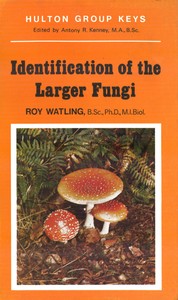
Excerpt
Text between _underscores_ represents text printed in italics in the
source document, text between =equal signs= represents bold face text,
and text between ~tildes~ represents bold face and italic text.
Superscript texts are represented by ^{text}.
More Transcriber’s Notes may be found at the end of this text.
To my parents who encouraged my interests in mushrooms and toadstools
and my wife who, later, was sympathetic to my studies and assisted in
the production of the...
Read the Full Text
— End of Identification of the Larger Fungi —
Book Information
- Title
- Identification of the Larger Fungi
- Author(s)
- Watling, Roy
- Language
- English
- Type
- Text
- Release Date
- August 24, 2019
- Word Count
- 55,772 words
- Library of Congress Classification
- QK
- Bookshelves
- Browsing: Nature/Gardening/Animals, Browsing: Science - General
- Rights
- Public domain in the USA.