Project Gutenberg's Hobson-Jobson, by Henry Yule and Arthur Coke Burnell
This eBook is for the use of anyone anywhere in the United States and
most other parts of the world at no cost and with almost no restrictions
whatsoever. You may copy it, give it away or re-use it under the terms
of the Project Gutenberg License included with this eBook or online at
www.gutenberg.org. If you are not located in the United States, you'll
have to check the laws of the country where you are located before using
this ebook.
Title: Hobson-Jobson
A glossary of Colloquial Anglo-Indian Words and Phrases,
and of Kindred terms, Etymological, Historical, Geographical
and Discursive
Author: Henry Yule
Arthur Coke Burnell
Editor: William Crooke
Release Date: December 24, 2018 [EBook #58529]
Language: English
Character set encoding: UTF-8
*** START OF THIS PROJECT GUTENBERG EBOOK HOBSON-JOBSON ***
Produced by Keith Edkins, MWS and the Online Distributed
Proofreading Team at http://www.pgdp.net (This file was
produced from images generously made available by The
Internet Archive/American Libraries.)
Transcriber's note: Text enclosed by underscores is in italics (_italics_).
Text preceded by a caret ^ is superscript.
The printed book contains over 300 minor typographical errors, many (but
not all) in the citations: these have NOT been attempted to be corrected.
* * * * *
A GLOSSARY
OF
ANGLO-INDIAN COLLOQUIAL
WORDS AND PHRASES
AND OF
KINDRED TERMS
["Wee have forbidden the severall Factoryes from wrighting words in this
languadge and refrayned itt our selves, though in bookes of coppies we
feare there are many which by wante of tyme for perusall we cannot
rectefie or expresse."—Surat Factors to Court, Feb. 26, 1617: I. O.
Records: O. C. No. 450. (Evidently the Court had complained of a growing
use of "Hobson-Jobsons.")]
----
"Οὐδὲ γὰρ πάντως τὴν αὐτήν διασώζει διάνοιαν μεθερμηνευόμενα τὰ ὀνόματα
ἀλλ' ἔστι τινὰ, καὶ καθ' ἕκαστον ἔθνος ἰδιώματα ἀδύνατα εἰς ἄλλο ἔθνος
διὰ φωνῆς σημαίνεσθαι"—IAMBLICHUS, _De Mysteriis_, vii. cap. v.
_i.e._ "For it is by no means always the case that translated terms
preserve the original conception; indeed every nation has some idiomatic
expressions which it is impossible to render perfectly in the language of
another."
----
"As well may we fetch words from the _Ethiopians_, or East or West
_Indians_, and thrust them into our Language, and baptize all by the name
of _English_, as those which we daily take from the _Latine_ or Languages
thereon depending; and hence it cometh, (as by often experience is found)
that some _English-men_ discoursing together, others being present of our
own Nation ... are not able to understand what the others say,
notwithstanding they call it _English_ that they speak."—R. V(ERSTEGAN),
_Restitution of Decayed Intelligence_, ed. 1673, p. 223.
----
"Utque novis facilis signatur cera figuris,
Nec manet ut fuerat, nec formas servat easdem,
Sed tamen ipsa eadem est; VOCEM sic semper eandem
Esse, sed in varias doceo migrare figuras."
_Ovid. Metamorph._ xv. 169-172 (adapt.).
----
"... _Take this as a good fare-well draught of_ English-Indian
_liquor_."—PURCHAS, _To the Reader_ (_before_ Terry's Relation of East
India), ii. 1463 (misprinted 1464).
----
"Nec dubitamus multa esse quae et nos praeterierint. Homines enim sumus,
et occupati officiis; subsicivisque temporibus ista curamus."—C. PLINII
SECUNDI, _Hist. Nat. Praefatio, ad Vespasianum_.
----
"Haec, si displicui, fuerint solatia nobis:
Haec fuerint nobis praemia, si placui."
MARTIALIS, _Epigr._ II. xci.
HOBSON-JOBSON
A GLOSSARY OF COLLOQUIAL
ANGLO-INDIAN WORDS AND
PHRASES, AND OF KINDRED
TERMS, ETYMOLOGICAL, HISTORICAL,
GEOGRAPHICAL AND
DISCURSIVE
BY COL. HENRY YULE, R.E., C.B.
AND A. C. BURNELL, PH.D., C.I.E.
NEW EDITION EDITED BY
WILLIAM CROOKE, B.A.
LONDON
JOHN MURRAY, ALBEMARLE STREET
1903
[_Dedication to Sir George Udny Yule, C.B., K.C.S.I._]
G. U. Y.
FRATRI OPTIMO DILECTISSIMO
AMICO JUCUNDISSIMO
HOC TRIUM FERME LUSTRORUM
OBLECTAMENTUM ET SOLATIUM
NEC PARVI LABORIS OPUS
ABSOLUTUM TANDEM
SENEX SENI
DEDICAT
H. Y.
PREFACE.
The objects and scope of this work are explained in the Introductory
Remarks which follow the Preface. Here it is desired to say a few words as
to its history.
The book originated in a correspondence between the present writer, who was
living at Palermo, and the late lamented ARTHUR BURNELL, of the Madras
Civil Service, one of the most eminent of modern Indian scholars, who
during the course of our communications was filling judicial offices in
Southern and Western India, chiefly at Tanjore. We had then met only
once—at the India Library; but he took a kindly interest in work that
engaged me, and this led to an exchange of letters, which went on after his
return to India. About 1872—I cannot find his earliest reference to the
subject—he mentioned that he was contemplating a vocabulary of Anglo-Indian
words, and had made some collections with that view. In reply it was stated
that I likewise had long been taking note of such words, and that a notion
similar to his own had also been at various times floating in my mind. And
I proposed that we should combine our labours.
I had not, in fact, the linguistic acquirements needful for carrying
through such an undertaking alone; but I had gone through an amount of
reading that would largely help in instances and illustrations, and had
also a strong natural taste for the kind of work.
This was the beginning of the portly double-columned edifice which now
presents itself, the completion of which my friend has not lived to see. It
was built up from our joint contributions till his untimely death in 1882,
and since then almost daily additions have continued to be made to the
material and to the structure. The subject, indeed, had taken so
comprehensive a shape, that it was becoming difficult to say where its
limits lay, or why it should ever end, except for the old reason which had
received such poignant illustration: _Ars longa, vita brevis_. And so it
has been wound up at last.
The work has been so long the companion of my _horae subsicivae_, a thread
running through the joys and sorrows of so many years, in the search for
material first, and then in their handling and adjustment to the
edifice—for their careful building up has been part of my duty from the
beginning, and the whole of the matter has, I suppose, been written and
re-written with my own hand at least four times—and the work has been one
of so much interest to dear friends, of whom not a few are no longer here
to welcome its appearance in print,[1] that I can hardly speak of the work
except as mine.
Indeed, in bulk, nearly seven-eighths of it is so. But BURNELL contributed
so much of value, so much of the essential; buying, in the search for
illustration, numerous rare and costly books which were not otherwise
accessible to him in India; setting me, by his example, on lines of
research with which I should have else possibly remained unacquainted;
writing letters with such fulness, frequency, and interest on the details
of the work up to the summer of his death; that the measure of bulk in
contribution is no gauge of his share in the result.
In the _Life of Frank Buckland_ occur some words in relation to the
church-bells of Ross, in Herefordshire, which may with some aptness
illustrate our mutual relation to the book:
"It is said that the Man of Ross" (John Kyrle) "was present at the
casting of the tenor, or great bell, and that he took with him an old
silver tankard, which, after drinking claret and sherry, he threw in, and
had cast with the bell."
John Kyrle's was the most precious part of the metal run into the mould,
but the shaping of the mould and the larger part of the material came from
the labour of another hand.
At an early period of our joint work BURNELL sent me a fragment of an essay
on the words which formed our subject, intended as the basis of an
introduction. As it stands, this is too incomplete to print, but I have
made use of it to some extent, and given some extracts from it in the
Introduction now put forward.[2]
The alternative title (_Hobson-Jobson_) which has been given to this book
(not without the expressed assent of my collaborator), doubtless requires
explanation.
A valued friend of the present writer many years ago published a book, of
great acumen and considerable originality, which he called _Three Essays_,
with no Author's name; and the resulting amount of circulation was such as
might have been expected. It was remarked at the time by another friend
that if the volume had been entitled _A Book, by a Chap_, it would have
found a much larger body of readers. It seemed to me that _A Glossary_ or
_A Vocabulary_ would be equally unattractive, and that it ought to have an
alternative title at least a little more characteristic. If the reader will
turn to _Hobson-Jobson_ in the Glossary itself, he will find that phrase,
though now rare and moribund, to be a typical and delightful example of
that class of Anglo-Indian _argot_ which consists of Oriental words highly
assimilated, perhaps by vulgar lips, to the English vernacular; whilst it
is the more fitted to our book, conveying, as it may, a veiled intimation
of dual authorship. At any rate, there it is; and at this period my feeling
has come to be that such _is_ the book's name, nor could it well have been
anything else.
In carrying through the work I have sought to supplement my own
deficiencies from the most competent sources to which friendship afforded
access. Sir JOSEPH HOOKER has most kindly examined almost every one of the
proof-sheets for articles dealing with plants, correcting their errors, and
enriching them with notes of his own. Another friend, Professor ROBERTSON
SMITH, has done the like for words of Semitic origin, and to him I owe a
variety of interesting references to the words treated of, in regard to
their occurrence, under some cognate form, in the Scriptures. In the early
part of the book the Rev. GEORGE MOULE (now Bishop of Ningpo), then in
England, was good enough to revise those articles which bore on expressions
used in China (not the first time that his generous aid had been given to
work of mine). Among other friends who have been ever ready with assistance
I may mention Dr. REINHOLD ROST, of the India Library; General ROBERT
MACLAGAN, R.E.; Sir GEORGE BIRDWOOD, C.S.I.; Major-General R. H. KEATINGE,
V.C., C.S.I.; Professor TERRIEN DE LA COUPERIE; and Mr. E. COLBORNE BABER,
at present Consul-General in Corea. Dr. J. A. H. MURRAY, editor of the
great English Dictionary, has also been most kind and courteous in the
interchange of communications, a circumstance which will account for a few
cases in which the passages cited in both works are the same.
My first endeavour in preparing this work has been to make it accurate; my
next to make it—even though a Glossary—interesting. In a work intersecting
so many fields, only a fool could imagine that he had not fallen into many
mistakes; but these when pointed out, may be amended. If I have missed the
other object of endeavour, I fear there is little to be hoped for from a
second edition.
H. YULE.
_5th January 1886._
PREFACE TO THE SECOND EDITION.
The twofold hope expressed in the closing sentence of Sir Henry Yule's
Preface to the original Edition of this book has been amply justified. More
recent research and discoveries have, of course, brought to light a good
deal of information which was not accessible to him, but the general
accuracy of what he wrote has never been seriously impugned—while those who
have studied the pages of _Hobson-Jobson_ have agreed in classing it as
unique among similar works of reference, a volume which combines interest
and amusement with instruction, in a manner which few other Dictionaries,
if any, have done.
In this edition of the _Anglo-Indian Glossary_ the original text has been
reprinted, any additions made by the Editor being marked by square
brackets. No attempt has been made to extend the vocabulary, the new
articles being either such as were accidentally omitted in the first
edition, or a few relating to words which seemed to correspond with the
general scope of the work. Some new quotations have been added, and some of
those included in the original edition have been verified and new
references given. An index to words occurring in the quotations has been
prepared.
I have to acknowledge valuable assistance from many friends. Mr. W. W.
SKEAT has read the articles on Malay words, and has supplied many notes.
Col. Sir R. TEMPLE has permitted me to use several of his papers on
Anglo-Indian words, and has kindly sent me advance sheets of that portion
of the Analytical Index to the first edition by Mr. C. PARTRIDGE, which is
being published in the _Indian Antiquary_. Mr. R. S. WHITEWAY has given me
numerous extracts from Portuguese writers; Mr. W. FOSTER, quotations from
unpublished records in the India Office; Mr. W. IRVINE, notes on the later
Moghul period. For valuable suggestions and information on disputed points
I am indebted to Mr. H. BEVERIDGE, Sir G. BIRDWOOD, Mr. J. BRANDT, Prof. E.
G. BROWNE, Mr. M. LONGWORTH DAMES, Mr. G. R. DAMPIER, Mr. DONALD FERGUSON,
Mr. C. T. GARDNER, the late Mr. E. J. W. GIBB, Prof. H. A. GILES, Dr. G. A.
GRIERSON, Mr. T. M. HORSFALL, Mr. L. W. KING, Mr. J. L. MYRES, Mr. J.
PLATT, jun., Prof. G. U. POPE, Mr. V. A. SMITH, Mr. C. H. TAWNEY, and Mr.
J. WEIR.
W. CROOKE.
_14th November 1902._
CONTENTS.
PAGE
DEDICATION TO SIR GEORGE YULE, C.B., K.C.S.I. v
PREFACE vii
PREFACE TO SECOND EDITION xi
INTRODUCTORY REMARKS xv
Note A. to do. xxiii
Note B. " xxv
NOTA BENE—IN THE USE OF THE GLOSSARY—
(A) Regarding Dates of Quotations xxvi
(B) Regarding Transliteration xxvi
FULLER TITLES OF BOOKS QUOTED IN THE GLOSSARY xxvii
CORRIGENDA xlviii
GLOSSARY 1
INDEX 987
INTRODUCTORY REMARKS.
Words of Indian origin have been insinuating themselves into English ever
since the end of the reign of Elizabeth and the beginning of that of King
James, when such terms as _calico_, _chintz_, and _gingham_ had already
effected a lodgment in English warehouses and shops, and were lying in wait
for entrance into English literature. Such outlandish guests grew more
frequent 120 years ago, when, soon after the middle of last century, the
numbers of Englishmen in the Indian services, civil and military, expanded
with the great acquisition of dominion then made by the Company; and we
meet them in vastly greater abundance now.
Vocabularies of Indian and other foreign words, in use among Europeans in
the East, have not unfrequently been printed. Several of the old travellers
have attached the like to their narratives; whilst the prolonged excitement
created in England, a hundred years since, by the impeachment of Hastings
and kindred matters, led to the publication of several glossaries as
independent works; and a good many others have been published in later
days. At the end of this Introduction will be found a list of those which
have come under my notice, and this might no doubt be largely added to.[3]
Of modern Glossaries, such as have been the result of serious labour, all,
or nearly all, have been of a kind purely technical, intended to facilitate
the comprehension of official documents by the explanation of terms used in
the Revenue department, or in other branches of Indian administration. The
most notable examples are (of brief and occasional character), the Glossary
appended to the famous _Fifth Report_ of the Select Committee of 1812,
which was compiled by Sir Charles Wilkins; and (of a far more vast and
comprehensive sort), the late Professor Horace Hayman Wilson's _Glossary of
Judicial and Revenue Terms_ (4to, 1855) which leaves far behind every other
attempt in that kind.[4]
That kind is, however, not ours, as a momentary comparison of a page or two
in each Glossary would suffice to show. Our work indeed, in the long course
of its compilation, has gone through some modification and enlargement of
scope; but hardly such as in any degree to affect its distinctive
character, in which something has been aimed at differing in form from any
work known to us. In its original conception it was intended to deal with
all that class of words which, not in general pertaining to the
technicalities of administration, recur constantly in the daily intercourse
of the English in India, either as expressing ideas really not provided for
by our mother-tongue, or supposed by the speakers (often quite erroneously)
to express something not capable of just denotation by any English term. A
certain percentage of such words have been carried to England by the
constant reflux to their native shore of Anglo-Indians, who in some degree
imbue with their notions and phraseology the circles from which they had
gone forth. This effect has been still more promoted by the currency of a
vast mass of literature, of all qualities and for all ages, dealing with
Indian subjects; as well as by the regular appearance, for many years past,
of Indian correspondence in English newspapers, insomuch that a
considerable number of the expressions in question have not only become
familiar in sound to English ears, but have become naturalised in the
English language, and are meeting with ample recognition in the great
Dictionary edited by Dr. Murray at Oxford.
Of words that seem to have been admitted to full franchise, we may give
examples in _curry_, _toddy_, _veranda_, _cheroot_, _loot_, _nabob_,
_teapoy_, _sepoy_, _cowry_; and of others familiar enough to the English
ear, though hardly yet received into citizenship, _compound_, _batta_,
_pucka_, _chowry_, _baboo_, _mahout_, _aya_, _nautch_,[5] first-_chop_,
competition-_wallah_, _griffin_, &c. But beyond these two classes of words,
received within the last century or so, and gradually, into half or whole
recognition, there are a good many others, long since fully assimilated,
which really originated in the adoption of an Indian word, or the
modification of an Indian proper name. Such words are the three quoted at
the beginning of these remarks, _chintz_, _calico_, _gingham_, also
_shawl_, _bamboo_, _pagoda_, _typhoon_, _monsoon_, _mandarin_,
_palanquin_,[6] &c., and I may mention among further examples which may
perhaps surprise my readers, the names of three of the boats of a
man-of-war, viz. the _cutter_, the _jolly-boat_, and the _dingy_, as all
(probably) of Indian origin.[7] Even phrases of a different character—slang
indeed, but slang generally supposed to be vernacular as well as
vulgar—_e.g._ 'that is the _cheese_';[7] or supposed to be vernacular and
profane—_e.g._ 'I don't care a _dam_'[7]—are in reality, however vulgar
they may be, neither vernacular nor profane, but phrases turning upon
innocent Hindustani vocables.
We proposed also, in our Glossary, to deal with a _selection_ of those
administrative terms, which are in such familiar and quotidian use as to
form part of the common Anglo-Indian stock, and to trace all (so far as
possible) to their true origin—a matter on which, in regard to many of the
words, those who hourly use them are profoundly ignorant—and to follow them
down by quotation from their earliest occurrence in literature.
A particular class of words are those indigenous terms which have been
adopted in scientific nomenclature, botanical and zoological. On these Mr.
Burnell remarks:—
"The first Indian botanical names were chiefly introduced by Garcia de Orta
(_Colloquios_, printed at Goa in 1563), C. d'Acosta (_Tractado_, Burgos,
1578), and Rhede van Drakenstein (_Hortus Malabaricus_, Amsterdam, 1682).
The Malay names were chiefly introduced by Rumphius (_Herbarium
Amboinense_, completed before 1700, but not published till 1741). The
Indian zoological terms were chiefly due to Dr. F. Buchanan, at the
beginning of this century. Most of the N. Indian botanical words were
introduced by Roxburgh."
It has been already intimated that, as the work proceeded, its scope
expanded somewhat, and its authors found it expedient to introduce and
trace many words of Asiatic origin which have disappeared from colloquial
use, or perhaps never entered it, but which occur in old writers on the
East. We also judged that it would add to the interest of the work, were we
to investigate and make out the pedigree of a variety of geographical names
which are or have been in familiar use in books on the Indies; take as
examples _Bombay_, _Madras_, _Guardafui_, _Malabar_, _Moluccas_,
_Zanzibar_, _Pegu_, _Sumatra_, _Quilon_, _Seychelles_, _Ceylon_, _Java_,
_Ava_, _Japan_, _Doab_, _Punjab_, &c., illustrating these, like every other
class of word, by quotations given in chronological series.
Other divagations still from the original project will probably present
themselves to those who turn over the pages of the work, in which we have
been tempted to introduce sundry subjects which may seem hardly to come
within the scope of such a glossary.
The words with which we have to do, taking the most extensive view of the
field, are in fact organic remains deposited under the various currents of
external influence that have washed the shores of India during twenty
centuries and more. Rejecting that derivation of _elephant_[8] which would
connect it with the Ophir trade of Solomon, we find no existing Western
term traceable to that episode of communication; but the Greek and Roman
commerce of the later centuries has left its fossils on both sides,
testifying to the intercourse that once subsisted. _Agallochum_,
_carbasus_, _camphor_, _sandal_, _musk_, _nard_, _pepper_ (πέπερι, from
Skt. _pippali_, 'long pepper'), _ginger_ (ζιγγίβερις, see under _Ginger_),
_lac_, _costus_, _opal_, _malabathrum_ or _folium indicum_, _beryl_,
_sugar_ (σάκχαρ, from Skt. _sarkara_, Prak. _sakkara_), _rice_ (ὄρυζα, but
see s.v.), were products or names, introduced from India to the Greek and
Roman world, to which may be added a few terms of a different character,
such as Βραχμᾶνες, Σάρμανες (_śramaṇas_, or Buddhist ascetics), ζύλα
σαγαλίνα καὶ σασαμίνα (logs of teak and shīsham), the σάγγαρα (rafts) of
the Periplus (see _Jangar_ in GLOSS.); whilst _dīnāra_, _dramma_, perhaps
_kastīra_ ('tin,' κασσίτερος), _kastūrī_ ('musk,' καστόριον, properly a
different, though analogous animal product), and a very few more, have
remained in Indian literature as testimony to the same intercourse.[9]
The trade and conquests of the Arabs both brought foreign words to India
and picked up and carried westward, in form more or less corrupted, words
of Indian origin, some of which have in one way or other become part of the
heritage of all succeeding foreigners in the East. Among terms which are
familiar items in the Anglo-Indian colloquial, but which had, in some shape
or other, found their way at an early date into use on the shores of the
Mediterranean, we may instance _bazaar_, _cazee_, _hummaul_, _brinjaul_,
_gingely_, _safflower_, _grab_, _maramut_, _dewaun_ (dogana, douane, &c.).
Of others which are found in medieval literature, either West-Asiatic or
European, and which still have a place in Anglo-Indian or English
vocabulary, we may mention _amber_-gris, _chank_, _junk_, _jogy_, _kincob_,
_kedgeree_, _fanam_, _calay_, _bankshall_, _mudiliar_, _tindal_, _cranny_.
The conquests and long occupation of the Portuguese, who by the year 1540
had established themselves in all the chief ports of India and the East,
have, as might have been expected, bequeathed a large number of expressions
to the European nations who have followed, and in great part superseded
them. We find instances of missionaries and others at an early date who had
acquired a knowledge of Indian languages, but these were exceptional.[10]
The natives in contact with the Portuguese learned a bastard variety of the
language of the latter, which became the _lingua franca_ of intercourse,
not only between European and native, but occasionally between Europeans of
different nationalities. This Indo-Portuguese dialect continued to serve
such purposes down to a late period in the last century, and has in some
localities survived down nearly to our own day.[11] The number of people in
India claiming to be of Portuguese descent was, in the 17th century, very
large. Bernier, about 1660, says:—
"For he (Sultan Shujā', Aurangzeb's brother) much courted all those
_Portugal_ Fathers, Missionaries, that are in that Province.... And they
were indeed capable to serve him, it being certain that in the kingdom of
_Bengale_ there are to be found not less than eight or nine thousand
families of _Franguis_, _Portugals_, and these either Natives or Mesticks."
(_Bernier_, E.T. of 1684, p. 27.)
A. Hamilton, whose experience belonged chiefly to the end of the same
century, though his book was not published till 1727, states:—
"Along the Sea-coasts the _Portuguese_ have left a Vestige of their
Language, tho' much corrupted, yet it is the Language that most _Europeans_
learn first to qualify them for a general Converse with one another, as
well as with the different inhabitants of _India_." (_Preface_, p. xii.)
Lockyer, who published 16 years before Hamilton, also says:—
"This they (the _Portugueze_) may justly boast, they have established a
kind of _Lingua Franca_ in all the Sea Ports in _India_, of great use to
other _Europeans_, who would find it difficult in many places to be well
understood without it." (_An Account of the Trade in India_, 1711, p. 286.)
The early Lutheran Missionaries in the South, who went out for the
S.P.C.K., all seem to have begun by learning Portuguese, and in their
diaries speak of preaching occasionally in Portuguese.[12] The foundation
of this _lingua franca_ was the Portuguese of the beginning of the 16th
century; but it must have soon degenerated, for by the beginning of the
last century it had lost nearly all trace of inflexion.[13]
It may from these remarks be easily understood how a large number of our
Anglo-Indian colloquialisms, even if eventually traceable to native sources
(and especially to Mahratti, or Dravidian originals) have come to us
through a Portuguese medium, and often bear traces of having passed through
that alembic. Not a few of these are familiar all over India, but the
number current in the South is larger still. Some other Portuguese words
also, though they can hardly be said to be recognized elements in the
Anglo-Indian colloquial, have been introduced either into Hindustani
generally, or into that shade of it which is in use among natives in
habitual contact with Europeans. Of words which are essentially Portuguese,
among Anglo-Indian colloquialisms, persistent or obsolete, we may quote
_goglet_, _gram_, _plantain_, _muster_, _caste_, _peon_, _padre_, _mistry_
or _maistry_, _almyra_, _aya_, _cobra_, _mosquito_, _pomfret_, _cameez_,
_palmyra_, still in general use; _picotta_, _rolong_, _pial_, _fogass_,
_margosa_, preserved in the South; _batel_, _brab_, _foras_, _oart_,
_vellard_ in Bombay; _joss_, _compradore_, _linguist_ in the ports of
China; and among more or less obsolete terms, _Moor_, for a Mahommedan,
still surviving under the modified form _Moorman_, in Madras and Ceylon;
_Gentoo_, still partially kept up, I believe, at Madras in application to
the Telugu language, _mustees_, _castees_, _bandeja_ ('a tray'), _Kittysol_
('an umbrella,' and this survived ten years ago in the Calcutta customs
tariff), _cuspadore_ ('a spittoon'), and _covid_ ('a cubit or ell'). Words
of native origin which bear the mark of having come to us through the
Portuguese may be illustrated by such as _palanquin_, _mandarin_,
_mangelin_ (a small weight for pearls, &c.), _monsoon_, _typhoon_, _mango_,
_mangosteen_, _jack-fruit_, _batta_, _curry_, _chop_, _congee_, _coir_,
_cutch_, _catamaran_, _cassanar_, _nabob_, _avadavat_, _betel_, _areca_,
_benzoin_, _corge_, _copra_.[14] A few examples of Hindustani words
borrowed from the Portuguese are _chābī_ ('a key'), _bāola_ ('a
portmanteau'), _bāltī_ ('a bucket'), _martol_ ('a hammer'), _tauliya_ ('a
towel,' Port. _toalha_), _sābūn_ ('soap'), _bāsan_ ('plate' from Port.
_bacia_), _līlām_ and _nīlām_ ('an auction'), besides a number of terms
used by Lascars on board ship.
The Dutch language has not contributed much to our store. The Dutch and the
English arrived in the Indies contemporaneously, and though both inherited
from the Portuguese, we have not been the heirs of the Dutch to any great
extent, except in Ceylon, and even there Portuguese vocables had already
occupied the colloquial ground. _Petersilly_, the word in general use in
English families for 'parsley,' appears to be Dutch. An example from Ceylon
that occurs to memory is _burgher_. The Dutch admitted people of mixt
descent to a kind of citizenship, and these were distinguished from the
pure natives by this term, which survives. _Burgher_ in Bengal means 'a
rafter,' properly _bargā_. A word spelt and pronounced in the same way had
again a curiously different application in Madras, where it was a
corruption of _Vaḍagar_, the name given to a tribe in the Nilgherry
hills;—to say nothing of Scotland, where Burghers and Antiburghers were
Northern tribes (_veluti_ Gog _et_ Magog!) which have long been condensed
into elements of the United Presbyterian Church——!
Southern India has contributed to the Anglo-Indian stock words that are in
hourly use also from Calcutta to Peshawur (some of them already noted under
another cleavage), _e.g._ _betel_, _mango_, _jack_, _cheroot_, _mungoose_,
_pariah_, _bandicoot_, _teak_, _patcharee_, _chatty_, _catechu_, _tope_ ('a
grove'), _curry_, _mulligatawny_, _congee_. _Mamooty_ (a digging tool) is
familiar in certain branches of the service, owing to its having long had a
place in the nomenclature of the Ordnance department. It is Tamil,
_manvĕtti_, 'earth-cutter.' Of some very familiar words the origin remains
either dubious, or matter only for conjecture. Examples are _hackery_
(which arose apparently in Bombay), _florican_, _topaz_.
As to Hindustani words adopted into the Anglo-Indian colloquial the subject
is almost too wide and loose for much remark. The habit of introducing
these in English conversation and writing seems to prevail more largely in
the Bengal Presidency than in any other, and especially more than in
Madras, where the variety of different vernaculars in use has tended to
make their acquisition by the English less universal than is in the north
that of Hindustani, which is so much easier to learn, and also to make the
use in former days of Portuguese, and now of English, by natives in contact
with foreigners, and of French about the French settlements, very much more
common than it is elsewhere. It is this bad habit of interlarding English
with Hindustani phrases which has so often excited the just wrath of high
English officials, not accustomed to it from their youth, and which
(_e.g._) drew forth in orders the humorous indignation of Sir Charles
Napier.
One peculiarity in this use we may notice, which doubtless exemplifies some
obscure linguistic law. Hindustani _verbs_ which are thus used are
habitually adopted into the quasi-English by converting the imperative into
an infinitive. Thus to _bunow_, to _lugow_, to _foozilow_, to _puckarow_,
to _dumbcow_, to _sumjow_, and so on, almost _ad libitum_, are formed as we
have indicated.[15]
It is curious to note that several of our most common adoptions are due to
what may be most especially called the Oordoo (_Urdū_) or 'Camp' language,
being terms which the hosts of Chinghiz brought from the steppes of North
Eastern Asia—_e.g._ "The old _Bukshee_ is an awful _bahadur_, but he keeps
a first-rate _bobachee_." That is a sentence which might easily have passed
without remark at an Anglo-Indian mess-table thirty years ago—perhaps might
be heard still. Each of the outlandish terms embraced in it came from the
depths of Mongolia in the thirteenth century. _Chick_ (in the sense of a
cane-blind), _daroga_, _oordoo_ itself, are other examples.
With the gradual assumption of administration after the middle of last
century, we adopted into partial colloquial use an immense number of terms,
very many of them Persian or Arabic, belonging to technicalities of revenue
and other departments, and largely borrowed from our Mahommedan
predecessors. Malay has contributed some of our most familiar expressions,
owing partly to the ceaseless rovings among the Eastern coasts of the
Portuguese, through whom a part of these reached us, and partly doubtless
to the fact that our early dealings and the sites of our early factories
lay much more on the shores of the Eastern Archipelago than on those of
Continental India. _Paddy_, _godown_, _compound_, _bankshall_, _rattan_,
_durian_, _a-muck_, _prow_, and _cadjan_, _junk_, _crease_, are some of
these. It is true that several of them may be traced eventually to Indian
originals, but it seems not the less certain that we got them through the
Malay, just as we got words already indicated through the Portuguese.
We used to have a very few words in French form, such as _boutique_ and
_mort-de-chien_. But these two are really distortions of Portuguese words.
A few words from China have settled on the Indian shores and been adopted
by Anglo-India, but most of them are, I think, names of fruits or other
products which have been imported, such as _loquot_, _leechee_,
_chow-chow_, _cumquat_, _ginseng_, &c. and (recently) _jinrickshaw_. For it
must be noted that a considerable proportion of words much used in Chinese
ports, and often ascribed to a Chinese origin, such as _mandarin_, _junk_,
_chop_, _pagoda_, and (as I believe) _typhoon_ (though this is a word much
debated) are not Chinese at all, but words of Indian languages, or of
Malay, which have been precipitated in Chinese waters during the flux and
reflux of foreign trade.
Within my own earliest memory Spanish dollars were current in England at a
specified value if they bore a stamp from the English mint. And similarly
there are certain English words, often obsolete in Europe, which have
received in India currency with a special stamp of meaning; whilst in other
cases our language has formed in India new compounds applicable to new
objects or shades of meaning. To one or other of these classes belong
_outcry_, _buggy_, _home_, _interloper_, _rogue_ (-elephant), _tiffin_,
_furlough_, _elk_, _roundel_ ('an umbrella,' obsolete), _pish-pash_,
_earth-oil_, _hog-deer_, _flying-fox_, _garden-house_, _musk-rat_,
_nor-wester_, _iron-wood_, _long-drawers_, _barking-deer_, _custard-apple_,
_grass-cutter_, &c.
Other terms again are corruptions, more or less violent, of Oriental words
and phrases which have put on an English mask. Such are _maund_, _fool's
rack_, _bearer_, _cot_, _boy_, _belly-band_, _Penang-lawyer_, _buckshaw_,
_goddess_ (in the Malay region, representing Malay _gādīs_, 'a maiden'),
_compound_, _college_-pheasant, _chopper_, _summer-head_,[16] _eagle-wood_,
_jackass_-copal, _bobbery_, _Upper Roger_ (used in a correspondence given
by Dalrymple, for _Yuva Raja_, the 'Young King,' or Caesar, of Indo-Chinese
monarchies), _Isle-o'-Bats_ (for Allahābād or _Ilahābāz_ as the natives
often call it), _hobson-jobson_ (see Preface), _St. John's_. The last
proper name has at least three applications. There is "St. John's" in
Guzerat, viz. _Sanjān_, the landing-place of the Parsee immigration in the
8th century; there is another "St. John's" which is a corruption of
_Shang-Chuang_, the name of that island off the southern coast of China
whence the pure and ardent spirit of Francis Xavier fled to a better world:
there is the group of "St. John's Islands" near Singapore, the chief of
which is properly Pulo-_Sikajang_.
Yet again we have hybrids and corruptions of English fully accepted and
adopted as Hindustani by the natives with whom we have to do, such as
_simkin_, _port-shrāb_, _brandy-pānī_, _apīl_, _rasīd_, _tumlet_ (a
tumbler), _gilās_ ('glass,' for drinking vessels of sorts), _rail-ghārī_,
_lumber-dār_, _jail-khāna_, _bottle-khāna_, _buggy-khāna_, 'et omne quod
exit in' _khāna_, including _gymkhāna_, a very modern concoction (q.v.),
and many more.
Taking our subject as a whole, however considerable the philological
interest attaching to it, there is no disputing the truth of a remark with
which Burnell's fragments of intended introduction concludes, and the
application of which goes beyond the limit of those words which can be
considered to have 'accrued as additions to the English language':
"Considering the long intercourse with India, it is noteworthy that the
additions which have thus accrued to the English language are, from the
intellectual standpoint, of no intrinsic value. Nearly all the borrowed
words refer to material facts, or to peculiar customs and stages of
society, and, though a few of them furnish allusions to the penny-a-liner,
they do not represent new ideas."
It is singular how often, in tracing to their origin words that come within
the field of our research, we light upon an absolute dilemma, or
bifurcation, _i.e._ on two or more sources of almost equal probability, and
in themselves entirely diverse. In such cases it may be that, though the
use of the word _originated_ from one of the sources, the existence of the
other has invigorated that use, and contributed to its eventual diffusion.
An example of this is _boy_, in its application to a native servant. To
this application have contributed both the old English use of _boy_
(analogous to that of _puer_, _garçon_, _Knabe_) for a camp-servant, or for
a slave, and the Hindī-Marāṭhī _bhoi_, the name of a caste which has
furnished palanquin and umbrella-bearers to many generations of Europeans
in India. The habitual use of the word by the Portuguese, for many years
before any English influence had touched the shores of India (_e.g._ _bóy
de sombrero_, _bóy d'aguoa_, _bóy de palanquy_), shows that the earliest
source was the Indian one.
_Cooly_, in its application to a carrier of burdens, or performer of
inferior labour, is another example. The most probable origin of this is
from a _nomen gentile_, that of the _Kolīs_, a hill-people of Guzerat and
the Western Ghats (compare the origin of _slave_). But the matter is
perplexed by other facts which it is difficult to connect with this. Thus,
in S. India, there is a Tamil word _kūli_, in common use, signifying 'daily
hire or wages,' which H. H. Wilson regards as the true origin of the word
which we call _cooly_. Again, both in Oriental and Osmali Turkish, _kol_ is
a word for a slave, and in the latter also there is _kūleh_, 'a male slave,
a bondsman.' _Khol_ is, in Tibetan also, a word for a slave or servant.
_Tank_, for a reservoir of water, we are apt to derive without hesitation,
from _stagnum_, whence Sp. _estanc_, old Fr. _estang_, old Eng. and Lowland
Scotch _stank_, Port. _tanque_, till we find that the word is regarded by
the Portuguese themselves as Indian, and that there is excellent testimony
to the existence of _tānkā_ in Guzerat and Rajputana as an indigenous word,
and with a plausible Sanskrit etymology.
_Veranda_ has been confidently derived by some etymologists (among others
by M. Defréméry, a distinguished scholar) from the Pers. _barāmada_, 'a
projection,' a balcony; an etymology which is indeed hardly a possible one,
but has been treated by Mr. Beames (who was evidently unacquainted with the
facts that do make it hardly possible) with inappropriate derison, he
giving as the unquestionable original a Sanskrit word _baraṇḍa_, 'a
portico.' On this Burnell has observed that the word does not belong to the
older Sanskrit, but is only found in comparatively modern works. Be that as
it may, it need not be doubted that the word _veranda_, as used in England
and France, was imported from India, _i.e._ from the usage of Europeans in
India; but it is still more certain that either in the same sense, or in
one closely allied, the word existed, quite independent of either Sanskrit
or Persian, in Portuguese and Spanish, and the manner in which it occurs in
the very earliest narrative of the Portuguese adventure to India (_Roteiro
do Viagem de Vasco da Gama_, written by one of the expedition of 1497),
confirmed by the Hispano-Arabic vocabulary of Pedro de Alcalà, printed in
1505, preclude the possibility of its having been adopted by the Portuguese
from intercourse with India.
_Mangrove_, John Crawfurd tells us, has been adopted from the Malay
_manggi-manggi_, applied to trees of the genus _Rhizophora_. But we learn
from Oviedo, writing early in the sixteenth century, that the name _mangle_
was applied by the natives of the Spanish Main to trees of the same, or a
kindred genus, on the coast of S. America, which same _mangle_ is
undoubtedly the parent of the French _manglier_, and not improbably
therefore of the English form _mangrove_.[17]
The words _bearer_, _mate_, _cotwal_, partake of this kind of dual or
doubtful ancestry, as may be seen by reference to them in the Glossary.
Before concluding, a word should be said as to the orthography used in the
Glossary.
My intention has been to give the headings of the articles under the most
usual of the popular, or, if you will, vulgar quasi-English spellings,
whilst the Oriental words, from which the headings are derived or
corrupted, are set forth under precise transliteration, the system of which
is given in a following "Nota Bene." When using the words and names in the
course of discursive elucidation, I fear I have not been consistent in
sticking either always to the popular or always to the scientific spelling,
and I can the better understand why a German critic of a book of mine, once
upon a time, remarked upon the _etwas schwankende yulische Orthographie_.
Indeed it is difficult, it never will for me be possible, in a book for
popular use, to adhere to one system in this matter without the assumption
of an ill-fitting and repulsive pedantry. Even in regard to Indian proper
names, in which I once advocated adhesion, with a small number of
exceptions, to scientific precision in transliteration, I feel much more
inclined than formerly to sympathise with my friends Sir William Muir and
General Maclagan, who have always favoured a large and liberal recognition
of popular spelling in such names. And when I see other good and able
friends following the scientific Will-o'-the-Wisp into such bogs as the use
in English composition of _sipáhí_ and _jangal_, and _verandah_—nay, I have
not only heard of _bagí_, but have recently seen it—instead of the good
English words 'sepoy,' and 'jungle,' 'veranda,' and 'buggy,' my dread of
pedantic usage becomes the greater.[18]
For the spelling of _Mahratta_, _Mahratti_, I suppose I must apologize
(though something is to be said for it), _Marāṭhī_ having established
itself as orthodox.
NOTE A.—LIST OF GLOSSARIES.
1. Appended to the ROTEIRO DE VASCO DA GAMA (see Book-list, p. xliii.) is a
Vocabulary of 138 Portuguese words with their corresponding word in the
_Lingua de Calicut_, _i.e._ in Malayālam.
2. Appended to the VOYAGES, &c., du Sieur DE LA BOULLAYE-LE-GOUZ
(Book-list, p. xxxii.), is an _Explication de plusieurs mots dont
l'intelligence est nécessaire au Lecteur_ (pp. 27).
3. Fryer's New Account (Book-list, p. xxxiv.) has an _Index Explanatory_,
including _Proper Names_, _Names of Things_, and _Names of Persons_ (12
pages).
4. "INDIAN VOCABULARY, to which is prefixed the Forms of Impeachment."
12mo. Stockdale, 1788 (pp. 136).
5. "An INDIAN GLOSSARY, consisting of some Thousand Words and Forms
commonly used in the East Indies ... extremely serviceable in assisting
Strangers to acquire with Ease and Quickness the Language of that Country."
By T. T. ROBARTS, Lieut., &c., of the 3rd Regt. Native Infantry, E.I.
Printed for Murray & Highley, Fleet Street, 1800. 12mo. (not paged).
6. "A DICTIONARY OF MOHAMMEDAN LAW, Bengal Revenue Terms, Shanscrit,
Hindoo, and other words used in the East Indies, with full explanations,
the leading word used in each article being printed in a new Nustaluk
Type," &c. By S. ROUSSEAU. London, 1802. 12mo. (pp. lxiv—287). Also 2nd ed.
1805.
7. GLOSSARY prepared for the FIFTH REPORT (see Book-list, p. xxxiv.), by
Sir CHARLES WILKINS. This is dated in the preface "E. I. House, 1813." The
copy used is a Parliamentary reprint, dated 1830.
8. The Folio compilation of the BENGAL REGULATIONS, published in 1828-29,
contains in each volume a Glossarial Index, based chiefly upon the Glossary
of Sir C. Wilkins.
9. In 1842 a preliminary "GLOSSARY OF INDIAN TERMS," drawn up at the E. I.
House by Prof. H. H. Wilson, 4to, unpublished, with a blank column on each
page "for Suggestions and Additions," was circulated in India, intended as
a basis for a comprehensive official Glossary. In this one the words are
entered in the vulgar spelling, as they occur in the documents.
10. The only important result of the circulation of No. 9. was "SUPPLEMENT
TO THE GLOSSARY OF INDIAN TERMS, A—J." By H. M. ELLIOT, Esq., Bengal Civil
Service. Agra, 1845. 8vo. (pp. 447).
This remarkable work has been revised, re-arranged, and re-edited, with
additions from Elliot's notes and other sources, by Mr. JOHN BEAMES, of the
Bengal Civil Service, under the title of "MEMOIRS ON THE FOLK-LORE AND
DISTRIBUTION OF THE RACES of the North-Western Provinces of India, being an
amplified edition of" (the above). 2 vols. 8vo. Trübner, 1869.
11. To "MORLEY'S ANALYTICAL DIGEST of all the Reported Cases Decided in the
Supreme Courts of Judicature in India," Vol. I., 1850, there is appended a
"Glossary of Native Terms used in the Text" (pp. 20).
12. In "WANDERINGS OF A PILGRIM" (Book-list, p. xlvi.), there is a Glossary
of some considerable extent (pp. 10 in double columns).
13. "The ZILLAH DICTIONARY in the Roman character, explaining the Various
Words used in Business in India." By CHARLES PHILIP BROWN, of the Madras
Civil Service, &c. Madras, 1852. Imp. 8vo. (pp. 132).
14. "A GLOSSARY OF JUDICIAL AND REVENUE TERMS, and of Useful Words
occurring in Official Documents, relating to the Administration of the
Government of British India, from the Arabic, Persian, Hindústání,
Sanskrit, Hindí, Bengálí, Uriyá, Maráṭhí, Guzaráthí, Telugu, Karnáta,
Támil, Malayálam, and other languages. By H. H. WILSON, M.A., F.R.S., Boden
Professor, &c." London, 1855. 4to. (pp. 585, besides copious Index).
15. A useful folio Glossary published by Government at Calcutta between
1860 and 1870, has been used by me and is quoted in the present GLOSS. as
"Calcutta Glossary." But I have not been able to trace it again so as to
give the proper title.
16. CEYLONESE VOCABULARY. See Book-list, p. xxxi.
17. "KACHAHRI TECHNICALITIES, or A Glossary of Terms, Rural, Official, and
General, in Daily Use in the Courts of Law, and in Illustration of the
Tenures, Customs, Arts, and Manufactures of Hindustan." By PATRICK CARNEGY,
Commissioner of Rai Bareli, Oudh. 8vo. 2nd ed. Allahabad, 1877 (pp. 361).
18. "A GLOSSARY OF INDIAN TERMS, containing many of the most important and
Useful Indian Words. Designed for the Use of Officers of Revenue and
Judicial Practitioners and Students." Madras, 1877. 8vo. (pp. 255).
19. "A GLOSSARY OF REFERENCE on Subjects connected with the Far East"
(China and Japan). By H. A. GILES. Hong-Kong, 1878, 8vo. (pp. 182).
20. "GLOSSARY OF VERNACULAR TERMS used in Official Correspondence in the
Province of ASSAM." Shillong, 1879. (Pamphlet).
21. "ANGLO-INDIAN DICTIONARY. A Glossary of such Indian Terms used in
English, and such English or other non-Indian terms as have obtained
special meanings in India." By GEORGE CLIFFORD WHITWORTH, Bombay Civil
Service. London, 8vo, 1885 (pp. xv.—350).
Also the following minor Glossaries contained in Books of Travel or
History:—
22. In "CAMBRIDGE'S ACCOUNT of the War in India," 1761 (Book-list, p.
xxx.); 23. In "GROSE'S VOYAGE," 1772 (Book-list, p. xxxv.); 24. In
CARRACCIOLI'S "LIFE OF CLIVE" (Book-list, p. xxx.); 25. In "BP. HEBER'S
NARRATIVE" (Book-list, p. xxxvi.); 26. In HERKLOT'S "QANOON-E-ISLAM"
(Book-list, p. xxxv.); [27. In "VERELST'S VIEW OF BENGAL," 1772; 28. "THE
MALAYAN WORDS IN ENGLISH," by C. P. G. Scott, reprinted from the Journal of
the American Oriental Society: New Haven, 1897; 29. "MANUAL OF THE
ADMINISTRATION OF THE MADRAS PRESIDENCY," Vol. III. Glossary, Madras, 1893.
The name of the author of this, the most valuable book of the kind recently
published in India, does not appear upon the title-page. It is believed to
be the work of C. D. Macleane; 30. A useful Glossary of Malayālam words
will be found in LOGAN, "MANUAL OF MALABAR."]
NOTE B.—THE INDO-PORTUGUESE PATOIS
(BY A. C. BURNELL.)
The phonetic changes of Indo-Portuguese are few. _F_ is substituted for
_p_; whilst the accent varies according to the race of the speaker.[19] The
vocabulary varies, as regards the introduction of native Indian terms, from
the same cause.
Grammatically, this dialect is very singular:
1. All traces of genders are lost—_e.g._ we find _sua povo_ (Mat. i. 21);
_sua nome_ (Id. i. 23); _sua filho_ (Id. i. 25); _sua filhos_ (Id. ii.
18); _sua olhos_ (Acts, ix. 8); _o dias_ (Mat. ii. 1); _o rey_ (Id. ii.
2); _hum voz tinha ouvido_ (Id. ii. 18).
2. In the plural, _s_ is rarely added; generally, the plural is the same
as the singular.
3. The genitive is expressed by _de_, which is not combined with the
article—_e.g._ _conforme de o tempo_ (Mat. ii. 16); _Depois de o morte_
(Id. ii. 19).
4. The definite article is unchanged in the plural: _como o discipulos_
(Acts, ix. 19).
5. The pronouns still preserve some inflexions: _Eu_, _mi_; _nos_,
_nossotros_; _minha_, _nossos_, &c.; _tu_, _ti_, _vossotros_; _tua_,
_vossos_; _Elle_, _ella_, _ellotros_, _elles_, _sua_, _suas_, _lo_, _la_.
6. The verb substantive is (present) _tem_, (past) _timha_, and
(subjunctive) _seja_.
7. Verbs are conjugated by adding, for the present, _te_ to the only
form, viz., the infinitive, which loses its final _r_. Thus, _te falla_;
_te faze_; _te vi_. The past is formed by adding _ja_—e.g. _ja falla_;
_ja olha_. The future is formed by adding _ser_. To express the
infinitive, _per_ is added to the Portuguese infinitive deprived of its
_r_.
NOTA BENE
IN THE USE OF THE GLOSSARY
(A.) The dates attached to quotations are not always quite consistent. In
beginning the compilation, the dates given were those of the _publication_
quoted; but as the date of the _composition_, or of the use of the word in
question, is often much earlier than the date of the book or the edition in
which it appears, the system was changed, and, where possible, the date
given is that of the actual use of the word. But obvious doubts may
sometimes rise on this point.
The dates of _publication_ of the works quoted will be found, if required,
from the BOOK LIST, following this _Nota bene_.
(B.) The system of transliteration used is substantially the same as that
modification of Sir William Jones's which is used in Shakespear's
_Hindustani Dictionary_. But—
The first of the three Sanskrit sibilants is expressed by (_ś_), and, as in
Wilson's Glossary, no distinction is marked between the Indian aspirated
_k_, _g_, and the Arabic gutturals _kh_, _gh_. Also, in words
transliterated from Arabic, the sixteenth letter of the Arabic alphabet is
expressed by (_ṭ_). This is the same type that is used for the cerebral
Indian (_ṭ_). Though it can hardly give rise to any confusion, it would
have been better to mark them by distinct types. The fact is, that it was
wished at first to make as few demands as possible for distinct types, and,
having begun so, change could not be made.
The fourth letter of the Arabic alphabet is in several cases represented by
(_th_) when Arabic use is in question. In Hindustani it is pronounced as
(_s_).
Also, in some of Mr. Burnell's transliterations from S. Indian languages,
he has used (R) for the peculiar Tamil hard (_r_), elsewhere (R), and (_γ_)
for the Tamil and Malayālam (_k_) when preceded and followed by a vowel.
LIST OF FULLER TITLES OF BOOKS
QUOTED IN THE GLOSSARY
ABDALLATIF. Relation de l'Egypte. _See_ DE SACY, SILVESTRE.
ABEL-RÉMUSAT. Nouveaux Mélanges Asiatiques. 2 vols. 8vo. Paris, 1829.
ABREU, A. de. DESC. DE MALACA, from the _Parnaso Portuguez_.
ABULGHAZI. H. des Mogols et des Tatares, par Aboul Ghazi, with French
transl. by Baron Desmaisons. 2 vols. 8vo. St. Petersb., 1871.
ACADEMY, The. A Weekly Review, &c. London.
ACOSTA, Christ. Tractado de las Drogas y Medecinas de las Indias
Orientales. 4to. Burgos, 1578.
—— E. Hist. Rerum a Soc. Jesu in Oriente gestarum. Paris, 1572.
—— Joseph de. Natural and Moral History of the Indies, E.T. of Edward
Grimstone, 1604. Edited for HAK. SOC. by C. Markham. 2 vols. 1880.
ADAMS, Francis. Names of all Minerals, Plants, and Animals described by
the Greek authors, &c. (Being a Suppl. to Dunbar's Greek Lexicon.)
AELIAN. Claudii Aeliani, De Natura Animalium, Libri XVII.
ĀĪN. ĀĪN-I-AKBARĪ, The, by Abul Fazl 'Allami, tr. from the orig. Persian
by H. Blochmann, M.A. Calcutta. 1873. Vol. i.; [vols. ii. and iii.
translated by Col. H. S. Jarrett; Calcutta, 1891-94].
The MS. of the remainder disappeared at Mr. Blochmann's lamented death
in 1878; a deplorable loss to Oriental literature.
—— (Orig.). The same. Edited in the ORIGINAL Persian by H. Blochmann,
M.A. 2 vols. 4to. Calcutta, 1872. Both these were printed by the Asiatic
Society of Bengal.
AITCHISON, C. U. Collection of Treaties, Engagements, and Sunnuds
relating to India and Neighbouring Countries, 8 vols. 8vo. Revised ed.,
Calcutta, 1876-78.
AJAIB-al-Hind. _See_ MERVEILLES.
ALBIRÛNÎ. Chronology of Ancient Nations E.T. by Dr. C. E. Sachau (Or.
Transl. Fund). 4to. 1879.
ALCALÀ, Fray Pedro de. Vocabulista Arauigo en letra Castellana.
Salamanca, 1505.
ALI BABA, Sir. Twenty-one Days in India, being the Tour of (by G. Aberigh
Mackay). London, 1880.
[ALI, Mrs Meer Hassan, Observations on the Mussulmauns of India. 2 vols.
London, 1832.
[ALLARDYCE, A. The City of Sunshine. Edinburgh. 3 vols. 1877.
[ALLEN, B. C. Monograph on the Silk Cloths of Assam. Shillong, 1899.]
AMARI. I Diplomi Arabi del R. Archivio Fiorentino. 4to. Firenze, 1863.
ANDERSON, Philip, A.M. The English in Western India, &c. 2nd ed. Revised.
1856.
ANDRIESZ, G. Beschrijving der Reyzen. 4to. Amsterdam, 1670.
ANGRIA TULAGEE. Authentic and Faithful History of that Arch-Pyrate.
London, 1756.
ANNAES MARITIMOS. 4 vols. 8vo. Lisbon, 1840-44.
ANQUETIL DU PERRON. Le Zendavesta. 3 vols. Discours Preliminaire, &c. (in
first vol.). 1771.
ARAGON, CHRONICLE OF KING JAMES OF. E.T. by the late John Forster, M.P. 2
vols. imp. 8vo. [London, 1883.]
ARBUTHNOT, Sir A. Memoir of Sir T. Munro, prefixed to ed. of his Minutes.
2 vols. 1881.
ARCH. PORT. OR. Archivo Portuguez Oriental. A valuable and interesting
collection published at Nova Goa, 1857 _seqq._
ARCHIVIO STORICO ITALIANO.
The quotations are from two articles in the _Appendice_ to the early
volumes, viz.:
(1) Relazione di Leonardo da Ca' Masser sopra il Commercio dei
Portoghesi nell' India (1506). App. Tom. II. 1845.
(2) Lettere di Giov. da Empoli, e la Vita di Esso, scritta da suo zio
(1530). App. Tom. III. 1846.
ARNOLD, Edwin. The Light of Asia (as told in Verse by an Indian
Buddhist). 1879.
ASSEMANI, Joseph Simonius, Syrus Maronita. Bibliotheca Orientalis
Clementino-Vaticana. 3 vols. in 4, folio. Romae, 1719-1728.
AYEEN AKBERY. By this spelling are distinguished quotations from the tr.
of Francis Gladwin, first published at Calcutta in 1783. Most of the
quotations are from the London edition, 2 vols. 4to. 1800.
BABER. Memoirs of Zehir-ed-din Muhammed Baber, Emperor of Hindustan....
Translated partly by the late John Leyden, Esq., M.D., partly by William
Erskine, Esq., &c. London and Edinb., 4to. 1826.
BABOO and other Tales, descriptive of Society in India. Smith & Elder.
London, 1834. (By Augustus Prinsep, B.C.S., a brother of James and H.
Thoby Prinsep.)
BACON, T. First Impressions of Hindustan. 2 vols. 1837.
BADEN POWELL. PUNJAB HANDBOOK, vol. ii. Manufactures and Arts. Lahore,
1872.
BAILEY, Nathan. _Diction. Britannicum_, or a more Compleat Universal
Etymol. English Dict. &c. The whole Revis'd and Improv'd by N. B.,
Φιλόλογος. Folio. 1730.
BAILLIE, N. B. E. Digest of Moohummudan Law applied by British Courts in
India. 2 vols. 1865-69.
BAKER, Mem. of Gen. Sir W. E., R.E., K.C.B. Privately printed. 1882.
BALBI, Gasparo. Viaggio dell' Indie Orientali. 12mo. Venetia, 1590.
BALDAEUS, P. Of this writer Burnell used the Dutch ed., Naauwkeurige
Beschryvinge van Malabar en Choromandel, folio, 1672, and —— Ceylon,
folio, 1672.
I have used the German ed., containing in one volume seriatim,
Wahrhaftige Ausführliche Beschreibung der beruhmten Ost-Indischen
Kusten Malabar und Coromandel, als auch der Insel Zeylon ... benebst
einer ... Entdeckung der Abgöterey der Ost-Indischen Heyden.... Folio.
Amsterdam, 1672.
BALDELLI-BONI. Storia del Milione. 2 vols. Firenze, 1827.
BALDWIN, Capt. J. H. Large and Small Game of Bengal and the N.W.
Provinces of India. 1876.
BALFOUR, Dr. E. CYCLOPAEDIA OF INDIA. [3rd ed. London, 1885.]
[BALL, J. D. Things Chinese, being Notes on various Subjects connected
with China. 3rd ed. London, 1900.
BALL, V. Jungle Life in India, or the Journeys and Journals of an Indian
Geologist. London, 1880.]
BANARUS, Narrative of Insurrection at, in 1781. 4to. Calcutta, 1782.
Reprinted at Roorkee, 1853.
BÁNYAN TREE, THE. A Poem. Printed for private circulation. Calcutta,
1856.
(The author was Lt.-Col. R. A. Yule, 9th Lancers, who fell before
Delhi, June 19, 1857.)
BARBARO, Iosafa. Viaggio alla Tana, &c. In _Ramusio_, tom. ii. Also E.T.
by W. Thomas, Clerk of Council to King Edward VI., embraced in Travels to
Tana and Persia, HAK. SOC., 1873.
N.B.—It is impossible to discover from Lord Stanley of Alderley's
Preface whether this was a reprint, or printed from an unpublished MS.
BARBIER DE MÉYNARD, DICTIONNAIRE Géogr. Hist. et Littér. de la Perse, &c.
Extrait ... de Yaqout. Par C. B. de M. Large 8vo. Paris, 1861.
BARBOSA. A Description of the Coasts of E. Africa and Malabar in the
beginning of the 16th century. By Duarte Barbosa. Transl. &c., by Hon. H.
E. J. Stanley. HAK. SOC., 1866.
—— LISBON ED. Livro de Duarte Barbosa. Being No. VII. in Collecção de
Noticias para a Historia e Geografia, &c. Publ. pela Academia Real das
Sciencias, tomo ii. Lisboa, 1812.
—— Also in tom. ii. of Ramusio.
BARRETTO. Relation de la Province de Malabar. Fr. tr. 8vo. Paris, 1646.
Originally pub. in Italian. Roma, 1645.
BARROS, João de. Decadas de Asia, Dos feitos que os Portuguezes fizeram
na Conquista e Descubrimento das Terras e Mares do Oriente.
Most of the quotations are taken from the edition in 12mo., Lisboa,
1778, issued along with Couto in 24 vols.
The first Decad was originally printed in 1552, the 2nd in 1553, the
3rd in 1563, the 4th as completed by Lavanha in 1613 (Barbosa-Machado,
Bibl. Lusit. ii. pp. 606-607, as corrected by Figanière, _Bibliogr.
Hist. Port._ p. 169). A. B.
In some of Burnell's quotations he uses the 2nd ed. of Decs. i. to iii.
(1628), and the 1st ed. of Dec. iv. (1613). In these there is
apparently no division into chapters, and I have transferred the
references to the edition of 1778, from which all my own quotations are
made, whenever I could identify the passages, having myself no
convenient access to the older editions.
BARTH, A. Les Religions de l'Inde. Paris, 1879.
Also English translation by Rev. T. Wood. Trübner's Or. Series. 1882.
BASTIAN, Adolf, Dr. Die Völker des Oestlichen Asien, Studien und Reisen.
8vo. Leipzig, 1866—Jena, 1871.
BEALE, Rev. Samuel. Travels of FAH-HIAN and Sung-yun, Buddhist Pilgrims
from China to India. Sm. 8vo. 1869.
BEAMES, John. COMPARATIVE GRAMMAR of the Modern Aryan Languages of India,
&c. 3 vols. 8vo. 1872-79.
—— See also in _List of Glossaries_.
BEATSON, Lt.-Col. A. View of the Origin and Conduct of the War with
Tippoo Sultaun. 4to. London, 1800.
[BELCHER, Capt. Sir E. Narrative of the Voyage of H.M.S. Samarang, during
the years 1843-46, employed surveying the Islands of the Eastern
Archipelago. 2 vols. London, 1846.]
BELLEW, H. W. Journal of a Political Mission to Afghanistan in 1857 under
Major Lumsden. 8vo. 1862.
—— [The Races of Afghanistan, being A Brief Account of the Principal
Nations inhabiting that Country. Calcutta and London, 1880.]
BELON, Pierre, du Mans. Les OBSERVATIONS de Plvsievrs Singularités et
Choses memorables, trouuées en Grece, Asie, Iudée, Egypte, Arabie, &c.
Sm. 4to. Paris, 1554.
BENGAL, DESCRIPTIVE ETHNOLOGY OF, by Col. E. T. Dalton. Folio. Calcutta,
1872.
BENGAL ANNUAL, or Literary Keepsake, 1831-32.
BENGAL OBITUARY. Calcutta, 1848. This was I believe an extended edition
of De Rozario's 'Complete Monumental Register,' Calcutta, 1815. But I
have not been able to recover trace of the book.
BENZONI, Girolamo. The Travels of, (1542-56), orig. Venice, 1572. Tr. and
ed. by Admiral W. H. Smyth, HAK. SOC. 1857.
[BERNCASTLE, J. Voyage to China, including a Visit to the Bombay
Presidency. 2 vols. London, 1850.]
BESCHI, Padre. _See_ GOOROO PARAMARTTAN.
[BEVERIDGE, H. The District of Bakarganj, its History and Statistics.
London, 1876.]
BHOTAN and the History of the Dooar War. By Surgeon RENNIE, M.D. 1866.
BIRD'S GUZERAT. The Political and Statistical History of Guzerat, transl.
from the Persian of Ali Mohammed Khan. Or. Tr. Fund. 8vo. 1835.
BIRD, Isabella (now Mrs. Bishop). The GOLDEN CHERSONESE, and the Way
Thither. 1883.
BIRD'S JAPAN. Unbeaten Tracks in J. by Isabella B. 2 vols. 1880.
BIRDWOOD (Sir) George, C.S.I., M.D. The Industrial Arts of India. 1880.
[—— Report on The Old Records of the India Office, with Supplementary
Note and Appendices. Second Reprint. London, 1891.
[—— and Foster, W. The First Letter Book of the East India Company,
1600-19. London, 1893.]
[BLACKER, Lt.-Col. V. Memoir of the British Army in India in 1817-19. 2
vols. London, 1821.
[BLANFORD, W. T. The Fauna of British India: Mammalia. London, 1888-91.
BLUMENTRITT, Ferd. VOCABULAR einzelner Ausdrücke und Redensarten, welche
dem Spanischen der Philippinschen Inseln eigenthümlich sind. Druck von
Dr. Karl Pickert in Leitmeritz. 1882.
BLUTEAU, Padre D. Raphael. Vocabulario Portuguez Latino, Aulico,
Anatomico, Architectonico, (and so on to Zoologico) ... Lisboa, 1712-21.
8 vols. folio, with 2 vols. of Supplemento, 1727-28.
BOCARRO. DECADA 13 da Historia da India, composta por Antonio B.
(Published by the Royal Academy of Lisbon). 1876.
BOCARRO. Detailed Report (Portuguese) upon the Portuguese Forts and
Settlements in India, MS. transcript in India Office. Geog. Dept. from
B.M. Sloane MSS. No. 197, fol. 172 _seqq._ Date 1644.
BOCHARTI HIEROZOICON. In vol. i. of Opera Omnia, 3 vols. folio. Lugd.
Bat. 1712.
BOCK, Carl. Temples and Elephants. 1884.
BOGLE. _See_ MARKHAM'S TIBET.
BOILEAU, A. H. E. (Bengal Engineers). TOUR THROUGH the Western States of
RAJWARA in 1835. 4to. Calcutta, 1837.
BOLDENSELE, Gulielmus de. ITINERARIUM in the _Thesaurus of Canisius_,
1604. v. pt. ii. p. 95, also in ed. of same by _Basnage_, 1725, iv. 337;
and by C. L. Grotefend in _Zeitschrift_ des Histor. Vereins für Nieder
Sachsen, Jahrgang 1852. Hannover, 1855.
BOLE PONGIS, by H. M. Parker. 2 vols. 8vo. 1851.
BOMBAY. A Description of the Port and Island of, and Hist. Account of the
Transactions between the English and Portuguese concerning it, from the
year 1661 to the present time. 12mo. Printed in the year 1724.
[BOND, E. A. Speeches of the Manager and Counsel in the Trial of Warren
Hastings. 4 vols. London, 1859-61.]
BONGARSII, GESTA DEI DER FRANCOS. Folio. Hanoviae, 1611.
BONTIUS, Jacobi B. Hist. Natural et Medic. Indiae Orientalis Libri Sex.
Printed with PISO, q.v.
[BOSE, S. C. The Hindoos as they are: A Description of the Manners,
Customs, and Inner Life of Hindoo Society in Bengal. Calcutta, 1881.
BOSQUEJO das Possessões, &c. See p. 809_b_.
[BOSWELL, J. A. C. Manual of the Nellore District. Madras, 1887.]
BOTELHO, Simão. Tombo do Estado da India. 1554. Forming a part of the
SUBSIDIOS, q.v.
BOURCHIER, Col. (Sir George). Eight Months' Campaign against the Bengal
Sepoy Army. 8vo. London, 1858.
BOWRING, Sir John. The Kingdom and People of SIAM. 2 vols. 8vo. 1857.
BOYD, Hugh. The Indian Observer, with Life, Letters, &c. By L. D.
Campbell. London, 1798.
BRIGGS, H. Cities of Gujarashtra; their Topography and History
Illustrated. 4to. Bombay, 1849.
BRIGG'S FIRISHTA. H. of the Rise of the Mahomedan Power in India.
Translated from the Orig. Persian of Mahomed Kasim Firishta. By John
Briggs, Lieut.-Col. Madras Army. 4 vols. 8vo. 1829.
[BRINCKMAN, A. The Rifle in Cashmere: A Narrative of Shooting
Expeditions. London, 1862.]
BROOKS, T. Weights, Measures, Exchanges, &c., in East India. Small 4to.
1752.
BROOME, Capt. Arthur. Hist. of the Rise and Progress of the BENGAL ARMY.
8vo. 1850. Only vol. i. published.
BROUGHTON, T. D. Letters written in a Mahratta Camp during the year 1809.
4to. 1813. [New ed. London, 1892.]
BRUCE'S ANNALS. Annals of the Honourable E. India Company. (1600-1707-8.)
By John Bruce, Esq., M.P., F.R.S. 3 vols. 4to. 1810.
BRUGSCH Bey (Dr. Henry). Hist. of Egypt under the Pharaohs from the
Monuments. E.T. 2nd ed. 2 vols. 1881.
BUCHANAN, Claudius, D.D. CHRISTIAN RESEARCHES in Asia. 11th ed. 1819.
Originally pubd. 1811.
BUCHANAN HAMILTON, Fr. The Fishes of the Ganges River and its Branches.
Oblong folio. Edinburgh, 1822.
[—— Also see EASTERN INDIA.
[BUCHANAN, Dr. Francis (afterwards Hamilton). A Journey ... through ...
Mysore, Canara and Malabar ... &c. 3 vols. 4to. 1807.]
BURCKHARDT, J. L. See p. 315_a_.
BURKE, The WRITINGS and Correspondence of the Rt. Hon. Edmund. 8 vols.
8vo. London, 1852.
BURMAN, THE: His Life and Notions. By Shway Yoe. 2 vols. 1882.
BURNES, Alexander. Travels into Bokhara. 3 vols. 2nd ed. 1835.
[BURNES, J. A Visit to the Court of Scinde. London, 1831.]
BURNOUF, Eugène. Introduction à l'Histoire du BOUDDHISME INDIEN. (Vol. i.
alone published.) 4to. 1844.
BURTON, Capt. R. F. PILGRIMAGE to El Medina and Mecca. 3 vols. 1855-56.
[—— Memorial Edition. 2 vols. London, 1893.]
—— SCINDE, or the Unhappy Valley. 2 vols. 1851.
—— SIND REVISITED. 2 vols. 1877.
—— CAMOENS. _Os Lusiadas_, Englished by R. F. Burton. 2 vols. 1880. And 2
vols. of Life and Commentary, 1881.
—— GOA and the Blue Mountains. 1851.
[—— The Book of the Thousand Nights and a Night, translated from the
Arabic by Capt. Sir R. F. Burton, edited by L. C. Smithers. 12 vols.
London, 1894.]
BUSBEQUII, A. Gislenii. Omnia quae extant. Amstelod. Elzevir. 1660.
[BUSTEED, H. E. Echoes of Old Calcutta. 3rd ed. Calcutta, 1857.
[BUYERS, Rev. W. Recollections of Northern India. London, 1848.]
CADAMOSTO, Luiz de. NAVEGAÇÃO PRIMEIRA. In Collecção de Noticias of the
Academia Real das Sciencias. Tomo II. Lisboa, 1812.
CALDWELL, Rev. Dr. (afterwards Bishop). A COMPARATIVE GRAMMAR of the
Dravidian or South Indian Family of Languages. 2nd ed. Revd. and
Enlarged, 1875.
CALDWELL, Right Rev. Bishop. Pol. and Gen. History of the District of
TINNEVELLY. Madras, 1881.
——, Dr. R. (now Bishop). Lectures on TINNEVELLY MISSIONS. 12mo. London,
1857.
CA' MASSER. Relazione di Lionardo in ARCHIVIO STORICO ITALIANO, q.v.
CAMBRIDGE, R. Owen. An Account of the WAR IN INDIA between the English
and French, on the Coast of Coromandel (1750-1760). 4to. 1761.
CAMERON, J. Our Tropical Possessions in Malayan India. 1865.
CAMÕES, Luiz de. OS LUSIADAS. Folio ed. of 1720, and Paris ed., 8vo., of
1847 are those used.
[CAMPBELL, Maj.-Gen. John. A Personal Narrative of Thirteen Years'
Service among the Wild Tribes of Khondistan. London, 1864.
[CAMPBELL, Col. W. The Old Forest Ranger. London, 1853.]
CAPMANY, ANT. MEMORIAS HIST. sobre la Marina, Comercio, y Artes de
Barcelona. 4 vols. 4to. Madrid, 1779.
CARDIM, T. Relation de la Province du JAPON, du Malabar, &c. (trad. du
Portug.). Tournay, 1645.
[CAREY, W. H. The Good Old Days of Honble. John Company. 2 vols. Simla,
1882.]
CARLETTI, FRANCESCO. RAGIONAMENTI di—Fiorentino, sopra le cose da lui
vedute ne' suoi Viaggi, &c. (1594-1606). First published in Firenze,
1701. 2 vols. in 12mo.
CARNEGY, Patrick. See _List of Glossaries_.
CARPINI, Joannes de Plano. Hist. Mongalorum, ed. by D'Avezac, in Recueil
de Voyages et de Mémoires de la Soc. de Géographie, tom. iv. 1837.
CARRACCIOLI, C. Life of Lord Clive. 4 vols. 8vo. No date (c. 1785).
It is not certain who wrote this ignoble book, but the author must have
been in India.
CASTANHEDA, Fernão Lopez de. Historia do descobrimento e conquista da
India.
The original edition appeared at Coimbra, 1551-1561 (in 8 vols. 4to and
folio), and was reprinted at Lisbon in 1833 (8 vols. sm. 4to). This
last ed. is used in quotations of the Port. text.
Castanheda was the first writer on Indian affairs (_Barbosa Machado_,
_Bibl. Lusit._, ii. p. 30. See also _Figanière_, _Bibliographia Hist.
Port._, pp. 165-167).
He went to Goa in 1528, and died in Portugal in 1559.
CASTAÑEDA. The First Booke of the Historie of the Discouerie and Conquest
of the East Indias.... Transld. into English by N. L.(itchfield),
Gentleman. 4to. London, 1582.
The translator has often altered the spelling of the Indian words, and
his version is very loose, comparing it with the printed text of the
Port. in the ed. of 1833. It is possible, however, that Litchfield had
the first ed. of the first book (1551) before him, whereas the ed. of
1833 is a reprint of 1554. (A.B.).
CATHAY AND THE WAY THITHER. By H. Yule, HAK. SOC. 8vo. 2 vols.
(Continuously paged.) 1866.
[CATROU, F. F. A History of the Mogul Dynasty in India. London, 1826.]
CAVENAGH, Lt.-Gen. Sir Orfeur. REMINISCENCES of an Indian Official. 8vo.
1884.
CEYLONESE VOCABULARY. List of Native Words commonly occurring in Official
Correspondence and other Documents. Printed by order of the Government.
Columbo, June 1869.
[CHAMBERLAIN, B. H. Things Japanese, being Notes on Various Subjects
connected with Japan. 3rd ed. London, 1898.]
CHARDIN, Voyages en Perse. Several editions are quoted, _e.g._ Amsterdam,
4 vols. 4to, 1735; by Langlès, 10 vols. 8vo. 1811.
CHARNOCK'S Hist. of MARINE ARCHITECTURE. 2 vols. 1801.
CHARTERS, &c., of the EAST INDIA COMPANY (a vol. in India Office without
date).
CHAUDOIR, Baron Stan. Aperçu sur les Monnaies Russes, &c. 4to. St.
Pétersbourg, 1836-37.
[CHEVERS, N. A. A Manual of Medical Jurisprudence for India. Calcutta,
1870.]
CHILDERS, R. A DICTIONARY of the PALI Language. 1875.
CHITTY, S. C. The CEYLON GAZETTEER. Ceylon, 1834.
CHOW CHOW, being Selections from a Journal kept in India, &c., by
Viscountess Falkland. 2 vols. 1857.
CIEZA DE LEON, Travels of Pedro. Ed. by C. Markham. HAK. SOC. 1864.
CLARKE, Capt. H. W., R.E. Translation of the SIKANDAR NĀMA of Nizāmī.
London, 1881.
CLAVIJO. Itineraire de l'Ambassade Espagnole à Samarcande, in 1403-1406
(original Spanish, with Russian version by I. Sreznevevsky). St.
Petersburg, 1881.
—— Embassy of Ruy Gonzalez de, to the Court of Timour. E.T. by C.
Markham. HAK. SOC. 1859.
CLEGHORN, Dr. Hugh. Forests and Gardens of S. India. 8vo. 1861.
COAST OF COROMANDEL: Regulations for the Hon. Comp.'s Black Troops on
the. 1787.
COBARRUVIAS, Tesoro de la Lengua Castellana o Española, compvesto per el
Licenciado Don Sebastian de. Folio. Madrid, 1611.
COCKS, Richard. Diary of ——, Cape-Merchant in the English Factory at
Japan (first published from the original MS. in the B. M. and Admiralty).
Edited by Edward Maunde Thompson, 2 vols. HAK. SOC. 1883.
COGAN. _See_ PINTO.
COLEBROOKE, Life of, forming the first vol. of the collection of his
Essays, by his son, Sir E. Colebrooke. 1873.
COLLET, S. The Brahmo Year-Book. Brief Records of Work and Life in the
Theistic Churches of India. London, 1876 _seqq._
COLLINGWOOD, C. Rambles of a Naturalist on Shores and Waters of the China
Sea. 8vo. 1868.
COLOMB, Capt. R.N. Slave-catching in the Indian Ocean. 8vo. 1873.
COLONIAL PAPERS. _See_ SAINSBURY.
COMPETITION-WALLAH, LETTERS OF A (by G. O. Trevelyan). 1864.
COMPLETE HIST. of the War in India (Tract). 1761.
CONTI, Nicolo. _See_ POGGIUS; also see INDIA IN THE XVTH CENTURY.
[COOPER, T. T. The Mishmee Hills, an Account of a Journey made in an
Attempt to penetrate Thibet from Assam, to open out new Routes for
Commerce. London, 1873.]
CORDINER, Rev. J. A. Description of CEYLON, &c. 2 vols. 4to. 1807.
CORNWALLIS, Correspondence of Charles, First Marquis. Edited by C. Ross.
3 vols. 1859.
CORREA, GASPAR, LENDAS da India por. This most valuable, interesting, and
detailed chronicle of Portuguese India was not published till in our own
day it was issued by the Royal Academy of Lisbon—4 vols. in 7, in 4to,
1858-1864. The author went to India apparently with Jorge de Mello in
1512, and at an early date began to make notes for his history. The
latest year that he mentions as having in it written a part of his
history is 1561. The date of his death is not known.
Most of the quotations from Correa, begun by Burnell and continued by
me, are from this work published in Lisbon. Some are, however, taken
from "The THREE VOYAGES OF VASCO DA GAMA and his Viceroyalty, from the
Lendas da India of Gaspar Correa," by the Hon. E. J. Stanley (now Lord
Stanley of Alderley). HAK. SOC. 1869.
CORYAT, T. CRUDITIES. Reprinted from the ed. of 1611. 3 vols. 8vo. 1776.
COUTO, Diogo de. The edition of the DECADAS da Asia quoted habitually is
that of 1778 (see BARROS). The 4th Decade (Couto's first) was published
first in 1602, fol.; the 5th, 1612; the 6th, 1614; the 7th, 1616; the
8th, 1673; 5 books of the 12th, Paris, 1645. The 9th was first published
in an edition issued in 1736; and 120 pp. of the 10th (when, is not
clear). But the whole of the 10th, in ten books, is included in the
publication of 1778. The 11th was lost, and a substitute by the editor is
given in the ed. of 1778. Couto died 10th Dec. 1616.
—— DIALOGO do Soldado Pratico (written in 1611, printed at Lisbon under
the title Observações, &c., 1790).
COWLEY, Abraham. His Six Books of PLANTS. In Works, folio ed. of 1700.
CRAWFURD, John. DESCRIPTIVE DICT. of the Indian Islands and adjacent
countries. 8vo. 1856.
—— MALAY DICTIONARY, A Grammar and Dict. of the Malay Language. Vol. i.
Dissertation and Grammar. Vol. ii. Dictionary. London, 1852.
—— Journal of an Embassy to Siam and Cochin China. 2nd ed. 2 vols. 1838.
(First ed. 4to, 1828.)
—— Journal of an Embassy to the Court of AVA in 1827. 4to. 1829.
[CROOKE, W. The Popular Religion and Folk-lore of Northern India. 1st ed.
1 vol. Allahabad, 1893; 2nd ed. 2 vols. London, 1896.
[—— The Tribes and Castes of the North-Western Provinces and Oudh, 4
vols. Calcutta, 1896.]
CUNNINGHAM, Capt. Joseph Davy, B.E. History of the Sikhs, from the Rise
of the Nation to the Battles of the Sutlej. 8vo. 2nd ed. 1853. (1st ed.
1849.)
CUNNINGHAM, Major Alex., B.E. LADAK, Physical, Statistical, and
Historical. 8vo. 1854.
CUNNINGHAM, M.-Gen., R.E., C.S.I. (the same). Reports of the
Archaeological Survey of India. Vol. i., Simla, 1871. Vol. xix.,
Calcutta, 1885.
CYCLADES, The. By J. Theodore BENT. 8vo. 1885.
DABISTAN, The; or, School of Manners. Transl. from the Persian by David
Shea and Anthony Troyer. (Or. Tr. Fund.) 3 vols. Paris, 1843.
D'ACUNHA, Dr. Gerson. Contributions to the Hist. of Indo-PORTUGUESE
NUMISMATICS. 4 fascic. Bombay, 1880 _seqq._
DA GAMA. _See_ ROTEIRO and CORREA.
D'ALBUQUERQUE, Afonso. Commentarios. Folio. Lisboa, 1557.
—— COMMENTARIES, transl. and edited by Walter de Grey BIRCH. HAK. SOC. 4
vols. 1875-1884.
DALRYMPLE, A. The ORIENTAL REPERTORY (originally published in numbers,
1791-97), then at the expense of the E.I. Co. 2 vols. 4to. 1808.
DAMIANI A GÖES, Diensis Oppugnatio. Ed. 1602.
—— De Bello Cambaico.
—— CHRONICA.
DAMPIER'S VOYAGES. (Collection including sundry others). 4 vols. 8vo.
London, 1729.
[DANVERS, F. C., and Foster, W. Letters received by the E.I. Co. from its
Servants in the East. 4 vols. London, 1896-1900.]
D'ANVILLE. ECLAIRCISSEMENS sur la Carte de l'Inde. 4to. Paris, 1753.
DARMESTETER, James. Ormazd et Ahriman. 1877.
—— The Zendavesta. (Sacred Books of the East, vol. iv.) 1880.
DAVIDSON, Col. C. J. (Bengal Engineers). Diary of Travels and Adventures
in Upper India. 2 vols. 8vo. 1843.
DAVIES, T. Lewis O., M.A. A SUPPLEMENTAL ENGLISH GLOSSARY. 8vo. 1881.
DAVIS, Voyages and Works of John. Ed. by A. H. Markham. HAK. SOC. 1880.
[DAVY, J. An Account of the Interior of Ceylon. London, 1821.]
DAWK BUNGALOW, The; or, Is his appointment pucka? (By G. O. Trevelyan).
In Fraser's Mag., 1866, vol. lxiii. pp. 215-231 and pp. 382-391.
DAY, Dr. Francis. The FISHES OF INDIA. 2 vols. 4to. 1876-1878.
DE BRY, J. F. and J. "Indien Orientalis." 10 parts, 1599-1614.
The quotations from this are chiefly such as were derived through it by
Mr. Burnell from Linschoten, before he had a copy of the latter. He
notes from the _Biog. Univ._ that Linschoten's text is altered and
re-arranged in De Bry, and that the Collection is remarkable for
endless misprints.
DE BUSSY, Lettres de M., de Lally et autres. Paris, 1766.
DE CANDOLLE, Alphonse. ORIGINE des Plantes Cultivées. 8vo. Paris, 1883.
DE CASTRO, D. João de. Primeiro Roterio da Costa da India, desde Goa até
Dio. Segundo MS. Autografo. Porto, 1843.
DE CASTRO. Roteiro de Dom Joam, do Viagem que fizeram os Portuguezes ao
Mar Roxo no Anno de 1541. Paris, 1883.
DE GUBERNATIS, Angelo. Storia dei VIAGGIATORI ITALIANI nelle Indie
Orientali. Livorno, 1875. 12mo. There was a previous issue containing
much less matter.
DE LA BOULLAYE-LE-GOUZ, VOYAGES et Observations du Seigneur, Gentilhomme
Angevin. Sm. 4to. Paris, 1653, and 2nd ed. 1657.
DE LA LOUBÈRE. Historical Relation of SIAM by M. E.T. 2 vols. folio in
one. 1693.
DELLA TOMBA, Marco. Published by De Gubernatis. Florence, 1878.
DELLA VALLE, PIETRO. VIAGGI de ——, il Pellegrino, descritti, da lui
medesimo in Lettere Familiari.... (1614-1626). Originally published at
Rome, 1650-53.
The Edition quoted is that published at Brighton (but printed at
Turin), 1843. 2 vols. in small 8vo.
[—— From the O.E. Tr. of 1664, by G. Havers. 2 vols. ed. by E. Grey. HAK.
SOC. 1891.]
DELLON. Relation de l'INQUISITION DE GOA. 1688. Also E.T., Hull, 1812.
DE MONFART, H. An Exact and Curious Survey of all the East Indies, even
to Canton, the chiefe citie of China. Folio. 1615. (A worthless book.)
DE MORGA, Antonio. THE PHILIPPINE ISLANDS, ed. by Hon. E. J. Stanley.
HAK. SOC. 1868.
[DENNYS, N.B. Descriptive Dictionary of British Malaya. London, 1894.]
DE ORTA, Garcia. _See_ GARCIA.
DE SACY, Silvestre. Chrestomathie Arabe. 2nd ed. 3 vols. Paris, 1826-27.
DESIDERI, P. Ipolito. MS. transcript of his Narrative of a residence in
Tibet, belonging to the Hakluyt Society. 1714-1729.
DICCIONARIO della Lengua CASTELLANA compuesto por l'Academia Real. 6
vols. folio. Madrid, 1726-1739.
DICTY. of Words used in the EAST INDIES. 2nd ed. 1805. (List of
Glossaries, No. 6.).
DIEZ, Friedrich. ETYMOLOGISCHES WÖRTERBUCH der Romanischen Sprachen. 2te.
Ausgabe. 2 vols. 8vo. Bonn, 1861-62.
DILEMMA, THE. (A novel, by Col. G. Chesney, R.E.) 3 vols. 1875.
DIPAVANSO. The Dipavamso: edited and translated by H. Oldenberg. London,
1879.
DIPLOMI ARABI. _See_ AMARI.
DIROM. NARRATIVE of the Campaign in India which terminated the War with
Tippoo Sultan in 1792. 4to. 1793.
D'OHSSON, Baron C. Hist. des Mongols. La Haye et Amsterdam. 1834. 4 vols.
DOM MANUEL of Portugal, LETTER OF. Reprint of old Italian version, by A.
Burnell. 1881.
Also Latin in GRYNAEUS, Novus Orbis.
DORN, Bernhard. HIST. OF THE AFGHANS, translated from the Persian of
Neamet Allah. In Two Parts. 4to. (Or. Tr. Fund.) 1829-1836.
DOSABHAI FRAMJI. Hist. of the PARSIS. 2 vols. 8vo. 1884.
DOSTOYEFFSKI. 1881. _See_ p. 833_b_.
DOUGLAS, Revd. Carstairs. Chinese-English Dictionary of the Vernacular or
Spoken Language of Amoy. Imp. 8vo. London, 1873.
[DOUGLAS, J. Bombay and Western India. 2 vols. London, 1893.]
DOWSON. _See_ ELLIOT.
DOZY AND ENGELMANN. Glossaire des Mots Espagnols et Portugais derivés de
l'Arabe, par R. D. et W. H. F. 2nd ed. Leide, 1869.
—— OOSTERLINGEN. Verklarende Lijst der Nederlandsche Woorden die mit het
Arabsch, Hebreeuwsch, Chaldeeuwsch, Perzisch, en Turksch afkomstig zijn,
door R. Dozy. S' Gravenhage, 1867. (Tract.)
—— Supplément aux Dictionnaires Arabes. 2 vols. 4to.
DRAKE, The World Encompassed by Sir Francis (orig. 1628). Edited by W. S.
W. Vaux. HAK. SOC. 1856.
DRUMMOND, R. ILLUSTRATIONS of the Grammatical parts of Guzarattee,
Mahrattee, and English Languages. Folio. Bombay, 1808.
DRY LEAVES FROM YOUNG EGYPT, by an ex-Political (E. B. Eastwick). 1849.
DUBOIS, Abbé J. Desc. of the Character, Manners, &c., of the People of
India. E.T. from French MS. 4to. 1817.
[DUFFERIN and Ava, Marchioness of. Our Viceregal Life in India. New
edition. London, 1890.]
DUNN. A NEW DIRECTORY for the East Indies. London, 1780.
DU TERTRE, P. Hist. Générale des ANTILLES Habitées par les François.
Paris, 1667.
EASTERN INDIA, The History, Antiquities, Topography and Statistics of. By
Montgomery Martin (in reality compiled entirely from the papers of Dr.
FRANCIS BUCHANAN, whose name does not appear at all in a very diffuse
title-page!) 3 vols. 8vo. 1838.
ECHOES OF OLD CALCUTTA, by H. E. Busteed. Calcutta, 1882. [3rd ed.
Calcutta, 1897.]
[EDEN, Hon. E. Up the Country. 2 vols. London, 1866.]
EDEN, R. A. HIST. OF TRAUAYLE, &c. R. Jugge. Small 4to. 1577.
EDRISI. GÉOGRAPHIE. (Fr. Tr.) par Amedée Jaubert. 2 vols. 4to. Paris,
1836. (Soc. de Géogr.)
[EDWARDES, Major H. B. A Year on the Punjab Frontier. 2 vols. London,
1851.
[EGERTON, Hon. W. An Illustrated Handbook of Indian Arms, being a
Classified and Descriptive Catalogue of the Arms exhibited at the India
Museum. London, 1880.]
ELGIN, Lord. Letters and Journals of James Eighth Earl of E. Edited by T.
Walrond. 1872.
ELLIOT. The Hist. of India as told by its own Historians. Edited from the
Posth. Papers of Sir H. M. Elliot, K.C.B., by Prof. John DOWSON. 8 vols.
8vo. 1867-1877.
ELLIOT, Sir Walter. Coins of S. India, belonging to the new ed. of
Numismata Orientalia. Not yet issued (Nov. 1885).
ELPHINSTONE, The Hon. MOUNT-STEWART, Life of, by Sir Edward Colebrooke,
Bart. 2 vols. 8vo. 1884.
ELPHINSTONE, The Hon. Mount-Stewart. Account of the Kingdom of CAUBOOL.
New edition. 2 vols. 8vo. 1839.
EMERSON TENNENT. An Account of the Island of CEYLON, by Sir James. 2
vols. 8vo. [3rd ed. 1859.] 4th ed. 1860.
EMPOLI, Giovanni da. Letters, in ARCHIVIO Storico Italiano, q.v.
EREDÌA. _See_ GODINHO.
EVELYN, John, Esq., F.R.S., The DIARY of, from 1641 to 1705-6. (First
published and edited by Mr. W. Bray in 1818.)
FAHIAN, or FAH-HIAN. _See_ BEALE.
FALLON, S. W. New Hindustani-English Dictionary. Banāras (Benares), 1879.
FANKWAE, or Canton before Treaty Days: by an Old Resident. 1881.
FARIA Y SOUSA (Manoel). ASIA PORTUGUESA. 3 vols. folio. 1666-1675.
—— E.T. by Capt. J. Stevens. 3 vols. 8vo. 1695.
FAVRE, P. DICTIONNAIRE Malais-Français et Français-Malais, 4 vols.
Vienne, 1875-80.
FAYRER, (Sir) Joseph. THANATOPHIDIA of India, being a Description of the
Venomous Snakes of the Indian Peninsula. Folio. 1872.
FEDERICI (or Fedrici). Viaggio de M. Cesare de F.— nell'India Orientale
et oltra l'India. In Venetia, 1587. Also in vol. iii. of Ramusio, ed.
1606.
FERGUSON. A Dictionary of the Hindostan Language. 4to. London, 1773.
FERGUSSON, James, D.C.L., F.R.S. Hist. of INDIAN and Eastern
ARCHITECTURE. 8vo. 1875.
[FERRIER, J. P. Caravan Journeys in Persia, Afghanistan, Turkestan, and
Beloochistan. London, 1856.]
FIFTH REPORT from the Select Committee of the House of Commons on the
Affairs of the E.I. Company. Folio. 1812.
FILET, G. F. Plant-kundig Woordenboek voor Nederlandsch Indie. Leiden,
1876.
FIRISHTA, SCOTT'S. Ferishta's H. of the Dekkan from the great Mahommedan
Conquests. Tr. by Capt. J. Scott. 2 vols. 4to. Shrewsbury, 1794.
—— BRIGGS'S. _See_ BRIGGS.
FLACOURT, Hist. de la Grande isle MADAGASCAR, composée par le Sieur de.
4to. 1658.
FLÜCKIGER. _See_ HANBURY.
FONSECA, Dr. J. N. da. HIST. and Archæological Sketch of the City of GOA.
8vo. Bombay, 1878.
FORBES, A. Kinloch. _See_ RÂS MÂLÂ.
[FORBES, Capt. C. J. F. S. British Burmah, and its People, being Sketches
of Native Manners, Customs, and Religion. London, 1878.]
FORBES, Gordon S. Wild Life in Canara and Ganjam. 1885.
FORBES, James. Oriental Memoirs. 4 vols. 4to. 1813. [2nd ed. 2 vols.
1834.]
FORBES, H. O. A Naturalist's Wanderings in the Indian Archipelago. 1885.
FORBES WATSON'S Nomenclature. A List of Indian Products, &c., by J. F.
W., M.A., M.D., &c. Part II., largest 8vo. 1872.
[—— The Textile Manufactures and the Costumes of the People of India.
London, 1866.]
FORREST, Thomas. Voyage from Calcutta to the MERGUI Archipelago, &c., by
——, Esq. 4to. London, 1792.
—— Voyage to NEW GUINEA and the Moluccas from Balambangan, 1774-76. 4to.
1779.
FORSTER, George. JOURNEY from Bengal to England. 2 vols. 8vo. London,
1808. Original ed., Calcutta, 1790.
FORSYTH, Capt. J. Highlands of Central India, &c. 8vo. London, 1872. [2nd
ed. London, 1899.]
FORSYTH, Sir T. Douglas. Report of his MISSION to Yarkund in 1873. 4to.
Calcutta, 1875.
[FOSTER. _See_ DANVERS, F. C.
[FRANCIS, E. B. Monograph on Cotton Manufacture in the Punjab. Lahore,
1884.
[FRANCIS, Sir P. The Francis Letters, ed. by Beata Francis and Eliza
Keary. 2 vols. London, 1901.]
FRASER, James Baillie. Journal of a Tour through Part of the Snowy Range
of the Himālā Mountains. 4to. 1820.
[—— The Persian Adventurer. 3 vols. London, 1830.]
FRERE, Miss M. DECCAN DAYS, or Hindoo Fairy Legends current in S. India,
1868.
FRESCOBALDI, Lionardo. VIAGGI in Terra Santa di L. F. ed. altri. Firenze,
1862; very small.
FRIAR JORDANUS. _See_ JORDANUS.
FRYER, John, M.D. A New Account of EAST INDIA and Persia, in 8 Letters;
being 9 years Travels. Begun 1672. And Finished 1681. Folio. London,
1698.
No work has been more serviceable in the compilation of the Glossary.
FULLARTON, Col. View of English Interests in India. 1787.
GALLAND, Antoine. Journal pendant son Séjour à Constantinople, 1672-73.
Annoté par Ch. Schefer. 2 vols. 8vo. Paris, 1881.
GALVANO, A. Discoveries of the World, with E.T. by Vice-Admiral Bethune,
C.B. HAK. SOC., 1863.
GARCIA. COLLOQUIOS dos Simples e Drogas e Cousas Medecinaes da India, e
assi de Algumas Fructas achadas nella ... compostos pelo Doutor GARCIA DE
ORTA. Physico del Rei João 3^o. 2a edição. Lisboa, 1872.
(Printed nearly page for page with the original edition, which was
printed at Goa by João de Eredem in 1563.) A most valuable book, full
of curious matter and good sense.
GARCIN DE TASSY. Particularités de la Religion Musulmane dans l'Inde.
Paris, 1851.
GARDEN, IN MY INDIAN. By Phil. Robinson. 2nd ed. 1878.
GARNIER, Francis. VOYAGE D'EXPLORATION en Indo-Chine. 2 vols. 4to and two
atlases. Paris, 1873.
GILDEMEISTER. Scriptorum Arabum de Rebus Indicis Loci et Opuscula
Inedita. Bonn, 1838.
GILES, Herbert A. Chinese Sketches. 1876.
——. _See_ _List of Glossaries_.
GILL, Captain William. The RIVER OF GOLDEN SAND, The Narrative of a
Journey through China and Eastern Tibet to Burmah. 2 vols. 8vo. 1880.
[Condensed ed., London, 1883.]
GLEIG, Rev. G. R. Mem. of Warren Hastings. 3 vols. 8vo. 1841.
—— _See_ MUNRO.
GLOSSOGRAPHIA, by T. B. (Blount). Folio ed. 1674.
GMELIN. REISE durch Siberien. 1773.
GODINHO DE EREDIA, MALACA, L'Inde Meridionale et le Cathay, MS. orig.
autographe de, reproduit et traduit par L. Janssen. 4to. Bruxelles, 1882.
GOOROO PARARMATTAN, writtten in Tamil by P. Beschi; E.T. by Babington.
4to. 1822.
GOUVEA, A. de. Iornada do Arcebispo de Goa, D. Frey Aleixo de Menezes ...
quando foy as Serras de Malabar, &c. Sm. folio. Coimbra, 1606.
[GOVER, C. E. The Folk-Songs of Southern India. Madras, 1871.]
GOVINDA SÁMANTA, or the History of a Bengal Ráiyat. By the Rev. Lál
Behári Day, Chinsurah, Bengal. 2 vols. London, 1874.
GRAHAM, Maria. Journal of a Residence in India. 4to. Edinburgh, 1812.
An excellent book.
GRAINGER, James. The Sugar-Cane, a Poem in 4 books, with notes. 4to.
1764.
GRAMATICA INDOSTANA. Roma, 1778.
_See_ p. 417b.
GRAND MASTER, The, or Adventures of Qui Hi, by Quiz. 1816.
One of those would-be funny mountains of doggerel, begotten by the
success of Dr Syntax, and similarly illustrated.
GRANT, Colesworthy. Rural Life in Bengal.
Letters from an artist in India to his Sisters in England. [The author
died in Calcutta, 1883.] Large 8vo. 1860.
GRANT, Gen. Sir Hope. Incidents in the Sepoy War, 1857-58. London, 1873.
GRANT-DUFF, Mount-Stewart Elph. Notes of an Indian Journey. 1876.
GREATHED, Hervey. Letters written during the Siege of Delhi. 8vo. 1858.
[GRIBBLE, J. D. B. Manual of Cuddapah. Madras, 1875.
[GRIERSON, G. A. Bihār Peasant Life. Calcutta, 1885.
[GRIGG, H. B. Manual of the Nilagiri District. Madras, 1880.]
GROENEVELDT. Notes on the Malay Archipelago, &c. From Chinese sources.
Batavia, 1876.
GROSE, Mr. A VOYAGE to the EAST INDIES, &c. &c. In 2 vols. A new edition.
1772.
The first edition seems to have been pub. in 1766. I have never seen
it. [The 1st ed., of which I possess a copy, is dated 1757.]
[GROWSE, F. S. Mathurá, a District Memoir. 3rd ed. Allahabad, 1883.]
GUERREIRO, Fernan. RELACION Annual de las cosas que han hecho los Padres
de la Comp, de J.... en (1)600 y (1)601, traduzida de Portuguez par
Colaço. Sq. 8vo. Valladolid, 1604.
GUNDERT, Dr. Malayālam and English Dictionary. Mangalore, 1872.
HAAFNER, M. J. VOYAGES dans la Péninsule Occid. de l'Inde et dans l'Ile
de Ceilan. Trad. du Hollandois par M. J. 2 vols. 8vo. Paris, 1811.
[HADI, S. M. A Monograph on Dyes and Dyeing in the North-Western
Provinces and Oudh. Allahabad, 1896.]
HADLEY. _See_ under MOORS, THE, in the GLOSSARY.
HAECKEL, Ernest. A Visit to Ceylon. E.T. by Clara Bell. 1883.
HAEX, David. Dictionarium Malaico-Latinum et Latino-Malaicum. Romae,
1631.
HAJJI BABA of Ispahan. Ed. 1835 and 1851. Originally pubd. 1824. 2 vols.
—— in England. Ed. in 1 vol. 1835 and 1850. Originally pubd. 1828. 2
vols.
HAKLUYT. The references to this name are, with a very few exceptions, to
the reprint, with many additions, in 5 vols. 4to. 1807.
Several of the additions are from travellers subsequent to the time of
Richard Hakluyt, which gives an odd aspect to some of the quotations.
HALHED, N. B. CODE of Gentoo Laws. 4to. London, 1776.
HALL, Fitz Edward. Modern English, 1873.
HAMILTON, Alexander, Captain. A New Account of the East Indies.
The original publication (2 vols. 8vo.) was at Edinburgh, 1727; again
published, London, 1744. I fear the quotations are from both; they
differ to a small extent in the pagination. [Many of the references
have now been checked with the edition of 1744.]
HAMILTON, Walter. HINDUSTAN. Geographical, Statistical, and Historical
Description of Hindustan and the Adjacent Countries. 2 vols. 4to. London,
1820.
HAMMER-PURGSTALL, Joseph. Geschichte der Goldenen Horde. 8vo. Pesth,
1840.
HANBURY AND FLÜCKIGER. Pharmacographia: A Hist. of the Principal Drugs of
Vegetable Origin. Imp. 8vo. 1874. There has been a 2nd ed.
HANWAY, Jonas. Hist. Acc. of the British Trade over the Caspian Sea, with
a Journal of TRAVELS, &c. 4 vols. 4to. 1753.
[HARCOURT, Capt. A. F. P. The Himalayan Districts of Kooloo, Lahoul, and
Spiti. London, 1871.]
HARDY, Revd. Spence. Manual of BUDDHISM in its Modern Development.
The title-page in my copy says 1860, but it was first published in
1853.
HARRINGTON, J. H. Elementary ANALYSIS of the Laws and Regulations enacted
by the G.-G. in C. at Fort William. 3 vols. folio. 1805-1817.
HAUG, Martin. ESSAYS on the Sacred Language, Writings, and Religion of
the Parsis. 8vo. 1878.
HAVART, Daniel, M.D. Op- en Ondergang van Coromandel. 4to. Amsterdam,
1693.
HAWKINS. The Hawkins' Voyages. HAK. SOC. Ed. by C. Markham. 1878.
HEBER, Bp. Reginald. NARRATIVE of a Journey through the Upper Provinces
of India. 3rd ed. 3 vols. 1878.
But most of the quotations are from the edition of 1844 (Colonial and
Home Library). 2 vols. Double columns.
HEDGES, DIARY of Mr. (afterwards Sir) William, in Bengal, &c., 1681-1688.
The earlier quotations are from a MS. transcription, by date; the
later, paged, from its sheets printed by the HAK. SOC. (still
unpublished). [Issued in 2 vols., HAK. SOC. 1886.]
HEHN, V. KULTURPFLANZEN und HAUSTHIERE in ihren Uebergang aus Asien nach
Griechenland und Italien so wie in das übrige Europa. 4th ed. Berlin,
1883.
HEIDEN, T. Vervaerlyke Schipbreuk, 1675.
HERBERT, Sir Thomas. Some Yeares TRAVELS into Divers Parts of Asia and
Afrique. Revised and Enlarged by the Author. Folio, 1638. Also 3rd ed.
1665.
HERKLOTS, G. B. QANOON-E-ISLAM. 1832. 2nd ed. Madras, 1863.
HEYLIN, Peter. COSMOGRAPHIE, in 4 Books (paged as sep. volumes), folio,
1652.
HEYNE, Benjamin. TRACTS on India. 4to 1814.
HODGES, William. Travels in India during the Years 1780-83. 4to. 1793.
[HOEY, W. A Monograph on Trade and Manufactures in Northern India,
Lucknow. 1880.]
HOFFMEISTER. TRAVELS. 1848.
HOLLAND, Philemon. The Historie of the World, commonly called The
Natvrall Historie of C. PLINIVS Secvndvs.... Tr. into English by P. H.,
Doctor in Physic. 2 vols. Folio. London, 1601.
HOLWELL, J. Z. Interesting HISTORICAL EVENTS Relative to the Province of
Bengal and the Empire of Indostan, &c. Part I. 2nd ed. 1766. Part II.
1767.
HOOKER (Sir) Jos. Dalton. Himalayan Journals. Notes of a Naturalist, &c.
2 vols. Ed. 1855.
[HOOLE, E. Madras, Mysore, and the South of India, or a Personal
Narrative of a Mission to those Countries from 1820 to 1828. London,
1844.]
HORSBURGH'S INDIA DIRECTORY. Various editions have been used.
HOUTMAN. Voyage. _See_ SPIELBERGEN. I believe this is in the same
collection.
HUC ET GABET. SOUVENIRS d'un Voyage dans la Tartarie, le Thibet, et la
Chine pendant les Années 1844, 1845, et 1846. 2 vols. 8vo. Paris 1850.
[E.T. by W. Hazlitt. 2 vols. London, 1852.]
[HÜGEL, Baron Charles. Travels in Kashmir and the Panjab, with notes by
Major T. B. Jervis. London, 1845.
[HUGHES, T. P. A Dictionary of Islam. London, 1885.]
HULSIUS. Collection of Voyages, 1602-1623.
HUMĀYŪN. Private MEM. of the Emperor. Tr. by Major C. Stewart. (Or. Tr.
Fund.) 4to. 1832.
HUMBOLDT, W. von. Die Kawi Sprache auf der Insel Java. 3 vols. 4to.
Berlin, 1836-38.
HUNTER, W. W. ORISSA. 2 vols. 8vo. 1872.
HYDE, Thomas. Syntagma Dissertationum, 2 vols. 4to. Oxon., 1767.
HYDUR NAIK, HIST. of, by Meer Hussein Ali Khan Kirmani. Trd. by Col. W.
Miles. (Or. Tr. Fund). 8vo. 1842.
[IBBETSON, D. C. J. Outlines of Panjab Ethnography. Calcutta, 1883.]
IBN BAITHAR. Heil und Nahrungsmittel von Abu Mohammed Abdallah ...
bekannt unter dem Namen Ebn Baithar. (Germ. Transl. by Dr. Jos. v.
Sontheimer). 2 vols, large 8vo. Stuttgart, 1840.
IBN BATUTA. Voyages d'Ibn Batoutah, Texte Arabe, accompagné d'une
Traduction par C. De Frémery et le Dr. B. R. Sanguinetti (Société
Asiatique). 4 vols. Paris, 1853-58.
IBN KHALLIKAN'S Biographical Dictionary. Tr. from the Arabic by Baron
McGuckin de Slane. 4 vols. 4to. Paris, 1842-71.
INDIA IN THE XVTH CENTURY. Being a Coll. of Narratives of Voyages to
India, &c. Edited by R. H. Major, Esq., F.S.A. HAK. SOC. 1857.
INDIAN ADMINISTRATION of Lord Ellenborough. Ed. by Lord Colchester. 8vo.
1874.
INDIAN ANTIQUARY, The, a Journal of Oriental Research. 4to. Bombay, 1872,
and succeeding years till now.
INDIAN VOCABULARY. See _List of Glossaries_.
INTRIGUES OF A NABOB. By H. F. Thompson. _See_ under NABOB in GLOSSARY.
ISIDORI HISPALENSIS Opera. Folio. Paris, 1601.
IVES, Edward. A VOYAGE from England to India in the year 1754, &c. 4to.
London, 1773.
JACQUEMONT Victor. CORRESPONDANCE avec sa Famille, &c. (1828-32). 2 vols.
Paris, 1832.
—— (English Translation.) 2 vols. 1834.
JAGOR, F. Ost-Indische Handwerk und Gewerbe. 1878.
JAHANGUIER, MEM. of the Emperor, tr. by Major D. Price (Or. Tr. Fund).
4to. 1829.
JAL, A. ARCHÉOLOGIE NAVALE. 2 vols, large 8vo. Paris, 1840.
JAPAN. A Collection of Documents on Japan, with comment, by Thomas
Rundall, Esq. HAK. SOC. 1850.
JARRIC, P. (S.J.). Rerum Indicarum THESAURUS. 3 vols. 12mo. Coloniae,
1615-16.
JENKINS, E. The Coolie. 1871.
JERDON'S BIRDS. The Birds of India, being a Natural Hist. of all the
Birds known to inhabit Continental India, &c. Calcutta, 1862.
The quotations are from the Edition issued by Major Godwin Austen. 2
vols. (in 3). Calcutta, 1877.
—— MAMMALS. The Mammals of India, A Nat. Hist. of all the Animals known
to inhabit Continental India. By T. C. Jerdon, Surgeon-Major Madras Army.
London, 1874.
[JOHNSON, D. Sketches of Field Sports as followed by the Natives of
India. London, 1822.]
JOINVILLE, Jean Sire de. HIST. DE SAINT LOUIS, &c. Texte et Trad. par M.
Natalis de Wailly. Large 8vo. Paris, 1874.
JONES, Mem. of the Life, Writings, and Correspondence of SIR WILLIAM. By
Lord Teignmouth. Orig. ed., 4to., 1804. That quoted is—2nd ed. 8vo.,
1807.
JORDANUS, FRIAR, MIRABILIA Descripta (c. 1328). HAK. SOC. 1863.
J. IND. ARCH. Journal of the Indian Archipelago, edited by Logan.
Singapore, 1847, _seqq._
JULIEN, Stanislas. _See_ PÈLERINS.
KAEMPFER, Engelbert. Hist. Naturelle, Civile et Ecclesiastique du Japon.
Folio. La Haye. 1729.
—— AM. EXOT. Amœnitatum Exoticarum ... Fasciculi V. ... Auctore
Engelberto Kæmpfero, D. Sm. 4to. Lemgoviæ, 1712.
KHOZEH ABDULKURREEM, Mem. of, tr. by GLADWIN. Calcutta, 1788.
KINLOCH, A. A. Large Game Shooting in Thibet and the N.W.P. 2nd Series.
4to. 1870.
KINNEIR, John Macdonald. Geogr. Memoir of the PERSIAN EMPIRE. 4to. 1813.
[KIPLING, J. L. Beast and Man in India, a Popular Sketch of Indian
Animals in their Relations with the People. London, 1892.]
KIRCHER, Athan. CHINA Monumentis, &c. ILLUSTRATA. Folio. Amstelod. 1667.
KIRKPATRICK, Col. Account of NEPAUL, 4to. 1811.
KLAPROTH, Jules. MAGASIN ASIATIQUE. 2 vols. 8vo. 1825.
KNOX, Robert. An Historical Relation of the Island of CEYLON in the East
Indies, &c. Folio. London, 1681.
KUZZILBASH, The (By J. B. Fraser). 3 vols. 1828.
LA CROZE, M. V. HIST. DU CHRISTIANISME des Indes. 12mo. A la Haye, 1724.
LA ROQUE. Voyage to Arabia the Happy, &c. E.T. London, 1726. (French
orig. London, 1715.)
LA ROUSSE, DICTIONNAIRE UNIVERSEL du XIX^e Siècle. 16 vols. 4to.
1864-1878.
LANE'S MODERN EGYPTIANS, ed. 2 vols. 1856.
—— Do., ed. 1 vol. 8vo. 1860.
—— ARABIAN NIGHTS, 3 vols. 8vo. 1841.
[LE FANU, H. Manual of the Salem District. 2 vols. Madras, 1883.]
LELAND, C. G. PIDGIN-ENGLISH Sing-song, 16mo. 1876.
[LEMAN, G. D. Manual of the Ganjam District. Madras, 1882.]
LEMBRANÇA de Cousas da India em 1525, forming the last part of SUBSIDIOS,
q.v.
LETTER TO A PROPRIETOR of the E. India Company. (Tract.) 1750.
LETTERS OF SIMPKIN THE SECOND on the Trial of Warren Hastings. London,
1791.
LETTERS FROM MADRAS during the years 1836-1839. By a Lady. [Julia
Charlotte Maitland.] 1843.
LETTRES EDIFIANTES et Curieuses. 1st issue in 34 Recueils. 12mo. 1717 to
1774. 2nd do. re-arranged, 26 vols. 1780-1783.
LEUNCLAVIUS. Annales Sultanorum Othmanidarum. Folio ed. 1650.
An earlier ed. 4to. Francof. 1588, in the B. M., has autograph notes by
Jos. Scaliger.
LEWIN, Lt.-Col. T. A Fly on the Wheel, or How I helped to Govern India.
8vo. 1885. An excellent book.
[—— The Wild Races of South-Eastern India. London, 1870.]
LEYDEN, John. Poetical Remains, with Memoirs of his Life, by Rev. J.
MORTON. London, 1819.
(Burnell has quoted from a reprint at Calcutta of the Life, 1823.)
LIFE IN THE MOFUSSIL, by an Ex-Civilian. 2 vols. 8vo. 1878.
LIGHT OF ASIA, or the Great Renunciation. As told in verse by an Indian
Buddhist. By EDWIN ARNOLD. 1879.
LINDSAYS, LIVES OF THE, or a Mem. of the House of Crawford and Balcarres.
By Lord Lindsay. 3 vols. 8vo. 1849.
LINSCHOTEN. Most of the quotations are from the old English version: Iohn
Hvighen van Linschoten, his Discours of Voyages into Ye Easte and Weste
Indies. Printed at London by Iohn Wolfe, 1598—either from the
black-letter folio, or from the reprint for the HAK. SOC. (2 vols. 1885),
edited by Mr. Burnell and Mr. P. Tiele. If not specified, they are from
the former.
The original Dutch is: "Itinerarie Voyage ofter Schipvaert van Jan
Huygen van Linschoten." To T'Amstelredam, 1596.
LITTRÉ, E. Dict. de la Langue Française. 4 vols. 4to., 1873-74, and 1
vol. SUPPT., 1877.
LIVROS DAS MONÇÕES. (Collecçao de Monumentos Ineditos). Publd. by R.
Academy of Lisbon. 4to. Lisbon, 1880.
[LLOYD, Sir W. GERARD. Capt. A. A Narrative of a Journey from Caunpoor to
the Boorendo Pass in the Himalaya Mountains. 2 vols. London, 1840.]
LOCKYER, Charles. An Account of the Trade in India, &c. London, 1711.
[LOGAN, W. Malabar. 3 vols. Madras, 1887-91.]
LONG, Rev. James. Selections from Unpublished Records of Government (Fort
William) for the years 1748-1767. Calcutta, 1869.
LORD. Display of two forraigne Sects in the East Indies. 1. A Discouerie
of the Sect of the Banians. 2. The Religion of the Persees. Sm. 4to.
1630.
LOWE, Lieut. C. R. History of the Indian Navy. 2 vols. 8vo. 1877.
LUBBOCK, Sir John. Origin of Civilisation. 1870.
LUCENA, P. João de. Hist. da Vida do Padre F. de Xavier. Folio. Lisbon,
1600.
LUDOLPHUS, Job. Historia Aethiopica Francof. ad Moenum. Folio. 1681.
LUILLIER. Voyage du Sieur, aux Grandes Indes. 12mo. Paris, 1705. Also E.
T., 1715.
LUTFULLAH. Autobiog. of a Mahomedan Gentleman. Ed. by E. B. Eastwick.
1857.
MACARIUS. Travels of the Patriarch. E.T. by F. C. Belfour (Or. Trans.
Fund). 4to. 1829.
MCCRINDLE, J. W. Ancient India as described by Megasthenes and Arrian.
8vo. 1877.
—— Transl. of the Periplus Maris Erythraei, and of Arrian's Voyage of
Nearchus. 1879.
—— Ancient India as described by Ktesias the Knidian. 1882.
—— Ancient India as described by Ptolemy. 1885.
[—— The Invasion of India by Alexander the Great. New ed. London, 1896.]
MACDONALD, D., M.D. A Short Account of the Fisheries of the Bombay
Presidency (prepared for the great Fisheries Exhibition of 1883).
MACGREGOR, Col. (now Sir Charles). A Journey through Khorassan. 2 vols.
1875.
MACKENZIE. Storms and Sunshine of a Soldier's Life. By Mrs. Colin
Mackenzie. 2 vols. 8vo. 1882.
[—— Life in the Mission, the Camp, and the Zenáná, or Six Years in India.
2nd ed. London, 1854.]
MACKENZIE COLLECTION. Desc. Catalogue of. By H. H. Wilson. 2 vols. 8vo.
Calcutta, 1828.
MACKINTOSH, Capt. A. An Account of the Origin and Present Condition of
the Tribe of Ramoosies, &c. Bombay, 1833.
[MACLAGAN, E. D. Monograph on the Gold and Silver Works of the Punjab.
Lahore, 1890.]
MACLENNAN, J. F. An Inquiry into the origin of the form of Capture in
Marriage Ceremonies. Edinburgh, 1865.
[MCMAHON, Lieut.-Col. A. R. The Karens of the Golden Chersonese. London,
1876.]
MCNAIR, Major. Perak and the Malays. 1878.
MADRAS, or Fort St. George. Dialogues written originally in the Naruga or
Gentou language. By B. S. V. Halle, 1750. (German).
MAFFEUS, Joannes Petrus, E. S. J. Historiarum Indicarum Libri XVI. Ed.
Vienna, 1751.
—— also Selectarum Epistolarum ex India Libri IV. Folio. (Hist. first
pubd. at Florence, 1588).
MAINE, Sir Henry S. Village Communities. 3rd ed. 1876.
—— Early History of Institutions. 1875.
MAKRIZI. Hist. des Sultans Mamlouks de l'Egypte par ... trad. par M.
Quatremère. (Or. Transl. Fund). 2 vols. 4to. 1837-1842.
MALACA CONQUISTADA pelo Grande Af. de Alboquerque. A Poem by Fr. de Sa de
Menezes. 4to. 1634.
MALCOLM, Sir John. Hist. of Central India. 1st ed. 1823; 2nd, 1824; 3rd,
1832. 2 vols.
—— Hist. of Persia. 2 vols. 4to. 1815. [New ed. 2 vols. 1829.]
—— Life of Robert, Lord Clive. 3 vols. 1836.
MALCOLM'S ANECDOTES of the Manners and Customs of London during the 18th
Century. 4 to. 1808.
MANDELSLO, Voyages and Travels of J. A., into the E. Indies, E.T. 1669.
Folio.
MANNING. _See_ MARKHAM'S TIBET.
MANUAL ou BREUE INSTRUCTÇÃO que serue por Uso D'as Crianças, que Aprendem
Ler, e comêçam rezar nas Escholas Portuguezas, que são em India Oriental;
e especialmente na Costa dos Malabaros que se chama Coromandel. Anno
1713.
(In Br. Museum. No place or Printer. It is a Protestant work, no doubt
of the first Danish missionaries of the S.P.G. It contains a prayer "A
oração por a Illustrissima Companhia da India Oriental.")
MANUAL OF THE GEOLOGY OF INDIA. Large 8vo. 2 parts by Medlicott and
Blanford. Calcutta, 1879. Part 3 by V. Ball, M.A. Economic Geology, 1881.
MARCEL DEVIC. Dictionnaire Etymologique des Mots d'origine orientale. In
the Supplemental Vol. of Littré. 1877.
MARINI. Hist. Nouuelle et Cvrievse des Royaumes de Tunquin et de Lao.
Trad. de l'Italien. Paris, 1666.
MARINO SANUDO. Secretorum Fidelium Crucis. _See_ BONGARSIUS, of whose
work it forms the 2nd part.
MARKHAM, C. R., C.B. Travels in Peru and India. 1862.
—— Clavijo. Narr. of Embassy of Ruy Gonzalez de C. to the Court of Timour
(1403-6). Tra. and Ed. by C. R. M. HAK. SOC. 1859.
——'S TIBET. Narrative of the Mission of G. Bogle to Tibet; and of the
Journey of Thomas Manning to Lhasa. 8vo. 1876.
[—— A Memoir of the Indian Surveys. 2nd ed. London, 1878.]
MARMOL, El Veedor Lvys de. Descripcion General de AFRICA; Libro Tercero,
y Segundo Volumen de la Primera parte. En Granada, 1573.
MARRE. KATA-KATA MALAYOU, ou Recueil des Mots Malais Françisés, par
Avis-Marre (Ext. from Compte Rendu du Congrès Prov. des Orientalistes).
Paris, 1875.
MARSDEN, W. Memoirs of a Malayan Family, transl. from the original by,
(O. T. F.). 1830.
—— HISTORY OF SUMATRA. 2nd ed. 4to. 1784; 3rd ed. 4to. 1811.
—— DICTIONARY of the Malayan Language. In two Parts. 4to. 1812.
—— A Brief Mem. of his Life and Writings. Written by Himself. 4to. 1838.
MARTINEZ DE LA PUENTE. Compendio de los Descubrimentos, Conquistas y
Guerras de la India Oriental y sus Islas. Sq. 8vo. Madrid, 1681.
[MASON, F. Burmah, its People and Natural Productions. Rangoon, 1860.
[MASPERO, G. The Dawn of Civilisation. Egypt and Chaldaea. Ed. by A. H.
Sayce. London, 1894.]
MAṢ'UDI. Maçoudi, Les Prairies d'Or, par Barbier de Meynard et Pavet de
Courteille. 9 vols. 8vo. 1861-1877.
[MATEER, S. The Land of Charity: A Descriptive Account of Travancore and
its People. London, 1871.]
MATTHIOLI, P. A. Commentary on Dioscorides. The edition chiefly used is
an old French transl. Folio. Lyon, 1560.
MAUNDEVILLE, Sir John. Ed. by Halliwell. 8vo. 1866.
MAX HAVELAAR door Multatuli (E. Douwes Dékker). 4th ed. Amsterdam, 1875.
This is a novel describing Society in Java, but especially the abuses
of rural administration. It was originally published c. 1860, and made
a great noise in Java and the mother country. It was translated into
English a few years later.
[MAYNE, J. D. A Treatise on Hindu Law and Custom. 2nd ed. Madras, 1880.]
MEHREN, M. A. F. Manuel de la Cosmographie du Moyen Age (tr. de l'Arabe
de Chemseddîn Dimichqî). Copenhague, &c. 1874.
MEMOIRS OF THE REVOLUTION IN BENGAL. (Tract.) 1760.
MENDOZA, Padre Juan Gonzales de. The work was first published at Rome in
1585: Historia de las cossas mas notables, Ritos y Costumbres del Gran
Reyno de LA CHINA (&c.) ... hecho y ordenado por el mvy R. P. Maestro Fr.
Joan Gonzalez de Mendoça, &c. The quotations are from the HAK. SOC.'s
reprint, 2 vols. (1853), of R. Parke's E.T., entitled "The Historie of
the Great and Mightie Kingdome of China" (&c). London, 1588.
MENINSKI, F. à M. THESAURUS Linguarum Orientalium. 4 vols. folio. Vienna,
1670. New ed. Vienna, 1780.
MERVEILLES DE L'INDE, Livre des. Par MM. Van der Lith et Devic. 4to.
Leide, 1883.
MIDDLETON'S VOYAGE, Sir H. Last East India V. to Bantam and the Maluco
Islands, 1604. 4to. London, 1606; also reprint HAK. SOC. 1857.
MILBURN, Wm. Oriental Commerce, &c. 2 vols. 4to. 1813. [New ed. 1 vol.
1825.]
MILES. _See_ HYDUR ALI and TIPÚ.
MILL, James. Hist. of BRITISH INDIA. Originally published 3 vols. 4to.
1817. Edition used in 8vo, edited and completed by H. H. Wilson. 9 vols.
1840.
MILMAN, Bishop. Memoir of, by Frances Maria Milman. 8vo. 1879.
MILLINGEN. Wild Life among the Koords. 1870.
MINSHEU, John. The Guide into the Tongues, &c. The 2nd ed. folio. 1627.
MINTO, LORD, IN INDIA. Life and Letters of Gilbert Elliot, first Earl of
Minto, from 1807 to 1814, while Governor-General of India. Edited by his
great niece, the Countess of Minto. 8vo. 1880.
MINTO, Life of Gilbert Elliot, by Countess of Minto. 3 vols. 1874.
MIRAT-I-AHMEDI. _See_ BIRD'S GUZERAT.
MISCELLANEA CURIOSA (Norimbergae). _See_ pp. 957a, and 23b.
MISSION TO AVA. Narrative of the M. sent to the Court of A. in 1855. By
Capt. H. Yule, Secretary to the Envoy, Major Phayre. 1858.
MOCQUET, Jean. Voyages en Afrique, Asie, Indes Orientales et
Occidentales. Paris, 1617. The edition quoted is of 1645.
MOHIT, The, by Sidi Ali Kapudan. Translated Extracts, &c., by Joseph v.
Hammer-Purgstall, in J. A. S. Soc. Bengal. Vols. III. and V. [Also see
SIDI ALI.]
MOLESWORTH'S DICTY. Maráthí and English. 2nd ed. 4to. Bombay 1857.
MONEY, William. JAVA, or How to Manage a Colony. 2 vols. 1860. (I believe
Mr. Money was not responsible for the vulgar second title.)
MOOR, Lieut. E. NARRATIVE of the operations of Capt. Little's Detachment,
&c. 4to. 1794.
MOORE, Thomas. Lalla Rookh. 1817.
[MORIER, J. A Journey through Persia, Armenia and Asia Minor, to
Constantinople, in the years 1808 and 1809. London, 1812.]
MORTON, Life of Leyden. _See_ LEYDEN.
MOUNTAIN, MEM. and Letters of Col. Armine S. H. 1857.
MUIR, Sir William. Annals of the Early CALIPHATE, from original sources.
1883.
[MUKHARJI, T. N. Art-Manufactures of India. Calcutta, 1888.]
MÜLLER, Prof. Max. Lectures on the Science of Language. 1st Ser. 1861.
2nd Ser. 1864.
—— Hibbert Lectures on the Origin and Growth of Religion, as illustrated
by the Religions of India. 1878.
[MUNDY, Gen. G. C. Pen and Pencil Sketches in India. 3rd ed. London,
1858.]
MUNRO, Sir T. Life of M.-Gen., by the Rev. G. R. GLEIG. 3 vols. 1830. (At
first 2 vols., then a 3rd vol. of additional letters.)
—— His MINUTES, &c., edited by Sir A. Arbuthnot, with a Memoir. 2 vols.
8vo. 1881.
MUNRO, Capt. Innes. NARRATIVE of Military Operations against the French,
Dutch, and Hyder Ally Cawn, 1780-84. 4to. 1789.
MUNRO, Surgeon Gen., C.B. REMINISCENCES of Military Service with the 93rd
Highlanders. 1883. (An admirable book of its kind.)
NAPIER, General Sir Charles. Records of the Indian Command of, comprising
all his General Orders, &c. Compiled by John Mawson. Calcutta, 1851.
[NEALE, F. A. Narrative of a Residence at the Capital of the Kingdom of
Siam, with a Description of the Manners, Customs, and Laws of the modern
Siamese. London, 1852.
[N.E.D. A New English Dictionary on Historical Principles: founded mainly
on the Materials collected by the Philological Society: edited by J. H.
Murray and H. Bradley. 5 vols. Oxford. 1888-1902.]
NELSON, J. H., M.A. The MADURA Country, a Manual. Madras, 1868.
NIEBUHR, Carsten. VOYAGE en ARABIE, &c. 2 vols. 4to. Amsterdam, 1774.
—— DESC. DE L'ARABIE, 4to. Amsterdam, 1774.
NIEUHOF, Joan. Zee- en Lantreize. 2 vols. folio. 1682.
NORBERT, Père (O.S.F.). MÉMOIRES Historiques presentés au Souverain
Pontife Benoit XIV. sur les Missions des Indes Orientales (A bitter enemy
of the Jesuits). 2 vols. 4to. Luques (Avignon). 1744. A 3rd vol. London,
1750; also 4 pts. (4 vols.) 12mo. Luques, 1745.
NOTES AND EXTRACTS from the Govt. Records in Fort St. George (1670-1681).
Parts I., II., III. Madras, 1871-73.
N. & E. NOTICES ET EXTRAITS des Manuscrits de la Bibliothèque du Roi (and
afterwards _Nationale_, _Impériale_, _Royale_, &c.). 4to. Paris, 1787,
_et seqq._
NOTICES OF MADRAS AND CUDDALORE in the Last Century, from the Journals
and Letters of the Earlier Missionaries (Germans) of the S.P.C.K. Small
8vo. 1858. A very interesting little work.
NOVUS ORBIS Regionum ac Insularum Veteribus Incognitarum, &c. Basiliae
apud Io. Hervagium. 1555, folio. Orig. ed., 1537.
NUNES, A. Livro dos Pesos da Ymdia, e assy Medidas e Moedas. 1554.
Contained in SUBSIDIOS, q.v.
OAKFIELD, or Fellowship in the East. By W. D. ARNOLD, late 58th Reg.
B.N.I. 2 vols. 2nd ed. 1854. The 1st ed. was apparently of the same year.
OBSERVER, The Indian. _See_ BOYD.
[OLIPHANT, L. Narrative of the Earl of Elgin's Mission to China and Japan
in the years 1857-8-9. 2 vols. Edinburgh, 1859.
[OPPERT, G. The Original Inhabitants of Bharatavarṣa or India.
Westminster, 1893.
[ORIENTAL SPORTING MAGAZINE, June 1828 to June 1833, reprint. 2 vols.
London, 1873.]
ORME, Robert. HISTORICAL FRAGMENTS of the Mogul Empire, &c. This was
first published by Mr. Orme in 1782. But a more complete ed. with sketch
of his life, &c., was issued after his death. 4to. 1805.
—— HIST. OF THE MILITARY TRANSACTIONS of the British Nation in Indostan.
3 vols. 4 to. The dates of editions are as follows: Vol. I., 1763; 2nd
ed., 1773; 3rd ed., 1781. Vol. II. (in two Sections commonly called Vols.
II. and III.), 1778. Posthumous edition of the complete work, 1805. These
all in 4to. Reprint at Madras, large 8vo. 1861-62.
OSBECK. A Voyage to China and the E. Indies. Tr. by J. R. Forster. 2
vols. 1771.
OSBORNE, Hon. W. G. COURT AND CAMP OF RUNJEET SINGH. 8vo. 1840.
OUSELY, Sir William. TRAVELS in Various Countries of the East. 3 vols.
4to. 1819-23.
OVINGTON, Rev. F. A Voyage to Suratt in the year 1689. London, 1696.
[OWEN, Capt. W. F. W. Narrative of Voyages to explore the Shores of
Africa, Arabia, and Madagascar. 2 vols. London, 1833.]
PALGRAVE, W. Gifford. Narrative of a Year's Journey through Central and
Western ARABIA. 2 vols. 1865. [New ed. 1 vol. 1868.]
PALLEGOIX, Monseigneur. DESCRIPTION du Royaume Thai ou SIAM. 2 vols.
1854.
[PALMER, Rev. A. S. Folk-etymology. London, 1882.]
PANDURANG HARI, or Memoirs of a Hindoo, originally published by Whitaker.
3 vols. 1826. The author was Mr. Hockley of the Bo. C.S. of whom little
is known. The quotations are partly from the reissue by H. S. King & Co.
in 1873, with a preface by Sir Bartle Frere, 2 vols. small 8vo.; but
Burnell's apparently from a 1-vol. issue in 1877. [See 4 Ser. N. & Q. xi.
439, 527. The quotations have now been given from the ed. of 1873.]
PANJAB NOTES AND QUERIES, a monthly Periodical, ed. by Capt. R. C.
Temple. 1883 _seqq._ [Continued as "NORTH INDIAN NOTES AND QUERIES," ed.
by W. Crooke. 5 vols. 1891-96.]
PAOLINO, Fra P. da S. Bartolomeo. VIAGGIO alle Indiè Orientali. 4to.
Roma, 1796.
PAOLINO, E.T. by J. R. Forster. 8vo. 1800.
[PEARCE, N. Life and Adventures in Abyssinia, ed. J. J. Halls. 2 vols.
London, 1831.]
PEGOLOTTI, Fr. Balducci. La Pratica di Mercatura, written c. 1343; publd.
by Gian Francisco Pagnini del Ventura of Volterra in his work Della
Decima, &c. Lisbone e Lucca (really Florence), 1765-66. 4 vols. 4to. Of
this work it constitutes the 3rd volume. Extracts translated in Cathay
and the Way Thither, q.v. The 5th volume is a similar work by G. UZZANO,
written c. 1440.
PÈLERINS BOUDDHISTES, by STANISLAS, JULIEN. Vol. I. Vie et Voyages de
Hiouen Thsang. Vols. II. and III. Mémoires des Contrées Occidentales.
Paris. 1857.
[PELLY, Col. Sir L. The Miracle Play of Hasan and Husain, collected from
Oral Tradition, ed. A. N. Wollaston. 2 vols. London, 1879.]
PEMBERTON, Major R. B. REPORT on the Eastern Frontier of British India.
8vo. Calcutta, 1835.
PENNANT'S (T.) VIEW OF HINDOOSTAN, India extra Gangem, China, and Japan.
4 vols. 4to. 1798-1800.
PERCIVAL, R. An Account of the Island of CEYLON. 2 vols. 1833.
PEREGRINATORIS Medii Aevi QUATUOR. Recensuit J. C. M. Laurent. Lipsiae.
1864.
PEREGRINE PULTUNEY. A Novel. 3 vols. 1844. (Said to be written by the
late Sir John Kaye.)
PERIPLUS MARIS ERYTHRAEI (I have used sometimes C. Müller in the Geog.
Graeci Minores, and sometimes the edition of B. Fabricius, Leipzig,
1883).
PETIS DE LA CROIX. Hist. de TIMUR-BEC, &c. 4 vols. 12mo. Delf. 1723.
PHILALETHES, The BOSCAWEN'S VOYAGE to Bombay. 1750.
PHILIPPI, R.P.F., de Sanctma. Trinitate, ITINERARIUM Orientale, &c. 1652.
PHILLIPS, Sir Richard. A MILLION OF FACTS. Ed. 1837. This Million of
Facts contains innumerable absurdities.
PHILLIPS, Mr. An Account of the Religion, Manners, and the Learning of
the People of Malabar. 16mo. London, 1717.
PICTET, Adolphe. LES ORIGINES Indo-Européenes. 2 vols. imp. 8vo.
1859-1863.
PIGAFETTA, and other contemporary Writers. The first Voyage round the
World by MAGELLAN, translated from the accounts of ——. By Lord Stanley of
Alderley. HAK. SOC. 1874.
PILOT, THE ENGLISH, by Thornton. Part III. Folio. 1711.
PINTO, Fernam MENDEZ. PEREGRINAÇÃO de —— por elle escrita, &c. Folio.
Originally published at Lisbon, 1614.
PINTO (COGAN'S). The Voyages and Adventures of Fernand Mendez P., A
Portugal, &c. Done into English by H. C. Gent. Folio. London, 1653.
PIONEER & PIONEER MAIL. (Daily and Weekly Newspapers published at
Allahabad.)
PISO, Gulielmus, de Indiae utriusque Re Naturali et Medicâ. Folio.
Amsterdam, 1658. See _Bontius_, whose book is attached.
[PLATTS, J. T. A Dictionary of Urdū, Classical Hindī, and English.
London, 1884.]
PLAYFAIR, G. TALEEF-I-SHEREEF, or Indian Materia Medica. Tr. from the
original by. Calcutta, 1883.
POGGIUS DE VARIETATE FORTUNAE. The quotations under this reference are
from the reprint of what pertains to the travels of Nicolo Conti in Dr.
Friedr. Kuntsmann's _Die Kenntniss Indiens_. München. 1863.
POLLOK, Lt.-Col. SPORT IN BRITISH BURMAH, Assam, and the Jynteah Hills. 2
vols. 1879.
POLO, The Book of Ser Marco, the Venetian. Newly Tr. and Ed. by Colonel
Henry Yule, C.B. In 2 vols. 1871. 2nd ed., revised, with new matter and
many new Illustrations. 1875.
PRICE, Joseph. _Tracts._ 3 vols. 8vo. 1783.
PRIDHAM, C. An Hist., Pol. and Stat. Ac. of Ceylon and its Dependencies.
2 vols. 8vo. 1849.
PRIMOR E HONRA da Vida Soldadesca no estado da India. Fr. A. Freyre
(1580). Lisbon, 1630.
PRINGLE (Mrs.) M.A. A Journey in East Africa. 1880.
[PRINGLE, A. T. Selections from the Consultations of the Agent, Governor,
and Council of Fort St. George, 1681. 4th Series. Madras, 1893.
—— The Diary and Consultation Book of the Agent, Governor, and Council of
Fort St. George. 1st Series, 1682-85. 4 vols. (in progress). Madras,
1894-95.]
PRINSEP'S ESSAYS. Essays on Indian Antiquities of the late James Prinsep
... to which are added his USEFUL TABLES ed. ... by EDWARD THOMAS. 2
vols. 8vo. 1858.
PRINSEP, H. T. Hist. of Political and Military Transactions in India,
during the Adm. of the Marquess of Hastings. 2 vols. 1825.
PROPAGATION OF THE GOSPEL in the East. In Three Parts. Ed. of 1718. An
English Translation of the letters of the first Protestant Missionaries
ZIEGENBALG and PLUTSCHO.
PROSPER ALPINUS. Hist. Aegypt. Naturalis et Rerum Aegyptiarum Libri. 3
vols. sm. 4to. Lugd. Bat. 1755.
PUNJAB PLANTS, comprising Botanical and Vernacular Names and Uses, by J.
L. STEWART. Lahore, 1869.
PUNJAUB TRADE REPORT. Report on the Trade and Resources of the Countries
on the N.W. Boundary of British India. By R. H. DAVIES, Sec. to Govt.
Punjab. Lahore, 1862.
PURCHAS, his PILGRIMES, &c. 4 vols. folio. 1625-26. The Pilgrimage is
often bound as Vol. V. It is really a separate work.
—— His Pilgrimage, or Relations of the World, &c. The 4th ed. folio.
1625. The 1st ed. is of 1614.
PYRARD DE LAVAL, François. Discours du VOYAGE des Français aux Indes
Orientales, 1615-16. 2 pts. in 1 vol. 1619 in 2 vols. 12mo. Also
published, 2 vols. 4to in 1679 as Voyage de Franc. Pyrard de Laval. This
is most frequently quoted.
There is a smaller first sketch of 1611, under the name "Discours des
Voyages des Francais aux Indes Orientales." [Ed. for HAK. SOC. by A.
Gray and H. C. P. Bell, 1887-89.]
QANOON-E-ISLAM. See HERKLOTS.
RAFFLES' Hist. of Java. [2nd. ed. 2 vols. London, 1830.]
[RAIKES, C. Notes on the North-Western Provinces of India. London, 1852.
[RÁJENDRALÁLA MÌTRA, Indo-Aryans. Contributions towards the Elucidation
of their Ancient and Mediæval History. 2 vols. London, 1881.]
RALEIGH, Sir W. The Discourse of the Empire of GUIANA. Ed. by Sir R.
Schomburgk. HAK. SOC. 1850.
RAMĀYANA of TULSI DĀS. Translated by F. GROWSE. 1878. [Revised ed. 1 vol.
Allahabad, 1883.]
RAMUSIO, G. B. Delle NAVIGATIONI e Viaggi. 3 vols. folio, in Venetia. The
editions used by me are Vol. I., 1613; Vol. II., 1606; Vol. III., 1556;
except a few quotations from C. Federici, which are from Vol. III. of
1606, in the B. M.
RASHIDUDDIN, in Quatremère, HISTOIRE DES MONGOLS de la Perse, par
Raschid-el-din, trad. &c., par M. QUATREMÈRE. Atlas folio. 1836.
RÂS MÂLÂ, or Hindoo Annals of the Province of Goozerat. By Alex. Kinloch
Forbes, H.E.I.C.C.S. 2 vols. 8vo. London, 1856.
Also a New Edition in one volume, 1878.
RATES AND VALUATIOUN of Merchandize (SCOTLAND). Published by the
Treasury. Edinb. 1867.
RAVENSHAW, J. H. Gaur, its Ruins and Inscriptions. 4to. 1878.
RAVERTY, Major H. G. ṬABAḲĀT-I-NĀṢIRI, E.T. 2 vols. 8vo. London, 1881.
RAWLINSON'S HERODOTUS. 4 vols. 8vo. 4th edition. 1880.
RAY, Mr. John. A COLLECTION of Curious Travels and Voyages. In Two Parts
(includes RAUWOLFF). The second edition. 2 vols. 1705.
—— Historia Plantarum. Folio. _See_ p. 957_a_.
—— Synopsis Methodica Animalium Quadrupedum et Serpentini Generis, &c.
Auctore Joanne Raio, F.R.S. Londini, 1693.
RAYNAL, Abbé W. F. HISTOIRE PHILOSOPHIQUE et Politique des Etablissements
des Européens dans les deux Indes. (First published, Amsterdam, 1770. 4
vols. First English translation by J. Justamond, London, 1776.) There
were an immense number of editions of the original, with modifications,
and a second English version by the same Justamond in 6 vols. 1798.
REFORMER, A TRUE. (By Col. George CHESNEY, R.E.). 3 vols. 1873.
REGULATIONS for the Hon. COMPANY'S TROOPS on the Coast of COROMANDEL, by
M.-Gen. Sir A. Campbell, K.B., &c. &c. Madras, 1787.
REINAUD. FRAGMENS sur l'Inde, in _Journ. Asiatique_, Ser. IV. tom. iv.
—— _See_ RELATION.
—— MÉMOIRE sur l'Inde. 4to. 1849.
RELATION des VOYAGES FAITES PAR LES ARABES et les Persans ... trad., &c.,
par M. Reinaud. 2 sm. vols. Paris, 1845.
RENNELL, Major James. MEMOIR of a Map of Hindoostan, or the Mogul Empire.
3rd edition. 4to. 1793.
RESENDE, Garcia de. CHRON. del Rey dom João II. Folio. Evora, 1554.
[REVELATIONS, the, of an Orderly. By Paunchkouree Khan. Benares, 1866.]
RHEDE, H., van Drakenstein. HORTUS MALABARICUS. 6 vols. folio. Amstelod.
1686.
RHYS DAVIDS. Buddhism. S.P.C.K. _No date_ (more shame to S.P.C.K.).
RIBEIRO, J. FADALIDADE HISTORICA. (1685.) First published recently.
[RICE, B. L. Gazetteer of Mysore. 2 vols. London, 1897.
[RIDDELL, Dr. R. Indian Domestic Economy. 7th ed. Calcutta, 1871.
[RISLEY, H. H. The Tribes and Castes of Bengal. 2 vols. Calcutta, 1891.]
RITTER, Carl. ERDKUNDE. 19 vols. in 21. Berlin, 1822-1859.
ROBINSON, Philip. _See_ GARDEN, IN MY INDIAN.
ROCHON, Abbé. _See_ p. 816_a_.
[ROE, Sir T. Embassy to the Court of the Great Mogul, 1615-19. Ed. by W.
Foster. HAK. SOC. 2 vols. 1899.]
ROEBUCK, T. An English and Hindoostanee NAVAL DICTIONARY. 12mo. Calcutta,
1811. _See_ SMALL.
ROGERIUS, Abr. DE OPEN DEURE tot het Verborgen Hyedendom. 4to. Leyden,
1651.
Also sometimes quoted from the French version, viz.:—
ROGER, Abraham. LA PORTE OUVERTE ... ou la Vraye Representation, &c. 4to.
Amsterdam, 1670.
The author was the first Chaplain at Pulicat (1631-1641), and then for
some years at Batavia (see Havart, p. 132). He returned home in 1647
and died in 1649, at Gouda (Pref. p. 3). The book was brought out by
his widow. Thus, at the time that the English Chaplain LORD (q.v.) was
studying the religion of the Hindus at Surat, the Dutch Chaplain Roger
was doing the same at Pulicat. The work of the last is in every way
vastly superior to the former. It was written at Batavia (see p. 117),
and, owing to its publication after his death, there are a few
misprints of Indian words. The author had his information from a
Brahman named Padmanaba (_Padmanābha_), who knew Dutch, and who gave
him a Dutch translation of Bhartrihari's Satakas, which is printed at
the end of the book. It is the first translation from Sanskrit into an
European language (A.B.).
ROTEIRO DA VIAGEM de VASCO DA GAMA em MCCCCXCVII. 2a edição. Lisboa,
1861. The 1st ed. was published in 1838. The work is inscribed to Alvaro
Velho. See Figanière, _Bibliog. Hist. Port._ p. 159. (Note by A.B.).
—— _See_ DE CASTRO.
ROUSSET LÉON. A TRAVERS LA CHINE. 8vo. Paris, 1878.
[ROW, T. V. Manual of Tanjore District. Madras, 1883.]
ROYLE, J. F., M.D. An Essay on the Antiquity of HINDOO MEDICINE. 8vo.
1837.
—— Illustrations of the BOTANY and other branches of Nat. History of the
HIMALAYAS, and of the Floras of Cashmere. 2 vols. folio. 1839.
RUBRUK, Wilhelmus de. ITINERARIUM in RECUEIL DE VOYAGES et de Mémoires de
la Soc. de Géographie. Tom. iv. 1837.
RUMPHIUS (Geo. Everard Rumphf.). Herbarium Amboinense. 7 vols. folio.
Amstelod. 1741. (He died in 1693.)
RUSSELL, Patrick. An Account of Indian SNAKES collected on the coast of
Coromandel. 2 vols. folio. 1803.
RYCAUT, SIR PAUL. PRESENT STATE of the Ottoman Empire. Folio, 1687.
Appended to ed. of KNOLLYS' HIST. of the Turks.
SAAR, Johann Jacob, Ost-Indianische FUNFZEHEN-JÄHRIGE KRIEGS-DIENSTE
(&c.). (1644-1659.) Folio. Nürnberg, 1672.
SACY, Silvestre de. Relation de l'Egypte. _See_ ABDALLATIF.
—— CHRESTOMATHIE ARABE. 2de Ed. 3 vols. 8vo. Paris, 1826-27.
SADIK ISFAHANI, The Geographical Works of. Translated by J. C. from
original Persian MSS., &c. Oriental Translation Fund, 1832.
SAINSBURY, W. Noel. CALENDAR of State Papers, EAST INDIES. Vol. I., 1862
(1513-1616); Vol. II., 1870 (1617-1621); Vol. III., 1878 (1622-1624);
Vol. IV., 1884 (1625-1629). An admirable work.
SANANG SETZEN. GESCHICHTE DER OST-MONGOLEN ... von Ssanang Ssetzen
Chungtaidschi der Ordus aus dem Mongol ... von Isaac Jacob Schmidt. 4to.
St. Petersburg, 1829.
[SANDERSON, G. P. Thirteen Years among the Wild Beasts of India, 3rd ed.
London, 1882.]
SANGERMANO, Rev. Father. A description of the BURMESE EMPIRE. Translated
by W. Tandy, D.D. (Or. Transl. Fund). 4to. Rome, 1833.
SAN ROMAN, Fray A. HISTORIA GENERAL de la India Oriental. Folio.
Valladolid, 1603.
SASSETTI, LETTERE, contained in DE GUBERNATIS, q.v.
SATY. REV. The Saturday Review, London weekly newspaper.
SCHILTBERGER, Johann. The Bondage and TRAVELS of. Tr. by Capt. J. Buchan
Telfer, R.N. HAK. SOC. 1879.
SCHOUTEN, WOUTER. Oost-Indische VOYAGIE, &c. t'Amsterdam, 1676.
This is the Dutch original rendered in German as WALTER SCHULZEN, q.v.
[SCHRADER, O. Prehistoric Antiquities of the Aryan Peoples. Tr. by F. B.
Jevons. London, 1890.]
SCHULZEN, Walter. Ost-Indische Reise-Beschreibung. Folio. Amsterdam,
1676. See SCHOUTEN.
SCHUYLER, Eugene. TURKISTAN. 2 vols. 8vo. 1876.
[SCOTT, J. G. and J. P. Hardiman. Gazetteer of Upper Burma and the Shan
States. 5 vols. Rangoon, 1900.]
SCRAFTON, Luke. REFLEXIONS on the Government of Hindostan, with a Sketch
of the Hist. of Bengal. 1770.
SEELY, Capt. J. B. The WONDERS OF ELLORA. 8vo. 1824.
SEIR MUTAQHERIN, or a View of Modern Times, being a History of India from
the year 1118 to 1195 of the Hedjirah. From the Persian of Gholam Hussain
Khan. 2 vols. in 3. 4to. Calcutta, 1789.
SETON-KARR, W. S., and Hugh Sandeman. SELECTIONS from Calcutta Gazettes
(1784-1823). 5 vols. 8vo. (The 4th and 5th by H. S.) Calcutta, 1864-1869.
SHAW, ROBERT. Visits to HIGH TARTARY, Yarkand, and Kâshghâr, 1871.
SHAW, Dr. T. Travels or Observations relating to several Parts of BARBARY
and the Levant. 2nd ed. 1757. (Orig. ed. is of 1738).
SHELVOCKE'S VOYAGE. A V. round the World, by the Way of the Great South
Sea, Perform'd in the Years 1719, 20, 21, 22. By Capt. George S. London,
1726.
SHERRING, Revd., M.A. Hindu Tribes and Castes. 3 vols. 4to. Calcutta,
1872-81.
SHERWOOD, Mrs. STORIES from the Church Catechism. Ed. 1873. This work was
originally published about 1817, but I cannot trace the exact date. It is
almost unique as giving some view of the life of the non-commissioned
ranks of a British regiment in India, though of course much is changed
since its date.
SHERWOOD, Mrs., The Life of, chiefly Autobiographical. 1857.
SHIPP, JOHN. MEMOIRS of the Extraordinary Military Career of ... written
by Himself. 2nd ed. (First ed., 1829). 3 vols. 8vo. 1830.
SIBREE, Revd. J. THE GREAT AFRICAN ISLAND. 1880.
SIDI 'ALI. The MOHIT, by S. A. Kapudan. Exts. translated by Joseph v.
Hammer, in _J. As. Soc. Bengal_, Vols. III. & V.
—— RELATION des VOYAGES de, nommé ordinairement Katibi Roumi, trad. sur
la version allemande de M. Diez par M. Moris in _Journal Asiatique_, Ser.
I. tom. ix.
[—— The Travels and Adventures of the Turkish Admiral. Trans. by A.
Vambéry. London, 1899.]
SIGOLI, Simone. VIAGGIO al Monte Sinai. See FRESCOBALDI.
SIMPKIN. See _Letters_.
[SKEAT, W. W. Malay Magic, being an Introduction to the Folklore and
Popular Religion of the Malay Peninsula. 8vo. London, 1900.
[SKINNER, Capt. T. Excursions in India, including a Walk over the
Himalaya Mountains to the Sources of the Jumna and the Ganges, 2nd ed. 2
vols. London, 1833.]
SKINNER, Lt.-Col. James, Military Memoirs of. Ed. by J. B. Fraser. 2
vols. 1851.
SLEEMAN, Lt.-Col. (Sir Wm.). RAMASEEANA and Vocabulary of the Peculiar
Language of the Thugs. 8vo. Calcutta, 1836.
—— RAMBLES AND RECOLLECTIONS of an Indian Official. 2 vols. large 8vo.
1844. An excellent book. [New ed. in 2 vols., by V. A. Smith, in
Constable's Oriental Miscellany. London, 1893.]
[—— A Journey through the Kingdom of Oudh in 1849-50. 2 vols. London,
1858.]
SMALL, Rev. G. A LASKARI Dictionary. 12mo., 1882 (being an enlarged ed.
of ROEBUCK, q.v.).
SMITH, R. BOSWORTH. LIFE OF LORD LAWRENCE. 2 vols. 8vo. 1883.
SMITH, Major L. F. Sketch of the REGULAR CORPS in the service of Native
Princes. 4to. Tract. Calcutta, N.D. London. 1805.
[SOCIETY in India, by an Indian Officer. 2 vols. London, 1841.
SOCIETY, Manners, Tales, and Fictions of India. 3 vols. London, 1844.]
SOLVYNS, F. B. LES HINDOUS. 4 vols, folio. Paris, 1808.
SONNERAT. VOYAGES aux Indes Orientales et à la Chine. 2 vols. 4to. 1781.
Also 3 vols. 8vo. 1782.
SOUSA, P. Francesco de. ORIENTE CONQUISTADO a Jesus Christo pelos Padres
da Corapanha de Jesus. Folio. Lisbon. 1710. Reprint of Pt. I., at Bombay,
1881.
SOUTHEY, R. CURSE OF KEHAMA. 1810. In Collected Works.
SPIELBERGEN van Waerwijck, VOYAGE OF. (Four Voyages to the E. Indies from
1594 to 1604, in Dutch.) 1646.
SPRENGER, Prof. Aloys. Die POST UND REISE-ROUTEN des Orients. 8vo.
Leipzig, 1864.
[STANFORD Dictionary, the, of Anglicised Words and Phrases, by C. A. M.
Fennell. Cambridge, 1892.]
STANLEY'S VASCO DA GAMA. _See_ CORREA.
STAUNTON, Sir G. Authentic ACCOUNT of Lord Macartney's Embassy to the
Emperor of China. 2 vols. 4to. 1797.
STAVORINUS. VOYAGE to the E. Indies. Tr. from Dutch by S. H. Wilcocke. 3
vols. 1798.
STEDMAN, J. G. Narrative of a Five Years' Expedition against the Revolted
Negroes in Surinam. 2 vols. 4to. 1806.
STEPHEN, Sir James F. Story of NUNCOMAR and Impey. 2 vols. 1885.
STOKES, M. INDIAN FAIRY TALES. Calcutta, 1879.
STRANGFORD, Viscount, Select Writings of. 2 vols. 8vo. 1869.
ST. PIERRE, B. de. LA CHAUMIÈRE INDIENNE. 1791.
[STUART, H. A. _See_ STURROCK, J.
[STURROCK, J. and Stuart, H. A. Manual of S. Canara. 2 vols. Madras,
1894-95.]
SUBSIDIOS para a Historia da India Portugueza. (Published by the Royal
Academy of Lisbon.) Lisbon, 1878.
SULIVAN, Capt. G. L., R.A. DHOW CHASING in Zanzibar Waters, and on the
Eastern Coast of Africa. 1873.
SURGEON'S DAUGHTER. By Sir WALTER SCOTT. 1827. Reference by chapter.
SYMES, Major Michael. Account of an EMBASSY to the Kingdom of AVA, in the
year 1795. 4to. 1800.
TARANATHA'S GESCHICHTE DES BUDDHISMUS in India. Germ. Tr. by A.
Schiefner. St. Petersburg, 1869.
TAVERNIER, J. B. Les Six Voyages en Turquie, en Perse, et aux Indes. 2
vols. 4to. Paris, 1676.
—— E.T., which is generally that quoted, being contained in Collections
of Travels, &c.; being the Travels of Monsieur Tavernier, Bernier, and
other great men. In 2 vols, folio. London, 1684. [Ed. by V. A. Ball. 2
vols. London, 1889.]
TAYLOR, Col. Meadows. STORY OF MY LIFE. 8vo. (1877). 2nd ed. 1878.
[TAYLOR, J. A Descriptive and Historical Account of the Cotton
Manufacture of Dacca, in Bengal. London, 1851.]
TEIGNMOUTH, Mem. of LIFE of John Lord, by his Son, Lord Teignmouth. 2
vols. 1843.
TEIXEIRA, P. PEDRO. RELACIONES ... de los Reyes de Persia, de los Reyes
de Harmuz, y de un Viage dende la India Oriental hasta Italia por terra
(all three separately paged). En Amberes, 1610.
TENNENT, Sir Emerson. _See_ EMERSON.
TENREIRO, Antonio. ITINERARIO ... como da India veo por terra a estes
Reynos. Orig. ed. Coimbra, 1560. Edition quoted (by Burnell) seems to be
of Lisbon, 1762.
TERRY. A VOYAGE TO EAST INDIA, &c. Observed by Edward Terry, then
Chaplain to the Right Hon. Sir Thomas Row, Knt., Lord Ambassador to the
Great Mogul. Reprint, 1777. Ed. 1655.
—— An issue without the Author's name, printed at the end of the E.T. of
the Travels of Sig. Pietro della Valle into East India, &c. 1665.
—— Also a part in Purchas, Vol. II.
THEVENOT, Melchizedek. (COLLECTION). Relations de divers Voyages Curieux.
2nd ed. 2 vols. folio. 1696.
THEVENOT, J. de. VOYAGES en Europe, Asie et Afrique. 2nd ed. 5 vols.
12mo. 1727.
THEVET, André. COSMOGRAPHIE Universelle. Folio. Paris, 1575.
THEVET. LES SINGULARITEZ de la FRANCE ANTARTICQUE, autrement nommée
Amerique. Paris, 1558.
THOMAS, H. S. THE ROD IN INDIA. 8vo, Mangalore, 1873.
THOMAS, Edward. CHRONICLES OF THE PATHÁN KINGS of Dehli. 8vo. 1871.
THOMSON, Dr. T. WESTERN HIMALAYA AND TIBET. 8vo. London, 1852.
THOMSON, J. The STRAITS OF MALACCA, Indo-China, and China. 8vo. 1875.
THORNHILL, Mark. PERSONAL ADVENTURES, &c., in the Mutiny. 8vo. 1884.
[—— Haunts and Hobbies of an Indian Official. London, 1899.]
THUNBERG, C. P., M.D. TRAVELS in Europe, Africa, and Asia, made between
the years 1770 and 1779. E.T. 4 vols. 8vo. 1799.
TIMOUR, INSTITUTES OF. E.T. by Joseph White. 4to. Oxford, 1783.
TIMUR, Autobiographical MEMOIRS OF. E.T. by Major C. Stewart (Or. Tr.
Fund). 4to. 1830.
TIPPOO Sultan, Select LETTERS of. E.T. by Col. W. Kirkpatrick. 4to. 1811.
TIPÚ SULTÁN, HIST. of, by Hussein Ali Khan Kirmani. E.T. by Miles. (Or.
Tr. Fund.) 8 vo. 1864.
TOD, Lieut.-Col. James. ANNALS and Antiquities of Rajasthan. 2 vols. 4to.
1829. [Reprinted at Calcutta. 2 vols. 1884.]
TOHFUT-UL-MUJAHIDEEN (Hist. of the Mahomedans in Malabar). Trd. by Lieut.
M. J. Rowlandson. (Or. Tr. Fund.) 8vo. 1833. (Very badly edited.)
TOM CRINGLE'S LOG. Ed. 1863. (Originally published in Blackwood, c.
1830-31.)
TOMBO DO ESTADO DA INDIA. _See_ SUBSIDIOS and BOTELHO.
TR. LIT. SOC. BO. Transactions of the Literary Society of Bombay. 3 vols.
4to. London, 1819-23.
TREVELYAN, G. O. _See_ COMPETITION-WALLAH and DAWK-BUNGALOW.
TRIBES ON MY FRONTIER. Bombay, 1883.
TRIGAUTIUS. De Christiana Expeditione apud Sinas. 4to. Lugduni, 1616.
TURNOUR'S (Hon. George) MAHAWANSO. The M. in Roman characters with the
translation subjoined, &c. (Only one vol. published.) 4to. Ceylon, 1837.
TYLOR, E. B. PRIMITIVE CULTURE. 2 vols. 8vo. 1871.
[—— Anahuac; or Mexico and the Mexicans, Ancient and Modern. London,
1861.]
TYR, GUILLAUME DE, et ses Continuateurs—Texte du XIII. Siècle—par M.
Paulin. Paris. 2 vols. large 8vo. 1879-80.
[TYTLER, A. F. Considerations on the Present Political State of India. 2
vols. London, 1815.]
UZZANO, G. A book of _Pratica della Mercatura_ of 1440, which forms the
4th vol. of _Della Decima_. _See_ PEGOLOTTI.
VALENTIA, Lord. Voyages and Travels to India, &c. 1802-1806. 3 vols. 4to.
1809.
VALENTIJN. Oud en Niew OOST-INDIEN. 6 vols. folio—often bound in 8 or 9.
Amsterdam, 1624-6.
[VÁMBÉRY, A. Sketches of Central Asia. Additional Chapters on my Travels,
Adventures, and on the Ethnology of Central Asia. London, 1868.]
VAN BRAAM Houckgeist (EMBASSY to China), E.T. London, 1798.
VAN DEN BROECKE, Pieter. Reysen naer Oost Indien, &c. Amsterdam, edns.
1620? 1634, 1646, 1648.
VANDER LITH. _See_ MERVEILLES.
VANITY FAIR, a Novel without a Hero, THACKERAY'S. This is usually quoted
by chapter. If by page, it is from ed. 1867. 2 vols. 8vo.
VANSITTART, H. A NARRATIVE of the Transactions in Bengal, 1760-1764. 3
vols. 8vo. 1766.
VAN TWIST, Jehan; Gewesen Overhooft van de Nederlandsche comtooren
_Amadabat_, _Cambaya_, _Brodera_, en _Broitchia_, GENERALL BESCHRIJVINGE
van Indien, &c. t'Amsteledam, 1648.
VARTHEMA, Lodovico di. The TRAVELS of. Tr. from the orig. Italian Edition
of 1510 by T. Winter Jones, F.S.A., and edited, &c., by George Percy
Badger. HAK. SOC. 1863.
This is the edn. quoted with a few exceptions. Mr. Burnell writes:
"We have also used the second edition of the original (?) Italian text
(12mo. Venice, 1517). A third edition appeared at Milan in 1523 (4to.),
and a fourth at Venice in 1535. This interesting Journal was translated
into English by Eden in 1576 (8vo.), and Purchas (ii. pp. 1483-1494)
gives an abridgement; it is thus one of the most important sources."
Neither Mr. Winter Jones nor my friend Dr. Badger, in editing Varthema,
seem to have been aware of the disparagement cast on his veracity in
the famous Colloquios of Garcia de Orta (f. 29_v._ and f. 30). These
affect his statements as to his voyages in the further East; and deny
his ever having gone beyond Calicut and Cochin; a thesis which it would
not be difficult to demonstrate out of his own narrative.
[VERELST, H. A View of the Rise, Progress, and Present State of the
English Government in Bengal, including a Reply to the Misrepresentations
of Mr. Bolts, and other Writers. London, 1772.]
VERMEULEN, Genet. Oost Indische VOYAGE. 1677.
VIGNE, G. TRAVELS in Kashmir, Ladakh, &c. 2 vols. 8vo. 1842.
VINCENZO MARIA. Il VIAGGIO all' Indie orientalí del P. ... Procuratore
Generale de' Carmelitani Scalzi. Folio. Roma, 1672.
VITRIACI, Jacobi (Jacques de Vitry). Hist. Jherosolym. _See_ BONGARS.
VOCABULISTA in ARABICO. (Edited by C. Schiaparelli.) Firenze, 1871.
VOIGT. HORTUS SUBURBANUS Calcuttensis. 8vo. Calcutta, 1845.
VON HARFF, Arnold. PILGERFAHRT des Ritters (1496-1499). From MSS. Cöln,
1860.
VOYAGE TO THE EAST INDIES in 1747 and 1748.... Interspersed with many
useful and curious Observations and Anecdotes. 8vo. London, 1762.
VÜLLERS, J. A. LEXICON Persico-Latinum. 2 vols. and Suppt. Bonnae ad
Rhenum. 1855-67.
WALLACE, A. R. The Malay Archipelago. 7th ed. 1880.
[WALLACE, Lieut. Fifteen Years in India, or Sketches of a Soldier's Life.
London, 1822.]
WANDERINGS OF A PILGRIM in Search of the Picturesque (by Fanny Parkes). 2
vols. imp. 8vo. 1850.
WARD, W. A VIEW OF THE History, Literature, and Religion of the HINDOOS.
3rd ed. 4 vols. 8vo. London, 1817-1820.
In the titles of first 2 vols. publd. in 1817, this ed. is stated to be
in 2 vols. In those of the 3rd and 4th, 1820, it is stated to be in 4
vols. This arose from some mistake, the author being absent in India
when the first two were published.
The work originally appeared at Serampore, 1811, 4 vols. 4to, and an
abridged ed. _ibid._ 1 vol. 4to. 1815.
WARING, E. J. The Tropical Resident at Home, &c. 8vo. 1866.
WASSAF, Geschichte Wassafs, Persisch herausgegeben, und Deutsch
übersetzt, von Joseph HAMMER-PURGSTALL. 4to. Wien, 1856.
WATREMAN, W. THE FARDLE OF FACIONS. London, 1555. Also reprinted in the
Hakluyt of 1807.
[WATT, G. A Dictionary of the Economic Products of India. 10 vols.
Calcutta, 1889-93.]
WELLINGTON DESPATCHES. The Edn. quoted is usually that of 1837.
WELSH, Col. James. MILITARY REMINISCENCES of nearly 40 years' Active
Service in the E. Indies. 2 vols. 8vo. 1830. (An excellent book.)
WHEELER, J. T. Madras in the Olden Time ... compiled from Official
Records. 3 vols. sm. sq. 8vo. 1861.
—— EARLY RECORDS of British India. Calcutta, 1878. 2nd ed. 1879.
WHELER, Rev. SIR GEORGE. Journey into Greece. Folio. 1682.
WITNEY (Prof. W. D.) ORIENTAL AND LINGUISTICAL STUDIES. 2 vols. New York,
1873-74.
WIDOWS, HINDOO. Papers relating to E.I. Affairs; printed by order of
Parliament. Folio. 1821.
[WILKINSON, R. J. A Malay-English Dictionary. Part I. Singapore, 1901.]
WILKS, Col. Mark. HISTORICAL SKETCHES of the South of India in an Attempt
to trace the Hist. of Mysoor. 3 vols. 4to. 1810-17. 2nd ed., 2 vols. 8vo.
Madras, 1869.
WILLIAMS, Monier. RELIGIOUS THOUGHT and Life in India. Part I., 1883.
[—— Brāhmanism and Hindūism. 4th ed. London, 1891.]
WILLIAMS, S. Wells. CHINESE COMMERCIAL GUIDE. 4th ed. Canton, 1856.
WILLIAMSON, V. M. The East India Vade Mecum, by Capt. Thomas Williamson
(the author of _Oriental Field Sports_). 2 vols. 8vo. 1810.
WILLIAMSON, Capt. T. ORIENTAL FIELD SPORTS. Atlas folio. 1807.
WILLS, C. T. In the Land of the Lion and the Sun, or MODERN PERSIA. 1883.
[WILSON, A. The Abode of Snow, Observations on a Journey from Chinese
Tibet to the Indian Caucasus. Edinburgh, 1875.]
WILSON, JOHN, D.D., Life of, by George SMITH, LL.D. 1878.
[—— Indian Caste. 2 vols. Bombay, 1877.]
WOLFF, J. Travels and Adventures. 2 vols. London, 1860.]
WOLLASTON, A. N. ENGLISH-PERSIAN DICTIONARY. 8vo. 1882.
WRIGHT, T. EARLY TRAVELS in Palestine, edited with Notes. (Bohn.) 1848.
WRIGHT, T. Domestic Manners and Sentiments in England in the Middle Ages.
1862.
WYLLIE, J. W. S. ESSAYS on the External Policy of India. Edited by Dr. W.
W. Hunter. 1875.
WYTFLIET. HISTOIRE des Indes. Fo., 3 pts. Douay. 1611.
XAVERII, Scti. Francisci. Indiarum Apostoli EPISTOLARUM Libri Quinque.
Pragae, 1667.
XAVIER, ST. FRANCIS, Life and Letters of, by Rev. H. I. COLERIDGE (S.J.).
2 vols. 8vo. 1872.
[YUSUF ALI, A. A Monograph on Silk Fabrics produced in the North-Western
Provinces and Oudh. Allahabad, 1900.]
ZEDLER, J. H. Grosses Vollständliges Universal Lexicon. 64 vols. folio.
Leipzig, 1732-1750; and Supplement, 4 vols. 1751-1754.
ZIEGENBALG. _See_ PROPAGATION OF THE GOSPEL.
CORRIGENDA.
PAGE. COL.
32 _b._—APOLLO BUNDER. Mr. S. M. Edwardes (_History of Bombay, Town
and Island, Census Report_, 1901, p. 17) derives this name from
'Pallav Bandar,' 'the Harbour of Clustering Shoots.'
274 _a._—CREASE. 1817. "the Portuguese commander requested permission
to see the CROSS which Janiere wore...."—_Rev. R. Fellowes_,
_History of Ceylon_, chap. v. quoted in 9 ser. _N. & Q._ I. 85.
276 _b._—_For_ "Porus" _read_ "Portus."
380 _b._—_For_ "It is probable that what that geographer ..." _read_ "It
is probable from what ..."
499 _b._—The reference to BAO was accidentally omitted. The word is
Peguan _bā_ (pronounced _bā-a_), "a monastery." The
quotation from Sangermano (p. 88) runs: "There is not any
village, however small, that has not one or more large wooden
houses, which are a species of convent, by the Portuguese in
India called BAO."
511 _a._—_For_ "ADAWLVT" _read_ "ADAWLAT."
565 _a._—Mr. Edwardes (_op. cit._ p. 5) derives MAZAGONG from Skt.
_matsya-grāma_, "fish-village," due to "the pungent odour of
the fish, which its earliest inhabitants caught, dried and
ate."
655 _b._—_For_ "Steven's" _read_ "Stevens'."
678 _a._—Mr. Edwardes (_op. cit._ p. 15) derives PARELL from _padel_,
"the Tree-Trumpet Flower" (_Bignonia suaveolens_).
816 _a._—_For_ "_shā-bāsh_" _read_ "_shāh-bāsh_."
858 _b._—_For_ "SOWAR" _read_ "SONAR, a goldsmith."
920 _b._—TIFFIN add:
1784.—"Each temperate day
With health glides away,
No TRIFFINGS[20] our forenoons profane."
—_Memoirs of the Late War in Asia_, by _An Officer of
Colonel Baillie's Detachment_, ii. _Appendix_, _p._ 293.
1802.—"I suffered a very large library to be useless whence I
might have extracted that which would have been of more service
to me than running about to TIFFINS and noisy parties."
—_Metcalfe_, to _J. W. Sherer_, in _Kaye_, _Life of Lord
Metcalfe_, I. 81.
A GLOSSARY
OF
ANGLO-INDIAN COLLOQUIAL TERMS AND
PHRASES OF ANALOGOUS ORIGIN.
ABADA, s. A word used by old Spanish and Portuguese writers for a
'rhinoceros,' and adopted by some of the older English narrators. The
origin is a little doubtful. If it were certain that the word did not occur
earlier than c. 1530-40, it would most probably be an adoption from the
Malay _badak_, 'a rhinoceros.' The word is not used by Barros where he
would probably have used it if he knew it (see quotation under GANDA); and
we have found no proof of its earlier existence in the language of the
Peninsula; if this should be established we should have to seek an Arabic
origin in such a word as _abadat_, _ābid_, fem. _ābida_, of which one
meaning is (_v._ _Lane_) 'a wild animal.' The usual form _abada_ is
certainly somewhat in favour of such an origin. [Prof. Skeat believes that
the _a_ in _abada_ and similar Malay words represents the Arabic article,
which was commonly used in Spanish and Portuguese prefixed to Arabic and
other native words.] It will be observed that more than one authority makes
it the female rhinoceros, and in the dictionaries the word is feminine. But
so Barros makes _Ganda_. [Mr W. W. Skeat suggests that the female was the
more dangerous animal, or the one most frequently met with, as is certainly
the case with the crocodile.]
1541.—"Mynes of Silver, Copper, Tin, and Lead, from whence great
quantities thereof were continually drawn, which the Merchants carried
away with Troops of Elephants and Rhinoceroses (_em cafilas de elefantes
e_ BADAS) for to transport into the Kingdoms of _Sornau_, by us called
_Siam_, _Passiloco_, _Sarady_, (_Savady_ in orig.), _Tangu_, _Prom_,
_Calaminham_ and other Provinces...."—_Pinto_ (orig. cap. xli.) in
_Cogan_, p. 49. The kingdoms named here are Siam (see under SARNAU);
Pitchalok and Sawatti (now two provinces of Siam); Taungu and Prome in B.
Burma; Calaminham, in the interior of Indo-China, more or less fabulous.
1544.—"Now the King of Tartary was fallen upon the city of _Pequin_ with
so great an army as the like had never been seen since _Adam's_ time; in
this army ... were seven and twenty Kings, under whom marched 1,800,000
men ... with four score thousand Rhinoceroses" (_donde partirão com
oitenta mil_ BADAS).—_Ibid._ (orig. cap. cvii.) in _Cogan_, p. 149.
[1560.—See quotation under LAOS.]
1585.—"It is a very fertile country, with great stoare of prouisioun;
there are elephants in great number and ABADAS, which is a kind of beast
so big as two great buls, and hath vppon his snowt a little
horne."—_Mendoza_, ii. 311.
1592.—"We sent commodities to their king to barter for Amber-greese, and
for the hornes of ABATH, whereof the Kinge onely hath the traffique in
his hands. Now this ABATH is a beast that hath one horne only in her
forehead, and is thought to be the female Vnicorne, and is highly
esteemed of all the Moores in those parts as a most soveraigne remedie
against poyson."—_Barker_ in _Hakl._ ii. 591.
1598.—"The ABADA, or Rhinoceros, is not in India,[21] but onely in
_Bengala_ and _Patane_."—_Linschoten_, 88. [Hak. Soc. ii. 8.]
"Also in _Bengala_ we found great numbers of the beasts which in Latin
are called _Rhinocerotes_, and of the Portingalles ABADAS."—_Ibid._ 28.
[Hak. Soc. i. 96.]
c. 1606.—"... ove portano le loro mercanzie per venderle a' Cinesi,
particolarmente ... molti corni della BADA, detto
Rinoceronte...."—_Carletti_, p. 199.
1611.—"BADA, a very fierce animal, called by another more common name
_Rhinoceros_. In our days they brought to the King Philip II., now in
glory, a BADA which was long at Madrid, having his horn sawn off, and
being blinded, for fear he should hurt anybody.... The name of BADA is
one imposed by the Indians themselves; but assuming that there is no
language but had its origin from the Hebrew in the confusion of tongues
... it will not be out of the way to observe that BADA is an Hebrew word,
from _Badad_, 'solus, solitarius,' for this animal is produced in desert
and very solitary places."—_Cobarruvias_, s.v.
1613.—"And the woods give great timber, and in them are produced
elephants, BADAS...."—_Godinho de Eredia_, 10 _v_.
1618.—"A China brought me a present of a cup of ABADO (or black unecorns
horne) with sugar cakes."—_Cocks's Diary_, ii. 56.
1626.—On the margin of Pigafetta's _Congo_, as given by Purchas (ii.
1001), we find: "Rhinoceros or ABADAS."
1631.—"Lib. v. cap. 1. De ABADA seu Rhinocerote."—_Bontii Hist. Nat. et
Med._
1726.—"ABADA, s. f. La hembra del Rhinoceronte."—_Dicc. de la Lengua
Castellana._
ABCÁREE, ABKÁRY. H. from P. _āb-kārī_, the business of distilling or
selling (strong) waters, and hence elliptically the excise upon such
business. This last is the sense in which it is used by Anglo-Indians. In
every district of India the privilege of selling spirits is farmed to
contractors, who manage the sale through retail shopkeepers. This is what
is called the 'ABKARY System.' The system has often been attacked as
promoting tippling, and there are strong opinions on both sides. We subjoin
an extract from a note on the subject, too long for insertion in integrity,
by one of much experience in Bengal—Sir G. U. Yule.
_June, 1879._—"Natives who have expressed their views are, I believe,
unanimous in ascribing the increase of drinking to our ABKAREE system. I
don't say that this is putting the cart before the horse, but they are
certainly too forgetful of the increased means in the country, which, if
not the sole cause of the increased consumption, has been at least a very
large factor in that result. I myself believe that more people drink now
than formerly; but I knew one gentleman of very long and intimate
knowledge of Bengal, who held that there was as much drinking in 1820 as
in 1860."
In any case exaggeration is abundant. All Sanskrit literature shows that
tippling is no absolute novelty in India. [See the article on "Spirituous
Drinks in Ancient India," by Rajendralala Mitra, _Indo-Aryans_, i. 389
_seqq._]
1790.—"In respect to ABKARRY, or Tax on Spirituous Liquors, which is
reserved for Taxation ... it is evident that we cannot establish a
general rate, since the quantity of consumption and expense of
manufacture, etc., depends upon the vicinity of principal stations. For
the amount leviable upon different Stills we must rely upon officers'
local knowledge. The public, indeed, cannot suffer, since, if a few
stills are suppressed by over-taxation, drunkenness is diminished."—In a
_Letter from Board of Revenue_ (Bengal) to Government, 12th July. MS. in
_India Office_.
1797.—"The stamps are to have the words 'ABCAREE licenses' inscribed in
the Persian and Hindu languages and character."—_Bengal Regulations_, x.
33.
ABIHÓWA. Properly P. _āb-o-hawā_, 'water and air.' The usual Hindustani
expression for 'climate.'
1786.—"What you write concerning the death of 500 Koorgs from small-pox
is understood ... they must be kept where the climate [ĀB-O-HAWĀ] may
best agree with them."—_Tippoo's Letters_, 269.
ABYSSINIA, n.p. This geographical name is a 16-century Latinisation of the
Arabic _Ḥabash_, through the Portuguese _Abex_, bearing much the same
pronunciation, minus the aspirate. [See HUBSHEE.]
[1598.—"The countrey of the ABEXYNES, at Prester John's
land."—_Linschoten_, Hak. Soc. i. 38.
1617.—"He sent mee to buy three ABASSINES."—_Sir T. Roe, Travels_, Hak.
Soc. ii. 445.]
A. C. (_i.e._ 'after compliments'). In official versions of native letters
these letters stand for the omitted formalities of native compliments.
ACHÁNOCK, n.p. H. _Chānak_ and _Achānak_. The name by which the station of
BARRACKPORE is commonly known to Sepoys and other natives. Some have
connected the name with that of Job _Charnock_, or, as A. Hamilton calls
him, CHANNOCK, the founder of Calcutta, and the quotations render this
probable. Formerly the Cantonment of Secrole at Benares was also known, by
a transfer no doubt, as _Chhotā_ (or 'Little') ACHĀNAK. Two additional
remarks may be relevantly made: (1) Job's name was certainly _Charnock_,
and not _Channock_. It is distinctly signed "Job Charnock," in a MS. letter
from the factory at "Chutta," _i.e._ Chuttanuttee (or Calcutta) in the
India Office records, which I have seen. (2) The map in Valentijn which
shows the village of TSJANNOK, though published in 1726, was apparently
compiled by Van der Broecke in 1662. Hence it is not probable that it took
its name from Job Charnock, who seems to have entered the Company's service
in 1658. When he went to Bengal we have not been able to ascertain. [See
_Diary of Hedges_, edited by Sir H. Yule, ii., xcix. In some "Documentary
Memoirs of Job Charnock," which form part of vol. lxxv. (1888) of the
Hakluyt Soc., Job is said to have "arrived in India in 1655 or 1656."]
1677.—"The ship _Falcone_ to go up the river to Hughly, or at least to
CHANNOCK."—Court's Letter to Ft. St. Geo. of 12th December. In _Notes and
Extracts_, Madras, 1871, No. 1., p. 21; see also p. 23.
1711.—"CHANOCK-Reach hath two shoals, the upper one in CHANOCK, and the
lower one on the opposite side ... you must from below _Degon_ as
aforesaid, keep the starboard shore aboard until you come up with a
Lime-Tree ... and then steer over with CHANOCK Trees and house between
the two shoals, until you come mid-river, but no nearer the house."—_The
English Pilot_, 55.
1726.—"'t stedeken TSJANNOCK."—_Valentijn_, v. 153. In Val.'s map of
Bengal also, we find opposite to _Oegli_ (Hoogly), TSJANNOK, and then
_Collecatte_, and _Calcula_.
1758.—"Notwithstanding these solemn assurances from the Dutch it was
judged expedient to send a detachment of troops ... to take possession of
Tanna Fort and CHARNOC'S Battery opposite to it."—Narrative of Dutch
attempt in the Hoogly, in _Malcolm's Life of Clive_, ii. 76.
1810.—"The old village of ACHANOCK stood on the ground which the post of
Barrackpore now occupies."—_M. Graham_, 142.
1848.—"From an oral tradition still prevalent among the natives at
Barrackpore ... we learn that Mr. Charnock built a bungalow there, and a
flourishing bazar arose under his patronage, before the settlement of
Calcutta had been determined on. Barrackpore is at this day best known to
the natives by the name of CHANOCK."—_The Bengal Obituary_, Calc. p. 2.
ACHÁR, s. P. _āchār_, Malay _ắchār_, adopted in nearly all the vernaculars
of India for acid and salt relishes. By Europeans it is used as the
equivalent of 'pickles,' and is applied to all the stores of Crosse and
Blackwell in that kind. We have adopted the word through the Portuguese;
but it is not impossible that Western Asiatics got it originally from the
Latin _acetaria_.—(See _Plin. Hist. Nat._ xix. 19).
1563.—"And they prepare a conserve of it (_Anacardium_) with salt, and
when it is green (and this they call ACHAR), and this is sold in the
market just as olives are with us."—_Garcia_, f. 17.
1596.—Linschoten in the Dutch gives the word correctly, but in the
English version (Hak. Soc. ii. 26) it is printed _Machar_.
[1612.—"ACHAR none to be had except one jar."—_Danvers, Letters_, i.
230.]
1616.—"Our _jurebasso's_ (JURIBASSO) wife came and brought me a small
jarr of ACHAR for a present, desyring me to exskews her husband in that
he abcented hymselfe to take phisik."—_Cocks_, i. 135.
1623.—"And all these preserved in a way that is really very good, which
they call ACCIAO."—_P. della Valle_, ii. 708. [Hak. Soc. ii. 327.]
1653.—"ACHAR est vn nom Indistanni, ou Indien, que signifie des mangues,
ou autres fruits confis avec de la moutarde, de l'ail, du sel, et du
vinaigre à l'Indienne."—_De la Boullaye-le-Gouz_, 531.
1687.—"ACHAR I presume signifies sauce. They make in the _East Indies_,
especially at _Siam_ and _Pegu_, several sorts of ACHAR, as of the young
tops of Bamboes, &c. Bambo-_Achar_ and Mango-_Achar_ are most
used."—_Dampier_, i. 391.
1727.—"And the Soldiery, Fishers, Peasants, and Handicrafts (of Goa) feed
on a little Rice boiled in Water, with a little bit of Salt Fish, or
ATCHAAR, which is pickled Fruits or Roots."—_A. Hamilton_, i. 252. [And
see under KEDGEREE.]
1783.—We learn from Forrest that limes, salted for sea-use against
scurvy, were used by the _Chulias_ (CHOOLIA), and were called ATCHAR
(_Voyage to Mergui_, 40). Thus the word passed to Java, as in next
quotation:
1768-71.—"When green it (the mango) is made into ATTJAR; for this the
kernel is taken out, and the space filled in with ginger, pimento, and
other spicy ingredients, after which it is pickled in
vinegar."—_Stavorinus_, i. 237.
ACHEEN, n.p. (P. _Āchīn_ [Tam. _Attai_, Malay _Acheh_, _Achih_] 'a
wood-leech'). The name applied by us to the State and town at the N.W.
angle of Sumatra, which was long, and especially during the 16th and 17th
centuries, the greatest native power on that Island. The proper Malay name
of the place is _Acheh_. The Portuguese generally called it _Achem_ (or
frequently by the adhesion of the genitive preposition, _Dachem_, so that
Sir F. Greville below makes two kingdoms), but our ACHEEN seems to have
been derived from mariners of the P. Gulf or W. India, for we find the name
so given (_Āchīn_) in the _Āīn-i-Akbari_, and in the Geog. Tables of Ṣādiḳ
Isfahānī. This form may have been suggested by a jingling analogy, such as
Orientals love, with Māchīn (MACHEEN). See also under LOOTY.
1549.—"Piratarum ACENORUM nec periculum nec suspicio fuit."—_S. Fr. Xav.
Epistt._ 337.
1552.—"But after Malacca was founded, and especially at the time of our
entry into India, the Kingdom of Pacem began to increase in power, and
that of Pedir to diminish. And that neighbouring one of ACHEM, which was
then insignificant, is now the greatest of all."—_Barros_, III. v. 8.
1563.—
"Occupado tenhais na guerra infesta
Ou do sanguinolento,
Taprobanico[22] ACHEM, que ho mar molesta
Ou do Cambaico occulto imiguo nosso."
_Camões, Ode prefixed to Garcia de Orta._
c. 1569.—"Upon the headland towards the West is the Kingdom of ASSI,
governed by a Moore King."—_Cæsar Frederike_, tr. in _Hakluyt_, ii. 355.
c. 1590.—"The _zabád_ (civet), which is brought from the harbour-town of
Sumatra, from the territory of ACHÍN, goes by the name of
_Sumatra-zabád_, and is by far the best."—_Āīn_, i. 79.
1597.—"... do Pegu como do DACHEM."—_King's Letter_, in _Arch. Port. Or._
fasc. 3, 669.
1599.—"The iland of Sumatra, or Taprobuna, is possessed by many Kynges,
enemies to the Portugals; the cheif is the Kinge of DACHEM, who besieged
them in Malacca.... The Kinges of ACHEYN and Tor (read _Jor_ for
_Johore_) are in lyke sort enemies to the Portugals."—_Sir Fulke
Greville_ to Sir F. Walsingham (in _Bruce_, i. 125).
[1615.—"It so proved that both Ponleema and Governor of Tecoo was come
hither for ACHEIN."—_Foster, Letters_, iv. 3.
1623.—"ACEM which is Sumatra."—_P. della Valle_, Hak. Soc. ii. 287.]
c. 1635.—"ACHÍN (a name equivalent in rhyme and metre to 'Máchín') is a
well-known island in the Chinese Sea, near to the equinoctial
line."—_Ṣādiḳ Isfahānī_ (Or. Tr. F.), p. 2.
1780.—"ARCHIN." See quotation under BOMBAY MARINE.
1820.—"In former days a great many junks used to frequent ACHIN. This
trade is now entirely at an end."—_Crawfurd, H. Ind. Arch._ iii. 182.
ADAM'S APPLE. This name (_Pomo d'Adamo_) is given at Goa to the fruit of
the _Mimusops Elengi_, Linn. (_Birdwood_); and in the 1635 ed. of Gerarde's
_Herball_ it is applied to the Plantain. But in earlier days it was applied
to a fruit of the Citron kind.—(See _Marco Polo_, 2nd ed., i. 101), and the
following:
c. 1580.—"In his hortis (of Cairo) ex arboribus virescunt mala citria,
aurantia, limonia sylvestria et domestica POMA ADAMI vocata."—_Prosp.
Alpinus_, i. 16.
c. 1712.—"It is a kind of lime or citron tree ... it is called POMUM
ADAMI, because it has on its rind the appearance of two bites, which the
simplicity of the ancients imagined to be the vestiges of the impression
which our forefather made upon the forbidden fruit...." _Bluteau_, quoted
by Tr. of _Alboquerque_, Hak. Soc. i. 100. The fruit has nothing to do
with _zamboa_, with which Bluteau and Mr. Birch connect it. See JAMBOO.
ADATI, s. A kind of piece-goods exported from Bengal. We do not know the
proper form or etymology. It may have been of half-width (from H. _ādhā_,
'half'). [It may have been half the ordinary length, as the Salampore
(SALEMPOORY) was half the length of the cloth known in Madras as _Punjum_.
(_Madras Man. of Ad._ iii. 799). Also see Yule's note in _Hedges' Diary_,
ii. ccxl.]
1726.—"_Casseri_ (probably _Kasiári_ in Midnapur Dist.) supplies many
_Taffatshelas_ (ALLEJA, SHALEE), _Ginggangs_, _Allegias_, and ADATHAYS,
which are mostly made there."—_Valentijn_, v. 159.
1813.—Among piece-goods of Bengal: "ADDATIES, Pieces 700" (_i.e._ pieces
to the ton).—_Milburn_, ii. 221.
ADAWLUT, s. Ar.—H.—_'adālat_, 'a Court of Justice,' from _'adl_, 'doing
justice.' Under the Mohammedan government there were 3 such courts, viz.,
_Nizāmat_ 'ADĀLAT, _Dīwānī_ 'ADĀLAT, and _Faujdārī_ 'ADĀLAT, so-called from
the respective titles of the officials who nominally presided over them.
The first was the chief Criminal Court, the second a Civil Court, the third
a kind of Police Court. In 1793 regular Courts were established under the
British Government, and then the _Sudder_ ADAWLUT (_Ṣadr 'Adālat_) became
the chief Court of Appeal for each Presidency, and its work was done by
several European (Civilian) Judges. That Court was, on the criminal side,
termed _Nizamut Adawlat_, and on the civil side _Dewanny Ad._ At Madras and
Bombay, _Foujdarry_ was the style adopted in lieu of _Nizamut_. This system
ended in 1863, on the introduction of the Penal Code, and the institution
of the High Courts on their present footing. (On the original history and
constitution of the Courts see _Fifth Report_, 1812, p. 6.)
What follows applies only to the Bengal Presidency, and to the
administration of justice under the Company's Courts beyond the limits of
the Presidency town. Brief particulars regarding the history of the Supreme
Courts and those Courts which preceded them will be found under SUPREME
COURT.
The grant, by Shāh 'Ālam, in 1765, of the Dewanny of Bengal, Behar, and
Orissa to the Company, transferred all power, civil and military, in those
provinces, to that body. But no immediate attempt was made to undertake the
direct detailed administration of either revenue or justice by the agency
of the European servants of the Company. Such superintendence, indeed, of
the administration was maintained in the prior acquisitions of the
Company—viz., in the Zemindary of Calcutta, in the Twenty-four Pergunnas,
and in the Chucklas (CHUCKLAH) or districts of Burdwan, Midnapoor, and
Chittagong, which had been transferred by the Nawab, Kāsim 'Ali Khān, in
1760; but in the rest of the territory it was confined to the agency of a
Resident at the Moorshedabad Durbar, and of a 'Chief' at Patna. Justice was
administered by the Mohammedan courts under the native officials of the
Dewanny.
In 1770, European officers were appointed in the districts, under the name
of _Supervisors_, with powers of control over the natives employed in the
collection of the Revenue and the administration of justice, whilst local
councils, with superior authority in all branches, were established at
Moorshedabad and Patna. It was not till two years later that, under express
orders from the Court of Directors, the effective administration of the
provinces was undertaken by the agency of the Company's covenanted
servants. At this time (1772) Courts of Civil Justice (_Mofussil Dewanny
Adawlut_) were established in each of the Districts then recognised. There
were also District Criminal Courts (_Foujdary Adawlut_) held by CAZEE or
MUFTY under the superintendence, like the Civil Court, of the Collectors,
as the Supervisors were now styled; whilst Superior Courts (_Sudder
Dewanny_, _Sudder Nizamut_ ADAWLUT) were established at the Presidency, to
be under the superintendence of three or four members of the Council of
Fort William.
In 1774 the Collectors were recalled, and native 'Amils (AUMIL) appointed
in their stead. Provincial Councils were set up for the divisions of
Calcutta, Burdwan, Dacca, Moorshedabad, Dinagepore, and Patna, in whose
hands the superintendence, both of revenue collection and of the
administration of civil justice, was vested, but exercised by the members
in rotation.
The state of things that existed under this system was discreditable. As
Courts of Justice the provincial Councils were only "colourable imitations
of courts, which had abdicated their functions in favour of their own
subordinate (native) officers, and though their decisions were nominally
subject to the Governor-General in Council, the Appellate Court was even a
more shadowy body than the Courts of first instance. The Court never sat at
all, though there are some traces of its having at one time decided appeals
on the report of the head of the KHALSA, or native exchequer, just as the
Provincial Council decided them on the report of the Cazis and Muftis."[23]
In 1770 the Government resolved that Civil Courts, independent of the
Provincial Councils, should be established in the six divisions named
above,[24] each under a civilian judge with the title of Superintendent of
the _Dewanny Adawlut_; whilst to the Councils should still pertain the
trial of causes relating to the public revenue, to the demands of zemindars
upon their tenants, and to boundary questions. The appeal from the District
Courts still lay to the Governor-General and his Council, as forming the
Court of _Sudder Dewanny_; but that this might be real, a judge was
appointed its head in the person of Sir Elijah Impey, the Chief Justice of
the Supreme Court, an appointment which became famous. For it was
represented as a transaction intended to compromise the acute dissensions
which had been going on between that Court and the Bengal Government, and
in fact as a bribe to Impey. It led, by an address from the House of
Commons, to the recall of Impey, and constituted one of the charges in the
abortive impeachment of that personage. Hence his charge of the Sudder
Dewanny ceased in November, 1782, and it was resumed in form by the
Governor-General and Council.
In 1787, the first year of Lord Cornwallis's government, in consequence of
instructions from the Court of Directors, it was resolved that, with an
exception as to the Courts at Moorshedabad, Patna, and Dacca, which were to
be maintained independently, the office of judge in the Mofussil Courts was
to be attached to that of the collection of the revenue; in fact, the
offices of Judge and Collector, which had been divorced since 1774, were to
be reunited. The duties of Magistrate and Judge became mere appendages to
that of Collector; the administration of justice became a subordinate
function; and in fact all Regulations respecting that administration were
passed in the Revenue Department of the Government.
Up to 1790 the criminal judiciary had remained in the hands of the native
courts. But this was now altered; four Courts of Circuit were created, each
to be superintended by two civil servants as judges; the _Sudder Nizamut
Adawlut_ at the Presidency being presided over by the Governor-General and
the members of Council.
In 1793 the constant succession of revolutions in the judicial system came
to something like a pause, with the entire reformation which was enacted by
the Regulations of that year. The Collection of Revenue was now entirely
separated from the administration of justice; Zillah Courts under European
judges were established (Reg. iii.) in each of 23 Districts and 3 cities,
in Bengal, Behar, and Orissa; whilst Provincial Courts of Appeal, each
consisting of three judges (Reg. v.), were established at Moorshedabad,
Patna, Dacca, and Calcutta. From these Courts, under certain conditions,
further appeal lay to the Sudder Dewanny ADAWLUTS at the Presidency.
As regarded criminal jurisdiction, the judges of the Provincial Courts were
also (Reg. ix., 1793) constituted Circuit Courts, liable to review by the
_Sudder Nizamut_. Strange to say, the impracticable idea of placing the
duties of both of the higher Courts, civil and criminal, on the shoulders
of the executive Government was still maintained, and the Governor-General
and his Council were the constituted heads of the _Sudder Dewanny_ and
_Sudder Nizamut_. This of course continued as unworkable as it had been;
and in Lord Wellesley's time, eight years later, the two _Sudder Adawluts_
were reconstituted, with three regular judges to each, though it was still
ruled (Reg. ii., 1801) that the chief judge in each Court was to be a
member of the Supreme Council, not being either the Governor-General or the
Commander-in-Chief. This rule was rescinded by Reg. x. of 1805.
The number of Provincial and Zillah Courts was augmented in after years
with the extension of territory, and additional Sudder Courts, for the
service of the Upper Provinces, were established at Allahabad in 1831 (Reg.
vi.), a step which may be regarded as the inception of the separation of
the N.W. Provinces into a distinct Lieutenant-Governorship, carried out
five years later. But no change that can be considered at all organic
occurred again in the judiciary system till 1862; for we can hardly
consider as such the abolition of the Courts of Circuit in 1829 (Reg. i.),
and that of the Provincial Courts of Appeal initiated by a section in Reg.
v. of 1831, and completed in 1833.
1822.—"This refers to a traditional story which Mr. Elphinstone used to
relate.... During the progress of our conquests in the North-West many of
the inhabitants were encountered flying from the newly-occupied
territory. 'Is Lord Lake coming?' was the enquiry. 'No,' was the reply,
'the ADAWLUT is coming.'"—_Life of Ephinstone_, ii. 131.
1826.—"The ADAWLUT or Court-house was close by."—_Pandurang Hari_, 271
[ed. 1873, ii. 90].
ADIGAR, s. Properly _adhikār_, from Skt. _adhikārin_, one possessing
authority; Tam. _adhikāri_, or _-kāren_. The title was formerly in use in
South India, and perhaps still in the native States of Malabar, for a rural
headman. [See quot. from Logan below.] It was also in Ceylon (_adikārama_,
_adikār_) the title of chief minister of the Candyan Kings. See PATEL.
1544.—"Fac te comem et humanum cum isti Genti praebeas, tum praesertim
magistratibus eorum et Praefectis Pagorum, quos ADIGARES vocant."—_S. Fr.
Xav. Epistt._ 113.
1583.—"Mentre che noi erauamo in questa città, l'assalirono sù la mezza
notte all' improuiso, mettendoui il fuoco. Erano questi d'una città
uicina, lontana da S. Thomè, doue stanno i Portoghesi, un miglio, sotto
la scorta d'un loro Capitano, che risiede in detta città ... et questo
Capitano è da loro chiamato ADICARIO."—_Balbi_, f. 87.
1681.—"There are two who are the greatest and highest officers in the
land. They are called ADIGARS; I may term them Chief Judges."—_Knox_, 48.
1726.—" ADIGAAR. This is as it were the second of the
_Dessave_."—_Valentijn_ (Ceylon), _Names of Officers_, &c., 9.
1796.—"In Malabar esiste oggidi l'uffizio ... molti _Káriakárer_ o
ministri; molti ADHIGÁRI o ministri d'un distretto...."—_Fra Paolino_,
237.
1803.—"The highest officers of State are the ADIGARS or Prime Ministers.
They are two in number."—_Percival's Ceylon_, 256.
[1810-17.—"Announcing in letters ... his determination to exercise the
office of Serv ADIKAR."—_Wilks, Mysoor_, i. 264.
1887.—"Each _amsam_ or parish has now besides the ADHIKĀRI or man of
authority, headman, an accountant."—_Logan, Man. of Malabar_, i. 90.]
ADJUTANT, s. A bird so called (no doubt) from its comical resemblance to a
human figure in a stiff dress pacing slowly on a parade-ground. It is the
H. _haṛgīla_, or gigantic crane, and popular scavenger of Bengal, the
_Leptoptilus argala_ of Linnæus. The H. name is by some dictionaries
derived from a supposed Skt. word _haḍḍa-gila_, 'bone-swallower.' The
compound, however appropriate, is not to be found in Böhtlingk and Roth's
great Dictionary. The bird is very well described by Aelian, under the name
of Κήλα, which is perhaps a relic of the still preserved vernacular one. It
is described by another name, as one of the peculiarities of India, by
Sultan Baber. See PELICAN.
"The feathers known as Marabou or Comercolly feathers, and sold in
Calcutta, are the tail-coverts of this, and the _Lept. Javanica_, another
and smaller species" (_Jerdon_). The name _marabout_ (from the Ar.
_murābit_, 'quiet,' and thence 'a hermit,' through the Port. _marabuto_)
seems to have been given to the bird in Africa on like reason to that of
adjutant in India. [Comercolly, properly Kumārkhāli, is a town in the
Nadiya District, Bengal. See _Balfour, Cycl._ i. 1082.]
c. A.D. 250.—"And I hear that there is in India a bird _Kēla_, which is 3
times as big as a bustard; it has a mouth of a frightful size, and long
legs, and it carries a huge crop which looks like a leather bag; it has a
most dissonant voice, and whilst the rest of the plumage is ash-coloured,
the tail-feathers are of a pale (or greenish) colour."—_Aelian, de Nat.
Anim._ xvi. 4.
c. 1530.—"One of these (fowls) is the _dīng_, which is a large bird. Each
of its wings is the length of a man; on its head and neck there is no
hair. Something like a bag hangs from its neck; its back is black, its
breast white; it frequently visits Kābul. One year they caught and
brought me a _dīng_, which became very tame. The flesh which they threw
it, it never failed to catch in its beak, and swallowed without ceremony.
On one occasion it swallowed a shoe well shod with iron; on another
occasion it swallowed a good-sized fowl right down, with its wings and
feathers."—_Baber_, 321.
1754.—"In the evening excursions ... we had often observed an
extraordinary species of birds, called by the natives _Argill_ or
_Hargill_, a native of Bengal. They would majestically stalk along before
us, and at first we took them for Indians naked.... The following are the
exact marks and dimensions.... The wings extended 14 feet and 10 inches.
From the tip of the bill to the extremity of the claw it measured 7 feet
6 inches.... In the craw was a _Terapin_ or land-tortoise, 10 inches
long; and a large black male cat was found entire in its
stomach."—_Ives_, 183-4.
1798.—"The next is the great Heron, the _Argali_ or ADJUTANT, or Gigantic
Crane of Latham.... It is found also in Guinea."—_Pennant's View of
Hindostan_, ii. 156.
1810.—"Every bird saving the vulture, the ADJUTANT (or _argeelah_) and
kite, retires to some shady spot."—_Williamson, V. M._ ii. 3.
[1880.—Ball (_Jungle Life_, 82) describes the "snake-stone" said to be
found in the head of the bird.]
AFGHÁN, n.p. P.—H—_Afghān_. The most general name of the predominant
portion of the congeries of tribes beyond the N.W. frontier of India, whose
country is called from them _Afghānistān_. In England one often hears the
country called _Afguníst-un_, which is a mispronunciation painful to an
Anglo-Indian ear, and even _Af'gann_, which is a still more excruciating
solecism. [The common local pronunciation of the name is _Aoghān_, which
accounts for some of the forms below. Bellew insists on the distinction
between the Afghān and the Pathān (PUTTAN). "The Afghan is a Pathan merely
because he inhabits a Pathan country, and has to a great extent mixed with
its people and adopted their language" (_Races of Af._, p. 25). The name
represents Skt. _asvaka_ in the sense of a 'cavalier,' and this reappears
scarcely modified in the Assakani or Assakeni of the historians of the
expedition of Alexander.]
c. 1020.—"... AFGHÁNS and Khiljis...."—'_Utbi_ in _Elliot_, ii. 24; see
also 50, 114.
c. 1265.—"He also repaired the fort of Jalálí, which he garrisoned with
AFGHÁNS."—_Táríkh-i-Fírozsháhí_ in do. iii. 106.
14th cent.—The AFGHANS are named by the continuator of Rashiduddin among
the tribes in the vicinity of Herat (see _N. & E._ xiv. 494).
1504.—"The AFGHANS, when they are reduced to extremities in war, come
into the presence of their enemy with grass between their teeth; being as
much as to say, 'I am your ox.'"[25]—_Baber_, 159.
c. 1556.—"He was afraid of the AFGHÁNS."—_Sidi 'Ali_, in _J. As._, 1st
S., ix. 201.
1609.—"AGWANS and _Potans_."—_W. Finch_, in _Purchas_, i. 521.
c. 1665.—"Such are those petty Sovereigns, who are seated on the
Frontiers of Persia, who almost never pay him anything, no more than they
do to the King of Persia. As also the _Balouches_ and AUGANS, and other
Mountaineers, of whom the greatest part pay him but a small matter, and
even care but little for him: witness the Affront they did him, when they
stopped his whole Army by cutting off the Water ... when he passed from
_Atek_ on the River _Indus_ to CABOUL to lay siege to
KANDAHAR...."—_Bernier_, E. T. 64 [ed. _Constable_, 205].
1676.—"The people called AUGANS who inhabit from _Candahar_ to _Caboul_
... a sturdy sort of people, and great robbers in the
night-time."—_Tavernier_, E. T. ii. 44; [_ed. Ball_, i. 92].
1767.—"Our final sentiments are that we have no occasion to take any
measures against the AFGHANS' King if it should appear he comes only to
raise contributions, but if he proceeds to the eastward of Delhi to make
an attack on your allies, or threatens the peace of Bengal, you will
concert such measures with Sujah Dowla as may appear best adapted for
your mutual defence."—_Court's Letter_, Nov. 20. In _Long_, 486; also see
ROHILLA.
1838.—"Professor Dorn ... discusses severally the theories that have been
maintained of the descent of the AFGHAUNS: 1st, from the Copts; 2nd, the
Jews; 3rd, the Georgians; 4th, the Toorks; 5th, the Moguls; 6th, the
Armenians: and he mentions more cursorily the opinion that they are
descended from the Indo-Scythians, Medians, Sogdians, Persians, and
Indians: on considering all which, he comes to the rational conclusion,
that they cannot be traced to any tribe or country beyond their present
seats and the adjoining mountains."—_Elphinstone's Caubool_, ed. 1839, i.
209.
AFRICO, n.p. A negro slave.
1682.—"Here we met with y^e Barbadoes Merchant ... James Cock, Master,
laden with Salt, Mules, and AFRICOS."—_Hedges, Diary_, Feb. 27. [Hak.
Soc. i. 16.]
[AGAM, adj. A term applied to certain cloths dyed in some particular way.
It is the Ar. _'ajam_ (lit. "one who has an impediment or difficulty in
speaking Arabic"), a foreigner, and in particular, a Persian. The adj.
_'ajamī_ thus means "foreign" or "Persian," and is equivalent to the Greek
βάρβαρος and the Hind. _mleććha_. Sir G. Birdwood (_Rep. on Old Rec._, p.
145) quotes from Hieronimo di Santo Stefano (1494-99), "in company with
some Armenian and _Azami_ merchants": and (_ibid._) from Varthema: "It is a
country of very great traffic in merchandise, and particularly with the
Persians and _Azamini_, who come so far as there."]
[1614.—"Kerseys, AGAM colours."—_Foster, Letters_, ii. 237.
1614.—"Persia will vent five hundred cloths and one thousand kerseys,
AGAM colours, per annum."—_Ibid._ ii. 237.]
AGAR-AGAR, s. The Malay name of a kind of sea-weed (_Spherococcus
lichenoïdes_). It is succulent when boiled to a jelly; and is used by the
Chinese with birdsnest (_q.v._) in soup. They also employ it as a glue, and
apply it to silk and paper intended to be transparent. It grows on the
shores of the Malay Islands, and is much exported to China.—(See _Crawfurd,
Dict. Ind. Arch._, and _Milburn_, ii. 304).
AGDAUN, s. A hybrid H. word from H. _āg_ and P. _dān_, made in imitation of
_pīk-dān_, _ḳalam-dān_, _shama-dān_ ('spittoon, pencase, candlestick'). It
means a small vessel for holding fire to light a cheroot.
ĀG-GĀRI, s. H. 'Fire carriage.' In native use for a railway train.
AGUN-BOAT, s. A hybrid word for a steamer, from H. _agan_, 'fire,' and Eng.
_boat_. In Bombay _Ag-bōt_ is used.
1853.—"... AGIN BOAT."—_Oakfield_, i. 84.
[AJNĀS, s. Ar. plur. of _jins_, 'goods, merchandise, crops,' etc. Among the
Moguls it was used in the special sense of pay in kind, not in cash.]
[c. 1665.—"It (their pay) is, however, of a different kind, and not
thought so honourable, but the _Rouzindars_ are not subject, like the
_Mansebdars_ (MUNSUBDAR) to the AGENAS; that is to say, are not bound to
take, at a valuation, carpets, and other pieces of furniture, that have
been used in the King's palace, and on which an unreasonable value is
sometimes set."—_Bernier_ (ed. _Constable_), 215-6.]
AK, s. H. _āk_ and _ark_, in Sindi _ăk_: the prevalent name of the _madār_
(MUDDAR) in Central and Western India. It is said to be a popular belief
(of course erroneous) in Sind, that Akbar was so called after the _āk_,
from his birth in the desert. [Ives (488) calls it OGG.] The word appears
in the following popular rhyme quoted by Tod (_Rajasthan_, i. 669):—
AK-rā jhoprā,
Phok-rā bār,
Bajra-rā rotī,
Mot'h-rā dāl:
Dekho Rājā terī Mārwār.
(For houses hurdles of _madār_,
For hedges heaps of withered thorn,
Millet for bread, horse-peas for pulse:
Such is thy kingdom, Raja of Mārwār!)
AKALEE, or _Nihang_ ('the naked one'), s. A member of a body of zealots
among the Sikhs, who take this name 'from being worshippers of Him who is
without time, eternal' (_Wilson_). Skt. _a_ privative, and _kāl_, 'time.'
The Akālis may be regarded as the Wahābis of Sikhism. They claim their body
to have been instituted by Guru Govind himself, but this is very doubtful.
Cunningham's view of the order is that it was the outcome of the struggle
to reconcile warlike activity with the abandonment of the world; the
founders of the Sikh doctrine rejecting the inert asceticism of the Hindu
sects. The Akālis threw off all subjection to the earthly government, and
acted as the censors of the Sikh community in every rank. Runjeet Singh
found them very difficult to control. Since the annexation of the Panjab,
however, they have ceased to give trouble. The AKALEE is distinguished by
blue clothing and steel armlets. Many of them also used to carry several
steel _chakras_ (CHUCKER) encircling their turbans. [See _Ibbetson_,
_Panjab Ethnog._, 286; _Maclagan_, in _Panjab Census Rep._, 1891, i. 166.]
1832.—"We received a message from the ACALI who had set fire to the
village.... These fanatics of the Seik creed acknowledge no superior, and
the ruler of the country can only moderate their frenzy by intrigues and
bribery. They go about everywhere with naked swords, and lavish their
abuse on the nobles as well as the peaceable subjects.... They have on
several occasions attempted the life of Runjeet Singh."—_Burnes,
Travels_, ii. 10-11.
1840.—"The AKALIS being summoned to surrender, requested a conference
with one of the attacking party. The young Khan bravely went forward, and
was straightway shot through the head."—_Mrs Mackenzie, Storms and
Sunshine_, i. 115.
AKYÁB, n.p. The European name of the seat of administration of the British
province of Arakan, which is also a port exporting rice largely to Europe.
The name is never used by the natives of Arakan (of the Burmese race), who
call the town _Tsit-htwé_, 'Crowd (in consequence of) War.' This indicates
how the settlement came to be formed in 1825, by the fact of the British
force encamping on the plain there, which was found to be healthier than
the site of the ancient capital of the kingdom of Arakan, up the valley of
the Arakan or Kaladyne R. The name AKYÁB had been applied, probably by the
Portuguese, to a neighbouring village, where there stands, about 1½ miles
from the present town, a pagoda covering an alleged relique of Gautama (a
piece of the lower jaw, or an induration of the throat), the name of which
pagoda, taken from the description of relique, is _Au-kyait-dau_, and of
this AKYÁB was probably a corruption. The present town and cantonment
occupy dry land of very recent formation, and the high ground on which the
pagoda stands must have stood on the shore at no distant date, as appears
from the finding of a small anchor there about 1835. The village adjoining
the pagoda must then have stood at the mouth of the Arakan R., which was
much frequented by the Portuguese and the Chittagong people in the 16th and
17th centuries, and thus probably became known to them by a name taken from
the Pagoda.—(From a note by _Sir Arthur Phayre_.) [Col. Temple writes—"The
only derivation which strikes me as plausible, is from the Agyattaw Phaya,
near which, on the island of Sittwé, a Cantonment was formed after the
first Burmese war, on the abandonment of Mrohaung or Arakan town in 1825,
on account of sickness among the troops stationed there. The word Agyattaw
is spelt Akhyap-taw, whence probably the modern name."]
[1826.—"It (the despatch) at length arrived this day (3rd Dec. 1826),
having taken two months in all to reach us, of which forty-five days were
spent in the route from AKYAB in Aracan."—_Crawfurd, Ava_, 289.]
ALA-BLAZE PAN, s. This name is given in the Bombay Presidency to a
tinned-copper stew-pan, having a cover, and staples for straps, which is
carried on the march by European soldiers, for the purpose of cooking in,
and eating out of. Out on picnics a larger kind is frequently used, and
kept continually going, as a kind of _pot-au-feu_. [It has been suggested
that the word may be a corr. of some French or Port. term—Fr. _braiser_;
Port. _brazeiro_, 'a fire-pan,' _braza_, 'hot coals.']
ALBACORE, s. A kind of rather large sea-fish, of the Tunny genus (_Thynnus
albacora_, Lowe, perhaps the same as _Thynnus macropterus_, Day); from the
Port. _albacor_ or _albecora_. The quotations from Ovington and Grose below
refer it to _albo_, but the word is, from its form, almost certainly
Arabic, though Dozy says he has not found the word in this sense in Arabic
dictionaries, which are very defective in the names of fishes (p. 61). The
word _albacora_ in Sp. is applied to a large early kind of fig, from Ar.
_al-bākūr_, 'praecox' (Dozy), Heb. _bikkūra_, in Micah vii. 1.—See
_Cobarruvias_, s.v. _Albacora_. [The _N.E.D._ derives it from Ar.
_al-bukr_, 'a young camel, a heifer,' whence Port. _bacoro_, 'a young pig.'
Also see Gray's note on _Pyrard_, i. 9.]
1579.—"These (flying fish) have two enemies, the one in the sea, the
other in the aire. In the sea the fish which is called ALBOCORE, as big
as a salmon."—_Letter from Goa, by T. Stevens_, in _Hakl._ ii. 583.
1592.—"In our passage over from S. Laurence to the maine, we had
exceeding great store of Bonitos and ALBOCORES."—_Barker_, in _Hakl._ ii.
592.
1696.—"We met likewise with shoals of ALBICORES (so call'd from a piece
of white Flesh that sticks to their Heart) and with multitudes of
Bonettoes, which are named from their Goodness and Excellence for eating;
so that sometimes for more than twenty Days the whole Ship's Company have
feasted on these curious fish."—_Ovington_, p. 48.
c. 1760.—"The ALBACORE is another fish of much the same kind as the
Bonito ... from 60 to 90 pounds weight and upward. The name of this fish
too is taken from the Portuguese, importing its white colour."—_Grose_,
i. 5.
ALBATROSS, s. The great sea-bird (_Diomedea exulans_, L.), from the Port.
_alcatraz_, to which the forms used by Hawkins and Dampier, and by Flacourt
(according to Marcel Devic) closely approach. [_Alcatras_ 'in this sense
altered to _albi-_, _albe-_, _albatross_ (perhaps with etymological
reference to _albus_, "white," the albatross being white, while the
_alcatras_ was black.') _N.E.D._ s.v.] The Port. word properly means 'a
pelican.' A reference to the latter word in our Glossary will show another
curious misapplication. Devic states that _alcatruz_ in Port. means 'the
bucket of a Persian wheel,'[26] representing the Ar. _al-ḳādūs_, which is
again from κάδος. He supposes that the pelican may have got this name in
the same way that it is called in ordinary Ar. _saḳḳa_, 'a water-carrier.'
It has been pointed out by Dr Murray, that the _alcatruz_ of some of the
earlier voyagers, _e.g._, of Davis below, is not the _Diomedea_, but the
Man-of-War (or Frigate) Bird (_Fregatus aquilus_). Hawkins, at p. 187 of
the work quoted, describes, without naming, a bird which is evidently the
modern albatross. In the quotation from Mocquet again, _alcatruz_ is
applied to some smaller sea-bird. The passage from Shelvocke is that which
suggested to Coleridge "The Ancient Mariner."
1564.—"The 8th December we ankered by a small Island called ALCATRARSA,
wherein at our going a shoare, we found nothing but sea-birds, as we call
them Ganets, but by the Portugals called ALCATRARSES, who for that cause
gave the said Island the same name."—_Hawkins_ (Hak. Soc.), 15.
1593.—"The dolphins and bonitoes are the houndes, and the ALCATRARCES the
hawkes, and the flying fishes the game."—_Ibid._ 152.
1604.—"The other foule called ALCATRARZI is a kind of Hawke that liueth
by fishing. For when the Bonitos or Dolphines doe chase the flying fish
vnder the water ... this ALCATRARZI flyeth after them like a Hawke after
a Partridge."—_Davis_ (Hak. Soc.), 158.
c. 1608-10.—"ALCATRAZ sont petis oiseaux ainsi comme
estourneaux."—_Mocquet, Voyages_, 226.
1672.—"We met with those feathered Harbingers of the Cape ... ALBETROSSES
... they haue great Bodies, yet not proportionate to their Wings, which
mete out twice their length."—_Fryer_, 12.
1690.—"They have several other Signs, whereby to know when they are near
it, as by the Sea Fowl they meet at Sea, especially the ALGATROSSES, a
very large long-winged Bird."—_Dampier_, i. 531.
1719.—"We had not had the sight of one fish of any kind, since we were
come Southward of the Streights of _Le Mair_, nor one sea-bird, except a
disconsolate black ALBITROSS, who accompanied us for several days,
hovering about us as if he had lost himself, till _Hatley_ (my second
Captain) observing, in one of his melancholy fits, that this bird was
always hovering near us, imagin'd from his colour, that it might be some
ill omen.... But be that as it would, he after some fruitless attempts,
at length shot the ALBITROSS, not doubting (perhaps) that we should have
a fair wind after it...."—_Shelvocke's Voyage_, 72, 73.
1740.—"... a vast variety of sea-fowl, amongst which the most remarkable
are the _Penguins_; they are in size and shape like a goose, but instead
of wings they have short stumps like fins ... their bills are narrow like
those of an ALBITROSS, and they stand and walk in an erect posture. From
this and their white bellies, _Sir John Narborough_ has whimsically
likened them to little children standing up in white aprons."—_Anson's
Voyage_, 9th ed. (1756), p. 68.
1754.—"An ALBATROSE, a sea-fowl, was shot off the Cape of Good Hope,
which measured 17½ feet from wing to wing."—_Ives_, 5.
1803.—
"At length did cross an ALBATROSS;
Thorough the fog it came;
As if it had been a Christian soul
We hailed it in God's name."
_The Ancient Mariner._
c. 1861.—
"Souvent pour s'amuser, les hommes d'équipage
Prennent des ALBATROS, vastes oiseaux des mers,
Qui suivent, indolents compagnons de voyage,
Le navire glissant sur les gouffres amers."
_Baudelaire, L'Albatros._
ALCATIF, s. This word for 'a carpet' was much used in India in the 16th
century, and is treated by some travellers as an Indian word. It is not
however of Indian origin, but is an Arabic word (_ḳatīf_, 'a carpet with
long pile') introduced into Portugal through the Moors.
c. 1540.—"There came aboard of Antonio de Faria more than 60 _batels_,
and _balloons_, and _manchuas_ (q.q.v.) with awnings and flags of silk,
and rich ALCATIFAS."—_Pinto_, ch. lxviii. (orig.).
1560.—"The whole tent was cut in a variety of arabesques, inlaid with
coloured silk, and was carpeted with rich ALCATIFAS."—_Tenreiro, Itin._,
c. xvii.
1578.—"The windows of the streets by which the Viceroy passes shall be
hung with carpets (ALCATIFADAS), and the doors decorated with branches,
and the whole adorned as richly as possible."—_Archiv. Port. Orient._,
fascic. ii. 225.
[1598.—"Great store of rich Tapestrie, which are called
ALCATIFFAS."—_Linschoten_, Hak. Soc. i. 47.]
1608-10.—"Quand elles vont à l'Eglise on les porte en palanquin ... le
dedans est d'vn grand tapis de Perse, qu'ils appellent
ALCATIF...."—_Pyrard_, ii. 62; [Hak. Soc. ii. 102].
1648.—"... many silk stuffs, such as satin, contenijs (CUTTANEE) attelap
(read _attelas_), ALEGIE ... _ornijs_ [H. _oṛhnî_, 'A woman's sheet'] of
gold and silk for women's wear, gold ALACATIJVEN...."—_Van Twist_, 50.
1726.—"They know nought of chairs or tables. The small folks eat on a
mat, and the rich on an ALCATIEF, or carpet, sitting with their feet
under them, like our Tailors."—_Valentijn_, v. _Chorom_, 55.
ALCORANAS, s. What word does Herbert aim at in the following? [The Stanf.
Dict. regards this as quite distinct from _Alcorān_, the Korān, or sacred
book of Mohammedans (for which see _N.E.D._ s.v.), and suggests _Al-qorūn_,
'the horns,' or _al-qirān_, 'the vertices.']
1665.—"Some (mosques) have their ALCORANA'S high, slender, round steeples
or towers, most of which are terrassed near the top, like the Standard in
Cheapside, but twice the height."—_Herbert, Travels_, 3rd ed. 164.
ALCOVE, s. This English word comes to us through the Span. _alcova_ and Fr.
_alcove_ (old Fr. _aucube_), from Ar. _al-ḳubbàh_, applied first to a kind
of tent (so in Hebr. _Numbers_ xxv. 8) and then to a vaulted building or
recess. An edifice of Saracenic construction at Palermo is still known as
_La Cuba_; and another, a domed tomb, as _La Cubola_. Whatever be the true
formation of the last word, it seems to have given us, through the Italian,
_Cupola_. [Not so in _N.E.D._]
1738.—"CUBBA, commonly used for the vaulted tomb of _marab-butts_"
[ADJUTANT.]—_Shaw's Travels_, ed. 1757, p. 40.
ALDEA, s. A village; also a villa. Port. from the Ar. _al-ḍai'a_, 'a farm
or villa.' Bluteau explains it as 'Povoção menor que lugar.' Lane gives
among other and varied meanings of the Ar. word: 'An estate consisting of
land or of land and a house, ... land yielding a revenue.' The word forms
part of the name of many towns and villages in Spain and Portugal.
1547.—"The Governor (of Baçaem) Dom João de Castro, has given and gives
many ALDEAS and other grants of land to Portuguese who served and were
wounded at the fortress of Dio, and to others of long service...."—_Simão
Botelho, Cartas_ 3.
[1609.—"ALDEAS in the Country."—_Danvers, Letters_, i. 25.]
1673.—"Here ... in a sweet Air, stood a Magnificent Rural Church; in the
way to which, and indeed all up and down this Island, are pleasant
ALDEAS, or villages and hamlets that ... swarm with people."—_Valentijn_,
v. (_Malabar_), 11.
1753.—"Les principales de ces qu'on appelle ALDÉES (terme que les
Portugals ont mis en usage dans l'Inde) autour de Pondichéri et dans sa
dependance sont...."—_D'Anville, Éclaircissemens_, 122.
1780.—"The Coast between these is filled with ALDEES, or villages of the
Indians."—_Dunn, N. Directory_, 5th ed., 110.
1782.—"Il y a aussi quelques ALDÉES considérables, telles que Navar et
Portenove, qui appartiennent aux Princes du pays."—_Sonnerat, Voyage_, i.
37.
ALEPPEE, n.p. On the coast of Travancore; properly Alappuḷi. [Mal.
_alappuzha_, 'the broad river"—(_Mad. Adm. Man. Gloss._ s.v.)].
[ALFANDICA, s. A custom-house and resort for foreign merchants in an
oriental port. The word comes through the Port. _alfandega_, Span.
_fundago_, Ital. _fondaco_, Fr. _fondeque_ or _fondique_, from Ar.
_al-funduḳ_, 'the inn,' and this from Gk. πανδοκεῖον or πανδοχεῖον, 'a
pilgrim's hospice.']
[c. 1610.—"The conveyance of them thence to the ALFANDIGUE."—_Pyrard
della Valle_, Hak. Soc. i. 361.]
[1615.—"The Iudge of the ALFANDICA came to invite me."—_Sir T. Roe,
Embassy_, Hak. Soc. i. 72.]
[1615.—"That the goods of the English may be freely landed after dispatch
in the ALFANDIGA."—_Foster, Letters_, iv. 79.]
ALGUADA, n.p. The name of a reef near the entrance to the Bassein branch of
the Irawadi R., on which a splendid lighthouse was erected by Capt. Alex.
Fraser (now Lieut.-General Fraser, C.B.) of the Engineers, in 1861-65. See
some remarks and quotations under NEGRAIS.
ALJOFAR, s. Port. 'seed-pearl.' Cobarruvias says it is from Ar.
_al-jauhar_, 'jewel.'
1404.—"And from these bazars (_alcacerias_) issue certain gates into
certain streets, where they sell many things, such as cloths of silk and
cotton, and _sendals_, and _tafetanas_, and silk, and pearl
(ALXOFAR)."—_Clavijo_, § lxxxi. (comp. _Markham_, 81).
1508.—"The ALJOFAR and pearls that (your Majesty) orders me to send you I
cannot have as they have them in Ceylon and in Caille, which are the
sources of them: I would buy them with my blood, and with my money, which
I have only from your giving. The Sinabaffs (_sinabafos_), PORCELAIN
vases (_porcellanas_), and wares of that sort are further off. If for my
sins I stay here longer I will endeavour to get everything. The slave
girls that you order me to send you must be taken from prizes,[27] for
the heathen women of this country are black, and are mistresses to
everybody by the time they are ten years old."—_Letter of the Viceroy D.
Francisco d'Almeida to the King_, in _Correa_, i. 908-9.
[1665.—"As it (the idol) was too deformed, they made hands for it of the
small pearls which we call 'pearls by the ounce.'"—_Tavernier_, ed.
_Ball_, ii. 228.]
ALLAHABAD, n.p. This name, which was given in the time of Akbar to the old
Hindu Prayāg or Prāg (PRAAG) has been subjected to a variety of corrupt
pronunciations, both European and native. _Illahābāz_ is a not uncommon
native form, converted by Europeans into _Halabas_, and further by English
soldiers formerly into _Isle o' bats_. And the _Illiabad_, which we find in
the Hastings charges, survives in the _Elleeabad_ still heard occasionally.
c. 1666.—"La Province de HALABAS s'appelloit autrefois _Purop_
(POORUB)."—_Thevenot_, v. 197.
[ " "ELABAS (where the Gemna (JUMNA) falls into the
Ganges.)"—_Bernier_ (ed. _Constable_), p. 36.]
1726.—"This exceptionally great river (Ganges) ... comes so far from the
N. to the S. ... and so further to the city HALABAS."—_Valentijn._
1753.—"Mais ce qui interesse davantage dans la position de HELABAS, c'est
d'y retrouver celle de l'ancienne _Palibothra_. Aucune ville de l'Inde ne
paroit égaler _Palibothra_ ou _Palimbothra_, dans l'Antiquité.... C'est
satisfaire une curiosité géographique bien placée, que de retrouver
l'emplacement d'une ville de cette considération: mais j'ai lieu de
croire qu'il faut employer quelque critique, dans l'examen des
circonstances que l'Antiquité a fourni sur ce point.... Je suis donc
persuadé, qu'il ne faut point chercher d'autre emplacement à Palibothra
que celui de la ville d'HELABAS...."—_D'Anville, Eclaircissemens_, pp.
53-55.
(Here D'Anville is in error. But see Rennell's _Memoir_, pp. 50-54, which
clearly identifies Palibothra with PATNA.)
1786.—"... an attack and invasion of the Rohillas ... which nevertheless
the said Warren Hastings undertook at the very time when, under the
pretence of the difficulty of defending Corah and ILLIABAD, he sold these
provinces to Sujah Dowla."—_Articles of Charge_, &c., in _Burke_, vi.
577.
" "You will see in the letters from the Board ... a plan for
obtaining ILLABAD from the Vizier, to which he had spirit enough to make
a successful resistance."—_Cornwallis_, i. 238.
ALLEJA, s. This appears to be a stuff from Turkestan called (Turki) ALCHAH,
ALAJAH, or ALĀCHAH. It is thus described: "a silk cloth 5 yards long, which
has a sort of wavy line pattern running in the length on either side."
(_Baden-Powell's Punjab Handbook_, 66). [Platts in his Hind. Dict. gives
_ilācha_, "a kind of cloth woven of silk and thread so as to present the
appearance of cardamoms (_ilāchī_)." But this is evidently a folk
etymology. Yusuf Ali (_Mon. on Silk Fabrics_, 95) accepts the derivation
from _Alcha_ or _Alācha_, and says it was probably introduced by the
Moguls, and has historical associations with Agra, where alone in the
N.W.P. it is manufactured. "This fabric differs from the _Doriya_ in having
a substantial texture, whereas the _Doriya_ is generally flimsy. The
colours are generally red, or bluish-red, with white stripes." In some of
the western Districts of the Panjab various kinds of fancy cotton goods are
described as _Lacha_. (_Francis, Mon. on Cotton_, p. 8). It appears in one
of the trade lists (see PIECE-GOODS) as _Elatches_.]
c. 1590.—"The improvement is visible ... _secondly_ in the _Safid_
ALCHAHS also called _Tarhdárs_...."—_Āīn_, i. 91. (Blochmann says:
"_Alchah_ or _Alāchah_, any kind of corded stuff. _Tarhdár_ means
_corded_.")
[1612.—"Hold the ALLESAS at 50 Rs."—_Danvers, Letters_, i. 205.]
1613.—"The _Nabob_ bestowed upon him 850 _Mamoodies_, 10 fine _Baftas_,
30 _Topseiles_ and 30 ALLIZAES."—_Dowton_, in _Purchas_, i. 504.
"_Topseiles_ are _Tafçilah_ (_a stuff from Mecca_)."—_Āīn_, i. 93. [See
ADATI, PIECE-GOODS].
1615.—"1 pec. ALLEIA of 30 Rs...."—_Cocks's Diary_, i. 64.
1648.—See _Van Twist_ above, under ALCATIF. And 1673, see _Fryer_ under
ATLAS.
1653.—"ALAIAS (Alajas) est vn mot Indien, qui signifie des toiles de
cotton et de soye: meslée de plusieurs couleurs."—_De la
Boullaye-le-Gouz_, ed. 1657, p. 532.
[c. 1666.—"ALACHAS, or silk stuffs interwoven with gold and
silver."—_Bernier_ (ed. _Constable_), p. 120-21.]
1690.—"It (Suratt) is renown'd ... both for rich Silks, such as Atlasses,
Cuttanees, Sooseys, Culgars, ALLAJARS...."—_Ovington_, 218.
1712.—"An ALLEJAH petticoat striped with green and gold and
white."—Advert. in _Spectator_, cited in _Malcolm, Anecdotes_, 429.
1726.—"Gold and silver ALLEGIAS."—_Valentijn_ (_Surat_), iv. 146.
1813.—"ALLACHAS (pieces to the ton) 1200."—_Milburn_, ii. 221.
1885.—"The cloth from which these pyjamas are made (in Swāt) is known as
ALACHA, and is as a rule manufactured in their own houses, from 2 to 20
threads of silk being let in with the cotton; the silk as well as the
cotton is brought from Peshawur and spun at home."—_M‘Nair's Report on
Explorations_, p. 5.
ALLIGATOR, s. This is the usual Anglo-Indian term for the great lacertine
amphibia of the rivers. It was apparently in origin a corruption, imported
from S. America, of the Spanish _el_ or _al lagarto_ (from Lat. _lacerta_),
'a lizard.' The "Summary of the Western Indies" by Pietro Martire
d'Angheria, as given in Ramusio, recounting the last voyage of Columbus,
says that, in a certain river, "they sometimes encountered those crocodiles
which they call LAGARTI; these make away when they see the Christians, and
in making away they leave behind them an odour more fragrant than musk."
(_Ram._ iii. f. 17_v._). Oviedo, on another page of the same volume, calls
them "LAGARTI o dragoni" (f. 62).
Bluteau gives "LAGARTO, _Crocodilo_" and adds: "In the Oriente Conquistado
(Part I. f. 823) you will find a description of the Crocodile under the
name of _Lagarto_."
One often, in Anglo-Indian conversation, used to meet with the endeavour to
distinguish the two well-known species of the Ganges as _Crocodile_ and
ALLIGATOR, but this, like other applications of popular and general terms
to mark scientific distinctions, involves fallacy, as in the cases of
'panther, leopard,' 'camel, dromedary,' 'attorney, solicitor,' and so
forth. The two kinds of Gangetic crocodile were known to Aelian (c. 250
A.D.), who writes: "It (the Ganges) breeds two kinds of crocodiles; one of
these is not at all hurtful, while the other is the most voracious and
cruel eater of flesh; and these have a horny prominence on the top of the
nostril. These latter are used as ministers of vengeance upon evil-doers;
for those convicted of the greatest crimes are cast to them; and they
require no executioner."
1493.—"In a small adjacent island ... our men saw an enormous kind of
lizard (LAGARTO _muy grande_), which they said was as large round as a
calf, and with a tail as long as a lance ... but bulky as it was, it got
into the sea, so that they could not catch it."—_Letter of Dr. Chanca_,
in _Select Letters of Columbus_ by Major, Hak. Soc. 2nd ed., 43.
1539.—"All along this River, that was not very broad, there were a number
of Lizards (LAGARTOS), which might more properly be called Serpents ...
with scales upon their backs, and mouths two foot wide ... there be of
them that will sometimes get upon an ALMADIA ... and overturn it with
their tails, swallowing up the men whole, without dismembering of
them."—_Pinto_, in Cogan's tr. 17 (_orig._ cap. xiv.).
1552.—"... aquatic animals such as ... very great lizards (LAGARTOS),
which in form and nature are just the crocodiles of the Nile."—_Barros_,
I. iii. 8.
1568.—"In this River we killed a monstrous LAGARTO, or Crocodile ... he
was 23 foote by the rule, headed like a hogge...."—_Iob Hortop_, in
_Hakl._ iii. 580.
1579.—"We found here many good commodities ... besides ALAGARTOES,
munckeyes, and the like."—_Drake, World Encompassed_, Hak. Soc. 112.
1591.—"In this place I have seen very great water ALIGARTOS (which we
call in English crocodiles), seven yards long."—_Master Antonie Knivet_,
in _Purchas_, iv. 1228.
1593.—"In this River (of Guayaquill) and all the Rivers of this Coast,
are great abundance of ALAGARTOES ... persons of credit have certified to
me that as small fishes in other Rivers abound in scoales, so the
_Alagartoes_ in this...."—_Sir Richard Hawkins_, in _Purchas_, iv. 1400.
c. 1593.—
"And in his needy shop a tortoise hung,
An ALLIGATOR stuff'd, and other skins
Of ill-shaped fishes...."—
_Romeo & Juliet_, v. 1.
1595.—"Vpon this river there were great store of fowle ... but for
LAGARTOS it exceeded, for there were thousands of those vgly serpents;
and the people called it for the abundance of them, the riuer of LAGARTOS
in their language."—_Raleigh, The Discoverie of Guiana_, in _Hakl._ iv.
137.
1596.—"Once he would needs defend a rat to be _animal rationale_ ...
because she eate and gnawd his bookes.... And the more to confirme it,
because everie one laught at him ... the next rat he seaz'd on hee made
an anatomie of, and read a lecture of 3 dayes long upon everie artire or
musckle, and after hanged her over his head in his studie in stead of an
apothecarie's crocodile or dride ALLIGATUR."—_T. Nashe's 'Have with you
to Saffron Walden.'_ Repr. in J. Payne Collier's _Misc. Tracts_, p. 72.
1610.—"These Blackes ... told me the River was full of ALIGATAS, and if I
saw any I must fight with him, else he would kill me."—_D. Midleton_, in
_Purchas_, i. 244.
1613.—"... mais avante ... por distancia de 2 legoas, esta o fermoso ryo
de Cassam de LAGARTHOS o crocodillos."—_Godinho de Eredia_, 10.
1673.—"The River was full of ALIGATORS or Crocodiles, which lay basking
in the Sun in the Mud on the River's side."—_Fryer_, 55.
1727.—"I was cleaning a vessel ... and had Stages fitted for my People to
stand on ... and we were plagued with five or six ALLEGATORS, which
wanted to be on the Stage."—_A. Hamilton_, ii. 133.
1761.—
"... else that sea-like Stream
(Whence Traffic pours her bounties on mankind)
Dread ALLIGATORS would alone possess."
_Grainger_, Bk. ii.
1881.—"The Hooghly alone has never been so full of sharks and ALLIGATORS
as now. We have it on undoubted authority that within the past two months
over a hundred people have fallen victims to these brutes."—_Pioneer
Mail_, July 10th.
ALLIGATOR-PEAR, s. The fruit of the _Laurus persea_, Lin., _Persea
gratissima_, Gaertn. The name as here given is an extravagant, and that of
_avocato_ or _avogato_ a more moderate, corruption of _aguacate_ or
_ahuacatl_ (see below), which appears to have been the native name in
Central America, still surviving there. The Quichua name is _palta_, which
is used as well as _aguacaté_ by Cieza de Leon, and also by Joseph de
Acosta. Grainger (_Sugarcane_, Bk. I.) calls it "rich _sabbaca_," which he
says is "the Indian name of the _avocato_, _avocado_, _avigato_, or as the
English corruptly call it, _alligator pear_. The Spaniards in S. America
call it _Aguacate_, and under that name it is described by Ulloa." In
French it is called AVOCAT. The praise which Grainger, as quoted below,
"liberally bestows" on this fruit, is, if we might judge from the specimens
occasionally met with in India, absurd. With liberal pepper and salt there
may be a remote suggestion of marrow: but that is all. Indeed it is hardly
a fruit in the ordinary sense. Its common sea name of 'midshipman's butter'
[or 'subaltern's butter'] is suggestive of its merits, or demerits.
Though common and naturalised throughout the W. Indies and E. coasts of
tropical S. America, its actual native country is unknown. Its introduction
into the Eastern world is comparatively recent; not older than the middle
of 18th century. Had it been worth eating it would have come long before.
1532-50.—"There are other fruits belonging to the country, such as
fragrant pines and plantains, many excellent _guavas_, _caymitos_,
AGUACATES, and other fruits."—_Cieza de Leon_, 16.
1608.—"The _Palta_ is a great tree, and carries a faire leafe, which hath
a fruite like to great peares; within it hath a great stone, and all the
rest is soft meate, so as when they are full ripe, they are, as it were,
butter, and have a delicate taste."—_Joseph de Acosta_, 250.
c. 1660.—
"The AGUACAT no less is _Venus_ Friend
(To th' _Indies Venus_ Conquest doth extend)
A fragrant Leaf the AGUACATA bears;
Her Fruit in fashion of an Egg appears,
With such a white and spermy Juice it swells
As represents moist Life's first Principles."
_Cowley, Of Plantes_, v.
1680.—"This Tavoga is an exceeding pleasant Island, abounding in all
manner of fruits, such as Pine-apples ... ALBECATOS, Pears,
Mammes."—_Capt. Sharpe_, in _Dampier_, iv.
1685.—"The AVOGATO Pear-tree is as big as most Pear-trees ... and the
Fruit as big as a large Lemon.... The Substance in the inside is green,
or a little yellowish, and soft as Butter...."—_Dampier_, i. 203.
1736.—"AVOGATO, _Baum_.... This fruit itself has no taste, but when mixt
with sugar and lemon juice gives a wholesome and tasty
flavour."—_Zeidler's Lexicon_, s.v.
1761.—
"And thou green AVOCATO, charm of sense,
Thy ripen'd marrow liberally bestows't."
_Grainger_, Bk. I.
1830.—"The AVOCADA, with its Brobdignag pear, as large as a purser's
lantern."—_Tom Cringle_, ed. 1863, 40.
[1861.—"There is a well-known West Indian fruit which we call an AVOCADO
or ALLIGATOR PEAR."—_Tylor, Anahuac_, 227.]
1870.—"The AGUACATE or ALLIGATOR PEAR."—_Squier, Honduras_, 142.
1873.—"Thus the fruit of the _Persea gratissima_ was called AHUCATL' by
the ancient Mexicans; the Spaniards corrupted it to AVOCADO, and our
sailors still further to 'ALLIGATOR PEARS.'"—_Belt's Nicaragua_, 107.
[ALLYGOLE, ALIGHOL, ALLYGOOL, ALLEEGOLE, s. H.—P. _'aligol_, from _'ālī_
'lofty, excellent,' Skt. _gola_, a troop; a nondescript word used for
"irregular foot in the Maratha service, without discipline or regular arms.
According to some they are so named from charging in a dense mass and
invoking 'Ali, the son-in-law of Mohammed, being chiefly
Mohammedans."—(_Wilson._)
1796.—"The Nezibs (NUJEEB) are matchlockmen, and according to their
different casts are called ALLEGOLES or Rohillas; they are indifferently
formed of high-cast Hindoos and Musselmans, armed with the country
Bandook (BUNDOOK), to which the ingenuity of De Boigne had added a
Bayonet."—_W. H. Tone, A Letter on the Maratta People_, p. 50.
1804.—"ALLEEGOLE, A sort of chosen light infantry of the Rohilla Patans:
sometimes the term appears to be applied to troops supposed to be used
generally for desperate service."—_Fraser, Military Memoirs of Skinner_,
ii. 71 note, 75, 76.
1817.—"The ALLYGOOLS answer nearly the same description."—_Blacker, Mem.
of Operations in India_, p. 22.]
ALMADIA, s. This is a word introduced into Portuguese from Moorish Ar.
_al-ma'dīya_. Properly it means 'a raft' (see _Dozy_, s.v.). But it is
generally used by the writers on India for a canoe, or the like small
native boat.
1514.—"E visto che non veniva nessuno ambasciata, solo venia molte
ABADIE, cioè barche, a venderci galline...."—_Giov. da Empoli_, in
_Archiv. Stor. Ital._, p. 59.
[1539.—See quotation from Pinto under ALLIGATOR.
c. 1610.—"Light vessels which they call ALMADIA."—_Pyrard della Valle_,
Hak. Soc. i. 122; and also see under DONEY.]
1644.—"Huma ALMADIA pera serviço do dito Baluarte, com seis marinheiros
que cada hum ven-se hum x(erafi)^m por mes ... x^s 72."—_Expenses of
Diu_, in _Bocarro_ (Sloane MSS. 197, fol. 175).
ALMANACK, s. On this difficult word see Dozy's Oosterlingen and _N.E.D._ In
a passage quoted by Eusebius from Porphyry (_Praep. Evangel._ t. iii. ed.
Gaisford) there is mention of Egyptian calendars called ἀλμενιχιανὰ. Also
in the _Vocabular Arauigo_ of Pedro de Alcala (1505) the Ar. _Manāk_ is
given as the equivalent of the Span. ALMANAQUE, which seems to show that
the Sp. Arabs did use _manākh_ in the sense required, probably having
adopted it from the Egyptian, and having assumed the initial _al_ to be
their own article.
ALMYRA, s. H. _almārī_. A wardrobe, chest of drawers, or like piece of
(closed) furniture. The word is in general use, by masters and servants in
Anglo-Indian households, in both N. and S. India. It has come to us from
the Port. ALMARIO, but it is the same word as Fr. _armoire_, Old E. _ambry_
[for which see _N.E.D._] &c., and Sc. _awmry_, orginating in the Lat.
_armarium_, or _-ria_, which occurs also in L. Gr. as ἀρμαρὴ, ἀρμάριον.
c. B.C. 200.—"Hoc est quod olim clanculum ex ARMARIO te surripuisse
aiebas uxori tuae...."—_Plautus, Men._ iii. 3.
A.D. 1450.—"Item, I will my chambre prestes haue ... the thone of thame
the to ALMER, & the tothir of yame the tother ALMAR whilk I ordnyd for
kepyng of vestmentes."—_Will of Sir T. Cumberlege_, in _Academy_, Sept.
27, 1879, p. 231.
1589.—"—— item ane langsettle, item ane ALMARIE, ane Kist, ane sait
burde...."—_Ext. Records Burgh of Glasgow_, 1876, 130.
1878.—"Sahib, have you looked in Mr Morrison's ALMIRAH?"—_Life in
Mofussil_, i. 34.
ALOES, s. The name of aloes is applied to two entirely different
substances: A. the drug prepared from the inspissated bitter juice of the
ALOË _Socotrina_, Lam. In this meaning (A) the name is considered (_Hanbury
and Flückiger, Pharmacographia_, 616) to be derived from the Syriac
_'elwai_ (in P. _alwā_). B. ALOES-wood, the same as EAGLE-WOOD. This is
perhaps from one of the Indian forms, through the Hebrew (pl. forms)
_ahālim_, _akhālim_ and _ahālōth_, _akhālōth_. Neither Hippocrates nor
Theophrastus mentions aloes, but Dioscorides describes two kinds of it
(_Mat. Med._ iii. 3). "It was probably the Socotrine aloes with which the
ancients were most familiar. Eustathius says the aloe was called ἱερὰ, from
its excellence in preserving life (ad. _Il._ 630). This accounts for the
powder of aloes being called _Hiera picra_ in the older writers on
Pharmacy."—(_Francis Adams, Names of all Minerals, Plants, and Animals
desc. by the Greek authors_, etc.)
(A) c. A.D. 70.—"The best ALOE (Latin the same) is brought out of
India.... Much use there is of it in many cases, but principally to
loosen the bellie; being the only purgative medicine that is comfortable
to the stomach...."—_Pliny_, Bk. xxvii (_Ph. Holland_, ii. 212).
(B) "Ἤλθε δὲ καὶ Νικόδημος ... φέρων μίγμα σμύρνης και ἀλόης ὠσεὶ λίτρας
ἑκατόν."—_John_ xix. 39.
c. A.D. 545.—"From the remoter regions, I speak of Tzinista and other
places, the imports to Taprobane are silk ALOES-wood (ἀλόη), cloves,
sandal-wood, and so forth."—_Cosmas_, in _Cathay_, p. clxxvii.
[c. 1605.—"In wch Iland of ALLASAKATRINA are good harbors faire depth and
good Anchor ground."—_Discription_ in _Birdwood, First Letter Book_, 82.
(Here there is a confusion of the name of the island Socotra with that of
its best-known product—_Aloes Socotrina_).]
1617.—"... a kind of lignum ALLOWAIES."—_Cocks's Diary_, i. 309 [and see
i. 3].
ALOO, s. Skt.—H. _ālū_. This word is now used in Hindustani and other
dialects for the 'potato.' The original Skt. is said to mean the esculent
root _Arum campanulatum_.
ALOO BOKHARA, s. P. _ālū-bokhāra_, 'Bokh. plum'; a kind of prune commonly
brought to India by the Afghan traders.
[c. 1666.—"Usbec being the country which principally supplies Delhi with
... many loads of dry fruit, as BOKARA prunes...."—_Bernier_, ed.
Constable, 118.]
1817.—
"Plantains, the golden and the green,
Malaya's nectar'd mangosteen;
PRUNES OF BOKHARA, and sweet nuts
From the far groves of Samarkand."
_Moore, Lalla Rookh._
ALPEEN, s. H. _alpīn_, used in Bombay. A common pin, from Port. _alfinete_
(_Panjab N. & Q._, ii. 117).
AMAH, s. A wet nurse; used in Madras, Bombay, China and Japan. It is Port.
_ama_ (comp. German and Swedish _amme_).
1839.—"... A sort of good-natured housekeeper-like bodies, who talk only
of ayahs and AMAHS, and bad nights, and babies, and the advantages of
Hodgson's ale while they are nursing: seeming in short devoted to
'suckling fools and chronicling small beer.'"—_Letters from Madras_, 294.
See also p. 106.
AMBAREE, s. This is a P. word (_'amārī_) for a HOWDAH, and the word occurs
in Colebrooke's letters, but is quite unusual now. Gladwin defines _Amaree_
as "an umbrella over the Howdeh" (_Index to Ayeen_, i.). The proper
application is to a canopied howdah, such as is still used by native
princes.
[c. 1661.—"Aurengzebe felt that he might venture to shut his brother up
in a covered EMBARY, a kind of closed litter in which women are carried
on elephants."—_Bernier_ (ed. _Constable_), 69.]
c. 1665.—"On the day that the King went up the Mountain of _Pire-ponjale_
... being followed by a long row of elephants, upon which sat the Women
in _Mikdembers_ and EMBARYS...."—_Bernier_, E.T. 130 [ed. _Constable_,
407].
1798.—"The Rajah's _Sowarree_ was very grand and superb. He had twenty
elephants, with richly embroidered AMBARREHS, the whole of them mounted
by his sirdars,—he himself riding upon the largest, put in the
centre."—_Skinner, Mem._ i. 157.
1799.—"Many of the largest Ceylon and other Deccany Elephants bore
AMBÁRIS on which all the chiefs and nobles rode, dressed with
magnificence, and adorned with the richest jewels."—_Life of Colebrooke_,
p. 164.
1805.—"AMAURY, a canopied seat for an elephant. An open one is called
_Houza_ or _Howda_."—_Dict. of Words used in E. Indies_, 2nd ed. 21.
1807.—"A royal tiger which was started in beating a large cover for game,
sprang up so far into the UMBARRY or state howdah, in which Sujah Dowlah
was seated, as to leave little doubt of a fatal issue."—_Williamson,
Orient. Field Sports_, 15.
AMBARREH, s. Dekh. Hind. and Mahr. _ambāṛā_, _ambāṛī_ [Skt. _amla-vāṭika]_,
the plant _Hibiscus cannabinus_, affording a useful fibre.
AMBOYNA, n.p. A famous island in the Molucca Sea, belonging to the Dutch.
The native form of the name is AMBUN [which according to Marsden means
'dew'].
[1605.—"He hath sent hither his forces which hath expelled all the
Portingalls out of the fforts they here hould att AMBWENO and
Tydore."—_Birdwood, First Letter Book_, 68.]
AMEEN, s. The word is Ar. _amīn_, meaning 'a trustworthy person,' and then
an inspector, intendant, &c. In India it has several uses as applied to
native officials employed under the Civil Courts, but nearly all reducible
to the definition of _fide-commissarius_. Thus an AMEEN may be employed by
a Court to investigate accounts connected with a suit, to prosecute local
enquiries of any kind bearing on a suit, to sell or to deliver over
possession of immovable property, to carry out legal process as a bailiff,
&c. The name is also applied to native assistants in the duties of
land-survey. But see _Sudder Ameen_ (SUDDER).
[1616.—"He declared his office of AMIN required him to hear and determine
differences."—_Foster, Letters_, iv. 351.]
1817.—"Native officers called AUMEENS were sent to collect accounts, and
to obtain information in the districts. The first incidents that occurred
were complaints against these AUMEENS for injurious treatment of the
inhabitants...."—_Mill. Hist._, ed. 1840, iv. 12.
1861.—"Bengallee dewans, once pure, are converted into demons; AMEENS,
once harmless, become tigers; magistrates, supposed to be just, are
converted into oppressors."—Peterson, _Speech for Prosecution_ in _Nil
Durpan case_.
1878.—"The AMEEN employed in making the partition of an estate."—_Life in
the Mofussil_, i. 206.
1882.—"A missionary ... might, on the other hand, be brought to a
standstill when asked to explain all the terms used by an AMIN or
valuator who had been sent to fix the judicial rents."—_Saty. Rev._, Dec.
30, p. 866.
AMEER, s. Ar. _Amīr_ (root _amr_, 'commanding,' and so) 'a commander,
chief, or lord,' and, in Ar. application, any kind of chief from the
_Amīru' l-mūminīn_, 'the Amīr of the Faithful' _i.e._ the Caliph,
downwards. The word in this form perhaps first became familiar as applied
to the Princes of Sind, at the time of the conquest of that Province by Sir
C. J. Napier. It is the title affected by many Musulman sovereigns of
various calibres, as the Amīr of Kābul, the Amīr of Bokhārā, &c. But in
sundry other forms the word has, more or less, taken root in European
languages since the early Middle Ages. Thus it is the origin of the title
'Admiral,' now confined to generals of the sea service, but applied in
varying forms by medieval Christian writers to the AMĪRS, or lords, of the
court and army of Egypt and other Mohammedan States. The word also came to
us again, by a later importation from the Levant, in the French form, EMIR
or EMER.—See also OMRAH, which is in fact _Umarā_, the pl. of _Amīr_.
Byzantine writers use Ἀμὲρ, Ἀμηρᾶς, Ἀμυράς, Ἀμηραῖος, &c. (See _Ducange,
Gloss. Græcit._) It is the opinion of the best scholars that the forms
_Amiral_, _Ammiraglio_, _Admiral_ &c., originated in the application of a
Low Latin termination _-alis_ or _-alius_, though some doubt may still
attach to this question. (See Marcel Devic, s.v. _Amiral_, and Dozy,
Oosterlingen, s.v. _Admiraal_ [and _N.E.D._ s.v. _Admiral_].) The _d_ in
admiral probably came from a false imagination of connection with
_admirari_.
1250.—"Li grand AMIRAUS des galies m'envoia querre, et me demanda si
j'estoie cousins le roy; et je le di que nanin...."—_Joinville_, p. 178.
This passage illustrates the sort of way in which our modern use of the
word ADMIRAL originated.
c. 1345.—"The Master of the Ship is like a great AMĪR; when he goes
ashore the archers and the blackamoors march before him with javelins and
swords, with drums and horns and trumpets."—_Ibn Batuta_, iv. 93.
Compare with this description of the Commander of a Chinese Junk in the
14th century, A. Hamilton's of an English Captain in Malabar in the end
of the 17th:
"Captain Beawes, who commanded the _Albemarle_, accompanied us also,
carrying a Drum and two Trumpets with us, so as to make our Compliment
the more solemn."—i. 294.
And this again of an "interloper" skipper at Hooghly, in 1683:
1683.—"Alley went in a splendid Equipage, habitted in scarlet richly
laced. Ten Englishmen in Blue Capps and Coats edged with Red, all armed
with Blunderbusses, went before his pallankeen, 80 (? 8) _Peons_ before
them, and 4 Musicians playing on the Weights with 2 Flaggs, before him,
like an Agent...."—_Hedges_, Oct. 8 (Hak. Soc. i. 123).
1384.—"Il Soldano fu cristiano di Grecia, e fu venduto per schiavo quando
era fanciullo a uno AMMIRAGLIO, come tu dicessi 'capitano di
guerra.'"—_Frescobaldi_, p. 39.
[1510.—See quotation from _Varthema_ under XERAFINE.]
1615.—"The inhabitants (of Sidon) are of sundry nations and religions;
governed by a succession of Princes whom they call EMERS; descended, as
they say, from the Druses."—_Sandys, Iourney_, 210.
AMOY, n.p. A great seaport of Fokien in China, the name of which in
Mandarin dialect is _Hia-men_, meaning 'Hall Gate,' which is in the
Changchau dialect _A-mui^n_. In some books of the last century it is called
_Emwy_ and the like. It is now a Treaty-Port.
1687.—"AMOY or Anhay, which is a city standing on a Navigable River in
the Province of Fokien in China, and is a place of vast
trade."—_Dampier_, i. 417. (This looks as if Dampier confounded the name
of _Amoy_, the origin of which (as generally given) we have stated, with
that of _An-hai_, one of the connected ports, which lies to the N.E.,
about 30 m., as the crow flies, from Amoy).
1727.—"There are some curiosities in AMOY. One is a large Stone that
weighs above forty Tuns ... in such an Equilibrium, that a Youth of
twelve Years old can easily make it move."—_A. Hamilton_, ii. 243.
AMSHOM, s. Malayāl. _am̃śam_, from Skt. _āmśah_, 'a part,' defined by
Gundert as "part of a Talook, formerly called _hobili_, greater than a
_taṛa_." [Logan (Man. Malabar, i. 87) speaks of the _amsam_ as a 'parish.']
It is further explained in the following quotation:—
1878.—"The AMSHOM is really the smallest revenue division there is in
Malabar, and is generally a tract of country some square miles in extent,
in which there is no such thing as a village, but a series of scattered
homesteads and farms, where the owner of the land and his servants reside
... separate and apart, in single separate huts, or in scattered
collections of huts."—_Report of Census Com. in India._
A MUCK, to run, v. There is we believe no room for doubt that, to us at
least, this expression came from the Malay countries, where both the phrase
and the practice are still familiar. Some valuable remarks on the
phenomenon, as prevalent among the Malays, were contributed by Dr Oxley of
Singapore to the _Journal of the Indian Archipelago_, vol. iii. p. 532; see
a quotation below. [Mr W. W. Skeat writes—"The best explanation of the fact
is perhaps that it was the Malay national method of committing suicide,
especially as one never hears of Malays committing suicide in any other
way. This form of suicide may arise from a wish to die fighting and thus
avoid a 'straw death, a cow's death'; but it is curious that women and
children are often among the victims, and especially members of the
suicide's own family. The act of running AMUCK is probably due to causes
over which the culprit has some amount of control, as the custom has now
died out in the British Possessions in the Peninsula, the offenders
probably objecting to being caught and tried in cold blood. I remember
hearing of only about two cases (one by a Sikh soldier) in about six years.
It has been suggested further that the extreme monotonous heat of the
Peninsula may have conduced to such outbreaks as those of Running AMUCK and
Latah.]
The word is by Crawfurd ascribed to the Javanese, and this is his
explanation:
"_Amuk_ (J.). An _a-muck_; to run _a-muck_; to tilt; to run furiously and
desperately at any one; to make a furious onset or charge in
combat."—(_Malay Dict._) [The standard Malay, according to Mr Skeat, is
rather _amok_ (_mengāmok_).]
Marsden says that the word rarely occurs in any other than the verbal form
_mengāmuk_, 'to make a furious attack' (_Mem. of a Malayan Family_, 96).
There is reason, however, to ascribe an Indian origin to the term; whilst
the practice, apart from the term, is of no rare occurrence in Indian
history. Thus Tod records some notable instances in the history of the
Rājputs. In one of these (1634) the eldest son of the Raja of Mārwār ran
_a-muck_ at the court of Shāh Jahān, failing in his blow at the Emperor,
but killing five courtiers of eminence before he fell himself. Again, in
the 18th century, Bījai Singh, also of Mārwār, bore strong resentment
against the Tālpura prince of Hyderabad, Bījar Khān, who had sent to demand
from the Rājput tribute and a bride. A Bhattī and a Chondāwat offered their
services for vengeance, and set out for Sind as envoys. Whilst Bījar Khān
read their credentials, muttering, 'No mention of the bride!' the Chondāwat
buried a dagger in his heart, exclaiming 'This for the bride!' 'And this
for the tribute!' cried the Bhattī, repeating the blow. The pair then plied
their daggers right and left, and 26 persons were slain before the envoys
were hacked to pieces (_Tod_, ii. 45 & 315).
But it is in Malabar that we trace the apparent origin of the Malay term in
the existence of certain desperadoes who are called by a variety of old
travellers AMOUCHI or AMUCO. The nearest approach to this that we have been
able to discover is the Malayālam _amar-kkan_, 'a warrior' (from _amar_,
'fight, war'). [The proper Malayālam term for such men was _Chaver_,
literally those who took up or devoted themselves to death.] One of the
special applications of this word is remarkable in connection with a
singular custom in Malabar. After the ZAMORIN had reigned 12 years, a great
assembly was held at Tirunāvāyi, when that Prince took his seat surrounded
by his dependants, fully armed. Any one might then attack him, and the
assailant, if successful in killing the Zamorin, got the throne. This had
often happened. [For a full discussion of this custom see _Frazer, Golden
Bough_, 2nd ed., ii. 14 sq.] In 1600 thirty such assailants were killed in
the enterprise. Now these men were called _amar-kkār_ (pl. of _amar-kkan_,
see _Gundert_ s.v.). These men evidently ran _a-muck_ in the true Malay
sense; and quotations below will show other illustrations from Malabar
which confirm the idea that both name and practice originated in
Continental India. There is indeed a difficulty as to the derivation here
indicated, in the fact that the _amuco_ or _amouchi_ of European writers on
Malabar seems by no means close enough to _amarkkan_, whilst it is so close
to the Malay _āmuk_; and on this further light may be hoped for. The
identity between the AMOUCOS of Malabar and the AMUCK runners of the Malay
peninsula is clearly shown by the passage from _Correa_ given below. [Mr
Whiteway adds—"Gouvea (1606) in his _Iornada_ (ch. 9, Bk. ii.) applies the
word AMOUQUES to certain Hindus whom he saw in S. Malabar near Quilon,
whose duty it was to defend the Syrian Christians with their lives. There
are reasons for thinking that the worthy priest got hold of the story of a
cock and a bull; but in any case the Hindus referred to were really
Jangadas."] (See JANCADA).
De Gubernatis has indeed suggested that the word _amouchi_ was derived from
the Skt. _amokshya_, 'that cannot be loosed'; and this would be very
consistent with several of the passages which we shall quote, in which the
idea of being 'bound by a vow' underlies the conduct of the persons to whom
the term was applicable both in Malabar and in the Archipelago. But
_amokshya_ is a word unknown to Malayālam, in such a sense at least.
We have seen _a-muck_ derived from the Ar. _aḥmaḳ_, 'fatuous' [(_e.g._
_Ball, Jungle Life_, 358).] But this is etymology of the kind which scorns
history.
The phrase has been thoroughly naturalised in England since the days of
Dryden and Pope. [The earliest quotation for "running _amuck_" in the
N.E.D. is from Marvell (1672).]
c. 1430.—Nicolo Conti, speaking of the greater Islands of the Archipelago
under the name of the Two Javas, does not use the word, but describes a
form of the practice:—
"Homicide is here a jest, and goes without punishment. Debtors are made
over to their creditors as slaves; and some of these, preferring death to
slavery, will with drawn swords rush on, stabbing all whom they fall in
with of less strength than themselves, until they meet death at the hands
of some one more than a match for them. This man, the creditors then sue
in Court for the dead man's debt."—In _India in the XVth C._ 45.
1516.—"There are some of them (Javanese) who if they fall ill of any
severe illness vow to God that if they remain in health they will of
their own accord seek another more honourable death for his service, and
as soon as they get well they take a dagger in their hands, and go out
into the streets and kill as many persons as they meet, both men, women,
and children, in such wise that they go like mad dogs, killing until they
are killed. These are called AMUCO. And as soon as they see them begin
this work, they cry out, saying AMUCO, AMUCO, in order that people may
take care of themselves, and they kill them with dagger and spear
thrusts."—_Barbosa_, Hak. Soc. 194. This passage seems to show that the
word _amuk_ must have been commonly used in Malay countries before the
arrival of the Portuguese there, c. 1511.
1539.—"... The Tyrant (_o Rey Ache_) sallied forth in person, accompanied
with 5000 resolute men (_cinco mil_ AMOUCOS) and charged the _Bataes_
very furiously."—_Pinto_ (orig. cap. xvii.) in _Cogan_, p. 20.
1552.—De Barros, speaking of the capture of the Island of Beth (_Beyt_,
off the N.W. point of Kāthiāwār) by Nuno da Cunha in 1531, says: "But the
natives of Guzarat stood in such fear of Sultan Badur that they would not
consent to the terms. And so, like people determined on death, all that
night they shaved their heads (this is a superstitious practice of those
who despise life, people whom they call in India AMAUCOS) and betook
themselves to their mosque, and there devoted their persons to death ...
and as an earnest of this vow, and an example of this resolution, the
Captain ordered a great fire to be made, and cast into it his wife, and a
little son that he had, and all his household and his goods, in fear lest
anything of his should fall into our possession." Others did the like,
and then they fell upon the Portuguese.—Dec. IV. iv. 13.
c. 1561.—In war between the Kings of Calicut and Cochin (1503) two
princes of Cochin were killed. A number of these desperadoes who have
been spoken of in the quotations were killed.... "But some remained who
were not killed, and these went in shame, not to have died avenging their
lords ... these were more than 200, who all, according to their custom,
shaved off all their hair, even to the eyebrows, and embraced each other
and their friends and relations, as men about to suffer death. In this
case they are as madmen—known as AMOUCOS—and count themselves as already
among the dead. These men dispersed, seeking wherever they might find men
of Calicut, and among these they rushed fearless, killing and slaying
till they were slain. And some of them, about twenty, reckoning more
highly of their honour, desired to turn their death to better account;
and these separated, and found their way secretly to Calicut, determined
to slay the king. But as it became known that they were AMOUCOS, the city
gave the alarm, and the King sent his servants to slay them as they slew
others. But they like desperate men played the devil (_fazião diabruras_)
before they were slain, and killed many people, with women and children.
And five of them got together to a wood near the city, which they haunted
for a good while after, making robberies and doing much mischief, until
the whole of them were killed."—_Correa_, i. 364-5.
1566.—"The King of _Cochin_ ... hath a great number of gentlemen which he
calleth AMOCCHI, and some are called _Nairi_: these two sorts of men
esteem not their lives anything, so that it may be for the honour of
their King."—_M. Cæsar Frederike_ in _Purchas_, ii. 1708. [See _Logan,
Man. Malabar_, i. 138.]
1584.—"Their forces (in Cochin) consist in a kind of soldiers whom they
call AMOCCHI, who are under obligation to die at the King's pleasure, and
all soldiers who in war lose their King or their general lie under this
obligation. And of such the King makes use in urgent cases, sending them
to die fighting."—Letter of _F. Sassetti_ to _Francesco I._, Gd. D. of
Tuscany, in _De Gubernatis_, 154.
c. 1584.—"There are some also who are called AMOCCHI ... who being weary
of living, set themselves in the way with a weapon in their hands, which
they call a _Crise_, and kill as many as they meete with, till somebody
killeth them; and this they doe for the least anger they conceive, as
desperate men."—_G. Balbi_ in _Purchas_, ii. 1724.
1602.—De Couto, speaking of the Javanese: "They are chivalrous men, and
of such determination that for whatever offence may be offered them they
make themselves AMOUCOS in order to get satisfaction thereof. And were a
spear run into the stomach of such an one he would still press forward
without fear till he got at his foe."—_Dec._ IV. iii. 1.
" In another passage (_ib._ vii. 14) De Couto speaks of the AMOUCOS
of Malabar just as Della Valle does below. In _Dec._ VI. viii. 8 he
describes how, on the death of the King of Pimenta, in action with the
Portuguese, "nearly 4000 Nairs made themselves AMOUCOS with the usual
ceremonies, shaving their heads on one side, and swearing by their pagoda
to avenge the King's death."
1603.—"Este es el genero de milicia de la India, y los Reyes señalan mas
o menos AMOYOS (ò AMACOS, que todo es uno) para su guarda
ordinaria."—_San Roman, Historia_, 48.
1604.—"Auia hecho vna junta de Amocos, con sus ceremonias para venir a
morir adonde el Panical auia sedo muerto."—_Guerrero, Relacion_, 91.
1611.—"VICEROY. What is the meaning of AMOUCOS? SOLDIER. It means men who
have made up their mind to die in killing as many as they can, as is done
in the parts about Malaca by those whom they call AMOUCOS in the language
of the country."—_Couto, Dialogo do Soldado Pratico_, 2nd part, p.
9.—(Printed at Lisbon in 1790).
1615.—"Hos inter Nairos genus est et ordo quem AMOCAS vocant quibus ob
studium rei bellicae praecipua laus tribuitur, et omnium habentur
validissimi."—_Jarric, Thesaurus_, i. 65.
1624.—"Though two kings may be at war, either enemy takes great heed not
to kill the King of the opposite faction, nor yet to strike his umbrella,
wherever it may go ... for the whole kingdom of the slain or wounded king
would be bound to avenge him with the complete destruction of the enemy,
or all, if needful, to perish in the attempt. The greater the king's
dignity among these people, the longer period lasts this obligation to
furious revenge ... this period or method of revenge is termed AMOCO, and
so they say that the AMOCO of the Samori lasts one day; the AMOCO of the
king of Cochin lasts a life-time; and so of others."—_P. della Valle_,
ii. 745 [Hak. Soc., ii. 380 _seq._].
1648.—"Derrière ces palissades s'estoit caché un coquin de Bantamois qui
estoit revenu de la Mecque et jouoit à MOQUA ... il court par les rues et
tue tous ceux qu'il rencontre...."—_Tavernier, V. des Indes_, _liv._ iii.
ch. 24 [Ed. _Ball_, ii. 361 seq.].
1659.—"I saw in this month of February at Batavia the breasts torn with
red-hot tongs off a black Indian by the executioner; and after this he
was broken on the wheel from below upwards. This was because through the
evil habit of eating opium (according to the godless custom of the
Indians) he had become mad and raised the cry of _Amocle_ (misp. for
AMOCK) ... in which mad state he had slain five persons.... This was the
third AMOCK-cryer whom I saw during that visit to Batavia (a few months)
broken on the wheel for murder."
* * * * *
... "Such a murderer and AMOCK-runner has sometimes the fame of being an
invincible hero because he has so manfully repulsed all who tried to
seize him.... So the Netherlands Government is compelled when such an
AMOCK-runner is taken alive to punish him in a terrific manner."—_Walter
Schulzens Ost-Indische Reise-Beschreibung_ (German ed.), Amsterdam, 1676,
pp. 19-20 and 227.
1672.—"Every community (of the Malabar Christians), every church has its
own AMOUCHI, which ... are people who take an oath to protect with their
own lives the persons and places put under their safeguard, from all and
every harm."—_P. Vicenzo Maria_, 145.
" "If the Prince is slain the AMOUCHI, who are numerous, would
avenge him desperately. If he be injured they put on festive raiment,
take leave of their parents, and with fire and sword in hand invade the
hostile territory, burning every dwelling, and slaying man, woman, and
child, sparing none, until they themselves fall."—_Ibid._ 237-8.
1673.—"And they (the Mohammedans) are hardly restrained from running A
MUCK (which is to kill whoever they meet, till they be slain themselves),
especially if they have been at _Hodge_ [HADGEE] a Pilgrimage to
Mecca."—_Fryer_, 91.
1687.—Dryden assailing Burnet:—
"Prompt to assault, and careless of defence,
Invulnerable in his impudence,
He dares the World; and eager of a name,
He thrusts about and justles into fame.
Frontless and satire-proof, he scours the streets
And runs an INDIAN MUCK at all he meets."
_The Hind and the Panther_, line 2477.
1689.—"Those that run these are called AMOUKI, and the doing of it
_Running_ A MUCK."—_Ovington_, 237.
1712.—"AMOUCO (Termo da India) val o mesmo que homem determinado e
apostado que despreza a vida e não teme a morte."—_Bluteau_, s.v.
1727.—"I answered him that I could no longer bear their Insults, and, if
I had not Permission in three Days, I would RUN A MUCK (which is a mad
Custom among the _Mallayas_ when they become desperate)."—_A. Hamilton_,
ii. 231.
1737.—
"Satire's my weapon, but I'm too discreet
To RUN A MUCK, and tilt at all I meet."
_Pope, Im. of Horace_, B. ii. Sat. i. 69.
1768-71.—"These acts of indiscriminate murder are called by us MUCKS,
because the perpetrators of them, during their frenzy, continually cry
out AMOK, AMOK, which signifies _kill, kill_...."—_Stavorinus_, i. 291.
1783.—At Bencoolen in this year (1760)—"the Count (d'Estaing) afraid of
an insurrection among the Buggesses ... invited several to the Fort, and
when these had entered the Wicket was shut upon them; in attempting to
disarm them, they _mangamoed_, that is RAN A MUCK; they drew their
cresses, killed one or two Frenchmen, wounded others, and at last
suffered themselves, for supporting this point of honour."—_Forrest's
Voyage to Mergui_, 77.
1784.—"It is not to be controverted that these desperate acts of
indiscriminate murder, called by us MUCKS, and by the natives _mongamo_,
do actually take place, and frequently too, in some parts of the east (in
Java in particular)."—_Marsden, H. of Sumatra_, 239.
1788.—"We are determined to RUN A MUCK rather than suffer ourselves to be
forced away by these Hollanders."—_Mem. of a Malayan Family_, 66.
1798.—"At Batavia, if an officer take one of these AMOKS, or MOHAWKS, as
they have been called by an easy corruption, his reward is very
considerable; but if he kill them, nothing is added to his usual
pay...."—_Translator of Stavorinus_, i. 294.
1803.—"We cannot help thinking, that one day or another, when they are
more full of opium than usual, they (the Malays) will RUN A MUCK from
Cape Comorin to the Caspian."—_Sydney Smith_, Works, 3rd ed., iii. 6.
1846.—"On the 8th July, 1846, Sunan, a respectable Malay house-builder in
Penang, RAN AMOK ... killed an old Hindu woman, a Kling, a Chinese boy,
and a Kling girl about three years old ... and wounded two Hindus, three
Klings, and two Chinese, of whom only two survived.... On the trial Sunan
declared he did not know what he was about, and persisted in this at the
place of execution.... The AMOK took place on the 8th, the trial on the
13th, and the execution on the 15th July,—all within 8 days."—_J. Ind.
Arch._, vol. iii. 460-61.
1849.—"A man sitting quietly among his friends and relatives, will
without provocation suddenly start up, weapon in hand, and slay all
within his reach.... Next day when interrogated ... the answer has
invariably been, "The Devil entered into me, my eyes were darkened, I did
not know what I was about." I have received the same reply on at least 20
different occasions; on examination of these monomaniacs, I have
generally found them labouring under some gastric disease, or troublesome
ulcer.... The Bugis, whether from revenge or disease, are by far the most
addicted to run AMOK. I should think three-fourths of all the cases I
have seen have been by persons of this nation."—_Dr T. Oxley_, in _J.
Ind. Archip._, iii. 532.
[1869.—"Macassar is the most celebrated place in the East for 'running A
MUCK.'"—Wallace, _Malay Archip._ (ed. 1890), p. 134.]
[1870.—For a full account of many cases in India, see _Chevers, Med.
Jurisprudence_, p. 781 seqq.]
1873.—"They (the English) ... crave governors who, not having bound
themselves beforehand to 'RUN AMUCK,' may give the land some chance of
repose."—_Blackwood's Magazine_, June, p. 759.
1875.—"On being struck the Malay at once stabbed Arshad with a _kriss_;
the blood of the people who had witnessed the deed was aroused, they ran
AMOK, attacked Mr Birch, who was bathing in a floating bath close to the
shore, stabbed and killed him."—_Sir W. D. Jervois_ to the E. of
Carnarvon, Nov. 16, 1875.
1876.—"Twice over, while we were wending our way up the steep hill in
Galata, it was our luck to see a Turk 'RUN A MUCK' ... nine times out of
ten this frenzy is feigned, but not always, as for instance in the case
where a priest took to running _a-muck_ on an Austrian Lloyd's boat on
the Black Sea, and after killing one or two passengers, and wounding
others, was only stopped by repeated shots from the Captain's
pistol."—_Barkley, Five Years in Bulgaria_, 240-41.
1877.—The _Times_ of February 11th mentions a fatal MUCK run by a Spanish
sailor, Manuel Alves, at the Sailors' Home, Liverpool; and the _Overland
Times of India_ (31st August) another run by a sepoy at Meerut.
1879.—"Running A-MUCK does not seem to be confined to the Malays. At
Ravenna, on Monday, when the streets were full of people celebrating the
festa of St John the Baptist, a maniac rushed out, snatched up a knife
from a butcher's stall and fell upon everyone he came across ... before
he was captured he wounded more or less seriously 11 persons, among whom
was one little child."—_Pall Mall Gazette_, July 1.
" "Captain Shaw mentioned ... that he had known as many as 40
people being injured by a single 'AMOK' runner. When the cry 'AMOK!
AMOK!' is raised, people fly to the right and left for shelter, for after
the blinded madman's _kris_ has once 'drunk blood,' his fury becomes
ungovernable, his sole desire is to kill; he strikes here and there; he
stabs fugitives in the back, his _kris_ drips blood, he rushes on yet
more wildly, blood and murder in his course; there are shrieks and
groans, his bloodshot eyes start from their sockets, his frenzy gives him
unnatural strength; then all of a sudden he drops, shot through the
heart, or from sudden exhaustion, clutching his bloody _kris_."—_Miss
Bird, Golden Chersonese_, 356.
ANACONDA, s. This word for a great python, or boa, is of very obscure
origin. It is now applied in scientific zoology as the specific name of a
great S. American water-snake. Cuvier has "L'ANACONDO (_Boa scytale et
murina_, L.—_Boa aquatica_, Prince Max.)," (_Règne Animal_, 1829, ii. 78).
Again, in the Official Report prepared by the Brazilian Government for the
Philadelphia Exhibition of 1876, we find: "Of the genus Boa ... we may
mention the ... _sucuriù_ or _sucuriuba_ (B. ANACONDA), whose skins are
used for boots and shoes and other purposes." And as the subject was
engaging our attention we read the following in the _St James' Gazette_ of
April 3, 1882:—"A very unpleasant account is given by a Brazilian paper,
the _Voz do Povo_ of Diamantino, of the proceedings of a huge water-snake
called the _sucuruyu_, which is to be found in some of the rivers of
Brazil.... A slave, with some companions, was fishing with a net in the
river, when he was suddenly seized by a _sucuruyu_, who made an effort with
his hinder coils to carry off at the same time another of the fishing
party." We had naturally supposed the name to be S. American, and its S.
American character was rather corroborated by our finding in Ramusio's
version of Pietro Martire d'Angheria such S. American names as _Anacauchoa_
and _Anacaona_. Serious doubt was however thrown on the American origin of
the word when we found that Mr H. W. Bates entirely disbelieved it, and
when we failed to trace the name in any older books about S. America.
In fact the oldest authority that we have met with, the famous John Ray,
distinctly assigns the name, and the serpent to which the name properly
belonged, to Ceylon. This occurs in his _Synopsis Methodica Animalium
Quadrupedum et Serpentini Generis_, Lond. 1693. In this he gives a
Catalogue of Indian Serpents, which he had received from his friend Dr
Tancred Robinson, and which the latter had noted _e Museo Leydensi_. No. 8
in this list runs as follows:—
"8. _Serpens Indicus Bubalinus_, ANACANDAIA Zeylonensibus, id est Bubalorum
aliorumque jumentorum membra conterens," p. 332.
The following passage from St Jerome, giving an etymology, right or wrong,
of the word _boa_, which our naturalists now limit to certain great
serpents of America, but which is often popularly applied to the pythons of
E. Asia, shows a remarkable analogy to Ray's explanation of the name
_Anacandaia_:—
c. A.D. 395-400.—"Si quidem draco mirae magnitudinis, quos gentili
sermone _Boas_ vocant, _ab eo quod tam grandes sint ut_ boves _glutire
soleant_, omnem late vastabat provinciam, et non solum armenta et pecudes
sed agricolas quoque et pastores tractos ad se vi spiritus
absorbebat."—In _Vita Scti. Hilarionis Eremitae_, Opera Scti. Eus.
Hieron. Venetiis, 1767, ii. col. 35.
Ray adds that on this No. 8 should be read what D. Cleyerus has said in the
_Ephem. German._ An 12. obser. 7, entitled: _De Serpente magno Indiae
Orientalis Urobubalum deglutiente_. The serpent in question was 25 feet
long. Ray quotes in abridgment the description of its treatment of the
buffalo; how, if the resistance is great, the victim is dragged to a tree,
and compressed against it; how the noise of the crashing bones is heard as
far as a cannon: how the crushed carcass is covered with saliva, etc. It is
added that the country people (apparently this is in Amboyna) regard this
great serpent as most desirable food.
The following are extracts from Cleyer's paper, which is, more fully cited,
_Miscellanea Curiosa, sive Ephimeridum Medico-Physicarum Germanicarum
Academiae Naturae Curiosorum_, Dec. ii.—Annus Secundus, Anni MDCLXXXIII.
Norimbergae. Anno MDCLXXXIV. pp. 18-20. It is illustrated by a formidable
but inaccurate picture showing the serpent seizing an ox (not a buffalo) by
the muzzle, with huge teeth. He tells how he dissected a great snake that
he bought from a huntsman in which he found a whole stag of middle age,
entire in skin and every part; and another which contained a wild goat with
great horns, likewise quite entire; and a third which had swallowed a
porcupine armed with all his "sagittiferis aculeis." In Amboyna a woman
great with child had been swallowed by such a serpent....
"Quod si animal quoddam robustius renitatur, ut spiris anguinis enecari
non possit, serpens crebris cum animali convolutionibus caudâ suâ
proximam arborem in auxilium et robur corporis arripit eamque circumdat,
quo eo fortius et valentius gyris suis animal comprimere, suffocare, et
demum enecare possit...."
"Factum est hoc modo, ut (quod ex fide dignissimis habeo) in Regno Aracan
... talis vasti corporis anguis prope flumen quoddam, cum Uro-bubalo,
sive sylvestri bubalo aut uro ... immani spectaculo congredi visus
fuerit, eumque dicto modo occiderit; quo conflictu et plusquam hostili
amplexu fragor ossium in bubalo comminutorum ad distantiam tormenti
bellici majoris ... a spectatoribus sat eminus stantibus exaudiri
potuit...."
The natives said these great snakes had poisonous fangs. These Cleyer could
not find, but he believes the teeth to be in some degree venomous, for a
servant of his scratched his hand on one of them. It swelled, greatly
inflamed, and produced fever and delirium:
"Nec prius cessabant symptomata, quam Serpentinus lapis (see SNAKE-STONE)
quam Patres Jesuitae hic componunt, vulneri adaptatus omne venenum
extraheret, et ubique symptomata convenientibus antidotis essent
profligata."
Again, in 1768, we find in the _Scots Magazine_, App. p. 673, but quoted
from "London pap. Aug. 1768," and signed by _R. Edwin_, a professed
eye-witness, a story with the following heading: "Description of the
ANACONDA, a monstrous species of serpent. In a letter from an English
gentleman, many years resident in the Island of Ceylon in the East
Indies.... The Ceylonese seem to know the creature well; they call it
ANACONDA, and talked of eating its flesh when they caught it." He describes
its seizing and disposing of an enormous "tyger." The serpent darts on the
"tyger" from a tree, attacking first with a bite, then partially crushing
and dragging it to the tree ... "winding his body round both the tyger and
the tree with all his violence, till the ribs and other bones began to give
way ... each giving a loud crack when it burst ... the poor creature all
this time was living, and at every loud crash of its bones gave a houl, not
loud, yet piteous enough to pierce the cruelest heart."
Then the serpent drags away its victim, covers it with slaver, swallows it,
etc. The whole thing is very cleverly told, but is evidently a romance
founded on the description by "D. Cleyerus," which is quoted by Ray. There
are no tigers in Ceylon. In fact, "R. Edwin" has developed the Romance of
the Anaconda out of the description of D. Cleyerus, exactly as "Mynheer
Försch" some years later developed the Romance of the Upas out of the older
stories of the poison tree of Macassar. Indeed, when we find "Dr Andrew
Cleyer" mentioned among the early relators of these latter stories, the
suspicion becomes strong that both romances had the same author, and that
"R. Edwin" was also the true author of the wonderful story told under the
name of Foersch. (See further under UPAS.)
In Percival's _Ceylon_ (1803) we read: "Before I arrived in the island I
had heard many stories of a monstrous snake, so vast in size as to devour
tigers and buffaloes, and so daring as even to attack the elephant" (p.
303). Also, in Pridham's _Ceylon and its Dependencies_ (1849, ii. 750-51):
"Pimbera or ANACONDA is of the genus Python, Cuvier, and is known in
English as the rock-snake." Emerson Tennent (_Ceylon_, 4th ed., 1860, i.
196) says: "The great python (the 'boa' as it is commonly designated by
Europeans, the 'ANACONDA' of Eastern story) which is supposed to crush the
bones of an elephant, and to swallow a tiger".... It may be suspected that
the letter of "R. Edwin" was the foundation of all or most of the stories
alluded to in these passages. Still we have the authority of Ray's friend
that Anaconda, or rather _Anacondaia_, was at Leyden applied as a Ceylonese
name to a specimen of this python. The only interpretation of this that we
can offer is Tamil _ānai-kondra_ [_āṇaik-kónḍa_], "which killed an
elephant"; an appellative, but not a name. We have no authority for the
application of this appellative to a snake, though the passages quoted from
Percival, Pridham, and Tennent are all suggestive of such stories, and the
interpretation of the name _anacondaia_ given to Ray: "_Bubalorum_ ...
membra conterens," is at least quite analogous as an appellative. It may be
added that in Malay ANAKANDA signifies "one that is well-born," which does
not help us.... [Mr Skeat is unable to trace the word in Malay, and rejects
the derivation from _anakanda_ given above. A more plausible explanation is
that given by Mr D. Ferguson (8 Ser. _N. & Q._ xii. 123), who derives
_anacandaia_ from Singhalese _Henakandayâ_ (_hena_, 'lightning'; _kanda_,
'stem, trunk,') which is a name for the whip-snake (_Passerita
mycterizans_), the name of the smaller reptile being by a blunder
transferred to the greater. It is at least a curious coincidence that
Ogilvy (1670) in his "_Description of the African Isles_" (p. 690), gives:
"_Anakandef_, a sort of small snakes," which is the Malagasy _Anakandîfy_,
'a snake.']
1859.—"The skins of ANACONDAS offered at Bangkok come from the northern
provinces."—_D. O. King_, in _J. R. G. Soc._, xxx. 184.
ANANAS, s. The Pine-apple (_Ananassa sativa_, Lindl.; _Bromelia Ananas_,
L.), a native of the hot regions of Mexico and Panama. It abounded, as a
cultivated plant, in Hispaniola and all the islands according to Oviedo.
The Brazilian _Nana_, or perhaps _Nanas_, gave the Portuguese _Ananas_ or
_Ananaz_. This name has, we believe, accompanied the fruit whithersoever,
except to England, it has travelled from its home in America. A pine was
brought home to Charles V., as related by J. D'Acosta below. The plant is
stated to have been first, in Europe, cultivated at Leyden about 1650 (?).
In England it first fruited at Richmond, in Sir M. Decker's garden, in
1712.[28] But its diffusion in the East was early and rapid. To one who has
seen the hundreds of acres covered with pine-apples on the islands
adjoining Singapore, or their profusion in a seemingly wild state in the
valleys of the Kasia country on the eastern borders of Bengal, it is hard
to conceive of this fruit as introduced in modern times from another
hemisphere. But, as in the case of tobacco, the name bewrayeth its true
origin, whilst the large natural family of plants to which it belongs is
exclusively American. The names given by Oviedo, probably those of
Hispaniola, are _Iaiama_ as a general name, and _Boniana_ and _Aiagua_ for
two species. Pine-apples used to cost a PARDAO (a coin difficult to
determine the value of in those days) when first introduced in Malabar,
says Linschoten, but "now there are so many grown in the country, that they
are good cheape" (91); [Hak. Soc. ii. 19]. Athanasius Kircher, in the
middle of the 17th century, speaks of the _ananas_ as produced in great
abundance in the Chinese provinces of Canton, Kiangsu and Fuhkien. In Ibn
Muhammad Wali's _H. of the Conquest of Assam_, written in 1662, the
pine-apples of that region are commended for size and flavour. In the last
years of the preceding century Carletti (1599) already commends the
excellent _ananas_ of Malacca. But even some 20 or 30 years earlier the
fruit was grown profusely in W. India, as we learn from Chr. d'Acosta
(1578). And we know from the _Āīn_ that (about 1590) the _ananas_ was
habitually served at the table of Akbar, the price of one being reckoned at
only 4 _dams_, or 1/10 of a rupee; whilst Akbar's son Jahāngīr states that
the fruit came from the sea-ports in the possession of the Portuguese.—(See
_Āīn_, i. 66-68.)
In Africa too, this royal fruit has spread, carrying the American name
along with it. "The Mānānāzi[29] or pine-apple," says Burton, "grows
luxuriantly as far as 3 marches from the coast (of Zanzibar). It is never
cultivated, nor have its qualities as a fibrous plant been discovered."
(_J.R.G.S._ xxix. 35). On the Ile Ste Marie, of Madagascar, it grew in the
first half of the 17th century as _manasse_ (_Flacourt_, 29).
Abul Faẓl, in the _Āīn_, mentions that the fruit was also called
_kaṭhal-i-safarī_, or 'travel jack-fruit,' "because young plants put into a
vessel may be taken on travels and will yield fruits." This seems a
nonsensical pretext for the name, especially as another American fruit, the
Guava, is sometimes known in Bengal as the _Safarī-ām_, or 'travel mango.'
It has been suggested by one of the present writers that these cases may
present an uncommon use of the word _safarī_ in the sense of 'foreign' or
'outlandish,' just as Clusius says of the pine-apple in India,
"_peregrinus_ est hic fructus," and as we begin this article by speaking of
the _ananas_ as having 'travelled' from its home in S. America. In the
_Tesoro_ of Cobarruvias (1611) we find "_Çafari_, cosa de Africa o Argel,
como grenada" ('a thing from Africa or Algiers, such as a pomegranate').
And on turning to _Dozy and Eng._ we find that in Saracenic Spain a
renowned kind of pomegranate was called _rommān safarī_: though this was
said to have its name from a certain _Safar ibn-Obaid al Kilāi_, who grew
it first. One doubts here, and suspects some connection with the Indian
terms, though the link is obscure. The lamented Prof. Blochmann, however,
in a note on this suggestion, would not admit the possibility of the use of
_safarī_ for 'foreign.' He called attention to the possible analogy of the
Ar. _safarjal_ for 'quince.' [Another suggestion may be hazarded. There is
an Ar. word, _āsāfīriy_, which the dicts. define as 'a kind of olive.'
Burton (_Ar. Nights_, iii. 79) translates this as 'sparrow-olives,' and
says that they are so called because they attract sparrows (_āsāfīr_). It
is perhaps possible that this name for a variety of olive may have been
transferred to the pine-apple, and on reaching India, have been connected
by a folk etymology with _safarī_ applied to a 'travelled' fruit.] In
Macassar, according to Crawfurd, the _ananas_ is called _Pandang_, from its
strong external resemblance, as regards fruit and leaves, to the
_Pandanus_. Conversely we have called the latter _screw-pine_, from its
resemblance to the _ananas_, or perhaps to the pine-cone, the original
owner of the name. Acosta again (1578) describes the _Pandanus
odoratissima_ as the 'wild _ananas_,' and in Malayālam the pine-apple is
called by a name meaning 'pandanus-jack-fruit.'
The term _ananas_ has been Arabized, among the Indian pharmacists at least,
as _'aīn-un-nās_ 'the eye of man'; in Burmese _nan-na-si_, and in
Singhalese and Tamil as _annāsi_ (see _Moodeen Sheriff_).
We should recall attention to the fact that pine-apple was good English
long before the discovery of America, its proper meaning being what we have
now been driven (for the avoiding of confusion) to call a _pine-cone_. This
is the only meaning of the term 'pine-apple' in Minsheu's _Guide into
Tongues_ (2nd ed. 1627). And the _ananas_ got this name from its strong
resemblance to a pine-cone. This is most striking as regards the large
cones of the Stone-Pine of S. Europe. In the following three first
quotations 'pine-apple' is used in the old sense:
1563.—"To all such as die so, the people erecteth a chappell, and to each
of them a pillar and pole made of _Pine-apple_ for a perpetuall
monument."—_Reports of Japan_, in _Hakl._ ii. 567.
" "The greater part of the quadrangle set with savage trees, as
Okes, Chesnuts, Cypresses, _Pine-apples_, Cedars."—_Reports of China_,
tr. by _R. Willes_, in _Hakl._ ii. 559.
1577.—"In these islandes they found no trees knowen vnto them, but
_Pine-apple_ trees, and Date trees, and those of marueylous heyght, and
exceedyng hardé."—_Peter Martyr_, in Eden's _H. of Trauayle_, fol. 11.
Oviedo, in _H. of the_ (Western) _Indies_, fills 2½ folio pages with an
enthusiastic description of the _pine-apple_ as first found in Hispaniola,
and of the reason why it got this name (_pina_ in Spanish, _pigna_ in
Ramusio's Italian, from which we quote). We extract a few fragments.
1535.—"There are in this iland of Spagnuolo certain thistles, each of
which bears a _Pigna_, and this is one of the most beautiful fruits that
I have seen.... It has all these qualities in combination, viz. beauty of
aspect, fragrance of colour, and exquisite flavour. The Christians gave
it the name it bears (_Pigna_) because it is, in a manner, like that. But
the _pine-apples_ of the Indies of which we are speaking are much more
beautiful than the _pigne_ [_i.e._ pine-cones] of Europe, and have
nothing of that hardness which is seen in those of Castile, which are in
fact nothing but wood," &c.—_Ramusio_, iii. f. 135 v.
1564.—"Their pines be of the bigness of two fists, the outside whereof is
of the making of a _pine-apple_ [_i.e._ pine-cone], but it is softe like
the rinde of a cucomber, and the inside eateth like an apple, but it is
more delicious than any sweet apple sugared."—_Master John Hawkins_, in
_Hakl._ iii. 602.
1575.—"Aussi la plus part des Sauuages s'en nourrissent vne bonne partie
de l'année, comme aussi ils font d'vne autre espece de fruit, nom̃é NANA,
qui est gros com̃e vne moyenne citrouille, et fait autour comme vne pomme
de pin...."—_A. Thevet, Cosmographie Vniverselle_, liv. xxii. ff. 935
_v._, 936 (with a pretty good cut).
1590.—"The Pines, or Pine-apples, are of the same fashion and forme
outwardly to those of Castille, but within they wholly differ.... One
presented one of these Pine-apples to the Emperour Charles the fift,
which must have cost much paine and care to bring it so farre, with the
plant from the Indies, yet would he not trie the taste."—_Jos. de
Acosta_, E. T. of 1604 (Hak. Soc.), 236-7.
1595.—"... with diuers sortes of excellent fruits and rootes, and great
abundance of _Pinas_, the princesse of fruits that grow vnder the
Sun."—_Ralegh, Disc. of Guiana_ (Hak. Soc.), 73.
c. 1610.—"ANANATS, et plusieurs autres fruicts."—_P. de Laval_, i. 236
[Hak. Soc. i. 328].
1616.—"The ANANAS or Pine, which seems to the taste to be a pleasing
compound, made of strawberries, claret-wine, rose-water, and sugar, well
tempered together."—_Terry_, in _Purchas_, ii. 1469.
1623.—"The ANANAS is esteemed, and with reason, for it is of excellent
flavour, though very peculiar, and rather acid than otherwise, but having
an indescribable dash of sweetness that renders it agreeable. And as even
these books (Clusius, &c.) don't mention it, if I remember rightly, I
will say in brief that when you regard the entire fruit externally, it
looks just like one of our pine-cones (_pigna_), with just such scales,
and of that very colour."—_P. della Valle_, ii. 582 [Hak. Soc., i. 135].
1631.—Bontius thus writes of the fruit:—
"Qui legitis Cynaras, atque Indica dulcia fraga,
Ne nimis haec comedas, fugito hinc, latet anguis in herbâ."
Lib. vi. cap. 50, p. 145.
1661.—"I first saw the famous _Queen Pine_ brought from Barbados and
presented to his Majestie; but the first that were ever seen in England
were those sent to Cromwell House foure years since."—_Evelyn's Diary_,
July 19.
[c. 1665.—"Among other fruits, they preserve large citrons, such as we
have in Europe, a certain delicate root about the length of sarsaparilla,
that common fruit of the Indies called _amba_, another called
ANANAS...."—_Bernier_ (ed. _Constable_), 438.]
1667.—"Ie peux à très-juste titre appeller l'ANANAS le Roy des fruits,
parcequ'il est le plus beau, et le meilleur de tous ceux qui sont sur la
terre. C'est sans doute pour cette raison le Roy des Roys luy a mis une
couronne sur la teste, qui est comme une marque essentielle de sa
Royaute, puis qu'à la cheute du pere, il produit un ieune Roy qui luy
succede en toutes ses admirables qualitez."—_P. Du Tertre, Hist. Gén. des
Antilles Habitées par les François_, ii. 127.
1668.—"Standing by his Majesty at dinner in the Presence, there was of
that rare fruit call'd the _King-pine_, grown in the Barbadoes and the
West indies, the first of them I have ever seene. His Majesty having cut
it up was pleas'd to give me a piece off his owne plate to taste of, but
in my opinion it falls short of those ravishing varieties of
deliciousness describ'd in Capt. Ligon's history and others."—_Evelyn_,
July 19.
1673.—"The fruit the English call _Pine-Apple_ (the Moors ANANAS) because
of the Resemblance."—_Fryer_, 182.
1716.—"I had more reason to wonder that night at the King's table" (at
Hanover) "to see a present from a gentleman of this country ... what I
thought, worth all the rest, two ripe ANANASSES, which to my taste are a
fruit perfectly delicious. You know they are naturally the growth of the
Brazil, and I could not imagine how they came here but by
enchantment."—_Lady M. W. Montagu_, Letter XIX.
1727.—
"Oft in humble station dwells
Unboastful worth, above fastidious pomp;
Witness, thou best ANANA, thou the pride
Of vegetable life, beyond whate'er
The poets imaged in the golden age."
_Thomson, Summer._
The poet here gives the word an unusual form and accent.
c. 1730.—"They (the Portuguese) cultivate the skirts of the hills, and
grow the best products, such as sugar-cane, _pine-apples_, and
rice."—_Khāfī Khān_, in _Elliot_, vii. 345.
A curious question has been raised regarding the _ananas_, similar to that
discussed under CUSTARD-APPLE, as in the existence of the pine-apple to the
Old World, before the days of Columbus.
In Prof. Rawlinson's _Ancient Monarchies_ (i. 578), it is stated in
reference to ancient Assyria: "Fruits ... were highly prized; amongst those
of most repute were pomegranates, grapes, citrons, and apparently
pine-apples." A foot-note adds: "The representation is so exact that I can
hardly doubt the pine-apple being intended. Mr Layard expresses himself on
this point with some hesitation (_Nineveh and Babylon_, p. 338)." The cut
given is something like the conventional figure of a pine-apple, though it
seems to us by no means very exact as such. Again, in Winter Jones's tr. of
Conti (c. 1430) in _India in the 15th Century_, the traveller, speaking of
a place called _Panconia_ (read _Pauconia_ apparently Pegu) is made to say:
"they have _pine-apples_, oranges, chestnuts, melons, but small and green,
white sandal-wood and camphor."
We cannot believe that in either place the object intended was the
_Ananas_, which has carried that American name with it round the world.
Whatever the Assyrian representation was intended for, Conti seems to have
stated, in the words _pinus habent_ (as it runs in Poggio's Latin) merely
that they had pine-trees. We do not understand on what ground the
translator introduced _pine-apples_. If indeed any fruit was meant, it
might have been that of the screw-pine, which though not eaten might
perhaps have been seen in the bazars of Pegu, as it is used for some
economical purposes. But _pinus_ does not mean a fruit at all. 'Pine-cones'
even would have been expressed by _pineas_ or the like. [A reference to Mr
L. W. King was thus answered: "The identity of the tree with the date-palm
is, I believe, acknowledged by all naturalists who have studied the trees
on the Assyrian monuments, and the 'cones' held by the winged figures have
obviously some connection with the trees. I think it was Prof. Tylor of
Oxford (see _Academy_, June 8, 1886, p. 283) who first identified the
ceremony with the fertilization of the palm, and there is much to be said
for his suggestion. The date-palm was of very great use to the Babylonians
and Assyrians, for it furnished them with food, drink, and building
materials, and this fact would explain the frequent repetition on the
Assyrian monuments of the ceremony of fertilisation. On the other hand,
there is no evidence, so far as I know, that the pine-apple was extensively
grown in Assyria." Also see _Maspero, Dawn of Civ._ 556 _seq._; on the use
of the pine-cone in Greece, _Fraser, Pausanias_, iii. 65.]
ANCHEDIVA, ANJEDIVA, n.p. A small island off the W. coast of India, a
little S. of Carwar, which is the subject of frequent and interesting
mention in the early narratives. The name is interpreted by Malayālim as
_añju-dīvu_, 'Five Islands,' and if this is correct belongs to the whole
group. This may, however, be only an endeavour to interpret an old name,
which is perhaps traceable in Αἰγιδίων Νῆσος of Ptolemy. It is a remarkable
example of the slovenliness of English professional map-making that Keith
Johnston's _Royal Atlas_ map of India contains no indication of this famous
island. [The _Times Atlas_ and Constable's _Hand Atlas_ also ignore it.] It
has, between land surveys and sea-charts, been omitted altogether by the
compilers. But it is plain enough in the Admiralty charts; and the way Mr
Birch speaks of it in his translation of Alboquerque as an "Indian seaport,
no longer marked on the maps," is odd (ii. 168).
c. 1345.—Ibn Batuta gives no name, but Anjediva is certainly the island
of which he thus speaks: "We left behind us the island (of Sindābūr or
Goa), passing close to it, and cast anchor by a small island near the
mainland, where there was a temple, with a grove and a reservoir of
water. When we had landed on this little island we found there a _Jogi_
leaning against the wall of a _Budkhānah_ or house of idols."—_Ibn
Batuta_, iv. 63.
The like may be said of the _Roteiro_ of V. da Gama's voyage, which
likewise gives no name, but describes in wonderful correspondence with Ibn
Batuta; as does Correa, even to the _Jogi_, still there after 150 years!
1498.—"So the Captain-Major ordered Nicolas Coello to go in an armed
boat, and see where the water was; and he found in the same island a
building, a church of great ashlar-work, which had been destroyed by the
Moors, as the country people said, only the chapel had been covered with
straw, and they used to make their prayers to three black stones in the
midst of the body of the chapel. Moreover they found, just beyond the
church, a _tanque_ of wrought ashlar, in which we took as much water as
we wanted; and at the top of the whole island stood a great _tanque_ of
the depth of 4 fathoms, and moreover we found in front of the church a
beach where we careened the ship."—_Roteiro_, 95.
1510.—"I quitted this place, and went to another island which is called
ANZEDIVA.... There is an excellent port between the island and the
mainland, and very good water is found in the said island."—_Varthema_,
120.
c. 1552.—"Dom Francesco de Almeida arriving at the Island of ANCHEDIVA,
the first thing he did was to send João Homem with letters to the factors
of Cananor, Cochin, and Coulão...."—_Barros_, I. viii. 9.
c. 1561.—"They went and put in at ANGEDIVA, where they enjoyed themselves
much; there were good water springs, and there was in the upper part of
the island a tank built with stone, with very good water, and much wood;
... there were no inhabitants, only a beggar man whom they called
_Joguedes_...."—_Correa_, Hak. Soc. 239.
1727.—"In January, 1664, my Lord (Marlborough) went back to England ...
and left Sir Abraham with the rest, to pass the westerly Monsoons, in
some Port on the Coast, but being unacquainted, chose a desolate Island
called ANJADWA, to winter at.... Here they stayed from April to October,
in which time they buried above 200 of their Men."—_A. Hamilton_, i. 182.
At p. 274 the name is printed more correctly ANJEDIVA.
ANDAMAN, n.p. The name of a group of islands in the Bay of Bengal,
inhabited by tribes of a negrito race, and now partially occupied as a
convict settlement under the Government of India. The name (though perhaps
obscurely indicated by Ptolemy—see H. Y. in _P.R.G.S._ 1881, p. 665) first
appears distinctly in the Ar. narratives of the 9th century. [The Ar. dual
form is said to be from _Agamitae_, the Malay name of the aborigines.] The
persistent charge of cannibalism seems to have been unfounded. [See E. H.
Man, _On the Aboriginal Inhabitants of the Andaman Islands_, Intro. xiii.
45.]
A.D. 851.—"Beyond are two islands divided by a sea called ANDĀMĀN. The
natives of these isles devour men alive; their hue is black, their hair
woolly; their countenance and eyes have something frightful in them ...
they go naked, and have no boats...."—_Relation des Voyages_, &c. par
_Reinaud_, i. 8.
c. 1050.—These islands are mentioned in the great Tanjore
temple-inscription (11th cent.) as _Tīmaittīvu_, 'Islands of Impurity,'
inhabited by cannibals.
c. 1292.—"ANGAMANAIN is a very large Island. The people are without a
King and are idolators, and are no better than wild beasts ... they are a
most cruel generation, and eat everybody that they can catch if not of
their own race."—_Marco Polo_, Bk. iii. c. 13.
c. 1430.—"... leaving on his right hand an island called ANDEMANIA, which
means the island of Gold, the circumference of which is 800 miles. The
inhabitants are cannibals. No travellers touch here unless driven to do
so by bad weather, for when taken they are torn to pieces and devoured by
these cruel savages."—_Conti_, in _India in XV. Cent._, 8.
c. 1566.—"Da Nicubar sinò a Pegu é vna catena d'Isole infinite, delle
quali molte sono habitate da gente seluaggia, e chiamansi ISOLE D'ANDEMAN
... e se per disgratia si perde in queste Isole qualche naue, come già se
n'ha perso, non ne scampa alcuno, che tutti gli amazzano, e
mangiano."—_Cesare de' Federici_, in _Ramusio_, iii. 391.
1727.—"The Islands opposite the Coast of _Tanacerin_ are the ANDEMANS.
They lie about 80 leagues off, and are surrounded by many dangerous Banks
and Rocks; they are all inhabited with _Canibals_, who are so fearless
that they will swim off to a Boat if she approach near the shore, and
attack her with their wooden Weapons...."—_A. Hamilton_, ii. 65.
ANDOR, s. Port. 'a litter,' and used in the old Port. writers for a
palankin. It was evidently a kind of MUNCHEEL or DANDY, _i.e._ a slung
hammock rather than a palankin. But still, as so often is the case, comes
in another word to create perplexity. For _andas_ is, in Port., a bier or a
_litter_, appearing in Bluteau as a genuine Port. word, and the use of
which by the writer of the Roteiro quoted below shows that it is so indeed.
And in defining ANDOR the same lexicographer says: "A portable vehicle in
India, in those regions where they do not use beasts, as in Malabar and
elsewhere. It is a kind of contrivance like an uncovered _Andas_, which men
bear on their shoulders, &c.... Among us ANDOR is a machine with four arms
in which images or reliques of the saints are borne in processions." This
last term is not, as we had imagined an old Port. word. It is Indian, in
fact Sanskrit, _hindola_, 'a swing, a swinging cradle or hammock,' whence
also Mahr. _hinḍolā_, and H. _hinḍolā_ or _hanḍolā_. It occurs, as will be
seen, in the old Ar. work about Indian wonders, published by MM. Van der
Lith and Marcel Devic. [To this Mr Skeat adds that in Malay ANDOR means 'a
buffalo-sledge for carting rice,' &c. It would appear to be the same as the
Port. word, though it is hard to say which is the original.]
1013.—"Le même m'a conté qu'à Sérendîb, les rois et ceux qui se
comportent à la façon des rois, se font porter dans le HANDOUL (handūl)
qui est semblable à une litière, soutenu sur les épaules de quelques
piétons."—_Kitāb 'Ajāīb-al Hind_, p. 118.
1498.—"After two days had passed he (the Catual [COTWAL]) came to the
factory in an ANDOR which men carried on their shoulders, and these
(_andors_) consist of great canes which are bent overhead and arched, and
from these are hung certain cloths of a half fathom wide, and a fathom
and a half long, and at the ends are pieces of wood to bear the cloth
which hangs from the cane; and laid over the cloth there is a great
mattrass of the same size, and this all made of silk-stuff wrought with
gold-thread, and with many decorations and fringes and tassels; whilst
the ends of the cane are mounted with silver, all very gorgeous, and
rich, like the lords who travel so."—_Correa_, i. 102.
1498.—"Alii trouveram ao capitam mor humas ANDAS d'omeens em que os
onrrados, custumam em a quella terra d'andar, e alguns mercadores se as
querem ter pagam por ello a elrey certa cousa."—_Roteiro_, pp. 54-55.
_I.e._ "There they brought for the Captain-Major certain ANDAS, borne by
men, in which the persons of distinction in that country are accustomed
to travel, and if any merchants desire to have the same they pay to the
King for this a certain amount."
1505.—"Il Re se fa portare in vna Barra quale chiamono ANDORA portata da
homini."—_Italian version of Dom Manuel's Letter_ to the K. of Castille.
(Burnell's Reprint) p. 12.
1552.—"The Moors all were on foot, and their Captain was a valiant Turk,
who as being their Captain, for the honour of the thing was carried in an
ANDOR on the shoulders of 4 men, from which he gave his orders as if he
were on horseback."—_Barros_, II. vi. viii.
[1574.—See quotation under PUNDIT.]
1623.—Della Valle describes three kinds of shoulder-borne vehicles in use
at Goa: (1) _reti_ or nets, which were evidently the simple hammock,
MUNCHEEL or DANDY; (2) the ANDOR; and (3) the palankin. "And these two,
the palankins and the ANDORS, also differ from one another, for in the
ANDOR the cane which sustains it is, as it is in the _reti_, straight;
whereas in the palankin, for the greater convenience of the inmate, and
to give more room for raising his head, the cane is arched upward like
this, Ω. For this purpose the canes are bent when they are small and
tender. And those vehicles are the most commodious and honourable that
have the curved canes, for such canes, of good quality and strength to
bear the weight, are not numerous; so they sell for 100 or 120 PARDAOS
each, or about 60 of our _scudi_."—_P. della Valle_, ii. 610.
c. 1760.—"Of the same nature as palankeens, but of a different name, are
what they call ANDOLAS ... these are much cheaper, and less
esteemed."—_Grose_, i. 155.
ANDRUM, s. Malayāl. _āndram_. The form of hydrocele common in S. India. It
was first described by Kaempfer, in his _Decas_, Leyden, 1694.—(See also
his _Amoenitates Exoticae_, Fascic. iii. pp. 557 _seqq._)
ANGELY-WOOD, s. Tam. _anjilī-_, or _anjalī-maram_; _artocarpus hirsuta_
Lam. [in Malabar also known as _Iynee_ (_áyini_) (_Logan_, i. 39)]. A wood
of great value on the W. Coast, for shipbuilding, house-building, &c.
c. 1550.—"In the most eminent parts of it (Siam) are thick Forests of
ANGELIN wood, whereof thousands of ships might be made."—_Pinto_, in
_Cogan_, p. 285; see also p. 64.
1598.—"There are in India other wonderfull and thicke trees, whereof
Shippes are made: there are trees by Cochiin, that are called ANGELINA,
whereof certaine scutes or skiffes called Tones [DONEY] are made ... it
is so strong and hard a woode that Iron in tract of time would bee
consumed thereby by reason of the hardness of the woode."—_Linschoten_,
ch. 58 [Hak. Soc. ii. 56].
1644.—"Another thing which this province of Mallavar produces, in
abundance and of excellent quality, is timber, particularly that called
ANGELIM, which is most durable, lasting many years, insomuch that even if
you desire to build a great number of ships, or vessels of any kind ...
you may make them all in a year."—_Bocarro_, MS. f. 315.
ANGENGO, n.p. A place on the Travancore coast, the site of an old English
Factory; properly said to be _Añju-tengu_, _Añchutennu_, Malayāl.; the
trivial meaning of which would be "five cocoa-nuts." This name gives rise
to the marvellous rhapsody of the once famous Abbé Raynal, regarding
"Sterne's Eliza," of which we quote below a few sentences from the 3½ pages
of close print which it fills.
1711.—"... ANJENGO is a small Fort belonging to the _English East India
Company_. There are about 40 Soldiers to defend it ... most of whom are
_Topazes_, or mungrel Portuguese."—_Lockyer_, 199.
1782.—"Territoire d'ANJINGA; tu n'es rien; mais tu as donné naissance à
Eliza. Un jour, ces entrepôts ... ne subsisteront plus ... mais si mes
écrits ont quelque durée, le nom d'ANJINGA restera dans le mémoire des
hommes ... ANJINGA, c'est à l'influence de ton heureux climat qu'elle
devoit, sans doute, cet accord presqu'incompatible de volupté et de
décence qui accompagnoit toute sa personne, et qui se mêloit à tous ses
mouvements, &c., &c."—_Hist. Philosophique des Deux Indes_, ii. 72-73.
ANICUT, s. Used in the irrigation of the Madras Presidency for the dam
constructed across a river to fill and regulate the supply of the channels
drawn off from it; the cardinal work in fact of the great irrigation
systems. The word, which has of late years become familiar all over India,
is the Tam. comp. _aṉai-kaṭṭu_, 'Dam-building.'
1776.—"Sir—We have received your letter of the 24th. If the Rajah pleases
to go to the ANACUT, to see the repair of the bank, we can have no
objection, but it will not be convenient that you should leave the
garrison at present."—_Letter from Council at Madras_ to Lt.-Col. Harper,
Comm. at Tanjore, in _E. I. Papers_, 1777, 4to, i. 836.
1784.—"As the cultivation of the Tanjore country appears, by all the
surveys and reports of our engineers employed in that service, to depend
altogether on a supply of water by the Cauvery, which can only be secured
by keeping the ANICUT and banks in repair, we think it necessary to
repeat to you our orders of the 4th July, 1777, on the subject of these
repairs."—_Desp. of Court of Directors_, Oct. 27th, as amended by Bd. of
Control, in _Burke_, iv. 104.
1793.—"The ANNICUT is no doubt a _judicious building_, whether the work
of _Solar Rajah_ or anybody else."—_Correspondence between A. Ross, Esq.,
and G. A. Ram, Esq., at Tanjore_, on the subject of furnishing water to
the N. Circars. In _Dalrymple, O. R._, ii. 459.
1862.—"The upper Coleroon ANICUT or weir is constructed at the west end
of the Island of Seringham."—_Markham, Peru & India_, 426.
[1883.—"Just where it enters the town is a large stone dam called
Fischer's ANAIKAT."—_Lefanu, Man. of Salem_, ii. 32.]
ANILE, NEEL, s. An old name for indigo, borrowed from the Port. _anil_.
They got it from the Ar. _al-nīl_, pron. _an-nīl_; _nīl_ again being the
common name of indigo in India, from the Skt. _nīla_, 'blue.' The
vernacular (in this instance Bengali) word appears in the title of a native
satirical drama _Nīl-Darpan_, 'The Mirror of Indigo (planting),' famous in
Calcutta in 1861, in connection with a _cause célèbre_, and with a sentence
which discredited the now extinct Supreme Court of Calcutta in a manner
unknown since the days of Impey.
"_Neel-walla_" is a phrase for an Indigo-planter [and his Factory is
"_Neel-kothee_"].
1501.—Amerigo Vespucci, in his letter from the Id. of Cape Verde to
Lorenzo di Piero Francesco de' Medici, reporting his meeting with the
Portuguese Fleet from India, mentions among other things brought "ANIB
and tuzia," the former a manifest transcriber's error for _anil_.—In
_Baldelli Boni_, '_Il Milione_,' p. lvii.
1516.—In Barbosa's price list of Malabar we have:
"ANIL nadador (i.e. floating; see _Garcia_ below) very good,
per _farazola_ ... _fanams_ 30.
ANIL loaded, with much sand,
per _farazola_ ... _fanams_ 18 to 20."
In _Lisbon Collection_, ii. 393.
1525.—"A load of ANYLL in cakes which weighs 3½ maunds, 353
tangas."—_Lembrança_, 52.
1563.—"ANIL is not a medicinal substance but an article of trade, so we
have no need to speak thereof.... The best is pure and clear of earth,
and the surest test is to burn it in a candle ... others put it in water,
and if it floats then they reckon it good."—_Garcia_, f. 25 v.
1583.—"NEEL, the churle 70 duckats, and a churle is 27 rottles and a half
of Aleppo."—_Mr Iohn Newton_, in _Hakl._ ii. 378.
1583.—"They vse to pricke the skinne, and to put on it a kind of ANILE,
or blacking which doth continue alwayes."—_Fitch_, in _Hakl._ ii. 395.
c. 1610.—"... l'ANIL ou Indique, qui est vne teinture bleüe violette,
dont il ne s'en trouue qu'à Cambaye et Suratte."—_Pyrard de Laval_, ii.
158; [Hak. Soc. ii. 246].
[1614.—"I have 30 fardels ANIL Geree." _Foster_, _Letters_, ii. 140. Here
_Geree_ is probably H. _jaṛi_ (from _jaṛ_, 'the root'), the crop of
indigo growing from the stumps of the plants left from the former year.]
1622.—"E conforme a dita pauta se dispachará o dito ANIL e canella."—In
_Archiv. Port. Orient._, fasc. 2, 240.
1638.—"Les autres marchandises, que l'on y débite le plus, sont ... du
sel ammoniac, et de l'indigo, que ceux de pais appellent
ANIL."—_Mandelslo_, Paris, 1659, 138.
1648.—"... and a good quantity of ANIL, which, after the place where most
of it is got, is called _Chirchees_ Indigo."—_Van Twist_, 14. Sharkej or
Sirkej, 5 m. from Ahmedabad. "Cirquez Indigo" (1624) occurs in
_Sainsbury_, iii. 442. It is the "_Sercase_" of Forbes [_Or. Mem._ 2nd
ed. ii. 204]. The Dutch, about 1620, established a factory there on
account of the indigo. Many of the Sultans of Guzerat were buried there
(_Stavorinus_, iii. 109). Some account of the "Sarkhej _Rozas_," or
Mausolea, is given in H. Brigg's _Cities of Gujaráshtra_ (Bombay, 1849,
pp. 274, _seqq._). ["Indigo of Bian (Biana) _Sicchese_" (1609), _Danvers,
Letters_, i. 28; "Indico, of Laher, here worth viij^s the pounde
_Serchis_."—_Birdwood, Letter Book_, 287.]
1653.—"Indico est un mot Portugais, dont l'on appelle une teinture bleüe
qui vient des Indes Orientales, qui est de contrabande en France, les
Turqs et les Arabes la nomment NIL."—_De la Boullaye-le-Gouz_, 543.
[1670.—"The neighbourhood of Delhi produces ANIL or Indigo."—_Bernier_
(ed. _Constable_), 283.]
ANNA, s. Properly H. _āna_, _ānah_, the 16th part of a rupee. The term
belongs to the Mohammedan monetary system (RUPEE). There is no coin of one
_anna_ only, so that it is a money of account only. The term _anna_ is used
in denoting a corresponding fraction of any kind of property, and
especially in regard to coparcenary shares in land, or shares in a
speculation. Thus a one-_anna_ share is 1/16 of such right, or a share of
1/16 in the speculation; a four-_anna_ is ¼, and so on. In some parts of
India the term is used as subdivision (1/16) of the current land measure.
Thus, in Saugor, the _anna_ = 16 _rūsīs_, and is itself 1/16 of a _kancha_
(_Elliot, Gloss._ s.v.). The term is also sometimes applied colloquially to
persons of mixt parentage. 'Such a one has at least 2 _annas_ of dark
blood,' or 'coffee-colour.' This may be compared with the Scotch expression
that a person of deficient intellect 'wants twopence in the shilling.'
1708.—"Provided ... that a debt due from Sir Edward Littleton ... of
80,407 Rupees and Eight ANNAS Money of _Bengal_, with Interest and
Damages to the said English Company shall still remain to them...."—_Earl
of Godolphin's Award_ between the Old and the New E. I. Co., in
_Charters_, &c., p. 358.
1727.—"The current money in Surat:
Bitter Almonds go 32 to a _Pice_:
1 ANNOE is 4 Pice.
1 Rupee 16 ANNOES.
* * * * *
In Bengal their Accounts are kept in _Pice_:
12 to an Annoe.
16 ANNOES to a Rupee."
_A. Hamilton_, ii. App. pp. 5, 8.
ANT, WHITE, s. The insect (_Termes bellicosus_ of naturalists) not properly
an ant, of whose destructive powers there are in India so many disagreeable
experiences, and so many marvellous stories. The phrase was perhaps taken
up by the English from the Port. _formigas branchas_, which is in Bluteau's
Dict. (1713, iv. 175). But indeed exactly the same expression is used in
the 14th century by our medieval authority. It is, we believe, a fact that
these insects have been established at Rochelle in France, for a long
period, and more recently at St. Helena. They exist also at the Convent of
Mt. Sinai, and a species in Queensland.
A.D. c. 250.—It seems probable that Aelian speaks of White Ants.—"But the
Indian ants construct a kind of heaped-up dwellings, and these not in
depressed or flat positions easily liable to be flooded, but in lofty and
elevated positions...."—_De Nat. Animal._ xvi. cap. 15.
c. 1328.—"Est etiam unum genus parvissimarum _formicarum_ sicut lana
_albarum_, quarum durities dentium tanta est quod etiam ligna rodunt et
venas lapidum; et quotquot breviter inveniunt siccum super terram, et
pannos laneos, et bombycinos laniant; et faciunt ad modum muri crustam
unam de arenâ minutissimâ, ita quod sol non possit eas tangere; et sic
remanent coopertae; verum est quod si contingat illam crustam frangi, et
solem eas tangere, quam citius moriuntur."—_Fr. Jordanus_, p. 53.
1679.—"But there is yet a far greater inconvenience in this Country,
which proceeds from the infinite number of WHITE EMMETS, which though
they are but little, have teeth so sharp, that they will eat down a
wooden Post in a short time. And if great care be not taken in the places
where you lock up your Bales of Silk, in four and twenty hours they will
eat through a Bale, as if it had been saw'd in two in the
middle."—_Tavernier's Tunquin_, E. T., p. 11.
1688.—"Here are also abundance of Ants of several sorts, and Wood-lice,
called by the English in the East Indies, WHITE ANTS."—_Dampier_, ii.
127.
1713.—"On voit encore des fourmis de plusieurs espèces; la plus
pernicieuse est celle que les Européens ont nommé FOURMI
BLANCHE."—_Lettres Edifiantes_, xii. 98.
1727.—"He then began to form Projects how to clear Accounts with his
Master's Creditors, without putting anything in their Pockets. The first
was on 500 chests of _Japon_ Copper ... and they were brought into
Account of Profit and Loss, for so much eaten up by the WHITE ANTS."—_A.
Hamilton_, ii. 169.
1751.—"... concerning the Organ, we sent for the Revd. Mr. Bellamy, who
declared that when Mr. Frankland applied to him for it that he told him
that it was not in his power to give it, but wished it was removed from
thence, as Mr. Pearson informed him it was eaten up by the WHITE
ANTS."—_Ft. Will. Cons._, Aug. 12. In _Long_, 25.
1789.—"The WHITE ANT is an insect greatly dreaded in every house; and
this is not to be wondered at, as the devastation it occasions is almost
incredible."—_Munro, Narrative_, 31.
1876.—"The metal cases of his baggage are disagreeably suggestive of
WHITE ANTS, and such omnivorous vermin."—_Sat. Review_, No. 1057, p. 6.
APĪL, s. Transfer of Eng. 'Appeal'; in general native use, in connection
with our Courts.
1872.—"There is no Sindi, however wild, that cannot now understand
'Rasíd' (receipt) [RASEED] and 'APĪL' (appeal)."—_Burton, Sind
Revisited_, i. 283.
APOLLO BUNDER, n.p. A well-known wharf at Bombay. A street near it is
called Apollo Street, and a gate of the Fort leading to it 'the Apollo
Gate.' The name is said to be a corruption, and probably is so, but of what
it is a corruption is not clear. The quotations given afford different
suggestions, and Dr Wilson's dictum is entitled to respect, though we do
not know what _pālawā_ here means. Sir G. Birdwood writes that it used to
be said in Bombay, that _Apollo-bandar_ was a corr. of _palwa_-bandar,
because the pier was the place where the boats used to land _palwa_ fish.
But we know of no fish so called; it is however possible that the _palla_
or _Sable-fish_ (HILSA) is meant, which is so called in Bombay, as well as
in Sind. [The _Āīn_ (ii. 338) speaks of "a kind of fish called _palwah_
which comes up into the Indus from the sea, unrivalled for its fine and
exquisite flavour," which is the HILSA.] On the other hand we may observe
that there was at Calcutta in 1748 a frequented tavern called the Apollo
(see _Long_, p. 11). And it is not impossible that a house of the same name
may have given its title to the Bombay street and wharf. But Sir Michael
Westropp's quotation below shows that _Pallo_ was at least the native
representation of the name more than 150 years ago. We may add that a
native told Mr W. G. Pedder, of the Bombay C.S., from whom we have it, that
the name was due to the site having been the place where the "_poli_" cake,
eaten at the Holi festival, was baked. And so we leave the matter.
[1823.—"Lieut. Mudge had a tent on APOLLO-green for astronomical
observations."—_Owen, Narrative_, i. 327.]
1847.—"A little after sunset, on 2nd Jan. 1843, I left my domicile in
Ambrolie, and drove to the PÁLAWÁ BANDAR, which receives from our
accommodative countrymen the more classical name of _Apollo_
pier."—_Wilson, Lands of the Bible_, p. 4.
1860.—"And atte what place ye Knyghte came to Londe, theyre ye ffolke ...
worschyppen II Idolys in cheefe. Ye ffyrste is APOLLO, wherefore yē
cheefe londynge place of theyr Metropole is hyght APOLLO-BUNDAR...."—Ext.
from a MS. of Sir John Mandeville, lately discovered. (A friend here
queries: 'By Mr. Shapira?')
1877.—"This bunder is of comparatively recent date. Its name 'APOLLO' is
an English corruption of the native word _Pallow_ (fish), and it was
probably not extended and brought into use for passenger traffic till
about the year 1819...."—_Maclean, Guide to Bombay_, 167. The last work
adds a note: "Sir Michael Westropp gives a different derivation....:
_Polo_, a corruption of _Pálwa_, derived from _Pál_, which _inter alia_
means a fighting vessel, by which kind of craft the locality was probably
frequented. From _Pálwa_ or _Pálwar_, the bunder now called Apollo is
supposed to take its name. In the memorial of a grant of land, dated 5th
Dec., 1743, the _pákhádé_ in question is called _Pallo_."—_High Court
Reports_, iv. pt. 3.
[1880.—"His mind is not prehensile like the tail of the APOLLO
BUNDAR."—_Aberigh-Mackay, Twenty-one Days in India_, p. 141.]
APRICOT, s. _Prunus Armeniaca_, L. This English word is of curious origin,
as Dozy expounds it. The Romans called it _Malum Armeniacum_, and also
(_Persicum_?) _praecox_, or 'early.' Of this the Greeks made πραικόκκιον,
&c., and the Arab conquerors of Byzantine provinces took this up as
_birḳōḳ_ and _barḳōḳ_, with the article _al-barḳōḳ_, whence Sp.
_albarcoque_, Port. _albricoque_, _alboquorque_, Ital. _albercocca_,
_albicocca_, Prov. _aubricot_, _ambricot_, Fr. _abricot_, Dutch _abricock_,
_abrikoos_, Eng. _apricock_, APRICOT. Dozy mentions that Dodonaeus, an old
Dutch writer on plants, gives the vernacular name as _Vroege Persen_,
'Early Peaches,' which illustrates the origin. In the Cyprus bazars,
apricots are sold as χρυσόμηλα; but the less poetical name of
'_kill-johns_' is given by sailors to the small hard kinds common to St.
Helena, the Cape, China, &c. _Zard ālū_ [ALOO] (Pers.) 'yellow-plum' is the
common name in India.
1615.—"I received a letter from Jorge Durois ... with a baskit of
APRECOCKES for my selfe...."—_Cocks's Diary_, i. 7.
1711.—"APRICOCKS—the Persians call _Kill Franks_, because Europeans not
knowing the Danger are often hurt by them."—_Lockyer_, p. 231.
1738.—"The common APRICOT ... is ... known in the Frank language (in
Barbary) by the name of _Matza Franca_, or the Killer of
Christians."—_Shaw's Travels_, ed. 1757, p. 144.
ARAB, s. This, it may be said, in Anglo-Indian always means 'an Arab
horse.'
1298.—"Car il va du port d'Aden en Inde moult grant quantité de bons
destriers ARRABINS et chevaus et grans roncins de ij selles."—_Marco
Polo_, Bk. iii. ch. 36. [See _Sir H. Yule's_ note, 1st ed., vol. ii.
375.]
1338.—"Alexandre descent du destrier ARRABIS."—_Rommant d'Alexandre_
(Bodl. MS.).
c. 1590.—"There are fine horses bred in every part of the country; but
those of Cachh excell, being equal to ARABS."—_Āīn_, i. 133.
1825.—"ARABS are excessively scarce and dear; and one which was sent for
me to look at, at a price of 800 rupees, was a skittish, cat-legged
thing."—_Heber_, i. 189 (ed. 1844).
c. 1844.—A local magistrate at Simla had returned from an unsuccessful
investigation. An acquaintance hailed him next day: 'So I hear you came
back _re infectâ_?' 'No such thing,' was the reply; 'I came back on my
grey ARAB!'
1856.—
"... the true blood-royal of his race,
The silver ARAB with his purple veins
Translucent, and his nostrils caverned wide,
And flaming eye...."
_The Banyan Tree._
ARAKAN, ARRACAN, n.p. This is an European form, perhaps through Malay
[which Mr Skeat has failed to trace], of _Rakhaing_, the name which the
natives give themselves. This is believed by Sir Arthur Phayre [see _Journ.
As. Soc. Ben._ xii. 24 _seqq._] to be a corruption of the Skt. _rākshasa_,
Pali _rakkhaso_, _i.e._ 'ogre' or the like, a word applied by the early
Buddhists to unconverted tribes with whom they came in contact. It is not
impossible that the Ἀργυρῆ of Ptolemy, which unquestionably represents
Arakan, may disguise the name by which the country is still known to
foreigners; at least no trace of the name as 'Silver-land' in old Indian
Geography has yet been found. We may notice, without laying any stress upon
it, that in Mr. Beal's account of early Chinese pilgrims to India, there
twice occurs mention of an Indo-Chinese kingdom called _O-li-ki-lo_, which
transliterates fairly into some name like _Argyrē_, and not into any other
yet recognisable (see _J.R.A.S._ (N.S.) xiii. 560, 562).
c. 1420-30.—"Mari deinceps cum mense integro ad ostium RACHANI fluvii
pervenisset."—_N. Conti_, in _Poggius, De Varietate Fortunae_.
1516.—"Dentro fra terra del detto regno di Verma, verso tramontana vi è
vn altro regno di Gentili molto grande ... confina similmente col regno
di Bẽgala e col regno di Aua, e chiamasi ARACAN."—_Barbosa_, in
_Ramusio_, i. 316.
[c. 1535.—"_Arquam_": See CAPELAN.]
1545.—"They told me that coming from India in the ship of Jorge Manhoz
(who was a householder in Goa), towards the Port of Chatigaon in the
kingdom of Bengal, they were wrecked upon the shoals of RACAON owing to a
badly-kept watch."—_Pinto_, cap. clxvii.
1552.—"Up to the Cape of Negraes ... will be 100 leagues, in which space
are these populated places, Chocoriá, Bacalá, ARRACÃO City, capital of
the kingdom so styled...."—_Barros_, I. ix. 1.
1568.—"Questo Re di RACHAN ha il suo stato in mezzo la costa, tra il
Regno di Bengala e quello di Pegù, ed è il maggiore nemico che habbia il
Re del Pegù."—_Cesare de' Federici_, in _Ramusio_, iii. 396.
1586.—"... Passing by the Island of Sundiua, Porto grande, or the
Countrie of Tippera, the Kingdom of RECON and _Mogen_ (MUGG) ... our
course was S. and by E. which brought vs to the barre of Negrais."—_R.
Fitch_, in _Hakl._ ii. 391.
c. 1590.—"To the S.E. of Bengal is a large country called ARKUNG to which
the Bunder of Chittagong properly belongs."—_Gladwin's Ayeen_, ed. 1800,
ii. 4. [Ed. _Jarrett_, ii. 119] in orig. (i. 388) ARKHANG.
[1599.—ARRACAN. See MACAO.
[1608.—RAKHANG. See CHAMPA.
[c. 1069.—ARACAN. See PROME.
[1659.—Aracan. See TALAPOIN.]
1660.—"Despatches about this time arrived from Mu'azzam Khān, reporting
his successive victories and the flight of Shuja to the country of
RAKHANG, leaving Bengal undefended."—_Khāfī Khān_, in _Elliot_, vii. 254.
[c. 1660.—"The Prince ... sent his eldest son, Sultan Banque, to the King
of RACAN, or Mog."—_Bernier_ (ed. _Constable_), 109.]
c. 1665.—"Knowing that it is impossible to pass any Cavalry by Land, no,
not so much as any Infantry, from _Bengale_ into RAKAN, because of the
many channels and rivers upon the Frontiers ... he (the Governor of
Bengal) thought upon this experiment, viz. to engage the _Hollanders_ in
his design. He therefore sent a kind of Ambassador to
Batavia."—_Bernier_, E. T., 55 [(ed. _Constable_, 180)].
1673.—"... A mixture of that Race, the most accursedly base of all
Mankind who are known for their Bastard-brood lurking in the Islands at
the Mouths of the Ganges, by the name of RACANNERS."—_Fryer_, 219. (The
word is misprinted _Buccaneers_; but see Fryer's _Index_.)
1726.—"It is called by some Portuguese ORRAKAN, by others among them
ARRAKAON, and by some again RAKAN (after its capital) and also Mog
(MUGG)."—_Valentijn_, v. 140.
1727.—"ARACKAN has a Conveniency of a noble spacious River."—_A.
Hamilton_, ii. 30.
ARBOL TRISTE, s. The tree or shrub, so called by Port. writers, appears to
be the _Nyctanthes arbor tristis_, or _Arabian jasmine_ (N. O.
_Jasmineae_), a native of the drier parts of India. [The quotations explain
the origin of the name.]
[c. 1610.—"Many of the trees they call TRISTES, of which they make
saffron."—_Pyrard de Laval_, Hak. Soc., i. 411.
" "That tree called TRISTE, which is produced in the East Indies,
is so named because it blooms only at night."—_Ibid._ ii. 362; and see
Burnell's _Linschoten_, Hak. Soc. ii. 58-62.
1624.—"I keep among my baggage to show the same in Italy, as also some of
the tree TRIFOE (in orig. _Arbor Trisoe_, a misprint for _Tristo_) with
its odoriferous flowers, which blow every day and night, and fall at the
approach of day."—_P. della Valle_, Hak. Soc. ii. 406.]
ARCOT, n.p. _Arkāt_, a famous fortress and town in the Madras territory, 65
miles from Madras. The name is derived by Bp. Caldwell from Tam. _āṛkāḍ_,
the 'Six Forests,' confirmed by the Tam.-Fr. Dict. which gives a form
_āṛukāḍu_ = 'Six forêts' ["the abode of six Rishis in former days. There
are several places of this name in the southern districts besides the town
of Arcot near Vellore. One of these in Tanjore would correspond better than
that with Harkatu of Ibn Batuta, who reached it on the first evening of his
march inland after landing from Ceylon, apparently on the shallow coast of
Madura or Tanjore."—_Madras Ad. Man._ ii. 211]. Notwithstanding the
objection made by Maj.-Gen. Cunningham in his _Geog. of Ancient India_, it
is probable that Arcot is the Ἀρκατοῦ βασίλειον Σῶρα of Ptolemy, 'Arkatu,
residence of K. Sora.'
c. 1346.—"We landed with them on the beach, in the country of Ma'bar ...
we arrived at the fortress of HARKĀTŪ, where we passed the night."—_Ibn
Batuta_, iv. 187, 188.
1785.—"It may be said that this letter was written by the Nabob of ARCOT
in a moody humour.... Certainly it was; but it is in such humours that
the truth comes out."—_Burke's Speech_, Feb. 28th.
ARECA, s. The seed (in common parlance the nut) of the palm _Areca
catechu_, L., commonly, though somewhat improperly, called 'betel-nut'; the
term BETEL belonging in reality to the leaf which is chewed along with the
_areca_. Though so widely cultivated, the palm is unknown in a truly
indigenous state. The word is Malayāl. _aḍakka_ [according to Bp. Caldwell,
from _adai_ 'close arrangement of the cluster,' _kay_, 'nut' _N.E.D._], and
comes to us through the Port.
1510.—"When they eat the said leaves (betel), they eat with them a
certain fruit which is called _coffolo_, and the tree of the said
_coffolo_ is called ARECHA."—_Varthema_, Hak. Soc., 144.
1516.—"There arrived there many zambucos [SAMBOOK] ... with
ARECA."—_Barbosa_, Hak. Soc., 64.
1521.—"They are always chewing ARECCA, a certaine Fruit like a Peare, cut
in quarters and rolled up in leaves of a Tree called _Bettre_ (or
_Vettele_), like Bay leaves; which having chewed they spit forth. It
makes the mouth red. They say they doe it to comfort the heart, nor could
live without it."—_Pigafetta_, in _Purchas_, i. 38.
1548.—"In the _Renda do Betel_, or Betel duties at Goa are included
Betel, AREQUA, jacks, green ginger, oranges, lemons, figs, coir, mangos,
citrons."—_Botelho, Tombo_, 48. The Port. also formed a word _ariqueira_
for the tree bearing the nuts.
1563.—"... and in Malabar they call it _pac_ (Tam. _pāk_); and the Nairs
(who are the gentlemen) call it ARECA."—_Garcia D'O._, f. 91 _b._
c. 1566.—"Great quantitie of ARCHA, which is a fruite of the bignesse of
nutmegs, which fruite they eate in all these parts of the Indies, with
the leafe of an Herbe, which they call _Bettell_."—_C. Frederike_,
transl. in _Hakl._ ii. 350.
1586.—"Their friends come and bring gifts, cocos, figges, ARRECAES, and
other fruits."—_Fitch_, in _Hakl._, ii. 395.
[1624.—"And therewith they mix a little ashes of sea-shells and some
small pieces of an Indian nut sufficiently common, which they here call
_Foufel_, and in other places ARECA; a very dry fruit, seeming within
like perfect wood; and being of an astringent nature they hold it good to
strengthen the Teeth."—_P. della Valle_, Hak. Soc. i. 36. Mr Grey says:
"As to the Port. name, _Foufel_ or _Fofel_, the origin is uncertain. In
Sir J. Maundeville's Travels it is said that black pepper "is called
_Fulful_," which is probably the same word as "_Foufel_." But the Ar.
_Fawfal_ or _Fufal_ is 'betel-nut.'"]
1689.—"... the _Neri_ which is drawn from the AREQUIES Tree in a fresh
earthen vessel, is as sweet and pleasant as Milk."—_Ovington_, 237.
[_Neri_ = H. and Mahr. _nīr_, 'sap,' but _neri_ is, we are told, Guzerati
for toddy in some form.]
ARGEMONE MEXICANA. This American weed (N.O. _Papaveraceae_) is notable as
having overrun India, in every part of which it seems to be familiar. It is
known by a variety of names, _Firinghī dhatūra_, gamboge thistle, &c. [See
Watt, _Dict. Econ. Prod._, i. 306 _seqq._]
ARGUS PHEASANT, s. This name, which seems more properly to belong to the
splendid bird of the Malay Peninsula (_Argusanus giganteus_, Tem., _Pavo
argus_, Lin.), is confusingly applied in Upper India to the Himālayan
horned pheasant _Ceriornis_ (Spp. _satyra_, and _melanocephala_) from the
round white eyes or spots which mark a great part of the bird's
plumage.—See remark under MOONAUL.
ARRACK, RACK, s. This word is the Ar. _'araḳ_, properly 'perspiration,' and
then, first the exudation or sap drawn from the date palm (_'araḳ
al-tamar_); secondly any strong drink, 'distilled spirit,' 'essence,' etc.
But it has spread to very remote corners of Asia. Thus it is used in the
forms _ariki_ and _arki_ in Mongolia and Manchuria, for spirit distilled
from grain. In India it is applied to a variety of common spirits; in S.
India to those distilled from the fermented sap of sundry palms; in E. and
N. India to the spirit distilled from cane-molasses, and also to that from
rice. The Turkish form of the word, _rāḳi_, is applied to a spirit made
from grape-skins; and in Syria and Egypt to a spirit flavoured with
aniseed, made in the Lebanon. There is a popular or slang Fr. word,
_riquiqui_, for brandy, which appears also to be derived from _araḳī_
(_Marcel Devic_). Humboldt (_Examen_, &c., ii. 300) says that the word
first appears in Pigafetta's Voyage of Magellan; but this is not correct.
c. 1420.—"At every _yam_ (post-house) they give the travellers a sheep, a
goose, a fowl ... 'ARAK...."—_Shah Rukh's Embassy to China_, in N. & E.,
xiv. 396.
1516.—"And they bring cocoa-nuts, HURRACA (which is something to
drink)...."—_Barbosa_, Hak. Soc. 59.
1518.—"—que todos os mantimentos asy de pão, como vinhos, ORRACAS,
arrozes, carnes, e pescados."—In _Archiv. Port. Orient._, fasc. 2, 57.
1521.—"When these people saw the politeness of the captain, they
presented some fish, and a vessel of palm-wine, which they call in their
language URACA...."—_Pigafetta_, Hak. Soc. 72.
1544.—"Manueli a cruce ... commendo ut plurimum invigilet duobus illis
Christianorum Carearum pagis, diligenter attendere ... nemo potu ORRACAE
se inebriet ... si ex hoc deinceps tempore Punicali ORRACHA potetur,
ipsos ad mihi suo gravi damno luituros."—_Scti. Fr. Xav. Epistt._, p.
111.
1554.—"And the excise on the _orraquas_ made from palm-trees, of which
there are three kinds, viz., _çura_, which is as it is drawn; ORRAQUA,
which is _çura_ once boiled (_cozida_, qu. distilled?); _sharab_
(_xarao_) which is boiled two or three times and is stronger than
_orraqua_."—_S. Botelho, Tombo_, 50.
1563.—"One kind (of coco-palm) they keep to bear fruit, the other for the
sake of the _çura_, which is _vino mosto_; and this when it has been
distilled they call ORRACA."—_Garcia D'O._, f. 67. (The word _surā_, used
here, is a very ancient importation from India, for Cosmas (6th century)
in his account of the coco-nut, confounding (it would seem) the milk with
the toddy of that palm, says: "The _Argellion_ is at first full of a very
sweet water, which the Indians drink from the nut, using it instead of
wine. This drink is called _rhoncosura_, and is extremely pleasant." It
is indeed possible that the RHONCO here may already be the word
_arrack_).
1605.—"A Chines borne, but now turned Iauan, who was our next neighbour
... and brewed ARACKE which is a kind of hot drinke, that is vsed in most
of these parts of the world, instead of Wine...."—_E. Scot_, in
_Purchas_, i. 173.
1631.—"... jecur ... a potu istius maledicti ARAC, non tantum in
temperamento immutatum, sed etiam in substantiâ suâ corrumpitur."—_Jac.
Bontius_, lib. ii. cap. vii. p. 22.
1687.—"Two jars of ARACK (made of rice as I judged) called by the Chinese
_Samshu_ [SAMSHOO]."—_Dampier_, i. 419.
1719.—"We exchanged some of our wares for opium and some
ARRACK...."—_Robinson Crusoe_, Pt. II.
1727.—"Mr Boucher had been 14 Months soliciting to procure his
_Phirmaund_; but his repeated Petitions ... had no Effect. But he had an
_Englishman_, one _Swan_, for his Interpreter, who often took a large
Dose of ARRACK.... Swan got pretty near the King (Aurungzeb) ... and
cried with a loud Voice in the Persian Language that his Master wanted
Justice done him" (see DOAI).—_A. Hamilton_, i. 97.
RACK is a further corruption; and RACK-PUNCH is perhaps not quite obsolete.
1603.—"We taking the But-ends of Pikes and Halberts and Faggot-sticks,
drave them into a RACKE-house."—_E. Scot_, in _Purchas_, i. 184.
Purchas also has VRACA and other forms; and at i. 648 there is mention of
a strong kind of spirit called RACK-_apee_ (Malay _āpī_ = 'fire'). See
FOOL'S RACK.
1616.—"Some small quantitie of Wine, but not common, is made among them;
they call it RAACK, distilled from Sugar and a spicie Rinde of a Tree
called _Iagra_ [JAGGERY]."—_Terry_, in _Purchas_, ii. 1470.
1622.—"We'll send him a jar of RACK by next conveyance."—Letter in
_Sainsbury_, iii. 40.
1627.—"Java hath been fatal to many of the English, but much through
their own distemper with RACK."—_Purchas, Pilgrimage_, 693.
1848.—"Jos ... finally insisted upon having a bowl of RACK PUNCH.... That
bowl of RACK PUNCH was the cause of all this history."—_Vanity Fair_, ch.
vi.
ARSENAL, s. An old and ingenious etymology of this word is _arx navalis_.
But it is really Arabic. Hyde derives it from _tars-khānah_, 'domus
terroris,' contracted into _tarsānah_, the form (as he says) used at
Constantinople (_Syntagma Dissertt._, i. 100). But it is really the Ar.
_dār-al-ṣinā'a_, 'domus artificii,' as the quotations from Mas'ūdī clearly
show. The old Ital. forms _darsena_, _darsinale_ corroborate this, and the
Sp. _ataraçana_, which is rendered in Ar. by Pedro de Alcala, quoted by
Dozy, as _dar a cinaa_.—(See details in _Dozy, Oosterlingen_, 16-18.)
A.D. 943-4.—"At this day in the year of the Hijra 332, Rhodes (_Rodas_)
is an arsenal (_dār-ṣinā'a_) where the Greeks build their
war-vessels."—_Mas'ūdī_, ii. 423. And again "_dār-ṣinā'at al marākib_,"
'an arsenal of ships,' iii. 67.
1573.—"In this city (Fez) there is a very great building which they call
DARAÇANA, where the Christian captives used to labour at blacksmith's
work and other crafts under the superintendence and orders of renegade
headmen ... here they made cannon and powder, and wrought swords,
cross-bows, and arquebusses."—_Marmol, Desc. General de Affrica_, lib.
iii. f. 92.
1672.—"On met au TERSHANA deux belles galères à l'eau."—_Antoine Galland,
Journ._, i. 80.
ART, EUROPEAN. We have heard much, and justly, of late years regarding the
corruption of Indian art and artistic instinct by the employment of the
artists in working for European patrons, and after European patterns. The
copying of such patterns is no new thing, as we may see from this passage
of the brightest of writers upon India whilst still under Asiatic
government.
c. 1665.—"... not that the Indians have not wit enough to make them
successful in Arts, they doing very well (as to some of them) in many
parts of India, and it being found that they have inclination enough for
them, and that some of them make (even without a Master) very pretty
workmanship and imitate so well our work of Europe, that the difference
thereof will hardly be discerned."—_Bernier_, E. T., 81-82 [ed.
_Constable_, 254].
ARTICHOKE, s. The genealogy of this word appears to be somewhat as follows:
The Ar. is AL-ḤARSHŪF (perhaps connected with _ḥarash_, 'rough-skinned') or
_al-kharshūf_; hence Sp. ALCARCHOFA and It. _carcioffo_ and _arciocco_, Fr.
_artichaut_, Eng. _artichoke_.
c. 1348.—"The Incense (benzoin) tree is small ... its branches are like
those of a thistle or an artichoke (AL-KHARSHAF)."—_Ibn Batuta_, iv. 240.
AL-KHARSHAF in the published text. The spelling with _ḥ_ instead of
_k̲h̲_ is believed to be correct (see _Dozy_, s.v. _Alcarchofa_); [also
see _N.E.D._ s.v. _Artichoke_].
ARYAN, adj. Skt. _Ārya_, 'noble.' A term frequently used to include all the
races (Indo-Persic, Greek, Roman, Celtic, Sclavonic, &c.) which speak
languages belonging to the same family as Sanskrit. Much vogue was given to
the term by Pictet's publication of _Les Origines Indo-Européennes, ou les
Aryas Primitifs_ (Paris, 1859), and this writer seems almost to claim the
name in this sense as his own (see quotation below). But it was in use long
before the date of his book. Our first quotation is from Ritter, and there
it has hardly reached the full extent of application. Ritter seems to have
derived the use in this passage from Lassen's _Pentapotamia_. The word has
in great measure superseded the older term _Indo-Germanic_, proposed by F.
Schlegel at the beginning of the last century. The latter is, however,
still sometimes used, and M. Hovelacque, especially, prefers it. We may
observe here that the connection which evidently exists between the several
languages classed together as Aryan cannot be regarded, as it was formerly,
as warranting an assumption of identity of race in all the peoples who
speak them.
It may be noted as curious that among the Javanese (a people so remote in
blood from what we understand by Aryan), the word _ārya_ is commonly used
as an honorary prefix to the names of men of rank; a survival of the
ancient Hindu influence on the civilisation of the island.
The earliest use of _Aryan_ in an ethnic sense is in the Inscription on the
tomb of Darius, in which the king calls himself an Aryan, and of Aryan
descent, whilst Ormuzd is in the Median version styled, 'God of the
Aryans.'
B.C. c. 486.—"_Adam Dáryavush Khsháyathiya vazarka ... Pársa, Pársahiyá
putra_, ARIYA, ARIYA _chitra_." _i.e._ "I (am) Darius, the Great King,
the King of Kings, the King of all inhabited countries, the King of this
great Earth far and near, the son of Hystaspes, an Achaemenian, a
Persian, an ARIAN, of _Arian_ descent."—In _Rawlinson's Herodotus_, 3rd
ed., iv. 250.
"These Medes were called anciently by all people ARIANS, but when Medêa,
the Colchian, came to them from Athens, they changed their
name."—_Herodot._, vii. 62 (Rawlins).
1835.—"Those eastern and proper Indians, whose territory, however,
Alexander never touched by a long way, call themselves in the most
ancient period _Arians_ (ARIER) (_Manu_, ii. 22, x. 45), a name
coinciding with that of the ancient Medes."—_Ritter_, v. 458.
1838.—See also _Ritter_, viii. 17 seqq.; and Potto's art. in _Ersch &
Grueber's Encyc._, ii. 18, 46.
1850.—"The ARYAN tribes in conquering India, urged by the Brahmans, made
war against the Turanian demon-worship, but not always with complete
success."—_Dr. J. Wilson_, in _Life_, 450.
1851.—"We must request the patience of our readers whilst we give a short
outline of the component members of the great ARIAN family. The first is
the Sanskrit.... The second branch of the Arian family is the Persian....
There are other scions of the Arian stock which struck root in the soil
of Asia, before the Arians reached the shores of Europe...."—(_Prof. Max
Müller_) _Edinburgh Review_, Oct. 1851, pp. 312-313.
1853.—"Sur les sept premières civilisations, qui sont celles de l'ancien
monde, six appartiennent, en partie au moins, à la race
ARIANE."—_Gobineau, De l'Inégalité des Races Humaines_, i. 364.
1855.—"I believe that all who have lived in India will bear testimony ...
that to natives of India, of whatever class or caste, Mussulman, Hindoo,
or Parsee, 'ARYAN or Tamulian,' unless they have had a special training,
our European paintings, prints, drawings, and photographs, plain or
coloured, if they are landscapes, are absolutely unintelligible."—_Yule,
Mission to Ava_, 59 (publ. 1858).
1858.—"The ARYAN tribes—for that is the name they gave themselves, both
in their old and new homes—brought with them institutions of a simplicity
almost primitive."—_Whitney, Or. & Ling. Studies_, ii. 5.
1861.—"Latin, again, with Greek, and the Celtic, the Teutonic, and
Slavonic languages, together likewise with the ancient dialects of India
and Persia, must have sprung from an earlier language, the mother of the
whole Indo-European or ARYAN family of speech."—_Prof. Max Müller,
Lectures_, 1st Ser. 32.
We also find the verb _Aryanize_:
1858.—"Thus all India was brought under the sway, physical or
intellectual and moral, of the alien race; it was thoroughly
ARYANIZED."—_Whitney, u. s._ 7.
ASHRAFEE, s. Arab. _ashrafī_, 'noble,' applied to various gold coins (in
analogy with the old English 'noble'), especially to the _dīnār_ of Egypt,
and to the Gold MOHUR of India.—See XERAFINE.
c. 1550.—"There was also the sum of 500,000 Falory ASHRAFIES equal in the
currency of Persia to 50,000 royal Irak tomāns."—_Mem. of Humayun_, 125.
A note suggests that _Falory_, or _Flori_, indicates _florin_.
ASSAM, n.p. The name applied for the last three centuries or more to the
great valley of the Brahmaputra River, from the emergence of its chief
sources from the mountains till it enters the great plain of Bengal. The
name _Āsām_ and sometimes _Āshām_ is a form of _Āhām_ or _Āhom_, a dynasty
of Shan race, who entered the country in the middle ages, and long ruled
it. Assam politically is now a province embracing much more than the name
properly included.
c. 1590.—"The dominions of the Rajah of ASHAM join to Kamroop; he is a
very powerful prince, lives in great state, and when he dies, his
principal attendants, both male and female, are voluntarily buried alive
with his corpse."—_Gladwin's Ayeen_ (ed. 1800) ii. 3; [_Jarrett_, trans.
ii. 118].
1682.—"Ye Nabob was very busy dispatching and vesting divers principal
officers sent with all possible diligence with recruits for their army,
lately overthrown in ASHAM and _Sillet_, two large plentiful countries 8
days' journey distant from this city (Dacca)."—_Hedges, Diary_, Oct.
29th; [Hak. Soc. i. 43].
1770.—"In the beginning of the present century, some Bramins of Bengal
carried their superstitions to ASHAM, where the people were so happy as
to be guided solely by the dictates of natural religion."—_Raynal_ (tr.
1777) i. 420.
1788.—"M. Chevalier, the late Governor of Chandernagore, by permission of
the King, went up as high as the capital of ASSAM, about the year
1762."—_Rennell's Mem._, 3rd ed. p. 299.
ASSEGAY, s. An African throwing-spear. Dozy has shown that this is Berber
_zaghāya_, with the Ar. article prefixed (p. 223). Those who use it often
seem to take it for a S. African or Eastern word. So Godinho de Eredia
seems to use it as if Malay (f. 21_v_). [Mr Skeat remarks that the nearest
word in Malay is _seligi_, explained by Klinkert as 'a short wooden
throwing-spear,' which is possibly that referred to by G. de Eredia.]
c. 1270.—"There was the King standing with three 'exortins' (or men of
the guard) by his side armed with javelins [_ab lur_
ATZAGAYES]".—_Chronicle of K. James of Aragon_, tr. by Mr. Foster, 1883,
i. 173.
c. 1444.—"... They have a quantity of AZAGAIAS, which are a kind of light
darts."—_Cadamosto, Navegação primeira_, 32.
1552.—"But in general they all came armed in their fashion, some with
AZAGAIAS and shields and others with bows and quivers of
arrows."—_Barros_, I. iii. 1.
1572.—
"Hum de escudo embraçado, e de AZAGAIA,
Outro de arco encurvado, e setta ervada."
_Camões_, i. 86.
By Burton:
"this, targe on arm and ASSEGAI in hand,
that, with his bended bow, and venom'd reed."
1586.—"I loro archibugi sono belli, e buoni, come i nostri, e le lance
sono fatte con alcune canne piene, e forti, in capo delle quali mettono
vn ferro, come uno di quelli delle nostri ZAGAGLIE."—_Balbi_, 111.
1600.—"These they use to make Instruments of wherewith to fish ... as
also to make weapons, as Bows, Arrowes, Aponers, and ASSAGAYEN."—_Disc.
of Guinea_, from the Dutch, in _Purchas_, ii. 927.
1608.—"Doncques voyant que nous ne pouvions passer, les deux hommes sont
venu en nageant auprès de nous, et ayans en leurs mains trois Lancettes
ou ASAGAYES."—_Houtman_, 5_b_.
[1648.—"The ordinary food of these Cafres is the flesh of this animal
(the elephant), and four of them with their ASSEGAIS (in orig.
AGEAGAYES), which are a kind of short pike, are able to bring an elephant
to the ground and kill it."—_Tavernier_ (ed. _Ball_), ii. 161, cf. ii.
295.]
1666.—"Les autres armes offensives (in India) sont l'arc et la flêche, le
javelot ou ZAGAYE...."—_Thevenot_, v. 132 (ed. 1727).
1681.—"... encontraron diez y nueve hombres bazos armados con dardas, y
AZAGAYAS, assi llaman los Arabes vnas lanças pequeñas arrojadizas, y
pelearon con ellos."—_Martinez de la Puente, Compendio_, 87.
1879.—
"Alert to fight, athirst to slay,
They shake the dreaded ASSEGAI,
And rush with blind and frantic will
On all, when few, whose force is skill."
_Isandlana_, by _Ld. Stratford de
Redcliffe, Times_, March 29.
ATAP, ADAP, s. Applied in the Malayo-Javanese regions to any palm-fronds
used in thatching, commonly to those of the NIPA (_Nipa fruticans_,
Thunb.). [_Atap_, according to Mr Skeat, is also applied to any roofing;
thus tiles are called _atap batu_, 'stone _ataps_.'] The Nipa, "although a
wild plant, for it is so abundant that its culture is not necessary, it is
remarkable that its name should be the same in all the languages from
Sumatra to the Philippines."—(_Crawfurd, Dict. Ind. Arch._ 301). ATĔP is
Javanese for 'thatch.'
1672.—"ATAP or leaves of Palm-trees...."—_Baldaeus, Ceylon_, 164.
1690.—"ADAPOL (quae folia sunt sicca et vetusta)...."—_Rumphius, Herb.
Amb._ i. 14.
1817.—"In the maritime districts, ĀTAP or thatch is made ... from the
leaves of the _nipa_."—_Raffles, Java_, i. 166; [2nd ed. i. 186].
1878.—"The universal roofing of a Perak house is ATTAP stretched over
bamboo rafters and ridge-poles. This _attap_ is the dried leaf of the
nipah palm, doubled over a small stick of bamboo, or _nibong_."—_McNair,
Perak, &c._, 164.
ATLAS, s. An obsolete word for 'satin,' from the Ar. _aṭlas_, used in that
sense, literally 'bare' or 'bald' (comp. the Ital. _raso_ for 'satin'). The
word is still used in German. [The _Draper's Dict._ (s.v.) says that "a
silk stuff wrought with threads of gold and silver, and known by this name,
was at one time imported from India." Yusuf Ali (_Mon. on Silk Fabrics_, p.
93) writes: "_Atlas_ is the Indian satin, but the term _satan_ (corrupted
from the English) is also applied, and sometimes specialised to a thicker
form of the fabric. This fabric is always substantial, _i.e._ never so thin
or netted as to be semi-transparent; more of the weft showing on the upper
surface than of the warp."]
1284.—"Cette même nuit par ordre du Sultan quinze cents de ses Mamlouks
furent revêtus de robes d'ATLAS rouges brodées...."—_Makrizi_, t. ii. pt.
i. 69.
" "The Sultan Mas'ūd clothed his dogs with trappings of AṬLAS of
divers colours, and put bracelets upon them."—_Fakhrī_, p. 68.
1505.—"Raso por seda rasa."—ATLĀS, _Vocabular Arauigo of Fr. P. de
Alcala_.
1673.—"They go Rich in Apparel, their Turbats of Gold, Damask'd Gold
ATLAS Coats to their Heels, Silk, _Alajah_ or Cuttanee
breeches."—_Fryer_, 196.
1683.—"I saw ye _Taffaties_ and ATLASSES in ye Warehouse, and gave
directions concerning their several colours and stripes."—_Hedges,
Diary_, May 6; [Hak. Soc. i. 85].
1689.—(Surat) "is renown'd for ... rich Silks, such as ATLASSES ... and
for Zarbafts [ZERBAFT]...."—_Ovington_, 218.
1712.—In the _Spectator_ of this year are advertised "a purple and gold
ATLAS gown" and "a scarlet and gold ATLAS petticoat edged with
silver."—Cited in _Malcolm's Anecdotes_ (1808), 429.
1727.—"They are exquisite in the Weaver's Trade and Embroidery, which may
be seen in the rich ATLASSES ... made by them."—_A. Hamilton_, i. 160.
c. 1750-60.—"The most considerable (manufacture) is that of their
ATLASSES or satin flowered with gold and silver."—_Grose_, i. 117.
_Note._—I saw not long ago in India a Polish Jew who was called Jacob
ATLAS, and he explained to me that when the Jews (about 1800) were forced
to assume surnames, this was assigned to his grandfather, because he wore
a black satin gaberdine!—(_A. B._ 1879.)
ATOLL, s. A group of coral islands forming a ring or chaplet, sometimes of
many miles in diameter, inclosing a space of comparatively shallow water,
each of the islands being on the same type as the _atoll_. We derive the
expression from the Maldive islands, which are the typical examples of this
structure, and where the form of the word is _atoḷu_. [P. de Laval (Hak.
Soc. i. 93) states that the provinces in the Maldives were known as
_Atollon_.] It is probably connected with the Singhalese _ätul_, 'inside';
[or _etula_, as Mr Gray (_P. de Laval_, Hak. Soc. i. 94) writes the word.
The _Mad. Admin. Man._ in the Glossary gives Malayāl. _attālam_, 'a sinking
reef']. The term was made a scientific one by Darwin in his publication on
Coral Reefs (see below), but our second quotation shows that it had been
generalised at an earlier date.
c. 1610.—"Estant au milieu d'vn ATOLLON, vous voyez autour de vous ce
grand banc de pierre que jay dit, qui environne et qui defend les isles
contre l'impetuosité de la mer."—_Pyrard de Laval_, i. 71 (ed. 1679);
[Hak. Soc. i. 94].
1732.—"ATOLLON, a name applied to such a place in the sea as exhibits a
heap of little islands lying close together, and almost hanging on to
each other."—_Zeidler's_ (German) _Universal Lexicon_, s.v.
1842.—"I have invariably used in this volume the term ATOLL, which is the
name given to these circular groups of coral islets by their inhabitants
in the Indian Ocean, and is synonymous with 'lagoon-island.'"—_Darwin,
The Structure, &c., of Coral Reefs_, 2.
AUMIL, s. Ar. and thence H. _'āmil_ (noun of agency from _'amal_, 'he
performed a task or office,' therefore 'an agent'). Under the native
governments a collector of Revenue; also a farmer of the Revenue invested
with chief authority in his District. Also
AUMILDAR. Properly _'amaldār_, 'one holding office'; (Ar. _'amal_, 'work,'
with P. term of agency). A factor or manager. Among the Mahrattas the
_'Amaldār_ was a collector of revenue under varying conditions—(See details
in _Wilson_). The term is now limited to Mysore and a few other parts of
India, and does not belong to the standard system of any Presidency. The
word in the following passage looks as if intended for _'amaldār_, though
there is a term _Māldār_, 'the holder of property.'
1680.—"The MAULDAR or _Didwan_ [DEWAN] that came with the _Ruccas_
[ROOCKA] from Golcondah sent forward to Lingappa at Conjiveram."—_Ft. St.
Geo. Cons._, 9th Novr. No. III., 38.
c. 1780.—"... having detected various frauds in the management of the
AMULDAR or renter ... (M. Lally) paid him 40,000 rupees."—_Orme_, iii.
496 (ed. 1803).
1793.—"The AUMILDARS, or managers of the districts."—_Dirom_, p. 56.
1799.—"I wish that you would desire one of your people to communicate
with the AMILDAR of Soondah respecting this road."—_A. Wellesley_ to T.
Munro, in _Munro's Life_, i. 335.
1804.—"I know the character of the Peshwah, and his ministers, and of
every Mahratta AMILDAR sufficiently well...."—_Wellington_, iii. 38.
1809.—"Of the AUMIL I saw nothing."—_Ld. Valentia_, i. 412.
AURUNG, s. H. from P. _aurang_, 'a place where goods are manufactured, a
depôt for such goods.' During the Company's trading days this term was
applied to their factories for the purchase, on advances, of native
piece-goods, &c.
1778.—"... Gentoo-factors in their own pay to provide the investments at
the different AURUNGS or cloth markets in the province."—_Orme_, ii. 51.
1789.—"I doubt, however, very much whether he has had sufficient
experience in the commercial line to enable him to manage so difficult
and so important an AURUNG as Luckipore, which is almost the only one of
any magnitude which supplies the species of coarse cloths which do not
interfere with the British manufacture."—_Cornwallis_, i. 435.
AVA, n.p. The name of the city which was for several centuries the capital
of the Burmese Empire, and was applied often to that State itself. This
name is borrowed, according to Crawfurd, from the form _Awa_ or _Awak_ used
by the Malays. The proper Burmese form was _Eng-wa_, or 'the Lake-Mouth,'
because the city was built near the opening of a lagoon into the Irawadi;
but this was called, even by the Burmese, more popularly _A-wā_, 'The
Mouth.' The city was founded A.D. 1364. The first European occurrence of
the name, so far as we know, is (c. 1440) in the narrative of Nicolo Conti,
and it appears again (no doubt from Conti's information) in the great
World-Map of Fra Mauro at Venice (1459).
c. 1430.—"Having sailed up this river for the space of a month he arrived
at a city more noble than all the others, called AVA, and the
circumference of which is 15 miles."—_Conti_, in _India in the XVth
Cent._ 11.
c. 1490.—"The country (Pegu) is distant 15 days' journey by land from
another called AVA in which grow rubies and many other precious
stones."—_Hier. di Sto. Stefano_, u. s. p. 6.
1516.—"Inland beyond this Kingdom of Pegu ... there is another Kingdom of
Gentiles which has a King who resides in a very great and opulent city
called AVA, 8 days' journey from the sea; a place of rich merchants, in
which there is a great trade of jewels, rubies, and spinel-rubies, which
are gathered in this Kingdom."—_Barbosa_, 186.
c. 1610.—"... The King of OVÁ having already sent much people, with
cavalry, to relieve Porão (Prome), which marches with the Pozão (?) and
city of OVÁ or ANVÁ, (which means 'surrounded on all sides with
streams')...."—_Antonio Bocarro, Decada_, 150.
1726.—"The city AVA is surpassing great.... One may not travel by land to
Ava, both because this is permitted by the Emperor to none but envoys, on
account of the Rubies on the way, and also because it is a very perilous
journey on account of the tigers."—_Valentijn, V._ (_Chorom._) 127.
AVADAVAT, s. Improperly for _Amadavat_. The name given to a certain pretty
little cage-bird (_Estrelda amandava_, L. or 'Red Wax-Bill') found
throughout India, but originally brought to Europe from _Aḥmadābād_ in
Guzerat, of which the name is a corruption. We also find Aḥmadābād
represented by _Madava_: as in old maps _Astarābād_ on the Caspian is
represented by _Strava_ (see quotation from _Correa_ below). [One of the
native names for the bird is _lāl_, 'ruby,' which appears in the quotation
from Mrs. Meer Hassan Ali below.]
1538.—"... o qual veyo d'AMADAVA principall cidade do reino."—In _S.
Botelho, Tombo_, 228.
1546.—"The greater the resistance they made, the more of their blood was
spilt in their defeat, and when they took to flight, we gave them chase
for the space of half a league. And it is my belief that as far as the
will of the officers and lascarys went, we should not have halted on this
side of MADAVÁ; but as I saw that my people were much fatigued, and that
the Moors were in great numbers, I withdrew them and brought them back to
the city."—D. João de Castro's despatch to the City of Goa respecting the
victory at Diu.—_Correa_, iv. 574.
1648.—"The capital (of Guzerat) lies in the interior of the country and
is named _Hamed-Ewat_, _i.e._ the City of King _Hamed_ who built it;
nowadays they call it _Amadavar_ or AMADABAT."—_Van Twist_, 4.
1673.—"From AMIDAVAD, small Birds, who, besides that they are spotted
with white and Red no bigger than Measles, the principal Chorister
beginning, the rest in Consort, Fifty in a Cage, make an admirable
Chorus."—_Fryer_, 116.
[1777.—"... a few presents now and then—china, shawls, congou tea,
AVADAVATS, and Indian crackers."—_The School for Scandal_, v. i.]
1813.—"... AMADAVATS, and other songsters are brought thither (Bombay)
from Surat and different countries."—_Forbes, Or. Mem._ i. 47. [The 2nd
ed. (i. 32) reads AMADAVADS.]
[1832.—"The lollah, known to many by the name of HAVER-DEWATT, is a
beautiful little creature, about one-third the size of a
hedge-sparrow."—_Mrs. Meer Hassan Ali, Observat._ ii. 54.]
AVATAR, s. Skt. _Avatāra_, an incarnation on earth of a divine Being. This
word first appears in Baldaeus (1672) in the form AUTAAR (_Afgoderye_, p.
52), which in the German version generally quoted in this book takes the
corrupter shape of _Altar_.
[c. 1590.—"In the city of Sambal is a temple called Hari Mandal (the
temple of Vishnu) belonging to a Brahman, from among whose descendants
the tenth AVATAR will appear at this spot."—_Āīn_, tr. Jarrett, ii. 281.]
1672.—"Bey den Benjanen haben auch diese zehen Verwandlungen den Namen
daas sie ALTARE heissen, und also hat Mats _Altar_ als dieser erste,
gewähret 2500 Jahr."—_Baldaeus_, 472.
1784.—"The ten AVATÁRS or descents of the deity, in his capacity of
Preserver."—_Sir W. Jones_, in _Asiat. Res._ (reprint) i. 234.
1812.—"The AWATARS of Vishnu, by which are meant his descents upon earth,
are usually counted ten...."—_Maria Graham_, 49.
1821.—"The Irish AVATAR."—_Byron._
1845.—"In Vishnu-land what AVATAR?"—_Browning, Dramatic Romances, Works_,
ed. 1870, iv. pp. 209, 210.
1872.—"... all which cannot blind us to the fact that the Master is
merely another AVATAR of Dr Holmes himself."—_Sat. Review_, Dec. 14, p.
768.
1873.—"He ... builds up a curious History of Spiritualism, according to
which all matter is mediately or immediately the AVATAR of some
Intelligence, not necessarily the highest."—_Academy_, May 15th, 172_b_.
1875.—"Balzac's AVATARS were a hundredfold as numerous as those of
Vishnu."—_Ibid._, April 24th, p. 421.
AVERAGE, s. Skeat derives this in all its senses from L. Latin _averia_,
used for cattle; for his deduction of meanings we must refer to his
Dictionary. But it is worthy of consideration whether _average_, in its
special marine use for a proportionate contribution towards losses of those
whose goods are cast into the sea to save a ship, &c., is not directly
connected with the Fr. _avarie_, which has quite that signification. And
this last Dozy shows most plausibly to be from the Ar. '_awār_, spoilt
merchandise.' [This is rejected by the _N.E.D._, which concludes that the
Ar. _'awār_ is "merely a mod. Arabic translation and adaptation of the
Western term in its latest sense."] Note that many European words of trade
are from the Arabic; and that _avarie_ is in Dutch _avarij_, _averij_, or
_haverij_.—(See Dozy, _Oosterlingen_.)
AYAH, s. A native lady's-maid or nurse-maid. The word has been adopted into
most of the Indian vernaculars in the forms _āya_ or _āyā_, but it is
really Portuguese (f. AIA, 'a nurse, or governess'; m. _aio_, 'the governor
of a young noble'). [These again have been connected with L. Latin _aidus_,
Fr. _aide_, 'a helper.']
1779.—"I was sitting in my own house in the compound, when the IYA came
down and told me that her mistress wanted a candle."—_Kitmutgar's
evidence_, in the case of _Grand v. Francis_. Ext. in _Echoes of Old
Calcutta_, 225.
1782.—(A Table of Wages):—
"_Consumah_.........10 (rupees a month).
* * * * * *
EYAH....................5."—_India Gazette_, Oct. 12.
1810.—"The female who attends a lady while she is dressing, etc., is
called an AYAH."—_Williamson, V. M._ i. 337.
1826.—"The lieutenant's visits were now less frequent than usual; one
day, however, he came ... and on leaving the house I observed him slip
something, which I doubted not was money, into the hand of the AYAH, or
serving woman, of Jane."—_Pandurang Hari_, 71; [ed. 1873, i. 99].
1842.—"Here (at Simla) there is a great preponderence of Mahometans. I am
told that the guns produced absolute consternation, visible in their
countenances. One AYAH threw herself upon the ground in an agony of
despair.... I fired 42 guns for Ghuzni and Cabul; the 22nd (42nd?)
gun—which announced that all was finished—was what overcame the
Mahometans."—_Lord Ellenborough_, in _Indian Administration_ 295. This
stuff was written to the great Duke of Wellington!
1873.—"The white-robed AYAH flits in and out of the tents, finding a home
for our various possessions, and thither we soon retire."—_Fraser's
Mag._, June, i. 99.
1879.—"He was exceedingly fond of his two children, and got for them
servants; a man to cook their dinner, and an AYAH to take care of
them."—_Miss Stokes, Indian Fairy Tales_, 7.
B
BABA, s. This is the word usually applied in Anglo-Indian families, by both
Europeans and natives, to the children—often in the plural form, _bābā lōg_
(_lōg_ = folk). The word is not used by the natives among themselves in the
same way, at least not habitually: and it would seem as if our word _baby_
had influenced the use. The word _bābā_ is properly Turki = 'father';
sometimes used to a child as a term of endearment (or forming part of such
a term, as in the P. _Bābājān_, 'Life of your Father'). Compare the Russian
use of _batushka_. [_Bābājī_ is a common form of address to a Faḳīr,
usually a member of one of the Musulman sects. And hence it is used
generally as a title of respect.]
[1685.—"A Letter from the Pettepolle BOBBA."—_Pringle, Diary, Fort St.
Geo._ iv. 92.]
1826.—"I reached the hut of a Gossein ... and reluctantly tapped at the
wicket, calling, 'O BABA, O Maharaj.'"—_Pandurang Hari_ [ed. 1873, i.
76].
[1880.—"While SUNNY BABA is at large, and might at any time make a raid
on Mamma, who is dozing over a novel on the spider chair near the mouth
of the thermantidote, the Ayah and Bearer dare not leave their
charge."—_Aberigh-Mackay, Twenty-one Days_, p. 94.]
BABAGOOREE, s. H. _Bābāghūrī_, the white agate (or chalcedony?) of Cambay.
[For these stones see _Forbes, Or. Mem._ 2nd ed. i. 323: _Tavernier_, ed.
Ball, i. 68.] It is apparently so called from the patron saint or martyr of
the district containing the mines, under whose special protection the
miners place themselves before descending into the shafts. Tradition
alleges that he was a prince of the great Ghori dynasty, who was killed in
a great battle in that region. But this prince will hardly be found in
history.
1516.—"They also find in this town (Limadura in Guzerat) much chalcedony,
which they call BABAGORE. They make beads with it, and other things which
they wear about them."—_Barbosa_, 67.
1554.—"In this country (Guzerat) is a profusion of BĀBĀGHŪRĪ and
carnelians; but the best of these last are those coming from
Yaman."—_Sidi 'Ali Kapudān_, in _J.A.S.B._ v. 463.
1590.—"By the command of his Majesty grain weights of BĀBĀGHŪRĪ were
made, which were used in weighing."—_Āīn_, i. 35, and note, p. 615
(_Blochmann_).
1818.—"On the summit stands the tomb ... of the titular saint of the
country, BABA GHOR, to whom a devotion is paid more as a deity than as a
saint...."—_Copland_, in _Tr. Lit. Soc. Bo._, i. 294.
1849.—Among ten kinds of carnelians specified in H. Briggs's _Cities of
Gujaráshtra_ we find "BAWA GORI Akik, a veined kind."—p. 183.
BABBS, n.p. This name is given to the I. of Perim, in the St. of
Babelmandel, in the quotation from Ovington. It was probably English
sea-slang only. [Mr Whiteway points out that this is clearly from _albabo_,
the Port. form of the Ar. word. João de Castro in Roteiro (1541), p. 34,
says: "This strait is called by the neighbouring people, as well as those
who dwell on the shores of the Indian Ocean, ALBABO, which in Arabic
signifies 'gates.'"]
[1610.—"We attempting to work up to the BABE."—_Danvers, Letters_, i.
52.]
[1611.—"There is at the BABB a ship come from Swahell."—_Ibid._ i. 111.]
1690.—"The BABBS is a small island opening to the _Red Sea_.... Between
this and the Main Land is a safe Passage...."—_Ovington_, 458.
[1769.—"Yet they made no estimation of the currents without the BABS";
(note), "This is the common sailors' phrase for the Straits of
Babelmandel."—_Bruce, Travels to discover the Source of the Nile_, ed.
1790, Bk. i. cap. ii.]
BABER, BHABUR, s. H. _bābar_, _bhābar_. A name given to those districts of
the N.W. Provinces which lie immediately under the Himālaya to the dry
forest belt on the talus of the hills, at the lower edge of which the
moisture comes to the surface and forms the wet forest belt called Tarāī.
(See TERAI.) The following extract from the report of a lecture on Indian
Forests is rather a happy example of the danger of "a little learning" to a
reporter:
1877.—"Beyond that (the Tarāī) lay another district of about the same
breadth, called in the native dialect the BAHADAR. That in fact was a
great filter-bed of sand and vegetation."—_London Morning Paper of 26th
May._
BABI-ROUSSA, s. Malay _babi_[30] ('hog') _rūsa_ ('stag'). The 'Stag-hog,' a
remarkable animal of the swine genus (_Sus babirussa_, L.; _Babirussa
alfurus_, F. Cuvier), found in the island of Bourou, and some others of the
I. Archipelago, but nowhere on continental Asia. Yet it seems difficult to
apply the description of Pliny below, or the name and drawing given by
Cosmas, to any other animal. The 4-horned swine of Aelian is more probably
the African Wart-hog, called accordingly by F. Cuvier _Phacochoerus
Aeliani_.
c. A.D. 70.—"The wild bores of India have two bowing fangs or tuskes of a
cubit length, growing out of their mouth, and as many out of their
foreheads like calves hornes."—_Pliny_, viii. 52 (_Holland's Tr._ i.
231).
c. 250. "Λέγει δὲ Δίνων ἐν Αἰθιωπίᾳ γίνεσθαι ... ὕς τετράκερως."—_Aelian,
De Nat. Anim._ xvii. 10.
c. 545.—"The _Choirelaphus_ ('Hog-stag') I have both seen and
eaten."—_Cosmas Indicopleustes_, in _Cathay_, &c., p. clxxv.
1555.—"There are _hogs also with hornes_, and parats which prattle much
which they call _noris_ (LORY)."—_Galvano, Discoveries of the World_,
Hak. Soc. 120.
1658.—"Quadrupes hoc inusitatatae figurae monstrosis bestiis ascribunt
Indi quod adversae speciei animalibus, Porco scilicet et Cervo, pronatum
putent ... ita ut primo intuitu quatuor cornibus juxta se positis
videatur armatum hoc animal BABY-ROUSSA."—_Piso_, App. to _Bontius_, p.
61.
[1869.—"The wild pig seems to be of a species peculiar to the island
(Celebes); but a much more curious animal of this family is the BABIRUSA
or Pig-deer, so named by the Malays from its long and slender legs, and
curved tusks resembling horns. This extraordinary creature resembles a
pig in general appearance, but it does not dig with its snout, as it
feeds on fallen fruits.... Here again we have a resemblance to the
Wart-hogs of Africa, whose upper canines grow outwards and curve up so as
to form a transition from the usual mode of growth to that of the
_Babirusa_. In other respects there seems no affinity between these
animals, and the _Babirusa_ stands completely isolated, having no
resemblance to the pigs of any other part of the world."—_Wallace, Malay
Archip._ (ed. 1890), p. 211, _seqq._]
BABOO, s. Beng. and H. _Bābū_ [Skt. _vapra_, 'a father']. Properly a term
of respect attached to a name, like _Master_ or _Mr._, and formerly in some
parts of Hindustan applied to certain persons of distinction. Its
application as a term of respect is now almost or altogether confined to
Lower Bengal (though C. P. Brown states that it is also used in S. India
for 'Sir, My lord, your Honour'). In Bengal and elsewhere, among
Anglo-Indians, it is often used with a slight savour of disparagement, as
characterizing a superficially cultivated, but too often effeminate,
Bengali. And from the extensive employment of the class, to which the term
was applied as a title, in the capacity of clerks in English offices, the
word has come often to signify 'a native clerk who writes English.'
1781.—"I said.... From my youth to this day I am a servant to the
English. I have never gone to any Rajahs or BAUBOOS nor will I go to
them."—Depn. of _Dooud Sing_, Commandant. In _Narr. of Insurn. at
Banaras_ in 1781. Calc. 1782. Reprinted at Roorkee, 1853. App., p. 165.
1782.—"_Cantoo_ BABOO" appears as a subscriber to a famine fund at Madras
for 200 Sicca Rupees.—_India Gazette_, Oct. 12.
1791.
"Here Edmund was making a monstrous ado,
About some bloody Letter and Conta BAH-BOOH."[31]
_Letters of Simkin the Second_, 147.
1803.—"... Calling on Mr. Neave I found there BABOO Dheep Narrain,
brother to Oodit Narrain, Rajah at Benares."—_Lord Valentia's Travels_,
i. 112.
1824.—"... the immense convent-like mansion of some of the more wealthy
BABOOS...."—_Heber_, i. 31, ed. 1844.
1834.—"The BABOO and other Tales, descriptive of Society in India."—Smith
& Elder, London. (By Augustus Prinsep.)
1850.—"If instruction were sought for from them (the Mohammedan
historians) we should no longer hear bombastic BABOOS, enjoying under our
Government the highest degree of personal liberty ... rave about
patriotism, and the degradation of their present position."—_Sir H. M.
Elliot_, Orig. Preface to _Mahom. Historians of India_, in Dowson's ed.,
I. xxii.
c. 1866.
"But I'd sooner be robbed by a tall man who showed me a yard of steel,
Than be fleeced by a sneaking BABOO, with a peon and badge at his
heel."
_Sir A. C. Lyall, The Old Pindaree._
1873.—"The pliable, plastic, receptive BABOO of Bengal eagerly avails
himself of this system (of English education) partly from a servile wish
to please the _Sahib logue_, and partly from a desire to obtain a
Government appointment."—_Fraser's Mag._, August, 209.
[1880.—"English officers who have become de-Europeanised from long
residence among undomesticated natives.... Such officials are what Lord
Lytton calls White BABOOS."—_Aberigh-Mackay, Twenty-one Days_, p. 104.]
_N.B._—In Java and the further East _bābū_ means a nurse or female servant
(Javanese word).
BABOOL, s. H. _babūl_, _babūr_ (though often mispronounced _bābul_, as in
two quotations below); also called _kīkar_. A thorny mimosa common in most
parts of India except the Malabar Coast; the _Acacia arabica_, Willd. The
Bhils use the gum as food.
1666.—"L'eau de Vie de ce Païs ... qu'on y boit ordinairement, est faicte
de _jagre_ ou sucre noir, qu'on met dans l'eau avec de l'écorce de
l'arbre BABOUL, pour y donner quelque force, et ensuite on les distile
ensemble."—_Thevenot_, v. 50.
1780.—"Price Current. _Country Produce_: BABLE Trees, large, 5 pc. each
tree."—_Hickey's Bengal Gazette_, April 29. [This is _bāblā_, the Bengali
form of the word.]
1824.—"Rampoor is ... chiefly remarkable for the sort of fortification
which surrounds it. This is a high thick hedge ... of bamboos ... faced
on the outside by a formidable underwood of cactus and BÂBOOL."—_Heber_,
ed. 1844, i. 290.
1849.—"Look at that great tract from Deesa to the Hāla mountains. It is
all sand; sometimes it has a little ragged clothing of BĀBUL or
milk-bush."—_Dry Leaves from Young Egypt_, 1.
BABOON, s. This, no doubt, comes to us through the Ital. _babuino_; but it
is probable that the latter word is a corruption of Pers. _maimūn_ ['the
auspicious one'], and then applied by way of euphemism or irony to the
baboon or monkey. It also occurs in Ital. under the more direct form of
_maimone_ in _gatto-maimone_, 'cat-monkey,' or rather 'monkey-cat.' [The
_N.E.D._ leaves the origin of the word doubtful, and does not discuss this
among other suggested derivations.]
BACANORE and BARCELORE, nn.pp. Two ports of Canara often coupled together
in old narratives, but which have entirely disappeared from modern maps and
books of navigation, insomuch that it is not quite easy to indicate their
precise position. But it would seem that Bacanore, Malayāl. _Vakkanūr_, is
the place called in Canarese _Bārkūr_, the _Barcoor-pettah_ of some maps,
in lat. 13° 28½′. This was the site of a very old and important city, "the
capital of the Jain kings of Tulava ... and subsequently a stronghold of
the Vijiyanagar Rajas."—_Imp. Gazet._ [Also see Stuart, _Man. S. Canara_,
ii. 264.]
Also that _Barcelore_ is a Port. corruption of _Basrūr_ [the Canarese
_Basarūru_, 'the town of the waved-leaf fig tree.' (_Mad. Adm. Man.
Gloss._, s.v.).] It must have stood immediately below the 'Barsilur Peak'
of the Admiralty charts, and was apparently identical with, or near to, the
place called Seroor in Scott's Map of the Madras Presidency, in about lat.
13° 55′. [See Stuart, _ibid._ ii. 242. Seroor is perhaps the _Shirūr_ of Mr
Stuart (_ibid._ p. 243).]
c. 1330.—"Thence (from Hannaur) the traveller came to BĀSARŪR, a small
city...."—_Abulfeda_, in _Gildemeister_, 184.
c. 1343.—"The first town of Mulaibār that we visited was ABU-SARŪR, which
is small, situated on a great estuary, and abounding in coco-nut
trees.... Two days after our departure from that town we arrived at
FĀKANŪR, which is large and situated on an estuary. One sees there an
abundance of sugar-cane, such as has no equal in that country."—_Ibn
Batuta_, iv. 77-78.
c. 1420.—"Duas praeterea ad maritimas urbes, alteram PACHAMURIAM ...
nomine, xx diebus transiit."—_Conti_, in _Poggius de Var. Fort._ iv.
1501.—"BACANUT," for Bacanur, is named in Amerigo Vespucci's letter,
giving an account of Da Gama's discoveries, first published by Baldelli
Boni, _Il Milione_, pp. liii. _seqq._
1516.—"Passing further forward ... along the coast, there are two little
rivers on which stand two places, the one called BACANOR, and the other
BRACALOR, belonging to the kingdom of Narsyngua and the province of
Tolinate (_Tulu-nāḍa_, _Tuluva_ or S. Canara). And in them is much good
rice grown round about these places, and this is loaded in many foreign
ships and in many of Malabar...."—_Barbosa_, in Lisbon Coll. 294.
1548.—"The Port of the River of BARCALOR pays 500 loads (of rice as
tribute)."—_Botelho, Tombo_, 246.
1552.—"Having dispatched this vessel, he (V. da Gama) turned to follow
his voyage, desiring to erect the _padrão_ (votive pillar) of which we
have spoken; and not finding a place that pleased him better, he erected
one on certain islets joined (as it were) to the land, giving it the name
of Sancta Maria, whence these islands are now called Saint Mary's Isles,
standing between BACANOR and Baticalá, two notable places on that
coast."—_De Barros_, I. iv. 11.
" "... the city Onor, capital of the kingdom, Baticalá, Bendor,
BRACELOR, BACANOR."—_Ibid._ I. ix. 1.
1726.—"In BARSELOOR or BASSELOOR have we still a factory ... a little
south of Basseloor lies BAQUANOOR and the little River
Vier."—_Valentijn_, v. (Malabar) 6.
1727.—"The next town to the Southward of _Batacola_ [BATCUL] is
BARCELOAR, standing on the Banks of a broad River about 4 Miles from the
Sea.... The Dutch have a Factory here, only to bring up Rice for their
Garrisons.... BACCANOAR and _Molkey_ lie between BARCELOAR and
_Mangalore_, both having the benefit of Rivers to export the large
quantities of Rice that the Fields produce."—_A. Hamilton_, i. 284-5.
[_Molkey_ is _Mulki_, see Stuart, _op. cit._ ii. 259.]
1780.—"St Mary's Islands lie along the coast N. and S. as far as off the
river of BACANOR, or Callianpoor, being about 6 leagues.... In lat. 13°
50′ N., 5 leagues from _Bacanor_, runs the river BARSALOR."—_Dunn's N.
Directory_, 5th ed. 105.
1814.—"BARCELORE, now frequently called Cundapore."—_Forbes, Or. Mem._
iv. 109, also see 113; [2nd ed. II. 464].
BACKDORE, s. H. _bāg-ḍor_ ('bridle-cord'); a halter or leading rein.
BACKSEE. Sea H. _bāksī_: nautical 'aback,' from which it has been formed
(_Roebuck_).
BADEGA, n.p. The Tamil _Vaḍagar_, _i.e._ 'Northerners.' The name has at
least two specific applications:
A. To the Telegu people who invaded the Tamil country from the kingdom of
Vijayanagara (the BISNAGA or NARSINGA of the Portuguese and old travellers)
during the later Middle Ages, but especially in the 16th century. This word
first occurs in the letters of St. Francis Xavier (1544), whose Parava
converts on the Tinnevelly Coast were much oppressed by these people. The
_Badega_ language of Lucena, and other writers regarding that time, is the
Telegu. The Badagas of St. Fr. Xavier's time were in fact the emissaries of
the Nāyaka rulers of Madura, using violence to exact tribute for those
rulers, whilst the Portuguese had conferred on the Paravas "the somewhat
dangerous privilege of being Portuguese subjects."—See _Caldwell, H. of
Tinnevelly_, 69 _seqq._
1544.—"Ego ad Comorinum Promontorium contendo eòque naviculas deduco xx.
cibariis onustas, ut miseris illis subveniam Neophytis, qui BAGADARUM
(read BADAGARUM) acerrimorum Christiani nominis hostium terrore perculsi,
relictis vicis, in desertas insulas se abdiderunt."—_S. F. Xav. Epistt._
I. vi., ed. 1677.
1572.—"Gens est in regno Bisnagae quos BADAGAS vocant."—_E. Acosta_, 4
_b._
1737.—"In eâ parte missionis Carnatensis in quâ _Telougou_, ut aiunt,
lingua viget, seu inter BADAGOS, quinque annos versatus sum; neque
quamdiu viguerunt vires ab illâ dilectissimâ et sanctissimâ Missione
Pudecherium veni."—In _Norbert_, iii. 230.
1875.—"Mr C. P. Brown informs me that the early French missionaries in
the Guntur country wrote a vocabulary 'de la langue Talenga, dite
vulgairement le BADEGA."—_Bp. Caldwell, Dravidian Grammar_, Intr. p. 33.
B. To one of the races occupying the Nilgiri Hills, speaking an old
Canarese dialect, and being apparently a Canarese colony, long separated
from the parent stock.—(See _Bp. Caldwell's Grammar_, 2nd ed., pp. 34, 125,
&c.) [The best recent account of this people is that by Mr Thurston in
_Bulletin of the Madras Museum_, vol. ii. No. 1.] The name of these people
is usually in English corrupted to BURGHERS.
BADGEER, s. P. _bād-gīr_, 'wind-catch.' An arrangement acting as a windsail
to bring the wind down into a house; it is common in Persia and in Sind.
[It is the _Bādhanj_ of Arabia, and the _Malkaf_ of Egypt (_Burton, Ar.
Nights_, i. 237; _Lane, Mod. Egypt_, i. 23.]
1298.—"The heat is tremendous (at Hormus), and on that account the houses
are built with ventilators (_ventiers_) to catch the wind. These
ventilators are placed on the side from which the wind comes, and they
bring the wind down into the house to cool it."—_Marco Polo_, ii. 450.
[1598.—A similar arrangement at the same place is described by
_Linschoten_, i. 51, Hak. Soc.]
1682.—At Gamron (GOMBROON) "most of the houses have a square tower which
stands up far above the roof, and which in the upper part towards the
four winds has ports and openings to admit air and catch the wind, which
plays through these, and ventilates the whole house. In the heat of
summer people lie at night at the bottom of these towers, so as to get
good rest."—_Nieuhof, Zee en Lant-Reize_, ii. 79.
[1798.—"The air in it was continually refreshed and renewed by a
cool-sail, made like a funnel, in the manner of M. du
Hamel."—_Stavorinus, Voyage_, ii. 104.]
1817.
"The _wind-tower_ on the Emir's dome
Can scarcely win a breath from heaven."
_Moore, Fire-worshippers._
1872.—"... BADGIRS or windcatchers. You see on every roof these
diminutive screens of wattle and dab, forming acute angles with the
hatches over which they project. Some are moveable, so as to be turned to
the S.W. between March and the end of July, when the monsoon sets in from
that quarter."—_Burton's Sind Revisited_, 254.
1881.—"A number of square turrets stick up all over the town; these are
BADGIRS or ventilators, open sometimes to all the winds, sometimes only
to one or two, and divided inside like the flues of a great chimney,
either to catch the draught, or to carry it to the several rooms
below."—_Pioneer Mail, March 8th._
BADJOE, BAJOO, s. The Malay jacket (Mal. _bājū_) [of which many varieties
are described by Dennys (_Disc. Dict._ p. 107)].
[c. 1610.—"The women (Portuguese) take their ease in their smocks or
BAJUS, which are more transparent and fine than the most delicate crape
of those parts."—_Pyrard de Laval_, Hak. Soc. ii. 112.]
1784.—"Over this they wear the BADJOO, which resembles a morning gown,
open at the neck, but fastened close at the wrist, and half-way up the
arm."—_Marsden, H. of Sumatra_, 2nd ed. 44.
1878.—"The general Malay costume ... consists of an inner vest, having a
collar to button tight round the neck, and the BAJU, or jacket, often of
light coloured dimity, for undress."—_McNair_, 147.
1883.—"They wear above it a short-sleeved jacket, the BAJU, beautifully
made, and often very tastefully decorated in fine needlework."—_Miss
Bird, Golden Chersonese_, 139.
BAEL, s. H. _bel_, Mahr. _bail_, from Skt. _vilva_, the Tree and Fruit of
_Aegle marmelos_ (Correa), or 'Bengal Quince,' as it is sometimes called,
after the name (_Marmelos de Benguala_) given it by Garcia de Orta, who
first described the virtues of this fruit in the treatment of dysentery,
&c. These are noticed also by P. Vincenzo Maria and others, and have always
been familiar in India. Yet they do not appear to have attracted serious
attention in Europe till about the year 1850. It is a small tree, a native
of various parts of India. The dried fruit is now imported into
England.—(See _Hanbury and Flückiger_, 116); [_Watt, Econ. Dict._ i. 117
_seqq._]. The shelly rind of the bel is in the Punjab made into carved
snuff-boxes for sale to the Afghans.
1563.—"And as I knew that it was called BELI in Baçaim, I enquired of
those native physicians which was its proper name, _cirifole_ or _beli_,
and they told me that _cirifole_ [_śriphala_] was the physician's name
for it."—_Garcia De O._, ff. 221 _v._, 222.
[1614.—"One jar of BYLE at ru. 5 per maund."—_Foster, Letters_, iii. 41.]
1631.—Jac. Bontius describes the BEL as _malum cydonium_ (_i.e._ a
quince), and speaks of its pulp as good for dysentery and the _cholerae
immanem orgasmum_.—Lib. vi. cap. viii.
1672.—"The BILI plant grows to no greater height than that of a man [this
is incorrect], all thorny ... the fruit in size and hardness, and nature
of rind, resembles a pomegranate, dotted over the surface with little
dark spots equally distributed.... With the fruit they make a decoction,
which is a most efficacious remedy for dysenteries or fluxes, proceeding
from excessive heat...."—_P. Vincenzo_, 353.
1879.—"... On this plain you will see a large BÉL-tree, and on it one big
BÉL-fruit."—_Miss Stokes, Indian Fairy Tales_, 140.
BAFTA, s. A kind of calico, made especially at Baroch; from the Pers.
_bāfta_, 'woven.' The old Baroch _baftas_ seem to have been fine goods.
Nothing is harder than to find intelligible explanations of the distinction
between the numerous varieties of cotton stuffs formerly exported from
India to Europe under a still greater variety of names; names and trade
being generally alike obsolete. _Baftas_ however survived in the Tariffs
till recently. [_Bafta_ is at present the name applied to a silk fabric.
(See quotation from _Yusuf Ali_ below.) In Bengal, Charpata and Noakhali in
the Chittagong Division were also noted for their cotton _baftas_
(_Birdwood, Industr. Arts_, 249).]
1598.—"There is made great store of Cotton Linnen of diuers sort ...
BOFFETAS."—_Linschoten_, p. 18. [Hak. Soc. i. 60.]
[1605-6.—"_Patta Kassa_ of the ffinest _Totya_, BAFFA."—_Birdwood, First
Letter Book_, 73. We have also "Black BAFFATTA."—_Ibid._ 74.]
[1610.—"BAFFATA, the corge Rs. 100."—_Danvers, Letters_, i. 72.]
1612.—"BAFTAS or white Callicos, from twentie to fortie Royals the
_corge_."—_Capt. Saris_, in _Purchas_, i. 347.
1638.—"... tisserans qui y font cette sorte de toiles de cotton, que l'on
appelle BAFTAS, qui sont les plus fines de toutes celles qui se font dans
la Prouince de Guzaratta."—_Mandelslo_, 128.
1653.—"BAFTAS est un nom Indien qui signifie des toiles fort serrées de
cotton, lesquelles la pluspart viennent de Baroche, ville du Royaume de
Guzerat, appartenant au Grand Mogol."—_De la B. le Gouz_, 515.
1665.—"The BAFTAS, or Calicuts painted red, blue, and black, are carried
white to _Agra_ and _Amadabad_, in regard those cities are nearest the
places where the _Indigo_ is made that is us'd in
colouring."—_Tavernier_, (E. T.) p. 127; [ed. _Ball_, ii. 5].
1672.—"_Broach_ BAFTAS, broad and narrow."—_Fryer_, 86.
1727.—"The _Baroach_ BAFTAS are famous throughout all India, the country
producing the best Cotton in the World."—_A. Hamilton_, i. 144.
1875.—In the Calcutta Tariff valuation of this year we find Piece Goods,
Cotton:
BAFTAHS, score, Rs. 30.
[1900.—"Akin to the _pot thāns_ is a fabric known as BAFTA (literally
woven), produced in Benares; body pure silk, with _butis_ in _kalabatun_
or cloth; ... used for _angarkhas_, _kots_, and women's _paijamas_
(Musulmans)."—_Yusuf Ali, Mon. on Silk Fabrics_, 97.]
It is curious to find this word now current on Lake Nyanza. The burial of
King Mtesa's mother is spoken of:
1883.—"The chiefs half filled the nicely-padded coffin with BUFTA
(bleached calico) ... after that the corpse and then the coffin was
filled up with more BUFTA...."—In _Ch. Missy. Intelligencer_, N.S., viii.
p. 543.
BAHAR, s. Ar. _bahār_, Malayāl. _bhāram_, from Skt. _bhāra_, 'a load.' A
weight used in large trading transactions; it varied much in different
localities; and though the name is of Indian origin it was naturalised by
the Arabs, and carried by them to the far East, being found in use, when
the Portuguese arrived in those seas, at least as far as the Moluccas. In
the Indian islands the _bahār_ is generally reckoned as equal to 3 PECULS
(q.v.), or 400 avoirdupois. But there was a different _bahār_ in use for
different articles of merchandise; or, rather, each article had a special
surplus allowance in weighing, which practically made a different _bahār_
(see PICOTA). [Mr. Skeat says that it is now uniformly equal to 400 lbs.
av. in the British dominions in the Malay Peninsula; but Klinkert gives it
as the equivalent of 12 _pikuls_ of AGAR-AGAR; 6 of cinnamon; 3 of
TRIPANG.]
1498.—"... and begged him to send to the King his Lord a BAGAR of
cinnamon, and another of clove ... for sample" (_a mostra_).—_Roteiro de
V. da Gama_, 78.
1506.—"In Cananor el suo Re si è zentil, e qui nasce zz. (_i.e._
_zenzeri_ or 'ginger'); ma li zz. pochi e non cusi boni come quelli de
Colcut, e suo peso si chiama BAAR, che sono K. (Cantari) 4 da
Lisbona."—_Relazione di Leonardo Ca' Masser_, 26.
1510.—"If the merchandise about which they treat be spices, they deal by
the _bahar_, which BAHAR weighs three of our _cantari_."—_Varthema_, p.
170.
1516.—"It (Malacca) has got such a quantity of gold, that the great
merchants do not estimate their property, nor reckon otherwise than by
_bahars_ of gold, which are 4 quintals to each BAHAR."—_Barbosa_, 193.
1552.—"300 BAHARES of pepper."—_Castanheda_, ii. 301. Correa writes
BARES, as does also Couto.
1554.—"The BAAR of nuts (_noz_) contains 20 faraçolas, and 5 maunds more
of PICOTA; thus the _baar_, with its _picota_, contains 20½
faraçolas...."—_A. Nunes_, 6.
c. 1569.—"After this I saw one that would have given a BARRE of Pepper,
which is two Quintals and a halfe, for a little Measure of water, and he
could not have it."—_C. Fredericke_, in _Hakl._ ii. 358.
1598.—"Each BHAR of _Sunda_ weigheth 330 _catten_ of
China."—_Linschoten_, 34: [Hak. Soc. i. 113].
1606.—"... their came in his company a Portugall Souldier, which brought
a Warrant from the Capitaine to the Gouernor of _Manillia_, to trade with
vs, and likewise to giue _John Rogers_, for his pains a BAHAR of
Cloues."—_Middleton's Voyage_, D. 2. _b_.
1613.—"Porque os naturaes na quelle tempo possuyão muytos BÂRES de
ouro."—_Godinho de Eredia_, 4 v.
[1802.—"That at the proper season for gathering the pepper and for a
_Pallam_ weighing 13 rupees and 1½ _Viessam_ 120 of which are equal to a
_Tulam_ or _Maund_ weighing 1,732 rupees, calculating, at which standard
for one BAROM or _Candy_ the Sircar's price is Rs. 120."—_Procl. at
Malabar_, in _Logan_, iii. 348. This makes the BAROM equal to 650 lbs.]
BAHAUDUR, s. H. _Bahādur_, 'a hero, or champion.' It is a title affixed
commonly to the names of European officers in Indian documents, or when
spoken of ceremoniously by natives (_e.g._ "Jones Ṣāhib _Bahādur_"), in
which use it may be compared with "the gallant officer" of Parliamentary
courtesy, or the _Illustrissimo Signore_ of the Italians. It was conferred
as a title of honour by the Great Mogul and by other native princes [while
in Persia it was often applied to slaves (Burton, _Ar. Nights_, iii. 114)].
Thus it was particularly affected to the end of his life by Hyder Ali, to
whom it had been given by the Raja of Mysore (see quotation from John
Lindsay below [and Wilks, _Mysoor_, Madras reprint, i. 280]). _Bahādur_ and
_Sirdār Bahādur_ are also the official titles of members of the 2nd and 1st
classes respectively of the Order of British India, established for native
officers of the army in 1837. [The title of _Rāē Bahādur_ is also conferred
upon Hindu civil officers.]
As conferred by the Court of Delhi the usual gradation of titles was
(ascending):—1. _Bahādur_; 2. _Bahādur Jang_; 3. _Bahādur ud-Daulah_; 4.
_Bahādur ul-mulk_. At Hyderabad they had also _Bahādur ul-Umrā_
(_Kirkpatrick_, in _Tippoo's Letters_, 354). [Many such titles of Europeans
will be found in _North Indian N. & Q._, i. 35, 143, 179; iv. 17.]
In Anglo-Indian colloquial parlance the word denotes a haughty or pompous
personage, exercising his brief authority with a strong sense of his own
importance; a _don_ rather than a swaggerer. Thackeray, who derived from
his Indian birth and connections a humorous felicity in the use of
Anglo-Indian expressions, has not omitted this serviceable word. In that
brilliant burlesque, the _Memoirs of Major Gahagan_, we have the Mahratta
traitor _Bobachee Bahauder_. It is said also that Mr Canning's malicious
wit bestowed on Sir John Malcolm, who was not less great as a talker than
as a soldier and statesman, the title, not included in the Great Mogul's
repertory, of _Bahauder Jaw_.[32]
_Bahādur_ is one of the terms which the hosts of Chingiz Khan brought with
them from the Mongol Steppes. In the Mongol genealogies we find Yesugai
_Bahādur_, the father of Chingiz, and many more. Subutai _Bahādur_, one of
the great soldiers of the Mongol host, twice led it to the conquest of
Southern Russia, twice to that of Northern China. In Sanang Setzen's
poetical annals of the Mongols, as rendered by I. J. Schmidt, the word is
written _Baghatur_, whence in Russian _Bogatir_ still survives as a memento
probably of the Tartar domination, meaning 'a hero or champion.' It occurs
often in the old Russian epic ballads in this sense; and is also applied to
Samson of the Bible. It occurs in a Russian chronicler as early as 1240,
but in application to Mongol leaders. In Polish it is found as _Bohatyr_,
and in Hungarian as _Bátor_,—this last being in fact the popular Mongol
pronunciation of _Baghatur_. In Turki also this elision of the guttural
extends to the spelling, and the word becomes _Bātur_, as we find it in the
Dicts. of Vambéry and Pavet de Courteille. In Manchu also the word takes
the form of _Baturu_, expressed in Chinese characters as _Pa-tu-lu_;[33]
the Kirghiz has it as _Batyr_; the Altai-Tataric as _Paattyr_, and the
other dialects even as _Magathyr_. But the singular history of the word is
not yet entirely told. Benfey has suggested that the word originated in
Skt. _bhaga-dhara_ ('happiness-possessing').[34] But the late lamented
Prof. A. Schiefner, who favoured us with a note on the subject, was
strongly of opinion that the word was rather a corruption "through
dissimulation of the consonant," of the Zend _bagha-puthra_ 'Son of God,'
and thus but another form of the famous term FAGHFŪR, by which the old
Persians rendered the Chinese _Tien-tsz_ ('Son of Heaven'), applying it to
the Emperor of China.
1280-90.—In an eccentric Persian poem purposely stuffed with Mongol
expressions, written by Purbahā Jāmī in praise of Arghūn Khān of Persia,
of which Hammer has given a German translation, we have the following:—
"The Great Kaan names thee his _Ulugh-Bitekchī_ [Great Secretary],
Seeing thou art _bitekchi_ and BEHĀDIR to boot;
O Well-beloved, the _yarlīgh_ [rescript] that thou dost issue is obeyed
By Turk and Mongol, by Persian, Greek, and Barbarian!"
_Gesch. der Gold. Horde_, 461.
c. 1400.—"I ordained that every Ameer who should reduce a Kingdom, or
defeat an army, should be exalted by three things: by a title of honour,
by the _Tugh_ [Yak's tail standard], and by the _Nakkára_ [great kettle
drum]; and should be dignified by the title of BAHAUDUR."—_Timour's
Institutes_, 283; see also 291-293.
1404.—"E elles le dixeron q̃ aquel era uno de los valiẽtes e BAHADURES
q'en el linage del Señor auia."—_Clavijo_, § lxxxix.
" "E el home q̃ este haze e mas vino beue dizen que es BAHADUR, que
dizen elles por homem rezio."—Do. § cxii.
1407.—"The Prince mounted, escorted by a troop of BAHADURS, who were
always about his person."—_Abdurrazāk's Hist._ in _Not. et Ext._ xiv.
126.
1536.—(As a proper name.) "Itaq̃ ille potentissimus Rex BADUR, Indiae
universae terror, a quo nonulli regnũ Pori maximi quõdam regis teneri
affirmant...."—Letter from _John III. of Portugal_ to Pope Paul III.
Hardly any native name occurs more frequently in the Portuguese Hist. of
India than this of _Badur_—viz. Bahādur Shāh, the warlike and powerful king
of Guzerat (1526-37), killed in a fray which closed an interview with the
Viceroy, Nuno da Cunha, at Diu.
1754.—"The _Kirgeese Tartars_ ... are divided into three _Hordas_, under
the Government of a _Khan_. That part which borders on the Russian
dominions was under the authority of _Jean Beek_, whose name on all
occasions was honoured with the title of BATER."—_Hanway_, i. 239. The
name _Jean Beek_ is probably _Janibek_, a name which one finds among the
hordes as far back as the early part of the 14th century (see _Ibn
Batuta_, ii. 397).
1759.—"From Shah Alum BAHADRE, son of Alum Guire, the Great Mogul, and
successor of the Empire, to Colonel Sabut Jung BAHADRE" (_i.e._
Clive).—Letter in _Long_, p. 163.
We have said that the title _Behauder_ (_Bahādur_) was one by which Hyder
Ali of Mysore was commonly known in his day. Thus in the two next
quotations:
1781.—"Sheikh Hussein upon the guard tells me that our army has beat the
BEHAUDER [_i.e._ Hyder Ali], and that peace was making. Another sepoy in
the afternoon tells us that the BEHAUDER had destroyed our army, and was
besieging Madras."—_Captivity of Hon. John Lindsay_, in _Lives of the
Lindsays_, iii. 296.
1800.—"One lac of BEHAUDRY pagodas."—_Wellington_, i. 148.
1801.—"Thomas, who was much in liquor, now turned round to his _sowars_,
and said—'Could any one have stopped Sahib BAHAUDOOR at this gate but one
month ago?' 'No, no,' replied they; on which——"—_Skinner, Mil. Mem._ i.
236.
1872.—"... the word 'BAHÁDUR' ... (at the Mogul's Court) ... was only
used as an epithet. Ahmed Shah used it as a title and ordered his name to
be read in the Friday prayer as 'Mujahid ud dín Muhammad Abú naçr Ahmad
Sháh BAHÁDUR. Hence also '_Kampaní_ BAHADUR,' the name by which the E. I.
Company is still known in India. The modern 'Khan BAHÁDUR' is, in Bengal,
by permission assumed by Muhammedan Deputy Magistrates, whilst Hindu
Deputy Magistrates assume 'Rái BAHÁDUR'; it stands, of course, for
'Khán-i-BAHÁDUR,' 'the courageous Khán.' The compound, however, is a
modern abnormal one; for 'Khán' was conferred by the Dihli Emperors, and
so also 'Bahádur' and 'Bahádur Khán,' but not 'Khán Bahádur.'"—_Prof.
Blochmann_, in _Ind. Antiquary_, i. 261.
1876.—"Reverencing at the same time bravery, dash, and boldness, and
loving their freedom, they (the Kirghiz) were always ready to follow the
standard of any BATYR, or hero, ... who might appear on the
stage."—_Schuyler's Turkistan_, i. 33.
1878.—"Peacock feathers for some of the subordinate officers, a yellow
jacket for the successful general, and the bestowal of the Manchoo title
of BATURU, or 'Brave,' on some of the most distinguished brigadiers, are
probably all the honours which await the return of a triumphal army. The
reward which fell to the share of 'Chinese Gordon' for the part he took
in the suppression of the Taiping rebellion was a yellow jacket, and the
title of _Baturu_ has lately been bestowed on Mr Mesny for years of
faithful service against the rebels in the province of
Kweichow."—_Saturday Rev._, Aug. 10, p. 182.
" "There is nothing of the great BAHAWDER about him."—_Athenaeum_,
No. 2670, p. 851.
1879.—"This strictly prohibitive Proclamation is issued by the Provincial
Administrative Board of Likim ... and Chang, Brevet-Provincial Judge,
chief of the Foochow Likim Central Office, Taot'ai for special service,
and BAT'URU with the title of 'Awe-inspiring Brave'"—Transl. of
_Proclamation against the cultivation of the Poppy_ in Foochow, July
1879.
BAHIRWUTTEEA, s. Guj. _bāhirwatū_. A species of outlawry in Guzerat;
_bāhirwatīā_, the individual practising the offence. It consists "in the
Rajpoots or GRASSIAS making their ryots and dependants quit their native
village, which is suffered to remain waste; the _Grassia_ with his brethren
then retires to some asylum, whence he may carry on his depredations with
impunity. Being well acquainted with the country, and the redress of
injuries being common cause with the members of every family, the
_Bahirwutteea_ has little to fear from those who are not in the immediate
interest of his enemy, and he is in consequence enabled to commit very
extensive mischief."—_Col. Walker_, quoted in _Forbes, Rās Māla_, 2nd ed.,
p. 254-5. Col. Walker derives the name from _bāhir_, 'out,' and _wāt_, 'a
road.' [Tod, in a note to the passage quoted below, says "this term is a
compound of _bār_ (_bāhir_) and _wuttan_ (_wat̤an_), literally _ex
patriâ_."]
[1829.—"This petty chieftain, who enjoyed the distinctive epithet of
outlaw (_barwattia_), was of the Sonigurra clan."...—_Pers. Narr._, in
_Annals of Raj_. (Calcutta reprint), i. 724.]
The origin of most of the brigandage in Sicily is almost what is here
described in Kattiwār.
BAIKREE, s. The Bombay name for the BARKING-DEER. It is Guzarātī _bekṛī_;
and acc. to Jerdon and [Blandford, _Mammalia_, 533] Mahr. _bekra_ or
_bekar_, but this is not in Molesworth's Dict. [Forsyth (_Highlands of C.
I._, p. 470) gives the Gond and Korku names as _Bherki_, which may be the
original].
1879.—"Any one who has shot BAIKRI on the spurs of the Ghats can tell how
it is possible unerringly to mark down these little beasts, taking up
their position for the day in the early dawn."—_Overl. Times of India_,
Suppt. May 12, 7_b_.
BAJRA, s. H. _bājrā_ and _bājrī_ (_Penicillaria spicata_, Willden.). One of
the tall millets forming a dry crop in many parts of India. Forbes calls it
_bahjeree_ (_Or. Mem._ ii. 406; [2nd ed. i. 167), and _bajeree_ (i. 23)].
1844.—"The ground (at Maharajpore) was generally covered with BAJREE,
full 5 or 6 feet high."—_Lord Ellenborough_, in _Ind. Admin._ 414.
BĀKIR-KHĀNĪ, s. P.—H. _bāqir-khānī_; a kind of cake almost exactly
resembling pie-crust, said to owe its name to its inventor, _Bākir Khān_.
[1871.—"The best kind (of native cakes) are BAKA KANAH and '_sheer mahl_'
(SHEER-MAUL)."—_Riddell, Ind. Domest. Econ._ 386.]
BALÁCHONG, BLACHONG, s. Malay _balāchān_; [acc. to Mr Skeat the standard
Malay is _blachan_, in full _belachan_.] The characteristic condiment of
the Indo-Chinese and Malayan races, composed of prawns, sardines, and other
small fish, allowed to ferment in a heap, and then mashed up with salt. [Mr
Skeat says that it is often, if not always, trodden out like grapes.]
Marsden calls it 'a species of caviare,' which is hardly fair to caviare.
It is the _ngāpi_ (NGAPEE) of the Burmese, and _trāsi_ of the Javanese, and
is probably, as Crawfurd says, the Roman _garum_. One of us, who has
witnessed the process of preparing _ngāpi_ on the island of Negrais, is
almost disposed to agree with the Venetian Gasparo Balbi (1583), who says
"he would rather smell a dead dog, to say nothing of eating it" (f.
125_v_). But when this experience is absent it may be more tolerable.
1688.—Dampier writes it BALACHAUN, ii. 28.
1727.—"_Bankasay_ is famous for making BALLICHANG, a Sauce made of dried
Shrimps, Cod-pepper, Salt, and a Sea-weed or Grass, all well mixed and
beaten up to the Consistency of thick Mustard."—_A. Hamilton_, ii. 194.
The same author, in speaking of Pegu, calls the like sauce _Prock_ (44),
which was probably the Talain name. It appears also in Sonnerat under the
form _Prox_ (ii. 305).
1784.—"BLACHANG ... is esteemed a great delicacy among the Malays, and is
by them exported to the west of India.... It is a species of caviare, and
is extremely offensive and disgusting to persons who are not accustomed
to it."—_Marsden's H. of Sumatra_, 2nd ed. 57.
[1871.—Riddell (_Ind. Domest. Econ._ p. 227) gives a receipt for
BALLACHONG, of which the basis is prawns, to which are added chillies,
salt, garlic, tamarind juice, &c.]
1883.—"... BLACHANG—a Malay preparation much relished by European lovers
of decomposed cheese...."—_Miss Bird, Golden Chersonese_, 96.
BALAGHAUT, used as n.p.; P. _bālā_, 'above,' H. Mahr., &c., _ghāt_, 'a
pass,'—the country 'above the passes,' _i.e._ above the passes over the
range of mountains which we call the "Western GHAUTS." The mistaken idea
that _ghāt_ means 'mountains' causes Forbes to give a nonsensical
explanation, cited below. The expression may be illustrated by the old
Scotch phrases regarding "below and above the Pass" of so and so, implying
Lowlands and Highlands.
c. 1562.—"All these things were brought by the Moors, who traded in
pepper which they brought from the hills where it grew, by land in
Bisnega, and BALAGATE, and Cambay."—_Correa_, ed. Ld. Stanley, Hak. Soc.
p. 344.
1563.—"_R._ Let us get on horseback and go for a ride; and as we go you
shall tell me what is the meaning of _Nizamosha_ (NIZAMALUCO), for you
often speak to me of such a person.
"_O._ I will tell you now that he is King in the BAGALATE (misprint for
_Balagate_), whose father I have often attended medically, and the son
himself sometimes. From him I have received from time to time more than
12,000 PARDAOS; and he offered me a salary of 40,000 pardaos if I would
visit him for so many months every year, but I would not accept."—_Garcia
de Orta_, f. 33_v_.
1598.—"This high land on the toppe is very flatte and good to build upon,
called BALAGATTE."—_Linschoten_, 20; [Hak. Soc. i. 65; cf. i. 235].
" "BALLAGATE, that is to say, above the hill, for _Balla_ is above,
and _Gate_ is a hill...."—_Ibid._ 49; [Hak. Soc. i. 169].
1614.—"The coast of Coromandel, BALAGATT or Telingana."—_Sainsbury_, i.
301.
1666.—"BALAGATE est une des riches Provinces du Grand Mogol.... Elle est
au midi de celle de Candich."—_Thevenot_, v. 216.
1673.—"... opening the ways to BALIGAOT, that Merchants might with safety
bring down their Goods to Port."—_Fryer_, 78.
c. 1760.—"The BALL-A-GAT Mountains, which are extremely high, and so
called from _Bal_, mountain, and _gatt_, flat [!], because one part of
them affords large and delicious plains on their summit, little known to
Europeans."—_Grose_, i. 231.
This is nonsense, but the following are also absurd misdescriptions:—
1805.—"BALA GHAUT, the higher or upper _Gaut_ or _Ghaut_, a range of
mountains so called to distinguish them from the Payen Ghauts, the lower
Ghauts or Passes."—_Dict. of Words used in E. Indies_, 28.
1813.—"In some parts this tract is called the BALLA-GAUT, or high
mountains; to distinguish them from the lower Gaut, nearer the
sea."—_Forbes, Or. Mem._ i. 206; [2nd ed. i. 119].
BALASORE, n.p. A town and district of Orissa; the site of one of the
earliest English factories in the "BAY," established in 1642, and then an
important seaport; supposed to be properly _Bāleśvara_, Skt. _bāla_,
'strong,' _īśvara_, 'lord,' perhaps with reference to Krishna. Another
place of the same name in Madras, an isolated peak, 6762′ high, lat. 11°
41′ 43″, is said to take its name from the Asura Bana.
1676.—
"When in the vale of BALASER I fought,
And from Bengal the captive Monarch brought."
_Dryden, Aurungzebe_, ii. 1.
1727.—"The Sea-shore of BALASORE being very low, and the Depths of Water
very gradual from the Strand, make Ships in BALLASORE Road keep a good
Distance from the Shore; for in 4 or 5 Fathoms, they ride 3 Leagues
off."—_A. Hamilton_, i. 397.
BALASS, s. A kind of ruby, or rather a rose-red spinelle. This is not an
Anglo-Indian word, but it is a word of Asiatic origin, occurring frequently
in old travellers. It is a corruption of _Balakhshī_, a popular form of
_Badakhshī_, because these rubies came from the famous mines on the Upper
Oxus, in one of the districts subject to Badakhshān. [See _Vambéry,
Sketches_, 255; _Ball, Tavernier_, i. 382 _n._]
c. 1350.—"The mountains of Badakhshān have given their name to the
Badakhshi ruby, vulgarly called _al_-BALAKHSH."—_Ibn Batuta_, iii. 59,
394.
1404.—"Tenia (Tamerlan) vestido vna ropa et vn paño de seda raso sin
lavores e ẽ la cabeça tenia vn sombrero blãco alto con un BALAX en cima e
con aljofar e piedras."—_Clavijo_, § cx.
1516.—"These BALASSES are found in Balaxayo, which is a kingdom of the
mainland near Pegu and Bengal."—_Barbosa_, 213. This is very bad
geography for Barbosa, who is usually accurate and judicious, but it is
surpassed in much later days.
1581.—"I could never understand from whence those that be called BALASSI
come."—_Caesar Fredericke_, in _Hakl._ ii. 372.
[1598.—"The BALLAYESES are likewise sold by weight."—_Linschoten_, Hak.
Soc. ii. 156.]
1611.—"Of BALLACE Rubies little and great, good and bad, there are single
two thousand pieces" (in Akbar's treasury).—_Hawkins_, in _Purchas_, i.
217.
[1616.—"Fair pearls, BALLAST rubies."—_Foster, Letters_, iv. 243.]
1653.—"Les Royaumes de Pegou, d'où viennent les rubis BALETS."—_De la
Boullaye-le-Gouz_, 126.
1673.—"The last sort is called a BALLACE Ruby, which is not in so much
esteem as the Spinell, because it is not so well coloured."—_Fryer_, 215.
1681.—"... ay ciertos BALAXES, que llmana candidos, que son como los
diamantes."—_Martinez de la Puente_, 12.
1689.—"... The BALACE Ruby is supposed by some to have taken its name
from _Palatium_, or Palace; ... the most probable Conjecture is that of
_Marcus Paulus Venetus_, that it is borrow'd from the Country, where they
are found in greatest Plentie...."—_Ovington_, 588.
BALCONY, s. Not an Anglo-Indian word, but sometimes regarded as of Oriental
origin; a thing more than doubtful. The etymology alluded to by Mr.
Schuyler and by the lamented William Gill in the quotations below, is not
new, though we do not know who first suggested it. Neither do we know
whether the word _balagani_, which Erman (_Tr. in Siberia_, E. T. i. 115)
tells us is the name given to the wooden booths at the Nijnei Fair, be the
same P. word or no. Wedgwood, Littré, [and the _N.E.D._] connect _balcony_
with the word which appears in English as _balk_, and with the Italian
_balco_, 'a scaffolding' and the like, also used for 'a box' at the play.
_Balco_, as well as _palco_, is a form occurring in early Italian. Thus
Franc. da Buti, commenting on Dante (1385-87), says: "_Balco_ è luogo alto
doue si monta e scende." Hence naturally would be formed _balcone_, which
we have in Giov. Villani, in Boccaccio and in Petrarch. Manuzzi
(_Vocabolario It._) defines _balcone_ as = _finestra_ (?).
It may be noted as to the modern pronunciation that whilst ordinary mortals
(including among verse-writers Scott and Lockhart, Tennyson and Hood)
accent the word as a dactyl (_bālcŏny̆_), the _crême de la crême_, if we
are not mistaken, makes it, or did in the last generation make it, as
Cowper does below, an amphibrach (_bălcōny̆_): "Xanthus his name with those
of heavenly birth, But called Scamander by the sons of earth!" [According
to the _N.E.D._ the present pronunciation, "which," said Sam. Rogers,
"makes me sick," was established about 1825.]
c. 1348.—"E al continuo v'era pieno di belle donne a' BALCONI."—_Giov.
Villani_, x. 132-4.
c. 1340-50.—
"Il figliuol di Latona avea già nove
Volte guardato dal BALCON sovrano,
Per quella, ch'alcun tempo mosse
I suoi sospir, ed or gli altrui commove in vano."
_Petrarca, Rime_, Pte. i. Sonn. 35,
ed. Pisa, 1805.
c. 1340-50.—
"Ma si com' uom talor che piange, a parte
Vede cosa che gli occhi, e 'l cor alletta,
Così colei per ch'io son in prigione
Standosi ad un BALCONE,
Che fù sola a' suoi di cosa perfetta
Cominciai a mirar con tale desío
Che me stesso, e 'l mio mal pose in oblío:
I'era in terra, e 'l cor mio in Paradiso."
_Petrarca, Rime_, Pte. ii. Canzone 4.
1645-52.—"When the King sits to do Justice, I observe that he comes into
the BALCONE that looks into the Piazza."—_Tavernier_, E. T. ii. 64; [ed.
_Ball_, i. 152].
1667.—"And be it further enacted, That in the Front of all Houses,
hereafter to be erected in any such Streets as by Act of Common Council
shall be declared to be High Streets, _Balconies_ Four Foot broad with
Rails and Bars of Iron ... shall be placed...."—Act 19 Car. II., cap. 3,
sect. 13. (Act for Rebuilding the City of London.)
1783.
"At Edmonton his loving wife
From the BALCŌNY spied
Her tender husband, wond'ring much
To see how he did ride."
_John Gilpin._
1805.—
"For from the lofty BALCŎNY,
Rung trumpet, shalm and psaltery."
_Lay of the Last Minstrel._
1833.—
"Under tower and BALCŎNY,
By garden-wall and gallery,
A gleaming shape she floated by,
Dead pale between the houses high."
_Tennyson's Lady of Shalott._
1876.—"The houses (in Turkistan) are generally of but one story, though
sometimes there is a small upper room called _bala-khana_ (P. _bala_,
upper, and _khana_, room) whence we get our BALCONY."—_Schuyler's
Turkistan_, i. 120.
1880.—"_Bālā khānă_ means 'upper house,' or 'upper place,' and is applied
to the room built over the archway by which the _chăppă khānă_ is
entered, and from it, by the way, we got our word 'BALCONY.'"—MS. Journal
in Persia of _Captain W. J. Gill_, R.E.
BALOON, BALLOON, &c., s. A rowing vessel formerly used in various parts of
the Indies, the basis of which was a large canoe, or 'dug-out.' There is a
Mahr. word _balyānw_, a kind of barge, which is probably the original. [See
_Bombay Gazetteer_, xiv. 26.]
1539.—"E embarcando-se ... partio, eo forão accompanhando dez ou doze
BALÕES ate a Ilha de Upe...."—_Pinto_, ch. xiv.
1634.—
"Neste tempo da terra para a armada
BALÕES, e cal' luzes cruzar vimos...."
_Malaca Conquistada_, iii. 44.
1673.—"The President commanded his own BALOON (a Barge of State, of Two
and Twenty Oars) to attend me."—_Fryer_, 70.
1755.—"The Burmas has now Eighty BALLONGS, none of which as [_sic_] great
Guns."—Letter from _Capt. R. Jackson_, in _Dalrymple Or. Repert._ i. 195.
1811.—"This is the simplest of all boats, and consists merely of the
trunk of a tree hollowed out, to the extremities of which pieces of wood
are applied, to represent a stern and prow; the two sides are boards
joined by rottins or small bambous without nails; no iron whatsoever
enters into their construction.... The BALAUMS are used in the district
of Chittagong."—_Solvyns_, iii.
BALSORA, BUSSORA, &c., n.p. These old forms used to be familiar from their
use in the popular version of the Arabian Nights after Galland. The place
is the sea-port city of _Basra_ at the mouth of the Shat-al-'Arab, or
United Euphrates and Tigris. [Burton (_Ar. Nights_, x. 1) writes
_Bassorah_.]
1298.—"There is also on the river as you go from Baudas to Kisi, a great
city called BASTRA surrounded by woods in which grow the best dates in
the world."—_Marco Polo_, Bk. i. ch. 6.
c. 1580.—"BALSARA, altrimente detta BASSORA, è una città posta nell'
Arabia, la quale al presente e signoreggiata dal Turco ... è città di
gran negocio di spetiarie, di droghe, e altre merci che uengono di Ormus;
è abondante di dattoli, risi, e grani."—_Balbi_, f. 32_f_.
[1598.—"The town of BALSORA; also BASSORA."—_Linschoten_, Hak. Soc. i.
45.]
1671.—
"From Atropatia and the neighbouring plains
Of Adiabene, Media, and the south
Of Susiana to BALSARA'S Haven...."
_Paradise Regained_, iii.
1747.—"He (the Prest. of Bombay) further advises us that they have wrote
our Honble. Masters of the Loss of Madrass by way of BUSSERO, the 7th of
November."—_Ft. St. David Consn._, 8th January 1746-7. MS. in India
Office.
[Also see CONGO.]
BALTY, s. H. _bāltī_, 'a bucket,' [which Platts very improbably connects
with Skt. _vări_, 'water'], is the Port. _balde_.
BÁLWAR, s. This is the native servant's form of 'barber,' shaped by the
'striving after meaning' as _bālwār_, for _bālwālā_, _i.e._ 'capillarius,'
'hair-man.' It often takes the further form BĀL-BŪR, another factitious
hybrid, shaped by P. _būrīdan_, 'to cut,' quasi 'hair-cutter.' But though
now obsolete, there was also (see both _Meninski_ and _Vullers_ s.v.) a
Persian word _bărbăr_, for a barber or surgeon, from which came this
Turkish term "Le _Berber_-bachi, qui fait la barbe au Pacha," which we find
(c. 1674) in the Appendix to the journal of Antoine Galland, pubd. at
Paris, 1881 (ii. 190). It looks as if this must have been an early loan
from Europe.
BAMBOO, s. Applied to many gigantic grasses, of which _Bambusa arundinacea_
and _B. vulgaris_ are the most commonly cultivated; but there are many
other species of the same and allied genera in use; natives of tropical
Asia, Africa, and America. This word, one of the commonest in Anglo-Indian
daily use, and thoroughly naturalised in English, is of exceedingly obscure
origin. According to Wilson it is Canarese _bănbŭ_ [or as the _Madras
Admin. Man._ (_Gloss._ s.v.) writes it, _bombu_, which is said to be
"onomatopaeic from the crackling and explosions when they burn"]. Marsden
inserts it in his dictionary as good Malay. Crawfurd says it is certainly
used on the west coast of Sumatra as a native word, but that it is
elsewhere unknown to the Malay languages. The usual Malay word is _buluh_.
He thinks it more likely to have found its way into English from Sumatra
than from Canara. But there is evidence enough of its familiarity among the
Portuguese before the end of the 16th century to indicate the probability
that we adopted the word, like so many others, through them. We believe
that the correct Canarese word is _baṇwu_. In the 16th century the form in
the Concan appears to have been _mambu_, or at least it was so represented
by the Portuguese. Rumphius seems to suggest a quaint _onomatopoeia_:
"vehementissimos edunt ictus et sonitus, quum incendio comburuntur, quando
notum ejus nomen _Bambu, Bambu_, facile exauditur."—(_Herb. Amb._ iv. 17.)
[Mr. Skeat writes: "Although _buluh_ is the standard Malay, and _bambu_
apparently introduced, I think _bambu_ is the form used in the low Javanese
vernacular, which is quite a different language from high Javanese. Even in
low Javanese, however, it may be a borrowed word. It looks curiously like a
trade corruption of the common Malay word _samambu_, which means the
well-known 'Malacca cane,' both the bamboo and the Malacca cane being
articles of export. Klinkert says that the _samambu_ is a kind of rattan,
which was used as a walking-stick, and which was called the Malacca cane by
the English. This Malacca cane and the rattan 'bamboo cane' referred to by
Sir H. Yule must surely be identical. The fuller Malay name is actually
_rotan samambu_, which is given as the equivalent of _Calamus Scipionum_,
Lour. by Mr. Ridley in his Plant List (_J.R.A.S._, July 1897).]
The term applied to _ṭābāshīr_ (TABASHEER), a siliceous concretion in the
bamboo, in our first quotation seems to show that _bambu_ or _mambu_ was
one of the words which the Portuguese inherited from an earlier use by
Persian or Arab traders. But we have not been successful in finding other
proof of this. With reference to _sakkar-mambu_ Ritter says: "That this
drug (_Tabashir_), as a product of the bamboo-cane, is to this day known in
India by the name of _Sacar Mambu_ is a thing which no one needs to be
told" (ix. 334). But in fact the name seems now entirely unknown.
It is possible that the Canarese word is a vernacular corruption, or
development, of the Skt. _vaṇśa_ [or _vambha_], from the former of which
comes the H. _bāṇs_. _Bamboo_ does not occur, so far as we can find, in any
of the _earlier_ 16th-century books, which employ _canna_ or the like.
In England the term _bamboo-cane_ is habitually applied to a kind of
walking-stick, which is formed not from any bamboo but from a species of
_rattan_. It may be noted that some 30 to 35 years ago there existed along
the high road between Putney Station and West Hill a garden fence of
bamboos of considerable extent; it often attracted the attention of one of
the present writers.
1563.—"The people from whom it (_tabashir_) is got call it _sacar_-MAMBUM
... because the canes of that plant are called by the Indians
MAMBU."—_Garcia_, f. 194.
1578.—"Some of these (canes), especially in Malabar, are found so large
that the people make use of them as boats (_embarcaciones_) not opening
them out, but cutting one of the canes right across and using the natural
knots to stop the ends, and so a couple of naked blacks go upon it ...
each of them at his own end of the MAMBU [in orig. _mãbu_] (so they call
it), being provided with two paddles, one in each hand ... and so upon a
cane of this kind the folk pass across, and sitting with their legs
clinging naked."—_C. Acosta, Tractado_, 296.
Again:
"... and many people on that river (of Cranganor) make use of these canes
in place of boats, to be safe from the numerous Crocodiles or _Caymoins_
(as they call them) which are in the river (which are in fact great and
ferocious lizards)" [_lagartos_].—_Ibid._ 297.
These passages are curious as explaining, if they hardly justify,
Ctesias, in what we have regarded as one of his greatest bounces, viz.
his story of Indian canes big enough to be used as boats.
1586.—"All the houses are made of canes, which they call BAMBOS, and bee
covered with Strawe."—_Fitch_, in _Hakl._ ii. 391.
1598.—"... a thicke reede as big as a man's legge, which is called
BAMBUS."—_Linschoten_, 56; [Hak. Soc. i. 195].
1608.—"Iava multas producit arundines grossas, quas MANBU vocant."—_Prima
Pars Desc. Itin. Navalis in Indiam_ (Houtman's _Voyage_), p. 36.
c. 1610.—"Les Portugais et les Indiens ne se seruent point d'autres
bastons pour porter leurs palanquins ou litieres. Ils l'appellent partout
BAMBOU."—_Pyrard_, i. 237; [Hak. Soc. i. 329].
1615.—"These two kings (of Camboja and Siam) have neyther Horses, nor any
fiery Instruments: but make use only of bowes, and a certaine kind of
pike, made of a knottie wood like Canes, called BAMBUC, which is
exceeding strong, though pliant and supple for vse."—_De Monfart_, 33.
1621.—"These Forts will better appeare by the Draught thereof, herewith
sent to your Worships, inclosed in a BAMBOO."—Letter in _Purchas_, i.
699.
1623.—"Among the other trees there was an immense quantity of BAMBÙ, or
very large Indian canes, and all clothed and covered with pretty green
foliage that went creeping up them."—_P. della Valle_, ii. 640; [Hak.
Soc. ii. 220].
c. 1666.—"Cette machine est suspendue à une longue barre que l'on appelle
PAMBOU."—_Thevenot_, v. 162. (This spelling recurs throughout a chapter
describing palankins, though elsewhere the traveller writes _bambou_.)
1673.—"A BAMBO, which is a long hollow cane."—_Fryer_, 34.
1727.—"The City (Ava) tho' great and populous, is only built of BAMBOU
canes."—_A. Hamilton_, ii. 47.
1855.—"When I speak of bamboo huts, I mean to say that post and walls,
wall-plates and rafters, floor and thatch and the withes that bind them,
are all of bamboo. In fact it might almost be said that among the
Indo-Chinese nations the staff of life is _a_ BAMBOO. Scaffolding and
ladders, landing-jetties, fishing apparatus, irrigation-wheels and
scoops, oars, masts and yards, spears and arrows, hats and helmets, bow,
bow-string and quiver, oil-cans, water-stoups and cooking-pots,
pipe-sticks, conduits, clothes-boxes, pan-boxes, dinner-trays, pickles,
preserves, and melodious musical instruments, torches, footballs,
cordage, bellows, mats, paper, these are but a few of the articles that
are made from the bamboo."—_Yule, Mission to Ava_, p. 153. To these may
be added, from a cursory inspection of a collection in one of the museums
at Kew, combs, mugs, sun-blinds, cages, grotesque carvings, brushes,
fans, shirts, sails, teapots, pipes and harps.
Bamboos are sometimes popularly distinguished (after a native idiom) as
male and female; the latter embracing all the common species with hollow
stems, the former title being applied to a certain kind (in fact, a sp. of
a distinct genus, _Dendrocalamus strictus_), which has a solid or nearly
solid core, and is much used for bludgeons (see LATTEE) and spear-shafts.
It is remarkable that this popular distinction by sex was known to Ctesias
(c. B.C. 400) who says that the Indian reeds were divided into male and
female, the male having no ἐντερώνην.
One of the present writers has seen (and partaken of) rice cooked in a
joint of bamboo, among the Khyens, a hill-people of Arakan. And Mr Markham
mentions the same practice as prevalent among the Chunchos and savage
aborigines on the eastern slopes of the Andes (_J. R. Geog. Soc._ xxv.
155). An endeavour was made in Pegu in 1855 to procure the largest
obtainable bamboo. It was a little over 10 inches in diameter. But Clusius
states that he had seen two great specimens in the University at Leyden, 30
feet long and from 14 to 16 inches in diameter. And E. Haeckel, in his
_Visit to Ceylon_ (1882), speaks of bamboo-stems at Peridenia, "each from a
foot to two feet thick." We can obtain no corroboration of anything
approaching 2 feet.—[See Gray's note on _Pyrard_, Hak. Soc. i. 330.]
BAMÓ, n.p. Burm. _Bha-maw_, Shan _Manmaw_; in Chinese _Sin-Kai_,
'New-market.' A town on the upper Irawadi, where one of the chief routes
from China abuts on that river; regarded as the early home of the Karens.
[(_McMahon, Karens of the Golden Cher._, 103.)] The old Shan town of Bamó
was on the Tapeng R., about 20 m. east of the Irawadi, and it is supposed
that the English factory alluded to in the quotations was there.
[1684.—"A Settlement at _Bammoo_ upon the confines of China."—_Pringle,
Madras Cons._, iii. 102.]
1759.—"This branch seems formerly to have been driven from the
Establishment at _Prammoo_."—_Dalrymple, Or. Rep._, i. 111.
BANANA, s. The fruit of _Musa paradisaica_, and _M. sapientum_ of Linnaeus,
but now reduced to one species under the latter name by R. Brown. This word
is not used in India, though one hears it in the Straits Settlements. The
word itself is said by De Orta to have come from Guinea; so also Pigafetta
(see below). The matter will be more conveniently treated under PLANTAIN.
Prof. Robertson Smith points out that the coincidence of this name with the
Ar. _banān_, 'fingers or toes,' and _banāna_, 'a single finger or toe,' can
hardly be accidental. The fruit, as we learn from Muḳaddasī, grew in
Palestine before the Crusades; and that it is known in literature only as
_mauz_ would not prove that the fruit was not somewhere popularly known as
'fingers.' It is possible that the Arabs, through whom probably the fruit
found its way to W. Africa, may have transmitted with it a name like this;
though historical evidence is still to seek. [Mr. Skeat writes: "It is
curious that in Norwegian and Danish (and I believe in Swedish), the exact
Malay word _pisang_, which is unknown in England, is used. Prof. Skeat
thinks this may be because we had adopted the word _banana_ before the word
_pisang_ was brought to Europe at all."]
1563.—"The Arab calls these _musa_ or _amusa_; there are chapters on the
subject in Avicenna and Serapion, and they call them by this name, as
does Rasis also. Moreover, in Guinea they have these figs, and call them
BANANAS."—_Garcia_, 93_v_.
1598.—"Other fruits there are termed BANANA, which we think to be the
_Muses_ of Egypt and Soria ... but here they cut them yearly, to the end
they may bear the better."—Tr. of _Pigafetta's Congo_, in Harleian Coll.
ii. 553 (also in _Purchas_, ii. 1008.)
c. 1610.—"Des _bannes_ (marginal rubric BANNANES) que les Portugais
appellent figues d'Inde, et aux Maldives _Quella_."—_Pyrard de Laval_, i.
85; [Hak. Soc. i. 113]. The Maldive word is here the same as H. _kelā_
(Skt. _kadala_).
1673.—"BONANOES, which are a sort of _Plantain_, though less, yet much
more grateful."—_Fryer_, 40.
1686.—"The BONANO tree is exactly like the Plantain for shape and
bigness, not easily distinguishable from it but by the Fruit, which is a
great deal smaller."—_Dampier_, i. 316.
BANCHOOT, BETEECHOOT, ss. Terms of abuse, which we should hesitate to print
if their odious meaning were not obscure "to the general." If it were known
to the Englishmen who sometimes use the words, we believe there are few who
would not shrink from such brutality. Somewhat similar in character seem
the words which Saul in his rage flings at his noble son (1 Sam. xx. 30).
1638.—"L'on nous monstra à vne demy lieue de la ville vn sepulchre,
qu'ils appellent BETY-CHUIT, c'est à dire la vergogne de la fille
decouverte."—_Mandelslo_, Paris, 1659, 142. See also _Valentijn_, iv.
157.
There is a handsome tomb and mosque to the N. of Ahmedabad, erected by
Hajji Malik Bahā-ud-dīn, a wazīr of Sultan Mohammed Bigara, in memory of
his wife _Bībī Achut_ or _Achhūt_; and probably the vile story to which the
17th-century travellers refer is founded only on a vulgar misrepresentation
of this name.
1648.—"BETY-CHUIT; dat is (onder eerbredinge gesproocken) in onse tale te
seggen, u Dochters Schaemelheyt."—_Van Twist_, 16.
1792.—"The officer (of Tippoo's troops) who led, on being challenged in
Moors answered (_Agari que logue_), 'We belong to the advance'—the title
of Lally's brigade, supposing the people he saw to be their own
Europeans, whose uniform also is red; but soon discovering his mistake
the commandant called out (_Feringhy_ BANCHOOT!—_chelow_) 'they are the
rascally English! Make off'; in which he set the corps a ready
example."—_Dirom's Narrative_, 147.
BANCOCK, n.p. The modern capital of Siam, properly _Bang-kok_; see
explanation by Bp. Pallegoix in quotation. It had been the site of forts
erected on the ascent of the Menam to the old capital Ayuthia, by
Constantine Phaulcon in 1675; here the modern city was established as the
seat of government in 1767, after the capture of Ayuthia (see JUDEA) by the
Burmese in that year. It is uncertain if the first quotation refer to
BANCOCK.
1552.—"... and BAMPLACOT, which stands at the mouth of the
Menam."—_Barros_, I. ix. 1.
1611.—"They had arrived in the Road of _Syam_ the fifteenth of August,
and cast Anchor at three fathome high water.... The Towne lyeth some
thirtie leagues vp along the Riuer, whither they sent newes of their
arrivall. The Sabander (see SHAHBUNDER) and the Governor of MANCOCK (a
place scituated by the Riuer), came backe with the Messengers to receiue
his Majesties Letters, but chiefly for the presents expected."—_P.
Williamson Floris_, in _Purchas_, i. 321.
1727.—The Ship arrived at BENCOCK, a Castle about half-way up, where it
is customary for all Ships to put their Guns ashore."—_A. Hamilton_, i.
363.
1850.—"Civitas regia tria habet nomina: ... _ban măkōk_, per
contractionem BANGKŌK, pagus oleastrorum, est nomen primitivum quod hodie
etiam vulgo usurpatur."—_Pallegoix, Gram. Linguae Thai._, Bangkok, 1850,
p. 167.
BANDANNA, s. This term is properly applied to the rich yellow or red silk
handkerchief, with diamond spots left white by pressure applied to prevent
their receiving the dye. The etymology may be gathered from Shakespear's
Dict., which gives "_Bāndhnū_: 1. A mode of dyeing in which the cloth is
tied in different places, to prevent the parts tied from receiving the
dye;... 3. A kind of silk cloth." A class or caste in Guzerat who do this
kind of preparation for dyeing are called _Bandhārā_ (_Drummond_). [Such
handkerchiefs are known in S. India as PULICAT handkerchiefs. Cloth dyed in
this way is in Upper India known as _Chūnrī_. A full account of the process
will be found in _Journ. Ind. Art_, ii. 63, and _S. M. Hadi's Mon. on Dyes
and Dyeing_, p. 35.]
c. 1590.—"His Majesty improved this department in four ways....
_Thirdly_, in stuffs as ... BÁNDHNÚN, _Chhínt_, _Alchah_."—_Āīn_, i. 91.
1752.—"The Cossembazar merchants having fallen short in gurrahs, plain
taffaties, ordinary BANDANNOES, and chappas."—In _Long_, 31.
1813.—"BANDANNOES ... 800."—_Milburn_ (List of Bengal Piece-goods, and
no. to the ton), ii. 221.
1848.—"Mr Scape, lately admitted partner into the great Calcutta House of
Fogle, Fake, and Cracksman ... taking Fake's place, who retired to a
princely Park in Sussex (the Fogles have long been out of the firm, and
Sir Horace Fogle is about to be raised to the peerage as Baron BANDANNA),
... two years before it failed for a million, and plunged half the Indian
public into misery and ruin."—_Vanity Fair_, ii. ch. 25.
1866.—"'Of course,' said Toogood, wiping his eyes with a large red
BANDANA handkerchief. 'By all means, come along, Major.' The major had
turned his face away, and he also was weeping."—_Last Chronicle of
Barset_, ii. 362.
1875.—"In Calcutta Tariff Valuations: 'Piece goods silk: BANDANAH
Choppahs, per piece of 7 handkerchiefs ... score ... 115 _Rs._"
BANDAREE, s. Mahr. _Bhanḍārī_, the name of the caste or occupation. It is
applied at Bombay to the class of people (of a low caste) who tend the
coco-palm gardens in the island, and draw toddy, and who at one time formed
a local militia. [It has no connection with the more common _Bhândârî_, 'a
treasurer or storekeeper.']
1548.—"... certain duties collected from the BANDARYS who draw the toddy
(_sura_) from the aldeas...."—_S. Botelho, Tombo_, 203.
1644.—"The people ... are all Christians, or at least the greater part of
them consisting of artizans, carpenters, _chaudaris_ (this word is
manifestly a mistranscription of BANDARIS), whose business is to gather
nuts from the coco-palms, and _corumbis_ (see KOONBEE) who till the
ground...."—_Bocarro, MS._
1673.—"The President ... if he go abroad, the BANDARINES and Moors under
two Standards march before him."—_Fryer_, 68.
" "... besides 60 Field-pieces ready in their Carriages upon
occasion to attend the Militia and BANDARINES."—_Ibid._ 66.
c. 1760.—"There is also on the island kept up a sort of militia, composed
of the land-tillers, and BANDAREES, whose living depends chiefly on the
cultivation of the coco-nut trees."—_Grose_, i. 46.
1808.—"... whilst on the BRAB trees the cast of BHUNDAREES paid a due for
extracting the liquor."—_Bombay Regulation_, i. of 1808, sect. vi. para.
2.
1810.—"Her husband came home, laden with toddy for distilling. He is a
BANDARI or toddy-gatherer."—_Maria Graham_, 26.
c. 1836.—"Of the BHUNDAREES the most remarkable usage is their fondness
for a peculiar species of long trumpet, called _Bhongalee_, which, ever
since the dominion of the Portuguese, they have had the privilege of
carrying and blowing on certain State occasions."—_R. Murphy_, in _Tr.
Bo. Geog. Soc._ i. 131.
1883.—"We have received a letter from one of the large BHUNDARRIES in the
city, pointing out that the tax on toddy trees is now Rs. 18 (? _Rs._ 1,
8 _as._) per tapped toddy tree per annum, whereas in 1872 it was only Re.
1 per tree; ... he urges that the Bombay toddy-drawers are entitled to
the privilege of practising their trade free of license, in consideration
of the military services rendered by their ancestors in garrisoning
Bombay town and island, when the Dutch fleet advanced towards it in
1670."—_Times of India_ (_Mail_), July 17th.
BANDEJAH, s. Port. _bandeja_, 'a salver,' 'a tray to put presents on.' We
have seen the word used only in the following passages:—
1621.—"We and the Hollanders went to vizet Semi Dono, and we carid hym a
bottell of strong water, and an other of Spanish wine, with a great box
(or BANDEJA) of sweet bread."—_Cocks's Diary_, ii. 143.
[1717.—"Received the _Phirmaund_ (see FIRMAUN) from Captain Boddam in a
BANDAYE couered with a rich piece of Atlass (see ATLAS)."—_Hedges,
Diary_, Hak. Soc. ii. ccclx.]
1747.—"Making a small Cott (see COT) and a rattan BANDIJAS for the
Nabob.... (Pagodas) 4: 32: 21."—_Acct. Expenses at Fort St. David_,
Jany., _MS. Records in India Office_.
c. 1760.—"(_Betel_) in large companies is brought in ready made up on
Japan chargers, which they call from the Portuguese name, BANDEJAHS,
something like our tea-boards."—_Grose_, i. 237.
1766.—"To Monurbad Dowla Nabob—
R. A. P.
1 Pair Pistols 216 0 0
2 China BANDAZES 172 12 9"
—_Lord Clive's Durbar Charges_, in _Long_, 433.
BANDEJA appears in the _Manilla Vocabular_ of Blumentritt as used there
for the present of cakes and sweetmeats, tastefully packed in an elegant
basket, and sent to the priest, from the wedding feast. It corresponds
therefore to the Indian _ḍāli_ (see DOLLY).
BANDEL, n.p. The name of the old Portuguese settlement in Bengal about a
mile above Hoogly, where there still exists a monastery, said to be the
oldest church in Bengal (see _Imp. Gazeteer_). The name is a Port.
corruption of _bandar_, 'the wharf'; and in this shape the word was applied
among the Portuguese to a variety of places. Thus in Correa, under 1541-42,
we find mention of a port in the Red Sea, near the mouth, called _Bandel
dos Malemos_ ('of the Pilots'). Chittagong is called _Bandel de Chatigão_
(_e.g._ in _Bocarro_, p. 444), corresponding to _Bandar Chātgām_ in the
Autobiog. of Jahāngīr (_Elliot_, vi. 326). [In the Diary of Sir T. Roe (see
below) it is applied to GOMBROON], and in the following passage the
original no doubt runs _Bandar-i-Hūghlī_ or _Hūglī-Bandar_.
[1616.—"To this Purpose took BANDELL theyr foort on the Mayne."—_Sir T.
Roe_, Hak. Soc. i. 129.]
1631.—"... these Europeans increased in number, and erected large
substantial buildings, which they fortified with cannons, muskets, and
other implements of war. In due course a considerable place grew up,
which was known by the name of PORT OF HŪGLĪ."—_'Abdul Hamīd_, in
_Elliot_, vii. 32.
1753.—"... les établissements formés pour assurer leur commerce sont
situés sur les bords de cette rivière. Celui des Portugais, qu'ils ont
appelé BANDEL, en adoptant le terme Persan de _Bender_, qui signifie
port, est aujourd'hui reduit à peu de chose ... et il est presque contigu
à Ugli en remontant."—_D'Anville, Éclaircissemens_, p. 64.
1782.—"There are five European factories within the space of 20 miles, on
the opposite banks of the river Ganges in Bengal; Houghly, or BANDELL,
the Portuguese Presidency; Chinsura, the Dutch; Chandernagore, the
French; Sirampore, the Danish; and Calcutta, the English."—_Price's
Observations_, &c., p. 51. In _Price's Tracts_, i.
BANDICOOT, s. Corr. from the Telegu _pandi-kokku_, lit. 'pig-rat.' The name
has spread all over India, as applied to the great rat called by
naturalists _Mus malabaricus_ (Shaw), _Mus giganteus_ (Hardwicke), _Mus
bandicota_ (Bechstein), [_Nesocia bandicota_ (Blanford, p. 425)]. The word
is now used also in Queensland, [and is the origin of the name of the
famous _Bendigo_ gold-field (3 ser. _N. & Q._ ix. 97)].
c. 1330.—"In Lesser India there be some rats as big as foxes, and
venomous exceedingly."—_Friar Jordanus_, Hak. Soc. 29.
c. 1343.—"They imprison in the dungeons (of Dwaigīr, _i.e._ Daulatābād)
those who have been guilty of great crimes. There are in those dungeons
enormous rats, bigger than cats. In fact, these latter animals run away
from them, and can't stand against them, for they would get the worst of
it. So they are only caught by stratagem. I have seen these rats at
Dwaigīr, and much amazed I was!"—_Ibn Batuta_, iv. 47.
Fryer seems to exaggerate worse than the Moor:
1673.—"For Vermin, the strongest huge Rats as big as our Pigs, which
burrow under the Houses, and are bold enough to venture on
Poultry."—_Fryer_, 116.
The following surprisingly confounds two entirely different animals:
1789.—"The BANDICOOT, or musk rat, is another troublesome animal, more
indeed from its offensive smell than anything else."—_Munro, Narrative_,
32. See MUSK-RAT.
[1828.—"They be called BRANDY-CUTES."—_Or. Sporting Mag._ i. 128.]
1879.—"I shall never forget my first night here (on the Cocos Islands).
As soon as the Sun had gone down, and the moon risen, thousands upon
thousands of rats, in size equal to a BANDICOOT, appeared."—_Pollok,
Sport in B. Burmah_, &c., ii. 14.
1880.—"They (wild dogs in Queensland) hunted Kangaroo when in numbers ...
but usually preferred smaller and more easily obtained prey, as rats,
BANDICOOTS, and 'possums.'"—_Blackwood's Mag._, Jan., p. 65.
[1880.—"In England the Collector is to be found riding at anchor in the
BANDICOOT Club."—_Aberigh-Mackay, Twenty-one Days_, 87.]
BANDICOY, s. The colloquial name in S. India of the fruit of _Hibiscus
esculentus_; Tamil _veṇḍai-khāi_, _i.e._ unripe fruit of the _veṇḍai_,
called in H. _bhenḍi_. See BENDY.
BANDO! H. imperative _bāndho_, 'tie or make fast.' "This and probably other
Indian words have been naturalised in the docks on the Thames frequented by
Lascar crews. I have heard a London lighter-man, in the Victoria Docks,
throw a rope ashore to another Londoner, calling out, BANDO!"—(_M.-Gen.
Keatinge._)
BANDY, s. A carriage, bullock-carriage, buggy, or cart. This word is usual
in both the S. and W. Presidencies, but is unknown in Bengal, and in the
N.W.P. It is the Tamil _vaṇḍi_, Telug. _baṇḍi_, 'a cart or vehicle.' The
word, as _bendi_, is also used in Java. [Mr Skeat writes—"Klinkert has Mal.
_bendi_, 'a chaise or caleche,' but I have not heard the word in standard
Malay, though Clifford and Swett. have _bendu_, 'a kind of sedan-chair
carried by men,' and the commoner word _tandu_ 'a sedan-chair or litter,'
which I have heard in Selangor. Wilkinson says that _kereta_ (_i.e. kreta
bendi_) is used to signify any two-wheeled vehicle in Johor."]
1791.—"To be sold, an elegant new and fashionable BANDY, with copper
panels, lined with Morocco leather."—_Madras Courier_, 29th Sept.
1800.—"No wheel-carriages can be used in Canara, not even a
buffalo-BANDY."—Letter of _Sir T. Munro_, in _Life_, i. 243.
1810.—"None but open carriages are used in Ceylon; we therefore went in
BANDIES, or, in plain English, _gigs_."—_Maria Graham_, 88.
1826.—"Those persons who have not European coachmen have the horses of
their ... 'BANDIES' or gigs, led by these men.... Gigs and hackeries all
go here (in Ceylon) by the name of _bandy_."—_Heber_ (ed. 1844), ii. 152.
1829.—"A mighty solemn old man, seated in an open BUNDY (read _bandy_)
(as a gig with a head that has an opening behind is called) at
Madras."—_Mem. of Col. Mountain_, 2nd ed. 84.
1860.—"Bullock BANDIES, covered with cajans met us."—_Tennent's Ceylon_,
ii. 146.
1862.—"At Coimbatore I bought a BANDY or country cart of the simplest
construction."—_Markham's Peru and India_, 393.
BANG, BHANG, s. H. _bhāng_, the dried leaves and small stalks of hemp
(_i.e._ _Cannabis indica_), used to cause intoxication, either by smoking,
or when eaten mixed up into a sweetmeat (see MAJOON). _Ḥashīsh_ of the
Arabs is substantially the same; Birdwood says it "consists of the tender
tops of the plants after flowering." [_Bhang_ is usually derived from Skt.
_bhaṇga_, 'breaking,' but Burton derives both it and the Ar. _banj_ from
the old Coptic _Nibanj_, "meaning a preparation of hemp; and here it is
easy to recognise the Homeric _Nepenthe_."
"On the other hand, not a few apply the word to the henbane (_hyoscyamus
niger_) so much used in mediæval Europe. The Kámús evidently means
henbane, distinguishing it from Hashísh _al haráfísh_, 'rascal's grass,'
_i.e._ the herb Pantagruelion.... The use of Bhang doubtless dates from
the dawn of civilisation, whose earliest social pleasures would be
inebriants. Herodotus (iv. c. 75) shows the Scythians burning the seeds
(leaves and capsules) in worship and becoming drunk upon the fumes, as do
the S. African Bushmen of the present day."—(_Arab. Nights_, i. 65.)]
1563.—"The great Sultan Badur told Martim Affonzo de Souza, for whom he
had a great liking, and to whom he told all his secrets, that when in the
night he had a desire to visit Portugal, and the Brazil, and Turkey, and
Arabia, and Persia, all he had to do was to eat a little
BANGUE...."—_Garcia_, f. 26.
1578.—"BANGUE is a plant resembling hemp, or the Cannabis of the Latins
... the Arabs call this BANGUE '_Axis_'" (_i.e._ Ḥashīsh).—_C. Acosta_,
360-61.
1598.—"They have ... also many kinds of Drogues, as Amfion, or Opium,
Camfora, BANGUE and Sandall Wood."—_Linschoten_, 19; [Hak. Soc. i. 61;
also see ii. 115].
1606.—"O mais de tẽpo estava cheo de BANGUE."—_Gouvea_, 93.
1638.—"Il se fit apporter vn petit cabinet d'or ... dont il tira deux
layettes, et prit dans l'vne de l'_offion_, ou opium, et dans l'autre du
BENGI, qui est vne certaine drogue ou poudre, dont ils se seruent pour
s'exciter à la luxure."—_Mandelslo_, Paris, 1659, 150.
1685.—"I have two sorts of the BANGUE, which were sent from two several
places of the East Indies; they both differ much from our Hemp, although
they seem to differ most as to their magnitude."—_Dr. Hans Sloane to Mr.
Ray_, in _Ray's Correspondence_, 1848, p. 160.
1673.—"BANG (a pleasant intoxicating Seed mixed with Milk)...."—_Fryer_,
91.
1711.—"BANG has likewise its Vertues attributed to it; for being used as
Tea, it inebriates, or exhilarates them according to the Quantity they
take."—_Lockyer_, 61.
1727.—"Before they engage in a Fight, they drink BANG, which is made of a
Seed like Hemp-seed, that has an intoxicating Quality."—_A. Hamilton_, i.
131.
1763.—"Most of the troops, as is customary during the agitations of this
festival, had eaten plentifully of BANG...."—_Orme_, i. 194.
1784.—"... it does not appear that the use of BANK, an intoxicating weed
which resembles the hemp of Europe, ... is considered even by the most
rigid (Hindoo) a breach of the law."—_G. Forster, Journey_, ed. 1808, ii.
291.
1789.—"A shop of BANG may be kept with a capital of no more than two
shillings, or one rupee. It is only some mats stretched under some tree,
where the _Bangeras_ of the town, that is, the vilest of mankind,
assemble to drink BANG."—Note on _Seir Mutaqherin_, iii. 308.
1868.—
"The Hemp—with which we used to hang
Our prison pets, yon felon gang,—
In Eastern climes produces BANG,
Esteemed a drug divine.
As Hashish dressed, its magic powers
Can lap us in Elysian bowers;
But sweeter far our social hours,
O'er a flask of rosy wine."
_Lord Neaves._
BANGED—is also used as a participle, for 'stimulated by _bang_,' _e.g._
"_banged_ up to the eyes."
BANGLE, s. H. _bangṛī_ or _bangrī_. The original word properly means a ring
of coloured glass worn on the wrist by women; [the _chūrī_ of N. India;]
but _bangle_ is applied to any native ring-bracelet, and also to an
_anklet_ or ring of any kind worn on the ankle or leg. Indian silver
bangles on the wrist have recently come into common use among English
girls.
1803.—"To the _cutwahl_ he gave a heavy pair of gold BANGLES, of which he
considerably enhanced the value by putting them on his wrists with his
own hands."—Journal of _Sir J. Nicholls_, in note to _Wellington
Despatches_, ed. 1837, ii. 373.
1809.—"BANGLES, or bracelets."—_Maria Graham_, 13.
1810.—"Some wear ... a stout silver ornament of the ring kind, called a
BANGLE, or _karrah_ [_kaṛā_] on either wrist."—_Williamson, V. M._ i.
305.
1826.—"I am paid with the silver BANGLES of my enemy, and his cash to
boot."—_Pandurang Hari_, 27; [ed. 1873, i. 36].
1873.—"Year after year he found some excuse for coming up to Sirmoori—now
a proposal for a tax on BANGLES, now a scheme for a new mode of
Hindustani pronunciation."—_The True Reformer_, i. 24.
BANGUN, s.—See BRINJAUL.
BANGUR, s. Hind. _bāngar_. In Upper India this name is given to the higher
parts of the plain country on which the towns stand—the older alluvium—in
contradistinction to the _khāḍar_ [KHĀDIR] or lower alluvium immediately
bordering the great rivers, and forming the limit of their inundation and
modern divagations; the _khāḍar_ having been cut out from the _bāngar_ by
the river. Medlicott spells _bhāngar_ (_Man. of Geol. of India_, i. 404).
BANGY, BANGHY, &c. s. H. _bahaṅgī_, Mahr. _baṅgī_; Skt. _vihaṅgamā_, and
_vihaṅgikā_.
A. A shoulder-yoke for carrying loads, the yoke or bangy resting on the
shoulder, while the load is apportioned at either end in two equal weights,
and generally hung by cords. The milkmaid's yoke is the nearest approach to
a survival of the bangy-staff in England. Also such a yoke with its pair of
baskets or boxes.—(See PITARRAH).
B. Hence a parcel post, carried originally in this way, was called BANGY or
dawk-BANGY, even when the primitive mode of transport had long become
obsolete. "A BANGY parcel" is a parcel received or sent by such post.
A.—
1789.—
"But I'll give them 2000, with BHANGES and _Coolies_,
With elephants, camels, with hackeries and _doolies_."
_Letters of Simpkin the Second_, p. 57.
1803.—"We take with us indeed, in six BANGHYS, sufficient changes of
linen."—_Ld. Valentia_, i. 67.
1810.—"The BANGY-_wollah_, that is the bearer who carries the BANGY,
supports the bamboo on his shoulder, so as to equipoise the baskets
suspended at each end."—_Williamson, V. M._ i. 323.
[1843.—"I engaged eight bearers to carry my palankeen. Besides these I
had four BANGHY-_burdars_, men who are each obliged to carry forty pound
weight, in small wooden or tin boxes, called _petarrahs_."—_Traveller's
account, Carey, Good Old Days_, ii. 91.]
B.—
c. 1844.—"I will forward with this by BHANGY _dâk_ a copy of Capt.
Moresby's Survey of the Red Sea."—_Sir G. Arthur_, in _Ind. Admin. of
Lord Ellenborough_, p. 221.
1873.—"The officers of his regiment ... subscribed to buy the young
people a set of crockery, and a plated tea and coffee service (got up by
DAWK BANGHEE ... at not much more than 200 per cent. in advance of the
English price."—_The True Reformer_, i. 57.
BANJO, s. Though this is a West- and not East-Indian term, it may be worth
while to introduce the following older form of the word:
1764.—
"Permit thy slaves to lead the choral dance
To the wild BANSHAW'S melancholy sound."—_Grainger_, iv.
See also _Davies_, for example of BANJORE, [and _N.E.D_ for BANJER].
BANKSHALL, s. A. A warehouse. B. The office of a Harbour Master or other
Port Authority. In the former sense the word is still used in S. India; in
Bengal the latter is the only sense recognised, at least among
Anglo-Indians; in Northern India the word is not in use. As the Calcutta
office stands on the _banks_ of the Hoogly, the name is, we believe, often
accepted as having some indefinite reference to this position. And in a
late work we find a positive and plausible, but entirely unfounded,
explanation of this kind, which we quote below. In Java the word has a
specific application to the open hall of audience, supported by wooden
pillars without walls, which forms part of every princely residence. The
word is used in Sea Hindustani, in the forms _bansār_, and _bangsāl_ for a
'store-room' (_Roebuck_).
_Bankshall_ is in fact one of the oldest of the words taken up by foreign
traders in India. And its use not only by Correa (c. 1561) but by King John
(1524), with the regularly-formed Portuguese plural of words in _-al_,
shows how early it was adopted by the Portuguese. Indeed, Correa does not
even explain it, as is his usual practice with Indian terms.
More than one serious etymology has been suggested:—(1). Crawfurd takes it
to be the Malay word _bangsal_, defined by him in his Malay Dict. thus:
"(J.) A shed; a storehouse; a workshop; a porch; a covered passage" (see
_J. Ind. Archip._ iv. 182). [Mr Skeat adds that it also means in Malay
'half-husked paddy,' and 'fallen timber, of which the outer layer has
rotted and only the core remains.'] But it is probable that the Malay word,
though marked by Crawfurd ("J.") as Javanese in origin, is a corruption of
one of the two following:
(2) Beng. _baṇkaśāla_, from Skt. _baṇik_ or _vaṇik_, 'trade,' and _śāla_,
'a hall.' This is Wilson's etymology.
(3). Skt. _bhāṇḍaśāla_, Canar. _bhaṇdaśāle_, Malayāl. _pāṇḍiśāla_, Tam.
_paṇḍaśālai_ or _paṇḍakaśālai_, 'a storehouse or magazine.'
It is difficult to decide which of the two last is the original word; the
prevalence of the second in S. India is an argument in its favour; and the
substitution of _g_ for _ḍ_ would be in accordance with a phonetic practice
of not uncommon occurrence.
A.—
c. 1345.—"For the _bandar_ there is in every island (of the Maldives) a
wooden building, which they call BAJANṢĀR [evidently for _banjaṣār_,
_i.e._ Arabic spelling for _bangaṣār_] where the Governor ... collects
all the goods, and there sells or barters them."—_Ibn Batuta_, iv. 120.
[1520.—"Collected in his BAMGASAL" (in the Maldives).—_Doc. da Torre do
Tombo_, p. 452.]
1524.—A grant from K. John to the City of Goa, says: "that henceforward
even if no market rent in the city is collected from the BACACÉS, viz.
those at which are sold honey, oil, butter, _betre_ (_i.e._ betel),
spices, and cloths, for permission to sell such things in the said
_bacacés_, it is our pleasure that they shall sell them freely." A note
says: "Apparently the word should be _bacaçaes_, or BANCACAES, or
_bangaçaes_, which then signified any place to sell things, but now
particularly a wooden house."—_Archiv. Portug. Or._, Fasc. ii. 43.
1561.—"... in the BENGAÇAES, in which stand the goods ready for
shipment."—_Correa, Lendas_, i. 2, 260.
1610.—The form and use of the word have led P. Teixeira into a curious
confusion (as it would seem) when, speaking of foreigners at Ormus, he
says: "hay muchos gentiles, Baneanes [see BANYAN], BANGASALYS, y
Cambayatys"—where the word in italics probably represents _Bangalys_,
_i.e._ Bengālis (_Rel. de Harmuz_, 18).
c. 1610.—"Le facteur du Roy chrestien des Maldiues tenoit sa BANQUESALLE
ou plustost cellier, sur le bord de la mer en l'isle de Malé."—_Pyrard de
Laval_, ed. 1679, i. 65; [Hak. Soc. i. 85; also see i. 267].
1613.—"The other settlement of Yler ... with houses of wood thatched
extends ... to the fields of Tanjonpacer, where there is a BANGASAL or
sentry's house without other defense."—_Godinho de Eredia_, 6.
1623.—"BANGSAL, a shed (or barn), or often also a roof without walls to
sit under, sheltered from the rain or sun."—_Gaspar Willens,
Vocabularium_, &c., ins' Gravenhaage; repr. Batavia, 1706.
1734-5.—"Paid the BANKSHALL Merchants for the house poles, country
REAPERS, &c., necessary for housebuilding."—In _Wheeler_, iii. 148.
1748.—"A little below the town of Wampo.... These people (_compradores_)
build a house for each ship.... They are called by us BANKSALLS. In these
we deposit the rigging and yards of the vessel, chests, water-casks, and
every thing that incommodes us aboard."—_A Voyage to the E. Indies_ in
1747 and 1748 (1762), p. 294. It appears from this book (p. 118) that the
place in Canton River was known as BANKSALL Island.
1750-52.—"One of the first things on arriving here (Canton River) is to
procure a BANCSHALL, that is, a great house, constructed of bamboo and
mats ... in which the stores of the ship are laid up."—_A Voyage_, &c.,
by _Olof Toreen_ ... in a series of letters to Dr Linnæus, Transl. by J.
R. Forster (with Osbeck's Voyage), 1771.
1783.—"These people (_Chulias_, &c., from India, at Achin) ... on their
arrival immediately build, by contract with the natives, houses of
bamboo, like what in China at Wampo is called BANKSHALL, very regular, on
a convenient spot close to the river."—_Forrest, V. to Mergui_, 41.
1788.—"BANKSAULS—Storehouses for depositing ships' stores in, while the
ships are unlading and refitting."—_Indian Vocab._ (Stockdale).
1813.—"The East India Company for seventy years had a large BANKSAUL, or
warehouse, at Mirzee, for the reception of the pepper and sandalwood
purchased in the dominions of the Mysore Rajah."—_Forbes, Or. Mem._ iv.
109.
1817.—"The BĀNGSAL or _mendōpo_ is a large open hall, supported by a
double row of pillars, and covered with shingles, the interior being
richly decorated with paint and gilding."—_Raffles, Java_ (2nd ed.), i.
93. The Javanese use, as in this passage, corresponds to the meaning
given in Jansz, Javanese Dict.: "BANGSAL, Vorstelijke Zitplaats"
(Prince's Sitting-place).
B.—
[1614.—"The custom house or BANKSALL at Masulpatam."—_Foster, Letters_,
ii. 86.]
1623.—"And on the Place by the sea there was the Custom-house, which the
Persians in their language call BENKSAL, a building of no great size,
with some open outer porticoes."—_P. della Valle_, ii. 465.
1673.—"... Their BANK SOLLS, or Custom House Keys, where they land, are
Two; but mean, and shut only with ordinary Gates at Night."—_Fryer_, 27.
1683.—"I came ashore in Capt. Goyer's Pinnace to ye BANKSHALL, about 7
miles from Ballasore."—_Hedges, Diary_, Feb. 2; [Hak. Soc. i. 65].
1687.—"The Mayor and Aldermen, etc., do humbly request the Honourable
President and Council would please to grant and assign over to the
Corporation the petty dues of BANKSALL Tolls."—In _Wheeler_, i. 207.
1727.—"Above it is the _Dutch_ BANKSHALL, a Place where their Ships ride
when they cannot get further up for the too swift Currents."—_A.
Hamilton_, ii. 6.
1789.—"And that no one may plead ignorance of this order, it is hereby
directed that it be placed constantly in view at the BANKSHALL in the
English and country languages."—_Procl. against Slave-Trading_ in
_Seton-Karr_, ii. 5.
1878.—"The term 'BANKSOLL' has always been a puzzle to the English in
India. It is borrowed from the Dutch. The 'Soll' is the Dutch or Danish
'Zoll,' the English 'Toll.' The BANKSOLL was then the place on the 'bank'
where all tolls or duties were levied on landing goods."—_Talboys
Wheeler, Early Records of B. India_, 196. (Quite erroneous, as already
said; and _Zoll_ is not Dutch.)
BANTAM, n.p. The province which forms the western extremity of Java,
properly _Bāntan_. [Mr Skeat gives _Bantan_, Crawfurd, _Bantân_.] It formed
an independent kingdom at the beginning of the 17th century, and then
produced much pepper (no longer grown), which caused it to be greatly
frequented by European traders. An English factory was established here in
1603, and continued till 1682, when the Dutch succeeded in expelling us as
interlopers.
[1615.—"They were all valued in my invoice at BANTAN."—_Foster, Letters_,
iv. 93.]
1727.—"The only Product of BANTAM is Pepper, wherein it abounds so much,
that they can export 10,000 Tuns per annum."—_A. Hamilton_, ii. 127.
BANTAM FOWLS, s. According to Crawfurd, the dwarf poultry which we call by
this name were imported from Japan, and received the name "not from the
place that produced them, but from that where our voyagers first found
them."—(_Desc. Dict._ s.v. _Bantam_). The following evidently in Pegu
describes Bantams:
1586.—"They also eat certain cocks and hens called _lorine_, which are
the size of a turtle-dove, and have feathered feet; but so pretty, that I
never saw so pretty a bird. I brought a cock and hen with me as far as
Chaul, and then, suspecting they might be taken from me, I gave them to
the Capuchin fathers belonging to the Madre de Dios."—_Balbi_, f. 125_v_,
126.
1673.—"From Siam are brought hither little _Champore_ Cocks with ruffled
Feet, well armed with Spurs, which have a strutting Gate with them, the
truest mettled in the World."—_Fryer_, 116.
[1703.—"Wilde cocks and hens ... much like the small sort called
_Champores_, severall of which we have had brought us from
Camboja."—_Hedges, Diary_, Hak. Soc. ii. cccxxxiii.
This looks as if they came from CHAMPA (q.v.).
(1) BANYAN, s. A. A Hindu trader, and especially of the Province of
Guzerat, many of which class have for ages been settled in Arabian ports
and known by this name; but the term is often applied by early travellers
in Western India to persons of the Hindu religion generally. B. In Calcutta
also it is (or perhaps rather was) specifically applied to the native
brokers attached to houses of business, or to persons in the employment of
a private gentleman doing analogous duties (now usually called SIRCAR).
The word was adopted from _Vāṇiya_, a man of the trading caste (in Gujarāti
_vāṇiyo_), and that comes from Skt. _vaṇij_, 'a merchant.' The terminal
nasal may be a Portuguese addition (as in _palanquin_, _mandarin_,
_Bassein_), or it may be taken from the plural form _vāṇiyān_. It is
probable, however, that the Portuguese found the word already in use by the
Arab traders. Sidi 'Ali, the Turkish Admiral, uses it in precisely the same
form, applying it to the Hindus generally; and in the poem of Sassui and
Panhu, the Sindian Romeo and Juliet, as given by Burton in his _Sindh_ (p.
101), we have the form _Wāniyān_. P. F. Vincenzo Maria, who is quoted below
absurdly alleges that the Portuguese called these Hindus of Guzerat
BAGNANI, because they were always washing themselves "... chiamati da
Portughesi _Bagnani_, per la frequenza e superstitione, con quale si lauano
piu volte il giorno" (251). See also Luillier below. The men of this class
profess an extravagant respect for animal life; but after Stanley brought
home Dr. Livingstone's letters they became notorious as chief promoters of
slave-trade in Eastern Africa. A. K. Forbes speaks of the mediæval WĀNIAS
at the Court of Anhilwāra as "equally gallant in the field (with Rajputs),
and wiser in council ... already in profession puritans of peace, but not
yet drained enough of their fiery Kshatri blood."—(_Rās Māla_, i. 240; [ed.
1878, 184].)
_Bunya_ is the form in which _vāṇiya_ appears in the Anglo-Indian use of
Bengal, with a different shade of meaning, and generally indicating a
grain-dealer.
1516.—"There are three qualities of these Gentiles, that is to say, some
are called Razbuts ... others are called BANIANS, and are merchants and
traders."—_Barbosa_, 51.
1552.—"... Among whom came certain men who are called BANEANES of the
same heathen of the Kingdom of Cambaia ... coming on board the ship of
Vasco da Gama, and seeing in his cabin a pictorial image of Our Lady, to
which our people did reverence, they also made adoration with much more
fervency...."—_Barros_, Dec., I. liv. iv. cap. 6.
1555.—"We may mention that the inhabitants of Guzerat call the
unbelievers BANYĀNS, whilst the inhabitants of Hindustan call them
Hindū."—_Sidi 'Ali Kapudān_, in J. As., 1^{ère} S. ix. 197-8.
1563.—"_R._ If the fruits were all as good as this (mango) it would be no
such great matter in the BANEANES, as you tell me, not to eat flesh. And
since I touch on this matter, tell me, prithee, who are these BANEANES
... who do not eat flesh?..."—_Garcia_, f. 136.
1608.—"The Gouernour of the Towne of _Gandeuee_ is a BANNYAN, and one of
those kind of people that obserue the Law of Pythagoras."—_Jones_, in
_Purchas_, i. 231.
[1610.—"BANEANES." See quotation under BANKSHALL, A.]
1623.—"One of these races of Indians is that of those which call
themselves _Vanià_, but who are called, somewhat corruptly by the
Portuguese, and by all our other Franks, BANIANS; they are all, for the
most part, traders and brokers."—_P. della Valle_, i. 486-7; [and see i.
78 Hak. Soc.].
1630.—"A people presented themselves to mine eyes, cloathed in linnen
garments, somewhat low descending, of a gesture and garbe, as I may say,
maidenly and well nigh effeminate; of a countenance shy, and somewhat
estranged; yet smiling out a glosed and bashful familiarity.... I asked
what manner of people these were, so strangely notable, and notably
strange. Reply was made that they were BANIANS."—_Lord, Preface._
1665.—"In trade these BANIANS are a thousand times worse than the _Jews_;
more expert in all sorts of cunning tricks, and more maliciously
mischievous in their revenge."—_Tavernier_, E. T. ii. 58; [ed. _Ball_, i.
136, and see i. 91].
c. 1666.—"Aussi chacun a son BANIAN dans les Indes, et il y a des
personnes de qualité qui leur confient tout ce qu'ils
ont...."—_Thevenot_, v. 166. This passage shows in anticipation the
transition to the Calcutta use (B., below).
1672.—"The inhabitants are called Guizeratts and BENYANS."—_Baldaeus_, 2.
" "It is the custom to say that to make one BAGNAN (so they call
the Gentile Merchants) you need three Chinese, and to make one Chinese
three Hebrews."—_P. F. Vincenzo di Maria_, 114.
1673.—"The BANYAN follows the Soldier, though as contrary in Humour as
the Antipodes in the same Meridian are opposite to one another.... In
Cases of Trade they are not so hide-bound, giving their Consciences more
Scope, and boggle at no Villainy for an Emolument."—_Fryer_, 193.
1677.—"In their letter to Ft. St. George, 15th March, the Court offer £20
reward to any of our servants or soldiers as shall be able to speak,
write, and translate the BANIAN language, and to learn their
arithmetic."—In Madras _Notes and Exts._, No. I. p. 18.
1705.—"... ceux des premieres castes, comme les BAIGNANS."—_Luillier_,
106.
1813.—"... it will, I believe, be generally allowed by those who have
dealt much with BANIANS and merchants in the larger trading towns of
India, that their moral character cannot be held in high
estimation."—_Forbes, Or. Mem._ ii. 456.
1877.—"Of the _Wani_, BANYAN, or trader-caste there are five great
families in this country."—_Burton, Sind Revisited_, ii. 281.
B.—
1761.—"We expect and positively direct that if our servants employ
BANIANS or black people under them, they shall be accountable for their
conduct."—_The Court of Directors_, in _Long_, 254.
1764.—"_Resolutions and Orders._ That no Moonshee, Linguist, BANIAN, or
Writer, be allowed to any officer, excepting the
Commander-in-Chief."—_Ft. William Proc._, in _Long_, 382.
1775.—"We have reason to suspect that the intention was to make him
(Nundcomar) BANYAN to General Clavering, to surround the General and us
with the Governor's creatures, and to keep us totally unacquainted with
the real state of the Government."—_Minute by Clavering, Monson, and
Francis, Ft. William_, 11th April. In _Price's Tracts_, ii. 138.
1780.—"We are informed that the Juty Wallahs or Makers and Vendors of
Bengal Shoes in and about Calcutta ... intend sending a Joint Petition to
the Supreme Council ... on account of the great decay of their Trade,
entirely owing to the Luxury of the Bengalies, chiefly the BANGANS
(_sic_) and Sarcars, as there are scarce any of them to be found who does
not keep a Chariot, Phaeton, Buggy or Pallanquin, and some all
four...."—In _Hicky's Bengal Gazette_, June 24th.
1783.—"Mr. Hastings' BANNIAN was, after this auction, found possessed of
territories yielding a rent of £140,000 a year."—_Burke, Speech on E. I.
Bill_, in _Writings_, &c., iii. 490.
1786.—"The said Warren Hastings did permit and suffer his own BANYAN or
principal black steward, named Canto Baboo, to hold farms ... to the
amount of 13 lacs of rupees per annum."—_Art. agst. Hastings, Burke_,
vii. 111.
" "A practice has gradually crept in among the BANIANS and other
rich men of Calcutta, of dressing some of their servants ... nearly in
the uniform of the Honourable Company's Sepoys and
Lascars...."—_Notification_, in _Seton Karr_, i. 122.
1788.—"BANYAN—A Gentoo servant employed in the management of commercial
affairs. Every English gentleman at Bengal has a BANYAN who either acts
of himself, or as the substitute of some great man or black
merchant."—_Indian Vocabulary_ (Stockdale).
1810.—"The same person frequently was BANIAN to several European
gentlemen; all of whose concerns were of course accurately known to him,
and thus became the subject of conversation at those meetings the BANIANS
of Calcutta invariably held...."—_Williamson, V. M._ i. 189.
1817.—"The European functionary ... has first his BANYAN or native
secretary."—_Mill, Hist._ (ed. 1840), iii. 14. Mr. Mill does not here
accurately interpret the word.
(2). BANYAN, s. An undershirt, originally of muslin, and so called as
resembling the body garment of the Hindus; but now commonly applied to
under body-clothing of elastic cotton, woollen, or silk web. The following
quotations illustrate the stages by which the word reached its present
application. And they show that our predecessors in India used to adopt the
native or BANYAN costume in their hours of ease. C. P. Brown defines BANYAN
as "a _loose dressing-gown_, such as Hindu tradesmen wear." Probably this
may have been the original use; but it is never so employed in Northern
India.
1672.—"It is likewise ordered that both Officers and Souldiers in the
Fort shall, both on every Sabbath Day, and on every day when they
exercise, _weare English apparel_; in respect the garbe is most becoming
as Souldiers, and correspondent to their profession."—_Sir W. Langhorne's
Standing Order_, in _Wheeler_, iii. 426.
1731.—"The Ensign (as it proved, for his first appearance, being
undressed and in his BANYON coat, I did not know him) came off from his
cot, and in a very haughty manner cried out, 'None of your disturbance,
Gentlemen.'"—In _Wheeler_, iii. 109.
1781.—"I am an Old Stager in this Country, having arrived in Calcutta in
the Year 1736.... Those were the days, when Gentlemen studied _Ease_
instead of _Fashion_; when even the Hon. Members of the Council met in
BANYAN SHIRTS, LONG DRAWERS (q.v.), and Conjee (CONGEE) caps; with a Case
Bottle of good old Arrack, and a Gouglet of Water placed on the Table,
which the Secretary (a Skilful Hand) frequently converted into
Punch...."—Letter from _An Old Country Captain_, in _India Gazette_, Feb.
24th.
[1773.—In a letter from Horace Walpole to the Countess of Upper Ossory,
dated April 30th, 1773 (_Cunningham's_ ed., v. 459) he describes a ball
at Lord Stanley's, at which two of the dancers, Mr. Storer and Miss
Wrottesley, were dressed "in BANIANS with furs, for winter, cock and
hen." It would be interesting to have further details of these garments,
which were, it may be hoped, different from the modern BANYAN.]
1810.—"... an undershirt, commonly called a BANIAN."—_Williamson, V.M._
i. 19.
(3) BANYAN, s. See BANYAN-TREE.
BANYAN-DAY, s. This is sea-slang for a _jour maigre_, or a day on which no
ration of meat was allowed; when (as one of our quotations above expresses
it) the crew had "to observe the Law of Pythagoras."
1690.—"Of this (_Kitchery_ or KEDGEREE, q.v.) the _European_ Sailors feed
in these parts once or twice a Week, and are forc'd at those times to a
Pagan Abstinence from Flesh, which creates in them a perfect Dislike and
utter Detestation to those BANNIAN DAYS, as they commonly call
them."—_Ovington_, 310, 311.
BANYAN-FIGHT, s. Thus:
1690.—"This Tongue Tempest is termed there a BANNIAN-FIGHT, for it never
rises to blows or bloodshed."—_Ovington_, 275. Sir G. Birdwood tells us
that this is a phrase still current in Bombay.
BANYAN-TREE, also elliptically BANYAN, s. The Indian Fig-Tree (_Ficus
Indica_, or _Ficus bengalensis_, L.), called in H. _baṛ_ [or _baṛgat_, the
latter the "_Bourgade_" of Bernier (ed. _Constable_, p. 309).] The name
appears to have been first bestowed popularly on a famous tree of this
species growing near GOMBROON (q.v.), under which the _Banyans_ or Hindu
traders settled at that port, had built a little pagoda. So says Tavernier
below. This original _Banyan-tree_ is described by P. della Valle (ii.
453), and by Valentijn (v. 202). P. della Valle's account (1622) is
extremely interesting, but too long for quotation. He calls it by the
Persian name, _lūl_. The tree still stood, within half a mile of the
English factory, in 1758, when it was visited by Ives, who quotes Tickell's
verses given below. [Also see CUBEER BURR.]
c. A.D. 70.—"First and foremost, there is a Fig-tree there (in India)
which beareth very small and slender figges. The propertie of this Tree,
is to plant and set it selfe without mans helpe. For it spreadeth out
with mightie armes, and the lowest water-boughes underneath, do bend so
downeward to the very earth, that they touch it againe, and lie upon it:
whereby, within one years space they will take fast root in the ground,
and put foorth a new Spring round about the Mother-tree: so as these
braunches, thus growing, seeme like a traile or border of arbours most
curiously and artificially made," &c.—_Plinies Nat. Historie_, by
_Philemon Holland_, i. 360.
1624.—
"... The goodly bole being got
To certain cubits' height, from every side
The boughs decline, which, taking root afresh,
Spring up new boles, and these spring new, and newer,
Till the whole tree become a porticus,
Or arched arbour, able to receive
A numerous troop."
_Ben Jonson, Neptune's Triumph._
c. 1650.—"Cet Arbre estoit de même espece que celuy qui est a une lieue
du Bander, et qui passe pour une merveille; mais dans les Indes il y en a
quantité. Les Persans l'appellent _Lul_, les Portugais _Arber de Reys_,
et les Français L'ARBRE DES BANIANES; parce que les Banianes ont fait
bâtir dessous une Pagode avec un carvansera accompagné de plusieurs
petits étangs pour se laver."—_Tavernier, V. de Perse_, liv. v. ch. 23.
[Also see ed. _Ball_, ii. 198.]
c. 1650.—"Near to the City of Ormus was a BANNIANS TREE, being the only
tree that grew in the Island."—_Tavernier_, Eng. Tr. i. 255.
c. 1666.—"Nous vimes à cent ou cent cinquante pas de ce jardin, l'arbre
_War_ dans toute son etenduë. On l'appelle aussi _Ber_, et ARBRE DES
BANIANS, et _arbre des racines_...."—_Thevenot_, v. 76.
1667.—
"The fig-tree, not that kind for fruit renown'd;
But such as at this day, to Indians known,
In Malabar or Decan spreads her arms
Branching so broad and long, that in the ground
The bended twigs take root, and daughters grow
About the mother-tree, a pillar'd shade
High over-arch'd, and echoing walks between."
_Paradise Lost_, ix. 1101.
[Warton points out that Milton must have had in view a description of the
Banyan-tree in _Gerard's Herbal_ under the heading "of the arched Indian
fig-tree."]
1672.—"_Eastward of Surat_ two _Courses_, _i.e._ a League, we pitched our
Tent under a Tree that besides its Leafs, the Branches bear its own
Roots, therefore called by the _Portugals_, _Arbor de Raiz_; For the
Adoration the _Banyans_ pay it, the BANYAN-TREE."—_Fryer_, 105.
1691.—"About a (Dutch) mile from Gamron ... stands a tree, heretofore
described by Mandelslo and others.... Beside this tree is an idol temple
where the BANYANS do their worship."—_Valentijn_, v. 267-8.
1717.—
"The fair descendants of thy sacred bed
Wide-branching o'er the Western World shall spread,
Like the fam'd BANIAN TREE, whose pliant shoot
To earthward bending of itself takes root,
Till like their mother plant ten thousand stand
In verdant arches on the fertile land;
Beneath her shade the tawny Indians rove,
Or hunt at large through the wide-echoing grove."
_Tickell, Epistle from a Lady in
England to a Lady in Avignon._
1726.—"On the north side of the city (Surat) is there an uncommonly great
Pichar or _Waringin_[35] tree.... The Portuguese call this tree Albero de
laiz, _i.e._ Root-tree.... Under it is a small chapel built by a
_Benyan_.... Day and night lamps are alight there, and BENYANS constantly
come in pilgrimage, to offer their prayers to this saint."—_Valentijn_,
iv. 145.
1771.—"... being employed to construct a military work at the fort of
Triplasore (afterwards called Marsden's Bastion) it was necessary to cut
down a BANYAN-TREE which so incensed the brahmans of that place, that
they found means to poison him" (_i.e._ Thomas Marsden of the Madras
Engineers).—_Mem. of W. Marsden_, 7-8.
1809.—"Their greatest enemy (_i.e._ of the buildings) is the
BANYAN-TREE."—_Ld. Valentia_, i. 396.
1810.—
"In the midst an aged BANIAN grew.
It was a goodly sight to see
That venerable tree,
For o'er the lawn, irregularly spread,
Fifty straight columns propt its lofty head;
And many a long depending shoot,
Seeking to strike its root,
Straight like a plummet grew towards the ground,
Some on the lower boughs which crost their way,
Fixing their bearded fibres, round and round,
With many a ring and wild contortion wound;
Some to the passing wind at times, with sway
Of gentle motion swung;
Others of younger growth, unmoved, were hung
Like stone-drops from the cavern's fretted height."
_Southey, Curse of Kehama_, xiii. 51.
[Southey takes his account from
_Williamson, Orient. Field Sports_, ii. 113.]
1821.—
"Des BANIANS touffus, par les brames adorés,
Depuis longtemps la langueur nous implore,
Courbés par le midi, dont l'ardeur les dévore,
Ils étendent vers nous leurs rameaux altérés."
_Casimir Delavigne, Le Paria_, iii. 6.
A note of the publishers on the preceding passage, in the edition of
1855, is diverting:
"Un journaliste allemand a accusé M. Casimir Delavigne d'avoir pris pour
un arbre une secte religieuse de l'Inde...." The German journalist was
wrong here, but he might have found plenty of matter for ridicule in the
play. Thus the Brahmins (men) are _Akebar_ (!), _Idamore_ (!!), and
_Empsael_ (!!!); their women _Néala_ (?), _Zaide_ (!), and _Mirza_ (!!).
1825.—"Near this village was the finest BANYAN-TREE which I had ever
seen, literally a grove rising from a single primary stem, whose massive
secondary trunks, with their straightness, orderly arrangement, and
evident connexion with the parent stock, gave the general effect of a
vast vegetable organ. The first impression which I felt on coming under
its shade was, 'What a noble place of worship!'"—_Heber_, ii. 93 (ed.
1844).
1834.—"Cast forth thy word into the everliving, everworking universe; it
is a seed-grain that cannot die; unnoticed to-day, it will be found
flourishing as a BANYAN-GROVE—(perhaps alas! as a hemlock forest) after a
thousand years."—_Sartor Resartus._
1856.—
"... its pendant branches, rooting in the air,
Yearn to the parent earth and grappling fast,
Grow up huge stems again, which shooting forth
In massy branches, these again despatch
Their drooping heralds, till a labyrinth
Of root and stem and branch commingling, forms
A great cathedral, aisled and choired in wood."
_The_ BANYAN TREE, a Poem.
1865.—"A family tends to multiply families around it, till it becomes the
centre of a tribe, just as the BANYAN tends to surround itself with a
forest of its own offspring."—_Maclennan, Primitive Marriage_, 269.
1878.—"... des BANYANS soutenus par des racines aëriennes et dont les
branches tombantes engendrent en touchant terre des sujets
nouveaux."—_Rev. des Deux Mondes_, Oct. 15, p. 832.
BĀRASINHĀ, s. The H. name of the widely-spread _Cervus Wallichii_, Cuvier.
This H. name ('12-horn') is no doubt taken from the number of tines being
approximately twelve. The name is also applied by sportsmen in Bengal to
the _Rucervus Duvaucellii_, or _Swamp-Deer_. [See _Blanford, Mamm._ 538
_seqq._].
[1875.—"I know of no flesh equal to that of the ibex; and the _navo_, a
species of gigantic antelope of Chinese Tibet, with the BARRA-SINGH, a
red deer of Kashmir, are nearly equally good."—_Wilson, Abode of Snow_,
91.]
[BARBER'S BRIDGE, n.p. This is a curious native corruption of an English
name. The bridge in Madras, known as BARBER'S BRIDGE, was built by an
engineer named Hamilton. This was turned by the natives into _Ambuton_, and
in course of time the name _Ambuton_ was identified with the Tamil
_ambattan_, 'barber,' and so it came to be called _Barber's Bridge_.—See
_Le Fanu, Man. of the Salem Dist._ ii. 169, note.]
BARBICAN, s. This term of mediæval fortification is derived by Littré, and
by Marcel Devic, from Ar. _barbakh_, which means a sewer-pipe or
water-pipe. And _one_ of the meanings given by Littré is, "une ouverture
longue et étroite pour l'écoulement des eaux." Apart from the possible, but
untraced, history which this alleged meaning may involve, it seems
probable, considering the usual meaning of the word as 'an outwork before a
gate,' that it is from Ar. P. _bāb-khāna_, 'gate-house.' This etymology was
suggested in print about 50 years ago by one of the present writers,[36]
and confirmed to his mind some years later, when in going through the
native town of Cawnpore, not long before the Mutiny, he saw a brand-new
double-towered gateway, or gate-house, on the face of which was the
inscription in Persian characters: "_Bāb-Khāna_-i-Mahommed Bakhsh," or
whatever was his name, _i.e._ "The BARBICAN of _Mahommed Bakhsh_." [The
_N.E.D._ suggests P. _barbar-khānah_, 'house on the wall,' it being
difficult to derive the Romanic forms in _bar-_ from _bāb-khāna_.]
The editor of the Chron. of K. James of Aragon (1833, p. 423) says that
_barbacana_ in Spain means a second, outermost and lower wall; _i.e._ a
fausse-braye. And this agrees with facts in that work, and with the
definition in Cobarruvias; but not at all with Joinville's use, nor with
V.-le-Duc's explanation.
c. 1250.—"Tuit le baron ... s'acorderent que en un tertre ... féist l'en
une forteresse qui fust bien garnie de gent, si qui se li Tur fesoient
saillies ... cell tore fust einsi come BARBACANE (orig. '_quasi
antemurale_') de l'oste."—The Med. Fr. tr. of _William of Tyre_, ed.
_Paul Paris_, i. 158.
c. 1270.—"... on condition of his at once putting me in possession of the
albarrana tower ... and should besides make his Saracens construct a
BARBACANA round the tower."—_James of Aragon_, as above.
1309.—"Pour requerre sa gent plus sauvement, fist le roys faire une
BARBAQUANE devant le pont qui estoit entre nos dous os, en tel maniere
que l'on pooit entrer de dous pars en la BARBAQUANE à
cheval."—_Joinville_, p. 162.
1552.—"Lourenço de Brito ordered an intrenchment of great strength to be
dug, in the fashion of a BARBICAN (BARBACÃ) outside the wall of the fort
... on account of a well, a stone-cast distant...."—_Barros_, II. i. 5.
c. 1870.—"_Barbacane._ Défense extérieure protégeant une entrée, et
permettant de réunir un assez grand nombre d'hommes pour disposer des
sorties ou protéger une retraite."—_Viollet-le-Duc, H. d'une Forteresse_,
361.
BARBIERS, s. This is a term which was formerly very current in the East, as
the name of a kind of paralysis, often occasioned by exposure to chills. It
began with numbness and imperfect command of the power of movement,
sometimes also affecting the muscles of the neck and power of articulation,
and often followed by loss of appetite, emaciation, and death. It has often
been identified with BERIBERI, and medical opinion seems to have come back
to the view that the two are _forms_ of one disorder, though this was not
admitted by some older authors of the last century. The allegation of Lind
and others, that the most frequent subjects of _barbiers_ were Europeans of
the lower class who, when in drink, went to sleep in the open air, must be
contrasted with the general experience that _beriberi_ rarely attacks
Europeans. The name now seems obsolete.
1673.—"Whence follows Fluxes, Dropsy, Scurvy, BARBIERS (which is an
enervating (_sic_) the whole Body, being neither able to use hands or
Feet), Gout, Stone, Malignant and Putrid Fevers."—_Fryer_, 68.
1690.—"Another Distemper with which the Europeans are sometimes
afflicted, is the BARBEERS, or a deprivation of the Vse and Activity of
their Limbs, whereby they are rendered unable to move either Hand or
Foot."—_Ovington_, 350.
1755.—(If the land wind blow on a person sleeping) "the consequence of
this is always dangerous, as it seldom fails to bring on a fit of the
BARBIERS (as it is called in this country), that is, a total deprivation
of the use of the limbs."—_Ives_, 77.
[c. 1757.—"There was a disease common to the lower class of Europeans,
called the BARBERS, a species of palsy, owing to exposure to the land
winds after a fit of intoxication."—In _Carey, Good Old Days_, ii. 266.]
1768.—"The BARBIERS, a species of palsy, is a disease most frequent in
India. It distresses chiefly the lower class of Europeans, who when
intoxicated with liquors frequently sleep in the open air, exposed to the
land winds."—_Lind_ on _Diseases of Hot Climates_, 260. (See BERIBERI.)
BARGANY, BRAGANY, H. _bārakānī_. The name of a small silver coin current in
W. India at the time of the Portuguese occupation of Goa, and afterwards
valued at 40 _reis_ (then about 5¼_d._). The name of the coin was
apparently a survival of a very old system of coinage-nomenclature. _Kānī_
is an old Indian word, perhaps Dravidian in origin, indicating ¼ of ¼ of ¼,
or 1-64th part. It was applied to the _jital_ (see JEETUL) or 64th part of
the mediæval Delhi silver _tanka_—this latter coin being the prototype in
weight and position of the Rupee, as the _kānī_ therefore was of the modern
Anglo-Indian pice (= 1-64th of a Rupee). There were in the currency of
Mohammed Tughlak (1324-1351) of Delhi, aliquot parts of the _tanka_,
_Dokānīs_, _Shash-kānīs_, _Hasht-kānīs_, _Dwāzda-kānīs_, and
_Shānzda-kānīs_, representing, as the Persian numerals indicate, pieces of
2, 6, 8, 12, and 16 _kānīs_ or _jitals_. (See _E. Thomas, Pathan Kings of
Delhi_, pp. 218-219.) Other fractional pieces were added by Fīroz Shāh,
Mohammed's son and successor (see _Id._ 276 _seqq._ and quotation under c.
1360, below). Some of these terms long survived, _e.g._ _do-kānī_ in
localities of Western and Southern India, and in Western India in the
present case the _bārakānī_ or 12 _kānī_, a vernacular form of the
_dwāzda-kānī_ of Mohammed Tughlak.
1330.—"Thousands of men from various quarters, who possessed thousands of
these copper coins ... now brought them to the treasury, and received in
exchange gold _tankas_ and silver _tankas_ (TANGA), _shash-gānīs_ and
_du-gānīs_, which they carried to their homes."—_Táríkh-i-Fíroz-Sháhi_,
in _Elliot_, iii. 240-241.
c. 1350—"Sultan Fíroz issued several varieties of coins. There was the
gold _tanka_ and the silver _tanka_. There were also distinct coins of
the respective value of 48, 25, 24, 12, 10, 8 and 6, and one _jītal_,
known as _chihal-o-hasht-gānī_, _bist-o-panjgānī_, _bist-o-chahār-gānī_,
_dwāzdah-gānī_, _dah-gānī_, _hasht-gānī_, _shāsh-gānī_, and _yak
jītal_."—_Ibid._ 357-358.
1510.—BARGANYM, in quotation from Correa under PARDAO.
1554.—"E as _tamgas_ brancas que se recebem dos foros, são de 4 BARGANIS
a _tamga_, e de 24 leaes o BARGANY ..." _i.e._ "And the white _tangas_
that are received in payment of land revenues are at the rate of 4
BARGANIS to the _tanga_, and of 24 _leals_ to the BARGANY."—_A. Nunez_,
in _Subsidios_, p. 31.
" "_Statement of the Revenues which the King our Lord holds in the
Island and City of Guoa._
"Item—The Islands of _Tiçoary_, and _Divar_, and that of _Chorão_, and
_Johão_, all of them, pay in land revenue (_de foro_) according to
ancient custom 36,474 white _tanguas_, 3 BARGUANIS, and 21 _leals_, at
the tale of 3 BARGUANIS to the _tangua_ and 24 _leals_ to the BARGUANIM,
the same thing as 24 _bazarucos_, amounting to 14,006 _pardaos_, 1
_tangua_ and 47 _leals_, making 4,201,916-2/5 _reis_. The Isle of Tiçoary
(SALSETTE) is the largest, and on it stands the city of Guoa; the others
are much smaller and are annexed to it, they being all contiguous, only
separated by rivers."—_Botelho, Tombo_, _ibid._ pp. 46-7.
1584.—"They vse also in Goa amongst the common sort to bargain for coals,
wood, lime and such like, at so many BRAGANINES, accounting 24
_basaruchies_ for one _braganine_, albeit there is no such money
stamped."—_Barret_, in _Hakl._ ii. 411; (but it is copied from _G.
Balbi's_ Italian, f. 71_v_).
BARGEER, s. H. from P. _bārgīr_. A trooper of irregular cavalry who is not
the owner of his troop horse and arms (as is the normal practice (see
SILLADAR)), but is either put in by another person, perhaps a native
officer in the regiment, who supplies horses and arms and receives the
man's full pay, allowing him a reduced rate, or has his horse from the
State in whose service he is. The P. word properly means 'a load-taker,' 'a
baggage horse.' The transfer of use is not quite clear. ["According to a
man's reputation or connections, or the number of his followers, would be
the rank (_mansab_) assigned to him. As a rule, his followers brought their
own horses and other equipment; but sometimes a man with a little money
would buy extra horses, and mount relations or dependants upon them. When
this was the case, the man riding his own horse was called, in later
parlance, a _silaḥdār_ (literally, 'equipment-holder'), and one riding
somebody else's horse was a _bārgīr_ ('burden-taker')."—_W. Irvine, The
Army of the Indian Moghuls, J.R.A.S._ July 1896, p. 539.]
1844.—"If the man again has not the cash to purchase a horse, he rides
one belonging to a native officer, or to some privileged person, and
becomes what is called his BARGEER...."—_Calcutta Rev._, vol ii. p. 57.
BARKING-DEER, s. The popular name of a small species of deer (_Cervulus
aureus_, Jerdon) called in H. _kākar_, and in Nepal _ratwā_; also called
_Ribfaced-Deer_, and in Bombay BAIKREE. Its common name is from its call,
which is a kind of short bark, like that of a fox but louder, and may be
heard in the jungles which it frequents, both by day and by
night.—(_Jerdon_).
[1873.—"I caught the cry of a little BARKING-DEER."—_Cooper, Mishmee
Hills_, 177.]
BARODA, n.p. Usually called by the Dutch and older English writers
_Brodera_; proper name according to the _Imp. Gazetteer_, _Wadodra_; a
large city of Guzerat, which has been since 1732 the capital of the
Mahratta dynasty of Guzerat, the Gaikwārs. (See GUICOWAR).
1552.—In Barros, "Cidade de BARODAR," IV. vi. 8.
1555.—"In a few days we arrived at _Barūj_; some days after at BALOUDRA,
and then took the road towards _Champaïz_ (read _Champanīr_?)."—_Sidī
'Alī_, p. 91.
1606.—"That city (Champanel) may be a day's journey from DEBERADORA or
BARODAR, which we commonly call VERDORA."—_Couto_, IV. ix. 5.
[1614.—"We are to go to Amadavar, Cambaia and BROTHERA."—_Foster,
Letters_, ii. 213; also see iv. 197.]
1638.—-"La ville de BRODRA est située dans une plaine sablonneuse, sur la
petite riviere de _Wasset_, a trente _Cos_, ou quinze lieües de
_Broitschea_."—_Mandelslo_, 130.
1813.—BRODERA, in _Forbes, Or. Mem._, iii. 268; [2nd ed. ii. 282, 389].
1857.—"The town of BARODA, originally _Barpatra_ (or a bar leaf, _i.e._
leaf of the _Ficus indica_, in shape), was the first large city I had
seen."—_Autob. of Lutfullah_, 39.
BAROS, n.p. A fort on the West Coast of Sumatra, from which the chief
export of Sumatra camphor, so highly valued in China, long took place. [The
name in standard Malay is, according to Mr Skeat, _Barus_.] It is perhaps
identical with the _Panṣūr_ or _Fanṣūr_ of the Middle Ages, which gave its
name to the _Fanṣūrī_ camphor, famous among Oriental writers, and which by
the perpetuation of a misreading is often styled _Ḳaiṣūrī_ camphor, &c.
(See CAMPHOR, and _Marco Polo_, 2nd ed. ii. 282, 285 _seqq._) The place is
called BARROWSE in the _E. I. Colonial Papers_, ii. 52, 153.
1727.—"BAROS is the next place that abounds in Gold, Camphire, and
Benzoin, but admits of no foreign Commerce."—_A. Hamilton_, ii. 113.
BARRACKPORE, n.p. The auxiliary Cantonment of Calcutta, from which it is 15
m. distant, established in 1772. Here also is the country residence of the
Governor-General, built by Lord Minto, and much frequented in former days
before the annual migration to Simla was established. The name is a hybrid.
(See ACHANOCK).
BARRAMUHUL, n.p. H. _Bāramaḥall_, 'Twelve estates'; an old designation of a
large part of what is now the district of Salem in the Madras Presidency.
The identification of the Twelve Estates is not free from difficulty; [see
a full note in _Le Fanu's Man. of Salem_, i. 83, _seqq._].
1881.—"The BARAMAHAL and Dindigal was placed under the Government of
Madras; but owing to the deficiency in that Presidency of civil servants
possessing a competent knowledge of the native languages, and to the
unsatisfactory manner in which the revenue administration of the older
possessions of the Company under the Madras Presidency had been
conducted, Lord Cornwallis resolved to employ military officers for a
time in the management of the Baramahl."—_Arbuthnot, Mem. of Sir T.
Munro_, xxxviii.
BASHAW, s. The old form of what we now call _pasha_, the former being taken
from _bāshā_, the Ar. form of the word, which is itself generally believed
to be a corruption of the P. _pādishāh_. Of this the first part is Skt.
_patis_, Zend. _paitis_, Old P. _pati_, 'a lord or master' (comp. Gr.
δεσπότης). _Pechah_, indeed, for 'Governor' (but with the _ch_ guttural)
occurs in I. Kings x. 15, II. Chron. ix. 14, and in Daniel iii. 2, 3, 27.
Prof. Max Müller notices this, but it would seem merely as a curious
coincidence.—(See _Pusey on Daniel_, 567.)
1554.—"Hujusmodi BASSARUM sermonibus reliquorum Turcarum sermones
congruebant."—_Busbeq._ Epist. ii. (p. 124).
1584.—
"Great kings of Barbary and my portly BASSAS."
_Marlowe, Tamburlane the Great_,
1st Part, iii. 1.
c. 1590.—"Filius alter Osmanis, Vrchanis frater, alium non habet in
Annalibus titulum, quam Alis BASSA: quod _bassae_ vocabulum Turcis caput
significat."—_Lennclavius, Annales Sultanorum Othmanidarum_, ed. 1650, p.
402. This etymology connecting _bāshā_ with the Turkish _bāsh_, 'head,'
must be rejected.
c. 1610.—"Un BASCHA estoit venu en sa Cour pour luy rendre compte du
tribut qu'il luy apportoit; mais il fut neuf mois entiers à attendre que
celuy qui a la charge ... eut le temps et le loisir de le
compter...."—_Pyrard de Laval_ (of the Great Mogul), ii. 161.
1702.—"... The most notorious injustice we have suffered from the Arabs
of Muscat, and the BASHAW of Judda."—In _Wheeler_, ii. 7.
1727.—"It (Bagdad) is now a prodigious large City, and the Seat of a
_Beglerbeg_.... The BASHAWS of _Bassora_, _Comera_, and _Musol_ (the
ancient Nineveh) are subordinate to him."—_A. Hamilton_, i. 78.
BASIN, s. H. _besan_. Pease-meal, generally made of GRAM (q.v.) and used,
sometimes mixed with ground orange-peel or other aromatic substance, to
cleanse the hair, or for other toilette purposes.
[1832.—"The attendants present first the powdered peas, called BASUN,
which answers the purpose of soap."—_Mrs. Meer Hassan Ali, Observations_,
i. 328.]
BASSADORE, n.p. A town upon the island of KISHM in the Persian Gulf, which
belonged in the 16th century to the Portuguese. The place was ceded to the
British Crown in 1817, though the claim now seems dormant. The permission
for the English to occupy the place as a naval station was granted by
Saiyyid Sultan bin Aḥmad of 'Omān, about the end of the 18th century; but
it was not actually occupied by us till 1821, from which time it was the
depôt of our Naval Squadron in the Gulf till 1882. The real form of the
name is, according to Dr. Badger's transliterated map (in _H. of Imâns, &c.
of Omân_), _Bāsīdū_.
1673.—"At noon we came to BASSATU, an old ruined town of the Portugals,
fronting Congo."—_Fryer_, 320.
BASSAN, s. H. _bāsan_, 'a dinner-plate'; from Port. _bacia_ (_Panjab N. &
Q._ ii. 117).
BASSEIN, n.p. This is a corruption of three entirely different names, and
is applied to various places remote from each other.
(1) _Wasāi_, an old port on the coast, 26 m. north of Bombay, called by the
Portuguese, to whom it long pertained, BAÇAIM (_e.g._ _Barros_, I. ix. 1).
c. 1565.—"Dopo Daman si troua BASAIN con molte ville ... ne di questa
altro si caua che risi, frumenti, e molto ligname."—_Cesare de' Federici_
in _Ramusio_, iii. 387v.
1756.—"Bandar BASSAI."—_Mirat-i-Ahmadi_, Bird's tr., 129.
1781.—"General Goddard after having taken the fortress of BESSI, which is
one of the strongest and most important fortresses under the Mahratta
power...."—_Seir Mutaqherin_, iii. 327.
(2) A town and port on the river which forms the westernmost delta-arm of
the Irawadi in the Province of Pegu. The Burmese name BATHEIN, was,
according to Prof. Forchammer, a change, made by the Burmese conqueror
Alompra, from the former name _Kuthein_ (_i.e._ _Kusein_), which was a
native corruption of the old name _Kusima_ (see COSMIN). We cannot explain
the old European corruption _Persaim_. [It has been supposed that the name
represents the _Besynga_ of Ptolemy (_Geog._ ii. 4; see _M‘Crindle_ in
_Ind. Ant._ xiii. 372); but (_ibid._ xxii. 20) Col. Temple denies this on
the ground that the name BASSEIN does not date earlier than about 1780.
According to the same authority (_ibid._ xxii. 19), the modern Burmese name
is _Patheng_, by ordinary phonetics used for _Putheng_, and spelt _Pusin_
or _Pusim_. He disputes the statement that the change of name was made by
Alaungp'aya or Alompra. The Talaing pronunciation of the name is _Pasem_ or
_Pasim_, according to dialect.]
[1781.—"Intanto piaciutto era alla Congregazione di Propagando che il
Regno di Ava fosse allora coltivato nella fede da' Sacerdoti secolari di
essa Congregazione, e a' nostri destino li Regni di BATTIAM, Martaban, e
Pegu."—_Quirini, Percoto_, 93.
[1801.—"An ineffectual attempt was made to repossess and defend BASSIEN
by the late Chekey or Lieutenant."—_Symes, Mission_, 16.]
The form PERSAIM occurs in _Dalrymple_, (1759) (_Or. Repert._, i. 127 and
_passim_).
(3) _Basim_, or properly _Wāsim_; an old town in Berar, the chief place of
the district so-called. [See _Berar Gazett._ 176.]
BATÁRA, s. This is a term applied to divinities in old Javanese
inscriptions, &c., the use of which was spread over the Archipelago. It was
regarded by W. von Humboldt as taken from the Skt. _avatāra_ (see AVATAR);
but this derivation is now rejected. The word is used among R. C.
Christians in the Philippines now as synonymous with 'God'; and is applied
to the infant Jesus (_Blumentritt, Vocabular_). [Mr. Skeat (_Malay Magic_,
86 _seqq._) discusses the origin of the word, and prefers the derivation
given by Favre and Wilkin, Skt. _bhaṭṭāra_, 'lord.' A full account of the
"_Petara_, or Sea Dyak gods," by Archdeacon J. Perham, will be found in
_Roth, Natives of Sarawak_, I. 168 _seqq._]
BATAVIA, n.p. The famous capital of the Dutch possessions in the Indies;
occupying the site of the old city of Jakatra, the seat of a Javanese
kingdom which combined the present Dutch Provinces of Bantam, Buitenzorg,
Krawang, and the Preanger Regencies.
1619.—"On the day of the capture of Jakatra, 30th May 1619, it was
certainly time and place to speak of the Governor-General's
dissatisfaction that the name of BATAVIA had been given to the
Castle."—_Valentijn_, iv. 489.
The Governor-General, Jan Pietersen Coen, who had taken Jakatra, desired to
have called the new fortress _New Hoorn_, from his own birth-place, Hoorn,
on the Zuider Zee.
c. 1649.—"While I stay'd at BATAVIA, my Brother dy'd; and it was pretty
to consider what the _Dutch_ made me pay for his Funeral."—_Tavernier_
(E.T.), i. 203.
BATCUL, BATCOLE, BATECALA, &c., n.p. _Bhatkal_. A place often named in the
older narratives. It is on the coast of Canara, just S. of Pigeon Island
and Hog Island, in lat. 13° 59′, and is not to be confounded (as it has
been) with BEITCUL.
1328.—"... there is also the King of BATIGALA, but he is of the
Saracens."—_Friar Jordanus_, p. 41.
1510.—The "BATHECALA, a very noble city of India," of Varthema (119),
though misplaced, must we think be this place and not BEITCUL.
1548.—"Trelado (_i.e._ 'Copy') do Contrato que o Gouernador Gracia de Saa
fez com a Raynha de BATECALAA por não aver Reey e ela reger o Reeyno."—In
_S. Botelho, Tombo_, 242.
1599.—"... part is subject to the Queene of BATICOLA, who selleth great
store of pepper to the Portugals, at a towne called Onor...."—_Sir Fulke
Greville_ to Sir Fr. Walsingham, in _Bruce's Annals_, i. 125.
1618.—"The fift of March we anchored at BATACHALA, shooting three Peeces
to give notice of our arriuall...."—_Wm. Hore_, in _Purchas_, i. 657. See
also _Sainsbury_, ii. p. 374.
[1624.—"We had the wind still contrary, and having sail'd three other
leagues, at the usual hour we cast anchor near the Rocks of
BATICALA."—_P. della Valle_, Hak. Soc. ii. 390.]
1727.—"The next Sea-port, to the Southward of _Onoar_, is BATACOLA, which
has the _vestigia_ of a very large city...."—_A. Hamilton_, i. 282.
[1785.—"BYTE KOAL." See quotation under DHOW.]
BATEL, BATELO, BOTELLA, s. A sort of boat used in Western India, Sind, and
Bengal. Port. _batell_, a word which occurs in the _Roteiro de V. da Gama_,
91 [cf. PATTELLO].
[1686.—"About four or five hundred houses burnt down with a great number
of their BETTILOS, Boras and boats."—_Hedges, Diary_, Hak. Soc. ii. 55.]
1838.—"The BOTELLA may be described as a Dow in miniature.... It has
invariably a square flat stern, and a long grab-like head."—_Vaupell_, in
_Trans. Bo. Geog. Soc._ vii. 98.
1857.—"A Sindhi BATTÉLA, called _Rahmatí_, under the Tindal Kasim, laden
with dry fish, was about to proceed to Bombay."—_Lutfullah_, 347. See
also _Burton, Sind Revisited_ (1877), 32, 33.
[1900.—"The Sheikh has some fine war-vessels, called BATILS."—_Bent,
Southern Arabia_, 8.]
BATTA, s. Two different words are thus expressed in Anglo-Indian
colloquial, and in a manner confounded.
A. H. _bhata_ or _bhātā_: an extra allowance made to officers, soldiers, or
other public servants, when in the field, or on other special grounds; also
subsistence money to witnesses, prisoners, and the like. Military BATTA,
originally an occasional allowance, as defined, grew to be a constant
addition to the pay of officers in India, and constituted the chief part of
the excess of Indian over English military emoluments. The question of the
right to _batta_ on several occasions created great agitation among the
officers of the Indian army, and the measure of economy carried out by Lord
William Bentinck when Governor-General (G. O. of the Gov.-Gen. in Council,
29th November 1828) in the reduction of full _batta_ to half _batta_, in
the allowances received by all regimental officers serving at stations
within a certain distance of the Presidency in Bengal (viz. Barrackpore,
Dumdum, Berhampore, and Dinapore) caused an enduring bitterness against
that upright ruler.
It is difficult to arrive at the origin of this word. There are, however,
several Hindi words in rural use, such as _bhāt_, _bhantā_, 'advances made
to ploughmen without interest,' and _bhaṭṭa_, _bhaṇṭā_, 'ploughmen's wages
in kind,' with which it is possibly connected. It has also been suggested,
without much probability, that it may be allied to _bahut_, 'much, excess,'
an idea entering into the meaning of both A and B. It is just possible that
the familiar military use of the term in India may have been influenced by
the existence of the European military term _bât_ or _bât-money_. The
latter is from _bât_, 'a pack-saddle,' [Late Lat. _bastum_], and implies an
allowance for carrying baggage in the field. It will be seen that one
writer below seems to confound the two words.
B. H. _baṭṭā_ and _bāṭṭā_: agio, or difference in exchange, discount on
coins not current, or of short weight. We may notice that Sir H. Elliot
does not recognize an absolute separation between the two senses of BATTA.
His definition runs thus: "Difference of exchange; anything extra; an extra
allowance; discount on uncurrent, or short-weight coins; usually called
BATTA. The word has been supposed to be a corruption of _Bharta_, increase,
but it is a pure Hindi vocable, and is more usually applied to discount
than to premium."—(_Supp. Gloss._ ii. 41.) [Platts, on the other hand,
distinguishes the two words—_Baṭṭa_, Skt. _vṛitta_, 'turned,' or _varta_,
'livelihood'—"Exchange, discount, difference of exchange, deduction, &c.,"
and _Bhaṭṭa_, Skt. _bhakta_ 'allotted,'—"advances to ploughmen without
interest; ploughman's wages in kind."] It will be seen that we have early
Portuguese instances of the word apparently in both senses.
The most probable explanation is that the word (and I may add, the thing)
originated in the Portuguese practice, and in the use of the Canarese word
_bhatta_, Mahr. _bhāt_, 'rice' in 'the husk,' called by the Portuguese
_bate_ and _bata_, for a maintenance allowance.
The word _batty_, for what is more generally called _paddy_, is or was
commonly used by the English also in S. and W. India (see _Linschoten_,
_Lucena_ and _Fryer_ quoted s.v. PADDY, and _Wilson's Glossary_, s.v.
_Bhatta_).
The practice of giving a special allowance for _mantimento_ began from a
very early date in the Indian history of the Portuguese, and it evidently
became a recognised augmentation of pay, corresponding closely to our
_batta_, whilst the quotation from Botelho below shows also that _bata_ and
_mantimento_ were used, more or less interchangeably, for this allowance.
The correspondence with our Anglo-Indian _batta_ went very far, and a case
singularly parallel to the discontent raised in the Indian army by the
reduction of full-_batta_ to half-_batta_ is spoken of by Correa (iv. 256).
The _mantimento_ had been paid all the year round, but the Governor, Martin
Afonso de Sousa, in 1542, "desiring," says the historian, "a way to curry
favour for himself, whilst going against the people and sending his soul to
hell," ordered that in future the _mantimento_ should be paid only during
the 6 months of WINTER (_i.e._ of the rainy season), when the force was on
shore, and not for the other 6 months when they were on board the cruisers,
and received rations. This created great bitterness, perfectly analogous in
depth and in expression to that entertained with regard to Lord W. Bentinck
and Sir John Malcolm, in 1829. Correa's utterance, just quoted, illustrates
this, and a little lower down he adds: "And thus he took away from the
troops the half of their _mantimento_ (_half their batta_, in fact), and
whether he did well or ill in that, he'll find in the next world."—(See
also _ibid._ p. 430).
The following quotations illustrate the Portuguese practice from an early
date:
1502.—"The Captain-major ... between officers and men-at-arms, left 60
men (at Cochin), to whom the factor was to give their pay, and every
month a _cruzado_ of _mantimento_, and to the officers when on service 2
_cruzados_...."—_Correa_, i. 328.
1507.—(In establishing the settlement at Mozambique) "And the Captains
took counsel among themselves, and from the money in the chest, paid the
force each a _cruzado_ a month for _mantimento_, with which the men
greatly refreshed themselves...."—_Ibid._ 786.
1511.—"All the people who served in Malaca, whether by sea or by land,
were paid their pay for six months in advance, and also received monthly
_two cruzados_ of _mantimento_, cash in hand" (_i.e._ they had _double
batta_).—_Ibid._ ii. 267.
A.
1548.—"And for 2 _ffarazes_ (see FARASH) 2 pardaos a month for the two
and 4 tangas for BATA."...—_S. Botelho, Tombo_, 233. The editor thinks
this is for _bate_, _i.e._ _paddy_. But even if so it is used exactly
like BATTA or maintenance money. A following entry has: "To the constable
38,920 reis a year, in which is comprised maintenance (_mantimento_)."
1554.—An example of BATEE for rice will be found s.v. MOORAH.
The following quotation shows _battee_ (or _batty_) used at Madras in a way
that also indicates the original identity of _batty_, 'rice,' and BATTA,
'extra allowance':—
1680.—"The _Peons_ and _Tarryars_ (see TALIAR) sent in quest of two
soldiers who had deserted from the garrison returned with answer that
they could not light of them, whereupon the Peons were turned out of
service, but upon Verona's intercession were taken in again, and fined
each one month's pay, and to repay the money paid them for
BATTEE...."—_Ft. St. Geo. Consn._, Feb. 10. In _Notes and Exts._ No. iii.
p. 3.
1707.—"... that they would allow BATTA or subsistence money to all that
should desert us."—In _Wheeler_, ii. 63.
1765.—"... orders were accordingly issued ... that on the 1st January,
1766, the double BATTA should cease...."—_Caraccioli's Clive_, iv. 160.
1789.—"... BATTA, or as it is termed in England, _bât_ and forage money,
which is here, in the field, almost double the peace allowance."—_Munro's
Narrative_, p. 97.
1799.—"He would rather live on half-pay, in a garrison that could boast
of a fives court, than vegetate on _full_ BATTA, where there was
none."—_Life of Sir T. Munro_, i. 227.
The following shows Batty used for rice in Bombay:
[1813.—"Rice, or BATTY, is sown in June."—_Forbes, Or. Mem._ 2nd ed. i.
23.]
1829.—"_To the Editor of the Bengal Hurkaru._—Sir,—Is it understood that
the Wives and daughters of officers on _half_ BATTA are included in the
order to mourn for the Queen of Wirtemberg; or will _half_-mourning be
considered sufficient for them?"—Letter in above, dated 15th April 1829.
1857.—"They have made me a K.C.B. I may confess to you that I would much
rather have got a year's BATTA, because the latter would enable me to
leave this country a year sooner."—_Sir Hope Grant_, in _Incidents of the
Sepoy War_.
B.—
1554.—"And gold, if of 10 _mates_ or 24 carats, is worth 10 cruzados the
tael ... if of 9 _mates_, 9 cruzados; and according to whatever the
_mates_ may be it is valued; but moreover it has its BATAO, _i.e._ its
shroffage (_çarrafagem_) or agio (_caibo_) varying with the season."—_A.
Nunes_, 40.
1680.—"The payment or receipt of BATTA or VATUM upon the exchange of
Pollicat for Madras pagodas prohibited, both coines being of the same
MATT and weight, upon pain of forfeiture of 24 pagodas for every offence
together with the loss of the BATTA."—_Ft. St. Geo. Consn._, Feb. 10. In
_Notes and Exts._, p. 17.
1760.—"The Nabob receives his revenues in the SICCAS of the current year
only ... and all SICCAS of a lower date being esteemed, like the coin of
foreign provinces, only a merchandize, are bought and sold at a certain
discount called BATTA, which rises and falls like the price of other
goods in the market...."—_Ft. Wm. Cons._, June 30, in _Long_, 216.
1810.—"... he immediately tells master that the BATTA, _i.e._ the
exchange, is altered."—_Williamson, V. M._ i. 203.
BATTAS, BATAKS, &c. n.p. [the latter, according to Mr. Skeat, being the
standard Malay name]; a nation of Sumatra, noted especially for their
singular cannibal institutions, combined with the possession of a written
character of their own and some approach to literature.
c. 1430.—"In ejus insulae, quam dicunt BATHECH, parte, anthropophagi
habitant ... capita humana in thesauris habent, quae ex hostibus captis
abscissa, esis carnibus recondunt, iisque utuntur pro nummis."—_Conti_,
in _Poggius, De Var. Fort._ lib. iv.
c. 1539.—"This Embassador, that was Brother-in-law to the King of BATTAS
... brought him a rich Present of Wood of Aloes, Calambaa, and five
quintals of Benjamon in flowers."—_Cogan's Pinto_, 15.
c. 1555.—"This Island of Sumatra is the first land wherein we know man's
flesh to be eaten by certaine people which liue in the mountains, called
BACAS (read BATAS), who vse to gilde their teethe."—_Galvano, Discoveries
of the World_, Hak. Soc. 108.
1586.—"Nel regno del Dacin sono alcuni luoghi, ne' quali si ritrouano
certe genti, che mangiano le creature humane, e tali genti, si chaimano
BATACCHI, e quando frà loro i padri, e le madri sono vechhi, si accordano
i vicinati di mangiarli, e li mangiano."—_G. Balbi_, f. 130.
1613.—"In the woods of the interior dwelt Anthropophagi, eaters of human
flesh ... and to the present day continues that abuse and evil custom
among the BATTAS of Sumatra."—_Godinho de Eredia_, f. 23_v_.
[The fact that the Battas are cannibals has recently been confirmed by
Dr. Volz and H. von Autenrieth (_Geogr. Jour._, June 1898, p. 672.]
BAWUSTYE, s. Corr. of _bobstay_ in Lascar dialect (_Roebuck_).
BAY, The, n.p. In the language of the old Company and its servants in the
17th century, _The_ BAY meant the Bay of Bengal, and their factories in
that quarter.
1683.—"And the Councell of the BAY is as expressly distinguished from the
Councell of Hugly, over which they have noe such power."—In _Hedges_,
under Sept. 24. [Hak. Soc. i. 114.]
1747.—"We have therefore laden on her 1784 Bales ... which we sincerely
wish may arrive safe with You, as We do that the Gentlemen at the BAY had
according to our repeated Requests, furnished us with an earlier
conveyance...."—_Letter from Ft. St. David_, 2nd May, to the Court (MS.
in India Office).
BAYA, s. H. _baiā_ [_bayā_], the Weaver-bird, as it is called in books of
Nat. Hist., _Ploceus baya_, Blyth (Fam. _Fringillidae_). This clever little
bird is not only in its natural state the builder of those remarkable
pendant nests which are such striking objects, hanging from eaves or
palm-branches; but it is also docile to a singular degree in domestication,
and is often exhibited by itinerant natives as the performer of the most
delightful tricks, as we have seen, and as is detailed in a paper of Mr
Blyth's quoted by Jerdon. "The usual procedure is, when ladies are present,
for the bird on a sign from its master to take a cardamom or sweatmeat in
its bill, and deposit it between a lady's lips.... A miniature cannon is
then brought, which the bird loads with coarse grains of powder one by one
... it next seizes and skilfully uses a small ramrod: and then takes a
lighted match from its master, which it applies to the touch-hole." Another
common performance is to scatter small beads on a sheet; the bird is
provided with a needle and thread, and proceeds in the prettiest way to
thread the beads successively. [The quotation from Abul Faẓl shows that
these performances are as old as the time of Akbar and probably older
still.]
[c. 1590.—"The BAYA is like a wild sparrow but yellow. It is extremely
intelligent, obedient and docile. It will take small coins from the hand
and bring them to its master, and will come to a call from a long
distance. Its nests are so ingeniously constructed as to defy the rivalry
of clever artificers."—_Āīn_ (trans. Jarrett), iii. 122.]
1790.—"The young Hindu women of Banáras ... wear very thin plates of
gold, called _tíca's_, slightly fixed by way of ornament between the
eyebrows; and when they pass through the streets, it is not uncommon for
the youthful libertines, who amuse themselves with training BAYĀ'S, to
give them a sign, which they understand, and to send them to pluck the
pieces of gold from the foreheads of their mistresses."—_Asiat.
Researches_, ii. 110.
[1813.—Forbes gives a similar account of the nests and tricks of the
BAYA.—_Or. Mem._, 2nd ed. i. 33.]
BAYADÈRE, s. A Hindu dancing-girl. The word is especially used by French
writers, from whom it has been sometimes borrowed as if it were a genuine
Indian word, particularly characteristic of the persons in question. The
word is in fact only a Gallicized form of the Portuguese _bailadeira_, from
_bailar_, to dance. Some 50 to 60 years ago there was a famous ballet
called _Le dieu et la_ BAYADÈRE, and under this title _Punch_ made one of
the most famous hits of his early days by presenting a cartoon of Lord
Ellenborough as the BAYADÈRE dancing before the idol of Somnāth; [also see
DANCING-GIRL].
1513.—"There also came to the ground many dancing women (_molheres_
BAILADEIRAS) with their instruments of music, who make their living by
that business, and these danced and sang all the time of the
banquet...."—_Correa_, ii. 364.
1526.—"XLVII. The dancers and danceresses (bayladores e BAYLADEIRAS) who
come to perform at a village shall first go and perform at the house of
the principal man of the village" (_Gancar_, see GAUM).—_Foral de usos
costumes dos Gancares e Lavradores de esta Ilha de Goa_, in _Arch. Port.
Or._, fascic. 5, 132.
1598.—"The heathenish whore called BALLIADERA, who is a
dancer."—_Linschoten_, 74; [Hak. Soc. i. 264].
1599.—"In hâc icone primum proponitur _Inda_ BALLIADERA, id est
saltatrix, quae in publicis ludis aliisque solennitatibus saltando
spectaculum exhibet."—_De Bry_, Text to pl. xii. in vol. ii. (also see p.
90, and vol. vii. 26), etc.
[c. 1676.—"All the BALADINES of Gombroon were present to dance in their
own manner according to custom."—_Tavernier_, ed. _Ball_, ii. 335.]
1782.—"Surate est renommé par ses BAYADÈRES, dont le véritable nom est
_Dévédassi_: celui de _Bayadères_ que nous leur donnons, vient du mot
BALLADEIRAS, qui signifie en Portugais _Danseuses_."—_Sonnerat_, i. 7.
1794.—"The name of BALLIADERE, we never heard applied to the dancing
girls; or saw but in Raynal, and 'War in Asia, by an Officer of Colonel
Baillie's Detachment;' it is a corrupt Portuguese word."—_Moor's
Narrative of Little's Detachment_, 356.
1825.—"This was the first specimen I had seen of the southern BAYADÈRE,
who differ considerably from the nâch girls of northern India, being all
in the service of different temples, for which they are purchased
young."—_Heber_, ii. 180.
c. 1836.—"On one occasion a rumour reached London that a great success
had been achieved in Paris by the performance of a set of Hindoo dancers,
called LES BAYADÈRES, who were supposed to be priestesses of a certain
sect, and the London theatrical managers were at once on the _qui vive_
to secure the new attraction.... My father had concluded the arrangement
with the Bayadères before his brother managers arrived in Paris. Shortly
afterwards, the Hindoo priestesses appeared at the Adelphi. They were
utterly uninteresting, wholly unattractive. My father lost £2000 by the
speculation; and in the family they were known as the 'BUY-EM-DEARS' ever
after."—_Edmund Yates, Recollections_, i. 29, 30 (1884).
BAYPARREE, BEOPARRY, s. H. _bepārī_, and _byopārī_ (from Skt. _vyāpārin_);
a trader, and especially a petty trader or dealer.
A friend long engaged in business in Calcutta (Mr J. F. Ogilvy, of
Gillanders & Co.) communicates a letter from an intelligent Bengalee
gentleman, illustrating the course of trade in country produce before it
reaches the hands of the European shipper:
1878.—"... the enhanced rates ... do not practically benefit the producer
in a marked, or even in a corresponding degree; for the lion's share goes
into the pockets of certain intermediate classes, who are the growth of
the above system of business.
"Following the course of trade as it flows into Calcutta, we find that
between the cultivators and the exporter these are: 1st. The BEPPARREE,
or petty trader; 2nd. The _Aurut-dar_;[37] and 3rd. The MAHAJUN,
interested in the Calcutta trade. As soon as the crops are cut, BEPPARREE
appears upon the scene; he visits village after village, and goes from
homestead to homestead, buying there, or at the village marts, from the
RYOTS; he then takes his purchases to the _Aurut-dar_, who is stationed
at a centre of trade, and to whom he is perhaps under advances, and from
the _Aurut-dar_ the Calcutta Mahajun obtains his supplies ... for
eventual despatch to the capital. There is also a fourth class of dealers
called _Phoreas_, who buy from the Mahajun and sell to the European
exporter. Thus, between the cultivator and the shipper there are so many
middlemen, whose participation in the trade involves a multiplication of
profits, which goes a great way towards enhancing the price of
commodities before they reach the shipper's hands."—_Letter from Baboo
Nobokissin Ghose._ [Similar details for Northern India will be found in
_Hoey, Mon. Trade and Manufactures of Lucknow_, 59 _seqq._]
BAZAAR, s. H. &c. From P. _bāzār_, a permanent market or street of shops.
The word has spread westward into Arabic, Turkish, and, in special senses,
into European languages, and eastward into India, where it has generally
been adopted into the vernaculars. The popular pronunciation is _băzár_. In
S. India and Ceylon the word is used for a single shop or stall kept by a
native. The word seems to have come to S. Europe very early. F. Balducci
Pegolotti, in his Mercantile Handbook (c. 1340) gives BAZARRA as a Genoese
word for 'market-place' (_Cathay_, &c. ii. 286). The word is adopted into
Malay as _pāsār_, [or in the poems _pasara_].
1474.—Ambrose Contarini writes of Kazan, that it is "walled like Como,
and with BAZARS (_bazzari_) like it."—_Ramusio_, ii. f. 117.
1478.—Josafat Barbaro writes: "An Armenian Choza Mirech, a rich merchant
in the BAZAR" (_bazarro_).—_Ibid._ f. 111_v_.
1563.—"... BAZAR, as much as to say the place where things are
sold."—_Garcia_, f. 170.
1564.—A privilege by Don Sebastian of Portugal gives authority "to sell
garden produce freely in the BAZARS (_bazares_), markets, and streets (of
Goa) without necessity for consent or license from the farmers of the
garden produce, or from any other person whatsoever."—_Arch. Port. Or._,
fasc. 2, 157.
c. 1566.—"La Pescaria delle Perle ... si fa ogn' anno ... e su la costa
all' in contro piantano vna villa di case, e BAZARRI di paglia."—_Cesare
de' Federici_, in _Ramusio_, iii. 390.
1606.—"... the Christians of the BAZAR."—_Gouvea_, 29.
1610.—"En la Ville de Cananor il y a vn beau marché tous les jours,
qu'ils appellent BASARE."—_Pyrard de Laval_, i. 325; [Hak. Soc. i. 448].
[1615.—"To buy pepper as cheap as we could in the BUSSER."—_Foster,
Letters_, iii. 114.]
[ " "He forbad all the BEZAR to sell us victuals or
else...."—_Ibid._ iv. 80.]
[1623.—"They call it BEZARI KELAN, that is the Great Merkat...."—_P.
della Valle_, Hak. Soc. i. 96. (P. _Kalān_, 'great').]
1638.—"We came into a BUSSAR, or very faire Market place."—_W. Bruton_,
in _Hakl._ v. 50.
1666.—"Les BAZARDS ou Marchés sont dans une grande rue qui est au pié de
la montagne."—_Thevenot_, v. 18.
1672.—"... Let us now pass the Pale to the Heathen Town (of Madras) only
parted by a wide Parrade, which is used for a BUZZAR or
Mercate-place."—_Fryer_, 38.
[1826.—"The Kotwall went to the BAZAAR-MASTER."—_Pandurang Hari_, ed.
1873, p. 156.]
1837.—"Lord, there is a honey BAZAR, repair thither."—_Turnour's_ transl.
of _Mahawanso_, 24.
1873.—"This, remarked my handsome Greek friend from Vienna, is the finest
wife-BAZAAR in this part of Europe.... Go a little way east of this, say
to Roumania, and you will find wife-BAZAAR completely undisguised, the
ladies seated in their carriages, the youths filing by, and pausing
before this or that beauty, to bargain with papa about the dower, under
her very nose."—_Fraser's Mag. N. S._ vii. p. 617 (_Vienna_, by _M. D.
Conway_).
BDELLIUM, s. This aromatic gum-resin has been identified with that of the
_Balsamodendron Mukul_, Hooker, inhabiting the dry regions of Arabia and
Western India; _gugal_ of Western India, and _moḳl_ in Arabic, called in P.
_bo-i-jahūdān_ (Jews' scent). What the Hebrew _bdolah_ of the R. Phison
was, which was rendered _bdellium_ since the time of Josephus, remains very
doubtful. Lassen has suggested _musk_ as possible. But the argument is only
this: that Dioscorides says some called bdellium μάδελκον; that μάδελκον
perhaps represents _Madālaka_, and though there is no such Skt. word as
_madālaka_, there _might_ be _madāraka_, because there is _madāra_, which
means some perfume, no one knows what! (_Ind. Alterth._ i. 292.) Dr. Royle
says the Persian authors describe the BDELLIUM as being the product of the
Doom palm (see _Hindu Medicine_, p. 90). But this we imagine is due to some
ambiguity in the sense of _moḳl_. [See the authorities quoted in _Encycl.
Bibl._ s.v. BDELLIUM which still leave the question in some doubt.]
c. A.D. 90.—"In exchange are exported from Barbarice (Indus Delta)
costus, BDELLA...."—_Periplus_, ch. 39.
c. 1230.—"BDALLYŪN. A Greek word which as some learned men think, means
'The Lion's Repose.' This plant is the same as _moḳl_."—_Ebn El-Baithár_,
i. 125.
1612.—"BDELLIUM, the pund ... xxs."—Rates and Valuatiouns (_Scotland_),
p. 298.
BEADALA, n.p. Formerly a port of some note for native craft on the Rāmnād
coast (Madura district) of the Gulf of Manar, _Vadaulay_ in the Atlas of
India. The proper name seems to be _Vēdālai_, by which it is mentioned in
Bishop Caldwell's _Hist. of Tinnevelly_ (p. 235), [and which is derived
from Tam. _vedu_, 'hunting,' and _al_, 'a banyan-tree' (_Mad. Adm. Man.
Gloss._ p. 953)]. The place was famous in the Portuguese History of India
for a victory gained there by Martin Affonso de Sousa (_Capitão Mór do
Mar_) over a strong land and sea force of the Zamorin, commanded by a
famous Mahommedan Captain, whom the Portuguese called Pate Marcar, and the
Tuḥfat-al Mujāhidīn calls 'Ali Ibrahīm Markār, 15th February, 1538. Barros
styles it "one of the best fought battles that ever came off in India."
This occurred under the viceroyalty of Nuno da Cunha, not of Stephen da
Gama, as the allusions in Camões seem to indicate. Captain Burton has too
hastily identified _Beadala_ with a place on the coast of Malabar, a fact
which has perhaps been the cause of this article (see _Lusiads_,
Commentary, p. 477).
1552.—"Martin Affonso, with this light fleet, on which he had not more
than 400 soldiers, went round Cape Comorin, being aware that the enemy
were at BEADALÁ...."—_Barros_, Dec. IV., liv. viii. cap. 13.
1562.—"The Governor, departing from Cochym, coasted as far as Cape
Comoryn, doubled that Cape, and ran for BEADALÁ, which is a place
adjoining the Shoals of CHILAO [CHILAW]...."—_Correa_, iv. 324.
c. 1570.—"And about this time Alee Ibrahim Murkar, and his brother-in-law
Kunjee-Alee-Murkar, sailed out with 22 grabs in the direction of Kaeel,
and arriving off BENTALAH, they landed, leaving their grabs at anchor....
But destruction overtook them at the arrival of the Franks, who came upon
them in their galliots, attacking and capturing all their grabs.... Now
this capture by the Franks took place in the latter part of the month of
Shaban, in the year 944 [end of January, 1538]."—_Tohfut-ul-Mujahideen_,
tr. by Rowlandson, 141.
1572.—
"E despois junto ao Cabo Comorim
Huma façanha faz esclarecida,
A frota principal do Samorim,
Que destruir o mundo não duvida,
Vencerá co o furor do ferro e fogo;
Em si verá BEADÁLA o martio jogo."
_Camões_, x. 65.
By Burton (but whose misconception of the locality has here affected his
translation):
"then _well nigh reached_ the Cape 'clept Comorin,
another wreath of Fame by him is won;
the strongest squadron of the Samorim
who doubted not to see the world undone,
he shall destroy with rage of fire and steel:
BE'ADÁLÁ'S self his martial yoke shall feel."
1814.—"VAIDÁLAI, a pretty populous village on the coast, situated 13
miles east of Mutupetta, inhabited chiefly by Musulmans and Shánárs, the
former carrying on a wood trade."—_Account of the Prov. of Ramnad_, from
Mackenzie Collections in _J. R. As. Soc._ iii. 170.
BEAR-TREE, BAIR, &c. s. H. _ber_, Mahr. _bora_, in Central Provinces _bor_,
[Malay _bedara_ or _bidara China_,] (Skt. _badara_ and _vadara_) _Zizyphus
jujuba_, Lam. This is one of the most widely diffused trees in India, and
is found wild from the Punjab to Burma, in all which region it is probably
native. It is cultivated from Queensland and China to Morocco and Guinea.
"Sir H. Elliot identifies it with the lotus of the ancients, but although
the large juicy product of the garden _Zizyphus_ is by no means bad, yet,
as Madden quaintly remarks, one might eat any quantity of it without risk
of forgetting home and friends."—(_Punjab Plants_, 43.)
1563.—"_O._ The name in Canarese is _bor_, and in the Decan BÉR, and the
Malays call them _vidaras_, and they are better than ours; yet not so
good as those of Balagate ... which are very tasty."—_Garcia De O._, 33.]
[1609.—"Here is also great quantity of gum-lack to be had, but is of the
tree called BER, and is in grain like unto red mastic."—_Danvers,
Letters_, i. 30.]
BEARER, s. The word has two meanings in Anglo-Indian colloquial: A. A
palanquin-carrier; B. (In the Bengal Presidency) a domestic servant who has
charge of his master's clothes, household furniture, and (often) of his
ready money. The word in the latter meaning has been regarded as distinct
in origin, and is stated by Wilson to be a corruption of the Bengali
_vehārā_ from Skt. _vyavahāri_, a domestic servant. There seems, however,
to be no _historical_ evidence for such an origin, _e.g._ in any habitual
use of the term _vehārā_, whilst as a matter of fact the domestic bearer
(or _sirdār-bearer_, as he is usually styled by his fellow-servants, often
even when he has no one under him) was in Calcutta, in the penultimate
generation when English gentlemen still kept palankins, usually just what
this literally implies, viz. the head-man of a set of palankin-bearers. And
throughout the Presidency the BEARER, or valet, still, as a rule, belongs
to the caste of _Kahārs_ (see KUHAR), or palki-bearers. [See BOY.]
A.—
c. 1760.—"... The poles which ... are carried by six, but most commonly
four BEARERS."—_Grose_, i. 153.
1768-71.—"Every house has likewise ... one or two sets of BERRAS, or
palankeen-bearers."—_Stavorinus_, i. 523.
1771.—"Le bout le plus court du Palanquin est en devant, et porté par
deux BERAS, que l'on nomme BOYS à la Côte (c'est-à-dire _Garçons_,
_Serviteurs_, en Anglois). Le long bout est par derrière et porte par
trois BERAS."—_Anquetil du Perron, Desc. Prelim._ p. xxiii. _note_.
1778.—"They came on foot, the town having neither horses nor
palankin-BEARERS to carry them, and Colonel Coote received them at his
headquarters...."—_Orme_, iii. 719.
1803.—"I was ... detained by the scarcity of BEARERS."—_Lord Valentia_,
i. 372.
B.—
1782.—"... imposition ... that a gentleman should pay a rascal of a
_Sirdar_ BEARER monthly wages for 8 or 10 men ... out of whom he gives 4,
or may perhaps indulge his master with 5, to carry his palankeen."—_India
Gazette_, Sept. 2.
c. 1815.—"_Henry and his_ BEARER."—(Title of a well-known book of Mrs.
Sherwood's.)
1824.—"... I called to my _sirdar_-BEARER who was lying on the floor,
outside the bedroom."—_Seely, Ellora_, ch. i.
1831.—"... le grand maître de ma garde-robe, _sirdar_
BEEHRAH."—_Jacquemont, Correspondance_, i. 114.
1876.—"My BEARER who was to go with us (Eva's ayah had struck at the last
moment and stopped behind) had literally girt up his loins, and was
loading a diminutive mule with a miscellaneous assortment of brass pots
and blankets."—_A True Reformer_, ch. iv.
BEEBEE, s. H. from P. _bībī_, a lady. [In its contracted form _bī_, it is
added as a title of distinction to the names of Musulman ladies.] On the
principle of degradation of titles which is so general, this word in
application to European ladies has been superseded by the hybrids
_Mem-Ṣāhib_, or _Madam-Ṣāhib_, though it is often applied to European
maid-servants or other Englishwomen of that rank of life. [It retains its
dignity as the title of the _Bībī_ of Cananore, known as _Bībī Valiya_,
Malayāl., 'great lady,' who rules in that neighbourhood and exercises
authority over three of the islands of the Laccadives, and is by race a
Moplah Mohammedan.] The word also is sometimes applied to a prostitute. It
is originally, it would seem, Oriental Turki. In Pavet de Courteille's
Dict. we have "_Bībī_, dame, épouse légitime" (p. 181). In W. India the
word is said to be pronounced _bobo_ (see _Burton's Sind_). It is curious
that among the Sákaláva of Madagascar the wives of chiefs are termed
_biby_; but there seems hardly a possibility of this having come from
Persia or India. [But for Indian influence on the island, see _Encycl.
Britt._ 9th ed. xv. 174.] The word in Hova means 'animal.'—(_Sibree's
Madagascar_, p. 253.)
[c. 1610.—"Nobles in blood ... call their wives BYBIS."—_Pyrard de
Laval_, Hak. Soc. i. 217.]
1611.—"... the title BIBI ... is in Persian the same as among us,
sennora, or doña."—_Teixeira, Relacion ... de Hormuz._ 19.
c. 1786.—"The word _Lowndika_, which means the son of a slave-girl, was
also continually on the tongue of the Nawaub, and if he was angry with
any one he called him by this name; but it was also used as an endearing
fond appellation to which was attached great favour,[38] until one day,
Ali Zumán Khan ... represented to him that the word was low,
discreditable, and not fit for the use of men of knowledge and rank. The
Nawaub smiled, and said, 'O friend, you and I are both the sons of slave
women, and the two Husseins only (on whom be good wishes and Paradise!)
are the sons of a BIBI."—_Hist. of Hydur Naik_, tr. by Miles, 486.
[1793.—"I, BEEBEE BULEA, the Princess of Cannanore and of the Laccadives
Islands, &c., do acknowledge and give in writing that I will pay to the
Government of the English East India Company the moiety of whatever is
the produce of my country...."—_Engagement_ in _Logan, Malabar_, iii.
181.]
BEECH-DE-MER, s. The old trade way of writing and pronouncing the name,
_bicho-de-mar_ (borrowed from the Portuguese) of the sea-slug or
_holothuria_, so highly valued in China. [See menu of a dinner to which the
Duke of Connaught was invited, in _Ball, Things Chinese_, 3rd ed. p. 247.]
It is split, cleaned, dried, and then carried to the Straits for export to
China, from the Maldives, the Gulf of Manar, and other parts of the Indian
seas further east. The most complete account of the way in which this
somewhat important article of commerce is prepared, will be found in the
_Tijdschrift voor Nederlandsch Indie_, Jaarg. xvii. pt. i. See also SWALLOW
and TRIPANG.
BEECHMÁN, also MEECHILMÁN, s. Sea-H. for 'midshipman.' (_Roebuck_).
BEEGAH, s. H. _bīghā_. The most common Hindu measure of land-area, and
varying much in different parts of India, whilst in every part that has a
_bīghā_ there is also certain to be a _pucka beegah_ and a _kutcha beegah_
(vide CUTCHA and PUCKA), the latter being some fraction of the former. The
_beegah_ formerly adopted in the Revenue Survey of the N.W. Provinces, and
in the Canal Department there, was one of 3025 sq. yards or ⅝ of an acre.
This was apparently founded on Akbar's _beegah_, which contained 3600 sq.
_Ilāhi gaz_, of about 33 inches each. [For which see Āīn, trans. _Jarrett_,
ii. 62.] But it is now in official returns superseded by the English acre.
1763.—"I never seized a BEEGA or _beswa_ (1/20 _bīghā_) belonging to
Calcutta, nor have I ever impressed your gomastahs." ... _Nawāb Kāsim
'Ali_, in _Gleig's Mem. of Hastings_, i. 129.
1823.—"A BEGAH has been computed at one-third of an acre, but its size
differs in almost every province. The smallest _Begah_ may perhaps be
computed at one-third, and the largest at two-thirds of an
acre."—Malcolm's _Central India_, ii. 15.
1877.—"The Resident was gratified at the low rate of assessment, which
was on the general average eleven annas or 1_s._ 4½_d._ per BEEGAH, that
for the Nizam's country being upwards of four rupees."—_Meadows Taylor,
Story of my Life_, ii. 5.
BEEGUM, BEGUM, &c. s. A Princess, a Mistress, a Lady of Rank; applied to
Mahommedan ladies, and in the well-known case of the _Beegum Sumroo_ to the
professedly Christian (native) wife of a European. The word appears to be
Or. Turki. _bīgam_, [which some connect with Skt. _bhaga_, 'lord,'] a
feminine formation from _Beg_, 'chief, or lord,' like _Khānum_ from _Khān_;
hence P. _begam_. [_Beg_ appears in the early travellers as _Beage_.]
[1614.—"Narranse saith he standeth bound before BEAGE for 4,800 and odd
mamoodies."—_Foster, Letters_, ii. 282.]
[1505.—"BEGUM." See quotation under KHANUM.]
[1617.—"Their Company that offered to rob the BEAGAM'S junck."—_Sir T.
Roe_, Hak. Soc. ii. 454.]
1619.—"Behind the girl came another BEGUM, also an old woman, but lean
and feeble, holding on to life with her teeth, as one might say."—_P.
della Valle_, Hak. Soc. ii. 6.
1653.—"BEGUN, Reine, ou espouse du Schah."—_De la Boullaye le Gouz_, 127.
[1708.—"They are called for this reason 'BEGOM,' which means Free from
Care or Solicitude" (as if P. _be-gham_, 'without care'!)—_Catrou, H. of
the Mogul Dynasty in India_, E. T., 287.]
1787.—"Among the charges (against Hastings) there is but one engaged, two
at most—the BEGUM'S to Sheridan; the Rannee of Goheed (Gohud) to Sir
James Erskine. So please your palate."—_Ed. Burke_ to Sir G. Elliot. _L.
of Ld. Minto_, i. 119.
BEEJOO, s. Or 'Indian badger,' as it is sometimes called, H. _bījū_
[_bijjū_], _Mellivora indica_, Jerdon, [_Blanford, Mammalia_, 176]. It is
also often called in Upper India the _Grave-digger_, [_gorkhodo_] from a
belief in its bad practices, probably unjust.
BEER, s. This liquor, imported from England, [and now largely made in the
country], has been a favourite in India from an early date. _Porter_ seems
to have been common in the 18th century, judging from the advertisements in
the _Calcutta Gazette_; and the _Pale Ale_ made, it is presumed, expressly
for the India market, appears in the earliest years of that publication.
That expression has long been disused in India, and _beer_, simply, has
represented the thing. Hodgson's at the beginning of this century, was the
beer in almost universal use, replaced by Bass, and Allsopp, and of late
years by a variety of other brands. [Hodgson's ale is immortalised in _Bon
Gualtier_.]
1638.—"... the Captain ... was well provided with ... excellent good
Sack, _English_ BEER, French Wines, _Arak_, and other
refreshments."—_Mandelslo, E. T._, p. 10.
1690.—(At Surat in the English Factory) "... _Europe_ Wines and _English_
BEER, because of their former acquaintance with our Palates, are most
coveted and most desirable Liquors, and tho' sold at high Rates, are yet
purchased and drunk with pleasure."—_Ovington_, 395.
1784.—"London Porter and _Pale Ale_, light and excellent ... 150 Sicca
Rs. per hhd...."—In _Seton-Karr_, i. 39.
1810.—"Porter, pale-ale and table-BEER of great strength, are often drank
after meals."—_Williamson, V. M._ i. 122.
1814.—
"What are the luxuries they boast them here?
The lolling couch, the joys of bottled BEER."
From '_The Cadet_, a Poem in 6 parts, &c. by a late resident in the
East.' This is a most lugubrious production, the author finding nothing
to his taste in India. In this respect it reads something like a
caricature of "Oakfield," without the noble character and sentiment of
that book. As the Rev. Hobart Caunter, the author seems to have come to a
less doleful view of things Indian, and for some years he wrote the
letter-press of the "Oriental Annual."
BEER, COUNTRY. At present, at least in Upper India, this expression simply
indicates ale made in India (see COUNTRY) as at Masūri, Kasauli, and
Ootacamund Breweries. But it formerly was (and in Madras perhaps still is)
applied to ginger-beer, or to a beverage described in some of the
quotations below, which must have become obsolete early in the last
century. A drink of this nature called _Sugar-beer_ was the ordinary drink
at Batavia in the 17th century, and to its use some travellers ascribed the
prevalent unhealthiness. This is probably what is described by Jacob
Bontius in the first quotation:
1631.—There is a recipe given for a BEER of this kind, "not at all less
good than Dutch beer.... Take a hooped cask of 30 _amphorae_ (?), fill
with pure river water; add 2lb. black Java sugar, 4oz. tamarinds, 3
lemons cut up, cork well and put in a cool place. After 14 hours it will
boil as if on a fire," &c.—_Hist. Nat. et Med. Indiae Orient._, p. 8. We
doubt the result anticipated.
1789.—"They use a pleasant kind of drink, called COUNTRY-BEER, with their
victuals; which is composed of toddy ... porter, and brown-sugar; is of a
brisk nature, but when cooled with saltpetre and water, becomes a very
refreshing draught."—_Munro, Narrative_, 42.
1810.—"A temporary beverage, suited to the very hot weather, and called
COUNTRY-BEER, is in rather _general_ use, though water artificially
cooled is commonly drunk during the repasts."—_Williamson, V. M._ ii.
122.
BEER-DRINKING. Up to about 1850, and a little later, an ordinary exchange
of courtesies at an Anglo-Indian dinner-table in the provinces, especially
a mess-table, was to ask a guest, perhaps many yards distant, to "drink
beer" with you; in imitation of the English custom of drinking wine
together, which became obsolete somewhat earlier. In Western India, when
such an invitation was given at a mess-table, two tumblers, holding half a
bottle each, were brought to the inviter, who carefully divided the bottle
between the two, and then sent one to the guest whom he invited to drink
with him.
1848.—"'He aint got distangy manners, dammy,' Bragg observed to his first
mate; 'he wouldn't do at Government House, Roper, where his Lordship and
Lady William was as kind to me ... and asking me at dinner to TAKE BEER
with him before the Commander-in-Chief himself....'"—_Vanity Fair_, II.
ch. xxii.
1853.—"First one officer, and then another, asked him to DRINK BEER at
mess, as a kind of tacit suspension of hostilities."—_Oakfield_, ii. 52.
BEETLEFAKEE, n.p. "In some old Voyages coins used at Mocha are so called.
The word is _Bait-ul-fākiha_, the 'Fruit-market,' the name of a bazar
there." So C. P. Brown. The place is in fact the Coffee-mart of which
Hodeida is the port, from which it is about 30 m. distant inland, and 4
marches north of Mocha. And the name is really _Bait-al-Faḳīh_, 'The House
of the Divine,' from the tomb of the Saint Aḥmad Ibn Mūsā, which was the
nucleus of the place.—(See _Ritter_, xii. 872; see also BEETLE-FACKIE,
_Milburn_, i. 96.)
1690.—"Coffee ... grows in abundance at BEETLE-FUCKEE ... and other
parts."—_Ovington_, 465.
1710.—"They daily bring down coffee from the mountains to BETELFAQUY,
which is not above 3 leagues off, where there is a market for it every
day of the week."—_(French) Voyage to Arabia the Happy_, E. T., London,
1726, p. 99.
1770.—"The tree that produces the Coffee grows in the territory of
BETEL-FAQUI, a town belonging to Yemen."—_Raynal_ (tr. 1777), i. 352.
BEGAR, BIGARRY, s. H. _begārī_, from P. _begār_, 'forced labour' [_be_
'without,' _gār_ (for _kār_), 'one who works']; a person pressed to carry a
load, or do other work really or professedly for public service. In some
provinces _begār_ is the forced labour, and _bigārī_ the pressed man;
whilst in Karnāta, _begārī_ is the performance of the lowest village
offices without money payment, but with remuneration in grain or land
(_Wilson_). C. P. Brown says the word is Canarese; but the P. origin is
hardly doubtful.
[1519.—"It happened that one day sixty BIGAIRIS went from the Comorin
side towards the fort loaded with oyster-shells."—_Castanheda_, Bk. V.
ch. 38.]
[1525.—"The inhabitants of the villages are bound to supply BEGARINS who
are workmen."—_Archiv. Port. Orient._ Fasc. V. p. 126.]
[1535.—"Telling him that they fought like heroes and worked (at building
the fort) like BYGAIRYS."—_Correa_, iii. 625.]
1554.—"And to 4 BEGGUARYNS, who serve as water carriers to the Portuguese
and others in the said intrenchment, 15 leals a day to each...."—_S.
Botelho, Tombo_, 78.
1673.—"_Gocurn_, whither I took a Pilgrimage, with one other of the
Factors, Four Peons, and Two BIGGEREENS, or Porters only."—_Fryer_, 158.
1800.—"The BYGARRY system is not bearable: it must be abolished
entirely."—_Wellington_, i. 244.
1815.—_Aitchison's Indian Treaties_, &c., contains under this year
numerous _sunnuds_ issued, in Nepāl War, to Hill Chiefs, stipulating for
attendance when required with "BEGAREES and sepoys."—ii. 339 _seqq._
1882.—"The Malauna people were some time back ordered to make a
practicable road, but they flatly refused to do anything of the kind,
saying they had never done any BEGÂR labour, and did not intend to do
any."—(_ref. wanting._)
BEHAR, n.p. H. _Bihār_. That province of the Mogul Empire which lay on the
Ganges immediately above Bengal, was so called, and still retains the name
and character of a province, under the Lieutenant-Governor of Bengal, and
embracing the ten modern districts of Patna, Sāran, Gāya, Shāhābād, Tirhut,
Champāran, the Santāl Parganas, Bhāgalpūr, Monghyr, and Purnīah. The name
was taken from the old city of BIHĀR, and that derived its title from being
the site of a famous VIHĀRA in Buddhist times. In the later days of
Mahommedan rule the three provinces of Bengal, Behar and Orissa were under
one Subadar, viz. the Nawāb, who resided latterly at Murshidābād.
[c. 1590.—"Sarkar of BEHAR; containing 46 Mahals...."—_Āīn_ (tr.
_Jarrett_), ii. 153.]
[1676.—"Translate of a letter from Shausteth Caukne (Shaista Khan) ... in
answer to one from Wares Cawne, Great Chancellor of the Province of
BEARRA about the English."—In _Birdwood, Rep._ 80].
The following is the first example we have noted of the occurrence of the
three famous names in combination:
1679.—"On perusal of several letters relating to the procuring of the
Great Mogul's Phyrmaund for trade, custome free, in the Bay of Bengall,
the Chief in Council at Hugly is ordered to procure the same, for the
English to be Customs free in BENGAL, ORIXA and BEARRA...."—_Ft. St. Geo.
Cons._, 20th Feb. in _Notes and Exts._, Pt. ii. p. 7.
BEHUT, n.p. H. _Behat_. One of the names, and in fact the proper name, of
the Punjab river which we now call Jelum (_i.e._ _Jhīlam_) from a town on
its banks: the _Hydaspes_ or _Bidaspes_ of the ancients. Both _Behat_ and
the Greek name are corruptions, in different ways, of the Skt. name
_Vitastā_. Sidi 'Alī (p. 200) calls it the river of _Bahra_. Bahra or Bhera
was a district on the river, and the town and taḥsīl still remain, in
Shahpur Dist. [It "is called by the natives of Kaśmīr, where it rises, the
_Bedasta_, which is but a slightly-altered form of its Skt. name, the
_Vitastā_, which means 'wide-spread.'"—_McCrindle, Invasion of India_, 93
_seqq._]
BEIRAMEE, BYRAMEE, also BYRAMPAUT, s. P. _bairam_, _bairamī_. The name of a
kind of cotton stuff which appears frequently during the flourishing period
of the export of these from India; but the exact character of which we have
been unable to ascertain. In earlier times, as appears from the first
quotation, it was a very fine stuff. [From the quotation dated 1609 below,
they appear to have resembled the fine linen known as "Holland" (for which
see _Draper's Dict._ s.v.).]
c. 1343.—Ibn Batuta mentions, among presents sent by Sultan Mahommed
Tughlak of Delhi to the great Kaan, "100 suits of raiment called
BAIRAMĪYAH, _i.e._ of a cotton stuff, which were of unequalled beauty,
and were each worth 100 dīnārs [rupees]."—iv. 2.
[1498.—"20 pieces of white stuff, very fine, with gold embroidery which
they call BEYRAMIES."—_Correa_, Hak. Soc. 197.]
1510.—"Fifty ships are laden every year in this place (Bengala) with
cotton and silk stuffs ... that is to say BAIRAM."—_Varthema_, 212.
[1513.—"And captured two Chaul ships laden with BEIRAMES."—_Albuquerque,
Cartas_, p. 166.]
1554.—"From this country come the muslins called Candaharians, and those
of Daulatābād, Berūpātri, and BAIRAMI."—_Sidi 'Ali_, in _J.A.S.B._, v.
460.
" "And for 6 BEIRAMES for 6 surplices, which are given annually ...
which may be worth 7 pardaos."—_S. Botelho, Tombo_, 129.
[1609.—"A sort of cloth called BYRAMY resembling Holland
cloths."—_Danvers, Letters_, i. 29.]
[1610.—"BEARAMS white will vent better than the black."—_Ibid._ i. 75].
1615.—"10 pec. BYRAMS nill (see ANILE) of 51 Rs. per corg...."—_Cocks's
Diary_, i. 4.
[1648.—"BERONIS." Quotation from Van Twist, s.v. GINGHAM.]
[c. 1700.—"50 blew BYRAMPANTS" (read BYRAMPAUTS, H. _pāt_, 'a length of
cloth').—In _Notes and Queries_, 7th Ser. ix. 29.]
1727.—"Some Surat _Baftaes_ dyed blue, and some BERAMS dyed red, which
are both coarse cotton cloth."—_A. Hamilton_, ii. 125.
1813.—"BYRAMS of sorts," among Surat piece-goods, in _Milburn_, i. 124.
BEITCUL, n.p. We do not know how this name should be properly written. The
place occupies the isthmus connecting Carwar Head in Canara with the land,
and lies close to the Harbour of Carwar, the inner part of which is
_Beitcul Cove_.
1711.—"Ships may ride secure from the South West Monsoon at _Batte Cove_
(qu. BATTECOLE?), and the River is navigable for the largest, after they
have once got in."—_Lockyer_, 272.
1727.—"The _Portugueze_ have an Island called Anjediva [see ANCHEDIVA]
... about two miles from BATCOAL."—_A. Hamilton_, i. 277.
BELGAUM, n.p. A town and district of the Bombay Presidency, in the S.
Mahratta country. The proper name is said to be Canarese _Vennu-grāmā_,
'Bamboo-Town.' [The name of a place of the same designation in the
Vizagapatam district in Madras is said to be derived from Skt.
_bila-grāma_, 'cave-village.'—_Mad. Admin. Man. Gloss._ s.v.] The name
occurs in De Barros under the form "Cidade de BILGAN" (Dec. IV., liv. vii.
cap. 5).
BENAMEE, adj. P.—H. _be-nāmī_, 'anonymous'; a term specially applied to
documents of transfer or other contract in which the name entered as that
of one of the chief parties (_e.g._ of a purchaser) is not that of the
person really interested. Such transactions are for various reasons very
common in India, especially in Bengal, and are not by any means necessarily
fradulent, though they have often been so. ["There probably is no country
in the world except India, where it would be necessary to write a chapter
'On the practice of putting property into a false name.'"—(_Mayne, Hindu
Law_, 373).] In the Indian Penal Code (Act XLV. of 1860), sections 421-423,
"on fraudulent deeds and dispositions of Property," appear to be especially
directed against the dishonest use of this _benamee_ system.
It is alleged by C. P. Brown on the authority of a statement in the _Friend
of India_ (without specific reference) that the proper term is _banāmī_,
adopted from such a phrase as _banāmī chiṭṭhī_, 'a transferable note of
hand,' such notes commencing, '_ba-nām-i-fulāna_,' 'to the name or address
of' (Abraham Newlands). This is conceivable, and probably true, but we have
not the evidence, and it is opposed to all the authorities: and in any case
the present form and interpretation of the term _be-nāmī_ has become
established.
1854.—"It is very much the habit in India to make purchases in the name
of others, and from whatever causes the practice may have arisen, it has
existed for a series of years: and these transactions are known as
'BENAMEE transactions'; they are noticed at least as early as the year
1778, in Mr. Justice Hyde's Notes."—_Ld. Justice Knight Bruce_, in
Moore's Reports of Cases on Appeal before the P. C., vol. vi. p. 72.
"The presumption of the Hindoo law, in a joint undivided family, is that
the whole property of the family is joint estate ... where a purchase of
real estate is made by a Hindoo in the name of one of his sons, the
presumption of the Hindoo law is in favour of its being a BENAMEE
purchase, and the burthen of proof lies on the party in whose name it was
purchased, to prove that he was solely entitled."—_Note by the Editor of
above Vol._, p. 53.
1861.—"The decree Sale law is also one chief cause of that nuisance, the
BENAMEE system.... It is a peculiar contrivance for getting the benefits
and credit of property, and avoiding its charges and liabilities. It
consists in one man holding land, nominally for himself, but really in
secret trust for another, and by ringing the changes between the two ...
relieving the land from being attached for any liability personal to the
proprietor."—_W. Money, Java_, ii. 261.
1862.—"Two ingredients are necessary to make up the offence in this
section (§ 423 of Penal Code). First a fraudulent intention, and secondly
a false statement as to the consideration. The mere fact that an
assignment has been taken in the name of a person not really interested,
will not be sufficient. Such ... known in Bengal as BENAMEE transactions
... have nothing necessarily fraudulent."—_J. D. Mayne's Comm. on the
Penal Code_, Madras, 1862, p. 257.
BENARES, n.p. The famous and holy city on the Ganges. H. _Banāras_ from
Skt. _Vārānasī_. The popular Pundit etymology is from the names of the
streams _Varaṇā_ (mod. _Barnā_) and _Āsī_, the former a river of some size
on the north and east of the city, the latter a rivulet now embraced within
its area; [or from the mythical founder, _Rājā Bānār_]. This origin is very
questionable. The name, as that of a city, has been (according to Dr. F.
Hall) familiar to Sanscrit literature since B.C. 120. The Buddhist legends
would carry it much further back, the name being in them very familiar.
[c. 250 A.D.—"... and the ERRENYSIS from the Mathai, an Indian tribe,
unite with the Ganges."—_Aelian, Indika_, iv.]
c. 637.—"The Kingdom of _P'o-lo-nis-se_ (VÂRÂNAÇÎ _Bénarès_) is 4000 _li_
in compass. On the west the capital adjoins the Ganges...."—_Hiouen
Thsang_, in _Pèl. Boudd._ ii. 354.
c. 1020.—"If you go from Bárí on the banks of the Ganges, in an easterly
direction, you come to Ajodh, at the distance of 25 parasangs; thence to
the great Benares (BĀNĀRAS) about 20."—_Al-Birūnī_, in _Elliot_, i. 56.
1665.—"BANAROU is a large City, and handsomely built; the most part of
the Houses being either of Brick or Stone ... but the inconveniency is
that the Streets are very narrow."—_Tavernier_, E. T., ii. 52; [ed.
_Ball_, i. 118. He also uses the forms BENAREZ and BANAROUS, _Ibid._ ii.
182, 225].
BENCOOLEN, n.p. A settlement on the West Coast of Sumatra, which long
pertained to England, viz. from 1685 to 1824, when it was given over to
Holland in exchange for Malacca, by the Treaty of London. The name is a
corruption of Malay _Bangkaulu_, and it appears as _Mangkoulou_ or
_Wénkouléou_ in Pauthier's Chinese geographical quotations, of which the
date is not given (_Marc. Pol._, p. 566, note). The English factory at
Bencoolen was from 1714 called Fort Marlborough.
1501.—"BENCOLU" is mentioned among the ports of the East Indies by
Amerigo Vespucci in his letter quoted under BACANORE.
1690.—"We ... were forced to bear away to BENCOULI, another English
Factory on the same Coast.... It was two days before I went ashoar, and
then I was importuned by the Governour to stay there, to be Gunner of the
Fort."—_Dampier_, i. 512.
1727.—"BENCOLON is an English colony, but the European inhabitants not
very numerous."—_A. Hamilton_, ii. 114.
1788.—"It is nearly an equal absurdity, though upon a smaller scale, to
have an establishment that costs nearly 40,000_l._ at BENCOOLEN, to
facilitate the purchase of one cargo of pepper."—_Cornwallis_, i. 390.
BENDAMEER, n.p. Pers. _Bandamīr_. A popular name, at least among
foreigners, of the River Kur (_Araxes_) near Shiraz. Properly speaking, the
word is the name of a dam constructed across the river by the Amīr Fanā
Khusruh, otherwise called Aded-ud-daulah, a prince of the Buweih family
(A.D. 965), which was thence known in later days as the _Band-i-Amīr_, "The
Prince's Dam." The work is mentioned in the Geog. Dict. of Yāḳūt (c. 1220)
under the name of _Sikru Fannā-Khusrah Khurrah_ and _Kirdu Fannā Khusrah_
(see _Barb. Meynard, Dict. de la Perse_, 313, 480). Fryer repeats a
rigmarole that he heard about the miraculous formation of the dam or bridge
by BAND HAIMERO (!) a prophet, "wherefore both the Bridge and the Plain, as
well as the River, by Boterus is corruptly called BINDAMIRE" (_Fryer_,
258).
c. 1475.—"And from thense, a daies iorney, ye come to a great bridge vpon
the BYNDAMYR, which is a notable great ryver. This bridge they said
Salomon caused to be made."—_Barbaro_ (Old E. T.), Hak. Soc. 80.
1621.—"... having to pass the Kur by a longer way across another bridge
called BEND' EMIR, which is as much as to say the Tie (_ligatura_), or in
other words the Bridge, of the Emir, which is two leagues distant from
Chehil minar ... and which is so called after a certain Emir Hamza the
Dilemite who built it.... Fra Filippo Ferrari, in his Geographical
Epitome, attributes the name of _Bendemir_ to the river, but he is wrong,
for _Bendemir_ is the name of the bridge and not of the river."—_P. della
Valle_, ii. 264.
1686.—"Il est bon d'observer, vue le commun Peuple appelle le BEND-EMIR
en cet endroit _ab pulneu_, c'est à dire le Fleuve du Pont Neuf; qu'on ne
l'appelle par son nom de BEND-EMIR que proche de la _Digue_, qui lui a
fait donner ce nom."—_Chardin_ (ed. 1711), ix. 45.
1809.—"We proceeded three miles further, and crossing the River
BEND-EMIR, entered the real plain of Merdasht."—_Morier_ (First Journey),
124. See also (1811) 2nd Journey, pp. 73-74, where there is a view of the
_Band-Amir_.
1813.—"The river BUND EMEER, by some ancient Geographers called the
_Cyrus_,[39] takes its present name from a dyke (in Persian a _bund_)
erected by the celebrated Ameer Azad-a-Doulah Delemi."—_Macdonald
Kinneir, Geog. Mem. of the Persian Empire_, 59.
1817.—
"There's a bower of roses by BENDAMEER'S stream,
And the nightingale sings round it all the day long."—_Lalla Rookh._
1850.—"The water (of Lake Neyriz) ... is almost entirely derived from the
Kur (known to us as the BUND AMIR River)...."—_Abbott_, in _J.R.G.S._,
xxv. 73.
1878.—We do not know whether the BAND-I-AMĪR is identical with the
quasi-synonymous _Pul-i-Khān_ by which Col. Macgregor crossed the Kur on
his way from Shiraz to Yezd. See his _Khorassan_, i. 45.
BENDÁRA, s. A term used in the Malay countries as a title of one of the
higher ministers of state—Malay _bandahāra_, Jav. _bendårå_, 'Lord.' The
word enters into the numerous series of purely honorary Javanese titles,
and the etiquette in regard to it is very complicated. (See _Tijdschr. v.
Nederl. Indie_, year viii. No. 12, 253 _seqq._). It would seem that the
title is properly _bānḍārā_, 'a treasurer,' and taken from the Skt.
_bhāṇḍārin_, 'a steward or treasurer.' Haex in his Malay-Latin Dict. gives
_Banḍàri_, 'Oeconomus, quaestor, expenditor.' [Mr. Skeat writes that
Clifford derives it from _Benda-hara-an_, 'a treasury,' which he again
derives from Malay _benda_, 'a thing,' without explaining _hara_, while
Wilkinson with more probability classes it as Skt.]
1509.—"Whilst Sequeira was consulting with his people over this matter,
the King sent his BENDHARA or Treasure-Master on board."—_Valentijn_, v.
322.
1539.—"There the BANDARA (_Bendara_) of _Malaca_, (who is as it were
Chief Justicer among the Mahometans), (_o supremo no mando, na honra e ne
justica dos mouros_) was present in person by the express commandment of
_Pedro de Faria_ for to entertain him."—_Pinto_ (orig. cap. xiv.), in
_Cogan_, p. 17.
1552.—"And as the BENDARA was by nature a traitor and a tyrant, the
counsel they gave him seemed good to him."—_Castanheda_, ii. 359, also
iii. 433.
1561.—"Então manson ... que dizer que matára o seu BANDARA polo mao
conselho que lhe deve."—_Correa, Lendas_, ii. 225.
[1610.—An official at the Maldives is called _Rana_-BANDERY _Tacourou_,
which Mr. Gray interprets—Singh. _ran_, 'gold,' _bandhara_, 'treasury,'
_ṭhakkura_, Skt., 'an idol.'—_Pyrard de Laval_, Hak. Soc. i. 58.]
1613.—"This administration (of Malacca) is provided for a three years'
space with a governor ... and with royal officers of revenue and justice,
and with the native BENDARA in charge of the government of the lower
class of subjects and foreigners."—_Godinho de Eredia_, 6_v._
1631.—"There were in Malaca five principal officers of dignity ... the
second is BENDARÁ, he is the superintendent of the executive (_veador da
fazenda_) and governs the Kingdom: sometimes the _Bendará_ holds both
offices, that of Puduca raja and of BENDARÁ."—_D'Alboquerque,
Commentaries_ (orig.), 358-359.
1634.—
"O principal sogeito no governo
De Mahomet, e privanca, era o BENDÁRA,
Magistrado supremo."
_Malaca Conquistada_, iii. 6.
1726.—"BANDARES or _Adassing_ are those who are at the Court as Dukes,
Counts, or even Princes of the Royal House."—_Valentijn_ (Ceylon), _Names
of Officers, &c._, 8.
1810.—"After the Raja had amused himself with their speaking, and was
tired of it ... the BINTARA with the green eyes (for it is the custom
that the eldest BINTARA should have green shades before his eyes, that he
may not be dazzled by the greatness of the Raja, and forget his duty)
brought the books and packets, and delivered them to the BINTARA with the
black _baju_, from whose hands the Raja received them, one by one, in
order to present them to the youths."—A _Malay's_ account of a visit to
Govt. House, Calcutta, transl. by Dr. Leyden in _Maria Graham_, p. 202.
1883.—"In most of the States the reigning prince has regular officers
under him, chief among whom ... the BANDAHARA or treasurer, who is the
first minister...."—_Miss Bird, The Golden Chersonese_, 26.
BENDY, BINDY, s.: also BANDICOY (q.v.), the form in S. India; H. _bhinḍī_,
[_bhenḍī_], Dakh. _bhenḍī_, Mahr. _bhenḍā_; also in H. _rāmturἀī_; the
fruit of the plant _Abelmoschus esculentus_, also _Hibiscus esc._ It is
called in Arab. _bāmiyah_ (_Lane, Mod. Egypt_, ed. 1837, i. 199: [5th ed.
i. 184: _Burton, Ar. Nights_, xi. 57]), whence the modern Greek μπάμια. In
Italy the vegetable is called _corni de' Greci_. The Latin name
_Abelmoschus_ is from the Ar. _ḥabb-ul-mushk_, 'grain of musk' (_Dozy_).
1810.—"The BENDY, called in the West Indies _okree_, is a pretty plant
resembling a hollyhock; the fruit is about the length and thickness of
one's finger ... when boiled it is soft and mucilaginous."—_Maria
Graham_, 24.
1813.—"The BANDA (_Hibiscus esculentus_) is a nutritious oriental
vegetable."—_Forbes, Or. Mem._ i. 32; [2nd ed. i. 22].
1880.—"I recollect the West Indian _Ookroo_ ... being some years ago
recommended for introduction in India. The seed was largely advertised,
and sold at about 8_s._ the ounce to eager horticulturists, who ... found
that it came up nothing other than the familiar BENDY, the seed of which
sells at Bombay for 1_d._ the ounce. Yet ... _ookroo_ seed continued to
be advertised and sold at 8_s._ the ounce...."—_Note_ by _Sir G.
Birdwood_.
BENDY-TREE, s. This, according to Sir G. Birdwood, is the _Thespesia
populnea_, Lam. [_Watt, Econ. Dict._ vi. pt. iv. 45 _seqq._], and gives a
name to the '_Bendy Bazar_' in Bombay. (See PORTIA.)
BENGAL, n.p. The region of the Ganges Delta and the districts immediately
above it; but often in English use with a wide application to the whole
territory garrisoned by the Bengal army. This name does not appear, so far
as we have been able to learn, in any Mahommedan or Western writing before
the latter part of the 13th century. In the earlier part of that century
the Mahommedan writers generally call the province _Lakhnaotī_, after the
chief city, but we have also the old form _Bang_, from the indigenous
_Vaṅga_. Already, however, in the 11th century we have it as _Vaṅgālam_ on
the Inscription of the great Tanjore Pagoda. This is the oldest occurrence
that we can cite.
The alleged _City_ of _Bengala_ of the Portuguese which has greatly
perplexed geographers, probably originated with the Arab custom of giving
an important foreign city or seaport the name of the country in which it
lay (compare the city of _Solmandala_, under COROMANDEL). It long kept a
place in maps. The last occurrence that we know of is in a chart of 1743,
in Dalrymple's Collection, which identifies it with Chittagong, and it may
be considered certain that Chittagong was the place intended by the older
writers (see _Varthema_ and _Ovington_). The former, as regards his
visiting _Banghella_, deals in fiction—a thing clear from internal
evidence, and expressly alleged, by the judicious Garcia de Orta: "As to
what you say of Ludovico Vartomano, I have spoken, both here and in
Portugal, with men who knew him here in India, and they told me that he
went about here in the garb of a Moor, and then reverted to us, doing
penance for his sins; and that the man never went further than Calecut and
Cochin."—_Colloquios_, f. 30.
c. 1250.—"Muhammad Bakhtiyár ... returned to Behár. Great fear of him
prevailed in the minds of the infidels of the territories of Lakhnauti,
Behar, BANG, and Kámrúp."—_Tabakát-i-Násiri_, in _Elliot_, ii. 307.
1298.—"BANGALA is a Province towards the south, which up to the year 1290
... had not yet been conquered...." (&c.).—_Marco Polo_, Bk. ii. ch. 55.
c. 1300.—"... then to Bijalár (but better reading BANGĀLĀ), which from of
old is subject to Delhi...."—_Rashīduddīn_, in _Elliot_, i. 72.
c. 1345.—"... we were at sea 43 days and then arrived in the country of
BANJĀLA, which is a vast region abounding in rice. I have seen no country
in the world where provisions are cheaper than in this; but it is muggy,
and those who come from Khorāsān call it 'a hell full of good
things.'"—_Ibn Batuta_, iv. 211. (But the Emperor Aurungzebe is alleged
to have "emphatically styled it the _Paradise of Nations_."—Note in
_Stavorinus_, i. 291.)
c. 1350.—
"_Shukr shikan shawand hama ṭūṭiān-i-Hind
Zīn ḳand-i-Pārsī kih ba_ BANGĀLA _mi rawad_."
_Hāfiz._
_i.e._,
"Sugar nibbling are all the parrots of Ind
From this Persian candy that travels to BENGAL"
(viz. his own poems).
1498.—"BEMGALA: in this Kingdom are many Moors, and few Christians, and
the King is a Moor ... in this land are many cotton cloths, and silk
cloths, and much silver; it is 40 days with a fair wind from
Calicut."—_Roteiro de V. da Gama_, 2nd ed. p. 110.
1506.—"A BANZELO, el suo Re è Moro, e li se fa el forzo de' panni de
gotton...."—_Leonardo do Ca' Masser_, 28.
1510.—"We took the route towards the city of BANGHELLA ... one of the
best that I had hitherto seen."—_Varthema_, 210.
1516.—"... the Kingdom of BENGALA, in which there are many towns....
Those of the interior are inhabited by Gentiles subject to the King of
Bengala, who is a Moor; and the seaports are inhabited by Moors and
Gentiles, amongst whom there is much trade and much shipping to many
parts, because this sea is a gulf ... and at its inner extremity there is
a very great city inhabited by Moors, which is called BENGALA, with a
very good harbour."—_Barbosa_, 178-9.
c. 1590.—"BUNGALEH originally was called BUNG; it derived the additional
_al_ from that being the name given to the mounds of earth which the
ancient Rajahs caused to be raised in the low lands, at the foot of the
hills."—_Ayeen Akbery_, tr. _Gladwin_, ii. 4 (ed. 1800); [tr. _Jarrett_,
ii. 120].
1690.—"Arracan ... is bounded on the _North-West_ by the Kingdom of
_Bengala_, some Authors making _Chatigam_ to be its first Frontier City;
but _Teixeira_, and generally the _Portuguese_ Writers, reckon that as a
City of BENGALA; and not only so, but place the City of _Bengala_ it self
... more South than _Chatigam_. Tho' I confess a late _French_ Geographer
has put _Bengala_ into his Catalogue of imaginary Cities...."—_Ovington_,
554.
BENGAL, s. This was also the designation of a kind of piece-goods exported
from that country to England, in the 17th century. But long before, among
the Moors of Spain, a fine muslin seems to have been known as _al-bangala_,
surviving in Spanish _albengala_. (See _Dozy and Eng._ s.v. [What were
called "_Bengal_ Stripes" were striped ginghams brought first from Bengal
and first made in Great Britain at Paisley. (_Draper's Dict._ s.v.). So a
particular kind of silk was known as "_Bengal_ wound," because it was
"rolled in the rude and artless manner immemorially practised by the
natives of that country." (_Milburn_, in _Watt, Econ. Dict._ vi. pt. 3,
185.) See _N.E.D._ for examples of the use of the word as late as Lord
Macaulay.]
1696.—"Tis granted that BENGALS and stain'd Callicoes, and other _East
India_ Goods, do hinder the Consumption of Norwich stuffs...."—_Davenant,
An Essay on the East India Trade_, 31.
BENGALA, s. This is or was also applied in Portuguese to a sort of cane
carried in the army by sergeants, &c. (_Bluteau_).
BENGALEE, n.p. A native of Bengal [BABOO]. In the following early
occurrence in Portuguese, _Bengala_ is used:
1552.—"In the defence of the bridge died three of the King's captains and
Tuam Bandam, to whose charge it was committed, a _Bengali_ (BENGALA) by
nation, and a man sagacious and crafty in stratagems rather than a
soldier (cavalheiro)."—_Barros_, II., vi. iii.
[1610.—"BANGASALYS." See quotation from Teixeira under BANKSHALL.]
A note to the _Seir Mutaqherin_ quotes a Hindustani proverb: BANGĀLĪ
_jangālī, Kashmīrī bepīrī_, _i.e._ 'The Bengalee is ever an entangler,
the Cashmeeree without religion.'
[In modern Anglo-Indian parlance the title is often applied in provinces
other than Bengal to officers from N. India. The following from Madras is a
curious early instance of the same use of the word:—
[1699.—"Two BENGALLES here of Council."—_Hedges, Diary_, Hak. Soc. ii.
cclxvii.]
BENIGHTED, THE, adj. An epithet applied by the denizens of the other
Presidencies, in facetious disparagement to Madras. At Madras itself "all
Carnatic fashion" is an habitual expression among older English-speaking
natives, which appears to convey a similar idea. (See MADRAS, MULL.)
1860.—"... to ye Londe of St Thomé. It ys ane darke Londe, & ther dwellen
ye Cimmerians whereof speketh HOMERUS Poeta in hys ODYSSEIA & to thys
Daye thei clepen TENEBROSI, OR YE BENYHTED FOLKE."—_Fragments of Sir J.
Maundevile, from a MS. lately discovered._
BENJAMIN, BENZOIN, &c., s. A kind of incense, derived from the resin of the
_Styrax benzoin_, Dryander, in Sumatra, and from an undetermined species in
Siam. It got from the Arab traders the name _lubān-Jāwī_, _i.e._ 'Java
Frankincense,' corrupted in the Middle Ages into such forms as we give. The
first syllable of the Arabic term was doubtless taken as an article—_lo
bengioi_, whence _bengioi_, _benzoin_, and so forth. This etymology is
given correctly by De Orta, and by Valentijn, and suggested by Barbosa in
the quotation below. Spanish forms are _benjui_, _menjui_; Modern Port.
_beijoim_, _beijuim_; Ital. _belzuino_, &c. The terms _Jāwā_, _Jāwī_ were
applied by the Arabs to the Malay countries generally (especially Sumatra)
and their products. (See _Marco Polo_, ii. 266; [_Linschoten_, Hak. Soc.
ii. 96] and the first quotation here.)
c. 1350.—"After a voyage of 25 days we arrived at the Island of Jāwa
(here Sumatra) which gives its name to the _Jāwī_ incense (al-LUBĀN
al-JĀWĪ)."—_Ibn Batuta_, iv. 228.
1461.—"Have these things that I have written to thee next thy heart, and
God grant that we may be always at peace. The presents (herewith):
BENZOI, rotoli 30. Legno Aloë, rotoli 20. Due paja di tapeti...."—Letter
from the _Soldan of Egypt_ to the Doge Pasquale Malipiero, in the Lives
of the Doges, _Muratori, Rerum Italicarum Scriptores_, xxii. col. 1170.
1498.—"_Xarnauz_ ... is from Calecut 50 days' sail with a fair wind (see
SARNAU) ... in this land there is much BEIJOIM, which costs iii cruzados
the _farazalla_, and much _aloee_ which costs xxv cruzados the farazalla"
(see FRAZALA).—_Roteiro da Viagem de V. da Gama_, 109-110.
1516.—"BENJUY, each farazola lx, and the very good lxx fanams."—_Barbosa_
(Tariff of Prices at Calicut), 222.
" "BENJUY, which is a resin of trees which the Moors call _luban
javi_."—_Ibid._ 188.
1539.—"Cinco quintais de BEIJOIM de boninas."[40]—_Pinto_, cap. xiii.
1563.—"And all these species of BENJUY the inhabitants of the country
call _cominham_,[41] but the Moors call them LOUAN JAOY, _i.e._ 'incense
of Java' ... for the Arabs call incense _louan_."—_Garcia_, f. 29_v_.
1584.—"BELZUINUM mandolalo[40] from Sian and Baros. Belzuinum, burned,
from Bonnia" (Borneo?).—_Barret_, in _Hakl._ ii. 413.
1612.—"BENIAMIN, the pund iiii _li._"—_Rates and Valuatioun of
Merchandize_ (Scotland), pub. by the Treasury, Edin. 1867, p. 298.
BENUA, n.p. This word, Malay _banuwa_, [in standard Malay, according to Mr.
Skeat, _benuwa_ or _benua_], properly means 'land, country,' and the Malays
use _orang-banuwa_ in the sense of aborigines, applying it to the wilder
tribes of the Malay Peninsula. Hence "Benuas" has been used by Europeans as
a proper name of those tribes.—See _Crawfurd, Dict. Ind. Arch._ sub voce.
1613.—"The natives of the interior of Viontana (UJONG-TANA, q.v.) are
properly those BANUAS, black anthropophagi, and hairy, like
satyrs."—_Godinho de Eredia_, 20.
BERBERYN, BARBERYN, n.p. Otherwise called _Beruwala_, a small port with an
anchorage for ships and a considerable coasting trade, in Ceylon, about 35
m. south of Columbo.
c. 1350.—"Thus, led by the Divine mercy, on the morrow of the Invention
of the Holy Cross, we found ourselves brought safely into port in a
harbour of Seyllan, called PERVILIS, over against
Paradise."—_Marignolli_, in _Cathay_, ii. 357.
c. 1618.—"At the same time Barreto made an attack on BERBELIM, killing
the Moorish modeliar [MODELLIAR] and all his kinsfolk."—_Bocarro,
Decada_, 713.
1780.—"BARBARIEN Island."—_Dunn, New Directory_, 5th ed. 77.
1836.—"BERBERYN Island.... There is said to be an anchorage north of it,
in 6 or 7 fathoms, and a small bay further in ... where small craft may
anchor."—_Horsburgh_, 5th ed. 551.
[1859.—Tennent in his map (_Ceylon_, 3rd ed.) gives BARBERYN, BARBERY,
BARBERRY.]
BERIBERI, s. An acute disease, obscure in its nature and pathology,
generally but not always presenting dropsical symptoms, as well as
paralytic weakness and numbness of the lower extremities, with oppressed
breathing. In cases where debility, oppression, anxiety and dyspnœa are
extremely severe, the patient sometimes dies in 6 to 30 hours. Though
recent reports seem to refer to this disease as almost confined to natives,
it is on record that in 1795, in Trincomalee, 200 Europeans died of it.
The word has been alleged to be Singhalese _beri_ [the _Mad. Admin. Man.
Gloss._ s.v. gives _baribari_], 'debility.' This kind of reduplication is
really a common Singhalese practice. It is also sometimes alleged to be a
W. Indian Negro term; and other worthless guesses have been made at its
origin. The Singhalese origin is on the whole most probable [and is
accepted by the _N.E.D._]. In the quotations from Bontius and Bluteau, the
disease described seems to be that formerly known as BARBIERS. Some
authorities have considered these diseases as quite distinct, but Sir
Joseph Fayrer, who has paid attention to _beriberi_ and written upon it
(see _The Practitioner_, January 1877), regards Barbiers as "the dry form
of _beri-beri_," and Dr. Lodewijks, quoted below, says briefly that "the
Barbiers of some French writers is incontestably the same disease." (On
this it is necessary to remark that the use of the term _Barbiers_ is by no
means confined to French writers, as a glance at the quotations under that
word will show). The disease prevails endemically in Ceylon, and in
Peninsular India in the coast-tracts, and up to 40 or 60 m. inland; also in
Burma and the Malay region, including all the islands, at least so far as
New Guinea, and also Japan, where it is known as _kakké_: [see
_Chamberlain, Things Japanese_, 3rd ed. p. 238 _seqq._]. It is very
prevalent in certain Madras Jails. The name has become somewhat
old-fashioned, but it has recurred of late years, especially in hospital
reports from Madras and Burma. It is frequently epidemic, and some of the
Dutch physicians regard it as infectious. See a pamphlet, BERI-BERI _door
J. A. Lodewijks, ondofficier van Gezondheit bij het Ned. Indische Leger_,
Harderwijk, 1882. In this pamphlet it is stated that in 1879 the total
number of _beri-beri_ patients in the military hospitals of
Netherlands-India, amounted to 9873, and the deaths among these to 1682. In
the great military hospitals at Achin there died of _beri-beri_ between 1st
November 1879, and 1st April 1880, 574 persons, of whom the great majority
were _dwangarbeiders_, _i.e._ 'forced labourers.' These statistics show the
extraordinary prevalence and fatality of the disease in the Archipelago.
Dutch literature on the subject is considerable.
Sir George Birdwood tells us that during the Persian Expedition of 1857 he
witnessed _beri-beri_ of extraordinary virulence, especially among the East
African stokers on board the steamers. The sufferers became dropsically
distended to a vast extent, and died in a few hours.
In the second quotation _scurvy_ is evidently meant. This seems much allied
by _causes_ to _beriberi_ though different in character.
[1568.—"Our people sickened of a disease called BERBERE, the belly and
legs swell, and in a few days they die, as there died many, ten or twelve
a day."—_Couto_, viii. ch. 25.]
c. 1610.—"Ce ne fut pas tout, car i'eus encor ceste fascheuse maladie de
_louende_ que les Portugais appellent autrement BERBER et les Hollandais
_scurbut_."—_Mocquet_, 221.
1613.—"And under the orders of the said General André Furtado de Mendoça,
the discoverer departed to the court of Goa, being ill with the malady of
the BEREBERE, in order to get himself treated."—_Godinho de Eredia_, f.
58.
1631.—"... Constat frequenti illorum usu, praesertim liquoris _saguier_
dicti, non solum diarrhaeas ... sed et paralysin BERIBERI dictam hinc
natam esse."—_Jac. Bontii_, Dial. iv. See also Lib. ii. cap. iii., and
Lib. iii. p. 40.
1659.—"There is also another sickness which prevails in Banda and Ceylon,
and is called BARBERI; it does not vex the natives so much as
foreigners."—_Sarr_, 37.
1682.—"The Indian and Portuguese women draw from the green flowers and
cloves, by means of firing with a still, a water or spirit of marvellous
sweet smell ... especially is it good against a certain kind of paralysis
called BEREBERY."—_Nieuhof, Zee en Lant-Reize_, ii. 33.
1685.—"The Portuguese in the Island suffer from another sickness which
the natives call BÉRI-BÉRI."—_Ribeiro_, f. 55.
1720.—"BEREBERE (termo da India). Huma _Paralysia_ bastarde, ou
entorpecemento, com que fica o corpo como tolhido."—_Bluteau, Dict._ s.v.
1809.—"A complaint, as far as I have learnt, peculiar to the island
(Ceylon), the BERRI-BERRI; it is in fact a dropsy that frequently
destroys in a few days."—_Ld. Valentia_, i. 318.
1835.—(On the Maldives) "... the crew of the vessels during the survey
... suffered mostly from two diseases; the BERI-BERI which attacked the
Indians only, and generally proved fatal."—_Young and Christopher_, in
_Tr. Ro. Geog. Soc._, vol. i.
1837.—"Empyreumatic oil called _oleum nigrum_, from the seeds of
_Celastrus nutans_ (_Malkungnee_) described in Mr. Malcolmson's able
prize Essay on the Hist. and Treatment of BERIBERI ... the most
efficacious remedy in that intractable complaint."—_Royle on Hindu
Medicine_, 46.
1880.—"A malady much dreaded by the Japanese, called _Kakké_.... It
excites a most singular dread. It is considered to be the same disease as
that which, under the name of BERIBERI, makes such havoc at times on
crowded jails and barracks."—_Miss Bird's Japan_, i. 288.
1882.—"BERBÁ, a disease which consists in great swelling of the
abdomen."—_Blumentritt, Vocabular_, s.v.
1885.—"Dr. Wallace Taylor, of Osaka, Japan, reports important discoveries
respecting the origin of the disease known as BERI-BERI. He has traced it
to a microscopic spore largely developed in rice. He has finally detected
the same organism in the earth of certain alluvial and damp
localities."—_St. James's Gazette_, Aug. 9th.
Also see Report on Prison Admin. in Br. Burma, for 1878, p. 26.
BERYL, s. This word is perhaps a very ancient importation from India to the
West, it having been supposed that its origin was the Skt. _vaidūrya_,
Prak. _velūriya_, whence [Malay _baiduri_ and _biduri_], P. _billaur_, and
Greek βήρυλλος. Bochart points out the probable identity of the two last
words by the transposition of _l_ and _r_. Another transposition appears to
have given Ptolemy his Ὀρούδια ὄρη (for the Western Ghats), representing
probably the native _Vaidūrya_ mountains. In Ezekiel xxvii. 13, the Sept.
has Βηρύλλιον, where the Hebrew now has _tarshīsh_, [another word with
probably the same meaning being _shohsm_ (see Professor Ridgeway in
_Encycl. Bibl._ s.v. _Beryl_)]. Professor Max Müller has treated of the
possible relation between _vaidūrya_ and _vidāla_, 'a cat,' and in
connection with this observes that "we should, at all events, have learnt
the useful lesson that the chapter of accidents is sometimes larger than we
suppose."—(_India, What can it Teach us?_" p. 267). This is a lesson which
many articles in our book suggest; and in dealing with the same words, it
may be indicated that the resemblance between the Greek αἴλουρος, _bilaur_,
a common H. word for a cat, and the P. _billaur_, 'beryl,' are at least
additional illustrations of the remark quoted.
c. A.D. 70.—"BERYLS ... from India they come as from their native place,
for seldom are they to be found elsewhere.... Those are best accounted of
which carrie a sea-water greene."—_Pliny_, Bk. XXXVII. cap. 20 (in _P.
Holland_, ii. 613).
c. 150.—"Πυννάτα ἐν ᾗ βήρυλλος."—_Ptolemy_, l. vii.
BETEL, s. The leaf of the _Piper betel_, L., chewed with the dried
ARECA-nut (which is thence improperly called _betel-nut_, a mistake as old
as Fryer—1673,—see p. 40), _chunam_, etc., by the natives of India and the
Indo-Chinese countries. The word is Malayāl. _veṭṭila_, _i.e._ _veru_ +
_ila_ = 'simple or mere leaf,' and comes to us through the Port. _betre_
and _betle_. PAWN (q.v.) is the term more generally used by modern
Anglo-Indians. In former times the _betel-leaf_ was in S. India the subject
of a monopoly of the E. I. Co.
1298.—"All the people of this city (Cael) as well as of the rest of
India, have a custom of perpetually keeping in the mouth a certain leaf
called _Tembul_ ... the lords and gentlefolks and the King have these
leaves prepared with camphor and other aromatic spices, and also mixt
with quicklime...."—_Marco Polo_, ii. 358. See also _Abdurrazzāk_, in
_India in XV. Cent._, p. 32.
1498.—In Vasco da Gama's _Roteiro_, p. 59, the word used is _atombor_,
_i.e._ _al-tambūl_ (Arab.) from the Skt. _tāmbūla_. See also _Acosta_, p.
139. [See TEMBOOL.]
1510.—"This BETEL resembles the leaves of the sour orange, and they are
constantly eating it."—_Varthema_, p. 144.
1516.—"We call this BETEL Indian leaf."[42]—_Barbosa_, 73.
[1521.—"BETTRE (or VETTELE)." See under ARECA.]
1552.—"... at one side of the bed ... stood a man ... who held in his
hand a gold plate with leaves of BETELLE...."—_De Barros_, Dec. I. liv.
iv. cap. viii.
1563.—"We call it BETRE, because the first land known by the Portuguese
was Malabar, and it comes to my remembrance that in Portugal they used to
speak of their coming not to _India_, but to Calecut ... insomuch that in
all the names that occur, which are not Portuguese, are Malabar, like
BETRE."—_Garcia_, f. 37_g_.
1582.—The transl. of _Castañeda_ by N. L. has BETELE (f. 35), and also
VITELE (f. 44).
1585.—A King's letter grants the revenue from betel (BETRE) to the bishop
and clergy of Goa.—In _Arch. Port. Or._, fasc. 3, p. 38.
1615.—"He sent for Coco-Nuts to give the Company, himselfe chewing BITTLE
and lime of Oyster-shels, with a Kernell of Nut called _Arracca_, like an
Akorne, it bites in the mouth, accords rheume, cooles the head,
strengthens the teeth, & is all their Phisicke."—_Sir T. Roe_, in
_Purchas_, i. 537; [with some trifling variations in _Foster's_ ed. (Hak.
Soc.) i. 19].
1623.—"Celebratur in universo oriente radix quaedam vocata BETEL, quam
Indi et reliqui in ore habere et mandere consueverunt, atque ex eâ
mansione mire recreantur, et ad labores tolerandos, et ad languores
discutiendos ... videtur autem esse ex _narcoticis_, quia magnopere
denigrat dentes."—_Bacon, Historia Vitae et Mortis_, ed. Amst. 1673, p.
97.
1672.—"They pass the greater part of the day in indolence, occupied only
with talk, and chewing BETEL and Areca, by which means their lips and
teeth are always stained."—_P. di Vincenzo Maria_, 232.
1677.—The Court of the E. I. Co. in a letter to Ft. St. George, Dec. 12,
disapprove of allowing "Valentine Nurse 20 Rupees a month for diet, 7 Rs.
for house-rent, 2 for a cook, 1 for BEETLE, and 2 for a Porter, which is
a most extravagant rate, which we shall not allow him or any
other."—_Notes and Exts._, No. i. p. 21.
1727.—"I presented the Officer that waited on me to the Sea-side (at
Calicut) with 5 zequeens for a feast of BETTLE to him and his
companions."—_A. Hamilton_, i. 306.
BETTEELA, BEATELLE, &c., s. The name of a kind of muslin constantly
mentioned in old trading-lists and narratives. This seems to be a Sp. and
Port. word _beatilla_ or _beatilha_, for 'a veil,' derived, according to
Cobarruvias, from "certain _beatas_, who invented or used the like."
_Beata_ is a _religieuse_. ["The BETILLA is a certain kind of white E. I.
chintz made at Masulipatam, and known under the name of _Organdi_."—_Mad.
Admin. Man. Gloss._ p. 233.]
[1566.—"A score BYATILHAS, which were worth 200 pardaos."—_Correa_, iii.
479.]
1572.—
"Vestida huma camisa preciosa
Trazida de delgada BEATILHA,
Que o corpo crystallino deixa ver-se;
Que tanto bem não he para esconder-se."
_Camões_, vi. 21.
1598.—"... this linnen is of divers sorts, and is called Serampuras,
Cassas, Comsas, BEATTILLIAS, Satopassas, and a thousand such
names."—_Linschoten_, 28; [Hak. Soc. i. 95; and cf. i. 56].
1685.—"To servants, 3 pieces BETEELAES."—In _Wheeler_, i. 149.
1727.—"Before _Aurangzeb_ conquered _Visiapore_, this country (Sundah)
produced the finest BETTEELAS or Muslins in India."—_A. Hamilton_, i.
264.
[1788.—"There are various kinds of muslins brought from the East Indies,
chiefly from Bengal: BETELLES, &c."—_Chambers' Cycl._, quoted in 3 ser.
_Notes & Q._ iv. 88.]
BEWAURIS, adj. P.—H. _be-wāris_, 'without heir.' Unclaimed, without heir or
owner.
BEYPOOR, n.p. Properly _Veppūr_, or _Bēppūr_, [derived from Malayāl.
_veppu_, 'deposit,' _ur_, 'village,' a place formed by the receding of the
sea, which has been turned into the Skt. form _Vāyupura_, 'the town of the
Wind-god']. The terminal town of the Madras Railway on the Malabar coast.
It stands north of the river; whilst the railway station is on the S. of
the river—(see CHALIA). Tippoo Sahib tried to make a great port of Beypoor,
and to call it Sultanpatnam. [It is one of the many places which have been
suggested as the site of Ophir (_Logan, Malabar_, i. 246), and is probably
the _Belliporto_ of Tavernier, "where there was a fort which the Dutch had
made with palms" (ed. _Ball_, i. 235).]
1572.—
"Chamará o Samorim mais gente nova;
Virão Reis de BIPUR, e de Tanor...."
_Camões_, x. 14.
1727.—"About two Leagues to the Southward of _Calecut_, is a fine River
called BAYPORE, capable to receive ships of 3 or 400 Tuns."—_A.
Hamilton_, i. 322.
BEZOAR, s. This word belongs, not to the A.-Indian colloquial, but to the
language of old oriental trade and _materia medica_. The word is a
corruption of the P. name of the thing, _pādzahr_, 'pellens venenum,' or
_pāzahr_. The first form is given by Meninski as the etymology of the word,
and this is accepted by Littré [and the _N.E.D._]. The quotations of Littré
from Ambrose Paré show that the word was used generically for 'an
antidote,' and in this sense it is used habitually by Avicenna. No doubt
the term came to us, with so many others, from Arab medical writers, so
much studied in the Middle Ages, and this accounts for the _b_, as Arabic
has no _p_, and writes _bāzahr_. But its usual application was, and is,
limited to certain hard concretions found in the bodies of animals, to
which antidotal virtues were ascribed, and especially to one obtained from
the stomach of a wild goat in the Persian province of Lar. Of this animal
and the _bezoar_ an account is given in Kaempfer's _Amoenitates Exoticae_,
pp. 398 _seqq._ The _Bezoar_ was sometimes called SNAKE-STONE, and
erroneously supposed to be found in the head of a snake. It may have been
called so really because, as Ibn Baithar states, such a stone was laid upon
the bite of a venomous creature (and was believed) to extract the poison.
Moodeen Sheriff, in his Suppt. to the Indian Pharmacopœia, says there are
various _bezoars_ in use (in native _mat. med._), distinguished according
to the animal producing them, as a goat-, camel-, fish-, and
snake-_bezoar_; the last quite distinct from SNAKE-STONE (q.v.).
[A false Bezoar stone gave occasion for the establishment of one of the
great distinctions in our Common Law, viz. between actions founded upon
contract, and those founded upon wrongs: _Chandelor_ v. _Lopus_ was decided
in 1604 (reported in 2. _Croke_, and in _Smith's Leading Cases_). The
head-note runs—"The defendant sold to the plaintiff a stone, which he
affirmed to be a Bezoar stone, but which proved not to be so. No action
lies against him, unless he either knew that it was not a Bezoar stone, or
warranted it to be a Bezoar stone" (quoted by _Gray, Pyrard de Laval_, Hak.
Soc. ii. 484).]
1516.—Barbosa writes PAJAR.
[1528.—"Near this city (Lara) in a small mountain are bred some animals
of the size of a buck, in whose stomach grows a stone they call
BAZAR."—_Tenreiro_, ch. iii. p. 14.]
[1554.—Castanheda (I. ch. 46) calls the animal whence bezoar comes
_bagoldaf_, which he considers an Indian word.]
c. 1580.—"... adeo ut ex solis BEZAHAR nonnulla vasa conflata viderim,
maxime apud eos qui a venenis sibi cavere student."—_Prosper Alpinus_,
Pt. i. p. 56.
1599.—"Body o' me, a shrewd mischance. Why, had you no unicorn's horn,
nor BEZOAR'S stone about you, ha?"—_B. Jonson, Every Man out of his
Humour_, Act v. sc. 4.
[ " "BEZAR sive BAZAR"; see quotation under MACE.]
1605.—The King of Bantam sends K. James I. "two BEASAR
stones."—_Sainsbury_, i. 143.
1610.—"The Persian calls it, _par excellence_, PAZAHAR, which is as much
as to say 'antidote' or more strictly 'remedy of poison or venom,' from
_Zahar_, which is the general name of any poison, and _pá_, 'remedy'; and
as the Arabic lacks the letter _p_, they replace it by _b_, or _f_, and
so they say, instead of _Pázahar_, _Bázahar_, and we with a little
additional corruption BEZAR."—_P. Teixeira, Relaciones, &c._, p. 157.
1613.—"... elks, and great snakes, and apes of BAZAR stone, and every
kind of game birds."—_Godinho de Eredia_, 10_v._
1617.—"... late at night I drunke a little BEZAS stone, which gave me
much paine most parte of night, as though 100 Wormes had byn knawing at
my hart; yet it gave me ease afterward."—_Cocks's Diary_, i. 301; [in i.
154 he speaks of "BEZA stone"].
1634.—Bontius claims the etymology just quoted from Teixeira,
erroneously, as his own.—Lib. iv. p. 47.
1673.—"The Persians then call this stone PAZAHAR, being a compound of
_Pa_ and _Zahar_, the first of which is _against_, and the other is
_Poyson_."—_Fryer_, 238.
" "The Monkey BEZOARS which are long, are the best...."—_Ibid._
212.
1711.—"In this animal (Hog-deer of Sumatra, apparently a sort of
chevrotain or _Tragulus_) is found the bitter BEZOAR, called _Pedra di
Porco Siacca_, valued at ten times its Weight in Gold."—_Lockyer_, 49.
1826.—"What is spikenard? what is _mumiai_? what is PAHZER? compared even
to a twinkle of a royal eye-lash?"—_Hajji Baba_, ed. 1835, p. 148.
BHAT, s. H. &c. _bhāṭ_ (Skt. _bhàṭṭa_, a title of respect, probably
connected with _bhàrtṛi_, 'a supporter or master'), a man of a tribe of
mixed descent, whose members are professed genealogists and poets; a bard.
These men in Rājputāna and Guzerat had also extraordinary privileges as the
guarantors of travellers, whom they accompanied, against attack and
robbery. See an account of them in _Forbes's Rās Mālā_, I. ix. &c., reprint
558 _seqq._; [for Bengal, _Risley, Tribes & Castes_, i. 101 seqq.; for the
N.W.P., _Crooke, Tribes & Castes_, ii. 20 _seqq._
[1554.—"BATS," see quotation under RAJPUT.]
c. 1555.—"Among the infidel Bānyāns in this country (Guzerat) there is a
class of _literati_ known as BĀTS. These undertake to be guides to
traders and other travellers ... when the caravans are waylaid on the
road by _Rāshbūts_, _i.e._ Indian horsemen, coming to pillage them, the
BĀT takes out his dagger, points it at his own breast, and says: 'I have
become surety! If aught befals the caravan I must kill myself!' On these
words the Rāshbūts let the caravan pass unharmed."—_Sidi 'Ali_, 95.
[1623.—"Those who perform the office of Priests, whom they call
BOTI."—_P. della Valle_, Hak. Soc. i. 80.]
1775.—"The Hindoo rajahs and Mahratta chieftains have generally a BHAUT
in the family, who attends them on public occasions ... sounds their
praise, and proclaims their titles in hyperbolical and figurative
language ... many of them have another mode of living; they offer
themselves as security to the different governments for payment of their
revenue, and the good behaviour of the Zemindars, patels, and public
farmers; they also become guarantees for treaties between native princes,
and the performance of bonds by individuals."—_Forbes, Or. Mem._ ii. 89;
[2nd ed. i. 377; also see ii. 258]. See TRAGA.
1810.—"India, like the nations of Europe, had its minstrels and poets,
concerning whom there is the following tradition: At the marriage of Siva
and Parvatty, the immortals having exhausted all the amusements then
known, wished for something new, when Siva, wiping the drops of sweat
from his brow, shook them to earth, upon which the BAWTS, or Bards,
immediately sprang up."—_Maria Graham_, 169.
1828.—"A 'BHAT' or Bard came to ask a gratuity."—_Heber_, ed. 1844, ii.
53.
BHEEL, n.p. Skt. _Bhilla_; H. _Bhīl_. The name of a race inhabiting the
hills and forests of the Vindhya, Malwa, and of the N.-Western Deccan, and
believed to have been the aborigines of Rājputāna; some have supposed them
to be the Φυλλῖται of Ptolemy. They are closely allied to the COOLIES
(q.v.) of Guzerat, and are believed to belong to the _Kolarian_ division of
Indian aborigines. But no distinct Bhīl language survives.
1785.—"A most infernal yell suddenly issued from the deep ravines. Our
guides informed us that this was the noise always made by the BHEELS
previous to an attack."—_Forbes, Or. Mem._ iii. 480.
1825.—"All the BHEELS whom we saw to-day were small, slender men, less
broad-shouldered ... and with faces less Celtic than the Puharees of the
Rajmahal.... Two of them had rude swords and shields, the remainder had
all bows and arrows."—_Heber_, ed. 1844, ii. 75.
BHEEL, s. A word used in Bengal—_bhīl_: a marsh or lagoon; same as JEEL
(q.v.)
[1860.—"The natives distinguish a lake so formed by a change in a river's
course from one of usual origin or shape by calling the former a
_bowr_—whilst the latter is termed a BHEEL."—_Grant, Rural Life in
Bengal_, 35.]
1879.—"Below Shouy-doung there used to be a big BHEEL, wherein I have
shot a few duck, teal, and snipe."—_Pollok, Sport in B. Burmah_, i. 26.
BHEESTY, s. The universal word in the Anglo-Indian households of N. India
for the domestic (corresponding to the _saḳḳā_ of Egypt) who supplies the
family with water, carrying it in a MUSSUCK, (q.v.), or goatskin, slung on
his back. The word is P. _bihishtī_, a person of _bihisht_ or paradise,
though the application appears to be peculiar to Hindustan. We have not
been able to trace the history of this term, which does not apparently
occur in the _Āīn_, even in the curious account of the way in which water
was cooled and supplied in the Court of Akbar (_Blochmann_, tr. i. 55
_seqq._), or in the old travellers, and is not given in Meninski's lexicon.
Vullers gives it only as from Shakespear's Hindustani Dict. [The trade must
be of ancient origin in India, as the leather bag is mentioned in the Veda
and Manu (_Wilson, Rig Veda_, ii. 28; _Institutes_, ii. 79.) Hence Col.
Temple (_Ind. Ant._, xi. 117) suggests that the word is Indian, and
connects it with the Skt. _vish_, 'to sprinkle.'] It is one of the fine
titles which Indian servants rejoice to bestow on one another, like
_Mehtar_, _Khalīfa_, &c. The title in this case has some justification. No
class of men (as all Anglo-Indians will agree) is so diligent, so faithful,
so unobtrusive, and uncomplaining as that of the _bihishtīs_. And often in
battle they have shown their courage and fidelity in supplying water to the
wounded in face of much personal danger.
[c. 1660.—"Even the menials and carriers of water belonging to that
nation (the Pathāns) are high-spirited and war-like."—_Bernier_, ed.
_Constable_, 207.]
1773.—"BHEESTEE, Waterman" (etc.)—_Fergusson, Dict. of the Hindostan
Language_, &c.
1781.—"I have the happiness to inform you of the fall of Bijah Gurh on
the 9th inst. with the loss of only 1 sepoy, 1 BEASTY, and a cossy (?
COSSID) killed...."—Letter in _India Gazette_ of Nov. 24th.
1782.—(Table of Wages in Calcutta),
Consummah............10 Rs.
Kistmutdar............6 "
BEASTY................5 "
_India Gazette_, Oct. 12.
Five Rupees continued to be the standard wage of a _bihishtī_ for full 80
years after the date given.
1810.—"... If he carries the water himself in the skin of a goat,
prepared for that purpose, he then receives the designation of
BHEESTY."—_Williamson, V.M._ i. 229.
1829.—"Dressing in a hurry, find the drunken BHEESTY ... has mistaken
your boot for the goglet in which you carry your water on the line of
march."—_Camp Miseries_, in _John Shipp_, ii. 149. N.B.—We never knew a
drunken _bheesty_.
1878.—"Here comes a seal carrying a porpoise on its back. No! it is only
our friend the BHEESTY."—_In my Indian Garden_, 79.
[1898.
"Of all them black-faced crew,
The finest man I knew
Was our regimental BHISTI, Ganga Din."
_R. Kipling, Barrack-room Ballads_, p. 23.]
BHIKTY, s. The usual Calcutta name for the fish _Lates calcarifer_. See
COCKUP.
[BHOOSA, s. H. Mahr. _bhus_, _bhusa_; the husks and straw of various kinds
of corn, beaten up into chaff by the feet of the oxen on the
threshing-floor; used as the common food of cattle all over India.
[1829.—"Every commune is surrounded with a circumvallation of thorns ...
and the stacks of BHOOS, or 'chaff,' which are placed at intervals, give
it the appearance of a respectable fortification. These _bhoos_ stacks
are erected to provide provender for the cattle in scanty rainy
seasons."—_Tod, Annals_, Calcutta reprint, i. 737.]
[BHOOT, s. H. &c., _bhūt_, _bhūta_, Skt. _bhūta_, 'formed, existent,' the
common term for the multitudinous ghosts and demons of various kinds by
whom the Indian peasant is so constantly beset.]
[1623.—"All confessing that it was BUTO, _i.e._ the Devil."—_P. della
Valle_, Hak. Soc. ii. 341.]
[1826.—"The sepoys started up, and cried 'B,HOOH, _b,hooh, arry arry_.'
This cry of 'a ghost' reached the ears of the officer, who bid his men
fire into the tree, and that would bring him down, if there."—_Pandurang
Hari_, ed. 1873, i. 107.]
BHOUNSLA, n.p. Properly _Bhoslah_ or _Bhonslah_, the surname of Sivaji, the
founder of the Mahratta empire. It was also the surname of Parsoji and
Raghuji, the founders of the Mahratta dynasty of Berar, though not of the
same family as Sivaji.
1673.—"Seva Gi, derived from an Ancient Line of Rajahs, of the Cast of
the BOUNCELOES, a Warlike and Active Offspring."—_Fryer_, 171.
c. 1730.—"At this time two _parganas_, named Púna and Súpa, became the
_jagír_ of Sáhú BHOSLAH. Sívají became the manager.... He was
distinguished in his tribe for courage and intelligence; and for craft
and trickery he was reckoned a sharp son of the devil."—_Khāfī Khān_, in
_Elliot_, vii. 257.
1780.—"It was at first a particular tribe governed by the family of
BHOSSELAH, which has since lost the sovereignty."—_Seir Mutaqherin_, iii.
214.
1782.—"... le BONZOLO, les Marates, et les Mogols."—_Sonnerat_, i. 60.
BHYACHARRA, s. H. _bhayāchārā_. This is a term applied to settlements made
with the village as a community, the several claims and liabilities being
regulated by established customs, or special traditional rights. Wilson
interprets it as "fraternal establishments." [This hardly explains the
tenure, at least as found in the N.W.P., and it would be difficult to do so
without much detail. In its perhaps most common form each man's holding is
the measure of his interest in the estate, irrespective of the share to
which he may be entitled by ancestral right.]
BICHÁNA, s. Bedding of any kind. H. _bichhānā_.
1689.—"The Heat of the Day is spent in Rest and Sleeping ... sometimes
upon Cotts, and sometimes upon BECHANAHS, which are thick
Quilts."—_Ovington_, 313.
BIDREE, BIDRY, s. H. _Bidrī_; the name applied to a kind of ornamental
metal-work, made in the Deccan, and deriving its name from the city of
Bīdar (or Bedar), which was the chief place of manufacture. The work was,
amongst natives, chiefly applied to hooka-bells, rose-water bottles and the
like. The term has acquired vogue in England of late amongst amateurs of
"art manufacture." The ground of the work is pewter alloyed with one-fourth
copper: this is inlaid (or damascened) with patterns in silver; and then
the pewter ground is blackened. A short description of the manufacture is
given by Dr. G. Smith in the _Madras Lit. Soc. Journ._, N.S. i. 81-84; [by
Sir G. Birdwood, _Indust. Arts_, 163 _seqq._; _Journ. Ind. Art_, i. 41
_seqq._] The ware was first descrbed by B. Heyne in 1813.
BILABUNDY, s. H. _bilabandī_. An account of the revenue settlement of a
district, specifying the name of each _mahal_ (estate), the farmer of it,
and the amount of the rent (_Wilson_). In the N.W.P. it usually means an
arrangement for securing the payment of revenue (_Elliot_). C. P. Brown
says, quoting Raikes (p. 109), that the word is _bila-bandī_,
'hole-stopping,' viz. stopping those vents through which the coin of the
proprietor might ooze out. This, however, looks very like a 'striving after
meaning,' and Wilson's suggestion that it is a corruption of _behrī-bandī_,
from _behrī_, 'a share,' 'a quota,' is probably right.
[1858.—"This transfer of responsibility, from the landholder to his
tenants, is called '_Jumog Lagána_,' or transfer of _jumma_. The assembly
of the tenants, for the purpose of such adjustment, is called _zunjeer
bundee_, or linking together. The adjustment thus made is called the
BILABUNDEE."—_Sleeman, Journey through Oudh_, i. 208.]
BILAYUT, BILLAÏT, &c. n.p. Europe. The word is properly Ar. _Wilāyat_, 'a
kingdom, a province,' variously used with specific denotation, as the
Afghans term their own country often by this name; and in India again it
has come to be employed for distant Europe. In Sicily _Il Regno_ is used
for the interior of the island, as we use _Mofussil_ in India. _Wilāyat_ is
the usual form in Bombay.
BILAYUTEE PAWNEE, BILÁTEE PANEE. The adject. _bilāyatī_ or _wilāyatī_ is
applied specifically to a variety of exotic articles, _e.g._ _bilāyatī
baingan_ (see BRINJAUL), to the tomato, and most especially _bilāyatī
pānī_, 'European water,' the usual name for soda-water in Anglo-India.
1885.—"'But look at us English,' I urged, 'we are ordered thousands of
miles away from home, and we go without a murmur.' 'It is true,
_Khudawund_,' said Gunga Pursad, 'but you _sahebs_ drink ENGLISH-WATER
(soda-water), and the strength of it enables you to bear up under all
fatigues and sorrows.' His idea (adds Mr. Knighton) was that the
effervescing force of the soda-water, and the strength of it which drove
out the cork so violently, gave strength to the drinker of it."—_Times of
India Mail_, Aug. 11, 1885.
BILDÁR, s. H. from P. _beldār_, 'a spade-wielder,' an excavator or digging
labourer. Term usual in the Public Works Department of Upper India for men
employed in that way.
1847.—
"Ye Lyme is alle oute! Ye Masouns lounge aboute!
Ye BELDARS have alle strucke, and are smoaking atte their Eese!
Ye Brickes are alle done! Ye Kyne are Skynne and Bone,
And ye Threasurour has bolted with xii thousand Rupeese!"
_Ye Dreme of an Executive Engineere._
BILOOCH, BELOOCH. n.p. The name (_Balūch or Bilūch_) applied to the race
inhabiting the regions west of the Lower Indus, and S.E. of Persia, called
from them _Bilūchistān_; they were dominant in Sind till the English
conquest in 1843. [Prof. Max Müller (_Lectures_, i. 97, note) identified
the name with Skt. _mlechcha_, used in the sense of the Greek βάρβαρος for
a despised foreigner.]
A.D. 643.—"In the year 32 H. 'Abdulla bin 'A'mar bin Rabi' invaded Kirmán
and took the capital Kuwáshír, so that the aid of 'the men of Kúj and
BALÚJ' was solicited in vain by the Kirmánis."—In _Elliot_, i. 417.
c. 1200.—"He gave with him from Kandahār and Lār, mighty BALOCHIS,
servants ... with nobles of many castes, horses, elephants, men,
carriages, charioteers, and chariots."—_The Poem of Chand Bardāi_, in
_Ind. Ant._ i. 272.
c. 1211.—"In the desert of Khabis there was a body ... of BULUCHÍS who
robbed on the highway.... These people came out and carried off all the
presents and rarities in his possession."—_'Utbi_, in _Elliot_, ii. 193.
1556.—"We proceeded to Gwādir, a trading town. The people here are called
BALŬJ; their prince was Malik Jalaluddīn, son of Malik Dīnār."—_Sidi
'Ali_, p. 73.
[c. 1590.—"This tract is inhabited by an important BALOCH tribe called
Kalmani."—_Āīn_, trans. _Jarret_, ii. 337.]
1613.—The BOLOCHES are of Mahomet's Religion. They deale much in Camels,
most of them robbers...."—_N. Whittington_, in _Purchas_, i. 485.
1648.—"Among the Machumatists next to the Pattans are the BLOTIAS of
great strength" [? _Wilāyatī_].—_Van Twist_, 58.
1727.—"They were lodged in a _Caravanseray_, when the BALLOWCHES came
with about 300 to attack them; but they had a brave warm Reception, and
left four Score of their Number dead on the Spot, without the loss of one
_Dutch_ Man."—_A. Hamilton_, i. 107.
1813.—_Milburn_ calls them BLOACHES (_Or. Com._ i. 145).
1844.—"Officers must not shoot Peacocks: if they do the BELOOCHES will
shoot officers—at least so they have threatened, and M.-G. Napier has not
the slightest doubt but that they will keep their word. There are no wild
peacocks in Scinde,—they are all private property and sacred birds, and
no man has any right whatever to shoot them."—_Gen. Orders_ by _Sir C.
Napier_.
BINKY-NABOB, s. This title occurs in documents regarding Hyder and Tippoo,
_e.g._ in Gen. Stewart's desp. of 8th March 1799: "Mohammed Rezza, the
Binky Nabob." [Also see _Wilks, Mysoor_, Madras reprint, ii. 346.] It is
properly _benkī-nawāb_, from Canarese _benkī_, 'fire,' and means the
Commandant of the Artillery.
BIRD OF PARADISE. The name given to various beautiful birds of the family
_Paradiseidae_, of which many species are now known, inhabiting N. Guinea
and the smaller islands adjoining it. The largest species was called by
Linnæus _Paradisaea apoda_, in allusion to the fable that these birds had
no feet (the dried skins brought for sale to the Moluccas having usually
none attached to them). The name _Manucode_ which Buffon adopted for these
birds occurs in the form _Manucodiata_ in some of the following quotations.
It is a corruption of the Javanese name _Manuk-devata_, 'the Bird of the
Gods,' which our popular term renders with sufficient accuracy. [The
Siamese word for 'bird,' according to Mr. Skeat, is _nok_, perhaps from
_manok_.]
c. 1430.—"In majori Java avis præcipua reperitur sine pedibus, instar
palumbi, pluma levi, cauda oblonga, semper in arboribus quiescens: caro
non editur, pellis et cauda habentur pretiosiores, quibus pro ornamento
capitis utuntur."—_N. Conti_, in _Poggius de Varietate Fortunae_, lib.
iv.
1552.—"The Kings of the said (Moluccas) began only a few years ago to
believe in the immortality of souls, taught by no other argument than
this, that they had seen a most beautiful little bird, which never
alighted on the ground or on any other terrestrial object, but which they
had sometimes seen to come from the sky, that is to say, when it was dead
and fell to the ground. And the Machometan traders who traffic in those
islands assured them that this little bird was a NATIVE OF PARADISE, and
that _Paradise_ was the place where the souls of the dead are; and on
this account the princes attached themselves to the sect of the
Machometans, because it promised them many marvellous things regarding
this place of souls. This little bird they called by the name of
_Manucodiata_...."—Letter of _Maximilian of Transylvania_, Sec. to the
Emp. Charles V., in _Ramusio_, i. f. 351_v_; see also f. 352.
c. 1524.—"He also (the K. of Bachian) gave us for the King of Spain two
most beautiful dead birds. These birds are as large as thrushes; they
have small heads, long beaks, legs slender like a writing pen, and a span
in length; they have no wings, but instead of them long feathers of
different colours, like plumes; their tail is like that of the thrush.
All the feathers, except those of the wings (?), are of a dark colour;
they never fly except when the wind blows. They told us that these BIRDS
_come from the terrestrial_ PARADISE, and they call them '_bolon
dinata_,' [_burung-dewata_, same as Javanese _Manuk-dewata_, _supra_]
that is, divine birds."—_Pigafetta_, Hak. Soc. 143.
1598.—"... in these Ilands (Moluccas) onlie is found the bird, which the
Portingales call _Passaros de Sol_, that is Foule of the Sunne, the
Italians call it _Manu codiatas_, and the Latinists _Paradiseas_, by us
called PARADICE BIRDES, for ye beauty of their feathers which passe al
other birds: these birds are never seene alive, but being dead they are
found vpon the Iland; they flie, as it is said, alwaies into the Sunne,
and keepe themselues continually in the ayre ... for they haue neither
feet nor wings, but onely head and bodie, and the most part
tayle...."—_Linschoten_, 35; [Hak. Soc. i. 118].
1572.—
"Olha cá pelos mares do Oriente
As infinitas ilhas espalhadas
* * * * * * *
Aqui as aureas aves, que não decem
Nunca á terra, e só mortas aparecem."
_Camões_, x. 132.
Englished by Burton:
"Here see o'er oriental seas bespread
infinite island-groups and alwhere strewed
* * * * * * *
here dwell the golden fowls, whose home is air,
and never earthward save in death may fare."
1645.—"... the male and female _Manucodiatae_, the male having a hollow
in the back, in which 'tis reported the female both layes and hatches her
eggs."—_Evelyn's Diary_, 4th Feb.
1674.—
"The strangest long-wing'd hawk that flies,
That like a BIRD OF PARADISE,
Or herald's martlet, has no legs...."
_Hudibras_, Pt. ii. cant. 3.
1591.—"As for the story of the _Manucodiata_ or BIRD OF PARADISE, which
in the former Age was generally received and accepted for true, even by
the Learned, it is now discovered to be a fable, and rejected and
exploded by all men" (_i.e._ that it has no feet).—_Ray, Wisdom of God
Manifested in the Works of the Creation_, ed. 1692, Pt. ii. 147.
1705.—"The BIRDS OF PARADICE are about the bigness of a Pidgeon. They are
of varying Colours, and are never found or seen alive; neither is it
known from whence they come...."—_Funnel_, in _Dampier's Voyages_, iii.
266-7.
1868.—"When seen in this attitude, the BIRD OF PARADISE really deserves
its name, and must be ranked as one of the most beautiful and wonderful
of living things."—_Wallace, Malay Archip._, 7th ed., 464.
BIRDS' NESTS. The famous edible nests, formed with mucus, by certain
swiftlets, _Collocalia nidifica_, and _C. linchi_. Both have long been
known on the eastern coasts of the B. of Bengal, in the Malay Islands [and,
according to Mr. Skeat in the islands of the Inland Sea (_Tale Sap_) at
Singora]. The former is also now known to visit Darjeeling, the Assam
Hills, the Western Ghats, &c., and to breed on the islets off Malabar and
the Concan.
BISCOBRA, s. H. _biskhoprā_ or _biskhaprā_. The name popularly applied to a
large lizard alleged, and commonly believed, to be mortally venomous. It is
very doubtful whether there is any real lizard to which this name applies,
and it may be taken as certain that there is none in India with the
qualities attributed. It is probable that the name does carry to many the
terrific character which the ingenious author of _Tribes on My Frontier_
alleges. But the name has nothing to do with either _bis_ in the sense of
'twice,' or _cobra_ in that of 'snake.' The first element is no doubt BISH,
(q.v.) 'poison,' and the second is probably _khoprā_, 'a shell or skull.'
[See _J. L. Kipling, Beast and Man in India_ (p. 317), who gives the
scientific name as _varanus dracaena_, and says that the name _biscobra_ is
sometimes applied to the lizard generally known as the _ghoṛpad_, for which
see GUANA.]
1883.—"But of all the things on earth that bite or sting, the palm
belongs to the BISCOBRA, a creature whose very name seems to indicate
that it is twice as bad as the cobra. Though known by the terror of its
name to natives and Europeans alike, it has never been described in the
Proceedings of any learned Society, nor has it yet received a scientific
name.... The awful deadliness of its bite admits of no question, being
supported by countless authentic instances.... The points on which
evidence is required are—first, whether there is any such animal; second,
whether, if it does exist, it is a snake with legs, or a lizard without
them."—_Tribes on my Frontier_, p. 205.
BISH, BIKH, &c., n. H. from Skt. _visha_, 'poison.' The word has several
specific applications, as (A) to the poison of various species of aconite,
particularly _Aconitum ferox_, otherwise more specifically called in Skt.
_vatsanābha_, 'calf's navel,' corrupted into _bachnābh_ or _bachnāg_, &c.
But it is also applied (B) in the Himālaya to the effect of the rarefied
atmosphere at great heights on the body, an effect which there and over
Central Asia is attributed to poisonous emanations from the soil, or from
plants; a doctrine somewhat naïvely accepted by Huc in his famous
narrative. The Central Asiatic (Turki) expression for this is _Esh_,
'smell.'
A.—
1554.—"Entre les singularités que le consul de Florentins me monstra, me
feist gouster vne racine que les Arabes nomment _Bisch_: laquelle me
causa si grande chaleur en la bouche, qui me dura deux iours, qu'il me
sembloit y auoir du feu.... Elle est bien petite comme vn petit naueau:
les autres (_auteurs?_) l'ont nommée _Napellus_...."—_Pierre Belon,
Observations, &c._, f. 97.
B.—
1624.—Antonio Andrada in his journey across the Himālaya, speaking of the
sufferings of travellers from the POISONOUS EMANATIONS.—See _Ritter,
Asien._, iii. 444.
1661-2.—"Est autem Langur mons omnium altissimus, ita ut in summitate
ejus viatores vix respirare ob aëris subtilitatim queant: neque is ob
VIRULENTAS nonnullarum HERBARUM EXHALATIONES aestivo tempore, sine
manifesto vitae periculo transire possit."—_PP. Dorville and Grueber_, in
_Kircher, China Illustrata_, 65. It is curious to see these intelligent
Jesuits recognise the true cause, but accept the fancy of their guides as
an additional one!
(?) "La partie supérieure de cette montagne est remplie D'EXHALAISONS
PESTILENTIELLES."—_Chinese Itinerary to Hlassa_, in _Klaproth, Magasin
Asiatique_, ii. 112.
1812.—"Here begins the ESH—this is a Turkish word signifying Smell ... it
implies something the odour of which induces indisposition; far from
hence the breathing of horse and man, and especially of the former,
becomes affected."—_Mir Izzet Ullah_, in _J. R. As. Soc._ i. 283.
1815.—"Many of the coolies, and several of the Mewattee and Ghoorkha
sepoys and chuprasees now lagged, and every one complained of the BĪS or
poisoned wind. I now suspected that the supposed poison was nothing more
than the effect of the rarefaction of the atmosphere from our great
elevation."—_Fraser, Journal of a Tour, &c._, 1820, p. 442.
1819.—"The difficulty of breathing which at an earlier date Andrada, and
more recently Moorcroft had experienced in this region, was confirmed by
Webb; the Butias themselves felt it, and call it BIS KI HUWA, _i.e._
poisonous air; even horses and yaks ... suffer from it."—_Webb's
Narrative_, quoted in _Ritter, Asien._, ii. 532, 649.
1845.—"Nous arrivâmes à neuf heures au pied du Bourhan-Bota. La caravane
s'arrêta un instant ... on se montrait avec anxiété un gaz subtil et
léger, qu'on nommait VAPEUR PESTILENTIELLE, et tout le monde paraissait
abattu et découragé.... Bientot les chevaux se refusent à porter leurs
cavaliers, et chacun avance à pied et à petits pas ... tous les visages
blémissent, on sent le cœur s'affadir, et les jambes ne pouvent plus
fonctionner.... Une partie de la troupe, par mesure de prudence s'arrêta
... le reste par prudence aussi épuisa tous les efforts pour arriver
jusqu'au bout, et ne pas mourir asphyxié au milieu de cet air chargé
d'acide carbonique," &c.,—_Huc et Gabet_, ii. 211: [E. T., ii. 114].
[BISMILLAH, intj., lit. "In the name of God"; a pious ejaculation used by
Mahommedans at the commencement of any undertaking. The ordinary form
runs—_Bi-'smi 'llāhi 'r-raḥmāni 'r-raḥīm_, _i.e._ "In the name of God, the
Compassionate, the Merciful," is of Jewish origin, and is used at the
commencement of meals, putting on new clothes, beginning any new work, &c.
In the second form, used at the time of going into battle or slaughtering
animals, the allusion to the attribute of mercy is omitted.
[1535.—"As they were killed after the Portuguese manner without the
BYSMELA, which they did not say over them."—_Correa_, iii. 746.]
BISNAGAR, BISNAGA, BEEJANUGGER, n.p. These and other forms stand for the
name of the ancient city which was the capital of the most important Hindu
kingdom that existed in the peninsula of India, during the later Middle
Ages, ruled by the _Rāya_ dynasty. The place is now known as _Humpy_
(_Hampī_), and is entirely in ruins. [The modern name is corrupted from
_Pampa_, that of the river near which it stood. (_Rice, Mysore_, ii. 487.)]
It stands on the S. of the Tungabhadra R., 36 m. to the N.W. of Bellary.
The name is a corruption of _Vijayanagara_ (City of Victory), or
_Vidyanagara_ (City of learning), [the latter and earlier name being
changed into the former (_Rice, Ibid._ i. 342, note).] Others believe that
the latter name was applied only since the place, in the 13th century,
became the seat of a great revival of Hinduism, under the famous Sayana
Mādhava, who wrote commentaries on the Vedas, and much besides. Both the
city and the kingdom were commonly called by the early Portuguese NARSINGA
(q.v.), from _Narasimha_ (c. 1490-1508), who was king at the time of their
first arrival. [Rice gives his dates as 1488-1508.]
c. 1420.—"Profectus hinc est procul a mari milliaribus trecentis, ad
civitatem ingentem, nomine BIZENEGALIAM, ambitu milliarum sexaginta,
circa praeruptos montes sitam."—_Conti_, in _Poggius de Var. Fortunae_,
iv.
1442.—"... the chances of a maritime voyage had led Abd-er-razzak, the
author of this work, to the city of BIDJANAGAR. He saw a place extremely
large and thickly peopled, and a King possessing greatness and
sovereignty to the highest degree, whose dominion extends from the
frontier of Serendib to the extremity of the county of Kalbergah—from the
frontiers of Bengal to the environs of Malabar."—_Abdurrazzāk_, in _India
in XV. Cent._, 22.
c. 1470.—"The Hindu sultan Kadam is a very powerful prince. He possesses
a numerous army, and resides on a mountain at BICHENEGHER."—_Athan.
Nikitin_, in _India in XV. Cent._, 29.
1516.—"45 leagues from these mountains inland, there is a very great
city, which is called BIJANAGHER...."—_Barbosa_, 85.
1611.—"Le Roy de BISNAGAR, qu'on appelle aussi quelquefois le Roy de
Narzinga, est puissant."—_Wytfliet, H. des Indes_, ii. 64.
BISON, s. The popular name, among Southern Anglo-Indian sportsmen, of the
great wild-ox called in Bengal _gaur_ and _gaviāl_ (_Gavaeus gaurus_,
Jerdon); [_Bos gaurus_, Blanford]. It inhabits sparsely all the large
forests of India, from near Cape Comorin to the foot of the Himālayas (at
least in their Eastern portion), and from Malabar to Tenasserim.
1881.—"Once an unfortunate native superintendent or _mistari_ [MAISTRY]
was pounded to death by a savage and solitary BISON."—_Saty. Review_,
Sept. 10, p. 335.
BLACAN-MATEE, n.p. This is the name of an island adjoining Singapore, which
forms the beautiful 'New Harbour' of that port; Malay _bĕlākang_, or
_blakang-māti_, lit. 'Dead-Back island,' [of which, writes Mr. Skeat, no
satisfactory explanation has been given. According to Dennys (_Discr.
Dict._, 51), "one explanation is that the Southern, or as regards
Singapore, hinder, face was so unhealthy that the Malays gave it a
designation signifying by _onomatopoea_ that death was to be found behind
its ridge"]. The island (_Blacan-mati_) appears in one of the charts of
Godinho de Eredia (1613) published in his _Malaca_, &c. (Brussels, 1882),
and though, from the excessive looseness of such old charts, the island
seems too far from Singapore, we are satisfied after careful comparison
with the modern charts that the island now so-called is intended.
BLACK, s. Adj. and substantive denoting natives of India. Old-fashioned,
and heard, if still heard, only from the lower class of Europeans; even in
the last generation its habitual use was chiefly confined to these, and to
old officers of the Queen's Army.
[1614.—"The 5th ditto came in a ship from Mollacco with 28 Portugals and
36 BLACKS."—_Foster, Letters_, ii. 31.]
1676.—"We do not approve of your sending any persons to St. Helena
against their wills. One of them you sent there makes a great complaint,
and we have ordered his liberty to return again if he desires it; for we
know not what effect it may have if complaints should be made to the King
that we send away the natives; besides that it is against our inclination
to buy any BLACKS, and to transport them from their wives and children
without their own consent."—_Court's Letter to Ft. St. Geo._, in _Notes
and Exts._ No. i. p. 12.
1747.—"Vencatachlam, the Commanding Officer of the BLACK Military, having
behaved very commendably on several occasions against the French; In
consideration thereof _Agreed_ that a Present be made him of Six hundred
Rupees to buy a Horse, that it may encourage him to act in like
manner."—_Ft. St. David Cons._, Feb. 6. (MS. Record, in India Office).
1750.—"Having received information that some BLACKS residing in this town
were dealing with the French for goods proper for the Europe market, we
told them if we found any proof against any residing under your Honors'
protection, that such should suffer our utmost displeasure."—_Ft. Wm.
Cons._, Feb. 4, in _Long_, 24.
1753.—"John Wood, a free merchant, applies for a pass which, if refused
him, he says 'it will reduce a free merchant to the condition of a
foreigner, or indeed of the meanest BLACK fellow.'"—_Ft. Wm. Cons._, in
_Long_, p. 41.
1761.—"You will also receive several private letters from Hastings and
Sykes, which must convince me as Circumstances did me at the time, that
the Dutch forces were not sent with a View only of defending their own
Settlements, but absolutely with a Design of disputing our Influence and
Possessions; certain Ruin must have been the Consequence to the East
India Company. They were raising BLACK Forces at Patna, Cossimbazar,
Chinsura, &c., and were working Night and day to compleat a Field
Artillery ... all these preparations previous to the commencement of
Hostilities plainly prove the Dutch meant to act offensively not
defensively."—_Holograph Letter from Clive_ (unpublished) _in the_ India
Office Records. _Dated_ Berkeley Square, and _indorsed_ "27th Decr.
1761."
1762.—"The BLACK inhabitants send in a petition setting forth the great
hardship they labour under in being required to sit as arbitrators in the
Court of Cutcherry."—_Ft. Wm. Cons._, in _Long_, 277.
1782.—See quotation under SEPOY, from _Price_.
" "... the 35th Regiment, commanded by Major Popham, which had
lately behaved in a mutinous manner ... was broke with infamy.... The
BLACK officers with halters about their necks, and the sepoys stript of
their coats and turbands were drummed out of the Cantonments."—_India
Gazette_, March 30.
1787.—"As to yesterday's particular charge, the thing that has made me
most inveterate and unrelenting in it is only that it related to cruelty
or oppression inflicted on two BLACK ladies...."—_Lord Minto_, in _Life,
&c._, i. 128.
1789.—"I have just learned from a Friend at the India House, y^t the
object of Treves' ambition at present is to be appointed to the _Adaulet_
of Benares, w^h is now held by a BLACK named Alii Caun. Understanding
that most of the _Adaulets_ are now held by Europeans, and as I am
informed y^t it is the intention y^t the Europeans are to be so placed in
future, I s^{hd} be vastly happy if without committing any injustice you
c^d place young Treves in y^t situation."—_George P. of Wales_, to Lord
Cornwallis, in _C.'s Corresp._ ii. 29.
1832-3.—"And be it further enacted that ... in all captures which shall
be made by H. M.'s Army, Royal Artillery, provincial, BLACK, or other
troops...."—_Act_ 2 & 3 Will. IV., ch. 53, sec. 2.
The phrase is in use among natives, we know not whether originating with
them, or adopted from the usage of the foreigner. But _Kālā ādmī_ 'BLACK
MAN,' is often used by them in speaking to Europeans of other natives. A
case in point is perhaps worth recording. A statue of Lord William
Bentinck, on foot, and in bronze, stands in front of the Calcutta Town
Hall. Many years ago a native officer, returning from duty at Calcutta to
Barrackpore, where his regiment was, reported himself to his adjutant (from
whom we had the story in later days). 'Anything new, Sūbadār, Sāhib?' said
the Adjutant. 'Yes,' said the Sūbadār, 'there is a figure of the former
Lord Sahib arrived.' 'And what do you think of it?' '_Sāhib_,' said the
Sūbadār, '_abhi hai_ kālā ādmī _kā sā, jab potā ho jaegā jab achchhā
hogā_!' ('It is now just like a native—'a BLACK MAN'; when the whitewash is
applied it will be excellent.')
In some few phrases the term has become crystallised and semi-official.
Thus the native dressers in a hospital were, and possibly still are, called
BLACK DOCTORS.
1787.—"The Surgeon's assistant and BLACK DOCTOR take their station 100
paces in the rear, or in any place of security to which the Doolies may
readily carry the wounded."—_Regulations for the H. C.'s Troops on the
Coast of Coromandel_.
In the following the meaning is special:
1788.—"_For Sale._ That small upper-roomed Garden House, with about 5
biggahs (see BEEGAH) of ground, on the road leading from Cheringhee to
the Burying Ground, which formerly belonged to the Moravians; it is very
private, from the number of trees on the ground, and having lately
received considerable additions and repairs, is well adapted for a BLACK
_Family_. [hand] Apply to Mr. Camac."—_In Seton-Karr_, i. 282.
BLACK ACT. This was the name given in odium by the non-official Europeans
in India to Act XI., 1836, of the Indian Legislature, which laid down that
no person should by reason of his place of birth or of his descent be, in
any civil proceeding, excepted from the jurisdiction of the Courts named,
viz.: Sudder Dewanny Adawlut, Zillah and City Judge's Courts, Principal
Sudder Ameens, Sudder Ameens, and Moonsiff's Court, or, in other words, it
placed European subjects on a level with natives as to their subjection in
civil causes to all the Company's Courts, including those under Native
Judges. This Act was drafted by T. B. Macaulay, then Legislative Member of
the Governor-General's Council, and brought great abuse on his head. Recent
agitation caused by the "Ilbert Bill," proposing to make Europeans subject
to native magistrates in regard to police and criminal charges, has been,
by advocates of the latter measure, put on all fours with the agitation of
1836. But there is much that discriminates the two cases.
1876.—"The motive of the scurrility with which Macaulay was assailed by a
handful of sorry scribblers was his advocacy of the Act, familiarly known
as the BLACK ACT, which withdrew from British subjects resident in the
provinces their so called privilege of bringing civil appeals before the
Supreme Court at Calcutta."—_Trevelyan's Life of Macaulay_, 2nd ed., i.
398.
[BLACK BEER, s. A beverage mentioned by early travellers in Japan. It was
probably not a malt liquor. Dr. Aston suggests that it was _kuro-hi_, a
dark-coloured _saké_ used in the service of the Shinto gods.
[1616.—"One jar of BLACK BEER."—_Foster, Letters_, iv. 270.]
BLACK-BUCK, s. The ordinary name of the male antelope (_Antilope
bezoartica_, Jerdon) [_A. cervicapra_, Blanford], from the dark hue of its
back, by no means however literally black.
1690.—"The _Indians_ remark, _'tis_ September's _Sun which caused the
black lines on the Antelopes' Backs_."—_Ovington_, 139.
BLACK COTTON SOIL.—(See REGUR.)
[BLACK JEWS, a term applied to the Jews of S. India; see 2 ser. _N. & Q._,
iv. 4. 429; viii. 232, 418, 521; _Logan, Malabar_, i. 246 _seqq._]
BLACK LANGUAGE. An old-fashioned expression, for Hindustani and other
vernaculars, which used to be common among officers and men of the Royal
Army, but was almost confined to them.
BLACK PARTRIDGE, s. The popular Indian name of the common francolin of S.E.
Europe and Western Asia (_Francolinus vulgaris_, Stephens), notable for its
harsh quasi-articulate call, interpreted in various parts of the world into
very different syllables. The rhythm of the call is fairly represented by
two of the imitations which come nearest one another, viz. that given by
Sultan Baber (Persian): '_Shīr dāram, shakrak_' ('I've got milk and
sugar'!) and (Hind.) one given by Jerdon: '_Lahsan piyāz adrak_' ('Garlic,
onion, and ginger'!) A more pious one is: _Khudā terī ḳudrat_, 'God is thy
strength!' Another mentioned by Capt. Baldwin is very like the truth: 'Be
quick, pay your debts!' But perhaps the Greek interpretation recorded by
Athenaeus (ix. 39) is best of all: τρὶς τοῖς κακούργοις κακά 'Three-fold
ills to the ill-doers!' see _Marco Polo_, Bk. i. ch. xviii. and note 1;
[_Burton, Ar. Nights_, iii. 234, iv. 17].
BLACK TOWN, n.p. Still the popular name of the native city of Madras, as
distinguished from the Fort and southern suburbs occupied by the English
residents, and the bazars which supply their wants. The term is also used
at Bombay.
1673.—Fryer calls the native town of Madras "the Heathen Town," and "the
Indian Town."
1727.—"The BLACK TOWN (of Madras) is inhabited by _Gentows_,
_Mahometans_, and _Indian Christians_.... It was walled in towards the
Land, when Governor _Pit_ ruled it."—_A. Hamilton_, i. 367.
1780.—"Adjoining the glacis of Fort St. George, to the northward, is a
large town commonly called the BLACK TOWN, and which is fortified
sufficiently to prevent any surprise by a body of horse."—_Hodges_, p. 6.
1780.—"... Cadets upon their arrival in the country, many of whom ... are
obliged to take up their residence in dirty punch-houses in the BLACK
TOWN...."—_Munro's Narrative_, 22.
1782.—"When Mr. Hastings came to the government he added some new
regulations ... divided the BLACK and white TOWN (Calcutta) into 35
wards, and purchased the consent of the natives to go a little further
off."—_Price, Some Observations, &c._, p. 60. In _Tracts_, vol. i.
[1813.—"The large bazar, or the street in the BLACK TOWN, (Bombay) ...
contained many good Asiatic houses."—_Forbes, Or. Mem._, 2nd ed., i. 96.
Also see quotation (1809) under BOMBAY.]
1827.—"Hartley hastened from the BLACK TOWN, more satisfied than before
that some deceit was about to be practised towards Menie Gray."—_Walter
Scott, The Surgeon's Daughter_, ch. xi.
BLACK WOOD. The popular name for what is in England termed 'rose-wood';
produced chiefly by several species of _Dalbergia_, and from which the
celebrated carved furniture of Bombay is made. [The same name is applied to
the Chinese ebony used in carving (_Ball, Things Chinese_, 3rd ed., 107).]
(See SISSOO.)
[1615.—"Her lading is BLACK WOOD, I think ebony."—_Cocks's Diary_, Hak.
Soc. i. 35.
[1813.—"BLACK WOOD furniture becomes like heated metal."—_Forbes, Or.
Mem._, 2nd ed., i. 106.]
1879.—(In Babylonia). "In a mound to the south of the mass of city ruins
called Jumjuma, Mr. Rassam discovered the remains of a rich hall or
palace ... the cornices were of painted brick, and the roof of rich
Indian BLACKWOOD."—_Athenaeum_, July 5, 22.
BLANKS, s. The word is used for 'whites' or 'Europeans' (Port. _branco_) in
the following, but we know not if anywhere else in English:
1718.—"The Heathens ... too shy to venture into the Churches of the
BLANKS (so they call the Christians), since these were generally adorned
with fine cloaths and all manner of proud apparel."—(_Ziegenbalg and
Plutscho_), _Propagation of the Gospel, &c._ Pt. I., 3rd ed., p. 70.
[BLATTY, adj. A corr. of _wilāyatī_, 'foreign' (see BILAYUT). A name
applied to two plants in S. India, the _Sonneratia acida_, and _Hydrolea
zeylanica_ (see _Mad. Admin. Man. Gloss._ s.v.). In the old records it is
applied to a kind of cloth. Owen (_Narrative_, i. 349) uses BLAT as a name
for the land-wind in Arabia, of which the origin is perhaps the same.
[1610.—"BLATTY, the corge Rs. 060."—_Danvers, Letters_, i. 72.]
BLIMBEE, s. Malayāl. _vilimbi_; H. _belambū_ [or _bilambū_;] Malay.
_bălimbing_ or _belimbing_. The fruit of _Averrhoa bilimbi_, L. The genus
was so called by Linnæus in honour of Averrhoes, the Arab commentator on
Aristotle and Avicenna. It embraces two species cultivated in India for
their fruits; neither known in a wild state. See for the other CARAMBOLA.
BLOOD-SUCKER, s. A harmless lizard (_Lacerta cristata_) is so called,
because when excited it changes in colour (especially about the neck) from
a dirty yellow or grey, to a dark red.
1810.—"On the morn, however, I discovered it to be a large lizard, termed
a BLOOD-SUCKER."—_Morton's Life of Leyden_, 110.
[1813.—"The large seroor, or lacerta, commonly called the
BLOODSUCKER."—_Forbes, Or. Mem._ i. 110 (2nd ed.).]
BOBACHEE, s. A cook (male). This is an Anglo-Indian vulgarisation of
_bāwarchī_, a term originally brought, according to Hammer, by the hordes
of Chingiz Khan into Western Asia. At the Mongol Court the _Bāwarchī_ was a
high dignitary, 'Lord Sewer' or the like (see _Hammer's Golden Horde_, 235,
461). The late Prof. A. Schiefner, however, stated to us that he could not
trace a Mongol origin for the word, which appears to be Or. Turki. [Platts
derives it from P. _bāwar_, 'confidence.']
c. 1333.—"Chaque émir a un BÂWERDJY, et lorsque la table a éte dressée,
cet officier s'assied devant son maître ... le _bâwerdjy_ coupe la viande
en petits morceaux. Ces gens-là possèdent une grande habileté pour
dépecer la viande."—_Ibn Batuta_, ii. 407.
c. 1590.—BĀWARCHĪ is the word used for cook in the original of the _Āīn_
(_Blochmann's_ Eng. Tr. i. 58).
1810.—"... the dripping ... is returned to the meat by a bunch of
feathers ... tied to the end of a short stick. This little neat,
_cleanly_, and cheap dripping-ladle, answers admirably; it being in the
power of the BABACHY to baste any part with great
precision."—_Williamson, V. M._ i. 238.
1866.—
"And every night and morning
The BOBACHEE shall kill
The sempiternal _moorghee_,
And we'll all have a grill."
_The Dawk Bungalow_, 223.
BOBACHEE CONNAH, s. H. _Bāwarchī-khāna_, 'Cook-house,' _i.e._ Kitchen;
generally in a cottage detached from the residence of a European household.
[1829.—"In defiance of all BAWURCHEE-KHANA rules and regulations."—_Or.
Sport Mag._, i. 118.]
BOBBERY, s. For the origin see BOBBERY-BOB. A noise, a disturbance, a row.
[1710.—"And beat with their hand on the mouth, making a certain noise,
which we Portuguese call BABARE. BABARE is a word composed of _baba_, 'a
child' and _are_, an adverb implying 'to call.'"—_Oriente Conquistado_,
vol ii.; _Conquista_, i. div. i. sec. 8.]
1830.—"When the band struck up (my Arab) was much frightened, made
BOBBERY, set his foot in a hole and nearly pitched me."—_Mem. of Col.
Mountain_, 2nd ed., 106.
1866.—"But what is the meaning of all this BOBBERY?"—_The Dawk Bungalow_,
p. 387.
_Bobbery_ is used in 'pigeon English,' and of course a Chinese origin is
found for it, viz. _pa-pi_, Cantonese, 'a noise.' [The idea that there is a
similar English word (see 7 ser. _N. & Q._, v. 205, 271, 338, 415, 513) is
rejected by the _N.E.D._]
BOBBERY-BOB! interj. The Anglo-Indian colloquial representation of a common
exclamation of Hindus when in surprise or grief—'BĀP-RĒ! or BAP-RĒ BĀP,' 'O
Father!' (we have known a friend from north of Tweed whose ordinary
interjection was 'My great-grandmother!'). Blumenroth's _Philippine
Vocabulary_ gives _Nacú!_ = _Madre mia_, as a vulgar exclamation of
admiration.
1782.—"Captain Cowe being again examined ... if he had any opportunity to
make any observations concerning the execution of Nundcomar? said, he
had; that he saw the whole except the immediate act of execution ...
there were 8 or 10,000 people assembled; who at the moment the Rajah was
turned off, dispersed suddenly, crying 'AH-BAUPAREE!' leaving nobody
about the gallows but the Sheriff and his attendants, and a few European
spectators. He explains the term AH-BAUP-AREE, to be an exclamation of
the BLACK people, upon the appearance of anything very alarming, and when
they are in great pain."—_Price's 2nd Letter to E. Burke_, p. 5. In
_Tracts_, vol. ii.
" "If an Hindoo was to see a house on fire, to receive a smart slap
on the face, break a china basin, cut his finger, see two Europeans
boxing, or a sparrow shot, he would call out AH-BAUP-AREE!"—From _Report
of Select Committee of H. of C., Ibid._ pp. 9-10.
1834.—"They both hastened to the spot, where the man lay senseless, and
the syce by his side muttering BĀPRE BĀPRE."—_The Baboo_, i. 48.
1863-64.—"My men soon became aware of the unwelcome visitor, and raised
the cry, 'A bear, a bear!'
"'AHI! BAP-RE-BAP! Oh, my father! go and drive him away,' said a timorous
voice from under a blanket close by."—_Lt.-Col. Lewin, A Fly on the
Wheel_, 142.
BOBBERY-PACK, s. A pack of hounds of different breeds, or (oftener) of no
breed at all, wherewith young officers hunt jackals or the like; presumably
so called from the noise and disturbance that such a pack are apt to raise.
And hence a 'scratch pack' of any kind, as a 'scratch match' at cricket,
&c. (See a quotation under BUNOW.)
1878.—"... on the mornings when the 'BOBBERA' PACK went out, of which
Macpherson was 'master,' and I 'whip,' we used to be up by 4 A.M."—_Life
in the Mofussil_, i. 142.
The following occurs in a letter received from an old Indian by one of the
authors, some years ago:
"What a Cabinet —— has put together!—a regular BOBBERY-PACK."
BOCCA TIGRIS, n.p. The name applied to the estuary of the Canton River. It
appears to be an inaccurate reproduction of the Portuguese _Boca do Tigre_,
and that to be a rendering of the Chinese name _Hu-mēn_, "Tiger Gate."
Hence in the second quotation _Tigris_ is supposed to be the name of the
river.
1747.—"At 8 o'clock we passed the BOG OF TYGERS, and at noon the Lyon's
Tower."—_A Voy. to the E. Indies in 1747 and 1748._
1770.—"The City of Canton is situated on the banks of the TIGRIS, a large
river...."—_Raynal_ (tr. 1771), ii. 258.
1782.—"... à sept lieues de la BOUCHE DU TIGRE, on apperçoit la Tour du
Lion."—_Sonnerat, Voyage_, ii. 234.
[1900.—"The launch was taken up the Canton River and abandoned near the
BOCCA TIGRIS (the Bogue)."—_The Times_, 29 Oct.]
BOCHA, s. H. _bochā_. A kind of chair-palankin formerly in use in Bengal,
but now quite forgotten.
1810.—"Ladies are usually conveyed about Calcutta ... in a kind of
palanquin called a BOCHAH ... being a compound of our sedan chair with
the body of a chariot.... I should have observed that most of the
gentlemen residing at Calcutta ride in BOCHAHS."—_Williamson, V. M._ i.
322.
BOGUE, n.p. This name is applied by seamen to the narrows at the mouth of
the Canton River, and is a corruption of _Boca_. (See BOCCA TIGRIS.)
BOLIAH, BAULEAH, s. Beng. _bāūlīa_. A kind of light accommodation boat with
a cabin, in use on the Bengal rivers. We do not find the word in any of the
dictionaries. Ives, in the middle of the 18th century, describes it as a
boat very long, but so narrow that only one man could sit in the breadth,
though it carried a multitude of rowers. This is not the character of the
boat so called now. [Buchanan Hamilton, writing about 1820, says: "The
BHAULIYA is intended for the same purpose, [conveyance of passengers], and
is about the same size as the _Pansi_ (see PAUNCHWAY). It is sharp at both
ends, rises at the ends less than the _Pansi_, and its tilt is placed in
the middle, the rowers standing both before and behind the place of
accommodation of passengers. On the Kosi, the _Bhauliya_ is a large
fishing-boat, carrying six or seven men." (_Eastern India_, iii. 345.)
Grant (_Rural Life_, p. 5) gives a drawing and description of the modern
boat.]
1757.—"To get two BOLIAS, a Goordore, and 87 dandies from the
Nazir."—_Ives_, 157.
1810.—"On one side the picturesque boats of the natives, with their
floating huts; on the other the BOLIOS and pleasure-boats of the
English."—_Maria Graham_, 142.
1811.—"The extreme lightness of its construction gave it incredible ...
speed. An example is cited of a Governor General who in his BAWALEEA
performed in 8 days the voyage from Lucknow to Calcutta, a distance of
400 marine leagues."—_Solvyns_, iii. The drawing represents a very light
skiff, with only a small kiosque at the stern.
1824.—"We found two BHOLIAHS, or large row-boats, with convenient
cabins...."—_Heber_, i. 26.
1834.—"Rivers's attention had been attracted by seeing a large BEAULIAH
in the act of swinging to the tide."—_The Baboo_, i. 14.
BOLTA, s. A turn of a rope; sea H. from Port. _volta_ (_Roebuck_).
BOMBASA, n.p. The Island of Mombasa, off the E. African Coast, is so called
in some old works. _Bombāsī_ is used in Persia for a negro slave; see
quotation.
1516.—"... another island, in which there is a city of the Moors called
BOMBAZA, very large and beautiful."—_Barbosa_, 11. See also _Colonial
Papers_ under 1609, i. 188.
1883.—"... the BOMBASSI, or coal-black negro of the interior, being of
much less price, and usually only used as a cook."—_Wills, Modern
Persia_, 326.
BOMBAY, n.p. It has been alleged, often and positively (as in the
quotations below from Fryer and Grose), that this name is an English
corruption from the Portuguese _Bombahia_, 'good bay.' The grammar of the
alleged etymon is bad, and the history is no better; for the name can be
traced long before the Portuguese occupation, long before the arrival of
the Portuguese in India. C. 1430, we find the islands of Mahim and
_Mumba_-Devi, which united form the existing island of Bombay, held, along
with Salsette, by a Hindu Rāī, who was tributary to the Mohammedan King of
Guzerat. (See _Rās Mālā_, ii. 350); [ed. 1878, p. 270]. The same form
reappears (1516) in Barbosa's Tana-_Mayambu_ (p. 68), in the _Estado da
India_ under 1525, and (1563) in Garcia de Orta, who writes both _Mombaim_
and _Bombaim_. The latter author, mentioning the excellence of the areca
produced there, speaks of himself having had a grant of the island from the
King of Portugal (see below). It is customarily called _Bombaim_ on the
earliest English Rupee coinage. (See under RUPEE.) The shrine of the
goddess MUMBA-_Devī_ from whom the name is supposed to have been taken,
stood on the Esplanade till the middle of the 17th century, when it was
removed to its present site in the middle of what is now the most
frequented part of the native town.
1507.—"Sultan Mahommed Bigarrah of Guzerat having carried an army against
Chaiwal, in the year of the Hijra 913, in order to destroy the Europeans,
he effected his designs against the towns of Bassai (see BASSEIN) and
MANBAI, and returned to his own capital...."—_Mirat-i-Ahmedi_ (Bird's
transl.), 214-15.
1508.—"The Viceroy quitted Dabul, passing by Chaul, where he did not care
to go in, to avoid delay, and anchored at BOMBAIM, whence the people fled
when they saw the fleet, and our men carried off many cows, and caught
some blacks whom they found hiding in the woods, and of these they took
away those that were good, and killed the rest."—_Correa_, i. 926.
1516.—"... a fortress of the before-named King (of Guzerat), called
Tana-MAYAMBU, and near it is a Moorish town, very pleasant, with many
gardens ... a town of very great Moorish mosques, and temples of worship
of the Gentiles ... it is likewise a sea port, but of little
trade."—_Barbosa_, 69. The name here appears to combine, in a common
oriental fashion, the name of the adjoining town of Thana (see TANA) and
Bombay.
1525.—"E a Ilha de MOMBAYN, que no forall velho estaua em catorze mill e
quatro cento fedeas ... j̃ xiiij. iiii.^c fedeas.
"E os anos otros estaua arrendada por mill trezentos setenta e cinque
pardaos ... j̃ iii.^c lxxv. pardaos.
"Foy aforada a mestre Dioguo pelo dito governador, por mill quatro centos
trinta dous pardaos méo ... j̃ iiij.^c xxxij. pardaos méo."—_Tombo do
Estada da India_, 160-161.
1531.—"The Governor at the island of BOMBAIM awaited the junction of the
whole expedition, of which he made a muster, taking a roll from each
captain, of the Portuguese soldiers and sailors and of the captive slaves
who could fight and help, and of the number of musketeers, and of other
people, such as servants. And all taken together he found in the whole
fleet some 3560 soldiers (_homens d'armas_), counting captains and
gentlemen; and some 1450 Portuguese seamen, with the pilots and masters;
and some 2000 soldiers who were Malabars and Goa Canarines; and 8000
slaves fit to fight; and among these he found more than 3000 musketeers
(_espingardeiros_), and 4000 country seamen who could row (_marinheiros
de terra remeiros_), besides the mariners of the junks who were more than
800; and with married and single women, and people taking goods and
provisions to sell, and menial servants, the whole together was more than
30,000 souls...."—_Correa_, iii. 392.
1538.—"The Isle of BOMBAY has on the south the waters of the bay which is
called after it, and the island of Chaul; on the N. the island of
SALSETE; on the east Salsete also; and on the west the Indian Ocean. The
land of this island is very low, and covered with great and beautiful
groves of trees. There is much game, and abundance of meat and rice, and
there is no memory of any scarcity. Nowadays it is called the island of
BOA-VIDA; a name given to it by Hector da Silveira, because when his
fleet was cruising on this coast his soldiers had great refreshment and
enjoyment there."—_J. de Castro, Primeiro Roteiro_, p. 81.
1552.—"... a small stream called _Bate_ which runs into the Bay of
BOMBAIN, and which is regarded as the demarcation between the Kingdom of
Guzurate and the Kingdom of Decan."—_Barros_, I. ix. 1.
1552.—"The Governor advanced against BOMBAYM on the 6th February, which
was moreover the very day on which Ash Wednesday fell."—_Couto_, IV., v.
5.
1554.—"Item of Mazaguao 8500 _fedeas_.
"Item of MONBAYM, 17,000 _fedeas_.
"Rents of the land surrendered by the King of Canbaya in 1543, from 1535
to 1548."—_S. Botelho, Tombo_, 139.
1563.—"... and better still is (that the ARECA) of MOMBAIM, an estate and
island which the King our Lord has graciously granted me on perpetual
lease."[43]—_Garcia De Orta_, f. 91_v_.
" "SERVANT. Sir, here is Simon Toscano, your tenant at BOMBAIM, who
has brought this basket of mangoes for you to make a present to the
Governor; and he says that when he has moored his vessel he will come
here to put up."—_Ibid._ f. 134_v_.
1644.—"_Description of the Port of_ MOMBAYM.... The Viceroy Conde de
Linhares sent the 8 councillors to fortify this Bay, so that no European
enemy should be able to enter. These Ministers visited the place, and
were of opinion that the width (of the entrance) being so great, becoming
even wider and more unobstructed further in, there was no place that you
could fortify so as to defend the entrance...."—_Bocarro_, MS. f. 227.
1666.—"Ces Tchérons ... demeurent pour la plupart à Baroche, à BAMBAYE et
à Amedabad."—_Thevenot_, v. 40.
" "De Bacaim à BOMBAIIM il y a six lieues."—_Ibid._ 248.
1673.—"December the Eighth we paid our Homage to the Union-flag flying on
the Fort of BOMBAIM."—_Fryer_, 59.
" "Bombaim ... ventures furthest out into the Sea, making the Mouth
of a spacious Bay, whence it has its Etymology; BOMBAIM, quasi _Boon
bay_."—_Ibid._ 62.
1676.—"Since the present King of _England_ married the Princess of
_Portugall_, who had in Portion the famous Port of BOMBEYE ... they coin
both Silver, Copper, and Tinn."—_Tavernier_, E. T., ii. 6.
1677.—"Quod dicta Insula de BOMBAIM, una cum dependentiis suis, nobis ab
origine bonâ fide ex pacto (sicut oportuit) tradita non fuerit."—_King
Charles II._ to the Viceroy L. de Mendoza Furtado, in _Descn., &c. of the
Port and Island of_ BOMBAY, 1724, p. 77.
1690.—"This Island has its Denomination from the Harbour, which ... was
originally called BOON BAY, _i.e._ in the _Portuguese_ Language, a Good
Bay or Harbour."—_Ovington_, 129.
1711.—Lockyer declares it to be impossible, with all the Company's
Strength and Art, to make BOMBAY "a Mart of great Business."—P. 83.
c. 1760.—"... one of the most commodious bays perhaps in the world, from
which distinction it received the denomination of BOMBAY, by corruption
from the Portuguese _Buona-Bahia_, though now usually written by them
BOMBAIM."—_Grose_, i. 29.
1770.—"No man chose to settle in a country so unhealthy as to give rise
to the proverb _That at_ BOMBAY _a man's life did not exceed two
monsoons_."—_Raynal_ (E. T., 1777), i. 389.
1809.—"The largest pagoda in BOMBAY is in the Black Town.... It is
dedicated to _Momba Devee_ ... who by her images and attributes seems to
be Parvati, the wife of Siva."—_Maria Graham_, 14.
BOMBAY BOX-WORK. This well-known manufacture, consisting in the decoration
of boxes, desks, &c., with veneers of geometrical mosaic, somewhat after
the fashion of Tunbridge ware, is said to have been introduced from Shiraz
to Surat more than a century ago, and some 30 years later from Surat to
Bombay. The veneers are formed by cementing together fine triangular prisms
of ebony, ivory, green-stained ivory, stag's horn, and tin, so that the
sections when sawn across form the required pattern, and such thin sections
are then attached to the panels of the box with strong glue.
BOMBAY DUCK.—See BUMMELO.
BOMBAY MARINE. This was the title borne for many years by the meritorious
but somewhat depressed service which in 1830 acquired the style of the
"Indian Navy," and on 30th April, 1863, ceased to exist. The detachments of
this force which took part in the China War (1841-42) were known to their
brethren of the Royal Navy, under the temptation of alliteration, as the
"Bombay Buccaneers." In their earliest employment against the pirates of
Western India and the Persian Gulf, they had been known as "the GRAB
Service." But, no matter for these names, the history of this Navy is full
of brilliant actions and services. We will quote two noble examples of
public virtue:
(1) In July 1811, a squadron under Commodore John Hayes took two large
junks issuing from Batavia, then under blockade. These were lawful prize,
laden with Dutch property, valued at £600,000. But Hayes knew that such a
capture would create great difficulties and embarrassments in the English
trade at Canton, and he directed the release of this splendid prize.
(2) 30th June 1815, Lieut. Boyce in the brig 'Nautilus' (180 tons, carrying
ten 18-pr. carronades, and four 9-prs.) encountered the U. S. sloop-of-war
'Peacock' (539 tons, carrying twenty 32-pr. carronades, and two long
18-prs.). After he had informed the American of the ratification of peace,
Boyce was peremptorily ordered to haul down his colours, which he answered
by a flat refusal. The 'Peacock' opened fire, and a short but brisk action
followed, in which Boyce and his first lieutenant were shot down. The
gallant Boyce had a special pension from the Company (£435 in all) and
lived to his 93rd year to enjoy it.
We take the facts from the History of this Navy by one of its officers,
Lieut. C. R. Low (i. 294), but he erroneously states the pension to have
been granted by the U.S. Govt.
1780.—"The Hon. Company's schooner, Carinjar, with Lieut. Murry
Commander, of the BOMBAY MARINES, is going to Archin (_sic_, see ACHEEN)
to meet the Ceres and the other Europe ships from Madrass, to put on
board of them the St. Helena stores."—_Hicky's Bengal Gazette_, April
8th.
BONITO, s. A fish (_Thynnus pelamys_, Day) of the same family
(_Scombridae_) as mackerel and tunny, very common in the Indian seas. The
name is Port., and apparently is the adj. BONITO, 'fine.'
c. 1610.—"On y pesche vne quantité admirable de gros poissons, de sept ou
huit sortes, qui sont néantmoins quasi de mesme race et espece ... commes
BONITES, albachores, daurades, et autres."—_Pyrard_, i. 137.
1615.—"BONITOES and albicores are in colour, shape, and taste much like
to Mackerils, but grow to be very large."—_Terry_, in _Purchas_, ii.
1464.
c. 1620.—
"How many sail of well-mann'd ships
As the BONITO does the Flying-fish
Have we pursued...."
_Beaum. & Flet., The Double Marriage_, ii. 1.
c. 1760.—"The fish undoubtedly takes its name from relishing so well to
the taste of the Portuguese ... that they call it BONITO, which answers
in our tongue to delicious."—_Grose_, i. 5.
1764.—
"While on the yard-arm the harpooner sits,
Strikes the BONETA, or the shark ensnares."—_Grainger_, B. ii.
1773.—"The Captain informed us he had named his ship the BONNETTA, out of
gratitude to Providence; for once ... the ship in which he then sailed
was becalmed for five weeks, and during all that time, numbers of the
fish BONNETTA swam close to her, and were caught for food; he resolved
therefore that the ship he should next get should be called the
_Bonnetta_."—_Boswell, Journal of a Tour, &c._, under Oct. 16, 1773.
BONZE, s. A term long applied by Europeans in China to the Buddhist clergy,
but originating with early visitors to Japan. Its origin is however not
quite clear. The Chinese _Fán-sēng_, 'a religious person' is in Japanese
_bonzi_ or _bonzô_; but Köppen prefers _fă-sze_, 'Teacher of the Law,'
pron. in Japanese _bo-zi_ (_Die Rel. des Buddha_, i. 321, and also Schott's
_Zur Litt. des Chin. Buddhismus_, 1873, p. 46). It will be seen that some
of the old quotations favour one, and some the other, of these sources. On
the other hand, _Bandhya_ (for Skt. _vandya_, 'to whom worship or reverence
is due, very reverend') seems to be applied in Nepal to the Buddhist
clergy, and Hodgson considers the Japanese bonze (_bonzô?_) traceable to
this. (_Essays_, 1874, p. 63.) The same word, as _bandhe_ or _bande_, is in
Tibetan similarly applied.—(See _Jaeschke's Dict._, p. 365.) The word first
occurs in Jorge Alvarez's account of Japan, and next, a little later, in
the letters of St. Francis Xavier. Cocks in his Diary uses forms
approaching _boze_.
1549.—"I find the common secular people here less impure and more
obedient to reason than their priests, whom they call BONZOS."—_Letter of
St. F. Xavier_, in _Coleridge's Life_, ii. 238.
1552.—"Erubescunt enim, et incredibiliter confunduntur BONZII, ubi male
cohaerere, ac pugnare inter sese ea, quae docent, palam
ostenditur."—_Scti. Fr. Xaverii Epistt._ V. xvii., ed. 1667.
1572.—"... sacerdotes ... qui ipsorum linguâ BONZII appellantur."—_E.
Acosta_, 58.
1585.—"They have amongst them (in Japan) many priests of their idols whom
they call BONSOS, of the which there be great convents."—_Parkes's Tr. of
Mendoza_ (1589), ii. 300.
1590.—"This doctrine doe all they embrace, which are in China called
_Cen_, but with us at Iapon are named BONZI."—_An Exct. Treatise of the
Kingd. of China, &c., Hakl._ ii. 580.
c. 1606.—"Capt. Saris has BONZEES."—_Purchas_, i. 374.
1618.—"And their is 300 BOZE (or pagon pristes) have alowance and
mentaynance for eaver to pray for his sole, in the same sorte as munkes
and fryres use to doe amongst the Roman papistes."—_Cocks's Diary_, ii.
75; [in i. 117, BOSE]; BOSSES (i. 143).
[1676.—"It is estimated that there are in this country (Siam) more than
200,000 priests called BONZES."—_Tavernier_, ed. _Ball_, ii. 293.]
1727.—"... or perhaps make him fadge in a China BONZEE in his Calendar,
under the name of a Christian Saint."—_A. Hamilton_, i. 253.
1794-7.—
"Alike to me encas'd in Grecian bronze
Koran or Vulgate, Veda, Priest, or BONZE."
_Pursuits of Literature_, 6th ed., p. 335.
c. 1814.—
"While Fum deals in Mandarins, BONZES, Bohea—
Peers, Bishops, and Punch, Hum—are sacred to thee."
_T. Moore, Hum and Fum._
[(1) BORA, BOORA, s. Beng. _bhada_, a kind of cargo-boat used in the rivers
of Bengal.
[1675.—"About noone overtook the eight BORAES."—_Hedges, Diary_, Hak.
Soc. ii. ccxxxvii.
[1680.—"The BOORA ... being a very floaty light boat, rowinge with 20 to
30 Owars, these carry Salt Peeter and other goods from Hugly downewards,
and some trade to Dacca with salt; they also serve for tow boats for ye
ships bound up or downe ye river."—_Ibid._ ii. 15.]
(2) BORA s. H. and Guz. _bohrā_ and _bohorā_, which H. H. Wilson refers to
the Skt. _vyavahārī_, 'a trader, or man of affairs,' from which are formed
the ordinary H. words _byoharā_, _byohariyā_ (and a Guzerati form which
comes very near _bohorā_). This is confirmed by the quotation from Nurullah
below, but it is not quite certain. Dr. John Wilson (see below) gives an
Arabic derivation which we have been unable to verify. [There can be no
reasonable doubt that this is incorrect.]
There are two classes of Bohrās belonging to different Mohammedan sects,
and different in habit of life.
1. The Shī'a _Bohrās_, who are essentially townspeople, and especially
congregate in Surat, Burhanpur, Ujjain, &c. They are those best known far
and wide by the name, and are usually devoted to trading and money-lending.
Their original seat was in Guzerat, and they are most numerous there, and
in the Bombay territory generally, but are also to be found in various
parts of Central India and the N.-W. Provinces, [where they are all
Hindus]. The word in Bombay is often used as synonymous with pedlar or
BOXWALLAH. They are generally well-to-do people, keeping very cleanly and
comfortable houses. [See an account of them in _Forbes, Or. Mem._ i. 470
_seqq._ 2nd ed.] These BOHRAS appear to form one of the numerous Shī'a
sects, akin in character to, and apparently of the same origin as, the
Ismāīlīyah (or _Assassins_ of the Middle Ages), and claim as their original
head and doctor in India one Ya'ḳūb, who emigrated from Egypt, and landed
in Cambay A.D. 1137. But the chief seat of the doctrine is alleged to have
been in Yemen, till that country was conquered by the Turks in 1538. A
large exodus of the sect to India then took place. Like the Ismāīlīs they
attach a divine character to their Mullah or chief Pontiff, who now resides
at Surat. They are guided by him in all things, and they pay him a
percentage on their profits. But there are several sectarian subdivisions:
_Dāūdi_ Bohrās, _Sulaimāni_ Bohrās, &c. [See _Forbes, Rās Mālā_, ed. 1878,
p. 264 _seqq._]
2. The Sunni _Bohrās_. These are very numerous in the Northern Concan and
Guzerat. They are essentially peasants, sturdy, thrifty, and excellent
cultivators, retaining much of Hindu habit; and are, though they have
dropped caste distinctions, very exclusive and "denominational" (as the
_Bombay Gazetteer_ expresses it). Exceptionally, at Pattan, in Baroda
State, there is a rich and thriving community of trading Bohrās of the
Sunni section; they have no intercourse with their Shī'a namesakes.
The history of the Bohrās is still very obscure; nor does it seem
ascertained whether the two sections were originally one. Some things
indicate that the Shī'a Bohrās may be, in accordance with their tradition,
in some considerable part of foreign descent, and that the Sunni Bohrās,
who are unquestionably of Hindu descent, may have been native converts of
the foreign immigrants, afterwards forcibly brought over to Sunnism by the
Guzerat Sultans. But all this must be said with much reserve. The history
is worthy of investigation.
The quotation from Ibn Batuta, which refers to Gandari on the Baroda river,
south of Cambay, alludes most probably to the Bohrās, and may perhaps,
though not necessarily, indicate an origin for the name different from
either of those suggested.
c. 1343.—"When we arrived at Ḳandahār ... we received a visit from the
principal Musulmans dwelling at his (the pagan King's) Capital, such as
the _Children of Khojah_ BOHRAH, among whom was the Nākhoda Ibrahīm, who
had 6 vessels belonging to him."—_Ibn Batuta_, iv. 58.
c. 1620.—Nurullah of Shuster, quoted by Colebrooke, speaks of this class
as having been converted to Islam 300 years before. He says also: "Most
of them subsist by commerce and mechanical trades; as is indicated by the
name BOHRAH, which signifies 'merchant' in the dialect of Gujerat."—In
_As. Res._, vii. 338.
1673.—"... The rest (of the Mohammedans) are adopted under the name of
the Province or Kingdom they are born in, as _Mogul_ ... or Schisms they
have made, as _Bilhim_, _Jemottee_, and the lowest of all is
BORRAH."—_Fryer_, 93.
c. 1780.—"Among the rest was the whole of the property of a certain
Muhammad Mokrim, a man of the BOHRA tribe, the Chief of all the
merchants, and the owner of three or four merchant ships."—_H. of Hydur
Naik_, 383.
1810.—"The BORAHS are an inferior set of travelling merchants. The inside
of a _Borah's_ box is like that of an English country shop,
spelling-books, prayer-books, lavender water, eau de luce, soap, tapes,
scissors, knives, needles, and thread make but a small part of the
variety."—_Maria Graham_, 33.
1825.—"The BORAS (at Broach) in general are unpopular, and held in the
same estimation for parsimony that the Jews are in England."—_Heber_, ed.
1844, ii. 119; also see 72.
1853.—"I had the pleasure of baptizing Ismail Ibraim, the first BOHORÁ
who, as far as we know, has yet embraced Christianity in India.... He
appears thoroughly divorced from Muhammad, and from 'Ali the son-in-law
of Muhammad, whom the _Bohorás_ or _Initiated_, according to the meaning
of the Arabic word, from which the name is derived, esteem as an
improvement on his father-in-law, having a higher degree of inspiration,
which has in good measure, as they imagine, manifested itself among his
successors, recognised by the BOHORAS and by the Ansariyah, Ismaeliyah,
Drus, and Metawileh of Syria...."—_Letter of Dr. John Wilson_, in _Life_,
p. 456.
1863.—"... India, between which and the north-east coast of Africa, a
considerable trade is carried on, chiefly by BORAH merchants of Guzerat
and Cutch."—_Badger, Introd. to Varthema_, Hak. Soc. xlix.
BORNEO, n.p. This name, as applied to the great Island in its entirety, is
taken from that of the capital town of the chief Malay State existing on it
when it became known to Europeans, _Bruné_, _Burné_, _Brunai_, or _Burnai_,
still existing and known as _Brunei_.
1516.—"In this island much camphor for eating is gathered, and the
Indians value it highly.... This island is called BORNEY."—_Barbosa_,
203-4.
1521.—"The two ships departed thence, and running among many islands came
on one which contained much cinnamon of the finest kind. And then again
running among many islands they came to the Island of BORNEO, where in
the harbour they found many junks belonging to merchants from all the
parts about Malacca, who make a great mart in that BORNEO."—_Correa_, ii.
631.
1584.—"Camphora from BRIMEO (misreading probably for BRUNEO) neare to
China."—_Barret_, in _Hakl._ ii. 412.
[1610.—"BORNELAYA are with white and black quarls, like checkers, such as
Polingknytsy are."—_Danvers, Letters_, i. 72.]
The cloth called BORNELAYA perhaps took its name from this island.
[ " "There is brimstone, pepper, BOURNESH camphor."—_Danvers,
Letters_, i. 79.]
1614.—In _Sainsbury_, i. 313 [and in _Foster, Letters_, ii. 94], it is
written BURNEA.
1727.—"The great island of BORNEW or BORNEO, the largest except
_California_ in the known world."—_A. Hamilton_, ii. 44.
BORO-BODOR, or -BUDUR, n.p. The name of a great Buddhistic monument of
Indian character in the district of Kadū in Java; one of the most
remarkable in the world. It is a quasi-pyramidal structure occupying the
summit of a hill, which apparently forms the core of the building. It is
quadrangular in plan, the sides, however, broken by successive projections;
each side of the basement, 406 feet. Including the basement, it rises in
six successive terraces, four of them forming corridors, the sides of which
are panelled with bas-reliefs, which Mr. Fergusson calculated would, if
extended in a single line, cover three miles of ground. These represent
scenes in the life of Sakya Muni, scenes from the Jātakas, or
pre-existences of Sakya, and other series of Buddhistic groups. Above the
corridors the structure becomes circular, rising in three shallower stages,
bordered with small dagobas (72 in number), and a large dagoba crowns the
whole. The 72 dagobas are hollow, built in a kind of stone lattice, and
each contains, or has contained, within, a stone Buddha in the usual
attitude. In niches of the corridors also are numerous Buddhas larger than
life, and about 400 in number. Mr. Fergusson concludes from various data
that this wonderful structure must date from A.D. 650 to 800.
This monument is not mentioned in Valentijn's great History of the Dutch
Indies (1726), nor does its name ever seem to have reached Europe till Sir
Stamford Raffles, the British Lieut.-Governor of Java, visited the district
in January 1814. The structure was then covered with soil and vegetation,
even with trees of considerable size. Raffles caused it to be cleared, and
drawings and measurements to be made. His _History of Java_, and Crawfurd's
_Hist. of the Indian Archipelago_, made it known to the world. The Dutch
Government, in 1874, published a great collection of illustrative plates,
with a descriptive text.
The meaning of the name by which this monument is known in the
neighbourhood has been much debated. Raffles writes it _Bóro Bódo_ [_Hist.
of Java_, 2nd ed., ii. 30 _seqq._]. [Crawfurd, _Descr. Dict._ (s.v.), says:
"_Boro_ is, in Javanese, the name of a kind of fish-trap, and _budor_ may
possibly be a corruption of the Sanscrit _buda_, 'old.'"] The most probable
interpretation, and accepted by Friedrich and other scholars of weight, is
that of '_Myriad Buddhas_.' This would be in some analogy to another famous
Buddhist monument in a neighbouring district, at Brambánan, which is called
_Chandi Sewu_, or the "Thousand Temples," though the number has been really
238.
BOSH, s. and interj. This is alleged to be taken from the Turkish _bosh_,
signifying "empty, vain, useless, void of sense, meaning or utility"
(_Redhouse's Dict._). But we have not been able to trace its history or
first appearance in English. [According to the _N.E.D._ the word seems to
have come into use about 1834 under the influence of Morier's novels,
_Ayesha_, _Hajji Baba_, &c. For various speculations on its origin see 5
ser. _N. & Q._ iii. 114, 173, 257.
[1843.—"The people flatter the Envoy into the belief that the tumult is
BASH (nothing)."—_Lady Sale, Journal_, 47.]
BOSMÁN, BOCHMÁN, s. Boatswain. Lascar's H. (_Roebuck_).
BOTICKEER, s. Port. _botiqueiro_. A shop or stall-keeper. (See BOUTIQUE.)
1567.—"Item, pareceo que ... os BOTIQUEIROS não tenhão as BUTICAS apertas
nos dias de festa, senão depois la messa da terça."—Decree 31 of Council
of Goa, in _Archiv. Port. Orient._, fasc. 4.
1727.—"... he past all over, and was forced to relieve the poor
BOTICKEERS or Shopkeepers, who before could pay him Taxes."—_A.
Hamilton_, i. 268.
BO TREE, s. The name given in Ceylon to the Pipal tree (see PEEPUL) as
reverenced by the Buddhists; Singh. _bo-gās_. See in _Emerson Tennent_
(_Ceylon_, ii. 632 _seqq._), a chronological series of notices of the
Bo-tree from B.C. 288 to A.D. 1739.
1675.—"Of their (the Veddas') worship there is little to tell, except
that like the Cingaleze, they set round the high trees BOGAS, which our
people call _Pagod-trees_, with a stone base and put lamps upon
it."—_Ryklof Van Goens_, in _Valentijn_ (Ceylon), 209.
1681.—"I shall mention but one Tree more as famous and highly set by as
any of the rest, if not more so, tho' it bear no fruit, the benefit
consisting chiefly in the Holiness of it. This tree they call BOGAHAH; we
the _God-tree_."—_Knox_, 18.
BOTTLE-TREE, s. Qu. _Adansonia digitata_, or 'baobab'? Its aspect is
somewhat suggestive of the name, but we have not been able to ascertain.
[It has also been suggested that it refers to the BABOOL, on which the
BAYA, often builds its nest. "These are formed in a very ingenious manner,
by long grass woven together in the shape of a BOTTLE." _Forbes, Or. Mem._,
2nd ed., i. 33.)]
1880.—"Look at this prisoner slumbering peacefully under the suggestive
BOTTLE-TREE."—_Ali Baba_, 153.
[BOUND-HEDGE, s. A corruption of _boundary-hedge_, and applied in old
military writers to the thick plantation of bamboo or prickly-pear which
used to surround native forts.
1792.—"A BOUND HEDGE, formed of a wide belt of thorny plants (at
Seringapatam)."—_Wilks, Historical Sketches_, iii. 217.]
BOUTIQUE, s. A common word in Ceylon and the Madras Presidency (to which it
is now peculiar) for a small native shop or booth: Port. _butica_ or
_boteca_. From Bluteau (Suppt.) it would seem that the use of _butica_ was
peculiar to Portuguese India.
[1548.—BUTICAS. See quotation under SIND.]
1554.—"... nas quaes BUTICAS ninguem pode vender senão os que se
concertam com o Rendeiro."—_Botelho, Tombo do Estado da India_, 50.
c. 1561.—"The Malabars who sold in the BOTECAS."—_Correa_, i. 2, 267.
1739.—"That there are many BATTECAS built close under the
Town-wall."—_Remarks on Fortfns. of Fort St. George_, in _Wheeler_, iii.
188.
1742.—In a grant of this date the word appears as BUTTECA.—_Selections
from Records of S. Arcot District_, ii. 114.
1767.—"Mr. Russell, as Collector-General, begs leave to represent to the
Board that of late years the Street by the river side ... has been
greatly encroached upon by a number of GOLAHS, little straw huts, and
BOUTIQUES...."—In _Long_, 501.
1772.—"... a BOUTIQUE merchant having died the 12th inst., his widow was
desirous of being burnt with his body."—_Papers relating to E. I.
Affairs_, 1821, p. 268.
1780.—"You must know that Mrs. Henpeck ... is a great buyer of Bargains,
so that she will often go out to the Europe Shops and the BOUTIQUES, and
lay out 5 or 600 Rupees in articles that we have not the least occasion
for."—_India Gazette_, Dec. 9.
1782.—"For Sale at No. 18 of the range BOTIQUES to the northward of
Lyon's Buildings, where MUSTERS (q.v.) may be seen...." _India Gazette_,
Oct. 12.
1834.—"The BOUTIQUES are ranged along both sides of the street."—_Chitty,
Ceylon Gazetteer_, 172.
BOWLA, s. A portmanteau. H. _bāolā_, from Port. _baul_, and _bahu_, 'a
trunk.'
BOWLY, BOWRY, s. H. _bāolī_, and _bāorī_, Mahr. _bāvaḍi_. C. P. Brown
(_Zillah Dict._ s.v.) says it is the Telegu _bāviḍi_; _bāvī_ and _bāviḍi_,
= 'well.' This is doubtless the same word, but in all its forms it is
probably connected with Skt. _vavra_, 'a hole, a well,' or with _vāpi_, 'an
oblong reservoir, a pool or lake.' There is also in Singhalese _væva_, 'a
lake or pond,' and in inscriptions _vaviya_. There is again Maldivian
_weu_, 'a well,' which comes near the Guzerati forms mentioned below. A
great and deep rectangular well (or tank dug down to the springs),
furnished with a descent to the water by means of long flights of steps,
and generally with landings and _loggie_ where travellers may rest in the
shade. This kind of structure, almost peculiar to Western and Central
India, though occasionally met with in Northern India also, is a favourite
object of private native munificence, and though chiefly beneath the level
of the ground, is often made the subject of most effective architecture.
Some of the finest specimens are in Guzerat, where other forms of the word
appear to be _wāo_ and _wāīn_. One of the most splendid of these structures
is that at Asārwa in the suburbs of Ahmedabad, known as the Well of Dhāī
(or 'the Nurse') Harīr, built in 1485 by a lady of the household of Sultan
Mohammed Bigara (that famous 'Prince of Cambay' celebrated by Butler—see
under CAMBAY), at a cost of 3 lakhs of rupees. There is an elaborate model
of a great Guzerati _bāolī_ in the Indian Museum at S. Kensington.
We have seen in the suburbs of Palermo a regular _bāolī_, excavated in the
tufaceous rock that covers the plain. It was said to have been made at the
expense of an ancestor of the present proprietor (Count Ranchibile) to
employ people in a time of scarcity.
c. 1343.—"There was also a BĀĪN, a name by which the Indians designate a
very spacious kind of well, revetted with stone, and provided with steps
for descent to the water's brink. Some of these wells have in the middle
and on each side pavilions of stone, with seats and benches. The Kings
and chief men of the country rival each other in the construction of such
reservoirs on roads that are not supplied with water."—_Ibn Batuta_, iv.
13.
1526.—"There was an empty space within the fort (of Agra) between
Ibrahim's palace and the ramparts. I directed a large WÂIN to be
constructed on it, ten gez by ten. In the language of Hindostân they
denominate a large well having a staircase down it WÂIN."—_Baber, Mem._,
342.
1775.—"Near a village called Sevasee Contra I left the line of march to
sketch a remarkable building ... on a near approach I discerned it to be
a well of very superior workmanship, of that kind which the natives call
BHOUREE or BHOULIE."—_Forbes, Or. Mem._ ii. 102; [2nd ed. i. 387].
1808.—"'Who-so digs a well deserves the love of creatures and the grace
of God,' but a VAVIDEE is said to value 10 _Kooas_ (or wells) because the
water is available to bipeds without the aid of a rope."—_R. Drummond,
Illustrations of Guzerattee, &c._
1825.—"These BOOLEES are singular contrivances, and some of them
extremely handsome and striking...."—_Heber_, ed. 1844, ii. 37.
1856.—"The WĀV (Sansk. _wápeeká_) is a large edifice of a picturesque and
stately as well as peculiar character. Above the level of the ground a
row of four or five open pavilions at regular distances from each other
... is alone visible.... The entrance to the WĀV is by one of the end
pavilions."—_Forbes, Rās Mālā_, i. 257; [reprint 1878, p. 197].
1876.—"To persons not familiar with the East such an architectural object
as a BOWLEE may seem a strange perversion of ingenuity, but the grateful
coolness of all subterranean apartments, especially when accompanied by
water, and the quiet gloom of these recesses, fully compensate in the
eyes of the Hindu for the more attractive magnificence of the ghâts.
Consequently the descending flights of which we are now speaking, have
often been more elaborate and expensive pieces of architecture than any
of the buildings above-ground found in their vicinity."—_Fergusson,
Indian and Eastern Architecture_, 486.
BOXWALLAH, s. Hybrid H. _Bakas-_ (_i.e._ box) _wālā_. A native itinerant
pedlar, or _packman_, as he would be called in Scotland by an analogous
term. The _Boxwālā_ sells cutlery, cheap nick-nacks, and small wares of all
kinds, chiefly European. In former days he was a welcome visitor to small
stations and solitary bungalows. The BORĀ of Bombay is often a _boxwālā_,
and the _boxwālā_ in that region is commonly called _Borā_. (See BORA.)
BOY, s.
A. A servant. In Southern India and in China a native personal servant is
so termed, and is habitually summoned with the vocative 'BOY!' The same was
formerly common in Jamaica and other W. I. Islands. Similar uses are
familiar of _puer_ (_e.g._ in the Vulgate _Dixit Giezi_ puer _Viri Dei_. II
Kings v. 20), Ar. _walad_, παιδάριον, _garçon_, _knave_ (Germ. _Knabe_);
and this same word is used for a camp-servant in Shakespeare, where Fluelen
says: "Kill the POYS and the luggage! 'tis expressly against the laws of
arms."—See also _Grose's Mil. Antiquities_, i. 183, and Latin quotation
from Xavier under CONICOPOLY. The word, however, came to be especially used
for 'Slave-boy,' and applied to slaves of any age. The Portuguese used
_moço_ in the same way. In 'Pigeon English' also 'servant' is _Boy_, whilst
'boy' in our ordinary sense is discriminated as '_smallo-boy_!'
B. A Palankin-bearer. From the name of the caste, Telug. and Malayāl.
_bōyi_, Tam. _bōvi_, &c. Wilson gives _bhoi_ as H. and Mahr. also. The word
is in use northward at least to the Nerbudda R. In the Konkan, people of
this class are called _Kahār bhūī_ (see _Ind. Ant._ ii. 154, iii. 77). P.
Paolino is therefore in error, as he often is, when he says that the word
_boy_ as applied by the English and other Europeans to the coolies or
_facchini_ who carry the dooly, "has nothing to do with any Indian
language." In the first and third quotations (under B), the use is more
like A, but any connection with English at the dates seems impossible.
A.—
1609.—"I bought of them a _Portugall_ BOY (which the Hollanders had given
unto the King) ... hee cost mee fortie-five Dollers."—_Keeling_, in
_Purchas_, i. 196.
" "My BOY Stephen Grovenor."—_Hawkins_, in _Purchas_, 211. See also
267, 296.
1681.—"We had a _black_ BOY my Father brought from Porto Nova to attend
upon him, who seeing his Master to be a Prisoner in the hands of the
People of his own Complexion, would not now obey his Command."—_Knox_,
124.
1696.—"Being informed where the Chief man of the Choultry lived, he (Dr.
Brown) took his sword and pistol, and being followed by his BOY with
another pistol, and his horse keeper...."—In _Wheeler_, i. 300.
1784.—"_Eloped._ From his master's House at Moidapore, a few days since,
A Malay Slave BOY."—In _Seton-Karr_, i. 45; see also pp. 120, 179.
1836.—"The real Indian ladies lie on a sofa, and if they drop their
handkerchief, they just lower their voices and say BOY! in a very gentle
tone."—_Letters from Madras_, 38.
1866.—"Yes, Sahib, I Christian BOY. Plenty poojah do. Sunday time never
no work do."—_Trevelyan, The Dawk Bungalow_, p. 226.
Also used by the French in the East:
1872.—"Mon BOY m'accompagnait pour me servir à l'occasion de guide et
d'interprète."—_Rev. des Deux Mondes_, xcviii. 957.
1875.—"He was a faithful servant, or BOY, as they are here called, about
forty years of age."—_Thomson's Malacca_, 228.
1876.—"A Portuguese BOY ... from Bombay."—_Blackwood's Mag._, Nov., p.
578.
B.—
1554.—(At Goa) "also to a _naique_, with 6 _peons_ (_piães_) and a
_mocadam_ with 6 torch-bearers (_tochas_), one umbrella BOY (_hum_ BÓY
_do sombreiro_), two washermen (_mainatos_), 6 water-carriers (BÓYS
_d'aguoa_) all serving the governor ... in all 280 pardaos and 4 tangas
annually, or 84,240 reis."—_S. Botelho, Tombo_, 57.
[1563.—"And there are men who carry this umbrella so dexterously to ward
off the sun, that although their master trots on his horse, the sun does
not touch any part of his body, and such men are called in India
BOI."—_Barros_, Dec. 3, Bk. x. ch. 9.]
1591.—A proclamation of the viceroy, Matthias d'Alboquerque, orders:
"that no person, of what quality or condition soever, shall go in a
_palanquim_ without my express licence, save they be over 60 years of
age, to be first proved before the Auditor-General of Police ... and
those who contravene this shall pay a penalty of 200 cruzados, and
persons of mean estate the half, the _palanquys_ and their belongings to
be forfeited, and the BOIS or mouços who carry such _palanquys_ shall be
condemned to his Majesty's galleys."—_Archiv. Port. Orient._, fasc. 3,
324.
1608-10.—"... faisans les graues et obseruans le _Sossiego_ à
l'Espagnole, ayans tousiours leur BOAY qui porte leur parasol, sans
lequel ils n'osent sortir de logis, ou autrement on les estimeroit
_picaros_ et miserables."—_Mocquet, Voyages_, 305.
1610.—"... autres Gentils qui sont comme Crocheteurs et Porte-faix,
qu'ils appellent BOYE, c'est a dire Bœuf pour porter quelque pesãt faix
que ce soit."—_Pyrard de Laval_, ii. 27; [Hak. Soc. ii. 44. On this Mr.
Gray notes: "Pyrard's fanciful interpretation 'ox,' Port. _boi_, may be
due either to himself or to some Portuguese friend who would have his
joke. It is repeated by Boullaye-de-Gouz (p. 211), who finds a parallel
indignity in the use of the term _mulets_ by the French gentry towards
their chair-men."]
1673.—"We might recite the Coolies ... and _Palenkeen_ BOYS; by the very
Heathens esteemed a degenerate Offspring of the _Holencores_ (see
HALALCORE)."—_Fryer_, 34.
1720.—"BOIS. In Portuguese India are those who carry the _Andores_ (see
ANDOR), and in Salsete there is a village of them which pays its dues
from the fish which they sell, buying it from the fishermen of the
shores."—_Bluteau, Dict._ s.v.
1755-60.—"... Palankin-BOYS."—_Ives_, 50.
1778.—"BOYS _de palanquim_, Kàhàr."—_Gramatica Indostana_ (Port.), Roma,
86.
1782.—"... un bambou arqué dans le milieu, qui tient au palanquin, et sur
les bouts duquel se mettent 5 ou 6 porteurs qu'on appelle
BOUÉS."—_Sonnerat, Voyage_, i. 58.
1785.—"The BOYS with Colonel Lawrence's palankeen having straggled a
little out of the line of march, were picked up by the
Morattas."—_Carraccioli, Life of Clive_, i. 207.
1804.—"My palanquin BOYS will be laid on the road on
Monday."—_Wellington_, iii. 553.
1809.—"My BOYS were in high spirits, laughing and singing through the
whole night."—_Ld. Valentia_, i. 326.
1810.—"The palankeen-bearers are called BHOIS, and are remarkable for
strength and swiftness."—_Maria Graham_, 128.
BOYA, s. A buoy. Sea H. (_Roebuck_). [Mr. Skeat adds: "The Malay word is
also _boya_ or _bai-rop_, which latter I cannot trace."]
[BOYANORE, BAONOR, s. A corr. of the Malayāl. _Vāllunavar_, 'Ruler.'
[1887.—"Somewhere about 1694-95 ... the Kadattunād Raja, known to the
early English as the BOYANORE or BAONOR of Badagara, was in
semi-independent possession of Kaduttanād, that is, of the territory
lying between the Mahé and Kōtta rivers."—_Logan, Man. of Malabar_, i.
345.]
BRAB, s. The Palmyra Tree (see PALMYRA) or _Borassus flabelliformis_. The
Portuguese called this Palmeira BRAVA ('wild' palm), whence the English
corruption. The term is unknown in Bengal, where the tree is called
'fan-palm,' 'palmyra,' or by the H. name _tāl_ or _tār_.
1623.—"The book is made after the fashion of this country, _i.e._ not of
paper which is seldom or never used, but of palm leaves, viz. of the
leaves of that which the Portuguese call _palmum_ BRAMA (_sic_), or wild
palm."—_P. della Valle_, ii. 681; [Hak. Soc. ii. 291].
c. 1666.—"Tous les Malabares écrivent comme nous de gauche à droit sur
les feuïlles des _Palmeras_ BRAVAS."—_Thevenot_, v. 268.
1673.—"Another Tree called BRABB, bodied like the Cocoe, but the leaves
grow round like a Peacock's Tail set upright."—_Fryer_, 76.
1759.—"BRABB, so called at Bombay: _Palmira_ on the coast; and _Tall_ at
Bengal."—_Ives_, 458.
c. 1760.—"There are also here and there interspersed a few BRAB-trees, or
rather wild palm-trees (the word _brab_ being derived from BRABO, which
in Portuguese signifies wild) ... the chief profit from that is the
toddy."—_Grose_, i. 48.
[1808.—See quotation under BANDAREE.]
1809.—"The _Palmyra_ ... here called the BRAB, furnishes the best leaves
for thatching, and the dead ones serve for fuel."—_Maria Graham_, 5.
BRAHMIN, BRAHMAN, BRAMIN, s. In some parts of India called _Bahman_; Skt.
_Brāhmaṇa_. This word now means a member of the priestly caste, but the
original meaning and use were different. Haug, (_Brahma und die Brahmanen_,
pp. 8-11) traces the word to the root _brih_, 'to increase,' and shows how
it has come to have its present signification. The older English form is
BRACHMAN, which comes to us through the Greek and Latin authors.
c. B.C. 330.—"... τῶν ἐν Ταξίλοις σοφιστῶν ἰδεῖν δύο φησὶ, Βραχμᾶνας
ἀμφοτέρους, τὸν μὲν πρεσβύτερον ἐξυρημένον, τὸν δὲ νεώτερον κομήτην,
ἀμφοτέροις δ' ἀκολουθεῖν μαθητάς...."—_Aristobulus_, quoted in _Strabo_,
xv. c. 61.
c. B.C. 300.—"Ἄλλην δὲ διαίρεσιν ποιεῖται περὶ τῶν φιλοσόφων δύο γενη
φάσκων, ὥν τοὺς μὲν Βραχμᾶνας καλεῖ, τοὺς δὲ Γαρμάνας [Σαρμάνας?]"—From
_Megasthenes_, in _Strabo_, xv. c. 59.
c. A.D. 150.—"But the evil stars have not forced the BRAHMINS to do evil
and abominable things; nor have the good stars persuaded the rest of the
(Indians) to abstain from evil things."—_Bardesanes_, in _Cureton's
Spicilegium_, 18.
c. A.D. 500.—"Βραχμᾶνες; Ἰνδικὸν ἔθνος σοφώτατον οὓς καὶ βράχμας
καλοῦσιν."—_Stephanus Byzantinus._
1298.—Marco Polo writes (pl.) ABRAIAMAN or _Abraiamin_, which seems to
represent an incorrect Ar. plural (_e.g._ _Abrāhamīn_) picked up from
Arab sailors; the correct Ar. plural is _Barāhima_.
1444.—Poggio taking down the reminiscences of Nicolo Conti writes
BRAMMONES.
1555.—"Among these is ther a people called BRACHMANES, whiche (as Didimus
their Kinge wrote unto Alexandre ...) live a pure and simple life, led
with no likerous lustes of other mennes vanities."—_W. Watreman, Fardle
of Faciouns_.
1572.—
"BRAHMENES são os seus religiosos,
Nome antiguo, e de grande preeminencia:
Observam os preceitos tão famosos
D'hum, que primeiro poz nomo á sciencia."
_Camões_, vii. 40.
1578.—Acosta has BRAGMEN.
1582.—"Castañeda, tr. by N. L.," has _Bramane_.
1630.—"The BRAMANES ... Origen, cap. 13 & 15, affirmeth to bee descended
from Abraham by Cheturah, who seated themselves in India, and that so
they were called ABRAHMANES."—_Lord, Desc. of the Banian Rel._, 71.
1676.—
"Comes he to upbraid us with his innocence?
Seize him, and take this preaching BRACHMAN hence."
_Dryden, Aurungzebe_, iii. 3.
1688.—"The public worship of the pagods was tolerated at Goa, and the
sect of the BRACHMANS daily increased in power, because these Pagan
priests had bribed the Portuguese officers."—_Dryden, Life of Xavier._
1714.—"The Dervis at first made some scruple of violating his promise to
the dying BRACHMAN."—_The Spectator_, No. 578.
BRAHMINY BULL, s. A bull devoted to Śiva and let loose; generally found
frequenting Hindu bazars, and fattened by the run of the Bunyas' shops. The
term is sometimes used more generally (_Brahminy_ bull, -ox, or -cow) to
denote the humped Indian ox as a species.
1872.—"He could stop a huge BRAMINI BULL, when running in fury, by
catching hold of its horns."—_Govinda Samanta_, i. 85.
[1889.—"Herbert Edwards made his mark as a writer of the BRAHMINEE BULL
LETTERS in the Delhi Gazette."—_Calcutta Rev._, app. xxii.]
BRAHMINY BUTTER, s. This seems to have been an old name for GHEE (q.v.). In
MS. "Acct. Charges, Dieting, &c., at Fort St. David for Nov.-Jany.,
1746-47," in India Office, we find:
"BUTTER _Pagodas_ 2 2 0
BRAHMINY do. " 1 34 0."
BRAHMINY DUCK, s. The common Anglo-Indian name of the handsome bird
_Casarca rutila_ (Pallas), or 'Ruddy Shieldrake'; constantly seen on the
sandy shores of the Gangetic rivers in single pairs, the pair almost always
at some distance apart. The Hindi name is _chakwā_, and the _chakwā-chakwī_
(male and female of the species) afford a commonplace comparison in Hindi
literature for faithful lovers and spouses. "The Hindus have a legend that
two lovers for their indiscretion were transformed into Brahminy Ducks,
that they are condemned to pass the night apart from each other, on
opposite banks of the river, and that all night long each, in its turn,
asks its mate if it shall come across, but the question is always met by a
negative—"Chakwa, shall I come?" "No, Chakwi." "Chakwi, shall I come?" "No,
Chakwa."—(_Jerdon._) The same author says the bird is occasionally killed
in England.
BRAHMINY KITE, s. The _Milvus Pondicerianus_ of Jerdon, _Haliastur Indus_,
Boddaert. The name is given because the bird is regarded with some
reverence by the Hindus as sacred to Vishnu. It is found throughout India.
c. 1328.—"There is also in this India a certain bird, big, like a KITE,
having a white head and belly, but all red above, which boldly snatches
fish out of the hands of fishermen and other people, and indeed [these
birds] go on just like dogs."—_Friar Jordanus_, 36.
1673.—"... 'tis Sacrilege with them to kill a Cow or Calf; but highly
piacular to shoot a KITE, _dedicated to the_ BRACHMINS, for which Money
will hardly pacify."—_Fryer_, 33.
[1813.—"We had a still bolder and more ravenous enemy in the hawks and
BRAHMINEE KITES."—_Forbes, Or. Mem._, 2nd ed., ii. 162.]
BRAHMO-SOMÁJ, s. The Bengali pronunciation of Skt. _Brahma Samāja_,
'assembly of Brahmists'; Brahma being the Supreme Being according to the
Indian philosophic systems. The reform of Hinduism so called was begun by
Ram Mohun Roy (_Rāma Mohana Rāī_) in 1830. Professor A. Weber has shown
that it does not constitute an independent Indian movement, but is derived
from European Theism. [Also see _Monier-Williams, Brahmanism_, 486.]
1876.—"The BRAHMO SOMAJ, or Theistic Church of India, is an experiment
hitherto unique in religious history."—_Collet, Brahmo Year-book_, 5.
BRANDUL, s. 'Backstay,' in Sea H. Port. _brandal_ (_Roebuck_).
BRANDY COORTEE, -COATEE, s. Or sometimes simply _Brandy_. A corruption of
_bārānī_, 'a cloak,' literally pluviale, from P. _bārān_, 'rain.'
BĀRĀNĪ-KURTĪ seems to be a kind of hybrid shaped by the English word
_coat_, though _kurtā_ and _kurtī_ are true P. words for various forms of
jacket or tunic.
[1754.—"Their women also being not less than 6000, were dressed with
great coats (these are called BARANNI) of crimson cloth, after the manner
of the men, and not to be distinguished at a distance; so that the whole
made a very formidable appearance."—_H. of Nadir Shah_, in _Hanway_,
367.]
1788.—"BARRANNEE—a cloak to cover one from the rain."—_Ind. Vocab._
(Stockdale).
[The word BĀRĀNĪ is now commonly used to describe those crops which are
dependent on the annual rains, not on artificial irrigation.
[1900.—"The recent rain has improved the BARANI crops."—_Pioneer Mail_,
19th Feb.]
BRANDYPAWNEE, s. Brandy and water; a specimen of genuine _Urdū_, _i.e._
Camp jargon, which hardly needs interpretation. H. _panī_, 'water.'
Williamson (1810) has _brandy-shraub-pauny_ (_V. M._ ii. 123).
[1854.—"I'm sorry to see you gentlemen drinking BRANDY-PAWNEE," says he;
"it plays the deuce with our young men in India."—_Thackeray, Newcomes_,
ch. i.]
1866.—"The BRANDY PAWNEE of the East, and the 'sangaree' of the West
Indies, are happily now almost things of the past, or exist in a very
modified form."—_Waring, Tropical Resident_, 177.
BRASS, s. A brace. Sea dialect.—(_Roebuck._)
[BRASS-KNOCKER, s. A term applied to a _réchauffé_ or serving up again of
yesterday's dinner or supper. It is said to be found in a novel by Winwood
Reade called _Liberty Hall_, as a piece of Anglo-Indian slang; and it is
supposed to be a corruption of _bāsī khāna_, H. 'stale food'; see 5 ser.
_N. & Q._, 34, 77.]
BRATTY, s. A word, used only in the South, for cakes of dry cow-dung, used
as fuel more or less all over India. It is Tam. _varaṭṭi_, [or _virāṭṭi_],
'dried dung.' Various terms are current elsewhere, but in Upper India the
most common is _uplā_.—(Vide OOPLA).
BRAVA, n.p. A sea-port on the east coast of Africa, lat. 1° 7′ N., long.
44° 3′, properly BARĀWA.
1516.—"... a town of the Moors, well walled, and built of good stone and
whitewash, which is called BRAVA.... It is a place of trade, which has
already been destroyed by the Portuguese, with great slaughter of the
inhabitants...."—_Barbosa_, 15.
BRAZIL-WOOD, s. This name is now applied in trade to the dye-wood imported
from Pernambuco, which is derived from certain species of _Caesalpinia_
indigenous there. But it originally applied to a dye-wood of the same genus
which was imported from India, and which is now known in trade as SAPPAN
(q.v.). [It is the _andam_ or _baḳḳam_ of the Arabs (_Burton, Ar. Nights_,
iii. 49).] The history of the word is very curious. For when the name was
applied to the newly discovered region in S. America, probably, as Barros
alleges, because it produced a dye-wood similar in character to the BRAZIL
of the East, the trade-name gradually became appropriated to the S.
American product, and was taken away from that of the E. Indies. See some
further remarks in _Marco Polo_, 2nd ed., ii. 368-370 [and _Encycl. Bibl._
i. 120].
This is alluded to also by _Camões_ (x. 140):
"But here where Earth spreads wider, ye shall claim
realms by the _ruddy Dye-wood_ made renown'd;
these of the 'Sacred Cross' shall win the name:
by your first Navy shall that world be found."
_Burton._
The medieval forms of _brazil_ were many; in Italian it is generally
_verzi_, _verzino_, or the like.
1330.—"And here they burn the BRAZIL-wood (_verzino_) for fuel...."—_Fr.
Odoric_, in _Cathay_, &c., p. 77.
1552.—"... when it came to the 3d of May, and Pedralvares was about to
set sail, in order to give a name to the land thus newly discovered, he
ordered a very great Cross to be hoisted at the top of a tree, after mass
had been said at the foot of the tree, and it had been set up with the
solemn benediction of the priests, and then he gave the country the name
of _Sancta Cruz_.... But as it was through the symbol of the Cross that
the Devil lost his dominion over us ... as soon as the red wood called
BRAZIL began to arrive from that country, he wrought that _that_ name
should abide in the mouth of the people, and that the name of _Holy
Cross_ should be lost, as if the name of a wood for colouring cloth were
of more moment than that wood which imbues all the sacraments with the
tincture of salvation, which is the Blood of Jesus Christ."—_Barros_, I.
v. 2.
1554.—"The baar (BAHAR) of BRAZIL contains 20 faraçolas (see FRAZALA),
weighing it in a coir rope, and there is no _picotaa_ (see PICOTA)"—_A.
Nunes_, 18.
1641.—"We went to see the Rasp-house where the lusty knaves are compelled
to labour, and the rasping of BRAZILL and Logwood is very hard
labour."—_Evelyn's Diary, August [19]._
BREECH-CANDY, n.p. A locality on the shore of Bombay Island to the north of
Malabar Hill. The true name, as Dr. Murray Mitchell tells me, is believed
to be _Burj-khāḍī_, 'the Tower of the Creek.'
BRIDGEMÁN, s. Anglo-Sepoy H. _brijmān_, denoting a military _prisoner_, of
which word it is a quaint corruption.
BRINJARRY, s. Also BINJARREE, BUNJARREE, and so on. But the first form has
become classical from its constant occurrence in the Indian Despatches of
Sir A. Wellesley. The word is properly H. _banjārā_, and Wilson derives it
from Skt. _baṇij_, 'trade,' _kāra_, 'doer.' It is possible that the form
_brinjārā_ may have been suggested by a supposed connection with the Pers.
_birinj_, 'rice.' (It is alleged in the _Dict. of Words used in the E.
Indies_, 2nd ed., 1805, to be derived from _brinj_, 'rice,' and _ara_,
'bring'!) The _Brinjarries_ of the Deccan are dealers in grain and salt,
who move about, in numerous parties with cattle, carrying their goods to
different markets, and who in the days of the Deccan wars were the great
resource of the commissariat, as they followed the armies with supplies for
sale. They talk a kind of Mahratta or Hindi patois. Most classes of
Banjārās in the west appear to have a tradition of having first come to the
Deccan with Moghul camps as commissariat carriers. In a pamphlet called
_Some Account of the Bunjarrah Class_, by N. R. Cumberlege, _District Sup.
of Police, Basein, Berar_ (Bombay, 1882; [_North Indian N. & Q._ iv. 163
_seqq._]), the author attempts to distinguish between _brinjarees_ as
'grain-carriers,' and _bunjarrahs_, from _bunjār_, 'waste land' (meaning
_banjar_ or _bānjaṛ_). But this seems fanciful. In the N.-W. Provinces the
name is also in use, and is applied to a numerous tribe spread along the
skirt of the Himālaya from Hardwār to Gorakhpur, some of whom are settled,
whilst the rest move about with their cattle, sometimes transporting goods
for hire, and sometimes carrying grain, salt, lime, forest produce, or
other merchandise for sale. [See _Crooke, Tribes and Castes_, i. 149
_seqq._] VANJĀRĀS, as they are called about Bombay, used to come down from
Rajputāna and Central India, with large droves of cattle, laden with grain,
&c., taking back with them salt for the most part. These were not mere
carriers, but the actual dealers, paying ready money, and they were orderly
in conduct.
c. 1505.—"As scarcity was felt in his camp (Sultan Sikandar Lodi's) in
consequence of the non-arrival of the BANJÁRAS, he despatched 'Azam
Humáyun for the purpose of bringing in supplies."—_Ni'amat Ullah_, in
_Elliot_, v. 100 (written c. 1612).
1516.—"The Moors and Gentiles of the cities and towns throughout the
country come to set up their shops and cloths at Cheul ... they bring
these in great caravans of domestic oxen, with packs, like donkeys, and
on the top of these long white sacks placed crosswise, in which they
bring their goods; and one man drives 30 or 40 beasts before
him."—_Barbosa_, 71.
1563.—"... This King of Dely took the Balagat from certain very powerful
gentoos, whose tribe are those whom we now call VENEZARAS, and from
others dwelling in the country, who are called _Colles_; and all these,
Colles, and _Venezaras_, and Reisbutos, live by theft and robbery to this
day."—_Garcia De O._, f. 34.
c. 1632.—"The very first step which Mohabut Khan [Khān Khānān] took in
the Deccan, was to present the BUNJARAS of Hindostan with elephants,
horses, and cloths; and he collected (by these conciliatory measures) so
many of them that he had one chief _Bunjara_ at Agrah, another in
Goojrat, and another above the Ghats, and established the advanced price
of 10 _sers_ per rupee (in his camp) to enable him to buy it
cheaper."—MS. _Life of Mohabut Khan_ (_Khan Khanan_), in _Briggs's_ paper
quoted below, 183.
1638.—"Il y a dans le Royaume de _Cuncam_ vn certain peuple qu'ils
appellent VENESARS, qui achettent le bled et le ris ... pour le reuendre
dans _l'Indosthan_ ... ou ils vont auec des _Caffilas_ ou _Caravances_ de
cinq ou six, et quelque fois de neuf ou dix mille bestes de
somme...."—_Mandelslo_, 245.
1793.—"Whilst the army halted on the 23rd, accounts were received from
Captain Read ... that his convoy of BRINJARRIES had been attacked by a
body of horse."—_Dirom_, 2.
1800.—"The BINJARRIES I look upon in the light of servants of the public,
of whose grain I have a right to regulate the sale ... always taking care
that they have a proportionate advantage."—_A. Wellesley_, in _Life of
Sir T. Munro_, i. 264.
" "The BRINJARRIES drop in by degrees."—_Wellington_, i. 175.
1810.—"Immediately facing us a troop of BRINJAREES had taken up their
residence for the night. These people travel from one end of India to the
other, carrying salt, grain, assafœtida, almost as necessary to an army
as salt."—_Maria Graham_, 61.
1813.—"We met there a number of VANJARRAHS, or merchants, with large
droves of oxen, laden with valuable articles from the interior country,
to commute for salt on the sea-coast."—_Forbes, Or. Mem._ i. 206; [2nd
ed. i. 118; also see ii. 276 _seqq._].
" "As the Deccan is devoid of a single navigable river, and has no
roads that admit of wheel-carriages, the whole of this extensive
intercourse is carried on by laden bullocks, the property of that class
of people known as BUNJARAS."—_Acc. of Origin, Hist., and Manners of ...
Bunjaras_, by _Capt. John Briggs_, in _Tr. Lit. Soc. Bo._ i. 61.
1825.—"We passed a number of BRINJARREES who were carrying salt.... They
... had all bows ... arrows, sword and shield.... Even the children had,
many of them, bows and arrows suited to their strength, and I saw one
young woman equipped in the same manner."—_Heber_, ii. 94.
1877.—"They were BRINJARRIES, or carriers of grain, and were quietly
encamped at a village about 24 miles off; trading most unsuspiciously in
grain and salt."—_Meadows Taylor, Life_, ii. 17.
BRINJAUL, s. The name of a vegetable called in the W. Indies the
_Egg-plant_, and more commonly known to the English in Bengal under that of
_bangun_ (prop. _baingan_). It is the _Solanum Melongena_, L., very
commonly cultivated on the shores of the Mediterranean as well as in India
and the East generally. Though not known in a wild state under this form,
there is no reasonable doubt that _S. Melongena_ is a derivative of the
common Indian _S. insanum_, L. The word in the form _brinjaul_ is from the
Portuguese, as we shall see. But probably there is no word of the kind
which has undergone such extraordinary variety of modifications, whilst
retaining the same meaning, as this. The Skt. is _bhaṇṭākī_, H. _bhāṇṭā_,
_baigan_, _baingan_, P. _badingān_, _badilgān_, Ar. _badinjān_, Span.
_alberengena_, _berengena_, Port. _beringela_, _bringiela_, BRINGELLA, Low
Latin _melangolus_, _merangolus_, Ital. _melangola_, _melanzana_, _mela
insana_, &c. (see _P. della Valle_, below), French _aubergine_ (from
_alberengena_), _melongène_, _merangène_, and provincially _belingène_,
_albergaine_, _albergine_, _albergame_. (See _Marcel Devic_, p. 46.)
Littré, we may remark, explains (_dormitante Homero?_) _aubergine_ as
'_espèce de morelle_,' giving the etym. as "diminutif de _auberge_" (in the
sense of a kind of peach). _Melongena_ is no real Latin word, but a
factitious rendering of _melanzana_, or, as Marcel Devic says, "Latin du
botaniste." It looks as if the Skt. word were the original of all. The H.
_baingan_ again seems to have been modified from the P. _badingān_, [or, as
Platts asserts, direct from the Skt. _vanga_, _vangana_, 'the plant of
Bengal,'] and _baingan_ also through the Ar. to have been the parent of the
Span. _berengena_, and so of all the other European names except the
English 'egg-plant.' The Ital. _mela insana_ is the most curious of these
corruptions, framed by the usual effort after meaning, and connecting
itself with the somewhat indigestible reputation of the vegetable as it is
eaten in Italy, which is a fact. When cholera is abroad it is considered
(_e.g._ in Sicily) to be an act of folly to eat the _melanzana_. There is,
however, behind this, some notion (exemplified in the quotation from
_Lane's Mod. Egypt._ below) connecting the _badinjān_ with madness.
[_Burton, Ar. Nights_, iii. 417.] And it would seem that the old Arab
medical writers give it a bad character as an article of diet. Thus
Avicenna says the _badinjān_ generates melancholy and obstructions. To the
N. O. _Solanaceae_ many poisonous plants belong.
The word has been carried, with the vegetable, to the Archipelago, probably
by the Portuguese, for the Malays call it _berinjalā_. [On this Mr. Skeat
writes: "The Malay form _brinjal_, from the Port., not _berinjalā_, is
given by Clifford and Swettenham, but it cannot be established as a Malay
word, being almost certainly the Eng. _brinjaul_ done into Malay. It finds
no place in Klinkert, and the native Malay word, which is the only word
used in pure Peninsular Malay, is _terong_ or _trong_. The form
_berinjalā_, I believe, must have come from the Islands if it really
exists."]
1554.—(At Goa). "And the excise from garden stuff under which are
comprised these things, viz.: Radishes, beetroot, garlick, onions green
and dry, green tamarinds, lettuces, _conbalinguas_, ginger, oranges,
dill, coriander, mint, cabbage, salted mangoes, BRINJELAS, lemons,
gourds, citrons, cucumbers, which articles none may sell in retail except
the Rendeiro of this excise, or some one who has got permission from
him...."—_S. Botelho, Tombo_, 49.
c. 1580.—"Trifolium quoque virens comedunt _Arabes_, mentham _Judaei_
crudam, ... MALA INSANA...."—_Prosper Alpinus_, i. 65.
1611.—"We had a market there kept upon the Strand of diuers sorts of
prouisions, towit ... PALLINGENIES, cucumbers...."—_N. Dounton_, in
_Purchas_, i. 298.
1616.—"It seems to me to be one of those fruits which are called in good
Tuscan _petronciani_, but which by the Lombards are called MELANZANE, and
by the vulgar at Rome _marignani_; and if my memory does not deceive me,
by the Neapolitans in their patois _molegnane_."—_P. della Valle_, i.
197.
1673.—"The Garden ... planted with Potatoes, Yawms, BERENJAWS, both hot
plants...."—_Fryer_, 104.
1738.—"Then follow during the rest of the summer, _calabashas_ ...
BEDIN-JANAS, and tomatas."—_Shaw's Travels_, 2nd ed. 1757, p. 141.
c. 1740.—"This man (Balaji Rao), who had become absolute in Hindostan as
well as in Decan, was fond of bread made of Badjrah ... he lived on raw
BRINGELAS, on unripe mangoes, and on raw red pepper."—_Seir Mutaqherin_,
iii. 229.
1782.—Sonnerat writes BÉRINGÉDES.—i. 186.
1783.—Forrest spells brinjalles (_V. to Mergui_, 40); and (1810)
Williamson BIRINGAL (_V. M._ i. 133). Forbes (1813), BRINGAL and BERENJAL
(_Or. Mem._ i. 32) [in 2nd ed. i. 22, BUNGAL,] ii. 50; [in 2nd ed. i.
348].
1810.—"I saw last night at least two acres covered with BRINJAAL, a
species of Solanum."—_Maria Graham_, 24.
1826.—"A plate of poached eggs, fried in sugar and butter; a dish of
BADENJÂNS, slit in the middle and boiled in grease."—_Hajji Baba_, ed.
1835, p. 150.
1835.—"The neighbours unanimously declared that the husband was mad....
One exclaimed: 'There is no strength nor power but in God! God restore
thee!' Another said: 'How sad! He was really a worthy man.' A third
remarked: 'BADINGÂNS are very abundant just now.'"—_Lane, Mod.
Egyptians_, ed. 1860, 299.
1860.—"Amongst other triumphs of the native cuisine were some singular,
but by no means inelegant _chefs d'œuvre_, BRINJALS boiled and stuffed
with savoury meats, but exhibiting ripe and undressed fruit growing on
the same branch."—_Tennent's Ceylon_, ii. 161. This dish is mentioned in
the Sanskrit Cookery Book, which passes as by King Nala. It is managed by
wrapping part of the fruit in wet cloths whilst the rest is being cooked.
BROACH, n.p. _Bharōch_, an ancient and still surviving city of Guzerat, on
the River Nerbudda. The original forms of the name are _Bhṛigu-kachchha_,
and _Bhāru-Kachchha_, which last form appears in the Sunnar Cave
Inscription No. ix., and this was written with fair correctness by the
Greeks as Βαρυγάζα and Βαργόση. "Illiterate Guzerattees would in attempting
to articulate _Bhreeghoo-Kshetra_ (_sic_), lose the half in coalescence,
and call it _Barigache_."—_Drummond, Illus. of Guzerattee_, &c.
c. B.C. 20.—"And then laughing, and stript naked, anointed and with his
loin-cloth on, he leaped upon the pyre. And this inscription was set upon
his tomb: _Zarmanochēgas the Indian from_ BARGÓSĒ _having rendered
himself immortal after the hereditary custom of the Indians lieth
here_."—_Nicolaus Damascenus_, in _Strabo_, xv. 72. [Lassen takes the
name Zarmanochēgas to represent the Skt. _Śrámanácharya_, teacher of the
_Śrámanas_, from which it would appear that he was a Buddhist priest.]
c. A.D. 80.—"On the right, at the very mouth of the gulf, there is a long
and narrow strip of shoal.... And if one succeeds in getting into the
gulf, still it is hard to hit the mouth of the river leading to BARYGAZA,
owing to the land being so low ... and when found it is difficult to
enter, owing to the shoals of the river near the mouth. On this account
there are at the entrances fishermen employed by the King ... to meet
ships as far off as Syrastrene, and by these they are piloted up to
Barygaza."—_Periplus_, sect. 43. It is very interesting to compare
Horsburgh with this ancient account. "From the sands of Swallow to Broach
a continued bank extends along the shore, which at BROACH river projects
out about 5 miles.... The tide flows here ... velocity 6 knots ... rising
nearly 30 feet.... On the north side of the river, a great way up, the
town of Broach is situated; vessels of considerable burden may proceed to
this place, as the channels are deep in many places, but too intricate to
be navigated without a pilot."—_India Directory_ (_in loco_).
c. 718.—BARÚS is mentioned as one of the places against which Arab
attacks were directed.—See _Elliot_, i. 441.
c. 1300.—"... a river which lies between the Sarsut and Ganges ... has a
south-westerly course till it falls into the sea near
BAHRÚCH."—_Al-Birūni_, in _Elliot_, i. 49.
A.D. 1321.—"After their blessed martyrdom, which occurred on the Thursday
before Palm Sunday, in Thana of India, I baptised about 90 persons in a
certain city called PAROCCO, 10 days' journey distant
therefrom...."—_Friar Jordanus_, in _Cathay_, &c., 226.
1552.—"A great and rich ship said to belong to Meleque Gupij, Lord of
BAROCHE."—_Barros_, II. vi. 2.
1555.—"Sultan Ahmed on his part marched upon BARŪJ."—_Sidī 'Ali_, 85.
[1615.—"It would be necessary to give credit unto two or three Guzzaratts
for some cloth to make a voyage to BURROUSE."—_Foster, Letters_, iv. 94.]
1617.—"We gave our host ... a peece of _backar_ BAROCHE to his children
to make them 2 coates."—_Cocks's Diary_, i. 330. [_Backar_ here seems to
represent a port connected with Broach, called in the _Āīn_ (ii. 243)
_Bhankora_ or _Bhakor_; Bayley gives _Bhakorah_ as a village on the
frontier of Gujerat.]
1623.—"Before the hour of complines ... we arrived at the city of
BAROCHI, or BEHRUG as they call it in Persian, under the walls of which,
on the south side, flows a river called Nerbedà."—_P. della Valle_, ii.
529; [Hak. Soc. i. 60].
1648.—In _Van Twist_ (p. 11), it is written BROICHIA.
[1676.—"From Surat to BAROCHE, 22 coss."—_Tavernier_, ed. _Ball_, i. 66.]
1756.—"Bandar of BHRŌCH."—(Bird's tr. of) _Mirat-i-Ahmadi_, 115.
1803.—"I have the honour to enclose ... papers which contain a detailed
account of the ... capture of BAROACH."—_Wellington_, ii. 289.
BUCK, v. To prate, to chatter, to talk much and egotistically. H. _baknā_.
[A _buck-stick_ is a chatterer.]
1880.—"And then ... he BUCKS with a quiet stubborn determination that
would fill an American editor, or an Under Secretary of State with
despair. He belongs to the 12-foot-tiger school, so perhaps he can't help
it."—_Ali Baba_, 164.
BUCKAUL, s. Ar. H. _baḳḳāl_, 'a shopkeeper;' a _bunya_ (q.v. under BANYAN).
In Ar. it means rather a 'second-hand' dealer.
[c. 1590.—"There is one cast of the Vaiśyas called Banik, more commonly
termed Baniya (grain-merchant). The Persians name them BAKKÁL...."—_Āīn_,
_tr. Jarrett_, iii. 118.]
1800.—"... a BUCCAL of this place told me he would let me have 500 bags
to-morrow."—_Wellington_, i. 196.
1826.—"Should I find our neighbour the BAQUAL ... at whose shop I used to
spend in sweetmeats all the copper money that I could purloin from my
father."—_Hajji Baba_, ed. 1835, 295.
BUCKSHAW, s. We have not been able to identify the fish so called, or the
true form of the name. Perhaps it is only H. _bachchā_, Mahr. _bachchā_ (P.
_bacha_, Skt. _vatsa_), 'the young of any creature.' But the Konkani Dict.
gives '_boussa_—peixe pequeno de qualquer sorte,' 'little fish of any
kind.' This is perhaps the real word; but it also may represent _bachcha_.
The practice of manuring the coco-palms with putrid fish is still rife, as
residents of the Government House at Parell never forget. The fish in use
is refuse BUMMELO (q.v.). [The word is really the H. _bachhuā_, a
well-known edible fish which abounds in the Ganges and other N. Indian
rivers. It is either the _Pseudoutropius garua_, or P. _murius_ of Day,
_Fish. Ind._, nos. 474 or 471; _Fau. Br. Ind._ i. 141, 137.]
1673.—"... Cocoe Nuts, for Oyl, which latter they dunging with (BUBSHO)
Fish, the Land-Breezes brought a poysonous Smell on board Ship."—_Fryer_,
55. [Also see _Wheeler, Early Rec._, 40.]
1727.—"The Air is somewhat unhealthful, which is chiefly imputed to their
dunging their Cocoa-nut trees with BUCKSHOE, a sort of small Fishes which
their Sea abounds in."—_A. Hamilton_, i. 181.
c. 1760.—"... manure for the coconut-tree ... consisting of the small fry
of fish, and called by the country name of BUCKSHAW."—_Grose_, i. 31.
[1883.—"_Mahsīr_, rohū and BATCHWA are found in the river
Jumna."—_Gazetteer of Delhi District_, 21.]
BUCKSHAW, s. This is also used in _Cocks's Diary_ (i. 63, 99) for some kind
of Indian piece-goods, we know not what. [The word is not found in modern
lists of piece-goods. It is perhaps a corruption of Pers. _buḳchah_, 'a
bundle,' used specially of clothes. Tavernier (see below) uses the word in
its ordinary sense.]
[1614.—"Percalla, BOXSHAES."—_Foster, Letters_, ii. 88.
[1615.—"80 pieces BOXSHA gingams"; "Per PUXSHAWS, double piece, at 9
mas."—_Ibid._ iii. 156; iv. 50.
[1665.—"I went to lie down, my BOUCHHA being all the time in the same
place, half under the head of my bed and half outside."—_Tavernier_, ed.
_Ball_, ii. 166.]
BUCKSHEESH, BUXEES, s. P. through P.—H. _bakhshish_. Buonamano, Trinkgeld,
pourboire; we don't seem to have in England any exact equivalent for the
word, though the thing is so general; 'something for (the driver)' is a
poor expression; _tip_ is accurate, but is slang; gratuity is official or
dictionary English.
[1625.—"Bacsheese (as they say in the Arabicke tongue) that is gratis
freely."—_Purchas_, ii. 1340 [N.E.D.].
1759.—"To Presents:—
R. A. P.
2 Pieces of flowered Velvet 532 7 0
1 ditto of Broad Cloth 50 0 0
BUXIS to the Servants 50 0 0"
_Cost of Entertainment to Jugget Set._ In _Long_, 190.
c. 1760.—"... BUXIE money."—_Ives_, 51.
1810.—"... each mile will cost full one rupee (_i.e._ 2_s._ 6_d._),
besides various little disbursements by way of BUXEES, or presents, to
every set of bearers."—_Williamson, V. M._ ii. 235.
1823.—"These Christmas-boxes are said to be an ancient custom here, and I
could almost fancy that our name of _box_ for this particular kind of
present ... is a corruption of BUCKSHISH, a gift or gratuity, in Turkish,
Persian, and Hindoostanee."—_Heber_, i. 45.
1853.—"The relieved bearers opened the shutters, thrust in their torch,
and their black heads, and most unceremoniously demanded BUXEES."—_W.
Arnold, Oakfield_, i. 239.
BUCKYNE, s. H. _bakāyan_, the tree _Melia sempervivens_, Roxb. (N. O.
_Meliaceae_). It has a considerable resemblance to the _nīm_ tree (see
NEEM); and in Bengali is called _mahā-nīm_, which is also the Skt. name,
_mahā-nimba_. It is sometimes erroneously called Persian Lilac.
BUDDHA, BUDDHISM, BUDDHIST. These words are often written with a quite
erroneous assumption of precision _Bhudda_, &c. All that we shall do here
is to collect some of the earlier mentions of Buddha and the religion
called by his name.
c. 200.—"Εἰσὶ δὲ τῶν Ἰνδῶν οἱ τοῖς Βούττα πειθόμενοι παραγγέλμασιν· ὃν
δι' ὑπερβολὴν σεμνότητος εἰς θεὸν τετιμήκασι."—_Clemens Alexandrinus_,
Strōmatōn, Liber I. (Oxford ed., 1715, i. 359).
c. 240.—"Wisdom and deeds have always from time to time been brought to
mankind by the messengers of God. So in one age they have been brought to
mankind by the messenger called BUDDHA to India, in another by Zarâdusht
to Persia, in another by Jesus to the West. Thereupon this revelation has
come down, this prophecy in this last age, through me, Mânî, the
messenger of the God of truth to Babylonia."—The Book of _Mānī_, called
_Shābūrkān_, quoted by _Albirūnī_, in his _Chronology_, tr. by Sachau, p.
190.
c. 400.—"Apud Gymnosophistas Indiae quasi per manus hujus opinionis
auctoritas traditur, quod BUDDAM principem dogmatis eorum, e latere suo
virgo generaret. Nec hoc mirum de barbaris, quum Minervam quoque de
capite Jovis, et Liberum patrem de femore ejus procreatos, docta finxit
Graecia."—_St. Jerome, Adv. Jovinianum_, Lib. i. ed. Vallarsii, ii. 309.
c. 440.—"... Τηνικαῦτα γαρ τὸ Ἐμπεδοκλέους τοῦ παρ' Ἕλλησι φιλοσόφου
δόγμα, διὰ τοῦ Μανιχαίου χριστιανισμὸν ὑπεκρίνατο ... τούτου δὲ τοῦ
Σκυθιανοῦ μαθητὴς γίνεται Βούδδας, πρότερον Τερέβινθος καλούμενος ... κ.
τ. λ." (see the same matter from _Georgius Cedrenus_ below).—_Socratis,
Hist. Eccles._ Lib. I. cap. 22.
c. 840.—"An certè Bragmanorum sequemur opinionem, ut quemadmodum illi
sectae suae auctorem BUBDAM, per virginis latus narrant exortum, ita nos
Christum fuisse praedicemus? Vel magis sic nascitur Dei sapientia de
virginis cerebro, quomodo Minerva de Jovis vertice, tamquam Liber Pater
de femore? Ut Christicolam de virginis partu non solennis natura, vel
auctoritas sacrae lectionis, sed superstitio Gentilis, et commenta
perdoceant fabulosa."—_Ratramni Corbeiensis L. de Nativitate Xti._, cap.
iii. in _L. D'Achery, Spicilegium_, tom. i. p. 54, Paris, 1723.
c. 870.—"The Indians give in general the name of BUDD to anything
connected with their worship, or which forms the object of their
veneration. So, an idol is called _budd_."—_Biládurí_, in _Elliot_, i.
123.
c. 904.—"BUDĀSAF was the founder of the Sabaean Religion ... he preached
to mankind renunciation (of this world) and the intimate contemplation of
the superior worlds.... There was to be read on the gate of the
Naobihar[44] at Balkh an inscription in the Persian tongue of which this
is the interpretation: 'The words of BUDĀSAF: In the courts of kings
three things are needed, Sense, Patience, Wealth.' Below had been written
in Arabic: 'BUDĀSAF lies. If a free man possesses any of the three, he
will flee from the courts of Kings.'"—_Mas'ūdī_, iv. 45 and 49.
1000.—"... pseudo-prophets came forward, the number and history of whom
it would be impossible to detail.... The first mentioned is BÛDHÂSAF, who
came forward in India."—_Albirûnî, Chronology_, by Sachau, p. 186. This
name given to Buddha is specially interesting as showing a step nearer
the true _Bodhisattva_, the origin of the name Ἰωάσαφ, under which Buddha
became a Saint of the Church, and as elucidating Prof. Max Müller's
ingenious suggestion of that origin (see _Chips_, &c., iv. 184; see also
_Academy_, Sept. 1, 1883, p. 146).
c. 1030.—"A stone was found there in the temple of the great BUDDA on
which an inscription ... purporting that the temple had been founded
50,000 years ago...."—_Al 'Utbi_, in _Elliot_, ii. 39.
c. 1060.—"This madman then, Manēs (also called Scythianus) was by race a
Brachman, and he had for his teacher BUDAS, formerly called Terebinthus,
who having been brought up by Scythianus in the learning of the Greeks
became a follower of the sect of Empedocles (who said there were two
first principles opposed to one another), and when he entered Persia
declared that he had been born of a virgin, and had been brought up among
the hills ... and this BUDAS (alias Terebinthus) did perish, crushed by
an unclean spirit."—_Georg. Cedrenus, Hist. Comp._, Bonn ed., 455 (old
ed. i. 259). This wonderful jumble, mainly copied, as we see, from
Socrates (_supra_), seems to bring Buddha and Manes together. "Many of
the ideas of Manicheism were but fragments of Buddhism."—_E. B. Cowell_,
in _Smith's Dict. of Christ. Biog._
c. 1190.—"Very grieved was Sārang Deva. Constantly he performed the
worship of the Arihant; the BUDDHIST religion he adopted; he wore no
sword."—_The Poem of Chand Bardai_, paraphr. by _Beames_, in _Ind. Ant._
i. 271.
1610.—"... This Prince is called in the histories of him by many names:
his proper name was _Dramá Rajo_; but that by which he has been known
since they have held him for a saint is the BUDAO, which is as much as to
say 'Sage' ... and to this name the Gentiles throughout all India have
dedicated great and superb Pagodas."—_Couto_, Dec. V., liv. vi. cap. 2.
[1615.—"The image of DIBOTTES, with the hudge collosso or bras imadg (or
rather idoll) in it."—_Cocks's Diary_, i. 200.]
c. 1666.—"There is indeed another, a seventh Sect, which is called BAUTÉ,
whence do proceed 12 other different sects; but this is not so common as
the others, the Votaries of it being hated and despised as a company of
irreligious and atheistical people, nor do they live like the
rest."—_Bernier_, E. T., ii. 107; [ed. _Constable_, 336].
1685.—"Above all these they have one to whom they pay much veneration,
whom they call BODU; his figure is that of a man."—_Ribeiro_, f. 40_b_.
1728.—"Before Gautama BUDHUM there have been known 26
_Budhums_—viz.:...."—_Valentijn_, v. (Ceylon) 369.
1753.—"Edrisi nous instruit de cette circonstance, en disant que le
_Balahar_ est adorateur de BODDA. Les Brahmènes du Malabar disent que
c'est le nom que Vishtnu a pris dans une de ses apparitions, et on
connoît Vishtnu pour une des trois principales divinités Indiennes.
Suivant St. Jerôme et St. Clément d'Alexandrie, BUDDA ou BUTTA est le
legislateur des Gymno-Sophistes de l'Inde. La secte des SHAMANS ou
Samanéens, qui est demeurée la dominante dans tous les royaumes d'au delà
du Gange, a fait de BUDDA en cette qualité son objet d'adoration. C'est
la première des divinités Chingulaises ou de Ceilan, selon Ribeiro.
Samano-Codom (see GAUTAMA), la grande idole des Siamois, est par eux
appelé Putti."—_D'Anville, Éclaircissemens_, 75. What knowledge and
apprehension, on a subject then so obscure, is shown by this great
Geographer! Compare the pretentious ignorance of the flashy Abbé Raynal
in the quotations under 1770.
1770.—"Among the deities of the second order, particular honours are paid
to BUDDOU, who descended upon earth to take upon himself the office of
mediator between God and mankind."—_Raynal_ (tr. 1777), i. 91.
"The _Budzoists_ are another sect of Japan, of which BUDZO was the
founder.... The spirit of _Budzoism_ is dreadful. It breathes nothing but
penitence, excessive fear, and cruel severity."—_Ibid._ i. 138. Raynal in
the two preceding passages shows that he was not aware that the religions
alluded to in Ceylon and in Japan were the same.
1779.—"Il y avoit alors dans ces parties de l'Inde, et principalement à
la Côte de Coromandel et à Ceylan, un Culte dont on ignore absolument les
Dogmes; le Dieu BAOUTH, dont on ne connoit aujourd'hui, dans l'Inde que
le Nom et l'objet de ce Culte; mais il est tout-à-fait aboli, si ce
n'est, qu'il se trouve encore quelques familles d'Indiens séparées et
méprisées des autres Castes, qui sont restées fidèles à BAOUTH, et qui ne
reconnoissent pas la religion des Brames."—_Voyage de M. Gentil_, quoted
by _W. Chambers_, in _As. Res._ i. 170.
1801.—"It is generally known that the religion of BOUDDHOU is the
religion of the people of _Ceylon_, but no one is acquainted with its
forms and precepts. I shall here relate what I have heard upon the
subject."—_M. Joinville_, in _As. Res._ vii. 399.
1806.—"... The head is covered with the cone that ever adorns the head of
the Chinese deity Fo, who has been often supposed to be the same as
BOUDAH."—_Salt, Caves of Salsette_, in _Tr. Lit. Soc. Bo._ i. 50.
1810.—"Among the BHUDDISTS there are no distinct castes."—_Maria Graham_,
89.
It is remarkable how many poems on the subject of Buddha have appeared of
late years. We have noted:
1. BUDDHA, _Epische Dichtung in Zwanzig Gesängen_, _i.e._ an Epic Poem in
20 cantos (in _ottava rima_). Von Joseph Vittor Widmann, Bern. 1869.
2. _The Story of_ GAUTAMA BUDDHA _and his Creed_: An Epic by Richard
Phillips, Longmans, 1871. This is also printed in octaves, but each octave
consists of 4 heroic couplets.
3. _Vasadavatta_, a BUDDHIST _Idyll_; by Dean Plumtre. Republished in
_Things New and Old_, 1884. The subject is the story of the Courtesan of
Mathura ("Vāsavadattā and Upagupta"), which is given in Burnouf's _Introd.
a l'Histoire du Buddhisme Indien_, 146-148; a touching story, even in its
original crude form.
It opens:
"Where proud MATHOURA rears her hundred towers...."
The Skt. Dict. gives indeed as an alternative _Mathūra_, but _Mathŭra_ is
the usual name, whence Anglo-Ind. MUTTRA.
4. The brilliant Poem of Sir Edwin Arnold, called _The Light of Asia, or
the Great Renunciation, being the Life and Teaching of_ GAUTAMA, _Prince of
India, and Founder of_ BUDDHISM, _as told in verse by an Indian_ BUDDHIST,
1879.
BUDGE-BUDGE, n.p. A village on the Hooghly R., 15 m. below Calcutta, where
stood a fort which was captured by Clive when advancing on Calcutta to
recapture it, in December, 1756. The _Imperial Gazetteer_ gives the true
name as _Baj-baj_, [but Hamilton writes _Bhuja-bhuj_].
1756.—"On the 29th _December_, at six o'clock in the morning, the admiral
having landed the Company's troops the evening before at _Mayapour_,
under the command of Lieutenant-Colonel Clive, cannonaded BOUGEE BOUGEE
Fort, which was strong and built of mud, and had a wet ditch round
it."—_Ives_, 99.
1757.—The Author of _Memoir of the Revolution in Bengal_ calls it
BUSBUDGIA; (1763), Luke Scrafton BUDGE BOODJEE.
BUDGEROW, s. A lumbering keelless barge, formerly much used by Europeans
travelling on the Gangetic rivers. Two-thirds of the length aft was
occupied by cabins with Venetian windows. Wilson gives the word as H. and
B. _bajrā_; Shakespear gives H. _bajrā_ and _bajra_, with an improbable
suggestion of derivation from _bajar_, 'hard or heavy.' Among Blochmann's
extracts from Mahommedan accounts of the conquest of Assam we find, in a
detail of Mīr Jumla's fleet in his expedition of 1662, mention of 4
_bajras_ (_J. As. Soc. Ben._ xli. pt. i. 73). The same extracts contain
mention of war-sloops called _bach'haris_ (pp. 57, 75, 81), but these last
must be different. _Bajra_ may possibly have been applied in the sense of
'thunder-bolt.' This may seem unsuited to the modern budgerow, but is not
more so than the title of 'lightning-darter' is to the modern BURKUNDAUZE
(q.v.)! We remember how Joinville says of the approach of the great galley
of the Count of Jaffa:—"_Sembloit que foudre cheist des ciex_." It is
however perhaps more probable that _bajrā_ may have been a variation of
_baglā_. And this is especially suggested by the existence of the
Portuguese form _pajeres_, and of the Ar. form _bagara_ (see under
BUGGALOW). Mr. Edye, Master Shipwright of the Naval Yard in Trincomalee, in
a paper on the Native Craft of India and Ceylon, speaks of the BAGGALA or
BUDGEROW, as if he had been accustomed to hear the words used
indiscriminately. (See _J. R. A. S._, vol. i. p. 12). [There is a drawing
of a modern Budgerow in _Grant, Rural Life_, p. 5.]
c. 1570.—"Their barkes be light and armed with oares, like to Foistes ...
and they call these barkes BAZARAS and Patuas" (in Bengal).—_Cæsar
Frederick_, E. T. in _Hakl._ ii. 358.
1662.—(Blochmann's Ext. as above).
1705.—"... des BAZARAS qui sont de grands bateaux."—_Luillier_, 52.
1723.—"Le lendemain nous passâmes sur les BAZARAS de la compagnie de
France."—_Lett. Edif._ xiii. 269.
1727.—"... in the evening to recreate themselves in Chaises or Palankins;
... or by water in their BUDGEROES, which is a convenient Boat."—_A.
Hamilton_, ii. 12.
1737.—"Charges, BUDGROWS ... Rs. 281. 6. 3."—MS. _Account from Ft.
William_, in India Office.
1780.—"A gentleman's BUGEROW was drove ashore near Chaun-paul
Gaut...."—_Hicky's Bengal Gazette_, May 13th.
1781.—"The boats used by the natives for travelling, and also by the
Europeans, are the BUDGEROWS, which both sail and row."—_Hodges_, 39.
1783.—"... his boat, which, though in Kashmire (it) was thought
magnificent, would not have been disgraced in the station of a
Kitchen-tender to a Bengal BUDGERO."—_G. Forster, Journey_, ii. 10.
1784.—"I shall not be at liberty to enter my BUDGEROW till the end of
July, and must be again at Calcutta on the 22nd of October."—_Sir W.
Jones_, in _Mem._ ii. 38.
1785.—"Mr. Hastings went aboard his BUDGEROW, and proceeded down the
river, as soon as the tide served, to embark for Europe on the
Berrington."—In _Seton-Karr_, i. 86.
1794.—"By order of the Governor-General in Council ... will be sold the
Hon'ble Company's BUDGEROW, named the Sonamookhee[45] ... the Budgerow
lays in the nullah opposite to Chitpore."—_Ibid._ ii. 114.
1830.—
"Upon the bosom of the tide
Vessels of every fabric ride;
The fisher's skiff, the light canoe,
* * * * * *
The BUJRA broad, the _Bholia_ trim,
Or _Pinnaces_ that gallant swim,
With favouring breeze—or dull and slow
Against the heady current go...."
_H. H. Wilson_, in _Bengal Annual_, 29.
BUDGROOK, s. Port. _bazarucco_. A coin of low denomination, and of varying
value and metal (copper, tin, lead, and tutenague), formerly current at Goa
and elsewhere on the Western Coast, as well as at some other places on the
Indian seas. It was also adopted from the Portuguese in the earliest
English coinage at Bombay. In the earliest Goa coinage, that of Albuquerque
(1510), the _leal_ or _bazarucco_ was equal to 2 _reis_, of which _reis_
there went 420 to the gold _cruzado_ (_Gerson da Cunha_). The name appears
to have been a native one in use in Goa at the time of the conquest, but
its etymology is uncertain. In Van Noort's Voyage (1648) the word is
derived from _bāzār_, and said to mean 'market-money' (perhaps
_bāzār-rūka_, the last word being used for a copper coin in Canarese).
[This view is accepted by Gray in his notes on _Pyrard_ (Hak. Soc. ii. 68),
and by Burnell (_Linschoten_, Hak. Soc. ii. 143). The _Madras. Admin. Man.
Gloss._ (s.v.) gives the Can. form as _bajāra-rokkha_, 'market-money.'] C.
P. Brown (MS. notes) makes the word = _baḍaga-rūka_, which he says would in
Canarese be 'base-penny,' and he ingeniously quotes Shakspeare's "beggarly
denier," and Horace's "_vilem assem_." This is adopted in substance by Mr.
E. Thomas, who points out that _rukā_ or _rukkā_ is in Mahratti (see
_Molesworth_, s.v.) one-twelfth of an anna. But the words of Khāfi Khān
below suggest that the word may be a corruption of the P. _buzurg_, 'big,'
and according to Wilson, _budrūkh_ (s.v.) is used in Mahratti as a
dialectic corruption of _buzūrg_. This derivation may be partially
corroborated by the fact that at Mocha there is, or was formerly, a coin
(which had become a money of account only, 80 to the dollar) called
_kabīr_, _i.e._ 'big' (see _Ovington_, 463, and _Milburn_, i. 98). If we
could attach any value to Pyrard's spelling—_bousuruques_—this would be in
favour of the same etymology; as is also the form _besorg_ given by
Mandelslo. [For a full examination of the value of the _budgrook_ based on
the most recent authorities, see _Whiteway, Rise of the Port. Power_, p.
68.]
1554.—_Bazarucos_ at Maluco (Moluccas) 50 = 1 tanga, at 60 reis to the
tanga, 5 tangas = 1 pardao. "Os quaes bazarucos se faz comta de 200
caixas" (_i.e._ to the tanga).—_A. Nunes_, 41.
[1584.—BASARUCHIES, _Barret_, in _Hakl._ See SHROFF.]
1598.—"They pay two BASARUKES, which is as much as a Hollander's Doit....
It is molten money of badde Tinne."—_Linschoten_, 52, 69; [Hak. Soc. i.
180, 242].
1609.—"Le plus bas argent, sont BASARUCOS ... et sont fait de mauvais
Estain."—_Houtmann_, in _Navigation des Hollandois_, i. 53_v_.
c. 1610.—"Il y en a de plusieurs sortes. La premiere est appellée
BOUSURUQUES, dont il en faut 75 pour une _Tangue_. Il y a d'autre
BOUSURUQUES vieilles, dont il en faut 105 pour le Tangue.... Il y a de
cette monnoye qui est de fer; et d'autre de _callin_, metal de Chine"
(see CALAY).—_Pyrard_, ii. 39; see also 21; [Hak. Soc. ii. 33, 68].
1611.—"Or a Viceroy coins false money; for so I may call it, as the
people lose by it. For copper is worth 40 _xerafims_ (see XERAFINE) the
hundred weight, but they coin the BASARUCCOS at the rate of 60 and 70.
The Moors on the other hand, keeping a keen eye on our affairs, and
seeing what a huge profit there is, coin there on the mainland a great
quantity of BASARUCOS, and gradually smuggle them into Goa, making a
pitful of gold."—_Couto, Dialogo do Soldado Pratico_, 138.
1638.—"They have (at Gombroon) a certain Copper Coin which they call
BESORG, whereof 6 make a _Peys_, and 10 _Peys_ make a _Chay_ (_Shāhī_)
which is worth about 5_d._ English."—_V. and Tr. of J. A. Mandelslo into
the E. Indies_, E. T. 1669, p. 8.
1672.—"Their coins (at TANOR in Malabar) ... of Copper, a BUSEROOK, 20 of
which make a Fanam."—_Fryer_, 53. [He also spells the word BASROOK. See
quotation under REAS.]
1677.—"Rupees, Pices and BUDGROOKS."—_Letters Patent of Charles II._ in
_Charters of the E. I. Co._, p. 111.
1711.—"The BUDGEROOKS (at Muskat) are mixt Mettle, rather like Iron than
anything else, have a Cross on one side, and were coin'd by the
Portuguese. Thirty of them make a silver _Mamooda_, of about Eight Pence
Value."—_Lockyer_, 211.
c. 1720-30.—"They (the Portuguese) also use bits of copper which they
call _buzurg_, and four of these BUZURGS pass for a _fulús_."—_Khāfī
Khān_, in _Elliot_, v. 345.
c. 1760.—"At Goa the sceraphim is worth 240 Portugal _reas_, or about
16_d._ sterling; 2 _reas_ make a BASARACO, 15 BASARACOS a _vintin_, 42
_vintins_ a _tanga_, 4 _tangas_ a _paru_, 2½ _parues_ a pagoda of
gold."—_Grose_, i. 282.
1838.—"Only eight or ten loads (of coffee) were imported this year,
including two loads of 'Kopes' (see COPECK), the copper currency of
Russia, known in this country by the name of BUGHRUKCHA. They are
converted to the same uses as copper."—_Report from Kabul_, by _A.
Burnes_; in _Punjab Trade Report_, App. p. iii.
This may possibly contain some indication of the true form of this
obscure word, but I have derived no light from it myself. The _budgrook_
was apparently current at Muscat down to the beginning of last century
(see _Milburn_, i. 116).
BUDLEE, s. A substitute in public or domestic service. H. _badlī_,
'exchange; a person taken in exchange; a _locum tenens_'; from Ar. _badal_,
'he changed.' (See MUDDLE.)
BUDMÁSH, s. One following evil courses; Fr. _mauvais sujet_; It.
_malandrino_. Properly _bad-ma'āsh_, from P. _bad_, 'evil,' and Ar.
_ma'āsh_, 'means of livelihood.'
1844.—"... the reputation which John Lawrence acquired ... by the
masterly manœuvring of a body of police with whom he descended on a nest
of gamblers and cut-throats, 'BUDMASHES' of every description, and took
them all prisoners."—_Bosworth Smith's Life of Ld. Lawrence_, i. 178.
1866.—"The truth of the matter is that I was foolish enough to pay these
BUDMASHES beforehand, and they have thrown me over."—_The Dawk Bungalow_,
by _G. O. Trevelyan_, in _Fraser_, p. 385.
BUDZAT, s. H. from P. _badzāt_, 'evil race,' a low fellow, 'a bad lot,' a
blackguard.
1866.—"_Cholmondeley_. Why the shaitan didn't you come before, you lazy
old BUDZART?"—_The Dawk Bungalow_, p. 215.
BUFFALO, s. This is of course originally from the Latin _bubalus_, which we
have in older English forms, _buffle_ and _buff_ and _bugle_, through the
French. The present form probably came from India, as it seems to be the
Port. _bufalo_. The proper meaning of _bubalus_, according to Pliny, was
not an animal of the ox-kind (βοόβαλις was a kind of African antelope); but
in Martial, as quoted, it would seem to bear the vulgar sense, rejected by
Pliny.
At an early period of our connection with India the name of _buffalo_
appears to have been given erroneously to the common Indian ox, whence came
the still surviving misnomer of London shops, '_buffalo_ humps.' (See also
the quotation from _Ovington_.) The _buffalo_ has no hump. Buffalo
_tongues_ are another matter, and an old luxury, as the third quotation
shows. The ox having appropriated the name of the buffalo, the true Indian
domestic buffalo was differentiated as the '_water buffalo_,' a phrase
still maintained by the British soldier in India. This has probably misled
Mr. Blochmann, who uses the term '_water buffalo_,' in his excellent
English version of the _Āīn_ (_e.g._ i. 219). We find the same phrase in
_Barkley's Five Years in Bulgaria_, 1876: "Besides their bullocks every
well-to-do Turk had a drove of _water-buffaloes_" (32). Also in
_Collingwood's Rambles of a Naturalist_ (1868), p. 43, and in _Miss Bird's
Golden Chersonese_ (1883), 60, 274. [The unscientific use of the word as
applied to the American Bison is as old as the end of the 18th century (see
_N.E.D._).]
The domestic buffalo is apparently derived from the wild buffalo (_Bubalus
arni_, Jerd.; _Bos bubalus_, Blanf.), whose favourite habitat is in the
swampy sites of the Sunderbunds and Eastern Bengal, but whose haunts extend
north-eastward to the head of the Assam valley, in the Terai west to Oudh,
and south nearly to the Godavery; not beyond this in the Peninsula, though
the animal is found in the north and north-east of Ceylon.
The domestic buffalo exists not only in India but in Java, Sumatra, and
Manilla, in Mazanderan, Mesopotamia, Babylonia, Adherbijan, Egypt, Turkey,
and Italy. It does not seem to be known how or when it was introduced into
Italy.—(See _Hehn_.) [According to the _Encycl. Britt._ (9th ed. iv. 442),
it was introduced into Greece and Italy towards the close of the 6th
century.]
c. A.D. 70.—"Howbeit that country bringeth forth certain kinds of goodly
great wild bœufes: to wit the Bisontes, mained with a collar, like Lions;
and the Vri [Urus], a mightie strong beast, and a swift, which the
ignorant people call _Buffles_ (BUBALOS), whereas indeed the _Buffle_ is
bred in Affrica, and carieth some resemblance of a calfe rather, or a
Stag."—_Pliny_, by _Ph. Hollande_, i. 199-200.
c. A.D. 90.—
"Ille tulit geminos facili cervice juvencos
Illi cessit atrox BUBALUS atque bison."
_Martial, De Spectaculis_, xxiv.
c. 1580.—"Veneti mercatores linguas BUBALORUM, tanquam mensis optimas,
sale conditas, in magna copia Venetias mittunt."—_Prosperi Alpini, Hist.
Nat. Aegypti_, P. I. p. 228.
1585.—"Here be many Tigers, wild BUFS, and great store of wilde
Foule...."—_R. Fitch_, in _Hakl._ ii. 389.
"Here are many wilde BUFFES and Elephants."—_Ibid._ 394.
"The King (Akbar) hath ... as they doe credibly report, 1000 Elephants,
30,000 horses, 1400 tame deere, 800 concubines; such store of ounces,
tigers, BUFFLES, cocks and Haukes, that it is very strange to
see."—_Ibid._ 386.
1589.—"They doo plough and till their ground with kine, BUFALOS, and
bulles."—_Mendoza's China_, tr. by _Parkes_, ii. 56.
[c. 1590.—Two methods of snaring the BUFFALO are described in _Āīn,
Blochmann_, tr. i. 293.]
1598.—"There is also an infinite number of wild BUFFS that go wandering
about the desarts."—_Pigafetta, E. T._ in _Harleian Coll. of Voyages_,
ii. 546.
[1623.—"The inhabitants (of Malabar) keep Cows, or BUFFALLS."—_P. della
Valle_, Hak. Soc. ii. 207.]
1630.—"As to Kine and BUFFALOES ... they besmeare the floores of their
houses with their dung, and thinke the ground sanctified by such
pollution."—_Lord, Discoverie of the Banian Religion_, 60-61.
1644.—"We tooke coach to Livorno, thro' the Great Duke's new Parke, full
of huge corke-trees; the underwood all myrtills, amongst which were many
BUFFALOS feeding, a kind of wild ox, short nos'd, horns
reversed."—_Evelyn_, Oct. 21.
1666.—"... it produces Elephants in great number, oxen and BUFFALOES"
(_bufaros_).—_Faria y Souza_, i. 189.
1689.—"... both of this kind (of Oxen), and the BUFFALOES, are remarkable
for a big piece of Flesh that rises above Six Inches high between their
Shoulders, which is the choicest and delicatest piece of Meat upon them,
especially put into a dish of Palau."—_Ovington_, 254.
1808.—"... the BUFFALA milk, and curd, and butter simply churned and
clarified, is in common use among these Indians, whilst the dainties of
the Cow Dairy is prescribed to valetudinarians, as Hectics, and preferred
by vicicous (_sic_) appetites, or impotents alone, as that of the caprine
and assine is at home."—_Drummond, Illus. of Guzerattee_, &c.
1810.—
"The tank which fed his fields was there ...
There from the intolerable heat
The BUFFALOES retreat;
Only their nostrils raised to meet the air,
Amid the shelt'ring element they rest."
_Curse of Kehama_ ix. 7.
1878.—"I had in my possession a head of a cow BUFFALO that measures 13
feet 8 inches in circumference, and 6 feet 6 inches between the tips—the
largest BUFFALO head in the world."—_Pollok, Sport in Br. Burmah_, &c.,
i. 107.
BUGGALOW, s. Mahr. _baglā_, _bagalā_. A name commonly given on the W. coast
of India to Arab vessels of the old native form. It is also in common use
in the Red Sea (_bakalā_) for the larger native vessels, all built of teak
from India. It seems to be a corruption of the Span. and Port. _bajel_,
_baxel_, _baixel_, _baxella_, from the Lat. _vascellum_ (see _Diez, Etym.
Wörterb._ i. 439, s.v.). Cobarruvias (1611) gives in his Sp. Dict.
"_Baxel_, quasi _vasel_" as a generic name for a vessel of any kind going
on the sea, and quotes St. Isidore, who identifies it with _phaselus_, and
from whom we transcribe the passage below. It remains doubtful whether this
word was introduced into the East by the Portuguese, or had at an earlier
date passed into Arabic marine use. The latter is most probable. In
_Correa_ (c. 1561) this word occurs in the form _pajer_, pl. _pajeres_ (_j_
and _x_ being interchangeable in Sp. and Port. See _Lendas_, i. 2, pp. 592,
619, &c.). In Pinto we have another form. Among the models in the Fisheries
Exhibition (1883), there was "A _Zaroogat_ or BAGARAH from Aden." [On the
other hand Burton (_Ar. Nights_, i. 119) derives the word from the Ar.
_baghlah_, 'a she-mule.' Also see BUDGEROW.]
c. 636.—"PHASELUS est navigium quod nos corrupte _baselum_ dicimus. De
quo Virgilius: _Pictisque phaselis_."—_Isodorus Hispalensis, Originum et
Etymol._ lib. xix.
c. 1539.—"Partida a nao pera Goa, Fernão de Morais ... seguio sua viage
na volta do porto de Dabul, onde chegou ao outro dia as nove horas, e
tomando nelle hũ PAGUEL de Malavares, carregado de algodao e de pimenta,
poz logo a tormento o Capitano e o piloto delle, os quaes
confessarão...."—_Pinto_, ch. viii.
1842.—"As store and horse boats for that service, Capt. Oliver, I find,
would prefer the large class of native BUGGALAS, by which so much of the
trade of this coast with Scinde, Cutch ... is carried on."—_Sir G.
Arthur_, in _Ind. Admin. of Lord Ellenborough_, 222.
[1900.—"His tiny BAGGALA, which mounted ten tiny guns, is now employed in
trade."—_Bent, Southern Arabia_, 8.]
BUGGY, s. In India this is a (two-wheeled) gig with a hood, like the
gentleman's cab that was in vogue in London about 1830-40, before broughams
came in. Latham puts a (?) after the word, and the earliest examples that
he gives are from the second quarter of this century (from Praed and I.
D'Israeli). Though we trace the word much further back, we have not
discovered its birthplace or etymology. The word, though used in England,
has never been very common there; it is better known both in Ireland and in
America. Littré gives _boghei_ as French also. The American _buggy_ is
defined by Noah Webster as "a light, one-horse, four-wheel vehicle, usually
with one seat, and with or without a calash-top." Cuthbert Bede shows (_N.
& Q._ 5 ser. v. p. 445) that the adjective 'buggy' is used in the Eastern
Midlands for 'conceited.' This suggests a possible origin. "When the
Hunterian spelling-controversy raged in India, a learned Member of Council
is said to have stated that he approved the change until —— —— began to
spell _buggy_ as _bagī_. Then he gave it up."—(_M.-G. Keatinge._) I have
recently seen this spelling in print. [The _N.E.D._ leaves the etymology
unsettled, merely saying that it has been connected with _bogie_ and _bug_.
The earliest quotation given is that of 1773 below.]
1773.—"Thursday 3d (June). At the sessions at Hicks's Hall two boys were
indicted for driving a post-coach and four against a single horse-chaise,
throwing out the driver of it, and breaking the chaise to pieces. Justice
Welch, the Chairman, took notice of the frequency of the brutish custom
among the post drivers, and their insensibility in making it a matter of
sport, ludicrously denominating mischief of this kind 'Running down the
BUGGIES.'—The prisoners were sentenced to be confined in Newgate for 12
months."—_Gentleman's Magazine_, xliii. 297.
1780.—
"Shall D(_onal_)d come with Butts and tons
And knock down Epegrams and Puns?
With Chairs, old Cots, and BUGGIES trick ye?
Forbid it, Phœbus, and forbid it, Hicky!"
In _Hicky's Bengal Gazette_, May 13th.
" "... go twice round the Race-Course as hard as we can set legs to
ground, but we are beat hollow by Bob Crochet's Horses driven by Miss
Fanny Hardheart, who in her career oversets Tim Capias the Attorney in
his BUGGY...."—In _India Gazette_, Dec. 23rd.
1782.—"Wanted, an excellent BUGGY Horse about 15 Hands high, that will
trot 15 miles an hour."—_India Gazette_, Sept. 14.
1784.—"For sale at Mr. Mann's, Rada Bazar. A Phaeton, a four-spring'd
BUGGY, and a two-spring'd ditto...."—_Calcutta Gazette_, in _Seton-Karr_,
i. 41.
1793.—"For sale. A good BUGGY and Horse...."—_Bombay Courier_, Jan. 20th.
1824.—"... the Archdeacon's BUGGY and horse had every appearance of
issuing from the back-gate of a college in Cambridge on Sunday
morning."—_Heber_, i. 192 (ed. 1844).
[1837.—"The vehicles of the place (Monghir), amounting to four BUGGIES
(that is a foolish term for a cabriolet, but as it is the only vehicle in
use in India, and as _buggy_ is the only name for said vehicle, I give it
up), ... were assembled for our use."—_Miss Eden, Up the Country_, i.
14.]
c. 1838.—"But substitute for him an average ordinary, uninteresting
Minister; obese, dumpy ... with a second-rate wife—dusty,
deliquescent—... or let him be seen in one of those Shem-Ham-and-Japhet
BUGGIES, made on Mount Ararat soon after the subsidence of the
waters...."—_Sydney Smith_, 3rd Letter to Archdeacon Singleton.
1848.—"'Joseph wants me to see if his—his BUGGY is at the door.'
"'What is a BUGGY, papa?'
"'It is a one-horse palanquin,' said the old gentleman, who was a wag in
his way."—_Vanity Fair_, ch. iii.
1872.—"He drove his charger in his old BUGGY."—_A True Reformer_, ch. i.
1878.—"I don't like your new Bombay BUGGY. With much practice I have
learned to get into it, I am hanged if I can ever get out."—_Overland
Times of India_, 4th Feb.
1879.—"Driven by that hunger for news which impels special
correspondents, he had actually ventured to drive in a 'spider,'
apparently a kind of BUGGY, from the Tugela to Ginglihovo."—_Spectator_,
May 24th.
BUGIS, n.p. Name given by the Malays to the dominant race of the island of
Celébes, originating in the S.-Western limb of the island; the people
calling themselves _Wugi_. But the name used to be applied in the
Archipelago to native soldiers in European service, raised in any of the
islands. Compare the analogous use of TELINGA (q.v.) formerly in India.
[1615.—"All these in the kingdom of Macassar ... besides BUGIES, Mander
and Tollova."—_Foster, Letters_, iii. 152.]
1656.—"Thereupon the _Hollanders_ resolv'd to unite their forces with the
BOUQUISES, that were in rebellion against their Soveraign."—_Tavernier_,
E. T. ii. 192.
1688.—"These BUGGASSES are a sort of warlike trading Malayans and
mercenary soldiers of India. I know not well whence they come, unless
from Macassar in the Isle of Celebes."—_Dampier_, ii. 108.
[1697.—"... with the help of BUGGESSES...."—_Hedges, Diary_, Hak. Soc.
ii. cxvii.]
1758.—"The Dutch were commanded by Colonel Roussely, a French soldier of
fortune. They consisted of nearly 700 Europeans, and as many BUGGOSES,
besides country troops."—_Narr. of Dutch attempt in Hoogly_, in
_Malcolm's Clive_, ii. 87.
1783.—"BUGGESSES, inhabitants of Celebes."—_Forrest, Voyage to Mergui_,
p. 59.
1783.—"The word BUGGESS has become among Europeans consonant to soldier,
in the east of India, as Sepoy is in the West."—_Ibid._ 78.
1811.—"We had fallen in with a fleet of nine BUGGESE prows, when we went
out towards Pulo Mancap."—_Lord Minto in India_, 279.
1878.—"The BUGIS are evidently a distinct race from the Malays, and come
originally from the southern part of the Island of Celebes."—_McNair,
Perak_, 130.
BULBUL, s. The word _bulbul_ is originally Persian (no doubt intended to
imitate the bird's note), and applied to a bird which does duty with
Persian poets for the nightingale. Whatever the Persian _bulbul_ may be
correctly, the application of the name to certain species in India "has led
to many misconceptions about their powers of voice and song," says Jerdon.
These species belong to the family _Brachipodidae_, or short-legged
thrushes, and the true bulbuls to the sub-family _Pycnonotinae_, _e.g._
genera _Hypsipetes_, _Hemixos_, _Alcurus_, _Criniger_, _Ixos_, _Kelaartia_,
_Rubigula_, _Brachipodius_, _Otocompsa_, _Pycnonotus_ (_P. pygaeus_, common
Bengal Bulbul; _P. haemorhous_, common Madras Bulbul). Another sub-family,
_Phyllornithinae_, contains various species which Jerdon calls _green
Bulbuls_.
[A lady having asked the late Lord Robertson, a Judge of the Court of
Session, "What sort of animal is the _bull-bull_?" he replied, "I
suppose, Ma'am, it must be the mate of the _coo-coo_."—3rd ser., _N. &
Q._ v. 81.]
1784.—"We are literally lulled to sleep by Persian nightingales, and
cease to wonder that the BULBUL, with a thousand tales, makes such a
figure in Persian poetry."—_Sir W. Jones_, in _Memoirs_, &c., ii. 37.
1813.—"The BULBUL or Persian nightingale.... I never heard one that
possessed the charming variety of the English nightingale ... whether the
Indian BULBUL and that of Iran entirely correspond I have some
doubts."—_Forbes, Oriental Memoirs_, i. 50; [2nd ed. i. 34].
1848.—"'It is one's nature to sing and the other's to hoot,' he said,
laughing, 'and with such a sweet voice as you have yourself, you must
belong to the BULBUL faction.'"—_Vanity Fair_, ii. ch. xxvii.
BULGAR, BOLGAR, s. P. _bulghār_. The general Asiatic name for what we call
'Russia leather,' from the fact that the region of manufacture and export
was originally BOLGHĀR on the Volga, a kingdom which stood for many
centuries, and gave place to Kazan in the beginning of the 15th century.
The word was usual also among Anglo-Indians till the beginning of last
century, and is still in native Hindustani use. A native (mythical) account
of the manufacture is given in _Baden-Powell's Punjab Handbook_, 1872, and
this fanciful etymology: "as the scent is derived from soaking in the pits
(_ghār_), the leather is called _Balghār_" (p. 124).
1298.—"He bestows on each of those 12,000 Barons ... likewise a pair of
boots of BORGAL, curiously wrought with silver thread."—_Marco Polo_, 2nd
ed. i. 381. See also the note on this passage.
c. 1333.—"I wore on my feet boots (or stockings) of wool; over these a
pair of linen lined, and over all a thin pair of BORGHĀLI, _i.e._ of
horse-leather lined with wolf skin."—_Ibn Batuta_, ii. 445.
[1614.—"Of your BULLGARYAN hides there are brought hither some
150."—_Foster, Letters_, iii. 67.]
1623.—Offer of Sheriff Freeman and Mr. Coxe to furnish the Company with
"BULGARY red hides."—_Court Minutes_, in _Sainsbury_, iii. 184.
1624.—"Purefy and Hayward, Factors at Ispahan to the E. I. Co., have
bartered morse-teeth and 'BULGARS' for carpets."—_Ibid._ p. 268.
1673.—"They carry also BULGAR-Hides, which they form into Tanks to bathe
themselves."—_Fryer_, 398.
c. 1680.—"Putting on a certain dress made of BULGAR-leather, stuffed with
cotton."—_Seir Mutaqherin_, iii. 387.
1759.—Among expenses on account of the Nabob of Bengal's visit to
Calcutta we find:
"To 50 pair of BULGER Hides at 13 per pair, Rs. 702 : 0 : 0."—_Long_,
193.
1786.—Among "a very capital and choice assortment of Europe goods" we
find "BULGAR Hides."—_Cal. Gazette_, June 8, in _Seton-Karr_, i. 177.
1811.—"Most of us furnished at least one of our servants with a kind of
bottle, holding nearly three quarts, made of BULGHÁR ... or
Russia-leather."—_W. Ousely's Travels_, i. 247.
In Tibetan the word is BULHARI.
BULKUT, s. A large decked ferry-boat; from Telug. _balla_, a board. (C. P.
Brown).
BULLUMTEER, s. Anglo-Sepoy dialect for '_Volunteer_.' This distinctive
title was applied to certain regiments of the old Bengal Army, whose terms
of enlistment embraced service beyond sea; and in the days of that army
various ludicrous stories were current in connection with the name.
BUMBA, s. H. _bamba_, from Port. _bomba_, 'a pump.' Haex (1631) gives:
"_Bomba_, organum pneumaticum quo aqua hauritur," as a Malay word. This is
incorrect, of course, as to the origin of the word, but it shows its early
adoption into an Eastern language. The word is applied at Ahmedabad to the
water-towers, but this is modern; [and so is the general application of the
word in N. India to a canal distributary].
1572.—
"'Alija, disse o mestre rijamente,
Alija tudo ao mar, não falte acordo
Vão outros dar á BOMBA, não cessando;
Á BOMBA que nos imos alagando.'"
_Camões_, vi. 72.
By Burton:
"'Heave!' roared the Master with a mighty roar,
'Heave overboard your all, together's the word!
Others go work the pumps, and with a will:
The pumps! and sharp, look sharp, before she fill!'"
BUMMELO, s. A small fish, abounding on all the coasts of India and the
Archipelago; _Harpodon nehereus_ of Buch. Hamilton; the specific name being
taken from the Bengali name _nehare_. The fish is a great delicacy when
fresh caught and fried. When dried it becomes the famous Bombay Duck (see
DUCKS, BOMBAY), which is now imported into England.
The origin of either name is obscure. Molesworth gives the word as Mahratti
with the spelling _bombīl_, or _bombīla_ (p. 595 a). _Bummelo_ occurs in
the Supp. (1727) to Bluteau's Dict. in the Portuguese form bambulim, as
"the name of a very savoury fish in India." The same word _bambulim_ is
also explained to mean '_humas pregas na saya a moda_,' 'certain plaits in
the fashionable ruff,' but we know not if there is any connection between
the two. The form _Bombay Duck_ has an analogy to _Digby Chicks_ which are
sold in the London shops, also a kind of dried fish, pilchards we believe,
and the name may have originated in imitation of this or some similar
English name. [The _Digby Chick_ is said to be a small herring cured in a
peculiar manner at _Digby_, in Lincolnshire: but the Americans derive them
from _Digby_ in Nova Scotia; see 8 ser. _N. & Q._ vii. 247.]
In an old chart of Chittagong River (by B. Plaisted, 1764, published by A.
Dalrymple, 1785) we find a point called _Bumbello Point_.
1673.—"Up the Bay a Mile lies Massigoung, a great Fishing-Town,
peculiarly notable for a Fish called BUMBELOW, the Sustenance of the
Poorer sort."—_Fryer_, 67.
1785.—"My friend General Campbell, Governor of Madras, tells me that they
make Speldings in the East Indies, particularly at Bombay, where they
call them BUMBALOES."—Note by _Boswell_ in his _Tour to the Hebrides_,
under August 18th, 1773.
1810.—"The BUMBELO is like a large sand-eel; it is dried in the sun, and
is usually eaten at breakfast with kedgeree."—_Maria Graham_, 25.
1813.—Forbes has BUMBALO; _Or. Mem._, i. 53; [2nd ed., i. 36].
1877.—"BUMMALOW or _Bobil_, the dried fish still called 'Bombay
Duck.'"—_Burton, Sind Revisited_, i. 68.
BUNCUS, BUNCO, s. An old word for cheroot. Apparently from the Malay
_bungkus_, 'a wrapper, bundle, thing wrapped.'
1711.—"Tobacco ... for want of Pipes they smoke in BUNCOS, as on the
_Coromándel_ Coast. A BUNCO is a little Tobacco wrapt up in the Leaf of a
Tree, about the Bigness of one's little Finger, they light one End, and
draw the Smoke thro' the other ... these are curiously made up, and sold
20 or 30 in a bundle."—_Lockyer_, 61.
1726.—"After a meal, and on other occasions it is one of their greatest
delights, both men and women, old and young, to eat _Pinang_ (areca), and
to smoke tobacco, which the women do with a BONGKOS, or dry leaf rolled
up, and the men with a _Gorregorri_ (a little can or flower pot) whereby
they both manage to pass most of their time."—_Valentijn_, v. _Chorom._,
55. [_Gorregorri_ is Malay _guri-guri_, 'a small earthenware pot, also
used for holding provisions' (_Klinkert_).]
" (In the retinue of Grandees in Java):
"One with a coconut shell mounted in gold or silver to hold their tobacco
or BONGKOOSES (i.e. tobacco in rolled leaves)."—_Valentijn_, iv. 61.
c. 1760.—"The tobacco leaf, simply rolled up, in about a finger's length,
which they call a BUNCUS, and is, I fancy, of the same make as what the
West Indians term a segar; and of this the Gentoos chiefly make
use."—_Grose_, i. 146.
BUND, s. Any artificial embankment, a dam, dyke, or causeway. H. _band_.
The root is both Skt. (_bandh_) and P., but the common word, used as it is
without aspirate, seems to have come from the latter. The word is common in
Persia (_e.g._ see BENDAMEER). It is also naturalised in the Anglo-Chinese
ports. It is there applied especially to the embanked quay along the shore
of the settlements. In Hong Kong alone this is called (not _bund_, but)
_praia_ (Port. 'shore' [see PRAYA]), probably adopted from Macao.
1810.—"The great BUND or dyke."—_Williamson, V. M._ ii. 279.
1860.—"The natives have a tradition that the destruction of the BUND was
effected by a foreign enemy."—_Tennent's Ceylon_, ii. 504.
1875.—"... it is pleasant to see the Chinese ... being propelled along
the BUND in their hand carts."—_Thomson's Malacca_, &c., 408.
1876.—"... so I took a stroll on Tien-Tsin BUND."—_Gill, River of Golden
Sand_, i. 28.
BUNDER, s. P. _bandar_, a landing-place or quay; a seaport; a harbour; (and
sometimes also a custom-house). The old Ital. _scala_, mod. _scalo_, is the
nearest equivalent in most of the senses that occurs to us. We have (c.
1565) the _Mīr-bandar_, or Port Master, in Sind (_Elliot_, i. 277) [cf.
SHABUNDER]. The Portuguese often wrote the word BANDEL. BUNDER is in S.
India the popular native name of MASULIPATAM, or _Machli-bandar_.
c. 1344.—"The profit of the treasury, which they call BANDAR, consists in
the right of buying a certain portion of all sorts of cargo at a fixed
price, whether the goods be only worth that or more; and this is called
the _Law of the Bandar_."—_Ibn Batuta_, iv. 120.
c. 1346.—"So we landed at the BANDAR, which is a large collection of
houses on the sea-shore."—_Ibid._ 228.
1552.—"Coga-atar sent word to Affonzo d'Alboquerque that on the coast of
the main land opposite, at a port which is called BANDAR Angon ... were
arrived two ambassadors of the King of Shiraz."—_Barros_, II. ii. 4.
[1616.—"Besides the danger in intercepting our boats to and from the
shore, &c., their firing from the BANDA would be with much
difficulty."—_Foster, Letters_, iv. 328.]
1673.—"We fortify our Houses, have BUNDERS or Docks for our Vessels, to
which belong Yards for Seamen, Soldiers, and Stores."—_Fryer_, 115.
1809.—"On the new BUNDER or pier."—_Maria Graham_, 11.
[1847, 1860.—See quotations under APOLLO BUNDER.]
BUNDER-BOAT, s. A boat in use on the Bombay and Madras coast for
communicating with ships at anchor, and also much employed by officers of
the civil departments (Salt, &c.) in going up and down the coast. It is
rigged as Bp. Heber describes, with a cabin amidships.
1825.—"We crossed over ... in a stout boat called here a BUNDUR BOAT. I
suppose from '_bundur_' a harbour, with two masts, and two lateen
sails...."—_Heber_, ii. 121, ed. 1844.
BUNDOBUST, s. P.—H.—_band-o-bast_, lit. 'tying and binding.' Any system or
mode of regulation; discipline; a revenue settlement.
[1768.—"Mr. Rumbold advises us ... he proposes making a tour through that
province ... and to settle the BANDOBUST for the ensuing year."—_Letter
to the Court of Directors_, in _Verelst, View of Bengal_, App. 77.]
c. 1843.—"There must be _bahut achch'hā bandobast_ (_i.e._ very good
order or discipline) in your country," said an aged Khānsamā (in
Hindustani) to one of the present writers. "When I have gone to the
Sandheads to meet a young gentleman from _Bilāyat_, if I gave him a cup
of tea, '_tānki tānki_,' said he. Three months afterwards this was all
changed; bad language, violence, no more _tānki_."
1880.—"There is not a more fearful wild-fowl than your travelling M.P.
This unhappy creature, whose mind is a perfect blank regarding _Faujdari_
and BANDOBAST...."—_Ali Baba_, 181.
BUNDOOK, s. H. _bandūḳ_, from Ar. _bunduḳ_. The common H. term for a musket
or matchlock. The history of the word is very curious. Bunduḳ, pl.
_banādiḳ_, was a name applied by the Arabs to filberts (as some allege)
because they came from Venice (_Banadiḳ_, comp. German _Venedig_). The name
was transferred to the nut-like pellets shot from cross-bows, and thence
the cross-bows or arblasts were called _bunduḳ_, elliptically for _kaus
al-b._, 'pellet-bow.' From cross-bows the name was transferred again to
firearms, as in the parallel case of _arquebus_. [Al-Banduḳāni, 'the man of
the pellet-bow,' was one of the names by which the Caliph Hārūn-al-Rashīd
was known, and Al Zahir Baybars al-Banduḳdāri, the fourth Baharite Soldan
(A.D. 1260-77) was so entitled because he had been slave to a Bandukdār, or
Master of Artillery (_Burton, Ar. Nights_, xii. 38).]
[1875.—"BANDŪQIS, or orderlies of the Maharaja, carrying long guns in a
loose red cloth cover."—_Drew, Jummoo and Kashmir_, 74.]
BUNGALOW, s. H. and Mahr. _banglā_. The most usual class of house occupied
by Europeans in the interior of India; being on one story, and covered by a
pyramidal roof, which in the normal bungalow is of thatch, but may be of
tiles without impairing its title to be called a _bungalow_. Most of the
houses of officers in Indian cantonments are of this character. In
reference to the style of the house, _bungalow_ is sometimes employed in
contradistinction to the (usually more pretentious) _pucka house_; by which
latter term is implied a masonry house with a terraced roof. A _bungalow_
may also be a small building of the type which we have described, but of
temporary material, in a garden, on a terraced roof for sleeping in, &c.,
&c. The word has also been adopted by the French in the East, and by
Europeans generally in Ceylon, China, Japan, and the coast of Africa.
Wilson writes the word _bānglā_, giving it as a Bengālī word, and as
probably derived from _Banga_, Bengal. This is fundamentally the etymology
mentioned by Bp. Heber in his _Journal_ (see below), and that etymology is
corroborated by our first quotation, from a native historian, as well as by
that from F. Buchanan. It is to be remembered that in Hindustan proper the
adjective 'of or belonging to Bengal' is constantly pronounced as _bangălā_
or _banglā_. Thus one of the eras used in E. India is distinguished as the
_Banglā_ era. The probability is that, when Europeans began to build houses
of this character in Behar and Upper India, these were called _Banglā_ or
'Bengal-fashion' houses; that the name was adopted by the Europeans
themselves and their followers, and so was brought back to Bengal itself,
as well as carried to other parts of India. ["In Bengal, and notably in the
districts near Calcutta, native houses to this day are divided into
_ath-chala_, _chau-chala_, and _Bangala_, or eight-roofed, four-roofed, and
Bengali, or common huts. The first term does not imply that the house has
eight coverings, but that the roof has four distinct sides with four more
projections, so as to cover a verandah all round the house, which is
square. The _Bangala_, or Bengali house, or _bungalow_ has a sloping roof
on two sides and two gable ends. Doubtless the term was taken up by the
first settlers in Bengal from the native style of edifice, was materially
improved, and was thence carried to other parts of India. It is not
necessary to assume that the first bungalows were erected in Behar."
(_Saturday Rev._, 17th April 1886, in a review of the first ed. of this
book).]
A.H. 1041 = A.D. 1633.—"Under the rule of the Bengalis
(_darahd-i-Bangālīyān_) a party of Frank merchants, who are inhabitants
of Sundíp, came trading to Sátgánw. One kos above that place they
occupied some ground on the banks of the estuary. Under the pretence that
a building was necessary for their transactions in buying and selling,
they erected several houses in the BENGÁLÍ style."—_Bādshāhnāma_, in
_Elliot_, vii. 31.
c. 1680.—In the tracing of an old Dutch chart in the India Office, which
may be assigned to about this date, as it has no indication of Calcutta,
we find at Hoogly: "_Ougli_ ... _Hollantze Logie_ ... BANGELAER _of
Speelhuys_," _i.e._ "Hoogly ... Dutch Factory ... BUNGALOW, or
Pleasure-house."
1711.—"_Mr. Herring, the Pilot's, Directions for bringing of Ships down
the River of Hughley._
"From _Gull Gat_ all along the _Hughley_ Shore until below the _New
Chaney_ almost as far as the _Dutch_ BUNGELOW lies a Sand...."—_Thornton,
The English Pilot_, Pt. III. p. 54.
1711.—"_Natty_ BUNGELO or _Nedds_ BANGALLA River lies in this Reach
(Tanna) on the Larboard side...."—_Ibid._ 56. The place in the chart is
_Nedds_ BENGALLA, and seems to have been near the present Akra on the
Hoogly.
1747.—"Nabob's Camp near the Hedge of the Bounds, building a BANGALLAA,
raising Mudd Walls round the Camp, making Gun Carriages, &c. ...
(Pagodas) 55:10:73."—_Acct. of Extraordinary Charges_ ... January, at
_Fort St. David, MS. Records in India Office_.
1758.—"I was talking with my friends in Dr. Fullerton's BANGLA when news
came of Ram Narain's being defeated."—_Seir Mutaqherin_, ii. 103.
1780.—"To be Sold or Let, A Commodious BUNGALO and out Houses ...
situated on the Road leading from the Hospital to the Burying Ground, and
directly opposite to the Avenue in front of Sir Elijah Impey's
House...."—_The India Gazette_, Dec. 23.
1781-83.—"BUNGELOWS are buildings in India, generally raised on a base of
brick, one, two, or three feet from the ground, and consist of only one
story: the plan of them usually is a large room in the center for an
eating and sitting room, and rooms at each corner for sleeping; the whole
is covered with one general thatch, which comes low to each side; the
spaces between the angle rooms are _viranders_ or open porticoes ...
sometimes the center _viranders_ at each end are converted into
rooms."—_Hodges, Travels_, 146.
1784.—"To be let at Chinsurah.... That large and commodious House.... The
out-buildings are—a warehouse and two large _bottle-connahs_, 6
store-rooms, a cook-room, and a garden, with a BUNGALOW near the
house."—_Cal. Gazette_, in _Seton-Karr_, i. 40.
1787.—"At Barrackpore many of the BUNGALOWS much damaged, though none
entirely destroyed."—_Ibid._ p. 213.
1793.—"... the BUNGALO, or Summer-house...."—_Dirom_, 211.
" "For Sale, a BUNGALO situated between the two Tombstones, in the
Island of Coulaba."—_Bombay Courier_, Jan. 12.
1794.—"The candid critic will not however expect the parched plains of
India, or BUNGALOES in the land-winds, will hardly tempt the Aonian maids
wont to disport on the banks of Tiber and Thames...."—_Hugh Boyd_, 170.
1809.—"We came to a small BUNGALO or garden-house, at the point of the
hill, from which there is, I think, the finest view I ever saw."—_Maria
Graham_, 10.
c. 1810.—"The style of private edifices that is proper and peculiar to
Bengal consists of a hut with a pent roof constructed of two sloping
sides which meet in a ridge forming the segment of a circle.... This kind
of hut, it is said, from being peculiar to Bengal, is called by the
natives BANGGOLO, a name which has been somewhat altered by Europeans,
and applied by them to all their buildings in the cottage style, although
none of them have the proper shape, and many of them are excellent brick
houses."—_Buchanan's Dinagepore_ (in _Eastern India_, ii. 922).
1817.—"The _Yorŭ-bangala_ is made like two thatched houses or BANGALAS,
placed side by side.... These temples are dedicated to different gods,
but are not now frequently seen in Bengal."—_Ward's Hindoos_, Bk. II. ch.
i.
c. 1818.—"As soon as the sun is down we will go over to the Captain's
BUNGALOW."—_Mrs Sherwood, Stories_, &c., ed. 1873, p. 1. The original
editions of this book contain an engraving of "The Captain's Bungalow at
Cawnpore" (c. 1811-12), which shows that no material change has occurred
in the character of such dwellings down to the present time.
1824.—"The house itself of Barrackpore ... barely accommodates Lord
Amherst's own family; and his aides-de-camp and visitors sleep in
bungalows built at some little distance from it in the Park. BUNGALOW, a
corruption of Bengalee, is the general name in this country for any
structure in the cottage style, and only of one floor. Some of these are
spacious and comfortable dwellings...."—_Heber_, ed. 1844, i. 33.
1872.—"L'emplacement du BUNGALOU avait été choisi avec un soin tout
particulier."—_Rev. des Deux Mondes_, tom. xcviii. 930.
1875.—"The little groups of officers dispersed to their respective
BUNGALOWS to dress and breakfast."—_The Dilemma_, ch. i.
[In Oudh the name was specially applied to Fyzabad.
[1858.—"Fyzabad ... was founded by the first rulers of the reigning
family, and called for some time BUNGALOW, from a bungalow which they
built on the verge of the stream."—_Sleeman, Journey through the Kingdom
of Oudh_, i. 137.]
BUNGALOW, DAWK-, s. A rest-house for the accommodation of travellers,
formerly maintained (and still to a reduced extent) by the paternal care of
the Government of India. The _matériel_ of the accommodation was humble
enough, but comprised the things essential for the weary traveller—shelter,
a bed and table, a bathroom, and a servant furnishing food at a very
moderate cost. On principal lines of thoroughfare these bungalows were at a
distance of 10 to 15 miles apart, so that it was possible for a traveller
to make his journey by marches without carrying a tent. On some less
frequented roads they were 40 or 50 miles apart, adapted to a night's run
in a palankin.
1853.—"DÂK-BUNGALOWS have been described by some Oriental travellers as
the 'Inns of India.' Playful satirists!"—_Oakfield_, ii. 17.
1866.—"The DAWK BUNGALOW; or, Is his Appointment Pucka?"—By _G. O.
Trevelyan_, in _Fraser's Magazine_, vol. 73, p. 215.
1878.—"I am inclined to think the value of life to a DAK BUNGALOW fowl
must be very trifling."—_In my Indian Garden_, 11.
BUNGY, s. H. _bhangī_. The name of a low caste, habitually employed as
sweepers, and in the lowest menial offices, the man being a house sweeper
and dog-boy, [his wife an AYAH]. Its members are found throughout Northern
and Western India, and every European household has a servant of this
class. The colloquial application of the term _bungy_ to such servants is
however peculiar to Bombay, [but the word is commonly used in the N.W.P.
but always with a contemptuous significance]. In the Bengal Pry. he is
generally called MEHTAR (q.v.), and by politer natives Halālkhor (see
HALALCORE), &c. In Madras _totī_ (see TOTY) is the usual word; [in W. India
_Dheṛ_ or _Dheḍ_]. Wilson suggests that the caste name may be derived from
_bhang_ (see BANG), and this is possible enough, as the class is generally
given to strong drink and intoxicating drugs.
1826.—"The _Kalpa_ or Skinner, and the BUNGHEE, or Sweeper, are yet one
step below the _Dher_."—_Tr. Lit. Soc. Bombay_, iii. 362.
BUNOW, s. and v. H. _banāo_, used in the sense of 'preparation,
fabrication,' &c., but properly the imperative of _banānā_, 'to make,
prepare, fabricate.' The Anglo-Indian word is applied to anything
fictitious or factitious, 'a cram, a shave, a sham'; or, as a verb, to the
manufacture of the like. The following lines have been found among old
papers belonging to an officer who was at the Court of the Nawāb Sa'ādat
'Ali at Lucknow, at the beginning of the last century:—
"Young Grant and Ford the other day
Would fain have had some Sport,
But Hound nor Beagle none had they,
Nor aught of Canine sort.
A luckless _Parry_[46] came most pat
When Ford—'we've Dogs enow!
Here _Maitre—Kawn aur Doom ko Kaut_
_Juld_! Terrier BUNNOW!'[47]
"So Saadut with the like design
(I mean, to form a Pack)
To * * * * * t gave a Feather fine
And Red Coat to his Back;
A Persian Sword to clog his side,
And Boots Hussar _sub-nyah_,[48]
Then eyed his Handiwork with Pride,
Crying _Meejir myn_ BUNNAYAH!!!"[49]
"Appointed to be said or sung in all Mosques, Mutts, Tuckeahs, or Eedgahs
within the Reserved Dominions."[50]
1853.—"You will see within a week if this is anything more than a
BANAU."—_Oakfield_, ii. 58.
[1870.—"We shall be satisfied with choosing for illustration, out of
many, one kind of BENOWED or prepared evidence."—_Chevers, Med.
Jurisprud._, 86.]
BURDWÁN, n.p. A town 67 m. N.W. of Calcutta—_Bardwān_, but in its original
Skt. form _Vardhamāna_, 'thriving, prosperous,' a name which we find in
Ptolemy (_Bardamana_), though in another part of India. Some closer
approximation to the ancient form must have been current till the middle of
18th century, for Holwell, writing in 1765, speaks of "_Burdwan_, the
principal town of _Burdomaan_" (_Hist. Events_, &c., 1. 112; see also 122,
125).
BURGHER. This word has three distinct applications.
A. s. This is only used in Ceylon. It is the Dutch word _burger_,
'citizen.' The Dutch admitted people of mixt descent to a kind of
citizenship, and these people were distinguished by this name from pure
natives. The word now indicates any persons who claim to be of partly
European descent, and is used in the same sense as '_half-caste_' and
'_Eurasian_' in India Proper. [In its higher sense it is still used by the
Boers of the Transvaal.]
1807.—"The greater part of them were admitted by the Dutch to all the
privileges of citizens under the denomination of BURGHERS."—_Cordiner,
Desc. of Ceylon._
1877.—"About 60 years ago the BURGHERS of Ceylon occupied a position
similar to that of the Eurasians of India at the present
moment."—_Calcutta Review_, cxvii. 180-1.
B. n.p. People of the NILGHERRY Hills, properly _Baḍagas_, or
Northerners.'—See under BADEGA.
C. s. A rafter, H. _bargā_.
BURKUNDAUZE, s. An armed retainer; an armed policeman, or other armed
unmounted employé of a civil department; from Ar.-P. _barḳandāz_,
'lightning-darter,' a word of the same class as _jān-bāz_, &c. [Also see
BUXERRY.]
1726.—"2000 men on foot, called BIRCANDES, and 2000 pioneers to make the
road, called _Bieldars_ (see BILDAR)."—_Valentijn_, iv. _Suratte_, 276.
1793.—"Capt. Welsh has succeeded in driving the Bengal BERKENDOSSES out
of Assam."—_Cornwallis_, ii. 207.
1794.—"Notice is hereby given that persons desirous of sending escorts of
BURKUNDAZES or other armed men, with merchandise, are to apply for
passports."—In _Seton-Karr_, ii. 139.
[1832.—"The whole line of march is guarded in each procession by
BURKHANDHARS (matchlock men), who fire singly, at intervals, on the
way."—_Mrs Meer Hassan Ali_, i. 87.]
BURMA, BURMAH (with BURMESE, &c.) n.p. The name by which we designate the
ancient kingdom and nation occupying the central basin of the Irawadi
River. "British Burma" is constituted of the provinces conquered from that
kingdom in the two wars of 1824-26 and 1852-53, viz. (in the first) Arakan,
Martaban, Tenasserim, and (in the second) Pegu. [Upper Burma and the Shan
States were annexed after the third war of 1885.]
The name is taken from MRAN-MĀ, the national name of the Burmese people,
which they themselves generally pronounce _Bam-mā_, unless when speaking
formally and emphatically. Sir Arthur Phayre considers that this name was
in all probability adopted by the Mongoloid tribes of the Upper Irawadi, on
their conversion to Buddhism by missionaries from Gangetic India, and is
identical with that (_Brām-mā_) by which the first and holy inhabitants of
the world are styled in the (Pali) Buddhist Scriptures. _Brahma-desa_ was
the term applied to the country by a Singhalese monk returning thence to
Ceylon, in conversation with one of the present writers. It is however the
view of Bp. Bigandet and of Prof. Forchhammer, supported by considerable
arguments, that _Mran_, _Myan_, or _Myen_ was the original name of the
Burmese people, and is traceable in the names given to them by their
neighbours; _e.g._ by Chinese _Mien_ (and in Marco Polo); by Kakhyens,
_Myen_ or _Mren_; by Shans, _Mān_; by Sgaw Karens, _Payo_; by Pgaw Karens,
_Payān_; by Paloungs, _Parān_, &c.[51] Prof. F. considers that Mran-_mā_
(with this honorific suffix) does not date beyond the 14th century. [In _J.
R. A. Soc._ (1894, p. 152 _seqq._), Mr. St John suggests that the word
_Myamma_ is derived from _myan_, 'swift,' and _ma_, 'strong,' and was taken
as a soubriquet by the people at some early date, perhaps in the time of
Anawrahta, A.D. 1150.]
1516.—"Having passed the Kingdom of Bengale, along the coast which turns
to the South, there is another Kingdom of Gentiles, called BERMA.... They
frequently are at war with the King of Peigu. We have no further
information respecting this country, because it has no
shipping."—_Barbosa_, 181.
[ " "VERMA." See quotation under ARAKAN.
[1538.—"But the war lasted on and the BRAMÃS took all the
kingdom."—_Correa_, iii. 851.]
1543.—"And folk coming to know of the secrecy with which the force was
being despatched, a great desire took possession of all to know whither
the Governor intended to send so large an armament, there being no Rumis
to go after, and nothing being known of any other cause why ships should
be despatched in secret at such a time. So some gentlemen spoke of it to
the Governor, and much importuned him to tell them whither they were
going, and the Governor, all the more bent on concealment of his
intentions, told them that the expedition was going to Pegu to fight with
the BRAMAS who had taken that Kingdom."—_Ibid._ iv. 298.
c. 1545.—"_How the King of_ BRAMÂ _undertook the conquest of this kingdom
of Sião_ (Siam), _and of what happened till his arrival at the City of
Odiâ_."—_F. M. Pinto_ (orig.) cap. 185.
[1553.—"BREMÁ." See quotation under JANGOMAY.]
1606.—"Although one's whole life were wasted in describing the
superstitions of these Gentiles—the Pegus and the BRAMAS—one could not
have done with the half, therefore I only treat of some, in passing, as I
am now about to do."—_Couto_, viii. cap. xii.
[1639.—"His (King of Pegu's) Guard consists of a great number of
Souldiers, with them called BRAHMANS, is kept at the second
Port."—_Mandelslo, Travels_, E. T. ii. 118.]
1680.—"ARTICLES of COMMERCE to be proposed to the King of BARMA and Pegu,
in behalfe of the English Nation for the settling of a Trade in those
countrys."—_Ft. St. Geo. Cons._, in _Notes and Exts._, iii. 7.
1727.—"The Dominions of BARMA are at present very large, reaching from
_Moravi_ near _Tanacerin_, to the Province of _Yunan_ in _China_."—_A.
Hamilton_, ii. 41.
1759.—"The BÛRAGHMAHS are much more numerous than the Peguese and more
addicted to commerce; even in Pegu their numbers are 100 to 1."—Letter in
_Dalrymple, O. R._, i. 99. The writer appears desirous to convey by his
unusual spelling some accurate reproduction of the name as he had heard
it. His testimony as to the predominance of Burmese in Pegu, at that date
even, is remarkable.
[1763.—"BURMAH." See quotation under MUNNEEPORE.
[1767.—"BURAGHMAGH." See quotation under SONAPARANTA.
[1782.—"BAHMANS." See quotation under GAUTAMA.]
1793.—"BURMAH borders on Pegu to the north, and occupies both banks of
the river as far as the frontiers of China."—_Rennell's Memoir_, 297.
[1795.—"BIRMAN." See quotation under SHAN.
[c. 1819.—"In fact in their own language, their name is not BURMESE,
which we have borrowed from the Portuguese, but BIAMMA."—_Sangermano_,
36.]
BURRA-BEEBEE, s. H. _baṛī bībī_, 'Grande dame.' This is a kind of slang
word applied in Anglo-Indian society to the lady who claims precedence at a
party. [Nowadays _Baṛī Mem_ is the term applied to the chief lady in a
Station.]
1807.—"At table I have hitherto been allowed but one dish, namely the
BURRO BEBEE, or lady of the highest rank."—_Lord Minto in India_, 29.
1848.—"The ladies carry their BURRAH-BIBISHIP into the steamers when they
go to England.... My friend endeavoured in vain to persuade them that
whatever their social importance in the 'City of Palaces,' they would be
but small folk in London."—_Chow Chow_, by _Viscountess Falkland_, i. 92.
[BURRA-DIN, s. H. _baṛā-din_. A 'great day,' the term applied by natives to
a great festival of Europeans, particularly to Christmas Day.
[1880.—"This being the BURRA DIN, or great day, the fact of an animal
being shot was interpreted by the men as a favourable augury."—_Ball,
Jungle Life_, 279.]
BURRA-KHANA, s. H. _baṛā khāna_, 'big dinner'; a term of the same character
as the two last, applied to a vast and solemn entertainment.
[1880.—"To go out to a BURRA KHANA, or big dinner, which is succeeded in
the same or some other house by a larger evening party."—_Wilson, Abode
of Snow_, 51.]
BURRA SAHIB. H. _baṛā_, 'great'; 'the great _Ṣāḥib_ (or Master),' a term
constantly occurring, whether in a family to distinguish the father or the
elder brother, in a station to indicate the Collector, Commissioner, or
whatever officer may be the recognised head of the society, or in a
department to designate the head of that department, local or remote.
[1889.—"At any rate a few of the great lords and ladies (BURRA SAHIB and
BURRA MEM SAHIB) did speak to me without being driven to it."—_Lady
Dufferin_, 34.]
BURRAMPOOTER, n.p. Properly (Skt.) _Brahmaputra_ ('the son of Brahmā'), the
great river _Brahmputr_ of which Assam is the valley. Rising within 100
miles of the source of the Ganges, these rivers, after being separated by
17 degrees of longitude, join before entering the sea. There is no distinct
recognition of this great river by the ancients, but the _Diardanes_ or
_Oidanes_, of Curtius and Strabo, described as a large river in the remoter
parts of India, abounding in dolphins and crocodiles, probably represents
this river under one of its Skt. names, _Hlādini_.
1552.—Barros does not mention the name before us, but the Brahmaputra
seems to be the river of _Caor_, which traversing the kingdom so called
(GOUR) and that of COMOTAY, and that of _Cirote_ (see SILHET), issues
above _Chatigão_ (see CHITTAGONG), in that notable arm of the Ganges
which passes through the island of Sornagam.
c. 1590.—"There is another very large river called BERHUMPUTTER, which
runs from Khatai to Coach (see COOCH BEHAR) and from thence through
Bazoohah to the sea."—_Ayeen Akberry_ (Gladwin) ed. 1800, ii. 6; [ed.
_Jarrett_, ii. 121].
1726.—"Out of the same mountains we see ... a great river flowing which
... divides into two branches, whereof the easterly one on account of its
size is called the Great BARREMPOOTER."—_Valentijn_, v. 154.
1753.—"Un peu au-dessous de Daka, le Gange est joint par une grosse
rivière, qui sort de la frontière du Tibet. Le nom de BRAMANPOUTRE qu'on
lui trouve dans quelques cartes est une corruption de celui de
BRAHMAPUTREN, qui dans le langage du pays signifie tirant son origine de
Brahma."—_D'Anville, Éclaircissemens_, 62.
1767.—"Just before the Ganges falls into ye Bay of Bengall, it receives
the BARAMPUTREY or Assam River. The Assam River is larger than the Ganges
... it is a perfect Sea of fresh Water after the Junction of the two
Rivers...."—_MS. Letter_ of _James Rennell_, d. 10th March.
1793.—"... till the year 1765, the BURRAMPOOTER, as a capital river, was
unknown in Europe. On tracing this river in 1765, I was no less surprised
at finding it rather larger than the Ganges, than at its course previous
to its entering Bengal.... I could no longer doubt that the BURRAMPOOTER
and Sanpoo were one and the same river."—_Rennell, Memoir_, 3rd ed. 356.
BURREL, s. H. _bharal_; _Ovis nahura_, Hodgson. The blue wild sheep of the
Himālaya. [_Blanford, Mamm._ 499, with illustration.]
BURSAUTEE, s. H. _barsātī_, from _barsāt_, 'the Rains.'
A. The word properly is applied to a disease to which horses are liable in
the rains, pustular eruptions breaking out on the head and fore parts of
the body.
[1828.—"That very extraordinary disease, the BURSATTEE."—_Or. Sport.
Mag._, reprint, 1873, i. 125.
[1832.—"Horses are subject to an infectious disease, which generally
makes its appearance in the rainy season, and therefore called
BURRHSAATIE."—_Mrs Meer Hassan Ali_, ii. 27.]
B. But the word is also applied to a waterproof cloak, or the like. (See
BRANDY COORTEE.)
1880.—"The scenery has now been arranged for the second part of the Simla
season ... and the appropriate costume for both sexes is the decorous
BURSATTI."—_Pioneer Mail_, July 8.
BUS, adv. P.-H. _bas_, 'enough.' Used commonly as a kind of interjection:
'Enough! Stop! _Ohe jam satis! Basta, basta!_' Few Hindustani words stick
closer by the returned Anglo-Indian. The Italian expression, though of
obscure etymology, can hardly have any connection with _bas_. But in use it
always feels like a mere expansion of it!
1853.—"'And if you pass,' say my dear good-natured friends, 'you may get
an appointment. BUS! (you see my Hindostanee knowledge already carries me
the length of that emphatic monosyllable)....'"—_Oakfield_, 2nd ed. i.
42.
BUSHIRE, n.p. The principal modern Persian seaport on the Persian Gulf;
properly _Abūshahr_.
1727.—"BOWCHIER is also a Maritim Town.... It stands on an Island, and
has a pretty good Trade."—_A. Hamilton_, i. 90.
BUSTEE, s. An inhabited quarter, a village. H. _bastī_, from Skt. _vas_ =
'dwell.' Many years ago a native in Upper India said to a European
assistant in the Canal Department: "You Feringis talk much of your country
and its power, but we know that the whole of you come from five villages"
(_pānch_ BASTI). The word is applied in Calcutta to the separate groups of
huts in the humbler native quarters, the sanitary state of which has often
been held up to reprobation.
[1889.—"There is a dreary BUSTEE in the neighbourhood which is said to
make the most of any cholera that may be going."—_R. Kipling, City of
Dreadful Night_, 54.]
BUTLER, s. In the Madras and Bombay Presidencies this is the title usually
applied to the head-servant of any English or quasi-English household. He
generally makes the daily market, has charge of domestic stores, and
superintends the table. As his profession is one which affords a large
scope for feathering a nest at the expense of a foreign master, it is often
followed at Madras by men of comparatively good caste. (See CONSUMAH.)
1616.—"Yosky the BUTLER, being sick, asked lycense to goe to his howse to
take phisick."—_Cocks_, i. 135.
1689.—"... the BUTLERS are enjoin'd to take an account of the Place each
Night, before they depart home, that they (the Peons) might be examin'd
before they stir, if ought be wanting."—_Ovington_, 393.
1782.—"Wanted a Person to act as Steward or BUTLER in a Gentleman's
House, _he must understand Hairdressing_."—_India Gazette_, March 2.
1789.—"No person considers himself as comfortably accommodated without
entertaining a _Dubash_ at 4 pagodas per month, a BUTLER at 3, a Peon at
2, a Cook at 3, a Compradore at 2, and kitchen boy at 1 pagoda."—_Munro's
Narrative of Operations_, p. 27.
1873.—"Glancing round, my eye fell on the pantry department ... and the
BUTLER trimming the reading lamps."—_Camp Life in India, Fraser's Mag._,
June, 696.
1879.—"... the moment when it occurred to him (_i.e._ the Nyoung-young
Prince of Burma) that he ought really to assume the guise of a Madras
BUTLER, and be off to the Residency, was the happiest inspiration of his
life."—_Standard_, July 11.
BUTLER-ENGLISH. The broken English spoken by native servants in the Madras
Presidency; which is not very much better than the PIGEON-ENGLISH of China.
It is a singular dialect; the present participle (_e.g._) being used for
the future indicative, and the preterite indicative being formed by 'done';
thus _I telling_ = 'I will tell'; _I done tell_ = 'I have told'; _done
come_ = 'actually arrived.' Peculiar meanings are also attached to words;
thus _family_ = 'wife.' The oddest characteristic about this jargon is (or
was) that masters used it in speaking to their servants as well as servants
to their masters.
BUXEE, s. A military paymaster; H. _bakhshī_. This is a word of complex and
curious history.
In origin it is believed to be the Mongol or Turki corruption of the Skt.
_bhikshu_, 'a beggar,' and thence a Buddhist or religious mendicant or
member of the ascetic order, bound by his discipline to obtain his daily
food by begging.[52] _Bakshi_ was the word commonly applied by the Tartars
of the host of Chingiz and his successors, and after them by the Persian
writers of the Mongol era, to the regular Buddhist clergy; and thus the
word appears under various forms in the works of medieval European writers
from whom examples are quoted below. Many of the class came to Persia and
the west with Hulākū and with Bātū Khān; and as the writers in the Tartar
camps were probably found chiefly among the _bakshis_, the word underwent
exactly the same transfer of meaning as our _clerk_, and came to signify a
_literatus_, scribe or secretary. Thus in the Latino-Perso-Turkish
vocabulary, which belonged to Petrarch and is preserved at Venice, the word
_scriba_ is rendered in Comanian, _i.e._ the then Turkish of the Crimea, as
_Bacsi_. The change of meaning did not stop here.
Abu'l-Faẓl in his account of Kashmīr (in the _Āīn_, [ed. _Jarrett_, iii.
212]) recalls the fact that _bakhshī_ was the title given by the learned
among Persian and Arabic writers to the Buddhist priests whom the Tibetans
styled _lāmās_. But in the time of Baber, say circa 1500, among the Mongols
the word had come to mean _surgeon_; a change analogous again, in some
measure, to our colloquial use of _doctor_. The modern Mongols, according
to Pallas, use the word in the sense of 'Teacher,' and apply it to the most
venerable or learned priest of a community. Among the Kirghiz Kazzāks, who
profess Mahommedanism, it has come to bear the character which Marco Polo
more or less associates with it, and means a mere conjurer or medicine-man;
whilst in Western Turkestan it signifies a 'Bard' or 'Minstrel.' [Vambéry
in his _Sketches of Central Asia_ (p. 81) speaks of a _Bakhshi_ as a
troubadour.]
By a further transfer of meaning, of which all the steps are not clear, in
another direction, under the Mohammedan Emperors of India the word
_bakhshi_ was applied to an officer high in military administration, whose
office is sometimes rendered 'Master of the Horse' (of horse, it is to be
remembered, the whole substance of the army consisted), but whose duties
sometimes, if not habitually, embraced those of Paymaster-General, as well
as, in a manner, of Commander-in-Chief, or Chief of the Staff. [Mr. Irvine,
who gives a detailed account of the Bakhshi under the latter Moguls (_J. R.
A. Soc._, July 1896, p. 539 _seqq._), prefers to call him
Adjutant-General.] More properly perhaps this was the position of the _Mīr
Bakhshī_, who had other _bakhshīs_ under him. _Bakhshīs_ in military
command continued in the armies of the Mahrattas, of Hyder Ali, and of
other native powers. But both the Persian spelling and the modern
connection of the title with _pay_ indicate a probability that some
confusion of association had arisen between the old Tartar title and the P.
_bakhsh_, 'portion,' _bakhshīdan_, 'to give,' _bakhshīsh_, 'payment.' In
the early days of the Council of Fort William we find the title BUXEE
applied to a European Civil officer, through whom payments were made (see
_Long_ and _Seton-Karr_, passim). This is obsolete, but the word is still
in the Anglo-Indian Army the recognised designation of a _Paymaster_.
This is the best known existing use of the word. But under some Native
Governments it is still the designation of a high officer of state. And
according to the _Calcutta Glossary_ it has been used in the N.W.P. for 'a
collector of a house tax' (?) and the like; in Bengal for 'a superintendent
of peons'; in Mysore for 'a treasurer,' &c. [In the N.W.P. the _Bakhshī_,
popularly known to natives as '_Bakhshī Tikkas_,' 'Tax Bakhshi,' is the
person in charge of one of the minor towns which are not under a Municipal
Board, but are managed by a _Panch_, or body of assessors, who raise the
income needed for watch and ward and conservancy by means of a graduated
house assessment.] See an interesting note on this word in _Quatremère, H.
des Mongols_, 184 _seqq._; also see _Marco Polo_, Bk. i. ch. 61, note.
1298.—"There is another marvel performed by those BACSI, of whom I have
been speaking as knowing so many enchantments...."—_Marco Polo_, Bk. I.
ch. 61.
c. 1300.—"Although there are many BAKHSHIS, Chinese, Indian and others,
those of Tibet are most esteemed."—_Rashid-uddín_, quoted by _D'Ohsson_,
ii. 370.
c. 1300.—"Et sciendum, quod Tartar quosdam homines super omnes de mundo
honorant: BOXITAS, scilicet quosdam pontifices ydolorum."—_Ricoldus de
Montecrucis_, in _Peregrinatores, IV._ p. 117.
c. 1308.—"Ταῦτα γὰρ Κουτζίμπαξις ἐπανήκων πρὸς βασιλέα διεβεβαίον· πρῶτος
δὲ τῶν ἱερομάγων, τοὔνομα τοῦτο ἐξελληνίζεται."—_Georg. Pachymeres de
Andronico Palaeologo, Lib._ vii. The last part of the name of this
_Kutzimpaxis_, 'the first of the sacred magi,' appears to be BAKHSHI; the
whole perhaps to be _Khoja_-BAKHSHI, or _Kūchin-Bakhshi_.
c. 1340.—"The Kings of this country sprung from Jinghiz Khan ... followed
exactly the _yassah_ (or laws) of that Prince and the dogmas received in
his family, which consisted in revering the sun, and conforming in all
things to the advice of the BAKSHIS."—_Shihābuddīn_, in _Not. et Extr._
xiii. 237.
1420.—"In this city of Kamcheu there is an idol temple 500 cubits square.
In the middle is an idol lying at length, which measures 50 paces....
Behind this image ... figures of BAKSHIS as large as life...."—_Shah
Rukh's Mission to China_, in _Cathay_, i: cciii.
1615.—"Then I moved him for his favor for an _English_ Factory to be
Resident in the Towne, which hee willingly granted, and gave present
order to the BUXY, to draw a _Firma_ both for their comming vp, and for
their residence."—_Sir T. Roe_, in _Purchas_, i. 541; [Hak. Soc. i. 93.]
c. 1660.—"... obliged me to take a Salary from the _Grand Mogol_ in the
quality of a Phisitian, and a little after from _Danechmend-Kan_, the
most knowing man of _Asia_, who had been BAKCHIS, or Great Master of the
Horse."—_Bernier_, E.T. p. 2; [ed. _Constable_, p. 4].
1701.—"The friendship of the BUXIE is not so much desired for the post he
is now in, but that he is of a very good family, and has many relations
near the King."—In _Wheeler_, i. 378.
1706-7.—"So the Emperor appointed a nobleman to act as the BAKSHÍ of Kám
Bakhsh, and to him he intrusted the Prince, with instructions to take
care of him. The BAKSHÍ was Sultan Hasan, otherwise called Mír
Malang."—_Dowson's Elliot_, vii. 385.
1711.—"To his Excellency Zulfikar Khan Bahadur, Nurzerat Sing
(_Nasrat-Jang?_) BACKSHEE of the whole Empire."—_Address of a Letter from
President and Council of Fort St. George_, in _Wheeler_, ii. 160.
1712.—"Chan Dhjehaan ... first BAKSI general, or Muster-Master of the
horsemen."—_Valentijn_, iv. (Suratte), 295.
1753.—"The BUXEY acquaints the Board he has been using his endeavours to
get sundry artificers for the Negrais."—In _Long_, 43.
1756.—Barth. Plaisted represents the bad treatment he had met with for
"strictly adhering to his duty during the BUXY-ship of Messrs. Bellamy
and Kempe"; and "the abuses in the post of BUXY."—_Letter to the Hon. the
Court of Directors, &c._, p. 3.
1763.—"The BUXEY or general of the army, at the head of a select body,
closed the procession."—_Orme_, i. 26 (reprint).
1766.—"The BUXEY lays before the Board an account of charges incurred in
the BUXEY CONNAH ... for the relief of people saved from the
_Falmouth_."—_Ft. William, Cons., Long_, 457.
1793.—"The BUKSHEY allowed it would be prudent in the Sultan not to
hazard the event."—_Dirom_, 50.
1804.—"A BUCKSHEE and a body of horse belonging to this same man were
opposed to me in the action of the 5th; whom I daresay that I shall have
the pleasure of meeting shortly at the Peshwah's durbar."—_Wellington_,
iii. 80.
1811.—"There appear to have been different descriptions of BUKTSHIES (in
Tippoo's service). The BUKTSHIES of Kushoons were a sort of commissaries
and paymasters, and were subordinate to the _sipahdâr_, if not to the
Resâladâr, or commandant of a battalion. The MEER BUKTSHY, however, took
rank of the Sipahdâr. The BUKTSHIES of the _Ehsham_ and JYSHE were, I
believe, the superior officers of these corps respectively."—Note to
_Tippoo's Letters_, 165.
1823.—"In the Mahratta armies the prince is deemed the Sirdar or
Commander; next to him is the BUKSHEE or Paymaster, who is vested with
the principal charge and responsibility, and is considered accountable
for all military expenses and disbursements."—_Malcolm, Central India_,
i. 534.
1827.—"Doubt it not—the soldiers of the Beegum Mootee Mahul ... are less
hers than mine. I am myself the BUKSHEE ... and her Sirdars are at my
devotion."—_Walter Scott, The Surgeon's Daughter_, ch. xii.
1861.—"To the best of my memory he was accused of having done his best to
urge the people of Dhar to rise against our Government, and several of
the witnesses deposed to this effect; amongst them the BUKSHI."—_Memo. on
Dhar_, by _Major McMullen_.
1874.—"Before the depositions were taken down, the gomasta of the planter
drew aside the BAKSHÍ, who is a police-officer next to the
darogá."—_Govinda Samanta_, ii. 235.
BUXERRY, s. A matchlock man; apparently used in much the same sense as
BURKUNDAUZE (q.v.) now obsolete. We have not found this term excepting in
documents pertaining to the middle decades of 18th century in Bengal; [but
see references supplied by Mr. Irvine below;] nor have we found any
satisfactory etymology. _Buxo_ is in Port. a gun-barrel (Germ. _Buchse_);
which suggests some possible word _buxeiro_. There is however none such in
Bluteau, who has, on the other hand, "_Butgeros_, an Indian term,
artillery-men, &c.," and quotes from _Hist. Orient._ iii. 7: "_Butgeri_
sunt hi qui quinque tormentis praeficiuntur." This does not throw much
light. _Bajjar_, 'thunderbolt,' may have given vogue to a word in analogy
to P. _barḳandāz_, 'lightning-darter,' but we find no such word. As an
additional conjecture, however, we may suggest _Baksāris_, from the
possible circumstance that such men were recruited in the country about
_Baksār_ (_Buxar_), _i.e._ the _Shāhābād_ district, which up to 1857 was a
great recruiting ground for sepoys. [There can be no doubt that this last
suggestion gives the correct origin of the word. _Buchanan Hamilton,
Eastern India_, i. 471, describes the large number of men who joined the
native army from this part of the country.]
[1690.—The Mogul army was divided into three classes—_Suwārān_, or
mounted men; _Topkhānah_, artillery; _Aḥshām_, infantry and artificers.
["_Aḥshām—Bandūqchī-i-jangī—Baksariyah wa Bundelah Aḥshām_, _i.e._
regular matchlock-men, BAKSARIYAHS and Bundelahs."—_Dastūr-ul-'amal_,
written about 1690-1; _B. Museum MS._, No. 1641, fol. 58_b_.]
1748.—"Ordered the Zemindars to send BUXERRIES to clear the boats and
bring them up as Prisoners."—_Ft. William Cons._, April, in _Long_, p. 6.
" "We received a letter from ... Council at Cossimbazar ...
advising of their having sent Ensign McKion with all the Military that
were able to travel, 150 BUXERRIES, 4 field pieces, and a large quantity
of ammunition to Cutway."—_Ibid._ p. 1.
1749.—"Having frequent reports of several straggling parties of this
banditti plundering about this place, we on the 2d November ordered the
Zemindars to entertain one hundred BUXERIES and fifty pike-men over and
above what were then in pay for the protection of the outskirts of your
Honor's town."—_Letter to Court_, Jan. 13, _Ibid._ p. 21.
1755.—"Agreed, we despatch Lieutenant John Harding of a command of
soldiers 25 BUXARIES in order to clear these boats if stopped in their
way to this place."—_Ibid._ 55.
" "In an account for this year we find among charges on behalf of
William Wallis, Esq., Chief at Cossimbazar:
Rs.
"'4 BUXERIES 20 (year) 240.'"
_MS. Records in India Office._
1761.—"The 5th they made their last effort with all the Sepoys and
BUXERRIES they could assemble."—In _Long_, 254.
" "The number of BUXERRIÉS or matchlockmen was therefore augmented
to 1500."—_Orme_ (reprint), ii. 59.
" "In a few minutes they killed 6 BUXERRIES."—_Ibid._ 65; see also
279.
1772.—"BUCKSERRIAS. Foot soldiers whose common arms are only sword and
target."—_Glossary in Grose's Voyage_, 2nd ed. [This is copied, as Mr.
Irvine shows, from the Glossary of 1757 prefixed to _An Address to the
Proprietors of E. I. Stock_, in _Holwell's Indian Tracts_, 3rd ed.,
1779.]
1788.—"BUXERRIES—Foot soldiers, whose common arms are swords and targets
or spears."—_Indian Vocabulary_ (Stockdale's).
1850.—"Another point to which Clive turned his attention ... was the
organization of an efficient native regular force.... Hitherto the native
troops employed at Calcutta ... designated BUXARRIES were nothing more
than _Burkandāz_, armed and equipped in the usual native
manner."—_Broome, Hist. of the Rise and Progress of the Bengal Army_, i.
92.
BYDE, or BEDE HORSE, s. A note by Kirkpatrick to the passage below from
_Tippoo's Letters_ says _Byde Horse_ are "the same as _Pindârehs_,
_Looties_, and _Kuzzâks_" (see PINDARRY, LOOTY, COSSACK). In the _Life of
Hyder Ali_ by Hussain 'Ali Khān Kirmāni, tr. by Miles, we read that Hyder's
Kuzzaks were under the command of "Ghazi Khan BEDE." But whether this
leader was so called from leading the "BEDE" Horse, or gave his name to
them, does not appear. Miles has the highly intelligent note: 'Bede is
another name for (Kuzzak): Kirkpatrick supposed the word Bede meant
infantry, which, I believe, it does not' (p. 36). The quotation from the
_Life of Tippoo_ seems to indicate that it was the name of a caste. And we
find in _Sherring's Indian Tribes and Castes_, among those of Mysore,
mention of the BEDAR as a tribe, probably of huntsmen, dark, tall, and
warlike. Formerly many were employed as soldiers, and served in Hyder's
wars (iii. 153; see also the same tribe in the S. Mahratta country, ii.
321). Assuming _-ar_ to be a plural sign, we have here probably the "BEDES"
who gave their name to these plundering horse. The BEDAR are mentioned as
one of the predatory classes of the peninsula, along with Marawars,
Kallars, Ramūsis (see RAMOOSY), &c., in Sir Walter Elliot's paper (_J.
Ethnol. Soc._, 1869, N.S. pp. 112-13). But more will be found regarding
them in a paper by the late Gen. Briggs, the translator of Ferishta's Hist.
(_J. R. A. Soc._ xiii.). Besides Bedar, BEDNOR (or Nagar) in Mysore seems
to take its name from this tribe. [See _Rice, Mysore_, i. 255.]
1758.—"... The Cavalry of the Rao ... received such a defeat from Hydur's
BEDES or Kuzzaks that they fled and never looked behind them until they
arrived at Goori Bundar."—_Hist. of Hydur Naik_, p. 120.
1785.—"BYDE HORSE, out of employ, have committed great excesses and
depredations in the Sircar's dominions."—_Letters of Tippoo Sultan_, 6.
1802.—"The Kakur and Chapao horse.... (Although these are included in the
BEDE tribe, they carry off the palm even from them in the arts of
robbery)...."—_H. of Tipú_, by _Hussein 'Ali Khan Kirmāni_, tr. by Miles,
p. 76.
[BYLEE, s. A small two-wheeled vehicle drawn by two oxen. H. _bahal_,
_bahlī_, _bailī_, which has no connection, as is generally supposed, with
_bail_, 'an ox'; but is derived from the Skt. _vah_, 'to carry.' The
_bylee_ is used only for passengers, and a larger and more imposing vehicle
of the same class is the RUT. There is a good drawing of a Panjab _bylee_
in _Kipling's Beast and Man_ (p. 117); also see the note on the quotation
from Forbes under HACKERY.
[1841.—"A native BYLEE will usually produce, in gold and silver of great
purity, ten times the weight of precious metals to be obtained from a
general officer's equipage."—_Society in India_, i. 162.
[1854.—"Most of the party ... were in a barouch, but the rich man himself
[one of the Muttra Seths] still adheres to the primitive conveyance of a
BYLIS, a thing like a footboard on two wheels, generally drawn by two
oxen, but in which he drives a splendid pair of white horses, sitting
cross-legged the while!"—_Mrs Mackenzie, Life in the Mission_, &c., ii.
205.]
C
CABAYA, s. This word, though of Asiatic origin, was perhaps introduced into
India by the Portuguese, whose writers of the 16th century apply it to the
surcoat or long tunic of muslin, which is one of the most common native
garments of the better classes in India. The word seems to be one of those
which the Portuguese had received in older times from the Arabic (_ḳabā_,
'a vesture'). From Dozy's remarks this would seem in Barbary to take the
form _ḳabāya_. Whether from Arabic or from Portuguese, the word has been
introduced into the Malay countries, and is in common use in Java for the
light cotton surcoat worn by Europeans, both ladies and gentlemen, in
dishabille. The word is not now used in India Proper, unless by the
Portuguese. But it has become familiar in Dutch, from its use in Java. [Mr.
Gray, in his notes to _Pyrard_ (i. 372), thinks that the word was
introduced before the time of the Portuguese, and remarks that KABAYA in
Ceylon means a coat or jacket worn by a European or native.]
c. 1540.—"There was in her an Embassador who had brought _Hidalcan_
[IDALCAN] a very rich CABAYA ... which he would not accept of, for that
thereby he would not acknowledge himself subject to the Turk."—_Cogan's
Pinto_, pp. 10-11.
1552.—"... he ordered him then to bestow a CABAYA."—_Castanheda_, iv.
438. See also Stanley's _Correa_, 132.
1554.—"And moreover there are given to these Kings (Malabar Rajas) when
they come to receive these allowances, to each of them a CABAYA of silk,
or of scarlet, of 4 cubits, and a cap or two, and two sheath-knives."—_S.
Botelho, Tombo_, 26.
1572.—
"Luzem da fina purpura as CABAYAS,
Lustram os pannos da tecida seda."
_Camões_, ii. 93.
"CABAYA de damasco rico e dino
Da Tyria cor, entre elles estimada."
_Ibid._ 95.
In these two passages Burton translates _caftan_.
1585.—"The King is apparelled with a CABIE made like a shirt tied with
strings on one side."—_R. Fitch_, in _Hakl._, ii. 386.
1598.—"They wear sometimes when they go abroad a thinne cotton linnen
gowne called CABAIA...."—_Linschoten_, 70; [Hak. Soc. i. 247].
c. 1610.—"Cette jaquette ou soutane, qu'ils appellent _Libasse_ (P.
_libās_, 'clothing') ou CABAYE, est de toile de Cotton fort fine et
blanche, qui leur va jusqu'aux talons."—_Pyrard de Laval_, i. 265; [Hak.
Soc. i. 372].
[1614.—"The white CABAS which you have with you at Bantam would sell
here."—_Foster, Letters_, ii. 44.]
1645.—"Vne CABAYE qui est vne sorte de vestement comme vne large soutane
couverte par le devant, à manches fort larges."—_Cardim, Rel. de la Prov.
du Japon_, 56.
1689.—"It is a distinction between the _Moors_ and _Bannians_, the
_Moors_ tie their CABA'S always on the Right side, and the _Bannians_ on
the left...."—_Ovington_, 314. This distinction is still true.
1860.—"I afterwards understood that the dress they were wearing was a
sort of native garment, which there in the country they call _sarong_ or
KABAAI, but I found it very unbecoming."—_Max Havelaar_, 43. [There is
some mistake here, SARONG and _Kabaya_ are quite different.]
1878.—"Over all this is worn (by Malay women) a long loose dressing-gown
style of garment called the KABAYA. This robe falls to the middle of the
leg, and is fastened down the front with circular brooches."—_McNair,
Perak_, &c., 151.
CABOB, s. Ar.-H. _kabāb_. This word is used in Anglo-Indian households
generically for roast meat. [It usually follows the name of the dish, _e.g.
murghī kabāb_, 'roast fowl'.] But specifically it is applied to the dish
described in the quotations from Fryer and Ovington.
c. 1580.—"Altero modo ... ipsam (carnem) in parva frustra dissectam, et
veruculis ferreis acuum modo infixam, super crates ferreas igne supposito
positam torrefaciunt, quam succo limonum aspersam avidè
esitant."—_Prosper Alpinus_, Pt. i. 229.
1673.—"CABOB is Rostmeat on Skewers, cut in little round pieces no bigger
than a Sixpence, and Ginger and Garlick put between each."—_Fryer_, 404.
1689.—"CABOB, that is Beef or Mutton cut in small pieces, sprinkled with
salt and pepper, and dipt with Oil and Garlick, which have been mixt
together in a dish, and then roasted on a Spit, with sweet Herbs put
between and stuff in them, and basted with Oil and Garlick all the
while."—_Ovington_, 397.
1814.—"I often partook with my Arabs of a dish common in Arabia called
KABOB or KAB-AB, which is meat cut into small pieces and placed on thin
skewers, alternately between slices of onion and green ginger, seasoned
with pepper, salt, and Kian, fried in ghee, to be ate with rice and
dholl."—_Forbes, Or. Mem._ ii. 480; [2nd ed. ii. 82; in i. 315 he writes
KEBABS].
[1876.—"... _kavap_ (a name which is naturalised with us as CABOBS),
small bits of meat roasted on a spit...."—_Schuyler, Turkistan_, i. 125.]
CABOOK, s. This is the Ceylon term for the substance called in India
LATERITE (q.v.), and in Madras by the native name MOORUM (q.v.). The word
is perhaps the Port. _cabouco_ or _cavouco_, 'a quarry.' It is not in
Singh. Dictionaries. [Mr. Ferguson says that it is a corruption of the
Port. _pedras de cavouco_, 'quarry-stones,' the last word being by a
misapprehension applied to the stones themselves. The earliest instance of
the use of the word he has met with occurs in the _Travels_ of Dr. Aegidius
Daalmans (1687-89), who describes KAPHOK stone as 'like small pebbles lying
in a hard clay, so that if a large square stone is allowed to lie for some
time in the water, the clay dissolves and the pebbles fall in a heap
together; but if this stone is laid in good mortar, so that the water
cannot get at it, it does good service' (_J. As. Soc. Ceylon_, x. 162). The
word is not in the ordinary Singhalese Dicts., but A. Mendis Gunasekara in
his Singhalese Grammar (1891), among words derived from the Port., gives
_kabuk-gal_ (_cabouco_), _cabook_ (stone), 'laterite.']
1834.—"The soil varies in different situations on the Island. In the
country round Colombo it consists of a strong red clay, or marl, called
CABOOK, mixed with sandy ferruginous particles."—_Ceylon Gazetteer_, 33.
" "The houses are built with CABOOK, and neatly whitewashed with
chunam."—_Ibid._ 75.
1860.—"A peculiarity which is one of the first to strike a stranger who
lands at Galle or Colombo is the bright red colour of the streets and
roads ... and the ubiquity of the fine red dust which penetrates every
crevice and imparts its own tint to every neglected article. Natives
resident in these localities are easily recognisable elsewhere by the
general hue of their dress. This is occasioned by the prevalence ... of
_laterite_, or, as the Singhalese call it, CABOOK."—_Tennent's Ceylon_,
i. 17.
CABUL, CAUBOOL, &c., n.p. This name (_Kābul_) of the chief city of N.
Afghanistan, now so familiar, is perhaps traceable in Ptolemy, who gives in
that same region a people called Καβολῖται, and a city called Κάβουρα.
Perhaps, however, one or both may be corroborated by the νάρδος Καβαλίτη of
the Periplus. The accent of Kābul is most distinctly on the first and long
syllable, but English mouths are very perverse in error here. Moore accents
the last syllable:
"... pomegranates full
Of melting sweetness, and the pears
And sunniest apples that CAUBUL
In all its thousand gardens bears."
_Light of the Harem._
Mr. Arnold does likewise in _Sohrab and Rustam_:
"But as a troop of pedlars from CABOOL,
Cross underneath the Indian Caucasus...."
It was told characteristically of the late Lord Ellenborough that, after
his arrival in India, though for months he heard the name correctly spoken
by his councillors and his staff, he persisted in calling it _Căbōol_ till
he met Dost Mahommed Khan. After the interview the Governor-General
announced as a new discovery, from the Amir's pronunciation, that _Cābŭl_
was the correct form.
1552.—Barros calls it "a Cidade CABOL, Metropoli dos Mogoles."—IV. vi. 1.
[c. 1590.—"The territory of KÁBUL comprises twenty Tumáns."—_Āīn_, tr.
_Jarrett_, ii. 410.]
1856.—
"Ah CABUL! word of woe and bitter shame;
Where proud old England's flag, dishonoured, sank
Beneath the Crescent; and the butcher knives
Beat down like reeds the bayonets that had flashed
From Plassey on to snow-capt Caucasus,
In triumph through a hundred years of war."
_The Banyan Tree_, a Poem.
CACOULI, s. This occurs in the App. to the _Journal d'Antoine Galland_, at
Constantinople in 1673: "Dragmes de CACOULI, drogue qu'on use dans le
Cahue," _i.e._ in coffee (ii. 206). This is Pers. Arab. _ḳāḳula_ for
Cardamom, as in the quotation from Garcia. We may remark that _Ḳāḳula_ was
a place somewhere on the Gulf of Siam, famous for its fine aloes-wood (see
_Ibn Batuta_, iv. 240-44). And a bastard kind of Cardamom appears to be
exported from Siam, _Amomum xanthoides_, Wal.
1563.—"O. Avicena gives a chapter on the CACULLÁ, dividing it into the
_bigger_ and the _less_ ... calling one of them _cacollá quebir_, and the
other _cacollá ceguer_ [Ar. _kabīr_, _ṣaghīr_], which is as much as to
say _greater cardamom_ and _smaller cardamom_."—_Garcia De O._, f. 47_v_.
1759.—"These Vakeels ... stated that the Rani (of Bednore) would pay a
yearly sum of 100,000 _Hoons_ or Pagodas, besides a tribute of other
valuable articles, such as _Foful_ (betel), Dates, Sandal-wood, KAKUL ...
black pepper, &c."—_Hist. of Hydur Naik_, 133.
CADDY, s. _i.e._ tea-caddy. This is possibly, as Crawfurd suggests, from
CATTY (q.v.), and may have been originally applied to a small box
containing a _catty_ or two of tea. The suggestion is confirmed by this
advertisement:
1792.—"By R. Henderson.... A Quantity of Tea in Quarter Chests and
CADDIES, imported last season...."—_Madras Courier_, Dec. 2.
CADET, s. (From Prov. _capdet_, and Low Lat. _capitettum_, [dim. of
_caput_, 'head'] Skeat). This word is of course by no means exclusively
Anglo-Indian, but it was in exceptionally common and familiar use in India,
as all young officers appointed to the Indian army went out to that country
as _cadets_, and were only promoted to ensigncies and posted to regiments
after their arrival—in olden days sometimes a considerable time after their
arrival. In those days there was a building in Fort William known as the
'Cadet Barrack'; and for some time early in last century the cadets after
their arrival were sent to a sort of college at Baraset; a system which led
to no good, and was speedily abolished.
1763.—"We should very gladly comply with your request for sending you
young persons to be brought up as assistants in the Engineering branch,
but as we find it extremely difficult to procure such, you will do well
to employ any who have a talent that way among the CADETS or
others."—_Court's Letter_, in _Long_, 290.
1769.—"Upon our leaving England, the CADETS and WRITERS used the great
cabin promiscuously; but finding they were troublesome and quarrelsome,
we brought a Bill into the house for their ejectment."—_Life of Lord
Teignmouth_, i. 15.
1781.—"The CADETS of the end of the years 1771 and beginning of 1772
served in the country four years as CADETS and carried the musket all the
time."—Letter in _Hicky's Bengal Gazette_, Sept. 29.
CADJAN, s. Jav. and Malay _ḳājāng_, [or according to Mr. Skeat, _kajang_],
meaning 'palm-leaves,' especially those of the NIPA (q.v.) palm, dressed
for thatching or matting. Favre's Dict. renders the word _feuilles
entrelacées_. It has been introduced by foreigners into S. and W. India,
where it is used in two senses:
A. Coco-palm leaves matted, the common substitute for thatch in S. India.
1673.—"... flags especially in their Villages (by them called CAJANS,
being Cocoe-tree branches) upheld with some few sticks, supplying both
Sides and Coverings to their Cottages."—_Fryer_, 17. In his Explanatory
Index Fryer gives 'CAJAN, a bough of a Toddy-tree.'
c. 1680.—"Ex iis (foliis) quoque rudiores mattae, CADJANG vocatae,
conficiuntur, quibus aedium muri et navium orae, quum frumentum aliquod
in iis deponere velimus, obteguntur."—_Rumphius_, i. 71.
1727.—"We travelled 8 or 10 miles before we came to his (the Cananore
Raja's) Palace, which was built with Twigs, and covered with CADJANS or
Cocoa-nut Tree Leaves woven together."—_A. Hamilton_, i. 296.
1809.—"The lower classes (at Bombay) content themselves with small huts,
mostly of clay, and roofed with CADJAN."—_Maria Graham_, 4.
1860.—"Houses are timbered with its wood, and roofed with its plaited
fronds, which under the name of CADJANS, are likewise employed for
constructing partitions and fences."—_Tennent's Ceylon_, ii. 126.
B. A strip of fan-palm leaf, i.e. either of the TALIPOT (q.v.) or of the
PALMYRA, prepared for writing on; and so a document written on such a
strip. (See OLLAH.)
1707.—"The officer at the Bridge Gate bringing in this morning to the
Governor a CAJAN letter that he found hung upon a post near the Gate,
which when translated seemed to be from a body of the Right Hand
Caste."—In _Wheeler_, ii. 78.
1716.—"The President acquaints the Board that he has intercepted a
villainous letter or CAJAN."—_Ibid._ ii. 231.
1839.—"At Rajahmundry ... the people used to sit in our reading room for
hours, copying our books on their own little CADJAN leaves."—_Letters
from Madras_, 275.
CADJOWA, s. [P. _kajāwah_]. A kind of frame or pannier, of which a pair are
slung across a camel, sometimes made like litters to carry women or sick
persons, sometimes to contain sundries of camp equipage.
1645.—"He entered the town with 8 or 10 camels, the two CAJAVAS or
Litters on each side of the Camel being close shut.... But instead of
Women, he had put into every CAJAVA two Souldiers."—_Tavernier_, E. T.
ii. 61; [ed. _Ball_, i. 144].
1790.—"The camel appropriated to the accommodation of passengers, carries
two persons, who are lodged in a kind of pannier, laid loosely on the
back of the animal. This pannier, termed in the Persic KIDJAHWAH, is a
wooden frame, with the sides and bottom of netted cords, of about 3 feet
long and 2 broad, and 2 in depth ... the journey being usually made in
the night-time, it becomes the only place of his rest.... Had I been even
much accustomed to this manner of travelling, it must have been irksome;
but a total want of practice made it excessively grievous."—_Forster's
Journey_, ed. 1808, ii. 104-5.
CAEL, n.p. Properly _Kāyal_ [Tam. _kāyu_, 'to be hot'], 'a lagoon' or
'backwater.' Once a famous port near the extreme south of India at the
mouth of the Tamraparni R., in the Gulf of Manaar, and on the coast of
Tinnevelly, now long abandoned. Two or three miles higher up the river lies
the site of _Korkai_ or _Kolkai_, the Κόλχοι ἐμπόριον of the Greeks, each
port in succession having been destroyed by the retirement of the sea.
Tutikorin, six miles N., may be considered the modern and humbler
representative of those ancient marts; [see _Stuart, Man. of Tinnevelly_,
38 _seqq._].
1298.—"CAIL is a great and noble city.... It is at this city that all the
ships touch that come from the west."—_Marco Polo_, Bk. iii. ch. 21.
1442.—"The Coast, which includes Calicut with some neighbouring ports,
and which extends as far as Kabel (read ḲĀYEL) a place situated opposite
the Island of Serendib...."—_Abdurrazzāk_, in _India in the XVth Cent._,
19.
1444.—"Ultra eas urbs est CAHILA, qui locus margaritas ...
producit."—_Conti_, in _Poggius, De Var. Fortunae_.
1498.—"Another Kingdom, CAELL, which has a Moorish King, whilst the
people are Christian. It is ten days from Calecut by sea ... here there
be many pearls."—_Roteiro de V. da Gama_, 108.
1514.—"Passando oltre al Cavo Comedi (C. Comorin), sono gentili; e intra
esso e GAEL è dove si pesca le perle."—_Giov. da Empoli_, 79.
1516.—"Further along the coast is a city called CAEL, which also belongs
to the King of Coulam, peopled by Moors and Gentoos, great traders. It
has a good harbour, whither come many ships of Malabar; others of
Charamandel and Benguala."—_Barbosa_, in _Lisbon Coll._, 357-8.
CAFFER, CAFFRE, COFFREE, &c., n.p. The word is properly the Ar. _Kāfir_,
pl. _Kofra_, 'an infidel, an unbeliever in Islām.' As the Arabs applied
this to Pagan negroes, among others, the Portuguese at an early date took
it up in this sense, and our countrymen from them. A further appropriation
in one direction has since made the name specifically that of the black
tribes of South Africa, whom we now call, or till recently did call,
CAFFRES. It was also applied in the Philippine Islands to the Papuas of N.
Guinea, and the Alfuras of the Moluccas, brought into the slave-market.
In another direction the word has become a quasi-proper name of the (more
or less) fair, and non-Mahommedan, tribes of Hindu-Kush, sometimes called
more specifically the _Siāhposh_ or 'black-robed' CAFIRS.
The term is often applied malevolently by Mahommedans to Christians, and
this is probably the origin of the mistake pervading some of the early
Portuguese narratives, especially the _Roteiro of Vasco da Gama_, which
described many of the Hindu and Indo-Chinese States as being Christian.[53]
[c. 1300.—"KĀFIR." See under LACK.]
c. 1404.—Of a people near China: "They were Christians after the manner
of those of Cathay."—_Clavijo_ by _Markham_, 141.
" And of India: "The people of India are Christians, the Lord and
most part of the people, after the manner of the Greeks; and among them
also are other Christians who mark themselves with fire in the face, and
their creed is different from that of the others; for those who thus mark
themselves with fire are less esteemed than the others. And among them
are Moors and Jews, but they are subject to the Christians."—_Clavijo_,
(orig.) § cxxi.; comp. _Markham_, 153-4. Here we have (1) the confusion
of CAFFER and Christian; and (2) the confusion of Abyssinia (_India
Tertia_ or _Middle India_ of some medieval writers) with India Proper.
c. 1470.—"The sea is infested with pirates, all of whom are KOFARS,
neither Christians nor Mussulmans; they pray to stone idols, and know not
Christ."—_Athan. Nitikin_, in _India in the XVth Cent._, p. 11.
1552.—"... he learned that the whole people of the Island of S. Lourenço
... were black CAFRES with curly hair like those of
Mozambique."—_Barros_, II. i. 1.
1563.—"In the year 1484 there came to Portugal the King of Benin, a
CAFFRE by nation, and he became a Christian."—_Stanley's Correa_, p. 8.
1572.—
"Verão os CAFRES asperos e avaros
Tirar a linda dama seus vestidos."
_Camões_, v. 47.
By Burton:
"shall see the CAFFRES, greedy race and fere
"strip the fair Ladye of her raiment torn."
1582.—"These men are called CAFRES and are Gentiles."—_Castañeda_ (by
N.L.), f. 42_b_.
c. 1610.—"Il estoit fils d'vn CAFRE d'Ethiopie, et d'vne femme de ces
isles, ce qu'on appelle Mulastre."—_Pyrard de Laval_, i. 220; [Hak. Soc.
i. 307].
[c. 1610.—"... a Christian whom they call CAPAROU."—_Ibid._, Hak. Soc. i.
261.]
1614.—"That knave Simon the CAFFRO, not what the writer took him for—he
is a knave, and better lost than found."—_Sainsbury_, i. 356.
[1615.—"Odola and Gala are CAPHARRS which signifieth misbelievers."—_Sir
T. Roe_, Hak. Soc. i. 23.]
1653.—"... toy mesme qui passe pour vn KIAFFER, ou homme sans Dieu, parmi
les Mausulmans."—_De la Boullaye-le-Gouz_, 310 (ed. 1657).
c. 1665.—"It will appear in the sequel of this History, that the pretence
used by _Aureng-Zebe_, his third Brother, to cut off his (_Dara's_) head,
was that he was turned KAFER, that is to say, an Infidel, of no Religion,
an Idolater."—_Bernier_, E. T. p. 3; [ed. _Constable_, p. 7].
1673.—"They show their Greatness by their number of Sumbreeroes and
COFFERIES, whereby it is dangerous to walk late."—_Fryer_, 74.
" "Beggars of the Musslemen Cast, that if they see a Christian in
good Clothes ... are presently upon their Punctilios with God Almighty,
and interrogate him, Why he suffers him to go afoot and in Rags, and this
COFFERY (Unbeliever) to vaunt it thus?"—_Ibid._ 91.
1678.—"The Justices of the Choultry to turn Padry Pasquall, a Popish
Priest, out of town, not to return again, and if it proves to be true
that he attempted to seduce Mr. Mohun's COFFRE Franck from the Protestant
religion."—_Ft. St. Geo. Cons._ in _Notes and Exts._, Pt. i. p. 72.
1759.—"Blacks, whites, COFFRIES, and even the natives of the country
(Pegu) have not been exempted, but all universally have been subject to
intermittent Fevers and Fluxes" (at Negrais).—In _Dalrymple, Or. Rep._ i.
124.
" Among expenses of the Council at Calcutta in entertaining the
Nabob we find "Purchasing a COFFRE boy, Rs. 500."—In _Long_, 194.
1781.—"_To be sold by Private Sale_—Two COFFREE Boys, who can play
remarkably well on the French Horn, about 18 Years of Age: belonging to a
Portuguese Paddrie lately deceased. For particulars apply to the Vicar of
the Portuguese Church, Calcutta, March 17th, 1781."—_The India Gazette or
Public Advertiser_, No. 19.
1781.—"Run away from his Master, a good-looking COFFREE Boy, about 20
years old, and about _6 feet 7 inches in height.... When he went off he
had a high toupie_."—_Ibid._ Dec. 29.
1782.—"On Tuesday next will be sold three COFFREE Boys, two of whom play
the French Horn ... a three-wheel'd Buggy, and a variety of other
articles."—_India Gazette_, June 15.
1799.—"He (Tippoo) had given himself out as a Champion of the Faith, who
was to drive the English CAFFERS out of India."—Letter in _Life of Sir T.
Munro_, i. 221.
1800.—"The CAFFRE slaves, who had been introduced for the purpose of
cultivating the lands, rose upon their masters, and seizing on the boats
belonging to the island, effected their escape."—_Symes, Embassy to Ava_,
p. 10.
c. 1866.—
"And if I were forty years younger, and my life before me to choose,
I wouldn't be lectured by KAFIRS, or swindled by fat Hindoos."
_Sir A. C. Lyall, The Old Pindaree._
CAFILA, s. Arab. _ḳāfila_; a body or convoy of travellers, a CARAVAN
(q.v.). Also used in some of the following quotations for a sea convoy.
1552.—"Those roads of which we speak are the general routes of the
CAFILAS, which are sometimes of 3,000 or 4,000 men ... for the country is
very perilous because of both hill-people and plain-people, who haunt the
roads to rob travellers."—_Barros_, IV. vi. 1.
1596.—"The ships of _Chatins_ (see CHETTY) of these parts are not to sail
along the coast of Malavar or to the north except in a CAFILLA, that they
may come and go more securely, and not be cut off by the Malavars and
other corsairs."—_Proclamation of Goa Viceroy_, in _Archiv. Port. Or._,
fasc. iii. 661.
[1598.—"Two CAFFYLEN, that is companies of people and
Camelles."—_Linschoten_, Hak. Soc. ii. 159.]
[1616.—"A CAFILOWE consisting of 200 broadcloths," &c.—_Foster, Letters_,
iv. 276.]
[1617.—"By the failing of the Goa CAFFILA."—_Sir T. Roe_, Hak. Soc. ii.
402.]
1623.—"Non navigammo di notte, perchè la CAFILA era molto grande, al mio
parere di più di ducento vascelli."—_P. della Valle_, ii. 587; [and comp.
Hak. Soc. i. 18].
1630.—"... some of the Raiahs ... making Outroades prey on the CAFFALOES
passing by the Way...."—_Lord, Banian's Religion_, 81.
1672.—"Several times yearly numerous CAFILAS of merchant barques,
collected in the Portuguese towns, traverse this channel (the Gulf of
Cambay), and these always await the greater security of the full moon. It
is also observed that the vessels which go through with this voyage
should not be joined and fastened with iron, for so great is the
abundance of loadstone in the bottom, that indubitably such vessels go to
pieces and break up."—_P. Vincenzo_, 109. A curious survival of the old
legend of the Loadstone Rocks.
1673.—"... Time enough before the CAPHALAS out of the Country come with
their Wares."—_Fryer_, 86.
1727.—"_In Anno_ 1699, a pretty rich CAFFILA was robbed by a Band of 4 or
5000 villains ... which struck Terror on all that had commerce at
_Tatta_."—_A. Hamilton_, i. 116.
1867.—"It was a curious sight to see, as was seen in those days, a
carriage enter one of the northern gates of Palermo preceded and followed
by a large convoy of armed and mounted travellers, a kind of KAFILA, that
would have been more in place in the opening chapters of one of James's
romances than in the latter half of the 19th century."—_Quarterly
Review_, Jan., 101-2.
CAFIRISTAN, n.p. P. _Kāfiristān_, the country of _Kāfirs_, _i.e._ of the
pagan tribes of the Hindu Kush noticed in the article CAFFER.
c. 1514.—"In Cheghânserâi there are neither grapes nor vineyards; but
they bring the wines down the river from KAFERISTÂN.... So prevalent is
the use of wine among them that every KAFER has a _khig_, or leathern
bottle of wine about his neck; they drink wine instead of
water."—_Autobiog. of Baber_, p. 144.
[c. 1590.—The KÁFIRS in the Túmáns of Alishang and Najrao are mentioned
in the _Āīn_, tr. _Jarrett_, ii. 406.]
1603.—"... they fell in with a certain pilgrim and devotee, from whom
they learned that at a distance of 30 days' journey there was a city
called CAPPERSTAM, into which no Mahomedan was allowed to
enter...."—_Journey of Bened. Goës_, in _Cathay_, &c. ii. 554.
CAIMAL, s. A Nair chief; a word often occurring in the old Portuguese
historians. It is Malayāl. _kaimal_.
1504.—"So they consulted with the Zamorin, and the Moors offered their
agency to send and poison the wells at Cochin, so as to kill all the
Portuguese, and also to send Nairs in disguise to kill any of our people
that they found in the palm-woods, and away from the town.... And
meanwhile the Mangate CAIMAL, and the CAIMAL of Primbalam, and the CAIMAL
of Diamper, seeing that the Zamorin's affairs were going from bad to
worse, and that the castles which the Italians were making were all wind
and nonsense, that it was already August when ships might be arriving
from Portugal ... departed to their own estates with a multitude of their
followers, and sent to the King of Cochin their OLLAS of
allegiance."—_Correa_, i. 482.
1566.—"... certain lords bearing title, whom they call CAIMALS"
(_caimães_).—_Damian de Goës, Chron. del Rei Dom Emmanuel_, p. 49.
1606.—"The Malabars give the name of CAIMALS (_Caimães_) to certain great
lords of vassals, who are with their governments haughty as kings; but
most of them have confederation and alliance with some of the great
kings, whom they stand bound to aid and defend...."—_Gouvea_, f. 27_v_.
1634.—
"Ficarão seus CAIMAIS prezos e mortos."
_Malaca Conquistada_, v. 10.
CAIQUE, s. The small skiff used at Constantinople, Turkish _ḳāīḳ_. Is it by
accident, or by a radical connection through Turkish tribes on the Arctic
shores of Siberia, that the Greenlander's _kayak_ is so closely identical?
[The _Stanf. Dict._ says that the latter word is Esquimaux, and recognises
no connection with the former.]
CAJAN, s. This is a name given by Sprengel (_Cajanus indicus_), and by
Linnæus (_Cytisus cajan_), to the leguminous shrub which gives DHALL
(q.v.). A kindred plant has been called _Dolichos catjang_, Willdenow. We
do not know the origin of this name. The _Cajan_ was introduced to America
by the slave-traders from Africa. De Candolle finds it impossible to say
whether its native region is India or Africa. (See DHALL, CALAVANCE.)
[According to Mr. Skeat the word is Malay. _poko'kachang_, 'the plant which
gives beans,' quite a different word from _kajang_ which gives us CADJAN.]
CAJEPUT, s. The name of a fragrant essential oil produced especially in
Celebes and the neighbouring island of Bouro. A large quantity is exported
from Singapore and Batavia. It is used most frequently as an external
application, but also internally, especially (of late) in cases of cholera.
The name is taken from the Malay _kayu-putih_, _i.e._ '_Lignum album_.'
Filet (see p. 140) gives six different trees as producing the oil, which is
derived from the distillation of the leaves. The chief of these trees is
_Melaleuca leucadendron_, L., a tree diffused from the Malay Peninsula to
N.S. Wales. The drug and tree were first described by Rumphius, who died
1693. (See _Hanbury and Flückiger_, 247 [and _Wallace, Malay Arch._, ed.
1890, p. 294].)
CAKSEN, s. This is Sea H. for _Coxswain_ (_Roebuck_).
CALALUZ, s. A kind of swift rowing vessel often mentioned by the Portuguese
writers as used in the Indian Archipelago. We do not know the etymology,
nor the exact character of the craft. [According to Mr. Skeat, the word is
Jav. _kelulus_, _kalulus_, spelt _keloeles_ by Klinkert, and explained by
him as a kind of vessel. The word seems to be derived from _loeloes_, 'to
go right through anything,' and thus the literal translation would be 'the
threader,' the reference being, as in the case of most Malay boat names, to
the special figure-head from which the boat was supposed to derive its
whole character.]
[1513.—CALAUZ, according to Mr. Whiteway, is the form of the word in
_Andrade's Letter to Albuquerque of Feb. 22nd_.—_India Office MS._]
1525.—"4 great _lancharas_, and 6 CALALUZES and _manchuas_ which row very
fast."—_Lembrança_, 8.
1539.—"The King (of Achin) set forward with the greatest possible
despatch, a great armament of 200 rowing vessels, of which the greater
part were _lancharas_, _joangas_, and CALALUZES, besides 15 high-sided
junks."—_F. M. Pinto_, cap. xxxii.
1552.—"The King of Siam ... ordered to be built a fleet of some 200 sail,
almost all _lancharas_ and CALALUZES, which are
rowing-vessels."—_Barros_, II. vi. 1.
1613.—"And having embarked with some companions in a CALELUZ or rowing
vessel...."—_Godinho de Eredia_, f. 51.
CALAMANDER WOOD, s. A beautiful kind of rose-wood got from a Ceylon tree
(_Diospyros quaesita_). Tennent regards the name as a Dutch corruption of
_Coromandel_ wood (i. 118), and Drury, we see, calls one of the ebony-trees
(_D. melanoxylon_) "Coromandel-ebony." Forbes Watson gives as Singhalese
names of the wood _Calumidiriya_, _Kalumederiye_, &c., and the term
_Kalumadīriya_ is given with this meaning in Clough's Singh. Dict.; still
in absence of further information, it may remain doubtful if this be not a
borrowed word. It may be worth while to observe that, according to
Tavernier, [ed. _Ball_, ii. 4] the "painted calicoes" or "chites" of
Masulipatam were called "_Calmendar_, that is to say, done with a pencil"
(_Ḳalam-dār_?), and possibly this appellation may have been given by
traders to a delicately veined wood. [The _N.E.D._ suggests that the Singh.
terms quoted above may be adaptations from the Dutch.]
1777.—"In the Cingalese language CALAMINDER is said to signify a black
flaming tree. The heart, or woody part of it, is extremely handsome, with
whitish or pale yellow and black or brown veins, streaks and
waves."—_Thunberg_, iv. 205-6.
1813.—"CALAMINDER wood" appears among Ceylon products in _Milburn_, i.
345.
1825.—"A great deal of the furniture in Ceylon is made of ebony, as well
as of the CALAMANDER tree ... which is become scarce from the improvident
use formerly made of it."—_Heber_ (1844), ii. 161.
1834.—"The forests in the neighbourhood afford timber of every kind
(CALAMANDER excepted)."—_Chitty, Ceylon Gazetteer_, 198.
CALAMBAC, s. The finest kind of aloes-wood. Crawfurd gives the word as
Javanese, _kalambak_, but it perhaps came with the article from CHAMPA
(q.v.).
1510.—"There are three sorts of aloes-wood. The first and most perfect
sort is called CALAMPAT."—_Varthema_, 235.
1516.—"... It must be said that the very fine CALEMBUCO and the other
eagle-wood is worth at Calicut 1000 maravedis the pound."—_Barbosa_, 204.
1539.—"This Embassador, that was Brother-in-law to the King of the Batas
... brought him a rich Present of Wood of Aloes, CALAMBAA, and 5 quintals
of Benjamon in flowers."—_F. M. Pinto_, in Cogan's tr. p. 15 (orig. cap.
xiii.).
1551.—(Campar, in Sumatra) "has nothing but forests which yield
aloeswood, called in India CALAMBUCO."—_Castanheda_, bk. iii. cap. 63, p.
218, quoted by _Crawfurd_, Des. Dic. 7.
1552.—"Past this kingdom of Camboja begins the other Kingdom called Campa
(CHAMPA), in the mountains of which grows the genuine aloes-wood, which
the Moors of those parts call CALAMBUC."—_Barros_, I. ix. 1.
[c. 1590.—"KALANBAK (calembic) is the wood of a tree brought from ZÍRBÁD;
it is heavy and full of veins. Some believe it to be the raw wood of
aloes."—_Āīn_, ed. _Blochmann_, i. 81.
[c. 1610.—"From this river (the Ganges) comes that excellent wood
CALAMBA, which is believed to come from the Earthly Paradise."—_Pyrard de
Laval_, Hak. Soc. i. 335.]
1613.—"And the CALAMBA is the most fragrant _medulla_ of the said
tree."—_Godinho de Eredia_, f. 15_v_.
[1615.—"Lumra (a black gum), gumlack, COLLOMBACK."—_Foster, Letters_, iv.
87.]
1618.—"We opened the ij chistes which came from Syam with CALLAMBACK and
silk, and waid it out."—_Cocks's Diary_, ii. 51.
1774.—"Les Mahometans font de ce KALAMBAC des chapelets qu'ils portent à
la main par amusement. Ce bois quand il est échauffé ou un peu frotté,
rend un odeur agréable."—_Niebuhr, Desc. de l'Arabie_, 127.
See EAGLE-WOOD and ALOES.
CALASH, s. French _calèche_, said by Littré to be a Slav word, [and so
_N.E.D._]. In Bayly's Dict. it is _calash_ and _caloche_. [The _N.E.D._
does not recognise the latter form; the former is as early as 1679]. This
seems to have been the earliest precursor of the BUGGY in Eastern
settlements. Bayly defines it as 'a small open chariot.' The quotation
below refers to Batavia, and the President in question was the Prest. of
the English Factory at Chusan, who, with his council, had been expelled
from China, and was halting at Batavia on his way to India.
1702.—"The Shabander riding home in his CALASH this Morning, and seeing
the President sitting without the door at his Lodgings, alighted and came
and Sat with the President near an hour ... what moved the Shabander to
speak so plainly to the President thereof he knew not, But observed that
the Shahbander was in his Glasses at his first alighting from his
CALASH."—_Procgs._ "Munday, 30th March," _MS. Report in India Office_.
CALAVANCE, s. A kind of bean; acc. to the quotation from Osbeck, _Dolichos
sinensis_. The word was once common in English use, but seems forgotten,
unless still used at sea. Sir Joseph Hooker writes: "When I was in the
Navy, haricot beans were in constant use as a substitute for potatoes and
in Brazil and elsewhere, were called CALAVANCES. I do not remember whether
they were the seed of _Phaseolus lunatus_ or _vulgaris_, or of _Dolichos
sinensis_, alias _Catjang_" (see CAJAN). The word comes from the Span.
_garbanzos_, which De Candolle mentions as Castilian for '_pois chiche_,'
or _Cicer arietinum_, and as used also in Basque under the form
_garbantzua_, [or _garbatzu_, from _garau_, 'seed,' _antzu_, 'dry,'
_N.E.D._]
1620.—"... from hence they make their provition in aboundance, viz. beefe
and porke ... GARVANCES, or small peaze or beanes...."—_Cocks's Diary_,
ii. 311.
c. 1630.—"... in their Canoos brought us ... green pepper, CARAVANCE,
Buffols, Hens, Eggs, and other things."—_Sir T. Herbert_, ed. 1665, p.
350.
1719.—"I was forc'd to give them an extraordinary meal every day, either
of _Farina_ or CALAVANCES, which at once made a considerable consumption
of our water and firing."—_Shelvocke's Voyage_, 62.
1738.—"But GARVANÇOS are prepared in a different manner, neither do they
grow soft like other pulse, by boiling...."—_Shaw's Travels_, ed. 1757,
p. 140.
1752.—"... CALLVANSES (_Dolichos sinensis_)."—_Osbeck_, i. 304.
1774.—"When I asked any of the men of Dory why they had no gardens of
plantains and KALAVANSAS ... I learnt ... that the Haraforas supply
them."—_Forrest, V. to N. Guinea_, 109.
1814.—"His Majesty is authorised to permit for a limited time by Order in
Council, the Importation from any Port or Place whatever of ... any Beans
called Kidney, French Beans, Tares, Lentiles, CALLIVANCES, and all other
sorts of Pulse."—Act 54 Geo. III. cap. xxxvi.
CALAY, s. Tin; also v., to tin copper vessels—H. _ḳala'ī karnā_. The word
is Ar. _ḳala'i_, 'tin,' which according to certain Arabic writers was so
called from a mine in India called _ḳala'_. In spite of the different
initial and terminal letters, it seems at least possible that the place
meant was the same that the old Arab geographers called _Kalah_, near which
they place mines of tin (_al-ḳala'i_), and which was certainly somewhere
about the coast of Malacca, possibly, as has been suggested, at _Kadah_[54]
or as we write it, QUEDDA. [See _Āīn_, tr. _Jarrett_, iii. 48.]
The tin produce of that region is well known. _Kalang_ is indeed also a
name of tin in Malay, which may have been the true origin of the word
before us. It may be added that the small State of Salangor between Malacca
and Perak was formerly known as _Nagri_-KALANG, or the 'Tin Country,' and
that the place on the coast where the British Resident lives is called
KLANG (see _Miss Bird, Golden Chersonese_, 210, 215). The Portuguese have
the forms _calaim_ and _calin_, with the nasal termination so frequent in
their Eastern borrowings. Bluteau explains _calaim_ as 'Tin of India, finer
than ours.' The old writers seem to have hesitated about the identity with
tin, and the word is confounded in one quotation below with TOOTNAGUE
(q.v.). The French use _calin_. In the P. version of the Book of Numbers
(ch. xxxi. v. 22) _ḳala'ī_ is used for 'tin.' See on this word Quatremère
in the _Journal des Savans_, Dec. 1846.
c. 920.—"Kalah is the focus of the trade in aloeswood, in camphor, in
sandalwood, in ivory, in the lead which is called AL-KALA'I."—_Relation
des Voyages, &c._, i. 94.
c. 1154.—"Thence to the Isles of Lankiāliūs is reckoned two days, and
from the latter to the Island of Kalah 5.... There is in this last island
an abundant mine of tin (AL-KALA'I). The metal is very pure and
brilliant."—_Edrisi_, by _Jaubert_, i. 80.
1552.—"—Tin, which the people of the country call CALEM."—_Castanheda_,
iii. 213. It is mentioned as a staple of Malacca in ii. 186.
1606.—"That all the chalices which were neither of gold, nor silver, nor
of tin, nor of CALAIM, should be broken up and destroyed."—_Gouvea,
Synodo_, f. 29_b_.
1610.—"They carry (to Hormuz) ... clove, cinnamon, pepper, cardamom,
ginger, mace, nutmeg, sugar, CALAYN, or tin."—_Relaciones de P.
Teixeira_, 382.
c. 1610.—"... money ... not only of gold and silver, but also of another
metal, which is called CALIN, which is white like tin, but harder, purer,
and finer, and which is much used in the Indies."—_Pyrard de Laval_
(1679) i. 164; [Hak. Soc. i. 234, with Gray's note].
1613.—"And he also reconnoitred all the sites of mines, of gold, silver,
mercury, tin or CALEM, and iron and other metals...."—_Godinho de
Eredia_, f. 58.
[1644.—"CALLAYM." See quotation under TOOTNAGUE.]
1646.—"... il y a (_i.e._ in Siam) plusieurs minieres de CALAIN, qui est
vn metal metoyen, entre le plomb et l'estain."—_Cardim, Rel. de la Prov.
de Japon_, 163.
1726.—"The goods exported hither (from Pegu) are ... KALIN (a metal
coming very near silver)...."—_Valentijn_, v. 128.
1770.—"They send only one vessel (viz. the Dutch to Siam) which
transports Javanese horses, and is freighted with sugar, spices, and
linen; for which they receive in return CALIN, at 70 livres 100
weight."—_Raynal_ (tr. 1777), i. 208.
1780.—"... the port of Quedah; there is a trade for CALIN or tutenague
... to export to different parts of the Indies."—In _Dunn, N. Directory_,
338.
1794-5.—In the _Travels to China_ of the younger Deguignes, CALIN is
mentioned as a kind of tin imported into China from Batavia and
Malacca.—iii. 367.
CALCUTTA, n.p. B. _Kalikātā_, or _Kalikattā_, a name of uncertain
etymology. The first mention that we are aware of occurs in the
_Āīn-i-Akbari_. It is well to note that in some early charts, such as that
in Valentijn, and the oldest in the _English Pilot_, though Calcutta is not
entered, there is a place on the Hoogly _Calcula_, or _Calcuta_, which
leads to mistake. It is far below, near the modern Fulta. [With reference
to the quotations below from Luillier and Sonnerat, Sir H. Yule writes
(_Hedges, Diary_, Hak. Soc. ii. xcvi.): "In Orme's _Historical Fragments_,
Job Charnock is described as 'Governor of the Factory at Golgot near
Hughley.' This name Golgot and the corresponding Golghāt in an extract from
Muhabbat Khān indicate the name of the particular locality where the
English Factory at Hugli was situated. And some confusion of this name with
that of Calcutta may have led to the curious error of the Frenchman Luiller
and Sonnerat, the former of whom calls Calcutta _Golgouthe_, while the
latter says: 'Les Anglais prononcent et ecrivent _Golgota_.'"]
c. 1590.—"KALIKATĀ _wa Bakoya wa Barbakpūr_, 3 _Mahal_."—_Āīn_. (orig.)
i. 408; [tr. _Jarrett_, ii. 141].
[1688.—"Soe myself accompanyed with Capt. Haddock and the 120 soldiers we
carryed from hence embarked, and about the 20th September arrived at
CALCUTTA."—_Hedges, Diary_, Hak. Soc. ii. lxxix.]
1698.—"This avaricious disposition the English plied with presents, which
in 1698 obtained his permission to purchase from the Zemindar ... the
towns of Sootanutty, CALCUTTA, and Goomopore, with their districts
extending about 3 miles along the eastern bank of the river."—_Orme_,
repr. ii. 71.
1702.—"The next Morning we pass'd by the _English_ Factory belonging to
the old Company, which they call GOLGOTHA, and is a handsome Building, to
which were adding stately Warehouses."—_Voyage to the E. Indies, by Le
Sieur Luillier_, E. T. 1715, p. 259.
1726.—"The ships which sail thither (to Hugli) first pass by the English
Lodge in COLLECATTE, 9 miles (Dutch miles) lower down than ours, and
after that the French one called _Chandarnagor_...."—_Valentijn_, v. 162.
1727.—"The Company has a pretty good Hospital at CALCUTTA, where many go
in to undergo the Penance of Physic, but few come out to give an Account
of its Operation.... One Year I was there, and there were reckoned in
August about 1200 _English_, some Military, some Servants to the Company,
some private Merchants residing in the Town, and some Seamen belong to
Shipping lying at the Town, and before the beginning of _January_ there
were 460 Burials registred in the Clerk's Books of Mortality."—_A.
Hamilton_, ii. 9 and 6.
c. 1742.—"I had occasion to stop at the city of Firáshdánga
(Chandernagore) which is inhabited by a tribe of Frenchmen. The city of
CALCUTTA, which is on the other side of the water, and inhabited by a
tribe of English who have settled there, is much more extensive and
thickly populated...."—_'Abdul Karím Khán_, in _Elliot_, viii. 127.
1753.—"Au dessous d'Ugli immédiatement, est l'établissement Hollandois de
SHINSURA, puis SHANDERNAGOR, établissement François, puis la loge Danoise
(Serampore), et plus bas, sur la rivage opposé, qui est celui de la
gauche en descendant, Banki-bazar, où les Ostendois n'ont pû se
maintenir; enfin COLICOTTA aux Anglois, à quelques lieues de Banki-bazar,
et du même côté."—_D'Anville, Éclaircissemens_, 64. With this compare:
"Almost opposite to the _Danes_ Factory is _Banke-banksal_, a Place where
the Ostend Company settled a Factory, but, in _Anno_ 1723, they
quarrelled with the _Fouzdaar_ or Governor of _Hughly_, and he forced the
_Ostenders_ to quit...."—_A. Hamilton_, ii. 18.
1782.—"Les Anglais pourroient retirer aujourd'hui des sommes immenses de
l'Inde, s'ils avoient eu l'attention de mieux composer le conseil suprême
de CALECUTA."[55]—_Sonnerat, Voyage_, i. 14.
CALEEFA, s. Ar. _Khalīfa_, the Caliph or Vice-gerent, a word which we do
not introduce here in its high Mahommedan use, but because of its quaint
application in Anglo-Indian households, at least in Upper India, to two
classes of domestic servants, the tailor and the cook, and sometimes to the
barber and farrier. The first is _always_ so addressed by his
fellow-servants (_Khalīfa-jī_). In South India the cook is called MAISTRY,
_i.e._ _artiste_. In Sicily, we may note, he is always called _Monsù_ (!)
an indication of what ought to be his nationality. The root of the word
_Khalīfa_, according to Prof. Sayce, means 'to change,' and another
derivative, _khālif_, 'exchange or agio' is the origin of the Greek
κολλύβος (_Princ. of Philology_, 2nd ed., 213).
c. 1253.—"... vindrent marcheant en l'ost qui nous distrent et conterent
que li roys des Tartarins avoit prise la citei de Baudas et l'apostole
des Sarrazins ... lequel on appeloit le CALIFE de
Baudas...."—_Joinville_, cxiv.
1298.—"Baudas is a great city, which used to be the seat of the CALIF of
all the Saracens in the world, just as Rome is the seat of the Pope of
all the Christians."—_Marco Polo_, Bk. I. ch. 6.
1552.—"To which the Sheikh replied that he was the vassal of the Soldan
of Cairo, and that without his permission who was the sovereign CALIFA of
the Prophet Mahamed, he could hold no communication with people who so
persecuted his followers...."—_Barros_, II. i. 2.
1738.—"Muzeratty, the late KALEEFA, or lieutenant of this province,
assured me that he saw a bone belonging to one of them (ancient stone
coffins) which was near two of their _drass_ (_i.e._ 36 inches) in
length."—_Shaw's Travels in Barbary_, ed. 1757, p. 30.
1747.—"As to the house, and the patrimonial lands, together with the
appendages of the murdered minister, they were presented by the QHALIF of
the age, that is by the Emperor himself, to his own daughter."—_Seir
Mutaqherin_, iii. 37.
c. 1760 (?).—
"I hate all Kings and the thrones they sit on,
From the King of France to the Caliph of Britain."
These lines were found among the papers of Pr. Charles Edward, and
supposed to be his. But Lord Stanhope, in the 2nd ed. of his
_Miscellanies_, says he finds that they are slightly altered from a poem
by Lord Rochester. This we cannot find. [The original lines of Rochester
(_Poems on State Affairs_, i. 171) run:
"I hate all Monarchs, and the thrones they sit on,
From the Hector of France to the Cully of Britain."]
[1813.—"The most skilful among them (the wrestlers) is appointed
KHULEEFU, or superintendent for the season...."—_Broughton, Letters_, ed.
1892, p. 164.]
CALEEOON, CALYOON, s. P. _kaliyūn_, a water-pipe for smoking; the Persian
form of the HUBBLE-BUBBLE (q.v.).
[1812.—"A Persian visit, when the guest is a distinguished personage,
generally consists of three acts: first, the KALEOUN, or water
pipe...."—_Morier, Journey through Persia_, &c., p. 13.]
1828.—"The elder of the men met to smoke their CALLEOONS under the
shade."—_The Kuzzilbash_, i. 59.
[1880.—"KALLIÚNS." See quotation under JULIBDAR.]
CALICO, s. Cotton cloth, ordinarily of tolerably fine texture. The word
appears in the 17th century sometimes in the form of _Calicut_, but
possibly this may have been a purism, for _calicoe_ or _callico_ occurs in
English earlier, or at least more commonly in early voyages. [_Callaca_ in
1578, _Draper's Dict._ p. 42.] The word may have come to us through the
French _calicot_, which though retaining the _t_ to the eye, does not do so
to the ear. The quotations sufficiently illustrate the use of the word and
its origin from Calicut. The fine cotton stuffs of Malabar are already
mentioned by Marco Polo (ii. 379). Possibly they may have been all brought
from beyond the Ghauts, as the Malabar cotton, ripening during the rains,
is not usable, and the cotton stuffs now used in Malabar all come from
Madura (see _Fryer_ below; and _Terry_ under CALICUT). The Germans, we may
note, call the turkey _Calecutische Hahn_, though it comes no more from
Calicut than it does from Turkey. [See TURKEY.]
1579.—"3 great and large Canowes, in each whereof were certaine of the
greatest personages that were about him, attired all of them in white
Lawne, or cloth of CALECUT."—_Drake, World Encompassed_, Hak. Soc. 139.
1591.—"The commodities of the shippes that come from Bengala bee ... fine
CALICUT cloth, _Pintados_, and Rice."—_Barker's Lancaster_, in _Hakl._
ii. 592.
1592.—"The CALICOS were book-CALICOS, CALICO launes, broad white CALICOS,
fine starched CALICOS, coarse white CALICOS, browne coarse
CALICOS."—_Desc. of the Great Carrack Madre de Dios._
1602.—"And at his departure gaue a robe, and a Tucke of CALICO wrought
with gold."—_Lancaster's Voyage_, in _Purchas_, i. 153.
1604.—"It doth appear by the abbreviate of the Accounts sent home out of
the Indies, that there remained in the hands of the Agent, Master
Starkey, 482 fardels of CALICOS."—In _Middleton's Voyage_, Hak. Soc. App.
iii. 13.
" "I can fit you, gentlemen, with fine CALLICOES too, for doublets;
the only sweet fashion now, most delicate and courtly: a meek gentle
CALLICO, cut upon two double affable taffatas; all most neat, feat, and
unmatchable."—_Dekker, The Honest Whore_, Act. II. Sc. v.
1605.—"... about their loynes they (the Javanese) weare a kind of
CALLICO-cloth."—_Edm. Scot, ibid._ 165.
1608.—"They esteem not so much of money as of CALECUT clothes, Pintados,
and such like stuffs."—_Iohn Davis, ibid._ 136.
1612.—"CALICO copboord claiths, the piece ... xls."—_Rates and
Valuatiouns_, &c. (Scotland), p. 294.
1616.—"Angarezia ... inhabited by Moores trading with the Maine, and
other three Easterne Ilands with their Cattell and fruits, for CALLICOES
or other linnen to cover them."—_Sir T. Roe_, in _Purchas_; [with some
verbal differences in Hak. Soc. i. 17].
1627.—"CALICOE, _tela delicata Indica_. H. Calicúd, _dicta_ à Calecút,
_Indiae regione ubi conficitur_."—_Minsheu_, 2nd ed., s.v.
1673.—"Staple Commodities are CALICUTS, white and painted."—_Fryer_, 34.
" "Calecut for Spice ... and no Cloath, though it give the name of
CALECUT to all in India, it being the first Port from whence they are
known to be brought into Europe."—_Ibid._ 86.
1707.—"The Governor lays before the Council the insolent action of
Captain Leaton, who on Sunday last marched part of his company ... over
the Company's CALICOES that lay a dyeing."—Minute in _Wheeler_, ii. 48.
1720.—Act 7 Geo. I. cap. vii. "An Act to preserve and encourage the
woollen and silk manufacture of this kingdom, and for more effectual
employing of the Poor, by prohibiting the Use and Wear of all printed,
painted, stained or dyed CALLICOES in Apparel, Houshold Stuff, Furniture,
or otherwise...."—_Stat. at Large_, v. 229.
1812.—
"Like Iris' bow down darts the painted clue,
Starred, striped, and spotted, yellow, red, and blue,
Old CALICO, torn silk, and muslin new."
_Rejected Addresses (Crabbe)._
CALICUT, n.p. In the Middle Ages the chief city, and one of the chief ports
of Malabar, and the residence of the ZAMORIN (q.v.). The name _Kōl̤ikōḍu_
is said to mean the 'Cock-Fortress.' [Logan (_Man. Malabar_, i. 241 note)
gives _koli_, 'fowl,' and _kottu_, 'corner or empty space,' or _kotta_, 'a
fort.' There was a legend, of the Dido type, that all the space within
cock-crow was once granted to the Zamorin.]
c. 1343.—"We proceeded from Fandaraina to ḲALIḲŪT, one of the chief ports
of Mulībār. The people of Chīn, of Java, of Sailān, of Mahal (Maldives),
of Yemen, and Fārs frequent it, and the traders of different regions meet
there. Its port is among the greatest in the world."—_Ibn Batuta_, iv.
89.
c. 1430.—"COLLICUTHIAM deinceps petiit, urbem maritimam, octo millibus
passuum ambitu, nobile totius Indiae emporium, pipere, lacca, gingibere,
cinnamomo crassiore,[56] kebulis, zedoaria fertilis."—_Conti_, in
_Poggius, De Var. Fortunae_.
1442.—"CALICUT is a perfectly secure harbour, which like that of Ormuz
brings together merchants from every city and from every
country."—_Abdurrazzāk_, in _India in XVth Cent._, p. 13.
c. 1475.—"CALECUT is a port for the whole Indian sea.... The country
produces pepper, ginger, colour plants, muscat [nutmeg?], cloves,
cinnamon, aromatic roots, _adrach_ [green ginger] ... and everything is
cheap, and servants and maids are very good."—_Ath. Nikitin., ibid._ p.
20.
1498.—"We departed thence, with the pilot whom the king gave us, for a
city which is called QUALECUT."—_Roteiro de V. da Gama_, 49.
1572.—
"Já fóra de tormenta, e dos primeiros
Mares, o temor vão do peito voa;
Disse alegre o Piloto Melindano,
'Terra he de CALECUT, se não me engano.'"
_Camões_, vi. 92.
By Burton:
"now, 'scaped the tempest and the first sea-dread,
fled from each bosom terrors vain, and cried
the Melindanian Pilot in delight,
'Calecut-land, if aught I see aright!'"
1616.—"Of that wool they make divers sorts of _Callico_, which had that
name (as I suppose) from CALLICUTTS, not far from Goa, where that kind of
cloth was first bought by the Portuguese."—_Terry_, in _Purchas_. [In ed.
1777, p. 105, CALLICUTE.]
CALINGULA, s. A sluice or escape. Tam. _kalingal_; much used in reports of
irrigation works in S. India.
[1883.—"Much has been done in the way of providing sluices for minor
channels of supply, and CALINGULAHS, or water weirs for surplus
vents."—_Venkasami Row, Man. of Tanjore_, p. 332.]
CALPUTTEE, s. A caulker; also the process of caulking; H. and Beng.
_kālāpattī_ and _kalāpāttī_, and these no doubt from the Port. _calafate_.
But this again is oriental in origin, from the Arabic _ḳālāfat_, the
'process of caulking.' It is true that Dozy (see p. 376) and also Jal (see
his _Index_, ii. 589) doubt the last derivation, and are disposed to
connect the Portuguese and Spanish words, and the Italian _calafattare_,
&c., with the Latin _calefacere_, a view which M. Marcel Devic rejects. The
latter word would apply well enough to the process of _pitching_ a vessel
as practised in the Mediterranean, where we have seen the vessel careened
over, and a great fire of thorns kindled under it to keep the pitch fluid.
But caulking is not pitching; and when both form and meaning correspond so
exactly, and when we know so many other marine terms in the Mediterranean
to have been taken from the Arabic, there does not seem to be room for
reasonable doubt in this case. The Emperor Michael V. (A.D. 1041) was
called καλαφάτης, because he was the son of a caulker (see _Ducange, Gloss.
Graec._, who quotes _Zonaras_).
1554.—(At Mozambique) ... "To two CALAFATTES ... of the said brigantines,
at the rate annually of 20,000 _reis_ each, with 9000 _reis_ each for
maintenance and 6 measures of millet to each, of which no count is
taken."—_Simão Botelho, Tombo_, 11.
c. 1620.—"S'il estoit besoin de CALFADER le Vaisseau ... on y auroit
beaucoup de peine dans ce Port, principalement si on est constraint de se
seruir des Charpentiers et des CALFADEURS du Pays; parce qu'ils dependent
tous du Gouverneur de Bombain."—_Routier ... des Indes Orient._, par
Aleixo da Motta, in Thevenot's Collection.
CALUAT, s. This in some old travels is used for Ar. _khilwat_, 'privacy, a
private interview' (_C. P. Brown, MS._).
1404.—"And this Garden they call _Talicia_, and in their tongue they call
it CALBET."—_Clavijo_, § cix. Comp. _Markham_, 130.
[1670.—"Still deeper in the square is the third tent, called CALUET-KANE,
the retired spot, or the place of the privy Council."—_Bernier_, ed.
_Constable_, 361.]
1822.—"I must tell you what a good fellow the little Raja of Tallaca is.
When I visited him we sat on two musnads without exchanging one single
word, in a very respectable durbar; but the moment we retired to a
KHILWUT the Raja produced his Civil and Criminal Register, and his Minute
of demands, collections and balances for the 1st quarter, and began
explaining the state of his country as eagerly as a young
Collector."—_Elphinstone_, in _Life_, ii. 144.
[1824.—"The KHELWET or private room in which the doctor was
seated."—_Hajji Baba_, p. 87.]
CALUETE, CALOETE, s. The punishment of impalement; Malayāl. _kaluekki_
(pron. _etti_). [See IMPALE.]
1510.—"The said wood is fixed in the middle of the back of the
malefactor, and passes through his body ... this torture is called
'UNCALVET.'"—_Varthema_, 147.
1582.—"The Capitaine General for to encourage them the more, commanded
before them all to pitch a long staffe in the ground, the which was made
sharp at ye one end. The same among the Malabars is called CALVETE, upon
ye which they do execute justice of death, unto the poorest or vilest
people of the country."—_Castañeda_, tr. by N. L., ff. 142_v_, 143.
1606.—"The Queen marvelled much at the thing, and to content them she
ordered the sorcerer to be delivered over for punishment, and to be set
on the CALOETE, which is a very sharp stake fixed firmly in the
ground...." &c.—_Gouvea_, f. 47_v_; see also f. 163.
CALYAN, n.p. The name of more than one city of fame in W. and S. India;
Skt. _Kalyāna_, 'beautiful, noble, propitious,' One of these is the place
still known as _Kalyān_, on the Ulas river, more usually called by the name
of the city, 33 m. N.E. of Bombay. This is a very ancient port, and is
probably the one mentioned by Cosmas below. It appears as the residence of
a donor in an inscription on the Kanheri caves in Salsette (see _Fergusson
and Burgess_, p. 349). Another KALYĀNA was the capital of the Chalukyas of
the Deccan in the 9th-12th centuries. This is in the Nizam's district of
Naldrūg, about 40 miles E.N.E. of the fortress called by that name. A third
KALYĀNA was a port of Canara, between Mangalore and Kundapur, in lat. 13°
28′ or thereabouts, on the same river as BACANORE (q.v.). [This is
apparently the place which Tavernier (ed. _Ball_, ii. 206) calls _Callian
Bondi_ or _Kalyān Bandar_.] The quotations refer to the first Calyan.
c. A.D. 80-90.—"The local marts which occur in order after Barygaza are
Akabaru, Suppara, KALLIENA, a city which was raised to the rank of a
regular mart in the time of Saraganes, but, since Sandanes became its
master, its trade has been put under restrictions; for if Greek vessels,
even by accident, enter its ports, a guard is put on board, and they are
taken to Barygaza."—_Periplus_, § 52.
c. A.D. 545.—"And the most notable places of trade are these: Sindu,
Orrhotha, KALLIANA, Sibor...."—_Cosmas_, in _Cathay, &c._, p. clxxviii.
1673.—On both sides are placed stately _Aldeas_, and dwellings of the
_Portugal Fidalgos_; till on the Right, within a Mile or more of GULLEAN,
they yield possession to the neighbouring _Seva Gi_, at which City (the
key this way into that Rebel's Country), Wind and Tide favouring us, we
landed."—_Fryer_, p. 123.
1825.—"Near Candaulah is a waterfall ... its stream winds to join the
sea, nearly opposite to Tannah, under the name of the CALLIANEE
river."—_Heber_, ii. 137.
Prof. Forchhammer has lately described the great remains of a Pagoda and
other buildings with inscriptions, near the city of Pegu, called KALYĀNI.
CAMBAY, n.p. Written by Mahommedan writers _Kanbāyat_, sometimes
_Kinbāyat_. According to Col. Tod, the original Hindu name was
_Khambavati_, 'City of the Pillar'; [the _Mad. Admin. Man. Gloss._ gives
_stambha-tīrtha_, 'sacred pillar pool']. Long a very famous port of
Guzerat, at the head of the Gulf to which it gives its name. Under the
Mahommedan Kings of Guzerat it was one of their chief residences, and they
are often called Kings of Cambay. Cambay is still a feudatory State under a
Nawab. The place is in decay, owing partly to the shoals, and the
extraordinary rise and fall of the tides in the Gulf, impeding navigation.
[See _Forbes, Or. Mem._ 2nd ed. i. 313 _seqq._].
c. 951.—"From KAMBÁYA to the sea about 2 parasangs. From Kambáya to
Súrabáya (?) about 4 days."—_Istakhri_, in _Elliot_, i. 30.
1298.—"CAMBAET is a great kingdom.... There is a great deal of trade....
Merchants come here with many ships and cargoes...."—_Marco Polo_, Bk.
iii. ch. 28.
1320.—"Hoc vero Oceanum mare in illis partibus principaliter habet duos
portus: quorum vnus nominatur _Mahabar_, et alius CAMBETH."—_Marino
Sanudo_, near beginning.
c. 1420.—"CAMBAY is situated near to the sea, and is 12 miles in circuit;
it abounds in spikenard, lac, indigo, myrabolans, and silk."—_Conti_, in
_India in XVth Cent._, 20.
1498.—"In which Gulf, as we were informed, there are many cities of
Christians and Moors, and a city which is called QUAMBAYA."—_Roteiro_,
49.
1506.—"In COMBEA è terra de Mori, e il suo Re è Moro; el è una gran
terra, e li nasce turbiti, e spigonardo, e milo (read _nilo_—see ANIL),
lache, corniole, calcedonie, gotoni...."—_Rel. di Leonardo Ca' Masser_,
in _Archivio Stor. Italiano_, App.
1674.—
"The Prince of CAMBAY'S daily food
Is asp and basilisk and toad,
Which makes him have so strong a breath,
Each night he stinks a queen to death."
_Hudibras_, Pt. ii. Canto i.
Butler had evidently read the stories of Mahmūd Bigara, Sultan of
Guzerat, in Varthema or Purchas.
CAMBOJA, n.p. An ancient kingdom in the eastern part of Indo-China, once
great and powerful: now fallen, and under the 'protectorate' of France,
whose Saigon colony it adjoins. The name, like so many others of Indo-China
since the days of Ptolemy, is of Skt. origin, being apparently a transfer
of the name of a nation and country on the N.W. frontier of India,
_Kamboja_, supposed to have been about the locality of Chitral or
Kafiristan. Ignoring this, fantastic Chinese and other etymologies have
been invented for the name. In the older Chinese annals (c. 1200 B.C.) this
region had the name of _Fu-nan_; from the period after our era, when the
kingdom of Camboja had become powerful, it was known to the Chinese as
_Chin-la_. Its power seems to have extended at one time westward, perhaps
to the shores of the B. of Bengal. Ruins of extraordinary vastness and
architectural elaboration are numerous, and have attracted great attention
since M. Mouhot's visit in 1859; though they had been mentioned by 16th
century missionaries, and some of the buildings when standing in splendour
were described by a Chinese visitor at the end of the 13th century. The
Cambojans proper call themselves _Khmer_, a name which seems to have given
rise to singular confusions (see COMAR). The gum GAMBOGE (_Cambodiam_ in
the early records [_Birdwood, Rep. on Old Rec._, 27]) so familiar in use,
derives its name from this country, the chief source of supply.
c. 1161.—"... although ... because the belief of the people of Rámánya
(Pegu) was the same as that of the Buddha-believing men of Ceylon....
Parakrama the king was living in peace with the king of Rámánya—yet the
ruler of Rámánya ... forsook the old custom of providing maintenance for
the ambassadors ... saying: 'These messengers are sent to go to KÁMBOJA,'
and so plundered all their goods and put them in prison in the Malaya
country.... Soon after this he seized some royal virgins sent by the King
of Ceylon to the King of KÁMBOJA...."—Ext. from _Ceylonese Annals_, by
_T. Rhys Davids_, in _J.A.S.B._ xli. Pt. i. p. 198.
1295.—"Le pays de Tchin-la.... Les gens du pays le nomment KAN-PHOU-TCHI.
Sous la dynastie actuelle, les livres sacrés des Tibétains nomment ce
pays KAN-PHOU-TCHI...."—Chinese _Account of Chinla_, in _Abel Rémusat,
Nouv. Mél._ i. 100.
c. 1535.—"Passing from Siam towards China by the coast we find the
kingdom of Cambaia (read CAMBOIA) ... the people are great warriors ...
and the country of CAMBOIA abounds in all sorts of victuals ... in this
land the lords voluntarily burn themselves when the king
dies...."—_Sommario de' Regni_, in _Ramusio_, i. f. 336.
1552.—"And the next State adjoining Siam is the kingdom of CAMBOJA,
through the middle of which flows that splendid river the Mecon, the
source of which is in the regions of China...."—_Barros_, Dec. I. Liv.
ix. cap. 1.
1572.—
"Vês, passa por CAMBOJA Mecom rio,
Que capitão das aguas se interpreta...."
_Camões_, x. 127.
[1616.—"22 cattes CAMBOJA (gamboge)."—_Foster, Letters_, iv. 188.]
CAMEEZE, s. This word (_ḳamīṣ_) is used in colloquial H. and Tamil for 'a
shirt.' It comes from the Port. _camisa_. But that word is directly from
the Arab _ḳamīṣ_, 'a tunic.' Was St. Jerome's Latin word an earlier loan
from the Arabic, or the source of the Arabic word? probably the latter; [so
_N.E.D._ s.v. _Camise_]. The Mod. Greek Dict. of Sophocles has καμίσιον.
_Camesa_ is, according to the _Slang Dictionary_, used in the cant of
English thieves; and in more ancient slang it was made into '_commission_.'
c. 400.—"Solent militantes habere lineas quas CAMISIAS vocant, sic aptas
membris et adstrictas corporibus, ut expediti sint vel ad cursum, vel ad
praelia ... quocumque necessitas traxerit."—_Scti. Hieronymi Epist._
(lxiv.) _ad Fabiolam_, § 11.
1404.—"And to the said Ruy Gonzalez he gave a big horse, an ambler, for
they prize a horse that ambles, furnished with saddle and bridle, very
well according to their fashion; and besides he gave him a CAMISA and an
umbrella" (see SOMBRERO).—_Clavijo_, § lxxxix.; _Markham_, 100.
1464.—"to William and Richard my sons, all my fair CAMISES...."—_Will of
Richard Strode_, of Newnham, Devon.
1498.—"That a very fine CAMYSA, which in Portugal would be worth 300
_reis_, was given here for 2 _fanons_, which in that country is the
equivalent of 30 _reis_, though the value of 30 _reis_ is in that country
no small matter."—_Roteiro de V. da Gama_, 77.
1573.—"The richest of all (the shops in Fez) are where they sell
CAMISAS...."—_Marmol. Desc. General de Affrica_, Pt. I. Bk. iii. f.
87_v_.
CAMP, s. In the Madras Presidency [as well as in N. India] an official not
at his headquarters is always addressed as 'in Camp.'
CAMPHOR, s. There are three camphors:—
A. The Bornean and Sumatran camphor from _Dryobalanops aromatica_.
B. The camphor of China and Japan, from _Cinnamomum Camphora_. (These are
the two chief camphors of commerce; the first immensely exceeding the
second in market value: see _Marco Polo_, Bk. iii. ch. xi. Note 3.)
C. The camphor of _Blumea balsamifera_, D.C., produced and used in China
under the name of _ngai_ camphor.
The relative ratios of value in the Canton market may be roundly given as
B, 1; C, 10; A, 80.
The first Western mention of this drug, as was pointed out by Messrs
Hanbury and Flückiger, occurs in the Greek medical writer Aëtius (see
below), but it probably came through the Arabs, as is indicated by the
_ph_, or _f_ of the Arab _kāfūr_, representing the Skt. _karpūra_. It has
been suggested that the word was originally Javanese, in which language
_kāpūr_ appears to mean both 'lime' and 'camphor.'
Moodeen Sheriff says that _kăfūr_ is used (in Ind. Materia Medica) for
'amber.' _Tābashīr_ (see TABASHEER), is, according to the same writer,
called _bāns-kāfūr_ 'bamboo-camphor'; and _ras-kāfūr_ (mercury-camphor) is
an impure subchloride of mercury. According to the same authority, the
varieties of camphor now met with in the bazars of S. India are—1.
_kāfūr-i-ḳaiṣūrī_, which is in Tamil called _pach'ch'ai_ (_i.e._ crude
_karuppuram_; 2. _Ṣūratī kāfūr_; 3. _chīnī_; 4. _batai_ (from the _Batta_
country?). The first of these names is a curious instance of the
perpetuation of a blunder, originating in the misreading of loose Arabic
writing. The name is unquestionably _fanṣūrī_, which carelessness as to
points has converted into _ḳaiṣūrī_ (as above, and in _Blochmann's Āīn_, i.
79). The camphor _alfanṣūrī_ is mentioned as early as by Avicenna, and by
Marco Polo, and came from a place called _Pansūr_ in Sumatra, perhaps the
same as Barus, which has now long given its name to the costly Sumatran
drug.
A curious notion of Ibn Batuta's (iv. 241) that the camphor of Sumatra (and
Borneo) was produced in the inside of a cane, filling the joints between
knot and knot, may be explained by the statement of Barbosa (p. 204), that
the Borneo camphor as exported was packed in tubes of bamboo. This camphor
is by Barbosa and some other old writers called 'eatable camphor' (_da
mangiare_), because used in medicine and with betel.
Our form of the word seems to have come from the Sp. _alcanfor_ and
_canfora_, through the French _camphre_. Dozy points out that one Italian
form retains the truer name _cafura_, and an old German one (Mid. High
Germ.) is _gaffer_ (_Oosterl._ 47).
c. A.D. 540.—"Hygromyri cõfectio, olei salca lib. ij, opobalsami lib. i.,
spicænardi, folij singu. unc. iiii. carpobalsami, arnabonis, amomi, ligni
aloes, sing. unc. ij. mastichae, moschi, sing. scrup. vi. quod si etiã
CAPHURA non deerit ex ea unc. ij adjicito...."—_Aetii Amideni_, Librorum
xvi. Tomi Dvo.... Latinitate donati, Basil, MDXXXV., Liv. xvi. cap. cxx.
c. 940.—"These (islands called al-Ramīn) abound in gold mines, and are
near the country of Ḳansūr, famous for its CAMPHOR...."—_Maṣ'ūdī_, i.
338. The same work at iii. 49, refers back to this passage as "the
country of _Manṣūrah_." Probably Maṣ'ūdī wrote correctly _Fanṣūrah_.
1298.—"In this kingdom of _Fansur_ grows the best _camphor_ in the world,
called CAMFERA _Fansuri_."—_Marco Polo_, bk. iii. ch. xi.
1506.—"... e de li (Tenasserim) vien pevere, canella ... CAMFORA _da
manzar_ e de _quella non se manza_...." (_i.e._ both camphor to eat and
not to eat, or Sumatra and China camphor).—_Leonardo Ca' Masser._
c. 1590.—"The CAMPHOR _tree_ is a large tree growing in the ghauts of
Hindostan and in China. A hundred horsemen and upwards may rest in the
shade of a single tree.... Of the various kinds of camphor the best is
called _Ribáhi_ or _Qaiçúri_.... In some books camphor in its natural
state is called ... _Bhimsíni_."—_Āīn, Blochmann_ ed. i. 78-9.
[_Bhimsínī_ is more properly _bhimsenī_, and takes its name from the
demi-god Bhīmsen, second son of Pandu.]
1623.—"In this shipp we have laden a small parcell of CAMPHIRE of
_Barouse_, being in all 60 _catis_."—_Batavian Letter_, pubd. in _Cocks's
Diary_, ii. 343.
1726.—"The Persians name the Camphor of Baros, and also of Borneo to this
day KAFUR _Canfuri_, as it also appears in the printed text of Avicenna
... and _Bellunensis_ notes that in some MSS. of the author is found
KAFUR FANSURI...."—_Valentijn_, iv. 67.
1786.—"The CAMPHOR Tree has been recently discovered in this part of the
Sircar's country. We have sent two bottles of the essential oil made from
it for your use."—_Letter of Tippoo, Kirkpatrick_, p. 231.
1875.—
"CAMPHOR, Bhimsaini (barus), valuation 1 lb. 80 rs.
Refined cake 1 cwt. 65 rs."
_Table of Customs Duties on Imports into
Br. India up to 1875._
The first of these is the fine Sumatran camphor; the second at 1/138 of
the price is China camphor.
CAMPOO, s. H. _kampū_, corr. of the English '_camp_,' or more properly of
the Port. '_campo_.' It is used for 'a camp,' but formerly was specifically
applied to the partially disciplined brigades under European commanders in
the Mahratta service.
[1525.—Mr. Whiteway notes that Castanheda (bk. vi. ch. ci. p. 217) and
Barros (iii. 10, 3) speak of a ward of Malacca as CAMPU _China_; and de
Eredia (1613) calls it CAMPON _China_, which may supply a link between
CAMPOO and _Kampung_. (See COMPOUND).
1803.—"Begum Sumroo's CAMPOO has come up the ghauts, and I am afraid ...
joined Scindiah yesterday. Two deserters ... declared that Pohlman's
CAMPOO was following it."—_Wellington_, ii. 264.
1883.—"... its unhappy plains were swept over, this way and that, by the
cavalry of rival Mahratta powers, Mogul and Rohilla horsemen, or CAMPOS
and _pultuns_ (battalions) under European adventurers...."—_Quarterly
Review_, April, p. 294.
CANARA, n.p. Properly _Kannaḍa_. This name has long been given to that part
of the West coast which lies below the Ghauts, from Mt. Dely northward to
the Goa territory; and now to the two British districts constituted out of
that tract, viz. N. and S. Canara. This appropriation of the name, however,
appears to be of European origin. The name, probably meaning 'black
country' [Dravid. _kar_, 'black,' _nādu_, 'country'], from the black cotton
soil prevailing there, was properly synonymous with _Karṇātaka_ (see
CARNATIC), and apparently a corruption of that word. Our quotations show
that throughout the sixteenth century the term was applied to the country
above the Ghauts, sometimes to the whole kingdom of NARSINGA or Vijayanagar
(see BISNAGAR). Gradually, and probably owing to local application at Goa,
where the natives seem to have been from the first known to the Portuguese
as _Canarijs_, a term which in the old Portuguese works means the Konkani
people and language of Goa, the name became appropriated to the low country
on the coast between Goa and Malabar, which was subject to the kingdom in
question, much in the same way that the name _Carnatic_ came at a later
date to be misapplied on the other side of the Peninsula.
The _Kanara_ or Canarese language is spoken over a large tract above the
Ghauts, and as far north as Bidar (see _Caldwell, Introd._ p. 33). It is
only one of several languages spoken in the British districts of Canara,
and that only in a small portion, viz. near Kundāpur. _Tuḷu_ is the chief
language in the Southern District. KANAḌAM occurs in the great Tanjore
inscription of the 11th century.
1516.—"Beyond this river commences the Kingdom of Narsinga, which
contains five very large provinces, each with a language of its own. The
first, which stretches along the coast to Malabar, is Tulinate (_i.e._
_Tuḷu-nādu_, or the modern district of S. Canara); another lies in the
interior ...; another has the name of Telinga, which confines with the
Kingdom of Orisa; another is CANARI, in which is the great city of
Bisnaga; and then the Kingdom of Charamendel, the language of which is
Tamul."—_Barbosa._ This passage is exceedingly corrupt, and the version
(necessarily imperfect) is made up from three—viz. Stanley's English,
from a Sp. MS., Hak. Soc. p. 79; the Portuguese of the Lisbon Academy, p.
291; and Ramusio's Italian (i. f. 299_v_).
c. 1535.—"The last Kingdom of the First India is called the Province
CANARIM; it is bordered on one side by the Kingdom of Goa and by
Anjadiva, and on the other side by Middle India or Malabar. In the
interior is the King of Narsinga, who is chief of this country. The
speech of those of CANARIM is different from that of the Kingdom of Decan
and of Goa."—Portuguese _Summary of Eastern Kingdoms_, in _Ramusio_, i.
f. 330.
1552.—"The third province is called CANARÁ, also in the
interior...."—_Castanheda_, ii. 50.
And as applied to the language:—
"The language of the Gentoos is CANARÁ."—_Ibid._ 78.
1552.—"The whole coast that we speak of back to the Ghaut (_Gate_)
mountain range ... they call Concan, and the people properly Concanese
(_Conquenijs_), though our people call them CANARESE (_Canarijs_).... And
as from the Ghauts to the sea on the west of the Decan all that strip is
called Concan, so from the Ghauts to the sea on the west of CANARÁ,
always excepting that stretch of 46 leagues of which we have spoken
[north of Mount Dely] which belongs to the same _Canará_, the strip which
stretches to Cape Comorin is called Malabar."—_Barros_, Dec. I. liv. ix.
cap. 1.
1552.—"... The Kingdom of CANARÁ, which extends from the river called
Gate, north of Chaul, to Cape Comorin (so far as concerns the interior
region east of the Ghats) ... and which in the east marches with the
kingdom of Orisa; and the Gentoo Kings of this great Province of CANARÁ
were those from whom sprang the present Kings of Bisnaga."—_Ibid._ Dec.
II. liv. v. cap. 2.
1572.—
"Aqui se enxerga lá do mar undoso
Hum monte alto, que corre longamente
Servindo ao Malabar de forte muro,
Com que do CANARÁ vive seguro."
_Camões_, vii. 21.
Englished by Burton:
"Here seen yonside where wavy waters play
a range of mountains skirts the murmuring main
serving the Malabar for mighty mure,
who thus from him of CANARÁ dwells secure."
1598.—"The land itselfe is called Decan, and also CANARA."—_Linschoten_,
49; [Hak. Soc. i. 169].
1614.—"Its proper name is _Charnathaca_, which from corruption to
corruption has come to be called CANARA."—_Couto_, Dec. VI. liv. v. cap.
5.
In the following quotations the term is applied, either inclusively or
exclusively, to the territory which we _now_ call Canara:—
1615.—"CANARA. Thence to the Kingdome of the CANNARINS, which is but a
little one, and 5 dayes journey from _Damans_. They are tall of stature,
idle, for the most part, and therefore the greater theeves."—_De
Monfart_, p. 23.
1623.—"Having found a good opportunity, such as I desired, of getting out
of Goa, and penetrating further into India, that is more to the south, to
CANARA...."—_P. della Valle_, ii. 601; [Hak. Soc. ii. 168].
1672.—"The strip of land CANARA, the inhabitants of which are called
CANARINS, is fruitful in rice and other food-stuffs."—_Baldaeus_, 98.
There is a good map in this work, which shows 'Canara' in the modern
acceptation.
1672.—"_Description of_ CANARA _and Journey to Goa_.—This kingdom is one
of the finest in India, all plain country near the sea, and even among
the mountains all peopled."—_P. Vincenzo Maria_, 420. Here the title
seems used in the modern sense, but the same writer applies _Canara_ to
the whole Kingdom of Bisnagar.
1673.—"At Mirja the Protector of CANORA came on board."—_Fryer_ (margin),
p. 57.
1726.—"The Kingdom CANARA (under which Onor, Batticala, and Garcopa are
dependent) comprises all the western lands lying between Walkan
(_Konkan_?) and Malabar, two great coast countries."—_Valentijn_, v. 2.
1727.—"The country of CANARA is generally governed by a Lady, who keeps
her Court at a Town called _Baydour_, two Days journey from the Sea."—_A.
Hamilton_, i. 280.
CANARIN, n.p. This name is applied in some of the quotations under CANARA
to the people of the district now so called by us. But the Portuguese
applied it to the (_Konkani_) people of Goa and their language. Thus a
Konkani grammar, originally prepared about 1600 by the Jesuit, Thomas
Estevão (Stephens, an Englishman), printed at Goa, 1640, bears the title
_Arte da Lingoa_ CANARIN. (See A. B(urnell) in _Ind. Antiq._ ii. 98).
[1823.—"CANAREEN, an appellation given to the Creole Portuguese of Goa
and their other Indian settlements."—_Owen, Narrative_, i. 191.]
CANAUT, CONAUT, CONNAUGHT, s. H. from Ar. _ḳanāt_, the side wall of a tent,
or canvas enclosure. [See SURRAPURDA.]
[1616.—"High CANNATTES of a coarse stuff made like arras."—_Sir T. Roe,
Diary_, Hak. Soc. ii. 325.]
" "The King's Tents are red, reared on poles very high, and placed
in the midst of the Camp, covering a large Compasse, encircled with
CANATS (made of red calico stiffened with Canes at every breadth)
standing upright about nine foot high, guarded round every night with
Souldiers."—_Terry_, in _Purchas_, ii. 1481.
c. 1660.—"And (what is hard enough to believe in _Indostan_, where the
Grandees especially are so jealous ...) I was so near to the wife of this
Prince (Dara), that the cords of the KANATES ... which enclosed them (for
they had not so much as a poor tent), were fastened to the wheels of my
chariot."—_Bernier_, E. T. 29; [ed. _Constable_, 89].
1792.—"They passed close to Tippoo's tents: the CANAUT (misprinted
CANAUL) was standing, but the green tent had been removed."—_T. Munro_,
in _Life_, iii. 73.
1793.—"The CANAUT of canvas ... was painted of a beautiful sea-green
colour."—_Dirom_, 230.
[c. 1798.—"On passing a skreen of Indian CONNAUGHTS, we proceeded to the
front of the Tusbeah Khanah."—_Asiatic Res._, iv. 444.]
1817.—"A species of silk of which they make tents and KANAUTS."—_Mill_,
ii. 201.
1825.—Heber writes CONNAUT.—Orig. ed. ii. 257.
[1838.—"The KHENAUTS (the space between the outer covering and the lining
of our tents)."—_Miss Eden, Up the Country_, ii. 63.]
CANDAHAR, n.p. _Ḳandahār_. The application of this name is now exclusively
to (A) the well-known city of Western Afghanistan, which is the object of
so much political interest. But by the Ar. geographers of the 9th to 11th
centuries the name is applied to (B) the country about Peshāwar, as the
equivalent of the ancient Indian _Gandhāra_, and the _Gandaritis_ of
Strabo. Some think the name was transferred to (A) in consequence of a
migration of the people of Gandhāra carrying with them the begging-pot of
Buddha, believed by Sir H. Rawlinson to be identical with a large sacred
vessel of stone preserved in a mosque of Candahar. Others think that
Candahar may represent _Alexandropolis_ in Arachosia. We find a third
application of the name (C) in Ibn Batuta, as well as in earlier and later
writers, to a former port on the east shore of the Gulf of Cambay, Ghandhar
in the Broach District.
A.—1552.—"Those who go from Persia, from the kingdom of Horaçam
(Khorasan), from Bohára, and all the Western Regions, travel to the city
which the natives corruptly call CANDAR, instead of Scandar, the name by
which the Persians call Alexander...."—_Barros_, IV. vi. 1.
1664.—"All these great preparations give us cause to apprehend that,
instead of going to _Kachemire_, we be not led to besiege that important
city of KANDAHAR, which is the Frontier to Persia, Indostan, and Usbeck,
and the Capital of an excellent Country."—_Bernier_, E. T., p. 113; [ed.
_Constable_, 352].
1671.—
"From Arachosia, from CANDAOR east,
And Margiana to the Hyrcanian cliffs
Of Caucasus...."
_Paradise Regained_, iii. 316 _seqq._
B.—c. 1030.—"... thence to the river Chandráha (Chináb) 12 (parasangs);
thence to Jailam on the West of the Báyat (or Hydaspes) 18; thence to
Waihind, capital of ḲANDAHÁR ... 20; thence to Parsháwar
14...."—_Al-Birūni_, in _Elliot_, i. 63 (corrected).
C.—c. 1343.—"From Kinbāya (Cambay) we went to the town of Kāwi (_Kānvi_,
opp. Cambay), on an estuary where the tide rises and falls ... thence to
ḲANDAHĀR, a considerable city belonging to the Infidels, and situated on
an estuary from the sea."—_Ibn Batuta_, iv. 57-8.
1516.—"Further on ... there is another place, in the mouth of a small
river, which is called GUENDARI.... And it is a very good town, a
seaport."—_Barbosa_, 64.
1814.—"CANDHAR, eighteen miles from the wells, is pleasantly situated on
the banks of a river; and a place of considerable trade; being a great
thoroughfare from the sea coast to the Gaut mountains."—_Forbes, Or.
Mem._ i. 206; [2nd ed. i. 116].
CANDAREEN, s. In Malay, to which language the word apparently belongs,
_kandūrī_. A term formerly applied to the hundredth of the Chinese ounce or
weight, commonly called by the Malay name _tāhil_ (see TAEL). Fryer (1673)
gives the Chinese weights thus:—
1 _Cattee_ is nearest 16 _Taies_
1 _Teen_ (Taie?) is 10 _Mass_
1 _Mass_ in Silver is 10 QUANDREENS
1 QUANDREEN is 10 _Cash_
733 _Cash_ make 1 _Royal_
1 grain English weight is 2 cash.
1554.—"In Malacca the weight used for gold, musk, &c., the _cate_,
contains 20 _taels_, each tael 16 _mazes_, each maz 20 CUMDURYNS; also 1
paual 4 mazes, each maz 4 _cupongs_; each cupong 5 CUMDURYNS."—_A.
Nunes_, 39.
1615.—"We bought 5 greate square postes of the Kinges master carpenter;
cost 2 _mas_ 6 CONDRINS per peece."—_Cocks_, i. 1.
(1) CANDY, n.p. A town in the hill country of Ceylon, which became the
deposit of the sacred tooth of Buddha at the beginning of the 14th century,
and was adopted as the native capital about 1592. Chitty says the name is
unknown to the natives, who call the place _Mahā nuvera_, 'great city.' The
name seems to have arisen out of some misapprehension by the Portuguese,
which may be illustrated by the quotation from Valentijn.
c. 1530.—"And passing into the heart of the Island, there came to the
Kingdom of CANDIA, a certain Friar Pascoal with two companions, who were
well received by the King of the country Javira Bandar ... in so much
that he gave them a great piece of ground, and everything needful to
build a church, and houses for them to dwell in."—_Couto_, Dec. VI. liv.
iv. cap. 7.
1552.—"... and at three or four places, like the passes of the Alps of
Italy, one finds entrance within this circuit (of mountains) which forms
a Kingdom called CANDE."—_Barros_, Dec. III. Liv. ii. cap. 1.
1645.—"Now then as soon as the Emperor was come to his Castle in CANDI he
gave order that the 600 captive Hollanders should be distributed
throughout his country among the peasants, and in the City."—_J. J.
Saar's 15-Jährige Kriegs-Dienst_, 97.
1681.—"The First is the City of _Candy_, so generally called by the
_Christians_, probably from _Conde_, which in the _Chingulays_ Language
signifies _Hills_, for among them it is situated, but by the Inhabitants
called _Hingodagul-neure_, as much as to say 'The City of the _Chingulay_
people,' and _Mauneur_, signifying the 'Chief or Royal City.'"—_R. Knox_,
p. 5.
1726.—"CANDI, otherwise _Candia_, or named in Cingalees _Conde Ouda_,
_i.e._ the high mountain country."—_Valentijn_ (_Ceylon_), 19.
(2) CANDY, s. A weight used in S. India, which may be stated roughly at
about 500 lbs., but varying much in different parts. It corresponds broadly
with the Arabian BAHAR (q.v.), and was generally equivalent to 20 MAUNDS,
varying therefore with the maund. The word is Mahr. and Tel. _khaṇḍi_,
written in Tam. and Mal. _kaṇḍi_, or Mal. _kaṇṭi_, [and comes from the Skt.
_khaṇḍ_, 'to divide.' A CANDY of land is supposed to be as much as will
produce a _candy_ of grain, approximately 75 acres]. The Portuguese write
the word _candil_.
1563.—"A CANDIL which amounts to 522 pounds" (_arrateis_).—_Garcia_, f.
55.
1598.—"One CANDIEL (v.l. _candiil_) is little more or less than 14
bushels, wherewith they measure Rice, Corne, and all
graine."—_Linschoten_, 69; [Hak. Soc. i. 245].
1618.—"The CANDEE at this place (Batecala) containeth neere 500
pounds."—_W. Hore_, in _Purchas_, i. 657.
1710.—"They advised that they have supplied Habib Khan with ten CANDY of
country gunpowder."—In _Wheeler_, ii. 136.
c. 1760.—Grose gives the Bombay CANDY as 20 maunds of 28 lbs. each = 560
lbs.; the Surat ditto as 20 maunds of 37⅓ lbs. = 746⅔ lbs.; the Anjengo
ditto 560 lbs.; the Carwar ditto 575 lbs.; the Coromandel ditto at 500
lbs. &c.
(3) CANDY (SUGAR-). This name of crystallized sugar, though it came no
doubt to Europe from the P.-Ar. _ḳand_ (P. also _shakar ḳand_; Sp. _azucar
cande_; It. _candi_ and _zucchero candito_; Fr. _sucre candi_) is of Indian
origin. There is a Skt. root _khaṇḍ_, 'to break,' whence _khaṇḍa_,
'broken,' also applied in various compounds to granulated and candied
sugar. But there is also Tam. _kar-kaṇḍa_, _kala-kaṇḍa_, Mal. _kaṇḍi_,
_kalkaṇḍi_, and _kalkaṇṭu_, which may have been the direct source of the P.
and Ar. adoption of the word, and perhaps its original, from a Dravidian
word = 'lump.' [The Dravidian terms mean 'stone-piece.']
A German writer, long within last century (as we learn from Mahn, quoted in
Diez's Lexicon), appears to derive CANDY from Candia, "because most of the
sugar which the Venetians imported was brought from that island"—a fact
probably invented for the nonce. But the writer was the same wiseacre who
(in the year 1829) characterised the book of Marco Polo as a "clumsily
compiled ecclesiastical fiction disguised as a Book of Travels" (see
_Introduction_ to _Marco Polo_, 2nd ed. pp. 112-113).
c. 1343.—"A centinajo si vende giengiovo, cannella, lacca, incenso,
indaco ... verzino scorzuto, zucchero ... ZUCCHERO CANDI ... porcellane
... costo...."—_Pegolotti_, p. 134.
1461.—"... Un ampoletto di balsamo. Teriaca bossoletti 15. Zuccheri
Moccari (?) panni 42. ZUCCHERI CANDITI, scattole 5...."—_List of Presents
from Sultan of Egypt to the Doge._ (See under BENJAMIN.)
c. 1596.—"White sugar candy (ḲANDĪ _safed_) ... 5½ _dams_ per
_ser._"—_Āīn_, i. 63.
1627.—"SUGAR CANDIE, or Stone Sugar."—_Minshew_, 2nd ed. s.v.
1727.—"The Trade they have to China is divided between them and _Surat_
... the Gross of their own Cargo, which consists in Sugar, SUGAR-CANDY,
Allom, and some Drugs ... are all for the _Surat_ Market."—_A. Hamilton_,
i. 371.
CANGUE, s. A square board, or portable pillory of wood, used in China as a
punishment, or rather, as Dr. Wells Williams says, as a kind of censure,
carrying no disgrace; strange as that seems to us, with whom the essence of
the pillory is disgrace. The frame weighs up to 30 lbs., a weight limited
by law. It is made to rest on the shoulders without chafing the neck, but
so broad as to prevent the wearer from feeding himself. It is generally
taken off at night (_Giles_, [and see _Gray, China_, i. 55 _seqq._]).
The _Cangue_ was introduced into China by the Tartar dynasty of Wei in the
5th century, and is first mentioned under A.D. 481. In the _Kwang-yun_ (a
Chin. Dict. published A.D. 1009) it is called _kanggiai_ (modern mandarin
_hiang-hiai_), _i.e._ 'Neck-fetter.' From this old form probably the
Anamites have derived their word for it, _gong_, and the Cantonese
_k'ang-ka_, 'to wear the _Cangue_,' a survival (as frequently happens in
Chinese vernaculars) of an ancient term with a new orthography. It is
probable that the Portuguese took the word from one of these latter forms,
and associated it with their own _canga_, 'an ox-yoke,' or 'porter's yoke
for carrying burdens.' [This view is rejected by the _N.E.D._ on the
authority of Prof. Legge, and the word is regarded as derived from the
Port. form given above. In reply to an enquiry, Prof. Giles writes: "I am
entirely of opinion that the word is from the Port., and not from any
Chinese term."] The thing is alluded to by F. M. Pinto and other early
writers on China, who do not give it a name.
Something of this kind was in use in countries of Western Asia, called in
P. _doshāka_ (_bilignum_). And this word is applied to the Chinese _cangue_
in one of our quotations. _Doshāka_, however, is explained in the lexicon
_Burhān-i-Ḳāṭi_ as 'a piece of timber with two branches placed on the neck
of a criminal' (_Quatremère_, in _Not. et Extr._ xiv. 172, 173).
1420.—"... made the ambassadors come forward side by side with certain
prisoners.... Some of these had a _doshāka_ on their necks."—_Shah Rukh's
Mission to China_, in _Cathay_, p. cciv.
[1525.—Castanheda (Bk. VI. ch. 71, p. 154) speaks of women who had come
from Portugal in the ships without leave, being tied up in a CAGA and
whipped.]
c. 1540.—"... Ordered us to be put in a horrid prison with fetters on our
feet, manacles on our hands, and _collars_ on our necks...."—_F. M.
Pinto_, (orig.) ch. lxxxiv.
1585.—"Also they doo lay on them a certaine covering of timber, wherein
remaineth no more space of hollownesse than their bodies doth make: thus
they are vsed that are condemned to death."—_Mendoza_ (tr. by Parke,
1599), Hak. Soc. i. 117-118.
1696.—"He was imprisoned, CONGOED, tormented, but making friends with his
Money ... was cleared, and made Under-Customer...."—_Bowyer's Journal_ at
Cochin China, in _Dalrymple, Or. Rep._ i. 81.
[1705.—"All the people were under confinement in separate houses and also
in CONGASS."—_Hedges, Diary_, Hak. Soc. ii. cccxl.]
" "I desir'd several Times to wait upon the Governour; but could
not, he was so taken up with over-halling the Goods, that came from _Pulo
Condore_, and weighing the Money, which was found to amount to 21,300
Tale. At last upon the 28th, I was obliged to appear as a Criminal in
CONGAS, before the Governour and his Grand Council, attended with all the
Slaves in the CONGAS."—Letter from _Mr. James Conyngham_, survivor of the
Pulo Condore massacre, in _Lockyer_, p. 93. Lockyer adds: "I understood
the CONGAS to be Thumbolts" (p. 95).
1727.—"With his neck in the CONGOES which are a pair of Stocks made of
bamboos."—_A. Hamilton_, ii. 175.
1779.—"Aussitôt on les mit tous trois en prison, des chaines aux pieds,
une CANGUE au cou."—_Lettres Edif._ xxv. 427.
1797.—"The punishment of the _cha_, usually called by Europeans the
CANGUE, is generally inflicted for petty crimes."—_Staunton, Embassy_,
&c., ii. 492.
1878.—"... frapper sur les joues a l'aide d'une petite lame de cuir;
c'est, je crois, la seule correction infligée aux femmes, car je n'en ai
jamais vu aucune porter la CANGUE."—_Léon Rousset, À Travers la Chine_,
124.
CANHAMEIRA, CONIMERE, [COONIMODE], n.p. _Kanyimeḍu_ [or _Kunimeḍu_, Tam.
_kūni_, 'humped,' _meḍu_, 'mound']; a place on the Coromandel coast, which
was formerly the site of European factories (1682-1698) between Pondicherry
and Madras, about 13 m. N. of the former.
1501.—In Amerigo Vespucci's letter from C. Verde to Lorenzo de' Medici,
giving an account of the Portuguese discoveries in India, he mentions on
the coast, before _Mailepur_, "CONIMAL."—In _Baldelli-Boni_, Introd. to
_Il Milione_, p. liii.
1561.—"On this coast there is a place called CANHAMEIRA, where there are
so many deer and wild cattle that if a man wants to buy 500 deer-skins,
within eight days the blacks of the place will give him delivery,
catching them in snares, and giving two or three skins for a
fanam."—_Correa_, ii. 772.
1680.—"It is resolved to apply to the Soobidar of Sevagee's Country of
Chengy for a Cowle to settle factories at Cooraboor (?) and COONEMERRO,
and also at Porto Novo, if desired."—_Ft. St. Geo. Consns._, 7th Jan., in
_Notes and Exts._, No. iii. p. 44.
[1689.—"We therefore conclude it more safe and expedient that the Chief
of CONIMERE ... do go and visit Rama Raja."—In _Wheeler, Early Rec._, p.
97.]
1727.—"CONNYMERE or CONJEMEER is the next Place, where the _English_ had
a Factory many Years, but, on their purchasing Fort St. _David_, it was
broken up.... At present its name is hardly seen in the Map of
Trade."—_A. Hamilton_, i. 357.
1753.—"De Pondicheri, à Madras, la côte court en général nord-nord-est
quelques degrés est. Le premier endroit de remarque est CONGI-MEDU,
vulgairement dit CONGIMER, à quatre lieues marines plus que moins de
Pondicheri."—_D'Anville_, p. 123.
CANNANORE, n.p. A port on the coast of northern Malabar, famous in the
early Portuguese history, and which still is the chief British military
station on that coast, with a European regiment. The name is _Kaṇṇūr_ or
_Kaṇṇanūr_, 'Krishna's Town.' [The _Madras Gloss._ gives Mal. _kannu_,
'eye,' _ur_, 'village,' _i.e._ 'beautiful village.']
c. 1506.—"In CANANOR il suo Re si è zentil, e qui nasce zz. (_i.e._
_zenzari_, 'ginger'); ma li zz. pochi e non cusi boni come quelli de
Colcut."—_Leonardo Ca' Masser_, in _Archivio Storico Ital._, Append.
1510.—"CANONOR is a fine and large city, in which the King of Portugal
has a very strong castle.... This Canonor is a port at which horses which
come from Persia disembark."—_Varthema_, 123.
1572.—
"Chamará o Samorim mais gente nova
* * * * *
Fará que todo o Nayre em fim se mova
Que entre Calecut jaz, e CANANOR."
_Camões_, x. 14.
By Burton:
"The Samorin shall summon fresh allies;
* * * * *
lo! at his bidding every Nayr-man hies,
that dwells 'twixt Calecut and CANANOR."
[1611.—"The old Nahuda Mahomet of CAINNOR goeth aboard in this
boat."—_Danvers, Letters_, i. 95.]
CANONGO, s. P. _ḳānūn-go_, _i.e._ 'Law-utterer' (the first part being Arab.
from Gr. κανών). In upper India, and formerly in Bengal, the registrar of a
_taḥṣīl_, or other revenue subdivision, who receives the reports of the
_patwārīs_, or village registrars.
1758.—"Add to this that the King's CONNEGOES were maintained at our
expense, as well as the Gomastahs and other servants belonging to the
Zemindars, whose accounts we sent for."—_Letter to Court_, Dec. 31, in
_Long_, 157.
1765.—"I have to struggle with every difficulty that can be thrown in my
way by ministers, _mutseddies_, CONGOES (!), &c., and their
dependents."—Letter from _F. Sykes_, in _Carraccioli's Life of Clive_, i.
542.
CANTEROY, s. A gold coin formerly used in the S.E. part of Madras
territory. It was worth 3 rs. Properly _Kanṭhiravi hun_ (or pagoda) from
_Kanṭhiravā Rāyā_, 'the lion-voiced,' [Skt. _kaṇṭha_, 'throat,' _rava_,
'noise'], who ruled in Mysore from 1638 to 1659 (_C. P. Brown, MS._;
[_Rice, Mysore_, i. 803]. See _Dirom's Narrative_, p. 279, where the
revenues of the territory taken from Tippoo in 1792 are stated in CANTERAY
pagodas.
1790.—"The full collections amounted to five Crores and ninety-two lacks
of CANTEROY pagodas of 3 Rupees each."—_Dalrymple, Or. Rep._ i. 237.
1800.—"Accounts are commonly kept in Canter'raia PALAMS, and in an
imaginary money containing 10 of these, by the Musulmans called
_chucrams_ [see CHUCKRUM], and by the English CANTEROY
Pagodas...."—_Buchanan's Mysore_, i. 129.
CANTON, n.p. The great seaport of Southern China, the chief city of the
Province of Kwang-tung, whence we take the name, through the Portuguese,
whose older writers call it _Cantão_. The proper name of the city is
_Kwang-chau-fu_. The Chin. name _Kwang-tung_ (= 'Broad East') is an
ellipsis for "capital of the E. Division of the Province _Liang-Kwang_ (or
'Two Broad Realms')."—(_Bp. Moule_).
1516.—"So as this went on Fernão Peres arrived from Pacem with his cargo
(of pepper), and having furnished himself with necessaries set off on his
voyage in June 1516 ... they were 7 sail altogether, and they made their
voyage with the aid of good pilots whom they had taken, and went without
harming anybody touching at certain ports, most of which were subject to
the King of China, who called himself the Son of God and Lord of the
World. Fernão Peres arrived at the islands of China, and when he was seen
there came an armed squadron of 12 junks, which in the season of
navigation always cruized about, guarding the sea, to prevent the
numerous pirates from attacking the ships. Fernão Peres knew about this
from the pilots, and as it was late, and he could not double a certain
island there, he anchored, sending word to his captains to have their
guns ready for defence if the Chins desired to fight. Next day he made
sail towards the island of Veniaga, which is 18 leagues from the city of
CANTÃO. It is on that island that all the traders buy and sell, without
licence from the rulers of the city.... And 3 leagues from that island of
Veniaga is another island, where is posted the Admiral or Captain-Major
of the Sea, who immediately on the arrival of strangers at the island of
Veniaga reports to the rulers of CANTÃO, who they are, and what goods
they bring or wish to buy; that the rulers may send orders what course to
take."—_Correa_, ii. 524.
c. 1535.—"... queste cose ... vanno alla China con li lor giunchi, e a
CAMTON, che è Città grande...."—_Sommario de' Regni, Ramusio_, i. f. 337.
1585.—"The Chinos do vse in their pronunciation to terme their cities
with this sylable, Fu, that is as much as to say, citie, as Taybin fu,
CANTON fu, and their townes with this syllable, Cheu."—_Mendoza_, Parke's
old E. T. (1588) Hak. Soc. i. 24.
1727.—"CANTON or _Quantung_ (as the Chinese express it) is the next
maritime Province."—_A. Hamilton_, ii. 217.
CANTONMENT, s. (Pron. _Cantoonment_, with accent on penult.). This English
word has become almost appropriated as Anglo-Indian, being so constantly
used in India, and so little used elsewhere. It is applied to military
stations in India, built usually on a plan which is originally that of a
standing camp or 'cantonment.'
1783.—"I know not the full meaning of the word CANTONMENT, and a camp
this singular place cannot well be termed; it more resembles a large
town, very many miles in circumference. The officers' bungalos on the
banks of the Tappee are large and convenient," &c.—_Forbes_, Letter in
_Or. Mem._ describing the "Bengal Cantonments near Surat," iv. 239.
1825.—"The fact, however, is certain ... the CANTONMENTS at Lucknow, nay
Calcutta itself, are abominably situated. I have heard the same of
Madras; and now the lately-settled CANTONMENT of Nusseerabad appears to
be as objectionable as any of them."—_Heber_, ed. 1844, ii. 7.
1848.—"Her ladyship, our old acquaintance, is as much at home at Madras
as at Brussels—in the CANTONMENT as under the tents."—_Vanity Fair_, ii.
ch. 8.
CAPASS, s. The cotton plant and cotton-wool. H. _kapās_, from Skt.
_karpasa_, which seems as if it must be the origin of κάρπασος, though the
latter is applied to flax.
1753.—"... They cannot any way conceive the musters of 1738 to be a fit
standard for judging by them of the cloth sent us this year, as the
COPASS or country cotton has not been for these two years past under nine
or ten rupees...."—_Ft. Wm. Cons._, in _Long_, 40.
[1813.—"Guzerat cows are very fond of the CAPAUSSIA, or
cotton-seed."—_Forbes, Or. Mem._ 2nd ed. ii. 35.]
CAPEL, s. Malayāl. _kappal_, 'a ship.' This word has been imported into
Malay, _kāpal_, and Javanese. [It appears to be still in use on the W.
Coast; see _Bombay Gazetteer_, xiii. (2) 470.]
1498.—In the vocabulary of the language of Calicut given in the _Roteiro
de V. de Gama_ we have—
"_Naoo_; CAPELL."—p. 118.
1510.—"Some others which are made like ours, that is in the bottom, they
call CAPEL."—_Varthema_, 154.
CAPELAN, n.p. This is a name which was given by several 16th-century
travellers to the mountains in Burma from which the rubies purchased at
Pegu were said to come; the idea of their distance, &c., being very vague.
It is not in our power to say what name was intended. [It was perhaps
_Kyat-pyen_.] The real position of the 'ruby-mines' is 60 or 70 m. N.E. of
Mandalay. [See Ball's _Tavernier_, ii. 99, 465 _seqq._]
1506.—"... e qui è uno porto appresso uno loco che si chiama ACAPLEN,
dove li se trova molti rubini, e spinade, e zoie d'ogni sorte."—_Leonardo
di Ca' Masser_, p. 28.
1510.—"The sole merchandise of these people is jewels, that is, rubies,
which come from another city called CAPELLAN, which is distant from this
(Pegu) 30 days' journey."—_Varthema_, 218.
1516.—"Further inland than the said Kingdom of Ava, at five days journey
to the south-east, is another city of Gentiles ... called CAPELAN, and
all round are likewise found many and excellent rubies, which they bring
to sell at the city and fair of Ava, and which are better than those of
Ava."—_Barbosa_, 187.
c. 1535.—"This region of Arquam borders on the interior with the great
mountain called CAPELANGAM, where are many places inhabited by a not very
civilised people. These carry musk and rubies to the great city of Ava,
which is the capital of the Kingdom of Arquam...."—_Sommario de Regni_,
in _Ramusio_, i. 334_v_.
c. 1660.—"... A mountain 12 days journey or thereabouts, from _Siren_
towards the North-east; the name whereof is CAPELAN. In this mine are
found great quantities of Rubies."—_Tavernier_ (E. T.) ii. 143; [ed.
_Ball_, ii. 99].
Phillip's Mineralogy (according to Col. Burney) mentions the locality of
the ruby as "the CAPELAN mountains, sixty miles from Pegue, a city in
Ceylon!"—(_J. As. Soc. Bengal_, ii. 75). This writer is certainly very
loose in his geography, and Dana (ed. 1850) is not much better: "The best
ruby sapphires occur in the CAPELAN mountains, near Syrian, a city of
Pegu."—_Mineralogy_, p. 222.
CAPUCAT, n.p. The name of a place on the sea near Calicut, mentioned by
several old authors, but which has now disappeared from the maps, and
probably no longer exists. The proper name is uncertain. [It is the little
port of Kāppatt or Kappaṭ-ṭangadi (Mal. _kāval_, 'guard,' _pātu_, 'place,')
in the Cooroombranaud Taluka of the Malabar District. (_Logan, Man. of
Malabar_, i. 73). The _Madras Gloss._ calls it _Caupaud_. Also see Gray,
_Pyrard_, i. 360.]
1498.—In the _Roteiro_ it is called CAPUA.
1500.—"This being done the Captain-Major (Pedralvares Cabral) made sail
with the foresail and mizen, and went to the port of CAPOCATE which was
attached to the same city of Calecut, and was a haven where there was a
great loading of vessels, and where many ships were moored that were all
engaged in the trade of Calicut...."—_Correa_, i. 207.
1510.—"... another place called CAPOGATTO, which is also subject to the
King of Calecut. This place has a very beautiful palace, built in the
ancient style."—_Varthema_, 133-134.
1516.—"Further on ... is another town, at which there is a small river,
which is called CAPUCAD, where there are many country-born Moors, and
much shipping."—_Barbosa_, 152.
1562.—"And they seized a great number of grabs and vessels belonging to
the people of KABKAD, and the new port, and Calicut, and Funan [_i.e._
_Ponany_], these all being subject to the
Zamorin."—_Tohfat-ul-Mujahideen_, tr. by _Rowlandson_, p. 157. The want
of editing in this last book is deplorable.
CARACOA, CARACOLLE, KARKOLLEN, &c., s. Malay _kōra-kōra_ or _kūra-kūra_,
which is [either a transferred use of the Malay _kūra-kūra_, or _ku-kūra_,
'a tortoise,' alluding, one would suppose, either to the shape or pace of
the boat, but perhaps the tortoise was named from the boat, or the two
words are independent; or from the Ar. _ḳurḳūr_, pl. _ḳarāḳīr_, 'a large
merchant vessel.' Scott (s.v. _Coracora_), says: "In the absence of proof
to the contrary, we may assume _kora-kora_ to be native Malayan."] Dozy
(s.v. _Carraca_) says that the Ar. _ḳura-ḳūra_ was, among the Arabs, a
merchant vessel, sometimes of very great size. Crawfurd describes the Malay
_ḳura-ḳura_, as 'a large kind of sailing vessel'; but the quotation from
Jarric shows it to have been the Malay galley. Marre (_Kata-Kata Malayou_,
87) says: "The Malay KORA-KORA is a great row-boat; still in use in the
Moluccas. Many measure 100 feet long and 10 wide. Some have as many as 90
rowers."
c. 1330.—"We embarked on the sea at Lādhikiya in a big _ḳurḳūra_
belonging to Genoese people, the master of which was called
Martalamin."—_Ibn Batuta_, ii. 254.
1349.—"I took the sea on a small _ḳurḳūra_ belonging to a
Tunisian."—_Ibid._ iv. 327.
1606.—"The foremost of these galleys or CARACOLLES recovered our Shippe,
wherein was the King of Tarnata."—_Middleton's Voyage_, E. 2.
" "... Nave conscensâ, quam linguâ patriâ CARACORA noncupant.
Navigii genus est oblõgum, et angustum, triremis instar, velis simul et
remis impellitur."—_Jarric, Thesaurus_, i. 192.
[1613.—"CURRA-CURRA." See quotation under ORANKAY.]
1627.—"They have Gallies after their manner, formed like Dragons, which
they row very swiftly, they call them KARKOLLEN."—_Purchas, Pilgrimage_,
606.
1659.—"They (natives of Ceram, &c.) hawked these dry heads backwards and
forwards in their KORREKORRES as a special rarity."—_Walter Schultzen's
Ost-Indische Reise, &c._, p. 41.
1711.—"Les Philippines nomment ces batimens CARACOAS. C'est vne espèce de
petite galère à rames et à voiles."—_Lettres Edif._ iv. 27.
1774.—"A COROCORO is a vessel generally fitted with outriggers, having a
high arched stem and stern, like the points of a half moon.... The Dutch
have fleets of them at Amboyna, which they employ as
guarda-costos."—_Forrest, Voyage to N. Guinea_, 23. Forrest has a plate
of a COROCORO, p. 64.
[1869.—"The boat was one of the kind called KORA-KORA, quite open, very
low, and about four tons burden. It had out-riggers of bamboo, about five
off each side, which supported a bamboo platform extending the whole
length of the vessel. On the extreme outside of this sat the twenty
rowers, while within was a convenient passage fore and aft. The middle of
the boat was covered with a thatch-house, in which baggage and passengers
are stowed; the gunwale was not more than a foot above water, and from
the great side and top weight, and general clumsiness, these boats are
dangerous in heavy weather, and are not infrequently lost."—_Wallace,
Malay Arch._, ed. 1890, p. 266.]
CARAFFE, s. Dozy shows that this word, which in English we use for a
water-bottle, is of Arabic origin, and comes from the root _gharaf_, 'to
draw' (water), through the Sp. _garráfa_. But the precise Arabic word is
not in the dictionaries. (See under CARBOY.)
CARAMBOLA, s. The name given by various old writers on Western India to the
beautiful acid fruit of the tree (_N.O. Oxalideae_) called by Linn. from
this word, _Averrhoa carambola_. This name was that used by the Portuguese.
De Orta tells us that it was the Malabar name. The word _karanbal_ is also
given by Molesworth as the Mahratti name; [another form is _karambela_,
which comes from the Skt. _karmara_ given below in the sense of
'food-appetizer']. In Upper India the fruit is called _kamranga_,
_kamrakh_, or _khamrak_ (Skt. _karmara_, _karmāra_, _karmaraka_,
_karmaranga_).[57] (See also BLIMBEE.) Why a cannon at billiards should be
called by the French _carambolage_ we do not know. [If Mr. Ball be right,
the fruit has a name, Cape-Gooseberry, in China which in India is used for
the Tiparry.—_Things Chinese_, 3rd ed. 253.]
c. 1530.—"Another fruit is the KERMERIK. It is fluted with five sides,"
&c.—_Erskine's Baber_, 325.
1563.—"_O._ Antonia, pluck me from that tree a CARAMBOLA or two (for so
they call them in Malavar, and we have adopted the Malavar name, because
that was the first region where we got acquainted with them).
"_A._ Here they are.
"_R._ They are beautiful; a sort of sour-sweet, not _very_ acid.
"_O._ They are called in Canarin and Decan _camariz_, and in Malay
_balimba_ ... they make with sugar a very pleasant conserve of these....
Antonia! bring hither a preserved CARAMBOLA."—_Garcia_, ff. 46_v_, 47.
1598.—"There is another fruite called CARAMBOLAS, which hath 8 (5 really)
corners, as bigge as a smal aple, sower in eating, like vnripe plums, and
most vsed to make Conserues. (_Note by Paludanus_). The fruite which the
Malabars and Portingales call CARAMBOLAS, is in Decan called CAMARIX, in
Canar, _Camarix_ and _Carabeli_; in Malaio, _Bolumba_, and by the
Persians CHAMAROCH."—_Linschoten_, 96; [Hak. Soc. ii. 33].
1672.—"The CARAMBOLA ... as large as a pear, all sculptured (as it were)
and divided into ribs, the ridges of which are not round but sharp,
resembling the heads of those iron maces that were anciently in use."—_P.
Vincenzo Maria_, 352.
1878.—"... the oxalic KAMRAK."—_In my Indian Garden_, 50.
[1900.—"... that most curious of fruits, the CARAMBOLA, called by the
Chinese the _yong-t'o_, or foreign peach, though why this name should
have been selected is a mystery, for when cut through, it looks like a
star with five rays. By Europeans it is also known as the _Cape
gooseberry_."—_Ball, Things Chinese_, 3rd ed. p. 253.]
CARAT, s. Arab _ḳirrāt_, which is taken from the Gr. κεράτιον, a bean of
the κερατεία or carob tree (_Ceratonia siliqua_, L.). This bean, like the
Indian _rati_ (see RUTTEE) was used as a weight, and thence also it gave
name to a coin of account, if not actual. To discuss the carat fully would
be a task of extreme complexity, and would occupy several pages.
Under the name of _siliqua_ it was the 24th part of the golden solidus of
Constantine, which was again = 1/6 of an ounce. Hence this carat was =
1/144 of an ounce. In the passage from St. Isidore quoted below, the
_cerates_ is distinct from the _siliqua_, and = 1½ _siliquae_. This we
cannot explain, but the _siliqua Graeca_ was the κεράτιον; and the
_siliqua_ as 1/24 of a solidus is the parent of the _carat_ in all its
uses. [See Prof. Gardner, in Smith, _Dict. Ant._ 3rd ed. ii. 675.] Thus we
find the _carat_ at Constantinople in the 14th century = 1/24 of the
_hyperpera_ or Greek _bezant_, which was a debased representative of the
solidus; and at Alexandria 1/24 of the Arabic _dīnār_, which was a purer
representative of the solidus. And so, as the Roman _uncia_ signified 1/12
of any unit (compare _ounce_, _inch_), so to a certain extent _carat_ came
to signify 1/24. Dictionaries give Arab. _ḳirrāṭ_ as "1/24 of an ounce." Of
this we do not know the evidence. The _English Cyclopaedia_ (s.v.) again
states that "the _carat_ was originally the 24th part of the _marc_, or
half-pound, among the French, from whom the word came." This sentence
perhaps contains more than one error; but still both of these allegations
exhibit the _carat_ as 1/24th part. Among our goldsmiths the term is still
used to measure the proportionate quality of gold; pure gold being put at
24 _carats_, gold with 1/12 alloy at 22 _carats_, with ¼ alloy at 18
_carats_, &c. And the word seems also (like ANNA, q.v.) sometimes to have
been used to express a proportionate scale in other matters, as is
illustrated by a curious passage in Marco Polo, quoted below.
The _carat_ is also used as a weight for diamonds. As 1/144 of an ounce
troy this ought to make it 3⅓ grains. But these carats really run 151½ to
the ounce troy, so that the diamond _carat_ is 3-1/6 grs. nearly. This we
presume was adopted direct from some foreign system in which the carat
_was_ 1/144 of the local ounce. [See Ball, _Tavernier_, ii. 447.]
c. A.D. 636.—"Siliqua vigesima quarta pars solidi est, ab arboris semine
vocabulum tenens. _Cerates_ oboli pars media est siliquã habens unam
semis. Hanc latinitas semiobulũ vocat; CERATES autem Graece, Latine
siliqua cornuũ interpretatur. Obulus siliquis tribus appenditur, habens
_cerates_ duos, calcos quatuor."—_Isidori Hispalensis Opera_ (ed. Paris,
1601), p. 224.
1298.—"The Great Kaan sends his commissioners to the Province to select
four or five hundred ... of the most beautiful young women, according to
the scale of beauty enjoined upon them. The commissioners ... assemble
all the girls of the province, in presence of appraisers appointed for
the purpose. These carefully survey the points of each girl.... They will
then set down some as estimated at 16 CARATS, some at 17, 18, 20, or more
or less, according to the sum of the beauties or defects of each. And
whatever standard the Great Kaan may have fixed for those that are to be
brought to him, whether it be 20 carats or 21, the commissioners select
the required number from those who have attained to that
standard."—_Marco Polo_, 2nd ed. i. 350-351.
1673.—"A stone of one Carrack is worth 10_l._"—_Fryer_, 214.
CARAVAN, s. P. _karwān_; a convoy of travellers. The Ar. _ḳāfila_ is more
generally used in India. The word is found in French as early as the 13th
century (_Littré_). A quotation below shows that the English transfer of
the word to a wheeled conveyance for travellers (now for goods also) dates
from the 17th century. The abbreviation _van_ in this sense seems to have
acquired rights as an English word, though the altogether analogous _bus_
is still looked on as slang.
c. 1270.—"Meanwhile the convoy (la CARAVANA) from Tortosa ... armed seven
vessels in such wise that any one of them could take a galley if it ran
alongside."—_Chronicle of James of Aragon_, tr. by _Foster_, i. 379.
1330.—"De hac civitate recedens cum CARAVANIS et cum quadam societate,
ivi versus Indiam Superiorem."—_Friar Odoric_, in _Cathay_, &c., ii. App.
iii.
1384.—"Rimonda che l'avemo, vedemo venire una grandissima CAROVANA di
cammelli e di Saracini, che recavano spezierie delle parti
d'India."—_Frescobaldi_, 64.
c. 1420.—"Is adolescens ab Damasco Syriae, ubi mercaturae gratiâ erat,
perceptâ prius Arabum linguâ, in coetu mercatorum—hi sexcenti erant—quam
vulgo CAROANAM dicunt...."—_N. Conti_, in _Poggius de Varietate
Fortunae_.
1627.—"A CARAVAN is a convoy of souldiers for the safety of merchants
that trauell in the East Countreys."—_Minshew_, 2nd ed. s.v.
1674.—"CARAVAN or KARAVAN (Fr. _caravane_) a Convoy of Souldiers for the
safety of Merchants that travel by Land. Also of late corruptly used with
us for a kind of Waggon to carry passengers to and from
London."—_Glossographia_, &c., by J. E.
CARAVANSERAY, s. P. _karwānsarāī_; a SERAI (q.v.) for the reception of
CARAVANS (q.v.).
1404.—"And the next day being Tuesday, they departed thence and going
about 2 leagues arrived at a great house like an Inn, which they call
CARABANSACA (read _-sara_), and here were Chacatays looking after the
Emperor's horses."—_Clavijo_, § xcviii. Comp. _Markham_, p. 114.
[1528.—"In the Persian language they call these houses CARVANCARAS, which
means resting-place for caravans and strangers."—_Tenreiro_, ii. p. 11.]
1554.—"I'ay à parler souuent de ce nom de CARBACHARA: ... Ie ne peux le
nommer autrement en François, sinon vn CARBACHARA: et pour le sçauoir
donner à entendre, il fault supposer qu'il n'y a point d'hostelleries es
pays ou domaine le Turc, ne de lieux pour se loger, sinon dedens celles
maisons publiques appellée CARBACHARA...."—_Observations_ par _P. Belon_,
f. 59.
1564.—"Hic diverti in diversorium publicum, CARAVASARAI Turcae vocant ...
vastum est aedificium ... in cujus medio patet area ponendis sarcinis et
camelis."—_Busbequii, Epist._ i. (p. 35).
1619.—"... a great bazar, enclosed and roofed in, where they sell stuffs,
cloths, &c. with the House of the Mint, and the great CARAVANSERAI, which
bears the name of _Lala Beig_ (because Lala Beig the Treasurer gives
audiences, and does his business there) and another little CARAVANSERAI,
called that of the _Ghilac_ or people of Ghilan."—_P. della Valle_ (from
Ispahan), ii. 8; [comp. Hak. Soc. i. 95].
1627.—"At _Band Ally_ we found a neat CARRAVANSRAW or Inne ... built by
mens charity, to give all civill passengers a resting place _gratis_; to
keepe them from the injury of theeves, beasts, weather, &c."—_Herbert_,
p. 124.
CARAVEL, s. This often occurs in the old Portuguese narratives. The word is
alleged to be not Oriental, but Celtic, and connected in its origin with
the old British _coracle_; see the quotation from Isidore of Seville, the
indication of which we owe to Bluteau, s.v. The Portuguese _caravel_ is
described by the latter as a 'round vessel' (_i.e._ not long and sharp like
a galley), with lateen sails, ordinarily of 200 tons burthen. The character
of swiftness attributed to the _caravel_ (see both Damian and Bacon below)
has suggested to us whether the word has not come rather from the Persian
Gulf—Turki _ḳarāwul_, 'a scout, an outpost, a vanguard.' Doubtless there
are difficulties. [The _N.E.D._ says that it is probably the dim. of Sp.
_caraba_.] The word is found in the following passage, quoted from the Life
of St. Nilus, who died c. 1000, a date hardly consistent with Turkish
origin. But the Latin translation is by Cardinal Sirlet, c. 1550, and the
word may have been changed or modified:—
"Cogitavit enim in unaquaque Calabriae regione perficere navigia.... Id
autem non ferentes Russani cives ... simul irruentes ac tumultuantes
navigia combusserunt et eas quae CARAVELLAE appellantur secuerunt."—In
the Collection of _Martene_ and _Durand_, vi. col. 930.
c. 638.—"CARABUS, parua scafa ex vimine facta, quae contexta crudo corio
genus navigii praebet."—_Isidori Hispal. Opera._ (Paris, 1601), p. 255.
1492.—"So being one day importuned by the said Christopher, the Catholic
King was persuaded by him that nothing should keep him from making this
experiment; and so effectual was this persuasion that they fitted out for
him a ship and two CARAVELS, with which at the beginning of August 1492,
with 120 men, sail was made from Gades."—_Summary of the H. of the
Western Indies_, by _Pietro Martire_ in _Ramusio_, iii. f. 1.
1506.—"Item traze della Mina d'oro de Ginea ogn anno ducati 120 mila che
vien ogni mise do' CARAVELLE con ducati 10 mila."—_Leonardo di Ca'
Masser_, p. 30.
1549.—"Viginti et quinque agiles naues, quas et CARAVELLAS dicimus, quo
genere nauium soli Lusitani utuntur."—_Damiani a Goës, Diensis
Oppugnatio_, ed. 1602, p. 289.
1552.—"Ils lâchèrent les bordées de leurs KARAWELLES; ornèrent leurs
vaisseaux de pavillons, et s'avancèrent sur nous."—_Sidi Ali_, p. 70.
c. 1615.—"She may spare me her mizen and her bonnets; I am a CARVEL to
her."—_Beaum. & Flet., Wit without Money_, i. 1.
1624.—"Sunt etiam naves quaedam nunciae quae ad officium celeritatis
apposite exstructae sunt (quas CARUELLAS vocant)."—_Bacon, Hist.
Ventorum._
1883.—"The deep-sea fishing boats called _Machoās_ ... are CARVEL built,
and now generally iron fastened...."—_Short Account of Bombay Fisheries_,
by _D. G. Macdonald_, M.D.
CARBOY, s. A large glass bottle holding several gallons, and generally
covered with wicker-work, well known in England, where it is chiefly used
to convey acids and corrosive liquids in bulk. Though it is not an
Anglo-Indian word, it comes (in the form _ḳarāba_) from Persia, as Wedgwood
has pointed out. Kaempfer, whom we quote from his description of the wine
trade at Shiraz, gives an exact etching of a carboy. Littré mentions that
the late M. Mohl referred CARAFFE to the same original; but see that word.
_Ḳarāba_ is no doubt connected with Ar. _ḳirba_, 'a large leathern
milk-bottle.'
1712.—"Vasa vitrea, alia sunt majora, ampullacea et circumducto scirpo
tunicata, quae vocant KARABÀ.... Venit _Karaba_ una apud vitriarios
duobus mamudi, raro carius."—_Kaempfer, Amoen. Exot._ 379.
1754.—"I delivered a present to the Governor, consisting of oranges and
lemons, with several sorts of dried fruits, and six KARBOYS of Isfahan
wine."—_Hanway_, i. 102.
1800.—"Six CORABAHS of rose-water."—_Symes, Emb. to Ava_, p. 488.
1813.—"CARBOY of Rosewater...."—_Milburn_, ii. 330.
1875.—"People who make it (Shiraz Wine) generally bottle it themselves,
or else sell it in huge bottles called 'KURABA' holding about a dozen
quarts."—_Macgregor, Journey through Khorassan_, &c., 1879, i. 37.
CARCANA, CARCONNA, s. H. from P. _kārkhāna_, 'a place where business is
done'; a workshop; a departmental establishment such as that of the
commissariat, or the artillery park, in the field.
1663.—"There are also found many raised Walks and Tents in sundry Places,
that are the offices of several Officers. Besides these there are many
great Halls that are called KAR-KANAYS, or places where Handy-craftsmen
do work."—_Bernier_, E. T. 83; [ed. _Constable_, 258].
c. 1756.—"In reply, Hydur pleaded his poverty ... but he promised that as
soon as he should have established his power, and had time to regulate
his departments (KĀRKHĀNAJĀT), the amount should be paid."—_Hussein Ali
Khan, History of Hydur Naik_, p. 87.
1800.—"The elephant belongs to the KARKANA, but you may as well keep him
till we meet."—_Wellington_, i. 144.
1804.—"If the (bullock) establishment should be formed, it should be in
regular KARKANAS."—_Ibid._ iii. 512.
CARCOON, s. Mahr. _kārkūn_, 'a clerk,' H.—P. _kār-kun_, (_faciendorum
factor_) or 'manager.'
[c. 1590.—"In the same way as the KARKUN sets down the transactions of
the assessments, the _muḳaddam_ and the _patwāri_ shall keep their
respective accounts."—_Āīn_, tr. _Jarrett_, ii. 45.
[1615.—"Made means to the CORCONE or Scrivano to help us to the copia of
the King's licence."—_Foster, Letters_, iii. 122.
[1616.—"Addick Raia Pongolo, CORCON of this place."—_Ibid._ iv. 167.]
1826.—"My benefactor's chief CARCOON or clerk allowed me to sort out and
direct despatches to officers at a distance who belonged to the command
of the great Sawant Rao."—_Pandurang Hari_, 21; [ed. 1873, i. 28.]
CARÉNS, n.p. Burm. _Ka-reng_, [a word of which the meaning is very
uncertain. It is said to mean 'dirty-feeders,' or 'low-caste people,' and
it has been connected with the _Kirāta_ tribe (see the question discussed
by _McMahon, The Karens of the Golden Chersonese_, 43 _seqq._)]. A name
applied to a group of non-Burmese tribes, settled in the forest and hill
tracts of Pegu and the adjoining parts of Burma, from Mergui in the south,
to beyond Toungoo in the north, and from Arakan to the Salwen, and beyond
that river far into Siamese territory. They do not know the name _Kareng_,
nor have they one name for their own race; distinguishing, among these whom
we call Karens, three tribes, _Sgaw_, _Pwo_, and _Bghai_, which differ
somewhat in customs and traditions, and especially in language. "The
results of the labours among them of the American Baptist Mission have the
appearance of being almost miraculous, and it is not going too far to state
that the cessation of blood feuds, and the peaceable way in which the
various tribes are living ... and have lived together since they came under
British rule, is far more due to the influence exercised over them by the
missionaries than to the measures adopted by the English Government,
beneficial as these doubtless have been" (_Br. Burma Gazetteer_, [ii.
226]). The author of this excellent work should not, however, have admitted
the quotation of Dr. Mason's fanciful notion about the identity of Marco
Polo's _Carajan_ with Karen, which is totally groundless.
1759.—"There is another people in this country called CARIANNERS, whiter
than either (Burmans or Peguans), distinguished into _Buraghmah_ and
_Pegu_ CARIANNERS; they live in the _woods_, in small Societies, of ten
or twelve _houses_; are not wanting in industry, though it goes no
further than to procure them an annual subsistence."—In _Dalrymple, Or.
Rep._ i. 100.
1799—"From this reverend father (V. Sangermano) I received much useful
information. He told me of a singular description of people called
CARAYNERS or CARIANERS, that inhabit different parts of the country,
particularly the western provinces of Dalla and Bassein, several
societies of whom also dwell in the district adjacent to Rangoon. He
represented them as a simple, innocent race, speaking a language distinct
from that of the Birmans, and entertaining rude notions of religion....
They are timorous, honest, mild in their manners, and exceedingly
hospitable to strangers."—_Symes_, 207.
c. 1819.—"We must not omit here the CARIAN, a good and peaceable people,
who live dispersed through the forests of Pegù, in small villages
consisting of 4 or 5 houses ... they are totally dependent upon the
despotic government of the Burmese."—_Sangermano_, p. 34.
CARICAL, n.p. Etymology doubtful; Tam. _Karaikkāl_, [which is either
_kārai_, 'masonry' or 'the plant, thorny webera': _kāl_, 'channel' (_Madras
Adm. Man._ ii. 212, _Gloss._ s.v.)]. A French settlement within the limits
of Tanjore district.
CARNATIC, n.p. _Karṇāṭaka_ and _Kārṇāṭaka_, Skt. adjective forms from
_Karṇāṭa_ or _Kārṇāṭa_, [Tam. _kar_, 'black,' _nādu_, 'country']. This word
in native use, according to Bp. Caldwell, denoted the Telegu and Canarese
people and their language, but in process of time became specially the
appellation of the people speaking Canarese and their language (_Drav.
Gram._ 2nd ed. Introd. p. 34). The Mahommedans on their arrival in S. India
found a region which embraces Mysore and part of Telingāna (in fact the
kingdom of Vijayanagara), called the _Karṇāṭaka_ country, and this was
identical in application (and probably in etymology) with the CANARA
country (q.v.) of the older Portuguese writers. The _Karṇāṭaka_ became
extended, especially in connection with the rule of the Nabobs of Arcot,
who partially occupied the Vijayanagara territory, and were known as Nawābs
of the _Karṇāṭaka_, to the country below the Ghauts, on the eastern side of
the Peninsula, just as the other form _Canara_ had become extended to the
country below the Western Ghauts; and eventually among the English the term
_Carnatic_ came to be understood in a sense more or less restricted to the
eastern low country, though never quite so absolutely as Canara has become
restricted to the western low country. The term _Carnatic_ is now obsolete.
c. A.D. 550.—In the _Bṛihat-Saṅhitā_ of Varāhamihira, in the enumeration
of peoples and regions of the south, we have in Kern's translation (_J.
R. As. Soc._ N.S. v. 83) _Karnatic_; the original form, which is not
given by Kern, is KARNĀTA.
c. A.D. 1100.—In the later Sanskrit literature this name often occurs,
_e.g._ in the _Kathasaritsāgara_, or 'Ocean of Rivers of Stories,' a
collection of tales (in verse) of the beginning of the 12th century, by
Somadeva, of Kashmir; but it is not possible to attach any very precise
meaning to the word as there used. [See refs. in _Tawney_, tr. ii. 651.]
A.D. 1400.—The word also occurs in the inscriptions of the Vijayanagara
dynasty, _e.g._ in one of A.D. 1400.—(_Elem. of S. Indian Palaeography_,
2nd ed. pl. xxx.)
1608.—"In the land of KARṆĀṬA and Vidyānagara was the King
Mahendra."—_Taranatha's H. of Buddhism_, by _Schiefner_, p. 267.
c. 1610.—"The Zamindars of Singaldip (Ceylon) and KARNÁTAK came up with
their forces and expelled Sheo Rai, the ruler of the Dakhin."—_Firishta_,
in _Elliot_, vi. 549.
1614.—See quotation from Couto under CANARA.
[1623.—"His Tributaries, one of whom was the Queen of CURNAT."—_P. della
Valle_, Hak. Soc. ii. 314.]
c. 1652.—"Gandicot is one of the strongest Cities in the Kingdom of
CARNATICA."—_Tavernier_, E. T. ii. 98; [ed. _Ball_, i. 284].
c. 1660.—"The Ráís of the KARNÁTIK, Mahratta (country), and Telingana,
were subject to the Ráí of Bidar."—_'Amal-i-Sálih_, in _Elliot_ vii. 126.
1673.—"I received this information from the natives, that the CANATICK
country reaches from _Gongola_ to the _Zamerhin's_ Country of the
_Malabars_ along the Sea, and inland up to the Pepper Mountains of
_Sunda_.... _Bedmure_, four Days Journey hence, is the Capital
City."—_Fryer_, 162, in Letter IV., _A Relation of the_ CANATICK
_Country_.—Here he identifies the "Canatick" with Canara below the
Ghauts.
So also the coast of Canara seems meant in the following:—
c. 1760.—"Though the navigation from the CARNATIC coast to Bombay is of a
very short run, of not above six or seven degrees...."—_Grose_, i. 232.
" "The CARNATIC or province of Arcot ... its limits now are greatly
inferior to those which bounded the ancient CARNATIC; for the Nabobs of
Arcot have never extended their authority beyond the river Gondegama to
the north; the great chain of mountains to the west; and the branches of
the Kingdom of Trichinopoli, Tanjore, and Maissore to the south; the sea
bounds it on the east."—_Ibid._ II. vii.
1762.—"Siwaee Madhoo Rao ... with this immense force ... made an
incursion into the KARNATIC Balaghaut."—_Hussein Ali Khan, History of
Hydur Naik_, 148.
1792.—"I hope that our acquisitions by this peace will give so much
additional strength and compactness to the frontier of our possessions,
both in the CARNATIC, and on the coast of Malabar, as to render it
difficult for any power above the Ghauts to invade us."—_Lord
Cornwallis's_ Despatch from Seringapatam, in _Seton-Karr_, ii. 96.
1826.—"Camp near Chillumbrum (CARNATIC), March 21st." This date of a
letter of Bp. Heber's is probably one of the latest instances of the use
of the term in a natural way.
CARNATIC FASHION. See under BENIGHTED.
(1). CARRACK, n.p. An island in the upper part of the Persian Gulf, which
has been more than once in British occupation. Properly KHĀRAK. It is so
written in _Jaubert's Edrisi_ (i. 364, 372). But Dr. Badger gives the
modern Arabic as _el-Khārij_, which would represent old P. _Khārig_.
c. 830.—"KHAREK ... cette isle qui a un farsakh en long et en large,
produit du blé, des palmiers, et des vignes."—_Ibn Khurdādba_, in _J.
As._ ser. vi. tom. v. 283.
c. 1563.—"Partendosi da Basora si passa 200 miglia di Golfo co'l mare a
banda destra sino che si giunge nell' isola di CARICHI...."—_C.
Federici_, in _Ramusio_, iii. 386v.
1727.—"The Islands of CARRICK ly, about West North West, 12 Leagues from
_Bowchier_."—_A. Hamilton_, i. 90.
1758.—"The Baron ... immediately sailed for the little island of KAREC,
where he safely landed; having attentively surveyed the spot he at that
time laid the plan, which he afterwards executed with so much
success."—_Ives_, 212.
(2). CARRACK, s. A kind of vessel of burden from the Middle Ages down to
the end of the 17th century. The character of the earlier _carrack_ cannot
be precisely defined. But the larger cargo-ships of the Portuguese in the
trade of the 16th century were generally so styled, and these were
sometimes of enormous tonnage, with 3 or 4 decks. Charnock (_Marine
Architecture_, ii. p. 9) has a plate of a Genoese carrack of 1542. He also
quotes the description of a Portuguese carrack taken by Sir John Barrough
in 1592. It was of 1,600 tons burden, whereof 900 merchandize; carried 32
brass pieces and between 600 and 700 passengers (?); was built with 7
decks. The word (L. Lat.) _carraca_ is regarded by Skeat as properly
_carrica_, from _carricare_, It. _caricare_, 'to lade, to charge.' This is
possible; but it would be well to examine if it be not from the Ar.
_ḥarāḳah_, a word which the dictionaries explain as 'fire-ship'; though
this is certainly not always the meaning. Dozy is inclined to derive
_carraca_ (which is old in Sp. he says) from _ḳarāḳir_, the pl. of _ḳurḳūr_
or _ḳurḳūra_ (see CARACOA). And _ḳurḳūra_ itself he thinks may have come
from _carricare_, which already occurs in St. Jerome. So that Mr. Skeat's
origin is possibly correct. [The _N.E.D._ refers to _carraca_, of which the
origin is said to be uncertain.] Ibn Batuta uses the word twice at least
for a state barge or something of that kind (see _Cathay_ p. 499, and _Ibn
Bat._ ii. 116; iv. 289). The like use occurs several times in _Makrizi_
(_e.g._ I. i. 143; I. ii. 66; and II. i. 24). Quatremère at the place first
quoted observes that the _ḥarāḳah_ was not a fire ship in our sense, but a
vessel with a high deck from which fire could be thrown; but that it could
also be used as a transport vessel, and was so used on sea and land.
1338.—"... after that we embarked at Venice on board a certain CARRACK,
and sailed down the Adriatic Sea."—_Friar Pasqual_, in _Cathay_, &c.,
231.
1383.—"Eodem tempore venit in magnâ tempestate ad Sandevici portum navis
quam dicunt CARIKA (mirae) magnitudinis, plena divitiis, quae facile
inopiam totius terrae relevare potuisset, si incolarum invidia
permisisset."—_T. Walsingham, Hist. Anglic._, by _H. T. Riley_, 1864, ii.
83-84.
1403.—"The prayer being concluded, and the storm still going on, a light
like a candle appeared in the cage at the mast-head of the CARRACA, and
another light on the spar that they call bowsprit (_bauprés_) which is
fixed in the forecastle; and another light like a candle _in una vara de
espinelo_ (?) over the poop, and these lights were seen by as many as
were in the CARRACK, and were called up to see them, and they lasted
awhile and then disappeared, and all this while the storm did not cease,
and by-and-by all went to sleep except the steersman and certain sailors
of the watch."—_Clavijo_, § xiii. Comp. _Markham_, p. 13.
1548.—"De Thesauro nostro munitionum artillariorum, Tentorum, Pavilionum,
pro Equis navibus CARACATIS, Galeis et aliis navibus
quibuscumque...."—Act of Edw. VI. in _Rymer_, xv. 175.
1552.—"Ils avaient 4 barques, grandes comme des _ḳarrāḳa_...."—_Sidi
'Ali_, p. 67.
1566-68.—"... about the middle of the month of Ramazan, in the year 974,
the inhabitants of Funan and Fandreeah [_i.e._ Ponany and PANDARĀNI,
q.v.], having sailed out of the former of these ports in a fleet of 12
grabs, captured a CARACCA belonging to the Franks, which had arrived from
Bengal, and which was laden with rice and sugar ... in the year 976
another party ... in a fleet of 17 grabs ... made capture off Shaleeat
(see CHALIA) of a large CARACCA, which had sailed from Cochin, having on
board nearly 1,000 Franks...."—_Tohfut-ul-Mujahideen_, p. 159.
1596.—"It comes as farre short as ... a cocke-boate of a CARRICK."—_T.
Nash, Have with you to Saffron Walden_, repr. by _J. P. Collier_, p. 72.
1613.—"They are made like CARRACKS, only strength and storage."—_Beaum. &
Flet., The Coxcomb_, i. 3.
1615.—"After we had given her chase for about 5 hours, her colours and
bulk discovered her to be a very great Portugal CARRACK bound for
Goa."—_Terry_, in _Purchas_; [ed. 1777, p. 34].
1620.—"The harbor at Nangasaque is the best in all Japon, wheare there
may be 1000 seale of shipps ride landlockt, and the greatest shipps or
CARICKES in the world ... ride before the towne within a cable's length
of the shore in 7 or 8 fathom water at least."—_Cocks, Letter to
Batavia_, ii. 313.
c. 1620.—"Il faut attendre là des Pilotes du lieu, que les Gouverneurs de
Bombaim et de Marsagão ont soin d'envoyer tout à l'heure, pour conduire
le Vaisseau à Turumba [_i.e._ Trombay] où les CARAQUES ont coustume
d'hyverner."—_Routier ... des Indes Or._, by _Aleixo da Motta_, in
_Thevenot_.
c. 1635.—
"The bigger Whale, like some huge CARRACK lay
Which wanted Sea room for her foes to play...."
_Waller, Battle of the Summer Islands._
1653.—"... pour moy il me vouloit loger en son Palais, et que si i'auois
la volonté de retourner a Lisbone par mer, il me feroit embarquer sur les
premieres KARAQUES...."—_De la Boullaye-le-Gouz_, ed. 1657, p. 213.
1660.—"And further, That every Merchant Denizen who shall hereafter ship
any Goods or Merchandize in any CARRACK or Galley shall pay to your
Majesty all manner of Customs, and all the Subsidies aforesaid, as any
Alien born out of the Realm."—Act 12 Car. II. cap. iv. s. iv. (Tonnage
and Poundage).
c. 1680.—"To this City of the floating ... which foreigners, with a
little variation from _carroços_, call CARRACAS."—_Vieira_, quoted by
_Bluteau_.
1684.—"... there was a CARACK of Portugal cast away upon the Reef having
on board at that Time 4,000,000 of Guilders in Gold ... a present from
the King of Siam to the King of Portugal."—_Cowley_, 32, in _Dampier's
Voyages_, iv.
CARRAWAY, s. This word for the seed of _Carum carui_, L., is (probably
through Sp. _alcaravea_) from the Arabic _karawiyā_. It is curious that the
English form is thus closer to the Arabic than either the Spanish, or the
French and Italian _carvi_, which last has passed into Scotch as _carvy_.
But the Arabic itself is a corruption [not immediately, _N.E.D._] of Lat.
_careum_, or Gr. κάρον (_Dozy_).
CARTMEEL, s. This is, at least in the Punjab, the ordinary form that
'mail-cart' takes among the natives. Such inversions are not uncommon. Thus
Sir David Ochterlony was always called by the Sepoys _Loni-okhtar_. In our
memory an officer named _Holroyd_ was always called by the Sepoys _Roydāl_,
[and _Brownlow_, _Lobrūn_. By another curious corruption _Mackintosh_
becomes _Makkhanī-tosh_, 'buttered toast'!]
CARTOOCE, s. A cartridge; _kārtūs_, Sepoy H.; [comp. TOSTDAUN].
CARYOTA, s. This is the botanical name (_Caryota urens_, L.) of a
magnificent palm growing in the moister forest regions, as in the Western
Ghauts and in Eastern Bengal, in Ceylon, and in Burma. A conspicuous
character is presented by its enormous bipinnate leaves, somewhat
resembling colossal bracken-fronds, 15 to 25 feet long, 10 to 12 in width;
also by the huge pendent clusters of its inflorescence and seeds, the
latter like masses of rosaries 10 feet long and upwards. It affords much
TODDY (q.v.) made into spirit and sugar, and is the tree chiefly affording
these products in Ceylon, where it is called _Kitul_. It also affords a
kind of sago, and a woolly substance found at the foot of the leaf-stalks
is sometimes used for caulking, and forms a good tinder. The sp. name
_urens_ is derived from the acrid, burning taste of the fruit. It is
called, according to Brandis, the _Mhār_-palm in Western India. We know of
no Hindustani or familiar Anglo-Indian name. [Watt, (_Econ. Dict._ ii. 206)
says that it is known in Bombay as the _Hill_ or _Sago_ palm. It has
penetrated in Upper India as far as Chunār.] The name _Caryota_ seems taken
from Pliny, but his application is to a kind of date-palm; his statement
that it afforded the best wine of the East probably suggested the transfer.
c. A.D. 70.—"Ab his CARYOTAE maxume celebrantur, et cibo quidem et suco
uberrimae, ex quibus praecipua vina orienti, iniqua capiti, unde pomo
nomen."—_Pliny_, xiii. § 9.
1681.—"The next tree is the _Kettule_. It groweth straight, but not so
tall or big as a _Coker-Nut-Tree_; the inside nothing but a white pith,
as the former. It yieldeth a sort of Liquor ... very sweet and pleasing
to the Pallate.... The which Liquor they boyl and make a kind of brown
sugar called _Jaggory_ [see JAGGERY], &c."—_Knox_, p. 15.
1777.—"The CARYOTA _urens_, called the Saguer tree, grew between Salatiga
and Kopping, and was said to be the real tree from which sago is
made."—_Thunberg_, E. T. iv. 149. A mistake, however.
1861.—See quotation under PEEPUL.
CASH, s. A name applied by Europeans to sundry coins of low value in
various parts of the Indies. The word in its original form is of extreme
antiquity, "Skt. _karsha_ ... a weight of silver or gold equal to 1/400 of
a _Tulā_" (_Williams, Skt. Dict._; and see also a Note on the _Kārsha_, or
rather _kārshāpaṇa_, as a copper coin of great antiquity, in _E. Thomas's
Pathân Kings of Delhi_, 361-362). From the Tam. form _kāsu_, or perhaps
from some Konkani form which we have not traced, the Portuguese seem to
have made _caixa_, whence the English _cash_. In Singalese also _kāsi_ is
used for 'coin' in general. The English term was appropriated in the
monetary system which prevailed in S. India up to 1818; thus there was a
copper coin for use in Madras struck in England in 1803, which bears on the
reverse, "XX Cash." A figure of this coin is given in _Ruding_. Under this
system 80 cash = 1 fanam, 42 fanams = 1 star pagoda. But from an early date
the Portuguese had applied _caixa_ to the small money of foreign systems,
such as those of the Malay Islands, and especially to that of the Chinese.
In China the word _cash_ is used, by Europeans and their hangers-on, as the
synonym of the Chinese _le_ and _tsien_, which are those coins made of an
alloy of copper and lead with a square hole in the middle, which in former
days ran 1000 to the _liang_ or TAEL (q.v.), and which are strung in
certain numbers on cords. [This type of money, as was recently pointed out
by Lord Avebury, is a survival of the primitive currency, which was in the
shape of an axe.] Rouleaux of coin thus strung are represented on the
surviving bank-notes of the Ming dynasty (A.D. 1368 onwards), and probably
were also on the notes of their Mongol predecessors.
The existence of the distinct English word _cash_ may probably have
affected the form of the corruption before us. This word had a European
origin from It. _cassa_, French _caisse_, 'the money-chest': this word in
book-keeping having given name to the heading of account under which actual
disbursements of coin were entered (see _Wedgwood_ and _N.E.D._ s.v.). In
Minsheu (2nd ed. 1627) the present sense of the word is not attained. He
only gives "a tradesman's CASH, or Counter to keepe money in."
1510.—"They have also another coin called CAS, 16 of which go to a _tare_
of silver."—_Varthema_, 130.
" "In this country (Calicut) a great number of apes are produced,
one of which is worth 4 CASSE, and one CASSE is worth a
_quattrino_."—_Ibid._ 172. (Why a monkey should be worth 4 _casse_ is
obscure.)
1598.—"You must understand that in _Sunda_ there is also no other kind of
money than certaine copper mynt called CAIXA, of the bignes of a Hollãdes
doite, but not half so thicke, in the middle whereof is a hole to hang it
on a string, for that commonlie they put two hundreth or a thousand vpon
one string."—_Linschoten_, 34; [Hak. Soc. i. 113].
1600.—"Those (coins) of Lead are called CAXAS, whereof 1600 make one
mas."—_John Davis_, in _Purchas_, i. 117.
1609.—"Ils (les Chinois) apportent la monnoye qui a le cours en toute
l'isle de Iava, et Isles circonvoisines, laquelle en lãgue Malaique est
appellee CAS.... Cette monnoye est jettée en moule en Chine, a la Ville
de Chincheu."—_Houtman_, in _Nav. des Hollandois_, i. 30_b_.
[1621.—"In many places they threw abroad CASHES (or brasse money) in
great quantety."—_Cocks, Diary_, ii. 202.]
1711.—"Doodoos and CASH are Copper Coins, eight of the former make one
Fanham, and ten of the latter one Doodoo."—_Lockyer_, 8. [_Doodoo_ is the
Tel. _duddu_, Skt. _dvi_, 'two'; a more modern scale is: 2 _dooggaunies_
= 1 _doody_: 3 _doodies_ = 1 _anna_.—_Mad. Gloss._ s.v.]
1718.—"CASS (a very small coin, eighty whereof make one
Fano)."—_Propagation of the Gospel in the East_, ii. 52.
1727.—"At Atcheen they have a small coin of leaden Money called CASH,
from 12 to 1600 of them goes to one _Mace_, or _Masscie_."—_A. Hamilton_,
ii. 109.
c. 1750-60.—"At Madras and other parts of the coast of Coromandel, 80
CASCHES make a fanam, or 3d. sterling; and 36 fanams a silver pagoda, or
7s. 8d. sterling."—_Grose_, i. 282.
1790.—"So far am I from giving credit to the late Government (of Madras)
for œconomy, in not making the necessary preparations for war, according
to the positive orders of the Supreme Government, after having received
the most gross insult that could be offered to any nation! I think it
very possible that every CASH of that ill-judged saving may cost the
company a crore of rupees."—Letter of _Lord Cornwallis_ to E. J. Hollond,
Esq., see the _Madras Courier_, 22nd Sept. 1791.
[1792.—"Whereas the sum of Raheties 1223, 6 fanams and 30 KHAS has been
deducted."—Agreement in _Logan, Malabar_, iii. 226.]
1813.—At Madras, according to Milburn, the coinage ran:
"10 CASH = 1 _doodee_; 2 _doodees_ = 1 pice; 8 _doodees_ = 1 single
fanam," &c.
The following shows a singular corruption, probably of the Chinese _tsien_,
and illustrates how the striving after meaning shapes such corruptions:—
1876.—"All money transactions (at Manwyne on the Burman-Chinese frontier)
are effected in the copper coin of China called '_change_,' of which
about 400 or 500 go to the rupee. These coins are generally strung on
cord," &c.—_Report on the Country through which the Force passed to meet
the Governor_, by _W. J. Charlton, M.D._
An intermediate step in this transformation is found in Cocks's _Japan
Journal_, _passim_, _e.g._, ii. 89:
"But that which I tooke most note of was of the liberalitee and devotion
of these heathen people, who thronged into the Pagod in multetudes one
after another to cast money into a littel chapell before the idalles,
most parte ... being _gins_ or brass money, whereof 100 of them may
vallie som 10d. str., and are about the bignes of a 3d. English money."
CASHEW, s. The tree, fruit, or nut of the _Anacardium occidentale_, an
American tree which must have been introduced early into India by the
Portuguese, for it was widely diffused apparently as a wild tree long
before the end of the 17th century, and it is described as an Indian tree
by Acosta, who wrote in 1578. Crawfurd also speaks of it as abundant, and
in full bearing, in the jungly islets of Hastings Archipelago, off the
coast of Camboja (_Emb. to Siam, &c._, i. 103) [see _Teele's_ note on
_Linschoten_, Hak. Soc. ii. 27]. The name appears to be S. American,
_acajou_, of which an Indian form, _kājū_, [and Malay _gajus_], have been
made. The so-called fruit is the fleshy top of the peduncle which bears the
nut. The oil in the shell of the nut is acrid to an extraordinary degree,
whilst the kernels, which are roasted and eaten, are quite bland. The tree
yields a gum imported under the name of _Cadju_ gum.
1578.—"This tree gives a fruit called commonly CAIU; which being a good
stomachic, and of good flavour, is much esteemed by all who know it....
This fruit does not grow everywhere, but is found in gardens at the city
of Santa Cruz in the Kingdom of Cochin."—_C. Acosta, Tractado_, 324
_seqq._
1598.—"CAJUS groweth on trees like apple-trees, and are of the bignes of
a Peare."—_Linschoten_, p. 94; [Hak. Soc. ii. 28].
[1623.—_P. della Valle_, Hak. Soc. i. 135, calls it CAGIU.]
1658.—In _Piso, De Indiae utriusque Re Naturali et Medicâ_, Amst., we
have a good cut of the tree as one of Brasil, called _Acaibaa_ "et
fructus ejus ACAJU."
1672.—"... il CAGIU.... Questo è l'Amandola ordinaria dell'India, per il
che se ne raccoglie grandissima quantità, essendo la pianta fertilissima
e molto frequente, ancora nelli luoghi più deserti et inculti."—_Vincenzo
Maria_, 354.
1673.—Fryer describes the tree under the name _Cheruse_ (apparently some
mistake), p. 182.
1764.—
"... Yet if
The ACAJOU haply in the garden bloom...."
_Grainger_, iv.
[1813.—Forbes calls it "the _chashew_-apple," and the
"_cajew_-apple."—_Or. Mem._ 2nd ed. i. 232, 238.]
c. 1830.—"The CASHEW, with its apple like that of the cities of the
Plain, fair to look at, but acrid to the taste, to which the far-famed
nut is appended like a bud."—_Tom Cringle_, ed. 1863, p. 140.
1875.—"CAJOO kernels."—_Table of Customs Duties imposed in Br. India up
to 1875._
CASHMERE, n.p. The famous valley province of the Western Himālaya, H. and
P. _Kashmīr_, from Skt. _Kaśmīra_, and sometimes _Kāśmīra_, alleged by
Burnouf to be a contraction of _Kaśyapamīra_. [The name is more probably
connected with the _Khasa_ tribe.] Whether or not it be the _Kaspatyrus_ or
_Kaspapyrus_ of Herodotus, we believe it undoubtedly to be the _Kaspeiria_
(kingdom) of Ptolemy. Several of the old Arabian geographers write the name
with the guttural _ḳ_, but this is not so used in modern times.
c. 630.—"The Kingdom of KIA-SHI-MI-LO (_Kaśmīra_) has about 7000 _li_ of
circuit. On all sides its frontiers are surrounded by mountains; these
are of prodigious height; and although there are paths affording access
to it, these are extremely narrow."—_Hwen T'sang_ (_Pèl. Bouddh._) ii.
167.
c. 940.—"ḲASHMĪR ... is a mountainous country, forming a large kingdom,
containing not less than 60,000 or 70,000 towns or villages. It is
inaccessible except on one side, and can only be entered by one
gate."—_Mas'ūdi_, i. 373.
1275.—"ḲASHMĪR, a province of India, adjoining the Turks; and its people
of mixt Turk and Indian blood excel all others in beauty."—_Zakarīya
Kazvīni_, in _Gildemeister_, 210.
1298.—"KESHIMUR also is a province inhabited by a people who are
idolaters and have a language of their own ... this country is the very
source from which idolatry has spread abroad."—_Marco Polo_, i. 175.
1552.—"The Mogols hold especially towards the N.E. the region Sogdiana,
which they now call QUEXIMIR, and also Mount Caucasus which divides India
from the other Provinces."—_Barros_, IV. vi. 1.
1615.—"CHISHMEERE, the chiefe Citie is called _Sirinakar_."—_Terry_, in
_Purchas_, ii. 1467; [so in _Roe's_ Map, vol. ii. Hak. Soc. ed.; CHISMER
in _Foster, Letters_, iii. 283].
1664.—"From all that hath been said, one may easily conjecture, that I am
somewhat charmed with KACHEMIRE, and that I pretend there is nothing in
the world like it for so small a kingdom."—_Bernier_, E. T. 128; [ed.
_Constable_, 400].
1676.—
"A trial of your kindness I must make;
Though not for mine, so much as virtue's sake,
The Queen of CASSIMERE...."
_Dryden's Aurungzebe_, iii. 1.
1814.—"The shawls of CASSIMER and the silks of Iran."—_Forbes, Or. Mem._
iii. 177; [2nd ed. ii. 232]. (See KERSEYMERE.)
CASIS, CAXIS, CACIZ, &c., s. This Spanish and Portuguese word, though Dozy
gives it only as _prêtre chrétien_, is frequently employed by old
travellers, and writers on Eastern subjects, to denote Mahommedan divines
(_mullas_ and the like). It may be suspected to have arisen from a
confusion of two Arabic terms—_kāḍi_ (see CAZEE) and _ḳashīsh_ or _ḳasīs_,
'a Christian Presbyter' (from a Syriac root signifying _senuit_). Indeed we
sometimes find the precise word _ḳashīsh_ (_Caxix_) used by Christian
writers as if it were the special title of a Mahommedan theologian, instead
of being, as it really is, the special and technical title of a Christian
priest (a fact which gives Mount Athos its common Turkish name of _Ḳashīsh
Dāgh_). In the first of the following quotations the word appears to be
applied by the Mussulman historian to _pagan_ priests, and the word for
churches to pagan temples. In the others, except that from Major Millingen,
it is applied by Christian writers to Mahommedan divines, which is indeed
its recognised signification in Spanish and Portuguese. In Jarric's
_Thesaurus_ (Jesuit Missions, 1606) the word _Cacizius_ is constantly used
in this sense.
c. 1310.—"There are 700 churches (_kalīsīa_) resembling fortresses, and
every one of them overflowing with presbyters (ḲASHĪSHĀN) without faith,
and monks without religion."—_Description of the Chinese City of Khanzai_
(Hangchau) in _Wasāf's History_ (see also _Marco Polo_, ii. 196).
1404.—"The town was inhabited by Moorish hermits called CAXIXES; and many
people came to them on pilgrimage, and they healed many
diseases."—_Markham's Clavijo_, 79.
1514.—"And so, from one to another, the message passed through four or
five hands, till it came to a GAZIZI, whom we should call a bishop or
prelate, who stood at the King's feet...."—Letter of _Giov. de Empoli_,
in _Archiv. Stor. Ital._ Append. p. 56.
1538.—"Just as the Cryer was offering to deliver me unto whomsoever would
buy me, in comes that very CACIS Moulana, whom they held for a Saint,
with 10 or 11 other CACIS his Inferiors, all Priests like himself of
their wicked sect."—_F. M. Pinto_ (tr. by H. C.), p. 8.
1552.—CACIZ in the same sense used by _Barros_, II. ii. 1.
[1553.—See quotation from _Barros_ under LAR.
[1554.—"Who was a CACIZ of the Moors, which means in Portuguese an
ecclesiastic."—_Castañeda_, Bk. I. ch. 7.]
1561.—"The King sent off the Moor, and with him his CASIS, an old man of
much authority, who was the principal priest of his Mosque."—_Correa_, by
_Ld. Stanley_, 113.
1567.—"... The Holy Synod declares it necessary to remove from the
territories of His Highness all the infidels whose office it is to
maintain their false religion, such as are the CĀCIZES of the Moors, and
the preachers of the Gentoos, _jogues_, sorcerers, (_feiticeiros_),
_jousis_, _grous_ (_i.e._ _joshis_ or astrologers, and _gurūs_), and
whatsoever others make a business of religion among the infidels, and so
also the bramans and _paibus_ (? _prabhūs_, see PURVOE)."—_Decree 6 of
the Sacred Council of Goa_, in _Arch. Port. Or._ fasc. 4.
1580.—"... e foi sepultado no campo per CACISES."—_Primor e Honra_, &c.,
f. 13_v_.
1582.—"And for pledge of the same, he would give him his sonne, and one
of his chief chaplaines, the which they call CACIS."—_Castañeda_, by N.
L.
1603.—"And now those initiated priests of theirs called _Cashishes_
(CASCISCIS) were endeavouring to lay violent hands upon his
property."—_Benedict Goës_, in _Cathay_, &c., ii. 568.
1648.—"Here is to be seen an admirably wrought tomb in which a certain
CASIS lies buried, who was the _Pedagogue_ or Tutor of a King of
_Guzuratte_."—_Van Twist_, 15.
1672.—"They call the common priests CASIS, or by another name _Schierifi_
(see SHEREEF), who like their bishops are in no way distinguished in
dress from simple laymen, except by a bigger turban ... and a longer
mantle...."—_P. Vincenzo Maria_, 55.
1688.—"While they were thus disputing, a CACIZ, or doctor of the law,
joined company with them."—_Dryden, L. of Xavier, Works_, ed. 1821, xvi.
68.
1870.—"A hierarchical body of priests, known to the people (Nestorians)
under the names of KIESHISHES and _Abunas_, is at the head of the tribes
and villages, entrusted with both spiritual and temporal
powers."—_Millingen, Wild Life among the Koords_, 270.
CASSANAR, CATTANAR, s. A priest of the Syrian Church of Malabar; Malayāl.
_kattanār_, meaning originally 'a chief,' and formed eventually from the
Skt. _kartṛi_.
1606.—"The Christians of St. Thomas call their priests
CAÇANARES."—_Gouvea_, f. 28_b_. This author gives CATATIARA and CAÇANEIRA
as feminine forms, 'a Cassanar's wife.' The former is Malayāl.
_kàttatti_, the latter a Port. formation.
1612.—"A few years ago there arose a dispute between a Brahman and a
certain CASSANAR on a matter of jurisdiction."—_P. Vincenzo Maria_, 152.
[1887.—"Mgr. Joseph ... consecrated as a bishop ... a CATENAR."—_Logan,
Man. of Malabar_, i. 211.]
CASSAY, n.p. A name often given in former days to the people of MUNNEEPORE
(Manipur), on the eastern frontier of Bengal. It is the Burmese name of
this people, _Kasé_, or as the Burmese pronounce it, _Kathé_. It must not
be confounded with CATHAY (q.v.) with which it has nothing to do. [See
SHAN.]
1759.—In _Dalrymple's Orient. Repert._ we find CASSAY (i. 116).
1795.—"All the troopers in the King's service are natives of CASSAY, who
are much better horsemen than the Burmans."—_Symes_, p. 318.
CASSOWARY, s. The name of this great bird, of which the first species known
(_Casuarius galeatus_) is found only in Ceram Island (_Moluccas_), is Malay
_kasavārī_ or _kasuārī_; [according to Scott, the proper reading is
_kasuwārī_, and he remarks that no Malay Dict. records the word before
1863]. Other species have been observed in N. Guinea, N. Britain, and N.
Australia.
[1611.—"St. James his Ginny Hens, the CASSAWARWAY moreover."—(_Note by
Coryat._) "An East Indian bird at St. James in the keeping of Mr. Walker,
that will carry no coales, but eat them as whot you will."—_Peacham_, in
_Paneg. verses_ on Coryat's _Crudities_, sig. 1. 3r. (1776); quoted by
Scott.]
1631.—"De Emeu, vulgo CASOARIS. In insula Ceram, aliisque Moluccensibus
vicinis insulis, celebris haec avis reperitur."—_Jac. Bontii_, lib. v. c.
18.
1659.—"This aforesaid bird COSSEBÀRES also will swallow iron and lead, as
we once learned by experience. For when our Connestabel once had been
casting bullets on the Admiral's Bastion, and then went to dinner, there
came one of these COSSEBÀRES on the bastion, and swallowed 50 of the
bullets. And ... next day I found that the bird after keeping them a
while in his maw had regularly cast up again all the 50."—_J. J. Saar_,
86.
1682.—"On the islands Sumatra (?) Banda, and the other adjoining islands
of the Moluccas there is a certain bird, which by the natives is called
_Emeu_ or _Eme_, but otherwise is commonly named by us
KASUARIS."—_Nieuhof_, ii. 281.
1705.—"The CASSAWARIS is about the bigness of a large Virginia Turkey.
His head is the same as a Turkey's; and he has a long stiff hairy Beard
upon his Breast before, like a Turkey...."—_Funnel_, in _Dampier_, iv.
266.
CASTE, s. "The artificial divisions of society in India, first made known
to us by the Portuguese, and described by them under their term _caste_,
signifying 'breed, race, kind,' which has been retained in English under
the supposition that it was the native name" (_Wedgwood_, s.v.). [See the
extraordinary derivation of Hamilton below.] Mr. Elphinstone prefers to
write "_Cast_."
We do not find that the early Portuguese writer Barbosa (1516) applies the
word _casta_ to the divisions of Hindu society. He calls these divisions in
Narsinga and Malabar so many _leis de gentios_, _i.e._ 'laws' of the
heathen, in the sense of sectarian rules of life. But he uses the word
_casta_ in a less technical way, which shows how it should easily have
passed into the technical sense. Thus, speaking of the King of Calicut:
"This King keeps 1000 women, to whom he gives regular maintenance, and they
always go to his court to act as the sweepers of his palaces ... these are
ladies, and of good family" (_estas saom fidalgas e de boa_ CASTA.—In
_Coll. of Lisbon Academy_, ii. 316). So also Castanheda: "There fled a
knight who was called Fernão Lopez, _homem de boa_ CASTA" (iii. 239). In
the quotations from Barros, Correa, and Garcia de Orta, we have the word in
what we may call the technical sense.
c. 1444.—"Whence I conclude that this race (CASTA) of men is the most
agile and dexterous that there is in the world."—_Cadamosto, Navegação_,
i. 14.
1552.—"The Admiral ... received these Naires with honour and joy, showing
great contentment with the King for sending his message by such persons,
saying that he expected this coming of theirs to prosper, as there did
not enter into the business any man of the CASTE of the Moors."—_Barros_,
I. vi. 5.
1561.—"Some of them asserted that they were of the CASTE (_casta_) of the
Christians."—_Correa, Lendas_, i. 2, 685.
1563.—"One thing is to be noted ... that no one changes from his father's
trade, and all those of the same CASTE (_casta_) of shoemakers are the
same."—_Garcia_, f. 213_b_.
1567.—"In some parts of this Province (of Goa) the Gentoos divide
themselves into distinct races or CASTES (_castas_) of greater or less
dignity, holding the Christians as of lower degree, and keep these so
superstitiously that no one of a higher caste can eat or drink with those
of a lower...."—Decree 2nd of the _Sacred Council of Goa_, in _Archiv.
Port. Orient._, fasc. 4.
1572.—
"Dous modos ha de gente; porque a nobre
Nairos chamados são, e a menos dina
Poleas tem por nome, a quem obriga
A lei não misturar a CASTÀ antiga."—
_Camões_, vii. 37.
By Burton:
"Two modes of men are known; the nobles know
the name of Nayrs, who call the lower CASTE
Poléas, whom their haughty laws contain
from intermingling with the higher strain."
1612.—"As regards the CASTES (_castas_) the great impediment to the
conversion of the Gentoos is the superstition which they maintain in
relation to their CASTES, and which prevents them from touching,
communicating, or mingling with others, whether superior or inferior;
these of one observance with those of another."—_Couto_, Dec. V. vi. 4.
See also as regards the Portuguese use of the word, _Gouvea_, ff. 103,
104, 105, 106_b_, 129_b_; _Synodo_, 18_b_, &c.
1613.—"The Banians kill nothing; there are thirtie and odd severall CASTS
of these that differ something in Religion, and may not eat with each
other."—_N. Withington_, in _Purchas_, i. 485; see also _Pilgrimage_, pp.
997, 1003.
1630.—"The common _Bramane_ hath eighty two CASTS or Tribes, assuming to
themselves the name of that tribe...."—_Lord's Display of the Banians_,
p. 72.
1673.—"The mixture of CASTS or Tribes of all India are distinguished by
the different modes of binding their Turbats."—_Fryer_, 115.
c. 1760.—"The distinction of the Gentoos into their tribes or CASTS,
forms another considerable object of their religion."—_Grose_, i. 201.
1763.—"The CASTS or tribes into which the Indians are divided, are
reckoned by travellers to be eighty-four."—_Orme_ (ed. 1803), i. 4.
[1820.—"The Kayasthas (pronounced Kaists, hence the word CASTE) follow
next."—_W. Hamilton, Descr. of Hindostan_, i. 109.]
1878.—"There are thousands and thousands of these so-called CASTES; no
man knows their number, no man can know it; for the conception is a very
flexible one, and moreover new _castes_ continually spring up and pass
away."—_F. Jagor, Ost-Indische Handwerk und Gewerbe_, 13.
CASTES are, according to Indian social views, either high or low.
1876.—"LOW-CASTE Hindoos in their own land are, to all ordinary
apprehension, slovenly, dirty, ungraceful, generally unacceptable in
person and surroundings.... Yet offensive as is the _low-caste_ Indian,
were I estate-owner, or colonial governor, I had rather see the lowest
Pariahs of the low, than a single trim, smooth-faced, smooth-wayed,
clever HIGH-CASTE Hindoo, on my lands or in my colony."—_W. G. Palgrave_,
in _Fortnightly Rev._, cx. 226.
In the Madras Pres. _castes_ are also '_Right-hand_' and '_Left-hand_.'
This distinction represents the agricultural classes on the one hand, and
the artizans, &c., on the other, as was pointed out by F. W. Ellis. In the
old days of Ft. St. George, faction-fights between the two were very
common, and the terms _right-hand_ and _left-hand_ castes occur early in
the old records of that settlement, and frequently in Mr. Talboys Wheeler's
extracts from them. They are mentioned by Couto. [See _Nelson, Madura_, Pt.
ii. p. 4; _Oppert, Orig. Inhab._ p. 57.]
Sir Walter Elliot considers this feud to be "nothing else than the
occasional outbreak of the smouldering antagonism between Brahmanism and
Buddhism, although in the lapse of ages both parties have lost sight of the
fact. The points on which they split now are mere trifles, such as parading
on horse-back or in a palankeen in procession, erecting a PANDAL or
marriage-shed on a given number of pillars, and claiming to carry certain
flags, &c. The right-hand party is headed by the Brahmans, and includes the
Parias, who assume the van, beating their tom-toms when they come to blows.
The chief of the left-hand are the Panchalars [_i.e._ the Five Classes,
workers in metal and stone, &c.], followed by the Pallars and workers in
leather, who sound their long trumpets and engage the Parias." (In _Journ.
Ethnol. Soc._ N.S. 1869, p. 112.)
1612.—"From these four CASTES are derived 196; and those again are
divided into two parties, which they call _Valanga_ and _Elange_ [Tam.
_valangai_, _idangai_], which is as much as to say 'the right hand' and
'the left hand'...."—_Couto_, u. s.
The word is current in French:
1842.—"Il est clair que les CASTES n'ont jamais pu exister solidement
sans une veritable conservation religieuse."—_Comte, Cours de Phil.
Positive_, vi. 505.
1877.—"Nous avons aboli les CASTES et les privilèges, nous avons inscrit
partout le principe de l'égalité devant la loi, nous avons donné le
suffrage à tous, mais voilà qu'on réclame maintenant l'égalité des
conditions."—_E. de Laveleye, De la Propriété_, p. iv.
CASTE is also applied to breeds of animals, as 'a HIGH-CASTE Arab.' In such
cases the usage may possibly have come directly from the Port. _alta
casta_, _casta baixa_, in the sense of breed or strain.
CASTEES, s. Obsolete. The Indo-Portuguese formed from _casta_ the word
_castiço_, which they used to denote children born in India of Portuguese
parents; much as _creole_ was used in the W. Indies.
1599.—"Liberi vero nati in Indiâ, utroque parente Lusitano, CASTISOS
vocantur, in omnibus fere Lusitanis similes, colore tamen modicum
differunt, ut qui ad gilvum non nihil deflectant. Ex CASTISIS deinde nati
magis magisque gilvi fiunt, a parentibus et _mesticis_ magis
deflectentes; porro et _mesticis_ nati per omnia indigenis respondent,
ita ut in tertiâ generatione Lusitani reliquis Indis sunt simillimi."—_De
Bry_, ii. 76; (_Linschoten_ [Hak. Soc. i. 184]).
1638.—"Les habitans sont ou CASTIZES, c'est à dire Portugais naturels, et
nez de pere et de mere Portugais, ou _Mestizes_, c'est à dire, nez d'vn
pere Portugais et d'vne mere Indienne."—_Mandelslo._
1653.—"Les CASTISSOS sont ceux qui sont nays de pere et mere reinols
(REINOL); ce mot vient de Casta, qui signifie Race, ils sont mesprizez
des Reynols...."—_Le Gouz, Voyages_, 26 (ed. 1657).
1661.—"Die Stadt (Negapatam) ist zimlich volksreich, doch mehrentheils
von Mastycen CASTYCEN, und Portugesichen Christen."—_Walter Schulze_,
108.
1699.—"CASTEES wives at Fort St. George."—_Census of English on the
Coast_, in _Wheeler_, i. 356.
1701-2.—In the MS. _Returns of Persons in the Service of the Rt. Honble.
the E. I. Company_, in the India Office, for this year, we find, "4th (in
Council) Matt. Empson, Sea Customer, marry'd CASTEES," and under 1702,
"13. Charles Bugden ... marry'd CASTEEZ."
1726.—"... or the offspring of the same by native women, to wit
_Mistices_ and CASTICES, or blacks ... and Moors."—_Valentijn_, v. 3.
CASUARINA, s. A tree (_Casuarina muricata_, Roxb.—_N. O. Casuarineae_)
indigenous on the coast of Chittagong and the Burmese provinces, and
southward as far as Queensland. It was introduced into Bengal by Dr. F.
Buchanan, and has been largely adopted as an ornamental tree both in Bengal
and in Southern India. The tree has a considerable superficial resemblance
to a larch or other finely-feathered conifer, making a very acceptable
variety in the hot plains, where real pines will not grow. [The name,
according to Mr. Scott, appears to be based on a Malayan name associating
the tree with the CASSOWARY, as Mr. Skeat suggests from the resemblance of
its needles to the quills of the bird.]
1861.—See quotation under PEEPUL.
1867.—"Our road lay chiefly by the sea-coast, along the white sands,
which were fringed for miles by one grand continuous line or border of
CASUARINA trees."—_Lt.-Col. Lewin, A Fly on the Wheel_, 362.
1879.—"It was lovely in the white moonlight, with the curving shadows of
palms on the dewy grass, the grace of the drooping CASUARINAS, the
shining water, and the long drift of surf...."—_Miss Bird, Golden
Chersonese_, 275.
CATAMARÁN, s. Also CUTMURRAM, CUTMURÁL. Tam. _kaṭṭu_, 'binding,' _maram_,
'wood.' A raft formed of three or four logs of wood lashed together. The
Anglo-Indian accentuation of the last syllable is not correct.
1583.—"Seven round timbers lashed together for each of the said boats,
and of the said seven timbers five form the bottom; one in the middle
longer than the rest makes a cutwater, and another makes a poop which is
under water, and on which a man sits.... These boats are called
GATAMERONI."—_Balbi, Viaggio_, f. 82.
1673.—"Coasting along some CATTAMARANS (Logs lashed to that advantage
that they waft off all their Goods, only having a Sail in the midst and
Paddles to guide them) made after us...."—_Fryer_, 24.
1698.—"Some time after the CATTAMARAN brought a letter...."—In _Wheeler_,
i. 334.
1700.—"Un pecheur assis sur un CATIMARON, c'est à dire sur quelques
grosses pièces de bois liées ensemble en manière de radeau."—_Lett.
Edif._ x. 58.
c. 1780.—"The wind was high, and the ship had but two anchors, and in the
next forenoon parted from that by which she was riding, before that one
who was coming from the shore on a CATAMARAN could reach her."—_Orme_,
iii. 300.
1810.—Williamson (_V. M._ i. 65) applies the term to the rafts of the
Brazilian fishermen.
1836.—"None can compare to the CATAMARANS and the wonderful people that
manage them ... each CATAMARAN has one, two, or three men ... they sit
crouched upon their heels, throwing their paddles about very dexterously,
but very unlike rowing."—_Letters from Madras_, 34.
1860.—"The CATTAMARAN is common to Ceylon and Coromandel."—_Tennent,
Ceylon_, i. 442.
[During the war with Napoleon, the word came to be applied to a sort of
fire-ship. "Great hopes have been formed at the Admiralty (in 1804) of
certain vessels which were filled with combustibles and called
CATAMARANS."—(_Ld. Stanhope, Life of Pitt_, iv. 218.) This may have
introduced the word in English and led to its use as 'old cat' for a
shrewish hag.]
CATECHU, also CUTCH and CAUT, s. An astringent extract from the wood of
several species of Acacia (_Acacia catechu_, Willd.), the _khair_, and
_Acacia suma_, Kurz, _Ac. sundra_, D. C. and probably more. The extract is
called in H. _kaṭh_, [Skt. _kvath_, 'to decoct'], but the two first
commercial names which we have given are doubtless taken from the southern
forms of the word, e.g. Can. _kāchu_, Tam. _kāsu_, Malay _kachu_. De Orta,
whose judgments are always worthy of respect, considered it to be the
_lycium_ of the ancients, and always applied that name to it; but Dr. Royle
has shown that _lycium_ was an extract from certain species of _berberis_,
known in the bazars as _rasōt_. Cutch is first mentioned by Barbosa, among
the drugs imported into Malacca. But it remained unknown in Europe till
brought from Japan about the middle of the 17th century. In the 4th ed. of
Schröder's _Pharmacop. Medico-chymica_, Lyons, 1654, it is briefly
described as _Catechu_ or _Terra Japonica_, "_genus terrae exoticae_"
(_Hanbury and Flückiger_, 214). This misnomer has long survived.
1516.—"... drugs from Cambay; amongst which there is a drug which we do
not possess, and which they call _puchô_ (see PUTCHOCK) and another
called CACHÔ."—_Barbosa_, 191.
1554.—"The bahar of CATE, which here (at Ormuz) they call CACHO, is the
same as that of rice."—_A. Nunes_, 22.
1563.—"Colloquio XXXI. Concerning the wood vulgarly called CATE; and
containing profitable matter on that subject."—_Garcia_, f. 125.
1578.—"The Indians use this CATE mixt with Areca, and with Betel, and by
itself without other mixture."—_Acosta, Tract._ 150.
1585.—Sassetti mentions CATU as derived from the _Khadira_ tree, _i.e._
in modern Hindi the _Khair_ (Skt. _khadira_).
[1616.—"010 bags CATCHA."—_Foster, Letters_, iv. 127.]
1617.—"And there was rec. out of the _Adviz,_ viz. ... 7 hhds. drugs
CACHA; 5 hampers pochok" (see PUTCHOCK).—_Cocks's Diary_, i. 294.
1759.—"_Hortal_ [see HURTAUL] and COTCH, Earth-oil, and Wood-oil."—_List
of Burma Products in Dalrymple, Oriental Repert._ i. 109.
c. 1760.—"To these three articles (betel, areca, and chunam) is often
added for luxury what they call CACHOONDA, a Japan-earth, which from
perfumes and other mixtures, chiefly manufactured at Goa, receives such
improvement as to be sold to advantage when re-imported to Japan....
Another addition too they use of what they call CATCHOO, being a blackish
granulated perfumed composition...."—_Grose_, i. 238.
1813.—"... The peasants manufacture CATECHU, or _terra Japonica_, from
the _Keiri_ [_khair_] tree (_Mimosa catechu_) which grows wild on the
hills of Kankana, but in no other part of the Indian Peninsula"
[erroneous].—_Forbes, Or. Mem._ i. 303; [2nd ed. i. 193].
CATHAY, n.p. China; originally Northern China. The origin of the name is
given in the quotation below from the Introduction to Marco Polo. In the
16th century, and even later, from a misunderstanding of the medieval
travellers, Cathay was supposed to be a country north of China, and is so
represented in many maps. Its identity with China was fully recognised by
P. Martin Martini in his _Atlas Sinensis_; also by Valentijn, iv. _China_,
2.
1247.—"KITAI autem ... homines sunt pagani, qui habent literam specialem
... homines benigni et humani satis esse videantur. Barbam non habent, et
in dispositione faciei satis concordant cum Mongalis, non tamen sunt in
facie ita lati ... meliores artifices non inveniuntur in toto mundo ...
terra eorum est opulenta valde."—_J. de Plano Carpini, Hist. Mongalorum_,
653-4.
1253.—"Ultra est magna CATAYA, qui antiquitus, ut credo, dicebantur
Seres.... Isti Catai sunt parvi homines, loquendo multum aspirantes per
nares et ... habent parvam aperturam oculorum," &c.—_Itin. Wilhelmi de
Rubruk_, 291-2.
c. 1330.—"CATHAY is a very great Empire, which extendeth over more than
c. days' journey, and it hath only one lord...."—_Friar Jordanus_, p. 54.
1404.—"E lo mas alxofar [see ALJOFAR] que en el mundo se ha, se pesia e
falla en aq̃l mar del CATAY."—_Clavijo_, f. 32.
1555.—"The Yndians called CATHEIES have eche man many wiues."—_Watreman,
Fardle of Faciouns_, M. ii.
1598.—"In the lande lying westward from China, they say there are white
people, and the land called CATHAIA, where (as it is thought) are many
Christians, and that it should confine and border upon
_Persia_."—_Linschoten_, 57; [Hak. Soc. i. 126].
[1602.—"... and arriued at any porte within the dominions of the
kingdomes of CATAYA, China, or Japan."—_Birdwood, First Letter Book_, 24.
Here _China_ and _Cataya_ are spoken of as different countries. Comp.
_Birdwood, Rep. on Old Rec._, 168 note.]
Before 1633.—
"I'll wish you in the Indies or CATAIA...."
_Beaum. & Fletch., The Woman's Prize_, iv. 5.
1634.—
"Domadores das terras e dos mares
Não so im Malaca, Indo e Perseu streito
Mas na China, CATAI, Japão estranho
Lei nova introduzindo em sacro banho."
_Malaca Conquistada._
1664.—"'Tis not yet twenty years, that there went caravans every year
from _Kachemire_, which crossed all those mountains of the great _Tibet_,
entred into Tartary, and arrived in about three months at
CATAJA...."—_Bernier_, E. T., 136; [ed. _Constable_, 425].
1842.—
"Better fifty years of Europe
than a cycle of CATHAY."
_Tennyson, Locksley Hall._
1871.—"For about three centuries the Northern Provinces of China had been
detached from native rule, and subject to foreign dynasties; first to the
_Khitan_ ... whose rule subsisted for 200 years, and originated the name
of _Khitai_, Khata, or CATHAY, by which for nearly 1000 years China has
been known to the nations of Inner Asia, and to those whose acquaintance
with it was got by that channel."—_Marco Polo, Introd._ ch. ii.
CAT'S-EYE, s. A stone of value found in Ceylon. It is described by Dana as
a form of chalcedony of a greenish grey, with glowing internal reflections,
whence the Portuguese call it _Olho de gato_, which our word translates. It
appears from the quotation below from Dr. Royle that the _Beli oculus_ of
Pliny has been identified with the _cat's-eye_, which may well be the case,
though the odd circumstance noticed by Royle may be only a curious
coincidence. [The phrase _billī kī ānkh_ does not appear in _Platt's Dict._
The usual name is _lahsaniyā_, 'like garlic.' The Burmese are said to call
it _kyoung_, 'a cat.']
c. A.D. 70.—"The stone called _Belus eye_ is white, and hath within it a
black apple, the mids whereof a man shall see to glitter like
gold...."—_Holland's Plinie_, ii. 625.
c. 1340.—"Quaedam regiones monetam non habent, sed pro ea utuntur
lapidibus quos dicimus CATI OCULOS."—_Conti_, in _Poggius, De Var.
Fortunae_, lib. iv.
1516.—"And there are found likewise other stones, such as OLHO DE GATO,
Chrysolites, and amethysts, of which I do not treat because they are of
little value."—_Barbosa_, in _Lisbon Acad._, ii. 390.
1599.—"Lapis insuper alius ibi vulgaris est, quem Lusitani OLHOS DE
GATTO, id est, _oculum felinum_ vocant, propterea quod cum eo et colore
et facie conveniat. Nihil autem aliud quam achates est."—_De Bry_, iv. 84
(after _Linschoten_); [Hak. Soc. i. 61, ii. 141].
1672.—"The CAT'S-EYES, by the Portuguese called _Olhos de Gatos_, occur
in _Zeylon_, _Cambaya_, and _Pegu_; they are more esteemed by the Indians
than by the Portuguese; for some Indians believe that if a man wears this
stone his power and riches will never diminish, but always
increase."—_Baldaeus_, Germ. ed. 160.
1837.—"Beli oculus, mentioned by Pliny, xxxvii. c. 55, is considered by
Hardouin to be equivalent to ŒIL DE CHAT—named in India _billi ke
ankh_."—_Royle's Hindu Medicine_, p. 103.
CATTY, s.
A. A weight used in China, and by the Chinese introduced into the
Archipelago. The Chinese name is _kin_ or _chin_. The word _kātī_ or _katī_
is Malayo-Javanese. It is equal to 16 taels, _i.e._ 1⅓ lb. avoird. or 625
grammes. This is the weight fixed by treaty; but in Chinese trade it varies
from 4 oz. to 28 oz.; the lowest value being used by tea-vendors at Peking,
the highest by coal-merchants in Honan.
[1554.—"CATE." See quotation under PECUL.]
1598.—"Everie CATTE is as much as 20 Portingall ounces."—_Linschoten_,
34; [Hak. Soc. i. 113].
1604.—"Their pound they call a CATE, which is one and twentie of our
ounces."—_Capt. John Davis_, in _Purchas_, i. 123.
1609.—"Offering to enact among them the penaltie of death to such as
would sel one CATTIE of spice to the Hollanders."—_Keeling, ibid._ i.
199.
1610.—"And (I prayse God) I have aboord one hundred thirtie nine Tunnes,
six CATHAYES, one quarterne two pound of nutmegs and sixe hundred two and
twenty suckettes of Mace, which maketh thirtie sixe Tunnes, fifteene
CATHAYES one quarterne, one and twentie pound."—_David Midleton, ibid._
i. 247. In this passage, however, _Cathayes_ seems to be a strange
blunder of Purchas or his copyist for _Cwt. Suckette_ is probably Malay
_sukat_, "a measure, a stated quantity." [The word appears as _suckell_
in a letter of 1615 (_Foster_, iii. 175). Mr. Skeat suggests that it is a
misreading for PECUL. _Sukat_, he says, means 'to measure anything'
(indefinitely), but is never used for a definite measure.]
B. The word CATTY occurs in another sense in the following passage. A note
says that "_Catty_ or more literally _Kuttoo_ is a Tamil word signifying
BATTA" (q.v.). But may it not rather be a clerical error for _batty_?
1659.—"If we should detain them longer we are to give them CATTY."—Letter
in _Wheeler_, i. 162.
CATUR, s. A light rowing vessel used on the coast of Malabar in the early
days of the Portuguese. We have not been able to trace the name to any
Indian source, [unless possibly Skt. _chatura_, 'swift']. Is it not
probably the origin of our '_cutter_'? We see that Sir R. Burton in his
Commentary on Camoens (vol. iv. 391) says: "_Catur_ is the Arab. _katīreh_,
a small craft, our 'cutter.'" [This view is rejected by the _N.E.D._, which
regards it as an English word from 'to cut.'] We cannot say when _cutter_
was introduced in marine use. We cannot find it in Dampier, nor in
_Robinson Crusoe_; the first instance we have found is that quoted below
from _Anson's Voyage_. [The _N.E.D._ has nothing earlier than 1745.]
Bluteau gives _catur_ as an Indian term indicating a small war vessel,
which in a calm can be aided by oars. Jal (_Archéologie Navale_, ii. 259)
quotes Witsen as saying that the _Caturi_ or ALMADIAS were Calicut vessels,
having a length of 12 to 13 paces (60 to 65 feet), sharp at both ends, and
curving back, using both sails and oars. But there was a larger kind, 80
feet long, with only 7 or 8 feet beam.
1510.—"There is also another kind of vessel.... These are all made of one
piece ... sharp at both ends. These ships are called CHATURI, and go
either with a sail or oars more swiftly than any galley, _fusta_, or
brigantine."—_Varthema_, 154.
1544.—"... navigium majus quod vocant CATUREM."—_Scti. Franc. Xav.
Epistolae_, 121.
1549.—"Naves item duas (quas Indi CATURES vocant) summâ celeritate armari
jussit, vt oram maritimam legentes, hostes commeatu prohiberent."—_Goës,
de Bello Cambaico_, 1331.
1552.—"And this winter the Governor sent to have built in Cochin thirty
CATURES, which are vessels with oars, but smaller than
brigantines."—_Castanheda_, iii. 271.
1588.—"Cambaicam oram Jacobus Lacteus duobos CATURIBUS tueri
jussus...."—_Maffei_, lib. xiii. ed. 1752, p. 283.
1601.—"Biremes, seu CATHURIS quam plurimae conduntur in Lassaon, Javae
civitate...."—_De Bry_, iii. 109 (where there is a plate, iii. No.
xxxvii.).
1688.—"No man was so bold to contradict the man of God; and they all went
to the Arsenal. There they found a good and sufficient bark of those they
call CATUR, besides seven old foysts."—_Dryden, Life of Xavier_, in
_Works_, 1821, xvi. 200.
1742.—"... to prevent even the possibility of the galeons escaping us in
the night, the two CUTTERS belonging to the _Centurion_ and the
_Gloucester_ were both manned and sent in shore...."—_Anson's Voyage_,
9th ed. 1756, p. 251. CUTTER also occurs pp. 111, 129, 150, and other
places.
CAUVERY, n.p. The great river of S. India. Properly Tam. _Kāviri_, or
rather _Kāveri_, and Sanscritized _Kāvērī_. The earliest mention is that of
Ptolemy, who writes the name (after the Skt. form) Χάβηρος (sc. ποταμός).
The Καμάρα of the Periplus (c. A.D. 80-90) probably, however, represents
the same name, the Χαβηρὶς ἐμποριόν of Ptolemy. The meaning of the name has
been much debated, and several plausible but unsatisfactory explanations
have been given. Thus the Skt. form _Kāvērī_ has been explained from that
language by _kāvēra_ 'saffron.' A river in the Tamil country is, however,
hardly likely to have a non-mythological Skt. name. The Cauvery in flood,
like other S. Indian rivers, assumes a reddish hue. And the form _Kāvēri_
has been explained by Bp. Caldwell as possibly from the Dravidian _kāvi_,
'red ochre' or _kā_ (_kā-va_), 'a grove,' and _ēr-u_, Tel. 'a river,'
_ēr-i_, Tam. 'a sheet of water'; thus either 'red river' or 'grove river.'
[The _Madras Admin. Gloss._ takes it from _kā_, Tam. 'grove,' and _ēri_,
Tam. 'tank,' from its original source in a garden tank.] _Kā-viri_,
however, the form found in inscriptions, affords a more satisfactory Tamil
interpretation, viz. _Kā-viri_, 'grove-extender,' or developer. Any one who
has travelled along the river will have noticed the thick groves all along
the banks, which form a remarkable feature of the stream.
c. 150 A.D.—
"Χαβήρου ποταμοῦ ἐκβολάι
Χαβηρὶς ἐμποριόν."—_Ptolemy_, lib. vii. 1.
The last was probably represented by _Kaveripatan_.
c. 545.—"Then there is Sieledēba, _i.e._ Taprobane ... and then again on
the Continent, and further back, is Marallo, which exports conch-shells;
KABER, which exports alabandinum."—_Cosmas, Topog. Christ._ in _Cathay_,
&c. clxxviii.
1310-11.—"After traversing the passes, they arrived at night on the banks
of the river KĀNOBARĪ, and bivouacked on the sands."—_Amīr Khusrū_, in
_Elliot_, ii. 90.
The _Cauvery_ appears to be ignored in the older European account and maps.
CAVALLY, s. This is mentioned as a fish of Ceylon by _Ives_, 1775 (p. 57).
It is no doubt the same that is described in the quotation from Pyrard [see
_Gray's_ note, Hak. Soc. i. 388]. It may represent the genus _Equula_, of
which 12 spp. are described by Day (_Fishes of India_, pp. 237-242), two
being named by different zoologists E. _caballa_. But Dr. Day hesitates to
identify the fish now in question. The fish mentioned in the fourth and
fifth quotations may be the same species; but that in the fifth seems
doubtful. Many of the spp. are extensively sun-dried, and eaten by the
poor.
c. 1610.—"Ces Moucois pescheurs prennent entr'autres grande quantité
d'vne sorte de petit poisson, qui n'est pas plus grande que la main et
large comme vn petit bremeau. Les Portugais l'appellent Pesche CAUALLO.
Il est le plus commun de toute ceste coste, et c'est de quoy ils font le
plus grand trafic; car ils le fendent par la moitié, ils le salent, et le
font secher au soleil."—_Pyrard de Laval_, i. 278; see also 309; [Hak.
Soc. i. 427; ii. 127, 294, 299].
1626.—"The Ile inricht us with many good things; Buffols, ... oysters,
Breams, CAVALLOES, and store of other fish."—_Sir T. Herbert_, 28.
1652.—"There is another very small fish vulgarly called CAVALLE, which is
good enough to eat, but not very wholesome."—_Philippus a Sanct.
Trinitate_, in Fr. Tr. 383.
1796.—"The _ayla_, called in Portuguese CAVALA, has a good taste when
fresh, but when salted becomes like the herring."—_Fra Paolini_, E. T.,
p. 240.
1875.—"_Caranx denter_ (Bl. Schn.). This fish of wide range from the
Mediterranean to the coast of Brazil, at St. Helena is known as the
CAVALLEY, and is one of the best table fish, being indeed the salmon of
St. Helena. It is taken in considerable numbers, chiefly during the
summer months, around the coast, in not very deep water: it varies in
length from nine inches up to two or three feet."—_St. Helena_, by _J. C.
Melliss_, p. 106.
CAWNEY, CAWNY, s. Tam. _kāni_, 'property,' hence 'land,' [from Tam. _kan_,
'to see,' what is known and recognised,] and so a measure of land used in
the Madras Presidency. It varies, of course, but the standard _Cawny_ is
considered to be = 24 _manai_ or GROUNDS (q.v.), of 2,400 sq. f. each,
hence 57,600 sq. f. or ac. 1.322. This is the only sense in which the word
is used in the Madras dialect of the Anglo-Indian tongue. The 'Indian
Vocabulary' of 1788 has the word in the form CONNYS, but with an
unintelligible explanation.
1807.—"The land measure of the _Jaghire_ is as follows: 24 Adies square =
1 Culy; 100 Culies = 1 CANAY. Out of what is called charity however the
Culy is in fact a Bamboo 26 Adies or 22 feet 8 inches in length ... the
_Ady_ or Malabar foot is therefore 10-46/100 inches nearly; and the
customary CANAY contains 51,375 sq. feet, or 1-18/100 acres nearly; while
the proper CANAY would only contain 43,778 feet."—_F. Buchanan, Mysore,
&c._ i. 6.
CAWNPORE, n.p. The correct name is _Kānhpur_, 'the town of Kānh, Kanhaiya
or Krishna.' The city of the Doab so called, having in 1891 a population of
188,712, has grown up entirely under British rule, at first as the bazar
and dependence of the cantonment established here under a treaty made with
the Nabob of Oudh in 1766, and afterwards as a great mart of trade.
CAYMAN, s. This is not used in India. It is an American name for an
alligator; from the Carib _acayuman_ (_Littré_). But it appears formerly to
have been in general use among the Dutch in the East. [It is one of those
words "which the Portuguese or Spaniards very early caught up in one part
of the world, and naturalised in another." (_N.E.D._)].
1530.—"The country is extravagantly hot; and the rivers are full of
CAIMANS, which are certain water-lizards (_lagarti_)."—_Nunno de Guzman_,
in _Ramusio_, iii. 339.
1598.—"In this river (Zaire or Congo) there are living divers kinds of
creatures, and in particular, mighty great crocodiles, which the country
people there call CAIMAN."—_Pigafetta_, in Harleian Coll. of Voyages, ii.
533.
This is an instance of the way in which we so often see a word belonging to
a different quarter of the world undoubtingly ascribed to Africa or Asia,
as the case may be. In the next quotation we find it ascribed to India.
1631.—"Lib. v. cap. iii. De Crocodilo qui per totam Indiam CAYMAN
audit."—_Bontius, Hist. Nat. et Med._
1672.—"The figures so represented in Adam's footsteps were ... 41. The
King of the CAIMANS or Crocodiles."—_Baldaeus_ (_Germ. ed._), 148.
1692.—"Anno 1692 there were 3 newly arrived soldiers ... near a certain
gibbet that stood by the river outside the boom, so sharply pursued by a
KAIEMAN that they were obliged to climb the gibbet for safety whilst the
creature standing up on his hind feet reached with his snout to the very
top of the gibbet."—_Valentijn_, iv. 231.
CAYOLAQUE, s. _Kayu_ = 'wood,' in Malay. _Laka_ is given in Crawfurd's
Malay Dict. as "name of a red wood used as incense, _Myristica iners_." In
his _Descr. Dict._ he calls it the "_Tanarius major_; a tree with a
red-coloured wood, a native of Sumatra, used in dyeing and in pharmacy. It
is an article of considerable native trade, and is chiefly exported to
China" (p. 204). [The word, according to Mr. Skeat, is probably kayu,
'wood,' _lakh_, 'red dye' (see LAC), but the combined form is not in
Klinkert, nor are these trees in Ridley's plant list. He gives _Laka-laka_
or _Malaka_ as the name of the _phyllanthus emblica_.]
1510.—"There also grows here a very great quantity of LACCA for making
red colour, and the tree of this is formed like our trees which produce
walnuts."—_Varthema_, p. 238.
c. 1560.—"I being in Cantan there was a rich (bed) made wrought with
Iuorie, and of a sweet wood which they call CAYOLAQUE, and of _Sandalum_,
that was prized at 1500 Crownes."—_Gaspar Da Cruz_, in _Purchas_, iii.
177.
1585.—"Euerie morning and euening they do offer vnto their idolles
frankensence, benjamin, wood of aguila, and CAYOLAQUE, the which is
maruelous sweete...."—_Mendoza's China_, i. 58.
CAZEE, KAJEE, &c., s. Arab. _ḳāḍi_, 'a judge,' the letter _ẓwād_ with which
it is spelt being always pronounced in India like a _z_. The form _Cadi_,
familiar from its use in the old version of the Arabian Nights, comes to us
from the Levant. The word with the article, _al-ḳāḍi_, becomes in Spanish
_alcalde_;[58] not _alcaide_, which is from _ḳā'īd_, 'a chief'; nor
_alguacil_, which is from _wazīr_. So Dozy and Engelmann, no doubt
correctly. But in Pinto, cap. 8, we find "ao _guazil_ da justica q̃ em
elles he como corregedor entre nos"; where _guazil_ seems to stand for
_ḳāẓī_.
It is not easy to give an accurate account of the position of the _Ḳāẓī_ in
British India, which has gone through variations of which a distinct record
cannot be found. But the following outline is believed to be substantially
correct.
Under ADAWLUT I have given a brief sketch of the history of the judiciary
under the Company in the Bengal Presidency. Down to 1790 the greater part
of the administration of criminal justice was still in the hands of native
judges, and other native officials of various kinds, though under European
supervision in varying forms. But the native judiciary, except in positions
of a quite subordinate character, then ceased. It was, however, still in
substance Mahommedan law that was administered in criminal cases, and also
in civil cases between Mahommedans as affecting succession, &c. And a
_Ḳāẓī_ and a _Muftī_ were retained in the Provincial Courts of Appeal and
Circuit as the exponents of Mahommedan law, and the deliverers of a formal
FUTWA. There was also a _Ḳāẓī-al-Ḳoẓāt_, or chief _Ḳāẓī_ of Bengal, Behar
and Orissa, attached to the Sudder Courts of Dewanny and Nizamut, assisted
by two _Muftis_, and these also gave written _futwas_ on references from
the District Courts.
The style of _Ḳāẓī_ and _Muftī_ presumably continued in formal existence in
connection with the Sudder Courts till the abolition of these in 1862; but
with the earlier abolition of the Provincial Courts in 1829-31 it had quite
ceased, in this sense, to be familiar. In the District Courts the
corresponding exponents were in English officially designated LAW-OFFICERS,
and, I believe, in official vernacular, as well as commonly among
Anglo-Indians, MOOLVEES (q.v.).
Under the article LAW-OFFICER, it will be seen that certain trivial cases
were, at the discretion of the magistrate, referred for disposal by the
Law-officer of the district. And the latter, from this fact, as well as,
perhaps, from the tradition of the elders, was in some parts of Bengal
popularly known as 'the _Ḳāẓī_.' "In the Magistrate's office," writes my
friend Mr. Seton-Karr, "it was quite common to speak of this case as
referred to the joint magistrate, and that to the _Chhoṭā Ṣāḥib_ (the
Assistant), and that again to the _Ḳāẓī_."
But the duties of the _Ḳāẓī_ popularly so styled and officially recognised,
had, almost from the beginning of the century, become limited to certain
notarial functions, to the performance and registration of Mahommedan
marriages, and some other matters connected with the social life of their
co-religionists. To these functions must also be added as regards the 18th
century and the earlier years of the 19th, duties in connection with
distraint for rent on behalf of Zemindars. There were such _Ḳāẓīs_
nominated by Government in towns and pergunnas, with great variation in the
area of the localities over which they officiated. The Act XI. of 1864,
which repealed the laws relating to law-officers, put an end also to the
appointment by Government of _Kāẓīs_. But this seems to have led to
inconveniences which were complained of by Mahommedans in some parts of
India, and it was enacted in 1880 (Act XII., styled "The _Ḳāẓīs_ Act") that
with reference to any particular locality, and after consultation with the
chief Musulman residents therein, the Local Government might select and
nominate a _Ḳāẓī_ or _Ḳāẓīs_ for that local area (see FUTWA, LAW-OFFICER,
MUFTY).
1338.—"They treated me civilly and set me in front of their mosque during
their Easter; at which mosque, on account of its being their Easter,
there were assembled from divers quarters a number of their CADINI,
_i.e._ of their bishops."—Letter of _Friar Pascal_, in _Cathay, &c._,
235.
c. 1461.—
"Au tems que Alexandre regna
Ung hom, nommé Diomedès
Devant luy, on luy amena
Engrilloné poulces et detz
Comme ung larron; car il fut des
Escumeurs que voyons courir
Si fut mys devant le CADÈS,
Pour estre jugé à mourir."
_Gd. Testament de Fr. Villon._
[c. 1610.—"The Pandiare is called CADY in the Arabic tongue."—_Pyrard de
Laval_, Hak. Soc. i. 199.]
1648.—"The Government of the city (Ahmedabad) and surrounding villages
rests with the Governor _Coutewael_, and the Judge (whom they call
CASGY)."—_Van Twist_, 15.
[1670.—"The Shawbunder, COZZY."—_Hedges, Diary_, Hak. Soc. ii. ccxxix.]
1673.—"Their Law-Disputes, they are soon ended; the Governor hearing; and
the CADI or Judge determining every Morning."—_Fryer_, 32.
" "The CAZY or Judge ... marries them."—_Ibid._ 94.
1683.—"... more than that 3000 poor men gathered together, complaining
with full mouths of his exaction and injustice towards them: some
demanding Rupees 10, others Rupees 20 per man, which Bulchund very
generously paid them in the CAZEE'S presence...."—_Hedges_, Nov. 5; [Hak.
Soc. i. 134; CAZZE in i. 85].
1684.—"_January 12._—From Cassumbazar 'tis advised ye Merchants and
Picars appeal again to ye CAZEE for Justice against Mr. Charnock. Ye
CAZEE cites Mr. Charnock to appear...."—_Ibid._ i. 147.
1689.—"A COGEE ... who is a Person skilled in their Law."—_Ovington_,
206.
Here there is perhaps a confusion with COJA.
1727.—"When the Man sees his Spouse, and likes her, they agree on the
Price and Term of Weeks, Months, or Years, and then appear before the
CADJEE or Judge."—_A. Hamilton_, i. 52.
1763.—"The CADI holds court in which are tried all disputes of
property."—_Orme_, i. 26 (ed. 1803).
1773.—"That they should be mean, weak, ignorant, and corrupt, is not
surprising, when the salary of the principal judge, the CAZI, does not
exceed Rs. 100 per month."—_From_ Impey's _Judgment in the Patna Cause_,
quoted by _Stephen_, ii. 176.
1790.—"_Regulations for the Court of Circuit._
"24. That each of the Courts of Circuit be superintended by two
covenanted civil servants of the Company, to be denominated Judges of the
Courts of Circuit ... assisted by a KAZI and a Mufti."—_Regns. for the
Adm. of Justice in the Foujdarry or Criminal Courts in Bengal, Bahar, and
Orissa._ Passed by the G.-G. in C., Dec. 3, 1790.
"32. ... The charge against the prisoner, his confession, which is always
to be received with circumspection and tenderness ... &c. ... being all
heard and gone through in his presence and that of the KAZI and Mufti of
the Court, the KAZI and Mufti are then to write at the bottom of the
record of the proceedings held in the trial, the _futwa_ or law as
applicable to the circumstances of the case.... The Judges of the Court
shall attentively consider such _futwa_, &c."—_Ibid._
1791.—"The Judges of the Courts of Circuit shall refer to the KAZI and
Mufti of their respective Courts all questions on points of law ...
regarding which they may not have been furnished with specific
instructions from the G.-G. in C. or the _Nizamut Adawlut_...."—_Regn.
No. XXXV._
1792.—Revenue Regulation of July 20, No. lxxv., empowers Landholders and
Farmers of Land to distrain for Arrears of Rent or Revenue. The "KAZI of
the Pegunnah" is the official under the Collector, repeatedly referred to
as regulating and carrying out the distraint. So, again, in _Regn._ XVII.
of 1793.
1793.—"lxvi. The Nizamut Adaulat shall continue to be held at Calcutta.
"lxvii. The Court shall consist of the Governor-General, and the members
of the Supreme Council, assisted by the head CAUZY of Bengal, Behar, and
Orissa, and two Muftis." (This was already in the Regulations of
1791.)—_Regn. IX. of 1793._ See also quotation under MUFTY.
1793.—"I. CAUZIES are stationed at the Cities of Patna, Dacca, and
Moorshedabad, and the principal towns, and in the pergunnahs, for the
purpose of preparing and attesting deeds of transfer, and other law
papers, celebrating marriages, and performing such religious duties or
ceremonies prescribed by the Mahommedan law, as have been hitherto
discharged by them under the British Government."—_Reg. XXXIX. of 1793._
1803.—Regulation XLVI. regulates the appointment of CAUZY in towns and
pergunnahs, "for the purpose of preparing and attesting deeds of
transfer, and other law papers, celebrating marriages," &c., but makes no
allusion to judicial duties.
1824.—"Have you not learned this common saying—'Every one's teeth are
blunted by acids except the CADI'S, which are by sweets.'"—_Hajji Baba_,
ed. 1835, p. 316.
1864.—"Whereas it is unnecessary to continue the offices of Hindoo and
Mahomedan LAW-OFFICERS, and is inexpedient that the appointment of
CAZEE-_ool-Cozaat_, or of City, Town, or Pergunnah CAZEES should be made
by Government, it is enacted as follows:—
* * * * *
"II. Nothing contained in this Act shall be construed so as to prevent a
CAZEE-_ool-Cozaat_ or other CAZEE from performing, when required to do
so, any duties or ceremonies prescribed by the Mahomedan Law."—_Act No.
XI. of 1864._
1880.—"... whereas by the usage of the Muhammadan community in some parts
of India the presence of KÁZÍS appointed by the Government is required at
the celebration of marriages...."—_Bill introduced into the Council of
Gov.-Gen._, January 30, 1880.
" "An Act for the appointment of persons to the office of KÁZÍ.
"Whereas by the preamble to Act No. XI. of 1864 ... it was (among other
things declared inexpedient, &c.) ... and whereas by the usage of the
Muhammadan community in some parts of India the presence of KÁZÍS
appointed by the Government is required at the celebration of marriages
and the performance of certain other rites and ceremonies, and it is
therefore expedient that the Government should again be empowered to
appoint such persons to the office of KÁZÍ; It is hereby
enacted...."—_Act No. XII. of 1880._
1885.—"To come to something more specific. 'There were instances in which
men of the most venerable dignity, persecuted without a cause by
extortioners, died of rage and shame in the gripe of the vile alguazils
of Impey'" [Macaulay's _Essay on Hastings_].
"Here we see one CAZI turned into an indefinite number of 'men of the
most venerable dignity'; a man found guilty by legal process of corruptly
oppressing a helpless widow into 'men of the most venerable dignity'
persecuted by extortioners without a cause; and a guard of sepoys, with
which the Supreme Court had nothing to do, into 'vile alguazils of
Impey.'"—_Stephen, Story of Nuncomar_, ii. 250-251.
CAZEE also is a title used in Nepal for Ministers of State.
1848.—"KAJEES, Counsellors, and mitred Lamas were there, to the number of
twenty, all planted with their backs to the wall, mute and motionless as
statues."—_Hooker's Himalayan Journals_, ed. 1855, i. 286.
1868.—"The Durbar (of Nepal) have written to the four KAJEES of Thibet
enquiring the reason."—Letter from _Col. R. Lawrence_, dated 1st April,
regarding persecution of R. C. Missions in Tibet.
1873.—
"Ho, lamas, get ye ready,
Ho, KAZIS, clear the way;
The chief will ride in all his pride
To the Rungeet Stream to-day."
_Wilfrid Heeley, A Lay of Modern Darjeeling._
CEDED DISTRICTS, n.p. A name applied familiarly at the beginning of the
last century to the territory south of the Tungabhadra river, which was
ceded to the Company by the Nizam in 1800, after the defeat and death of
Tippoo Sultan. This territory embraced the present districts of Bellary,
Cuddapah, and Karnúl, with the Palnād, which is now a subdivision of the
Kistna District. The name perhaps became best known in England from
_Gleig's Life of Sir Thomas Munro_, that great man having administered
these provinces for 7 years.
1873.—"We regret to announce the death of Lieut.-General Sir Hector
Jones, G.C.B., at the advanced age of 86. The gallant officer now
deceased belonged to the Madras Establishment of the E. I. Co.'s forces,
and bore a distinguished part in many of the great achievements of that
army, including the celebrated march into the CEDED DISTRICTS under the
Collector of Canara, and the campaign against the Zemindar of
Madura."—_The True Reformer_, p. 7 ("wrot serkestick").
CELÉBES, n.p. According to Crawfurd this name is unknown to the natives,
not only of the great island itself, but of the Archipelago generally, and
must have arisen from some Portuguese misunderstanding or corruption. There
appears to be no general name for the island in the Malay language, unless
_Tanah Bugis_, 'the Land of the Bugis people' [see BUGIS]. It seems
sometimes to have been called the Isle of Macassar. In form _Celebes_ is
apparently a Portuguese plural, and several of their early writers speak of
_Celebes_ as a _group_ of islands. Crawfurd makes a suggestion, but not
very confidently, that _Pulo sālabih_, 'the islands over and above,' might
have been vaguely spoken of by the Malays, and understood by the Portuguese
as a name. [Mr. Skeat doubts the correctness of this explanation: "The
standard Malay form would be _Pulau Sălĕbih_, which in some dialects might
be _Să-lĕbis_, and this may have been a variant of _Si-Lĕbih_, a man's
name, the _si_ corresponding to the def. art. in the Germ. phrase '_der_
Hans.' Numerous Malay place-names are derived from those of people."]
1516.—"Having passed these islands of Maluco ... at a distance of 130
leagues, there are other islands to the west, from which sometimes there
come white people, naked from the waist upwards.... These people eat
human flesh, and if the King of Maluco has any person to execute, they
beg for him to eat him, just as one would ask for a pig, and the islands
from which they come are called CELEBE."—_Barbosa_, 202-3.
c. 1544.—"In this street (of Pegu) there were six and thirty thousand
strangers of two and forty different Nations, namely ... _Papuaas_,
SELEBRES, _Mindanaos_ ... and many others whose names I know not."—_F. M.
Pinto_, in _Cogan's_ tr., p. 200.
1552.—"In the previous November (1529) arrived at Ternate D. Jorge de
Castro who came from Malaca by way of Borneo in a junk ... and going
astray passed along the _Isle of Macaçar_...."—_Barros_, Dec. IV. i. 18.
" "The first thing that the Samarao did in this was to make Tristão
de Taide believe that in the ISLES OF THE CELEBES, and of the _Macaçares_
and in that of Mindinão there was much gold."—_Ibid._ vi. 25.
1579.—"The 16 Day (December) wee had sight of the Iland CELEBES or
SILEBIS."—_Drake, World Encompassed_ (Hak. Soc.), p. 150.
1610.—"At the same time there were at Ternate certain ambassadors from
the _Isles of the Macaçás_ (which are to the west of those of Maluco—the
nearest of them about 60 leagues).... These islands are many, and joined
together, and appear in the sea-charts thrown into one very big island,
extending, as the sailors say, North and South, and having near 100
leagues of compass. And this island imitates the shape of a big locust,
the head of which (stretching to the south to 5½ degrees) is formed by
the CELLEBES (_são os Cellebes_), which have a King over them.... These
islands are ruled by many Kings, differing in language, in laws, and
customs...."—_Couto_, Dec. V. vii. 2.
CENTIPEDE, s. This word was perhaps borrowed directly from the Portuguese
in India (_centopèa_). [The _N.E.D._ refers it to Sp.]
1662.—"There is a kind of worm which the Portuguese call _un_ CENTOPÈ,
and the Dutch also 'thousand-legs' (_tausend-bein_)."—_T. Saal_, 68.
CERAM, n.p. A large island in the Molucca Sea, the Serang of the Malays.
[Klinkert gives the name _Seran_, which Mr. Skeat thinks more likely to be
correct.]
CERAME, CARAME, &c., s. The Malayālim _śrāmbi_, a gatehouse with a room
over the gate, and generally fortified. This is a feature of temples, &c.,
as well as of private houses, in Malabar [see _Logan_, i. 82]. The word is
also applied to a chamber raised on four posts. [The word, as Mr. Skeat
notes, has come into Malay as _sarambi_ or _serambi_, 'a house veranda.']
[1500.—"He was taken to a CERAME, which is a one-storied house of wood,
which the King had erected for their meeting-place."—_Castañeda_, Bk. I.
cap. 33, p. 103.]
1551.—"... where stood the ÇARAME of the King, which is his
temple...."—_Ibid._ iii. 2.
1552.—"Pedralvares ... was carried ashore on men's shoulders in an ANDOR
till he was set among the Gentoo Princes whom the Çamorin had sent to
receive him at the beach, whilst the said Çamorin himself was standing
within sight in the CERAME awaiting his arrival."—_Barros_, I. v. 5.
1557.—The word occurs also in D'Alboquerque's Commentaries (_Hak. Soc._
tr. i. 115), but it is there erroneously rendered "jetty."
1566.—"Antes de entrar no CERAME vierão receber alguns senhores dos que
ficarão com el Rei."—_Dam. de Goes, Chron._ 76 (ch. lviii.).
CEYLON, n.p. This name, as applied to the great island which hangs from
India like a dependent jewel, becomes usual about the 13th century. But it
can be traced much earlier. For it appears undoubtedly to be formed from
_Sinhala_ or _Sihala_, 'lions' abode,' the name adopted in the island
itself at an early date. This, with the addition of 'Island,'
_Sihala-dvīpa_, comes down to us in Cosmas as Σιελεδίβα. There was a Pali
form _Sihalan_, which, at an early date, must have been colloquially
shortened to _Silan_, as appears from the old Tamil name _Ilam_ (the Tamil
having no proper sibilant), and probably from this was formed the
_Sarandīp_ and _Sarandīb_ which was long the name in use by mariners of the
Persian Gulf.
It has been suggested by Mr. Van der Tuuk, that the name _Sailan_ or
_Silan_ was really of Javanese origin, as _sela_ (from Skt. _śilā_, 'a
rock, a stone') in Javanese (and in Malay) means 'a precious stone,' hence
_Pulo Selan_ would be 'Isle of Gems.' ["This," writes Mr. Skeat, "is
possible, but it remains to be proved that the gem was not named after the
island (_i.e._ 'Ceylon stone'). The full phrase in standard Malay is _batu
Sēlan_, where _batu_ means 'stone.' Klinkert merely marks _Sailan_ (Ceylon)
as Persian."] The island was really called anciently _Ratnadvīpa_, 'Isle of
Gems,' and is termed by an Arab historian of the 9th century _Jazīrat-al
yaḳūt_, 'Isle of Rubies.' So that there is considerable plausibility in Van
der Tuuk's suggestion. But the genealogy of the name from _Sihala_ is so
legitimate that the utmost that can be conceded is the possibility that the
Malay form _Selan_ may have been shaped by the consideration suggested, and
may have influenced the general adoption of the form _Sailān_, through the
predominance of Malay navigation in the Middle Ages.
c. 362.—"Unde nationibus Indicis certatim cum donis optimates mittentibus
ante tempus, ab usque Divis et SERENDIVIS."—_Ammianus Marcellinus_, XXI.
vii.
c. 430.—"The island of Lanka was called SIHALA after the Lion; listen ye
to the narration of the island which I (am going to) tell: 'The daughter
of the Vanga King cohabited in the forest with a lion.'"—_Dipavanso_, IX.
i. 2.
c. 545.—"This is the great island in the ocean, lying in the Indian Sea.
By the Indians it is called SIELEDIBA, but by the Greeks
Taprobane."—_Cosmas_, Bk. xi.
851.—"Near SARANDĪB is the pearl-fishery. _Sarandīb_ is entirely
surrounded by the sea."—_Relation des Voyages_, i. p. 5.
c. 940.—"Mas'ūdi proceeds: In the Island SARANDĪB, I myself witnessed
that when the King was dead, he was placed on a chariot with low wheels
so that his hair dragged upon the ground."—In _Gildemeister_, 154.
c. 1020.—"There you enter the country of Lárán, where is Jaimúr, then
Malia, then Kánji, then Darúd, where there is a great gulf in which is
SINKALDÍP (_Sinhala dvīpa_), or the island of SARANDÍP."—_Al Birūnī_, as
given by _Rashíduddín_, in _Elliot_, i. 66.
1275.—"The island SAILAN is a vast island between China and India, 80
parasangs in circuit.... It produces wonderful things, sandal-wood,
spikenard, cinnamon, cloves, brazil, and various spices...."—_Kazvīnī_,
in _Gildemeister_, 203.
1298.—"You come to the island of SEILAN, which is in good sooth the best
island of its size in the world."—_Marco Polo_, Bk. iii. ch. 14.
c. 1300.—"There are two courses ... from this place (Ma'bar); one leads
by sea to Chín and Máchín, passing by the island of
SÍLÁN."—_Rashíduddín_, in _Elliot_, i. 70.
1330.—"There is another island called SILLAN.... In this ... there is an
exceeding great mountain, of which the folk relate that it was upon it
that Adam mourned for his son one hundred years."—_Fr. Odoric_, in
_Cathay_, i. 98.
c. 1337.—"I met in this city (Brussa) the pious sheikh
'Abd-Allah-al-Miṣrī, the Traveller. He was a worthy man. He made the
circuit of the earth, except he never entered China, nor the island of
SARANDĪB, nor Andalusia, nor the Sūdān. I have excelled him, for I have
visited those regions."—_Ibn Batuta_, ii. 321.
c. 1350.—"... I proceeded to sea by SEYLLAN, a glorious mountain opposite
to Paradise.... 'Tis said the sound of the waters falling from the
fountain of Paradise is heard there."—_Marignolli_, in _Cathay_, ii. 346.
c. 1420.—"In the middle of the Gulf there is a very noble island called
ZEILAM, which is 3000 miles in circumference, and on which they find by
digging, rubies, saffires, garnets, and those stones which are called
cats'-eyes."—_N. Conti_, in _India in the XVth Century_, 7.
1498.—"... much ginger, and pepper, and cinnamon, but this is not so fine
as that which comes from an island which is called CILLAM, and which is 8
days distant from Calicut."—_Roteiro de V. da Gama_, 88.
1514.—"Passando avanti intra la terra e il mare si truova l'isola di
ZOLAN dove nasce la cannella...."—_Giov. da Empoli_, in _Archiv. Stor.
Ital._, Append. 79.
1516.—"Leaving these islands of Mahaldiva ... there is a very large and
beautiful island which the Moors, Arabs, and Persians call CEYLAM, and
the Indians call it Ylinarim."—_Barbosa_, 166.
1586.—"This CEYLON is a brave Iland, very fruitful and fair."—_Hakl._ ii.
397.
[1605.—"Heare you shall buie theis Comodities followinge of the
Inhabitants of SELLAND."—_Birdwood, First Letter Book_, 84.
[1615.—"40 tons of cinnamon of CELAND."—_Foster, Letters_, iii. 277.
[ " "Here is arrived a ship out of Holland ... at present turning
under SILON."—_Ibid._ iv. 34.]
1682.—"... having run 35 miles North without seeing ZEILON."—_Hedges,
Diary_, July 7; [Hak. Soc. i. 28].
1727.—A. Hamilton writes ZELOAN (i. 340, &c.), and as late as 1780, in
_Dunn's Naval Directory_, we find ZELOAN throughout.
1781.—"We explored the whole coast of ZELONE, from Pt. Pedro to the
Little Basses, looked into every port and spoke to every vessel we saw,
without hearing of French vessels."—_Price's Letter to Ph. Francis_, in
_Tracts_, i. 9.
1830.—
"For dearer to him are the shells that sleep
By his own sweet native stream,
Than all the pearls of SERENDEEP,
Or the Ava ruby's gleam!
Home! Home! Friends—health—repose,
What are Golconda's gems to those?"
_Bengal Annual._
CHABEE, s. H. _chābī_, _chābhī_, 'a key,' from Port. _chave_. In Bengali it
becomes _sābī_, and in Tam. _sāvī_. In Sea-H. 'a fid.'
CHABOOTRA, s. H. _chabūtrā_ and _chābūtara_, a paved or plastered platform,
often attached to a house, or in a garden.
c. 1810.—"It was a burning evening in June, when, after sunset, I
accompanied Mr. Sherwood to Mr. Martin's bungalow.... We were conducted
to the CHERBUTER ... this CHERBUTER was many feet square, and chairs were
set for the guests."—_Autobiog. of Mrs. Sherwood_, 345.
1811.—"... the CHABOOTAH or Terrace."—_Williamson, V. M._ ii. 114.
1827.—"The splendid procession, having entered the royal gardens,
approached through a long avenue of lofty trees, a CHABOOTRA or platform
of white marble canopied by arches of the same material."—_Sir W. Scott,
The Surgeon's Daughter_, ch. xiv.
1834.—"We rode up to the CHABOOTRA, which has a large enclosed court
before it, and the Darogha received us with the respect which my showy
escort claimed."—_Mem. of Col. Mountain_, 133.
CHACKUR, s. P.—H. _chākar_, 'a servant.' The word is hardly ever now used
in Anglo-Indian households except as a sort of rhyming amplification to
_Naukar_ (see NOKUR): "_Naukar-chākar_," the whole following. But in a past
generation there was a distinction made between _naukar_, the superior
servant, such as a _munshī_, a _gomāshta_, a _chobdār_, a _khānsama_, &c.,
and _chākar_, a menial servant. Williamson gives a curious list of both
classes, showing what a large Calcutta household embraced at the beginning
of last century (_V. M._ i. 185-187).
1810.—"Such is the superiority claimed by the _nokers_, that to ask one
of them 'whose CHAUKER he is?' would be considered a gross
insult."—_Williamson_, i. 187.
CHALIA, CHALÉ, n.p. _Chālyam_, _Chāliyam_, or _Chālayam_; an old port of
Malabar, on the south side of the Beypur [see BEYPOOR] R., and opposite
Beypur. The terminal station of the Madras Railway is in fact where Chālyam
was. A plate is given in the _Lendas_ of Correa, which makes this plain.
The place is incorrectly alluded to as _Kalyān_ in _Imp. Gazetteer_, ii.
49; more correctly on next page as _Chalium_. [See _Logan, Malabar_, i.
75.]
c. 1330.—See in _Abulfeda_, "SHĀLIYĀT, a city of
Malabar."—_Gildemeister_, 185.
c. 1344.—"I went then to SHĀLYĀT, a very pretty town, where they make the
stuffs that bear its name [see SHALEE].... Thence I returned to
Kalikut."—_Ibn Batuta_, iv. 109.
1516.—"Beyond this city (Calicut) towards the south there is another city
called CHALYANI, where there are numerous Moors, natives of the country,
and much shipping."—_Barbosa_, 153.
c. 1570.—"And it was during the reign of this prince that the Franks
erected their fort at SHALEEAT ... it thus commanded the trade between
Arabia and Calicut, since between the last city and _Shaleeat_ the
distance was scarcely 2 parasangs."—_Tohfut-ul-Mujahideen_, p. 129.
1572.—
"A Sampaio feroz succederá
Cunha, que longo tempe tem o leme:
De CHALE as torres altas erguerá
Em quanto Dio illustre delle treme."
_Camões_, x. 61.
By Burton:
"Then shall succeed to fierce Sampaio's powers
Cunha, and hold the helm for many a year,
building of CHALE-town the lofty towers,
while quakes illustrious Diu his name to hear."
[c. 1610.—"... crossed the river which separates the Calecut kingdom from
that of a king named CHALY."—_Pyrard de Laval_, Hak. Soc. i. 368.]
1672.—"Passammo Cinacotta situata alla bocca del fiume CIALI, doue li
Portughesi hebbero altre volte Fortezza."—_P. Vincenzo Maria_, 129.
CHAMPA, n.p. The name of a kingdom at one time of great power and
importance in Indo-China, occupying the extreme S.E. of that region. A
limited portion of its soil is still known by that name, but otherwise as
the Binh-Thuān province of Cochin China. The race inhabiting this portion,
_Chams_ or _Tsiams_, are traditionally said to have occupied the whole
breadth of that peninsula to the Gulf of Siam, before the arrival of the
_Khmer_ or Kambojan people. It is not clear whether the people in question
took their name from Champa, or Champa from the people; but in any case the
_form_ of Champa is Sanskrit, and probably it was adopted from India like
Kamboja itself and so many other Indo-Chinese names. The original _Champā_
was a city and kingdom on the Ganges, near the modern Bhāgalpur. And we
find the Indo-Chinese Champa in the 7th century called _Mahā-champā_, as if
to distinguish it. It is probable that the Ζάβα or Ζάβαι of Ptolemy
represents the name of this ancient kingdom; and it is certainly the _Ṣanf_
or _Chanf_ of the Arab navigators 600 years later; this form representing
_Champ_ as nearly as is possible to the Arabic alphabet.
c. A.D. 640.—"... plus loin à l'est, le royaume de _Mo-ho-tchen-po_"
(MAHĀCHAMPĀ).—_Hiouen Thsang_, in _Pèlerins Bouddh._ iii. 83.
851.—"Ships then proceed to the place called ṢANF (or CHANF) ... there
fresh water is procured; from this place is exported the aloes-wood
called CHANFI. This is a kingdom."—_Relation des Voyages_, &c., i. 18.
1298.—"You come to a country called CHAMBA, a very rich region, having a
King of its own. The people are idolaters, and pay a yearly tribute to
the Great Kaan ... there are a very great number of Elephants in this
Kingdom, and they have lign-aloes in great abundance."—_Marco Polo_, Bk.
iii. ch. 5.
c. 1300.—"Passing on from this, you come to a continent called JAMPA,
also subject to the Kaan...."—_Rashīduddīn_, in _Elliot_, i. 71.
c. 1328.—"There is also a certain part of India called CHAMPA. There, in
place of horses, mules, asses, and camels, they make use of elephants for
all their work."—_Friar Jordanus_, 37.
1516.—"Having passed this island (Borney) ... towards the country of
Ansiam and China, there is another great island of Gentiles called
CHAMPA; which has a King and language of its own, and many elephants....
There also grows in it aloes-wood."—_Barbosa_, 204.
1552.—"Concorriam todolos navegantes dos mares Occidentaes da India, e
dos Orientaes a ella, que são as regiões di Sião, China, CHOAMPA,
Cambòja...."—_Barros_, ii. vi. 1.
1572.—
"Ves, corre a costa, que CHAMPA se chama
Cuja mata he do pao cheiroso ornada."
_Camões_, x. 129.
By Burton:
"Here courseth, see, the callèd CHAMPA shore,
with woods of odorous wood 'tis deckt and dight."
1608.—"... thence (from Assam) eastward on the side of the northern
mountains are the Nangata [_i.e._ Nāga] lands, the Land of Pukham lying
on the ocean, Balgu [Baigu? _i.e._ Pegu], the land Rakhang, Hamsavati,
and the rest of the realm of Munyang; beyond these CHAMPA, Kamboja, etc.
All these are in general named _Koki_."—_Taranatha_ (Tibetan) _Hist. of
Buddhism_, by _Schiefner_, p. 262. The preceding passage is of great
interest as showing a fair general knowledge of the kingdoms of
Indo-China on the part of a Tibetan priest, and also as showing that
Indo-China was recognised under a general name, viz. _Koki_.
1696.—"Mr. Bowyear says the Prince of CHAMPA whom he met at the _Cochin
Chinese Court_ was very polite to him, and strenuously exhorted him to
introduce the English to the dominions of _Champa_."—In _Dalrymple's Or.
Repert._ i. 67.
CHAMPANA, s. A kind of small vessel. (See SAMPAN.)
CHANDAUL, s. H. _Chaṇḍāl_, an outcaste, 'used generally for a man of the
lowest and most despised of the mixt tribes' (_Williams_); 'properly one
sprung from a Sudra father and Brahman mother' (_Wilson_). [The last is the
definition of the _Āīn_ (ed. _Jarrett_, iii. 116). Dr. Wilson identifies
them with the _Kandali_ or _Gondali_ of Ptolemy (_Ind. Caste_, i. 57).]
712.—"You have joined those _Chandáls_ and coweaters, and have become one
of them."—_Chach-Nāmah_, in _Elliot_, i. 193.
[1810.—"CHANDELA," see quotation under HALALCORE.]
CHANDERNAGORE, n.p. The name of the French settlement on the Hoogly, 24
miles by river above Calcutta, originally occupied in 1673. The name is
alleged by Hunter to be properly _Chandan(a)-nagara_, 'Sandalwood City,'
but the usual form points rather to _Chandra-nagara_, 'Moon City.' [Natives
prefer to call it _Farash-danga_, or 'The gathering together of
Frenchmen.']
1727.—"He forced the Ostenders to quit their Factory, and seek protection
from the French at CHARNAGUR.... They have a few private Families
dwelling near the Factory, and a pretty little Church to hear Mass in,
which is the chief Business of the French in Bengal."—_A. Hamilton_, ii.
18.
[1753.—"SHANDERNAGOR." See quotation under CALCUTTA.]
CHANK, CHUNK, s. H. _sankh_, Skt. _sankha_, a large kind of shell
(_Turbinella rapa_) prized by the Hindus, and used by them for offering
libations, as a horn to blow at the temples, and for cutting into armlets
and other ornaments. It is found especially in the Gulf of Manaar, and the
_Chank_ fishery was formerly, like that of the pearl-oysters, a Government
monopoly (see _Tennent's Ceylon_, ii. 556, and the references). The
abnormal _chank_, with its spiral opening to the right, is of exceptional
value, and has been sometimes priced, it is said, at a lakh of rupees!
c. 545.—"Then there is Sielediba, _i.e._ Taprobane ... and then again on
the continent, and further back is _Marallo_, which exports CONCH-shells
(κοχλίους)."—_Cosmas_, in _Cathay_, I. clxxviii.
851.—"They find on its shores (of Ceylon) the pearl, and the SHANK, a
name by which they designate the great shell which serves for a trumpet,
and which is much sought after."—_Reinaud, Relations_, i. 6.
1563.—"... And this CHANCO is a ware for the Bengal trade, and formerly
it produced more profit than now.... And there was formerly a custom in
Bengal that no virgin in honour and esteem could be corrupted unless it
were by placing bracelets of CHANCO on her arms; but since the Patans
came in this usage has more or less ceased; and so the chanco is rated
lower now...."—_Garcia_, f. 141.
1644.—"What they chiefly bring (from Tuticorin) are cloths called
_cachas_[59] ... a large quantity of CHANQUO; these are large shells
which they fish in that sea, and which supply Bengal, where the blacks
make of them bracelets for the arm; also the biggest and best fowls in
all these Eastern parts."—_Bocarro_, MS. 316.
1672.—"Garroude flew in all haste to Brahma, and brought to Kisna the
CHIANKO, or _kinkhorn_, twisted to the right."—_Baldaeus_, Germ. ed. 521.
1673.—"There are others they call CHANQUO; the shells of which are the
Mother of Pearl."—_Fryer_, 322.
1727.—"It admits of some Trade, and produces Cotton, Corn, coars Cloth,
and CHONK, a Shell-fish in shape of a Periwinkle, but as large as a Man's
Arm above the Elbow. In _Bengal_ they are saw'd into Rings for Ornaments
to Women's Arms."—_A. Hamilton_, i. 131.
1734.—"Expended towards digging a foundation, where CHANKS were buried
with accustomed ceremonies."—In _Wheeler_, iii. 147.
1770.—"Upon the same coast is found a shell-fish called XANXUS, of which
the Indians at Bengal make bracelets."—_Raynal_ (tr. 1777) i. 216.
1813.—"A CHANK opening to the right hand is highly valued ... always
sells for its weight in gold."—_Milburn_, i. 357.
[1871.—"The conch or CHUNK shell."—_Mateer, Land of Charity_, 92.]
1875.—
"CHANKS. Valuation
Large for Cameos. per 100 10 Rs.
White, live " " 6 "
" dead " " 3 "
_Table of Customs Duties on Imports
into British India up to 1875._"
CHARPOY, s. H. _chārpāī_, from P. _chihār-pāī_ (_i.e._ four-feet), the
common Indian bedstead, sometimes of very rude materials, but in other
cases handsomely wrought and painted. It is correctly described in the
quotation from Ibn Batuta.
c. 1350.—"The beds in India are very light. A single man can carry one,
and every traveller should have his own bed, which his slave carries
about on his head. The bed consists of four conical legs, on which four
staves are laid; between they plait a sort of ribbon of silk or cotton.
When you lie on it you need nothing else to render the bed sufficiently
elastic."—iii. 380.
c. 1540.—"Husain Khan Tashtdár was sent on some business from Bengal. He
went on travelling night and day. Whenever sleep came over him he placed
himself on a bed (CHAHĀR-PĀĪ) and the villagers carried him along on
their shoulders."—MS. quoted in _Elliot_, iv. 418.
1662.—"Turbans, long coats, trowsers, shoes, and sleeping on CHÁRPÁIS,
are quite unusual."—_H. of Mir Jumla's Invasion of Assam_, transl. by
_Blochmann, J.A.S.B._ xli. pt. i. 80.
1876.—"A syce at Mozuffernuggar, lying asleep on a CHARPOY ... was killed
by a tame buck goring him in the side ... it was supposed in
play."—_Baldwin, Large and Small Game of Bengal_, 195.
1883.—"After a gallop across country, he would rest on a CHARPOY, or
country bed, and hold an impromptu _levee_ of all the village folk."—_C.
Raikes_, in _L. of L. Lawrence_, i. 57.
CHATTA, s. An umbrella; H. _chhātā_, _chhatr_; Skt. _chhatra_.
c. 900.—"He is clothed in a waist-cloth, and holds in his hand a thing
called a JATRA; this is an umbrella made of peacock's
feathers."—_Reinaud, Relations_, &c. 154.
c. 1340.—"They hoist upon these elephants as many CHATRĀS, or umbrellas
of silk, mounted with many precious stones, and with handles of pure
gold."—_Ibn Batuta_, iii. 228.
c. 1354.—"But as all the Indians commonly go naked, they are in the habit
of carrying a thing like a little tent-roof on a cane handle, which they
open out at will as a protection against sun and rain. This they call a
CHATYR. I brought one home to Florence with me...."—_John Marignolli_, in
_Cathay_, &c. p. 381.
1673.—"Thus the chief Naik with his loud Musick ... an Ensign of Red,
Swallow-tailed, several CHITORIES, little but rich _Kitsolls_ (which are
the Names of several Countries for Umbrelloes)...."—_Fryer_, 160.
[1694.—"3 CHATTERS."—_Hedges, Diary_, Hak. Soc. ii. cclxv.
[1826.—"Another as my CHITREE-burdar or umbrella-carrier."—_Pandurang
Hari_, ed. 1873, i. 28.]
CHATTY, s. An earthen pot, spheroidal in shape. It is a S. Indian word, but
is tolerably familiar in the Anglo-Indian parlance of N. India also, though
the H. GHURRA (_ghaṛā_) is more commonly used there. The word is Tam.
_shāṭi_, _shaṭṭi_, Tel. _chatti_, which appears in Pali as _chāḍi_.
1781.—"In honour of His Majesty's birthday we had for dinner fowl cutlets
and a flour pudding, and drank his health in a CHATTY of sherbet."—_Narr.
of an Officer of Baillie's Detachment_, quoted in _Lives of the
Lindsays_, iii. 285.
1829.—"The CHATTIES in which the women carry water are globular earthen
vessels, with a bell-mouth at top."—_Mem. of Col. Mountain_, 97.
CHAW, s. For _chā_, _i.e._ TEA (q.v.).
1616.—"I sent ... a silver CHAW pot and a fan to Capt. China
wife."—_Cock's Diary_, i. 215.
CHAWBUCK, s. and v. A whip; to whip. An obsolete vulgarism from P.
_chābuk_, 'alert'; in H. 'a horse-whip.' It seems to be the same as the
_sjambok_ in use at the Cape, and apparently carried from India (see the
quotation from Van Twist). [Mr. Skeat points out that Klinkert gives
_chambok_ or _sambok_, as Javanese forms, the standard Malay being _chabok_
or _chabuk_; and this perhaps suggests that the word may have been
introduced by Malay grooms once largely employed at the Cape.]
1648.—"... Poor and little thieves are flogged with a great whip (called
SIAMBACK) several days in succession."—_Van Twist_, 29.
1673.—"Upon any suspicion of default he has a Black Guard that by a
CHAWBUCK, a great Whip, extorts Confession."—_Fryer_, 98.
1673.—"The one was of an Armenian, CHAWBUCKED through the City for
selling of Wine."—_Ibid._ 97.
1682.—"... Ramgivan, our _Vekeel_ there (at Hugly) was sent for by
Permesuradass, Bulchund's servant, who immediately clapt him in prison.
Ye same day was brought forth and slippered; the next day he was beat on
ye soles of his feet, ye third day CHAWBUCKT, and ye 4th drub'd till he
could not speak, and all to force a writing in our names to pay Rupees
50,000 for custome of ye Silver brought out this year."—_Hedges, Diary_,
Nov. 2; [Hak. Soc. i. 45].
[1684-5.—"Notwithstanding his being a great person was soon stripped and
CHAWBUCKT."—_Pringle, Madras Consns._ iv. 4.]
1688.—"Small offenders are only whipt on the Back, which sort of
Punishment they call CHAWBUCK."—_Dampier_, ii. 138.
1699.—"The Governor of Surrat ordered the cloth Broker to be tyed up and
CHAWBUCKED."—_Letter from General and Council at Bombay to E. I. C._ (in
Record Office), 23rd March, 1698-9.
1726.—"Another Pariah he CHAWBUCKED 25 blows, put him in the Stocks, and
kept him there an hour."—_Wheeler_, ii. 410.
1756.—"... a letter from Mr. Hastings ... says that the Nabob to engage
the Dutch and French to purchase also, had put peons upon their Factories
and threatened their _Vaquills_ with the CHAUBAC."—In _Long_, 79.
1760.—"Mr. Barton, laying in wait, seized Benautrom Chattogee opposite to
the door of the Council, and with the assistance of his bearer and his
peons tied his hands and his feet, swung him upon a bamboo like a hog,
carried him to his own house, there with his own hand CHAWBOOKED him in
the most cruel manner, almost to the deprivation of life; endeavoured to
force beef into his mouth, to the irreparable loss of his Bramin's caste,
and all this without giving ear to, or suffering the man to speak in his
own defence...."—_Fort Wm. Consn._, in _Long_, 214-215.
1784.—
"The sentinels placed at the door
Are for our security bail;
With Muskets and CHAUBUCKS secure,
They guard us in Bangalore Jail."
_Song_, by a _Gentleman of the Navy_
(prisoner with Hyder) in _Seton-Karr_, i. 18.
1817.—"... ready to prescribe his favourite regimen of the CHABUK for
every man, woman, or child who dared to think otherwise."—_Lalla Rookh._
CHAWBUCKSWAR, s. H. from P. _chābuk-suwār_, a rough-rider.
[1820.—"As I turned him short, he threw up his head, which came in
contact with mine and made my CHABOOKSWAR exclaim, _Ali mudat_, 'the help
of Ali.'"—_Tod, Personal Narr._ Calcutta rep. ii. 723.
[1892.—"A sort of high-stepping caper is taught, the CHABUKSOWAR
(whip-rider), or breaker, holding, in addition to the bridle, cords tied
to the fore fetlocks."—_Kipling, Beast and Man in India_, 171.]
CHEBULI. The denomination of one of the kinds of MYROBOLANS (q.v.) exported
from India. The true etymology is probably _Kābulī_, as stated by Thevenot,
_i.e._ 'from Cabul.'
c. 1343.—"CHEBULI _mirabolani_."—_List of Spices_, &c., in _Pegolotti_
(Della Decima, iii. 303).
c. 1665.—"De la Province de Caboul ... les Mirabolans croissent dans les
Montagnes et c'est la cause pourquoi les Orientaux les appelent
CABULY."—_Thevenot_, v. 172.
CHEECHEE, adj. A disparaging term applied to half-castes or EURASIANS
(q.v.) (corresponding to the LIP-LAP of the Dutch in Java) and also to
their manner of speech. The word is said to be taken from _chī_ (Fie!), a
common native (S. Indian) interjection of remonstrance or reproof, supposed
to be much used by the class in question. The term is, however, perhaps
also a kind of onomatopœia, indicating the mincing pronunciation which
often characterises them (see below). It should, however, be added that
there are many well-educated East Indians who are quite free from this
mincing accent.
1781.—
"Pretty little Looking-Glasses,
Good and cheap for CHEE-CHEE Misses."
_Hicky's Bengal Gazette_, March 17.
1873.—"He is no favourite with the pure native, whose language he speaks
as his own in addition to the hybrid minced English (known as CHEE-CHEE),
which he also employs."—_Fraser's Magazine_, Oct., 437.
1880.—"The Eurasian girl is often pretty and graceful.... 'What though
upon her lips there hung The accents of her TCHI-TCHI tongue.'"—_Sir Ali
Baba_, 122.
1881.—"There is no doubt that the 'CHEE CHEE twang,' which becomes so
objectionable to every Englishman before he has been long in the East,
was originally learned in the convent and the Brothers' school, and will
be clung to as firmly as the queer turns of speech learned in the same
place."—_St. James's Gazette_, Aug. 26.
CHEENAR, s. P. _chīnār_, the Oriental Plane (_Platanus orientalis_) and
_platanus_ of the ancients; native from Greece to Persia. It is often by
English travellers in Persia miscalled _sycamore_ from confusion with the
common British tree (_Acer pseudoplatanus_), which English people also
habitually miscall _sycamore_, and Scotch people miscall _plane-tree_! Our
quotations show how old the confusion is. The tree is not a native of
India, though there are fine _chīnārs_ in Kashmere, and a few in old native
gardens in the Punjab, introduced in the days of the Moghul emperors. The
tree is the _Arbre Sec_ of Marco Polo (see 2nd ed. vol. i. 131, 132).
_Chīnārs_ of especial vastness and beauty are described by Herodotus and
Pliny, by Chardin and others. At Buyukdereh near Constantinople, is still
shown the Plane under which Godfrey of Boulogne is said to have encamped.
At Tejrīsh, N. of Teheran, Sir H. Rawlinson tells us that he measured a
great _chīnār_ which has a girth of 108 feet at 5 feet from the ground.
c. 1628.—"The gardens here are many ... abounding in lofty pyramidall
cypresses, broad-spreading CHENAWRS...."—_Sir T. Herbert_, 136.
1677.—"We had a fair Prospect of the City (Ispahan) filling the one half
of an ample Plain, few Buildings ... shewing themselves by reason of the
high CHINORS, or Sicamores shading the choicest of them...."—_Fryer_,
259.
" "We in our Return cannot but take notice of the famous Walk
between the two Cities of _Jelfa_ and _Ispahaun_; it is planted with two
rows of Sycamores (which is the tall Maple, not the Sycamore of
_Alkair_)."—_Ibid._ 286.
1682.—"At the elegant villa and garden at Mr. Bohun's at Lee. He shewed
me the ZINNAR tree or platanus, and told me that since they had planted
this kind of tree about the Citty of Ispahan ... the plague ... had
exceedingly abated of its mortal effects."—_Evelyn's Diary_, Sept. 16.
1726.—"... the finest road that you can imagine ... planted in the middle
with 135 SENNAAR trees on one side and 132 on the other."—_Valentijn_, v.
208.
1783.—"This tree, which in most parts of Asia is called the CHINAUR,
grows to the size of an oak, and has a taper straight trunk, with a
silver-coloured bark, and its leaf, not unlike an expanded hand, is of a
pale green."—_G. Forster's Journey_, ii. 17.
1817.—
"... they seem
Like the CHENAR-tree grove, where winter throws
O'er all its tufted heads its feathery snows."
_Mokanna._
[1835.—"... the island Char CHÚNAR ... a skilful monument of the Moghul
Emperor, who named it from the four plane trees he planted on the
spot."—_Hügel, Travels in Kashmir_, 112.
[1872.—"I ... encamped under some enormous CHUNAR or oriental plane
trees."—_Wilson, Abode of Snow_, 370.]
_Chīnār_ is alleged to be in Badakhshān applied to a species of poplar.
CHEENY, s. See under SUGAR.
1810.—"The superior kind (of raw sugar) which may often be had nearly
white ... and sharp-grained, under the name of CHEENY."—_Williamson, V.
M._ ii. 134.
CHEESE, s. This word is well known to be used in modern English slang for
"anything good, first-rate in quality, genuine, pleasant, or advantageous"
(_Slang Dict._). And the most probable source of the term is P. and H.
_chīz_, 'thing.' For the expression used to be common among Anglo-Indians,
_e.g._, "My new Arab is the real _chīz_"; "These cheroots are the real
_chīz_," _i.e._ the real thing. The word may have been an Anglo-Indian
importation, and it is difficult otherwise to account for it. [This view is
accepted by the _N.E.D._; for other explanations see 1 ser. _N. & Q._ viii.
89; 3 ser. vii. 465, 505.]
CHEETA, s. H. _chītā_, the _Felis jubata_, Schreber, [_Cynaelurus jubatus_,
Blanford], or 'Hunting Leopard,' so called from its being commonly trained
to use in the chase. From Skt. _chitraka_, or _chitrakāya_, lit. 'having a
speckled body.'
1563.—"... and when they wish to pay him much honour they call him _Ráo_;
as for example Chita-Ráo, whom I am acquainted with; and this is a proud
name, for CHITA signifies 'Ounce' (or panther) and this _Chita_-Rao means
'King as strong as a Panther.'"—_Garcia_, f. 36.
c. 1596.—"Once a leopard (CHĪTA) had been caught, and without previous
training, on a mere hint by His Majesty, it brought in the prey, like
trained leopards."—_Āīn-i-Akbarī_, ed. _Blochmann_, i. 286.
1610.—Hawkins calls the CHEETAS at Akbar's Court 'ounces for game.'—In
_Purchas_, i. 218.
[1785.—"The CHEETAH-connah, the place where the Nabob's panthers and
other animals for hunting are kept."—_Forbes, Or. Mem._ 2nd ed. ii. 450.]
1862.—"The true CHEETAH, the Hunting Leopard of India, does not exist in
Ceylon."—_Tennent_, i. 140.
1879.—"Two young CHEETAHS had just come in from Bombay; one of these was
as tame as a house-cat, and like the puma, purred beautifully when
stroked."—"_Jamrach's_," in _Sat. Review_, May 17, p. 612.
It has been ingeniously suggested by Mr. Aldis Wright that the word
_cheater_, as used by Shakspere, in the following passage, refers to this
animal:—
_Falstaff_: "He's no swaggerer, Hostess; a _tame_ CHEATER i' faith; you
may stroke him gently as a puppy greyhound; he'll not swagger."—2nd Part
_King Henry IV._ ii. 4.
Compare this with the passage just quoted from the _Saturday Review_! And
the interpretation would rather derive confirmation from a parallel passage
from Beaumont & Fletcher:
"... if you give any credit to the juggling rascal, you are worse than
simple widgeons, and will be drawn into the net by this decoy-duck, this
_tame_ CHEATER."—_The Fair Maid of the Inn_, iv. 2.
But we have not been able to trace any possible source from which Shakspere
could have derived the name of the animal at all, to say nothing of the
familiar use of it. [The _N.E.D._ gives no support to the suggestion.]
CHELING, CHELI, s. The word is applied by some Portuguese writers to the
traders of Indian origin who were settled at Malacca. It is not found in
the Malay dictionaries, and it is just possible that it originated in some
confusion of _Quelin_ (see KLING) and _Chuli_ (see CHOOLIA), or rather of
_Quelin_ and _Chetin_ (see CHETTY).
1567.—"From the cohabitation of the CHELINS of Malaqua with the
Christians in the same street (even although in divers houses) spring
great offences against God our Lord."—_Decrees of the Sacred Council of
Goa_, in _Archiv. Port. Orient._, Dec. 23.
1613.—"E depois daquelle porto aberto e franqueado aportarão mercadores
de Choromandel; mormente aquelles CHELIS com roupas...."—_Godinho de
Eredia_, 4_v_.
" "This settlement is divided into two parishes, S. Thome and S.
Estevão, and that part of S. Thome called _Campon_ CHELIM extends from
the shore of the _Jaos_ Bazar to the N.W. and terminates at the Stone
Bastion; in this part dwell the CHELIS of Choromandel."—_Godinho de
Eredia_, 5_v_. See also f. 22, [and under CAMPOO].
CHELINGO, s. Arab. _shalandī_, [whence Malayāl. _chalanti_, Tam.
_shalangu_;] "_djalanga_, qui va sur l'eau; _chalangue_, barque, bateau
dont les planches sont clouées" (_Dict. Tam. Franc._, Pondichéry, 1855).
This seems an unusual word, and is perhaps connected through the Arabic
with the medieval vessel _chelandia_, _chelandria_, _chelindras_,
_chelande_, &c., used in carrying troops and horses. [But in its present
form the word is S. Indian.]
1726.—"... as already a CHIALENG (a sort of small native row-boat, which
is used for discharging and loading cargo)...."—_Valentijn, V. Chor._ 20.
1746.—
"CHILLINGA hire . . . . . . . 0 22 0"
_Account charges at Fort St. David_,
Decr. 31, MS. in India Office.
1761.—"It appears there is no more than one frigate that has escaped;
therefore don't lose an instant to send us CHELINGOES upon CHELINGOES
loaded with rice...."—_Lally to Raymond at Pulicat._ In _Comp. H. of the
War in India_ (Tract), 1761, p. 85.
" "No more than one frigate has escaped; lose not an instant in
sending CHELINGOES upon CHELINGOES loaded with rice."—_Carraccioli's Life
of Clive_, i. 58.
CHEROOT, s. A cigar; but the term has been appropriated specially to cigars
truncated at both ends, as the Indian and Manilla cigars always were in
former days. The word is Tam. _shuruṭṭu_, [Mal. _churuṭṭu_,] 'a roll (of
tobacco).' In the South cheroots are chiefly made at Trichinopoly and in
the Godavery Delta, the produce being known respectively as TRICHIES and
LUNKAS. The earliest occurrence of the word that we know is in Father
Beschi's Tamil story of Parmartta Guru (c. 1725). On p. 1 one of the
characters is described as carrying a firebrand to light his _pugaiyailai
shshuruṭṭu_, 'roll (cheroot) of tobacco.' [The _N.E.D._ quotes CHEROOTA in
1669.] Grose (1750-60), speaking of Bombay, whilst describing the cheroot
does not use that word, but another which is, as far as we know, entirely
obsolete in British India, viz. BUNCUS (q.v.).
1759.—In the expenses of the Nabob's entertainment at Calcutta in this
year we find:
"60 lbs. of Masulipatam CHEROOTS, Rs. 500."—In _Long_, 194.
1781.—"... am tormented every day by a parcel of gentlemen coming to the
end of my berth to talk politics and smoke CHEROOTS—advise them rather to
think of mending the holes in their old shirts, like me."—_Hon. J.
Lindsay_ (in _Lives of the Lindsays_), iii. 297.
" "Our evening amusements instead of your stupid Harmonics, was
playing Cards and Backgammon, chewing Beetle and smoking CHERUTES."—_Old
Country Captain_, in _India Gazette_, Feby. 24.
1782.—"Le tabac y réussit très bien; les CHIROUTES de Manille sont
renommées dans toute l'Inde par leur goût agréable; aussi les Dames dans
ce pays fument-elles toute la journée."—_Sonnerat, Voyage_, iii. 43.
1792.—"At that time (c. 1757) I have seen the officers mount guard many's
the time and oft ... neither did they at that time carry your fusees, but
had a long Pole with an iron head to it.... With this in one Hand and a
CHIROOT in the other you saw them saluting away at the Main
Guard."—_Madras Courier_, April 3.
1810.—"The lowest classes of Europeans, as also of the natives ...
frequently smoke CHEROOTS, exactly corresponding with the Spanish
_segar_, though usually made rather more bulky."—_Williamson, V. M._ i.
499.
1811.—"Dire que le T'CHEROUT est la cigarre, c'est me dispenser d'en
faire la description."—_Solvyns_, iii.
[1823.—"He amused himself by smoking several CARROTES."—_Owen, Narr._ ii.
50.]
1875.—"The meal despatched, all who were not on duty lay down ... almost
too tired to smoke their CHEROOTS before falling asleep."—_The Dilemma_,
ch. xxxvii.
CHERRY FOUJ, s. H. _charī-fauj_? This curious phrase occurs in the
quotations, the second of which explains its meaning. I am not certain what
the first part is, but it is most probably _charī_, in the sense of
'movable,' 'locomotive,' so that the phrase was equivalent to 'flying
brigade.' [It may possibly be _chaṛhī_, for _chaṛhnī_, in the sense of
'preparation for battle.'] It was evidently a technicality of the Mahratta
armies.
1803.—"The object of a CHERRY FOUJ, without guns, with two armies after
it, must be to fly about and plunder the richest country it can find, not
to march through exhausted countries, to make revolutions in
cities."—_Elphinstone_, in _Life_, i. 59.
1809.—"Two detachments under ... Mahratta chiefs of some consequence, are
now employed in levying contributions in different parts of the Jypoor
country. Such detachments are called CHUREE FUOJ; they are generally
equipped very lightly, with but little artillery; and are equally
formidable in their progress to friend and foe."—_Broughton, Letters from
a Mahratta Camp_, 128; [ed. 1892, p. 96].
CHETTY, s. A member of any of the trading castes in S. India, answering in
every way to the BANYANS of W. and N. India. Malayāl. _cheṭṭi_, Tam.
_sheṭṭi_, [Tel. _seṭṭi_, in Ceylon _seḍḍi_]. These have all been supposed
to be forms from the Skt. _śreshṭi_; but C. P. Brown (MS.) denies this, and
says "_Shetti_, a shop-keeper, is plain Telegu," and quite distinct from
_śreshṭi_. [The same view is taken in the _Madras Gloss._] Whence then the
H. _Seṭh_ (see SETT)? [The word was also used for a 'merchantman': see the
quotations from Pyrard on which Gray notes: "I do not know any other
authority for the use of the word for merchantships, though it is analogous
to our merchantmen.'"]
c. 1349.—The word occurs in Ibn Batuta (iv. 259) in the form ṢĂTI, which
he says was given to very rich merchants in _China_; and this is one of
his questionable statements about that country.
1511.—"The great Afonso Dalboquerque ... determined to appoint Ninachatu,
because he was a Hindoo, Governor of the Quilins (CHELING) and
CHETINS."—_Comment. of Af. Dalboq._, Hak. Soc. iii. 128; [and see
quotation from _ibid._ iii. 146, under KLING].
1516.—"Some of these are called CHETTIS, who are Gentiles, natives of the
province of Cholmender."—_Barbosa_, 144.
1552.—"... whom our people commonly call CHATIS. These are men with such
a genius for merchandise, and so acute in every mode of trade, that among
our people when they desire either to blame or praise any man for his
subtlety and skill in merchant's traffic they say of him, 'he is a
CHATIM'; and they use the word CHATINAR for 'to trade,'—which are words
now very commonly received among us."—_Barros_, I. ix. 3.
c. 1566.—"Ui sono uomini periti che si chiamano CHITINI, li quali metteno
il prezzo alle perle."—_Cesare Federici_, in _Ramusio_, iii. 390.
1596.—"The vessels of the CHATINS of these parts never sail along the
coast of Malavar nor towards the north, except in a _cafilla_, in order
to go and come more securely, and to avoid being cut off by the Malavars
and other corsairs, who are continually roving in those seas."—_Viceroy's
Proclamation at Goa_, in _Archiv. Port. Or._, fasc. 3, 661.
1598.—"The Souldiers in these dayes give themselves more to be CHETTIJNS
[var. lect. CHATIINS] and to deale in Marchandise, than to serve the King
in his Armado."—_Linschoten_, 58; [Hak. Soc. i. 202].
[ " "Most of these vessels were CHETILS, that is to say,
merchantmen."—_Pyrard de Laval_, Hak. Soc. i. 345.
[c. 1610.—"Each is composed of fifty or sixty war galiots, without
counting those of CHETIE, or merchantmen."—_Pyrard de Laval_, Hak. Soc.
ii. 117.]
1651.—"The SITTY are merchant folk."—_Rogerius_, 8.
1686.—"... And that if the CHETTY Bazaar people do not immediately open
their shops, and sell their grain, etc., as usually, that the goods and
commodities in their several ships be confiscated."—In _Wheeler_, i. 152.
1726.—"The SITTIS are merchant folk and also porters...."—_Valentijn,
Choro._ 88.
" "The strength of a Bramin is Knowledge; the strength of a King is
Courage; the strength of a _Bellale_ (or Cultivator) is Revenue; the
strength of a CHETTI is Money."—_Apophthegms of Ceylon_, tr. in
_Valentijn_, v. 390.
c. 1754.—"CHITTIES are a particular kind of merchants in Madras, and are
generally very rich, but rank with the _left-hand cast_."—_Ives_, 25.
1796.—"CETTI, mercanti astuti, diligenti, laboriosi, sobrii, frugali,
ricchi."—_Fra Paolino_, 79.
[CHEYLA, s. "Originally a H. word (_chelā_, Skt. _cheṭaka_, _cheḍaka_)
meaning 'a servant,' many changes have been rung upon it in Hindu life, so
that it has meant a slave, a household slave, a family retainer, an adopted
member of a great family, a dependant relative and a soldier in its secular
senses; a follower, a pupil, a disciple and a convert in its ecclesiastical
senses. It has passed out of Hindu usage into Muhammadan usage with much
the same meanings and ideas attached to it, and has even meant a convert
from Hinduism to Islam." (_Col. Temple_, in _Ind. Ant._, July, 1896, pp.
200 _seqq._). In Anglo-Indian usage it came to mean a special battalion
made up of prisoners and converts.
[c. 1596.—"The CHELAHS or Slaves. His Majesty from religious motives
dislikes the name _bandah_ or slave.... He therefore calls this class of
men CHELAHS, which Hindi term signifies a faithful disciple."—_Āīn,
Blochmann_, i. 253 _seqq._
[1791.—"(The Europeans) all were bound on the parade and rings (_boly_)
the badge of slavery were put into their ears. They were then
incorporated into a battalion of CHEYLAS."—In _Seton-Karr_, ii. 311.
[1795.—"... a Havildar ... compelled to serve in one of his CHELA
Corps."—_Ibid._ ii. 407.]
CHIAMAY, n.p. The name of an imaginary lake, which in the maps of the 16th
century, followed by most of those of the 17th, is made the source of most
of the great rivers of Further India, including the Brahmaputra, the
Irawadi, the Salwen, and the Menam. Lake Chiamay was the counterpart of the
African lake of the same period which is made the source of all the great
rivers of Africa, but it is less easy to suggest what gave rise to this
idea of it. The actual name seems taken from the State of ZIMMÉ (see
JANGOMAY) or Chiang-mai.
c. 1544.—"So proceeding onward, he arrived at the Lake of _Singipamor_,
which ordinarily is called CHIAMMAY...."—_F. M. Pinto, Cogan's_ tr., p.
271.
1552.—"The Lake of CHIAMAI, which stands to the northward, 200 leagues in
the interior, and from which issue six notable streams, three of which
combining with others form the great river which passes through the midst
of Siam, whilst the other three discharge into the Gulf of
Bengala."—_Barros_, I. ix. 1.
1572.—
"Olha o rio Menão, que se derrama
Do grande lago, que CHIAMAI se chama."
_Camões_, x. 125.
1652.—"The Countrey of these Brames ... extendeth Northwards from the
neerest _Peguan_ Kingdomes ... watered with many great and remarkable
Rivers, issuing from the Lake CHIAMAY, which though 600 miles from the
Sea, and emptying itself continually into so many Channels, contains 400
miles in compass, and is nevertheless full of waters for the one or the
other."—_P. Heylin's Cosmographie_, ii. 238.
CHICANE, CHICANERY, ss. These English words, signifying pettifogging,
captious contention, taking every possible advantage in a contest, have
been referred to Spanish _chico_, 'little,' and to Fr. _chic_, _chicquet_,
'a little bit,' as by Mr. Wedgwood in his _Dict. of Eng. Etymology_. See
also quotation from _Saturday Review_ below. But there can be little doubt
that the words are really traceable to the game of _chaugān_, or
horse-golf. This game is now well known in England under the name of POLO
(q.v.). But the recent introduction under that name is its second
importation into Western Europe. For in the Middle Ages it came from Persia
to Byzantium, where it was popular under a modification of its Persian name
(verb τζυκανίζειν, playing ground τζυκανιστήριον), and from Byzantium it
passed, as a pedestrian game, to Languedoc, where it was called, by a
further modification, _chicane_ (see _Ducange, Dissertations sur l'Histoire
de St. Louis_, viii., and his _Glossarium Graecitatis_, s.v. τζυκανίζειν;
also _Ouseley's Travels_, i. 345). The analogy of certain periods of the
game of golf suggests how the figurative meaning of _chicaner_ might arise
in taking advantage of the petty accidents of the surface. And this is the
strict meaning of _chicaner_, as used by military writers.
Ducange's idea was that the Greeks had borrowed both the game and the name
from France, but this is evidently erroneous. He was not aware of the
Persian _chaugān_. But he explains well how the tactics of the game would
have led to the application of its name to "those tortuous proceedings of
pleaders which we old practitioners call _barres_." The indication of the
Persian origin of both the Greek and French words is due to W. Ouseley and
to Quatremère. The latter has an interesting note, full of his usual wealth
of Oriental reading, in his translation of Makrizi's _Mameluke Sultans_,
tom. i. pt. i. pp. 121 _seqq._
The preceding etymology was put forward again in Notes upon Mr. Wedgwood's
Dictionary published by one of the present writers in _Ocean Highways_,
Sept. 1872, p. 186. The same etymology has since been given by Littré
(s.v.), who says: "Dès lors, la série des sens est: jeu de mail, puis
action de disputer la partie, et enfin manœuvres processives"; [and is
accepted by the _N.E.D._ with the reservation that "evidence actually
connecting the French with the Greek word appears not to be known"].
The P. forms of the name are _chaugān_ and _chauigān_; but according to the
_Bahāri 'Ajam_ (a great Persian dictionary compiled in India, 1768) the
primitive form of the word is _chulgān_ from _chūl_, 'bent,' which (as to
the form) is corroborated by the Arabic _sawljān_. On the other hand, a
probable origin of _chaugān_ would be an Indian (Prakrit) word, meaning
'four corners' [Platts gives _chaugāna_, 'four-fold'], viz. as a name for
the polo-ground. The _chulgān_ is possibly a 'striving after meaning.' The
meanings are according to Vüllers (1) any stick with a crook; (2) such a
stick used as a drumstick; (3) a crook from which a steel ball is
suspended, which was one of the royal insignia, otherwise called _kaukaba_
[see _Blochmann, Āīn_, vol. i. plate ix. No. 2.]; (4) (The golf-stick, and)
the game of horse-golf.
The game is now quite extinct in Persia and Western Asia, surviving only in
certain regions adjoining India, as is specified under POLO. But for many
centuries it was the game of kings and courts over all Mahommedan Asia. The
earliest Mahommedan historians represent the game of _chaugān_ as familiar
to the Sassanian kings; Ferdusi puts the _chaugān_-stick into the hands of
Siāwūsh, the father of Kai Khusrū or Cyrus; many famous kings were devoted
to the game, among whom may be mentioned Nūruddīn the Just, Atābek of Syria
and the great enemy of the Crusaders. He was so fond of the game that he
used (like Akbar in after days) to play it by lamp-light, and was severely
rebuked by a devout Mussulman for being so devoted to a mere amusement.
Other zealous _chaugān_-players were the great Saladin, Jalāluddīn
Mankbarni of Khwārizm, and Malik Bībars, Marco Polo's "Bendocquedar Soldan
of Babylon," who was said more than once to have played _chaugān_ at
Damascus and at Cairo within the same week. Many illustrious persons also
are mentioned in Asiatic history as having met their death by accidents in
the _maidān_, as the _chaugān_-field was especially called; _e.g._
Ḳutbuddīn Ībak of Delhi, who was killed by such a fall at Lahore in (or
about) 1207. In Makrizi (I. i. 121) we read of an Amīr at the Mameluke
Court called Husāmuddīn Lajīn 'Azīzī the _Jukāndār_ (or Lord High
Polo-stick).
It is not known when the game was conveyed to Constantinople, but it must
have been not later than the beginning of the 8th century.[60] The fullest
description of the game as played there is given by Johannes Cinnamus (c.
1190), who does not however give the barbarian name:
"The winter now being over and the gloom cleared away, he (the Emperor
Manuel Comnenus) devoted himself to a certain sober exercise which from
the first had been the custom of the Emperors and their sons to practise.
This is the manner thereof. A party of young men divide into two equal
bands, and in a flat space which has been measured out purposely they
cast a leather ball in size somewhat like an apple; and setting this in
the middle as if it were a prize to be contended for they rush into the
contest at full speed, each grasping in his right hand a stick of
moderate length which comes suddenly to a broad rounded end, the middle
of which is closed by a network of dried catgut. Then each party strives
who shall first send the ball beyond the goal planted conspicuously on
the opposite side, for whenever the ball is struck by the netted sticks
through the goal at either side, that gives the victory to the other
side. This is the kind of game, evidently a slippery and dangerous one.
For a player must be continually throwing himself right back, or bending
to one side or the other, as he turns his horse short, or suddenly dashes
off at speed, with such strokes and twists as are needed to follow up the
ball.... And thus as the Emperor was rushing round in furious fashion in
this game, it so happened that the horse which he rode came violently to
the ground. He was prostrate below the horse, and as he struggled vainly
to extricate himself from its incumbent weight his thigh and hand were
crushed beneath the saddle and much injured...."—In Bonn ed. pp. 263-264.
We see from this passage that at Byzantium the game was played with a kind
of racket, and not with a polo-stick.
We have not been able to find an instance of the medieval French _chicane_
in this sense, nor does Littré's Dictionary give any. But Ducange states
positively that in his time the word in this sense survived in Languedoc,
and there could be no better evidence. From Henschel's _Ducange_ also we
borrow a quotation which shows _chuca_, used for some game of ball, in
French-Latin, surely a form of _chaugān_ or _chicane_.
The game of _chaugān_, the ball (_gū_ or _gavī_) and the playing-ground
(_maidān_) afford constant metaphors in Persian literature.
c. 820.—"If a man dream that he is on horseback along with the King
himself, or some great personage, and that he strikes the ball home, or
wins the CHUKĀN (ἤτοι τζυκανίζει) he shall find grace and favour
thereupon, conformable to the success of his ball and the dexterity of
his horse." Again: "If the King dream that he has won in the CHUKĀN (ὅτι
ἐτζυκανίζεν) he shall find things prosper with him."—_The Dream Judgments
of Achmet Ibn Seirim_, from a MS. Greek version quoted by _Ducange_ in
_Gloss. Graecitatis_.
c. 940.—Constantine Porphyrogenitus, speaking of the rapids of the
_Danapris_ or Dnieper, says: "ὁ δὲ τούτο φραγμὸς τοσοῦτον ἐστι στενὸς
ὅσον τὸ πλάτος τοῦ τζυκανιστηρίου ("The defile in this case is as narrow
as the width of the _chukan_-ground.")—_De Adm. Imp._, cap. ix. (Bonn ed.
iii. 75).
969.—"Cumque inquisitionis sedicio non modica petit pro Constantino ...
ex ea parte qua ZUCANISTRI magnitudo portenditur, Constantinus crines
solutus per cancellos caput exposuit, suaque ostensione populi mox
tumultum sedavit."—_Liudprandus_, in _Pertz, Mon. Germ._, iii. 333.
"... he selected certain of his medicines and drugs, and made a
_goff-stick_ (JAUKAN?) [Burton, 'a bat'] with a hollow handle, into which
he introduced them; after which ... he went again to the King ... and
directed him to repair to the horse-course, and to play with the ball and
_goff-stick_...."—_Lane's Arabian Nights_, i. 85-86; [_Burton_, i. 43].
c. 1030-40.—"Whenever you march ... you must take these people with you,
and you must ... not allow them to drink wine or to play at
CHAUGHĀN."—_Baihaki_, in _Elliot_, ii. 120.
1416.—"Bernardus de Castro novo et nonnulli alii in studio Tholosano
studentes, ad ludum lignobolini sive CHUCARUM luderunt pro vino et
volema, qui ludus est quasi ludus billardi," &c.—MS. quoted in
_Henschel's Ducange_.
c. 1420.—"The Τζυκανιστήριον was founded by Theodosius the Less ...
Basilius the Macedonian extended and levelled the
Τζυκανιστήριον."—_Georgius Codinus de Antiq. Constant._, Bonn ed. 81-82.
1516.—Barbosa, speaking of the Mahommedans of Cambay, says: "Saom tam
ligeiros e manhosos na sela que a cavalo jogaom ha CHOQUA, ho qual joguo
eles tem antre sy na conta em que nos temos ho das canas"—(Lisbon ed.
271); _i.e._ "They are so swift and dexterous in the saddle that they
play CHOCA on horseback, a game which they hold in as high esteem as we
do that of the canes" (_i.e._ the _jereed_).
1560.—"They (the Arabs) are such great riders that they play tennis on
horseback" (_que jogão a_ CHOCA _a cavallo_).—_Tenreiro, Itinerario_, ed.
1762, p. 359.
c. 1590.—"His Majesty also plays at CHAUGÁN in dark nights ... the balls
which are used at night are set on fire.... For the sake of adding
splendour to the games ... His Majesty has knobs of gold and silver fixed
to the tops of the _chaugán_ sticks. If one of them breaks, any player
that gets hold of the pieces may keep them."—_Āīn-i-Akbarī_, i. 298; [ii.
303].
1837.—"The game of CHOUGHAN mentioned by Baber is still played everywhere
in Tibet; it is nothing but 'hockey on horseback,' and is excellent
fun."—_Vigne_, in _J. A. S. Bengal_, vi. 774.
In the following I would say, in justice to the great man whose words are
quoted, that _chicane_ is used in the quasi-military sense of taking every
possible advantage of the ground in a contest:
1761.—"I do suspect that some of the great Ones have had hopes given to
them that the Dutch may be induced to join us in this war against the
Spaniards,—if such an Event should take place I fear some sacrifices will
be made in the East Indies—I pray God my suspicions may be without
foundation. I think Delays and CHICANERY is allowable against those who
take Advantage of the times, our Distresses, and situation."—_Unpublished
Holograph Letter from Lord Clive_, in India Office Records. _Dated_
Berkeley Square, and indorsed 27th Decr. 1761.
1881.—"One would at first sight be inclined to derive the French _chic_
from the English 'cheek'; but it appears that the English is itself the
derived word, _chic_ being an old Romance word signifying _finesse_, or
subtlety, and forming the root of our own word CHICANERY."—_Sat. Rev._,
Sept. 10, p. 326 (Essay on French Slang).
CHICK, s.
A. H.—P. _chik_; a kind of screen-blind made of finely-split bamboo, laced
with twine, and often painted on the outer side. It is hung or framed in
doorways or windows, both in houses and in tents. The thing [which is
described by Roe,] may possibly have come in with the Mongols, for we find
in Kovalefski's Mongol Dict. (2174) "_Tchik_ = _Natte_." The Āīn (i. 226)
has _chigh_. _Chicks_ are now made in London, as well as imported from
China and Japan. _Chicks_ are described by Clavijo in the tents of Timour's
chief wife:
1404.—"And this tent had two doors, one in front of the other, and the
first doors were of certain thin coloured wands, joined one to another
like in a hurdle, and covered on the outside with a texture of
rose-coloured silk, and finely woven; and these doors were made in this
fashion, in order that when shut the air might yet enter, whilst those
within could see those outside, but those outside could not see those who
were within."—§ cxxvi.
[1616.—His wives "whose Curiositye made them breake little holes in a
grate of reede that hung before it to gaze on mee."—_Sir T. Roe_, Hak.
Soc. ii. 321.]
1673.—"Glass is dear, and scarcely purchaseable ... therefore their
Windows are usually folding doors, screened with CHEEKS or
latises."—_Fryer_, 92.
The pron. _cheek_ is still not uncommon among English people:—"The Coach
where the Women were was covered with CHEEKS, a sort of hanging Curtain,
made with Bents variously coloured with Lacker, and Checquered with
Packthred so artificially that you see all without, and yourself within
unperceived."—_Fryer_, 83.
1810.—"CHEEKS or Screens to keep out the glare."—_Williamson, V. M._ ii.
43.
1825.—"The CHECK of the tent prevents effectually any person from seeing
what passes within...."—_Heber_ (ed. 1844), i. 192.
B. Short for _chickeen_, a sum of four rupees. This is the Venetian
_zecchino_, _cecchino_, or _sequin_, a gold coin long current on the shores
of India, and which still frequently turns up in treasure-trove, and in
hoards. In the early part of the 15th century Nicolo Conti mentions that in
some parts of India, Venetian ducats, _i.e._ sequins, were current (p. 30).
And recently, in fact in our own day, _chick_ was a term in frequent
Anglo-Indian use, _e.g._ "I'll bet you a CHICK."
The word _zecchino_ is from the _Zecca_, or Mint at Venice, and that name
is of Arabic origin, from _sikka_, 'a coining die.' The double history of
this word is curious. We have just seen how in one form, and by what
circuitous secular journey, through Egypt, Venice, India, it has gained a
place in the Anglo-Indian Vocabulary. By a directer route it has also found
a distinct place in the same repository under the form SICCA (q.v.), and in
this shape it still retains a ghostly kind of existence at the India
Office. It is remarkable how first the spread of Saracenic power and
civilisation, then the spread of Venetian commerce and coinage, and lastly
the spread of English commerce and power, should thus have brought together
two words identical in origin, after so widely divergent a career.
The sequin is sometimes called in the South _shānārcash_, because the Doge
with his sceptre is taken for the _Shānār_, or toddy-drawer climbing the
palm-tree! [See _Burnell, Linschoten_, i. 243.] (See also VENETIAN.)
We apprehend that the gambling phrases '_chicken_-stakes' and
'_chicken_-hazard' originate in the same word.
1583.—"CHICKINOS which be pieces of Golde woorth seuen shillings a piece
sterling."—_Caesar Frederici_, in _Hakl._ ii. 343.
1608.—"When I was there (at Venice) a CHIQUINEY was worth eleven livers
and twelve sols."—_Coryat's Crudities_, ii. 68.
1609.—"Three or four thousand CHEQUINS were as pretty a proportion to
live quietly on, and so give over."—_Pericles, P. of Tyre_, iv. 2.
1612.—"The Grand Signiors Custome of this Port Moha is worth yearly unto
him 1500 CHICQUENES."—_Saris_, in _Purchas_, i. 348.
[1616.—"Shee tooke CHICKENES and royalls for her goods."—_Sir T. Roe_,
Hak. Soc. i. 228.]
1623.—"Shall not be worth a CHEQUIN, if it were knock'd at an
outcry."—_Beaum. & Flet., The Maid in the Mill_, v. 2.
1689.—"Four Thousand CHECKINS he privately tied to the flooks of an
Anchor under Water."—_Ovington_, 418.
1711.—"He (the Broker) will charge 32 _Shahees per_ CHEQUEEN when they
are not worth 31½ in the Bazar."—_Lockyer_, 227.
1727.—"When my Barge landed him, he gave the Cockswain five ZEQUEENS, and
loaded her back with Poultry and Fruit."—_A. Hamilton_, i. 301; ed. 1744,
i. 303.
1767.—
"Received....
* * * * *
"CHEQUINS 5 at 5. Arcot Rs. 25 0 0"
* * * * *
_Lord Clive's Account of his Voyage to India_,
in _Long_, 497.
1866.—
"Whenever master spends a CHICK,
I keep back two rupees, Sir."
_Trevelyan, The Dawk Bungalow._
1875.—"'Can't do much harm by losing twenty CHICKS,' observed the Colonel
in Anglo-Indian argot."—_The Dilemma_, ch. x.
CHICKEN, s. Embroidery; CHICKENWALLA, an itinerant dealer in embroidered
handkerchiefs, petticoats, and such like. P. _chikin_ or _chikīn_, 'art
needlework.' [At Lucknow, the chief centre of the manufacture, this
embroidery was formerly done in silk; the term is now applied to
hand-worked flowered muslin. (See _Hoey, Monograph_, 88, _Yusuf Ali_, 69.)]
CHICKORE, s. The red-legged partridge, or its close congener _Caccabis
chukor_, Gray. It is common in the Western Himālaya, in the N. Punjab, and
in Afghanistan. The _francolin_ of Moorcroft's Travels is really the
_chickore_. The name appears to be Skt. _chakora_, and this disposes of the
derivation formerly suggested by one of the present writers, as from the
Mongol _tsokhor_, 'dappled or pied' (a word, moreover, which the late Prof.
Schiefner informed us is only applied to horses). The name is sometimes
applied to other birds. Thus, according to Cunningham, it is applied in
Ladak to the Snow-cock (_Tetraogallus Himalayensis_, Gray), and he appears
to give _chá-kor_ as meaning 'white-bird' in Tibetan. Jerdon gives 'snow
_chukor_' and 'strath-_chukor_' as sportsmen's names for this fine bird.
And in Bengal Proper the name is applied, by local English sportsmen, to
the large handsome partridge (_Ortygornis gularis_, Tem.) of Eastern
Bengal, called in H. _kaiyah_ or _ban-tītar_ ('forest partridge'). See
_Jerdon_, ed. 1877, ii. 575. Also the birds described in the extract from
Mr. Abbott below do not appear to have been _caccabis_ (which he speaks of
in the same journal as 'red-legged partridge'). And the use of the word by
Persians (apparently) is notable; it does not appear in Persian
dictionaries. There is probably some mistake. The birds spoken of may have
been the Large Sand-grouse (_Pterocles arenarius_, Pal.), which in both
Persia and Afghanistan is called by names meaning 'Black-breast.'
The belief that the _chickore_ eats fire, mentioned in the quotation below,
is probably from some verbal misconception (quasi _ātish-khōr_?). [This is
hardly probable as the idea that the partridge drinks the moonbeams is as
old as the Brahma Vaivarta Purāna: "O Lord, I drink in with the partridges
of my eyes thy face full of nectar, which resembles the full moon of
autumn." Also see _Katha Sarit Sāgara_, tr. by Mr. Tawney (ii. 243), who
has kindly given the above references.] Jerdon states that the Afghans call
the bird the 'Fire-eater.'
c. 1190.—"... plantains and fruits, Koils, CHAKORS, peacocks, Sarases,
beautiful to behold."—The _Prithirája Rásan of Chand Bardáī_, in _Ind.
Ant._ i. 273.
In the following passage the word CATOR is supposed by the editor to be a
clerical error for _çacor_ or _chacor_.
1298.—"The Emperor has had several little houses erected in which he
keeps in mew a huge number of CATORS, which are what we call the Great
Partridge."—_Marco Polo_ (2nd ed.), i. 287.
1520.—"Haidar Alemdâr had been sent by me to the Kafers. He met me below
the Pass of Bâdîj, accompanied by some of their chiefs, who brought with
them a few skins of wine. While coming down the Pass, he saw prodigious
numbers of CHIKÛRS."—_Baber_, 282.
1814.—"... partridges, quails, and a bird which is called Cupk by the
Persians and Afghauns, and the hill CHIKORE by the Indians, and which I
understand is known in Europe by the name of the Greek
Partridge."—_Elphinstone's Caubool_, ed. 1839, i. 192; ["the same bird
which is called CHICORE by the natives and fire-eater by the English in
Bengal."—_Ibid._ ii. 95].
c. 1815.—"One day in the fort he found a hill-partridge enclosed in a
wicker basket.... This bird is called the CHUCKOOR, and is said to eat
fire."—_Mrs. Sherwood, Autobiog._, 440.
1850.—"A flight of birds attracted my attention; I imagine them to be a
species of bustard or grouse—black beneath and with much white about the
wings—they were beyond our reach; the people called them CHUKORE."—_K.
Abbott, Notes during a Journey in Persia_, in _J. R. Geog. Soc._ xxv. 41.
CHILAW, n.p. A place on the west coast of Ceylon, an old seat of the
pearl-fishery. The name is a corruption of the Tam. _salābham_, 'the
diving'; in Singhalese it is _Halavatta_. The name was commonly applied by
the Portuguese to the whole aggregation of shoals (_Baixos de_ CHILAO) in
the Gulf of Manaar, between Ceylon and the coast of Madura and Tinnevelly.
1543.—"Shoals of CHILAO." See quotation under BEADALA.
1610.—"La pesqueria de CHILAO ... por hazerse antiguamente in un puerto
del mismo nombre en la isla de Seylan ... llamado asi por ista causa; por
que CHILAO, en lengua Chengala, ... quiere dezir
_pesqueria_."—_Teixeira_, Pt. ii. 29.
CHILLUM, s. H. _chilam_; "the part of the _huḳḳa_ (see HOOKA) which
contains the tobacco and charcoal balls, whence it is sometimes loosely
used for the pipe itself, or the act of smoking it" (_Wilson_). It is also
applied to the replenishment of the bowl, in the same way as a man asks for
"another glass." The tobacco, as used by the masses in the hubble-bubble,
is cut small and kneaded into a pulp with _goor_, _i.e._ molasses, and a
little water. Hence actual contact with glowing charcoal is needed to keep
it alight.
1781.—"Dressing a hubble-bubble, per week at 3 CHILLUMS a day.
_fan_ 0, _dubs_ 3, _cash_ 0."
—_Prison Experiences in Captivity of Hon. J. Lindsay_, in _Lives of
Lindsays_, iii.
1811.—"They have not the same scruples for the CHILLUM as for the rest of
the Hooka, and it is often lent ... whereas the very proposition for the
Hooka gives rise frequently to the most ridiculous quarrels."—_Solvyns_,
iii.
1828.—"Every sound was hushed but the noise of that wind ... and the
occasional bubbling of my _hookah_, which had just been furnished with
another CHILLUM."—_The Kuzzilbash_, i. 2.
1829.—"Tugging away at your hookah, find no smoke; a thief having
purloined your silver CHELAM and SURPOOSE."—_John Shipp_, ii. 159.
1848.—"Jos however ... could not think of moving till his baggage was
cleared, or of travelling until he could do so with his CHILLUM."—_Vanity
Fair_, ii. ch. xxiii.
CHILLUMBRUM, n.p. A town in S. Arcot, which is the site of a famous temple
of Siva, properly _Shidamburam_. Etym. obscure. [Garstin (_Man. S. Arcot_,
400) gives the name as _Chedambram_, or more correctly _Chittambalam_, 'the
atmosphere of wisdom.']
1755.—"Scheringham (Seringam), SCHALEMBRON, et Gengy m'offroient
également la retraite après laquelle je soupirois."—_Anquetil du Perron,
Zendav. Disc. Prelim._ xxviii.
CHILLUMCHEE, s. H. _chilamchī_, also _silfchī_, and _silpchī_, of which
_chilamchī_ is probably a corruption. A basin of brass (as in Bengal), or
tinned copper (as usually in the West and South) for washing hands. The
form of the word seems Turkish, but we cannot trace it.
1715.—"We prepared for our first present, viz., 1000 gold mohurs ... the
unicorn's horn ... the astoa (?) and CHELUMGIE of Manilla work...."—In
_Wheeler_, ii. 246.
1833.—"Our supper was a _peelaw_ ... when it was removed a CHILLUMCHEE
and goblet of warm water was handed round, and each washed his hands and
mouth."—_P. Gordon, Fragment of the Journal of a Tour_, &c.
1851.—"When a CHILLUMCHEE of water _sans_ soap was provided, 'Have you no
soap?' Sir C. Napier asked——"—_Mawson, Indian Command of Sir C. Napier._
1857.—"I went alone to the Fort Adjutant, to report my arrival, and
inquire to what regiment of the Bengal army I was likely to be posted.
"'Army!—regiment!' was the reply. 'There is _no_ Bengal Army; it is all
in revolt.... Provide yourself with a camp-bedstead, and a CHILLUMCHEE,
and wait for orders.'
"I saluted and left the presence of my superior officer, deeply pondering
as to the possible nature and qualities of a CHILLUMCHEE, but not
venturing to enquire further."—_Lt.-Col. Lewin, A Fly on the Wheel_, p.
3.
There is an Anglo-Indian tradition, which we would not vouch for, that one
of the orators on the great Hastings trial depicted the oppressor on some
occasion, as "grasping his _chillum_ in one hand and his CHILLUMCHEE in the
other."
The latter word is used chiefly by Anglo-Indians of the Bengal Presidency
and their servants. In Bombay the article has another name. And it is told
of a gallant veteran of the old Bengal Artillery, who was full of
"Presidential" prejudices, that on hearing the Bombay army commended by a
brother officer, he broke out in just wrath: "The Bombay Army! Don't talk
to me of the Bombay Army! They call a CHILLUMCHEE a _gindy_!——THE BEASTS!"
CHILLY, s. The popular Anglo-Indian name of the pod of red pepper
(_Capsicum fruticosum_ and _C. annuum_, Nat. Ord. _Solanaceae_). There can
be little doubt that the name, as stated by Bontius in the quotation, was
taken from _Chili_ in S. America, whence the plant was carried to the
Indian Archipelago, and thence to India.
[1604.—"Indian pepper.... In the language of Cusco, it is called Vchu,
and in that of Mexico, CHILI."—_Grimston_, tr. _D'Acosta, H. W. Indies_,
I. Bk. iv. 239 (_Stanf. Dict._)]
1631.—"... eos addere fructum Ricini Americani, quod LADA CHILI Malaii
vocant, quasi dicas Piper e CHILE, Brasiliae contermina regione.'—_Jac.
Bontii_, Dial. V. p. 10.
Again (lib. vi. cap. 40, p. 131) Bontius calls it '_piper Chilensis_,' and
also 'Ricinus Braziliensis.' But his commentator, Piso, observes that
Ricinus is quite improper; "vera Piperis sive Capsici Braziliensis species
apparet." Bontius says it was a common custom of natives, and even of
certain Dutchmen, to keep a piece of CHILLY continually chewed, but he
found it intolerable.
1848.—"'Try a CHILI with it, Miss Sharp,' said Joseph, really interested.
'A CHILI?' said Rebecca, gasping. 'Oh yes!'.... 'How fresh and green they
look,' she said, and put one into her mouth. It was hotter than the
curry; flesh and blood could bear it no longer."—_Vanity Fair_, ch. iii.
CHIMNEY-GLASS, s. Gardener's name, on the Bombay side of India, for the
flower and plant _Allamanda cathartica_ (_Sir G. Birdwood_).
CHINA, n.p. The European knowledge of this name in the forms _Thinae_ and
_Sinae_ goes back nearly to the Christian era. The famous mention of the
_Sinim_ by the prophet Isaiah would carry us much further back, but we fear
the possibility of that referring to the Chinese must be abandoned, as must
be likewise, perhaps, the similar application of the name _Chinas_ in
ancient Sanskrit works. The most probable origin of the name—which is
essentially a name applied by _foreigners_ to the country—as yet suggested,
is that put forward by Baron F. von Richthofen, that it comes from
_Jih-nan_, an old name of Tongking, seeing that in Jih-nan lay the only
port which was open for foreign trade with China at the beginning of our
era, and that that province was then included administratively within the
limits of China Proper (see _Richthofen, China_, i. 504-510; the same
author's papers in the _Trans. of the Berlin Geog. Soc._ for 1876; and a
paper by one of the present writers in _Proc. R. Geog. Soc._, November
1882.)
Another theory has been suggested by our friend M. Terrien de la Couperie
in an elaborate note, of which we can but state the general gist. Whilst he
quite accepts the suggestion that Kiao-chi or Tongking, anciently called
_Kiao-ti_, was the _Kattigara_ of Ptolemy's authority, he denies that
_Jih-nan_ can have been the origin of Sinae. This he does on two chief
grounds: (l) That Jih-nan was not Kiao-chi, but a province a good deal
further south, corresponding to the modern province of _An_ (_Nghé Ane_, in
the map of M. Dutreuil de Rhins, the capital of which is about 2° 17′ in
lat. S. of Hanoi). This is distinctly stated in the Official Geography of
Annam. _An_ was one of the twelve provinces of Cochin China proper till
1820-41, when, with two others, it was transferred to Tongking. Also, in
the Chinese Historical Atlas, Jih-nan lies in Chen-Ching, _i.e._
Cochin-China. (2) That the ancient pronunciation of Jih-nan, as indicated
by the Chinese authorities of the Han period, was _Nit-nam_. It is still
pronounced in Sinico-Annamite (the most archaic of the Chinese dialects)
_Nhut-nam_, and in Cantonese _Yat-nam_. M. Terrien further points out that
the export of Chinese goods, and the traffic with the south and west, was
for several centuries B.C. monopolised by the State of _Tsen_ (now
pronounced in Sinico-Annamite _Chen_, and in Mandarin _Tien_), which
corresponded to the centre and west of modern Yun-nan. The _She-ki_ of
Sze-ma Tsien (B.C. 91), and the Annals of the Han Dynasty afford
interesting information on this subject. When the Emperor Wu-ti, in
consequence of Chang-Kien's information brought back from Bactria, sent
envoys to find the route followed by the traders of Shuh (_i.e._ Sze-chuen)
to India, these envoys were detained by Tang-Kiang, King of Tsen, who
objected to their exploring trade-routes through his territory, saying
haughtily: "Has the Han a greater dominion than ours?"
M. Terrien conceives that as the only communication of this Tsen State with
the Sea would be by the Song-Koi R., the emporium of sea-trade with that
State would be at its mouth, viz. at Kiao-ti or Kattigara. Thus, he
considers, the name of _Tsen_, this powerful and arrogant State, the
monopoliser of trade-routes, is in all probability that which spread far
and wide the name of _Chīn_, _Sīn_, _Sinae_, _Thinae_, and preserved its
predominance in the mouths of foreigners, even when, as in the 2nd century
of our era, the great Empire of the Han has extended over the Delta of the
Song-Koi.
This theory needs more consideration than we can now give it. But it will
doubtless have discussion elsewhere, and it does not disturb Richthofen's
identification of Kattigara.
[Prof. Giles regards the suggestions of Richthofen and T. de la Couperie as
mere guesses. From a recent reconsideration of the subject he has come to
the conclusion that the name may possibly be derived from the name of a
dynasty, _Ch'in_ or _Ts'in_, which flourished B.C. 255-207, and became
widely known in India, Persia, and other Asiatic countries, the final _a_
being added by the Portuguese.]
c. A.D. 80-89.—"Behind this country (_Chrysē_) the sea comes to a
termination somewhere in THIN, and in the interior of that country, quite
to the north, there is a very great city called THINAE, from which raw
silk and silk thread and silk stuffs are brought overland through Bactria
to Barygaza, as they are on the other hand by the Ganges River to
Limyricē. It is not easy, however, to get to this THIN, and few and far
between are those who come from it...."—_Periplus Maris Erythraei_; see
Müller, _Geog. Gr. Min._ i. 303.
c. 150—"The inhabited part of our earth is bounded on the east by the
Unknown Land which lies along the region occupied by the easternmost
races of Asia Minor, the SINAE and the natives of Sericē...."—_Claudius
Ptolemy_, Bk. vii. ch. 5.
c. 545.—"The country of silk, I may mention, is the remotest of all the
Indies, lying towards the left when you enter the Indian Sea, but a vast
distance further off than the Persian Gulf or that island which the
Indians call Selediba, and the Greeks Taprobane. TZINITZA (elsewhere
TZINISTA) is the name of the Country, and the Ocean compasses it round to
the left, just as the same Ocean compasses Barbari (_i.e._ the Somāli
Country) round to the right. And the Indian philosophers called Brachmans
tell you that if you were to stretch a straight cord from TZINITZA
through Persia to the Roman territory, you would just divide the world in
halves."—_Cosmas, Topog. Christ._, Bk. II.
c. 641.—"In 641 the King of Magadha (Behar, &c.) sent an ambassador with
a letter to the Chinese Court. The emperor ... in return directed one of
his officers to go to the King ... and to invite his submission. The King
Shiloyto (Siladitya) was all astonishment. 'Since time immemorial,' he
asked his officer, 'did ever an ambassador come from _Mohochintan_?'....
The Chinese author remarks that in the tongue of the barbarians the
Middle Kingdom is called _Moho_CHIN_tan_ (Mahā-CHĪNA-sthāna)."—From
_Cathay_, &c., lxviii.
781.—"Adam Priest and Bishop and Pope of TZINESTHAN.... The preachings of
our Fathers to the King of TZINIA."—_Syriac Part_ of the _Inscription of
Singanfu_.
11th Century.—The "King of China" (SHINA_ttarashan_) appears in the list
of provinces and monarchies in the great Inscription of the Tanjore
Pagoda.
1128.—"CHĪNA and _Mahā_CHĪNA appear in a list of places producing silk
and other cloths, in the _Abhilashitārthachintāmani_ of the Chālukya
King."—_Somesvaradiva_ (_MS._)[61] Bk. III. ch. 6.
1298.—"You must know the Sea in which lie the Islands of those parts is
called the Sea of CHIN.... For, in the language in those Isles, when they
say CHIN, 'tis Manzi they mean."—_Marco Polo_, Bk. III. ch. iv.
c. 1300.—"Large ships, called in the language of CHIN 'junks,' bring
various sorts of choice merchandize and cloths...."—_Rashíduddín_, in
_Elliot_, i. 69.
1516.—"... there is the Kingdom of CHINA, which they say is a very
extensive dominion, both along the coast of the sea, and in the
interior...."—_Barbosa_, 204.
1563.—"_R._ Then Ruelius and Mathiolus of Siena say that the best camphor
is from CHINA, and that the best of all Camphors is that purified by a
certain barbarian King whom they call King (of) CHINA.
"_O._ Then you may tell Ruelius and Mathiolus of Siena that though they
are so well acquainted with Greek and Latin, there's no need to make such
a show of it as to call every body 'barbarians' who is not of their own
race, and that besides this they are quite wrong in the fact ... that the
King of China does not occupy himself with making camphor, and is in fact
one of the greatest Kings known in the world."—_Garcia De Orta_, f.
45_b_.
c. 1590.—"Near to this is Pegu, which former writers called CHEEN,
accounting this to be the capital city."—_Ayeen_, ed. 1800, ii. 4; [tr.
_Jarrett_, ii. 119]. (See MACHEEN.)
CHINA, s. In the sense of porcelain this word (_Chīnī_, &c.) is used in
Asiatic languages as well as in English. In English it does not occur in
Minshew (2nd ed. 1627), though it does in some earlier publications. [The
earliest quotation in _N.E.D._ is from _Cogan's Pinto_, 1653.] The phrase
_China-dishes_ as occurring in Drake and in Shakspere, shows how the word
took the sense of porcelain in our own and other languages. The phrase
_China-dishes_ as first used was analogous to _Turkey-carpets_. But in the
latter we have never lost the geographical sense of the adjective. In the
word _turquoises_, again, the phrase was no doubt originally _pierres
turquoises_, or the like, and here, as in _china dishes_, the specific has
superseded the generic sense. The use of _arab_ in India for an Arab horse
is analogous to _china_. The word is used in the sense of a _china dish_ in
_Lane's Arabian Nights_, iii. 492; [Burton, I. 375].
851.—"There is in China a very fine clay with which they make vases
transparent like bottles; water can be seen inside of them. These vases
are made of clay."—_Reinaud, Relations_, i. 34.
c. 1350.—"CHINA-ware (_al-fakhkhār al-_SĪNĪY) is not made except in the
cities of Zaītūn and of Sīn Kalān...."—_Ibn Batuta_, iv. 256.
c. 1530.—"I was passing one day along a street in Damascus, when I saw a
slave-boy let fall from his hands a great China dish (_ṣaḥfat min
al-bakhkhār al-_SĪNĪY) which they call in that country _sahn_. It broke,
and a crowd gathered round the little Mameluke."—_Ibn Batuta_, i. 238.
c. 1567.—"Le mercantie ch'andauano ogn'anno da Goa a Bezeneger erano
molti caualli Arabi ... e anche _pezze di_ CHINA, zafaran, e
scarlatti."—_Cesare de' Federici_, in _Ramusio_, iii. 389.
1579.—"... we met with one ship more loaden with linnen, China silke, and
CHINA DISHES...."—_Drake, World Encompassed_, in Hak. Soc. 112.
c. 1580.—"Usum vasorum aureorum et argenteorum Aegyptii rejecerunt, ubi
murrhina vasa adinvenere; quae ex India afferuntur, et ex ea regione quam
SINI vocant, ubi conficiuntur ex variis lapidibus, praecipueque ex
jaspide."—_Prosp. Alpinus_, Pt. I. p. 55.
c. 1590.—"The gold and silver dishes are tied up in red cloths, and those
in Copper and CHINA (_chīnī_) in white ones."—_Āīn_, i. 58.
c. 1603.—"... as it were in a fruit-dish, a dish of some threepence, your
honours have seen such dishes; they are not CHINA dishes, but very good
dishes."—_Measure for Measure_, ii. 1.
1608-9.—"A faire CHINA dish (which cost ninetie Rupias, or forty-five
Reals of eight) was broken."—_Hawkins_, in _Purchas_, i. 220.
1609.—"He has a lodging in the Strand for the purpose, or to watch when
ladies are gone to the CHINA-house, or the Exchange, that he may meet
them by chance and give them presents...."
"Ay, sir: his wife was the rich CHINA-woman, that the courtiers visited
so often."—_Ben Jonson, Silent Woman_, i. 1.
1615.—
"... Oh had I now my Wishes,
Sure you should learn to make their CHINA Dishes."
Doggrel prefixed to _Coryat's Crudities_.
c. 1690.—Kaempfer in his account of the Persian Court mentions that the
department where porcelain and plate dishes, &c., were kept and cleaned
was called CHĪN-KHĀNA, 'the China-closet'; and those servants who carried
in the dishes were called CHĪNĪKASH.—_Amoen. Exot._, p. 125.
1711.—"Purselaine, or CHINA-ware is so tender a Commodity that good
Instructions are as necessary for Package as Purchase."—_Lockyer_, 126.
1747.—"The Art of Cookery made Plain and Easy; which far Exceeds any
Thing of the Kind yet Published. By a Lady. London. Printed for the
Author, and Sold by Mrs. Asburn a CHINA Shop Woman, Corner of Fleet
Ditch, MDCCXLVII." This the title of the original edition of Mrs. Glass's
Cookery, as given by G. A. Sala, in _Illd. News_, May 12, 1883.
1876.—"Schuyler mentions that the best native earthenware in Turkistan is
called CHĪNĪ, and bears a clumsy imitation of a Chinese mark."—(see
_Turkistan_, i. 187.)
For the following interesting note on the Arabic use we are indebted to
Professor Robertson Smith:—
Ṣīnīya is spoken of thus in the Latāifo'l-ma'ārif of al-Th'ālibī, ed. De
Jong, Leyden, 1867, a book written in A.D. 990. "The Arabs were wont to
call all elegant vessels and the like SĪNĪYA (_i.e._ Chinese), whatever
they really were, because of the specialty of the Chinese in objects of
vertu; and this usage remains in the common word _ṣawānā_ (pl. of
_ṣīnīya_) to the present day."
So in the _Tajāribo'l-Omam_ of Ibn Maskowaih (Fr. Hist. Ar. ii. 457), it
is said that at the wedding of Mamūn with Būrān "her grandmother strewed
over her 1000 pearls from a SĪNĪYA of gold." In Egypt the familiar round
brass trays used to dine off, are now called _ṣīnīya_ (vulgo _ṣanīya_),
[the _ṣīnī_, _ṣenī_ of N. India] and so is a European saucer.
The expression _ṣīnīyat al ṣīn_, "A Chinese _ṣīnīya_," is quoted again by
De Goeje from a poem of Abul-shibl Agānī, xiii. 27. [See SNEAKER.]
[CHINA-BEER, s. Some kind of liquor used in China, perhaps a variety of
_saké_.
[1615.—"I carid a jarr of CHINA Beare."—_Cocks's Diary_, i. 34.]
CHINA-BUCKEER, n.p. One of the chief Delta-mouths of the Irawadi is so
called in marine charts. We have not been able to ascertain the origin of
the name, further than that Prof. Forchhammer, in his _Notes on the Early
Hist. and Geog. of Br. Burma_ (p. 16), states that the country between
Rangoon and Bassein, _i.e._ on the west of the Rangoon River, bore the name
of _Pokhara_, of which _Buckeer_ is a corruption. This does not explain the
_China_.
CHINA-ROOT, s. A once famous drug, known as _Radix Chinae_ and _Tuber
Chinae_, being the tuber of various species of _Smilax_ (N. O. _Smilaceae_,
the same to which sarsaparilla belongs). It was said to have been used with
good effect on Charles V. when suffering from gout, and acquired a great
repute. It was also much used in the same way as sarsaparilla. It is now
quite obsolete in England, but is still held in esteem in the native
pharmacopœias of China and India.
1563.—"_R._ I wish to take to Portugal some of the ROOT or Wood of CHINA,
since it is not a contraband drug....
"_O._ This wood or root grows in China, an immense country, presumed to
be on the confines of Muscovy ... and because in all these regions, both
in China and in Japan, there exists the _morbo napolitano_, the merciful
God hath willed to give them this root for remedy, and with it the good
physicians there know well the treatment."—_Garcia_, f. 177.
c. 1590.—"Sircar Silhet is very mountainous.... CHINA-ROOT (_chob-chīnī_)
is produced here in great plenty, which was but lately discovered by some
Turks."—_Ayeen Akb._, by _Gladwin_, ii. 10; [ed. _Jarrett_, ii. 124].
1598.—"The ROOTE OF CHINA is commonlie vsed among the Egyptians ...
specially for a consumption, for the which they seeth the roote China in
broth of a henne or cocke, whereby they become whole and faire of
face."—_Dr. Paludanus_, in _Linschoten_, 124, [Hak. Soc. ii. 112].
c. 1610.—"Quant à la verole.... Ils la guerissent sans suer avec du BOIS
D'ESCHINE...."—_Pyrard de Laval_, ii. 9 (ed. 1679); [Hak. Soc. ii. 13;
also see i. 182].
[c. 1690.—"The caravans returned with musk, CHINA-WOOD (_bois de
Chine_)."—_Bernier_, ed. _Constable_, p. 425.]
CHINAPATAM, n.p. A name sometimes given by the natives to Madras. The name
is now written _Shennai-Shenna-ppatanam_, Tam., in Tel. _Chennapattanamu_,
and the following is the origin of that name according to the statement
given in W. Hamilton's _Hindostan_.
On "this part of the Coast of Coromandel ... the English ... possessed no
fixed establishment until A.D. 1639, in which year, on the 1st of March,
a grant was received from the descendants of the Hindoo dynasty of
Bijanagur, then reigning at Chandergherry, for the erection of a fort.
This document from Sree Rung Rayeel expressly enjoins, that the town and
fort to be erected at Madras shall be called after his own name, _Sree
Runga Rayapatam_; but the local governor or Naik, Damerla Vencatadri, who
first invited Mr. Francis Day, the chief of Armagon, to remove to Madras,
had previously intimated to him that he would have the new English
establishment founded in the name of his father Chennappa, and the name
of Chenappapatam continues to be universally applied to the town of
Madras by the natives of that division of the south of India named
Dravida."—(Vol. ii. p. 413).
Dr. Burnell doubted this origin of the name, and considered that the actual
name could hardly have been formed from that of Chenappa. It is possible
that some name similar to Chinapatan was borne by the place previously. It
will be seen under MADRAS that Barros curiously connects the Chinese with
St. Thomé. To this may be added this passage from the English translation
of _Mendoza's China_, the original of which was published in 1585, the
translation by R. Parke in 1588:—
"... it is plainely seene that they did come with the shipping vnto the
Indies ... so that at this day there is great memory of them in the
Ilands Philippinas and on the cost of Coromande, which is the cost
against the Kingdome of Norsinga towards the sea of Bengala (misprinted
_Cengala_); _whereas is a town called vnto this day_ the Soile of the
Chinos _for that they did reedifie and make the same_."—(i. 94).
I strongly suspect that this was _Chinapatam_, or Madras. [On the other
hand, the popular derivation is accepted in the _Madras Gloss._, p. 163.
The gold plate containing the grant of Sri Ranga Rāja is said to have been
kept by the English for more than a century, till its loss in 1746 at the
capture of Madras by the French.—(_Wheeler, Early Rec._, 49).]
1780.—"The Nawaub sent him to CHEENA PATTUN (Madras) under the escort of
a small party of light Cavalry."—_H. of Hydur Naik_, 395.
CHINCHEW, CHINCHEO, n.p. A port of Fuhkien in China. Some ambiguity exists
as to the application of the name. In English charts the name is now
attached to the ancient and famous port of Chwan-chau-fu
(_Thsiouan-chéou-fou_ of French writers), the Zayton of Marco Polo and
other medieval travellers. But the Chincheo of the Spaniards and Portuguese
to this day, and the _Chinchew_ of older English books, is, as Mr. G.
Phillips pointed out some years ago, not Chwan-chau-fu, but
_Chang-chau-fu_, distant from the former some 80 m. in a direct line, and
about 140 by navigation. The province of Fuhkien is often called _Chincheo_
by the early Jesuit writers. Changchau and its dependencies seem to have
constituted the ports of Fuhkien with which Macao and Manilla communicated,
and hence apparently they applied the same name to the port and the
province, though Chang-chau was never the official capital of Fukhien (see
_Encyc. Britann._, 9th ed. s.v. and references there). CHINCHEOS is used
for "people of Fuhkien" in a quotation under COMPOUND.
1517.—"... in another place called CHINCHEO, where the people were much
richer than in Canton (_Cantão_). From that city used every year, before
our people came to Malaca, to come to Malaca 4 junks loaded with gold,
silver, and silk, returning laden with wares from India."—_Correa_, ii.
529.
CHIN-CHIN. In the "pigeon English" of Chinese ports this signifies
'salutation, compliments,' or 'to salute,' and is much used by Englishmen
as slang in such senses. It is a corruption of the Chinese phrase
_ts'ing-ts'ing_, Pekingese _ch'ing-ch'ing_, a term of salutation answering
to 'thank-you,' 'adieu.' In the same vulgar dialect _chin-chin joss_ means
religious worship of any kind (see JOSS). It is curious that the phrase
occurs in a quaint story told to William of Rubruck by a Chinese priest
whom he met at the Court of the Great Kaan (see below). And it is equally
remarkable to find the same story related with singular closeness of
correspondence out of "the Chinese books of Geography" by Francesco
Carletti, 350 years later (in 1600). He calls the creatures ZINZIN
(_Ragionamenti di F. C._, pp. 138-9).
1253.—"One day there sate by me a certain priest of Cathay, dressed in a
red cloth of exquisite colour, and when I asked him whence they got such
a dye, he told me how in the eastern parts of Cathay there were lofty
cliffs on which dwelt certain creatures in all things partaking of human
form, except that their knees did not bend.... The huntsmen go thither,
taking very strong beer with them, and make holes in the rocks which they
fill with this beer.... Then they hide themselves and these creatures
come out of their holes and taste the liquor, and call out 'CHIN
CHIN.'"—_Itinerarium_, in _Rec. de Voyages_, &c., iv. 328.
Probably some form of this phrase is intended in the word used by Pinto in
the following passage, which Cogan leaves untranslated:—
c. 1540.—"So after we had saluted one another after the manner of the
Country, they went and anchored by the shore" (in orig. "_despois de se
fazerem as suas e as nossas salvas a_ CHARACHINA _como entre este gente
se custuma_.")—In _Cogan_, p. 56; in orig. ch. xlvii.
1795.—"The two junior members of the Chinese deputation came at the
appointed hour.... On entering the door of the marquee they both made an
abrupt stop, and resisted all solicitation to advance to chairs that had
been prepared for them, until I should first be seated; in this dilemma,
Dr. Buchanan, who had visited China, advised me what was to be done; I
immediately seized on the foremost, whilst the Doctor himself grappled
with the second; thus we soon fixed them in their seats, both parties
during the struggle, repeating _Chin Chin, Chin Chin_, the Chinese term
of salutation."—_Symes, Embassy to Ava_, 295.
1829.—"One of the Chinese servants came to me and said, 'Mr. Talbot
CHIN-CHIN you come down.'"—_The Fankwae at Canton_, p. 20.
1880.—"But far from thinking it any shame to deface our beautiful
language, the English seem to glory in its distortion, and will often ask
one another to come to 'chow-chow' instead of dinner; and send their
'CHIN-CHIN,' even in letters, rather than their compliments; most of them
ignorant of the fact that '_chow-chow_' is no more Chinese than it is
Hebrew; that '_chin-chin_,' though an expression used by the Chinese,
does not in its true meaning come near to the 'good-bye, old fellow,' for
which it is often used, or the compliments for which it is frequently
substituted."—_W. Gill, River of Golden Sand_, i. 156; [ed. 1883, p. 41].
CHINSURA, n.p. A town on the Hoogly River, 26 miles above Calcutta, on the
west bank, which was the seat of a Dutch settlement and factory down to
1824, when it was ceded to us by the Treaty of London, under which the
Dutch gave up Malacca and their settlements in continental India, whilst we
withdrew from Sumatra. [The place gave its name to a kind of cloth,
_Chinechuras_ (see PIECE-GOODS).]
1684.—"This day between 3 and 6 o'clock in the Afternoon, Capt.
Richardson and his Sergeant, came to my house in ye CHINCHERA, and
brought me this following message from ye President...."—_Hedges, Diary_,
Hak. Soc. i. 166.
1705.—"La Loge appellée Chamdernagor est une très-belle Maison située sur
le bord d'un des bras du fleuve de Gange.... À une lieue de la Loge il y
a une grande Ville appellée CHINCHURAT...."—_Luillier_, 64-65.
1726.—"The place where our Lodge (or Factory) is is properly called
SINTERNU [_i.e._ Chinsura] and not Hoogli (which is the name of the
village)."—_Valentijn_, v. 162.
1727.—"CHINCHURA, where the Dutch Emporium stands ... the Factors have a
great many good Houses standing pleasantly on the River-Side; and all of
them have pretty Gardens."—_A. Hamilton_, ii. 20; ed. 1744, ii. 18.
[1753.—"SHINSHURA." See quotation under CALCUTTA.]
CHINTS, CHINCH, s. A bug. This word is now quite obsolete both in India and
in England. It is a corruption of the Portuguese _chinche_, which again is
from _cimex_. Mrs. Trollope, in her once famous book on the Domestic
Manners of the Americans, made much of a supposed instance of affected
squeamishness in American ladies, who used the word _chintses_ instead of
_bugs_. But she was ignorant of the fact that _chints_ was an old and
proper name for the objectionable exotic insect, 'bug' being originally but
a figurative (and perhaps a polite) term, 'an object of disgust and horror'
(_Wedgwood_). Thus the case was exactly the opposite of what she chose to
imagine; _chints_ was the real name, _bug_ the more or less affected
euphonism.
1616.—"In the night we were likewise very much disquieted with another
sort, called _Musqueetoes_, like our Gnats, but some-what less; and in
that season we were very much troubled with CHINCHES, another sort of
little troublesome and offensive creatures, like little _Tikes_: and
these annoyed us two wayes; as first by their biting and stinging, and
then by their stink."—_Terry_, ed. 1665, p. 372; [ed. 1777, p. 117].
1645.—"... for the most part the bedsteads in Italy are of forged iron
gilded, since it is impossible to keepe the wooden ones from the
CHIMICES."—_Evelyn's Diary_, Sept. 29.
1673.—"... Our Bodies broke out into small fiery Pimples ... augmented by
Muskeetoe-Bites, and CHINCES raising Blisters on us."—_Fryer_, 35.
" "CHINTS are venomous, and if squeezed leave a most Poysonous
Stench."—_Ibid._ 189.
CHINTZ, s. A printed or spotted cotton cloth; Port. _chita_; Mahr. _chīt_,
and H. _chīṇt_. The word in this last form occurs (c. 1590) in the
_Āīn-i-Akbarī_ (i. 95). It comes apparently from the Skt. _chitra_,
'variegated, speckled.' The best _chintzes_ were bought on the Madras
coast, at Masulipatam and Sadras. The French form of the word is _chite_,
which has suggested the possibility of our _sheet_ being of the same
origin. But _chite_ is apparently of Indian origin, through the Portuguese,
whilst _sheet_ is much older than the Portuguese communication with India.
Thus (1450) in Sir T. Cumberworth's will he directs his "wreched body to be
beryd in a _chitte_ with owte any kyste" (_Academy_, Sept. 27, 1879, p.
230). The resemblance to the Indian forms in this is very curious.
1614.—"... CHINTZ and chadors...."—_Peyton_, in _Purchas_, i. 530.
[1616.—"3 per CHINT bramport."—_Cocks's Diary_, i. 171.
[1623.—"Linnen stamp'd with works of sundry colours (which they call
CIT)."—_P. della Valle_, Hak. Soc. i. 45.]
1653.—"CHITES en Indou signifie des toilles imprimeés."—_De la
Boullaye-le-Gouz_, ed. 1647, p. 536.
c. 1666.—"Le principal trafic des Hollandois à Amedabad, est de CHITES,
qui sont de toiles peintes."—_Thevenot_, v. 35. In the English version
(1687) this is written SCHITES (iv. ch. v.).
1676.—"CHITES or Painted Calicuts, which they call _Calmendar_, that is
done with a pencil, are made in the Kingdom of Golconda, and particularly
about _Masulipatam_."—_Tavernier_, E.T., p. 126; [ed. _Ball_, ii. 4].
1725.—"The returns that are injurious to our manufactures, or growth of
our own country, are printed calicoes, CHINTZ, wrought silks, stuffs, of
herba, and barks."—_Defoe_, _New Voyage round the World_. _Works_,
Oxford, 1840, p. 161.
1726.—"The Warehouse Keeper reported to the Board, that the CHINTZES,
being brought from painting, had been examined at the sorting godown, and
that it was the general opinion that both the cloth and the paintings
were worse than the musters."—In _Wheeler_, ii. 407.
c. 1733.—
"No, let a charming CHINTZ and Brussels lace
Wrap my cold limbs, and shade my lifeless face."
_Pope, Moral Essays_, i. 248.
"And, when she sees her friend in deep despair,
Observes how much a CHINTZ exceeds Mohair...."
_Ibid._ ii. 170.
1817.—"Blue cloths, and CHINTZES in particular, have always formed an
extensive article of import from Western India."—_Raffles, H. of Java_,
i. 86; [2nd ed. i. 95, and comp. i. 190].
In the earlier books about India some kind of _chintz_ is often termed
PINTADO (q.v.). See the phraseology in the quotation from Wheeler above.
This export from India to Europe has long ceased. When one of the present
writers was Sub-Collector of the Madras District (1866-67), chintzes were
still figured by an old man at Sadras, who had been taught by the Dutch,
the cambric being furnished to him by a Madras CHETTY (q.v.). He is now
dead, and the business has ceased; in fact the colours for the process are
no longer to be had.[62] The former _chintz_ manufactures of Pulicat are
mentioned by _Correa, Lendas_, ii. 2, p. 567. Havart (1693) mentions the
manufacture at Sadras (i. 92), and gives a good description of the process
of painting these cloths, which he calls CHITSEN (iii. 13). There is also a
very complete account in the _Lettres Édifiantes_, xiv. 116 _seqq._
In Java and Sumatra _chintzes_ of a very peculiar kind of marbled pattern
are still manufactured by women, under the name of _bātik_.
CHIPE, s. In Portuguese use, from Tamil _shippi_, 'an oyster.' The
pearl-oysters taken in the pearl-fisheries of Tuticorin and Manār.
[1602.—"And the fishers on that coast gave him as tribute one day's
oysters (_hum dia de_ CHIPO), that is the result of one day's pearl
fishing."—_Couto_, Dec. 7, Bk. VIII. ch. ii.]
1685.—"The CHIPE, for so they call those oysters which their boats are
wont to fish."—_Ribeiro_, f. 63.
1710.—"Some of these oysters or CHEPÎS, as the natives call them, produce
pearls, but such are rare, the greater part producing only seed pearls
(_aljofres_) [see ALJOFAR]."—_Sousa, Oriente Conquist._ ii. 243.
CHIRETTA, s. H. _chirāītā_, Mahr. _kirāītā_. A Himalayan herbaceous plant
of the order _Gentianaceae_ (_Swertia Chirata_, Ham.; _Ophelia Chirata_,
Griesbach; _Gentiana Chirayita_, Roxb.; _Agathetes chirayta_, Don.), the
dried twigs of which, infused, afford a pure bitter tonic and febrifuge.
Its Skt. name _kirāta-tikta_, 'the bitter plant of the _Kirātas_,' refers
its discovery to that people, an extensively-diffused forest tribe, east
and north-east of Bengal, the Κιῤῥάδαι of the Periplus, and the people of
the Κιῤῥάδια of Ptolemy. There is no indication of its having been known to
G. de Orta.
[1773.—"_Kol Meg_ in Bengal; CREAT in Bombay.... It is excessively
bitter, and given as a stomachic and vermifuge."—_Ives_, 471.]
1820.—"They also give a bitter decoction of the neem (_Melia
azadirachta_) and CHEREETA."—_Acc. of the Township of Luny_, in _Trans.
Lit. Soc. of Bombay_, ii. 232.
1874.—"CHIRETTA has long been held in esteem by the Hindus.... In England
it began to attract some attention about 1829; and in 1839 was introduced
into the Edinburgh Pharmacopœia. The plant was first described by
Roxburgh in 1814."—_Hanbury and Flückiger_, 392.
CHIT, CHITTY, s. A letter or note; also a certificate given to a servant,
or the like; a pass. H. _chiṭṭhī_; Mahr. _chiṭṭī_. [Skt. _chitra_,
'marked.'] The Indian Portuguese also use _chito_ for _escrito_ (_Bluteau_,
Supplement). The Tamil people use _shīt_ for a ticket, or for a
playing-card.
1673.—"I sent one of our Guides, with his Master's CHITTY, or Pass, to
the Governnor, who received it kindly."—_Fryer_, 126.
[1757.—"If Mr. Ives is not too busie to honour this CHITT which nothing
but the greatest uneasiness could draw from me."—_Ives_, 134.]
1785.—".... Those Ladies and Gentlemen who wish to be taught that polite
Art (drawing) by Mr. Hone, may know his terms by sending a CHIT...."—In
_Seton-Karr_, i. 114.
1786.—"You are to sell rice, &c., to every merchant from Muscat who
brings you a CHITTY from Meer Kâzim."—_Tippoo's Letters_, 284.
1787.—"Mrs. Arend ... will wait upon any Lady at her own house on the
shortest notice, by addressing a CHIT to her in Chattawala Gully,
opposite Mr. Motte's old house, Tiretta's bazar."—Advt. in _Seton-Karr_,
i. 226.
1794.—"The petty but constant and universal manufacture of CHITS which
prevails here."—_Hugh Boyd_, 147.
1829.—"He wanted a CHITHEE or note, for this is the most note-writing
country under heaven; the very Drum-major writes me a note to tell me
about the mails."—_Mem. of Col. Mountain_, 2nd ed., 80.
1839.—"A thorough Madras lady ... receives a number of morning visitors,
takes up a little worsted work; goes to tiffin with Mrs. C., unless Mrs.
D. comes to tiffin with her, and writes some dozens of CHITS.... These
incessant CHITS are an immense trouble and interruption, but the ladies
seem to like them."—_Letters from Madras_, 284.
CHITCHKY, s. A curried vegetable mixture, often served and eaten with meat
curry. Properly Beng. _chhechkī_.
1875.—"... CHHENCHKI, usually called _tarkāri_ in the Vardhamāna
District, a sort of hodge-podge consisting of potatoes, brinjals, and
tender stalks...."—_Govinda Samanta_, i. 59.
CHITTAGONG, n.p. A town, port, and district of Eastern Bengal, properly
written _Chatgānw_ (see PORTO PIQUENO). Chittagong appears to be the _City
of Bengala_ of Varthema and some of the early Portuguese. (See BANDEL,
BENGAL).
c. 1346.—"The first city of Bengal that we entered was SUDKĀWĀN, a great
place situated on the shore of the great Sea."—_Ibn Batuta_, iv. 212.
1552.—"In the mouths of the two arms of the Ganges enter two notable
rivers, one on the east, and one on the west side, both bounding this
kingdom (of Bengal); the one of these our people call the River of
CHATIGAM, because it enters the Eastern estuary of the Ganges at a city
of that name, which is the most famous and wealthy of that Kingdom, by
reason of its Port, at which meets the traffic of all that Eastern
region."—_De Barros_, Dec. IV. liv. ix. cap. i.
[1586.—"SATAGAM." See quotation under HING.]
1591.—"So also they inform me that Antonio de Sousa Goudinho has served
me well in _Bemgualla_, and that he has made tributary to this state the
Isle of Sundiva, and has taken the fortress of CHATAGUÃO by force of
arms."—_King's Letter_, in _Archivio Port. Orient._, fasc. iii. 257.
1598.—"From this River Eastward 50 miles lyeth the towne of CHATIGAN,
which is the chief towne of Bengala."—_Linschoten_, ch. xvi.; [Hak. Soc.
i. 94].[63]
c. 1610.—Pyrard de la Val has CHARTICAN, i. 234; [Hak. Soc. i. 326].
1727.—"CHITTAGOUNG, or, as the Portuguese call it, XATIGAM, about 50
Leagues below Dacca."—_A. Hamilton_, ii. 24; ed. 1744, ii. 22.
17—.—"CHITTIGAN" in Orme (reprint), ii. 14.
1786.—"The province of CHATIGAN (vulgarly CHITTAGONG) is a noble field
for a naturalist. It is so called, I believe, from the _chatag_,[64]
which is the most beautiful little bird I ever saw."—_Sir W. Jones_, ii.
101.
Elsewhere (p. 81) he calls it a "Montpelier." The derivation given by this
illustrious scholar is more than questionable. The name seems to be really
a form of the Sanskrit _Chaturgrāma_ (= _Tetrapolis_), [or according to
others of _Saptagrāma_, 'seven villages'], and it is curious that near this
position Ptolemy has a _Pentapolis_, very probably the same place.
_Chaturgrāma_ is still the name of a town in Ceylon, lat. 6°, long. 81°.
CHITTLEDROOG, n.p. A fort S.W. of Bellary; properly _Chitra Durgam_, Red
Hill (or Hill-Fort, or 'picturesque fort']) called by the Mahommedans
_Chītaldurg_ (C. P. B.).
CHITTORE, n.p. _Chītor_, or _Chītorgaṛh_, a very ancient and famous rock
fortress in the Rajput State of Mewār. It is almost certainly the Τιάτουρα
of Ptolemy (vii. 1).
1533.—"Badour (_i.e._ Bahādur Shāh) ... in Champanel ... sent to carry
off a quantity of powder and shot and stores for the attack on CHITOR,
which occasioned some delay because the distance was so great."—_Correa_,
iii. 506.
1615.—"The two and twentieth (Dec.), Master Edwards met me, accompanied
with Thomas Coryat, who had passed into India on foote, fiue _course_ to
CYTOR, an ancient Citie ruined on a hill, but so that it appeares a Tombe
(Towne?) of wonderfull magnificence...."—_Sir Thomas Roe_, in _Purchas_,
i. 540; [Hak. Soc. i. 102; "CETOR" in i. 111, "CHYTOR" in ii. 540].
[1813.—"... a tribute ... imposed by Muhadajee Seendhiya for the
restitution of CHUETOHRGURH, which he had conquered from the
Rana."—_Broughton, Letters_, ed. 1892, p. 175.]
CHOBDAR, s. H. from P. _chobdār_, 'a stick-bearer.' A frequent attendant of
Indian nobles, and in former days of Anglo-Indian officials of rank. They
are still a part of the state of the Viceroy, Governors, and Judges of the
High Courts. The _chobdārs_ carry a staff overlaid with silver.
1442.—"At the end of the hall stand TCHOBDARS ... drawn up in
line."—_Abdur-Razzāk_, in _India in the XV. Cent._ 25.
1673.—"If he (the President) move out of his Chamber, the _Silver Staves_
wait on him."—_Fryer_, 68.
1701.—"... Yesterday, of his own accord, he told our Linguists that he
had sent four CHOBDARS and 25 men, as a safeguard."—In _Wheeler_, i. 371.
1788.—"CHUBDÁR.... Among the Nabobs he proclaims their praises aloud, as
he runs before their palankeens."—_Indian Vocabulary_ (Stockdale's).
1793.—"They said a CHUBDAR, with a silverstick, one of the Sultan's
messengers of justice, had taken them from the place, where they were
confined, to the public Bazar, where their hands were cut off."—_Dirom,
Narrative_, 235.
1798.—"The chief's CHOBEDAR ... also endeavoured to impress me with an
ill opinion of these messengers."—_G. Forster's Travels_, i. 222.
1810.—"While we were seated at breakfast, we were surprised by the
entrance of a CHOABDAR, that is, a servant who attends on persons of
consequence, runs before them with a silver stick, and keeps silence at
the doors of their apartments, from which last office he derives his
name."—_Maria Graham_, 57.
This usually accurate lady has been here misled, as if the word were
_chup-dār_, 'silence-keeper,' a hardly possible hybrid.
CHOBWA, s. Burmese _Tsaubwa_, Siamese _Chao_, 'prince, king,' also
_Chaohpa_ (compounded with _hpa_, 'heaven'), and in Cushing's Shan Dicty.
and cacography, _sow_, 'lord, master,' _sowhpa_, a 'hereditary prince.' The
word _chu-hu_, for 'chief,' is found applied among tribes of Kwang-si, akin
to the Shans, in A.D. 1150 (_Prof. T. de la Couperie_). The designation of
the princes of the Shan States on the east of Burma, many of whom are (or
were till lately) tributary to Ava.
1795.—"After them came the CHOBWAAS, or petty tributary princes: these
are personages who, before the Birmans had extended their conquests over
the vast territories which they now possess, had held small independent
sovereignties which they were able to maintain so long as the balance of
power continued doubtful between the Birmans, Peguers, and
Siamese."—_Symes_, 366.
1819.—"All that tract of land ... is inhabited by a numerous nation
called Sciam, who are the same as the Laos. Their kingdom is divided into
small districts under different chiefs called ZABOÀ, or petty
princes."—_Sangermano_, 34.
1855.—"The TSAUBWAS of all these principalities, even where most
absolutely under Ava, retain all the forms and appurtenances of
royalty."—_Yule, Mission to Ava_, 303.
[1890.—"The succession to the throne primarily depends upon the person
chosen by the court and people being of princely descent—all such are
called CHOW or prince."—_Hallet, A Thousand Miles on an Elephant_, p.
32.]
CHOGA, s. Turki _choghā_. A long sleeved garment, like a dressing-gown (a
purpose for which Europeans often make use of it). It is properly an Afghan
form of dress, and is generally made of some soft woollen material, and
embroidered on the sleeves and shoulders. In Bokhara the word is used for a
furred robe. ["In Tibetan _ch'uba_; in Turki _juba_. It is variously
pronounced _chuba_, _juba_ or _chogha_ in Asia, and _shuba_ or _shubka_ in
Russia" (_J.R.A.S._, N.S. XXIII. 122)].
1883.—"We do not hear of 'shirt-sleeves' in connection with Henry
(Lawrence), so often as in John's case; we believe _his_ favourite
dishabille was an Afghan CHOGA, which like charity covered a multitude of
sins."—_Qu. Review_, No. 310, on _Life of Lord Lawrence_, p. 303.
CHOKIDAR, s. A watchman. Derivative in Persian form from CHOKY. The word is
usually applied to a private watchman; in some parts of India he is
generally of a thieving tribe, and his employment may be regarded as a sort
of blackmail to ensure one's property. [In N. India the village _Chaukīdār_
is the rural policeman, and he is also employed for watch and ward in the
smaller towns.]
1689.—"And the Day following the CHOCADARS, or Souldiers were remov'd
from before our Gates."—_Ovington_, 416.
1810.—"The CHOKEY-DAR attends during the day, often performing many
little offices, ... at night parading about with his spear, shield, and
sword, and assuming a most terrific aspect, until all the family are
asleep; when HE GOES TO SLEEP TOO."—_Williamson, V. M._ i. 295.
c. 1817.—"The birds were scarcely beginning to move in the branches of
the trees, and there was not a servant excepting the CHOCKEDAURS,
stirring about any house in the neighbourhood, it was so early."—_Mrs.
Sherwood's Stories_, &c. (ed. 1873), 243.
1837.—"Every village is under a _potail_, and there is a _pursau_ or
priest, and CHOUKEEDNOP (sic!) or watchman."—_Phillips, Million of
Facts_, 320.
1864.—The church book at Peshawar records the death there of "The Revd.
I—— L——l, who on the night of the —th ——, 1864, when walking in his
veranda was shot by his own CHOKIDAR"—to which record the hand of an
injudicious friend has added: "Well done, thou good and faithful
servant!" (The exact words will now be found in the late Mr. E. B.
Eastwick's _Panjáb Handbook_, p. 279).
CHOKRA, s. Hind. _chhokrā_, 'a boy, a youngster'; and hence, more
specifically, a boy employed about a household, or a regiment. Its chief
use in S. India is with the latter. (See CHUCKAROO.)
[1875.—"He was dubbed 'the CHOKRA,' or simply 'boy.'"—_Wilson, Abode of
Snow_, 136.]
CHOKY, s. H. _chaukī_, which in all its senses is probably connected with
Skt. _chatur_, 'four'; whence _chatushka_, 'of four,' 'four-sided,' &c.
A. (Perhaps first a shed resting on four posts); a station of police; a
lock-up; also a station of palankin bearers, horses, &c., when a post is
laid; a customs or toll-station, and hence, as in the first quotation, the
dues levied at such a place; the act of watching or guarding.
[1535.—"They only pay the CHOQUEIS coming in ships from the Moluccas to
Malacca, which amounts to 3 parts in 10 for the owner of the ship for
_choque_, which is freight; that which belongs to His Highness pays
nothing when it comes in ships. This _choque_ is as far as Malacca, from
thence to India is another freight as arranged between the parties. Thus
when cloves are brought in His Highness's ships, paying the third and the
_choquies_, there goes from every 30 bahars 16 to the King, our
Lord."—_Arrangement made by Nuno da Cunha_, quoted in _Botelho, Tombo_,
p. 113. On this Mr. Whiteway remarks: "By this arrangement the King of
Portugal did not ship any cloves of his own at the Moluccas, but he took
one-third of every shipment free, and on the balance he took one-third as
CHOKY, which is, I imagine, in lieu of customs."]
c. 1590.—"Mounting guard is called in Hindi CHAUKI."—_Āīn_, i. 257.
1608.—"The Kings Custome called CHUKEY, is eight bagges upon the hundred
bagges."—_Saris_, in _Purchas_, i. 391.
1664.—"Near this Tent there is another great one, which is called
TCHAUKYKANE, because it is the place where the Omrahs keep guard, every
one in his turn, once a week twenty-four hours together."—_Bernier_,
E.T., 117; [ed. _Constable_, 363].
1673.—"We went out of the Walls by Broach Gate ... where, as at every
gate, stands a CHOCKY, or Watch to receive Toll for the
Emperor...."—_Fryer_, 100.
" "And when they must rest, if they have no Tents, they must
shelter themselves under Trees ... unless they happen on a CHOWKIE,
_i.e._, a Shed where the Customer keeps a Watch to take Custom."—_Ibid._
410.
1682.—"About 12 o'clock Noon we got to ye CHOWKEE, where after we had
shown our _Dustick_ and given our present, we were dismissed
immediately."—_Hedges, Diary_, Dec. 17; [Hak. Soc. i. 58].
1774.—"Il più difficile per viaggiare nell' Indostan sono certi posti di
guardie chiamate CIOKI ... questi CIOKI sono insolentissimi."—_Della
Tomba_, 33.
1810.—"... CHOKIES, or patrol stations."—_Williamson, V. M._, i. 297.
This word has passed into the English slang vocabulary in the sense of
'prison.'
B. A chair. This use is almost peculiar to the Bengal Presidency. Dr. John
Muir [_Orig. Skt. Texts_, ii. 5] cites it in this sense, as a Hindi word
which has no resemblance to any Skt. vocable. Mr. Growse, however, connects
it with _chatur_, 'four' (_Ind. Antiq._, i. 105). See also beginning of
this article. _Chau_ is the common form of 'four' in composition, _e.g._
_chaubandi_, (_i.e._ 'four fastening') the complete shoeing of a horse;
_chaupahra_ ('four watches') all night long; _chaupār_, 'a quadruped';
_chaukaṭ_ and _chaukhaṭ_ ('four timber'), a frame (of a door, &c.). So
_chaukī_ seems to have been used for a square-framed stool, and thence a
chair.
1772.—"Don't throw yourself back in your _burra_ CHOKEY, and tell me it
won't do...."—_W. Hastings to G. Vansittart_, in _Gleig_, i. 238.
c. 1782.—"As soon as morning appeared he (Haidar) sat down on his chair
(CHAUKĪ) and washed his face."—_H. of Hydur Naik_, 505.
CHOLERA, and CHOLERA MORBUS, s. The Disease. The term 'cholera,' though
employed by the old medical writers, no doubt came, as regards its familiar
use, from India. Littré alleges that it is a mistake to suppose that the
word _cholera_ (χολέρα) is a derivative from χολή 'bile,' and that it
really means 'a gutter,' the disease being so called from the symptoms.
This should, however, rather be ἀπὸ τῶν χολάδων, the latter word being
anciently used for the intestines (the etym. given by the medical writer,
Alex. Trallianus). But there is a discussion on the subject in the modern
ed. of _Stephani Thesaurus_, which indicates a conclusion that the
derivation from χολὴ is probably right; it is that of Celsus (see below).
[The _N.E.D._ takes the same view, but admits that there is some doubt.]
For quotations and some particulars in reference to the history of this
terrible disease, see under MORT-DE-CHIEN.
c. A.D. 20.—"Primoque facienda mentio est CHOLERAE; quia commune id
stomachi atque intestinorum vitium videri potest ... intestina
torquentur, bilis supra infraque erumpit, primum aquae similis: deinde ut
in eâ recens caro tota esse videatur, interdum alba, nonnunquam nigra vel
varia. Ergo eo nomine morbum hunc χολέραν Graeci nominârunt...." &c.—_A.
C. Celsi Med. Libri_ VIII. iv. xi.
c. A.D. 100.—"ΠΕΡῚ ΧΟΛΈΡΗΣ ... θάνατος ἐπῶδυνος καὶ οἴκτιστος σπασμῷ καὶ
πνιγὶ καὶ ἐμέσῳ κενῷ."—_Aretaeus, De Causis et signis acutorum morborum_,
ii. 5.
Also Θεραπεία Χολερῆς, _in De Curatione Morb._ Ac. ii. 4.
1563.—"_R._ Is this disease the one which kills so quickly, and from
which so few recover? Tell me how it is called among us, and among them,
and its symptoms, and the treatment of it in use?
"_O._ Among us it is called COLLERICA PASSIO...."—_Garcia_, f. 74_v_.
[1611.—"As those ill of COLERA."—_Couto, Dialogo de Soldado Pratico_, p.
5.]
1673.—"The Diseases reign according to the Seasons.... In the extreme
Heats, CHOLERA MORBUS."—_Fryer_, 113-114.
1832.—"Le CHOLÉRA MORBUS, dont vous me parlez, n'est pas inconnu à
Cachemire."—_Jacquemont, Corresp._ ii. 109.
CHOLERA HORN. See COLLERY.
CHOOLA, s. H. _chūlhā_, _chūlhī_, _chūlā_, fr. Skt. _chulli_. The
extemporized cooking-place of clay which a native of India makes on the
ground to prepare his own food; or to cook that of his master.
1814.—"A marble corridor filled up with CHOOLAS, or cooking-places,
composed of mud, cowdung, and unburnt bricks."—_Forbes, Or. Mem._ iii.
120; [2nd ed. ii. 193].
CHOOLIA, s. _Chūliā_ is a name given in Ceylon and in Malabar to a
particular class of Mahommedans, and sometimes to Mahommedans generally.
There is much obscurity about the origin and proper application of the
term. [The word is by some derived from Skt. _chūḍa_, the top-knot which
every Hindu must wear, and which is cut off on conversion to Islam. In the
same way in the Punjab, _choṭīkaṭ_, 'he that has had his top-knot cut off,'
is a common form of abuse used by Hindus to Musulman converts; see
_Ibbetson, Panjab Ethnog._ p. 240.] According to Sonnerat (i. 109), the
Chulias are of Arab descent and of Shīa profession. [The _Madras Gloss._
takes the word to be from the kingdom of _Chola_ and to mean a person of S.
India.]
c. 1345.—"... the city of Kaulam, which is one of the finest of Malibār.
Its bazars are splendid, and its merchants are known by the name of ṢŪLIA
(_i.e._ _Chūlia_)."—_Ibn Batuta_, iv. 99.
1754.—"CHOWLIES are esteemed learned men, and in general are
merchants."—_Ives_, 25.
1782.—"We had found ... less of that foolish timidity, and much more
disposition to intercourse in the CHOLIARS of the country, who are
Mahommedans and quite distinct in their manners...."—_Hugh Boyd, Journal
of a Journey of an Embassy to Candy_, in _Misc. Works_ (1800), i. 155.
1783.—"During Mr. Saunders's government I have known CHULIA (Moors)
vessels carry coco-nuts from the Nicobar Islands to Madras."—_Forrest,
Voyage to Mergui_, p. v.
" "CHULIAS and Malabars (the appellations are I believe
synonymous)."—_Ibid._ 24.
1836.—"Mr. Boyd ... describes the Moors under the name of CHOLIAS, and
Sir Alexander Johnston designates them by the appellation _Lubbies_ (see
LUBBYE). These epithets are, however, not admissible, for the former is
only confined to a particular sect among them, who are rather of an
inferior grade; and the latter to the priests who officiate."—_Casie
Chitty_, in _J. R. A. Soc._ iii. 338.
1879.—"There are over 15,000 Klings, CHULIAHS, and other natives of
India."—_Miss Bird, Golden Chersonese_, 254.
CHOP, s. Properly a seal-impression, stamp, or brand; H. _chhāp_; the verb
(_chhāpnā_) being that which is now used in Hindustani to express the art
of printing (books).
The word _chhāp_ seems not to have been traced back with any accuracy
beyond the modern vernaculars. It has been thought possible (at least till
the history should be more accurately traced) that it might be of
Portuguese origin. For there is a Port. word _chapa_, 'a thin plate of
metal,' which is no doubt the original of the Old English _chape_ for the
metal plate on the sheath of a sword or dagger.[65] The word in this sense
is not in the Portuguese Dictionaries; but we find 'homem _chapado_,'
explained as 'a man of notable worth or excellence,' and Bluteau considers
this a metaphor 'taken from the _chapas_ or plates of metal on which the
kings of India caused their letters patent to be engraven.' Thus he would
seem to have regarded, though perhaps erroneously, the _chhāpā_ and the
Portuguese _chapa_ as identical. On the other hand, Mr. Beames entertains
no doubt that the word is genuine Hindi, and connects it with a variety of
other words signifying _striking_, or _pressing_. And Thompson in his
_Hindi Dictionary_ says that _chhāppā_ is a technical term used by the
Vaishnavas to denote the sectarial marks (lotus, trident, &c.), which they
delineate on their bodies. Fallon gives the same meaning, and quotes a
Hindi verse, using it in this sense. We may add that while _chhāpā_ is used
all over the N.W.P. and Punjab for printed cloths, Drummond (1808) gives
_chhāpānīya_, _chhapārā_, as words for 'Stampers or Printers of Cloth' in
Guzerati, and that the passage quoted below from a Treaty made with an
ambassador from Guzerat by the Portuguese in 1537, uses the word _chapada_
for struck or coined, exactly as the modern Hindi verb _chhāpnā_ might be
used.[66] _Chop_, in writers prior to the last century, is often used for
the seal itself. "Owen Cambridge says the _Mohr_ was the great seal, but
the small or privy seal was called a 'CHOP' or 'stamp.'" (_C. P. Brown_).
The word _chop_ is hardly used now among Anglo-Indians in the sense of seal
or stamp. But it got a permanent footing in the 'Pigeon English' of the
Chinese ports, and thence has come back to England and India, in the phrase
"_first_-CHOP," _i.e._ of the first _brand_ or quality.
The word CHOP (_chāp_) is adopted in Malay [with the meanings of
seal-impression, stamp, to seal or stamp, though there is, as Mr. Skeat
points out, a pure native word _tera_ or _tra_, which is used in all these
senses;] and CHOP has acquired the specific sense of a passport or licence.
The word has also obtained a variety of applications, including that just
mentioned, in the _lingua franca_ of foreigners in the China seas. Van
Braam applies it to a tablet bearing the Emperor's name, to which he and
his fellow envoys made KOTOW on their first landing in China (_Voyage_,
&c., Paris, An vi., 1798, i. 20-21). Again, in the same jargon, a CHOP of
tea means a certain number of chests of tea, all bearing the same brand.
CHOP-_houses_ are customs stations on the Canton River, so called from the
chops, or seals, used there (_Giles, Glossary_). CHOP-_dollar_ is a dollar
_chopped_, or stamped with a private mark, as a guarantee of its
genuineness (_ibid._). (Dollars similarly marked had currency in England in
the first quarter of last century, and one of the present writers can
recollect their occasional occurrence in Scotland in his childhood). The
_grand_ CHOP is the port clearance granted by the Chinese customs when all
dues have been paid (_ibid._). All these have obviously the same origin;
but there are other uses of the word in China not so easily explained,
_e.g._ _chop_, for 'a hulk'; _chop-boat_ for a lighter or cargo-boat.
In Captain Forrest's work, quoted below, a golden badge or decoration,
conferred on him by the King of Achin, is called a CHAPP (p. 55). The
portrait of Forrest, engraved by Sharp, shows this badge, and gives the
inscription, translated: "Capt. Thomas Forrest, Orancayo [see ORANKAY] of
the Golden Sword. This CHAPP was conferred as a mark of honour in the city
of Atcheen, belonging to the Faithful, by the hands of the Shabander [see
SHAHBUNDER] of Atcheen, on Capt. Thomas Forrest."
[1534.—"The Governor said that he would receive nothing save under his
CHAPA." "Until he returned from Badur with his reply and the CHAPA
required."—_Correa_, iii. 585.]
1537.—"And the said Nizamamede Zamom was present and then before me
signed, and swore on his Koran (_moçafo_) to keep and maintain and fulfil
this agreement entirely ... and he sealed it with his seal" (_e o_ CHAPO
_de sua_ CHAPA).—Treaty above quoted, in _S. Botelho, Tombo_, 228.
1552.—"... ordered ... that they should allow no person to enter or to
leave the island without taking away his CHAPA.... And this CHAPA was, as
it were, a seal."—_Castanheda_, iii. 32.
1614.—"The King (of Achen) sent us his CHOP."—_Milward_, in _Purchas_, i.
526.
1615.—"Sailed to Acheen; the King sent his CHOPE for them to go ashore,
without which it was unlawful for any one to do so."—_Sainsbury_, i. 445.
[ " "2 chistes plate ... with the rendadors CHAPE upon it."—_Cocks's
Diary_, i. 219.]
1618.—"Signed with my CHOP, the 14th day of May (_sic_), in the Yeare of
our Prophet Mahomet 1027."—Letter from Gov. of Mocha, in _Purchas_, i.
625.
1673.—"The Custom-house has a good Front, where the chief Customer
appears certain Hours to CHOP, that is to mark Goods
outward-bound."—_Fryer_, 98.
1678.—"... sending of our _Vuckeel_ this day to Compare the Coppys with
those sent, in order to y^e CHAUP, he refused it, alledging that they
came without y^e Visiers CHAUP to him...."—_Letter_ (in India Office)
_from Dacca Factory_ to Mr. Matthias Vincent (Ft. St. George?).
1682.—"To Rajemaul I sent ye old Duan ...'s Perwanna, CHOPT both by the
Nabob and new Duan, for its confirmation."—_Hedges, Diary_, Hak. Soc. i.
37.
1689.—"Upon their CHOPS as they call them in India, or Seals engraven,
are only Characters, generally those of their Name."—_Ovington_, 251.
1711.—"This (Oath at Acheen) is administered by the Shabander ...
lifting, very respectfully, a short Dagger in a Gold Case, like a
Scepter, three times to their Heads; and it is called receiving the CHOP
for Trade."—_Lockyer_, 35.
1715.—"It would be very proper also to put our CHOP on the said
Books."—In _Wheeler_, ii. 224.
c. 1720.—"Here they demanded tax and toll; felt us all over, not
excepting our mouths, and when they found nothing, stamped a CHOP upon
our arms in red paint; which was to serve for a pass."—_Zesteen Jaarige
Reize_ ... door _Jacob de Bucquoy_, Haarlem, 1757.
1727.—"On my Arrival (at Acheen) I took the CHAP at the great River's
Mouth, according to Custom. This _Chap_ is a Piece of Silver about 8
ounces Weight, made in Form of a Cross, but the cross Part is very short,
that we ... put to our Fore-head, and declare to the Officer that brings
the _Chap_, that we come on an honest Design to trade."—_A. Hamilton_,
ii. 103.
1771.—"... with TIAPP or passports."—_Osbeck_, i. 181.
1782.—"... le Pilote ... apporte avec lui leur CHAPPE, ensuite il adore
et consulte son Poussa, puis il fait lever l'ancre."—_Sonnerat_, ii. 233.
1783.—"The bales (at Acheen) are immediately opened; 12 in the hundred
are taken for the king's duty, and the remainder being marked with a
certain mark (CHAPP) may be carried where the owner pleases."—_Forrest,
V. to Mergui_, 41.
1785.—"The only pretended original produced was a manifest forgery, for
it had not the CHOP or smaller seal, on which is engraved the name of the
Mogul."—_Carraccioli's Clive_, i. 214.
1817.—"... and so great reluctance did he (the Nabob) show to the
ratification of the Treaty, that Mr. Pigot is said to have seized his
CHOP, or seal, and applied it to the paper."—_Mill's Hist._ iii. 340.
1876.—"'_First_ CHOP! tremendously pretty too,' said the elegant Grecian,
who had been paying her assiduous attention."—_Daniel Deronda_, Bk. I.
ch. x.
1882.—"On the edge of the river facing the 'Pow-shan' and the Creek
Hongs, were CHOP _houses_, or branches of the Hoppo's department, whose
_duty_ it was to prevent smuggling, but whose _interest_ it was to aid
and facilitate the shipping of silks ... at a considerable reduction on
the Imperial tariff."—_The Fankwae at Canton_, p. 25.
The writer last quoted, and others before him, have imagined a Chinese
origin for CHOP, _e.g._, as "from _chah_, 'an official note from a
superior,' or _chah_, 'a contract, a diploma, &c.,' both having at Canton
the sound _chăp_, and between them covering most of the 'pigeon' uses of
_chop_" (Note by _Bishop Moule_). But few of the words used by Europeans in
Chinese trade are really Chinese, and we think it has been made clear that
_chop_ comes from India.
CHOP-CHOP. Pigeon-English (or -Chinese) for 'Make haste! look sharp!' This
is supposed to be from the Cantonese, pron. _kăp-kăp_, of what is in the
Mandarin dialect _kip-kip_. In the Northern dialects _kwai-kwai_,
'quick-quick' is more usual (_Bishop Moule_). [Mr. Skeat compares the Malay
_chepat-chepat_, 'quick-quick.']
CHOPPER.
A. H. _chhappar_, 'a thatched roof.'
[1773.—"... from their not being provided with a sufficient number of
boats, there was a necessity for crouding a large party of _Sepoys_ into
one, by which the CHUPPAR, or upper slight deck broke down."—_Ives_,
174.]
1780.—"About 20 Days ago a Villian was detected here setting fire to
Houses by throwing the _Tickeea_[67] of his Hooka on the CHOPPERS, and
was immediately committed to the _Phouzdar's_ Prison.... On his tryal ...
it appering that he had more than once before committed the same
Nefarieus and abominable Crime, he was sentenced to have his left Hand,
and right Foot cut off.... It is needless to expatiate on the Efficacy
such exemplary Punishments would be of to the Publick in general, if
adopted on all similar occasions...."—Letter from Moorshedabad, in
_Hicky's Bengal Gazette_, May 6.
1782.—"With Mr. Francis came the Judges of the Supreme Court, the Laws of
England, partial oppression, and licentious liberty. The common felons
were cast loose, ... the merchants of the place told that they need not
pay duties ... and the natives were made to know that they might erect
their CHAPPOR huts in what part of the town they pleased."—_Price, Some
Observations_, 61.
1810.—"CHUPPERS, or grass thatches."—_Williamson, V. M._ i. 510.
c. 1817.—"These cottages had neat CHOPPERS, and some of them wanted not
small gardens, fitly fenced about."—_Mrs. Sherwood's Stories_, ed. 1873,
258.
[1832.—"The religious devotee sets up a CHUPHA-hut without
expence."—_Mrs. Meer Hassan Ali_, ii. 211.]
[B. In Persia, a corr. of P. _chār-pā_, 'on four feet, a quadruped' and
thence a mounted post and posting.
1812.—"Eight of the horses belong to the East India Company, and are
principally employed in carrying CHOPPERS or couriers to
Shiraz."—_Morier, Journey through Persia_, &c., p. 64.
1883.—"By this time I had begun to pique myself on the rate I could get
over the ground 'en CHUPPAR.'"—_Wills, In the Land of the Lion and the
Sun_, ed. 1891, p. 259.]
CHOPPER-COT, a. Much as this looks like a European concoction, it is a
genuine H. term, _chhappar khāṭ_, 'a bedstead with curtains.'
1778.—"Leito com armação. CHÂPÂR CÁTT."—_Grammatica Indostana_, 128.
c. 1809.—"Bedsteads are much more common than in Puraniya. The best are
called _Palang_, or CHHAPAR KHAT ... they have curtains, mattrasses,
pillows, and a sheet...."—_Buchanan, Eastern India_, ii. 92.
c. 1817.—"My husband chanced to light upon a very pretty CHOPPER-COT,
with curtains and everything complete."—_Mrs. Sherwood's Stories_, ed.
1873, 161. (See COT.)
CHOPSTICKS, s. The sticks used in pairs by the Chinese in feeding
themselves. The Chinese name of the article is '_kwai-tsz_,' 'speedy-ones.'
"Possibly the inventor of the present word, hearing that the Chinese name
had this meaning, and accustomed to the phrase _chop-chop_ for 'speedily,'
used _chop_ as a translation" (_Bishop Moule_). [Prof. Giles writes: "The
_N.E.D._ gives incorrectly _kwai-tze_, _i.e._ 'nimble boys,' 'nimble ones.'
Even Sir H. Yule is not without blemish. He leaves the aspirate out of
_kwai_, of which the official orthography is now _k'uai-k'uai-tzŭ_,
'hasteners,' the termination _-ers_ bringing out the value of _tzŭ_, an
enclitic particle, better than 'ones.' Bishop Moule's suggestion is on the
right track. I think, however, that CHOPSTICK came from a Chinaman, who of
course knew the meaning of _k'uai_ and applied it accordingly, using the
'pidgin' word CHOP as the, to him, natural equivalent."]
c. 1540.—"... his young daughters, with their brother, did nothing but
laugh to see us feed ourselves with our hands, for that is contrary to
the custome which is observed throughout the whole empire of _China_,
where the Inhabitants at their meat carry it to their mouthes with two
little sticks made like a pair of Cizers" (this is the translator's
folly; it is really _com duos paos feitos como fusos_—"like
spindles")."—_Pinto_, orig. cap. lxxxiii., in _Cogan_, p. 103.
[1598.—"Two little peeces of blacke woode made round ... these they use
instead of forkes."—_Linschoten_, Hak. Soc. i. 144.]
c. 1610.—"... ont comme deux petites spatules de bois fort bien faites,
qu'ils tiennent entre leurs doigts, et prennent avec cela ce qu'ils
veulent manger, si dextrement, que rien plus."—_Mocquet_, 346.
1711.—"They take it very dexterously with a couple of small CHOPSTICKS,
which serve them instead of Forks."—_Lockyer_, 174.
1876.—"Before each there will be found a pair of CHOPSTICKS, a wine-cup,
a small saucer for soy ... and a pile of small pieces of paper for
cleaning these articles as required."—_Giles, Chinese Sketches_, 153-4.
CHOTA-HAZRY, s. H. _chhoṭī hāẓirī_, vulg. _hāẓrī_, 'little breakfast';
refreshment taken in the early morning, before or after the morning
exercise. The term (see HAZREE) was originally peculiar to the Bengal
Presidency. In Madras the meal is called 'early tea.' Among the Dutch in
Java, this meal consists (or did consist in 1860) of a large cup of tea,
and a large piece of cheese, presented by the servant who calls one in the
morning.
1853.—"After a bath, and hasty ante-breakfast (which is called in India
'a LITTLE BREAKFAST') at the Euston Hotel, he proceeded to the private
residence of a man of law."—_Oakfield_, ii. 179.
1866.—"There is one small meal ... it is that commonly known in India by
the Hindustani name of CHOTA-HĀZIRI, and in our English colonies as
'Early Tea.'..."—_Waring, Tropical Resident_, 172.
1875.—"We took EARLY TEA with him this morning."—_The Dilemma_, ch. iii.
CHOUL, CHAUL, n.p. A seaport of the Concan, famous for many centuries under
various forms of this name, _Cheṅwal_ properly, and pronounced in Konkani
_Tseṁwal_ (_Sinclair, Ind. Ant._ iv. 283). It may be regarded as almost
certain that this was the Σίμυλλα of Ptolemy's Tables, called by the
natives, as he says, Τίμουλα. It may be fairly conjectured that the true
reading of this was Τιίμουλα, or Τιέμουλα. We find the sound _ch_ of Indian
names apparently represented in Ptolemy by τι (as it is in Dutch by _tj_).
Thus Τιάτουρα = _Chitor_, Τιάστανης = _Chashṭaṇa_; here Τίμουλα =
_Cheṅwal_; while Τιάγουρα and Τιαύσπα probably stand for names like
_Chagara_ and _Chauspa_. Still more confidently _Cheṅwal_ may be identified
with the _Ṣaimur_ (Chaimur) or Jaimur of the old Arab. Geographers, a port
at the extreme end of Lār or Guzerat. At Choul itself there is a tradition
that its antiquity goes back beyond that of Suali (see SWALLY), Bassein, or
Bombay. There were memorable sieges of Choul in 1570-71, and again in 1594,
in which the Portuguese successfully resisted Mahommedan attempts to
capture the place. Dr. Burgess identifies the ancient Σήμυλλα rather with a
place called _Chembur_, on the island of Trombay, which lies immediately
east of the island of Bombay; but till more evidence is adduced we see no
reason to adopt this.[68] Choul seems now to be known as Revadaṇḍa. Even
the name is not to be found in the _Imperial Gazetteer_. _Rewadaṇḍa_ has a
place in that work, but without a word to indicate its connection with this
ancient and famous port. Mr. Gerson d'Acunha has published in the _J. Bo.
Br. As. Soc._, vol. xii., _Notes on the H. and Ant. of Chaul_.
A.D. c. 80-90.—"Μετὰ δὲ Καλλιέναν ἄλλα ἐμπόρια τοπικὰ, Σήμυλλα, καὶ
Μανδαγόρα...."—_Periplus._
A.D. c. 150.—"Σίμυλλα ἐμπόριον (καλούμενον ὑπὸ τῶν ἐγχωρίων
Τίμουλα)."—_Ptol._ i. cap. 17.
A.D. 916. "The year 304 I found myself in the territory of _Ṣaimūr_ (or
CHAIMŪR), belonging to Hind and forming part of the province of Lār....
There were in the place about 10,000 Mussulmans, both of those called
_baiāsirah_ (half-breeds), and of natives of Sirāf, Omān, Basrah, Bagdad,
&c."—_Maṣ'ūdi_, ii. 86.
[1020.—"JAIMÚR." See quotation under LAR.]
c. 1150.—"SAIMŪR, 5 days from Sindān, is a large, well-built
town."—_Edrisi_, in _Elliot_, i. [85].
c. 1470.—"We sailed six weeks in the _taca_ till we reached CHIVIL, and
left Chivil on the seventh week after the great day. This is an Indian
country."—_Ath. Nikitin_, 9, in _India in XVth. Cent._
1510.—"Departing from the said city of Combeia, I travelled on until I
arrived at another city named CEVUL (CHEVUL) which is distant from the
above-mentioned city 12 days' journey, and the country between the one
and the other of these cities is called Guzerati."—_Varthema_, 113.
1546.—Under this year D'Acunha quotes from Freire d'Andrada a story that
when the Viceroy required 20,000 PARDAOS (q.v.) to send for the defence
of Diu, offering in pledge a wisp of his mustachio, the women of CHOUL
sent all their earrings and other jewellery, to be applied to this
particular service.
1554.—"The ports of Mahaim and SHEÚL belong to the Deccan."—_The Mohit_,
in _J.A.S.B._, v. 461.
1584.—"The 10th of November we arrived at CHAUL which standeth in the
firme land. There be two townes, the one belonging to the Portugales, and
the other to the Moores."—_R. Fitch_, in Hakl. ii. 384.
c. 1630.—"After long toil ... we got to CHOUL; then we came to
Daman."—_Sir T. Herbert_, ed. 1665, p. 42.
1635.—"CHÍVAL, a seaport of Deccan."—_Sádik Isfaháni_, 88.
1727.—"CHAUL, in former Times, was a noted Place for Trade, particularly
for fine embroidered Quilts; but now it is miserably poor."—_A.
Hamilton_, i. 243.
1782.—"That St. Lubin had some of the Mahratta officers on board of his
ship, at the port of CHOUL ... he will remember as long as he lives, for
they got so far the ascendancy over the political Frenchman, as to induce
him to come into the harbour, and to land his cargo of military stores
... not one piece of which he ever got back again, or was paid sixpence
for."—_Price's Observations on a Late Publication_, &c., 14. In _Price's
Tracts_, vol. i.
CHOULTRY, s. Peculiar to S. India, and of doubtful etymology; Malayāl.
_chāwaṭī_, Tel. _chāwaḍi_, [_tsāvaḍi_, _chau_, Skt. _chatur_, 'four,'
_vāṭa_, 'road,' a place where four roads meet]. In W. India the form used
is _chowry_ or _chowree_ (Dakh. _chāoṛī_). A hall, a shed, or a simple
_loggia_, used by travellers as a resting-place, and also intended for the
transaction of public business. In the old Madras Archives there is
frequent mention of the "Justices of the CHOULTRY." A building of this kind
seems to have formed the early Court-house.
1673.—"Here (at Swally near Surat) we were welcomed by the Deputy
President ... who took care for my Entertainment, which here was rude,
the place admitting of little better Tenements than Booths stiled by the
name of CHOULTRIES."—_Fryer_, 82.
" "Maderas ... enjoys some CHOULTRIES for Places of
Justice."—_Ibid._ 39.
1683.—"... he shall pay for every slave so shipped ... 50 pagodas to be
recovered of him in the CHOULTRY of Madraspattanam."—_Order of Madras
Council_, in _Wheeler_, i. 136.
1689.—"Within less than half a Mile, from the Sea (near Surat) are three
CHOULTRIES or Convenient Lodgings made of Timber."—_Ovington_, 164.
1711.—"Besides these, five Justices of the CHOULTRY, who are of the
Council, or chief Citizens, are to decide Controversies, and punish
offending Indians."—_Lockyer_, 7.
1714.—In the MS. List of Persons in the Service, &c. (India Office
Records), we have:—
"Josiah Cooke ffactor Register of the CHOULTRY, £15."
1727.—"There are two or three little CHOULTERIES or Shades built for
Patients to rest in."—_A. Hamilton_, ch. ix.; [i. 95].
[1773.—"A CHOLTRE is not much unlike a large summer-house, and in general
is little more than a bare covering from the inclemency of the weather.
Some few indeed are more spacious, and are also endowed with a salary to
support a servant or two, whose business is to furnish all passengers
with a certain quantity of rice and fresh water."—_Ives_, 67.]
1782.—"Les fortunes sont employées à bâtir des CHAUDERIES sur les
chemins."—_Sonnerat_, i. 42.
1790.—"On ne rencontre dans ces voyages aucune auberge ou hôtellerie sur
la route; mais elles sont remplacées par des lieux de repos appelées
SCHULTRIS (_chauderies_), qui sont des bâtimens ouverts et inhabités, où
les voyageurs ne trouvent, en général, qu'un toit...."—_Haafner_, ii. 11.
1809.—"He resides at present in an old CHOULTRY which has been fitted up
for his use by the Resident."—_Ld. Valentia_, i. 356.
1817.—"Another fact of much importance is, that a Mahomedan Sovereign was
the first who established CHOULTRIES."—_Mill's Hist._ ii. 181.
1820.—"The CHOWREE or town-hall where the public business of the township
is transacted, is a building 30 feet square, with square gable-ends, and
a roof of tile supported on a treble row of square wooden posts."—_Acc.
of Township of Loony_, in _Tr. Lit. Soc. Bombay_, ii. 181.
1833.—"Junar, 6th Jan. 1833.... We at first took up our abode in the
CHAWADĪ, but Mr. Escombe of the C. S. kindly invited us to his
house."—_Smith's Life of Dr. John Wilson_, 156.
1836.—"The roads are good, and well supplied with CHOULTRIES or
taverns"(!)—_Phillips, Million of Facts_, 319.
1879.—"Let an organised watch ... be established in each village ...
armed with good TULWARS. They should be stationed each night in the
village CHOURI."—_Overland Times of India_, May 12, Suppl. 7_b_.
See also CHUTTRUM.
CHOULTRY PLAIN, n.p. This was the name given to the open country formerly
existing to the S.W. of Madras. _Choultry Plain_ was also the old
designation of the Hd. Quarters of the Madras Army; equivalent to "Horse
Guards" in Westminster (C. P. B. MS.).
1780.—"Every gentleman now possessing a house in the fort, was happy in
accommodating the family of his friend, who before had resided in
CHOULTRY PLAIN. _Note._ The country near Madras is a perfect flat, on
which is built, at a small distance from the fort, a small
_choultry_."—_Hodges, Travels_, 7.
CHOUSE, s. and v. This word is originally Turk. _chāush_, in former days a
sergeant-at-arms, herald, or the like. [Vambéry (_Sketches_, 17) speaks of
the _Tchaush_ as the leader of a party of pilgrims.] Its meaning as 'a
cheat,' or 'to swindle' is, apparently beyond doubt, derived from the
anecdote thus related in a note of W. Gifford's upon the passage in Ben
Jonson's _Alchemist_, which is quoted below. "In 1609 Sir Robert Shirley
sent a messenger or _chiaus_ (as our old writers call him) to this country,
as his agent, from the Grand Signor and the Sophy, to transact some
preparatory business. Sir Robert followed him, at his leisure, as
ambassador from both these princes; but before he reached England, his
agent had _chiaused_ the Turkish and Persian merchants here of 4000_l._,
and taken his flight, unconscious perhaps that he had enriched the language
with a word of which the etymology would mislead Upton and puzzle Dr.
Johnson."—Ed. of _Ben Jonson_, iv. 27. "In Kattywar, where the native
chiefs employ Arab mercenaries, the CHAUS still flourishes as an officer of
a company. When I joined the Political Agency in that Province, there was a
company of Arabs attached to the Residency under a _Chaus_." (_M.-Gen.
Keatinge_). [The _N.E.D._ thinks that "Gifford's note must be taken with
reserve." The _Stanf. Dict._ adds that Gifford's note asserts that two
other _Chiauses_ arrived in 1618-1625. One of the above quotations proves
his accuracy as to 1618. Perhaps, however, the particular fraud had little
to do with the modern use of the word. As Jonson suggests, _chiaus_ may
have been used for 'Turk' in the sense of 'cheat'; just as _Cataian_ stood
for 'thief' or 'rogue.' For a further discussion of the word see _N. & Q._,
7 ser. vi. 387; 8 ser. iv. 129.]
1560.—"Cum vero me taederet inclusionis in eodem diversorio, ago cum meo
CHIAUSO (genus id est, ut tibi scripsi alias, multiplicis apud Turcas
officii, quod etiam ad oratorum custodiam extenditur) ut mihi liceat aere
meo domum conducere...."—_Busbeq. Epist._ iii. p. 149.
1610.—"_Dapper._... What do you think of me, that I am a _chiaus_?
_Face._ What's that?
_Dapper._ The Turk was here.
As one would say, do you think I am a Turk?
* * * * *
_Face._ Come, noble doctor, pray thee let's prevail;
This is the gentleman, and he's no CHIAUS."
_Ben. Jonson, The Alchemist_, Act I. sc. i.
1638.—
"_Fulgoso._ Gulls or Moguls,
Tag, rag, or other, hogen-mogen, vanden,
Ship-jack or CHOUSES. Whoo! the brace are flinched.
The pair of shavers are sneak'd from us, Don...."
_Ford, The Lady's Trial_, Act II. sc. i.
1619.—"Con gli ambasciatori stranieri che seco conduceva, cioè l'Indiano,
di Sciah Selim, un CIAUSC Turco ed i Moscoviti...."—_P. della Valle_, ii.
6.
1653.—"CHIAOUX en Turq est vn Sergent du Diuan, et dans la campagne la
garde d'vne Karauane, qui fait le guet, se nomme aussi CHIAOUX, et cet
employ n'est pas autrement honeste."—_Le Gouz_, ed. 1657, p. 536.
1659.—
"_Conquest._ We are
In a fair way to be ridiculous.
What think you? CHIAUS'D by a scholar."
_Shirley, Honoria & Mammon_, Act II. sc. iii.
1663.—"The Portugals have CHOUSED us, it seems, in the Island of Bombay
in the East Indys; for after a great charge of our fleets being sent
thither with full commission from the King of Portugal to receive it, the
Governour by some pretence or other will not deliver it to Sir Abraham
Shipman."—_Pepys, Diary_, May 15; [ed. _Wheatley_ iii. 125].
1674.—
"When geese and pullen are seduc'd
And sows of sucking pigs are CHOWS'D."
_Hudibras_, Pt. II. canto 3.
1674.—
"Transform'd to a Frenchman by my art;
He stole your cloak, and pick'd your pocket,
CHOWS'D and caldes'd ye like a blockhead."
_Ibid._
1754.—"900 CHIAUX: they carried in their hand a baton with a double
silver crook on the end of it; ... these frequently chanted moral
sentences and encomiums on the SHAH, occasionally proclaiming also his
victories as he passed along."—_Hanway_, i. 170.
1762.—"Le 27^e d'Août 1762 nous entendîmes un coup de canon du chateau de
Kâhira, c'étoit signe qu'un TSJAUS (courier) étoit arrivé de la grande
caravane."—_Niebuhr, Voyage_, i. 171.
1826.—"We started at break of day from the northern suburb of Ispahan,
led by the CHAOUSHES of the pilgrimage...."—_Hajji Baba_, ed. 1835, p. 6.
CHOW-CHOW, s. A common application of the _Pigeon_-English term in China is
to mixed preserves; but, as the quotation shows, it has many uses; the idea
of mixture seems to prevail. It is the name given to a book by Viscountess
Falkland, whose husband was Governor of Bombay. There it seems to mean 'a
medley of trifles.' CHOW is in 'pigeon' applied to food of any kind. ["From
the erroneous impression that dogs form one of the principal items of a
Chinaman's diet, the common variety has been dubbed the 'CHOW dog'" (_Ball,
Things Chinese_, p. 179).] We find the word CHOW-CHOW in Blumentritt's
_Vocabular_ of Manilla terms: "_Chau-chau_, a Tagal dish so called."
1858.—"The word CHOW-CHOW is suggestive, especially to the Indian reader,
of a mixture of things, 'good, bad, and indifferent,' of sweet little
oranges and bits of bamboo stick, slices of sugar-cane and rinds of
unripe fruit, all concocted together, and made upon the whole into a very
tolerable confection....
"Lady Falkland, by her happy selection of a name, to a certain extent
deprecates and disarms criticism. We cannot complain that her work is
without plan, unconnected, and sometimes trashy, for these are exactly
the conditions implied in the word CHOW-CHOW."—_Bombay Quarterly Review_,
January, p. 100.
1882.—"The variety of uses to which the compound word 'CHOW-CHOW' is put
is almost endless.... A 'No. 1 _chow-chow_' thing signifies utterly
worthless, but when applied to a breakfast or dinner it means
'unexceptionably good.' A '_chow-chow_' cargo is an assorted cargo; a
'general shop' is a '_chow-chow_' shop ... one (factory) was called the
'_chow-chow_,' from its being inhabited by divers Parsees, Moormen, or
other natives of India."—_The Fankwae_, p. 63.
CHOWDRY, s. H. _chaudharī_, lit. 'a holder of four'; the explanation of
which is obscure: [rather Skt. _chakra-dharin_, 'the bearer of the discus
as an ensign of authority']. The usual application of the term is to the
headman of a craft in a town, and more particularly to the person who is
selected by Government as the agent through whom supplies, workmen, &c.,
are supplied for public purposes. [Thus the _Chaudharī_ of carters provides
carriage, the _Chaudharī_ of Kahārs bearers, and so on.] Formerly, in
places, to the headman of a village; to certain holders of lands; and in
Cuttack it was, under native rule, applied to a district Revenue officer.
In a paper of 'Explanations of Terms' furnished to the Council at Fort
William by Warren Hastings, then Resident at Moradbagh (1759), CHOWDREES
are defined as "Landholders in the next rank to Zemindars." (In _Long_, p.
176.) [Comp. VENDU-MASTER.] It is also an honorific title given by servants
to one of their number, usually, we believe, to the _mālī_ [see MOLLY], or
gardener—as _khalīfa_ to the cook and tailor, _jama'dār_ to the _bhishtī_,
_mehtar_ to the sweeper, _sirdār_ to the bearer.
c. 1300.—"... The people were brought to such a state of obedience that
one revenue officer would string twenty ... CHAUDHARIS together by the
neck, and enforce payment by blows."—_Ziā-ud-dīn Barnī_, in _Elliot_,
iii. 183.
c. 1343.—"The territories dependent on the capital (Delhi) are divided
into hundreds, each of which has a JAUTHARĪ, who is the Sheikh or chief
man of the Hindus."—_Ibn Batuta_, iii. 388.
[1772.—"CHOWDRAHS, land-holders, in the next rank to
Zemeendars."—_Verelst, View of Bengal_, Gloss. s.v.]
1788.—"CHOWDRY.—A Landholder or Farmer. Properly he is above the Zemindar
in rank; but, according to the present custom of Bengal, he is deemed the
next to the Zemindar. Most commonly used as the principal purveyor of the
markets in towns or camps."—_Indian Vocabulary_ (Stockdale's).
CHOWK, s. H. _chauk_. An open place or wide street in the middle of a city
where the market is held, [as, for example, the _Chāndnī Chauk_ of Delhi].
It seems to be adopted in Persian, and there is an Arabic form _Sūḳ_,
which, it is just possible, may have been borrowed and Arabized from the
present word. The radical idea of _chauk_ seems to be "four ways" [Skt.
_chatushka_], the crossing of streets at the centre of business. Compare
_Carfax_, and the _Quattro Cantoni_ of Palermo. In the latter city there is
a market place called Piazza Ballarò, which in the 16th century a
chronicler calls _Seggeballarath_, or as Amari interprets, _Sūḳ_-Balharā.
[1833.—"The Chandy CHOKE, in Delhi ... is perhaps the broadest street in
any city in the East."—_Skinner, Excursions in India_, i. 49.]
CHOWNEE, s. The usual native name, at least in the Bengal Presidency, for
an Anglo-Indian CANTONMENT (q.v.). It is H. _chhāonī_, 'a thatched roof,'
_chhāonā_, _chhānā_, v. 'to thatch.'
[1829.—"The Regent was at the CHAONI, his standing camp at Gagrown, when
this event occurred."—_Tod, Annals_ (Calcutta reprint), ii. 611.]
CHOWRINGHEE, n.p. The name of a road and quarter of Calcutta, in which most
of the best European houses stand; _Chaurangī_.
1789.—"The houses ... at CHOWRINGEE also will be much more
healthy."—_Seton-Karr_, ii. 205.
1790.—"To dig a large tank opposite to the CHERINGHEE Buildings."—_Ibid._
13.
1791.—"Whereas a robbery was committed on Tuesday night, the first
instant, on the CHOWRINGHY Road."—_Ibid._ 54.
1792.—"_For Private Sale._ A neat, compact and new built garden house,
pleasantly situated at CHOURINGY, and from its contiguity to Fort
William, peculiarly well calculated for an officer; it would likewise be
a handsome provision for a native lady, or a child. The price is 1500
sicca rupees."—_Ibid._ ii. 541.
1803.—"CHOURINGHEE, an entire village of palaces, runs for a considerable
length at right angles with it, and altogether forms the finest view I
ever beheld in any city."—_Ld. Valentia_, i. 236.
1810.—"As I enjoyed Calcutta much less this time ... I left it with less
regret. Still, when passing the CHOWRINGHEE road the last day, I—
'Looked on stream and sea and plain
As what I ne'er might see again.'"
_Elphinstone_, in _Life_, i. 231.
1848.—"He wished all Cheltenham, all CHOWRINGHEE, all Calcutta, could see
him in that position, waving his hand to such a beauty, and in company
with such a famous buck as Rawdon Crawley, of the Guards."—_Vanity Fair_,
ed. 1867, i. 237.
CHOWRY, s.
(A.) See CHOULTRY.
(B.) H. _chaṅwar_, _chauṅrī_; from Skt. _chamara_, _chāmara_. The bushy
tail of the Tibetan YAK (q.v.), often set in a costly decorated handle to
use as a fly-flapper, in which form it was one of the insignia of ancient
Asiatic royalty. The tail was also often attached to the horse-trappings of
native warriors; whilst it formed from remote times the standard of nations
and nomad tribes of Central Asia. The Yak-tails and their uses are
mentioned by Aelian, and by Cosmas (see under YAK). Allusions to the
_chāmara_, as a sign of royalty, are frequent in Skt. books and
inscriptions, _e.g._ in the Poet Kalidāsa (see transl. by Dr. Mill in _J.
As. Soc. Beng._ i. 342; the _Amarakosha_, ii. 7, 31, &c.). The common
Anglo-Indian expression in the 18th century appears to have been
"COW-TAILS" (q.v.). And hence Bogle in his Journal, as published by Mr.
Markham, calls _Yaks_ by the absurd name of "_cow-tailed cows_" though
"horse-tailed cows" would have been more germane!
c. A.D. 250.—"Βοῶν δε γένη δύο, δρομικούς τε καὶ ἄλλους ἀγρίους δεινῶς·
ἐκ τουτῶν γε τῶν βοῶν καὶ τὰς μυιοσόβας ποιοῦνται, καὶ τὸ μὲν σῶμα
παμμέλανες εῖσιν οἵδε· τὰς δὲ οὐρὰς ἔχουσι λευκὰς ἰσχυρῶς."—_Aelian. de
Nat. An._ xv. 14.
A.D. 634-5.—"... with his armies which were darkened by the spotless
CHĀMARAS that were waved over them."—_Aihole Inscription._
c. 940.—"They export from this country the hair named _al-zamar_ (or
al-CHAMAR) of which those fly-flaps are made, with handles of silver or
ivory, which attendants held over the heads of kings when giving
audience."—_Maṣ'ūdī_, i. 385. The expressions of _Maṣ'ūdī_ are aptly
illustrated by the Assyrian and Persepolitan sculptures. (See also _Marco
Polo_, bk. iii. ch. 18; _Nic. Conti_, p. 14, in _India in the XVth
Century_).
1623.—"For adornment of their horses they carried, hung to the cantles of
their saddles, great tufts of a certain white hair, long and fine, which
they told me were the tails of certain wild oxen found in India."—_P.
della Valle_, ii. 662; [Hak. Soc. ii. 260].
1809.—"He also presented me in trays, which were as usual laid at my
feet, two beautiful CHOWRIES."—_Lord Valentia_, i. 428.
1810.—"Near Brahma are Indra and Indranee on their elephant, and below is
a female figure holding a _chamara_ or CHOWREE."—_Maria Graham_, 56.
1827.—"A black female slave, richly dressed, stood behind him with a
CHOWRY, or cow's tail, having a silver handle, which she used to keep off
the flies."—_Sir W. Scott, The Surgeon's Daughter_, ch. x.
CHOWRYBURDAR, s. The servant who carries the CHOWRY. H. P.
_chauṅrī-bardār_.
1774.—"The Deb-Rajah on horseback ... a CHOWRA-BURDAR on each side of
him."—_Bogle_, in _Markham's Tibet_, 24.
[1838.—"... the old king was sitting in the garden with a CHOWRYBADAR
waving the flies from him."—_Miss Eden, Up the Country_, i. 138.]
CHOWT, CHOUT, s. Mahr. _chauth_, 'one fourth part.' The blackmail levied by
the Mahrattas from the provincial governors as compensation for leaving
their districts in immunity from plunder. The term is also applied to some
other exactions of like ratio (see _Wilson_).
[1559.—Mr. Whiteway refers to _Couto_ (Dec. VII. bk. 6, ch. 6), where
this word is used in reference to payments made in 1559 in the time of D.
Constantine de Bragança, and in papers of the early part of the 17th
century the King of the CHOUTEAS is frequently mentioned.]
1644.—"This King holds in our lands of Daman a certain payment which they
call CHOUTO, which was paid him long before they belonged to the
Portuguese, and so after they came under our power the payment continued
to be made, and about these exactions and payments there have risen great
disputes and contentions on one side and another."—_Bocarro_ (MS.).
1674.—"Messengers were sent to Bassein demanding the CHOUT of all the
Portuguese territory in these parts. The _chout_ means the fourth part of
the revenue, and this is the earliest mention we find of the
claim."—_Orme's Fragments_, p. 45.
1763-78.—"They (the English) were ... not a little surprised to find in
the letters now received from Balajerow and his agent to themselves, and
in stronger terms to the Nabob, a peremptory demand of the CHOUT or
tribute due to the King of the Morattoes from the Nabobship of
Arcot."—_Orme_, ii. 228-9.
1803.—"The Peshwah ... cannot have a right to two CHOUTES, any more than
to two revenues from any village in the same year."—_Wellington Desp._
(ed. 1837), ii. 175.
1858.—"... They (the Mahrattas) were accustomed to demand of the
provinces they threatened with devastation a certain portion of the
public revenue, generally the fourth part; and this, under the name of
the CHOUT, became the recognized Mahratta tribute, the price of the
absence of their plundering hordes."—_Whitney, Oriental and Ling.
Studies_, ii. 20-21.
CHOYA, CHAYA, CHEY, s. A root, [generally known as CHAYROOT,] (_Hedyotis
umbellata_, Lam., _Oldenlandia umb._, L.) of the Nat. Ord. _Cinchonaceae_,
affording a red dye, sometimes called 'India Madder,' ['Dye Root,'
'Rameshwaram Root']; from Tam. _shāyaver_, Malayāl. _chāyaver_ (_chāya_,
'colour,' _ver_, 'root'). It is exported from S. India, and was so also at
one time from Ceylon. There is a figure of the plant in _Lettres Edif._
xiv. 164.
c. 1566.—"Also from _S. Tome_ they layd great store of red yarne, of
bombast died with a roote which they call SAIA, as aforesayd, which
colour will never out."—_Caesar Frederike_, in _Hakl._ [ii. 354].
1583.—"Ne vien anchora di detta SAIA da un altro luogo detto Petopoli, e
se ne tingono parimente in S. Thomè."—_Balbi_, f. 107.
1672.—"Here groweth very good ZAYE."—_Baldaeus, Ceylon._
[1679.—"... if they would provide mustors of CHAE and White
goods...."—_Memoriall of S. Master_, in _Kistna Man._, p. 131.]
1726.—"SAYA (a dye-root that is used on the _Coast_ for painting
chintzes)."—_Valentijn, Chor._ 45.
1727.—"The Islands of _Diu_ (near Masulipatam) produce the famous _Dye_
called SHAII. It is a Shrub growing in Grounds that are overflown with
the Spring tides."—_A. Hamilton_, i. 370; [ed. 1744, i. 374].
1860.—"The other productions that constituted the exports of the Island
were sapan-wood to Persia; and CHOYA-roots, a substitute for Madder,
collected at Manaar ... for transmission to Surat."—_Tennent's Ceylon_,
ii. 54-55. See also _Chitty's Ceylon Gazetteer_ (1834), p. 40.
CHUCKAROO, s. English soldier's lingo for CHOKRA (q.v.)
CHUCKER. From H. _chakar_, _chakkar_, _chakrā_, Skt. _chakra_, 'a wheel or
circle.'
(A.) s. A quoit for playing the English game; but more properly the sharp
quoit or discus which constituted an ancient Hindu missile weapon, and is,
or was till recently, carried by the Sikh fanatics called _Akālī_ (see
AKALEE), generally encircling their peaked turbans. The thing is described
by Tavernier (E. T. ii. 41: [ed. _Ball_, i. 82]) as carried by a company of
Mahommedan Fakīrs whom he met at Sherpūr in Guzerat. See also _Lt.-Col. T.
Lewin, A Fly_, &c., p. 47: [_Egerton, Handbook_, Pl. 15, No. 64].
1516.—"In the Kingdom of Dely ... they have some steel wheels which they
call CHACARANI, two fingers broad, sharp outside like knives, and without
edge inside; and the surface of these is the size of a small plate. And
they carry seven or eight of these each, put on the left arm; and they
take one and put it on the finger of the right hand, and make it spin
round many times, and so they hurl it at their enemies."—_Barbosa_,
100-101.
1630.—"In her right hand shee bare a CHUCKEREY, which is an instrument of
a round forme, and sharp-edged in the superficies thereof ... and slung
off, in the quickness of his motion, it is able to deliuer or conuey
death to a farre remote enemy."—_Lord, Disc. of the Banian Religion_, 12.
(B.) v. and s. To lunge a horse. H. _chakarnā_ or _chakar karnā_. Also 'the
lunge.'
1829.—"It was truly tantalizing to see those fellows CHUCKERING their
horses, not more than a quarter of a mile from our post."—_John Shipp_,
i. 153.
[(C.) In Polo, a 'period.'
[1900.—"Two bouts were played to-day.... In the opening CHUKKER Capt. ——
carried the ball in."—_Overland Mail_, Aug. 13.]
CHUCKERBUTTY, n.p. This vulgarized Bengal Brahman name is, as Wilson points
out, a corruption of _chakravarttī_, the title assumed by the most exalted
ancient Hindu sovereigns, an universal Emperor, whose chariot-wheels rolled
over all (so it is explained by some).
c. 400.—"Then the Bikshuni Uthala began to think thus with herself,
'To-day the King, ministers, and people are all going to meet Buddha ...
but I—a woman—how can I contrive to get the first sight of him?' Buddha
immediately, by his divine power, changed her into a holy CHAKRAVARTTI
Raja."—_Travels of Fah-hian, tr. by Beale_, p. 63.
c. 460.—"On a certain day (Asoka), having ... ascertained that the
supernaturally gifted ... Nága King, whose age extended to a _Kappo_, had
seen the four Buddhas ... he thus addressed him: 'Beloved, exhibit to me
the person of the omniscient being of infinite wisdom, the CHAKKAWATTI of
the doctrine.'"—_The Mahawanso_, p. 27.
1856.—"The importance attached to the possession of a white elephant is
traceable to the Buddhist system. A white elephant of certain wonderful
endowments is one of the seven precious things, the possession of which
marks the _Maha_ CHAKRAVARTTI _Raja_ ... the holy and universal
sovereign, a character which appears once in a cycle."—_Mission to the
Court of Ava_ (Major Phayre's), 1858, p. 154.
CHUCKLAH, s. H. _chaklā_, [Skt. _chakra_, 'a wheel']. A territorial
subdivision under the Mahommedan government, thus defined by Warren
Hastings, in the paper quoted under CHOWDRY:
1759.—"The jurisdiction of a _Phojdar_ (see FOUJDAR), who receives the
rents from the Zemindars, and accounts for them with the Government."
1760.—"In the treaty concluded with the Nawáb Meer Mohummud Cásim Khán,
on the 27th Sept. 1760, it was agreed that ... the English army should be
ready to assist him in the management of all affairs, and that the lands
of the CHUKLAHS (districts) of Burdwan, Midnapore and Chittagong, should
be assigned for all the charges of the company and the
army...."—_Harington's Analysis of the Laws and Regulations_, vol. i.
Calcutta, 1805-1809, p. 5.
CHUCKLER, s. Tam. and Malayāl. _shakkili_, the name of a very low caste,
members of which are tanners or cobblers, like the _Chamārs_ (see CHUMAR)
of Upper India. But whilst the latter are reputed to be a very dark caste,
the _Chucklers_ are fair (see _Elliot's Gloss._ by _Beames_, i. 71, and
_Caldwell's Gram._ 574). [On the other hand the _Madras Gloss._ (s.v.) says
that as a rule they are of "a dark black hue."] Colloquially in S. India
_Chuckler_ is used for a native shoemaker.
c. 1580.—"All the Gentoos (_Gentios_) of those parts, especially those of
Bisnaga, have many castes, which take precedence one of another. The
lowest are the CHAQUIVILIS, who make shoes, and eat all unclean
flesh...."—_Primor e Honra_, &c., f. 95.
1759.—"SHACKELAYS are shoemakers, and held in the same despicable light
on the Coromandel Coast as the Niaddes and Pullies on the
_Malabar_."—_Ives_, 26.
c. 1790.—"Aussi n'est-ce que le rébut de la classe méprisée des parrias;
savoir les TSCHAKELÍS ou cordonniers et les _vettians_ ou fossoyeurs, qui
s'occupent de l'enterrement et la combustion des morts."—_Haafner_, ii.
60.
[1844.—"... the CHOCKLY, who performs the degrading duty of
executioner...."—_Society, Manners, &c., of India_, ii. 282.]
1869.—"The _Komatis_ or mercantile caste of Madras by long established
custom, are required to send an offering of betel to the CHUCKLERS, or
shoemakers, before contracting their marriages."—_Sir W. Elliot_, in _J.
Ethn. Soc._, N. S. vol. i. 102.
CHUCKMUCK, s. H. _chakmak_. 'Flint and steel.' One of the titles conferred
on Haidar 'Ali before he rose to power was 'CHAKMAK _Jang_,' 'Firelock of
War'? See _H. of Hydur Naik_, 112.
CHUCKRUM, s. An ancient coin once generally current in the S. of India,
Malayāl. _chakram_, Tel. _chakramu_; from Skt. _chakra_ (see under
CHUCKER). It is not easy to say what was its value, as the statements are
inconsistent: nor do they confirm Wilson's, that it was equal to one-tenth
of a pagoda. [According to the _Madras Gloss._ (s.v.) it bore the same
relation to the gold PAGODA that the ANNA does to the RUPEE, and under it
again was the copper CASH, which was its sixteenth.] The denomination
survives in Travancore, [where 28½ go to one rupee. (_Ibid._)]
1554.—"And the fanoms of the place are called CHOCRÕES, which are coins
of inferior gold; they are worth 12½ or 12¼ to the _pardao_ of gold,
reckoning the _pardao_ at 360 _reis_."—_A. Nunez, Livro dos Pesos_, 36.
1711.—"The Enemy will not come to any agreement unless we consent to pay
30,000 CHUCKRUMS, which we take to be 16,600 and odd pagodas."—In
_Wheeler_, ii. 165.
1813.—Milburn, under Tanjore, gives the CHUCKRUM as a coin equal to 20
Madras, or ten gold fanams. 20 Madras fanams would be 4/9 of a pagoda.
[From the difficulty of handling these coins, which are small and round,
they are counted on a CHUCKRUM board as in the case of the FANAM (q.v.).]
CHUDDER, s. H. _chādar_, a sheet, or square piece of cloth of any kind; the
ample sheet commonly worn as a mantle by women in N. India. It is also
applied to the cloths spread over Mahommedan tombs. Barbosa (1516) and
Linschoten (1598) have _chautars_, _chautares_, as a kind of cotton
piece-goods, but it is certain that this is not the same word. _Chowtars_
occur among Bengal piece-goods in _Milburn_, ii. 221. [The word is
_chautár_, 'anything with four threads,' and it occurs in the list of
cotton cloths in the _Āīn_ (i. 94). In a letter of 1610 we have
"_Chautares_ are white and well requested" (_Danvers, Letters_, i. 75);
"_Chauters_ of Agra" (_Foster, Letters_, ii. 45); Cocks has "fine _Casho_
or _Chowter_" (_Diary_, i. 86); and in 1615 they are called "_Cowter_"
(_Foster_, iv. 51).]
1525.—"CHADER of Cambaya."—_Lembrança_, 56.
[c. 1610.—"From Bengal comes another sort of hanging, of fine linen
painted and ornamented with colours in a very agreeable fashion; these
they call IADER."—_Pyrard de Laval_, Hak. Soc. i. 222.]
1614.—"Pintados, chints and CHADORS."—_Peyton_, in _Purchas_, i. 530.
1673.—"The habit of these water-nymphs was fine SHUDDERS of lawn
embroidered on the neck, wrist, and skirt with a border of several
coloured silks or threads of gold."—_Herbert_, 3rd ed. 191.
1832.—"CHUDDUR ... a large piece of cloth or sheet, of one and a half or
two breadths, thrown over the head, so as to cover the whole body. Men
usually sleep rolled up in it."—_Herklots, Qanoon-e-Islam_, xii.-xiii.
1878.—"Two or three women, who had been chattering away till we appeared,
but who, on seeing us, drew their 'CHADDERS' ... round their faces, and
retired to the further end of the boat."—_Life in the Mofussil_, i. 79.
The RAMPORE CHUDDER is a kind of shawl, of the Tibetan shawl-wool, of
uniform colour without pattern, made originally at Rāmpur on the Sutlej;
and of late years largely imported into England: [(see the _Panjab Mono. on
Wool_, p. 9). Curiously enough a claim to the derivation of the title from
Rāmpur, in Rohilkhand, N.W.P. is made in the _Imperial Gazetteer_, 1st ed.
(s.v.).]
CHUL! CHULLO! v. in imperative; 'Go on! Be quick.' H. _chalo!_ imper. of
_chalnā_, to go, go speedily. [Another common use of the word in
Anglo-Indian slang is—"It won't CHUL," 'it won't answer, succeed.']
c. 1790.—"Je montai de très-bonne heure dans mon palanquin.—TSCHOLLO
(c'est-à-dire, marche), crièrent mes COULIS, et aussitôt le voyage
commença."—_Haafner_, ii. 5.
[CHUMAR, s. H. _Chamār_, Skt. _charma-kāra_, 'one who works in leather,'
and thus answering to the CHUCKLER of S. India; an important caste found
all through N. India, whose primary occupation is tanning, but a large
number are agriculturists and day labourers of various kinds.
[1823.—"From this abomination, beef-eating ... they [the Bheels] only
rank above the CHOOMARS, or shoemakers, who feast on dead carcases, and
are in Central India, as elsewhere, deemed so unclean that they are not
allowed to dwell within the precincts of the village."—_Malcolm, Central
India_, 2nd ed. ii. 179.]
CHUMPUK, s. A highly ornamental and sacred tree (_Michelia champaca_, L.,
also _M. Rheedii_), a kind of magnolia, whose odorous yellow blossoms are
much prized by Hindus, offered at shrines, and rubbed on the body at
marriages, &c. H. _champak_, Skt. _champaka_. Drury strangely says that the
name is "derived from _Ciampa_, an island between Cambogia and Cochin
China, where the tree grows." _Champa_ is _not_ an island, and certainly
derives its Sanskrit name from India, and did _not_ give a name to an
Indian tree. The tree is found wild in the Himālaya from Nepāl, eastward;
also in Pegu and Tenasserim, and along the Ghauts to Travancore. The use of
the term _champaka_ extends to the Philippine Islands. [Mr. Skeat notes
that it is highly prized by Malay women, who put it in their hair.]
1623.—"Among others they showed me a flower, in size and form not unlike
our lily, but of a yellowish white colour, with a sweet and powerful
scent, and which they call CHAMPÀ [CIAMPÁ]."—_P. della Valle_, ii. 517;
[Hak. Soc. i. 40].
1786.—"The walks are scented with blossoms of the CHAMPAC and nagisar,
and the plantations of pepper and coffee are equally new and
pleasing."—_Sir W. Jones_, in _Mem._, &c., ii. 81.
1810.—"Some of these (birds) build in the sweet-scented CHAMPAKA and the
mango."—_Maria Graham_, 22.
1819.—
"The wandering airs they faint
On the dark, the silent stream;
And the CHUMPAK'S odours fail
Like sweet thoughts in a dream."
_Shelley, Lines to an Indian Air._
1821.—
"Some CHUMPAK flowers proclaim it yet divine."
_Medwin, Sketches in Hindoostan, 73._
CHUNÁM, s. Prepared lime; also specially used for fine polished plaster.
Forms of this word occur both in Dravidian languages and Hind. In the
latter _chūnā_ is from Skt. _chūrṇa_, 'powder'; in the former it is
somewhat uncertain whether the word is, or is not, an old derivative from
the Sanskrit. In the first of the following quotations the word used seems
taken from the Malayāl. _chuṇṇāmba_, Tam. _shuṇṇāmbu_.
1510.—"And they also eat with the said leaves (betel) a certain lime made
from oyster shells, which they call CIONAMA."—_Varthema_, 144.
1563.—"... so that all the names you meet with that are not Portuguese
are Malabar; such as _betre_ (betel), CHUNA, which is lime...."—_Garcia,_
f. 37_g_.
c. 1610.—"... l'vn porte son éventail, l'autre la boëte d'argent pleine
de betel, l'autre une boëte ou il y a du CHUNAN, qui est de la
chaux."—_Pyrard de Laval_, ii. 84; [Hak. Soc. ii. 135].
1614.—"Having burnt the great idol into CHUNAH, he mixed the powdered
lime with _pān_ leaves, and gave it to the Rājpūts that they might eat
the objects of their worship."—_Firishta_, quoted by _Quatremère, Not. et
Ext._, xiv. 510.
1673.—"The Natives chew it (Betel) with CHINAM (Lime of calcined Oyster
Shells)."—_Fryer_, 40.
1687.—"That stores of Brick, Iron, Stones, and CHENAM be in readiness to
make up any breach."—_Madras Consultations_, in _Wheeler_, i. 168.
1689.—"CHINAM is Lime made of Cockle-shells, or Lime-stone; and Pawn is
the Leaf of a Tree."—_Ovington_, 123.
1750-60.—"The flooring is generally composed of a kind of loam or stucco,
called CHUNAM, being a lime made of burnt shells."—_Grose_, i. 52.
1763.—"In the _Chuckleh_ of Silet for the space of five years ... my
phoasdar and the Company's gomastah shall jointly prepare CHUNAM, of
which each shall defray all expenses, and half the CHUNAM so made shall
be given to the Company, and the other half shall be for my use."—_Treaty
of Mir Jaffir with the Company_, in _Carraccioli's L. of Clive_, i. 64.
1809.—"The row of CHUNAM pillars which supported each side ... were of a
shining white."—_Ld. Valentia_, i. 61.
CHUNÁM, TO, v. To set in mortar; or, more frequently, to plaster over with
chunam.
1687.—"... to get what great jars he can, to put wheat in, and CHENAM
them up, and set them round the fort curtain."—In _Wheeler_, i. 168.
1809.—"... having one ... room ... beautifully CHUNAMMED."—_Ld.
Valentia_, i. 386.
Both noun and verb are used also in the Anglo-Chinese settlements.
CHUNÁRGURH, n.p. A famous rock-fort on the Ganges, above Benares, and on
the right bank. The name is believed to be a corr. of _Charana-giri_, 'Foot
Hill,' a name probably given from the actual resemblance of the rock, seen
in longitudinal profile, to a human foot. [There is a local legend that it
represents the foot of Vishnu. A native folk etymology makes it a corr. of
_Chandālgaṛh_, from some legendary connection with the Bhangi tribe (see
CHANDAUL). (See _Crooke, Tribes and Castes_, i. 263.)]
[1768.—"Sensible of the vast importance of the fort of CHUNAR to Sujah al
Dowlah ... we have directed Col. Barker to reinforce the
garrison...."—_Letter to Court of Directors_, in _Verelst_, App. 78.
[1785.—"CHUNAR, called by the natives Chundalghur...."—_Forbes, Or. Mem._
2nd ed. ii. 442.]
CHUPATTY, s. H. _chapātī_, an unleavened cake of bread (generally of coarse
wheaten meal), patted flat with the hand, and baked upon a griddle; the
usual form of native bread, and the staple food of Upper India. (See
HOPPER).
1615.—Parson Terry well describes the thing, but names it not: "The
ordinary sort of people eat bread made of a coarse grain, but both
toothsome and wholesome and hearty. They make it up in broad cakes, thick
like our oaten cakes; and then bake it upon small round iron hearths
which they carry with them."—In _Purchas_, ii. 1468.
1810.—"CHOW-PATTIES, or bannocks."—_Williamson, V. M._ ii. 348.
1857.—"From village to village brought by one messenger and sent forward
by another passed a mysterious token in the shape of one of those flat
cakes made from flour and water, and forming the common bread of the
people, which in their language, are called CHUPATTIES."—_Kaye's Sepoy
War_, i. 570. [The original account of this by the Correspondent of the
'_Times_,' dated "Bombay, March 3, 1857," is quoted in 2 ser. _N. & Q._
iii. 365.]
There is a tradition of a noble and gallant Governor-General who, when
compelled to rough it for a day or two, acknowledged that "_chuprassies_
and _masaulchies_ were not such bad diet," meaning CHUPATTIES and MUSSALLA.
CHUPKUN, s. H. _chapkan_. The long frock (or cassock) which is the usual
dress in Upper India of nearly all male natives who are not actual
labourers or indigent persons. The word is probably of Turki or Mongol
origin, and is perhaps identical with the _chakman_ of the _Āīn_ (i. 90), a
word still used in Turkistan. [Vambéry, (_Sketches_, 121 _seqq._) describes
both the _Tchapan_ or upper coat and the _Tchekmen_ or gown.] Hence
Beames's connection of _chapkan_ with the idea of _chap_ as meaning
compressing or clinging [Platts _chapaknā_, 'to be pressed'], "a
tightly-fitting coat or cassock," is a little fanciful. (_Comp. Gram._ i.
212 _seq._) Still this idea may have shaped the corruption of a foreign
word.
1883.—"He was, I was going to say, in his shirt-sleeves, only I am not
sure that he wore a shirt in those days—I think he had a CHUPKUN, or
native under-garment."—_C. Raikes_, in _L. of Ld. Lawrence_, i. 59.
CHUPRA, n.p. _Chaprā_, [or perhaps rather _Chhaprā_, 'a collection of straw
huts,' (see CHOPPER),] a town and head-quarter station of the District
Sāran in Bahār, on the north bank of the Ganges.
1665.—"The Holland Company have a House there (at Patna) by reason of
their trade in Salt Peter, which they refine at a great Town called
CHOUPAR ... 10 leagues above Patna."—_Tavernier_, E. T. ii. 53; [ed.
_Ball_, i. 122].
1726.—"SJOPPERA (_Chupra_)."—_Valentijn, Chorom._, &c., 147.
CHUPRASSY, s. H. _chaprāsī_, the bearer of a _chaprās_, _i.e._ a
badge-plate inscribed with the name of the office to which the bearer is
attached. The _chaprāsī_ is an office-messenger, or henchman, bearing such
a badge on a cloth or leather belt. The term belongs to the Bengal
Presidency. In Madras PEON is the usual term; in Bombay PUTTYWALLA, (H.
_paṭṭīwālā_), or "man of the belt." The etymology of _chaprās_ is obscure;
[the popular account is that it is a corr. of P. _chap-o-rāst_, 'left and
right']; but see _Beames_ (_Comp. Gram._ i. 212), who gives _buckle_ as the
original meaning.
1865.—"I remember the days when every servant in my house was a
CHUPRASSEE, with the exception of the Khansaumaun and a Portuguese
Ayah."—_The Dawk Bungalow_, p. 389.
c. 1866.—
"The big Sahib's tent has gone from under the Peepul tree,
With his horde of hungry CHUPRASSEES, and oily sons of the quill—
I paid them the bribe they wanted, and Sheitan will settle the bill."
_Sir A. C. Lyall, The Old Pindaree._
1877.—"One of my CHUPRASSIES or messengers ... was badly
wounded."—_Meadows Taylor, Life_, i. 227.
1880.—"Through this refractory medium the people of India see their
rulers. The CHUPRASSIE paints his master in colours drawn from his own
black heart. Every lie he tells, every insinuation he throws out, every
demand he makes, is endorsed with his master's name. He is the
arch-slanderer of our name in India."—_Ali Baba_, 102-3.
CHURR, s. H. _char_, Skt. _char_, 'to move.' "A sand-bank or island in the
current of a river, deposited by the water, claims to which were regulated
by the Bengal Reg. xi. 1825" (_Wilson_). A _char_ is new alluvial land
deposited by the great rivers as the floods are sinking, and covered with
grass, but not necessarily insulated. It is remarkable that Mr. Marsh
mentions a very similar word as used for the same thing in Holland. "New
sandbank land, covered with grasses, is called in Zeeland _schor_" (_Man
and Nature_, p. 339). The etymologies are, however, probably quite apart.
1878.—"In the dry season all the various streams ... are merely silver
threads winding among innumerable sandy islands, the soil of which is
specially adapted for the growth of Indigo. They are called CHURS."—_Life
in the Mofussil_, ii. 3 _seq._
CHURRUCK, s. A wheel or any rotating machine; particularly applied to
simple machines for cleaning cotton. Pers. _charkh_, 'the celestial
sphere,' 'a wheel of any kind,' &c. Beng. _charak_ is apparently a
corruption of the Persian word, facilitated by the nearness of the Skt.
_chakra_, &c.
—— POOJAH. Beng. _charak-pūjā_ (see POOJA). The Swinging Festival of the
Hindus, held on the sun's entrance into Aries. The performer is suspended
from a long yard, traversing round on a mast, by hooks passed through the
muscle over the blade-bones, and then whirled round so as to fly out
centrifugally. The chief seat of this barbarous display is, or latterly
was, in Bengal, but it was formerly prevalent in many parts of India. [It
is the SHIRRY (Ca. and Tel. _sidi_, Tam. _shedil_, Tel. _sidi_, 'a hook')
of S. India.] There is an old description in Purchas's _Pilgrimage_, p.
1000; also (in Malabar) in A. Hamilton, i. 270; [at Ikkeri, _P. della
Valle_, Hak. Soc. ii. 259]; and (at Calcutta) in Heber's _Journal_, quoted
below.
c. 1430.—"Alii ad ornandos currus perforato latere, fune per corpus
immisso se ad currum suspendunt, pendentesque et ipsi exanimati idolum
comitantur; id optimum sacrificium putant et acceptissimum deo."—_Conti_,
in _Poggius, De Var. Fortunae_, iv.
[1754.—See a long account of the Bengal rite in _Ives_, 27 _seqq._].
1824.—"The Hindoo Festival of 'CHURRUCK POOJAH' commenced to-day, of
which, as my wife has given an account in her journal, I shall only add a
few particulars."—_Heber_, ed. 1844, i. 57.
CHURRUS, s.
A. H. _charas_. A simple apparatus worked by oxen for drawing water from a
well, and discharging it into irrigation channels by means of pulley ropes,
and a large bag of hide (H. _charsā_, Skt. _charma_). [See the description
in _Forbes, Or. Mem._ 2nd ed. i. 153. Hence the area irrigated from a
well.]
[1829.—"To each CHURRUS, _chursa_, or skin of land, there is attached
twenty-five beeghas of irrigated land."—_Tod, Annals_ (Calcutta repr.),
ii. 688.]
B. H. _charas_, [said to be so called because the drug is collected by men
who walk with leather aprons through the field]. The resinous exudation of
the hemp-plant (_Cannabis Indica_), which is the basis of intoxicating
preparations (see BANG, GUNJA).
[1842.—"The Moolah sometimes smoked the intoxicating drug called
CHIRS."—_Elphinstone, Caubul_, i. 344.]
CHUTKARRY, CHATTAGAR, in S. India, a half-caste; Tam. _shaṭṭi-kar_, 'one
who wears a waistcoat' (_C. P. B_).
CHUTNY, s. H. _chatnī_. A kind of strong relish, made of a number of
condiments and fruits, &c., used in India, and more especially by
Mahommedans, and the merits of which are now well known in England. For
native _chutny_ recipes, see _Herklots, Qanoon-e-Islam_, 2nd ed. xlvii.
_seqq._
1813.—"The CHATNA is sometimes made with cocoa-nut, lime-juice, garlic,
and chillies, and with the pickles is placed in deep leaves round the
large cover, to the number of 30 or 40."—_Forbes, Or. Mem._ ii. 50
_seq._; [2nd ed. i. 348].
1820.—"CHITNEE, CHATNEE, some of the hot spices made into a paste, by
being bruised with water, the 'kitchen' of an Indian peasant."—_Acc. of
Township of Loony_, in _Tr. Lit. Soc. Bombay_, ii. 194.
CHUTT, s. H. _chhat_. The proper meaning of the vernacular word is 'a roof
or platform.' But in modern Anglo-Indian its usual application is to the
coarse cotton sheeting, stretched on a frame and whitewashed, which forms
the usual ceiling of rooms in thatched or tiled houses; properly
_chādar-chhat_, 'sheet-ceiling.'
CHUTTANUTTY, n.p. This was one of the three villages purchased for the East
India Company in 1686, when the agents found their position in Hugli
intolerable, to form the settlement which became the city of Calcutta. The
other two villages were Calcutta and Govindpūr. Dr. Hunter spells it
_Sūtanatī_, but the old Anglo-Indian orthography indicates _Chatānatī_ as
probable. In the letter-books of the Factory Council in the India Office
the earlier letters from this establishment are lost, but down to 27th
March, 1700, they are dated from "CHUTTANUTTE; on and after June 8th, from
"Calcutta"; and from August 20th in the same year from "Fort William" in
Calcutta. [See _Hedges, Diary_, Hak. Soc. ii. lix.] According to Major
Ralph Smyth, Chatānatī occupied "the site of the present native town,"
_i.e._ the northern quarter of the city. Calcutta stood on what is now the
European commercial part; and Govindpūr on the present site of Fort
William.[69]
1753.—"The Hoogly Phousdar demanding the payment of the ground rent for 4
months from January, namely:—
R. A. P.
SOOTALOOTA, Calcutta 325 0 0
Govindpoor, Picar 70 0 0
Govindpoor, Calcutta 33 0 0
Buxies 1 8 0
Agreed that the President do pay the same out of cash."—_Consn. Ft.
William_, April 30, in _Long_, 43.
CHUTTRUM, s. Tam. _shattiram_, which is a corruption of Skt. _sattra_,
'abode.' In S. India a house where pilgrims and travelling members of the
higher castes are entertained and fed gratuitously for a day or two. [See
CHOULTRY, DHURMSALLA.]
1807.—"There are two distinct kinds of buildings confounded by Europeans
under the name of _Choultry_. The first is that called by the natives
CHATURAM, and built for the accommodation of travellers. These ... have
in general pent roofs ... built in the form of a square enclosing a
court.... The other kind are properly built for the reception of images,
when these are carried in procession. These have flat roofs, and consist
of one apartment only, and by the natives are called _Mandapam_....
Besides the CHATURAM and the _Mandapam_, there is another kind of
building which by Europeans is called _Choultry_; in the Tamul language
it is called _Tany Pundal_, or Water Shed ... small buildings where weary
travellers may enjoy a temporary repose in the shade, and obtain a
draught of water or milk."—_F. Buchanan, Mysore_, i. 11, 15.
CINDERELLA'S SLIPPER. A Hindu story on the like theme appears among the
Hala Kanara MSS. of the Mackenzie Collection:—
"_Suvarṇadevi_ having dropped her slipper in a reservoir, it was found by
a fisherman of _Kusumakesari_, who sold it to a shopkeeper, by whom it
was presented to the King _Ugrabáhu_. The Prince, on seeing the beauty of
the slipper, fell in love with the wearer, and offered large rewards to
any person who should find and bring her to him. An old woman undertook
the task, and succeeded in tracing the shoe to its owner...."—_Mackenzie
Collection_, by _H. H. Wilson_, ii. 52. [The tale is not uncommon in
Indian folk-lore. See _Miss Cox, Cinderella_ (Folk-lore Soc.), ii. 91,
183, 465, &c.]
CINTRA ORANGES. See ORANGE and SUNGTARA.
CIRCARS, n.p. The territory to the north of the Coromandel Coast, formerly
held by the Nizam, and now forming the districts of Kistna, Godávari,
Vizagapatam, Ganjám, and a part of Nellore, was long known by the title of
"THE CIRCARS," or "NORTHERN CIRCARS" (_i.e._ Governments), now officially
obsolete. The Circars of Chicacole (now Vizagapatam Dist.), Rajamandri and
Ellore (these two embraced now in Godávari Dist.), with Condapilly (now
embraced in Kistna Dist.), were the subject of a grant from the Great
Mogul, obtained by Clive in 1765, confirmed by treaty with the Nizam in
1766. Gantūr (now also included in Kistna Dist.) devolved eventually by the
same treaty (but did not come permanently under British rule till 1803).
[For the history see _Madras Admin. Man._ i. 179.] C. P. Brown says the
expression "The Circars" was first used by the French, in the time of
Bussy. [Another name for the Northern Circars was the _Carling_ or
_Carlingo_ country, apparently a corr. of _Kalinga_ (see KLING), see
Pringle, _Diary, &c., of Ft. St. George_, 1st ser. vol. 2, p. 125. (See
SIRCAR.)]
1758.—"Il est à remarquer qu'après mon départ d'Ayder Abad, Salabet
Zingue a nommé un _Phosdar_, ou Gouverneur, pour les quatres
CERKARS."—_Mémoire_, by Bussy, in _Lettres de MM. de Bussy, de Lally et
autres_, Paris, 1766, p. 24.
1767.—"Letter from the Chief and Council at Masulipatam ... that in
consequence of orders from the President and Council of Fort St. George
for securing and sending away all vagrant Europeans that might be met
with in the CIRCARS, they have embarked there for this place...."—_Fort
William Consn._, in _Long_, 476 _seq._
1789.—"The most important public transaction ... is the surrender of the
Guntoor CIRCAR to the Company, by which it becomes possessed of the whole
Coast, from Jaggernaut to Cape Comorin. The Nizam made himself master of
that province, soon after Hyder's invasion of the Carnatic, as an
equivalent for the arrears of _peshcush_, due to him by the Company for
the other CIRCARS."—_Letter of T. Munro_, in _Life_ by _Gleig_, i. 70.
1823.—"Although the SIRKÁRS are our earliest possessions, there are none,
perhaps, of which we have so little accurate knowledge in everything that
regards the condition of the people."—_Sir T. Munro_, in _Selections_,
&c., by _Sir A. Arbuthnot_, i. 204.
We know from the preceding quotation what Munro's spelling of the name was.
1836.—"The district called the CIRCARS, in India, is part of the coast
which extends from the Carnatic to Bengal.... The domestic economy of the
people is singular; they inhabit villages (!!), and all labour is
performed by public servants paid from the public stock."—_Phillips,
Million of Facts_, 320.
1878.—"General Sir J. C., C.B., K.C.S.I. He entered the Madras Army in
1820, and in 1834, according to official despatches, displayed 'active
zeal, intrepidity, and judgment' in _dealing with the savage tribes in
Orissa known as the_ CIRCARS"(!!!).—_Obituary Notice_ in _Homeward Mail_,
April 27.
CIVILIAN, s. A term which came into use about 1750-1770, as a designation
of the covenanted European servants of the E. I. Company, not in military
employ. It is not used by Grose, c. 1760, who was himself of such service
at Bombay. [The earliest quotation in the _N.E.D._ is of 1766 from
_Malcolm's L. of Clive_, 54.] In Anglo-Indian parlance it is still
appropriated to members of the covenanted Civil Service [see COVENANTED
SERVANTS]. The _Civil_ Service is mentioned in _Carraccioli's L. of Clive_,
(c. 1785), iii. 164. From an early date in the Company's history up to
1833, the members of the Civil Service were classified during the first
five years as WRITERS (q.v.), then to the 8th year as FACTORS (q.v.); in
the 9th and 11th as _Junior Merchants_; and thenceforward as _Senior
Merchants_. These names were relics of the original commercial character of
the E. I. Company's transactions, and had long ceased to have any practical
meaning at the time of their abolition in 1833, when the Charter Act (3 & 4
Will. IV. c. 85), removed the last traces of the Company's commercial
existence.
1848.—(Lady O'Dowd's) "quarrel with Lady Smith, wife of Minos Smith the
puisne Judge, is still remembered by some at Madras, when the Colonel's
lady snapped her fingers in the Judge's lady's face, and said _she'd_
never walk behind ever a beggarly CIVILIAN."—_Vanity Fair_, ed. 1867, ii.
85.
1872.—"You bloated CIVILIANS are never satisfied, retorted the other."—_A
True Reformer_, i. 4.
CLASSY, CLASHY, s. H. _khalāṣī_, usual etym. from Arab _khalāṣ_. A
tent-pitcher; also (because usually taken from that class of servants) a
man employed as chain-man or staff-man, &c., by a surveyor; a native
sailor; or MATROSS (q.v.). _Khalāṣ_ is constantly used in Hindustani in the
sense of 'liberation'; thus, of a prisoner, a magistrate says '_khalāṣ
karo_,' 'let him go.' But it is not clear how _khalāṣī_ got its ordinary
Indian sense. It is also written _khalāshī_, and Vullers has an old Pers.
word _khalāsha_ for 'a ship's rudder.' A learned friend suggests that this
may be the real origin of _khalāṣī_ in its Indian use. [_Khalāṣ_ also means
the 'escape channel of a canal,' and _khalāṣī_ may have been originally a
person in charge of such a work.]
1785.—"A hundred CLASHIES have been sent to you from the
presence."—_Tippoo's Letters_, 171.
1801.—"The sepoys in a body were to bring up the rear. Our left flank was
to be covered by the sea, and our right by Gopie Nath's men. Then the
CLASHIES and other armed followers."—_Mt. Stewart Elphinstone_, in
_Life_, i. 27.
1824.—"If the tents got dry, the CLASHEES (tent-pitchers) allowed that we
might proceed in the morning prosperously."—_Heber_, ed. 1844, i. 194.
CLEARING NUT, WATER FILTER NUT, s. The seed of _Strychnos potatorum_, L.; a
tree of S. India; [known in N. India as _nirmalā_, _nirmalī_,
'dirt-cleaner']. It is so called from its property of clearing muddy water,
if well rubbed on the inside of the vessel which is to be filled.
CLOVE, s. The flower-bud of _Caryophyllum aromaticum_, L., a tree of the
Moluccas. The modern English name of this spice is a kind of ellipsis from
the French _clous de girofles_, 'Nails of Girofles,' _i.e._ of _garofala_,
_caryophylla_, &c., the name by which this spice was known to the ancients;
the full old English name was similar, 'clove gillofloure,' a name which,
cut in two like a polypus, has formed two different creatures, the clove
(or _nail_) being assigned to the spice, and the 'gillyflower' to a
familiar clove-smelling flower. The comparison to nails runs through many
languages. In Chinese the thing is called _ting-hiang_, or 'nail-spice'; in
Persian _mekhak_, 'little nails,' or 'nailkins,' like the German _Nelken_,
_Nägelchen_, and _Gewürtz-nagel_ (spice nail).
[1602-3.—"Alsoe be carefull to gett together all the CLOUES you
can."—_Birdwood, First Letter Book_, 36.]
COAST, THE, n.p. This term in books of the 18th century means the 'Madras
or Coromandel Coast,' and often 'the Madras Presidency.' It is curious to
find Παραλία, "the Shore," applied in a similar specific way, in Ptolemy,
to the coast near Cape Comorin. It will be seen that the term "_Coast_
Army," for "Madras Army," occurs quite recently. The Persian rendering of
_Coast_ Army by _Bandarī_ below is curious.
1781.—"Just imported from the COAST ... a very fine assortment of the
following cloths."—_India Gazette_, Sept. 15.
1793.—"Unseduced by novelty, and uninfluenced by example, the belles of
the COAST have courage enough to be unfashionable ... and we still see
their charming tresses flow in luxuriant ringlets."—_Hugh Boyd_, 78.
1800.—"I have only 1892 COAST and 1200 Bombay sepoys."—_Wellington_, i.
227.
1802.—"From Hydurabád also, Colonels Roberts and Dalrymple, with 4000 of
the Bunduri or COAST sipahees."—_H. of Reign of Tipú Sultán_, E. T. by
_Miles_, p. 253.
1879.—"Is it any wonder then, that the COAST Army has lost its ancient
renown, and that it is never employed, as an army should be, in fighting
the battles of its country, or its employers?"—_Pollok, Sport in Br.
Burmah_, &c., i. 26.
COBANG. See KOBANG.
COBILY MASH, s. This is the dried BONITO (q.v.), which has for ages been a
staple of the Maldive Islands. It is still especially esteemed in Achin and
other Malay countries. The name is explained below by Pyrard as 'black
fish,' and he is generally to be depended on. But the first accurate
elucidation has been given by Mr. H. C. P. Bell, of the Ceylon C. S., in
the _Indian Antiquary_ for Oct. 1882, p. 294; see also Mr. Bell's _Report
on Maldive Islands_, Colombo, 1882, p. 93, where there is an account of the
preparation. It is the Maldive _kalu-bili-mās_, 'black-bonito-fish.' The
second word corresponds to the Singhalese _balayā_.
c. 1345.—"Its flesh is red, and without fat, but it smells like mutton.
When caught each fish is cut in four, slightly boiled, and then placed in
baskets of palm-leaf, and hung in the smoke. When perfectly dry it is
eaten. From this country it is exported to India, China, and Yemen. It is
called KOLB-AL-MĀS."—_Ibn Batuta_ (on Maldives), iv. 112, also 311.
1578.—"... They eat it with a sort of dried fish, which comes from the
Islands of Maledivia, and resembles jerked beef, and it is called
COMALAMASA."—_Acosta_, 103.
c. 1610.—"Ce poisson qui se prend ainsi, s'apelle generalement en leur
langue COBOLLY MASSE, c'est à dire du poisson noir.... Ils le font cuire
en de l'eau de mer, et puis le font secher au feu sur des clayes, en
sorte qu'estant sec il se garde fort long-temps."—_Pyrard de Laval_, i.
138; see also 141; [Hak. Soc. i. 190 (with _Gray's_ note) and 194].
1727.—"The Bonetta is caught with Hook and Line, or with nets ... they
cut the Fish from the Back-bone on each Side, and lay them in a Shade to
dry, sprinkling them sometimes with Sea Water. When they are dry enough
... they wrap them up in Leaves of Cocoa-nut Trees, and put them a Foot
or two under the Surface of the Sand, and with the Heat of the Sun, they
become baked as hard as Stock-fish, and Ships come from _Atcheen_ ... and
purchase them with Gold-dust. I have seen COMELAMASH (for that is their
name after they are dried) sell at _Atcheen_ for 8L. _Sterl._ per
1000."—_A. Hamilton_, i. 347; [ed. 1744, i. 350].
1783.—"Many Maldivia boats come yearly to Atcheen, and bring chiefly
dried _bonnetta_ in small pieces about two or three ounces; this is a
sort of staple article of commerce, many shops in the _Bazar_ deal in it
only, having large quantities piled up, put in matt bags. It is when
properly cured, hard like horn in the middle; when kept long the worm
gets to it."—_Forrest, V. to Mergui_, 45.
1813.—"The fish called COMMEL MUTCH, so much esteemed in Malabar, is
caught at Minicoy."—_Milburn_, i. 321, also 336.
1841.—"The Sultan of the Maldiva Islands sends an agent or minister every
year to the government of Ceylon with presents consisting of ... a
considerable quantity of dried fish, consisting of _bonitos_,
_albicores_, and fish called by the inhabitants of the Maldivas the black
fish, or COMBOLI MAS."—_J. R. As. Soc._ vi. 75.
The same article contains a Maldivian vocabulary, in which we have
"Bonito or goomulmutch ... _kannelimas_" (p. 49). Thus we have in this
one paper _three_ corrupt forms of the same expression, viz. COMBOLI MAS,
KANNELI MAS, and GOOMULMUTCH, all attempts at the true Maldivian term
KALU-BILI-MĀS, 'black bonito fish.'
COBRA DE CAPELLO, or simply COBRA, s. The venomous snake _Naja tripudians_.
_Cobra_ [Lat. _colubra_] is Port. for 'snake'; _cobra de capello_, 'snake
of (the) hood.' [In the following we have a curious translation of the
name: "Another sort, which is called CHAPEL-SNAKES, because they keep in
Chapels or Churches, and sometimes in Houses" (_A Relation of Two Several
Voyages made into the East Indies_, by _Christopher Fryke_, Surg....
London, 1700, p. 291).]
1523.—"A few days before, COBRAS DE CAPELLO had been secretly introduced
into the fort, which bit some black people who died thereof, both men and
women; and when this news became known it was perceived that they must
have been introduced by the hand of some one, for since the fort was made
never had the like been heard of."—_Correa_, ii. 776.
1539.—"Vimos tãbẽ aquy grande soma de COBRAS DE CAPELLO, da grossura da
coxa de hũ homẽ, e tão peçonhentas em tanto estremo, que dizião os negros
que se chegarão cõ a baba da boca a qualquer cousa viva, logo em proviso
cahia morta em terra...."—_Pinto_, cap. xiv.
" "... Adders that were copped on the crowns of their heads, as big
as a man's thigh, and so venomous, as the _Negroes_ of the country
informed us, that if any living thing came within the reach of their
breath, it dyed presently...."—_Cogan's Transl._, p. 17.
1563.—"In the beautiful island of Ceylon ... there are yet many serpents
of the kind which are vulgarly called COBRAS DE CAPELLO; and in Latin we
may call them _regulus serpens_."—_Garcia_, f. 156.
1672.—"In Jafnapatam, in my time, there lay among others in garrison a
certain High German who was commonly known as the Snake-Catcher; and this
man was summoned by our Commander ... to lay hold of a COBRE CAPEL that
was in his Chamber. And this the man did, merely holding his hat before
his eyes, and seizing it with his hand, without any damage.... I had my
suspicions that this was done by some devilry ... but he maintained that
it was all by natural means...."—_Baldaeus_ (Germ. ed.), 25.
Some forty-nine or fifty years ago a staff-sergeant at Delhi had a
bull-dog that used to catch cobras in much the same way as this
High-Dutchman did.
1710.—"The Brother Francisco Rodriguez persevered for the whole 40 days
in these exercises, and as the house was of clay, and his cell adjoined
the garden, it was invaded by COBRA DE CAPELO, and he made report of this
inconvenience to the Father-Rector. But his answer was that _these_ were
not the snakes that did spiritual harm; and so left the Brother in the
same cell. This and other admirable instances have always led me to doubt
if S. Paul did not communicate to his Paulists in India the same virtue
as of the tongues of S. Paul,[70] for the snakes in these parts are so
numerous and so venomous, and though our Missionaries make such long
journeys through wild uncultivated places, there is no account to this
day that any Paulist was ever bitten."—_F. de Souza, Oriente
Conquistado_, Conq. i. Div. i. cap. 73.
1711.—Bluteau, in his great Port. Dict., explains COBRA DE CAPELLO as a
"reptile (_bicho_) of Brazil." But it is only a slip; what is further
said shows that he meant to say India.
c. 1713.—"En secouant la peau de cerf sur laquelle nous avons coutume de
nous asseoir, il en sortit un gros serpent de ceux qu'on appelle en
Portugais COBRA-CAPEL."—_Lettres Edif._, ed. 1781, xi. 83.
1883.—"In my walks abroad I generally carry a strong, supple walking
cane.... Armed with it, you may rout and slaughter the hottest-tempered
COBRA in Hindustan. Let it rear itself up and spread its spectacled
head-gear and bluster as it will, but one rap on the side of its head
will bring it to reason."—_Tribes on my Frontier_, 198-9.
COBRA LILY, s. The flower _Arum campanulatum_, which stands on its curving
stem exactly like a cobra with a reared head.
COBRA MANILLA, or MINELLE, s. Another popular name in S. India for a
species of venomous snake, perhaps a little uncertain in its application.
Dr. Russell says the _Bungarus caeruleus_ was sent to him from Masulipatam,
with the name _Cobra Monil_, whilst Günther says this name is given in S.
India to the _Daboia Russellii_, or _Tic_-POLONGA (q.v.) (see _Fayrer's
Thanatophidia_, pp. 11 and 15). [The _Madras Gloss._ calls it the
_chain-viper_, _Daboia elegans_.] One explanation of the name is given in
the quotation from Lockyer. But the name is really Mahr. _maṇer_, from Skt.
_maṇi_, 'a jewel.' There are judicious remarks in a book lately quoted,
regarding the popular names and popular stories of snakes, which apply, we
suspect, to all the quotations under the following heading:
"There are names in plenty ... but they are applied promiscuously to any
sort of snake, real or imaginary, and are therefore of no use. The fact
is, that in real life, as distinguished from romance, snakes are so
seldom seen, that no one who does not make a study of them can know one
from the other."[71]—_Tribes on my Frontier_, 197.
1711.—"The COBRA MANILLA has its name from a way of Expression common
among the _Nears_ on the _Malabar Coast_, who speaking of a quick Motion
... say, in a Phrase peculiar to themselves, _Before they can pull a_
Manilla _from their Hands_. A Person bit with this Snake, dies
immediately; or before one can take a _Manilla_ off. A MANILLA is a solid
piece of Gold, of two or three ounces Weight, worn in a Ring round the
Wrist."—_Lockyer_, 276.
[1773.—"The COVRA MANILLA, is a small bluish snake of the size of a man's
little finger, and about a foot long, often seen about old
walls."—_Ives_, 43.]
1780.—"The most dangerous of those reptiles are the COVERYMANIL and the
green snake. The first is a beautiful little creature, very lively, and
about 6 or 7 inches long. It creeps into all private corners of houses,
and is often found coiled up betwixt the sheets, or perhaps under the
pillow of one's bed. Its sting is said to inflict immediate death, though
I must confess, for my own part, I never heard of any dangerous accident
occasioned by it."—_Munro's Narrative_, 34.
1810.—"... Here, too, lurks the small bright speckled COBRA MANILLA,
whose fangs convey instant death."—_Maria Graham_, 23.
1813.—"The COBRA MINELLE is the smallest and most dangerous; the bite
occasions a speedy and painful death."—_Forbes, Or. Mem._ i. 42; [2nd ed.
i. 27].
COCHIN, n.p. A famous city of Malabar, Malayāl. _Kochchī_, ['a small
place'] which the nasalising, so usual with the Portuguese, converted into
_Cochim_ or _Cochin_. We say "the Portuguese" because we seem to owe so
many nasal terminations of words in Indian use to them; but it is evident
that the real origin of this nasal was in _some_ cases anterior to their
arrival, as in the present case (see the first quotations), and in that of
ACHEEN (q.v.). Padre Paolino says the town was called after the small river
"Cocci" (as he writes it). It will be seen that Conti in the 15th century
makes the same statement.
c. 1430.—"Relictâ Coloënâ ad urbem COCYM, trium dierum itinere transiit,
quinque millibus passuum ambitu supra ostium fluminis, a quo et
nomen."—_N. Conti_ in _Poggius, de Variet. Fortunae_, iv.
1503.—"Inde Franci ad urbem COCEN profecti, castrum ingens ibidem
construxere, et trecentis praesidiariis viris bellicosis
munivere...."—_Letter of Nestorian Bishops from India, in Assemani_, iii.
596.
1510.—"And truly he (the K. of Portugal) deserves every good, for in
India and especially in CUCIN, every fête day ten and even twelve Pagans
and Moors are baptised."—_Varthema_, 296.
[1562.—"COCHYM." See under BEADALA.]
1572.—
"Vereis a fortaleza sustentar-se
De Cananor con pouca força e gente
* * * * *
E vereis em COCHIN assinalar-se
Tanto hum peito soberbo, e insolente[72]
Que cithara ja mais cantou victoria,
Que assi mereça eterno nome e gloria."
_Camões_, ii. 52.
By Burton:
"Thou shalt behold the Fortalice hold out
of Cananor with scanty garrison
* * * * *
shalt in COCHIN see one approv'd so stout,
who such an arr'gance of the sword hath shown,
no harp of mortal sang a similar story,
digne of e'erlasting name, eternal glory."
[1606.—"Att COWCHEEN which is a place neere Callicutt is stoare of
pepper...."—_Birdwood, First Letter Book_, 84.
[1610.—"COCHIM bow worth in Surat as sceala and kannikee."—_Danvers,
Letters_, i. 74.]
1767.—"From this place the Nawaub marched to KOOCHI-BUNDUR, from the
inhabitants of which he exacted a large sum of money."—_H. of Hydur
Naik_, 186.
COCHIN-CHINA, n.p. This country was called by the Malays _Kuchi_, and
apparently also, to distinguish it from _Kuchi_ of India (or Cochin),
KUCHI-CHINA, a term which the Portuguese adopted as CAUCHI-CHINA; the Dutch
and English from them. _Kuchi_ occurs in this sense in the Malay traditions
called _Sijara Malayu_ (see _J. Ind. Archip._, v. 729). In its origin this
word _Kuchi_ is no doubt a foreigner's form of the Annamite _Kuu-chön_
(Chin. _Kiu-Ching_, South Chin. _Kau-Chen_), which was the ancient name of
the province Thanh'-hoa, in which the city of Huë has been the capital
since 1398.[73]
1516.—"And he (Fernão Peres) set sail from Malaca ... in August of the
year 516, and got into the Gulf of CONCAM CHINA, which he entered in the
night, escaping by miracle from being lost on the shoals...."—_Correa_,
ii. 474.
[1524.—"I sent Duarte Coelho to discover CANCHIM CHINA."—_Letter of
Albuquerque to the King_, India Office MSS., _Corpo Chronologico_, vol.
i.]
c. 1535.—"This King of COCHINCHINA keeps always an ambassador at the
court of the King of China; not that he does this of his own good will,
or has any content therein, but because he is his vassal."—_Sommario de'
Regni_, in _Ramusio_, i. 336_v_.
c. 1543.—"Now it was not without much labour, pain, and danger, that we
passed these two Channels, as also the River of _Ventinau_, by reason of
the Pyrats that usually are encountred there, nevertheless we at length
arrived at the Town of _Manaquilen_, which is scituated at the foot of
the Mountains of _Chomay_ (_Comhay_ in orig.), upon the Frontiers of the
two Kingdoms of China, and CAUCHENCHINA (_da China e do_ CAUCHIM in
orig.), where the Ambassadors were well received by the Governor
thereof."—_Pinto_, E. T., p. 166 (orig. cap. cxxix.).
c. 1543.—"CAPITULO CXXX. _Do recebimento que este Rey da_ CAUCHENCHINA
_fez ao Embaixador da Tartaria na villa de Fanau grem_."—_Pinto_,
original.
1572.—
"Ves, CAUCHICHINA esta de oscura fama,
E de Ainão vê a incognita enseada."
_Camões_, x. 129.
By Burton:
"See CAUCHICHINA still of note obscure
and of Ainam yon undiscovered Bight."
1598.—"This land of CAUCHINCHINA is devided into two or three Kingdomes,
which are vnder the subiection of the King of _China_, it is a fruitfull
countrie of all necessarie prouisiouns and Victuals."—_Linschoten,_ ch.
22; [Hak. Soc. i. 124].
1606.—"Nel Regno di COCCINCINA, che ... è alle volte chiamato dal nome di
_Anan_, vi sono quattordici Provincie piccole...."—_Viaggi di Carletti_,
ii. 138.
[1614.—"The COCCHICHINNAS cut him all in pieces."—_Foster, Letters_, ii.
75.
[1616.—"27 pecull of lignum aloes of CUTCHEINCHENN."—_Ibid._ iv. 213.]
1652.—"CAUCHIN-CHINA is bounded on the West with the Kingdomes of
_Brama_; on the East, with the Great Realm of _China_; on the North
extending towards _Tartary_; and on the South, bordering on
_Camboia_."—_P. Heylin, Cosmographie_, iii. 239.
1727.—"COUCHIN-CHINA has a large Sea-coast of about 700 Miles in Extent
... and it has the Conveniency of many good Harbours on it, tho' they are
not frequented by Strangers."—_A. Hamilton_, ii. 208; [ed. 1744].
COCHIN-LEG. A name formerly given to elephantiasis, as it prevailed in
Malabar. [The name appears to be still in use (_Boswell, Man. of Nellore_,
33). Linschoten (1598) describes it in _Malabar_ (Hak. Soc. i. 288), and it
was also called "St. Thomas's leg" (see an account with refs. in _Gray,
Pyrard de Laval_, Hak. Soc. i. 392).]
1757.—"We could not but take notice at this place (Cochin) of the great
number of the COCHIN, or Elephant LEGS."—_Ives_, 193.
1781.—"... my friend Jack Griskin, enclosed in a buckram Coat of the
1745, with a COCHIN LEG, hobbling the Allemand...."—Letter from an _Old
Country Captain_, in _India Gazette_, Feb. 24.
1813.—"COCHIN-LEG, or elephantiasis."—_Forbes, Or. Mem._ i. 327; [2nd ed.
i. 207].
COCKATOO, s. This word is taken from the Malay _kākātūwa_. According to
Crawfurd the word means properly 'a vice,' or 'gripe,' but is applied to
the bird. It seems probable, however, that the name, which is asserted to
be the natural cry of the bird, may have come with the latter from some
remoter region of the Archipelago, and the name of the tool may have been
taken from the bird. This would be more in accordance with usual analogy.
[Mr. Skeat writes: "There is no doubt that Sir H. Yule is right here and
Crawfurd wrong. _Kakak tuwa_ (or _tua_) means in Malay, if the words are
thus separated, 'old sister,' or 'old lady.' I think it is possible that it
may be a familiar Malay name for the bird, like our 'Polly.' The final _k_
in _kakak_ is a mere click, which would easily drop out."]
1638.—"Il y en a qui sont blancs ... et sont coeffés d'vne houpe
incarnate ... l'on les appelle KAKATOU, à cause de ce mot qu'ils
prononcent en leur chant assez distinctement."—_Mandelslo_ (Paris, 1669),
144.
1654.—"Some rarities of naturall things, but nothing extraordinary save
the skin of a _jaccall_, a rarely colour'd JACATOO or prodigious
parrot...."—_Evelyn's Diary_, July 11.
1673.—"... COCKATOOAS and Newries (see LORY) from Bantem."—_Fryer_, 116.
1705.—"The CROCKADORE is a Bird of various Sizes, some being as big as a
Hen, and others no bigger than a Pidgeon. They are in all Parts exactly
of the shape of a Parrot.... When they fly wild up and down the Woods
they will call CROCKADORE, CROCKADORE; for which reason they go by that
name."—_Funnel_, in _Dampier_, iv. 265-6.
1719.—"Maccaws, COKATOES, plovers, and a great variety of other birds of
curious colours."—_Shelvocke's Voyage_, 54-55.
1775.—"At Sooloo there are no Loories, but the COCATORES have yellow
tufts."—_Forrest, V. to N. Guinea_, 295.
[1843.—"... saucy KROCOTOAS, and gaudy-coloured Loris."—_Belcher, Narr.
of Voyage of Samarang_, i. 15.]
COCKROACH, s. This objectionable insect (_Blatta orientalis_) is called by
the Portuguese _cacalacca_, for the reason given by Bontius below; a name
adopted by the Dutch as _kakerlak_, and by the French as _cancrelat_. The
Dutch also apply their term as a slang name to half-castes. But our word
seems to have come from the Spanish _cucaracha_. The original application
of this Spanish name appears to have been to a common insect found under
water-vessels standing on the ground, &c. (apparently _Oniscus_, or
woodlouse); but as _cucaracha de Indias_ it was applied to the insect now
in question (see _Dicc. de la Lengua Castellana_, 1729).
1577.—"We were likewise annoyed not a little by the biting of an Indian
fly called CACAROCH, a name agreeable to its bad condition; for living it
vext our flesh; and being kill'd smelt as loathsomely as the French
punaise, whose smell is odious."—_Herbert's Travels_, 3rd ed., 332-33.
[1598.—"There is a kind of beast that flyeth, twice as big as a Bee, and
is called _Baratta_ (Blatta)."—_Linschoten_, Hak. Soc. i. 304.]
1631.—"Scarabaeos autem hos Lusitani _Caca-laccas_ vocant, quod ova quae
excludunt, colorem et laevorem Laccae factitiae (_i.e._ of sealing-wax)
referant."—_Jac. Bontii_, lib. v. cap 4.
1764.—
"... from their retreats
COCKROACHES crawl displeasingly abroad."
_Grainger_, Bk. i.
c. 1775.—"Most of my shirts, books, &c., were gnawed to dust by the
_blatta_ or COCKROACH, called _cackerlakke_ in Surinam."—_Stedman_, i.
203.
COCKUP, s. An excellent table-fish, found in the mouths of tidal rivers in
most parts of India. In Calcutta it is generally known by the Beng. name of
_begtī_ or _bhiktī_ (see BHIKTY), and it forms the daily breakfast dish of
half the European gentlemen in that city. The name may be a corruption, we
know not of what; or it may be given from the erect sharp spines of the
dorsal fin. [The word is a corr. of the Malay (_ikan_) _kakap_, which
Klinkert defines as a palatable sea-fish, _Lates nobilis_, the more common
form being _siyakap_.] It is _Lates calcarifer_ (Günther) of the group
_Percina_, family _Percidae_, and grows to an immense size, sometimes to
eight feet in length.
COCO, COCOA, COCOA-NUT, and (vulg.) COKER-NUT, s. The tree and nut _Cocos
nucifera_, L.; a palm found in all tropical countries, and the only one
common to the Old and New Worlds.
The etymology of this name is very obscure. Some conjectural origins are
given in the passages quoted below. Ritter supposes, from a passage in
Pigafetta's _Voyage of Magellan_, which we cite, that the name may have
been indigenous in the Ladrone Islands, to which that passage refers, and
that it was first introduced into Europe by Magellan's crew. On the other
hand, the late Mr. C. W. Goodwin found in ancient Egyptian the word _kuku_
used as "the name of the fruit of a palm 60 cubits high, which fruit
contained water." (_Chabas, Mélanges Égyptologiques_, ii. 239.) It is hard,
however, to conceive how this name should have survived, to reappear in
Europe in the later Middle Ages, without being known in any intermediate
literature.[74]
The more common etymology is that which is given by Barros, Garcia de Orta,
Linschoten, &c., as from a Spanish word _coco_ applied to a monkey's or
other grotesque face, with reference to the appearance of the base of the
shell with its three holes. But after all may the term not have originated
in the old Span. _coca_, 'a shell' (presumably Lat. _concha_), which we
have also in French _coque_? properly an egg-shell, but used also for the
shell of any nut. (See a remark under COPRAH.)
The Skt. _narikila_ [_nārikera_, _nārikela_] has originated the Pers.
_nārgīl_, which Cosmas grecizes into ἀργελλίον, [and H. _nāriyal_].
Medieval writers generally (such as _Marco Polo_, _Fr. Jordanus_, &c.) call
the fruit the _Indian Nut_, the name by which it was known to the Arabs
(_al jauz-al-Hindī_). There is no evidence of its having been known to
classical writers, nor are we aware of any Greek or Latin mention of it
before Cosmas. But Brugsch, describing from the Egyptian wall-paintings of
c. B.C. 1600, on the temple of Queen Hashop, representing the expeditions
by sea which she sent to the Incense Land of Punt, says: "Men never seen
before, the inhabitants of this divine land, showed themselves on the
coast, not less astonished than the Egyptians. They lived on
pile-buildings, in little dome-shaped huts, the entrance to which was
effected by a ladder, under the shade of cocoa-palms laden with fruit, and
splendid incense-trees, on whose boughs strange fowls rocked themselves,
and at whose feet herds of cattle peacefully reposed." (_H. of Egypt_, 2nd
ed. i. 353; [_Maspero, Struggle of the Nations_, 248].)
c. A.D. 70.—"In ipsâ quidem Aethiopiâ fricatur haec, tanta est siccitas,
et farinae modo spissatur in panem. Gignitur autem in frutice ramis
cubitalibus, folio latiore, pomo rotundo majore quam mali amplitudine,
COICAS vocant."—_Pliny_, xiii. § 9.
A.D. 545.—"Another tree is that which bears the _Argell_, _i.e._ the
great _Indian Nut_."—_Cosmas_, in _Cathay_, &c., clxxvi.
1292.—"The _Indian Nuts_ are as big as melons, and in colour green, like
gourds. Their leaves and branches are like those of the date-tree."—_John
of Monte Corvino_, in do., p. 213.
c. 1328.—"First of these is a certain tree called _Nargil_; which tree
every month in the year sends out a beautiful frond like [that of] a
[date-] palm tree, which frond or branch produces very large fruit, as
big as a man's head.... And both flowers and fruit are produced at the
same time, beginning with the first month, and going up gradually to the
twelfth.... The fruit is that which we call _nuts of India_."—_Friar
Jordanus_, 15 _seq._ The wonder of the coco-palm is so often noticed in
this form by medieval writers, that doubtless in their minds they
referred it to that "tree of life, which bare twelve manner of fruit, and
yielded her fruit every month" (_Apocal._ xxii. 2).
c. 1340.—"Le _nargīl_, appelé autrement _noix d'Inde_, auquel on ne peut
comparer aucun autre fruit, est vert et rempli d'huile."—_Shihābbuddīn
Dimishḳī_, in _Not. et Exts._ xiii. 175.
c. 1350.—"Wonderful fruits there are, which we never see in these parts,
such as the _Nargil_. Now the Nargil is the _Indian Nut_."—_John
Marignolli_, in _Cathay_, p. 352.
1498-99.—"And we who were nearest boarded the vessel, and found nothing
in her but provisions and arms; and the provisions consisted of COQUOS
and of four jars of certain cakes of palm-sugar, and there was nothing
else but sand for ballast."—_Roteiro de Vasco da Gama_, 94.
1510.—Varthema gives an excellent account of the tree; but he uses only
the Malayāl. name _tenga_. [Tam. _tennai_, _ten_, 'south' as it was
supposed to have been brought from Ceylon.]
1516.—"These trees have clean smooth stems, without any branch, only a
tuft of leaves at the top, amongst which grows a large fruit which they
call _tenga_.... We call these fruits QUOQUOS."—_Barbosa_, 154 (collating
Portuguese of _Lisbon Academy_, p. 346).
1519.—"COCAS (_coche_) are the fruits of palm-trees, and as we have
bread, wine, oil, and vinegar, so in that country they extract all these
things from this one tree."—_Pigafetta, Viaggio intorno il Mondo_, in
_Ramusio_, i. f. 356.
1553.—"Our people have given it the name of COCO, a word applied by women
to anything with which they try to frighten children; and this name has
stuck, because nobody knew any other, though the proper name was, as the
Malabars call it, _tenga_, or as the Canarins call it,
_narle_."—_Barros_, Dec. III. liv. iii. cap. 7.
c. 1561.—Correa writes COQUOS.—I. i. 115.
1563.—"... We have given it the name of COCO, because it looks like the
face of a monkey, or of some other animal."—_Garcia_, 66_b_.
"That which we call COCO, and the Malabars _Temga_."—_Ibid._ 67_b_.
1578.—"The Portuguese call it COCO (because of those three holes that it
has)."—_Acosta_, 98.
1598.—"Another that bears the Indian nuts called COECOS, because they
have within them a certain shell that is like an ape; and on this account
they use in Spain to show their children a COECOTA when they would make
them afraid."—English trans. of _Pigafetta's Congo_, in _Harleian Coll._
ii. 553.
The parallel passage in De Bry runs: "Illas quoque quae nuces Indicas
COCEAS, id est _Simias_ (intus enim simiae caput referunt) dictas palmas
appellant."—i. 29.
Purchas has various forms in different narratives: COCŪS (i. 37); COKERS,
a form which still holds its ground among London stall-keepers and
costermongers (i. 461, 502); COQUER-nuts (_Terry_, in ii. 1466); COCO
(ii. 1008); COQUO (_Pilgrimage_, 567), &c.
[c. 1610.—"None, however, is more useful than the COCO or Indian nut,
which they (in the Maldives) call ROUL (Malē, _rū_)."—_Pyrard de Laval_,
Hak. Soc. i. 113.]
c. 1690.—Rumphius, who has COCUS in Latin, and COCOS in Dutch, mentions
the derivation already given as that of Linschoten and many others, but
proceeds:—
"Meo vero judicio verior et certior vocis origo invenienda est, plures
enim nationes, quibus hic fructus est notus, _nucem_ appellant. Sic
dicitur Arabicè _Gauzos-Indi_ vel _Geuzos-Indi_, h. e. Nux Indica....
Turcis _Cock-Indi_ eadem significatione, unde sine dubio Ætiopes,
Africani, eorumque vicini Hispani ac Portugalli COQUO deflexerunt. Omnia
vero ista nomina, originem suam debent Hebraicae voci _Egoz_ quae nucem
significat."—_Herb. Amboin._ i. p. 7.
" "... in India Occidentali KOKERNOOT vocatus...."—_Ibid._ p. 47.
One would like to know where Rumphius got the term _Cock-Indi_, of which
we can find no trace.
1810.—
"What if he felt no wind? The air was still.
That was the general will
Of Nature....
Yon rows of rice erect and silent stand,
The shadow of the COCOA'S lightest plume
Is steady on the sand."
_Curse of Kehama_, iv. 4.
1881.—"Among the popular French slang words for 'head' we may notice the
term 'COCO,' given—like our own 'nut'—on account of the similarity in
shape between a cocoa-nut and a human skull:—
"'Mais de ce franc picton de table
Qui rend spirituel, aimable,
Sans vous alourdir le COCO,
Je m'en fourre à gogo.'—H. VALÈRE."
_Sat. Review_, Sept. 10, p. 326.
The _Dict. Hist. d'Argot_ of Lorédan Larchey, from which this seems
taken, explains _picton_ as 'vin supérieur.'
COCO-DE-MER, or DOUBLE COCO-NUT, s. The curious twin fruit so called, the
produce of the _Lodoicea Sechellarum_, a palm growing only in the
Seychelles Islands, is cast up on the shores of the Indian Ocean, most
frequently on the Maldive Islands, but occasionally also on Ceylon and S.
India, and on the coasts of Zanzibar, of Sumatra, and some others of the
Malay Islands. Great virtues as medicine and antidote were supposed to
reside in these fruits, and extravagant prices were paid for them. The
story goes that a "country captain," expecting to make his fortune, took a
cargo of these nuts from the Seychelles Islands to Calcutta, but the only
result was to destroy their value for the future.
The old belief was that the fruit was produced on a palm growing below the
sea, whose fronds, according to Malay seamen, were sometimes seen in quiet
bights on the Sumatran coast, especially in the Lampong Bay. According to
one form of the story among the Malays, which is told both by Pigafetta and
by Rumphius, there was but one such tree, the fronds of which rose above an
abyss of the Southern Ocean, and were the abode of the monstrous bird
Garuda (or Rukh of the Arabs—see ROC).[75] The tree itself was called
_Pausengi_, which Rumphius seems to interpret as a corruption of
_Buwa-zangi_, "Fruit of Zang" or E. Africa. [Mr. Skeat writes: "Rumphius is
evidently wrong.... The first part of the word is '_Pau_,' or '_Pauh_,'
which is perfectly good Malay, and is the name given to various species of
mango, especially the wild one, so that '_Pausengi_' represents (not
'_Buwa_,' but) '_Pauh Janggi_,' which is to this day the universal Malay
name for the tree which grows, according to Malay fable, in the central
whirlpool or Navel of the Seas. Some versions add that it grows upon a
sunken bank (_tĕbing runtoh_), and is guarded by dragons. This tree figures
largely in Malay romances, especially those which form the subject of Malay
shadow-plays (vide _infra_, Pl. 23, for an illustration of the Pauh Janggi
and the Crab). Rumphius' explanation of the second part of the name (_i.e._
_Janggi_) is, no doubt, quite correct."—_Malay Magic_, pp. 6 _seqq._] They
were cast up occasionally on the islands off the S.W. coast of Sumatra; and
the wild people of the islands brought them for sale to the Sumatran marts,
such as Padang and Priamang. One of the largest (say about 12 inches
across) would sell for 150 rix dollars. But the Malay princes coveted them
greatly, and would sometimes (it was alleged) give a laden junk for a
single nut. In India the best known source of supply was from the Maldive
Islands. [In India it is known as _Daryāī nāriyal_, or 'cocoa-nut of the
sea,' and this term has been in Bombay corrupted into _jaharī_ (_zahrī_) or
'poisonous,' so that the fruit is incorrectly regarded as dangerous to
life. The hard shell is largely used to make Fakīrs' water-bowls.]
The medicinal virtues of the nut were not only famous among all the peoples
of the East, including the Chinese, but are extolled by Piso and by
Rumphius, with many details. The latter, learned and laborious student of
nature as he was, believed in the submarine origin of the nut, though he
discredited its growing on a great palm, as no traces of such a plant had
ever been discovered on the coasts. The fame of the nut's virtues had
extended to Europe, and the Emperor Rudolf II. in his later days offered in
vain 4000 florins to purchase from the family of Wolfert Hermanszen, a
Dutch Admiral, one that had been presented to that commander by the King of
Bantam, on the Hollander's relieving his capital, attacked by the
Portuguese, in 1602.
It will be seen that the Maldive name of this fruit was _Tāva-kārhī_. The
latter word is 'coco-nut,' but the meaning of _tāva_ does not appear from
any Maldive vocabulary. [The term is properly _Tāva'karhi_, 'the
hard-shelled nut,' (Gray, on _Pyrard de Laval_, Hak. Soc. i. 231).]
Rumphius states that a book in 4to (_totum opusculum_) was published on
this nut, at Amsterdam in 1634, by Augerius Clutius, M.D. [In more recent
times the nut has become famous as the subject of curious speculations
regarding it by the late Gen. Gordon.]
1522.—"They also related to us that beyond Java Major ... there is an
enormous tree named _Campanganghi_, in which dwell certain birds named
Garuda, so large that they take with their claws, and carry away flying,
a buffalo and even an elephant, to the place of the tree.... The fruit of
this tree is called _Buapanganghi_, and is larger than a water-melon ...
it was understood that those fruits which are frequently found in the sea
came from that place."—_Pigafetta_, Hak. Soc. p. 155.
1553.—"... it appears ... that in some places beneath the salt-water
there grows another kind of these trees, which gives a fruit bigger than
the coco-nut; and experience shows that the inner husk of this is much
more efficacious against poison than the Bezoar stone."—_Barros_, III.
iii. 7.
1563.—"The common story is that those islands were formerly part of the
continent, but being low they were submerged, whilst these palm-trees
continued _in situ_; and growing very old they produced such great and
very hard coco-nuts, buried in the earth which is now covered by the
sea.... When I learn anything in contradiction of this I will write to
you in Portugal, and anything that I can discover here, if God grant me
life; for I hope to learn all about the matter when, please God, I make
my journey to Malabar. And you must know that these cocos come joined two
in one, just like the hind quarters of an animal."—_Garcia_, f. 70-71.
1572.—
"Nas ilhas de Maldiva nasce a planta
No profundo das aguas soberana,
Cujo pomo contra o veneno urgente
He tido por antidoto excellente."
_Camões_, x. 136.
c. 1610.—"Il est ainsi d'vne certaine noix que la mer iette quelques fois
à bord, qui est grosse comme la teste d'vn homme qu'on pourroit comparer
à deux gros melons ioints ensemble. Ils la nom̃ent _Tauarcarré_, et ils
tiennent que cela vient de quelques arbres qui sont sous la mer ... quand
quelqu'vn deuient riche tout à coup et en peu de temps, on dit
communement qu'il a trouué du _Tauarcarré_ ou de l'ambre."—_Pyrard de
Laval_, i. 163; [Hak. Soc. i. 230].
? 1650.—In Piso's _Mantissa Aromatica_, &c., there is a long
dissertation, extending to 23 pp., _De Tavarcare seu Nuce Medicâ
Maldivensium_.
1678.—"P.S. Pray remember y^e COQUER NUTT Shells (doubtless
_Coco-de-Mer_) and long nulls (?) formerly desired for y^e
Prince."—_Letter from Dacca_, quoted under CHOP.
c. 1680.—"Hic itaque CALAPPUS MARINUS[76] non est fructus terrestris qui
casu in mare procidit ... uti _Garcias ab Orta_ persuadere voluit, sed
fructus est in ipso crescens mari, cujus arbor, quantum scio, hominum
oculis ignota et occulta est."—_Rumphius_, Lib. xii. cap. 8.
1763.—"By Durbar charges paid for the following presents to the Nawab, as
per Order of Consultation, the 14th October, 1762.
* * * * *
1 SEA COCOA NUT............Rs. 300 0 0."
In _Long_, 308.
1777.—"Cocoa-nuts from the Maldives, or as they are called the ZEE
CALAPPERS, are said to be annually brought hither (to Colombo) by certain
messengers, and presented, among other things, to the Governor. The
kernel of the fruit ... is looked upon here as a very efficacious
antidote or a sovereign remedy against the Flux, the Epilepsy and
Apoplexy. The inhabitants of the Maldives call it
_Tavarcare_...."—_Travels of Charles Peter Thunberg, M.D._ (E.T.) iv.
209.
[1833.—"The most extraordinary and valuable production of these islands
(Seychelles) is the COCO DO MAR, or Maldivia nut, a tree which, from its
singular character, deserves particular mention...."—_Owen, Narrative_,
ii. 166 _seqq._]
1882.—"Two minor products obtained by the islanders from the sea require
notice. These are ambergris (M. _goma_, _mávaharu_) and the so-called
'SEA-COCOANUT' (M. _táva-kárhi_) ... rated at so high a value in the
estimation of the Maldive Sultans as to be retained as part of their
royalties."—_H. C. P. Bell_ (Ceylon C. S.), _Report on the Maldive
Islands_, p. 87.
1883.—"... sailed straight into the COCO-DE-MER valley, my great object.
Fancy a valley as big as old Hastings, quite full of the great yellow
stars! It was almost too good to believe.... Dr. Hoad had a nut cut down
for me. The outside husk is shaped like a mango.... It is the inner nut
which is double. I ate some of the jelly from inside; there must have
been enough to fill a soup-tureen—of the purest white, and not
bad."—(_Miss North_) in _Pall Mall Gazette_, Jan. 21, 1884.
CODAVASCAM, n.p. A region with this puzzling name appears in the Map of
Blaeu (c. 1650), and as _Ryk van Codavascan_ in the Map of Bengal in
Valentijn (vol. v.), to the E. of Chittagong. Wilford has some Wilfordian
nonsense about it, connecting it with the Τοκοσάννα R. of Ptolemy, and with
a Touascan which he says is mentioned by the "Portuguese writers" (in such
case a criminal mode of expression). The name was really that of a
Mahommedan chief, "hum Principe Mouro, grande Senhor," and "Vassalo del Rey
de Bengála." It was probably "Khodābakhsh Khān." His territory must have
been south of Chittagong, for one of his towns was _Chacuriá_, still known
as _Chakirīa_ on the Chittagong and Arakan Road, in lat. 21° 45′. (See
_Barros_, IV. ii. 8. and IV. ix. 1; and _Couto_, IV. iv. 10; also _Correa_,
iii. 264-266, and again as below):—
1533.—"But in the city there was the Rumi whose foist had been seized by
Dimião Bernaldes; being a soldier (_lascarym_) of the King's, and seeing
the present (offered by the Portuguese) he said: My lord, these are
crafty robbers; they get into a country with their wares, and pretend to
buy and sell, and make friendly gifts, whilst they go spying out the land
and the people, and then come with an armed force to seize them, slaying
and burning ... till they become masters of the land.... And this
Captain-Major is the same that was made prisoner and ill-used by
CODAVASCÃO in Chatigão, and he is come to take vengeance for the ill that
was done him."—_Correa_, iii. 479.
COFFEE, s. Arab. _ḳahwa_, a word which appears to have been originally a
term for wine.[77] [So in the _Arab. Nights_, ii. 158, where Burton gives
the derivation as _akhá_, fastidire fecit, causing disinclination for food.
In old days the scrupulous called coffee _ḳihwah_ to distinguish it from
_ḳahwah_, wine.] It is probable, therefore, that a somewhat similar word
was twisted into this form by the usual propensity to strive after meaning.
Indeed, the derivation of the name has been plausibly traced to _Kaffa_,
one of those districts of the S. Abyssinian highlands (Enarea and Kaffa)
which appear to have been the original habitat of the Coffee plant (_Coffea
arabica_, L.); and if this is correct, then _Coffee_ is nearer the original
than _Ḳahwa_. On the other hand, _Ḳahwa_, or some form thereof, is in the
earliest mentions appropriated to the drink, whilst some form of the word
_Bunn_ is that given to the plant, and _Būn_ is the existing name of the
plant in Shoa. This name is also that applied in Yemen to the coffee-berry.
There is very fair evidence in Arabic literature that the use of coffee was
introduced into Aden by a certain Sheikh Shihābuddīn Dhabḥānī, who had made
acquaintance with it on the African coast, and who died in the year H. 875,
_i.e._ A.D. 1470, so that the introduction may be put about the middle of
the 15th century, a time consistent with the other negative and positive
data.[78] From Yemen it spread to Mecca (where there arose after some
years, in 1511, a crusade against its use as unlawful), to Cairo, to
Damascus and Aleppo, and to Constantinople, where the first coffee-house
was established in 1554. [It is said to have been introduced into S. India
some two centuries ago by a Mahommedan pilgrim, named Bābā Būdan, who
brought a few seeds with him from Mecca: see _Grigg, Nilagiri Man._ 483;
_Rice, Mysore_, i. 162.] The first European mention of coffee seems to be
by Rauwolff, who knew it in Aleppo in 1573. [See 1 ser. _N. & Q._ I. 25
_seqq._] It is singular that in the _Observations_ of Pierre Belon, who was
in Egypt, 1546-49, full of intelligence and curious matter as they are,
there is no indication of a knowledge of coffee.
1558.—Extrait du Livre intitulé: "Les Preuves le plus fortes en faveur de
la legitimité de l'usage du Café (KAHWA); par le Scheikh Abd-Alkader
Ansari Djézéri Hanbali, fils de Mohammed."—In _De Sacy, Chrest. Arabe_,
2nd ed. i. 412.
1573.—"Among the rest they have a very good Drink, by them called CHAUBE,
that is almost black as Ink, and very good in Illness, chiefly that of
the Stomach; of this they drink in the Morning early in open places
before everybody, without any fear or regard, out of _China_ cups, as hot
as they can; they put it often to their Lips, but drink but little at a
Time, and let it go round as they sit. In the same water they take a
Fruit called _Bunru_, which in its Bigness, Shape, and Colour, is almost
like unto a Bay-berry, with two thin Shells ... they agree in the Virtue,
Figure, Looks, and Name with the _Buncho_ of Avicen,[79] and _Bancha_ of
_Rasis ad Almans._ exactly; therefore I take them to be the
same."—_Rauwolff_, 92.
c. 1580.—"Arborem vidi in viridario Halydei Turcae, cujus tu iconem nunc
spectabis, ex qua semina illa ibi vulgatissima, _Bon_ vel _Ban_
appellata, producuntur; ex his tum Aegyptii tum Arabes parant decoctum
vulgatissimum, quod vini loco ipsi potant, venditurque in publicis
œnopoliis, non secus quod apud nos vinum: illique ipsum vocant CAOVA....
Avicenna de his seminibus meminit."[79]—_Prosper Alpinus_, ii. 36.
1598.—In a note on the use of tea in Japan, Dr. Paludanus says: "The
Turkes holde almost the same mañer of drinking of their _Chaona_ (read
CHAOUA), which they make of a certaine fruit, which is like unto the
_Bakelaer_,[80] and by the Egyptians called _Bon_ or _Ban_; they take of
this fruite one pound and a halfe, and roast them a little in the fire,
and then sieth them in twentie poundes of water, till the half be
consumed away; this drinke they take everie morning fasting in their
chambers, out of an earthen pot, being verie hote, as we doe here drinke
_aqua composita_ in the morning; and they say that it strengtheneth them
and maketh them warm, breaketh wind, and openeth any stopping."—In
_Linschoten_, 46; [Hak. Soc. i. 157].
c. 1610.—"La boisson la plus commune c'est de l'eau, ou bien du vin de
Cocos tiré le mesme iour. On en fait de deux autres sortes plus
delicates; l'vne est chaude, composée de l'eau et de mièl de Cocos, avec
quantité de poivre (dont ils vsent beaucoup en toutes leurs viandes, et
ils le nomment _Pasme_) et d'vne autre graine appellée CAHOA...."—_Pyrard
de Laval_, i. 128; [Hak. Soc. i. 172].
[1611.—"Buy some COHO pots and send me."—_Danvers, Letters_, i. 122;
"COFFAO pots."—_Ibid._ i. 124.]
1615.—"They have in steed of it (wine) a certaine drinke called CAAHIETE
as black as Inke, which they make with the barke of a tree(!) and drinke
as hot as they can endure it."—_Monfart_, 28.
" "... passano tutto il resto della notte con mille feste e
bagordi; e particolarmente in certi luoghi pubblici ... bevendo di quando
in quando a sorsi (per chè è calda che cuoce) più d'uno scodellino di
certa loro acqua nera, che chiamano CAHUE; la quale, nelle conversazioni
serve a loro, appunto come a noi il giuoco dello sbaraglino" (_i.e._
backgammon).—_P. della Valle_ (from Constant.), i. 51. See also pp.
74-76.
[ " "COHU, blake liquor taken as hotte as may be endured."—_Sir T.
Roe_, Hak. Soc. i. 32.]
1616.—"Many of the people there (in India), who are strict in their
Religion, drink no Wine at all; but they use a Liquor more wholesome than
pleasant, they call COFFEE; made by a black Seed boyld in water, which
turnes it almost into the same colour, but doth very little alter the
taste of the water (!): notwithstanding it is very good to help
Digestion, to quicken the Spirits, and to cleanse the Blood."—_Terry_,
ed. of 1665, p. 365.
1623.—"Turcae habent etiam in usu herbae genus quam vocant CAPHE ... quam
dicunt haud parvum praestans illis vigorem, et in animas (_sic_) et in
ingenio; quae tamen largius sumpta mentem movet et turbat...."—_F. Bacon,
Hist. Vitae et Mortis_, 25.
c. 1628.—"They drink (in Persia) ... above all the rest, COHO or COPHA:
by Turk and Arab called CAPHE and CAHUA: a drink imitating that in the
Stigian lake, black, thick, and bitter: destrain'd from Bunchy, Bunnu, or
Bay berries; wholsome they say, if hot, for it expels melancholy ... but
not so much regarded for those good properties, as from a Romance that it
was invented and brew'd by Gabriel ... to restore the decayed radical
Moysture of kind hearted _Mahomet_...."—_Sir T. Herbert, Travels_, ed.
1638, p. 241.
[1631.—"CAVEAH." See quotation under TEA.]
c. 1637.—"There came in my time to the Coll. (Balliol) one Nathaniel
Conopios out of Greece, from Cyril the Patriarch of Constantinople.... He
was the first I ever saw drink COFFEE, which custom came not into England
till 30 years after."—_Evelyn's Diary_, [May 10].
1673.—"Every one pays him their congratulations, and after a dish of COHO
or Tea, mounting, accompany him to the Palace."—_Fryer_, 225.
" "Cependant on l'apporta le CAVÉ, le parfum, et le
sorbet."—_Journal d'Antoine Galland_, ii. 124.
[1677.—"CAVE." See quotation under TEA.]
1690.—"For Tea and COFFEE which are judg'd the privileg'd Liquors of all
the _Mahometans_, as well _Turks_, as those of _Persia_, _India_, and
other parts of _Arabia_, are condemn'd by them (the Arabs of Muscatt) as
unlawful Refreshments, and abominated as Bug-bear Liquors, as well as
Wine."—_Ovington_, 427.
1726.—"A certain gentleman, M. Paschius, maintains in his Latin work
published at Leipzig in 1700, that the parched corn (1 Sam. xxv. 18)
which Abigail presented with other things to David, to appease his wrath,
was nought else but COFFI-beans."—_Valentijn_, v. 192.
COIMBATORE, n.p. Name of a District and town in the Madras Presidency.
_Koyammutūru_; [_Kōni_, the local goddess so called, _muttu_, 'pearl,'
_ūr_, 'village'].
COIR, s. The fibre of the coco-nut husk, from which rope is made. But
properly the word, which is Tam. _kayiru_, Malayāl. _kāyar_, from v.
_kāyāṛu,_ 'to be twisted,' means 'cord' itself (see the accurate
_Al-Birūnī_ below). The former use among Europeans is very early. And both
the fibre and the rope made from it appear to have been exported to Europe
in the middle of the 16th century. The word appears in early Arabic writers
in the forms _ḳānbar_ and _ḳanbār_, arising probably from some misreading
of the diacritical points (for _ḳāiyar_, and _ḳaiyār_). The Portuguese
adopted the word in the form _cairo_. The form _coir_ seems to have been
introduced by the English in the 18th century. [The _N.E.D._ gives _coire_
in 1697; _coir_ in 1779.] It was less likely to be used by the Portuguese
because _coiro_ in their language is 'leather.' And Barros (where quoted
below) says allusively of the rope: "_parece feito de coiro_ (leather)
encolhendo e estendendo a vontade do mar," contracting and stretching with
the movement of the sea.
c. 1030.—"The other islands are called _Dīva Ḳanbār_ from the word ḲANBĀR
signifying the cord plaited from the fibre of the coco-tree with which
they stitch their ships together."—_Al-Birūnī_, in _J. As._, Ser. iv.
tom. viii. 266.
c. 1346.—"They export ... cowries and KANBAR; the latter is the name
which they give to the fibrous husk of the coco-nut.... They make of it
twine to stitch together the planks of their ships, and the cordage is
also exported to China, India, and Yemen. This _ḳanbar_ is better than
hemp."—_Ibn Batuta_, iv. 121.
1510.—"The Governor (Alboquerque) ... in Cananor devoted much care to the
preparation of cables and rigging for the whole fleet, for what they had
was all rotten from the rains in Goa River; ordering that all should be
made of COIR (_cairo_), of which there was great abundance in Cananor;
because a Moor called Mamalle, a chief trader there, held the whole trade
of the Maldive islands by a contract with the kings of the isles ... so
that this Moor came to be called the Lord of the Maldives, and that all
the COIR that was used throughout India had to be bought from the hands
of this Moor.... The Governor, learning this, sent for the said Moor, and
ordered him to abandon this island trade and to recall his factors....
The Moor, not to lose such a profitable business, ... finally arranged
with the Governor that the Isles should not be taken from him, and that
he in return would furnish for the king 1000 _bahars_ (_barés_) of coarse
COIR, and 1000 more of fine COIR, each _bahar_ weighing 4½ _quintals_;
and this every year, and laid down at his own charges in Cananor and
Cochym, gratis and free of all charge to the King (not being able to
endure that the Portuguese should frequent the Isles at their
pleasure)."—_Correa_, ii. 129-30.
1516.—"These islands make much cordage of palm-trees, which they call
CAYRO."—_Barbosa_, 164.
c. 1530.—"They made ropes of COIR, which is a thread which the people of
the country make of the husks which the coco-nuts have
outside."—_Correa_, by _Stanley_, 133.
1553.—"They make much use of this CAIRO in place of nails; for as it has
this quality of recovering its freshness and swelling in the sea-water,
they stitch with it the planking of a ship's sides, and reckon them then
very secure."—_De Barros_, Dec. III. liv. iii. cap. 7.
1563.—"The first rind is very tough, and from it is made CAIRO, so called
by the Malabars and by us, from which is made the cord for the rigging of
all kinds of vessels."—_Garcia_, f. 67_v_.
1582.—"The Dwellers therein are Moores; which trade to Sofala in great
Ships that have no Decks, nor nailes, but are sowed with
CAYRO."—_Castañeda_ (by N. L.), f. 14_b_.
c. 1610.—"This revenue consists in ... CAIRO, which is the cord made of
the coco-tree."—_Pyrard de Laval_, i. 172; [Hak. Soc. i. 250].
1673.—"They (the Surat people) have not only the CAIR-yarn made of the
Cocoe for cordage, but good Flax and Hemp."—_Fryer_, 121.
c. 1690.—"Externus nucis cortex putamen ambiens, quum exsiccatus, et
stupae similis ... dicitur ... Malabarice CAIRO, quod nomen ubique
usurpatur ubi lingua Portugallica est in usu...."—_Rumphius_, i. 7.
1727.—"Of the Rind of the Nut they make CAYAR, which are the Fibres of
the Cask that environs the Nut spun fit to make Cordage and Cables for
Shipping."—_A. Hamilton_, i. 296; [ed. 1744, i. 298].
[1773.—"... these they call KIAR Yarns."—_Ives_, 457.]
COJA, s. P. _khojah_ for _khwājah_, a respectful title applied to various
classes: as in India especially to eunuchs; in Persia to wealthy merchants;
in Turkistan to persons of sacred families.
c. 1343.—"The chief mosque (at Kaulam) is admirable; it was built by the
merchant KHOJAH Muhaddhab."—_Ibn Batuta_, iv. 100.
[1590.—"HOGGIA." See quotation under TALISMAN.
[1615.—"The Governor of Suratt is displaced, and HOYJA Hassan in his
room."—_Foster, Letters_, iv. 16.
[1708.—"This grave is made for HODGES Shaughsware, the chiefest servant
to the King of Persia for twenty years...."—Inscription on the tomb of
"_Coya Shawsware, a Persin in St. Botolph's Churchyard, Bishopsgate_,"
_New View of London_, p. 169.]
1786.—"I also beg to acquaint you I sent for Retafit Ali Khân, the COJAH
who has the charge of (the women of Oudh Zenanah) who informs me it is
well grounded that they have sold everything they had, even the clothes
from their backs, and now have no means to subsist."—Capt. Jaques in
_Articles of Charge_, &c., _Burke_, vii. 27.
1838.—"About a century back Khan KHOJAH, a Mohamedan ruler of Kashghar
and Yarkand, eminent for his sanctity, having been driven from his
dominions by the Chinese, took shelter in Badakhshan."—_Wood's Oxus_, ed.
1872, p. 161.
COLAO, s. Chin. _koh-lao_, 'Council Chamber Elders' (_Bp. Moule_). A title
for a Chinese Minister of State, which frequently occurs in the Jesuit
writers of the 17th century.
COLEROON, n.p. The chief mouth, or delta-branch, of the Kāveri River (see
CAUVERY). It is a Portuguese corruption of the proper name _Kŏḷḷiḍam_,
vulg. _Kollaḍam_. This name, from Tam. _kŏl_, 'to receive,' and '_iḍam_,'
'place,' perhaps answers to the fact of this channel having been originally
an escape formed at the construction of the great Tanjore irrigation works
in the 11th century. In full flood the Coleroon is now, in places, nearly a
mile wide, whilst the original stream of the Kāveri disappears before
reaching the sea. Besides the etymology and the tradition, the absence of
notice of the Coleroon in Ptolemy's Tables is (_quantum valeat_) an
indication of its modern origin. As the sudden rise of floods in the rivers
of the Coromandel coast often causes fatal accidents, there seems a curious
popular tendency to connect the names of the rivers with this fact. Thus
_Kŏlliḍam_, with the meaning that has been explained, has been commonly
made into _Kolliḍam_, 'Killing-place.' [So the _Madras Gloss._ which
connects the name with a tradition of the drowning of workmen when the
Srirangam temple was built, but elsewhere (ii. 213) it is derived from Tam.
_koḷḷāyī_, 'a breach in a bank.'] Thus also the two rivers _Peṇṇar_ are
popularly connected with _piṇam_, 'corpse.' Fra Paolino gives the name as
properly _Colárru_, and as meaning 'the River of Wild Boars.' But his
etymologies are often wild as the supposed Boars.
1553.—De Barros writes COLORAN, and speaks of it as a place (_lugar_) on
the coast, not as a river.—Dec. I. liv. ix. cap. 1.
1672.—"From _Trangebar_ one passes by _Trinilivaas_ to COLDERON; here a
Sandbank stretches into the sea which is very dangerous."—_Baldaeus_,
150. (He does not speak of it as a _River_ either.)
c. 1713.—"Les deux Princes ... se liguèrent contre l'ennemi commun, à fin
de le contraindre par la force des armes à rompre une digue si
préjudiciable à leurs Etats. Ils faisoient déjà de grands préparatifs,
lorsque le fleuve COLORAN vengea par lui-même (comme on s'exprimoit ici)
l'affront que le Roi faisoit a ses eaux en les retenant
captives."—_Lettres Edifiantes_, ed. 1781, xi. 180.
1753.—"... en doublant le Cap Callamedu, jusqu'à la branche du fleuve
Caveri qui porte le nom de COLH-RAM, et dont l'embouchure est la plus
septentrionale de celles du Caveri."—_D'Anville_, 115.
c. 1760.—"... the same river being written COLLARUM by M. la Croze, and
_Collodham_ by Mr. Ziegenbalg."—_Grose_, i. 281.
1761.—"Clive dislodged a strong body of the Nabob's troops, who had taken
post at Sameavarem, a fort and temple situated on the river
KALDERON."—_Complete H. of the War in India, from_ 1749 to 1761 (Tract),
p. 12.
1780.—"About 3 leagues north from the river Triminious [?
Tirumullavāsel], is that of COLORAN. Mr. Michelson calls this river
_Danecotta_."—_Dunn, N. Directory_, 138.
The same book has "COLORAN or COLDEROON."
1785.—"Sundah Saheb having thrown some of his wretched infantry into a
temple, fortified according to the Indian method, upon the river
KALDARON, Mr. Clive knew there was no danger in investing
it."—_Carraccioli's Life of Clive_, i. 20.
COLLECTOR, s. The chief administrative official of an Indian Zillah or
District. The special duty of the office is, as the name intimates, the
Collection of Revenue; but in India generally, with the exception of Bengal
Proper, the Collector, also holding controlling magisterial powers, has
been a small pro-consul, or kind of _préfet_. This is, however, much
modified of late years by the greater definition of powers, and subdivision
of duties everywhere. The title was originally no doubt a translation of
_taḥṣīldār_. It was introduced, with the office, under Warren Hastings, but
the Collector's duties were not formally settled till 1793, when these
appointments were reserved to members of the covenanted Civil Service.
1772.—"The Company having determined to stand forth as _dewan_, the
Supervisors should now be designated COLLECTORS."—Reg. of 14th May, 1772.
1773.—"Do not laugh at the formality with which we have made a law to
change their name from _supervisors_ to COLLECTORS. You know full well
how much the world's opinion is governed by names."—_W. Hastings to
Josias Dupre_, in _Gleig_, i. 267.
1785.—"The numerous COLLECTORS with their assistants had hitherto enjoyed
very moderate allowances from their employers."—_Letter in Colebrooke's
Life_, p. 16.
1838.—"As soon as three or four of them get together they speak about
nothing but 'employment' and 'promotion' ... and if left to themselves,
they sit and conjugate the verb 'to collect': 'I am a COLLECTOR—He was a
_Collector_—We shall be _Collectors_—You ought to be a _Collector_—They
would have been _Collectors_.'"—_Letters from Madras_, 146.
1848.—"Yet she could not bring herself to suppose that the little
grateful gentle governess would dare to look up to such a magnificent
personage as the COLLECTOR of Boggleywallah."—_Thackeray, Vanity Fair_,
ch. iv.
1871.—"There is no doubt a decay of discretionary administration
throughout India ... it may be taken for granted that in earlier days
COLLECTORS and Commissioners changed their rules far oftener than does
the Legislature at present."—_Maine, Village Communities_, 214.
1876.—"These 'distinguished visitors' are becoming a frightful nuisance;
they think that COLLECTORS and Judges have nothing to do but to act as
their guides, and that Indian officials have so little work, and suffer
so much from _ennui_, that even ordinary thanks for hospitality are
unnecessary; they take it all as their right."—Ext. of a _Letter from
India_.
COLLEGE-PHEASANT, s. An absurd enough corruption of _kālij_; the name in
the Himālaya about Simla and Mussooree for the birds of the genus
_Gallophasis_ of Hodgson, intermediate between the pheasants and the
Jungle-fowls. "The group is composed of at least three species, two being
found in the Himalayas, and one in Assam, Chittagong and Arakan."
(_Jerdon_).
[1880.—"These, with KALEGE pheasants, afforded me some very fair
sport."—_Ball, Jungle Life_, 538.
[1882.—"Jungle-fowl were plentiful, as well as the black KHALEGE
pheasant."—_Sanderson, Thirteen Years among Wild Beasts_, 147.]
COLLERY, CALLERY, &c. s. Properly Bengali _khālāṛī_, 'a salt-pan, or place
for making salt.'
[1767.—"... rents of the COLLARIES, the fifteen Dees, and of Calcutta
town, are none of them included in the estimation I have laid before
you."—_Verelst, View of Bengal_, App. 223.]
1768.—"... the Collector-general be desired to obtain as exact an account
as he possibly can, of the number of COLLERIES in the Calcutta
purgunnehs."—In _Carraccioli's L. of Clive_, iv. 112.
COLLERY, n.p. The name given to a non-Aryan race inhabiting part of the
country east of Madura. Tam. _kallaṛ_, 'thieves.' They are called in
Nelson's _Madura_, [Pt. ii. 44 _seqq._] _Kallans_; _Kallan_ being the
singular, _Kallar_ plural.
1763.—"The Polygar Tondiman ... likewise sent 3000 COLLERIES; these are a
people who, under several petty chiefs, inhabit the woods between
Trichinopoly and Cape Comorin; their name in their own language signifies
Thieves, and justly describes their general character."—_Orme_, i. 208.
c. 1785.—"COLLERIES, inhabitants of the woods under the Government of the
Tondiman."—_Carraccioli, Life of Clive_, iv. 561.
1790.—"The country of the COLLERIES ... extends from the sea coast to the
confines of Madura, in a range of sixty miles by fifty-five."—_Cal.
Monthly Register_ or _India Repository_, i. 7.
COLLERY-HORN, s. This is a long brass horn of hideous sound, which is often
used at native funerals in the Peninsula, and has come to be called,
absurdly enough, _Cholera-horn_!
[1832.—"_Toorree_ or _Toorrtooree_, commonly designated by Europeans
COLLERY HORN, consists of three pieces fixed into one another, of a
semi-circular shape."—_Herklots, Qanoon-e-Islam_, ed. 1863, p. liv. App.]
1879.—"... an early start being necessary, a happy thought struck the
Chief Commissioner, to have the Amildar's CHOLERA-HORN men out at that
hour to sound the reveillé, making the round of the camp."—_Madras Mail_,
Oct. 7.
COLLERY-STICK, s. This is a kind of throwing-stick or boomerang used by the
COLLERIES.
1801.—"It was he first taught me to throw the spear, and hurl the
COLLERY-STICK, a weapon scarcely known elsewhere, but in a skilful hand
capable of being thrown to a certainty to any distance within 100
yards."—_Welsh's Reminiscences_, i. 130.
Nelson calls these weapons "_Vallari Thadis_ or boomerangs."—_Madura_,
Pt. ii. 44. [The proper form seems to be Tam. _valai tādi_, 'curved
stick'; more usually Tam. _kallardādi_, _tādi_, 'stick.'] See also Sir
Walter Elliot in _J. Ethnol. Soc._, N. S., i. 112, _seq._
COLOMBO, n.p. Properly _Kol̤umbu_, the modern capital of Ceylon, but a
place of considerable antiquity. The derivation is very uncertain; some
suppose it to be connected with the adjoining river _Kalani_-gangi. The
name _Columbum_, used in several medieval narratives, belongs not to this
place but to _Kaulam_ (see QUILON).
c. 1346.—"We started for the city of KALANBŪ, one of the finest and
largest cities of the island of Serendīb. It is the residence of the
Wazīr Lord of the Sea (_Ḥākim-al-Bahr_), Jālastī, who has with him about
500 Habshis."—_Ibn Batuta_, iv. 185.
1517.—"The next day was Thursday in Passion Week; and they, well
remembering this, and inspired with valour, said to the King that in
fighting the Moors they would be insensible to death, which they greatly
desired rather than be slaves to the Moors.... There were not 40 men in
all, whole and sound for battle. And one brave man made a cross on the
tip of a cane, which he set in front for standard, saying that God was
his Captain, and that was his Flag, under which they should march
deliberately against COLUMBO, where the Moor was with his
forces."—_Correa_, ii. 521.
1553.—"The King, Don Manuel, because ... he knew ... that the King of
COLUMBO, who was the true Lord of the Cinnamon, desired to possess our
peace and friendship, wrote to the said Affonso d'Alboquerque, who was in
the island in person, that if he deemed it well, he should establish a
fortress in the harbour of COLUMBO, so as to make sure the offers of the
King."—_Barros_, Dec. III. liv. ii. cap. 2.
COLUMBO ROOT, CALUMBA ROOT, is stated by Milburn (1813) to be a staple
export from Mozambique, being in great esteem as a remedy for dysentery,
&c. It is _Jateorhiza palmata_, Miers; and the name _Kalumb_ is of E.
African origin (_Hanbury and Flückiger_, 23). [The _N.E.D._ takes it from
COLOMBO, 'under a false impression that it was supplied from thence.'] The
following quotation is in error as to the name:
c. 1779.—"RADIX COLOMBO ... derives its name from the town of Columbo,
from whence it is sent with the ships to Europe (?); but it is well known
that this root is neither found near Columba, nor upon the whole island
of Ceylon...."—_Thunberg, Travels_, iv. 185.
1782.—"Any person having a quantity of fresh sound COLUMBIA ROOT to
dispose of, will please direct a line...."—_India Gazette_, Aug. 24.
[1809.—"An Account of the Male Plant, which furnishes the Medicine
generally called COLUMBO or COLOMBA Root."—_Asiat. Res._ x. 385 _seqq._]
1850.—"Caoutchouc, or India-rubber, is found in abundance ... (near
Tette) ... and CALUMBA-root is plentiful.... The India-rubber is made
into balls for a game resembling 'fives,' and CALUMBA-root is said to be
used as a mordant for certain colours, but not as a dye
itself."—_Livingstone, Expedition to the Zambezi_, &c., p. 32.
COMAR, n.p. This name (Ar. _al-Ḳumār_), which appears often in the old Arab
geographers, has been the subject of much confusion among modern
commentators, and probably also among the Arabs themselves; some of the
former (_e.g._ the late M. Reinaud) confounding it with C. Comorin, others
with Kāmrūp (or Assam). The various indications, _e.g._ that it was on the
continent, and facing the direction of Arabia, _i.e._ the west; that it
produced most valuable aloes-wood; that it lay a day's voyage, or three
days' voyage, west of Ṣanf or CHAMPA (q.v.), and from ten to twenty days'
sail from Zābaj (or Java), together with the name, identify it with
CAMBOJA, or _Khmer_, as the native name is (see _Reinaud, Rel. des Arabes_,
i. 97, ii. 48, 49; _Gildemeister_, 156 _seqq._; _Ibn Batuta_, iv. 240;
_Abulfeda, Cathay and the Way Thither_, 519, 569). Even the sagacious De
Orta is misled by the Arabs, and confounds _alcomari_ with a product of
Cape Comorin (see _Colloquios_, f. 120_v_.).
CÓMATY, s. Telug. and Canar. _kōmati_, 'a trader,' [said to be derived from
Skt. _go_, 'eye,' _mushṭi_, 'fist,' from their vigilant habits]. This is a
term used chiefly in the north of the Madras Presidency, and corresponding
to CHETTY, [which the males assume as an affix].
1627.—"The next Tribe is there termed COMMITTY, and these are generally
the Merchants of the Place who by themselves or their servants, travell
into the Countrey, gathering up Callicoes from the weavers, and other
commodities, which they sell againe in greater parcels."—_Purchas,
Pilgrimage_, 997.
[1679.—"There came to us the Factory this day a Dworfe an Indian of the
COMITTE Cast, he was he said 30 years old ... we measured him by the rule
46 inches high, all his limbs and his body streight and equall
proportioned, of comely face, his speech small equalling his
stature...."—_Streynsham Master_, in _Kistna Man._ 142.
[1869.—"KOMATIS." See quotation under CHUCKLER.]
COMBACONUM, n.p., written _Kumbakoṇam_. Formerly the seat of the Chola
dynasty. Col. Branfill gives, as the usual derivation, Skt. _Kumbhakoṇa_,
'brim of a water-pot'; [the _Madras Gloss._ Skt. _kumbha_, _kona_, 'lane']
and this form is given in _Williams's Skt. Dict._ as 'name of a town.' The
fact that an idol in the Saiva temple at Combaconam is called
_Kumbheśvaram_ ('Lord of the water-pot') may possibly be a justification of
this etymology. But see general remarks on S. Indian names in the
Introduction.
COMBOY. A sort of skirt or kilt of white calico, worn by Singhalese of both
sexes, much in the same way as the Malay SARONG. The derivation which Sir
E. Tennent (_Ceylon_, i. 612, ii. 107) gives of the word is quite
inadmissible. He finds that a Chinese author describes the people of Ceylon
as wearing a cloth made of _koo-pei_, _i.e._ of cotton; and he assumes
therefore that those people call their own dress by a Chinese name for
cotton! The word, however, is not real Singhalese; and we can have no doubt
that it is the proper name CAMBAY. _Paños de Cãbaya_ are mentioned early as
used in Ceylon (_Castanheda_, ii. 78), and _Cambays_ by Forrest (_Voyage to
Mergui_, 79). In the _Government List of Native Words_ (Ceylon, 1869) the
form used in the Island is actually _Kambāya_. A picture of the dress is
given by Tennent (_Ceylon_, i. 612). It is now usually of white, but in
mourning black is used.
1615.—"Tansho Samme, the Kinges kinsman, brought two pec. CAMBAIA
cloth."—_Cocks's Diary_, i. 15.
[1674-5.—"CAMBAJA Brawles."—_Invoice_ in _Birdwood, Report on Old Recs._,
p. 42.]
1726.—In list of cloths purchased at Porto Novo are
"CAMBAYEN."—_Valentijn, Chorom._ 10.
[1727.—"CAMBAYA Lungies." See quotation under LOONGHEE.]
COMMERCOLLY, n.p. A small but well-known town of Lower Bengal in the Nadiya
District; properly _Kumār-khālī_ ['Prince's Creek']. The name is familiar
in connection with the feather trade (see ADJUTANT).
COMMISSIONER, s. In the Bengal and Bombay Presidencies this is a grade in
the ordinary administrative hierarchy; it does not exist in Madras, but is
found in the Punjab, Central Provinces, &c. The Commissioner is over a
_Division_ embracing several Districts or Zillahs, and stands between the
Collectors and Magistrates of these Districts on the one side, and the
Revenue Board (if there is one) and the Local Government on the other. In
the Regulation Provinces he is always a member of the Covenanted Civil
Service; in Non-Regulation Provinces he may be a military officer; and in
these the District officers immediately under him are termed 'Deputy
Commissioners.'
COMMISSIONER, CHIEF. A high official, governing a Province inferior to a
Lieutenant-Governorship, in direct subordination to the Governor-General in
Council. Thus the Punjab till 1859 was under a Chief Commissioner, as was
Oudh till 1877 (and indeed, though the offices are united, the
Lieut.-Governor of the N.W. Provinces holds also the title of Chief
Commissioner of Oudh). The Central Provinces, Assam, and Burma are other
examples of Provinces under Chief Commissioners.
COMORIN, CAPE, n.p. The extreme southern point of the Peninsula of India; a
name of great antiquity. No doubt Wilson's explanation is perfectly
correct; and the quotation from the Periplus corroborates it. He says:
"_Kumārī_, ... a young girl, a princess; a name of the goddess Durgā, to
whom a temple dedicated at the extremity of the Peninsula has long given to
the adjacent cape and coast the name of _Kumārī_, corrupted to Comorin...."
The Tamil pronunciation is _Kumări_.
c. 80-90.—"Another place follows called Κομὰρ, at which place is (* * *)
and a port;[81] and here those who wish to consecrate the remainder of
their life come and bathe, and there remain in celibacy. The same do
women likewise. For it is related that the goddess there tarried a while
and bathed."—_Periplus_, in Müller's _Geog. Gr. Min._ i. 300.
c. 150.—"Κομαρία ἄκρον καὶ πόλις."—_Ptol._ [viii. 1 § 9].
1298.—"COMARI is a country belonging to India, and there you may see
something of the North Star, which we had not been able to see from the
Lesser Java thus far."—_Marco Polo_, Bk. III. ch. 23.
c. 1330.—"The country called Ma'bar is said to commence at the Cape
KUMHARI, a name applied both to a town and a mountain."—_Abulfeda_, in
_Gildemeister_, 185.
[1514.—"COMEDIS." See quotation under MALABAR.]
1572.—
"Ves corre a costa celebre Indiana
Para o Sul até o cabo COMORI
Ja chamado Cori, que Taprobana
(Que ora he Ceilão) de fronte tem de si."
_Camões_, v. 107.
Here Camões identifies the ancient Κῶρυ or Κῶλις with Comorin. These are
in Ptolemy distinct, and his _Kory_ appears to be the point of the Island
of Rāmeśvaram from which the passage to Ceylon was shortest. This, as
_Kōlis_, appears in various forms in other geographers as the extreme
seaward point of India, and in the geographical poem of Dionysius it is
described as towering to a stupendous height above the waves. Mela
regards _Colis_ as the turning point of the Indian coast, and even in
Ptolemy's Tables his _Kōry_ is further south than _Komaria_, and is the
point of departure from which he discusses distances to the further East
(see _Ptolemy_, Bk. I. capp. 13, 14; also see Bishop Caldwell's _Comp.
Grammar, Introd._, p. 103). It is thus intelligible how comparative
geographers of the 16th century identified _Kōry_ with C. Comorin.
In 1864 the late venerated Bishop Cotton visited C. Comorin in company
with two of his clergy (both now missionary bishops). He said that having
bathed at Hardwār, one of the most northerly of Hindu sacred places, he
should like to bathe at this, the most southerly. Each of the chaplains
took one of the bishop's hands as they entered the surf, which was heavy;
so heavy that his right-hand aid was torn from him, and had not the other
been able to hold fast, Bishop Cotton could hardly have escaped.[82]
[1609.—"... very strong cloth and is called _Cacha de_
COMOREE."—_Danvers, Letters_, i. 29.
[1767.—"The pagoda of the CUNNACOMARY belonging to Tinnevelly."—Treaty,
in _Logan, Malabar_, iii. 117.]
1817.—
"... Lightly latticed in
With odoriferous woods of COMORIN."
_Lalla Rookh, Mokanna._
This probably is derived from D'Herbelot, and involves a confusion often
made between _Comorin_ and COMAR—the land of aloes-wood.
COMOTAY, COMATY, n.p. This name appears prominently in some of the old maps
of Bengal, _e.g._ that embraced in the _Magni Mogolis Imperium_ of Blaeu's
great Atlas (1645-50). It represents _Kāmata_, a State, and _Kāmatapur_, a
city, of which most extensive remains exist in the territory of Koch Bihār
in Eastern Bengal (see COOCH BEHAR). These are described by Dr. Francis
Buchanan, in the book published by Montgomery Martin under the name of
_Eastern India_ (vol. iii. 426 _seqq._). The city stood on the west bank of
the River Darlā, which formed the defence on the east side, about 5 miles
in extent. The whole circumference of the enclosure is estimated by
Buchanan at 19 miles, the remainder being formed by a rampart which was (c.
1809) "in general about 130 feet in width at the base, and from 20 to 30
feet in perpendicular height."
1553.—"Within the limits in which we comprehend the kingdom of Bengala
are those kingdoms subject to it ... lower down towards the sea the
kingdom of COMOTAIJ."—_Barros_, IV. ix. 1.
[c. 1596.—"KAMTAH." See quotation under COOCH BEHAR.]
1873.—"During the 15th century, the tract north of Rangpúr was in the
hands of the Rájahs of KÁMATA.... KÁMATA was invaded, about 1498 A.D., by
Husain Sháh."—_Blochmann_, in _J. As. Soc. Bengal_, xiii. pt. i. 240.
COMPETITION-WALLAH, s. A hybrid of English and Hindustani, applied in
modern Anglo-Indian colloquial to members of the Civil Service who have
entered it by the competitive system first introduced in 1856. The phrase
was probably the invention of one of the older or Haileybury members of the
same service. These latter, whose nominations were due to interest, and who
were bound together by the intimacies and _esprit de corps_ of a common
college, looked with some disfavour upon the children of Innovation. The
name was readily taken up in India, but its familiarity in England is
probably due in great part to the "Letters of a COMPETITION-WALA," written
by one who had no real claim to the title, Sir G. O. Trevelyan, who was
later on member for Hawick Burghs, Chief Secretary for Ireland, and author
of the excellent _Life_ of his uncle, Lord Macaulay.
The second portion of the word, _wālā_, is properly a Hindi adjectival
affix, corresponding in a general way to the Latin _-arius_. Its usual
employment as affix to a substantive makes it frequently denote "agent,
doer, keeper, man, inhabitant, master, lord, possessor, owner," as
Shakespear vainly tries to define it, and as in Anglo-Indian usage is
popularly assumed to be its meaning. But this kind of denotation is
incidental; there is no real limitation to such meaning. This is
demonstrable from such phrases as _Kābul-wālā ghoṛā_, 'the Kabulian horse,'
and from the common form of village nomenclature in the Panjāb, _e.g._
_Mīr-Khān-wālā_, _Ganda-Singh-wālā_, and so forth, implying the village
established by Mir-Khan or Ganda-Singh. In the three immediately following
quotations, the second and third exhibit a strictly idiomatic use of
_wālā_, the first an incorrect English use of it.
1785.—
"Tho' then the Bostonians made such a fuss,
Their example ought not to be followed by us,
But I wish that a band of good Patriot-WALLAHS ..."—In _Seton-Karr_, i.
93.
" In this year Tippoo Sahib addresses a rude letter to the Nawāb of
Shānūr (or Savanūr) as "The ShahnoorWÂLAH."—_Select Letters of Tippoo_,
184.
1814.—"Gungadhur Shastree is a person of great shrewdness and talent....
Though a very learned shastree, he affects to be quite an Englishman,
walks fast, talks fast, interrupts and contradicts, and calls the Peshwa
and his ministers 'old fools' and ... 'dam rascals.' He mixes English
words with everything he says, and will say of some one (Holkar for
instance): _Bhot tricks_WALLA _tha, laiken barra akulkund_, Kukhye _tha_,
('He was very tricky, but very sagacious; he was
cock-eyed')."—_Elphinstone_, in _Life_, i. 276.
1853.—"'No, I'm a Suffolk-WALLA.'"—_Oakfield_, i. 66.
1864.—"The stories against the COMPETITION-WALLAHS, which are told and
fondly believed by the Haileybury men, are all founded more or less on
the want of _savoir faire_. A collection of these stories would be a
curious proof of the credulity of the human mind on a question of class
against class."—_Trevelyan_, p. 9.
1867.—"From a deficiency of civil servants ... it became necessary to
seek reinforcements, not alone from Haileybury, ... but from new
recruiting fields whence volunteers might be obtained ... under the
pressure of necessity, such an exceptional measure was sanctioned by
Parliament. Mr. Elliot, having been nominated as a candidate by Campbell
Marjoribanks, was the first of the since celebrated list of the
COMPETITION-WALLAHS."—Biog. Notice prefixed to vol. i. of _Dowson's Ed.
of Elliot's Historians of India_, p. xxviii.
The exceptional arrangement alluded to in the preceding quotation was
authorised by 7 Geo. IV. cap. 56. But it did not involve competition; it
only authorised a system by which writerships could be given to young men
who had not been at Haileybury College, on their passing certain test
examinations, and they were ranked according to their merit in passing
such examinations, but below the writers who had left Haileybury at the
preceding half-yearly examination. The first examination under this
system was held 29th March, 1827, and Sir H. M. Elliot headed the list.
The system continued in force for five years, the last examination being
held in April, 1832. In all 83 civilians were nominated in this way, and,
among other well-known names, the list included H. Torrens, Sir H. B.
Harington, Sir R. Montgomery, Sir J. Cracroft Wilson, Sir T. Pycroft, W.
Tayler, the Hon. E. Drummond.
1878.—"The COMPETITION-WALLAH, at home on leave or retirement, dins
perpetually into our ears the greatness of India.... We are asked to feel
awestruck and humbled at the fact that Bengal alone has 66 millions of
inhabitants. We are invited to experience an awful thrill of sublimity
when we learn that the area of Madras far exceeds that of the United
Kingdom."—_Sat. Rev._, June 15, p. 750.
COMPOUND, s. The enclosed ground, whether garden or waste, which surrounds
an Anglo-Indian house. Various derivations have been suggested for this
word, but its history is very obscure. The following are the principal
suggestions that have been made:—[83]
(_a._) That it is a corruption of some supposed Portuguese word.
(_b._) That it is a corruption of the French _campagne_.
(_c._) That it is a corruption of the Malay word _kampung_, as first (we
believe) indicated by Mr. John Crawfurd.
(A.) The Portuguese origin is assumed by Bishop Heber in passages quoted
below. In one he derives it from _campaña_ (for which, in modern Portuguese
at least, we should read _campanha_); but _campanha_ is not used in such a
sense. It seems to be used only for 'a campaign,' or for the Roman
_Campagna_. In the other passage he derives it from _campao_ (_sic_), but
there is no such word.
It is also alleged by Sir Emerson Tennent (_infra_), who suggests
_campinho_; but this, meaning 'a small plain,' is not used for compound.
Neither is the latter word, nor any word suggestive of it, used among the
Indo-Portuguese.
In the early Portuguese histories of India (_e.g._ _Castanheda_, iii. 436,
442; vi. 3) the words used for what we term _compound_, are _jardim_,
_patio_, _horta_. An examination of all the passages of the Indo-Portuguese
Bible, where the word might be expected to occur, affords only _horta_.
There is a use of _campo_ by the Italian Capuchin P. Vincenzo Maria (Roma,
1672), which we thought at first to be analogous: "Gionti alla porta della
città (Aleppo) ... arrivati al _Campo_ de' Francesi; doue è la Dogana...."
(p. 475). We find also in Rauwolff's _Travels_ (c. 1573), as published in
English by the famous John Ray: "Each of these nations (at Aleppo) have
their peculiar _Champ_ to themselves, commonly named after the Master that
built it...."; and again: "When ... the _Turks_ have washed and cleansed
themselves, they go into their Chappells, which are in the Middle of their
great _Camps_ or _Carvatschars_...." (p. 84 and p. 259 of Ray's 2nd
edition). This use of _Campo_, and _Champ_, has a curious kind of analogy
to _compound_, but it is probably only a translation of _Maidān_ or some
such Oriental word.
(B.) As regards _campagne_, which once commended itself as probable, it
must be observed that nothing like the required sense is found among the
seven or eight classes of meaning assigned to the word in _Littré_.
The word _campo_ again in the Portuguese of the 16th century seems to mean
always, or nearly always, a _camp_. We have found only one instance in
those writers of its use with a meaning in the least suggestive of
_compound_, but in this its real meaning is 'site': "queymou a cidade toda
ate não ficar mais que ho _campo_ em que estevera." ("They burned the whole
city till nothing remained but the site on which it stood"—_Castanheda_,
vi. 130). There is a special use of _campo_ by the Portuguese in the
Further East, alluded to in the quotation from Pallegoix's _Siam_, but that
we shall see to be only a representation of the Malay _Kampung_. We shall
come back upon it. [See quotation from _Correa_, with note, under FACTORY.]
(C.) The objection raised to _kampung_ as the origin of _compound_ is
chiefly that the former word is not so used in Java by either Dutch or
natives, and the author of _Max Havelaar_ expresses doubt if _compound_ is
a Malay or Javanese word at all (pp. 360-361). _Erf_ is the usual word
among the Dutch. In Java _kampung_ seems to be used only for a native
village, or for a particular ward or quarter of a town.
But it is impossible to doubt that among the English in our Malay
settlements COMPOUND is used in this sense in speaking English, and
_kampung_ in speaking Malay. _Kampung_ is also used by the Malays
themselves, in our settlements, in this sense. All the modern dictionaries
that we have consulted give this sense among others. The old _Dictionarium
Malaico-Latinum_ of David Haex (Romae, 1631) is a little vague:
"CAMPON, coniunctio, vel conuentus. Hinc viciniae et parua loca, _campon_
etiam appellantur."
_Crawfurd_ (1852): "KAMPUNG ... an enclosure, a space fenced in; a village;
a quarter or subdivision of a town."
_Favre_ (1875): "Maison avec un terrain qui l'entoure."
_Pijnappel_ (1875), _Maleisch-Hollandisch Woordenboek_: "KAMPOENG—Omheind
Erf, Wijk, Buurt, Kamp," _i.e._ "Ground hedged round, village, hamlet,
_camp_."
And also, let it be noted, the Javanese Dict. of _P. Jansz_
(_Javaansch-Nederlandsch Woordenboek_, Samarang, 1876): "KAMPOENG—Omheind
erf van Woningen; wijk die onder een hoofd staat," _i.e._ "Enclosed ground
of dwellings; village which is under one Headman."
_Marre_, in his _Kata-Kata Malayou_ (Paris, 1875), gives the following
expanded definition: "Village palissadé, ou, dans une ville, quartier
séparé et généralement clos, occupé par des gens de même nation, Malays,
Siamois, Chinois, Bouguis, &c. Ce mot signifie proprement un enclos, une
enciente, et par extension quartier clos, faubourg, ou village palissadé.
Le mot _Kampong_ désigne parfois aussi une maison d'une certaine importance
avec le terrain clos qui en dépend, et qui l'entoure" (p. 95).
We take Marsden last (_Malay Dictionary_, 1812) because he gives an
illustration: "KAMPONG, an enclosure, a place surrounded with a paling; a
fenced or fortified village; a quarter, district, or suburb of a city; a
collection of buildings. _Mem-bûat_ [to make] _rumah_ [house] _serta
dañgan_ [together with] KAMPONG-_nia_ [compound thereof], to erect a house
with its enclosure ... _Ber-Kampong_, to assemble, come together;
_meñgampong_, to collect, to bring together." The Reverse Dictionary gives:
"YARD, _alaman_, KAMPONG." [See also many further references much to the
same effect in Scott, _Malayan Words_, p. 123 _seqq._]
In a Malay poem given in the _Journal of the Ind. Archipelago_, vol i. p.
44, we have these words:—
"_Trúsláh ka_ KAMPONG _s'orange Saudágar_."
["Passed to the _kampong_ of a Merchant."]
and
"_Titáh bágindú rajá sultání_
KÁMPONG _śiápá garángun íní_."
["Thus said the Prince, the Raja Sultani,
Whose _kampong_ may this be?"]
These explanations and illustrations render it almost unnecessary to add in
corroboration that a friend who held office in the Straits for twenty years
assures us that the word KAMPUNG is habitually used, in the Malay there
spoken, as the equivalent of the Indian COMPOUND. If this was the case 150
years ago in the English settlements at Bencoolen and elsewhere (and we
know from Marsden that it _was_ so 100 years ago), it does not matter
whether such a use of _kampung_ was correct or not, _compound_ will have
been a natural corruption of it. Mr. E. C. Baber, who lately spent some
time in our Malay settlements on his way from China, tells me (H. Y.) that
the frequency with which he heard _kampung_ applied to the 'compound,'
convinced him of this etymology, which he had before doubted greatly.
It is not difficult to suppose that the word, if its use originated in our
Malay factories and settlements, should have spread to the continental
Presidencies, and so over India.
Our factories in the Archipelago were older than any of our settlements in
India Proper. The factors and writers were frequently moved about, and it
is conceivable that a word so much wanted (for no English word now in use
_does_ express the idea satisfactorily) should have found ready acceptance.
In fact the word, from like causes, _has_ spread to the ports of China and
to the missionary and mercantile stations in tropical Africa, East and
West, and in Madagascar.
But it may be observed that it was possible that the word _kampung_ was
itself originally a corruption of the Port. _campo_, taking the meaning
first of _camp_, and thence of an enclosed area, or rather that in some
less definable way the two words reacted on each other. The Chinese quarter
at Batavia—_Kampong Tzina_—is commonly called in Dutch '_het Chinesche_
Kamp' or '_het_ Kamp _der Chinezen_.' _Kampung_ was used at Portuguese
Malacca in this way at least 270 years ago, as the quotation from Godinho
de Eredia shows. The earliest Anglo-Indian example of the word COMPOUND is
that of 1679 (below). In a quotation from Dampier (1688) under COT, where
_compound_ would come in naturally, he says '_yard_.'
1613.—(At Malacca). "And this settlement is divided into 2 parishes, S.
Thomé and S. Stephen, and that part of S. Thomé called CAMPON _Chelim_
extends from the shore of the _Jaos_ bazar to N.W., terminating at the
Stone Bastion; and in this dwell the _Chelis_ of Coromandel.... And the
other part of S. Stephen's, called CAMPON _China_, extends from the said
shore of the _Jaos_ Bazar, and mouth of the river to the N.E., ... and in
this part, called CAMPON _China_, dwell the _Chincheos_ ... and foreign
traders, and native fishermen."—_Godinho de Eredia_, i. 6. In the plans
given by this writer, we find different parts of the city marked
accordingly, as CAMPON _Chelim_, CAMPON _China_, CAMPON _Bendara_ (the
quarter where the native magistrate, the BENDĀRA lived). [See also
CHELING and CAMPOO.]
1679.—(At Pollicull near Madapollam), "There the Dutch have a Factory of
a large COMPOUNDE, where they dye much blew cloth, having above 300 jars
set in the ground for that work; also they make many of their best
paintings there."—_Fort St. Geo. Consns._ (on Tour), April 14. In _Notes
and Extracts_, Madras, 1871.
1696.—"The 27th we began to unlade, and come to their custom-houses, of
which there are _three_, in a _square_ COMPOUND of about 100 paces over
each way.... The goods being brought and set in _two Rows_ in the middle
of the _square_ are one by one opened before the _Mandareens_."—_Mr.
Bowyear's Journal at Cochin China_, dated Foy-Foe, April 30. _Dalrymple,
Or. Rep._ i. 79.
1772.—"YARD (before or behind a house), Aungâun. Commonly called a
COMPOUND."—Vocabulary in _Hadley's Grammar_, 129. (See under MOORS.)
1781.—
"In common usage here a _chit_
Serves for our business or our wit.
_Bankshal's_ a place to lodge our ropes,
And Mango orchards all are _Topes_.
_Godown_ usurps the ware-house place,
COMPOUND denotes each walled space.
To _Dufterkhanna_, _Ottor_, _Tanks_,
The English language owes no thanks;
Since Office, Essence, Fish-pond shew
We need not words so harsh and new.
Much more I could such words expose,
But _Ghauts_ and _Dawks_ the list shall close;
Which in plain English is no more
Than Wharf and Post expressed before."
_India Gazette_, March 3.
" "... will be sold by Public Auction ... all that Brick
Dwelling-house, Godowns, and COMPOUND."—_Ibid._, April 21.
1788.—"COMPOUND—The court-yard belonging to a house. A corrupt word."—The
_Indian Vocabulary_, London, Stockdale.
1793.—"To be sold by Public Outcry ... the House, Out Houses, and
COMPOUND," &c.—_Bombay Courier_, Nov. 2.
1810.—"The houses (at Madras) are usually surrounded by a field or
COMPOUND, with a few trees or shrubs, but it is with incredible pains
that flowers or fruit are raised."—_Maria Graham_, 124.
" "When I entered the great gates, and looked around for my
palankeen ... and when I beheld the beauty and extent of the COMPOUND ...
I thought that I was no longer in the world that I had left in the
East."—_An Account of Bengal, and of a Visit to Government House_ (at
Calcutta) _by Ibrahim the son of Candu the Merchant_, _ibid._ p. 198.
This is a Malay narrative translated by Dr. Leyden. Very probably the
word translated COMPOUND was _kampung_, but that cannot be ascertained.
1811.—"Major Yule's attack was equally spirited, but after routing the
enemy's force at CAMPONG Malayo, and killing many of them, he found the
bridge on fire, and was unable to penetrate further."—_Sir S. Auchmuty's
Report of the Capture of Fort Cornelis._
c. 1817.—"When they got into the COMPOUND, they saw all the ladies and
gentlemen in the verandah waiting."—_Mrs. Sherwood's Stories_, ed. 1863,
p. 6.
1824.—"He then proceeded to the rear COMPOUND of the house, returned, and
said, 'It is a tiger, sir.'"—_Seely, Wonders of Ellora_, ch. i.
" "... The large and handsome edifices of Garden Reach, each
standing by itself in a little woody lawn (a 'COMPOUND' they call it
here, by an easy corruption from the Portuguese word _campaña_
...)."—_Heber_, ed. 1844, i. 28.
1848.—"Lady O'Dowd, too, had gone to her bed in the nuptial chamber, on
the ground floor, and had tucked her mosquito curtains round her fair
form, when the guard at the gates of the commanding officer's COMPOUND
beheld Major Dobbin, in the moonlight, rushing towards the house with a
swift step."—_Vanity Fair_, ed. 1867, ii. 93.
1860.—"Even amongst the English, the number of Portuguese terms in daily
use is remarkable. The grounds attached to a house are its 'COMPOUND,'
_campinho_."—_Emerson Tennent, Ceylon_, ii. 70.
[1869.—"I obtained the use of a good-sized house in the CAMPONG Sirani
(or Christian village)."—_Wallace, Malay Archip._, ed. 1890, p. 256.]
We have found this word singularly transformed in a passage extracted from
a modern novel:
1877.—"When the Rebellion broke out at other stations in India, I left
our own COMPOST."—_Sat. Review_, Feb. 3, p. 148.
A little learning is a dangerous thing!
The following shows the adoption of the word in West Africa.
1880.—From West Afr. Mission, Port Lokkoh, Mr. A. Burchaell writes:
"Every evening we go out visiting and preaching the Gospel to our Timneh
friends in their COMPOUNDS."—_Proceedings of C. M. Society_ for 1878-9,
p. 14.
COMPRADORE, COMPODORE, &c., s. Port. _comprador_, 'purchaser,' from
_comprar_, 'to purchase.' This word was formerly in use in Bengal, where it
is now quite obsolete; but it is perhaps still remembered in Madras, and it
is common in China. In Madras the _compradore_ is (or was) a kind of
house-steward, who keeps the household accounts, and purchases necessaries.
In China he is much the same as a BUTLER (q.v.). A new building was to be
erected on the Bund at Shanghai, and Sir T. Wade was asked his opinion as
to what style of architecture should be adopted. He at once said that for
Shanghai, a great Chinese commercial centre, it ought to be COMPRADORIC!
1533.—"Antonio da Silva kept his own counsel about the (threat of) war,
because during the delay caused by the exchange of messages, he was all
the time buying and selling by means of his COMPRADORES."—_Correa_, iii.
562.
1615.—"I understand that yesterday the Hollanders cut a slave of theirs
a-peeces for theft, per order of justice, and thrust their COMPRADOR (or
cats buyer) out of dores for a lecherous knave...."—_Cocks's Diary_, i.
19.
1711.—"Every Factory had formerly a COMPRADORE, whose Business it was to
buy in Provisions and other Necessarys. But the Hoppos have made them all
such Knaves...."—_Lockyer_, 108.
[1748.—"COMPRADORES." See quotation under BANKSHALL.]
1754.—"COMPIDORE. The office of this servant is to go to market and bring
home small things, such as fruit, &c."—_Ives_, 50.
1760-1810.—"All river-pilots and ships' COMPRADORES must be registered at
the office of the Tung-che at Macao."—'_Eight Regulations_,' from the
_Fankwae at Canton_ (1882), p. 28.
1782.—"Le COMPRADOR est celui qui fournit généralement tout ce dont on a
besoin, excepté les objets de cargaison; il y en a un pour chaque Nation:
il approvisionne la loge, et tient sous lui plusieurs commis chargés de
la fourniture des vaisseaux."—_Sonnerat_ (ed. 1782), ii. 236.
1785.—"COMPUDOUR ... Sicca Rs. 3."—In _Seton-Karr_, i. 107 (Table of
Wages).
1810.—"The COMPADORE, or _Kurz-burdar_, or _Butler-Konnah-Sircar_, are
all designations for the same individual, who acts as purveyor.... This
servant may be considered as appertaining to the order of sircars, of
which he should possess all the cunning."—_Williamson, V. M._ i. 270.
See SIRCAR. The obsolete term _Kurz-burdar_ above represents
_Kharach-bardār_ "in charge of (daily) expenditure."
1840.—"About 10 days ago ... the Chinese, having kidnapped our COMPENDOR,
Parties were sent out to endeavour to recover him."—_Mem. Col. Mountain_,
164.
1876.—"We speak chiefly of the educated classes, and not of 'boys' and
COMPRADORES, who learn in a short time both to touch their caps, and wipe
their noses in their masters' pocket-handkerchiefs."—_Giles, Chinese
Sketches_, [p. 15].
1876.—
"An' Massa Coe feel velly sore
An' go an' scold he COMPRADORE."
_Leland, Pidgin English Sing-Song_, 26.
1882.—"The most important Chinese within the Factory was the COMPRADORE
... all Chinese employed in any factory, whether as his own 'pursers,' or
in the capacity of servants, cooks, or coolies, were the COMPRADORE'S own
people."—_The Fankwae_, p. 53.
CONBALINGUA, s. The common pumpkin, [_cucurbita pepo_. The word comes from
the Malayāl., Tel. or Can. _kumbalam_; _kumbalanu_, the pumpkin].
1510.—"I saw another kind of fruit which resembled a pumpkin in colour,
is two spans in length, and has more than three fingers of pulp ... and
it is a very curious thing, and it is called COMOLANGA, and grows on the
ground like melons."—_Varthema_, 161.
[1554.—"CONBALINGUAS." See quotation under BRINJAUL.]
[c. 1610.—Couto gives a tradition of the origin of the kingdom of Pegu,
from a fisherman who was born of a certain flower; "they also say that
his wife was born of a COMBALENGA, which is an apple (_pomo_) very common
in India of which they make several kinds of preserve, so cold that it is
used in place of sugar of roses; and they are of the size and fashion of
large melons; and there are some so large that it would be as much as a
lad could do to lift one by himself. This apple the Pegús call
_Sapua_."—Dec. xii. liv. v. cap. iii.]
c. 1690.—"In Indiae insulis quaedam quoque Cucurbitae et Cucumeris
reperiuntur species ab Europaeis diversae ... harumque nobilissima est
COMOLINGA, quae maxima est species Indicarum cucurbitarum."—_Rumphius,
Herb. Amb._ v. 395.
CONCAN, n.p. Skt. _konkaṇa_, [Tam. _konkaṇam_], the former in the Pauranic
lists the name of a people; Hind. _Konkan_ and _Kokan_. The low country of
Western India between the Ghauts and the sea, extending, roughly speaking,
from Goa northward to Guzerat. But the modern Commissionership, or Civil
Division, embraces also North Canara (south of Goa). In medieval writings
we find frequently, by a common Asiatic fashion of coupling names, _Kokan-_
or _Konkan-Tana_; TANA having been a chief place and port of _Konkan_.
c. 70 A.D.—The COCONDAE of Pliny are perhaps the _Konkaṇas_.
404.—"In the south are Ceylon (Lankâ) ... KONKAN ..." &c.—_Bṛhat
Saṅhita_, in _J.R.A.S._, N.S. v. 83.
c. 1300.—"Beyond Guzerat are KONKAN and _Tána_; beyond them the country
of Malíbár."—_Rashīduddīn_, in _Elliot_, i. 68.
c. 1335.—"When he heard of the Sultan's death he fled to a Kafir prince
called Burabra, who lived in the inaccessible mountains between
Daulatabad and KŪKAN-_Tāna_."—_Ibn Batuta_, iii. 335.
c. 1350.—In the _Portulano Mediceo_ in the Laurentian Library we have
'COCIN_tana_,' and in the Catalan Map of 1375 'COCIN_taya_.'
1553.—"And as from the Ghauts (_Gate_) to the Sea, on the west of the
Decan, all that strip is called CONCAN, so also from the Ghauts to the
Sea, on the West of Canara (leaving out those forty and six leagues just
spoken of, which are also parts of this same Canara), that strip which
extends to Cape Comorin ... is called Malabar...."—_Barros_, I. ix. 1.
[1563.—"CUNCAM." See quotation under GHAUT.]
1726.—"The kingdom of this Prince is commonly called Visiapoer, after its
capital, ... but it is properly called CUNKAN."—_Valentijn_, iv.
(_Suratte_), 243; [also see under DECCAN].
c. 1732.—"Goa, in the Adel Sháhi KOKAN."—_Khāfī Khān_, in _Elliot_, vii.
211.
1804.—"I have received your letter of the 28th, upon the subject of the
landing of 3 French officers in the KONKAN; and I have taken measures to
have them arrested."—_Wellington_, iii. 33.
1813.—"... CONCAN or COKUN ..."—_Forbes, Or. Mem._ i. 189; [2nd ed. i.
102].
1819.—Mr. W. Erskine, in his Account of Elephanta, writes KOKAN.—_Tr.
Lit. Soc. Bomb._, i. 249.
CONFIRMED, p. Applied to an officer whose hold of an appointment is made
permanent. In the Bengal Presidency the popular term is PUCKA; (q.v.);
(also see CUTCHA).
[1805.—"It appears not unlikely that the Government and the Company may
CONFIRM Sir G. Barlow in the station to which he has succeeded...."—In
_L. of Colebrooke_, 223.]
1886.—"... one Marsden, who has paid his addresses to my daughter—a young
man in the Public Works, who (would you believe it, Mr. Cholmondeley?)
has not even been CONFIRMED.
"_Cholm._ The young heathen!"—_Trevelyan, The Dawk Bungalow_, p. 220.
CONGEE, s. In use all over India for the water in which rice has been
boiled. The article being used as one of invalid diet, the word is
sometimes applied to such slops generally. _Congee_ also forms the usual
starch of Indian washermen. [A _conjee_-cap was a sort of starched
night-cap, and Mr. Draper, the husband of Sterne's Eliza, had it put on by
Mrs. Draper's rival when he took his afternoon nap. (_Douglas, Glimpses of
Old Bombay_, pp. 86, 201.)] It is from the Tamil _kanjī_, 'boilings.'
_Congee_ is known to Horace, though reckoned, it would seem, so costly a
remedy that the miser patient would as lief die as be plundered to the
extent implied in its use:
"... Hunc medicus multum celer atque fidelis
Excitat hoc pacto ...
... 'Agedum; sume hoc _ptisanarium Oryzae_.'
'Quanti emptae?' 'Parvo.' '_Quanti_ ergo.' 'Octussibus.' 'Eheu!
Quid refert, morbo, an furtis pereamve rapinis?'"
_Sat. II._ iii. 147 _seqq._
c. A.D. 70.—(Indi) "maxime quidem ORYZA gaudent, ex qua TISANAM
conficiunt quam reliqui mortales ex hordeo."—_Pliny_, xviii. § 13.
1563.—"They give him to drink the water squeezed out of rice with pepper
and cummin (which they call CANJE)."—_Garcia_, f. 76_b_.
1578.—"... CANJU, which is the water from the boiling of rice, keeping it
first for some hours till it becomes acid...."—_Acosta, Tractado_, 56.
1631.—"Potus quotidianus itaque sit decoctum oryzae quod CANDGIE Indi
vocant."—_Jac. Bontii_, Lib. II. cap. iii.
1672.—"... la CANGIA, ordinaria colatione degl' Indiani ... quale colano
del riso mal cotto."—_P. Vinc. Maria_, 3rd ed., 379.
1673.—"They have ... a great smooth Stone on which they beat their
Cloaths till clean; and if for Family use, starch them with
CONGEE."—_Fryer_, 200.
1680.—"Le dejeûné des noirs est ordinairement du CANGÉ, qui est une eau
de ris epaisse."—_Dellon, Inquisition at Goa_, 136.
1796.—"CAGNI, boiled rice water, which the Europeans call CANGI, is given
free of all expenses, in order that the traveller may quench his thirst
with a cooling and wholesome beverage."—_P. Paulinus, Voyage_, p. 70.
"Can't drink as it is hot, and can't throw away as it is KANJI."—_Ceylon
Proverb, Ind. Ant._ i. 59.
CONGEE-HOUSE, CONJEE-HOUSE, s. The 'cells' (or temporary lock-up) of a
regiment in India; so called from the traditionary regimen of the inmates;
[in N. India commonly applied to a cattle-pound].
1835.—"All men confined for drunkenness should, if possible, be confined
by themselves in the CONGEE-HOUSE, till sober."—G. O., quoted in
_Mawson's Records of the Indian Command of Sir C. Napier_, 101 note.
CONGEVERAM, n.p. An ancient and holy city of S. India, 46 m. S.W. of
Madras. It is called _Kachchi_ in Tamil literature, and _Kachchipuram_ is
probably represented by the modern name. [The _Madras Gloss._ gives the
indigenous name as _Cutchy_ (_Kachchi_), meaning 'the heart-leaved
moon-seed plant,' _tinospera cordifolia_, from which the Skt. name
_Kanchipura_, 'shining city,' is corrupted.]
c. 1030.—See KANCHI in Al-Birūnī, under MALABAR.
1531.—"Some of them said that the whole history of the Holy House (of St.
Thomas) was written in the house of the Pagoda which is called
CAMJEVERÃO, twenty leagues distant from the Holy House, of which I will
tell you hereafter...."—_Correa_, iii. 424.
1680.—"Upon a report that Podela Lingapa had put a stop to all the Dutch
business of Policat under his government, the agent sent Braminy spys to
CONJEE VORAM and to Policat."—_Ft. St. Geo. Cons._ Aug. 30. In _Notes and
Exts._ No. iii. 32.
CONGO-BUNDER, CONG, n.p. _Kung bandar_; a port formerly of some consequence
and trade, on the north shore of the Persian Gulf, about 100 m. west of
Gombroon. The Portuguese had a factory here for a good many years after
their expulsion from Ormus, and under treaty with Persia, made in 1625, had
a right of pearl-fishing at Bahrein and a claim to half of the customs of
Cong. These claims seem to have been gradually disregarded, and to have had
no effect after about 1670, though the Portuguese would appear to have
still kept up some pretext of monopoly of rights there in 1677 (see
_Chardin_, ed. 1735, i. 348, and _Bruce's Annals of the E.I.C._, iii. 393).
Some confusion is created by the circumstance that there is another place
on the same coast, called _Kongūn_, which possessed a good many vessels up
to 1859, when it was destroyed by a neighbouring chief (see _Stiffe's P.
Gulf Pilot_, 128). And this place is indicated by A. Hamilton (below) as
the great mart for Bahrein pearls, which Fryer and others assign to what is
evidently _Cong_.
1652.—"Near to the place where the Euphrates falls from Balsara [see
BALSORA] into the Sea, there is a little Island, where the Barques
generally come to an Anchor.... There we stay'd four days, whence to
Bandar-CONGO it is 14 days Sail.... This place would be a far better
habitation for the Merchants than _Ormus_, where it is very unwholsom and
dangerous to live. But that which hinders the Trade from Bandar-CONGO is,
because the Road to _Lar_ is so bad.... The 30th, we hir'd a Vessel for
_Bander-Abassi_, and after 3 or 4 hours Sailing we put into a Village ...
in the Island of _Keckmishe_" (see KISHM).—_Tavernier_, E.T. i. 94.
1653.—"CONGUE est vne petite ville fort agreable sur le sein Persique à
trois journées du Bandar Abbassi tirant à l'Ouest dominée par le Schah
... les Portugais y ont vn Feitour (see FACTOR) qui prend la moitié de la
Doüane, et donne la permission aux barques de nauiger, en luy payant vn
certain droit, parceque toutes ces mers sont tributaires de la generalité
de Mascati, qui est à l'entrée du sein Persique.... Cette ville est
peuplée d'Arabes, de Parsis et d'Indous qui ont leur Pagodes et leur
Saincts hors la ville."—_De la Boullaye-le-Gouz_, ed. 1657, p. 284.
1677.—"_A Voyage to_ CONGO _for Pearl_.—Two days after our Arrival at
Gombroon, I went to CONGO.... At noon we came to Bassatu (see BASSADORE),
an old ruined Town of the Portugals, fronting CONGO.... CONGO is
something better built than Gombroon, and has some small Advantage of the
Air" (Then goes off about pearls).—_Fryer_, 320.
1683.—"One Haggerston taken by ye said President into his Service, was
run away with a considerable quantity of Gold and Pearle, to ye amount of
30,000 Rupees, intrusted to him at Bussera (see BALSORA) and CONG, to
bring to Surrat, to save Freight and Custom."—_Hedges, Diary_, i. 96
_seq._
1685.—"_May 27._—This afternoon it pleased God to bring us in safety to
CONG Road. I went ashore immediately to Mr. Brough's house (Supra Cargo
of ye _Siam Merchant_), and lay there all night."—_Ibid._ i. 202.
1727.—"_Congoun_ stands on the South side of a large River, and makes a
pretty good figure in Trade; for most of the Pearl that are caught at
_Bareen_, on the _Arabian_ Side, are brought hither for a Market, and
many fine Horses are sent thence to _India_, where they generally sell
well.... The next maritim town, down the Gulf, is CONG, where the
_Portuguese_ lately had a Factory, but of no great Figure in Trade, tho'
that Town has a small Trade with _Banyans_ and _Moors_ from _India_."
(Here the first place is _Kongun_, the second one _Kung_).—_A. Hamilton_,
i. 92 _seq._; [ed. 1744].
CONICOPOLY, s. Literally 'Account-Man,' from Tam. _kanakka_, 'account' or
'writing,' and _piḷḷai_, 'child' or 'person.' ["The _Kanakar_ are usually
addressed as '_Pillay_,' a title of respect common to them and the
agricultural and shepherd castes" (_Madras Man._ ii. 229).] In Madras, a
native clerk or writer, [in particular a shipping clerk. The corresponding
Tel. term is CURNUM].
1544.—"Duc eò tecum ... domesticos tuos; pueros et aliquem CONACAPULAM
qui norit scribere, cujus manu exaratas relinquere posses in quovis loco
precationes a Pueris et aliis Catechumenis ediscendas."—_Scti. Franc.
Xavier, Epist._, pp. 160 _seq._
1584.—"So you must appoint in each village or station fitting teachers
and CANACOPOLY, as we have already arranged, and these must assemble the
children every day at a certain time and place, and teach and drive into
them the elements of reading and religion."—_Ditto_, in _Coleridge's L._
of him, ii. 24.
1578.—"At Tanor in Malabar I was acquainted with a Nayre CANACOPOLA, a
writer in the Camara del Rey at Tanor ... who every day used to eat to
the weight of 5 drachms (of opium), which he would take in my
presence."—_Acosta, Tractado_, 415.
c. 1580.—"One came who worked as a clerk, and said he was a poor
CANAQUAPOLLE, who had nothing to give."—_Primor e Honra_, &c., f. 94.
1672.—"Xaverius set everywhere teachers called CANACAPPELS."—_Baldaeus,
Ceylon_, 377.
1680.—"The Governour, accompanyed with the Councell and severall Persons
of the factory, attended by six files of Soldyers, the Company's Peons,
300 of the Washers, the Pedda Naigue, the CANCOPLY of the Towne and of
the grounds, went the circuit of Madras ground, which was described by
the CANCOPLY of the grounds, and lyes so intermixed with others (as is
customary in these Countrys) that 'tis impossible to be knowne to any
others, therefore every Village has a CANCOPLY and a Parryar, who are
imployed in this office, which goes from Father to Son for ever."—_Ft.
St. Geo. Consn._ Sept. 21. In _Notes and Exts._, No. iii. 34.
1718.—"Besides this we maintain seven KANAKAPPEL, or Malabarick
writers."—_Propagation of the Gospel in the East_, Pt. ii. 55.
1726.—"The CONAKAPULES (commonly called KANNEKAPPELS) are
writers."—_Valentijn, Choro._ 88.
[1749.—"CANACAPULA," in _Logan, Malabar_, iii. 52.
[1750.—"CONICOPLAS," _ibid._ iii. 150.
[1773.—"CONUCOPOLA. He keeps your accounts, pays the rest of the servants
their wages, and assists the Dubash in buying and selling. At Bengal he
is called secretary...."—_Ives_, 49.]
CONSOO-HOUSE, n.p. At Canton this was a range of buildings adjoining the
foreign Factories, called also the 'Council Hall' of the foreign Factories.
It was the property of the body of Hong merchants, and was the place of
meeting of these merchants among themselves, or with the chiefs of the
Foreign houses, when there was need for such conference (see _Fankwae_, p.
23). The name is probably a corruption of 'Council.' Bp. Moule, however,
says: "The name is likely to have come from _kung-su_, the public hall,
where a _kung-sz_', a 'public company,' or guild, meets."
CONSUMAH, KHANSAMA, s. P. _Khānsāmān_; 'a house-steward.' In Anglo-Indian
households in the Bengal Presidency, this is the title of the chief table
servant and provider, now always a Mahommedan. [See BUTLER.] The literal
meaning of the word is 'Master of the household gear'; it is not connected
with _khwān_, 'a tray,' as Wilson suggests. The analogous word _Mīr-sāmān_
occurs in _Elliot_, vii. 153. The Anglo-Indian form CONSUMER seems to have
been not uncommon in the 18th century, probably with a spice of intention.
From tables quoted in _Long_, 182, and in _Seton-Karr_, i. 95, 107, we see
that the wages of a "CONSUMAH, Christian, Moor, or Gentoo," were at
Calcutta, in 1759, 5 rupees a month, and in 1785, 8 to 10 rupees.
[1609.—"Emersee Nooherdee being called by the CAUNCAMMA."—_Danvers,
Letters_, i. 24.]
c. 1664.—"Some time after ... she chose for her KANE-SAMAN, that is, her
Steward, a certain _Persian_ called _Nazerkan_, who was a young Omrah,
the handsomest and most accomplished of the whole Court."—_Bernier_,
E.T., p. 4; [ed. _Constable_, p. 13].
1712.—"They were brought by a great circuit on the River to the CHANSAMMA
or Steward (Dispenser) of the aforesaid _Mahal_."—_Valentijn_, iv.
(_Suratte_) 288.
1759.—"DUSTUCK _or_ ORDER, _under the_ CHAN SUMAUN, _or_ Steward's _Seal,
for the Honourable Company's holding the King's_ [_i.e._ the Great
Mogul's] _fleet_."
* * * * *
"At the back of this is the seal of Zecah al Doulat Tidaudin Caun
Bahadour, who is CAUN SAMAUN, or Steward to his Majesty, whose
prerogative it is to grant this Order."—_R. Owen Cambridge_, pp. 231
_seq._
1788.—"After some deliberation I asked the KHANSAMAN, what quantity was
remaining of the clothes that had been brought from Iran to camp for
sale, who answered that there were 15,000 jackets, and 12,000 pairs of
long drawers."—_Mem. of Khojeh Abdulkurreem_, tr. by _Gladwin_, 55.
1810.—"The KANSAMAH may be classed with the house-steward, and butler;
both of which offices appear to unite in this servant."—_Williamson, V.
M._, i. 199.
1831.—"I have taught my KHANSAMA to make very light iced
punch."—_Jacquemont, Letters_, E.T., ii. 104.
COOCH AZO, or AZO simply, n.p. _Koch Hājo_, a Hindu kingdom on the banks of
the Brahmaputra R., to the E. of Koch Bihār, annexed by Jahāngīr's troops
in 1637. See _Blochmann_ in _J.A.S.B._ xli. pt. i. 53, and xlii. pt. i.
235. In Valentijn's map of Bengal (made c. 1660) we have _Cos Assam_ with
_Azo_ as capital, and _T'Ryk van Asoe_, a good way south and east of
Silhet.
1753.—"Ceste rivière (Brahmapoutra), en remontant, conduit à Rangamati et
à AZOO, qui font la frontière de l'état du Mogol. AZOO est une forteresse
que l'Emir Jemla, sous le règne d'Aorengzèbe, reprit sur le roi d'Asham,
comme une dependance de Bengale."—_D'Anville_, p. 62.
COOCH BEHAR, n.p. _Koch Bihār_, a native tributary State on the N.E. of
Bengal, adjoining Bhotan and the Province of Assam. The first part of the
name is taken from that of a tribe, the _Koch_, apparently a forest race
who founded this State about the 15th century, and in the following century
obtained dominion of considerable extent. They still form the majority of
the population, but, as usual in such circumstances, give themselves a
Hindu pedigree, under the name of _Rājbansi_. [See _Risley, Tribes and
Castes of Bengal_, i. 491 _seqq._] The site of the ancient monarchy of
Kāmrūp is believed to have been in Koch Bihār, within the limits of which
there are the remains of more than one ancient city. The second part of the
name is no doubt due to the memory of some important VIHARA, or Buddhist
Monastery, but we have not found information on the subject. [Possibly the
ruins at Kamatapur, for which see _Buchanan Hamilton, Eastern India_, iii.
426 _seqq._]
1585.—"I went from Bengala into the countrey of COUCHE, which lieth 25
dayes iourny Northwards from Tanda."—_R. Fitch_, in _Hakl._ ii. 397.
c. 1596.—"To the north of Bengal is the province of COACH, the Chief of
which commands 1,000 horse, and 100,000 foot. Kamroop, which is also
called Kamroo and Kamtah (see COMOTAY) makes a part of his
dominions."—_Ayeen_ (by _Gladwin_), ed. 1800, ii. 3; [ed. _Jarrett_, ii.
117].
1726.—"COS BHAAR is a Kingdom of itself, the King of which is sometimes
subject to the Great Mogol, and sometimes throws his yoke
off."—_Valentijn_, v. 159.
1774.—"The country about Bahar is low. Two _kos_ beyond BAHAR we entered
a thicket ... frogs, watery insects and dank air ... 2 miles farther on
we crossed the river which separates the KUCH BAHAR country from that of
the Deb Rajah, in sal canoes...."—_Bogle_, in _Markham's Tibet_, &c., 14
_seq._
(But Mr. Markham spoils all the original spelling. We may be sure Bogle
did not write _kos_, nor "_Kuch Bahar_," as Mr. M. makes him do.)
1791.—"The late Mr. George Bogle ... travelled by way of COOS-BEYHAR,
Tassasudon, and Paridrong, to Chanmanning the then residence of the
Lama."—_Rennell_ (3rd ed.), 301.
COOJA, s. P. _kūza_; an earthenware water-vessel (not long-necked, like the
_ṣurāḥī_—see SERAI). It is a word used at Bombay chiefly, [but is not
uncommon among Mahommedans in N. India].
[1611.—"One sack of CUSHER to make coho."—_Danvers, Letters_, i. 128.
[1871.—"Many parts of India are celebrated for their COOJAHS or guglets,
but the finest are brought from Bussorah, being light, thin, and porous,
made from a whitish clay."—_Riddell, Indian Domestic Economy_, 7th ed.,
p. 362.]
1883.—"They (tree-frogs) would perch pleasantly on the edge of the water
COOJA, or on the rim of a tumbler."—_Tribes on my Frontier_, 118.
COOK-ROOM, s. Kitchen; in Anglo-Indian establishments always detached from
the house.
1758.—"We will not in future admit of any expenses being defrayed by the
Company either under the head of COOK-ROOMS, gardens, or other expenses
whatever."—_The Court's Letter_, March 3, in _Long_, 130.
1878.—"I was one day watching an old female monkey who had a young one by
her side to whom she was giving small bits of a piece of bread which she
had evidently just received from my COOK-ROOM."—_Life in the Mofussil_,
ii. 44.
COOLCURNEE, s. This is the title of the village accountant and writer in
some of the central and western parts of India. Mahr. _kuḷkaraṇī_,
apparently from _kuḷa_, 'tribe,' and _karaṇa_, writer, &c., the _patwārī_
of N. India (see under CRANNY, CURNUM). [_Kula_ "in the revenue language of
the S. appears to be applied especially to families, or individual heads of
families, paying revenue" (_Wilson_).]
c. 1590.—"... in this Soobah (Berar) ... a chowdry they call _Deysmuck_;
a _Canoongou_ with them is _Deyspandeh_; a _Mokuddem_ ... they style
_Putiel_; and a _Putwaree_ they name KULKURNEE."—_Gladwin's Ayeen
Akbery_, ii. 57; [ed. _Jarrett_, ii. 228].
[1826.—"You potails, COOLCUNNIES, &c., will no doubt ... contrive to reap
tolerable harvests."—_Pandurang Hari_, ed. 1873, ii. 47.]
COOLICOY, s. A Malay term, properly _kulit-kayu_, 'skin-wood,' explained in
the quotation:
1784.—"The COOLITCAYO or COOLICOY.... This is a bark procured from some
particular trees. (It is used for matting the sides of houses, and by
Europeans as _dunnage_ in pepper cargoes.)"—_Marsden's H. of Sumatra_,
2nd ed. 51.
COOLIN, adj. A class of Brāhmans of Bengal Proper, who make extraordinary
claims to purity of caste and exclusiveness. Beng. _kulīnas_, from Skt.
_kula_, 'a caste or family,' _kulīna_, 'belonging to a noble family.' They
are much sought in marriage for the daughters of Brāhmans of less exalted
pretensions, and often take many brides for the sake of the presents they
receive. The system is one of the greatest abuses in Bengali Hinduism.
[_Risley, Tribes and Castes of Bengal_, i. 146 _seqq._]
1820.—"Some inferior KOOLĒĒNŬS marry many wives; I have heard of persons
having 120; many have 15 or 20, and others 40 and 50 each. Numbers
procure a subsistence by this excessive polygamy...."—_Ward_, i. 81.
COOLUNG, COOLEN, and in W. India CULLUM, s. Properly the great grey crane
(_Grus cinerea_), H. _kulang_ (said by the dictionaries to be Persian, but
Jerdon gives Mahr. _kallam_, and Tel. _kulangi_, _kolangi_, which seem
against the Persian origin), [and Platts seems to connect it with Skt.
_kurankara_, the Indian crane, _Ardea Sibirica_ (_Williams_)]. Great
companies of these are common in many parts of India, especially on the
sands of the less frequented rivers; and their clanging, trumpet-like call
is often heard as they pass high overhead at night.
"Ille gruum ...
Clamor in aetheriis dispersus nubibus austri."
(_Lucr._ iv. 182 _seq._).
The name, in the form _Coolen_, is often misapplied to the Demoiselle Crane
(_Anthropoides virgo_, L.), which is one of the best of Indian birds for
the table (see _Jerdon_, ed. 1877, ii. 667, and last quotation below). The
true _Coolung_, though inferior, is tolerably good eating. This bird, which
is now quite unknown in Scotland, was in the 15th century not uncommon
there, and was a favourite dish at great entertainments (see _Accts. of L.
H. Treasurer of Scotland_, i. ccv.).
1698.—"Peculiarly Brand-geese, COLUM, and _Serass_, a species of the
former."—_Fryer_, 117.
c. 1809.—"Large flocks of a crane called KOLONG, and of another called
Saros (_Ardea Antigone_—see CYRUS), frequent this district in winter....
They come from the north in the beginning of the cold season, and retire
when the heats commence."—_Buchanan's Rungpoor_, in _Eastern India_, iii.
579.
1813.—"Peacocks, partridges, quails, doves, and green-pigeons supplied
our table, and with the addition of two stately birds, called the
_Sahras_ and CULLUM, added much to the animated beauty of the
country."—_Forbes, Or. Mem._ ii. 29; [2nd ed. i. 331].
1883.—"Not being so green as I was, I let the tempting herd of antelopes
pass, but the KULLUM I cannot resist. They are feeding in thousands at
the other end of a large field, and to reach them it will only be
necessary to crawl round behind the hedge for a quarter of a mile or so.
But what will one not do with roast KULLUM looming in the vista of the
future?"—_Tribes on my Frontier_, p. 162.
"*** N.B.—I have applied the word KULLUM, as everybody does, to the
demoiselle crane, which, however, is not properly the KULLUM but the
_Koonja_."—_Ibid._ p. 171.
COOLY, s. A hired labourer, or burden-carrier; and, in modern days
especially, a labourer induced to emigrate from India, or from China, to
labour in the plantations of Mauritius, Réunion, or the West Indies,
sometimes under circumstances, especially in French colonies, which have
brought the cooly's condition very near to slavery. In Upper India the term
has frequently a specific application to the lower class of labourer who
carries earth, bricks, &c., as distinguished from the skilled workman, and
even from the digger.
The original of the word appears to have been a _nomen gentile_, the name
(KOLĪ) of a race or caste in Western India, who have long performed such
offices as have been mentioned, and whose savagery, filth, and general
degradation attracted much attention in former times, [see _Hamilton,
Descr. of Hindostan_ (1820), i. 609]. The application of the word would
thus be analogous to that which has rendered the name of a _Slav_, captured
and made a bondservant, the word for such a bondservant in many European
tongues. According to Dr. H. V. Carter the _Kolīs_ proper are a true
hill-people, whose especial locality lies in the Western Ghāts, and in the
northern extension of that range, between 18° and 24° N. lat. They exist in
large numbers in Guzerat, and in the Konkan, and in the adjoining districts
of the Deccan, but not beyond these limits (see _Ind. Antiquary_, ii. 154).
[But they are possibly kinsfolk of the _Kols_, an important Dravidian race
in Bengal and the N.W.P. (see _Risley, T. and C. of Bengal_, ii. 101;
_Crooke, T. C. of N.W.P._ iii. 294).] In the _Rās Mālā_ [ed. 1878, p. 78
_seqq._] the _Koolies_ are spoken of as a tribe who lived long near the
Indus, but who were removed to the country of the Null (the Nal, a brackish
lake some 40 m. S.W. of Ahmedabad) by the goddess Hinglāj.
Though this explanation of the general use of the term _Cooly_ is the most
probable, the matter is perplexed by other facts which it is difficult to
trace to the same origin. Thus in S. India there is a Tamil and Can. word
_kūli_ in common use, signifying 'hire' or 'wages,' which Wilson indeed
regards as the true origin of _Cooly_. [Oppert (_Orig. Inhab. of
Bharatavarsa_, p. 131) adopts the same view, and disputing the connection
of _Cooly_ with _Koli_ or _Kol_, regards the word as equivalent to 'hired
servant' and originating in the English Factories on the E. coast.] Also in
both Oriental and Osmanli Turkish _kol_ is a word for a slave, whilst in
the latter also _kūleh_ means 'a male slave, a bondsman' (_Redhouse_).
_Khol_ is in Tibetan also a word for a servant or slave (Note from A.
Schiefner; see also Jäschke's _Tibetan Dict._, 1881, p. 59). But with this
the Indian term seems to have no connection. The familiar use of _Cooly_
has extended to the Straits Settlements, Java, and China, as well as to all
tropical and sub-tropical colonies, whether English or foreign.
In the quotations following, those in which the race is distinctly intended
are marked with an *.
*1548.—"And for the duty from the COLÉS who fish at the sea-stakes and on
the river of Bacaim...."—_S. Botelho, Tombo_, 155.
*1553.—"Soltan Badur ... ordered those pagans to be seized, and if they
would not become Moors, to be flayed alive, saying that was all the
black-mail the COLLIJS should get from Champanel."—_Barros_, Dec. IV.
liv. v. cap. 7.
*1563.—"These COLLES ... live by robbing and thieving at this
day."—_Garcia_, f. 34.
*1584.—"I attacked and laid waste nearly fifty villages of the KOLÍS and
Grassias, and I built forts in seven different places to keep these
people in check."—_Ṭabaḳāt-i-Akbarī_, in _Elliot_, v. 447.
*1598.—"Others that yet dwell within the countrie called COLLES: which
_Colles_ ... doe yet live by robbing and stealing...."—_Linschoten_, ch.
xxvii.; [Hak. Soc. i. 166].
*1616.—"Those who inhabit the country villages are called COOLEES; these
till the ground and breed up cattle."—_Terry_, in _Purchas_; [ed. 1777,
p. 180].
*"The people called COLLEES or QUILLEES."—In _Purchas_, i. 436.
1630.—"The husbandmen or inferior sort of people called the
COULIES."—_Lord's Display_, &c., ch. xiii.
1638.—"He lent us horses to ride on, and COWLERS (which are Porters) to
carry our goods."—_W. Bruton_, in Hakl. v. 49.
In this form there was perhaps an indefinite suggestion of the
_cowl-staff_ used in carrying heavy loads.
1644.—"In these lands of Damam the people who dwell there as His
Majesty's Vassals are heathen, whom they call COLLIS, and all the
_Padres_ make great complaints that the owners of the _aldeas_ do not
look with favour on the conversion of these heathen COLLIS, nor do they
consent to their being made Christians, lest there thus may be hindrance
to the greater service which is rendered by them when they remain
heathen."—_Bocarro (Port. MS.)._
*1659.—"To relate how I got away from those Robbers, the KOULLIS ... how
we became good Friends by the means of my Profession of Physick ... I
must not insist upon to describe."—_Bernier_, E.T., p. 30; [ed.
_Constable_, 91].
*c. 1666.—"Nous rencontrâmes quantité de COLYS, qui sont gens d'une Caste
ou tribut des Gentils, qui n'ont point d'habitation arrêtée, mais qui
vont de village en village et portent avec eux tout leur
ménage."—_Thevenot_, v. 21.
*1673.—"The Inhabitants of Ramnagur are the Salvages called
COOLIES...."—_Fryer_, 161.
" "COOLIES, Frasses, and Holencores, are the Dregs of the
People."—_Ibid._ 194.
1680.—"... It is therefore ordered forthwith that the drum be beat to
call all COOLIES, carpenters...."—_Official Memo._ in _Wheeler_, i. 129.
*c. 1703.—"The Imperial officers ... sent ... ten or twelve _sardārs_,
with 13,000 or 14,000 horse, and 7,000 or 8,000 trained KOLÍS of that
country."—_Khāfī Khān_, in _Elliot_, vii. 375.
1711.—"The better sort of people travel in Palankeens, carry'd by six or
eight COOLEYS, whose Hire, if they go not far from Town, is threepence a
Day each."—_Lockyer_, 26.
1726.—"COELI'S. Bearers of all sorts of Burdens, goods, Andols (see
ANDOR) and Palankins...."—_Valentijn_, vol. v., _Names_, &c., 2.
*1727.—"Goga ... has had some Mud Wall Fortifications, which still defend
them from the Insults of their Neighbours the COULIES."—_A. Hamilton_, i.
141; [ed. 1744, i. 142].
1755.—"The Families of the COOLIES sent to the Negrais complain that Mr.
Brook has paid to the Head COOLEY what money those who died there left
behind them."—In _Long_, 54.
1785.—"... the officers were obliged to have their baggage transported
upon men's heads over an extent of upwards of 800 miles, at the rate of
5_l._ per month for every COULEY or porter employed."—_Carraccioli's L.
of Clive_, i. 243 _seq._
1789.—"If you should ask a common COOLY or porter, what cast he is of, he
will answer, the same as Master, _pariar-cast_."—_Munro's Narrative_, 29.
1791.—"... deux relais de vigoreux COULIS, ou porteurs, de quatre hommes
chacun...."—_B. de St. Pierre, La Chaumière Indienne_, 15.
[1798.—"The Resident hopes all distinctions between the COOLEY and
Portuguese inhabitants will be laid aside."—_Procl._ in _Logan, Malabar_,
iii. 302.]
*1813.—"Gudgerah, a large populous town surrounded by a wall, to protect
it from the depredations of the COOLEES, who are a very insolent set
among the numerous and probably indigenous tribes of freebooters, and
robbers in this part of India."—_Forbes, Orient. Mem._ iii. 63; [2nd ed.
ii. 160; also see i. 146].
1817.—"These (Chinese) emigrants are usually employed as COOLEES or
labourers on their first arrival (in Java)."—_Raffles, H. of Java_, i.
205.
*1820.—"In the profession of thieving the KOOLEES may be said to act _con
amore_. A KOOLEE of this order, meeting a defenceless person in a lane
about dusk, would no more think of allowing him to pass unplundered than
a Frenchman would a woman without bowing to her; it may be considered a
point of honour of the caste."—_Tr. Lit. Soc. Bo._ iii. 335.
*1825.—"The head man of the village said he was a _Kholee_, the name of a
degenerate race of Rajpoots in Guzerat, who from the low occupations in
which they are generally employed have (under the corrupt name of COOLIE)
given a name, probably through the medium of the Portuguese, to bearers
of burdens all over India."—_Heber_, ed. 1844, ii. 92.
1867.—"Bien que de race différente les COOLIES et les Chinois sont
comportés à peu-près de même."—_Quatrefages, Rapport sur le Progrès de
l'Anthropologie_, 219.
1871.—"I have hopes for the COOLIES in British Guiana, but it will be
more sure and certain when the immigration system is based on better
laws."—_Jenkins, The Coolie._
1873.—"The appellant, the Hon. Julian Pauncefote, is the Attorney-General
for the Colony (Hong Kong) and the respondent Hwoka-Sing is a COOLIE or
labourer, and a native of China."—_Report of Case before Jud. Com. of
Privy Council._
" "A man (Col. Gordon) who had wrought such wonders with means so
modest as a levy of COOLIES ... needed, we may be sure, only to be put to
the highest test to show how just those were who had marked him out in
his Crimean days as a youth whose extraordinary genius for war could not
be surpassed in the army that lay before Sebastopol."—_Sat. Review_, Aug.
16, 203.
1875.—"A long row of cottages, evidently pattern-built ... announced the
presence of COOLIES, Indian or Chinese."—_Palgrave, Dutch Guiana_, ch. i.
The word COOLY has passed into English thieves' jargon in the sense of 'a
soldier' (v. _Slang Dict._).
COOMKEE, adj., used as _sub._ This is a derivative from P. _kumak_, 'aid,'
and must have been widely diffused in India, for we find it specialised in
different senses in the extreme West and East, besides having in both the
general sense of 'auxiliary.'
[(A) In the Moghul army the term is used for auxiliary troops.
[c. 1590.—"Some troops are levied occasionally to strengthen the
_munsubs_, and they are called KUMMEKY (or auxiliaries)."—_Gladwin, Ayeen
Akbery_, ed. 1800, i. 188; in _Blochmann_, i. 232, KUMAKIS.
[1858.—"The great landholders despise them (the ordinary levies) but
respect the KOMUKEE corps...."—_Sleeman, Journey through Oudh_, i. 30.]
(B) KUMAKĪ, in N. and S. Canara, is applied to a defined portion of forest,
from which the proprietor of the village or estate has the privilege of
supplying himself with wood for house-building, &c. (except from the
reserved kinds of wood), with leaves and twigs for manure, fodder, &c. (See
COOMRY). [The system is described by _Sturrock, Man. S. Canara_, i. 16, 224
_seqq._]
(C). KOOMKEE, in Bengal, is the technical name of the female elephant used
as a decoy in capturing a male.
1807.—"When an elephant is in a proper state to be removed from the
_Keddah_, he is conducted either by KOOMKIES (_i.e._ decoy females) or by
tame males."—_Williamson, Oriental Field Sports_, folio ed., p. 30.
[1873.—"It was an interesting sight to see the captive led in between two
KHOONKIES or tame elephants."—_Cooper, Mishmee Hills_, 88.
[1882.—"Attached to each elephant hunting party there must be a number of
tame elephants, or KOONKIES, to deal with the wild elephants when
captured."—_Sanderson, Thirteen Years_, 70.]
COOMRY, s. [Can. _kumari_, from Mahr. _kumbarī_, 'a hill slope of poor
soil.'] _Kumari_ cultivation is the S. Indian (especially in Canara),
[_Sturrock, S. Canara Man._ i. 17], appellation of that system pursued by
hill-people in many parts of India and its frontiers, in which a certain
tract of forest is cut down and burnt, and the ground planted with crops
for one or two seasons, after which a new site is similarly treated. This
system has many names in different regions; in the east of Bengal it it
known as _jhūm_ (see JHOOM); in Burma as _tounggyan_; [in parts of the
N.W.P. _dahya_, Skt. _daha_, 'burning'; _ponam_ in Malabar; _ponacaud_ in
Salem]. We find _kumried_ as a quasi-English participle in a document
quoted by the High Court, Bombay, in a judgment dated 27th January, 1879,
p. 227.
1883.—"_Kumaki_ (COOMKEE) and KUMARI privileges stand on a very different
platform. The former are perfectly reasonable, and worthy of a civilised
country.... As for _Kumari_ privileges, they cannot be defended before
the tribunal of reason as being really good for the country, but old
custom is old custom, and often commands the respect of a wise government
even when it is indefensible."—_Mr. Grant Duff's Reply to an Address at
Mangalore, 15th October._
COONOOR, n.p. A hill-station in the Neilgherries. _Kuṇṇur_, 'Hill-Town.'
[The _Madras Gloss._ gives Can. _Kunnūru_, Skt. _kunna_, 'small,' Can.
_ūru_, 'village.']
COORG, n.p. A small hill State on the west of the table-land of Mysore, in
which lies the source of the Cauvery, and which was annexed to the British
Government, in consequence of cruel misgovernment in 1834. The name is a
corruption of _Kŏḍagu_, of which Gundert says: "perhaps from _koḍu_,
'steep,' or Tamil _kaḍaga_, 'west.'" [For various other speculations on the
derivation, see _Oppert, Original Inhabit._, 162 _seqq._ The _Madras
Gloss._ seems to refer it to Skt. _kroḍadeśa_, 'hog-land,' from "the
tradition that the inhabitants had nails on hands and feet like a boar."]
_Coorg_ is also used for a native of the country, in which case it stands
for _Kŏḍaga_.
COORSY, s. H.—from Ar.—_kursī_ [which is used for the stand on which the
Koran is laid]. It is the word usually employed in Western India for 'a
chair,' and is in the Bengal Presidency a more dignified term than _chaukī_
(see CHOKY). _Kursī_ is the Arabic form, borrowed from the Aramaic, in
which the emphatic state is _kursĕyā_. But in Hebrew the word possesses a
more original form with _ss_ for _rs_ (_kisse_, the usual word in the O. T.
for 'a throne'). The original sense appears to be 'a covered seat.'
1781.—"It happened, at this time, that the Nawaub was seated on his
KOORSI, or chair, in a garden, beneath a banyan tree."—_Hist. of Hydur
Naik_, 452.
COOSUMBA, s. H. _kusum_, _kusumbha_, SAFFLOWER, q.v. But the name is
applied in Rajputana and Guzerat to the tincture of opium, which is used
freely by Rājputs and others in those territories; also (according to
Shakespear) to an infusion of BANG (q.v.).
[1823.—"Several of the Rajpoot Princes West of the Chumbul seldom hold a
Durbar without presenting a mixture of liquid opium, or, as it is termed,
'KUSOOMBAH,' to all present. The minister washes his hands in a vessel
placed before the Rawul, after which some liquid opium is poured into the
palm of his right hand. The first in rank who may be present then
approaches and drinks the liquid."—_Malcolm, Mem. of Central India_, 2d
ed. ii. 146, note.]
COOTUB, THE, n.p. The _Ḳuṭb Minār_, near Delhi, one of the most remarkable
of Indian architectural antiquities, is commonly so called by Europeans. It
forms the minaret of the Great Mosque, now long in ruins, which Ḳuṭb-uddīn
Ībak founded A.D. 1191, immediately after the capture of Delhi, and which
was built out of the materials of numerous Hindu temples, as is still
manifest. According to the elaborate investigation of Gen. A. Cunningham
[_Arch. Rep._ i. 189 _seqq._], the magnificent Minār was begun by
Ḳuṭb-uddīn Ībak about 1200, and completed by his successor Shamsuddīn
Iyaltimish about 1220. The tower has undergone, in its upper part, various
restorations. The height as it now stands is 238 feet 1 inch. The
traditional name of the tower no doubt had reference to the name of its
founder, but also there may have been a reference to the contemporary
Saint, Ḳuṭb-uddīn Ūshī, whose tomb is close by; and perhaps also to the
meaning of the name Ḳuṭb-uddīn, 'The Pole or Axle of the Faith,' as
appropriate to such a structure.
c. 1330.—"Attached to the mosque (of Delhi) is a tower for the call to
prayer which has no equal in the whole world. It is built of red stone,
with about 360 steps. It is not square, but has a great number of angles,
is very massive at the base, and very lofty, equalling the Pharos of
Alexandria."—_Abulfeda_, in _Gildemeister_, 190.
c. 1340.—"In the northern court of the mosque stands the minaret
(_al-ṣauma'a_), which is without a parallel in all the countries of
Islām.... It is of surpassing height; the pinnacle is of milk-white
marble, and the globes which decorate it are of pure gold. The aperture
of the staircase is so wide that elephants can ascend, and a person on
whom I could rely told me that when the minaret was a-building, he saw an
elephant ascend to the very top with a load of stones."—_Ibn Batuta_,
iii. 151.
The latter half of the last quotation is fiction.
1663.—"At two Leagues off the City on Agra's side, in a place by the
Mahumetans called _Koja Kotubeddine_, there is a very ancient Edifice
which hath been a Temple of Idols...."—_Bernier_, E.T. 91.
It is evident from this that Bernier had not then visited the _Ḳuṭb_.
[Constable in his tr. reads "_Koia Kotub-eddine_," by which he
understands _Koh-i-Ḳuṭab-uddīn_, the hill or eminence of the Saint, p.
283.]
1825.—"I will only observe that the CUTTAB Minar ... is really the finest
tower I have ever seen, and must, when its spire was complete, have been
still more beautiful."—_Heber_, ed. 1844, i. 308.
COPECK, s. This is a Russian coin, 1/100 of a ruble. The degeneration of
coin denominations is often so great that we may suspect this name to
preserve that of the _dīnār Kopekī_ often mentioned in the histories of
Timur and his family. _Kopek_ is in Turki, 'dog,' and Charmoy explains the
term as equivalent to _Abū-kalb_, 'Father of a dog,' formerly applied in
Egypt to Dutch crowns (_Löwenthaler_) bearing a lion. There could not be
Dutch coins in Timur's time, but some other Frank coin bearing a lion may
have been so called, probably Venetian. A Polish coin with a lion on it was
called by a like name (see _Macarius_, quoted below, p. 169). Another
etymology of kopek suggested (in _Chaudoir, Aperçu des Monnaies Russes_) is
from Russ. _kopié_, _kopyé_, a pike, many old Russian coins representing
the Prince on horseback with a spear. [This is accepted by the _N.E.D._]
KOPEKS are mentioned in the reign of Vassili III., about the middle of the
15th century, but only because regularly established in the coinage c.
1536. [See TANGA.]
1390.—(Timour resolved) "to visit the venerated tomb of Sheikh Maslahat
... and with that intent proceeded to Tāshkand ... he there distributed
as alms to worthy objects, 10,000 _dīnārs_ KOPAKĪ...."—_Sharīfuddīn_, in
Extracts by _M. Charmoy, Mem. Acad. St. P._, vi. S., tome iii. p. 363,
also note, p. 135.
1535.—"It was on this that the Grand Duchess Helena, mother of Ivan
Vassilievitch, and regent in his minority, ordered, in 1535, that these
new _Dengui_ should be melted down and new ones struck, at the rate of
300 _dengui_, or 3 Roubles of Moscow à la grivenka, in KOPEKS.... From
that time accounts continued to be kept in _Roubles_, KOPEKS, and
_Dengui_."—_Chaudoir, Aperçu._
c. 1655.—"The pension in lieu of provisions was, for our Lord the
Patriarch 25 COPECKS daily."—_Travels of the Patriarch Macarius_, Or. Tr.
Fund, i. 281.
1783.—"The COPECK of Russia, a copper coin, in name and apparently in
value, is the same which was current in Tartary during the reign of
Timur."—_Forster's Journey_, ed. 1808, ii. 332.
COPPERSMITH, s. Popular name both in H. (_tambayat_) and English of the
crimson-breasted barbet (_Xantholaema indica_, Latham). See the quotation
from Jerdon.
1862.—"It has a remarkably loud note, which sounds like _took-took-took_,
and this it generally utters when seated on the top of some tree, nodding
its head at each call, first to one side and then to another.... This
sound and the motion of its head, accompanying it, have given origin to
the name of 'COPPERSMITH.'..."—_Jerdon_, ed. 1877, i. 316.
1879.—
"... In the mango-sprays
The sun-birds flashed; alone at his green forge
Toiled the loud COPPERSMITH...."
_The Light of Asia_, p. 20.
1883.—"For the same reason _mynas_ seek the tope, and the 'blue jay,'
so-called, and the little green COPPERSMITH hooting
ventriloquistically."—_Tribes on my Frontier_, 154.
COPRAH, s. The dried kernel of the coco-nut, much used for the expression
of its oil, and exported largely from the Malabar ports. The Portuguese
probably took the word from the Malayāl. _koppara_, which is, however,
apparently borrowed from the H. _khoprā_, of the same meaning. The latter
is connected by some with _khapnā_, 'to dry up.' Shakespear however, more
probably, connects _khoprā_, as well as _khoprī_, 'a skull, a shell,' and
_khappar_, 'a skull,' with Skt. _kharpara_, having also the meaning of
'skull.' Compare with this a derivation which we have suggested (s.v.) as
possible of COCO from old Fr. and Span. _coque_, _coco_, 'a shell'; and
with the slang use of _coco_ there mentioned.
1563.—"And they also dry these cocos ... and these dried ones they call
COPRA, and they carry them to Ormuz, and to the Balaghat."—_Garcia,
Colloq._ f. 68_b_.
1578.—"The kernel of these cocos is dried in the sun, and is called
COPRA.... From this same _copra_ oil is made in presses, as we make it
from olives."—_Acosta_, 104.
1584.—"CHOPRA, from Cochin and Malabar...."—_Barret_, in _Hakl._ ii. 413.
1598.—"The other Oyle is prest out of the dried Cocus, which is called
COPRA...."—_Linschoten_, 101. See also (1602), _Couto_, Dec. I. liv. iv.
cap. 8; (1606) _Gouvea_, f. 62_b_; [(1610) _Pyrard de Laval_, Hak. Soc.
ii. 384 (reading _kuppara_ for _suppara_);] (c. 1690) _Rumphius, Herb.
Amb._ i. 7.
1727.—"That tree (coco-nut) produceth ... COPERA, or the Kernels of the
Nut dried, and out of these Kernels there is a very clear Oil
exprest."—_A. Hamilton_, i. 307; [ed. 1744, i. 308].
1860.—"The ordinary estimate is that one thousand full-grown nuts of
Jaffna will yield 525 pounds of COPRA when dried, which in turn will
produce 25 gallons of cocoa-nut oil."—_Tennent, Ceylon_, ii. 531.
1878.—It appears from Lady Brassey's _Voyage in the Sunbeam_ (5th ed.
248) that this word is naturalised in Tahiti.
1883.—"I suppose there are but few English people outside the trade who
know what COPRA is; I will therefore explain:—it is the white pith of the
ripe cocoa-nut cut into strips and dried in the sun. This is brought to
the trader (at New Britain) in baskets varying from 3 to 20 lbs. in
weight; the payment ... was a thimbleful of beads for each pound of
copra.... The nut is full of oil, and on reaching Europe the copra is
crushed in mills, and the oil pressed from it ... half the oil sold as
'olive-oil' is really from the cocoa-nut."—_Wilfred Powell, Wanderings in
a Wild Country_, p. 37.
CORAL-TREE, s. _Erythrina indica_, Lam., so called from the rich scarlet
colour of its flowers.
[1860.—"There are ... two or three species of the genus _Erythrina_ or
CORAL TREE. A small species of _Erythrina_, with reddish flowers, is
famous in Buddhist mythology as the tree around which the Devas dance
till they are intoxicated in Sudra's (? Indra's) heaven." _Mason's
Burmah_, p. 531.—_McMahon, Karens of the Golden Chersonese_, p. 11.]
CORCOPALI, s. This is the name of a fruit described by Varthema, Acosta,
and other old writers, the identity of which has been the subject of much
conjecture. It is in reality the _Garcinia indica_, Choisy (N. O.
_Guttiferae_), a tree of the Concan and Canara, which belongs to the same
genus as the mangosteen, and as the tree affording the gamboge (see
CAMBOJA) of commerce. It produces an agreeable, acid, purple fruit, which
the Portuguese call _brindões_. From the seeds a fatty oil is drawn, known
as _kokun butter_. The name in Malayāl. is _koḍukka_, and this possibly,
with the addition of _puli_, 'acid,' gave rise to the name before us. It is
stated in the _English Cyclopaedia_ (_Nat. Hist._ s.v. _Garcinia_) that in
Travancore the fruit is called by the natives _gharka pulli_, and in Ceylon
_goraka_. Forbes Watson's 'List of Indian Productions' gives as synonyms of
the _Garcinia cambogia_ tree '_karka-puliemaram?_' Tam.; '_kurka-pulie_,'
Mal.; and '_goraka-gass_,' Ceyl. [The _Madras Gloss._ calls it _Mate
mangosteen_, a ship term meaning 'cook-room mangosteen'; Can.
_murginahuli_, 'twisted tamarind'; Mal. _punampuli_, 'stiff tamarind.'] The
_Cyclopædia_ also contains some interesting particulars regarding the uses
in Ceylon of the _goraka_. But this Ceylon tree is a different species (_G.
Gambogia_, Desrous). Notwithstanding its name it does not produce gamboge;
its gum being insoluble in water. A figure of _G. indica_ is given in
_Beddome's Flora Sylvatica_, pl. lxxxv. [A full account of _Kokam butter_
will be found in _Watt, Econ. Dict._ iii. 467 _seqq._]
1510.—"Another fruit is found here fashioned like a melon, and it has
divisions after that manner, and when it is cut, three or four grains
which look like grapes, or birdcherries, are found inside. The tree which
bears this fruit is of the height of a quince tree, and forms its leaves
in the same manner. This fruit is called CORCOPAL; it is extremely good
for eating, and excellent as a medicine."—_Varthema_ (transl. modified
from), Hak. Soc. 167.
1578.—"CARCAPULI is a great tree, both lofty and thick; its fruit is in
size and aspect like an orange without a rind, all divided in
lobes...."—_Acosta, Tractado_, 357.
(This author gives a tolerable cut of the fruit; there is an inferior
plate in Debry, iv. No. xvii.).
1672.—"The plant CARCAPULI is peculiar to Malabar.... The ripe fruit is
used as ordinary food; the unripe is cut in pieces and dried in the sun,
and is then used all the year round to mix in dishes, along with
tamarind, having an excellent flavour, of a tempered acidity, and of a
very agreeable and refreshing odour. The form is nearly round, of the
size of an apple, divided into eight equal lobes of a yellow colour,
fragrant and beautiful, and with another little fruitlet attached to the
extremity, which is perfectly round," &c., &c.—_P. Vincenzo Maria_, 356.
CORGE, COORGE, &c., s. A mercantile term for 'a score.' The word is in use
among the trading Arabs and others, as well as in India. It is established
in Portuguese use apparently, but the Portuguese word is almost certainly
of Indian origin, and this is expressly asserted in some Portuguese
Dictionaries (_e.g._ _Lacerda's_, Lisbon, 1871). _Koṛī_ is used exactly in
the same way by natives all over Upper India. Indeed, the vulgar there in
numeration habitually say _do koṛī_, _tīn koṛī_, for 40, 60, and so forth.
The first of our quotations shows the word in a form very closely allied to
this, and explaining the transition. Wilson gives Telugu _khorjam_, "a bale
or lot of 20 pieces, commonly called a _corge_." [The _Madras Gloss._ gives
Can. _korji_, Tel. _khorjam_, as meaning either a measure of capacity,
about 44 maunds, or a Madras town cloth measure of 20 pieces.] But, unless
a root can be traced, this may easily be a corruption of the trade-word.
Littré explains _corge_ or _courge_ as "Paquet de toile de coton des
Indes"; and Marcel Devic says: "C'est vraisemblablement l'Arabe
_khordj_"—which means a saddlebag, a portmanteau. Both the definition and
the etymology seem to miss the essential meaning of _corge_, which is that
of a _score_, and not that of a packet or bundle, unless by accident.
1510.—"If they be stuffs, they deal by CURIA, and in like manner if they
be jewels. By a CURIA is understood twenty."—_Varthema_, 170.
1525.—"A CORJÁ dos quotonyas grandes vale (250) tamgas."—_Lembrança, das
Cousas da India_, 48.
1554.—"The nut and mace when gathered were bartered by the natives for
common kinds of cloth, and for each KORJA of these ... they gave a
_bahar_ of mace ... and seven _bahars_ of the nut."—_Castanheda_, vi. 8.
[1605-6.—"Note the CODY or CORGE is a bondell or set nomber of 20
pieces."—_Birdwood, First Letter Book_, 80.]
1612.—"White callicos from twentie to fortie Royals the CORGE (a CORGE
being twentie pieces), a great quantitie."—_Capt. Saris_, in _Purchas_,
i. 347.
1612-13.—"They returning brought doune the Mustraes of everie sort, and
the prices demanded for them per CORGE."—_Dounton_, in _Purchas_, i. 299.
1615.—
"6 pec. whit _baftas_ of 16 and 17 Rs. CORG.
6 pec. blew _byrams_, of 15 Rs. CORG.
6 pec. red _zelas_, of 12 Rs. CORG."
_Cocks's Diary_, i. 75.
1622.—Adam Denton ... admits that he made "90 CORGE of Pintadoes" in
their house at Patani, but not at their charge.—_Sainsbury_, iii. 42.
1644.—"To the Friars of St. Francis for their regular yearly allowance, a
cow every week, 24 candies of wheat, 15 sacks of rice _girasol_, 2 sacks
of sugar, half a candy of _sero_ (qu. _sevo_, 'tallow,' 'grease,'?) ½
candy of coco-nut oil, 6 maunds of butter, 4 CORJAS of cotton stuffs, and
25,920 rés for dispensary medicines (_mezinhas de bottica_)."—_Bocarro,
MS._ f. 217.
c. 1670.—"The _Chites_ ... which are made at _Lahor_ ... are sold by
CORGES, every _Corge_ consisting of twenty pieces...."—_Tavernier, On the
Commodities of the Domns. of the Great Mogul_, &c., E.T. p. 58; [ed.
_Ball_, ii. 5].
1747.—"Another Sett of Madrass Painters ... being examined regarding what
Goods were Remaining in their hands upon the Loss of Madrass, they
acknowledge to have had 15 CORGE of Chints then under their Performance,
and which they acquaint us is all safe ... but as they have lost all
their Wax and Colours, they request an Advance of 300 Pagodas for the
Purchase of more...."—_Consns. Fort St. David_, Aug. 13. _MS. Records_ in
India Office.
c. 1760.—"At Madras ... 1 GORGE is 22 pieces."—_Grose_, i. 284.
" "No washerman to demand for 1 CORGE of pieces more than 7 _pun_
of cowries."—In _Long_, 239.
1784.—In a Calcutta Lottery-list of prizes we find "55 CORGE of
Pearls."—In _Seton-Karr_, i. 33.
[c. 1809.—"To one KORJ or 20 pieces of Tunzebs ... 50 rs."—_Buchanan
Hamilton, Eastern India_, i. 398.]
1810.—"I recollect about 29 years back, when marching from Berhampore to
Cawnpore with a detachment of European recruits, seeing several COARGES
(of sheep) bought for their use, at 3 and 3½ rupees! at the latter rate 6
sheep were purchased for a rupee ... five pence each."—_Williamson, V.
M._ i. 293.
1813.—"CORGE is 22 at Judda."—_Milburn_, i. 93.
CORINGA, n.p. _Koringa_; probably a corruption of _Kalinga_ [see KLING].
[The _Madras Gloss._ gives the Tel. _korangi_, 'small cardamoms.'] The name
of a seaport in Godāvari Dist. on the northern side of the Delta. ["The
only place between Calcutta and Trincomalee where large vessels used to be
docked."—_Morris, Godavery Man._, p. 40.]
CORLE, s. Singh. _kōrale_, a district.
1726.—"A _Coraal_ is an overseer of a CORLE or District...."—_Valentijn,
Names of Native Officers in the Villages of Ceylon_, 1.
CORNAC, s. This word is used, by French writers especially, as an Indian
word, and as the equivalent of MAHOUT (q.v.), or driver of the elephant.
Littré defines: "_Nom qu'on donne_ dans les Indes _au conducteur d'un
éléphant_," &c., &c., adding: "Etym. Sanskrit _karnikin_, _éléphant_."
"Dans les Indes" is happily vague, and the etymology worthless. Bluteau
gives CORNÂCA, but no etymology. In Singhalese _Kūrawa_ = 'Elephant Stud.'
(It is not in the Singhalese Dict., but it is in the official _Glossary of
Terms_, &c.), and our friend Dr. Rost suggests _Kūrawa-nāyaka_, 'Chief of
the _Kūrawa_' as a probable origin. This is confirmed by the form
_Cournakea_ in Valentijn, and by another title which he gives as used for
the head of the Elephant Stable at Matura, viz. _Gaginaicke_ (_Names_, &c.,
p. 11), _i.e._ _Gaji-nāyaka_, from _Gaja_, 'an elephant.' [The _N.E.D._
remarks that some authorities give for the first part of the word Skt.
_kari_, 'elephant.']
1672.—"There is a certain season of the year when the old elephant
discharges an oil at the two sides of the head, and at that season they
become like mad creatures, and often break the neck of their CARNAC or
driver."—_Baldaeus_, Germ. ed. 422. (See MUST.)
1685.—"O CORNACA q̃ estava de baixo delle tinha hum laço que metia em hũa
das mãos ao bravo."—_Ribeiro_, f. 49_b_.
1712.—"The aforesaid author (P. Fr. Gaspar de S. Bernardino in his
Itinerary), relates that in the said city (Goa), he saw three Elephants
adorned with jewels, adoring the most Holy Sacrament at the Sè Gate on
the Octave of Easter, on which day in India they make the procession of
_Corpus Domini_, because of the calm weather. I doubt not that the
CORNACAS of these animals had taught them to perform these acts of
apparent adoration. But at the same time there appears to be Religion and
Piety innate in the Elephant."[84]—In _Bluteau_, s.v. _Elephante_.
1726.—"After that (at Mongeer) one goes over a great walled area, and
again through a gate, which is adorned on either side with a great stone
elephant with a CARNAK on it."—_Valentijn_, v. 167.
" "COURNAKEAS, who stable the new-caught elephants, and tend
them."—_Valentijn, Names_, &c., 5 (in vol. v.).
1727.—"As he was one Morning going to the River to be washed, with his
CARNACK or Rider on his Back, he chanced to put his Trunk in at the
Taylor's Window."—_A. Hamilton_, ii. 110; [ed. 1744, ii. 109]. This is
the only instance of English use that we know (except Mr. Carl Bock's;
and he is not an Englishman, though his book is in English). It is the
famous story of the Elephant's revenge on the Tailor.
[1831.—"With the same judgment an elephant will task his strength,
without human direction. 'I have seen,' says M. D'Obsonville, 'two
occupied in beating down a wall which their CORNACS (keepers) had desired
them to do....'"—_Library of Entertaining Knowledge, Quadrupeds_, ii.
157.]
1884.—"The CARNAC, or driver, was quite unable to control the beast,
which roared and trumpeted with indignation."—_C. Bock, Temples and
Elephants_, p. 22.
COROMANDEL, n.p. A name which has been long applied by Europeans to the
Northern Tamil Country, or (more comprehensively) to the eastern coast of
the Peninsula of India from Pt. Calimere northward to the mouth of the
Kistna, sometimes to Orissa. It corresponds pretty nearly to the _Maabar_
of Marco Polo and the Mahommedan writers of his age, though that is defined
more accurately as from C. Comorin to Nellore.
Much that is fanciful has been written on the origin of this name. Tod
makes it _Kūrū-mandala_, the Realm of the Kūrūs (_Trans. R. As. Soc._ iii.
157). Bp. Caldwell, in the first edition of his _Dravidian Grammar_,
suggested that European traders might have taken this familiar name from
that of _Karumaṇal_ ('black sand'), the name of a small village on the
coast north of Madras, which is habitually pronounced and written
_Coromandel_ by European residents at Madras. [The same suggestion was made
earlier (see _Wilks, Hist. Sketches_, ed. 1869, i. 5, note)]. The learned
author, in his second edition, has given up this suggestion, and has
accepted that to which we adhere. But Mr. C. P. Brown, the eminent Telugu
scholar, in repeating the former suggestion, ventures positively to assert:
"The earliest Portuguese sailors pronounced this _Coromandel_, and called
the whole coast by this name, which was unknown to the Hindus";[85] a
passage containing in three lines several errors. Again, a writer in the
_Ind. Antiquary_ (i. 380) speaks of this supposed origin of the name as
"pretty generally accepted," and proceeds to give an imaginative
explanation of how it was propagated. These etymologies are founded on a
corrupted form of the name, and the same remark would apply to
_Khara-maṇḍalam_, the 'hot country,' which Bp. Caldwell mentions as one of
the names given, in Telugu, to the eastern coast. Padre Paolino gives the
name more accurately as _Ciola_ (_i.e._ _Chola_) _maṇḍalam_, but his
explanation of it as meaning the Country of _Cholam_ (or _juwārī_—_Sorghum
vulgare_, Pers.) is erroneous. An absurd etymology is given by Teixeira
(_Relacion de Harmuz_, 28; 1610). He writes: "_Choromãdel_ or Choro Bãdel,
_i.e._ Rice Port, because of the great export of rice from thence." He
apparently compounds H. _chaul_, _chāwal_, 'cooked rice' (!) and BANDEL,
_i.e._ BANDAR (q.v.) 'harbour.' This is a very good type of the way
etymologies are made by some people, and then confidently repeated.
The name is in fact CHÔṚAMAṆḌALA, the Realm of _Chôṛa_; this being the
Tamil form of the very ancient title of the Tamil Kings who reigned at
Tanjore. This correct explanation of the name was already given by
D'Anville (see _Éclaircissemens_, p. 117), and by W. Hamilton in 1820 (ii.
405), by Ritter, quoting him in 1836 (_Erdkunde_, vi. 296); by the late M.
Reinaud in 1845 (_Relation_, &c., i. lxxxvi.); and by Sir Walter Elliot in
1869 (_J. Ethnol. Soc._ N.S. i. 117). And the name occurs in the forms
CHOLAMAṆḌALAM or SOLAMAṆḌALAM on the great Temple inscription of Tanjore
(11th century), and in an inscription of A.D. 1101 at a temple dedicated to
Varāhasvāmi near the Seven Pagodas. We have other quite analogous names in
early inscriptions, _e.g._ _Īlamaṇḍalam_ (Ceylon), _Cheramaṇḍalam_,
_Tondaimaṇḍalam_, &c.
CHOLA, as the name of a Tamil people and of their royal dynasty appears as
_Choḍa_ in one of Asoka's inscriptions, and in the Telugu inscriptions of
the Chālukya dynasty. Nor can we doubt that the same name is represented by
Σῶρα of Ptolemy who reigned at Ἀρκατοῦ (Arcot), Σώρ-ναξ who reigned at
Ὄρθουρα (Wariūr), and the Σῶραι νομάδες who dwelt inland from the site of
Madras.[86]
The word _Soli_, as applied to the Tanjore country, occurs in Marco Polo
(Bk. iii. ch. 20), showing that _Chola_ in some form was used in his day.
Indeed _Soli_ is used in Ceylon.[87] And although the _Choromandel_ of
Baldaeus and other Dutch writers is, as pronounced in their language,
ambiguous or erroneous, Valentijn (1726) calls the country _Sjola_, and
defines it as extending from Negapatam to Orissa, saying that it derived
its name from a certain kingdom, and adding that _mandalam_ is
'kingdom.'[88] So that this respectable writer had already distinctly
indicated the true etymology of _Coromandel_.
Some old documents in Valentijn speak of the 'old city of Coromandel.' It
is not absolutely clear what place was so called (probably by the Arabs in
their fashion of calling a chief town by the name of the country), but the
indications point almost certainly to Negapatam.[89]
The oldest European mention of the name is, we believe, in the _Roteiro de
Vasco da Gama_, where it appears as CHOMANDARLA. The short Italian
narrative of Hieronymo da Sto. Stefano is, however, perhaps earlier still,
and he curiously enough gives the name in exactly the modern form
"Coromandel," though perhaps his _C_ had originally a _cedilla_ (_Ramusio_,
i. f. 345_v_.). These instances suffice to show that the name was not given
by the Portuguese. Da Gama and his companions knew the east coast only by
hearsay, and no doubt derived their information chiefly from Mahommedan
traders, through their "Moorish" interpreter. That the name was in familiar
Mahommedan use at a later date may be seen from Rowlandson's Translation of
the _Tohfat-ul-Mujāhidīn_, where we find it stated that the Franks had
built fortresses "at Meelapoor (_i.e._ _Mailapur_ or San Tomé) and
Nagapatam, and other ports of SOLMUNDUL," showing that the name was used by
them just as we use it (p. 153). Again (p. 154) this writer says that the
Mahommedans of Malabar were cut off from extra-Indian trade, and limited
"to the ports of Guzerat, the Concan, _Solmondul_, and the countries about
Kaeel." At page 160 of the same work we have mention of "COROMANDEL and
other parts," but we do not know how this is written in the original
Arabic. Varthema (1510) has CIORMANDEL, _i.e._ _Chormandel_, but which Eden
in his translation (1577, which probably affords the earliest English
occurrence of the name) deforms into CYROMANDEL (f. 396b). [Albuquerque in
his _Cartas_ (see p. 135 for a letter of 1513) has CHOROMANDELL _passim_.]
Barbosa has in the Portuguese edition of the Lisbon Academy, CHARAMANDEL;
in the Span. MS. translated by Lord Stanley of Alderley, CHOLMENDEL and
_Cholmender_. D'Alboquerque's _Commentaries_ (1557), Mendez Pinto (c. 1550)
and Barros (1553) have CHOROMANDEL, and Garcia De Orta (1563) CHARAMANDEL.
The ambiguity of the _ch_, soft in Portuguese and Spanish, but hard in
Italian, seems to have led early to the corrupt form _Coromandel_, which we
find in Parkes's _Mendoza_ (1589), and COROMANDYLL, among other spellings,
in the English version of Castanheda (1582). Cesare Federici has in the
Italian (1587) CHIARAMANDEL (probably pronounced soft in the Venetian
manner), and the translation of 1599 has COROMANDEL. This form
thenceforward generally prevails in English books, but not without
exceptions. A Madras document of 1672 in Wheeler has CORMANDELL, and so
have the early Bengal records in the India Office; Dampier (1689) has
COROMONDEL (i. 509); Lockyer (1711) has "the Coast of CORMANDEL"; A.
Hamilton (1727) CHORMONDEL (i. 349); ed. 1744, i. 351; and a paper of about
1759, published by Dalrymple, has "CHOROMANDEL Coast" (_Orient. Repert._ i.
120-121). The poet Thomson has CORMANDEL:
"all that from the tract
Of woody mountains stretch'd through gorgeous Ind
Fall on _Cormandel's_ Coast or Malabar."
_Summer._
The Portuguese appear to have adhered in the main to the correcter form
CHOROMANDEL: _e.g._ _Archivio Port. Oriental_, fasc. 3, p. 480, and
_passim_. A Protestant Missionary Catechism, printed at Tranquebar in 1713
for the use of Portuguese schools in India has: "na costa dos Malabaros que
se chama CORMANDEL." Bernier has "la côte de KOROMANDEL" (Amst. ed. ii.
322). W. Hamilton says it is written _Choramandel_ in the Madras Records
until 1779, which is substantially correct. In the MS. "List of Persons in
the Service of the Rt. Honble. E. I. Company in Fort St. George and other
places on the Coast of CHOROMANDELL," preserved in the Indian Office, that
spelling continues down to 1778. In that year it is changed to COROMANDEL.
In the French translation of Ibn Batuta (iv. 142) we find _Coromandel_, but
this is only the perverse and misleading manner of Frenchmen, who make
Julius Caesar cross from "France" to "England." The word is _Ma'bar_ in the
original. [Alboquerque (_Comm._ Hak. Soc. i. 41) speaks of a violent squall
under the name of _vara de Coromandel_.]
CORPORAL FORBES, s. A soldier's grimly jesting name for _Cholera Morbus_.
1829.—"We are all pretty well, only the regiment is sickly, and a great
quantity are in hospital with the CORPORAL FORBES, which carries them
away before they have time to die, or say who comes there."—In _Shipp's
Memoirs_, ii. 218.
CORRAL, s. An enclosure as used in Ceylon for the capture of wild
elephants, corresponding to the KEDDAH of Bengal. The word is Sp. _corral_,
'a court,' &c., Port. _curral_, 'a cattle-pen, a paddock.' The Americans
have the same word, direct from the Spanish, in common use for a
cattle-pen; and they have formed a verb 'to _corral_,' _i.e._ to enclose in
a pen, to pen. The word _kraal_ applied to native camps and villages at the
Cape of Good Hope appears to be the same word introduced there by the
Dutch. The word _corral_ is explained by Bluteau: "A receptacle for any
kind of cattle, with railings round it and no roof, in which respect it
differs from _Corte_, which is a building with a roof." Also he states that
the word is used especially in churches for _septum nobilium feminarum_, a
pen for ladies.
c. 1270.—"When morning came, and I rose and had heard mass, I proclaimed
a council to be held in the open space (CORRAL) between my house and that
of Montaragon."—_Chron. of James of Aragon_, tr. by _Foster_, i. 65.
1404.—"And this mosque and these chapels were very rich, and very finely
wrought with gold and azure, and enamelled tiles (_azulejos_); and within
there was a great CORRAL, with trees and tanks of water."—_Clavijo_, §
cv. Comp. _Markham_, 123.
1672.—"About Mature they catch the Elephants with CORAALS" (_Coralen_,
but sing. _Coraal_).—_Baldaeus, Ceylon_, 168.
1860.—In Emerson Tennent's _Ceylon_, Bk. VIII. ch. iv. the CORRAL is
fully described.
1880.—"A few hundred pounds expended in houses, and the erection of
CORALLS in the neighbourhood of a permanent stream will form a basis of
operations." (In Colorado.)—_Fortnightly Rev._, Jan., 125.
CORUNDUM, s. This is described by Dana under the species Sapphire, as
including the grey and darker coloured opaque crystallised specimens. The
word appears to be Indian. Shakespear gives Hind. _kuranḍ_, Dakh. _kurund_.
Littré attributes the origin to Skt. _kuruvinda_, which Williams gives as
the name of several plants, but also as 'a ruby.' In Telugu we have
_kuruvindam_, and in Tamil _kurundam_ for the substance in present
question; the last is probably the direct origin of the term.
c. 1666.—"Cet emeri blanc se trouve par pierres dans un lieu particulier
du Roiaume, et s'apelle CORIND en langue Telengui."—_Thevenot_, v. 297.
COSMIN, n.p. This name is given by many travellers in the 16th and 17th
centuries to a port on the western side of the Irawadi Delta, which must
have been near BASSEIN, if not identical with it. Till quite recently this
was all that could be said on the subject, but Prof. Forchhammer of Rangoon
has now identified the name as a corruption of the classical name formerly
borne by Bassein, viz. _Kusima_ or _Kusumanagara_, a city founded about the
beginning of the 5th century. _Kusima-maṇḍala_ was the western province of
the Delta Kingdom which we know as Pegu. The Burmese corrupted the name of
_Kusuma_ into _Kusmein_ and _Kothein_, and Alompra after his conquest of
Pegu in the middle of the 18th century, changed it to _Bathein_. So the
facts are stated substantially by Forchhammer (see _Notes on Early Hist.
and Geog. of Br. Burma_, No. 2, p. 12); though familiar and constant use of
the word _Persaim_, which appears to be a form of _Bassein_, in the English
writings of 1750-60, published by Dalrymple (_Or. Repertory_, _passim_),
seems hardly consistent with this statement of the origin of _Bassein_.
[Col. Temple (_Ind. Ant._ xxii. 19 _seqq._; _J. R. A. S._ 1893, p. 885)
disputes the above explanation. According to him the account of the change
of name by Alompra is false history; the change from initial _p_ to _k_ is
not isolated, and the word _Bassein_ itself does not date beyond 1780.]
The last publication in which _Cosmin_ appears is the "Draught of the River
Irrawaddy or Irabatty," made in 1796, by Ensign T. Wood of the Bengal
Engineers, which accompanies Symes's _Account_ (London, 1800). This shows
both _Cosmin_, and _Persaim_ or _Bassein_, some 30 or 40 miles apart. But
the former was probably taken from an older chart, and from no actual
knowledge.
c. 1165.—"Two ships arrived at the harbour KUSUMA in Aramana, and took in
battle and laid waste country from the port Sapattota, over which
Kurttipurapam was governor."—_J.A.S. Bengal_, vol. xli. pt. i. p. 198.
1516.—"Anrique Leme set sail right well equipped, with 60 Portuguese. And
pursuing his voyage he captured a junk belonging to Pegu merchants, which
he carried off towards Martaban, in order to send it with a cargo of rice
to Malaca, and so make a great profit. But on reaching the coast he could
not make the port of Martaban, and had to make the mouth of the River of
Pegu.... Twenty leagues from the bar there is another city called COSMIM,
in which merchants buy and sell and do business...."—_Correa_, ii. 474.
1545.—"... and 17 persons only out of 83 who were on board, being saved
in the boat, made their way for 5 days along the coast; intending to put
into the river of COSMIM, in the kingdom of Pegu, there to embark for
India (_i.e._ Goa) in the king's lacker ship...."—_F. M. Pinto_, ch.
cxlvii.
1554.—"COSMYM ... the currency is the same in this port that is used in
Peguu, for this is a seaport by which one goes to Peguu."—_A. Nunez_, 38.
1566.—"In a few days they put into COSMI, a port of Pegu, where presently
they gave out the news, and then all the Talapoins came in haste, and the
people who were dwelling there."—_Couto_, Dec. viii. cap. 13.
c. 1570.—"They go it vp the riuer in foure daies ... with the flood, to a
City called COSMIN ... whither the Customer of Pegu comes to take the
note or markes of euery man.... Nowe from COSMIN to the citie Pegu ... it
is all plaine and a goodly Country, and in 8 dayes you may make your
voyage."—_Cæsar Frederike_, in _Hakl._ ii. 366-7.
1585.—"So the 5th October we came to COSMI, the territory of which, from
side to side is full of woods, frequented by parrots, tigers, boars,
apes, and other like creatures."—_G. Balbi_, f. 94.
1587.—"We entered the barre of Negrais, which is a braue barre, and hath
4 fadomes water where it hath least. Three dayes after we came to COSMIN,
which is a very pretie towne, and standeth very pleasantly, very well
furnished with all things ... the houses are all high built, set vpon
great high postes ... for feare of the Tygers, which be very many."—_R.
Fitch_, in _Hakl._ ii. 390.
1613.—"The Portuguese proceeded without putting down their arms to attack
the Banha Dela's (position), and destroyed it entirely, burning his
factory and compelling him to flee to the kingdom of Prom, so that there
now remained in the whole realm of Pegu only the Banho of COSMIM (a place
adjoining Negrais) calling himself vassal of the King of
Arracan."—_Bocarro_, 132.
COSPETIR, n.p. This is a name which used greatly to perplex us on the 16th
and 17th century maps of India, _e.g._ in Blaeu's Atlas (c. 1650),
appearing generally to the west of the Ganges Delta. Considering how the
geographical names of different ages and different regions sometimes get
mixed up in old maps, we at one time tried to trace it to the Κασπάτυρος of
Herodotus, which was certainly going far afield! The difficulty was solved
by the sagacity of the deeply-lamented Prof. Blochmann, who has pointed out
(_J. As. Soc. Beng._, xlii. pt. i. 224) that Cospetir represents the
Bengali genitive of GAJPATI, 'Lord of Elephants,' the traditional title of
the Kings of Orissa. The title _Gajpati_ was that one of the Four Great
Kings who, according to Buddhist legend, divided the earth among them in
times when there was no _Chakravartti_, or Universal Monarch (see
CHUCKERBUTTY). _Gajapati_ rules the South; _Aśvapati_ (Lord of Horses) the
North; _Chhatrapati_ (Lord of the Umbrella) the West; _Narapati_ (Lord of
Men) the East. In later days these titles were variously appropriated (see
_Lassen_, ii. 27 _seq._). And Akbar, as will be seen below, adopted these
names, with others of his own devising, for the suits of his pack of cards.
There is a Raja _Gajpati_, a chief Zamindar of the country north of Patna,
who is often mentioned in the wars of Akbar (see _Elliot_, v. 399 and
_passim_, vi. 55, &c.) who is of course not to be confounded with the
Orissa Prince.
c. 700 (?).—"In times when there was no _Chakravartti_ King ... Chen-pu
(_Samba-dvīpa_) was divided among four lords. The southern was the Lord
of Elephants (GAJAPATI), &c...."—Introd. to _Si-yu-ki_ (in _Pèlerins
Bouddh._), ii. lxxv.
1553.—"On the other or western side, over against the Kingdom of Orixa,
the Bengalis (_os Bengalos_) hold the Kingdom of COSPETIR, whose plains
at the time of the risings of the Ganges are flooded after the fashion of
those of the River Nile."—_Barros_, Dec. IV. ix. cap. I.
This and the next passage compared show that Barros was not aware that
_Cospetir_ and _Gajpati_ were the same.
" "Of this realm of Bengala, and of other four realms its
neighbours, the Gentoos and Moors of those parts say that God has given
to each its peculiar gift: to Bengala infantry numberless; to the Kingdom
of Orixa elephants; to that of Bisnaga men most skilful in the use of
sword and shield; to the Kingdom of Dely multitudes of cities and towns;
and to Cou a vast number of horses. And so naming them in this order they
give them these other names, viz.: _Espaty_, GASPATY, Noropaty, Buapaty,
and Coapaty."—_Barros_, _ibid._ [These titles appear to be _Aśvapati_,
"Lord of Horses"; GAJAPATI; _Narapati_, "Lord of Men"; _Bhūpati_, "Lord
of Earth"; _Gopati_, "Lord of Cattle."]
c. 1590.—"His Majesty (Akbar) plays with the following suits of cards.
1st. _Ashwapati_, the lord of horses. The highest card represents a King
on horseback, resembling the King of Dihli.... 2nd. GAJPATI, the King
whose power lies in the number of his elephants, as the ruler of
Oṛisah.... 3rd. _Narpati_, a King whose power lies in his infantry, as is
the case with the rulers of Bijápúr," &c.—_Āīn_, i. 306.
c. 1590.—"Orissa contains one hundred and twenty-nine brick forts,
subject to the command of GUJEPUTTY."—_Ayeen_ (by _Gladwin_), ed. 1800,
ii. 11; [ed. _Jarrett_, ii. 126].
1753.—"Herodote fait aussi mention d'une ville de _Caspatyrus_ située
vers le haut du fleuve Indus, ce que Mercator a cru correspondre à une
denomination qui existe dans la Géographie moderne, sans altération
marquée, savoir COSPETIR. La notion qu'on a de COSPETIR se tire de
l'historien Portugais Jean de Barros ... la situation n'est plus celle
qui convient à _Caspatyrus_."—_D'Anville_, 4 _seq._
COSS, s. The most usual popular measure of distance in India, but like the
_mile_ in Europe, and indeed like the mile within the British Islands up to
a recent date, varying much in different localities.
The Skt. word is _krośa_, which also is a measure of distance, but
originally signified 'a call,' hence the distance at which a man's call can
be heard.[90]
In the Pali vocabulary called _Abhidhānappadīpīkā_, which is of the 12th
century, the word appears in the form _koss_; and nearly this, _kos_, is
the ordinary Hindi. _Kuroh_ is a Persian form of the word, which is often
found in Mahommedan authors and in early travellers. These latter (English)
often write COURSE. It is a notable circumstance that, according to
Wrangell, the Yakuts of N. Siberia reckon distance by _kiosses_ (a word
which, considering the Russian way of writing Turkish and Persian words,
must be identical with _kos_). With them this measure is "indicated by the
time necessary to cook a piece of meat." _Kioss_ is = to about 5 _versts_,
or 1⅔ miles, in hilly or marshy country, but on plain ground to 7 _versts_,
or 2⅓ miles.[91] The Yakuts are a Turk people, and their language is a
Turki dialect. The suggestion arises whether the form _kos_ may not have
come with the Mongols into India, and modified the previous _krośa_? But
this is met by the existence of the word _kos_ in Pali, as mentioned above.
In ancient Indian measurement, or estimation, 4 _krośas_ went to the
_yojana_. Sir H. M. Elliot deduced from distances in the route of the
Chinese pilgrim Fa-hian that the _yojana_ of his age was as nearly as
possible 7 miles. Cunningham makes it 7½ or 8, Fergusson 6; but taking
Elliot's estimate as a mean, the ancient _kos_ would be 1¾ miles.
The _kos_ as laid down in the _Āīn_ [ed. _Jarrett_, iii. 414] was of 5000
_gaz_ [see GUDGE]. The official decision of the British Government has
assigned the length of Akbar's _Ilāhī gaz_ as 33 inches, and this would
make Akbar's _kos_ = 2 m. 4 f. 183⅓ yards. Actual measurement of road
distances between 5 pair of Akbar's _kos-minārs_,[92] near Delhi, gave a
mean of 2 m. 4 f. 158 yards.
In the greater part of the Bengal Presidency the estimated _kos_ is about 2
miles, but it is much less as you approach the N.W. In the upper part of
the Doab, it is, with fair accuracy, 1¼ miles. In Bundelkhand again it is
nearly 3 m. (_Carnegy_), or, according to Beames, even 4 m. [In Madras it
is 2¼ m., and in Mysore the _Sultānī kos_ is about 4 m.] Reference may be
made on this subject to Mr. Thomas's ed. of _Prinsep's Essays_, ii. 129;
and to Mr. Beames's ed. of Elliot's _Glossary_ ("_The Races of the N.-W.
Provinces_," ii. 194). The latter editor remarks that in several parts of
the country there are two kinds of _kos_, a _pakkā_ and a _kachchā kos_, a
double system which pervades all the weights and measures of India; and
which has prevailed also in many other parts of the world [see PUCKA].
c. 500.—"A _gavyūtih_ (or league—see GOW) is two KROSAS."—_Amarakosha_,
ii. 2, 18.
c. 600.—"The descendant of Kukulstha (_i.e._ Rāma) having gone half a
KROŚA...."—_Raghuvamsā_, xiii. 79.
c. 1340.—"As for the mile it is called among the Indians al-KURŪH."—_Ibn
Batuta_, iii. 95.
" "The Sultan gave orders to assign me a certain number of
villages.... They were at a distance of 16 KURŪHS from Dihli."—_Ibn
Batuta_, 388.
c. 1470.—"The Sultan sent ten viziers to encounter him at a distance of
ten KORS (a _kor_ is equal to 10 versts)...."—_Ath. Nikitin_, 26, in
_India in the XVth Cent._
" "From Chivil to Jooneer it is 20 KORS; from Jooneer to Beder 40;
from Beder to Kulongher, 9 KORS; from Beder to Koluberg, 9."—_Ibid._ p.
12.
1528.—"I directed Chikmâk Beg, by a writing under the royal hand and
seal, to measure the distance from Agra to Kâbul; that at every nine KOS
he should raise a minâr or turret, twelve _gez_ in height, on the top of
which he was to construct a pavilion...."—_Baber_, 393.
1537.—"... that the King of Portugal should hold for himself and all his
descendants, from this day forth for aye, the Port of the City of
Mangualor (in Guzerat) with all its privileges, revenues, and
jurisdiction, with 2½ COUCEES round about...."—_Treaty in S. Botelho,
Tombo_, 225.
c. 1550.—"Being all unmanned by their love of Raghoba, they had gone but
two KOS by the close of day, then scanning land and water they
halted."—_Rāmāyana_ of _Tulsī Dās_, by _Growse_, 1878, p. 119.
[1604.—"At the rate of four _coss_ (COCES) the league by the calculation
of the Moors."—_Couto_, Dec. XII., Bk. I. cap. 4.]
1616.—"The three and twentieth arrived at Adsmeere, 219 COURSES from
Brampoore, 418 English miles, the COURSES being longer than towards the
Sea."—_Sir T. Roe_, in _Purchas_, i. 541; [Hak. Soc. i. 105].
" "The length of these forenamed Provinces is North-West to
South-East, at the least 1000 COURSES, every Indian COURSE being two
English miles."—_Terry_, in _Purchas_, ii. 1468.
1623.—"The distance by road to the said city they called seven COS, or
CORŪ, which is all one; and every _cos_ or _corū_ is half a _ferseng_ or
league of Persia, so that it will answer to a little less than two
Italian [English] miles."—_P. della Valle_, ii. 504; [Hak. Soc. i. 23].
1648.—"... which two COSS are equivalent to a Dutch mile."—_Van Twist,
Gen. Beschrijv._ 2.
1666.—"... une COSSE qui est la mesure des Indes pour l'espace des lieux,
est environ d'une demi-lieue."—_Thevenot_, v. 12.
COSSACK, s. It is most probable that this Russian term for the military
tribes of various descent on what was the S. frontier of the Empire has
come originally from _ḳazzāḳ_, a word of obscure origin, but which from its
adoption in Central Asia we may venture to call Turki. [_Schuyler,
Turkistan_, i. 8.] It appears in Pavet de Courteille's _Dict.
Turk-Oriental_ as "_vagabond; aventurier ...; onagre que ses compagnons
chassent loin d'eux_." But in India it became common in the sense of 'a
predatory horseman' and freebooter.
1366.—"On receipt of this bad news I was much dispirited, and formed to
myself three plans; 1st. That I should turn COSSACK, and never pass 24
hours in one place, and plunder all that came to hand."—_Mem. of Timūr_,
tr. by _Stewart_, p. 111.
[1609.—In a Letter from the Company to the factors at Bantam mention is
made of one "Sophony COSUKE," or as he is also styled in the Court
Minutes "the Russe."—_Birdwood, First Letter Book_, 288.]
1618.—"COSSACKS (_Cosacchi_) ... you should know, is not the name of a
nation, but of a collection of people of various countries and sects
(though most of them Christians) who without wives or children, and
without horses, acknowledge obedience to no prince; but dwelling far from
cities in fastnesses among the woods or mountains, or rivers ... live by
the booty of their swords ... employ themselves in perpetual inroads and
cruisings by land and sea to the detriment of their nearest enemies,
_i.e._ of the Turks and other Mahometans.... As I have heard from them,
they promise themselves one day the capture of Constantinople, saying
that Fate has reserved for them the liberation of that country, and that
they have clear prophecies to that effect."—_P. della Valle_, i. 614
_seq._
c. 1752.—"His KUZZAKS ... were likewise appointed to surround and plunder
the camp of the French...."—_Hist. of Hydur Naik_, tr. by _Miles_, p. 36.
1813.—"By the bye, how do Clarke's friends the COSSACKS, who seem to be a
band of Circassians and other Sarmatians, come to be called by a name
which seems to belong to a great Toorkee tribe on the banks of the
Jaxartes? KUZZAUK is used about Delhi for a highwayman. Can it be (as I
have heard) an Arabic _Mobaligh_ (exaggeration) from _kizk_ (plunder)
applied to all predatory tribes?"—_Elphinstone_, in _Life_, i. 264.
1819.—"Some dashing leader may ... gather a predatory band round his
standard, which, composed as it would be of desperate adventurers, and
commanded by a professional KUZZAUK, might still give us an infinite deal
of trouble."—_Ibid._ ii. 68.
c. 1823.—"The term COSSACK is used because it is the one by which the
Mahrattas describe their own species of warfare. In their language the
word COSSÂKEE (borrowed like many more of their terms from the Moghuls)
means predatory."—_Malcolm, Central India_, 3d ed. i. 69.
COSSID, s. A courier or running messenger; Arab. _ḳāṣid_.
1682.—"I received letters by a COSSID from Mr. Johnson and Mr.
Catchpoole, dated ye 18th instant from _Muxoodavad_, Bulchund's
residence."—_Hedges, Diary_, Dec. 20th; [Hak. Soc. i. 58].
[1687.—"Haveing detained the COSSETTS 4 or 5 Daies."—_Ibid._ ii. lxix.]
1690.—"Therefore December the 2d. in the evening, word was brought by the
Broker to our President, of a COSSET'S Arrival with Letters from Court to
the _Vacinavish_, injoyning our immediate Release."—_Ovington_, 416.
1748.—"The Tappies [ḍâk runners] on the road to Ganjam being grown so
exceedingly indolent that he has called them in, being convinced that our
packets may be forwarded much faster by CASSIDS [mounted
postmen[93]]."—In _Long_, p. 3.
c. 1759.—"For the performance of this arduous ... duty, which required so
much care and caution, intelligencers of talent, and KASIDS or
messengers, who from head to foot were eyes and ears ... were stationed
in every quarter of the country."—_H. of Hydur Naik_, 126.
1803.—"I wish that you would open a communication by means of COSSIDS
with the officer commanding a detachment of British troops in the fort of
Songhur."—_Wellington_, ii. 159.
COSSIMBAZAR, n.p. Properly _Kāsimbāzār_. A town no longer existing, which
closely adjoined the city of Murshīdābād, but preceded the latter. It was
the site of one of the most important factories of the East India Company
in their mercantile days, and was indeed a chief centre of all foreign
trade in Bengal during the 17th century. ["In 1658 the Company established
a factory at Cossimbazaar, 'CASTLE BAZAAR.'"—(_Birdwood Rep. on Old Rec._
219.)] Fryer (1673) calls it CASTLE BUZZAR (p. 38).
1665.—"That evening I arrived at CASEN-BASAR, where I was welcom'd by
Menheir _Arnold van Wachtendonk_, Director of all _Holland_-Factories in
Bengal."—_Tavernier_, E.T., ii. 56; [ed. _Ball_, i. 131. _Bernier_ (E.T.
p. 141; ed. _Constable_, 440) has _Kassem-Bazar_; in the map, p. 454,
_Kasembazar_.]
1676.—"KASSEMBASAR, a Village in the Kingdom of _Bengala_, sends abroad
every year two and twenty thousand Bales of Silk; every Bale weighing a
hunder'd pound."—_Tavernier_, E.T. ii. 126; [_Ball_, ed. ii. 2].
[1678.—"CASSUMBAZAR." See quotation under DADNY.]
COSSYA, n.p. More properly _Kāsia_, but now officially _Khāsi_; in the
language of the people themselves _kī-Kāsī_, the first syllable being a
prefix denoting the plural. The name of a hill people of Mongoloïd
character, occupying the mountains immediately north of Silhet in Eastern
Bengal. Many circumstances in relation to this people are of high interest,
such as their practice, down to our own day, of erecting rude stone
monuments of the _menhir_ and _dolmen_ kind, their law of succession in the
female line, &c. Shillong, the modern seat of administration of the
Province of Assam, and lying midway between the proper valley of Assam and
the plain of Silhet, both of which are comprehended in that government, is
in the Kāsia country, at a height of 4,900 feet above the sea. The Kāsias
seem to be the people encountered near Silhet by Ibn Batuta as mentioned in
the quotation:
c. 1346.—"The people of these mountains resemble Turks (_i.e._ Tartars),
and are very strong labourers, so that a slave of their race is worth
several of another nation."—_Ibn Batuta_, iv. 216. [See KHASYA.]
1780.—"The first thing that struck my observation on entering the arena
was the similarity of the dresses worn by the different tribes of
CUSSEAHS or native Tartars, all dressed and armed agreeable to the custom
of the country or mountain from whence they came."—_Hon. R. Lindsay_, in
_Lives of the Lindsays_, iii. 182.
1789.—"We understand the COSSYAHS who inhabit the hills to the
north-westward of Sylhet, have committed some very daring acts of
violence."—In _Seton-Karr_, ii. 218.
1790.—"Agreed and ordered, that the Trade of Sylhet ... be declared
entirely free to all the natives ... under the following
Regulations:—1st. That they shall not supply the COSSYAHS or other
Hill-people with Arms, Ammunition or other articles of Military
store...."—In _Seton-Karr_, ii. 31.
COSTUS. (See PUTCHOCK.)
COT, s. A light bedstead. There is a little difficulty about the true
origin of this word. It is universal as a sea-term, and in the South of
India. In Northern India its place has been very generally taken by CHARPOY
(q.v.), and _cot_, though well understood, is not in such prevalent
European use as it formerly was, except as applied to barrack furniture,
and among soldiers and their families. Words with this last characteristic
have very frequently been introduced from the south. There are, however,
both in north and south, vernacular words which may have led to the
adoption of the term _cot_ in their respective localities. In the north we
have H. _khāṭ_ and _khaṭwā_, both used in this sense, the latter also in
Sanskrit; in the south, Tam. and Malayāl. _kaṭṭil_, a form adopted by the
Portuguese. The quotations show, however, no _Anglo_-Indian use of the word
in any form but _cot_.
The question of origin is perhaps further perplexed by the use of _quatre_
as a Spanish term in the West Indies (see _Tom Cringle_ below). A Spanish
lady tells us that _catre_, or _catre de tigera_ ("scissors-cot") is
applied to a bedstead with X-trestles. _Catre_ is also common Portuguese
for a wooden bedstead, and is found as such in a dictionary of 1611. These
forms, however, we shall hold to be of Indian origin; unless it can be
shown that they are older in Spain and Portugal than the 16th century. The
form _quatre_ has a curious analogy (probably accidental) to _chārpāī_.
1553.—"The Camarij (Zamorin) who was at the end of a house, placed on a
bedstead, which they call CATLE...."—_De Barros_, Dec. I. liv. iv. cap.
viii.
1557.—"The king commanded his men to furnish a tent on that spot, where
the interview was to take place, all carpeted inside with very rich
tapestries, and fitted with a sofa (CATLE) covered over with a silken
cloth."—_Alboquerque_, Hak. Soc. ii. 204.
1566.—"The king was set on a CATEL (the name of a kind of field bedstead)
covered with a cloth of white silk and gold...."—_Damian de Goës, Chron.
del R. Dom Emanuel_, 48.
1600.—"He retired to the hospital of the sick and poor, and there had his
cell, the walls of which were of coarse palm-mats. Inside there was a
little table, and on it a crucifix of the wood of St. Thomé, covered with
a cloth, and a breviary. There was also a CATRE of coir, with a stone for
pillow; and this completes the inventory of the furniture of that
house."—_Lucena, V. do P. F. Xavier_, 199.
[1613.—"Here hired a CATELE and 4 men to have carried me to
Agra."—_Danvers, Letters_, i. 277.
[1634.—"The better sort sleepe upon COTS, or Beds two foot high, matted
or done with girth-web."—_Sir T. Herbert, Trav._ 149. N.E.D.]
1648.—"Indian bedsteads or CADELS."—_Van Twist_, 64.
1673.—"... where did sit the King in State on a COTT or Bed."—_Fryer_,
18.
1678.—"Upon being thus abused the said Serjeant Waterhouse commanded the
corporal Edward Short, to tie Savage down on his COT."—In _Wheeler_, i.
106.
1685.—"I hired 12 stout fellows ... to carry me as far as Lar in my COTT
(Palankeen fashion)...."—_Hedges, Diary_, July 29; [Hak. Soc. i. 203].
1688.—"In the East Indies, at Fort St. George, also Men take their COTTS
or little Field-Beds and put them into the Yards, and go to sleep in the
Air."—_Dampier's Voyages_, ii. Pt. iii.
1690.—"... the COT or Bed that was by ...."—_Ovington_, 211.
1711.—In Canton Price Current: "Bamboo COTTS for Servants each ... 1
mace."—_Lockyer_, 150.
1768-71.—"We here found the body of the deceased, lying upon a KADEL, or
couch."—_Stavorinus_, E.T., i. 442.
1794.—"Notice is hereby given that sealed proposals will be received ...
for supplying ... the different General Hospitals with clothing, COTTS,
and bedding."—In _Seton-Karr_, ii. 115.
1824.—"I found three of the party insisted upon accompanying me the first
stage, and had despatched their camp-COTS."—_Seely, Ellora_, ch. iii.
c. 1830.—"After being ... furnished with food and raiment, we retired to
our QUATRES, a most primitive sort of couch, with a piece of canvas
stretched over it."—_Tom Cringle's Log_, ed. 1863, p. 100.
1872.—"As Badan was too poor to have a KHĀT, that is, a wooden bedstead
with tester frames and mosquito curtains."—_Govinda Samanta_, i. 140.
COTAMALUCO, n.p. The title by which the Portuguese called the kings of the
Golconda Dynasty, founded, like the other Mahommedan kingdoms of S. India,
on the breaking up of the Bāhmani kingdom of the Deccan. It was a
corruption of _Ḳuṭb-ul-Mulk_, the designation of the founder, retained as
the style of the dynasty by Mahommedans as well as Portuguese (see extract
from _Akbar-nāma_ under IDALCAN).
1543.—"When IDALCAN heard this reply he was in great fear ... and by
night made his escape with some in whom he trusted (very few they were),
and fled in secret, leaving his family and his wives, and went to the
territories of the _Izam Maluco_ (see NIZAMALUCO), his neighbour and
friend ... and made matrimonial ties with the _Izam Maluco_, marrying his
daughter, on which they arranged together; and there also came into this
concert the MADREMALUCO, and COTAMALUCO, and the VERIDO, who are other
great princes, marching with Izam Maluco, and connected with him by
marriage."—_Correa_, iv. 313 _seq._
1553.—"The Captains of the Kingdom of the Decan added to their proper
names other honorary ones which they affected more, one calling himself
_Iniza Malmulco_, which is as much as to say 'Spear of the State,' _Cota
Malmulco_, _i.e._ 'Fortress of the State,' _Adelchan_, 'Lord of Justice';
and we, corrupting these names, call them NIZAMALUCO, COTAMALUCO, and
HIDALCHAN."—_Barros_, IV. iv. 16; [and see _Linschoten_, Hak. Soc. i.
172]. These same explanations are given by Garcia de Orta (_Colloquios_,
f. 36_v_), but of course the two first are quite wrong. _Iniza Malmulco_,
as Barros here writes it, is Ar. _An-Niẓām ul Mulk_, "The Administrator
of the State," not from P. _neza_, "a spear." COTAMALUCO is
_Ḳuṭb-ul-Mulk_, Ar. "the Pivot (or Pole-star) of the State," not from H.
_koṭā_, "a fort."
COTIA, s. A fast-sailing vessel, with two masts and lateen sails, employed
on the Malabar coast. _Koṭṭiya_ is used in Malayāl.; [the _Madras Gloss._
writes the word _kotyeh_, and says that it comes from Ceylon;] yet the word
hardly appears to be Indian. Bluteau however appears to give it as such
(iii. 590).
1552.—"Among the little islands of Goa he embarked on board his fleet,
which consisted of about a dozen COTIAS, taking with him a good company
of soldiers."—_Castanheda_, iii. 25. See also pp. 47, 48, 228, &c.
c. 1580.—"In the gulf of Naguná ... I saw some CUTIÁS."—_Primor e Honra_,
&c., f. 73.
1602.—"... embarking his property on certain COTIAS, which he kept for
that purpose."—_Couto_, Dec. IV. liv. i. cap. viii.
COTTA, s. H. _kaṭṭhā_. A small land-measure in use in Bengal and Bahar,
being the twentieth part of a Bengal _bīghā_ (see BEEGAH), and containing
eighty square yards.
[1767.—"The measurement of land in Bengal is thus estimated: 16 _Gundas_
make 1 COTTA; 20 COTTAS, 1 _Bega_, or about 16,000 square
feet."—_Verelst, View of Bengal_, 221, note.]
1784.—"... An upper roomed House standing upon about 5 COTTAHS of
ground...."—_Seton-Karr_, i. 34.
COTTON, s. We do not seem to be able to carry this familiar word further
back than the Ar. _ḳuṭn_, _ḳuṭun_, or _ḳuṭunn_, having the same meaning,
whence Prov. _coton_, Port. _cotão_, It. _cotone_, Germ. _Kattun_. The Sp.
keeps the Ar. article, _algodon_, whence old Fr. _auqueton_ and _hoqueton_,
a coat quilted with cotton. It is only by an odd coincidence that Pliny
adduces a like-sounding word in his account of the _arbores lanigerae_:
"ferunt mali _cotonei_ amplitudine cucurbitas, quae maturitate ruptae
ostendunt lanuginis pilas, ex quibus vestes pretioso linteo faciunt"—xii.
10 (21). [On the use and cultivation of cotton in the ancient world, see
the authorities collected by _Frazer, Pausanias_, iii. 470, _seqq._]
[1830.—"The dress of the great is on the Persian model; it consists of a
shirt of KUTTAUN (a kind of linen of a wide texture, the best of which is
imported from Aleppo, and the common sort from
Persia)...."—_Elphinstone's Caubul_, i. 351.]
COTTON-TREE, SILK. (See SEEMUL.)
COTWAL, CUTWAUL, s. A police-officer; superintendent of police; native town
magistrate. P. _kotwāl_, 'a seneschal, a commandant of a castle or fort.'
This looks as if it had been first taken from an Indian word, _koṭwālā_;
[Skt. _koṭha-_ or _koshṭha pālā_ 'castle-porter']; but some doubt arises
whether it may not have been a Turki term. In Turki it is written _kotāul_,
_kotāwal_, and seems to be regarded by both Vambéry and Pavet de Courteille
as a genuine Turki word. V. defines it as: "_Ketaul_, garde de forteresse,
chef de la garnison; nom d'un tribu d'Ozbegs;" P. "_kotāwal_, _kotāwāl_,
gardien d'une citadelle." There are many Turki words of analogous form, as
_ḳarāwal_, 'a vidette,' _baḳāwal_, 'a table-steward,' _yasāwal_, 'a
chamberlain,' _tangāwal_, 'a patrol,' &c. In modern Bokhara _Kataul_ is a
title conferred on a person who superintends the Amir's buildings
(_Khanikoff_, 241). On the whole it seems probable that the title was
originally Turki, but was shaped by Indian associations.
[The duties of the _Kotwāl_, as head of the police, are exhaustively laid
down in the _Āīn_ (_Jarrett_, ii. 41). Amongst other rules: "He shall
amputate the hand of any who is the pot-companion of an executioner, and
the finger of such as converse with his family."] The office of _Kotwāl_ in
Western and Southern India, technically speaking, ceased about 1862, when
the new police system (under Act, India, V. of 1861, and corresponding
local Acts) was introduced. In Bengal the term has been long obsolete. [It
is still in use in the N.W.P. to designate the chief police officer of one
of the larger cities or cantonments.]
c. 1040.—"Bu-Ali KOTWAL (of Ghazni) returned from the Khilj expedition,
having adjusted matters."—_Baihaki_, in _Elliot_, ii. 151.
1406-7.—"They fortified the city of Astarābād, where Abul Leïth was
placed with the rank of KOTWAL."—_Abdurrazāk_, in _Not. et Extr._ xiv.
123.
1553.—"The message of the Camorij arriving, Vasco da Gama landed with a
dozen followers, and was received by a noble person whom they called
CATUAL...."—_Barros_, Dec. I. liv. iv. ch. viii.
1572.—
"Na praya hum regedor do Regno estava
Que na sua lingua CATUAL se chama."
_Camões_, vii. 44.
By Burton:
"There stood a Regent of the Realm ashore,
a chief, in native parlance 'CAT'UAL' hight."
also the plural:
"Mas aquelles avaros CATUAIS
Que o Gentilico povo governavam."
_Ibid._ viii. 56.
1616.—Roe has CUTWALL _passim_; [_e.g._ Hak. Soc. i. 90. &c.].
1727.—"Mr. Boucher being bred a Druggist in his youth, presently knew the
Poison, and carried it to the CAUTWAUL or Sheriff, and showed it."—_A.
Hamilton_, ii. 199. [In ed. 1744, ii. 199, CAUTWAL].
1763.—"The CATWAL is the judge and executor of justice in criminal
cases."—_Orme_ (ed. 1803), i. 26.
1812.—"... an officer retained from the former system, denominated
CUTWAL, to whom the general police of the city and regulation of the
market was entrusted."—_Fifth Report_, 44.
1847.—"The KUTWAL ... seems to have done his duty resolutely and to the
best of his judgment."—_G. O._ by _Sir C. Napier_, 121.
[1880.—"The son of the Raja's KOTWAL was the prince's great
friend."—_Miss Stokes, Indian Fairy Tales_, 209.]
COUNSILLEE, s. This is the title by which the natives in Calcutta generally
designate English barristers. It is the same use as the Irish one of
_Counsellor_, and a corruption of that word.
COUNTRY, adj. This term is used colloquially, and in trade, as an adjective
to distinguish articles produced in India (generally with a sub-indication
of disparagement), from such as are imported, and especially imported from
Europe. Indeed EUROPE (q.v.) was, and still occasionally is, used as the
contrary adjective. Thus, 'COUNTRY harness' is opposed to 'EUROPE harness';
'_country_-born' people are persons of European descent, but born in India;
'_country_ horses' are Indian-bred in distinction from ARABS, WALERS
(q.v.), English horses, and even from 'stud-breds,' which are horses reared
in India, but from foreign sires; '_country_ ships' are those which are
owned in Indian ports, though often officered by Europeans; _country_
bottled beer is beer imported from England in cask and bottled in India;
['_country_-wound' silk is that reeled in the crude native fashion]. The
term, as well as the H. _desī_, of which _country_ is a translation, is
also especially used for things grown or made in India as substitutes for
certain foreign articles. Thus the _Cicca disticha_ in Bombay gardens is
called '_Country_ gooseberry'; _Convolvulus batatas_, or sweet potato, is
sometimes called the '_country_ potato.' It was, equally with our quotidian
root which has stolen its name, a foreigner in India, but was introduced
and familiarised at a much earlier date. Thus again _desī bādām_, or
'_country_ almond,' is applied in Bengal to the nut of the _Terminalia
Catappa_. On _desī_, which is applied, among other things, to silk, the
great Ritter (_dormitans Homerus_) makes the odd remark that _desī_ is just
_Seide_ reversed! But it would be equally apposite to remark that
_Trigon_-ometry is just _Country_-ometry reversed!
Possibly the idiom may have been taken up from the Portuguese, who also use
it, _e.g._ '_açafrao da_ terra,' '_country_ saffron,' _i.e._ SAFFLOWER,
otherwise called bastard saffron, the term being sometimes applied to
turmeric. But the source of the idiom is general, as the use of _desī_
shows. Moreover the Arabic _baladī_, having the same literal meaning, is
applied in a manner strictly analogous, including the note of
disparagement, insomuch that it has been naturalised in Spanish as
indicating 'of little or no value.' Illustrations of the mercantile use of
_beledi_ (_i.e._ _baladī_) will be found in a note to _Marco Polo_, 2nd ed.
ii. 370. For the Spanish use we may quote the Dict. of Cobarruvias (1611):
"_Baladi_, the thing which is produced at less cost, and is of small
duration and profit." (See also _Dozy_ and _Engelmann_, 232 _seq._)
1516.—"_Beledyn_ ginger grows at a distance of two or three leagues all
round the city of Calicut.... In Bengal there is also much ginger of the
COUNTRY (_Gengivre Beledi_)."—_Barbosa_, 221 _seq._
[1530.—"I at once sent some of these COUNTRY men (_homeens valadis_) to
the Thanas."—_Alboquerque, Cartas_, p. 148.]
1582.—"The Nayres maye not take anye COUNTRIE women, and they also doe
not marrie."—_Castañeda_, (by N. L.), f. 36.
[1608.—"The COUNTRY here are at dissension among themselves."—_Danvers,
Letters_, i. 20.]
1619.—"The twelfth in the morning Master _Methwold_ came from
_Messalipatam_ in one of the COUNTREY Boats."—_Pring_, in _Purchas_, i.
638.
1685.—"The inhabitants of the Gentoo Town, all in arms, bringing with
them also elephants, kettle-drums, and all the COUNTRY music."—_Wheeler_,
i. 140.
1747.—"It is resolved and ordered that a Serjeant with two Troopers and a
Party of COUNTRY Horse, to be sent to Markisnah Puram to
patroll...."—_Ft. St. David Council of War_, Dec. 25. _MS. Records_ in
India Office.
1752.—"Captain Clive did not despair ... and at ten at night sent one
Shawlum, a serjeant who spoke the COUNTRY languages, with a few sepoys to
reconnoitre."—_Orme_, i. 211 (ed. 1803).
1769.—"I supped last night at a COUNTRY Captain's; where I saw for the
first time a specimen of the Indian taste."—_Teignmouth, Mem._ i. 15.
1775.—"The Moors in what is called COUNTRY ships in East India, have also
their chearing songs; at work in hoisting, or in their boats a
rowing."—_Forrest, V. to N. Guinea_, 305.
1793.—"The jolting springs of COUNTRY-made carriages, or the grunts of
COUNTRY-made carriers, commonly called _palankeen-boys_."—_Hugh Boyd_,
146.
1809.—"The Rajah had a drawing of it made for me, on a scale, by a
COUNTRY Draftsman of great merit."—_Ld. Valentia_, i. 356.
" "... split COUNTRY peas...."—_Maria Graham_, 25.
1817.—"Since the conquest (of Java) a very extensive trade has been
carried on by the English in COUNTRY ships."—_Raffles, H. of Java_, i.
210.
[1882.—"There was a COUNTRY-born European living in a room in the
bungalow."—_Sanderson, Thirteen Years_, 256.]
COUNTRY-CAPTAIN, s. This is in Bengal the name of a peculiar dry kind of
curry, often served as a breakfast dish. We can only conjecture that it was
a favourite dish at the table of the skippers of '_country_ ships,' who
were themselves called '_country_ captains,' as in our first quotation. In
Madras the term is applied to a _spatchcock_ dressed with onions and curry
stuff, which is probably the original form. [Riddell says:
"COUNTRY-CAPTAIN.—Cut a fowl in pieces; shred an onion small and fry it
brown in butter; sprinkle the fowl with fine salt and curry powder and fry
it brown; then put it into a stewpan with a pint of soup; stew it slowly
down to a half and serve it with rice" (_Ind. Dom. Econ._ 176).]
1792.—"But now, Sir, a COUNTRY CAPTAIN is not to be known from an
ordinary man, or a Christian, by any certain mark whatever."—_Madras
Courier_, April 26.
c. 1825.—"The local name for their business was the 'Country Trade,' the
ships were 'COUNTRY Ships,' and the masters of them 'COUNTRY CAPTAINS.'
Some of my readers may recall a dish which was often placed before us
when dining on board these vessels at Whampoa, viz. 'COUNTRY
CAPTAIN.'—_The Fankwae at Canton_ (1882), p. 33.
COURSE, s. The drive usually frequented by European gentlemen and ladies at
an Indian station.
1853.—"It was curious to Oakfield to be back on the Ferozepore COURSE,
after a six months' interval, which seemed like years. How much had
happened in these six months!"—_Oakfield_, ii. 124.
COURTALLUM, n.p. The name of a town in Tinnevelly [used as an European
sanatorium (_Stuart, Man. of Tinnevelly_, 96)]; written in vernacular
_Kuttālam_. We do not know its etymology. [The _Madras Gloss._ gives
_Trikūtāchala_, Skt., the 'Three-peaked Mountain.']
COVENANTED SERVANTS. This term is specially applied to the regular Civil
Service of India, whose members used to enter into a formal covenant with
the East India Company, and do now with the Secretary of State for India.
Many other classes of servants now go out to India under a variety of
contracts and covenants, but the term in question continues to be
appropriated as before. [See CIVILIAN.]
1757.—"There being a great scarcity of COVENANTED SERVANTS in Calcutta,
we have entertained Mr. Hewitt as a monthly writer ... and beg to
recommend him to be covenanted upon this Establishment."—Letter in
_Long_, 112.
COVID, s. Formerly in use as the name of a measure, varying much locally in
value, in European settlements not only in India but in China, &c. The word
is a corruption, probably an Indo-Portuguese form, of the Port. _covado_, a
cubit or ell.
[1612.—"A long COVAD within 1 inch of our English yard, wherewith they
measure cloth, the short COVAD is for silks, and containeth just as the
Portuguese COVAD."—_Danvers, Letters_, i. 241.
[1616.—"Clothes of gould: ... were worth 100 rupies a COBDE."—_Sir T.
Roe_, Hak. Soc. i. 203.
[1617.—Cloth "here affoorded at a rupie and two in a COBDEE vnder
ours."—_Ibid._ ii. 409.]
1672.—"Measures of Surat are only two; the Lesser and the Greater COVELD
[probably misprint for _Coveed_], the former of 27 inches English, the
latter of 36 inches English."—_Fryer_, 206.
1720.—"Item. I leave 200 pagodas for a tomb to be erected in the burial
place in form as follows. Four large pillars, each to be six COVIDS high,
and six _covids_ distance one from the other; the top to be arched, and
on each pillar a cherubim; and on the top of the arch the effigy of
Justice."—_Testament of Charles Davers, Merchant_, in _Wheeler_, ii. 338.
[1726.—"COBIDOS." See quotation under LOONGHEE.]
c. 1760.—According to Grose the COVID at Surat was 1 yard English [the
greater _coveed_ of Fryer], at Madras ½ a yard; but he says also: "At
Bengal the same as at Surat and Madras."
1794.—"To be sold, on very reasonable terms, About 3000 COVITS of 2-inch
_Calicut_ Planks."—_Bombay Courier_, July 19.
The measure has long been forgotten under this name in Bengal, though used
under the native name _hāth_. From Milburn (i. 334, 341, &c.) it seems to
have survived on the West Coast in the early part of last century, and
possibly may still linger.
[1612.—"½ corge of pintados of 4 HASTAS the piece."—_Danvers, Letters_,
i. 232.]
COVIL, s. Tam. _kō-v-il_, 'God-house,' a Hindu temple; and also (in
Malabar) a palace, [also in the form _Colghum_, for _Kovilagam_]. In
colloquial use in S. India and Ceylon. In S. India it is used, especially
among the French, for 'a church'; also among the uneducated English.
[1796.—"I promise to use my utmost endeavours to procure for this Raja
the COLGHUM of Pychi for his residence...."—Treaty, in _Logan, Malabar_,
iii. 254.]
COWCOLLY, n.p. The name of a well-known lighthouse and landmark at the
entrance of the Hoogly, in Midnapur District. Properly, according to
Hunter, _Geonkhālī_. In Thornton's _English Pilot_ (pt. iii. p. 7, of 1711)
this place is called COCKOLY.
COW-ITCH, s. The irritating hairs on the pod of the common Indian climbing
herb _Mucuna pruriens_, D.C., N. O. _Leguminosae_, and the plant itself.
Both pods and roots are used in native practice. The name is doubtless the
Hind. _kewānch_ (Skt. _kapi-kachchhu_), modified in Hobson-Jobson fashion,
by the 'striving after meaning.'
[1773.—"COW-ITCH. This is the down found on the outside of a pod, which
is about the size and thickness of a man's little finger, and of the
shape of an Italian S."—_Ives_, 494.]
COWLE, s. A lease, or grant in writing; a safe-conduct, amnesty, or in fact
any written engagement. The Emperor Sigismund gave _Cowle_ to John Huss—and
broke it. The word is Ar. _ḳaul_, 'word, promise, agreement,' and it has
become technical in the Indian vernaculars, owing to the prevalence of
Mahommedan Law.
[1611.—"We desired to have a COWL of the Shahbunder to send some persons
aland."—_Danvers, Letters_, i. 133.
[1613.—"Procured a COWL for such ships as should come."—_Foster,
Letters_, ii. 17.]
1680.—"A COWLE granted by the Right Worshipful Streynsham Master, Esq.,
Agent and Governour for affairs of the Honorable East India Company in
ffort St. George at Chinapatnam, by and with the advice of his Councell
to all the Pegu Ruby Marchants...."—_Fort St. George Cons._ Feb. 23, in
_Notes and Extracts_, No. iii. p. 10.
1688.—"The President has by private correspondence procured a COWLE for
renting the Town and customs of S. Thomé."—_Wheeler_, i. 176.
1758.—"The Nawaub ... having mounted some large guns on that hill ...
sent to the Killadar a KOWL-NAMA, or a summons and terms for his
surrender."—_H. of Hydur Naik_, 123.
1780.—"This CAOUL was confirmed by another King of Gingy ... of the
Bramin Caste."—_Dunn, New Directory_, 140.
Sir A. Wellesley often uses the word in his Indian letters. Thus:
1800.—"One tandah of brinjarries ... has sent to me for
COWLE...."—_Wellington Desp._ (ed. 1837), i. 59.
1804.—"On my arrival in the neighbourhood of the _pettah_ I offered COWLE
to the inhabitants."—_Ibid._ ii. 193.
COWRY, s. Hind. _kauṛī_ (_kauḍī_), Mahr. _kavaḍī_, Skt. _kaparda_,
_kapardika_. The small white shell, _Cypraea moneta_, current as money
extensively in parts of S. Asia and of Africa.
By far the most ancient mention of shell currency comes from Chinese
literature. It is mentioned in the famous "Tribute of Yü" (or _Yü-Kung_);
in the _Shu-King_ (about the 14th cent. B.C.); and in the "Book of Poetry"
(_Shi-King_), in an ode of the 10th cent. B.C. The Chinese seem to have
adopted the use from the aborigines in the East and South; and they
extended the system to tortoise-shell, and to other shells, the cowry
remaining the unit. In 338 B.C., the King of Tsin, the supply of shells
failing, suppressed the cowry currency, and issued copper coin, already
adopted in other States of China. The usurper Wang Mang, who ruled A.D.
9-23, tried to revive the old systems, and issued rules instituting, in
addition to the metallic money, ten classes of tortoise-shell and five of
smaller shells, the value of all based on the _cowry_, which was worth 3
cash.[94] [Cowries were part of the tribute paid by the aborigines of
Puanit to Metesouphis I. (_Maspero, Dawn of Civ._, p. 427).]
The currency of cowries in India does not seem to be alluded to by any
Greek or Latin author. It is mentioned by Maṣ'ūdī (c. 943), and their use
for small change in the Indo-Chinese countries is repeatedly spoken of by
Marco Polo, who calls them _pourcelaines_, the name by which this kind of
shell was known in Italy (_porcellane_) and France. When the Mahommedans
conquered Bengal, early in the 13th century, they found the ordinary
currency composed exclusively of cowries, and in some remote districts this
continued to the beginning of the last century. Thus, up to 1801, the whole
revenue of the Silhet District, amounting then to Rs. 250,000, was
collected in these shells, but by 1813 the whole was realised in specie.
Interesting details in connection with this subject are given by the Hon.
Robert Lindsay, who was one of the early Collectors of Silhet (_Lives of
the Lindsays_, iii. 170).
The Sanskrit vocabulary called _Trikāṇḍaśesha_ (iii. 3, 206) makes 20
_kapardika_ (or _kauṛīs_) = ¼ _paṇa_; and this value seems to have been
pretty constant. The cowry table given by Mr. Lindsay at Silhet, circa
1778, exactly agrees with that given by Milburn as in Calcutta use in the
beginning of last century, and up to 1854 or thereabouts it continued to be
the same:
4 _kauṛis_ = 1 _ganda_
20 _gandas_ = 1 _paṇ_
4 _paṇ_ = 1 _āna_
4 _ānas_ = 1 _kāhan_, or about ¼ rupee.
This gives about 5120 cowries to the Rupee. We have not met with any
denomination of currency in actual use below the cowry, but it will be seen
that, in a quotation from Mrs. Parkes, two such are indicated. It is,
however, Hindu idiosyncracy to indulge in imaginary submultiples as well as
imaginary multiples. (See a parallel under LACK).
In Bastar, a secluded inland State between Orissa and the Godavery, in
1870, the following was the prevailing table of cowry currency, according
to Sir W. Hunter's _Gazetteer_:
28 _kauṛis_ = 1 _borī_
12 _boris_ = 1 _dugānī_
12 _dugānīs_ = 1 Rupee, _i.e._ 2880 cowries.
Here we may remark that both the _paṇ_ in Bengal, and the _dugānī_ in this
secluded Bastar, were originally the names of pieces of money, though now
in the respective localities they represent only certain quantities of
cowries. (For _paṇ_, see under FANAM; and as regards _dugānī_, see
_Thomas's Patan Kings of Delhī_, pp. 218 _seq._). ["Up to 1865 _bee-a_ or
cowries were in use in Siam; the value of these was so small that from 800
to 1500 went to a _fuang_ (7½ cents.)."—_Hallett, A Thousand Miles on an
Elephant_, p. 164. Mr. Gray has an interesting note on cowries in his ed.
of _Pyrard de Laval_, Hak. Soc. i. 236 _seqq._]
Cowries were at one time imported into England in considerable quantities
for use in the African slave-trade. "For this purpose," says Milburn, "they
should be small, clean, and white, with a beautiful gloss" (i. 273). The
duty on this importation was £53, 16_s._ 3_d._ per cent. on the sale value,
with ⅓ added for war-tax. In 1803, 1418 cwt. were sold at the E. I.
auctions, fetching £3,626; but after that few were sold at all. In the
height of slave-trade, the great mart for cowries was at Amsterdam, where
there were spacious warehouses for them (see the _Voyage_, &c., quoted
1747).
c. A.D. 943.—"Trading affairs are carried on with _cowries_ (_al-wada'_),
which are the money of the country."—_Maṣ'ūdī_, i. 385.
c. 1020.—"These isles are divided into two classes, according to the
nature of their chief products. The one are called _Dewa-Kauḍha_, 'the
Isles of the COWRIES,' because of the COWRIES that they collect on the
branches of coco-trees planted in the sea."—_Albirūnī_, in _J. As._, Ser.
IV. tom. iv. 266.
c. 1240.—"It has been narrated on this wise that as in that country
(Bengal), the KAUṚI [shell] is current in place of silver, the least gift
he used to bestow was a _lak_ of KAUṚIS. The Almighty mitigate his
punishment [in hell]!"—_Ṭabaḳāt-i-Nāṣiri_, by _Raverty_, 555 _seq._
c. 1350.—"The money of the Islanders (of the Maldives) consists of
_cowries_ (_al-wada'_). They so style creatures which they collect in the
sea, and bury in holes dug on the shore. The flesh wastes away, and only
a white shell remains. 100 of these shells are called _siyāh_, and 700
_fāl_; 12,000 they call _kutta_; and 100,000 _bustū_. Bargains are made
with these cowries at the rate of 4 _bustū_ for a gold dīnār. [This would
be about 40,000 for a rupee.] Sometimes the rate falls, and 12 _bustū_
are exchanged for a gold dīnār. The islanders barter them to the people
of Bengal for rice, for they also form the currency in use in that
country.... These cowries serve also for barter with the negroes in their
own land. I have seen them sold at Mālī and Gūgū [on the Niger] at the
rate of 1150 for a gold dīnār."—_Ibn Batuta_, iv. 122.
c. 1420.—"A man on whom I could rely assured me that he saw the people of
one of the chief towns of the Said employ as currency, in the purchase of
low-priced articles of provision, KAUDAS, which in Egypt are known as
_wada_, just as people in Egypt use _fals_."—_Makrizi, S. de Sacy,
Chrest. Arabe_, 2nd ed. i. 252.
[1510.—Mr. Whiteway writes: "In an abstract of an unpublished letter of
Alboquerque which was written about 1510, and abstracted in the following
year, occurs this sentence:—'The merchandize which they carry from Cairo
consists of snails (_caracoes_) of the Twelve Thousand Islands.' He is
speaking of the internal caravan-trade of Africa, and these snails must
be COWRIES."]
1554.—At the Maldives: "COWRIES 12,000 make one _cota_; and 4½ _cotas_ of
average size weigh one _quintal_; the big ones something more."—_A.
Nunes_, 35.
" "In these isles ... are certain white little shells which they
call CAURIS."—_Castanheda_, iv. 7.
1561.—"Which vessels (_Gundras_, or palm-wood boats from the Maldives)
come loaded with coir and CAURY, which are certain little white shells
found among the Islands in such abundance that whole vessels are laden
with them, and which make a great trade in Bengala, where they are
current as money."—_Correa_, I. i. 341.
1586.—"In Bengal are current those little shells that are found in the
islands of Maldiva, called here COURIM, and in Portugal
_Buzio_."—_Sassetti_, in _De Gubernatis_, 205.
[c. 1590.—"Four kos from this is a well, into which if the bone of any
animal be thrown it petrifies, like a COWRIE shell, only smaller."—_Āīn_,
ed. _Jarrett_, ii. 229.]
c. 1610.—"Les marchandises qu'ils portent le plus souvent sont ces
petites coquilles des Maldives, dont ils chargent tous les ans grand
nombre de nauires. Ceux des Maldives les appellent _Boly_, et les autres
Indiens CAURY."—_Pyrard de Laval_, i. 517; see also p. 165; [Hak. Soc. i.
438; also comp. i. 78, 157, 228, 236, 240, 250, 299; _Boly_ is Singh.
_bella_, a cowry].
c. 1664.—"... lastly, it (Indostan) wants those little _Sea-cockles_ of
the Maldives, which serve for common Coyne in _Bengale_, and in some
other places...."—_Bernier_, E.T. 63; [ed. _Constable_, 204].
[c. 1665.—"The other small money consists of shells called COWRIES, which
have the edges inverted, and they are not found in any other part of the
world save only the Maldive Islands.... Close to the sea they give up to
80 for the _paisa_, and that diminishes as you leave the sea, on account
of carriage; so that at Agra you receive but 50 or 55 for the
_paisa_."—_Tavernier_, ed. _Ball_, i. 27 _seq._]
1672.—"COWREYS, like sea-shells, come from Siam, and the Philippine
Islands."—_Fryer_, 86.
1683.—"The Ship Britannia—from the Maldiva Islands, arrived before the
Factory ... at their first going ashore, their first salutation from the
natives was a shower of Stones and Arrows, whereby 6 of their Men were
wounded, which made them immediately return on board, and by ye mouths of
their Guns forced them to a complyance, and permission to load what
COWRIES they would at Markett Price; so that in a few days time they sett
sayle from thence for Surrat with above 60 Tunn of COWRYES."—_Hedges,
Diary_, July 1; [Hak. Soc. i. 96].
1705.—"... CORIS, qui sont des petits coquillages."—_Luillier_, 245.
1727.—"The COURIES are caught by putting Branches of Cocoa-nut trees with
their Leaves on, into the Sea, and in five or six Months the little
Shell-fish stick to those leaves in Clusters, which they take off, and
digging Pits in the Sand, put them in and cover them up, and leave them
two or three Years in the Pit, that the Fish may putrefy, and then they
take them out of the Pit, and barter them for Rice, Butter, and Cloth,
which Shipping bring from _Ballasore_ in _Orisa_ near _Bengal_, in which
Countries COURIES pass for Money from 2500 to 3000 for a Rupee, or half a
Crown _English_."—_A. Hamilton_ [ed. 1744], i. 349.
1747.—"Formerly 12,000 weight of these COWRIES would purchase a cargo of
five or six hundred Negroes: but those lucrative times are now no more;
and the Negroes now set such a value on their countrymen, that there is
no such thing as having a cargo under 12 or 14 tuns of cowries.
"As payments of this kind of specie are attended with some intricacy, the
Negroes, though so simple as to sell one another for shells, have
contrived a kind of copper vessel, holding exactly 108 pounds, which is a
great dispatch to business."—_A Voyage to the Id. of Ceylon on board a
Dutch Indiaman in the year 1747_, &c. &c. Written by a Dutch Gentleman.
Transl. &c. London, 1754, pp. 21 _seq._
1749.—"The only Trade they deal in is COWRIES (or Blackamoor's Teeth as
they call them in England), the King's sole Property, which the sea
throws up in great abundance."—_The Boscawen's Voyage to Bombay_, by
_Philalethes_ (1750), p. 52.
1753.—"Our Hon'ble Masters having expressly directed ten tons of COURIES
to be laden in each of their ships homeward bound, we ordered the
Secretary to prepare a protest against Captain Cooke for refusing to take
any on board the Admiral Vernon."—In _Long_, 41.
1762.—"The trade of the salt and _butty wood_ in the Chucla of Sillett,
has for a long time been granted to me, in consideration of which I pay a
yearly rent of 40,000 _caouns_[95] of COWRIES...."—Native Letter to
Nabob, in _Van Sittart_, i. 203.
1770.—"... millions of millions of lires, pounds, rupees, and
COWRIES."—_H. Walpole's Letters_, v. 421.
1780.—"We are informed that a Copper Coinage is now on the Carpet ... it
will be of the greatest utility to the Public, and will totally abolish
the trade of COWRIES, which for a long time has formed so extensive a
field for deception and fraud. A greviance (_sic_) the poor has long
groan'd under."—_Hicky's Bengal Gazette_, April 29.
1786.—In a Calcutta Gazette the rates of payment at Pultah Ferry are
stated in Rupees, Annas, _Puns_, and _Gundas_ (_i.e._ of _Cowries_, see
above).—In _Seton-Karr_, i. 140.
1791.—"Notice is hereby given, that on or before the 1st November next,
sealed proposals of Contract for the remittance in Dacca of the cowries
received on account of the Revenues of Sylhet ... will be received at the
Office of the Secretary to the Board of Revenue.... All persons who may
deliver in proposals, are desired to specify the rates per cowan or
_cowans_ of COWRIES (see _kāhan_ above) at which they will engage to make
the remittance proposed."—In _Seton-Karr_, ii. 53.
1803.—"I will continue to pay, without demur, to the said Government, as
my annual _peshkush_ or tribute, 12,000 _kahuns_ of COWRIES in three
instalments, as specified herein below."—_Treaty Engagement_ by the Rajah
of Kitta Keonghur, a Tributary subordinate to Cuttack, 16th December,
1803.
1833.—"May 1st. Notice was given in the Supreme Court that Messrs. Gould
and Campbell would pay a dividend at the rate of nine _gundahs_, one
COWRIE, one _cawg_, and eighteen _teel_, in every sicca rupee, on and
after the 1st of June. A curious dividend, not quite a farthing in the
rupee!"[96]—_The Pilgrim_ (by Fanny Parkes), i. 273.
c. 1865.—"Strip him stark naked, and cast him upon a desert island, and
he would manage to play heads and tails for COWRIES with the sea-gulls,
if land-gulls were not to be found."—_Zelda's Fortune_, ch. iv.
1883.—"Johnnie found a lovely COWRIE two inches long, like mottled
tortoise-shell, walking on a rock, with its red fleshy body covering half
its shell, like a jacket trimmed with chenille fringe."—_Letter_ (of Miss
North's) _from Seychelle Islands_, in _Pall Mall Gazette_, Jan. 21, 1884.
COWRY, s. Used in S. India for the yoke to carry burdens, the BANGY (q.v.)
of N. India. In Tamil, &c., _kāvaḍi_, [_kāvu_, 'to carry on the shoulder,'
_tadi_, 'pole'].
[1853.—"COWRIE baskets ... a circular ratan basket, with a conical top,
covered with green oil-cloth, and secured by a brass padlock."—_Campbell,
Old Forest Ranger_, 3rd ed. 178.]
COWTAILS, s. The name formerly in ordinary use for what we now more
euphoniously call CHOWRIES (q.v.).
c. 1664.—"These Elephants have then also ... certain COW-TAILS of the
great _Tibet_, white and very dear, hanging at their Ears like great
Mustachoes...."—_Bernier_, E.T., 84; [ed. _Constable_, 261].
1665.—"Now that this King of the Great Tibet knows, that _Aureng-Zebe_ is
at _Kachemire_, and threatens him with War, he hath sent to him an
Ambassador, with Presents of the Countrey, as Chrystal, and those dear
White COW-TAILS...."—_Ibid._ 135; [ed. _Constable_, 422].
1774.—"To send one or more pair of the cattle which bear what are called
COWTAILS."—_Warren Hastings_, Instruction to Bogle, in _Markham's Tibet_,
8.
" "There are plenty of COWTAILED cows (!), but the weather is too
hot for them to go to Bengal."—_Bogle_, _ibid._ 52. 'Cowtailed cows' seem
analogous to the 'dismounted mounted infantry' of whom we have recently
heard in the Suakin campaign.
1784.—In a 'List of Imports probable from Tibet,' we find "COW TAILS."—In
_Seton-Karr_, i. 4.
" "From the northern mountains are imported a number of articles of
commerce.... The principal ... are ... musk, COWTAILS,
honey...."—_Gladwin's Ayeen Akbery_ (ed. 1800) ii. 17; [ed. _Jarrett_,
ii. 172].
CRAN, s. Pers. _krān_. A modern Persian silver coin, worth about a franc,
being the tenth part of a TOMAUN.
1880.—"A couple of mules came clattering into the courtyard, driven by
one muleteer. Each mule carried 2 heavy sacks ... which jingled
pleasantly as they were placed on the ground. The sacks were afterwards
opened in my presence, and contained no less than 35,000 silver KRANS.
The one muleteer without guard had brought them across the mountains, 170
miles or so, from Tehran."—MS. Letter from _Col. Bateman-Champain, R.E._
[1891.—"I on my arrival took my servants' accounts in tomauns and KERANS,
afterwards in _kerans_ and shaies, and at last in _kerans_ and
puls."—_Wills, Land of the Lion_, 63.]
CRANCHEE, s. Beng. H. _karānchī_. This appears peculiar to Calcutta, [but
the word is also used in N. India]. A kind of ricketty and sordid carriage
resembling, as Bp. Heber says below, the skeleton of an old English
hackney-coach of 1800-35 (which no doubt was the model), drawn by wretched
ponies, harnessed with rope, and standing for native hire in various parts
of the city.
1823.—"... a considerable number of 'CARANCHIES,' or native carriages,
each drawn by two horses, and looking like the skeletons of hackney
coaches in our own country."—_Heber_, i. 28 (ed. 1844).
1834.—"As Lady Wroughton guided her horse through the crowd to the right,
a KURANCHY, or hackney-coach, suddenly passed her at full speed."—_The
Baboo_, i. 228.
CRANGANORE, n.p. Properly (according to Dr. Gundert), _Koḍuṅrīlūr_, more
generally _Koduṅgalūr_; [the _Madras Gloss._ gives Mal. _Kotannallūr_,
_kota_, 'west,' _kovil_, 'palace,' _ūr_, 'village']. An ancient city and
port of Malabar, identical with the _Mūyiri-kkoḍu_ of an ancient
copper-plate inscription,[97] with the Μουζιρὶς of Ptolemy's Tables and the
Periplus, and with the _Muziris primum emporium Indiae_ of Pliny (Bk. vi.
cap. 23 or 26) [see _Logan, Malabar_, i. 80]. "The traditions of Jews,
Christians, Brahmans, and of the _Kérala Ulpatti_ (legendary History of
Malabar) agree in making Kodungalūr the residence of the Perumāls (ancient
sovereigns of Malabar), and the first resort of Western shipping" (Dr.
Gundert in _Madras Journal_, vol. xiii. p. 120). It was apparently the
earliest settlement of Jew and Christian immigrants. It is prominent in all
the earlier narratives of the 16th century, especially in connection with
the Malabar Christians; and it was the site of one of the seven churches
alleged in the legends of the latter to have been founded by St.
Thomas.[98] Cranganor was already in decay when the Portuguese arrived.
They eventually established themselves there with a strong fort (1523),
which the Dutch took from them in 1662. This fort was dismantled by
Tippoo's troops in 1790, and there is now hardly a trace left of it. In
Baldaeus (_Malabar und Coromandel_, p. 109, Germ. ed.) there are several
good views of Cranganore as it stood in the 17th century. [See SHINKALI.]
c. 774. A.D.—"We have given as eternal possession to Iravi Corttan, the
lord of the town, the brokerage and due customs ... namely within the
river-mouth of CODANGALUR."—_Copper Charter_, see _Madr. Journ._ xiii.
And for the date of the inscription, _Burnell_, in _Ind. Antiq._ iii.
315.
(Before 1500, see as in above quotation, p. 334.).—"I Erveh Barmen ...
sitting this day in CANGANÚR...." (_Madras Journal_, xiii. pt. ii. p.
12). This is from an old Hebrew translation of the 8th century
copper-grant to the Jews, in which the Tamil has "The king ... Sri
Bhaskara Ravi Varman ... on the day when he was pleased to sit in
Muyiri-kódu...."—thus identifying _Muyiri_ or _Muziris_ with Cranganore,
an identification afterwards verified by tradition ascertained on the
spot by Dr. Burnell.
1498.—"QUORONGOLIZ belongs to the Christians, and the king is a
Christian; it is 3 days distant from Calecut by sea with fair wind; this
king could muster 4,000 fighting men; here is much pepper...."—_Roteiro
de Vasco da Gama_, 108.
1503.—"Nostra autem regio in qua Christiani commorantur Malabar
appellatur, habetque xx circiter urbes, quarum tres celebres sunt et
firmæ, CARONGOLY, _Palor_, et _Colom_, et aliæ illis proximæ
sunt."—Letter of _Nestorian Bishops_ on mission to India, in _Assemani_,
iii. 594.
1516.—"... a place called CRONGOLOR, belonging to the King of Calicut ...
there live in it Gentiles, Moors, Indians, and Jews, and Christians of
the doctrine of St. Thomas."—_Barbosa_, 154.
c. 1535.—"CRANCANOR fu antichamente honorata, e buon porto, tien molte
genti ... la città e grande, ed honorata con grã traffico, auãti che si
facesse Cochin, cõ la venuta di Portoghesi, nobile."—_Sommario de'
Regni_, &c. _Ramusio_, i. f. 332_v_.
1554.—"Item ... paid for the maintenance of the boys in the College,
which is kept in CRANGUANOR, by charter of the King our Lord, annually
100 000 _reis_...."—_S. Botelho, Tombo_, &c., 27.
c. 1570.—"... prior to the introduction of Islamism into this country, a
party of Jews and Christians had found their way to a city of Malabar
called CADUNGALOOR."—_Tohfat-ul-Mujahideen_, 47.
1572.—
"A hum Cochin, e a outro Cananor,
A qual Chale, a qual a ilha da pimenta,
A qual Coulão, a qual dá CRANGANOR,
E os mais, a quem o mais serve e contenta...."
_Camões_, vii. 35.
1614.—"The Great Samorine's Deputy came aboord ... and ... earnestly
persuaded vs to stay a day or two, till he might send to the Samorine,
then at CRANGELOR, besieging a Castle of the Portugals."—_Peyton_, in
_Purchas_, i. 531.
c. 1806.—"In like manner the Jews of KRANGHÍR (Cranganore), observing the
weakness of the Sámuri ... made a great many Mahomedans drink the cup of
martyrdom...."—_Muhabbat Khán_ (writing of events in 16th century), in
_Elliot_, viii. 388.
CRANNY, s. In Bengal commonly used for a clerk writing English, and thence
vulgarly applied generically to the East Indians, or half-caste class, from
among whom English copyists are chiefly recruited. The original is Hind.
_karānī_, _kirānī_, which Wilson derives from Skt. _karan_, 'a doer.'
_Karaṇa_ is also the name of one of the (so-called) mixt castes of the
Hindus, sprung from a Sudra mother and Vaisya father, or (according to
some) from a pure Kshatriya mother by a father of degraded Kshatriya
origin. The occupation of the members of this mixt caste is that of writers
and accountants; [see _Risley, Tribes and Castes of Bengal_, i. 424
_seqq._].
The word was probably at one time applied by natives to the junior members
of the Covenanted Civil Service—"Writers," as they were designated. See the
quotations from the "_Seir Mutaqherin_" and from Hugh Boyd. And in our own
remembrance the "Writers' Buildings" in Calcutta, where those young
gentlemen were at one time quartered (a range of apartments which has now
been transfigured into a splendid series of public offices, but, wisely,
has been kept to its old name), was known to the natives as _Karānī kī
Bārik_.
c. 1350.—"They have the custom that when a ship arrives from India or
elsewhere, the slaves of the Sultan ... carry with them complete suits
... for the _Rabban_ or skipper, and for the KIRĀNĪ, who is the ship's
clerk."—_Ibn Batuta_, ii. 198.
" "The second day after our arrival at the port of Kailūkari, the
princess escorted the _nakhodāh_ (or skipper), the KIRĀNĪ, or
clerk...."—_Ibid._ iv. 250.
c. 1590.—"The KARRÁNÍ is a writer who keeps the accounts of the ship, and
serves out the water to the passengers."—_Āīn_ (_Blochmann_), i. 280.
c. 1610.—"Le Secretaire s'apelle CARANS...."—_Pyrard de Laval_, i. 152;
[Hak. Soc. i. 214].
[1611.—"Doubt you not but it is too true, howsoever the CRANNY flatters
you with better hopes."—_Danvers, Letters_, i. 117, and see also i. 190.
[1684.—"Ye Noceda and CRANEE."—_Pringle, Diary of Ft. St. George_, iii.
111.]
c. 1781.—"The gentlemen likewise, other than the Military, who are in
high offices and employments, have amongst themselves degrees of service
and work, which have not come minutely to my knowledge; but the whole of
them collectively are called CARRANIS."—_Seir Mutaqherin_, ii. 543.
1793.—"But, as Gay has it, example gains where precept fails. As an
encouragement therefore to my brother CRANNIES, I will offer an instance
or two, which are remembered as good Company's jokes."—_Hugh Boyd, The
Indian Observer_, 42.
1810.—"The CRANNY, or clerk, may be either a native Armenian, a native
Portuguese, or a Bengallee."—_Williamson, V. M._ i. 209.
1834.—"Nazir, see bail taken for 2000 rupees. The CRANY will write your
evidence, Captain Forrester."—_The Baboo_, i. 311.
It is curious to find this word explained by an old French writer, in
almost the modern application to East Indians. This shows that the word was
used at Goa in something of its Hindu sense of one of mixt blood.
1653.—"Les KARANES sont engendrez d'vn Mestis, et d'vne Indienne,
lesquels sont oliaustres. Ce mot de KARANES vient a mon advis de _Kara_,
qui signifie en Turq la terre, ou bien la couleur noire, comme si l'on
vouloit dire par KARANES les enfans du païs, ou bien les noirs: ils ont
les mesmes aduantages dans leur professions que les autres Mestis."—_De
la Boullaye-le-Gouz_, ed. 1657, p. 226. Compare in _M. Polo_, Bk. I., ch.
18, his statement about the CARAONAS, and note thereon.
CRAPE, s. This is no Oriental word, though crape comes from China. It is
the French _crêpe_, _i.e._ _crespe_, Lat. _crispus_, meaning frizzed or
minutely curled. As the word is given in a 16th century quotation by
Littré, it is probable that the name was first applied to a European
texture. [Its use in English dates from 1633, according to the _N.E.D._]
"I own perhaps I might desire
Some shawls of true Cashmere—
Some narrowy CRAPES of China silk,
Like wrinkled skins, or scalded milk."
_O. W. Holmes, 'Contentment.'_
CREASE, CRIS, &c., s. A kind of dagger, which is the characteristic weapon
of the Malay nations; from the Javanese name of the weapon, adopted in
Malay, _krīs_, _kirīs_, or _kres_ (see _Favre, Dict. Javanais-Français_,
137_b_, _Crawfurd's Malay Dict._ s.v., _Jansz, Javaansch-Nederl.
Woordenboek_, 202). The word has been generalised, and is often applied to
analogous weapons of other nations, as 'an Arab _crease_,' &c. It seems
probable that the H. word _kirich_, applied to a straight sword, and now
almost specifically to a sword of European make, is identical with the
Malay word _krīs_. See the form of the latter word in Barbosa, almost
exactly _kirich_. Perhaps Turki _kīlīch_ is the original. [Platts gives
Skt. _kṛiti_, 'a sort of knife or dagger.'] If Reinaud is right in his
translation of the Arab _Relations_ of the 9th and 10th centuries, in
correcting a reading, otherwise unintelligible, to _khrī_, we shall have a
very early adoption of this word by Western travellers. It occurs, however,
in a passage relating to Ceylon.
c. 910.—"Formerly it was common enough to see in this island a man of the
country walk into the market grasping in his hand a KHRĪ, _i.e._ a dagger
peculiar to the country, of admirable make, and sharpened to the finest
edge. The man would lay hands on the wealthiest of the merchants that he
found, take him by the throat, brandish his dagger before his eyes, and
finally drag him outside of the town...."—_Relation_, &c., _par Reinaud_,
p. 156; and see Arabic text, p. 120, near bottom.
It is curious to find the CRIS adopted by Alboquerque as a piece of state
costume. When he received the ambassadors of Sheikh Ismael, _i.e._ the Shāh
of Persia, Ismael Sūfī, at Ormuz, we read:
1515.—"For their reception there was prepared a dais of three steps ...
which was covered with carpets, and the Governor seated thereon in a
decorated chair, arrayed in a tunic and surcoat of black damask, with his
collar, and his golden CRIS, as I described before, and with his big,
long snow-white beard; and at the back of the dais the captains and
gentlemen, handsomely attired, with their swords girt, and behind them
their pages with lances and targets, and all uncovered."—_Correa_, ii.
423.
The portrait of Alboquerque in the 1st vol. of Mr. Birch's Translation of
the Commentaries, realises the snow-white beard, tunic, and black
surcoat, but the cris is missing. [The Malay CREESE is referred to in
iii. 85.]
1516.—"They are girt with belts, and carry daggers in their waists,
wrought with rich inlaid work, these they call QUERIX."—_Barbosa_, 193.
1552.—"And the quartermaster ran up to the top, and thence beheld the son
of Timuta raja to be standing over the Captain Major with a cris half
drawn."—_Castanheda_, ii. 363.
1572.—
"... assentada
Lá no gremio da Aurora, onde nasceste,
Opulenta Malaca nomeada!
As settas venenosas que fizeste!
Os CRISES, com que já te vejo armáda...."
_Camões_, x. 44.
By Burton:
"... so strong thy site
there on Aurora's bosom, whence they rise,
thou Home of Opulence, Malacca hight!
The poysoned arrows which thine art supplies,
the _krises_ thirsting, as I see, for fight...."
1580.—A vocabulary of "Wordes of the naturall language of Iaua" in the
voyage of Sir Fr. Drake, has CRICKE, 'a dagger.'—_Hakl._ iv. 246.
[1584.—"CRISE." See quotation under A MUCK.]
1586-88.—"The custom is that whenever the King (of Java) doth die ... the
wives of the said King ... every one with a dagger in her hand (which
dagger they call a CRESE, and is as sharp as a razor) stab themselves to
the heart."—_Cavendish_, in _Hakl._ iv. 337.
1591.—"Furthermore I enjoin and order in the name of our said Lord ...
that no servant go armed whether it be with staves or daggers, or
CRISSES."—Procl. of _Viceroy Mathias d'Alboquerque_ in _Archiv. Port.
Oriental_, fasc. 3, p. 325.
1598.—"In the Western part of the Island (Sumatra) is Manancabo where
they make Poinyards, which in India are called CRYSES, which are very
well accounted and esteemed of."—_Linschoten_, 33; [with some slight
differences of reading, Hak. Soc. i. 110].
1602.—"... Chinesische Dolchen, so sie CRIS nennen."—_Hulsius_, i. 33.
c. 1610.—"Ceux-là ont d'ordinaire à leur costé vn poignard ondé qui
s'apelle CRIS, et qui vient d'Achen en Sumatra, de Iaua, et de la
Chine."—_Pyrard de Laval_, i. 121; [Hak. Soc. i. 164]; also see ii. 101;
[ii. 162, 170].
1634.—"Malayos CRISES, Arabes alfanges."—_Malaca Conquistada_, ix. 32.
1686.—"The CRESSET is a small thing like a Baggonet which they always
wear in War or Peace, at Work or Play, from the greatest of them to the
poorest or meanest person."—_Dampier_, i. 337.
1690.—"And as the Japanners ... rip up their Bowels with a
CRIC...."—_Ovington_, 173.
1727.—"A Page of twelve Years of Age ... (said) that he would shew him
the Way to die, and with that he took a CRESS, and ran himself through
the body."—_A. Hamilton_, ii. 99; [ed. 1744, ii. 98].
1770.—"The people never go without a poniard which they call
CRIS."—_Raynal_ (tr. 1777), i. 97.
c. 1850-60.—"They (the English) chew hashish, cut themselves with
poisoned CREASES ... taste every poison, buy every secret."—_Emerson,
English Traits_ [ed. 1866, ii. 59].
The Portuguese also formed a word CRISADA, a blow with a CRIS (see
_Castanheda_, iii. 379). And in English we find a verb to '_crease_'; see
in _Purchas_, i. 532, and this:
1604.—"This Boyhog we tortured not, because of his confession, but CRYSED
him."—_Scot's Discourse of Iava_, in _Purchas_, i. 175.
[1704.—"At which our people ... were most of them CREEZED."—_Yule,
Hedges' Diary_, Hak. Soc. ii. cccxxxvii.]
Also in _Braddel's Abstract of the Sijara Malayu_:
"He was in consequence CREASED at the shop of a sweetmeat seller, his
blood flowed on the ground, but his body disappeared
miraculously."—_Sijara Malayu_, in _J. Ind. Arch._ v. 318.
CREDERE, DEL. An old mercantile term.
1813.—"DEL CREDERE, or guaranteeing the responsibility of persons to whom
goods were sold—commission ¾ per cent."—_Milburn_, i. 235.
CREOLE, s. This word is never used by the English in India, though the
mistake is sometimes made in England of supposing it to be an Anglo-Indian
term. The original, so far as we can learn, is Span. _criollo_, a word of
uncertain etymology, whence the French _créole_, a person of European blood
but colonial birth. See _Skeat_, who concludes that _criollo_ is a negro
corruption of _criadillo_, dim. of _criado_, and is = 'little nursling.'
_Criados_, _criadas_, according to Pyrard de Laval, [Hak. Soc. ii. 89
_seq._] were used at Goa for male and female servants. And see the passage
quoted under NEELAM from Correa, where the words 'apparel and servants' are
in the original '_todo o fato e_ criados.'
1782.—"Mr. Macintosh being the son of a Scotch Planter by a French
CREOLE, of one of the West India Islands, is as swarthy and ill-looking a
man as is to be seen on the Portugueze Walk on the Royal
Exchange."—_Price's Observations_, &c. in _Price's Tracts_, i. 9.
CROCODILE, s. This word is seldom used in India; ALLIGATOR (q.v.) being the
term almost invariably employed.
c. 1328.—"There be also COQUODRILES, which are vulgarly called _calcatix_
[Lat. _calcatrix_, 'a cockatrice'].... These animals be like lizards, and
have a tail stretched over all like unto a lizard's," &c.—_Friar
Jordanus_, p. 19.
1590.—"One CROCODILE was so huge and greedy that he devoured an
_Alibamba_, that is a chained company of eight or nine slaves; but the
indigestible Iron paid him his wages, and murthered the
murtherer."—_Andrew Battel_ (West Africa), in _Purchas_, ii. 985.
[1870.—"... I have been compelled to amputate the limbs of persons seized
by CROCODILES (_Mugger_).... The Alligator (_gharial_) sometimes devours
children...."—_Chevers, Med. Jurispr. in India_, 366 _seq._].
CRORE, s. One hundred _lakhs_, _i.e._ 10,000,000. Thus a crore of rupees
was for many years almost the exact equivalent of a million sterling. It
had once been a good deal more, and has now been for some years a good deal
less. The H. is _karoṛ_, Skt. _koṭi_.
c. 1315.—"Kales Dewar, the ruler of Ma'bar, enjoyed a highly prosperous
life.... His coffers were replete with wealth, insomuch that in the city
of Mardī (Madura) there were 1200 CRORES of gold deposited, every _crore_
being equal to a thousand laks, and every lak to one hundred thousand
dinārs."—_Wassāf_, in _Elliot_, iii. 52. N.B.—The reading of the word
_crore_ is however doubtful here (see note by Elliot _in loco_). In any
case the value of _crore_ is misstated by Wassāf.
c. 1343.—"They told me that a certain Hindu farmed the revenue of the
city and its territories (Daulatābād) for 17 KARŌR ... as for the KARŌR
it is equivalent to 100 _laks_, and the _lak_ to 100,000 dīnārs."—_Ibn
Batuta_, iv. 49.
c. 1350.—"In the course of three years he had misappropriated about a
KROR of _tankas_ from the revenue."—_Ziā-uddīn-Barnī_, in _Elliot_, iii.
247.
c. 1590.—"Zealous and upright men were put in charge of the revenues,
each over one KRŌR of dams." (These, it appears, were called
KRŌRIS.)—_Āīn-i-Akbari_, i. 13.
1609.—"The King's yeerely Income of his Crowne Land is fiftie CROU of
_Rupias_, every CROU is an hundred _Leckes_, and every _Lecke_ is an
hundred thousand _Rupias_."—_Hawkins_, in _Purchas_, i. 216.
1628.—"The revenue of all the territories under the Emperors of Delhi
amounts, according to the Royal registers, to six _arbs_ and thirty KRORS
of _dāms_. One _arb_ is equal to a hundred KRORS (a _kror_ being ten
millions) and a hundred _Krors_ of _dāms_ are equivalent to two _krors_
and fifty _lacs_ of rupees."—_Muhammad Sharīf Hanafi_, in _Elliot_, vii.
138.
1690.—"The _Nabob_ or Governour of _Bengal_ was reputed to have left
behind him at his Death, twenty COUROUS of Roupies: A KOUROU is an
hundred thousand lacks."—_Ovington_, 189.
1757.—"In consideration of the losses which the English Company have
sustained ... I will give them one CRORE of rupees."—_Orme_, ii. 162 (ed.
1803).
c. 1785.—"The revenues of the city of Decca, once the capital of Bengal,
at a low estimation amount annually to two KHERORE."—_Carraccioli's Life
of Clive_, i. 172.
1797.—"An Englishman, for H. E.'s amusement, introduced the elegant
European diversion of a race in sacks by old women: the Nabob was
delighted beyond measure, and declared that though he had spent a CRORE
of rupees ... in procuring amusement, he had never found one so pleasing
to him."—_Teignmouth, Mem._ i. 407.
1879.—
"'Tell me what lies beyond our brazen gates.'
Then one replied, 'The city first, fair Prince!
* * * * * *
And next King Bimbasâra's realm, and then
The vast flat world with CRORES on CRORES of folk.'"
_Sir E. Arnold, The Light of Asia_, iii.
[CRORI, s. "The possessor or collector of a KROR, or ten millions, of any
given kind of money; it was especially applied as an official designation,
under the Mohammedan government, to a collector of revenue to the extent of
a KROR of dāms, or 250,000 rupees, who was also at various times invested
with the general superintendence of the lands in his district, and the
charge of the police." (_Wilson._)
[c. 1590.—See quotation under CRORE.
[1675.—"Nor does this exempt them from _pishcashing_ the Nabob's CREWRY
or Governour."—_Yule, Hedges' Diary_, Hak. Soc. ii. ccxxxix.]
[CROTCHEY, KURACHEE,> properly _Karāchi_, the sea-port and chief town of
the province of Sind, which is a creation of the British rule, no town
appearing to have existed on the site before 1725. In As Suyūti's _History
of the Caliphs_ (E.T. p. 229) the capture of Kīrakh or Kīraj is mentioned.
Sir H. M. Elliot thinks that this place was probably situated in if not
named from Kachh. Jarrett (_Āīn_, ii. 344, note) supposes this to be
Karāchi, which Elliot identified with the Krokala of Arrian. Here,
according to Curtius, dwelt the Arabioi or Arabitai. The harbour of Karāchi
was possibly the Porus Alexandri, where Nearchus was detained by the
monsoon for twenty-four days (see _McCrindle, Ancient India_, 167, 262).
[1812.—"From CROTCHEY to Cape Monze the people call themselves
Balouches."—_Morier, Journey through Persia_, p. 5.
[1839.—"... spices of all kinds, which are carried from Bombay ... to
KORATCHEE or other ports in Sind."—_Elphinstone's Caubul_, i. 384.]
CROW-PHEASANT, s. The popular Anglo-Indian name of a somewhat ignoble bird
(Fam. _Cuculidae_), common all over the plains of India, in Burma, and the
Islands, viz. _Centropus rufipennis_, Illiger. It is held in India to give
omens.
1878.—"The CROW-PHEASANT stalks past with his chestnut wings drooping by
his side."—_Phil. Robinson, In My Indian Garden_, 7.
1883.—"There is that ungainly object the _coucal_, CROW-PHEASANT,
jungle-crow, or whatever else you like to call the miscellaneous thing,
as it clambers through a creeper-laden bush or spreads its reddish-bay
wings and makes a slow voyage to the next tree. To judge by its
appearance only it might be a crow developing for a peacock, but its
voice seems to have been borrowed from a black-faced monkey."—_Tribes on
my Frontier_, 155.
CUBEB, s. The fruit of the _Piper Cubeba_, a climbing shrub of the Malay
region. [Its Hind. name _kabāb chīnī_ marks its importation from the East
by Chinese merchants.] The word and the articles were well known in Europe
in the Middle Ages, the former being taken directly from the Arab.
_kabābah_. It was used as a spice like other peppers, though less common.
The importation into Europe had become infinitesimal, when it revived in
last century, owing to the medicinal power of the article having become
known to our medical officers during the British occupation of Java
(1811-15). Several particulars of interest will be found in _Hanbury and
Flückiger's Pharmacog._ 526, and in the notes to _Marco Polo_, ii. 380.
c. 943.—"The territories of this Prince (the Maharaja of the Isles)
produce all sorts of spices and aromatics.... The exports are camphor,
lign-aloes, clove, sandal-wood, betel-nut, nutmeg, cardamom, CUBEB
(_al-kabābah_)...."—_Maṣ'ūdi_, i. 341 _seq._
13th cent.—
"Theo canel and the licoris
And swete savoury meynte I wis,
Theo gilofre, QUYBIBE and mace...."
_King Alesaunder_, in _Weber's Metr. Rom._, i. 279.
1298.—"This Island (Java) is of surpassing wealth, producing black
pepper, nutmegs, spikenard, galingale, CUBEBS, cloves...."—_Marco Polo_,
ii. 254.
c. 1328.—"There too (in _Jaua_) are produced CUBEBS, and nutmegs, and
mace, and all the other finest spices except pepper."—_Friar Jordanus_,
31.
c. 1340.—"_The following are sold by the pound._ Raw silk; saffron;
clove-stalks and cloves; CUBEBS; lign-aloes...."—_Pegolotti_, in
_Cathay_, &c., p. 305.
" "CUBEBS are of two kinds, _i.e._ domestic and wild, and both
should be entire and light, and of good smell; and the domestic are known
from the wild in this way, that the former are a little more brown than
the wild; also the domestic are round, whilst the wild have the lower
part a little flattened underneath like flattened buttons."—_Pegolotti_,
in _Cathay_, &c.; in orig. 374 _seq._
c. 1390.—"Take fresh pork, seethe it, chop it small, and grind it well;
put to it hard yolks of eggs, well mixed together, with dried currants,
powder of cinnamon, and maces, CUBEBS, and cloves whole."—_Recipe_ in
_Wright's Domestic Manners_, 350.
1563.—"_R._ Let us talk of CUBEBS; although, according to Sepulveda, we
seldom use them alone, and only in compounds.
"_O._ 'Tis not so in India; on the contrary they are much used by the
Moors soaked in wine ... and in their native region, which is Java, they
are habitually used for coldness of stomach; you may believe me they hold
them for a very great medicine."—_Garcia_, f. 80-80_v_.
1572.—"The Indian physicians use CUBEBS as cordials for the
stomach...."—_Acosta_, p. 138.
1612.—"CUBEBS, the pound ... xvi. s."—_Rates and Valuatioun_ (Scotland).
1874.—"In a list of drugs to be sold in the ... city of Ulm, A.D. 1596,
CUBEBS are mentioned ... the price for half an ounce being 8
_kreuzers_."—_Hanb. & Flück._ 527.
CUBEER BURR, n.p. This was a famous banyan-tree on an island of the
Nerbudda, some 12 m. N.E. of Baroch, and a favourite resort of the English
there in the 18th century. It is described by Forbes in his _Or. Mem._ i.
28; [2nd ed. i. 16, and in _Pandurang Hari_, ed. 1873, ii. 137 _seqq._].
Forbes says that it was thus called by the Hindus in memory of a favourite
saint (no doubt Kabīr). Possibly, however, the name was merely the Ar.
_kabīr_, 'great,' given by some Mahommedan, and misinterpreted into an
allusion to the sectarian leader.
[1623.—"On an other side of the city, but out of the circuit of the
houses, in an open place, is seen a great and fair tree, of that kind
which I saw in the sea coasts of Persia, near Ormuz, called there _Lul_,
but here _Ber_."—_P. della Valle_, Hak. Soc. i. 35. Mr. Grey identifies
this with the CUBEER BURR.]
1818.—"The popular tradition among the Hindus is that a man of great
sanctity named KUBEER, having cleaned his teeth, as is practised in
India, with a piece of stick, stuck it into the ground, that it took
root, and became what it now is."—_Copland_, in _Tr. Lit. Soc. Bo._ i.
290.
CUCUYA, CUCUYADA, s. A cry of alarm or warning; Malayāl. _kūkkuya_, 'to cry
out'; not used by English, but found among Portuguese writers, who formed
_cucuyada_ from the native word, as they did _Crisada_ from _kris_ (see
CREASE). See _Correa, Lendas_, ii. 2. 926. See also quotation from Tennent,
under COSS, and compare Australian _cooey_.
1525.—"On this immediately some of his Nairs who accompanied him, desired
to smite the Portuguese who were going through the streets; but the
Regedor would not permit it; and the CAIMAL approaching the King's
palace, without entering to speak to the King, ordered those cries of
theirs to be made which they call CUCUYADAS, and in a few minutes there
gathered together more than 2000 Nairs with their arms...."—_Correa_, ii.
926.
1543.—"At the house of the pagod there was a high enclosure-wall of
stone, where the Governor collected all his people, and those of the
country came trooping with bows and arrows and a few matchlocks, raising
great cries and CUCUYADAS, such as they employ to call each other to war,
just like cranes when they are going to take wing."—_Ibid._ iv. 327.
CUDDALORE, n.p. A place on the marine backwater 16 m. S. of Pondicherry,
famous in the early Anglo-Indian history of Coromandel. It was settled by
the Company in 1682-3, and Fort St. David's was erected there soon after.
Probably the correct name is _Kaḍal-ūr_, 'Sea-Town.' [The _Madras Gloss._
gives Tam. _kūḍal_, 'junction,' _ūr_, 'village,' because it stands on the
confluence of the Kadilam and Paravanar Rivers.]
[1773.—"Fort St. David is ... built on a rising ground, about a mile from
the Black-Town, which is called CUDDALORE."—_Ives_, p. 18.]
CUDDAPAH, n.p. Tel. _kaḍapa_, ['threshold,' said to take its name from the
fact that it is situated at the opening of the pass which leads to the holy
town of Tripatty (_Gribble, Man. of Cuddapah_, p. 3); others connect it
with Skt. _kṛipa_, 'pity,' and the Skt. name is _Kripanagara_]. A chief
town and district of the Madras Presidency. It is always written _Kurpah_
in Kirkpatrick's Translation of _Tippoo's Letters_, [and see Wilks,
_Mysore_, ed. 1869, i. 303]. It has been suggested as possible that it is
the ΚΑΡΙΓΗ (for ΚΑΡΙΠΗ) of Ptolemy's Tables. [KURPAH indigo is quoted on
the London market.]
1768.—"The chiefs of Shanoor and KIRPA also followed the same path."—_H.
of Hydur Naik_, 189.
CUDDOO, s. A generic name for pumpkins, [but usually applied to the
musk-melon, _cucurbita moschata_ (Watt, _Econ. Dict._ ii. 640)]. Hind.
_Kaddū_.
[1870.—"Pumpkin, Red and White—Hind. KUDDOO. This vegetable grows in
great abundance in all parts of the Deccan."—_Riddell, Ind. Dom. Econ._
568.]
CUDDY, s. The public or captain's cabin of an Indiaman or other passenger
ship. We have not been able to trace the origin satisfactorily. It must,
however, be the same with the Dutch and Germ. _kajute_, which has the same
signification. This is also the Scandinavian languages, Sw. in _kajuta_,
Dan. _kahyt_, and Grimm quotes _kajute_, "Casteria," from a vocabulary of
Saxon words used in the first half of 15th century. It is perhaps
originally the same with the Fr. _cahute_, 'a hovel,' which Littré quotes
from 12th century as _quahute_. Ducange has L. Latin _cahua_, 'casa,
tugurium,' but a little doubtfully. [Burton (_Ar. Nights_, xi. 169) gives
P. _kadah_, 'a room,' and compares CUMRA. The _N.E.D._ leaves the question
doubtful.]
1726.—"Neither will they go into any ship's CAYUYT so long as they see
any one in the Skipper's cabin or on the half-deck."—_Valentijn, Chorom._
(_and Pegu_), 134.
1769.—"It was his (the Captain's) invariable practice on Sunday to let
down a canvas curtain at one end of the CUDDY ... and to read the church
service,—a duty which he considered a complete clearance of the sins of
the preceding week."—_Life of Lord Teignmouth_, i. 12.
1848.—"The youngsters among the passengers, young Chaffers of the 150th,
and poor little Ricketts, coming home after his third fever, used to draw
out Sedley at the CUDDY-table, and make him tell prodigious stories about
himself and his exploits against tigers and Napoleon."—_Vanity Fair_, ed.
1867, ii. 255.
CULGEE, s. A jewelled plume surmounting the _sirpesh_ or aigrette upon the
turban. Shakespear gives _kalghī_ as a Turki word. [Platts gives _kalghā_,
_kalghī_, and refers it to Skt. _kalaśa_, 'a spire.']
c. 1514.—"In this manner the people of Bârân catch great numbers of
herons. The KILKI-_saj_ ['Plumes worn on the cap or turban on great
occasions.' Also see _Punjab Trade Report_, App., p. ccxv.] are of the
heron's feathers."—_Baber_, 154.
1715.—"John Surman received a vest and CULGEE set with precious
stones."—_Wheeler_, ii. 246.
1759.—"To present to Omed Roy, viz.:—
1 CULGAH 1200 0 0
1 Surpage (_sirpesh_, or aigrette) 600 0 0
1 Killot (see KILLUT) 250 0 0"
—_Expenses of Nabob's Entertainment._ In _Long_, 193.
1786.—"Three KULGIES, three _Surpaishes_ (see SIRPECH), and three
_Puduks_ (?) [_padak_, H. 'a badge, a flat piece of gold, a neck
ornament'] of the value of 36,320 rupees have been despatched to you in a
casket."—_Tippoo's Letters_, 263.
[1892.—Of a Banjara ox—"Over the beast's forehead is a shaped frontlet of
cotton cloth bordered with patterns in colour with pieces of mirror sewn
in, and crowned by a KALGI or aigrette of peacock feather tips."—_L.
Kipling, Beast and Man in India_, 147.
[The word was also applied to a rich silk cloth imported from India.
[1714.—In a list of goods belonging to sub-governors of the South Sea
C.—"A pair of CULGEE window curtains."—2 _ser._ _Notes & Q._ VI. 244.]
CULMUREEA, KOORMUREEA, s. Nautical H. _kalmarīya_, 'a calm,' taken direct
from Port. _calmaria_ (_Roebuck_).
CULSEY, s. According to the quotation a weight of about a CANDY (q.v.). We
have traced the word, which is rare, also in Prinsep's Tables (ed.
_Thomas_, p. 115), as a measure in Bhūj, _kalsī_. And we find R. Drummond
gives it: "_Kulsee_ or _Culsy_ (Guz.). A weight of sixteen maunds" (the
Guzerat maunds are about 40 lbs., therefore _kalsi_ = about 640 lbs.). [The
word is probably Skt. _kalaśi_, 'a water jar,' and hence a grain measure.
The _Madras Gloss._ gives Can. _kalasi_ as a measure of capacity holding 14
SEERS.]
1813.—"So plentiful are mangos ... that during my residence in Guzerat
they were sold in the public markets for one rupee the CULSEY; or 600
pounds in English weight."—_Forbes, Orient. Mem._ i. 30; [2d. ed. i. 20].
CUMBLY, CUMLY, CUMMUL, s. A blanket; a coarse woollen cloth. Skt.
_kambala_, appearing in the vernaculars in slightly varying forms, _e.g._
H. _kamlī_. Our first quotation shows a curious attempt to connect this
word with the Arab. _ḥammāl_, 'a porter' (see HUMMAUL), and with the
camel's hair of John Baptist's raiment. The word is introduced into
Portuguese as _cambolim_, 'a cloak.'
c. 1350.—"It is customary to make of those fibres wet-weather mantles for
those rustics whom they call _camalls_,[99] whose business it is to carry
burdens, and also to carry men and women on their shoulders in palankins
(_lecticis_).... A garment, such as I mean, of this CAMALL cloth (and not
camel cloth) I wore till I got to Florence.... No doubt the raiment of
John the Baptist was of that kind. For, as regards _camel's hair_, it is,
next to silk, the softest stuff in the world, and never could have been
meant...."—_John Marignolli_, in _Cathay_, 366.
1606.—"We wear nothing more frequently than those CAMBOLINS."—_Gouvea_,
f. 132.
[c. 1610.—"Of it they make also good store of cloaks and capes, called by
the Indians _Mansaus_, and by the Portuguese 'Ormus CAMBALIS.'"—_Pyrard
de Laval_, Hak. Soc. ii. 240.]
1673.—"Leaving off to wonder at the natives quivering and quaking after
Sunset wrapping themselves in a COMBLY or Hair-Cloth."—_Fryer_, 54.
1690.—"CAMLEES, which are a sort of Hair Coat made in
Persia...."—_Ovington_, 455.
1718.—"But as a body called the CAMMUL-poshes, or blanket wearers, were
going to join Qhandaoran, their commander, they fell in with a body of
troops of Mahratta horse, who forbade their going further."—_Seir
Mutaqherin_, i. 143.
1781.—"One COMLEY as a covering ... 4 _fanams_, 6 _dubs_, 0
_cash_."—_Prison Expenses_ of Hon. J. Lindsay, _Lives of Lindsays_, iii.
1798.—"... a large black KUMMUL, or blanket."—_G. Forster, Travels_, i.
194.
1800.—"One of the old gentlemen, observing that I looked very hard at his
CUMLY, was alarmed lest I should think he possessed numerous flocks of
sheep."—Letter of _Sir T. Munro_, in _Life_, i. 281.
1813.—Forbes has CAMELEENS.—_Or. Mem._ i. 195; [2d. ed. i. 108].
CUMMERBUND, s. A girdle. H. from P. _kamar-band_, _i.e._ 'loin-band.' Such
an article of dress is habitually worn by domestic servants, peons, and
irregular troops; but any waist-belt is so termed.
[1534.—"And tying on a CUMMERBUND (_camarabando_) of yellow
silk."—_Correa_, iii. 588. _Camarabandes_ in _Dalboquerque, Comm._, Hak.
Soc. iv. 104.]
1552.—"The Governor arriving at Goa received there a present of a rich
cloth of Persia which is called COMARBÃDOS, being of gold and
silk."—_Castanheda_, iii. 396.
1616.—"The nobleman of Xaxma sent to have a sample of gallie pottes,
jugges, podingers, lookinglasses, table bookes, chint bramport, and
COMBARBANDS, with the prices."—_Cocks's Diary_, i. 147.
1638.—"Ils serrent la veste d'vne ceinture, qu'ils appellent
COMMERBANT."—_Mandelslo_, 223.
1648.—"In the middle they have a well adjusted girdle, called a
COMMERBANT."—_Van Twist_, 55.
1727.—"They have also a fine Turband, embroidered Shoes, and a Dagger of
Value, stuck into a fine CUMMERBAND, or Sash."—_A. Hamilton_, i. 229;
[ed. 1744, ii. 233].
1810.—"They generally have the turbans and CUMMER-BUNDS of the same
colour, by way of livery."—_Williamson, V. M._ i. 274.
[1826.—"My white coat was loose, for want of a KUMBERBUND."—_Pandurang
Hari_, ed. 1873, i. 275.]
1880.—"... The Punjab seems to have found out Manchester. A meeting of
native merchants at Umritsur ... describes the effects of a shower of
rain on the English-made turbans and KUMMERBUNDS as if their heads and
loins were enveloped by layers of starch."—_Pioneer Mail_, June 17.
CUMQUOT, s. The fruit of _Citrus japonica_, a miniature orange, often sent
in jars of preserved fruits, from China. _Kumkwat_ is the Canton
pronunciation of _kin-kü_, 'gold orange,' the Chinese name of the fruit.
CUMRA, s. H. _kamrā_, from Port. _camara_; a chamber, a cabin. [In Upper
India the drawing-room is the _gol kamrā_, so called because one end of it
is usually semi-circular.]
CUMRUNGA, s. See CARAMBOLA.
CUMSHAW, s. Chin. Pigeon-English for BUCKSHEESH (q.v.), or a present of any
kind. According to Giles it is the Amoy pron. (_kam-siā_) of two characters
signifying 'grateful thanks.' Bp. Moule suggests _kan-siu_ (or Cantonese)
_kăm-sau_, 'thank-gift.'
1879.—"... they pressed upon us, blocking out the light, uttering
discordant cries, and clamouring with one voice, KUM-SHA, _i.e._
backsheesh, looking more like demons than living men."—_Miss Bird's
Golden Chersonese_, 70.
1882.—"As the ship got under weigh, the Compradore's CUMSHAS, according
to 'olo custom,' were brought on board ... dried lychee, Nankin dates ...
baskets of oranges, and preserved ginger."—_The Fankwae_, 103.
CUNCHUNEE, s. H. _kanchanī_. A dancing-girl. According to Shakespear, this
is the feminine of a caste, _Kanchan_, whose women are dancers. But there
is doubt as to this: [see Crooke, _Tribes and Castes, N.W.P._ iv. 364, for
the _Kanchan_ caste.] _Kanchan_ is 'gold'; also a yellow pigment, which the
women may have used; see quot. from Bernier. [See DANCING-GIRL.]
[c. 1590.—"The Kanjari; the men of this class play the Pakhāwaj, the
Rabāb, and the Tāla, while the women sing and dance. His Majesty calls
them KANCHANIS."—_Āīn_, ed. _Jarrett_, iii. 257.]
c. 1660.—"But there is one thing which seems to me a little too
extravagant ... the publick Women, I mean not those of the Bazar, but
those more retired and considerable ones that go to the great marriages
at the houses of the _Omrahs_ and Mansebdars to sing and dance, those
that are called KENCHEN, as if you should say the _guilded_ the
_blossoming_ ones...."—_Bernier_, E.T. 88; [ed. _Constable_, 273 _seq._].
c. 1661.—"On regala dans le Serrail, toutes ces Dames Etrangères, de
festins et des dances des QUENCHENIES, qui sont des femmes et des filles
d'une Caste de ce nom, qui n'ont point d'autre profession que celle de la
danse."—_Thevenot_, v. 151.
1689.—"And here the Dancing Wenches, or QUENCHENIES, entertain you, if
you please."—_Ovington_, 257.
1799.—"In the evening the CANCHANIS ... have exhibited before the Prince
and court."—Diary in _Life of Colebrooke_, 153.
1810.—"The dancing-women are of different kinds ... the _Meeraseens_
never perform before assemblies of men.... The KUNCHENEE are of an
opposite stamp; they dance and sing for the amusement of the male
sex."—_Williamson, V. M._ i. 386.
CURIA MURIA, n.p. The name of a group of islands off the S.E. coast of
Arabia (_Kharyān Maryān_, of Edrisi).
1527.—"Thus as they sailed, the ship got lost upon the shore of Fartaque
in (the region of) CURIA MURIA; and having swum ashore they got along in
company of the Moors by land to Calayata, and thence on to
Ormuz."—_Correa_, iii. 562; see also i. 366.
c. 1535.—"Dopo Adem è Fartaque, e le isole CURIA, MURIA...."—_Sommario
de' Regni_, in _Ramusio_, f. 325.
1540.—"We letted not to discover the Isles of CURIA, MURIA, and
_Avedalcuria_ (in orig. _Abedalcuria_)."—_Mendez Pinto_, E.T. p. 4.
[1553.—See quotation under ROSALGAT.]
1554.—"... it is necessary to come forth between Súkara and the islands
KHÚR or MÚRIA (_Khōr Mōriyā_)."—_The Mohit_, in _Jour. As. Soc. Beng._ v.
459.
[1833.—"The next place to Saugra is KOORYA MOORYA BAY, which is
extensive, and has good soundings throughout; the islands are named
Jibly, Hallanny, Soda, and Haskee."—_Owen, Narr._ i. 348.]
1834.—"The next place to Saugra is KOORYA MOORYA Bay."—_J. R. Geog. Soc._
ii. 208.
CURNUM, s. Tel. _karaṇamu_; a village accountant, a town-clerk. Acc. to
Wilson from Skt. _karaṇa_; (see CRANNY). [It corresponds to the Tam.
_kanakan_ (see CONICOPOLY).]
1827.—"Very little care has been taken to preserve the survey accounts.
Those of several villages are not to be found. Of the remainder only a
small share is in the Collector's cutcherry, and the rest is in the hands
of CURNUMS, written on CADJANS."—_Minute by Sir T. Munro_, in
_Arbuthnot_, i. 285.
CUROUNDA, s. H. _karaundā_. A small plum-like fruit, which makes good jelly
and tarts, and which the natives pickle. It is borne by _Carissa carandas_,
L., a shrub common in many parts of India (N.O. _Apocynaceae_).
[1870.—Riddell gives a receipt for KURUNDER jelly, _Ind. Dom. Econ._
338.]
[CURRIG JEMA, adj. A corr. of H. _khārij jama_, "separated or detached from
the rental of the State, as lands exempt from rent, or of which the revenue
has been assigned to individuals or institutions" (_Wilson_).
[1687.—"... that whenever they have a mind to build Factorys, satisfying
for the land where it was CURRIG JEMA, that is over measure, not entred
in the King's books, or paying the usuall and accustomed Rent, no
Government should molest them."—_Yule, Hedges, Diary_, Hak. Soc. ii.
lxiii.]
CURRUMSHAW HILLS, n.p. This name appears in Rennell's Bengal Atlas, applied
to hills in the Gaya district. It is ingeniously supposed by F. Buchanan to
have been a mistake of the geographer's, in taking _Karna-Chaupār_
('Karna's place of meeting or teaching'), the name of an ancient ruin on
the hills in question, for _Karnachau Pahār_ (_Pahār_ = Hill).—(_Eastern
India_, i. 4).
CURRY, s. In the East the staple food consists of some cereal, either (as
in N. India) in the form of flour baked into unleavened cakes, or boiled in
the grain, as rice is. Such food having little taste, some small quantity
of a much more savoury preparation is added as a relish, or 'kitchen,' to
use the phrase of our forefathers. And this is in fact the proper office of
_curry_ in native diet. It consists of meat, fish, fruit, or vegetables,
cooked with a quantity of bruised spices and turmeric [see MUSSALLA]; and a
little of this gives a flavour to a large mess of rice. The word is Tam.
_kari_, _i.e._ 'sauce'; [_kari_, v. 'to eat by biting']. The Canarese form
_karil_ was that adopted by the Portuguese, and is still in use at Goa. It
is remarkable in how many countries a similar dish is habitual; _pilāo_
[see PILLAU] is the analogous mess in Persia, and _kuskussu_ in Algeria; in
Egypt a dish well known as _ruzz mufalfal_ [Lane, _Mod. Egypt._, ed. 1871,
i. 185], or "peppered rice." In England the proportions of rice and
"kitchen" are usually reversed, so that the latter is made to constitute
the bulk of the dish.
The oldest indication of the Indian cuisine in this kind, though not a very
precise one, is cited by Athenaeus from Megasthenes: "Among the Indians, at
a banquet, a table is set before each individual ... and on the table is
placed a golden dish on which they throw, first of all, boiled rice ... and
then they add many sorts of meat dressed after the Indian fashion"
(_Athen._, by _Yonge_, iv. 39). The earliest precise mention of _curry_ is
in the Mahavanso (c. A.D. 477), where it is said of Kassapo that "he
partook of rice dressed in butter, with its full accompaniment of
_curries_." This is Turnour's translation, the original Pali being _sūpa_.
It is possible, however, that the kind of _curry_ used by Europeans and
Mahommedans is not of purely Indian origin, but has come down from the
spiced cookery of medieval Europe and Western Asia. The medieval spiced
dishes in question were even coloured like curry. Turmeric, indeed, called
by Garcia de Orta, _Indian saffron_, was yet unknown in Europe, but it was
represented by saffron and sandalwood. A notable incident occurs in the old
English poem of King Richard, wherein the Lion-heart feasts on the head of
a Saracen—
"soden full hastily
With powder and with spysory,
And with saffron of good colour."
Moreover, there is hardly room for doubt that _capsicum_ or red pepper (see
CHILLY) was introduced into India by the Portuguese (see _Hanbury and
Flückiger_, 407); and this spice constitutes the most important ingredient
in modern curries. The Sanskrit books of cookery, which cannot be of any
considerable antiquity, contain many recipes for curry without this
ingredient. A recipe for curry (_caril_) is given, according to Bluteau, in
the Portuguese _Arte de Cozinha_, p. 101. This must be of the 17th century.
It should be added that _kari_ was, among the people of S. India, the name
of only one form of 'kitchen' for rice, viz. of that in consistency
resembling broth, as several of the earlier quotations indicate. Europeans
have applied it to all the savoury concoctions of analogous spicy character
eaten with rice. These may be divided into three classes—viz. (1), that
just noticed; (2), that in the form of a stew of meat, fish or vegetables;
(3), that called by Europeans 'dry curry.' These form the successive
courses of a Hindu meal in S. India, and have in the vernaculars several
discriminating names.
In Java the Dutch, in their employment of curry, keep much nearer to the
original Hindu practice. At a breakfast, it is common to hand round with
the rice a dish divided into many sectoral spaces, each of which contains a
different kind of curry, more or less liquid.
According to the _Fankwae at Canton_ (1882), the word is used at the
Chinese ports (we presume in talking with Chinese servants) in the form
KĀĀRLE (p. 62).
1502.—"Then the Captain-major commanded them to cut off the hands and
ears of all the crews, and put all that into one of the small vessels,
into which he ordered them to put the friar, also without ears or nose or
hands, which he ordered to be strung round his neck with a palm-leaf for
the King, on which he told him to have a curry (CARIL) made to eat of
what his friar brought him."—_Correa, Three Voyages_, Hak. Soc. 331. The
"Friar" was a Brahman, in the dress of a friar, to whom the odious
ruffian Vasco da Gama had given a safe-conduct.
1563.—"They made dishes of fowl and flesh, which they call
CARIL."—_Garcia_, f. 68.
c. 1580.—"The victual of these (renegade soldiers) is like that of the
barbarous people; that of Moors all bringe [_birinj_, 'rice']; that of
Gentoos rice-CARRIL."—_Primor e Honra_, &c., f. 9_v_.
1598.—"Most of their fish is eaten with rice, which they seeth in broth,
which they put upon the rice, and is somewhat soure, as if it were sodden
in gooseberries, or unripe grapes, but it tasteth well, and is called
CARRIEL [v.l. CARRIIL], which is their daily meat."—_Linschoten_, 88;
[Hak. Soc. ii. 11]. This is a good description of the ordinary tamarind
curry of S. India.
1606.—"Their ordinary food is boiled rice with many varieties of certain
soups which they pour upon it, and which in those parts are commonly
called CARIL."—_Gouvea_, 61_b_.
1608-1610.—"... me disoit qu'il y auoit plus de 40 ans, qu'il estoit
esclaue, et auoit gagné bon argent à celuy qui le possedoit; et toute
fois qu'il ne luy donnoit pour tout viure qu'vne mesure de riz cru par
iour sans autre chose ... et quelquefois deux _baseruques_, qui sont
quelque deux deniers (see BUDGROOK), pour auoir du CARIL à mettre auec le
riz."—_Mocquet, Voyages_, 337.
1623.—"In India they give the name of CARIL to certain messes made with
butter, with the kernel of the coco-nut (in place of which might be used
in our part of the world milk of almonds) ... with spiceries of every
kind, among the rest cardamom and ginger ... with vegetables, fruits, and
a thousand other condiments of sorts; ... and the Christians, who eat
everything, put in also flesh or fish of every kind, and sometimes eggs
... with all which things they make a kind of broth in the fashion of our
_guazzetti_ (or hotch-potches) ... and this broth with all the said
condiments in it they pour over a good quantity of rice boiled simply
with water and salt, and the whole makes a most savoury and substantial
mess."—_P. della Valle_, ii. 709; [Hak. Soc. ii. 328.]
1681.—"Most sorts of these delicious Fruits they gather before they be
ripe, and boyl them to make CARREES, to use the Portuguese word, that is
somewhat to eat with and relish their Rice."—_Knox_, p. 12. This perhaps
indicates that the English _curry_ is formed from the Port. _caris_,
plural of _caril_.
c. 1690.—"Curcuma in Indiâ tam ad cibum quam ad medecinam adhibetur, Indi
enim ... adeo ipsi adsueti sunt ut cum cunctis admiscent condimentis et
piscibus, praesertim autem isti quod KARRI ipsis vocatur."—_Rumphius_,
Pars Vta. p. 166.
c. 1759-60.—"The CURREES are infinitely various, being a sort of
fricacees to eat with rice, made of any animals or vegetables."—_Grose_,
i. 150.
1781.—"To-day have CURRY and rice for my dinner, and plenty of it as C——,
my messmate, has got the gripes, and cannot eat his share."—_Hon. J.
Lindsay's Imprisonment_, in _Lives of Lindsays_, iii. 296.
1794-97.—
"The Bengal squad he fed so wondrous nice,
Baring his CURRIE took, and Scott his rice."
_Pursuits of Literature_, 5th ed., p. 287.
This shows that CURRY was not a domesticated dish in England at the date
of publication. It also is a sample of what the wit was that ran through
so many editions!
c. 1830.—"J'ai substitué le lait à l'eau pour boisson ... c'est une sorte
de contre-poison pour l'essence de feu que forme la sauce enragée de mon
sempiternel CARI."—_Jacquemont, Correspondance_, i. 196.
1848.—"Now we have seen how Mrs. Sedley had prepared a fine CURRY for her
son."—_Vanity Fair_, ch. iv.
1860.—"... Vegetables, and especially farinaceous food, are especially to
be commended. The latter is indeed rendered attractive by the unrivalled
excellence of the Singhalese in the preparation of innumerable CURRIES,
each tempered by the delicate creamy juice expressed from the flesh of
the cocoa-nut, after it has been reduced to a pulp."—_Tennent's Ceylon_,
i. 77. N.B. Tennent is misled in supposing (i. 437) that chillies are
mentioned in the Mahavanso. The word is _maricha_, which simply means
"pepper," and which Turnour has translated erroneously (p. 158).
1874.—"The craving of the day is for quasi-intellectual food, not less
highly peppered than the CURRIES which gratify the faded stomach of a
returned Nabob."—_Blackwood's Magazine_, Oct. 434.
The Dutch use the word as KERRIE or KARRIE; and KARI à _l'Indienne_ has a
place in French cartes.
CURRY-STUFF, s. Onions, chillies, &c.; the usual material for preparing
curry, otherwise MUSSALLA (q.v.), represented in England by the
preparations called _curry-powder_ and _curry-paste_.
1860.—"... with plots of esculents and CURRY-STUFFS of every variety,
onions, chillies, yams, cassavas, and sweet potatoes."—_Tennent's
Ceylon_, i. 463.
CUSBAH, s. Ar.—H. _ḳaṣba_, _ḳaṣaba_; the chief place of a PERGUNNAH (q.v.).
1548.—"And the CAÇABE of _Tanaa_ is rented at 4450 _pardaos_."—_S.
Botelho, Tombo_, 150.
[c. 1590.—"In the fortieth year of his Majesty's reign, his dominions
consisted of one hundred and five _Sircars_, sub-divided into two
thousand seven hundred and thirty-seven KUSBAHS."—_Ayeen_, tr. _Gladwin_,
ii. 1; _Jarrett_, ii. 115.]
1644.—"On the land side are the houses of the Vazador (?) or Possessor of
the CASABE, which is as much as to say the town or _aldea_ of Mombaym
(BOMBAY). This town of Mombaym is a small and scattered
affair."—_Bocarro, MS._ fol. 227.
c. 1844-45.—"In the centre of the large CUSBAH of Streevygoontum exists
an old mud fort, or rather wall of about 20 feet high, surrounding some
120 houses of a body of people calling themselves _Kotie Vellalas_,—that
is 'Fort Vellalas.' Within this wall no police officer, warrant or Peon
ever enters.... The females are said to be kept in a state of great
degradation and ignorance. They never pass without the walls alive; when
dead they are carried out by night in sacks."—Report by _Mr. E. B.
Thomas_, Collector of Tinnevelly, quoted in _Lord Stanhope's
Miscellanies_, 2nd Series, 1872, p. 132.
CUSCUSS, CUSS, s. Pers.—H. _k̲h̲ask̲h̲as_. The roots of a grass [called in
N. India _senṭhā_ or _tīn_,] which abounds in the drier parts of India,
_Anatherum muricatum_ (Beauv.), _Andropogon muricatus_ (Retz), used in
India during the hot dry winds to make screens, which are kept constantly
wet, in the window openings, and the fragrant evaporation from which
greatly cools the house (see TATTY). This device seems to be ascribed by
Abul Faẓl to the invention of Akbar. These roots are well known in France
by the name _vetyver_, which is the Tam. name _veṭṭivēru_, 'the root which
is dug up.' In some of the N. Indian vernaculars _khaskhas_ is 'a
poppy-head'; [but this is a different word, Skt. _khaskhasa_, and compare
P. _k̲h̲ashk̲h̲ash_].
c. 1590.—"But they (the Hindus) were notorious for the want of cold
water, the intolerable heat of their climate.... His Majesty remedied all
these evils and defects. He taught them how to cool water by the help of
saltpetre.... He ordered mats to be woven of a cold odoriferous root
called KHUSS ... and when wetted with water on the outside, those within
enjoy a pleasant cool air in the height of summer."—_Ayeen_ (_Gladwin_,
1800), ii. 196; [ed. _Jarrett_, iii. 9].
1663.—"KAS _kanays_." See quotation under TATTY.
1810.—"The KUSS-KUSS ... when fresh, is rather fragrant, though the scent
is somewhat terraceous."—_Williamson, V. M._ i. 235.
1824.—"We have tried to keep our rooms cool with 'tatties,' which are
mats formed of the KUSKOS, a peculiar sweet-scented grass...."—_Heber_,
ed. 1844, i. 59.
It is curious that the coarse grass which covers the more naked parts of
the Islands of the Indian Archipelago appears to be called _kusu-kusu_
(_Wallace_, 2nd ed. ii. 74). But we know not if there is any community of
origin in these names.
[1832.—"The sirrakee (_sirkī_) and sainturh (_senṭhā_) are two specimens
of one genus of jungle grass, the roots of which are called secundah
(_sirkanda_) or KHUS-KHUS."—_Mrs. Meer Hasan Ali, Observations_, &c., ii.
208.]
In the sense of poppy-seed or poppy-head, this word is P.; De Orta says
Ar.; [see above.]
1563.—"... at Cambaiete, seeing in the market that they were selling
poppy-heads big enough to fill a _canada_, and also some no bigger than
ours, and asking the name, I was told that it was _caxcax_ (CASHCASH)—and
that in fact is the name in Arabic—and they told me that of these poppies
was made opium (_amfião_), cuts being made in the poppy-head, so that the
opium exudes."—_Garcia De Orta_, f. 155.
1621.—"The 24th of April public proclamation was made in Ispahan by the
King's order ... that on pain of death, no one should drink _cocnur_,
which is a liquor made from the husk of the capsule of opium, called by
them KHASH-KHASH."—_P. della Valle_, ii. 209; [_cocnur_ is P. _koknār_].
CUSPADORE, s. An old term for a spittoon. Port. _cuspadeira_, from
_cuspir_, [Lat. _conspuere_], to spit. _Cuspidor_ would be properly _qui
multum spuit_.
[1554.—Speaking of the greatness of the Sultan of Bengal, he says to
illustrate it—"From the camphor which goes with his spittle when he spits
into his gold spittoon (COSPIDOR) his chamberlain has an income of 2000
cruzados."—_Castanheda_, Bk. iv. ch. 83.]
1672.—"Here maintain themselves three of the most powerful lords and
Naiks of this kingdom, who are subject to the Crown of Velour, and pay it
tribute of many hundred Pagodas ... viz. _Vitipa-naik_ of _Madura_, the
King's CUSPIDOOR-bearer, 200 Pagodas, _Cristapa-naik_ of _Chengier_, the
King's _Betel_-server, 200 pagodas, the _Naik_ of _Tanjouwer_, the King's
Warder and Umbrella carrier, 400 Pagodas...."—_Baldaeus_, Germ. ed. 153.
1735.—In a list of silver plate we have "5 CUSPADORES."—_Wheeler_, iii.
139.
1775.—"Before each person was placed a large brass salver, a black
earthen pot of water, and a brass CUSPADORE."—_Forrest, V. to N. Guinea_,
&c. (at Magindanao), 235.
[1900.—"The royal CUSPADORE" is mentioned among the regalia at Selangor,
and a "CUSPADORE" (_ketor_) is part of the marriage appliances.—_Skeat,
Malay Magic_, 26, 374.]
CUSTARD-APPLE, s. The name in India of a fruit (_Anona squamosa_, L.)
originally introduced from S. America, but which spread over India during
the 16th century. Its commonest name in Hindustan is _sharīfa_, _i.e._
'noble'; but it is also called _Sītap'hal_, _i.e._ 'the Fruit of Sītā,'
whilst another _Anona_ ('bullock's heart,' _A. reticulata_, L., the
custard-apple of the W. Indies, where both names are applied to it) is
called in the south by the name of her husband _Rāma_. And the _Sītap'hal_
and _Rāmp'hal_ have become the subject of Hindu legends (see _Forbes, Or.
Mem._ iii. 410). The fruit is called in Chinese _Fan-li-chi_, _i.e._
foreign LEECHEE.
A curious controversy has arisen from time to time as to whether this fruit
and its congeners were really imported from the New World, or were
indigenous in India. They are not mentioned among Indian fruits by Baber
(c. A.D. 1530), but the translation of the _Āīn_ (c. 1590) by Prof.
Blochmann contains among the "Sweet Fruits of Hindustan," _Custard-apple_
(p. 66). On referring to the original, however, the word is _sadāp'hal_
(_fructus perennis_), a Hind. term for which Shakespear gives many
applications, not one of them the _anona_. The _bel_ is one (_Aegle
marmelos_), and seems as probable as any (see BAEL). The custard-apple is
not mentioned by Garcia de Orta (1563), Linschoten (1597), or even by P.
della Valle (1624). It is not in Bontius (1631), nor in Piso's commentary
on Bontius (1658), but is described as an American product in the West
Indian part of Piso's book, under the Brazilian name _Araticu_. Two species
are described as common by P. Vincenzo Maria, whose book was published in
1672. Both the custard-apple and the sweet-sop are fruits now generally
diffused in India; but of their having been imported from the New World,
the name _Anona_, which we find in Oviedo to have been the native West
Indian name of one of the species, and which in various corrupted shapes is
applied to them over different parts of the East, is an indication.
Crawfurd, it is true, in his Malay Dictionary explains _nona_ or _buah-_
("fruit") _nona_ in its application to the custard-apple as _fructus
virginalis_, from _nona_, the term applied in the Malay countries (like
_missy_ in India) to an unmarried European lady. But in the face of the
American word this becomes out of the question.
It is, however, a fact that among the Bharhut sculptures, among the
carvings dug up at Muttra by General Cunningham, and among the copies from
wall-paintings at Ajanta (as pointed out by Sir G. Birdwood in 1874, (see
_Athenaeum_, 26th October), [_Bombay Gazetteer_, xii. 490]) there is a
fruit represented which is certainly very like a custard-apple (though an
abnormally big one), and not very like anything else yet pointed out.
General Cunningham is convinced that it is a custard-apple, and urges in
corroboration of his view that the Portuguese in introducing the fruit
(which he does not deny) were merely bringing coals to Newcastle; that he
has found extensive tracts in various parts of India covered with the wild
custard-apple; and also that this fruit bears an indigenous Hindi name,
_ātā_ or _āt_, from the Sanskrit _ātṛipya_.
It seems hard to pronounce about this _ātṛipya_. A very high authority,
Prof. Max Müller, to whom we once referred, doubted whether the word
(meaning 'delightful') ever existed in real Sanskrit. It was probably an
artificial name given to the fruit, and he compared it aptly to the
factitious Latin of _aureum malum_ for "orange," though the latter word
really comes from the Sanskrit _nāranga_. On the other hand, _ātṛipya_ is
quoted by Rāja Rādhakant Deb, in his Sanskrit dictionary, from a medieval
work, the _Dravyaguna_. And the question would have to be considered how
far the MSS. of such a work are likely to have been subject to modern
interpolation. Sanskrit names have certainly been invented for many objects
which were unknown till recent centuries. Thus, for example, Williams gives
more than one word for _cactus_, or prickly pear, a class of plants which
was certainly introduced from America (see _Vidara_ and _Viśvasaraka_, in
his Skt. Dictionary).
A new difficulty, moreover, arises as to the indigenous claims of _ātā_,
which is the name for the fruit in Malabar as well as in Upper India. For,
on turning for light to the splendid works of the Dutch ancients, Rheede
and Rumphius, we find in the former (_Hortus Malabaricus_, part iv.) a
reference to a certain author, 'Recchus de Plantis Mexicanis,' as giving a
drawing of a custard-apple tree, the name of which in Mexico was _ahaté_ or
_até_, "fructu apud Mexicanos praecellenti arbor nobilis" (the expressions
are noteworthy, for the popular Hindustani name of the fruit is _sharīfa_ =
"nobilis"). We also find in a Manilla Vocabulary that _ate_ or _atte_ is
the name of this fruit in the Philippines. And from Rheede we learn that in
Malabar the _ātā_ was sometimes called by a native name meaning "the
Manilla jack-fruit"; whilst the _Anona reticulata_, or sweet-sop, was
called by the Malabars "the _Parangi_ (_i.e._ _Firingi_ or Portuguese)
jack-fruit."
These facts seem to indicate that probably the _ātā_ and its name came to
India from Mexico _viâ_ the Philippines, whilst the _anona_ and its name
came to India from Hispaniola _viâ_ the Cape. In the face of these
probabilities the argument of General Cunningham from the existence of the
tree in a wild state loses force. The fact is undoubted and may be
corroborated by the following passage from "_Observations on the nature of
the Food of the Inhabitants of South India_," 1864, p. 12:—"I have seen it
stated in a botanical work that this plant (_Anona sq._) is not indigenous,
but introduced from America, or the W. Indies. If so, it has taken most
kindly to the soil of the Deccan, for the jungles are full of it": [also
see _Watt, Econ. Dict._ ii. 259 _seq._, who supports the foreign origin of
the plant]. The author adds that the wild custard-apples saved the lives of
many during famine in the Hyderabad country. But on the other hand, the
_Argemone Mexicana_, a plant of unquestioned American origin, is now one of
the most familiar weeds all over India. The cashew (_Anacardium
occidentale_), also of American origin, and carrying its American name with
it to India, not only forms tracts of jungle now (as Sir G. Birdwood has
stated) in Canara and the Concan (and, as we may add from personal
knowledge, in Tanjore), but was described by P. Vincenzo Maria, more than
two hundred and twenty years ago, as then abounding in the wilder tracts of
the western coast.
The question raised by General Cunningham is an old one, for it is alluded
to by Rumphius, who ends by leaving it in doubt. We cannot say that we have
seen any satisfactory suggestion of another (Indian) plant as that
represented in the ancient sculpture of Bharhut. [Dr. Watt says: "They may
prove to be conventional representations of the jack-fruit tree or some
other allied plant; they are not unlike the flower-heads of the sacred
_kadamba_ or _Anthocephalus_," (_loc. cit._ i. 260)]. But it is well to get
rid of fallacious arguments on either side.
In the "_Materia Medica of the Hindus_ by Udoy Chand Dutt, with a Glossary
by G. King, M.B., Calc. 1877," we find the following synonyms given:—
"_Anona squamosa_: Skt. _Ganḍagatra_; Beng. _Ātā_; Hind. _Sharīfa_, and
_Sītāphal_."
"_Anona reticulata_: Skt. _Lavali_; Beng. _Lonā_."[100]
1672.—"The plant of the _Atta_ in 4 or 5 years comes to its greatest size
... the fruit ... under the rind is divided into so many wedges,
corresponding to the external compartments.... The pulp is very white,
tender, delicate, and so delicious that it unites to agreeable sweetness
a most delightful fragrance like rose-water ... and if presented to one
unacquainted with it he would certainly take it for a blamange.... The
_Anona_," &c., &c.—_P. Vincenzo Maria_, pp. 346-7.
1690.—"They (Hindus) feed likewise upon Pine-Apples, CUSTARD-APPLES, so
called because they resemble a Custard in Colour and
Taste...."—_Ovington_, 303.
c. 1830.—"... the CUSTARD-APPLE, like russet bags of cold pudding."—_Tom
Cringle's Log_, ed. 1863, p. 140.
1878.—"The gushing CUSTARD-APPLE with its crust of stones and luscious
pulp."—_Ph. Robinson, In my Indian Garden_, [49].
CUSTOM, s. Used in Madras as the equivalent of DUSTOOR, DUSTOORY, of which
it is a translation. Both words illustrate the origin of _Customs_ in the
solemn revenue sense.
1683.—"Threder and Barker positively denied ye overweight, ye Merchants
proved it by their books; but ye skeyne out of every draught was confest,
and claimed as their due, having been always the CUSTOM."—_Hedges,
Diary_, Hak. Soc. i. 83.
1768-71.—"Banyans, who ... serve in this capacity without any fixed pay,
but they know how much more they may charge upon every rupee, than they
have in reality paid, and this is called COSTUMADO."—_Stavorinus_, E.T.,
i. 522.
CUSTOMER, s. Used in old books of Indian trade for the native official who
exacted duties. [The word was in common use in England from 1448 to 1748;
see _N.E.D._]
[1609.—"His houses ... are seized on by the CUSTOMER."—_Danvers,
Letters_, i. 25; and comp. _Foster_, _ibid._ ii. 225.
[1615.—"The CUSTOMER should come and visitt them."—_Sir T. Roe_, Hak.
Soc. i. 44.]
1682.—"The several affronts, insolences, and abuses dayly put upon us by
Boolchund, our chief CUSTOMER."—_Hedges, Diary_, [Hak. Soc. i. 33].
CUTCH, s. See CATECHU.
CUTCH, n.p. Properly _Kachchh_, a native State in the West of India,
immediately adjoining Sind, the Rājput ruler of which is called the _Rāo_.
The name does not occur, as far as we have found, in any of the earlier
Portuguese writers, nor in Linschoten, [but the latter mentions the gulf
under the name of _Jaqueta_ (Hak. Soc. i. 56 _seq._)]. The Skt. word
_kachchha_ seems to mean a morass or low, flat land.
c. 1030.—"At this place (Mansura) the river (Indus) divides into two
streams, one empties itself into the sea in the neighbourhood of the city
of Lúháráni, and the other branches off to the east to the borders of
KACH."—_Al-Birūnī_, in _Elliot_, i. 49.
Again, "KACH, the country producing gum" (_i.e._ _mukal_ or _bdellium_),
p. 66.
The port mentioned in the next three extracts was probably _Mandavi_ (this
name is said to signify "Custom-House"); [_manḍwī_, 'a temporary hut,' is a
term commonly applied to a bazaar in N. India].
1611.—"CUTS-_nagore_, a place not far from the River of Zinde."—_Nic.
Dounton_, in _Purchas_, i. 307.
[1612.—"The other ship which proved of CUTS-_nagana_."—_Danvers,
Letters_, i. 179.]
c. 1615.—"Francisco Sodre ... who was serving as captain-major of the
fortress of Dio, went to CACHE, with twelve ships and a _sanguicel_, to
inflict chastisement for the arrogance and insolence of these blacks
("... _pela soberbia e desaforos d'estes negros_...."—"Of these
niggers!"), thinking that he might do it as easily as Gaspar de Mello had
punished those of Por."—_Bocarro_, 257.
[c. 1661.—"Dara ... traversing with speed the territories of the Raja
KATCHE soon reached the province of Guzarate...."—_Bernier_, ed.
_Constable_, 73.]
1727.—"The first town on the south side of the Indus is
CUTCH-_naggen_."—_A. Hamilton_, i. 131; [ed. 1744].
CUTCH GUNDAVA, n.p. _Kachchh Gandāva_ or _Kachchī_, a province of
Biluchistan, under the Khan of Kela't, adjoining our province of Sind; a
level plain, subject to inordinate heat in summer, and to the visitation of
the _simūm_. Across the northern part of this plain runs the railway from
Sukkur to Sibi. _Gandāva_, the chief place, has been shown by Sir H. Elliot
to be the _Kandābīl_ or _Kandhābel_ of the Arab geographers of the 9th and
10th centuries. The name in its modern shape, or what seems intended for
the same, occurs in the Persian version of the _Chachnāmah_, or H. of the
Conquest of Sind, made in A.D. 1216 (see _Elliot_, i. 166).
CUTCHA, KUTCHA, adj. Hind. _kachchā_, 'raw, crude, unripe, uncooked.' This
word is with its opposite _pakkā_ (see PUCKA) among the most constantly
recurring Anglo-Indian colloquial terms, owing to the great variety of
metaphorical applications of which both are susceptible. The following are
a few examples only, but they will indicate the manner of use better than
any attempt at comprehensive definition:—
A CUTCHA _Brick_ is a sun-dried A PUCKA _Brick_ is a properly kiln-
brick. burnt brick.
" _House_ is built of mud, " _House_ is of burnt brick or
generally with a terraced
plaster roof.
" _Road_ is earthwork only. " _Road_ is a Macadamised one.
" _Appointment_ is acting or " _Appointment_ is permanent.
temporary.
" _Settlement_ is one where the " _Settlement_ is one fixed for
land is held without lease. a term of years.
" _Account_ or _Estimate_, is " _Account_, or _Estimate_, is
one which is rough, carefully made, and claiming
superficial, and to be relied on.
untrustworthy.
" _Maund_, or _Seer_, is the " _Maund_, or _Seer_, is the
smaller, where two weights larger of two in use.
are in use, as often happens.
" _Major_ is a brevet or local " _Major_, is a regimental Major.
Major.
" _Colour_ is one that won't " _Colour_, is one that will
wash. wash.
" _Fever_ is a simple ague or a " _Fever_, is a dangerous
light attack. remittent or the like (what
the Italians call
_pernizziosa_).
" _Pice_ generally means one of " _Pice_; a double copper coin
those amorphous coppers, formerly in use; also a
current in up-country bazars proper pice (= ¼ anna) from
at varying rates of value. the Govt. mints.
" _Coss_—see analogy under " _Coss_—see under _Maund_
_Maund_ above. above.
" _Roof_. A roof of mud laid on " _Roof_; a terraced roof made
beams; or of thatch, &c. with cement.
" _Scoundrel_, a limp and " _Scoundrel_, one whose motto is
fatuous knave. "Thorough."
" _Seam_ (_silāī_) is the " _Seam_ is the definite stitch
tailor's tack for trying on. of the garment.
1763.—"Il parait que les CATCHA cosses sont plus en usage que les autres
cosses dans le gouvernement du Decan."—_Lettres Edifiantes_, xv. 190.
1863.—"In short, in America, where they cannot get a _pucka_ railway they
take a KUTCHA one instead. This, I think, is what we must do in
India."—_Lord Elgin_, in _Letters and Journals_, 432.
Captain Burton, in a letter dated Aug. 26, 1879, and printed in the
"_Academy_" (p. 177), explains the gypsy word _gorgio_, for a Gentile or
non-Rommany, as being KACHHĀ or CUTCHA. This may be, but it does not carry
conviction.
CUTCHA-PUCKA, adj. This term is applied in Bengal to a mixt kind of
building in which burnt brick is used, but which is cemented with mud
instead of lime-mortar.
CUTCHÉRRY, and in Madras CUT′CHERY, s. An office of administration, a
court-house. Hind. _kachahrī_; used also in Ceylon. The word is not usually
now, in Bengal, applied to a merchant's counting-house, which is called
DUFTER, but it _is_ applied to the office of an Indigo-Planter or a
Zemindar, the business in which is more like that of a Magistrate's or
Collector's Office. In the service of Tippoo Sahib CUTCHERRY was used in
peculiar senses besides the ordinary one. In the civil administration it
seems to have been used for something like what we should now call
_Department_ (see _e.g._ _Tippoo's Letters_, 292); and in the army for a
division or large brigade (_e.g._ _ibid._ 332; and see under JYSHE and
quotation from _Wilks_ below).
1610.—"Over against this seat is the CICHERY or Court of Rolls, where the
King's Viseer sits every morning some three houres, by whose hands passe
all matters of Rents, Grants, Lands, Firmans, Debts, &c."—_Hawkins_, in
_Purchas_, i. 439.
1673.—"At the lower End the Royal Exchange or QUESHERY ... opens its
folding doors."—_Fryer_, 261.
[1702.—"But not makeing an early escape themselves were carried into the
CACHERRA or publick Gaol."—_Hedges, Diary_, Hak. Soc. ii. cvi.]
1763.—"The Secretary acquaints the Board that agreeably to their orders
of the 9th May, he last Saturday attended the Court of CUTCHERRY, and
acquainted the Members with the charge the President of the Court had
laid against them for non-attendance."—In _Long_, 316.
" "The protection of our Gomastahs and servants from the oppression
and jurisdiction of the Zemindars and their CUTCHERRIES has been ever
found to be a liberty highly essential both to the honour and interest of
our nation."—From the Chief and Council at Dacca, in _Van Sittart_, i.
247.
c. 1765.—"We can truly aver that during almost five years that we
presided in the CUTCHERY Court of _Calcutta_, never any murder or
atrocious crime came before us but it was proved in the end a _Bramin_
was at the bottom of it."—_Holwell, Interesting Historical Events_, Pt.
II. 152.
1783.—"The moment they find it true that the English Government shall
remain as it is, they will divide sugar and sweetmeats among all the
people in the CUTCHEREE; then every body will speak sweet words."—_Native
Letter_, in _Forbes, Or. Mem._ iv. 227.
1786.—"You must not suffer any one to come to your house; and whatever
business you may have to do, let it be transacted in our
KUCHURRY."—_Tippoo's Letters_, 303.
1791.—"At Seringapatam General Matthews was in confinement. James Skurry
was sent for one day to the KUTCHERRY there, and some pewter plates with
marks on them were shown to him to explain; he saw on them words to this
purport, 'I am indebted to the Malabar Christians on account of the
Public Service 40,000 Rs.; the Company owes me (about) 30,000 Rs.; I have
taken _Poison_ and am now within a short time of _Death_; whoever
communicates this to the Bombay Govt. or to my wife will be amply
rewarded. (Signed) Richard Matthews.'"—_Narrative_ of _Mr. William Drake,
and other Prisoners_ (in Mysore), in _Madras Courier_, 17th Nov.
c. 1796.—"... the other Asof Mirán Hussein, was a low fellow and a
debauchee, ... who in different ... towns was carried in his pálkí on the
shoulders of dancing girls as ugly as demons to his KUTCHERI or hall of
audience."—_H. of Tipú Sultán_, E.T. by _Miles_, 246.
" "... the favour of the Sultan towards that worthy man (Dundia
Wágh) still continued to increase ... but although, after a time, a
KUTCHERI, or brigade, was named after him, and orders were issued for his
release, it was to no purpose."—_Ibid._ 248.
[c. 1810.—"Four appears to have been the fortunate number with Tippoo;
four companies (_yeuz_), one battalion (_teep_), four _teeps_, one
_cushoon_ (see KOSHOON): ... four _cushoons_, one CUTCHERRY. The
establishment ... of a _cutcherry_ ... 5,688, but these numbers
fluctuated with the Sultaun's caprices, and at one time a _cushoon_, with
its cavalry attached, was a legion of about 3,000."—_Wilks, Mysore_, ed.
1869, ii. 132.]
1834.—"I mean, my dear Lady Wroughton, that the man to whom Sir Charles
is most heavily indebted, is an officer of his own KUCHEREE, the very
sircar who cringes to you every morning for orders."—_The Baboo_, ii.
126.
1860.—"I was told that many years ago, what remained of the Dutch records
were removed from the record-room of the Colonial Office to the CUTCHERRY
of the Government Agent."—_Tennent's Ceylon_, i. xxviii.
1873.—"I'd rather be out here in a tent any time ... than be stewing all
day in a stuffy KUTCHERRY listening to Ram Buksh and Co. perjuring
themselves till they are nearly white in the face."—_The True Reformer_,
i. 4.
1883.—"Surrounded by what seemed to me a mob of natives, with two or
three dogs at his feet, talking, writing, dictating,—in short doing
CUTCHERRY."—_C. Raikes_, in _Bosworth Smith's Lord Lawrence_, i. 59.
CUTCHNAR, s. Hind. _kachnār_, Skt. _kānchanāra_ (_kānchana_, 'gold') the
beautiful flowering tree _Bauhinia variegata_, L., and some other species
of the same genus (N. O. _Leguminosae_).
1855.—"Very good fireworks were exhibited ... among the best was a sort
of maypole hung round with minor fireworks which went off in a blaze and
roll of smoke, leaving disclosed a tree hung with quivering flowers of
purple flame, evidently intended to represent the KACHNAR of the Burmese
forests."—_Yule, Mission to Ava_, 95.
CUTTACK, n.p. The chief city of Orissa, and district immediately attached.
From Skt. _kaṭaka_, 'an army, a camp, a royal city.' This name _Al-kataka_
is applied by Ibn Batuta in the 14th century to Deogīr in the Deccan (iv.
46), or at least to a part of the town adjoining that ancient fortress.
c. 1567.—"Citta di CATHECA."—_Cesare Federici_, in _Ramusio_, iii. 392.
[CATECHA, in _Hakl._ ii. 358].
[c. 1590.—"Attock on the Indus is called _Atak Benares_ in contra
distinction to _Katak Benares_ in Orissa at the opposite extremity of the
Empire."—_Āīn_, ed. _Jarrett_, ii. 311.]
1633.—"The 30 of April we set forward in the Morning for the City of
COTEKA (it is a city of seven miles in compasse, and it standeth a mile
from Malcandy where the Court is kept."—_Bruton_, in _Hakl._ v. 49.
1726.—"CATTEK."—_Valentijn_, v. 158.
CUTTANEE, s. Some kind of piece-goods, apparently either of silk or mixed
silk and cotton. _Kuttān_, Pers., is flax or linen cloth. This is perhaps
the word. [_Kattan_ is now used in India for the waste selvage in silk
weaving, which is sold to Patwas, and used for stringing ornaments, such as
_joshans_ (armlets of gold or silver beads), _bāzūbands_ (armlets with
folding bands), &c. (_Yusuf Ali, Mon. on Silk Fabrics_, 66).] CUTANEES
appear in Milburn's list of Calcutta piece-goods.
[1598.—"COTONIAS, which are like canvas."—_Linschoten_, Hak. Soc. i. 60.]
[1648.—"CONTENIJS." See under ALCATIF.
[1673.—"CUTTANEE breeches." See under ATLAS.
[1690.—"... rich Silks, such as Atlasses, CUTTANEES...."—See under
ALLEJA.
[1734.—"They manufacture ... in cotton and silk called CUTTENEES."—_A.
Hamilton_, i. 126; ed. 1744.]
CUTTRY. See KHUTTRY.
CYRUS, SYRAS, SARUS, &c. A common corruption of Hind. _sāras_, [Skt.
_sarasa_, the 'lake bird,'] or (corruptly) _sārhans_, the name of the great
gray crane, _Grus Antigone_, L., generally found in pairs, held almost
sacred in some parts of India, and whose "fine trumpet-like call, uttered
when alarmed or on the wing, can be heard a couple of miles off"
(_Jerdon_). [The British soldier calls the bird a "_Serious_," and is fond
of shooting him for the pot.]
1672.—"... peculiarly Brand-geese, Colum [see COOLUNG], and SERASS, a
species of the former."—_Fryer_, 117.
1807.—"The _argeelah_ as well as the CYRUS, and all the aquatic tribe are
extremely fond of snakes, which they ... swallow down their long throats
with great despatch."—_Williamson, Or. Field Sports_, 27.
[1809.—"SAROS." See under COOLUNG.]
1813.—In Forbes's _Or. Mem._ (ii. 277 _seqq._; [2nd ed. i. 502 _seqq._]),
there is a curious story of a CYRUS or SAHRAS (as he writes it) which
Forbes had tamed in India, and which nine years afterwards recognised its
master when he visited General Conway's menagerie at Park Place near
Henley.
1840.—"Bands of gobbling pelicans" (see this word, probably ADJUTANTS are
meant) "and groups of tall CYRUSES in their half-Quaker, half-lancer
plumage, consulted and conferred together, in seeming perplexity as to
the nature of our intentions."—_Mrs. Mackenzie, Storms and Sunshine of a
Soldier's Life_, i. 108.
D
DABUL, n.p. _Dābhol_. In the later Middle Ages a famous port of the Konkan,
often coupled with CHOUL (q.v.), carrying on extensive trade with the West
of Asia. It lies in the modern dist. of Ratnagiri, in lat. 17° 34′, on the
north bank of the Anjanwel or Vashishti R. In some maps (_e.g._ A.
Arrowsmith's of 1816, long the standard map of India), and in W. Hamilton's
_Gazetteer_, it is confounded with Dāpoli, 12 m. north, and not a seaport.
c. 1475.—"DABYL is also a very extensive seaport, where many horses are
brought from Mysore,[101] Rabast [Arabistan? _i.e._ Arabia], Khorassan,
Turkistan, Neghostan."—_Nikitin_, p. 20. "It is a very large town, the
great meeting-place for all nations living along the coast of India and
of Ethiopia."—_Ibid._ 30.
1502.—"The gale abated, and the caravels reached land at DABUL, where
they rigged their lateen sails, and mounted their artillery."—_Correa,
Three Voyages of V. da Gama_, Hak. Soc. 308.
1510.—"Having seen Cevel and its customs, I went to another city, distant
from it two days journey, which is called DABULI.... There are Moorish
merchants here in very great numbers."—_Varthema_, 114.
1516.—"This DABUL has a very good harbour, where there always congregate
many Moorish ships from various ports, and especially from Mekkah, Aden,
and Ormuz with horses, and from Cambay, Diu, and the Malabar
country."—_Barbosa_, 72.
1554.—"23d Voyage, from DĀBUL to Aden."—_The Mohit_, in _J. As. Soc.
Beng._, v. 464.
1572.—See _Camões_, x. 72.
[c. 1665.—"The King of Bijapur has three good ports in this kingdom:
these are Rajapur, DABHOL, and Kareputtun."—_Tavernier_, ed. _Ball_, i.
181 _seq._]
DACCA, n.p. Properly _Dhākā_, ['the wood of _ḍhāk_ (see DHAWK) trees'; the
_Imp. Gaz._ suggests Ḍhakeswarī, 'the concealed goddess']. A city in the
east of Bengal, once of great importance, especially in the later
Mahommedan history; famous also for the "_Dacca_ muslins" woven there, the
annual advances for which, prior to 1801, are said to have amounted to
£250,000. [_Taylor, Descr. and Hist. Account of the Cotton Manufacture of
Dacca in Bengal_]. DĀKA is throughout Central Asia applied to all muslins
imported through Kabul.
c. 1612.—"... liberos Osmanis assecutus vivos cepit, eosque cum
elephantis et omnibus thesauris defuncti, post quam DAECK Bengalae
metropolim est reversus, misit ad regem."—_De Laet_, quoted by
_Blochmann, Āīn_, i. 521.
[c. 1617.—"DEKAKA" in _Sir T. Roe's_ List, Hak. Soc. ii. 538.]
c. 1660.—"The same Robbers took _Sultan-Sujah_ at DAKA, to carry him away
in their Galeasses to _Rakan_...."—_Bernier_, E.T. 55; [ed. _Constable_,
109].
1665.—"DACA is a great Town, that extends itself only in length; every
one coveting to have an House by the Ganges side. The length ... is above
two leagues.... These Houses are properly no more than paltry Huts built
up with _Bambouc's_, and daub'd over with fat Earth."—_Tavernier_, E.T.
ii. 55; [ed. _Ball_, i. 128].
1682.—"The only expedient left was for the Agent to go himself in person
to the _Nabob_ and _Duan_ at DECCA."—_Hedges, Diary_, Oct. 9; [Hak. Soc.
i. 33].
DACOIT, DACOO, s. Hind. _ḍakait_, _ḍākāyat_, _ḍākū_; a robber belonging to
an armed gang. The term, being current in Bengal, got into the Penal Code.
By law, to constitute _dacoity_, there must be five or more in the gang
committing the crime. Beames derives the word from _ḍāknā_, 'to shout,' a
sense not in Shakespear's Dict. [It is to be found in Platts, and Fallon
gives it as used in E. H. It appears to be connected with Skt. _dashṭa_,
'pressed together.']
1810.—"DECOITS, or water-robbers."—_Williamson, V. M._ ii. 396.
1812.—"DACOITS, a species of depredators who infest the country in
gangs."—_Fifth Report_, p. 9.
1817.—"The crime of DACOITY" (that is, robbery by gangs), says Sir Henry
Strachey, "... has, I believe, increased greatly since the British
administration of justice."—_Mill, H. of B. I._, v. 466.
1834.—"It is a conspiracy! a false warrant!—they are DAKOOS!
DAKOOS!!"—_The Baboo_, ii. 202.
1872.—"Daroga! Why, what has he come here for? I have not heard of any
DACOITY or murder in the Village."—_Govinda Samanta_, i. 264.
DADNY, s. H. _dādnī_, [P. _dādan_, 'to give']; an advance made to a
craftsman, a weaver, or the like, by one who trades in the goods produced.
1678.—"Wee met with Some trouble About y^e Investment of Taffaties w^{ch}
hath Continued ever Since, Soe y^t wee had not been able to give out any
DAUDNE on Muxadavad Side many weauours absenting themselves...."—_MS.
Letter_ of 3d June, from _Cassumbazar Factory_, in India Office.
1683.—"Chuttermull and Deepchund, two Cassumbazar merchants this day
assured me Mr. Charnock gives out all his new _Sicca Rupees_ for DADNY at
2 per cent., and never gives the Company credit for more than 1¼ rupee—by
which he gains and putts in his own pocket Rupees ¾ per cent. of all the
money he pays, which amounts to a great Summe in ye Yeare: at least
£1,000 sterling."—_Hedges, Diary_, Oct. 2; [Hak. Soc. i. 121, also see i.
83].
1748.—"The Sets being all present at the Board inform us that last year
they dissented to the employment of Fillick Chund, Gosserain, Occore, and
Otteram, they being of a different caste, and consequently they could not
do business with them, upon which they refused DADNEY, and having the
same objection to make this year, they propose taking their shares of the
DADNEY."—_Ft. William Cons._, May 23. In _Long_, p. 9.
1772.—"I observe that the Court of Directors have ordered the _gomastahs_
to be withdrawn, and the investment to be provided by DADNEY
merchants."—_Warren Hastings_ to J. Purling, in _Gleig_, i. 227.
DAGBAIL, s. Hind. from Pers. _dāgh-i-bel_, 'spade-mark.' The line dug to
trace out on the ground a camp, or a road or other construction. As the
central line of a road, canal, or railroad it is the equivalent of English
'lockspit.'
DAGOBA, s. Singhalese _dāgaba_, from Pali _dhātugabbha_, and Sansk.
_dhātu-garbha_, 'Relic-receptacle'; applied to any dome-like Buddhist
shrine (see TOPE, PAGODA). Gen. Cunningham alleges that the _Chaitya_ was
usually an empty tope dedicated to the Adi-Buddha (or Supreme, of the
quasi-Theistic Buddhists), whilst the term _Dhātu-garbha_, or _Dhagoba_,
was properly applied only to a _tope_ which was an actual relic-shrine, or
repository of ashes of the dead (_Bhilsa Topes_, 9). ["The Shan word
'_Htat_,' or '_Tat_,' and the Siamese '_Sat-oop_,' for a pagoda placed over
portions of Gaudama's body, such as his flesh, teeth, and hair, is derived
from the Sanskrit '_Dhātu-garba_,' a relic shrine" (_Hallett, A Thousand
Miles_, 308).]
We are unable to say who first introduced the word into European use. It
was well known to William von Humboldt, and to Ritter; but it has become
more familiar through its frequent occurrence in Fergusson's _Hist. of
Architecture_. The only surviving example of the native use of this term on
the Continent of India, so far as we know, is in the neighbourhood of the
remains of the great Buddhist establishments at Nalanda in Behar. See
quotation below.
1806.—"In this irregular excavation are left two DHAGOPES, or solid
masses of stone, bearing the form of a cupola."—_Salt, Caves of
Salsette_, in _Tr. Lit. Soc. Bo._ i. 47, pub. 1819.
1823.—"... from the centre of the screens or walls, projects a
DAGHOPE."—_Des. of Caves near Nasick_, by _Lt.-Col. Delamaine_ in _As.
Journal_, N.S. 1830, vol. iii. 276.
1834.—"... Mihindu-Kumara ... preached in that island (Ceylon) the
Religion of Buddha, converted the aforesaid King, built DAGOBAS (Dagops,
_i.e._ sanctuaries under which the relics or images of Buddha are
deposited) in various places."—_Ritter, Asien_, Bd. iii. 1162.
1835.—"The Temple (cave at Nāsik) ... has no interior support, but a
rock-ceiling richly adorned with wheel-ornaments and lions, and in the
end-niche a DAGOP ..."—_Ibid._ iv. 683.
1836.—"Although the DAGOPS, both from varying size and from the
circumstance of their being in some cases independent erections and in
others only elements of the internal structure of a temple, have very
different aspects, yet their character is universally recognised as that
of closed masses devoted to the preservation or concealment of sacred
objects."—_W. v. Humboldt, Kawi-Sprache_, i. 144.
1840.—"We performed _pradakshina_ round the DHAGOBS, reclined on the
living couches of the devotees of Nirwan."—Letter of _Dr. John Wilson_,
in _Life_, 282.
1853.—"At the same time he (Sakya) foresaw that a DÁGOBA would be erected
to Kantaka on the spot...."—_Hardy, Manual of Buddhism_, 160.
1855.—"All kinds and forms are to be found ... the bell-shaped pyramid of
dead brickwork in all its varieties ... the bluff knob-like dome of the
Ceylon DAGOBAS...."—_Yule, Mission to Ava_, 35.
1872.—"It is a remarkable fact that the line of mounds (at Nalanda in
Bihar) still bears the name of 'DAGOP' by the country people. Is not this
the DÁGOBA of the Pálí annals?"—_Broadley, Buddh. Remains of Bíhár_, in
_J.A.S.B._ xli., Pt. i. 305.
DAGON, n.p. A name often given by old European travellers to the place now
called Rangoon, from the great Relic-shrine or DAGOBA there, called _Shwé_
(Golden) _Dagôn_. Some have suggested that it is a corruption of _dagoba_,
but this is merely guesswork. In the Talaing language _tă'kkūn_ signifies
'athwart,' and, after the usual fashion, a legend had grown up connecting
the name with the story of a tree lying 'athwart the hill-top,' which
supernaturally indicated where the sacred relics of one of the Buddhas had
been deposited (see _J.A.S.B._ xxviii. 477). Prof. Forchhammer recently
(see _Notes on Early Hist. and Geog. of B. Burma_, No. 1) explained the
true origin of the name. Towns lying near the sacred site had been known by
the successive names of _Asitañña-nagara_ and _Ukkalanagara_. In the 12th
century the last name disappears and is replaced by _Trikumbha-nagara_, or
in Pali form _Tikumbha-nagara_, signifying '3-Hill-city.'[102] The Kalyāni
inscription near Pegu contains both forms. _Tikumbha_ gradually in popular
utterance became _Tikum_, _Tăkum_, and _Tăkun_, whence DAGÔN. The classical
name of the great Dagoba is _Tikumbha-cheti_, and this is still in daily
Burman use. When the original meaning of the word _Tăkum_ had been effaced
from the memory of the Talaings, they invented the fable alluded to above
in connection with the word _tă'kkūn_. [This view has been disputed by Col.
Temple (_Ind. Ant._, Jan. 1893, p. 27). He gives the reading of the Kalyāni
inscription as _Tigumpanagara_ and goes on to say: "There is more in favour
of this derivation (from _dagoba_) than of any other yet produced. Thus we
have _dāgaba_, Singhalese, admittedly from _dhātugabbha_, and as far back
as the 16th century we have a persistent word _tigumpa_ or _digumpa_
(_dagon_, _digon_) in Burma with the same meaning. Until a clear derivation
is made out, it is, therefore, not unsafe to say that _dagon_ represents
some medieval Indian current form of _dhātugabbha_. This view is supported
by a word _gompa_, used in the Himālayas about Sikkim for a Buddhist
shrine, which looks _primâ facie_ like the remains of some such word as
_gabbha_, the latter half of the compound _dhātugabbha_.... Neither
_Trikumbha-nagara_ in Skt. nor _Tikumbha-nagara_ in Pali would mean
'Three-hill-city,' _kumbha_ being in no sense a 'hill' which is _kūta_, and
there are not three hills on the site of the Shwe-Dagon Pagoda at
Rangoon."]
c. 1546.—"He hath very certaine intelligence, how the Zemindoo hath
raised an army, with an intent to fall upon the Towns of COSMIN and Dalaa
(DALA), and to gain all along the rivers of DIGON and _Meidoo_, the whole
Province of _Danapluu_, even to _Ansedaa_ (hod. Donabyu and
Henzada)."—_F. M. Pinto_, tr. by H. C. 1653, p. 288.
c. 1585.—"After landing we began to walk, on the right side, by a street
some 50 paces wide, all along which we saw houses of wood, all gilt, and
set off with beautiful gardens in their fashion, in which dwell all the
Talapoins, which are their Friars, and the rulers of the _Pagode_ or
VARELLA of DOGON."—_Gasparo Balbi_, f. 96.
c. 1587.—"About two dayes iourney from Pegu there is a Varelle (see
VARELLA) or Pagode, which is the pilgrimage of the Pegues: it is called
DOGONNE, and is of a wonderfulle bignesse and all gilded from the foot to
the toppe."—_R. Fitch_, in _Hakl._ ii. 398, [393].
c. 1755.—DAGON and DAGOON occur in a paper of this period in _Dalrymple's
Oriental Repertory_, i. 141, 177; [Col. Temple adds: "The word is always
DIGON in Flouest's account of his travels in 1786 (_T'aung Pao_, vol. i.
_Les Francais en Birmanie au xviiie Siècle_, _passim_). It is always
DIGON (except once: "DIGONE capitale del Pegù," p. 149) in Quirini's
_Vita di Monsignor G. M. Percoto_, 1781; and it is DIGON in a map by
Antonio Zultae e figli Venezia, 1785. Symes, _Embassy to Ava_, 1803 (pp.
18, 23) has DAGON. Crawfurd, 1829, _Embassy to Ava_ (pp. 346-7), calls it
DAGONG. There is further a curious word, "Too DEGON," in one of Mortier's
maps, 1740."]
DAIBUL, n.p. See DIULSIND.
DAIMIO, s. A feudal prince in Japan. The word appears to be approximately
the Jap. pronunciation of Chin. _taiming_, 'great name.' ["The Daimyōs were
the territorial lords and barons of feudal Japan. The word means literally
'great name.' Accordingly, during the Middle Ages, warrior chiefs of less
degree, corresponding, as one might say, to our knights or baronets, were
known by the correlative title of _Shōmyō_, that is, 'small name.' But this
latter fell into disuse. Perhaps it did not sound grand enough to be
welcome to those who bore it" (_Chamberlain, Things Japanese_, 101
_seq._).]
DAISEYE, s. This word, representing _Desai_, repeatedly occurs in
Kirkpatrick's _Letters of Tippoo_ (_e.g._ p. 196) for a local chief of some
class. See DESSAYE.
DALA, n.p. This is now a town on the (west) side of the river of Rangoon,
opposite to that city. But the name formerly applied to a large province in
the Delta, stretching from the Rangoon River westward.
1546.—See _Pinto_, under DAGON.
1585.—"The 2d November we came to the city of DALA, where among other
things there are 10 halls full of elephants, which are here for the King
of Pegu, in charge of various attendants and officials."—_Gasp. Balbi_,
f. 95.
DALAWAY, s. In S. India the Commander-in-chief of an army; [Tam. _talavāy_,
Skt. _dala_, 'army,' _vah_, 'to lead']; Can. and Mal. _dhaḷavāy_ and
_daḷavāyi_. Old Can. _dhaḷa_, H. _dal_, 'an army.'
1615.—"Caeterum DELEUAIUS ... vehementer à rege contendit, ne com̃itteret
vt vllum condenda nova hac urbe Arcomaganensis portus antiquissimus
detrimentum caperet."—_Jarric, Thesaurus_, i. p. 179.
1700.—"Le TALAVAI, c'est le nom qu'on donne au Prince, qui gouverne
aujourd'hui le Royaume sous l'autorité de la Reine."—_Lettres Edif._ x.
162. See also p. 173 and xi. 90.
c. 1747.—"A few days after this, the DULWAI sent for Hydur, and seating
him on a musnud with himself, he consulted with him on the
re-establishment of his own affairs, complaining bitterly of his own
distress for want of money."—_H. of Hydur Naik_, 44. (See also under
DHURNA.)
1754.—"You are imposed on, I never wrote to the Maissore King or DALLOWAY
any such thing, nor they to me; nor had I a knowledge of any agreement
between the Nabob and the DALLAWAY."—_Letter from Gov. Saunders_ of
Madras to French Deputies in _Cambridge's Acct. of the War_, App. p. 29.
1763-78.—"He (Haidar) has lately taken the King (Mysore) out of the hands
of his Uncle, the DALAWAY."—_Orme_, iii. 636.
[1810.—"Two manuscripts ... preserved in different branches of the family
of the ancient DULWOYS of Mysoor."—_Wilks, Mysore_, Pref. ed. 1869, p.
xi.]
DALOYET, DELOYET, s. An armed attendant and messenger, the same as a PEON.
H. _ḍhalait_, _ḍhalāyat_, from _ḍhāl_, 'a shield.' The word is never now
used in Bengal and Upper India.
1772.—"Suppose every farmer in the province was enjoined to maintain a
number of good serviceable bullocks ... obliged to furnish the Government
with them on a requisition made to him by the Collector in writing (not
by sepoys, DELECTS (_sic_), or hercarras)" (see HURCARRA).—_W. Hastings_,
to G. Vansittart, in _Gleig_, i. 237.
1809.—"As it was very hot, I immediately employed my DELOGETS to keep off
the crowd."—_Ld. Valentia_, i. 339. The word here and elsewhere in that
book is a misprint for _deloyets_.
DAM, s. H. _dām_. Originally an actual copper coin, regarding which we find
the following in the _Āīn_, i. 31, ed. _Blochmann_:—"1. The _Dám_ weighs 5
_tánks_, _i.e._ 1 _tolah_, 8 _māshas_, and 7 _surkhs_; it is the fortieth
part of a rupee. At first this coin was called _Paisah_, and also
_Bahloli_; now it is known under this name (_dám_). On one side the place
is given where it was struck, on the other the date. For the purpose of
calculation, the _dám_ is divided into 25 parts, each of which is called a
_jétal_. This imaginary division is only used by accountants.
"2. The _adhelah_ is half of a _dám_. 3. The _Páulah_ is a quarter of a
_dám_. 4. The _damrí_ is an eighth of a _dám_."
It is curious that Akbar's revenues were registered in this small currency,
viz. in _laks_ of _dáms_. We may compare the Portuguese use of _reis_ [see
REAS].
The tendency of denominations of coins is always to sink in value. The
_jetal_ [see JEETUL], which had become an imaginary money of account in
Akbar's time, was, in the 14th century, a real coin, which Mr. E. Thomas,
chief of Indian numismatologists, has unearthed [see _Chron. Pathan Kings_,
231]. And now the _dām_ itself is imaginary. According to Elliot the people
of the N.W.P. not long ago calculated 25 _dāms_ to the _paisā_, which would
be 1600 to a rupee. Carnegy gives the Oudh popular currency table as:
26 _kauris_ = 1 _damrī_
1 _damrī_ = 3 dām
20 " = 1 _ānā_
25 _dām_ = 1 pice.
But the Calcutta Glossary says the _dām_ is in Bengal reckoned 1/20 of an
_ānā_, _i.e._ 320 to the rupee. ["Most things of little value, here as well
as in Bhagalpur (writing of Behar) are sold by an imaginary money called
Takā, which is here reckoned equal to two Paysas. There are also imaginary
monies called _Chadām_ and _Damrī_; the former is equal to 1 _Paysa_ or 25
cowries, the latter is equal to one-eighth of a _Paysa_" (_Buchanan,
Eastern Ind._ i. 382 _seq._)]. We have not in our own experience met with
any reckoning of _dāms_. In the case of the _damrī_ the denomination has
increased instead of sinking in relation to the _dām_. For above we have
the _damrī_ = 3 _dāms_, or according to Elliot (_Beames_, ii. 296) = 3¼
_dāms_, instead of ⅛ of a _dām_ as in Akbar's time. But in reality the
_damrī's_ absolute value has remained the same. For by Carnegy's table 1
rupee or 16 anas would be equal to 320 _damrīs_, and by the _Āīn_, 1 rupee
= 40 × 8 _damrīs_ = 320 _damrīs_. _Damrī_ is a common enough expression for
the infinitesimal in coin, and one has often heard a Briton in India say:
"No, I won't give a _dumree_!" with but a vague notion what a _damrī_
meant, as in Scotland we have heard, "I won't give a _plack_," though
certainly the speaker could not have stated the value of that ancient coin.
And this leads to the suggestion that a like expression, often heard from
coarse talkers in England as well as in India, originated in the latter
country, and that whatever profanity there may be in the animus, there is
none in the etymology, when such an one blurts out "I don't care a _dām_!"
_i.e._ in other words, "I don't care a brass farthing!"
If the Gentle Reader deems this a far-fetched suggestion, let us back it by
a second. We find in Chaucer (_The Miller's Tale_):
"——ne raught he not a _kers_,"
which means, "he recked not a _cress_" (_ne flocci quidem_); an expression
which is also found in Piers Plowman:
"Wisdom and witte is nowe not worthe a _kerse_."
And this we doubt not has given rise to that other vulgar expression, "I
don't care a curse";—curiously parallel in its corruption to that in
illustration of which we quote it.
[This suggestion about _dām_ was made by a writer in _Asiat. Res._, ed.
1803, vii. 461: "This word was perhaps in use even among our forefathers,
and may innocently account for the expression '_not worth a fig_,' or a
_dam_, especially if we recollect that _ba-dam_, an _almond_, is to-day
current in some parts of India as small money. Might not dried figs have
been employed anciently in the same way, since the Arabic word _fooloos_, a
_halfpenny_, also denotes a _cassia bean_, and the root _fuls_ means the
scale of a fish. Mankind are so apt, from a natural depravity, that 'flesh
is heir to,' in their use of words, to pervert them from their original
sense, that it is not a convincing argument against the present conjecture
our using the word _curse_ in vulgar language in lieu of _dam_." The
_N.E.D._ disposes of the matter: "The suggestion is ingenious, but has no
basis in fact." In a letter to Mr. Ellis, Macaulay writes: "How they settle
the matter I care not, as the Duke says, one _twopenny damn_"; and Sir G.
Trevelyan notes: "It was the Duke of Wellington who invented this oath, so
disproportioned to the greatness of its author." (_Life_, ed. 1878, ii.
257.)]
1628.—"The revenue of all the territories under the Emperors of Delhi
amounts, according to the Royal registers, to 6 _arbs_ and 30 _krors_ of
DÁMS. One _arb_ is equal to 100 _krors_ (a _kror_ being 10,000,000), and
a hundred _krors_ of DAMS are equal to 2 _krors_ and 50 _lacs_ of
rupees."—_Muhammad Sharīf Hanifī_, in _Elliot_, vii. 138.
c. 1840.—"Charles Greville saw the Duke soon after, and expressing the
pleasure he had felt in reading his speech (commending the conduct of
Capt. Charles Elliot in China), added that, however, many of the party
were angry with it; to which the Duke replied,—'I know they are, and I
don't care a DAMN. I have no time to do what is right.'
"A _twopenny damn_ was, I believe, the form usually employed by the Duke,
as an expression of value: but on the present occasion he seems to have
been less precise."—_Autobiography of Sir Henry Taylor_, i. 296. The term
referred to seems curiously to preserve an unconscious tradition of the
pecuniary, or what the idiotical jargon of our time calls the 'monetary,'
estimation contained in the expression.
1881.—"A Bavarian printer, jealous of the influence of capital, said that
'Cladstone baid millions of money to the beeble to fote for him, and
Beegonsfeel would not bay them a TAM, so they fote for Cladstone.'"—_A
Socialistic Picnic_, in _St. James's Gazette_, July 6.
[1900.—"There is not, I dare wager, a single bishop who cares one
'twopenny-halfpenny DIME' for any of that plenteousness for himself."—_H.
Bell_, Vicar of Muncaster, in _Times_, Aug. 31.]
DAMAN, n.p. _Damān_, one of the old settlements of the Portuguese which
they still retain, on the coast of Guzerat, about 100 miles north of
Bombay; written by them _Damão_.
1554.—"... the pilots said: 'We are here between Diu and DAMAN; if the
ship sinks here, not a soul will escape; we must make sail for the
shore."—_Sidi 'Ali_, 80.
[1607-8.—"Then that by no means or ships or men can goe saffelie to
Suratt, or theare expect any quiett trade for the many dangers likelie to
happen vnto them by the Portugals Cheef Comanders of Diu and DEMON and
places there aboute...."—_Birdwood, First Letter Book_, 247.]
1623.—"Il capitano ... sperava che potessimo esser vicini alla città di
DAMAN; laqual esta dentro il golfo di Cambaia a man destra...."—_P. della
Valle_, ii. 499 [Hak. Soc. i. 15].
DAMANI, s. Applied to a kind of squall. (See ELEPHANTA.)
DAMMER, s. This word is applied to various resins in different parts of
India, chiefly as substitutes for pitch. The word appears to be
Malayo-Javanese _damar_, used generically for resins, a class of substances
the origin of which is probably often uncertain. [Mr. Skeat notes that the
Malay _damar_ means rosin and a torch made of rosin, the latter consisting
of a regular cylindrical case, made of bamboo or other suitable material,
filled to the top with rosin and ignited.] To one of the _dammer_-producing
trees in the Archipelago the name _Dammara alba_, Rumph. (N. O.
_Coniferae_), has been given, and this furnishes the 'East India Dammer' of
English varnish-makers. In Burma the _dammer_ used is derived from at least
three different genera of the N. O. _Dipterocarpeae_; in Bengal it is
derived from the _sāl_ tree (see SAUL-WOOD) (_Shorea robusta_) and other
_Shoreae_, as well as by importation from transmarine sources. In S. India
"white _dammer_," "_Dammer_ Pitch," or _Piney_ resin, is the produce of
_Vateria indica_, and "black _dammer_" of _Canarium strictum_; in Cutch the
_dammer_ used is stated by Lieut. Leech (_Bombay Selections_, No. xv. p.
215-216) to be made from _chandrūz_ (or _chandras_ = copal) boiled with an
equal quantity of oil. This is probably Fryer's 'rosin taken out of the
sea' (_infra_). [On the other hand Mr. Pringle (_Diary, &c., Fort St.
George_, 1st ser. iv. 178) quotes Crawfurd (_Malay Archip._ i. 455):
(Dammer) "exudes through the bark, and is either found adhering to the
trunk and branches in large lumps, or in masses on the ground, under the
trees. As these often grow near the sea-side or on banks of rivers, the
damar is frequently floated away and collected at different places as
drift"; and adds: "The dammer used for caulking the _masula_ boats at
Madras when Fryer was there, may have been, and probably was, imported from
the Archipelago, and the fact that the resin was largely collected as drift
may have been mentioned in answer to his enquiries."] Some of the Malay
_dammer_ also seems, from Major M‘Nair's statement, to be, like copal,
fossil. [On this Mr. Skeat says: "It is true that it is sometimes dug up
out of the ground, possibly because it may form on the roots of certain
trees, or because a great mass of it will fall and partially bury itself in
the ground by its own weight, but I have never heard of its being found
actually fossilised, and I should question the fact seriously."]
The word is sometimes used in India [and by the Malays, see above] for 'a
torch,' because torches are formed of rags dipped in it. This is perhaps
the use which accounts for Haex's explanation below.
1584.—"_Demnar_ (for DEMMAR) from Siacca and Blinton" (_i.e._ Siak and
Billiton).—_Barret_, in _Hakl._ ii. 43.
1631.—In _Haex's Malay Vocabulary_: "DAMAR, Lumen quod accenditur."
1673.—"The Boat is not strengthened with Knee-Timbers as ours are, the
bended Planks are sowed together with Rope-yarn of the Cocoe, and calked
with DAMMAR (a sort of Rosin taken out of the sea)."—_Fryer_, 37.
" "The long continued Current from the Inland Parts (at Surat)
through the vast Wildernesses of huge Woods and Forests, wafts great
Rafts of Timber for Shipping and Building: and DAMAR for Pitch, the
finest sented Bitumen (if it be not a gum or Rosin) I ever met
with."—_Ibid._ 121.
1727.—"DAMAR, a gum that is used for making Pitch and Tar for the use of
Shipping."—_A. Hamilton_, ii. 73; [ed. 1744, ii. 72].
c. 1755.—"A DEMAR-Boy (Torch-boy)."—_Ives_, 50.
1878.—"This DAMMAR, which is the general Malayan name for resin, is dug
out of the forests by the Malays, and seems to be the fossilised juices
of former growth of jungle."—_McNair, Perak_, &c., 188.
1885.—"The other great industry of the place (in Sumatra) is DAMMAR
collecting. This substance, as is well known, is the resin which exudes
from notches made in various species of coniferous and dipterocarpous
trees ... out of whose stem ... the native cuts large notches up to a
height of 40 or 50 feet from the ground. The tree is then left for 3 or 4
months when, if it be a very healthy one, sufficient DAMMAR will have
exuded to make it worth while collecting; the yield may then be as much
as 94 Amsterdam pounds."—_H. O. Forbes, A Naturalist's Wanderings_, p.
135.
DANA, s. H. _dāna_, literally 'grain,' and therefore the exact translation
of GRAM in its original sense (q.v.). It is often used in Bengal as
synonymous with gram, thus: "Give the horse his _dāna_." We find it also in
this specific way by an old traveller:
1616.—"A kind of graine called DONNA, somewhat like our Pease, which they
boyle, and when it is cold give them mingled with course Sugar, and twise
or thrise in the Weeke, Butter to scoure their Bodies."—_Terry_, in
_Purchas_, ii. 1471.
DANCING-GIRL, s. This, or among the older Anglo-Indians, _Dancing-Wench_,
was the representative of the (Portuguese _Bailadeira_) BAYADÈRE, or
NAUTCH-girl (q.v.), also CUNCHUNEE. In S. India dancing-girls are all
Hindus, [and known as _Devadāsī_ or _Bhogam-dāsī_;] in N. India they are
both Hindu, called _Rāmjanī_ (see RUM-JOHNNY), and Mussulman, called
_Kanchanī_ (see CUNCHUNEE). In Dutch the phrase takes a very plain-spoken
form, see quotation from Valentijn; [others are equally explicit, _e.g._
Sir T. Roe (Hak. Soc. i. 145) and P. della Valle, ii. 282.]
1606.—See description by _Gouvea_, f. 39.
1673.—"After supper they treated us with the DANCING WENCHES, and good
soops of Brandy and Delf Beer, till it was late enough."—_Fryer_, 152.
1701.—"The Governor conducted the Nabob into the Consultation Room ...
after dinner they were diverted with the DANCING WENCHES."—In _Wheeler_,
i. 377.
1726.—"Wat de DANS-HOEREN (anders _Dewataschi_ (_Deva-dāsī_) ... genaamd,
en an de Goden hunner Pagoden als getrouwd) belangd."—_Valentijn, Chor._
54.
1763-78.—"Mandelslow tells a story of a Nabob who cut off the heads of a
set of DANCING GIRLS ... because they did not come to his palace on the
first summons."—_Orme_, i. 28 (ed. 1803).
1789.—"... DANCING GIRLS who display amazing agility and grace in all
their motions."—_Munro, Narrative_, 73.
c. 1812.—"I often sat by the open window, and there, night after night, I
used to hear the songs of the unhappy DANCING GIRLS, accompanied by the
sweet yet melancholy music of the _cithára_."—_Mrs. Sherwood's Autobiog._
423.
[1813.—Forbes gives an account of the two classes of DANCING GIRLS, those
who sing and dance in private houses, and those attached to temples.—_Or.
Mem._ 2nd ed. i. 61.]
1815.—"DANCING GIRLS were once numerous in Persia; and the first poets of
that country have celebrated the beauty of their persons and the melody
of their voices."—_Malcolm, H. of Persia_, ii. 587.
1838.—"The Maharajah sent us in the evening a new set of DANCING GIRLS,
as they were called, though they turned out to be twelve of the ugliest
old women I ever saw."—_Osborne, Court and Camp of Runjeet Singh_, 154.
1843.—"We decorated the Temples of the false gods. We provided the
DANCING GIRLS. We gilded and painted the images to which our ignorant
subjects bowed down."—_Macaulay's Speech on the Somnauth Proclamation._
DANDY, s.
(A). A boatman. The term is peculiar to the Gangetic rivers. H. and Beng.
_ḍānḍi_, from _ḍānḍ_ or _ḍanḍ_, 'a staff, an oar.'
1685.—"Our DANDEES (or boatmen) boyled their rice, and we supped
here."—_Hedges, Diary_, Jan. 6; [Hak. Soc. i. 175].
1763.—"The oppressions of your officers were carried to such a length
that they put a stop to all business, and plundered and seized the
DANDIES and Mangies' [see MANJEE] vessel."—_W. Hastings_ to the Nawab, in
_Long_, 347.
1809.—"Two naked DANDYS paddling at the head of the vessel."—_Ld.
Valentia_, i. 67.
1824.—"I am indeed often surprised to observe the difference between my
DANDEES (who are nearly the colour of a black teapot) and the generality
of the peasants whom we meet."—_Bp. Heber_, i. 149 (ed. 1844).
—— (B). A kind of ascetic who carries a staff. Same etymology. See
_Solvyns_, who gives a plate of such an one.
[1828.—"... the DANDI is distinguished by carrying a small _Dand_, or
wand, with several processes or projections from it, and a piece of cloth
dyed with red ochre, in which the Brahmanical cord is supposed to be
enshrined, attached to it."—_H. H. Wilson, Sketch of the Religious Sects
of the Hindus_, ed. 1861, i. 193.]
—— (C). H. same spelling, and same etymology. A kind of vehicle used in the
Himālaya, consisting of a strong cloth slung like a hammock to a bamboo
staff, and carried by two (or more) men. The traveller can either sit
sideways, or lie on his back. It is much the same as the Malabar MUNCHEEL
(q.v.), [and P. della Valle describes a similar vehicle which he says the
Portuguese call _Rete_ (Hak. Soc. i. 183)].
[1875.—"The nearest approach to travelling in a DANDI I can think of, is
sitting in a half-reefed top-sail in a storm, with the head and shoulders
above the yard."—_Wilson, Abode of Snow_, 103.]
1876.—"In the lower hills when she did not walk she travelled in a
DANDY."—_Kinloch, Large Game Shooting in Thibet_, 2nd S., p. vii.
DANGUR, n.p. H. _Ḍhāngar_, the name by which members of various tribes of
Chūtiā Nāgpūr, but especially of the Orāons, are generally known when they
go out to distant provinces to seek employment as labourers ("coolies"). A
very large proportion of those who emigrate to the tea-plantations of E.
India, and also to Mauritius and other colonies, belong to the Orāon tribe.
The etymology of the term _Ḍhāngar_ is doubtful. The late Gen. Dalton says:
"It is a word that from its apparent derivation (_dāng_ or _dhāng_, 'a
hill') may mean any hill-man; but amongst several tribes of the Southern
tributary Maháls, the terms Dhángar and Dhángarin mean the youth of the two
sexes, both in highland and lowland villages, and it cannot be considered
the national designation of any particular tribe" (_Descriptive Ethnology
of Bengal_, 245) [and see _Risley, Tribes and Castes_, i. 219].
DARCHEENEE, s. P. _dār-chīnī_, 'China-stick,' _i.e._ cinnamon.
1563.—"... The people of Ormuz, because this bark was brought for sale
there by those who had come from China, called it DAR-CHINI, which in
Persian means 'wood of China,' and so they sold it in
Alexandria...."—_Garcia_, f. 59-60.
1621.—"As for cinnamon which you wrote was called by the Arabs DARTZENI,
I assure you that the _dar-síni_, as the Arabs say, or DAR-CHINI as the
Persians and Turks call it, is nothing but our ordinary _canella_."—_P.
della Valle_, ii. 206-7.
DARJEELING, DĀRJĪLING, n.p. A famous sanitarium in the Eastern Himālaya,
the cession of which was purchased from the Raja of Sikkim in 1835; a tract
largely added to by annexation in 1849, following on an outrage committed
by the Sikkim Minister in imprisoning Dr. (afterwards Sir) Joseph Hooker
and the late Dr. A. Campbell, Superintendent of Darjeeling. The sanitarium
stands at 6500 to 7500 feet above the sea. The popular Tibetan spelling of
the name is, according to Jaeshcke, _rDor-rje-glin_, 'Land of the _Dorje_,'
_i.e._ 'of the Adamant or thunderbolt,' the ritual sceptre of the Lamas.
But 'according to several titles of books in the Petersburg list of MSS. it
ought properly to be spelt _Dar-rgyas-glin_' (_Tib. Eng. Dict._ p. 287).
DARÓGA, s. P. and H. _dāroghā_. This word seems to be originally Mongol
(see _Kovalevsky's Dict._ No. 1672). In any case it is one of those terms
brought by the Mongol hosts from the far East. In their nomenclature it was
applied to a Governor of a province or city, and in this sense it continued
to be used under Timur and his immediate successors. But it is the tendency
of official titles, as of denominations of coin, to descend in value; and
that of _dāroghā_ has in later days been bestowed on a variety of humbler
persons. Wilson defines the word thus: "The chief native officer in various
departments under the native government, a superintendent, a manager: but
in later times he is especially the head of a police, customs, or excise
station." Under the British Police system, from 1793 to 1862-63, the
_Darogha_ was a local Chief of Police, or Head Constable, [and this is
still the popular title in the N.W.P. for the officer in charge of a Police
Station.] The word occurs in the sense of a Governor in a Mongol
inscription, of the year 1314, found in the Chinese Province of Shensi,
which is given by Pauthier in his _Marc. Pol._, p. 773. The Mongol Governor
of Moscow, during a part of the Tartar domination in Russia, is called in
the old Russian Chronicles _Doroga_ (see _Hammer, Golden Horde_, 384). And
according to the same writer the word appears in a Byzantine writer
(unnamed) as Δάρηγας (_ibid._ 238-9). The Byzantine form and the passages
below of 1404 and 1665 seem to imply some former variation in
pronunciation. But Clavijo has also DERROGA in § clii.
c. 1220.—"Tuli Khan named as DARUGHA at Merv one called Barmas, and
himself marched upon Nishapur."—_Abulghāzi_, by _Desmaisons_, 135.
1404.—"And in this city (Tauris) there was a kinsman of the Emperor as
Magistrate thereof, whom they call DERREGA, and he treated the said
Ambassadors with much respect."—_Clavijo_, § lxxxii. Comp. _Markham_, 90.
1441.—"... I reached the city of Kerman.... The DEROGHAH (governor) the
Emir Hadji Mohamed Kaiaschirin, being then absent...."—_Abdurrazzāk_, in
_India in the XVth Cent._, p. 5.
c. 1590.—"The officers and servants attached to the Imperial Stables. 1.
The _Atbegi_.... 2. The DĀROGHAH. There is one appointed for each
stable...."—_Āīn_, tr. _Blochmann_, i. 137.
1621.—"The 10th of October, the DAROGĀ, or Governor of Ispahan, Mir
Abdulaazim, the King's son-in-law, who, as was afterwards seen in that
charge of his, was a downright madman...."—_P. della Valle_, ii. 166.
1665.—"There stands a DEREGA, upon each side of the River, who will not
suffer any person to pass without leave."—_Tavernier_, E.T., ii. 52; [ed.
_Ball_, i. 117].
1673.—"The DROGER, or Mayor of the City, or Captain of the Watch, or the
Rounds; It is his duty to preside with the Main Guard a-nights before the
Palace-gates."—_Fryer_, 339.
1673.—"The DROGER being Master of his Science, persists; what comfort can
I reap from your Disturbance?"—_Fryer_, 389.
1682.—"I received a letter from Mr. Hill at Rajemaul advising ye DROGA of
ye Mint would not obey a Copy, but required at least a sight of ye
Originall."—_Hedges, Diary_, Dec. 14; [Hak. Soc. i. 57].
c. 1781.—"About this time, however, one day being very angry, the
DAROGHA, or master of the mint, presented himself, and asked the Nawaub
what device he would have struck on his new copper coinage. Hydur, in a
violent passion, told him to stamp an obscene figure on it."—_Hydur
Naik_, tr. by _Miles_, 488.
1812.—"Each division is guarded by a DAROGHA, with an establishment of
armed men."—_Fifth Report_, 44.
DATCHIN, s. This word is used in old books of Travel and Trade for a
steelyard employed in China and the Archipelago. It is given by Leyden as a
_Malay_ word for 'balance,' in his _Comp. Vocab. of Barma, Malay and Thai_,
Serampore, 1810. It is also given by Crawfurd as _ḍachin_, a Malay word
from the Javanese. There seems to be no doubt that in Peking dialect
_ch'eng_ is 'to weigh,' and also '_steelyard_'; that in Amoy a small
steelyard is called _ch'in_; and that in Canton dialect the steelyard is
called _t'okch'ing_. Some of the Dictionaries also give _ta 'chêng_, 'large
steelyard.' _Datchin_ or _dotchin_ may therefore possibly be a Chinese
term; but considering how seldom traders' words are really Chinese, and how
easily the Chinese monosyllables lend themselves to plausible combinations,
it remains probable that the Canton word was adopted from foreigners. It
has sometimes occurred to us that it might have been adopted from _Achin_
(d'Achin); see the first quotation. [The _N.E.D._, following Prof. Giles,
gives it as a corruption of the Cantonese name _toh-ch'ing_ (in Court
dialect _to-ch'êng_) from _toh_ 'to measure,' _ch'ing_, 'to weigh.' Mr.
Skeat notes: "The standard Malay is _daching_, the Javanese _dachin_ (v.
_Klinkert_, s.v.). He gives the word as of Chinese origin, and the
probability is that the English word is from the Malay, which in its turn
was borrowed from the Chinese. The final suggestion, _d'Achin_, seems out
of the question.] Favre's _Malay Dict._ gives (in French) "DAXING (Ch.
_pa-tchen_), steelyard, balance," also "_ber_-DAXING, to weigh," and Javan.
"DAXIN, a weight of 100 kātis." Gericke's _Javan. Dict._ also gives
"DATSIN-Picol," with a reference to Chinese. [With reference to Crawfurd's
statement quoted above, Mr. Pringle (_Diary, Ft. St. George_, 1st ser. iv.
179) notes that Crawfurd had elsewhere adopted the view that the yard and
the designation of it originated in China and passed from thence to the
Archipelago (_Malay Archip._ i. 275). On the whole, the Chinese origin
seems most probable.]
1554.—At Malacca. "The _baar_ of the great DACHEM contains 200 cates,
each _cate_ weighing two _arratels_, 4 ounces, 5 eighths, 15 grains, 3
tenths.... The Baar of the little DACHEM contains 200 cates; each cate
weighing two arratels."—_A. Nunes_, 39.
[1684-5.—"... he replyed That he was now Content yt ye Honble Company
should solely enjoy ye Customes of ye Place on condition yt ye People of
ye Place be free from all dutys & Customes and yt ye Profitt of ye
DUTCHIN be his...."—_Pringle, Diary, Ft. St. Geo._ 1st ser. iv. 12.]
1696.—"For their DOTCHIN and _Ballance_ they use that of
Japan."—_Bowyear's Journal at Cochin-China_, in _Dalrymple, O. R._ i. 88.
1711.—"Never weigh your Silver by their DOTCHINS, for they have usually
two Pair, one to receive, the other to pay by."—_Lockyer_, 113.
" "In the DOTCHIN, an expert Weigher will cheat two or three _per
cent._ by placing or shaking the Weight, and minding the Motion of the
Pole only."—_Ibid._ 115.
" "... every one has a _Chopchin_ and DOTCHIN to cut and weigh
silver."—_Ibid._ 141.
1748.—"These scales are made after the manner of the Roman balance, or
our English Stilliards, called by the Chinese _Litang_, and by us
DOT-CHIN."—_A Voyage to the E. Indies in 1747 and 1748_, &c., London,
1762, p. 324. The same book has, in a short vocabulary, at p. 265,
"English scales or DODGEONS ... Chinese _Litang_."
DATURA, s. This Latin-like name is really Skt. _dhattūra_, and so has
passed into the derived vernaculars. The widely-spread _Datura Stramonium_,
or Thorn-apple, is well known over Europe, but is not regarded as
indigenous to India; though it appears to be wild in the Himālaya from
Kashmīr to Sikkim. The Indian species, from which our generic name has been
borrowed, is _Datura alba_, Nees (see _Hanbury and Flückiger_, 415) (_D.
fastuosa_, L.). Garcia de Orta mentions the common use of this by thieves
in India. Its effect on the victim was to produce temporary alienation of
mind, and violent laughter, permitting the thief to act unopposed. He
describes his own practice in dealing with such cases, which he had always
found successful. _Datura_ was also often given as a practical joke, whence
the Portuguese called it _Burladora_ ('Joker'). De Orta strongly
disapproves of such pranks. The criminal use of _datura_ by a class of
Thugs is rife in our own time. One of the present writers has judicially
convicted many. Coolies returning with fortunes from the colonies often
become the victims of such crimes. [See details in _Chevers, Ind. Med.
Jurispr._ 179 _seqq._]
1563.—"_Maidservant._ A black woman of the house has been giving DATURA
to my mistress; she stole the keys, and the jewels that my mistress had
on her neck and in her jewel box, and has made off with a black man. It
would be a kindness to come to her help."—_Garcia, Colloquios_, f. 83.
1578.—"They call this plant in the Malabar tongue _unmata caya_
[_ummata-kāya_] ... in Canarese DATYRO...."—_Acosta_, 87.
c. 1580.—"Nascitur et ... DATURA Indorum, quarum ex seminibus Latrones
bellaria parant, quae in caravanis mercatoribus exhibentes largumque
somnum, profundumque inducentes aurum gemmasque surripiunt et
abeunt."—_Prosper Alpinus_, Pt. I. 190-1.
1598.—"They name [have] likewise an hearbe called DEUTROA, which beareth
a seede, whereof bruising out the sap, they put it into a cup, or other
vessell, and give it to their husbands, eyther in meate or drinke, and
presently therewith the Man is as though hee were half out of his
wits."—_Linschoten_, 60; [Hak. Soc. i. 209].
1608-10.—"Mais ainsi de mesme les femmes quand elles sçauent que leurs
maris en entretiennent quelqu'autre, elles s'en desfont par poison ou
autrement, et se seruent fort à cela de la semence de DATURA, qui est
d'vne estrange vertu. Ce _Datura_ ou DUROA, espece de _Stramonium_, est
vne plante grande et haute qui porte des fleurs blanches en Campane,
comme le _Cisampelo_, mais plus grande."—_Mocquet, Voyages_, 312.
[1610.—"In other parts of the Indies it is called DUTROA."—_Pyrard de
Laval_, Hak. Soc. ii. 114.
[1621.—"Garcias ab Horto ... makes mention of an hearb called DATURA,
which, if it be eaten, for 24 hours following, takes away all sense of
grief, makes them incline to laughter and mirth."—_Burton, Anatomy of
Mel._, Pt. 2, Sec. 5 Mem. I. Subs. 5.]
1673.—"DUTRY, the deadliest sort of _Solarium_ (_Solanum_) or
_Nightshade_."—_Fryer_, 32.
1676.—
"Make lechers and their punks with DEWTRY
Commit fantastical advowtry."
_Hudibras_, Pt. iii. Canto 1.
1690.—"And many of them (the Moors) take the liberty of mixing DUTRA and
Water together to drink ... which will intoxicate almost to
Madness."—_Ovington_, 235.
1810.—"The DATURA that grows in every part of India."—_Williamson, V. M._
ii. 135.
1874.—"DATURA. This plant, a native of the East Indies, and of Abyssinia,
more than a century ago had spread as a naturalized plant through every
country in Europe except Sweden, Lapland, and Norway, through the aid of
gipsy quacks, who used the seed as anti-spasmodics, or for more
questionable purposes."—_R. Brown_ in _Geog. Magazine_, i. 371.
_Note._—The statements derived from _Hanbury and Flückiger_ in the
beginning of this article disagree with this view, both as to the origin
of the European _Datura_ and the identity of the Indian plant. The doubts
about the birthplace of the various species of the genus remain in fact
undetermined. [See the discussion in _Watt, Econ. Dict._ iii. 29 _seqq._]
DATURA, YELLOW, and YELLOW THISTLE. These are Bombay names for the
_Argemone mexicana, fico del inferno_ of Spaniards, introduced accidentally
from America, and now an abundant and pestilent weed all over India.
DAWK, s. H. and Mahr. _ḍāk_, 'Post,' _i.e._ properly transport by relays of
men and horses, and thence 'the mail' or letter-post, as well as any
arrangement for travelling, or for transmitting articles by such relays.
The institution was no doubt imitated from the _barīd_, or post,
established throughout the empire of the Caliphs by Mo'āwia. The _barīd_ is
itself connected with the Latin _verēdus_, and _verēdius_.
1310.—"It was the practice of the Sultan (Alá-uddín) when he sent an army
on an expedition to establish posts on the road, wherever posts could be
maintained.... At every half or quarter _kos_ runners were posted ... the
securing of accurate intelligence from the court on one side and the army
on the other was a great public benefit."—_Ziā-uddīn Barnī_, in _Elliot_,
iii. 203.
c. 1340.—"The foot-post (in India) is thus arranged: every mile is
divided into three equal intervals which are called DĀWAH, which is as
much as to say 'the third part of a mile' (the mile itself being called
in India _Koruh_). At every third of a mile there is a village well
inhabited, outside of which are three tents where men are seated ready to
start...."—_Ibn Batuta_, iii. 95.
c. 1340.—"So he wrote to the Sultan to announce our arrival, and sent his
letter by the DĀWAH, which is the foot post, as we have told
you...."—_Ibid._ 145.
" "At every mile (_i.e._ _Korūh_ or _coss_) from Delhi to
Daulatabād there are three DĀWAH or posts."—_Ibid._ 191-2. It seems
probable that this DĀWAH is some misunderstanding of ḌĀK.
" "There are established, between the capital and the chief cities
of the different territories, posts placed at certain distances from each
other, which are like the post-relays in Egypt and Syria ... but the
distance between them is not more than four bowshots or even less. At
each of these posts ten swift runners are stationed ... as soon as one of
these men receives a letter he runs off as rapidly as possible.... At
each of these post stations there are mosques, where prayers are said,
and where the traveller can find shelter, reservoirs full of good water,
and markets ... so that there is very little necessity for carrying
water, or food, or tents."—_Shahābuddīn Dimishkī_, in _Elliot_, iii. 581.
1528.—"... that every ten kos he should erect a _yam_, or post-house,
which they call a DÂK-CHOKI, for six horses...."—_Baber_, 393.
c. 1612.—"He (Akbar) established posts throughout his dominions, having
two horses and a set of footmen stationed at every five coss. The Indians
call this establishment 'DAK _chowky_.'"—_Firishta_, by _Briggs_, ii.
280-1.
1657.—"But when the intelligence of his (Dara-Shekoh's) officious
meddling had spread abroad through the provinces by the DÁK
_chauki_...."—_Khāfī Khān_, in _Elliot_, vii. 214.
1727.—"The Post in the Mogul's Dominions goes very swift, for at every
Caravanseray, which are built on the High-roads, about ten miles distant
from one another, Men, very swift of Foot, are kept ready.... And these
Curriers are called DOG _Chouckies_."—_A. Hamilton_, i. 149; [ed. 1744,
i. 150].
1771.—"I wrote to the Governor for permission to visit Calcutta by the
DAWKS...."—Letter in the _Intrigues of a Nabob_, &c., 76.
1781.—"I mean the absurd, unfair, irregular and dangerous Mode, of
suffering People to paw over their Neighbours' Letters at the
DOCK...."—Letter in _Hicky's Bengal Gazette_, Mar. 24.
1796.—"The Honble. the Governor-General in Council has been pleased to
order the re-establishment of DAWK _Bearers_ upon the new road from
Calcutta to Benares and Patna.... The following are the rates fixed....
"From Calcutta to Benares.... Sicca Rupees 500."—In _Seton-Karr_, ii.
185.
1809.—"He advised me to proceed immediately by DAWK...."—_Ld. Valentia_,
i. 62.
1824.—"The DĀK or post carrier having passed me on the preceding day, I
dropped a letter into his leathern bag, requesting a friend to send his
horse on for me."—_Seely, Wonders of Ellora_, ch. iv. A letter so sent by
the post-runner, in the absence of any receiving office, was said to go
"_by outside_ DAWK."
1843.—"JAM: You have received the money of the British for taking charge
of the DAWK; you have betrayed your trust, and stopped the DAWKS.... If
you come in and make your salám, and promise fidelity to the British
Government, I will restore to you your lands ... and the superintendence
of the DAWKS. If you refuse I will wait till the hot weather has gone
past, and then I will carry fire and sword into your territory ... and if
I catch you, I will hang you as a rebel."—_Sir C. Napier_ to the Jam of
the Jokees (in _Life of Dr. J. Wilson_, p. 440).
1873.—"... the true reason being, Mr. Barton declared, that he was too
stingy to pay her DAWK."—_The True Reformer_, i. 63.
DAWK, s. Name of a tree. See DHAWK.
DAWK, TO LAY A, v. To cause relays of bearers, or horses, to be posted on a
road. As regards palankin bearers this used to be done either through the
post-office, or through local CHOWDRIES (q.v.) of bearers. During the
mutiny of 1857-58, when several young surgeons had arrived in India, whose
services were urgently wanted at the front, it is said that the Head of the
Department to which they had reported themselves, directed them immediately
to 'LAY A DAWK.' One of them turned back from the door, saying: 'Would you
explain, Sir; for you might just as well tell me to lay an egg!'
DAWK BUNGALOW. See under BUNGALOW.
DAYE, DHYE, s. A wet-nurse; used in Bengal and N. India, where this is the
sense now attached to the word. Hind. _dāī_, Skt. _dātrikā_; conf. Pers.
_dāyah_, a nurse, a midwife. The word also in the earlier English
Regulations is applied, Wilson states, to "a female commissioner employed
to interrogate and swear native women of condition, who could not appear to
give evidence in a Court."
[1568.—"No Christian shall call an infidel DAYA at the time of her
labour."—_Archiv. Port. Orient._ fasc. iv. p. 25.]
1578.—"The whole plant is commonly known and used by the DAYAS, or as we
call them _comadres_" ("gossips," midwives).—_Acosta, Tractado_, 282.
1613.—"The medicines of the Malays ... ordinarily are roots of plants ...
horns and claws and stones, which are used by their leeches, and for the
most part by DAYAS, which are women physicians, excellent herbalists,
apprentices of the schools of Java Major."—_Godinho de Eredia_, f. 37.
1782.—In a Table of monthly Wages at Calcutta, we have:—
"DY (Wet-nurse) 10 Rs."—_India Gazette_, Oct. 12.-
1808.—"If the bearer hath not strength what can the DAEE (midwife)
do?"—Guzerati Proverb, in _Drummond's Illustrations_, 1803.
1810.—"The DHYE is more generally an attendant upon native
ladies."—_Williamson, V.M._ i. 341.
1883.—"... the 'DYAH' or wet-nurse is looked on as a second mother, and
usually provided for for life."—_Wills, Modern Persia_, 326.
[1887.—"I was much interested in the DHAIS ('midwives') class."—_Lady
Dufferin, Viceregal Life in India_, 337.]
DEANER, s. This is not Anglo-Indian, but it is a curious word of English
Thieves' cant, signifying 'a shilling.' It seems doubtful whether it comes
from the Italian _danaro_ or the Arabic DĪNĀR (q.v.); both eventually
derived from the Latin _denarius_.
DEBAL, n.p. See DIUL-SIND.
DECCAN, n.p. and adj. Hind. _Dakhin_, _Dakkhin_, _Dakhan_, _Dakkhan_;
_dakkhiṇa_, the Prakr. form of Skt. _dakshiṇa_, 'the South'; originally 'on
the right hand'; compare _dexter_, δεξίος. The Southern part of India, the
Peninsula, and especially the Tableland between the Eastern and Western
Ghauts. It has been often applied also, politically, to specific States in
that part of India, _e.g._ by the Portuguese in the 16th century to the
Mahommedan Kingdom of Bījapur, and in more recent times by ourselves to the
State of Hyderabad. In Western India the DECCAN stands opposed to the
CONCAN (q.v.), _i.e._ the table-land of the interior to the maritime plain;
in Upper India the DECCAN stands opposed to HINDŪSTĀN, _i.e._ roundly
speaking, the country south of the Nerbudda to that north of it. The term
frequently occurs in the Skt. books in the form _dakshiṇāpatha_ ('Southern
region,' whence the Greek form in our first quotation), and _dakshīṇātya_
('Southern'—qualifying some word for 'country'). So, in the _Paṅchatantra_:
"There is in the Southern region (_dakshīṇātya janapada_) a town called
Mihilāropya."
c. A.D. 80-90.—"But immediately after Barygaza the adjoining continent
extends from the North to the South, wherefore the region is called
DACHINABADĒS (Δαχιναβάδης), for the South is called in their tongue
DACHANOS (Δάχανος)."—_Periplus M.E., Geog. Gr. Min._ i. 254.
1510.—"In the said city of DECAN there reigns a King, who is a
Mahommedan."—_Varthema_, 117. (Here the term is applied to the city and
kingdom of Bījapur).
1517.—"On coming out of this Kingdom of Guzarat and Cambay towards the
South, and the inner parts of India, is the Kingdom of DACANI, which the
Indians call DECAN."—_Barbosa_, 69.
1552.—"Of DECANI or DAQUẼ as we now call it."—_Castanheda_, ii. 50.
" "He (Mahmūd Shāh) was so powerful that he now presumed to style
himself King of Canara, giving it the name of DECAN. And the name is said
to have been given to it from the combination of different nations
contained in it, because DECANIJ in their language signifies
'mongrel.'"—_De Barros_, Dec. II. liv. v. cap. 2. (It is difficult to
discover what has led astray here the usually well-informed De Barros).
1608.—"For the _Portugals_ of _Daman_ had wrought with an ancient friend
of theirs a _Raga_, who was absolute Lord of a Prouince (betweene
_Daman_, _Guzerat_, and DECAN) called Cruly, to be readie with 200
Horsemen to stay my passage."—_Capt. W. Hawkins_, in _Purchas_, i. 209.
[1612.—"The DESANINS, a people bordering on them (Portuguese) have
besieged six of their port towns."—_Danvers, Letters_, i. 258.]
1616.—"... his son Sultan Coron, who he designed, should command in
DECCAN."—_Sir T. Roe._
[ " "There is a resolution taken that Sultan Caronne shall go to the
DECAN Warres."—_Ibid._ Hak. Soc. i. 192.
[1623.—"A Moor of DACÀN."—_P. della Valle_, Hak. Soc. ii. 225.]
1667.—
"But such as at this day, to Indians known,
In Malabar or DECAN spreads her arms."
_Paradise Lost_, ix. [1102-3].
1726.—"DECAN [as a division] includes DECAN, _Cunkam_, and
_Balagatta_."—_Valentijn_, v. 1.
c. 1750.—"... alors le Nababe d'Arcate, tout petit Seigneur qu'il étoit,
comparé au Souba du DEKAM dont il n'étoit que le Fermier traiter (_sic_)
avec nous comme un Souverain avec ses sujets."—Letter of M. Bussy, in
_Cambridge's War in India_, p. xxix.
1870.—"In the DECCAN and in Ceylon trees and bushes near springs, may
often be seen covered with votive flowers."—_Lubbock, Origin of
Civilization_, 200. N.B.—This is a questionable statement as regards the
Deccan.
DECCANY, adj., also used as subst. Properly _dakhinī_, _dakkhinī_,
_dakhnī_. Coming from the DECCAN. A (Mahommedan) inhabitant of the Deccan.
Also the very peculiar dialect of Hindustani spoken by such people.
1516.—"The DECANI language, which is the natural language of the
country."—_Barbosa_, 77.
1572.—
"...
DECANYS, Orias, que e esperança
Tem de sua salvação nas resonantes
Aguas do Gange...."—_Camões_, vii. 20.
1578.—"The DECANINS (call the Betel-leaf) _Pan_."—_Acosta_, 139.
c. 1590.—"Hence DAK'HINĪS are notorious in Hindústán for
stupidity...."—Author quoted by _Blochmann, Āīn_, i. 443.
[1813.—"... and the DECANNE-bean (_butea superba_) are very
conspicuous."—_Forbes, Or. Mem._ 2nd. ed. i. 195.]
1861.—
"Ah, I rode a DECCANEE charger, with a saddle-cloth gold laced,
And a Persian sword, and a twelve-foot spear, and a pistol at my
waist."
_Sir A. C. Lyall, The Old Pindaree._
DECK, s. A look, a peep. Imp. of Hind. _dekh-nā_, 'to look.'
[1830.—"When on a sudden, coming to a check, Thompson's mahout called
out, 'DEKH! Sahib, DEKH!'"—_Or. Sporting Mag._, ed. 1873, i. 350.]
1854.—"... these formed the whole assemblage, with the occasional
exception of some officer, stopping as he passed by, returning from his
morning ride 'just to have a DEKH at the steamer.'..."-_-W. Arnold,
Oakfield_, i. 85.
DEEN, s. Ar. Hind. _dīn_, 'the faith.' The cry of excited Mahommedans,
_Dīn, Dīn!_
c. 1580.—"... crying, as is their way, DIM, DIM, _Mafamede_, so that they
filled earth and air with terror and confusion."—_Primor e Honra_, &c.,
f. 19.
[c. 1760.—"The sound of DING Mahomed."—Orme, _Military Trans._ Madras
reprint, ii. 339.
[1764.—"When our seapoys observed the enemy they gave them a DING or
huzza."—_Carraccioli, Life of Clive_ i. 57.]
DELHI, n.p. The famous capital of the great Moghuls, in the latter years of
that family; and the seat under various names of many preceding dynasties,
going back into ages of which we have no distinct record. _Dillī_ is,
according to Cunningham, the old Hindu form of the name; _Dihlī_ is that
used by Mahommedans. According to _Panjab Notes and Queries_ (ii. 117
_seq._), _Dilpat_ is traditionally the name of the Dillī of Prithvī Rāj.
_Dil_ is an old Hindi word for an eminence; and this is probably the
etymology of _Dilpat_ and _Dilli_. The second quotation from Correa
curiously illustrates the looseness of his geography. [The name has become
unpleasantly familiar in connection with the so-called '_Delhi boil_,' a
form of Oriental sore, similar to Biskra Button, Aleppo Evil, Lahore or
Multan Sore (see _Delhi Gazetteer_, 15, note).]
1205.—(Muhammad Ghori marched) "towards DEHLI (may God preserve its
prosperity, and perpetuate its splendour!), which is among the chief
(mother) cities of Hind."—_Hasan Nizāmi_, in _Elliot_, ii. 216.
c. 1321.—"Hanc terram (Tana, near Bombay) regunt Sarraceni, nunc
subjacentes dal DILI.... Audiens ipse imperator dol DALI ... misit et
ordinavit ut ipse Lomelic penitus caperetur...."—_Fr. Odoric._ See
_Cathay_, &c., App., pp. v. and x.
c. 1330.—"DILLĪ ... a certain traveller relates that the brick-built
walls of this great city are loftier than the walls of Hamath; it stands
in a plain on a soil of mingled stones and sand. At the distance of a
parasang runs a great river, not so big, however, as
Euphrates."—_Abulfeda_, in _Gildemeister_, 189 _seq._
c. 1334.—"The wall that surrounds DIHLĪ has no equal.... The city of
DIHLĪ has 28 gates ..." &c.—_Ibn Batuta_, iii. 147 _seqq._
c. 1375.—The _Carta Catalana_ of the French Library shows _ciutat de_
DILLI and also _Lo Rey Dilli_, with this rubric below it: "_Aci esta un
soldã gran e podaros molt rich. Aquest soldã ha_ DCC _orifans e_ C
_millia homens à cavall sot lo seu imperi. Ha encora paons sens
nombre_...."
1459.—Fra Mauro's great map at Venice shows DELI _cittade grandissima_,
and the rubrick _Questa cittade nobilissima zà dominava tuto el paese
del_ DELI _over India Prima_.
1516.—"This king of DELY confines with Tatars, and has taken many lands
from the King of Cambay; and from the King of Dacan, his servants and
captains with many of his people, took much, and afterwards in time they
revolted, and set themselves up as kings."—_Barbosa_, p. 100.
1533.—"And this kingdom to which the Badur proceeded was called the DELY;
it was very great, but it was all disturbed by wars and the risings of
one party against another, because the King was dead, and the sons were
fighting with each other for the sovereignty."—_Correa_, iii. 506.
" "This Kingdom of DELY is the greatest that is to be seen in those
parts, for one point that it holds is in Persia, and the other is in
contact with the Loochoos (_os Lequios_) beyond China."—_Ibid._ iii. 572.
c. 1568.—"About sixteen yeeres past this King (of Cuttack), with his
Kingdome, were destroyed by the King of Pattane, which was also King of
the greatest part of Bengala ... but this tyrant enioyed his Kingdome but
a small time, but was conquered by another tyrant, which was the great
Mogol King of Agra, DELLY, and of all Cambaia."—_Caesar Frederike_ in
_Hakl._ ii. 358.
1611.—"On the left hand is seene the carkasse of old DELY, called the
nine castles and fiftie-two gates, now inhabited onely by _Googers_....
The city is 2^c betweene Gate and Gate, begirt with a strong wall, but
much ruinate...."—_W. Finch_, in _Purchas_, i. 430.
DELING, s. This was a kind of hammock conveyance, suspended from a pole,
mentioned by the old travellers in Pegu. The word is not known to Burmese
scholars, and is perhaps a Persian word. Meninski gives "_deleng_, adj.
_pendulus_, _suspensus_." The _thing_ seems to be the Malayālam _Manchīl_.
(See MUNCHEEL and DANDY).
1569.—"Carried in a closet which they call DELING, in the which a man
shall be very well accommodated, with cushions under his head."—_Caesar
Frederike_, in _Hakl._ ii. 367.
1585.—"This DELINGO is a strong cotton cloth doubled, ... as big as an
ordinary rug, and having an iron at each end to attach it by, so that in
the middle it hangs like a pouch or purse. These irons are attached to a
very thick cane, and this is borne by four men.... When you go on a
journey, a cushion is put at the head of this DELINGO, and you get in,
and lay your head on the cushion," &c.—_Gasparo Balbi_, f. 99_b_.
1587.—"From Cirion we went to Macao, which is a pretie towne, where we
left our boats and _Paroes_, and in the morning taking DELINGEGES, which
are a kind of Coches made of cords and cloth quilted, and carried vpon a
stang betweene 3 and 4 men: we came to Pegu the same day."—_R. Fitch_, in
_Hakl._ ii. 391.
DELLY, MOUNT, n.p. Port. _Monte D'Eli_. A mountain on the Malabar coast
which forms a remarkable object from seaward, and the name of which occurs
sometimes as applied to a State or City adjoining the mountain. It is
prominently mentioned in all the old books on India, though strange to say
the Map of India in Keith Johnstone's Royal Atlas has neither name nor
indication of this famous hill. [It is shown in Constable's Hand Atlas.] It
was, according to Correa, the first Indian land seen by Vasco da Gama. The
name is Malayāl. _Eli mala_, 'High Mountain.' Several erroneous
explanations have however been given. A common one is that it means 'Seven
Hills.' This arose with the compiler of the local Skt. _Mahātmya_ or
legend, who rendered the name _Saptaṣaila_, 'Seven Hills,' confounding
_ēli_ with _ēl̤u_, 'seven,' which has no application. Again we shall find
it explained as 'Rat-hill'; but here _ĕli_ is substituted for _ēl̤i_. [The
_Madras Gloss._ gives the word as Mal. _ezhimala_, and explains it as
'Rat-hill,' "because infested by rats."] The position of the town and port
of Ely or Hili mentioned by the older travellers is a little doubtful, but
see _Marco Polo_, notes to Bk. III. ch. xxiv. The _Ely-Maide_ of the
Peutingerian Tables is not unlikely to be an indication of Ely.
1298.—"ELI is a Kingdom towards the west, about 300 miles from Comari....
There is no proper harbour in the country, but there are many rivers with
good estuaries, wide and deep."—_Marco Polo_, Bk. III. ch. 24.
c. 1330.—"Three days journey beyond this city (Manjarūr, _i.e._
Mangalore) there is a great hill which projects into the sea, and is
descried by travellers from afar, the promontory called
HĪLĪ."—_Abulfeda_, in _Gildemeister_, 185.
c. 1343.—"At the end of that time we set off for HĪLĪ, where we arrived
two days later. It is a large well-built town on a great bay (or estuary)
which big ships enter."—_Ibn Batuta_, iv. 81.
c. 1440.—"Proceeding onwards he ... arrived at two cities situated on the
sea shore, one named Pacamuria, and the other HELLY."—_Nicolo Conti_, in
_India in the XVth Cent._ p. 6.
1516.—"After passing this place along the coast is the Mountain DELY, on
the edge of the sea; it is a round mountain, very lofty, in the midst of
low land; all the ships of the Moors and the Gentiles ... sight this
mountain ... and make their reckoning by it."—_Barbosa_, 149.
c. 1562.—"In twenty days they got sight of land, which the pilots
foretold before that they saw it, this was a great mountain which is on
the coast of India, in the Kingdom of Cananor, which the people of the
country in their language call the mountain DELY, _elly_ meaning 'the
rat,'[103] and they call it Mount DELY, because in this mountain there
are so many rats that they could never make a village there."—_Correa,
Three Voyages_, &c., Hak. Soc. 145.
1579.—"... Malik Ben Habeeb ... proceeded first to Quilon ... and after
erecting a mosque in that town and settling his wife there, he himself
journeyed on to [HĪLĪ Marāwī]...."—Rowlandson's Tr. of
_Tohfut-ul-Mujahideen_, p. 54. (Here and elsewhere in this ill-edited
book _Hīlī Marāwī_ is read and printed _Hubaee Murawee_).
[1623.—"... a high Hill, inland near the seashore, call'd Monte
DELI."—_P. della Valle_, Hak. Soc. ii. 355].
1638.—"Sur le midy nous passames à la veüe de MONTE-LEONE, qui est vne
haute montagne dont les Malabares descouurent de loin les vaisseaux,
qu'ils peuuent attaquer avec aduantage."—_Mandelslo_, 275.
1727.—"And three leagues south from MOUNT DELLY is a spacious deep River
called Balliapatam, where the English Company had once a Factory for
Pepper."—_A. Hamilton_, i. 291; [ed. 1744, ii. 293].
1759.—"We are further to remark that the late troubles at Tellicherry,
which proved almost fatal to that settlement, took rise from a dispute
with our linguist and the Prince of that Country, relative to lands he,
the linguist, held at MOUNT DILLY."—_Court's Letter_ of March 23. In
_Long_, 198.
DELOLL, s. A broker; H. from Ar. _dallāl_; the literal meaning being one
who directs (the buyer and seller to their bargain). In Egypt the word is
now also used in particular for a broker of old clothes and the like, as
described by Lane below. (See also under NEELÁM.)
[c. 1665.—"He spared also the house of a deceased DELALE or Gentile
broker, of the Dutch."—_Bernier_, ed. _Constable_, 188. In the first
English trans. this passage runs: "He has also regard to the House of the
Deceased _De Lale_."]
1684.—"Five DELOLLS, or Brokers, of Decca, after they had been with me
went to Mr. Beard's chamber...."—_Hedges, Diary_, July 25; [Hak. Soc. i.
152].
1754.—"Mr. Baillie at Jugdea, accused by these villains, our DULOLS, who
carried on for a long time their most flagrant rascality. The DULOLS at
Jugdea found to charge the Company 15 per cent. beyond the price of the
goods."—_Fort Wm. Cons._ In _Long_, p. 50.
1824.—"I was about to answer in great wrath, when a DALAL, or broker,
went by, loaded with all sorts of second-hand clothes, which he was
hawking about for sale."—_Hajji Baba_, 2d ed. i. 183; [ed. 1851, p. 81].
1835.—"In many of the sooks in Cairo, auctions are held ... once or twice
a week. They are conducted by 'DELLÁLS' (or brokers).... The 'DELLÁLS'
carry the goods up and down, announcing the sums bidden by the cries of
'ḥarág.'"—_Lane, Mod. Egyptians_, ed. 1860, p. 317; [5th ed. ii. 13].
DEMIJOHN, s. A large glass bottle holding 20 or 30 quarts, or more. The
word is not Anglo-Indian, but it is introduced here because it has been
supposed to be the corruption of an Oriental word, and suggested to have
been taken from the name of _Damaghān_ in Persia. This looks plausible
(compare the Persian origin of CARBOY, which is another name for just the
same _thing_), but no historical proof has yet been adduced, and it is
doubted by Mr. Marsh in his _Notes on Wedgwood's Dictionary_, and by Dozy
(_Sup. aux Dict. Arabes_). It may be noticed, as worthy of further enquiry,
that Sir T. Herbert (192) speaks of the abundance and cheapness of _wine_
at Damaghān. Niebuhr, however, in a passage quoted below, uses the word as
an Oriental one, and in a note on the 5th ed. of Lane's _Mod. Egyptians_,
1860, p. 149, there is a remark quoted from Hammer-Purgstall as to the
omission from the detail of domestic vessels of two whose names have been
adopted in European languages, viz. the _garra_ or _jarra_, a water 'jar,'
and the _demigān_ or _demijān_, '_la dame-jeanne_.' The word is undoubtedly
known in modern Arabic. The _Moḥīt_ of B. Bistānī, the chief modern native
lexicon, explains _Dāmijāna_ as 'a great glass vessel, big-bellied and
narrow-necked, and covered with wicker-work; a Persian word.'[104] The
vulgar use the forms _damajāna_ and _damanjāna_. _Dame-jeanne_ appears in
_P. Richelet, Dict. de la Langue Franc._ (1759), with this definition:
"[_Lagena amplior_] Nom que les matelots donnent à une grande bouteille
couverte de natte." It is not in the great Castilian Dict. of 1729, but it
is in those of the last century, _e.g._ Dict. of the Span. Academy, ed.
1869. "DAMAJUANA, f. Prov(incia de) And(alucia), CASTAÑA ..."—and _castaña_
is explained as a "great vessel of glass or terra cotta, of the figure of a
chestnut, and used to hold liquor." [See _N.E.D._ which believes the word
adopted from _dame-jeanne_, on the analogy of 'Bellarmine' and
'Greybeard.']
1762.—"Notre vin étoit dans de grands flacons de verre (DAMASJANES) dont
chacun tenoit près de 20 bouteilles."—_Niebuhr, Voyage_, i. 171.
DENGUE, s. The name applied to a kind of fever. The term is of West Indian,
not East Indian, origin, and has only become known and familiar in India
within the last 30 years or more. The origin of the name which seems to be
generally accepted is, that owing to the stiff unbending carriage which the
fever induced in those who suffered from it, the negroes in the W. Indies
gave it the name of '_dandy_ fever'; and this name, taken up by the
Spaniards, was converted into _dengy_ or _dengue_. [But according to the
_N.E.D._ both '_dandy_' and '_dengue_' are corruptions of the Swahili term,
_ka dinga pepo_, 'sudden cramp-like seizure by an evil spirit.'] Some of
its usual characteristics are the great suddenness of attack; often a red
eruption; pain amounting sometimes to anguish in head and back, and
shifting pains in the joints; excessive and sudden prostration; afterpains
of rheumatic character. Its epidemic occurrences are generally at long
intervals.
Omitting such occurrences in America and in Egypt, symptoms attach to an
epidemic on the Coromandel coast about 1780 which point to this disease;
and in 1824 an epidemic of the kind caused much alarm and suffering in
Calcutta, Berhampore, and other places in India. This had no repetition of
equal severity in that quarter till 1871-72, though there had been a minor
visitation in 1853, and a succession of cases in 1868-69. In 1872 it was so
prevalent in Calcutta that among those in the service of the E. I. Railway
Company, European and native, prior to August in that year, 70 per cent.
had suffered from the disease; and whole households were sometimes attacked
at once. It became endemic in Lower Bengal for several seasons. When the
present writer (H. Y.) left India (in 1862) the name DENGUE may have been
known to medical men, but it was quite unknown to the lay European public.
1885.—THE CONTAGION OF DENGUE FEVER. "In a recent issue (March 14th, p.
551) under the heading 'DENGUE Fever in New Caledonia,' you remark that,
although there had been upwards of nine hundred cases, yet, 'curiously
enough,' there had not been one death. May I venture to say that the
'curiosity' would have been much greater had there been a death? For,
although this disease is one of the most infectious, and as I can testify
from unpleasant personal experience, one of the most painful that there
is, yet death is a very rare occurrence. In an epidemic at Bermuda in
1882, in which about five hundred cases came under my observation, not
one death was recorded. In that epidemic, which attacked both whites and
blacks impartially, inflammation of the cellular tissue, affecting
chiefly the face, neck, and scrotum, was especially prevalent as a
sequela, none but the lightest cases escaping. I am not aware that this
is noted in the text-books as a characteristic of the disease; in fact,
the descriptions in the books then available to me, differed greatly from
the disease as I then found it, and I believe that was the experience of
other medical officers at the time.... During the epidemic of DENGUE
above mentioned, an officer who was confined to his quarters,
convalescing from the disease, wrote a letter home to his father in
England. About three days after the receipt of the letter, that gentleman
complained of being ill, and eventually, from his description, had a
rather severe attack of what, had he been in Bermuda, would have been
called dengue fever. As it was, his medical attendant was puzzled to give
a name to it. The disease did not spread to the other members of the
family, and the patient made a good recovery.—_Henry J. Barnes_, Surgeon,
Medical Staff, Fort Pitt, Chatham." From _British Medical Journal_, April
25.
DEODAR, s. The _Cedrus deodara_, Loud., of the Himālaya, now known as an
ornamental tree in England for some seventy-five years past. The finest
specimens in the Himālaya are often found in clumps shadowing a small
temple. The DEODAR is now regarded by botanists as a variety of _Cedrus
Libani_. It is confined to the W. Himālaya from Nepāl to Afghanistan; it
reappears as the Cedar of Lebanon in Syria, and on through Cyprus and Asia
Minor; and emerges once more in Algeria, and thence westwards to the Riff
Mountains in Morocco, under the name of _C. Atlantica_. The word occurs in
Avicenna, who speaks of the _Deiudar_ as yielding a kind of turpentine (see
below). We may note that an article called _Deodarwood Oil_ appears in Dr.
Forbes Watson's "List of Indian Products" (No. 2941) [and see _Watt, Econ.
Dict._ ii. 235].
_Deodar_ is by no means the universal name of the great Cedar in the
Himālay. It is called so (_Dewdār_, _Diār_, or _Dyār_ [_Drew, Jummoo_,
100]) in Kashmīr, where the _deodār_ pillars of the great mosque of
Srinagar date from A.D. 1401. The name, indeed (_deva-dāru_, 'timber of the
gods'), is applied in different parts of India to different trees, and even
in the Himālaya to more than one. The list just referred to (which however
has not been revised critically) gives this name in different modifications
as applied also to the pencil Cedar (_Juniperus excelsa_), to _Guatteria_
(or _Uvaria_) _longifolia_, to _Sethia Indica_, to _Erythroxylon
areolatum_, and (on the Rāvī and Sutlej) to _Cupressus torulosa_.
The DEODĀR first became known to Europeans in the beginning of the last
century, when specimens were sent to Dr. Roxburgh, who called it a _Pinus_.
Seeds were sent to Europe by Capt. Gerard in 1819; but the first that grew
were those sent by the Hon. W. Leslie Melville in 1822.
c. 1030.—"DEIUDAR (or rather DIUDAR) est ex genere abhel (_i.e._ juniper)
quae dicitur pinus Inda, et _Syr deiudar_ (Milk of Deodar) est ejus lac
(turpentine)."—_Avicenna_, Lat. Transl. p. 297.
c. 1220.—"He sent for two trees, one of which was a ... white poplar, and
the other a DEODÁR, that is a fir. He planted them both on the boundary
of Kashmīr."—_Chach Námah_ in _Elliot_, i. 144.
DERRISHACST, adj. This extraordinary word is given by C. B. P. (MS.) as a
corruption of P. _daryā-shikast_, 'destroyed by the river.'
DERVISH, s. P. _darvesh_; a member of a Mahommedan religious order. The
word is hardly used now among Anglo-Indians, _fakīr_ [see FAKEER] having
taken its place. On the Mahommedan confraternities of this class, see
_Herklots_, 179 _seqq._; _Lane_, _Mod. Egyptians_, _Brown's Dervishes_, or
_Oriental Spiritualism_; _Capt. E. de Neven, Les Khouan, Ordres Religieux
chez les Musulmans_ (Paris, 1846).
c. 1540.—"The dog _Coia Acem_ ... crying out with a loud voyce, that
every one might hear him.... _To them, To them, for as we are assured by
the Book of Flowers, wherein the Prophet Noby doth promise eternal
delights to the_ DAROEZES _of the House of_ Mecqua, _that he will keep
his word both with you and me, provided that we bathe ourselves in the
blood of these dogs without Law_!"—_Pinto_ (cap. lix.), in _Cogan_, 72.
1554.—"Hic multa didicimus à monachis Turcicis, quos DERVIS
vocant."—_Busbeq. Epist._ I. p. 93.
1616.—"Among the _Mahometans_ are many called DERVISES, which relinquish
the World, and spend their days in Solitude."—_Terry_, in _Purchas_, ii.
1477.
[c. 1630.—"DERUISSI." See TALISMAN.]
1653.—"Il estoit DERVISCHE ou Fakir et menoit une vie solitaire dans les
bois."—_De la Boullaye-le-Gouz_, ed. 1657, p. 182.
1670.—"Aureng-Zebe ... was reserved, crafty, and exceedingly versed in
dissembling, insomuch that for a long time he made profession to be a
_Fakire_, that is, Poor, DERVICH, or Devout, renouncing the
World."—_Bernier_, E.T. 3; [ed. _Constable_, 10].
1673.—"The DERVISES professing Poverty, assume this Garb here (_i.e._ in
Persia), but not with that state they ramble up and down in
India."—_Fryer_, 392.
DESSAYE, s. Mahr. _deśāī_; in W. and S. India a native official in charge
of a district, often held hereditarily; a petty chief. (See DISSAVE.)
1590-91.—"... the DESAYES, Mukaddams, and inhabitants of several
parganahs made a complaint at Court."—Order in _Mirat-i-Ahmadi_ (Bird's
Tr.), 408.
[1811.—"DAISEYE."—_Kirkpatrick, Letters of Tippoo_, p. 196.]
1883.—"The DESAI of Sawantwari has arrived at Delhi on a visit. He is
accompanied by a European Assistant Political Officer and a large
following. From Delhi His Highness goes to Agra, and visits Calcutta
before returning to his territory, _viâ_ Madras."—_Pioneer Mail_, Jan.
24.
The regular title of this chief appears to be _Sar-Deśāī_.
DESTOOR, s. A Parsee priest; P. _dastūr_, from the Pahlavi _dastôbar_, 'a
prime minister, councillor of State ... a high priest, a bishop of the
Parsees; a custom, mode, manner' (_Haug, Old Pahlaví and Pazand Glossary_).
[See DUSTOOR.]
1630.—"... their DISTOREE or high priest...."—_Lord's Display_, &c., ch.
viii.
1689.—"The highest Priest of the _Persies_ is called DESTOOR, their
ordinary Priests _Dároos_, or _Hurboods_ [HERBED]."—_Ovington_, 376.
1809.—"The DUSTOOR is the chief priest of his sect in Bombay."—_Maria
Graham_, 36.
1877.—"... le DESTOUR de nos jours, pas plus que le Mage d'autrefois, ne
soupconne les phases successives que sa religion a
traversées."—_Darmesteter, Ormazd et Ahriman_, 4.
DEUTI, DUTY, s. H. _diuṭī_, _dewṭī_, _deoṭi_, Skt. _dīpa_, 'a lamp'; a
lamp-stand, but also a link-bearer.
c. 1526.—(In Hindustan) "instead of a candle or torch, you have a gang of
dirty fellows whom they call DEÛTIS, who hold in their hand a kind of
small tripod, to the side of one leg of which ... they fasten a pliant
wick.... In their right hand they hold a gourd ... and whenever the wick
requires oil, they supply it from this gourd.... If their emperors or
chief nobility at any time have occasion for a light by night, these
filthy DEÛTIS bring in their lamp ... and there stand holding it close by
his side."—_Baber_, 333.
1681.—"Six men for DUTYS, _Rundell_ (see ROUNDEL), and Kittysole (see
KITTYSOLL)."—List of Servants allowed at Madapollam Factory. _Ft. St.
George Cons._, Jan. 8. In _Notes and Exts._ No. ii. p. 72.
DEVA-DĀSĪ, s. H. 'Slave-girl of the gods'; the official name of the poor
girls who are devoted to dancing and prostitution in the idol-temples, of
Southern India especially. "The like existed at ancient Corinth under the
name of ἱερόδουλοι, which is nearly a translation of the Hindi name ...
(see _Strabo_, viii. 6)."—_Marco Polo_, 2nd ed. ii. 338. These appendages
of Aphrodite worship, borrowed from Phœnicia, were the same thing as the
_ḳĕdēshōth_ repeatedly mentioned in the Old Testament, _e.g._ _Deut._
xxiii. 18: "Thou shalt not bring the wages of a _kĕdēsha_ ... into the
House of Jehovah." [See _Cheyne_, in _Encycl. Bibl._ ii. 1964 _seq._] Both
male and female ἱερόδουλοι are mentioned in the famous inscription of
Citium in Cyprus (_Corp. Inscr. Semit._ No. 86); the latter under the name
of _'alma_, curiously near that of the modern Egyptian _'ālima_. (See
DANCING-GIRL.)
1702.—"Peu de temps après je baptisai une DEVA-DACHI, ou _Esclave
Divine_, c'est ainsi qu'on appelle les femmes dont les Prêtres des idoles
abusent, sous prétexte que leurs dieux les demandent."—_Lettres
Edifiantes_, x. 245.
c. 1790.—"La principale occupation des DEVEDASCHIES, est de danser devant
l'image de la divinité qu'elles servent, et de chanter ses louanges, soit
dans son temple, soit dans les rues, lorsqu'on porte l'idole dans des
processions...."—_Haafner_ ii. 105.
1868.—"The DÂSIS, the dancing girls attached to Pagodas. They are each of
them married to an idol when quite young. Their male children ... have no
difficulty in acquiring a decent position in society. The female children
are generally brought up to the trade of their mothers.... It is
customary with a few castes to present their superfluous daughters to the
Pagodas...."—_Nelson's Madura_, Pt. 2, p. 79.
DEVIL, s. A petty whirlwind, or circular storm, is often so called. (See
PISACHEE, SHAITAN, TYPHOON.)
[1608-10.—"Often you see coming from afar great whirlwinds which the
sailors call DRAGONS."—_Pyrard de Laval_, Hak. Soc. i. 11.
[1813.—"... we were often surrounded by the little whirlwinds called
_bugulas_, or DEVILS."—_Forbes, Or. Mem._ 2nd ed. i. 118.]
DEVIL-BIRD, s. This is a name used in Ceylon for a bird believed to be a
kind of owl—according to Haeckel, quoted below, the _Syrnium Indrani_ of
Sykes, or Brown Wood Owl of Jerdon. Mr. Mitford, quoted below, however,
believes it to be a _Podargus_, or Night-hawk.
c. 1328.—"Quid dicam? DIABOLUS ibi etiam loquitur, saepe et saepius,
hominibus, nocturnis temporibus, sicut ego audivi."—_Jordani Mirabilia_,
in _Rec. de Voyages_, iv. 53.
1681.—"This for certain I can affirm, That oftentimes the DEVIL doth cry
with an audible Voice in the Night; 'tis very shrill, almost like the
barking of a Dog. This I have often heard myself; but never heard that he
did anybody any harm.... To believe that this is the Voice of the Devil
these reasons urge, because there is no Creature known to the
Inhabitants, that cry like it, and because it will on a sudden depart
from one place, and make a noise in another, quicker than any fowl could
fly; and because the very Dogs will tremble and shake when they hear
it."—_Knox's Ceylon_, 78.
1849.—"DEVIL'S BIRD (Strix Gaulama or Ulama, _Singh._). A species of owl.
The wild and wailing cry of this bird is considered a sure presage of
death and misfortune, unless measures be taken to avert its infernal
threats, and refuse its warning. Though often heard even on the tops of
their houses, the natives maintain that it has never been caught or
distinctly seen, and they consider it to be one of the most annoying of
the evil spirits which haunt their country."—_Pridham's Ceylon_, p.
737-8.
1860.—"The DEVIL-BIRD, is not an owl ... its ordinary note is a
magnificent clear shout like that of a human being, and which can be
heard at a great distance. It has another cry like that of a hen just
caught, but the sounds which have earned for it its bad name ... are
indescribable, the most appalling that can be imagined, and scarcely to
be heard without shuddering; I can only compare it to a boy in torture,
whose screams are being stopped by being strangled."—_Mr. Mitford's Note_
in _Tennent's Ceylon_, i. 167.
1881.—"The uncanny cry of the DEVIL-BIRD, _Syrnium
Indrani_...."—_Haeckel's Visit to Ceylon_, 235.
DEVIL'S REACH, n.p. This was the old name of a reach on the Hoogly R. a
little above Pulta (and about 15 miles above Calcutta). On that reach are
several groups of DEWALS, or idol-temples, which probably gave the name.
1684.—"August 28.—I borrowed the late Dutch Fiscall's Budgero (see
BUDGEROW), and went in Company with Mr. Beard, Mr. Littleton" (etc.) "as
far as y^e DEVILL'S REACH, where I caused y^e tents to be pitched in
expectation of y^e President's arrivall and lay here all night."—_Hedges,
Diary_, Hak. Soc. i. 156.
1711.—"From the lower Point of DEVIL'S REACH you must keep mid-channel,
or nearest the Starboard Shore, for the Larboard is shoal until you come
into the beginning of _Pulta_ or _Poutto_ Reach, and there abreast of a
single great Tree, you must edge over to the East Shore below
Pulta."—_The English Pilot_, 54.
DEVIL WORSHIP. This phrase is a literal translation of _bhūta-pūjā_, _i.e._
worship of _bhūtas_ [see BHOOT], a word which appears in slightly differing
forms in various languages of India, including the Tamil country. A
_bhūta_, or as in Tamil more usually, _pēy_, is a malignant being which is
conceived to arise from the person of anyone who has come to a violent
death. This superstition, in one form or another, seems to have formed the
religion of the Dravidian tribes of S. India before the introduction of
Brahmanism, and is still the real religion of nearly all the low castes in
that region, whilst it is often patronized also by the higher castes. These
superstitions, and especially the demonolatrous rites called
'devil-dancing,' are identical in character with those commonly known as
_Shamanism_ [see SHAMAN], and which are spread all over Northern Asia,
among the red races of America, and among a vast variety of tribes in
Ceylon and in Indo-China, not excluding the Burmese. A full account of the
demon-worship of Tinnevelly was given by Bp. Caldwell in a small pamphlet
on the "Tinnevelly Shanars" (Madras, 1849), and interesting evidence of its
identity with the Shamanism of other regions will be found in his
_Comparative Grammar_ (2nd ed. 579 _seqq._); see also _Marco Polo_, 2nd ed.
ii. 79 _seq._; [Oppert, _Orig. Inhabit. of Bharatavarśa_, 554 _seqq._]
DÉWAL, DÉWÁLÉ, s. H. _dewal_, Skt. _deva-ālaya_; a Temple or pagoda. This,
or _Dewalgarh_, is the phrase commonly used in the Bombay territory for a
Christian church. In Ceylon DÉWÁLÉ is a temple dedicated to a Hindu god.
1681.—"The second order of Priests are those called _Koppuhs_, who are
the Priests that belong to the Temples of the other Gods (_i.e._ other
than _Boddou_, or Buddha). Their Temples are called DEWALS."—_Knox,
Ceylon_, 79.
[1797.—"The Company will settle ... the DEWAL or temple charge."—Treaty,
in _Logan, Malabar_, iii. 285.
[1813.—"They plant it (the nayna tree) near the DEWALS or Hindoo temples,
improperly called Pagodas."—_Forbes, Or. Mem._ 2nd ed. i. 15].
DEWALEEA, s. H. _diwāliyā_, 'a bankrupt,' from _diwālā_, 'bankruptcy,' and
that, though the etymology is disputed, is alleged to be connected with
_dīpa_, 'a lamp'; because "it is the custom ... when a merchant finds
himself failing, or failed, to set up a blazing lamp in his house, shop, or
office, and abscond therefrom for some time until his creditors are
satisfied by a disclosure of his accounts or dividend of
assets."—_Drummond's Illustrations_ (s.v.).
DEWALLY, s. H. _diwālī_, from Skt. _dīpa-ālikā_, 'a row of lamps,' _i.e._
an illumination. An autumnal feast attributed to the celebration of various
divinities, as of Lakshmī and of Bhavānī, and also in honour of Krishna's
slaying of the demon Naraka, and the release of 16,000 maidens, his
prisoners. It is held on the last two days of the dark half of the month
_Aśvina_ or _Aśan_, and on the new moon and four following days of
_Karttika_, _i.e._ usually some time in October. But there are variations
of Calendar in different parts of India, and feasts will not always
coincide, _e.g._ at the three Presidency towns, nor will any curt
expression define the dates. In Bengal the name _Diwālī_ is not used; it is
_Kālī Pūjā_, the feast of that grim goddess, a midnight festival on the
most moonless nights of the month, celebrated by illuminations and
fireworks, on land and river, by feasting, carousing, gambling, and
sacrifice of goats, sheep, and buffaloes.
1613.—"... no equinoctio da entrada de libra, dià chamado DIVÂLY, tem tal
privilegio e vertude que obriga falar as arvores, plantas e
ervas...."—_Godinho de Eredia_, f. 38_v_.
[1623.—"October the four and twentieth was the DAVÀLI, or Feast of the
Indian Gentiles."—_P. della Valle_, Hak. Soc. ii. 206.]
1651.—"In the month of _October_, eight days after the full moon, there
is a feast held in honour of Vistnou, which is called DIPÁWALI."—_A.
Rogerius, De Open-Deure._
[1671.—"In October they begin their yeare with great feasting, Jollity,
Sending Presents to all they have any busynes with, which time is called
DUALLY."—_Hedges, Diary_, Hak. Soc. ii. cccxiv.]
1673.—"The first New Moon in October is the Banyan's DUALLY."—_Fryer_,
110.
1690.—"... their Grand Festival Season, called the DUALLY
Time."—_Ovington_, 401.
1820.—"The DEWALEE, DEEPAULLEE, or Time of Lights, takes place 20 days
after the DUSSERA, and lasts three days; during which there is feasting,
illumination, and fireworks."—_T. Coats_, in _Tr. Lit. Soc. Bo._, ii.
211.
1843.—"Nov. 5. The DĪWĀLĪ, happening to fall on this day, the whole river
was bright with lamps.... Ever and anon some votary would offer up his
prayers to Lakshmi the _Fortuna_, and launch a tiny raft bearing a
cluster of lamps into the water,—then watch it with fixed and anxious
gaze. If it floats on till the far distance hides it, thrice happy he ...
but if, caught in some wild eddy of the stream, it disappears at once, so
will the bark of his fortunes be engulphed in the whirlpool of
adversity."—_Dry Leaves from Young Egypt_, 84.
1883.—"The DĪVĀLĪ is celebrated with splendid effect at Benares.... At
the approach of night small earthen lamps, fed with oil, are prepared by
millions, and placed quite close together, so as to mark out every line
of mansion, palace, temple, minaret, and dome in streaks of
fire."—_Monier Williams, Religious Thought and Life in India_, 432.
DEWAUN, s. The chief meanings of this word in Anglo-Indian usage are:
(1) Under the Mahommedan Governments which preceded us, "the head financial
minister, whether of the state or a province ... charged, in the latter,
with the collection of the revenue, the remittance of it to the imperial
treasury, and invested with extensive judicial powers in all civil and
financial causes" (_Wilson_). It was in this sense that the grant of the
DEWAUNY (q.v.) to the E. I. Company in 1765 became the foundation of the
British Empire in India. (2) The prime minister of a native State. (3) The
chief native officer of certain Government establishments, such as the
Mint; or the native manager of a Zemindary. (4) (In Bengal) a native
servant in confidential charge of the dealings of a house of business with
natives, or of the affairs of a large domestic establishment. These
meanings are perhaps all reducible to one conception, of which 'Steward'
would be an appropriate expression. But the word has had many other
ramifications of meaning, and has travelled far.
The Arabian _dīwān_ is, according to Lane, an Arabicized word of Persian
origin (though some hold it for pure Arabic), and is in original meaning
nearly equivalent to Persian _daftar_ (see DUFTER), _i.e._ a collection of
written leaves or sheets (forming a book for registration); hence 'a
register of accounts'; a 'register of soldiers or pensioners'; a 'register
of the rights or dues of the State, or relating to the acts of government,
the finances and the administration'; also any book, and especially a
collection of the poems of some particular poet. It was also applied to
signify 'an account'; then a 'writer of accounts'; a 'place of such writers
of accounts'; also a 'council, court, or tribunal'; and in the present day,
a 'long seat formed of a mattress laid along the wall of a room, with
cushions, raised or on the floor'; or 'two or more of such seats.' Thus far
(in this paragraph) we abstract from Lane.
The Arabian historian Bilāḍurī (c. 860) relates as to the first
introduction of the _dīwān_ that, when 'Omar was discussing with the people
how to divide the enormous wealth derived from the conquests in his time,
Walīd bin Hishām bin Moghaira said to the caliph, 'I have been in Syria,
and saw that its kings make a DĪWĀN; do thou the like.' So 'Omar accepted
his advice, and sent for two men of the Persian tongue, and said to them:
'Write down the people according to their rank' (and corresponding
pensions).[105]
We must observe that in the Mahommedan States of the Mediterranean the word
_dīwān_ became especially applied to the Custom-house, and thus passed into
the Romance languages as _aduana_, _douane_, _dogana_, &c. Littré indeed
avoids any decision as to the etymology of _douane_, &c. And Hyde (Note on
Abr. Peritsol, in _Syntagma Dissertt._ i. 101) derives _dogana_ from
_docân_ (_i.e._ P. _dukān_, '_officina_, a shop'). But such passages as
that below from Ibn Jubair, and the fact that, in the medieval Florentine
treaties with the Mahommedan powers of Barbary and Egypt, the word _dīwān_
in the Arabic texts constantly represents the _dogana_ of the Italian, seem
sufficient to settle the question (see _Amari, Diplomi Arabi del Real
Archivio_, &c.; _e.g._ p. 104, and (Latin) p. 305, and in many other
places).[106] The Spanish Dict. of Cobarruvias (1611) quotes Urrea as
saying that "from the Arabic noun DIUANUM, which signifies the house where
the duties are collected, we form _diuana_, and thence _adiuana_, and
lastly _aduana_."
At a later date the word was re-imported into Europe in the sense of a hall
furnished with Turkish couches and cushions, as well as of a couch of this
kind. Hence we get _cigar_-DIVANS, _et hoc genus omne_. The application to
certain collections of poems is noticed above. It seems to be especially
applied to assemblages of short poems of homogeneous character. Thus the
_Odes_ of Horace, the _Sonnets_ of Petrarch, the _In Memoriam_ of Tennyson,
answer to the character of DĪWĀN so used. Hence also Goethe took the title
of his _West-Östliche Diwan_.
c. A.D. 636.—"... in the Caliphate of Omar the spoil of Syria and Persia
began in ever-increasing volume to pour into the treasury of Medina,
where it was distributed almost as soon as received. What was easy in
small beginnings by equal sharing or discretionary preference, became now
a heavy task.... At length, in the 2nd or 3rd year of his Caliphate, Omar
determined that the distribution should be regulated on a fixed and
systematic scale.... To carry out this vast design, a Register had to be
drawn and kept up of every man, woman, and child, entitled to a stipend
from the State.... The Register itself, as well as the office for its
maintenance and for pensionary account, was called the DEWÂN or
Department of the Exchequer."—_Muir's Annals_, &c., pp. 225-9.
As Minister, &c.
[1610.—"We propose to send you the copy hereof by the old scrivano of the
ADUANO."—_Danvers, Letters_, i. 51.
[1616.—"Sheak Isuph DYVON of Amadavaz."—_Foster, Letters_, iv. 311.]
1690.—"Fearing miscarriage of y^e Originall _ffarcuttee_
[_fārigh-khaṭṭī_, Ar. 'a deed of release,' variously corrupted in Indian
technical use] we have herewi^{th} Sent you a Coppy Attested by Hugly
Cazee, hoping y^e DUAN may be Sattisfied therewi^{th}."—MS. Letter in
India Office, from _Job Charnock_ and others at Chuttanutte to Mr. Ch.
Eyre at Ballasore.
c. 1718.—"Even the DIVAN of the Qhalissah Office, who is, properly
speaking, the Minister of the finances, or at least the accomptant
general, was become a mere cypher, or a body without a soul."—_Seir
Mutaqherin_, i. 110.
1762.—"A letter from Dacca states that the Hon'ble Company's DEWAN
(Manikchand) died on the morning of this letter.... As they apprehend he
has died worth a large sum of money which the Government's people (_i.e._
of the Nawāb) may be desirous to possess to the injury of his lawful
heirs, they request the protection of the flag ... to the family of a man
who has served the Company for upwards of 30 years with care and
fidelity."—_Ft. Wm. Cons._, Nov. 29. In _Long_, 283.
1766.—"There then resided at his Court a _Gentoo_ named _Allum Chund_,
who had been many years DEWAN to Soujah Khan, by whom he was much revered
for his great age, wisdom, and faithful services."—_Holwell, Hist.
Events_, i. 74.
1771.—"By our general address you will be informed that we have to be
dissatisfied with the administration of Mahomet Reza Cawn, and will
perceive the expediency of our divesting him of the rank and influence he
holds as Naib DUAN of the Kingdom of Bengal."—_Court of Directors to W.
Hastings_, in _Gleig_, i. 121.
1783.—"The Committee, with the best intentions, best abilities, and
steadiest of application, must after all be a tool in the hands of their
DUAN."—_Teignmouth, Mem._ i. 74.
1834.—"His (Raja of Ulwar's) DEWANJEE, Balmochun, who chanced to be in
the neighbourhood, with 6 Risalas of horse ... was further ordered to go
out and meet me."—_Mem. of Col. Mountain_, 132.
[1861.—See quotation under AMEEN.]
In the following quotations the identity of _dīwān_ and _douane_ or
_dogana_ is shown more or less clearly.
A.D. 1178.—"The Moslem were ordered to disembark their goods (at
Alexandria), and what remained of their stock of provisions; and on the
shore were officers who took them in charge, and carried all that was
landed to the DĪWĀN. They were called forward one by one; the property of
each was brought out, and the DĪWĀN was straitened with the crowd. The
search fell on every article, small or great; one thing got mixt up with
another, and hands were thrust into the midst of the packages to discover
if anything were concealed in them. Then, after this, an oath was
administered to the owners that they had nothing more than had been
found. Amid all this, in the confusion of hands and the greatness of the
crowd many things went amissing. At length the passengers were dismissed
after a scene of humiliation and great ignominy, for which we pray God to
grant an ample recompense. But this, past doubt, is one of the things
kept hidden from the great Sultan Salāh-ud-dīn, whose well-known justice
and benevolence are such that, if he knew it, he would certainly abolish
the practice" [_viz._ as regards Mecca pilgrims].[107]—_Ibn Jubair_,
orig. in _Wright's_ ed., p. 36.
c. 1340.—"DOANA _in all the cities of the Saracens_, in Sicily, in
Naples, and throughout the Kingdom of Apulia ... _Dazio_ at Venice;
_Gabella_ throughout Tuscany; ... _Costuma_ throughout the Island of
England.... All these names mean _duties_ which have to be paid for goods
and wares and other things, imported to, or exported from, or passed
through the countries and places detailed."—_Francesco Balducci
Pegolotti_, see _Cathay_, &c., ii. 285-6.
c. 1348.—"They then order the skipper to state in detail all the goods
that the vessel contains.... Then everybody lands, and the keepers of the
custom-house (_al_-DĪWĀN) sit and pass in review whatever one has."—_Ibn
Batuta_, iv. 265.
The following medieval passage in one of our note-books remains a fragment
without date or source:
(?).—"Multi quoque Saracenorum, qui vel in apothecis suis mercibus
vendendis praeerunt, vel in DUANIS fiscales...."
1440.—The Handbook of Giovanni da Uzzano, published along with Pegolotti
by Pagnini (1765-66) has for custom-house DOVANA, which corroborates the
identity of _Dogana_ with _Dīwān_.
A Council Hall:
1367.—"Hussyn, fearing for his life, came down and hid himself under the
tower, but his enemies ... surrounded the mosque, and having found him,
brought him to the (DYVAN-_Khane_) Council Chamber."—_Mem. of Timūr_, tr.
by _Stewart_, p. 130.
1554.—"Utcunque sit, cum mane in DIVANUM (is concilii vt alias dixi locus
est) imprudens omnium venisset...."—_Busbequii Epistolae_, ii. p. 138.
A place, fitted with mattresses, &c., to sit in:
1676.—"On the side that looks towards the River, there is a DIVAN, or a
kind of out-jutting Balcony, where the King sits."—_Tavernier_, E.T. ii.
49; [ed. _Ball_, i. 108].
[1785.—"It seems to have been intended for a DUAN KONNA, or eating
room."—_Forbes, Or. Mem._ 2nd ed. ii. 393.]
A Collection of Poems:
1783.—"One (writer) died a few years ago at Benares, of the name of
Souda, who composed a DEWAN in Moors."—_Teignmouth, Mem._ i. 105.
DEWAUNY, DEWANNY, &c., s. Properly, _dīwānī_; popularly, _dewānī_. The
office of _dīwān_ (DEWAUN); and especially the right of receiving as
_dīwān_ the revenue of Bengal, Behar, and Orissa, conferred upon the E. I.
Company by the Great Mogul Shāh 'Ālam in 1765. Also used sometimes for the
territory which was the subject of that grant.
1765.—(Lord Clive) "visited the Vezir, and having exchanged with him some
sumptuous entertainments and curious and magnificent presents, he
explained the project he had in his mind, and asked that the Company
should be invested with the _Divanship_ (no doubt in orig. DĪWĀNĪ) of the
three provinces...."—_Seir Mutaqherin_, ii. 384.
1783.—(The opium monopoly) "is stated to have begun at Patna so early as
the year 1761, but it received no considerable degree of strength until
the year 1765; when the acquisition of the DUANNE opened a wide field for
all projects of this nature."—_Report of a Committee on Affairs of
India_, in _Burke's Life and Works_, vi. 447.
DEWAUNY, DEWANNY, adj. Civil, as distinguished from Criminal; _e.g._
_Dīwānī 'Adālat_ as opposite to _Faujdāri Adālat_. (See ADAWLUT). The use
of _Diwāni_ for civil as opposed to criminal is probably modern and Indian.
For Kaempfer in his account of the Persian administration at the end of the
17th century, has: "DIWAEN _begì_, id est, _Supremus_ criminalis _Judicii
Dominus_ ... de latrociniis et homicidiis non modo in hâc Regiâ metropoli,
verùm etiam in toto Regno disponendi facultatem habet."—_Amoenit. Exot._
80.
DHALL, DOLL, s. Hind. _dāl_, a kind of pulse much used in India, both by
natives as a kind of porridge, and by Europeans as an ingredient in
KEDGEREE (q.v.), or to mix with rice as a breakfast dish. It is best
represented in England by what are called 'split pease.' The proper _dāl_,
which Wilson derives from the Skt. root _dal_, 'to divide' (and which thus
corresponds in meaning also to 'split pease'), is, according to the same
authority, _Phaseolus aureus_: but, be that as it may, the _dāls_ most
commonly in use are varieties of the shrubby plant _Cajanus Indicus_,
Spreng., called in Hind. _arhar_, _rahar_, &c. It is not known where this
is indigenous; [De Candolle thinks it probably a native of tropical Africa,
introduced perhaps 3,000 years ago into India;] it is cultivated throughout
India. The term is also applied occasionally to other pulses, such as
_mūng_, _urd_, &c. (See MOONG, OORD.) It should also be noted that in its
original sense _dāl_ is not the name of a particular pea, but the generic
name of pulses prepared for use by being broken in a hand-mill; though the
peas named are those commonly used in Upper India in this way.
1673.—"At their coming up out of the Water they bestow the largess of
Rice or DOLL (an Indian Bean)."—_Fryer_, 101.
1690.—"_Kitcheree_ ... made of DOL, that is, a small round Pea, and Rice
boiled together, and is very strengthening, tho' not very
savoury."—_Ovington_, 310.
1727.—"They have several species of Legumen, but those of DOLL are most
in use, for some DOLL and Rice being mingled together and boiled, make
_Kitcheree_."—_A. Hamilton_, i. 162; [ed. 1744].
1776.—"If a person hath bought the seeds of ... DOLL ... or such kinds of
Grain, without Inspection, and in ten Days discovers any Defect in that
Grain, he may return such Grain."—_Halhed, Code_, 178.
1778.—"... the essential articles of a Sepoy's diet, rice, DOLL (a
species of pea), ghee (an indifferent kind of butter), &c., were not to
be purchased."—_Acc. of the Gallant Defence made at Mangalore._
1809.—"... DOL, split country peas."—_Maria Graham_, 25.
[1813.—"Tuar (_cytisus cajan_, Lin.) ... is called DOHLL...."—_Forbes,
Or. Mem._ 2nd ed. ii. 35.]
DHAWK, s. Hind. _dhāk_; also called _palās_. A small bushy tree, _Butea
frondosa_ (N. O. _Leguminosae_), which forms large tracts of jungle in the
Punjab, and in many dry parts of India. Its deep orange flowers give a
brilliant aspect to the jungle in the early part of the hot weather, and
have suggested the occasional name of 'Flame of the Forest.' They are used
for dyeing _basanto_, _basantī_, a fleeting yellow; and in preparing _Holī_
(see HOOLY) powder. The second of the two Hindī words for this tree gave a
name to the famous village of _Plassy_ (_Palāśī_), and also to ancient
Magadha or Behār as _Palāśa_ or _Parāśa_, whence _Parāśiya_, a man of that
region, which, if Gen. Cunningham's suggestion be accepted, was the name
represented by the _Prasii_ of Strabo, Pliny, and Arrian, and the
_Pharrasii_ of Curtius (_Anc. Geog. of India_, p. 454). [The derivation of
the word from Skt. _Prāchyās_ 'Inhabitants of the east country,' is
supported by McCrindle, _Ancient India_, 365 _seq._ So the _dhāk_ tree
possibly gave its name to DACCA].
1761.—"The pioneers, agreeably to orders, dug a ditch according to
custom, and placed along the brink of it an abattis of DHÁK trees, or
whatever else they could find."—_Saiyid Ghulām 'Ali_, in _Elliot_, viii.
400.
DHOBY, DOBIE, s. A washerman; H. _dhobī_, [from _dhonā_, Skt. _dhāv_, 'to
wash.'] In colloquial Anglo-Indian use all over India. A common H. proverb
runs: _Dhobī kā kuttā kā sā, na ghar kā na ghāṭ kā_, _i.e._ "Like a DHOBY'S
dog belonging neither to the house nor to the river side." [DHOBY'S itch is
a troublesome cutaneous disease supposed to be communicated by clothes from
the wash, and DHOBY'S earth is a whitish-grey sandy efflorescence, found in
many places, from which by boiling and the addition of quicklime an alkali
of considerable strength is obtained.
[c. 1804.—"DOBES." See under DIRZEE].
DHOOLY, DOOLIE, s. A covered litter; Hind. _ḍolī_. It consists of a cot or
frame, suspended by the four corners from a bamboo pole, and is carried by
two or four men (see figure in _Herklots, Qanoon-e-Islam_, pl. vii. fig.
4). _Ḍoli_ is from _ḍolnā_, 'to swing.' The word is also applied to the
meat- (or milk-) safe, which is usually slung to a tree, or to a hook in
the verandah. As it is lighter and cheaper than a palankin it costs less
both to buy or hire and to carry, and is used by the poorer classes. It
also forms the usual ambulance of the Indian army. Hence the familiar story
of the orator in Parliament who, in celebrating a battle in India, spoke of
the "ferocious _Doolies_ rushing down from the mountain and carrying off
the wounded"; a story which, to our regret, we have not been able to
verify. [According to one account the words were used by Burke: "After a
sanguinary engagement, the said Warren Hastings had actually ordered
ferocious _Doolys_ to seize upon the wounded" (2nd ser. _Notes & Queries_,
iv. 367).
[But Burke knew too much of India to make this mistake. In the _Calcutta
Review_ (Dec. 1846, p. 286, footnote) Herbert Edwardes, writing on the
first Sikh War, says: "It is not long since a member of the British
Legislature, recounting the incidents of one of our Indian fights, informed
his countrymen that 'the ferocious _Dūlī_' rushed from the hills and
carried off the wounded soldiers."] _Dūla_ occurs in _Ibn Batuta_, but the
translators render '_palankin_,' and do not notice the word.
c. 1343.—"The principal vehicle of the people (of Malabar) is a DŪLA,
carried on the shoulders of slaves and hired men. Those who do not ride
in a _dūla_, whoever they may be, go on foot."—_Ibn Batuta_, iv. 73.
c. 1590.—"The _Kahárs_ or _Pálkí-bearers_. They form a class of foot
servants peculiar to India. With their _pálkís_ ... and DÚLÍS, they walk
so evenly that the man inside is not inconvenienced by any
jolting."—_Āīn_, i. 254; [and see the account of the _sukhāsan_, _ibid._
ii. 122].
1609.—"He turned _Moore_, and bereaved his elder Brother of this holde by
this stratageme. He invited him and his women to a Banket, which his
Brother requiting with like inuitation of him and his, in steed of women
he sends choice Souldiers well appointed, and close couered, two and two
in a DOWLE."—_Hawkins_, in _Purchas_, i. 435.
1662.—"The Rájah and the Phúkans travel in singhásans, and chiefs and
rich people in DÚLÍS, made in a most ridiculous way."—_Mir Jumlah's
Invasion of Asam_, tr. by _Blochmann_, in _J. As. Soc. Ben._, xli., pt.
I. 80.
1702.—"... un DOULI, c'est une voiture moins honorable que le
palanquin."—_Lettres Edif._ xi. 143.
c. 1760.—"DOOLIES are much of the same material as the _andolas_ [see
ANDOR]; but made of the meanest materials."—_Grose_, i. 155.
c. 1768.—"... leaving all his wounded ... on the field of battle, telling
them to be of good cheer, for that he would send DOOLIES for them from
Astara...."—_H. of Hydur Naik_, 226.
1774.—"If by a DOOLEY, chairs, or any other contrivance they can be
secured from the fatigues and hazards of the way, the expense is to be no
objection."—_Letter of W. Hastings_, in _Markham's Tibet_, 18.
1785.—"You must despatch DOOLIES to Dhârwâr to bring back the wounded
men."—_Letters of Tippoo_, 133.
1789.—"... DOOLIES, or sick beds, which are a mean representation of a
palanquin: the number attached to a corps is in the proportion of one to
every ten men, with four bearers to each."—_Munro, Narrative_, 184.
1845.—"Head Qrs., Kurrachee, 27 Decr., 1845.
"The Governor desires that it may be made known to the DOOLEE-_wallas_
and Camel-men, that no increase of wages shall be given to them. They are
very highly paid. If any man deserts, the Governor will have him pursued
by the police, and if caught he shall be hanged."—_G. O. by Sir Charles
Napier_, 113.
1872.—"At last ... a woman arrived from Dargánagar with a DÚLÍ and two
bearers, for carrying Máláti."—_Govinda Samanta_, ii. 7.
1880.—"The consequence of holding that this would be a Trust enforceable
in a Court of Law would be so monstrous that persons would be probably
startled ... if it be a Trust, then every one of those persons in England
or in India—from persons of the highest rank down to the lowest
DHOOLIE-_bearer_, might file a bill for the administration of the
Trust."—_Ld. Justice James_, Judgment on the Kirwee and Banda Prize
Appeal, 13th April.
1883.—"I have great pleasure here in bearing my testimony to the courage
and devotion of the Indian DHOOLY-bearers. I ... never knew them shrink
from the dangers of the battle-field, or neglect or forsake a wounded
European. I have several times seen one of these bearers killed and many
of them disabled while carrying a wounded soldier out of
action."—_Surgeon-General Munro, C.B., Reminiscences of Mil. Service with
the 93rd Sutherland Highlanders_, p. 193.
DHOON, s. Hind. _dūn_. A word in N. India specially applied to the flat
valleys, parallel to the base of the Himālaya, and lying between the rise
of that mountain mass and the low tertiary ranges known as the
sub-Himālayan or SIWĀLIK Hills (q.v.), or rather between the interior and
exterior of these ranges. The best known of these valleys is the _Dūn_ of
Dehra, below Mussooree, often known as "the DHOON"; a form of expression
which we see by the second quotation to be old.
1526.—"In the language of Hindustân they call a _Jûlga_ (or dale) DÛN.
The finest running water in Hindustân is that in this DÛN."—_Baber_, 299.
1654-55.—"Khalilu-lla Khan ... having reached the DÚN, which is a strip
of country lying outside of Srínagar, 20 _kos_ long and 5 broad, one
extremity of its length being bounded by the river Jumna, and the other
by the Ganges."—_Sháh-Jahán-Náma_, in _Elliot_, vii. 106.
1814.—"_Me voici_ in the far-famed DHOON, the _Tempe_ of Asia.... The
fort stands on the summit of an almost inaccessible mountain ... it will
be a tough job to take it; but by the 1st proximo I think I shall have
it, _auspice Deo_."—In _Asiatic Journal_, ii. 151; ext. of letter from
Sir Rollo Gillespie before Kalanga, dated 29th Oct. He fell next day.
1879.—"The Sub-Himalayan Hills ... as a general rule ... consist of two
ranges, separated by a broad flat valley, for which the name '_dūn_'
(DOON) has been adopted.... When the outer of these ranges is wanting, as
is the case below Naini Tal and Darjiling, the whole geographical feature
might escape notice, the inner range being confounded with the spurs of
the mountains."—_Manual of the Geology of India_, 521.
DHOTY, s. Hind. _dhotī_. The loin-cloth worn by all the respectable Hindu
castes of Upper India, wrapt round the body, the end being then passed
between the legs and tucked in at the waist, so that a festoon of calico
hangs down to either knee. [It is mentioned, not by name, by Arrian
(_Indika_, 16) as "an under garment of cotton which reaches below the knee,
half way to the ankle"; and the Orissa _dhotī_ of 1200 years ago, as shown
on the monuments, does not differ from the mode of the present time, save
that men of rank wore a jewelled girdle with a pendant in front.
(_Rajendralala Mitra, Indo-Aryans_, i. 187).] The word _duttee_ in old
trade lists of cotton goods is possibly the same; [but at the present time
a coarse cotton cloth woven by Dhers in Surat is known as _Doti_.]
[1609.—"Here is also a strong sort of cloth called DHOOTIE."—_Danvers,
Letters_, i. 29.
[1614.—"20 corge of strong DUTTIES, such as may be fit for making and
mending sails."—_Forster, Letters_, ii. 219.
[1615.—"200 peeces DUTTS."—_Cocks's Diary_, i. 83.]
1622.—"Price of calicoes, DUTTEES fixed."
* * * * *
"List of goods sold, including diamonds, pepper, bastas, (read _baftas_),
DUTTEES, and silks from Persia."—_Court Minutes_, &c., in _Sainsbury_,
iii. 24.
1810.—"... a DOTEE or waist-cloth."—_Williamson, V. M._ i. 247.
1872.—"The human figure which was moving with rapid strides had no other
clothing than a DHUTI wrapped round the waist, and descending to the
knee-joints."—_Govinda Samanta_, i. 8.
DHOW, DOW, s. The last seems the more correct, though not perhaps the more
common. The term is common in Western India, and on various shores of the
Arabian sea, and is used on the E. African coast for craft in general (see
_Burton_, in _J.R.G.S._ xxix. 239); but in the mouths of Englishmen on the
western seas of India it is applied specially to the old-fashioned vessel
of Arab build, with a long GRAB stem, _i.e._ rising at a long slope from
the water, and about as long as the keel, usually with one mast and
lateen-rig. There are the lines of a _dow_, and a technical description, by
Mr. Edie, in _J. R. As. Soc._, vol. i. p. 11. The slaving _dow_ is
described and illustrated in Capt. Colomb's _Slave-catching in the Indian
Ocean_; see also Capt. W. F. Owen's _Narrative_ (1833), p. 385, [i. 384
_seq._]. Most people suppose the word to be Arabic, and it is in
(Johnson's) Richardson (_dāo_) as an Arabic word. But no Arabic scholar
whom we have consulted admits it to be genuine Arabic. Can it possibly have
been taken from Pers. _dav_, 'running'? [The _N.E.D._ remarks that if
_Tava_ (in _Ath. Nikitin_, below) be the same, it would tend to localise
the word at Ormus in the Persian Gulf.] Capt. Burton identifies it with the
word _zabra_ applied in the _Roteiro_ of Vasco's Voyage (p. 37) to a native
vessel at Mombasa. But _zabra_ or _zavra_ was apparently a Basque name for
a kind of craft in Biscay (see s.v. _Bluteau_, and the _Dicc. de la Lingua
Castel._, vol. vi. 1739). _Dāo_ or _Dāva_ is indeed in Molesworth's _Mahr.
Dict._ as a word in that language, but this gives no assurance of origin.
Anglo-Indians on the west coast usually employ _dhow_ and _buggalow_
interchangeably. The word is used on Lake V. Nyanza.
c. 1470.—"I shipped my horses in a TAVA, and sailed across the Indian Sea
in ten days to Moshkat."—_Ath. Nikitin_, p. 8, in _India in XVth Cent._
" "So I imbarked in a TAVA, and settled to pay for my passage to
Hormuz two pieces of gold."—_Ibid._ 30.
1785.—"A DOW, the property of Rutn Jee and Jeewun Doss, merchants of
_Muscat_, having in these days been dismasted in a storm, came into Byte
Koal (see BATCUL), a seaport belonging to the Sircar...."—_Tippoo's
Letters_, 181.
1786.—"We want 10 shipwrights acquainted with the construction of DOWS.
Get them together and despatch them hither."—_Tippoo_ to his Agent at
Muskat, _ibid._ 234.
1810.—"Close to Calcutta, it is the busiest scene we can imagine; crowded
with ships and boats of every form,—here a fine English East Indiaman,
there a grab or a DOW from Arabia."—_Maria Graham_, 142.
1814.—"The different names given to these ships (at Jedda), as _Say_,
_Seume_, _Merkeb_, _Sambouk_ [see SAMBOOK], DOW, denote their size; the
latter only, being the largest, perform the voyage to
India."—_Burckhardt, Tr. in Arabia_, 1829, 4to, p. 22.
1837.—"Two young princes ... nephews of the King of Hinzuan or Joanna ...
came in their own DHOW on a visit to the Government."—_Smith, Life of Dr.
J. Wilson_, 253.
1844.—"I left the hospitable village of Takaungu in a small boat, called
a 'DAW' by the Suahilis ... the smallest sea-going vessel."—_Krapf_, p.
117.
1865.—"The goods from Zanzibar (to the Seychelles) were shipped in a
DHOW, which ran across in the month of May; and this was, I believe, the
first native craft that had ever made the passage."—_Pelly_, in
_J.R.G.S._ xxxv. 234.
1873.—"If a pear be sharpened at the thin end, and then cut in half
longitudinally, two models will have been made, resembling in all
essential respects the ordinary slave DHOW."—_Colomb_, 35.
" "DHOW Chasing in Zanzibar Waters and on the Eastern Coast of
Africa ... by Capt. G. L. Sulivan, R.N.," 1873.
1880.—"The third division are the Mozambiques or African slaves, who have
been brought into the country from time immemorial by the Arab
slave-trading DHOWS."—_Sibree's Great African Island_, 182.
1883.—"DHAU is a large vessel which is falling into disuse.... Their
origin is in the Red Sea. The word is used vaguely, and is applied to
baghlas (see BUGGALOW)."—_Bombay Gazetteer_, xiii. 717 _seq._
DHURMSALLA, s. H. and Mahr. _dharm-śālā_, 'pious edifice'; a rest-house for
wayfarers, corresponding to the S. Indian CHOULTRY or CHUTTRUM (q.v.).
1826.—"We alighted at a DURHMSALLAH where several horsemen were
assembled."—_Pandurang Hari_, 254; [ed. 1873, ii. 66].
DHURNA, TO SIT, v. In H. _dharnā denā_ or _baiṭhnā_, Skt. _dhṛi_, 'to
hold.' A mode of extorting payment or compliance with a demand, effected by
the complainant or creditor sitting at the debtor's door, and there
remaining without tasting food till his demand shall be complied with, or
(sometimes) by threatening to do himself some mortal violence if it be not
complied with. Traces of this custom in some form are found in many parts
of the world, and Sir H. Maine (see below) has quoted a remarkable example
from the Irish Brehon Laws. There was a curious variety of the practice, in
arrest for debt, current in S. India, which is described by Marco Polo and
many later travellers (see _M. P._, 2nd ed., ii. 327, 335, [and for N.
India, _Crooke, Pop. Rel. and Folklore_, ii. 42, _seq._]). The practice of
_dharnā_ is made an offence under the Indian Penal Code. There is a
systematic kind of _dharnā_ practised by classes of beggars, _e.g._ in the
Punjab by a class called _Tasmīwālās_, or 'strap-riggers,' who twist a
leather strap round the neck, and throw themselves on the ground before a
shop, until alms are given; [_Dorīwālās_, who threaten to hang themselves;
_Dandīwālās_, who rattle sticks, and stand cursing till they get alms;
_Urimārs_, who simply stand before a shop all day, and _Gurzmārs_ and
_Chharimārs_, who cut themselves with knives and spiked clubs] (see _Ind.
Antiq._ i. 162, [_Herklots, Qanoon-e-Islam_, ed. 1863, p. 193 _seq._]). It
appears from Elphinstone (below) that the custom sometimes received the Ar.
Pers. name of _takāẓa_, 'dunning' or 'importunity.'
c. 1747.—"While Nundi Raj, the Dulwai (see DALAWAY), was encamped at
Sutti Mangul, his troops, for want of pay, placed him in DHURNA....
Hurree Singh, forgetting the ties of salt or gratitude to his master, in
order to obtain his arrears of pay, forbade the sleeping and eating of
the Dulwai, by placing him in DHURNA ... and that in so great a degree as
even to stop the water used in his kitchen. The Dulwai, losing heart from
this rigour, with his clothes and the vessels of silver and gold used in
travelling, and a small sum of money, paid him off and discharged
him."—_H. of Hydur Naik_, 41 _seq._
c. 1794.—"The practice called DHARNA, which may be translated caption, or
arrest."—_Sir J. Shore_, in _As. Res._ iv. 144.
1808.—"A remarkable circumstance took place yesterday. Some Sirdars put
the Maharaja (Sindia) in DHURNA. He was angry, and threatened to put them
to death. Bhugwunt Ras Byse, their head, said, 'Sit still; put us to
death.' Sindia was enraged, and ordered him to be paid and driven from
camp. He refused to go.... The bazaars were shut the whole day; troops
were posted to guard them and defend the tents.... At last the mutineers
marched off, and all was settled."—_Elphinstone's Diary_, in _Life_, i.
179 _seq._
1809.—"Seendhiya (_i.e._ Sindia), who has been lately plagued by repeated
D'HURNAS, seems now resolved to partake also in the active part of the
amusement: he had permitted this same Patunkur, as a signal mark of
favour, to borrow 50,000 rupees from the _Khasgee_, or private
treasury.... The time elapsed without the agreement having been
fulfilled; and Seendhiya immediately dispatched the treasurer to sit
D'HURNA on his behalf at Patunkur's tents."—_Broughton, Letters from a
Mahratta Camp_, 169 _seq._; [ed. 1892, 127].
[1812.—Morier (_Journey through Persia_, 32) describes similar
proceedings by a Dervish at Bushire.]
1819.—"It is this which is called _tukaza_[108] by the Mahrattas.... If a
man have demand from (? upon) his inferior or equal, he places him under
restraint, prevents his leaving his house or eating, and even compels him
to sit in the sun until he comes to some accommodation. If the debtor
were a superior, the creditor had first recourse to supplications and
appeals to the honour and sense of shame of the other party; he laid
himself on his threshold, threw himself in his road, clamoured before his
door, or he employed others to do this for him; he would even sit down
and fast before the debtor's door, during which time the other was
compelled to fast also; or he would appeal to the gods, and invoke their
curses upon the person by whom he was injured."—_Elphinstone_, in _Life_,
ii. 87.
1837.[109]—"Whoever voluntarily causes or attempts to cause any person to
do anything which that person is not legally bound to do ... by inducing
... that person to believe that he ... will become ... by some act of the
offender, an object of the divine displeasure if he does not do the thing
... shall be punished with imprisonment of either description for a term
which may extend to one year, or with fine, or with both.
_Illustrations._
"(_a_) A. sits DHURNA at Z.'s door with the intention of causing it to be
believed that by so sitting he renders Z. an object of divine
displeasure. A. has committed the offence defined in this section.
"(_b_) A. threatens Z. that unless Z. performs a certain act A. will kill
one of A.'s own children, under such circumstances that the killing would
be believed to render Z. an object of the divine displeasure. A. has
committed the offence described in this section."—_Indian Penal Code_,
508, in Chap. XXII., _Criminal Intimidation, Insult, and Annoyance_.
1875.—"If you have a legal claim against a man of a certain rank and you
are desirous of compelling him to discharge it, the Senchus Mor tells you
'to fast upon him.'... The institution is unquestionably identical with
one widely diffused throughout the East, which is called by the Hindoos
'sitting DHARNA.' It consists in sitting at the debtor's door and
starving yourself till he pays. From the English point of view the
practice has always been considered barbarous and immoral, and the Indian
Penal Code expressly forbids it. It suggests, however, the question—what
would follow if the debtor simply allowed the creditor to starve?
Undoubtedly the Hindoo supposes that some supernatural penalty would
follow; indeed, he generally gives definiteness to it by retaining a
Brahmin to starve himself vicariously, and no Hindoo doubts what would
come of causing a Brahmin's death."—_Maine, Hist. of Early Institutions_,
40. See also 297-304.
1885.—"One of the most curious practices in India is that still followed
in the native states by a Brahman creditor to compel payment of his debt,
and called in Hindi DHARNÁ, and in Sanskrit _ācharita_, 'customary
proceeding,' or _Prāyopaveçana_, 'sitting down to die by hunger.' This
procedure has long since been identified with the practice of 'fasting
upon' (_troscud for_) a debtor to God or man, which is so frequently
mentioned in the Irish so-called Brehon Laws.... In a MS. in the Bodleian
... there is a Middle-Irish legend which tells how St. Patrick 'fasted
upon' Loegaire, the unbelieving over-king of Ireland. Loegaire's pious
queen declares that she will not eat anything while Patrick is fasting.
Her son Enna seeks for food. 'It is not fitting for thee,' says his
mother, 'to eat food while Patrick is fasting upon you.'... It would seem
from this story that in Ireland the wife and children of the debtor, and,
_a fortiori_, the debtor himself, had to fast so long as the creditor
fasted."—_Letter from Mr. Whitley Stokes_, in _Academy_, Sept. 12th.
A striking story is told in Forbes's _Rās Māla_ (ii. 393 _seq._; [ed. 1878,
p. 657]) of a farther proceeding following upon an unsuccessful DHARNĀ, put
in practice by a company of Chārans, or bards, in Kathiawāṛ, to enforce
payment of a debt by a chief of Jailā to one of their number. After fasting
three days in vain, they proceeded from DHARNĀ to the further rite of
_trāgā_ (q.v.). Some hacked their own arms; others decapitated three old
women of their party, and hung their heads up as a garland at the gate.
Certain of the women cut off their own breasts. The bards also pierced the
throats of four of the older men with spikes, and took two young girls and
dashed their brains out against the town-gate. Finally the Chāran creditor
soaked his quilted clothes in oil, and set fire to himself. As he burned to
death he cried out, 'I am now dying, but I will become a headless ghost
(_Kavīs_) in the Palace, and will take the chief's life, and cut off his
posterity!'
DIAMOND HARBOUR, n.p. An anchorage in the Hoogly below Calcutta, 30 m. by
road, and 41 by river. It was the usual anchorage of the old Indiamen in
the mercantile days of the E. I. Company. In the oldest charts we find the
"Diamond Sand," on the western side of what is now called Diamond Harbour,
and on some later charts, Diamond Point.
1683.—"We anchored this night on ye head of ye DIAMOND Sand.
"_Jan. 26._ This morning early we weighed anchor ... but got no further
than the Point of Kegaria Island" (see KEDGEREE).—_Hedges, Diary_, Hak.
Soc. i. 64. (See also ROGUE'S RIVER.)
DIDWAN, s. P. _dīdbān_, _dīdwān_, 'a look-out,' 'watchman,' 'guard,'
'messenger.'
[1679.—See under AUMILDAR, TRIPLICANE.
[1680.—See under JUNCAMEER.
[1683-4.—"... three yards of Ordinary Broadcloth and five Pagodas to the
DITHWAN that brought the Phirmaund...."—_Pringle, Diary of Ft. St. Geo._,
1st ser. iii. 4.]
DIGGORY, DIGRĪ, DEGREE, s. Anglo-Hindustani of law-court jargon for
'decree.'
[1866.—"This is grand, thought bold Bhuwanee Singh, DIGGREE _to pāh,
lekin roopyea to morpāss bah_, 'He has got his decree, but I have the
money.'"—_Confessions of an Orderly_, 138.]
DIKK, s. Worry, trouble, botheration; what the Italians call _seccatura_.
This is the Anglo-Indian use. But the word is more properly adjective,
Ar.-P.-H. _diḳ_, _diḳḳ_, 'vexed, worried,' and so _diḳḳ honā_, 'to be
worried.' [The noun _diḳḳ-dārī_, 'worry,' in vulgar usage, has become an
adjective.]
1873.—
"And Beaufort learned in the law,
And Atkinson the Sage,
And if his locks are white as snow,
'Tis more from DIKK than age!"
_Wilfrid Heeley, A Lay of Modern Darjeeling._
[1889.—"Were the Company's pumps to be beaten by the vagaries of that
DIKHDARI, Tarachunda nuddee?"—_R. Kipling, In Black and White_, 52.]
DINAPORE, n.p. A well-known cantonment on the right bank of the Ganges,
being the station of the great city of Patna. The name is properly
_Dānāpur_. Ives (1755) writes _Dunapoor_ (p. 167). The cantonment was
established under the government of Warren Hastings about 1772, but we have
failed to ascertain the exact date. [Cruso, writing in 1785, speaks of the
cantonments having cost the Company 25 lakhs of rupees. (_Forbes, Or. Mem._
2nd ed. ii. 445). There were troops there in 1773 (_Gleig, Life of Warren
Hastings_, i. 297).]
DĪNĀR, s. This word is not now in any Indian use. But it is remarkable as a
word introduced into Skt. at a comparatively early date. "The names of the
Arabic pieces of money ... are all taken from the coins of the Lower Roman
Empire. Thus, the copper piece was called _fals_ from _follis_; the silver
_dirham_ from _drachma_, and the gold DĪNĀR, from _denarius_, which, though
properly a silver coin, was used generally to denote coins of other metals,
as the _denarius aeris_, and the _denarius auri_, or _aureus_" (_James
Prinsep, in Essays_, &c., ed. by _Thomas_, i. 19). But it was long before
the rise of Islām that the knowledge and name of the _denarius_ as applied
to a gold coin had reached India. The inscription on the east gate of the
great tope at Sanchi is probably the oldest instance preserved, though the
date of that is a matter greatly disputed. But in the _Amarakosha_ (c. A.D.
500) we have 'DĪNĀRE _'pi cha nishkah_,' _i.e._ 'a _nishkah_ (or gold coin)
is the same as DĪNĀRA.' And in the _Kalpasūtra_ of Bhadrabāhu (of about the
same age) § 36, we have 'dīnāra _mālaya_,' 'a necklace of DĪNĀRS,'
mentioned (see _Max Müller_ below). The _dīnār_ in modern Persia is a very
small imaginary coin, of which 10,000 make a TOMAUN (q.v.). In the Middle
Ages we find Arabic writers applying the term _dīnār_ both to the staple
gold coin (corresponding to the gold mohr of more modern times) and to the
staple silver coin (corresponding to what has been called since the 16th
century the rupee). [Also see _Yule, Cathay_, ii. 439 _seqq._ See DEANER.]
A.D. (?) "The son of Amuka ... having made salutation to the eternal gods
and goddesses, has given a piece of ground purchased at the legal rate;
also five temples, and twenty-five (thousand?) DÍNÁRS ... as an act of
grace and benevolence of the great emperor Chandragupta."—_Inscription on
Gateway at Sanchi_ (_Prinsep's Essays_, i. 246).
A.D. (?) "Quelque temps après, à Pataliputra, un autre homme devoué aux
Brahmanes renversa une statue de Bouddha aux pieds d'un mendiant, qui la
mit en pièces. Le roi (Açoka) ... fit proclamer cet ordre: Celui qui
m'apportera la tête d'un mendiant brahmanique, recevra de moi un
DÎNÂRA."—Tr. of _Divya avadâna_, in _Burnouf, Int. à l'Hist. du
Bouddhisme Indien_, p. 422.
c. 1333.—"The _lak_ is a sum of 100,000 DĪNĀRS (_i.e._ of silver); this
sum is equivalent to 10,000 DĪNĀRS of gold, Indian money; and the Indian
(gold) DĪNĀR is worth 2½ DĪNĀRS in money of the West (_Maghrab_)."—_Ibn
Batuta_, iii. 106.
1859.—"Cosmas Indicopleustes remarked that the Roman denarius was
received all over the world;[110] and how the denarius came to mean in
India a gold ornament we may learn from a passage in the 'Life of
Mahâvîra.' There it is said that a lady had around her neck a string of
grains and golden DINARS, and Stevenson adds that the custom of stringing
coins together, and adorning with them children especially, is still very
common in India."—_Max Müller, Hist. of Sanskrit Literature_, 247.
DINGY, DINGHY, s. Beng. _diṇgī_; [H. _dingī_, _dengī_, another form of
_dongī_, Skt. _droṇa_, 'a trough.'] A small boat or skiff; sometimes also
'a canoe,' _i.e._ dug out of a single trunk. This word is not merely
Anglo-Indian; it has become legitimately incorporated in the vocabulary of
the British navy, as the name of the smallest ship's boat; [in this sense,
according to the _N.E.D._, first in _Midshipman Easy_ (1836)]. _Dingā_
occurs as the name of some kind of war-boat used by the Portuguese in the
defence of Hugli in 1631 ("Sixty-four large DÍNGAS"; _Elliot_, vii. 34).
The word _dingī_ is also used for vessels of size in the quotation from
Tippoo. Sir J. Campbell, in the _Bombay Gazetteer_, says that _dhangī_ is a
large vessel belonging to the Mekrān coast; the word is said to mean 'a
log' in Bilūchī. In Guzerat the larger vessel seems to be called _dangā_;
and besides this there is _dhangī_, like a canoe, but _built_, not dug out.
[1610.—"I have brought with me the pinnace and her GINGE for better
performance."—_Danvers, Letters_, i. 61.]
1705.—"... pour aller à terre on est obligé de se servir d'un petit
Bateau dont les bords sont très hauts, qu'on appelle
DINGUES...."—_Luiller_, 39.
1785.—"Propose to the merchants of _Muscat_ ... to bring hither, on the
DINGIES, such horses as they may have for sale; which, being sold to us,
the owner can carry back the produce in rice."—_Letters of Tippoo_, 6.
1810.—"On these larger pieces of water there are usually canoes, or
DINGIES."—_Williamson, V. M._ ii. 59.
[1813.—"The Indian pomegranates ... are by no means equal to those
brought from Arabia by the Muscat DINGEYS."—_Forbes, Or. Mem._ 2nd ed. i.
468.]
1878.—"I observed among a crowd of DINGHIES, one contained a number of
native commercial agents."—_Life in the Mofussil_, i. 18.
DIRZEE, s. P. _darzī_, H. _darzī_ and vulgarly _darjī_; [_darz_, 'a rent,
seam.'] A tailor.
[1623.—"The street, which they call TERZI Caravanserai, that is the
Tayler's Inn."—_P. della Valle_, Hak. Soc. i. 95.]
c. 1804.—"In his place we took other servants, DIRGES and _Dobes_, and a
_Sais_ for Mr. Sherwood, who now got a pony."—_Mrs. Sherwood, Autobiog._
283.
1810.—"The DIRDJEES, or taylors, in Bombay, are Hindoos of respectable
caste."—_Maria Graham_, 30.
DISPATCHADORE, s. This curious word was apparently a name given by the
Portuguese to certain officials in Cochin-China. We know it only in the
document quoted:
1696.—"The 23 I was sent to the Under-DISPATCHADORE, who I found with my
_Scrutore_ before him. I having the _key_, he desired me to open
it."—_Bowyear's Journal at Cochin China_, in _Dalrymple, Or. Rep._ i. 77;
also "was made _Under-Customer_ or DESPATCHADORE" (_ibid._ 81); and
again: "The Chief DISPATCHADORE of the Strangers" (84).
DISSAVE, DISSAVA, &c., s. Singh. _disāva_ (Skt. _deśa_, 'a country,' &c.),
'Governor of a Province,' under the Candyan Government. _Disave_, as used
by the English in the gen. case, adopted from the native expression _disave
mahatmya_, 'Lord of the Province.' It is now applied by the natives to the
Collector or "Government Agent." (See DESSAYE.)
1681.—"Next under the _Adigars_ are the DISSAUVA'S who are Governours
over provinces and counties of the land."—_Knox_, p. 50.
1685.—"... un DISSAVA qui est comme un General Chingulais, ou Gouverneur
des armées d'une province."—_Ribeyro_ (Fr. tr.), 102.
1803.—"... the DISSAUVAS ... are governors of the corles or districts,
and are besides the principal military commanders."—_Percival's Ceylon_,
258.
1860.—"... the DISSAVE of Oovah, who had been sent to tranquillize the
disturbed districts, placed himself at the head of the insurgents" (in
1817).—_Tennent's Ceylon_, ii. 91.
DITCH, DITCHER. Disparaging sobriquets for Calcutta and its European
citizens, for the rationale of which see MAHRATTA DITCH.
DIU, n.p. A port at the south end of Peninsular Guzerat. The town stands on
an island, whence its name, from Skt. _dvīpa_. The Portuguese were allowed
to build a fort here by treaty with Bahādur Shāh of Guzerat, in 1535. It
was once very famous for the sieges which the Portuguese successfully
withstood (1538 and 1545) against the successors of Bahādur Shāh [see the
account in _Linschoten_, Hak. Soc. i. 37 _seq._]. It still belongs to
Portugal, but is in great decay. [Tavernier (ed. _Ball_, ii. 35) dwells on
the advantages of its position.]
c. 700.—Chinese annals of the T'ang dynasty mention TIYU as a port
touched at by vessels bound for the Persian Gulf, about 10 days before
reaching the Indus. See _Deguignes_, in _Mém. de l'Acad. Inscript._
xxxii. 367.
1516.—"... there is a promontory, and joining close to it is a small
island which contains a very large and fine town, which the Malabars call
DIUXA and the Moors of the country call it DIU. It has a very good
harbour," &c.—_Barbosa_, 59.
1572.—
"Succeder-lhe-ha alli Castro, que o estandarte
Portuguez terá sempre levantado,
Conforme successor ao succedido;
Que hum ergue DIO, outro o defende erguido."
_Camões_, x. 67.
By Burton:
"Castro succeeds, who Lusias estandard
shall bear for ever in the front to wave;
Successor the Succeeded's work who endeth;
that buildeth DIU, this builded DIU defendeth."
1648.—"At the extremity of this Kingdom, and on a projecting point
towards the south lies the city DIU, where the Portuguese have 3 strong
castles; this city is called by both Portuguese and Indians DIVE (the
last letter, _e_, being pronounced somewhat softly), a name which
signifies 'Island.'"—_Van Twist_, 13.
1727.—"DIU is the next Port.... It is one of the best built Cities, and
best fortified by Nature and Art, that I ever saw in India, and its
stately Buildings of free Stone and Marble, are sufficient Witnesses of
its ancient Grandeur and Opulency; but at present not above one-fourth of
the City is inhabited."—_A. Hamilton_, i. 137; [ed. 1744, i. 136].
DIUL-SIND, n.p. A name by which Sind is often called in early European
narratives, taken up by the authors, no doubt, like so many other prevalent
names, from the Arab traders who had preceded them. _Dewal_ or _Daibul_ was
a once celebrated city and seaport of Sind, mentioned by all the old
Arabian geographers, and believed to have stood at or near the site of
modern _Karāchī_. It had the name from a famous temple (_devālya_),
probably a Buddhist shrine, which existed there, and which was destroyed by
the Mahommedans in 711. The name of _Dewal_ long survived the city itself,
and the specific addition of _Sind_ or _Sindī_ being added, probably to
distinguish it from some other place of resembling name, the name of
_Dewal-Sind_ or _Sindi_ came to be attached to the delta of the Indus.
c. 700.—The earliest mention of Dewal that we are aware of is in a notice
of Chinese Voyages to the Persian Gulf under the T'ang dynasty (7th and
8th centuries) quoted by Deguignes. In this the ships, after leaving
_Tiyu_ (DIU) sailed 10 days further to another TIYU near the great river
_Milan_ or _Sinteu_. This was, no doubt, DEWAL near the great _Mihrān_ or
_Sindhu_, _i.e._ Indus.—_Mém. de l'Acad. des Insc._ xxxii. 367.
c. 880.—"There was at DEBAL a lofty temple (_budd_) surmounted by a long
pole, and on the pole was fixed a red flag, which when the breeze blew
was unfurled over the city.... Muhammad informed Hajjáj of what he had
done, and solicited advice.... One day a reply was received to this
effect:—'Fix the manjaník ... call the manjaník-master, and tell him to
aim at the flagstaff of which you have given a description.' So he
brought down the flagstaff, and it was broken; at which the infidels were
sore afflicted."—_Bilāḍuri_, in _Elliot_, i. 120.
c. 900.—"From Nármasírá to DEBAL is 8 days' journey, and from DEBAL to
the junction of the river Mihrán with the sea, is 2 parasangs."—_Ibn
Khordádbah_, in _Elliot_, i. 15.
976.—"The City of DEBAL is to the west of the Mihrán, towards the sea. It
is a large mart, and the port not only of this, but of the neighbouring
regions...."—_Ibn Haukal_, in _Elliot_, i. 37.
c. 1150.—"The place is inhabited only because it is a station for the
vessels of Sind and other countries ... ships laden with the productions
of 'Umán, and the vessels of China and India come to DEBAL."—_Idrisi_, in
_Elliot_, i. p. 77.
1228.—"All that country down to the seashore was subdued. Malik
Sinán-ud-dín Habsh, chief of DEWAL and SIND, came and did homage to the
Sultan."—_Ṭabaḳāt-i-Nāsiri_, in _Elliot_, ii. 326.
[1513.—"And thence we had sight of DIULCINDY."—_Albuquerque, Cartas_, p.
239.]
1516.—"Leaving the Kingdom of Ormuz ... the coast goes to the South-east
for 172 leagues as far as DIULCINDE, entering the Kingdom of ULCINDE,
which is between Persia and India."—_Barbosa_, 49.
1553.—"From this Cape Jasque to the famous river Indus are 200 leagues,
in which space are these places Guadel, Calara, Calamente, and DIUL, the
last situated on the most westerly mouth of the Indus."—_De Barros_, Dec.
I. liv. ix. cap. i.
c. 1554.—"If you guess that you may be drifting to Jaked ... you must try
to go to Karaushī, or to enter Khur (the estuary of) DIÚL SIND."—_The
Mohit_, in _J. As. Soc. Ben._ v. 463.
" "He offered me the town of Lahori, _i.e._ DIULI SIND, but as I
did not accept it I begged him for leave to depart."—_Sidi 'Ali Kapudān_,
in _Journ. As._ 1st Ser. tom. ix. 131.
[1557.—Couto says that the Italians who travelled overland before the
Portuguese discovered the sea route 'found on the other side on the west
those people called DIULIS, so called from their chief city named DIUL,
where they settled, and whence they passed to CINDE.']
1572.—
"Olha a terra de ULCINDE fertilissima
E de Jaquete a intima enseada."
_Camões_, x. cvi.
1614.—"At DIULSINDE the _Expedition_ in her former Voyage had deliuered
Sir Robert Sherley the Persian Embassadour."—_Capt. W. Peyton_, in
_Purchas_, i. 530.
[1616.—"The riuer Indus doth not powre himself into the sea by the bay of
Cambaya, but far westward, at SINDU."—_Sir T. Roe_, Hak. Soc. i. 122.]
1638.—"Les Perses et les Arabes donnent au Royaume de _Sindo_ le nom de
DIUL."—_Mandelslo_, 114.
c. 1650.—DIUL is marked in Blaeu's great Atlas on the W. of the most
westerly mouth of the Indus.
c. 1666.—"... la ville la plus Méridionale est DIUL. On la nomme encore
DIUL-SIND, et autrefois on l'a appellée DOBIL.... Il y a des Orientaux
qui donnent le nom de DIUL au Païs de Sinde."—_Thevenot_, v. 158.
1727.—"All that shore from _Jasques_ to _Sindy_, inhabited by uncivilized
People, who admit of no Commerce with Strangers, tho' Guaddel and DIUL,
two Sea-ports, did about a Century ago afford a good Trade."—_A.
Hamilton_, i. 115; [ed. 1744].
1753.—"Celui (le bras du Sind) de la droite, après avoir passé à Fairuz,
distant ce Mansora de trois journées selon Edrisi, se rend à _Debil_ ou
DIVL, au quel nom on ajoûte quelque fois celui de SINDI.... La ville est
située sur une langue de terre en forme de peninsule, d'où je pense que
lui vient son nom actuel de DIUL ou _Divl_, formé du mot Indien _Div_,
qui signifie une île. D'Herbelot ... la confond avec _Diu_, dont la
situation est à l'entrée du Golfe de Cambaye."—_D'Anville_, p. 40.
DOAB, s. and n.p. P.—H. _doāb_, 'two waters,' _i.e._ 'Mesopotamia,' the
tract between two confluent rivers. In Upper India, when used absolutely,
the term always indicates the tract between the Ganges and Jumna. Each of
the like tracts in the Punjab has its distinctive name, several of them
compounded of the names of the limiting rivers, _e.g._ _Rīchnā Doāb_,
between Rāvī and Chenāb, _Jech Doāb_, between Jelam and Chenāb, &c. These
names are said to have been invented by the Emperor Akbar. [_Āīn_, ed.
_Jarrett_, ii. 311 _seq._] The only _Doāb_ known familiarly by that name in
the south of India is the _Raichūr Doāb_ in the Nizam's country, lying
between the Kistna and Tungabhadra.
DOAI! DWYE! Interj. Properly H. _dohāī_, or _dūhāī_, Gujarātī _dawāhī_, an
exclamation (hitherto of obscure etymology) shouted aloud by a petitioner
for redress at a Court of Justice, or as any one passes who is supposed to
have it in his power to aid in rendering the justice sought. It has a kind
of analogy, as Thevenot pointed out over 200 years ago, to the old Norman
_Haro! Haro! viens à mon aide, mon Prince!_[111] but does not now carry the
privilege of the Norman cry; though one may conjecture, both from Indian
analogies and from the statement of Ibn Batuta quoted below, that it once
did. Every Englishman in Upper India has often been saluted by the calls
of, 'DOHĀI _Khudāwand kī_! DOHĀI _Mahārāj_! DOHĀI _Kompanī Bahādur_!'
'Justice, my Lord! Justice, O King! Justice, O Company!'—perhaps in
consequence of some oppression by his followers, perhaps in reference to
some grievance with which he has no power to interfere. "Until 1860 no one
dared to ignore the appeal of DOHĀĪ to a native Prince within his
territory. I have heard a serious charge made against a person for calling
the DOHĀĪ needlessly" (_M.-Gen. Keatinge_).
Wilson derives the exclamation from _do_, 'two' or repeatedly, and _hāi_
'alas,' illustrating this by the phrase '_dohāī tīhāī karnā_,' 'to make
exclamation (or invocation of justice) twice and thrice.' [Platts says,
_do-hāy_, Skt. _hrī-hāhā_,' a crying twice "alas!"] This phrase, however,
we take to be merely an example of the 'striving after meaning,' usual in
cases where the real origin of the phrase is forgotten. We cannot doubt
that the word is really a form of the Skt. _droha_, 'injury, wrong.' And
this is confirmed by the form in Ibn Batuta, and the Mahr. _durāhi_; "an
exclamation or expression used in prohibiting in the name of the Raja ...
implying an imprecation of his vengeance in case of disobedience"
(_Molesworth's Dict._); also Tel. and Canar. _durāi_, 'protest,
prohibition, caveat, or veto in arrest of proceedings' (_Wilson and C. P.
B._, _MS._)
c. 1340.—"It is a custom in India that when money is due from any person
who is favoured by the Sultan, and the creditor wants his debt settled,
he lies in wait at the Palace gate for the debtor, and when the latter is
about to enter he assails him with the exclamation DARŌHAI _us-Sultan_!
'O Enemy of the Sultan.—I swear by the head of the King thou shalt not
enter till thou hast paid me what thou owest.' The debtor cannot then
stir from the spot, until he has satisfied the creditor, or has obtained
his consent to the respite."—_Ibn Batuta_, iii. 412. The signification
assigned to the words by the Moorish traveller probably only shows that
the real meaning was unknown to his Musulman friends at Delhi, whilst its
form strongly corroborates our etymology, and shows that it still kept
close to the Sanskrit.
1609.—"He is severe enough, but all helpeth not; for his poore Riats or
clownes complaine of Iniustice done them, and cry for justice at the
King's hands."—_Hawkins_, in _Purchas_, i. 223.
c. 1666.—"Quand on y veut arrêter une personne, on crie seulement DOA
_padecha_; cette clameur a autant de force que celle de haro en
Normandie; et si on defend à quelqu'un de sortir, du lieu où il est, en
disant DOA _padecha_, il ne peut partir sans se rendre criminel, et il
est obligé de se presentir à la Justice."—_Thevenot_, v. 61.
1834.—"The servant woman began to make a great outcry, and wanted to
leave the ship, and cried DOHAEE to the Company, for she was murdered and
kidnapped."—_The Baboo_, ii. 242.
DOAR, n.p. A name applied to the strip of moist land, partially cultivated
with rice, which extends at the foot of the Himālaya mountains to Bhotan.
It corresponds to the TERAI further west; but embraces the conception of
the passes or accesses to the hill country from this last verge of the
plain, and is apparently the Skt. _dvāra_, a gate or entrance. [The E.
DWARS of Goalpara District, and the W. DWARS of Jalpaiguri were annexed in
1864 to stop the raids of the Bhutias.]
DOBUND, s. This word is not in the Hind. Dicts. (nor is it in Wilson), but
it appears to be sufficiently elucidated by the quotation:
1787.—"That the power of Mr. Fraser to make DOBUNDS, or new and
additional embankments in aid of the old ones ... was a power very much
to be suspected, and very improper to be entrusted to a contractor who
had already covenanted to keep the old _pools_ in perfect repair,"
&c.—_Articles against W. Hastings_, in _Burke_, vii. 98.
DOLLY, s. Hind. _ḍālī_. A complimentary offering of fruit, flowers,
vegetables, sweetmeats and the like, presented usually on one or more
trays; also the daily basket of garden produce laid before the owner by the
_Mālī_ or gardener ("The _Molly_ with his _dolly_"). The proper meaning of
_ḍālī_ is a 'branch' or 'twig' (Skt. _dār_); then a 'basket,' a 'tray,' or
a 'pair of trays slung to a yoke,' as used in making the offerings. Twenty
years ago the custom of presenting _ḍālīs_ was innocent and merely
complimentary; but, if the letter quoted under 1882 is correct, it must
have grown into a gross abuse, especially in the Punjab. [The custom has
now been in most Provinces regulated by Government orders.]
[1832.—"A DHAULLIE is a flat basket, on which is arranged in neat order
whatever fruit, vegetables, or herbs are at the time in season."—_Mrs.
Meer Hassan Ali, Observations_, i. 333.]
1880.—"Brass dishes filled with pistachio nuts are displayed here and
there; they are the oblations of the would-be visitors. The English call
these offerings _dollies_; the natives _dáli_. They represent in the
profuse East the visiting cards of the meagre West."—_Ali Baba_, 84.
1882.—"I learn that in Madras DALLIES are restricted to a single gilded
orange or lime, or a tiny sugar pagoda, and Madras officers who have seen
the _bushels_ of fruit, nuts, almonds, sugar-candy ... &c., received by
single officials in a single day in the N.W. Provinces, and in addition
the number of bottles of brandy, champagne, liquors, &c., received along
with all the preceding in the Punjab, have been ... astounded that such a
practice should be countenanced by Government."—_Letter in Pioneer Mail_,
March 15.
DOME, DHOME; in S. India commonly DOMBAREE, DOMBAR, s. Hind. _Ḍōm_ or
_Ḍōmrā_. The name of a very low caste, representing some old aboriginal
race, spread all over India. In many places they perform such offices as
carrying dead bodies, removing carrion, &c. They are often musicians; in
Oudh sweepers; in Champāran professional thieves (see _Elliot's Races of
the N.W.P._, [_Risley, Tribes and Castes of Bengal_, s.v.]). It is
possible, as has been suggested by some one, that the Gypsy _Romany_ is
this word.
c. 1328.—"There be also certain others which be called DUMBRI who eat
carrion and carcases; who have absolutely no object of worship; and who
have to do the drudgeries of other people, and carry loads."—_Friar
Jordanus_, Hak. Soc. p. 21.
1817.—"There is yet another tribe of vagrants, who are also a separate
sect. They are the class of mountebanks, buffoons, posture-masters,
tumblers, dancers, and the like.... The most dissolute body is that of
the DUMBARS or DUMBARU."—_Abbé Dubois_, 468.
DONDERA HEAD, n.p. The southernmost point of Ceylon; called after a
magnificent Buddhist shrine there, much frequented as a place of
pilgrimage, which was destroyed by the Portuguese in 1587. The name is a
corruption of _Dewa-nagara_, in Elu (or old Singalese) _Dewu-nuwara_; in
modern Singalese _Dewuṅdara_ (_Ind. Antiq._ i. 329). The place is
identified by Tennent with Ptolemy's "Dagana, sacred to the moon." Is this
name in any way the origin of the opprobrium 'dunderhead'? [The _N.E.D._
gives no countenance to this, but leaves the derivation doubtful; possibly
akin to _dunner_]. The name is so written in _Dunn's Directory_, 5th ed.
1780, p. 59; also in a chart of the Bay of Bengal, without title or date in
Dalrymple's Collection.
1344.—"We travelled in two days to the city of DĪNAWAR, which is large,
near the sea, and inhabited by traders. In a vast temple there, one sees
an idol which bears the same name as the city.... The city and its
revenues are the property of the idol."—_Ibn Batuta_, iv. 184.
[1553.—"TANABARÉ." See under GALLE, POINT DE.]
DONEY, DHONY, s. In S. India, a small native vessel, properly formed (at
least the lower part of it) from a single tree. Tamil _tōṉi_. Dr. Gundert
suggests as the origin Skt. _droṇa_, 'a wooden vessel.' But it is perhaps
connected with the Tamil _tonduga_, 'to scoop out'; and the word would then
be exactly analogous to the Anglo-American 'dug-out.' In the _J.R.A.S._
vol. i. is a paper by Mr. Edye, formerly H.M.'s Master Shipwright in
Ceylon, on the native vessels of South India, and among others he describes
the DONI (p. 13), with a drawing to scale. He calls it "a huge vessel of
ark-like form, about 70 feet long, 20 feet broad, and 12 feet deep; with a
flat bottom or keel part, which at the broadest place is 7 feet; ... the
whole equipment of these rude vessels, as well as their construction, is
the most coarse and unseaworthy that I have ever seen." From this it would
appear that the _doney_ is no longer a 'dug-out,' as the suggested
etymology, and Pyrard de Laval's express statement, indicate it to have
been originally.
1552.—Castanheda already uses the word as Portuguese: "foy logo cõtra ho
TÔNE."—iii. 22.
1553.—"Vasco da Gama having started ... on the following day they were
becalmed rather more than a league and a half from Calicut, when there
came towards them more than 60 TONÉS, which are small vessels, crowded
with people."—_Barros_, I. iv., xi.
1561.—The word constantly occurs in this form (TONÉ) in _Correa_, _e.g._
vol. i. pt. 1, 403, 502, &c.
[1598.—"... certaine scutes or Skiffes called TONES."—_Linschoten_, Hak.
Soc. ii. 56.]
1606.—There is a good description of the vessel in _Gouvea_, f. 29.
c. 1610.—"Le basteau s'appelloit DONNY, c'est à dire oiseau, pource qu'il
estoit proviste de voiles."—_Pyrard de Laval_, i. 65; [Hak. Soc. i. 86].
" "La plupart de leurs vaisseaux sont d'une seule piece, qu'ils
appellent TONNY, et les Portugais Almediés (ALMADIA)."—_Ibid._ i. 278;
[Hak. Soc. i. 389].
1644.—"They have in this city of Cochin certain boats which they call
TONES, in which they navigate the shallow rivers, which have 5 or 6 palms
of depth, 15 or 20 cubits in length, and with a broad _parana_ of 5 or 6
palms, so that they build above an upper story called _Bayleu_, like a
little house, thatched with _Ola_ (OLLAH), and closed at the sides. This
contains many passengers, who go to amuse themselves on the rivers, and
there are spent in this way many thousands of cruzados."—_Bocarro, MS._
1666.—"... with 110 _paraos_, and 100 _catures_ (see PROW, CATUR) and 80
TONEES of broad beam, full of people ... the enemy displayed himself on
the water to our caravels."—_Faria y Sousa, Asia Portug._ i. 66.
1672.—"... four fishermen from the town came over to us in a
TONY."—_Baldaeus, Ceylon_ (Dutch ed.), 89.
[1821.—In _Travels on Foot through the Island of Ceylon_, by J. Haafner,
translated from the Dutch (_Phillip's New Voyages and Travels_, v. 6,
79), the words "_thonij_," "_thony's_" of the original are translated
FUNNY, FUNNIES; this is possibly a misprint for TUNNIES, which appears on
p. 66 as the rendering of "_thonij's_." See _Notes and Queries_, 9th ser.
iv. 183.]
1860.—"Amongst the vessels at anchor (at Galle) lie the dows of the
Arabs, the Patamars of Malabar, the DHONEYS of Coromandel."—_Tennent's
Ceylon_, ii. 103.
DOOB, s. H. _dūb_, from Skt. _dūrvā_. A very nutritious creeping grass
(_Cynodon dactylon_, Pers.), spread very generally in India. In the hot
weather of Upper India, when its growth is scanty, it is eagerly sought for
horses by the 'grass-cutters.' The natives, according to Roxburgh, quoted
by Drury, cut the young leaves and make a cooling drink from the roots. The
popular etymology, from _dhūp_, 'sunshine,' has no foundation. Its merits,
its lowly gesture, its spreading quality, give it a frequent place in
native poetry.
1810.—"The _doob_ is not to be found everywhere; but in the low countries
about Dacca ... this grass abounds; attaining to a prodigious
luxuriance."—_Williamson, V. M._ i. 259.
DOOCAUN, s. Ar. _dukkān_, Pers. and H. _dukān_, 'a shop'; _dukāndār_, 'a
shopkeeper.'
1554.—"And when you buy in the _dukāns_ (_nos_ DUCÕES), they don't give
picotaa (see PICOTA), and so the Dukándárs (_os_ DUCAMDARES)
gain...."—_A. Nunes_, 22.
1810.—"L'estrade elevée sur laquelle le marchand est assis, et d'où il
montre sa marchandise aux acheteurs, est proprement ce qu'on appelle
DUKĀN; mot qui signifie, suivant son étymologie, une _estrade_ ou
_plateforme, sur laquelle on se peut tenir assis_, et que nous traduisons
improprement par boutique."—Note by _Silvestre de Sacy_, in _Relation de
l'Egypte_, 304.
[1832.—"The DUKHAUNS (shops) small, with the whole front open towards the
street."—_Mrs. Meer Hassan Ali, Observations_, ii. 36.]
1835.—"The shop (DOOKKÁN) is a square recess, or cell, generally about 6
or 7 feet high.... Its floor is even with the top of a _muśtabah_, or
raised seat of stone or brick, built against the front."—_Lane's Mod.
Egyptians_, ed. 1836, ii. 9.
DOOMBUR, s. The name commonly given in India to the fat-tailed sheep,
breeds of which are spread over West Asia and East Africa. The word is
properly Pers. _dunba_, _dumba_; _dumb_, 'tail,' or especially this fat
tail. The old story of little carts being attached to the quarters of these
sheep to bear their tails is found in many books, but it is difficult to
trace any modern evidence of the fact. We quote some passages bearing on
it:
c. A.D. 250.—"The tails of the sheep (of India) reach to their feet....
The shepherds ... cut open the tails and take out the tallow, and then
sew it up Ìgain...."—_Aelian, De Nat. Animal._ iv. 32.
1298.—"Then there are sheep here as big as asses; and their tails are so
large and fat, that one tail shall weigh some 30 lbs. They are fine fat
beasts, and afford capital mutton."—_Marco Polo_, Bk. i. ch. 18.
1436.—"Their iiijth kinde of beasts are sheepe, which be unreasonable
great, longe legged, longe woll, and great tayles, that waie about
xij_l._ a piece. And some such I have seene as have drawen a wheele aftre
them, their tailes being holden vp."—_Jos. Barbaro_, Hak. Soc. 21.
c. 1520.—"These sheep are not different from others, except as regards
the tail, which is very large, and the fatter the sheep is the bigger is
his tail. Some of them have tails weighing 10 and 20 pounds, and that
will happen when they get fat of their own accord. But in Egypt many
persons make a business of fattening sheep, and feed them on bran and
wheat, and then the tail gets so big that the sheep can't stir. But those
who keep them tie the tail on a kind of little cart, and in this way they
move about. I saw one sheep's tail of this kind at Asiot, a city of Egypt
150 miles from Cairo, on the Nile, which weighed 80 lbs., and many people
asserted that they have seen such tails that weighed 150 lbs."—_Leo
Africanus_, in _Ramusio_, i. f. 92_v_.
[c. 1610.—"The tails of rams and ewes are wondrous big and heavy; one we
weighed (in the Island of St. Lawrence) turned 28 pounds."—_Pyrard de
Laval_, i. 36.
[1612.—"Goodly Barbary sheep with great rumps."—_Danvers, Letters_, i.
178.]
1828.—"We had a DOOMBA ram at Prag. The _Doomba_ sheep are difficult to
keep alive in this climate."—_Wanderings of a Pilgrim_, i. 28.
1846.—"I was informed by a person who possessed large flocks, and who had
no reason to deceive me, that sometimes the tail of the Tymunnee DOOMBAS
increased to such a size, that a cart or small truck on wheels was
necessary to support the weight, and that without it the animal could not
wander about; he declared also that he had produced tails in his flock
which weighed 12 _Tabreezi munds_, or 48 _seers puckah_, equal to about
96 _lbs._"—_Captain Hutton_, in _Jour. As. Soc. Beng._ xv. 160.
DOOPUTTY, s. Hind. _do-paṭṭah_, _dupaṭṭā_, &c. A piece of stuff of 'two
breadths,' a sheet. "The principal or only garment of women of the lower
orders" (in Bengal—_Wilson_). ["Formerly these pieces were woven narrow,
and joined alongside of one another to produce the proper width; now,
however, the _dupatta_ is all woven in one piece. This is a piece of cloth
worn entire as it comes from the loom. It is worn either round the head or
over the shoulders, and is used by both men and women, Hindu and
Muhammadan" (_Yusuf Ali, Mon. on Silk_, 71).] Applied in S. India by native
servants, when speaking their own language, to European bed-sheets.
[1615.—"... DUBETIES gouzerams."—_Foster, Letters_, iii. 156.]
DOORGA POOJA, s. Skt. _Durgā-pūjā_, 'Worship of Durga.' The chief Hindu
festival in Bengal, lasting for 10 days in September-October, and forming
the principal holiday-time of all the Calcutta offices. (See DUSSERA.) [The
common term for these holidays nowadays is 'the POOJAHS.']
c. 1835.—
"And every DOORGA POOJA would good Mr. Simms explore
The famous river Hoogly up as high as Barrackpore."
_Lines in honour of the late Mr. Simms_,
_Bole Ponjis_, 1857, ii. 220.
[1900.—"Calcutta has been in the throes of the PUJAHS since
yesterday."—_Pioneer Mail_, Oct. 5.]
DOORSUMMUND, n.p. _Dūrsamand_; a corrupt form of _Dvāra-Samudra_ (Gate of
the Sea), the name of the capital of the Balālās, a medieval dynasty in S.
India, who ruled a country generally corresponding with Mysore. [See _Rice,
Mysore_, ii. 353.] The city itself is identified with the fine ruins at
Halabīdu [Haḷe-bīḍu, 'old capital'], in the Hassan district of Mysore.
c. 1300.—"There is another country called Deogir. Its capital is called
DÚRÚ SAMUNDÚR."—_Rashīduddīn_, in _Elliot_, i. 73. (There is confusion in
this.)
1309.—"The royal army marched from this place towards the country of DÚR
SAMUN."—_Wassāf_, in _Elliot_, iii. 49.
1310.—"On Sunday, the 23rd ... he took a select body of cavalry with him,
and on the 5th Shawwúl reached the fort of DHÚR SAMUND, after a difficult
march of 12 days."—_Amīr Khusrū, ibid._ 88. See also _Notices et
Extraits_, xiii. 171.
DORADO, s. Port. A kind of fish; apparently a dolphin (not the cetaceous
animal so called). The _Coryphaena hippurus_ of Day's _Fishes_ is called by
Cuvier and Valenciennes _C. dorado_. See also quotation from Drake. One
might doubt, because of the praise of its flavour in Bontius, whilst Day
only says of the _C. hippurus_ that "these dolphins are eaten by natives."
Fryer, however, uses an expression like that of Bontius:—"The Dolphin is
extolled beyond these,"—_i.e._ Bonito and Albicore (p. 12).
1578.—"When he is chased of the _Bonito_, or great mackrel (whom the
AURATA or Dolphin also pursueth)."—_Drake, World Encompassed_, Hak. Soc.
32.
1631.—"Pisces DORADOS dicti a Portugalensibus, ab aureo quem ferunt in
cute colore ... hic piscis est longe optimi saporis, _Bonitas_ bonitate
excellens."—_Jac. Bontii_, Lib. V. cap. xix. 73.
DORAY, DURAI, s. This is a South Indian equivalent of ṢĀHIB (q.v.); Tel.
_dora_, Tam. _turai_, 'Master.' _Sinna-turai_, 'small gentleman' is the
equivalent of _Chhoṭa Sāhib_, a junior officer; and Tel. _dorasāni_, Tam.
_turaisāni_ (corruptly _doresáni_) of 'Lady' or 'Madam.'
1680.—"The delivery of three Iron guns to the DEURA of Ramacole at the
rate of 15 _Pagodas_ per _candy_ is ordered ... which is much more than
what they cost."—_Fort St. Geo. Cons._, Aug. 5. In _Notes and Extracts_,
No. iii. p. 31.
1837.—"The Vakeels stand behind their masters during all the visit, and
discuss with them all that A— says. Sometimes they tell him some
barefaced lie, and when they find he does not believe it, they turn to me
grinning, and say, 'Ma'am, the DOORY plenty cunning gentlyman.'"—_Letters
from Madras_, 86.
1882.—"The appellation by which Sir T. Munro was most commonly known in
the Ceded Districts was that of 'Colonel DORA.' And to this day it is
considered a sufficient answer to inquiries regarding the reason for any
Revenue Rule, that it was laid down by the Colonel DORA."—_Arbuthnot's
Memoir of Sir T. M._, p. xcviii.
"A village up the Godavery, on the left bank, is inhabited by a race of
people known as DORAYLU, or 'gentlemen.' That this is the understood
meaning is shown by the fact that their women are called DORESANDLU,
_i.e._ 'ladies.' These people rifle their arrow feathers, _i.e._ give
them a spiral." (Reference lost.) [These are perhaps the Kois, who are
called by the Telingas _Koidhoras_, "the word _dhora_ meaning 'gentleman'
or Sahib."—(_Central Prov. Gaz._ 500; also see _Ind. Ant._ viii. 34)].
DORIA, s. H. _ḍoriyā_, from _ḍor_, _ḍorī_, 'a cord or leash'; a dog-keeper.
1781.—"Stolen.... The Dog was taken out of Capt. Law's Baggage Boat ...
by the DURREER that brought him to Calcutta."—_India Gazette_, March 17.
[DORIYA is also used for a kind of cloth. "As the characteristic pattern of
the _chārkhāna_ is a check, so that of the DORIYA is stripes running along
the length of the _thān_, _i.e._ in warp threads. The DORIYA was originally
a cotton fabric, but it is now manufactured in silk, silk-and-cotton,
_tasar_, and other combinations" (_Yusuf Ali, Mon. on Silk_, 94).
[c. 1590.—In a list of cotton cloths, we have "DORIYAH, per piece, 6R. to
2M."—_Āīn_, i. 95.
[1683.—"... 3 pieces DOOREAS."—_Hedges, Diary_, Hak. Soc. i. 94.]
DOSOOTY, s. H. _do-sūtī_, _do-sūtā_, 'double thread,' a kind of cheap
cotton stuff woven with threads doubled.
[1843.—"The other pair (of travelling baskets) is simply covered with
DOSOOTEE (a coarse double-threaded cotton)."—_Davidson, Diary in Upper
India_, i. 10.]
DOUBLE-GRILL, s. Domestic H. of the kitchen for 'a devil' in the culinary
sense.
DOUR, s. A foray, or a hasty expedition of any kind. H. _dauṛ_, 'a run.'
Also to DOUR, 'to run,' or 'to make such an expedition.'
1853.—"'Halloa! Oakfield,' cried Perkins, as he entered the mess tent ...
'don't look down in the mouth, man; Attok taken, Chutter Sing DAURING
down like the devil—march to-morrow....'"—_Oakfield_, ii. 67.
DOW, s. H. _dāo_, [Skt. _dātra_, _dā_, 'to cut']. A name much used on the
Eastern frontier of Bengal as well as by Europeans in Burma, for the hewing
knife or bill, of various forms, carried by the races of those regions, and
used both for cutting jungle and as a sword. _Dhā_ is the true Burmese name
for their weapon of this kind, but we do not know if there is any relation
but an accidental one with the Hind. word. [See drawing in _Egerton,
Handbook of Indian Arms_, p. 84.]
[1870.—"The DAO is the hill knife.... It is a blade about 18 inches long,
narrow at the haft, and square and broad at the tip; pointless, and
sharpened on one side only. The blade is set in a handle of wood; a
bamboo root is considered the best. The fighting DAO is differently
shaped; this is a long pointless sword, set in a wooden or ebony handle;
it is very heavy, and a blow of almost incredible power can be given by
one of these weapons.... The weapon is identical with the '_parang
latok_' of the Malays...."—_Lewin, Wild Races of S.E. India_, 35 _seq._
DOWLE, s. H. _ḍaul_, _ḍaulā_. The ridge of clay marking the boundary
between two rice fields, and retaining the water; called commonly in S.
India a _bund_. It is worth noting that in Sussex _doole_ is "a small
conical heap of earth, to mark the bounds of farms and parishes in the
downs" (_Wright, Dict. of Obs. and Prov. English_). [The same comparison
was made by Sir H. Elliot (_Supp. Gloss._ s.v. _Doula_); the resemblance is
merely accidental; see _N.E.D._ s.v. _Dool_.]
1851.—"In the N.W. corner of Suffolk, where the country is almost
entirely open, the boundaries of the different parishes are marked by
earthen mounds from 3 to 6 feet high, which are known in the
neighbourhood as DOOLS."—_Notes and Queries_, 1st Series, vol. iv. p.
161.
DOWRA, s. A guide. H. _dauṛāhā_, _dauṛahā_, _dauṛā_, 'a village runner, a
guide,' from _dauṛnā_, 'to run,' Skt. _drava_, 'running.'
1827.—"The vidette, on his part, kept a watchful eye on the DOWRAH, a
guide supplied at the last village."—_Sir W. Scott, The Surgeon's
Daughter_, ch. xiii.
[DRABI, DRABY, s. The Indian camp-followers' corruption of the English
'_driver_.'
[1900.—"The mule race for DRABIS and grass-cutters was
entertaining."—_Pioneer Mail_, March 16.]
DRAVIDIAN, adj. The Skt. term _Drāviḍa_ seems to have been originally the
name of the Conjevaram Kingdom (4th to 11th cent. A.D.), but in recent
times it has been used as equivalent to 'Tamil.' About A.D. 700 Kumārila
Bhaṭṭa calls the language of the South _Andhradrāviḍa-bhāshā_, meaning
probably, as Bishop Caldwell suggests, what we should now describe as
'_Telegu-Tamil_-language.' Indeed he has shown reason for believing that
_Tamil_ and _Drāviḍa_, of which _Dramiḍa_ (written _Tiramiḍa_), and
_Dramila_ are old forms, are really the same word. [Also see _Oppert, Orig.
Inhab._ 25 _seq._, and _Dravira_, in a quotation from Al-biruni under
MALABAR.] It may be suggested as posssible that the _Tropina_ of Pliny is
also the same (see below). Dr. Caldwell proposed _Dravidian_ as a
convenient name for the S. Indian languages which belong to the Tamil
family, and the cultivated members of which are Tamil, Malayālam, Canarese,
Tulu, Kuḍagu (or Coorg), and Telegu; the uncultivated Tuḍa, Kōta, Gōṇḍ,
Khonḍ, Orāon, Rājmahāli. [It has also been adopted as an enthnological term
to designate the non-ARYAN races of India (see _Risley, Tribes and Castes
of Bengal_, i. Intro. xxxi.).]
c. A.D. 70.—"From the mouth of Ganges where he entereth into the sea unto
the cape Calingon, and the town Dandagula, are counted 725 miles; from
thence to TROPINA where standeth the chiefe mart or towne of merchandise
in all India, 1225 miles. Then to the promontorie of Perimula they reckon
750 miles, from which to the towne abovesaid Patale ... 620."—_Pliny_, by
_Phil. Holland_, vi. chap. xx.
A.D. 404.—In a south-western direction are the following tracts ...
Surashtrians, Bâdaras, and DRÂVIḌAS.—_Varâha-mihira_, in _J.R.A.S._, 2nd
ser. v. 84.
" "The eastern half of the Narbadda district ... the Pulindas, the
eastern half of the DRÂVIḌAS ... of all these the Sun is the
Lord."—_Ibid._ p. 231.
c. 1045.—"Moreover, chief of the sons of Bharata, there are, the nations
of the South, the DRÁVIḌAS ... the Karnátakas, Máhishakas...."—_Vishnu
Purána_, by _H. H. Wilson_, 1865, ii. 177 _seq._
1856.—"The idioms which are included in this work under the general term
'DRAVIDIAN' constitute the vernacular speech of the great majority of the
inhabitants of S. India."—_Caldwell, Comp. Grammar of the Dravidian
Languages_, 1st ed.
1869.—"The people themselves arrange their countrymen under two heads;
five termed _Panch-gaura_, belonging to the Hindi, or as it is now
generally called, the Aryan group, and the remaining five, or
_Panch_-DRAVIDA, to the Tamil type."—_Sir W. Elliot_, in _J. Ethn. Soc._
N.S. i. 94.
DRAWERS, LONG, s. An old-fashioned term, probably obsolete except in
Madras, equivalent to PYJĀMAS (q.v.).
1794.—"The contractor shall engage to supply ... every patient ... with
... a clean gown, cap, shirt, and LONG DRAWERS."—In _Seton-Karr_, ii.
115.
DRESSING-BOY, DRESS-BOY, s. Madras term for the servant who acts as valet,
corresponding to the BEARER (q.v.) of N. India.
1837.—See _Letters from Madras_, 106.
DRUGGERMAN, s. Neither this word for an 'interpreter,' nor the Levantine
_dragoman_, of which it was a quaint old English corruption, is used in
Anglo-Indian colloquial; nor is the Arab _tarjumān_, which is the correct
form, a word usual in Hindustāni. But the character of the two former words
seems to entitle them not to be passed over in this Glossary. The Arabic is
a loan-word from Aramaic _targĕmān_, _metargĕmān_, 'an interpreter'; the
Jewish _Targums_, or Chaldee paraphrases of the Scriptures, being named
from the same root. The original force of the Aramaic root is seen in the
Assyrian _ragāmu_, 'to speak,' _rigmu_, 'the word.' See _Proc. Soc. Bibl.
Arch._, 1883, p. 73, and _Delitsch, The Hebrew Lang. viewed in the Light of
Assyrian Research_, p. 50. In old Italian we find a form somewhat nearer to
the Arabic. (See quotation from Pegolotti below.)
c. 1150?—"Quorum lingua cum praenominato Iohanni, Indorum patriarchae,
nimis esset obscura, quod neque ipse quod Romani dicerent, neque Romani
quod ipse diceret intelligerent, interprete interposito, quem Achivi
DROGOMANUM vocant, de mutuo statu Romanorum et Indicae regionis ad
invicem querere coeperunt."—_De Adventu Patriarchae Indorum_, printed in
_Zarncke, Der Priester Johannes_, i. 12. Leipzig, 1879.
[1252.—"Quia meus TURGEMANUS non erat sufficiens."—_W. de Rubruk_, p.
154.]
c. 1270.—"After this my address to the assembly, I sent my message to Elx
by a dragoman (TRUJAMAN) of mine."—_Chron. of James of Aragon_, tr. by
_Foster_, ii. 538.
Villehardouin, early in the 13th century, uses DRUGHEMENT, [and for other
early forms see _N.E.D._ s.v. _Dragoman_.]
c. 1309.—"Il avoit gens illec qui savoient le Sarrazinnois et le françois
que l'on apelle DRUGEMENS, qui enromancoient le Sarrazinnois au Conte
Perron."—_Joinville_, ed. _de Wailly_, 182.
c. 1343.—"And at Tana you should furnish yourself with dragomans
(TURCIMANNI)."—_Pegolotti's Handbook_, in _Cathay_, &c., ii. 291, and
App. iii.
1404.—"... el maestro en Theologia dixo por su TRUXIMAN que dixesse al
Señor q̃ aquella carta que su fijo el rey le embiara non la sabia otro
leer, salvo el...."—_Clavijo_, 446.
1585.—"... e dopo m'esservi prouisto di vn buonissimo DRAGOMANO, et
interprete, fu inteso il suono delle trombette le quali annuntiauano
l'udienza del Rè" (di Pegù).—_Gasparo Balbi_, f. 102_v_.
1613.—"To the _Trojan_ Shoare, where I landed Feb. 22 with fourteene
_English_ men more, and a Iew or DRUGGERMAN."—_T. Coryat_, in _Purchas_,
ii. 1813.
1615.—"E Dietro, a cavallo, I DRAGOMANNI, cioè interpreti della
repubblica e con loro tutti I DRAGOMANNI degli altri ambasciatori ai loro
luoghi."—_P. della Valle_, i. 89.
1738.—
"Till I cried out, you prove yourself so able,
Pity! you was not DRUGGERMAN at Babel!
For had they found a linguist half so good,
I make no question that the Tower had stood."—_Pope_, after _Donne,
Sat._ iv. 81.
Other forms of the word are (from Span. _trujaman_) the old French
_truchement_, Low Latin _drocmandus_, _turchimannus_, Low Greek
δραγούμανος, &c.
DRUMSTICK, s. The colloquial name in the Madras Presideny for the long
slender pods of the _Moringa pterygosperma_, Gaertner, the HORSE-RADISH
TREE (q.v.) of Bengal.
c. 1790.—"Mon domestique étoit occupé à me préparer un plat de
_morungas_, qui sont une espèce de fèves longues, auxquelles les
Européens ont donné, à cause de leur forme, le nom de BAGUETTES À
TAMBOUR...."—_Haafner_, ii. 25.
DUB, s. Telugu _dabbu_, Tam. _idappu_; a small copper coin, the same as the
_doody_ (see CASH), value 20 _cash_; whence it comes to stand for money in
general. It is curious that we have also an English _provincial_ word,
"_Dubs_ = money, E. Sussex" (_Holloway, Gen. Dict. of Provincialisms_,
Lewes, 1838). And the slang 'to dub up,' for to pay up, is common (see
_Slang Dict._).
1781.—"In "Table of Prison Expenses and articles of luxury only to be
attained by the opulent, after a length of saving" (_i.e._ in captivity
in Mysore), we have—
"Eight cheroots . . . 0 1 0.
"The prices are in _fanams_, DUBS, and cash. The fanam changes for 11
_dubs_ and 4 cash."—In _Lives of the Lindsays_, iii.
c. 1790.—"J'eus pour quatre DABOUS, qui font environ cinq sous de France,
d'excellent poisson pour notre souper."—_Haafner_, ii. 75.
DUBASH, DOBASH, DEBASH, s. H. _dubhāshiyā_, _dobāshī_ (lit. 'man of two
languages'), Tam. _tupāshi_. An interpreter; obsolete except at Madras, and
perhaps there also now, at least in its original sense; [now it is applied
to a DRESSING-BOY or other servant with a European.] The _Dubash_ was at
Madras formerly a usual servant in every household; and there is still one
attached to each mercantile house, as the broker transacting business with
natives, and corresponding to the Calcutta BANYAN (q.v.). According to
Drummond the word has a peculiar meaning in Guzerat: "A _Doobasheeo_ in
Guzerat is viewed as an evil spirit, who by telling lies, sets people by
the ears." This illustrates the original meaning of _dubash_, which might
be rendered in Bunyan's fashion as Mr. Two-Tongues.
[1566.—"Bring TOOPAZ and interpreter, Antonio Fernandes."—_India Office
MSS._ Gaveta's agreement with the jangadas of the fort of Quilon, Aug.
13.
[1664.—"Per nossa conta a ambos por manilha 400 fanoim e ao TUPAY 50
fanoim."—_Letter of Zamorin_, in _Logan, Malabar_, iii. 1.]
1673.—"The Moors are very grave and haughty in their Demeanor, not
vouchsafing to return an Answer by a slave, but by a DEUBASH."—_Fryer_,
30.
[1679.—"The DUBASS of this Factory having to regaine his freedom."—_S.
Master_, in _Man. of Kistna Dist._ 133.]
1693.—"The chief DUBASH was ordered to treat ... for putting a stop to
their proceedings."—_Wheeler_, i. 279.
1780.—"He ordered his DUBASH to give the messenger two pagodas (sixteen
shillings);—it was poor reward for having received two wounds, and risked
his life in bringing him intelligence."—Letter of _Sir T. Munro_, in
_Life_, i. 26.
1800.—"The DUBASH there ought to be hanged for having made difficulties
in collecting the rice."—Letter of _Sir A. Wellesley_, in _do._ 259.
c. 1804.—"I could neither understand them nor they me; but they would not
give me up until a DEBASH, whom Mrs. Sherwood had hired ... came to my
relief with a palanquin."—_Autobiog. of Mrs. Sherwood_, 272.
1809.—"He (Mr. North) drove at once from the coast the tribe of Aumils
and DEBASHES."—_Ld. Valentia_, i. 315.
1810.—"In this first boat a number of DEBASHES are sure to
arrive."—_Williamson, V. M._ i. 133.
" "The DUBASHES, then all powerful at Madras, threatened loss of
caste, and absolute destruction to any Bramin who should dare to unveil
the mysteries of their sacred language."—_Morton's Life of Leyden_, 30.
1860.—"The moodliars and native officers ... were superseded by Malabar
DUBASHES, men aptly described as enemies to the religion of the
Singhalese, strangers to their habits, and animated by no impulse but
extortion."—_Tennent's Ceylon_, ii. 72.
DUBBEER, s. P.—H. _dabīr_, 'a writer or secretary.' It occurs in Pehlevi as
_debīr_, connected with the old Pers. _dipi_, 'writing.' The word is quite
obsolete in Indian use.
1760.—"The King ... referred the adjustment to his DUBBEER, or minister,
which, amongst the Indians, is equivalent to the Duan of the Mahomedan
Princes."—_Orme_, ii. § ii. 601.
DUBBER, s. Hind. (from Pers.) _dabbah_; also, according to Wilson, Guzerāti
_dabaro_; Mahr. _dabara_. A large oval vessel, made of green buffalo-hide,
which, after drying and stiffening, is used for holding and transporting
_ghee_ or oil. The word is used in North and South alike.
1554.—"Butter (_á mámteiga_, _i.e._ ghee) sells by the maund, and comes
hither (to Ormuz) from Bacoraa and from Reyxel (see RESHIRE); the most
(however) that comes to Ormuz is from Diul and from Mamgalor, and comes
in certain great jars of hide, DABAAS."—_A. Nunes_, 23.
1673.—"Did they not boil their Butter it would be rank, but after it has
passed the Fire they keep it in DUPPERS the year round."—_Fryer_, 118.
1727.—(From the Indus Delta.) "They export great quantities of Butter,
which they gently melt and put up in Jars called DUPPAS, made of the
Hides of Cattle, almost in the Figure of a Glob, with a Neck and Mouth on
one side."—_A. Hamilton_, i. 126; [ed. 1744, i. 127].
1808.—"_Purbhoodas Shet_ of Broach, in whose books a certain Mahratta
Sirdar is said to stand debtor for a Crore of Rupees ... in early life
brought ... _ghee_ in DUBBERS upon his own head hither from Baroda, and
retailed it ... in open Bazar."—_R. Drummond, Illustrations_, &c.
1810.—"... DUBBAHS or bottles made of green hide."—_Williamson, V. M._
ii. 139.
1845.—"I find no account made out by the prisoner of what became of these
DUBBAS of _ghee_."—G. O. by _Sir C. Napier_, in _Sind_, 35.
DUCKS, s. The slang distinctive name for gentlemen belonging to the Bombay
service; the correlative of the MULLS of Madras and of the QUI-HIS of
Bengal. It seems to have been taken from the term next following.
1803.—"I think they manage it here famously. They have neither the
comforts of a Bengal army, nor do they rough it, like the
DUCKS."—_Elphinstone_, in _Life_, i. 53.
1860.—"Then came Sire Jhone by Waye of Baldagh and Hormuz to yẽ Costys of
Ynde.... And atte what Place yẽ Knyghte came to Londe, theyre yẽ ffolke
clepen DUCKYS (quasi DUCES INDIAE)."—Extract from a MS. of the _Travels
of Sir John Maundevill_ in the E. Indies, lately discovered (Calcutta).
[In the following the word is a corruption of the Tam. _tūkku_, a weight
equal to 1¼ VISS, about 3 lbs. 13 oz.
[1787.—"We have fixed the produce of each vine at 4 DUCKS of wet
pepper."—_Purwannah of Tippoo Sultan_, in _Logan, Malabar_, iii. 125.]
DUCKS, BOMBAY. See BUMMELO.
1860.—"A fish nearly related to the salmon is dried and exported in large
quantities from Bombay, and has acquired the name of BOMBAY
DUCKS."—_Mason, Burmah_, 273.
DUFFADAR, s. Hind. (from Arabo-Pers.) _daf'adār_, the exact rationale of
which name it is not easy to explain, [_daf'a_, 'a small body, a section,'
_daf'adār_, 'a person in charge of a small body of troops']. A petty
officer of native police (_v._ BURKUNDAUZE, v.); and in regiments of
Irregular Cavalry, a non-commissioned officer corresponding in rank to a
corporal or NAIK.
1803.—"The pay ... for the DUFFADARS ought not to exceed 35
rupees."—_Wellington_, ii. 242.
DUFTER, s. Ar.—H. _daftar_. Colloquially 'the office,' and interchangeable
with CUTCHERRY, except that the latter generally implies an office of the
nature of a Court. _Daftar-khāna_ is more accurate, [but this usually means
rather a record-room where documents are stored]. The original Arab.
_daftar_ is from the Greek διφθέρα = _membranum_, 'a parchment,' and thin
'paper' (whence also _diphtheria_), and was applied to loose sheets filed
on a string, which formed the record of accounts; hence _daftar_ becomes 'a
register,' a public record. In Arab. any account-book is still a _daftar_,
and in S. India _daftar_ means a bundle of connected papers tied up in a
cloth, [the _basta_ of Upper India].
c. 1590.—"Honest experienced officers upon whose forehead the stamp of
correctness shines, write the agreement upon loose pages and sheets, so
that the transaction cannot be forgotten. These loose sheets, into which
all _sanads_ are entered, are called the DAFTAR."—_Āīn_, i. 260, and see
_Blochmann's_ note there.
[1757.—"... that after the expiration of the year they take a discharge
according to custom, and that they deliver the accounts of their
Zemindarry agreeable to the stated forms every year into the DUFTER Cana
of the Sircar...."—_Sunnud for the Company's Zemindarry_, in _Verelst,
View of Bengal_, App. 147.]
DUFTERDAR, s. Ar.—P.—H. _daftardār_, is or was "the head native revenue
officer on the Collector's and Sub-Collector's establishment of the Bombay
Presidency" (_Wilson_). In the provinces of the Turkish Empire the
DAFTARDĀR was often a minister of great power and importance, as in the
case of Mahommed Bey Daftardār, in Egypt in the time of Mahommed 'Ali Pasha
(see _Lane's Mod. Egyptns._, ed. 1860, pp. 127-128). The account of the
constitution of the office of _Daftardār_ in the time of the Mongol
conqueror of Persia, Hulāgū, will be found in a document translated by
Hammer-Purgstall in his _Gesch. der Goldenen Horde_, 497-501.
DUFTERY, s. Hind. _daftarī_. A servant in an Indian office (Bengal), whose
business it is to look after the condition of the records, dusting and
binding them; also to pen-mending, paper-ruling, making of envelopes, &c.
In Madras these offices are done by a MOOCHY. [For the military sense of
the word in Afghanistan, see quotation from _Ferrier_ below.]
1810.—"The DUFTOREE or office-keeper attends solely to those general
matters in an office which do not come within the notice of the
_crannies_, or clerks."—_Williamson, V. M._ i. 275.
[1858.—"The whole Afghan army consists of the three divisions of Kabul,
Kandahar, and Herat; of these, the troops called DEFTERIS (which receive
pay), present the following effective force."—_Ferrier, H. of the
Afghans_, 315 _seq._]
DUGGIE, s. A word used in the Pegu teak trade, for a long squared timber.
Milburn (1813) says: "_Duggies_ are timbers of teak from 27 to 30 feet
long, and from 17 to 24 inches square." Sir A. Phayre believes the word to
be a corruption of the Burmese _htāp-gy̆ī_. The first syllable means the
'cross-beam of a house,' the second, 'big'; hence 'big-beam.'
DUGONG, s. The cetaceous mammal, _Halicore dugong_. The word is Malay
_dūyung_, also Javan. _duyung_; Macassar, _ruyung_. The etymology we do not
know. [The word came to us from the name _Dugung_, used in the Philippine
island of Leyte, and was popularised in its present form by Buffon in 1765.
See _N.E.D._]
DUMBCOW, v., and DUMBCOWED, participle. To brow-beat, to cow; and cowed,
brow-beaten, set-down. This is a capital specimen of Anglo-Indian dialect.
_Dam khānā_, 'to eat one's breath,' is a Hind. idiom for 'to be silent.'
Hobson-Jobson converts this into a transitive verb, to _damkhāo_, and both
spelling and meaning being affected by English suggestions of sound, this
comes in Anglo-Indian use to imply _cowing_ and _silencing_. [A more
probable derivation is from Hind. _dhamkānā_, 'to chide, scold, threaten,
to repress by threats or reproof' (_Platts, H. Dict._).]
DUMDUM, n.p. The name of a military cantonment 4½ miles N.W. of Calcutta,
which was for seventy years (1783-1853) the head-quarters of that famous
corps the Bengal Artillery. The name, which occurs at intervals in Bengal,
is no doubt P.—H. _dam-dama_, 'a mound or elevated battery.' At Dumdum was
signed the treaty which restored the British settlements after the
re-capture of Calcutta in 1757. [It has recently given a name to the DUMDUM
or expanding bullet, made in the arsenal there.]
[1830.—Prospectus of the "DUMDUM Golfing Club."—"We congratulate them on
the prospect of seeing that noble and gentleman-like game established in
Bengal."—_Or. Sport. Mag._, reprint 1873, i. 407.
1848.—"'Pooh! nonsense,' said Joe, highly flattered. 'I recollect, sir,
there was a girl at DUMDUM, a daughter of Cutler of the Artillery ... who
made a dead set at me in the year '4.'"—_Vanity Fair_, i. 25, ed. 1867.
[1886.—"The Kiranchi (see CRANCHEE) has been replaced by the ordinary
DUMDUMMER, or Pálki carriage ever since the year 1856."—_Sat. Review_,
Jan. 23.
[1900.—"A modern murderer came forward proudly with the DUMDUM."—_Ibid._
Aug. 4.]
DUMPOKE, s. A name given in the Anglo-Indian kitchen to a baked dish,
consisting usually of a duck, boned and stuffed. The word is Pers.
_dampukht_, 'air-cooked,' _i.e._ baked. A recipe for a dish so called, as
used in Akbar's kitchen, is in the first quotation:
c. 1590.—"DAMPUKHT. 10 sers meat; 2 s. ghi; 1 s. onions; 11 m. fresh
ginger; 10 m. pepper; 2 d. cardamoms."—_Āīn_, i. 61.
1673.—"These eat highly of all Flesh DUMPOKED, which is baked with Spice
in Butter."—_Fryer_, 93.
" "Baked Meat they call DUMPOKE which is dressed with sweet Herbs
and Butter, with whose Gravy they swallow Rice dry Boiled."—_Ibid._ 404.
1689.—"... and a DUMPOKED Fowl, that is boil'd with Butter in any small
Vessel, and stuft with Raisins and Almonds is another
(Dish)."—_Ovington_, 397.
DUMREE, s. Hind. _damṛī_, a copper coin of very low value, not now
existing. (See under DAM).
1823.—In Malwa "there are 4 _cowries_ to a _gunda_; 3 _gundas_ to a
DUMRIE; 2 _dumries_ to a _chedaum_; 3 _dumries_ to a _tun_DUMRIE; and 4
_dumries_ to an _adillah_ or half pice."—_Malcolm, Central India_, 2nd
ed. ii. 194; [86 note].
DUNGAREE, s. A kind of coarse and inferior cotton cloth; the word is not in
any dictionary that we know. [Platts gives H. _dungrī_, 'a coarse kind of
cloth.' The _Madras Gloss._ gives Tel. _dangidi_, which is derived from
Dāngidi, a village near Bombay. Molesworth in his _Mahr. Dict._ gives:
"_Doṅgarī Kāpaṛ_, a term originally for the common country cloth sold in
the quarter contiguous to the _Ḍongarī Ḳilla_ (Fort George, Bombay),
applied now to poor and low-priced cotton cloth. Hence in the corruption
_Dungarie_." He traces the word to _ḍongarī_, "a little hill." Dungaree is
woven with two or more threads together in the web and woof. The finer
kinds are used for clothing by poor people; the coarser for sails for
native boats and tents. The same word seems to be used of silk (see
below).]
1613.—"We traded with the _Naturalls_ for Cloves ... by bartering and
exchanging cotton cloth of _Cambay_ and _Coromandell_ for Cloves. The
sorts requested, and prices that they yeelded. _Candakeens_ of
_Barochie_, 6 Cattees of Cloves.... DONGERIJNS, the finest,
twelve."—_Capt. Saris_, in _Purchas_, i. 363.
1673.—"Along the Coasts are Bombaim ... Carwar for DUNGAREES and the
weightiest pepper."—_Fryer_, 86.
[1812.—"The Prince's Messenger ... told him, 'Come, now is the time to
open your purse-strings; you are no longer a merchant or in prison; you
are no longer to sell DUNGAREE' (a species of coarse linen)."—_Morier,
Journey through Persia_, 26.]
1813.—"DUNGAREES (pieces to a ton) 400."—_Milburn_, ii. 221.
[1859.—"In addition to those which were real ... were long lines of sham
batteries, known to sailors as DUNGAREE forts, and which were made simply
of coarse cloth or canvas, stretched and painted so as to resemble
batteries."—_L. Oliphant, Narr. of Ld. Elgin's Mission_, ii. 6.]
1868.—"Such DUNGEREE as you now pay half a rupee a yard for, you could
then buy from 20 to 40 yards per rupee."—_Miss Frere's Old Deccan Days_,
p. xxiv.
[1900.—"From this thread the DONGARI Tasar is prepared, which may be
compared to the organzine of silk, being both twisted and
doubled."—_Yusuf Ali, Mem. on Silk_, 35.]
DURBAR, s. A Court or Levee. Pers. _darbār_. Also the Executive Government
of a Native State (_Carnegie_). "In Kattywar, by a curious idiom, the chief
himself is so addressed: 'Yes, DURBAR'; 'no, DURBAR,' being common replies
to him."—(_M.-Gen. Keatinge_).
1609.—"On the left hand, thorow another gate you enter into an inner
court where the King keepes his DARBAR."—_Hawkins_, in _Purchas_, i. 432.
1616.—"The tenth of Ianuary, I went to Court at foure in the euening to
the DURBAR, which is the place where the _Mogoll_ sits out daily, to
entertaine strangers, to receiue Petitions and Presents, to giue
commands, to see and to be seene."—_Sir T. Roe_, in _Purchas_, i. 541;
[with some slight differences of reading, in Hak. Soc. i. 106].
1633.—"This place they call the DERBA (or place of Councill) where Law
and Justice was administered according to the Custome of the
Countrey."—_W. Bruton_, in _Hakl._ v. 51.
c. 1750.—"... il faut se rappeller ces tems d'humiliations où le Francois
étoient forcés pour le bien de leur commerce, d'aller timidement porter
leurs presens et leurs hommages à de petis chefs de Bourgades que nous
n'admetons aujourd'hui à nos DORBARDS que lorsque nos intérêts
l'exigent."—Letter of _M. de Bussy_, in _Cambridge's Account_, p. xxix.
1793.—"At my DURBAR yesterday I had proof of the affection entertained by
the natives for Sir William Jones. The Professors of the Hindu Law, who
were in the habit of attendance upon him, burst into unrestrained tears
when they spoke to me."—_Teignmouth, Mem._ i. 289.
1809.—"It was the DURBAR of the native Gentoo Princes."—_Ld. Valentia_,
i. 362.
[1826.—"... a DURBAR, or police-officer, should have men in
waiting...."—_Pandurang Hari_, ed. 1873, i. 126.]
1875.—"Sitting there in the centre of the DURBAR, we assisted at our
first nautch."—_Sir M. E. Grant Duff_, in _Contemp. Rev._, July.
[1881.—"Near the centre (at Amritsar) lies the sacred tank, from whose
midst rises the DARBAR Sahib, or great temple of the Sikh
faith."—_Imperial Gazetteer_, i. 186.]
DURGAH, s. P. _dargāh_. Properly a royal court. But the habitual use of the
word in India is for the shrine of a (Mahommedan) Saint, a place of
religious resort and prayer.
1782.—"Adjoining is a DURGAW or burial place, with a view of the
river."—_Hodges_, 102.
1807.—"The DHURGAW may invariably be seen to occupy those scites
pre-eminent for comfort and beauty."—_Williamson, Oriental Field Sports_,
24.
1828.—"... he was a relation of the ... superior of the DURGAH, and this
is now a sufficient protection."—_The Kuzzilbash_, ii. 273.
DURIAN, DORIAN, s. Malay _duren_, Molucca form _duriyān_, from _durī_, 'a
thorn or prickle, [and _ān_, the common substantival ending; Mr. Skeat
gives the standard Malay as _duriyan_ or _durian_]; the great fruit of the
tree (N. O. _Bombaceae_) called by botanists _Durio zibethinus_, D. C. The
tree appears to be a native of the Malay Peninsula, and the nearest
islands; from which it has been carried to Tenasserim on one side and to
Mindanao on the other.
The earliest European mention of this fruit is that by Nicolo Conti. The
passage is thus rendered by Winter Jones: "In this island (Sumatra) there
also grows a green fruit which they call _duriano_, of the size of a
cucumber. When opened five fruits are found within, resembling oblong
oranges. The taste varies like that of cheese." (In _India in the XVth
Cent._, p. 9.) We give the original Latin of Poggio below, which must be
more correctly rendered thus: "They have a green fruit which they call
_durian_, as big as a water-melon. Inside there are five things like
elongated oranges, and resembling thick butter, with a combination of
flavours." (See _Carletti_, below).
The _dorian_ in Sumatra often forms a staple article of food, as the JACK
(q.v.) does in Malabar. By natives and old European residents in the Malay
regions in which it is produced the _dorian_ is regarded as incomparable,
but novices have a difficulty in getting over the peculiar, strong, and
offensive odour of the fruit, on account of which it is usual to open it
away from the house, and which procured for it the inelegant Dutch nickname
of _stancker_. "When that aversion, however, is conquered, many fall into
the taste of the natives, and become passionately fond of it." (_Crawfurd,
H. of Ind. Arch._ i. 419.) [Wallace (_Malay Arch._ 57) says that he could
not bear the smell when he "first tried it in Malacca, but in Borneo I
found a ripe fruit on the ground, and, eating it out of doors, I at once
became a confirmed Durian eater ... the more you eat of it the less you
feel inclined to stop. In fact to eat Durians is a new sensation, worth a
voyage to the East to experience."] Our forefathers had not such delicate
noses, as may be gathered from some of the older notices. A Governor of the
Straits, some forty-five years ago, used to compare the _Dorian_ to
'carrion in custard.'
c. 1440.—"Fructum viridem habent nomine DURIANUM, magnitudine cucumeris,
in quo sunt quinque veluti malarancia oblonga, varii saporis, instar
butyri coagulati."—_Poggii, de Varietate Fortunae_, Lib. iv.
1552.—"DURIONS, which are fashioned like artichokes" (!)—_Castanheda_,
ii. 355.
1553.—"Among these fruits was one kind now known by the name of DURIONS,
a thing greatly esteemed, and so luscious that the Malacca merchants tell
how a certain trader came to that port with a ship load of great value,
and he consumed the whole of it in guzzling DURIONS and in gallantries
among the Malay girls."—_Barros_, II. vi. i.
1563.—"A gentleman in this country (Portuguese India) tells me that he
remembers to have read in a Tuscan version of Pliny, '_nobiles_
DURIANES.' I have since asked him to find the passage in order that I
might trace it in the Latin, but up to this time he says he has not found
it."—_Garcia_, f. 85.
1588.—"There is one that is called in the Malacca tongue DURION, and is
so good that I have heard it affirmed by manie that have gone about the
worlde, that it doth exceede in savour all others that ever they had
seene or tasted.... Some do say that have seene it that it seemeth to be
that wherewith Adam did transgresse, being carried away by the singular
savour."—_Parke's Mendoza_, ii. 318.
1598.—"DURYOEN is a fruit ỹt only groweth in Malacca, and is so much
comẽded by those which have proued ye same, that there is no fruite in
the world to bee compared with it."—_Linschoten_, 102; [Hak. Soc. i. 51].
1599.—The DORIAN, Carletti thought, had a smell of onions, and he did not
at first much like it, but when at last he got used to this he liked the
fruit greatly, and thought nothing of a simple and natural kind could be
tasted which possessed a more complex and elaborate variety of odours and
flavours than this did.—See _Viaggi_, Florence, 1701; Pt. II. p. 211.
1601.—"DURYOEN ... ad apertionem primam ... putridum coepe redolet, sed
dotem tamen divinam illam omnem gustui profundit."—_Debry_, iv. 33.
[1610.—"The DARION tree nearly resembles a pear tree in size."—_Pyrard de
Laval_, Hak. Soc. ii. 366.]
1615.—"There groweth a certaine fruit, prickled like a ches-nut, and as
big as one's fist, the best in the world to eate, these are somewhat
costly, all other fruits being at an easie rate. It must be broken with
force and therein is contained a white liquor like vnto creame, never the
lesse it yields a very vnsauory sent like to a rotten oynion, and it is
called ESTURION" (probably a misprint).—_De Monfart_, 27.
1727.—"The DUREAN is another excellent Fruit, but offensive to some
People's Noses, for it smells very like ... but when once tasted the
smell vanishes."—_A. Hamilton_, ii. 81; [ed. 1744, ii. 80].
1855.—"The fetid DORIAN, prince of fruits to those who like it, but chief
of abominations to all strangers and novices, does not grow within the
present territories of Ava, but the King makes great efforts to obtain a
supply in eatable condition from the Tenasserim Coast. King Tharawadi
used to lay post-horses from Martaban to Ava, to bring his odoriferous
delicacy."—_Yule, Mission to Ava_, 161.
1878.—"The DURIAN will grow as large as a man's head, is covered closely
with terribly sharp spines, set hexagonally upon its hard skin, and when
ripe it falls; if it should strike any one under the tree, severe injury
or death may be the result."—_M‘Nair, Perak_, 60.
1885.—"I proceeded ... under a continuous shade of tall DURIAN trees from
35 to 40 feet high.... In the flowering time it was a most pleasant shady
wood; but later in the season the chance of a fruit now and then
descending on one's head would be less agreeable." _Note._—"Of this fruit
the natives are passionately fond; ... and the elephants flock to its
shade in the fruiting time; but, more singular still, the tiger is said
to devour it with avidity."—_Forbes, A Naturalist's Wanderings_, p. 240.
DURJUN, s. H. _darjan_, a corr. of the English _dozen_.
DURWAUN, s. H. from P. _darwān_, _darbān_. A doorkeeper. A domestic servant
so called is usual in the larger houses of Calcutta. He is porter at the
gate of the COMPOUND (q.v.).
[c. 1590.—"The DARBÁNS, or Porters. A thousand of these active men are
employed to guard the palace."—_Āīn_, i. 258.]
c. 1755.—"DERWAN."—List of servants in _Ives_, 50.
1781.—(After an account of an alleged attempt to seize Mr. Hicky's
_Darwān_). "Mr. Hicky begs leave to make the following remarks. That he
is clearly of opinion that these horrid Assassins wanted to dispatch him
whilst he lay a sleep, as a DOOR-VAN is well known to be the alarm of the
House, to prevent which the Villians wanted to carry him off,—and their
precipitate flight the moment they heard Mr. Hicky's Voice puts it past a
Doubt."—Reflections on the consequence of the late attempt made to
Assassinate the Printer of the original _Bengal Gazette_ (in the same,
April 14).
1784.—"Yesterday at daybreak, a most extraordinary and horrid murder was
committed upon the DIRWAN of Thomas Martin, Esq."—In _Seton-Karr_, i. 12.
" "In the entrance passage, often on both sides of it, is a raised
floor with one or two open cells, in which the DARWANS (or doorkeepers)
sit, lie, and sleep—in fact dwell."—_Calc. Review_, vol. lix. p. 207.
DURWAUZA-BUND. The formula by which a native servant in an Anglo-Indian
household intimates that his master or mistress cannot receive a
visitor—'Not at home'—without the untruth. It is elliptical for _darwāza
band hai_, 'the door is closed.'
[1877.—"When they did not find him there, it was DARWAZA
BUND."—_Allardyce, The City of Sunshine_, i. 125.]
DUSSERA, DASSORA, DASEHRA, s. Skt. _daśaharā_, H. _dasharā_, Mahr. _dasrā_;
the _nine-nights'_ (or ten days') festival in October, also called
_Durgā-pūjā_ (see DOORGA-P.). In the west and south of India this holiday,
taking place after the close of the wet season, became a great military
festival, and the period when military expeditions were entered upon. The
Mahrattas were alleged to celebrate the occasion in a way characteristic of
them, by destroying a village! The popular etymology of the word and that
accepted by the best authorities, is _daś_, 'ten (sins)' and _har_, 'that
which takes away (or expiates).' It is, perhaps, rather connected with the
ten days' duration of the feast, or with its chief day being the 10th of
the month (_Aśvina_); but the origin is decidedly obscure.
c. 1590.—"The autumn harvest he shall begin to collect from the DESHEREH,
which is another Hindoo festival that also happens differently, from the
beginning of Virgo to the commencement of Libra."—_Ayeen_, tr. _Gladwin_,
ed. 1800, i. 307; [tr. _Jarrett_, ii. 46].
1785.—"On the anniversary of the DUSHARAH you will distribute among the
Hindoos, composing your escort, a goat to every ten men."—_Tippoo's
Letters_, 162.
1799.—"On the Institution and Ceremonies of the Hindoo Festival of the
DUSRAH," published (1820) in _Trans. Bomb. Lit. Soc._ iii. 73 _seqq._ (By
Sir John Malcolm.)
1812.—"The Courts ... are allowed to adjourn annually during the Hindoo
festival called DUSSARAH."—_Fifth Report_, 37.
1813.—"This being the DESSERAH, a great Hindoo festival ... we resolved
to delay our departure and see some part of the ceremonies."—_Forbes, Or.
Mem._ iv. 97; [2nd ed. ii. 450].
DUSTOOR, DUSTOORY, s. P.—H. _dastūr_, 'custom' [see DESTOOR,] _dastūrī_,
'that which is customary.' That commission or percentage on the money
passing in any cash transaction which, with or without acknowledgment or
permission, sticks to the fingers of the agent of payment. Such 'customary'
appropriations are, we believe, very nearly as common in England as in
India; a fact of which newspaper correspondence from time to time makes us
aware, though Europeans in India, in condemning the natives, often forget,
or are ignorant of this. In India the practice is perhaps more distinctly
recognised, as the word denotes. Ibn Batuta tells us that at the Court of
Delhi, in his time (c. 1340), the custom was for the officials to deduct
1/10 of every sum which the Sultan ordered to be paid from the treasury
(see _I. B._ pp. 408, 426, &c.).
[1616.—"The DUSTURIA in all bought goodes ... is a great matter."—_Sir T.
Roe_, Hak. Soc. ii. 350.]
1638.—"Ces vallets ne sont point nourris au logis, mais ont leurs gages,
dont ils s'entretiennent, quoy qu'ils ne montent qu'à trois ou quatre
Ropias par moys ... mais ils ont leur tour du baston, qu'ils appellent
TESTURY, qu'ils prennent du consentement du Maistre de celuy dont ils
achettent quelque chose."—_Mandelslo_, Paris, 1659, 224.
[1679.—"The usuall DUSTOORE shall be equally divided."—_S. Master_, in
_Kistna Man._ 136.]
1680.—"It is also ordered that in future the _Vakils_ (see VAKEEL),
_Mutsuddees_ (see MOOTSUDDY), or Writers of the _Tagadgeers_,[112]
_Dumiers_, (?)[113] or overseers of the Weavers, and the PICARS and
PODARS shall not receive any monthly wages, but shall be content with the
DUSTOOR ... of a quarter anna in the rupee, which the merchants and
weavers are to allow them. The DUSTOOR may be divided twice a year or
oftener by the Chief and Council among the said employers."—_Ft. St. Geo.
Cons._, Dec. 2. In _Notes and Extracts_, No. II. p. 61.
1681.—"For the farme of DUSTOORY on cooley hire at Pagodas 20 per annum
received a part ... (Pag.) 13 00 0."—_Ibid._ Jan. 10; _Ibid._ No. III. p.
45.
[1684.—"The Honble. Comp. having order'd ... that the DUSTORE upon their
Investment ... be brought into the Generall Books."—_Pringle, Diary, Ft.
St. Geo._ 1st ser. iii. 69.]
1780.—"It never can be in the power of a superintendent of Police to
reform the numberless abuses which servants of every Denomination have
introduced, and now support on the Broad Basis of DUSTOOR."—_Hicky's
Bengal Gazette_, April 29.
1785.—"The Public are hereby informed that no Commission, Brokerage, or
DUSTOOR is charged by the Bank, or permitted to be taken by any Agent or
Servant employed by them."—In _Seton-Karr_, i. 130.
1795.—"All servants belonging to the Company's Shed have been strictly
prohibited from demanding or receiving any fees or DASTOORS on any
pretence whatever."—_Ibid._ ii. 16.
1824.—"The profits however he made during the voyage, and by a DUSTOORY
on all the alms given or received ... were so considerable that on his
return some of his confidential disciples had a quarrel with
him."—_Heber_, ed. 1844, i. 198.
1866.—"... of all taxes small and great the heaviest is
DUSTOOREE."—_Trevelyan, Dawk Bungalow_, 217.
DUSTUCK, s. P. _dastak_, ['a little hand, hand-clapping to attract
attention, a notice']. A pass or permit. The _dustucks_ granted by the
Company's covenanted servants in the early half of the 18th century seems
to have been a constant instrument of abuse, or bone of contention, with
the native authorities in Bengal. [The modern sense of the word in N. India
is a notice of the revenue demand served on a defaulter.]
1716.—"A passport or DUSTUCK, signed by the President of Calcutta, should
exempt the goods specified from being visited or stopped."—_Orme_, ed.
1803, ii. 21.
1748.—"The Zemindar near Pultah having stopped several boats with English
DUSTICKS and taken money from them, and disregarding the Phousdar's
orders to clear them...."—In _Long_, 6.
[1762.—"DUSTICKS." See WRITER.]
1763.—"The dignity and benefit of our DUSTUCKS are the chief badges of
honour, or at least interest, we enjoy from our _Phirmaund_."—From the
Chief and Council at Dacca, in _Van Sittart_, i. 210.
[1769.—"DUSTICKS." See under HOSBOLHOOKUM.
[1866.—"It is a practice of the Revenue Courts of the SIRCAR to issue
DUSTUCK for the malgoozaree the very day the KIST (instalment) became
due."—_Confessions of an Orderly_, 132.]
DWARKA, n.p. More properly _Dvārakā_ or _Dvārikā_, quasi ἐκατόμπυλος, 'the
City with many gates,' a very sacred Hindu place of pilgrimage, on the
extreme N.W. point of peninsular Guzerat; the alleged royal city of
Krishna. It is in the small State called Okha, which Gen. Legrand Jacob
pronounces to be "barren of aught save superstition and piracy" (_Tr. Bo.
Geog. Soc._ vii. 161). _Dvārikā_ is, we apprehend, the βαράκη of Ptolemy.
Indeed, in an old Persian map, published in _Indian Antiq._ i. 370, the
place appears, transcribed as _Bharraky_.
c. 1590.—"The _Fifth Division_ is Jugget (see JACQUETE), which is also
called DAURKA. Kishen came from Mehtra, and dwelt at this place, and died
here. This is considered as a very holy spot by the Brahmins."—_Ayeen_,
by _Gladwin_, ed. 1800, ii. 76; [ed. _Jarrett_, ii. 248].
E
EAGLE-WOOD, s. The name of an aromatic wood from Camboja and some other
Indian regions, chiefly trans-gangetic. It is the "odorous wood" referred
to by Camões in the quotation under CHAMPA. We have somewhere read an
explanation of the name as applied to the substance in question, because
this is flecked and mottled, and so supposed to resemble the plumage of an
eagle! [_Burton, Ar. Nights_, iv. 395; _Linschoten_, Hak. Soc. i. 120,
150.] The word is in fact due to a corrupt form of the Skt. name of the
wood, _agaru_, _aguru_. A form, probably, of this is _aγil_, _akil_, which
Gundert gives as the Malayāl. word.[114] From this the Portuguese must have
taken their _aguila_, as we find it in Barbosa (below), or _pao_ (wood)
_d'aguila_, made into _aquila_, whence French _bois d'aigle_, and Eng.
EAGLE-WOOD. The Malays call it _Kayū_ (wood)-_gahru_, evidently the same
word, though which way the etymology flowed it is difficult to say. [Mr.
Skeat writes: "the question is a difficult one. Klinkert gives garu
(_garoe_) and _gaharu_ (_gaharoe_), whence the trade names '_Garrow_' and
'_Garroo_'; and the modern standard Malay certainly corresponds to
Klinkert's forms, though I think _gaharu_ should rather be written _gharu_,
_i.e._ with an aspirated _g_, which is the way the Malays pronounce it. On
the other hand, it seems perfectly clear that there must have been an
alternative modern form _agaru_, or perhaps even _aguru_, since otherwise
such trade names as '_ugger_' and (?) '_tugger_' could not have arisen.
They can scarcely have come from the Skt. In Ridley's _Plant List_ we have
_gaharu_ and _gagaheu_, which is the regular abbreviation of the
reduplicated form _gahru-gahru_ identified as _Aquilaria Malaccensis,
Lam._"] [See CAMBULAC.]
The best quality of this wood, once much valued in Europe as incense, is
the result of disease in a tree of the N. O. _Leguminosae_, the _Aloexylon
agallochum_, Loureiro, growing in Camboja and S. Cochin China, whilst an
inferior kind, of like aromatic qualities, is produced by a tree of an
entirely different order, _Aquilaria agallocha_, Roxb. (N. O.
_Aquilariaceae_), which is found as far north as Silhet.[115]
_Eagle-wood_ is another name for aloes-wood, or ALOES (q.v.) as it is
termed in the English Bible. [See _Encycl. Bibl._ i. 120 _seq._] It is
curious that Bluteau, in his great Portuguese _Vocabulario_, under _Pao
d'Aguila_, jumbles up this _aloes-wood_ with Socotrine Aloes. Αγάλλοχον was
known to the ancients, and is described by Dioscorides (c. A.D. 65). In
_Liddell and Scott_ the word is rendered "the bitter aloe"; which seems to
involve the same confusion as that made by Bluteau.
Other trade-names of the article given by Forbes Watson are _Garrow-_ and
_Garroo_-wood, _agla_-wood, _ugger-_, and _tugger-_ (?) wood.
1516.—
"_Das Dragoarias, e preços que ellas valem em Calicut_....
* * * * *
AGUILA, cada FARAZOLA (see FRAZALA) de 300 a 400 (_fanams_)
_Lenho aloes_ verdadeiro, negro, pesado, e muito fino val 1000
(_fanams_)."[116]—_Barbosa_ (Lisbon), 393.
1563.—"_R._ And from those parts of which you speak, comes the true
lign-aloes? Is it produced there?
"_O._ Not the genuine thing. It is indeed true that in the parts about C.
Comorin and in Ceylon there is a wood with a scent (which we call AGUILA
_brava_), as we have many another wood with a scent. And at one time that
wood used to be exported to Bengala under the name of AGUILA _brava_; but
since then the Bengalas have got more knowing, and buy it no
longer...."—_Garcia_, f. 119_v._-120.
1613.—"... A aguila, arvore alta e grossa, de folhas como a
Olyveira."—_Godinho de Eredia_, f. 15_v_.
1774.—"_Kinnâmon_ ... _Oud el bochor_, et _Agadj oudi_, est le nom
hébreu, arabe, et turc d'un bois nommé par les Anglois AGAL-WOOD, et par
les Indiens de Bombay AGAR, dont on a deux diverses sortes, savoir: _Oud
mawárdi_, c'est la meilleure. _Oud Kakulli_, est la moindre
sorte."—_Niebuhr, Des. de l'Arabie_, xxxiv.
1854.—(In Cachar) "the EAGLE-WOOD, a tree yielding UGGUR oil, is also
much sought for its fragrant wood, which is carried to Silhet, where it
is broken up and distilled."—_Hooker, Himalayan Journals_, ed. 1855, ii.
318.
The existence of the AGUILA tree (_dārakht-i-'ūd_) in the Silhet hills is
mentioned by Abu'l Faẓl (_Gladwin's Ayeen_, ii. 10; [ed. _Jarrett_, ii.
125]; orig. i. 391).
EARTH-OIL, s. Petroleum, such as that exported from Burma.... The term is a
literal translation of that used in nearly all the Indian vernaculars. The
chief sources are at _Ye-nan-gyoung_ on the Irawadi, lat. c. 20° 22′.
1755.—"Raynan-Goung ... at this Place there are about 200 Families, who
are chiefly employed in getting EARTH-OIL out of Pitts, some five miles
in the Country."—_Baker_, in _Dalrymple's Or. Rep._ i. 172.
1810.—"Petroleum, called by the natives EARTH-OIL ... which is imported
from Pegu, Ava, and the Arvean (read Aracan) Coast."—_Williamson, V.M._
ii. 21-23.
ECKA, s. A small one-horse carriage used by natives. It is Hind. _ekkā_,
from _ek_, 'one.' But we have seen it written _acre_, and punned upon as
quasi-_acher_, by those who have travelled by it! [Something of the kind
was perhaps known in very early times, for Arrian (_Indika_, xvii.) says:
"To be drawn by a single horse is considered no distinction." For a good
description with drawing of the _ekka_, see _Kipling, Beast and Man in
India_, 190 _seq._]
1811.—"... perhaps the simplest carriage that can be imagined, being
nothing more than a chair covered with red cloth, and fixed upon an
axle-tree between two small wheels. The EKKA is drawn by one horse, who
has no other harness than a girt, to which the shaft of the carriage is
fastened."—_Solvyns_, iii.
1834.—"One of those native carriages called EKKAS was in waiting. This
vehicle resembles in shape a meat-safe, placed upon the axletree of two
wheels, but the sides are composed of hanging curtains instead of wire
pannels."—_The Baboo_, ii. 4.
[1843.—"EKHEES, a species of single horse carriage, with cloth hoods,
drawn by one pony, were by no means uncommon."—_Davidson, Travels in
Upper India_, i. 116.]
EED, s. Arab. _'Īd_. A Mahommedan holy festival, but in common application
in India restricted to two such, called there the _baṛī_ and _chhoṭī_ (or
Great and Little) _'Id_. The former is the commemoration of Abraham's
sacrifice, the victim of which was, according to the Mahommedans, Ishmael.
[See Hughes, _Dict. of Islam_, 192 _seqq._] This is called among other
names, _Baḳr-'Īd_, the 'Bull _'Īd_,' _Baḳarah 'Īd_, 'the cow festival,' but
this is usually corrupted by ignorant natives as well as Europeans into
_Bakrī-'Id_ (Hind. _bakrā_, f. _bakrī_, 'a goat'). The other is the _'Īd_
of the _Ramazān_, _viz._ the termination of the annual fast; the festival
called in Turkey _Bairam_, and by old travellers sometimes the "Mahommedan
Easter."
c. 1610.—"Le temps du ieusne finy on celebre vne grande feste, et des
plus solennelles qu'ils ayent, qui s'appelle YDU."—_Pyrard de Laval_, i.
104; [Hak. Soc. i. 140].
[1671.—"They have allsoe a great feast, which they call BUCKERY EED."—In
_Yule, Hedges' Diary_, Hak. Soc. ii. cccx.]
1673.—"The New Moon before the New Year (which commences at the _Vernal
Equinox_), is the Moors ÆDE, when the Governor in no less Pomp than
before, goes to sacrifice a Ram or He-Goat, in remembrance of that
offered for _Isaac_ (by them called _Ishauh_); the like does every one in
his own House, that is able to purchase one, and sprinkle their blood on
the sides of their Doors."—_Fryer_, 108. (The passage is full of errors.)
1860.—"By the Nazim's invitation we took out a party to the palace at the
_Bakri_ EED (or Feast of the Goat), in memory of the sacrifice of Isaac,
or, as the Moslems say, of Ishmael."—_Mrs. Mackenzie, Storms and
Sunshine_, &c., ii. 255 _seq._
1869.—"Il n'y a proprement que deux fêtes parmi les Musulmans sunnites,
celle de la rupture du jeûne de _Ramazan_, 'ID _fito_, et celle des
victimes 'ID _curbân_, nommée aussi dans l'Inde _Bacr_ 'ID, fête du
_Taureau_, ou simplement 'ID, la fête par excellence, laquelle est
établie en mémoire du sacrifice d'Ismael."—_Garcin de Tassy, Rel. Mus.
dans l'Inde_, 9 _seq._
EEDGAH, s. Ar.—P. _'Īdgāh_, 'Place of _'Īd_.' (See EED.) A place of
assembly and prayer on occasion of Musulman festivals. It is in India
usually a platform of white plastered brickwork, enclosed by a low wall on
three sides, and situated outside of a town or village. It is a marked
characteristic of landscape in Upper India. [It is also known as
_Namāzgāh_, or 'place of prayer,' and a drawing of one is given by
_Herklots, Qanoon-e-Islam_, Pl. iii. fig. 2.]
1792.—"The commanding nature of the ground on which the EED-GAH stands
had induced Tippoo to construct a redoubt upon that eminence."—_Ld.
Cornwallis_, Desp. from Seringapatam, in SETON-KARR, ii. 89.
[1832.—"... Kings, Princes and Nawaubs ... going to an appointed place,
which is designated the _Eade-Garrh._"—_Mrs. Meer Hassan Ali,
Observations_, i. 262.
[1843.—"In the afternoon ... proceeded in state to the EED GAO, a
building at a small distance, where Mahommedan worship was
performed."—_Davidson, Travels in Upper India_, i. 53.]
EKTENG, adj. The native representation of the official designation
'_acting_' applied to a substitute, especially in the Civil Service. The
manner in which the natives used to explain the expression to themselves is
shown in the quotation.
1883.—"Lawrence had been only 'acting' there; a term which has suggested
to the minds of the natives, in accordance with their pronunciation of
it, and with that striving after meaning in syllables which leads to so
many etymological fallacies, the interpretation EK-TANG, 'one-leg,' as if
the temporary incumbent had but one leg in the official stirrup."—H. Y.
in _Quarterly Review_ (on _Bosworth Smith's Life of Lord Lawrence_),
April, p. 297.
ELCHEE, s. An ambassador. Turk. _īlchī_, from _īl_, a (nomad) tribe, hence
the representative of the _īl_. It is a title that has attached itself
particularly to Sir John Malcolm, and to Sir Stratford Canning, probably
because they were personally more familiar to the Orientals among whom they
served than diplomatists usually are.
1404.—"And the people who saw them approaching, and knew them for people
of the Emperor's, being aware that they were come with some order from
the great Lord, took to flight as if the devil were after them; and those
who were in their tents selling their wares, shut them up and also took
to flight, and shut themselves up in their houses, calling out to one
another, ELCHI! which is as much as to say 'Ambassadors!' For they knew
that with ambassadors coming they would have a black day of it; and so
they fled as if the devil had got among them."—_Clavijo_, xcvii. Comp.
_Markham_, p. 111.
[1599.—"I came to the court to see a Morris dance, and a play of his
ELCHIES."—_Hakluyt, Voyages_, II. ii. 67 (_Stanf. Dict._).]
1885.—"No historian of the Crimean War could overlook the officer (Sir
Hugh Rose) who, at a difficult crisis, filled the post of the famous
diplomatist called the great ELCHI by writers who have adopted a tiresome
trick from a brilliant man of letters."—_Sat. Review_, Oct. 24.
ELEPHANT, s. This article will be confined to notes connected with the
various suggestions which have been put forward as to the origin of the
word—a sufficiently ample subject.
The oldest occurrence of the word (ἐλέφας—φαντος) is in Homer. With him,
and so with Hesiod and Pindar, the word means 'ivory.' Herodotus first uses
it as the name of the animal (iv. 191). Hence an occasional, probably an
erroneous, assumption that the word ἐλέφας originally meant only the
material, and not the beast that bears it.
In Persian the usual term for the beast is _pīl_, with which agree the
Aramaic _pīl_ (already found in the Chaldee and Syriac versions of the O.
T.), and the Arabic _fīl_. Old etymologists tried to develop _elephant_ out
of _fīl_; and it is natural to connect with it the Spanish for 'ivory'
(_marfil_, Port. _marfim_), but no satisfactory explanation has yet been
given of the first syllable of that word. More certain is the fact that in
early Swedish and Danish the word for 'elephant' is _fil_, in Icelandic
_fill_; a term supposed to have been introduced by old traders from the
East _viâ_ Russia. The old Swedish for 'ivory' is _filsben_.[117]
The oldest Hebrew mention of ivory is in the notice of the products brought
to Solomon from Ophir, or India. Among these are ivory tusks—_shen-habbim_,
_i.e._ 'teeth of _habbīm_,' a word which has been interpreted as from Skt.
_ibha_, elephant.[118] But it is entirely doubtful what this _habbīm_,
occurring here only, really means.[119] We know from other evidence that
ivory was known in Egypt and Western Asia for ages before Solomon. And in
other cases the Hebrew word for ivory is simply _shen_, corresponding to
_dens Indus_ in Ovid and other Latin writers. In Ezekiel (xxvii. 15) we
find _karnoth shen_ = 'cornua dentis.' The use of the word '_horns_' does
not necessarily imply a confusion of these great curved tusks with horns;
it has many parallels, as in Pliny's, "_cum arbore exacuant limentque_
cornua _elephanti_" (xviii. 7); in Martial's "_Indicoque_ cornu" (i. 73);
in Aelian's story, as alleged by the Mauritanians, that the elephants there
shed their _horns_ every ten years ("δεκάτῳ ἔτει πάντως τὰ κέρατα
ἐκπεσεῖν"—xiv. 5); whilst Cleasby quotes from an Icelandic saga
'_olifant_-horni' for 'ivory.'
We have mentioned Skt. _ibha_, from which Lassen assumes a compound
_ibhadantā_ for ivory, suggesting that this, combined by early traders with
the Arabic article, formed _al-ibhadantā_, and so originated ἐλέφαντος.
Pott, besides other doubts, objects that _ibhadantā_, though the name of a
plant (_Tiaridium indicum_, Lehm.), is never actually a name of ivory.
Pott's own etymology is _alaf-hindi_, 'Indian ox,' from a word existing in
sundry resembling forms, in Hebrew and in Assyrian (_alif_, _alap_).[120]
This has met with favour; though it is a little hard to accept any form
like _Hindī_ as earlier than Homer.
Other suggested origins are Pictet's from _airāvata_ (lit. 'proceeding from
water'), the proper name of the elephant of Indra, or Elephant of the
Eastern Quarter in the Hindu Cosmology.[121] This is felt to be only too
ingenious, but as improbable. It is, however, suggested, it would seem
independently, by Mr. Kittel (_Indian Antiquary_, i. 128), who supposes the
first part of the word to be Dravidian, a transformation from _āne_,
'elephant.'
Pictet, finding his first suggestion not accepted, has called up a
Singhalese word _aliya_, used for 'elephant,' which he takes to be from
_āla_, 'great'; thence _aliya_, 'great creature'; and proceeding further,
presents a combination of _āla_, 'great,' with Skt. _phaṭa_, sometimes
signifying 'a tooth,' thus _ali-phaṭa_, 'great tooth' = _elephantus_.[122]
Hodgson, in _Notes on Northern Africa_ (p. 19, quoted by Pott), gives _elef
ameqran_ ('Great Boar,' _elef_ being 'boar') as the name of the animal
among the Kabyles of that region, and appears to present it as the origin
of the Greek and Latin words.
Again we have the Gothic _ulbandus_, 'a camel,' which has been regarded by
some as the same word with _elephantus_. To this we shall recur.
Pott, in his elaborate paper already quoted, comes to the conclusion that
the choice of etymologies must lie between his own _alaf-hindī_ and
Lassen's _al-ibha-dantā_. His paper is 50 years old, but he repeats this
conclusion in his _Wurzel-Wörterbüch der Indo-Germanische Sprachen_,
published in 1871,[123] nor can I ascertain that there has been any later
advance towards a true etymology. Yet it can hardly be said that either of
the alternatives carries conviction.
Both, let it be observed, apart from other difficulties, rest on the
assumption that the knowledge of ἐλέφας, whether as fine material or as
monstrous animal, came from India, whilst nearly all the other or
less-favoured suggestions point to the same assumption.
But knowledge acquired, or at least taken cognizance of, since Pott's
latest reference to the subject, puts us in possession of the new and
surprising fact that, even in times which we are entitled to call historic,
the elephant existed wild, far to the westward of India, and not very far
from the eastern extremity of the Mediterranean. Though the fact was
indicated from the wall-paintings by Wilkinson some 65 years ago,[124] and
has more recently been amply displayed in historical works which have
circulated by scores in popular libraries, it is singular how little
attention or interest it seems to have elicited.[125]
The document which gives precise Egyptian testimony to this fact is an
inscription (first interpreted by Ebers in 1873)[126] from the tomb of
Amenemhib, a captain under the great conqueror Thotmes III. [Thūtmosis],
who reigned B.C. c. 1600. This warrior, speaking from his tomb of the great
deeds of his master, and of his own right arm, tells how the king, in the
neighbourhood of _Ni_, hunted 120 elephants for the sake of their tusks;
and how he himself (Amenemhib) encountered the biggest of them, which had
attacked the sacred person of the king, and cut through its trunk. The
elephant chased him into the water, where he saved himself between two
rocks; and the king bestowed on him rich rewards.
The position of _Ni_ is uncertain, though some have identified it with
Nineveh.[127] [Maspero writes: "Nīi, long confounded with Nineveh, after
Champolion (_Gram. égyptienne_, p. 150), was identified by Lenormant (_Les
Origines_, vol. iii. p. 316 _et seq._) with Ninus Vetus, Membidj, and by
Max Müller (_Asien und Europa_, p. 267) with Balis on the Euphrates: I am
inclined to make it Kefer-Naya, between Aleppo and Turmanīn" (_Struggle of
the Nations_, 144, note).] It is named in another inscription between
_Arinath_ and _Akerith_, as, all three, cities of _Naharain_ or Northern
Mesopotamia, captured by Amenhotep II., the son of Thotmes III. Might not
_Ni_ be Nisibis? We shall find that Assyrian inscriptions of later date
have been interpreted as placing elephant-hunts in the land of Harran and
in the vicinity of the Chaboras.
If then these elephant-hunts may be located on the southern skirts of
Taurus, we shall more easily understand how a tribute of elephant-tusks
should have been offered at the court of Egypt by the people of _Rutennu_
or Northern Syria, and also by the people of the adjacent _Asebi_ or
Cyprus, as we find repeatedly recorded on the Egyptian monuments, both in
hieroglyphic writing and pictorially.[128]
What the stones of Egypt allege in the 17th cent. B.C., the stones of
Assyria 500 years afterwards have been alleged to corroborate. The great
inscription of Tighlath-Pileser I., who is calculated to have reigned about
B.C. 1120-1100, as rendered by Lotz, relates:
"Ten mighty Elephants
Slew I in Harran, and on the banks of the Haboras.
Four Elephants I took alive;
Their hides,
Their teeth, and the live Elephants
I brought to my city Assur."[129]
The same facts are recorded in a later inscription, on the broken obelisk
of Assurnazirpal from Kouyunjik, now in the Br. Museum, which commemorates
the deeds of the king's ancestor, Tighlath Pileser.[130]
In the case of these Assyrian inscriptions, however, _elephant_ is by no
means an undisputed interpretation. In the famous quadruple _test_ exercise
on this inscription in 1857, which gave the death-blow to the doubts which
some sceptics had emitted as to the genuine character of the Assyrian
interpretations, Sir H. Rawlinson, in this passage, rendered the animals
slain and taken alive as _wild buffaloes_. The ideogram given as _teeth_ he
had not interpreted. The question is argued at length by Lotz in the work
already quoted, but it is a question for cuneiform experts, dealing, as it
does, with the interpretation of more than one _ideogram_, and enveloped as
yet in uncertainties. It is to be observed, that in 1857 Dr. Hincks, one of
the four test-translators,[131] had rendered the passage almost exactly as
Lotz has done 23 years later, though I cannot see that Lotz makes any
allusion to this fact. [See _Encycl. Bibl._ ii. 1262.] Apart from arguments
as to decipherment and ideograms, it is certain that probabilities are much
affected by the publication of the Egyptian inscription of Amenhoteb, which
gives a greater plausibility to the rendering 'elephant' than could be
ascribed to it in 1857. And should it eventually be upheld, it will be all
the more remarkable that the sagacity of Dr. Hincks should then have
ventured on that rendering.
In various suggestions, including Pott's, besides others that we have
omitted, the etymology has been based on a transfer of the name of the ox,
or some other familiar quadruped. There would be nothing extraordinary in
such a transfer of meaning. The reference to the _bos Luca_[132] is trite;
the Tibetan word for ox (_glan_) is also the word for 'elephant'; we have
seen how the name 'Great Boar' is alleged to be given to the elephant among
the Kabyles; we have heard of an elephant in a menagerie being described by
a Scotch rustic as 'a muckle sow'; Pausanias, according to Bochart, calls
rhinoceroses 'Aethiopic bulls' [Bk. ix. 21, 2]. And let me finally
illustrate the matter by a circumstance related to me by a brother officer
who accompanied Sir Neville Chamberlain on an expedition among the
turbulent Pathan tribes c. 1860. The women of the villages gathered to gaze
on the elephants that accompanied the force, a stranger sight to them than
it would have been to the women of the most secluded village in Scotland.
'Do you see these?' said a soldier of the Frontier Horse; 'do you know what
they are? These are the Queen of England's buffaloes that give 5 maunds
(about 160 quarts) of milk a day!'
Now it is an obvious suggestion, that if there were elephants on the skirts
of Taurus down to B.C. 1100, or even (taking the less questionable
evidence) down only to B.C. 1600, it is highly improbable that the Greeks
would have had to seek a name for the animal, or its tusk, from Indian
trade. And if the Greeks had a vernacular name for the elephant, there is
also a probability, if not a presumption, that some tradition of this name
would be found, _mutatis mutandis_, among other Aryan nations of Europe.
Now may it not be that ἐλέφας—φαντος in Greek, and _ulbandus_ in
Moeso-Gothic, represent this vernacular name? The latter form is exactly
the modification of the former which Grimm's law demands. Nor is the word
confined to Gothic. It is found in the Old H. German (_olpentâ_); in
Anglo-Saxon (_olfend_, _oluend_, &c.); in Old Swedish (_aelpand_,
_alwandyr_, _ulfwald_); in Icelandic (_ulfaldi_). All these Northern words,
it is true, are used in the sense of _camel_, not of _elephant_. But
instances already given may illustrate that there is nothing surprising in
this transfer, all the less where the animal originally indicated had long
been lost sight of. Further, Jülg, who has published a paper on the Gothic
word, points out its resemblance to the Slav forms _welbond_, _welblond_,
or _wielblad_, also meaning 'camel' (compare also Russian _verbliud_).
This, in the last form (_wielblad_), may, he says, be regarded as
resolvable into 'Great beast.' Herr Jülg ends his paper with a hint that in
this meaning may perhaps be found a solution of the origin of _elephant_
(an idea at which Pictet also transiently pointed in a paper referred to
above), and half promises to follow up this hint; but in thirty years he
has not done so, so far as I can discover. Nevertheless it is one which may
yet be pregnant.
Nor is it inconsistent with this suggestion that we find also in some of
the Northern languages a second series of names designating the
elephant—not, as we suppose _ulbandus_ and its kin to be, common vocables
descending from a remote age in parallel development—but adoptions from
Latin at a much more recent period. Thus, we have in Old and Middle German
_Elefant_ and _Helfant_, with _elfenbein_ and _helfenbein_ for ivory; in
Anglo-Saxon, _ylpend_, _elpend_, with shortened forms _ylp_ and _elp_, and
_ylpenban_ for ivory; whilst the Scandinavian tongues adopt and retain
_fil_. [The _N.E.D._ regards the derivation as doubtful, but considers the
theory of Indian origin improbable.
[A curious instance of misapprehension is the use of the term '_Chain
elephants_.' This is a misunderstanding of the ordinary locution
_zanjīr-i-fīl_ when speaking of elephants. _Zanjīr_ is literally a 'chain,'
but is here akin to our expressions, a 'pair,' 'couple,' 'brace' of
anything. It was used, no doubt, with reference to the iron chain by which
an elephant is hobbled. In an account 100 elephants would be entered thus:
_Fīl, Zanjīr_, 100. (See NUMERICAL AFFIXES.)]
[1826.—"Very frequent mention is made in Asiatic histories of
_chain_-ELEPHANTS; which always mean elephants trained for war; but it is
not very clear why they are so denominated."—_Ranking, Hist. Res. on the
Wars and Sports of the Mongols and Romans_, 1826, Intro. p. 12.]
ELEPHANTA.
A. n.p. An island in Bombay Harbour, the native name of which is
_Ghārāpurī_ (or sometimes, it would seem, shortly, _Purī_), famous for its
magnificent excavated temple, considered by Burgess to date after the
middle of the 8th cent. The name was given by the Portuguese from the
life-size figure of an elephant, hewn from an isolated mass of trap-rock,
which formerly stood in the lower part of the island, not far from the
usual landing-place. This figure fell down many years ago, and was often
said to have disappeared. But it actually lay _in situ_ till 1864-5, when
(on the suggestion of the late Mr. W. E. Frere) it was removed by Dr. (now
Sir) George Birdwood to the Victoria Gardens at Bombay, in order to save
the relic from destruction. The elephant had originally a smaller figure on
its back, which several of the earlier authorities speak of as a young
elephant, but which Mr. Erskine and Capt. Basil Hall regarded as a tiger.
The horse mentioned by Fryer remained in 1712; it had disappeared
apparently before Niebuhr's visit in 1764. [Compare the recovery of a
similar pair of elephant figures at Delhi, _Cunningham, Archaeol. Rep._ i.
225 _seqq._]
c. 1321.—"In quod dum sic ascendissem, in xxviii. dietis me transtuli
usque ad Tanam ... haec terra multum bene est situata.... Haec terra
antiquitus fuit valde magna. Nam ipsa fuit terra regis Pori, qui cum rege
Alexandro praelium maximum commisit."—_Friar Odoric_, in _Cathay_, &c.,
App. p. v.
We quote this because of its relation to the passages following. It seems
probable that the alleged connection with Porus and Alexander may have
grown out of the name _Puri_ or _Pori_.
[1539.—Mr. Whiteway notes that in João de Crastro's Log of his voyage to
Diu will be found a very interesting account with measurements of the
ELEPHANTA Caves.]
1548.—"And the Isle of Pory, which is that of the ELEPHANT (_do
Alyfante_), is leased to João Pirez by arrangements of the said Governor
(dom João de Crastro) for 150 pardaos."—_S. Botelho, Tombo_, 158.
1580.—"At 3 hours of the day we found ourselves abreast of a cape called
Bombain, where is to be seen an ancient Roman temple, hollowed in the
living rock. And above the said temple are many tamarind-trees, and below
it a living spring, in which they have never been able to find bottom.
The said temple is called ALEFANTE, and is adorned with many figures, and
inhabited by a great multitude of bats; and here they say that Alexander
Magnus arrived, and for memorial thereof caused this temple to be made,
and further than this he advanced not."—_Gasparo Balbi_, f. 62_v._-63.
1598.—"There is yet an other Pagode, which they hold and esteem for the
highest and chiefest Pagode of all the rest, which standeth in a little
Iland called _Pory_; this Pagode by the Portingalls is called the Pagode
of the ELEPHANT. In that Iland standeth an high hill, and on the top
thereof there is a hole, that goeth down into the hill, digged and carved
out of the hard rock or stones as big as a great cloyster ... round about
the wals are cut and formed, the shapes of Elephants, Lions, tigers, & a
thousand such like wilde and cruel beasts...."—_Linschoten_, ch. xliv.;
[Hak. Soc. i. 291].
1616.—Diogo de Couto devotes a chapter of 11 pp. to his detailed account
"_do muito notavel e espantoso Pagode do_ ELEFANTE." We extract a few
paragraphs:
"This notable and above all others astonishing Pagoda of the ELEPHANT
stands on a small islet, less than half a league in compass, which is
formed by the river of Bombain, where it is about to discharge itself
southward into the sea. It is so called because of a great ELEPHANT of
stone, which one sees in entering the river. They say that it was made by
the orders of a heathen king called Banasur, who ruled the whole country
inland from the Ganges.... On the left side of this chapel is a doorway 6
palms in depth and 5 in width, by which one enters a chamber which is
nearly square and very dark, so that there is nothing to be seen there;
and with this ends the fabric of this great pagoda. It has been in many
parts demolished; and what the soldiers have left is so maltreated that
it is grievous to see destroyed in such fashion one of the Wonders of the
World. It is now 50 years since I went to see this marvellous Pagoda; and
as I did not then visit it with such curiosity as I should now feel in
doing so, I failed to remark many particulars which exist no longer. But
I do remember me to have seen a certain Chapel, not to be seen now, open
on the whole façade (which was more than 40 feet in length), and which
along the rock formed a plinth the whole length of the edifice, fashioned
like our altars both as to breadth and height; and on this plinth were
many remarkable things to be seen. Among others I remember to have
noticed the story of Queen Pasiphae and the bull; also the Angel with
naked sword thrusting forth from below a tree two beautiful figures of a
man and a woman, who were naked, as the Holy Scripture paints for us the
appearance of our first parents Adam and Eve."—_Couto_, Dec. VII. liv.
iii. cap. xi.
1644.—"... an islet which they call ILHEO DO ELLEFANTÉ.... In the highest
part of this Islet is an eminence on which there is a mast from which a
flag is unfurled when there are prows (_paros_) about, as often happens,
to warn the small unarmed vessels to look out.... There is on this island
a pagoda called that of the Elephant, a work of extraordinary magnitude,
being cut out of the solid rock," &c.—_Bocarro, MS._
1673.—"... We steered by the south side of the Bay, purposely to touch at
ELEPHANTO, so called from a monstrous Elephant cut out of the main Rock,
bearing a young one on its Back; not far from it the Effigies of a Horse
stuck up to the Belly in the Earth in the Valley; from thence we
clambered up the highest Mountain on the Island, on whose summit was a
miraculous Piece hewed out of solid Stone: It is supported with 42
_Corinthian_ Pillars," &c.—_Fryer_, 75.
1690.—"At 3 Leagues distance from _Bombay_ is a small Island called
ELEPHANTA, from the Statue of an Elephant cut in Stone.... Here likewise
are the just dimensions of a Horse Carved in Stone, so lively ... that
many have rather Fancyed it, at a distance, a living Animal.... But that
which adds the most Remarkable Character to this Island, is the fam'd
_Pagode_ at the top of it; so much spoke of by the _Portuguese_, and at
present admir'd by the present Queen Dowager, that she cannot think any
one has seen this part of India, who comes not Freighted home with some
Account of it."—_Ovington_, 158-9.
1712.—"The island of ELEPHANTA ... takes its name from an elephant in
stone, with another on its back, which stands on a small hill, and serves
as a sea mark.... As they advanced towards the pagoda through a smooth
narrow pass cut in the rock, they observed another hewn figure which was
called Alexander's horse."—From an account written by _Captain Pyke_, on
board the Stringer East Indiaman, and illd. by drawings. _Read by A.
Dalrymple to the Soc. of Antiquaries_, 10th Feb. 1780, and pubd. in
_Archaeologia_, vii. 323 _seqq._ One of the plates (xxi.) shows the
elephant having on its back distinctly a small elephant, whose proboscis
comes down into contact with the head of the large one.
1727.—"A league from thence is another larger, called ELEPHANTO,
belonging to the _Portugueze_, and serves only to feed some Cattle. I
believe it took its name from an Elephant carved out of a great black
Stone, about Seven Foot in Height."—_A. Hamilton_, i. 240; [ed. 1744, i.
241].
1760.—"Le lendemain, 7 Decembre, des que le jour parut, je me transportai
au bas de la seconde montagne, en face de Bombaye, dans un coin de
l'Isle, où est l'Elephant qui a fait donner à Galipouri le nom
d'ELEPHANTE. L'animal est de grandeur naturelle, d'une pierre noire, et
detachée du sol, et paroit porter son petit sur son dos."—_Anquetil du
Perron_, I. ccccxxiii.
1761.—"... The work I mention is an artificial cave cut out of a solid
Rock, and decorated with a number of pillars, and gigantic statues, some
of which discover y^e work of a skilful artist; and I am inform'd by an
acquaintance who is well read in y^e antient history, and has minutely
considered y^e figures, that it appears to be y^e work of King Sesostris
after his Indian Expedition."—MS. Letter of _James Rennell_.
1764.—"Plusieurs Voyageurs font bien mention du vieux temple Payen sur la
petite Isle ELEPHANTA près de Bombay, mais ils n'en parlent qu'en
passant. Je le trouvois si curieux et si digne de l'attention des
Amateurs d'Antiquités, que j'y fis trois fois le Voyage, et que j'y
dessinois tout ce que s'y trouve de plus remarquable...."—_Carsten
Niebuhr, Voyaye_, ii. 25.
" "Pas loin du Rivage de la Mer, et en pleine Campagne, on voit
encore un Elephant d'une pierre dure et noiratre.... La Statue ... porte
quelque chose sur le dos, mais que le tems a rendu entièrement
meconnoissable.... Quant au Cheval dont Ovington et Hamilton font mention
je ne l'ai pas vu."—_Ibid._ 33.
1780.—"That which has principally attracted the attention of travellers
is the small island of ELEPHANTA, situated in the east side of the
harbour of Bombay.... Near the south end is the figure of an elephant
rudely cut in stone, from which the island has its name.... On the back
are the remains of something that is said to have formerly represented a
young elephant, though no traces of such a resemblance are now to be
found."—_Account_, &c. By _Mr. William Hunter_, Surgeon in the E. Indies,
_Archaeologia_, vii. 286.
1783.—In vol. viii. of the _Archaeologia_, p. 251, is another account in
a letter from Hector Macneil, Esq. He mentions "the elephant cut out of
stone," but not the small elephant, nor the horse.
1795.—"_Some Account of the Caves in the Island of_ ELEPHANTA. By _J.
Goldingham_, Esq." (No date of paper). In _As. Researches_, iv. 409
_seqq._
1813.—_Account of the Cave Temple of_ ELEPHANTA ... by _Wm. Erskine,
Trans. Bombay Lit. Soc._ i. 198 _seqq._ Mr. Erskine says in regard to the
figure on the back of the large elephant: "The remains of its paws, and
also the junction of its belly with the larger animal, were perfectly
distinct; and the appearance it offered is represented on the annexed
drawing made by Captain Hall (Pl. II.),[133] who from its appearance
conjectured that it must have been a tiger rather than an elephant; an
idea in which I feel disposed to agree."—_Ibid._ 208.
B. s. A name given, originally by the Portuguese, to violent storms
occurring at the termination, though some travellers describe it as at the
setting-in, of the Monsoon. [The Portuguese, however, took the name from
the H. _hathiyā_, Skt. _hastā_, the 13th lunar Asterism, connected with
_hastin_, an elephant, and hence sometimes called 'the sign of the
elephant.' The _hathiyā_ is at the close of the Rains.]
1554.—"The _Damani_, that is to say a violent storm arose; the kind of
storm is known under the name of the ELEPHANT; it blows from the
west."—_Sidi 'Ali_, p. 75.
[1611.—"The storm of OFANTE doth begin."—_Danvers, Letters_, i. 126.]
c. 1616.—"The 20th day (August), the night past fell a storme of raine
called the OLIPHANT, vsuall at going out of the raines."—_Sir T. Roe_, in
_Purchas_, i. 549; [Hak. Soc. i. 247].
1659.—"The boldest among us became dismayed; and the more when the whole
culminated in such a terrific storm that we were compelled to believe
that it must be that yearly raging tempest which is called the ELEPHANT.
This storm, annually, in September and October, makes itself heard in a
frightful manner, in the Sea of Bengal."—_Walter Schulze_, 67.
c. 1665.—"Il y fait si mauvais pour le Vaisseaux au commencement de ce
mois à cause d'un Vent d'Orient qui y souffle en ce tems-là avec
violence, et qui est toujours accompagnè de gros nuages qu'on appelle
_Elephans_, parce-qu'ils en ont la figure...."—_Thevenot,_ v. 38.
1673.—"Not to deviate any longer, we are now winding about the
_South-West_ part of Ceilon; where we have the TAIL OF THE ELEPHANT full
in our mouth; a constellation by the _Portugals_ called RABO DEL
ELEPHANTO, known for the breaking up of the _Munsoons_, which is the last
Flory this season makes."—_Fryer_, 48.
[1690.—"The Mussoans (MONSOON) are rude and Boisterous in their
departure, as well as at their coming in, which two seasons are called
the ELEPHANT in India, and just before their breaking up, take their
farewell for the most part in very rugged puffing weather."—_Ovington_,
137].
1756.—"9th (October). We had what they call here an ELEPHANTA, which is
an excessive hard gale, with very severe thunder, lightning and rain, but
it was of short continuance. In about 4 hours there fell ... 2
(inches)."—_Ives_, 42.
c. 1760.—"The setting in of the rains is commonly ushered in by a violent
thunderstorm, generally called the ELEPHANTA."—_Grose_, i. 33.
ELEPHANT-CREEPER, s. _Argyreia speciosa_, Sweet. (N. O. _Convolvulaceae_).
The leaves are used in native medicine as poultices, &c.
ELK, s. The name given by sportsmen in S. India, with singular impropriety,
to the great stag _Rusa Aristotelis_, the _sāmbar_ (see SAMBRE) of Upper
and W. India.
[1813.—"In a narrow defile ... a male ELK (_cervus alces_, Lin.) of noble
appearance, followed by twenty-two females, passed majestically under
their platform, each as large as a common-sized horse."—_Forbes, Or.
Mem._ 2nd ed. i. 506.]
ELL'ORA, (though very commonly called ELLÓRA), n.p. Properly _Elurā_, [Tel.
_elu_, 'rule,' _ūru_, 'village,'] otherwise _Vērulē_, a village in the
Nizam's territory, 7 m. from Daulatābād, which gives its name to the famous
and wonderful rock-caves and temples in its vicinity, excavated in the
crescent-shaped scarp of a plateau, about 1½ m. in length. These works are
Buddhist (ranging from A.D. 450 to 700), Brahminical (c. 650 to 700), and
Jain (c. 800-1000).
c. 1665.—"On m'avoit fait a Sourat grande estime des Pagodes d'ELORA ...
(and after describing them).... Quoiqu'il en soit, si l'on considère
cette quantité de Temples spacieux, remplis de pilastres et de colonnes,
et tant de milliers de figures, et le tout taillé dans le roc vif, on
peut dire avec verité que ces ouvrages surpassent la force humaine; et
qu'au moins les gens du siècle dans lequel ils ont été faits, n'étoient
pas tout-à-fait barbares."—_Thevenot_, v. p. 222.
1684.—"Muhammad Sháh Malik Júná, son of Tughlik, selected the fort of
Deogir as a central point whereat to establish the seat of government,
and gave it the name of Daulatábád. He removed the inhabitants of Delhí
thither.... Ellora is only a short distance from this place. At some very
remote period a race of men, as if by magic, excavated caves high up
among the defiles of the mountains. These rooms extended over a breadth
of one _kos_. Carvings of various designs and of correct execution
adorned all the walls and ceilings; but the outside of the mountain is
perfectly level, and there is no sign of any dwelling. From the long
period of time these Pagans remained masters of this territory, it is
reasonable to conclude, although historians differ, that to them is to be
attributed the construction of these places."—_Sākī Musta'idd Khān,
Ma-āṣir-i-'Ālamgīrī_, in _Elliot_, vii. 189 _seq._
1760.—"Je descendis ensuite par un sentier frayé dans le roc, et après
m'être muni de deux Brahmes que l'on me donna pour fort instruits je
commencai la visite de ce que j'appelle les Pagodes d'ELOURA."—_Anquetil
du Perron_, I. ccxxxiii.
1794.—"_Description of the Caves ... on the Mountain, about a Mile to the
Eastward of the town of_ ELLORA, _or as called on the spot, Verrool_."
(By Sir C. W. Malet.) In _As. Researches_, vi. 38 _seqq._
1803.—"_Hindoo Excavations in the Mountain of_ ... ELLORA _in Twenty-four
Views.... Engraved from the Drawings of_ James Wales, _by and under the
direction of_ Thomas Daniell."
ELU, HELU, n.p. This is the name by which is known an ancient form of the
Singhalese language from which the modern vernacular of Ceylon is
immediately derived, "and to which" the latter "bears something of the same
relation that the English of to-day bears to Anglo-Saxon. Fundamentally Elu
and Singhalese are identical, and the difference of form which they present
is due partly to the large number of new grammatical forms evolved by the
modern language, and partly to an immense influx into it of Sanskrit nouns,
borrowed, often without alteration, at a comparatively recent period....
The name ELU is no other than _Sinhala_ much corrupted, standing for an
older form, _Hĕla_ or _Hĕlu_, which occurs in some ancient works, and this
again for a still older, _Sĕla_, which brings us back to the Pali
_Sîhala_." (_Mr. R. C. Childers_, in _J.R.A.S._, N.S., vii. 36.) The loss
of the initial sibilant has other examples in Singhalese. (See also under
CEYLON.)
EMBLIC _Myrobalans_. See under MYROBALANS.
ENGLISH-BAZAR, n.p. This is a corruption of the name (_Angrezābād_ =
'English-town') given by the natives in the 17th century to the purlieus of
the factory at Malda in Bengal. Now the Head-quarters Station of Malda
District.
1683.—"I departed from Cassumbazar with designe (God willing) to visit ye
factory at ENGLESAVAD."—_Hedges, Diary_, May 9; [Hak. Soc. i. 86; also
see i. 71].
1878.—"These ruins (Gaur) are situated about 8 miles to the south of
Angrézábád (ENGLISH BÁZÁR), the civil station of the district of
Máldah...."—_Ravenshaw's Gaur_, p. 1.
[ESTIMAUZE, s. A corruption of the Ar.—P. _iltimās_, 'a prayer, petition,
humble representation.'
[1687.—"The Arzdest (URZ) with the ESTIMAUZE concerning your twelve
articles which you sent to me arrived."—In _Yule, Hedges' Diary_, Hak.
Soc. ii. lxx.]
EURASIAN, a. A modern name for persons of mixt European and Indian blood,
devised as being more euphemistic than HALF-CASTE and more precise than
_East-Indian_. ["No name has yet been found or coined which correctly
represents this section. EURASIAN certainly does not. When the European and
Anglo-Indian Defence Association was established 17 years ago, the term
_Anglo-Indian_, after much consideration, was adopted as best designating
this community."—(_Procs. Imperial Anglo-Indian Ass._, in _Pioneer Mail_,
April 13, 1900.)]
[1844.—"_The_ EURASIAN BELLE," _in a few Local Sketches by J. M._,
Calcutta.—6th ser. _Notes and Queries_, xii. 177.
[1866.—See quotation under KHUDD.]
1880.—"The shovel-hats are surprised that the EURASIAN does not become a
missionary or a schoolmaster, or a policeman, or something of that sort.
The native papers say, 'Deport him'; the white prints say, 'Make him a
soldier'; and the _Eurasian_ himself says, 'Make me a Commissioner, give
me a pension.'"—_Ali Baba_, 123.
EUROPE, adj. Commonly used in India for "European," in contradistinction to
COUNTRY (q.v.) as qualifying goods, viz. those imported from Europe. The
phrase is probably obsolescent, but still in common use. "Europe shop" is a
shop where European goods of sorts are sold in an up-country station. The
first quotation applies the word to a _man_. [A "_Europe_ morning" is lying
late in bed, as opposed to the Anglo-Indian's habit of early rising.]
1673.—"The Enemies, by the help of an EUROPE Engineer, had sprung a Mine
to blow up the Castle."—_Fryer_, 87.
[1682-3.—"Ordered that a sloop be sent to Conimero with EUROPE
goods...."—_Pringle, Diary, Ft. St. Geo._, 1st ser. ii. 14.]
1711.—"On the arrival of a EUROPE ship, the Sea-Gate is always throng'd
with People."—_Lockyer_, 27.
1781.—"Guthrie and Wordie take this method of acquainting the Public that
they intend quitting the EUROPE Shop Business."—_India Gazette_, May 26.
1782.—"To be Sold, a magnificent EUROPE Chariot, finished in a most
elegant manner, and peculiarly adapted to this Country."—_Ibid._ May 11.
c. 1817.—"Now the EUROPE shop into which Mrs. Browne and Mary went was a
very large one, and full of all sorts of things. One side was set out
with EUROPE caps and bonnets, ribbons, feathers, sashes, and what
not."—_Mrs. Sherwood's Stories_, ed. 1873, 23.
1866.—"_Mrs. Smart._ Ah, Mr. Cholmondeley, I was called the EUROPE
Angel."—_The Dawk Bungalow_, 219.
[1888.—"I took a 'EUROPEAN morning' after having had three days of going
out before breakfast...."—_Lady Dufferin, Viceregal Life_, 371.]
EYSHAM, EHSHÂM, s. Ar. _aḥshām_, pl. of _ḥashm_, 'a train or retinue.' One
of the military technicalities affected by Tippoo; and according to
Kirkpatrick (_Tippoo's Letters_, App. p. cii.) applied to garrison troops.
Miles explains it as "Irregular infantry with swords and matchlocks." (See
his tr. of _H. of Hydur Naik_, p. 398, and tr. of _H. of Tipú Sultan_, p.
61). The term was used by the latter Moghuls (see Mr. Irvine below).
[1896.—"In the case of the AHSHĀM, or troops belonging to the infantry
and artillery, we have a little more definite information under this
head."—_W. Irvine, Army of the Indian Moghuls_, in _J.R.A.S._, July 1896,
p. 528.]
F
FACTOR, s. Originally a commercial agent; the executive head of a FACTORY.
Till some 55 years ago the _Factors_ formed the third of the four classes
into which the covenanted civil servants of the Company were theoretically
divided, viz. Senior Merchants, Junior Merchants, FACTORS and WRITERS. But
these terms had long ceased to have any relation to the occupation of these
officials, and even to have any application at all except in the nominal
lists of the service. The titles, however, continue (through _vis inertiae_
of administration in such matters) in the classified lists of the Civil
Service for years after the abolition of the last vestige of the Company's
trading character, and it is not till the publication of the E. I. Register
for the first half of 1842 that they disappear from that official
publication. In this the whole body appears without any classification; and
in that for the second half of 1842 they are divided into six classes,
first class, second class, &c., an arrangement which, with the omission of
the 6th class, still continues. Possibly the expressions _Factor_,
_Factory_, may have been adopted from the Portuguese _Feitor_, _Feitoria_.
The formal authority for the classification of the civilians is quoted
under 1675.
1501.—"With which answer night came on, and there came aboard the Captain
Mór that Christian of Calecut sent by the FACTOR (_feitor_) to say that
Cojebequi assured him, and he knew it to be the case, that the King of
Calecut was arming a great fleet."—_Correa_, i. 250.
1582.—"The FACTOR and the Catuall having seen these parcels began to
laugh thereat."—_Castañeda_, tr. by N. L., f. 46_b_.
1600.—"Capt. Middleton, John Havard, and Francis Barne, elected the three
principal FACTORS. John Havard, being present, willingly
accepted."—_Sainsbury_, i. 111.
c. 1610.—"Les Portugais de Malaca ont des commis et FACTEURS par toutes
ces Isles pour le trafic."—_Pyrard de Laval_, ii. 106. [Hak. Soc. ii.
170].
1653.—"FEITOR est vn terme Portugais signifiant vn Consul aux Indes."—_De
la Boullaye-le-Gouz_, ed. 1657, p. 538.
1666.—"The Viceroy came to Cochin, and there received the news that
Antonio de Sà, FACTOR (_Fator_) of Coulam, with all his officers, had
been slain by the Moors."—_Faria y Sousa_, i. 35.
1675-6.—"For the advancement of our Apprentices, we direct that, after
they have served the first five yeares, they shall have £10 per annum,
for the last two yeares; and having served these two yeares, to be
entertayned one year longer, as WRITERS, and have Writers' Sallary: and
having served that yeare, to enter into y^e degree of FACTOR, which
otherwise would have been ten yeares. And knowing that a distinction of
titles is, in many respects necessary, we do order that when the
Apprentices have served their times, they be stiled _Writers_; and when
the Writers have served their times, they be stiled FACTORS, and Factors
having served their times to be stiled _Merchants_; and Merchants having
served their times to be stiled _Senior Merchants_."—_Ext. of Court's
Letter_ in _Bruce's Annals of the E.I. Co._, ii. 374-5.
1689.—"These are the chief Places of Note and Trade where their
Presidents and Agents reside, for the support of whom, with their Writers
and FACTORS, large Privileges and Salaries are allowed."—_Ovington_, 386.
(The same writer tells us that _Factors_ got £40 a year; junior Factors,
£15; Writers, £7. Peons got 4 rupees a month. P. 392.)
1711.—Lockyer gives the salaries at Madras as follows: "The Governor,
£200 and £100 gratuity; 6 Councillors, of whom the chief (2nd?) had £100,
3d. £70, 4th. £50, the others £40, which was the salary of 6 Senior
Merchants. 2 Junior Merchants £30 per annum; 5 FACTORS, £15; 10 Writers,
£5; 2 Ministers, £100; 1 Surgeon, £36.
* * * * * * * *
"Attorney-General has 50 Pagodas per _Annum_ gratuity.
"SCAVENGER 100 do."
* * * * * * * *
(p. 14.)
c. 1748.—"He was appointed to be a Writer in the Company's Civil Service,
becoming ... after the first five (years) a FACTOR."—_Orme, Fragments_,
viii.
1781.—"Why we should have a Council and Senior and Junior Merchants,
FACTORS and writers, to load one ship in the year (at Penang), and to
collect a very small revenue, appears to me perfectly
incomprehensible."—_Corresp. of Ld. Cornwallis_, i. 390.
1786.—In a notification of Aug. 10th, the subsistence of civil servants
out of employ is fixed thus:—
A Senior Merchant————£400 sterling per ann.
A Junior Merchant————£300 " "
FACTORS and Writers——£200 " "
In _Seton-Karr_, i. 131.
FACTORY, s. A trading establishment at a foreign port or mart (see
preceding).
1500.—"And then he sent ashore the Factor Ayres Correa with the ship's
carpenters ... and sent to ask the King for timber ... all which the King
sent in great sufficiency, and he sent orders also for him to have many
carpenters and labourers to assist in making the houses; and they brought
much plank and wood, and palm-trees which they cut down at the Point, so
that they made a great Campo,[134] in which they made houses for the
Captain Mór, and for each of the Captains, and houses for the people, and
they made also a separate large house for the FACTORY
(_feitoria_)."—_Correa_, i. 168.
1582.—"... he sent a Nayre ... to the intent hee might remaine in the
FACTORYE."—_Castañeda_ (by N. L.), ff. 54_b_.
1606.—"In which time the _Portingall_ and Tydoryan Slaves had sacked the
towne, setting fire to the FACTORY."—_Middleton's Voyage_, G. (4).
1615.—"The King of Acheen desiring that the Hector should leave a
merchant in his country ... it has been thought fit to settle a FACTORY
at Acheen, and leave Juxon and Nicolls in charge of it."—_Sainsbury_, i.
415.
1809.—"The FACTORY-house (at Cuddalore) is a chaste piece of
architecture, built by my relative Diamond Pitt, when this was the chief
station of the British on the Coromandel Coast."—_Ld. Valentia_, i. 372.
We add a list of the Factories established by the E. I. Company, as
complete as we have been able to compile. We have used _Milburn_,
_Sainsbury_, the "_Charters of the E. I. Company_," and "_Robert Burton,
The English Acquisitions in Guinea and East India_, 1728," which contains
(p. 184) a long list of English Factories. It has not been possible to
submit our list as yet to proper criticism. The letters attached indicate
the authorities, viz. M. Milburn, S. Sainsbury, C. Charters, B. Burton.
[For a list of the Hollanders' Factories in 1613 see _Danvers, Letters_, i.
309.]
_In Arabia, the Gulf, and Persia._
Judda, B.
Mocha, M.
Aden, M.
Shahr, B.
Durga (?), B.
Dofar, B.
Maculla, B.
Muscat, B.
Kishm, B.
Bushire, M.
Gombroon, C.
Bussorah, M.
Shiraz, C.
Ispahan, C.
_In Sind._—Tatta (?).
_In Western India._
Cutch, M.
Cambay, M.
Brodera (Baroda), M.
Broach, C.
Ahmedabad, C.
Surat and Swally, C.
Bombay, C.
Raybag (?), M.
Rajapore, M.
Carwar, C.
Batikala, M.
Honore, M.
Barcelore, M.
Mangalore, M.
Cananore, M.
Dhurmapatam, M.
Tellecherry, C.
Calicut, C.
Cranganore, M.
Cochin, M.
Porca, M.
Carnoply, M.
Quilon, M.
Anjengo, C.
_Eastern and Coromandel Coast._
Tuticorin, M.
Callimere, B.
Porto Novo, C.
Cuddalore (Ft. St. David), C. (qy. Sadras?)
Fort St. George, C., M.
Pulicat, M.
Pettipoli, C., S.
Masulipatam, C., S.
Madapollam, C.
Verasheron (?), M.
Ingeram (?), M.
Vizagapatam, C.
Bimlipatam, M.
Ganjam, M.
Manickpatam, B.
Arzapore (?), B.
_Bengal Side._
Balasore, C. (and Jelasore?)
Calcutta (Ft. William and Chuttanuttee, C.)
Hoogly, C.
Cossimbazar, C.
Rajmahal, C.
Malda, C.
Berhampore, M.
Patna, C.
Lucknow, C.
Agra, C.
Lahore, M.
Dācca, C.
Chittagong?
_Indo-Chinese Countries._
Pegu, M.
Tennasserim (_Trinacore_, B.)
Quedah, M.
Johore, M.
Pahang, M.
Patani, S.
Ligore, M.
Siam, M., S. (Judea, _i.e._ Yuthia).
Camboja, M.
Cochin China, M.
Tonquin, C.
_In China._
Macao, M., S.
Amoy, M.
Hoksieu (_i.e._ Fuchow), M.
Tywan (in Formosa), M.
Chusan, M. (and Ningpo?).
_In Japan._—Firando, M.
_Archipelago._
_In Sumatra._
Acheen, M.
Passaman, M.
Ticoo, M. (qu. same as Ayer Dickets, B.?)
Sillebar, M.
Bencoolen, C.
Jambi, M., S.
Indrapore, C.
Tryamong, C.
(B. has also, in Sumatra, Ayer Borma, Eppon, and Bamola, which we cannot
identify.)
Indraghiri, S.
_In Java._
Bantam, C.
Japara, M., S.
Jacatra (since Batavia), M.
_In Borneo._
Banjarmasin, M.
Succadana, M.
Brunei, M.
_In Celebes, &c._
Macassar, M., S.
Banda, M.
Lantar, S.
Neira, S.
Rosingyn, S.
Selaman, S.
Amboyna, M.
Pulo Roon (?), M., S.
Puloway, S.
Pulo Condore, M.
Magindanao, M.
Machian, (3), S.
Moluccas, S.
Camballo (in Ceram), Hitto, Larica (or
Luricca), and Looho, or Lugho, are mentioned
in S. (iii. 303) as sub-factories of
Amboyna.
[FAGHFÚR, n.p. "The common Moslem term for the Emperors of China; in the
Kamus the first syllable is Zammated (Fugh); in Al-Maṣ'udi (chap. xiv.) we
find BAGHFÚR and in Al-Idrisi BAGHBÚGH, or BAGHBÚN. In Al-Asma'i _Bagh_ =
god or idol (Pehlewi and Persian); hence according to some Baghdád (?) and
Bághistán, a pagoda (?). Sprenger (_Al-Maṣ'udi_, p. 327) remarks that
BAGHFÚR is a literal translation of Tien-tse, and quotes Visdelou: "pour
mieux faire comprendre de quel ciel ils veulent parler, ils poussent la
généalogie (of the Emperor) plus loin. Ils lui donnent le ciel pour père,
la terre pour mère, le soleil pour frère aîné, et la lune pour sœur
aînée."—_Burton, Arabian Nights_, vi. 120-121.]
FAILSOOF, s. Ar.—H. _failsūf_, from φιλόσοφος. But its popular sense is a
'crafty schemer,' an 'artful dodger.' FILOSOFO, in Manilla, is applied to a
native who has been at college, and returns to his birthplace in the
provinces, with all the importance of his acquisitions, and the affectation
of European habits (_Blumentritt, Vocabular_.).
FAKEER, s. Hind. from Arab. _faḳīr_ ('poor'). Properly an indigent person,
but specially 'one poor in the sight of God,' applied to a Mahommedan
religious mendicant, and then, loosely and inaccurately, to Hindu devotees
and naked ascetics. And this last is the most ordinary Anglo-Indian use.
1604.—"FOKERS are men of good life, which are only given to peace. Leo
calls them Hermites; others call them _Talbies_ and Saints."—_Collection
of things ... of Barbarie_, in _Purchas_, ii. 857.
" "_Muley Boferes_ sent certaine FOKERS, held of great estimation
amongst the _Moores_, to his brother _Muley Sidan_, to treate conditions
of Peace."—_Ibid._
1633.—"Also they are called FACKEERES, which are religious names."—_W.
Bruton_, in _Hakl._ v. 56.
1653.—"FAKIR signifie pauure en Turq et Persan, mais en Indien signifie
... vne espece de Religieux Indou, qui foullent le monde aux pieds, et ne
s'habillent que de haillons qu'ils ramassent dans les ruës."—_De la
Boullaye-le-Gouz_, ed. 1657, 538.
c. 1660.—"I have often met in the Field, especially upon the Lands of the
Rajas, whole squadrons of these FAQUIRES, altogether naked, dreadful to
behold. Some held their Arms lifted up ...; others had their terrible
Hair hanging about them ...; some had a kind of _Hercules's_ Club; others
had dry and stiff Tiger-skins over their Shoulders...."—_Bernier_, E.T.
p. 102; [ed. _Constable_, 317].
1673.—"FAKIERS or Holy Men, abstracted from the World, and resigned to
God."—_Fryer_, 95.
[1684.—"The FFUCKEER that Killed ye Boy at Ennore with severall others
... were brought to their tryalls...."—_Pringle, Diary, Ft. St. Geo._ 1st
ser. iii. 111.]
1690.—"They are called FAQUIRS by the Natives, but _Ashmen_ commonly by
us, because of the abundance of Ashes with which they powder their
Heads."—_Ovington_, 350.
1727.—"Being now settled in Peace, he invited his holy Brethren the
FAKIRES, who are very numerous in India, to come to Agra and receive a
new Suit of Clothes."—_A. Hamilton_, i. 175; [ed. 1744, ii. 177].
1763.—"Received a letter from Dacca dated 29th Novr., desiring our orders
with regard to the FAKIRS who were taken prisoners at the retaking of
Dacca."—_Ft. William Cons._ Dec. 5, in _Long_, 342. On these latter
_Fakirs_, see under SUNYASEE.
1770.—"Singular expedients have been tried by men jealous of superiority
to share with the Bramins the veneration of the multitude; this has given
rise to a race of monks known in India by the name of FAKIRS."—_Raynal_
(tr. 1777), i. 49.
1774.—"The character of a FAKIR is held in great estimation in this
country."—_Bogle_, in _Markham's Tibet_, 23.
1856.—
"There stalks a row of Hindoo devotees,
Bedaubed with ashes, their foul matted hair
Down to their heels; their blear eyes fiercely scowl
Beneath their painted brows. On this side struts
A Mussulman FAKEER, who tells his beads,
By way of prayer, but cursing all the while
The heathen."—_The Banyan Tree._
1878.—"Les mains abandonnées sur les genoux, dans une immobilité de
FAKIR."—_Alph. Daudet, Le Nabob_, ch. vi.
FALAUN, s. Ar. _falān_, _fulān_, and H. _fulāna_, _falāna_, 'such an one,'
'a certain one'; Span. and Port. _fulano_, Heb. _Fuluni_ (Ruth iv. 1). In
Elphinstone's _Life_ we see that this was the term by which he and his
friend Strachey used to indicate their master in early days, and a man whom
they much respected, Sir Barry Close. And gradually, by a process of
Hobson-Jobson, this was turned into FORLORN.
1803.—"The General (A. Wellesley) is an excellent man to have a peace to
make.... I had a long talk with him about SUCH A ONE; he said he was a
very sensible man."—_Op. cit._ i. 81.
1824.—"This is the old ghaut down which we were so glad to retreat with
old FORLORN."—ii. 164. See also i. 56, 108, 345, &c.
FANÁM, s. The denomination of a small coin long in use in S. India,
Malayāl. and Tamil _paṇam_, 'money,' from Skt. _paṇa_, [rt. _paṇ_, 'to
barter']. There is also a Dekhani form of the word, _falam_. In Telugu it
is called _rūka_. The form _fanam_ was probably of Arabic origin, as we
find it long prior to the Portuguese period. The _fanam_ was anciently a
gold coin, but latterly of silver, or sometimes of base gold. It bore
various local values, but according to the old Madras monetary system,
prevailing till 1818, 42 _fanams_ went to one star pagoda, and a Madras
_fanam_ was therefore worth about 2d. (see _Prinsep's Useful Tables_, by E.
Thomas, p. 18). The weights of a large number of ancient _fanams_ given by
Mr. Thomas in a note to his _Pathan Kings of Delhi_ show that the average
weight was 6 grs. of gold (p. 170). _Fanams_ are still met with on the west
coast, and as late as 1862 were received at the treasuries of Malabar and
Calicut. As the coins were very small they used to be counted by means of a
small board or dish, having a large number of holes or pits. On this a pile
of _fanams_ was shaken, and then swept off, leaving the holes filled. About
the time named Rs. 5000 worth of gold _fanams_ were sold off at those
treasuries. [Mr. Logan names various kinds of fanams: the _vīrāy_, or gold,
of which 4 went to a rupee; new _vīrāy_, or gold, 3½ to a rupee; in silver,
5 to a rupee; the _rāsī fanam_, the most ancient of the indigenous
_fanams_, now of fictitious value; the _sultānī fanam_ of Tippoo in
1790-92, of which 3½ went to a rupee (_Malabar_, ii. Gloss. clxxix.).]
c. 1344.—"A hundred FĂNĂM are equal to 6 golden _dīnārs_" (in
Ceylon).—_Ibn Batuta_, iv. 174.
c. 1348.—"And these latter (Malabar Christians) are the Masters of the
public steelyard, from which I derived, as a perquisite of my office as
Pope's Legate, every month a hundred gold FAN, and a thousand when I
left."—_John Marignolli_, in _Cathay_, 343.
1442.—"In this country they have three kinds of money, made of gold mixed
with alloy ... the third called FANOM, is equivalent in value to the
tenth part of the last mentioned coin" (_partāb_, vid.
PARDAO).—_Abdurrazāk_, in _India in the XVth Cent._ p. 26.
1498.—"Fifty FANOEENS, which are equal to 3 cruzados."—_Roteiro de V. da
Gama_, 107.
1505.—"Quivi spendeno ducati d'auro veneziani e monete di auro et argento
e metalle, chiamano vna moneta de argento FANONE. XX vagliono vn ducato.
_Tara_ e vn altra moneta de metale. XV vagliono vn FANONE."—Italian
version of _Letter from Dom Manuel of Portugal_ (Reprint by A. Burnell,
1881), p. 12.
1510.—"He also coins a silver money called _tare_, and others of gold, 20
of which go to a _pardao_, and are called FANOM. And of these small coins
of silver, there go sixteen to a FANOM."—_Varthema_, Hak. Soc. 130.
[1515.—"They would take our cruzados at 19 FANAMS."—Albuquerque's Treaty
with the Samorin, _Alguns Documentos da Torre do Tombo_, p. 373.]
1516.—"Eight fine rubies of the weight of one FANÃO ... are worth FANÕES
10."—_Barbosa_ (Lisbon ed.), 384.
1553.—"In the ceremony of dubbing a knight he is to go with all his
kinsfolk and friends, in pomp and festal procession, to the House of the
King ... and make him an offering of 60 of those pieces of gold which
they call FANÕES, each of which may be worth 20 _reis_ of our money."—_De
Barros_, Dec. I. liv. ix. cap. iii.
1582.—In the English transl. of 'Castañeda' is a passage identical with
the preceding, in which the word is written "FANNON."—Fol. 36_b_.
" "In this city of Negapatan aforesaid are current certain coins
called FANNÒ.... They are of base gold, and are worth in our money 10
soldi each, and 17 are equal to a _zecchin_ of Venetian gold."—_Gasp.
Balbi_, f. 84_v_.
c. 1610.—"Ils nous donnent tous les jours a chacun un PANAN, qui est vne
pièce d'or monnoye du Roy qui vaut environ quatre sols et demy."—_Pyrard
de Laval_, i. 250; [Hak. Soc. i. 350; in i. 365 PANANTS].
[c. 1665.—"... if there is not found in every thousand oysters the value
of 5 FANOS of pearls—that is to say a half ecu of our money,—it is
accepted as a proof that the fishing will not be good...."—_Tavernier_,
ed. _Ball_, ii. 117 _seq._]
1678.—"2. Whosoever shall profane the name of God by swearing or cursing,
he shall pay 4 FANAMS to the use of the poore for every oath or
curse."—Orders agreed on by the Governor and Council of Ft. St. Geo. Oct.
28. In _Notes and Exts._ No. i. 85.
1752.—"N.B. 36 FANAMS to a Pagoda, is the exchange, by which all the
servants belonging to the Company receive their salaries. But in the
Bazar the general exchange in Trade is 40 to 42."—_T. Brooks_, p. 8.
1784.—This is probably the word which occurs in a "Song by a Gentleman of
the Navy when a Prisoner in Bangalore Jail" (temp. Hyder 'Ali).
"Ye Bucks of Seringapatam,
Ye Captives so cheerful and gay;
How sweet with a golden SANAM
You spun the slow moments away."
In _Seton-Karr_, i. 19.
1785.—"You are desired to lay a silver FANAM, a piece worth three pence,
upon the ground. This, which is the smallest of all coins, the elephant
feels about till he finds."—_Caraccioli's Life of Clive_, i. 288.
1803.—"The pay I have given the boatmen is one gold FANAM for every day
they do not work, and two gold FANAMS for every day they do."—From _Sir
A. Wellesley_, in _Life of Munro_, i. 342.
FAN-PALM, s. The usual application of this name is to the _Borassus
flabelliformis_, L. (see BRAB, PALMYRA), which is no doubt the type on
which our ladies' fans have been formed. But it is also sometimes applied
to the TALIPOT (q.v.); and it is exceptionally (and surely erroneously)
applied by Sir L. Pelly (_J.R.G.S._ xxxv. 232) to the "Traveller's Tree,"
_i.e._ the Madagascar _Ravenala_ (_Urania speciosa_).
FANQUI, s. Chin. _fan-kwei_, 'foreign demon'; sometimes with the affix
_tsz_ or _tsŭ_, 'son'; the popular Chinese name for Europeans. ["During the
15th and 16th centuries large numbers of black slaves of both sexes from
the E. I. Archipelago were purchased by the great houses of Canton to serve
as gate-keepers. They were called 'devil slaves,' and it is not improbable
that the term 'foreign devil,' so freely used by the Chinese for
foreigners, may have had this origin."—_Ball, Things Chinese_, 535.]
FARÁSH, FERÁSH, FRASH, s. Ar.—H. _farrāsh_, [_farsh_, 'to spread (a
carpet)']. A menial servant whose proper business is to spread carpets,
pitch tents, &c., and, in fact, in a house, to do housemaid's work;
employed also in Persia to administer the bastinado. The word was in more
common use in India two centuries ago than now. One of the highest
hereditary officers of Sindhia's Court is called the FARĀSH-KHĀNA-WĀLĀ.
[The same word used for the tamarisk tree (_Tamarix gallica_) is a corr. of
the Ar. _farās_.]
c. 1300.—"Sa grande richesce apparut en un paveillon que li roys
d'Ermenie envoia au roy de France, qui valoit bien cinq cens livres; et
li manda li roy de Hermenie que uns FERRAIS au Soudanc dou Coyne li avoit
donnei. FERRAIS est cil qui tient les paveillons au Soudanc et qui li
nettoie ses mesons."—_Jehan, Seigneur de Joinville_, ed. _De Wailly_, p.
78.
c. 1513.—"And the gentlemen rode ... upon horses from the king's stables,
attended by his servants whom they call FARAZES, who groom and feed
them."—_Correa, Lendas_, II. i. 364.
(Here it seems to be used for SYCE (q.v.) or groom).
[1548.—"FFARAZES." See under BATTA, A.]
c. 1590.—"Besides, there are employed 1000 FARRÁSHES, natives of Irán,
Turán, and Hindostán."—_Āīn_, i. 47.
1648.—"The FRASSY for the Tents."—_Van Twist_, 86.
1673.—"Where live the FRASSES or Porters also."—_Fryer_, 67.
1764.—(Allowances to the Resident at Murshīdābād).
* * * * *
"Public servants as follows:—1 _Vakeel_, 2 _Moonshees_, 4 _Chobdars_, 2
_Jemadars_, 20 _Peons_, 10 _Mussalchees_, 12 _Bearers_, 2 _Chowry
Bearers_, and such a number of FROSTS and _Lascars_ as he may have
occasion for removing his tents."—In _Long_, 406.
[1812.—"Much of course depends upon the chief of the FEROSHES or
tent-pitchers, called the FEROSH-_Bashee_, who must necessarily be very
active."—_Morier, Journey through Persia_, 70.]
1824.—"Call the FERASHES ... and let them beat the rogues on the soles of
their feet, till they produce the fifty ducats."—_Hajji Baba_ (ed. 1835),
40.
[1859.—
"The Sultan rises and the dark FERRASH
Strikes and prepares it for another guest."
_FitzGerald, Omar Khayyam_, xlv.]
FEDEA, FUDDEA, s. A denomination of money formerly current in Bombay and
the adjoining coast; Mahr. _p'hadyā_ (qu. Ar. _fidya_, ransom?). It
constantly occurs in the account statements of the 16th century, _e.g._ of
Nunez (1554) as a money of account, of which 4 went to the silver _tanga_,
[see TANGA] 20 to the PARDAO. In Milburn (1813) it is a _pice_ or copper
coin, of which 50 went to a rupee. Prof. Robertson Smith suggests that this
may be the Ar. denomination of a small coin used in Egypt, _faḍḍa_ (_i.e._
'silverling'). It may be an objection that the letter _ẓwād_ used in that
word is generally pronounced in India as a _z_. The _faḍḍa_ is the Turkish
_pāra_, 1/40 of a piastre, an infinitesimal value now. [Burton (_Arabian
Nights_, xi. 98) gives 2000 _faddahs_ as equal about 1_s._ 2_d._] But,
according to Lane, the name was originally given to half-dirhems, coined
early in the 15th century, and these would be worth about 5⅔_d._ The
_fedea_ of 1554 would be about 4¼_d._ This rather indicates the identity of
the names.
FERÁZEE, s. Properly Ar. _farāiẓī_, from _farāiẓ_ (pl. of _farẓ_) 'the
divine ordinances.' A name applied to a body of Mahommedan Puritans in
Bengal, kindred to the Wahābis of Arabia. They represent a reaction and
protest against the corrupt condition and pagan practices into which
Mahommedanism in Eastern India had fallen, analogous to the former decay of
native Christianity in the south (see MALABAR RITES). This reaction was
begun by Hajji Sharīyatullah, a native of the village of Daulatpūr, in the
district of Farīdpūr, who was killed in an agrarian riot in 1831. His son
Dūdū Mīyān succeeded him as head of the sect. Since his death, some 35
years ago, the influence of the body is said to have diminished, but it had
spread very largely through Lower Bengal. The _Farāiẓī_ wraps his DHOTY
(q.v.) round his loins, without crossing it between his legs, a practice
which he regards as heathenish, as a Bedouin would.
FEROZESHUHUR, FEROSHUHR, PHERŪSHAHR, n.p. The last of these appears to be
the correct representation of this name of the scene of the hard-fought
battle of 21st-22nd December, 1845. For, according to Col. R. C. Temple,
the Editor of _Panjab Notes and Queries_, ii. 116 (1885), the village was
named after _Bhāī Pherū_, a Sikh saint of the beginning of the century, who
lies buried at Mīān-ke-Taḥṣīl in Lahore District.
FETISH, s. A natural object, or animal, made an object of worship. From
Port. _fetiço_, _feitiço_, or _fetisso_ (old Span. _fechizo_), apparently
from _factitius_, signifying first 'artificial,' and then 'unnatural,'
'wrought by charms,' &c. The word is not Anglo-Indian; but it was at an
early date applied by the Portuguese to the magical figures, &c., used by
natives in Africa and India, and has thence been adopted into French and
English. The word has of late years acquired a special and technical
meaning, chiefly through the writings of Comte. [See _Jevons, Intr. to the
Science of Rel._ 166 _seqq._] Raynouard (_Lex. Roman._) has _fachurier_,
_fachilador_, for 'a sorcerer,' which he places under _fat_, _i.e._
_fatum_, and cites old Catalan _fadador_, old Span. _hadador_, and then
Port. _feiticeiro_, &c. But he has mixed up the derivatives of two
different words, _fatum_ and _factitius_. Prof. Max Müller quotes, from
Muratori, a work of 1311 which has: "incantationes, sacrilegia, auguria,
vel malefica, quae _facturae_ seu praestigia vulgariter appellantur." And
Raynouard himself has in a French passage of 1446: "par leurs sorceries et
_faictureries_."
1487.—"E assi lhe (a el Rey de Beni) mandou muitos e santos conselhos
pera tornar á Fé de Nosso Senhor ... mandandolhe muito estranhar suas
idolotrias e FEITIÇARIAS, que em suas terras os negros tinhão e
usão."—_Garcia, Resende, Chron. of Dom. João II._ ch. lxv.
c. 1539.—"E que jà por duas vezes o tinhão tẽtado cõ arroydo FEYTIÇO, só
a fim de elle sayr fora, e o matarem na briga...."—_Pinto_, ch. xxxiv.
1552.—"They have many and various idolatries, and deal much in charms
(FEITIÇOES) and divinations."—_Castanheda_, ii. 51.
1553.—"And as all the nation of this Ethiopia is much given to sorceries
(FEITIÇOS) in which stands all their trust and faith ... and to satisfy
himself the more surely of the truth about his son, the king ordered a
FEITIÇO which was used among them (in Congo). This FEITIÇO being tied in
a cloth was sent by a slave to one of his women, of whom he had a
suspicion."—_Barros_, I. iii. 10.
1600.—"If they find any FETTISOS in the way as they goe (which are their
idolatrous gods) they give them some of their fruit."—In _Purchas_, ii.
940, see also 961.
1606.—"They all determined to slay the Archbishop ... they resolved to do
it by another kind of death, which they hold to be not less certain than
by the sword or other violence, and that is by sorceries (FEYTIÇOS),
making these for the places by which he had to pass."—_Gouvea_, f. 47.
1613.—"As FEITICEIRAS usão muyto de rayzes de ervas plantas e arvores e
animaes pera FEITIÇOS e transfigurações...."—_Godinho de Eredia_, f. 38.
1673.—"We saw several the Holy Office had branded with the names of
FETISCEROES or Charmers, or in English Wizards."—_Fryer_, 155.
1690.—"They (the Africans) travel nowhere without their FATEISH about
them."—_Ovington_, 67.
1878.—"The word FETISHISM was never used before the year 1760. In that
year appeared an anonymous book called "_Du Culte des Dieux_ FÉTICHES,
_ou Parallèle de l'Ancienne Religion de l'Egypte avec la Rel. actuelle de
la Nigritie_." It is known that this book was written by ... the well
known President de Brosses.... Why did the Portuguese navigators ...
recognise at once what they saw among the Negroes of the Gold Coast as
FEITIÇOS? The answer is clear. Because they themselves were perfectly
familiar with a FEITIÇO, an amulet or talisman."—_Max Müller, Hibbert
Lectures_, 56-57.
FIREFLY, s. Called in South Indian vernaculars by names signifying
'Lightning Insect.'
A curious question has been discussed among entomologists, &c., of late
years, viz. as to the truth of the alleged rhythmical or synchronous
flashing of fireflies when visible in great numbers. Both the present
writers can testify to the fact of a distinct effect of this kind. One of
them can never forget an instance in which he witnessed it, twenty years or
more before he was aware that any one had published, or questioned, the
fact. It was in descending the Chāndor Ghāt, in Nāsik District of the
Bombay Presidency, in the end of May or beginning of June 1843, during a
fine night preceding the rains. There was a large amphitheatre of
forest-covered hills, and every leaf of every tree seemed to bear a
firefly. They flashed and intermitted throughout the whole area in apparent
rhythm and sympathy. It is, we suppose, possible that this may have been a
deceptive impression, though it is difficult to see how it could originate.
The suggestions made at the meetings of the Entomological Society are
utterly unsatisfactory to those who have observed the phenomenon. In fact
it may be said that those suggested explanations only assume that the
_soi-disant_ observers did not observe what they alleged. We quote several
independent testimonies to the phenomenon.
1579.—"Among these trees, night by night, did show themselues an infinite
swarme of fierie seeming wormes flying in the aire, whose bodies (no
bigger than an ordinarie flie) did make a shew, and giue such light as
euery twigge on euery tree had beene a lighted candle, or as if that
place had beene the starry spheare."—_Drake's Voyage_, by _F. Fletcher_,
Hak. Soc. 149.
1675.—"We ... left our Burnt Wood on the Right-hand, but entred another
made us better Sport, deluding us with false Flashes, that you would have
thought the Trees on a Flame, and presently, as if untouch'd by FIRE,
they retained their wonted Verdure. The Coolies beheld the Sight with
Horror and Amazement ... where we found an Host of FLIES, the Subject
both of our Fear and Wonder.... This gave my Thoughts the Contemplation
of that Miraculous Bush crowned with Innocent Flames, ... the Fire that
consumes everything seeming rather to dress than offend it."—_Fryer_,
141-142.
1682.—"FIREFLIES (_de vuur-vliegen_) are so called by us because at
eventide, whenever they fly they burn so like fire, that from a distance
one fancies to see so many lanterns; in fact they give light enough to
write by.... They gather in the rainy season in great multitudes in the
bushes and trees, and live on the flowers of the trees. There are various
kinds."—_Nieuhoff_, ii. 291.
1764.—
"Ere FIREFLIES trimmed their vital lamps, and ere
Dun Evening trod on rapid Twilight's heel,
His knell was rung."—_Grainger_, Bk. I.
1824.—
"Yet mark! as fade the upper skies,
Each thicket opes ten thousand eyes.
Before, behind us, and above,
The FIRE-FLY lights his lamp of love,
Retreating, chasing, sinking, soaring,
The darkness of the copse exploring."
_Heber_, ed. 1844, i. 258.
1865.—"The bushes literally swarm with FIREFLIES, which flash out their
intermittent light almost contemporaneously; the effect being that for an
instant the exact outline of all the bushes stands prominently forward,
as if lit up with electric sparks, and next moment all is jetty
dark—darker from the momentary illumination that preceded. These flashes
succeed one another every 3 or 4 seconds for about 10 minutes, when an
interval of similar duration takes place; as if to allow the insects to
regain their electric or phosphoric vigour."—_Cameron, Our Tropical
Possessions in Malayan India_, 80-81.
The passage quoted from Mr. Cameron's book was read at the Entom. Soc. of
London in May 1865, by the Rev. Hamlet Clarke, who added that:
"Though he was utterly unable to give an explanation of the phenomenon,
he could so far corroborate Mr. Cameron as to say that he had himself
witnessed this simultaneous flashing; he had a vivid recollection of a
particular glen in the Organ Mountains where he had on several occasions
noticed the contemporaneous exhibition of their light by numerous
individuals, as if they were acting in concert."
Mr. McLachlan then suggested that this might be caused by currents of wind,
which by inducing a number of the insects simultaneously to change the
direction of their flight, might occasion a momentary concealment of their
light.
Mr. Bates had never in his experience received the impression of any
simultaneous flashing ... he regarded the contemporaneous flashing as an
illusion produced probably by the swarms of insects flying among foliage,
and being continually, but only momentarily, hidden behind the
leaves.—_Proc. Entom. Soc. of London_, 1865, pp. 94-95.
Fifteen years later at the same Society:
"Sir Sidney Saunders stated that in the South of Europe (Corfu and
Albania) the simultaneous flashing of _Luciola italica_, with intervals
of complete darkness for some seconds, was constantly witnessed in the
dark summer nights, when swarming myriads were to be seen.... He did not
concur in the hypothesis propounded by Mr. McLachlan ... the flashes are
certainly intermittent ... the simultaneous character of these
coruscations among vast swarms would seem to depend upon an instinctive
impulse to emit their light at certain intervals as a protective
influence, which intervals became assimilated to each other by imitative
emulation. But whatever be the causes ... the fact itself was
incontestable."—_Ibid._ for 1880, Feby. 24, p. ii.; see also p. vii.
1868.—"At Singapore ... the little luminous beetle commonly known as the
FIREFLY (Lampyris, sp. ign.) is common ... clustered in the foliage of
the trees, instead of keeping up an irregular twinkle, every individual
shines simultaneously at regular intervals, as though by a common
impulse; so that their light pulsates, as it were, and the tree is for
one moment illuminated by a hundred brilliant points, and the next is
almost in total darkness. The intervals have about the duration of a
second, and during the intermission only one or two remain
luminous."—_Collingwood, Rambles of a Naturalist_, p. 255.
1880.—"HARBINGERS OF THE MONSOON.—One of the surest indications of the
approach of the monsoon is the spectacle presented nightly in the Mawul
taluka, that is, at Khandalla and Lanoli, where the trees are filled with
myriads of FIREFLIES, which flash their phosphoric light simultaneously.
Each tree suddenly flashes from bottom to top. Thousands of trees
presenting this appearance simultaneously, afford a spectacle beautiful,
if not grand, beyond conception. This little insect, the female of its
kind, only appears and displays its brilliant light immediately before
the monsoon."—_Deccan Herald._ (From _Pioneer Mail_, June 17).
FIRINGHEE, s. Pers. _Farangī_, _Firingī_; Ar. _Al-Faranj_, _Ifranjī_,
_Firanjī_, _i.e._ a Frank. This term for a European is very old in Asia,
but when now employed by natives in India is either applied (especially in
the South) specifically to the Indian-born Portuguese, or, when used more
generally, for 'European,' implies something of hostility or disparagement.
(See _Sonnerat_ and _Elphinstone_ below.) In South India the Tamil
_P'arangi_, the Singhalese _Parangi_, mean only 'Portuguese,' [or natives
converted by the Portuguese, or by Mahommedans, any European (_Madras
Gloss._ s.v.). St. Thomas's Mount is called in Tam. _Parangi Malai_, from
the original Portuguese settlement]. _Piringi_ is in Tel. = 'cannon,' (C.
B. P.), just as in the medieval Mahommedan historians we find certain
mangonels for sieges called _maghribī_ or 'Westerns.' [And so _Farhangī_ or
_Phirangī_ is used for the straight cut and thrust swords introduced by the
Portuguese into India, or made there in imitation of the foreign weapon
(_Sir W. Elliot, Ind. Antiq._ xv. 30)]. And it may be added that Baber, in
describing the battle of Pānipat (1526) calls his artillery _Farangīha_
(see _Autob._ by Leyden and Erskine, p. 306, note. See also paper by Gen.
R. Maclagan, R.E., on early Asiatic fire-weapons, in _J.A.S. Beng._ xlv.
Pt. i. pp. 66-67).
c. 930.—"The AFRANJAH are of all those nations the most warlike ... the
best organised, the most submissive to the authority of their
rulers."—_Maṣ'ūdī_, iii. 66.
c. 1340.—"They call FRANCHI all the Christians of these parts from
Romania westward."—_Pegolotti_, in _Cathay_, &c., 292.
c. 1350.—"—— FRANKS. For so they term us, not indeed from France, but
from Frank-land (non a _Franciâ_ sed a _Franquiâ_)."—_Marignolli, ibid._
336.
In a Chinese notice of the same age the horses carried by Marignolli as a
present from the Pope to the Great Khan are called "horses of the kingdom
of FULANG," _i.e._ of _Farang_ or Europe.
1384.—"E quello nominare FRANCHI procede da' Franceschi, che tutti ci
appellano Franceschi."—_Frescobaldi, Viaggio_, p. 23.
1436.—"At which time, talking of _Cataio_, he told me howe the chief of
that Princes corte knewe well enough what the FRANCHI were.... Thou
knowest, said he, how neere wee bee unto Capha, and that we practise
thither continually ... adding this further, We Cataini have twoo eyes,
and yo^w FRANCHI one, whereas yo^w (torneng him towards the Tartares that
were w^{th} him) have neuer a one...."—_Barbaro_, Hak. Soc. 58.
c. 1440.—"Hi nos FRANCOS appellant, aiuntque cum ceteras gentes coecas
vocent, se duobis oculis, nos unico esse, superiores existimantes se esse
prudentiâ."—_Conti_, in _Poggius, de Var. Fortunae_, iv.
1498.—"And when he heard this he said that such people could be none
other than FRANCOS, for so they call us in those parts."—_Roteiro de V.
da Gama_, 97.
1560.—"Habitão aqui (Tabriz) duas nações de Christãos ... e huns delles a
qui chamão FRANQUES, estes tem o costume e fé, como nos ... e outros são
Armenos."—_A. Tenreiro, Itinerario_, ch. xv.
1565.—"Suddenly news came from Thatta that the FIRINGIS had passed Lahori
Bandar, and attacked the city."—_Táríkh-i-Táhirí_, in _Elliot_, i. 276.
c. 1610.—"La renommée des François a esté telle par leur conquestes en
Orient, que leur nom y est demeuré pour memoire éternelle, en ce
qu'encore aujourd'huy par toute l'Asie et Afrique on appelle du nom de
FRANGHI tous ceux qui viennent d'Occident."—_Mocquet_, 24.
[1614.—"... including us within the word FRANQUEIS."—_Foster, Letters_,
ii. 299.]
1616.—"... alii _Cafres_ et _Cafaros_ eos dicunt, alii FRANCOS, quo
nomine omnes passim Christiani ... dicuntur."—_Jarric, Thesaurus_, iii.
217.
[1623.—"FRANCHI, or Christians."—_P. della Valle_, Hak. Soc. ii. 251.]
1632.—"... he shew'd two Passes from the Portugals which they call by the
name of FRINGES."—_W. Bruton_, in _Hakluyt_, v. 32.
1648.—"Mais en ce repas-là tout fut bien accommodé, et il y a apparence
qu'un cuisinier FRANGUI s'en estoit mélé."—_Tavernier, V. des Indes_,
iii. ch. 22; [ed. _Ball_, ii. 335].
1653.—"FRENK signifie en Turq vn Europpeen, ou plustost vn Chrestien
ayant des cheueux et vn chapeau comme les François, Anglois...."—_De la
Boullaye-le-Gouz_, ed. 1657, 538.
c. 1660.—"The same Fathers say that this King (Jehan-Guire), to begin in
good earnest to countenance the Christian Religion, designed to put the
whole Court into the habit of the FRANQUI, and that after he had ... even
dressed himself in that fashion, he called to him one of the chief Omrahs
... this Omrah ... having answered him very seriously, that it was a very
dangerous thing, he thought himself obliged to change his mind, and
turned all to raillery."—_Bernier_, E.T. 92; [ed. _Constable_, 287; also
see p. 3].
1673.—"The Artillery in which the FRINGIS are Listed; formerly for good
Pay, now very ordinary, having not above 30 or 40 Rupees a
month."—_Fryer_, 195.
1682.—"... whether I had been in Turky and Arabia (as he was informed)
and could speak those languages ... with which they were pleased, and
admired to hear from a FRENGE (as they call us)."—_Hedges, Diary_, Oct.
29; [Hak. Soc. i. 44].
1712.—"_Johan Whelo, Serdaar_ FRENGIAAN, or Captain of the Europeans in
the Emperor's service...."—_Valentijn_, iv. (Suratte) 295.
1755.—"By FERINGY I mean all the black _mustee_ (see MUSTEES) Portuguese
Christians residing in the settlement as a people distinct from the
natural and proper subjects of Portugal; and as a people who sprung
originally from Hindoos or Mussulmen."—_Holwell_, in _Long_, 59.
1774.—"He said it was true, but everybody was afraid of the
FIRINGIES."—_Bogle_, in _Markham's Tibet_, 176.
1782.—"Ainsi un Européen est tout ce que les Indiens connoissent de plus
méprisable; ils le nomment PARANGUI, nom qu'ils donnèrent aux Portugais,
lorsque ceux-ci abordèrent dans leur pays, et c'est un terme qui marque
le souverain mépris qu'ils ont pour toutes les nations de
l'Europe."—_Sonnerat_, i. 102.
1791.—"... il demande à la passer (la nuit) dans un des logemens de la
pagoda; mais on lui refusa d'y coucher, à cause qu'il étoit FRANGUI."—_B.
de St. Pierre, Chaumière Indienne_, 21.
1794.—"FERINGEE. The name given by the natives of the Decan to Europeans
in general, but generally understood by the English to be confined to the
Portuguese."—_Moor's Narrative_, 504.
[1820.—"In the southern quarter (of Backergunje) there still exist
several original Portuguese colonies.... They are a meagre, puny,
imbecile race, blacker than the natives, who hold them in the utmost
contempt, and designate them by the appellation of _Caula_ FERENGHIES, or
black Europeans."—_Hamilton, Descr. of Hindostan_, i. 133; for an account
of the Feringhis of Sibpur, see _Beveridge, Bākarganj_, 110.]
1824.—"'Now Hajji,' said the ambassador.... 'The FRANKS are composed of
many, many nations. As fast as I hear of one hog, another begins to
grunt, and then another and another, until I find that there is a whole
herd of them.'"—_Hajji Baba_, ed. 1835, p. 432.
1825.—"Europeans, too, are very little known here, and I heard the
children continually calling out to us, as we passed through the
villages, 'FERINGHEE, _ue_ FERINGHEE!'"—_Heber_, ii. 43.
1828.—"Mr. Elphinstone adds in a note that in India it is a positive
affront to call an Englishman a FERINGHEE."—_Life of E._ ii. 207.
c. 1861.—
"There goes my lord the FERINGHEE, who talks so civil and bland,
But raves like a soul in Jehannum if I don't quite understand—
He begins by calling me Sahib, and ends by calling me fool...."
_Sir A. C. Lyall, The Old Pindaree._
The Tibetans are said to have corrupted FIRINGHEE into PELONG (or
_Philin_). But Jaeschke disputes this origin of _Pelong_.
FIRMAUN, s. Pers. _farmān_, 'an order, patent, or passport,' der. from
_farmūdan_, 'to order.' Sir T. Roe below calls it _firma_, as if suggestive
of the Italian for 'signature.'
[1561.—"... wrote him a letter called FIRMAO...."—_Castanheda_, Bk. viii.
ch. 99.
[1602.—"They said that he had a FIRMAO of the Grand Turk to go overland
to the Kingdom of (Portugal)...."—_Couto_, Dec. viii. ch. 15.]
1606.—"We made our journey having a FIRMAN (_Firmão_) of safe conduct
from the same Soltan of Shiraz."—_Gouvea_, f. 140_b_.
[1614.—"But if possible, bring their chaps, their FIRMS, for what they
say or promise."—_Foster, Letters_, ii. 28.]
1616.—"Then I moued him for his favour for an _English_ Factory to be
resident in the Towne, which hee willingly granted, and gave present
order to the Buxy to draw a FIRMA ... for their residence."—_Sir T. Roe_,
in _Purchas_, i. 541; [Hak. Soc. i. 93; also see i. 47].
1648.—"The 21st April the Bassa sent me a FIRMAN or Letter of credentials
to all his lords and Governors."—_T. Van den Broecke_, 32.
1673.—"Our Usage by the PHARMAUND (or charters) granted successively from
their Emperors, is kind enough, but the better because our Naval Power
curbs them."—_Fryer_, 115.
1683.—"They (the English) complain, and not without a Cause; they having
a PHIRMAUND, and Hodgee Sophee Caun's _Perwannas_ thereon, in their
hands, which cleared them thereof; and to pay Custome now they will not
consent, but will rather withdraw their trading. Wherefore their desire
is that for 3,000 rup. _Piscash_ (as they paid formerly at Hugly) and
2,000 r. more yearly on account of _Jidgea_, which they are willing to
pay, they may on that condition have a grant to be Custome
Free."—_Nabob's Letter to Vizier_ (MS.), in _Hedges' Diary_, July 18;
[Hak. Soc. i. 101].
1689.—"... by her came Bengal Peons who brought in several letters and a
FIRMAUN from the new Nabob of Bengal."—_Wheeler_, i. 213.
c. 1690.—"Now we may see the Mogul's Stile in his PHIRMAUND to be sent to
Surat, as it stands translated by the Company's Interpreter."—_A.
Hamilton_, i. 227; [ed. 1744, i. 230].
FISCAL, s. Dutch _Fiscaal_; used in Ceylon for 'Sheriff'; a relic of the
Dutch rule in the island. [It was also used in the Dutch settlements in
Bengal (see quotation from _Hedges_, below). "In Malabar the Fiscal was a
Dutch Superintendent of Police, Justice of the Peace and Attorney General
in criminal cases. The office and title of Fiscal was retained in British
Cochin till 1860, when the designation was changed into Tahsildar and
Sub-Magistrate."—(_Logan, Malabar_, iii. _Gloss._ s.v.)]
[1684.—"... the late Dutch FISCALL'S Budgero...."—See quotation from
_Hedges_, under DEVIL'S REACH.]
FLORICAN, FLORIKIN, s. A name applied in India to two species of small
bustard, the 'Bengal Florican' (_Sypheotides bengalensis_, Gmelin), and the
Lesser Florican (_S. auritus_, Latham), the _līkh_ of Hind., a word which
is not in the dictionaries. [In the N.W.P. the common name for the Bengal
Florican is _charas_, P. _charz_. The name _Curmoor_ in Bombay (see
quotation from _Forbes_ below) seems to be _khar-mor_, the 'grass peacock.'
Another Mahr. name, _tanamora_, has the same meaning.] The origin of the
word FLORICAN is exceedingly obscure; see _Jerdon_ below. It looks like
Dutch. [The _N.E.D._ suggests a connection with _Flanderkin_, a native of
Flanders.] Littré has: "FLORICAN ... Nom à Ceylon d'un grand échassier que
l'on présume être un grue." This is probably mere misapprehension in his
authority.
1780.—"The FLORIKEN, a most delicious bird of the buzzard (_sic!_)
kind."—_Munro's Narrative_, 199.
1785.—
"A FLORIKEN at eve we saw
And kill'd in yonder glen,
When lo! it came to table raw,
And rouzed (_sic_) the rage of Ben."
In _Seton-Karr_, i. 98.
1807.—"The FLORIKEN is a species of the bustard.... The cock is a noble
bird, but its flight is very heavy and awkward ... if only a wing be
broken ... he will run off at such a rate as will baffle most
spaniels.... There are several kinds of the FLORIKEN ... the _bastard
floriken_ is much smaller.... Both kinds ... delight in grassy plains,
keeping clear of heavy cover."—_Williamson, Oriental Field Sports_, 104.
1813.—"The FLORICAN or curmoor (_Otis houbara_, Lin.) exceeds all the
Indian wild fowl in delicacy of flavour."—_Forbes, Or. Mem._ ii. 275;
[2nd ed. i. 501].
1824.—"... bringing with him a brace of FLORIKENS, which he had shot the
previous day. I had never seen the bird before; it is somewhat larger
than a blackcock, with brown and black plumage, and evidently of the
bustard species."—_Heber_, i. 258.
1862.—"I have not been able to trace the origin of the Anglo-Indian word
'FLORIKIN,' but was once informed that the Little Bustard in Europe was
sometimes called _Flanderkin_. Latham gives the word '_Flercher_' as an
English name, and this, apparently, has the same origin as
_Florikin_."—_Jerdon's Birds_, 2nd ed. ii. 625. (We doubt if Jerdon has
here understood Latham correctly. What Latham writes is, in describing
the _Passarage Bustard_, which, he says, is the size of the _Little
Bustard_: "Inhabits India. Called Passarage Plover.... I find that it is
known in India by the name of _Oorail_; by some of the English called
_Flercher_." (_Suppt. to Gen. Synopsis of Birds_, 1787, 229.) Here we
understand "the English" to be the English in India, and _Flercher_ to be
a clerical error for some form of "_floriken_." [_Flercher_ is not in
_N.E.D._]
1875.—"In the rains it is always matter of emulation at Rajkot, who shall
shoot the first purple-crested FLORICAN."—_Wyllie's Essays_, 358.
FLOWERED-SILVER. A term applied by Europeans in Burma to the standard
quality of silver used in the ingot currency of Independent Burma, called
by the Burmese _yowet-nī_ or 'Red-leaf.' The English term is taken from the
appearance of stars and radiating lines, which forms on the surface of this
particular alloy, as it cools in the crucible. The Ava standard is, or was,
of about 15 per cent. alloy, the latter containing, besides copper, a small
proportion of lead, which is necessary, according to the Burmese, for the
production of the flowers or stars (see _Yule, Mission to Ava_, 259
_seq._).
[1744.—"Their way to make FLOWER'D SILVER is, when the Silver and Copper
are mix'd and melted together, and while the Metal is liquid, they put it
into a Shallow Mould, of what Figure and Magnitude they please, and
before the Liquidity is gone, they blow on it through a small wooden
Pipe, which makes the Face, or Part blown upon, appear with the Figures
of Flowers or Stars, but I never saw any _European_ or other Foreigner at
Pegu, have the Art to make those Figures appear, and if there is too
great a Mixture of Alloy, no Figures will appear."—_A. Hamilton_, ed.
1744, ii. 41.]
FLY, s. The sloping, or roof part of the canvas of a tent is so called in
India; but we have not traced the origin of the word; nor have we found it
in any English dictionary. [The _N.E.D._ gives the primary idea as
"something attached by the edge," as a strip on a garment to cover the
button-holes.] A tent such as officers generally use has two _flies_, for
better protection from sun and rain. The vertical canvas walls are called
_Kanāt_ (see CANAUT). [Another sense of the word is "a quick-travelling
carriage" (see quotation in Forbes below).]
[1784.—"We all followed in FLY-palanquins."—_Sir J. Day_, in _Forbes, Or.
Mem._ ii. 88.]
1810.—"The main part of the operation of pitching the tent, consisting of
raising the FLIES, may be performed, and shelter afforded, without the
walls, &c., being present."—_Williamson, V. M._ ii. 452.
1816.—
"The cavalcade drew up in line,
Pitch'd the marquee, and went to dine.
The bearers and the servants lie
Under the shelter of the FLY."
_The Grand Master, or Adventures of Qui Hi_, p. 152.
1885.—"After I had changed my riding-habit for my one other gown, I came
out to join the general under the TENT-FLY...."—_Boots and Saddles_, by
_Mrs. Custer_, p. 42 (American work).
FLYING-FOX, s. Popular name of the great bat (_Pteropus Edwardsi_, Geoff).
In the daytime these bats roost in large colonies, hundreds or thousands of
them pendent from the branches of some great _ficus_. Jerdon says of these
bats: "If water is at hand, a tank, or river, or the sea, they fly
cautiously down and touch the water, but I could not ascertain if they took
a sip, or merely dipped part of their bodies in" (_Mammals of India_, p.
18). The truth is, as Sir George Yule has told us from his own observation,
that the bat in its skimming flight dips its breast in the water, and then
imbibes the moisture from its own wet fur. Probably this is the first
record of a curious fact in natural history. "I have been positively
assured by natives that on the Odeypore lake in Rajputana, the crocodiles
rise to catch these bats, as they follow in line, touching the water. Fancy
fly-fishing for crocodile with such a fly!" (_Communication from M.-Gen. R.
H. Keatinge._) [On the other hand Mr. Blanford says: "I have often observed
this habit: the head is lowered, the animal pauses in its flight, and the
water is just touched, I believe, by the tongue or lower jaw. I have no
doubt that some water is drunk, and this is the opinion of both Tickell and
M‘Master. The former says that flying-foxes in confinement drink at all
hours, lapping with their tongues. The latter has noticed many other bats
drink in the evening as well as the flying-foxes." (_Mammalia of India_,
258).]
1298.—"... all over India the birds and beasts are entirely different
from ours, all but ... the Quail.... For example, they have bats—I mean
those birds that fly by night and have no feathers of any kind; well,
their birds of this kind are as big as a goshawk!"—_Marco Polo_, Bk. iii.
ch. 17.
c. 1328:—"There be also bats really and truly as big as kites. These
birds fly nowhither by day, but only when the sun sets. Wonderful! By day
they hang themselves up on trees by the feet, with their bodies
downwards, and in the daytime they look just like big fruit on the
tree."—_Friar Jordanus_, p. 19.
1555.—"On the road we occasionally saw trees whose top reached the skies,
and on which one saw marvellous bats, whose wings stretched some 14
palms. But these bats were not seen on every tree."—_Sidi 'Ali_, 91.
[c. 1590.—Writing of the Sarkār of Kābul, 'Abul Faẓl says: "There is an
animal called a FLYING-FOX, which flies upward about the space of a
yard." This is copied from Baber, and the animal meant is perhaps the
flying squirrel.—_Āīn_, ed. _Jarrett_, ii. 406.
[1623.—"I saw Batts as big as Crows."—_P. della Valle_, Hak. Soc. i.
103.]
1813.—"The enormous bats which darken its branches frequently exceed 6
feet in length from the tip of each wing, and from their resemblance to
that animal are not improperly called FLYING-FOXES."—_Forbes, Or. Mem._
iii. 246; [2nd ed. ii. 269].
[1869.—"They (in Batchian) are almost the only people in the Archipelago
who eat the great fruit-eating bats called by us 'FLYING FOXES' ... they
are generally cooked with abundance of spices and condiments, and are
really very good eating, something like hare."—_Wallace, Malay Archip._,
ed. 1890, p. 256.]
1882.—"... it is a common belief in some places that emigrant coolies
hang with heads downward, like FLYING-FOXES, or are ground in mills for
oil."—_Pioneer Mail_, Dec. 13, p. 579.
FOGASS, s. A word of Port. origin used in S. India; _fogaça_, from _fogo_,
'fire,' a cake baked in embers. It is composed of minced radish with
chillies, &c., used as a sort of curry, and eaten with rice.
1554.—"... fecimus iter per amoenas et non infrugiferas Bulgarorum
convalles: quo fere tempore pani usu sumus subcinericio, FUGACIAS
vocant."—_Busbequii Epist._ i. p. 42.
FOLIUM INDICUM. (See MALABATHRUM.) The article appears under this name in
Milburn (1813, i. 283), as an article of trade.
FOOL'S RACK, s. (For _Rack_ see ARRACK.) _Fool Rack_ is originally, as will
be seen from Garcia and Acosta, the name of the strongest distillation from
_toddy_ or _sura_, the 'flower' (_p'hūl_, in H. and Mahr.) of the spirit.
But the 'striving after meaning' caused the English corruption of this name
to be applied to a peculiarly abominable and pernicious spirit, in which,
according to the statement of various old writers, the stinging sea-blubber
was mixed, or even a distillation of the same, with a view of making it
more ardent.
1563.—"... this çura they distil like brandy (_agua ardente_): and the
result is a liquor like brandy; and a rag steeped in this will burn as in
the case of brandy; and this fine spirit they call FULA, which means
'flower'; and the other quality that remains they call ORRACA, mixing
with it a small quantity of the first kind...."—_Garcia_, f. 67.
1578.—"... la qual (_sura_) en vasos despues distilan, para hazer agua
ardiente, de la qual una, a que ellos llaman FULA, que quiere dezir
'flor,' es mas fina ... y la segunda, que llaman ORRACA, no
tanto."—_Acosta_, p. 101.
1598.—"This _Sura_ being [beeing] distilled, is called FULA or Nipe [see
NIPA], and is as excellent _aqua vitae_ as any is made in _Dort_ of their
best renish [rennish] wine, but this is of the finest kinde of
distillation."—_Linschoten_, 101; [Hak. Soc. ii. 49].
1631.—"DURAEUS.... Apparet te etiam a vino adusto, nec Arac Chinensi,
abhorrere? BONTIUS. Usum commendo, abusum abominor ... at cane pejus et
angue vitandum est quod Chinenses avarissimi simul et astutissimi
bipedum, mixtis Holothuriis in mari fluctuantibus, parant ... eaque tam
exurentis sunt caloris ut solo attactu vesicas in cute
excitent...."—_Jac. Bontii, Hist. Nat. et Med. Ind., Dial._ iii.
1673.—"Among the worst of these (causes of disease) FOOL RACK (Brandy)
made of _Blubber_, or _Carvil_, by the _Portugals_, because it swims
always in a Blubber, as if nothing else were in it; but touch it, and it
stings like nettles; the latter, because sailing on the Waves it bears up
like a _Portuguese Carvil_ (see CARAVEL): It is, being taken, a Gelly,
and distilled causes those that take it to be FOOLS...."—_Fryer_, 68-69.
[1753.—"... that fiery, single and simple distilled spirit, called FOOL,
with which our seamen were too frequently intoxicated."—_Ives_, 457.
[1868.—"The first spirit that passes over is called 'PHÚL.'"—_B. H.
Powell, Handbook, Econ. Prod. of Punjab_, 311.]
FOOZILOW, TO, v. The imperative _p'huslāo_ of the H. verb _p'huslānā_, 'to
flatter or cajole,' used, in a common Anglo-Indian fashion (see BUNNOW,
PUCKAROW, LUGOW), as a verbal infinitive.
FORAS LANDS, s. This is a term peculiar to the island of Bombay, and an
inheritance from the Portuguese. They are lands reclaimed from the sea, by
the construction of the VELLARD (q.v.) at BREECH-CANDY, and other
embankments, on which account they are also known as 'Salt Batty [see
BATTA] (_i.e._ rice) -grounds.' The Court of Directors, to encourage
reclamation, in 1703 authorised these lands to be leased rent-free to the
reclaimers for a number of years, after which a small quit-rent was to be
fixed. But as individuals would not undertake the maintenance of the
embankments, the Government stepped in and constructed the Vellard at
considerable expense. The lands were then let on terms calculated to
compensate the Government. The tenure of the lands, under these
circumstances, for many years gave rise to disputes and litigation as to
tenant-right, the right of Government to resume, and other like subjects.
The lands were known by the title FORAS, from the peculiar tenure, which
should perhaps be _Foros_, from _foro_, 'a quit-rent.' The Indian Act VI.
of 1851 arranged for the termination of these differences, by extinguishing
the disputed rights of Government, except in regard to lands taken up for
public purposes, and by the constitution of a Foras Land Commission to
settle the whole matter. This work was completed by October 1853. The roads
from the Fort crossing the "Flats," or FORAS LANDS, between Malabar Hill
and Parell were generally known as "the FORAS Roads": but this name seems
to have passed away, and the Municipal Commissioners have superseded that
general title by such names as Clerk Road, Bellasis Road, Falkland Road.
One name, 'Comattee-poora FOREST Road,' perhaps preserves the old generic
title under a disguise.
FORASDĀRS are the holders of FORAS LANDS. See on the whole matter _Bombay
Selections_, No. III., New Series, 1854. The following quaint quotation is
from a petition of Forasdārs of Mahim and other places regarding some
points in the working of the Commission:
1852.—"... that the case with respect to the old and new salt batty
grounds, may it please your Honble. Board to consider deeply, is totally
different, because in their original state the grounds were not of the
nature of other sweet waste grounds on the island, let out as FORAS, nor
these grounds were of that state as one could saddle himself at the first
undertaking thereof with leases or grants even for that smaller rent as
the FORAS is under the denomination of FORAS is same other denomination
to it, because the depth of these grounds at the time when sea-water was
running over them was so much that they were a perfect sea-bay, admitting
fishing-boats to float towards Parell."—In _Selections_, as above, p. 29.
FOUJDAR, PHOUSDAR, &c., s. Properly a military commander (P. _fauj_, 'a
military force,' _fauj-dār_, 'one holding such a force at his disposal'),
or a military governor of a district. But in India, an officer of the
Moghul Government who was invested with the charge of the police, and
jurisdiction in criminal matters. Also used in Bengal, in the 18th century,
for a criminal judge. In the _Āīn_, a _Faujdār_ is in charge of several
pergunnahs under the _Sipāh-sālār_, or Viceroy and C.-in-Chief of the Subah
(_Gladwin's Ayeen_, i. 294; [_Jarrett_, ii. 40]).
1683.—"The FOUSDAR received another Perwanna directed to him by the Nabob
of Decca ... forbidding any merchant whatsoever trading with any
_Interlopers_."—_Hedges, Diary_, Nov. 8; [Hak. Soc. i. 136].
[1687.—"Mullick Burcoordar PHOUSDARDAR of Hughly."—_Ibid._ ii. lxv.]
1690.—"... If any Thefts or Robberies are committed in the Country, the
FOUSDAR, another officer, is oblig'd to answer for them...."—_Ovington_,
232.
1702.—"... Perwannas directed to all FOUJDARS."—_Wheeler_, i. 405.
[1727.—"FOUZDAAR." See under HOOGLY.]
1754.—"The PHOUSDAR of Vellore ... made overtures offering to acknowledge
Mahomed Ally."—_Orme_, i. 372.
1757.—"PHOUSDAR...."—_Ives_, 157.
1783.—"A complaint was made that Mr. Hastings had sold the office of
PHOUSDAR of Hoogly to a person called Khân Jehân Khân, on a corrupt
agreement."—_11th Report on Affairs of India_, in _Burke_, vi. 545.
1786.—"... the said PHOUSDAR (of Hoogly) had given a receipt of bribe to
the patron of the city, meaning Warren Hastings, to pay him annually
36,000 rupees a year."—_Articles agst. Hastings_, in _Ibid._ vii. 76.
1809.—"The FOOJADAR, being now in his capital, sent me an excellent
dinner of fowls, and a pillau."—_Ld. Valentia_, i. 409.
1810.—
"For ease the harass'd FOUJDAR prays
When crowded Courts and sultry days
Exhale the noxious fume,
While poring o'er the cause he hears
The lengthened lie, and doubts and fears
The culprit's final doom."
_Lines by Warren Hastings._
1824.—"A messenger came from the 'FOUJDAH' (chatellain) of Suromunuggur,
asking why we were not content with the quarters at first assigned to
us."—_Heber_, i. 232. The form is here plainly a misreading; for the
Bishop on next page gives FOUJDAR.
FOUJDARRY, PHOUSDARRY, s. P. _faujdārī_, a district under a _faujdār_ (see
FOUJDAR); the office and jurisdiction of a _faujdār_; in Bengal and Upper
India, 'police jurisdiction,' 'criminal' as opposed to 'civil' justice.
Thus the chief criminal Court at Madras and Bombay, up to 1863, was termed
the FOUJDARY Adawlut, corresponding to the _Nizamut Adawlut_ of Bengal.
(See ADAWLUT.)
[1802.—"The Governor in Council of Fort St. George has deemed it to be
proper at this time to establish a Court of FOZDARRY Adaulut."—_Procl._
in _Logan, Malabar_, ii. 350; iii. 351.]
FOWRA, s. In Upper India, a mattock or large hoe; the tool generally
employed in digging in most parts of India. Properly speaking (H.)
_phāoṛā_. (See MAMOOTY.)
[1679.—(Speaking of diamond digging) "Others with iron PAWRAES or spades
heave it up to a heap."—_S. Master_, in _Kistna Man._ 147.
[1848.—"On one side Bedullah and one of the grasscutters were toiling
away with FOWRAHS, a kind of spade-pickaxe, making water-courses."—_Mrs.
Mackenzie, Life in the Mission_, i. 373.]
1880.—"It so fell out the other day in Cawnpore, that, when a _patwari_
endeavoured to remonstrate with some cultivators for taking water for
irrigation from a pond, they knocked him down with the handle of a PHAORA
and cut off his head with the blade, which went an inch or more into the
ground, whilst the head rolled away several feet."—_Pioneer Mail_, March
4.
FOX, FLYING. (See FLYING-FOX.)
FRAZALA, FARASOLA, FRAZIL, FRAIL, s. Ar. _fārsala_, a weight formerly much
used in trade in the Indian seas. As usual, it varied much locally, but it
seems to have run from 20 to 30 lbs., and occupied a place intermediate
between the (smaller) maund and the BAHAR; the _fārsala_ being generally
equal to ten (small) maunds, the _bahār_ equal to 10, 15, or 20 _fārsalas_.
See _Barbosa_ (Hak. Soc.) 224; _Milburn_, i. 83, 87, &c.; _Prinsep's Useful
Tables_, by Thomas, pp. 116, 119.
1510.—"They deal by FARASOLA, which _farasola_ weighs about twenty-five
of our lire."—_Varthema_, p. 170. On this Dr. Badger notes: "_Farasola_
is the plural of _fārsala_ ... still in ordinary use among the Arabs of
the Red Sea and Persian Gulf; but I am unable to verify (its) origin." Is
the word, which is sometimes called _frail_, the same as a _frail_, or
basket, of figs? And again, is it possible that _fārsala_ is the same
word as '_parcel_,' through Latin _particella_? We see that this is Sir
R. Burton's opinion (_Camõens_, iv. 390; [_Arab. Nights_, vi. 312]). [The
_N.E.D._ says: "O. F. _frayel_ of unknown origin."]
[1516.—"FARAZOLA." See under EAGLE-WOOD.]
1554.—"The _baar_ (see BAHAR) of cloves in Ormuz contains 20 FARAÇOLA,
and besides these 20 ffaraçolas it contains 3 maunds (_mãos_) more, which
is called _picottaa_ (see PICOTA)."—_A. Nunez_, p. 5.
[1611.—"The weight of Mocha 25 lbs. 11 oz. every FRASULA, and 15 frasulas
makes a bahar."—_Danvers, Letters_, i. 123.]
1793.—"Coffee per FRAIL ... Rs. 17."—_Bombay Courier_, July 20.
FREGUEZIA, s. This Portuguese word for 'a parish' appears to have been
formerly familiar in the west of India.
c. 1760.—"The island ... still continues divided into three Roman
Catholic parishes, or FREGUEZIAS, as they call them; which are _Bombay_,
_Mahim_, and _Salvaçam_."—_Grose_, i. 45.
FULEETA, s. Properly P. _palīta_ or _fatīla_, 'a slow-match,' as of a
matchlock, but its usual colloquial Anglo-Indian application is to a cotton
slow-match used to light cigars, and often furnished with a neat or
decorated silver tube. This kind of cigar-light is called at Madras
RAMASAMMY (q.v.).
FULEETA-PUP, s. This, in Bengal, is a well-known dish in the repertory of
the ordinary native cook. It is a corruption of '_fritter-puff_'!
FURLOUGH, s. This word for a soldier's leave has acquired a peculiar
citizenship in Anglo-Indian colloquial, from the importance of the matter
to those employed in Indian service. It appears to have been first made the
subject of systematic regulation in 1796. The word seems to have come to
England from the Dutch _Verlof_, 'leave of absence,' in the early part of
the 17th century, through those of our countrymen who had been engaged in
the wars of the Netherlands. It is used by Ben Jonson, who had himself
served in those wars:
1625.—
"_Pennyboy, Jun._ Where is the deed? hast thou it with thee?
_Picklock._ No.
It is a thing of greater consequence
Than to be borne about in a black box
Like a Low-Country VORLOFFE, or Welsh brief."
_The Staple of News_, Act v. sc. 1.
FURNAVEESE, n.p. This once familiar title of a famous Mahratta Minister
(_Nana Furnaveese_) is really the Persian _fard-navīs_, 'statement writer,'
or secretary.
[1824.—"The head civil officer is the FURNAVESE (a term almost synonymous
with that of minister of finance) who receives the accounts of the
renters and collectors of revenue."—_Malcolm, Central India_, 2nd ed. i.
531.]
FUSLY, adj. Ar.—P. _faṣlī_, relating to the _faṣl_, season or crop. This
name is applied to certain solar eras established for use in revenue and
other civil transactions, under the Mahommedan rule in India, to meet the
inconvenience of the lunar calendar of the Hijra, in its want of
correspondence with the natural seasons. Three at least of these eras were
established by Akbar, applying to different parts of his dominions,
intended to accommodate themselves as far as possible to the local
calendars, and commencing in each case with the Hijra year of his accession
to the throne (A.H. 963 = A.D. 1555-56), though the month of commencement
varies. [See _Āīn_, ed. _Jarrett_, ii. 30.] The _Faṣlī_ year of the Deccan
again was introduced by Shāh Jehān when settling the revenue system of the
Mahratta country in 1636; and as it starts with the Hijra date of that
year, it is, in numeration, two years in advance of the others.
Two of these _faṣlī_ years are still in use, as regards revenue matters,
viz. the _Faṣlī_ of Upper India, under which the _Faṣlī_ year 1286 began
2nd April 1878; and that of Madras, under which _Faslī_ year 1286 began 1st
July 1877.
FUTWA, s. Ar. _fatwā_. The decision of a council of men learned in
Mahommedan law, on any point of Moslem law or morals. But technically and
specifically, the deliverance of a Mahommedan law-officer on a case put
before him. Such a deliverance was, as a rule, given officially and in
writing, by such an officer, who was attached to the Courts of British
India up to a little later than the middle of last century, and it was more
or less a basis of the judge's decision. (See more particularly under
ADAWLUT, CAZEE and LAW-OFFICER.)
1796.—"In all instances wherein the FUTWAH of the LAW-OFFICERS of the
_Nizamut-Adaulat_ shall declare the prisoners liable to more severe
punishment than under the evidence, and all the circumstances of the case
shall appear to the Court to be just and equitable...."—_Regn. VI._ of
1796, § ii.
1836.—"And it is hereby enacted that no Court shall, on a Trial of any
person accused of the offence made punishable by this Act require any
FUTWA from any Law-Officer...."—_Act XXX. of 1836, regarding Thuggee_, §
iii.
G
GALEE, s. H. _gālī_, abuse; bad language.
[1813.—"... the grossest GALEE, or abuse, resounded throughout the
camp."—_Broughton, Letters from a Mahr. Camp_, ed. 1892, p. 205.
[1877.—"You provoke me to give you GALI (abuse), and then you cry out
like a neglected wife."—_Allardyce, The City of Sunshine_, ii. 2.]
GALLEECE, s. Domestic Hindustani _gālīs_, 'a pair of braces,' from the
old-fashioned _gallows_, now obsolete, except in Scotland, [S. Ireland and
U.S.,] where the form is _gallowses_.
GALLE, POINT DE, n.p. A rocky cape, covering a small harbour and a town
with old fortifications, in the S.W. of Ceylon, familiar to all
Anglo-Indians for many years as a coaling-place of mail-steamers. The
Portuguese gave the town for crest a cock (_Gallo_), a legitimate pun. The
serious derivations of the name are numerous. Pridham says that it is
_Galla_, 'a Rock,' which is probable. But Chitty says it means 'a Pound,'
and was so called according to the Malabars (_i.e._ Tamil people) from "...
this part of the country having been anciently set aside by Ravana for the
breeding of his cattle" (_Ceylon Gazetteer_, 1832, p. 92). Tennent again
says it was called after a tribe, the _Gallas_, inhabiting the neighbouring
district (see ii. 105, &c.). [Prof. Childers (_5 ser. Notes & Queries_,
iii. 155) writes: "In Sinhalese it is _Gālla_, the etymology of which is
unknown; but in any case it can have nothing to do with 'rock,' the
Sinhalese for which is _gala_ with a short _a_ and a single _l_."] Tennent
has been entirely misled by Reinaud in supposing that Galle could be the
_Kala_ of the old Arab voyages to China, a port which certainly lay in the
Malay seas. (See CALAY.)
1518.—"He tried to make the port of Columbo, before which he arrived in 3
days, but he could not make it because the wind was contrary, so he
tacked about for 4 days till he made the port of GALLE, which is in the
south part of the island, and entered it with his whole squadron; and
then our people went ashore killing cows and plundering whatever they
could find."—_Correa_, ii. 540.
1553.—"In which Island they (the Chinese), as the natives say, left a
language which they call _Chingálla_, and the people themselves
_Chingállas_, particularly those who dwell from PONTA DE GÁLLE onwards,
facing the south and east. For adjoining that point they founded a City
called Tanabaré (see DONDERA HEAD), of which a large part still stands;
and from being hard by that CAPE OF GÁLLE, the rest of the people, who
dwelt from the middle of the Island upwards, called the inhabitants of
this part _Chingálla_, and their language the same, as if they would say
language or people of the _Chins_ of _Gálle_."—_Barros_, III. ii. cap. 1.
(This is, of course, all fanciful.)
[1554.—"He went to the port of GABALIQUAMA, which our people now call
PORTO DE GALE."—_Castanheda_, ii. ch. 23.]
c. 1568.—"Il piotta s'ingannò per ciochè il CAPO DI GALLI dell'Isola di
Seilan butta assai in mare."—_Cesare de' Federici_, in _Ramusio_, iii.
396_v_.
1585.—"Dopo haver nauigato tre giorni senza veder terra, al primo di
Maggio fummo in vista di PUNTA DI GALLO, laquale è assai pericolosa da
costeggiare."—_G. Balbi_, f. 19.
1661.—"Die Stadt PUNTO-GALE ist im Jahr 1640 vermittelst Gottes gnadigem
Seegen durch die Tapferkeit des Commandanten Jacob Koster den
Neiderländen zu teil geworden."—_W. Schulze_, 190.
1691.—"We passed by Cape Comoryn, and came to PUNTOGALE."—_Valentijn_,
ii. 540.
GALLEGALLE, s. A mixture of lime and linseed oil, forming a kind of mortar
impenetrable to water (Shakespear), Hind. _galgal_.
1621.—"Also the justis, Taccomon Done, sent us word to geve ouer making
GALLEGALLE in our howse we hired of China Capt., because the white lyme
did trowble the player or singing man, next neighbour...."—_Cocks's
Diary_, ii. 190.
GALLEVAT, s. The name applied to a kind of galley, or war-boat with oars,
of small draught of water, which continued to be employed on the west coast
of India down to the latter half of the 18th century. The work quoted below
under 1717 explains the _galleywatts_ to be "large boats like Gravesend
Tilt-boats; they carry about 6 Carvel-Guns and 60 men at small arms, and
Oars; They sail with a Peak Sail like the Mizen of a Man-of-War, and row
with 30 or 40 Oars.... They are principally used for landing Troops for a
Descent...." (p. 22). The word is highly interesting from its genealogical
tree; it is a descendant of the great historical and numerous family of the
_Galley_ (galley, galiot, galleon, galeass, galleida, galeoncino, &c.), and
it is almost certainly the immediate parent of the hardly less historical
_Jolly-boat_, which plays so important a part in British naval annals.
[Prof. Skeat takes _jolly-boat_ to be an English adaptation of Danish
_jolle_, 'a yawl'; Mr. Foster remarks that _jollyvatt_ as an English word,
is at least as old as 1495-97 (_Oppenheim, Naval Accounts and Inventories,
Navy Rec. Soc._ viii. 193) (_Letters_, iii. 296).] If this be true, which
we can hardly doubt, we shall have three of the boats of the British
man-of-war owing their names (_quod minime reris!_) to Indian originals,
viz. the _Cutter_, the _Dingy_, and the _Jolly-boat_ to CATUR, DINGY and
GALLEVAT. This last derivation we take from Sir J. Campbell's _Bombay
Gazetteer_ (xiii. 417), a work that one can hardly mention without
admiration. This writer, who states that a form of the same word, _galbat_,
is now generally used by the natives in Bombay waters for large foreign
vessels, such as English ships and steamers, is inclined to refer it to
_jalba_, a word for a small boat used on the shores of the Red Sea (see
_Dozy and Eng._, p. 276), which appears below in a quotation from Ibn
Batuta, and which vessels were called by the early Portuguese _geluas_.
Whether this word is the parent of _galley_ and its derivatives, as Sir J.
Campbell thinks, must be very doubtful, for _galley_ is much older in
European use than he seems to think, as the quotation from Asser shows. The
word also occurs in Byzantine writers of the 9th century, such as the
Continuator of Theophanes quoted below, and the Emperor Leo. We shall find
below the occurrence of _galley_ as an Oriental word in the form _jalia_,
which looks like an Arabized adoption from a Mediterranean tongue. The
Turkish, too, still has _ḳālyūn_ for a ship of the line, which is certainly
an adoption from _galeone_. The origin of _galley_ is a very obscure
question. Amongst other suggestions mentioned by Diez (_Etym. Worterb._,
2nd ed. i. 198-199) is one from γαλεός, a shark, or from γαλεώτης, a
sword-fish—the latter very suggestive of a galley with its aggressive beak;
another is from γάλη, a word in Hesychius, which is the apparent origin of
'_gallery_.' It is possible that _galeota_, _galiote_, may have been taken
directly from the shark or sword-fish, though in imitation of the _galea_
already in use. For we shall see below that _galiot_ was used for a pirate.
[The _N.E.D._ gives the European synonymous words, and regards the ultimate
etymology of _galley_ as unknown.]
The word _gallevat_ seems to come directly from the _galeota_ of the
Portuguese and other S. European nations, a kind of inferior galley with
only one bank of oars, which appears under the form _galion_ in Joinville,
_infra_ (not to be confounded with the _galleons_ of a later period, which
were larger vessels), and often in the 13th and 14th centuries as
_galeota_, _galiotes_, &c. It is constantly mentioned as forming part of
the Portuguese fleets in India. Bluteau defines _galeota_ as "a small
galley with one mast, and with 15 or 20 benches a side, and one oar to each
bench."
A. _Galley._
c. 865.—"And then the incursion of the Russians (τῶν Ῥὼς) afflicted the
Roman territory (these are a Scythian nation of rude and savage
character), devastating Pontus ... and investing the City itself when
Michael was away engaged in war with the Ishmaelites.... So this
incursion of these people afflicted the empire on the one hand, and on
the other the advance of the fleet on Crete, which with some 20 cymbaria,
and 7 GALLEYS (γαλέας), and taking with it cargo-vessels also, went
about, descending sometimes on the Cyclades Islands, and sometimes on the
whole coast (of the main) right up to Proconnesus."—_Theophanis
Continuatio_, Lib. iv. 33-34.
A.D. 877.—"Crescebat insuper diebus singulis perversorum numerus; adeo
quidem, ut si triginta ex eis millia una die necarentur, alii succedebant
numero duplicato. Tunc rex Aelfredus jussit cymbas et GALEAS, id est
longas naves, fabricari per regnum, ut navali proelio hostibus
adventantibus obviaret."—_Asser, Annales Rer. Gest. Aelfredi Magni_, ed.
_West_, 1722, p. 29.
c. 1232.—"En cele navie de Genevois avoit soissante et dis GALEIS, mout
bien armées; cheuetaine en estoient dui grant home de
Gene...."—_Guillaume de Tyr_, Texte Français, ed. _Paulin Paris_, i. 393.
1243.—Under this year Matthew Paris puts into the mouth of the Archbishop
of York a punning couplet which shows the difference of accent with which
GALEA in its two senses was pronounced:
"In terris galeas, in aquis formido GALEIAS:
Inter eas et eas consulo cautus eas."
1249.—"Lors s'esmut notre GALIE, et alames bien une grant lieue avant que
li uns ne parlast à l'autre.... Lors vint messires Phelippes de Monfort
en un GALION,[135] et escria au roy: 'Sires, sires, parlés à vostre frere
le conte de Poitiers, qui est en cel autre vessel.' Lors escria li roys:
'Alume, alume!'"—_Joinville_, ed. _de Wailly_, p. 212.
1517.—"At the Archinale ther (at Venice) we saw in makyng iiii^{xx}
(_i.e._ 80) new GALYES and GALYE Bastards, and GALYE Sotyltes, besyd they
that be in viage in the haven."—_Torkington's Pilgrimage_, p. 8.
1542.—"They said that the Turk had sent orders to certain lords at
Alexandria to make him up GALLEYS (_galés_) in wrought timber, to be sent
on camels to Suez; and this they did with great diligence ... insomuch
that every day a GALLEY was put together at Suez ... where they were
making up 50 GALLEYS, and 12 GALEONS, and also small rowing-vessels, such
as CATURS, much swifter than ours."—_Correa_, iv. 237.
B. _Jalia._
1612.—"... and coming to Malaca and consulting with the General they made
the best arrangements that they could for the enterprise, adding a
flotilla ... sufficient for any need, for it consisted of seven GALEOTS,
a _calamute_ (?), a SANGUICEL, five _bantins_,[136] and one
JALIA."—_Bocarro_, 101.
1615.—"You must know that in 1605 there had come from the Reino (_i.e._
Portugal) one Sebastian Gonçalves Tibau ... of humble parentage, who
betook himself to Bengal and commenced life as a soldier; and afterwards
became a factor in cargoes of salt (which forms the chief traffic in
those parts), and acquiring some capital in this business, with that he
bought a JALIA, a kind of vessel that is there used for fighting and
trading at once."—_Ibid._ 431.
1634.—"Many others (of the Firingis) who were on board the _ghrábs_, set
fire to their vessels, and turned their faces towards hell. Out of the 64
large _dingas_, 57 _ghrábs_, and 200 JALIYAS, one _ghráb_ and two JALIYAS
escaped."—Capture of Hoogly in 1634, _Bādshāh Nāma_, in _Elliot_, vii.
34.
C. _Jalba_, _Jeloa_, &c.
c. 1330.—"We embarked at this town (Jedda) on a vessel called JALBA which
belonged to Rashīd-eddīn al-alfī al-Yamanī, a native of Ḥabsh."—_Ibn
Batuta_, ii. 158. The Translators comment: "A large boat or gondola made
of planks stitched together with coco-nut fibre."
1518.—"And Merocem, Captain of the fleet of the Grand Sultan, who was in
Cambaya ... no sooner learned that Goa was taken ... than he gave up all
hopes of bringing his mission to a fortunate termination, and obtained
permission from the King of Cambaya to go to Judá ... and from that port
set out for Suez in a shallop" (GELUA).—_Alboquerque_, Hak. Soc. iii. 19.
1538.—"... before we arrived at the Island of Rocks, we discerned three
vessels on the other side, that seemed to us to be GELOAS, or _Terradas_,
which are the names of the vessels of that country."—_Pinto_, in _Cogan_,
p. 7.
[1611.—"Messengers will be sent along the coast to give warning of any
JELBA or ship approaching."—_Danvers, Letters_, i. 94.]
1690.—"In this is a Creek very convenient for building Grabbs or
GELOAS."—_Ovington_, 467.
D. _Galliot._
In the first quotation we have _galiot_ in the sense of "pirate."
c. 1232.—"L'en leur demanda de quel terre; il respondirent de Flandres,
de Hollande et de Frise; et ce estoit voirs que il avoient esté GALIOT et
ulague de mer, bien huit anz; or s'estoient repenti et pour penitence
venoient en pelerinage en Jerusalem."—_Guill. de Tyr_, as above, p. 117.
1337.—"... que elles doivent partir pour uenir au seruice du roy le jer
J. de may l'an 337 au plus tart e doiuent couster les d. 40 galées pour
quatre mois 144000 florins d'or, payez en partie par la compagnie des
Bardes ... et 2000 autres florins pour viretons et 2 GALIOTES."—_Contract
with Genoese for Service of Philip of Valois_, quoted by _Jal_, ii. 337.
1518.—"The Governor put on great pressure to embark the force, and
started from Cochin the 20th September, 1518, with 17 sail, besides the
Goa foists, taking 3 GALLEYS (_galés_) and one GALEOTA, two brigantines
(_bargantys_), four caravels, and the rest round ships of small
size."—_Correa_, ii. 539.
1548.—"... pera a GUALVETA em que ha d'andar o alcaide do maar."—_S.
Botelho, Tombo_, 239.
1552.—"As soon as this news reached the Sublime Porte the Sandjak of
Katif was ordered to send Murad-Beg to take command of the fleet,
enjoining him to leave in the port of Bassora one or two ships, five
galleys, and a GALIOT."—_Sidi 'Ali_, p. 48.
" "They (the Portuguese) had 4 ships as big as carracks, 3
_ghurābs_ or great (rowing) vessels, 6 Portuguese caravels and 12 smaller
ghurabs, _i.e._ GALIOTS with oars."—_Ibid._ 67-68. Unfortunately the
translator does not give the original Turkish word for _galiot_.
c. 1610.—"Es grandes Galeres il y peut deux et trois cens hommes de
guerre, et en d'autres grandes GALIOTES, qu'ils nomment _Fregates_, il y
en peut cent...."—_Pyrard de Laval_, ii. 72; [Hak. Soc. ii. 118].
[1665.—"He gave a sufficient number of GALIOTES to escort them to
sea."—_Tavernier_, ed. _Ball_, i. 193.]
1689.—"He embarked about the middle of October in the year 1542, in a
GALIOT, which carried the new Captain of Comorin."—_Dryden, Life of
Xavier._ (In _Works_, ed. 1821, xvi, 87.)
E. _Gallevat._
1613.—"Assoone as I anchored I sent Master _Molineux_ in his Pinnasse,
and Master _Spooner_, and _Samuell Squire_ in my GELLYWATTE to sound the
depths within the sands."—_Capt. N. Downton_, in _Purchas_, i. 501. This
illustrates the origin of _Jolly-boat_.
[1679.—"I know not how many GALWETS."—In _Hedges, Diary_, Hak. Soc. ii.
clxxxiv.]
1717.—"Besides the Salamander Fire-ship, Terrible Bomb, six GALLEYWATTS
of 8 guns, and 60 men each, and 4 of 6 guns and 50 men each."—_Authentic
and Faithful History of that Arch-Pyrate Tulajee Angria_ (1756), p. 47.
c. 1760.—"Of these armed boats called GALLEVATS, the Company maintains
also a competent number, for the service of their marine."—_Grose_, ii.
62.
1763.—"The GALLEVATS are large row-boats, built like the grab, but of
smaller dimensions, the largest rarely exceeding 70 tons; they have two
masts ... they have 40 or 50 stout oars, and may be rowed four miles an
hour."—_Orme_, i. 409.
[1813.—"... here they build vessels of all sizes, from a ship of the line
to the smallest grabs and GALLIVATS, employed in the Company's
services."—_Forbes, Or. Mem._ 2nd ed. i. 94-5.]
GAMBIER, s. The extract of a climbing shrub (_Uncaria Gambier_, Roxb.?
_Nauclea Gambier_, Hunter; N.O. _Rubiaceae_) which is a native of the
regions about the Straits of Malacca, and is much grown in plantations in
Singapore and the neighbouring islands. The substance in chemical
composition and qualities strongly resembles CUTCH (q.v.), and the names
_Catechu_ and _Terra Japonica_ are applied to both. The plant is mentioned
in Debry, 1601 (iii. 99), and by Rumphius, c. 1690 (v. 63), who describes
its use in mastication with betel-nut; but there is no account of the
catechu made from it, known to the authors of the _Pharmacographia_, before
1780. Crawfurd gives the name as Javanese, but Hanbury and Flückiger point
out the resemblance to the Tamil name for catechu, _Katta Kāmbu_
(_Pharmacographia_, 298 _seqq._). [Mr. Skeat points out that the standard
Malay name is _gambir_, of which the origin is uncertain, but that the
English word is clearly derived from it.]
GANDA, s. This is the H. name for a rhinoceros, _gainḍa_, _genḍa_ from Skt.
_gaṇḍa_ (giving also _gaṇḍaka_, _gaṇḍānga_, _gajendra_). The note on the
passage in Barbosa by his Hak. Soc. editor is a marvel in the way of error.
The following is from a story of Correa about a battle between "Bober
Mirza" (_i.e._ Sultan Baber) and a certain King "Cacandar" (Sikandar?), in
which I have been unable to trace even what events it misrepresents. But it
keeps Fernan Mendez Pinto in countenance, as regards the latter's statement
about the advance of the King of the Tartars against Peking with four score
thousand rhinoceroses!
"The King Cacandar divided his army into five battles well arrayed,
consisting of 140,000 horse and 280,000 foot, and in front of them a
battle of 800 elephants, which fought with swords upon their tusks, and
on their backs castles with archers and musketeers. And in front of the
elephants 80 rhinoceroses (GANDAS), like that which went to Portugal, and
which they call _bichá_ (?); these on the horn which they have over the
snout carried three-pronged iron weapons with which they fought very
stoutly ... and the Mogors with their arrows made a great discharge,
wounding many of the elephants and the GANDAS, which as they felt the
arrows, turned and fled, breaking up the battles...."—_Correa_, iii.
573-574.
1516.—"The King (of Guzerat) sent a GANDA to the King of Portugal,
because they told him that he would be pleased to see her."—_Barbosa_,
58.
1553.—"And in return for many rich presents which this Diogo Fernandez
carried to the King, and besides others which the King sent to Affonso
Alboquerque, there was an animal, the biggest which Nature has created
after the elephant, and the great enemy of the latter ... which the
natives of the land of Cambaya, whence this one came, call GANDA, and the
Greeks and Latins Rhinoceros. And Affonso d'Alboquerque sent this to the
King Don Manuel, and it came to this Kingdom, and it was afterwards lost
on its way to Rome, when the King sent it as a present to the
Pope."—_Barros,_ Dec. II. liv. x. cap. 1. [Also see _d'Alboquerque_, Hak.
Soc. iv. 104 _seq._].
GANTON, s. This is mentioned by some old voyagers as a weight or measure by
which pepper was sold in the Malay Archipelago. It is presumably Malay
_gantang_, defined by Crawfurd as "a dry measure, equal to about a gallon."
[Klinkert has: "_gantang_, a measure of capacity 5 _katis_ among the
Malays; also a gold weight, formerly 6 _suku_, but later 1 _bongkal_, or 8
_suku_." _Gantang-gantang_ is 'cartridge-case.']
1554.—"Also a candy of Goa, answers to 140 GAMTAS, equivalent to 15
_paraas_, 30 _medidas_ at 42 medidas to the paraa."—_A. Nunes_, 39.
[1615.—"... 1000 GANTANS of pepper."—_Foster, Letters_, iii. 168.]
" "I sent to borow 4 or five GANTAS of oyle of Yasemon Dono.... But
he returned answer he had non, when I know, to the contrary, he bought a
parcell out of my handes the other day."—_Cocks's Diary_, i. 6.
GANZA, s. The name given by old travellers to the metal which in former
days constituted the inferior currency of Pegu. According to some it was
lead; others call it a mixt metal. Lead in rude lumps is still used in the
bazars of Burma for small purchases. (_Yule, Mission to Ava_, 259.) The
word is evidently Skt. _kaṉsa_, 'bell-metal,' whence Malay _gangsa_, which
last is probably the word which travellers picked up.
1554.—"In this Kingdom of Pegu there is no coined money, and what they
use commonly consists of dishes, pans, and other utensils of service,
made of a metal like _frosyleyra_ (?), broken in pieces; and this is
called GAMÇA...."—_A. Nunes_, 38.
" "... vn altra statua cosi fatta di GANZA; che è vn metallo di che
fanno le lor monete, fatte di rame e di piombo mescolati
insieme."—_Cesare Federici_, in _Ramusio_, iii. 394_v_.
c. 1567.—"The current money that is in this Citie, and throughout all
this kingdom, is called GANSA or GANZA, which is made of copper and lead.
It is not the money of the king, but every man may stampe it that
will...."—_Caesar Frederick_, E.T., in _Purchas_, iii. 1717-18.
1726.—"Rough Peguan GANS (a brass mixt with lead)...."—_Valentijn, Chor._
34.
1727.—"Plenty of GANSE or Lead, which passeth all over the Pegu
Dominions, for Money."—_A. Hamilton_, ii. 41; [ed. 1744, ii. 40].
GARCE, s. A cubic measure for rice, &c., in use on the Madras coast, as
usual varying much in value. Buchanan (_infra_) treats it as a weight. The
word is Tel. _gārisa_, _gārise_, Can. _garasi_, Tam. _karisai_. [In
Chingleput salt is weighed by the _Garce_ of 124 maunds, or nearly 5.152
tons (_Crole, Man._ 58); in Salem, 400 _Markals_ (see MERCALL) are 185.2
cubic feet, or 18 quarters English (_Le Fanu, Man._ ii. 329); in Malabar,
120 _Paras_ of 25 Macleod seers, or 10,800 lbs. (_Logan, Man._ ii.
clxxix.). As a superficial measure in the N. Circars, it is the area which
will produce one _Garce_ of grain.]
[1684-5.—"A Generall to Conimeer of this day date enordring them to
provide 200 GARS of salt...."—_Pringle, Diary Ft. St. Geo._ 1st ser. iv.
40, who notes that a still earlier use of the word will be found in
_Notes and Exts._ i. 97.]
1752.—"Grain Measures.
1 Measure weighs about 26 lb. 1 oz. avd.
8 Do. is 1 _Mercal_ 21 " "
3200 Do. is 400 do., or
1 GARSE 8400 " " "
_Brooks, Weights and Measures_, &c., p. 6.
1759.—"... a GARCE of rice...."—In _Dalrymple, Or. Rep._ i. 120.
1784.—"The day that advice was received ... (of peace with Tippoo) at
Madras, the price of rice fell there from 115 to 80 pagodas the
GARCE."—In _Seton-Karr_, i. 13.
1807.—"The proper native weights used in the Company's Jaghire are as
follows: 10 _Vara hun_ (Pagodas) = 1 _Polam_, 40 _Polams_ = 1 _Visay_, 8
_Visay_ (Vees) = 1 _Manungu_, 20 _Manungus_ (Maunds) = 1 _Baruays_, 20
_Baruays_ (Candies) = 1 _Gursay_, called by the English GARSE. The _Vara
hun_ or Star _Pagoda_ weighs 52¾ grains, therefore the _Visay_ is nearly
three pounds avoirdupois (see VISS); and the GARSE is nearly 1265
lbs."—_F. Buchanan, Mysore_, &c., i. 6.
By this calculation, the GARSE should be 9600 lbs. instead of 1265 as
printed.
GARDEE, s. A name sometimes given, in 18th century, to native soldiers
disciplined in European fashion, _i.e._ SEPOYS (q.v.). The _Indian
Vocabulary_ (1788) gives: "GARDEE—a tribe inhabiting the provinces of
Bijapore, &c., esteemed good foot soldiers." The word may be only a
corruption of 'guard,' but probably the origin assigned in the second
quotation may be well founded; 'Guard' may have shaped the corruption of
_Gharbi_. The old Bengal sepoys were commonly known in the N.W. as
_Purbias_ or Easterns (see POORUB). [Women in the Amazon corps at Hyderabad
(Deccan), known as the _Ẓafar Paltan_, or 'Victorious Battalion,' were
called GARDUNEE (_Gārdanī_), the feminine form of _Gārad_ or _Guard_.]
1762.—"A coffre who commanded the Telingas and GARDEES ... asked the
horseman whom the horse belonged to?"—_Native Letter_, in _Van Sittart_,
i. 141.
1786.—"... originally they (Sipahis) were commanded by Arabians, or those
of their descendants born in the Canara and Concan or Western parts of
India, where those foreigners style themselves _Gharbies_ or Western.
Moreover these corps were composed mostly of Arabs, Negroes, and
Habissinians, all of which bear upon that coast the same name of
_Gharbi_.... In time the word _Gharbi_ was corrupted by both the French
and Indians into that of GARDI, which is now the general name of Sipahies
all over India save Bengal ... where they are stiled _Talingas_."—Note by
Transl. of _Seir Mutaqherin_, ii. 93.
[1815.—"The women composing them are called GARDUNEES, a corruption of
our word _Guard_."—_Blacker, Mem. of the Operations in India_ in 1817-19,
p. 213 note.]
GARDENS, GARDEN-HOUSE, s. In the 18th century suburban villas at Madras and
Calcutta were so called. 'Garden Reach' below Fort William took its name
from these.
1682.—"Early in the morning I was met by Mr. Littleton and most of the
Factory, near Hugly, and about 9 or 10 o'clock by Mr. Vincent near the
Dutch GARDEN, who came attended by severall Boats and Budgerows guarded
by 35 Firelocks, and about 50 Rashpoots and Peons well armed."—_Hedges,
Diary_, July 24; [Hak. Soc. i. 32].
1685.—"The whole Council ... came to attend the President at the
GARDEN-HOUSE...."—_Pringle, Diary, Fort St. Geo._ 1st ser. iv. 115; in
_Wheeler_, i. 139.
1747.—"In case of an Attack at the GARDEN HOUSE, if by a superior Force
they should be oblig'd to retire, according to the orders and send a
Horseman before them to advise of the Approach...."—_Report of Council of
War at Fort St. David_, in _India Office MS. Records_.
1758.—"The guard of the redoubt retreated before them to the
GARDEN-HOUSE."—_Orme_, ii. 303.
" "Mahomed Isoof ... rode with a party of horse as far as
Maskelyne's GARDEN."—_Ibid._ iii. 425.
1772.—"The place of my residence at present is a GARDEN-HOUSE of the
Nabob, about 4 miles distant from Moorshedabad."—_Teignmouth, Mem._ i.
34.
1782.—"A body of Hyder's horse were at St. Thomas's Mount on the 29th
ult. and Gen. Munro and Mr. Brodie with great difficulty escaped from the
General's GARDENS. They were pursued by Hyder's horse within a mile of
the Black Town."—_India Gazette_, May 11.
1809.—"The gentlemen of the settlement live entirely in their
GARDEN-HOUSES, as they very properly call them."—_Ld. Valentia_, i. 389.
1810.—"... Rural retreats called GARDEN-HOUSES."—_Williamson, V. M._ i.
137.
1873.—"To let, or for sale, Serle's GARDENS at Adyar.—For particulars
apply," &c.—_Madras Mail_, July 3.
GARRY, GHARRY, s. H. _gāṛī_, a cart or carriage. The word is used by
Anglo-Indians, at least on the Bengal side, in both senses. Frequently the
species is discriminated by a distinctive prefix, as _palkee-garry_
(palankin carriage), _sej-garry_ (chaise), _rel-garry_ (railway carriage),
&c. [The modern _dawk-garry_ was in its original form called the "Equirotal
Carriage," from the four wheels being of equal dimensions. The design is
said to have been suggested by Lord Ellenborough. (See the account and
drawing in _Grant, Rural Life in Bengal_, 3 _seq._).]
1810.—"The common G'HORRY ... is rarely, if ever, kept by any European,
but may be seen plying for hire in various parts of
Calcutta."—_Williamson, V. M._ i. 329.
1811.—The GARY is represented in Solvyns's engravings as a two-wheeled
_rath_ [see RUT] (_i.e._ the primitive native carriage, built like a
light hackery) with two ponies.
1866.—"My husband was to have met us with a two-horse
GHAREE."—_Trevelyan, Dawk Bungalow_, 384.
[1892.—"The BRŪM _gārī_, brougham; the _fitton_ GĀRĪ, phaeton or
barouche; the _vāgnīt_, waggonette, are now built in most large towns....
The _vāgnīt_ seems likely to be the carriage of the future, because of
its capacity."—_R. Kipling, Beast and Man in India_, 193.]
GAUM, GONG, s. A village, H. _gāon_, from Skt. _grāma_.
1519.—"In every one of the said villages, which they call GUÃOOS."—_Goa
Proclam._ in _Arch. Port. Orient._, fasc. 5, 38.
_Gāonwār_ occurs in the same vol. (p. 75), under the forms _gancare_ and
_guancare_, for the village heads in Port. India.
GAURIAN, adj. This is a convenient name which has been adopted of late
years as a generic name for the existing Aryan languages of India, _i.e._
those which are radically sprung from, or cognate to, the Sanskrit. The
name (according to Mr. E. L. Brandreth) was given by Prof. Hoernle; but it
is in fact an adoption and adaptation of a term used by the Pundits of
Northern India. They divide the colloquial languages of (civilised) India
into the 5 _Gauṛas_ and 5 _Drāviras_ [see DRAVIDIAN]. The _Gauṛas_ of the
Pundits appear to be (1) Bengalee (_Bangālī_) which is the proper language
of _Gauḍa_, or Northern Bengal, from which the name is taken (see GOUR C.),
(2) Oṛiya, the language of Orissa, (3) Hindī, (4) Panjābī, (5) Sindhī;
their _Drāvira_ languages are (1) Telinga, (2) Karṇāṭaka (Canarese), (3)
Marāṭhī, (4) Gurjara (Gujarātī), (5) Drāvira (Tamil). But of these last (3)
and (4) are really to be classed with the Gauṛian group, so that the latter
is to be considered as embracing 7 principal languages. Kashmīrī,
Singhalese, and the languages or dialects of Assam, of Nepaul, and some
others, have also been added to the list of this class.
The extraordinary analogies between the changes in grammar and phonology
from Sanskrit in passing into those Gaurian languages, and the changes of
Latin in passing into the Romance languages, analogies extending into
minute details, have been treated by several scholars; and a very
interesting view of the subject is given by Mr. Brandreth in vols. xi. and
xii. of the _J.R.A.S._, N.S.
GAUTAMA, n.p. The surname, according to Buddhist legend, of the Sakya tribe
from which the Buddha Sakya Muni sprang. It is a derivative from _Gotama_,
a name of "one of the ancient Vedic bard-families" (_Oldenberg_). It is one
of the most common names for Buddha among the Indo-Chinese nations. The
_Sommona_-CODOM of many old narratives represents the Pali form of
_S'ramaṇa Gautama_, "The Ascetic Gautama."
1545.—"I will pass by them of the sect of GODOMEM, who spend their whole
life in crying day and night on those mountains, GODOMEM, GODOMEM, and
desist not from it until they fall down stark dead to the ground."—_F. M.
Pinto_, in _Cogan_, p. 222.
c. 1590.—See under GODAVERY passage from _Āīn_, where GOTAM occurs.
1686.—"J'ai cru devoir expliquer toutes ces choses avant que de parler de
_Sommono_-KHODOM (c'est ainsi que les Siamois appellent le Dieu qu'ils
adorent à present)."—_Voy. de Siam, Des Pères Jesuites_, Paris, 1686, p.
397.
1687-88.—"Now tho' they say that several have attained to this Felicity
(_Nireupan_, _i.e._ Nirvana) ... yet they honour only one alone, whom
they esteem to have surpassed all the rest in Vertue. They call him
_Sommona_-CODOM; and they say that CODOM was his Name, and that Sommona
signifies in the _Balie_ Tongue a _Talapoin_ of the Woods."—_Hist. Rel.
of Siam_, by _De La Loubere_, E.T. i. 130.
[1727.—"... inferior Gods, such as _Somma_ CUDDOM...."—_A. Hamilton_, ed.
1744, ii. 54.]
1782.—"Les Pegouins et les Bahmans.... Quant à leurs Dieux, ils en
comptent sept principaux.... Cependant ils n'en adorent qu'un seul,
qu'ils appellent GODEMAN...."—_Sonnerat_, ii. 299.
1800.—"GOTMA, or GOUTUM, according to the Hindoos of India, or GAUDMA
among the inhabitants of the more eastern parts, is said to have been a
philosopher ... he taught in the Indian schools, the heterodox religion
and philosophy of Boodh. The image that represents Boodh is called
Gautama, or GOUTUM...."—_Symes, Embassy_, 299.
1828.—"The titles or synonymes of Buddha, as they were given to me, are
as follow: "KOTAMO (_Gautama_) ... _Somana_-KOTAMO, agreeably to the
interpretation given me, means in the Pali language, the priest
GAUTAMA."—_Crawfurd, Emb. to Siam_, p. 367.
GAVEE, s. Topsail. Nautical jargon from Port. _gavea_, the top.
(_Roebuck_).
GAVIAL, s. This is a name adopted by zoologists for one of the alligators
of the Ganges and other Indian rivers, _Gavialis gangeticus_, &c. It is the
less dangerous of the Gangetic saurians, with long, slender,
sub-cylindrical jaws expanding into a protuberance at the muzzle. The name
must have originated in some error, probably a clerical one, for the true
word is Hind. _ghaṛiyāl_, and _gavial_ is nothing. The term (_gariyālī_) is
used by Baber (p. 410), where the translator's note says: "The GERIALI is
the round-mouthed crocodile," words which seem to indicate the _magar_ (see
MUGGUR) (_Crocodilus biporcatus_) not the _ghaṛiyāl_.
c. 1809.—"In the Brohmoputro as well as in the Ganges there are two kinds
of crocodile, which at Goyalpara are both called _Kumir_; but each has a
specific name. The _Crocodilus Gangeticus_ is called GHORIYAL, and the
other is called _Bongcha_."—_Buchanan's Rungpoor_, in _Eastern India_,
iii. 581-2.
GAZAT, s. This is domestic Hind. for 'dessert.' (_Panjab N. & Q._ ii. 184).
GECKO, s. A kind of house lizard. The word is not now in Anglo-Indian use;
it is a naturalist's word; and also is French. It was no doubt originally
an onomatopoeia from the creature's reiterated utterance. Marcel Devic says
the word is adopted from Malay _gekok_ [_gēkoq_]. This we do not find in
Crawfurd, who has _tăké_, _tăkék_, and _goké_, all evidently attempts to
represent the utterance. In Burma the same, or a kindred lizard, is called
_tokté_, in like imitation.
1631.—Bontius seems to identify this lizard with the GUANA (q.v.), and
says its bite is so venomous as to be fatal unless the part be
immediately cut out, or cauterized. This is no doubt a fable. "Nostratis
ipsum animal apposito vocabulo GECCO vocant; quippe non secus ac _Coccyx_
apud nos suum cantum iterat, etiam _gecko_ assiduo sonat, prius edito
stridore qualem Picus emittit."—Lib. V. cap. 5, p. 57.
1711.—"CHACCOS, as Cuckoos receive their Names from the Noise they
make.... They are much like lizards, but larger. 'Tis said their Dung is
so venomous," &c.—_Lockyer_, 84.
1727.—"They have one dangerous little Animal called a JACKOA, in shape
almost like a Lizard. It is very malicious ... and wherever the Liquor
lights on an Animal Body, it presently cankers the Flesh."—_A. Hamilton_,
ii. 131; [ed. 1744, ii. 136].
This is still a common belief. (See BISCOBRA).
1883.—"This was one of those little house lizards called GECKOS, which
have pellets at the ends of their toes. They are not repulsive brutes
like the garden lizard, and I am always on good terms with them. They
have full liberty to make use of my house, for which they seem grateful,
and say chuck, chuck, chuck."—_Tribes on My Frontier_, 38.
GENTOO, s. and adj. This word is a corruption of the Portuguese _Gentio_,
'a gentile' or heathen, which they applied to the Hindus in
contradistinction to the _Moros_ or 'Moors,' _i.e._ Mahommedans. [See
MOOR.] Both terms are now obsolete among English people, except perhaps
that _Gentoo_ still lingers at Madras in the sense B; for the terms
_Gentio_ and _Gentoo_ were applied in two senses:
A. To the Hindūs generally. B. To the Telugu-speaking Hindūs of the
Peninsula specially, and to their language.
The reason why the term became thus specifically applied to the Telugu
people is probably because, when the Portuguese arrived, the Telugu
monarchy of Vijayanagara, or Bijanagar (see BISNAGAR, NARSINGA) was
dominant over great part of the Peninsula. The officials were chiefly of
Telugu race, and thus the people of this race, as the most important
section of the Hindūs, were _par excellence_ the _Gentiles_, and their
language the Gentile language. Besides these two specific senses, _Gentio_
was sometimes used for _heathen_ in general. Thus in F. M. Pinto: "A very
famous Corsair who was called Hinimilau, a Chinese by nation, and who from
a _Gentio_ as he was, had a little time since turned Moor...."—Ch. L.
A.—
1548.—"The _Religiosos_ of this territory spend so largely, and give such
great alms at the cost of your Highness's administration that it disposes
of a good part of the funds.... I believe indeed they do all this in real
zeal and sincerity ... but I think it might be reduced a half, and all
for the better; for there are some of them who often try to make
Christians by force, and worry the GENTOOS (_jentios_) to such a degree
that it drives the population away."—_Simao Botelho, Cartas_, 35.
1563.—"... Among the _Gentiles_ (GENTIOS) Rão is as much as to say
'King.'"—_Garcia_, f. 35_b_.
" "This ambergris is not so highly valued among the Moors, but it
is highly prized among the GENTILES."—_Ibid._ f. 14.
1582.—"A GENTILE ... whose name was Canaca."—_Castañeda_, trans. by N.
L., f. 31.
1588.—In a letter of this year to the Viceroy, the King (Philip II.) says
he "understands the GENTIOS are much the best persons to whom to farm the
_alfandegas_ (customs, &c.), paying well and regularly, and it does not
seem contrary to canon-law to farm to them, but on this he will consult
the learned."—In _Arch. Port. Orient._ fasc. 3, 135.
c. 1610.—"Ils (les Portugais) exercent ordinairement de semblables
cruautez lors qu'ils sortent en trouppe le long des costes, bruslans et
saccageans ces pauures GENTILS qui ne desirent que leur bonne grace, et
leur amitié mais ils n'en ont pas plus de pitié pour cela."—_Mocquet_,
349.
1630.—"... which GENTILES are of two sorts ... first the purer GENTILES
... or else the impure or vncleane _Gentiles_ ... such are the husbandmen
or inferior sort of people called the _Coulees_."—_H. Lord, Display_,
&c., 85.
1673.—"The finest Dames of the GENTUES disdained not to carry Water on
their Heads."—_Fryer_, 116.
" "GENTUES, the Portuguese idiom for _Gentiles_, are the
Aborigines."—_Ibid._ 27.
1679.—In Fort St. Geo. Cons. of 29th January, the BLACK TOWN of Madras is
called "the GENTUE Town."—_Notes and Exts._, No. ii. 3.
1682.—"This morning a GENTOO sent by Bulchund, Governour of Hugly and
Cassumbazar, made complaint to me that Mr. Charnock did shamefully—to y^e
great scandal of our Nation—keep a GENTOO woman of his kindred, which he
has had these 19 years."—_Hedges, Diary_, Dec. 1.; [Hak. Soc. i. 52].
1683.—"The ceremony used by these GENTU'S in their sicknesse is very
strange; they bring y^e sick person ... to y^e brinke of y^e River
Ganges, on a _Cott_...."—_Ibid._ May 10; [Hak. Soc. i. 86].
In Stevens's Trans. of _Faria y Sousa_ (1695) the Hindus are still called
_Gentiles_. And it would seem that the English form GENTOO did not come
into general use till late in the 17th century.
1767.—"In order to transact Business of any kind in this Countrey you
must at least have a Smattering of the Language.... The original Language
of this Countrey (or at least the earliest we know of) is the Bengala or
GENTOO; this is commonly spoken in all parts of the Countrey. But the
politest Language is the Moors or Mussulmans, and Persian."—_MS. Letter
of James Rennell._
1772.—"It is customary with the GENTOOS, as soon as they have acquired a
moderate fortune, to dig a pond."—_Teignmouth, Mem._ i. 36.
1774.—"When I landed (on Island of Bali) the natives, who are GENTOOS,
came on board in little canoes, with outriggers on each side."—_Forrest,
V. to N. Guinea_, 169.
1776.—"A Code of GENTOO Laws or Ordinations of the Pundits. From a
Persian Translation, made from the original written in the Shanskrit
Language. London, Printed in the Year 1776."—(Title of Work by Nathaniel
Brassey Halhed.)
1778.—"The peculiar patience of the GENTOOS in Bengal, their affection to
business, and the peculiar cheapness of all productions either of
commerce or of necessity, had concurred to render the details of the
revenue the most minute, voluminous, and complicated system of accounts
which exist in the universe."—_Orme_, ii. 7 (Reprint).
1781.—"They (Syrian Christians of Travancore) acknowledged a GENTOO
Sovereign, but they were governed even in temporal concerns by the bishop
of Angamala."—_Gibbon_, ch. xlvii.
1784.—"Captain Francis Swain Ward, of the Madras Establishment, whose
paintings and drawings of GENTOO Architecture, &c., are well known."—In
_Seton-Karr_, i. 31.
1785.—"I found this large concourse (at Chandernagore) of people were
gathered to see a GENTOO woman burn herself with her husband."—_Ibid._ i.
90.
" "The original inhabitants of India are called
GENTOOS."—_Carraccioli's Life of Clive_, i. 122.
1803.—"_Peregrine._ O mine is an accommodating palate, hostess. I have
swallowed burgundy with the French, hollands with the Dutch, sherbet with
a Turk, sloe-juice with an Englishman, and water with a simple
GENTOO."—_Colman's John Bull_, i. sc. 1.
1807.—"I was not prepared for the entire nakedness of the GENTOO
inhabitants."—_Lord Minto in India_, 17.
B.—
1648.—"The Heathen who inhabit the kingdom of _Golconda_, and are spread
all over India, are called JENTIVES."—_Van Twist_, 59.
1673.—"Their Language they call generally GENTU ... the peculiar Name of
their Speech is _Telinga_."—_Fryer_, 33.
1674.—"50 Pagodas gratuity to John Thomas ordered for good progress in
the GENTU tongue, both speaking and writing."—_Fort St. Geo. Cons._, in
_Notes and Exts._ No. i. 32.
[1681.—"He hath the GENTUE language."—In _Yule, Hedges' Diary_, Hak. Soc.
ii. cclxxxiv.]
1683.—"Thursday, 21st June.... The Hon. Company having sent us a Law with
reference to the Natives ... it is ordered that the first be translated
into Portuguese, GENTOO, Malabar, and Moors, and proclaimed solemnly by
beat of drum."—_Madras Consultation_, in _Wheeler_, i. 314.
1719.—"Bills of sale wrote in GENTOO on Cajan leaves, which are entered
in the Register kept by the Town Conicoply for that purpose."—_Ibid._ ii.
314.
1726.—"The proper vernacular here (Golconda) is the GENTOOS (_Jentiefs_)
or Telingaas."—_Valentijn, Chor._ 37.
1801.—"The GENTOO translation of the Regulations will answer for the
Ceded Districts, for even ... the most Canarine part of them understand
GENTOO."—_Munro_, in _Life_, i. 321.
1807.—"A Grammar of the GENTOO language, as it is understood and spoken
by the GENTOO People, residing north and north-westward of Madras. By a
Civil Servant under the Presidency of Fort St. George, many years
resident in the Northern Circars. Madras. 1807."
1817.—The third grammar of the Telugu language, published in this year,
is called a 'GENTOO Grammar.'
1837.—"I mean to amuse myself with learning GENTOO, and have brought a
Moonshee with me. GENTOO is the language of this part of the country
[Godavery delta], and one of the prettiest of all the dialects."—_Letters
from Madras_, 189.
GHAUT, s. Hind. _ghāt_.
A. A landing-place; a path of descent to a river; the place of a ferry, &c.
Also a quay or the like.
B. A path of descent from a mountain; a mountain pass; and hence
C., n.p. The mountain ranges parallel to the western and eastern coasts of
the Peninsula, through which the _ghāts_ or passes lead from the
table-lands above down to the coast and lowlands. It is probable that
foreigners hearing these tracts spoken of respectively as the country above
and the country below the _Ghāts_ (see BALAGHAUT) were led to regard the
word _Ghāts_ as a proper name of the mountain range itself, or (like De
Barros below) as a word signifying _range_. And this is in analogy with
many other cases of mountain nomenclature, where the name of a pass has
been transferred to a mountain chain, or where the word for 'a pass' has
been mistaken for a word for 'mountain range.' The proper sense of the word
is well illusstrated from Sir A. Wellesley, under B.
A.—
1809.—"The _dandys_ there took to their paddles, and keeping the beam to
the current the whole way, contrived to land us at the destined
GAUT."—_Ld. Valentia_, i. 185.
1824.—"It is really a very large place, and rises from the river in an
amphitheatral form ... with many very fine GHÂTS descending to the
water's edge."—_Heber_, i. 167.
B.—
c. 1315.—"In 17 more days they arrived at Gurganw. During these 17 days
the GHÁTS were passed, and great heights and depths were seen amongst the
hills, where even the elephants became nearly invisible."—_Amīr Khusrū_,
in _Elliot_, iii. 86.
This passage illustrates how the transition from B to C occurred. The Ghāts
here meant are not a range of mountains so called, but, as the context
shows, the passes among the Vindhya and Sātpūra hills. Compare the two
following, in which 'down the _ghauts_' and 'down the _passes_' mean
exactly the same thing, though to many people the former expression will
suggest 'down through a range of mountains called the Ghauts.'
1803.—"The enemy are down the GHAUTS in great
consternation."—_Wellington_, ii. 333.
" "The enemy have fled northward, and are getting down the _passes_
as fast as they can."—_M. Elphinstone_, in _Life_ by _Colebrooke_, i. 71.
1826.—"Though it was still raining, I walked up the Bohr GHÂT, four miles
and a half, to Candaulah."—_Heber_, ii. 136, ed. 1844. That is, up one of
the Passes, from which Europeans called the mountains themselves "the
GHAUTS."
The following passage indicates that the great Sir Walter, with his usual
sagacity, saw the true sense of the word in its geographical use, though
misled by books to attribute to the (so-called) 'Eastern Ghauts' the
character that belongs to the Western only.
1827.—"... they approached the Ghauts, those tremendous mountain passes
which descend from the table-land of Mysore, and through which the mighty
streams that arise in the centre of the Indian Peninsula find their way
to the ocean."—_The Surgeon's Daughter_, ch. xiii.
C.—
1553.—"The most notable division which Nature hath planted in this land
is a chain of mountains, which the natives, by a generic appellation,
because it has no proper name, call GATE, which is as much as to say
_Serra_."—_De Barros_, Dec. I. liv. iv. cap. vii.
1561.—"This _Serra_ is called GATE."—_Correa, Lendas_, ii. 2, 56.
1563.—"The _Cuncam_, which is the land skirting the sea, up to a lofty
range which they call GUATE."—_Garcia_, f. 34_b_.
1572.—
"Da terra os Naturaes lhe chamam GATE,
Do pe do qual pequena quantidade
Se estende hũa fralda estreita, que combate
Do mar a natural ferocidade...."
_Camões_, vii. 22.
Englished by Burton:
"The country-people call this range the GHAUT,
and from its foot-hills scanty breadth there be,
whose seaward-sloping coast-plain long hath fought
'gainst Ocean's natural ferocity...."
1623.—"We commenced then to ascend the mountain-(range) which the people
of the country call GAT, and which traverses in the middle the whole
length of that part of India which projects into the sea, bathed on the
east side by the Gulf of Bengal, and on the west by the Ocean, or Sea of
Goa."—_P. della Valle_, ii. 32; [Hak. Soc. ii. 222].
1673.—"The Mountains here are one continued ridge ... and are all along
called GAOT."—_Fryer_, 187.
1685.—"On les appelle, _montagnes de_ GATTE, c'est comme qui diroit
montagnes de montagnes, _Gatte_ en langue du pays ne signifiant autre
chose que montagne" (quite wrong).—_Ribeyro, Ceylan_, (Fr. Transl.), p.
4.
1727.—"The great Rains and Dews that fall from the Mountains of GATTI,
which ly 25 or 30 leagues up in the Country."—_A. Hamilton_, i. 282; [ed.
1744, ii. 285].
1762.—"All the South part of India save the Mountains of GATE (a string
of Hills in ye country) is level Land the Mould scarce so deep as in
England.... As you make use of every expedient to drain the water from
your tilled ground, so the Indians take care to keep it in theirs, and
for this reason sow only in the level grounds."—_MS. Letter of James
Rennell_, March 21.
1826.—"The mountains are nearly the same height ... with the average of
Welsh mountains.... In one respect, and only one, the GHÂTS have the
advantage,—their precipices are higher, and the outlines of the hills
consequently bolder."—_Heber_, ed. 1844, ii. 136.
GHEE, s. Boiled butter; the universal medium of cookery throughout India,
supplying the place occupied by oil in Southern Europe, and more; [the
_samn_ of Arabia, the _raughan_ of Persia]. The word is Hind. _ghī_, Skt.
_ghṛita_. A short but explicit account of the mode of preparation will be
found in the _English Cyclopaedia_ (Arts and Sciences), s.v.; [and in
fuller detail in _Watt, Econ. Dict._ iii. 491 _seqq._].
c. 1590.—"Most of them (Akbar's elephants) get 5 s. (ers) of sugar, 4 s.
of GHÍ, and half a _man_ of rice mixed with chillies, cloves,
&c."—_Āīn-i-Akbarī_, i. 130.
1673.—"They will drink milk, and boil'd butter, which they call
GHE."—_Fryer_, 33.
1783.—"In most of the prisons [of Hyder 'Ali] it was the custom to
celebrate particular days, when the funds admitted, with the luxury of
plantain fritters, a draught of sherbet, and a convivial song. On one
occasion the old Scotch ballad, 'My wife has ta'en the gee,' was
admirably sung, and loudly encored.... It was reported to the Kelledar
(see KILLADAR) that the prisoners said and sung throughout the night of
nothing but GHEE.... The Kelledar, certain that discoveries had been made
regarding his malversations in that article of garrison store, determined
to conciliate their secrecy by causing an abundant supply of this
unaccustomed luxury to be thenceforth placed within the reach of their
farthing purchases."—_Wilks, Hist. Sketches_, ii. 154.
1785.—"The revenues of the city of Decca ... amount annually to two
kherore (see CRORE), proceeding from the customs and duties levied on
GHEE."—_Carraccioli, L. of Clive_, i. 172.
1817.—"The great luxury of the Hindu is butter, prepared in a manner
peculiar to himself, and called by him GHEE."—_Mill, Hist._ i. 410.
GHILZAI, n.p. One of the most famous of the tribes of Afghanistan, and
probably the strongest, occupying the high plateau north of Kandahar, and
extending (roundly speaking) eastward to the Sulimānī mountains, and north
to the Kābul River. They were supreme in Afghanistan at the beginning of
the 18th century, and for a time possessed the throne of Ispahan. The
following paragraph occurs in the article AFGHANISTAN, in the 9th ed. of
the _Encyc. Britan._, 1874 (i. 235), written by one of the authors of this
book:—
"It is remarkable that the old Arab geographers of the 10th and 11th
centuries place in the Ghilzai country" (_i.e._ the country now occupied
by the Ghilzais, or nearly so) "a people called KHILIJIS, whom they call
a tribe of Turks, to whom belonged a famous family of Delhi Kings. The
probability of the identity of the KHILIJIS and GHILZAIS is obvious, and
the question touches others regarding the origin of the Afghans; but it
does not seem to have been gone into."
Nor has the writer since ever been able to go into it. But whilst he has
never regarded the suggestion as more than a probable one, he has seen no
reason to reject it. He may add that on starting the idea to Sir Henry
Rawlinson (to whom it seemed new), a high authority on such a question,
though he would not accept it, he made a candid remark to the effect that
the Ghilzais had undoubtedly a very Turk-like aspect. A belief in this
identity was, as we have recently noticed, entertained by the traveller
Charles Masson, as is shown in a passage quoted below. And it has also been
maintained by Surgeon-Major Bellew, in his _Races of Afghanistan_ (1880),
[who (p. 100) refers the name to _Khilichī_, a swordsman. The folk
etymology of De Guignes and D'Herbelot is _Kall_, 'repose,' _atz_,
'hungry,' given to an officer by Ogouz Khān, who delayed on the road to
kill game for his sick wife].
All the accounts of the Ghilzais indicate great differences between them
and the other tribes of Afghanistan; whilst there seems nothing impossible,
or even unlikely, in the partial assimilation of a Turki tribe in the
course of centuries to the Afghans who surround them, and the consequent
assumption of a quasi-Afghan genealogy. We do not find that Mr. Elphinstone
makes any explicit reference to the question now before us. But two of the
notes to his _History_ (5th ed. p. 322 and 384) seem to indicate that it
was in his mind. In the latter of these he says: "The Khiljis ... though
Turks by descent ... had been so long settled among the Afghans that they
had almost become identified with that people; but they probably mixed more
with other nations, or at least with their Turki brethren, and would be
more civilized than the generality of Afghan mountaineers." The learned and
eminently judicious William Erskine was also inclined to accept the
identity of the two tribes, doubting (but perhaps needlessly) whether the
Khiliji had been really of Turki race. We have not been able to meet with
any translated author who mentions both Khiliji and Ghilzai. In the
following quotations all the earlier refer to Khiliji, and the later to
Ghilzai. Attention may be called to the expressions in the quotation from
Zīauddīn Barnī, as indicating some great difference between the Turk proper
and the Khiliji even then. The language of Baber, again, so far as it goes,
seems to indicate that by his time the Ghilzais were regarded as an Afghan
clan.
c. 940.—"Hajjāj had delegated 'Abdar-rahmān ibn Mahommed ibn al-Ash'ath
to Sijistān, Bost and Rukhāj (Arachosia) to make war on the Turk tribes
diffused in those regions, and who are known as Ghūz and
KHULJ...."—_Maṣ'ūdī_, v. 302.
c. 950.—"The KHALAJ is a Turkī tribe, which in ancient times migrated
into the country that lies between India and the parts of Sijistān beyond
the Ghūr. They are a pastoral people and resemble the Turks in their
natural characteristics, their dress and their language."—_Istakhri_,
from _De Goeje's_ text, p. 245.
c. 1030.—"The Afgháns and KHILJÍS having submitted to him (Sabaktigín),
he admitted thousands of them ... into the ranks of his
armies."—_Al-'Utbi_, in _Elliot_, ii. 24.
c. 1150.—"The Khilkhs (read KHILIJ) are people of Turk race, who, from an
early date invaded this country (Dāwar, on the banks of the Helmand), and
whose dwellings are spread abroad to the north of India and on the
borders of Ghaur and of Western Sijistān. They possess cattle, wealth,
and the various products of husbandry; they all have the aspect of Turks,
whether as regards features, dress, and customs, or as regards their arms
and manner of making war. They are pacific people, doing and thinking no
evil."—_Edrisi_, i. 457.
1289.—"At the same time Jalálu-d dín (Khilji), who was _'Ariz-i-mamálik_
(Muster-master-general), had gone to Bahárpúr, attended by a body of his
relations and friends. Here he held a muster and inspection of the
forces. He came of a race different from that of the Turks, so he had no
confidence in them, nor would the Turks own him as belonging to the
number of their friends.... The people high and low ... were all troubled
by the ambition of the KHILJIS, and were strongly opposed to Jalálu-d
dín's obtaining the crown.... Sultán Jalálu-d dín Fíroz KHILJI ascended
the throne in the ... year 688 A.H.... The people of the city (of Delhi)
had for 80 years been governed by sovereigns of Turk extraction, and were
averse to the succession of the _Khiljis_ ... they were struck with
admiration and amazement at seeing the _Khiljis_ occupying the throne of
the Turks, and wondered how the throne had passed from the one to the
other."—_Ziáu-d-dín Barní_, in _Elliot_, iii. 134-136.
14th cent.—The continuator of Rashíduddín enumerates among the tribes
occupying the country which we now call Afghanistan, _Ghūris_, _Herawis_,
_Nigudaris_, _Sejzis_, KHILIJ, Balūch and Afghāns. See _Notices et
Extraits_, xiv. 494.
c. 1507.—"I set out from Kábul for the purpose of plundering and beating
up the quarters of the GHILJIS ... a good farsang from the Ghilji camp,
we observed a blackness, which was either owing to the Ghiljis being in
motion, or to smoke. The young and inexperienced men of the army all set
forward full speed; I followed them for two kos, shooting arrows at their
horses, and at length checked their speed. When five or six thousand men
set out on a pillaging party, it is extremely difficult to maintain
discipline.... A minaret of skulls was erected of the heads of these
Afghans."—_Baber_, pp. 220-221; see also p. 225.
[1753.—"The CLIGIS knowing that his troops must pass thro' their
mountains, waited for them in the defiles, and successively defeated
several bodies of Mahommed's army."—_Hanway, Hist. Acc._ iii. 24.]
1842.—"The GHILJI tribes occupy the principal portion of the country
between Kándahár and Ghazní. They are, moreover, the most numerous of the
Afghân tribes, and if united under a capable chief might ... become the
most powerful.... They are brave and warlike, but have a sternness of
disposition amounting to ferocity.... Some of the inferior Ghiljís are so
violent in their intercourse with strangers that they can scarcely be
considered in the light of human beings, while no language can describe
the terrors of a transit through their country, or the indignities which
have to be endured.... The Ghiljis, although considered, and calling
themselves, Afghâns, and moreover employing the Pashto, or Afghân
dialect, are undoubtedly a mixed race.
"The name is evidently a modification or corruption of KHALJÍ or KHILAJÍ,
that of a great Turkí tribe mentioned by Sherífudín in his history of
Taimúr...."—_Ch. Masson, Narr. of various Journeys_, &c., ii. 204, 206,
207.
1854.—"The Ghúri was succeeded by the KHILJI dynasty; also said to be of
Turki extraction, but which seems rather to have been of Afghán race; and
it may be doubted if they are not of the GHILJÍ Afgháns."—_Erskine, Báber
and Humáyun_, i. 404.
1880.—"As a race the GHILJI mix little with their neighbours, and indeed
differ in many respects, both as to internal government and domestic
customs, from the other races of Afghanistan ... the great majority of
the tribe are pastoral in their habits of life, and migrate with the
seasons from the lowlands to the highlands with their families and
flocks, and easily portable black hair tents. They never settle in the
cities, nor do they engage in the ordinary handicraft trades, but they
manufacture carpets, felts, &c., for domestic use, from the wool and hair
of their cattle.... Physically they are a remarkably fine race ... but
they are a very barbarous people, the pastoral class especially, and in
their wars excessively savage and vindictive.
"Several of the GHILJI or Ghilzai-clans are almost wholly engaged in the
carrying trade between India and Afghanistan, and the Northern States of
Central Asia, and have been so for many centuries."—_Races of
Afghanistan_, by _Bellew_, p. 103.
GHOUL, s. Ar. _ghūl_, P. _ghōl_. A goblin, ἔμπουσα, or man-devouring demon,
especially haunting wildernesses.
c. 70.—"In the deserts of Affricke yee shall meet oftentimes with
fairies,[137] appearing in the shape of men and women; but they vanish
soone away, like fantasticall illusions."—_Pliny_, by _Ph. Holland_, vii.
2.
c. 940.—"The Arabs relate many strange stories about the GHŪL and their
transformations.... The Arabs allege that the two feet of the GHŪL are
ass's feet.... These Ghūl appeared to travellers in the night, and at
hours when one meets with no one on the road; the traveller taking them
for some of their companions followed them, but the Ghūl led them astray,
and caused them to lose their way."—_Maṣ'ūdī_, iii. 314 _seqq._ (There is
much more after the copious and higgledy-piggledy Plinian fashion of this
writer.)
c. 1420.—"In exitu deserti ... rem mirandam dicit contigisse. Nam cum
circiter mediam noctem quiescentes magno murmure strepituque audito
suspicarentur omnes, Arabes praedones ad se spoliandos venire ...
viderunt plurimas equitum turmas transeuntium.... Plures qui id antea
viderant, daemones (GHŪLS, no doubt) esse per desertum vagantes
asseruere."—_Nic. Conti_, in _Poggio_, iv.
1814.—"The Afghauns believe each of the numerous solitudes in the
mountains and desarts of their country to be inhabited by a lonely
daemon, whom they call _Ghoolee Beeabaun_ (the GOULE or Spirit of the
Waste); they represent him as a gigantic and frightful spectre, who
devours any passenger whom chance may bring within his
haunts."—_Elphinstone's Caubul_, ed. 1839, i. 291.
[GHURRA, s. Hind. _ghaṛa_, Skt. _ghaṭa_. A water-pot made of clay, of a
spheroidal shape, known in S. India as the CHATTY.
[1827.—"... the Rajah sent ... 60 GURRAHS (earthen vessels holding a
gallon) of sugar-candy and sweetmeats."—_Mundy, Pen and Pencil Sketches_,
66.]
GHURRY, GURREE, s. Hind. _ghaṛī_. A clepsydra or water-instrument for
measuring time, consisting of a floating cup with a small hole in it,
adjusted so that it fills and sinks in a fixed time; also the gong by which
the time so indicated is struck. This latter is properly _ghaṛiyāl_. Hence
also a clock or watch; also the 60th part of a day and night, equal
therefore to 24 minutes, was in old Hindu custom the space of time
indicated by the clepsydra just mentioned, and was called a _ghaṛī_. But in
Anglo-Indian usage, the word is employed for 'an hour,' [or some indefinite
period of time]. The water-instrument is sometimes called PUN-GHURRY
(_panghaṛī_ _quasi_ _pānī-ghaṛī_); also the Sun-dial, DHOOP-GHURRY (_dhūp_,
'sunshine'); the hour-glass, RET-GHURRY (_ret_, _retā_, 'sand').
(Ancient).—"The magistrate, having employed the first four GHURRIES of
the day in bathing and praying, ... shall sit upon the Judgment
Seat."—_Code of the Gentoo Laws_ (_Halhed_, 1776), 104.
[1526.—"GHERI." See under PUHUR.
[c. 1590.—An elaborate account of this method of measuring time will be
found in _Āīn_, ed. _Jarrett_, iii. 15 _seq._
[1616.—"About a GUARY after, the rest of my company arrived with the
money."—_Foster, Letters_, iv. 343.]
1633.—"First they take a great Pot of Water ... and putting therein a
little Pot (this lesser pot having a small hole in the bottome of it),
the water issuing into it having filled it, then they strike on a great
plate of brasse, or very fine metal, which stroak maketh a very great
sound; this stroak or parcell of time they call a _Goome_, the small Pot
being full they call a GREE, 8 GREES make a _Par_, which _Par_ (see
PUHUR) is three hours by our accompt."—_W. Bruton_, in _Hakl._ v. 51.
1709.—"Or un GARI est une de leurs heures, mais qui est bien petite en
comparaison des nôtres; car elle n'est que de vingt-neuf minutes et
environ quarante-trois secondes."(?)—_Lettres Edif._ xi. 233.
1785.—"We have fixed the _Coss_ at 6,000 _Guz_, which distance must be
travelled by the postmen in a GHURRY and a half.... If the letters are
not delivered according to this rate ... you must flog the _Hurkârehs_
belonging to you."—_Tippoo's Letters_, 215.
[1869.—Wallace describes an instrument of this kind in use on board a
native vessel. "I tested it with my watch and found that it hardly varied
a minute from one hour to another, nor did the motion of the vessel have
any effect upon it, as the water in the bucket of course kept
level."—_Wallace, Malay Archip._, ed. 1890, p. 314.]
GINDY, s. The original of this word belongs to the Dravidian tongues;
Malayāl. _kiṇḍi_; Tel. _giṇḍi_; Tam. _kiṇṇi_, from v. _kiṇu_, 'to be
hollow'; and the original meaning is a basin or pot, as opposed to a flat
dish. In Malabar the word is applied to a vessel resembling a coffee-pot
without a handle, used to drink from. But in the Bombay dialect of H., and
in Anglo-Indian usage, _giṇḍi_ means a wash-hand basin of tinned copper,
such as is in common use there (see under CHILLUMCHEE).
1561.—"... GUINDIS of gold...."—_Correa, Lendas_, II. i. 218.
1582.—"After this the Capitaine Generall commanded to discharge theyr
Shippes, which were taken, in the whiche was bound store of rich
Merchaundize, and amongst the same these peeces following:
"Foure great GUYNDES of silver...."—_Castañeda_, by N. L., f. 106.
1813.—"At the English tables two servants attend after dinner, with a
GINDEY and ewer, of silver or white copper."—_Forbes, Or. Mem._ ii. 397;
[2nd ed. ii. 30; also i. 333].
1851.—"... a tinned bason, called a GENDEE...."—_Burton, Scinde, or the
Unhappy Valley_, i. 6.
GINGALL, JINJALL, s. H. _janjāl_, 'a swivel or wall-piece'; a word of
uncertain origin. [It is a corruption of the Ar. _jazā'il_ (see JUZAIL).]
It is in use with Europeans in China also.
1818.—"There is but one gun in the fort, but there is much and good
sniping from matchlocks and GINGALS, and four Europeans have been
wounded."—_Elphinstone, Life_, ii. 31.
1829.—"The moment the picket heard them, they fired their long
_ginjalls_, which kill a mile off."—_Shipp's Mem._ iii. 40.
[1900.—"GINGALS, or JINGALS, are long tapering guns, six to fourteen feet
in length, borne on the shoulders of two men and fired by a third. They
have a stand, or tripod, reminding one of a telescope...."—_Ball, Things
Chinese_, 38.]
GINGELI, GINGELLY, &c. s. The common trade name for the seed and oil of
_Sesamum indicum_, v. _orientale_. There is a H. [not in _Platts' Dict._]
and Mahr. form _jinjalī_, but most probably this also is a trade name
introduced by the Portuguese. The word appears to be Arabic _al-juljulān_,
which was pronounced in Spain _al-jonjolīn_ (_Dozy_ and _Engelmann_,
146-7), whence Spanish _aljonjoli_, Italian _giuggiolino_, _zerzelino_,
&c., Port. _girgelim_, _zirzelim_, &c., Fr. _jugeoline_, &c., in the
Philippine Islands _ajonjoli_. The proper H. name is _til_. It is the
σήσαμον of Dioscorides (ii. 121), and of Theophrastus (_Hist. Plant._ i.
11). [See _Watt, Econ. Dict._ VI. ii. 510 _seqq._]
1510.—"Much grain grows here (at Zeila) ... oil in great quantity, made
not from olives, but from ZERZALINO."—_Varthema_, 86.
1552.—"There is a great amount of GERGELIM."—_Castanheda_, 24.
[1554.—"... oil of JERGELIM and quoquo (COCO)."—_Botelho, Tombo_, 54.]
1599.—"... Oyle of ZEZELINE, which they make of a Seed, and it is very
good to eate, or to fry fish withal."—_C. Fredericke_, ii. 358.
1606.—"They performed certain anointings of the whole body, when they
baptized, with oil of coco-nut, or of GERGELIM."—_Gouvea_, f. 39.
c. 1610.—"I'achetay de ce poisson frit en l'huile de GERSELIN (petite
semence comme nauete dont ils font huile) qui est de tres-mauvais
goust."—_Mocquet_, 232.
[1638.—Mr. Whiteway notes that "in a letter of Amra Rodriguez to the
King, of Nov. 30 (India Office MSS. _Book of the Monssons_, vol. iv.), he
says: 'From Masulipatam to the furthest point of the Bay of Bengal runs
the coast which we call that of GERGILIM.' They got Gingeli thence, I
suppose."]
c. 1661.—"La gente più bassa adopra un'altro olio di certo seme detto
TELSELIN, che è una spezie del di setamo, ed è alquanto
amarognolo."—_Viag. del P. Gio. Grueber_, in _Thevenot, Voyages Divers_.
1673.—"Dragmes de Soussamo ou graine de GEORGELINE."—App. to _Journal
d'Ant. Galland_, ii. 206.
1675.—"Also much Oil of _Sesamos_ or JUJOLINE is there expressed, and
exported thence."—_T. Heiden, Vervaerlyke Schipbreuk_, 81.
1726.—"From Orixa are imported hither (Pulecat), with much profit, Paddy,
also ... GINGELI-seed Oil...."—_Valentijn, Chor._ 14.
" "An evil people, gold, a drum, a wild horse, an ill conditioned
woman, sugar-cane, GERGELIM, a Bellale (or cultivator) without
foresight—all these must be wrought sorely to make them of any
good."—Native Apophthegms translated in _Valentijn_, v. (_Ceylon_) 390.
1727.—"The Men are bedaubed all over with red Earth, or Vermilion, and
are continually squirting GINGERLY Oyl at one another."—_A. Hamilton_, i.
128; [ed. 1744, i. 130].
1807.—"The oil chiefly used here, both for food and unguent, is that of
_Sesamum_, by the English called GINGELI, or sweet oil."—_F. Buchanan,
Mysore_, &c. i. 8.
1874.—"We know not the origin of the word GINGELI, which Roxburgh remarks
was (as it is now) in common use among Europeans."—_Hanbury & Flückiger_,
426.
1875.—"Oils, JINJILI or Til...."—_Table of Customs Duties, imposed on
Imports into B. India_, up to 1875.
1876.—"There is good reason for believing that a considerable portion of
the olive oil of commerce is but the JINJILI, or the ground-nut, oil of
India, for besides large exports, of both oils to Europe, several
thousand tons of the sesamum seed, and ground-nuts in smaller quantities,
are exported annually from the south of India to France, where their oil
is expressed, and finds its way into the market, as olive oil."—_Suppl.
Report on Supply of Drugs to India_, by Dr. Paul, India Office, March,
1876.
GINGER, s. The root of _Zingiber officinale_, Roxb. We get this word from
the Arabic _zānjabīl_, Sp. _agengibre_ (_al-zānjabīl_), Port. _gingibre_,
Latin _zingiber_, Ital. _zenzero_, _gengiovo_, and many other old forms.
The Skt. name is _sṛiñgavera_, professedly connected with _sṛiñga_, 'a
horn,' from the antler-like form of the root. But this is probably an
introduced word shaped by this imaginary etymology. Though ginger is
cultivated all over India, from the Himālaya to the extreme south,[138] the
best is grown in Malabar, and in the language of that province (Malayālam)
green ginger is called _inchi_ and _inchi-ver_, from _inchi_, 'root.'
_Inchi_ was probably in an earlier form of the language _siñchi_ or
_chiñchi_, as we find it in Canarese still _sūnti_, which is perhaps the
true origin of the H. _sonth_ for 'dry ginger,' [more usually connected
with Skt. _suṇṭhi_, _suṇṭh_, 'to dry'].
It would appear that the Arabs, misled by the form of the name, attributed
_zānjabīl_ or _zinjabīl_, or ginger, to the coast of _Zinj_ or Zanzibar;
for it would seem to be ginger which some Arabic writers speak of as 'the
plant of Zinj.' Thus a poet quoted by Kazwīnī enumerates among the products
of India the _shajr al-Zānij_ or _Arbor Zingitana_, along with
shisham-wood, pepper, steel, &c. (see _Gildemeister_, 218). And Abulfeda
says also: "At Melinda is found the plant of Zinj" (_Geog._ by _Reinaud_,
i. 257). In Marino Sanudo's map of the world also (c. 1320) we find a
rubric connecting _Zinziber_ with _Zinj_. We do not indeed find ginger
spoken of as a product of eastern continental Africa, though Barbosa says a
large quantity was produced in Madagascar, and Varthema says the like of
the Comoro Islands.
c. A.D. 65.—"Ginger (Ζιγγίβερις) is a special kind of plant produced for
the most part in Troglodytic Arabia, where they use the green plant in
many ways, as we do rue (πήγανον), boiling it and mixing it with drinks
and stews. The roots are small, like those of _cyperus_, whitish, and
peppery to the taste and smell...."—_Dioscorides_, ii. cap. 189.
c. A.D. 70.—"This pepper of all kinds is most biting and sharpe.... The
blacke is more kindly and pleasant.... Many have taken Ginger (which some
call Zimbiperi and others ZINGIBERI) for the root of that tree; but it is
not so, although in tast it somewhat resembleth pepper.... A pound of
GINGER is commonly sold at Rome for 6 deniers...."—_Pliny_, by _Ph.
Holland_, xii. 7.
c. 620-30.—"And therein shall they be given to drink a cup of wine, mixed
with the water of ZENJEBIL...."—_The Koran_, ch. lxxvi. (by _Sale_).
c. 940.—"Andalusia possesses considerable silver and quicksilver
mines.... They export from it also saffron, and roots of ginger (? _'arūḳ
al_-ZANJABĪL)."—_Maṣ'ūdi_, i. 367.
1298.—"Good ginger (GENGIBRE) also grows here (at Coilum—see QUILON), and
it is known by the same name of _Coilumin_, after the country."—_Marco
Polo_, Bk. III. ch. 22.
c. 1343.—"GIENGIOVO si è di piu maniere, cioe _belledi_ (see COUNTRY), e
_colombino_, e _micchino_, e detti nomi portano per le contrade, onde
sono nati ispezialmente il _colombino_ e il _micchino_, che primieramente
il belledi nasce in molte contrade dell'India, e il colombino nasce nel
Isola del Colombo d'India, ed ha la scorza sua piana, e delicata, e
cenerognola; e il micchino viene dalle contrade del Mecca ... e ragiona
che il buono giengiovo dura buono 10 anni," &c.—_Pegolotti_, in _Della
Decima_, iii. 361.
c. 1420.—"His in regionibus (Malabar) GINGIBER oritur, quod _belledi_
(see COUNTRY), _gebeli et neli_[139] vulgo appellatur. Radices sunt
arborum duorum cubitorum altitudine, foliis magnis instar enulae
(elecampane), duro cortice, veluti arundinum radices, quae fructum
tegunt; ex eis extrahitur gingiber, quod immistum cineri, ad solemque
expositum, triduo exsiccatur."—_N. Conti_, in _Poggio_.
1580.—In a list of drugs sold at Ormuz we find
ZENZERI da buli (presumably from DABUL.)
" mordaci
" Mecchini
" beledi
ZENZERO condito in giaga (preserved in JAGGERY?)
—_Gasparo Balbi_, f. 54.
GINGERLY, s. A coin mentioned as passing in Arabian ports by _Milburn_ (i.
87, 91). Its country and proper name are doubtful. [The following
quotations show that GINGERLEE or GERGELIN was a name for part of the E.
coast of India, and Mr. Whiteway (see GINGELI) conjectures that it was so
called because the oil was produced there.] But this throws no light on the
gold coin of Milburn.
1680-81.—"The form of the pass given to ships and vessels, and Register
of Passes given (18 in all), bound to Jafnapatam, Manilla, Mocha,
GINGERLEE, Tenasserim, &c."—_Fort St. Geo. Cons. Notes and Exts._, App.
No. iii. p. 47.
1701.—The _Carte Marine depuis Suratte jusqu'au Detroit de Malaca_, par
le R. Père P. P. Tachard, shows the coast tract between _Vesegapatam_ and
_Iagrenate_ as GERGELIN.
1753.—"Some authors give the Coast between the points of Devi and
Gaudewari, the name of the Coast of GERGELIN. The Portuguese give the
name of GERGELIM to the plant which the Indians call _Ellu_, from which
they extract a kind of oil."—_D'Anville_, 134.
[Mr. Pringle (_Diary Fort St. Geo._ 1st ser. iii. 170) identifies the
_Gingerly_ Factory with Vizagapatam. See also i. 109; ii. 99.]
GINGHAM, s. A kind of stuff, defined in the _Draper's Dictionary_ as made
from cotton yarn dyed before being woven. The Indian ginghams were
apparently sometimes of cotton mixt with some other material. The origin of
this word is obscure, and has been the subject of many suggestions. Though
it has long passed into the English language, it is on the whole most
probable that, like CHINTZ and CALICO, the term was one originating in the
Indian trade.
We find it hardly possible to accept the derivation, given by Littré, from
"_Guingamp_, ville de Bretagne, où il y a des fabriques de tissus." This is
also alleged, indeed, in the _Encycl. Britannica_, 8th ed., which states,
under the name of Guingamp, that there are in that town manufactures of
_ginghams_, to which the town gives its name. [So also in 9th ed.] We may
observe that the productions of Guingamp, and of the Côtes-du-Nord
generally, are of _linen_, a manufacture dating from the 15th century. If
it could be shown that _gingham_ was either originally applied to linen
fabrics, or that the word occurs before the Indian trade began, we should
be more willing to admit the French etymology as possible.
The _Penny Cyclopaedia_ suggests a derivation from _guingois_, 'awry.' "The
variegated, striped, and crossed patterns may have suggested the name."
'Civilis,' a correspondent of _Notes and Queries_ (5 ser. ii. 366, iii. 30)
assigns the word to an Indian term, _ginghām_, a stuff which he alleges to
be in universal use by Hindu women, and a name which he constantly found,
when in judicial employment in Upper India, to be used in inventories of
stolen property and the like. He mentions also that in Sir G. Wilkinson's
_Egypt_, the word is assigned to an Egyptian origin. The alleged Hind. word
is unknown to us and to the dictionaries; if used as 'Civilis' believes, it
was almost certainly borrowed from the English term.
It is likely enough that the word came from the Archipelago. Jansz's
_Javanese Dict._ gives "_ginggang_, a sort of striped or chequered East
Indian _lijnwand_," the last word being applied to cotton as well as linen
stuffs, equivalent to French _toile_. The verb _ginggang_ in Javanese is
given as meaning 'to separate, to go away,' but this seems to throw no
light on the matter; nor can we connect the name with that of a place on
the northern coast of Sumatra, a little E. of Acheen, which we have seen
written _Gingham_ (see _Bennett's Wanderings_, ii. 5, 6; also _Elmore,
Directory to India and China Seas_, 1802, pp. 63-64). This place appears
prominently as _Gingion_ in a chart by W. Herbert, 1752. Finally, Bluteau
gives the following:—"GUINGAM. So in some parts of the kingdom (Portugal)
they call the excrement of the Silkworm, _Bombicis excrementum_. GUINGÃO. A
certain stuff which is made in the territories of the Mogul. _Beirames_,
GUINGOENS, _Canequis_, &c. (_Godinho, Viagam da India_, 44)." Wilson gives
_kinḍan_ as the Tamil equivalent of _gingham_, and perhaps intends to
suggest that it is the original of this word. The _Tamil Dict._ gives
"_kinḍan_, a kind of coarse cotton cloth, striped or chequered." [The
_Madras Gloss._ gives Can. _ginta_, Tel. _gintena_, Tam. _kinḍan_, with the
meaning of "double-thread texture." The _N.E.D._, following Scott, _Malayan
Words in English_, 142 _seq._, accepts the Javanese derivation as given
above: "Malay _ginggang_ ... a striped or checkered cotton fabric known to
Europeans in the East as '_gingham_.' As an adjective, the word means, both
in Malay and Javanese, where it seems to be original, 'striped.' The full
expression is _kāin ginggang_, 'striped cloth' (_Grashuis_). The Tamil
'_kinḍan_, a kind of coarse cotton cloth, striped or chequered' (quoted in
_Yule_), cannot be the source of the European forms, nor, I think, of the
Malayan forms. It must be an independent word, or a perversion of the
Malayan term." On the other hand, Prof. Skeat rejects the Eastern
derivation on the ground that "no one explains the spelling. The right
explanation is simply that _gingham_ is an old English spelling of
_Guingamp_. See the account of the 'towne of Gyngham' in the _Paston
Letters_, ed. _Gairdner_, iii. 357." (8th ser. _Notes and Queries_, iv.
386.)]
c. 1567.—Cesare Federici says there were at Tana many weavers who made
"_ormesini_ e GINGANI di lana e di bombaso"—ginghams of wool and
cotton.—_Ramusio_, iii. 387_v_.
1602.—"With these toils they got to Arakan, and took possession of two
islets which stood at the entrance, where they immediately found on the
beach two sacks of mouldy biscuit, and a box with some GINGHAMS
(_guingões_) in it."—_De Couto_, Dec. IV. liv. iv. cap. 10.
1615.—"Captain Cock is of opinion that the GINGHAMS, both white and
browne, which yow sent will prove a good commodity in the Kinge of
Shashmahis cuntry, who is a Kinge of certaine of the most westermost
ilandes of Japon ... and hath conquered the ilandes called The
Leques."—_Letter appd. to Cocks's Diary_, ii. 272.
1648.—"The principal names (of the stuffs) are these: GAMIGUINS, BAFTAS,
_Chelas_ (see PIECE-GOODS), _Assamanis_ (_asmānīs_? sky-blues),
_Madafoene_, _Beronis_ (see BEIRAMEE), _Tricandias_, _Chittes_ (see
CHINTZ), _Langans_ (see LUNGOOTY?), _Toffochillen_ (_Tafṣīla_, a gold
stuff from Mecca; see ADATI, ALLEJA), _Dotias_ (see DHOTY)."—_Van Twist_,
63.
1726.—In a list of cloths at Pulicat:
"_Gekeperde_ GINGGANGS (Twilled ginghams)
Ditto _Chialones_ (shaloons?)"—_Valentijn, Chor._ 14.
Also
"Bore (?) GINGGANES driedraad."—v. 128.
1770.—"Une centaine de balles de mouchoirs, de pagnes, et de GUINGANS,
d'un très beau rouge, que les Malabares fabriquent à Gaffanapatam, où ils
sont établis depuis très longtemps."—_Raynal, Hist. Philos._, ii. 15,
quoted by _Littré_.
1781.—"The trade of Fort St. David's consists in longcloths of different
colours, sallamporees, morees, dimities, GINGHAMS, and
succatoons."—_Carraccioli's L. of Clive_, i. 5. [Mr. Whiteway points out
that this is taken word for word from _Hamilton, New Account_ (i. 355),
who wrote 40 years before.]
" "_Sadras_ est renommé par ses GUINGANS, ses toiles peintes; et
_Paliacate_ par ses mouchoirs."—_Sonnerat_, i. 41.
1793.—"Even the GINGHAM waistcoats, which striped or plain have so long
stood their ground, must, I hear, ultimately give way to the stronger
KERSEYMERE (q.v.)."—_Hugh Boyd, Indian Observer_, 77.
1796.—"GUINGANI are cotton stuffs of Bengal and the Coromandel coast, in
which the cotton is interwoven with thread made from certain barks of
trees."—_Fra Paolino, Viaggio_, p. 35.
GINGI, JINJEE, &c., n.p. Properly _Chenji_, [_Shenji_; and this from Tam.
_shingi_, Skt. _sṛingi_, 'a hill']. A once celebrated hill-fortress in S.
Arcot, 50 [44] m. N.E. of Cuddalore, 35 m. N.W. from Pondicherry, and at
one time the seat of a Mahratta principality. It played an important part
in the wars of the first three-quarters of the 18th century, and was held
by the French from 1750 to 1761. The place is now entirely deserted.
c. 1616.—"And then they were to publish a proclamation in Negapatam, that
no one was to trade at Tevenapatam, at Porto Novo, or at any other port
of the Naik of GINJA, or of the King of Massulapatam, because these were
declared enemies of the state, and all possible war should be made on
them for having received among them the Hollanders...."—_Bocarro_, p.
619.
1675.—"Approve the treaty with the Cawn [see KHAN] of CHENGIE."—_Letter
from Court to Fort St. Geo._ In _Notes and Exts._, No. i. 5.
1680.—"Advice received ... that Santogee, a younger brother of Sevagee's,
had seized upon Rougnaut Pundit, the Soobidar of CHENGY Country, and put
him in irons."—_Ibid._ No. iii. 44.
1752.—"It consists of two towns, called the Great and Little GINGEE....
They are both surrounded by one wall, 3 miles in circumference, which
incloses the two towns, and five mountains of ragged rock, on the summits
of which are built 5 strong forts.... The place is inaccessible, except
from the east and south-east.... The place was well supplied with all
manner of stores, and garrisoned by 150 Europeans, and sepoys and black
people in great numbers...."—_Cambridge, Account of the War_, &c., 32-33.
GINSENG, s. A medical root which has an extraordinary reputation in China
as a restorative, and sells there at prices ranging from 6 to 400 dollars
an ounce. The plant is _Aralia Ginseng_, Benth. (N.O. _Araliaceae_). The
second word represents the Chinese name _Jên-Shên_. In the literary style
the drug is called simply _Shên_. And possibly _Jên_, or 'Man,' has been
prefixed on account of the forked radish, man-like aspect of the root.
European practitioners do not recognise its alleged virtues. That which is
most valued comes from Corea, but it grows also in Mongolia and Manchuria.
A kind much less esteemed, the root of _Panax quinquefolium_, L., is
imported into China from America. A very closely-allied plant occurs in the
Himālaya, _A. Pseudo-Ginseng_, Benth. _Ginseng_ is first mentioned by Alv.
Semedo (Madrid, 1642). [See _Ball, Things Chinese_, 268 _seq._, where Dr.
P. Smith seems to believe that it has some medicinal value.]
GIRAFFE, s. English, not Anglo-Indian. Fr. _girafe_, It. _giraffa_, Sp. and
Port. _girafa_, old Sp. _azorafa_, and these from Ar. _al-zarāfa_, a
cameleopard. The Pers. _surnāpa_, _zurnāpa_, seems to be a form curiously
divergent of the same word, perhaps nearer the original. The older Italians
sometimes make _giraffa_ into _seraph_. It is not impossible that the
latter word, in its biblical use, may be radically connected with
_giraffe_.
The oldest mention of the animal is in the Septuagint version of Deut. xiv.
5, where the word _zămăr_, rendered in the English Bible 'chamois,' is
translated καμηλοπαρδάλις; and so also in the Vulgate _camelopardalus_,
[probably the 'wild goat' of the Targums, not the _giraffe_ (_Encycl.
Bibl._ i. 722)]. We quote some other ancient notices of the animal, before
the introduction of the word before us:
c. B.C. 20.—"The animals called _camelopards_ (καμηλοπαρδάλεις) present a
mixture of both the animals comprehended in this appellation. In size
they are smaller than camels, and shorter in the neck; but in the
distinctive form of the head and eyes. In the curvature of the back again
they have some resemblance to a camel, but in colour and hair, and in the
length of tail, they are like panthers."—_Diodorus_, ii. 51.
c. A.D. 20.—"_Camelleopards_ (καμηλοπαρδάλεις) are bred in these parts,
but they do not in any respect resemble leopards, for their variegated
skin is more like the streaked and spotted skin of fallow deer. The
hinder quarters are so very much lower than the fore quarters, that it
seems as if the animal sat upon its rump.... It is not, however, a wild
animal, but rather like a domesticated beast; for it shows no sign of a
savage disposition."—_Strabo_, Bk. XVI. iv. § 18, E.T. by _Hamilton_ and
_Falconer_.
c. A.D. 210.—Athenaeus, in the description which he quotes of the
wonderful procession of Ptolemy Philadelphus at Alexandria, besides many
other strange creatures, details 130 Ethiopic sheep, 20 of Eubœa, 12
white _koloi_, 26 Indian oxen, 8 Aethiopic, a huge white bear, 14
pardales and 16 panthers, 4 lynxes, 3 _arkēloi_, one _camēlopardalis_, 1
Ethiopic Rhinoceros.—Bk. V. cap. xxxii.
c. A.D. 520.—
"Ἔννεπέ μοι κἀκεῖνα, πολύθρος Μοῦσα λιγεῖα,
μικτὰ φύσιν θηρῶν, διχόθεν κεκερασμένα, φῦλα,
πάρδαλιν αἰολόνωτον ὁμοῦ ξυνήν τε κάμηλον.
* * * * * * * *
Δειρή οἱ ταναὴ, στικτὸν δέμας, οὖατα βαιὰ,
ψιλὸν ὕπερθε κάρη, δολιχοὶ πόδες εὐρέα ταρσὰ,
κώλων δ' οὐκ ἴσα μέτρα, πόδες τ' οὐ πάμπαν ὁμοῖοι,
ἀλλ' οἱ πρόσθεν ἔασιν ἀρείονες, ὑστάτιοι δὲ
πολλὸν ὀλιζότεροι."—κ. τ. λ.
_Oppiani Cynegetica_, iii. 461 _seqq._
c. 380.—"These also presented gifts, among which besides other things a
certain species of animal, of nature both extraordinary and wonderful. In
size it was equal to a camel, but the surface of its skin marked with
flower-like spots. Its hinder parts and the flanks were low, and like
those of a lion, but the shoulders and forelegs and chest were much
higher in proportion than the other limbs. The neck was slender, and in
regard to the bulk of the rest of the body was like a swan's throat in
its elongation. The head was in form like that of a camel, but in size
more than twice that of a Libyan ostrich.... Its legs were not moved
alternately, but by pairs, those on the right side being moved together,
and those on the left together, first one side and then the other....
When this creature appeared the whole multitude was struck with
astonishment, and its form suggesting a name, it got from the populace,
from the most prominent features of its body, the improvised name of
_camelopardalis_."—_Heliodorus, Aethiopica_, x. 27.
c. 940.—"The most common animal in those countries is the _giraffe_
(ZARĀFA) ... some consider its origin to be a variety of the camel;
others say it is owing to a union of the camel with the panther: others
in short that it is a particular and distinct species, like the horse,
the ass, or the ox, and not the result of any cross-breed.... In Persian
the giraffe is called _Ushturgāo_ ('camel-cow'). It used to be sent as a
present from Nubia to the kings of Persia, as in later days it was sent
to the Arab princes, to the first khālifs of the house of 'Abbās, and to
the Wālis of Misr.... The origin of the giraffe has given rise to
numerous discussions. It has been noticed that the panther of Nubia
attains a great size, whilst the camel of that country is of low stature,
with short legs," &c., &c.—_Maṣ'ūdī_, iii. 3-5.
c. 1253.—"Entre les autres joiaus que il (le Vieil de la Montagne) envoia
au Roy, li envoia un oliphant de cristal mout bien fait, et une beste que
l'on appelle ORAFLE, de cristal aussi."—_Joinville_, ed. _de Wailly_,
250.
1271.—"In the month of Jumada II. a female giraffe in the Castle of the
Hill (at Cairo) gave birth to a young one, which was nursed by a
cow."—_Makrizi_ (by _Quatremère_), i. pt. 2, 106.
1298.—"Mais bien ont GIRAFFES assez qui naissent en leur pays."—_Marco
Polo, Pauthier's_ ed., p. 701.
1336.—"Vidi in Kadro (Cairo) animal GERAFFAN nomine, in anteriori parte
multum elevatum, longissimum collum habens, ita ut de tecto domus
communis altitudinis comedere possit. Retro ita demissum est ut dorsum
ejus manu hominis tangi possit. Non est ferox animal, sed ad modum
jumenti pacificum, colore albo et rubeo pellem habens ordinatissime
decoratam."—_Gul. de Boldensele_, 248-249.
1384.—"Ora racconteremo della GIRAFFA che bestia ella è. La giraffa è
fatta quasi come lo struzzolo, salvo che l'imbusto suo non ha penne
('just like an ostrich, except that it has no feathers on its body'!)
anzi ha lana branchissima ... ella è veramente a vedere una cosa molto
contraffatta."—_Simone Sigoli, V. al Monte Sinai_, 182.
1404.—"When the ambassadors arrived in the city of Khoi, they found in it
an ambassador, whom the Sultan of Babylon had sent to Timour Bey.... He
had also with him 6 rare birds and a beast called JORNUFA ..." (then
follows a very good description).—_Clavijo_, by _Markham_, pp. 86-87.
c. 1430.—"Item, I have also been in Lesser India, which is a fine
Kingdom. The capital is called Dily. In this country are many elephants,
and animals called SURNASA (for _surnafa_), which is like a stag, but is
a tall animal and has a long neck, 4 fathoms in length or
longer."—_Schiltberger_, Hak. Soc. 47.
1471.—"After this was brought foorthe a giraffa, which they call
GIRNAFFA, a beaste as long legged as a great horse, or rather more; but
the hinder legges are halfe a foote shorter than the former," &c. (The
Italian in _Ramusio_, ii. f. 102, has "vna ZIRAPHA, la quale essi
chiamano Zirnapha ouer GIRAFFA.")—_Josafa Barbaro_, in _Venetians in
Persia_, Hak. Soc. 54.
1554.—"Il ne fut onc que les grands seigneurs quelques barbares qu'ilz
aient esté, n'aimassent qu'on leurs presentast les bestes d'estranges
pais. Aussi en auons veu plusieurs au chasteau du Caire ... entre
lesquelles est celle qu'ilz nomment vulgairement ZURNAPA."—_P. Belon_, f.
118. It is remarkable to find Belon adopting this Persian form in Egypt.
GIRJA, s. This is a word for a Christian church, commonly used on the
Bengal side of India, from Port. _igreja_, itself a corruption of
_ecclesia_. Khāfī Khān (c. 1720) speaking of the Portuguese at Hoogly, says
they called their places of worship _Kalīsā_ (_Elliot_, vii. 211). No doubt
_Kalīsā_, as well as _igreja_, is a form of _ecclesia_, but the superficial
resemblance is small, so it may be suspected that the Musulman writer was
speaking from book-knowledge only.
1885.—"It is related that a certain Maulví, celebrated for the power of
his curses, was called upon by his fellow religionists to curse a certain
church built by the English in close proximity to a _Masjid_. Anxious to
stand well with them, and at the same time not to offend his English
rulers, he got out of the difficulty by cursing the building thus:
'GIR JĀ GHAR! GIR JĀ GHAR! GIR JĀ!'
(_i.e._) 'Fall down, house! Fall down, house! Fall down!' or simply
'Church-house! Church-house! Church!'"—_W. J. D'Gruyther_, in _Panjab
Notes and Queries_, ii. 125.
The word is also in use in the Indian Archipelago:
1885.—"The village (of Wai in the Moluccas) is laid out in rectangular
plots.... One of its chief edifices is the GREDJA, whose grandeur quite
overwhelmed us; for it is far more elaborately decorated than many a
rural parish church at home."—_H. O. Forbes, A Naturalist's Wanderings_,
p. 294.
GOA, n.p. Properly _Gowa_, _Gova_, Mahr. _Goven_, [which the _Madras
Gloss._ connects with Skt. _go_, 'a cow,' in the sense of the 'cowherd
country']. The famous capital of the Portuguese dominions in India since
its capture by Albuquerque in 1510. In earlier history and geography the
place appears under the name of SINDĀBŪR or SANDĀBŪR (Sundāpūr?) (q.v.).
_Govā_ or _Kuva_ was an ancient name of the southern Konkan (see in _H. H.
Wilson's Works, Vishnu Purana_, ii. 164, note 20). We find the place called
by the Turkish admiral Sidi 'Ali GOWAI-_Sandābūr_, which may mean "Sandābūr
of Gova."
1391.—In a copper grant of this date (S. 1313) we have mention of a chief
city of Kankan (see CONCAN) called GOWA and GOWĀPŪRA. See the grant as
published by Major Legrand Jacob in _J. Bo. Br. B. As. Soc._ iv. 107. The
translation is too loose to make it worth while to transcribe a
quotation; but it is interesting as mentioning the reconquest of Goa from
the _Turushkas_, _i.e._ Turks or foreign Mahommedans. We know from Ibn
Batuta that Mahommedan settlers at Hunāwar had taken the place about
1344.
1510 (but referring to some years earlier). "I departed from the city of
Dabuli aforesaid, and went to another island which is about a mile
distant from the mainland and is called GOGA.... In this island there is
a fortress near the sea, walled round after our manner, in which there is
sometimes a captain who is called Savaiu, who has 400 mamelukes, he
himself being also a mameluke."—_Varthema_, 115-116.
c. 1520.—"In the Island of _Tissoury_, in which is situated the city of
GOA, there are 31 ALDEAS, and these are as follows...."—In _Archiv. Port.
Orient._, fasc. 5.
c. 1554.—"At these words (addressed by the Vizir of Guzerat to a
Portuguese Envoy) my wrath broke out, and I said: 'Malediction! You have
found me with my fleet gone to wreck, but please God in his mercy, before
long, under favour of the Pādshāh, you shall be driven not only from
Hormuz, but from Diu and GOWA too!'"—_Sidi 'Ali Kapudān_, in _J. Asiat._
Ser. I. tom. ix. 70.
1602.—"The island of GOA is so old a place that one finds nothing in the
writings of the Canaras (to whom it always belonged) about the beginning
of its population. But we find that it was always so frequented by
strangers that they used to have a proverbial saying: 'Let us go and take
our ease among the cool shades of GOE _moat_,' which in the old language
of the country means 'the cool fertile land.'"—_Couto_, IV. x. cap. 4.
1648.—"All those that have seen _Europe_ and _Asia_ agree with me that
the Port of GOA, the Port of _Constantinople_, and the Port of _Toulon_,
are three of the fairest Ports of all our vast continent."—_Tavernier_,
E.T. ii. 74; [ed. _Ball_, i. 186].
GOA PLUM. The fruit of _Parinarium excelsum_, introduced at Goa from
Mozambique, called by the Portuguese _Matomba_. "The fruit is almost pure
brown sugar in a paste" (_Birdwood, MS._).
GOA POTATO. _Dioscorea aculeata_ (_Birdwood, MS._).
GOA POWDER. This medicine, which in India is procured from Goa only, is
invaluable in the virulent eczema of Bombay, and other skin diseases. In
eczema it sometimes acts like magic, but smarts like the cutting of a
knife. It is obtained from _Andira Araroba_ (N.O. _Leguminosae_), a native
(we believe) of S. America. The active principle is Chrysophanic acid
(_Commn. from Sir G. Birdwood_).
GOA STONE. A factitious article which was in great repute for medical
virtues in the 17th century. See quotation below from Mr. King. Sir G.
Birdwood tells us it is still sold in the Bombay Bazar.
1673.—"The _Paulistines_ enjoy the biggest of all the Monasteries at St.
Roch; in it is a Library, an Hospital, and an Apothecary's Shop well
furnished with Medicines, where _Gasper Antonio_, a Florentine, a
Lay-Brother of the Order, the Author of the GOA-STONES, brings them in
50,000 _Xerephins_, by that invention Annually; he is an Old Man, and
almost Blind."—_Fryer_, 149-150.
1690.—"The double excellence of this Stone (snake-stone) recommends its
worth very highly ... and much excels the deservedly famed _Gaspar
Antoni_, or GOA STONE."—_Ovington_, 262.
1711.—"GOA STONES or _Pedra de Gasper Antonio_, are made by the Jesuits
here: They are from ¼ to 8 Ounces each; but the Sise makes no Difference
in the Price: We bought 11 Ounces for 20 _Rupees_. They are often
counterfeited, but 'tis an easie Matter for one who has seen the right
Sort, to discover it.... _Manooch's_ Stones at Fort St. George come the
nearest to them ... both Sorts are deservedly cried up for their
Vertues."—_Lockyer_, 268.
1768-71.—"Their medicines are mostly such as are produced in the country.
Amongst others, they make use of a kind of little artificial stone, that
is manufactured at GOA, and possesses a strong aromatic scent. They give
scrapings of this, in a little water mixed with sugar, to their
patients."—_Stavorinus_, E.T. i. 454.
1867.—"The GOA-STONE was in the 16th (?) and 17th centuries as much in
repute as the Bezoar, and for similar virtues ... It is of the shape and
size of a duck's egg, has a greyish metallic lustre, and though hard, is
friable. The mode of employing it was to take a minute dose of the powder
scraped from it in one's drink every morning ... So precious was it
esteemed that the great usually carried it about with them in a casket of
gold filigree."—_Nat. Hist. of Gems_, by _C. W. King, M.A._, p. 256.
GOBANG, s. The game introduced some years ago from Japan. The name is a
corr. of Chinese _K'i-p'an_, 'checker-board.'
[1898.—"GO, properly _gomoku narabe_, often with little appropriateness
termed 'checkers' by European writers, is the most popular of the indoor
pastimes of the Japanese,—a very different affair from the simple game
known to Europeans as GOBAN or GOBANG, properly the name of the board on
which GO is played."—_Chamberlain, Things Japanese_, 3rd ed., 190 _seq._,
where a full account of the game will be found.]
GODAVERY, n.p. Skt. _Godāvarī_, 'giving kine.' Whether this name of
northern etymology was a corruption of some indigenous name we know not.
[The Dravidian name of the river is _Goday_ (Tel. _gode_, 'limit'), of
which the present name is possibly a corruption.] It is remarkable how the
Godavery is ignored by writers and map-makers till a comparatively late
period, with the notable exception of D. João de Castro, in a work,
however, not published till 1843. Barros, in his trace of the coasts of the
Indies (Dec. I. ix. cap. 1), mentions GUDAVARIJ as a place adjoining a cape
of the same name (which appears in some much later charts as C.
_Gordewar_), but takes no notice of the great river, so far as we are
aware, in any part of his history. Linschoten also speaks of the _Punto de_
GUADOVARYN, but not of the river. Nor does his map show the latter, though
showing the Kistna distinctly. The small general map of India in
"_Cambridge's Acc. of the War in India_," 1761, confounds the sources of
the Godavery with those of the Mahanadi (of Orissa) and carries the latter
on to combine with the western rivers of the Ganges Delta. This was
evidently the prevailing view until Rennell published the first edition of
his _Memoir_ (1783), in which he writes:
"The Godavery river, or Gonga GODOWRY, commonly called _Ganga_ in
European maps, and sometimes _Gang_ in Indian histories, has generally
been represented as the same river with that of Cattack.
"As we have no authority that I can find for supposing it, the opinion
must have been taken up, on a supposition that there was no opening
between the mouths of the Kistna and Mahanadee (or Cattack river) of
magnitude sufficient for such a river as the Ganga" (pp. 74-75) [also
_ibid._ 2nd ed. 244]. As to this error see also a quotation from
D'Anville under KEDGEREE. It is probable that what that geographer says
in his _Éclaircissemens_, p. 135, that he had no real idea of the
Godavery. That name occurs in his book only as "la pointe de GAUDEWARI."
This point, he says, is about E.N.E. of the "river of Narsapur," at a
distance of about 12 leagues; "it is a low land, intersected by several
river-arms, forming the mouths of that which the maps, esteemed to be
most correct, call _Wenseron_; and the river of Narsapur is itself one of
those arms, according to a MS. map in my possession." Narsaparam is the
name of a taluk on the westernmost delta branch, or Vasishta Godāvarī
[see _Morris, Man. of Godavery Dist._, 193]. _Wenseron_ appears on a map
in Baldaeus (1672), as the name of one of the two mouths of the Eastern
or Gautamī Godāvarī, entering the sea near Coringa. It is perhaps the
same name as _Injaram_ on that branch, where there was an English Factory
for many years.
In the neat map of "Regionum Choromandel, Golconda, et Orixa," which is in
Baldaeus (1672), there is no indication of it whatever except as a short
inlet from the sea called GONDEWARY.
1538.—"The noblest rivers of this province (_Daquem_ or Deccan) are six
in number, to wit: Crusna (_Krishna_), in many places known as Hinapor,
because it passes by a city of this name (_Hindapūr?_); Bivra (read
_Bima?_); these two rivers join on the borders of the Deccan and the land
of CANARA (q.v.), and after traversing great distances enter the sea in
the Oria territory; Malaprare (_Malprabha?_); GUODAVAM (read GUODAVARI)
otherwise called Gangua; Purnadi; Tapi. Of these the Malaprare enters the
sea in the Oria territory, and so does the GUODAVAM; but Purnadi and Tapi
enter the Gulf of Cambay at different points."—_João de Castro, Primeiro
Roteiro da Costa da India_, pp. 6, 7.
c. 1590.—"Here (in Berar) are rivers in abundance; especially the Ganga
of Gotam, which they also call GODOVĀRĪ. The Ganga of Hindustan they
dedicate to Mahadeo, but this Ganga to Gotam. And they tell wonderful
legends of it, and pay it great adoration. It has its springs in the
Sahyā Hills near Trimbak, and passing through the Wilāyat of Ahmadnagar,
enters Berār and thence flows on to Tilingāna."—_Āīn-i-Akbari_ (orig.) i.
476; [ed. _Jarrett,_ ii. 228.] We may observe that the most easterly of
the Delta branches of the Godavery is still called _Gautami_.
GODDESS, s. An absurd corruption which used to be applied by our countrymen
in the old settlements in the Malay countries to the young women of the
land. It is Malay _gādīs_, 'a virgin.'
c. 1772.—
"And then how strange, at night opprest
By toils, with songs you're lulled to rest;
Of rural GODDESSES the guest,
Delightful!"
_W. Marsden_, in _Memoirs_, 14.
1784.—"A lad at one of these entertainments, asked another his opinion of
a GADDEES who was then dancing. 'If she were plated with gold,' replied
he, 'I would not take her for my concubine, much less for my
wife.'"—_Marsden's H. of Sumatra_, 2nd ed., 230.
GODOWN, s. A warehouse for goods and stores; an outbuilding used for
stores; a store-room. The word is in constant use in the Chinese ports as
well as in India. The H. and Beng. _gudām_ is apparently an adoption of the
Anglo-Indian word, not its original. The word appears to have passed to the
continent of India from the eastern settlements, where the Malay word
GADONG is used in the same sense of 'store-room,' but also in that of 'a
house built of brick or stone.' Still the word appears to have come
primarily from the South of India, where in Telugu _giḍaṅgi_, _giḍḍangi_,
in Tamil _kiḍaṅgu_, signify 'a place where goods lie,' from _kiḍu_, 'to
lie.' It appears in Singhalese also as _gudāma_. It is a fact that many
common Malay and Javanese words are Tamil, or only to be explained by
Tamil. Free intercourse between the Coromandel Coast and the Archipelago is
very ancient, and when the Portuguese first appeared at Malacca they found
there numerous settlers from S. India (see s.v. KLING). Bluteau gives the
word as _palavra da India_, and explains it as a "logea quasi debaixo de
chão" ("almost under ground"), but this is seldom the case.
[1513.—"... in which all his rice and a GUDAM full of mace was
burned."—_Letter of F. P. Andrade to Albuquerque_, Feb. 22, India Office,
MSS. _Corpo Chronologico_, vol. I.
[1552.—"At night secretly they cleared their GUDAMS, which are rooms
almost under ground, for fear of fire."—_Barros_, Dec. II. Bk. vi. ch.
3.]
1552.—"... and ordered them to plunder many GODOWNS (_gudoes_) in which
there was such abundance of clove, nutmeg, mace, and sandal wood, that
our people could not transport it all till they had called in the people
of Malacca to complete its removal."—_Castanheda_, iii. 276-7.
1561.—"... GODOWNS (_Gudões_), which are strong houses of stone, having
the lower part built with lime."—_Correa_, II. i. 236. (The last two
quotations refer to events in 1511.)
1570.—"... but the merchants have all one house or _Magazon_, which house
they call GODON, which is made of brickes."—_Caesar Frederike_, in
_Hakl._
1585.—"In the Palace of the King (at Pegu) are many magazines both of
gold and of silver.... Sandalwood, and lign-aloes, and all such things,
have their _gottons_ (GOTTONI), which is as much as to say separate
chambers."—_Gasparo Balbi_, f. 111.
[c. 1612.—"... if I did not he would take away from me the key of the
GADONG."—_Danvers, Letters_, i. 195.]
1613.—"As fortelezas e fortificações de Malayos ordinariamente erão
aedifficios de matte entaypado, de que havia muytas casas e armenyas ou
GODOENS que são aedifficios sobterraneos, em que os mercadores recolhem
as roupas de Choromandel per il perigo de fogo."—_Godinho de Eredia_, 22.
1615.—"We paid Jno. Dono 70 _taies_ or plate of bars in full payment of
the fee symple of the GADONGE over the way, to westward of English howse,
whereof 100 _taies_ was paid before."—_Cocks's Diary_, i. 39; [in i. 15
GEDONGE].
[ " "An old ruined brick house or GODUNG."—_Foster, Letters_, iii.
109.
[ " "The same goods to be locked up in the GADDONES."—_Ibid._ iii.
159.]
1634.—
"Virão das ruas as secretas minas
* * * * *
Das abrazadas casas as ruinas,
E das riquezas os GUDÕES desertos."
_Malacca Conquistada_, x. 61.
1680.—"Rent Rowle of Dwelling Houses, GOEDOWNS, etc., within the Garrison
in Christian Town."—In _Wheeler_, i. 253-4.
1683.—"I went to ye Bankshall to mark out and appoint a Plat of ground to
build a GODOWN for ye Honble. Company's Salt Petre."—_Hedges, Diary_,
March 5; [Hak. Soc. i. 67].
1696.—"Monday, 3rd August. The Choultry Justices having produced
examinations taken by them concerning the murder of a child in the Black
town, and the robbing of a GODOWN within the walls:—it is ordered that
the Judge-Advocate do cause a session to be held on Tuesday the 11th for
the trial of the criminals."—_Official Memorandum_, in _Wheeler_, i. 303.
[1800.—"The cook-room and ZODOUN at the Laul Baug are covered
in."—_Wellington_, i. 66.]
1809.—"The Black Hole is now part of a GODOWN or warehouse: it was filled
with goods, and I could not see it."—_Ld. Valentia_, i. 237.
1880.—"These 'GODOWNS' ... are one of the most marked features of a
Japanese town, both because they are white where all else is gray, and
because they are solid where all else is perishable."—_Miss Bird's
Japan_, i. 264.
GOGLET, GUGLET. s. A water-bottle, usually earthenware, of globular body
with a long neck, the same as what is called in Bengal more commonly a
_surāhī_ (see SERAI, B., KOOZA). This is the usual form now; the article
described by Linschoten and Pyrard, with a sort of cullender mouth and
pebbles shut inside, was somewhat different. Corrupted from the Port.
_gorgoleta_, the name of such a vessel. The French have also in this sense
_gargoulette_, and a word _gargouille_, our medieval _gurgoyle_; all
derivations from _gorga_, _garga_, _gorge_, 'the throat,' found in all the
Romance tongues. _Tom Cringle_ shows that the word is used in the W.
Indies.
1598.—"These cruses are called GORGOLETTA."—_Linschoten_, 60; [Hak. Soc.
i. 207].
1599.—In _Debry_, vii. 28, the word is written GORGOLANE.
c. 1610.—"Il y a une pièce de terre fort delicate, et toute percée de
petits trous façonnez, et au dedans y a de petites pierres qui ne peuvent
sortir, c'est pour nettoyer le vase. Ils appellent cela GARGOULETTE:
l'eau n'en sorte que peu à la fois."—_Pyrard de Laval_, ii. 43; [Hak Soc.
ii. 74, and see i. 329].
[1616.—"... 6 GORGOLETTS."—_Foster, Letters_, iv. 198.]
1648.—"They all drink out of GORGELANES, that is out of a Pot with a
Spout, without setting the Mouth thereto."—_T. Van Spilbergen's Voyage_,
37.
c. 1670.—"Quand on est à la maison on a des GOURGOULETTES ou aiguières
d'une certaine pierre poreuse."—_Bernier_ (ed. Amst.), ii. 214; [and
comp. ed. _Constable_, 356].
1688.—"L'on donne à chacun de ceux que leur malheur conduit dans ces
saintes prisons, un pot de terre plein d'eau pour se laver, un autre plus
propre de ceux qu'on appelle GURGULETA, aussi plein d'eau pour
boire."—_Dellon, Rel. de l'Inquisition de Goa_, 135.
c. 1690.—"The Siamese, Malays, and Macassar people have the art of making
from the larger coco-nut shells most elegant drinking vessels, cups, and
those other receptacles for water to drink called GORGELETTE, which they
set with silver, and which no doubt by the ignorant are supposed to be
made of the precious Maldive cocos."—_Rumphius_, I. iii.
1698.—"The same way they have of cooling their Liquors, by a wet cloth
wrapped about their GURGULETS and Jars, which are vessels made of a
porous Kind of Earth."—_Fryer_, 47.
1726.—"However, they were much astonished that the water in the GORGOLETS
in that tremendous heat, especially out of doors, was found quite
cold."—_Valentijn, Choro._ 59.
1766.—"I perfectly remember having said that it would not be amiss for
General Carnac to have a man with a GOGLET of water ready to pour on his
head, whenever he should begin to grow warm in debate."—_Lord Clive,
Consn. Fort William_, Jan. 29. In _Long_, 406.
1829.—"Dressing in a hurry, find the drunken bheesty ... has mistaken
your boot for the GOGLET in which you carry your water on the line of
march."—_Shipp's Memoirs_, ii. 149.
c. 1830.—"I was not long in finding a bottle of very tolerable rum, some
salt junk, some biscuit, and a GOGLET, or porous earthen jar of water,
with some capital cigars."—_Tom Cringle_, ed. 1863, 152.
1832.—"Murwan sent for a woman named Joada, and handing her some virulent
poison folded up in a piece of paper, said, 'If you can throw this into
Hussun's GUGGLET, he on drinking a mouthful or two of water will
instantly bring up his liver piece-meal.'"—_Herklots, Qanoon-e-Islam_,
156.
1855.—"To do it (gild the Rangoon Pagoda) they have enveloped the whole
in an extraordinary scaffolding of bamboos, which looks as if they had
been enclosing the pagoda in basketwork to keep it from breaking, as you
would do with a water GOGLET for a _dâk_ journey."—In _Blackwood's Mag._,
May, 1856.
GOGO, GOGA, n.p. A town on the inner or eastern shore of Kattywar
Peninsula, formerly a seaport of some importance, with an anchorage
sheltered by the Isle of Peram (the _Beiram_ of the quotation from Ibn
Batuta). Gogo appears in the Catalan map of 1375. Two of the extracts will
show how this unhappy city used to suffer at the hands of the Portuguese.
Gogo is now superseded to a great extent by Bhaunagar, 8 m. distant.
1321.—"Dated from CAGA the 12th day of October, in the year of the Lord
1321."—_Letter of Fr. Jordanus_, in _Cathay_, &c. i. 228.
c. 1343.—"We departed from Beiram and arrived next day at the city of
ḲŪKA, which is large, and possesses extensive bazars. We anchored 4 miles
off because of the ebb tide."—_Ibn Batuta_, iv. 60.
1531.—"The Governor (Nuno da Cunha) ... took counsel to order a fleet to
remain behind to make war upon Cambaya, leaving Antonio de Saldanha with
50 sail, to wit: 4 galeons, and the rest galleys and galeots, and
rowing-vessels of the King's, with some private ones eager to remain, in
the greed for prize. And in this fleet there stayed 1000 men with good
will for the plunder before them, and many honoured gentlemen and
captains. And running up the Gulf they came to a city called GOGA,
peopled by rich merchants; and the fleet entering by the river ravaged it
by fire and sword, slaying much people...."—_Correa_, iii. 418.
[c. 1590.—"GHOGEH." See under SURATH.]
1602.—"... the city of GOGÁ, which was one of the largest and most
opulent in traffic, wealth and power of all those of Cambaya.... This
city lies almost at the head of the Gulf, on the western side, spreading
over a level plain, and from certain ruins of buildings still visible,
seems to have been in old times a very great place, and under the
dominion of certain foreigners."—_Couto_, IV. vii. cap. 5.
1614.—"The passage across from Surrate to GOGA is very short, and so the
three fleets, starting at 4 in the morning, arrived there at
nightfall.... The next day the Portuguese returned ashore to burn the
city ... and entering the city they set fire to it in all quarters, and
it began to blaze with such fury that there was burnt a great quantity of
merchandize (_fazendas de porte_), which was a huge loss to the Moors....
After the burning of the city they abode there 3 days, both captains and
soldiers content with the abundance of their booty, and the fleet stood
for Dio, taking, besides the goods that were on board, many boats in tow
laden with the same."—_Bocarro, Decada_, 333.
[c. 1660.—"A man on foot going by land to a small village named the
GAUGES, and from thence crossing the end of the Gulf, can go from Diu to
Surat in four or five days...."—_Tavernier_, ed. _Ball_, ii. 37.]
1727.—"GOGA is a pretty large Town ... has some Trade.... It has the
Conveniences of a Harbour for the largest Ships, though they lie dry on
soft Mud at low Water."—_A. Hamilton_, i. 143.
GOGOLLA, GOGALA, n.p. This is still the name of a village on a peninsular
sandy spit of the mainland, opposite to the island and fortress of Diu, and
formerly itself a fort. It was known in the 16th century as the _Villa dos
Rumes_, because Melique Az (Malik Ayāz, the Mahom. Governor), not much
trusting the Rumes (_i.e._ the Turkish Mercenaries), "or willing that they
should be within the Fortress, sent them to dwell there." (_Barros_, II.
iii. cap. 5).
1525.—"Paga DYO e GOGOLLA a el Rey de Cambaya treze layques em tangas ...
xiij laiques."—_Lembrança_, 34.
1538.—In _Botelho, Tombo_, 230, 239, we find "Alfandegua de GUOGUALAA."
1539.—"... terminating in a long and narrow tongue of sand, on which
stands a fort which they call GOGALA, and the Portuguese the _Villa dos
Rumes_. On the point of this tongue the Portuguese made a beautiful round
bulwark."—_João de Castro, Primeiro Roteiro_, p. 218.
GOLAH, s. Hind. _golā_ (from _gol_, 'round'). A store-house for grain or
salt; so called from the typical form of such store-houses in many parts of
India, viz. a circular wall of mud with a conical roof. [One of the most
famous of these is the _Golā_ at Patna, completed in 1786, but never used.]
[1785.—"We visited the GOLA, a building intended for a public
granary."—In _Forbes, Or. Mem._ 2nd ed. ii. 445.]
1810.—"The GOLAH, or warehouse."—_Williamson, V. M._ ii. 343.
1878.—"The villagers, who were really in want of food, and maddened by
the sight of those GOLAHS stored with grain, could not resist the
temptation to help themselves."—_Life in the Mofussil_, ii. 77.
GOLD MOHUR FLOWER, s. _Caesalpinia pulcherrima_, Sw. The name is a
corruption of the H. _gulmor_, which is not in the dictionaries, but is
said to mean 'peacock-flower.'
[1877.—"The crowd began to press to the great GOOL-MOHUR
tree."—_Allardyce, City of Sunshine_, iii. 207.]
GOLE, s. The main body of an army in array; a clustered body of troops; an
irregular squadron of horsemen. P.—H. _ghol_; perhaps a confusion with the
Arab. _jaul_ (_gaul_), 'a troop': [but Platts connects it with Skt. _kula_,
'an assemblage'].
1507.—"As the right and left are called Berânghâr and Sewânghâr ... and
are not included in the centre which they call GHŪL, the right and left
do not belong to the GHŪL."—_Baber_, 227.
1803.—"When within reach, he fired a few rounds, on which I formed my men
into two GHOLES.... Both GHOLES attempted to turn his flanks, but the men
behaved ill, and we were repulsed."—_Skinner, Mil. Mem._ i. 298.
1849.—"About this time a large GOLE of horsemen came on towards me, and I
proposed to charge; but as they turned at once from the fire of the guns,
and as there was a _nullah_ in front, I refrained from advancing after
them."—_Brigadier Lockwood, Report of 2nd Cavalry Division at Battle of
Goojerat._
GOMASTA, GOMASHTAH, s. Hind. from Pers. _gumāshtah_, part. 'appointed,
delegated.' A native agent or factor. In Madras the modern application is
to a clerk for vernacular correspondence.
1747.—"As for the Salem Cloth they beg leave to defer settling any Price
for that sort till they can be advised from the GOA MASTERS (!) in that
Province."—_Ft. St. David Consn._, May 11. MS. Records in India Office.
1762.—"You will direct the gentleman, GOMASTAHS, _Muttasuddies_ (see
MOOTSUDDY), and _Moonshies_, and other officers of the English Company to
relinquish their farms, _taalucs_ (see TALOOK), GUNGES, and GOLAHS."—_The
Nabob to the Governor_, in _Van Sittart_, i. 229.
1776.—"The Magistrate shall appoint some one person his GOMASTAH or Agent
in each Town."—_Halhed's Code_, 55.
1778.—"The Company determining if possible to restore their investment to
the former condition ... sent GOMASTAHS, or Gentoo factors in their own
pay."—_Orme_, ed. 1803, ii. 57.
c. 1785.—"I wrote an order to my GOMASTAH in the factory of
Hughly."—_Carraccioli's Life of Clive_, iii. 448.
1817.—"The banyan hires a species of broker, called a GOMASTAH, at so
much a month."—_Mill's Hist._ iii. 13.
1837.—"... (The Rajah) sent us a very good breakfast; when we had eaten
it, his GOMASHTA (a sort of secretary, at least more like that than
anything else) came to say ..."—_Letters from Madras_, 128.
GOMBROON, n.p. The old name in European documents of the place on the
Persian Gulf now known as _Bandar 'Abbās_, or _'Abbāsī_. The latter name
was given to it when Shāh 'Abbās, after the capture and destruction of the
island city of Hormuz, established a port there. The site which he selected
was the little town of GAMRŪN. This had been occupied by the Portuguese,
who took it from the 'King of Lar' in 1612, but two years later it was
taken by the Shāh. The name is said (in the _Geog. Magazine_, i. 17) to be
Turkish, meaning 'a Custom House.' The word alluded to is probably
_gumruḳ_, which has that meaning, and which is again, through Low Greek,
from the Latin _commercium_. But this etymology of the name seems hardly
probable. That indicated in the extract from A. Hamilton below is from
Pers. _ḳamrūn_, 'a shrimp,' or Port. _camarão_, meaning the same.
The first mention of Gombroon in the E. I. Papers seems to be in 1616, when
Edmund Connok, the Company's chief agent in the Gulf, calls it "_Gombraun_,
the best port in all Persia," and "that hopeful and glorious port of
Gombroon" (_Sainsbury_, i. 484-5; [_Foster, Letters_, iv. 264]). There was
an English factory here soon after the capture of Hormuz, and it continued
to be maintained in 1759, when it was taken by the Comte d'Estaing. The
factory was re-established, but ceased to exist a year or two after.
[1565.—"_Bamdel_ GOMBRUC, so-called in Persian and Turkish, which means
Custom-house."—_Mestre Afonso's Overland Journey, Ann. Maritim. e Colon._
ser. 4. p. 217.]
1614.—(The Captain-major) "under orders of Dom Luis da Gama returned to
succour COMORÃO, but found the enemy's fleet already there and the fort
surrendered.... News which was heard by Dom Luis da Gama and most of the
people of Ormuz in such way as might be expected, some of the old folks
of Ormuz prognosticating at once that in losing COMORÃO Ormuz itself
would be lost before long, seeing that the former was like a barbican or
outwork on which the rage of the Persian enemy spent itself, giving time
to Ormuz to prepare against their coming thither."—_Bocarro, Decada_,
349.
1622.—"That evening, at two hours of the night, we started from below
that fine tree, and after travelling about a league and a half ... we
arrived here in COMBRÙ, a place of decent size and population on the
sea-shore, which the Persians now-a-days, laying aside as it were the old
name, call the 'Port of Abbas,' because it was wrested from the
Portuguese, who formerly possessed it, in the time of the present King
Abbas."—_P. della Valle_, ii. 413; [in Hak. Soc. i. 3, he calls it
COMBU].
c. 1630.—"GUMBROWN (or _Gomroon_, as some pronounce it) is by most
Persians Κατ' ἐξοχὴν cald _Bander_ or the Port Towne ... some (but I
commend them not) write it _Gamrou_, others _Gomrow_, and other-some
_Cummeroon_.... A Towne it is of no Antiquity, rising daily out of the
ruines of late glorious (now most wretched) _Ormus_."—_Sir T. Herbert_,
121.
1673.—"The Sailors had stigmatized this place of its Excessive Heat, with
this sarcastical Saying, _That there was but an Inch-Deal between_
GOMBEROON _and Hell_"—_Fryer_, 224.
Fryer in another place (marginal rubric, p. 331) says: "GOMBROON ware,
made of Earth, the best next China." Was this one of the sites of
manufacture of the Persian porcelain now so highly prized? ["The main
varieties of this Perso-Chinese ware are the following:—(1) A sort of
semi-porcelain, called by English dealers, quite without reason,
'_Gombroon_ ware,' which is pure white and semi-transparent, but, unlike
Chinese porcelain, is soft and friable where not protected by the
glaze."—_Ency. Brit._ 9th ed. xix. 621.]
1727.—"This GOMBROON was formerly a Fishing Town, and when _Shaw Abass_
began to build it, had its Appellation from the Portugueze, in Derision,
because it was a good place for catching Prawns and Shrimps, which they
call CAMERONG."—_A. Hamilton_, i. 92; [ed. 1744, i. 93].
1762.—"As this officer (Comte d'Estaing) ... broke his parole by taking
and destroying our settlements at GOMBROON, and upon the west Coast of
Sumatra, at a time when he was still a prisoner of war, we have laid
before his Majesty a true state of the case."—In _Long_, 288.
GOMUTÍ, s. Malay _gumuti_ [Scott gives _gāmūti_]. A substance resembling
horsehair, and forming excellent cordage (the _cabos negros_ of the
Portuguese—_Marre, Kata-Kata Malayou_, p. 92), sometimes improperly called
COIR (q.v.), which is produced by a palm growing in the Archipelago,
_Arenga saccharifera_, Labill. (_Borassus Gomutus_, Lour.). The tree also
furnishes _ḳalams_ or reed-pens for writing, and the material for the
poisoned arrows used with the blow-tube. The name of the palm itself in
Malay is _anau_. (See SAGWIRE.) There is a very interesting account of this
palm in _Rumphius, Herb. Amb._, i. pl. xiii. Dampier speaks of the fibre
thus:
1686.—"... There is another sort of Coire cables ... that are black, and
more strong and lasting, and are made of Strings that grow like
Horse-hair at the Heads of certain Trees, almost like the Coco-trees.
This sort comes mostly from the Island of Timor."—i. 295.
GONG, s. This word appears to be Malay (or, according to Crawfurd,
originally Javanese), _gong_ or _agong_. ["The word _gong_ is often said to
be Chinese. Clifford and Swettenham so mark it; but no one seems to be able
to point out the Chinese original" (_Scott, Malayan Words in English_,
53).] Its well-known application is to a disk of thin bell-metal, which
when struck with a mallet, yields musical notes, and is used in the further
east as a substitute for a bell. ["The name _gong_, _agong_, is considered
to be imitative or suggestive of the sound which the instrument produces"
(_Scott_, _loc. cit._ 51).] Marcel Devic says that the word exists in all
the languages of the Archipelago; [for the variants see _Scott_, _loc.
cit._]. He defines it as meaning "instrument de musique aussi appelé
_tam-tam_"; but see under TOM-TOM. The great drum, to which Dampier applies
the name, was used like the metallic _gong_ for striking the hour. Systems
of _gongs_ variously arranged form harmonious musical instruments among the
Burmese, and still more elaborately among the Javanese.
The word is commonly applied by Anglo-Indians also to the H. _ghanṭā_
(_ganṭa_, Dec.) or _ghaṛī_, a thicker metal disc, not musical, used in
India for striking the hour (see GHURRY). The _gong_ being used to strike
the hour, we find the word applied by Fryer (like _gurry_) to the hour
itself, or interval denoted.
c. 1590.—"In the morning before day the Generall did strike his GONGO,
which is an instrument of War that soundeth like a Bell."—(This was in
Africa, near Benguela). _Advent. of Andrew Battel_, in _Purchas_, ii.
970.
1673.—"They have no Watches nor Hour-Glasses, but measure Time by the
dropping of Water out of a Brass Bason, which holds a GHONG, or less than
half an Hour; when they strike once distinctly, to tell them it's the
First GHONG, which is renewed at the Second GHONG for Two, and so Three
at the End of it till they come to Eight; when they strike on the Brass
Vessel at their liberty to give notice the _Pore_ (see PUHUR) is out, and
at last strike One leisurely to tell them it is the First
_Pore_."—_Fryer_, 186.
1686.—"In the Sultan's Mosque (at Mindanao) there is a great Drum with
but one Head, called a GONG; which is instead of a Clock. This GONG is
beaten at 12 a Clock, at 3, 6, and 9."—_Dampier_, i. 333.
1726.—"These GONGS (gongen) are beaten very gently at the time when the
Prince is going to make his appearance."—_Valentijn_, iv. 58.
1750-52.—"Besides these (in China) they have little drums, great and
small kettle drums, GUNGUNGS or round brass basons like frying
pans."—_Olof Toreen_, 248.
1817.—
"War music bursting out from time to time
With GONG and tymbalon's tremendous chime."—_Lalla Rookh, Mokanna._
Tremendous sham poetry!
1878.—"... le nom plébéien ... sonna dans les salons.... Comme un coup de
cymbale, un de ces GONGS qui sur les théâtres de féerie annoncent les
apparitions fantastiques."—_Alph. Daudet, Le Nabab_, ch. 4.
GOODRY, s. A quilt; H. _gudṛī_. [The _gudṛī_, as distinguished from the
_razāi_ (see ROZYE), is the bundle of rags on which Faḳīrs and the very
poorest people sleep.]
1598.—"They make also faire couerlits, which they call GODORIINS [or]
Colchas, which are very faire and pleasant to the eye, stitched with
silke; and also of cotton of all colours and stitchinges."—_Linschoten_,
ch. 9; [Hak. Soc. i. 61].
c. 1610.—"Les matelats et les couvertures sont de soye ou de toille de
coton façonnée à toutes sortes de figures et couleur. Ils appellent cela
GOULDRINS."—_Pyrard de Laval_, ii. 3; [Hak. Soc. ii. 4].
1653.—"GOUDRIN est vn terme Indou et Portugais, qui signifie des
couuertures picquées de cotton."—_De la Boullaye-le-Gouz_, ed. 1657, p.
539.
[1819.—"He directed him to go to his place, and take a GODHRA of his (a
kind of old patched counterpane of shreds, which Fuqueers frequently have
to lie down upon and throw over their shoulders)."—_Tr. Lit. Soc. Bo._ i.
113.]
GOOGUL, s. H. _gugal_, _guggul_, Skt. _guggula_, _guggulu_. The aromatic
gum-resin of the _Balsamodendron Mukul_, Hooker (_Amyris agallocha_,
Roxb.), the _muḳl_ of the Arabs, and generally supposed to be the BDELLIUM
of the ancients. It is imported from the Beyla territory, west of Sind (see
_Bo. Govt. Selections_ (N.S.), No. xvii. p. 326).
1525.—(Prices at Cambay). "GUGALL d'orumuz (the maund), 16
_fedeas_."—_Lembrança_, 43.
1813.—"GOGUL is a species of bitumen much used at Bombay and other parts
of India, for painting the bottom of ships."—_Milburn_, i. 137.
GOOJUR, n.p. H. _Gūjar_, Skt. _Gurjjara_. The name of a great Hindu clan,
very numerous in tribes and in population over nearly the whole of Northern
India, from the Indus to Rohilkhand. In the Delhi territory and the Doab
they were formerly notorious for thieving propensities, and are still much
addicted to cattle-theft; and they are never such steady and industrious
cultivators as the _Jāts_, among whose villages they are so largely
interspersed. In the Punjab they are Mahommedans. Their extensive diffusion
is illustrated by their having given name to Gujarāt (see GOOZERAT) as well
as to _Gujrāt_ and _Gujrānwāla_ in the Punjab. And during the 18th century
a great part of Sahāranpūr District in the Northern Doab was also called
_Gujrāt_ (see _Elliot's Races_, by _Beames_, i. 99 _seqq._).
1519.—"In the hill-country between Nilâb and Behreh ... and adjoining to
the hill-country of Kashmīr, are the Jats, GUJERS, and many other men of
similar tribes."—_Memoirs of Baber_, 259.
[1785.—"The road is infested by tribes of banditti called GOOGURS and
mewatties."—In _Forbes, Or. Mem._ 2nd ed. II. 426.]
GOOLAIL, s. A pellet-bow. H. _gulel_, probably from Skt. _guḍa_, _gula_,
the pellet used. [It is the Arabic _Kaus-al-bandūk_, by using which the
unlucky Prince in the First Kalandar's Tale got into trouble with the Wazīr
(_Burton, Arab. Nights_, i. 98).]
1560.—Busbeck speaks of being much annoyed with the multitude and
impudence of kites at Constantinople: "ego interim cum MANUALI BALISTA
post columnam sto, modo hujus, modo illius caudae vel alarum, ut casus
tulerit, pinnas testaceis globis verberans, donec mortifero ictu unam aut
alteram percussam decutio...."—_Busbeq. Epist._ iii. p. 163.
[c. 1590.—"From the general use of pellet bows which are fitted with
bowstrings, sparrows are very scarce (in Kashmīr)."—_Āīn_, ed. _Jarrett_,
ii. 351. In the original _kamān-i-guroha_, _guroha_, according to
_Steingass, Dict._, being "a ball ... ball for a cannon, balista, or
cross-bow."]
1600.—"O for a _stone-bow_ to hit him in the eye."—_Twelfth Night_, ii.
5.
1611.—
"Children will shortly take him for a wall,
And set their _stone-bows_ in his forehead."
_Beaum. & Flet., A King and No King_, V.
[1870.—"The GOOLEIL-BANS, or pellet-bow, generally used as a weapon
against crows, is capable of inflicting rather severe
injuries."—_Chevers, Ind. Med. Jurisprudence_, 337.]
GOOLMAUL, GOOLMOOL, s. H. _gol-māl_, 'confusion, jumble'; _gol-māl karnā_,
'to make a mess.'
[1877.—"The boy has made such a GOL-MOL (uproar) about religion that
there is a risk in having anything to do with him."—_Allardyce, City of
Sunshine_, ii. 106.]
[GOOMTEE, n.p. A river of the N.W.P., rising in the Shāhjahānpur District,
and flowing past the cities of Lucknow and Jaunpur, and joining the Ganges
between Benares and Ghāzipur. The popular derivation of the name, as in the
quotation, is, as if _Ghūmtī_, from H. _ghūmnā_, 'to wind,' in allusion to
its winding course. It is really from Skt. _gomati_, 'rich in cattle.'
[1848.—"The GHUMTI, which takes its name from its windings...."—_Buyers,
Recoll. of N. India_, 240.]
GOONT, s. H. _gūnṭh_, _gūṭh_. A kind of pony of the N. Himālayas, strong
but clumsy.
c. 1590.—"In the northern mountainous districts of Hindustan a kind of
small but strong horses is bred, which is called GUṬ; and in the confines
of Bengal, near Kúch, another kind of horses occurs, which rank between
the _guṭ_ and Turkish horses, and are called _tánghan_ (see TANGUN); they
are strong and powerful."—_Āīn_, i. 183; [also see ii. 280].
1609.—"On the further side of _Ganges_ lyeth a very mighty Prince, called
_Raiaw Rodorow_, holding a mountainous Countrey ... thence commeth much
Muske, and heere is a great breed of a small kind of Horse, called GUNTS,
a true travelling scale-cliffe beast."—_W. Finch_, in _Purchas_, i. 438.
1831.—"In Cashmere I shall buy, without regard to price, the best GHOUNTE
in Tibet."—_Jacquemont's Letters_, E.T. i. 238.
1838.—"Give your GŪNTH his head and he will carry you safely ... any
horse would have struggled, and been killed; these GŪNTHS appear to
understand that they must be quiet, and their master will help
them."—_Fanny Parkes, Wanderings of a Pilgrim_, ii. 226.
GOORKA, GOORKALLY, n.p. H. _Gurkhā_, _Gurkhālī_. The name of the race now
dominant in Nepāl, and taking their name from a town so called 53 miles W.
of Khatmandu. [The name is usually derived from the Skt. _go-raksha_,
'cow-keeper.' For the early history see _Wright, H. of Nepāl_, 147]. They
are probably the best soldiers of modern India, and several regiments of
the Anglo-Indian army are recruited from the tribe.
1767.—"I believe, Sir, you have before been acquainted with the situation
of Nipal, which has long been besieged by the GOORCULLY Rajah."—_Letter
from Chief at Patna_, in _Long_, 526.
[ " "The Rajah being now dispossessed of his country, and shut up in
his capital by the Rajah of GOERCULLAH, the usual channel of commerce has
been obstructed."—_Letter from Council to E.I. Co._, in _Verelst, View of
Bengal_, App. 36.]
GOOROO, s. H. _gurū_, Skt. _guru_; a spiritual teacher, a (Hindu) priest.
(Ancient).—"That brahman is called GURU who performs according to rule
the rites on conception and the like, and feeds (the child) with rice
(for the first time)."—_Manu_, ii. 142.
c. 1550.—"You should do as you are told by your parents and your
GURU."—_Rāmāyana_ of Tulsī Dās, by _Growse_ (1878), 43.
[1567.—"GROUS." See quotation under CASIS.]
1626.—"There was a famous Prophet of the Ethnikes, named GORU."—_Purchas,
Pilgrimage_, 520.
1700.—"... je suis fort surpris de voir à la porte ... le Pénitent au
colier, qui demandoit à parler au GOUROU."—_Lettres Edif._, x. 95.
1810.—"Persons of this class often keep little schools ... and then are
designated GOOROOS; a term implying that kind of respect we entertain for
pastors in general."—_Williamson, V. M._ ii. 317.
1822.—"The Adventures of the GOOROO Paramartan; a tale in the Tamul
Language" (translated by B. Babington from the original of Padre Beschi,
written about 1720-1730), London.
1867.—"Except the GURU of Bombay, no priest on earth has so large a power
of acting on every weakness of the female heart as a Mormon bishop at
Salt Lake."—_Dixon's New America_, 330.
GOORUL, s. H. _gūral_, _goral_; the Himālayan chamois; _Nemorhoedus Goral_
of Jerdon. [_Cemas Goral_ of Blanford (_Mammalia_, 516).]
[1821.—"The flesh was good and tasted like that of the GHORUL, so
abundant in the hilly belt towards India."—_Lloyd & Gerard's Narr._, ii.
112.
[1886.—"On Tuesday we went to a new part of the hill to shoot 'GUREL,' a
kind of deer, which across a khud, looks remarkably small and more like a
hare than a deer."—_Lady Dufferin, Viceregal Life_, 235.]
[GOORZEBURDAR, s. P. _gurz-bardār_, 'a mace-bearer.'
[1663.—"Among the Kours and the Mansebdars are mixed many GOURZE-BERDARS,
or mace-bearers chosen for their tall and handsome persons, and whose
business it is to preserve order in assemblies, to carry the King's
orders, and execute his commands with the utmost speed."—_Bernier_, ed.
_Constable_, 267.
[1717.—"Everything being prepared for the GOORZEBURDAR'S reception."—In
_Yule, Hedges' Diary_, Hak. Soc. ii. ccclix.
[1727.—"GOOSBERDAR." See under HOSBOLHOOKUM.]
GOOZERAT, GUZERAT, n.p. The name of a famous province in Western India,
Skt. _Gurjjara_, _Gurjjara-rāshtra_, Prakrit passing into H. and Mahr.
_Gujarāt_, _Gujrāt_, taking its name from the Gūjar (see GOOJUR) tribe. The
name covers the British Districts of Surat, Broach, Kaira, Panch Mahals,
and Ahmedābād, besides the territories of the Gaekwar (see GUICOWAR) of
Baroda, and a multitude of native States. It is also often used as
including the peninsula of Kāthiāwāṛ or Surāshtra, which alone embraces 180
petty States.
c. 640.—Hwen T'sang passes through _Kiu-chi-lo_, _i.e._ GURJJARA, but
there is some difficulty as to the position which he assigns to
it.—_Pèlerins Bouddh._, iii. 166; [_Cunningham, Arch. Rep._ ii. 70
_seqq._].
1298.—"GOZURAT is a great Kingdom.... The people are the most desperate
pirates in existence...."—_Marco Polo_, Bk. iii. ch. 26.
c. 1300.—"GUZERAT, which is a large country, within which are Kambáy,
Somnát, Kanken-Tána, and several other cities and towns."—_Rashíduddín_,
in _Elliot_, i. 67.
1300.—"The Sultan despatched Ulugh Khán to Ma'bar and GUJARÁT for the
destruction of the idol-temple of Somnát, on the 20th of Jumádá'-l awwal,
698 H...."—_Amīr Khusrū_, in _Elliot_, iii. 74.
[c. 1330.—"JUZRAT." See under LAR.]
1554.—"At last we made the land of GUCHRÁT in Hindustan."—_Sidi 'Ali_, p.
79.
The name is sometimes used by the old writers for the people, and
especially for the Hindu merchants or BANYANS (q.v.) of Guzerat. See
_Sainsbury_, i. 445 and _passim_.
[c. 1605.—"And alsoe the GUZATTS do saile in the Portugalls shipps in
euery porte of the East Indies...."—_Birdwood, First Letter Book_, 85.]
GOOZUL-KHANA, s. A bathroom; H. from Ar.—P. _ghusl-khāna_, of corresponding
sense. The apartment so called was used by some of the Great Moghuls as a
place of private audience.
1616.—"At eight, after supper he comes down to the GUZELCAN (v.l.
GAZELCAN), a faire Court wherein in the middest is a Throne erected of
freestone."—_Sir T. Roe_, in _Purchas_, ii.; [Hak. Soc. i. 106].
" "The thirteenth, at night I went to the GUSSELL CHAN, where is
best opportunitie to doe business, and tooke with me the _Italian_,
determining to walk no longer in darknesse, but to prooue the
King...."—_Ibid._ p. 543; [in Hak. Soc. i. 202, GUZEL-CHAN; in ii. 459,
GUSHEL CHOES].
c. 1660.—"The grand hall of the _Am-Kas_ opens into a more retired
chamber, called the GOSEL-KANE, or the place to wash in. But few are
suffered to enter there.... There it is where the king is seated in a
chair ... and giveth a more particular Audience to his
officers."—_Bernier_, E.T. p. 85; [ed. _Constable_, 265; _ibid._ 361
GOSLE-KANE].
GOPURA, s. The meaning of the word in Skt. is 'city-gate,' _go_ 'eye,'
_pura_, 'city.' But in S. India the _gopuram_ is that remarkable feature of
architecture, peculiar to the Peninsula, the great pyramidal tower over the
entrance-gate to the precinct of a temple. See _Fergusson's Indian and
Eastern Architecture_, 325, &c. [The same feature has been reproduced in
the great temple of the Seth at Brindāban, which is designed on a S. Indian
model. (_Growse, Mathura_, 260).] This feature is not, in any of the S.
Indian temples, older than the 15th or 16th cent., and was no doubt adopted
for purposes of defence, as indeed the _Śilpa-śāstra_ ('Books of Mechanical
Arts') treatises imply. This fact may sufficiently dispose of the idea that
the feature indicates an adoption of architecture from ancient Egypt.
1862.—"The GOPURAMS or towers of the great pagoda."—_Markham, Peru and
India_, 408.
GORA, s. H. _gorā_, 'fair-complexioned.' A white man; a European soldier;
any European who is not a SAHIB (q.v.). Plural _gorā-lōg_, 'white people.'
[1861.—"The cavalry ... rushed into the lines ... declaring that the GORA
LOG (the European soldiers) were coming down upon them."—_Cave Browne,
Punjab and Delhi_, i. 243.]
GORAWALLAH, s. H. _ghoṛā-wālā_, _ghoṛā_, 'a horse.' A groom or horsekeeper;
used at Bombay. On the Bengal side SYCE (q.v.) is always used, on the
Madras side HORSEKEEPER (q.v.).
1680.—GURRIALS, apparently for _ghoṛā-wālās_ (_Gurrials_ would be
alligators, GAVIAL), are allowed with the horses kept with the Hoogly
Factory.—See _Fort St. Geo. Consns. on Tour_, Dec. 12, in _Notes and
Exts._, No. ii. 63.
c. 1848.—"On approaching the different points, one knows Mrs. —— is at
hand, for her GORAHWALLAS wear green and gold _puggries_."—_Chow-Chow_,
i. 151.
GORAYT, s. H. _goṛeṭ_, _goṛaiṭ_, [which has been connected with Skt.
_ghur_, 'to shout']; a village watchman and messenger, [in the N.W.P.
usually of a lower grade than the CHOKIDAR, and not, like him, paid a cash
wage, but remunerated by a piece of rent-free land; one of the village
establishment, whose special duty it is to watch crops and harvested
grain].
[c. 1808.—"Fifteen messengers (GORAYITS) are allowed ¼ ser on the man of
grain, and from 1 to 5 bigahs of land each."—_Buchanan, Eastern India_,
ii. 231.]
GORDOWER, GOORDORE, s. A kind of boat in Bengal, described by Ives as "a
vessel pushed on by paddles." Etym. obscure. _Ghuṛdauṛ_ is a horse-race, a
race-course; sometimes used by natives to express any kind of open-air
assemblage of Europeans for amusement. [The word is more probably a corr.
of P. _girdāwā_, 'a patrol'; _girdāwar_, 'all around, a supervisor,'
because such boats appear to be used in Bengal by officials on their tours
of inspection.]
1757.—"To get two bolias (see BOLIAH), a GOORDORE, and 87 DANDIES (q.v.)
from the Nazir."—_Ives_, 157.
GOSAIN, GOSSYNE, &c. s. H. and Mahr. _Gosāīn_, _Gosāī_, _Gosāvī_,
_Gusā'īn_, &c., from Skt. _Goswāmī_, 'Lord of Passions' (lit. 'Lord of
cows'), _i.e._ one who is supposed to have subdued his passions and
renounced the world. Applied in various parts of India to different kinds
of persons not necessarily celibates, but professing a life of religious
mendicancy, and including some who dwell together in convents under a
superior, and others who engage in trade and hardly pretend to lead a
religious life.
1774.—"My hopes of seeing Teshu Lama were chiefly founded on the
GOSAIN."—_Bogle_, in _Markham's Tibet_, 46.
c. 1781.—"It was at this time in the hands of a GOSINE, or Hindoo
Religious."—_Hodges_, 112. (The use of this barbarism by Hodges is
remarkable, common as it has become of late years.)
[1813.—"Unlike the generality of Hindoos, these GOSAINGS do not burn
their dead...."—_Forbes, Or. Mem._ 2nd ed. i. 312-3; in i. 544 he writes
GOSANNEE.]
1826.—"I found a lonely cottage with a light in the window, and being
attired in the habit of a GOSSEIN, I did not hesitate to request a
lodging for the night."—_Pandurang Hari_, 399; [ed. 1873, ii. 275].
GOSBECK, COSBEAGUE, s. A coin spoken of in Persia (at Gombroon and
elsewhere). From the quotation from Fryer it appears that there was a
_Goss_ and a _Gosbegi_, corresponding to Herbert's double and single
_Cozbeg_. Mr. Wollaston in his _English-Persian Dict._ App. p. 436, among
"Moneys now current in Persia," gives "5 _dínár_ = 1 GHĀZ; also a nominal
money." The _ghāz_, then, is the name of a coin (though a coin no longer),
and GHĀZ-BEGĪ was that worth 10 _dīnārs_. Marsden mentions a copper coin,
called _kazbegi_ = 50 (nominal) _dīnārs_, or about 3½_d._ (_Numism.
Orient._, 456.) But the value in _dīnārs_ seems to be in error. [Prof.
Browne, who referred the matter to M. Husayn Kuli Khān, Secretary of the
Persian Embassy in London, writes: "This gentleman states that he knows no
word _ghāzī-beg_, or _g̣āzī-beg_, but that there was formerly a coin called
_ghāz_, of which 5 went to the _shāhī_; but this is no longer used or
spoken of." The _ghāz_ was in use at any rate as late as the time of Hajji
Baba; see below.]
[1615.—"The chiefest money that is current in Persia is the _Abase_,
which weigheth 2 _metzicales_. The second is the _mamede_, which is half
an _abesse_. The third is the _shahey_ and is a quarter of an _abbesse_.
In the _rial_ of eight are 13 _shayes_. In the _cheken_ of Venetia 20
_shayes_. In a _shaye_ are 2½ _bisties_ or CASBEGES 10. One _bistey_ is 4
CASBEGES or 2 _tanges_. The _Abasse_, _momede_ and _Shahey_ and _bistey_
are of silver; the rest are of copper like to the _pissas_ of
India."—_Foster, Letters_, iii. 176.]
c. 1630.—"The _Abbasee_ is in our money sixteene pence; _Larree_ ten
pence; _Mamoodee_ eight pence; _Bistee_ two pence; double COZBEG one
penny; single COZBEG one half-penny; _Fluces_ are ten to a COZBEG."—_Sir
T. Herbert_, ed. 1638, p. 231.
1673.—"A Banyan that seemingly is not worth a GOSBECK (the lowest coin
they have)."—_Fryer_, 113. See also p. 343.
" "10 COSBEAGUES is 1 Shahee; 4 Shahees is one Abassee or
16_d._"—_Ibid._ 211.
"
"Brass money with characters,
Are a GOSS, ten whereof compose a Shahee,
A GOSBEEGE, five of which go to a Shahee."
_Ibid._ 407.
1711.—"10 COZ, or _Pice_, a Copper Coin, are 1 Shahee."—_Lockyer_, 241.
1727.—"1 _Shahee_ is ... 10 GAAZ or COSBEGS."—_A. Hamilton_, ii. 311;
[ed. 1744].
1752.—"10 COZBAUGUES or Pice (a Copper Coin) are 1 Shatree" (read
_Shahee_).—_Brooks_, p. 37. See also in _Hanway_, vol. i. p. 292,
KAZBEGIE; [in ii. 21, KAZBEKIE].
[1824.—"But whatever profit arose either from these services, or from the
spoils of my monkey, he alone was the gainer, for I never touched a GHAUZ
of it."—_Hajji Baba_, 52 _seq._]
1825.—"A toman contains 100 mamoodies; a new abassee, 2 mamoodies or 4
shakees ... a shakee, 10 COZ or COZBAUGUES, a small copper
coin."—_Milburn_, 2nd ed. p. 95.
GOSHA, adj. Used in some parts, as an Anglo-Indian technicality, to
indicate that a woman was secluded, and cannot appear in public. It is
short for P. _gosha-nishīn_, 'sitting in a corner'; and is much the same as
_parda-nishīn_ (see PURDAH).
GOUNG, s. Burm. _gaung_; a village head man. ["Under the Thoogyee were
_Rwa_-GOUNG, or heads of villages, who aided in the collection of the
revenue and were to some extent police officials." (_Gazetteer of Burma_,
i. 480.)]
A. GOUR, s. H. _gāur_, _gāuri gāē_, (but not in the dictionaries), [Platts
gives _gaur_, Skt. _gaura_, 'white, yellowish, reddish, pale red']. The
great wild ox, _Gavaeus Gaurus_, Jerd.; [_Bos gaurus_, Blanford
(_Mammalia_), 484 _seq._], the same as the BISON (q.v.). [The classical
account of the animal will be found in _Forsyth, Highlands of Central
India_, ed. 1889, pp. 109 _seqq._]
1806.—"They erect strong fences, but the buffaloes generally break them
down.... They are far larger than common buffaloes. There is an account
of a similar kind called the GORE; one distinction between it and the
buffalo is the length of the hoof."—_Elphinstone_, in _Life_, i. 156.
B. GOUR, s. Properly Can. _gauḍ_, _gauṛ_, _gauḍa_. The head man of a
village in the Canarese-speaking country; either as corresponding to PATEL,
or to the ZEMINDAR of Bengal. [See _F. Buchanan, Mysore_, i. 268; _Rice,
Mysore_, i. 579.]
c. 1800.—"Every Tehsildary is farmed out in villages to the GOURS or
head-men."—In _Munro's Life_, iii. 92.
C. GOUR, n.p. _Gauṛ_, the name of a medieval capital of Bengal, which lay
immediately south of the modern civil station of Malda, and the traces of
which, with occasional Mahommedan buildings, extend over an immense area,
chiefly covered with jungle. The name is a form of the ancient _Gauḍa_,
meaning, it is believed, 'the country of sugar,' a name applied to a large
part of Bengal, and specifically to the portion where those remains lie. It
was the residence of a Hindu dynasty, the Senas, at the time of the early
Mahommedan invasions, and was popularly known as _Lakhnāotī_; but the
reigning king had transferred his seat to Nadiya (70 m. above Calcutta)
before the actual conquest of Bengal in the last years of the 12th century.
Gaur was afterwards the residence of several Mussulman dynasties. [See
_Ravenshaw, Gaur, its Ruins and Inscriptions_, 1878.]
1536.—"But Xercansor [Shīr Khān Sūr, afterwards King of Hindustan as Shīr
Shāh] after his success advanced along the river till he came before the
city of GOURO to besiege it, and ordered a lodgment to be made in front
of certain verandahs of the King's Palace which looked upon the river;
and as he was making his trenches certain Rumis who were resident in the
city, desiring that the King should prize them highly (_d'elles fizesse
cabedal_) as he did the Portuguese, offered their service to the King to
go and prevent the enemy's lodgment, saying that he should also send the
Portuguese with them."—_Correa_, iii. 720.
[1552.—"CAOR." See under BURRAMPOOTER.]
1553.—"The chief city of the Kingdom (of Bengala) is called GOURO. It is
situated on the banks of the Ganges, and is said to be 3 of our leagues
in length, and to contain 200,000 inhabitants. On the one side it has the
river for its defence, and on the landward faces a wall of great height
... the streets are so thronged with the concourse and traffic of people
... that they cannot force their way past ... a great part of the houses
of this city are stately and well-wrought buildings."—_Barros_, IV. ix.
cap. 1.
1586.—"From Patanaw I went to Tanda which is in the land of the GOUREN.
It hath in times past been a kingdom, but is now subdued by Zelabdin
Echebar ..."—_R. Fitch_, in _Hakluyt_, ii. 389.
1683.—"I went to see ye famous Ruins of a great Citty and Pallace called
[of] GOWRE ... we spent 3½ hours in seeing ye ruines especially of the
Pallace which has been ... in my judgment considerably bigger and more
beautifull than the Grand Seignor's Seraglio at Constantinople or any
other Pallace that I have seen in Europe."—_Hedges, Diary_, May 16; [Hak.
Soc. i. 88].
GOVERNOR'S STRAITS, n.p. This was the name applied by the Portuguese
(_Estreito do Gobernador_) to the Straits of Singapore, _i.e._ the straits
south of that island (or New Strait). The reason of the name is given in
our first quotation. The Governor in question was the Spaniard Dom João da
Silva.
1615.—"The Governor sailed from Manilha in March of this year with 10
galleons and 2 galleys.... Arriving at the Straits of Sincapur, * * * *
and passing by a new strait which since has taken the name of ESTREITO DO
GOVERNADOR, there his galleon grounded on the reef at the point of the
strait, and was a little grazed by the top of it."—_Bocarro_, 428.
1727.—"Between the small _Carimon_ and _Tanjong-bellong_ on the
Continent, is the entrance of the Streights of _Sincapure_ before
mentioned, and also into the STREIGHTS OF GOVERNADORE, the largest and
easiest Passage into the _China Seas_."—_A. Hamilton_, ii. 122.
1780.—"Directions for sailing from Malacca to Pulo Timoan through
GOVERNOR'S STRAITS, commonly called the Straits of Sincapour."—_Dunn's N.
Directory_, 5th ed. p. 474. See also _Lettres Edif._, 1st ed. ii. 118.
1841.—"Singapore Strait, called GOVERNOR STRAIT, or New Strait, by the
French and Portuguese."—_Horsburgh_, 5th ed. ii. 264.
GOW, GAOU, s. Dak. H. _gau_. An ancient measure of distance preserved in S.
India and Ceylon. In the latter island, where the term still is in use, the
_gawwa_ is a measure of about 4 English miles. It is Pali _gāvuta_, one
quarter of a _yojana_, and that again is the Skt. _gavyūti_ with the same
meaning. There is in Molesworth's _Mahr. Dictionary_, and in _Wilson_, a
term _gaukos_ (see COSS), 'a land measure' (for which read 'distance
measure'), the distance at which the lowing of a cow may be heard. This is
doubtless a form of the same term as that under consideration, but the
explanation is probably modern and incorrect. The _yojana_ with which the
_gau_ is correlated, appears etymologically to be 'a yoking,' viz. "the
stage, or distance to be gone in one harnessing without unyoking"
(_Williams_); and the lengths attributed to it are very various,
oscillating from 2½ to 9 miles, and even to 8 _krośas_ (see COSS). The last
valuation of the _yojana_ would correspond with that of the _gau_ at ¼.
c. 545.—"The great Island (Taprobane), according to what the natives say,
has a length of 300 GAUDIA, and a breadth of the same, _i.e._ 900
miles."—_Cosmas Indicopleustes_, (in _Cathay_, clxxvii.).
1623.—"From Garicota to Tumbre may be about a league and a half, for in
that country distances are measured by GAÙ, and each GAÙ is about two
leagues, and from Garicòta to Tumbre they said was not so much as a GAÙ
of road."—_P. della Valle_, ii. 638; [Hak. Soc. ii. 230].
1676.—"They measure the distances of places in India by GOS and _Costes_.
A GOS is about 4 of our common leagues, and a _Coste_ is one
league."—_Tavernier_, E.T. ii. 30; [ed. _Ball_, i. 47].
1860.—"A GAOU in Ceylon expresses a somewhat indeterminate length,
according to the nature of the ground to be traversed, a GAOU across a
mountainous country being less than one measured on level ground, and a
GAOU for a loaded cooley is also permitted to be shorter than for one
unburthened, but on the whole the average may be taken _under four
miles_."—_Tennent's Ceylon_, 4th ed. i. 467.
GRAB, s. This name, now almost obsolete, was applied to a kind of vessel
which is constantly mentioned in the sea- and river-fights of India, from
the arrival of the Portuguese down to near the end of the 18th century.
That kind of etymology which works from inner consciousness would probably
say: "This term has always been a puzzle to the English in India. The fact
is that it was a kind of vessel much used by corsairs, who were said to
_grab_ all that passed the sea. Hence," &c. But the real derivation is
different.
The Rev. Howard Malcom, in a glossary attached to his _Travels_, defines it
as "a square-rigged Arab vessel, having a projecting stern (stem?) and no
bowsprit; it has two masts." Probably the application of the term may have
deviated variously in recent days. [See _Bombay Gazetteer_, xiii. pt. i.
348.] For thus again in _Solvyns_ (_Les Hindous_, vol. i.) a _grab_ is
drawn and described as a ship with three masts, a sharp prow, and a
bowsprit. But originally the word seems, beyond question, to have been an
Arab name for a _galley_. The proper word is Arab. _ghorāb_, 'a raven,'
though adopted into Mahratti and Konkani as _gurāb_. Jal says, quoting
Reinaud, that _ghorāb_ was the name given by the Moors to the true galley,
and cites Hyde for the _rationale_ of the name. We give Hyde's words below.
Amari, in a work quoted below (p. 397), points out the analogous _corvetta_
as perhaps a transfer of _ghurāb_:
1181.—"A vessel of our merchants ... making sail for the city of Tripoli
(which God protect) was driven by the winds on the shore of that country,
and the crew being in want of water, landed to procure it, but the people
of the place refused it unless some corn were sold to them. Meanwhile
there came a GHURĀB from Tripoli ... which took and plundered the crew,
and seized all the goods on board the vessel."[140]—_Arabic Letter from_
Ubaldo, _Archbishop and other authorities of Pisa, to the Almohad Caliph_
Abu Yak'ub Yusuf, in _Amari, Diplomi Arabi_, p. 8.
The Latin contemporary version runs thus:
"Cum quidam nostri cari cives de Siciliâ cum carico frumenti ad Tripolim
venirent, tempestate maris et vi ventorum compulsi, ad portum dictum
Macri devenerunt; ibique aquâ deficiente, et cum pro eâ auriendâ irent,
Barbarosi non permiserunt eos ... nisi prius eis de frumento venderent.
Cumque inviti eis de frumento venderent _galea_ vestra de Tripoli
armata," &c.—_Ibid._ p. 269.
c. 1200.—GHURĀB, Cornix, Corvus, galea.
* * * * *
GALEA, Ghurāb, Gharbān.—_Vocabulista Arabico_ (from Riccardian Library),
pubd. Florence, 1871, pp. 148, 404.
1343.—"Jalansi ... sent us off in company with his son, on board a vessel
called _al-'Ukairi_, which is like a GHORĀB, only more roomy. It has 60
oars, and when it engages is covered with a roof to protect the rowers
from the darts and stone-shot."—_Ibn Batuta_, iv. 59.
1505.—In the _Vocabulary_ of Pedro de Alcala, _galera_ is interpreted in
Arabic as GORÂB.
1554.—In the narrative of Sidi 'Ali Kapudān, in describing an action that
he fought with the Portuguese near the Persian Gulf, he says the enemy's
fleet consisted of 4 barques as big as CARRACKS (q.v.), 3 great GHURĀBS,
6 Karāwals (see CARAVEL) and 12 smaller GHURĀBS, or galliots (see
GALLEVAT) with oars.—In _J. As._, ser. 1. tom. ix. 67-68.
[c. 1610.—"His royal galley called by them Ogate GOURABE (_gourabe_ means
'galley,' and _ogate_ 'royal')."—_Pyrard de Laval_, Hak. Soc. i. 312.]
1660.—"Jani Beg might attack us from the hills, the GHRÁBS from the
river, and the men of Sihwān from the rear, so that we should be in a
critical position."—_Mohammed M'asum_, in _Elliot_, i. 250. The word
occurs in many pages of the same history.
[1679.—"My Selfe and Mr. Gapes GROB the stern most."—In _Hedges, Diary_,
Hak. Soc. ii. clxxxiv.]
1690.—"_Galera_ ... ab Arabibus tam Asiaticis quam Africanis vocatur ...
GHORÂB, _i.e._ Corvus, quasi piceâ nigredine, rostro extenso, et velis
remisque sicut alis volans galera: unde et Vlacho Graece dicitur
Μέλαινα."—_Hyde, Note on Peritsol_, in _Synt. Dissertt_. i. 97.
1673.—"Our Factors, having concerns in the cargo of the ships in this
Road, loaded two GROBS and departed."—_Fryer_, 153.
1727.—"The _Muskat_ War ... obliges them (the Portuguese) to keep an
_Armada_ of five or six Ships, besides small Frigates and GRABS of
War."—_A. Hamilton_, i. 250; [ed. 1744, ii. 253].
1750-52.—"The ships which they make use of against their enemies are
called GOERABBS by the Dutch, and GRABBS by the English, have 2 or 3
masts, and are built like our ships, with the same sort of rigging, only
their prows are low and sharp as in gallies, that they may not only place
some cannons in them, but likewise in case of emergency for a couple of
oars, to push the GRABB on in a calm."—_Olof Toreen, Voyage_, 205.
c. 1754.—"Our E. I. Company had here (Bombay) one ship of 40 guns, one of
20, one GRAB of 18 guns, and several other vessels."—_Ives_, 43. Ives
explains "Ketches, which they call GRABS." This shows the meaning already
changed, as no galley could carry 18 guns.
c. 1760.—"When the Derby, Captain Ansell, was so scandalously taken by a
few of Angria's GRABS."—_Grose_, i. 81.
1763.—"The GRABS have rarely more than two masts, though some have three;
those of three are about 300 tons burthen; but the others are not more
than 150: they are built to draw very little water, being very broad in
proportion to their length, narrowing, however, from the middle to the
end, where instead of bows they have a prow, projecting like that of a
Mediterranean galley."—_Orme_ (reprint), i. 408-9.
1810.—"Here a fine English East Indiaman, there a GRAB, or a dow from
Arabia."—_Maria Graham_, 142.
" "This GLAB (_sic_) belongs to an Arab merchant of Muscat. The
Nakhodah, an Abyssinian slave."—_Elphinstone_, in _Life_, i. 232.
[1820.—"We had scarce set sail when there came in a GHORAB (a kind of
boat) the Cotwal of Surat ..."—_Trans. Lit. Soc. Bo._ ii. 5.]
1872.—"Moored in its centre you saw some 20 or 30 GHURÁBS (grabs) from
Maskat, Baghlahs from the Persian Gulf, Kotiyahs from Kach'h, and
Pattimars or Batelas from the Konkan and Bombay."—_Burton, Sind
Revisited_, i. 83.
GRAM, s. This word is properly the Portuguese _grão_, _i.e._ 'grain,' but
it has been specially appropriated to that kind of vetch (_Cicer
arietinum_, L.) which is the most general grain- (rather pulse-) food of
horses all over India, called in H. _chanā_. It is the Ital. _cece_, Fr.
_pois chiche_, Eng. _chick-pea_ or _Egypt. pea_, much used in France and S.
Europe. This specific application of _grão_ is also Portuguese, as appears
from Bluteau. The word _gram_ is in some parts of India applied to other
kinds of pulse, and then this application of it is recognised by qualifying
it as _Bengal gram_. (See remarks under CALAVANCE.) The plant exudes
oxalate of potash, and to walk through a gram-field in a wet morning is
destructive to shoe-leather. The natives collect the acid.
[1513.—"And for the food of these horses (exported from the Persian Gulf)
the factor supplied GRÃOS."—_Albuquerque, Cartas_, p. 200, Letter of Dec.
4.
[1554.—(Describing Vijayanagar.) "There the food of horses and elephants
consists of GRÃOS, rice and other vegetables, cooked with _jagra_, which
is palm-tree sugar, as there is no barley in that country."—_Castanheda_,
Bk. ii. ch. 16.
[c. 1610.—"They give them also a certain GRAIN like lentils."—_Pyrard de
Laval_, Hak. Soc. ii. 79.]
1702.—"... he confessing before us that their allowance three times a
week is but a quart of rice and GRAM together for five men a day, but
promises that for the future it shall be rectified."—In _Wheeler_, ii.
10.
1776.—"... Lentils, GRAM ... mustard seed."—_Halhed's Code_, p. 8 (pt.
ii.).
1789.—"... GRAM, a small kind of pulse, universally used instead of
oats."—_Munro's Narrative_, 85.
1793.—"... GRAM, which it is not customary to give to bullocks in the
Carnatic."—_Dirom's Narrative_, 97.
1804.—"The GRAM alone, for the four regiments with me, has in some months
cost 50,000 pagodas."—_Wellington_, iii. 71.
1865.—"But they had come at a wrong season, GRAM was dear, and prices
low, and the sale concluded in a dead loss."—_Palgrave's Arabia_, 290.
GRAM-FED, adj. Properly the distinctive description of mutton and beef
fattened upon gram, which used to be the pride of Bengal. But applied
figuratively to any 'pampered creature.'
c. 1849.—"By an old Indian I mean a man full of curry and of bad
Hindustani, with a fat liver and no brains, but with a self-sufficient
idea that no one can know India except through long experience of brandy,
champagne, GRAM-FED mutton, cheroots and hookahs."—_Sir C. Napier_,
quoted in _Bos. Smith's Life of Ld. Lawrence_, i. 338.
1880.—"I missed two persons at the Delhi assemblage in 1877. All the
GRAM-FED secretaries and most of the alcoholic chiefs were there; but the
famine-haunted villagers and the delirium-shattered opium-eating
Chinaman, who had to pay the bill, were not present."—_Ali Baba_, 127.
GRANDONIC. (See GRUNTHUM and SANSKRIT).
GRASS-CLOTH, s. This name is now generally applied to a kind of cambric
from China made from the _Chuma_ of the Chinese (_Boehmaria nivea_, Hooker,
the _Rhea_, so much talked of now), and called by the Chinese _sia-pu_, or
'summer-cloth.' We find grass-cloths often spoken of by the 16th century
travellers, and even later, as an export from Orissa and Bengal. They were
probably made of _Rhea_ or some kindred species, but we have not been able
to determine this. Cloth and nets are made in the south from the Neilgherry
nettle (_Girardinia heterophylla_, D. C.)
c. 1567.—"CLOTH OF HERBES (_panni d'erba_), which is a kinde of silke,
which groweth among the woodes without any labour of man."—_Caesar
Frederike_, in _Hakl._ ii. 358.
1585.—"Great store of the CLOTH which is made from GRASSE, which they
call _yerua_" (in Orissa).—_R. Fitch_, in _Hakl._ ii. 387.
[1598.—See under SAREE.
[c. 1610.—"Likewise is there plenty of silk, as well that of the silkworm
as of the (silk) _herb_, which is of the brightest yellow colour, and
brighter than silk itself."—_Pyrard de Laval_, Hak. Soc. i. 328.]
1627.—"Their manufactories (about Balasore) are of Cotton ... Silk, and
Silk and Cotton _Romals_ ...; and of HERBA (a Sort of tough GRASS) they
make _Ginghams_, _Pinascos_, and several other Goods for
Exportation."—_A. Hamilton_, i. 397; [ed. 1744].
1813.—Milburn, in his List of Bengal Piece-Goods, has HERBA _Taffaties_
(ii. 221).
GRASS-CUTTER, s. This is probably a corruption representing the H.
_ghāskhodā_ or _ghāskāṭā_, 'the digger, or cutter, of grass'; the title of
a servant employed to collect grass for horses, one such being usually
attached to each horse besides the SYCE or HORSE-KEEPER. In the north the
_grasscutter_ is a man; in the south the office is filled by the
horsekeeper's wife. _Ghāskaṭ_ is the form commonly used by Englishmen in
Upper India speaking Hindustani; but _ghasiyārā_ by those aspiring to purer
language. The former term appears in _Williamson's V. M._ (1810) as
_gauskot_ (i. 186), the latter in _Jacquemont's Correspondence_ as
_grassyara_. No grasscutters are mentioned as attached to the stables of
Akbar; only a money allowance for grass. The antiquity of the Madras
arrangement is shown by a passage in Castanheda (1552): "... he gave him a
horse, and a boy to attend to it, and a _female slave_ to see to its
fodder."—(ii. 58.)
1789.—"... an Horsekeeper and GRASSCUTTER at two pagodas."—_Munro's
Narr._ 28.
1793.—"Every horse ... has two attendants, one who cleans and takes care
of him, called the horse-keeper, and the other the GRASSCUTTER, who
provides for his forage."—_Dirom's Narr._ 242.
1846.—"Every horse has a man and a maid to himself—the maid cuts grass
for him; and every dog has a boy. I inquired whether the cat had any
servants, but I found he was allowed to wait upon himself."—_Letters from
Madras_, 37.
[1850.—"Then there are our servants ... four Saises and four GHASCUTS
..."—_Mrs. Mackenzie, Life in the Mission_, ii. 253.]
1875.—"I suppose if you were to pick up ... a GRASSCUTTER'S pony to
replace the one you lost, you wouldn't feel that you had done the rest of
the army out of their rights."—_The Dilemma_, ch. xxxvii.
[GRASSHOPPER FALLS, n.p. An Anglo-Indian corruption of the name of the
great waterfall on the Sheravati River in the Shimoga District of Mysore,
where the river plunges down in a succession of cascades, of which the
principal is 890 feet in height. The proper name of the place is
_Gersoppa_, or _Gerusappe_, which takes its name from the adjoining
village; _geru_, Can., 'the marking nut plant' (_semecarpus anacardium_,
L.), _soppu_, 'a leaf.' See _Mr. Grey's_ note on _P. della Valle_, Hak.
Soc. ii. 218.]
GRASS-WIDOW, s. This slang phrase is applied in India, with a shade of
malignity, to ladies living apart from their husbands, especially as
recreating at the Hill stations, whilst the husbands are at their duties in
the plains.
We do not know the origin of the phrase. In the _Slang Dictionary_ it is
explained: "An unmarried mother; a deserted mistress." But no such
opprobrious meanings attach to the Indian use. In _Notes and Queries_, 6th
ser. viii. 414, will be found several communications on this phrase. [Also
see _ibid._ x. 436, 526; xi. 178; 8th ser. iv. 37, 75.] We learn from these
that in _Moor's Suffolk Words and Phrases_, GRACE-WIDOW occurs with the
meaning of an unmarried mother. Corresponding to this, it is stated also,
is the N.S. (?) or Low German _gras-wedewe_. The Swedish _Gräsänka_ or
_-enka_ also is used for 'a low dissolute married woman living by herself.'
In Belgium a woman of this description is called _haecke-wedewe_, from
_haecken_, 'to feel strong desire' (to 'hanker'). And so it is suggested
_gräsenka_ is contracted from _grädesenka_, from _gradig_, 'esuriens'
(greedy, in fact). In Danish Dict. _graesenka_ is interpreted as a woman
whose betrothed lover is dead. But the German _Stroh-Wittwe_, 'straw-widow'
(which Flügel interprets as 'mock widow'), seems rather inconsistent with
the suggestion that _grass-widow_ is a corruption of the kind suggested. A
friend mentions that the masc. _Stroh-Wittwer_ is used in Germany for a man
whose wife is absent, and who therefore dines at the eating-house with the
young fellows. [The _N.E.D._ gives the two meanings: 1. An unmarried woman
who has cohabited with one or more men; a discarded mistress; 2. A married
woman whose husband is absent from her. "The etymological notion is
obscure, but the parallel forms disprove the notion that the word is a
'corruption' of _grace-widow_. It has been suggested that in sense 1.
_grass_ (and G. _stroh_) may have been used with opposition to bed. Sense
2. may have arisen as an etymologizing interpretation of the compound after
it had ceased to be generally understood; in Eng. it seems to have first
appeared as Anglo-Indian." The French equivalent, _Veuve de Malabar_, was
in allusion to Lemierre's tragedy, produced in 1770.]
1878.—"In the evening my wife and I went out house-hunting; and we
pitched upon one which the newly incorporated body of Municipal
Commissioners and the Clergyman (who was a GRASS-WIDOWER, his wife being
at home) had taken between them."—_Life in the Mofussil_, ii. 99-100.
1879.—The Indian newspaper's "typical official rises to a late
breakfast—probably on herrings and soda-water—and dresses tastefully for
his round of morning calls, the last on a GRASS-WIDOW, with whom he has a
_tête-à-tête_ tiffin, where 'pegs' alternate with champagne."—_Simla
Letter_ in _Times_, Aug. 16.
1880.—"The GRASS-WIDOW in Nephelococcygia."—_Sir Ali Baba_, 169.
" "Pleasant times have these Indian GRASS-WIDOWS!"—_The World_,
Jan. 21, 13.
GRASSIA, s. _Grās_ (said to mean 'a mouthful') is stated by Mr. Forbes in
the _Rās Mālā_ (p. 186) to have been in old times usually applied to
alienations for religious objects; but its prevalent sense came to be the
portion of land given for subsistence to cadets of chieftains' families.
Afterwards the term _grās_ was also used for the blackmail paid by a
village to a turbulent neighbour as the price of his protection and
forbearance, and in other like meanings. "Thus the title of _grassia_,
originally an honourable one, and indicating its possessor to be a cadet of
the ruling tribe, became at last as frequently a term of opprobrium,
conveying the idea of a professional robber" (_Ibid._ Bk. iv. ch. 3); [ed.
1878, p. 568].
[1584.—See under COOLY.]
c. 1665.—"Nous nous trouvâmes au Village de Bilpar, dont les Habitans
qu'on nomme GRATIATES, sont presque tous Voleurs."—_Thevenot_, v. 42.
1808.—"The GRASIAS have been shewn to be of different Sects, Casts, or
families, viz., 1st, Colees and their Collaterals; 2nd, Rajpoots; 3rd,
Syed Mussulmans; 4th, Mole-Islams or modern Mahomedans. There are besides
many others who enjoy the free usufruct of lands, and permanent emolument
from villages, but those only who are of the four aforesaid warlike
tribes seem entitled by prescriptive custom ... to be called
GRASSIAS."—_Drummond, Illustrations._
1813.—"I confess I cannot now contemplate my extraordinary deliverance
from the GRACIA machinations without feelings more appropriate to solemn
silence, than expression."—_Forbes, Or. Mem._ iii. 393; [conf. 2nd ed.
ii. 357].
1819.—"GRASSIA, from GRASS, a word signifying 'a mouthful.' This word is
understood in some parts of Mekran, Sind, and Kutch; but I believe not
further into Hindostan than Jaypoor."—_Mackmurdo_, in _Tr. Lit. Soc. Bo._
i. 270. [On the use in Central India, see _Tod, Annals_, i. 175;
_Malcolm, Central India_, i. 508.]
GRAVE-DIGGER. (See BEEJOO.)
GREEN-PIGEON. A variety of species belonging to the sub.-fam. _Treroninae_,
and to genera _Treron_, _Cricopus_, _Osmotreron_, and _Sphenocereus_, bear
this name. The three first following quotations show that these birds had
attracted the attention of the ancients.
c. 180.—"Daimachus, in his History of India, says that PIGEONS of an
APPLE-GREEN colour are found in India."—_Athenaeus_, ix. 51.
c. A.D. 250.—"They bring also GREENISH (ὠχρὰς) PIGEONS which they say can
never be tamed or domesticated."—_Aelian, De Nat. Anim._ xv. 14.
" "There are produced among the Indians ... PIGEONS of a pale GREEN
COLOUR (χλωρόπτιλοι); any one seeing them for the first time, and not
having any knowledge of ornithology, would say the bird was a parrot and
not a pigeon. They have legs and bill in colour like the partridges of
the Greeks."—_Ibid._ xvi. 2.
1673.—"Our usual diet was (besides Plenty of Fish) Water-Fowl, Peacocks,
GREEN PIDGEONS, Spotted Deer, Sabre, Wild Hogs, and sometimes Wild
Cows."—_Fryer_, 176.
1825.—"I saw a great number of pea-fowl, and of the beautiful GREENISH
PIGEON common in this country...."—_Heber_, ii. 19.
GREY PARTRIDGE. The common Anglo-Indian name of the Hind. _tītar_, common
over a great part of India, _Ortygornis Ponticeriana_, Gmelin. "Its call is
a peculiar loud shrill cry, and has, not unaptly, been compared to the word
_Pateela-pateela-pateela_, quickly repeated but preceded by a single note,
uttered two or three times, each time with a higher intonation, till it
gets, as it were, the key-note of its call."—_Jerdon_, ii. 566.
GRIBLEE, s. A graplin or grapnel. Lascars' language (_Roebuck_).
GRIFFIN, GRIFF, s.; GRIFFISH, adj. One newly arrived in India, and
unaccustomed to Indian ways and peculiarities; a Johnny Newcome. The origin
of the phrase is unknown to us. There was an Admiral _Griffin_ who
commanded in the Indian seas from Nov. 1746 to June 1748, and was not very
fortunate. Had his name to do with the origin of the term? The word seems
to have been first used at Madras (see _Boyd_, below). [But also see the
quotation from _Beaumont & Fletcher_, below.] Three references below
indicate the parallel terms formerly used by the Portuguese at Goa, by the
Dutch in the Archipelago, and by the English in Ceylon.
[c. 1624.—"Doves beget doves, and eagles eagles, Madam: a citizen's heir,
though never so rich, seldom at the best proves a gentleman."—_Beaumont &
Fletcher, Honest Man's Fortune_, Act III. sc. 1, vol. iii. p. 389, ed.
_Dyce_. Mr. B. Nicolson (3 ser. _Notes and Queries_, xi. 439) points out
that Dyce's MS. copy, licensed by Sir Henry Herbert in 1624, reads
"proves but a GRIFFIN gentleman." Prof. Skeat (_ibid._ xi. 504) quoting
from _Piers Plowman_, ed. _Wright_, p. 96, "_Gryffyn_ the Walshe," shows
that _Griffin_ was an early name for a Welshman, apparently a corruption
of _Griffith_. The word may have been used abroad to designate a raw
Welshman, and thus acquired its present sense.]
1794.—"As I am little better than an unfledged GRIFFIN, according to the
fashionable phrase here" (Madras).—_Hugh Boyd_, 177.
1807.—"It seems really strange to a GRIFFIN—the cant word for a European
just arrived."—_Ld. Minto, in India_, 17.
1808.—"At the Inn I was tormented to death by the impertinent persevering
of the black people; for every one is a beggar, as long as you are
reckoned a GRIFFIN, or a new-comer."—_Life of Leyden_, 107.
1836.—"I often tire myself ... rather than wait for their dawdling; but
Mrs. Staunton laughs at me and calls me a 'GRIFFIN,' and says I must
learn to have patience and save my strength."—_Letters from Madras_, 38.
" "... he was living with bad men, and saw that they thought him no
better than themselves, but only more GRIFFISH...."—_Ibid._ 53.
1853.—"There were three more cadets on the same steamer, going up to that
great GRIFF depot, Oudapoor."—_Oakfield_, i. 38.
1853.—
"'Like drill?'
"'I don't dislike it much now: the goose-step was not lively.'
"'Ah, they don't give GRIFFS half enough of it now-a-days; by Jove, Sir,
when I was a GRIFF'—and thereupon ..."—_Ibid._ i. 62.
[1900.—"Ten Rangoon sportsmen have joined to import ponies from Australia
on the GRIFFIN system, and have submitted a proposal to the Stewards to
frame their events to be confined to GRIFFINS at the forthcoming autumn
meeting."—_Pioneer Mail_, May 18.]
The GRIFFIN at Goa also in the old days was called by a peculiar name. (See
REINOL.)
1631.—"Haec exanthemata (prickly heat-spots) magis afficiunt recenter
advenientes ut et Mosquitarum puncturae ... ita ut deridiculum ergo hic
inter nostrates dicterium enatum sit, eum qui hoc modo affectus sit, esse
ORANG BAROU, quod novitium hominem significat."—_Jac. Bontii, Hist.
Nat._, &c., ii. cap. xviii. p. 33.
Here ORANG BAROU is Malay ORANG-BAHARU, _i.e._ 'new man'; whilst
_Orang-lama_, 'man of long since,' is applied to old colonials. In
connection with these terms we extract the following:—
c. 1790.—"Si je n'avois pas été un _oorlam_, et si un long séjour dans
l'Inde ne m'avoit pas accoutumé à cette espèce de fleau, j'aurois
certainement souffert l'impossible durant cette nuit."—_Haafner_, ii.
26-27.
On this his editor notes:
"_Oorlam_ est un mot Malais corrumpu; il faut dire _Orang-lama_, ce qui
signifie une personne qui a déjà été long-temps dans un endroit, ou dans
un pays, et c'est par ce nom qu'on designe les Européens qui ont habité
depuis un certain temps dans l'Inde. Ceux qui ne font qu'y arriver, sont
appelés _Baar_; denomination qui vient du mot Malais ORANG-BARU ... un
homme nouvellement arrivé."
[1894.—"In the _Standard_, Jan. 1, there appears a letter entitled
'Ceylon Tea-Planting—a Warning,' and signed 'An Ex-CREEPER.' The
correspondent sends a cutting from a recent issue of a Ceylon daily
paper—a paragraph headed 'CREEPERS Galore.' From this extract it appears
that CREEPER is the name given in Ceylon to paying pupils who go out
there to learn tea-planting."—_Mr. A. L. Mayhew_, in 8 ser. _Notes and
Queries_, v. 124.]
GROUND, s. A measure of land used in the neighbourhood of Madras. [Also
called _Munny_, Tam. _manai_.] (See under CAWNY.)
GRUFF, adj. Applied to bulky goods. Probably the Dutch _grof_, 'coarse.'
[1682-3.—"... that for every Tunne of Saltpetre and all other GROFFE
goods I am to receive nineteen pounds."—_Pringle, Diary, Ft. St. Geo._
1st ser. vol. ii. 3-4.]
1750.—"... all which could be called Curtins, and some of the Bastions at
_Madrass_, had Warehouses under them for the Reception of Naval Stores,
and other GRUFF Goods from Europe, as well as Salt Petre from
_Bengal_."—_Letter to a Propr. of the E. I. Co._, p. 52.
1759.—"Which by causing a great export of rice enhances the price of
labour, and consequently of all other GRUFF, piece-goods and raw
silk."—In _Long_, 171.
1765.—"... also _foole sugar_, lump _jaggre_, ginger, long pepper, and
_piply-mol_ ... articles that usually compose the GRUFF cargoes of our
outward-bound shipping."—_Holwell, Hist. Events_, &c., i. 194.
1783.—"What in India is called a GRUFF (bulky) cargo."—_Forrest, Voyage
to Mergui_, 42.
GRUNTH, s. Panjābī _Granth_, from Skt. _grantha_, lit. 'a knot,' leaves
tied together by a string. 'The Book,' _i.e._ the Scripture of the Sikhs,
containing the hymns composed or compiled by their leaders from Nānak
(1469-1539) onwards. The _Granth_ has been translated by Dr. Trumpp, and
published, at the expense of the Indian Government.
1770.—"As the young man (Nānak) was early introduced to the knowledge of
the most esteemed writings of the Mussulmen ... he made it a practice in
his leisure hours to translate literally or virtually, as his mind
prompted him, such of their maxims as made the deepest impression on his
heart. This was in the idiom of Pendjab, his maternal language. Little by
little he strung together these loose sentences, reduced them into some
order, and put them in verses.... His collection became numerous; it took
the form of a book which was entitled GRENTH."—_Seir Mutaqherin_, i. 89.
1798.—"A book entitled the GRUNTH ... is the only typical object which
the Sicques have admitted into their places of worship."—_G. Forster's
Travels_, i. 255.
1817.—"The fame of Nannak's book was diffused. He gave it a new name,
KIRRUNT."—_Mill's Hist._ ii. 377.
c. 1831.—"... Au centre du quel est le temple d'or où est gardé le GRANT
ou livre sacré des Sikes."—_Jacquemont, Correspondance_, ii. 166.
[1838.—"There was a large collection of priests, sitting in a circle,
with the GROOHT, their holy book, in the centre...."—_Miss Eden, Up the
Country_, ii. 7.]
GRUNTHEE, s. Panj. _granthī_ from _granth_ (see GRUNTH). A sort of native
chaplain attached to Sikh regiments. [The name _Granthī_ appears among the
Hindi mendicant castes of the Panjab in _Mr. Maclagan's Census Rep._, 1891,
p. 300.]
GRUNTHUM, s. This (_grantham_) is a name, from the same Skt. word as the
last, given in various odd forms to the Sanskrit language by various
Europeans writing in S. India during the 16th and 17th centuries. The term
properly applied to the character in which the Sanskrit books were written.
1600.—"In these verses is written, in a particular language, called
GERODAM, their Philosophy and Theology, which the Bramens study and read
in Universities all over India."—_Lucena, Vida do Padre F. Xavier_, 95.
1646.—"Cette langue correspond à la nostre Latine, parceque les seules
Lettrés l'apprennent; il se nomment GUIRINDANS."—_Barretto, Rel. de la
Prov. de la Malabar_, 257.
1727.—"... their four law-books, _Sama Vedam_, _Urukku Vedam_, _Edirwarna
Vedam_, and _Adir Vedam_, which are all written in the GIRANDAMS, and are
held in high esteem by the Bramins."—_Valentijn_, v. (_Ceylon_), 399.
" "GIRANDAM (by others called KERENDUM, and also _Sanskrits_) is
the language of the Bramins and the learned."—_Ibid._ 386.
1753.—"Les Indiens du pays se donnent le nom de _Tamules_, et on sait que
la langue vulgaire différente du Sanskret, et du GRENDAM, qui sont les
langues sacrées, porte le même nom."—_D'Anville_, 117.
GUANA, IGUANA, s. This is not properly an Indian term, nor the name of an
Indian species, but, as in many other cases, it has been applied by
transfer from superficially resembling _genera_ in the new Indies, to the
old. The great lizards, sometimes called _guanas_ in India, are apparently
_monitors_. It must be observed, however, that approximating Indian names
of lizards have helped the confusion. Thus the large monitor to which the
name _guana_ is often applied in India, is really called in Hindi _goh_
(Skt. _godhā_), Singhalese _goyā_. The true _iguana_ of America is
described by Oviedo in the first quotation under the name of _iuana_. [The
word is Span. _iguana_, from Carib _iwana_, written in early writers
_hiuana_, _igoana_, _iuanna_ or _yuana_. See _N.E.D._ and _Stanf. Dict._]
c. 1535.—"There is in this island an animal called IUANA, which is here
held to be amphibious (_neutrale_), _i.e._ doubtful whether fish or
flesh, for it frequents the rivers and climbs the trees as well.... It is
a Serpent, bearing to one who knows it not a horrid and frightful aspect.
It has the hands and feet like those of a great lizard, the head much
larger, but almost of the same fashion, with a tail 4 or 5 palms in
length.... And the animal, formed as I have described, is much better to
eat than to look at," &c.—_Oviedo_, in _Ramusio_, iii. f. 156_v_, 157.
c. 1550.—"We also used to catch some four-footed animals called IGUANE,
resembling our lizards in shape ... the females are most delicate
food."—_Girolami Benzoni_, p. 140.
1634.—"De Lacertae quâdam specie, Incolis LIGUAN. Est ... genus
venenosissimum," &c.—_Jac. Bontii_, Lib. v. cap. 5. p. 57. (See GECKO.)
1673.—"GUIANA, a Creature like a Crocodile, which Robbers use to lay hold
on by their Tails, when they clamber Houses."—_Fryer_, 116.
1681.—Knox, in his _Ceylon_, speaks of two creatures resembling the
Alligator—one called _Kobbera_ GUION, 5 or 6 feet long, and not eatable;
the other called _tolla_ GUION, very like the former, but "which is
eaten, and reckoned excellent meat ... and I suppose it is the same with
that which in the W. Indies is called the GUIANA" (pp. 30, 31). The names
are possibly Portuguese, and _Kobbera guion_ may be _Cobra_-GUANA.
1704.—"The GUANO is a sort of Creature, some of which are found on the
land, some in the water ... stewed with a little Spice they make good
Broth."—_Funnel_, in _Dampier_, iv. 51.
1711.—"Here are Monkeys, GAUNAS, Lissards, large Snakes, and
Alligators."—_Lockyer_, 47.
1780.—"They have here an amphibious animal called the GUANA, a species of
the crocodile or alligator, of which soup is made equal to that of
turtle. This I take upon hearsay, for it is to me of all others the most
loathsome of animals, not less so than the toad."—_Munro's Narrative_,
36.
c. 1830.—"Had I known I was dining upon a GUANA, or large wood-lizard, I
scarcely think I would have made so hearty a meal."—_Tom Cringle_ (ed.
1863), 178.
1879.—"Captain Shaw asked the Imaum of one of the mosques of Malacca
about alligator's eggs, a few days ago, and his reply was, that the young
that went down to the sea became alligators, and those that came up the
river became IGUANAS."—_Miss Bird, Golden Chersonese_, 200.
1881.—"The chief of Mudhol State belongs to the Bhonslá family.... The
name, however, has been entirely superseded by the second designation of
_Ghorpade_, which is said to have been acquired by one of the family who
managed to scale a fort previously deemed impregnable, by fastening a
cord around the body of a _ghorpad_ or IGUANA."—_Imperial Gazetteer_, vi.
437.
1883.—"Who can look on that anachronism, an iguana (I mean the large
_monitor_ which Europeans in India generally call an IGUANA, sometimes a
GUANO!) basking, four feet long, on a sunny bank ..."—_Tribes on My
Frontier_, 36.
1885.—"One of my moonshis, José Prethoo, a Concani of one of the numerous
families descended from Xavier's converts, gravely informed me that in
the old days IGUANAS were used in gaining access to besieged places; for,
said he, a large IGUANA, sahib, is so strong that if 3 or 4 men laid hold
of its tail he could drag them up a wall or tree!"—_Gordon Forbes, Wild
Life in Canara_, 56.
GUARDAFUI, CAPE, n.p. The eastern horn of Africa, pointing towards India.
We have the name from the Portuguese, and it has been alleged to have been
so called by them as meaning, 'Take you heed!' (_Gardez-vous_, in fact.)
But this is etymology of the species that so confidently derives 'Bombay'
from _Boa Bahia_. Bruce, again (see below), gives dogmatically an
interpretation which is equally unfounded. We must look to history, and not
to the 'moral consciousness' of anybody. The country adjoining this horn of
Africa, the _Regio Aromatum_ of the ancients, seems to have been called by
the Arabs _Hafūn_, a name which we find in the _Periplus_ in the shape of
_Opōnē_. This name _Hafūn_ was applied to a town, no doubt the true
_Opōnē_, which Barbosa (1516) mentions under the name of _Afuni_, and it
still survives in those of two remarkable promontories, viz. the Peninsula
of _Rās Hafūn_ (the _Chersonnesus_ of the _Periplus_, the _Zingis_ of
Ptolemy, the Cape _d'Affui_ and _d'Orfui_ of old maps and nautical
directories), and the cape of JARD-HAFŪN (or according to the Egyptian
pronunciation, _Gard-Hafūn_), _i.e._ GUARDAFUI. The nearest possible
meaning of _jard_ that we can find is 'a wide or spacious tract of land
without herbage.' Sir R. Burton (_Commentary on Camõens_, iv. 489)
interprets _jard_ as = Bay, "from a break in the dreadful granite wall,
lately provided by Egypt with a lighthouse." The last statement is
unfortunately an error. The intended light seems as far off as ever. [There
is still no lighthouse, and shipowners differ as to its advantage; see
answer by Secretary of State, in House of Commons, _Times_, March 14,
1902.] We cannot judge of the ground of his interpretation of _jard_.
An attempt has been made to connect the name _Hafūn_ with the Arabic
_af'a_, 'pleasant odours.' It would then be the equivalent of the ancient
_Reg. Aromatum_. This is tempting, but very questionable. We should have
mentioned that Guardafui is the site of the mart and Promontory of the
Spices described by the author of the _Periplus_ as the furthest point and
abrupt termination of the continent of _Barbarice_ (or eastern Africa),
towards the Orient (τὸ τῶν Ἀρωματών ἐμπόριον καὶ ἀκρωτήριον τελευταῖον τῆς
βαρβαρικῆς ἠπείρου πρὸς ἀνατολὴν ἀποκόπον).
According to C. Müller our _Guardafui_ is called by the natives _Rās Aser_;
their _Rās Jardafūn_ being a point some 12 m. to the south, which on some
charts is called _Rās Shenarif_, and which is also the Τάβαι of the
_Periplus_ (_Geog. Gr. Minores_, i. 263).
1516.—"And that the said ships from his ports (K. of Coulam's) shall not
go inwards from the Strait and Cape of GUOARDAFFUY, nor go to Adem,
except when employed in our obedience and service ... and if any vessel
or _Zambuque_ is found inward of the Cape of GUOARDAFFUY it shall be
taken as good prize of war."—_Treaty between Lopo Soares and the K. of
Caulam_, in _Botelho, Tombo_, 33.
" "After passing this place (_Afuni_) the next after it is _Cape_
GUARDAFUN, where the coast ends, and trends so as to double towards the
Red Sea."—_Barbosa_, 16.
c. 1530.—"This province, called of late Arabia, but which the ancients
called _Trogloditica_, begins at the Red Sea and the country of the
Abissines, and finishes at Magadasso ... others say it extends only to
the Cape of GUARDAFUNI."—_Sommario de' Regni_, in _Ramusio_, i. f. 325.
1553.—"Vicente Sodre, being despatched by the King, touched at the Island
of Çocotora, where he took in water, and thence passed to the Cape of
GUARDAFU, which is the most easterly land of Africa."—_De Barros_, I.
vii. cap. 2.
1554.—"If you leave Dábúl at the end of the season, you direct yourselves
W.S.W. till the pole is four inches and an eighth, from thence true west
to KARDAFÚN."—_Sidi 'Ali Kapudān, The Mohit_, in _J. As. Soc. Ben._, v.
464.
" "You find such whirlpools on the coasts of KARDAFŪN...."—The
same, in his narrative, _Journ. As._ ser. 1. tom. ix. p. 77.
1572.—
"O Cabo vê já Aromata chamado,
E agora GUARDAFÚ, dos moradores,
Onde começa a boca do affamado
Mar Roxo, que do fundo toma as cores."
_Camões_, x. 97.
Englished by Burton:
"The Cape which Antients 'Aromatic' clepe
behold, yclept by Moderns GUARDAFÚ;
where opes the Red Sea mouth, so wide and deep,
the Sea whose ruddy bed lends blushing hue."
1602.—"Eitor da Silveira set out, and without any mishap arrived at the
Cape of _Gardafui_."—COUTO, IV. i. 4.
1727.—"And having now travell'd along the Shore of the Continent, from
the Cape of _Good Hope_ to Cape GUARDAFOY, I'll survey the Islands that
lie in the Ethiopian Sea."—_A. Hamilton_, i. 15; [ed. 1744].
1790.—"The Portuguese, or Venetians, the first Christian traders in these
parts, have called it GARDEFUI, which has no signification in any
language. But in that part of the country where it is situated, it is
called GARDEFAN and means the _Straits of Burial_, the reason of which
will be seen afterwards."—_Bruce's Travels_, i. 315.
[1823.—"... we soon obtained sight of Cape GARDAFUI.... It is called by
the natives _Ras Assere_, and the high mountain immediately to its south
is named _Gibel_ JORDAFOON.... Keeping about nine miles off shore we
rounded the peninsula of HAFOON.... HAFOON appears like an island, and
belongs to a native Somauli prince...."—_Owen, Narr._ i. 353.]
GUAVA, s. This fruit (_Psidium Guayava_, L., Ord. _Myrtaceae_; Span.
_guayava_, Fr. _goyavier_, [from Brazilian _guayaba_, _Stanf. Dict._]),
_Guayabo pomifera Indica_ of Caspar Bauhin, _Guayava_ of Joh. Bauhin,
strangely appears by name in Elliot's translation from Amīr Khosrū, who
flourished in the 13th century: "He who has placed only _guavas_ and
quinces in his throat, and has never eaten a plantain, will say it is like
so much jujube" (iii. 556). This must be due to some ambiguous word
carelessly rendered. The fruit and its name are alike American. It appears
to be the _guaiabo_ of Oviedo in his _History of the Indies_ (we use the
Italian version in _Ramusio_, iii. f. 141v). There is no mention of the
_guava_ in either De Orta or Acosta. _Amrūd_, which is the commonest
Hindustani (Pers.) name for the guava, means properly 'a pear'; but the
fruit is often called _safarī ām_, 'journey mango' (respecting which see
under ANANAS). And this last term is sometimes vulgarly corrupted into
_supārī ām_ (areca-mango!). In the Deccan (according to Moodeen Sheriff)
and all over Guzerat and the Central Provinces (as we are informed by
M.-Gen. Keatinge), the fruit is called _jām_, Mahr. _jamba_, which is in
Bengal the name of _Syzigium jambolanum_ (see JAMOON), and in Guzerāti
_jāmrūd_, which seems to be a factitious word in imitation of _āmrūd_.
The guava, though its claims are so inferior to those of the pine-apple
(indeed except to stew, or make jelly, it is _nobis judicibus_, an utter
impostor), [Sir Joseph Hooker annotates: "You never ate good ones!"] must
have spread like that fruit with great rapidity. Both appear in Blochmann's
transl. of the _Āīn_ (i. 64) as served at Akbar's table; though when the
guava is named among the fruits of Tūrān, doubts again arise as to the
fruit intended, for the word used, _amrūd_, is ambiguous. In 1688 Dampier
mentions guavas at Achin, and in Cochin China. The tree, like the
custard-apple, has become wild in some parts of India. See _Davidson_,
below.
c. 1550.—"The GUAIAVA is like a peach-tree, with a leaf resembling the
laurel ... the red are better than the white, and are
well-flavoured."—_Girol. Benzoni_, p. 88.
1658.—There is a good cut of the GUAVA, as _guaiaba_, in _Piso_, pp.
152-3.
1673.—"... flourish pleasant Tops of Plantains, Cocoes, GUIAVAS, a kind
of Pear."—_Fryer_, 40.
1676.—"The N.W. part is full of GUAVER Trees of the greatest variety, and
their Fruit the largest and best tasted I have met with."—_Dampier_, ii.
107.
1685.—"The GUAVA ... when the Fruit is ripe, it is yellow, soft, and very
pleasant. It bakes well as a Pear."—_Ibid._ i. 222.
c. 1750-60.—"Our guides too made us distinguish a number of GOYAVA, and
especially plumb-trees."—_Grose_, i. 20.
1764.—
"A wholesome fruit the ripened GUAVA yields,
Boast of the housewife."
_Grainger_, Bk. i.
1843.—"On some of these extensive plains (on the Mohur R. in Oudh) we
found large orchards of the wild GUAVA ... strongly resembling in their
rough appearance the pear-trees in the hedges of Worcestershire."—_Col.
C. J. Davidson, Diary of Travels_, ii. 271.
GUBBER, s. This is some kind of gold ducat or sequin; Milburn says 'a Dutch
ducat.' It may have adopted this special meaning, but could hardly have
held it at the date of our first quotation. The name is probably _gabr_
(_dīnār-i-gabr_), implying its being of _infidel_ origin.
c. 1590.—"Mirza Jani Beg Sultán made this agreement with his soldiers,
that every one who should bring in an enemy's head should receive 500
GABARS, every one of them worth 12 _mírís_ ... of which 72 went to one
_tanka_."—_Táríkh-i-Táhiri_, in _Elliot_, i. 287.
1711.—"Rupees are the most current Coin; they have Venetians, GUBBERS,
Muggerbees, and Pagodas."—_Lockyer_, 201.
" "When a Parcel of Venetian Ducats are mixt with others the whole
goes by the name of _Chequeens_ at Surat, but when they are separated,
one sort is called Venetians, and all the others GUBBERS
indifferently."—_Ibid._ 242.
1762.—"_Gold and Silver Weights_:
oz. dwts. grs.
100 Venetian Ducats 11 0 5
10 (100?) GUBBERS 10 17 12."
_Brooks, Weights and Measures._
GUBBROW, v. To bully, to dumbfound, and perturb a person. Made from
_ghabrāo_, the imperative of _ghabrānā_. The latter, though sometimes used
transitively, is more usually neuter, 'to be dumbfounded and perturbed.'
GUDDA, s. A donkey, literal and metaphorical. H. _gadhā_: [Skt. _gardabha_,
'the roarer']. The coincidence of the Scotch _cuddy_ has been attributed to
a loan from H. through the gypsies, who were the chief owners of the animal
in Scotland, where it is not common. On the other hand, this is ascribed to
a nickname _Cuddy_ (for Cuthbert), like the English _Neddy_, similarly
applied. [So the _N.E.D._ with hesitation.] A Punjab proverbial phrase is
_gadōṅ khurkī_, "Donkeys' rubbing" their sides together, a sort of 'claw me
and I'll claw thee.'
GUDDY, GUDDEE, s. H. _gaddī_, Mahr. _gādī_. 'The Throne.' Properly it is a
cushion, a throne in the Oriental sense, _i.e._ the seat of royalty, "a
simple sheet, or mat, or carpet on the floor, with a large cushion or
pillow at the head, against which the great man reclines" (_Wilson_). "To
be placed on the GUDDEE" is to succeed to the kingdom. The word is also
used for the pad placed on an elephant's back.
[1809.—"Seendhiya was seated nearly in the centre, on a large square
cushion covered with gold brocade; his back supported by a round bolster,
and his arms resting upon two flat cushions; all covered with the same
costly material, and forming together a kind of throne, called a MUSNUD,
or GUDDEE."—_Broughton, Letters from a Mahratta Camp_, ed. 1892, p. 28.]
GUDGE, s. P.—H. _gaz_, and corr. _gaj_; a Persian yard measure or
thereabouts; but in India applied to measures of very varying lengths, from
the _hāth_, or natural cubit, to the English yard. In the _Āīn_ [ed.
_Jarrett_, ii. 58 _seqq._] Abu'l Faẓl details numerous _gaz_ which had been
in use under the Caliphs or in India, varying from 18 inches English (as
calculated by J. Prinsep) to 52⅛. The _Ilāhī gaz_ of Akbar was intended to
supersede all these as a standard; and as it was the basis of all records
of land-measurements and rents in Upper India, the determination of its
value was a subject of much importance when the revenue surveys were
undertaken about 1824. The results of enquiry were very discrepant,
however, and finally an arbitrary value of 33 inches was assumed. The
_bīghā_ (see BEEGAH), based on this, and containing 3600 square _gaz_ = ⅝
of an acre, is the standard in the N.W.P., but statistics are now always
rendered in acres. See _Gladwin's Ayeen_ (1800) i. 302, _seqq._; _Prinsep's
Useful Tables_, ed. Thomas, 122; [_Madras Administration Manual_, ii. 505.]
[1532.—"... and if in quantity the measure and the weight, and whether
ells, roods or GAZES."—_Archiv. Port. Orient._ f. 5, p. 1562.]
1754.—"Some of the townsmen again demanded of me to open my bales, and
sell them some pieces of cloth; but ... I rather chose to make several of
them presents of 2¼ GAZ of cloth, which is the measure they usually take
for a coat."—_Hanway_, i. 125.
1768-71.—"A GESS or GOSS is 2 _cobidos_, being at Chinsurah 2 feet and 10
inches Rhineland measure."—_Stavorinus_, E.T. i. 463.
1814.—"They have no measures but the GUDGE, which is from their elbow to
the end of the middle finger, for measuring length."—_Pearce, Acc. of the
Ways of the Abyssinians_, in _Tr. Lit. Soc. Bo._ ii. 56.
GUICOWAR, n.p. _Gāekwār_, the title of the Mahratta kings of Guzerat,
descended from Dāmāji and Pīlājī Gāekwār, who rose to distinction among
Mahratta warriors in the second quarter of the 18th century. The word means
'Cowherd.'
[1813.—"These princes were all styled GUICKWAR, in addition to their
family name ... the word literally means a cow-keeper, which, although a
low employment in general, has, in this noble family among the Hindoos,
who venerate that animal, become a title of great importance."—_Forbes,
Or. Mem._ 2nd ed. i. 375.]
GUINEA-CLOTHS, GUINEA-STUFFS, s. Apparently these were piece-goods bought
in India to be used in the West African trade. [On the other hand, Sir G.
Birdwood identifies them with GUNNY (_Report on old Recs._, 224). The
manufacture still goes on at Pondicherry.] These are presumably the
_Negros-tücher_ of Baldaeus (1672), p. 154.
[1675.—"GUINEA-STUFFS," in _Birdwood_, _ut supra_.]
1726.—We find in a list of cloths purchased by the Dutch Factory at Porto
Novo, GUINEES LYWAAT, and _Negros-Kleederen_ ('Guinea linens and Negro's
clothing').—See _Valentijn, Chorom._ 9.
1813.—"The demand for Surat piece-goods has been much decreased in Europe
... and from the abolition of the slave trade, the demand for the African
market has been much reduced.... GUINEA STUFFS, 4½ yards each (per ton)
1200 (pieces)."—_Milburn_, i. 289.
[1878.—"The chief trades of Pondicherry are, spinning, weaving and dyeing
the cotton stuffs known by the name of GUINEES."—_Garstin, Man. of S.
Arcot_, 426.]
[GUINEA DEER, s. An old name for some species of Chevrotain, in the
quotation probably the _Tragulus meminna_ or Mouse Deer (_Blanford,
Mammalia_, 555).
[1755.—"Common deer they have here (in Ceylon) in great abundance, and
also GUINEA DEER."—_Ives_, 57.]
GUINEA-FOWL. There seems to have been, in the 16th century, some confusion
between turkeys and Guinea-fowl. See however under TURKEY. The Guinea-fowl
is the _Meleagris_ of Aristotle and others, the _Afra avis_ of Horace.
GUINEA-PIG, s. This was a nickname given to midshipmen or apprentices on
board Indiamen in the 18th century, when the command of such a vessel was a
sure fortune, and large fees were paid to the captain with whom the
youngsters embarked. Admiral Smyth, in his _Sailor's Handbook_, 1867,
defines: 'The younger midshipmen of an Indiaman.'
[1779.—"I promise you, to me it was no slight penance to be exposed
during the whole voyage to the half sneering, satirical looks of the
mates and GUINEA-PIGS."—_Macintosh, Travels_, quoted in _Carey, Old
Days_, i. 73.]
GUINEA-WORM, s. A parasitic worm (_Filaria Medinensis_) inhabiting the
subcutaneous cellular tissue of man, frequently in the leg, varying from 6
inches to 12 feet in length, and common on the Pers. Gulf, in Upper Egypt,
Guinea, &c. It is found in some parts of W. India. "I have known," writes
M.-Gen. Keatinge, "villages where half the people were maimed by it after
the rains. Matunga, the Head Quarters of the Bombay Artillery, was
abandoned, in great measure, on account of this pest." [It is the disease
most common in the Damoh District (_C. P. Gazetteer_, 176, _Sleeman,
Rambles, &c._, ed. _V. A. Smith_, i. 94). It is the _rāshta_, _reshta_ of
Central Asia (_Schuyler, Turkistan_, i. 147; _Wolff, Travels_, ii. 407).]
The reason of the name is shown by the quotation from Purchas respecting
its prevalence in Guinea. The disease is graphically described by
Agatharchides in the first quotation.
B.C. c. 113.—"Those about the Red Sea who are stricken with a certain
malady, as Agatharchides relates, besides being afflicted with other
novel and unheard-of symptoms, of which one is that small snake-like
worms (δρακόντια μικρὰ) eat through the legs and arms, and peep out, but
when touched instantly shrink back again, and winding among the muscles
produce intolerable burning pains."—In Dubner's ed. of _Plutarch_, iv.
872, viz. _Table Discussions_, Bk. VIII. Quest. ix. 3.
1600.—"The wormes in the legges and bodies trouble not euery one that
goeth to those Countreys, but some are troubled with them and some are
not"—(a full account of the disease follows).—_Descn. of_ GUINEA, in
_Purchas_, ii. 963.
c. 1630.—"But for their water ... I may call it _Aqua Mortis_ ... it
ingenders small long worms in the legges of such as use to drink it ...
by no potion, no unguent to be remedied: they have no other way to
destroy them, save by rowling them about a pin or peg, not unlike the
treble of Theorbo."—_Sir T. Herbert_, p. 128.
1664.—"... nor obliged to drink of those naughty waters ... full of
nastiness of so many people and beasts ... that do cause such fevers,
which are very hard to cure, and which breed also certain very dangerous
worms in the legs ... they are commonly of the bigness and length of a
small Vial-string ... and they must be drawn out little by little, from
day to day, gently winding them about a little twig about the bigness of
a needle, for fear of breaking them."—_Bernier_, E.T. 114; [ed.
_Constable_, 355].
1676.—"GUINEA WORMS are very frequent in some Places of the West Indies
... I rather judge that they are generated by drinking bad
water."—_Dampier_, ii. 89-90.
1712.—"Haec vita est Ormusiensium, imò civium totius littoris Persici, ut
perpetuas in corpore calamitates ferant ex coeli intemperie: modo sudore
diffluunt; modo vexantur furunculis; nunc cibi sunt, mox aquae inopes;
saepè ventis urentibus, semper sole torrente, squalent et quis omnia
recenseat? Unum ex aerumnis gravioribus induco: nimirum _Lumbricorum_
singulare genus, quod non in intestinis, sed in musculis per corporis
ambitum natales invenit. Latini medici vermem illum nomine donant τοῦ
δρακοντίου, s. _Dracunculi_.... GUINEENSES nigritae linguâ suâ ... vermes
illos vocant _Ickòn_, ut produnt reduces ex aurifero illo Africae
littore...."—_Kaempfer, Amoen. Exot._, 524-5. Kaempfer speculates as to
why the old physicians called it _dracunculus_; but the name was
evidently taken from the δρακόντιον of Agatharchides, quoted above.
1768.—"The less dangerous diseases which attack Europeans in Guinea are,
the dry belly-ache, and a worm which breeds in the flesh.... Dr. Rouppe
observes that the disease of the GUINEA-WORM is infectious."—_Lind on
Diseases of Hot Climates_, pp. 53, 54.
1774.—See an account of this pest under the name of "_le ver des nerfs_
(Vena Medinensis)," in _Niebuhr, Desc. de l'Arabie_, 117. The name given
by Niebuhr is, as we learn from Kaempfer's remarks, _'araḳ Medīnī_, the
Medina nerve (rather than vein).
[1821.—"The doctor himself is just going off to the Cape, half-dead from
the Kotah fever; and, as if that were not enough, the _narooa_, or
GUINEA-WORM, has blanched his cheek and made him a cripple."—_Tod,
Annals_, ed. 1884, ii. 743.]
GUJPUTTY, n.p. (See COSPETIR.)
GUM-GUM, s. We had supposed this word to be an invention of the late
Charles Dickens, but it seems to be a real Indian, or Anglo-Indian, word.
The nearest approximation in Shakespear's Dict. is _gamak_, 'sound of the
kettledrum.' But the word is perhaps a Malay plural of _gong_ originally;
see the quotation from _Osbeck_. [The quotations from _Bowdich_ and
_Medley_ (from _Scott, Malay Words_, p. 53) perhaps indicate an African
origin.]
[1659.—"... The roar of great guns, the sounding of trumpets, the beating
of drums, and the noise of the GOMGOMMEN of the Indians."—From the
account of the Dutch attack (1659) on a village in Ceram, given in
_Wouter Schouten, Reistogt nadr en door Oostindiën_, 4th ed. 1775, i. 55.
In the Dutch version, "en het geraas van de GOMGOMMEN der Indiäanen." The
French of 1707 (i. 92) has "au bruit du canon, des trompettes, des
tambour et des GOMGOMMES Indiennes."
[1731.—"One of the Hottentot Instruments of Musick is common to several
Negro Nations, and is called both by Negroes and Hottentots, GOM-GOM ...
is a Bow of Iron, or Olive Wood, strung with twisted Sheep-Gut or
Sinews."—_Medley_, tr. _Kolben's Cape of Good Hope_, i. 271.]
c. 1750-60.—"A music far from delightful, consisting of little drums they
call GUMGUMS, cymbals, and a sort of fife."—_Grose_, i. 139.
1768-71.—"They have a certain kind of musical instruments called
GOM-GOMS, consisting in hollow iron bowls, of various sizes and tones,
upon which a man strikes with an iron or wooden stick ... not unlike a
set of bells."—_Stavorinus_, E.T. i. 215. See also p. 65.
1771.—"At night we heard a sort of music, partly made by insects, and
partly by the noise of the GUNGUNG."—_Osbeck_, i. 185.
[1819.—"The GONG-GONGS and drums were beat all around us."—_Bowdich,
Mission to Ashantee_, i. 7, 136.]
1836.—"'Did you ever hear a tom-tom, Sir?' sternly enquired the
Captain....
'A what?' asked Hardy, rather taken aback.
'A tom-tom.'
'Never!'
'Nor a GUM-GUM?'
'Never!'
'What _is_ a GUM-GUM?' eagerly enquired several young ladies."—_Sketches
by Boz, The Steam Excursion._
[GUNGE, s. Hind. _ganj_, 'a store, store-house, market.'
[1762.—See under GOMASTA.
[1772.—"GUNGE, a market principally for grain."—_Verelst, View of
Bengal_, Gloss. s.v.
[1858.—"The term GUNGE signifies a range of buildings at a place of
traffic, for the accommodation of merchants and all persons engaged in
the purchase and sale of goods, and for that of their goods and of the
shopkeepers who supply them."—_Sleeman, Journey through Oudh_, i. 278.]
GUNJA, s. Hind. _gānjhā_, _gānjā_. The flowering or fruiting shoots of the
female plant of Indian hemp (_Cannabis sativa_, L., formerly distinguished
as _C. indica_), used as an intoxicant. (See BANG.)
[c. 1813.—"The natives have two proper names for the hemp (_Cannabis
sativa_), and call it GANGJA when young, and _Siddhi_ when the flowers
have fully expanded."—_Buchanan, Eastern India_, ii. 865.]
1874.—"In odour and the absence of taste, GANJÁ resembles _bhang_. It is
said that after the leaves which constitute _bhang_ have been gathered,
little shoots sprout from the stem, and that these, picked off and dried,
form what is called GANJÁ."—_Hanbury & Flückiger_, 493.
GUNNY, GUNNY-BAG, s. From Skt. _goṇi_, 'a sack'; Hind. and Mahr. _goṇ_,
_goṇī_, 'a sack, sacking.' The popular and trading name of the coarse
sacking and sacks made from the fibre of JUTE, much used in all Indian
trade. _Ṭāṭ_ is a common Hind. name for the stuff. [With this word Sir G.
Birdwood identifies the forms found in the old records—"_Guiny_ Stuffes
(1671)," "_Guynie_ stuffs," "_Guinea_ stuffs," "_Gunnys_" (_Rep. on Old
Records_, 26, 38, 39, 224); but see under GUINEA-CLOTHS.]
c. 1590.—"Sircar Ghoraghat produces raw silk, GUNNEYS, and plenty of
_Tanghion_ horses."—_Gladwin's Ayeen_, ed. 1800, ii. 9; [ed. _Jarrett_,
ii. 123]. (But here, in the original, the term is _pārchah-i-ṭāṭband_.)
1693.—"Besides the aforenamed articles GOENY-SACKS are collected at
Palicol."—_Havart_ (3), 14.
1711.—"When Sugar is pack'd in double GONEYS, the outer Bag is always
valued in Contract at 1 or 1½ _Shahee_."—_Lockyer_, 244.
1726.—In a list of goods procurable at _Daatzerom_: "GOENI-ZAKKEN (Gunny
bags)."—_Valentijn, Chor._ 40.
1727.—"Sheldon ... put on board some rotten long Pepper, that he could
dispose of in no other Way, and some damaged GUNNIES, which are much used
in Persia for embaling Goods, when they are good in their kind."—_A.
Hamilton_, ii. 15; [ed. 1744].
1764.—"Baskets, GUNNY BAGS, and _dubbers_ ... Rs. 24."—In _Long_, 384.
1785.—"We enclose two _parwanehs_ ... directing them each to despatch
1000 GOONIES of grain to that person of mighty degree."—_Tippoo's
Letters_, 171.
1885.—"The land was so covered with them (plover) that the hunters shot
them with all kind of arms. We counted 80 birds in the GUNNY-sack that
three of the soldiers brought in."—_Boots and Saddles_, by _Mrs. Custer_,
p. 37. (American work.)
GUNTA, s. Hind. _ghanṭā_, 'a bell or gong.' This is the common term for
expressing an European hour in modern Hindūstānī. [See PANDY.]
GUP, s. Idle gossip. P.—H. _gap_, 'prattle, tattle.' The word is perhaps an
importation from Tūrān. Vambéry gives Orient. Turki _gep_, _geb_, 'word,
saying, talk'; which, however, Pavet de Courteille suggests to be a
corruption from the Pers. _guftan_, 'to say'; of which, indeed, there is a
form _guptan_. [So Platts, who also compares Skt. _jalpa_, which is the
Bengali _golpo_, 'babble.'] See quotation from Schuyler showing the use in
Turkistan. The word is perhaps best known in England through an unamiable
account of society in S. India, published under the name of "GUP," in 1868.
1809-10.—"They (native ladies) sit on their cushions from day to day,
with no other ... amusement than hearing the 'GUP-GUP,' or gossip of the
place."—_Mrs. Sherwood's Autobiog._ 357.
1876.—"The first day of mourning goes by the name of GUP, _i.e._
commemorative talk."—_Schuyler's Turkistan_, i. 151.
GUREEBPURWUR, GURREEBNUWAUZ, ss. Ar.—P. _Gharībpārwar_, _Gharībnawāz_, used
in Hind. as respectful terms of address, meaning respectively 'Provider of
the Poor!' 'Cherisher of the Poor!'
1726.—"Those who are of equal condition bend the body somewhat towards
each other, and lay hold of each other by the beard, saying GRAB-ANEMOAS,
_i.e._ I wish you the prayers of the poor."—_Valentijn, Chor._ 109, who
copies from _Van Twist_ (1648), p. 55.
1824.—"I was appealed to loudly by both parties, the soldiers calling on
me as 'GHUREEB PURWUR,' the Goomashta, not to be outdone, exclaiming
'Donai, Lord Sahib! Donai! Rajah!'" (Read _Dohāī_ and see DOAI).—_Heber_,
i. 266. See also p. 279.
1867.—"'PROTECTOR OF THE POOR!' he cried, prostrating himself at my feet,
'help thy most unworthy and wretched slave! An unblest and evil-minded
alligator has this day devoured my little daughter. She went down to the
river to fill her earthen jar with water, and the evil one dragged her
down, and has devoured her. Alas! she had on her gold bangles. Great is
my misfortune!'"—_Lt.-Col. Lewin, A Fly on the Wheel_, p. 99.
GURJAUT, n.p. The popular and official name of certain forest tracts at the
back of Orissa. The word is a hybrid, being the Hind. _gaṛh_, 'a fort,'
Persianised into a plural _gaṛhjāt_, in ignorance of which we have seen, in
quasi-official documents, the use of a further English plural, _Gurjauts_
or _gaṛhjāts_, which is like 'fortses.' [In the quotation below, the writer
seems to think it a name of a class of people.] This manner of denominating
such tracts from the isolated occupation by fortified posts seems to be
very ancient in that part of India. We have in Ptolemy and the _Periplus
Dosarēnē_ or _Dēsarēnē_, apparently representing Skt. _Daśāṛṇa_, quasi
_daśan ṛiṇa_, 'having Ten Forts,' which the lists of the _Bṛhat Sanhitā_
shew us in this part of India (_J. R. As. Soc._, N.S., v. 83). The forest
tract behind Orissa is called in the grant of an Orissa king, _Nava Koti_,
'the Nine Forts' (_J.A.S.B._ xxxiii. 84); and we have, in this region,
further in the interior, the province of _Chattīsgaṛh_, '36 Forts.'
[1820.—"At present nearly one half of this extensive region is under the
immediate jurisdiction of the British Government; the other possessed by
tributary zemindars called GHURJAUTS, or hill chiefs...."—_Hamilton,
Description of Hindustan_, ii. 32.]
GURRY.
A. A little fort; Hind. _gaṛhī_. Also Gurr, _i.e._ _gaṛh_, 'a fort.'
B. See GHURRY.
A.—
1693.—"... many of his Heathen Nobles, only such as were befriended by
strong GURRS, or Fastnesses upon the Mountains...."—_Fryer_, 165.
1786.—"... The Zemindars in 4 pergunnahs are so refractory as to have
forfeited (read _fortified_) themselves in their GURRIES, and to refuse
all payments of revenue."—_Articles against W. Hastings_, in _Burke_,
vii. 59.
[1835.—"A shot was at once fired upon them from a high GHURREE."—_Forbes,
Rās Mālā_, ed. 1878, p. 521.]
GUTTA PERCHA, s. This is the Malay name _Gatah Pertja_, _i.e._ 'Sap of the
Percha,' _Dichopsis Gutta_, Benth. (_Isonandra Gutta_, Hooker; N.O.
_Sapotaceae_). Dr. Oxley writes (_J. Ind. Archip._ i. 22) that _percha_ is
properly the name of a tree which produces a spurious article; the real
_gutta p._ is produced by the _túbau_. [Mr. Maxwell (_Ind. Ant._ xvii. 358)
points out that the proper reading is _taban_.] The product was first
brought to notice in 1843 by Dr. Montgomery. It is collected by first
ringing the tree and then felling it, and no doubt by this process the
article will speedily become extinct. The history of G. P. is, however, far
from well known. Several trees are known to contribute to the exported
article; their juices being mixed together. [Mr. Scott (_Malay Words_, 55
_seqq._) writes the word _getah percha_, or _getah perchah_, 'gum of
percha,' and remarks that it has been otherwise explained as meaning 'gum
of Sumatra,' "there being another word _percha_, a name of Sumatra, as well
as a third word _percha_, 'a rag, a remnant.'" Mr. Maxwell (_loc. cit._)
writes: "It is still uncertain whether there is a gutta-producing tree
called _Percha_ by the Malays. My experience is that they give the name of
_Perchah_ to that kind of _getah taban_ which hardens into strips in
boiling. These are stuck together and made into balls for export."]
[1847.—"GUTTA PERCHA is a remarkable example of the rapidity with which a
really useful invention becomes of importance to the English public. A
year ago it was almost unknown, but now its peculiar properties are daily
being made more available in some new branch of the useful or ornamental
arts."—_Mundy, Journal_, in _Narrative of Events in Borneo and Celebes_,
ii. 342 _seq._ (quoted by _Scott_, _loc. cit._).]
1868.—"The late Mr. d'Almeida was the first to call the attention of the
public to the substance now so well known as GUTTA-PERCHA. At that time
the _Isonandra Gutta_ was an abundant tree in the forests of Singapore,
and was first known to the Malays, who made use of the juice which they
obtained by cutting down the trees.... Mr. d'Almeida ... acting under the
advice of a friend, forwarded some of the substance to the Society of
Arts. There it met with no immediate attention, and was put away uncared
for. A year or two afterwards Dr. Montgomery sent specimens to England,
and bringing it under the notice of competent persons, its value was at
once acknowledged.... The sudden and great demand for it soon resulted in
the disappearance of all the GUTTA-PERCHA trees on Singapore
Island."—_Collingwood, Rambles of a Naturalist_, pp. 268-9.
GUZZY, s. Pers. and Hind. _gazī_; perhaps from its having been woven of a
_gaz_ (see GUDGE) in breadth. A very poor kind of cotton cloth.
1701.—In a price list for Persia we find: "GESJES Bengaals."—_Valentijn_,
v. 303.
1784.—"It is suggested that the following articles may be proper to
compose the first adventure (to Tibet): ... GUZZIE, or coarse Cotton
Cloths, and Otterskins...."—In _Seton-Karr_, i. 4.
[1866.—"... common unbleached fabrics ... used for packing goods, and as
a covering for the dead.... These fabrics in Bengal pass under the names
of _Garrha_ and GUZEE."—_Forbes Watson, Textile Manufactures_, 83.]
GWALIOR, n.p. Hind. _Gwālīār_. A very famous rock-fortress of Upper India,
rising suddenly and picturesquely out of a plain (or shallow valley rather)
to a height of 300 feet, 65 m. south of Agra, in lat. 26° 13′. Gwalior may
be traced back, in Gen. Cunningham's opinion, to the 3rd century of our
era. It was the seat of several ancient Hindu dynasties, and from the time
of the early Mahommedan sovereigns of Delhi down to the reign of Aurangzīb
it was used as a state-prison. Early in the 18th century it fell into the
possession of the Mahratta family of Sindhia, whose residence was
established to the south of the fortress, in what was originally a camp,
but has long been a city known by the original title of _Lashkar_ (camp).
The older city lies below the northern foot of the rock. Gwalior has been
three times taken by British arms: (1) escaladed by a force under the
command of Major Popham in 1780, a very daring feat;[141] (2) by a regular
attack under Gen. White in 1805; (3) most gallantly in June 1858, by a
party of the 25th Bombay N. I. under Lieutenants Rose and Waller, in which
the former officer fell. After the two first captures the fortress was
restored to the Sindhia family. From 1858 it was retained in our hands, but
in December 1885 it was formally restored to the Mahārājā Sindhia.
The name of the fortress, according to Gen. Cunningham (_Archaeol. Survey_,
ii. 335), is derived from a small Hindū shrine within it dedicated to the
hermit _Gwāli_ or _Gwāli-pā_, after whom the fortress received the name of
_Gwāli-āwar_, contracted into _Gwāliār_.
c. 1020.—"From Kanauj, in travelling south-east, on the western side of
the Ganges, you come to Jajáhotí, at a distance of 30 parasangs, of which
the capital is Kajuráha. In that country are the two forts of GWÁLIÁR and
Kálinjar...."—_Al-Birūnī_, in _Elliot_, i. 57-8.
1196.—The royal army marched "towards GĀLEWĀR, and invested that fort,
which is the pearl of the necklace of the castles of Hind, the summit of
which the nimble-footed wind from below cannot reach, and on the bastions
of which the clouds have never cast their shade...."—_Hasan Nizāmī_, in
_Elliot_, ii. 227.
c. 1340.—"The castle of GĀLYŪR, of which we have been speaking, is on the
top of a high hill, and appears, so to speak, as if it were itself cut
out of the rock. There is no other hill adjoining; it contains reservoirs
of water, and some 20 wells walled round are attached to it: on the walls
are mounted mangonels and catapults. The fortress is ascended by a wide
road, traversed by elephants and horses. Near the castle-gate is the
figure of an elephant carved in stone, and surmounted by a figure of the
driver. Seeing it from a distance one has no doubt about its being a real
elephant. At the foot of the fortress is a fine city, entirely built of
white stone, mosques and houses alike; there is no timber to be seen in
it, except that of the gates."—_Ibn Batuta_, ii. 193.
1526.—"I entered GUÂLIÂR by the Hâtipûl gate.... They call an elephant
_hâti_, and a gate _pûl_. On the outside of this gate is the figure of an
elephant, having two elephant drivers on it...."—_Baber_, p. 383.
[c. 1590.—"GUALIAR is a famous fort, in which are many stately buildings,
and there is a stone elephant over the gate. The air and water of this
place are both esteemed good. It has always been celebrated for fine
singers and beautiful women...."—_Ayeen, Gladwin_, ed. 1800, ii. 38; ed.
_Jarrett_, ii. 181.]
1610.—"The 31 to GWALERE, 6 c., a pleasant Citie with a Castle.... On the
West side of the Castle, which is a steep craggy cliffe of 6 c. compasse
at least (divers say eleven).... From hence to the top, leads a narrow
stone cawsey, walled on both sides; in the way are three gates to be
passed, all exceeding strong, with Courts of guard to each. At the top of
all, at the entrance of the last gate, standeth a mightie Elephant of
stone very curiously wrought...."—_Finch_, in _Purchas_, i. 426-7.
1616.—"23. GWALIER, the chief City so called, where the Mogol hath a very
rich Treasury of Gold and Silver kept in this City, within an exceeding
strong Castle, wherein the King's _Prisoners_ are likewise kept. The
Castle is continually guarded by a very strong Company of Armed
Souldiers."—_Terry_, ed. 1665, p. 356.
[ " "KUALIAR," in _Sir T. Roe's List_, Hak. Soc. ii. 539.]
c. 1665.—"For to shut them up in GOUALEOR, which is a Fortress where the
Princes are ordinarily kept close, and which is held impregnable, it
being situated upon an inaccessible Rock, and having within itself good
water, and provision enough for a Garison; _that_ was not an easie
thing."—_Bernier_, E.T. 5; [ed. _Constable_, 14].
c. 1670.—"Since the Mahometan Kings became Masters of this Countrey, this
Fortress of GOUALEOR is the place where they secure Princes and great
Noblemen. _Chaiehan_ coming to the Empire by foul-play, caus'd all the
Princes and Lords whom he mistrusted, to be seiz'd one after another, and
sent them to the Fortress of GOUALEOR; but he suffer'd them all to live
and enjoy their estates. _Aureng-zeb_ his Son acts quite otherwise; for
when he sends any great Lord to this place, at the end of nine or ten
days he orders him to be poison'd; and this he does that the people may
not exclaim against him for a bloody Prince."—_Tavernier_, E.T. ii. 35;
[ed. _Ball_, i. 63].
GYAUL (properly GAYĀL), [Skt. _go_, 'an ox'], s. A large animal (_Gavaeus
frontalis_, Jerd., _Bos f._ Blanford, _Mammalia_, 487) of the ox tribe,
found wild in various forest tracts to the east of India. It is
domesticated by the Mishmis of the Assam valley, and other tribes as far
south as Chittagong. In Assam it is called _Mithan_.
[c. 1590.—In Arakan, "cows and buffaloes there are none, but there is an
animal which has somewhat of the characteristics of both, piebald and
particoloured whose milk the people drink."—_Āīn_, ed. _Jarrett_, ii.
119.]
1824.—"In the park several uncommon animals are kept. Among them the
GHYAL, an animal of which I had not, to my recollection, read any
account, though the name was not unknown to me. It is a very noble
creature, of the ox or buffalo kind, with immensely large
horns...."—_Heber_, i. 34.
1866-67.—"I was awakened by an extraordinary noise, something between a
bull's bellow and a railway whistle. What was it? We started to our feet,
and Fuzlah and I were looking to our arms when Adupah said, 'It is only
the GUYAL calling; Sahib! Look, the dawn is just breaking, and they are
opening the village gates for the beasts to go out to pasture.'
"These GUYAL were beautiful creatures, with broad fronts, sharp
wide-spreading horns, and mild melancholy eyes. They were the indigenous
cattle of the hills domesticated by these equally wild
Lushais...."—_Lt.-Col. T. Lewin, A Fly on the Wheel_, &c., p. 303.
GYELONG, s. A Buddhist priest in Tibet. Tib. _dGe-sLong_, _i.e._ 'beggar of
virtue,' _i.e._ a _bhikshu_ or mendicant friar (see under BUXEE); but
latterly a priest who has received the highest orders. See _Jaeschke_, p.
86.
1784.—"He was dressed in the festival habit of a GYLONG or priest, being
covered with a scarlet satin cloak, and a gilded mitre on his
head."—_Bogle_, in _Markham's Tibet_, 25.
GYM-KHANA, s. This word is quite modern, and was unknown 40 years ago. The
first use that we can trace is (on the authority of Major John Trotter) at
Rūrkī in 1861, when a _gymkhana_ was instituted there. It is a factitious
word, invented, we believe, in the Bombay Presidency, and probably based
upon _gend-khāna_ ('ball-house'), the name usually given in Hind. to an
English racket-court. It is applied to a place of public resort at a
station, where the needful facilities for athletics and games of sorts are
provided, including (when that was in fashion) a skating-rink, a
lawn-tennis ground, and so forth. The _gym_ may have been simply a
corruption of _gend_ shaped by _gymnastics_, [of which the English public
school short form _gym_ passed into Anglo-Indian jargon]. The word is also
applied to a meeting for such sports; and in this sense it has travelled
already as far as Malta, and has since become common among Englishmen
abroad. [The suggestion that the word originated in the P.—H.
_jamā'at-khana_, 'a place of assemblage,' is not probable.]
1877.—"Their proposals are that the Cricket Club should include in their
programme the games, &c., proposed by the promoters of a GYMKHANA Club,
so far as not to interfere with cricket, and should join in making a rink
and lawn-tennis, and badminton courts, within the cricket-ground
enclosure."—_Pioneer Mail_, Nov. 3.
1879.—"Mr. A—— F—— can always be depended on for epigram, but not for
accuracy. In his letters from Burma he talks of the GYMKHANA at Rangoon
as a sort of _establissement_ [_sic_] where people have pleasant little
dinners. In the 'Oriental Arcadia,' which Mr. F—— tells us is flavoured
with naughtiness, people may do strange things, but they do _not_ dine at
GYMKHANAS."—_Ibid._ July 2.
1881.—"R. E. GYMKHANA at Malta, for Polo and other Ponies, 20th June,
1881."—Heading in _Royal Engineer Journal_, Aug. 1, p. 159.
1883.—"I am not speaking of Bombay people with their clubs and GYMKHANAS
and other devices for oiling the wheels of existence...."—_Tribes on My
Frontier_, 9.
GYNEE, s. H. _gainī_. A very diminutive kind of cow bred in Bengal. It is,
when well cared for, a beautiful creature, is not more than 3 feet high,
and affords excellent meat. It is mentioned by Aelian:
c. 250.—"There are other bullocks in India, which to look at are no
bigger than the largest goats; these also are yoked, and run very
swiftly."—_De Nat. Anim._, xv. 24.
c. 1590.—"There is also a species of oxen called GAINI, small like _gūt_
(see GOONT) horses, but very beautiful."—_Āīn_, i. 149.
[1829.—"... I found that the said tiger had feasted on a more delicious
morsel,—a nice little GHINEE, a small cow."—_Mem. of John Shipp_, iii.
132.]
1832.—"We have become great farmers, having sown our crop of oats, and
are building outhouses to receive some 34 dwarf cows and oxen (GYNEES)
which are to be fed up for the table."—_F. Parkes, Wanderings of a
Pilgrim_, i. 251.
H
HACKERY, s. In the Bengal Presidency this word is now applied only to the
common native bullock-cart used in the slow draught of goods and materials.
But formerly in Bengal, as still in Western India and Ceylon, the word was
applied to lighter carriages (drawn by bullocks) for personal transport. In
Broughton's _Letters from a Mahratta Camp_ (p. 156; [ed. 1892, p. 117]) the
word is used for what in Upper India is commonly called an EKKA (q.v.), or
light native pony-carriage; but this is an exceptional application. Though
the word is used by Englishmen almost universally in India, it is unknown
to natives, or if known is regarded as an English term; and its origin is
exceedingly obscure. The word seems to have originated on the west side of
India, where we find it in our earliest quotations. It is probably one of
those numerous words which were long in use, and undergoing corruption by
illiterate soldiers and sailors, before they appeared in any kind of
literature. Wilson suggests a probable Portuguese origin, _e.g._ from
_acarretar_, 'to convey in a cart.' It is possible that the mere Portuguese
article and noun '_a carreta_' might have produced the Anglo-Indian
_hackery_. Thus in Correa, under 1513, we have a description of the Surat
hackeries; "and the carriages (_as carretas_) in which he and the
Portuguese travelled, were elaborately wrought, and furnished with silk
hangings, covering them from the sun; and these carriages (_as carretas_)
run so smoothly (the country consisting of level plains) that the people
travelling in them sleep as tranquilly as on the ground" (ii. 369).
But it is almost certain that the origin of the word is the H. _chhakra_,
'a two-wheeled cart'; and it may be noted that in old Singhalese _chakka_,
'a cart-wheel,' takes the forms _haka_ and _saka_ (see _Kuhn, On Oldest
Aryan Elements of Singhalese_, translated by D. Ferguson in _Indian Ant._
xii. 64). [But this can have no connection with _chhakra_, which represents
Skt. _śakaṭa_, 'a waggon.']
1673.—"The Coach wherein I was breaking, we were forced to mount the
Indian HACKERY, a Two-wheeled Chariot, drawn by swift little
Oxen."—_Fryer_, 83. [For these swift oxen, see quot. from Forbes below,
and from Aelian under GYNEE].
1690.—"Their HACKERIES likewise, which are a kind of Coach, with two
Wheels, are all drawn by Oxen."—_Ovington_, 254.
1711.—"The Streets (at Surat) are wide and commodious; otherwise the
HACKERYS, which are very common, would be an Inconveniency. These are a
sort of Coaches drawn by a Pair of Oxen."—_Lockyer_, 259.
1742.—"The bridges are much worn, and out of repair, by the number of
HACKARIES and other carriages which are continually passing over
them."—In _Wheeler_, iii. 262.
1756.—"The 11th of July the Nawab arrived in the city, and with him
Bundoo Sing, to whose house we were removed that afternoon in a
HACKERY."—_Holwell_, in _Wheeler's Early Records_, 249.
c. 1760.—"The HACKREES are a conveyance drawn by oxen, which would at
first give an idea of slowness that they do not deserve ... they are open
on three sides, covered a-top, and are made to hold two people sitting
cross-legged."—_Grose_, i. 155-156.
1780.—"A HACKERY is a small covered carriage upon two wheels drawn by
bullocks, and used generally for the female part of the family."—_Hodges,
Travels_, 5.
c. 1790.—"Quant aux palankins et HAKKARIES (voitures à deux roues), on
les passe sur une double SANGARIE" (see JANGAR).—_Haafner_, ii. 173.
1793.—"To be sold by Public Auction ... a new Fashioned HACKERY."—_Bombay
Courier_, April 13.
1798.—"At half-past six o'clock we each got into a
HACKERAY."—_Stavorinus_, tr. by _Wilcocks_, iii. 295.
1811.—Solvyns draws and describes the HACKERY in the modern Bengal sense.
" "Il y a cependant quelques endroits où l'on se sert de charettes
couvertes à deux roues, appelées HICKERIS, devant lesquelles on attèle
des bœufs, et qui servent à voyager."—Editor of _Haafner, Voyages_, ii.
3.
1813.—"Travelling in a light HACKAREE, at the rate of five miles an
hour."—_Forbes, Or. Mem._ iii. 376; [2nd ed. ii. 352; in i. 150,
HACKERIES, ii. 253, HACKAREES]. Forbes's engraving represents such an
ox-carriage as would be called in Bengal a _bailī_ (see BYLEE).
1829.—"The genuine vehicle of the country is the HACKERY. This is a sort
of wee tent, covered more or less with tinsel and scarlet, and bells and
gilding, and placed upon a clumsy two-wheeled carriage with a pole that
seems to be also a kind of boot, as it is at least a foot deep. This is
drawn by a pair of white bullocks."—_Mem. of Col. Mountain_, 2nd ed., 84.
1860.—"Native gentlemen, driving fast trotting oxen in little HACKERY
carts, hastened home from it."—_Tennent's Ceylon_, ii. 140.
[HADDY, s. A grade of troops in the Mogul service. According to Prof.
Blochmann (_Āīn_, i. 20, note) they corresponded to our "Warranted
officers." "Most clerks of the Imperial offices, the painters of the Court,
the foremen in Akbar's workshops, &c., belonged to this corps. They were
called _Aḥadīs_, or single men, because they stood under Akbar's immediate
orders." And Mr. Irvine writes: "Midway between the nobles or leaders
(_mansabdārs_) with the horsemen under them (_tābīnān_) on the one hand,
and the _Aḥshām_ (see EYSHAM), or infantry, artillery, and artificers on
the other, stood the _Aḥadī_, or gentleman trooper. The word is literally
'single' or 'alone' (A. _aḥad_, 'one'). It is easy to see why this name was
applied to them; they offered their services singly, they did not attach
themselves to any chief, thus forming a class apart from the _tābīnān_; but
as they were horsemen, they stood equally apart from the specialised
services included under the remaining head of _Aḥshām_." (_J. R. As. Soc._,
July 1896, p. 545.)
[c. 1590.—"Some soldiers are placed under the care and guidance of _one_
commander. They are called AHADIS, because they are fit for a harmonious
_unity_."—_Āīn_, ed. _Blochmann_, i. 231.
[1616.—"The Prince's HADDY ... betrayed me."—_Sir T. Roe_, Hak. Soc. ii.
383.
[1617.—"A HADDEY of horse sent down to see it effected."—_Ibid._ ii. 450.
[c. 1625.—"The day after, one of the King's HADDYS finding the
same."—_Coryat_, in _Purchas_, i. 600.]
HADGEE, s. Ar. _Ḥājj_, a pilgrim to Mecca; from _ḥajj_, the pilgrimage, or
visit to a venerated spot. Hence _Hājjī_ and _Hājī_ used colloquially in
Persian and Turkish. Prof. Robertson Smith writes: "There is current
confusion about the word _ḥājj_. It is originally the participle of _ḥajj_,
'he went on the _ḥajj_.' But in modern use _ḥājij_ is used as part., and
_ḥājj_ is the title given to one who has made the pilgrimage. When this is
prefixed to a name, the double _j_ cannot be pronounced without inserting
_a_ short vowel and the a is shortened; thus you say '_el-Hajjĕ_ Soleimān,'
or the like. The incorrect form _Hājjī_ is however used by Turks and
Persians."
[1609.—"Upon your order, if HOGHEE Careen so please, I purpose to delve
him 25 pigs of lead."—_Danvers, Letters_, i. 26.
[c. 1610.—"Those who have been to Arabia ... are called AGY."—_Pyrard de
Laval_, Hak. Soc. i. 165.
[c. 1665.—"_Aureng-Zebe_ once observed perhaps by way of joke, that
_Sultan Sujah_ was become at last an AGY or pilgrim."—_Bernier_, ed.
_Constable_, 113.
[1673.—"HODGE, a Pilgrimage to Mecca." (See under A MUCK.)
[1683.—"HODGEE Sophee Caun." See under FIRMAUN.]
1765.—"HODGEE acquired this title from his having in his early years made
a pilgrimage to HODGE (or the tomb of _Mahommed_ at _Mecca_)."—_Holwell,
Hist. Events_, &c., i. 59.
[c. 1833.—"The very word in Hebrew _Khog_, which means 'festival,'
originally meant 'pilgrimage,' and corresponds with what the Arabs call
HATCH...."—_Travels of Dr. Wolff_, ii. 155.]
HÁKIM, s. H. from Ar. _ḥākim_, 'a judge, a ruler, a master'; 'the
authority.' The same Ar. root _ḥakm_, 'bridling, restraining, judging,'
supplies a variety of words occurring in this Glossary, viz. _Ḥākim_ (as
here); _Ḥakīm_ (see HUCKEEM); _Ḥukm_ (see HOOKUM); _Ḥikmat_ (see HICKMAT).
[1611.—"Not standing with his greatness to answer every HACCAM, which is
as a Governor or petty King."—_Danvers, Letters_, i. 158. In _ibid._ i.
175, HACKUM is used in the same way.]
1698.—"HACKUM, a Governor."—_Fryer's Index Explanatory_.
c. 1861.—
"Then comes a settlement HAKIM, to teach me to plough and weed—
I sowed the cotton he gave me—but first I boiled the seed...."
_Sir A. C. Lyall, The Old Pindaree._
HALÁLCORE, s. Lit. Ar.—P. _ḥalāl-khor_, 'one who eats what is lawful,'
[_ḥalāl_ being the technical Mahommedan phrase for the slaying of an animal
to be used for food according to the proper ritual], applied
euphemistically to a person of very low caste, a sweeper or scavenger,
implying 'to whom all is lawful food.' Generally used as synonymous with
BUNGY (q.v.). [According to Prof. Blochmann, "_Ḥalālkhūr_, _i.e._ one who
eats that which the ceremonial law allows, is a euphemism for _ḥarāmkhūr_,
one who eats forbidden things, as pork, &c. The word _ḥalālkhūr_ is still
in use among educated Muhammadans; but it is doubtful whether (as stated in
the _Āīn_) it was Akbar's invention." (_Āīn_, i. 139 note.)]
1623.—"Schiah Selim nel principio ... si sdegnò tanto, che poco mancò che
per dispetto non la desse per forza in matrimonio ad uno della razza che
chiamano HALAL CHOR, quasi dica 'mangia lecito,' cioè che ha per lecito
di mangiare ogni cosa...." (See other quotation under HAREM).—_P. della
Valle_, ii. 525; [Hak. Soc. i. 54].
1638.—"... sont obligez de se purifier depuis la teste i'usqu'aux pieds
si quelqu'vn de ces gens qu'ils appellent ALCHORES, leur a
touché."—_Mandelslo_, Paris, 1659, 219.
1665.—"Ceux qui ne parlent que Persan dans les Indes, les appellent
HALALCOUR, c'est à dire celui qui se donne la liberté de manger de tout
ce qu'il lui plait, ou, selon quelques uns, celui qui mange ce qu'il a
légitimement gagné. Et ceux qui approuvent cette dernière explication,
disent qu'autrefois HALALCOURS s'appellent _Haramcours_, mangeurs de
Viande defenduës."—_Thevenot_, v. 190.
1673.—"That they should be accounted the Offscum of the People, and as
base as the HOLENCORES (whom they account so, because they defile
themselves by eating anything)."—_Fryer_, 28; [and see under BOY, B].
1690.—"The HALALCHORS ... are another Sort of Indians at Suratt, the most
contemptible, but extremely necessary to be there."—_Ovington_, 382.
1763.—"And now I must mention the HALLACHORES, whom I cannot call a
Tribe, being rather the refuse of all the Tribes. These are a set of poor
unhappy wretches, destined to misery from their birth...."—_Reflexions_,
&c., by _Luke Scrafton_, Esq., 7-8. It was probably in this passage that
Burns (see below) picked up the word.
1783.—"That no HOLLOCORE, Derah, or Chandala caste, shall upon any
consideration come out of their houses after 9 o'clock in the morning,
lest they should taint the air, or touch the superior Hindoos in the
streets."—_Mahratta Proclamation at Baroch_, in _Forbes, Or. Mem._ iv.
232.
1786.—"When all my schoolfellows and youthful compeers (those misguided
few excepted who joined, to use a Gentoo phrase, the HALLACHORES of the
human race) were striking off with eager hope and earnest intent, in some
one or other of the many paths of a busy life, I was 'standing idle in
the market-place.'"—_Letter of Robert Burns_, in A. Cunningham's ed. of
_Works and Life_, vi. 63.
1788.—The _Indian Vocabulary_ also gives HALLACHORE.
1810.—"For the meaner offices we have a HALLALCOR or Chandela (one of the
most wretched Pariahs)."—_Maria Graham_, 31.
HALÁLLCUR. V. used in the imperative for infinitive, as is common in the
Anglo-Indian use of H. verbs, being Ar.—H. _ḥalāl-kar_, 'make lawful,'
_i.e._ put (an animal) to death in the manner prescribed to Mahommedans,
when it is to be used for food.
[1855.—"Before breakfast I bought a moderately sized sheep for a dollar.
Shaykh Hamid 'HALALED' (butchered) it according to rule...."—_Burton,
Pilgrimage_, ed. 1893, i. 255.]
1883.—"The diving powers of the poor duck are exhausted.... I have only
... to seize my booty, which has just enough of life left to allow Peer
Khan to MAKE IT HALAL, by cutting its throat in the name of Allah, and
dividing the webs of its feet."—_Tribes on My Frontier_, 167.
HALF-CASTE, s. A person of mixt European and Indian blood. (See MUSTEES;
EURASIAN.)
1789.—"Mulattoes, or as they are called in the East Indies,
HALF-CASTS."—_Munro's Narrative_, 51.
1793.—"They (the Mahratta Infantry) are commanded by HALF-CAST people of
Portuguese and French extraction, who draw off the attention of the
spectators from the bad clothing of their men, by the profusion of
antiquated lace bestowed on their own."—_Dirom, Narrative_, ii.
1809.—"The Padre, who is a HALF-CAST Portuguese, informed me that he had
three districts under him."—_Ld. Valentia_, i. 329.
1828.—"An invalid sergeant ... came, attended by his wife, a very pretty
young HALF-CASTE."—_Heber_, i. 298.
1875.—"Othello is black—the very tragedy lies there; the whole force of
the contrast, the whole pathos and extenuation of his doubts of
Desdemona, depend on this blackness. Fechter makes him a HALF-CASTE."—_G.
H. Lewes, On Actors and the Art of Acting._
HANGER, s. The word in this form is not in Anglo-Indian use, but (with the
Scotch _whinger_, Old Eng. _whinyard_, Fr. _cangiar_, &c., other forms of
the same) may be noted here as a corruption of the Arab. _khanjar_, 'a
dagger or short falchion.' This (vulg. CUNJUR) is the Indian form.
[According to the _N.E.D._ though '_hanger_' has sometimes been employed to
translate _khanjar_ (probably with a notion of etymological identity) there
is no connection between the words.] The _khanjar_ in India is a large
double-edged dagger with a very broad base and a slight curve. [See
drawings in _Egerton, Handbook of Indian Arms_, pl. X. Nos. 504, 505, &c.]
1574.—"Patrick Spreull ... being persewit be Johne Boill Chepman ... in
invadyng of him, and stryking him with ane QUHINGER ... throuch the
quhilk the said Johnes neis wes woundit to the effusioun of his
blude."—_Exts. from Records of the Burgh of Glasgow_ (1876), p. 2.
1601.—"The other day I happened to enter into some discourse of a HANGER,
which I assure you, both for fashion and workmanship was most peremptory
beautiful and gentlemanlike...."—_B. Jonson, Every Man in His Humour_, i.
4.
[c. 1610.—"The islanders also bore their arms, viz., ALFANGES
(_al-khanjar_) or scimitars."—_Pyrard de Laval_, Hak. Soc. i. 43.]
1653.—"GANGEARD est en Turq, Persan et Indistanni vn poignard
courbé."—_De la Boullaye-le-Gouz_, ed. 1657, p. 539.
1672.—"... il s'estoit emporté contre elle jusqu'à un tel excès qu'il luy
avoit porté quelques coups de CANGIAR dans les mamelles...."—_Journal
d'Ant. Galland_, i. 177.
1673.—"... HANDJAR de diamants...."—_App._ to _do._ ii. 189.
1676.—
"His pistol next he cock'd anew
And out his nutbrown WHINYARD drew."
_Hudibras_, Canto iii.
1684.—"The Souldiers do not wear HANGERS or Scimitars like the
_Persians_, but broad Swords like the Switzers...."—_Tavernier_, E.T. ii.
65; [ed. _Ball_, i. 157].
1712.—"His Excy ... was presented by the Emperor with a Hindoostany
CANDJER, or dagger, set with fine stones."—_Valentijn_, iv. (Suratte),
286.
[1717.—"The 23rd ultimo, John Surman received from his Majesty a horse
and a CUNGER...."—In _Wheeler, Early Records_, 183.]
1781.—"I fancy myself now one of the most formidable men in Europe; a
blunderbuss for Joe, a pair of double barrels to stick in my belt, and a
cut and thrust HANGER with a little pistol in the hilt, to hang by my
side."—_Lord Minto, in Life_, i. 56.
" "Lost out of a buggy on the Road between Barnagur and Calcutta, a
steel mounted HANGER with a single guard."—_Hicky's Bengal Gazette_, June
30.
1883.—"... by _farrashes_, the carpet-spreader class, a large CANJAR, or
curved dagger, with a heavy ivory handle, is carried; less for use than
as a badge of office."—_Wills, Modern Persia_, 326.
HANSALERI, s. Table-servant's Hind. for 'horse-radish'! "A curious
corruption, and apparently influenced by _saleri_, 'celery'"; (_Mr. M. L.
Dames_, in _Panjab N. and Q._ ii. 184).
HANSIL, s. A hawser, from the English (_Roebuck_).
HANSPEEK, USPUCK, &c., s. Sea Hind. _Aspak_. A handspike, from the English.
HARAKIRI, s. This, the native name of the Japanese rite of suicide
committed as a point of honour or substitute for judicial execution, has
long been interpreted as "happy despatch," but what the origin of this
curious error is we do not know. [The _N.E.D._ s.v. _dispatch_, says that
it is humorous.] The real meaning is realistic in the extreme, viz.,
_hara_, 'belly,' _kiri_, 'to cut.'
[1598.—"And it is often seene that they RIP their own BELLIES
open."—_Linschoten_, Hak. Soc. i. 153.
[1615.—"His mother CUT her own BELLY."—_Foster, Letters_, iv. 45.]
1616.—"Here we had news how Galsa Same was to passe this way to morrow to
goe to a church near Miaco, called Coye; som say to CUT HIS BELLIE,
others say to be shaved a prist and to remeane theare the rest of his
dais."—_Cocks's Diary_, i. 164.
1617.—"The King demanded 800 _tais_ from Shosque Dono, or else to CUT HIS
BELLY, whoe, not having it to pay, did it."—_Ibid._ 337, see also ii.
202.
[1874.—See the elaborate account of the rite in _Mitford, Tales of Old
Japan_, 2nd ed. 329 _seqq._ For a similar custom among the Karens, see
_M‘Mahon, Karens of the Golden Chersonese_, 294.]
HARAMZADA, s. A scoundrel; literally 'misbegotten'; a common term of abuse.
It is Ar.—P. _ḥarām-zāda_, 'son of the unlawful.' _Ḥarām_ is from a root
signifying _sacer_ (see under HAREM), and which appears as Hebrew in the
sense of 'devoting to destruction,' and of 'a ban.' Thus in Numbers xxi. 3:
"They utterly destroyed them and their cities; and he called the name of
the place _Hormah_." [See _Encycl. Bibl._ i. 468; ii. 2110.]
[1857.—"I am no advocate for slaying Shahzadas or any such-like
HARAMZADAS without trial."—_Bosworth Smith, L. of Ld. Lawrence_, ii.
251.]
HAREM, s. Ar. _ḥaram_, _ḥarīm_, _i.e._ _sacer_, applied to the women of the
family and their apartment. This word is not now commonly used in India,
ZENANA (q.v.) being the common word for 'the women of the family,' or their
apartments.
1298.—"... car maintes homes emorurent e mantes dames en furent veves ...
e maintes autres dames ne furent à toz jorz mès en plores et en lermes:
ce furent les meres et les ARAINES de homes qe hi morurent."—_Marco
Polo_, in Old Text of _Soc. de Géographie_, 251.
1623.—"Non so come sciah Selim ebbe notizia di lei e s'innamorò. Volle
condurla nel suo HARAM o _gynaeceo_, e tenerla quivi appresso di sè come
una delle altre concubine; ma questa donna (Nurmahal) che era sopra modo
astuta ... ricusò."—_P. della Valle_, ii. 525; [Hak. Soc. i. 53].
1630.—"This Duke here and in other seralios (or HARAMS as the Persians
term them) has above 300 concubines."—_Herbert_, 139.
1676.—"In the midst of the large Gallery is a Nich in the Wall, into
which the King descends out of his HARAM by a private pair of
Stairs."—_Tavernier_, E.T. ii. 49; [ed. _Ball_, i. 101].
1726.—"On the Ganges also lies a noble fortress, with the Palace of the
old Emperor of Hindostan, with his HHARAAM or women's
apartment...."—_Valentijn_, v. 168.
[1727.—"The King ... took his Wife into his own HARRAN or
Seraglio...."—_A. Hamilton_, ed. 1744, i. 171.
[1812.—"Adjoining to the Chel Sitoon is the HAREM; the term in Persia is
applied to the establishments of the great, _zenana_ is confined to those
of inferior people."—_Morier, Journey through Persia_, &c., 166.]
HARRY, s. This word is quite obsolete. Wilson gives _Hāṛī_ as Beng. 'A
servant of the lowest class, a sweeper.' [The word means 'a collector of
bones,' Skt. _haḍḍa_, 'a bone'; for the caste, see _Risley, Tribes of
Bengal_, i. 314 _seqq._] M.-Gen. Keatinge remarks that they are the
goldsmiths of Assam; they are village watchmen in Bengal. (See under PYKE.)
In two of the quotations below, _Harry_ is applied to a _woman_, in one
case employed to carry water. A female servant of this description is not
now known among English families in Bengal.
1706.—
"2 Tendells (see TINDAL) 6 0 0
* * * * *
1 _Hummummee_[142] 2 0 0
* * * * *
4 MANJEES 10 0 0
5 _Dandees_ (see DANDY) 8 0 0
* * * * *
5 HARRYS 9 8 0
* * * * *
_List of Men's Names, &c., immediately in the Service of the Honble.
the_ Vnited Compy. _in their Factory of_ Fort William, Bengall,
_November, 1706_" (MS. in India Office).
c. 1753.—Among the expenses of the Mayor's Court at Calcutta we find: "A
HARRY ... Rs. 1."—_Long_, 43.
c. 1754.—"A HARRY or water-wench...." (at Madras).—_Ives_, 50.
[ " "HARRIES are the same at Bengal, as _Frosts_ (see FARASH) are at
Bombay. Their women do all the drudgery at your houses, and the men carry
your Palanquin."—_Ibid._ 26.]
" In a tariff of wages recommended by the "Zemindars of Calcutta,"
we have: "HARRY-woman to a Family ... 2 Rs."—In _Seton-Karr_, i. 95.
1768-71.—"Every house has likewise ... a HARRY-maid or _matarani_ (see
MATRANEE) who carries out the dirt; and a great number of slaves, both
male and female."—_Stavorinus_, i. 523.
1781.—
"2 HARRIES or Sweepers ... 6 Rs.
* * * * *
2 _Beesties_ ... 8 Rs."
_Establishment ... under the Chief Magistrate of Banaris_, in Appendix to
_Narr. of Insurrection there_, Calcutta, 1782.
[1813.—"He was left to view a considerable time, and was then carried by
the HURRIES to the Golgotha."—_Forbes, Or. Mem._ 2nd ed. ii. 131.]
HATTY, s. Hind. _hāthī_, the most common word for an elephant; from Skt.
_hasta_, 'the hand,' and _hastī_, 'the elephant,' come the Hind. words
_hāth_ and _hāthī_, with the same meanings. The analogy of the elephant's
trunk to the hand presents itself to Pliny:
"Mandunt ore; spirant et bibunt odoranturque haud inproprie appellatâ
MANU."—viii. 10.
and to Tennyson:
"... camels knelt
Unbidden, and the brutes of mountain back
That carry kings in castles, bow'd black knees
Of homage, ringing with their SERPENT HANDS,
To make her smile, her golden ankle-bells."
_Merlin and Vivien._
c. 1526.—"As for the animals peculiar to Hindustân, one is the elephant,
as the Hindustânis call it HATHÌ, which inhabits the district of Kalpi,
the more do the wild elephants increase in number. That is the tract in
which the elephant is chiefly taken."—_Baber_, 315. This notice of
Baber's shows how remarkably times have changed. No elephants now exist
anywhere near the region indicated. [On elephants in Hindustan, see
_Blochmann's Āīn_, i. 618].
[1838.—"You are of course aware that we habitually call elephants
HOTTIES, a name that might be safely applied to every other animal in
India, but I suppose the elephants had the first choice of names and took
the most appropriate."—_Miss Eden, Up the Country_, i. 269.]
HATTYCHOOK, s. Hind. _hāthīchak_, servant's and gardener's Hind. for the
globe artichoke; [the Jerusalem artichoke is _hāthīpīch_]. This is worth
producing, because our word (ARTICHOKE) is itself the corruption of an
Oriental word thus carried back to the East in a mangled form.
HAUT, s.
A. Hind. _hāth_, (the hand or forearm, and thence) 'a cubit,' from the
elbow to the tip of the middle finger; a measure of 18 inches, and
sometimes more.
[1614.—"A godown 10 HAST high."—_Foster, Letters_, ii. 112.
[c. 1810.—"... even in the measurements made by order of the collectors,
I am assured, that the only standards used were the different Kazis'
arms, which leaves great room for fraud.... All persons measuring cloth
know how to apply their arm, so as to measure a cubit of 18 inches with
wonderful exactness."—_Buchanan, Eastern India_, ii. 576.]
B. Hind. _hāṭ_, Skt. _haṭṭa_, 'a market held on certain days.'
[1800.—"In this Carnatic ... there are no fairs like the HAUTS of
Bengal."—_Buchanan, Mysore_, i. 19.
[1818.—"The Hindoos have also market days (HĂTŬS), when the buyers and
sellers assemble, sometimes in an open plain, but in general in market
places."—_Ward, Hindoos_, i. 151.]
HAVILDAR, s. Hind. _ḥavildār_. A sepoy non-commissioned officer,
corresponding to a sergeant, and wearing the chevrons of a sergeant. This
dating from about the middle of the 18th century is the only modern use of
the term in that form. It is a corruption of Pers. _ḥawāladār_, or
_ḥawāldār_, 'one holding an office of trust'; and in this form it had, in
other times, a variety of applications to different charges and subordinate
officers. Thus among the Mahrattas the commandant of a fort was so styled;
whilst in Eastern Bengal the term was, and perhaps still is, applied to the
holder of a _ḥawāla_, an intermediate tenure between those of zemindar and
ryot.
1672.—Regarding the COWLE obtained from the Nabob of Golcondah for the
Fort and Town of Chinapatnam. 11,000 Pagodas to be paid in full of all
demands for the past, and in future Pagodas 1200 per annum rent, "and so
to hold the Fort and Town free from any AVILDAR or DIVAN'S People, or any
other imposition for ever."—_Fort St. George Consn._, April 11, in _Notes
and Exts._, No. i. 25.
1673.—"We landed at about Nine in the Morning, and were civilly treated
by the Customer in his _Choultry_, till the HAVILDAR could be acquainted
of my arrival."—_Fryer_, 123.
[1680.—"AVALDAR." See under JUNCAMEER.]
1696.—"... the HAVILDAR of St. Thomé and Pulecat."—_Wheeler_, i. 308.
[1763.—"Three _avaldars_ (AVALDARES) or receivers."—India Office MSS.
_Conselho, Ultramarino_, vol. i.
[1773.—"One or two Hircars, one HAVILDAH, and a company of
sepoys...."—_Ives_, 67.]
1824.—"Curreem Musseeh was, I believe, a HAVILDAR in the Company's army,
and his sword and sash were still hung up, with a not unpleasing vanity,
over the desk where he now presided as catechist."—_Heber_, i. 149.
HAVILDAR'S GUARD, s. There is a common way of cooking the fry of
fresh-water fish (a little larger than whitebait) as a breakfast dish, by
frying them in rows of a dozen or so, spitted on a small skewer. On the
Bombay side this dish is known by the whimsical name in question.
HAZREE, s. This word is commonly used in Anglo-Indian households in the
Bengal Presidency for 'breakfast.' It is not clear how it got this meaning.
[The earlier sense was religious, as below.] It is properly _ḥāẓirī_,
'muster,' from the Ar. _ḥāẓir_, 'ready or present.' (See CHOTA-HAZRY.)
[1832.—"The Sheeahs prepare HAZREE (breakfast) in the name of his
holiness Abbas Allee Ullum-burdar, Hosein's step-brother; _i.e._ they
cook _polaoo_, _rotee_, curries, &c., and distribute them."—_Herklots,
Qanoon-e-Islam_, ed. 1863, p. 183.]
HENDRY KENDRY, n.p. Two islands off the coast of the Concan, about 7 m.
south of the entrance to Bombay Harbour, and now belonging to Kolāba
District. The names, according to Ph. Anderson, are _Haneri_ and _Khaneri_;
in the Admy. chart they are _Oonari_, and _Khundari_. They are also
variously written (the one) _Hundry_, _Ondera_, _Hunarey_, _Henery_, and
(the other) _Kundra_, _Cundry_, _Cunarey_, _Kenery_. The real names are
given in the _Bombay Gazetteer_ as _Underi_ and _Khanderi_. Both islands
were piratically occupied as late as the beginning of the 19th century.
Khanderi passed to us in 1818 as part of the Peshwa's territory; Underi
lapsed in 1840. [Sir G. Birdwood (_Rep. on Old Records_, 83), describing
the "Consultations" of 1679, writes: "At page 69, notice of 'Sevagee'
fortifying 'Hendry Kendry,' the twin islets, now called Henery (_i.e._
_Vondarī_, 'Mouse-like,' _Kenery_ (_i.e._ _Khandarī_), _i.e._ 'Sacred to
Khandaroo.'" The former is thus derived from Skt. _undaru_, _unduru_, 'a
rat'; the latter from Mahr. _Khanḍerāv_, 'Lord of the Sword,' a form of
Siva.]
1673.—"These islands are in number seven; viz. _Bombaim_, _Canorein_,
_Trumbay_, _Elephanto_, the _Putachoes_, _Munchumbay_, and _Kerenjau_,
with the Rock of HENRY KENRY...."—_Fryer_, 61.
1681.—"Although we have formerly wrote you that we will have no war for
HENDRY KENDRY, yet all war is so contrary to our constitution, as well as
our interest, that we cannot too often inculcate to you our aversion
thereunto."—_Court of Directors to Surat_, quoted in _Anderson's Western
India_, p. 175.
1727.—"... four Leagues south of _Bombay_, are two small Islands UNDRA,
and CUNDRA. The first has a Fortress belonging to the _Sedee_, and the
other is fortified by the _Sevajee_, and is now in the Hands of _Connajee
Angria_."—_A. Hamilton_, i. 243; [ed. 1744].
c. 1760.—"At the harbor's mouth lie two small fortified rocks, called
HENARA and CANARA.... These were formerly in the hands of Angria, and the
_Siddees_, or Moors, which last have long been dispossest of
them."—_Grose_, i. 58.
HERBED, s. A Parsee priest, not specially engaged in priestly duties. Pers.
_hirbad_, from Pahlavi _aêrpat_.
1630.—"The HERBOOD or ordinary Churchman."—_Lord's Display_, ch. viii.
HICKMAT, s. Ar.—H. _ḥikmat_; an ingenious device or contrivance. (See under
HAKIM.)
1838.—"The house has been roofed in, and my relative has come up from
Meerut, to have the slates put on after some peculiar HIKMAT of his
own."—_Wanderings of a Pilgrim_, ii. 240.
HIDGELEE, n.p. The tract so called was under native rule a _chakla_, or
district, of Orissa, and under our rule formerly a _zilla_ of Bengal; but
now it is a part of the Midnapūr Zilla, of which it constitutes the S.E.
portion, viz. the low coast lands on the west side of the Hoogly estuary,
and below the junction of the Rūpnārāyan. The name is properly _Hijilī_;
but it has gone through many strange phases in European records.
1553.—"The first of these rivers (from the E. side of the Ghauts) rises
from two sources to the east of Chaul, about 15 leagues distant, and in
an altitude of 18 to 19 degrees. The river from the most northerly of
these sources is called _Crusna_, and the more southerly _Benkora_, and
when they combine they are called _Ganga_: and this river discharges into
the illustrious stream of the Ganges between the two places called ANGELI
and Picholda in about 22 degrees."—_Barros_, I. ix. 1.
1586.—"An haven which is called ANGELI in the Country of Orixa."—_Fitch_,
in _Hakl._ ii. 389.
1686.—"Chanock, on the 15th December (1686) ... burned and destroyed all
the magazines of salt, and granaries of rice, which he found in the way
between Hughley and the island of INGELEE."—_Orme_ (reprint), ii. 12.
1726.—"HINGELI."—_Valentijn_, v. 158.
1727.—... inhabited by Fishers, as are also INGELLIE and KIDGERIE (see
KEDGEREE), two neighbouring Islands on the West Side of the Mouth of the
Ganges."—_A. Hamilton_, i. 275; [ed. 1744, ii. 2].
1758.—In apprehension of a French Fleet the Select Committee at Fort
William recommend: "That the pagoda at INGELIE should be washed black,
the great tree at the place cut down, and the buoys removed."—In _Long_,
153.
1784.—"Ships laying at KEDGEREE, INGELLEE, or any other parts of the
great River."—In _Seton-Karr_, i. 37.
HILSA, s. Hind. _hilsā_, Skt. _ilīśa_, _illiśa_; a rich and savoury fish of
the shad kind (_Clupea ilisha_, Day), called in books the 'sable-fish' (a
name, from the Port. _savel_, quite obsolete in India) and on the Indus
_pulla_ (_palla_). The large shad which of late has been commonly sold by
London fishmongers in the beginning of summer, is very near the _hilsa_,
but not so rich. The _hilsa_ is a sea-fish, ascending the river to spawn,
and is taken as high as Delhi on the Jumna, as high as Mandalay on the
Irawadi (_Day_). It is also taken in the Guzerat rivers, though not in the
short and shallow streams of the Concan, nor in the Deccan rivers, from
which it seems to be excluded by the rocky obstructions. It is the special
fish of Sind under the name of _palla_, and monopolizes the name of fish,
just as salmon does on the Scotch rivers (_Dr. Macdonald's Acct. of Bombay
Fisheries_, 1883).
1539.—"... A little Island, called _Apofingua_ (_Ape-Fingan_) ...
inhabited by poor people who live by the fishing of _shads_ (_que vive de
la pescaria dos_ SAVEIS)."—_Pinto_ (orig. cap. xviii.), _Cogan_, p. 22.
1613.—"Na quella costa marittima occidental de Viontana (_Ujong-Tana_,
Malay Peninsula) habitavão Saletes pescadores que não tinhão outro tratto
... salvo de sua pescarya de SAVEIS, donde so aproveitarão das ovas
chamado _Turabos_ passados por salmeura."—_Eredia de Godinho_, 22. [On
this Mr. Skeat points out that "Saletes pescadores" must mean "Fishermen
of the Straits" (Mal. _selat_, "straits"); and when he calls them
"_Turabos_" he is trying to reproduce the Malay name of this fish,
_terubok_ (pron. _trubo_).]
1810.—"The HILSAH (or sable-fish) seems to be midway between a mackerel
and a salmon."—_Williamson, V. M._ ii. 154-5.
1813.—Forbes calls it the _sable_ or _salmon_-fish, and says "it a little
resembles the European fish (salmon) from which it is named."—_Or. Mem._
i. 53; [2nd ed. i. 36].
1824.—"The fishery, we were told by these people, was of the 'HILSA' or
'Sable-fish.'"—_Heber_, ed. 1844, i. 81.
HIMALÝA, n.p. This is the common pronunciation of the name of the great
range
"Whose snowy ridge the roving Tartar bounds,"
properly _Himālăya_, 'the Abode of Snow'; also called _Himavat_, 'the
Snowy'; _Himagiri_ and _Himaśaila_; _Himādri_, _Himakūta_, &c., from
various forms of which the ancients made _Imaus_, _Emōdus_, &c. Pliny had
got somewhere the true meaning of the name: "... a montibus Hemodis, quorum
promontorium Imaus vocatur _nivosum_ significante ..." (vi. 17). We do not
know how far back the use of the modern name is to be found. [The
references in early Hindu literature are collected by _Atkinson_
(_Himalayan Gazetteer_, ii. 273 _seqq._).] We do not find it in Baber, who
gives _Siwālak_ as the Indian name of the mountains (see SIWALIK). The
oldest occurrence we know of is in the _Āīn_, which gives in the
Geographical Tables, under the Third Climate, _Koh-i-_HIMĀLAH (orig. ii.
36); [ed. _Jarrett_, iii. 69]). This is disguised in Gladwin's version by a
wrong reading into _Kerdehmaleh_ (ed. 1800, ii. 367).[143] This form
(HIMMALEH) is used by Major Rennell, but hardly as if it was yet a familiar
term. In Elphinstone's Letters HIMĀLEH or some other spelling of that form
is always used (see below). When we get to Bishop Heber we find HIMALAYA,
the established English form.
1822.—"What pleases me most is the contrast between your present
enjoyment, and your former sickness and despondency. Depend upon it
England will turn out as well as HEMALEH."—_Elphinstone_ to Major Close,
in _Life_, ii. 139; see also i. 336, where it is written HIMALLEH.
HINDEE, s. This is the Pers. adjective form from _Hind_, 'India,' and
illustration of its use for a native of India will be found under HINDOO.
By Europeans it is most commonly used for those dialects of Hindustani
speech which are less modified by P. vocables than the usual Hindustani,
and which are spoken by the rural population of the N.W. Provinces and its
outskirts. The earliest literary work in Hindi is the great poem of Chand
Bardai (c. 1200), which records the deeds of Prithirāja, the last Hindu
sovereign of Delhi. [On this literature see Dr. G. A. Grierson, The _Modern
Vernacular Literature of Hindustān_, in _J.A.S.B._ Part I., 1888.] The term
HINDUWĪ appears to have been formerly used, in the Madras Presidency, for
the Marāṭhī language. (See a note in _Sir A. Arbuthnot's_ ed. of _Munro's
Minutes_, i. 133.)
HINDKĪ, HINDEKĪ, n.p. This modification of the name is applied to people of
Indian descent, but converted to Islam, on the Peshawar frontier, and
scattered over other parts of Afghanistan. They do the banking business,
and hold a large part of the trade in their hands.
[1842.—"The inhabitants of Peshawer are of Indian origin, but speak
Pushtoo as well as HINDKEE."—_Elphinstone, Caubul_, i. 74.]
HINDOO, n.p. P. _Hindū_. A person of Indian religion and race. This is a
term derived from the use of the Mahommedan conquerors (see under INDIA).
The word in this form is Persian; _Hindī_ is that used in Arabic, _e.g._
c. 940.—"An inhabitant of Mansūra in Sind, among the most illustrious and
powerful of that city ... had brought up a young Indian or Sindian slave
(_Hindī_ aw Sindī)."—_Maṣ'ūdī_, vi. 264.
In the following quotation from a writer in Persian observe the distinction
made between HINDŪ and Hindī:
c. 1290.—"Whatever live HINDÚ fell into the King's hands was pounded into
bits under the feet of elephants. The Musalmáns, who were _Hindís_
(country born), had their lives spared."—_Amīr Khosrū_, in _Elliot_, iii.
539.
1563.—"... moreover if people of Arabia or Persia would ask of the men of
this country whether they are Moors or Gentoos, they ask in these words:
'Art thou Mosalman or INDU?'"—_Garcia_, f. 137b.
1653.—"Les INDOUS gardent soigneusement dans leurs Pagodes les Reliques
de Ram, Schita (Sita), et les autres personnes illustres de
l'antiquité."—_De la Boullaye-le-Gouz_, ed. 1657, 191.
_Hindu_ is often used on the Peshawar frontier as synonymous with _bunya_
(see under BANYAN). A soldier (of the tribes) will say: 'I am going to the
HINDU,' _i.e._ to the _bunya_ of the company.
HINDOO KOOSH, n.p. _Hindū-Kūsh_; a term applied by our geographers to the
whole of the Alpine range which separates the basins of the Kabul River and
the Helmand from that of the Oxus. It is, as Rennell points out, properly
that part of the range immediately north of Kabul, the _Caucasus_ of the
historians of Alexander, who crossed and recrossed it somewhere not far
from the longitude of that city. The real origin of the name is not known;
[the most plausible explanation is perhaps that it is a corruption of
_Indicus Caucasus_]. It is, as far as we know, first used in literature by
Ibn Batuta, and the explanation of the name which he gives, however
doubtful, is still popular. The name has been by some later writers
modified into Hindu _Koh_ (mountain), but this is factitious, and throws no
light on the origin of the name.
c. 1334.—"Another motive for our stoppage was the fear of snow; for there
is midway on the road a mountain called HINDŪ-KŪSH, _i.e._ 'the
Hindu-Killer,' because so many of the slaves, male and female, brought
from India, die in the passage of this mountain, owing to the severe cold
and quantity of snow."—_Ibn Batuta_, iii. 84.
1504.—"The country of Kâbul is very strong, and of difficult access....
Between Balkh, Kundez, and Badakshân on the one side, and Kâbul on the
other, is interposed the mountain of HINDÛ-KÛSH, the passes over which
are seven in number."—_Baber_, p. 139.
1548.—"From this place marched, and entered the mountains called
HINDŪ-KUSH."—_Mem. of Emp. Humayun_, 89.
" "It was therefore determined to invade Badakhshan.... The
Emperor, passing over the heel of the HINDŪ-KUSH, encamped at
Shergirán."—_Tabakāt-i-Akbarī_, in _Elliot_, v. 223.
1753.—"Les montagnes qui donnent naissance à l'Indus, et à plusieurs des
rivières qu'il reçoit, se nomment HENDOU KESH, et c'est l'histoire de
Timur qui m'instruit de cette denomination. Elle est composée du nom
d'_Hendou_ ou _Hind_, qui désigne l'Inde ... et de _kush_ ou _kesh_ ...
que je remarque être propre à diverses montagnes."—_D'Anville_, p. 16.
1793.—"The term Hindoo-Kho, or HINDOO-KUSH, is not applied to the ridge
throughout its full extent; but seems confined to that part of it which
forms the N.W. boundary of Cabul; and this is the INDIAN CAUCASUS of
Alexander."—_Rennell, Mem._ 3rd ed. 150.
1817.—
"... those
Who dwell beyond the everlasting snows
Of HINDOO KOOSH, in stormy freedom bred."—_Mokanna._
HINDOSTAN, n.p. Pers. _Hindūstān_. (A) 'The country of the Hindūs,' India.
In modern native parlance this word indicates distinctively (B) India north
of the Nerbudda, and exclusive of Bengal and Behar. The latter provinces
are regarded as _pūrb_ (see POORUB), and all south of the Nerbudda as
_Dakhan_ (see DECCAN). But the word is used in older Mahommedan authors
just as it is used in English school-books and atlases, viz. as (A) the
equivalent of India Proper. Thus Baber says of Hindustān: "On the East, the
South, and the West it is bounded by the Ocean" (310).
A.—
1553.—"... and so the Persian nation adjacent to it give it as at present
its proper name that of INDOSTĀN."—_Barros_, I. iv. 7.
1563.—"... and common usage in Persia, and Coraçone, and Arabia, and
Turkey, calls this country INDUSTAM ... for _istām_ is as much as to say
'region,' and _indu_ 'India.'"—_Garcia_, f. 137_b_.
1663.—"And thus it came to pass that the Persians called it
INDOSTAN."—_Faria y Sousa_, i. 33.
1665.—"La derniere parti est la plus connüe: c'est celle que l'on appelle
INDOSTAN, et dont les bornes naturelles au Couchant et au Levant, sont le
Gange et l'Indus."—_Thevenot_, v. 9.
1672.—"It has been from old time divided into two parts, _i.e._ the
Eastern, which is India beyond the Ganges, and the Western India within
the Ganges, now called INDOSTAN."—_Baldaeus_, 1.
1770.—"By INDOSTAN is properly meant a country lying between two
celebrated rivers, the Indus and the Ganges.... A ridge of mountains runs
across this long tract from north to south, and dividing it into two
equal parts, extends as far as Cape Comorin."—_Raynal_ (tr.), i. 34.
1783.—"In Macassar INDOSTAN is called _Neegree Telinga_."—_Forrest, V. to
Mergui_, 82.
B.—
1803.—"I feared that the dawk direct through HINDOSTAN would have been
stopped."—_Wellington_, ed. 1837, ii. 209.
1824.—"One of my servants called out to them,—'Aha! dandee folk, take
care! You are now in HINDOSTAN! The people of this country know well how
to fight, and are not afraid.'"—_Heber_, i. 124. See also pp. 268, 269.
In the following stanza of the good bishop's the application is apparently
the same; but the accentuation is excruciating—'Hindóstan,' as if rhyming
to 'Boston.'
1824.—
"Then on! then on! where duty leads,
My course be onward still,
O'er broad HINDOSTAN'S sultry meads,
Or bleak Almora's hill."—_Ibid._ 113.
1884.—"It may be as well to state that Mr. H. G. Keene's forthcoming
_History of Hindustan_ ... will be limited in its scope to the strict
meaning of the word 'HINDUSTAN' = India north of the Deccan."—_Academy_,
April 26, p. 294.
HINDOSTANEE, s. _Hindūstānī_, properly an adjective, but used substantively
in two senses, viz. (A) a native of Hindustān, and (B) (_Hindūstānī zabān_)
'the language of that country,' but in fact the language of the Mahommedans
of Upper India, and eventually of the Mahommedans of the Deccan, developed
out of the Hindi dialect of the Doab chiefly, and of the territory round
Agra and Delhi, with a mixture of Persian vocables and phrases, and a
readiness to adopt other foreign words. It is also called OORDOO, _i.e._
the language of the Urdū ('Horde') or Camp. This language was for a long
time a kind of Mahommedan _lingua franca_ over all India, and still
possesses that character over a large part of the country, and among
certain classes. Even in Madras, where it least prevails, it is still
recognised in native regiments as the language of intercourse between
officers and men. Old-fashioned Anglo-Indians used to call it the MOORS
(q.v.).
A.—
1653.—(applied to a native.) "INDISTANNI est vn Mahometan noir des Indes,
ce nom est composé de _Indou_, Indien, et _stan_, habitation."—_De la
Boullaye-le-Gouz_, ed. 1657, 543.
B.—
1616.—"After this he (Tom Coryate) got a great mastery in the INDOSTAN,
or more vulgar language; there was a woman, a landress, belonging to my
Lord Embassador's house, who had such a freedom and liberty of speech,
that she would sometimes scould, brawl, and rail from the sun-rising to
the sun-set; one day he undertook her in her own language. And by eight
of the clock he so silenced her, that she had not one word more to
speak."—_Terry, Extracts relating to T. C._
1673.—"The Language at Court is _Persian_, that commonly spoke is
INDOSTAN (for which they have no proper Character, the written Language
being called _Banyan_), which is a mixture of _Persian_ and _Sclavonian_,
as are all the dialects of India."—_Fryer_, 201. This intelligent
traveller's reference to Sclavonian is remarkable, and shows a notable
perspicacity, which would have delighted the late Lord Strangford, had he
noticed the passage.
1677.—In Court's letter of 12th Dec. to Ft. St. Geo. they renew the offer
of a reward of £20, for proficiency in the Gentoo or INDOSTAN languages,
and sanction a reward of £10 each for proficiency in the Persian
language, "and that fit persons to teach the said language be
entertained."—_Notes and Exts._, No. i. 22.
1685.—"... so applyed myself to a Portuguese mariner who spoke INDOSTAN
(ye current language of all these Islands) [Maldives]."—_Hedges, Diary_,
March 9; [Hak. Soc. i. 191].
1697.—"Questions addressed to Khodja Movaad, Ambassador from Abyssinia.
* * * * *
4.—"What language he, in his audience made use of?
"The HINDUSTANI language (_Hindoestanze taal_), which the late Hon.
Paulus de Roo, then Secretary of their Excellencies the High Government
of Batavia, interpreted."—_Valentijn_, iv. 327.
[1699.—"He is expert in the HINDORSTAND or Moores Language."—In _Yule,
Hedges' Diary_, Hak. Soc. ii. cclxvii.]
1726.—"The language here is HINDUSTANS or MOORS (so 'tis called there),
though he who can't speak any Arabic and Persian passes for an
ignoramus."—_Valentijn, Chor._ i. 37.
1727.—"This Persian ... and I, were discoursing one Day of my Affairs in
the INDUSTAN Language, which is the established Language spoken in the
Mogul's large Dominions."—_A. Hamilton_, ii. 183; [ed. 1744, ii. 182].
1745.—"Benjamini Schulzii Missionarii Evangelici, Grammatica HINDOSTANICA
... Edidit, et de suscipiendâ barbaricarum linguarum culturâ praefatus
est D. Jo. Henr. Callenberg, Halae Saxoniae."—Title from Catalogue of M.
Garcin de Tassy's Books, 1879. This is the earliest we have heard of.
1763.—"Two of the Council of Pondicherry went to the camp, one of them
was well versed in the INDOSTAN and Persic languages, which are the only
tongues used in the Courts of the Mahomedan Princes."—_Orme_, i. 144 (ed.
1803).
1772.—"Manuscripts have indeed been handed about, ill spelt, with a
confused mixture of Persian, INDOSTANS, and Bengals."—Preface to
_Hadley's Grammar_, xi. (See under MOORS.)
1777.—"Alphabetum Brammhanicum seu INDOSTANUM."—_Romae._
1778.—"Grammatica INDOSTANA—A mais Vulgar—Que se practica no Imperio do
gram Mogol—Offerecida—Aos muitos Reverendos—Padres Missionarios—Do dito
Imperio. Em Roma MDCCLXXVIII—Na Estamperia da Sagrada Congregação—de
Propaganda Fide."—(Title transcribed.) There is a reprint of this
(apparently) of 1865, in the Catalogue of Garcin de Tassy's books.
c. 1830.—"Cet ignoble patois d'HINDOUSTANI, qui ne servira jamais à rien
quand je serai retourné en Europe, est difficile."—_V. Jacquemont,
Correspondance_, i. 95.
1844.—"Hd. Quarters, Kurrachee, 12th February, 1844. The Governor
unfortunately does not understand HINDOOSTANEE, nor Persian, nor
Mahratta, nor any other eastern dialect. He therefore will feel
particularly obliged to Collectors, sub-Collectors, and officers writing
the proceedings of Courts-Martial, and all Staff Officers, to indite
their various papers in English, larded with as small a portion of the to
him unknown tongues as they conveniently can, instead of those he
generally receives—namely, papers written in HINDOSTANEE larded with
occasional words in English.
"Any Indent made for English Dictionaries shall be duly attended to, if
such be in the stores at Kurrachee; if not, gentlemen who have forgotten
the vulgar tongue are requested to procure the requisite assistance from
England."—_GG. OO._, by _Sir Charles Napier_, 85.
[Compare the following:
[1617.—(In answer to a letter from the Court not now extant). "Wee have
forbidden the severall Factoryes from wrighting words in this languadge
and refrayned itt our selues, though in bookes of Coppies wee feare there
are many which by wante of tyme for perusall wee cannot rectifie or
expresse."—_Surat Factors to Court_, February 26, 1617. (_I.O. Records_:
O. C., No. 450.)]
1856.—
"... they sound strange
As HINDOSTANEE to an Ind-born man
Accustomed many years to English speech."
_E. B. Browning, Aurora Leigh._
HING, s. Asafoetida. Skt. _hingu_, Hind. _hīng_, Dakh. _hīngu_. A
repulsively smelling gum-resin which forms a favourite Hindu condiment, and
is used also by Europeans in Western and Southern India as an ingredient in
certain cakes eaten with curry. (See POPPER-CAKE). This product affords a
curious example of the uncertainty which sometimes besets the origin of
drugs which are the objects even of a large traffic. Hanbury and Flückiger,
whilst describing Falconer's _Narthex Asafoetida_ (_Ferula Narthex_,
Boiss.) and _Scorodosma foetidum_, Bunge; (_F. asafoetida_, Boiss.) two
umbelliferous plants, both cited as the source of this drug, say that
neither has been proved to furnish the _asafoetida_ of commerce. Yet the
plant producing it has been described and drawn by Kaempfer, who saw the
gum-resin collected in the Persian Province of Lāristān (near the eastern
shore of the P. Gulf); and in recent years (1857) Surgeon-Major Bellew has
described the collection of the drug near Kandahar. Asafoetida has been
identified with the σίλφιον or _laserpitium_ of the ancients. The substance
is probably yielded not only by the species mentioned above, but by other
allied plants, _e.g._ _Ferula Jaeschkiana_, Vatke, of Kashmīr and
Turkistan. The _hing_ of the Bombay market is the produce of _F. alliacea_,
Boiss. [See _Watt, Econ. Dict._ iii. 328 _seqq._]
c. 645.—"This kingdom of Tsao-kiu-tcha (Tsāukūta?) has about 7000 _li_ of
compass,—the compass of the capital called _Ho-sí-na_ (Ghazna) is 30
_li_.... The soil is favourable to the plant _Yo-Kin_ (Curcuma, or
turmeric) and to that called HING-KIU."—_Pèlerins Boudd._, iii. 187.
1563.—"A Portuguese in Bisnagar had a horse of great value, but which
exhibited a deal of flatulence, and on that account the King would not
buy it. The Portuguese cured it by giving it this YMGU mixt with flour:
the King then bought it, finding it thoroughly well, and asked him how he
had cured it. When the man said it was with YMGU, the King replied: ''Tis
nothing then to marvel at, for you have given it to eat the food of the
gods' (or, as the poets say, nectar). Whereupon the Portuguese made
answer _sotto voce_ and in Portuguese: 'Better call it the food of the
devils!'"—_Garcia_, f. 21_b_. The Germans do worse than this Portuguese,
for they call the drug _Teufels dreck_, _i.e._ _diaboli non cibus sed
stercus_!
1586.—"I went from _Agra_ to _Satagam_ (see CHITTAGONG) in _Bengale_ in
the companie of one hundred and four score Boates, laden with Salt,
_Opium_, HINGE, Lead, Carpets, and divers other commodities down the
River Jemena."—_R. Fitch_, in _Hakl._ ii. 386.
1611.—"In the Kingdom of Gujarat and Cambaya, the natives put in all
their food INGU, which is Assafetida."—_Teixeira, Relaciones_, 29.
1631.—"... ut totas aedas foetore replerent, qui insuetis vix tolerandus
esset. Quod Javani et Malaii et caeteri Indiarum incolae negabant se
quicquam odoratius naribus unquam percepisse. Apud hos HIN his succus
nominatur."—_Jac. Bontii_, lib. iv. p. 41.
1638.—"Le HINGH, que nos droguistes et apoticaires appellent _Assa
foetida_, vient la plus part de Perse, mais celle que la Province d'Vtrad
(?) produit dans les Indes est bien meilleur."—_Mandelslo_, 230.
1673.—"In this Country _Assa Foetida_ is gathered at a place called
_Descoon_; some deliver it to be the Juice of a Cane or Reed inspissated;
others, of a Tree wounded: It differs much from the stinking Stuff called
HING, it being of the Province of _Carmania_; this latter is that the
_Indians_ perfume themselves with, mixing it in all their Pulse, and make
it up in Wafers to correct the Windiness of their Food."—_Fryer_, 239.
1689.—"The Natives at Suratt are much taken with _Assa Foetida_, which
they call HIN, and mix a little with the Cakes that they
eat."—_Ovington_, 397.
1712.—"... substantiam obtinet ponderosam, instar rapae solidam
candidissimamque, plenam succi pinguis, albissimi, foetidissimi, porraceo
odore nares horridé ferientis; qui ex eâ collectus, Persis Indisque
HINGH, Europaeis Asa foetida appellatur."—_Eng. Kaempfer Amoen. Exotic._
537.
1726.—"HING or _Assa Foetida_, otherwise called Devil's-dung
(_Duivelsdrek_)."—_Valentijn_, iv. 146.
1857.—"Whilst riding in the plain to the N.E. of the city (Candahar) we
noticed several assafœtida plants. The assafœtida, called HANG or HING by
the natives, grows wild in the sandy or gravelly plains that form the
western part of Afghanistan. It is never cultivated, but its peculiar
gum-resin is collected from the plants on the deserts where they grow.
The produce is for the most part exported to Hindustan."—_Bellew, Journal
of a Pol. Mission_, &c., p. 270.
HIRAVA, n.p. Malayāl. _Iraya_. The name of a very low caste in Malabar.
[The _Iraya_ form one section of the _Cherumar_, and are of slightly higher
social standing than the _Pulayar_ (see POLEA). "Their name is derived from
the fact that they are allowed to come only as far as the eaves (_ira_) of
their employers' houses." (_Logan, Malabar_, i. 148.)]
1510.—"La sexta sorte (de' Gentili) se chiamão HIRAVA, e questi seminano
e raccoglieno il riso."—_Varthema_ (ed. 1517, f. 43_v_).
[HIRRAWEN, s. The Musulman pilgrim dress; a corruption of the Ar. _iḥrām_.
Burton writes: "_Al-Iḥrām_, literally meaning 'prohibition' or 'making
unlawful,' equivalent to our 'mortification,' is applied to the ceremony of
the toilette, and also to the dress itself. The vulgar pronounce the word
'_herām_,' or '_l'ehrām_.' It is opposed to _ihlāl_, 'making lawful,' or
'returning to laical life.' The further from Mecca it is assumed, provided
that it be during the three months of Hajj, the greater is the religious
merit of the pilgrim; consequently some come from India and Egypt in the
dangerous attire" (_Pilgrimage_, ed. 1893, ii. 138, note).
[1813.—"... the ceremonies and penances mentioned by Pitts, when the
_hajes_, or pilgrims, enter into HIRRAWEN, a ceremony from which the
females are exempted; but the men, taking off all their clothes, cover
themselves with two HIRRAWENS or large white wrappers...."—_Forbes, Or.
Mem._ ii. 101, 2nd ed.]
HOBSON-JOBSON, s. A native festal excitement; a _tamāsha_ (see TUMASHA);
but especially the MOHARRAM ceremonies. This phrase may be taken as a
typical one of the most highly assimilated class of Anglo-Indian _argot_,
and we have ventured to borrow from it a concise alternative title for this
Glossary. It is peculiar to the British soldier and his surroundings, with
whom it probably originated, and with whom it is by no means obsolete, as
we once supposed. My friend Major John Trotter tells me that he has
repeatedly heard it used by British soldiers in the Punjab; and has heard
it also from a regimental Moonshee. It is in fact an Anglo-Saxon version of
the wailings of the Mahommedans as they beat their breasts in the
procession of the _Moharram_—"YĀ HASAN! YĀ HOSAIN!" It is to be remembered
that these observances are _in India_ by no means confined to Shī'as.
Except at Lucknow and Murshīdābād, the great majority of Mahommedans in
that country are professed Sunnis. Yet here is a statement of the facts
from an unexceptionable authority:
"The commonalty of the Mussalmans, and especially the women, have more
regard for the memory of Hasan and Husein, than for that of Muhammad and
his khalifs. The heresy of making Ta'ziyas (see TAZEEA) on the
anniversary of the two latter imáms, is most common throughout India: so
much so that opposition to it is ascribed by the ignorant to blasphemy.
This example is followed by many of the Hindus, especially the Mahrattas.
The Muharram is celebrated throughout the Dekhan and Malwa, with greater
enthusiasm than in other parts of India. Grand preparations are made in
every town on the occasion, as if for a festival of rejoicing, rather
than of observing the rites of mourning, as they ought. The observance of
this custom has so strong a hold on the mind of the commonalty of the
Mussulmans that they believe Muhammadanism to depend merely on keeping
the memory of the imáms in the above manner."—_Mīr Shahāmat 'Ali_, in _J.
R. As. Soc._ xiii. 369.
We find no literary quotation to exemplify the phrase as it stands. [But
see those from the _Orient. Sporting Mag._ and _Nineteenth Century_ below.]
Those which follow show it in the process of evolution:
1618.—"... e particolarmente delle donne che, battendosi il petto e
facendo gesti di grandissima compassione replicano spesso con gran dolore
quegli ultimi versi di certi loro cantici: VAH HUSSEIN! SCIAH
HUSSEIN!"—_P. della Valle_, i. 552.
c. 1630.—"Nine dayes they wander up and downe (shaving all that while
neither head nor beard, nor seeming joyfull), incessantly calling out
HUSSAN, HUṢSAN! in a melancholy note, so long, so fiercely, that many can
neither howle longer, nor for a month's space recover their voices."—_Sir
T. Herbert_, 261.
1653.—"... ils dressent dans les rues des Sepulchres de pierres, qu'ils
couronnent de Lampes ardentes, et les soirs ils y vont dancer et sauter
crians HUSSAN, HOUSSAIN, HOUSSAIN, HASSAN...."—_De la Boullaye-le-Gouz_,
ed. 1657, p. 144.
c. 1665.—"... ainsi j'eus tout le loisir dont j'eus besoin pour y voir
celebrer la Fête de Hussein Fils d'Aly.... Les Mores de Golconde le
celebrent avec encore beaucoup plus de folies qu'en Perse ... d'autres
font des dances en rond, tenant des épées nües la pointe en haut, qu'ils
touchent les unes contre les autres, en criant de toute leur force
HUSSEIN."—_Thevenot_, v. 320.
1673.—"About this time the Moors solemnize the Exequies of HOSSEEN
GOSSEEN, a time of ten days Mourning for two Unfortunate Champions of
theirs."—_Fryer_, p. 108.
" "On the Days of their Feasts and Jubilees, Gladiators were
approved and licensed; but feeling afterwards the Evils that attended
that Liberty, which was chiefly used in their HOSSY GOSSY, any private
Grudge being then openly revenged: it never was forbid, but it passed
into an Edict by the following King, that it should be lawfull to Kill
any found with Naked Swords in that Solemnity."—_Ibid._ 357.
[1710.—"And they sing around them SAUCEM SAUCEM."—_Oriente Conquistado_,
vol. ii.; _Conquista_, i. Div. 2, sec. 59.]
1720.—"Under these promising circumstances the time came round for the
Mussulman feast called HOSSEIN JOSSEN ... better known as the
Mohurrum."—In _Wheeler_, ii. 347.
1726.—"In their month Moharram they have a season of mourning for the two
brothers Hassan and Hossein.... They name this mourning-time in Arabic
_Ashur_, or the 10 days; but the Hollanders call it JAKSOM
BAKSOM."—_Valentijn, Choro._ 107.
1763.—"It was the 14th of November, and the festival which commemorates
the murder of the brothers HASSEIN and JASSEIN happened to fall out at
this time."—_Orme_, i. 193.
[1773.—"The Moors likewise are not without their feasts and processions
... particularly of their HASSAN HASSAN...."—_Ives_, 28.
[1829.—"Them paper boxes are purty looking consarns, but then the folks
makes sich a noise, firing and troompeting and shouting HOBSON JOBSON,
HOBSON JOBSON."—_Oriental Sporting Mag._, reprint 1873, i. 129.
[1830.—"The ceremony of HUSEN HASEN ... here passes by almost without
notice."—_Raffles, Hist. Java_, 2nd ed. ii. 4.]
1832.—"... they kindle fires in these pits every evening during the
festival; and the ignorant, old as well as young, amuse themselves in
fencing across them with sticks or swords; or only in running and playing
round them, calling out, _Ya Allee! Ya Allee!_ ... SHAH HUSSUN! SHAH
HUSSUN! ... SHAH HOSEIN! SHAH HOSEIN! ... _Doolha! Doolha!_ (bridegroom!
...); _Haee dost! Haee dost!_ (alas, friend! ...); _Ruheeo! Ruheeo!_
(Stay! Stay!). Every two of these words are repeated probably a hundred
times over as loud as they can bawl out."—_Jaffur Shureef,
Qanoon-e-Islam_, tr. by _Herklots_, p. 173.
1883.—"... a long procession ... followed and preceded by the volunteer
mourners and breast-beaters shouting their cry of HOUS-S-E-I-N H-AS-SAN
HOUSS-E-I-N H-A-S-SAN, and a simultaneous blow is struck vigorously by
hundreds of heavy hands on the bare breasts at the last syllable of each
name."—_Wills' Modern Persia_, 282.
[1902.—"The HOBSON-JOBSON." By Miss A. Goodrich-Freer, in _The Nineteenth
Century and After_, April 1902.]
HODGETT, s. This is used among the English in Turkey and Egypt for a
title-deed of land. It is Arabic _ḥujjat_, 'evidence.' _Hojat_, perhaps a
corruption of the same word, is used in Western India for an account
current between landlord and tenant. [Molesworth, _Mahr. Dict._, gives
"_Hujjat_, Ar., a Government acknowledgment or receipt."]
[1871.—"... the Ḳaḍee attends, and writes a document (ḤOGGET-_el-baḥr_)
to attest the fact of the river's having risen to the height sufficient
for the opening of the Canal...."—_Lane, Mod. Egypt._, 5th ed. ii. 233.]
[HOG-BEAR, s. Another name for the sloth-bear, _Melursus ursinus_
(_Blanford, Mammalia_, 201). The word does not appear in the _N.E.D._
[1895.—"Between the tree-stems he heard a HOG-BEAR digging hard in the
moist warm earth."—_R. Kipling, The Jungle Book_, 171.]
HOG-DEER, s. The Anglo-Indian popular name of the _Axis porcinus_, Jerd.;
[_Cervus porcinus_ (_Blanford, Mammalia_, 549)], the _Pārā_ of Hindustan.
The name is nearly the same as that which Cosmas (c. 545) applies to an
animal (Χοιρέλαφος) which he draws (see under BABI-ROUSSA), but the two
have no other relation. The Hog-deer is abundant in the grassy openings of
forests throughout the Gangetic valley and further east. "It runs with its
head low, and in a somewhat ungainly manner; hence its popular
appellation."—_Jerdon, Mammals_, 263.
[1885.—"Two HOG-DEER were brought forward, very curious-shaped animals
that I had never seen before."—_Lady Dufferin, Viceregal Life_, 146.]
HOG-PLUM, s. The austere fruit of the _amrā_ (Hind.), _Spondias mangifera_,
Pers. (Ord. _Terebinthaceae_), is sometimes so called; also called the wild
mango. It is used in curries, pickles, and tarts. It is a native of various
parts of India, and is cultivated in many tropical climates.
1852.—"The Karens have a tradition that in those golden days when God
dwelt with men, all nations came before him on a certain day, each with
an offering from the fruits of their lands, and the Karens selected the
HOG'S PLUM for this oblation; which gave such offence that God cursed the
Karen nation and placed it lowest...."—_Mason's Burmah_, ed. 1860, p.
461.
HOKCHEW, HOKSIEU, AUCHEO, etc., n.p. These are forms which the names of the
great Chinese port of _Fuh-chau_, the capital of Fuh-kien, takes in many
old works. They, in fact, imitate the pronunciation in the Fuh-kien
dialect, which is _Hok-chiu_; Fuh-kien similarly being called _Hoh-kien_.
1585.—"After they had travelled more than halfe a league in the suburbs
of the cittie of AUCHEO, they met with a post that came from the
vizroy."—_Mendoza_, ii. 78.
1616.—"Also this day arrived a small China bark or _soma_ from HOCHCHEW,
laden with silk and stuffes."—_Cocks_, i. 219.
HOME. In Anglo-Indian and colonial speech this means England.
1837.—"HOME always means England; nobody calls India _home_—not even
those who have been here thirty years or more, and are never likely to
return to Europe."—_Letters from Madras_, 92.
1865.—"You may perhaps remember how often in times past we debated, with
a seriousness becoming the gravity of the subject, what article of food
we should each of us respectively indulge in, on our first arrival at
HOME."—_Waring, Tropical Resident_, 154.
So also in the West Indies:
c. 1830.—"... 'Oh, your cousin Mary, I forgot—fine girl, Tom—may do for
you at HOME yonder' (all Creoles speak of England as HOME, although they
may never have seen it)."—_Tom Cringle_, ed. 1863, 238.
HONG, s. The Chinese word is _hang_, meaning 'a row or rank'; a house of
business; at Canton a warehouse, a factory, and particularly applied to the
establishments of the European nations ("Foreign Hongs"), and to those of
the so-called "HONG-MERCHANTS." These were a body of merchants who had the
monopoly of trade with foreigners, in return for which privilege they
became security for the good behaviour of the foreigners, and for their
payment of dues. The guild of these merchants was called 'The HONG.' The
monopoly seems to have been first established about 1720-30, and it was
terminated under the Treaty of Nanking, in 1842. The _Hong_ merchants are
of course not mentioned in Lockyer (1711), nor by A. Hamilton (in China
previous to and after 1700, pubd. 1727). The latter uses the word, however,
and the rudiments of the institution may be traced not only in this
narrative, but in that of Ibn Batuta.
c. 1346.—"When a Musulman trader arrives in a Chinese city, he is allowed
to choose whether he will take up his quarters with one of the merchants
of his own faith settled in the country, or will go to an inn. If he
prefers to go and lodge with a merchant, they count all his money and
confide it to the merchant of his choice; the latter then takes charge of
all expenditure on account of the stranger's wants, but acts with perfect
integrity...."—_Ibn Batuta_, iv. 265-6.
1727.—"When I arrived at _Canton_ the _Hapoa_ (see HOPPO) ordered me
lodgings for myself, my Men, and Cargo, in (a) HAUNG or Inn belonging to
one of his Merchants ... and when I went abroad, I had always some
Servants belonging to the HAUNG to follow me at a Distance."—_A.
Hamilton_, ii. 227; [ed. 1744].
1782.—"... _l'Opeou_ (see HOPPO) ... s'embarque en grande ceremonie dans
une galère pavoisée, emmenant ordinairement avec lui trois ou quatre
HANISTES."—_Sonnerat_, ii. 236.
" "... Les loges Européennes s'appellent HAMS."—_Ibid._ 245.
1783.—"It is stated indeed that a monopolizing Company in Canton, called
the COHONG, had reduced commerce there to a desperate state."—_Report of
Com. on Affairs of India, Burke_, vi. 461.
1797.—"A Society of HONG, or united merchants, who are answerable for one
another, both to the Government and the foreign nations."—_Sir G.
Staunton, Embassy to China_, ii. 565.
1882.—"The HONG merchants (collectively the CO-HONG) of a body corporate,
date from 1720."—_The Fankwae at Canton_, p. 34.
_Cohong_ is, we believe, though speaking with diffidence, an exogamous
union between the Latin _co-_ and the Chinese _hong_. [Mr. G. T. Gardner
confirms this explanation, and writes: "The term used in Canton itself is
invariable: 'The Thirteen _Hong_,' or 'The Thirteen Firms'; and as these
thirteen firms formed an association that had at one time the monopoly of
the foreign trade, and as they were collectively responsible to the Chinese
Government for the conduct of the trade, and to the foreign merchants for
goods supplied to any one of the firms, some collective expression was
required to denote the co-operation of the Thirteen Firms, and the word
COHANG, I presume, was found most expressive."]
HONG-BOAT, s. A kind of SAMPAN (q.v.) or boat, with a small wooden house in
the middle, used by foreigners at Canton. "A public passenger-boat (all
over China, I believe) is called HANG-CHWEN, where _chwen_ is generically
'vessel,' and _hang_ is perhaps used in the sense of '_plying_ regularly.'
Boats built for this purpose, used as private boats by merchants and
others, probably gave the English name HONG-BOAT to those used by our
countrymen at Canton" (Note by _Bp. Moule_).
[1878.—"The _Koong-Sze Teng_, or _Hong-Mee-Teng_, or HONG BOATS are from
thirty to forty feet in length, and are somewhat like the gondolas of
Venice. They are in many instances carved and gilded, and the saloon is
so spacious as to afford sitting room for eight or ten persons. Abaft the
saloon there is a cabin for the boatmen. The boats are propelled by a
large scull, which works on a pivot made fast in the stern post."—_Gray,
China_, ii. 273.]
HONG KONG, n.p. The name of this flourishing settlement is _hiang-kiang_,
'fragrant waterway' (_Bp. Moule_).
HONORE, ONORE, n.p. _Honāvar_, a town and port of Canara, of ancient
standing and long of piratical repute. The etymology is unknown to us (see
what Barbosa gives as the native name below). [A place of the same name in
the Bellary District is said to be Can. _Honnūru_, _honnu_, 'gold,' _ūru_,
'village.'] Vincent has supposed it to be the Νάουρα of the _Periplus_,
"the first part of the pepper-country Λιμυρικὴ,"—for which read Διμυρικὴ,
the _Tamil_ country or Malabar. But this can hardly be accepted, for Honore
is less than 5000 stadia from Barygaza, instead of being 7000 as it ought
to be by the _Periplus_, nor is it in the Tamil region. The true Νάουρα
must have been Cannanore, or Pudopatana, a little south of the last. [The
_Madras Gloss._ explains Νάουρα as the country of the Nairs.] The long
defence of Honore by Captain Torriano, of the Bombay Artillery, against the
forces of Tippoo, in 1783-1784, is one of the most noble records of the
Indian army. (See an account of it in _Forbes, Or. Mem._ iv. 109 _seqq._;
[2nd ed. ii. 455 _seqq._]).
c. 1343.—"Next day we arrived at the city of HINAUR, beside a great
estuary which big ships enter.... The women of Hinaur are beautiful and
chaste ... they all know the Ḳurān al-'Azīm by heart. I saw at Hinaur 13
schools for the instruction of girls and 23 for boys,—such a thing as I
have seen nowhere else. The inhabitants of Maleibār pay the Sultan ... a
fixed annual sum from fear of his maritime power."—_Ibn Batuta_, iv.
65-67.
1516.—"... there is another river on which stands a good town called
HONOR; the inhabitants use the language of the country, and the Malabars
call it _Ponou-aram_ (or _Ponaram_, in _Ramusio_); here the Malabars
carry on much traffic.... In this town of ONOR are two Gentoo corsairs
patronised by the Lord of the Land, one called Timoja and the other
Raogy, each of whom has 5 or 6 very big ships with large and well-armed
crews."—_Barbosa_, Lisbon ed. 291.
1553.—"This port (Onor) and that of Baticalá ... belonged to the King of
Bisnaga, and to this King of ONOR his tributary, and these ports, less
than 40 years before were the most famous of all that coast, not only for
the fertility of the soil and its abundance in provisions ... but for
being the ingress and egress of all merchandize for the kingdom of
Bisnaga, from which the King had a great revenue; and principally of
horses from Arabia...."—_Barros_, I. viii. cap. x. [And see _P. della
Valle_, Hak. Soc. ii. 202; _Comm. Dalboquerque_, Hak. Soc. i. 148.]
HOOGLY, HOOGHLEY, n.p. Properly _Hūglī_, [and said to take its name from
Beng. _hoglā_, 'the elephant grass' (_Typha angustifolia_)]: a town on the
right bank of the Western Delta Branch of the Ganges, that which has long
been known from this place as the HOOGLY RIVER, and on which Calcutta also
stands, on the other bank, and 25 miles nearer the sea. Hoogly was one of
the first places occupied by Europeans in the interior of Bengal; first by
the Portuguese in the first half of the 16th century. An English factory
was established here in 1640; and it was for some time their chief
settlement in Bengal. In 1688 a quarrel with the Nawab led to armed action,
and the English abandoned Hoogly; but on the arrangement of peace they
settled at Chatānatī (CHUTTANUTTY), now CALCUTTA.
[c. 1590.—"In the Sarkár of Satgáon , there are two ports at a distance
of half a _kos_ from each other; the one is Sátgáon, the other HÚGLÍ: the
latter the chief; both are in possession of the Europeans."—_Āīn_, ed.
_Jarrett_, ii. 125.]
1616.—"After the force of dom Francisco de Menezes arrived at Sundiva as
we have related, there came a few days later to the same island 3
_sanguicels_, right well equipped with arms and soldiers, at the charges
of Manuel Viegas, a householder and resident of OGOLIM, or Porto Pequeno,
where dwelt in Bengala many Portuguese, 80 leagues up the Ganges, in the
territory of the Mogor, under his ill faith that every hour threatened
their destruction."—_Bocarro, Decada_, 476.
c. 1632.—"Under the rule of the Bengális a party of Frank merchants ...
came trading to Sátgánw (see PORTO PEQUENO); one _kos_ above that place
they occupied some ground on the bank of the estuary.... In course of
time, through the ignorance and negligence of the rulers of Bengal, these
Europeans increased in number, and erected substantial buildings, which
they fortified.... In due course a considerable place grew up, which was
known by the name of the Port of HÚGLÍ.... These proceedings had come to
the notice of the Emperor (Sháh Jehán), and he resolved to put an end to
them," &c.—_'Abdul Ḥamīd Lāhorī_, in _Elliot_, vii. 31-32.
1644.—"The other important voyage which used to be made from Cochim was
that to Bengalla, when the port and town of UGOLIM were still standing,
and much more when we had the PORTO GRANDE (q.v.) and the town of
_Diangâ_; this used to be made by so many ships that often in one monsoon
there came 30 or more from Bengalla to Cochim, all laden with rice,
sugar, lac, iron, salt-petre, and many kinds of cloths both of grass and
cotton, ghee (_manteyga_), long pepper, a great quantity of wax, besides
wheat and many things besides, such as quilts and rich bedding; so that
every ship brought a capital of more than 20,000 xerafins. But since
these two possessions were lost, and the two ports were closed, there go
barely one or two vessels to _Orixa_."—_Bocarro, MS._, f. 315.
1665.—"O Rey de Arracão nos tomou a fortaleza de Sirião em Pegù; O grão
Mogor a cidade do GOLIM em Bengala."—_P. Manoel Godinho, Relação_, &c.
c. 1666.—"The rest they kept for their service to make Rowers of them;
and such Christians as they were themselves, bringing them up to robbing
and killing; or else they sold them to the Portugueses of _Goa_,
_Ceilan_, _St. Thomas_, and others, and even to those that were remaining
in _Bengall_ at OGOULI, who were come thither to settle themselves there
by favour of _Jehan-Guyre_, the Grandfather of
_Aureng-Zebe_...."—_Bernier_, E.T. 54; [ed. _Constable_, 176].
1727.—"HUGHLY is a Town of large Extent, but ill built. It reaches about
2 Miles along the River's Side, from the _Chinchura_ before mentioned to
the BANDEL, a Colony formerly settled by the _Portuguese_, but the
_Mogul's Fouzdaar_ governs both at present."—_A. Hamilton_, ii. 19; [ed.
1744].
1753.—"UGLI est une forteresse des Maures.... Ce lieu étant le plus
considérable de la contrée, des Européens qui remontent le Gange, lui ont
donné le nom de RIVIÈRE D'UGLI dans sa partie
inférieure...."—_D'Anville_, p. 64.
HOOGLY RIVER, n.p. See preceding. The stream to which we give this name is
formed by the combination of the delta branches of the Ganges, viz., the
Baugheruttee, Jalinghee, and Matabanga (_Bhāgirathī_, _Jalangī_, and
_Mātābhāngā_), known as the NUDDEEA (Nadiyā) RIVERS.
HOOKA, s. Hind. from Arab. _ḥuḳḳah_, properly 'a round casket.' The Indian
pipe for smoking through water, the elaborated HUBBLE-BUBBLE (q.v.). That
which is smoked in the _hooka_ is a curious compound of tobacco, spice,
molasses, fruit, &c. [See _Baden-Powell, Panjab Products_, i. 290.] In 1840
the _hooka_ was still very common at Calcutta dinner-tables, as well as
regimental mess-tables, and its _bubble-bubble-bubble_ was heard from
various quarters before the cloth was removed—as was customary in those
days. Going back further some twelve or fifteen years it was not very
uncommon to see the use of the _hooka_ kept up by old Indians after their
return to Europe; one such at least, in the recollection of the elder of
the present writers in his childhood, being a lady who continued its use in
Scotland for several years. When the second of the present writers landed
first at Madras, in 1860, there were perhaps half-a-dozen Europeans at the
Presidency who still used the _hooka_; there is not one now (c. 1878). A
few gentlemen at Hyderabad are said still to keep it up. [Mrs. Mackenzie
writing in 1850 says: "There was a dinner party in the evening (at Agra),
mostly civilians, as I quickly discovered by their _huqas_. I have never
seen the _huqa_ smoked save at Delhi and Agra, except by a very old general
officer at Calcutta." (_Life in the Mission_, ii. 196). In 1837 Miss Eden
says: "the aides-de-camp and doctor get their newspapers and _hookahs_ in a
cluster on their side of the street." (_Up the Country_, i. 70). The rules
for the Calcutta Subscription Dances in 1792 provide: "That _hookers_ be
not admitted to the ball room during any part of the night. But _hookers_
might be admitted to the supper rooms, to the card rooms, to the boxes in
the theatre, and to each side of the assembly room, between the large
pillars and the walls."—_Carey, Good Old Days_, i. 98.] "In former days it
was a dire offence to step over another person's _hooka_-carpet and
_hooka_-snake. Men who did so intentionally were called out." (_M.-Gen.
Keatinge_).
1768.—"This last Season I have been without Company (except that of my
Pipe or HOOKER), and when employed in the innocent diversion of smoaking
it, have often thought of you, and Old England."—_MS. Letter of James
Rennell_, July 1.
1782.—"When he observes that the gentlemen introduce their HOOKAS and
smoak in the company of ladies, why did he not add that the mixture of
sweet-scented Persian tobacco, sweet herbs, coarse sugar, spice, etc.,
which they inhale ... comes through clean water, and is so very pleasant,
that many ladies take the tube, and draw a little of the smoak into their
mouths."—_Price's Tracts_, vol. i. p. 78.
1783.—"For my part, in thirty years' residence, I never could find out
one single luxury of the East, so much talked of here, except sitting in
an arm-chair, smoaking a HOOKA, drinking cool water (when I could get
it), and wearing clean linen."—(_Jos. Price_), _Some Observations on a
late Publication_, &c., 79.
1789.—"When the cloth is removed, all the servants except the HOOKERBEDAR
retire, and make way for the sea breeze to circulate, which is very
refreshing to the Company, whilst they drink their wine, and smoke the
HOOKER, a machine not easily described...."—_Munro's Narrative_, 53.
1828.—"Every one was hushed, but the noise of that wind ... and the
occasional bubbling of my own HOOKAH, which had just been furnished with
another chillum."—_The Kuzzilbash_, i. 2.
c. 1849.—See Sir C. Napier, quoted under GRAM-FED.
c. 1858.—
"Son HOUKA bigarré d'arabesques fleuries."
_Leconte de Lisle, Poèmes Barbares._
1872.—"... in the background the carcase of a boar with a cluster of
villagers sitting by it, passing a HOOKAH of primitive form round, for
each to take a pull in turn."—_A True Reformer_, ch. i.
1874.—"... des HOUKAS d'argent emaillé et ciselé...."—_Franz, Souvenir
d'une Cosaque_, ch. iv.
HOOKA-BURDAR, s. Hind. from Pers. _huḳḳa-bardār_, 'hooka-bearer'; the
servant whose duty it was to attend to his master's hooka, and who
considered that duty sufficient to occupy his time. See _Williamson, V.M._
i. 220.
[1779.—"Mr. and Mrs. Hastings present their compliments to Mr. —— and
request the favour of his company to a concert and supper on Thursday
next. Mr. —— is requested to bring no servants except his
HOUCCABURDAR."—In _Carey, Good Old Days_, i. 71.]
1789.—"HOOKERBEDAR." (See under HOOKA.)
1801.—"The Resident ... tells a strange story how his HOOKAH-BURDAR,
after cheating and robbing him, proceeded to England, and set up as the
Prince of Sylhet, took in everybody, was waited upon by Pitt, dined with
the Duke of York, and was presented to the King."—_Elphinstone_, in
_Life_, i. 34.
HOOKUM, s. An order; Ar.—H. _ḥukm_. (See under HAKIM.)
[1678.—"The King's HOOKIM is of as small value as an ordinary
Governour's."—In _Yule, Hedges' Diary_, Hak. Soc. ii. xlvi.
[1880.—"Of course Raja Joe HOOKHAM will preside."—_Ali Baba_, 106.]
HOOLUCK, s. Beng. _hūlak_? The word is not in the Dicts., [but it is
possibly connected with _ulūk_, Skt. _ulūka_, 'an owl,' both bird and
animal taking their name from their wailing note]. The black gibbon
(_Hylobates hoolook_, _Jerd._; [_Blanford_, _Mammalia_, 5]), not
unfrequently tamed on our E. frontier, and from its gentle engaging ways,
and plaintive cries, often becoming a great pet. In the forests of the
Kasia Hills, when there was neither sound nor sign of a living creature, by
calling out hoo! hoo! one sometimes could wake a clamour in response from
the _hoolucks_, as if hundreds had suddenly started to life, each shouting
hoo! hoo! hoo! at the top of his voice.
c. 1809.—"The HULLUKS live in considerable herds; and although
exceedingly noisy, it is difficult to procure a view, their activity in
springing from tree to tree being very great; and they are very
shy."—_Buchanan's Rungpoor_, in _Eastern India_, iii. 563.
1868.—"Our only captive this time was a HULUQ monkey, a shy little beast,
and very rarely seen or caught. They have black fur with white breasts,
and go about usually in pairs, swinging from branch to branch with
incredible agility, and making the forest resound with their strange
cachinatory cry...."—_T. Lewin, A Fly on the Wheel_, 374.
1884.—"He then ... describes a gibbon he had (not an historian nor a
book, but a specimen of _Hylobates_ HOOLUCK) who must have been wholly
delightful. This engaging anthropoid used to put his arm through Mr.
Sterndale's, was extremely clean in his habits ('which,' says Mr.
Sterndale thoughtfully and truthfully, 'cannot be said of all the monkey
tribe'), and would not go to sleep without a pillow. Of course he died of
consumption. The gibbon, however, as a pet has one weakness, that of
'howling in a piercing and somewhat hysterical fashion for some minutes
till exhausted.'"—_Saty. Review_, May 31, on _Sterndale's Nat. Hist. of
Mammalia of India_, &c.
HOOLY, s. Hind. _holī_ (Skt. _holākā_), [perhaps from the sound made in
singing]. The spring festival, held at the approach of the vernal equinox,
during the 10 days preceding the full moon of the month _P'hālguṇa_. It is
a sort of carnival in honour of Kṛishna and the milkmaids. Passers-by are
chaffed, and pelted with red powder, or drenched with yellow liquids from
squirts. Songs, mostly obscene, are sung in praise of Kṛishna, and dances
performed round fires. In Bengal the feast is called _ḍol jātrā_, or
'Swing-cradle festival.' [On the idea underlying the rite, see _Frazer,
Golden Bough_, 2nd ed. iii. 306 _seq._]
c. 1590.—"Here is also a place called Cheramutty, where, during the feast
of the HOOLY, flames issue out of the ground in a most astonishing
manner."—_Gladwin's Ayeen Akbery_, ii. 34; [ed. _Jarrett_, ii. 173].
[1671.—"In Feb. or March they have a feast the Romanists call Carnival,
the Indians WHOOLYE."—In _Yule, Hedges' Diary_, Hak. Soc. ii. cccxiv.]
1673.—"... their HOOLY, which is at their other Seed-Time."—_Fryer_, 180.
1727.—"One (Feast) they kept on Sight of a New Moon in February, exceeded
the rest in ridiculous Actions and Expense; and this they called the
Feast of WOOLY, who was ... a fierce fellow in a War with some Giants
that infested Sindy...."—_A. Hamilton_, i. 128; [ed. 1744, i. 129].
1808.—"I have delivered your message to Mr. H. about April day, but he
says he understands the learned to place the HOOLY as according with May
day, and he believes they have no occasion in India to set apart a
particular day in the year for the manufacture...."—Letter from _Mrs.
Halhed_ to _W. Hastings_, in _Cal. Review_, xxvi. 93.
1809.—"... We paid the Muha Raj (Sindhia) the customary visit at the
HOHLEE. Everything was prepared for playing; but at Captain C.'s
particular request, that part of the ceremony was dispensed with. Playing
the HOHLEE consists in throwing about a quantity of flour, made from a
water-nut called SINGARA, and dyed with red sanders; it is called
_abeer_; and the principal sport is to cast it into the eyes, mouth, and
nose of the players, and to splash them all over with water tinged of an
orange colour with the flowers of the _dak_ (see DHAWK)
tree."—_Broughton's Letters_, p. 87; [ed. 1892, p. 65 _seq._].
HOON, s. A gold PAGODA (coin), q.v. Hind. _hūn_, "perhaps from Canar.
_honnu_ (gold)"—_Wilson_. [See _Rice, Mysore_, i. 801.]
1647.—"A wonderfully large diamond from a mine in the territory of
Golkonda had fallen into the hands of Kutbu-l-Mulk; whereupon an order
was issued, directing him to forward the same to Court; when its
estimated value would be taken into account as part of the two _lacs_ of
HUNS which was the stipulated amount of his annual tribute."—_'Ināyat
Khān_, in _Elliot_, vii. 84.
1879.—"In Exhibit 320 Ramji engages to pay five HONS (= Rs. 20) to
Vithoba, besides paying the Government assessment."—_Bombay High Court
Judgment_, Jan. 27, p. 121.
HOONDY, s. Hind. _hunḍī_, _hunḍavī_; Mahr. and Guj. _huṇḍī_. A bill of
exchange in a native language.
1810.—"HOONDIES (_i.e._ bankers' drafts) would be of no use whatever to
them."—_Williamson, V. M._ ii. 530.
HOONIMAUN, s. The great ape; also called LUNGOOR.
1653.—"HERMAND est vn singe que les Indou tiennent pour Sainct."—_De la
Boullaye-le-Gouz_, p. 541.
HOOWA. A peculiar call (_hūwa_) used by the Singhalese, and thence applied
to the distance over which this call can be heard. Compare the Australian
_coo-ee_.
HOPPER, s. A colloquial term in S. India for cakes (usually of rice-flour),
somewhat resembling the wheaten CHUPATTIES (q.v.) of Upper India. It is the
Tamil _appam_, [from _appu_, 'to clap with the hand.' In Bombay the form
used is AP.]
1582.—"Thus having talked a while, he gave him very good entertainment,
and commanded to give him certaine cakes, made of the flower of Wheate,
which the Malabars do call APES, and with the same honnie."—_Castañeda_
(by N.L.), f. 38.
1606.—"Great dishes of APAS."—_Gouvea_, f. 48_v_.
1672.—"These cakes are called APEN by the Malabars."—_Baldaeus,
Afgoderye_ (Dutch ed.), 39.
c. 1690.—"Ex iis (the chestnuts of the Jack fruit) in sole siccatis
farinam, ex eaque placentas, APAS dictas, conficiunt."—_Rheede_, iii.
1707.—"Those who bake OPPERS without permission will be subject to severe
penalty."—_Thesavaleme_ (Tamil Laws of Jaffna), 700.
[1826.—"He sat down beside me, and shared between us his coarse brown
APS."—_Pandurang Hari_, ed. 1873, i. 81.]
1860.—"_Appas_ (called HOPPERS by the English) ... supply their morning
repast."—_Tennent's Ceylon_, ii. 161.
HOPPO, s. The Chinese Superintendent of Customs at Canton. Giles says: "The
term is said to be a corruption of _Hoo poo_, the Board of Revenue, with
which office the _Hoppo_, or Collector of duties, is in direct
communication." Dr. Williams gives a different account (see below). Neither
affords much satisfaction. [The _N.E.D._ accepts the account given in the
quotation from Williams.]
1711.—"The HOPPOS, who look on Europe Ships as a great Branch of their
Profits, will give you all the fair words imaginable."—_Lockyer_, 101.
1727.—"I have staid about a Week, and found no Merchants come near me,
which made me suspect, that there were some underhand dealings between
the HAPOA and his Chaps, to my Prejudice."—_A. Hamilton_, ii. 228; [ed.
1744, ii. 227]. (See also under HONG.)
1743.—"... just as he (Mr. Anson) was ready to embark, the HOPPO or
_Chinese_ Custom-house officer of _Macao_ refused to grant a permit to
the boat."—_Anson's Voyage_, 9th ed. 1756, p. 355.
1750-52.—"The HOPPO, HAPPA, or first inspector of customs ... came to see
us to-day."—_Osbeck_, i. 359.
1782.—"La charge d'OPEOU répond à celle d'intendant de
province."—_Sonnerat_, ii. 236.
1797.—"... the HOPPO or mandarine more immediately connected with
Europeans."—_Sir G. Staunton_, i. 239.
1842 (?).—"The term HOPPO is confined to Canton, and is a corruption of
the term _hoi-po-sho_, the name of the officer who has control over the
boats on the river, strangely applied to the Collector of Customs by
foreigners."—_Wells Williams, Chinese Commercial Guide_, 221.
[1878.—"The second board or tribunal is named HOOPOO, and to it is
entrusted the care and keeping of the imperial revenue."—_Gray, China_,
i. 19.]
1882.—"It may be as well to mention here that the 'HOPPO' (as he was
incorrectly styled) filled an office especially created for the foreign
trade at Canton.... The Board of Revenue is in Chinese 'Hoo-poo,' and the
office was locally misapplied to the officer in question."—_The Fankwae
at Canton_, p. 36.
HORSE-KEEPER, s. An old provincial English term, used in the Madras
Presidency and in Ceylon, for 'groom.' The usual corresponding words are,
in N. India, SYCE (q.v.), and in Bombay _ghorāwālā_ (see GORAWALLAH).
1555.—"There in the reste of the Cophine made for the nones thei bewrie
one of his dierest lemmans, a waityng manne, a Cooke, a HORSE-KEEPER, a
Lacquie, a Butler, and a Horse, whiche thei al at first strangle, and
thruste in."—_W. Watreman, Fardle of Faciouns_, N. 1.
1609.—"Watermen, Lackeyes, HORSE-KEEPERS."—_Hawkins_, in _Purchas_, i.
216.
1673.—"On St. George's Day I was commanded by the Honourable _Gerald
Aungier_ ... to embarque on a Bombaim Boat ... waited on by two of the
Governor's servants ... an HORSEKEEPER...."—_Fryer_, 123.
1698.—"... followed by his boy ... and his HORSEKEEPER."—In _Wheeler_, i.
300.
1829.—"In my English buggy, with lamps lighted and an English sort of a
nag, I might almost have fancied myself in England, but for the black
HORSE-KEEPER alongside of me."—_Mem. of Col. Mountain_, 87.
1837.—"Even my horse pretends he is too fine to switch off his own flies
with his own long tail, but turns his head round to order the HORSEKEEPER
... to wipe them off for him."—_Letters from Madras_, 50.
HORSE-RADISH TREE, s. This is a common name, in both N. and S. India, for
the tree called in Hind. _sahajnā_; _Moringa pterygosperma_, Gaertn.,
_Hyperanthera Moringa_, Vahl. (N. O. _Moringaceae_), in Skt. _sobhānjana_.
Sir G. Birdwood says: "A marvellous tree botanically, as no one knows in
what order to put it; it has links with so many; and it is evidently a
'head-centre' in the progressive development of forms." The name is given
because the scraped root is used in place of horse-radish, which it closely
resembles in flavour. In S. India the same plant is called the
DRUMSTICK-TREE (q.v.), from the shape of the long slender fruit, which is
used as a vegetable, or in curry, or made into a native pickle "most
nauseous to Europeans" (_Punjab Plants_). It is a native of N.W. India, and
also extensively cultivated in India and other tropical countries, and is
used also for many purposes in the native pharmacopœia. [See MYROBALAN.]
HOSBOLHOOKUM, &c. Properly (Ar. used in Hind.) _ḥasb-ul-ḥukm_, literally
'according to order'; these words forming the initial formula of a document
issued by officers of State on royal authority, and thence applied as the
title of such a document.
[1678.—"Had it bin another King, as Shajehawn, whose phirmaund (see
FIRMAUN) and HASBULLHOOKIMS were of such great force and binding."—In
_Yule, Hedges' Diary_, Hak. Soc. ii. xlvi.]
" "... the other given in the 10th year of Oranzeeb, for the
English to pay 2 per cent. at Surat, which the Mogul interpreted by his
order, and HUSBULL HOOKUM (_id est_, a word of command by word of mouth)
to his Devan in Bengall, that the English were to pay 2 per cent. custom
at Surat, and in all other his dominions to be custom free."—_Ft. St.
Geo. Consns._, 17th Dec., in _Notes and Exts._, Pt. I. pp. 97-98.
1702.—"The Nabob told me that the great God knows that he had ever a
hearty respect for the English ... saying, here is the HOSBULHOCUM, which
the king has sent me to seize Factories and all their effects."—In
_Wheeler_, i. 387.
1727.—"The _Phirmaund_ is presented (by the _Goosberdaar_ (GOORZBURDAR),
or HOSBALHOUCKAIN, or, in _English_, the King's Messenger) and the
Governor of the Province or City makes a short speech."—_A. Hamilton_, i.
230; [ed. 1744, i. 233].
1757.—"This Treaty was conceived in the following Terms. I. Whatever
Rights and Privileges the King had granted the English Company, in their
Phirmaund, and the HUSHULHOORUMS (_sic_), sent from Delly, shall not be
disputed."—_Mem. of the Revolution in Bengal_, pp. 21-22.
1759.—"HOUSBUL-HOOKUM (_under the great seal of the Nabob Vizier, Ulmah
Maleck, Nizam al Mulack Bahadour_). Be peace unto the high and renowned
Mr. John Spencer ..."—In _Cambridge's Acct. of the War_, &c., 229.
1761.—"A grant signed by the Mogul is called a Phirmaund (_farmān_). By
the Mogul's Son, a Nushawn (_nishān_). By the Nabob a Perwanna
(_parwāna_). By the Vizier, a HOUSEBUL-HOOKUM."—_Ibid._ 226.
1769.—"Besides it is obvious, that as great a sum might have been drawn
from that Company without affecting property ... or running into his
golden dream of cockets on the Ganges, or visions of Stamp duties,
_Perwannas_, _Dusticks_, _Kistbundees_ and HUSBULHOOKUMS."—_Burke, Obsns.
on a late Publication called_ "The Present State of the Nation."
HOT-WINDS, s. This may almost be termed the name of one of the seasons of
the year in Upper India, when the hot dry westerly winds prevail, and such
aids to coolness as the TATTY and THERMANTIDOTE (q.v.) are brought into
use. May is the typical month of such winds.
1804.—"Holkar appears to me to wish to avoid the contest at present; and
so does Gen. Lake, possibly from a desire to give his troops some repose,
and not to expose the Europeans to the HOT WINDS in
Hindustan."—_Wellington_, iii. 180.
1873.—"It's no use thinking of lunch in this roaring HOT WIND that's
getting up, so we shall be all light and fresh for another shy at the
pigs this afternoon."—_The True Reformer_, i. p. 8.
HOWDAH, vulg. HOWDER, &c., s. Hind. modified from Ar. _haudaj_. A great
chair or framed seat carried by an elephant. The original Arabic word
_haudaj_ is applied to litters carried by camels.
c. 1663.—"At other times he rideth on an Elephant in a _Mik-dember_ or
HAUZE ... the _Mik-dember_ being a little square House or Turret of Wood,
is always painted and gilded; and the HAUZE, which is an Oval seat,
having a Canopy with Pillars over it, is so likewise."—_Bernier_, E.T.
119; [ed. _Constable_, 370].
c. 1785.—"Colonel Smith ... reviewed his troops from the HOUDAR of his
elephant."—_Carraccioli's L. of Clive_, iii. 133.
A popular rhyme which was applied in India successively to Warren Hastings'
escape from Benares in 1781, and to Col. Monson's retreat from Malwa in
1804, and which was perhaps much older than either, runs:
"Ghoṛe par HAUDA, hāthī par jīn
Jaldī bhāg-gāyā { Warren Hastīn!
{ Kornail Munsīn!"
which may be rendered with some anachronism in expression:
"Horses with HOWDAHS, and elephants saddled
Off helter skelter the Sahibs skedaddled."
[1805.—"HOUZA, HOWDA." See under AMBAREE.]
1831.—
"And when they talked of Elephants,
And riding in my HOWDER,
(So it was called by all my aunts)
I prouder grew and prouder."
_H. M. Parker_, in _Bengal Annual_, 119.
1856.—
"But she, the gallant lady, holding fast
With one soft arm the jewelled HOWDAH'S side,
Still with the other circles tight the babe
Sore smitten by a cruel shaft ..."
_The Banyan Tree_, a Poem.
1863.—"Elephants are also liable to be disabled ... ulcers arise from
neglect or carelessness in fitting on the HOWDAH."—_Sat. Review_, Sept.
6, 312.
HUBBA, s. A grain; a jot or tittle. Ar. _ḥabba_.
1786.—"For two years we have not received a HUBBA on account of our
TUNKAW, though the ministers have annually charged a lac of rupees, and
never paid us anything."—In _Art. agst. Hastings, Burke_, vii. 141.
[1836.—"The HABBEH (or grain of barley) is the 48th part of dirhem, or
third of a keerat ... or in commerce fully equal to an English
grain."—_Lane, Mod. Egypt._, ii. 326.]
HUBBLE-BUBBLE, s. An onomatopoeia applied to the _hooka_ in its rudimentary
form, as used by the masses in India. Tobacco, or a mixture containing
tobacco amongst other things, is placed with embers in a terra-cotta
CHILLUM (q.v.), from which a reed carries the smoke into a coconut shell
half full of water, and the smoke is drawn through a hole in the side,
generally without any kind of mouth-piece, making a bubbling or gurgling
sound. An elaborate description is given in Terry's _Voyage_ (see below),
and another in _Govinda Samanta_, i. 29 (1872).
1616.—"... they have little Earthen Pots ... having a narrow neck and an
open round top, out of the belly of which comes a small spout, to the
lower part of which spout they fill the Pot with water: then putting
their _Tobacco_ loose in the top, and a burning coal upon it, they having
first fastned a very small strait hollow Cane or Reed ... within that
spout ... the Pot standing on the ground, draw that smoak into their
mouths, which first falls upon the Superficies of the water, and much
discolours it. And this way of taking their _Tobacco_, they believe makes
it much more cool and wholsom."—_Terry_, ed. 1665, p. 363.
c. 1630.—"Tobacco is of great account here; not strong (as our men love),
but weake and leafie; suckt out of long canes call'd HUBBLE-BUBBLES
..."—_Sir. T. Herbert_, 28.
1673.—"Coming back I found my troublesome Comrade very merry, and packing
up his Household Stuff, his _Bang_ bowl, and HUBBLE-BUBBLE, to go along
with me."—_Fryer_, 127.
1673.—"... bolstered up with embroidered Cushions, smoaking out of a
silver HUBBLE-BUBBLE."—_Fryer_, 131.
1697.—"... Yesterday the King's Dewan, and this day the King's Buxee ...
arrived ... to each of whom sent two bottles of Rose-water, and a glass
HUBBLE-BUBBLE, with a compliment."—In _Wheeler_, i. 318.
c. 1760.—See _Grose_, i. 146.
1811.—"Cette manière de fumer est extrêmement commune ... on la nomme
HUBBEL DE BUBBEL."—_Solvyns_, tom. iii.
1868.—"His (the Dyak's) favourite pipe is a huge
HUBBLE-BUBBLE."—_Wallace, Mal. Archip._, ed. 1880, p. 80.
HUBSHEE, n.p. Ar. _Ḥabashī_, P. _Ḥabshī_, 'an Abyssinian,' an Ethiopian, a
negro. The name is often specifically applied to the chief of Jinjīra on
the western coast, who is the descendant of an Abyssinian family.
1298.—"There are numerous cities and villages in this province of ABASH,
and many merchants."—_Marco Polo_, 2nd ed. ii. 425.
[c. 1346.—"HABSHIS." See under COLOMBO.]
1553.—"At this time, among certain Moors, who came to sell provisions to
the ships, had come three ABESHIS (_Abexijs_) of the country of the
Prester John ..."—_Barros_, I. iv. 4.
[1612.—"Sent away the Thomas towards the HABASH coast."—_Danvers,
Letters_, i. 166; "The HABESH shore."—_Ibid._ i. 131.
[c. 1661.—"... on my way to Gonder, the capital of HABECH, or Kingdom of
Ethiopia."—_Bernier_, ed. _Constable_, 2.]
1673.—"Cowis Cawn, an HOBSY or Arabian _Coffery_ (CAFFER)."—_Fryer_, 147.
1681.—"_Habessini_ ... nunc passim nominantur; vocabulo ab Arabibus
indito, quibus HABESH colluviem vel mixturam gentium denotat."—_Ludolphi,
Hist. Aethiop._ lib. i. c. i.
1750-60.—"The Moors are also fond of having Abyssinian slaves known in
India by the name of HOBSHY Coffrees."—_Grose_, i. 148.
1789.—"In India Negroes, _Habissinians_, _Nobis_ (_i.e._ Nubians) &c. &c.
are promiscuously called HABASHIES or _Habissians_, although the two
latter are no negroes; and the _Nobies_ and HABASHES differ greatly from
one another."—_Note to Seir Mutaqherin_, iii. 36.
[1813.—"... the master of a family adopts a slave, frequently a HAFFSHEE
Abyssinian, of the darkest hue, for his heir."—_Forbes, Or. Mem._ 2nd ed.
ii. 473.]
1884.—"One of my Tibetan ponies had short curly brown hair, and was
called both by my servants, and by Dr. Campbell, 'a HUBSHEE.'
"I understood that the name was specific for that description of pony
amongst the traders."—_Note by Sir Joseph Hooker._
HUCK. Properly Ar. _haḳḳ_. A just right; a lawful claim; a perquisite
claimable by established usage.
[1866.—"The difference between the bazar price, and the amount price of
the article sold, is the HUQ of the Dullal (DELOLL)."—_Confessions of an
Orderly_, 50.]
HUCKEEM, s. Ar.—H. _ḥakīm_; a physician. (See note under HAKIM.)
1622.—"I, who was thinking little or nothing about myself, was forthwith
put by them into the hands of an excellent physician, a native of Shiraz,
who then happened to be at Lar, and whose name was _Hekim Abu'l fetab_.
The word HEKIM signifies 'wise'; it is a title which it is the custom to
give to all those learned in medical matters."—_P. della Valle_, ii. 318.
1673.—"My Attendance is engaged, and a Million of Promises, could I
restore him to his Health, laid down from his Wives, Children, and
Relations, who all (with the Citizens, as I could hear going along) pray
to God that the HACKIN _Fringi_, the _Frank_ Doctor, might kill him
..."—_Fryer_, 312.
1837.—"I had the native works on Materia Medica collated by competent
HAKEEMS and Moonshees."—_Royle, Hindoo Medicine_, 25.
HULLIA, s. Canarese _Holeya_; the same as POLEA (_pulayan_) (q.v.),
equivalent to PARIAH (q.v.). ["_Holeyas_ field-labourers and agrestic serfs
of S. Canara; _Pulayan_ being the Malayālam and _Paraiyan_ the Tamil form
of the same word. Brahmans derive it from _hole_, 'pollution'; others from
_hola_, 'land' or 'soil,' as being thought to be autochthones" (_Sturrock,
Man. of S. Canara_, i. 173). The last derivation is accepted in the _Madras
Gloss._ For an illustration of these people, see _Richter, Man. of Coorg_,
112.]
1817.—"... a HULLIÁ or Pariar King."—_Wilks, Hist. Sketches_, i. 151.
1874.—"At Melkotta, the chief seat of the followers of Râmanya [Rāmānuja]
Achârya, and at the Brâhman temple at Bailur, the HŎLĔYARS or Pareyars
have the right of entering the temple on three days in the year,
specially set apart for them."—_M. J. Walhouse_, in _Ind. Antiq._ iii.
191.
HULWA, s. Ar. _ḥalwā_ and _ḥalāwa_ is generic for sweetmeat, and the word
is in use from Constantinople to Calcutta. In H. the word represents a
particular class, of which the ingredients are milk, sugar, almond paste,
and ghee flavoured with cardamom. "The best at Bombay is imported from
Muskat" (_Birdwood_).
1672.—"Ce qui estoit plus le plaisant, c'estoit un homme qui précédoit le
corps des confituriers, lequel avoit une chemise qui luy descendoit aux
talons, toute couverte D'ALVA, c'est à dire, de confiture."—_Journ.
d'Ant. Galland_, i. 118.
1673.—"... the Widow once a Moon (to) go to the Grave with her
Acquaintance to repeat the doleful Dirge, after which she bestows HOLWAY,
a kind of Sacramental Wafer; and entreats their Prayers for the Soul of
the Departed."—_Fryer_, 94.
1836.—"A curious cry of the seller of a kind of sweetmeat ('HALÁWEH'),
composed of treacle fried with some other ingredients, is 'For a nail! O
sweetmeat!...' children and servants often steal implements of iron, &c.,
from the house ... and give them to him in exchange...."—_Lane, Mod.
Egypt._, ed. 1871, ii. 15.
HUMMAUL, s. Ar. _ḥammāl_, a porter. The use of the word in India is
confined to the west, and there now commonly indicates a palankin-bearer.
The word still survives in parts of Sicily in the form CAMALLU = It.
'facchino,' a relic of the Saracenic occupation. In Andalusia ALHAMEL now
means a man who lets out a baggage horse; and the word is also used in
Morocco in the same way (_Dozy_).
c. 1350.—"Those rustics whom they call CAMALLS (_camallos_), whose
business it is to carry burdens, and also to carry men and women on their
shoulders in litters, such as are mentioned in Canticles: '_Ferculum
fecit sibi Solomon de lignis Libani_,' whereby is meant a portable litter
such as I used to be carried in at Zayton, and in India."—_John de'
Marignolli_, in _Cathay_, &c., 366.
1554.—"To the Xabandar (see SHABUNDER) (at Ormuz) for the vessels
employed in discharging stores, and for the AMALS who serve in the
custom-house."—_S. Botelho, Tombo_, 103.
1691.—"His honour was carried by the AMAALS, _i.e._ the Palankyn bearers
12 in number, sitting in his Palankyn."—_Valentijn_, v. 266.
1711.—"HAMALAGE, or Cooley-hire, at 1 _coz_ (see GOSBECK) for every maund
Tabrees."—Tariff in _Lockyer_, 243.
1750-60.—"The HAMAULS or porters, who make a livelihood of carrying goods
to and from the warehouses."—_Grose_, i. 120.
1809.—"The palankeen-bearers are here called HAMAULS (a word signifying
carrier) ... these people come chiefly from the Mahratta country, and are
of the _coombie_ or agricultural caste."—_Maria Graham_, 2.
1813.—For HAMAULS at Bussora, see _Milburn_, i. 126.
1840.—"The HAMALS groaned under the weight of their precious load, the
Apostle of the Ganges" (Dr. Duff to wit).—_Smith's Life of Dr. John
Wilson_, 1878, p. 282.
1877.—"The stately iron gate enclosing the front garden of the Russian
Embassy was beset by a motley crowd.... HAMALS, or street porters, bent
double under the burden of heavy trunks and boxes, would come now and
then up one or other of the two semicircular avenues."—_Letter from
Constantinople_, in _Times_, May 7.
HUMMING-BIRD, s. This name is popularly applied in some parts of India to
the sun-birds (sub-fam. _Nectarininae_).
HUMP, s. 'Calcutta humps' are the salted humps of Indian oxen exported from
that city. (See under BUFFALO.)
HURCARRA, HIRCARA, &c., s. Hind. _harkārā_, 'a messenger, a courier; an
emissary, a spy' (_Wilson_). The etymology, according to the same
authority, is _har_, 'every,' _kār_, 'business.' The word became very
familiar in the Gilchristian spelling _Hurkaru_, from the existence of a
Calcutta newspaper bearing that title (_Bengal Hurkaru_, generally
enunciated by non-Indians as _Hurkĕroó_), for the first 60 years of last
century, or thereabouts.
1747.—"Given to the IRCARAS for bringing news of the Engagement. (Pag.) 4
3 0."—_Fort St David, Expenses of the Paymaster_, under January. MS.
Records in India Office.
1748.—"The city of Dacca is in the utmost confusion on account of ...
advices of a large force of Mahrattas coming by way of the Sunderbunds,
and that they were advanced as far as Sundra Col, when first descried by
their HURCURRAHS."—In _Long_, 4.
1757.—"I beg you to send me a good ALCARA who understands the Portuguese
language."—Letter in _Ives_, 159.
" "HIRCARS or Spies."—_Ibid._ 161; [and comp. 67].
1761.—"The head HARCAR returned, and told me this as well as several
other secrets very useful to me, which I got from him by dint of money
and some rum."—Letter of _Capt. Martin White_, in _Long_, 260.
[1772.—"HERCARRAS." (See under DALOYET.)]
1780.—"One day upon the march a HIRCARRAH came up and delivered him a
letter from Colonel Baillie."—Letter of _T. Munro_, in _Life_, i. 26.
1803.—"The HIRCARRAS reported the enemy to be at Bokerdun."—Letter of _A.
Wellesley_, _ibid._ 348.
c. 1810.—"We were met at the entrance of Tippoo's dominions by four
HIRCARRAHS, or soldiers, whom the Sultan sent as a guard to conduct us
safely."—_Miss Edgeworth, Lame Jervas._ Miss Edgeworth has oddly misused
the word here.
1813.—"The contrivances of the native HALCARRAHS and spies to conceal a
letter are extremely clever, and the measures they frequently adopt to
elude the vigilance of an enemy are equally extraordinary."—_Forbes, Or.
Mem._ iv. 129; [compare 2nd ed. i. 64; ii. 201].
HURTAUL, s. Hind. from Skt. _haritalaka_, _hartāl_, _haritāl_, yellow
arsenic, orpiment.
c. 1347.—Ibn Batuta seems oddly to confound it with camphor. "The best
(camphor) called in the country itself _al_-ḤARDĀLA, is that which
attains the highest degree of cold."—iv. 241.
c. 1759.—"... HARTAL and _Cotch_, Earth-Oil and Wood-Oil...."—List of
Burmese Products, in _Dalrymple's Or. Reper._ i. 109.
HUZĀRA, n.p. This name has two quite distinct uses.
(A.) Pers. _Hazāra_. It is used as a generic name for a number of tribes
occupying some of the wildest parts of Afghanistan, chiefly N.W. and S.W.
of Kabul. These tribes are in no respect Afghan, but are in fact most or
all of them Mongol in features, and some of them also in language. The term
at one time appears to have been used more generally for a variety of the
wilder clans in the higher hill countries of Afghanistan and the Oxus
basin, much as in Scotland of a century and a half ago they spoke of "the
clans." It appears to be merely from the Pers. _hazār_, 1000. The
regiments, so to speak, of the Mongol hosts of Chinghiz and his immediate
successors were called HAZĀRAS, and if we accept the belief that the
_Hazāras_ of Afghanistan were predatory bands of those hosts who settled in
that region (in favour of which there is a good deal to be said), this name
is intelligible. If so, its application to the non-Mongol people of Wakhān,
&c., must have been a later transfer. [See the discussion by Bellew, who
points out that "amongst themselves this people never use the term
_Hazārah_ as their national appellation, and yet they have no name for
their people as a nation. They are only known amongst themselves by the
names of their principal tribes and the clans subordinate to them
respectively." (_Races of Afghanistan_, 114.)]
c. 1480.—"The HAZĀRA, Takdari, and all the other tribes having seen this,
quietly submitted to his authority."—_Tarkhán-Náma_, in _Elliot_, i. 303.
For _Takdari_ we should probably read _Nakudari_; and see _Marco Polo_,
Bk. I. ch. 18, note on _Nigudaris_.
c. 1505.—Kabul "on the west has the mountain districts, in which are
situated Karnûd and Ghûr. This mountainous tract is at present occupied
and inhabited by the HAZÂRA and Nukderi tribes."—_Baber_, p. 136.
1508.—"Mirza Ababeker, the ruler and tyrant of Káshghar, had seized all
the Upper HAZÁRAS of Badakhshán."—_Erskine's Baber and Humáyun_, i. 287.
"_Hazáraját báládest._ The upper districts in Badakhshán were called
_Hazáras_." Erskine's note. He is using the _Tarīkh Rashīdī_. But is not
the word _Hazáras_ here, 'the clans,' used elliptically for the highland
districts occupied by them?
[c. 1590.—"The HAZÁRAHS are the descendants of the Chaghatai army, sent
by Manku Ḳáán to the assistance of Huláku Khán.... They possess horses,
sheep and goats. They are divided into factions, each covetous of what
they can obtain, deceptive in their common intercourse and their
conventions of amity savour of the wolf."—_Āīn_, ed. _Jarrett_, ii. 402.]
(B.) A mountain district in the extreme N.W. of the Punjab, of which
_Abbottābād_, called after its founder, General James Abbott, is the
British head-quarter. The name of this region apparently has nothing to do
with _Hazāras_ in the tribal sense, but is probably a survival of the
ancient name of a territory in this quarter, called in Sanskrit _Abhisāra_,
and figuring in Ptolemy, Arrian and Curtius as the kingdom of King
_Abisarēs_. [See _M‘Crindle, Invasion of India_, 69.]
HUZOOR, s. Ar. _ḥuẓūr_, 'the presence'; used by natives as a respectful way
of talking of or to exalted personages, to or of their master, or
occasionally of any European gentleman in presence of another European.
[The allied words _ḥaẓrat_ and _ḥuẓūrī_ are used in kindred senses as in
the examples.]
[1787.—"You will send to the HUZZOOR an account particular of the
assessment payable by each ryot."—_Parwana of Tippoo_, in _Logan,
Malabar_, iii. 125.
[1813.—"The Mahratta cavalry are divided into several classes: the
HUSSERAT, or household troops called the _kassey-pagah_, are reckoned
very superior to the ordinary horse...."—_Forbes, Or. Mem._ 2nd ed. i.
344.
[1824.—"The employment of that singular description of officers called
HUZOORIAH, or servants of the presence, by the Mahratta princes of
Central India, has been borrowed from the usages of the Poona court.
_Huzooriahs_ are personal attendants of the chief, generally of his own
tribe, and are usually of respectable parentage; a great proportion are
hereditary followers of the family of the prince they serve.... They are
the usual envoys to subjects on occasions of importance.... Their
appearance supersedes all other authority, and disobedience to the orders
they convey is termed an act of rebellion."—_Malcolm, Central India_, 2nd
ed. i. 536 _seq._
[1826.—"These men of authority being aware that I was a HOOGORIE, or one
attached to the suite of a great man, received me with due
respect."—_Pandurang Hari_, ed. 1873, i. 40.]
HYSON. (See under TEA.)
I
IDALCAN, HIDALCAN, and sometimes IDALXA, n.p. The title by which the
Portuguese distinguished the kings of the Mahommedan dynasty of Bījapūr
which rose at the end of the 15th century on the dissolution of the Bahmani
kingdom of the Deccan. These names represented _'Adil Khān_, the title of
the founder before he became king, more generally called by the Portuguese
the SABAIO (q.v.), and _'Adil Shāh_, the distinctive style of all the kings
of the dynasty. The Portuguese commonly called their kingdom BALAGHAUT
(q.v.).
1510.—"The HIDALCAN entered the city (Goa) with great festivity and
rejoicings, and went to the castle to see what the ships were doing, and
there, inside and out, he found the dead Moors, whom Timoja had slain;
and round about them the brothers and parents and wives, raising great
wailings and lamentations, thus the festivity of the HIDALCAN was
celebrated by weepings and wailings ... so that he sent João Machado to
the Governor to speak about terms of peace.... The Governor replied that
Goa belonged to his lord the K. of Portugal, and that he would hold no
peace with him (Hidalcan) unless he delivered up the city with all its
territories.... With which reply back went João Machado, and the HIDALCAN
on hearing it was left amazed, saying that our people were sons of the
devil...."—_Correa_, ii. 98.
1516.—"HYDALCAN." See under SABAIO.
1546.—"Trelado de contrato que ho Gouernador Dom Johão de Crastro ffeez
com o IDALXAA, que d'antes se chamava IDALCÃO."—_Tombo_, in _Subsidios_,
39.
1563.—"And as those Governors grew weary of obeying the King of Daquem
(DECCAN), they conspired among themselves that each should appropriate
his own lands ... and the great-grandfather of this ADELHAM who now
reigns was one of those captains who revolted; he was a Turk by nation
and died in the year 1535; a very powerful man he was always, but it was
from him that we twice took by force of arms this city of
Goa...."—_Garcia_, f. 35_v_. [And comp. _Linschoten_, Hak. Soc. ii. 199.]
N.B.—It was the _second_ of the dynasty who died in 1535; the original
'ADIL KHĀN (or SABAIO) died in 1510, just before the attack of Goa by the
Portuguese.
1594-5.—"There are three distinct States in the Dakhin. The
NIZÁM-UL-MULKIYA, 'ADIL KHÁNIYA, and KUTBU-L-MULKIYA. The settled rule
among them was, that if a foreign army entered their country, they united
their forces and fought, notwithstanding the dissensions and quarrels
they had among themselves. It was also the rule, that when their forces
were united, Nizám-ul-Mulk commanded the centre, 'ADIL KHÁN the right,
and Kutbu-l-Mulk the left. This rule was now observed, and an immense
force had been collected."—_Akbar-Nāma_, in _Elliot_, vi. 131.
IMAUM, s. Ar. _Imām_, 'an exemplar, a leader' (from a root signifying 'to
aim at, to follow after'), a title technically applied to the Caliph
(_Khalīfa_) or 'Vicegerent,' or Successor, who is the head of Islām. The
title "is also given—in its religious import only—to the heads of the four
orthodox sects ... and in a more restricted sense still, to the ordinary
functionary of a mosque who leads in the daily prayers of the congregation"
(_Dr. Badger, Omân_, App. A.). The title has been perhaps most familiar to
Anglo-Indians as that of the Princes of 'Omān, or "IMAUMS of Muscat," as
they were commonly termed. This title they derived from being the heads of
a sect (_Ibādhiya_) holding peculiar doctrine as to the Imamate, and
rejecting the Caliphate of Ali or his successors. It has not been assumed
by the Princes themselves since Sa'īd bin Ahmad who died in the early part
of last century, but was always applied by the English to Saiyid Sa'īd, who
reigned for 52 years, dying in 1856. Since then, and since the separation
of the dominions of the dynasty in Omān and in Africa, the title IMĀM has
no longer been used.
It is a singular thing that in an article on Zanzibar in the _J. R. Geog.
Soc._ vol. xxiii. by the late Col. Sykes, the Sultan is always called the
_Imaun_, [of which other examples will be found below].
1673.—"At night we saw _Muschat_, whose vast and horrid Mountains no
Shade but Heaven does hide.... The Prince of this country is called
IMAUM, who is guardian at _Mahomet's_ Tomb, and on whom is devolved the
right of _Caliphship_ according to the Ottoman belief."—_Fryer_, 220.
[1753.—"These people are Mahommedans of a particular sect ... they are
subject to an IMAN, who has absolute authority over them."—_Hanway_, iii.
67.
[1901.—Of the Bombay Kojas, "there were only 12 IMANS, the last of the
number ... having disappeared without issue."—_Times_, April 12.]
IMAUMBARRA, s. This is a hybrid word _Imām-bāṛā_, in which the last part is
the Hindī _bāṛā_, 'an enclosure,' &c. It is applied to a building
maintained by Shī'a communities in India for the express purpose of
celebrating the MOHURRUM ceremonies (see HOBSON-JOBSON). The sepulchre of
the Founder and his family is often combined with this object. The Imāmbāṛā
of the Nawāb Asaf-ud-daula at Lucknow is, or was till the siege of 1858,
probably the most magnificent modern Oriental structure in India. It united
with the objects already mentioned a mosque, a college, and apartments for
the members of the religious establishment. The great hall is "conceived on
so grand a scale," says Fergusson, "as to entitle it to rank with the
buildings of an earlier age." The central part of it forms a vaulted
apartment of 162 feet long by 53½ wide.
[1837.—"In the afternoon we went to see the EMAUNBERRA."—_Miss Eden, Up
the Country_, i. 87.]
IMPALE, v. It is startling to find an injunction to impale criminals given
by an English governor (Vansittart, apparently) little more than a century
ago. [See CALUETE.]
1764.—"I request that you will give orders to the Naib of Dacca to send
some of the Factory Sepoys along with some of his own people, to
apprehend the said murderers and to IMPALE them, which will be very
serviceable to traders."—_The Governor of Fort William_ to the Nawab; in
_Long_, 389.
1768-71.—"The punishments inflicted at Batavia are excessively severe,
especially such as fall upon the Indians. IMPALEMENT is the chief and
most terrible."—_Stavorinus_, i. 288. This writer proceeds to give a
description of the horrible process, which he witnessed.
INAUM, ENAUM, s. Ar. _in'ām_, 'a gift' (from a superior), 'a favour,' but
especially in India a gift of rent-free land: also land so held. IN'ĀMDĀR,
the holder of such lands. A full detail of the different kinds of _in'ām_,
especially among the Mahrattas, will be found in _Wilson_, s.v. The word is
also used in Western India for BUCKSHEESH (q.v.). This use is said to have
given rise to a little mistake on the part of an English political
traveller some 30 or 40 years ago, when there had been some agitation
regarding the IN'AM lands and the alleged harshness of the Government in
dealing with such claims. The traveller reported that the public feeling in
the west of India was so strong on this subject that his very
palankin-bearers at the end of their stage invariably joined their hands in
supplication, shouting, "IN'AM! IN'AM! Sahib!"
INDIA, INDIES, n.p. A book might be written on this name. We can only
notice a few points in connection with it.
It is not easy, if it be possible, to find a truly native (_i.e._ Hindu)
name for the whole country which we call India; but the _conception_
certainly existed from an early date. _Bhāratavarsha_ is used apparently in
the Purānas with something like this conception. _Jambudwīpa_, a term
belonging to the mythical cosmography, is used in the Buddhist books, and
sometimes, by the natives of the south, even now. The accuracy of the
definitions of India in some of the Greek and Roman authors shows the
existence of the same conception of the country that we have now; a
conception also obvious in the modes of speech of Hwen T'sang and the other
Chinese pilgrims. The Aśoka inscriptions, c. B.C. 250, had enumerated
Indian kingdoms covering a considerable part of the conception, and in the
great inscription at Tanjore, of the 11th century A.D., which incidentally
mentions the conquest (real or imaginary) of a great part of India, by the
king of Tanjore, Vīra-Chola, the same system is followed. In a copperplate
of the 11th century, by the Chalukya dynasty of Kalyāna, we find the
expression "from the Himālaya to the Bridge" (_Ind. Antiq._ i. 81), _i.e._
the Bridge of Rāma, or 'Adam's Bridge,' as our maps have it. And Mahommedan
definitions as old, and with the name, will be found below. Under the Hindu
kings of Vijayanagara also (from the 14th century) inscriptions indicate
all India by like expressions.
The origin of the name is without doubt (Skt.) _Sindhu_, 'the sea,' and
thence the Great River on the West, and the country on its banks, which we
still call _Sindh_.[144] By a change common in many parts of the world, and
in various parts of India itself, this name exchanged the initial sibilant
for an aspirate, and became (eventually) in Persia _Hindū_, and so passed
on to the Greeks and Latins, viz. Ἰνδοὶ for the people, Ἰνδός for the
river, Ἰνδική and India for the country on its banks. Given this name for
the western tract, and the conception of the country as a whole to which we
have alluded, the name in the mouths of foreigners naturally but gradually
spread to the whole.
Some have imagined that the name of the land of _Nod_ ('wandering'), to
which Cain is said to have migrated, and which has the same consonants, is
but a form of this; which is worth noting, as this idea may have had to do
with the curious statement in some medieval writers (_e.g._ John
Marignolli) that certain eastern races were "the descendants of Cain." In
the form _Hidhu_ [_Hindus_, see _Encycl. Bibl._ ii. 2169] India appears in
the great cuneiform inscription on the tomb of Darius Hystaspes near
Persepolis, coupled with _Gadāra_ (_i.e._ _Gandhāra_, or the Peshawar
country), and no doubt still in some degree restricted in its application.
In the Hebrew of Esther i. 1, and viii. 9, the form is _Hōd(d)ū_, or
perhaps rather _Hiddū_ (see also _Peritsol_ below). The first Greek writers
to speak of India and the Indians were Hecataeus of Miletus, Herodotus, and
Ctesias (B.C. c. 500, c. 440, c. 400). The last, though repeating more
fables than Herodotus, shows a truer conception of what India was.
Before going further, we ought to point out that INDIA itself is a Latin
form, and does not appear in a Greek writer, we believe, before Lucian and
Polyænus, both writers of the middle of the 2nd century. The Greek form is
ἡ Ἰνδική, or else 'The Land of the Indians.'
The name of 'India' spread not only from its original application, as
denoting the country on the banks of the Indus, to the whole peninsula
between (and including) the valleys of Indus and Ganges; but also in a
vaguer way to all the regions beyond. The compromise between the vaguer and
the more precise use of the term is seen in Ptolemy, where the boundaries
of the true India are defined, on the whole, with surprising exactness, as
'India within the Ganges,' whilst the darker regions beyond appear as
'India beyond the Ganges.' And this double conception of India, as 'India
Proper' (as we may call it), and India in the vaguer sense, has descended
to our own time.
So vague became the conception in the 'dark ages' that the name is
sometimes found to be used as synonymous with Asia, 'Europe, Africa, and
India,' forming the three parts of the world. Earlier than this, however,
we find a tendency to discriminate different Indias, in a form distinct
from Ptolemy's _Intra et extra Gangem_; and the terms _India Major_, _India
Minor_ can be traced back to the 4th century. As was natural where there
was so little knowledge, the application of these terms was various and
oscillating, but they continued to hold their ground for 1000 years, and in
the later centuries of that period we generally find a third India also,
and a tendency (of which the roots go back, as far at least as Virgil's
time) to place one of the three in Africa.
It is this conception of a twofold or threefold India that has given us and
the other nations of Europe the vernacular expressions in plural form which
hold their ground to this day: the _Indies_, les _Indes_, (It.) le _Indie_,
&c.
And we may add further, that China is called by Friar Odoric Upper India
(_India Superior_), whilst Marignolli calls it _India Magna_ and _Maxima_,
and calls Malabar _India Parva_, and _India Inferior_.
There was yet another, and an Oriental, application of the term India to
the country at the mouth of the Tigris and Euphrates, which the people of
Basra still call _Hind_; and which Sir H. Rawlinson connects with the fact
that the Talmudic writers confounded Obillah in that region with the
_Havila_ of Genesis. (See _Cathay_, &c., 55, note.)
In the work of the Chinese traveller Hwen T'sang again we find that by him
and his co-religionists a plurality of Indias was recognised, _i.e._ five,
viz. North, Central, East, South, and West.
Here we may remark how two names grew out of the original _Sindhu_. The
aspirated and Persianised form _Hind_, as applied to the great country
beyond the Indus, passed to the Arabs. But when they invaded the valley of
the Indus and found it called _Sindhu_, they adopted that name in the form
_Sind_, and thenceforward '_Hind_ and _Sind_' were habitually
distinguished, though generally coupled, and conceived as two parts of a
great whole.
Of the application of _India_ to an Ethiopian region, an application of
which indications extend over 1500 years, we have not space to speak here.
On this and on the medieval plurality of Indias reference may be made to
two notes on _Marco Polo_, 2nd ed. vol. ii. pp. 419 and 425.
The vague extension of the term India to which we have referred, survives
in another form besides that in the use of '_Indies_.' _India_, to each
European nation which has possessions in the East, may be said, without
much inaccuracy, to mean in colloquial use that part of the East in which
their own possessions lie. Thus to the Portuguese, _India_ was, and
probably still is, the West Coast only. In their writers of the 16th and
17th century a distinction is made between _India_, the territory of the
Portuguese and their immediate neighbours on the West Coast, and _Mogor_,
the dominions of the Great Mogul. To the Dutchman _India_ means Java and
its dependencies. To the Spaniard, if we mistake not, _India_ is Manilla.
To the Gaul are not _les Indes_ Pondicherry, Chandernagore, and Réunion?
As regards the WEST INDIES, this expression originates in the misconception
of the great Admiral himself, who in his memorable enterprise was seeking,
and thought he had found, a new route to the 'Indias' by sailing west
instead of east. His discoveries were to Spain _the_ Indies, until it
gradually became manifest that they were not identical with the ancient
lands of the east, and then they became the _West-Indies_.
INDIAN is a name which has been carried still further abroad; from being
applied, as a matter of course, to the natives of the islands, supposed of
India, discovered by Columbus, it naturally passed to the natives of the
adjoining continent, till it came to be the familiar name of all the tribes
between (and sometimes even including) the Esquimaux of the North and the
Patagonians of the South.
This abuse no doubt has led to our hesitation in applying the term to a
native of India itself. We use the adjective _Indian_, but no modern
Englishman who has had to do with India ever speaks of a man of that
country as 'an Indian.' Forrest, in his _Voyage to Mergui_, uses the
inelegant word _Indostaners_; but in India itself a HINDUSTANI means, as
has been indicated under that word, a native of the upper Gangetic valley
and adjoining districts. Among the Greeks 'an Indian' (Ἰνδὸς) acquired a
notable specific application, viz. to an elephant driver or MAHOUT (q.v.).
B.C. c. 486.—"Says Darius the King: By the grace of Ormazd these (are)
the countries which I have acquired besides Persia. I have established my
power over them. They have brought tribute to me. That which has been
said to them by me they have done. They have obeyed my law. Medea ...
Arachotia (_Harauvatish_), Sattagydia (_Thatagush_), Gandaria (_Gadára_),
India (HIDUSH)...."—On the Tomb of Darius at Nakhsh-i-Rustam, see
_Rawlinson's Herod._ iv. 250.
B.C. c. 440.—"Eastward of INDIA lies a tract which is entirely sand.
Indeed, of all the inhabitants of Asia, concerning whom anything is
known, the INDIANS dwell nearest to the east, and the rising of the
Sun."—_Herodotus_, iii. c. 98 (_Rawlinson_).
B.C. c. 300.—"INDIA then (ἡ τοίνυν Ἰνδικὴ) being four-sided in plan, the
side which looks to the Orient and that to the South, the Great Sea
compasseth; that towards the Arctic is divided by the mountain chain of
Hēmōdus from Scythia, inhabited by that tribe of Scythians who are called
Sakai; and on the fourth side, turned towards the West, the Indus marks
the boundary, the biggest or nearly so of all rivers after the
Nile."—_Megasthenes_, in _Diodorus_, ii. 35. (From Müller's _Fragm. Hist.
Graec._, ii. 402.)
A.D. c. 140.—"Τὰ δὲ ἀπὸ τοῦ Ινδοῦ πρὸς ἔω, τοῦτό μοι ἔστω ἡ τῶν Ἰνδῶν γῆ,
καὶ Ἰνδοὶ οὖτοι ἔστωσαν."—_Arrian, Indica_, ch. ii.
c. 590.—"As for the land of the Hind it is bounded on the East by the
Persian Sea (_i.e._ the Indian Ocean), on the W. and S. by the countries
of Islām, and on the N. by the Chinese Empire.... The length of the land
of the Hind from the government of Mokrān, the country of Manṣūra and
Bodha and the rest of Sind, till thou comest to Ḳannūj and thence passest
on to Tobbat (see TIBET), is about 4 months, and its breadth from the
Indian Ocean to the country of Ḳannūj about three months."—_Istakhri_,
pp. 6 and 11.
c. 650.—"The name of _T'ien-chu_ (India) has gone through various and
confused forms.... Anciently they said _Shin-tu_; whilst some authors
called it _Hien-teou_. Now conforming to the true pronunciation one
should say IN-TU."—_Hwen T'sang_, in _Pèl. Bouddh._, ii. 57.
c. 944.—"For the nonce let us confine ourselves to summary notices
concerning the kings of SIND and HIND. The language of Sind is different
from that of HIND...."—_Maṣ'ūdī_, i. 381.
c. 1020.—"INDIA (AL-HIND) is one of those plains bounded on the south by
the Sea of the Indians. Lofty mountains bound it on all the other
quarters. Through this plain the waters descending from the mountains are
discharged. Moreover, if thou wilt examine this country with thine eyes,
if thou wilt regard the rounded and worn stones that are found in the
soil, however deep thou mayest dig,—stones which near the mountains,
where the rivers roll down violently, are large; but small at a distance
from the mountains, where the current slackens; and which become mere
sand where the currents are at rest, where the waters sink into the soil,
and where the sea is at hand—then thou wilt be tempted to believe that
this country was at a former period only a sea which the debris washed
down by the torrents hath filled up...."—_Al-Birūnī_, in _Reinaud's
Extracts, Journ. As._ ser. 4. 1844.
" "HIND is surrounded on the East by Chín and Máchín, on the West
by Sind and Kábul, and on the South by the Sea."—_Ibid._ in _Elliot_, i.
45.
1205.—"The whole country of HIND, from Pershaur to the shores of the
Ocean, and in the other direction, from Siwistán to the hills of
Chín...."—_Hasan Nizāmī_, in _Elliot_, ii. 236. That is, from Peshawar in
the north, to the Indian Ocean in the south; from Sehwan (on the west
bank of the Indus) to the mountains on the east dividing from China.
c. 1500.—"HODU quae est INDIA extra et intra Gangem."—_Itinera Mundi_ (in
Hebrew), by _Abr. Peritsol_, in _Hyde, Syntagma Dissertt._, Oxon, 1767,
i. 75.
1553.—"And had Vasco da Gama belonged to a nation so glorious as the
Romans he would perchance have added to the style of his family, noble as
that is, the surname 'OF INDIA,' since we know that those symbols of
honour that a man wins are more glorious than those that he inherits, and
that Scipio gloried more in the achievement which gave him the surname of
'_Africanus_,' than in the name of Cornelius, which was that of his
family."—_Barros_, I. iv. 12.
1572.—Defined, without being named, by Camoens:
"Alem do Indo faz, e aquem do Gange
Hu terreno muy grãde, e assaz famoso,
Que pela parte Austral o mar abrange,
E para o Norte o Emodio cavernoso."
_Lusiadas_, vii. 17.
Englished by Burton:
"Outside of Indus, inside Ganges, lies
a wide-spread country, famed enough of yore;
northward the peaks of caved Emódus rise,
and southward Ocean doth confine the shore."
1577.—"INDIA is properly called that great Province of Asia, in the
whiche great Alexander kepte his warres, and was so named of the ryuer
Indus."—_Eden, Hist. of Trauayle_, f. 3_v_.
The _distinct_ INDIAS.
c. 650.—"The circumference of the Five Indies is about 90,000 _li_; on
three sides it is bounded by a great sea; on the north it is backed by
snowy mountains. It is wide at the north and narrow at the south; its
figure is that of a half-moon."—_Hwen T'sang_, in _Pèl. Bouddh._, ii. 58.
1298.—"INDIA THE GREATER is that which extends from Maabar to Kesmacoran
(_i.e._ from Coromandel to Mekran), and it contains 13 great kingdoms....
INDIA THE LESSER extends from the Province of Champa to Mutfili (_i.e._
from Cochin-China to the Kistna Delta), and contains 8 great Kingdoms....
Abash (Abyssinia) is a very great province, and you must know that it
constitutes the MIDDLE INDIA."—_Marco Polo_, Bk. iii. ch. 34, 35.
c. 1328.—"What shall I say? The greatness of this INDIA is beyond
description. But let this much suffice concerning INDIA THE GREATER and
THE LESS. Of INDIA TERTIA I will say this, that I have not indeed seen
its many marvels, not having been there...."—_Friar Jordanus_, p. 41.
INDIA MINOR, in _Clavijo_, looks as if it were applied to Afghanistan:
1404.—"And this same Thursday that the said Ambassadors arrived at this
great River (the Oxus) they crossed to the other side. And the same day
... came in the evening to a great city which is called _Tenmit_
(Termedh), and this used to belong to INDIA MINOR, but now belongs to the
empire of Samarkand, having been conquered by Tamurbec."—_Clavijo_, §
ciii. (_Markham_, 119).
INDIES.
c. 1601.—"He does smile his face into more lines than are in the new map
with the augmentation of the INDIAES."—_Twelfth Night_, Act iii. sc. 2.
1653.—"I was thirteen times captive and seventeen times sold in the
INDIES."—_Trans. of Pinto_, by _H. Cogan_, p. 1.
1826.—"... Like a French lady of my acquaintance, who had so general a
notion of the East, that upon taking leave of her, she enjoined me to get
acquainted with a friend of hers, living as she said _quelque part dans_
LES INDES, and whom, to my astonishment, I found residing at the Cape of
Good Hope."—_Hajji Baba_, Introd. Epistle, ed. 1835, p. ix.
INDIA of the PORTUGUESE.
c. 1567.—"Di qui (Coilan) a Cao Comeri si fanno settanta due miglia, _e
qui si finisse la costa_ DELL'INDIA."—_Ces. Federici_, in _Ramusio_, iii.
390.
1598.—"At the ende of the countrey of _Cambaia_ beginneth INDIA and the
lands of Decam and Cuncam ... from the island called Das Vaguas (read
_Vaquas_) ... which is the righte coast that in all the East Countries is
called INDIA.... Now you must vnderstande that this coast of INDIA
beginneth at _Daman_, or the Island Das Vaguas, and stretched South and
by East, to the Cape of _Comorin_, where it endeth."—_Linschoten_, ch.
ix.-x.; [Hak. Soc. i. 62. See also under ABADA].
c. 1610.—"Il y a grand nombre des Portugais qui demeurent ès ports du
cette coste de Bengale ... ils n'osoient retourner en L'INDE, pour
quelques fautes qu'ils y ont commis."—_Pyrard de Laval_, i. 239; [Hak.
Soc. i. 334].
1615.—"Sociorum literis, qui Mogoris Regiam incolunt auditum est in INDIA
de celeberrimo Regno illo quod Saraceni Cataium vocant."—_Trigautius, De
Christianâ Expeditione apud Sinas_, p. 544.
1644.—(Speaking of the Daman district above Bombay.)—"The fruits are
nearly all the same as those that you get in INDIA, and especially many
_Mangas_ and _Cassaras_ (?), which are like chestnuts."—_Bocarro, MS._
It is remarkable to find the term used, in a similar restricted sense, by
the Court of the E.I.C. in writing to Fort St. George. They certainly mean
some part of the west coast.
1670.—They desire that DUNGAREES may be supplied thence if possible, as
"they were not procurable on the COAST OF INDIA, by reason of the
disturbances of Sevajee."—_Notes and Exts._, Pt. i. 2.
1673.—"The Portugals ... might have subdued INDIA by this time, had not
we fallen out with them, and given them the first Blow at Ormuz ... they
have added some Christians to those formerly converted by St. Thomas, but
it is a loud Report to say all INDIA."—_Fryer_, 137.
1881.—In a correspondence with Sir R. Morier, we observe the Portuguese
Minister of Foreign Affairs calls their Goa Viceroy "The Governor General
of INDIA."
INDIA of the DUTCH.
1876.—The Dorian "is common throughout all INDIA."—_Filet, Plant-Kunding
Woordenboek_, 196.
INDIES applied to AMERICA.
1563.—"And please to tell me ... which is better, this (_Radix Chinae_)
or the _guiacão_ of our INDIES as we call them...."—_Garcia_, f. 177.
INDIAN. This word in English first occurs, according to Dr. Guest, in the
following passage:—
A.D. 433-440.
"Mid israelum ic waes
Mid ebreum and INDEUM, and mid egyptum."
In _Guest's English Rhythms_, ii. 86-87.
But it may be queried whether _indeum_ is not here an error for _iudeum_;
the converse error to that supposed to have been made in the printing of
Othello's death-speech—
"of one whose hand
Like the base _Judean_ threw a pearl away."
INDIAN _used for_ MAHOUT.
B.C. ? 116-105.—"And upon the beasts (the elephants) there were strong
towers of wood, which covered every one of them, and were girt fast unto
them with devices: there were also upon every one two and thirty strong
men, that fought upon them, beside the INDIAN that ruled them."—_I.
Maccabees_, vi. 37.
B.C. c. 150.—"Of Beasts (_i.e._ elephants) taken with all their INDIANS
there were ten; and of all the rest, which had thrown their INDIANS, he
got possession after the battle by driving them together."—_Polybius_,
Bk. i. ch. 40; see also iii. 46, and xi. 1. It is very curious to see the
drivers of _Carthaginian_ elephants thus called _Indians_, though it may
be presumed that this is only a Greek application of the term, not a
Carthaginian use.
B.C. c. 20.—"Tertio die ... ad Thabusion castellum imminens fluvio Indo
ventum est; cui fecerat nomen INDUS ab elephanto dejectus."—_Livy_, Bk.
xxxviii. 14. This Indus or "Indian" river, named after the Mahout thrown
into it by his elephant, was somewhere on the borders of Phrygia.
A.D. c. 210.—"Along with this elephant was brought up a female one called
Nikaia. And the wife of their INDIAN being near death placed her child of
30 days old beside this one. And when the woman died a certain marvellous
attachment grew up of the Beast towards the child...."—_Athenaeus_, xiii.
ch. 8.
INDIAN, for _Anglo-Indian_.
1816.—"... our best INDIANS. In the idleness and obscurity of home they
look back with fondness to the country where they have been useful and
distinguished, like the ghosts of Homer's heroes, who prefer the
exertions of a labourer on the earth to all the listless enjoyments of
Elysium."—_Elphinstone_, in _Life_, i. 367.
INDIGO, s. The plant _Indigofera tinctoria_, L. (N.O. _Leguminosae_), and
the dark blue dye made from it. Greek Ἰνδικὸν. This word appears from
Hippocrates to have been applied in his time to _pepper_. It is also
applied by Dioscorides to the mineral substance (a variety of the red oxide
of iron) called Indian red (_F. Adams_, Appendix to _Dunbar's Lexicon_).
[_Liddell & Scott_ call it "a dark-blue dye, indigo." The dye was used in
Egyptian mummy-cloths (_Wilkinson, Ancient Egypt_, ed. 1878, ii. 163).]
A.D. c. 60.—"Of that which is called Ἰνδικὸν one kind is produced
spontaneously, being as it were a scum thrown out by the Indian reeds;
but that used for dyeing is a purple efflorescence which floats on the
brazen cauldrons, which the craftsmen skim off and dry. That is deemed
best which is blue in colour, succulent, and smooth to the
touch."—_Dioscorides_, v. cap. 107.
c. 70.—"After this ... INDICO (_Indicum_) is a colour most esteemed; out
of India it commeth; whereupon it tooke the name; and it is nothing els
but a slimie mud cleaving to the foame that gathereth about canes and
reeds: whiles it is punned or ground, it looketh blacke; but being
dissolved it yeeldeth a woonderfull lovely mixture of purple and azur ...
INDICO is valued at 20 denarii the pound. In physicke there is use of
this INDICO; for it doth assuage swellings that doe stretch the
skin."—_Plinie_, by _Ph. Holland_, ii. 531.
c. 80-90.—"This river (_Sinthus_, _i.e._ Indus) has 7 mouths ... and it
has none of them navigable except the middle one only, on which there is
a coast mart called Barbaricon.... The articles imported into this mart
are.... On the other hand there are exported _Costus_, _Bdellium_ ... and
_Indian Black_ (Ἰνδικὸν μέλαν, _i.e._ INDIGO)."—_Periplus_, 38, 39.
1298.—(At Coilum) "They have also abundance of very fine INDIGO (_ynde_).
This is made of a certain herb which is gathered and [after the roots
have been removed] is put into great vessels upon which they pour water,
and then leave it till the whole of the plant is decomposed...."—_Marco
Polo_, Bk. iii. ch. 22.
1584.—"INDICO from Zindi and Cambaia."—_Barrett_, in _Hakl._ ii. 413.
[1605-6.—"... for all which we shall buie Ryse, INDICO, Lapes Bezar which
theare in aboundance are to be hadd."—_Birdwood, First Letter Book_, 77.
[1609.—"... to buy such Comodities as they shall finde there as INDICO,
of Laher (Lahore), here worth viij^s the pounde _Serchis_ and the best
_Belondri_...."—_Ibid._ 287. _Serchis_ is Sarkhej, the _Sercaze_ of
Forbes (_Or. Mem._, 2nd ed. ii. 204) near Ahmadābād: Sir G. Birdwood with
some hesitation identifies _Belondri_ with Valabhi, 20 m. N.W. of
Bhāvnagar.
[1610.—"_Anil_ or INDIGUE, which is a violet-blue dye."—_Pyrard de
Laval_, Hak. Soc. ii. 246.]
1610.—"In the country thereabouts is made some INDIGO."—_Sir H.
Middleton_, in _Purchas_, i. 259.
[1616.—"INDIGO is made thus. In the prime June they sow it, which the
rains bring up about the prime September: this they cut and it is called
the _Newty_ (H. _naudhā_, 'a young plant'), formerly mentioned, and is a
good sort. Next year it sprouts again in the prime August, which they cut
and is the best INDIGO, called _Jerry_ (H. _jaṛī_, 'growing from the root
(_jaṛ_).'"—_Foster, Letters_, iv. 241.]
c. 1670.—Tavernier gives a detailed account of the manufacture as it was
in his time. "They that sift this INDIGO must be careful to keep a
Linnen-cloath before their faces, and that their nostrils be well
stopt.... Yet ... they that have sifted INDIGO for 9 or 10 days shall
spit nothing but blew for a good while together. Once I laid an egg in
the morning among the sifters, and when I came to break it in the evening
it was all blew within."—_E.T._ ii. 128-9; [ed. _Ball_, ii. 11].
We have no conception what is meant by the following singular (apparently
sarcastic) entry in the _Indian Vocabulary_:—
1788.—"INDERGO—a drug of no estimation that grows wild in the woods."
[This is H. _indarjau_, Skt. _indra-yava_, "barley of Indra," the
_Wrightia tinctoria_, from the leaves of which a sort of indigo is made.
See _Watt, Econ. Dict._ VI. pt. iv. 316. "INDERJÒ of the species of warm
bitters."—_Halhed, Code_, ed. 1781, p. 9.]
1881.—"Découvertes et Inventions.—Décidément le cabinet Gladstone est
poursuivi par la malechance. Voici un savant chimiste de Munich qui vient
de trouver le moyen se preparer artificiellement et à très bon marché le
bleu INDIGO. Cette découverte peut amener la ruine du gouvernement des
Indes anglaises, qui est déjà menacé de la banqueroute. L'INDIGO, en
effet, est le principal article de commerce des Indes (!); dans
l'Allemagne, seulement, on en importe par an pour plus de cent cinquante
millions de francs."—_Havre Commercial Paper_, quoted in _Pioneer Mail_,
Feb. 3.
INGLEES, s. Hind. _Inglīs_ and _Inglis_. Wilson gives as the explanation of
this: "Invalid soldiers and _sipahis_, to whom allotments of land were
assigned as pensions; the lands so granted." But the word is now used as
the equivalent of (sepoy's) _pension_ simply. Mr. Carnegie, [who is
followed by Platts], says the word is "probably a corruption of _English_,
as pensions were unknown among native Governments, whose rewards invariably
took the shape of land assignments." This, however, is quite
unsatisfactory; and Sir H. Elliot's suggestion (mentioned by Wilson) that
the word was a corruption of _invalid_ (which the sepoys may have
confounded in some way with _English_) is most probable.
INTERLOPER, s. One in former days who traded without the license, or
outside the service, of a company (such as the E.I.C.) which had a charter
of monopoly. The etymology of the word remains obscure. It _looks_ like
Dutch, but intelligent Dutch friends have sought in vain for a Dutch
original. _Onderloopen_, the nearest word we can find, means 'to be
inundated.' The hybrid etymology given by Bailey, though allowed by Skeat,
seems hardly possible. Perhaps it is an English corruption from
_ontloopen_, 'to evade, escape, run away from.' [The _N.E.D._ without
hesitation gives _interlope_, a form of _leap_. Skeat, in his _Concise
Dict._, 2nd ed., agrees, and quotes Low Germ. and Dutch _enterloper_, 'a
runner between.']
1627.—"INTERLOPERS in trade, ¶ Attur Acad. pa. 54."—_Minsheu._ (What is
the meaning of the reference?) [It refers to "The _Atturneyes Academie_"
by Thomas Powell or Powel, for which see 9 ser. _Notes and Queries_, vii.
198, 392].
1680.—"The commissions relating to the INTERLOPER, or private trader,
being considered, it is resolved that a notice be fixed up warning all
the Inhabitants of the Towne, not, directly or indirectly, to trade,
negotiate, aid, assist, countenance, or hold any correspondence, with
Captain William Alley or any person belonging to him or his ship without
the license of the Honorable Company. Whoever shall offend herein shall
answeare it at their Perill."—_Notes and Exts._, Pt. iii. 29.
1681.—"The Shippe EXPECTATION, Capt. Ally Com̃and^r, an INTERLOPER,
arrived in ye Downes from Porto Novo."—_Hedges, Diary_, Jan. 4; [Hak.
Soc. i. 15].
[1682.—"The Agent having notice of an INTERLOPER lying in Titticorin Bay,
immediately sent for ye Councell to consult about it...."—_Pringle, Diary
of Ft. St. Geo._ 1st ser. i. 69.]
" "The Spirit of Commerce, which sees its drifts with eagle's eyes,
formed associations at the risque of trying the consequence at law ...
since the statutes did not authorize the Company to seize or stop the
ships of these adventurers, whom they called INTERLOPERS."—_Orme's
Fragments_, 127.
1683.—"If God gives me life to get this _Phirmaund_ into my possession,
ye Honble. Compy. shall never more be much troubled with
INTERLOPERS."—_Hedges, Diary_, Jan. 6; [Hak. Soc. i. 62].
" "_May 28._ About 9 this morning Mr. Littleton, Mr. Nedham, and
Mr. Douglass came to y^e factory, and being sent for, were asked 'Whether
they did now, or ever intended, directly or indirectly, to trade with any
INTERLOPERS that shall arrive in the Bay of Bengall?'
"Mr. Littleton answered that, 'he did not, nor ever intended to trade
with any INTERLOPER.'
"Mr. Nedham answered, 'that at present he did not, and that he came to
gett money, and if any such offer should happen, he would not refuse it.'
"Mr. Douglass answered, he did not, nor ever intended to trade with them;
but he said 'what Estate he should gett here he would not scruple to send
it home upon any INTERLOPER.'
"And having given their respective answers they were dismist."—_Ibid._
Hak. Soc. i. 90-91.
1694.—"Whether y^e souldiers lately sent up hath created any jealousye in
y^e INTERLOP^{RS}: or their own Actions or guilt I know not, but they are
so cautious y^t every 2 or 3 bales y^t are packt they immediately send on
board."—MS. Letter from _Edwd. Hern_ at _Hugley_ to the Rt. Worshp^{ll}
_Charles Eyre Esq. Agent for Affaires_ of the _Rt. Honble. East India
Comp^a._ in _Bengall_, &c^a. (9th Sept.). _MS. Record in India Office._
1719.—"... their business in the _South Seas_ was to sweep those coasts
clear of the _French_ INTERLOPERS, which they did very
effectually."—_Shelvocke's Voyage_, 29.
" "I wish you would explain yourself; I cannot imagine what reason
I have to be afraid of any of the Company's ships, or Dutch ships, I am
no INTERLOPER."—_Robinson Crusoe_, Pt. ii.
1730.—"To INTERLOPE [of _inter_, L. between, and LOOPEN, _Du._ to run, q.
d. to run in between, and intercept the Commerce of others], to trade
without proper Authority, or interfere with a Company in
Commerce."—_Bailey's English Dict._ s.v.
1760.—"ENTERLOOPER. Terme de Commerce de Mer, fort en usage parmi les
Compagnies des Pays du Nord, comme l'Angleterre, la Hollande, Hambourg,
le Danemark, &c. Il signifie un vaisseau d'un particulier qui pratique et
fréquente les Côtes, et les Havres ou Ports de Mer éloignés, pour y faire
un commerce clandestin, au préjudice des Compagnies qui sont autorisées
elles seules à le faire dans ces mêmes lieux.... Ce mot se prononce comme
s'il étoit écrit EINTRELOPRE. Il est emprunté de l'Anglois, de _enter_
qui signifie entrer et entreprendre, et de _Looper_, Courreur."—_Savary
des Bruslons, Dict. Univ. de Commerce_, Nouv. ed., Copenhague, s.v.
c. 1812.—"The fault lies in the clause which gives the Company power to
send home INTERLOPERS ... and is just as reasonable as one which should
forbid all the people of England, except a select few, to look at the
moon."—_Letter of Dr. Carey_, in _William Carey_, by James Culross, D.D.,
1881, p. 165.
IPECACUANHA (WILD), s. The garden name of a plant (_Asclepias curassavica_,
L.) naturalised in all tropical countries. It has nothing to do with the
true ipecacuanha, but its root is a powerful emetic, whence the name. The
true ipecacuanha is cultivated in India.
IRON-WOOD. This name is applied to several trees in different parts; _e.g._
to _Mesua ferrea_, L. (N.O. _Clusiaceae_), Hind. _nagkesar_; and in the
Burmese provinces to _Xylia dolabriformis_, Benth.
I-SAY. The Chinese mob used to call the English soldiers _A′says_ or
_Isays_, from the frequency of this apostrophe in their mouths. (The French
gamins, it is said, do the same at Boulogne.) At Amoy the Chinese used to
call out after foreigners AKEE! AKEE! a tradition from the Portuguese
_Aqui!_ 'Here!' In Java the French are called by the natives _Orang_
DEEDONG, _i.e._ the _dîtes-donc_ people. (See _Fortune's Two Visits to the
Tea Countries_, 1853, p. 52; and _Notes and Queries in China and Japan_,
ii. 175.)
[1863.—"The Sepoys were ... invariably called 'ACHAS.' _Acha_ or good is
the constantly recurring answer of a Sepoy when spoken to...."—_Fisher,
Three Years in China_, 146.]
ISKAT, s. Ratlines. A marine term from Port. _escada_ (_Roebuck_).
[ISLAM, s. Infn. of Ar. _salm_, 'to be or become safe'; the word generally
used by Mahommedans for their religion.
[1616.—"Dated in Achen 1025 according to the rate of SLAM."—_Foster,
Letters_, iv. 125.
[1617.—"I demanded the debts ... one [of the debtors] for the valew of
110 r[ials] is termed SLAM."—_Letter of E. Young_, from Jacatra, Oct. 3,
I.O. Records: O.C. No. 541.]
ISTOOP, s. Oakum. A marine term from Port. _estopa_ (_Roebuck_).
ISTUBBUL, s. This usual Hind. word for 'stable' may naturally be imagined
to be a corruption of the English word. But it is really Ar. _iṣṭabl_,
though that no doubt came in old times from the Latin _stabulum_ through
some Byzantine Greek form.
ITZEBOO, s. A Japanese coin, the smallest silver denomination. _Itsi-bū_,
'one drachm.' [The _N.E.D._ gives _itse_, _itche_, 'one,' _bū_, 'division,
part, quarter']. Present value about 1_s._ Marsden says: "ITZEBO, a small
gold piece of oblong form, being 0.6 inch long, and 0.3 broad. Two
specimens weighed 2 dwt. 3 grs. only" (_Numism. Orient._, 814-5). See
_Cocks's Diary_, i. 176, ii. 77. [The coin does not appear in the last
currency list; see _Chamberlain, Things Japanese_, 3rd ed. 99.]
[1616.—"ICHIBOS." (See under KOBANG.)
[1859.—"We found the greatest difficulty in obtaining specimens of the
currency of the country, and I came away at last the possessor of a
solitary ITZIBU. These are either of gold or silver: the gold ITZIBU is a
small oblong piece of money, intrinsically worth about seven and
sixpence. The intrinsic value of the gold half-ITZIBU, which is not too
large to convert into a shirt-stud, is about one and tenpence."—_L.
Oliphant, Narr. of Mission_, ii. 232.]
IZAM MALUCO, n.p. We often find this form in Correa, instead of NIZAMALUCO
(q.v.).
J
JACK, s. Short for JACK-SEPOY; in former days a familiar style for the
native soldier; kindly, rather than otherwise.
1853.—"... he should be leading the JACKS."—_Oakfield_, ii. 66.
JACK, s. The tree called by botanists _Artocarpus integrifolia_, L. fil.,
and its fruit. The name, says Drury, is "a corruption of the Skt. word
_Tchackka_, which means the fruit of the tree" (_Useful Plants_, p. 55).
There is, however, no such Skt. word; the Skt. names are _Kantaka_,
_Phala_, _Panasa_, and _Phalasa_. [But the Malayāl. _chakka_ is from the
Skt. _chakra_, 'round.'] Rheede rightly gives _Tsjaka_ (_chăkka_) as the
Malayālam name, and from this no doubt the Portuguese took _jaca_ and
handed it on to us. "They call it," says Garcia Orta, "in Malavar _jacas_,
in Canarese and Guzerati _panas_" (f. 111). "The Tamil form is _sākkei_,
the meaning of which, as may be adduced from various uses to which the word
is put in Tamil, is 'the fruit abounding in rind and refuse.'" (_Letter
from Bp. Caldwell._)
We can hardly doubt that this is the fruit of which Pliny writes: "Major
alia pomo et suavitate praecellentior; quo sapientiores Indorum vivunt.
(Folium alas avium imitatur longitudine trium cubitorum, latitudine duum).
_Fructum e cortice mittit admirabilem succi dulcedine; ut uno quaternos
satiet._ Arbori nomen _palae_, pomo _arienae_; plurima est in Sydracis,
expeditionum Alexandri termino. Est et alia similis huic; dulcior pomo; sed
interaneorum valetudini infesta" (_Hist. Nat._ xii. 12). Thus rendered, not
too faithfully, by Philemon Holland: "Another tree there is in India,
greater yet than the former; bearing a fruit much fairer, bigger, and
sweeter than the figs aforesaid; and whereof the Indian Sages and
Philosophers do ordinarily live. The leaf resembleth birds' wings, carrying
three cubits in length, and two in breadth. The fruit it putteth forth at
the bark, having within it a wonderfull pleasant juice: insomuch as one of
them is sufficient to give four men a competent and full refection. The
tree's name is _Pala_, and the fruit is called _Ariena_. Great plenty of
them is in the country of the Sydraci, the utmost limit of _Alexander_ the
Great his expeditions and voyages. And yet there is another tree much like
to this, and beareth a fruit more delectable that this _Ariena_, albeit the
guts in a man's belly it wringeth and breeds the bloudie flix" (i. 361).
Strange to say, the fruit thus described has been generally identified with
the plantain: so generally that (we presume) the Linnaean name of the
plantain _Musa sapientum_, was founded upon the interpretation of this
passage. (It was, I find, the excellent Rumphius who originated the
erroneous identification of the _ariena_ with the plantain). Lassen, at
first hesitatingly (i. 262), and then more positively (ii. 678), adopts
this interpretation, and seeks _ariena_ in the Skt. _vāraṇa_. The shrewder
Gildemeister does the like, for he, _sans phrase_, uses _arienae_ as Latin
for 'plantains.' Ritter, too, accepts it, and is not staggered even by the
_uno quaternos satiet_. Humboldt, quoth he, often saw Indians make their
meal with a very little manioc and three bananas of the big kind
(_Platano-arton_). Still less sufficed the Indian Brahmins (_sapientes_),
when one fruit was enough for four of them (v. 876, 877). Bless the
venerable Prince of Geographers! Would one _Kartoffel_, even "of the big
kind," make a dinner for four German Professors? Just as little would one
plantain suffice four Indian Sages.
The words which we have italicised in the passage from Pliny are quite
enough to show that the _jack_ is intended; the fruit growing _e cortice_
(_i.e._ piercing the bark of the stem, not pendent from twigs like other
fruit), the sweetness, the monstrous size, are in combination infallible.
And as regards its being the fruit of the sages, we may observe that the
_jack_ fruit is at this day in Travancore one of the staples of life. But
that Pliny, after his manner, has jumbled things, is also manifest. The
first two clauses of his description (_Major alia_, &c.; _Folium alas_,
&c.) are found in Theophrastus, but apply to _two different trees_. Hence
we get rid of the puzzle about the big leaves, which led scholars astray
after plantains, and originated _Musa sapientum_. And it is clear from
Theophrastus that the fruit which caused dysentery in the Macedonian army
was yet another. So Pliny has rolled three plants into one. Here are the
passages of Theophrastus:—
"(1) And there is another tree which is both itself a tree of great size,
and produces a fruit that is wonderfully big and sweet. This is used for
food by the Indian Sages, who wear no clothes. (2) And there is yet
another which has the leaf of a very long shape, and resembling the wings
of birds, and this they set upon helmets; the length is about two
cubits.... (3) There is another tree the fruit of which is long, and not
straight but crooked, and sweet to the taste. But this gives rise to
colic and dysentery ("Ἄλλο τέ ἐστιν οὖ ὁ καρπὸς μακρὸς καὶ οὔκ εὐθύς ἀλλὰ
σκολιὸς, ἐσθιόμενος δὲ γλυκύς. οὗτος ἐν τῇ κοιλίᾳ δηγμὸν ποιεῖ καὶ
δυσεντέριαν ...") wherefore Alexander published a general order against
eating it."—(_Hist. Plant._ iv. 4-5).
It is plain that Pliny and Theophrastus were using the same authority, but
neither copying the whole of what he found in it.
The second tree, whose leaves were like birds' wings and were used to fix
upon helmets, is hard to identify. The first was, when we combine the
additional characters quoted by Pliny but omitted by Theophrastus,
certainly the _jack_; the third was, we suspect, the MANGO (q.v.). The
terms long and crooked would, perhaps, answer better to the plantain, but
hardly the unwholesome effect. As regards the _uno quaternos satiet_,
compare Friar Jordanus below, on the _jack_: "Sufficiet circiter pro
quinque personis." Indeed the whole of the Friar's account is worth
comparing with Pliny's. Pliny says that it took four men _to eat a jack_,
Jordanus says five. But an Englishman who had a plantation in Central Java
told one of the present writers that he once cut a _jack_ on his ground
which took three men—not to eat—but to carry!
As regards the names given by Pliny it is hard to say anything to the
purpose, because we do not know to which of the three trees jumbled
together the names really applied. If _pala_ really applied to the _jack_,
possibly it may be the Skt. _phalasa_, or _panasa_. Or it may be merely
_p'hala_, 'a fruit,' and the passage would then be a comical illustration
of the persistence of Indian habits of mind. For a stranger in India, on
asking the question, 'What on earth is that?' as he well might on his first
sight of a _jack_-tree with its fruit, would at the present day almost
certainly receive for answer: '_Phal hai khudāwand!_'—'It is a fruit, my
lord!' _Ariena_ looks like _hiraṇya_, 'golden,' which _might_ be an epithet
of the _jack_, but we find no such specific application of the word.
Omitting Theophrastus and Pliny, the oldest foreign description of the
_jack_ that we find is that by Hwen T'sang, who met with it in Bengal:
c. A.D. 650.—"Although the fruit of the _pan-wa-so_ (_panasa_) is
gathered in great quantities, it is held in high esteem. These fruits are
as big as a pumpkin; when ripe they are of a reddish yellow. Split in two
they disclose inside a quantity of little fruits as big as crane's eggs;
and when these are broken there exudes a juice of reddish-yellow colour
and delicious flavour. Sometimes the fruit hangs on the branches, as with
other trees; but sometimes it grows from the roots, like the _fo-ling_
(_Radix Chinae_), which is found under the ground."—_Julien_, iii. 75.
c. 1328.—"There are some trees that bear a very big fruit called CHAQUI;
and the fruit is of such size that one is enough for about five persons.
There is another tree that has a fruit like that just named, and it is
called _Bloqui_ [a corruption of Malayāl. _varikka_, 'superior fruit'],
quite as big and as sweet, but not of the same species. These fruits
never grow upon the twigs, for these are not able to bear their weight,
but only from the main branches, and even from the trunk of the tree
itself, down to the very roots."—_Friar Jordanus_, 13-14.
A unique MS. of the travels of Friar Odoric, in the Palatine Library at
Florence, contains the following curious passage:—
c. 1330.—"And there be also trees which produce fruits so big that two
will be a load for a strong man. And when they are eaten you must oil
your hands and your mouth; they are of a fragrant odour and very savoury;
the fruit is called _chabassi_." The name is probably corrupt (perhaps
_chacassi_?). But the passage about oiling the hands and lips is aptly
elucidated by the description in Baber's _Memoirs_ (see below), a
description matchless in its way, and which falls off sadly in the new
translation by M. Pavet de Courteille, which quite omits the "haggises."
c. 1335.—"The SHAKĪ and _Barkī_. This name is given to certain trees
which live to a great age. Their leaves are like those of the walnut, and
the fruit grows direct out of the stem of the tree. The fruits borne
nearest to the ground are the _barkī_; they are sweeter and
better-flavoured than the SHAKĪ ..." etc. (much to the same effect as
before).—_Ibn Batuta_, iii. 127; see also iv. 228.
c. 1350.—"There is again another wonderful tree called CHAKE_-Baruke_, as
big as an oak. Its fruit is produced from the trunk, and not from the
branches, and is something marvellous to see, being as big as a great
lamb, or a child of three years old. It has a hard rind like that of our
pine-cones, so that you have to cut it open with a hatchet; inside it has
a pulp of surpassing flavour, with the sweetness of honey, and of the
best Italian melon; and this also contains some 500 chestnuts of like
flavour, which are capital eating when roasted."—_John de' Marignolli_,
in _Cathay_, &c., 363.
c. 1440.—"There is a tree commonly found, the trunk of which bears a
fruit resembling a pine-cone, but so big that a man can hardly lift it;
the rind is green and hard, but still yields to the pressure of the
finger. Inside there are some 250 or 300 pippins, as big as figs, very
sweet in taste, and contained in separate membranes. These have each a
kernel within, of a windy quality, of the consistence and taste of
chestnuts, and which are roasted like chestnuts. And when cast among
embers (to roast), unless you make a cut in them they will explode and
jump out. The outer rind of the fruit is given to cattle. Sometimes the
fruit is also found growing from the roots of the tree underground, and
these fruits excel the others in flavour, wherefore they are sent as
presents to kings and petty princes. These (moreover) have no kernels
inside them. The tree itself resembles a large fig-tree, and the leaves
are cut into fingers like the hand. The wood resembles box, and so it is
esteemed for many uses. The name of the tree is CACHI" (_i.e._ _Çachi_ or
TZACCHI).—_Nicolo de' Conti._
The description of the leaves ... "_foliis da modum palmi intercisis_"—is
the only slip in this admirable description. Conti must, in memory, have
confounded the Jack with its congener the bread-fruit (_Artocarpus
incisa_ or _incisifolia_). We have translated from Poggio's Latin, as the
version by Mr. Winter Jones in _India in the XVth Century_ is far from
accurate.
1530.—"Another is the _kadhil_. This has a very bad look and flavour
(odour?). It looks like a sheep's stomach stuffed and made into a haggis.
It has a sweet sickly taste. Within it are stones like a filbert.... The
fruit is very adhesive, and on account of this adhesive quality many rub
their mouths with oil before eating them. They grow not only from the
branches and trunk, but from its root. You would say that the tree was
all hung round with haggises!"—_Leyden and Erskine's Baber_, 325. Here
_kadhil_ represents the Hind. name _kaṭhal_. The practice of oiling the
lips on account of the "adhesive quality" (or as modern mortals would
call it, 'stickiness') of the jack, is still usual among natives, and is
the cause of a proverb on premature precautions: _Gāch'h meṅ Kaṭhal,
honṭh meṅ tel!_ "You have oiled your lips while the jack still hangs on
the tree!" We may observe that the call of the Indian cuckoo is in some
of the Gangetic districts rendered by the natives as _Kaṭhal pakkā!
Kaṭhal pakkā!_ _i.e._ "Jack's ripe," the bird appearing at that season.
[1547.—"I consider it right to make over to them in perpetuity ... one
palm grove and an area for planting certain mango trees and JACK trees
(mangueiras e JAQUEIRAS) situate in the village of
Calangute...."—_Archiv. Port. Orient._, fasc. 5, No. 88.]
c. 1590.—"In Sircar Hajypoor there are plenty of the fruits called
_Kathul_ and _Budhul_; some of the first are so large as to be too heavy
for one man to carry."—_Gladwin's Ayeen_, ii. 25. In Blochmann's ed. of
the Persian text he reads _barhal_, [and so in Jarrett's trans. (ii.
152),] which is a Hind. name for the _Artocarpus Lakoocha_ of Roxb.
1563.—"_R._ What fruit is that which is as big as the largest (coco)
nuts?
"_O._ You just now ate the _chestnuts_ from inside of it, and you said
that roasted they were like real chestnuts. Now you shall eat the
envelopes of these....
"_R._ They taste like a melon; but not so good as the better melons.
"_O._ True. And owing to their viscous nature they are ill to digest; or
say rather they are not digested at all, and often issue from the body
quite unchanged. I don't much use them. They are called in Malavar JACAS;
in Canarin and Guzerati _panás_.... The tree is a great and tall one; and
the fruits grow from the wood of the stem, right up to it, and not on the
branches like other fruits."—_Garcia_, f. 111.
[1598.—"A certain fruit that in Malabar is called IACA, in Canara and
Gusurate _Panar_ and _Panasa_, by the Arabians _Panax_, by the Persians
_Fanax_."—_Linschoten_, Hak. Soc. ii. 20.
[c. 1610.—"The JAQUES is a tree of the height of a chestnut."—_Pyrard de
Laval_, Hak. Soc. ii. 366.
[1623.—"We had ZIACCHE, a fruit very rare at this time."—_P. della
Valle_, Hak. Soc. ii. 264.]
1673.—"Without the town (Madras) grows their Rice ... JAWKS, a Coat of
Armour over it, like an Hedg-hog's, guards its weighty Fruit."—_Fryer_,
40.
1810.—"The JACK-wood ... at first yellow, becomes on exposure to the air
of the colour of mahogany, and is of as fine a grain."—_Maria Graham_,
101.
1878.—"The monstrous JACK that in its eccentric bulk contains a whole
magazine of tastes and smells."—_Ph. Robinson, In My Indian Garden_,
49-50.
It will be observed that the older authorities mention two varieties of the
fruit by the names of _shakī_ and _barkī_, or modifications of these,
different kinds according to Jordanus, only from different parts of the
tree according to Ibn Batuta. P. Vincenzo Maria (1672) also distinguishes
two kinds, one of which he calls GIACHA _Barca_, the other GIACHA _papa_ or
_girasole_. And Rheede, the great authority on Malabar plants, says (iii.
19):
"Of this tree, however, they reckon more than 30 varieties, distinguished
by the quality of their fruit, but all may be reduced to two kinds; the
fruit of one kind distinguished by plump and succulent pulp of delicious
honey flavour, being the _varaka_; that of the other, filled with softer
and more flabby pulp of inferior flavour, being the _Tsjakapa_."
More modern writers seem to have less perception in such matters than the
old travellers, who entered more fully and sympathetically into native
tastes. Drury says, however, "There are several varieties, but what is
called the Honey-jack is by far the sweetest and best."
"He that desireth to see more hereof let him reade Ludovicus Romanus, in
his fifth Booke and fifteene Chapter of his Navigaciouns, and Christopherus
a Costa in his cap. of IACA, and Gracia ab Horto, in the Second Booke and
fourth Chapter," saith the learned Paludanus.... And if there be anybody so
unreasonable, so say we too—by all means let him do so! [A part of this
article is derived from the notes to Jordanus by one of the present
writers. We may also add, in aid of such further investigation, that
Paludanus is the Latinised name of v.d. Broecke, the commentator on
Linschoten. "Ludovicus Romanus" is our old friend Varthema, and "Gracia ab
Horto" is Garcia De Orta.]
JACKAL, s. The _Canis aureus_, L., seldom seen in the daytime, unless it be
fighting with the vultures for carrion, but in shrieking multitudes, or
rather what seem multitudes from the noise they make, entering the
precincts of villages, towns, of Calcutta itself, after dark, and startling
the newcomer with their hideous yells. Our word is not apparently
Anglo-Indian, being taken from the Turkish _chaḳāl_. But the Pers.
_shaghāl_ is close, and Skt. _srigāla_, 'the howler,' is probably the first
form. The common Hind. word is _gīdar_, ['the greedy one,' Skt. _gṛidh_].
The jackal takes the place of the fox as the object of hunting 'meets' in
India; the indigenous fox being too small for sport.
1554.—"Non procul inde audio magnum clamorem et velut hominum irridentium
insultantiumque voces. Interrogo quid sit; ... narrant mihi ululatum esse
bestiarum, quas Turcae CIACALES vocant...."—_Busbeq. Epist._ i. p. 78.
1615.—"The inhabitants do nightly house their goates and sheepe for feare
of IACCALS (in my opinion no other than Foxes), whereof an infinite
number do lurke in the obscure vaults."—_Sandys, Relation_, &c., 205.
1616.—"... those JACKALLS seem to be wild Doggs, who in great companies
run up and down in the silent night, much disquieting the peace thereof,
by their most hideous noyse."—_Terry_, ed. 1665, p. 371.
1653.—"Le SCHEKAL est vn espèce de chien sauvage, lequel demeure tout le
jour en terre, et sort la nuit criant trois ou quatre fois à certaines
heures."—_De la Boullaye-le-Gouz_, ed. 1657, p. 254.
1672.—"There is yet another kind of beast which they call JACKHALZ; they
are horribly greedy of man's flesh, so the inhabitants beset the graves
of their dead with heavy stones."—_Baldaeus_ (Germ. ed.), 422.
1673.—"An Hellish concert of JACKALS (a kind of Fox)."—_Fryer_, 53.
1681.—"For here are many JACKALLS, which catch their Henes, some _Tigres_
that destroy their Cattle; but the greatest of all is the King; whose
endeavour is to keep them poor and in want."—_Knox, Ceylon_, 87. On p. 20
he writes _Jacols_.
1711.—"JACKCALLS are remarkable for Howling in the Night; one alone
making as much noise as three or four Cur Dogs, and in different Notes,
as if there were half a Dozen of them got together."—_Lockyer_, 382.
1810.—Colebrooke (_Essays_, ii. 109, [_Life_, 155]) spells SHAKAL. But
_Jackal_ was already English.
c. 1816.—
"The JACKAL'S troop, in gather'd cry,
Bayed from afar, complainingly."
_Siege of Corinth_, xxxiii.
1880.—"The mention of JACKAL-hunting in one of the letters (of Lord
Minto) may remind some Anglo-Indians still living, of the days when the
Calcutta hounds used to throw off at gun-fire."—_Sat. Rev._ Feb. 14.
JACK-SNIPE of English sportsmen is _Gallinago gallinula_, Linn., smaller
than the common snipe, _G. scolopacinus_, Bonap.
JACKASS COPAL. This is a trade name, and is a capital specimen of
_Hobson-Jobson_. It is, according to Sir R. Burton, [_Zanzibar_, i. 357], a
corruption of _chakāzi_. There are three qualities of copal in the Zanzibar
market. 1. _Sandarusi m'ti_, or 'Tree Copal,' gathered directly from the
tree which exudes it (_Trachylobium Mossambicense_). 2. _Chakāzi_ or
_chakazzi_, dug from the soil, but seeming of recent origin, and priced on
a par with No. 1. 3. The genuine _Sandarusi_, or true Copal (the _Animé_ of
the English market), which is also fossil, but of ancient production, and
bears more than twice the price of 1 and 2 (see _Sir J. Kirk_ in _J. Linn.
Soc._ (Botany) for 1871). Of the meaning of _chakāzi_ we have no authentic
information. But considering that a pitch made of copal and oil is used in
Kutch, and that the cheaper copal would naturally be used for such a
purpose, we may suggest as probable that the word is a corr. of _jahāzi_,
and = '_ship_-copal.'
JACQUETE, Town and Cape, n.p. The name, properly JAKAD, formerly attached
to a place at the extreme west horn of the Kāthiawāṛ Peninsula, where
stands the temple of DWARKA (q.v.). Also applied by the Portuguese to the
Gulf of Cutch. (See quotation from Camoens under DIUL-SIND.) The last
important map which gives this name, so far as we are aware, is Aaron
Arrowsmith's great Map of India, 1816, in which Dwarka appears under the
name of JUGGUT.
1525.—(Melequyaz) "holds the revenue of Crystna, which is in a town
called ZAGUETE where there is a place of Pilgrimage of gentoos which is
called _Crysna_...."—_Lembrança das Cousas da India_, 35.
1553.—"From the Diul estuary to the Point of JAQUETE 38 leagues; and from
the same JAQUETE, which is the site of one of the principal temples of
that heathenism, with a noble town, to our city Diu of the Kingdom of
Guzarat, 58 leagues."—_Barros_, I. ix. 1.
1555.—"Whilst the tide was at its greatest height we arrived at the gulf
of CHAKAD, where we descried signs of fine weather, such as sea-horses,
great snakes, turtles, and sea-weeds."—_Sidi 'Ali_, p. 77.
[1563.—"Passed the point of JACQUETTE, where is that famous temple of the
Resbutos (see RAJPOOT)."—_Barros_, IV. iv. 4.]
1726.—In Valentyn's map we find JAQUETE marked as a town (at the west
point of Kāthiawāṛ) and _Enceada da_ JAQUETE for the Gulf of Cutch.
1727.—"The next sea-port town to _Baet_, is JIGAT. It stands on a Point
of low Land, called Cape JIGAT. The City makes a good Figure from the
Sea, showing 4 or 5 high Steeples."—_A. Hamilton_, i. 135; [ed. 1744].
1813.—"JIGAT _Point_ ... on it is a pagoda; the place where it stands was
formerly called JIGAT _More_, but now by the Hindoos _Dorecur_ (_i.e._
DWARKA, q.v.). At a distance the pagoda has very much the appearance of a
ship under sail.... Great numbers of pilgrims from the interior visit
JIGAT pagoda...."—_Milburn_, i. 150.
1841.—"JIGAT _Point_ called also Dwarka, from the large temple of Dwarka
standing near the coast."—_Horsburgh, Directory_, 5th ed., i. 480.
JADE, s. The well-known mineral, so much prized in China, and so
wonderfully wrought in that and other Asiatic countries; the _yashm_ of the
Persians; _nephrite_ of mineralogists.
The derivation of the word has been the subject of a good deal of
controversy. We were at one time inclined to connect it with the
_yada-tāsh_, the _yada_ stone used by the nomads of Central Asia in
conjuring for rain. The stone so used was however, according to P.
Hyakinth, quoted in a note with which we were favoured by the lamented
Prof. Anton Schiefner, a BEZOAR (q.v.).
Major Raverty, in his translation of the _Ṭabaḳāt-i-Nāṣirī_, in a passage
referring to the regions of Ṭukhāristān and Bāmiān, has the following:
"That tract of country has also been famed and celebrated, to the uttermost
parts of the countries of the world, for its mines of gold, silver, rubies,
and crystal, bejādah [jade], and other [precious] things" (p. 421). On
_bejādah_ his note runs: "The name of a gem, by some said to be a species
of ruby, and by others a species of sapphire; but JADE is no doubt meant."
This interpretation seems however chiefly, if not altogether, suggested by
the name; whilst the epithets compounded of _bejāda_, as given in
dictionaries, suggest a red mineral, which jade rarely is. And Prof. Max
Müller, in an interesting letter to the _Times_, dated Jan. 10, 1880,
states that the name _jade_ was not known in Europe till after the
discovery of America, and that the jade brought from America was called by
the Spaniards _piedra de_ IJADA, because it was supposed to cure pain in
the groin (Sp. _ijada_); for like reasons to which it was called _lapis
nephriticus_, whence _nephrite_ (see _Bailey_, below). Skeat, s.v. says:
"It is of unknown origin; but probably Oriental. Prof. Cowell finds _yedá_
a material out of which ornaments are made, in the _Divyávadána_; but it
does not seem to be Sanskrit." Prof. Müller's etymology seems
incontrovertible; but the present work has afforded various examples of
curious etymological coincidences of this kind. [Prof. Max Müller's
etymology is now accepted by the _N.E.D._ and by Prof. Skeat in the new
edition of his _Concise Dict._ The latter adds that IJADA is connected with
the Latin _ilia_.]
[1595.—"A kinde of greene stones, which the Spaniards call Piedras
HIJADAS, and we vse for spleene stones."—_Raleigh, Discov. Guiana_, 24
(quoted in _N.E.D._).]
1730.—"JADE, a greenish Stone, bordering on the colour of Olive, esteemed
for its Hardness and Virtues by the _Turks_ and _Poles_, who adorn their
fine Sabres with it; and said to be a preservative against the nephritick
Colick."—_Bailey's Eng. Dict._ s.v.
JADOO, s. Hind. from Pers. _jādū_, Skt. _yātu_; conjuring, magic,
hocus-pocus.
[1826.—"'Pray, sir,' said the barber, 'is that Sanscrit, or what
language?' 'May be it is JADOO,' I replied, in a solemn and deep
voice."—_Pandurang Hari_, ed. 1873, i. 127.]
JADOOGUR, s. Properly Hind. _jādūghar_, 'conjuring-house' (see the last).
The term commonly applied by natives to a Freemasons' Lodge, when there is
one, at an English station. On the Bombay side it is also called _Shaitān
khāna_ (see Burton's _Sind Revisited_), a name consonant to the ideas of an
Italian priest who intimated to one of the present writers that he had
heard the raising of the devil was practised at Masonic meetings, and asked
his friend's opinion as to the fact. In S. India the Lodge is called
_Talai-vĕṭṭa-Kovil_, 'Cut-head Temple,' because part of the rite of
initiation is supposed to consist in the candidate's head being cut off and
put on again.
JAFNA, JAFNAPATÁM, n.p. The very ancient Tamil settlement, and capital of
the Tamil kings on the singular peninsula which forms the northernmost part
of Ceylon. The real name is, according to Emerson Tennent, _Yalpannan_, and
it is on the whole probable that this name is identical with the _Galiba_
(Prom.) of Ptolemy. [The _Madras Gloss._ gives the Tamil name as
_Yāzhppānam_, from _yazh-pānan_, 'a lute-player'; "called after a blind
minstrel of that name from the Chola country, who by permission of the
Singhalese king obtained possession of Jaffna, then uninhabited, and
introduced there a colony of the Tamul people."]
1553.—"... the Kingdom Triquinamalé, which at the upper end of its coast
adjoins another called JAFANAPATAM, which stands at the northern part of
the island."—_Barros_, III. ii. cap. i.
c. 1566.—In Cesare de' Federici it is written GIANIFANPATAN.—_Ramusio_,
iii. 390_v_.
[JAFFRY, s. A screen or lattice-work, made generally of bamboo, used for
various purposes, such as a fence, a support for climbing plants, &c. The
ordinary Pers. _ja'farī_ is derived from a person of the name of _Ja'far_;
but Mr. Platts suggests that in the sense under consideration it may be a
corr. of Ar. _ẓafirat_, _ẓafir_, 'a braided lock.'
[1832.—"Of vines, the branches must also be equally spread over the
JAFFRY, so that light and heat may have access to the whole."—_Trans.
Agri. Hort. Soc. Ind._ ii. 202.]
JAGGERY, s. Coarse brown (or almost black) sugar, made from the sap of
various palms. The wild date tree (_Phoenix sylvestris_, Roxb.), Hind.
_khajūr_, is that which chiefly supplies palm-sugar in Guzerat and
Coromandel, and almost alone in Bengal. But the palmyra, the caryota, and
the coco-palm all give it; the first as the staple of Tinnevelly and
northern Ceylon; the second chiefly in southern Ceylon, where it is known
to Europeans as the JAGGERY _Palm_ (_kitūl_ of natives); the third is much
drawn for TODDY (q.v.) in the coast districts of Western India, and this is
occasionally boiled for sugar. Jaggery is usually made in the form of small
round cakes. Great quantities are produced in Tinnevelly, where the cakes
used to pass as a kind of currency (as cakes of salt used to pass in parts
of Africa, and in Western China), and do even yet to some small extent. In
Bombay all rough unrefined sugar-stuff is known by this name; and it is the
title under which all kinds of half-prepared sugar is classified in the
tariff of the Railways there. The word _jaggery_ is only another form of
SUGAR (q.v.), being like it a corr. of the Skt. _śarkarā_, Konkani
_sakkarā_, [Malayāl. _chakkarā_, whence it passed into Port. _jagara_,
_jagra_].
1516.—"Sugar of palms, which they call XAGARA."—_Barbosa_, 59.
1553.—Exports from the Maldives "also of fish-oil, coco-nuts, and JÁGARA,
which is made from these after the manner of sugar."—_Barros_, Dec. III.
liv. iii. cap. 7.
1561.—"JAGRE, which is sugar of palm-trees."—_Correa, Lendas_, i. 2, 592.
1563.—"And after they have drawn this pot of _çura_, if the tree gives
much they draw another, of which they make sugar, prepared either by sun
or fire, and this they call JAGRA."—_Garcia_, f. 67.
c. 1567.—"There come every yeere from Cochin and from Cananor tenne or
fifteene great Shippes (to Chaul) laden with great nuts ... and with
sugar made of the selfe same nuts called GIAGRA."—_Caesar Frederike_, in
_Hakl._ ii. 344.
1598.—"Of the aforesaid _sura_ they likewise make sugar, which is called
IAGRA; they seeth the water, and set it in the sun, whereof it becometh
sugar, but it is little esteemed, because it is of a browne
colour."—_Linschoten_, 102; [Hak. Soc. ii. 49].
1616.—"Some small quantity of wine, but not common, is made among them;
they call it _Raak_ (see ARRACK), distilled from Sugar, and a spicy rinde
of a tree called JAGRA."—_Terry_, ed. 1665, p. 365.
1727.—"The Produce of the Samorin's Country is ... Cocoa-Nut, and that
tree produceth JAGGERY, a kind of sugar, and Copera (see COPRAH), or the
kernels of the Nut dried."—_A. Hamilton_, i. 306; [ed. 1744, i. 308].
c. 1750-60.—"Arrack, a coarse sort of sugar called JAGREE, and vinegar
are also extracted from it" (coco-palm).—_Grose_, i. 47.
1807.—"The _Tari_ or fermented juice, and the JAGORY or inspissated juice
of the Palmira tree ... are in this country more esteemed than those of
the wild date, which is contrary to the opinion of the Bengalese."—_F.
Buchanan, Mysore_, &c., i. 5.
1860.—"In this state it is sold as JAGGERY in the bazaars, at about three
farthings per pound."—_Tennent's Ceylon_, iii. 524.
JAGHEER, JAGHIRE, s. Pers. _jāgīr_, lit. 'place-holding.' A hereditary
assignment of land and of its rent as annuity.
[c. 1590.—"_Farmán-i-zabíts_ are issued for ... appointments to JÁGÍRS,
without military service."—_Āīn_, i. 261.
[1617.—"Hee quittes diuers small JAGGERS to the King."—_Sir T. Roe_, Hak.
Soc. ii. 449.]
c. 1666.—"... Not to speak of what they finger out of the Pay of every
Horseman, and of the number of the Horses; which certainly amounts to
very considerable Pensions, especially if they can obtain good JAH-GHIRS,
that is, good Lands for their Pensions."—_Bernier_, E.T. 66; [ed.
_Constable_, 213].
1673.—"It (Surat) has for its Maintenance the Income of six Villages;
over which the Governor sometimes presides, sometimes not, being in the
JAGGEA, or diocese of another."—_Fryer_, 120.
" "JAGEAH, an Annuity."—_Ibid._ _Index_, vi.
1768.—"I say, Madam, I know nothing of books; and yet I believe upon a
land-carriage fishery, a stamp act, or a JAGHIRE, I can talk my two hours
without feeling the want of them."—Mr. Lofty, in _The Good-Natured Man_,
Act ii.
1778.—"Should it be more agreeable to the parties, Sir Matthew will
settle upon Sir John and his Lady, for their joint lives, a JAGGHIRE.
"_Sir John._—A JAGGHIRE?
"_Thomas._—The term is Indian, and means an annual Income."—_Foote, The
Nabob_, i. 1.
We believe the traditional stage pronunciation in these passages is JAG
HIRE (assonant in both syllables to _Quag Mire_); and this is also the
pronunciation given in some dictionaries.
1778.—"... JAGHIRES, which were always rents arising from lands."—_Orme_,
ed. 1803, ii. 52.
1809.—"He was nominally in possession of a larger JAGHIRE."—_Ld.
Valentia_, i. 401.
A territory adjoining Fort St. George was long known as the JAGHIRE, or
the _Company's_ JAGHIRE, and is often so mentioned in histories of the
18th century. This territory, granted to the Company by the Nabob of
Arcot in 1750 and 1763, nearly answers to the former Collectorate of
Chengalput and present Collectorate of Madras.
[In the following the reference is to the _Jirgah_ or tribal council of the
Pathan tribes on the N.W. frontier.
[1900.—"No doubt upon the occasion of Lord Curzon's introduction to the
Waziris and the Mohmunds, he will inform their JAGIRS that he has long
since written a book about them."—_Contemporary Rev._ Aug. p. 282.]
JAGHEERDAR, s. P.—H. _jāgīrdār_, the holder of a JAGHEER.
[1813.—"... in the Mahratta empire the principal JAGHIREDARS, or nobles,
appear in the field...."—_Forbes, Or. Mem._ 2nd ed. i. 328.]
1826.—"The Resident, many officers, men of rank ... JAGHEERDARS,
Brahmins, and Pundits, were present, assembled round my
father."—_Pandurang Hari_, 389; [ed. 1873, ii. 259].
1883.—"The Sikhs administered the country by means of JAGHEERDARS, and
paid them by their JAGHEERS: the English administered it by highly paid
British officers, at the same time that they endeavoured to lower the
land-tax, and to introduce grand material reforms."—_Bosworth Smith, L.
of Ld. Lawrence_, i. 378.
JAIL-KHANA, s. A hybrid word for 'a gaol,' commonly used in the Bengal
Presidency.
JAIN, s. and adj. The non-Brahmanical sect so called; believed to represent
the earliest heretics of Buddhism, at present chiefly to be found in the
Bombay Presidency. There are a few in Mysore, Canara, and in some parts of
the Madras Presidency, but in the Middle Ages they appear to have been
numerous on the coast of the Peninsula generally. They are also found in
various parts of Central and Northern India and Behar. The Jains are
generally merchants, and some have been men of enormous wealth (see
_Colebrooke's Essays_, i. 378 _seqq._; [Lassen, in _Ind. Antiq._ ii. 193
_seqq._, 258 _seqq._]). The name is Skt. JAINA, meaning a follower of JINA.
The latter word is a title applied to certain saints worshipped by the sect
in the place of gods; it is also a name of the Buddhas. An older name for
the followers of the sect appears to have been _Nirgrantha_, 'without
bond,' properly the title of Jain _ascetics_ only (otherwise _Yatis_), [and
in particular of the _Digambara_ or 'sky-clad,' naked branch]. (_Burnell,
S. Indian Palaeography_, p. 47, note.)
[c. 1590.—"JAINA. The founder of this wonderful system was Jina, also
called Arhat, or Arhant."—_Āīn_, ed. _Jarrett_, iii. 188.]
JALEEBOTE, s. _Jālībōt_. A marine corruption of _jolly-boat_ (_Roebuck_).
(See GALLEVAT.)
JAM, s. _Jām_.
A. A title borne by certain chiefs in Kutch, in Kāthiāwāṛ, and on the lower
Indus. The derivation is very obscure (see _Elliot_, i. 495). The title is
probably Bilūch originally. There are several JĀMS in Lower Sind and its
borders, and notably the _Jām_ of Las Bela State, a well-known dependency
of Kelat, bordering the sea. [Mr. Longworth Dames writes: "I do not think
the word is of Balochi origin, although it is certainly made use of in the
Balochi language. It is rather Sindhi, in the broad sense of the word,
using Sindhi as the natives do, referring to the tribes of the Indus valley
without regard to the modern boundaries of the province of Sindh. As far as
I know, it is used as a title, not by Baloches, but by indigenous tribes of
Rājput or Jat origin, now, of course, all Musulmans. The Jām of Las Bela
belongs to a tribe of this nature known as the Jāmhat. In the Dera Ghāzī
Khān District it is used by certain local notables of this class, none of
them Baloches. The principal tribe there using it is the Udhāna. It is also
an honorific title among the Mochis of Dera Ghāzī Khān town."]
[c. 1590.—"On the Gujarat side towards the south is a Zamíndár of note
whom they call JÁM...."—_Āīn_, ed. _Jarrett_, ii. 250.
[1843.—See under DAWK.]
B. A nautical measure, Ar. _zām_, pl. _azwām_. It occurs in the form GEME
in a quotation of 1614 under JASK. It is repeatedly used in the _Mohit_ of
Sidi 'Ali, published in the _J. As. Soc. Bengal_. It would appear from J.
Prinsep's remarks there that the word is used in various ways. Thus Baron
J. Hammer writes to Prinsep: "Concerning the measure of _azwām_ the first
section of the IIId. chapter explains as follows: 'The _zām_ is either the
practical one (_'arfī_), or the rhetorical (_iṣṭilāḥī_—but this the acute
Prinsep suggests should be _aṣṭarlābī_, 'pertaining to the divisions of the
astrolabe'). The _practical_ is one of the 8 parts into which day and night
are divided; the rhetorical (but read the _astrolabic_) is the 8th part of
an inch (_iṣāba_) in the ascension and descension of the stars; ...' an
explanation which helps me not a bit to understand the true measure of a
_zām_, in the reckoning of a ship's course." Prinsep then elucidates this:
The _zām_ in practical parlance is said to be the 8th part of day and
night; it is in fact a nautical _watch_ or Hindu _pahar_ (see PUHUR).
Again, it is the 8th part of the ordinary inch, like the _jau_ or
barleycorn of the Hindus (the 8th part of an _angul_ or digit), of which
_jau_, _zām_ is possibly a corruption. Again, the _iṣāba_ or inch, and the
_zām_ or ⅛ of an inch, had been transferred to the rude angle-instruments
of the Arab navigators; and Prinsep deduces from statements in Sidi 'Ali's
book that the _iṣāba_ was very nearly equal to 96′ and the _zām_ to 12′.
Prinsep had also found on enquiry among Arab mariners, that the term ZĀM
was still well known to nautical people as 1/5 of a geographical degree, or
12 nautical miles, quite confirmatory of the former calculation; it was
also stated to be still applied to terrestrial measurements (see _J.A.S.B._
v. 642-3).
1013.—"J'ai déjà parlé de Sérira (read _Sarbaza_) qui est située à
l'extremité de l'île de Lâmeri, à cent-vingt ZÂMÂ de
Kala."—_Ajāīb-al-Hind_, ed. _Van der Lith et Marcel Devic_, 176.
" "Un marin m'a rapporté qu'il avait fait la traversée de Sérira
(_Sarbaza_) à la Chine dans un _Sambouq_ (see SAMBOOK). 'Nous avions
parcouru,' dit-il, 'un espace de cinquante ZÂMÂ, lorsqu'une tempête
fondit sur notre embarcation.... Ayant fait de l'eau, nous remîmes à la
voile vers le Senf, suivant ses instructions, et nous y abordâmes sains
et saufs, après un voyage de quinze ZÂMÂ."—_Ibid._ pp. 190-91.
1554.—"26th VOYAGE _from Calicut_ to _Kardafun_" (see GUARDAFUI).
"... you run from _Calicut_ to _Kolfaini_ (_i.e._ Kalpeni, one of the
Laccadive Ids.) two ZĀMS in the direction of W. by S., the 8 or 9 ZĀMS
W.S.W. (this course is in the 9 degree channel through the Laccadives),
then you may rejoice as you have got clear of the islands of _Fúl_, from
thence W. by N. and W.N.W. till the pole is 4 inches and a quarter, and
then true west to _Kardafún_."
* * * * *
"27th VOYAGE, _from Diú to Malacca_.
"Leaving Diú you go first S.S.E. till the pole is 5 inches, and side then
towards the land, till the distance between it and the ship is six ZĀMS;
from thence you steer S.S.E. ... you must not side all at once but by
degrees, first till the _farkadain_ (β and γ in the Little Bear) are made
by a quarter less than 8 inches, from thence to S.E. till the _farkadain_
are 7¼ inches, from thence true east at a rate of 18 ZĀMS, then you have
passed Ceylon."—_The Mohit_, in _J.A.S.B._ v. 465.
The meaning of this last _routier_ is: "Steer S.S.E. till you are in 8°
N. Lat. (lat. of Cape Comorin); make then a little more easting, but keep
72 miles between you and the coast of Ceylon till you find the β and γ of
Ursa Minor have an altitude of only 12° 24′ (_i.e._ till you are in N.
Lat. 6° or 5°), and then steer due east. When you have gone 216 miles you
will be quite clear of Ceylon."
1625.—"We cast anchor under the island of Kharg, which is distant from
Cais, which we left behind us, 24 GIAM. GIAM is a measure used by the
Arab and Persian pilots in the Persian Gulf; and every GIAM is equal to 3
leagues; insomuch that from Cais to Kharg we had made 72 leagues."—_P.
della Valle_, ii. 816.
JAMBOO, JUMBOO, s. The Rose-apple, _Eugenia jambos_, L. _Jambosa vulgaris_,
Decand.; Skt. _jambū_, Hind. _jam_, _jambū_, _jamrūl_, &c. This is the use
in Bengal, but there is great confusion in application, both colloquially
and in books. The name _jambū_ is applied in some parts of India to the
exotic GUAVA (q.v.), as well as to other species of _Eugenia_; including
the _jāmun_ (see JAMOON), with which the rose-apple is often confounded in
books. They are very different fruits, though they have both been classed
by Linnaeus under the genus _Eugenia_ (see further remarks under JAMOON).
[Mr. Skeat notes that the word is applied by the Malays both to the
rose-apple and the guava, and Wilkinson (_Dict._ s.v.) notes a large number
of fruits to which the name _jambū_ is applied.]
Garcia de Orta mentions the rose-apple under the name IAMBOS, and says
(1563) that it had been recently introduced into Goa from Malacca. This may
have been the _Eugenia Malaccensis_, L., which is stated in Forbes Watson's
Catalogue of nomenclature to be called in Bengal _Malāka Jamrūī_, and in
Tamil _Malākā maram_ _i.e._ 'Malacca tree.' The Skt. name _jambū_ is, in
the Malay language, applied with distinguishing adjectives to all the
species.
[1598.—"The trees whereon the IAMBOS do grow are as great as
Plumtrees."—_Linschoten_, Hak. Soc. ii. 31.]
1672.—P. Vincenzo Maria describes the GIAMBO D'INDIA with great
precision, and also the GIAMBO DI CHINA—no doubt _J. malaccensis_—but at
too great length for extract, pp. 351-352.
1673.—"In the South a Wood of JAMBOES, Mangoes, Cocoes."—_Fryer_, 46.
1727.—"Their JAMBO _Malacca_ (at Goa) is very beautiful and
pleasant."—_A. Hamilton_, i. 255; [ed. 1744, i. 258].
1810.—"The JUMBOO, a species of rose-apple, with its flower like crimson
tassels covering every part of the stem."—_Maria Graham_, 22.
JAMES AND MARY, n.p. The name of a famous sand-bank in the Hoogly R. below
Calcutta, which has been fatal to many a ship. It is mentioned under 1748,
in the record of a survey of the river quoted in _Long_, p. 10. It is a
common allegation that the name is a corruption of the Hind. words _jal
mari_, with the supposed meaning of 'dead water.' But the real origin of
the name dates, as Sir G. Birdwood has shown, out of India Office records,
from the wreck of a vessel called the "_Royal James and Mary_," in
September 1694, on that sand-bank (_Letter to the Court, from
Chuttanuttee_, Dec. 19, 1694). [_Report on Old Records_, 90.] This shoal
appears by name in a chart belonging to the _English Pilot_, 1711.
JAMMA, s. P.—H. _jāma_, a piece of native clothing. Thus, in composition,
see PYJAMMAS. Also stuff for clothing, &c., _e.g._ _mom_-JAMA, wax-cloth.
["The JAMA may have been brought by the Aryans from Central Asia, but as it
is still now seen it is thoroughly Indian and of ancient
date."—_Rajendralala Mitra, Indo-Aryans_, i. 187 _seq._
[1813.—"The better sort (of Hindus) wear ... a JAMA, or long gown of
white calico, which is tied round the middle with a fringed or
embroidered sash."—_Forbes, Or. Mem._ 2nd ed. i. 52].
JAMOON, s. Hind. _jāmun_, _jāman_, _jāmlī_, &c. The name of a poor fruit
common in many parts of India, and apparently in E. Africa, the _Eugenia
jambolana_, Lamk. (_Calyptranthes jambolana_ of Willdenow, _Syzygium
jambolanum_ of Decand.) This seems to be confounded with the _Eugenia
jambos_, or Rose-apple (see JAMBOO, above), by the author of a note on
Leyden's _Baber_ which Mr. Erskine justly corrects (Baber's own account is
very accurate), by the translators of Ibn Batuta, and apparently, as
regards the botanical name, by Sir R. Burton. The latter gives _jamli_ as
the Indian, and _zam_ as the Arabic name. The name _jambū_ appears to be
applied to this fruit at Bombay, which of course promotes the confusion
spoken of. In native practice the stones of this fruit have been alleged to
be a cure for diabetes, but European trials do not seem to have confirmed
this.
c. 13**.—"The inhabitants (of Mombasa) gather also a fruit which they
call JAMŪN, and which resembles an olive; it has a stone like the olive,
but has a very sweet taste."—_Ibn Batuta_, ii. 191. Elsewhere the
translators write _tchoumoûn_ (iii. 128, iv. 114, 229), a spelling
indicated in the original, but surely by some error.
c. 1530.—"Another is the JAMAN.... It is on the whole a fine looking
tree. Its fruit resembles the black grape, but has a more acid taste, and
is not very good."—_Baber_, 325. The note on this runs: "This, Dr. Hunter
says, is the _Eugenia Jambolana_, the rose-apple (_Eugenia jambolana_,
but not the rose-apple, which is now called _Eugenia jambu_.—D.W.). The
_jâman_ has no resemblance to the rose-apple; it is more like an oblong
sloe than anything else, but grows on a tall tree."
1563.—"I will eat of those olives,——, at least they look like such; but
they are very astringent (_ponticas_) as if binding,——, and yet they do
look like ripe Cordova olives.
"_O._ They are called JAMBOLONES, and grow wild in a wood that looks like
a myrtle grove; in its leaves the tree resembles the arbutus; but like
the jack, the people of the country don't hold this fruit for very
wholesome."—_Garcia_, f. 111_y_.
1859.—"The Indian JAMLI.... It is a noble tree, which adorns some of the
coast villages and plantations, and it produces a damson-like fruit, with
a pleasant sub-acid flavour."—_Burton_, in _J.R.G.S._ ix. 36.
JANCADA, s. This name was given to certain responsible guides in the Nair
country who escorted travellers from one inhabited place to another,
guaranteeing their security with their own lives, like the Bhāts of
Guzerat. The word is Malayāl. _chaṅṅāḍam_ (_i.e._ _changngāḍam_, [the
_Madras Gloss._ writes _channātam_, and derives it from Skt. _sanghāta_,
'union']), with the same spelling as that of the word given as the origin
of JANGAR or JANGADA, 'a raft.' These _jancadas_ or _jangadas_ seem also to
have been placed in other confidential and dangerous charges. Thus:
1543.—"This man who so resolutely died was one of the JANGADAS of the
Pagode. They are called JANGADES because the kings and lords of those
lands, according to a custom of theirs, send as guardians of the houses
of the Pagodes in their territories, two men as captains, who are men of
honour and good cavaliers. Such guardians are called JANGADAS, and have
soldiers of guard under them, and are as it were the Counsellors and
Ministers of the affairs of the pagodes, and they receive their
maintenance from the establishment and its revenues. And sometimes the
king changes them and appoints others."—_Correa_, iv. 328.
c. 1610.—"I travelled with another Captain ... who had with him these
JANGAI, who are the Nair guides, and who are found at the gates of towns
to act as escort to those who require them.... Every one takes them, the
weak for safety and protection, those who are stronger, and travel in
great companies and well armed, take them only as witnesses that they are
not aggressors in case of any dispute with the Nairs."—_Pyrard de Laval_,
ch. xxv.; [Hak. Soc. i. 339, and see Mr. Gray's note _in loco_].
1672.—"The safest of all journeyings in India are those through the
Kingdom of the Nairs and the Samorin, if you travel with GIANCADAS, the
most perilous if you go alone. These GIANCADAS are certain heathen men,
who venture their own life and the lives of their kinsfolk for small
remuneration, to guarantee the safety of travellers."—_P. Vincenzo
Maria_, 127.
See also _Chungathum_, in _Burton's Goa_, p. 198.
JANGAR, s. A raft. Port. _jangada_. ["A double platform canoe made by
placing a floor of boards across two boats, with a bamboo railing."
(_Madras Gloss._).] This word, chiefly colloquial, is the Tamil-Malayāl.
_shangāḍam_, _channātam_ (for the derivation of which see JANCADA). It is a
word of particular interest as being one of the few Dravidian words, [but
perhaps ultimately of Skt. origin], preserved in the remains of classical
antiquity, occurring in the _Periplus_ as our quotation shows. Bluteau does
not call the word an Indian term.
c. 80-90.—"The vessels belonging to these places (_Camara_, _Poducē_, and
_Sopatma_ on the east coast) which hug the shore to Limyricē
(_Dimyricē_), and others also called Σάγγαρα, which consist of the
largest canoes of single timbers lashed together; and again those biggest
of all which sail to Chryse and Ganges, and are called
Κολανδίοφωντα."—_Periplus_, in _Müller's Geog. Gr. Min._, i. "The first
part of this name for boats or ships is most probably the Tam. _kul̤inda_
= hollowed: the last _ōḍam_ = boat."—_Burnell, S.I. Palaeography_, 612.
c. 1504.—"He held in readiness many JANGADAS of timber."—_Correa,
Lendas_, I. i. 476.
c. 1540.—"... and to that purpose had already commanded two great Rafts
(JÃGADAS), covered with dry wood, barrels of pitch and other combustible
stuff, to be placed at the entering into the Port."—_Pinto_ (orig. cap.
xlvi.), in _Cogan_, p. 56.
1553.—"... the fleet ... which might consist of more than 200 rowing
vessels of all kinds, a great part of them combined into JANGADAS in
order to carry a greater mass of men, and among them two of these
contrivances on which were 150 men."—_Barros_, II. i. 5.
1598.—"Such as stayed in the ship, some tooke bords, deals, and other
peeces of wood, and bound them together (which y^e Portingals cal
IANGADAS) every man what they could catch, all hoping to save their
lives, but of all those there came but two men safe to
shore."—_Linschoten_, p. 147; [Hak. Soc. ii. 181; and see Mr. Gray on
_Pyrard de Laval_, Hak. Soc. i. 53 _seq._].
1602.—"For his object was to see if he could rescue them in JANGADAS,
which he ordered him immediately to put together of baulks, planks, and
oars."—_Couto_, Dec. IV. liv. iv. cap. 10.
1756.—"... having set fire to a JUNGODO of Boats, these driving down
towards the Fleet, compelled them to weigh."—_Capt. Jackson_, in
_Dalrymple's Or. Rep._ i. 199.
c. 1790.—"SANGARIE." See quotation under HACKERY.
c. 1793.—"Nous nous remîmes en chemin à six heures du matin, et passâmes
la rivière dans un SANGARIE ou canot fait d'un palmier
creusé."—_Haafner_, ii. 77.
JANGOMAY, ZANGOMAY, JAMAHEY, &c., n.p. The town and state of Siamese Laos,
called by the Burmese _Zimmé_, by the Siamese _Xiengmai_ or _Kiang-mai_,
&c., is so called in narratives of the 17th century. Serious efforts to
establish trade with this place were made by the E.I. Company in the early
part of the 17th century, of which notice will be found in Purchas,
_Pilgrimage_, and Sainsbury, _e.g._ in vol. i. (1614), pp. 311, 325; (1615)
p. 425; (1617) ii. p. 90. The place has again become the scene of
commercial and political interest; an English Vice-Consulate has been
established; and a railway survey undertaken. [See _Hallett, A Thousand
Miles on an Elephant_, 74 _seqq._]
c. 1544.—"Out of this Lake of _Singapamor_ ... do four very large and
deep rivers proceed, whereof the first ... runneth Eastward through all
the Kingdoms of _Sornau_ and _Siam_ ...; the Second, JANGUMAA ...
disimboking into the Sea by the Bar of _Martabano_ in the Kingdom of
_Pegu_...."—_Pinto_ (in _Cogan_, 165).
1553.—(Barros illustrates the position of the different kingdoms of India
by the figure of a (left) hand, laid with the palm downwards) "And as
regards the western part, following always the sinew of the forefinger,
it will correspond with the ranges of mountains running from north to
south along which lie the kingdom of Avá, and Bremá, and JANGOMÁ."—III.
ii. 5.
c. 1587.—"I went from _Pegu_ to IAMAYHEY, which is in the Countrey of the
_Langeiannes_, whom we call IANGOMES; it is five and twentie dayes
iourney to Northeast from Pegu.... Hither to IAMAYHEY come many Merchants
out of _China_, and bring great store of Muske, Gold, Silver, and many
things of _China_ worke."—_R. Fitch_, in _Hakl._ ii.
c. 1606.—"But the people, or most part of them, fled to the territories
of the King of JANGOMA, where they were met by the Padre Friar Francisco,
of the Annunciation, who was there negotiating ..."—_Bocarro_, 136.
1612.—"The Siamese go out with their heads shaven, and leave long
mustachioes on their faces; their garb is much like that of the Peguans.
The same may be said of the JANGOMAS and the Laojoes" (see LAN
JOHN).—_Couto_, V. vi. 1.
c. 1615.—"The King (of Pegu) which now reigneth ... hath in his time
recovered from the King of _Syam_ ... the town and kingdom of ZANGOMAY,
and therein an Englishman called _Thomas Samuel_, who not long before had
been sent from _Syam_ by Master _Lucas Anthonison_, to discover the Trade
of that country by the sale of certaine goods sent along with him for
that purpose."—_W. Methold_, in _Purchas_, v. 1006.
[1617.—"JANGAMA." See under JUDEA.
[1795.—"ZEMEE." See under SHAN.]
JAPAN, n.p. Mr. Giles says: "Our word is from _Jeh-pun_, the Dutch
orthography of the Japanese _Ni-pon_." What the Dutch have to do with the
matter is hard to see. ["Our word '_Japan_' and the Japanese _Nihon_ or
_Nippon_, are alike corruptions of _Jih-pen_, the Chinese pronunciation of
the characters (meaning) literally 'sun-origin.'" (_Chamberlain, Things
Japanese_, 3rd ed. 221).] A form closely resembling _Japán_, as we
pronounce it, must have prevailed, among foreigners at least, in China as
early as the 13th century; for Marco Polo calls it _Chipan_-gu or
_Jipan_-ku, a name representing the Chinese _Zhi-păn-Kwe_
('Sun-origin-Kingdom'), the Kingdom of the Sunrise or Extreme Orient, of
which the word _Nipon_ or _Niphon_, used in Japan, is said to be a
dialectic variation. But as there was a distinct gap in Western tradition
between the 14th century and the 16th, no doubt we, or rather the
Portuguese, acquired the name from the traders at Malacca, in the Malay
forms, which Crawfurd gives as _Jăpung_ and _Jăpang_.
1298.—"CHIPANGU is an Island towards the east in the high seas, 1,500
miles distant from the Continent; and a very great Island it is. The
people are white, civilized, and well-favoured. They are Idolaters, and
dependent on nobody...."—_Marco Polo_, bk. iii. ch. 2.
1505.—"... and not far off they took a ship belonging to the King of
Calichut; out of which they have brought me certain jewels of good value;
including Mccccc. pearls worth 8,000 ducats; also three astrological
instruments of silver, such as are not used by our astrologers, large and
well-wrought, which I hold in the highest estimation. They say that the
King of Calichut had sent the said ship to an island called SAPONIN to
obtain the said instruments...."—_Letter from the K. of Portugal_ (Dom
Manuel) _to the K. of Castille_ (Ferdinand). Reprint by _A. Burnell_,
1881, p. 8.
1521.—"In going by this course we passed near two very rich islands; one
is in twenty degrees latitude in the antarctic pole, and is called
CIPANGHU."—_Pigafetta, Magellan's Voyage_, Hak. Soc., 67. Here the name
appears to be taken from the chart or Mappe-Monde which was carried on
the voyage. CIPANGHU appears by that name on the globe of Martin Behaim
(1492), but 20 degrees _north_, not south, of the equator.
1545.—"Now as for us three _Portugals_, having nothing to sell, we
employed our time either in fishing, hunting, or seeing the Temples of
these _Gentiles_, which were very sumptuous and rich, whereinto the
_Bonzes_, who are their priests, received us very courteously, for indeed
it is the custom of those of JAPPON (_do Japão_) to be exceeding kind and
courteous."—_Pinto_ (orig. cap. cxxxiv.), in _Cogan_, E.T. p. 173.
1553.—"After leaving to the eastward the isles of the Lequios (see LEW
CHEW) and of the JAPONS (_dos Japões_), and the great province of Meaco,
which for its great size we know not whether to call it Island or
Continent, the coast of China still runs on, and those parts pass beyond
the antipodes of the meridian of Lisbon."—_Barros_, I. ix. 1.
1572.—
"Esta meia escondida, que responde
De longe a China, donde vem buscar-se,
He JAPÃO, onde nasce la prata fina,
Que illustrada será co' a Lei divina."
_Camões_, x. 131.
By Burton:
"This Realm, half-shadowed, China's empery
afar reflecting, whither ships are bound,
is the JAPAN, whose virgin silver mine
shall shine still sheenier with the Law Divine."
1727.—"JAPON, with the neighbouring Islands under its Dominions, is about
the magnitude of Great Britain."—_A. Hamilton_, ii. 306; [ed. 1744, ii.
305].
JARGON, JARCOON, ZIRCON, s. The name of a precious stone often mentioned by
writers of the 16th century, but respecting the identity of which there
seems to be a little obscurity. The _English Encyclopaedia_, and the
_Times_ Reviewer of Emanuel's book _On Precious Stones_ (1866), identify it
with the hyacinth or jacinth; but Lord Stanley of Alderley, in his
translation of Barbosa (who mentions the stone several times under the form
_giagonza_ and _jagonza_), on the authority of a practical jeweller
identifies it with corundum. This is probably an error. _Jagonza_ looks
like a corruption of _jacinthus_. And Haüy's _Mineralogy_ identifies
_jargon_ and _hyacinth_ under the common name of _zircon_. Dana's
_Mineralogy_ states that the term _hyacinth_ is applied to these stones,
consisting of a _silicate of zirconia_, "which present bright colours,
considerable transparency, and smooth shining surfaces.... The variety from
Ceylon, which is colourless, and has a smoky tinge, and is therefore sold
for inferior diamonds, is sometimes called _jargon_" (_Syst. of Mineral._,
3rd ed., 1850, 379-380; [_Encycl. Britt._ 9th ed. xxiv. 789 _seq._]).
The word probably comes into European languages through the Span.
_azarcon_, a word of which there is a curious history in _Dozy and
Engelmann_. Two Spanish words and their distinct Arabic originals have been
confounded in the _Span. Dict._ of Cobarruvias (1611) and others following
him. Sp. _zarca_ is 'a woman with _blue_ eyes,' and this comes from Ar.
_zarḳā_, fem. of _azraḳ_, 'blue.' This has led the lexicographers above
referred to astray, and _azarcon_ has been by them defined as a 'blue
earth, made of burnt lead.' But _azarcon_ really applies to 'red-lead,' or
vermilion, as does the Port. _zarcão_, _azarcão_, and its proper sense is
as the _Dict. of the Sp. Academy_ says (after repeating the inconsistent
explanation and etymology of Cobarruvias), "an intense orange-colour, Lat.
_color aureus_." This is from the Ar. _zarḳūn_, which in Ibn Baithar is
explained as synonymous with _salīḳūn_, and _asranj_, "which the Greeks
call _sandix_," _i.e._ cinnabar or vermilion (see Sontheimer's _Ebn
Beithar_, i. 44, 530). And the word, as Dozy shows, occurs in Pliny under
the form _syricum_ (see quotations below). The eventual etymology is almost
certainly Persian, either _zargūn_, 'gold colour,' as Marcel Devic
suggests, or _āzargūn_ (perhaps more properly _āẓargūn_, from _āẓar_,
'fire'), 'flame-colour,' as Dozy thinks.
A.D. c. 70.—"Hoc ergo adulteratur minium in officinis sociorum, et ubivis
SYRICO. Quonam modo SYRICUM fiat suo loco docebimus, sublini autem SYRICO
minium conpendi ratio demonstrat."—_Plin. N. H._ XXXIII. vii.
" "Inter facticios est et SYRICUM, quo minium sublini diximus. Fit
autem Sinopide et sandyce mixtis."—_Ibid._ XXXV. vi.
1796.—"The artists of Ceylon prepare rings and heads of canes, which
contain a complete assortment of all the precious stones found in that
island. These assemblages are called JARGONS _de Ceilan_, and are so
called because they consist of a collection of gems which reflect various
colours."—_Fra Paolino_, Eng. ed. 1800, 393. (This is a very loose
translation. Fra Paolino evidently thought _Jargon_ was a figurative name
applied to this mixture of stones, as it is to a mixture of languages).
1813.—"The colour of JARGONS is grey, with tinges of green, blue, red,
and yellow."—_I. Mawe, A Treatise on Diamonds_, &c. 119.
1860.—"The 'Matura Diamonds,' which are largely used by the native
jewellers, consist of ZIRCON, found in the syenite, not only uncoloured,
but also of pink and yellow tints, the former passing for
rubies."—_Tennent's Ceylon_, i. 38.
JAROOL, s. The _Lagerstroemia reginae_, Roxb. H.-Beng. _jarūl_, _jāral_. A
tree very extensively diffused in the forests of Eastern and Western India
and Pegu. It furnishes excellent boat-timber, and is a splendid flowering
tree. "An exceeding glorious tree of the Concan jungles, in the month of
May robed as in imperial purple, with its terminal panicles of large showy
purple flowers. I for the first time introduced it largely into Bombay
gardens, and called it _Flos reginae_"—_Sir G. Birdwood, MS._
1850.—"Their forests are frequented by timber-cutters, who fell JAROOL, a
magnificent tree with red wood, which, though soft, is durable under
water, and therefore in universal use for boat building."—_Hooker, Him.
Journals_, ed. 1855, ii. 318.
1855.—"Much of the way from Rangoon also, by the creeks, to the great
river, was through actual dense forest, in which the JAROOL, covered with
purple blossoms, made a noble figure."—_Blackwood's Mag._, May 1856, 538.
JASK, JASQUES, CAPE-, n.p. Ar. _Rās Jāshak_, a point on the eastern side of
the Gulf of Omān, near the entrance to the Persian Gulf, and 6 miles south
of a port of the same name. The latter was frequented by the vessels of the
English Company whilst the Portuguese held Ormus. After the Portuguese were
driven out of Ormus (1622) the English trade was moved to GOMBROON (q.v.).
The peninsula of which Cape Jask is the point, is now the terminus of the
submarine cable from Bushire; and a company of native infantry is quartered
there. _Jāsak_ appears in Yāḳūt as "a large island between the land of Omān
and the Island of Kish." No island corresponds to this description, and
probably the reference is an incorrect one to _Jask_ (see _Dict. de la
Perse_, p. 149). By a curious misapprehension, Cape Jasques seems to have
been Englished as _Cape James_ (see _Dunn's Or. Navigator_, 1780, p. 94).
1553.—"Crossing from this Cape Moçandan to that opposite to it called
JASQUE, which with it forms the mouth of the strait, we enter on the
second section (of the coast) according to our division...."—_Barros_, I.
ix. i.
1572.—
"Mas deixemos o estreito, e o conhecido
CABO DE JASQUE, dito já Carpella,
Com todo o seu terreno mal querido
Da natura, e dos dons usados della...."
_Camões_, x. 105.
By Burton:
"But now the Narrows and their noted head
CAPE JASK, Carpella called by those of yore,
quit we, the dry terrene scant favourèd
by Nature niggard of her normal store...."
1614.—"_Per Postscript._ If it please God this Persian business fall out
to y^r contentt, and y^t you thinke fitt to adventure thither, I thinke
itt not amisse to sett you downe as y^e Pilotts have informed mee of
JASQUES, w^{ch} is a towne standinge neere y^e edge of a straightte Sea
Coast where a ship may ride in 8 fathome water a Sacar shotte from y^e
shoar and in 6 fathome you maye bee nearer. JASQUE is 6 _Gemes_ (see JAM,
B) from Ormus southwards and six _Gemes_ is 60 cosses makes 30 leagues.
JASQUES lieth from Muschet east. From JASQUES to SINDA is 200 cosses or
100 leagues. At JASQUES com̃only they have northe winde w^{ch} blowethe
trade out of y^e Persian Gulfe. Mischet is on y^e Arabian Coast, and is a
little portte of Portugalls."—MS. Letter from _Nich. Downton_, dd.
November 22, 1614, in India Office; [Printed in _Foster, Letters_, ii.
177, and compare ii. 145].
1617.—"There came news at this time that there was an English ship lying
inside the Cape of Rosalgate (see ROSALGAT) with the intention of making
a fort at JASQUES in Persia, as a point from which to plunder our
cargoes...."—_Bocarro_, 672.
[1623.—"The point or peak of GIASCK."—_P. della Valle_, Hak. Soc. i. 4.
[1630.—"IASQUES." (See under JUNK.)]
1727.—"I'll travel along the Sea-coast, towards _Industan_, or the _Great
Mogul's_ Empire. All the Shore from JASQUES to _Sindy_, is inhabited by
uncivilized People, who admit of no Commerce with Strangers...."—_A.
Hamilton_, i. 115; [ed. 1744].
JASOOS, s. Ar.-H. _jāsūs_, 'a spy.'
1803.—"I have some JASOOSES, selected by Col. C——'s brahmin for their
stupidity, that they might not pry into state secrets, who go to Sindia's
camp, remain there a _phaur_ (see PUHUR) in fear ..."—_M. Elphinstone_,
in _Life_, i. 62.
JAUN, s. This is a term used in Calcutta, and occasionally in Madras, of
which the origin is unknown to the present writers. [Mr. H. Beveridge
points out that it is derived from H.—Beng. _yān_, defined by Sir G.
Haughton: "a vehicle, any means of conveyance, a horse, a carriage, a
_palkee_." It is Skt. _yāna_, with the same meaning. The initial _ya_ in
Bengali is usually pronounced _ja_. The root is _yā_, 'to go.'] It is, or
was, applied to a small palankin carriage, such as is commonly used by
business men in going to their offices, &c.
c. 1836.—
"Who did not know that office JAUN of pale Pomona green,
With its drab and yellow lining, and picked out black between,
Which down the Esplanade did go at the ninth hour of the day...."—
_Bole-Ponjis_, by _H. M. Parker_, ii. 215.
[The JAUN Bazar is a well-known low quarter of Calcutta.]
[1892.—
"From Tarnau in Galicia
To JAUN Bazar she came."
_R. Kipling, Ballad of Fisher's Boarding House._]
JAVA, n.p. This is a geographical name of great antiquity, and occurs, as
our first quotation shows, in Ptolemy's Tables. His Ἰαβαδίου represents
with singular correctness what was probably the Prakrit or popular form of
_Yava-dvīpa_ (see under DIU and MALDIVES), and his interpretation of the
Sanskrit is perfectly correct. It will still remain a question whether
_Yava_ was not applied to some cereal more congenial to the latitude than
barley,[145] or was (as is possible) an attempt to give an Indian meaning
to some aboriginal name of similar sound. But the sixth of our quotations,
the transcript and translation of a Sanskrit inscription in the Museum at
Batavia by Mr. Holle, which we owe to the kindness of Prof. Kern, indicates
that a signification of wealth in cereals was attached to the name in the
early days of its Indian civilization. This inscription is most
interesting, as it is the oldest _dated_ inscription yet discovered upon
Javanese soil. Till a recent time it was not known that there was any
mention of Java in Sanskrit literature, and this was so when Lassen
published the 2nd vol. of his _Indian Antiquities_ (1849). But in fact Java
was mentioned in the _Rāmāyana_, though a perverted reading disguised the
fact until the publication of the Bombay edition in 1863. The passage is
given in our second quotation; and we also give passages from two later
astronomical works whose date is approximately known. The _Yava-Koṭi_, or
_Java Point_ of these writers is understood by Prof. Kern to be the eastern
extremity of the island.
We have already (see BENJAMIN) alluded to the fact that the terms _Jāwa_,
_Jāwi_ were applied by the Arabs to the Archipelago generally, and often
with specific reference to Sumatra. Prof. Kern, in a paper to which we are
largely indebted, has indicated that this larger application of the term
was originally Indian. He has discussed it in connection with the terms
"Golden and Silver Islands" (_Suvarṇa dvīpa_ and _Rūpya dvīpa_), which
occur in the quotation from the _Rāmāyana_, and elsewhere in Sanskrit
literature, and which evidently were the basis of the Chrysē and Argyrē,
which take various forms in the writings of the Greek and Roman
geographers. We cannot give the details of his discussion, but his
condensed conclusions are as follows:—(1.) _Suvarṇa-dvīpa_ and _Yava-dvīpa_
were according to the prevalent representations the same; (2.) Two names of
islands originally distinct were confounded with one another; (3.)
_Suvarṇa-dvīpa_ in its proper meaning is Sumatra, _Yava-dvīpa_ in its
proper meaning is Java; (4.) Sumatra, or a part of it, and Java were
regarded as one whole, doubtless because they were politically united; (5.)
By _Yava-koṭi_ was indicated the east point of Java.
This Indian (and also insular) identification, in whole or in part, of
Sumatra with Java explains a variety of puzzles, _e.g._ not merely the Arab
application of _Java_, but also the ascription, in so many passages, of
great wealth of gold to Java, though the island, to which that name
properly belongs, produces no gold. This tradition of gold-produce we find
in the passages quoted from Ptolemy, from the _Rāmāyana_, from the Holle
inscription, and from Marco Polo. It becomes quite intelligible when we are
taught that Java and Sumatra were at one time both embraced under the
former name, for Sumatra has always been famous for its gold-production.
[Mr. Skeat notes as an interesting fact that the standard Malay name _Jāwă_
and the Javanese _Jāwa_ preserve the original form of the word.]
(_Ancient_).—"Search carefully YAVA DVĪPA, adorned by seven Kingdoms, the
Gold and Silver Island, rich in mines of gold. Beyond YAVA DVĪPA is the
Mountain called Sisira, whose top touches the sky, and which is visited
by gods and demons."—_Rāmāyana_, IV. xl. 30 (from Kern).
A.D. c. 150.—"IABADIU (Ἰαβαδίου), which means 'Island of Barley,' most
fruitful the island is said to be, and also to produce much gold; also
the metropolis is said to have the name Argyrē (Silver), and to stand at
the western end of the island."—_Ptolemy_, VII. ii. 29.
414.—"Thus they voyaged for about ninety days, when they arrived at a
country called YA-VA-DI [_i.e._ _Yava-dvīpa_]. In this country heretics
and Brahmans flourish, but the Law of Buddha hardly deserves
mentioning."—_Fahian_, ext. in _Groeneveldt's Notes from Chinese
Sources_.
A.D. c. 500.—"When the sun rises in Ceylon it is sunset in the City of
the Blessed (_Siddha-pura_, _i.e._ The Fortunate Islands), noon at
YAVA-KOṬI, and midnight in the Land of the Romans."—_Aryabhata_, IV. v.
13 (from Kern).
A.D. c. 650.—"Eastward by a fourth part of the earth's circumference, in
the world-quarter of the Bhadrāśvas lies the City famous under the name
of YAVA KOTI whose walls and gates are of gold."—_Suryā-Siddhānta_, XII.
v. 38 (from Kern).
_Saka_, 654, _i.e._ A.D. 762.—"Dvīpavara_m_ YAVĀKHYAM atulan
dhân-yādivājâīhikam sampanna_m_ kanakākaraih" ... _i.e._ the incomparable
splendid island called JAVA, excessively rich in grain and other seeds,
and well provided with gold-mines."—_Inscription in Batavia Museum_ (see
above).
943.—"Eager ... to study with my own eyes the peculiarities of each
country, I have with this object visited Sind and Zanj, and Ṣanf (see
CHAMPA) and Ṣīn (China), and ZĀBAJ."—_Maṣ'ūdī_, i. 5.
" "This Kingdom (India) borders upon that of ZĀBAJ, which is the
empire of the _Mahrāj_, King of the Isles."—_Ibid._ 163.
992.—"DJAVA is situated in the Southern Ocean.... In the 12th month of
the year (992) their King _Maradja_ sent an embassy ... to go to court
and bring tribute."—_Groeneveldt's Notes from Chinese Sources_, pp.
15-17.
1298.—"When you sail from Ziamba (Chamba) 1500 miles in a course between
south and south-east, you come to a very great island called JAVA, which,
according to the statement of some good mariners, is the greatest Island
that there is in the world, seeing that it has a compass of more than
3000 miles, and is under the dominion of a great king.... Pepper,
nutmegs, spike, galanga, cubebs, cloves, and all the other good spices
are produced in this island, and it is visited by many ships with
quantities of merchandise from which they make great profits and gain,
for such an amount of gold is found there that no one would believe it or
venture to tell it."—_Marco Polo_, in _Ramusio_, ii. 51.
c. 1330.—"In the neighbourhood of that realm is a great island, JAVA by
name, which hath a compass of a good 3000 miles. Now this island is
populous exceedingly, and is the second best of all islands that
exist.... The King of this island hath a palace which is truly
marvellous.... Now the great Khan of Cathay many a time engaged in war
with this King; but this King always vanquished and got the better of
him."—_Friar Odoric_, in _Cathay_, &c., 87-89.
c. 1349.—"She clandestinely gave birth to a daughter, whom she made when
grown up Queen of the finest island in the world, SABA by name...."—_John
de' Marignolli_, _ibid._ 391.
c. 1444.—"Sunt insulae duae in interiori India, e pene extremis orbis
finibus, ambae JAVA nomine, quarum altera tribus, altera duobus millibus
milliarum protenditur orientem versus; sed Majoris, Minorisque cognomine
discernuntur."—_N. Conti_, in _Poggius, De Var. Fortunae_.
1503.—The Syrian Bishops Thomas, Jaballaha, Jacob, and Denha, sent on a
mission to India in 1503 by the (Nestorian) Patriarch Elias, were
ordained to go "to the land of the Indians and the islands of the seas
which are between DABAG and Sin and Masin (see MACHEEN)."—_Assemani_,
III. Pt. i. 592. This _Dabag_ is probably a relic of the _Zābaj_ of the
_Relation_, of Maṣ'ūdī, and of Al-birūnī.
1516.—"Further on ... there are many islands, small and great, amongst
which is one very large which they call JAVA the Great.... They say that
this island is the most abundant country in the world.... There grow
pepper, cinnamon, ginger, bamboos, cubebs, and gold...."—_Barbosa_, 197.
Referring to Sumatra, or the Archipelago in general.
_Saka_, 578, _i.e._ A.D. 656.—"The Prince Adityadharma is the Deva of the
First JAVA Land (_prathama_ YAVA-_bhū_). May he be great! Written in the
year of Saka, 578. May it be great!"—From a _Sanskrit Inscription from_
Pager-Ruyong, _in_ Menang Karbau (Sumatra), publd. by _Friedrich_, in the
_Batavian Transactions_, vol. xxiii.
1224.—"MA'BAR (q.v.) is the last part of India; then comes the country of
China (_Ṣín_), the first part of which is JĀWA, reached by a difficult
and fatal sea."—_Yāḳūt_, i. 516.
" "This is some account of remotest _Ṣín_, which I record without
vouching for its truth ... for in sooth it is a far off land. I have seen
no one who had gone to it and penetrated far into it; only the merchants
seek its outlying parts, to wit the country known as JĀWA on the
sea-coast, like to India; from it are brought Aloeswood (_'ūd_), camphor,
and nard (_sunbul_), and clove, and mace (_basbāsa_), and China drugs,
and vessels of china-ware."—_Ibid._ iii. 445.
Kazwīnī speaks in almost the same words of JĀWA. He often copies Yāḳūt, but
perhaps he really means his own time (for he uses different words) when he
says: "Up to this time the merchants came no further into China than to
this country (JĀWA) on account of the distance and difference of
religion."—ii. 18.
1298.—"When you leave this Island of Pentam and sail about 100 miles, you
reach the Island of JAVA the Less. For all its name 'tis none so small
but that it has a compass of 2000 miles or more...." &c.—_Marco Polo_,
bk. iii. ch. 9.
c. 1300.—"... In the mountains of JÁVA scented woods grow.... The
mountains of JÁVA are very high. It is the custom of the people to
puncture their hands and entire body with needles, and then rub in some
black substance."—_Rashīd-uddīn_, in _Elliot_, i. 71.
1328.—"There is also another exceeding great island, which is called
JAUA, which is in circuit more than seven [thousand?] miles as I have
heard, and where are many world's wonders. Among which, besides the
finest aromatic spices, this is one, to wit, that there be found pygmy
men.... There are also trees producing cloves, which when they are in
flower emit an odour so pungent that they kill every man who cometh among
them, unless he shut his mouth and nostrils.... In a certain part of that
island they delight to eat white and fat men when they can get
them...."—_Friar Jordanus_, 30-31.
c. 1330.—"Parmi les isles de la Mer de l'Inde il faut citer celle de
DJÂWAH, grande isle célèbre par l'abondance de ses drogues ... au sud de
l'isle de DJÂWAH on remarque la ville de Fansour, d'où le camphre
Fansoûri tire son nom."—_Géog. d'Aboulfeda_, II. pt. ii. 127. [See
CAMPHOR].
c. 1346.—"After a passage of 25 days we arrived at the Island of JĀWA,
which gives its name to the _lubān jāwiy_ (see BENJAMIN).... We thus made
our entrance into the capital, that is to say the city of Sumatra; a fine
large town with a wall of wood and towers also of wood."—_Ibn Batuta_,
iv. 228-230.
1553.—"And so these, as well as those of the interior of the Island
(Sumatra), are all dark, with lank hair, of good nature and countenance,
and not resembling the Javanese, although such near neighbours, indeed it
is very notable that at so small a distance from each other their nature
should vary so much, all the more because all the people of this Island
call themselves by the common name of JAWIS (_Jaüijs_), because they hold
it for certain that the Javanese (_os_ JÃOS) were formerly lords of this
great Island...."—_Barros_, III. v. 1.
1555.—"Beyond the Island of IAUA they sailed along by another called
Bali; and then came also vnto other called Aujaue, Cambaba, Solor.... The
course by these Islands is about 500 leagues. The ancient cosmographers
call all these Islands by the name IAUOS; but late experience hath found
the names to be very diuers as you see."—_Antonio Galvano_, old E.T. in
_Hakl._ iv. 423.
1856.—
"It is a saying in Goozerat,—
'Who goes to JAVA
Never returns.
If by chance he return,
Then for two generations to live upon,
Money enough he brings back.'"
_Râs Mâlâ_, ii. 82; [ed. 1878, p. 418].
JAVA-RADISH, s. A singular variety (_Raphanus caudatus_, L.) of the common
radish (_R. sativus_, L.), of which the pods, which attain a foot in
length, are eaten and not the root. It is much cultivated in Western India,
under the name of _mugra_ [see _Baden-Powell, Punjab Products_, i. 260]. It
is curious that the Hind. name of the common radish is _mūlī_, from _mūl_,
'root,' exactly analogous to _radish_ from _radix_.
[JAVA-WIND, s. In the Straits Settlements an unhealthy south wind blowing
from the direction of Java is so called. (Compare SUMATRA, B.)]
JAWAUB, s. Hind. from Ar. _jawāb_, 'an answer.' In India it has, besides
this ordinary meaning, that of 'dismissal.' And in Anglo-Indian colloquial
it is especially used for a lady's refusal of an offer; whence the verb
passive '_to be jawaub'd_.' [The JAWAUB Club consisted of men who had been
at least half a dozen times '_jawaub'd_.'
1830.—"'The JUWAWB'D CLUB,' asked Elsmere, with surprise, 'what is that?'
"''Tis a fanciful association of those melancholy candidates for wedlock
who have fallen in their pursuit, and are smarting under the sting of
rejection.'"—_Orient. Sport. Mag._, reprint 1873, i. 424.]
JAWĀB among the natives is often applied to anything erected or planted for
a symmetrical double, where
"Grove nods at grove, each alley has a brother,
And half the platform just reflects the other."
"In the houses of many chiefs every picture on the walls has its JAWAB (or
duplicate). The portrait of Scindiah now in my dining-room was the JAWAB
(copy in fact) of Mr. C. Landseer's picture, and hung opposite to the
original in the Darbar room" (_M.-Gen. Keatinge_). ["The masjid with three
domes of white marble occupies the left wing and has a counterpart (JAWĀB)
in a precisely similar building on the right hand side of the Tāj. This
last is sometimes called the false masjid; but it is in no sense dedicated
to religious purposes."—_Führer, Monumental Antiquities, N.W.P._, p. 64.]
JAY, s. The name usually given by Europeans to the _Coracias Indica_,
Linn., the _Nīlkanṭh_, or 'blue-throat' of the Hindus, found all over
India.
[1878.—"They are the commonality of birddom, who furnish forth the mobs
which bewilder the drunken-flighted JAY when he jerks, shrieking in a
series of blue hyphen-flashes through the air...."—_Ph. Robinson, In My
Indian Garden_, 3.]
JEEL, s. Hind. _jhīl_. A stagnant sheet of inundation; a mere or lagoon.
Especially applied to the great sheets of remanent inundation in Bengal. In
Eastern Bengal they are also called BHEEL (q.v.)
[1757.—"Towards five the guard waked me with notice that the Nawab would
presently pass by to his palace of Mootee JEEL."—_Holwell's Letter_ of
Feb. 28, in _Wheeler, Early Records_, 250.]
The _Jhīls_ of Silhet are vividly and most accurately described (though the
word is not used) in the following passage:—
c. 1778.—"I shall not therefore be disbelieved when I say that in
pointing my boat towards Sylhet I had recourse to my compass, the same as
at sea, and steered a straight course through a lake not less than 100
miles in extent, occasionally passing through villages built on
artificial mounds: but so scanty was the ground that each house had a
canoe attached to it."—_Hon. Robert Lindsay_, in _Lives of the Lindsays_,
iii. 166.
1824.—"At length we ... entered what might be called a sea of reeds. It
was, in fact, a vast JEEL or marsh, whose tall rushes rise above the
surface of the water, having depth enough for a very large vessel. We
sailed briskly on, rustling like a greyhound in a field of
corn."—_Heber_, i. 101.
1850.—"To the geologist the JHEELS and Sunderbunds are a most instructive
region, as whatever may be the mean elevation of their waters, a
permanent depression of 10 to 15 feet would submerge an immense
tract."—_Hooker's Himalayan Journals_, ed. 1855, ii. 265.
1885.—"You attribute to me an act, the credit of which was due to Lieut.
George Hutchinson, of the late Bengal Engineers.[146] That able officer,
in company with the late Colonel Berkley, H.M. 32nd Regt., laid out the
defences of the Alum Bagh camp, remarkable for its bold plan, which was
so well devised that, with an apparently dangerous extent, it was
defensible at every point by the small but ever ready force under Sir
James Outram. A long interval ... was defended by a post of support
called 'Moir's Picket' ... covered by a wide expanse of JHEEL, or lake,
resulting from the rainy season. Foreseeing the probable drying up of the
water, Lieut. Hutchinson, by a clever inspiration, marched all the
transport elephants through and through the lake, and when the water
disappeared, the dried clay-bed, pierced into a honey-combed surface of
circular holes a foot in diameter and two or more feet deep, became a
better protection against either cavalry or infantry than the water had
been...."—_Letter_ to Lt.-Col. P. R. Innes from _F. M. Lord Napier of
Magdāla_, dd. April 15.
JEEL and BHEEL are both applied to the artificial lakes in Central India
and Bundelkhand.
JEETUL, s. Hind. _jītal_. A very old Indian denomination of copper coin,
now entirely obsolete. It long survived on the western coast, and the name
was used by the Portuguese for one of their small copper coins in the forms
_ceitils_ and _zoitoles_. It is doubtful, however, if _ceitil_ is the same
word. At least there is a medieval Portuguese coin called _ceitil_ and
_ceptil_ (see _Fernandes_, in _Memorias da Academia Real das Sciencias de
Lisboa_, 2da Classe, 1856); this may have got confounded with the Indian
JITAL. The _jītal_ of the Delhi coinage of Alā-ud-dīn (c. 1300) was,
according to Mr. E. Thomas's calculations, 1/64 of the silver _tanga_, the
coin called in later days the rupee. It was therefore just the equivalent
of our modern _pice_. But of course, like most modern denominations of
coin, it has varied greatly.
c. 1193-4.—"According to Ḳuṭb-ud-Dīn's command, Nizam-ud-Dīn Mohammad, on
his return, brought them [the two slaves] along with him to the capital,
Dihli; and Malik Ḳuṭb-ud-Dīn purchased both the Turks for the sum of
100,000 JITALS."—_Raverty, Ṭabaḳāṭ-i-Nāṣiri_, p. 603.
c. 1290.—"In the same year ... there was dearth in Dehli, and grain rose
to a JITAL per sír (see SEER)."—_Ẓiáh-ud-dín Barní_, in _Elliot_, iii.
146.
c. 1340.—"The dirhem _sultānī_ is worth ⅓ of the dirhem _shashtānī_ ...
and is worth 3 _fals_, whilst the JĪTAL is worth 4 _fals_; and the dirhem
_hashtkānī_, which is exactly the silver dirhem of Egypt and Syria, is
worth 32 _fals_."—_Shihābuddīn_, in _Notices et Extraits_, xiii. 212.
1554.—In Sunda. "The cash (_caixas_) here go 120 to the tanga of silver;
the which _caixas_ are a copper money larger than CEITILS, and pierced in
the middle, which they say have come from China for many years, and the
whole place is full of them."—_A. Nunes_, 42.
c. 1590.—"For the purpose of calculation the dam is divided into 25
parts, each of which is called a JÉTAL. This imaginary division is only
used by accountants."—_Āīn_, ed. _Blochmann_, i. 31.
1678.—"48 JUTTALS, 1 _Pagod_, an Imaginary Coin."—_Fryer_ (at Surat),
206.
c. 1750-60.—"At Carwar 6 pices make the JUTTAL, and 48 JUTTALS a
Pagoda."—_Grose_, i. 282.
JEHAUD, s. Ar. _jihād_, ['an effort, a striving']; then a sacred war of
Musulmans against the infidel; which Sir Herbert Edwardes called, not very
neatly, 'a crescentade.'
[c. 630 A.D.—"Make war upon such of those to whom the Scriptures have
been given who believe not in God, or in the last day, and who forbid not
that which God and his Prophet have forbidden, and who profess not the
profession of the truth, until they pay tribute (_jizyah_) out of hand,
and they be humbled."—_Korān_, Surah ix. 29.]
1880.—"When the Athenians invaded Ephesus, towards the end of the
Peloponnesian War, Tissaphernes offered a mighty sacrifice at Artemis,
and raised the people in a sort of JEHAD, or holy war, for her
defence."—_Sat. Review_, July 17, 84_b_.
[1901.—"The matter has now assumed the aspect of a 'SCHAD,' or holy war
against Christianity."—_Times_, April 4.]
JELAUBEE, s. Hind. _jalebī_, [which is apparently a corruption of the Ar.
_zalābiya_, P. _zalībiya_]. A rich sweetmeat made of sugar and ghee, with a
little flour, melted and trickled into a pan so as to form a kind of
interlaced work, when baked.
[1870.—"The poison is said to have been given once in sweetmeats,
JELABEES."—_Chevers, Med. Jurisp._ 178.]
JELLY, s. In South India this is applied to vitrified brick refuse used as
metal for roads. [The _Madras Gloss._ gives it as a synonym for KUNKUR.] It
would appear from a remark of C. P. Brown (MS. notes) to be Telugu _zalli_,
Tam. _shalli_, which means properly '_shivers_, bits, pieces.'
[1868.—"... anicuts in some instances coated over the crown with JELLY in
chunam."—_Nelson, Man. of Madura_, Pt. v. 53.]
JELUM, n.p. The most westerly of the "Five Rivers" that give their name to
the PUNJAB (q.v.), (among which the Indus itself is not usually included).
Properly _Jailam_ or _Jīlam_, now apparently written _Jhīlam_, and taking
this name from a town on the right bank. The Jhilam is the Ὑδάσπης of
Alexander's historians, a name corrupted from the Skt. _Vitastā_, which is
more nearly represented by Ptolemy's Βιδάσπης. A still further (Prakritic)
corruption of the same is _Behat_ (see BEHUT).
1037.—"Here he (Mahmūd) fell ill, and remained sick for fourteen days,
and got no better. So in a fit of repentance he forswore wine, and
ordered his servants to throw all his supply ... into the JAILAM.
..."—_Baihaḳī_, in _Elliot_, ii. 139.
c. 1204.—"... in the height of the conflict, Shams-ud-dîn, in all his
panoply, rode right into the water of the river JĪLAM ... and his warlike
feats while in that water reached such a pitch that he was despatching
those infidels from the height of the waters to the lowest depths of Hell
..."—_Ṭabaḳāṭ_, by _Raverty_, 604-5.
1856.—
"Hydaspes! often have thy waves run tuned
To battle music, since the soldier King,
The Macedonian, dipped his golden casque
And swam thy swollen flood, until the time
When Night the peace-maker, with pious hand,
Unclasping her dark mantle, smoothed it soft
O'er the pale faces of the brave who slept
Cold in their clay, on Chillian's bloody field."
_The Banyan Tree._
JEMADAR, JEMAUTDAR, &c. Hind. from Ar.—P. _jama'dar_, _jama'_ meaning 'an
aggregate,' the word indicates generally, a leader of a body of
individuals. [Some of the forms are as if from Ar.—P. _jamā'at_, 'an
assemblage.'] Technically, in the Indian army, it is the title of the
second rank of native officer in a company of sepoys, the Sūbadār (see
SOUBADAR) being the first. In this sense the word dates from the
reorganisation of the army in 1768. It is also applied to certain officers
of police (under the _dārogha_), of the customs, and of other civil
departments. And in larger domestic establishments there is often a
_jemadār_, who is over the servants generally, or over the stables, camp
service and orderlies. It is also an honorific title often used by the
other household servants in addressing the _bihishtī_ (see BHEESTY).
1752.—"The English battalion no sooner quitted Tritchinopoly than the
regent set about accomplishing his scheme of surprising the City, and ...
endeavoured to gain 500 of the Nabob's best peons with firelocks. The
JEMAUTDARS, or captains of these troops, received his bribes and promised
to join."—_Orme_, ed. 1803, i. 257.
1817.—"... Calliaud had commenced an intrigue with some of the JEMATDARS,
or captains of the enemy's troops, when he received intelligence that the
French had arrived at Trichinopoly."—_Mill_, iii. 175.
1824.—"'Abdullah' was a Mussulman convert of Mr. Corrie's, who had
travelled in Persia with Sir Gore Ouseley, and accompanied him to
England, from whence he was returning ... when the Bishop took him into
his service as a 'JEMAUTDAR,' or head officer of the peons."—Editor's
note to _Heber_, ed. 1844, i. 65.
[1826.—"The principal officers are called JUMMAHDARS, some of whom
command five thousand horse."—_Pandurang Hari_, ed. 1873, i. 56.]
JENNYE, n.p. Hind. _Janaī_. The name of a great river in Bengal, which is
in fact a portion of the course of the Brahmaputra (see BURRAMPOOTER), and
the conditions of which are explained in the following passage written by
one of the authors of this Glossary many years ago: "In Rennell's time, the
Burrampooter, after issuing westward from the Assam valley, swept
south-eastward, and forming with the Ganges a fluvial peninsula, entered
the sea abreast of that river below Dacca. And so almost all English maps
persist in representing it, though this eastern channel is now, unless in
the rainy season, shallow and insignificant; the vast body of the
Burrampooter cutting across the neck of the peninsula under the name of
JENAI, and uniting with the Ganges near Pubna (about 150 miles N.E. of
Calcutta), from which point the two rivers under the name of Pudda
(_Padda_) flow on in mighty union to the sea." (_Blackwood's Mag._, March
1852, p. 338.)
The river is indicated as an offshoot of the Burrampooter in Rennell's
Bengal Atlas (Map No. 6) under the name of JENNI, but it is not mentioned
in his _Memoir of the Map of Hindostan_. The great change of the river's
course was palpably imminent at the beginning of the last century; for
Buchanan (c. 1809) says: "The river threatens to carry away all the
vicinity of Dewangunj, and perhaps to force its way into the heart of
Nator." (_Eastern India_, iii. 394; see also 377.) Nator or Nattore was the
territory now called Rajshāhī District. The real direction of the change
has been further south. The Janai is also called the _Jamunā_ (see under
JUMNA). Hooker calls it _Jummal_ (?) noticing that the maps still led him
to suppose the Burrampooter flowed 70 miles further east (see _Him.
Journals_, ed. 1855, ii. 259).
JENNYRICKSHAW, s. Read Capt. Gill's description below. Giles states the
word to be taken from the Japanese pronunciation of three characters,
reading _jin-riki-sha_, signifying '_Man—Strength—Cart_.' The term is
therefore, observes our friend E. C. Baber, an exact equivalent of
"_Pullman-Car_"! The article has been introduced into India, and is now in
use at Simla and other hill-stations. [The invention of the vehicle is
attributed to various people—to an Englishman known as "Public-spirited
Smith" (8 ser. _Notes and Queries_, viii. 325); to native Japanese about
1868-70, or to an American named Goble, "half-cobbler and half-missionary."
See _Chamberlain, Things Japanese_, 3rd ed. 236 _seq._]
1876.—"A machine called a JINNYRICKSHAW is the usual public conveyance of
Shanghai. This is an importation from Japan, and is admirably adapted for
the flat country, where the roads are good, and coolie hire cheap.... In
shape they are like a buggy, but very much smaller, with room inside for
one person only. One coolie goes into the shafts and runs along at the
rate of 6 miles an hour; if the distance is long, he is usually
accompanied by a companion who runs behind, and they take it in turn to
draw the vehicle."—_W. Gill, River of Golden Sand_, i. 10. See also p.
163.
1880.—"The Kuruma or JIN-RI-KI-SHA consists of a light perambulator body,
an adjustable hood of oiled paper, a velvet or cloth lining and cushion,
a well for parcels under the seat, two high slim wheels, and a pair of
shafts connected by a bar at the ends."—_Miss Bird, Japan_, i. 18.
[1885.—"We ... got into RICKSHAWS to make an otherwise impossible descent
to the theatre."—_Lady Dufferin, Viceregal Life_, 89.]
JEZYA, s. Ar. _jizya_. The poll-tax which the Musulman law imposes on
subjects who are not Moslem.
[c. 630 A.D. See under JEHAUD.]
c. 1300.—"The Kázi replied ... 'No doctor but the great doctor (Hanifa)
to whose school we belong, has assented to the imposition of JIZYA on
Hindus. Doctors of other schools allow of no alternative but "Death or
Islam."'"—_Ẓiā-ud-dīn Barnī_, in _Elliot_, iii. 184.
1683.—"Understand what custome ye English paid formerly, and compare ye
difference between that and our last order for taking custome and JIDGEA.
If they pay no more than they did formerly, they complain without
occasion. If more, write what it is, and there shall be an
abatement."—_Vizier's Letter to Nabob_, in _Hedges, Diary_, July 18;
[Hak. Soc. i. 100].
1686.—"Books of accounts received from Dacca, with advice that it was
reported at the Court there that the Poll-money or JUDGEEA lately ordered
by the Mogul would be exacted of the English and Dutch.... Among the
orders issued to Pattana Cossumbazar, and Dacca, instructions are given
to the latter place not to pay the JUDGEEA or Poll-tax, if
demanded."—_Ft. St. Geo. Consns._ (on Tour) Sept. 29 and Oct. 10; _Notes
and Extracts_, No. i. p. 49.
1765.—"When the _Hindoo_ Rajahs ... submitted to _Tamarlane_; it was on
these capital stipulations: That ... the emperors should never impose the
JESSERAH (or poll-tax) upon the Hindoos."—_Holwell, Hist. Events_, i. 37.
JHAUMP, s. A hurdle of and bamboo, used as a shutter or door. Hind.
_jhānp_, Mahr. _jhānpa_; in connection with which there are verbs, Hind.
_jhānp-nā_, _jhāpnā_, _ḍhānpnā_, 'to cover.' See _jhoprā_, s.v. AK; [but
there seems to be no etymological connection].
JHOOM, s. _jhūm_. This is a word used on the eastern frontiers of Bengal
for that kind of cultivation which is practised in the hill forests of
India and Indo-China, under which a tract is cleared by fire, cultivated
for a year or two, and then abandoned for another tract, where a like
process is pursued. This is the _Kumari_ (see COOMRY) of S.W. India, the
_Chena_ of Ceylon (see _Emerson Tennent_, ii. 463), the _toung-gyan_ of
Burma [_Gazetteer_, ii. 72, 757, the _dahya_ of North India (Skt. _dah_,
'to burn'), _ponam_ (Tam. _pun_, 'inferior'), or _ponacaud_ (Mal.
_punakkātu_, _pun_, 'inferior,' _kātu_, 'forest') of Malabar]. In the
Philippine Islands it is known as _gainges_; it is practised in the
Ardennes, under the name of _sartage_, and in Sweden under the name of
_svedjande_ (see _Marsh, Earth as Modified by Human Action_, 346).
[1800.—"In this hilly tract are a number of people ... who use a kind of
cultivation called the _Cotucadu_, which a good deal resembles that which
in the Eastern parts of Bengal is called JUMEA."—_Buchanan, Mysore_, ii.
177.]
1883.—"It is now many years since Government, seeing the waste of forest
caused by JUMING, endeavoured to put a stop to the practice.... The
people JUMED as before, regardless of orders."—_Indian Agriculturist_,
Sept. (Calcutta).
1885.—"JUMING disputes often arose, one village against another, both
desiring to JUM the same tract of jungle, and these cases were very
troublesome to deal with. The JUMING season commences about the middle of
May, and the air is then darkened by the smoke from the numerous
clearings...." (Here follows an account of the process).—_Lt.-Col. Lewin,
A Fly on the Wheel_, 348 _seqq._
JIGGY-JIGGY, adv. Japanese equivalent for 'make haste!' The Chinese
syllables _chih-chih_, given as the origin, mean 'straight, straight!' Qu.
'right ahead'? (_Bp. Moule_).
JILLMILL, s. Venetian shutters, or as they are called in Italy, _persiane_.
The origin of the word is not clear. The Hind. word '_jhilmilā_' seems to
mean 'sparkling,' and to have been applied to some kind of gauze. Possibly
this may have been used for blinds, and thence transferred to shutters. [So
Platts in his _H. Dict._] Or it may lave been an _onomatopoeia_, from the
rattle of such shutters; or it may have been corrupted from a Port. word
such as _janella_, 'a window.' All this is conjecture.
[1832.—"Besides the purdahs, the openings between the pillars have blinds
neatly made of bamboo strips, wove together with coloured cords: these
are called JHILLMUNS or cheeks" (see CHICK, A).—_Mrs. Meer Hassan Ali,
Observations_, i. 306.]
1874.—"The front (of a Bengal house) is generally long, exhibiting a
pillared verandah, or a row of French casements, and JILL-MILLED
windows."—_Calc. Review_, No. cxvii. 207.
JOCOLE, s. We know not what this word is; perhaps 'toys'? [Mr. W. Foster
writes: "On looking up the I.O. copy of the _Ft. St. George Consultations_
for Nov. 22, 1703, from which Wheeler took the passage, I found that the
word is plainly not JOCOLES, but JOCOLET, which is a not unusual form of
CHOCOLATE." The _N.E.D._ s.v. _Chocolate_, gives as other forms
_jocolatte_, _jacolatt_, _jocalat_.]
1703.—"... sent from the Patriarch to the Governor with a small present
of JOCOLES, oil, and wines."—In _Wheeler_, ii. 32.
JOGEE, s. Hind. _jogī_. A Hindu ascetic; and sometimes a 'conjuror.' From
Skt. _yogīn_, one who practises the _yoga_, a system of meditation combined
with austerities, which is supposed to induce miraculous power over
elementary matter. In fact the stuff which has of late been propagated in
India by certain persons, under the names of theosophy and esoteric
Buddhism, is essentially the doctrine of the Jogis.
1298.—"There is another class of people called CHUGHI who ... form a
religious order devoted to the Idols. They are extremely long-lived,
every man of them living to 150 or 200 years ... there are certain
members of the Order who lead the most ascetic life in the world, going
stark naked."—_Marco Polo_, 2nd ed. ii. 351.
1343.—"We cast anchor by a little island near the main, ANCHEDIVA (q.v.),
where there was a temple, a grove, and a tank of water.... We found a
JOGĪ leaning against the wall of a _budkhāna_ or temple of idols"
(respecting whom he tells remarkable stories).—_Ibn Batuta_, iv. 62-63,
and see p. 275.
c. 1442.—"The Infidels are divided into a great number of classes, such
as the Bramins, the JOGHIS and others."—_Abdurrazzāk_, in _India in the
XVth Cent._, 17.
1498.—"They went and put in at Angediva ... there were good
water-springs, and there was in the upper part of the island a tank built
with stone, with very good water and much wood ... there were no
inhabitants, only a beggar-man whom they call JOGUEDES."—_Correa_, by
_Lord Stanley_, 239. Compare Ibn Batuta above. After 150 years, tank,
grove, and JOGI just as they were!
1510.—"The King of the IOGHE is a man of great dignity, and has about
30,000 people, and he is a pagan, he and all his subjects; and by the
pagan Kings he and his people are considered to be saints, on account of
their lives, which you shall hear ..."—_Varthema_, p. 111. Perhaps the
chief of the _Gorakhnātha_ Gosains, who were once very numerous on the
West Coast, and have still a settlement at Kadri, near Mangalore. See _P.
della Valle's_ notice below.
1516.—"And many of them noble and respectable people, not to be subject
to the Moors, go out of the Kingdom, and take the habit of poverty,
wandering the world ... they carry very heavy chains round their necks
and waists, and legs; and they smear all their bodies and faces with
ashes.... These people are commonly called JOGUES, and in their own
speech they are called _Zoame_ (see SWAMY) which means Servant of God....
These JOGUES eat all meats, and do not observe any idolatry."—_Barbosa_,
99-100.
1553.—"Much of the general fear that affected the inhabitants of that
city (Goa before its capture) proceeded from a Gentoo, of Bengal by
nation, who went about in the habit of a JOGUE, which is the straitest
sect of their Religion ... saying that the City would speedily have a new
Lord, and would be inhabited by a strange people, contrary to the will of
the natives."—_De Barros_, Dec. II. liv. v. cap. 3.
" "For this reason the place (Adam's Peak) is so famous among all
the Gentiledom of the East yonder, that they resort thither as pilgrims
from more than 1000 leagues off, and chiefly those whom they call JÓGUES,
who are as men who have abandoned the world and dedicated themselves to
God, and make great pilgrimages to visit the Temples consecrated to
him."—_Ibid._ Dec. III. liv. ii. cap. 1.
1563.—"... to make them fight, like the _cobras de capello_ which the
JOGUES carry about asking alms of the people, and these JOGUES are
certain heathen (_Gentios_) who go begging all about the country,
powdered all over with ashes, and venerated by all the poor heathen, and
by some of the Moors also...."—_Garcia_, f. 156_v_, 157.
[1567.—"JOGUES." See under CASIS.
[c. 1610.—"The Gentiles have also their Abedalles (_Abd-Allah_), which
are like to our hermits, and are called JOGUIES."—_Pyrard de Laval_, Hak.
Soc. i. 343.]
1624.—"Finally I went to see the King of the JOGIS (Gioghi) where he
dwelt at that time, under the shade of a cottage, and I found him roughly
occupied in his affairs as a man of the field and husbandman ... they
told me his name was _Batinata_, and that the hermitage and the place
generally was called Cadira (_Kadri_)."—_P. della Valle_, ii. 724; [Hak.
Soc. ii. 350, and see i. 37, 75].
[1667.—"I allude particularly to the people called JAUGUIS, a name which
signifies 'united to God.'"—_Bernier_, ed. _Constable_, 316.]
1673.—"Near the Gate in a Choultry sate more than Forty naked JOUGIES, or
men united to God, covered with Ashes and pleited Turbats of their own
Hair."—_Fryer_, 160.
1727.—"There is another sort called JOUGIES, who ... go naked except a
bit of Cloth about their Loyns, and some deny themselves even that,
delighting in Nastiness, and an holy Obscenity, with a great Show of
Sanctity."—_A. Hamilton_, i. 152; [ed. 1744, i. 153].
1809.—
"Fate work'd its own the while. A band
Of YOGUEES, as they roamed the land
Seeking a spouse for Jaga-Naut their God,
Stray'd to this solitary glade."
_Curse of Kehama_, xiii. 16.
c. 1812.—"Scarcely ... were we seated when behold, there poured into the
space before us, not only all the YOGEES, Fakeers, and rogues of that
description ... but the King of the Beggars himself, wearing his peculiar
badge."—_Mrs. Sherwood_, (describing a visit to Henry Martyn at
Cawnpore), _Autobiog._, 415.
"_Apnē gānw kā_ JOGĪ _ān gānw kā sidh_." Hind. proverb: "The man who is a
JOGI in his own village is a deity in another."—Quoted by _Elliot_, ii.
207.
JOHN COMPANY, n.p. An old personification of the East India Company, by the
natives often taken seriously, and so used, in former days. The term
COMPANY is still applied in Sumatra by natives to the existing (Dutch)
Government (see _H. O. Forbes, Naturalist's Wanderings_, 1885, p. 204).
[_Dohāī_ COMPANY _Bahādur kī_ is still a common form of native appeal for
justice, and COMPANY _Bāgh_ is the usual phrase for the public garden of a
station. It has been suggested, but apparently without real reason, that
the phrase is a corruption of COMPANY JAHĀN, "which has a fine sounding
smack about it, recalling Shāh Jehān and Jehāngīr, and the golden age of
the Moguls" (_G. A. Sala_, quoted in _Notes and Queries_, 8 ser. ii. 37).
And Sir G. Birdwood writes: "The earliest coins minted by the English in
India were of copper, stamped with a figure of an irradiated _lingam_, the
phallic 'Roi Soleil.' The mintage of this coin is unknown (? Madras), but
without doubt it must have served to ingratiate us with the natives of the
country, and may have given origin to their personification of the Company
under the potent title of KUMPANI JEHAN, which, in English mouths, became
'John Company'" (_Report on Old Records_, 222, note).]
[1784.—"Further, I knew that as simple Hottentots and Indians could form
no idea of the Dutch Company and its government and constitution, the
Dutch in India had given out that this was one mighty ruling prince who
was called JAN or JOHN, with the surname Company, which also procured for
them more reverence than if they could have actually made the people
understand that they were, in fact, ruled by a company of
merchants."—_Andreas Spurrmann, Travels to the Cape of Good Hope, the
South-Polar Lands, and round the World_, p. 347; see 9 ser. _Notes and
Queries_, vii. 34.]
1803.—(The Nawab) "much amused me by the account he gave of the manner in
which my arrival was announced to him.... '_Lord Sahab Ka bhànja, Company
ki nawasa teshrìf laià_'; literally translated, 'The Lord's sister's son,
and the grandson of the COMPANY, has arrived.'"—_Lord Valentia_, i. 137.
1808.—"However the business is pleasant now, consisting principally of
orders to countermand military operations, and preparations to save
JOHNNY COMPANY'S cash."—_Lord Minto in India_, 184.
1818-19.—"In England the ruling power is possessed by two parties, one
the King, who is Lord of the State, and the other the Honourable COMPANY.
The former governs his own country; and the latter, though only subjects,
exceed the King in power, and are the directors of mercantile
affairs."—_Sadāsukh_, in _Elliot_, viii. 411.
1826.—"He said that according to some accounts, he had heard the Company
was an old Englishwoman ... then again he told me that some of the Topee
wallas say 'JOHN COMPANY,' and he knew that _John_ was a man's name, for
his master was called John Brice, but he could not say to a certainty
whether '_Company_' was a man's or a woman's name."—_Pandurang Hari_, 60;
[ed. 1873, i. 83, in a note to which the phrase is said to be a
corruption of _Joint Company_].
1836.—"The jargon that the English speak to the natives is most absurd. I
call it 'JOHN COMPANY'S English,' which rather affronts Mrs.
Staunton."—_Letters from Madras_, 42.
1852.—"JOHN COMPANY, whatever may be his faults, is infinitely better
than Downing Street. If India were made over to the Colonial Office, I
should not think it worth three years' purchase."—_Mem. Col. Mountain_,
293.
1888.—"It fares with them as with the sceptics once mentioned by a
South-Indian villager to a Government official. Some men had been now and
then known, he said, to express doubt if there were any such person as
JOHN COMPANY; but of such it was observed that something bad soon
happened to them."—_Sat. Review_, Feb. 14, p. 220.
JOMPON, s. Hind. _jānpān_, _japān_, [which are not to be found in Platt's
_Dict._]. A kind of sedan, or portable chair used chiefly by the ladies at
the Hill Sanitaria of Upper India. It is carried by two pairs of men (who
are called _Jomponnies_, _i.e._ _jānpānī_ or _japānī_), each pair bearing
on their shoulders a short bar from which the shafts of the chair are
slung. There is some perplexity as to the origin of the word. For we find
in Crawfurd's _Malay Dict._ "_Jampana_ (Jav. _Jampona_), a kind of litter."
Also the _Javanese Dict._ of P. Jansz (1876) gives: "_Djempånå_—dragstoel
(_i.e._ portable chair), or sedan of a person of rank." [Klinkert has
_jempana_, _djempana_, _sempana_ as a State sedan-chair, and he connects
_sempana_ with Skt. _sam-panna_, 'that which has turned out well,
fortunate.' Wilkinson has: "_jempana_, Skt.? a kind of State carriage or
sedan for ladies of the court."] The word cannot, however, have been
introduced into India by the officers who served in Java (1811-15), for its
use is much older in the Himālaya, as may be seen from the quotation from
P. Desideri.
It seems just possible that the name may indicate the thing to have been
borrowed from _Japan_. But the fact that _dpyāṅ_ means 'hang' in Tibetan
may indicate another origin.
Wilson, however, has the following: "_Jhámpán_, Bengali. A stage on which
snake-catchers and other juggling vagabonds exhibit; a kind of sedan used
by travellers in the Himalaya, written _Jámpaun_ (?)." [Both Platts and
Fallon give the word _jhappān_ as Hind.; the former does not attempt a
derivation; the latter gives Hind. _jhānp_, 'a cover,' and this on the
whole seems to be the most probable etymology. It may have been originally
in India, as it is now in the Straits, a closed litter for ladies of rank,
and the word may have become appropriated to the open conveyance in which
European ladies are carried.]
1716.—"The roads are nowhere practicable for a horseman, or for a JAMPAN,
a sort of palankin."—Letter of _P. Ipolito Desideri_, dated April 10, in
_Lettres Edif._ xv. 184.
1783.—(After a description) "... by these central poles the litter, or as
it is here called, the SAMPAN, is supported on the shoulders of four
men."—_Forster's Journey_, ed. 1808, ii. 3.
[1822.—"The CHUMPAUN, or as it is more frequently called, the CHUMPALA,
is the usual vehicle in which persons of distinction, especially females,
are carried...."—_Lloyd, Gerard, Narr._ i. 105.
[1842.—"... a conveyance called a JAUMPAUN, which is like a short
palankeen, with an arched top, slung on three poles (like what is called
a TONJON in India)...."—_Elphinstone, Caubul_, ed. 1842, i. 137.
[1849.—"A JHAPPAN is a kind of arm chair with a canopy and curtains; the
canopy, &c., can be taken off."—_Mrs. Mackenzie, Life in the Mission_,
ii. 103.]
1879.—"The gondola of Simla is the 'JAMPAN' or 'jampot,' as it is
sometimes called, on the same linguistic principle ... as that which
converts asparagus into sparrow-grass.... Every lady on the hills keeps
her JAMPAN and JAMPANEES ... just as in the plains she keeps her carriage
and footmen."—Letter in _Times_, Aug. 17.
JOOL, JHOOL, s. Hind. _jhūl_, supposed by Shakespear (no doubt correctly)
to be a corrupt form of the Ar. _jull_, having much the same meaning; [but
Platts takes it from _jhūlnā_, 'to dangle']. Housings, body clothing of a
horse, elephant, or other domesticated animal; often a quilt, used as such.
In colloquial use all over India. The modern Arabs use the plur. _jilāl_ as
a singular. This Dozy defines as "couverture en laine plus ou moins ornée
de dessins, très large, très chaude et enveloppant le poitrail et la croupe
du cheval" (exactly the Indian _jhūl_)—also "ornement de soie qu'on étend
sur la croupe des chevaux aux jours de fête."
[1819.—"Dr. Duncan ... took the JHOOL, or broadcloth housing from the
elephant...."—_Tod. Personal Narr._ in _Annals_, Calcutta reprint, i.
715.]
1880.—"Horse JHOOLS, &c., at shortest notice."—Advt. in _Madras Mail_,
Feb. 13.
JOOLA, s. Hind. _jhūlā_. The ordinary meaning of the word is 'a swing'; but
in the Himālaya it is specifically applied to the rude suspension bridges
used there.
[1812.—"There are several kinds of bridges constructed for the passage of
strong currents and rivers, but the most common are the _Sángha_ and
JHULA" (a description of both follows).—_Asiat. Res._ xi. 475.]
1830.—"Our chief object in descending to the Sutlej was to swing on a
JOOLAH bridge. The bridge consists of 7 grass ropes, about twice the
thickness of your thumb, tied to a single post on either bank. A piece of
the hollowed trunk of a tree, half a yard long, slips upon these ropes,
and from this 4 loops from the same grass rope depend. The passenger
hangs in the loops, placing a couple of ropes under each thigh, and holds
on by pegs in the block over his head; the signal is given, and he is
drawn over by an eighth rope."—_Mem. of Col. Mountain_, 114.
JOSS, s. An idol. This is a corruption of the Portuguese _Deos_, 'God,'
first taken up in the 'Pidgin' language of the Chinese ports from the
Portuguese, and then adopted from that jargon by Europeans as if they had
got hold of a Chinese word. [See CHIN-CHIN.]
1659.—"But the Devil (whom the Chinese commonly called JOOSJE) is a
mighty and powerful Prince of the World."—_Walter Schulz_, 17.
" "In a four-cornered cabinet in their dwelling-rooms, they have,
as it were, an altar, and thereon an image ... this they call
JOSIN."—_Saar_, ed. 1672, p. 27.
1677.—"All the Sinese keep a limning of the Devil in their houses....
They paint him with two horns on his head, and commonly call him JOSIE
(Joosje)."—_Gerret Vermeulen, Oost Indische Voyagie_, 33.
1711.—"I know but little of their Religion, more than that every Man has
a small JOSS or God in his own House."—_Lockyer_, 181.
1727.—"Their JOSSES or Demi-gods some of human shape, some of monstrous
Figure."—_A. Hamilton_, ii. 266; [ed. 1744, ii. 265].
c. 1790.—
"Down with dukes, earls, and lords, those pagan JOSSES,
False gods! away with stars and strings and crosses."
_Peter Pindar_, Ode to Kien Long.
1798.—"The images which the Chinese worship are called JOOSTJE by the
Dutch, and JOSS by the English seamen. The latter is evidently a
corruption of the former, which being a Dutch nickname for the devil, was
probably given to these idols by the Dutch who first saw
them."—_Stavorinus_, E.T. i. 173.
This is of course quite wrong.
JOSS-HOUSE, s. An idol temple in China or Japan. From JOSS, as explained in
the last article.
1750-52.—"The sailors, and even some books of voyages ... call the
pagodas YOSS-HOUSES, for on enquiring of a Chinese for the name of the
idol, he answers _Grande_ YOSS, instead of _Gran Dios_."—_Olof. Toreen_,
232.
1760-1810.—"On the 8th, 18th, and 28th day of the Moon those foreign
barbarians may visit the Flower Gardens, and the Honam JOSS-HOUSE, but
not in _droves_ of over ten at a time."—'8 Regulations' at Canton, from
_The Fankwae at Canton_ (1882), p. 29.
1840.—"Every town, every village, it is true, abounds with JOSS-HOUSES,
upon which large sums of money have been spent."—_Mem. Col. Mountain_,
186.
1876.—"... the fantastic gables and tawdry ornaments of a large
JOSS-HOUSE, or temple."—_Fortnightly Review_, No. cliii. 222.
1876:—
"One Tim Wang he makee-tlavel,
Makee stop one night in JOSS-HOUSE."
_Leland, Pidgin-English Sing-Song_, p. 42.
Thus also in "pidgin," JOSS-HOUSE-_man_ or JOSS-_pidgin-man_ is a priest,
or a missionary.
JOSTICK, JOSS-STICK, s. A stick of fragrant tinder (powdered _costus_,
sandalwood, &c.) used by the Chinese as incense in their temples, and
formerly exported for use as cigar-lights. The name appears to be from the
temple use. (See PUTCHOCK.)
1876.—"Burnee JOSS-STICK, talkee plitty."—_Leland, Pidgin-English
Sing-Song_, p. 43.
1879.—"There is a recess outside each shop, and at dusk the JOSS-STICKS
burning in these fill the city with the fragrance of incense."—_Miss
Bird, Golden Chersonese_, 49.
JOW, s. Hind. _jhāū_. The name is applied to various species of the shrubby
tamarisk which abound on the low alluvials of Indian rivers, and are useful
in many ways, for rough basket-making and the like. It is the usual
material for gabions and fascines in Indian siege-operations.
[c. 1809.—"... by the natives it is called JHAU; but this name is
generic, and is applied not only to another species of Tamarisk, but to
the _Casuarina_ of Bengal, and to the cone-bearing plants that have been
introduced by Europeans."—_Buchanan-Hamilton, Eastern India_, iii. 597.
[1840.—"... on the opposite JHOW, or bastard tamarisk jungle ... a native
... had been attacked by a tiger...."—_Davidson, Travels_, ii. 326.]
JOWAULLA MOOKHEE, n.p. Skt.—Hind. _Jwālā-mukhī_, 'flame-mouthed'; a generic
name for quasi-volcanic phenomena, but particularly applied to a place in
the Kangra district of the Punjab mountain country, near the Biās River,
where jets of gas issue from the ground and are kept constantly burning.
There is a shrine of Devī, and it is a place of pilgrimage famous all over
the Himālaya as well as in the plains of India. The famous fire-jets at
Baku are sometimes visited by more adventurous Indian pilgrims, and known
as the _Great_ JWĀLĀ-MUKHĪ. The author of the following passage was
evidently ignorant of the phenomenon worshipped, though the name indicates
its nature.
c. 1360.—"Sultán Fíroz ... marched with his army towards Nagarkot (see
NUGGURCOTE) ... the idol JWÁLÁ-MUKHÍ, much worshipped by the infidels,
was situated on the road to Nagarkot.... Some of the infidels have
reported that Sultán Fíroz went specially to see this idol, and held a
golden umbrella over its head. But ... the infidels slandered the
Sultán.... Other infidels said that Sultán Muhammad Sháh bin Tughlik Sháh
held an umbrella over this same idol, but this also is a
lie...."—_Shams-i-Siráj Afíf_, in _Elliot_, iii. 318.
1616.—"... a place called IALLA MOKEE, where out of cold Springs and hard
Rocks, there are daily to be seene incessant Eruptions of Fire, before
which the Idolatrous people fall doune and worship."—_Terry_, in
_Purchas_, ii. 1467.
[c. 1617.—In _Sir T. Roe's_ Map, "JALLAMAKEE, the Pilgrimage of the
Banians."—Hak. Soc. ii. 535.]
1783.—"At TAULLAH MHOKEE (_sic_) a small volcanic fire issues from the
side of a mountain, on which the Hindoos have raised a temple that has
long been of celebrity, and favourite resort among the people of the
Punjab."—_G. Forster's Journey_, ed. 1798, i. 308.
1799.—"Prason Poory afterwards travelled ... to the Maha or Buree (_i.e._
larger) JOWALLA MOOKHI or Juâla Mûchi, terms that mean a 'Flaming Mouth,'
as being a spot in the neighbourhood of Bakee (_Baku_) on the west side
of the (Caspian) Sea ... whence fire issues; a circumstance that has
rendered it of great veneration with the Hindus."—_Jonathan Duncan_, in
_As. Res._ v. 41.
JOWAUR, JOWARREE, s. Hind. _jawār_, _juār_, [Skt. _yava-prakāra_ or
_akāra_, 'of the nature of barley';] _Sorghum vulgare_, Pers. (_Holcus
sorghum_, L.) one of the best and most frequently grown of the tall millets
of southern countries. It is grown nearly all over India in the unflooded
tracts; it is sown about July and reaped in November. The reedy stems are 8
to 12 feet high. It is the _cholam_ of the Tamil regions. The stalks are
KIRBEE. The Ar. _dura_ or _dhura_ is perhaps the same word ultimately as
_jawār_; for the old Semitic name is _dokn_, from the smoky aspect of the
grain. It is an odd instance of the looseness which used to pervade
dictionaries and glossaries that R. Drummond (_Illus. of the Gram. Parts of
Guzerattee_, &c., Bombay, 1808) calls "JOOAR, a kind of _pulse_, the food
of the common people."
[c. 1590.—In Khandesh "JOWÁRI is chiefly cultivated of which, in some
places, there are three crops in a year, and its stalk is so delicate and
pleasant to the taste that it is regarded in the light of a
fruit."—_Āīn_, ed. _Jarrett_, ii. 223.]
1760.—"En suite mauvais chemin sur des levées faites de boue dans des
quarrés de JOUARI et des champs de _Nelis_ (see NELLY) remplis
d'eau."—_Anquetil du Perron_, I. ccclxxxiii.
1800.—"... My industrious followers must live either upon JOWARRY, of
which there is an abundance everywhere, or they must be more industrious
in procuring rice for themselves."—_Wellington_, i. 175.
1813.—Forbes calls it "JUARREE or _cush-cush_" (?). [See CUSCUS.]—_Or.
Mem._ ii. 406; [2nd ed. ii. 35, and i. 23].
1819.—"In 1797-8 JOIWAREE sold in the Muchoo Kaunta at six rupees per
_culsee_ (see CULSEY) of 24 maunds."—_Macmurdo_, in _Tr. Lit. Soc. Bo._
i. 287.
[1826.—"And the sabre began to cut away upon them as if they were a field
of JOANEE (standing corn)."—_Pandurang Hari_, ed. 1873 i. 66.]
JOY, s. This seems from the quotation to have been used on the west coast
for _jewel_ (Port. _joia_).
1810.—"The vanity of parents sometimes leads them to dress their
children, even while infants, in this manner, which affords a temptation
... to murder these helpless creatures for the sake of their ornaments or
JOYS."—_Maria Graham_, 3.
JUBTEE, JUPTEE, &c., s. Guz. _japtī_, &c. Corrupt forms of _zabtī_.
["_Watan-zabtī_, or _-japtī_, Mahr., Produce of lands sequestered by the
State, an item of revenue; in Guzerat the lands once exempt, now subject to
assessment" (_Wilson_).] (See ZUBT.)
1808.—"The Sindias as Sovereigns of Broach used to take the revenues of
_Moojmooadars_ and _Desoys_ (see DESSAYE) of that district every third
year, amounting to Rs. 58,390, and called the periodical confiscation
JUPTEE."—_R. Drummond._ [_Majmūadār_ "in Guzerat the title given to the
keepers of the pargana revenue records, who have held the office as a
hereditary right since the settlement of Todar Mal, and are paid by fees
charged on the villages." (_Wilson_)].
JUDEA, ODIA, &c., n.p. These names are often given in old writers to the
city of _Ayuthia_, or _Ayodhya_, or _Yuthia_ (so called apparently after
the Hindu city of Rāma, _Ayodhya_, which we now call OUDH), which was the
capital of Siam from the 14th century down to about 1767, when it was
destroyed by the Burmese, and the Siamese royal residence was transferred
to Bangkock [see BANCOCK.]
1522.—"All these cities are constructed like ours, and are subject to the
King of Siam, who is named Siri Zacabedera, and who inhabits
IUDIA."—_Pigafetta_, Hak. Soc. 156.
c. 1546.—"The capitall City of all this Empire is ODIAA, whereof I haue
spoken heretofore: it is fortified with walls of brick and mortar, and
contains, according to some, foure hundred thousand fires, whereof an
hundred thousand are strangers of divers countries."—_Pinto_, in
_Cogan's_ E.T. p. 285; orig. cap. clxxxix.
1553.—"For the Realm is great, and its Cities and Towns very populous;
insomuch that the city HUDIA alone, which is the capital of the Kingdom
of Siam (_Sião_), and the residence of the King, furnishes 50,000 men of
its own."—_Barros_, III. ii. 5.
1614.—"As regards the size of the City of ODIA ... it may be guessed by
an experiment made by a curious engineer with whom we communicated on the
subject. He says that ... he embarked in one of the native boats, small,
and very light, with the determination to go all round the City (which is
entirely compassed by water), and that he started one day from the
Portuguese settlement, at dawn, and when he got back it was already far
on in the night, and he affirmed that by his calculation he had gone more
than 8 leagues."—_Couto_, VI. vii. 9.
1617.—"The merchants of the country of LAN JOHN, a place joining to the
country of Jangama (see JANGOMAY) arrived at 'the city of JUDEA' before
Eaton's coming away from thence, and brought great store of
merchandize."—_Sainsbury_, ii. 90.
" "1 (letter) from Mr. Benjamyn Farry in JUDEA, at Syam."—_Cocks's
Diary_, Hak. Soc. i. 272.
[1639.—"The chief of the Kingdom is IUDIA by some called ODIA ... the
city of IUDIA, the ordinary Residence of the Court is seated on the
Menam."—_Mandelslo, Travels_, E.T. ii. 122.
[1693.—"As for the City of Siam, the Siamese do call it SI-YO-THI-YA, the
_o_ of the syllable _yo_ being closer than our (French) Diphthong
_au_."—_La Loubère, Siam_, E.T. i. 7.]
1727.—"... all are sent to the City of _Siam_ or ODIA for the King's
Use.... The City stands on an Island in the River _Memnon_, which by
Turnings and Windings, makes the distance from the Bar about 50
Leagues."—_A. Hamilton_, ii. 160; [ed. 1744].
[1774.—"AYUTTAYA with its districts Dvaravati, YODAYA and
Kamanpaik."—_Insc._ in _Ind. Antiq._ xxii. 4.
[1827.—"The powerful Lord ... who dwells over every head in the city of
the sacred and great kingdom of SI-A-YOO-THA-YA."—Treaty between E.I.C.
and King of Siam, in _Wilson, Documents of the Burmese War_, App.
lxxvii.]
JUGBOOLAK, s. Marine Hind. for _jack-block_ (_Roebuck_).
JUGGURNAUT, n.p. A corruption of the Skt. _Jagannātha_, 'Lord of the
Universe,' a name of Krishṇa worshipped as Vishṇu at the famous shrine of
Pūrī in Orissa. The image so called is an amorphous idol, much like those
worshipped in some of the South Sea Islands, and it has been plausibly
suggested (we believe first by Gen. Cunningham) that it was in reality a
Buddhist symbol, which has been adopted as an object of Brahmanical
worship, and made to serve as the image of a god. The idol was, and is,
annually dragged forth in procession on a monstrous car, and as masses of
excited pilgrims crowded round to drag or accompany it, accidents occurred.
Occasionally also persons, sometimes sufferers from painful disease, cast
themselves before the advancing wheels. The testimony of Mr. Stirling, who
was for some years Collector of Orissa in the second decade of the last
century, and that of Sir W. W. Hunter, who states that he had gone through
the MS. archives of the province since it became British, show that the
popular impression in regard to the continued frequency of immolations on
these occasions—a belief that has made _Juggurnaut_ a standing metaphor—was
greatly exaggerated. The belief indeed in the custom of such immolation had
existed for centuries, and the rehearsal of these or other cognate
religious suicides at one or other of the great temples of the Peninsula,
founded partly on fact, and partly on popular report, finds a place in
almost every old narrative relating to India. The really great mortality
from hardship, exhaustion, and epidemic disease which frequently ravaged
the crowds of pilgrims on such occasions, doubtless aided in keeping up the
popular impressions in connection with the Juggurnaut festival.
[1311.—"JAGNÁR." See under MADURA.]
c. 1321.—"Annually on the recurrence of the day when that idol was made,
the folk of the country come and take it down, and put it on a fine
chariot; and then the King and Queen, and the whole body of the people,
join together and draw it forth from the church with loud singing of
songs, and all kinds of music ... and many pilgrims who have come to this
feast cast themselves under the chariot, so that its wheels may go over
them, saying that they desire to die for their god. And the car passes
over them, and crushes them, and cuts them in sunder, and so they perish
on the spot."—_Friar Odoric_, in _Cathay_, &c. i. 83.
c. 1430.—"In Bizenegalia (see BISNAGAR) also, at a certain time of the
year, this idol is carried through the city, placed between two chariots
... accompanied by a great concourse of people. Many, carried away by the
fervour of their faith, cast themselves on the ground before the wheels,
in order that they may be crushed to death,—a mode of death which they
say is very acceptable to their god."—_N. Conti_, in _India in XVth
Cent._, 28.
c. 1581.—"All for devotion attach themselves to the trace of the car,
which is drawn in this manner by a vast number of people ... and on the
annual feast day of the Pagod this car is dragged by crowds of people
through certain parts of the city (Negapatam), some of whom from
devotion, or the desire to be thought to make a devoted end, cast
themselves down under the wheels of the cars, and so perish, remaining
all ground and crushed by the said cars."—_Gasparo Balbi_, f. 84. The
preceding passages refer to scenes in the south of the Peninsula.
c. 1590.—"In the town of Pursotem on the banks of the sea stands the
temple of JAGNAUT, near to which are the images of Kishen, his brother,
and their sister, made of Sandal-wood, which are said to be 4,000 years
old.... The Brahmins ... at certain times carry the image in procession
upon a carriage of sixteen wheels, which in the Hindooee language is
called _Rahth_ (see RUT); and they believe that whoever assists in
drawing it along obtains remission of all his sins."—_Gladwin's Ayeen_,
ii. 13-15; [ed. _Jarrett_, ii. 127].
[1616.—"The chief city called JEKANAT."—_Sir T. Roe_, Hak. Soc. ii. 538.]
1632.—"Vnto this Pagod or house of Sathen ... doe belong 9,000 Brammines
or Priests, which doe dayly offer sacrifice vnto their great God
IAGGARNAT, from which Idoll the City is so called.... And when it (the
chariot of _Iaggarnat_) is going along the city, there are many that will
offer themselves a sacrifice to this Idoll, and desperately lye downe on
the ground, that the Chariott wheeles may runne over them, whereby they
are killed outright; some get broken armes, some broken legges, so that
many of them are destroyed, and by this meanes they thinke to merit
Heauen."—_W. Bruton_, in _Hakl._ v. 57.
1667.—"In the town of JAGANNAT, which is seated upon the Gulf of
_Bengala_, and where is that famous Temple of the Idol of the same name,
there is yearly celebrated a certain Feast.... The first day that they
shew this Idol with Ceremony in the Temple, the Crowd is usually so great
to see it, that there is not a year, but some of those poor Pilgrims,
that come afar off, tired and harassed, are suffocated there; all the
people blessing them for having been so happy.... And when this Hellish
Triumphant Chariot marcheth, there are found (which is no Fable) persons
so foolishly credulous and superstitious as to throw themselves with
their bellies under those large and heavy wheels, which bruise them to
death...."—_Bernier, a Letter to Mr. Chapelain_, in Eng. ed. 1684, 97;
[ed. _Constable_, 304 _seq._].
[1669-79.—"In that great and Sumptuous Diabolicall Pagod, there Standeth
theere gretest God JN^O. GERNAET, whence ye Pagod receued that name
alsoe."—_MS. Asia_, &c., by _T. B._ f. 12. Col. Temple adds: "Throughout
the whole MS. _Jagannāth_ is repeatedly called _Jn^o. Gernaet_, which
obviously stands for the common transposition _Janganāth_.]
1682.—"... We lay by last night till 10 o'clock this morning, ye Captain
being desirous to see ye JAGERNOT Pagodas for his better
satisfaction...."—_Hedges, Diary_, July 16; [Hak. Soc. i. 30].
1727.—"His (JAGARYNAT'S) Effigy is often carried abroad in Procession,
mounted on a Coach four stories high ... they fasten small Ropes to the
Cable, two or three Fathoms long, so that upwards of 2,000 People have
room enough to draw the Coach, and some old Zealots, as it passes through
the Street, fall flat on the Ground, to have the Honour to be crushed to
Pieces by the Coach Wheels."—_A. Hamilton_, i. 387; [ed. 1744].
1809.—
"A thousand pilgrims strain
Arm, shoulder, breast, and thigh, with might and main,
To drag that sacred wain,
And scarce can draw along the enormous load.
Prone fall the frantic votaries on the road,
And calling on the God
Their self-devoted bodies there they lay
To pave his chariot way.
On JAGA-NAUT they call,
The ponderous car rolls on, and crushes all,
Through flesh and bones it ploughs its dreadful path.
Groans rise unheard; the dying cry.
And death, and agony
Are trodden under foot by yon mad throng,
Who follow close and thrust the deadly wheels along."
_Curse of Kehama_, xiv. 5.
1814.—"The sight here beggars all description. Though JUGGERNAUT made
some progress on the 19th, and has travelled daily ever since, he has not
yet reached the place of his destination. His brother is ahead of him,
and the lady in the rear. One woman has devoted herself under the wheels,
and a shocking sight it was. Another also intended to devote herself,
missed the wheels with her body, and had her arm broken. Three people
lost their lives in the crowd."—In _Asiatic Journal_—quoted in
_Beveridge, Hist. of India_, ii. 54, without exacter reference.
c. 1818.—"That excess of fanaticism which formerly prompted the pilgrims
to court death by throwing themselves in crowds under the wheels of the
car of JAGANNÁTH has happily long ceased to actuate the worshippers of
the present day. During 4 years that I have witnessed the ceremony, three
cases only of this revolting species of immolation have occurred, one of
which I may observe is doubtful, and should probably be ascribed to
accident; in the others the victims had long been suffering from some
excruciating complaints, and chose this method of ridding themselves of
the burthen of life in preference to other modes of suicide so prevalent
with the lower orders under similar circumstances."—_A. Stirling_, in
_As. Res._ xv. 324.
1827.—March 28th in this year, Mr. Poynder, in the E. I. Court of
Proprietors, stated that "about the year 1790 no fewer than 28 Hindus
were crushed to death at Ishera on the Ganges, under the wheels of
JUGGURNAUT."—_As. Journal_, 1821, vol. xxiii. 702.
[1864.—"On the 7th July 1864, the editor of the Friend of India mentions
that, a few days previously, he had seen, near Serampore, two persons
crushed to death, and another frightfully lacerated, having thrown
themselves under the wheels of a car during the Rath Jatra festival. It
was afterwards stated that this occurrence was accidental."—_Chevers,
Ind. Med. Jurispr._ 665.]
1871.—"... poor Johnny Tetterby staggering under his Moloch of an infant,
the JUGGERNAUT that crushed all his enjoyments."—_Forster's Life of
Dickens_, ii. 415.
1876.—"Le monde en marchant n'a pas beaucoup plus de souci de ce qu'il
écrase que le char de l'idole de JAGARNATA."—_E. Renan_, in _Revue des
Deux Mondes_, 3^e Série, xviii. p. 504.
JULIBDAR, s. Pers. _jilaudār_, from _jilau_, the string attached to the
bridle by which a horse is led, the servant who leads a horse, also called
_janībahdār_, _janībahkash_. In the time of Hedges the word must have been
commonly used in Bengal, but it is now quite obsolete.
[c. 1590.—"For some time it was a rule that, whenever he (Akbar) rode out
on a _kháçah_ horse, a rupee should be given, viz., one dám to the
Átbegi, two to the JILAUDÁR...."—_Āīn_, ed. _Blochmann_, i. 142. (And see
under PYKE.)]
1673.—"In the heart of this Square is raised a place as large as a
Mountebank's Stage, where the GELABDAR, or Master Muliteer, with his
prime Passengers or Servants, have an opportunity to view the whole
_Caphala_."—_Fryer_, 341.
1683.—"Your JYLIBDAR, after he had received his letter would not stay for
the Gen^{ll}, but stood upon departure."—_Hedges, Diary_, Sept. 15; [Hak.
Soc. i. 112].
" "We admire what made you send peons to force our GYLLIBDAR back
to your Factory, after he had gone 12 _cosses_ on his way, and dismisse
him again without any reason for it."—_Hedges, Diary_, Sept. 26; [Hak.
Soc. i. 120].
1754.—"100 GILODAR; those who are charged with the direction of the
couriers and their horses."—_Hanway's Travels_, i. 171; 252.
[1812.—"I have often admired the courage and dexterity with which the
Persian JELOWDARS or grooms throw themselves into the thickest engagement
of angry horses."—_Morier, Journey through Persia_, 63 _seq._]
1880.—"It would make a good picture, the surroundings of camels, horses,
donkeys, and men.... Pascal and Remise cooking for me; the JELLAODARS,
enveloped in felt coats, smoking their kalliúns, amid the half-light of
fast fading day...."—_MS. Journal in Persia_ of _Capt. W. Gill, R.E._
JUMBEEA, s. Ar. _janbiya_, probably from _janb_, 'the side'; a kind of
dagger worn in the girdle, so as to be drawn across the body. It is usually
in form slightly curved. Sir R. Burton (_Camões, Commentary_, 413)
identifies it with the _agomia_ and _gomio_ of the quotations below, and
refers to a sketch in his _Pilgrimage_, but this we cannot find, [it is in
the Memorial ed. i. 236], though the _jambiyah_ is several times mentioned,
_e.g._ i. 347, iii. 72. The term occurs repeatedly in Mr. Egerton's
catalogue of arms in the India Museum. JANBWA occurs as the name of a
dagger in the _Āīn_ (orig. i. 119); why Blochmann in his translation [i.
110] spells it _jhanbwah_ we do not know. See also Dozy and Eng. s.v.
_jambette_. It seems very doubtful if the latter French word has anything
to do with the Arabic word.
c. 1328.—"Takī-ud-dīn refused roughly and pushed him away. Then the
maimed man drew a dagger (_khanjar_) such as is called in that country
JANBIYA, and gave him a mortal wound."—_Ibn Batuta_, i. 534.
1498.—"The Moors had erected palisades of great thickness, with thick
planking, and fastened so that we could not see them within. And their
people paraded the shore with targets, azagays, AGOMIAS, and bows and
slings from which they slung stones at us."—_Roteiro de Vasco da Gama_,
32.
1516.—"They go to fight one another bare from the waist upwards, and from
the waist downwards wrapped in cotton cloths drawn tightly round, and
with many folds, and with their arms, which are swords, bucklers, and
daggers (GOMIOS)."—_Barbosa_, p. 80.
1774.—"Autour du corps ils ont un ceinturon de cuir brodé, ou garni
d'argent, au milieu duquel sur le devant ils passent un couteau large
recourbé, et pointu (JAMBEA), dont la pointe est tournée du côté
droit."—_Niebuhr, Desc. de l'Arabie_, 54.
JUMDUD, s. H. _jamdad_, _jamdhar_. A kind of dagger, broad at the base and
slightly curved, the hilt formed with a cross-grip like that of the _Katār_
(see KUTTAUR). [A drawing of what he calls a _jamdhar katārī_ is given in
Egerton's _Catalogue_ (Pl. IX. No. 344-5).] F. Johnson's Dictionary gives
_jamdar_ as a Persian word with the suggested etymology of _janb-dar_,
'flank-render.' But in the _Āīn_ the word is spelt _jamdhar_, which seems
to indicate Hind. origin; and its occurrence in the poem of Chand Bardāi
(see _Ind. Antiq._ i. 281) corroborates this. Mr. Beames there suggests the
etymology of _Yama-dant_ 'Death's Tooth.' The drawings of the _jamdhad_ or
_jamdhar_ in the _Āīn_ illustrations show several specimens with double and
triple toothed points, which perhaps favours this view; but _Yama-dhāra_,
'death-wielder,' appears in the Sanskrit dictionaries as the name of a
weapon. [Rather, perhaps, _yama-dhara_, 'death-bearer.']
c. 1526.—"JAMDHER." See quotation under KUTTAUR.
[1813.—"... visited the JAMDAR _khana_, or treasury containing his jewels
... curious arms...."—_Forbes, Or. Mem._ 2nd ed. ii. 469.]
JUMMA, s. Hind. from Ar. _jama'_. The total assessment (for land revenue)
from any particular estate, or division of country. The Arab. word
signifies 'total' or 'aggregate.'
1781.—"An increase of more than 26 _lacks_ of rupees (was) effected on
the former JUMMA."—_Fifth Report_, p. 8.
JUMMABUNDEE, s. Hind. from P.—Ar. _jama'bandī_. A SETTLEMENT (q.v.), _i.e._
the determination of the amount of land revenue due for a year, or a period
of years, from a village, estate, or parcel of land. [In the N.W.P. it is
specially applied to the annual village rent-roll, giving details of the
holding of each cultivator.]
[1765.—"The rents of the province, according to the JUMMA-BUNDY, or
rent-roll ... amounted to ..."—_Verelst, View of Bengal_, App. 214.
[1814.—"JUMMABUNDEE." See under PATEL.]
JUMNA, n.p. The name of a famous river in India which runs by Delhi and
Agra. Skt. _Yamunā_, Hind. _Jamunā_ and _Jamnā_, the Διαμούνα of Ptolemy,
the Ἰωβαρής of Arrian, the _Jomanes_ of Pliny. The spelling of Ptolemy
almost exactly expresses the modern Hind. form _Jamunā_. The name _Jamunā_
is also applied to what was in the 18th century, an unimportant branch of
the Brahmaputra R. which connected it with the Ganges, but which has now
for many years been the main channel of the former great river. (See
JENNYE.) _Jamunā_ is the name of several other rivers of less note.
[1616-17.—"I proposed for a water worke, w^{ch} might giue the Chief
Cittye of the _Mogores_ content ... w^{ch} is to be don vppon the Riuer
IEMINY w^{ch} passeth by _Agra_...."—_Birdwood, First Letter Book_, 460.
[1619.—"The river GEMINI was vnfit to set a Myll vppon."—_Sir T. Roe_,
Hak. Soc. ii. 477.
[1663.—"... the GEMNA, a river which may be compared to the
Loire...."—_Bernier, Letter to M. De la Mothe le Vayer_, ed. _Constable_,
241.]
[JUMNA MUSJID, n.p. A common corruption of the Ar. _jāmĕ' masjid_, 'the
cathedral or congregational mosque,' Ar. _jama'_, 'to collect.' The common
form is supposed to represent some great mosque on the JUMNA R.
[1785.—"The JUMNA-musjid is of great antiquity...."—_Diary_, in _Forbes,
Or. Mem._ 2nd ed. ii. 448.
[1849.—"In passing we got out to see the JAMNA Masjid, a very fine
building now used as a magazine."—_Mrs. Mackenzie, Life in the Mission_,
ii. 170.
[1865.—"... the great mosque or DJAMIA '... this word DJAMIA' means
literally 'collecting' or 'uniting,' because here attends the great
concourse of Friday worshippers...."—_Palgrave, Central and E. Arabia_,
ed. 1868, 266.]
JUNGEERA, n.p., _i.e._ _Janjīrā_. The name of a native State on the coast,
south of Bombay, from which the Fort and chief place is 44 m. distant. This
place is on a small island, rising in the entrance to the Rājpurī inlet, to
which the name Janjīrā properly pertains, believed to be a local corruption
of the Ar. _jazīra_, 'island.' The State is also called _Habsān_, meaning
'HUBSHEE'S land,' from the fact that for 3 or 4 centuries its chief has
been of that race. This was not at first continuous, nor have the chiefs,
even when of African blood, been always of one family; but they have
apparently been so for the last 200 years. 'The _Sīdī_' (see SEEDY) and
'The _Ḥabshī_,' are titles popularly applied to this chief. This State has
a port and some land in Kāthiāwār.
Gen. Keatinge writes: "The members of the Sidi's family whom I saw were,
for natives of India, particularly fair." The old Portuguese writers call
this harbour _Danda_ (or as they write it _Damda_), _e.g._ João de Castro
in _Primeiro Roteiro_, p. 48. His rude chart shows the island-fort.
JUNGLE, s. Hind. and Mahr. _jangal_, from Skt. _jaṇgala_ (a word which
occurs chiefly in medical treatises). The native word means in strictness
only waste, uncultivated ground; then, such ground covered with shrubs,
trees or long grass; and thence again the Anglo-Indian application is to
forest, or other wild growth, rather than to the fact that it is not
cultivated. A forest; a thicket; a tangled wilderness. The word seems to
have passed at a rather early date into Persian, and also into use in
Turkistan. From Anglo-Indian it has been adopted into French as well as in
English. The word does not seem to occur in _Fryer_, which rather indicates
that its use was not so extremely common among foreigners as it is now.
c. 1200.—"... Now the land is humid, JUNGLE (_jangalah_), or of the
ordinary kind."—_Susruta_, i. ch. 35.
c. 1370.—"Elephants were numerous as sheep in the JANGAL round the Ráí's
dwelling."—_Táríkh-i-Fíroz-Sháhí_, in _Elliot_, iii. 314.
c. 1450.—"The Kings of India hunt the elephant. They will stay a whole
month or more in the wilderness, and in the JUNGLE
(_Jangal_)."—_Abdurrazāk_, in _Not. et Ext._ xiv. 51.
1474.—"... Bicheneger. The vast city is surrounded by three ravines, and
intersected by a river, bordering on one side on a dreadful
JUNGEL."—_Ath. Nikitin_, in _India in XVth Cent._, 29.
1776.—"Land waste for five years ... is called JUNGLE."—_Halhed's Gentoo
Code_, 190.
1809.—"The air of Calcutta is much affected by the closeness of the
JUNGLE around it."—_Ld. Valentia_, i. 207.
1809.—
"They built them here a bower of jointed cane,
Strong for the needful use, and light and long
Was the slight framework rear'd, with little pain;
Lithe creepers then the wicker sides supply,
And the tall JUNGLE grass fit roofing gave
Beneath the genial sky."
_Curse of Kehama_, xiii. 7.
c. 1830.—"C'est là que je rencontrai les JUNGLES ... j'avoue que je fus
très désappointé."—_Jacquemont, Correspond._ i. 134.
c. 1833-38.—
"L'Hippotame au large ventre
Habite aux JUNGLES de Java,
Où grondent, au fond de chaque antre
Plus de monstres qu'on ne rêva."
_Theoph. Gautier_, in _Poésies Complètes_,
ed. 1876, i. 325.
1848.—"But he was as lonely here as in his JUNGLE at
Boggleywala."—_Thackeray, Vanity Fair_, ch. iii.
" "'Was there ever a battle won like Salamanca? Hey, Dobbin? But
where was it he learnt his art? In India, my boy. The JUNGLE is the
school for a general, mark me that.'"—_Ibid._, ed. 1863, i. 312.
c. 1858.—
"La bête formidable, habitante des JUNGLES
S'endort, le ventre en l'air, et dilate ses ongles."—_Leconte de
Lisle._
"
"Des DJUNGLES du Pendj-Ab
Aux sables du Karnate."—_Ibid._
1865.—"To an eye accustomed for years to the wild wastes of the JUNGLE,
the whole country presents the appearance of one continuous well-ordered
garden."—_Waring, Tropical Resident at Home_, 7.
1867.—"... here are no cobwebs of plea and counterplea, no JUNGLES of
argument and brakes of analysis."—_Swinburne, Essays and Studies_, 133.
1873.—"JUNGLE, derived to us, through the living language of India, from
the Sanskrit, may now be regarded as good English."—_Fitz-Edward Hall,
Modern English_, 306.
1878.—"Cet animal est commun dans les forêts, et dans les
DJENGLES."—_Marre, Kata-Kata-Malayou_, 83.
1879.—"The owls of metaphysics hooted from the gloom of their various
JUNGLES."—_Fortnightly Rev._ No. clxv., N.S., 19.
JUNGLE-FEVER, s. A dangerous remittent fever arising from the malaria of
forest or jungle tracts.
1808.—"I was one day sent to a great distance, to take charge of an
officer who had been seized by JUNGLE-FEVER."—Letter in _Morton's L. of
Leyden_, 43.
JUNGLE-FOWL, s. The popular name of more than one species of those birds
from which our domestic poultry are supposed to be descended; especially
_Gallus Sonneratii_, Temminck, the Grey _Jungle-fowl_, and _Gallus
ferrugineus_, Gmelin, the Red _Jungle-fowl_. The former belongs only to
Southern India; the latter from the Himālaya, south to the N. Circārs on
the east, and to the Rājpīpla Hills south of the Nerbudda on the west.
1800.—"... the thickets bordered on the village, and I was told abounded
in JUNGLE-FOWL."—_Symes, Embassy to Ava_, 96.
1868.—"The common JUNGLE-COCK ... was also obtained here. It is almost
exactly like a common game-cock, but the voice is different."—_Wallace,
Malay Archip._, 108.
The word _jungle_ is habitually used adjectively, as in this instance, to
denote wild species, _e.g._ JUNGLE-_cat_, JUNGLE-_dog_, JUNGLE-_fruit_, &c.
JUNGLE-MAHALS, n.p. Hind. _Jangal-Mahāl_. This, originally a vague name of
sundry tracts and chieftainships lying between the settled districts of
Bengal and the hill country of Chutiā Nāgpūr, was constituted a regular
district in 1805, but again broken up and redistributed among adjoining
districts in 1833 (see _Imperial Gazetteer_, s.v.).
JUNGLE-TERRY, n.p. Hind. _Jangal-tarāi_ (see TERAI). A name formerly
applied to a border-tract between Bengal and Behar, including the inland
parts of Monghyr and Bhāgalpūr, and what are now termed the _Santāl
Parganas_. Hodges, below, calls it to the "westward" of Bhāgalpūr; but
Barkope, which he describes as near the centre of the tract, lies,
according to Rennell's map, about 35 m. S.E. of Bhāgalpūr town; and the
Cleveland inscription shows that the term included the tract occupied by
the Rājmahāl hill-people. The Map No. 2 in Rennell's Bengal Atlas (1779) is
entitled "the JUNGLETERRY District, with the adjacent provinces of
Birbhoom, Rajemal, Boglipour, &c., comprehending the countries situated
between Moorshedabad and Bahar." But the map itself does not show the name
_Jungle Terry_ anywhere.
1781.—"Early in February we set out on a tour through a part of the
country called the JUNGLE-TERRY, to the westward of Bauglepore ... after
leaving the village of Barkope, which is nearly in the centre of the
JUNGLE TERRY, we entered the hills.... In the great famine which raged
through Indostan in the year 1770 ... the Jungle Terry is said to have
suffered greatly."—_Hodges_, pp. 90-95.
1784.—"To be sold ... that capital collection of Paintings, late the
property of A. Cleveland, Esq., deceased, consisting of the most capital
views in the districts of Monghyr, Rajemehal, Boglipoor, and the
JUNGLETERRY, by Mr. Hodges...."—In _Seton-Karr_, i. 64.
c. 1788.—
"To the Memory of
AUGUSTUS CLEVELAND, Esq.,
Late Collector of the Districts of Bhaugulpore
and Rajamahall,
Who without Bloodshed or the Terror
of Authority,
Employing only the Means of Conciliation,
Confidence, and Benevolence,
Attempted and Accomplished
The entire Subjection of the Lawless and
Savage Inhabitants of the
JUNGLETERRY of Rajamahall...." (etc.)
_Inscription on the_ Monument _erected by_
Government _to_ Cleveland, _who died
in 1784_.
1817.—"These hills are principally covered with wood, excepting where it
has been cleared away for the natives to build their villages, and
cultivate _janaira_ (JOWAUR), plantains and yams, which together with
some of the small grains mentioned in the account of the JUNGLETERRY,
constitute almost the whole of the productions of these
hills."—_Sutherland's Report on the Hill People_ (in App. to _Long_,
560).
1824.—"This part, I find (he is writing at Monghyr), is not reckoned
either in Bengal or Bahar, having been, under the name of the JUNGLETERRY
district, always regarded, till its pacification and settlement, as a
sort of border or debateable land."—_Heber_, i. 131.
JUNGLO, s. Guz. _Janglo_. This term, we are told by R. Drummond, was used
in his time (the beginning of the 19th century), by the less polite, to
distinguish Europeans; "wild men of the woods," that is, who did not
understand Guzerati!
1808.—"Joseph Maria, a well-known scribe of the order of Topeewallas ...
was actually mobbed, on the first circuit of 1806, in the town of
Pitlaud, by parties of curious old women and young, some of whom gazing
upon him put the question, _Aré_ JUNGLA, _too munne pirrneesh_? 'O wild
one, wilt thou marry me?' He knew not what they asked, and made no
answer, whereupon they declared that he was indeed a very _Jungla_, and
it required all the address of Kripram (the worthy Brahmin who related
this anecdote to the writer, uncontradicted in the presence of the said
Senhor) to draw off the dames and damsels from the astonished
Joseph."—_R. Drummond, Illns._ (s.v.).
JUNK, s. A large Eastern ship; especially (and in later use exclusively) a
Chinese ship. This indeed is the earliest application also; any more
general application belongs to an intermediate period. This is one of the
oldest words in the Europeo-Indian vocabulary. It occurs in the travels of
Friar Odorico, written down in 1331, and a few years later in the rambling
reminiscences of John de' Marignolli. The great Catalan World-map of 1375
gives a sketch of one of those ships with their sails of bamboo matting and
calls them INCHI, no doubt a clerical error for IŨCHI. Dobner, the original
editor of Marignolli, in the 18th century, says of the word (_junkos_):
"This word I cannot find in any medieval glossary. Most probably we are to
understand vessels of platted reeds (_a_ juncis _texta_) which several
authors relate to be used in India." It is notable that the same erroneous
suggestion is made by Amerigo Vespucci in his curious letter to one of the
Medici, giving an account of the voyage of Da Gama, whose squadron he had
met at C. Verde on its way home.
The French translators of Ibn Batuta derive the word from the Chinese
_tchouen_ (_chwen_), and Littré gives the same etymology (s.v. _jonque_).
It is possible that the word may be eventually traced to a Chinese
original, but not very probable. The old Arab traders must have learned the
word from Malay pilots, for it is certainly the Javanese and Malay _jong_
and _ajong_, 'a ship or large vessel.' In Javanese the Great Bear is called
_Lintang jong_, 'The Constellation _Junk_,' [which is in Malay _Bintang
Jong_. The various forms in Malay and cognate languages, with the Chinese
words which have been suggested as the origin, are very fully given by
_Scott, Malayan Words in English_, p. 59 _seq._]
c. 1300.—"Large ships called in the language of China 'JUNKS' bring
various sorts of choice merchandize and cloths from Chín and Máchín, and
the countries of Hind and Sind."—_Rashíduddín_, in _Elliot_, i. 69.
1331.—"And when we were there in harbour at Polumbum, we embarked in
another ship called a JUNK (_aliam navim nomine_ ZUNCUM).... Now on board
that ship were good 700 souls, what with sailors and with
merchants...."—_Friar Odoric_, in _Cathay_, &c., 73.
c. 1343.—"They make no voyages on the China Sea except with Chinese
vessels ... of these there are three kinds; the big ones which are called
JUNK, in the plural _junūk_.... Each of these big ships carries from
three up to twelve sails. The sails are made of bamboo slips, woven like
mats; they are never hauled down, but are shifted round as the wind blows
from one quarter or another."—_Ibn Batuta_, iv. 91. The French
translators write the words as _gonk_ (and _gonoûk_). Ibn Batuta really
indicates _chunk_ (and _chunūk_); but both must have been quite wrong.
c. 1348.—"Wishing them to visit the shrine of St. Thomas the Apostle ...
we embarked on certain _Junks_ (_ascendentes_ JUNKOS) from Lower India,
which is called Minubar."—_Marignolli_, in _Cathay_, &c., 356.
1459.—"About the year of Our Lord 1420, a Ship or JUNK of India, in
crossing the Indian Sea, was driven ... in a westerly and south-westerly
direction for 40 days, without seeing anything but sky and sea.... The
ship having touched on the coast to supply its wants, the mariners beheld
there the egg of a certain bird called _chrocho_, which egg was as big as
a butt...."—_Rubric_ on _Fra Mauro's Great Map at Venice_.
" "The Ships or _junks_ (ZONCHI) which navigate this sea, carry 4
masts, and others besides that they can set up or strike (at will); and
they have 40 to 60 little chambers for the merchants, and they have only
one rudder...."—_Ibid._
1516.—"Many Moorish merchants reside in it (Malacca), and also Gentiles,
particularly _Chetis_ (see CHETTY), who are natives of Cholmendel; and
they are all very rich, and have many large ships which they call
JUNGOS."—_Barbosa_, 191.
1549.—"Exclusus isto concilio, applicavit animum ad navem Sinensis
formae, quam IUNCUM vocant."—_Scti. Franc. Xaverii Epist._ 337.
[1554.—"... in the many ships and _junks_ (JUGOS) which certainly passed
that way."—_Castanheda_, ii. c. 20.]
1563.—"JUNCOS are certain long ships that have stern and prow fashioned
in the same way."—_Garcia_, f. 58_b_.
1591.—"By this Negro we were advertised of a small Barke of some thirtie
tunnes (which the Moors call a IUNCO)."—_Barker's Acc. of Lancaster's
Voyage_, in _Hakl._ ii. 589.
1616.—"And doubtless they had made havock of them all, had they not
presently been relieved by two Arabian JUNKS (for so their small
ill-built ships are named....)"—_Terry_, ed. 1665, p. 342.
[1625.—"An hundred Prawes and IUNKES."—_Purchas, Pilgrimage_, i. 2, 43.
[1627.—"China also, and the great Atlantis (that you call America), which
have now but IUNKS and Canoas, abounded then in tall Ships."—_Bacon, New
Atlantis_, p. 12.]
1630.—"So repairing to _Iasques_ (see JASK), a place in the _Persian_
Gulph, they obtained a fleete of Seaven IUNCKS, to convey them and theirs
as Merchantmen bound for the Shoares of India."—_Lord, Religion of the
Persees_, 3.
1673.—Fryer also speaks of "Portugal JUNKS." The word had thus come to
mean any large vessel in the Indian Seas. Barker's use for a small vessel
(above) is exceptional.
JUNKAMEER, s. This word occurs in _Wheeler_, i. 300, where it should
certainly have been written JUNCANEER. It was long a perplexity, and as it
was the subject of one of Dr. Burnell's latest, if not the very last, of
his contributions to this work, I transcribe the words of his
communication:
"Working at improving the notes to v. Linschoten, I have accidentally
cleared up the meaning of a word you asked me about long ago, but which I
was then obliged to give up—'Jonkamīr.' It = 'a collector of customs.'
"(1745).—Notre Supérieur qui sçavoit qu'à moitié chemin certains
JONQUANIERS[147] mettoient les passans à contribution, nous avoit donné
un ou deux _fanons_ (see FANAM) pour les payer en allant et en revenant,
au cas qu'ils l'exigeassent de nous."—_P. Norbert, Memoires_, pp.
159-160.
"The original word is in Malayālam _chungakāran_, and do. in Tamil, though
it does not occur in the Dictionaries of that language; but _chungam_ (=
'Customs') does.
"I was much pleased to settle this curious word; but I should never have
thought of the origin of it, had it not been for that rascally old Capuchin
P. Norbert's note."
My friend's letter (from West Stratton) has no date, but it must have been
written in July or August 1882.—[H.Y.] (See JUNKEON.)
1680.—"The _Didwan_ (see DEWAUN) returned with Lingapas _Ruccas_ (see
ROOCKA) upon the _Avaldar_ (see HAVILDAR) at St. Thoma, and upon the two
chief JUNCANEERS in this part of the country, ordering them not to stop
goods or provisions coming into the town."—_Fort St. Geo. Consn._, Nov.
22, _Notes and Exts._, iii. 39.
1746.—"Given to the Governor's Servants, JUNCANEERS, &c., as usual at
Christmas, _Salampores_ (see SALEMPOORY) 18Ps. P. 13."—_Acct. of Extra
Charges at Fort St. David_, to Dec. 31. _MS. Report_, in India Office.
JUNK-CEYLON, n.p. The popular name of an island off the west coast of the
Malay Peninsula. Forrest (_Voyage to Mergui_, pp. iii. and 29-30) calls it
_Jan-Sylan_, and says it is properly _Ujong_ (_i.e._ in Malay, 'Cape')
_Sylang_. This appears to be nearly right. The name is, according to
Crawfurd (_Malay Dict._ s.v. _Salang_, and _Dict. Ind. Archip._ s.v.
_Ujung_) _Ujung Salang_, 'Salang Headland.' [Mr. Skeat doubts the
correctness of this. "There is at least one quite possible alternative,
_i.e._ _jong salang_, in which _jong_ means 'a junk,' and _salang_, when
applied to vessels, 'heavily tossing' (see _Klinkert, Dict._ s.v.
_salang_). Another meaning of _salang_ is 'to transfix a person with a
dagger,' and is the technical term for Malay executions, in which the kris
was driven down from the collar-bone to the heart. _Parles_ in the first
quotation is now known as _Perlis_."]
1539.—"There we crost over to the firm Land, and passing by the Port of
JUNÇALAN (_Iuncalão_) we sailed two days and a half with a favourable
wind, by means whereof we got to the River of _Parles_ in the Kingdom of
_Queda_...."—_Pinto_ (orig. cap. xix.) in _Cogan_, p. 22.
1592.—"We departed thence to a Baie in the Kingdom of IUNSALAOM, which is
betweene Malacca and Pegu, 8 degrees to the Northward."—_Barker_, in
_Hakl._ ii. 591.
1727.—"The North End of JONK CEYLOAN lies within a mile of the
Continent."—_A. Hamilton_, 69; [ed. 1744, ii. 67].
JUNKEON, s. This word occurs as below. It is no doubt some form of the word
_chungam_, mentioned under JUNKAMEER. Wilson gives Telugu _Sunkam_, which
might be used in Orissa, where Bruton was. [_Shungum_ (Mal. _chunkam_)
appears in the sense of toll or customs duties in many of the old treaties
in _Logan, Malabar_, vol. iii.]
1638.—"Any IUNKEON or Custome."—_Bruton's Narrative_, in _Hakl._ v. 53.
1676.—"These practices (claims of perquisite by the factory chiefs) hath
occasioned some to apply to the Governour for relief, and chosen rather
to pay JUNCAN than submit to the unreasonable demands aforesaid."—_Major
Puckle's Proposals_, in _Fort St. Geo. Consn._, Feb. 16. _Notes and
Exts._, i. 39.
[1727.—"... at every ten or twelve Miles end, a Fellow to demand JUNKAUN
or Poll-Money for me and my Servants...."—_A. Hamilton_, ed. 1744, i.
392.]
JURIBASSO, s. This word, meaning 'an interpreter,' occurs constantly in the
Diary of Richard Cocks, of the English Factory in Japan, admirably edited
for the Hakluyt Society by Mr. Edward Maunde Thompson (1883). The word is
really Malayo-Javanese _jurubahāsa_, lit. 'language-master,' _juru_ being
an expert, 'a master of a craft,' and _bahāsa_ the Skt. _bhāshā_, 'speech.'
[_Wilkinson, Dict._, writes _Juru-bĕhasa_; Mr. Skeat prefers _juru-bhasa_.]
1603.—At Patani the Hollanders having arrived, and sent presents—"ils
furent pris par un officier nommé _Orankaea_ (see ORANKAY) JUREBASSA, qui
en fit trois portions."—In _Rec. du Voyages_, ed. 1703, ii. 667. See also
pp. 672, 675.
1613.—"(Said the Mandarin of Ancão) ... 'Captain-major, Auditor,
residents, and JERUBAÇAS, for the space of two days you must come before
me to attend to these instructions (_capitulos_), in order that I may
write to the Aīlão.'...
"These communications being read in the Chamber of the City of Macau,
before the Vereadores, the people, and the Captain-Major then commanding
in the said city, João Serrão da Cunha, they sought for a person who
might be charged to reply, such as had knowledge and experience of the
Chinese, and of their manner of speech, and finding Lourenço Carvalho ...
he made the reply in the following form of words '... To this purpose we
the Captain-Major, the Auditor, the Vereadores, the Padres, and the
JURUBAÇA, assembling together and beating our foreheads before
God....'"—_Bocarro_, pp. 725-729.
" "The foureteenth, I sent M. Cockes, and my IUREBASSO to both the
Kings to entreat them to prouide me of a dozen Seamen."—_Capt. Saris_, in
_Purchas_, 378.
1615.—"... his desire was that, for his sake, I would geve over the
pursute of this matter against the sea _bongew_, for that yf it were
followed, of force the said _bongew_ must cut his bellie, and then my
JUREBASSO must do the lyke. Unto which his request I was content to
agree...."—_Cocks's Diary_, i. 33.
[ " "This night we had a conference with our JURYBASSA."—_Foster,
Letters_, iii. 167].
JUTE, s. The fibre (GUNNY-fibre) of the bark of _Corchorus capsularis_, L.,
and _Corchorus olitorius_, L., which in the last 45 years has become so
important an export from India, and a material for manufacture in Great
Britain as well as in India. "At the last meeting of the Cambridge
Philosophical Society, Professor Skeat commented on various English words.
_Jute_, a fibrous substance, he explained from the Sanskrit _jūṭa_, a less
usual form of _jaṭa_, meaning, 1st, the matted hair of an ascetic; 2ndly,
the fibrous roots of a tree such as the banyan; 3rdly, any fibrous
substance" (_Academy_, Dec. 27, 1879). The secondary meanings attributed
here to _jaṭa_ are very doubtful.[148] The term _jute_ appears to have been
first used by Dr. Roxburgh in a letter dated 1795, in which he drew the
attention of the Court of Directors to the value of the fibre "called
_jute_ by the natives." [It appears, however, as early as 1746 in the Log
of a voyage quoted by Col. Temple in _J.R.A.S._, Jan. 1900, p. 158.] The
name in fact appears to be taken from the vernacular name in Orissa. This
is stated to be properly _jhōṭŏ_, but _jhŭṭŏ_ is used by the uneducated.
See _Report of the Jute Commission_, by Babu Hemchundra Kerr, Calcutta,
1874; also a letter from Mr. J. S. Cotton in the _Academy_, Jan. 17, 1880.
JUTKA, s. From Dak.—Hind. _jhaṭkā_, 'quick.' The native cab of Madras, and
of Mofussil towns in that Presidency; a conveyance only to be characterised
by the epithet _ramshackle_, though in that respect equalled by the
Calcutta CRANCHEE (q.v.). It consists of a sort of box with Venetian
windows, on two wheels, and drawn by a miserable pony. It is entered by a
door at the back. (See SHIGRAM, with like meanings).
JUZAIL, s. This word _jazāil_ is generally applied to the heavy Afghan
rifle, fired with a forked rest. If it is Ar. it must be _jazā'il_, the
plural of _jazīl_, 'big,' used as a substantive. _Jazīl_ is often used for
a big, thick thing, so it looks probable. (See GINGALL.) Hence
_jazā'ilchī_, one armed with such a weapon.
[1812.—"The JEZAERCHI also, the men who use blunderbusses, were to wear
the new Russian dress."—_Morier, Journey through Persia_, 30.
[1898.—
"All night the cressets glimmered pale
On Ulwur sabre and Tonk JEZAIL."
_R. Kipling, Barrack-room Ballads_, 84.
[1900.—"Two companies of Khyber JEZAILCHIES."—_Warburton, Eighteen Years
in the Khyber_, 78.]
JYEDAD, s. P.—H. _jāidād_. Territory assigned for the support of troops.
[1824.—"Rampoora on the Chumbul ... had been granted to Dudernaic, as
JAIDAD, or temporary assignment for the payment of his troops."—_Malcolm,
Central India_, i. 223.]
JYSHE, s. This term, Ar. _jaish_, 'an army, a legion,' was applied by
Tippoo to his regular infantry, the body of which was called the _Jaish
Kachari_ (see under CUTCHERRY).
c. 1782.—"About this time the _Bar_ or regular infantry, Kutcheri, were
called the JYSH KUTCHERI."—_Hist. of Tipú Sultán_, by _Hussein Ali Khán
Kermáni_, p. 32.
1786.—"At such times as new levies or recruits for the JYSHE and
_Piadehs_ are to be entertained, you two and Syed Peer assembling in
_Kuchurry_ are to entertain none but proper and eligible men."—_Tippoo's
Letters_, 256.
K
KAJEE, s. This is a title of Ministers of State used in Nepaul and Sikkim.
It is no doubt the Arabic word (see CAZEE for quotations). _Kājī_ is the
pronunciation of this last word in various parts of India.
[KALA JUGGAH, s. Anglo-H. _kālā jagah_ for a 'dark place,' arranged near a
ball-room for the purpose of flirtation.
[1885.—"At night it was rather cold, and the frequenters of the KALA
JAGAH (or dark places) were unable to enjoy it as much as I hoped they
would."—_Lady Dufferin, Viceregal Life_, 91.]
KALINGA, n.p. (See KLING.)
KALLA-NIMMACK, s. Hind. _kālā-namak_, 'black salt,' a common mineral drug,
used especially in horse-treatment. It is muriate of soda, having a mixture
of oxide of iron, and some impurities. (_Royle._)
KAPAL, s. _Kāpăl_, the Malay word for a ship, [which seems to have come
from the Tam. _kappal_,] "applied to any square-rigged vessel, with top and
top-gallant masts" (_Marsden, Memoirs of a Malay Family_, 57).
KARBAREE, s. Hind. _kārbārī_, 'an agent, a manager.' Used chiefly in Bengal
Proper.
[c. 1857.—"The Foujdar's report stated that a police CARBAREE was
sleeping in his own house."—_Chevers, Ind. Med. Jurisp._ 467.]
1867.—"The Lushai KARBARIS (literally men of business) duly arrived and
met me at Kassalong."—_Lewin, A Fly on the Wheel_, 293.
KARCANNA, s. Hind. from Pers. _kār-khāna_, 'business-place.' We cannot
improve upon Wilson's definition: "An office, or place where business is
carried on; but it is in use more especially applied to places where
mechanical work is performed; a workshop, a manufactory, an arsenal; also,
fig., to any great fuss or bustle." The last use seems to be obsolete.
[1663.—"Large halls are seen in many places, called KAR-KANAYS or
workshops for the artizans."—_Bernier_, ed. _Constable_, 258 _seq._ Also
see CARCANA.]
KARDAR, s. P.—H. _kārdār_, an agent (of the Government) in Sindh.
[1842.—"I further insist upon the offending KARDAR being sent a prisoner
to my head-quarters at Sukkur within the space of five days, to be dealt
with as I shall determine."—_Sir C. Napier_, in _Napier's Conquest of
Scinde_, 149.]
KAREETA, s. Hind. from Ar. _kharīṭa_, and in India also _khalīṭa_. The silk
bag (described by Mrs. Parkes, below) in which is enclosed a letter to or
from a native noble; also, by transfer, the letter itself. In 2 Kings v.
23, the bag in which Naaman bound the silver is _kharīt_; also in Isaiah
iii. 22, the word translated 'crisping-pins' is _kharīṭim_, rather
'purses.'
c. 1350.—"The Sherīf Ibrāhīm, surnamed the KHĀRĪTADĀR, _i.e._ the Master
of the Royal Paper and Pens, was governor of the territory of Hānsī and
Sarsatī."—_Ibn Batuta_, iii. 337.
1838.—"Her Highness the Bāiza Bā'i did me the honour to send me a
KHARĪTĀ, that is a letter enclosed in a long bag of _Kimkhwāb_ (see
KINCOB), crimson silk brocaded with flowers in gold, contained in another
of fine muslin: the mouth of the bag was tied with a gold and tasseled
cord, to which was appended the great seal of her Highness."—_Wanderings
of a Pilgrim_ (Mrs. Parkes), ii. 250.
In the following passage the _thing_ is described (at Constantinople).
1673.—"... le Visir prenant un sachet de beau brocard d'or à fleurs, long
tout au moins d'une demi aulne et large de cinq ou six doigts, lié et
scellé par le haut avec une inscription qui y estoit attachée, et disant
que c'estoit une lettre du Grand Seigneur...."—_Journal d'Ant. Galland_,
ii. 94.
KAUL, s. Hind. _Kāl_, properly 'Time,' then a period, death, and popularly
the visitation of famine. Under this word we read:
1808.—"Scarcity, and the scourge of civil war, embittered the Mahratta
nation in A.D. 1804, of whom many emigrants were supported by the justice
and generosity of neighbouring powers, and (a large number) were relieved
in their own capital by the charitable contributions of the English at
Bombay alone. This and opening of Hospitals for the sick and starving,
within the British settlements, were gratefully told to the writer
afterwards by many Mahrattas in the heart, and from distant parts, of
their own country."—_R. Drummond, Illustrations_, &c.
KAUNTA, CAUNTA, s. This word, Mahr. and Guz. _kānṭha_, 'coast or margin,'
[Skt. _kanṭha_, 'immediate proximity,' _kanṭhī_, 'the neck,'] is used in
the northern part of the Bombay Presidency in composition to form several
popular geographical terms, as _Mahi Kānṭhā_, for a group of small States
on the banks of the Mahi River; _Rewā Kānṭhā_, south of the above; _Sindhu
Kānṭhā_, the Indus Delta, &c. The word is no doubt the same which we find
in Ptolemy for the Gulf of Kachh, Κάνθι κόλπος. Kānṭhī-Kot was formerly an
important place in Eastern Kachh, and _Kāṇṭhī_ was the name of the southern
coast district (see _Ritter_, vi. 1038).
KEBULEE. (See MYROBOLANS.)
KEDDAH, s. Hind. _Khedā_ (_khednā_, 'to chase,' from Skt. _ākheṭa_,
'hunting'). The term used in Bengal for the enclosure constructed to entrap
elephants. [The system of hunting elephants by making a trench round a
space and enticing the wild animals by means of tame decoys is described by
Arrian, _Indika_, 13.] (See CORRAL.)
[c. 1590.—"There are several modes of hunting elephants. 1. K'HEDAH"
(then follows a description).—_Āīn_, i. 284.]
1780-90.—"The party on the plain below have, during this interval, been
completely occupied in forming the KEDDAH or enclosure."—_Lives of the
Lindsays_, iii. 191.
1810.—"A trap called a KEDDAH."—_Williamson, V. M._ ii. 436.
1860.—"The custom in Bengal is to construct a strong enclosure (called a
KEDDAH) in the heart of the forest."—_Tennent's Ceylon_, ii. 342.
KEDGEREE, KITCHERY, s. Hind. _khichṛī_, a mess of rice, cooked with butter
and _dāl_ (see DHALL), and flavoured with a little spice, shred onion, and
the like; a common dish all over India, and often served at Anglo-Indian
breakfast tables, in which very old precedent is followed, as the first
quotation shows. The word appears to have been applied metaphorically to
mixtures of sundry kinds (see _Fryer_, below), and also to mixt jargon or
_lingua franca_. In England we find the word is often applied to a mess of
re-cooked fish, served for breakfast; but this is inaccurate. Fish is
frequently eaten _with kedgeree_, but is no part of it. ["Fish _Kitcherie_"
is an old Anglo-Indian dish, see the recipe in _Riddell, Indian Domestic
Economy_, p. 437.]
c. 1340.—"The munj (MOONG) is boiled with rice, and then buttered and
eaten. This is what they call KISHRĪ, and on this dish they breakfast
every day."—_Ibn Batuta_, iii. 131.
c. 1443.—"The elephants of the palace are fed upon
KITCHRI."—_Abdurrazzāk_, in _India in XVth Cent._ 27.
c. 1475.—"Horses are fed on pease; also on KICHIRIS, boiled with sugar
and oil; and early in the morning they get _shishenivo_" (?).—_Athan.
Nikitin_, in _do._, p. 10.
The following recipe for KEDGEREE is by Abu'l Faẓl:—
c. 1590.—"KHICHRI, Rice, split _dál_, and _ghí_, 5 _ser_ of each; ⅓ _ser_
salt; this gives 7 dishes."—_Āīn_, i. 59.
1648.—"Their daily gains are very small, ... and with these they fill
their hungry bellies with a certain food called KITSERYE."—_Van Twist_,
57.
1653.—"KICHERI est vne sorte de legume dont les Indiens se nourissent
ordinairement."—_De la Boullaye-le-Gouz_, ed. 1657, p. 545.
1672.—Baldaeus has KITZERY, Tavernier QUICHERI [ed. _Ball_, i. 282, 391].
1673.—"The Diet of this Sort of People admits not of great Variety or
Cost, their delightfullest Food being only CUTCHERRY a sort of Pulse and
Rice mixed together, and boiled in Butter, with which they grow
fat."—_Fryer_, 81.
Again, speaking of pearls in the Persian Gulf, he says: "Whatever is of
any Value is very dear. Here is a great Plenty of what they call
KETCHERY, a mixture of all together, or Refuse of Rough, Yellow, and
Unequal, which they sell by Bushels to the Russians."—_Ibid._ 320.
1727.—"Some Doll and Rice, being mingled together and boiled make
KITCHEREE, the common Food of the Country. They eat it with Butter and
Atchar (see ACHAR)."—_A. Hamilton_, i. 161; [ed. 1744, i. 162].
1750-60.—"KITCHAREE is only rice stewed, with a certain pulse they call
Dholl, and is generally eaten with salt-fish, butter, and pickles of
various sorts, to which they give the general name of _Atchar_."—_Grose_,
i. 150.
[1813.—"He was always a welcome guest ... and ate as much of their rice
and CUTCHEREE as he chose."—_Forbes, Or. Mem._ 2nd ed. i. 502.]
1880.—"A correspondent of the _Indian Mirror_, writing of the annual
religious fair at Ajmere, thus describes a feature in the proceedings:
"There are two tremendous copper pots, one of which is said to contain
about eighty maunds of rice and the other forty maunds. To fill these
pots with rice, sugar, and dried fruits requires a round sum of money,
and it is only the rich who can afford to do so. This year His Highness
the Nawab of Tonk paid Rs. 3,000 to fill up the pots.... After the pots
filled with KHICHRI had been inspected by the Nawab, who was accompanied
by the Commissioner of Ajmere and several Civil Officers, the
distribution, or more properly the plunder, of KHICHRI commenced, and men
well wrapped up with clothes, stuffed with cotton, were seen leaping down
into the boiling pot to secure their share of the booty."—_Pioneer Mail_,
July 8. [See the reference to this custom in _Sir T. Roe_, Hak. Soc. ii.
314, and a full account in _Rajputana Gazetteer_, ii. 63.]
KEDGEREE, n.p. _Khijirī_ or _Kijarī_, a village and police station on the
low lands near the mouth of the Hoogly, on the west bank, and 68 miles
below Calcutta. It was formerly well known as a usual anchorage of the
larger Indiamen.
1683.—"This morning early we weighed anchor with the tide of Ebb, but
having little wind, got no further than the Point of KEGARIA
Island."—_Hedges, Diary_, Jan. 26; [Hak. Soc. i. 64].
1684.—"Sign^r Nicolo Pareres, a Portugall Merchant, assured me their
whole community had wrott y^e Vice King of Goa ... to send them 2 or 3
Frigates with ... Soldiers to possess themselves of ye Islands of KEGERIA
and _Ingellee_."—_Ibid._ Dec. 17; [Hak. Soc. i. 172].
1727.—"It is now inhabited by Fishers, as are also _Ingellie_ and
KIDGERIE, two neighbouring Islands on the West Side of the Mouth of the
Ganges."—_A. Hamilton_, ii. 2; [ed. 1744]. (See HIDGELEE.)
1753.—"De l'autre côté de l'entré, les rivières de CAJORI et de
l'_Ingeli_ (see HIDGELEE), puis plus au large la rivière de Pipli et
celle de Balasor (see BALASORE), sont avec _Tombali_ (see TUMLOOK),
rivière mentionné plus haut, et qu'on peut ajouter ici, des dérivations
d'un grand fleuve, dont le nom de Ganga lui est commun avec le Gange....
Une carte du Golfe de Bengale inserée dans Blaeu, fera même distinguer
les rivières d'_Ingeli_ et de CAJORI (si on prend la peine de l'examiner)
comme des bras du Ganga."—_D'Anville_, p. 66.
As to the origin of this singular error, about a river Ganga flowing
across India from W. to E., see some extracts under GODAVERY. The
Rupnarain River, which joins the Hoogly from the W. just above Diamond
Harbour, is the _grand fleuve_ here spoken of. The name _Gunga_ or _Old
Gunga_ is applied to this in charts late in the 18th century. It is thus
mentioned by A. Hamilton, 1727: "About five leagues farther up on the
West Side of the River of _Hughly_, is another Branch of the _Ganges_,
called _Ganga_, it is broader than that of the _Hughly_, but much
shallower."—ii. 3; [ed. 1744].
KEDGEREE-POT, s. A vulgar expression for a round pipkin such as is in
common Indian use, both for holding water and for cooking purposes. (See
CHATTY, GHURRA.)
1811.—"As a memorial of such misfortunes, they plant in the earth an oar
bearing a CUDGERI, or earthen pot."—_Solvyns, Les Hindous_, iii.
1830.—"Some natives were in readiness with a small raft of KEDGEREE-POTS,
on which the palkee was to be ferried over."—_Mem. of Col. Mountain_,
110.
KENNERY, n.p. The site of a famous and very extensive group of cave-temples
on the Island of SALSETTE, near Bombay, properly _Kāṇherī_.
1602.—"Holding some conversation with certain very aged Christians, who
had been among the first converts there of Padre Fr. Antonio do Porto,
... one of them, who alleged himself to be more than 120 years old, and
who spoke Portuguese very well, and read and wrote it, and was
continually reading the _Flos Sanctorum_, and the Lives of the Saints,
assured me that without doubt the work of the Pagoda of CANARI was made
under the orders of the father of Saint Josafat the Prince, whom Barlaam
converted to the Faith of Christ...."—_Couto_, VII. iii. cap. 10.
1673.—"Next Morn before Break of Day we directed our steps to the
anciently fam'd, but now ruin'd City of CANOREIN ... all cut out of a
Rock," &c.—_Fryer_, 71-72.
1825.—"The principal curiosities of Salsette ... are the cave temples of
KENNERY. These are certainly in every way remarkable, from their number,
their beautiful situation, their elaborate carving, and their marked
connection with Buddh and his religion."—_Heber_, ii. 130.
KERSEYMERE, s. This is an English draper's term, and not Anglo-Indian. But
it is through forms like _cassimere_ (also in English use), a corruption of
_cashmere_, though the corruption has been shaped by the previously
existing English word _kersey_ for a kind of woollen cloth, as if _kersey_
were one kind and _kerseymere_ another, of similar goods. _Kersey_ is given
by Minsheu (2nd ed. 1627), without definition, thus: "KERSIE _cloth_, G.
(_i.e._ French) _carizé_." The only word like the last given by Littré is
"_Carisil_, sorte de canevas."... This does not apply to _kersey_, which
appears to be represented by "_Creseau_—Terme de Commerce; étoffe de laine
croissée à deux envers; etym. _croiser_." Both words are probably connected
with _croiser_ or with _carré_. Planché indeed (whose etymologies are
generally worthless) says: "made originally at Kersey, in Suffolk, whence
its name." And he adds, equal to the occasion, "_Kerseymere_, so named from
the position of the original factory on the _mere_, or water which runs
through the village of Kersey" (!) Mr. Skeat, however, we see, thinks that
Kersey, in Suffolk, is perhaps the origin of the word _Kersey_: [and this
he repeats in the new ed. (1901) of his _Concise Etym. Dict._, adding, "Not
from Jersey, which is also used as the name of a material." _Kerseymere_,
he says, is "a corruption of _Cashmere_ or _Cassimere_, by confusion with
_kersey_"].
1495.—"Item the xv day of Februar, bocht fra Jhonne Andersoun x ellis of
quhit CARESAY, to be tua coitis, ane to the King, and ane to the Lard of
Balgony; price of ellne vjs.; summa ... iij. _li._"—_Accts. of the Ld. H.
Treasurer of Scotland_, 1877, p. 225.
1583.—"I think cloth, KERSEYS and tinne have never bene here at so lowe
prices as they are now."—_Mr. John Newton_, from Babylon (_i.e._ Bagdad)
July 20, in _Hakl._ 378.
1603.—"I had as lief be a list of an English KERSEY, as be pil'd as thou
art pil'd, for a French velvet."—_Measure for Measure_, i. 2.
1625.—"Ordanet the thesaurer to tak aff to ilk ane of the officeris and
to the drummer and pyper, ilk ane of thame, fyve elne of reid KAIRSIE
claithe."—_Exts. from Recds. of Glasgow_, 1876, p. 347.
1626.—In a contract between the Factor of the King of Persia and a Dutch
"Opper Koopman" for goods we find: "2000 Persian ells of CARSAY at 1
_eocri_ (?) the ell."—_Valentijn_, v. 295.
1784.—"For sale—superfine cambrics and edgings ... scarlet and blue
KASSIMERES."—In _Seton-Karr_, i. 47.
c. 1880.—(no date given) "KERSEYMERE. _Cassimere._ A finer description of
kersey ... (then follows the absurd etymology as given by Planché).... It
is principally a manufacture of the west of England, and except in being
tweeled (_sic_) and of narrow width it in no respect differs from
superfine cloth."—_Draper's Dict._ s.v.
KHADIR, s. H. _khādar_; the recent alluvial bordering a large river. (See
under BANGUR).
[1828.—"The river ... meanders fantastically ... through a KHADER, or
valley between two ranges of hills."—_Mundy, Pen and Pencil Sketches_,
ed. 1858, p. 130.
[The KHADIR Cup is one of the chief racing trophies open to pig-stickers
in upper India.]
KHAKEE, vulgarly KHARKI, KHARKEE, s. or adj. Hind. _khākī_, 'dusty or
dust-coloured,' from Pers. _khāk_, 'earth,' or 'dust'; applied to a light
drab or chocolate-coloured cloth. This was the colour of the uniform worn
by some of the Punjab regiments at the siege of Delhi, and became very
popular in the army generally during the campaigns of 1857-58, being
adopted as a convenient material by many other corps. [Gubbins (_Mutinies
in Oudh_, 296) describes how the soldiers at Lucknow dyed their uniforms a
light brown or dust colour with a mixture of black and red office inks, and
Cave Brown (_Punjab and Delhi_, ii. 211) speaks of its introduction in
place of the red uniform which gave the British soldier the name of "_Lal
Coortee Wallahs_."]
[1858.—A book appeared called "Service and Adventures with the KHAKEE
Ressalah, or Meerut Volunteer Horse during the Mutinies in 1857-8," by
_R. H. W. Dunlop_.
[1859.—"It has been decided that the full dress will be of dark blue
cloth, made up, not like the tunic, but as the native ungreekah
(_angarkha_), and set off with red piping. The undress clothing will be
entirely of KHAKEE."—_Madras Govt. Order_, Feb. 18, quoted in _Calcutta
Rev._ ciii. 407.
[1862.—"KHARKEE does not catch in brambles so much as other
stuffs."—_Brinckman, Rifle in Cashmere_, 136.]
1878.—"The Amir, we may mention, wore a KHAKI suit, edged with gold, and
the well-known Herati cap."—_Sat. Review_, Nov. 30, 683.
[1899.—"The batteries to be painted with the KIRKEE colour, which being
similar to the roads of the country, will render the vehicles
invisible."—_Times_, July 12.
[1890-91.—The newspapers have constant references to a KHAKI election,
that is an election started on a war policy, and the War Loan for the
Transvaal Campaign has been known as "KHAKIS."]
Recent military operations have led to the general introduction of KHAKI as
the service uniform. Something like this has been used in the East for
clothing from a very early time:—
[1611.—"See if you can get me a piece of very fine brown calico to make
me clothes."—_Danvers, Letters_, i. 109.]
KHALSA, s. and adj. Hind. from Ar. _khālṣa_ (properly _khāliṣa_) 'pure,
genuine.' It has various technical meanings, but, as we introduce the word,
it is applied by the Sikhs to their community and church (so to call it)
collectively.
1783.—"The _Sicques_ salute each other by the expression _Wah Gooroo_,
without any inclination of the body, or motion of the hand. The
Government at large, and their armies, are denominated KHALSA, and
KHALSAJEE."—_Forster's Journey_, ed. 1808, i. 307.
1881.—
"And all the Punjab knows me, for my father's name was known
In the days of the conquering KHALSA, when I was a boy half-grown."
_Attar Singh loquitur_, by _Sowar_, in an
Indian paper; name and date lost.
KHAN, s. A. Turki through Pers. _Khān_. Originally this was a title,
equivalent to Lord or Prince, used among the Mongol and Turk nomad hordes.
Besides this sense, and an application to various other chiefs and nobles,
it has still become in Persia, and still more in Afghanistan, a sort of
vague title like "Esq.," whilst in India it has become a common affix to,
or in fact part of, the name of Hindustānis out of every rank, properly,
however of those claiming a Pathān descent. The tendency of swelling titles
is always thus to degenerate, and when the value of _Khān_ had sunk, a new
form, _Khān-Khānān_ (Khān of Khāns) was devised at the Court of Delhi, and
applied to one of the high officers of State.
[c. 1610.—The "_Assant_ CAOUNAS" of Pyrard de Laval, which Mr. Gray fails
to identify, is probably _Hasan-Khan_, Hak. Soc. i. 69.
[1616.—"All the Captayens, as CHANNA CHANA (Khān-Khānān), Mahobet CHAN,
CHAN John (Khān Jahān)."—_Sir T. Roe_, Hak. Soc. i. 192.
[1675.—"CAWN." See under GINGI.]
B. Pers. _khān_. A public building for the accommodation of travellers, a
caravanserai. [The word appears in English as early as about 1400; see
_Stanf. Dict._ s.v.]
1653.—"HAN est vn Serrail ou enclos que les Arabes appellent _fondoux_ où
se retirent les Carauanes, ou les Marchands Estrangers, ... ce mot de HAN
est Turq, et est le mesme que _Kiarauansarai_ ou _Karbasara_ (see
CARAVANSERAY) dont parle Belon...."—_De la Boullaye-le-Gouz_, ed. 1657,
p. 540.
1827.—"He lost all hope, being informed by his late fellow-traveller,
whom he found at the KHAN, that the Nuwaub was absent on a secret
expedition."—_W. Scott, The Surgeon's Daughter_, ch. xiii.
KHANNA, CONNAH, &c. s. This term (Pers. _khāna_, 'a house, a compartment,
apartment, department, receptacle,' &c.) is used almost _ad libitum_ in
India in composition, sometimes with most incongruous words, as _bobachee_
(for _bāwarchī_) CONNAH, 'cook-house,' BUGGY-CONNAH, 'buggy, or
coach-house,' BOTTLE-KHANNA, TOSHA-KHANA (q.v.), &c. &c.
1784.—"The house, cook-room, BOTTLE-CONNAH, godown, &c., are all pucka
built."—In _Seton-Karr_, i. 41.
KHANSAMA. See CONSUMAH.
KHANUM, s. Turki, through Pers. _khānum_ and _khānim_, a lady of rank; the
feminine of the title KHĀN, A (q.v.)
1404.—"... la mayor delles avia nõbre CAÑON, que quiere dezir Reyna, o
Señora grande."—_Clavijo_, f. 52_v_.
" "The great wall and tents were for the use of the chief wife of
the Lord, who was called CAÑO, and the other was for the second wife,
called _Quinchi_ CAÑO, which means 'the little lady.'"—_Markham's
Clavijo_, 145.
1505.—"The greatest of the Begs of the Sagharichi was then Shîr Haji
_Beg_, whose daughter, Ais-doulet _Begum_, Yunīs Khan married.... The
_Khan_ had three daughters by Ais-doulet Begum.... The second daughter,
Kullûk Nigar KHÂNUM, was my mother.... Five months after the taking of
Kabul she departed to God's mercy, in the year 911" (1505).—_Baber_, p.
12.
1619.—"The King's ladies, when they are not married to him ... and not
near relations of his house, but only concubines or girls of the Palace,
are not called _begum_, which is a title of queens and princesses, but
only CANUM, a title given in Persia to all noble ladies."—_P. della
Valle_, ii. 13.
KHASS, KAUSS, &c., adj. Hind. from Ar. _khāṣṣ_, 'special, particular,
Royal.' It has many particular applications, one of the most common being
to estates retained in the hands of Goyernment, which are said to be held
_khāṣṣ_. The _khāṣṣ-maḥal_ again, in a native house, is the women's
apartment. Many years ago a white-bearded _khānsamān_ (see CONSUMAH), in
the service of one of the present writers, indulging in reminiscences of
the days when he had been attached to Lord Lake's camp, in the beginning of
the last century, extolled the _sāhibs_ of those times above their
successors, observing (in his native Hindustani): "In those days I think
the Sahibs all came from London _khāṣṣ_; now a great lot of
_Liverpoolwālās_ come to the country!"
There were in the Palaces of the Great Mogul and other Mahommedan Princes
of India always two Halls of Audience, or Durbar, the _Dewān-i-'Ām_, or
Hall of the Public, and the _Dewān-i-Khāṣṣ_, the Special or Royal Hall, for
those who had the _entrée_, as we say.
In the _Indian Vocabulary_, 1788, the word is written _Coss_.
KHĀSYA, n.p. A name applied to the oldest existing race in the cis-Tibetan
Himālaya, between Nepal and the Ganges, _i.e._ in the British Districts of
Kumāun and Garhwāl. The Khāsyas are Hindu in religion and customs, and
probably are substantially Hindu also in blood; though in their aspect
there is some slight suggestion of that of their Tibetan neighbours. There
can be no ground for supposing them to be connected with the Mongoloïd
nation of Kasias (see COSSYA) in the mountains south of Assam.
[1526.—"About these hills are other tribes of men. With all the
investigation and enquiry I could make.... All that I could learn was
that the men of these hills were called KAS. It struck me that as the
Hindustanis frequently confound _shīn_ and _sīn_ and as Kashmīr is the
chief ... city in those hills, it may have taken its name from that
circumstance."—_Leyden's Baber_, 313.]
1799.—"The Vakeel of the rajāh of _Comanh_ (i.e. _Kumāun_) of _Almora_,
who is a learned Pandit, informs me that the greater part of the
zemindars of that country are C'HASAS.... They are certainly a very
ancient tribe, for they are mentioned as such in the Institutes of MENU;
and their great ancestor C'HASA or C'HASYA is mentioned by Sanchoniathon,
under the name of CASSIUS. He is supposed to have lived before the Flood,
and to have given his name to the mountains he seized upon."—_Wilford_
(Wilfordizing!), in _As. Res._ vi. 456.
1824.—"The KHASYA nation pretend to be all Rajpoots of the highest caste
... they will not even sell one of their little mountain cows to a
stranger.... They are a modest, gentle, respectful people, honest in
their dealings."—_Heber_, i. 264.
KHELÁT, n.p. The capital of the Bilūch State upon the western frontier of
Sind, which gives its name to the State itself. The name is in fact the Ar.
_ḳal'a_, 'a fort.' (See under KILLADAR.) The terminal _t_ of the Ar. word
(written _ḳal'at_) has for many centuries been pronounced only when the
word is the first half of a compound name meaning 'Castle of ——.' No doubt
this was the case with the Bilūch capital, though in its case the second
part has been completely dropt out of use. _Khelát (Ḳal'at)-i-Ghiljī_ is an
example where the second part remains, though sometimes dropt.
KHIRÁJ, s. Ar. _kharāj_ (usually pron. in India _khirāj_), is properly a
tribute levied by a Musulman lord upon conquered unbelievers, also
land-tax; in India it is almost always used for the land-revenue paid to
Government; whence a common expression (also Ar.) _lā khirāj_, treated as
one word, _lākhirāj_, 'rent-free.'
[c. 1590.—"In ancient times a capitation tax was imposed, called
KHIRÁJ."—_Āīn_, ed. _Jarrett_, ii. 55. "Some call the whole produce of
the revenue KHIRÁJ."—_Ibid._ ii. 57.]
1653.—"Le Sultan souffre les Chrétiens, les Iuifs, et les Indou sur ses
terres, auec toute liberté de leur Loy, en payant cinq Reales d'Espagne
ou plus par an, et ce tribut s'appelle KARACHE...."—_De la
Boullaye-le-Gouz_, ed. 1657, p. 48.
1784.—"... 136 beegahs, 18 of which are LACKHERAGE land, or land paying
no rent."—In _Seton-Karr_, i. 49.
KHOA, s. Hind. and Beng. _khoā_, a kind of concrete, of broken brick, lime,
&c., used for floors and terrace-roofs.
KHOT, s. This is a Mahrātī word, _khot_, in use in some parts of the Bombay
Presidency as the designation of persons holding or farming villages on a
peculiar tenure called _khotī_, and coming under the class legally defined
as 'superior holders.'
The position and claims of the _khots_ have been the subject of much debate
and difficulty, especially with regard to the rights and duties of the
tenants under them, whose position takes various forms; but to go into
these questions would carry us much more deeply into local technicalities
than would be consistent with the scope of this work, or the knowledge of
the editor. Practically it would seem that the _khot_ is, in the midst of
provinces where RYOTWARRY is the ruling system, an exceptional person,
holding much the position of a petty zemindar in Bengal (apart from any
question of permanent settlement); and that most of the difficult questions
touching _khotī_ have arisen from this its exceptional character in Western
India.
The KHOT occurs especially in the Konkan, and was found in existence when,
in the early part of the last century, we occupied territory that had been
subject to the Mahratta power. It is apparently traceable back at least to
the time of the 'Adil Shāhī (see IDALCAN) dynasty of the Deccan. There are,
however, various denominations of _khot_. In the Southern Konkan the
_khoti_ has long been a hereditary zemindar, with proprietary rights, and
also has in many cases replaced the ancient PATEL as headman of the
village; a circumstance that has caused the _khoti_ to be sometimes
regarded and defined as the holder of an office, rather than of a property.
In the Northern Konkan, again, the _Khotis_ were originally mere
revenue-farmers, without proprietary or hereditary rights, but had been
able to usurp both.
As has been said above, administrative difficulties as to the _Khotis_ have
been chiefly connected with their rights over, or claims from, the ryots,
which have been often exorbitant and oppressive. At the same time it is in
evidence that in the former distracted state of the country, a KHOTI was
sometimes established in compliance with a petition of the cultivators. The
_Khoti_ "acted as a _buffer_ between them and the extortionate demands of
the revenue officers under the native Government. And this is easily
comprehended, when it is remembered that formerly districts used to be
farmed to the native officials, whose sole object was to squeeze as much
revenue as possible out of each village. The _Khot_ bore the brunt of this
struggle. In many cases he prevented a new survey of his village, by
consenting to the imposition of some new _patti_.[149] This no doubt he
recovered from the ryots, but he gave them their own time to pay, advanced
them money for their cultivation, and was a milder master than a rapacious
revenue officer would have been" (_Candy_, pp. 20-21). See _Selections from
Records of Bombay Government_, No. cxxxiv., N.S., viz., _Selections with
Notes, regarding the Khoti Tenure_, compiled by _E. T. Candy_, Bo. C. S.
1873; also _Abstract of Proceedings of the Govt. of Bombay in the Revenue
Dept._, April 24, 1876, No. 2474.
KHOTI, s. The holder of the peculiar KHOT tenure in the Bombay Presidency.
KHUDD, KUDD, s. This is a term chiefly employed in the Himālaya, _khadd_,
meaning a precipitous hill-side, also a deep valley. It is not in the
dictionaries, but is probably allied to the Hind. _khāt_, 'a pit,'
Dakh.—Hind. _khaḍḍā_. [Platts gives Hind. _khaḍ_. This is from Skt.
_khaṇḍa_, 'a gap, a chasm,' while _khāt_ comes from Skt. _khāta_, 'an
excavation.'] The word is in constant Anglo-Indian colloquial use at Simla
and other Himālayan stations.
1837.—"The steeps about Mussoori are so very perpendicular in many
places, that a person of the strongest nerve would scarcely be able to
look over the edge of the narrow footpath into the KHUD, without a
shudder."—_Bacon, First Impressions_, ii. 146.
1838.—"On my arrival I found one of the ponies at the estate had been
killed by a fall over the precipice, when bringing up water from the
KHUD."—_Wanderings of a Pilgrim_, ii. 240.
1866.—"When the men of the 43d Regt. refused to carry the guns any
longer, the EURASIAN gunners, about 20 in number, accompanying them, made
an attempt to bring them on, but were unequal to doing so, and under the
direction of this officer (Capt. Cockburn, R.A.) threw them down a KHUD,
as the ravines in the Himalaya are called...."—_Bhotan and the H. of the
Dooar War_, by _Surgeon Rennie_, M.D. p. 199.
1879.—"The commander-in-chief ... is perhaps alive now because his horse
so judiciously chose the spot on which suddenly to swerve round that its
hind hoofs were only half over the CHUD" (_sic_).—_Times Letter_, from
Simla, Aug. 15.
KHURREEF, s. Ar. _kharīf_, 'autumn'; and in India the crop, or harvest of
the crop, which is sown at the beginning of the rainy season (April and
May) and gathered in after it, including rice, the tall millets, maize,
cotton, rape, sesamum, &c. The obverse crop is RUBBEE (q.v.).
[1809.—"Three weeks have not elapsed since the KUREEF crop, which
consists of _Bajru_ (see BAJRA), _Jooar_ (see JOWAUR), several smaller
kinds of grain, and cotton, was cleared from off the fields, and the same
ground is already ploughed ... and sown for the great RUBBEE crop of
wheat, barley and _chunu_ (see GRAM)."—_Broughton, Letters from a
Mahratta Camp_, ed. 1892, p. 215.]
KHUTPUT, s. This is a native slang term in Western India for a prevalent
system of intrigue and corruption. The general meaning of _khaṭpaṭ_ in
Hind. and Mahr. is rather 'wrangling' and 'worry,' but it is in the former
sense that the word became famous (1850-54) in consequence of Sir James
Outram's struggles with the rascality, during his tenure of the Residency
of Baroda.
[1881.—"KHUTPUT, or court intrigue, rules more or less in every native
State, to an extent incredible among the more civilised nations of
Europe."—_Frazer, Records of Sport_, 204.]
KHUTTRY, KHETTRY, CUTTRY, s. Hind. _Khattrī_, _Khatrī_, Skt. _Kshatriya_.
The second, or military caste, in the theoretical or fourfold division of
the Hindus. [But the word is more commonly applied to a mercantile caste,
which has its origin in the Punjab, but is found in considerable numbers in
other parts of India. Whether they are really of Kshatriya descent is a
matter on which there is much difference of opinion. See _Crooke, Tribes
and Castes of N.W.P._, iii. 264 _seqq._] The Χατριαῖοι whom Ptolemy locates
apparently towards Rājputānā are probably _Kshatriyas_.
[1623.—"They told me CIAUTRU was a title of honour."—_P. della Valle_,
Hak. Soc. ii. 312.]
1630.—"And because CUTTERY was of a martiall temper God gave him power to
sway Kingdomes with the scepter."—_Lord, Banians_, 5.
1638.—"Les habitans ... sont la pluspart _Benyans_ et KETTERIS,
tisserans, teinturiers, et autres ouuriers en coton."—_Mandelslo_, ed.
1659, 130.
[1671.—"There are also CUTTAREES, another Sect Principally about Agra and
those parts up the Country, who are as the Banian Gentoos here."—In
_Yule, Hedges' Diary_, Hak. Soc. ii. cccxi.]
1673.—"Opium is frequently eaten in great quantities by the Rashpoots,
QUETERIES, and Patans."—_Fryer_, 193.
1726.—"The second generation in rank among these heathen is that of the
SETTRE'AS."—_Valentijn, Chorom._ 87.
1782.—"The CHITTERY occasionally betakes himself to traffic, and the
Sooder has become the inheritor of principalities."—_G. Forster's
Journey_, ed. 1808, i. 64.
1836.—"The Banians are the mercantile caste of the original Hindoos....
They call themselves SHUDDERIES, which signifies innocent or harmless
(!)"—_Sir R. Phillips, Million of Facts_, 322.
KHYBER PASS, n.p. The famous gorge which forms the chief gate of
Afghanistan from Peshawar, properly _Khaibar_. [The place of the same name
near Al-Madinah is mentioned in the _Āīn_ (iii. 57), and Sir R. Burton
writes: "Khaybar in Hebrew is supposed to mean a castle. D'Herbelot makes
it to mean a pact or association of the Jews against the Moslems."
(_Pilgrimage_, ed. 1893, i. 346, note).]
1519.—"Early next morning we set out on our march, and crossing the
KHEIBER PASS, halted at the foot of it. The Khizer-Khail had been
extremely licentious in their conduct. Both on the coming and going of
our army they had shot upon the stragglers, and such of our people as
lagged behind, or separated from the rest, and carried off their horses.
It was clearly expedient that they should meet with a suitable
chastisement."—_Baber_, p. 277.
1603.—"On Thursday Jamrúd was our encamping ground.
"On Friday we went through the KHAIBAR PASS, and encamped at 'Alí
Musjid."—_Jahángír_, in _Elliot_, vi. 314.
1783.—"The stage from Timrood (read _Jimrood_) to Dickah, usually called
the HYBER-PASS, being the only one in which much danger is to be
apprehended from banditti, the officer of the escort gave orders to his
party to ... march early on the next morning.... Timur Shah, who used to
pass the winter at Peshour ... never passed through the territory of the
HYBERS, without their attacking his advanced or rear guard."—_Forster's
Travels_, ed. 1808, ii. 65-66.
1856.—
"... See the booted Moguls, like a pack
Of hungry wolves, burst from their desert lair,
And crowding through the KHYBER'S rocky strait,
Sweep like a bloody harrow o'er the land."
_The Banyan Tree_, p. 6.
KIDDERPORE, n.p. This is the name of a suburb of Calcutta, on the left bank
of the Hoogly, a little way south of Fort William, and is the seat of the
Government Dockyard. This establishment was formed in the 18th century by
Gen. Kyd, "after whom," says the _Imperial Gazetteer_, "the village is
named." This is the general belief, and was mine [H.Y.] till recently, when
I found from the chart and directions in the _English Pilot_ of 1711 that
the village of Kidderpore (called in the same chart _Kitherepore_) then
occupied the same position, _i.e._ immediately below "_Gobarnapore_" and
that immediately below "_Chittanutte_" (_i.e._ Govindpūr and Chatānatī (see
CHUTTANUTTY)).
1711.—"... then keep Rounding _Chitti Poe_ (Chitpore) Bite down to
_Chitty Nutty_ Point (see CHUTTANUTTY).... The Bite below _Gover Napore_
(_Govindpūr_) is Shoal, and below the Shoal is an Eddy; therefore from
Gover Napore, you must stand over to the Starboard-Shore, and keep it
aboard till you come up almost with the Point opposite to KIDDERY-PORE,
but no longer...."—_The English Pilot_, p. 65.
KIL, s. Pitch or bitumen. Tam. and Mal. _kīl_, Ar. _ḳīr_, Pers. _ḳīr_ and
_ḳīl_.
c. 1330.—"In Persia are some springs, from which flows a kind of pitch
which is called _kic_ (read KIR) (_pix dico seu pegua_), with which they
smear the skins in which wine is carried and stored."—_Friar Jordanus_,
p. 10.
c. 1560.—"These are pitched with a bitumen which they call QUIL, which is
like pitch."—_Correa_, Hak. Soc. 240.
KILLADAR, s. P.—H. _ḳil'adār_, from Ar. _ḳal'a_, 'a fort.' The commandant
of a fort, castle, or garrison. The Ar. _ḳal'a_ is always in India
pronounced _ḳil'a_. And it is possible that in the first quotation Ibn
Batuta has misinterpreted an Indian title; taking it as from Pers. _kilīd_,
'a key.' It may be noted with reference to _ḳal'a_ that this Ar. word is
generally represented in Spanish names by _Alcala_, a name borne by nine
Spanish towns entered in K. Johnstone's _Index Geographicus_; and in
Sicilian ones by _Calata_, e.g. _Calatafimi_, _Caltanissetta_,
_Caltagirone_.
c. 1340.—"... Kādhi Khān, Sadr-al-Jihān, who became the chief of the
Amīrs, and had the title of KALĪT-DĀR, _i.e._ Keeper of the keys of the
Palace. This officer was accustomed to pass every night at the Sultan's
door, with the bodyguard."—_Ibn Batuta_, iii. 196.
1757.—"The fugitive garrison ... returned with 500 more, sent by the
KELLIDAR of Vandiwash."—_Orme_, ed. 1803, ii. 217.
1817.—"The following were the terms ... that Arni should be restored to
its former governor or KILLEDAR."—_Mill_, iii. 340.
1829.—"Among the prisoners captured in the Fort of Hattrass, search was
made by us for the KEELEDAR."—_Mem. of John Shipp_, ii. 210.
KILLA-KOTE, s. pl. A combination of Ar.—P. and Hind. words for a fort
(_ḳil'a_ for _ḳal'a_, and _kōṭ_), used in Western India to imply the whole
fortifications of a territory (_R. Drummond_).
KILLUT, KILLAUT, &c., s. Ar.—H. _khil'at_. A dress of honour presented by a
superior on ceremonial occasions; but the meaning is often extended to the
whole of a ceremonial present of that nature, of whatever it may consist.
[The Ar. _khil-a'h_ properly means 'what a man strips from his person.'
"There were (among the later Moguls) five degrees of _khila't_, those of
three, five, six, or seven pieces; or they might as a special mark of
favour consist of clothes that the emperor had actually worn." (See for
further details Mr. Irvine in _J.R.A.S._, N.S., July 1896, p. 533).] The
word has in Russian been degraded to mean the long loose gown which forms
the most common dress in Turkistan, called generally by Schuyler 'a
dressing-gown' (Germ. _Schlafrock_). See _Fraehn, Wolga Bulgaren_, p. 43.
1411.—"Several days passed in sumptuous feasts. KHIL'ATS and girdles of
royal magnificence were distributed."—_Abdurazzāk_, in _Not. et Exts._
xiv. 209.
1673.—"Sir George Oxenden held it.... He defended himself and the
Merchants so bravely, that he had a COLLAT or SEERPAW, (q.v.) a Robe of
Honour from Head to Foot, offered him from the _Great Mogul_."—_Fryer_,
87.
1676.—"This is the Wardrobe, where the Royal Garments are kept; and from
whence the King sends for the CALAAT, or a whole Habit for a Man, when he
would honour any Stranger...."—_Tavernier_, E.T. ii. 46; [ed. _Ball_, ii.
98].
1774.—"A flowered satin gown was brought me, and I was dressed in it as a
KHILAT."—_Bogle_, in _Markham's Tibet_, 25.
1786.—"And he the said Warren Hastings did send KELLAUTS, or robes of
honour (the most public and distinguished mode of acknowledging merit
known in India) to the said ministers in testimony of his approbation of
their services."—_Articles of Charge against Hastings_, in _Burke's
Works_, vii. 25.
1809.—"On paying a visit to any Asiatic Prince, an inferior receives from
him a complete dress of honour, consisting of a KHELAUT, a robe, a
turban, a shield and sword, with a string of pearls to go round the
neck."—_Ld. Valentia_, i. 99.
1813.—"On examining the KHELAUTS ... from the great Maharajah Madajee
Sindia, the serpeych (see SIRPECH) ... presented to Sir Charles Malet,
was found to be composed of false stones."—_Forbes, Or. Mem._ iii. 50;
[2nd ed. ii. 418].
KINCOB, s. Gold brocade. P.—H. _kamkhāb_, _ḳamkhwāb_, vulgarly _kimkhwāb_.
The English is perhaps from the Gujarātī, as in that language the last
syllable is short.
This word has been twice imported from the East. For it is only another
form of the medieval name of an Eastern damask or brocade, CAMMOCCA. This
was taken from the medieval Persian and Arabic forms _kamkhā_ or _kīmkhwā_,
'damasked silk,' and seems to have come to Europe in the 13th century. F.
Johnson's Dict. distinguishes between _kamkhā_, 'damask silk of one
colour,' and _kimkhā_, 'damask silk of different colours.' And this again,
according to Dozy, quoting Hoffmann, is originally a Chinese word
_kin-kha_; in which doubtless _kin_, 'gold,' is the first element. _Kim_ is
the Fuhkien form of the word; qu. _kim-hoa_, 'gold-flower'? We have seen
_kimkhwāb_ derived from Pers. _kam-khwāb_, 'less sleep,' because such cloth
is rough and prevents sleep! This is a type of many etymologies. ["The
ordinary derivation of the word supposes that a man could not even dream of
it who had not seen it (_kam_, 'little,' _khwāb_, 'dream')" (_Yusuf Ali,
Mono. on Silk_, 86). Platts and the _Madras Gloss._ take it from _kam_,
'little,' _khwāb_, 'nap.'] Ducange appears to think the word survived in
the French _mocade_ (or _moquette_); but if so the application of the term
must have degenerated in England. (See in _Draper's Dict._ _mockado_, the
form of which has suggested a sham stuff.)
c. 1300.—"Παὶδὸς γὰρ εὐδαιμονοῦντος, καὶ τὸν πάτερα δεῖ συνευδαιμονεῖν·
κατὰ τὴν ὑμνουμένην ἀντιπελάργωσιν. Ἐσθῆτα πηνοϋφη πεπομφῶς ἣν καμχᾶν ἡ
Περσῶν φησι γλῶττα, δράσων εὖ ἴσθι, οὐ δίπλακα μὲν οὐδὲ μαρμαρέην οἵαν
Ἑλένη ἐξύφαινεν, ἀλλ' ἠερειδῆ καὶ ποικίλην."—_Letter of Theodorus the
Hyrtacenian_ to _Lucites_, Protonotary and Protovestiary of the
Trapezuntians. In _Notices et Extraits_, vi. 38.
1330.—"Their clothes are of Tartary cloth, and CAMOCAS, and other rich
stuffs ofttimes adorned with gold and silver and precious stones."—_Book
of the Estate of the Great Kaan_, in _Cathay_, 246.
c. 1340.—"You may reckon also that in Cathay you get three or three and a
half pieces of damasked silk (CAMMOCCA) for a _sommo_."—_Pegolotti_,
_ibid._ 295.
1342.—"The King of China had sent to the Sultan 100 slaves of both sexes
for 500 pieces of KAMKHĀ, of which 100 were made in the City of
Zaitūn...."—_Ibn Batuta_, iv. 1.
c. 1375.—"Thei setten this Ydole upon a Chare with gret reverence, wel
arrayed with Clothes of Gold, of riche Clothes of Tartarye, of CAMACAA,
and other precious Clothes."—_Sir John Maundevill_, ed. 1866, p. 175.
c. 1400.—"In kyrtle of CAMMAKA kynge am I cladde."—_Coventry Mystery_,
163.
1404.—"... é quando se del quisieron partir los Embajadores, fizo vestir
al dicho Ruy Gonzalez una ropa de CAMOCAN, e dióle un sombrero, e dixole,
que aquello tomase en señal del amor que el Tamurbec tenia al Señor
Rey."—_Clavijo_, § lxxxviii.
1411.—"We have sent an ambassador who carries you from us KĪMKHĀ."—Letter
from _Emp. of Chian_ to Shah Rukh, in _Not. et Ext._ xiv. 214.
1474.—"And the King gave a signe to him that wayted, com̃aunding him to
give to the dauncer a peece of CAMOCATO. And he taking this peece threwe
it about the heade of the dauncer, and of the men and women: and useing
certain wordes in praiseng the King, threwe it before the
mynstrells."—_Josafa Barbaro, Travels in Persia_, E.T. Hak. Soc. p. 62.
1688.—"Καμουχᾶς, Χαμουχᾶς, Pannus sericus, sive ex bombyce confectus, et
more Damasceno contextus, Italis _Damasco_, nostris olim Camocas, de quâ
voce diximus in Gloss. Mediæ Latinit. hodie etiamnum _Mocade_." This is
followed by several quotations from Medieval Greek MSS.—_Du Cange, Gloss.
Med. et Inf. Graecitatis_, s.v.
1712.—In the _Spectator_ under this year see an advertisement of an
"Isabella-coloured KINCOB gown flowered with green and gold."—Cited in
_Malcolm's Anecdotes of Manners_, &c., 1808, p. 429.
1733.—"Dieser mal waren von Seiten des Bräutigams ein Stück rother KAMKA
... und eine rothe Pferdehaut; von Seiten der Braut aber ein Stück violet
KAMKA."—u. s. w.—_Gmelin, Reise durch Siberien_, i. 137-138.
1781.—"My holiday suit, consisting of a flowered Velvet Coat of the
Carpet Pattern, with two rows of broad Gold Lace, a rich KINGCOB
Waistcoat, and Crimson Velvet Breeches with Gold Garters, is now a butt
to the shafts of Macaroni ridicule."—Letter from _An Old Country
Captain_, in _India Gazette_, Feb. 24.
1786.—"... but not until the nabob's mother aforesaid had engaged to pay
for the said change of prison, a sum of £10,000 ... and that she would
ransack the _zenanah_ ... for KINCOBS, muslins, cloths, &c. &c.
&c...."—_Articles of Charge against Hastings_, in _Burke's Works_, 1852,
vii. 23.
1809.—"Twenty trays of shawls, KHEENKAUBS ... were tendered to me."—_Ld.
Valentia_, i. 117.
[1813.—Forbes writes KEEMCOB, KEEMCAB, _Or. Mem._ 2nd i. 311; ii. 418.]
1829.—"Tired of this service we took possession of the town of Muttra,
driving them out. Here we had glorious plunder—shawls, silks, satins,
KHEMKAUBS, money, &c."—_Mem. of John Shipp_, i. 124.
KING-CROW, s. A glossy black bird, otherwise called Drongo shrike, about as
large as a small pigeon, with a long forked tail, _Dicrurus macrocercus_,
Vieillot, found all over India. "It perches generally on some bare branch,
whence it can have a good look-out, or the top of a house, or post, or
telegraph-wire, frequently also on low bushes, hedges, walks, or ant-hills"
(_Jerdon_).
1883.—"... the KING-CROW ... leaves the whole bird and beast tribe far
behind in originality and force of character.... He does not come into
the house, the telegraph wire suits him better. Perched on it he can see
what is going on ... drops, beak foremost, on the back of the kite ...
spies a bee-eater capturing a goodly moth, and after a hot chase, forces
it to deliver up its booty."—_The Tribes on My Frontier_, 143.
KIOSQUE, s. From the Turki and Pers. _kūshk_ or _kushk_, 'a pavilion, a
villa,' &c. The word is not Anglo-Indian, nor is it a word, we think, at
all common in modern native use.
c. 1350.—"When he was returned from his expedition, and drawing near to
the capital, he ordered his son to build him a palace, or as those people
call it a KUSHK, by the side of a river which runs at that place, which
is called Afghanpūr."—_Ibn Batuta_, iii. 212.
1623.—"There is (in the garden) running water which issues from the
entrance of a great KIOSCK, or covered place, where one may stay to take
the air, which is built at the end of the garden over a great pond which
adjoins the outside of the garden, so that, like the one at Surat, it
serves also for the public use of the city."—_P. della Valle_, i. 535;
[Hak. Soc. i. 68].
KIRBEE, KURBEE, s. Hind. _karbī_, _kirbī_, Skt. _kaḍamba_, 'the stalk of a
pot-herb.' The stalks of _juār_ (see JOWAUR), used as food for cattle.
[1809.—"We also fell in with large ricks of KURBEE, the dried stalks of
_Bajiru_ and _Jooar_, two inferior kinds of grain; an excellent fodder
for the camels."—_Broughton, Letters from a Mahratta Camp_, ed. 1892, p.
41.
[1823.—"Ordinary price of the straw (KIRBA) at harvest-time Rs. 1½ per
hundred sheaves...."—_Trans. Lit. Soc. Bombay_, iii. 243.]
KISHM, n.p. The largest of the islands in the Persian Gulf, called by the
Portuguese _Queixome_ and the like, and sometimes by our old travellers,
_Kishmish_. It is now more popularly called _Jazīrat-al-ṭawīla_, in Pers.
_Jaz. darāz_, 'the Long Island' (like the Lewes), and the name of Kishm is
confined to the chief town, at the eastern extremity, where still remains
the old Portuguese fort taken in 1622, before which William Baffin the
Navigator fell. But the oldest name is the still not quite extinct
_Brokht_, which closely preserves the Greek _Oaracta_.
B.C. 325.—"And setting sail (from Harmozeia), in a run of 300 _stadia_
they passed a desert and bushy island, and moored beside another island
which was large and inhabited. The small desert island was named Organa
(no doubt _Gerun_, afterwards the site of N. Hormuz—see ORMUS); and the
one at which they anchored Ὀάρακτα, planted with vines and date-palms,
and with plenty of corn."—_Arrian, Voyage of Nearchus_, ch. xxxvii.
1538.—"... so I hasted with him in the company of divers merchants for to
go from Babylon (orig. _Babylonia_) to CAIXEM, whence he carried me to
Ormuz...."—_F. M. Pinto_, chap. vi. (_Cogan_, p. 9).
1553.—"Finally, like a timorous and despairing man ... he determined to
leave the city (Ormuz) deserted, and to pass over to the Isle of
QUEIXOME. That island is close to the mainland of Persia, and is within
sight of Ormuz at 3 leagues distance."—_Barros_, III. vii. 4.
1554.—"Then we departed to the Isle of Kais or Old Hormuz, and then to
the island of BRAKHTA, and some others of the Green Sea, _i.e._ in the
Sea of Hormuz, without being able to get any intelligence."—_Sidi 'Ali_,
67.
[1600.—"QUEIXIOME." See under RESHIRE.
[1623.—"They say likewise that _Ormuz_ and KESCHIOME are extremely well
fortified by the _Moors_."—_P. della Valle_, Hak. Soc. i. 188; in i. 2,
KESOM.
[1652.—"KECKMISHE." See under CONGO BUNDER.]
1673.—"The next morning we had brought _Loft_ on the left hand of the
Island of KISMASH, leaving a woody Island uninhabited between KISMASH and
the Main."—_Fryer_, 320.
1682.—"The Island QUEIXOME, or QUEIXUME, or QUIZOME, otherwise called by
travellers and geographers _Kechmiche_, and by the natives
BROKT...."—_Nieuhof, Zee en Lant-Reize_, ii. 103.
1817.—
"... Vases filled with KISHMEE'S golden wine
And the red weepings of the Shiraz vine."—_Moore, Mokanna._
1821.—"We are to keep a small force at KISHMI, to make descents and
destroy boats and other means of maritime war, whenever any symptoms of
piracy reappear."—_Elphinstone_, in _Life_, ii. 121.
See also BASSADORE.
KISHMISH, s. Pers. Small stoneless raisins originally imported from Persia.
Perhaps so called from the island KISHM. Its vines are mentioned by Arrian,
and by T. Moore! (See under KISHM.) [For the manufacture of _Kishmish_ in
Afghanistan, see _Watt, Econ. Dict._ VI. pt. iv. 284.]
[c. 1665.—"_Usbec_ being the country which principally supplies Delhi
with these fruits.... KICHMICHES, or raisins, apparently without
stones...."—_Bernier_, ed. _Constable_, 118.]
1673.—"We refreshed ourselves an entire Day at _Gerom_, where a small
White Grape, without any Stone, was an excellent Cordial ... they are
called KISMAS Grapes, and the Wine is known by the same Name farther than
where they grow."—_Fryer_, 242.
1711.—"I could never meet with any of the KISHMISHES before they were
turned. These are Raisins, a size less than our Malagas, of the same
Colour, and without Stones."—_Lockyer_, 233.
1883.—"KISHMISH, a delicious grape, of white elongated shape, also small
and very sweet, both eaten and used for wine-making. When dried this is
the Sultana raisin...."—_Wills, Modern Persia_, 171.
KISSMISS, s. Native servant's word for _Christmas_. But that festival is
usually called _Baṛā din_, 'the great day.' (See BURRA DIN.)
KIST, s. Ar. _ḳist_. The yearly land revenue in India is paid by
instalments which fall due at different periods in different parts of the
country; each such instalment is called a _ḳist_, or quota. [The settlement
of these instalments is _ḳist-bandī_.]
[1767.—"This method of comprising the whole estimate into so narrow a
compass ... will convey to you a more distinct idea ... than if we
transmitted a monthly account of the deficiency of each person's
KISTBUNDEE."—_Verelst, View of Bengal_, App. 56.]
1809.—"Force was always requisite to make him pay his KISTS or
tribute."—_Ld. Valentia_, i. 347.
1810.—"The heavy KISTS or collections of Bengal are from August to
September."—_Williamson, V. M._ ii. 498.
1817.—"'So desperate a malady,' said the President, 'requires a remedy
that shall reach its source. And I have no hesitation in stating my
opinion that there is no mode of eradicating the disease, but by removing
the original cause; and placing these districts, which are pledged for
the security of the KISTS, beyond the reach of his Highness's
management.'"—_Mill_, vi. 55.
KITMUTGAR, s. Hind. _khidmatgār_, from Ar.—P. _khidmat_, 'service,'
therefore 'one rendering service.' The Anglo-Indian use is peculiar to the
Bengal Presidency, where the word is habitually applied to a Musulman
servant, whose duties are connected with serving meals and waiting at table
under the CONSUMAH, if there be one. _Kismutgar_ is a vulgarism, now
perhaps obsolete. The word is spelt by Hadley in his _Grammar_ (see under
MOORS) _khuzmutgâr_. In the word _khidmat_, as in _khil'at_ (see KILLUT),
the terminal _t_ in uninflected _Arabic_ has long been dropt, though
retained in the form in which these words have got into foreign tongues.
1759.—The wages of a KHEDMUTGAR appear as 3 Rupees a month.—In _Long_, p.
182.
1765.—"... they were taken into the service of _Soujah Dowlah_ as
immediate attendants on his person; _Hodjee_ (see HADJEE) in capacity of
his first KISTMUTGAR (or valet)."—_Holwell, Hist. Events_, &c., i. 60.
1782.—"I therefore beg to caution strangers against those race of
vagabonds who ply about them under the denomination of CONSUMAHS and
KISMUTDARS."—_Letter in India Gazette_, Sept. 28.
1784.—"The Bearer ... perceiving a quantity of blood ... called to the
Hookaburdar and a KISTMUTGAR."—In _Seton-Karr_, i. 13.
1810.—"The KHEDMUTGAR, or as he is often termed, the _Kismutgar_, is with
very few exceptions, a Mussulman; his business is to ... wait at
table."—_Williamson, V. M._ i. 212.
c. 1810.—"The KITMUTGAUR, who had attended us from Calcutta, had done his
work, and made his harvests, though in no very large way, of the '_Tazee
Willaut_' or white people."—_Mrs. Sherwood, Autobiog._ 283. The phrase in
italics stands for _tāzī Wilāyatī_ (see BILAYUT), "fresh or green
Europeans"—GRIFFINS (q.v.).
1813.—"We ... saw nothing remarkable on the way but a KHIDMUTGAR of
Chimnagie Appa, who was rolling from Poona to Punderpoor, in performance
of a vow which he made for a child. He had been a month at it, and had
become so expert that he went on smoothly and without pausing, and kept
rolling evenly along the middle of the road, over stones and everything.
He travelled at the rate of two coss a day."—_Elphinstone_, in _Life_, i.
257-8.
1878.—"We had each our own ... KITMUTGAR or table servant. It is the
custom in India for each person to have his own table servant, and when
dining out to take him with him to wait behind his chair."—_Life in the
Mofussil_, i. 32.
[1889.—"Here's the KHIT coming for the late change."—_R. Kipling, The
Gadsbys_, 24.]
KITTYSOL, KITSOL, s. This word survived till lately in the Indian Tariff,
but it is otherwise long obsolete. It was formerly in common use for 'an
umbrella,' and especially for the kind, made of bamboo and paper, imported
from China, such as the English fashion of to-day has adopted to screen
fire-places in summer. The word is Portuguese, _quita-sol_, 'bar-sun.' Also
_tirasole_ occurs in Scot's _Discourse of Java_, quoted below from
_Purchas_. See also _Hulsius, Coll. of Voyages_, in German, 1602, i. 27.
[Mr. Skeat points out that in Howison's _Malay Dict._ (1801) we have, s.v.
_Payong_: "A KITTASOL, sombrera," which is nearer to the Port. original
than any of the examples given since 1611. This may be due to the strong
Portuguese influence at Malacca.]
1588.—"The present was fortie peeces of silke ... a litter chaire and
guilt, and two QUITASOLES of silke."—_Parkes's Mendoza_, ii. 105.
1605.—"... Before the shewes came, the King was brought out vpon a man's
shoulders, bestriding his necke, and the man holding his legs before him,
and had many rich TYRASOLES carried ouer and round about him."—_E. Scot_,
in _Purchas_, i. 181.
1611.—"Of KITTASOLES of State for to shaddow him, there bee twentie" (in
the Treasury of Akbar).—_Hawkins_, in _Purchas_, i. 215.
[1614.—"QUITTA SOLLS (or sombreros)."—_Foster, Letters_, ii. 207.]
1615.—"The China Capt., Andrea Dittis, retorned from Langasaque and
brought me a present from his brother, viz., 1 faire
KITESOLL...."—_Cocks's Diary_, i. 28.
1648.—"... above his head was borne two KIPPE-SOLES, or Sun-skreens, made
of Paper."—_Van Twist_, 51.
1673.—"Little but rich KITSOLLS (which are the names of several Countries
for Umbrelloes)."—_Fryer_, 160.
1687.—"They (the Aldermen of Madras) may be allowed to have KETTYSOLS
over them."—_Letter of Court of Directors_, in _Wheeler_, i. 200.
1690.—"nomen ... vulgo effertur _Peritsol_ ... aliquando paulo aliter
scribitur ... et utrumque rectius pronuntiandum est _Paresol_ vel potius
_Parasol_ cujus significatio Appellativa est, _i. q._ QUITTESOL seu _une
Ombrelle_, quâ in calidioribus regionibus utuntur homines ad caput a sole
tuendum."—_Hyde's_ Preface to _Travels of Abraham Peritsol_, p. vii., in
_Syntag. Dissertt._ i.
" "No Man in India, no not the _Mogul's_ Son, is permitted the
Priviledge of wearing a KITTISAL or Umbrella.... The use of the Umbrella
is sacred to the Prince, appropriated only to his use."—_Ovington_, 315.
1755.—"He carries a _Roundell_, or QUIT DE SOLEIL over your
head."—_Ives_, 50.
1759.—In Expenses of Nawab's entertainment at Calcutta, we find: "A China
KITYSOL ... Rs. 3½."—_Long_, 194.
1761.—A chart of Chittagong, by Barth. Plaisted, marks on S. side of
Chittagong R., an umbrella-like tree, called "KITTYSOLL Tree."
[1785.—"To finish the whole, a KITTESAW (a kind of umbrella) is suspended
not infrequently over the lady's head."—_Diary_, in _Busteed, Echoes_,
3rd ed. 112.]
1792.—"In those days the KETESAL, which is now sported by our very Cooks
and Boatswains, was prohibited, as I have heard, d'you see, to any one
below the rank of field officer."—_Letter_, in _Madras Courier_, May 3.
1813.—In the table of exports from Macao, we find:—
"KITTISOLLS, large, 2,000 to 3,000,
do. small, 8,000 to 10,000,"
_Milburn_, ii. 464.
1875.—"Umbrellas, Chinese, of paper, or KETTYSOLLS."—_Indian Tariff._
In another table of the same year "Chinese paper KETTISOLS, valuation Rs.
30 for a box of 110, duty 5 per cent." (See CHATTA, ROUNDEL, UMBRELLA.)
KITTYSOL-BOY, s. A servant who carried an umbrella over his master. See
_Milburn_, ii. 62. (See examples under ROUNDEL.)
KLING, n.p. This is the name (_Kălīng_) applied in the Malay countries,
including our Straits Settlements, to the people of Continental India who
trade thither, or are settled in those regions, and to the descendants of
those settlers. [Mr. Skeat remarks: "The standard Malay form is not
_Kāling_, which is the Sumatran form, but _Kĕling_ (_K'ling_ or _Kling_).
The Malay use of the word is, as a rule, restricted to Tamils, but it is
very rarely used in a wider sense."]
The name is a form of KALINGA, a very ancient name for the region known as
the "NORTHERN CIRCARS," (q.v.), _i.e._ the Telugu coast of the Bay of
Bengal, or, to express it otherwise in general terms, for that coast which
extends from the Kistna to the Mahānadī. "The _Kalingas_" also appear
frequently, after the Pauranic fashion, as an ethnic name in the old
Sanskrit lists of races. _Kalinga_ appears in the earliest of Indian
inscriptions, viz. in the edicts of Aśoka, and specifically in that famous
edict (XIII.) remaining in fragments at Girnār and Kapurdi-giri, and more
completely at Khālsī, which preserves the link, almost unique from the
Indian side, connecting the histories of India and of the Greeks, by
recording the names of Antiochus, Ptolemy, Antigonus, Magas, and Alexander.
Kalinga is a kingdom constantly mentioned in the Buddhist and historical
legends of Ceylon; and we find commemoration of the kingdom of KALINGA and
of the capital city of KALINGA_nagara_ (_e.g._ in _Ind. Antiq._ iii. 152,
x. 243). It was from a daughter of a King of Kalinga that sprang, according
to the Mahawanso, the famous Wijayo, the civilizer of Ceylon and the
founder of its ancient royal race.
KALINGA_patam_, a port of the Ganjam district, still preserves the ancient
name of Kalinga, though its identity with the Kalinganagara of the
inscriptions is not to be assumed. The name in later, but still ancient,
inscriptions appears occasionally as _Tri-Kalinga_, "the Three Kalingas";
and this probably, in a Telugu version _Mūḍu-Kalinga_, having that meaning,
is the original of the _Modogalinga_ of Pliny in one of the passages quoted
from him. (The possible connection which obviously suggests itself of this
name _Trikalinga_ with the names _Tilinga_ and _Tilingāna_, applied, at
least since the Middle Ages, to the same region, will be noticed under
TELINGA).
The coast of Kalinga appears to be that part of the continent whence
commerce with the Archipelago at an early date, and emigration thither, was
most rife; and the name appears to have been in great measure adopted in
the Archipelago as the designation of India in general, or of the whole of
the Peninsular part of it. Throughout the book of Malay historical legends
called the _Sijara Malayu_ the word _Kaling_ or _Kling_ is used for India
in general, but more particularly for the southern parts (see _Journ. Ind.
Archip._ v. 133). And the statement of Forrest (_Voyage to Mergui Archip._
1792, p. 82) that Macassar "Indostan" was called "_Neegree Telinga_" (i.e.
_Nagara Telinga_) illustrates the same thing and also the substantial
identity of the names Telinga, Kalinga.
The name _Kling_, applied to settlers of Indian origin, makes its
appearance in the Portuguese narratives immediately after the conquest of
Malacca (1511). At the present day most, if not all of the Klings of
Singapore come, not from the "Northern Circars," but from Tanjore, a purely
Tamil district. And thus it is that so good an authority as Roorda van
Eijsinga translates _Kalīng_ by 'Coromandel people.' They are either Hindūs
or Labbais (see LUBBYE). The latter class in British India never take
domestic service with Europeans, whilst they seem to succeed well in that
capacity in Singapore. "In 1876," writes Dr. Burnell, "the head-servant at
Bekker's great hotel there was a very good specimen of the Nagūr Labbais;
and to my surprise he recollected me as the head assistant-collector of
Tanjore, which I had been some ten years before." The Hindu Klings appear
to be chiefly drivers of hackney carriages and keepers of eating-houses.
There is a Śiva temple in Singapore, which is served by PANDĀRĀMS (q.v.).
The only Brahmans there in 1876 were certain convicts. It may be noticed
that Calingas is the name of a heathen tribe of (alleged) Malay origin in
the east of N. Luzon (Philippine Islands).
B.C. c. 250.—"Great is KALIÑGA conquered by the King Piyadasi, beloved of
the Devas. There have been hundreds of thousands of creatures carried
off.... On learning it the King ... has immediately after the acquisition
of KALIÑGA, turned to religion, he has occupied himself with religion, he
has conceived a zeal for religion, he applies himself to the spread of
religion...."—Edict XIII. of Piyadasi (_i.e._ Aśoka), after _M. Senart_,
in _Ind. Antiq._ x. 271. [And see _V. A. Smith, Asoka_, 129 _seq._]
A.D. 60-70.—"... multarumque gentium cognomen Bragmanae, quorum _Macco_
(or _Macto_) CALINGAE ... gentes CALINGAE mari proximi, et supra Mandaei,
Malli quorum Mons Mallus, finisque tractus ejus Ganges ... novissima
gente Gangaridum CALINGARUM. Regia Pertalis vocatur ... Insula in Gange
est magnae amplitudinis gentem continens unam, nomine _Modo_GALINGAM.
"Ab ostio Gangis ad promontorium CALINGON et oppidum Dandaguda DCXXV.
mil. passuum."—_Pliny, Hist. Nat._ vi. 18, 19, 20.
"In CALINGIS ejusdem Indiae gente quinquennes concipere feminas, octavum
vitae annum non excedere."—_Ibid._ vii. 2.
c. 460.—"In the land of Wango, in the capital of Wango, there was
formerly a certain Wango King. The daughter of the King of KALINGA was
the principal queen of that monarch.
"That sovereign had a daughter (named Suppadewi) by his queen.
Fortune-tellers predicted that she would connect herself with the king of
animals (the lion), &c."—_Mahawanso_, ch. vi. (_Turnour_, p. 43).
c. 550.—In the "Bṛhat-Saṅhitâ" of Varāhamihira, as translated by Prof.
Kern in the _J. R. As. Soc._, KALINGA appears as the name of a country in
iv. 82, 86, 231, and "the KALINGAS" as an ethnic name in iv. 461, 468, v.
65, 239.
c. 640.—"After having travelled from 1400 to 1500 _li_, he (Hwen Thsang)
arrived at the Kingdom of KIELINGKIA (_Kaliñga_). Continuous forests and
jungles extend for many hundreds of _li_. The kingdom produces wild
elephants of a black colour, which are much valued in the neighbouring
realms.[150] In ancient times the kingdom of KALINGA possessed a dense
population, insomuch that in the streets shoulders rubbed, and the naves
of waggon-wheels jostled; if the passengers but lifted their sleeves an
awning of immense extent was formed...."—_Pèlerins Bouddh._ iii. 92-93.
c. 1045.—"Bhíshma said to the prince: 'There formerly came, on a visit to
me, a Brahman, from the KALINGA country....'"—_Vishnu Purāna_, in _H. H.
Wilson's Works_, viii. 75.
(_Trikalinga_).
A.D. c. 150.—"... Τρίγλυπτον, το καὶ Τρίλιγγον, Βασιλείον· ἐν ταύτῃ
ἀλεκτρυόνες λέγονται εἴναι πωγωνίαι, καὶ κόρακες καὶ ψιττακοὶ
λευκοὶ."—_Ptolemy_, vi. 2, 23.
(A.D. —?).—Copper Grant of which a summary is given, in which the
ancestors of the Donors are Vijáya Krishna and Siva Gupta Deva, monarch
of the THREE KALINGAS.—_Proc. As. Soc. Bengal_, 1872, p. 171.
A.D. 876.—"... a god amongst principal and inferior kings—the chief of
the devotees of Siva—Lord of TRIKALINGA—lord of the three principalities
of the Gajapati (see COSPETIR), Aswapati, and Narapati...."—_Copper Grant
from near Jabalpur_, in _J.A.S.B._, viii. Pt. i. p. 484.
c. 12th century.—"... The devout worshipper of Maheçvara, most venerable,
great ruler of rulers, and Sovereign Lord, the glory of the Lunar race,
and King of the THREE KALINGAS, Çri Mahábhava Gupta Deva...."—_Copper
Grant from Sambulpur_, in _J.A.S.B._ xlvi. Pt. i. p. 177.
"... the fourth of the _Agasti_ family, student of the _Kánva_ section of
the Yajur Veda, emigrant from TRÍKALINGA ... by name Koṇḍadeva, son of
Rámaçarmá."—_Ibid._
(_Kling_).
1511.—"... And beyond all these arguments which the merchants laid before
Afonso Dalboquerque, he himself had certain information that the
principal reason why this Javanese (_este Iao_) practised these doings
was because he could not bear that the QUILINS and _Chitims_ (see CHETTY)
who were Hindoos (_Gentios_) should be out of his
jurisdiction."—_Alboquerque, Commentaries_, Hak. Soc. iii. 146.
" "For in Malaca, as there was a continual traffic of people of
many nations, each nation maintained apart its own customs and
administration of justice, so that there was in the city one BENDARÁ
(q.v.) of the natives, of Moors and heathen severally; a Bendará of the
foreigners; a Bendará of the foreign merchants of each class severally;
to wit, of the Chins, of the Leqeos (LOO-CHOO people), of the people of
Siam, of Pegu, of the QUELINS, of the merchants from within Cape Comorin,
of the merchants of India (_i.e._ of the Western Coast), of the merchants
of Bengala...."—_Correa_, ii. 253.
[1533.—"QUELYS." See under TUAN.]
1552.—"E repartidos os nossos em quadrilhas roubarão a cidade, et com
quãto se não buleo com as casas dos QUELINS, nem dos Pegus, nem dos Jaos
..."—_Castanheda_, iii. 208; see also ii. 355.
De Bry terms these people QUILLINES (iii. 98, &c.)
1601.—"5. His Majesty shall repopulate the burnt suburb (of Malacca)
called _Campo_ CLIN ..."—Agreement between the King of Johore and the
Dutch, in _Valentijn_ v. 332. [In Malay _Kampong_ K'LING or KLING, 'Kling
village.']
1602.—"About their loynes they weare a kind of Callico-cloth, which is
made at CLYN in manner of a silke girdle."—_E. Scot_, in _Purchas_, i.
165.
1604.—"If it were not for the _Sabindar_ (see SHABUNDER), the Admirall,
and one or two more which are CLYN-men borne, there were no living for a
Christian among them...."—_Ibid._ i. 175.
1605.—"The fifteenth of Iune here arrived _Nockhoda_ (NACODA) _Tingall_,
a CLING-man from Banda...."—_Capt. Saris_, in _Purchas_, i. 385.
1610.—"His Majesty should order that all the Portuguese and QUELINS
merchants of San Thomé, who buy goods in Malacca and export them to
India, San Thomé, and Bengala should pay the export duties, as the
Javanese (_os Jaos_) who bring them in pay the import duties."—_Livro das
Monções_, 318.
1613.—See remarks under CHELING, and, in the quotation from Godinho de
Eredia, "CAMPON CHELIM" and "CHELIS of Coromandel."
1868.—"The KLINGS of Western India are a numerous body of Mahometans, and
... are petty merchants and shopkeepers."—_Wallace, Malay Archip._, ed.
1880, p. 20.
" "The foreign residents in Singapore mainly consist of two rival
races ... viz. KLINGS from the Coromandel Coast of India, and Chinese....
The KLINGS are universally the hack-carriage (gharry) drivers, and
private grooms (syces), and they also monopolize the washing of
clothes.... But besides this class there are KLINGS who amass money as
tradesmen and merchants, and become rich."—_Collingwood, Rambles of a
Naturalist_, 268-9.
KOBANG, s. The name (lit. 'greater division') of a Japanese gold coin, of
the same form and class as the OBANG (q.v.). The coin was issued
occasionally from 1580 to 1860, and its most usual weight was 222 grs.
troy. The shape was oblong, of an average length of 2½ inches and width of
1½.
[1599.—"COWPAN." See under TAEL.]
1616.—"Aug. 22.—About 10 a clock we departed from Shrongo, and paid our
host for the howse a bar of COBAN gould, vallued at 5 _tais_ 4
_mas_...."—_Cocks's Diary_, i. 165.
" Sept. 17.—"I received two bars COBAN gould with two ichibos (see
ITZEBOO) of 4 to a COBAN, all gould, of Mr. Eaton to be acco. for as I
should have occasion to use them."—_Ibid._ 176.
1705.—"Outre ces roupies il y a encore des pièces d'or qu'on appelle
COUPANS, qui valent dix-neuf roupies.... Ces pièces s'appellant coupans
parce-qu'elles sont longues, et si plates qu'on en pourroit _couper_, et
c'est par allusion à notre langue qu'on les appellent ainsi."—_Luillier_,
256-7.
1727.—"My friend took my advice and complimented the Doctor with five
_Japon_ CUPANGS, or fifty Dutch Dollars."—_A. Hamilton_, ii. 86; [ed.
1744, ii. 85].
1726.—"1 gold KOEBANG (which is no more seen now) used to make 10 ryx
dollars, 1 Itzebo making 2½ ryx dollars."—_Valentijn_, iv. 356.
1768-71.—"The coins current at Batavia are the following:—The milled
Dutch gold ducat, which is worth 6 gilders and 12 stivers; the Japan gold
COUPANGS, of which the old go for 24 gilders, and the new for 14 gilders
and 8 stivers."—_Stavorinus_, E.T. i. 307.
[1813.—"COPANG." See under MACE.]
1880.—"Never give a KOBANG to a cat."—_Jap. Proverb_, in _Miss Bird_, i.
367.
KOËL, s. This is the common name in northern India of _Eudynamys
orientalis_, L. (Fam. of _Cuckoos_), also called _kokilā_ and _koklā_. The
name _koīl_ is taken from its cry during the breeding season, "_ku-il,
ku-il_, increasing in vigour and intensity as it goes on. The male bird has
also another note, which Blyth syllables as _Ho-whee-ho_, or _Ho-a-o_, or
_Ho-y-o_. When it takes flight it has yet another somewhat melodious and
rich liquid call; all thoroughly cuculine." (_Jerdon._)
c. 1526.—"Another is the KOEL, which in length may be equal to the crow,
but is much thinner. It has a kind of song, and is the nightingale of
Hindustan. It is respected by the natives of Hindustan as much as the
nightingale is by us. It inhabits gardens where the trees are close
planted."—_Baber_, p. 323.
c. 1590.—"The KOYIL resembles the myneh (see MYNA), but is blacker, and
has red eyes and a long tail. It is fabled to be enamoured of the rose,
in the same manner as the nightingale."—_Ayeen_, ed. _Gladwin_, ii. 381;
[ed. _Jarrett_, iii. 121].
c. 1790.—"Le plaisir que cause la fraîcheur dont on jouit sous cette
belle verdure est augmenté encore par le gazouillement des oiseaux et les
cris clairs et perçans du KOEWIL...."—_Haafner_, ii. 9.
1810.—"The KOKEELA and a few other birds of song."—_Maria Graham_, 22.
1883.—"This same crow-pheasant has a second or third cousin called the
KOEL, which deposits its eggs in the nest of the crow, and has its young
brought up by that discreditable foster-parent. Now this bird supposes
that it has a musical voice, and devotes the best part of the night to
vocal exercise, after the manner of the nightingale. You may call it the
Indian nightingale if you like. There is a difference however in its song
... when it gets to the very top of its pitch, its voice cracks and there
is an end of it, or rather there is not, for the persevering musician
begins again.... Does not the Maratha novelist, dwelling on the delights
of a spring morning in an Indian village, tell how the air was filled
with the dulcet melody of the KOEL, the green parrot, and the
peacock?"—_Tribes on My Frontier_, 156.
KOHINOR, n.p. Pers. _Koh-i-nūr_, 'Mountain of Light'; the name of one of
the most famous diamonds in the world. It was an item in the Deccan booty
of Alāuddīn Khiljī (dd. 1316), and was surrendered to Baber (or more
precisely to his son Humāyūn) on the capture of Agra (1526). It remained in
the possession of the Moghul dynasty till Nādir extorted it at Delhi from
the conquered Mahommed Shāh (1739). After Nādir's death it came into the
hands of Ahmed Shāh, the founder of the Afghān monarchy. Shāh Shujā',
Ahmed's grandson, had in turn to give it up to Ranjīt Singh when a fugitive
in his dominions. On the annexation of the Punjab in 1849 it passed to the
English, and is now among the Crown jewels of England. Before it reached
that position it ran through strange risks, as may be read in a most
diverting story told by Bosworth Smith in his _Life of Lord Lawrence_ (i.
327-8). In 1850-51, before being shown at the Great Exhibition in Hyde
Park, it went through a process of cutting which, for reasons
unintelligible to ordinary mortals, reduced its weight from 186-1/16 carats
to 106-1/16. [See an interesting note in _Ball's Tavernier_, ii. 431
_seqq._]
1526.—"In the battle in which Ibrâhim was defeated, Bikermâjit (Raja of
Gwalior) was sent to hell. Bikermâjit's family ... were at this moment in
Agra. When Hûmâiûn arrived ... (he) did not permit them to be plundered.
Of their own free will they presented to Hûmâiûn a _peshkesh_ (see
PESHCUSH), consisting of a quantity of jewels and precious stones. Among
these was one famous diamond which had been acquired by Sultân Alâeddîn.
It is so valuable that a judge of diamonds valued it at half the daily
expense of the whole world. It is about eight mishkals...."—_Baber_, p.
308.
1676.—(With an engraving of the stone.) "This diamond belongs to the
Great Mogul ... and it weighs 319 _Ratis_ (see RUTTEE) and a half, which
make 279 and nine 16ths of our Carats; when it was rough it weigh'd 907
_Ratis_, which make 793 carats."—_Tavernier_, E.T. ii. 148; [ed. _Ball_,
ii. 123].
[1842.—"In one of the bracelets was the COHI NOOR, known to be one of the
largest diamonds in the world."—_Elphinstone, Caubul_, i. 68.]
1856.—
"He (Akbar) bears no weapon, save his dagger, hid
Up to the ivory haft in muslin swathes;
No ornament but that one famous gem,
MOUNTAIN OF LIGHT! bound with a silken thread
Upon his nervous wrist; more used, I ween,
To feel the rough strap of his buckler there."
_The Banyan Tree._
See also (1876) Browning, Epilogue to _Pacchiarotto_, &c.
KOOKRY, s. Hind. _kukrī_, [which originally means 'a twisted skein of
thread,' from _kūknā_, 'to wind'; and then anything curved]. The peculiar
weapon of the Goorkhas, a bill, admirably designed and poised for hewing a
branch or a foe. [See engravings in _Egerton, Handbook of Indian Arms_, pl.
ix.]
1793.—"It is in felling small trees or shrubs, and lopping the branches
of others for this purpose that the dagger or knife worn by every
Nepaulian, and called KHOOKHERI, is chiefly employed."—_Kirkpatrick's
Nepaul_, 118.
[c. 1826.—"I hear my friend means to offer me a CUCKERY."—_Ld.
Combermere_, in _Life_, ii. 179.
[1828.—"We have seen some men supplied with COOKERIES, and the curved
knife of the Ghorka."—_Skinner, Excursions_, ii. 129.]
1866.—"A dense jungle of bamboo, through which we had to cut a way,
taking it by turns to lead, and hew a path through the tough stems with
my 'KUKRI,' which here proved of great service."—_Lt.-Col. T. Lewin, A
Fly on the Wheel_, p. 269.
KOOMKY, s. (See COOMKY.)
KOONBEE, KUNBEE, KOOLUMBEE, n.p. The name of the prevalent cultivating
class in Guzerat and the Konkan, the Kurmī of N. India. Skt. _kuṭumba_. The
_Kunbī_ is the pure Sudra, [but the N. India branch are beginning to assert
a more respectable origin]. In the Deccan the title distinguished the
cultivator from him who wore arms and preferred to be called a _Mahratta_
(_Drummond_).
[1598.—"The Canarijns and CORUMBIJNS are the Countrimen."—_Linschoten_,
Hak. Soc. i. 260.
[c. 1610.—"The natives are the Bramenis, Canarins and
COULOMBINS."—_Pyrard de Laval_, Hak. Soc. ii. 35.
[1813.—"A Sepoy of the Mharatta or COLUMBEE tribe."—_Forbes, Or. Mem._
2nd ed. i. 27.]
KOOT, s. Hind. _kuṭ_, from Skt. _kushṭa_, the _costum_ and _costus_ of the
Roman writers. (See under PUTCHOCK.)
B.C. 16.—"COSTUM molle date, et blandi mihi thuris
honores."—_Propertius_, IV. vi. 5.
c. 70-80.—"Odorum causâ unguentorumque et deliciarum, si placet, etiam
superstitionis gratiâ emantur, quoniam tunc supplicamus et
COSTO."—_Pliny, Hist. Nat._ xxii. 56.
c. 80-90.—(From the Sinthus or Indus) "ἀντιφορτίζεται δὲ κόστος, βδέλλα,
λύκιον, νάρδος...."—_Periplus._
1563.—"_R._ And does not the Indian COSTUS grow in Guzarate?
"_O._ It grows in territory often subject to Guzarat, _i.e._ lying
between Bengal and Dely and Cambay, I mean the lands of Mamdou and
Chitor...."—_Garcia_, f. 72.
1584.—"COSTO _dulce_ from Zindi and Cambaia."—_Barret_, in _Hakl._ ii.
413.
KOOZA, s. A GOGLET, or pitcher of porous clay; corr. of Pers. _kūza_.
Commonly used at Bombay.
[1611.—"One sack of CUSHER to make coho."—_Danvers, Letters_, i. 128.]
1690.—"Therefore they carry about with them KOUSERS or Jarrs of Water,
when they go abroad, to quench their thirst...."—_Ovington_, 295.
[1871.—"Many parts of India are celebrated for their COOJAHS or guglets,
but the finest are brought from Bussorah, being light, thin, and porous,
made from a whitish clay."—_Riddell, Ind. Domest. Econ._, 362.]
KOSHOON, s. This is a term which was affected by Tippoo Sahib in his
military organisation, for a brigade, or a regiment in the larger
Continental use of that word. His _Piādah 'askar_, or Regular Infantry, was
formed into 5 _Kachahris_ (see CUTCHERRY), composed in all of 27 _Kushūns_.
A MS. note on the copy of Kirkpatrick's _Letters_ in the India Office
Library says that _Kushoon_ was properly Skt. _kshuni_ or _kshauni_, 'a
grand division of the force of an Empire, as used in the _Mahābhārata_.'
But the word adopted by Tippoo appears to be Turki. Thus we read in
Quatremère's transl. from Abdurrazzāk: "He (Shāh Rukh) distributed to the
emirs who commanded the _tomāns_ (corps of 10,000), the KOSHŪN (corps of
1000), the _sadeh_ (of 100), the _deheh_ (of 10), and even to the private
soldiers, presents and rewards" (_Nots. et Exts._ xiv. 91; see also p. 89).
Again: "The soldiers of Isfahan having heard of the amnesty accorded them,
arrived, KOSHŪN by KOSHŪN." (_Ibid._ 130.) Vambéry gives ḲOSHŪN as Or.
Turki for an army, a troop (literally whatever is composed of several
parts).
[1753.—"... Kara-KUSHUN, are also foot soldiers ... the name is Turkish
and signifies black guard."—_Hanway_, I. pt. ii. 252.]
c. 1782.—"In the time of the deceased Nawab, the exercises ... of the
regular troops were ... performed, and the word given according to the
French system ... but now, the Sultan (Tippoo) ... changed the military
code ... and altered the technical terms or words of command ... to words
of the Persian and Turkish languages.... From the regular infantry 5000
men being selected, they were named KUSHOON, and the officer commanding
that body was called a Sipahdar...."—_Hist. of Tipu Sultan_, p. 31.
[1810.—"... with a division of five regular CUSHOONS...."—_Wilks,
Mysore_, reprint 1869, ii. 218.]
KOTOW, KOWTOW, s. From the Chinese _k'o-t'ou_, lit. 'knock-head'; the
salutation used in China before the Emperor, his representatives, or his
symbols, made by prostrations repeated a fixed number of times, the
forehead touching the ground at each prostration. It is also used as the
most respectful form of salutation from children to parents, and from
servants to masters on formal occasions, &c.
This mode of homage belongs to old Pan-Asiatic practice. It was not,
however, according to M. Pauthier, of indigenous antiquity at the Court of
China, for it is not found in the ancient Book of Rites of the Cheu
Dynasty, and he supposes it to have been introduced by the great destroyer
and reorganiser, Tsin shi Hwangti, the Builder of the Wall. It had
certainly become established by the 8th century of our era, for it is
mentioned that the Ambassadors who came to Court from the famous
Hārūn-al-Rashīd (A.D. 798) had to perform it. Its nature is mentioned by
Marco Polo, and by the ambassadors of Shāh Rukh (see below). It was also
the established ceremonial in the presence of the Mongol Khāns, and is
described by Baber under the name of _kornish_. It was probably introduced
into Persia in the time of the Mongol Princes of the house of Hulākū, and
it continued to be in use in the time of Shāh 'Abbās. The custom indeed in
Persia may possibly have come down from time immemorial, for, as the
classical quotations show, it was of very ancient prevalence in that
country. But the interruptions to Persian monarchy are perhaps against
this. In English the term, which was made familiar by Lord Amherst's
refusal to perform it at Pekin in 1816, is frequently used for servile
acquiescence or adulation.
K'O-TOU-K'O-TOU! is often colloquially used for 'Thank you' (_E. C.
Baber_).
c. B.C. 484.—"And afterwards when they were come to Susa in the king's
presence, and the guards ordered them to fall down and do obeisance, and
went so far as to use force to compel them, they refused, and said they
would never do any such thing, even were their heads thrust down to the
ground, for it was not their custom to worship men, and they had not come
to Persia for that purpose."—_Herodotus_, by _Rawlinson_, vii. 136.
c. B.C. 464.—"Themistocles ... first meets with Artabanus the Chiliarch,
and tells him that he was a Greek, and wished to have an interview with
the king.... But quoth he; 'Stranger, the laws of men are various.... You
Greeks, 'tis said, most admire liberty and equality, but to us of our
many and good laws the best is to honour the king, and adore him by
prostration, as the Image of God, the Preserver of all things.'...
Themistocles, on hearing these things, says to him: 'But I, O Artabanus,
... will myself obey your laws.'..."—_Plutarch, Themistoc._, xxvii.
c. B.C. 390.—"Conon, being sent by Pharnabazus to the king, on his
arrival, in accordance with Persian custom, first presented himself to
the Chiliarch Tithraustes who held the second rank in the empire, and
stated that he desired an interview with the king; for no one is admitted
without this. The officer replied: 'It can be at once; but consider
whether you think it best to have an interview, or to write the business
on which you come. For if you come into the presence you must needs
worship the king (what they call προσκυνεῖν). If this is disagreeable to
you you may commit your wishes to me, without doubt of their being as
well accomplished.' Then Conon says: 'Indeed it is not disagreeable to me
to pay the king any honour whatever. But I fear lest I bring discredit
upon my city, if belonging to a state which is wont to rule over other
nations I adopt manners which are not her own, but those of foreigners.'
Hence he delivered his wishes in writing to the officer."—_Corn. Nepos,
Conon_, c. iv.
B.C. 324.—"But he (Alexander) was now downhearted, and beginning to be
despairing towards the divinity, and suspicious towards his friends.
Especially he dreaded Antipater and his sons. Of these Iolas was the
Chief Cupbearer, whilst Kasander had come but lately. So the latter,
seeing certain Barbarians prostrating themselves (προσκυνοῦντας), a sort
of thing which he, having been brought up in Greek fashion, had never
witnessed before, broke into fits of laughter. But Alexander in a rage
gript him fast by the hair with both hands, and knocked his head against
the wall."—_Plutarch, Alexander_, lxxiv.
A.D. 798.—"In the 14th year of Tchin-yuan, the Khalif Galun (_Hārūn_)
sent three ambassadors to the Emperor; they performed the ceremony of
kneeling and beating the forehead on the ground, to salute the Emperor.
The earlier ambassadors from the Khalifs who came to China had at first
made difficulties about performing this ceremony. The Chinese history
relates that the Mahomedans declared that they knelt only to worship
Heaven. But eventually, being better informed, they made scruple no
longer."—_Gaubil, Abrégé de l'Histoire des Thangs_, in _Amyot, Mémoires
conc. les Chinois_, xvi. 144.
c. 1245.—"Tartari de mandato ipsius principes suos Baiochonoy et Bato
violenter ab omnibus nunciis ad ipsos venientibus faciunt adorari cum
triplici genuum flexione, triplici quoque capitum suorum in terram
allisione."—_Vincent Bellovacensis, Spec. Historiale_, l. xxix. cap. 74.
1298.—"And when they are all seated, each in his proper place, then a
great prelate rises and says with a loud voice: 'Bow and adore!' And as
soon as he has said this, the company bow down until their foreheads
touch the earth in adoration towards the Emperor as if he were a god. And
this adoration they repeat four times."—_Marco Polo_, Bk. ii. ch. 15.
1404.—"E ficieronle vestir dos ropas de _camocan_ (see KINCOB), é la
usanza era, quando estas roupat ponian por el Señor, de facer un gran
yantar, é despues de comer de les vestir de las ropas, é entonces de
fincar los finojos tres veces in tierra por reverencia del gran
Señor."—_Clavijo_, § xcii.
" "And the custom was, when these robes were presented as from the
Emperor, to make a great feast, and after eating to clothe them with the
robes, and then that they should touch the ground three times with the
knees to show great reverence for the Lord."—See _Markham_, p. 104.
1421.—"His worship Hajji Yusuf the Kazi, who was ... chief of one of the
twelve imperial Councils, came forward accompanied by several Mussulmans
acquainted with the languages. They said to the ambassadors: 'First
prostrate yourselves, and then touch the ground three times with your
heads.'"—_Embassy from Shāh Rukh_, in _Cathay_, p. ccvi.
1502.—"My uncle the elder Khan came three or four farsangs out from
Tashkend, and having erected an awning, seated himself under it. The
younger Khan advanced ... and when he came to the distance at which the
_kornish_ is to be performed, he knelt nine times...."—_Baber_, 106.
c. 1590.—The _kornish_ under Akbar had been greatly modified:
"His Majesty has commanded the palm of the right hand to be placed upon
the forehead, and the head to be bent downwards. This mode of salutation,
in the language of the present age, is called _Kornish_."—_Āīn_, ed.
_Blochmann_, i. 158.
But for his position as the head of religion, in his new faith he
permitted, or claimed prostration (_sijda_) before him:
"As some perverse and dark-minded men look upon prostration as
blasphemous man-worship, His Majesty, from practical wisdom, has ordered
it to be discontinued by the ignorant, and remitted it to all ranks....
However, in the private assembly, when any of those are in waiting, upon
whom the star of good fortune shines, and they receive the order of
seating themselves, they certainly perform the prostration of gratitude
by bowing down their foreheads to the earth."—_Ibid._ p. 159.
[1615.—"... Whereatt some officers called me to _size-da_ (_sij-dah_),
but the King answered no, no, in Persian."—_Sir T. Roe_, Hak. Soc. i.
244; and see ii. 296.]
1618.—"The King (Shāh 'Abbās) halted and looked at the Sultan, the latter
on both knees, as is their fashion, near him, and advanced his right foot
towards him to be kissed. The Sultan having kissed it, and touched it
with his forehead ... made a circuit round the king, passing behind him,
and making way for his companions to do the like. This done the Sultan
came and kissed a second time, as did the other, and this they did three
times."—_P. della Valle_, i. 646.
[c. 1686.—"Job (Charnock) made a salam _Koornis_, or low obeisance, every
second step he advanced."—_Orme, Fragments_, quoted in _Yule, Hedges'
Diary_, Hak. Soc. ii. xcvii.]
1816.—"Lord Amherst put into my hands ... a translation ... by Mr.
Morrison of a document received at Tongchow with some others from Chang,
containing an official description of the ceremonies to be observed at
the public audience of the Embassador.... The Embassador was then to have
been conducted by the Mandarins to the level area, where kneeling ... he
was next to have been conducted to the lower end of the hall, where
facing the upper part ... he was to have performed the KO-TOU with 9
prostrations; afterwards he was to have been led out of the hall, and
having prostrated himself once behind the row of Mandarins, he was to
have been allowed to sit down; he was further to have prostrated himself
with the attendant Princes and Mandarins when the Emperor drank. Two
other prostrations were to have been made, the first when the milk-tea
was presented to him, and the other when he had finished
drinking."—_Ellis's Journal of_ (Lord Amherst's) _Embassy to China_,
213-214.
1824.—"The first ambassador, with all his following, shall then perform
the ceremonial of the three kneelings and the nine prostrations; they
shall then rise and be led away in proper order."—_Ceremonial observed at
the Court of Peking for the Reception of Ambassadors_, ed. 1824, in
_Pauthier_, 192.
1855.—"... The spectacle of one after another of the aristocracy of
nature making the KOTOW to the aristocracy of the accident."—_H.
Martineau, Autobiog._ ii. 377.
1860.—"Some Seiks, and a private in the Buffs having remained behind with
the grog-carts, fell into the hands of the Chinese. On the next morning
they were brought before the authorities, and commanded to perform the
KOTOU. The Seiks obeyed; but Moyse, the English soldier, declaring that
he would not prostrate himself before any Chinaman alive, was immediately
knocked upon the head, and his body thrown upon a dunghill" (see China
Correspondent of the _Times_). This passage prefaces some noble lines by
Sir F. Doyle, ending:
"Vain mightiest fleets, of iron framed;
Vain those all-shattering guns;
Unless proud England keep, untamed,
The strong heart of her sons.
So let his name through Europe ring—
A man of mean estate,
Who died, as firm as Sparta's king,
Because his soul was great."
_Macmillan's Mag._ iii. 130.
1876.—"Nebba more KOWTOW big people."—_Leland_, 46.
1879.—"We know that John Bull adores a lord, but a man of Major
L'Estrange's social standing would scarcely KOWTOW to every shabby little
title to be found in stuffy little rooms in Mayfair."—_Sat. Review_,
April 19, p. 505.
KOTUL, s. This appears to be a Turki word, though adopted by the Afghans.
_Kotal_, 'a mountain pass, a _col_.' Pavet de Courteille quotes several
passages, in which it occurs, from Baber's original Turki.
[1554.—"KOUTEL." See under RHINOCEROS.
[1809.—"We afterwards went on through the hills, and crossed two COTULS
or passes."—_Elphinstone, Caubul_, ed. 1842, i. 51.]
KUBBER, KHUBBER, s. Ar.—P.—H. _khabar_, 'news,' and especially as a
sporting term, news of game, _e.g._ "There is PUCKA KHUBBER of a tiger this
morning."
[1828.—"... the servant informed us that there were some gongwalas, or
villagers, in waiting, who had some KHUBBER (news about tigers) to give
us."—_Mundy, Pen and Pencil Sketches_, ed. 1858, p. 53.]
1878.—"KHABAR of innumerable black partridges had been received."—_Life
in the Mofussil_, i. 159.
1879.—"He will not tell me what KHABBAR has been received."—'_Vanity
Fair_,' Nov. 29, p. 299.
KUBBERDAUR. An interjectional exclamation, 'Take care!' Pers. _khabar-dār!_
'take heed!' (see KUBBER). It is the usual cry of chokidārs to show that
they are awake. [As a substantive it has the sense of a 'scout' or 'spy.']
c. 1664.—"Each _omrah_ causeth a guard to be kept all the night long, in
his particular camp, of such men that perpetually go the round, and cry
KABER-DAR, have a care."—_Bernier_, E.T. 119; [ed. _Constable_, 369].
c. 1665.—"Les archers crient ensuite a pleine tête, CABERDAR, c'est à
dire prends garde."—_Thevenot_, v. 58.
[1813.—"There is a strange custom which prevails at all Indian courts, of
having a servant called a KHUBUR-DAR, or newsman, who is an admitted spy
upon the chief, about whose person he is employed."—_Broughton, Letters
from a Mahratta Camp_, ed. 1892, p. 25.]
KUHÁR, s. Hind. _Kahār_, [Skt. _skandha-kāra_, 'one who carries loads on
his shoulders']. The name of a Śūdra caste of cultivators, numerous in
Bahār and the N.W. Provinces, whose speciality is to carry palankins. The
name is, therefore, in many parts of India synonymous with
'palankin-bearer,' and the Hindu body-servants called BEARERS (q.v.) in the
Bengal Presidency are generally of this caste.
c. 1350.—"It is the custom for every traveller in India ... also to hire
KAHĀRS, who carry the kitchen furniture, whilst others carry himself in
the palankin, of which we have spoken, and carry the latter when it is
not in use."—_Ibn Batuta_, iii. 415.
c. 1550.—"So saying he began to make ready a present, and sent for bulbs,
roots, and fruit, birds and beasts, with the finest of fish ... which
were brought by KAHĀRS in basketfuls."—_Rāmāyana of Tulsi Dās_, by
_Growse_, 1878, ii. 101.
1673.—"He (the President of Bombay) goes sometimes in his Coach, drawn by
large Milk-white Oxen, sometimes on Horseback, other times in Palankeens,
carried by COHORS, _Musselmen_ Porters."—_Fryer_, 68.
1810.—"The CAHAR, or palanquin-bearer, is a servant of peculiar utility
in a country where, for four months, the intense heat precludes Europeans
from taking much exercise."—_Williamson, V. M._ i. 209.
1873.—"_Bhuí_ KAHÁR. A widely spread caste of rather inferior rank, whose
occupation is to carry _palkis_, _dolis_, water-skins, &c.; to act as
Porters ... they eat flesh and drink spirits: they are an ignorant but
industrious class. Buchanan describes them as of Telinga descent...."—Dr.
H. V. Carter's _Notices of Castes in Bombay Pry._, quoted in _Ind.
Antiq._ ii. 154.
KULÁ, KLÁ, n.p. Burmese name of a native of Continental India; and hence
misapplied also to the English and other Westerns who have come from India
to Burma; in fact used generally for a Western foreigner.
The origin of this term has been much debated. Some have supposed it to be
connected with the name of the Indian race, the _Kols_; another suggestion
has connected it with _Kalinga_ (see KLING); and a third with the Skt.
_kula_, 'caste or tribe'; whilst the Burmese popular etymology renders it
from _kū_, 'to cross over,' and _la_, 'to come,' therefore 'the people that
come across (the sea).' But the true history of the word has for the first
time been traced by Professor Forchhammer, to GOLA, the name applied in old
Pegu inscriptions to the Indian Buddhist immigrants, a name which he
identifies with the Skt. _Gauḍa_, the ancient name of Northern Bengal,
whence the famous city of Gauṛ (see GOUR, C).
14th cent.—"The Heroes Sona and Uttara were sent to Rāmañña, which forms
a part of Suvannabhūmi, to propagate the holy faith.... This town is
called to this day GOLA_mattikanagara_, because of the many houses it
contained made of earth in the fashion of houses of the GOLA
people."—_Inscr. at Kalyāni near Pegu_, in _Forchhammer_, ii. 5.
1795.—"They were still anxious to know why a person consulting his own
amusement, and master of his own time, should walk so fast; but on being
informed that I was a 'COLAR,' or stranger, and that it was the custom of
my country, they were reconciled to this...."—_Symes, Embassy_, p. 290.
1855.—"His private dwelling was a small place on one side of the court,
from which the women peeped out at the KALÁS;..."—_Yule, Mission to the
Court of Ava_ (_Phayre's_), p. 5.
" "By a curious self-delusion, the Burmans would seem to claim that
in theory at least they are white people. And what is still more curious,
the Bengalees appear indirectly to admit the claim; for our servants in
speaking of themselves and their countrymen, as distinguished from the
Burmans, constantly made use of the term _kálá admi_—'black man,' as the
representative of the Burmese KĂLÁ, a foreigner."—_Ibid._ p. 37.
KUMPÁSS, s. Hind. _kampās_, corruption of English _compass_, and hence
applied not only to a marine or a surveying compass, but also to
theodolites, levelling instruments, and other elaborate instruments of
observation, and even to the shaft of a carriage. Thus the sextant used to
be called _tikunta kampāss_, "the 3-cornered compass."
[1866.—"Many an amusing story did I hear of this wonderful KUMPASS. It
possessed the power of reversing everything observed. Hence if you looked
through the _doorbeen_ at a fort, everything inside was revealed. Thus
the Feringhees so readily took forts, not by skill or by valour, but by
means of the wonderful power of the _doorbeen_."—_Confess. of an
Orderly_, 175.]
KUNKUR, CONKER, &c., s. Hind. _kankar_, 'gravel.' As regards the definition
of the word in Anglo-Indian usage it is impossible to improve on Wilson: "A
coarse kind of limestone found in the soil, in large tabular strata, or
interspersed throughout the superficial mould, in nodules of various sizes,
though usually small." Nodular _kunkur_, wherever it exists, is the usual
material for road metalling, and as it binds when wetted and rammed into a
compact, hard, and even surface, it is an admirable material for the
purpose.
c. 1781.—"Etaya is situated on a very high bank of the river Jumna, the
sides of which consist of what in India is called CONCHA, which is
originally sand, but the constant action of the sun in the dry season
forms it almost into a vitrification" (!)—_Hodges_, 110.
1794.—"KONKER" appears in a Notification for tenders in Calcutta
Gazette.—In _Seton-Karr_, ii. 135.
c. 1809.—"We came within view of Cawnpore. Our long, long voyage
terminated under a high CONKUR bank."—_Mrs. Sherwood, Autobiog._ 381.
1810.—"... a weaker kind of lime is obtained by burning a substance
called KUNKUR, which, at first, might be mistaken for small rugged
flints, slightly coated with soil."—_Williamson, V. M._ ii. 13.
KUREEF, KHURREEF, s. Hind. adopted from Ar. _kharīf_ ('autumn'). The crop
sown just before, or at the beginning of, the rainy season, in May or June,
and reaped after the rains in November-December. This includes rice, maize,
the tall millets, &c. (See RUBBEE).
[1824.—"The basis on which the settlements were generally founded, was a
measurement of the KHUREEF, or first crop, when it is cut down, and of
the RUBBEE, or second, when it is about half a foot high...."—_Malcolm,
Central India_, ii. 29.]
KURNOOL, n.p. The name of a city and territory in the Deccan, _Karnūl_ of
the _Imp. Gazetteer_; till 1838 a tributary Nawabship; then resumed on
account of treason; and now since 1858 a collectorate of Madras Presidency.
Properly _Kandanūr_; _Canoul_ of Orme. Kirkpatrick says that the name
_Kurnool_, _Kunnool_, or _Kundnool_ (all of which forms seem to be applied
corruptly to the place) signifies in the language of that country 'fine
spun, clear thread,' and according to Meer Husain it has its name from its
beautiful cotton fabrics. But we presume the town must have existed before
it made cotton fabrics? This is a specimen of the stuff that men, even so
able as Kirkpatrick, sometimes repeat after those native authorities who
"ought to know better," as we are often told. [The _Madras Gloss._ gives
the name as Tam. _karnūlu_, from _kandena_, 'a mixture of lamp-oil and
burnt straw used in greasing cart-wheels' and _prolu_, 'village,' because
when the temple at Alampur was being built, the wheels of the carts were
greased here, and thus a settlement was formed.]
KUTTAUR, s. Hind. _kaṭār_, Skt. _kaṭṭāra_, 'a dagger,' especially a kind of
dagger peculiar to India, having a solid blade of diamond-section, the
handle of which consists of two parallel bars with a cross-piece joining
them. The hand grips the cross-piece, and the bars pass along each side of
the wrist. [See a drawing in _Egerton, Handbook, Indian Arms_, pl. ix.] Ibn
Batuta's account is vivid, and perhaps in the matter of size there may be
no exaggeration. Through the kindness of Col. Waterhouse I have a phototype
of some Travancore weapons shown at the Calcutta Exhibition of 1883-4;
among them two great _kaṭārs_, with sheaths made from the snouts of two
saw-fishes (with the teeth remaining in). They are done to scale, and one
of the blades is 20 inches long, the other 26. There is also a plate in the
_Ind. Antiq._ (vii. 193) representing some curious weapons from the Tanjore
Palace Armoury, among which are _kaṭār_-hilted daggers evidently of great
length, though the entire length is not shown. The plate accompanies
interesting notes by Mr. M. J. Walhouse, who states the curious fact that
many of the blades mounted _kaṭār_-fashion were of European manufacture,
and that one of these bore the famous name of Andrea Ferara. I add an
extract. Mr. Walhouse accounts for the adoption of these blades in a
country possessing the far-famed Indian steel, in that the latter was
excessively brittle. The passage from Stavorinus describes the weapon,
without giving a native name. We do not know what name is indicated by
'belly piercer.'
c. 1343.—"The villagers gathered round him, and one of them stabbed him
with a ḲATTĀRA. This is the name given to an iron weapon resembling a
plough-share; the hand is inserted into it so that the forearm is
shielded; but the blade beyond is two cubits in length, and a blow with
it is mortal."—_Ibn Batuta_, iv. 31-32.
1442.—"The blacks of this country have the body nearly naked.... In one
hand they hold an Indian poignard (KATĀRAH-_i-Hindī_), and in the other a
buckler of ox-hide ... this costume is common to the king and the
beggar."—_Abdurrazzāk_, in _India in the XVth Cent_., p. 17.
c. 1526.—"On the whole there were given one tipchâk horse with the
saddle, two pairs of swords with the belts, 25 sets of enamelled daggers
(_khanjar_—see HANGER), 16 enamelled KITÂREHS, two daggers (_jamdher_—see
JUMDUD) set with precious stones."—_Baber_, 338.
[c. 1590.—In the list of the Moghul arms we have: "10. KATÁRAH, price ½
R. to 1 Muhur."—_Āīn_, ed. _Blochmann_, i. 110, with an engraving, No. 9,
pl. xii.]
1638.—"Les personnes de qualité portẽt dans la ceinture vne sorte
d'armes, ou de poignards, courte et large, qu'ils appellent _ginda_ (?)
ou CATARRE, dont la garde et la gaine sont d'or."—_Mandelslo_, Paris,
1659, 223.
1673.—"They go rich in Attire, with a Poniard, or CATARRE, at their
girdle."—_Fryer_, 93.
1690.—"... which chafes and ferments him to such a pitch; that with a
CATARRY or Bagonet in his hands he first falls upon those that are near
him ... killing and stabbing as he goes...."—_Ovington_, 237.
1754.—"To these were added an enamelled dagger (which the Indians call
CUTTARRI) and two swords...."—_H. of Nadir_, in _Hanway's Travels_, ii.
386.
1768-71.—"They (the Moguls) on the left side ... wear a weapon which they
call by a name that may be translated _belly-piercer_; it is about 14
inches long; broad near the hilt, and tapering away to a sharp point; it
is made of fine steel; the handle has, on each side of it, a catch,
which, when the weapon is griped by the hand, shuts round the wrist, and
secures it from being dropped."—_Stavorinus_, E.T. i. 457.
1813.—"After a short silent prayer, Lullabhy, in the presence of all the
company, waved his CATARRA, or short dagger, over the bed of the expiring
man.... The patient continued for some time motionless: in half an hour
his heart appeared to beat, circulation quickened, ... at the expiration
of the third hour Lullabhy had effected his cure."—_Forbes, Or. Mem._
iii. 249; [2nd ed. ii. 272, and see i. 69].
1856.—"The manners of the bardic tribe are very similar to those of their
Rajpoot clients; their dress is nearly the same, but the bard seldom
appears without the 'KUTÂR,' or dagger, a representation of which is
scrawled beside his signature, and often rudely engraved upon his
monumental stone, in evidence of his death in the sacred duty of TRÂGÂ"
(q.v.).—_Forbes, Râs Mâlâ_, ed. 1878, pp. 559-560.
1878.—"The ancient Indian smiths seem to have had a difficulty in hitting
on a medium between this highly refined brittle steel and a too soft
metal. In ancient sculptures, as in Srirangam near Trichinapalli,
life-sized figures of armed men are represented, bearing KUTTARS or long
daggers of a peculiar shape; the handles, not so broad as in the later
KUTTARS, are covered with a long narrow guard, and the blades 2¼ inches
broad at bottom, taper very gradually to a point through a length of 18
inches, more than ¾ of which is deeply channelled on both sides with 6
converging grooves. There were many of these in the Tanjor armoury,
perfectly corresponding ... and all were so soft as to be easily
bent."—_Ind. Antiq._ vii.
KUZZANNA, s. Ar.—H. _khizāna_, or _khazāna_, 'a treasury.' [In Ar.
_khazīnah_, or _khaznah_, means 'a treasure,' representing 1000 _kis_ or
purses, each worth about £5 (see _Burton, Ar. Nights_, i. 405).] It is the
usual word for the district and general treasuries in British India; and
_khazānchī_ for the treasurer.
1683.—"Ye King's Duan (see DEWAUN) had demanded of them 8000 Rupees on
account of remains of last year's Tallecas (see TALLICA) ... ordering his
Peasdast (_Peshdast_, an assistant) to see it suddenly paid in ye King's
CUZZANNA."—_Hedges, Diary_, Hak. Soc. i. 103.
[1757.—"A mint has been established in Calcutta; continue coining gold
and silver into SICCAS and MOHURS ... they shall pass current in the
provinces of Bengal, Bahar and Orissa, and be received into the
CADGANNA...."—Perwannah from _Jaffier Ally Khan_, in _Verelst_, App.
145.]
KUZZILBASH, n.p. Turki _kizil-bāsh_, 'red-head.' This title has been since
the days of the Safavi (see SOPHY) dynasty in Persia, applied to the
Persianized Turks, who form the ruling class in that country, from the red
caps which they wore. The class is also settled extensively over
Afghanistan. ["At Kābul," writes Bellew (_Races of Afghanistan_, 107), "he
(Nādir) left as _chandaul_, or 'rear guard,' a detachment of 12,000 of his
Kizilbāsh (so named from the red caps they wore), or Mughal Persian troops.
After the death of Nādir they remained at Kābul as a military colony, and
their descendants occupy a distinct quarter of the city, which is called
_Chandaul_. These Kizilbāsh hold their own ground here, as a distinct
Persian community of the Shia persuasion, against the native population of
the Sunni profession. They constitute an important element in the general
population of the city, and exercise a considerable influence in its local
politics. Owing to their isolated position and antagonism to the native
population, they are favourably inclined to the British authority."] Many
of them used to take service with the Delhi emperors; and not a few do so
now in our frontier cavalry regiments.
c. 1510.—"L'vsanza loro è di portare vna BERRETTA ROSSA, ch'auanza sopra
la testa mezzo braccio, a guisa d'vn zon ('like a top'), che dalla parte,
che si mette in testa, vine a essar larga, ristringendosi tuttauia sino
in cima, et è fatta con dodici coste grosse vn dito ... ne mai tagliano
barba ne mostacchi."—_G. M. Angiolello_, in _Ramusio_, ii. f. 74.
1550.—"Oltra il deserto che è sopra il Corassam fino à Samarcand ...
signorreggiano _Iescil bas_, cioè le berrette verdi, le quali benette
verdi sono alcuni Tartari Musulmani che portano le loro berrette di
feltro verde acute, e cosi si fanno chiamare à differentia de Soffiani
suoi capitali nemici che signoreggiano la Persia, pur anche essi
Musulmani, i quali portano le BERRETTE ROSSE, quali berrette verdi e
rosse, hanno continuamente hauuta fra se guerra crudelissima per causa di
diversità di opinione nella loro religione."—_Chaggi Memet_, in
_Ramusio_, ii. f. 16_v_. "Beyond the desert above Corassam, as far as
Samarkand and the idolatrous cities, the _Yeshilbas_ (_Iescilbas_) or
'Green-caps,' are predominant. These Green-caps are certain Musulman
Tartars who wear pointed caps of green felt, and they are so called to
distinguish them from their chief enemies the Soffians, who are
predominant in Persia, who are indeed also Musulmans, but who wear RED
CAPS."
1574.—"These Persians are also called _Red Turks_, which I believe is
because they have behind on their Turbants, Red Marks, as Cotton Ribbands
&c. with Red Brims, whereby they are soon discerned from other
Nations."—_Rauwolff_, 173.
1606.—"COCELBAXAS, who are the soldiers whom they esteem most
highly."—_Gouvea_, f. 143.
1653.—"Ie visité le KESELBACHE qui y commande vne petite forteresse,
duquel ie receu beaucoup de civilitez."—_De La Boullaye-le-Gouz_, ed.
1657, pp. 284-5.
" "KESELBACHE est vn mot composé de _Kesel_, qui signifie rouge, et
_bachi_, teste, comme qui diroit TESTE ROUGE, et par ce terme s'entendent
les gens de guerre de Perse, à cause du bonnet de Sophi qui est
rouge."—_Ibid._ 545.
1673.—"Those who compose the Main Body of the Cavalry, are the
CUSLE-BASHEES, or with us the Chevaliers."—_Fryer_, 356. Fryer also
writes CUSSELBASH (Index).
1815.—"The seven Turkish tribes, who had been the chief promoters of his
(Ismail's) glory and success, were distinguished by a particular dress;
they wore a red cap, from which they received the Turkish name of
KUZELBASH, or 'golden heads,' which has descended to their
posterity."—_Malcolm, H. of Persia_, ii. 502-3.
1828.—"The KUZZILBASH, a Tale of Khorasan. By James Baillie Fraser."
1883.—"For there are rats and rats, and a man of average capacity may as
well hope to distinguish scientifically between Ghilzais, Kuki Kheyls,
Logar Maliks, Shigwals, Ghazis, Jezailchis, Hazaras, Logaris, Wardaks,
Mandozais, Lepel-Griffin, and KIZILBASHES, as to master the division of
the great race of rats."—_Tribes on My Frontier_, 15.
KYFE, n. One often meets with this word (Ar. KAIF) in books about the
Levant, to indicate the absolute enjoyment of the _dolce far niente_.
Though it is in the Hindustāni dictionaries, we never remember to have
heard it used in India; but the first quotation below shows that it is, or
has been, in use in Western India, in something like the Turkish sense. The
proper meaning of the Ar. word is 'how?' 'in what manner?' the secondary is
'partial intoxication.' This looks almost like a parallel to the English
vulgar slang of 'how comed you so?' But in fact a man's _kaif_ is his
'howness,' _i.e._ what pleases him, his humour; and this passes into the
sense of gaiety caused by _ḥashīsh_, &c.
1808.—"... a kind of _confectio Japonica_ loaded with opium, _Gānja_ or
_Bang_, and causing KEIF, or the first degree of intoxication, lulling
the senses and disposing to sleep."—_R. Drummond._
KYOUNG, s. Burm. _kyaung_. A Buddhist monastery. The term is not employed
by Padre Sangermano, who uses BAO, a word, he says, used by the Portuguese
in India (p. 88). I cannot explain it. [See BAO.]
1799.—"The KIOUMS or convents of the Rhahaans are different in their
structure from common houses, and much resemble the architecture of the
Chinese; they are made entirely of wood; the roof is composed of
different stages, supported by strong pillars," &c.—_Symes_, p. 210.
KYTHEE, s. Hind. _Kaithī_. A form of cursive Nagari character, used by
Bunyas, &c., in Gangetic India. It is from _Kāyath_ (Skt. _Kāyastha_), a
member of the writer-caste.
L
LAC, s. Hind. _lākh_, from Skt. _lākshā_, for _rākshā_. The resinous
incrustation produced on certain trees (of which the _dhāk_ (see DHAWK) is
one, but chiefly PEEPUL, and _khossum_ [_kusum_, _kusumb_], _i.e._
_Schleichera bijuga_, _trijuga_) by the puncture of the Lac insect (_Coccus
Lacca_, L.). See _Roxburgh_, in Vol. III. _As. Res._, 384 _seqq._; [and a
full list of the trees on which the insect feeds, in _Watt, Econ. Dict._
ii. 410 _seq._]. The incrustation contains 60 to 70 per cent. of resinous
_lac_, and 10 per cent. of dark red colouring matter from which is
manufactured _lac-dye_. The material in its original crude form is called
_stick-lac_; when boiled in water it loses its red colour, and is then
termed _seed-lac_; the melted clarified substance, after the extraction of
the dye, is turned out in thin irregular laminae called _shell-lac_. This
is used to make sealing-wax, in the fabrication of varnishes, and very
largely as a stiffening for men's hats.
Though _lāk_ bears the same sense in Persian, and _lak_ or _luk_ are used
in modern Arabic for sealing-wax, it would appear from Dozy (_Glos._, pp.
295-6, and _Oosterlingen_, 57), that identical or approximate forms are
used in various Arabic-speaking regions for a variety of substances giving
a red dye, including the _coccus ilicis_ or Kermes. Still, we have seen no
evidence that in India the word was applied otherwise than to the _lac_ of
our heading. (Garcia says that the Arabs called it _loc-sumutri_, 'lac of
Sumatra'; probably because the Pegu lac was brought to the ports of
Sumatra, and purchased there.) And this the term in the _Periplus_ seems
unquestionably to indicate; whilst it is probable that the passage quoted
from Aelian is a much misconceived account of the product. It is not nearly
so absurd as De Monfart's account below. The English word _lake_ for a
certain red colour is from this. So also are _lacquer_ and _lackered_ ware,
because _lac_ is used in some of the varnishes with which such ware is
prepared.
c. A.D. 80-90.—These articles are imported (to the ports of _Barbaricē_,
on the W. of the Red Sea) from the interior parts of Ariakē:—
"Σίδηρος Ἰνδικὸς καὶ στόμωμα (Indian iron and steel)
* * * * *
Λάκκος χρωμάτινος (LAC-_dye_)."
_Periplus_, § 6.
c. 250.—"There are produced in India animals of the size of a beetle, of
a red colour, and if you saw them for the first time you would compare
them to cinnabar. They have very long legs, and are soft to the touch;
they are produced on the trees that bear _electrum_, and they feed on the
fruit of these. The Indians catch them and crush them, and with these dye
their red cloaks, and the tunics under these, and everything else that
they wish to turn to this colour, and to dye. And this kind of clothing
is carried also to the King of Persia."—_Aelian, de Nat. Animal_. iv. 46.
c. 1343.—The notice of _lacca_ in Pegolotti is in parts very difficult to
translate, and we do not feel absolutely certain that it refers to the
Indian product, though we believe it to be so. Thus, after explaining
that there are two classes of _lacca_, the _matura_ and _acerba_, or ripe
and unripe, he goes on: "It is produced attached to stalks, _i.e._ to the
branches of shrubs, but it ought to be clear from stalks, and earthy
dust, and sand, and from _costiere_ (?). The stalks are the twigs of the
wood on which it is produced, the _costiere_ or _figs_, as the Catalans
call them, are composed of the dust of the thing, which when it is fresh
heaps together and hardens like pitch; only that pitch is black, and
those _costiere_ or figs are red and of the colour of unripe LACCA. And
more of these _costiere_ is found in the unripe than the ripe LACCA," and
so on.—_Della Decima_, iii. 365.
1510.—"There also grows a very large quantity of LACCA (or _lacra_) for
making red colour, and the tree of this is formed like our trees which
produce walnuts."—_Varthema_, 238.
1516.—"Here (in Pegu) they load much fine LAQUAR, which grows in the
country."—_Barbosa, Lisbon Acad._, 366.
1519.—"And because he had it much in charge to get all the _lac_ (ALACRE)
that he could, the governor knowing through information of the merchants
that much came to the Coast of Choromandel by the ships of Pegu and
Martaban that frequented that coast...."—_Correa_, ii. 567.
1563.—"Now it is time to speak of the LACRE, of which so much is consumed
in this country in closing letters, and for other seals, in the place of
wax."—_Garcia_, f. 112_v_.
1582.—"LAKER is a kinde of gum that procedeth of the ant."—_Castañeda_,
tr. by N.L., f. 33.
c. 1590.—(Recipe for _Lac_ varnish). "LAC is used for _chighs_ (see
CHICK, A). If red, 4 _ser_ of LAC, and 1 _s._ of vermilion; if yellow, 4
_s._ of LAC, and 1 _s._ _zarnīkh_."—_Āīn_, ed. _Blochmann_, i. 226.
1615.—"In this Iland (Goa) is the hard Waxe made (which we call Spanish
Waxe), and is made in the manner following. They inclose a large plotte
of ground, with a little trench filled with water; then they sticke up a
great number of small staues vpon the sayd plot, that being done they
bring thither a sort of pismires, farre biggar than ours, which beeing
debar'd by the water to issue out, are constrained to retire themselves
vppon the said staues, where they are kil'd with the Heate of the Sunne,
and thereof it is that LACKA is made."—_De Monfart_, 35-36.
c. 1610.—"... Vne manière de boëte ronde, vernie, et LACRÈE, qui est vne
ouurage de ces isles."—_Pyrard de Laval_, i. 127; [Hak. Soc. i. 170].
1627.—"LAC is a strange drugge, made by certain winged Pismires of the
gumme of Trees."—_Purchas, Pilgrimage_, 569.
1644.—"There are in the territories of the _Mogor_, besides those things
mentioned, other articles of trade, such as LACRE, both the insect lacre
and the cake" (_de formiga e de pasta_).—_Bocarro, MS._
1663.—"In one of these Halls you shall find Embroiderers ... in another
you shall see Goldsmiths ... in a fourth Workmen in LACCA."—_Bernier_
E.T. 83; [ed. _Constable_, 259].
1727.—"Their LACKT or _japon'd_ Ware is without any Doubt the best in the
World."—_A. Hamilton_, ii. 305; [ed. 1744].
LACCADIVE ISLANDS, n.p. Probably Skt. _Lakśadvīpa_, '100,000 Islands'; a
name however which would apply much better to the Maldives, for the former
are not really very numerous. There is not, we suspect, any ancient or
certain native source for the name as specifically applied to the northern
group of islands. Barbosa, the oldest authority we know as mentioning the
group (1516), calls them _Malandiva_, and the Maldives _Palandiva_. Several
of the individual islands are mentioned in the _Tuhfat-al-Majāhidīn_ (E.T.
by _Rowlandson_, pp. 150-52), the group itself being called "the islands of
Malabar."
LACK, s. One hundred thousand, and especially in the Anglo-Indian
colloquial 100,000 Rupees, in the days of better exchange the equivalent of
£10,000. Hind. _lākh_, _lak_, &c., from Skt. _laksha_, used (see below) in
the same sense, but which appears to have originally meant "a mark." It is
necessary to explain that the term does not occur in the earlier Skt.
works. Thus in the _Talavakāra Brāhmaṇā_, a complete series of the higher
numerical terms is given. After _śata_ (10), _sahasra_ (1000), comes
_ayuta_ (10,000), _prayuta_ (_now_ a million), _niyuta_ (_now_ also a
million), _arbuda_ (100 millions), _nyarbuda_ (not now used), _nikharṇa_
(do.), and _padma_ (now 10,000 millions). _Laksha_ is therefore a modern
substitute for _prayuta_, and the series has been expanded. This was
probably done by the Indian astronomers between the 5th and 10th centuries
A.D.
The word has been adopted in the Malay and Javanese, and other languages of
the Archipelago. But it is remarkable that in all of this class of
languages which have adopted the word it is used in the sense of 10,000
instead of 100,000 with the sole exception of the Lampungs of Sumatra, who
use it correctly. (_Crawfurd_). (See CRORE.)
We should observe that though a _lack_, used absolutely for a sum of money,
in modern times always implies rupees, this has not always been the case.
Thus in the time of Akbar and his immediate successors the revenue was
settled and reckoned in _laks_ of DAMS (q.v.). Thus:
c. 1594.—"In the 40th year of his majesty's reign (Akbar's), his
dominions consisted of 105 _Sircars_, subdivided into 2737 _Kusbahs_ (see
CUSBAH), the revenue of which he settled for ten years, at the annual
rent of 3 _Arribs_, 62 _Crore_, 97 LACKS, 55,246 _Dams_...."—_Ayeen_, ed.
_Gladwin_, ii. 1; [ed. _Jarrett_, ii. 115].
At Ormuz again we find another LACK in vogue, of which the unit was
apparently the _dīnār_, not the old gold coin, but a degenerate _dīnār_ of
small value. Thus:
1554.—"(Money of Ormuz).—A LEQUE is equivalent to 50 pardaos of _çadis_,
which is called 'bad money,' (and this _leque_ is not a coin but a number
by which they reckon at Ormuz): and each of these pardaos is equal to 2
_azares_, and each _azar_ to 10 _çadis_, each _çadi_ to 100 _dinars_, and
after this fashion they calculate in the books of the
Custom-house...."—_Nunez, Lyvro dos Pesos_, &c., in _Subsidios_, 25.
Here the _azar_ is the Persian _hazār_ or 1000 (_dīnārs_); the _çadi_
Pers. _sad_ or 100 (_dīnārs_); the LEQUE or LAK, 100,000 (_dīnārs_); and
the _tomān_ (see TOMAUN), which does not appear here, is 10,000
(_dīnārs_).
c. 1300.—"They went to the _Kāfir's_ tent, killed him, and came back into
the town, whence they carried off money belonging to the Sultan amounting
to 12 LAKS. The LAK is a sum of 100,000 (silver) _dīnārs_, equivalent to
10,000 Indian gold _dīnārs_."—_Ibn Batuta_, iii. 106.
c. 1340.—"The Sultan distributes daily two LĀKS in alms, never less; a
sum of which the equivalent in money of Egypt and Syria would be 160,000
pieces of silver."—_Shihābuddīn Dimishki_, in _Notes and Exts._, xiii.
192.
In these examples from Pinto the word is used apart from money, in the
Malay form, but not in the Malay sense of 10,000:
c. 1540.—"The old man desiring to satisfie _Antonio de Faria's_ demand,
_Sir_, said he ... _the chronicles of those times affirm, how in only
four yeares and an half sixteen_ LACAZAAS (_lacasá_) _of men were slain,
every_ LACAZAA _containing an hundred thousand_."—_Pinto_ (orig. cap.
xlv.) in _Cogan_, p. 53.
c. 1546.—"... he ruined in 4 months space all the enemies countries, with
such a destruction of people as, if credit may be given to our histories
... there died fifty LAQUESAAS of persons."—_Ibid._ p. 224.
1615.—"And the whole present was worth ten of their LEAKES, as they call
them; a LEAKE being 10,000 pounds sterling; the whole 100,000 pounds
sterling."—_Coryat's Letters from India_ (_Crudities_, iii. f. 25_v_).
1616.—"He received twenty LECKS of roupies towards his charge (two
hundred thousand pounds sterling)."—_Sir T. Roe_, reprint, p. 35; [Hak.
Soc. i. 201, and see i. 95, 183, 238].
1651.—"Yeder LAC is hondert duysend."—_Rogerius_, 77.
c. 1665.—"Il faut cent mille roupies pour faire un LEK, cent mille LEKS
pour faire un _courou_, cent mille _courous_ pour faire un _padan_, et
cent mille _padan_ pour faire un _nil_."—_Thevenot_, v. 54.
1673.—"In these great Solemnities, it is usual for them to set it around
with Lamps to the number of two or three LEAQUES, which is so many
hundred thousand in our account."—_Fryer_, [p. 104, reading LECQUES].
1684.—"They have by information of the servants dug in severall places of
the house, where they have found great summes of money. Under his bed
were found LACKS 4½. In the House of Office two LACKS. They in all found
Ten LACKS already, and make no doubt but to find more."—_Hedges, Diary_,
Jan. 2; [Hak. Soc. i. 145].
1692.—"... a LACK of Pagodas...."—In _Wheeler_, i. 262.
1747.—"The Nabob and other Principal Persons of this Country are of such
an extreme lacrative (_sic_) Disposition, and ... are so exceedingly
avaritious, occasioned by the large Proffers they have received from the
French, that nothing less than LACKS will go near to satisfie
them."—_Letter from Ft. St. David to the Court_, May 2 (MS. Records in
India Office).
1778.—"Sir Matthew Mite will make up the money already advanced in
another name, by way of future mortgage upon his estate, for the entire
purchase, 5 LACKS of roupees."—_Foote, The Nabob_, Act I. sc. i.
1785.—"Your servants have no Trade in this country; neither do you pay
them high wages, yet in a few years they return to England with many LACS
of pagodas."—_Nabob of Arcot_, in Burke's Speech on his Debts, _Works_,
iv. 18.
1833.—"Tout le reste (et dans le reste il y a des intendants riches de
plus de vingt LAKS) s'assied par terre."—_Jacquemont, Correspond._ ii.
120.
1879.—"In modern times the only numbers in practical use above
'thousands' are _laksa_ ('LAC' or 'LAKH') and _koṭi_ ('crore'); and an
Indian sum is wont to be pointed thus: 123, 45, 67, 890, to signify 123
crores, 45 LAKHS, + 67 thousand, eight hundred and ninety."—_Whitney,
Sansk. Grammar_, 161.
The older writers, it will be observed (c. 1600-1620), put the LAKH at
£10,000; Hamilton (c. 1700) puts it at £12,500; Williamson (c. 1810) at
the same; then for many years it stood again as the equivalent of
£10,000; now (1880) it is little more than £8000; [now (1901) about
£6666].
LACKERAGE. (See KHIRAJ.)
LALL-SHRAUB, s. Englishman's Hind. _lāl-sharāb_, 'red wine.' The universal
name of claret in India.
[c. 1780.—"To every plate are set down two glasses; one pyramidal (like
hobnob glasses in England) for LOLL SHRUB (_scilicet_, claret); the other
a common sized wineglass for whatever beverage is most agreeable."—_Diary
of Mrs. Fay_, in _Busteed, Echoes_, 123.]
LALLA, s. P.—H. _lālā_. In Persia this word seems to be used for a kind of
domestic tutor; now for a male nurse, or as he would be called in India,
'child's bearer.' In N. India it is usually applied to a native clerk
writing the vernacular, or to a respectable merchant. [For the Pers. usage
see _Blochmann, Āīn_, i. 426 note.]
[1765.—"Amongst the first to be considered, I would recommend Juggut
Seet, and one Gurdy LOLL."—_Verelst_, App. 218.
[1841.—"Where there are no tigers, the LALLA (scribe) becomes a
shikaree."—_Society in India_, ii. 176.]
LAMA, s. A Tibetan Buddhist monk. Tibet. _bLama_ (_b_ being silent). The
word is sometimes found written _Llama_; but this is nonsense. In fact it
seems to be a popular confusion, arising from the name of the S. American
quadruped which is so spelt. See quotation from _Times_ below.
c. 1590.—"Fawning Court doctors ... said it was mentioned in some holy
books that men used to live up to the age of 1000 years ... and in Thibet
there were even now a class of LĀMAHS or Mongolian devotees, and
recluses, and hermits that live 200 years and more...."—_Badāonī_, quoted
by _Blochmann, Āīn_, i. 201.
1664.—"This Ambassador had in his suit a Physician, which was said to be
of the Kingdom of Lassa, and of the Tribe _Lamy_ or LAMA, which is that
of the men of the Law in that country, as the _Brahmans_ are in the
Indies ... he related of his great LAMA that when he was old, and ready
to die, he assembled his council, and declared to them that now he was
passing into the Body of a little child lately born...."—_Bernier_, E.T.
135; [ed. _Constable_, 424].
1716.—"Les Thibetaines ont des Religieux nommés LAMAS."—In _Lettres
Edif._ xii. 438.
1774.—"... ma questo primo figlio ... rinunziò la corona al secondo e lui
difatti si fece religioso o LAMA del paese."—_Della Tomba_, 61.
c. 1818.—
"The Parliament of Thibet met—
The little LAMA, called before it,
Did there and then his whipping get,
And, as the Nursery Gazette
Assures us, like a hero bore it."
_T. Moore, The Little Grand Lama._
1876.—"... Hastings ... touches on the analogy between Tibet and the high
valley of Quito, as described by De la Condamine, an analogy which Mr.
Markham brings out in interesting detail.... But when he enlarges on the
wool which is a staple of both countries, and on the animals producing
it, he risks confirming in careless readers that popular impression which
might be expressed in the phraseology of Fluelen—''Tis all one; 'tis
alike as my fingers is to my fingers, and there is LLAMAS in both."—_Rev.
of Markham's Tibet_, in _Times_, May 15.
The passage last quoted is in jesting vein, but the following is serious
and delightful:—
1879.—"The landlord prostrated himself as reverently, if not as lowly, as
a Peruvian before his _Grand_ LLAMA."—_Patty's Dream_, a novel reviewed
in the _Academy_, May 17.
LAMASERY, LAMASERIE, s. This is a word, introduced apparently by the French
R. C. Missionaries, for a LAMA convent. Without being positive, I would say
that it does not represent any Oriental word (_e.g._ compound of _lami_ and
SERAI), but is a factitious French word analogous to _nonnerie_,
_vacherie_, _laiterie_, &c.
[c. 1844.—"According to the Tartars, the LAMASERY of the Five Towers is
the best place you can be buried in."—_Huc, Travels in Tartary_, i. 78.]
LAMBALLIE, LOMBALLIE, LOMBARDIE, LUMBANAH, &c., s. Dakh. Hind. _Lāmbāṛā_,
Mahr. _Lambāṇ_, with other forms in the languages of the Peninsula. [Platts
connects the name with Skt. _lamba_, 'long, tall'; the _Madras Gloss._ with
Skt. _lampata_, 'greedy.'] A wandering tribe of dealers in grain, salt,
&c., better known as _Banjārās_ (see BRINJARRY). As an Anglo-Indian word
this is now obsolete. It was perhaps a corruption of _Lubhāna_, the name of
one of the great clans or divisions of the Banjārās. [Another suggestion
made is that the name is derived from their business of carrying salt (Skt.
_lavaṇa_); see _Crooke, Tribes of N.W.P._ i. 158.]
1756.—"The army was constantly supplied ... by bands of people called
LAMBALLIS, peculiar to the Deccan, who are constantly moving up and down
the country, with their flocks, and contract to furnish the armies in the
field."—_Orme_, ii. 102.
1785.—"What you say of the scarcity of grain in your army,
notwithstanding your having a CUTWÂL (see COTWAL), and so many LUMBÂNEHS
with you, has astonished us."—_Letters of Tippoo_, 49.
LANCHARA, s. A kind of small vessel often mentioned in the Portuguese
histories of the 16th and 17th centuries. The derivation is probably Malay
_lanchār_, 'quick, nimble.' [Mr. Skeat writes: "The real Malay form is
_Lanchar-an_, which is regularly formed from Malay _lanchār_, 'swift,' and
LANCHARA I believe to be a Port. form of _lanchar-an_, as LANCHARA could
not possibly, in Malay, be formed from _lanchār_, as has hitherto been
implied or suggested."]
c. 1535.—"In questo paese di Cambaia (read Camboja) vi sono molti fiumi,
nelli quali vi sono li nauili detti LANCHARAS, cõ li quali vanno
nauigando la costa di Siam...."—_Sommario de' Regni_, &c., in _Ramusio_,
i. f. 336.
c. 1539.—"This King (of the Batas) understanding that I had brought him a
letter and a Present from the Captain of Malaca, caused me to be
entertained by the _Xabundar_ (see SHABUNDER).... This General,
accompanied with five LANCHARES and twelve Ballons, came to me to the
Port where I rode at anchor."—_Pinto_, E.T. p. 81.
LANDWIND, s. Used in the south of India. A wind which blows seaward during
the night and early morning. [The dangerous effects of it are described in
_Madras Gloss._ s.v.] In Port. _Terrenho_.
1561.—"Correndo a costa com TERRENHOS."—_Correa, Lendas_, I. i. 115.
[1598.—"The East winds beginne to blow from off the land into the seas,
whereby they are called TERREINHOS."—_Linschoten_, Hak. Soc. i. 234.
[1612.—"Send John Dench ... that in the morning he may go out with the
LANDTORNE and return with the seatorne."—_Danvers, Letters_, i. 206.]
1644.—"And as it is between monsoon and monsoon (_monsam_) the wind is
quite uncertain only at the beginning of summer. The N.W prevails more
than any other wind ... and at the end of it begin the LAND WINDS
(_terrenhos_) from midnight to about noon, and these are E.
winds."—_Bocarro, MS._
1673.—"... we made for the Land, to gain the LAND BREEZES. They begin
about Midnight, and hold till Noon, and are by the Portugals named
TERRHENOES."—_Fryer_, 23.
[1773.—See the account in _Ives_, 76.]
1838.—"We have had some very bad weather for the last week; furious
LAND-WIND, very fatiguing and weakening.... Everything was so dried up,
that when I attempted to walk a few yards towards the beach, the grass
crunched under my feet like snow."—_Letters from Madras_, 199-200.
LANGASAQUE, n.p. The most usual old form for the Japanese city which we now
call _Nagasaki_ (see _Sainsbury_, _passim_).
1611.—"After two or three dayes space a Iesuite came vnto vs from a place
called LANGESACKE, to which place the Carake of _Macao_ is yeerely wont
to come."—_W. Adams_, in _Purchas_, i. 126.
1613.—The Journal of Capt. John Saris has both NANGASAQUE and
LANGASAQUE.—_Ibid._ 366.
1614.—"Geve hym counsell to take heed of one Pedro Guzano, a papist
Christian, whoe is his hoste at Miaco; for a lyinge fryre (or Jesuit)
tould Mr. Peacock at LANGASAQUE that Capt. Adams was dead in the howse of
the said Guzano, which now I know is a lye per letters I
received...."—_Cocks, to Wickham_, in _Diary_, &c., ii. 264.
1618.—"It has now com to passe, which before I feared, that a company of
rich usurers have gotten this sentence against us, and com doune together
every yeare to LANGASAQUE and this place, and have allwais byn accustomed
to buy by the _pancado_ (as they call it), or whole sale, all the goodes
which came in the carick from Amacan, the Portingales having no
prevelegese as we have."—The same to the E.I. Co., ii. 207-8.
Two years later Cocks changes his spelling and adopts NANGASAQUE (_Ibid._
300 and to the end).
LAN JOHN, LANGIANNE, &c., n.p. Such names are applied in the early part of
the 17th century to the Shan or Laos State of _Luang Praban_ on the Mekong.
_Lan-chan_ is one of its names signifying in Siamese, it is said, 'a
million of elephants.' It is known to the Burmese by the same name
(_Len-Shen_). It was near this place that the estimable French traveller
Henri Mouhot died, in 1861.
1587.—"I went from Pegu to _Iamahey_ (see JANGOMAY), which is in the
country of the LANGEIANNES; it is fiue and twentie dayes iourney
North-east from Pegu."—_Fitch_, in _Hakl._ ii.
c. 1598.—"Thus we arrived at LANCHAN, the capital of the Kingdom (Lao)
where the King resides. It is a Kingdom of great extent, but thinly
inhabited, because it has been frequently devastated by Pegu."—_De
Morga_, 98.
1613.—"There reigned in Pegu in the year 1590 a King called Ximindo
ginico, Lord reigning from the confines and roots of Great Tartary, to
the very last territories bordering on our fortress of Malaca. He kept at
his court the principal sons of the Kings of Ová, Tangu, Porão, Lanjão
(_i.e._ Ava, Taungu, Prome, LANJANG), Jangomá, Siam, Camboja, and many
other realms, making two and thirty of the white umbrella."—_Bocarro_,
117.
1617.—"The merchants of the country of LAN JOHN, a place joining to the
country of _Jangoma_ (JANGOMAY) arrived at the city of JUDEA ... and
brought great store of merchandize."—_Sainsbury_, ii. 90.
1663.—"Entre tant et de si puissans Royaumes du dernier Orient, desquels
on n'a presque iamais entendu parler en Europe, il y en a vn qui se nomme
LAO, et plus proprement le Royaume des LANGIENS ... le Royaume n'a pris
son nom que du grand nombre d'Elephants qui s'y rencontrent: de vray ce
mot de LANGIENS signifie proprement, miliers d'Elephants."—_Marini, H.
Novvelle et Cvrievse des Royaumes de Tunquin et de Lao_ (Fr. Tr., Paris,
1666), 329, 337.
1668.—LANCHANG appears in the Map of Siam in De la Loubère's work, but we
do not find it in the book itself.
c. 1692.—"LAOS est situé sous le même Climat que Tonquin; c'est un
royaume grand et puissant, separé des Etats voisins par des forets et par
des deserts.... Les principales villes sont LANDJAM et
_Tsiamaja_."—_Kaempfer, H. du Japon_, i. 22-3.
LANTEA, s. A swift kind of boat frequently mentioned by F. M. Pinto and
some early writers on China; but we are unable to identify the word.
c. 1540.—"... that ... they set sail from _Liampoo_ for _Malaca_, and
that being advanced as far as the Isle of _Sumbor_ they had been set upon
by a Pyrat, a _Guzarat_ by Nation, called _Coia Acem_, who had three
Junks, and four LANTEEAS...."—_Pinto_, E.T. p. 69.
c. 1560.—"There be other lesser shipping than Iunkes, somewhat long,
called _Bancones_, they place three Oares on a side, and rowe very well,
and load a great deal of goods; there be other lesse called LANTEAS,
which doe rowe very swift, and beare a good burthen also: and these two
sorts of Ships, viz., _Bancones_ and LANTEAS, because they are swift, the
theeues do commonly vse."—_Caspar da Cruz_, in _Purchas_, iii. 174.
LAOS, n.p. A name applied by the Portuguese to the civilised people who
occupied the inland frontier of Burma and Siam, between those countries on
the one hand and China and Tongking on the other; a people called by the
Burmese SHANS, a name which we have in recent years adopted. They are of
the same race of _Thai_ to which the Siamese belong, and which extends with
singular identity of manners and language, though broken into many separate
communities, from Assam to the Malay Peninsula. The name has since been
frequently used as a singular, and applied as a territorial name to the
region occupied by this people immediately to the North of Siam. There have
been a great number of separate principalities in this region, of which now
one and now another predominated and conquered its neighbours. Before the
rise of Siam the most important was that of which Sakotai was the capital,
afterwards represented by Xieng-mai, the Zimmé of the Burmese and the
JANGOMAY of some old English documents. In later times the chief States
were _Muang Luang Praban_ (see LAN JOHN) and _Vien-shan_, both upon the
Mekong. It would appear from Lieut. Macleod's narrative, and from Garnier,
that the name of LAO is that by which the branch of these people on the
Lower Mekong, _i.e._ of those two States, used to designate themselves.
Muang Praban is still quasi independent; Vien-Shan was annexed with great
cruelties by Siam, c. 1828.
1553.—"Of silver of 11 dinheiros alloy he (Alboquerque) made only a kind
of money called _Malaquezes_, which silver came thither from Pegu, whilst
from Siam came a very pure silver of 12 dinheiros assay, procured from
certain people called LAOS, lying to the north of these two
kingdoms."—_Barros_, II. vi. 6.
1553.—"... certain very rugged mountain ranges, like the Alps, inhabited
by the people called Gueos who fight on horseback, and with whom the King
of Siam is continually at war. They are near him only on the north,
leaving between the two the people called LAOS, who encompass this
Kingdom of Siam, both on the North, and on the East along the river Mecon
... and on the south adjoin these LAOS the two Kingdoms of CAMBOJA and
Choampa (see CHAMPA), which are on the sea-board. These LAOS ... though
they are lords of so great territories, are all subject to this King of
Siam, though often in rebellion against him."—_Ibid._ III. ii. 5.
" "Three Kingdoms at the upper part of these, are those of the
LAOS, who (as we have said) obey Siam through fear: the first of these is
called _Jangoma_ (see JANGOMAY), the chief city of which is called
Chiamay ... the second _Chancray Chencran_: the third Lanchaa (see LAN
JOHN) which is below the others, and adjoins the Kingdom of Cacho, or
Cauchichina...."—_Ibid._
c. 1560.—"These LAOS came to Camboia, downe a River many daies Iournie,
which they say to have his beginning in _China_ as many others which
runne into the Sea of India; it hath eight, fifteene, and twentie fathome
water, as myselfe saw by experience in a great part of it; it passeth
through manie vnknowne and desart Countries of great Woods and Forests
where there are innumerable Elephants, and many Buffes ... and certayne
beastes which in that Countrie they call _Badas_ (see ABADA)."—_Gaspar da
Cruz_, in _Purchas_, iii. 169.
c. 1598.—"... I offered to go to the LAOS by land, at my expense, in
search of the King of Cambodia, as I knew that that was the road to go
by...."—_Blas de Herman Gonzalez_, in _De Morga_ (E.T. by Hon. H.
Stanley, Hak. Soc.), p. 97.
1641.—"_Concerning the Land of the_ LOUWEN, _and a Journey made thereunto
by our Folk in Anno 1641_" (&c.).—_Valentijn_, III. Pt. ii. pp. 50
_seqq._
1663.—"_Relation Novvele et Cvrievse dv Royavme de_ LAO.—Traduite de
l'Italien du P. de Marini, Romain. Paris, 1666."
1766.—"Les peuples de LAO, nos voisins, n'admittent ni la question ni les
peines arbitraires ... ni les horribles supplices qui sont parmi nous en
usage; mais aussi nous les regardons comme de barbares.... Toute l'Asie
convient que nous dansons beaucoup mieux qu'eux."—_Voltaire, Dialogue
XXI., André des Couches à Siam._
LAR, n.p. This name has had several applications.
(A). To the region which we now call Guzerat, in its most general
application. In this sense the name is now quite obsolete; but it is that
used by most of the early Arab geographers. It is the Λαρικὴ of Ptolemy;
and appears to represent an old Skt. name _Laṭa_, adj. _Laṭaka_, or
_Laṭika_. ["The name _Láṭa_ appears to be derived from some local tribe,
perhaps the _Lattas_, who, as _r_ and _l_ are commonly used for each other,
may possibly be the well-known Rashṭrakúṭas since their great King
Amoghavarsha (A.D. 851-879) calls the name of the dynasty Ratta."—_Bombay
Gazetteer_, I. pt. i. 7.]
c. A.D. 150.—"Τῆς δὲ Ἰνδοσκυθίας τὰ ἀπὸ ἀνατολῶν τὰ μεν ἀπὸ θάλασσης
κατέχει ἡ Λαρικὴ χώρα, ἐν ᾗ μεσόγειοι ἀπὸ μεν δύσεως τοῦ Ναμάδου ποταμοῦ
πόλις ἥδε.... Βαρύγαζα ἐμπόριον."—_Ptolemy_, VII. ii. 62.
c. 940.—"On the coast, _e.g._ at Ṣaimūr, at Sūbāra, and at Tāna, they
speak LĀRĪ; these provinces give their name to the Sea of LĀR (LĀRAWĪ) on
the coast of which they are situated."—_Maṣ'ūdi_, i. 381.
c. 1020.—"... to Kach the country producing gum (_moḳl_, _i.e._ BDELLIUM,
q.v.), and _bárdrúd_ (?) ... to Somnát, fourteen (parasangs); to Kambáya,
thirty ... to Tána five. There you enter the country of LÁRÁN, where is
Jaimúr" (i.q. _Ṣaimúr_, see CHOUL).—_Al-Birūni_, in _Elliot_, i. 66.
c. 1190.—"Udaya the Parmâr mounted and came. The Dors followed him from
LĀR...."—The Poem of _Chand Bardai_, E.T. by _Beames_, in _Ind. Antiq._
i. 275.
c. 1330.—"A certain Traveller says that Tāna is a city of Guzerat
(_Juzrāt_) in its eastern part, lying west of Malabar (_Munībār_); whilst
Ibn Sa'yid says that it is the furthest city of LĀR (_Al-Lār_), and very
famous among traders."—_Abulfeda_, in _Gildemeister_, p. 188.
(B). To the Delta region of the Indus, and especially to its western part.
Sir H. Elliot supposes the name in this use, which survived until recently,
to be identical with the preceding, and that the name had originally
extended continuously over the coast, from the western part of the Delta to
beyond Bombay (see his _Historians_, i. 378). We have no means of deciding
this question (see LARRY BUNDER).
c. 1820.—"Díwal ... was reduced to ruins by a Muhammedan invasion, and
another site chosen to the eastward. The new town still went by the same
name ... and was succeeded by _Lári Bandar_ or the port of LÁR, which is
the name of the country forming the modern _delta_, particularly the
western part."—_M‘Murdo_, in _J. R. As. Soc._ i. 29.
(C). To a Province on the north of the Persian Gulf, with its capital.
c. 1220.—LAR is erroneously described by Yakūt as a great island between
Sirāf and Kish. But there is no such island.[151] It is an extensive
province of the continent. See _Barbier de Meynard, Dict. de la Perse_,
p. 501.
c. 1330.—"We marched for three days through a desert ... and then arrived
at LĀR, a big town having springs, considerable streams, and gardens, and
fine bazars. We lodged in the hermitage of the pious Shaikh Abu Dulaf
Muḥammad...."—_Ibn Batuta_, ii. 240.
c. 1487.—"Retorneing alongest the coast, forneagainst Ormuos there is a
towne called LAR, a great and good towne of merchaundise, about ij^{ml}.
houses...."—_Josafa Barbaro_, old E.T. (Hak. Soc.) 80.
[c. 1590.—"LÁR borders on the mountains of _Great Tibet_. To its north is
a lofty mountain which dominates all the surrounding country, and the
ascent of which is arduous...."—_Āīn_, ed. _Jarrett_, ii. 363.]
1553.—"These benefactions the Kings of Ormuz ... pay to this day to a
mosque which that Caciz (see CASIS) had made in a district called Hongez
of Sheikh Doniar, adjoining the city of LARA, distant from Ormuz over 40
leagues."—_Barros_, II. ii. 2.
1602.—"This man was a Moor, a native of the Kingdom of LARA, adjoining
that of Ormuz: his proper name was Cufo, but as he was a native of the
Kingdom of LARA he took a surname from the country, and called himself
Cufo LARYM."—_Couto_, IV. vii. 6.
1622.—"LAR, as I said before, is capital of a great province or kingdom,
which till our day had a prince of its own, who rightfully or wrongfully
reigned there absolutely; but about 23 years since, for reasons rather
generous than covetous, as it would seem, it was attacked by Abbas K. of
Persia, and the country forcibly taken.... Now LAR is the seat of a
Sultan dependent on the Khan of Shiraz...."—_P. della Valle_, ii. 322.
1727.—"And 4 Days Journey within Land, is the City of LAAR, which
according to their fabulous tradition is the Burying-place of
Lot...."—_A. Hamilton_, i. 92; [ed. 1744].
LARĀĪ, s. This Hind. word, meaning 'fighting,' is by a curious idiom
applied to the biting and annoyance of fleas and the like. [It is not
mentioned in the dictionaries of either Fallon or Platts.] There is a
similar idiom (_jang kardan_) in Persian.
LAREK, n.p. _Lārak_; an island in the Persian Gulf, not far from the island
of Jerun or ORMUS.
[1623.—"At noon, being near LARECK, and no wind stirring, we cast
Anchor."—_P. della Valle_, Hak. Soc. i. 3.]
1685.—"We came up with the Islands of Ormus and ARACK ..." (called LARECK
afterwards).—_Hedges, Diary_, May 23; [Hak. Soc. i. 202].
LARIN, s. Pers. _lārī_. A peculiar kind of money formerly in use on the
Persian Gulf, W. Coast of India, and in the Maldive Islands, in which last
it survived to the last century. The name is there retained still, though
coins of the ordinary form are used. It is sufficiently described in the
quotations, and representations are given by De Bry and Tavernier. The name
appears to have been derived from the territory of LAR on the Persian Gulf.
(See under that word, [and Mr. Gray's note on _Pyrard de Laval_, Hak. Soc.
i. 232 _seq._].)
1525.—"As tamgas LARYS valem cada hũa sesêmta reis...."—_Lembrança, das
Cousas da India_, 38.
c. 1563.—"I have seen the men of the Country who were Gentiles take their
children, their sonnes and their daughters, and have desired the
Portugalls to buy them, and I have seene them sold for eight or ten
LARINES apiece, which may be of our money x _s._ or xiii _s._ iiii
_d._"—_Master Caesar Frederike_, in _Hakl._ ii. 343.
1583.—Gasparo Balbi has an account of the LARINO, the greater part of
which seems to be borrowed _literatim_ by Fitch in the succeeding
quotation. But Balbi adds: "The first who began to strike them was the
King of LAR, who formerly was a powerful King in Persia, but is now a
small one."—f. 35.
1587.—"The said LARINE is a strange piece of money, not being round, as
all other current money in Christianitie, but is a small rod of silver,
of the greatnesse of the pen of a goose feather ... which is wrested so
that two endes meet at the just half part, and in the head thereof is a
stamp _Turkesco_, and these be the best current money in all the Indias,
and 6 of these LARINES make a duckat."—_R. Fitch_, in _Hakl._ ii. 407.
1598.—"An Oxe or a Cowe is there to be bought for one LARIJN, which is as
much as halfe a Gilderne."—_Linschoten_, 28; [Hak. Soc. i. 94; in i. 48
LARYNEN; see also i. 242].
c. 1610.—"La monnoye du Royaume n'est que d'argent et d'vne sorte. Ce
sont des pieces d'argent qu'ils appellent LARINS, de valeur de huit sols
ou enuiron de nostre monnoye ... longues comme le doigt mais
redoublées...."—_Pyrard de Laval_, i. 163; [Hak. Soc. i. 232].
1613.—"We agreed with one of the Governor's kinred for twenty LARIES
(twenty shillings) to conduct us...."—_N. Whithington_, in _Purchas_, i.
484.
1622.—"The LARI is a piece of money that I will exhibit in Italy, most
eccentric in form, for it is nothing but a little rod of silver of a
fixed weight, and bent double unequally. On the bend it is marked with
some small stamp or other. It is called LARI because it was the peculiar
money of the Princes of LAR, invented by them when they were separated
from the Kingdom of Persia.... In value every 5 LARI are equal to a
piastre or patacca of reals of Spain, or 'piece of eight' as we choose to
call it."—_P. della Valle_, ii. 434.
LARKIN, s. (obsolete). A kind of drink—apparently a sort of PUNCH—which was
popular in the Company's old factories. We know the word only on the
authority of Pietro della Valle; but he is the most accurate of travellers.
We are in the dark as to the origin of the name. On the one hand its form
suggests an _eponymus_ among the old servants of the Company, such as
Robert _Larkin_, whom we find to have been engaged for the service in 1610,
and to have died chief of the Factory of Patani, on the E. coast of the
Malay Peninsula, in 1616. But again we find in a Vocabulary of "Certaine
Wordes of the Naturall Language of Iaua," in Drake's _Voyage_ (Hak. iv.
246): "_Larnike_ = Drinke." Of this word we can trace nothing nearer than
(Javan.) _larih_, 'to pledge, or invite to drink at an entertainment,' and
(Malay) _larih-larahan_, 'mutual pledging to drink.' It will be observed
that della Valle assigns the drink especially to Java.
1623.—"Meanwhile the year 1622 was drawing near its close, and its last
days were often celebrated of an evening in the House of the English,
with good fellowship. And on one of these occasions I learned from them
how to make a beverage called LARKIN, which they told me was in great
vogue in Java, and in all those other islands of the Far East. This said
beverage seemed to me in truth an admirable thing,—not for use at every
meal (it is too strong for that),—but as a tonic in case of debility, and
to make tasty possets, much better than those we make with Muscatel wines
or Cretan malmseys. So I asked for the recipe; and am taking it to Italy
with me.... It seemed odd to me that those hot southern regions, as well
as in the environs of Hormuz here, where also the heat is great, they
should use both spice in their food and spirits in their drink, as well
as sundry other hot beverages like this LARKIN."—_P. della Valle_, ii.
475.
LARRY-BUNDER, n.p. The name of an old seaport in the Delta of the Indus,
which succeeded Daibul (see DIUL-SIND) as the chief haven of Sind. We are
doubtful of the proper orthography. It was in later Mahommedan times called
_Lāhorī-bandar_, probably from presumed connection with Lahore as the port
of the Punjab (_Elliot_, i. 378). At first sight M‘Murdo's suggestion that
the original name may have been _Lārī-bandar_, from LĀR, the local name of
the southern part of Sind, seems probable. M‘Murdo, indeed, writing about
1820, says that the name _Lārī-Bandar_ was not at all familiar to natives;
but if accustomed to the form _Lāhorī-bandar_ they might not recognize it
in the other. The shape taken however by what is apparently the same name
in our first quotation is adverse to M‘Murdo's suggestion.
1030.—"This stream (the Indus) after passing (Alor) ... divides into two
streams; one empties itself into the sea in the neighbourhood of the city
of LŪHARĀNĪ, and the other branches off to the East, to the borders of
Kach, and is known by the name of _Sind Sāgar_, _i.e._ Sea of
Sind."—_Al-Birūnī_, in _Elliot_, i. 49.
c. 1333.—"I travelled five days in his company with Alā-ul-Mulk, and we
arrived at the seat of his Government, _i.e._ the town of LĀHARI, a fine
city situated on the shore of the great Sea, and near which the River
Sind enters the sea. Thus two great waters join near it; it possesses a
grand haven, frequented by the people of Yemen, of Fārs (etc).... The
Amir Alā-ul-Mulk ... told me that the revenue of this place amounted to
60 _laks_ a year."—_Ibn Batuta_, iii. 112.
1565.—"Blood had not yet been spilled, when suddenly, news came from
Thatta, that the Firingis had passed LĀHORĪ-BANDAR, and attacked the
city."—_Táríkh-i-Táhiri_, in _Elliot_, i. 277.
[1607.—"Then you are to saile for LAWRIE in the Bay of the River
Syndus."—_Birdwood, First Letter-book_, 251.
[1611.—"I took ... LARREE, the port town of the River Sinda."—_Danvers,
Letters_, i. 162.]
1613.—"In November 1613 the Expedition arrived at LAUREBUNDER, the port
of Sinde, with Sir Robert Shirley and his company."—_Sainsbury_, i. 321.
c. 1665.—"Il se fait aussi beaucoup de trafic au LOURE-BENDER, qui est à
trois jours de Tatta sur la mer, où la rade est plus excellente pour
Vaisseaux, qu'en quelque autre lieu que ce soit des Indes."—_Thevenot_,
v. 159.
1679.—"... If Suratt, Baroach, and BUNDURLAREE in Scinda may be included
in the same Phyrmaund to be customs free ... then that they get these
places and words inserted."—_Ft. St. Geo. Consns._, Feb. 20. In _Notes
and Exts._, No. 1. Madras, 1871.
1727.—"It was my Fortune ... to come to LARRIBUNDER, with a Cargo from
_Mallebar_, worth above £10,000."—_A. Hamilton_, i. 116; [ed. 1744, i.
117, LARRIBUNDAR].
1739.—"But the Castle and town of LOHRE BENDER, with all the country to
the eastward of the river ATTOK, and of the waters of the SCIND, and NALA
SUNKHRA, shall, as before, belong to the Empire of Hindostan."—_H. of
Nadir_, in _Hanway_, ii. 387.
1753.—"Le bras gauche du Sind se rend à LAHERI, où il s'épanche en un
lac; et ce port, qui est celui de Tattanagar, communément est nommé
LAÛRÉBENDER."—_D'Anville_, p. 40.
1763.—"Les Anglois ont sur cette côte encore plusieurs petits
établissement (_sic_) où ils envoyent des premiers Marchands, des
sous-Marchands, ou des Facteurs, comme en _Scindi_, à trois endroits, à
_Tatta_, une grande ville et la résidence du Seigneur du païs, à LAR
BUNDER, et à _Schah-Bunder_."—_Niebuhr, Voyage_, ii. 8.
1780.—"The first place of any note, after passing the bar, is LARIBUNDA,
about 5 or 6 leagues from the sea."—_Dunn's Oriental Navigator_, 5th ed.
p. 96.
1813.—"LARIBUNDER. This is commonly called Scindy River, being the
principal branch of the Indus, having 15 feet water on the bar, and 6 or
7 fathoms inside; it is situated in latitude about 24° 30′ north. ... The
town of LARIBUNDER is about 5 leagues from the sea, and vessels of 200
tons used to proceed up to it."—_Milburn_, i. 146.
1831.—"We took the route by Durajee and Meerpoor.... The town of LAHORY
was in sight from the former of these places, and is situated on the
same, or left bank of the Pittee."—_A. Burnes_, 2nd. ed. i. 22.
LASCAR, s. The word is originally from Pers. _lashkar_, 'an army,' 'a
camp.' This is usually derived from Ar. _al 'askar_, but it would rather
seem that Ar. _'askar_, 'an army' is taken from this Pers. word: whence
_lashkarī_, 'one belonging to an army, a soldier.' The word _lascár_ or
_láscár_ (both these pronunciations are in vogue) appears to have been
corrupted, through the Portuguese use of _lashkarī_ in the forms
_lasquarin_, _lascari_, &c., either by the Portuguese themselves, or by the
Dutch and English who took up the word from them, and from these _laskār_
has passed back again into native use in this corrupt shape. The early
Portuguese writers have the forms we have just named in the sense of
'soldier'; but _lascar_ is never so used now. It is in general the
equivalent of _khalāsī_, in the various senses of that word (see CLASSY),
viz. (1) an inferior class of artilleryman ('_gun-lascar_'); (2) a
tent-pitcher, doing other work which the class are accustomed to do; (3) a
sailor. The last is the most common Anglo-Indian use, and has passed into
the English language. The use of _lascar_ in the modern sense by Pyrard de
Laval shows that this use was already general on the west coast at the
beginning of the 17th century, [also see quotation from Pringle below];
whilst the curious distinction which Pyrard makes between _Lascar_ and
_Lascari_, and Dr. Fryer makes between _Luscar_ and _Lascar_ (accenting
probably _Lúscar_ and _Lascár_) shows that _lashkarī_ for a soldier was
still in use. In Ceylon the use of the word _lascareen_ for a local or
civil soldier long survived; perhaps is not yet extinct. The word
_lashkari_ does not seem to occur in the _Āīn_.
[1523.—"Fighting men called LASCARYNS."—_Alguns documentos, Tombo_, p.
479.
[1538.—"My mother only bore me to be a Captain, and not your LASCAR
(LASCARIN)."—Letter of _Nuno da Cunha_, in _Barros_, Dec. IV. bk. 10, ch.
21.]
1541.—"It is a proverbial saying all over INDIA (_i.e._ _Portuguese
India_, see s.v.) that the good LASQUARIM, or 'soldier' as we should call
him, must be an Abyssinian."—_Castro, Roteiro_, 73.
1546.—"Besides these there were others (who fell at Diu) whose names are
unknown, being men of the lower rank, among whom I knew a LASCARYM (a man
getting only 500 reis of pay!) who was the first man to lay his hand on
the Moorish wall, and shouted aloud that they might see him, as many have
told me. And he was immediately thrown down wounded in five places with
stones and bullets, but still lived; and a noble gentleman sent and had
him rescued and carried away by his slaves. And he survived, but being a
common man he did not even get his pay!"—_Correa_, iv. 567.
1552.—"... eles os reparte polos LASCARINS de suas capitanias, q̃ assi
chamão soldados."—_Castanheda_, ii. 67. [Mr. Whiteway notes that in the
orig. _repartem_ for _reparte_, and the reference should be ii. 16.]
1554.—"Moreover the Senhor Governor conceded to the said ambassador that
if in the territories of Idalshaa (see IDALCAN), or in those of our Lord
the King there shall be any differences or quarrels between any
Portuguese LASCARINS or PEONS (_piães_) of ours, and LASCARINS of the
territories of Idalshaa and peons of his, that the said Idalshaa shall
order the delivery up of the Portuguese and peons that they may be
punished if culpable. And in like manner ..."—_S. Botelho, Tombo_, 44.
1572.—"Erant in eo praesidio LASQUARINI circiter septingenti artis
scolopettariae peritissimi."—_E. Acosta_, f. 236_v_.
1598.—"The soldier of _Ballagate_, which is called
LASCARIN...."—_Linschoten_, 74; [in Hak. Soc. i. 264, LASCARIIN].
1600.—"Todo a mais churma e meneyo das naos são Mouros que chamão
LASCHÃRES...."—_Lucena, Life of St. Franc. Xav._, liv. iv. p. 223.
[1602.—"... because the LASCARS (LASCARIS), for so they call the Arab
sailors."—_Couto_, Dec. X. bk. 3, ch. 13.]
c. 1610.—"Mesmes tous les mariniers et les pilotes sont Indiens, tant
Gentils que Mahometans. Tous ces gens de mer les appellent LASCARS, et
les soldats LASCARITS."—_Pyrard de Laval_, i. 317; [Hak. Soc. i. 438;
also see ii. 3, 17].
[1615.—"... two horses with six LASCERAS and two caffres (see
CAFFER)."—_Foster, Letters_, iv. 112.]
1644.—"... The _aldeas_ of the jurisdiction of Damam, in which district
there are 4 fortified posts defended by _Lascars_ (LASCARĪS) who are
mostly native Christian soldiers, though they may be heathen as some of
them are."—_Bocarro_, MS.
1673.—"The Seamen and Soldiers differ only in a Vowel, the one being
pronounced with an _u_, the other with an _a_, as LUSCAR, a soldier,
LASCAR, a seaman."—_Fryer_, 107.
[1683-84.—"The Warehousekeeper having Seaverall dayes advised the Council
of Ship Welfares tardynesse in receiving & stowing away the Goods, ...
alledging that they have not hands Sufficient to dispatch them, though we
have spared them tenn LASKARS for that purpose...."—_Pringle, Diary Ft.
St. Geo._, 1st ser. iii. 7 _seq._; also see p. 43.]
1685.—"They sent also from Sofragan D. Antonio da Motta Galvaon with 6
companies, which made 190 men; the Dissava (see DISSAVE) of the adjoining
provinces joined him with 4000 LASCARINS."—_Ribeyro, H. of the I. of
Ceylan_ (from French Tr., p. 241).
1690.—"For when the _English_ Sailers at that time perceiv'd the softness
of the Indian LASCARRS; how tame they were ... they embark'd again upon a
new Design ... to ... rob these harmless Traffickers in the _Red
Sea_."—_Ovington_, 464.
1726.—"LASCARYNS, or Loopers, are native soldiers, who have some regular
maintenance, and in return must always be ready."—_Valentijn, Ceylon_,
Names of Offices, &c., 10.
1755.—"Some LASCARS and Sepoys were now sent forward to clear the
road."—_Orme_, ed. 1803, i. 394.
1787.—"The Field Pieces attached to the Cavalry draw up on the Right and
Left Flank of the Regiment; the Artillery LASCARS forming in a line with
the Front Rank the full Extent of the Drag Ropes, which they hold in
their hands."—_Regns. for the Hon. Company's Troops on the Coast of
Coromandel_, by _M.-Gen. Sir Archibald Campbell_, K.B. Govr. & C. in C.
Madras, p. 9.
1803.—"In those parts (of the low country of Ceylon) where it is not
thought requisite to quarter a body of troops, there is a police corps of
the natives appointed to enforce the commands of Government in each
district; they are composed of _Conganies_, or sergeants, _Aratjies_, or
corporals, and LASCARINES, or common soldiers, and perform the same
office as our Sheriff's men or constables."—_Percival's Ceylon_, 222.
1807.—"A large open boat formed the van, containing his excellency's
guard of LASCOREENS, with their spears raised perpendicularly, the union
colours flying, and Ceylon drums called TOMTOMS beating."—_Cordiner's
Ceylon_, 170.
1872.—"The LASCARS on board the steamers were insignificant looking
people."—_The Dilemma_, ch. ii.
In the following passages the original word _lashkar_ is used in its proper
sense for 'a camp.'
[1614.—"He said he bought it of a banyan in the LASKER."—_Foster,
Letters_, ii. 142.
[1615.—"We came to the LASKER the 7th of February in the
evening."—_Ibid._ iii. 85.]
1616.—"I tooke horse to auoyd presse, and other inconvenience, and
crossed out of the LESKAR, before him."—_Sir T. Roe_, in _Purchas_, i.
559; see also 560; [Hak. Soc. ii. 324].
[1682.—"... presents to the Seir LASCARR (_sar-i-lashkar_, 'head of the
army') this day received."—_Pringle, Diary Ft. St. Geo._, 1st ser. i.
84.]
LĀT, LĀT SĀHIB, s. This, a popular corruption of _Lord Sahib_, or _Lārd
Sāhib_, as it is written in Hind., is the usual form from native lips, at
least in the Bengal Presidency, of the title by which the Governor-General
has long been known in the vernaculars. The term also extends nowadays to
Lieutenant-Governors, who in contact with the higher authority become
_Chhoṭā_ ('Little') LĀT, whilst the Governor-General and the
Commander-in-Chief are sometimes discriminated as the _Mulkī_ LĀT SĀHIB [or
BARĒ LĀT], and the _Jangī_ LĀT SĀHIB ('territorial' and 'military'), the
Bishop as the LĀT PĀDRĒ SĀHIB, and the Chief Justice as the LĀT JUSTY
SĀHIB. The title is also sometimes, but very incorrectly, applied to minor
dignitaries of the supreme Government, [whilst the common form of blessing
addressed to a civil officer is "_Huzūr_ LĀT GUVNAR, LĀT SIKRITAR
_ho-jāeṅ_."
1824.—"He seemed, however, much puzzled to make out my rank, never having
heard (he said) of any 'LORD SAHIB' except the Governor-General, while he
was still more perplexed by the exposition of 'LORD _Bishop_ SAHIB,'
which for some reason or other my servants always prefer to that of LORD
PADRE."—_Heber_, i. 69.
1837.—"The Arab, thinking I had purposely stolen his kitten, ran after
the buggy at full speed, shouting as he passed Lord Auckland's tents,
'Dohā'ī, dohā'ī, Sāhib! dohā'ī, LORD SĀHIB!' (see DOAI). 'Mercy, mercy,
sir! mercy, Governor-General!' The faster the horse rushed on, the faster
followed the shouting Arab."—_Wanderings of a Pilgrim_, ii. 142.
1868.—"The old barber at Roorkee, after telling me that he had known
Strachey when he first began, added, 'Ab LĀT-SEKRETUR hai! Ah! hum bhi
boodda hogya!' ('Now he is _Lord Secretary_! Ah! I too have become
old!')"—_Letter from the late M.-Gen. W. W. H. Greathed._
1877.—"... in a rare but most valuable book (_Galloway's Observations on
India_, 1825, pp. 254-8), in which the author reports, with much quiet
humour, an aged native's account of the awful consequences of contempt of
an order of the (as he called the Supreme Court) '_Shubreem Koorut_,' the
order of Impey being 'LORD JUSTEY SAHIB-_kahookm_,' the instruments of
whose will were '_abidabis_' or affidavits."—Letter from _Sir J. F.
Stephen_, in _Times_, May 31.
LAT, s. Hind. _lāt_, used as a corruption of the English _lot_, in
reference to an auction (_Carnegie_).
LĀṬ, LĀṬH, s. This word, meaning a staff or pole, is used for an obelisk or
columnar monument; and is specifically used for the ancient Buddhist
columns of Eastern India.
[1861-62.—"The pillar (at Besarh) is known by the people as
_Bhīm-Sen-kā_-LĀT and _Bhīm-Sen-ka-ḍanḍā_."—_Cunningham, Arch. Rep._ i.
61.]
LATERITE, s. A term, first used by Dr. Francis Buchanan, to indicate a
reddish brick-like argillaceous formation much impregnated with iron
peroxide, and hardening on exposure to the atmosphere, which is found in
places all over South India from one coast to the other, and the origin of
which geologists find very obscure. It is found in two distinct types: viz.
(1) _High-level Laterite_, capping especially the trap-rocks of the Deccan,
with a bed from 30 or 40 to 200 feet in thickness, which perhaps at one
time extended over the greater part of Peninsular India. This is found as
far north as the Rajmahal and Monghyr hills. (2). _Low-level Laterite_,
forming comparatively thin and sloping beds on the plains of the coast. The
origin of both is regarded as being, in the most probable view, modified
volcanic matter; the low-level laterite having undergone a further
rearrangement and deposition; but the matter is too complex for brief
statement (see _Newbold_, in _J.R.A.S._, vol. viii.; and the _Manual of the
Geol. of India_, pp. xlv. _seqq._, 348 _seqq._). Mr. King and others have
found flint weapons in the low-level formation. Laterite is the usual
material for road-metal in S. India, as KUNKUR (q.v.) is in the north. In
Ceylon it is called CABOOK (q.v.).
1800.—"It is diffused in immense masses, without any appearance of
stratification, and is placed over the granite that forms the basis of
_Malayala_.... It very soon becomes as hard as brick, and resists the air
and water much better than any brick I have seen in India.... As it is
usually cut into the form of bricks for building, in several of the
native dialects it is called the brick-stone (_Iticacullee_) [Malayāl.
_vettukal_].... The most proper English name would be LATERITE, from
_Lateritis_, the appellation that may be given it in science."—_Buchanan,
Mysore_, &c., ii. 440-441.
1860.—"Natives resident in these localities (Galle and Colombo) are
easily recognisable elsewhere by the general hue of their dress. This is
occasioned by the prevalence along the western coast of LATERITE, or, as
the Singhalese call it, CABOOK, a product of disintegrated gneiss, which
being subjected to detrition communicates its hue to the
soil."—_Tennent's Ceylon_, i. 17.
LATTEE, s. A stick; a bludgeon, often made of the male bamboo
(_Dendrocalamus strictus_), and sometimes bound at short intervals with
iron rings, forming a formidable weapon. The word is Hind. _lāṭhī_ and
_laṭhī_, Mahr. _laṭhṭha_. This is from Prakrit _laṭṭhī_, for Skt. _yashṭi_,
'a stick,' according to the Prakrit grammar of Vavaruchi (ed. _Cowell_, ii.
32); see also _Lassen, Institutiones, Ling. Prakrit_, 195. _Jiskī lāṭhī, us
kī bhaiṇs_, is a Hind. proverb (_cujus baculum ejus bubalus_), equivalent
to the "good old rule, the simple plan."
1830.—"The natives use a very dangerous weapon, which they have been
forbidden by Government to carry. I took one as a curiosity, which had
been seized on a man in a fight in a village. It is a very heavy LĀTHI, a
solid male bamboo, 5 feet 5 inches long, headed with iron in a most
formidable manner. There are 6 jagged semicircular irons at the top, each
2 inches in length, 1 in height, and it is shod with iron bands 16 inches
deep from the top."—_Wanderings of a Pilgrim_, i. 133.
1878.—"After driving some 6 miles, we came upon about 100 men seated in
rows on the roadside, all with LATTIES."—_Life in the Mofussil_, i. 114.
LATTEEAL, s. Hind. _lāṭhīyāl_, or, more cumbrously, _lāṭhīwālā_, 'a
club-man,' a hired ruffian. Such gentry were not many years ago entertained
in scores by planters in some parts of Bengal, to maintain by force their
claims to lands for sowing indigo on.
1878.—"Doubtless there were hired LATTIALS ... on both sides."—_Life in
the Mofussil_, ii. 6.
LAW-OFFICER. This was the official designation of a Mahommedan officer
learned in the (Mahommedan) law, who was for many years of our Indian
administration an essential functionary of the judges' Courts in the
districts, as well as of the Sudder or Courts of Review at the Presidency.
It is to be remembered that the law administered in Courts under the
Company's government, from the assumption of the Dewanny of Bengal, Bahar,
and Orissa, was the Mahommedan law; at first by the hands of native CAZEES
and MUFTIES, with some superintendence from the higher European servants of
the Company; a superintendence which, while undergoing sundry vicissitudes
of system during the next 30 years, developed gradually into a European
judiciary, which again was set on an extended and quasi-permanent footing
by Lord Cornwallis's Government, in Regulation IX. of 1793 (see ADAWLUT).
The Mahommedan law continued, however, to be the professed basis of
criminal jurisprudence, though modified more and more, as years went on, by
new REGULATIONS, and by the recorded constructions and circular orders of
the superior Courts, until the accomplishment of the great changes which
followed the Mutiny, and the assumption of the direct government of India
by the Crown (1858). The landmarks of change were (_a_) the enactment of
the Penal Code (Act XLV. of 1860), and (_b_) that of the Code of Criminal
Procedure (Act XXV. of 1861), followed by (_c_) the establishment of the
High Court (July 1, 1862), in which became merged both the SUPREME COURT
with its peculiar jurisdiction, and the (quondam-Company's) Sudder Courts
of Review and Appeal, civil and criminal (_Dewanny_ ADAWLVT, and _Nizamat_
ADAWLUT).
The authoritative exposition of the Mahommedan Law, in aid and guidance of
the English judges, was the function of the Mahommedan LAW-OFFICER. He sat
with the judge on the bench at Sessions, _i.e._ in the hearing of criminal
cases committed by the magistrate for trial; and at the end of the trial he
gave in his written record of the proceedings with his FUTWA (q.v.) (see
Regn. IX. 1793, sect. 47), which was his judgment as to the guilt of the
accused, as to the definition of the crime, and as to its appropriate
punishment according to Mahommedan Law. The judge was bound attentively to
consider the _futwa_, and if it seemed to him to be consonant with natural
justice, and also in conformity with the Mahommedan Law, he passed sentence
(save in certain excepted cases) in its terms, and issued his warrant to
the magistrate for execution of the sentence, unless it were one of death,
in which case the proceedings had to be referred to the Sudder Nizamut for
confirmation. In cases also where there was disagreement between the
civilian judge and the Law-officer, either as to finding or sentence, the
matter was referred to the Sudder Court for ultimate decision.
In 1832, certain modifications were introduced by law (_Regn._ VI. of that
year), which declared that the _futwa_ might be dispensed with either by
referring the case for report to a PUNCHAYET (q.v.), which sat apart from
the Court; or by constituting assessors in the trial (generally three in
number). The frequent adoption of the latter alternative rendered the
appearance of the Law-officer and his _futwa_ much less universal as time
went on. The post of LAW-OFFICER was indeed not actually abolished till
1864. But it would appear from enquiry that I have made, among friends of
old standing in the Civil Service, that for some years before the issue of
the Penal Code and the other reforms already mentioned, the MOOLVEE
(_maulavī_) or Mahommedan LAW-OFFICER had, in some at least of the Bengal
districts, practically ceased to sit with the judge, even in cases where no
assessors were summoned.[152] I cannot trace any legislative authority for
this, nor any Circular of the Sudder Nizamut; and it is not easy, at this
time of day, to obtain much personal testimony. But Sir George Yule (who
was Judge of Rungpore and Bogra about 1855-56) writes thus:
"The MOULVEE-ship ... must have been abolished before I became a judge (I
think), which was 2 or 3 years before the Mutiny; for I have _no_
recollection of _ever_ sitting with a _Moulvee_, and I had a great number
of heavy criminal cases to try in Rungpore and Bogra. Assessors were
substituted for the _Moulvee_ in some cases, but I have no recollection
of employing these either."
Mr. Seton-Karr, again, who was Civil and Sessions Judge of Jessore
(1857-1860), writes:
"I am quite certain of my own practice ... and I made deliberate choice
of native assessors, whenever the law required me to have such
functionaries. I determined _never_ to sit with a _Maulavi_, as, even
before the Penal Code was passed, and came into operation, I wished to
get rid of FUTWAS and differences of opinion."
The office of Law-officer was formally abolished by Act XI. of 1864.
In respect of civil litigation, it had been especially laid down (_Regn._
of April 11, 1780, quoted below) that in suits regarding successions,
inheritance, marriage, caste, and all religious usages and institutions,
the Mahommedan laws with respect to Mahommedans, and the Hindū laws with
respect to Hindūs, were to be considered as the general rules by which the
judges were to form their decisions. In the respective cases, it was laid
down, the _Mahommedan and Hindū_ LAW-OFFICERS of the court were to attend
and expound the law.
In this note I have dealt only with the Mahommedan law-officer, whose
presence and co-operation was so long (it has been seen) essential in a
criminal trial. In civil cases he did not sit with the judge (at least in
memory of man now living), but the judge could and did, in case of need,
refer to him on any point of Mahommedan Law. The Hindū LAW-OFFICER (PUNDIT)
is found in the legislation of 1793, and is distinctly traceable in the
Regulations down at least to 1821. In fact he is named in the Act XI. of
1864 (see quotation under CAZEE) abolishing Law-officers. But in many of
the districts it would seem that he had very long before 1860 practically
ceased to exist, under what circumstances exactly I have failed to
discover. He had nothing to do with criminal justice, and the occasions for
reference to him were presumably not frequent enough to justify his
maintenance in every district. A _Pundit_ continued to be attached to the
Sudder Dewanny, and to him questions were referred by the District Courts
when requisite. Neither _Pundit_ nor _Moolvee_ is attached to the High
Court, but native judges sit on its Bench. It need only be added that under
Regulation III. of 1821, a magistrate was authorized to refer for trial to
the Law-officer of his district a variety of complaints and charges of a
trivial character. The designation of the Law-officer was _Maulavi_. (See
ADAWLUT, CAZEE, FUTWA, MOOLVEE, MUFTY.)
1780.—"That in all suits regarding inheritance, marriage, and caste, and
other religious usages or institutions, the laws of the Koran with
respect to Mahommedans, and those of the Shaster with respect to Gentoos,
shall be invariably adhered to. On all such occasions the MOLAVIES or
Brahmins shall respectively attend to expound the law; and they shall
sign the report and assist in passing the decree."—_Regulation passed by
the G.-G. and Council_, April 11, 1780.
1793.—"II. The LAW OFFICERS of the Sudder Dewanny Adawlut, the Nizamut
Adawlut, the provincial Courts of Appeal, the courts of circuit, and the
zillah and city courts ... shall not be removed but for incapacity or
misconduct...."—_Reg. XII._ of 1793.
In §§ iv., v., vi. CAUZY and MUFTY are substituted for LAW-OFFICER, but
referring to the same persons.
1799.—"IV. If the FUTWA of the LAW OFFICERS of the Nizamut Adawlut
declare any person convicted of wilful murder not liable to suffer death
under the Mahomedan law on the ground of ... the Court of _Nizamut
Adawlut_ shall notwithstanding sentence the prisoner to suffer
death...."—_Reg. VIII._ of 1799.
LAXIMANA, LAQUESIMENA, &c., s. Malay _Laksamana_, from Skt. _lakshmaṇa_,
'having fortunate tokens' (which was the name of a mythical hero, brother
of _Rāma_). This was the title of one of the highest dignitaries in the
Malay State, commander of the forces.
1511.—"There used to be in Malaca five principal dignities ... the third
is LASSAMANE; this is Admiral of the Sea...."—_Alboquerque_, by _Birch_,
iii. 87.
c. 1539.—"The King accordingly set forth a Fleet of two hundred Sails....
And of this Navy he made General the great LAQUE XEMENA, his Admiral, of
whose Valor the History of the _Indiaes_ hath spoken in divers
places."—_Pinto_, in _Cogan_, p. 38.
1553.—"LACSAMANA was harassed by the King to engage Dom Garcia; but his
reply was: _Sire, against the Portuguese and their high-sided vessels it
is impossible to engage with low-cut_ LANCHARAS _like ours. Leave me (to
act) for I know this people well, seeing how much blood they have cost
me; good fortune is now with thee, and I am about to avenge you on them._
And so he did."—_Barros_, III. viii. 7.
[1615.—"On the morrow I went to take my leave of LAXAMAN, to whom all
strangers' business are resigned."—_Foster, Letters_, iv. 6.]
LEAGUER, s. The following use of this word is now quite obsolete, we
believe, in English; but it illustrates the now familiar German use of
_Lager-Bier_, _i.e._ 'beer for laying down, for keeping' (primarily in
cask). The word in this sense is neither in Minshew (1627), nor in Bayley
(1730).
1747.—"That the Storekeeper do provide LEAGUERS of good Columbo or
Batavia arrack."—_Ft. St. David Consn._, May 5 (MS. Record in India
Office).
1782.—"Will be sold by Public Auction by Mr. Bondfield, at his Auction
Room, formerly the Court of Cutcherry ... Square and Globe Lanthorns, a
quantity of Country Rum in LEAGUERS, a Slave Girl, and a variety of other
articles."—_India Gazette_, Nov. 23.
LECQUE, s. We do not know what the word used by the Abbé Raynal in the
following extract is meant for. It is perhaps a mistake for _last_, a Dutch
weight.
1770.—"They (Dutch at the Cape) receive a still smaller profit from 60
LECQUES of red wine, and 80 or 90 of white, which they carry to Europe
every year. The LECQUE weighs about 1,200 pounds."—_Raynal_, E.T. 1777,
i. 231.
LEE, s. Chin. _lī_. The ordinary Chinese itinerary measure. Books of the
Jesuit Missionaries generally interpret the modern _lī_ as 1/10 of a
league, which gives about 3 _lī_ to the mile; more exactly, according to
Mr. Giles, 27-4/5 _lī_ = 10 miles; but it evidently varies a good deal in
different parts of China, and has also varied in the course of ages. Thus
in the 8th century, data quoted by M. Vivien de St. Martin, from Père
Gaubil, show that the _lī_ was little more than 1/5 of an English mile. And
from several concurrent statements we may also conclude that the _lī_ is
generalised so that a certain number of _lī_, generally 100, stand for a
day's march. [Archdeacon Gray (_China_, ii. 101) gives 10 _lī_ as the
equivalent of 3⅓ English miles; Gen. Cunningham (_Arch. Rep._ i. 305)
asserts that Hwen Thsang converts the Indian _yojanas_ into Chinese _lī_ at
the rate of 40 _lī_ per _yojana_, or of 10 _lī_ per _kos_.]
1585.—"By the said booke it is found that the Chinos haue amongst them
but only three kind of measures; the which in their language are called
LII, _pu_, and _icham_, which is as much as to say, or in effect, as a
forlong, league, or iorney: the measure, which is called _lii_, hath so
much space as a man's voice on a plaine grounde may bee hearde in a quiet
day, halowing or whoping with all the force and strength he may; and ten
of these LIIS maketh a _pu_, which is a great Spanish league; and ten
_pus_ maketh a daye's iourney, which is called _icham_, which maketh 12
(_sic_) long leagues."—_Mendoza_, i. 21.
1861.—"In this part of the country a day's march, whatever its actual
distance, is called 100 LI; and the LI may therefore be taken as a
measure of time rather than of distance."—_Col. Sarel_, in _J. R. Geog.
Soc._ xxxii. 11.
1878.—"D'après les clauses du contrat le voyage d'une longueur totale de
1,800 LIS, ou 180 lieues, devait s'effectuer en 18 jours."—_L. Rousset, À
Travers la Chine_, 337.
LEECHEE, LYCHEE, s. Chin. _li-chi_, and in S. China (its native region)
_lai-chi_; the beautiful and delicate fruit of the _Nephelium litchi_,
Cambessèdes (N. O. _Sapindaceae_), a tree which has been for nearly a
century introduced into Bengal with success. The dried fruit, usually
ticketed as _lychee_, is now common in London shops.
c. 1540.—"... outra verdura muito mais fresca, e de melhor cheiro, que
esta, a que os naturaes da terra chamão LECHIAS...."—_Pinto_, ch. lxviii.
1563.—"_R._ Of the things of China you have not said a word; though there
they have many fruits highly praised, such as are LALICHIAS (_lalixias_)
and other excellent fruits.
"_O._ I did not speak of the things of China, because China is a region
of which there is so much to tell that it never comes to an
end...."—_Garcia_, f. 157.
1585.—"Also they have a kinde of plummes that they doo call LECHIAS, that
are of an exceeding gallant tast, and never hurteth anybody, although
they should eate a great number of them."—_Parke's Mendoza_, i. 14.
1598.—"There is a kind of fruit called LECHYAS, which are like Plums, but
of another taste, and are very good, and much esteemed, whereof I have
eaten."—_Linschoten_, 38; [Hak. Soc. i. 131].
1631.—"Adfertur ad nos præterea fructus quidam _Lances_ (read LAICES)
vocatus, qui racematim, ut uvæ, crescit."—_Jac. Bontii_, Dial. vi. p. 11.
1684.—"LATSEA, or Chinese Chestnuts."—_Valentijn_, iv. (China) 12.
1750-52.—"LEICKI is a species of trees which they seem to reckon equal to
the sweet orange trees.... It seems hardly credible that the country
about Canton (in which place only the fruit grows) annually makes 100,000
_tel_ of dried LEICKIS."—_Olof Toreen_, 302-3.
1824.—"Of the fruits which this season offers, the finest are LEECHES
(_sic_) and mangoes; the first is really very fine, being a sort of plum,
with the flavour of a Frontignac grape."—_Heber_, i. 60.
c. 1858.—
"Et tandis que ton pied, sorti de la babouche,
Pendait, rose, au bord du MANCHY (see MUNCHEEL)
À l'ombre des bois noirs touffus, et du LETCHI,
Aux fruits moins pourpres que ta bouche."
_Leconte de Lisle._
1878.—"... and the LICHI hiding under a shell of ruddy brown its globes
of translucent and delicately fragrant flesh."—_Ph. Robinson, In My
Indian Garden_, 49.
1879.—"... Here are a hundred and sixty LICHI fruits for you...."—_M.
Stokes, Indian Fairy Tales_ (Calc. ed.) 51.
LEMON, s. _Citrus medica_, var. _Limonum_, Hooker. This is of course not an
Anglo-Indian word. But it has come into European languages through the Ar.
_leimūn_, and is, according to Hehn, of Indian origin. In Hind. we have
both _līmū_ and _nīmbū_, which last, at least, seems to be an indigenous
form. The Skt. dictionaries give _nimbūka_. In England we get the word
through the Romance languages, Fr. _limon_, It. _limone_, Sp. _limon_, &c.,
perhaps both from the Crusades and from the Moors of Spain. [Mr. Skeat
writes: "The Malay form is _limau_, 'a lime, lemon, or orange.' The Port.
_limão_ may possibly come from this Malay form. I feel sure that _limau_,
which in some dialects is _limar_, is an indigenous word which was
transferred to Europe."] (See LIME.)
c. 1200.—"Sunt praeterea aliae arbores fructus acidos, pontici videlicet
saporis, ex se procreantes, quos appellant LIMONES."—_Jacobi de Vitriaco,
Hist. Iherosolym_, cap. lxxxv. in _Bongars_.
c. 1328.—"I will only say this much, that this India, as regards fruit
and other things, is entirely different from Christendom; except, indeed,
that there be LEMONS in some places, as sweet as sugar, whilst there be
other LEMONS sour like ours."—_Friar Jordanus_, 15.
1331.—"Profunditas hujus aquae plena est lapidibus preciosis. Quae aqua
multum est yrudinibus et sanguisugis plena. Hos lapides non accipit rex,
sed pro animâ suâ semel vel bis in anno sub aquas ipsos pauperes ire
permittit.... Et ut ipsi pauperes ire sub aquam possint accipiunt LIMONEM
et quemdam fructum quem bene pistant, et illo bene se ungunt.... Et cum
sic sint uncti yrudines et sanguisugæ illos offendere non valent."—_Fr.
Odoric_, in _Cathay_, &c., App., p. xxi.
c. 1333.—"The fruit of the mango-tree (_al-'anba_) is the size of a great
pear. When yet green they take the fallen fruit and powder it with salt
and preserve it, as is done with the sweet citron and the _lemon_
(_al_-LEIMŪN) in our country."—_Ibn Batuta_, iii. 126.
LEMON-GRASS, s. _Andropogon citratus_, D.C., a grass cultivated in Ceylon
and Singapore, yielding an oil much used in perfumery, under the name of
_Lemon-Grass Oil_, _Oil of Verbena_, or _Indian Melissa Oil_. Royle (_Hind.
Medicine_, 82) has applied the name to another very fragrant grass,
_Andropogon schoenanthus_, L., according to him the σχοῖνος of Dioscorides.
This last, which grows wild in various parts of India, yields _Rūsa Oil_,
alias _O. of Ginger-grass_ or _of Geranium_, which is exported from Bombay
to Arabia and Turkey, where it is extensively used in the adulteration of
"Otto of Roses."
LEOPARD, s. We insert this in order to remark that there has been a great
deal of controversy among Indian sportsmen, and also among naturalists, as
to whether there are or are not two species of this Cat, distinguished by
those who maintain the affirmative, as panther (_F. pardus_) and leopard
(_Felis leopardus_), the latter being the smaller, though by some these
names are reversed. Even those who support this distinction of species
appear to admit that the markings, habits, and general appearance (except
size) of the two animals are almost identical. Jerdon describes the two
varieties, but (with Blyth) classes both as one species (_Felis pardus_).
[Mr. Blanford takes the same view: "I cannot help suspecting that the
difference is very often due to age.... I have for years endeavoured to
distinguish the two forms, but without success." (_Mammalia of India_, 68
_seq._)]
LEWCHEW, LIU KIU, LOO-CHOO, &c., n.p. The name of a group of islands to the
south of Japan, a name much more familiar than in later years during the
16th century, when their people habitually navigated the China seas, and
visited the ports of the Archipelago. In the earliest notices they are
perhaps mixt up with the Japanese. [Mr. Chamberlain writes the name
_Luchu_, and says that it is pronounced _Dūchū_ by the natives and _Ryūkyū_
by the Japanese (_Things Japanese_, 3rd ed. p. 267). Mr. Pringle traces the
name in the "Gold flowered LOES" which appear in a Madras list of 1684, and
which he supposes to be "a name invented for the occasion to describe some
silk stuff brought from the Liu Kiu islands." (_Diary Ft. St. Geo._ 1st
ser. iii. 174).]
1516.—"Opposite this country of China there are many islands in the sea,
and beyond them at 175 leagues to the east there is one very large, which
they say is the mainland, from whence there come in each year to Malaca 3
or 4 ships like those of the Chinese, of white people whom they describe
as great and wealthy merchants.... These islands are called LEQUEOS, the
people of Malaca say they are better men, and greater and wealthier
merchants, and better dressed and adorned, and more honourable than the
Chinese."—_Barbosa_, 207.
1540.—"And they, demanding of him whence he came, and what he would have,
he answered them that he was of the Kingdom of _Siam_ [of the settlement
of the Tanaucarim foreigners, and that he came from Veniaga] and as a
merchant was going to traffique in the Isle of LEQUIOS."—_Pinto_ (orig.
cap. x. xli), in _Cogan_, 49.
1553.—"Fernao Peres ... whilst he remained at that island of Beniaga, saw
there certain junks of the people called LEQUIOS, of whom he had already
got a good deal of information at Malaca, as that they inhabited certain
islands adjoining that coast of China; and he observed that the most part
of the merchandize that they brought was a great quantity of gold ... and
they appeared to him a better disposed people than the
Chinese...."—_Barros_, III. ii. 8. See also II. vi. 6.
1556.—(In this year) "a Portugal arrived at _Malaca_, named _Pero Gomez
d'Almeyda_, servant to the Grand Master of _Santiago_, with a rich
Present, and letters from the _Nautaquim_, Prince of the Island of
_Tanixumaa_, directed to King _John_ the third ... to have five hundred
_Portugals_ granted to him, to the end that with them, and his own
Forces, he might conquer the Island of LEQUIO, for which he would remain
tributary to him at 5000 Kintals of Copper and 1000 of Lattin,
yearly...."—_Pinto_, in _Cogan_, p. 188.
1615.—"The King of Mashona (qu. _Shashma_?) ... who is King of the
westermost islands of Japan ... has conquered the LEQUES Islands, which
not long since were under the Government of China."—_Sainsbury_, i. 447.
" "The King of Shashma ... a man of greate power, and hath
conquered the islandes called the LEQUES, which not long since were under
the government of China. LEQUE Grande yeeldeth greate store of amber
greece of the best sorte, and will vent 1,000 or 15,000 (_sic_) ps. of
coarse cloth, as dutties and such like, per annum."—_Letter of Raphe
Coppindall_, in _Cocks_, ii. 272.
[ " "They being put from LIQUEA...."—_Ibid._ i. 1.]
LIAMPO, n.p. This is the name which the older writers, especially
Portuguese, give to the Chinese port which we now call _Ning-Po_. It is a
form of corruption which appears in other cases of names used by the
Portuguese, or of those who learned from them. Thus _Nanking_ is similarly
called _Lanchin_ in the publications of the same age, and _Yunnan_ appears
in Mendoza as _Olam_.
1540.—"Sailing in this manner we arrived six dayes after at the Ports of
LIAMPOO, which are two Islands one just against another, distant three
Leagues from the place, where at that time the _Portugals_ used their
commerce. There they had built above a thousand houses, that were
governed by Sheriffs, Auditors, Consuls, Judges, and 6 or 7 other kinde
of Officers [_com governança de_ Vereadores, & Ouvidor, & Alcaides, _&
outras seis ou sete Varas de Justiça & Officiaes de Republica_], where
the Notaries underneath the publique Acts which they made, wrote thus,
_I, such a one, publique Notarie of this Town of_ LIAMPOO _for the King
our Soveraign Lord_. And this they did with as much confidence and
assurance as if this Place had been scituated between _Santarem_ and
_Lisbon_; so that there were houses there which cost three or four
thousand Duckats the building, but both they and all the rest were
afterwards demolished for our sins by the _Chineses_...."—_Pinto_ (orig.
cap. lxvi.), in _Cogan_, p. 82.
What Cogan renders '_Ports of_ LIAMPOO' is _portas_, _i.e._ _Gates_. And
the expression is remarkable as preserving a very old tradition of
Eastern navigation; the oldest document regarding Arab trade to China
(the _Relation_, tr. by Reinaud) says that the ships after crossing the
Sea of _Sanji_ 'pass the _Gates of China_. These Gates are in fact
mountains washed by the sea; between these mountains is an opening,
through which the ships pass' (p. 19). This phrase was perhaps a
translation of a term used by the Chinese themselves—see under BOCCA
TIGRIS.
1553.—"The eighth (division of the coasts of the Indies) terminates in a
notable cape, the most easterly point of the whole continent so far as we
know at present, and which stands about midway in the whole coast of that
great country China. This our people call Cabo de LIAMPO, after an
illustrious city which lies in the bend of the cape. It is called by the
natives NIMPO, which our countrymen have corrupted into
LIAMPO."—_Barros_, i. ix. 1.
1696.—"Those Junks commonly touch at LYMPO, from whence they bring
_Petre_, _Geelongs_, and other Silks."—_Bowyear_, in _Dalrymple_, i. 87.
1701.—"The Mandarine of Justice arrived late last night from
LIMPO."—_Fragmentary MS. Records of China Factory_ (at Chusan?), in India
Office, Oct. 24.
1727.—"The Province of _Chequiam_, whose chief city is LIMPOA, by some
called _Nimpoa_, and by others _Ningpoo_."—_A. Hamilton_, ii. 283; [ed.
1744, ii. 282].
1770.—"To these articles of importation may be added those brought every
year, by a dozen Chinese Junks, from Emoy, LIMPO, and Canton."—_Raynal_,
tr. 1777, i. 249.
LIKIN, LEKIN, s. We borrow from Mr. Giles: "An arbitrary tax, originally of
one cash per tael on all kinds of produce, imposed with a view of making up
the deficiency in the land-tax of China caused by the T'aiping and Nienfei
troubles. It was to be set aside for military purposes only—hence its
common name of 'war tax'.... The Chefoo Agreement makes the area of the
Foreign concessions at the various Treaty Ports exempt from the tax of
Lekin" (_Gloss. of Reference_, s.v.). The same authority explains the term
as "_li_ (_le_, _i.e._ a cash or 1/1000 of a tael)-money," because of the
original rate of levy. The LIKIN is professedly not an imperial
customs-duty, but a provincial tax levied by the governors of the
provinces, and at their discretion as to amount; hence varying in local
rate, and from time to time changeable. This has been a chief difficulty in
carrying out the Chefoo Agreement, which as yet has never been
authoritatively interpreted or finally ratified by England. [It was
ratified in 1886. For the conditions of the Agreement see _Ball, Things
Chinese_, 3rd ed. 629 _seqq._] We quote the article of the Agreement which
deals with opium, which has involved the chief difficulties, as leaving not
only the amount to be paid, but the line at which this is to be paid,
undefined.
1876.—"Sect. III. ... (iii). On Opium Sir Thomas Wade will move his
Government to sanction an arrangement different from that affecting other
imports. British merchants, when opium is brought into port, will be
obliged to have it taken cognizance of by the Customs, and deposited in
Bond ... until such time as there is a sale for it. The importer will
then pay the tariff duty upon it, and the purchasers the LIKIN: in order
to the prevention of the evasion of the duty. The amount of LIKIN to be
collected will be decided by the different Provincial Governments,
according to the circumstances of each."—_Agreement of Chefoo._
1878.—"La Chine est parsemée d'une infinité de petits bureaux d'octroi
échelonnés le long des voies commerciales; les Chinois les nomment
LI-KIN. C'est la source la plus sure, et la plus productive des
revenus."—_Rousset, À Travers la Chine_, 221.
LILAC, s. This plant-name is eventually to be identified with ANIL (q.v.),
and with the Skt. _nīla_, 'of a dark colour (especially dark blue or
black)'; a fact which might be urged in favour of the view that the
ancients in Asia, as has been alleged of them in Europe, belonged to the
body of the colour-blind (like the writer of this article). The Indian word
takes, in the sense of indigo, in Persian the form _līlang_; in Ar. this,
modified into _līlak_ and _līlāk_, is applied to the lilac (_Syringa_
spp.). Marcel Devic says the Ar. adj. _līlak_ has the modified sense
'bleuâtre.' See a remark under BUCKYNE. We may note that in Scotland the
'striving after meaning' gives this familiar and beautiful tree the name
among the uneducated of '_lily-oak_.'
LIME, s. The fruit of the small _Citrus medica_, var. _acida_, Hooker, is
that generally called _lime_ in India, approaching as it does very nearly
to the fruit of the West India Lime. It is often not much bigger than a
pigeon's egg, and one well-known miniature lime of this kind is called by
the natives from its thin skin _kāghazī nīmbū_, or 'paper lime.' This seems
to bear much the same relation to the lemon that the miniature thin-skinned
orange, which in London shops is called _Tangerine_, bears to the "China
orange." But lime is also used with the characterising adjective for the
_Citrus medica_, var. _Limetta_, Hooker, or Sweet Lime, an insipid fruit.
The word no doubt comes from the Sp. and Port. _lima_, which is from the
Ar. _līma_; Fr. _lime_, Pers. _līmū_, _līmūn_ (see LEMON). But probably it
came into English from the Portuguese in India. It is not in Minsheu (2nd
ed. 1727).
1404.—"And in this land of Guilan snow never falls, so hot is it; and it
produces abundance of citrons and LIMES and oranges (_cidras é_ LIMAS _é
naranjas_)."—_Clavijo_, § lxxxvi.
c. 1526.—"Another is the LIME (_līmū_), which is very plentiful. Its size
is about that of a hen's egg, which it resembles in shape. If one who is
poisoned boils and eats its fibres, the injury done by the poison is
averted."—_Baber_, 328.
1563.—"It is a fact that there are some Portuguese so pig-headed that
they would rather die than acknowledge that we have here any fruit equal
to that of Portugal; but there are many fruits here that bear the bell,
as for instance all the _fructas de espinho_. For the LEMONS of those
parts are so big that they look like citrons, besides being very tender
and full of flavour, especially those of _Baçaim_; whilst the citrons
themselves are much better and more tender (than those of Portugal); and
the LIMES (_limas_) vastly better...."—_Garcia_, f. 133.
c. 1630.—"The Ile inricht us with many good things; Buffolls, Goats,
Turtle, Hens, huge Batts ... also with Oranges, LEMONS, LYMES...."—_Sir
T. Herbert_, 28.
1673.—"Here Asparagus flourish, as do LIMES, Pomegranates,
Genetins...."—_Fryer_, 110. ("Jenneting" from Fr. _genétin_, [or,
according to Prof. Skeat, for _jeanneton_, a dimin. from Fr. _pomme de S.
Jean_.]
1690.—"The Island (Johanna) abounds with Fowls and Rice, with Pepper,
Yams, Plantens, Bonanoes, Potatoes, Oranges, LEMONS, LIMES, Pine-apples,
&c...."—_Ovington_, 109.
LINGAIT, LINGAYET, LINGUIT, LINGAVANT, LINGADHARI, s. Mahr. _Liñgā-īt_,
Can. _Lingāyata_, a member of a Sivaite sect in W. and S. India, whose
members wear the _liñga_ (see LINGAM) in a small gold or silver box
suspended round the neck. The sect was founded in the 12th century by
Bāsava. They are also called _Jangama_, or _Vīra Śaiva_, and have various
subdivisions. [See _Nelson, Madura_, pt. iii. 48 _seq._; _Monier Williams,
Brahmanism_, 88.]
1673.—"At _Hubly_ in this Kingdom are a caste called LINGUITS, who are
buried upright."—_Fryer_, 153. This is still their practice.
_Lingua_ is given as the name or title of the King of Columbum (see QUILON)
in the 14th century, by Friar Jordanus (p. 41), which might have been taken
to denote that he belonged to this sect; but this seems never to have had
followers in Malabar.
LINGAM, s. This is taken from the S. Indian form of the word, which in N.
India is Skt. and Hind. _liñga_, 'a token, badge,' &c., thence the symbol
of Śiva which is so extensively an object of worship among the Hindus, in
the form of a cylinder of stone. The great idol of Somnāth, destroyed by
Mahmūd of Ghazni, and the object of so much romantic narrative, was a
colossal symbol of this kind. In the quotation of 1838 below, the word is
used simply for a badge of caste, which is certainly the original Skt.
meaning, but is probably a mistake as attributed in that sense to modern
vernacular use. The man may have been a LINGAIT (q.v.), so that his badge
was actually a figure of the lingam. But this clever authoress often gets
out of her depth.
1311.—"The stone idols called LING Mahádeo, which had been a long time
established at that place ... these, up to this time, the kick of the
horse of Islam had not attempted to break.... Deo Narain fell down, and
the other gods who had seats there raised their feet, and jumped so high,
that at one leap they reached the foot of Lanka, and in that affright the
LINGS themselves would have fled, had they had any legs to stand
on."—_Amír Khusrú_, in _Elliot_, iv. 91.
1616.—"... above this there is elevated the figure of an idol, which in
decency I abstain from naming, but which is called by the heathen LINGA,
and which they worship with many superstitions; and indeed they regard it
to such a degree that the heathen of Canara carry well-wrought images of
the kind round their necks. This abominable custom was abolished by a
certain Canara King, a man of reason and righteousness."—_Couto_, Dec.
VII. iii. 11.
1726.—"There are also some of them who wear a certain stone idol called
LINGAM ... round the neck, or else in the hair of the
head...."—_Valentijn, Choro._ 74.
1781.—"These Pagodas have each a small chamber in the center of twelve
feet square, with a lamp hanging over the LINGHAM."—_Hodges_, 94.
1799.—"I had often remarked near the banks of the rivulet a number of
little altars, with a LINGA of Mahádeva upon them. It seems they are
placed over the ashes of Hindus who have been burnt near the
spot."—_Colebrooke_, in _Life_, p. 152.
1809.—"Without was an immense LINGAM of black stone."—_Ld. Valentia_, i.
371.
1814.—"... two respectable Brahmuns, a man and his wife, of the secular
order; who, having no children, had made several religious pilgrimages,
performed the accustomed ceremonies to the LINGA, and consulted the
divines."—_Forbes, Or. Mem._ ii. 364; [2nd ed. ii. 4; in ii. 164,
LINGAM].
1838.—"In addition to the preaching, Mr. G. got hold of a man's LINGUM,
or badge of caste, and took it away."—_Letters from Madras_, 156.
1843.—"The homage was paid to LINGAMISM. The insult was offered to
Mahometanism. _Lingamism_ is not merely idolatry, but idolatry in its
most pernicious form."—_Macaulay, Speech on Gates of Somnauth._
LINGUIST, s. An old word for an interpreter, formerly much used in the
East. It long survived in China, and is there perhaps not yet obsolete.
Probably adopted from the Port. _lingua_, used for an interpreter.
1554.—"To a LLINGUA of the factory (at Goa) 2 pardaos monthly...."—_S.
Botelho, Tombo_, 63.
" "To the LINGUOA of this kingdom (Ormuz) a Portuguese.... To the
LINGUOA of the custom-house, a bramen."—_Ibid._ 104.
[1612.—"Did Captain Saris' LINGUIST attend?"—_Danvers, Letters_, i. 68.]
1700.—"I carried the LINGUIST into a Merchant's House that was my
Acquaintance to consult with that Merchant about removing that _Remora_,
that stop'd the Man of War from entring into the Harbour."—_A. Hamilton_,
iii. 254; [ed. 1744].
1711.—"LINGUISTS require not too much haste, having always five or six to
make choice of, never a Barrel the better Herring."—_Lockyer_, 102.
1760.—"I am sorry to think your Honour should have reason to think, that
I have been anyway concerned in that unlucky affair that happened at the
_Negrais_, in the month of October 1759; but give me leave to assure your
Honour that I was no further concerned, than as a LINGUISTER for the
_King's Officer_ who commanded the Party."—Letter to the Gov. of Fort St.
George, from _Antonio the Linguist_, in _Dalrymple_, i. 396.
1760-1810.—"If the ten should presume to enter villages, public places,
or bazaars, punishment will be inflicted on the LINGUIST who accompanies
them."—_Regulations at Canton_, from _The Fankwae at Canton_, p. 29.
1882.—"As up to treaty days, neither Consul nor Vice-Consul of a foreign
nation was acknowledged, whenever either of these officers made a
communication to the Hoppo, it had to be done through the Hong merchants,
to whom the dispatch was taken by a LINGUIST."—_The Fankwae at Canton_,
p. 50.
LIP-LAP, s. A vulgar and disparaging nickname given in the Dutch Indies to
Eurasians, and corresponding to Anglo-Indian CHEE-CHEE (q.v.). The proper
meaning of _lip-lap_ seems to be the uncoagulated pulp of the coco-nut (see
_Rumphius_, bk. i. ch. 1). [Mr. Skeat notes that the word is not in the
Dicts., but Klinkert gives Jav. _lap-lap_, 'a dish-clout.']
1768-71.—"Children born in the Indies are nicknamed LIPLAPS by the
Europeans, although both parents may have come from
Europe."—_Stavorinus_, E.T. i. 315.
LISHTEE, LISTEE, s. Hind. _lishtī_, English word, '_a list_.'
LONG-CLOTH, s. The usual name in India for (white) cotton shirtings, or
Lancashire calico; but first applied to the Indian cloth of like kind
exported to England, probably because it was made of length unusual in
India; cloth for native use being ordinarily made in pieces sufficient only
to clothe one person. Or it is just possible that it may have been a
corruption or misapprehension of _lungi_ (see LOONGHEE). [This latter view
is accepted without question by Sir G. Birdwood (_Rep. on Old Rec._, 224),
who dates its introduction to Europe about 1675.]
1670.—"We have continued to supply you ... in reguard the Dutch do so
fully fall in with the Calicoe trade that they had the last year 50,000
pieces of LONG-CLOTH."—_Letter from Court of E.I.C._ to Madras, Nov. 9th.
In _Notes and Exts._, No. i. p. 2.
[1682.—"... for LONG CLOTH brown English 72: Coveds long & 2¼ broad No.
I. ..."—_Pringle, Diary, Ft. St. Geo._ 1st ser. i. 40.]
1727.—"_Saderass_, or _Saderass Patam_, a small Factory belonging to the
_Dutch_, to buy up LONG CLOTH."—_A. Hamilton_, i. 358; [ed. 1744].
1785.—"The trade of Fort St. David's consists in LONG CLOTHS of different
colours."—_Carraccioli's Life of Clive_, i. 5.
1865.—"LONG-CLOTH, as it is termed, is the material principally worn in
the Tropics."—_Waring, Tropical Resident_, p. 111.
1880.—"A Chinaman is probably the last man in the world to be taken in
twice with a fraudulent piece of LONG-CLOTH."—_Pall Mall Budget_, Jan. 9,
p. 9.
LONG-DRAWERS, s. This is an old-fashioned equivalent for PYJAMAS (q.v.). Of
late it is confined to the Madras Presidency, and to outfitters' lists.
[_Mosquito drawers_ were probably like these.]
[1623.—"They wear a pair of LONG DRAWERS of the same Cloth, which cover
not only their Thighs, but legs also to the Feet."—_P. della Valle_, Hak.
Soc. i. 43.]
1711.—"The better sort wear LONG DRAWERS, and a piece of Silk, or wrought
Callico, thrown loose over the Shoulders."—_Lockyer_, 57.
1774.—"... gave each private man a frock and LONG DRAWERS of
chintz."—_Forrest, V. to N. Guinea_, 100.
1780.—"Leroy, one of the French hussars, who had saved me from being cut
down by Hyder's horse, gave me some soup, and a shirt, and LONG-DRAWERS,
which I had great want of."—_Hon. John Lindsay_ in _Lives of the
Lindsays_, iv. 266.
1789.—"It is true that they (the _Sycs_) wear only a short blue jacket,
and blue LONG DRAWS."—Note by Translator of _Seir Mutaqherin_, i. 87.
1810.—"For wear on board ship, pantaloons ... together with as many pair
of wove cotton LONG-DRAWERS, to wear under them."—_Williamson, V. M._ i.
9.
[1853.—"The Doctor, his gaunt figure very scantily clad in a dirty shirt
and a pair of MOSQUITO DRAWERS."—_Campbell, Old Forest Ranger_, 3rd ed.
108.]
(See PYJAMAS, MOGUL BREECHES, SHULWAURS, SIRDRARS.)
LONG-SHORE WIND, s. A term used in Madras to designate the damp, unpleasant
wind that blows in some seasons, especially July to September, from the
south.
1837.—"This LONGSHORE WIND is very disagreeable—a sort of sham sea-breeze
blowing from the south; whereas the real sea-breeze blows from the east;
it is a regular cheat upon the new-comers, feeling damp and fresh as if
it were going to cool one."—_Letters from Madras_, 73.
[1879.—"Strong winds from the south known as ALONGSHORE WINDS, prevail
especially near the coast."—_Stuart, Tinnevelly_, 8.]
LONTAR, s. The palm leaves used in the Archipelago (as in S. India) for
writing on are called _lontar_-leaves. Filet (No. 5179, p. 209) gives
_lontar_ as the Malay name of two palms, viz. _Borassus flabelliformis_
(see PALMYRA, BRAB), and _Livistona tundifolia_. [See CADJAN.] [Mr. Skeat
notes that Klinkert gives—"_Lontar_, metathesis of _ron-tal_, leaf of the
_tal_ tree, a fan-palm whose leaves were once used for writing on,
_borassus flabelliformis_." _Ron_ is thus probably equivalent to the Malay
_daun_, or in some dialects _don_, 'leaf.' The tree itself is called
_p'hun_ (_pohun_) _tar_ in the E. coast of the Malay Peninsula, _tar_ and
_tal_ being only variants of the same word. Scott, _Malayan Words in
English_, p. 121, gives: "_Lontar_, a palm, dial. form of _dāun tāl_
(_tāl_, Hind.)." (See TODDY.)
LOOCHER, s. This is often used in Anglo-Ind. colloquial for a blackguard
libertine, a lewd loafer. It is properly Hind. _luchchā_, having that
sense. Orme seems to have confounded the word, more or less, with _lūṭiya_
(see under LOOTY). [A rogue in _Pandurang Hari_ (ed. 1873, ii. 168) is
_Loochajee_. The place at Matheran originally called "_Louisa_ Point" has
become "_Loocha_ Point!"]
[1829.—"... nothing-to-do LOOTCHAS of every sect in Camp...."—_Or. Sport.
Mag._ ed. 1873, i. 121.]
LOONGHEE, s. Hind. _lungī_, perhaps originally Pers. _lung_ and _lunggī_;
[but Platts connects it with _linga_]. A scarf or web of cloth to wrap
round the body, whether applied as what the French call _pagne_, _i.e._ a
cloth simply wrapped once or twice round the hips and tucked in at the
upper edge, which is the proper Mussulman mode of wearing it; or as a cloth
tucked between the legs like a DHOTY (q.v.), which is the Hindu mode, and
often followed also by Mahommedans in India. The _Qanoon-e-Islam_ further
distinguishes between the _lunggī_ and _dhotī_ that the former is a
coloured cloth worn as described, and the latter a cloth with only a
coloured border, worn by Hindus alone. This explanation must belong to S.
India. ["The _lungi_ is really meant to be worn round the waist, and is
very generally of a checked pattern, but it is often used as a _paggri_
(see PUGGRY), more especially that known as the Kohat _lungi_" (_Cookson,
Mon. on Punjab Silk_, 4). For illustrations of various modes of wearing the
garment, see _Forbes Watson, Textile Manufactures and Costumes_, pl. iii.
iv.]
1653.—"LONGUI est vne petite pièce de linge, dont les Indiens se servent
à cacher les parties naturelles."—_De la Boullaye-le-Gouz_, 529. But in
the edition of 1657 it is given: "LONGUI est vn morceau de linge dont
l'on se sert au bain en Turquie" (p. 547).
1673.—"The Elder sat in a Row, where the Men and Women came down together
to wash, having LUNGIES about their Wastes only."—_Fryer_, 101. In the
Index, Fryer explains as a "Waste-Clout."
1726.—"Silk LONGIS with red borders, 160 pieces in a pack, 14 _cobidos_
long and 2 broad."—_Valentijn_, v. 178.
1727.—"... For some coarse checquered Cloth, called _Cambaya_ (see
COMBOY), LUNGIES, made of Cotton-Yarn, the Natives would bring Elephant's
Teeth."—_A. Hamilton_, i. 9; [ed. 1744].
" (In Pegu) "Under the Frock they have a Scarf or LUNGEE doubled
fourfold, made fast about the Middle...."—_Ibid._ ii. 49.
c. 1760.—"Instead of petticoats they wear what they call a LOONGEE, which
is simply a long piece of silk or cotton stuff."—_Grose_, i. 143.
c. 1809-10.—"Many use the LUNGGI, a piece of blue cotton cloth, from 5 to
7 cubits long and 2 wide. It is wrapped simply two or three times round
the waist, and hangs down to the knee."—_F. Buchanan_, in _Eastern
India_, iii. 102.
LOOT, s. & v. Plunder; Hind. _lūṭ_, and that from Skt. _lotra_, for
_loptra_, root _lup_, 'rob, plunder'; [rather _luṇṭ_, 'to rob']. The word
appears in Stockdale's _Vocabulary_, of 1788, as "LOOT—plunder, pillage."
It has thus long been a familiar item in the Anglo-Indian colloquial. But
between the Chinese War of 1841, the Crimean War (1854-5), and the Indian
Mutiny (1857-8), it gradually found acceptance in England also, and is now
a recognised constituent of the English _Slang Dictionary_. Admiral Smyth
has it in his _Nautical Glossary_ (1867) thus: "LOOT, plunder, or pillage,
a term adopted from China."
1545.—St. Francis Xavier in a letter to a friend in Portugal admonishing
him from encouraging any friend of his to go to India seems to have the
thing _Loot_ in his mind, though of course he does not use the word:
"Neminem patiaris amicorum tuorum in Indiam cum Praefectura mitti, ad
regias pecunias, et negotia tractanda. Nam de illis vere illud scriptum
capere licet: 'Deleantur de libro viventium et cum justis non
scribantur.'... Invidiam tantum non culpam usus publicus detrahit, dum
vix dubitatur fieri non malè quod impunè fit. Ubique, semper, rapitur,
congeritur, aufertur. Semel captum nunquam redditur. Quis enumeret artes
et nomina, praedarum? Equidem mirari satis nequeo, quot, praeter usitatos
modos, insolitis flexionibus inauspicatum illud RAPIENDI verbum quaedam
avaritiae barbaria conjuget!"—_Epistolae, Prague_, 1667, Lib. V. Ep. vii.
1842.—"I believe I have already told you that I did not take any LOOT—the
Indian word for plunder—so that I have nothing of that kind, to which so
many in this expedition helped themselves so bountifully."—_Colin
Campbell_ to his Sister, in _L. of Ld. Clyde_, i. 120.
" "In the Saugor district the plunderers are beaten whenever they
are caught, but there is a good deal of burning and 'LOOTING,' as they
call it."—_Indian Administration of Ld. Ellenborough. To the D. of
Wellington_, May 17, p. 194.
1847.—"Went to see Marshal Soult's pictures which he LOOTED in Spain.
There are many Murillos, all beautiful."—_Ld. Malmesbury, Mem. of an
Ex-Minister_, i. 192.
1858.—"There is a word called 'LOOT,' which gives, unfortunately, a
venial character to what would in common English be styled robbery."—_Ld.
Elgin, Letters and Journals_, 215.
1860.—"LOOT, swag or plunder."—_Slang Dict._ s.v.
1864.—"When I mentioned the 'LOOTING' of villages in 1845, the word was
printed in italics as little known. Unhappily it requires no distinction
now, custom having rendered it rather common of late."—_Admiral W. H.
Smyth, Synopsis_, p. 52.
1875.—"It was the Colonel Sahib who carried off the LOOT."—_The Dilemma_,
ch. xxxvii.
1876.—"Public servants (in Turkey) have vied with one another in a system
of universal LOOT."—_Blackwood's Mag._ No. cxix. p. 115.
1878.—"The city (Hongkong) is now patrolled night and day by strong
parties of marines and Sikhs, for both the disposition to LOOT and the
facilities for LOOTING are very great."—_Miss Bird, Golden Chersonese_,
34.
1883.—"'LOOT' is a word of Eastern origin, and for a couple of centuries
past ... the LOOTING of Delhi has been the daydream of the most patriotic
among the Sikh race."—_Bos. Smith's Life of Ld. Lawrence_, ii. 245.
" "At Ta li fu ... a year or two ago, a fire, supposed to be an act
of incendiarism, broke out among the Tibetan encampments which were then
LOOTED by the Chinese."—_Official Memo. on Chinese Trade with Tibet_,
1883.
LOOTY, LOOTIEWALLA, s.
A. A plunderer. Hind. _lūṭī_, _lūṭīyā_, _lūṭīwālā_.
1757.—"A body of their LOUCHEES (see LOOCHER) or plunderers, who are
armed with clubs, passed into the Company's territory."—_Orme_, ed. 1803,
ii. 129.
1782.—"Even the rascally LOOTY WALLAHS, or Mysorean hussars, who had just
before been meditating a general desertion to us, now pressed upon our
flanks and rear."—_Munro's Narrative_, 295.
1792.—"The Colonel found him as much dismayed as if he had been
surrounded by the whole Austrian army, and busy in placing an ambuscade
to catch about six LOOTIES."—_Letter of T. Munro_, in _Life_.
" "This body (horse plunderers round Madras) had been branded
generally by the name of LOOTIES, but they had some little title to a
better appellation, for they were ... not guilty of those sanguinary and
inhuman deeds...."—_Madras Courier_, Jan. 26.
1793.—"A party was immediately sent, who released 27 half-starved
wretches in heavy irons; among them was Mr. Randal Cadman, a midshipman
taken 10 years before by Suffrein. The remainder were private soldiers;
some of whom had been taken by the LOOTIES; others were
deserters...."—_Dirom's Narrative_, p. 157.
B. A different word is the Ar.—Pers. _lūṭīy_, bearing a worse meaning, 'one
of the people of Lot,' and more generally 'a blackguard.'
[1824.—"They were singing, dancing, and making the LUTI all the livelong
day."—_Hajji Baba_, ed. 1851, p. 444.
[1858.—"The LOUTIS, who wandered from town to town with monkeys and other
animals, taught them to cast earth upon their heads (a sign of the
deepest grief among Asiatics) when they were asked whether they would be
governors of Balkh or Akhcheh."—_Ferrier, H. of the Afghans_, 101.
[1883.—"Monkeys and baboons are kept and trained by the LŪTIS, or
professional buffoons."—_Will's Modern Persia_, ed. 1891, p. 306.]
The people of Shiraz are noted for a fondness for jingling phrases, common
enough among many Asiatics, including the people of India, where one
constantly hears one's servants speak of _chaukī-aukī_ (for chairs and
tables), _naukar-chākar_ (where both are however real words), 'servants,'
_lakṛī-akṛī_, 'sticks and staves,' and so forth. Regarding this Mr. Wills
tells a story (_Modern Persia_, p. 239). The late Minister,
Ḳawām-ud-Daulat, a Shirāzi, was asked by the Shāh:
"Why is it, Ḳawām, that you Shīrāzīs always talk of _Kabob-mabob_ and so
on? You always add a nonsense-word; is it for euphony?"
"Oh, Asylum of the Universe, may I be your sacrifice! No respectable
person in Shīrāz does so, only the LŪTĪ-PŪTĪ says it!"
LOQUOT, LOQUAT, s. A sub-acid fruit, a native of China and Japan, which has
been naturalised in India and in Southern Europe. In Italy it is called
_nespola giapponese_ (Japan medlar). It is _Eriobotrya japonica_, Lindl.
The name is that used in S. China, _lu-küh_, pron. at Canton _lu-kwat_, and
meaning 'rush-orange.' Elsewhere in China it is called _pi-pa_.
[1821.—"The LACOTT, a Chinese fruit, not unlike a plum, was produced also
in great plenty (at Bangalore); it is sweet when ripe, and both used for
tarts, and eaten as dessert."—_Hoole, Missions in Madras and Mysore_, 2nd
ed. 159.]
1878.—"... the yellow LOQUAT, peach-skinned and pleasant, but prodigal of
stones."—_Ph. Robinson, In My Indian Garden_, 49.
c. 1880.—"A LOQUAT tree in full fruit is probably a sight never seen in
England before, but 'the phenomenon' is now on view at Richmond. (This
was in the garden of Lady Parker at Stawell House.) We are told that it
has a fine crop of fruit, comprising about a dozen bunches, each bunch
being of eight or ten beautiful berries...."—_Newspaper cutting (source
lost)._
LORCHA, s. A small kind of vessel used in the China coasting trade. Giles
explains it as having a hull of European build, but the masts and sails
Chinese fashion, generally with a European skipper and a Chinese crew. The
word is said to have been introduced by the Portuguese from S. America
(_Giles_, 81). But Pinto's passage shows how early the word was used in the
China seas, a fact which throws doubt on that view. [Other suggestions are
that it is Chinese _low-chuen_, a sort of fighting ship, or Port. _lancha_,
our _launch_ (2 _N. & Q._ iii. 217, 236).]
1540.—"Now because the LORCH (_lorcha_), wherein _Antonio de Faria_ came
from _Patana_ leaked very much, he commanded all his soldiers to pass
into another better vessel ... and arriving at a River that about evening
we found towards the East, he cast anchor a league out at Sea, by reason
his Junk ... drew much water, so that fearing the Sands ... he sent
_Christovano Borralho_ with 14 Soldiers in the LORCH up the
River...."—_Pinto_ (orig. cap. xlii.), _Cogan_, p. 50.
" "Cõ isto nos partemos deste lugar de Laito muyto embandeirados,
com as gavias toldadas de paños de seda, et os juncos e LORCHAS cõ duas
ordens de paveses por banda"—_Pinto_, ch. lviii. _i.e._ "And so we
started from Laito all dressed out, the tops draped with silk, and the
junks and LORCHAS with two tiers of banners on each side."
1613.—"And they use smaller vessels called LORCHAS and _lyolyo_ (?), and
these never use more than 2 oars on each side, which serve both for
rudders and for oars in the river traffic."—_Godinho de Eredia_, f.
26_v_.
1856.—"... Mr. Parkes reported to his superior, Sir John Bowring, at Hong
Kong, the facts in connexion with an outrage which had been committed on
a British-owned LORCHA at Canton. The LORCHA 'Arrow,' employed in the
river trade between Canton and the mouth of the river, commanded by an
English captain and flying an English flag, had been boarded by a party
of Mandarins and their escort while at anchor near Dutch
Folly."—_Boulger, H. of China_, 1884, iii. 396.
LORY, s. A name given to various brilliantly-coloured varieties of parrot,
which are found in the Moluccas and other islands of the Archipelago. The
word is a corruption of the Malay _nūri_, 'a parrot'; but the corruption
seems not to be very old, as Fryer retains the correct form. Perhaps it
came through the French (see _Luillier_ below). [Mr. Skeat writes: "_Lūri_
is hardly a corruption of _nūri_; it is rather a parallel form. The two
forms appear in different dialects. _Nūri_ may have been first introduced,
and _lūri_ may be some dialectic form of it."] The first quotation shows
that _lories_ were imported into S. India as early as the 14th century.
They are still imported thither, where they are called in the vernacular by
a name signifying 'Five-coloured parrots.' [Can. _panchavarnagini_.]
c. 1330.—"Parrots also, or popinjays, after their kind, of every possible
colour, except black, for black ones are never found; but white all over,
and green, and red, and also of mixed colours. The birds of this India
seem really like the creatures of Paradise."—_Friar Jordanus_, 29.
c. 1430.—"In Bandan three kinds of parrot are found, some with red
feathers and a yellow beak, and some parti-coloured which are called
NORI, that is brilliant."—_Conti_, in _India in the XVth Cent._, 17. The
last words, in Poggio's original Latin, are: "quos _Noros_ appellant hoc
est _lucidos_," showing that Conti connected the word with the Pers.
_nūr_ = "_lux_."
1516.—"In these islands there are many coloured parrots, of very splendid
colours; they are tame, and the Moors call them NURE, and they are much
valued."—_Barbosa_, 202.
1555.—"There are hogs also with hornes (see BABI-ROUSSA), and parats
which prattle much, which they call NORIS."—_Galvano_, E.T. in _Hakl._
iv. 424.
[1598.—"There cometh into India out of the Island of Molucas beyond
Malacca a kind of birdes called NOYRAS; they are like
Parrattes...."—_Linschoten_, Hak. Soc. i. 307.]
1601.—"Psittacorum passim in sylvis multae turmae obvolitant. Sed in
Moluccanis Insulis per Malaccam avis alia, NOYRA dicta, in Indiam
importatur, quae psittaci faciem universim exprimit, quem cantu quoque
adamussim aemulatur, nisi quod pennis rubicundis crebrioribus
vestitur."—_De Bry_, v. 4.
1673.—"... Cockatooas and NEWRIES from Bantam."—_Fryer_, 116.
1682.—"The LORYS are about as big as the parrots that one sees in the
Netherlands.... There are no birds that the Indians value more: and they
will sometimes pay 30 rix dollars for one...."—_Nieuhof, Zee en
Lant-Reize_, ii. 287.
1698.—"Brought ashore from the Resolution ... a NEWRY and four yards of
broad cloth for a present to the Havildar."—In _Wheeler_, i. 333.
1705.—"On y trouve de quatre sortes de perroquets, sçavoir, perroquets,
LAURIS, perruches, & cacatoris."—_Luillier_, 72.
1809.—
"'Twas Camdeo riding on his LORY,
'Twas the immortal Youth of Love."
_Kehama_, x. 19.
1817.—
"Gay sparkling LOORIES, such as gleam between
The crimson blossoms of the coral-tree
In the warm isles of India's summer sea."
_Mokanna._
LOTA, s. Hind. _loṭā_. The small spheroidal brass pot which Hindus use for
drinking, and sometimes for cooking. This is the exclusive Anglo-Indian
application; but natives also extend it to the spherical pipkins of
earthenware (see CHATTY or GHURRA.)
1810.—"... a LOOTAH, or brass water vessel."—_Williamson, V. M._ ii. 284.
LOTE, s. Mod. Hind. _lōṭ_, being a corruption of Eng. '_note_.' A
bank-note; sometimes called _bănklōṭ_.
LOTOO, s. Burm. _Hlwat-d'hau_, 'Royal Court or Hall'; the Chief Council of
State in Burma, composed nominally of four Wungyīs (see WOON) or Chief
Ministers. Its name designates more properly the place of meeting; compare
_Star-Chamber_.
1792.—"... in capital cases he transmits the evidence in writing, with
his opinion, to the LOTOO, or grand chamber of consultation, where the
council of state assembles...."—_Symes_, 307.
1819.—"The first and most respectable of the tribunals is the LUTTÒ,
comprised of four presidents called _Vunghì_, who are chosen by the
sovereign from the oldest and most experienced Mandarins, of four
assistants, and a great chancery."—_Sangermano_, 164.
1827.—"Every royal edict requires by law, or rather by usage, the
sanction of this council: indeed, the King's name never appears in any
edict or proclamation, the acts of the LUT-D'HAU being in fact considered
his acts."—_Crawfurd's Journal_, 401.
LOUTEA, LOYTIA, &c. s. A Chinese title of respect, used by the older
writers on China for a Chinese official, much as we still use _mandarin_.
It is now so obsolete that Giles, we see, omits it. "It would almost seem
certain that this is the word given as follows in C. C. Baldwin's _Manual
of the Foochow Dialect_: '_Lo-tia_.' ... (in Mandarin _Lao-tye_) a general
appellative used for an officer. It means 'Venerable Father' (p. 215). In
the Court dialect _Ta-lao-yé_, 'Great Venerable Father' is the appellative
used for any officer, up to the 4th rank. The _ye_ of this expression is
quite different from the _tyé_ or _tia_ of the former" (_Note by M. Terrien
de la Couperie_). Mr. Baber, after giving the same explanation from
Carstairs Douglas's _Amoy Dict._, adds: "It would seem ludicrous to a
Pekingese. Certain local functionaries (Prefects, Magistrates, &c.) are,
however, universally known in China as _Fu-mu-kuan_, 'Parental Officers'
(lit. 'Father-and-Mother Officers') and it is very likely that the
expression 'Old Papa' is intended to convey the same idea of paternal
government."
c. 1560.—"Everyone that in China hath any office, command, or dignitie by
the King, is called LOUTHIA, which is to say with us _Señor_."—_Gaspar da
Cruz_, in _Purchas_, iii. 169.
" "I shall have occasion to speake of a certain Order of gentlemen
that are called LOUTEA; I will first therefor expound what this word
signifieth. _Loutea_ is as muche as to say in our language as
Syr...."—_Galeotto Pereyra_, by _R. Willes_, in _Hakl._ ii.; [ed. 1810,
ii. 548].
1585.—"And although all the Kinge's officers and justices of what sort of
administration they are, be generally called by the name of LOYTIA; yet
euerie one hath a speciall and a particular name besides, according vnto
his office."—_Mendoza_, tr. by _R. Parke_, ii. 101.
1598.—"Not any Man in _China_ is esteemed or accounted of, for his birth,
family, or riches, but onely for his learning and knowledge, such as they
that serve at every towne, and have the government of the same. They are
called LOITIAS and Mandorijns."—_Linschoten_, 39; [Hak. Soc. i. 133].
1618.—"The China Capt. had letters this day per way of Xaxma (see
SATSUMA) ... that the letters I sent are received by the noblemen in
China in good parte, and a mandarin, or LOYTEA, appointed to com for
Japon...."—_Cocks, Diary_, ii. 44.
1681.—"They call ... the lords and gentlemen LOYTIAS...."—_Martinez de la
Puente, Compendio_, 26.
LOVE-BIRD, s. The bird to which this name is applied in Bengal is the
pretty little lorikeet, _Loriculus vernalis_, Sparrman, called in Hind.
_laṭkan_ or 'pendant,' because of its quaint habit of sleeping suspended by
the claws, head downwards.
LUBBYE, LUBBEE, s. [Tel. _Labbi_, Tam. _Ilappai_]; according to C. P. Brown
and the _Madras Gloss._ a Dravidian corruption of _'Arabī_. A name given in
S. India to a race, Mussulmans in creed, but speaking Tamil, supposed to
be, like the MOPLAHS of the west coast, the descendants of Arab emigrants
by inter-marriage with native women. "There are few classes of natives in
S. India, who in energy, industry, and perseverance, can compete with the
Lubbay"; they often, as pedlars, go about selling beads, precious stones,
&c.
1810.—"Some of these (early emigrants from Kufa) landed on that part of
the Western coast of India called the Concan; the others to the eastward
of C. Comorin; the descendants of the former are the _Nevayets_; of the
latter the LUBBÈ; a name probably given to them by the natives, from that
Arabic particle (a modification of _Lubbeik_) corresponding with the
English _here I am_, indicating attention on being spoken to. The LUBBÈ
pretend to one common origin with the _Nevayets_, and attribute their
black complexion to inter-marriage with the natives; but the _Nevayets_
affirm that the LUBBÈ are the descendants of their domestic slaves, and
there is certainly in the physiognomy of this very numerous class, and in
their stature and form, a strong resemblance to the natives of
Abyssinia."—_Wilks, Hist. Sketches_, i. 243.
1836.—"Mr. Boyd ... describes the Moors under the name of _Cholias_ (see
CHOOLIA); and Sir Alexander Johnston designates them by the appellation
of LUBBES. These epithets are however not admissible; for the former is
only confined to a particular sect among them, who are rather of an
inferior grade; and the latter to the priests who officiate in their
temples; and also as an honorary affix to the proper names of some of
their chief men."—_Simon Casie Chitty on the Moors of Ceylon_, in _J. R.
As. Soc._ iii. 338.
1868.—"The LABBEIS are a curious caste, said by some to be the
descendants of Hindus forcibly converted to the Mahometan faith some
centuries ago. It seems most probable, however, that they are of mixed
blood. They are, comparatively, a fine strong active race, and generally
contrive to keep themselves in easy circumstances. Many of them live by
traffic. Many are smiths, and do excellent work as such. Others are
fishermen, boatmen and the like...."—_Nelson, Madura Manual_, Pt. ii. 86.
1869.—In a paper by Dr. Shortt it is stated that the LUBBAYS are found in
large numbers on the East Coast of the Peninsula, between Pulicat and
Negapatam. Their headquarters are at Nagore, the burial place of their
patron saint _Nagori Mīr Ṣāhib_. They excel as merchants, owing to their
energy and industry.—In _Trans. Ethn. Soc. of London_, N.S. vii. 189-190.
LUCKERBAUG, s. Hind. _lakṛā_, _lagṛā_, _lakaṛbagghā_, _lagaṛbagghā_, 'a
hyena.' The form _lakaṛbaghā_ is not in the older dicts. but is given by
Platts. It is familiar in Upper India, and it occurs in _Hickey's Bengal
Gazette_, June 24, 1781. In some parts the name is applied to the leopard,
as the extract from Buchanan shows. This is the case among the
Hindi-speaking people of the Himālaya also (see _Jerdon_). It is not clear
what the etymology of the name is, _lakaṛ_, _lakṛā_ meaning in their
everyday sense, a stick or piece of timber. But both in Hind. and Mahr., in
an adjective form, the word is used for 'stiff, gaunt, emaciated,' and this
may be the sense in which it is applied to the hyena. [More probably the
name refers to the bar-like stripes on the animal.] Another name is
_haṛvāgh_, or (apparently) 'bone-tiger,' from its habit of gnawing bones.
c. 1809.—"It was said not to be uncommon in the southern parts of the
district (Bhāgalpur) ... but though I have offered ample rewards, I have
not been able to procure a specimen, dead or alive; and the _leopard_ is
called at Mungger LAKRAVAGH."
" "The hyaena or LAKRAVAGH in this district has acquired an
uncommon degree of ferocity."—_F. Buchanan, Eastern India_, iii. 142-3.
[1849.—"The man seized his gun and shot the hyena, but the 'LAKKABAKKA'
got off."—_Mrs. Mackenzie, Life in the Mission_, ii. 152.]
LUCKNOW, n.p. Properly _Lakhnau_; the well-known capital of the Nawābs and
Kings of Oudh, and the residence of the Chief Commissioner of that British
Province, till the office was united to that of the Lieut.-Governor of the
N.W. Provinces in 1877. [The name appears to be a corruption of the ancient
_Lakshmanāvatī_, founded by _Lakshmana_, brother of Rāmachandra of
Ayodhya.]
1528.—"On Saturday the 29th of the latter Jemâdi, I reached LUKNOW; and
having surveyed it, passed the river Gûmti and encamped."—_Baber_, p.
381.
[c. 1590.—"LUCKNOW is a large city on the banks of the Gúmti, delightful
in its surroundings."—_Āīn_, ed. _Jarrett_, ii. 173.]
1663.—"In _Agra_ the Hollanders have also an House.... Formerly they had
a good trade there in selling Scarlet ... as also in buying those cloths
of Jelapour and LAKNAU, at 7 or 8 days journey from _Agra_, where they
also keep an house...."—_Bernier_, E.T. 94; [ed. _Constable_, 292, who
identifies _Jelapour_ with Jalālpur-Nāhir in the Fyzābād district.]
LUDDOO, s. H. _laḍḍū_. A common native sweetmeat, consisting of balls of
sugar and ghee, mixt with wheat and gram flour, and with cocoanut kernel
rasped.
[1826.—"My friends ... called me _boor ke_ LUDDOO, or the great man's
sport."—_Pandurang Hari_, ed. 1873, i. 197.
[1828.—"When at large we cannot even get _rabri_ (porridge), but in
prison we eat LADOO (a sweetmeat)."—_Tod, Annals_, Calcutta reprint, ii.
185.]
LUGOW, TO, v. This is one of those imperatives transformed, in Anglo-Indian
jargon, into infinitives, which are referred to under BUNOW, PUCKEROW. H.
inf. _lagā-nā_, imperative _lagā-o_. The meanings of _lagānā_, as given by
Shakespear, are: "to apply, close, attach, join, fix, affix, ascribe,
impose, lay, add, place, put, plant, set, shut, spread, fasten, connect,
plaster, put to work, employ, engage, use, impute, report anything in the
way of scandal or malice"—in which long list he has omitted one of the most
common uses of the verb, in its Anglo-Indian form _lugow_, which is "to lay
a boat alongside the shore or wharf, to moor." The fact is that _lagānā_ is
the active form of the neuter verb _lag-nā_, 'to touch, lie, to be in
contact with,' and used in all the neuter senses of which _lagānā_
expresses the transitive senses. Besides neuter _lagnā_, active _lagānā_,
we have a secondary casual verb, _lagwānā_, 'to cause to apply,' &c.
_Lagnā_, _lagānā_ are presumably the same words as our _lie_, and _lay_,
A.-S. _licgan_, and _lecgan_, mod. Germ. _liegen_ and _legen_. And the
meaning 'lay' underlies all the senses which Shakespear gives of _lagā-nā_.
[See _Skeat, Concise Etym. Dict._ s.v. _lie_.]
[1839.—"They LUGĀOED, or were fastened, about a quarter of a mile below
us...."—_Davidson, Travels in Upper India_, ii. 20.]
LUMBERDAR, s. Hind. _lambardār_, a word formed from the English word
'_number_' with the Pers. termination _-dār_, and meaning properly 'the man
who is registered by a number.' "The registered representative of a
coparcenary community, who is responsible for Government revenue."
(_Carnegy_). "The cultivator who, either on his own account or as the
representative of other members of the village, pays the Government dues
and is registered in the Collector's Roll according to his number; as the
representative of the rest he may hold the office by descent or by
election." (_Wilson_).
[1875.—"... Chota Khan ... was exceedingly useful, and really frightened
the astonished LAMBADARS."—_Wilson, Abode of Snow_, 97.]
LUNGOOR, s. Hind. _langūr_, from Skt. _lāngūlin_, 'caudatus.' The great
white-bearded ape, much patronized by Hindus, and identified with the
monkey-god Hanumān. The genus is _Presbytes_, Illiger, of which several
species are now discriminated, but the differences are small. [See
_Blanford_, _Mammalia_, 27, who classes the _Langūr_ as _Semnopithecus
entellus_.] The animal is well described by Aelian in the following
quotation, which will recall to many what they have witnessed in the
suburbs of Benares and other great Hindu cities. The _Langūr_ of the
_Prasii_ is _P. Entellus_.
c. 250.—"Among the Prasii of India they say that there exists a kind of
ape with human intelligence. These animals seem to be about the size of
Hyrcanian dogs. Their front hair looks all grown together, and any one
ignorant of the truth would say that it was dressed artificially. The
beard is like that of a satyr, and the tail strong like that of a lion.
All the rest of the body is white, but the head and the tail are red.
These creatures are tame and gentle in character, but by race and manner
of life they are wild. They go about in crowds in the suburbs of _Latagē_
(now Latagē is a city of the Indians) and eat the boiled rice that is put
out for them by the King's order. Every day their dinner is elegantly set
out. Having eaten their fill it is said that they return to their parents
in the woods in an orderly manner, and never hurt anybody that they meet
by the way."—_Aelian, De Nat. Animal._ xvi. 10.
1825.—"An alarm was given by one of the sentries in consequence of a
baboon drawing near his post. The character of the intruder was, however,
soon detected by one of the Suwarrs, who on the Sepoy's repeating his
exclamation of the broken English 'Who goes 'ere?' said with a laugh,
'Why do you challenge the LUNGOOR? he cannot answer you.'"—_Heber_, ii.
85.
1859.—"I found myself in immediate proximity to a sort of parliament or
general assembly of the largest and most human-like monkeys I had ever
seen. There were at least 200 of them, great LUNGOORS, some quite four
feet high, the jetty black of their faces enhanced by a fringe of snowy
whisker."—_Lewin, A Fly on the Wheel_, 49.
1884.—"Less interesting personally than the gibbon, but an animal of very
developed social instincts, is _Semnopithecus entellus_, otherwise the
Bengal LANGUR. (He) fights for his wives according to a custom not
unheard of in other cases; but what is peculiar to him is that the
vanquished males 'receive charge of all the young ones of their own sex,
with whom they retire to some neighbouring jungle.' Schoolmasters and
private tutors will read this with interest, as showing the origin and
early disabilities of their profession."—_Saturday Rev._, May 31, on
_Sterndale's Nat. Hist. of Mammalia of India_, &c.
LUNGOOTY, s. Hind. _langoṭī_. The original application of this word seems
to be the scantiest modicum of covering worn for decency by some of the
lower classes when at work, and tied before and behind by a string round
the waist; but it is sometimes applied to the more ample _dhotī_ (see
DHOTY). According to R. Drummond, in Guzerat the "LANGOTH or LUNGOTA" (as
he writes) is "a pretty broad piece of cotton cloth, tied round the breech
by men and boys bathing.... The diminutive is LANGOTEE, a long slip of
cloth, stitched to a loin band of the same stuff, and forming exactly the T
bandage of English Surgeons...." This distinction is probably originally
correct, and the use of _langūta_ by Abdurrazzāk would agree with it. The
use of the word has spread to some of the Indo-Chinese countries. In the
quotation from Mocquet it is applied in speaking of an American Indian near
the R. Amazon. But the writer had been in India.
c. 1422.—"The blacks of this country have the body nearly naked; they
wear only bandages round the middle called LANKOUTAH, which descend from
the navel to above the knee."—_Abdurrazzāk_, in _India in XV. Cent._ 17.
1526.—"Their peasants and the lower classes all go about naked. They tie
on a thing which they call a LANGOTI, which is a piece of clout that
hangs down two spans from the navel, as a cover to their nakedness. Below
this pendant modesty-clout is another slip of cloth, one end of which
they fasten before to a string that ties on the LANGOTI, and then passing
the slip of cloth between the two legs, bring it up and fix it to the
string of the LANGOTI behind."—_Baber_, 333.
c. 1609.—"Leur capitaine auoit fort bonne façon, encore qu'il fust tout
nud et luy seul auoit vn LANGOUTIN, qui est vne petite pièce de coton
peinte."—_Mocquet_, 77.
1653.—"LANGOUTI est une pièce de linge dont les Indou se seruent à cacher
les parties naturelles."—_De la Boullaye-le-Gouz_, ed. 1657, p. 547.
[1822.—"The boatmen go nearly naked, seldom wearing more than a
LANGUTTY...."—_Wallace, Fifteen Years in India_, 410.]
1869.—"Son costume se compose, comme celui de tous les Cambodgiens, d'une
veste courte et d'un LANGOUTI."—_Rev. des Deux Mondes_, lxxix. 854.
"They wear nothing but the LANGOTY, which is a string round the loins,
and a piece of cloth about a hand's breadth fastened to it in
front."—(_Ref. lost_), p. 26.
LUNKA, n.p. Skt. _Lañka_. The oldest name of Ceylon in the literature both
of Buddhism and Brahmanism. Also 'an island' in general.
——, s. A kind of strong cheroot much prized in the Madras Presidency, and
so called from being made of tobacco grown in the 'islands' (the local term
for which is _lañka_) of the Godavery Delta.
M
MĀ-BĀP, s. '_Āp_ mā-bāp _hai khudāwand_!' 'You, my Lord, are my mother and
father!' This is an address from a native, seeking assistance, or begging
release from a penalty, or reluctant to obey an order, which the young
_ṣāhib_ hears at first with astonishment, but soon as a matter of course.
MABAR, n.p. The name given in the Middle Ages by the Arabs to that coast of
India which we call Coromandel. The word is Ar. _ma'bar_, 'the ferry or
crossing-place.' It is not clear how the name came to be applied, whether
because the Arab vessels habitually touched at its ports, or because it was
the place of crossing to Ceylon, or lastly whether it was not an attempt to
give meaning to some native name. [The _Madras Gloss._ says it was so
called because it was the place of crossing from Madura to Ceylon; also see
_Logan, Malabar_, i. 280.] We know no occurrence of the term earlier than
that which we give from Abdallatīf.
c. 1203.—"I saw in the hands of an Indian trader very beautiful mats,
finely woven and painted on both sides with most pleasing colours.... The
merchant told me ... that these mats were woven of the Indian plantain
... and that they sold in MABAR for two dinars apiece."—_Abd-Allatīf,
Relation de l'Egypte_, p. 31.
1279-86.—In M. Pauthier's notes on Marco Polo very curious notices are
extracted from Chinese official annals regarding the communications, in
the time of Kublai Kaan, between that Emperor and Indian States,
including MA-PA-'RH.—(See pp. 600-605).
c. 1292.—"When you leave the Island of Seilan and sail westward about 60
miles, you come to the great province of MAABAR, which is styled India
the Greater: it is the best of all the Indies, and is on the
mainland."—_Marco Polo_, Bk. iii. ch. 16.
c. 1300.—"The merchants export from MA'BAR silken stuffs, aromatic roots;
large pearls are brought from the sea. The productions of this country
are carried to 'Irák, Khorásán, Syria, Russia and Europe."—_Rashīduddīn_,
in _Elliot_, i. 69.
1303.—"In the beginning of this year (703 H.), the Maliki-'Azam,
Takiú-d-dín ... departed from the country of Hind to the passage
(_ma'bar_) of corruption. The King of MA'BAR was anxious to obtain his
property and wealth, but Malik Mu'azzam Siráju-d-dín, son of the
deceased, having secured his goodwill, by the payment of 200,000 dínárs,
not only obtained the wealth, but rank also of his father."—_Wassáf_, in
_Elliot_, iii. 45.
1310.—"The country of MA'BAR, which is so distant from Dehli that a man
travelling with all expedition could only reach it after a journey of 12
months, there the arrow of any holy warrior had not yet reached."—_Amír
Khusrú_, in _Elliot_, iii. 85.
c. 1330.—"The third part (of India) is _Ma'bar_, which begins some three
or four days journey to the eastward of Kaulam; this territory lies to
the east of Malabar.... It is stated that the territory MA'BAR begins at
the Cape Kumhari, a name which applies both to a mountain and a city....
Biyyardāwal is the residence of the Prince of MA'BAR, for whom horses are
imported from foreign countries."—_Abulfeda_, in _Gildemeister_, p. 185.
We regret to see that M. Guyard, in his welcome completion of Reinaud's
translation of Abulfeda, absolutely, in some places, substitutes
"Coromandel" for "Ma'bar." It is French fashion, but a bad one.
c. 1498.—"Zo deser stat Kangera anlenden alle Kouffschyff die in den
landen zo doyn hauen, ind lijcht in eyner provincie MOABAR
genant."—_Pilgerfahrt des Ritters Arnold von Harff_ (a fiction-monger),
p. 140.
1753.—"Selon cet autorité le pays du continent qui fait face à l'île de
Ceilan est MAABAR, ou le grande Inde: et cette interpretation de Marc-Pol
est autant plus juste, que _maha_ est un terme Indien, et propre même à
quelques langues Scythiques ou Tartares, pour signifier _grand_. Ainsi,
MAABAR signifie la grande region."—_D'Anville_, p. 105. The great
Geographer is wrong!
MACAO, n.p.
A. The name applied by the Portuguese to the small peninsula and the city
built on it, near the mouth of Canton River, which they have occupied since
1557. The place is called by the Chinese _Ngao-măn_ (_Ngao_, 'bay or
inlet,' _Măn_, 'gate'). The Portuguese name is alleged to be taken from
_A-mā-ngao_, 'the Bay of Ama,' _i.e._ of the Mother, the so-called 'Queen
of Heaven,' a patroness of seamen. And indeed _Amacao_ is an old form often
met with.
c. 1567.—"Hanno i Portoghesi fatta vna picciola cittáde in vna Isola
vicina a' i liti della China chiamato MACHAO ... ma i datii sono del Rè
della China, e vanno a pagarli a Canton, bellissima cittáde, e di grande
importanza, distante da _Machao_ due giorni e mezzo."—_Cesare de'
Federici_, in _Ramusio_, iii. 391.
c. 1570.—"On the fifth day of our voyage it pleased God that we arrived
at ... Lampacau, where at that time the _Portugals_ exercised their
commerce with the _Chineses_, which continued till the year 1557, when
the _Mandarins_ of _Canton_, at the request of the Merchants of that
Country, gave us the port of MACAO, where the trade now is; of which
place (that was but a desart Iland before) our countrymen made a very
goodly plantation, wherein there were houses worth three or four thousand
Duckats, together with a Cathedral Church...."—_Pinto_, in _Cogan_, p.
315.
1584.—"There was in MACHAO a religious man of the order of the barefoote
friars of S. Francis, who vnderstanding the great and good desire of this
king, did sende him by certaine Portugal merchants ... a cloth whereon
was painted the day of iudgement and hell, and that by an excellent
workman."—_Mendoza_, ii. 394.
1585.—"They came to AMACAO, in Iuly, 1585. At the same time it seasonably
hapned that _Linsilan_ was commanded from the court to procure of the
Strangers at AMACAO, certaine goodly feathers for the King."—From the
_Jesuit Accounts_, in _Purchas_, iii. 330.
1599 ... —"AMACAO." See under MONSOON.
1602.—"Being come, as heretofore I wrote your Worship, to MACAO a city of
the Portugals, adjoyning to the firme Land of China, where there is a
Colledge of our Company."—Letter from _Diego de Pantoia_, in _Purchas_,
iii. 350.
[1611.—"There came a Jesuit from a place called Langasack (see
LANGASAQUE), which place the Carrack of AMAKAU yearly was wont to
come."—_Danvers, Letters_, i. 146.]
1615.—"He adviseth me that 4 juncks are arrived at LANGASAQUE from
Chanchew, which with this ship from AMACAU, will cause all matters to be
sould chepe."—_Cocks's Diary_, i. 35.
[ " "... carried them prisoners aboard the great ship of
AMACAN."—_Foster, Letters_, iv. 46.]
1625.—"That course continued divers yeeres till the _Chinois_ growing
lesse fearefull, granted them in the greater Iland a little _Peninsula_
to dwell in. In that place was an Idoll, which still remained to be
seene, called _Ama_, whence the Peninsula was called AMACAO, that is Amas
Bay."—_Purchas_, iii. 319.
B. MACAO, MACCAO, was also the name of a place on the Pegu River which was
the port of the city so called in the day of its greatness. A village of
the name still exists at the spot.
1554.—"The _baar_ (see BAHAR) of MACAO contains 120 biças, each biça 100
TICALS (q.v.) ..."—_A. Nunes_, p. 39.
1568.—"Si fa commodamente il viaggio sino a MACCAO distante da Pegu
dodeci miglia, e qui si sbarca."—_Ces. Federici_, in _Ramusio_, iii. 395.
1587.—"From Cirion we went to MACAO, &c."—_R. Fitch_, in _Hakl._ ii. 391.
(See DELING).
1599.—"The King of _Arracan_ is now ending his business at the Town of
MACAO, carrying thence the Silver which the King of _Tangu_ had left,
exceeding three millions."—_N. Pimenta_, in _Purchas_, iii. 1748.
MACAREO, s. A term applied by old voyagers to the phenomenon of the _bore_,
or great tidal wave as seen especially in the Gulf of Cambay, and in the
Sitang Estuary in Pegu. The word is used by them as if it were an Oriental
word. At one time we were disposed to think it might be the Skt. word
_makara_, which is applied to a mythological sea-monster, and to the
Zodiacal sign Capricorn. This might easily have had a mythological
association with the furious phenomenon in question, and several of the
names given to it in various parts of the world seem due to associations of
a similar kind. Thus the old English word _Oegir_ or _Eagre_ for the bore
on the Severn, which occurs in Drayton, "seems to be a reminiscence of the
old Scandinavian deity _Oegir_, the god of the stormy sea."[153] [This
theory is rejected by _N.E.D._ s.v. _Eagre_.] One of the Hindi names for
the phenomenon is _Menḍhā_, 'The Ram'; whilst in modern Guzerat, according
to R. Drummond, the natives call it _ghoṛā_, "likening it to the war horse,
or a squadron of them."[154] But nothing could illustrate the _naturalness_
of such a figure as _makara_, applied to the bore, better than the
following paragraph in the review-article just quoted (p. 401), which was
evidently penned without any allusion to or suggestion of such an origin of
the name, and which indeed makes no reference to the Indian name, but only
to the French names of which we shall presently speak:
"Compared with what it used to be, if old descriptions may be trusted,
the Mascaret is now stripped of its terrors. It resembles the great
nature-force which used to ravage the valley of the Seine, _like one of
the mythical dragons which, as legends tell, laid whole districts waste_,
about as much as a lion confined in a cage resembles the free monarch of
the African wilderness."
Take also the following:
1885.—"Here at his mouth Father Meghna is 20 miles broad, with islands on
his breast as large as English counties, and a great tidal bore which
made a daily and ever-varying excitement.... In deep water, it passed
merely as a large rolling billow; but in the shallows it rushed along,
roaring like a crested and devouring monster, before which no small craft
could live."—_Lt.-Col. T. Lewin, A Fly on the Wheel_, 161-162.
But unfortunately we can find no evidence of the designation of the
phenomenon in India by the name of _makara_ or the like; whilst both
_mascaret_ (as indicated in the quotation just made) and _macrée_ are found
in French as terms for the bore. Both terms appear to belong properly to
the Garonne, though _mascaret_ has of late began on the Seine to supplant
the old term _barre_, which is evidently the same as our _bore_. [The
_N.E.D._ suggests O. N. _bára_, 'wave.'] Littré can suggest no etymology
for _mascaret_; he mentions a whimsical one which connects the word with a
place on the Garrone called St. _Macaire_, but only to reject it. There
would be no impossibility in the transfer of an Indian word of this kind to
France, any more than in the other alternative of the transfer of a French
term to India in such a way that in the 16th century visitors to that
country should have regarded it as an indigenous word, if we had but
evidence of its Indian existence. The date of Littré's earliest quotation,
which we borrow below, is also unfavourable to the probability of
transplantation from India. There remains the possibility that the word is
_Basque_. The Saturday Reviewer already quoted says that he could find
nothing approaching to _Mascaret_ in a Basque French Dict., but this hardly
seems final.
The vast rapidity of the flood-tide in the Gulf of Cambay is mentioned by
Maṣ'ūdī, who witnessed it in the year H. 303 (A.D. 915) i. 255; also less
precisely by Ibn Batuta (iv. 60). There is a paper on it in the _Bo. Govt.
Selections_, N.S. No. xxvi., from which it appears that the bore wave
reaches a velocity of 10½ knots. [See also _Forbes, Or. Mem._ 2nd. ed. i.
313.]
1553.—"In which time there came hither (to Diu) a concourse of many
vessels from the Red Sea, the Persian Gulf, and all the coast of Arabia
and India, so that the places within the Gulf of Cambaya, which had
become rich and noble by trade, were by this port undone. And this
because it stood outside of the MACAREOS of the Gulf of Cambaya, which
were the cause of the loss of many ships."—_Barros_, II. ii. cap. 9.
1568.—"These Sholds (G. of Cambay) are an hundred and foure-score miles
about in a straight or gulfe, which they call MACAREO (_Maccareo_ in
orig.) which is as much as to say a race of a Tide."—_Master C.
Frederick, Hakl._ ii. 342; [and comp. ii. 362].
1583.—"And having sailed until the 23d of the said month, we found
ourselves in the neighbourhood of the MACAREO (of Martaban) which is the
most marvellous thing that ever was heard of in the way of tides, and
high waters.... The water in the channel rises to the height of a high
tree, and then the boat is set to face it, waiting for the fury of the
tide, which comes on with such violence that the noise is that of a great
earthquake, insomuch that the boat is soused from stem to stern, and
carried by that impulse swiftly up the channel."—_Gasparo Balbi_, ff.
91_v_, 92.
1613.—"The MACAREO of waves is a disturbance of the sea, like water
boiling, in which the sea casts up its waves in foam. For the space of an
Italian mile, and within that distance only, this boiling and foaming
occurs, whilst all the rest of the sea is smooth and waveless as a
pond.... And the stories of the Malays assert that it is caused by souls
that are passing the Ocean from one region to another, or going in
_cafilas_ from the Golden Chersonesus ... to the river Ganges."—_Godinho
de Eredia_, f. 41_v_. [See _Skeat, Malay Magic_, 10 _seq._]
1644.—"... thence to the Gulf of Cambaya with the impetuosity of the
currents which are called MACAREO, of whose fury strange things are told,
insomuch that a stone thrown with force from the hand even in the first
speed of its projection does not move more swiftly than those waters
run."—_Bocarro, MS._
1727.—"A Body of Waters comes rolling in on the Sand, whose Front is
above two Fathoms high, and whatever Body lies in its Way it overturns,
and no Ship can evade its Force, but in a Moment is overturned, this
violent Boer the Natives called a MACKREA."—_A. Hamilton_, ii. 33; [ed.
1744, ii. 32].
1811.—Solvyns uses the word MACRÉE as French for 'Bore,' and in English
describes his print as "... the representation of a phenomenon of Nature,
the MACRÉE or tide, at the mouth of the river Ougly."—_Les Hindous_, iii.
MACASSAR, n.p. In Malay _Mangkasar_, properly the name of a people of
CELEBES (q.v.), but now the name of a Dutch seaport and seat of Government
on the W. coast of the S.W. peninsula of that spider-like island. The last
quotation refers to a time when we occupied the place, an episode of
Anglo-Indian history almost forgotten.
[1605-6.—"A description of the Iland Selebes or MAKASSER."—_Birdwood,
Letter Book_, 77.
[1610.—"Selebes or MAKASSAR, wherein are spent and uttered these wares
following."—_Danvers, Letters_, i. 71.
[1664-5.—"... and anon to Gresham College, where, among other good
discourse, there was tried the great poyson of MACCASSA upon a dogg, but
it had no effect all the time we sat there."—_Pepys, Diary_, March 15;
ed. _Wheatley_, iv. 372.]
1816.—"Letters from MACASSAR of the 20th and 27th of June (1815),
communicate the melancholy intelligence of the death of Lieut. T. C.
Jackson, of the 1st Regt. of Native Bengal Infantry, and Assistant
Resident of MACASSAR, during an attack on a fortified village, dependent
on the dethroned Raja of Boni."—_As. Journal_, i. 297.
MACE, s.
A. The crimson net-like mantle, which envelops the hard outer shell of the
nutmeg, when separated and dried constitutes the _mace_ of commerce.
Hanbury and Flückiger are satisfied that the attempt to identify the
_Macir_, _Macer_, &c., of Pliny and other ancients with mace is a mistake,
as indeed the sagacious Garcia also pointed out, and Chr. Acosta still more
precisely. The name does not seem to be mentioned by Maṣ'ūdī; it is not in
the list of aromatics, 25 in number, which he details (i. 367). It is
mentioned by Edrisi, who wrote c. 1150, and whose information generally was
of much older date, though we do not know what word he uses. The fact that
nutmeg and mace are the product of one plant seems to have led to the
fiction that clove and cinnamon also came from that same plant. It is,
however, true that a kind of aromatic bark was known in the Arab
pharmacopœia of the Middle Ages under the name of _ḳirfat-al-ḳaranful_ or
'bark of clove,' which may have been either a cause of the mistake or a
part of it. The mistake in question, in one form or another, prevailed for
centuries. One of the authors of this book was asked many years ago by a
respectable Mahommedan of Delhi if it were not the case that cinnamon,
clove, and nutmeg were the produce of one tree. The prevalence of the
mistake in Europe is shown by the fact that it is contradicted in a work of
the 16th century (_Bodaei, Comment. in Theophrastum_, 992); and by the
quotation from Funnel.
The name mace may have come from the Ar. _basbāsa_, possibly in some
confusion with the ancient _macir_. [See Skeat, _Concise Dict._ who gives
F. _macis_, which was confused with M. F. _macer_, probably Lat. _macer_,
_macir_, doubtless of Eastern origin.]
c. 1150.—"On its shores (_i.e._ of the sea of Ṣanf or CHAMPA), are the
dominions of a King called Mihrāj, who possesses a great number of
populous and fertile islands, covered with fields and pastures, and
producing ivory, camphor, nutmeg, MACE, clove, aloeswood, cardamom,
cubeb, &c."—_Edrisi_, i. 89; see also 51.
c. 1347.—"The fruit of the clove is the nutmeg, which we know as the
scented nut. The flower which grows upon it is the MACE (_basbāsa_). And
this is what I have seen with my own eyes."—_Ibn Batuta_, iv. 243.
c. 1370.—"A gret Yle and great Contree, that men clepen Java.... There
growen alle manere of Spicerie more plentyfous liche than in any other
contree, as of Gyngevere, Clowegylofres, Canelle, Zedewalle, Notemuges,
and MACES. And wytethe wel, that the Notemuge bereth the MACES. For
righte as the Note of the Haselle hath an Husk withouten, that the Note
is closed in, til it be ripe, and after falleth out; righte so it is of
the Notemuge and of the MACES."—_Sir John Maundeville_, ed. 1866, p.
187-188. This is a remarkable passage for it is interpolated by
Maundeville, from superior information, in what he is borrowing from
Odoric. The comparison to the hazel-nut husk is just that used by Hanbury
& Flückiger (_Pharmacographia_, 1st ed. 456).
c. 1430.—"Has (insulas Java) ultra xv dierum cursu duae reperiuntur
insulae, orientem versus. Altera Sandai appellata, in quâ nuces muscatae
et MACES, altera Bandam nomine, in quâ solâ gariofali
producuntur."—_Conti_, in _Poggius, De Var. Fortunae_.
1514.—"The tree that produces the nut (meg) and MACIS is all one. By this
ship I send you a sample of them in the green state."—_Letter of Giov. da
Empoli_, in _Archiv. Stor. Ital._ 81.
1563.—"It is a very beautiful fruit, and pleasant to the taste; and you
must know that when the nut is ripe it swells, and the first cover bursts
as do the husks of our chestnuts, and shows the MAÇA, of a bright
vermilion like fine grain (_i.e._ _coccus_); it is the most beautiful
sight in the world when the trees are loaded with it, and sometimes the
mace splits off, and that is why the nutmegs often come without the
MACE."—_Garcia_, f. 129_v_-130.
[1602-3.—"In yo^r Provision you shall make in Nutmeggs and MACE haue you
a greate care to receiue such as be good."—_Birdwood, First Letter Book_,
36; also see 67.]
1705.—"It is the commonly received opinion that Cloves, Nutmegs, MACE,
and Cinnamon all grow upon one tree; but it is a great
mistake."—_Funnel_, in _Dampier_, iv. 179.
MACE, s.
B. Jav. and Malay _mās_. [Mr. Skeat writes: "_Mās_ is really short for
_amās_ or _emās_, one of those curious forms with prefixed _a_, as in the
case of ABADA, which are probably native, but may have been influenced by
Portuguese."] A weight used in Sumatra, being, according to Crawfurd,
1-16th of a Malay TAEL (q.v.), or about 40 grains (but see below). _Mace_
is also the name of a small gold coin of Achīn, weighing 9 grs. and worth
about 1_s._ 1_d._ And _mace_ was adopted in the language of European
traders in China to denominate the tenth part of the Chinese _liang_ or
_tael_ of silver; the 100th part of the same value being denominated in
like manner CANDAREEN (q.v.). The word is originally Skt. _māsha_, 'a
bean,' and then 'a particular weight of gold' (comp. CARAT, RUTTEE).
1539.—"... by intervention of this thirdsman whom the Moor employed as
broker they agreed on my price with the merchant at seven MAZES of gold,
which in our money makes a 1400 reys, at the rate of a half cruzado the
MAZ."—_Pinto_, cap. xxv. Cogan has, "the fishermen sold me to the
merchant for seven _mazes_ of gold, which amounts in our money to
seventeen shillings and sixpence."—p. 31.
1554.—"The weight with which they weigh (at Malaca) gold, musk,
seed-pearl, coral, calambuco ... consists of _cates_ which contain 20
_tael_, each _tael_ 16 MAZES, each MAZ 20 _cumduryns_. Also one _paual_ 4
MAZES, one MAZ 4 _cupões_ (see KOBANG), one _cupão_ 5 _cumduryns_ (see
CANDAREEN)."—_A. Nunez_, 39.
1598.—"Likewise a Tael of Malacca is 16 MASES."—_Linschoten_, 44; [Hak.
Soc. i. 149].
1599.—"_Bezar_ sive _Bazar_ (_i.e._ BEZOAR, q.v.) per MASAS
venditur."—_De Bry_, ii. 64.
1625.—"I have also sent by Master Tomkins of their coine (Achin) ... that
is of gold named a MAS, and is ninepence halfpenie neerest."—_Capt. T.
Davis_, in _Purchas_, i. 117.
1813.—"Milburn gives the following table of weights used at Achin, but it
is quite inconsistent with the statements of Crawfurd and Linschoten
above.
4 copangs = 1 MACE
5 MACE = 1 mayam
16 mayam = 1 tale
5 tales = 1 bancal
20 bancals = 1 catty
200 catties = 1 bahar."
_Milburn_, ii. 329. [Mr. Skeat notes that here "copang" is Malay
_kupang_; tale, _tali_; bancal, _bongkal_.]
MACHEEN, MAHACHEEN, n.p. This name, _Mahā-chīna_, "Great China," is one by
which China was known in India in the early centuries of our era, and the
term is still to be heard in India in the same sense in which Al-Birūnī
uses it, saying that all beyond the great mountains (Himālaya) is
_Mahā-chīn_. But "in later times the majority, not knowing the meaning of
the expression, seem to have used it pleonastically coupled with _Chīn_, to
denote the same thing, _Chīn_ and _Māchīn_, a phrase having some analogy to
the way _Sind_ and _Hind_ was used to express all India, but a stronger one
to _Gog_ and _Magog_, as applied to the northern nations of Asia." And
eventually _Chīn_ was discovered to be the eldest son of Japhet, and
_Māchīn_ his grandson; which is much the same as saying that Britain was
the eldest son of Brut the Trojan, and Great Britain his grandson! (_Cathay
and the Way Thither_, p. cxix.).
In the days of the Mongol supremacy in China, when Chinese affairs were for
a time more distinctly conceived in Western Asia, and the name of _Manzi_
as denoting Southern China, unconquered by the Mongols till 1275, was
current in the West, it would appear that this name was confounded with
_Māchīn_, and the latter thus acquired a specific but erroneous
application. One author of the 16th century also (quoted by _Klaproth, J.
As. Soc._ ser. 2, tom. i. 115) distinguishes _Chīn_ and _Māchīn_ as N. and
S. China, but this distinction seems never to have been entertained by the
Hindus. Ibn Batuta sometimes distinguishes _Ṣīn_ (_i.e._ _Chīn_) as South
China from _Khitāi_ (see CATHAY) as North China. In times when intimacy
with China had again ceased, the double name seems to have recovered its
old vagueness as a rotund way of saying China, and had no more plurality of
sense than in modern parlance _Sodor and Man_. But then comes an occasional
new application of _Māchīn_ to Indo-China, as in Conti (followed by Fra
Mauro). An exceptional application, arising from the Arab habit of applying
the name of a country to the capital or the chief port frequented by them,
arose in the Middle Ages, through which _Canton_ became known in the West
as the city of _Māchīn_, or in Persian translation _Chīnkalān_, _i.e._
Great Chīn.
_Mahāchīna_ as applied to China:
636.—"'In what country exists the kingdom of the Great _Thang_?' asked
the king (Sīlāditya of Kanauj), 'how far is it from this?'
"'It is situated,' replied he (Hwen T'sang), 'to the N.E. of this
kingdom, and is distant several ten-thousands of _li_. It is the country
which the Indian people call MAHĀCHĪNA.'"—_Pèl. Bouddh._ ii. 254-255.
c. 641.—"MOHOCHINTAN." See quotation under CHINA.
c. 1030.—"Some other mountains are called Harmakút, in which the Ganges
has its source. These are impassable from the side of the cold regions,
and beyond them lies MĀCHĪN."—_Al-Birūnī_, in _Elliot_, i. 46.
1501.—In the Letter of Amerigo Vespucci on the Portuguese discoveries,
written from C. Verde, 4th June, we find mention among other new regions
of MARCHIN. Published in Baldelli Boni's _Il Milione_, p. ciii.
c. 1590.—"Adjoining to Asham is Tibet, bordering upon Khatai, which is
properly MAHACHEEN, vulgarly called MACHEEN. The capital of Khatai is
Khan Baleegh, 4 days' journey from the sea."—_Ayeen_, by _Gladwin_, ed.
1800, ii. 4; [ed. _Jarrett_, ii. 118].
[c. 1665.—"... you told me ... that Persia, Usbec, Kachguer, Tartary, and
Catay, Pegu, Siam, China and MATCHINE (in orig. _Tchine et_ MATCHINE)
trembled at the name of the Kings of the Indies."—_Bernier_, ed.
_Constable_, 155 _seq._]
Applied to Southern China.
c. 1300.—"Khatāi is bounded on one side by the country of Māchīn, which
the Chinese call Manzi.... In the Indian language S. China is called
MAHĀ-CHĪN, _i.e._ 'Great China,' and hence we derive the word
Manzi."—_Rashīd-uddīn_, in _H. des Mongols_ (_Quatremère_), xci.-xciii.
c. 1348.—"It was the Kaam's orders that we should proceed through Manzi,
which was formerly known as _India Maxima_" (by which he indicates
MAHĀ-CHĪNĀ, see below, in last quotation).—_John Marignolli_, in
_Cathay_, p. 354.
Applied to Indo-China:
c. 1430.—"Ea provincia (Ava)—MACINUM incolae dicunt— ... referta est
elephantis."—_Conti_, in _Poggius, De Var. Fortunae_.
Chin and Machin:
c. 1320.—"The curiosities of CHÍN AND MACHÍN, and the beautiful products
of Hind and Sind."—_Wassāf_, in _Elliot_, iii. 32.
c. 1440.—"Poi si retrova in quella istessa provincia di Zagatai
Sanmarcant città grandissima e ben popolata, por la qual vanno e vengono
tutti quelli di CINI E MACINI e del Cataio, o mercanti o viandanti che
siano."—_Barbaro_, in _Ramusio_, ii. f. 106_v_.
c. 1442.—"The merchants of the 7 climates from Egypt ... from the whole
of the realms of CHĪN AND MĀCHĪN, and from the city of Khānbālik, steer
their course to this port."-_-Abdurrazāk_, in _Notices et Extraits_, xiv.
429.
[1503.—"SIN AND MASIN." See under JAVA.]
Mahāchīn or Chīn Kalān, for Canton.
c. 1030.—In Sprenger's extracts from Al-Birūnī we have "_Sharghūd_, in
Chinese _Sanfū_. This is Great China (MĀHĀṢĪN)."—_Post und Reise-routen
des Orients_, 90.
c. 1300.—"This canal extends for a distance of 40 days' navigation from
Khānbāligh to Khingsaī and Zaitūn, the ports frequented by the ships that
come from India, and from the city of MĀCHĪN."—_Rashīd-uddin_, in
_Cathay_, &c., 259-260.
c. 1332.—"... after I had sailed eastward over the Ocean Sea for many
days I came to that noble province Manzi.... The first city to which I
came in this country was called CENS-KALAN, and 'tis a city as big as
three Venices."—_Odoric_, in _Cathay_, &c., 103-105.
c. 1347.—"In the evening we stopped at another village, and so on till we
arrived at SĪN-KALĀN, which is the city of Ṣīn-ul-Ṣīn ... one of the
greatest of cities, and one of those that has the finest of bazaars. One
of the largest of these is the porcelain bazaar, and from it china-ware
is exported to the other cities of China, to India, and to Yemen."—_Ibn
Batuta_, iv. 272.
c. 1349.—"The first of these is called Manzi, the greatest and noblest
province in the world, having no paragon in beauty, pleasantness, and
extent. In it is that noble city of Campsay, besides Zayton, CYNKALAN,
and many other cities."—_John Marignolli_, in _Cathay_, &c., 373.
MĀCHIS, s. This is recent Hind. for 'lucifer matches.' An older and purer
phrase for sulphur-matches is _dīwā-_, _dīyā-salāī_.
MADAPOLLAM, n.p. This term, applying to a particular kind of cotton cloth,
and which often occurs in prices current, is taken from the name of a place
on the Southern Delta-branch of the Godavery, properly _Mādhavapalam_,
[Tel. _Mādhavayya-pālemu_, 'fortified village of Mādhava']. This was till
1833 [according to the _Madras Gloss._ 1827] the seat of one of the
Company's Commercial Agencies, which was the chief of three in that Delta;
the other two being Bunder Malunka and Injeram. _Madapollam_ is now a
staple export from England to India; it is a finer kind of white
piece-goods, intermediate between calico and muslin.
[1610.—"MADAFUNUM is chequered, somewhat fine and well requested in
Pryaman."—_Danvers, Letters_, i. 74.]
1673.—"The _English_ for that cause (the unhealthiness of Masulipatam),
only at the time of shipping, remove to MEDOPOLLON, where they have a
wholesome Seat Forty Miles more North."—_Fryer_, 35.
[1684-85.—"Mr. Benj^a Northey having brought up Musters of the MADAPOLL^M
Cloth, Itt is thought convenient that the same be taken of
him...."—_Pringle, Diary Ft. St. Geo._ 1st ser. iv. 49.]
c. 1840.—"Pierrette eût de jolies chemises en MADAPOLAM."—_Balzac,
Pierrette._
1879.—"... liveliness seems to be the unfailing characteristic of
autographs, fans, Cremona fiddles, Louis Quatorze snuff-boxes, and the
like, however sluggish pig-iron and MADAPOLLAMS may be."—_Sat. Review_,
Jan. 11, p. 45.
MADRAFAXAO, s. This appears in old Portuguese works as the name of a gold
coin of Guzerat; perhaps representing _Muẓaffar-shāhī_. There were several
kings of Guzerat of this name. The one in question was probably
Muẓaffar-Shah II. (1511-1525), of whose coinage Thomas mentions a gold
piece of 185 grs. (_Pathán Kings_, 353).
1554.—"There also come to this city MADRAFAXAOS, which are a money of
Cambaya, which vary greatly in price; some are of 24 tangas of 60 reis
the tanga, others of 23, 22, 21, and other prices according to time and
value."—_A. Nunez_, 32.
MADRAS, n.p. This alternative name of the place, officially called by its
founders Fort St. George, first appears about the middle of the 17th
century. Its origin has been much debated, but with little result. One
derivation, backed by a fictitious legend, derives the name from an
imaginary Christian fisherman called _Madarasen_; but this may be
pronounced philologically impossible, as well as otherwise unworthy of
serious regard.[155] Lassen makes the name to be a corruption of
_Manda-rājya_, 'Realm of the Stupid!' No one will suspect the illustrious
author of the _Indische Alterthumskunde_ to be guilty of a joke; but it
does look as if some malign Bengalee had suggested to him this gibe against
the "Benighted"! It is indeed curious and true that, in Bengal, sepoys and
the like always speak of the Southern Presidency as _Mandrāj_. In fact,
however, all the earlier mentions of the name are in the form of
_Madraspatanam_, 'the city of the _Madras_,' whatever the _Madras_ may have
been. The earliest maps show _Madraspatanam_ as the Mahommedan settlement
corresponding to the present Triplicane and Royapettah. The word is
therefore probably of Mahommedan origin; and having got so far we need not
hesitate to identify it with _Madrasa_, 'a college.' The Portuguese wrote
this _Madaraza_ (see _Faria y Sousa, Africa Portuguesa_, 1681, p. 6); and
the European name probably came from them, close neighbours as they were to
Fort St. George, at Mylapore or San Thomé. That there was such a _Madrasa_
in existence is established by the quotation from Hamilton, who was there
about the end of the 17th century.[156] Fryer's Map (1698, but illustrating
1672-73) represents the Governor's House as a building of Mahommedan
architecture, with a dome. This may have been the _Madrasa_ itself. Lockyer
also (1711) speaks of a "College," of which the building was "very
ancient"; formerly a hospital, and then used apparently as a residence for
young writers. But it is not clear whether the name "College" was not given
on this last account. [The _Madras Admin. Man._ says: "The origin of this
name has been much discussed. _Madrissa_, a Mahommedan school, has been
suggested, which considering the date at which the name is first found
seems fanciful. _Manda_ is in Sanscrit 'slow.' _Mandarāz_ was a king of the
lunar race. The place was probably called after this king" (ii. 91). The
_Madras Gloss._ again writes: "Hind. _Madrās_, Can. _Madarāsu_, from Tel.
_Mandaradzu_, name of a local Telegu Royer," or ruler. The whole question
has been discussed by Mr. Pringle (_Diary Ft. St. Geo._, 1st ser. i. 106
_seqq._). He points out that while the earliest quotation given below is
dated 1653, the name, in the form _Madrazpatam_, is used by the President
and Council of Surat in a letter dated 29th December, 1640 (_I. O.
Records_, O. C. No. 1764); "and the context makes it pretty certain that
Francis Day or some other of the factors at the new Settlement must have
previously made use of it in reference to the place, or 'rather,' as the
Surat letter says, 'plot of ground' offered to him. It is no doubt just
possible that in the course of the negotiations Day heard or caught up the
name from the Portuguese, who were at the time in friendly relations with
the English; but the probabilities are certainly in the opposite direction.
The _nayak_ from whom the plot was obtained must almost certainly have
supplied the name, or what Francis Day conceived to be the name. Again, as
regards Hamilton's mention of a 'college,' Sir H. Yule's remark certainly
goes too far. Hamilton writes, 'There is a very Good Hospital in the Town,
and the Company's Horse-stables are neat, but the old College where a good
many Gentlemen Factors are obliged to lodge, is ill-kept in repair.' This
remark taken together with that made by Lockyer ... affords proof, indeed,
that there was a building known to the English as the 'College.' But it
does not follow that this, or any, building was distinctively known to
Musulmans as the '_madrasa_.' The 'old College' of Hamilton may have been
the successor of a Musulman '_madrasa_' of some size and consequence, and
if this was so the argument for the derivation would be strengthened. It is
however equally possible that some old buildings within the plot of
territory acquired by Day, which had never been a '_madrasa_,' was turned
to use as a College or place where the young writers should live and
receive instruction; and in this case the argument, so far as it rests on a
mention of 'a College' by Hamilton and Lockyer, is entirely destroyed. Next
as regards the probability that the first part of '_Madraspatanam_' is 'of
Mahommedan origin.' Sir H. Yule does not mention that date of the maps in
which _Madraspatanam_ is shown 'as the Mahommedan settlement corresponding
to the present Triplicane and Royapettah'; but in Fryer's map, which
represents the fort as he saw it in 1672, the name '_Madirass_'—to which is
added 'the Indian Town with flat houses'—is entered as the designation of
the collection of houses on the north side of the English town, and the
next makes it evident that in the year in question the name of _Madras_ was
applied chiefly to the crowded collection of houses styled in turn the
'Heathen,' the 'Malabar,' and the 'Black' town. This consideration does not
necessarily disprove the supposed Musulman origin of 'Madras,' but it
undoubtedly weakens the chain of Sir H. Yule's argument." Mr. Pringle ends
by saying: "On the whole it is not unfair to say that the chief argument in
favour of the derivation adopted by Sir H. Yule is of a negative kind.
There are fatal objections to whatever other derivations have been
suggested, but if the mongrel character of the compound '_Madrasa-patanam_'
is disregarded, there is no fatal objection to the derivation from
'_madrasa_.'... If however that derivation is to stand, it must not rest
upon such accidental coincidences as the use of the word 'College' by
writers whose knowledge of Madras was derived from visits made from 30 to
50 years after the foundation of the colony."]
1653.—"Estant desbarquez le R. P. Zenon reçut lettres de MADRASPATAN de
la detention du Rev. P. Ephraim de Neuers par l'Inquisition de Portugal,
pour avoir presché a MADRASPATAN que les Catholiques qui foüetoient et
trampoient dans des puys les images de Sainct Antoine de Pade, et de la
Vierge Marie, estoient impies, et que les Indous à tout le moins honorent
ce qu'ils estiment Sainct...."—_De la Boullaye-le-Gouz_, ed. 1657, 244.
c. 1665.—"Le Roi de Golconde a de grands Revenus.... Les Douanes des
marchandises qui passent sur ses Terres, et celles des Ports de
Masulipatan et de MADRESPATAN, lui rapportent beaucoup."—_Thevenot_, v.
306.
1672.—"... following upon MADRASPATAN, otherwise called _Chinnepatan_,
where the English have a Fort called St. George, chiefly garrisoned by
_Toepasses_ and _Mistices_; from this place they annually send forth
their ships, as also from Suratte."—_Baldaeus_, Germ. ed. 152.
1673.—"Let us now pass the Pale to the Heathen Town, only parted by a
wide Parrade, which is used for a _Buzzar_, or Mercate-place. MADERAS
then divides itself into divers long streets, and they are checquered by
as many transverse. It enjoys some _Choultries_ for Places of Justice;
one Exchange; one _Pagod_...."—_Fryer_, 38-39.
1726.—"The Town or Place, anciently called _Chinapatnam_, now called
MADRASPATNAM, and Fort St. George."—_Letters Patent_, in _Charters of
E.I. Company_, 368-9.
1727.—"Fort St. George or MADERASS, or as the Natives call it, _China
Patam_, is a Colony and City belonging to the _English East India
Company_, situated in one of the most incommodious Places I ever saw....
There is a very good Hospital in the Town, and the Company's
Horse-Stables are neat, but the Old College, where a great many Gentlemen
Factors are obliged to lodge, is kept in ill Repair."—_A. Hamilton_, i.
364, [ed. 1744, ii. 182]. (Also see CHINAPATAM.)
MADRAS, s. This name is applied to large bright-coloured handkerchiefs, of
silk warp and cotton woof, which were formerly exported from Madras, and
much used by the negroes in the W. Indies as head-dresses. The word is
preserved in French, but is now obsolete in England.
c. 1830.—"... We found President Petion, the black Washington, sitting on
a very old ragged sofa, amidst a confused mass of papers, dressed in a
blue military undress frock, white trowsers, and the everlasting MADRAS
handkerchief bound round his brows."—_Tom Cringle_, ed. 1863, p. 425.
1846.—"Et Madame se manifesta! C'était une de ces vieilles dévinées par
Adrien Brauwer dans ses sorcières pour le Sabbat ... coiffée d'un MADRAS,
faisant encore papillottes avec les imprimés, que recevait gratuitement
son maître."—_Balzac, Le Cousin Pons_, ch. xviii.
MADREMALUCO, n.p. The name given by the Portuguese to the Mahommedan
dynasty of Berar, called _'Imād-shāhī_. The Portuguese name represents the
title of the founder _'Imād-ul-Mulk_, ('Pillar of the State'), otherwise
Fath Ullah 'Imād Shāh. The dynasty was the most obscure of those founded
upon the dissolution of the Bāhmani monarchy in the Deccan. (See
COTAMALUCO, IDALCAN, MELIQUE VERIDO, NIZAMALUCO, SABAIO.) It began about
1484, and in 1572 was merged in the kingdom of Ahmednagar. There is another
Madremaluco (or 'Imād-ul-Mulk) much spoken of in Portuguese histories, who
was an important personage in Guzerat, and put to death with his own hand
the king Sikandar Shāh (1526) (_Barros_, IV. v. 3; _Correa_, ii. 272, 344,
&c.; _Couto_, Decs. v. and vi. _passim_).
[1543.—See under COTAMALUCO.]
1553.—"The MADRE MALUCO was married to a sister of the Hidalchan (see
IDALCAN), and the latter treated this brother-in-law of his, and MELEQUE
VERIDO as if they were his vassals, especially the latter."—_Barros_, IV.
vii. 1.
1563.—"The Imademaluco or MADREMALUCO, as we corruptly style him, was a
Circassian (_Cherques_) by nation, and had originally been a Christian,
and died in 1546.... _Imad_ is as much as to say 'prop,' and thus the
other (of these princes) was called _Imadmaluco_, or 'Prop of the
Kingdom.'..."—_Garcia_, f. 36_v_.
Neither the chronology of De Orta here, nor the statement of
Imād-ul-Mulk's Circassian origin, agree with those of Firishta. The
latter says that Fath-Ullah 'Imād Shāh was descended from the heathen of
Bijanagar (iii. 485).
MADURA, n.p., properly _Madurei_, Tam. _Mathurai_. This is still the name
of a district in S. India, and of a city which appears in the Tables of
Ptolemy as "Μόδουρα βασίλειον Πανδιόνος." The name is generally supposed to
be the same as that of _Mathurā_, the holy and much more ancient city of
Northern India, from which the name was adopted (see MUTTRA), but modified
after Tamil pronunciation.[157] [On the other hand, a writer in _J. R. As.
Soc._ (xiv. 578, n. 3) derives _Madura_ from the Dravidian _Madur_ in the
sense of 'Old Town,' and suggests that the northern Mathura may be an
offshoot from it.] _Madura_ was, from a date, at least as early as the
Christian era, the seat of the Pāṇḍya sovereigns. These, according to Tamil
tradition, as stated by Bp. Caldwell, had previously held their residence
at _Kolkei_ on the Tamraparni, the Κόλχοι of Ptolemy. (See _Caldwell_, pp.
16, 95, 101). The name of _Madura_, probably as adopted from the holier
northern Muttra, seems to have been a favourite among the Eastern
settlements under Hindu influence. Thus we have _Matura_ in Ceylon; the
city and island of _Madura_ adjoining Java; and a town of the same name
(_Madura_) in Burma, not far north of Mandalé, _Madeya_ of the maps.
A.D. c. 70-80.—"Alius utilior portus gentis Neacyndon qui vocatur Becare.
Ibi regnabat Pandion, longe ab emporio mediterraneo distante oppido quod
vocatur MODURA."—_Pliny_, vi. 26.
[c. 1315.—"MARDI." See CRORE.]
c. 1347.—"The Sultan stopped a month at Fattan, and then departed for his
capital. I stayed 15 days after his departure, and then started for his
residence, which was at MUTRA, a great city with wide streets.... I found
there a pest raging of which people died in brief space ... when I went
out I saw only the dead and dying."—_Ibn Batuta_, iv. 200-1.
1311.—"... the royal canopy moved from Bírdhúl ... and 5 days afterwards
they arrived at the city of MATHRA ... the dwelling-place of the brother
of the Ráí Sundar Pándya. They found the city empty, for the Ráí had fled
with the Ránís, but had left two or three elephants in the temple of
Jagnár (Jaganāth)."—_Amír Khusrú_, in _Elliot_, iii. 91.
MADURA FOOT, s. A fungoidal disease of the foot, apparently incurable
except by amputation, which occurs in the Madura district, and especially
in places where the 'Black soil' prevails. Medical authorities have not yet
decided on the causes or precise nature of the disease. See _Nelson,
Madura_, Pt. i. pp. 91-94; [_Gribble, Cuddapah_, 193].
MAGADOXO, n.p. This is the Portuguese representation, which has passed into
general European use, of _Makdashau_, the name of a town and State on the
Somālī coast in E. Africa, now subject to Zanzibar. It has been shown by
one of the present writers that Marco Polo, in his chapter on Madagascar,
has made some confusion between Magadoxo and that island, mixing up
particulars relating to both. It is possible that the name of Madagascar
was really given from Makdashau, as Sir R. Burton supposes; but he does not
give any authority for his statement that the name of Madagascar "came from
Makdishú (Magadoxo) ... whose Sheikh invaded it" (_Comment. on Camões_, ii.
520). [Owen (_Narrative_, i. 357) writes the name _Mukdeesha_, and Boteler
(_Narrative_, ii. 215) says it is pronounced by the Arabs _Mākŏdĭsha_. The
name is said to be _Magaad-el-Shata_, "Harbour of the Sheep," and the first
syllable has been identified with that of _Maqdala_ and is said to mean
"door" in some of the Galla dialects (_Notes & Queries_, 9 ser. ii. 193,
310. Also see Mr. Gray's note on _Pyrard_, Hak. Soc. i. 29, and Dr. Burnell
on _Linschoten_, Hak. Soc. i. 19.]
c. 1330.—"On departing from Zaila, we sailed on the sea for 15 days, and
then arrived at MAḲDASHAU, a town of great size. The inhabitants possess
a great number of camels, and of these they slaughter (for food) several
hundreds every day."—_Ibn Batuta_, ii. 181.
1498.—"And we found ourselves before a great city with houses of several
stories, and in the midst of the city certain great palaces; and about it
a wall with four towers; and this city stood close upon the sea, and the
Moors call it MAGADOXÓ. And when we were come well abreast of it, we
discharged many bombards (at it), and kept on our way along the coast
with a fine wind on the poop."—_Roteiro_, 102.
1505.—"And the Viceroy (Don Francisco D'Almeida) made sail, ordering the
course to be made for MAGADAXO, which he had instructions also to make
tributary. But the pilots objected saying that they would miss the season
for crossing to India, as it was already the 26th of
August...."—_Correa_, i. 560.
1514.—"... The most of them are Moors such as inhabit the city of Zofalla
... and these people continue to be found in Mazambic, Melinda,
MOGODECIO, Marachilue (read Brava Chilve, _i.e._ _Brava_ and _Quiloa_),
and Mombazza; which are all walled cities on the main land, with houses
and streets like our own; except Mazambich."—_Letter of Giov. da Empoli_,
in _Archiv. Stor. Ital._
1516.—"Further on towards the Red Sea there is another very large and
beautiful town called MAGADOXO, belonging to the Moors, and it has a King
over it, and is a place of great trade and merchandise."—_Barbosa_, 16.
1532.—"... and after they had passed Cape Guardafu, Dom Estevão was going
along in such depression that he was like to die of grief, on arriving at
MAGADOXO, they stopped to water. And the King of the country, hearing
that there had come a son of the Count Admiral, of whom all had ample
knowledge as being the first to discover and navigate on that coast, came
to the shore to see him, and made great offers of all that he could
require."—_Couto_, IV. viii. 2.
1727.—"MAGADOXA, or as the Portuguese call it, MAGADOCIA, is a pretty
large City, about 2 or 3 Miles from the Sea, from whence it has a very
fine Aspect, being adorn'd with many high Steeples and Mosques."—_A.
Hamilton_, i. 12-13, [ed. 1744].
MAGAZINE, s. This word is, of course, not Anglo-Indian, but may find a
place here because of its origin from Ar. _makhāzin_, plur. of
_al-makhzan_, whence Sp. _almacen_, _almagacen_, _magacen_, Port.
_almazem_, _armazem_, Ital. _magazzino_, Fr. _magazin_.
c. 1340.—"The Sultan ... made him a grant of the whole city of Sīrī and
all its houses with the gardens and fields of the treasury (MAKHZAN)
adjacent to the city (of Delhi)."—_Ibn Batuta_, iii. 262.
1539.—"A que Pero de Faria respondea, que lhe desse elle commissão per
mandar nos ALMAZẼS, et que logo proveria no socorro que entendia ser
necessario."—_Pinto_, cap. xxi.
MAHÁJUN, s. Hind. from Skt. _mahā-jan_, 'great person.' A banker and
merchant. In Southern and Western India the vernacular word has various
other applications which are given in _Wilson_.
[1813.—"MAHAJEN, MAHAJANUM, a great person, a merchant."—_Gloss. to 5th
Rep._ s.v.]
c. 1861.—
"Down there lives a MAHAJUN—my father gave him a bill,
I have paid the knave thrice over, and here I'm paying him still.
He shows me a long stamp paper, and must have my land—must he?
If I were twenty years younger, he should get six feet by three."
_Sir A. C. Lyall, The Old Pindaree._
1885.—"The MAHAJUN hospitably entertains his victim, and speeds his
homeward departure, giving no word or sign of his business till the time
for appeal has gone by, and the decree is made absolute. Then the storm
bursts on the head of the luckless hill-man, who finds himself loaded
with an overwhelming debt, which he has never incurred, and can never
hope to discharge; and so he practically becomes the MAHAJUN'S slave for
the rest of his natural life."—_Lt.-Col. T. Lewin, A Fly on the Wheel_,
339.
MAHANNAH, s. (See MEEANA.)
MAHÉ, n.p. Properly _Māyēl̤i_. [According to the _Madras Gloss._ the Mal.
name is _Mayyazhi_, _mai_, 'black,' _azhi_, 'river mouth'; but the title is
from the French _Mahé_, being one of the names of Labourdonnais.] A small
settlement on the Malabar coast, 4 m. S.E. of Tellicherry, where the French
established a factory for the sake of the pepper trade in 1722, and which
they still retain. It is not now of any importance.
MAHI, n.p. The name of a considerable river flowing into the upper part of
the Gulf of Cambay. ["The height of its banks, and the fierceness of its
floods; the deep gullies through which the traveller has to pass on his way
to the river, and perhaps, above all, the bad name of the tribes on its
banks, explain the proverb: 'When the Mahi is crossed, there is comfort'"
(_Imp. Gazetteer_, s.v.).]
c. A.D. 80-90.—"Next comes another gulf ... extending also to the north,
at the mouth of which is an island called _Baiōnēs_ (PERIM), and at the
innermost extremity a great river called MAÏS."—_Periplus_, ch. 42.
MAHOUT, s. The driver and tender of an elephant. Hind. _mahā-wat_, from
Skt. _mahā-mātra_, 'great in measure,' a high officer, &c., so applied. The
Skt. term occurs in this sense in the _Mahābhārata_ (_e.g._ iv. 1761, &c.).
The _Mahout_ is mentioned in the 1st Book of Maccabees as 'the INDIAN.' It
is remarkable that we find what is apparently _mahā-mātra_, in the sense of
a high officer in Hesychius:
"Μαμάτραι, οἱ στρατηγοὶ παρ' Ἰνδοῖς."—_Hesych._ s.v.
c. 1590.—"_Mast_ elephants (see MUST). There are five and a half servants
to each, viz., first a MAHAWAT, who sits on the neck of the animal and
directs its movements.... He gets 200 _dáms_ per month.... Secondly a
_Bhói_, who sits behind, upon the rump of the elephant, and assists in
battle, and in quickening the speed of the animal; but he often performs
the duties of the MAHAWAT.... Thirdly the _Met'hs_ (see MATE).... A
_Met'h_ fetches fodder, and assists in caparisoning the
elephant...."—_Āīn_, ed. _Blochmann_, i. 125.
1648.—"... and MAHOUTS for the elephants...."—_Van Twist_, 56.
1826.—"I will now pass over the term of my infancy, which was employed in
learning to read and write—my preceptor being a MAHOUHUT, or
elephant-driver—and will take up my adventures."—_Pandurang Hari_, 21;
[ed. 1873, i. 28].
1848.—"Then he described a tiger hunt, and the manner in which the MAHOUT
of his elephant had been pulled off his seat by one of the infuriate
animals."—_Thackeray, Vanity Fair_, ch. iv.
MAHRATTA, n.p. Hind. _Marhaṭā_, _Marhaṭṭā_, _Marhāṭā_ (_Marhaṭī_,
_Marahṭī_, _Marhaiṭī_), and _Marāṭhā_. The name of a famous Hindu race,
from the old Skt. name of their country, _Mahā-rāshṭra_, 'Magna Regio.' [On
the other hand H. A. Acworth (_Ballads of the Marathas_, Intro. vi.)
derives the word from a tribal name _Raṭhī_ or _Raṭhā_, 'chariot fighters,'
from _raṭh_, 'a chariot,' thus _Mahā-Raṭhā_ means 'Great Warrior.' This was
transferred to the country and finally Sanskritised into _Mahā-rāshṭra_.
Again some authorities (Wilson, _Indian Caste_, ii. 48; Baden-Powell, _J.
R. As. Soc._, 1897, p. 249, note) prefer to derive the word from the _Mhār_
or _Mahār_, a once numerous and dominant race. And see the discussion in
the _Bombay Gazetteer_, I. pt. ii. 143 _seq._]
c. 550.—"The planet (Saturn's) motion in Açleshâ causes affliction to
aquatic animals or products, and snakes ... in Pûrva Phalgunî to vendors
of liquors, women of the town, damsels, and the MAHRATTAS...."—_Bṛhat
Saṇhitā_, tr. by _Kern, J.R. As. Soc._ 2nd ser. v. 64.
640.—"De là il prit la direction du Nord-Ouest, traversa une vaste forêt,
et ... il arriva au royaume de _Mo-ho-la-to_ (MAHĀRĀSHṬRA)...."—_Pèl.
Bouddh._ i. 202; [_Bombay Gazetteer_, I. pt. ii. 353].
c. 1030.—"De Dhar, en se dirigeant vers le midi, jusqu'à la rivière de
Nymyah on comte 7 parasanges; de là à MAHRAT-DESSA 18 paras."—_Albirúni_,
in _Reinaud's Fragmens_, 109.
c. 1294-5.—"Alá-ud-dín marched to Elichpúr, and thence to Ghati-lajaura
... the people of that country had never heard of the Mussulmans; the
MAHRATTA land had never been punished by their armies; no Mussulman King
or Prince had penetrated so far."—_Zía-ud-dín Barní_, in _Elliot_, iii.
150.
c. 1328.—"In this Greater India are twelve idolatrous Kings, and more....
There is also the Kingdom of MARATHA which is very great."—_Friar
Jordanus_, 41.
1673.—"They tell their tale in MORATTY; by Profession they are
Gentues."—_Fryer_, 174.
1747.—"Agreed on the arrival of these Ships that We take Five Hundred
(500) Peons more into our Service, that the 50 MORATTA Horses be
augmented to 100 as We found them very usefull in the last
Skirmish...."—_Consn. at Ft. St. David_, Jan. 6 (MS. Record in India
Office).
1748.—"That upon his hearing the MIRATTOES had taken Tanner's Fort
..."—In _Long_, p. 5.
c. 1760.—"... those dangerous and powerful neighbors the MORATTOES; who
being now masters of the contiguous island of Salsette ..."—_Grose_, ii.
44.
" "The name of MORATTOES, or MARATTAS, is, I have reason to think,
a derivation in their country-language, or by corruption, from
_Mar-Rajah_."—_Ibid._ ii. 75.
1765.—"These united princes and people are those which are known by the
general name of MAHARATTORS; a word compounded of _Rattor_ and _Maahah_;
the first being the name of a particular _Raazpoot_ (or _Rajpoot_) tribe;
and the latter, signifying great or mighty (as explained by Mr.
Fraser)...."—_Holwell, Hist. Events_, &c., i. 105.
c. 1769.—Under a mezzotint portrait: "_The Right Honble_ George Lord
Pigot, _Baron_ Pigot _of_ Patshul _in the Kingdom of_ Ireland, _President
and Governor of and for all the Affairs of the United Company of
Merchants of_ England _trading to the_ East Indies, _on the Coast of_
Choromandel, _and_ Orixa, _and of the_ Chingee _and_ MORATTA _Countries_,
&c., &c., &c."
c. 1842.—
"... Ah, for some retreat
Deep in yonder shining Orient, where my life began to beat;
Where in wild MAHRATTA battle fell my father evil starr'd."
—_Tennyson, Locksley Hall._
The following is in the true HOBSON-JOBSON manner:
[1859.—"This term MARHATTA or MÂRHUTTA, is derived from the mode of
warfare adopted by these men. _Mar_ means to strike, and _hutna_, to get
out of the way, _i.e._ those who struck a blow suddenly and at once
retreated out of harm's way."—_H. Dundas Robertson, District Duties
during the Revolt in 1857_, p. 104, note.]
MAHRATTA DITCH, n.p. An excavation made in 1742, as described in the
extract from Orme, on the landward sides of Calcutta, to protect the
settlement from the Mahratta bands. Hence the term, or for shortness 'The
_Ditch_' simply, as a disparaging name for Calcutta (see DITCHER). The line
of the Ditch corresponded nearly with the outside of the existing Circular
Road, except at the S.E. and S., where the work was never executed. [There
is an excavation known by the same name at Madras excavated in 1780.
(_Murray, Handbook_, 1859, p. 43).]
1742.—"In the year 1742 the Indian inhabitants of the Colony requested
and obtained permission to dig a ditch at their own expense, round the
Company's bounds, from the northern parts of Sootanatty to the southern
part of Govindpore. In six months three miles were finished: when the
inhabitants ... discontinued the work, which from the occasion was called
the MORATTOE DITCH."—_Orme_, ed. 1803, ii. 45.
1757.—"That the Bounds of _Calcutta_ are to extend the whole Circle of
_Ditch_ dug upon the Invasion of the MARATTES; also 600 yards without it,
for an Esplanade."—_Articles of Agreement sent by Colonel Clive_
(previous to the Treaty with the Nabob of May 14). In _Memoirs of the
Revolution in Bengal_, 1760, p. 89.
1782.—"To the Proprietors and Occupiers of Houses and other Tenements
within the MAHRATTA ENTRENCHMENT."—_India Gazette_, Aug. 10.
[1840.—"Less than a hundred years ago, it was thought necessary to
fortify Calcutta against the horsemen of Berar, and the name of the
MAHRATTA DITCH still preserves the memory of the danger."—_Macaulay,
Essay on Clive._]
1872.—"The Calcutta cockney, who glories in the MAHRATTA
DITCH...."—_Govinda Samanta_, i. 25.
MAHSEER, MASEER, MASAL, &c. Hind. _mahāsir_, _mahāser_, _mahāsaulā_, s. The
name is applied to perhaps more than one of the larger species of _Barbus_
(N.O. _Cyprinidae_), but especially to _B. Mosul_ of Buchanan, _B. Tor_,
Day, _B. megalepis_, McLelland, found in the larger Himālayan rivers, and
also in the greater perennial rivers of Madras and Bombay. It grows at its
largest, to about the size of the biggest salmon, and more. It affords also
the highest sport to Indian anglers; and from these circumstances has
sometimes been called, misleadingly, the 'Indian salmon.' The origin of the
name _Mahseer_, and its proper spelling, are very doubtful. It may be Skt.
_mahā-śiras_, 'big-head,' or _mahā-śalka_, 'large-scaled.' The latter is
most probable, for the scales are so large that Buchanan mentions that
playing cards were made from them at Dacca. Mr. H. S. Thomas suggests
_mahā-āsya_, 'great mouth.' [The word does not appear in the ordinary
dicts.; on the whole, perhaps the derivation from _mahā-śiras_ is most
probable.]
c. 1809.—"The MASAL of the Kosi is a very large fish, which many people
think still better than the Rohu, and compare it to the
salmon."—_Buchanan, Eastern India_, iii. 194.
1822.—"MAHASAULA and _Tora_, variously altered and corrupted, and with
various additions may be considered as genuine appellations, amongst the
natives for these fishes, all of which frequent large rivers."—_F.
Buchanan Hamilton, Fishes of the Ganges_, 304.
1873.—"In my own opinion and that of others whom I have met, the MAHSEER
shows more sport for its size than a salmon."—_H. S. Thomas, The Rod in
India_, p. 9.
MAINATO, s. Tam. Mal. _Mainātta_, a washerman or DHOBY (q.v.).
1516.—"There is another sect of Gentiles which they call MAINATOS, whose
business it is to wash the clothes of the Kings, Bramins, and Naires; and
by this they get their living; and neither they nor their sons can take
up any other business."—_Barbosa_, Lisbon ed., 334.
c. 1542.—"In this inclosure do likewise remain all the Landresses, by
them called MAYNATES, which wash the linnen of the City (Pequin), who, as
we were told, are above an hundred thousand."—_Pinto_, in _Cogan_, p.
133. The original (cap. cv.) has _todos os_ MAINATOS, whose sex Cogan has
changed.
1554.—"And the farm (_renda_) of MAINATOS, which farm prohibits any one
from washing clothes, which is the work of a MAINATO, except by
arrangement with the farmer (Rendeiro)...."—_Tombo_, &c., 53.
[1598.—"There are some among them that do nothing els but wash cloathes:
... they are called MAYNATTOS."—_Linschoten_, Hak. Soc. i. 260.
[c. 1610.—"These folk (the washermen) are called MENATES."—_Pyrard de
Laval_, Hak. Soc. ii. 71.]
1644.—(Expenses of Daman) "For two MAYNATOS, three water _boys_ (_bois de
agoa_), one _sombreyro boy_, and 4 torch bearers for the said Captain, at
1 xerafim each a month, comes in the year to 36,000 _rés_ or x^{ns}.
00120.0.00."—_Bocarro_, MS. f. 181.
MAISTRY, MISTRY, sometimes even MYSTERY, s. Hind. _mistrī_. This word, a
corruption of the Portuguese _mestre_, has spread into the vernaculars all
over India, and is in constant Anglo-Indian use. Properly 'a foreman,' 'a
master-workman'; but used also, at least in Upper India, for any artizan,
as _rāj-mistrī_ (properly Pers. _rāz_), 'a mason or bricklayer,'
_lohār-mistrī_, 'a blacksmith,' &c. The proper use of the word, as noted
above, corresponds precisely to the definition of the Portuguese word, as
applied to artizans in Bluteau: "Artifice que sabe bem o seu officio.
_Peritus artifex.... Opifex, alienorum operum inspector._" In W. and S.
India MAISTRY, as used in the household, generally means the cook, or the
tailor. (See CALEEFA.)
MASTÈR (Мастеръ) is also the Russian term for a skilled workman, and has
given rise to several derived adjectives. There is too a similar word in
modern Greek, μαγίστωρ.
1404.—"And in these (chambers) there were works of gold and azure and of
many other colours, made in the most marvellous way; insomuch that even
in Paris whence come the subtle MAESTROS, it would be reckoned beautiful
to see."—_Clavijo_, § cv. (Comp. _Markham_, p. 125).
1524.—"And the Viceroy (D. Vasco da Gama) sent to seize in the river of
the Culymutys four newly-built CATURS, and fetched them to Cochin. These
were built very light for fast rowing, and were greatly admired. But he
ordered them to be burned, saying that he intended to show the Moors that
we knew how to build better CATURS than they did; and he sent for MESTRE
Vyne the Genoese, whom he had brought to build galleys, and asked him if
he could build boats that would row faster than the Malabar paraos (see
PROW). He answered: 'Sir, I'll build you brigantines fast enough to catch
a mosquito....'"—_Correa_, ii. 830.
[1548.—"He ordered to be collected in the smithies of the dockyard as
many smiths as could be had, for he had many MISTERES."—_Ibid._ iv. 663.]
1554.—"To the MESTRÈ of the smith's shop (_ferraria_) 30,000 reis of
salary and 600 reis for maintenance" (see BATTA).—_S. Botelho, Tombo_,
65.
1800.—"... I have not yet been able to remedy the mischief done in my
absence, as we have the advantage here of the assistance of some Madras
DUBASHES and MAISTRIES" (ironical).—_Wellington_, i. 67.
1883.—"... My mind goes back to my ancient Goanese cook. He was only a
MAISTRY, or more vulgarly a BOBBERJEE (see BOBACHEE), yet his sonorous
name recalled the conquest of Mexico, or the doubling of the
Cape."—_Tribes on My Frontier_, 35.
[1900.—"MYSTERY very sick, Mem Sahib, very sick all the night."—_Temple
Bar_, April.]
MAJOON, s. Hind. from Ar. _ma'jūn_, lit. 'kneaded,' and thence what old
medical books call 'an electuary' (_i.e._ a compound of medicines kneaded
with syrup into a soft mass), but especially applied to an intoxicating
confection of hemp leaves, &c., sold in the bazar. [_Burton, Ar. Nights_,
iii. 159.] In the Deccan the form is ma'jūm. Moodeen Sheriff, in his Suppt.
to the _Pharmac. of India_, writes _maghjūn_. "The chief ingredients in
making it are _ganja_ (or hemp) leaves, milk, _ghee_, poppy-seeds, flowers
of the thorn-apple (see DATURA), the powder of nux vomica, and sugar"
(_Qanoon-e-Islam_, Gloss. lxxxiii).
1519.—"Next morning I halted ... and indulging myself with a MAAJÛN, made
them throw into the water the liquor used for intoxicating fishes, and
caught a few fish."—_Baber_, 272.
1563.—"And this they make up into an electuary, with sugar, and with the
things above-mentioned, and this they call MAJU."—_Garcia_, f. 27_v_.
1781.—"Our ill-favoured guard brought in a dose of MAJUM each, and
obliged us to eat it ... a little after sunset the surgeon came, and with
him 30 or 40 Caffres, who seized us, and held us fast till the operation
(circumcision) was performed."—_Soldier's letter_ quoted in _Hon. John
Lindsay's Journal of Captivity in Mysore, Lives of Lindsays_, iii. 293.
1874.—"... it (Bhang) is made up with flour and various additions into a
sweetmeat or MAJUM of a green colour."—_Hanbury and Flückiger_, 493.
MALABAR, n.p.
A. The name of the sea-board country which the Arabs called the
'Pepper-Coast,' the ancient _Kerala_ of the Hindus, the Λιμύρικη, or rather
Διμύρικη, of the Greeks (see TAMIL), is not in form indigenous, but was
applied, apparently, first by the Arab or Arabo-Persian mariners of the
Gulf. The substantive part of the name, _Malai_, or the like, is doubtless
indigenous; it is the Dravadian term for 'mountain' in the Sanskritized
form _Malaya_, which is applied specifically to the southern portion of the
Western Ghauts, and from which is taken the indigenous term _Malayālam_,
distinguishing that branch of the Dravidian language in the tract which we
call _Malabar_. This name—_Male_ or _Malai_, _Malīah_, &c.,—we find in the
earlier post-classic notices of India; whilst in the great
Temple-Inscription of Tanjore (11th century) we find the region in question
called _Malai-nāḍu_ (_nāḍu_, 'country'). The affix _bār_ appears attached
to it first (so far as we are aware) in the Geography of Edrisi (c. 1150).
This (Persian?) termination, _bār_, whatever be its origin, and whether or
no it be connected either with the Ar. _barr_, 'a continent,' on the one
hand, or with the Skt. _vāra_, 'a region, a slope,' on the other, was most
assuredly applied by the navigators of the Gulf to other regions which they
visited besides Western India. Thus we have _Zangī-bār_ (mod. ZANZIBAR),
'the country of the Blacks'; _Kalāh-bār_, denoting apparently the coast of
the Malay Peninsula; and even according to the dictionaries, _Hindū-bār_
for India. In the Arabic work which affords the second of these examples
(_Relation_, &c., tr. by _Reinaud_, i. 17) it is expressly explained: "The
word _bār_ serves to indicate that which is both a coast and a kingdom." It
will be seen from the quotations below that in the Middle Ages, even after
the establishment of the use of this termination, the exact form of the
name as given by foreign travellers and writers, varies considerably. But,
from the time of the Portuguese discovery of the Cape route, _Malavar_, or
_Malabar_, as we have it now, is the persistent form. [Mr. Logan (_Manual_,
i. 1) remarks that the name is not in use in the district itself except
among foreigners and English-speaking natives; the ordinary name is
_Malayālam_ or _Malāyam_, 'the Hill Country.']
c. 545.—"The imports to Taprobane are silk, aloeswood, cloves,
sandalwood.... These again are passed on from Sielediba to the marts on
this side, such as Μαλὲ, where the pepper is grown.... And the most
notable places of trade are these, Sindu ... and then the five marts of
Μαλὲ, from which the pepper is exported, viz., _Parti_, _Mangaruth_,
_Salopatana_, _Nalopatana_, and _Pudopatana_."—_Cosmas_, Bk. xi. In
_Cathay_, &c., p. clxxviii.
c. 645.—"To the south this kingdom is near the sea. There rise the
mountains called MO-LA-YE (_Malaya_), with their precipitous sides, and
their lofty summits, their dark valleys and their deep ravines. On these
mountains grows the white sandalwood."—_Hwen T'sang_, in _Julien_, iii.
122.
851.—"From this place (Maskat) ships sail for India, and run for
Kaulam-MALAI; the distance from Maskat to Kaulam-MALAI is a month's sail
with a moderate wind."—_Relation_, &c., tr. by _Reinaud_, i. 15. The same
work at p. 15 uses the expression "Country of Pepper"
(_Balad-ul-falfal_).
890.—"From Sindán to MALÍ is five days' journey; in the latter pepper is
to be found, also the bamboo."—_Ibn Khurdádba_, in _Elliot_, i. 15.
c. 1030.—"You enter then on the country of Lárán, in which is Jaimúr (see
under CHOUL), then MALIAH, then Kánchí, then Dravira (see
DRAVIDIAN)."—_Al-Birúni_, in _Reinaud, Fragmens_, 121.
c. 1150.—"Fandarina (see PANDARANI) is a town built at the mouth of a
river which comes from MANÍBÁR, where vessels from India and Sind cast
anchor."—_Idrisi_, in _Elliot_, i. 90.
c. 1200.—"Hari sports here in the delightful spring ... when the breeze
from MALAYA is fragrant from passing over the charming _lavanga_"
(cloves).—_Gīta Govinda._
1270.—"MALIBAR is a large country of India, with many cities, in which
pepper is produced."—_Kazwīnī_, in _Gildemeister_, 214.
1293.—"You can sail (upon that sea) between these islands and Ormes, and
(from Ormes) to those parts which are called (MINIBAR), is a distance of
2,000 miles, in a direction between south and south-east; then 300 miles
between east and south-east from MINIBAR to Maabar" (see MABAR).—Letter
of _Fr. John of Montecorvino_, in _Cathay_, i. 215.
1298.—"MELIBAR is a great kingdom lying towards the west.... There is in
this kingdom a great quantity of pepper."—_Marco Polo_, Bk. iii. ch. 25.
c. 1300.—"Beyond Guzerat are Kankan (see CONCAN) and TĀNA; beyond them
the country of MALÍBÁR, which from the boundary of Karoha to Kúlam
(probably from _Gheriah_ to QUILON) is 300 parasangs in
length."—_Rashíduddín_, in _Elliot_, i. 68.
c. 1320.—"A certain traveller states that India is divided into three
parts, of which the first, which is also the most westerly, is that on
the confines of Kerman and Sind, and is called Gūzerāt; the second
MANĪBĀR, or the Land of Pepper, east of Gūzerāt."—_Abulfeda_, in
_Gildemeister_, 184.
c. 1322.—"And now that ye may know how pepper is got, let me tell you
that it groweth in a certain empire, whereunto I came to land, the name
whereof is MINIBAR."—_Friar Odoric_, in _Cathay_, &c., 74.
c. 1343.—"After 3 days we arrived in the country of the MULAIBĀR, which
is the country of Pepper. It stretches in length a distance of two
months' march along the sea-shore."—_Ibn Batuta_, iv. 71.
c. 1348-49.—"We embarked on board certain junks from Lower India, which
is called MINUBAR."—_John de' Marignolli_, in _Cathay_, 356.
c. 1420-30.—"... Departing thence he ... arrived at a noble city called
Coloen.... This province is called MELIBARIA, and they collect in it the
ginger called by the natives _colombi_, pepper, brazil-wood, and the
cinnamon, called _canella grossa_."—_Conti_, corrected from Jones's tr.
in _India in XVth Cent._ 17-18.
c. 1442.—"The coast which includes Calicut with some neighbouring ports,
and which extends as far as (Kael), a place situated opposite to the
Island of Serendib ... bears the general name of MELĪBĀR."—_Abdurrazzāk_,
_ibid._ 19.
1459.—Fra Mauro's great Map has MILIBAR.
1514.—"In the region of India called MELIBAR, which province begins at
Goa, and extends to Cape Comedis (COMORIN)...."—Letter of _Giov. da
Empoli_, 79. It is remarkable to find this Florentine using this old form
in 1514.
1516.—"And after that the Moors of Meca discovered India, and began to
navigate near it, which was 610 years ago, they used to touch at this
country of MALABAR on account of the pepper which is found
there."—_Barbosa_, 102.
1553.—"We shall hereafter describe particularly the position of this city
of Calecut, and of the country of MALAUAR in which it stands."—_Barros_,
Dec. I. iv. c. 6. In the following chapter he writes MALABAR.
1554.—"_From Diu to the Islands of Dib._ Steer first S.S.E., the pole
being made by five inches, side towards the land in the direction of
E.S.E. and S.E. by E. till you see the mountains of MONÍBÁR."—_The
Mohit_, in _J. As. Soc. Ben._ v. 461.
1572.—
"Esta provincia cuja porto agora
Tomado tendes, MALABAR se chama:
Do culto antiguo os idolos adora,
Que cà por estas partes se derrama."
_Camões_, vii. 32.
By Burton:
"This province, in whose Ports your ships have tane
refuge, the MALABAR by name is known;
its ántique rite adoreth idols vain,
Idol-religion being broadest sown."
Since De Barros MALABAR occurs almost universally.
[1623.—"... MAHABAR Pirates...."—_P. della Valle_, Hak. Soc. i. 121.]
1877.—The form MALIBAR is used in a letter from Athanasius Peter III.,
"Patriarch of the Syrians of Antioch" to the Marquis of Salisbury, dated
Cairo, July 18.
MALABAR, n.p.
B. This word, through circumstances which have been fully elucidated by
Bishop Caldwell in his _Comparative Grammar_ (2nd ed. 10-12), from which we
give an extract below,[158] was applied by the Portuguese not only to the
language and people of the country thus called, but also to the _Tamil_
language and the people speaking Tamil. In the quotations following, those
under _A_ apply, or may apply, to the proper people or language of Malabar
(see MALAYALAM); those under _B_ are instances of the misapplication to
Tamil, a misapplication which was general (see _e.g._ in _Orme_, _passim_)
down to the beginning of the last century, and which still holds among the
more ignorant Europeans and Eurasians in S. India and Ceylon.
(_A._)
1552.—"A lingua dos Gentios de Canara e MALABAR."—_Castanheda_, ii. 78.
1572.—
"Leva alguns MALABARES, que tomou
Por força, dos que o Samorim mandara."
_Camões_, ix. 14.
[By Aubertin:
"He takes some Malabars he kept on board
By force, of those whom Samorin had sent ..."]
1582.—"They asked of the MALABARS which went with him what he
was?"—_Castañeda_, (tr. by N. L.) f. 37_v_.
1602.—"We came to anchor in the Roade of Achen ... where we found
sixteene or eighteene saile of shippes of diuers Nations, some
_Goserats_, some of _Bengala_, some of _Calecut_, called MALABARES, some
_Pegues_, and some _Patanyes_."—_Sir J. Lancaster_, in _Purchas_, i. 153.
1606.—In _Gouvea_ (_Synodo_, ff. 2_v_, 3, &c.) MALAVAR means the
_Malayālam_ language.
(_B._)
1549.—"Enrico Enriques, a Portuguese priest of our Society, a man of
excellent virtue and good example, who is now in the Promontory of
Comorin, writes and speaks the MALABAR tongue very well indeed."—Letter
of _Xavier_, in Coleridge's _Life_, ii. 73.
1680.—"Whereas it hath been hitherto accustomary at this place to make
sales and alienations of houses in writing in the Portuguese, Gentue, and
MALLABAR languages, from which some inconveniences have arisen...."—_Ft.
St. Geo. Consn._, Sept 9, in _Notes and Extracts_, No. iii. 33.
[1682.—"An order in English Portuguez Gentue & MALLABAR for the
preventing the transportation of this Countrey People and makeing them
slaves in other Strange Countreys...."—_Pringle, Diary Ft. St. Geo._, 1st
ser. i. 87.]
1718.—"This place (Tranquebar) is altogether inhabited by MALABARIAN
Heathens."—_Propn. of the Gospel in the East_, Pt. i. (3rd ed.), p. 18.
" "Two distinct languages are necessarily required; one is the
_Damulian_, commonly called MALABARICK."—_Ibid._ Pt. iii. 33.
1734.—"Magnopere commendantes zelum, ac studium Missionariorum, qui
libros sacram Ecclesiae Catholicae doctrinam, rerumque sacrarum monumenta
continentes, pro Indorum Christi fidelium eruditione in linguam
MALABARICAM seu Tamulicam transtulere."—_Brief of Pope Clement XII._, in
_Norbert_, ii. 432-3. These words are adopted from Card. Tournon's decree
of 1704 (see _ibid._ i. 173).
c. 1760.—"Such was the ardent zeal of M. Ziegenbalg that in less than a
year he attained a perfect knowledge of the MALABARIAN tongue.... He
composed also a MALABARIAN dictionary of 20,000 words."—_Grose_, i. 261.
1782.—"Les habitans de la côte de Coromandel sont appellés _Tamouls_; les
Européens les nomment improprement MALABARS."—_Sonnerat_, i. 47.
1801.—"From Niliseram to the Chandergerry River no language is understood
but the MALABARS of the Coast."—_Sir T. Munro_, in _Life_, i. 322.
In the following passage the word MALABARS is misapplied still further,
though by a writer usually most accurate and intelligent:
1810.—"The language spoken at Madras is the _Talinga_, here called
MALABARS."—_Maria Graham_, 128.
1860.—"The term 'MALABAR' is used throughout the following pages in the
comprehensive sense in which it is applied in the Singhalese Chronicles
to the continental invaders of Ceylon; but it must be observed that the
adventurers in these expeditions, who are styled in the _Mahawanso_
'_damilos_,' or Tamils, came not only from ... 'Malabar,' but also from
all parts of the Peninsula as far north as Cuttack and
Orissa."—_Tennent's Ceylon_, i. 353.
MALABAR-CREEPER, s. _Argyreia malabarica_, Choisy.
[MALABAR EARS, s. The seed vessels of a tree which Ives calls _Codaga
palli_.
1773.—"From their shape they are called MALABAR-EARS, on account of the
resemblance they bear to the ears of the women of the Malabar coast,
which from the large slit made in them and the great weight of ornamental
rings put into them, are rendered very large, and so long that sometimes
they touch the very shoulders."—_Ives_, 465.
MALABAR HILL, n.p. This favourite site of villas on Bombay Island is stated
by Mr. Whitworth to have acquired its name from the fact that the Malabar
pirates, who haunted this coast, used to lie behind it.
[1674.—"On the other side of the great Inlet, to the Sea, is a great
Point abutting against Old Woman's Island, and is called MALABAR-HILL ...
the remains of a stupendous Pagod, near a Tank of Fresh Water, which the
Malabars visited it mostly for."—_Fryer_, 68 _seq._]
[MALABAR OIL, s. "The ambiguous term 'MALABAR OIL' is applied to a mixture
of the oil obtained from the livers of several kinds of fishes frequenting
the Malabar Coast of India and the neighbourhood of Karachi."—_Watt, Econ.
Dict._ v. 113.]
MALABAR RITES. This was a name given to certain heathen and superstitious
practices which the Jesuits of the Madura, Carnatic, and Mysore Missions
permitted to their converts, in spite of repeated prohibitions by the
Popes. And though these practices were finally condemned by the Legate
Cardinal de Tournon in 1704, they still subsist, more or less, among native
Catholic Christians, and especially those belonging to the (so-called) Goa
Churches. These practices are generally alleged to have arisen under Father
de' Nobili ("Robertus de Nobilibus"), who came to Madura about 1606. There
can be no doubt that the aim of this famous Jesuit was to present
Christianity to the people under the form, as it were, of a Hindu
translation!
The nature of the practices of which we speak may be gathered from the
following particulars of their prohibition. In 1623 Pope Gregory XV., by a
constitution dated 31st January, condemned the following:—1. The
investiture of Brahmans and certain other castes with the sacred thread,
through the agency of Hindu priests, and with Hindu ceremonies. For these
Christian ceremonies were to be substituted; and the thread was to be
regarded as only a civil badge. 2. The ornamental use of sandalwood paste
was permitted, but not its superstitious use, _e.g._, in mixture with
cowdung ashes, &c., for ceremonial purification. 3. Bathing as a ceremonial
purification. 4. The observance of caste, and the refusal of high-caste
Christians to mix with low-caste Christians in the churches was
disapproved.
The quarrels between Capuchins and Jesuits later in the 17th century again
brought the Malabar Rites into notice, and Cardinal de Tournon was sent on
his unlucky mission to determine these matters finally. His decree (June
23, 1704) prohibited:—1. A mutilated form of baptism, in which were omitted
certain ceremonies offensive to Hindus, specifically the use of '_saliva,
sal, et insufflatio_.' 2. The use of Pagan names. 3. The Hinduizing of
Christian terms by translation. 4. Deferring the baptism of children. 5.
Infant marriages. 6. The use of the Hindu _tali_ (see TALEE). 7. Hindu
usages at marriages. 8. Augury at marriages, by means of a coco-nut. 9. The
exclusion of women from churches during certain periods. 10. Ceremonies on
a girl's attainment of puberty. 11. The making distinctions between Pariahs
and others. 12. The assistance of Christian musicians at heathen
ceremonies. 13. The use of ceremonial washings and bathings. 14. The use of
cowdung-ashes. 15. The reading and use of Hindu books.
With regard to No. 11 it may be observed that in South India the
distinction of castes still subsists, and the only Christian Mission in
that quarter which has really succeeded in abolishing caste is that of the
Basel Society.
MALABATHRUM, s. There can be very little doubt that this classical export
from India was the dried leaf of various species of Cinnamomum, which leaf
was known in Skt. as _tamāla-pattra_. Some who wrote soon after the
Portuguese discoveries took, perhaps not unnaturally, the _pān_ or
betel-leaf for the _malabathrum_ of the ancients; and this was maintained
by Dean Vincent in his well-known work on the _Commerce and Navigation of
the Ancients_, justifying this in part by the Ar. name of the betel,
_tambūl_, which is taken from Skt. _tāmbūla_, betel; _tāmbūla-pattra_,
betel-leaf. The _tamāla-pattra_, however, the produce of certain wild spp.
of Cinnamomum, obtained both in the hills of Eastern Bengal and in the
forests of Southern India, is still valued in India as a medicine and
aromatic, though in no such degree as in ancient times, and it is usually
known in domestic economy as TEJPĀT, or corruptly _tezpāt_, _i.e._ 'pungent
leaf.' The leaf was in the Arabic Materia Medica under the name of _sādhaj_
or _sādhajī Hindī_, as was till recently in the English Pharmacopœia as
_Folium indicum_, which will still be found in Italian drug-shops. The
matter is treated, with his usual lucidity and abundance of local
knowledge, in the _Colloquios_ of Garcia de Orta, of which we give a short
extract. This was evidently unknown to Dean Vincent, as he repeats the very
errors which Garcia dissipates. Garcia also notes that confusion of
_Malabathrum_ and _Folium indicum_ with spikenard, which is traceable in
Pliny as well as among the Arab pharmacologists. The ancients did no doubt
apply the name _Malabathrum_ to some other substance, an unguent or solid
extract. Rheede, we may notice, mentions that in his time in Malabar, oils
in high medical estimation were made from both leaves and root of the "wild
cinnamon" of that coast, and that from the root of the same tree a
_camphor_ was extracted, having several of the properties of real camphor
and more fragrance. (See a note by one of the present writers in _Cathay_,
&c., pp. cxlv.-xlvi.) The name _Cinnamon_ is properly confined to the tree
of Ceylon (_C. Zeylanicum_). The other _Cinnamoma_ are properly _Cassia
barks_. [See _Watt. Econ. Dict._ ii. 317 _seqq._]
c. A.D. 60.—"Μαλάβαθρον ἔνιοι ὑπολάμβάνουσιν εἶναι τῆς Ἰνδικῆς νάρδου
φύλλον, πλανώμενοι ὑπὸ τῆς κατὰ τὴν ὀσμὴν, ἐμφερειας, ... ἴδιον γαρ ἐστι
γένος φυόμενον ἐν τοῖς Ἰνδικοῖς τέλμασι, φύλλον ὃν ἐπινηχόμενον
ὕδατι."—_Dioscorides, Mat. Med._ i. 11.
c. A.D. 70.—"We are beholden to Syria for Malabathrum. This is a tree
that beareth leaves rolled up round together, and seeming to the eie
withered. Out of which there is drawn and pressed an Oile for perfumers
to use.... And yet there commeth a better kind thereof from India.... The
rellish thereof ought to resemble Nardus at the tongue end. The perfume
or smell that ... the leafe yeeldeth when it is boiled in wine, passeth
all others. It is straunge and monstrous which is observed in the price;
for it hath risen from one denier to three hundred a pound."—_Pliny_,
xii. 26, in _Ph. Holland_.
c. A.D. 90.—"... Getting rid of the fibrous parts, they take the leaves
and double them up into little balls, which they stitch through with the
fibres of the withes. And these they divide into three classes.... And
thus originate the three qualities of MALABATHRUM, which the people who
have prepared them carry to India for sale."—_Periplus_, near the end.
[Also see _Yule, Intro. Gill, River of Golden Sand_, ed. 1883, p. 89.]
1563.—"_R._ I remember well that in speaking of betel you told me that it
was not _folium indu_, a piece of information of great value to me; for
the physicians who put themselves forward as having learned much from
these parts, assert that they are the same; and what is more, the modern
writers ... call betel in their works _tembul_, and say that the Moors
give it this name....
"_O._ That the two things are different as I told you is clear, for
Avicenna treats them in two different chapters, viz., in 259, which
treats of _folium indu_, and in 707, which treats of _tambul_ ... and the
_folium indu_ is called by the Indians TAMALAPATRA, which the Greeks and
Latins corrupted into MALABATHRUM," &c.—_Garcia_, ff. 95_v_, 96.
c. 1690.—"Hoc Tembul seu Sirium, licet vulgatissimum in India sit folium,
distinguendum est a _Folio Indo_ seu MALABATHRO, Arabibus _Cadegi Hindi_,
in Pharmacopoeis, et Indis, _Tamala-patra_ et _folio Indo_ dicto,... A
nostra autem natione intellexi MALABATHRUM nihil aliud esse quam folium
canellae, seu cinnamomi sylvestris."—_Rumphius_, v. 337.
c. 1760.—"... quand l'on considère que les Indiens appellent notre
feuille Indienne TAMALAPATRA on croit d'apercevoir que le mot Grec
μαλάβατρον en a été anciennement dérivé."—(_Diderot_) _Encyclopédie_, xx.
846.
1837.—(MALATROON is given in Arabic works of Materia Medica as the Greek
of _Sādhaj_, and _tuj_ and _tej-pat_ as the Hindi synonymes). "By the
latter names may be obtained everywhere in the bazars of India, the
leaves of _Cinn. Tamala_ and of _Cinn. albiflorum_."—_Royle, Essay on
Antiq. of Hindoo Medicine_, 85.
MALACCA, n.p. The city which gives its name to the Peninsula and the
Straits of Malacca, and which was the seat of a considerable Malay monarchy
till its capture by the Portuguese under D'Alboquerque in 1511. One
naturally supposes some etymological connection between _Malay_ and
_Malacca_. And such a connection is put forward by De Barros and
D'Alboquerque (see below, and also under MALAY). The latter also mentions
an alternative suggestion for the origin of the name of the city, which
evidently refers to the Ar. _mulāḳāt_, 'a meeting.' This last, though it
appears also in the _Sijara Malayu_, may be totally rejected. Crawfurd is
positive that the place was called from the word _malaka_, the Malay name
of the _Phyllanthus emblica_, or emblic MYROBALAN (q.v.), "a tree said to
be abundant in that locality"; and this, it will be seen below, is given by
Godinho de Eredia as the etymology. _Malaka_ again seems to be a corruption
of the Skt. _amlaka_, from _amla_, 'acid.' [Mr. Skeat writes: "There can be
no doubt that Crawfurd is right, and that the place was named from the
tree. The suggested connection between _Malayu_ and _Malaka_ appears
impossible to me, and, I think, would do so to any one acquainted with the
laws of the language. I have seen the _Malaka_ tree myself and eaten its
fruit. Ridley in his Botanical Lists has _laka-laka_ and _malaka_ which he
identifies as _Phyllanthus emblica_, L. and _P. pectinatus Hooker_
(_Euphorbiaceae_). The two species are hardly distinct, but the latter is
the commoner form. The fact is that the place, as is so often the case
among the Malays, must have taken its name from the Sungei _Malaka_, or
_Malaka_ River."]
1416.—"There was no King but only a chief, the country belonging to
Siam.... In the year 1409, the imperial envoy Cheng Ho brought an order
from the emperor and gave to the chief two silver seals, ... he erected a
stone and raised the place to a city, after which the land was called the
Kingdom of MALACCA (_Moa-la-ka_).... Tin is found in the mountains ... it
is cast into small blocks weighing 1 catti 8 taels ... ten pieces are
bound together with rattan and form a small bundle, whilst 40 pieces make
a large bundle. In all their trading ... they use these pieces of tin
instead of money."—_Chinese Annals_, in _Groenveldt_, p. 123.
1498.—"MELEQUA ... is 40 days from Qualecut with a fair wind ... hence
proceeds all the clove, and it is worth there 9 crusados for a BAHAR
(q.v.), and likewise nutmeg other 9 crusados the bahar; and there is much
porcelain and much silk, and much tin, of which they make money, but the
money is of large size and little value, so that it takes 3 farazalas
(see FRAZALA) of it to make a crusado. Here too are many large parrots
all red like fire."—_Roteiro de V. da Gama_, 110-111.
1510.—"When we had arrived at the city of MELACHA, we were immediately
presented to the Sultan, who is a Moor ... I believe that more ships
arrive here than in any other place in the world...."—_Varthema_, 224.
1511.—"This Paremiçura gave the name of MALACA to the new colony, because
in the language of Java, when a man of Palimbão flees away they call him
_Malayo_.... Others say that it was called Malaca because of the number
of people who came there from one part and the other in so short a space
of time, for the word _Malaca_ also signifies to _meet_.... Of these two
opinions let each one accept that which he thinks to be the best, for
this is the truth of the matter."—_Commentaries of Alboquerque_, E.T. by
Birch, iii. 76-77.
1516.—"The said Kingdom of Ansyane (see SIAM) throws out a great point of
land into the sea, which makes there a cape, where the sea returns again
towards China to the north; in this promontory is a small kingdom in
which there is a large city called MALACA."—_Barbosa_, 191.
1553.—"A son of Paramisora called Xaquem Darxa, (_i.e._ _Sikandar Shāh_)
... to form the town of MALACA, to which he gave that name in memory of
the banishment of his father, because in his vernacular tongue (Javanese)
this was as much as to say 'banished,' and hence the people are called
MALAIOS."—_De Barros_, II. vi. 1.
" "That which he (Alboquerque) regretted most of all that was lost
on that vessel, was two lions cast in iron, a first-rate work, and most
natural, which the King of China had sent to the King of MALACA, and
which King Mahamed had kept, as an honourable possession, at the gate of
his Palace, whence Affonso Alboquerque carried them off, as the principal
item of his triumph on the capture of the city."—_Ibid._ II. vii. 1.
1572.—
"Nem tu menos fugir poderás deste
Postoque rica, e postoque assentada
Là no gremio da Aurora, onde nasceste,
Opulenta MALACA nomeada!
Assettas venenosas, que fizeste,
Os crises, com que j'á te vejo armada,
Malaios namorados, Jaos valentes,
Todos farás ao Luso obedientes."
_Camões_, x. 44.
By Burton:
"Nor shalt thou 'scape the fate to fall his prize,
albeit so wealthy, and so strong thy site
there on Aurora's bosom, whence thy rise,
thou Home of Opulence, Malacca hight!
The poysoned arrows which thine art supplies,
the Krises thirsting, as I see, for fight,
th' enamoured Malay-men, the Javan braves,
all of the Lusian shall become the slaves."
1612.—"The Arabs call it _Malakat_, from collecting all
merchants."—_Sijara Malayu_, in _J. Ind. Arch._ v. 322.
1613.—"MALACA significa _Mirabolanos_, fructa de hua arvore, plantada ao
longo de hum ribeiro chamado Aerlele."—_Godinho de Eredia_, f. 4.
MALADOO, s. _Chicken maladoo_ is an article in the Anglo-Indian menu. It
looks like a corruption from the French _cuisine_, but of what? [_Maladoo_
or _Manadoo_, a lady informs me, is cold meat, such as chicken or mutton,
cut into slices, or pounded up and re-cooked in batter. The Port.
_malhado_, 'beaten-up,' has been suggested as a possible origin for the
word.]
MALAY, n.p. This is in the Malay language an adjective, _Malāyu_; thus
_orang Malāyu_, 'a Malay'; _tāna_ [_tānah_] _Malāyu_, 'the Malay country';
_bahāsa_ [_bhāsa_] _Malāyu_, 'the Malay language.'
In Javanese the word _malāyu_ signifies 'to run away,' and the proper name
has traditionally been derived from this, in reference to the alleged
foundation of MALACCA by Javanese fugitives; but we can hardly attach
importance to this. It may be worthy at least of consideration whether the
name was not of foreign, _i.e._ of S. Indian origin, and connected with the
_Malāya_ of the Peninsula (see under MALABAR). [Mr. Skeat writes: "The
tradition given me by Javanese in the Malay States was that the name was
applied to Javanese refugees, who peopled the S. of Sumatra. Whatever be
the original meaning of the word, it is probable that it started its
life-history as a river-name in the S. of Sumatra, and thence became
applied to the district through which the river ran, and so to the people
who lived there; after which it spread with the Malay dialect until it
included not only many allied, but also many foreign, tribes; all
Malay-speaking tribes being eventually called Malays without regard to
racial origin. A most important passage in this connection is to be found
in Leyden's Tr. of the '_Malay Annals_' (1821), p. 20, in which direct
reference to such a river is made: 'There is a country in the land of
Andalás named Paralembang, which is at present denominated Palembang, the
raja of which was denominated Damang Lebar Dawn (chieftain Broad-leaf), who
derived his origin from Raja Sulan (Chulan?), whose great-grandson he was.
The name of its river Muartatang, into which falls another river named
Sungey MALAYU, near the source of which is a mountain named the mountain
Sagantang Maha Miru.' Here Palembang is the name of a well-known Sumatran
State, often described as the original home of the Malay race. In standard
Malay '_Damang Lebar Dawn_' would be '_Dĕmang Lebar Daun_.' Raja Chulan is
probably some mythical Indian king, the story being evidently derived from
Indian traditions. 'Muartatang' may be a mistake for _Muar Tenang_, which
is a place one heard of in the Peninsula, though I do not know for certain
where it is. 'Sungey Malayu' simply means 'River Malayu.' 'Sagantang Maha
Miru' is, I think, a mistake for _Sa-guntang Maha Miru_, which is the name
used in the Peninsula for the sacred central mountain of the world on which
the episode related in the _Annals_ occurred" (see Skeat, _Malay Magic_, p.
2).]
It is a remarkable circumstance, which has been noted by Crawfurd, that a
name which appears on Ptolemy's Tables as on the coast of the Golden
Chersonese, and which must be located somewhere about Maulmain, is Μαλεοῦ
Κῶλον, words which in Javanese (_Malāyu-Kulon_) would signify "Malays of
the West." After this the next (possible) occurrence of the name in
literature is in the _Geography_ of Edrisi, who describes _Malai_ as a
great island in the eastern seas, or rather as occupying the position of
the _Lemuria_ of Mr. Sclater, for (in partial accommodation to the
Ptolemaic theory of the Indian Sea) it stretched eastward nearly from the
coast of Zinj, _i.e._ of Eastern Africa, to the vicinity of China. Thus it
must be uncertain without further accounts whether it is an adumbration of
the great Malay islands (as is on the whole probable) or of the Island of
the Malagashes (Madagascar), if it is either. We then come to Marco Polo,
and after him there is, we believe, no mention of the Malay name till the
Portuguese entered the seas of the Archipelago.
[A.D. 690.—Mr. Skeat notes: "I Tsing speaks of the 'MOLO-YU country,'
_i.e._ the district W. or N.W. of Palembang in Sumatra."]
c. 1150.—"The Isle of MALAI is very great.... The people devote
themselves to very profitable trade; and there are found here elephants,
rhinoceroses, and various aromatics and spices, such as clove, cinnamon,
nard ... and nutmeg. In the mountains are mines of gold, of excellent
quality ... the people also have windmills."—_Edrisi_, by _Jaubert_, i.
945.
c. 1273.—A Chinese notice records under this year that tribute was sent
from Siam to the Emperor. "The Siamese had long been at war with the
MALIYI, or MALIURH, but both nations laid aside their feud and submitted
to China."—Notice by Sir T. Wade, in _Bowring's Siam_, i. 72.
c. 1292.—"You come to an Island which forms a kingdom, and is called
MALAIUR. The people have a king of their own, and a peculiar language.
The city is a fine and noble one, and there is a great trade carried on
there. All kinds of spicery are to be found there."—_Marco Polo_, Bk.
iii. ch. 8.
c. 1539.—"... as soon as he had delivered to him the letter, it was
translated into the _Portugal_ out of the MALAYAN tongue wherein it was
written."—_Pinto_, E.T. p. 15.
1548.—"... having made a breach in the wall twelve fathom wide, he
assaulted it with 10,000 strangers, _Turks_, _Abyssins_, _Moors_,
_Malauares_, _Achems_, _Jaos_, and MALAYOS."—_Ibid._ p. 279.
1553.—"And so these Gentiles like the Moors who inhabit the sea-coasts of
the Island (Sumatra), although they have each their peculiar language,
almost all can speak the MALAY of Malacca as being the most general
language of those parts."—_Barros_, III. v. 1.
" "Everything with them is to be a gentleman; and this has such
prevalence in those parts that you will never find a native MALAY,
however poor he may be, who will set his hand to lift a thing of his own
or anybody else's; every service must be done by slaves."—_Ibid._ II. vi.
1.
1610.—"I cannot imagine what the _Hollanders_ meane, to suffer these
MALAYSIANS, _Chinesians_, and _Moores_ of these countries, and to assist
them in their free trade thorow all the _Indies_, and forbid it their
owne seruants, countrymen, and Brethern, upon paine of death and losse of
goods."—_Peter Williamson Floris_, in _Purchas_, i. 321.
[Mr. Skeat writes: "The word _Malaya_ is now often applied by English
writers to the Peninsula as a whole, and from this the term MALAYSIA as a
term of wider application (_i.e._ to the Archipelago) has been coined (see
quotation of 1610 above). The former is very frequently miswritten by
English writers as '_Malay_,' a barbarism which has even found place on the
title-page of a book—'Travel and Sport in Burma, Siam and MALAY, by John
Bradley, London, 1876.'"]
MALAYĀLAM. This is the name applied to one of the cultivated Dravidian
languages, the closest in its relation to the Tamil. It is spoken along the
Malabar coast, on the Western side of the GHAUTS (or _Malāya_ mountains),
from the Chandragiri River on the North, near Mangalore (entering the sea
in 12° 29′), beyond which the language is, for a limited distance, _Tulu_,
and then Canarese, to Trevandrum on the South (lat. 8° 29′), where Tamil
begins to supersede it. Tamil, however, also intertwines with Malayālam all
along Malabar. The term _Malayālam_ properly applies to territory, not
language, and might be rendered "Mountain region" [See under MALABAR, and
_Logan, Man. of Malabar_, i. 90.]
MALDIVES, MALDIVE ISLDS., n.p. The proper form of this name appears to be
_Male-dīva_; not, as the estimable Garcia de Orta says, _Nale_-dīva; whilst
the etymology which he gives is certainly wrong, hard as it may be to say
what is the right one. The people of the islands formerly designated
themselves and their country by a form of the word for 'island' which we
have in the Skt. _dvīpa_ and the Pali _dīpo_. We find this reflected in the
_Divi_ of Ammianus, and in the _Dīva_ and _Dība_-jāt (Pers. plural) of old
Arab geographers, whilst it survives in letters of the 18th century
addressed to the Ceylon Government (Dutch) by the Sultan of the Isles, who
calls his kingdom _Divehi Rajjé_, and his people _Divehe mīhun_. Something
like the modern form first appears in Ibn Batuta. He, it will be seen, in
his admirable account of these islands, calls them, as it were,
_Mahal_-dives, and says they were so called from the chief group _Mahal_,
which was the residence of the Sultan, indicating a connection with
_Mahal_, 'a palace.' This form of the name looks like a foreign 'striving
after meaning.' But Pyrard de Laval, the author of the most complete
account in existence, also says that the name of the islands was taken from
_Malé_, that on which the King resided. Bishop Caldwell has suggested that
these islands were the _dives_, or islands, of _Malé_, as _Malebār_ (see
MALABAR) was the coast-tract or continent, of _Malé_. It is, however, not
impossible that the true etymology was from _mālā_, 'a garland or
necklace,' of which their configuration is highly suggestive. [The _Madras
Gloss._ gives Malayāl. _māl_, 'black,' and _dvīpa_, 'island,' from the dark
soil. For a full account of early notices of the Maldives, see Mr. Gray's
note on _Pyrard de Laval_, Hak. Soc. ii. 423 _seqq._] Milburn (_Or.
Commmerce_, i. 335) says: "This island was (these islands were) discovered
by the Portuguese in 1507." Let us see!
A.D. 362.—"Legationes undique solito ocius concurrebant; hinc
Transtigritanis pacem obsecrantibus et Armeniis, inde nationibus Indicis
certatim cum donis optimates mittentibus ante tempus, ab usque DIVIS et
Serendivis."—_Ammian. Marcellinus_, xxii. 3.
c. 545.—"And round about it (_Sielediba_ or _Taprobane_, _i.e._ Ceylon)
there are a number of small islands, in all of which you find fresh water
and coco-nuts. And these are almost all set close to one
another."—_Cosmas_, in _Cathay_, &c., clxxvii.
851.—"Between this Sea (of Horkand) and the Sea called Lāravi there is a
great number of isles; their number, indeed, it is said, amounts to
1,900; ... the distance from island to island is 2, 3, or 4 parasangs.
They are all inhabited, and all produce coco-palms.... The last of these
islands is Serendīb, in the Sea of Horkand; it is the chief of all; they
give the islands the name of DĪBAJĀT" (_i.e._ _Dības_).—_Relation_, &c.,
tr. by _Reinaud_, i. 4-5.
c. 1030.—"The special name of DĪVA is given to islands which are formed
in the sea, and which appear above water in the form of accumulations of
sand; these sands continually augment, spread, and unite, till they
present a firm aspect ... these islands are divided into two classes,
according to the nature of their staple product. Those of one class are
called DĪVA-_Kūzah_ (or the Cowry Divahs), because of the cowries which
are gathered from coco-branches planted in the sea. The others are called
DĪVA-_Kanbar_, from the word _kanbar_ (see COIR), which is the name of
the twine made from coco-fibres, with which vessels are
stitched."—_Al-Birūnī_, in _Reinaud, Fragmens_, 124.
1150.—See also _Edrisi_, in Jaubert's Transl. i. 68. But the translator
prints a bad reading, _Raibiḥāt_, for DĪBAJĀT.
c. 1343.—"Ten days after embarking at Calecut we arrived at the Islands
called DHĪBAT-AL-MAHAL.... These islands are reckoned among the wonders
of the World; there are some 2000 of them. Groups of a hundred, or not
quite so many, of these islands are found clustered into a ring, and each
cluster has an entrance like a harbour-mouth, and it is only there that
ships can enter.... Most of the trees that grow on these islands are
coco-palms.... They are divided into regions or groups ... among which
are distinguished ... 3^o MAHAL, the group which gives a name to the
whole, and which is the residence of the Sultans."—_Ibn Batuta_, iv. 110
_seqq._
1442.—Abdurrazzak also calls them "the isles of DĪVA-MAHAL."—In _Not. et
Exts._ xiv. 429.
1503.—"But Dom Vasco ... said that things must go on as they were to
India, and there he would inquire into the truth. And so arriving in the
Gulf (_golfão_) where the storm befel them, all were separated, and that
vessel which steered badly, parted company with the fleet, and found
itself at one of the first islands of MALDIVA, at which they stopped some
days enjoying themselves. For the island abounded in provisions, and the
men indulged to excess in eating cocos, and fish, and in drinking bad
stagnant water, and in disorders with women; so that many
died."—_Correa_, i. 347.
[1512.—"Mafamede Maçay with two ships put into the MALDIVE islands (ilhas
de MALDIVA)."—_Albuquerque, Cartas_, p. 30.]
1563.—"_R._ Though it be somewhat to interrupt the business in hand,—why
is that chain of islands called 'Islands of MALDIVA'?
"_O._ In this matter of the nomenclature of lands and seas and kingdoms,
many of our people make gerat mistakes even in regard to our own lands;
how then can you expect that one can give you the rationale of
etymologies of names in foreign tongues? But, nevertheless, I will tell
you what I have heard say. And that is that the right name is not
MALDIVA, but _Nalediva_; for _nale_ in Malabar means 'four,' and _diva_
'island,' so that in the Malabar tongue the name is as much as to say
'Four Isles.'... And in the same way we call a certain island that is 12
leagues from Goa _Angediva_ (see ANCHEDIVA), because there are five in
the group, and so the name in Malabar means 'Five Isles,' for _ange_ is
'five.' But these derivations rest on common report, I don't detail them
to you as demonstrable facts."—_Garcia, Colloquios_, f. 11.
1572.—"Nas ilhas de MALDIVA." (See COCO-DE-MER.)
c. 1610.—"Ce Royaume en leur langage s'appelle MALÉ-_ragué_, Royaume de
Malé, et des autres peuples de l'Inde il s'appelle MALÉ-DIVAR, et les
peuples DIUES ... L'Isle principale, comme j'ay dit, s'appelle MALÉ, qui
donne le nom à tout le reste des autres; car le mot DIUES signifie vn
nombre de petites isles amassées."—_Pyrard de Laval_, i. 63, 68, ed.
1679. [Hak. Soc. i. 83, 177.]
1683.—"Mr. Beard sent up his Couries, which he had received from ye
MAULDIVAS, to be put off and passed by Mr. Charnock at
Cassumbazar."—_Hedges, Diary_, Oct. 2; [Hak. Soc. i. 122].
MALUM, s. In a ship with English officers and native crew, the mate is
called _mālum sāhib_. The word is Ar. _mu'allim_, literally 'the
Instructor,' and is properly applied to the pilot or sailing-master. The
word may be compared, thus used, with our 'master' in the Navy. In regard
to the first quotation we may observe that _Nākhuda_ (see NACODA) is,
rather than _Mu'allim_, 'the captain'; though its proper meaning is the
owner of the ship; the two capacities of owner and skipper being doubtless
often combined. The distinction of _Mu'allim_ from _Nākhuda_ accounts for
the former title being assigned to the mate.
1497.—"And he sent 20 cruzados in gold, and 20 testoons in silver for the
MALEMOS, who were the pilots, for of these coins he would give each month
whatever he (the Sheikh) should direct."—_Correa_, i. 38 (E.T. by _Ld.
Stanley of Alderley_, 88). On this passage the Translator says: "The word
is perhaps the Arabic for an instructor, a word in general use all over
Africa." It is curious that his varied experience should have failed to
recognise the habitual marine use of the term.
1541.—"Meanwhile he sent three CATURS (q.v.) to the Port of the MALEMS
(_Porto dos Malemos_) in order to get some pilot.... In this Port of the
_Bandel of the_ MALEMS the ships of the Moors take pilots when they enter
the Straits, and when they return they leave them here
again."[159]—_Correa_, iv. 168.
1553.—"... among whom (at Melinda) came a Moor, a Guzarate by nation,
called MALEM Cana, who, as much for the satisfaction he had in conversing
with our people, as to please the King, who was inquiring for a pilot to
give them, agreed to accompany them."—_Barros_, I. iv. 6.
c. 1590.—"MU'ALLIM or Captain. He must be acquainted with the depths and
shallow places of the Ocean, and must know astronomy. It is he who guides
the ship to her destination, and prevents her falling into
dangers."—_Āīn_, ed. _Blochmann_, i. 280.
[1887.—"The second class, or MALUMIS, are sailors."—_Logan, Malabar_, ii.
ccxcv.]
MAMIRAN, MAMIRA, s. A medicine from old times of much repute in the East,
especially for eye-diseases, and imported from Himalayan and
Trans-Himalayan regions. It is a popular native drug in the Punjab bazars,
where it is still known as _mamīra_, also as _pīlīārī_. It seems probable
that the name is applied to bitter roots of kindred properties but of more
than one specific origin. Hanbury and Flückiger describe it as the rhizome
of _Coptis Teeta_, Wallich, _tīta_ being the name of the drug in the Mishmi
country at the head of the Assam Valley, from which it is imported into
Bengal. But Stewart states explicitly that the _mamīra_ of the Punjab
bazars is now "known to be" mostly, if not entirely, derived from
_Thalictrum foliosum_ D.C., a tall plant which is common throughout the
temperate Himālaya (5000 to 8000 feet) and on the Kasia Hills, and is
exported from Kumaun under the name of MOMIRI. [See _Watt, Econ. Dict._ vi.
pt. iv. 42 _seq._] "The MAMIRA of the old Arab writers was identified with
Χελιδόνιον μέγα, by which, however, Löw (_Aram. Pflanzennamen_, p. 220)
says they understood _curcuma longa_." W.R.S.
c. A.D. 600-700.—"Μαμιράς, οἷον ῥιζίον τι πόας ἐστὶν ἔχον ὥσπερ κονδύλους
πυκνοὺς, ὄπος οὐλας τε καὶ λευκώματα λεπτύνειν πεπιστεύεται, δηλονότι
ῥυπτικῆς ὑπάρχον δυνάμεως."—_Pauli Aeginetae Medici_, Libri vii.,
Basileae 1538. Lib. vii. cap. iii. sect. 12 (p. 246).
c. 1020.—"MEMIREM quid est? Est lignum sicut nodi declinans ad nigredinem
... mundificat albuginem in oculis, et acuit visum: quum ex eo fit
collyrium et abstergit humiditatem grossam...." &c.—_Avicennae Opera_,
Venet. 1564, p. 345 (lib. ii. tractat. ii.).
The glossary of Arabic terms by Andreas de Alpago of Belluno, attached to
various early editions of Avicenna, gives the following interpretation:
"MEMIREM est radix nodosa, non multum grossa, citrini coloris, sicut
curcuma; minor tamen est et subtilior, et asportatur ex Indiâ, et apud
physicos orientales est valde nota, et usitatur in passionibus oculi."
c. 1100.—"MEMIRAM Arabibus, χελιδόνιον μέγα Graecis," &c.—_Io. Serapionis
de Simpl. Medicam. Historia_, Lib. iv. cap. lxxvi. (ed. Ven. 1552, f.
106).
c. 1200.—"Some maintain that this plant (_'urūk al-ṣábaghīn_) is the
small _kurkum_ (TURMERIC), and others that it is MAMĪRĀN.... The _kurkum_
is brought to us from India.... The MAMĪRĀN is imported from China, and
has the same properties as _kurkum_."—_Ibn Baithar_, ii. 186-188.
c. 1550.—"But they have a much greater appreciation of another little
root which grows in the mountains of Succuir (_i.e._ Suchau in Shensi),
where the rhubarb grows, and which they call MAMBRONI-Chini (i.e.
MAMĪRĀN-_i-Chīnī_). This is extremely dear, and is used in most of their
ailments, but especially when the eyes are affected. They grind it on a
stone with rose water, and anoint the eyes with it. The result is
wonderfully beneficial."—_Hajji Mahommed's Account of Cathay_, in
_Ramusio_, ii. f. 15_v_.
c. 1573.—(At Aleppo). "MAMIRANITCHINI, good for eyes as they
say."—_Rauwolff_, in Ray's 2nd ed. p. 114.
Also the following we borrow from Dozy's _Suppl. aux Dictt. Arabes_:—
1582.—"Mehr haben ihre Krämer kleine würtzelein zu verkaufen MAMIRANI
tchini genennet, in gebresten der Augen, wie sie fürgeben ganz dienslich;
diese seind gelblecht wie die Curcuma umb ein zimlichs lenger, auch
dünner und knopffet das solche unseren weisz wurtzlen sehr ehnlich, und
wol für das rechte mamiran mögen gehalten werden, dessen sonderlich
Rhases an mehr orten gedencket."—_Rauwolff, Aigentliehe Beschreibung der
Raisz_, 126.
c. 1665.—"These caravans brought back _Musk_, _China-wood_, _Rubarb_, and
MAMIRON, which last is a small root exceeding good for ill
eyes."—_Bernier_, E.T. 136; [ed. _Constable_, 426].
1862.—"Imports from Yarkand and Changthan, through Leh to the Punjab ...
MAMIRAN-_i-Chini_ (a yellow root, medicine for the eyes) ..."—_Punjaub
Trade Report_, App. xxiv. p. ccxxxiii.
MAMLUTDAR, s. P.—H. _mu'āmalatdār_ (from Ar. _mu'āmala_, 'affairs,
business'), and in Mahr. _māmlatdār_. Chiefly used in Western India.
Formerly it was the designation, under various native governments, of the
chief civil officer of a district, and is now in the Bombay Presidency the
title of a native civil officer in charge of a TALOOK, corresponding nearly
to the TAHSEELDAR of a pergunna in the Bengal Presidency, but of a status
somewhat more important.
[1826.—"I now proceeded to the MAAMULUT-DAR, or farmer of the
district...."—_Pandurang Hari_, ed. 1873, i. 42.]
MAMOOL, s.; MAMOOLEE, adj. Custom, Customary. Ar.—H. _ma'mūl_. The literal
meaning is 'practised,' and then 'established, customary.' _Ma'mūl_ is, in
short, 'precedent,' by which all Orientals set as much store as English
lawyers, _e.g._ "And Laban said, It must not so be done in our country
(_lit._ It is not so done in our place) to give the younger before the
firstborn."—_Genesis_ xxix. 26.
MAMOOTY, MAMOTY, MOMATTY, s. A digging tool of the form usual all over
India, _i.e._ not in the shape of a spade, but in that of a hoe, with the
helve at an acute angle with the blade. [See FOWRA.] The word is of S.
Indian origin, Tamil _manvĕtti_, 'earth-cutter'; and its vernacular use is
confined to the Tamil regions, but it has long been an established term in
the list of ordnance stores all over India, and thus has a certain
prevalence in Anglo-Indian use beyond these limits.
[1782.—"He marched ... with two battalions of sepoys ... who were ordered
to make a show of entrenching themselves with MAMUTIES...."—Letter of
_Ld. Macartney_, in _Forrest, Selections_, iii. 855.]
[1852.—"... by means of a MOMETTY or hatchet, which he ran and borrowed
from a husbandman ... this fellow dug ... a reservoir...."—_Neale,
Narrative of Residence in Siam_, 138.]
MANCHUA, s. A large cargo-boat, with a single mast and a square sail, much
used on the Malabar coast. This is the Portuguese form; the original
Malayālam word is _manji_, [_manchi_, Skt. _maṇcha_, 'a cot,' so called
apparently from its raised platform for cargo,] and nowadays a nearer
approach to this, _manjee_, &c., is usual.
c. 1512.—"So he made ready two MANCHUAS, and one night got into the house
of the King, and stole from him the most beautiful woman that he had,
and, along with her, jewels and a quantity of money."—_Correa_, i. 281.
1525.—"Quatro LANCHARAS (q.v.) grandes e seis _qualaluzes_ (see CALALUZ)
e MANCHUAS que se remam muyto."—_Lembrança das Cousas de India_, p. 8.
1552.—"MANCHUAS que sam navios de remo."—_Castanheda_, ii. 362.
c. 1610.—"Il a vne petite Galiote, qu'ils appellent MANCHOUËS, fort bien
couverte ... et faut huit ou neuf hommes seulement pour la
mener."—_Pyrard de Laval_, ii. 26; [Hak. Soc. ii. 42].
[1623.—"... boats which they call MANEIVE, going with 20 or 24 Oars."—_P.
della Valle_, Hak. Soc. ii. 211; MANCINA in ii. 217.
[1679.—"I commanded the SHIBBARS and MANCHUAS to keepe a little ahead of
me."—_Yule, Hedges' Diary_, Hak. Soc. ii. clxxxiv.]
1682.—"Ex hujusmodi arboribus excavatis naviculas Indi conficiunt, quas
MANSJOAS appellant, quarum nonullae longitudine 80, latitudine 9 pedum
mensuram superant."—_Rheede, Hort. Malabar_, iii. 27.
[1736.—"All ships and vessels ... as well as the MUNCHUAS appertaining to
the Company's officers."—Treaty, in _Logan, Malabar_, ii. 31.
MANDADORE, s. Port. _mandador_, 'one who commands.'
1673.—"Each of which Tribes have a MANDADORE or Superintendent."—_Fryer_,
67.
MANDALAY, MANDALÉ, n.p. The capital of the King of Burmah, founded in 1860,
7 miles north of the preceding capital Amarapura, and between 2 and 3 miles
from the left bank of the Irawadi. The name was taken from that of a
conical isolated hill, rising high above the alluvial plain of the Irawadi,
and crowned by a gilt pagoda. The name of the hill (and now of the city at
its base) probably represents _Mandara_, the sacred mountain which in Hindu
mythology served the gods as a churning-staff at the churning of the sea.
The hill appears as _Mandiye-taung_ in Major Grant Allan's Map of the
Environs of Amarapura (1855), published in the Narrative of Major Phayre's
Mission, but the name does not occur in the Narrative itself.
[1860.—See the account of MANDELAY in _Mason, Burmah_, 14 _seqq._]
1861.—"Next morning the son of my friendly host accompanied me to the
MANDALAY Hill, on which there stands in a gilt chapel the image of
Shwesayatta, pointing down with outstretched finger to the Palace of
MANDALAY, interpreted as the divine command there to build a city ... on
the other side where the hill falls in an abrupt precipice, sits a
gigantic Buddha gazing in motionless meditation on the mountains
opposite. There are here some caves in the hard rock, built up with
bricks and whitewashed, which are inhabited by eremites...."—_Bastian's
Travels_ (German), ii. 89-90.
MANDARIN, s. Port. _Mandarij_, _Mandarim_. Wedgwood explains and derives
the word thus: "A Chinese officer, a name first made known to us by the
Portuguese, and like the Indian _caste_, erroneously supposed to be a
native term. From Portuguese _mandar_, to hold authority, command, govern,
&c." So also T. Hyde in the quotation below. Except as regards the word
having been first made known to us by the Portuguese, this is an old and
persistent mistake. What sort of form would _mandarij_ be as a derivative
from _mandar_? The Portuguese might have applied to Eastern officials some
such word as _mandador_, which a preceding article (see MANDADORE) shows
that they did apply in certain cases. But the parallel to the assumed
origin of _mandarin_ from _mandar_ would be that English voyagers on
visiting China, or some other country in the far East, should have
invented, as a title for the officials of that country, a new and abnormal
derivation from 'order,' and called them _orderumbos_.
The word is really a slight corruption of Hind. (from Skt.) _mantri_, 'a
counsellor, a Minister of State,' for which it was indeed the proper old
pre-Mahommedan term in India. It has been adopted, and specially affected
in various Indo-Chinese countries, and particularly by the Malays, among
whom it is habitually applied to the highest class of public officers (see
_Crawfurd's Malay Dict._ s.v. [and Klinkert, who writes _manteri_,
colloquially _mentri_]). Yet Crawfurd himself, strange to say, adopts the
current explanation as from the Portuguese (see _J. Ind. Archip._ iv. 189).
[Klinkert adopts the Skt. derivation.] It is, no doubt, probable that the
instinctive "striving after meaning" may have shaped the corruption of
_mantri_ into a semblance of _mandar_. Marsden is still more oddly
perverse, _videns meliora, deteriora secutus_, when he says: "The officers
next in rank to the Sultan are _Mantree_, which some apprehend to be a
corruption of the word _Mandarin_, a title of distinction among the
Chinese" (_H. of Sumatra_, 2nd ed. 285). Ritter adopts the etymology from
_mandar_, apparently after A. W. Schlegel.[160] The true etymon is pointed
out in _Notes and Queries in China and Japan_, iii. 12, and by one of the
present writers in _Ocean Highways_ for Sept. 1872, p. 186. Several of the
quotations below will show that the earlier applications of the title have
no reference to China at all, but to officers of state, not only in the
Malay countries, but in Continental India. We may add that _mantri_ (see
MUNTREE) is still much in vogue among the less barbarous Hill Races on the
Eastern frontier of Bengal (_e.g._ among the _Kasias_ (see COSSYA) as a
denomination for their petty dignitaries under the chief. Gibbon was
perhaps aware of the true origin of _mandarin_; see below.
c. A.D. 400 (?).—"The King desirous of trying cases must enter the
assembly composed in manner, together with Brahmans who know the Vedas,
and MANTRINS (or counsellors)."—_Manu_, viii. 1.
[1522.—"... and for this purpose he sent one of his chief MANDARINS
(_mandarim_)."—India Office MSS. in an Agreement made by the Portuguese
with the "_Rey de Sunda_," this Sunda being that of the Straits.]
1524.—(At the Moluccas) "and they cut off the heads of all the dead
Moors, and indeed fought with one another for these, because whoever
brought in seven heads of enemies, they made him a knight, and called him
MANDERYM, which is their name for Knight."—_Correa_, ii. 808.
c. 1540.—"... the which corsairs had their own dealings with the
MANDARINS of those ports, to whom they used to give many and heavy bribes
to allow them to sell on shore what they plundered on the sea."—_Pinto_,
cap. 1.
1552.—(At Malacca) "whence subsist the King and the Prince with their
MANDARINS, who are the gentlemen."—_Castanheda_, iii. 207.
" (In China). "There are among them degrees of honour, and
according to their degrees of honour is their service; gentlemen
(_fidalgos_) whom they call MANDARINS ride on horseback, and when they
pass along the streets the common people make way for them."—_Ibid._ iv.
57.
1553.—"Proceeding ashore in two or three boats dressed with flags and
with a grand blare of trumpets (this was at Malacca in 1508-9)....
Jeronymo Teixeira was received by many MANDARIJS of the King, these being
the most noble class of the city."—_De Barros_, Dec. II. liv. iv. cap. 3.
" "And he being already known to the MANDARIJS (at Chittagong, in
Bengal), and held to be a man profitable to the country, because of the
heavy amounts of duty that he paid, he was regarded like a
native."—_Ibid._ Dec. IV. liv. ix. cap. 2.
" "And from these _Cellates_ and native Malays come all the
MANDARINS, who are now the gentlemen (_fidalgos_) of Malaca."—_Ibid._ II.
vi. 1.
1598.—"They are called ... MANDORIJNS, and are always borne in the
streetes, sitting in chariots which are hanged about with Curtaines of
Silke, covered with Clothes of Gold and Silver, and are much given to
banketing, eating and drinking, and making good cheare, as also the whole
land of China."—_Linschoten_, 39; [Hak. Soc. i. 135].
1610.—"The MANDORINS (officious officers) would have interverted the
king's command for their own covetousnesse" (at Siam).—_Peter Williamson
Floris_, in _Purchas_, i. 322.
1612.—"Shah Indra Brama fled in like manner to Malacca, where they were
graciously received by the King, Mansur Shah, who had the Prince
converted to Islamism, and appointed him to be a MANTOR."—_Sijara
Malayu_, in _J. Ind. Arch._ v. 730.
c. 1663.—"Domandò il Signor Carlo se MANDARINO è voce Chinese. Disse
esser Portoghese, e che in Chinese si chiamano _Quoan_, che signifia
signoreggiare, comandare, gobernare."—_Viaggio del P. Gio. Grueber_, in
_Thevenot, Divers Voyages_.
1682.—In the Kingdome of Patane (on E. coast of Malay Peninsula) "The
King's counsellors are called MENTARY."—_Nieuhof, Zee en Lant-Reize_, ii.
64.
c. 1690.—"MANDARINORUM autem nomine intelliguntur omnis generis
officiarii, qui a _mandando_ appellantur _mandarini_ linguâ Lusitanicâ,
quae unica Europaea est in oris Chinensibus obtinens."—_T. Hyde, De Ludis
Orientalibus_, in _Syntagmata_, Oxon. 1767, ii. 266.
1719.—"... one of the MANDARINS, a kind of viceroy or principal
magistrate in the province where they reside."—_Robinson Crusoe_, Pt. ii.
1726.—"MANTRÍS. Councillors. These give rede and deed in things of
moment, and otherwise are in the Government next to the King...." (in
Ceylon).—_Valentijn, Names_, &c., 6.
1727.—"Every province or city (Burma) has a MANDEREEN or Deputy residing
at Court, which is generally in the City of Ava, the present
Metropolis."—_A. Hamilton_, ii. 43, [ed. 1744, ii. 42].
1774.—"... presented to each of the Batchian MANTERIES as well as the two
officers a scarlet coat."—_Forrest, V. to N. Guinea_, p. 100.
1788.—"... Some words notoriously corrupt are fixed, and as it were
naturalized in the vulgar tongue ... and we are pleased to blend the
three Chinese monosyllables _Con-fû-tzee_ in the respectable name of
Confucius, or even to adopt the Portuguese corruption of
MANDARIN."—_Gibbon_, Preface to his 4th volume.
1879.—"The MENTRÍ, the Malay Governor of Larut ... was powerless to
restore order."—_Miss Bird, Golden Chersonese_, 267.
Used as an adjective:
[c. 1848.—"The MANDARIN-boat, or 'Smug-boat,' as it is often called by
the natives, is the most elegant thing that floats."—_Berncastle, Voyage
to China_, ii. 71.
[1878.—"The Cho-Ka-Shun, or boats in which the MANDARINS travel, are not
unlike large floating caravans."—_Gray, China_, ii. 270.]
MANDARIN LANGUAGE, s. The language spoken by the official and literary
class in China, as opposed to local dialects. In Chinese it is called
_Kuan-Hua_. It is substantially the language of the people of the northern
and middle zones of China, extending to Yun-nan. It is not to be confounded
with the literary style which is used in books. [See _Ball, Things
Chinese_, 169 _seq._]
1674.—"The Language ... is called _Quenhra_ (_hua_), or the LANGUAGE OF
MANDARINES, because as they spread their command they introduced it, and
it is used throughout all the Empire, as Latin in Europe. It is very
barren, and as it has more Letters far than any other, so it has fewer
words."—_Faria y Sousa_, E.T. ii. 468.
MANGALORE, n.p. The only place now well known by this name is (A)
_Mangaḷ-ūr_, a port on the coast of Southern Canara and chief town of that
district, in lat. 12° 51′ N. In Mīr Husain Ali's _Life of Haidar_ it is
called "_Gorial Bunder_," perhaps a corr. of _Kandiāl_, which is said in
the _Imp. Gaz._ to be the modern native name. [There is a place called
_Gurupura_ close by; see _Madras Gloss._ s.v. _Goorpore_.] The name in this
form is found in an inscription of the 11th century, whatever may have been
its original form and etymology. [The present name is said to be taken from
the temple of _Mangalā_ Devī.] But the name in approximate forms (from
_mañgala_, 'gladness') is common in India. One other port (B) on the coast
of Peninsular Guzerat was formerly well known, now commonly called
_Mungrole_. And another place of the name (C) _Manglavar_ in the valley of
Swat, north of Peshāwar, is mentioned by Hwen T'sang as a city of Gandhāra.
It is probably the same that appears in Skt. literature (see _Williams_,
s.v. _Mangala_) as the capital of Udyāna.
A. MANGALORE of Canara.
c. 150.—"Μεταξὺ δὲ τοῦ Ψευδοστόμου καὶ τοῦ Βάριος πόλεις αἵδε·
Μαγγάνουρ."—_Ptolemy_, VII. i. 86.
c. 545.—"And the most notable places of trade are these ... and then the
five ports of Malé from which pepper is exported, to wit, Parti,
MANGARUTH...."—_Cosmas_, in _Cathay_, &c. clxxvii.
[c. 1300.—"MANJARUR." See under SHINKALI.]
c. 1343.—"Quitting Fākanūr (see BACANORE) we arrived after three days at
the city of MANJARŪR, which is large and situated on an estuary.... It is
here that most of the merchants of Fars and Yemen land; pepper and ginger
are very abundant."—_Ibn Batuta_, iv. 79-80.
1442.—"After having passed the port of Bendinaneh (see PANDARANI)
situated on the coast of Melibar, (he) reached the port of MANGALOR,
which forms the frontier of the kingdom of Bidjanagar...."—_Abdurrazzāk_,
in _India in the XVth Cent._, 20.
1516.—"There is another large river towards the south, along the
sea-shore, where there is a very large town, peopled by Moors and
Gentiles, of the kingdom of Narsinga, called MANGALOR.... They also ship
there much rice in Moorish ships for Aden, also pepper, which
thenceforward the earth begins to produce."—_Barbosa_, 83.
1727.—"The Fields here bear two Crops of Corn yearly in the Plains; and
the higher Grounds produce Pepper, Bettle-nut, Sandalwood, Iron and
Steel, which make MANGULORE a Place of pretty good Trade."—_A. Hamilton_,
i. 285, [ed. 1744].
B. MANGALOR or MUNGROLE in Guzerat.
c. 150.—
"Συραστρηνῆς ...
Συράστρα κώμη
Μοηόγλωσσοη εμποριον ..."
_Ptolemy_, VII. i. 3.
1516.—"... there is another town of commerce, which has a very good port,
and is called _Surati_ MANGALOR, where also many ships of Malabar
touch."—_Barbosa_, 59.
1536.—"... for there was come another CATUR with letters, in which the
Captain of Diu urgently called for help; telling how the King (of Cambay)
had equipped large squadrons in the Ports of the Gulf ... alleging ...
that he was sending them to MANGALOR to join others in an expedition
against Sinde ... and that all this was false, for he was really sending
them in the expectation that the Rumis would come to MANGALOR next
September...."—_Correa_, iv. 701.
1648.—This place is called MANGEROL by _Van Twist_, p. 13.
1727.—"The next maritime town is MANGAROUL. It admits of Trade, and
affords coarse Callicoes, white and died, Wheat, Pulse, and Butter for
export."—_A. Hamilton_, i. 136, [ed. 1744].
C. MANGLAVAR in Swat.
c. 630.—"Le royaume de Ou-tchang-na (Oudyâna) a environ 5000 _li_ de tour
... on compte 4 ou 5 villes fortifiées. La pluspart des rois de ce pays
ont pris pour capitale la ville de MOUNG-KIE-LI (Moungali).... La
population est fort nombreuse."—_Hwen T'sang_, in _Pèl. Bouddh._ ii.
131-2.
1858.—"Mongkieli se retrouve dans MANGLAVOR (in Sanskrit Mañgala-poura)
... ville située près de la rive gauche de la rivière de Svat, et qui a
été longtemps, au rapport des indigènes, la capitale du pays."—_Vivien de
St. Martin_, _Ibid._ iii. 314-315.
MANGELIN, s. A small weight, corresponding in a general way to a CARAT
(q.v.), used in the S. of India and in Ceylon for weighing precious stones.
The word is Telegu _maṇjāḷi_; in Tamil _maṇjāḍi_, [from Skt. _manju_,
'beautiful']; the seed of the _Adenanthera pavonina_ (Compare RUTTEE). On
the origin of this weight see Sir W. Elliot's _Coins of S. India_. The
_maṇjāḍi_ seed was used as a measure of weight from very early times. A
parcel of 50 taken at random gave an average weight of 4.13 grs. Three
parcels of 10 each, selected by eye as large, gave average 5.02 and 5.03
(_op. cit._ p. 47).
1516.—Diamonds "... sell by a weight which is called a MANGIAR, which is
equal to 2 _tare_ and ⅔, and 2 _tare_ make a carat of good weight, and 4
_tare_ weigh one fanam."—_Barbosa_, in _Ramusio_, i. f. 321_v_.
1554.—(In Ceylon) "A _calamja_ contains 20 MAMGELINS, each MAMGELIM 8
grains of rice; a Portugues of gold weighs 8 calamjas and 2
MANGELINS."—_A. Nunez_, 35.
1584.—"There is another sort of weight called MANGIALLINO, which is 5
graines of Venice weight, and therewith they weigh diamants and other
jewels."—_Barret_, in _Hakl._ ii. 409.
1611.—"Quem não sabe a grandeza das minas de finissimos diamantes do
Reyno de Bisnaga, donde cada dia, e cada hora se tiram peças de tamanho
de hum ovo, e muitas de sessenta e oitenta MANGELINS."—_Couto, Dialogo do
Soldato Pratico_, 154.
1665.—"Le poids principal des Diamans est le MANGELIN; il pèse cinq
grains et trois cinquièmes."—_Thevenot_, v. 293.
1676.—"At the mine of _Raolconda_ they weigh by MANGELINS, a MANGELIN
being one _Carat_ and three quarters, that is 7 grains.... At the Mine of
Soumelpore in Bengal they weigh by _Rati's_ (see RUTTEE), and the _Rati_
is ⅞ of a _Carat_, or 3½ grains. In the Kingdoms of _Golconda_ and
_Visapour_, they make use of MANGELINS, but a MANGELIN in those parts is
not above 1 carat and ⅜. The _Portugals_ in _Goa_ make use of the same
Weights in _Goa_; but a MANGELIN there is not above 5
grains."—_Tavernier_, E.T. ii. 141; [ed. _Ball_, ii. 87, and see ii.
433.]
MANGO, s. The royal fruit of the _Mangifera indica_, when of good quality
is one of the richest and best fruits in the world. The original of the
word is Tamil _mān-kāy_ or _mān-gāy_, _i.e._ _mān_ fruit (the tree being
_māmarum_, '_mān_-tree'). The Portuguese formed from this _manga_, which we
have adopted as _mango_. The tree is wild in the forests of various parts
of India; but the fruit of the wild tree is uneatable.
The word has sometimes been supposed to be Malay; but it was in fact
introduced into the Archipelago, along with the fruit itself, from S.
India. Rumphius (_Herb. Amboyn._ i. 95) traces its then recent introduction
into the islands, and says that it is called (_Malaicè_) "_mangka_, vel
vulgo _Manga_ et _Mapelaam_." This last word is only the Tamil _Māpaḷam_,
_i.e._ '_mān_ fruit' again. The close approximation of the Malay _mangka_
to the Portuguese form might suggest that the latter name was derived from
Malacca. But we see _manga_ already used by Varthema, who, according to
Garcia, never really went beyond Malabar. [Mr. Skeat writes: "The modern
standard Malay word is _mangga_, from which the Port. form was probably
taken. The other Malay form quoted from Rumphius is in standard Malay
_mapĕlam_, with _mĕpĕlam_, _hĕmpĕlam_, _ampĕlam_, and _'pĕlam_ or _'plam_
as variants. The Javanese is _pĕlĕm_."]
The word has been taken to Madagascar, apparently by the Malayan colonists,
whose language has left so large an impression there, in the precise shape
_mangka_. Had the fruit been an Arab importation it is improbable that the
name would have been introduced in that form.
The N. Indian names are _Ām_ and _Amba_, and variations of these we find in
several of the older European writers. Thus Fr. Jordanus, who had been in
the Konkan, and appreciated the progenitors of the Goa and Bombay Mango (c.
1328), calls the fruit _Aniba_. Some 30 years later John de' Marignolli
calls the tree "_amburan_, having a fruit of excellent fragrance and
flavour, somewhat like a peach" (_Cathay_, &c., ii. 362). Garcia de Orta
shows how early the Bombay fruit was prized. He seems to have been the
owner of the parent tree. The Skt. name is _Amra_, and this we find in Hwen
T'sang (c. 645) phoneticised as _'An-mo-lo_.
The mango is probably the fruit alluded to by Theophrastus as having caused
dysentery in the army of Alexander. (See the passage s.v. JACK).
c. 1328.—"Est etiam alia arbor quae fructus facit ad modum pruni,
grosissimos, qui vocantur _Aniba_. Hi sunt fructus ita dulces et
amabiles, quod ore tenus exprimi hoc minimè possit."—_Fr. Jordanus_, in
_Rec. de Voyages_, &c., iv. 42.
c. 1334.—"The mango tree (_'anba_) resembles an orange-tree, but is
larger and more leafy; no other tree gives so much shade, but this shade
is unwholesome, and whoever sleeps under it gets fever."—_Ibn Batuta_,
iii. 125. At ii. 185 he writes _'anbā_. [The same charge is made against
the tamarind; see _Burton, Ar. Nights_, iii. 81.]
c. 1349.—"They have also another tree called _Amburan_, having a fruit of
excellent fragrance and flavour, somewhat like a peach."—_John de'
Marignolli_, in _Cathay_, &c., 362.
1510.—"Another fruit is also found here, which is called _Amba_, the stem
of which is called MANGA," &c.—_Varthema_, 160-161.
c. 1526.—"Of the vegetable productions peculiar to Hindustân one is the
mango (_ambeh_).... Such mangoes as are good are excellent...."
&c.—_Baber_, 324.
1563.—"_O._ Boy! go and see what two vessels those are coming in—you see
them from the varanda here—and they seem but small ones.
"_Servant._ I will bring you word presently.
* * * * *
"_S._ Sir! it is Simon Toscano, your tenant in Bombay, and he brings this
hamper of MANGAS for you to make a present to the Governor, and says that
when he has moored the boat he will come here to stop.
"_O._ He couldn't have come more à propos. I have a MANGA-tree
(_mangueira_) in that island of mine which is remarkable for both its two
crops, one at this time of year, the other at the end of May, and much as
the other crop excels this in quality for fragrance and flavour, this is
just as remarkable for coming out of season. But come, let us taste them
before His Excellency. Boy! take out six MANGAS."—_Garcia_, ff. 134_v_,
135. This author also mentions that the MANGAS of Ormuz were the most
celebrated; also certain MANGAS of Guzerat, not large, but of surpassing
fragrance and flavour, and having a very small stone. Those of Balaghat
were both excellent and big; the Doctor had seen two that weighed 4
_arratel_ and a half (4-1/5 lbs.); and those of Bengal, Pegu, and Malacca
were also good.
[1569.—"There is much fruit that comes from Arabia and Persia, which they
call mangoes (MANGAS), which is very good fruit."—_Cronica dos Reys
Dormuz_, translated from the Arabic in 1569.]
c. 1590.—"The Mangoe (_Anba_).... This fruit is unrivalled in colour,
smell, and taste; and some of the _gourmands_ of Túrán and Irán place it
above musk melons and grapes.... If a half-ripe mango, together with its
stalk to a length of about two fingers, be taken from the tree, and the
broken end of its stalk be closed with warm wax, and kept in butter or
honey, the fruit will retain its taste for two or three months."—_Āīn_,
ed. _Blochmann_, i. 67-68.
[1614.—"Two jars of MANGES at rupees 4½."—_Foster, Letters_, iii. 41.
[1615.—"George Durois sent in a present of two pottes of
MANGEAS."—_Cocks's Diary_, Hak. Soc. i. 79.]
" "There is another very licquorish fruit called AMANGUES growing
on trees, and it is as bigge as a great quince, with a very great stone
in it."—_De Monfart_, 20.
1622.—P. della Valle describes the tree and fruit at Miná (_Minao_) near
Hormuz, under the name of _Amba_, as an exotic introduced from India.
Afterwards at Goa he speaks of it as "MANGA or _amba_."—ii. pp. 313-14,
and 581; [Hak. Soc. i. 40].
1631.—"Alibi vero commemorat MANGAE speciem fortis admodum odoris,
Terebinthinam scilicet, et Piceae arboris lacrymam redolentes, quas
propterea nostri _stinkers_ appellant."—_Piso_ on _Bontius, Hist. Nat._
p. 95.
[1663.—"_Ambas_, or MANGUES, are in season during two months in summer,
and are plentiful and cheap; but those grown at Delhi are indifferent.
The best come from _Bengale_, Golkonda, and Goa, and these are indeed
excellent. I do not know any sweet-meat more agreeable."—_Bernier_, ed.
_Constable_, 249.]
1673.—Of the Goa MANGO,[161] Fryer says justly: "When ripe, the Apples of
the _Hesperides_ are but Fables to them; for Taste, the Nectarine, Peach,
and Apricot fall short...."—p. 182.
1679.—"MANGO and SAIO (see SOY), two sorts of sauces brought from the
East Indies."—_Locke's Journal_, in _Ld. King's Life_, 1830, i. 249.
1727.—"The _Goa_ MANGO is reckoned the largest and most delicious to the
taste of any in the world, and I may add, the wholesomest and best tasted
of any Fruit in the World."—_A. Hamilton_, i. 255, [ed. 1744, i. 258].
1883.—"... the unsophisticated ryot ... conceives that cultivation could
only emasculate the pronounced flavour and firm fibrous texture of that
prince of fruits, the wild MANGO, likest a ball of tow soaked in
turpentine."—_Tribes on My Frontier_, 149.
The name has been carried with the fruit to Mauritius and the West Indies.
Among many greater services to India the late Sir Proby Cautley diffused
largely in Upper India the delicious fruit of the Bombay mango, previously
rare there, by creating and encouraging groves of grafts on the banks of
the Ganges and Jumna canals. It is especially true of this fruit (as Sultan
Baber indicates) that excellence depends on the variety. The common mango
is coarse and strong of turpentine. Of this only an evanescent suggestion
remains to give peculiarity to the finer varieties. [A useful account of
these varieties, by Mr. Maries, will be found in _Watt, Econ. Dict._ v. 148
_seqq._]
MANGO-BIRD, s. The popular Anglo-Indian name of the beautiful golden oriole
(_Oriolus aureus_, Jerdon). Its "loud mellow whistle" from the mango-groves
and other gardens, which it affects, is associated in Upper India with the
invasion of the hot weather.
1878.—"The MANGO-BIRD glances through the groves, and in the early
morning announces his beautiful but unwelcome presence with his merle
melody."—_Ph. Robinson, In My Indian Garden_, 59.
MANGO-FISH, s. The familiar name of an excellent fish (_Polynemus Visua_ of
Buchanan, _P. paradiseus_ of Day), in flavour somewhat resembling the
smelt, but, according to Dr. Mason, nearly related to the mullets. It
appears in the Calcutta market early in the hot season, and is much prized,
especially when in roe. The Hindustani name is _tapsī_ or _tapassī_, 'an
ascetic,' or 'penitent,' but we do not know the _rationale_ of the name.
Buchanan says that it is owing to the long fibres (or free rays),
proceeding from near the head, which lead the natives to associate it with
penitents who are forbidden to shave. [Dr. Grierson writes: "What the
connection of the fish with a hermit was I never could ascertain, unless it
was that like wandering Fakīrs, they disappear directly the rains begin.
Compare the _uposatha_ of the Buddhists." But _tapasya_ means 'produced by
heat,' and is applied to the month Phāgun (Feb.-March) when the fish
appears; and this may be the origin of the name.]
1781.—"The BOARD OF TRUSTIES Assemble on Tuesday at the New Tavern, where
the Committee meet to eat MANGOE FISH for the benefit of the Subscribers
and on other special affairs."—_Hickey's Bengal Gazette_, March 3.
[1820.—"... the MANGOE FISH (so named from its appearing during the
mangoe season).... By the natives they are named the _Tapaswi_ (penitent)
fish, (abbreviated by Europeans to _Tipsy_) from their resembling a class
of religious penitents, who ought never to shave."—_Hamilton, Des. of
Hindostan_, i. 58.]
MANGO-SHOWERS, s. Used in Madras for showers which fall in March and April,
when the mangoes begin to ripen.
MANGO-TRICK. One of the most famous tricks of Indian jugglers, in which
they plant a mango-stone, and show at brief intervals the tree shooting
above ground, and successively producing leaves, flowers, and fruit. It has
often been described, but the description given by the Emperor Jahāngīr in
his _Autobiography_ certainly surpasses all in its demand on our belief.
c. 1610.—"... Khaun-e-Jehaun, one of the nobles present, observed that if
they spoke truly he should wish them to produce for his conviction a
mulberry-tree. The men arose without hesitation, and having in ten
separate spots set some seed in the ground, they recited among themselves
... when instantly a plant was seen springing from each of the ten
places, and each proved the tree required by Khaun-e-Jehaun. In the same
manner they produced a mango, an apple-tree, a cypress, a pine-apple, a
fig-tree, an almond, a walnut ... open to the observation of all present,
the trees were perceived gradually and slowly springing from the earth,
to the height of one or perhaps of two cubits.... Then making a sort of
procession round the trees as they stood ... in a moment there appeared
on the respective trees a sweet mango without the rind, an almond fresh
and ripe, a large fig of the most delicious kind ... the fruit being
pulled in my presence, and every one present was allowed to taste it.
This, however, was not all; before the trees were removed there appeared
among the foliage birds of such surpassing beauty, in colour and shape,
and melody and song, as the world never saw before.... At the close of
the operation, the foliage, as in autumn, was seen to put on its
variegated tints, and the trees gradually disappeared into the
earth...."—_Mem. of the Emp. Jehanguier_, tr. by _Major D. Price_, pp.
96-97.
c. 1650.—"Then they thrust a piece of stick into the ground, and ask'd
the Company what Fruit they would have. One told them he would have
_Mengues_; then one of the Mountebanks hiding himself in the middle of a
Sheet, stoopt to the ground five or six times one after another. I was so
curious to go upstairs, and look out of a window, to see if I could spy
what the Mountebank did, and perceived that after he had cut himself
under the armpits with a Razor, he rubb'd the stick with his Blood. After
the two first times that he rais'd himself, the stick seemed to the very
eye to grow. The third time there sprung out branches with young buds.
The fourth time the tree was covered with leaves; and the fifth time it
bore flowers.... The English Minister protested that he could not give
his consent that any Christian should be Spectator of such delusions. So
that as soon as he saw that these Mountebanks had of a dry stick, in less
than half-an-hour, made a Tree four or five foot high, that bare leaves
and flowers as in the Spring-time: he went about to break it, protesting
that he would not give the Communion to any person that should stay any
longer to see those things."—_Tavernier, Travels made English_, by J.P.,
ii. 36; [ed. _Ball_, i. 67, _seq._].
1667.—"When two of these _Jauguis_ (see JOGEE) that are eminent, do meet,
and you stir them up on the point and power of their knowledge or
_Jauguisme_, you shall see them do such tricks out of spight to one
another, that I know not if _Simon Magus_ could have outdone them. For
they divine what one thinketh, make the Branch of a Tree blossome and
bear fruit in less than an hour, hatch eggs in their bosome in less than
half a quarter of an hour, and bring forth such birds as you demand....
_I mean, if what is said of them is true_.... For, as for me, I am with
all my curiosity none of those happy Men, that are present at, and see
these great feats."—_Bernier_, E.T. 103; [ed. _Constable_, 321].
1673.—"Others presented a Mock-Creation of a Mango-Tree, arising from the
Stone in a short space (which they did in Hugger-Mugger, being very
careful to avoid being discovered) with Fruit Green and Ripe; so that a
Man must stretch his Fancy, to imagine it Witchcraft; though the common
Sort think no less."—_Fryer_, 192.
1690.—"Others are said to raise a Mango-Tree, with ripe Fruit upon its
Branches, in the space of one or two Hours. To confirm which Relation, it
was affirmed confidently to me, that a Gentleman who had pluckt one of
these Mangoes, fell sick upon it, and was never well as long as he kept
it 'till he consulted a _Bramin_ for his Health, who prescrib'd his only
Remedy would be the restoring of the Mango, by which he was restor'd to
his Health again."—_Ovington_, 258-259.
1726.—"They have some also who will show you the kernel of a mango-fruit,
or may be only a twig, and ask if you will see the fruit or this stick
planted, and in a short time see a tree grow from it and bear fruit:
after they have got their answer the jugglers (_Koorde-danssers_) wrap
themselves in a blanket, stick the twig into the ground, and then put a
basket over them (&c. &c.).
"There are some who have prevailed on these jugglers by much money to let
them see how they have accomplished this.
"These have revealed that the jugglers made a hole in their bodies under
the armpits, and rubbed the twig with the blood from it, and every time
that they stuck it in the ground they wetted it, and in this way they
clearly saw it to grow and to come to the perfection before described.
"This is asserted by a certain writer who has seen it. But this can't
move me to believe it!"—_Valentijn_, v. (_Chorom._) 53.
Our own experience does not go beyond Dr. Fryer's, and the hugger-mugger
performance that he disparages. But many others have testified to more
remarkable skill. We once heard a traveller of note relate with much spirit
such an exhibition as witnessed in the Deccan. The narrator, then a young
officer, determined with a comrade, at all hazards of fair play or foul, to
solve the mystery. In the middle of the trick one suddenly seized the
conjuror, whilst the other uncovered and snatched at the mango-plant. But
lo! it came from the earth _with a root_, and the mystery was darker than
ever! We tell the tale as it was told.
It would seem that the trick was not unknown in European conjuring of the
16th or 17th centuries, _e.g._
1657.—"... trium horarum spatio arbusculam veram spitamae longitudine e
mensâ facere enasci, ut et alias arbores frondiferas et
fructiferas."—_Magia Universalis_, of _P. Gaspar Schottus e Soc. Jes._,
Herbipoli, 1657, i. 32.
MANGOSTEEN, s. From Malay _manggusta_ (Crawfurd), or _manggistan_ (Favre),
in Javanese _Manggis_. [Mr. Skeat writes: "The modern standard Malay form
used in the W. coast of the Peninsula is _manggis_, as in Javanese, the
forms _manggusta_ and _manggistan_ never being heard there. The Siamese
form _maangkhut_ given in M‘Farland's _Siamese Grammar_ is probably from
the Malay _manggusta_. It was very interesting to me to find that some
distinct trace of this word was still preserved in the name of this fruit
at Patani-Kelantan on the E. coast, where it was called _bawah 'seta_ (or
_'setar_), _i.e._ the '_setar_ fruit,' as well as occasionally _mestar_ or
_mesetar_, clearly a corruption of some such old form as _manggistar_."]
This delicious fruit is known throughout the Archipelago, and in Siam, by
modifications of the same name; the delicious fruit of the _Garcinia
Mangostana_ (Nat. Ord. _Guttiferae_). It is strictly a tropical fruit, and,
in fact, near the coast does not bear fruit further north than lat. 14°. It
is a native of the Malay Peninsula and the adjoining islands.
1563.—"_R._ They have bragged much to me of a fruit which they call
MANGOSTANS; let us hear what you have to say of these.
"_O._ What I have heard of the MANGOSTAN is that 'tis one of the most
delicious fruits that they have in these regions...."—_Garcia_, f.
151_v_.
1598.—"There are yet other fruites, as ... MANGOSTAINE [in Hak. Soc.
MANGESTAINS] ... but because they are of small account I thinke it not
requisite to write severallie of them."—_Linschoten_, 96; [Hak. Soc. ii.
34].
1631.—
"Cedant Hesperii longe hinc, mala aurea, fructus,
Ambrosiâ pascit MANGOSTAN et nectare divos——
... Inter omnes Indiae fructus longe sapidissimus."
_Jac. Bontii_, lib. vi. cap. 28, p. 115.
1645.—"Il s'y trouue de plus vne espece de fruit propre du terroir de
Malaque, qu'ils nomment MANGOSTANS."—_Cardim, Rel. de la Prov. de Japon_,
162.
[1662.—"The MANGOSTHAN is a Fruit growing by the Highwayes in _Java_,
upon bushes, like our Sloes."—_Mandelslo_, tr. _Davies_, Bk. ii. 121
(_Stanf. Dict._).]
1727.—"The MANGOSTANE is a delicious Fruit, almost in the Shape of an
Apple, the Skin is thick and red, being dried it is a good Astringent.
The Kernels (if I may so call them) are like Cloves of Garlick, of a very
agreeable Taste, but very cold."—_A. Hamilton_, ii. 80 [ed. 1744].
MANGROVE, s. The sea-loving genera _Rhizophora_ and _Avicennia_ derive this
name, which applies to both, from some happy accident, but from which of
two sources may be doubtful. For while the former genus is, according to
Crawfurd, called by the Malays _manggi-manggi_, a term which he supposes to
be the origin of the English name, we see from Oviedo that one or other was
called _mangle_ in S. America, and in this, which is certainly the origin
of the French _manglier_, we should be disposed also to seek the derivation
of the English word. Both genera are universal in the tropical tidal
estuaries of both Old World and New. Prof. Sayce, by an amusing slip, or
oversight probably of somebody else's slip, quotes from Humboldt that
"maize, _mangle_, hammock, canoe, tobacco, are all derived through the
medium of the Spanish from the Haytian _mahiz_, mangle, _hamaca_, _canoa_,
and _tabaco_." It is, of course, the French and not the English _mangle_
that is here in question. [Mr. Skeat observes: "I believe the old English
as well as French form was _mangle_, in which case Prof. Sayce would be
perfectly right. Mangrove is probably _mangle-grove_. The Malay
_manggi-manggi_ is given by Klinkert, and is certainly on account of the
reduplication, native. But I never heard it in the Peninsula, where
_mangrove_ is always called _bakau_."] The mangrove abounds on nearly all
the coasts of further India, and also on the sea margin of the Ganges
Delta, in the backwaters of S. Malabar, and less luxuriantly on the Indus
mouths.
1535.—"Of the Tree called MANGLE.... These trees grow in places of mire,
and on the shores of the sea, and of the rivers, and streams, and
torrents that run into the sea. They are trees very strange to see ...
they grow together in vast numbers, and many of their branches seem to
turn down and change into roots ... and these plant themselves in the
ground like stems, so that the tree looks as if it had many legs joining
one to the other."—_Oviedo_, in _Ramusio_, iii. f. 145_v_.
" "So coming to the coast, embarked in a great Canoa with some 30
Indians, and 5 Christians, whom he took with him, and coasted along amid
solitary places and islets, passing sometimes into the sea itself for 4
or 5 leagues,—among certain trees, lofty, dense and green, which grow in
the very sea-water, and which they call MANGLE."—_Ibid._ f. 224.
1553.—"... by advice of a Moorish pilot, who promised to take the people
by night to a place where water could be got ... and either because the
Moor desired to land many times on the shore by which he was conducting
them, seeking to get away from the hands of those whom he was conducting,
or because he was really perplext by its being night, and in the middle
of a great growth of _mangrove_ (MANGUES) he never succeeded in finding
the wells of which he spoke."—_Barros_, I. iv. 4.
c. 1830.—"'Smite my timbers, do the trees bear shellfish?' The tide in
the Gulf of Mexico does not ebb and flow above two feet except in the
springs, and the ends of the drooping branches of the MANGROVE trees that
here cover the shore, are clustered, within the wash of the water, with a
small well-flavoured oyster."—_Tom Cringle_, ed. 1863, 119.
MANILLA-MAN, s. This term is applied to natives of the Philippines, who are
often employed on shipboard, and especially furnish the quartermasters
(SEACUNNY, q.v.) in Lascar crews on the China voyage. But _Manilla-man_
seems also, from Wilson, to be used in S. India as a hybrid from Telug.
_manelā vādu_, 'an itinerant dealer in coral and gems'; perhaps in this
sense, as he says, from Skt. _maṇi_, 'a jewel,' but with some blending also
of the Port. _manilha_, 'a bracelet.' (Compare COBRA-MANILLA.)
MANJEE, s. The master, or steersman, of a boat or any native river-craft;
Hind. _mānjhī_, Beng. _mājī_ and _mājhī_, [all from Skt. _madhya_, 'one who
stands in the middle']. The word is also a title borne by the head men
among the Pahāris or Hill-people of Rājmahal (_Wilson_), [and as equivalent
for _Majhwār_, the name of an important Dravidian tribe on the borders of
the N.W. Provinces and Chota Nāgpur].
1683.—"We were forced to track our boat till 4 in the Afternoon, when we
saw a great black cloud arise out of ye North with much lightning and
thunder, which made our MANGEE or Steerman advise us to fasten our boat
in some Creeke."—_Hedges, Diary_, Hak. Soc. i. 88.
[1706.—"MANJEE." See under HARRY.]
1781.—"This is to give notice that the principal Gaut MANGIES of Calcutta
have entered into engagements at the Police Office to supply all Persons
that apply there with Boats and _Budgerows_, and to give security for the
_Dandies_."—_India Gazette_, Feb. 17.
1784.—"Mr. Austin and his head bearer, who were both in the room of the
budgerow, are the only persons known to be drowned. The MANJEE and
dandees have not appeared."—In _Seton-Karr_, i. 25.
1810.—"Their MANJIES will not fail to take every advantage of whatever
distress, or difficulty, the passenger may labour under."—_Williamson, V.
M._ i. 148.
For the Pahari use, see _Long's Selections_, p. 561.
[1864.—"The Khond chiefs of villages and Mootas are termed MAJI instead
of Mulliko as in Goomsur, or Khonro as in Boad...."—_Campbell, Wild
Tribes of Khondistan_, 120.]
MANNICKJORE, s. Hind. _mānikjoṛ_; the white-necked stork (_Ciconia
leucocephala_, Gmelin); sometimes, according to Jerdon, called in Bengal
the 'Beef-steak bird,' because palatable when cooked in that fashion. "The
name of _Manikjor_ means the companion of Manik, a Saint, and some
Mussulmans in consequence abstain from eating it" (_Jerdon_). [Platts
derives it from _mānik_, 'a ruby.']
[1840.—"I reached the jheel, and found it to contain many MANICKCHORS,
ibis, paddy birds, &c...."—_Davidson, Travels in Upper India_, ii. 165.]
MANUCODIATA. (See BIRD OF PARADISE.)
MARAMUT, MURRUMUT, s. Hind. from Ar. _maramma(t)_, 'repair.' In this sense
the use is general in Hindustani (in which the terminal _t_ is always
pronounced, though not by the Arabs), whether as applied to a stocking, a
fortress, or a ship. But in Madras Presidency the word had formerly a very
specialised sense as the recognised title of that branch of the Executive
which included the conservation of irrigation tanks and the like, and which
was worked under the District Civil Officers, there being then no separate
department of the State in charge of Civil Public Works. It is a curious
illustration of the wide spread at one time of Musulman power that the same
Arabic word, in the form MARAMA, is still applied in Sicily to a standing
committee charged with repairs to the Duomo or Cathedral of Palermo. An
analogous instance of the wide grasp of the Saracenic power is mentioned by
one of the Musulman authors whom Amari quotes in his History of the
Mahommedan rule in Sicily. It is that the Caliph Al-Māmūn, under whom
conquest was advancing in India and in Sicily simultaneously, ordered that
the idols taken from the infidels in India should be sent for sale to the
infidels in Sicily!
[1757.—"On the 6th the Major (Eyre Coote) left _Muxadabad_ with ... 10
MARMUTTY men, or pioneers to clear the road."—_Ives_, 156.
[1873.—"For the actual execution of works there was a MARAMAT Department
constituted under the Collector."—_Boswell, Man. of Nellore_, 642.]
MARGOSA, s. A name in the S. of India and Ceylon for the _Nīm_ (see NEEM)
tree. The word is a corruption of Port. _amargosa_, 'bitter,' indicating
the character of the tree. This gives rise to an old Indian proverb,
traceable as far back as the _Jātakas_, that you cannot sweeten the _nīm_
tree though you water it with syrup and ghee (_Naturam expellas furcâ_,
&c.).
1727.—"The wealth of an evil man shall another evil man take from him,
just as the crows come and eat the fruit of the MARGOISE tree as soon as
it is ripe."—Apophthegms translated in _Valentijn_, v. (Ceylon) 390.
1782.—"... ils lavent le malade avec de l'eau froide, ensuite ils le
frottent rudement avec de la feuille de MARGOSIER."—_Sonnerat_, i. 208.
1834.—"Adjacent to the Church stand a number of tamarind and MARGOSA
trees."—_Chitty, Ceylon Gazetteer_, 183.
MARKHORE, s. Pers. _mār-khōr_, 'snake-eater.' A fine wild goat of the
Western Himālaya; _Capra megaceros_, Hutton.
[1851.—"Hence the people of the country call it the MARKHOR (eater of
serpents)."—_Edwardes, A Year on the Punjab Frontier_, i. 474.
[1895.—"Never more would he chase the ibex and MAKOR."—_Mrs. Croker,
Village Tales_, 112.]
MARTABAN, n.p. This is the conventional name, long used by all the trading
nations, Asiatic and European, for a port on the east of the Irawadi Delta
and of the Sitang estuary, formerly of great trade, but now in comparative
decay. The original name is Talaing, _Mūt-ta-man_, the meaning of which we
have been unable to ascertain.
1514.—"... passed then before MARTAMAN, the people also heathens; men
expert in everything, and first-rate merchants; great masters of
accounts, and in fact the greatest in the world. They keep their accounts
in books like us. In the said country is great produce of lac, cloths,
and provisions."—_Letter of Giov. da Empoli_, p. 80.
1545.—"At the end of these two days the King ... caused the Captains that
were at the Guard of the Gates to leave them and retire; whereupon the
miserable City of MARTABANO was delivered to the mercy of the Souldiers
... and therein showed themselves so cruel-minded, that the thing they
made least reckoning of was to kill 100 men for a crown."—_Pinto_, in
_Cogan_, 203.
1553.—"And the towns which stand outside this gulf of the Isles of Pegu
(of which we have spoken) and are placed along the coast of that country,
are Vagara, MARTABAN, a city notable in the great trade that it enjoys,
and further on Rey, Talaga, and Tavay."—_Barros_, I. ix. 1.
1568.—"Trouassimo nella città di MARTAUAN intorno a nouanta Portoghesi,
tra mercadanti e huomini vagabondi, li quali stauano in gran differenza
co' Rettorì della città."—_Ces. Federici_, in _Ramusio_, iii. 393.
1586.—"The city of MARTABAN hath its front to the south-east, south, and
south-west, and stands on a river which there enters the sea ... it is a
city of Mauparagia, a Prince of the King of Pegu's."—_Gasparo Balbi_, f.
129_v_, 130_v_.
1680.—"That the English may settle ffactorys at Serian, Pegu, and Ava ...
and alsoe that they may settle a ffactory in like manner at
MORTAVAN...."—_Articles to be proposed to the King of Barma and Pegu_ in
_Notes and Exts._, No. iii. p. 8.
1695.—"Concerning _Bartholomew Rodrigues_.... I am informed and do
believe he put into MORTAVAN for want of _wood_ and _water_, and was
there seized by the _King's officers_, because not bound to that
Place."—_Governor Higginson_, in _Dalrymple, Or. Repert._ ii. 342-3.
MARTABAN, s. This name was given to vessels of a peculiar pottery, of very
large size, and glazed, which were famous all over the East for many
centuries, and were exported from Martaban. They were sometimes called
_Pegu jars_, and under that name specimens were shown at the Great
Exhibition of 1851. We have not been able to obtain recent information on
the subject of this manufacture. The word appears to be now obsolete in
India, except as a colloquial term in Telegu. [The word is certainly not
obsolete in Upper India: "The '_martaban_' (Plate ii. fig. 10) is a small
deep jar with an elongated body, which is used by Hindus and Muhammadans to
keep pickles and acid articles" (_Hallifax, Mono. of Punjab Pottery_, p.
9). In the endeavour to supply a Hindi derivation it has been derived from
_imrita-bān_, 'the holder of the water of immortality.' In the _Arabian
Nights_ the word appears in the form _bartaman_, and is used for a crock in
which gold is buried. (_Burton_, xi. 26). Mr. Bell saw some large
earthenware jars at Malé, some about 2 feet high, called _rumba_; others
larger and barrel-shaped, called MĀTABĀN. (_Pyrard_, Hak. Soc. i. 259.) For
the modern manufacture, see _Scott, Gazetteer of Upper Burma_, 1900, Pt. i.
vol. ii. 399 _seq._]
c. 1350.—"Then the Princess made me a present consisting of dresses, of
two elephant-loads of rice, of two she-buffaloes, ten sheep, four _rotls_
of cordial syrup, and four MARTABĀNS, or huge jars, filled with pepper,
citron, and mango, all prepared with salt, as for a sea-voyage."—_Ibn
Batuta_, iv. 253.
(?).—"Un grand bassin de MARTABANI."—1001 _Jours_, ed. Paris 1826, ii.
19. We do not know the date of these stories. The French translator has a
note explaining "porcelaine verte."
1508.—"The lac (_lacre_) which your Highness desired me to send, it will
be a piece of good luck to get, because these ships depart early, and the
vessels from Pegu and MARTABAN come late. But I hope for a good quantity
of it, as I have given orders for it."—_Letter_ from the Viceroy _Dom
Francisco Almeida_ to the King. In _Correa_, i. 900.
1516.—"In this town of MARTABAN are made very large and beautiful
porcelain vases, and some of glazed earthenware of a black colour, which
are highly valued among the Moors, and they export them as
merchandize."—_Barbosa_, 185.
1598.—"In this towne many of the great earthen pots are made, which in
India are called MARTAUANAS, and many of them carryed throughout all
India, of all sortes both small and great; some are so great that they
will hold full two pipes of water. The cause why so many are brought into
India is for that they vse them in every house, and in their shippes
insteede of caskes."—_Linschoten_, p. 30; [Hak. Soc. i. 101; see also i.
28, 268].
c. 1610.—"... des iarres les plus belles, les mieux vernis et les mieux
façonnées que j'aye veu ailleurs. Il y en a qui tiennent autant qu'vne
pippe et plus. Elles se font au Royaume de MARTABANE, d'ou on les
apporte, et d'où elles prennent leur nom par toute l'Inde."—_Pyrard de
Laval_, i. 179; [Hak. Soc. i. 259].
1615.—"Vasa figulina quae vulgo MARTABANIA dicuntur per Indiam nota
sunt.... Per Orientem omnem, quin et Lusitaniam, horum est
usus."—_Jarric, Thesaurus Rer. Indic._ pt. ii. 389.
1673.—"Je vis un vase d'une certaine terre verte qui vient des Indes,
dont les Turcs ... font un grand estime, et qu'ils acheptent bien cher à
cause de la propriété qu'elle a de se rompre à la présence du poison....
Ceste terre se nomme MERDEBANI."—_Journal d' Ant. Galland_, ii. 110.
1673.—"... to that end offer Rice, Oyl, and Cocoe-Nuts in a thick Grove,
where they piled an huge Heap of long Jars like MORTIVANS."—_Fryer_, 180.
1688.—"They took it out of the cask, and put it into earthen Jars that
held about eight Barrels apiece. These they call MONTABAN Jars, from a
town of that name in Pegu, whence they are brought, and carried all over
India."—_Dampier_, ii. 98.
c. 1690.—"Sunt autem haec vastissimae ac turgidae ollae in regionibus
MARTAVANA et Siama confectae, quae per totam transferuntur Indiam ad
varios liquores conservandos."—_Rumphius_, i. ch. iii.
1711.—"... _Pegu_, _Quedah_, _Jahore_ and all their own Coasts, whence
they are plentifully supply'd with several Necessarys, they otherwise
must want; As Ivory, Beeswax, MORTIVAN and small Jars, Pepper,
&c."—_Lockyer_, 35.
1726.—"... and the MARTAVAANS containing the water to drink, when empty
require two persons to carry them."—_Valentijn_, v. 254.
" "The goods exported hitherward (from Pegu) are ... glazed pots
(called MARTAVANS after the district where they properly belong), both
large and little."—_Ibid._ v. 128.
1727.—"MARTAVAN was one of the most flourishing Towns for Trade in the
East.... They make earthen Ware there still, and glaze them with
Lead-oar. I have seen some Jars made there that could contain two
Hogsheads of Liquor."—_A. Hamilton_, i. 63, [ed. 1744, ii. 62].
1740.—"The Pay Master is likewise ordered ... to look out for all the
PEGU JARS in Town, or other vessels proper for keeping water."—In
_Wheeler_, iii. 194.
Such jars were apparently imitated in other countries, but kept the
original name. Thus Baillie Fraser says that "certain jars called
MARTABAN were manufactured in Oman."—_Journey into Khorasan_, 18.
1851.—"Assortment of PEGU JARS as used in the Honourable Company's
Dispensary at Calcutta."
"Two large PEGU JARS from Moulmein."—_Official Catal._ Exhibition of
1851, ii. 921.
MARTIL, MARTOL, s. A hammer. Hind. _mārtol_, from Port. _martello_, but
assisted by imaginary connection with Hind. _mār-nā_, 'to strike.'
MARTINGALE, s. This is no specially Anglo-Indian word; our excuse for
introducing it is the belief that it is of Arabic origin. Popular
assumption, we believe, derives the name from a mythical Colonel
Martingale. But the word seems to come to us from the French, in which
language, besides the English use, Littré gives _chauses à la martingale_
as meaning "culottes dont le pont était placé par derriere," and this he
strangely declares to be the true and original meaning of the word. His
etymology, after Ménage, is from _Martigues_ in Provence, where, it is
alleged, breeches of this kind were worn. Skeat seems to accept these
explanations. [But see his _Concise Dict._, where he inclines to the view
given in this article, and adds: "I find Arab. _rataka_ given by Richardson
as a verbal root, whence _ratak_, going with a short quick step."] But
there is a Span. word _al-martaga_, for a kind of bridle, which Urrea
quoted by Dozy derives from verb Arab. _rataka_, "qui, à la IVe forme
signifie 'effecit ut brevibus assibus incederet.'" This is precisely the
effect of a martingale. And we venture to say that probably the word bore
its English meaning originally also in French and Spanish, and came from
Arabic direct into the latter tongue. Dozy himself, we should add, is
inclined to derive the Span. word from _al-mirta'a_, 'a halter.'
MARWÁREE, n.p. and s. This word _Mārwāṛī_, properly a man of the Mārwār
[Skt. _maru_, 'desert'], or Jodhpur country in Rājputāna, is used in many
parts of India as synonymous with Banya (see BANYAN) or SOWCAR, from the
fact that many of the traders and money-lenders have come originally from
Mārwār, most frequently Jains in religion. Compare the Lombard of medieval
England, and the _caorsino_ of Dante's time.
[1819.—"Miseries seem to follow the footsteps of the MARWAREES."—_Tr.
Lit. Soc. Bo._ i. 297.
[1826.—"One of my master's under-shopmen, Sewchund, a
MARWARRY."—_Pandurang Hari_, ed. 1873, i. 233.]
MARYACAR, n.p. According to R. Drummond and a MS. note on the India Library
copy of his book R. Catholics in Malabar were so called. _Marya Karar_, or
'Mary's People.' [The word appears to be really _marakkar_, of which two
explanations are given. Logan (_Malabar_, i. 332 note) says that _Marakkar_
means 'doer or follower of the Law' (_marggam_), and is applied to a
foreign religion, like that of Christians and Mohammedans. The _Madras
Gloss._ (iii. 474) derives it from Mal. _marakkalam_, 'boat,' and _kar_, a
termination showing possession, and defines it as a "titular appellation of
the MOPLAH Mahommedans on the S.W. coast."]
MASCABAR, s. This is given by C. P. Brown (MS. notes) as an Indo-Portuguese
word for 'the last day of the month,' quoting _Calcutta Review_, viii. 345.
He suggests as its etymon Hind. _mās-ke-ba'ad_, 'after a month.' [In N.
Indian public offices the _māskabār_ is well known as the monthly statement
of cases decided during the month. It has been suggested that it represents
the Port. _mes-acabar_, 'end of the month'; but according to Platts, it is
more probably a corruption of Hind. _māsik-wār_ or _mās-kā-wār_.]
MASH, s. Hind. _māsh_, [Skt. _māsha_, 'a bean']; _Phaseolus radiatus_,
Roxb. One of the common Hindu pulses. [See MOONG.]
MASKEE. This is a term in Chinese "pigeon," meaning 'never mind,'
'_n'importe_,' which is constantly in the mouths of Europeans in China. It
is supposed that it may be the corruption or ellipsis of a Portuguese
expression, but nothing satisfactory has been suggested. [Mr. Skeat writes:
"Surely this is simply Port. _mas que_, probably imported direct through
Macao, in the sense of 'although, even, in spite of,' like French _malgre_.
And this seems to be its meaning in 'pigeon':
"That nightey tim begin chop-chop,
One young man walkee—no can stop.
MASKEE snow, MASKEE ice!
He cally flag with chop so nice—
Topside Galow!
'_Excelsior_,' in 'pigeon.'"]
MASULIPATAM, n.p. This coast town of the Madras Presidency is sometimes
vulgarly called _Machhli-patan_ or _Machhli-bandar_, or simply _Bandar_
(see BUNDER, 2); and its name explained (Hind. _machhlī_, 'fish') as
Fish-town, [the _Madras Gloss._ says from an old tradition of a whale being
stranded on the shore.] The etymology may originally have had such a
connection, but there can be no doubt that the name is a trace of the
Μαισωλία and Μαισώλου ποταμοῦ ἐκβολαὶ which we find in Ptolemy's Tables;
and of the Μασαλία producing muslins, in the _Periplus_. [In one of the old
Logs the name is transformed into _Mesopotamia_ (_J. R. As. Soc._, Jan.
1900, p. 158). In a letter of 1605-6 it appears as _Mesepatamya_
(_Birdwood, First Letter Book_, 73).
[1613.—"Concerning the Darling was departed for MOSSAPOTAM."—_Foster,
Letters_, ii. 14.
[1615.—"Only here are no returns of any large sum to be employed, unless
a factory at MESSEPOTAN."—_Ibid._ iv. 5.]
1619.—"Master Methwold came from MISSULAPATAM in one of the country
Boats."—_Pring_, in _Purchas_, i. 638.
[1623.—"MISLIPATAN." _P. della Valle_, Hak. Soc. i. 148.
[c. 1661.—"It was reported, at one time, that he was arrived at
MASSIPATAM...."—_Bernier_, ed. _Constable_, 112.]
c. 1681.—"The road between had been covered with brocade velvet, and
MACHLIBENDER chintz."—_Seir Mutaqherin_, iii. 370.
1684.—"These sort of Women are so nimble and active that when the present
king went to see MASLIPATAN, nine of them undertook to represent the
figure of an Elephant; four making the four feet, four the body, and one
the trunk; upon which the King, sitting in a kind of Throne, made his
entry into the City."—_Tavernier_, E.T. ii. 65; [ed. _Ball_, i. 158].
1789.—"MASULIPATAM, which last word, by the bye, ought to be written
MACHLIPATAN (Fish-town), because of a Whale that happened to be stranded
there 150 years ago."—Note on _Seir Mutaqherin_, iii. 370.
c. 1790.—"... cloths of great value ... from the countries of Bengal,
Bunaras, China, Kashmeer, Boorhanpoor, MUTCHLIPUTTUN, &c."—_Meer Hussein
Ali, H. of Hydur Na'ik_, 383.
MATE, MATY, s. An assistant under a head servant; in which sense or
something near it, but also sometimes in the sense of a 'head-man,' the
word is in use almost all over India. In the Bengal Presidency we have a
_mate-bearer_ for the assistant body-servant (see BEARER); the _mate_
attendant on an elephant under the mahout; a _mate_ (head) of COOLIES or
JOMPONNIES (qq.v.) (see JOMPON), &c. And in Madras the _maty_ is an
under-servant, whose business it is to clean crockery, knives, &c., to
attend to lamps, and so forth.
The origin of the word is obscure, if indeed it has not more than one
origin. Some have supposed it to be taken from the English word in the
sense of comrade, &c.; whilst Wilson gives _meṭṭi_ as a distinct Malayālam
word for an inferior domestic servant, [which the _Madras Gloss._ derives
from Tamil _mel_, 'high']. The last word is of very doubtful genuineness.
Neither derivation will explain the fact that the word occurs in the _Āīn_,
in which the three classes of attendants on an elephant in Akbar's
establishment are styled respectively _Mahāwat_, _Bhoī_, and _Meth_; two of
which terms would, under other circumstances, probably be regarded as
corruptions of English words. This use of the word we find in Skt.
dictionaries as _meṭha_, _meṇṭha_, and _meṇḍa_, 'an elephant-keeper or
feeder.' But for the more general use we would query whether it may not be
a genuine Prakrit form from Skt. _mitra_, 'associate, friend'? We have in
Pali _metta_, 'friendship,' from Skt. _maitra_.
c. 1590.—"A MET'H fetches fodder and assists in caparisoning the
elephant. MET'HS of all classes get on the march 4 _dáms_ daily, and at
other times 3½."—_Āīn_, ed. _Blochmann_, i. 125.
1810.—"In some families MATES or assistants are allowed, who do the
drudgery."—_Williamson, V. M._ i. 241.
1837.—"One MATEE."—See _Letters from Madras_, 106.
1872.—"At last the morning of our departure came. A crowd of porters
stood without the veranda, chattering and squabbling, and the MATE
distributed the boxes and bundles among them."—_A True Reformer_, ch. vi.
1873.—"To procure this latter supply (of green food) is the daily duty of
one of the attendants, who in Indian phraseology is termed a MATE, the
title of Mahout being reserved for the head keeper" (of an
elephant).—_Sat. Rev._ Sept. 6, 302.
MATRANEE, s. Properly Hind. from Pers. _mihtarānī_; a female sweeper (see
MEHTAR). [In the following extract the writer seems to mean _Bhaṭhiyāran_
or _Bhaṭhiyārin_, the wife of a _Bhaṭhiyāra_ or inn-keeper.
[1785.—"... a handsome serai ... where a number of people, chiefly women,
called METRAHNEES, take up their abode to attend strangers on their
arrival in the city."—_Diary_, in _Forbes, Or. Mem._ 2nd ed. ii. 404.]
MATROSS, s. An inferior class of soldier in the Artillery. The word is
quite obsolete, and is introduced here because it seems to have survived a
good deal longer in India than in England, and occurs frequently in old
Indian narratives. It is Germ. _matrose_, Dutch _matroos_, 'a sailor,'
identical no doubt with Fr. _matelot_. The origin is so obscure that it
seems hardly worth while to quote the conjectures regarding it. In the
establishment of a company of Royal Artillery in 1771, as given in Duncan's
Hist. of that corps, we have besides sergeants and corporals, "4
Bombardiers, 8 Gunners, 34 _Matrosses_, and 2 Drummers." A definition of
the Matross is given in our 3rd quotation. We have not ascertained when the
term was disused in the R.A. It appears in the Establishment as given by
Grose in 1801 (_Military Antiq._ i. 315). As far as Major Duncan's book
informs us, it appears first in 1639, and has disappeared by 1793, when we
find the men of an artillery force divided (excluding sergeants, corporals,
and bombardiers) into First Gunners, _Second Gunners_, and Military
Drivers.
1673.—"There being in pay for the Honourable East India Company of
English and Portuguese, 700, reckoning the MONTROSSES and
Gunners."—_Fryer_, 38.
1745.—"... We were told with regard to the Fortifications, that no
Expense should be grudged that was necessary for the Defence of the
Settlement, and in 1741, a Person was sent out in the character of an
Engineer for our Place; but ... he lived not to come among us; and
therefore, we could only judge of his Merit and Qualifications by the
Value of his Stipend, Six Pagodas a Month, or about Eighteen Pence a Day,
scarce the Pay of a common MATROSS...."—Letter from _Mr. Barnett_ to the
_Secret Committee_, in _Letter to a Proprietor of the E.I. Co._, p. 45.
1757.—"I have with me one Gunner, one MATROSS, and two Lascars."—Letter
in _Dalrymple, Or. Repert._ i. 203.
1779.—"MATROSSES are properly apprentices to the gunner, being soldiers
in the royal regiment of artillery, and next to them; they assist in
loading, firing, and spunging the great guns. They carry firelocks, and
march along with the guns and store-waggons, both as a guard, and to give
their assistance in every emergency."—_Capt. G. Smith's Universal
Military Dictionary._
1792.—"Wednesday evening, the 25th inst., a MATROSS of Artillery deserted
from the Mount, and took away with him his firelock, and nine rounds of
powder and ball."—_Madras Courier_, Feb. 2.
[1800.—"A serjeant and two MATROSSES employed under a general committee
on the captured military stores in Seringapatam."—_Wellington Suppl.
Desp._ ii. 32 (_Stanf. Dict._).]
MATT, s. Touch (of gold). Tamil _mā_RR_u_ (pron. _māṭṭu_), perhaps from
Skt. _mātra_, 'measure.' Very pure gold is said to be 9 _mā_RR_u_, inferior
gold of 5 or 6 _mā_RR_u_.
[1615.—"Tecalls the MATTE Janggamay 8 is Sciam 7½."—_Foster, Letters_,
iii. 156.
[1680.—"MATT." See under BATTA.]
1693.—"Gold, purified from all other metals ... by us is reckoned as of
four-and-Twenty _Carats_, but by the blacks is here divided and reckoned
as of ten MAT."—_Havart_, 106.
1727.—At Mocha ... "the Coffee Trade brings in a continual Supply of
Silver and Gold ... from _Turkey_, Ebramies and Mograbis, Gold of low
MATT."—_A. Hamilton_, i. 43, [ed. 1744].
1752.—"... to find the Value of the Touch in Fanams, multiply the MATT by
10, and then by 8, which gives it in Fanams."—_T. Brooks_, 25.
The same word was used in Japan for a measure, sometimes called a fathom.
[1614.—"The MATT which is about two yards."—_Foster, Letters_, ii. 3.]
MAUMLET, s. Domestic Hind. _māmlat_, for 'omelet'; [_Māmlēt_ is
'marmalade'].
MAUND, s. The authorised Anglo-Indian form of the name of a weight (Hind.
_man_, Mahr. _maṇ_), which, with varying values, has been current over
Western Asia from time immemorial. Professor Sayce traces it (_mana_) back
to the Accadian language.[162] But in any case it was the Babylonian name
for 1/80 of a talent, whence it passed, with the Babylonian weights and
measures, almost all over the ancient world. Compare the _men_ or _mna_ of
Egyptian hieroglyphic inscriptions, preserved in the _emna_ or _amna_ of
the Copts, the Hebrew _māneh_, the Greek μνᾶ, and the Roman _mina_. The
introduction of the word into India may have occurred during the extensive
commerce of the Arabs with that country during the 8th and 9th centuries;
possibly at an earlier date. Through the Arabs also we find an old Spanish
word _almena_, and in old French _almène_, for a weight of about 20 lbs.
(_Marcel Devic_).
The quotations will show how the Portuguese converted _man_ into _mão_, of
which the English made _maune_, and so (probably by the influence of the
old English word _maund_)[163] our present form, which occurs as early as
1611. Some of the older travellers, like Linschoten, misled by the
Portuguese _mão_, identified it with the word for 'hand' in that language,
and so rendered it.
The values of the _man_ as weight, even in modern times, have varied
immensely, _i.e._ from little more than 2 _lbs._ to upwards of 160. The
'Indian Maund,' which is the standard of weight in British India, is of 40
_sers_, each _ser_ being divided into 16 _chhiṭāks_; and this is the
general scale of sub-division in the local weights of Bengal, and Upper and
Central India, though the value of the _ser_ varies. That of the standard
_ser_ is 80 TOLAS (q.v.) or rupee-weights, and thus the _maund_ = 82-2/7
_lbs._ avoirdupois. The Bombay maund (or _man_) of 48 _sers_ = 28 _lbs._;
the Madras one of 40 _sers_ = 25 _lbs._ The Palloda _man_ of Aḥmadnagar
contained 64 _sers_, and was = 163¼ _lbs._ This is the largest _man_ we
find in the '_Useful Tables_.' The smallest Indian _man_ again is that of
Colachy in Travancore, and that = 18 _lbs._ 12 _oz._ 13 _dr._ The Persian
_Tabrīzī man_ is, however, a little less than 7 _lbs._; the _man shāhī_
twice that; the smallest of all on the list named is the Jeddah _man_ = 2
_lbs._ 3 _oz._ 9¾ _dr._
B.C. 692.—In the "Eponymy of Zazai," a house in Nineveh, with its
shrubbery and gates, is sold for one MANEH of silver according to the
royal standard. Quoted by _Sayce_, u.s.
B.C. 667.—We find Nergal-sarra-nacir lending "four MANEHS of silver,
according to the MANEH of Carchemish."—_Ibid._
c. B.C. 524.—"Cambyses received the Libyan presents very graciously, but
not so the gifts of the Cyrenaeans. They had sent no more than 500 MINAE
of silver, which Cambyses, I imagine, thought too little. He therefore
snatched the money from them, and with his own hand scattered it among
the soldiers."—_Herodot._ iii. ch. 13 (E.T. by _Rawlinson_).
c. A.D. 70.—"Et quoniam in mensuris quoque ac ponderibus crebro Graecis
nominibus utendum est, interpretationem eorum semel in hoc loco ponemus:
... MNA, quam nostri MINAM vocant pendet drachmas Atticas c."—_Pliny_,
xxi., at end.
c. 1020.—"The gold and silver ingots amounted to 700,400 MANS in
weight."—_Al 'Utbi_, in _Elliot_, ii. 35.
1040.—"The Amír said:—'Let us keep fair measure, and fill the cups
evenly.'... Each goblet contained half a MAN."—_Baihaki_, _ibid._ ii.
144.
c. 1343.—
"The MENA of Sarai makes in Genoa weight lb. 6 oz. 2
The MENA of Organci (_Urghanj_) in Genoa lb. 3 oz. 9
The MENA of Oltrarre (_Otrār_) in Genoa lb. 3 oz. 9
The MENA of Armalecho (_Al-maligh_) in Genoa lb. 2 oz. 8
The MENA of Camexu (_Kancheu_ in N.W. China) lb. 2"
_Pegolotti_, 4.
1563.—"The value of stones is only because people desire to have them,
and because they are scarce, but as for virtues, those of the loadstone,
which staunches blood, are very much greater and better attested than
those of the emerald. And yet the former sells by MAOS, which are in
Cambay ... equal to 26 _arratels_ each, and the latter by _ratis_, which
weigh 3 grains of wheat."—_Garcia_, f. 159_v_.
1598.—"They have another weight called MAO, which is a Hand, and is 12
pounds."—_Linschoten_, 69; [Hak. Soc. i. 245].
1610.—"He was found ... to have sixtie MAUNES in Gold, and euery MAUNE is
five and fiftie pound weight."—_Hawkins_, in _Purchas_, i. 218.
1611.—"Each MAUND being three and thirtie pound English
weight."—_Middleton_, _ibid._ i. 270.
[1645.—"As for the weights, the ordinary MAND is 69 _livres_, and the
_livre_ is of 16 _onces_; but the MAND, which is used to weigh indigo, is
only 53 _livres_. At Surat you speak of a _seer_, which is 1¾ _livres_,
and the _livre_ is 16 _onces_."—_Tavernier_, ed. _Ball_, i. 38.]
c. 1665.—"Le MAN pese quarante livres par toutes les Indes, mais ces
livres ou _serres_ sont differentes selon les Pais."—_Thevenot_, v. 54.
1673.—"A _Lumbrico_ (Sconce) of pure Gold, weighing about one MAUND and a
quarter, which is Forty-two pounds."—_Fryer_, 78.
"
"The Surat MAUND ... is 40 _Sear_, of 20 _Pice_ the _Sear_,
which is 37_l._
The Pucka MAUND at _Agra_ is double as much, where is also the
Ecbarry MAUND which is 40 _Sear_, of 30 _Pice_ to the _Sear_...."
_Ibid._ 205.
1683.—"Agreed with Chittur Mullsaw and Muttradas, Merchants of this place
(Hugly), for 1,500 Bales of ye best Tissinda Sugar, each bale to weigh 2
MAUNDS, 6½ _Seers_, Factory weight."—_Hedges, Diary_, April 5; [Hak. Soc.
i. 75].
1711.—"Sugar, Coffee, Tutanague, all sorts of Drugs, &c., are sold by the
MAUND Tabrees; which in the Factory and Custom house is nearest 6¾_l._
_Avoirdupoiz_.... Eatables, and all sorts of Fruit ... &c. are sold by
the MAUND _Copara_ of 7¾_l._... The MAUND Shaw is two MAUNDS _Tabrees_,
used at Ispahan."—_Lockyer_, 230.
c. 1760.—Grose says, "the MAUND they weigh their indicos with is only 53
_lb._" He states the _maund_ of Upper India as 69 _lb._; at Bombay, 28
_lb._; at Goa, 14 _lb._; at Surat, 37½ _lb._; at Coromandel, 25 _lb._; in
Bengal, 75 _lb._
1854.—"... You only consent to make play when you have packed a good
MAUND of traps on your back."—_Life of Lord Lawrence_, i. 433.
MAYLA, s. Hind. _melā_, 'a fair,' almost always connected with some
religious celebration, as were so many of the medieval fairs in Europe. The
word is Skt. _mela_, _melaka_, 'meeting, concourse, assembly.'
[1832.—"A party of foreigners ... wished to see what was going on at this
far-famed _mayllah_...."—_Mrs. Meer Hassan Ali, Observations_, ii.
321-2.]
1869.—"Le MELA n'est pas précisément une foire telle que nous
l'entendent; c'est le nom qu'on donne aux réunions de pèlerins et des
marchands qui ... se rendent dans les lieux considérés comme sacrés, aux
fêtes de certaine dieux indiens et des personnages reputés saints parmi
les musulmans."—_Garcin de Tassy, Rel. Mus._ p. 26.
MAZAGONG, MAZAGON, n.p. A suburb of Bombay, containing a large Portuguese
population. [The name is said to be originally _Maheśa-grāma_, 'the village
of the Great Lord,' Śiva.]
1543.—
"MAZAGUÃO, por 15,000 _fedeas_,
MONBAYM (Bombay), por 15,000."
_S. Botelho, Tombo_, 149.
1644.—"Going up the stream from this town (Mombaym, _i.e._ Bombay) some 2
leagues, you come to the aldea of MAZAGAM."—_Bocarro_, MS. f. 227.
1673.—"... for some miles together, till the Sea break in between them;
over against which lies MASSEGOUNG, a great Fishing Town.... The Ground
between this and the Great Breach is well ploughed and bears good Batty.
Here the Portugals have another Church and Religious House belonging to
the Franciscans."—_Fryer_, p. 67.
[MEARBAR, s. Pers. _mīrbaḥr_, 'master of the bay,' a harbour-master.
_Mīrbaḥrī_, which appears in _Botelho_ (_Tombo_, p. 56) as MIRABARY, means
'ferry dues.'
[1675.—"There is another hangs up at the daily Waiters, or MEERBAR'S
CHOULTRY, by the Landing-place...."—_Fryer_, 98.]
[1682.—"... ordering them to bring away ye boat from ye
MEARBAR."—_Hedges, Diary_, Hak. Soc. i. 34.]
MECKLEY, n.p. One of the names of the State of MUNNEEPORE.
MEEANA, MYANNA, s. H.—P. _mīyāna_, 'middle-sized.' The name of a kind of
palankin; that kind out of which the palankin used by Europeans has been
developed, and which has been generally adopted in India for the last
century. [Buchanan Hamilton writes: "The lowest kind of palanquins, which
are small litters suspended under a straight bamboo, by which they are
carried, and shaded by a frame covered with cloth, do not admit the
passenger to lie at length, and are here called MIYANA, or _Mahapa_. In
some places, these terms are considered as synonymous, in others the
_Miyana_ is open at the sides, while the _Mahapa_, intended for women, is
surrounded with curtains." (_Eastern India_, ii. 426).] In _Williamson's
Vade Mecum_ (i. 319) the word is written MOHANNAH.
1784.—"... an entire new MYANNAH, painted and gilt, lined with orange
silk, with curtains and bedding complete."—In _Seton-Karr_, i. 49.
" "Patna common chairs, couches and teapoys, two MAHANA
palanquins."—_Ibid._ 62.
1793.—"To be sold ... an Elegant New Bengal MEANA, with Hair Bedding and
furniture."—_Bombay Courier_, Nov. 2.
1795.—"For Sale, an Elegant Fashionable New MEANNA from
Calcutta."—_Ibid._ May 16.
MEERASS, s., MEERASSY, adj., MEERASSIDAR, s. 'Inheritance,' 'hereditary,'
'a holder of hereditary property.' Hind. from Arab. _mīrās̤_, _mīrās̤ī_,
_mīrās̤dār_; and these from _waris̤_, 'to inherit.'
1806.—"Every MEERASSDAR in Tanjore has been furnished with a separate
POTTAH (q.v.) for the land held by him."—_Fifth Report_ (1812), 774.
1812.—"The term MEERASSEE ... was introduced by the Mahommedans."—_Ibid._
136.
1877.—"All MIRAS rights were reclaimable within a forty years'
absence."—_Meadows Taylor, Story of My Life_, ii. 211.
" "I found a great proportion of the occupants of land to be
MIRASDARS,—that is, persons who held their portions of land in hereditary
occupancy."—_Ibid._ 210.
MEHAUL, s. Hind. from Arab. _maḥāll_, being properly the pl. of Arab.
_maḥall_. The word is used with a considerable variety of application, the
explanation of which would involve a greater amount of technical detail
than is consistent with the purpose of this work. On this _Wilson_ may be
consulted. But the most usual Anglo-Indian application of _maḥāll_ (used as
a singular and generally written, incorrectly, _maḥāl_) is to 'an estate,'
in the Revenue sense, _i.e._ 'a parcel or parcels of land separately
assessed for revenue.' The sing. _maḥall_ (also written in the vernaculars
_maḥal_, and _maḥāl_) is often used for a palace or important edifice,
_e.g._ (see SHISHMUHULL, TAJ-MAHAL).
MEHTAR, s. A sweeper or scavenger. This name is usual in the Bengal
Presidency, especially for the domestic servant of this class. The word is
Pers. comp. _mihtar_ (Lat. _major_), 'a great personage,' 'a prince,' and
has been applied to the class in question in irony, or rather in
consolation, as the domestic tailor is called CALEEFA. But the name has so
completely adhered in this application, that all sense of either irony or
consolation has perished; _mehtar_ is a sweeper and nought else. His wife
is the MATRANEE. It is not unusual to hear two _mehtars_ hailing each other
as _Mahārāj_! In Persia the menial application of the word seems to be
different (see below). The same class of servant is usually called in W.
India _bhangī_ (see BUNGY), a name which in Upper India is applied to the
caste generally and specially to those not in the service of Europeans.
[Examples of the word used in the honorific sense will be found below.]
c. 1800.—"MAITRE." See under BUNOW.
1810.—"The MATER, or sweeper, is considered the lowest menial in every
family."—_Williamson, V. M._ i. 276-7.
1828.—"... besides many MEHTARS or stable-boys."—_Hajji Baba in England_,
i. 60.
[In the honorific sense:
[1824.—"In each of the towns of Central India, there is ... a MEHTUR, or
head of every other class of the inhabitants down to the
lowest."—_Malcolm, Central India_, 2nd ed. i. 555.
[1880.—"On the right bank is the fort in which the MIHTER or Bādshāh, for
he is known by both titles, resides."—_Biddulph, Tribes of the Hindoo
Kush_, 61.]
MELINDE, MELINDA, n.p. The name (_Malinda_ or _Malindī_) of an Arab town
and State on the east coast of Africa, in S. lat. 3° 9′; the only one at
which the expedition of Vasco da Gama had amicable relations with the
people, and that at which they obtained the pilot who guided the squadron
to the coast of India.
c. 1150.—"MELINDE, a town of the Zendj, ... is situated on the sea-shore
at the mouth of a river of fresh water.... It is a large town, the people
of which ... draw from the sea different kinds of fish, which they dry
and trade in. They also possess and work mines of iron."—_Edrisi_
(_Jaubert_), i. 56.
c. 1320.—See also _Abulfeda_, by _Reinaud_, ii. 207.
1498.—"And that same day at sundown we cast anchor right opposite a place
which is called MILINDE, which is 30 leagues from Mombaça.... On Easter
Day those Moors whom we held prisoners, told us that in the said town of
MILINDE were stopping four ships of Christians who were Indians, and that
if we desired to take them these would give us, instead of themselves,
Christian Pilots."—_Roteiro of Vasco da Gama_, 42-3.
1554.—"As the King of MELINDE pays no tribute, nor is there any reason
why he should, considering the many tokens of friendship we have received
from him, both on the first discovery of these countries, and to this
day, and which in my opinion we repay very badly, by the ill treatment
which he has from the Captains who go on service to this Coast."—_Simão
Botelho, Tombo_, 17.
c. 1570.—"Di Chiaul si negotia anco per la costa de' MELINDI in
Ethiopia."—_Cesare de Federici_ in _Ramusio_, iii. 396_v_.
1572.—
"Quando chegava a frota áquella parte
Onde o reino MELINDE já se via,
De toldos adornada, e leda de arte:
Que bem mostra estimar a sancta dia
Treme a bandeira, voa o estandarte,
A cor purpurea ao longe apparecia,
Soam os atambores, e pandeiros:
E assi entravam ledos e guerreiros."
_Camões_, ii. 73.
By Burton:
"At such a time the Squadron neared the part
where first MELINDE'S goodly shore unseen,
in awnings drest and prankt with gallant art,
to show that none the Holy Day misween:
Flutter the flags, the streaming Estandart
gleams from afar with gorgeous purple sheen,
tom-toms and timbrels mingle martial jar:
thus past they forwards with the pomp of war."
1610.—P. Texeira tells us that among the "Moors" at Ormuz, Alboquerque
was known only by the name of MALANDY, and that with some difficulty he
obtained the explanation that he was so called because he came thither
from the direction of MELINDE, which they call MALAND.—_Relacion de los
Reyes de Harmuz_, 45.
[1823.—Owen calls the place MALEENDA and gives an account of
it.—_Narrative_, i. 399 _seqq._]
1859.—"As regards the immigration of the Wagemu (Ajemi, or Persians),
from whom the ruling tribe of the Wasawahili derives its name, they
relate that several Shaykhs, or elders, from Shiraz emigrated to
Shangaya, a district near the Ozi River, and founded the town of MALINDI
(_Melinda_)."—_Burton_, in _J.R.G.S._ xxix. 51.
MELIQUE VERIDO, n.p. The Portuguese form of the style of the princes of the
dynasty established at Bīdar in the end of the 15th century, on the decay
of the Bāhmani kingdom. The name represents 'Malik Barīd.' It was
apparently only the third of the dynasty, 'Ali, who first took the title of
('Ali) Barīd Shāh.
1533.—"And as the _folosomia_ (?) of Badur was very great, as well as his
presumption, he sent word to Yzam Maluco (NIZAMALUCO) and to VERIDO (who
were great Lords, as it were Kings, in the Decanim, that lies between the
Balgat and Cambaya) ... that they must pay him homage, or he would hold
them for enemies, and would direct war against them, and take away their
dominions."—_Correa_, iii. 514.
1563.—"And these regents ... concerted among themselves ... that they
should seize the King of Daquem in Bedar, which is the chief city and
capital of the Decan; so they took him and committed him to one of their
number, by name VERIDO; and then he and the rest, either in person or by
their representatives, make him a SALAAM (_çalema_) at certain days of
the year.... The VERIDO who died in the year 1510 was a Hungarian by
birth, and originally a Christian, as I have heard on sure
authority."—_Garcia_, f. 35 and 35_v_.
c. 1601.—"About this time a letter arrived from the Prince Sultán
Dániyál, reporting that (Malik) Ambar had collected his troops in Bidar,
and had gained a victory over a party which had been sent to oppose him
by MALIK BARĪD."—_Ináyat Ullah_, in _Elliot_, vi. 104.
MEM-SAHIB, s. This singular example of a hybrid term is the usual
respectful designation of a European married lady in the Bengal Presidency;
the first portion representing _ma'am_. _Madam Sahib_ is used at Bombay;
_Doresani_ (see DORAY) in Madras. (See also BURRA BEEBEE.)
MENDY, s. Hind. _mehndī_, [_meṅhdī_, Skt. _mendhikā_;] the plant _Lawsonia
alba_, Lam., of the N. O. _Lythraceae_, strongly resembling the English
privet in appearance, and common in gardens. It is the plant whose leaves
afford the _henna_, used so much in Mahommedan countries for dyeing the
hands, &c., and also in the process of dyeing the hair. _Mehndī_ is,
according to Royle, the _Cyprus_ of the ancients (see _Pliny_, xii. 24). It
is also the _camphire_ of Canticles i. 14, where the margin of A.V. has
erroneously _cypress_ for _cyprus_.
[1813.—"After the girls are betrothed, the ends of the fingers and nails
are dyed red, with a preparation from the MENDEY, or hinna
shrub."—_Forbes, Or. Mem._ 2nd ed. i. 55; also see i. 22.]
c. 1817.—"... his house and garden might be known from a thousand others
by their extraordinary neatness. His garden was full of trees, and was
well fenced round with a ditch and MINDEY hedge."—_Mrs. Sherwood's
Stories_, ed. 1873, p. 71.
MERCÁLL, MARCÁL, s. Tam. _marakkāl_, a grain measure in use in the Madras
Presidency, and formerly varying much in different localities, though the
most usual was = 12 _sers_ of grain. [Also known as _toom_.] Its standard
is fixed since 1846 at 800 cubic inches, and = 1/400 of a GARCE (q.v.).
1554.—(Negapatam) "Of ghee (_mamteiga_) and oil, one MERCAR is = 2½
_canadas_" (a Portuguese measure of about 3 pints).—_A. Nunez_, 36.
1803.—"... take care to put on each bullock full six MERCALLS or 72
seers."—_Wellington Desp._, ed. 1837, ii. 85.
MERGUI, n.p. The name by which we know the most southern district of Lower
Burma with its town; annexed with the rest of what used to be called the
"Tenasserim Provinces" after the war of 1824-26. The name is probably of
Siamese origin; the town is called by the Burmese _Beit_ (_Sir A. Phayre_).
1568.—"_Tenasari_ la quale è Città delle regioni del regno di Sion, posta
infra terra due o tre maree sopra vn gran fiume ... ed oue il fiume entra
in mare e vna villa chiamata MERGI, nel porto della quale ogn' anno si
caricano alcune navi di _verzino_ (see BRAZIL-_wood_ and SAPPAN-_wood_),
di NIPA (q.v.), di _belzuin_ (see BENJAMIN), e qualche poco di garofalo,
macis, noci...."—_Ces. Federici_, in _Ramusio_, iii. 327_v_.
[1684-5.—"A Country Vessel belonging to Mr. Thomas Lucas arriv'd in this
Road from MERGE."—_Pringle, Diary, Ft. St. Geo._, 1st ser. iv. 19.
[1727.—"MERJEE." See under TENASSERIM.]
MILK-BUSH, MILK-HEDGE, s. _Euphorbia Tirucalli_, L., often used for hedges
on the Coromandel coast. It abounds in acrid milky juices.
c. 1590.—"They enclose their fields and gardens with hedges of the
_zekoom_ (_zaḳḳum_) tree, which is a strong defence against cattle, and
makes the country almost impenetrable by an army."—_Ayeen_, ed.
_Gladwin_, ii. 68; [ed. _Jarrett_, ii. 239].
[1773.—"MILKY HEDGE. This is rather a shrub, which they plant for hedges
on the coast of Coromandel...."—_Ives_, 462.]
1780.—"Thorn hedges are sometimes placed in gardens, but in the fields
the MILK BUSH is most commonly used ... when squeezed emitting a whitish
juice like milk, that is deemed a deadly poison.... A horse will have his
head and eyes prodigiously swelled from standing for some time under the
shade of a milk hedge."—_Munro's Narr._ 80.
1879.—
"So saying, Buddh
Silently laid aside sandals and staff,
His sacred thread, turban, and cloth, and came
Forth from behind the MILK-BUSH on the sand...."
_Sir E. Arnold, Light of Asia_, Bk. v.
c. 1886.—"The MILK-HEDGE forms a very distinctive feature in the
landscape of many parts of Guzerat. Twigs of the plant thrown into
running water kill the fish, and are extensively used for that purpose.
Also charcoal from the stems is considered the best for making
gunpowder."—_M.-Gen. R. H. Keatinge._
MINCOPIE, n.p. This term is attributed in books to the Andaman islanders as
their distinctive name for their own race. It originated with a vocabulary
given by Lieut. Colebrooke in vol. iv. of the _Asiatic Researches_, and was
certainly founded on some misconception. Nor has the possible origin of the
mistake been ascertained. [Mr. Man (_Proc. Anthrop. Institute_, xii. 71)
suggests that it may have been a corruption of the words _min kaich!_ 'Come
here!']
MINICOY, n.p. _Minikai_; [Logan (_Malabar_, i. 2) gives the name as
_Menakāyat_, which the _Madras Gloss._ derives from Mal. _min_, 'fish,'
_kayam_, 'deep pool.' The natives call it _Maliku_ (note by Mr. Gray on the
passage from _Pyrard_ quoted below).] An island intermediate between the
Maldive and the Laccadive group. Politically it belongs to the latter,
being the property of the Ali Raja of Cannanore, but the people and their
language are Maldivian. The population in 1871 was 2800. One-sixth of the
adults had perished in a cyclone in 1867. A lighthouse was in 1883 erected
on the island. This is probably the island intended for _Mulkee_ in that
ill-edited book the E.T. of _Tuhfat al-Mujāhidīn_. [Mr. Logan identifies it
with the "female island" of Marco Polo. (_Malabar_, i. 287.)]
[c. 1610.—"... a little island named MALICUT."—_Pyrard de Laval_, Hak.
Soc. i. 322.]
MISCALL, s. Ar. _mis̤ḳāl_ (_mithḳāl_, properly). An Arabian weight,
originally that of the Roman _aureus_ and the gold _dīnār_; about 73 grs.
c. 1340.—"The prince, violently enraged, caused this officer to be put in
prison, and confiscated his goods, which amounted to 437,000,000 MITHKALS
of gold. This anecdote serves to attest at once the severity of the
sovereign and the extreme wealth of the country."—_Shihābuddīn_, in _Not.
et Ext._, xiii. 192.
1502.—"Upon which the King (of Sofala) showed himself much pleased ...
and gave them as a present for the Captain-Major a mass of strings of
small golden beads which they call _pingo_, weighing 1000 MATICALS, every
MATICAL being worth 500 _reis_, and gave for the King another that
weighed 3000 _maticals_...."—_Correa_, i. 274.
MISREE, s. Sugar candy. _Miṣrī_, 'Egyptian,' from _Miṣr_, Egypt, the
_Mizraim_ of the Hebrews, showing the original source of supply. [We find
the _Miṣrī_ or 'sugar of Egypt' in the _Arabian Nights_ (_Burton_, xi.
396).] (See under SUGAR.)
1810.—"The sugar-candy made in India, where it is known by the name of
MISCERY, bears a price suited to its quality.... It is usually made in
small conical pots, whence it concretes into masses, weighing from 3 to 6
lbs. each."—_Williamson, V. M._ ii. 134.
MISSAL, s. Hind. from Ar. _mis̤l_, meaning 'similitude.' The body of
documents in a particular case before a court. [The word is also used in
its original sense of a 'clan.']
[1861.—"The martial spirit of the Sikhs thus aroused ... formed itself
into clans or confederacies called MISLS...."—_Cave-Brown, Punjab and
Delhi_, i. 368.]
MOBED, s. P. _mūbid_, a title of Parsee Priests. It is a corruption of the
Pehlevi _magô-pat_, 'Lord Magus.'
[1815.—"The rites ordained by the chief MOBUDS are still
observed."—_Malcolm, H. of Persia_, ed. 1829, i. 499.]
MOCUDDUM, s. Hind. from Ar. _muḳaddam_, 'praepositus,' a head-man. The
technical applications are many; _e.g._ to the headman of a village,
responsible for the realisation of the revenue (see LUMBERDAR); to the
local head of a caste (see CHOWDRY); to the head man of a body of peons or
of a gang of labourers (see MATE), &c. &c. (See further detail in
_Wilson_). Cobarruvias (_Tesoro de la Lengua Castellana_, 1611) gives
ALMOCADEN, "Capitan de Infanteria."
c. 1347.—"... The princess invited ... the _tandail_ (see TINDAL) or
MUKADDAM of the crew, and the _sipāhsālār_ or MUKADDAM of the
archers."—_Ibn Batuta_, iv. 250.[164]
1538.—"O MOCADÃO da mazmorra q̃ era o carcereiro d'aquella prisão, tanto
q̃ os vio mortos, deu logo rebate disso ao Guazil da
justiça...."—_Pinto_, cap. vi.
" "The Jaylor, which in their language is called MOCADAN, repairing
in the morning to us, and finding our two companions dead, goes away in
all haste therewith to acquaint the _Gauzil_, which is as the Judg with
us."—_Cogan's Transl._, p. 8.
1554.—"E a hum naique, com seys piães (peons) e hum MOCADÃO, com seys
tochas, hum BÓY de sombreiro, dous MAINATOS," &c.—_Botelho, Tombo_, 57.
1567.—"... furthermore that no infidel shall serve as scrivener, SHROFF
(_xarrafo_) MOCADAM (_mocadão_), naique (see NAIK), PEON (_pião_),
parpatrim (see PARBUTTY), collector of dues, _corregidor_, interpreter,
procurator or solicitor in court, nor in any other office or charge in
which he can in any way hold authority over Christians."—_Decree of the
Sacred Council of Goa_, Dec. 27. In _Arch. Port. Orient._ fascic. 4.
[1598.—"... a chief Boteson ... which they call MOCADON."—_Linschoten_,
Hak. Soc. i. 267.
[c. 1610.—"They call these Lascarys and their captain MONCADON."—_Pyrard
de Laval_, Hak. Soc. ii. 117.
[1615.—"The Generall dwelt with the MAKADOW of Swally."—_Sir T. Roe_,
Hak. Soc. i. 45; comp. _Danvers, Letters_, i. 234.]
1644.—"Each vessel carries forty mariners and two MOCADONS."—_Bocarro,
MS._
1672.—"Il MUCADAMO, cosi chiamano li Padroni di queste barche."—_P.
Vincenz. Maria_, 3rd ed. 459.
1680.—"For the better keeping the Boatmen in order, resolved to appoint
Black Tom MUCKADUM or Master of the Boatmen, being Christian as he is,
his wages being paid at 70 FANAMS per mensem."—_Fort St. Geo. Consn._,
Dec. 23, in _Notes and Exts._ No. iii. p. 42.
1870.—"This headman was called the MOKADDAM in the more Northern and
Eastern provinces."—_Systems of Land Tenure_ (Cobden Club), 163.
MOCCUDDAMA, s. Hind. from Ar. _muḳaddama_, 'a piece of business,' but
especially 'a suit at law.'
MODELLIAR, MODLIAR, s. Used in the Tamil districts of Ceylon (and formerly
on the Continent) for a native head-man. It is also a caste title, assumed
by certain Tamil people who styled themselves _Śudras_ (an honourable
assumption in the South). Tam. _mudaliyār_, _muthaliyār_, an honorific pl.
from _mudali_, _muthali_, 'a chief.'
c. 1350.—"When I was staying at Columbum (see QUILON) with those
Christian chiefs who are called MODILIAL, and are the owners of the
pepper, one morning there came to me ..."—_John de Marignolli_, in
_Cathay_, &c., ii. 381.
1522.—"And in opening this foundation they found about a cubit below a
grave made of brickwork, white-washed within, as if newly made, in which
they found part of the bones of the King who was converted by the holy
Apostle, who the natives said they heard was called _Tani_ (Tami)
MUDOLYAR, meaning in their tongue 'Thomas Servant of God.'"—_Correa_, ii.
726.
1544.—"... apud Praefectum locis illis quem MUDELIAREM vulgo
nuncupant."—_S. Fr. Xaverii Epistolae_, 129.
1607.—"On the part of Dom Fernando MODELIAR, a native of Ceylon, I have
received a petition stating his services."—_Letter of K. Philip III._ in
_L. das Monções_, 135.
1616.—"These entered the Kingdom of Candy ... and had an encounter with
the enemy at Matalé, where they cut off five-and-thirty heads of their
people and took certain _araches_ and MODILIARES who are chiefs among
them, and who had ... deserted and gone over to the enemy as is the way
of the _Chingalas_."—_Bocarro_, 495.
1648.—"The 5 August followed from Candy the MODELIAR, or Great Captain
... in order to inspect the ships."—_Van Spilbergen's Voyage_, 33.
1685.—"The MODELIARES ... and other great men among them put on a shirt
and doublet, which those of low caste may not wear."—_Ribeiro_, f. 46.
1708.—"Mon Révérend Père. Vous êtes tellement accoûtumé à vous mêler des
affaires de la Compagnie, que non obstant la prière que je vous ai
réitérée plusieurs fois de nous laisser en repos, je ne suis pas étonné
si vous prenez parti dans l'affaire de Lazaro ci-devant courtier et
MODELIAR de la Compagnie."—_Norbert, Mémoires_, i. 274.
1726.—"MODELYAAR. This is the same as Captain."—_Valentijn_ (Ceylon),
_Names of Officers_, &c., 9.
1810.—"We ... arrived at Barbareen about two o'clock, where we found that
the provident MODELIAR had erected a beautiful rest-house for us, and
prepared an excellent collation."—_Maria Graham_, 98.
MOFUSSIL, s., also used adjectively, "The provinces,"—the country stations
and districts, as contra-distinguished from 'the Presidency'; or,
relatively, the rural localities of a district as contra-distinguished from
the SUDDER or chief station, which is the residence of the district
authorities. Thus if, in Calcutta, one talks of the Mofussil, he means
anywhere in Bengal out of Calcutta; if one at Benares talks of going into
the _Mofussil_, he means going anywhere in the Benares division or district
(as the case might be) out of the city and station of Benares. And so over
India. The word (Hind. from Ar.) _mufaṣṣal_ means properly 'separate,
detailed, particular,' and hence 'provincial,' as _mufaṣṣal 'adālat_, a
'provincial court of justice.' This indicates the way in which the word
came to have the meaning attached to it.
About 1845 a clever, free-and-easy newspaper, under the name of _The_
MOFUSSILITE, was started at Meerut, by Mr. John Lang, author of _Too Clever
by Half_, &c., and endured for many years.
1781.—"... a gentleman lately arrived from the MOUSSEL" (plainly a
misprint).—_Hicky's Bengal Gazette_, March 31.
" "A gentleman in the MOFUSSIL, Mr. P., fell out of his chaise and
broke his leg...."—_Ibid._, June 30.
1810.—"Either in the Presidency or in the MOFUSSIL...."—_Williamson, V.
M._ ii. 499.
1836.—"... the MOFUSSIL newspapers which I have seen, though generally
disposed to cavil at all the acts of the Government, have often spoken
favourably of the measure."—_T. B. Macaulay_, in _Life_, &c. i. 399.
MOGUL, n.p. This name should properly mean a person of the great nomad race
of Mongols, called in Persia, &c., _Mughals_; but in India it has come, in
connection with the nominally Mongol, though essentially rather _Turk_,
family of Baber, to be applied to all foreign Mahommedans from the
countries on the W. and N.W. of India, except the Pathāns. In fact these
people themselves make a sharp distinction between the _Mughal Irānī_, of
Pers. origin (who is a Shīah), and the _M. Tūrānī_ of Turk origin (who is a
Sunni). _Beg_ is the characteristic affix of the Mughal's name, as _Khān_
is of the Pathān's. Among the Mahommedans of S. India the _Moguls_ or
_Mughals_ constitute a strongly marked caste. [They are also clearly
distinguished in the Punjab and N.W.P.] In the quotation from Baber below,
the name still retains its original application. The passage illustrates
the tone in which Baber always speaks of his kindred of the Steppe, much as
Lord Clyde used sometimes to speak of "confounded Scotchmen."
In Port. writers _Mogol_ or _Mogor_ is often used for "Hindostān," or the
territory of the GREAT MOGUL.
1247.—"Terra quaedam est in partibus orientis ... quae MONGAL nominatur.
Haec terra quondam populos quatuor habuit: unus Yeka MONGAL, id est magni
Mongali...."—_Joannis de Plano Carpini, Hist. Mongalorum_, 645.
1253.—"Dicit nobis supradictus Coiac.... 'Nolite dicere quod dominus
noster sit christianus. Non est christianus, sed MOAL'; quia enim nomen
christianitatis videtur eis nomen cujusdem gentis ... volentes nomen
suum, hoc est MOAL, exaltare super omne nomen, nec volunt vocari
_Tartari_."—_Itin. Willielmi de Rubruk_, 259.
1298.—"... MUNGUL, a name sometimes applied to the Tartars."—_Marco
Polo_, i. 276 (2nd ed.).
c. 1300.—"Ipsi verò dicunt se descendisse de Gog et Magog. Vnde ipsi
dicuntur MOGOLI, quasi corrupto vocabulo _Magogoli_."—_Ricoldus de Monte
Crucis_, in _Per. Quatuor_, p. 118.
c. 1308.—"Ὁ δὲ Νογᾶς ... ὃς ἅμα πλείσταις δυνάμεσιν ἐξ ὁμογενῶν Τοχάρων,
οὕς αὐτοι Μουγουλίους λέγουσι, ἔξαποσταλεις ἐκ τῶν κατὰ τὰς Κασπίας
ἀρχόντων τοῦ γένους οὕς Κάνιδας στομάζουσιν."—_Georg. Pachymeres, de
Mich. Palaeol._, lib. v.
c. 1340.—"In the first place from Tana to Gintarchan may be 25 days with
an ox-waggon, and from 10 to 12 days with a horse-waggon. On the road you
will find plenty of MOCCOLS, that is to say of armed
troopers."—_Pegolotti_, on the Land Route to Cathay, in _Cathay_, &c.,
ii. 287.
1404.—"And the territory of this empire of Samarkand is called the
territory of MOGALIA, and the language thereof is called MUGALIA, and
they don't understand this language on this side of the River (the Oxus)
... for the character which is used by those of Samarkand beyond the
river is not understood or read by those on this side the river; and they
call _that_ character MONGALI, and the Emperor keeps by him certain
scribes who can read and write this MOGALI character."—_Clavijo_, § ciii.
(Comp. _Markham_, 119-120.)
c. 1500.—"The MOGHUL troops, which had come to my assistance, did not
attempt to fight, but instead of fighting, betook themselves to
dismounting and plundering my own people. Nor is this a solitary
instance; such is the uniform practice of these wretches the MOGHULS; if
they defeat the enemy they instantly seize the booty; if they are
defeated, they plunder and dismount their own allies, and betide what
may, carry off the spoil."—_Baber_, 93.
1534.—"And whilst Badur was there in the hills engaged with his pleasures
and luxury, there came to him a messenger from the King of the MOGORES of
the kingdom of Dely, called Bobor Mirza."—_Correa_, iii. 571.
1536.—"Dicti MOGORES vel à populis Persarum MOGORIBUS, vel quod nunc
Turkae à Persis MOGORES appellantur."—Letter from _K. John III._ to _Pope
Paul III._
1555.—"Tartaria, otherwyse called MONGAL, As Vincentius wryteth, is in
that parte of the earthe, where the Easte and the northe joine
together."—_W. Watreman, Fardle of Faciouns._
1563.—"This Kingdom of Dely is very far inland, for the northern part of
it marches with the territory of Coraçone (Khorasan).... The MOGORES,
whom we call Tartars, conquered it more than 30 years ago...."—_Garcia_,
f. 34.
[c. 1590.—"In his time (Naṣiru'ddīn Maḥmūd) the MUGHALS entered the
Panjab ..."—_Āīn_. ed. _Jarrett_, ii. 304.
[c. 1610.—"The greatest ships come from the coast of Persia, Arabia,
MOGOR."—_Pyrard de Laval_, Hak. Soc. i. 258.
[1636.—India "containeth many Provinces and Realmes, as Cambaiar, Delli,
Decan, Bishagar, Malabar, Narsingar, Orixa, Bengala, Sanga, MOGORES,
Tipura, Gourous, Ava, Pegua, Aurea Chersonesus, Sina, Camboia, and
Campaa."—_T. Blundevil, Description and use of Plancius his Mappe, in
Eight Treatises_, ed. 1626, p. 547.]
c. 1650.—"Now shall I tell how the royal house arose in the land of the
MONGHOL.... And the Ruler (Chingiz Khan) said, ... 'I will that this
people Bèdè, resembling a precious crystal, which even to the completion
of my enterprise hath shown the greatest fidelity in every peril, shall
take the name of _Köke_ (Blue) MONGHOL...."—_Sanang Setzen_, by
_Schmidt_, pp. 57 and 71.
1741.—"Ao mesmo tempo que a paz se ajusterou entre os referidos generaes
MOGOR e Marata."—_Bosquejo das Possessões Portug. na Oriente_—_Documentos
Comprovativos_, iii. 21 (Lisbon 1853).
1764.—"Whatever MOGULS, whether Oranies or Tooranies, come to offer their
services should be received on the aforesaid terms."—_Paper of Articles_
sent to Major Munro by the _Nawab_, in _Long_, 360.
c. 1773.—"... the news-writers of Rai Droog frequently wrote to the
Nawaub ... that the besieged Naik ... had attacked the batteries of the
besiegers, and had killed a great number of the MOGHULS."—_H. of Hydur_,
317.
1781.—"Wanted an European or MOGUL Coachman that can drive four Horses in
hand."—_India Gazette_, June 30.
1800.—"I pushed forward the whole of the Mahratta and MOGUL cavalry in
one body...."—_Sir A. Wellesley_ to _Munro, Munro's Life_, i. 268.
1803.—"The MOGUL horse do not appear very active; otherwise they ought
certainly to keep the PINDARRIES at a greater distance."—_Wellington_,
ii. 281.
In these last two quotations the term is applied distinctively to
Hyderabad troops.
1855.—"The MOGULS and others, who at the present day settle in the
country, intermarrying with these people (Burmese Mahommedans) speedily
sink into the same practical heterodoxies."—_Yule, Mission to Ava_, 151.
MOGUL, THE GREAT, n.p. Sometimes '_The Mogul_' simply. The name by which
the Kings of Delhi of the House of Timur were popularly styled, first by
the Portuguese (_o grão Mogor_) and after them by Europeans generally. It
was analogous to THE SOPHY (q.v.), as applied to the Kings of Persia, or to
the 'Great Turk' applied to the Sultan of Turkey. Indeed the latter phrase
was probably the model of the present one. As noticed under the preceding
article, MOGOL, MOGOR, and also _Mogolistan_ are applied among old writers
to the _dominions_ of the Great Mogul. We have found no native idiom
precisely suggesting the latter title; but _Mughal_ is thus used in the
_Araish-i-Mahfil_ below, and _Mogolistan_ must have been in some native
use, for it is a form that Europeans would not have invented. (See
quotations from Thevenot here and under MOHWA.)
c. 1563.—"Ma già dodici anni il GRAN MAGOL Re Moro d'Agra et del Deli ...
si è impatronito di tutto il Regno de Cambaia."—_V. di Messer Cesare
Federici_, in _Ramusio_, iii.
1572.—
"A este o Rei Cambayco soberbissimo
Fortaleza darà na rica Dio;
Porque contra o MOGOR poderosissimo
Lhe ajude a defender o senhorio...."
_Camões_, x. 64.
By Burton:
"To him Cambaya's King, that haughtiest Moor,
shall yield in wealthy Diu the famous fort
that he may gain against the GRAND MOGOR
'spite his stupendous power, your firm support...."
[1609.—"When you shall repair to the GREATE MAGULL."—_Birdwood, First
Letter Book_, 325.
[1612.—"Hecchabar (Akbar) the last deceased Emperor of Hindustan, the
father of the present GREAT MOGUL."—_Danvers, Letters_, i. 163.]
1615.—"Nam praeter MAGNUM MOGOR cui hodie potissima illius pars subjecta
est; qui tum quidem Mahometicae religioni deditus erat, quamuis eam modo
cane et angue peius detestetur, vix scio an illius alius rex Mahometana
sacra coleret."—_Jarric_, i. 58.
" "... prosecuting my travaile by land, I entered the confines of
the GREAT MOGOR...."—_De Monfart_, 15.
1616.—"It (Chitor) is in the country of one Rama, a Prince newly subdued
by the MOGUL."—_Sir T. Roe._ [In Hak. Soc. (i. 102) for "the MOGUL" the
reading is "this King."]
" "The Seuerall Kingdomes and Prouinces subject to the GREAT MOGOLL
Sha Selin Gehangier."—_Idem._ in _Purchas_, i. 578.
" "... the base cowardice of which people hath made The GREAT MOGUL
sometimes use this proverb, that one Portuguese would beat three of his
people ... and he would further add that one Englishman would beat three
Portuguese. The truth is that those Portuguese, especially those born in
those Indian colonies, ... are a very low poor-spirited
people...."—_Terry_, ed. 1777, 153.
[ " "... a copy of the articles granted by the GREAT MOGOLL may
partly serve for precedent."—_Foster, Letters_, iv. 222.]
1623.—"The people are partly Gentile and partly Mahometan, but they live
mingled together, and in harmony, because the GREAT MOGUL, to whom
Guzerat is now subject ... although he is a Mahometan (yet not altogether
that, as they say) makes no difference in his states between one kind of
people and the other."—_P. della Valle_, ii. 510; [Hak. Soc. i. 30, where
Mr. Grey reads "Gran Moghel"].
1644.—"The King of the inland country, on the confines of this island and
fortress of Dlu, is the MOGOR, the greatest Prince in all the
East."—_Bocarro_, MS.
1653.—"MOGOL est vn terme des Indes qui signifie blanc, et quand nous
disons le GRAND MOGOL, que les Indiens appellent Schah Geanne Roy du
monde, c'est qu'il est effectiuement blanc ... nous l'appellons grand
Blanc ou GRAND MOGOL, comme nous appellons le Roy des Ottomans grand
Turq."—_De la Boullaye-le-Gouz_, ed. 1657, pp. 549-550.
" "This Prince, having taken them all, made fourscore and two of
them abjure their faith, who served him in his wars against the GREAT
MOGOR, and were every one of them miserably slain in that
expedition."—_Cogan's Pinto_, p. 25. The expression is not in Pinto's
original, where it is _Rey dos Mogores_ (cap. xx.).
c. 1663.—"Since it is the custom of _Asia_ never to approach Great
Persons with Empty Hands, when I had the Honour to kiss the Vest of the
GREAT MOGOL _Aureng Zebe_, I presented him with Eight _Roupees_
..."—_Bernier_, E.T. p. 62; [ed. _Constable_, 200].
1665.—
"... Samarchand by Oxus, Temir's throne,
To Paquin of Sinaean Kings; and thence
To Agra and Lahor of GREAT MOGUL...."
_Paradise Lost_, xi. 389-91.
c. 1665.—"L'Empire du GRAND-MOGOL, qu'on nomme particulierement le
MOGOLISTAN, est le plus étendu et le plus puissant des Roiaumes des
Indes.... Le GRAND-MOGOL vient en ligne directe de Tamerlan, dont les
descendants qui se sont établis aux Indes, se sont fait appeller
MOGOLS...."—_Thevenot_, v. 9.
1672.—"In these beasts the GREAT MOGUL takes his pleasure, and on a
stately Elephant he rides in person to the arena where they
fight."—_Baldaeus_ (Germ. ed.), 21.
1673.—"It is the Flower of their Emperor's Titles to be called the GREAT
MOGUL, _Burrore_ (read _Burrow_, see Fryer's Index) MOGUL _Podeshar_, who
... is at present _Auren Zeeb_."—_Fryer_, 195.
1716.—"GRAM MOGOL. Is as much as to say 'Head and king of the
Circumcised,' for MOGOL in the language of that country signifies
circumcised" (!)—_Bluteau_, s.v.
1727.—"Having made what observations I could, of the Empire of _Persia_,
I'll travel along the Seacoast towards _Industan_, or the GREAT MOGUL'S
Empire."—_A. Hamilton_, i. 115, [ed. 1744].
1780.—"There are now six or seven fellows in the tent, gravely disputing
whether Hyder is, or is not, the person commonly called in Europe the
GREAT MOGUL."—Letter of _T. Munro_, in _Life_, i. 27.
1783.—"The first potentate sold by the Company for money, was the GREAT
MOGUL—the descendant of Tamerlane."—_Burke, Speech on Fox's E.I. Bill_,
iii. 458.
1786.—"That Shah Allum, the prince commonly called the GREAT MOGUL, or,
by eminence, the King, is or lately was in possession of the ancient
capital of Hindostan...."—_Art. of Charge against Hastings_, in _Burke_,
vii. 189.
1807.—"L'Hindoustan est depuis quelque temps dominé par une multitude de
petits souverains, qui s'arrachent l'un l'autre leurs possessions. Aucun
d'eux ne reconnait comme il faut l'autorité légitime du MOGOL, si ce
n'est cependant Messieurs les Anglais, lesquels n'ont pas cessé d'être
soumis à son obéissance; en sort qu'actuellement, c'est à dire en 1222
(1807) ils reconnaissent l'autorité suprême d'Akbar Schah, fils de Schah
Alam."—_Afsos, Araish-i-Mahfil_, quoted by _Garcin de Tassy, Rel. Mus._
90.
MOGUL BREECHES, s. Apparently an early name for what we call LONG-DRAWERS
or PYJAMAS (qq.v.).
1625.—"... let him have his shirt on and his MOGUL BREECHES; here are
women in the house."—_Beaumont & Fletcher, The Fair Maid of the Inn_, iv.
2.
In a picture by Vandyke of William 1st Earl of Denbigh, belonging to the
Duke of Hamilton, and exhibited at Edinburgh in July 1883, the subject is
represented as out shooting, in a red striped shirt and _pyjamas_, no doubt
the "Mogul breeches" of the period.
MOHUR, GOLD, s. The official name of the chief gold coin of British India,
Hind. from Pers. _muhr_, a (metallic) seal, and thence a gold coin. It
seems possible that the word is taken from _mihr_, 'the sun,' as one of the
secondary meanings of that word is 'a golden circlet on the top of an
umbrella, or the like' (_Vullers_). [Platts, on the contrary, identifies it
with Skt. _mudrā_, 'a seal.']
The term _muhr_, as applied to a coin, appears to have been popular only
and quasi-generic, not precise. But that to which it has been most usually
applied, at least in recent centuries, is a coin which has always been in
use since the foundation of the Mahommedan Empire in Hindustan by the Ghūrī
Kings of Ghazni and their freedmen, circa A.D. 1200, tending to a standard
weight of 100 _ratis_ (see RUTTEE) of pure gold, or about 175 grains, thus
equalling in weight, and probably intended then to equal ten times in
value, the silver coin which has for more than three centuries been called
RUPEE.
There is good ground for regarding this as the theory of the system.[165]
But the gold coins, especially, have deviated from the theory considerably;
a deviation which seems to have commenced with the violent innovations of
Sultan Mahommed Tughlak (1325-1351), who raised the gold coin to 200
grains, and diminished the silver coin to 140 grains, a change which may
have been connected with the enormous influx of gold into Upper India, from
the plunder of the immemorial accumulations of the Peninsula in the first
quarter of the 14th century. After this the coin again settled down in
approximation to the old weight, insomuch that, on taking the weight of 46
different _mohurs_ from the lists given in Prinsep's _Tables_, the average
of pure gold is 167.22 grains.[166]
The first gold mohur struck by the Company's Government was issued in 1766,
and declared to be a legal tender for 14 sicca rupees. The full weight of
this coin was 179.66 grs., containing 149.72 grs. of gold. But it was
impossible to render it current at the rate fixed; it was called in, and in
1769 a new mohur was issued to pass as legal tender for 16 sicca rupees.
The weight of this was 190.773 grs. (according to Regn. of 1793, 190.894),
and it contained 190.086 grs. of gold. Regulation xxxv. of 1793 declared
these GOLD MOHURS to be a legal tender in all public and private
transactions. Regn. xiv. of 1818 declared, among other things, that "it has
been thought advisable to make a slight deduction in the intrinsic value of
the GOLD MOHUR to be coined at this Presidency (Fort William), in order to
raise the value of fine gold to fine silver, from the present rates of 1 to
14.861 to that of 1 to 15. The GOLD MOHUR will still continue to pass
current at the rate of 16 rupees." The new gold mohur was to weigh 204.710
grs., containing fine gold 187.651 grs. Once more Act xvii. of 1835
declared that the only gold coin to be coined at Indian mints should be
(with proportionate subdivisions) a GOLD MOHUR or "15 rupee piece" of the
weight of 180 grs. troy, containing 165 grs. of pure gold; and declared
also that no gold coin should thenceforward be a legal tender of payment in
any of the territories of the E.I. Company. There has been since then no
substantive change.
A friend (W. Simpson, the accomplished artist) was told in India that GOLD
MOHUR was a corruption of _gol_, ('round') _mohr_, indicating a distinction
from the square mohurs of some of the Delhi Kings. But this we take to be
purely fanciful.
1690.—"The GOLD MOOR, or Gold Roupie, is valued generally at 14 of
Silver; and the Silver Roupie at Two Shillings Three Pence."—_Ovington_,
219.
1726.—"There is here only also a State mint where GOLD MOORS, silver
_Ropyes_, _Peysen_ and other money are struck."—_Valentijn_, v. 166.
1758.—"80,000 rupees, and 4000 GOLD MOHURS, equivalent to 60,000 rupees,
were the military chest for immediate expenses."—_Orme_, ed. 1803, ii.
364.
[1776.—"Thank you a thousand times for your present of a parcel of
MORAHS."—_Mrs. P. Francis_, to her husband, in _Francis Letters_, i.
286.]
1779.—"I then took hold of his hand: then he (Francis) took out GOLD
MOHURS: and offered to give them to me: I refused them; he said 'Take
that (offering both his hands to me), 'twill make you great men, and I
will give you 100 GOLD MOHURS more.'"—_Evidence of_ Rambux Jemadar, _on
Trial of_ Grand _v._ Francis, quoted in _Echoes of Old Calcutta_, 228.
1785.—"Malver, hairdresser from Europe, proposes himself to the ladies of
the settlement to dress Hair daily, at two GOLD MOHURS per month, in the
latest fashion with gauze flowers, &c. He will also instruct the slaves
at a moderate price."[167]—In _Seton-Karr_, i. 119.
1797.—"Notwithstanding he (the Nabob) was repeatedly told that I would
accept nothing, he had prepared 5 lacs of rupees and 8000 GOLD MOHURS for
me, of which I was to have 4 lacs, my attendants one, and your Ladyship
the gold."—Letter in _Mem. of Lord Teignmouth_, i. 410.
1809.—"I instantly presented to her a nazur (see NUZZER) of nineteen GOLD
MOHURS in a white handkerchief."—_Lord Valentia_, i. 100.
1811.—"Some of his fellow passengers ... offered to bet with him sixty
GOLD MOHURS."—_Morton's Life of Leyden_, 83.
1829.—"I heard that a private of the Company's Foot Artillery passed the
very noses of the prize-agents, with 500 GOLD MOHURS (sterling 1000_l._)
in his hat or cap."—_John Shipp_, ii. 226.
[c. 1847.—"The widow is vexed out of patience, because her daughter Maria
has got a place beside Cambric, the penniless curate, and not by Colonel
GOLDMORE, the rich widower from India."—_Thackeray, Book of Snobs_, ed.
1879, p. 71.]
MOHURRER, MOHRER, &c., s. A writer in a native language. Ar. _muḥarrir_,
'an elegant, correct writer.' The word occurs in _Grose_ (c. 1760) as
'MOOREIS, writers.'
[1765.—"This is not only the custom of the heads, but is followed by
every petty MOHOOREE in each office."—_Verelst, View of Bengal_, App.
217.]
MOHURRUM, s. Ar. _Muḥarram_ ('_sacer_'), properly the name of the 1st month
of the Mahommedan lunar year. But in India the term is applied to the
period of fasting and public mourning observed during that month in
commemoration of the death of Hassan and of his brother Husain (A.D. 669
and 680) and which terminates in the ceremonies of the _'Ashūrā-a_,
commonly however known in India as "_the Mohurrum_." For a full account of
these ceremonies see _Herklots, Qanoon-e-Islam_, 2nd ed. 98-148. [_Perry,
Miracle Play of Hasan and Husain._] And see in this book HOBSON-JOBSON.
1869.—"_Fête du Martyre de Huçain_.... On la nomme généralement MUHARRAM
du nom du mois ... et plus spécialement _Dahâ_, mot persan dérivé de
_dah_ 'dix,' ... les dénominations viennent de ce que la fête de Huçain
dure dix jours."—_Garcin de Tassy, Rel. Mus._ p. 31.
MOHWA, MHOWA, MOWA, s. Hind. &c. _mahuā_, _mahwā_, Skt. _madhūka_, the
large oak-like tree _Bassia latifolia_,[168] Roxb. (N. O. _Sapotaceae_),
also the flower of this tree from which a spirit is distilled and the
spirit itself. It is said that the Mahwā flower is now largely exported to
France for the manufacture of _liqueurs_. The tree, in groups, or singly,
is common all over Central India in the lower lands, and, more sparsely, in
the Gangetic provinces. "It abounds in Guzerat. When the flowers are
falling the Hill-men camp under the trees to collect them. And it is a
common practice to sit perched on one of the trees in order to shoot the
large deer which come to feed on the fallen MHOWA. The timber is strong and
durable." (_M.-Gen. R. H. Keatinge_).
c. 1665.—"Les bornes du MOGOLISTAN et de Golconde sont plantées à environ
un lieue et demie de Calvar. Ce sont des arbres qu'on appelle MAHOUA; ils
marquent la dernière terre du MOGOL."—_Thevenot_, v. 200.
1810.—"... the number of shops where _Toddy_, MOWAH, _Pariah Arrack_,
&c., are served out, absolutely incalculable."—_Williamson, V. M._ ii.
153.
1814.—"The MOWAH ... attains the size of an English oak ... and from the
beauty of its foliage, makes a conspicuous appearance in the
landscape."—_Forbes, Or. Mem._ ii. 452; [2nd ed. ii. 261, reading MAWAH].
1871.—"The flower ... possesses considerable substance, and a sweet but
sickly taste and smell. It is a favourite article of food with all the
wild tribes, and the lower classes of Hindus; but its main use is in the
distillation of ardent spirits, most of what is consumed being MHOWA. The
spirit, when well made, and mellowed by age, is by no means of despicable
quality, resembling in some degree Irish whisky. The luscious flowers are
no less a favourite food of the brute creation than of man...."—_Forsyth,
Highlands of C. India_, 75.
MOLE-ISLAM, n.p. The title applied to a certain class of rustic Mahommedans
or quasi-Mahommedans in Guzerat, said to have been forcibly converted in
the time of the famous Sultan Mahmūd Bigarra, Butler's "Prince of Cambay."
We are ignorant of the true orthography or meaning of the term. [In the E.
Panjab the descendants of Jats forcibly converted to Islam are known as
Mūla, or 'unfortunate' (_Ibbetson, Punjab Ethnography_, p. 142). The word
is derived from the _nakshatra_ or lunar asterism of _Mūl_, to be born in
which is considered specially unlucky.]
[1808.—"MOLE-ISLAMS." See under GRASSIA.]
MOLEY, s. A kind of (so-called _wet_) curry used in the Madras Presidency,
a large amount of coco-nut being one of the ingredients. The word is a
corruption of 'Malay'; the dish being simply a bad imitation of one used by
the Malays.
[1885.—"Regarding the Ceylon curry.... It is known by some as the
'_Malay_ curry,' and it is closely allied to the MOLI of the Tamils of
Southern India." Then follows the recipe.—_Wyvern, Culinary Jottings_,
5th ed., 299.]
MOLLY, or (better) MALLEE, s. Hind. _mālī_, Skt. _mālika_, 'a
garland-maker,' or a member of the caste which furnishes gardeners. We
sometimes have heard a lady from the Bengal Presidency speak of the daily
homage of "the MOLLY with his DOLLY," viz. of the _mālī_ with his _dālī_.
1759.—In a Calcutta wages tariff of this year we find—
"House MOLLY 4 Rs."
In _Long_, 182.
MOLUCCAS, n.p. The 'Spice Islands,' strictly speaking the five Clove
Islands, lying to the west of Gilolo, and by name Ternate (_Tarnāti_),
Tidore (_Tidori_), Mortir, Makian, and Bachian. [See Mr. Gray's note on
_Pyrard de Laval_, Hak. Soc. ii. 166.] But the application of the name has
been extended to all the islands under Dutch rule, between Celebes and N.
Guinea. There is a Dutch governor residing at Amboyna, and the islands are
divided into 4 residencies, viz. Amboyna, Banda, Ternate and Manado. The
origin of the name Molucca, or _Maluco_ as the Portuguese called it, is not
recorded; but it must have been that by which the islands were known to the
native traders at the time of the Portuguese discoveries. The early
accounts often dwell on the fact that each island (at least three of them)
had a king of its own. Possibly they got the (Ar.) name of
_Jazīrat-al-Mulūk_, 'The Isles of the Kings.'
Valentijn probably entertained the same view of the derivation. He begins
his account of the islands by saying:
"There are many who have written of the MOLUCCOS and _of their Kings_,
but we have hitherto met with no writer who has given an exact view of
the subject" (_Deel_, i. _Mol._ 3).
And on the next page he says:
"For what reason they have been called Moluccos we shall not here say;
for we shall do this circumstantially when we shall speak of the MOLUKSE
_Kings_ and their customs."
But we have been unable to find the fulfilment of this intention, though
probably it exists in that continent of a work somewhere. We have also seen
a paper by a writer who draws much from the quarry of Valentijn. This is an
article by Dr. Van Muschenbroek in the _Proceedings_ of the International
Congress of Geog. at Venice in 1881 (ii. pp. 596, _seqq._), in which he
traces the name to the same origin. He appears to imply that the chiefs
were known among themselves as MOLOKOS, and that this term was substituted
for the indigenous _Kolano_, or King. "Ce nom, ce titre restèrent, et
furent même peu à peu employés, non seulement pour les chefs, mais aussi
pour l'état même. A la longue les îles et les états _des_ MOLOKOS devinrent
les îles et les états MOLOKOS." There is a good deal that is questionable,
however, in this writer's deductions and etymologies. [Mr. Skeat remarks:
"The islands appear to be mentioned in the Chinese history of the Tang
dynasty (618-696) as MI-LI-KU, and if this be so the name is perhaps too
old to be Arab."]
c. 1430.—"Has (Javas) ultra xv dierum cursu duae reperiuntur insulae,
orientem versus. Altera Sandai appellatur, in qua nuces muscatae et
maces; altera Bandam nomine, in qua sola gariofali producuntur."—_N.
Conti_, in _Poggius_.
1501.—The earliest mention of these islands by this name, that we know,
is in a letter of Amerigo Vespucci (quoted under CANHAMEIRA), who in
1501, among the places heard of by Cabral's fleet, mentions the MALUCHE
ISLANDS.
1510.—"We disembarked in the island of MONOCH, which is much smaller than
Bandan; but the people are worse.... Here the cloves grow, and in many
other neighbouring islands, but they are small and
uninhabited."—_Varthema_, 246.
1514.—"Further on is Timor, whence comes sandalwood, both the white and
the red; and further on still are the MALUC, whence come the cloves. The
bark of these trees I am sending you; an excellent thing it is; and so
are the flowers."—_Letter of Giovanni da Empoli_, in _Archivio Stor.
Ital._, p. 81.
1515.—"From Malacca ships and junks are come with a great quantity of
spice, cloves, mace, nut (meg), sandalwood, and other rich things. They
have discovered the FIVE ISLANDS OF CLOVES; two Portuguese are lords of
them, and rule the land with the rod. 'Tis a land of much meat, oranges,
lemons, and clove-trees, which grow there of their own accord, just as
trees in the woods with us.... God be praised for such favour, and such
grand things!"—_Another letter of do._, _ibid._ pp. 85-86.
1516.—"Beyond these islands, 25 leagues towards the north-east, there are
five islands, one before the other, which are called the islands of
MALUCO, in which all the cloves grow.... _Their Kings are Moors_, and the
first of them is called _Bachan_, the second _Maquian_, the third is
called _Motil_, the fourth _Tidory_, and the fifth _Ternaty_ ... every
year the people of Malaca and Java come to these islands to ship
cloves...."—_Barbosa_, 201-202.
1518.—"And it was the monsoon for MALUCO, dom Aleixo despatched dom
Tristram de Meneses thither, to establish the trade in clove, carrying
letters from the King of Portugal, and presents for the Kings of the
isles of Ternate and Tidore where the clove grows."—_Correa_, ii. 552.
1521.—"Wednesday the 6th of November ... we discovered four other rather
high islands at a distance of 14 leagues towards the east. The pilot who
had remained with us told us these were the MALUCO islands, for which we
gave thanks to God, and to comfort ourselves we discharged all our
artillery ... since we had passed 27 months all but two days always in
search of MALUCO."—_Pigafetta, Voyage of Magellan_, Hak. Soc. 124.
1553.—"We know by our voyages that this part is occupied by sea and by
land cut up into many thousand islands, these together, sea and islands,
embracing a great part of the circuit of the Earth ... and in the midst
of this great multitude of islands are those called MALUCO.... (These)
five islands called MALUCO ... stand all within sight of one another
embracing a distance of 25 leagues ... we do not call them MALUCO because
they have no other names; and we call them _five_ because in that number
the clove grows naturally.... Moreover we call them in combination
MALUCO, as here among us we speak of the Canaries, the Terceiras, the
Cabo-Verde islands, including under these names many islands each of
which has a name of its own."—_Barros_, III. v. 5.
" "... li molti viaggi dalla città di Lisbona, e dal mar rosso a
Calicut, et insino alle MOLUCCHE, done nascono le spezierie."—_G. B.
Ramusio, Pref. sopra il Libro del Magn._ M. Marco Polo.
1665.—
"As when far off at sea a fleet descried
Hangs in the clouds, by equinoctial winds
Close sailing from Bengala, or the Isles
Of _Ternate_ and _Tidore_, whence merchants bring
Their spicy drugs...."
_Paradise Lost_, ii. 636-640.
MONE, n.p. _Mōn_ or _Mūn_, the name by which the people who formerly
occupied Pegu, and whom we call Talaing, called themselves. See TALAING.
MONEGAR, s. The title of the headman of a village in the Tamil country; the
same as _pāṭīl_ (see PATEL) in the Deccan, &c. The word is Tamil _maṇi
yakkāran_, 'an overseer,' _maniyam_, 'superintendence.'
1707.—"Ego Petrus MANICAREN, id est _Villarum Inspector_...."—In
_Norbert, Mem._ i. 390, note.
1717.—"Towns and villages are governed by inferior Officers ...
MANIAKARER (Mayors or Bailiffs) who hear the complaints."—_Phillips,
Account_, &c., 83.
1800.—"In each _Hobly_, for every thousand _Pagodas_ (335_l._ 15_s._
10¼_d._) rent that he pays, there is also a MUNEGAR, or a Tahsildar (see
TAHSEELDAR) as he is called by the Mussulmans."—_Buchanan's Mysore_, &c.,
i. 276.
MONKEY-BREAD TREE, s. The Baobab, _Adansonia digitata_, L. "a
fantastic-looking tree with immense elephantine stem and small twisted
branches, laden in the rains with large white flowers; found all along the
coast of Western India, but whether introduced by the Mahommedans from
Africa, or by ocean-currents wafting its large light fruit, full of seed,
across from shore to shore, is a nice speculation. A sailor once picked up
a large seedy fruit in the Indian Ocean off Bombay, and brought it to me.
It was very rotten, but I planted the seeds. It turned out to be _Kigelia
pinnata_ of E. Africa, and propagated so rapidly that in a few years I
introduced it all over the Bombay Presidency. The Baobab however is
generally found most abundant about the old ports frequented by the early
Mahommedan traders." (_Sir G. Birdwood, MS._) We may add that it occurs
sparsely about Allahabad, where it was introduced apparently in the Mogul
time; and in the Gangetic valley as far E. as Calcutta, but always
_planted_. There are, or were, noble specimens in the Botanic Gardens at
Calcutta, and in Mr. Arthur Grote's garden at Alipūr. [See _Watt, Econ.
Dict._ i. 105.]
MONSOON, s. The name given to the periodical winds of the Indian seas, and
of the seasons which they affect and characterize. The original word is the
Ar. _mausim_, 'season,' which the Portuguese corrupted into _monção_, and
our people into _monsoon_. Dictionaries (except Dr. Badger's) do not
apparently give the Arabic word _mausim_ the technical sense of _monsoon_.
But there can be no doubt that it had that sense among the Arab pilots from
whom the Portuguese adopted the word. This is shown by the quotations from
the Turkish Admiral Sidi 'Ali. "The rationale of the term is well put in
the _Beirūt Moḥīt_, which says: '_Mausim_ is used of anything that comes
round but once a year, like the festivals. In Lebanon the _mausim_ is the
season of working with the silk,'—which is the important season there, as
the season of navigation is in Yemen." (_W. R. S._)
The Spaniards in America would seem to have a word for _season_ in
analogous use for a recurring wind, as may be gathered from _Tom
Cringle_.[169] The Venetian, Leonardo Ca' Masser (below) calls the monsoons
_li tempi_. And the quotation from _Garcia De Orta_ shows that in his time
the Portuguese sometimes used the word for _season_ without any apparent
reference to the wind. Though MONÇÃO is general with the Portuguese writers
of the 16th century, the historian Diogo de Couto always writes MOUÇÃO, and
it is possible that the _n_ came in, as in some other cases, by a habitual
misreading of the written _u_ for _n_. Linschoten in Dutch (1596) has
MONSSOYN and _monssoen_ (p. 8; [Hak. Soc. i. 33]). It thus appears probable
that we get our _monsoon_ from the Dutch. The latter in modern times seem
to have commonly adopted the French form MOUSSON. [Prof. Skeat traces our
_monsoon_ from Ital. _monsone_.] We see below (_Ces. Feder._) that MONSOON
was used as synonymous with "the half year," and so it is still in S.
India.
1505.—"De qui passano el colfo de Colocut che sono leghe 800 de pacizo (?
passeggio): aspettano _li tempi_ che sono nel principio dell'Autuno, e
con le cole fatte (?) passano."—_Leonardo di Ca' Masser_, 26.
[1512.—"... because the MAUÇAM for both the voyages is at one and the
same time."—_Albuquerque, Cartas_, p. 30.]
1553.—"... and the more, because the voyage from that region of Malaca
had to be made by the prevailing wind, which they call MONÇÃO, which was
now near its end. If they should lose eight days they would have to wait
at least three months for the return of the time to make the
voyage."—_Barros_, Dec. II. liv. ii. cap. iv.
1554.—"The principal winds are four, according to the Arabs, ... but the
pilots call them by names taken from the rising and setting of certain
stars, and assign them certain limits within which they begin or attain
their greatest strength, and cease. These winds, limited by space and
time, are called MAUSIM."—_The Mohit_, by _Sidi 'Ali Kapudān_, in _J. As.
Soc. Beng._ iii. 548.
" "Be it known that the ancient masters of navigation have fixed
the time of the MONSOON (in orig. doubtless _mausim_), that is to say,
the time of voyages at sea, according to the year of Yazdajird, and that
the pilots of recent times follow their steps...." (_Much detail on the_
MONSOONS _follows_.)—_Ibid._
1563.—"The season (MONÇÃO) for these (_i.e._ mangoes) in the earlier
localities we have in April, but in the other later ones in May and June;
and sometimes they come as a _rodolho_ (as we call it in our own country)
in October and November."—_Garcia_, f. 134_v_.
1568.—"Come s'arriua in vna città la prima cosa si piglia vna casa a
fitto, ò per mesi ò per anno, seconda che si disegnà di starui, e nel
Pegù è costume di pigliarla per MOSON, cioè per sei mesi."—_Ces.
Federici_, in _Ramusio_, iii. 394.
1585-6.—"But the other goods which come by sea have their fixed season,
which here they call MONZÃO."—_Sassetti_, in _De Gubernatis_, p. 204.
1599.—"Ora nell' anno 1599, essendo venuta la MANSONE a proposito, si
messero alla vela due navi Portoghesi, le quali eran venute dalla città
di Goa in Amacao (see MACAO)."—_Carletti_, ii. 206.
c. 1610.—"Ces MONSSONS ou MUESSONS sont vents qui changent pour l'Esté ou
pour l'Hyver de six mois en six mois."—_Pyrard de Laval_, i. 199; see
also ii. 110; [Hak. Soc. i. 280; in i. 257 MONSONS; in ii. 175, 235,
MUESONS].
[1615.—"I departed for Bantam having the time of the year and the
opportunity of the MONETHSONE."—_Foster, Letters_, iii. 268.
[ " "The MONTHSONE will else be spent."—_Sir T. Roe_, Hak. Soc. i.
36.]
1616.—"... quos Lusitani patriâ voce MONCAM indigetant."—_Jarric_, i. 46.
" Sir T. Roe writes MONSON.
1627.—"Of _Corea_ hee was also told that there are many bogges, for which
cause they have Waggons with broad wheeles, to keepe them from sinking,
and obseruing the MONSON or season of the wind ... they have sayles
fitted to these waggons, and so make their Voyages on land."—_Purchas,
Pilgrimage_, 602.
1634.—
"Partio, vendo que o tempo em vao gastava,
E que a MONÇÃO di navegar passava."
_Malaca, Conquistada_, iv. 75.
1644.—"The winds that blow at Diu from the commencement of the change of
season in September are sea-breezes, blowing from time to time from the
S., S.W., or N.W., with no certain MONSAM wind, and at that time one can
row across to Dio with great facility."—_Bocarro_, MS.
c. 1665.—"... and it would be true to say, that the sun advancing towards
_one_ Pole, causeth on that side two great regular currents, viz., that
of the Sea, and that of the Air which maketh the MOUNSON_-wind_, as he
causeth two opposite ones, when he returns towards the other
Pole."—_Bernier_, E.T. 139-40; [ed. _Constable_, 436; see also 109].
1673.—"The northern MONSOONS (if I may so say, being the name imposed by
the first Observers, _i.e._ MOTIONES) lasting hither."—_Fryer_, 10.
" "A constellation by the Portugals called _Rabodel Elephanto_ (see
ELEPHANTA, B.) known by the breaking up of the MUNSOONS, which is the
last Flory this Season makes."—_Ibid._ 48. He has also MOSSOONS or
MONSOONS, 46.
1690.—"Two MUSSOUNS are the Age of a Man."—Bombay Proverb in _Ovington's
Voyage_, 142.
[ " "MUSSOANS." See under ELEPHANTA, B.]
1696.—"We thought it most advisable to remain here, till the next
MOSSOON."—_Bowyear_, in _Dalrymple_, i. 87.
1783.—"From the Malay word MOOSSIN, which signifies season."—_Forrest, V.
to Mergui_, 95.
" "Their prey is lodged in England; and the cries of India are
given to seas and winds, to be blown about, in every breaking up of the
MONSOON, over a remote and unhearing ocean."—_Burke's Speech on Fox's
E.I. Bill_, in _Works_, iii. 468.
[MOOBAREK, adj. Ar. _mubārak_, 'blessed, happy'; as an interjection,
'Welcome!' 'Congratulations to you!'
[1617.—"... a present ... is called MOMBARECK, good Newes, or good
Successe."—_Sir T. Roe_, Hak. Soc. ii. 413.
[1812.—"_Bombareek_ ... which by sailors is also called BOMBAY ROCK, is
derived originally from 'MOOBAREK,' 'happy, fortunate.'"—_Morier, Journey
through Persia_, 6.]
MOOCHULKA, s. Hind. _muchalkā_ or _muchalka_. A written obligation or bond.
For technical uses see _Wilson_. The word is apparently Turki or Mongol.
c. 1267.—"Five days thereafter judgment was held on Husamuddin the
astrologer, who had executed a MUCHILKAI that the death of the Khalif
would be the calamity of the world."—_Hammer's Golden Horde_, 166.
c. 1280.—"When he (Kubilai Kaan) approached his 70th year, he desired to
raise in his own lifetime, his son Chimkin to be his representative and
declared successor.... The chiefs ... represented ... that though the
measure ... was not in accordance with the Yasa and customs of the
world-conquering hero Chinghiz Kaan, yet they would grant a MUCHILKA in
favour of Chimkin's Kaanship."—_Wassáf's History_, Germ. by _Hammer_, 46.
c. 1360.—"He shall in all divisions and districts execute MUCHILKAS to
lay no burden on the subjects by extraordinary imposts, and irregular
exaction of supplies."—Form of the Warrant of a Territorial Governor
under the Mongols, in the above, _App._ p. 468.
1818.—"You were present at the India Board when Lord B—— told me that I
should have 10,000 pagodas per annum, and all my expenses paid.... I
never thought of taking a MUCHALKA from Lord B——, because I certainly
never suspected that my expenses would ... have been restricted to 500
pagodas, a sum which hardly pays my servants and equipage."—_Munro to
Malcolm_, in _Munro's Life_, &c., iii. 257.
MOOCHY, s. One who works in leather, either as shoemaker or saddler. It is
the name of a low caste, Hind. _mochī_. The name and caste are also found
in S. India, Telug. _muchche_. These, too, are workers in leather, but also
are employed in painting, gilding, and upholsterer's work, &c.
[1815.—"Cow-stealing ... is also practised by ... the MOOTSHEE or
Shoemaker cast."—_Tytler, Considerations_, i. 103.]
MOOKTEAR, s. Properly Hind. from Ar. _mukhtār_, 'chosen,' but corruptly
_mukhtyār_. An authorised agent; an attorney. _Mukhtyār-nāma_, 'a power of
attorney.'
1866.—"I wish he had been under the scaffolding when the roof of that new
Cutcherry he is building fell in, and killed two MOOKHTARS."—_The Dawk
Bungalow_ (by G. O. Trevelyan), in _Fraser's Mag._ lxxiii. p. 218.
1878.—"These were the MOOKHTYARS, or Criminal Court attorneys, teaching
the witnesses what to say in their respective cases, and suggesting
answers to all possible questions, the whole thing having been previously
rehearsed at the MOOKHTYAR'S house."—_Life in the Mofussil_, f. 90.
1885.—"The wily Bengali MUKTEARS, or attorneys, were the bane of the Hill
Tracts, and I never relaxed in my efforts to banish them from the
country."—_Lt.-Col. T. Lewin, A Fly on the Wheel_, p. 336.
MOOLLAH, s. Hind. _mullā_, corr. from Ar. _maulā_, a der. from _wilā_,
'propinquity.' This is the legal bond which still connects a former owner
with his manumitted slave; and in virtue of this bond the patron and client
are both called _maulā_. The idea of patronage is in the other senses; and
the word comes to mean eventually 'a learned man, a teacher, a doctor of
the Law.' In India it is used in these senses, and for a man who reads the
Ḳorān in a house for 40 days after a death. When oaths were administered on
the Ḳorān, the servitor who held the book was called _Mullā Ḳorānī_.
_Mullā_ is also in India the usual Mussulman term for 'a schoolmaster.'
1616.—"Their MOOLAAS employ much of their time like Scriueners to doe
businesse for others."—_Terry_, in _Purchas_, ii. 1476.
[1617.—"He had shewed it to his MULAIES."—_Sir T. Roe_, Hak. Soc. ii.
417.]
1638.—"While the Body is let down into the grave, the kindred mutter
certain Prayers between their Teeth, and that done all the company
returns to the house of the deceased, where the MOLLAS continue their
Prayers for his Soul, for the space of two or three
days...."—_Mandelslo_, E.T. 63.
1673.—"At funerals, the MULLAHS or Priests make Orations or Sermons,
after a Lesson read out of the _Alchoran_."—_Fryer_, 94.
1680.—"The old MULLA having been discharged for misconduct, another by
name Cozzee (see CAZEE) Mahmud entertained on a salary of 5 Pagodas per
mensem, his duties consisting of the business of writing letters, &c., in
Persian, besides teaching the Persian language to such of the Company's
servants as shall desire to learn it."—_Ft. St. Geo. Consn._ March 11.
_Notes and Exts._ No. iii. p. 12; [also see _Pringle, Diary, Ft. St.
Geo._, 1st ser. ii. 2, with note].
1763.—"The MULLA in Indostan superintends the practice, and punishes the
breach of religious duties."—_Orme_, reprint, i. 26.
1809.—"The British Government have, with their usual liberality,
continued the allowance for the MOOLAHS to read the Koran."—_Ld.
Valentia_, i. 423.
[1842.—See the classical account of the MOOLLAHS of Kabul in
_Elphinstone's Caubul_, ed. 1842, i. 281 _seqq._]
1879.—"... struck down by a fanatical crowd impelled by a fierce
MOOLA."—_Sat. Rev._ No. 1251, p. 484.
MOOLVEE, s. Popular Hind. _mulvī_, Ar. _maulavī_, from same root as _mullā_
(see MOOLLAH). A Judge, Doctor of the Law, &c. It is a usual prefix to the
names of learned men and professors of law and literature. (See
LAW-OFFICER.)
1784.—
"A Pundit in Bengal or MOLAVEE
May daily see a carcase burn;
But you can't furnish for the soul of ye
A dirge sans ashes and an urn."
_N. B. Halhed_, see _Calc. Review_, xxvi. 79.
MOONAUL, s. Hind. _munāl_ or _monāl_ (it seems to be in no dictionary);
[Platts gives "_Munāl_ (dialec.)"]. The _Lopophorus Impeyanus_, most
splendid perhaps of all game-birds, rivalling the brilliancy of hue, and
the metallic lustre of the humming-birds on the scale of the turkey. "This
splendid pheasant is found throughout the whole extent of the Himalayas,
from the hills bordering Afghanistan as far east as Sikkim, and probably
also to Bootan" (_Jerdon_). "In the autumnal and winter months numbers are
generally collected in the same quarter of the forest, though often so
widely scattered that each bird appears to be alone" (_Ibid._). Can this
last circumstance point to the etymology of the name as connected with Skt.
_muni_, 'an eremite'?
It was pointed out in a note on _Marco Polo_ (1st ed. i. 246, 2nd ed. i.
272), that the extract which is given below from Aelian undoubtedly refers
to the _Munāl_. We have recently found that this indication had been
anticipated by G. Cuvier, in a note on Pliny (tom. vii. p. 409 of ed.
Ajasson de Grandsagne, Paris, 1830). It appears from Jerdon that _Monaul_
is popularly applied by Europeans at Darjeeling to the Sikkim horned
pheasant _Ceriornis satyra_, otherwise sometimes called 'ARGUS PHEASANT'
(q.v.).
c. A.D. 350.—"Cocks too are produced there of a kind bigger than any
others. These have a crest, but instead of being red like the crest of
our cocks, this is variegated like a coronet of flowers. The
tail-feathers moreover are not arched, or bent into a curve (like a
cock's), but flattened out. And this tail they trail after them as a
peacock does, unless when they erect it, and set it up. And the plumage
of these Indian cocks is golden, and dark blue, and of the hue of the
emerald."—_De Nat. Animal._ xvi. 2.
MOON BLINDNESS. This affection of the eyes is commonly believed to be
produced by sleeping exposed to the full light of the moon. There is great
difference of opinion as to the facts, some quoting experience as
incontrovertible, others regarding the thing merely as a vulgar prejudice,
without substantial foundation. Some remarks will be found in
_Collingwood's Rambles of a Naturalist_, pp. 308-10. The present writer has
in the East twice suffered from a peculiar affection of the eyes and face,
after being in sleep exposed to a bright moon, but he would hardly have
used the term _moon-blindness_.
MOONG, MOONGO, s. Or. 'green-gram'; Hind. _mūng_, [Skt. _mudga_]. A kind of
vetch (_Phaseolus Mungo_, L.) in very common use over India; according to
Garcia the _mesce_ (_māsh_?) of Avicenna. Garcia also says that it was
popularly recommended as a diet for fever in the Deccan; [and is still
recommended for this purpose by native physicians (_Watt, Econ. Dict._ vi.
pt. i. 191)].
c. 1336.—"The MUNJ again is a kind of _māsh_, but its grains are oblong
and the colour is light green. MUNJ is cooked along with rice, and eaten
with butter. This is what they call _Kichrī_ (see KEDGEREE), and it is
the diet on which one breakfasts daily."—_Ibn Batuta_, iii. 131.
1557.—"The people were obliged to bring hay, and corn, and MUNGO, which
is a certain species of seed that they feed horses with."—_Albuquerque_,
Hak. Soc. ii. 132.
1563.—"_Servant-maid._—That girl that you brought from the Deccan asks me
for MUNGO, and says that in her country they give it them to eat, husked
and boiled. Shall I give it her?
"_Orta._—Give it her since she wishes it; but bread and a boiled chicken
would be better. For she comes from a country where they eat bread, and
not rice."—_Garcia_, f. 145.
[1611.—"... for 25 maunds MOONG, 28 m. 09 p."—_Danvers, Letters_, i.
141.]
MOONGA, MOOGA, s. Beng. _mūgā_. A kind of wild silk, the produce of
_Antheraea assama_, collected and manufactured in Assam. ["Its Assamese
name is said to be derived from the amber _munga_, 'coral' colour of the
silk, and is frequently used to denote silk in general" (_B. C. Allen,
Mono. on the Silk Cloths of Assam_, 1899, p. 10).] The quotations in
elucidation of this word may claim some peculiar interest. That from
Purchas is a modern illustration of the legends which reached the Roman
Empire in classic times, of the growth of silk in the Seric jungles
("_velleraque ut foliis depectunt tenuia Seres_"); whilst that from Robert
Lindsay may possibly throw light on the statements in the _Periplus_
regarding an overland importation of silk from _Thin_ into Gangetic India.
1626.—"... MOGA which is made of the bark of a certaine tree."—_Purchas,
Pilgrimage_, 1005.
c. 1676.—"The kingdom of _Asem_ is one of the best countries of all
Asia.... There is a sort of Silk that is found under the trees, which is
spun by a Creature like our Silk-worms, but rounder, and which lives all
the year long under the trees. The Silks which are made of this Silk
glist'n very much, but they fret presently."—_Tavernier_, E.T. ii. 187-8;
[ed. _Ball_, ii. 281].
1680.—"The Floretta yarn or MUCKTA examined and priced.... The Agent
informed 'that 'twas called _Arundee_, made neither with cotton nor
silke, but of a kind of Herba spun by a worme that feeds upon the leaves
of a stalke or tree called _Arundee_ which bears a round prickly berry,
of which oyle is made; vast quantitys of this cloth is made in the
country about Goora Ghaut beyond Seripore Mercha; where the wormes are
kept as silke wormes here; twill never come white, but will take any
colour'" &c.—_Ft. St. Geo. Agent on Tour, Consn._, Nov. 19. In _Notes and
Exts._, No. iii. p. 58. _Araṇḍī_ or _reṇḍī_ is the castor-oil plant, and
this must be the _Attacus ricini_, Jones, called in H. _Arrindi_,
_Arrindiaria_ (?) and in Bengali _Eri_, _Eria_, _Erindy_, according to
_Forbes Watson's Nomenclature_, No. 8002, p. 371. [For full details see
_Allen, Mono._ pp. 5, _seqq._].
1763.—"No duties have ever yet been paid on Lacks, MUGGA-_dooties_, and
other goods brought from _Assam_."—In _Van Sittart_, i. 249.
c. 1778.—"... Silks of a coarse quality, called MOONGA dutties, are also
brought from the frontiers of China for the Malay trade."—_Hon. R.
Lindsay_, in _Lives of the Lindsays_, iii. 174.
MOONSHEE, s. Ar. _munshi_, but written in Hind. _munshī_. The verb _insha_,
of which the Ar. word is the participle, means 'to educate' a youth, as
well as 'to compose' a written document. Hence 'a secretary, a reader, an
interpreter, a writer.' It is commonly applied by Europeans specifically to
a native teacher of languages, especially of Arabic, Persian, and Urdū,
though the application to a native amanuensis in those tongues, and to any
respectable, well-educated native gentleman is also common. The word
probably became tolerably familiar in Europe through a book of instruction
in Persian bearing the name (viz. "_The Persian Moonshee, by F. Gladwyn_,"
1st ed. s.a., but published in Calcutta about 1790-1800).
1777.—"MOONSHI. A writer or secretary."—_Halhed, Code_, 17.
1782.-"The young gentlemen exercise themselves in translating ... they
reason and dispute with their MUNCHEES (tutors) in Persian and
Moors...."—_Price's Tracts_, i. 89.
1785.—"Your letter, requiring our authority for engaging in your service
a MÛNSHY, for the purpose of making out passports, and writing letters,
has been received."—_Tippoo's Letters_, 67.
" "A lasting friendship was formed between the pupil and his
MOONSHEE.... The MOONSHEE, who had become wealthy, afforded him yet more
substantial evidence of his recollection, by earnestly requesting him,
when on the point of leaving India, to accept a sum amounting to £1600,
on the plea that the latter (_i.e._ Shore) had saved little."—_Mem. of
Lord Teignmouth_, i. 32-33.
1814.—"They presented me with an address they had just composed in the
Hindoo language, translated into Persian by the Durbar MUNSEE."—_Forbes,
Or. Mem._ iii. 365; [2nd ed. ii. 344].
1817.—"Its authenticity was fully proved by ... and a Persian MOONSHEE
who translated."—_Mill, Hist._ v. 127.
1828.—"... the great MOONSHI of State himself had applied the whole of
his genius to selecting such flowers of language as would not fail to
diffuse joy, when exhibited in those dark and dank regions of the
north."—_Hajji Baba in England_, i. 39.
1867.—"When the Mirza grew up, he fell among English, and ended by
carrying his rupees as a MOONSHEE, or a language-master, to that infidel
people."—_Select Writings of Viscount Strangford_, i. 265.
MOONSIFF, s. Hind. from Ar. _munṣif_, 'one who does justice' (_inṣāf_), a
judge. In British India it is the title of a native civil judge of the
lowest grade. This office was first established in 1793.
1812.—"... MUNSIFS, or native justices."—_Fifth Report_, p. 32.
[1852.—"'I wonder, Mr. Deputy, if Providence had made you a MOONSIFF,
instead of a Deputy Collector, whether you would have been more lenient
in your strictures upon our system of civil justice?'"—_Raikes, Notes on
the N.W. Provinces_, 155.]
MOOR, MOORMAN, s. (and adj. MOORISH). A Mahommedan; and so from the
habitual use of the term (_Mouro_), by the Portuguese in India,
particularly a Mahommedan inhabitant of India.
In the Middle Ages, to Europe generally, the Mahommedans were known as the
_Saracens_. This is the word always used by Joinville, and by Marco Polo.
Ibn Batuta also mentions the fact in a curious passage (ii. 425-6). At a
later day, when the fear of the Ottoman had made itself felt in Europe, the
word _Turk_ was that which identified itself with the Moslem, and thus we
have in the Collect for Good Friday,—"Jews, _Turks_, Infidels, and
Heretics." But to the Spaniards and Portuguese, whose contact was with the
Musulmans of Mauritania who had passed over and conquered the Peninsula,
all Mahommedans were MOORS. So the Mahommedans whom the Portuguese met with
on their voyages to India, on what coast soever, were alike styled
_Mouros_; and from the Portuguese the use of this term, as synonymous with
Mahommedan, passed to Hollanders and Englishmen.
The word then, as used by the Portuguese discoverers, referred to religion,
and implied no nationality. It is plain indeed from many passages that the
_Moors_ of Calicut and Cochin were in the beginning of the 16th century
people of mixt race, just as the MOPLAHS (q.v.) are now. The Arab, or
Arabo-African occupants of Mozambique and Melinda, the Sumālis of Magadoxo,
the Arabs and Persians of Kalhāt and Ormuz, the Boras of Guzerat, are all
MOUROS to the Portuguese writers, though the more intelligent among these
are quite conscious of the impropriety of the term. The _Moors_ of the
Malabar coast were middlemen, who had adopted a profession of Islam for
their own convenience, and in order to minister for their own profit to the
constant traffic of merchants from Ormuz and the Arabian ports. Similar
influences still affect the boatmen of the same coast, among whom it has
become a sort of custom in certain families, that different members should
profess respectively Mahommedanism, Hinduism, and Christianity.
The use of the word _Moor_ for Mahommedan died out pretty well among
educated Europeans in the Bengal Presidency in the beginning of the last
century, or even earlier, but probably held its ground a good deal longer
among the British soldiery, whilst the adjective _Moorish_ will be found in
our quotations nearly as late as 1840. In Ceylon, the Straits, and the
Dutch Colonies, the term _Moorman_ for a Musalman is still in common use.
Indeed the word is still employed by the servants of Madras officers in
speaking of Mahommedans, or of a certain class of these. MORO is still
applied at Manilla to the Musulman Malays.
1498.—"... the MOORS never came to the house when this trading went on,
and we became aware that they wished us ill, insomuch that when any of us
went ashore, in order to annoy us they would spit on the ground, and say
'Portugal, Portugal.'"—_Roteiro de V. da Gama_, p. 75.
" "For you must know, gentlemen, that from the moment you put into
port here (Calecut) you caused disturbance of mind to the MOORS of this
city, who are numerous and very powerful in the country."—_Correa_, Hak.
Soc. 166.
1499.—"We reached a very large island called Sumatra, where pepper grows
in considerable quantities.... The Chief is a MOOR, but speaking a
different language."—_Santo Stefano_, in _India in the XVth Cent._ [7].
1505.—"Adì 28 zugno vene in Venetia insieme co Sier Alvixe de Boni un
sclav MORO el qual portorono i spagnoli da la insula spagniola."—_MS._ in
_Museo Civico_ at Venice. Here the term MOOR is applied to a native of
Hispaniola!
1513.—"Hanc (Malaccam) rex MAURUS gubernabat."—_Emanuelis Regis
Epistola_, f. 1.
1553.—"And for the hatred in which they hold them, and for their
abhorrence of the name of _Frangue_, they call in reproach the Christians
of our parts of the world _Frangues_ (see FIRINGHEE), just as we
improperly call _them_ again _Moors_."—_Barros_, IV. iv. 16.
c. 1560.—"When we lay at Fuquien, we did see certain MOORES, who knew so
little of their secte that they could say nothing else but that Mahomet
was a MOORE, my father was a MOORE, and I am a MOORE."—_Reports of the
Province of China_, done into English by _R. Willes_, in _Hakl._ ii. 557.
1563.—"And as to what you say of Ludovico Vartomano, I have spoken both
here and in Portugal, with people who knew him here in India, and they
told me that he went about here in the garb of a MOOR, and that he came
back among us doing penance for his sins; and that the man never went
further than Calecut and Cochin, nor indeed did we at that time navigate
those seas that we now navigate."—_Garcia_, f. 30.
1569.—"... always whereas I have spoken of Gentiles is to be understood
Idolaters, and whereas I speak of MOORES, I mean Mahomets secte."—_Caesar
Frederike_, in _Hakl._ ii. 359.
1610.—"The King was fled for feare of the King of Makasar, who ... would
force the King to turne MOORE, for he is a Gentile."—_Midleton_, in
_Purchas_, i. 239.
1611.—"Les MORES du pay faisoiẽt courir le bruict, que les notres avoient
esté battus."—_Wytfliet, H. des Indes_, iii. 9.
1648.—"King Jangier (Jehāngīr) used to make use of a reproach: That one
_Portugees_ was better than three MOORS, and one Hollander or Englishman
better than two Portugees."—_Van Twist_, 59.
c. 1665.—"Il y en a de MORES et de Gentils _Raspoutes_ (see RAJPOOT)
parce que je savois qu'ils servent mieux que les MORES qui sont superbes,
et ne veulent pas qu'on se plaigne d'eux, quelque sotise ou quelque
tromperie qu'ils fassent."—_Thevenot_, v. 217.
1673.—"Their Crew were all MOORS (by which Word hereafter must be meant
those of the Mahometan faith) apparell'd all in white."—_Fryer_, p. 24.
" "They are a Shame to our Sailors, who can hardly ever work
without horrid Oaths and hideous Cursing and Imprecations; and these
MOORMEN, on the contrary, never set their Hands to any Labour, but that
they sing a Psalm or Prayer, and conclude at every joint Application of
it, 'Allah, Allah,' invoking the Name of God."—_Ibid._ pp. 55-56.
1685.—"We putt out a peece of a Red Ancient to appear like a MOOR'S
Vessel: not judging it safe to be known to be English; Our nation having
lately gott an ill name by abusing ye Inhabitants of these Islands: but
no boat would come neer us ..." (in the Maldives).—_Hedges, Diary_, March
9; [Hak. Soc. i. 190].
1688.—"LASCARS, who are MOORS of India."—_Dampier_, ii. 57.
1689.—"The place where they went ashore was a Town of the MOORS: Which
name our Seamen give to all the Subjects of the great Mogul, but
especially his _Mahometan_ Subjects; calling the Idolators, Gentous or
_Rashboots_ (see RAJPOOT)."—_Dampier_, i. 507.
1747.—"We had the Misfortune to be reduced to almost inevitable Danger,
for as our Success chiefly depended on the assistance of the MOORS, We
were soon brought to the utmost Extremity by being abandoned by
them."—_Letter from Ft. St. Geo. to the Court_, May 2 (India Office MS.
Records).
1752.—"His successor Mr. Godehue ... even permitted him (Dupleix) to
continue the exhibition of those marks of MOORISH dignity, which both
Murzafa-jing and Sallabad-jing had permitted him to display."—_Orme_, i.
367.
1757.—In Ives, writing in this year, we constantly find the terms MOORMEN
and MOORISH, applied to the forces against which Clive and Watson were
acting on the Hoogly.
1763.—"From these origins, time has formed in India a mighty nation of
near ten millions of Mahomedans, whom Europeans call MOORS."—_Orme_, ed.
1803, i. 24.
1770.—"Before the Europeans doubled the Cape of Good Hope, the MOORS, who
were the only maritime people of India, sailed from Surat and Bengal to
Malacca."—_Raynal_ (tr. 1777), i. 210.
1781.—"Mr. Hicky thinks it a Duty incumbent on him to inform his friends
in particular, and the Public in General, that an attempt was made to
Assassinate him last Thursday Morning between the Hours of One and two
o'Clock, by two armed Europeans aided and assisted by a
MOORMAN...."—_Hicky's Bengal Gazette_, April 7.
1784.—"Lieutenants Speediman and Rutledge ... were bound, circumcised,
and clothed in MOORISH garments."—In _Seton-Karr_, i. 15.
1797.—"Under the head of castes entitled to a favourable term, I believe
you comprehend Brahmans, MOORMEN, merchants, and almost every man who
does not belong to the Sudra or cultivating caste...."—_Minute of Sir T.
Munro_, in _Arbuthnot_, i. 17.
1807.—"The rest of the inhabitants, who are MOORS, and the richer
Gentoos, are dressed in various degrees and fashions."—_Ld. Minto in
India_, p. 17.
1829.—"I told my MOORMAN, as they call the Mussulmans here, just now to
ask the drum-major when the mail for the _Pradwan_ (?) was to be made
up."—_Mem. of Col. Mountain_, 2nd ed. p. 80.
1839.—"As I came out of the gate I met some young MOORISH dandies on
horseback; one of them was evidently a 'crack-rider,' and began to show
off."—_Letters from Madras_, p. 290.
MOORA, s. Sea Hind. _mūrā_, from Port. _amura_, Ital. _mura_; a tack
(_Roebuck_).
MOORAH, s. A measure used in the sale of paddy at Bombay and in Guzerat.
The true form of this word is doubtful. From Molesworth's _Mahr. Dict._ it
would seem that _muḍā_ and _mudī_ are properly cases of rice-straw bound
together to contain certain quantities of grain, the former larger and the
latter smaller. Hence it would be a vague and varying measure. But there is
a land measure of the same name. See _Wilson_, s.v. _Múdi_. [The _Madras
Gloss._ gives MOODA, Mal. _mūta_, from _mūtu_, 'to cover,' "a fastening
package; especially the packages in a circular form, like a Dutch cheese,
fastened with wisps of straw, in which rice is made up in Malabar and
Canara." The MOODA is said to be 1 cubic foot and 1,116 cubic inches, and
equal to 3 Kulsies (see CULSEY).]
1554.—"(At Baçaim) the _Mura_ of _batee_ (see BATTA) contains 3 candis
(see CANDY), which (_batee_) is rice in the husk, and after it is stript
it amounts to a candy and a half, and something more."—_A. Nunes_, p. 30.
[1611.—"I send your worship by the bearer 10 MORAES of rice."—_Danvers,
Letters_, i. 116.]
1813.—
"Batty Measure.—
* * * * * *
25 parahs make 1 MOORAH.[170]
4 candies " 1 MOORAH."
_Milburn_, 2nd ed. p. 143.
MOORPUNKY, s. Corr. of _Mor-pankhī_, 'peacock-tailed,' or 'peacock-winged';
the name given to certain state pleasure-boats on the Gangetic rivers, now
only (if at all) surviving at Murshīdābād. They are a good deal like the
Burmese 'war-boats;' see cut in _Mission to Ava_ (Major Phayre's), p. 4. [A
similar boat was the _Feelchehra_ (Hind. _fīl-chehra_, 'elephant-faced').
In a letter of 1784 Warren Hastings writes: "I intend to finish my voyage
to-morrow in the _feelchehra_" (_Busteed, Echoes_, 3rd ed. 291).]
1767.—"Charges Dewanny, viz.:—
"A few MOORPUNGKEYS and _beauleahs_ (see BOLIAH) for the service of
Mahomed Reza Khan, and on the service at the city some are absolutely
necessary ... 25,000 : 0 : 0."—_Dacca Accounts_, in _Long_, 524.
1780.—"Another boat ... very curiously constructed, the MOOR-PUNKY: these
are very long and narrow, sometimes extending to upwards of 100 feet in
length, and not more than 8 feet in breadth; they are always paddled,
sometimes by 40 men, and are steered by a large paddle from the stern,
which rises in the shape of a peacock, a snake, or some other
animal."—_Hodges_, 40.
[1785.—"... MOOR-PUNKEES, or peacock-boats, which are made as much as
possible to resemble the peacock."—_Diary_, in _Forbes, Or. Mem._ 2nd ed.
ii. 450.]
MOORS, THE, s. The Hindustani language was in the 18th century commonly
thus styled. The idiom is a curious old English one for the denomination of
a language, of which 'broad Scots' is perhaps a type, and which we find
exemplified in 'Malabars' (see MALABAR) for Tamil, whilst we have also met
with _Bengals_ for Bengālī, with _Indostans_ for Urdū, and with _Turks_ for
Turkish. The term _Moors_ is probably now entirely obsolete, but down to
1830, at least, some old officers of the Royal army and some old Madras
civilians would occasionally use the term as synonymous with what the
former would also call 'the black language.' [MOORS for Urdū was certainly
in use among the old European pensioners at Chunār as late as 1892.]
The following is a transcript of the title-page of Hadley's Grammar, the
earliest English Grammar of Hindustani:[171]
"Grammatical Remarks | on the | Practical and Vulgar Dialect | Of the |
Indostan Language | commonly called MOORS | with a Vocabulary | English
and MOORS. The Spelling according to | The Persian Orthography | Wherein
are | References between Words resembling each other in | Sound and
different in Significations | with Literal Translations and Explanations
of the Com- | pounded Words and Circumlocutory Expressions | For the more
easy attaining the Idiom of the Language | The whole calculated for
The Common Practice in Bengal.
"——Si quid novisti rectius istis,
Candidus imperti; si non his utere mecum."
By Capt. GEORGE HADLEY.
London:
Printed for T. Cadell in the Strand.
MDCCLXXII."
Captain Hadley's orthography is on a detestable system. He writes
_chookerau, chookeree_, for _chhokrā, chhokrī_ ('boy, girl'); _dolchinney_
for _dāl-chīnī_ ('cinnamon'), &c. His etymological ideas also are loose.
Thus he gives shrimps = _chînghra mutchee_, 'fish with legs and claws,' as
if the word was from _chang_ (Pers.), 'a hook or claw.' _Bāgḍor_, 'a
halter,' or as he writes, _baug-doore_, he derives from _dūr_, 'distance,'
instead of _ḍor_, 'a rope.' He has no knowledge of the instrumental case
with terminal _ne_, and he does not seem to be aware that _ham_ and _tum_
(_hum_ and _toom_, as he writes) are in reality plurals ('we' and 'you').
The grammar is altogether of a very primitive and tentative character, and
far behind that of the R. C. Missionaries, which is referred to s.v.
HINDOSTANEE. We have not seen that of Schulz (1745) mentioned under the
same.
1752.—"The Centinel was sitting at the top of the gate, singing a MOORISH
song."—_Orme_, ed. 1803, i. 272.
1767.—"In order to transact Business of any kind in this Countrey, you
must at least have a smattering of the Language for few of the
Inhabitants (except in great Towns) speak English. The original Language,
of this Countrey (or at least the earliest we know of) is the Bengala or
Gentoo.... But the politest Language is the MOORS or Mussulmans and
Persian.... The only Language that I know anything of is the Bengala, and
that I do not speak perfectly, for you may remember that I had a very
poor knack at learning Languages."—_MS. Letter of James Rennell_, March
10.
1779.—"_C._ What language did Mr. Francis speak?
_W._ (_Meerum Kitmutgar_). The same as I do, in broken MOORS."—_Trial of_
Grand _v._ Philip Francis, quoted in _Echoes of Old Calcutta_, 226.
1783.—"MOORS, by not being written, bars all close application."—Letter
in _Life of Colebrooke_, 13.
" "The language called 'MOORS' has a written character differing
both from the Sanskrit and Bengalee character, it is called _Nagree_,
which means 'writing.'"—Letter in _Mem. of Ld. Teignmouth_, i. 104.
1784.—
"Wild perroquets first silence broke,
Eager of dangers near to prate;
But they in English never spoke,
And she began her MOORS of late."
_Plassey Plain_, a Ballad by _Sir W. Jones_, in _Works_, ii. 504.
1788.—"_Wants Employment._ A young man who has been some years in Bengal,
used to common accounts, understands _Bengallies_, MOORS,
Portuguese...."—In _Seton-Karr_, i. 286.
1789.—"... sometimes slept half an hour, sometimes not, and then wrote or
talked Persian or MOORS till sunset, when I went to parade."—Letter of
_Sir T. Munro_, i. 76.
1802.—"All business is transacted in a barbarous mixture of MOORS,
Mahratta, and Gentoo."—_Sir T. Munro_, in _Life_, i. 333.
1803.—"Conceive what society there will be when people speak what they
don't think, in MOORS."—_M. Elphinstone_, in _Life_, i. 108.
1804.—"She had a MOORISH woman interpreter, and as I heard her give
orders to her interpreter in the MOORISH language ... I must consider the
conversation of the first authority."—_Wellington_, iii. 290.
" "_The Stranger's Guide to the Hindoostanic, or Grand Popular
Language of India, improperly called_ MOORISH; _by_ J. Borthwick
Gilchrist: _Calcutta_."
MOORUM, s. A word used in Western India for gravel, &c., especially as used
in road-metal. The word appears to be Mahratti. Molesworth gives "_murūm_,
a fissile kind of stone, probably decayed Trap." [_Murukallu_ is the Tel.
name for LATERITE. (Also see CABOOK.)]
[1875.—"There are few places where MORRAM, or decomposed granite, is not
to be found."—_Gribble, Cuddapah_, 247.
[1883.—"Underneath is MORAMBU, a good filtering medium."—_Le Fanu,
Salem_, ii. 43.]
MOOTSUDDY, s. A native accountant. Hind. _mutaṣaddī_ from Ar. _mutaṣaddi_.
1683.—"Cossadass ye Chief Secretary, MUTSUDDIES, and ye Nabobs Chief
Eunuch will be paid all their money beforehand."—_Hedges, Diary_, Jan. 6;
[Hak. Soc. i. 61].
[1762.—"MUTTASUDDIES." See under GOMASTA.]
1785.—"This representation has caused us the utmost surprise. Whenever
the MUTSUDDIES belonging to your department cease to yield you proper
obedience, you must give them a severe flogging."—_Tippoo's Letters_, p.
2.
" "Old age has certainly made havock on your understanding,
otherwise you would have known that the MUTUSUDDIES here are not the
proper persons to determine the market prices there."—_Ibid._ p. 118.
[1809.—"The regular battalions have also been riotous, and confined their
MOOTUSUDEE, the officer who keeps their accounts, and transacts the
public business on the part of the commandant."—_Broughton, Letters_, ed.
1892, p. 135.]
MOPLAH, s. Malayāl. _māppila_. The usual application of this word is to the
indigenous Mahommedans of Malabar; but it is also applied to the indigenous
(so-called) Syrian Christians of Cochin and Travancore. In Morton's _Life
of Leyden_ the word in the latter application is curiously misprinted as
_madilla_. The derivation of the word is very obscure. Wilson gives
_mā-pilla_, 'mother's son,' "as sprung from the intercourse of foreign
colonists, who were persons unknown, with Malabar women." Nelson, as quoted
below interprets the word as 'bridegroom' (it should however rather be
'son-in-law').[172] Dr. Badger suggests that it is from the Arabic verb
_falaḥa_, and means 'a cultivator' (compare the _fellah_ of Egypt), whilst
Mr. C. P. Brown expresses his conviction that it was a Tamil
mispronunciation of the Arabic _mu'abbar_, 'from over the water.' No one of
these greatly commends itself. [Mr. Logan (_Malabar_, ii. ccviii.) and the
_Madras Glossary_ derive it from Mal. _ma_, Skt. _māha_, 'great,' and Mal.
_piḷḷa_, 'a child.' Dr. Gundert's view is that _Māpiḷḷa_ was an honorary
title given to colonists from the W., perhaps at first only to their
representatives.]
1516.—"In all this country of Malabar there are a great quantity of
Moors, who are of the same language and colour as the Gentiles of the
country.... They call these Moors MAPULERS; they carry on nearly all the
trade of the seaports."—_Barbosa_, 146.
1767.—"Ali Raja, the Chief of Cananore, who was a Muhammadan, and of the
tribe called MAPILLA, rejoiced at the success and conquests of a
Muhammadan Chief."—_H. of Hydur_, p. 184.
1782.—"... les MAPLETS reçurent les coutumes et les superstitions des
Gentils, sous l'empire des quels ils vivoient. C'est pour se conformer
aux usages des Malabars, que les enfans des MAPLETS n'héritent point de
leurs pères, mais des frères de leurs mères."—_Sonnerat_, i. 193.
1787.—
"Of MOPLAS fierce your hand has tam'd,
And monsters that your sword has maim'd."
_Life and Letters of J. Ritson_, 1833, i. 114.
1800.—"We are not in the most thriving condition in this country.
Polegars, nairs, and MOPLAS in arms on all sides of us."—_Wellington_, i.
43.
1813.—"At one period the MOPLAHS created great commotion in Travancore,
and towards the end of the 17th century massacred the chief of Anjengo,
and all the English gentlemen belonging to the settlement, when on a
public visit to the Queen of Attinga."—_Forbes, Or. Mem._ i. 402; [2nd
ed. i. 259].
1868.—"I may add in concluding my notice that the Kallans alone of all
the castes of Madura call the Mahometans '_māpilleis_' or bridegrooms
(MOPLAHS)."—_Nelson's Madura_, Pt. ii. 55.
MORA, s. Hind. _moṛhā_. A stool (_tabouret_); a footstool. In common
colloquial use.
[1795.—"The old man, whose attention had been chiefly attracted by a
Ramnaghur MORAH, of which he was desirous to know the construction, ...
departed."—_Capt. Blunt_, in _Asiat. Res._, vii. 92.
[1843.—"Whilst seated on a round stool, or MONDAH, in the thanna, ... I
entered into conversation with the thannadar...."—_Davidson, Travels in
Upper India_, i. 127.]
MORCHAL, s. A fan, or a fly-whisk, made of peacock's feathers. Hind.
_morch'hal_.
1673.—"All the heat of the Day they idle it under some shady Tree, at
night they come in troops, armed with a great Pole, a MIRCHAL or
Peacock's Tail, and a Wallet."—_Fryer_, 95.
1690.—(The heat) "makes us Employ our Peons in Fanning of us with
MURCHALS made of Peacock's Feathers, four or five Foot long, in the time
of our Entertainments, and when we take our Repose."—_Ovington_, 335.
[1826.—"They (Gosseins) are clothed in a ragged mantle, and carry a long
pole, and a MIRCHAL, or peacock's tail."—_Pandurang Hari_, ed. 1873, i.
76.]
MORT-DE-CHIEN, s. A name for cholera, in use, more or less, up to the end
of the 18th century, and the former prevalence of which has tended probably
to the extraordinary and baseless notion that epidemic cholera never
existed in India till the governorship of the Marquis of Hastings. The word
in this form is really a corruption of the Portuguese MORDEXIM, shaped by a
fanciful French etymology. The Portuguese word again represents the Konkani
and Mahratti _moḍachī_, _moḍshī_, or _moḍwashī_, 'cholera,' from a Mahr.
verb _moḍnen_, 'to break up, to sink' (as under infirmities, in fact 'to
collapse'). The Guzaratī appears to be _moṛchi_ or _moṛachi_.
[1504.—Writing of this year Correa mentions the prevalence of the disease
in the Samorin's army, but he gives it no name. "Besides other illness
there was one almost sudden, which caused such a pain in the belly that a
man hardly survived 8 hours of it."—_Correa_, i. 489.]
1543.—Correa's description is so striking that we give it almost at
length: "This WINTER they had in Goa a mortal distemper which the natives
call MORXY, and attacking persons of every quality, from the smallest
infant at the breast to the old man of fourscore, and also domestic
animals and fowls, so that it affected every living thing, male and
female. And this malady attacked people without any cause that could be
assigned, falling upon sick and sound alike, on the fat and the lean; and
nothing in the world was a safeguard against it. And this malady attacked
the stomach, caused as some experts affirmed by chill; though later it
was maintained that no cause whatever could be discovered. The malady was
so powerful and so evil that it immediately produced the symptoms of
strong poison; _e.g._, vomiting, constant desire for water, with drying
of the stomach; and cramps that contracted the hams and the soles of the
feet, with such pains that the patient seemed dead, with the eyes broken
and the nails of the fingers and toes black and crumpled. And for this
malady our physicians never found any cure; and the patient was carried
off in one day, or at the most in a day and night; insomuch that not ten
in a hundred recovered, and those who did recover were such as were
healed in haste with medicines of little importance known to the natives.
So great was the mortality this season that the bells were tolling all
day ... insomuch that the governor forbade the tolling of the church
bells, not to frighten the people ... and when a man died in the hospital
of this malady of MOREXY the Governor ordered all the experts to come
together and open the body. But they found nothing wrong except that the
paunch was shrunk up like a hen's gizzard, and wrinkled like a piece of
scorched leather...."—_Correa_, iv. 288-289.
1563.—"_Page._—Don Jeronymo sends to beg that you will go and visit his
brother immediately, for though this is not the time of day for visits,
delay would be dangerous, and he will be very thankful that you come at
once.
"_Orta._—What is the matter with the patient, and how long has he been
ill?
"_Page._—He has got MORXI; and he has been ill two hours.
"_Orta._—I will follow you.
"_Ruano._—Is this the disease that kills so quickly, and that few recover
from? Tell me how it is called by our people, and by the natives, and the
symptoms of it, and the treatment you use in it.
"_Orta._—Our name for the disease is _Collerica passio_; and the Indians
call it _morxi_; whence again by corruption we call it MORDEXI.... It is
sharper here than in our own part of the world, for usually it kills in
four and twenty hours. And I have seen some cases where the patient did
not live more than ten hours. The most that it lasts is four days; but as
there is no rule without an exception, I once saw a man with great
constancy of virtue who lived twenty days continually throwing up
("_curginosa_"?) ... bile, and died at last. Let us go and see this sick
man; and as for the symptoms you will yourself see what a thing it
is."—_Garcia_, ff. 74_v_, 75.
1578.—"There is another thing which is useless called by them _canarin_,
which the Canarin Brahman physicians usually employ for the _collerica
passio_ sickness, which they call MORXI; which sickness is so sharp that
it kills in fourteen hours or less."—_Acosta, Tractado_, 27.
1598.—"There reigneth a sicknesse called MORDEXIJN which stealeth uppon
men, and handleth them in such sorte, that it weakeneth a man, and maketh
him cast out all that he hath in his bodie, and many times his life
withall."—_Linschoten_, 67; [Hak. Soc. i. 235; MORXI in ii. 22].
1599.—"The disease which in India is called MORDICIN. This is a species
of Colic, which comes on in those countries with such force and vehemence
that it kills in a few hours; and there is no remedy discovered. It
causes evacuations by stool or vomit, and makes one burst with pain. But
there is a herb proper for the cure, which bears the same name of
MORDESCIN."—_Carletti_, 227.
1602.—"In those islets (off Aracan) they found bad and brackish water,
and certain beans like ours both green and dry, of which they ate some,
and in the same moment this gave them a kind of dysentery, which in India
they corruptly call MORDEXIM, which ought to be _morxis_, and which the
Arabs call _sachaiza_ (Ar. _hayẓat_), which is what Rasis calls _sahida_,
a disease which kills in 24 hours. Its action is immediately to produce a
sunken and slender pulse, with cold sweat, great inward fire, and
excessive thirst, the eyes sunken, great vomitings, and in fact it leaves
the natural power so collapsed (_derribada_) that the patient seems like
a dead man."—_Couto_, Dec. IV. liv. iv. cap. 10.
c. 1610.—"Il regne entre eux vne autre maladie qui vient a l'improviste,
ils la nomment MORDESIN, et vient auec grande douleur des testes, et
vomissement, et crient fort, et le plus souvent en meurent."—_Pyrard de
Laval_, ii. 19; [Hak. Soc. ii. 13].
1631.—"Pulvis ejus (Calumbac) ad scrup. unius pondus sumptus cholerae
prodest, quam MORDEXI incolae vocant."—_Jac. Bontii_, lib. iv. p. 43.
1638.—"... celles qui y regnent le plus, sont celles qu'ils appellent
MORDEXIN, qui tue subitement."—_Mandelslo_, 265.
1648.—See also the (questionable) _Voyages Fameux du Sieur Victor le
Blanc_, 76.
c. 1665.—"Les Portugais appellent MORDECHIN les quatre sortes de Coliques
qu'on souffre dans les Indes ou elles sont frequentes ... ceux qui ont la
quatrième soufrent les trois maux ensemble, à savoir le vomissement, le
flux de ventre, les extremes douleurs, et je crois que cette derniere est
le Colera-Morbus."—_Thevenot_, v. 324.
1673.—"They apply Cauteries most unmercifully in a MORDISHEEN, called so
by the Portugals, being a Vomiting with Looseness."—_Fryer_, 114.
[1674.—"The disease called MORDECHI generally commences with a violent
fever, accompanied by tremblings, horrors and vomitings; these symptoms
are generally followed by delirium and death." He prescribes a hot iron
applied to the soles of the feet. He attributes the disease to
indigestion, and remarks bitterly that at least the prisoners of the
Inquisition were safe from this disease.—_Dellon, Relation de
l'Inquisition de Goa_, ii. ch. 71.]
1690.—"The MORDECHINE is another Disease ... which is a violent Vomiting
and Looseness."—_Ovington_, 350.
c. 1690.—_Rumphius_, speaking of the JACK-fruit (q.v.): "Non nisi vacuo
stomacho edendus est, alias enim ... plerumque oritur _Passio Cholerica_,
Portugallis MORDEXI dicta."—_Herb. Amb._, i. 106.
1702.—"Cette grande indigestion qu'on appelle aux Indes MORDECHIN, et que
quelques uns de nos Français ont appellée MORT-DE-CHIEN."—_Lettres
Edif._, xi. 156.
_Bluteau_ (s.v.) says MORDEXIM is properly a failure of digestion which is
very perilous in those parts, unless the native remedy be used. This is to
apply a thin rod, like a spit, and heated, under the heel, till the patient
screams with pain, and then to slap the same part with the sole of a shoe,
&c.
1705.—"Ce mal s'appelle MORT-DE-CHIEN."—_Luillier_, 113.
The following is an example of literal translation, as far as we know,
unique:
1716.—"The extraordinary distempers of this country (I. of Bourbon) are
the _Cholick_, and what they call the _Dog's Disease_, which is cured by
burning the heel of the patient with a hot iron."—_Acct. of the I. of
Bourbon_, in _La Roque's Voyage to Arabia the Happy_, &c., E.T. London,
1726, p. 155.
1727.—"... the MORDEXIN (which seizes one suddenly with such oppression
and palpitation that he thinks he is going to die on the
spot)."—_Valentijn_, v. (Malabar) 5.
c. 1760.—"There is likewise known, on the Malabar coast chiefly, a most
violent disorder they call the MORDECHIN; which seizes the patient with
such fury of purging, vomiting, and tormina of the intestines, that it
will often carry him off in 30 hours."—_Grose_, i. 250.
1768.—"This (cholera morbus) in the East Indies, where it is very
frequent and fatal, is called MORT-DE-CHIEN."—_Lind, Essay on Diseases
incidental to Hot Climates_, 248.
1778.—In the Vocabulary of the Portuguese _Grammatica Indostana_, we find
MORDECHIM, as a Portuguese word, rendered in Hind. by the word _badazmi_,
_i.e._ _bad-haẓmī_, 'dyspepsia' (p. 99). The most common modern Hind.
term for cholera is Arab. _haiẓah_. The latter word is given by Garcia de
Orta in the form _hachaiza_, and in the quotation from Couto as
_sachaiza_ (?). Jahāngīr speaks of one of his nobles as dying in the
Deccan, of _haiẓah_, in A.D. 1615 (see note to _Elliot_, vi. 346). It is,
however, perhaps not to be assumed that _haiẓah_ always means cholera.
Thus Macpherson mentions that a violent epidemic, which raged in the Camp
of Aurangzīb at Bījapur in 1689, is called so. But in the history of
Khāfi Khān (_Elliot_, vii. 337) the general phrases _ta'ūn_ and _wabā_
are used in reference to this disease, whilst the description is that of
bubonic plague.
1781.—"Early in the morning of the 21st June (1781) we had two men seized
with the MORT-DE-CHIEN."—_Curtis, Diseases of India_, 3rd ed., Edinb.,
1807.
1782.—"Les indigestions appellées dans l'Inde MORT-DE-CHIEN, sont
fréquentes. Les Castes qui mangent de la viande, nourriture trop pesante
pour un climat si chaud, en sont souvent attaquées...."—_Sonnerat_, i.
205. This author writes just after having described two epidemics of
cholera under the name of _Flux aigu_. He did not apprehend that this was
in fact the real MORT-DE-CHIEN.
1783.—"A disease generally called 'MORT-DE-CHIEN' at this time (during
the defence of Onore) raged with great violence among the native
inhabitants."—_Forbes, Or. Mem._ iv. 122.
1796.—"Far more dreadful are the consequences of the above-mentioned
intestinal colic, called by the Indians _shani_, MORDEXIM, and also
_Nircomben_. It is occasioned, as I have said, by the winds blowing from
the mountains ... the consequence is that malignant and bilious slimy
matter adheres to the bowels, and occasions violent pains, vomiting,
fevers, and stupefaction; so that persons attacked with the disease die
very often in a few hours. It sometimes happens that 30 or 40 persons die
in this manner, in one place, in the course of the day.... In the year
1782 this disease raged with so much fury that a great many persons died
of it."—_Fra Paolino_, E.T. 409-410 (orig. see p. 353). As to the names
used by Fra Paolino, for his _Shani_ or _Ciani_, we find nothing nearer
than Tamil and Mal. _sanni_, 'convulsion, paralysis.' (Winslow in his
_Tamil Dict._ specifies 13 kinds of _sanni_. _Komben_ is explained as 'a
kind of cholera or smallpox' (!); and _nir-komben_ ('water-k.') as a kind
of cholera or bilious diarrhœa.) Paolino adds: "La _droga amara_ costa
assai, e non si poteva amministrare a tanti miserabili che perivano.
Adunque in mancanza di questa droga amara noi distillasimo in _Tàgara_, o
acqua vite di coco, molto sterco di cavalli (!), e l'amministrammo
agl'infermi. Tutti quelli che prendevano questa guarivano."
1808.—"MÔRCHEE or MORTSHEE (Guz.) and _Môdee_ (Mah.). A morbid affection
in which the symptoms are convulsive action, followed by evacuations of
the first passage up and down, with intolerable tenesmus, or
twisting-like sensation in the intestines, corresponding remarkably with
the cholera-morbus of European synopsists, called by the country people
in England (?) MORTISHEEN, and by others MORD-DU-CHIEN and MAUA DES
CHIENES, as if it had come from France."—_R. Drummond, Illustrations_,
&c. A curious notice; and the author was, we presume, from his title of
"Dr.," a medical man. We suppose for _England_ above should be read
_India_.
The next quotation is the latest instance of the _familiar_ use of the word
that we have met with:
1812.—"General M—— was taken very ill three or four days ago; a kind of
fit—MORT DE CHIEN—the doctor said, brought on by eating too many
radishes."—_Original Familiar Correspondence between Residents in India_,
&c., Edinburgh, 1846, p. 287.
1813.—"MORT DE CHIEN is nothing more than the highest degree of Cholera
Morbus."—_Johnson, Infl. of Tropical Climate_, 405.
The second of the following quotations evidently refers to the outbreak of
cholera mentioned, after Macpherson, in the next paragraph.
1780.—"I am once or twice a year (!) subject to violent attacks of
CHOLERA MORBUS, here called MORT-DE-CHIEN...."—_Impey to Dunning_, quoted
by _Sir James Stephen_, ii. 339.
1781.—"The Plague is now broke out in Bengal, and rages with great
violence; it has swept away already above 4000 persons. 200 or upwards
have been buried in the different Portuguese churches within a few
days."—_Hicky's Bengal Gazette_, April 21.
These quotations show that cholera, whether as an epidemic or as sporadic
disease, is no new thing in India. Almost in the beginning of the
Portuguese expeditions to the East we find apparent examples of the
visitations of this terrible scourge, though no precise name is given in
the narratives. Thus we read in the Life of Giovanni da Emboli, an
adventurous young Florentine who served with the Portuguese, that, arriving
in China in 1517, the ships' crews were attacked by a _pessima malatia di
frusso_ (virulent flux) of such kind that there died thereof about 70 men,
and among these Giovanni himself, and two other Florentines (_Vita_, in
_Archiv. Stor. Ital._ 33). Correa says that, in 1503, 20,000 men died of a
like disease in the army of the Zamorin. We have given above Correa's
description of the terrible Goa pest of 1543, which was most evidently
cholera. Madras accounts, according to Macpherson, first mention the
disease at Arcot in 1756, and there are frequent notices of it in that
neighbourhood between 1763 and 1787. The Hon. R. Lindsay speaks of it as
raging at Sylhet in 1781, after carrying off a number of the inhabitants of
Calcutta (_Macpherson_, see the quotation of 1781 above). It also raged
that year at Ganjam, and out of a division of 5000 Bengal troops under Col.
Pearse, who were on the march through that district, 1143 were in a few
days sent into hospital, whilst "death raged in the camp with a horror not
to be described." The earliest account from the pen of an English physician
is by Dr. Paisley, and is dated Madras, Feby. 1774. In 1783 it broke out at
Hardwār Fair, and is said, in less than 8 days, to have carried off 20,000
pilgrims. The paucity of cases of cholera among European troops in the
returns up to 1817, is ascribed by Dr. Macnamara to the way in which facts
were disguised by the current nomenclature of disease. It need not perhaps
be denied that the outbreak of 1817 marked a great recrudescence of the
disease. But it is a fact that some of the more terrible features of the
epidemic, which are then spoken of as quite new, had been prominently
described at Goa nearly three centuries before.
See on this subject an article by Dr. J. Macpherson in _Quarterly Review_,
for Jany. 1867, and a _Treatise on Asiatic Cholera_, by C. Macnamara, 1876.
To these, and especially to the former, we owe several facts and
references; though we had recorded quotations relating to MORDEXIN and its
identity with cholera some years before even the earlier of these
publications.
MORDEXIM, MORDIXIM, s. Also the name of a sea-fish. Bluteau says 'a fish
found at the Isle of Quixembe on the Coast of Mozambique, very like _bogas_
(?) or river-pikes.'
MOSELLAY, n.p. A site at Shīrāz often mentioned by Hāfiz as a favourite
spot, and near which is his tomb.
c. 1350.—
"Boy! let yon liquid ruby flow,
And bid thy pensive heart be glad,
Whate'er the frowning zealots say;
Tell them that Eden cannot show
A stream so clear as Rocnabad;
A bower so sweet as MOSSELLAY."
_Hafiz_, rendered by _Sir W. Jones_.
1811.—"The stream of Rúknabád murmured near us; and within three or four
hundred yards was the MOSSELLÁ and the Tomb of Hafiz."—_W. Ouseley's
Travels_, i. 318.
1813.—"Not a shrub now remains of the bower of MOSSELLA, the situation of
which is now only marked by the ruins of an ancient tower."—_Macdonald
Kinneir's Persia_, 62.
MOSQUE, s. There is no room for doubt as to the original of this word being
the Ar. _masjid_, 'a place of worship,' literally the place of _sujūd_,
_i.e._ 'prostration.' And the probable course is this. _Masjid_ becomes (1)
in Span. _mezquita_, Port. _mesquita_;[173] (2) Ital. _meschita_,
_moschea_; French (old) _mosquete_, _mosquée_; (3) Eng. _mosque_. Some of
the quotations might suggest a different course of modification, but they
would probably mislead.
Apropos of _masjid_ rather than of mosque we have noted a ludicrous
misapplication of the word in the advertisement to a newspaper story.
"_Musjeed_ the Hindoo: Adventures with the Star of India in the Sepoy
Mutiny of 1857." The _Weekly Detroit Free Press, London_, July 1, 1882.
1336.—"Corpusque ipsius perditissimi Pseudo-prophetae ... in civitate
quae Mecha dicitur ... pro maximo sanctuario conservatur in pulchrâ
ipsorum Ecclesiâ quam MULSCKET vulgariter dicunt."—_Gul. de Boldensele_,
in _Canisii Thesaur. ed. Basnage_, iv.
1384.—"Sonvi le MOSQUETTE, cioe chiese de' Saraceni ... dentro tutte
bianche ed intonicate ed ingessate."—_Frescobaldi_, 29.
1543.—"And with the stipulation that the 5000 _larin tangas_ which in old
times were granted, and are deposited for the expenses of the MIZQUITAS
of Baçaim, are to be paid from the said duties as they always have been
paid, and in regard to the said MIZQUITAS and the prayers that are made
in them there shall be no innovation whatever."—Treaty at Baçaim of the
Portuguese with King Bador of Çanbaya (Bahādur Shāh of Guzerat) in _S.
Botelho, Tombo_, 137.
1553.—"... but destined yet to unfurl that divine and royal banner of the
Soldiery of Christ ... in the Eastern regions of Asia, amidst the
infernal MESQUITAS of Arabia and Persia, and all the PAGODES of the
heathenism of India, on this side and beyond the Ganges."—_Barros_, I. i.
1.
[c. 1610.—"The principal temple, which they call _Oucourou_ MISQUITTE"
(_Hukuru miskitu_, 'Friday mosque').—_Pyrard de Laval_, Hak. Soc. i. 72.]
1616.—"They are very jealous to let their women or MOSCHEES be
seen."—_Sir T. Roe_, in _Purchas_, i. 537; [Hak. Soc. ii. 21].
[1623.—"We went to see upon the same Lake a MESCHITA, or temple of the
Mahometans."—_P. della Valle_, Hak. Soc. i. 69.]
1634.—
"Que a de abominação MESQUITA immũda
Casa, a Deos dedicada hoje se veja."
_Malaca Conquistada_, l. xii. 43.
1638.—Mandelslo unreasonably applies the term to all sorts of pagan
temples, _e.g._—
"Nor is it only in great Cities that the _Benjans_ have their many
MOSQUEYS...."—E.T. 2nd ed. 1669, p. 52.
"The King of _Siam_ is a _Pagan_, nor do his Subjects know any other
Religion. They have divers MOSQUEES, Monasteries, and Chappels."—_Ibid._
p. 104.
c. 1662.—"... he did it only for love to their Mammon; and would have
sold afterwards for as much more St. Peter's ... to the Turks for a
MOSQUITO."—_Crowley_, Discourse concerning the Govt. of O. Cromwell.
1680.—Consn. Ft. St. Geo. March 28: "Records the death of Cassa Verona
... and a dispute arising as to whether his body should be burned by the
_Gentues_ or buried by the _Moors_, the latter having stopped the
procession on the ground that the deceased was a Mussleman and built a
MUSSEET in the Towne to be buried in, the Governor with the advice of his
Council sent an order that the body should be burned as a _Gentue_, and
not buried by the _Moors_, it being apprehended to be of dangerous
consequence to admit the Moors such pretences in the Towne."—_Notes and
Exts._ No. iii. p. 14.
1719.—"On condition they had a COWLE granted, exempting them from paying
the Pagoda or MUSQUEET duty."—In _Wheeler_, ii. 301.
1727.—"There are no fine Buildings in the City, but many large Houses,
and some Caravanserays and MUSCHEITS."—_A. Hamilton_, i. 161; [ed. 1774,
i. 163].
c. 1760.—"The Roman Catholic Churches, the Moorish MOSCHS, the Gentoo
Pagodas, the worship of the Parsees, are all equally unmolested and
tolerated."—_Grose_, i. 44.
[1862.—"... I slept at a MUSHEED, or village house of
prayer."—_Brinckman, Rifle in Cashmere_, 78.]
MOSQUITO, s. A gnat is so called in the tropics. The word is Spanish and
Port. (dim. of _mosca_, 'a fly'), and probably came into familiar English
use from the East Indies, though the earlier quotations show that it was
_first_ brought from S. America. A friend annotates here: "Arctic
mosquitoes are worst of all; and the Norfolk ones (in the Broads) beat
Calcutta!"
It is related of a young Scotch lady of a former generation who on her
voyage to India had heard formidable, but vague accounts of this terror of
the night, that on seeing an elephant for the first time, she asked: "Will
yon be what's called a MUSQUEETAE?"
1539.—"To this misery was there adjoyned the great affliction, which the
Flies and Gnats (_por parte dos atabões e_ MOSQUITOS), that coming out of
the neighbouring Woods, bit and stung us in such sort, as not one of us
but was gore blood."—_Pinto_ (orig. cap. xxiii.), in _Cogan_, p. 29.
1582.—"We were oftentimes greatly annoyed with a kind of flie, which in
the Indian tongue is called _Tiquari_, and the Spanish call them
MUSKITOS."—_Miles Phillips_, in _Hakl._ iii. 564.
1584.—"The 29 Day we set Saile from Saint Iohns, being many of vs stung
before upon Shoare with the MUSKITOS; but the same night we tooke a
Spanish Frigat."—_Sir Richard Greenevile's Voyage_, in _Hakl._ iii. 308.
1616 and 1673.—See both _Terry_ and _Fryer_ under CHINTS.
1662.—"At night there is a kind of insect that plagues one mightily; they
are called MUSCIETEN,—it is a kind that by their noise and sting cause
much irritation."—_Saar_, 68-69.
1673.—"The greatest Pest is the MOSQUITO, which not only wheals, but
domineers by its continual Hums."—_Fryer_, 189.
1690.—(The Governor) "carries along with him a _Peon_ or Servant to Fan
him, and drive away the busie Flies, and troublesome MUSKETOES. This is
done with the Hair of a Horse's Tail."—_Ovington_, 227-8.
1740.—"... all the day we were pestered with great numbers of MUSCATOS,
which are not much unlike the gnats in _England_, but more
venomous...."—_Anson's Voyage_, 9th ed., 1756, p. 46.
1764.—
"MOSQUITOS, sandflies, seek the sheltered roof,
And with full rage the stranger guest assail,
Nor spare the sportive child."
—_Grainger_, bk. i.
1883.—"Among rank weeds in deserted Bombay gardens, too, there is a
large, speckled, unmusical MOSQUITO, raging and importunate and thirsty,
which will give a new idea in pain to any one that visits its
haunts."—_Tribes on My Frontier_, 27.
MOTURPHA, s. Hind. from Ar. _muḥtarafa_, but according to C. P. B.
_mu'tarifa_; [rather Ar. _muḥtarifa_, _muḥtarif_, 'an artizan']. A name
technically applied to a number of miscellaneous taxes in Madras and
Bombay, such as were called SAYER (q.v.), in Bengal.
[1813.—"MOHTEREFA. An artificer. Taxes, personal and professional, on
artificers, merchants and others; also on houses, implements of
agriculture, looms, &c., a branch of the SAYER."—_Gloss. 5th Report_,
s.v.
1826.—"... for example, the tax on merchants, manufacturers, &c. (called
MOHTURFA)...."—_Grant Duff, H. of the Mahrattas_, 3rd ed. 356.]
MOULMEIN, n.p. This is said to be originally a Talaing name _Mut-mwoa-lem_,
syllables which mean (or may be made to mean) 'one-eye-destroyed'; and to
account for which a cock-and-bull legend is given (probably invented for
the purpose): "Tradition says that the city was founded ... by a king with
three eyes, having an extra eye in his forehead, but that by the
machinations of a woman, the eye in his forehead was destroyed...."
(_Mason's Burmah_, 2nd ed. p. 18). The Burmese corrupted the name into
_Mau-la-yaing_, whence the foreign (probably Malay) form _Maulmain_. The
place so called is on the opposite side of the estuary of the Salwin R.
from MARTABAN (q.v.), and has entirely superseded that once famous port.
Moulmein, a mere site, was chosen as the headquarters of the Tenasserim
provinces, when those became British in 1826 after the first Burmese War.
It has lost political importance since the annexation of Pegu, 26 years
later, but is a thriving city which numbered in 1881, 53,107 inhabitants;
[in 1891, 55,785].
MOUNT DELY, n.p. (See DELLY, MOUNT.)
MOUSE-DEER, s. The beautiful little creature, _Meminna indica_ (Gray),
[_Tragulus meminna_, the Indian Chevrotain (_Blanford, Mammalia_, 555),]
found in various parts of India, and weighing under 6 lbs., is so called.
But the name is also applied to several pigmy species of the genus
_Tragulus_, found in the Malay regions, [where, according to Mr. Skeat, it
takes in popular tradition the place of Brer Rabbit, outwitting even the
tiger, elephant, and crocodile.] All belong to the family of Musk-deer.
MUCHÁN, s. Hind. _machān_, Dekh. _manchān_, Skt. _maṅcha_. An elevated
platform; such as the floor of huts among the Indo-Chinese races; or a
stage or scaffolding erected to watch a tiger, to guard a field, or what
not.
c. 1662.—"As the soil of the country is very damp, the people do not live
on the ground-floor, but on the MACHÁN, which is the name for a raised
floor."—_Shihábuddín Tálish_, by _Blochmann_, in _J. A. S. B._ xli. Pt.
i. 84.
[1882.—"In a shady green MECHAN in some fine tree, watching at the cool
of evening...."—_Sanderson, Thirteen Years_, 3rd ed. 284.]
MUCHWA, s. Mahr. _machwā_, Hind. _machuā_, _machwā_. A kind of boat or
barge in use about Bombay.
MUCKNA, s. Hind. _makhnā_, [which comes from Skt. _matkuna_, 'a bug, a
flea, a beardless man, an elephant without tusks']. A male elephant without
tusks or with only rudimentary tusks. These latter are familiar in Bengal,
and still more so in Ceylon, where according to Sir S. Baker, "not more
than one in 300 has tusks; they are merely provided with short grubbers,
projecting generally about 3 inches from the upper jaw, and about 2 inches
in diameter." (_The Rifle and Hound in Ceylon_, 11.) Sanderson (_13 Years
among the Wild Beasts of India_, [3rd ed. 66]) says: "On the Continent of
India _mucknas_, or elephants _born_ without tusks, are decidedly rare ...
_Mucknas_ breed in the herds, and the peculiarity is not hereditary or
transmitted." This author also states that out of 51 male elephants
captured by him in Mysore and Bengal only 5 were _mucknas_. But the
definition of a _makhnā_ in Bengal is that which we have given, including
those animals which possess only feminine or rudimentary tusks, the 'short
grubbers' of Baker; and these latter can hardly be called rare among
domesticated elephants. This may be partially due to a preference in
purchasers.[174] The same author derives the term from _mukh_, 'face'; but
the reason is obscure. Shakespear and Platts give the word as also applied
to 'a cock without spurs.'
c. 1780.—"An elephant born with the left tooth only is reckoned sacred;
with black spots in the mouth unlucky, and not saleable; the MUKNA or
elephant born without teeth is thought the best."—_Hon. R. Lindsay_ in
_Lives of the Lindsays_, iii. 194.
MUCOA, MUKUVA, n.p. Malayal. and Tamil, _mukkuvan_ (sing.), 'a diver,' and
_mukkuvar_ (pl.). [Logan (_Malabar_, ii. Gloss. s.v.) derives it from Drav.
_mukkuha_, 'to dive'; the _Madras Gloss._ gives Tam. _muzhugu_, with the
same meaning.] A name applied to the fishermen of the western coast of the
Peninsula near C. Comorin. [But Mr. Pringle (_Diary, Ft. St. Geo._ 1st ser.
iii. 187) points out that formerly as now, the word was of much more
general application. Orme in a passage quoted below employs it of boatmen
at Karikal. The use of the word extended as far N. as Madras, and on the W.
coast; it was not confined to the extreme S.] It was among these, and among
the corresponding class of PARAVARS on the east coast, that F. Xavier's
most noted labours in India occurred.
1510.—"The fourth class are called MECHUA, and these are
fishers."—_Varthema_, 142.
1525.—"And Dom João had secret speech with a married Christian whose wife
and children were inside the fort, and a valiant man, with whom he
arranged to give him 200 PARDAOS (and that he gave him on the spot) to
set fire to houses that stood round the fort.... So this Christian,
called Duarte Fernandes ... put on a lot of old rags and tags, and
powdered himself with ashes after the fashion of _jogues_ (see JOGEE) ...
also defiling his hair with a mixture of oil and ashes, and disguising
himself like a regular _jogue_, whilst he tied under his rags a parcel of
gunpowder and pieces of slow-match, and so commending himself to God, in
which all joined, slipped out of the fort by night, and as the day broke,
he came to certain huts of MACUAS, which are fishermen, and began to beg
alms in the usual palaver of the _jogues_, _i.e._ prayers for their long
life and health, and the conquest of enemies, and easy deliveries for
their womenkind, and prosperity for their children, and other grand
things."—_Correa_, ii. 871.
1552.—Barros has MUCUARIA, 'a fisherman's village.'
1600.—"Those who gave the best reception to the Gospel were the MACÓAS;
and, as they had no church in which to assemble, they did so in the
fields and on the shores, and with such fervour that the Father found
himself at times with 5000 or 6000 souls about him."—_Lucena, Vida do P.
F. Xavier_, 117.
[c. 1610.—"These mariners are called MOUCOIS."—_Pyrard de Laval_, Hak.
Soc. i. 314.]
1615.—"Edixit ut MACUAE omnes, id est vilissima plebecula et piscatu
vivens, Christiana sacra susciperent."—_Jarric_, i. 390.
1626.—"The MUCHOA or MECHOE are Fishers ... the men Theeues, the women
Harlots, with whom they please...."—_Purchas, Pilgrimage_, 553.
1677.—Resolved "to raise the rates of hire of the _Mesullas_ (see
MUSSOOLA) boatmen called MACQUARS."—_Ft. St. Geo. Consn._, Jan 12, in
_Notes and Exts._ No. i. 54.
[1684.—"The MAQUAS or Boatmen ye Ordinary Astralogers (_sic_) for weather
did ... prognosticate great Rains...."—_Pringle, Diary, Ft. St. Geo._,
1st ser. iii. 131.]
1727.—"They may marry into lower Tribes ... and so may the MUCKWAS, or
Fishers, who, I think, are a higher tribe than the _Poulias_ (see
POLEA)."—_A. Hamilton_, i. 310, [ed. 1744, i. 312].
[1738.—"Gastos com Nairos, Tibas, MAQUAS."—Agreement, in _Logan,
Malabar_, ii. 36.]
1745.—"The MACOAS, a kind of Malabars, who have specially this business,
and, as we might say, the exclusive privilege in all that concerns
sea-faring."—_Norbert_, i. 227-8.
1746.—"194 MACQUARS attending the sea-side at night ... (P.) 8 : 8 :
40."—_Account of Extraordinary Expenses, at Ft. St. David_ (India Office
MS. Records).
1760.—"Fifteen _massoolas_ (see MUSSOOLA) accompanied the ships; they
took in 170 of the troops, besides the MACOAS, who are the black fellows
that row them."—_Orme_, ed. 1803, iii. 617.
[1813.—"The MUCKWAS or MACUARS of Tellicherry are an industrious, useful
set of people."—_Forbes, Or. Mem._ 2nd ed. i. 202.]
MUDDÁR, s. Hind. _madār_, Skt. _mandāra_; _Calotropis procera_, R. Brown,
N.O. _Asclepiadaceae_. One of the most common and widely diffused plants in
uncultivated plains throughout India. In Sind the bark fibre is used for
halters, &c., and experiment has shown it to be an excellent material worth
£40 a ton in England, if it could be supplied at that rate; but the cost of
collection has stood in the way of its utilisation. The seeds are imbedded
in a silky floss, used to stuff pillows. This also has been the subject of
experiment for textile use, but as yet without practical success. The plant
abounds with an acrid milky juice which the Rājputs are said to employ for
infanticide. (_Punjab Plants._) The plant is called AK in Sind and
throughout N. India.
MUDDLE, s. (?) This word is only known to us from the clever—perhaps too
clever—little book quoted below. The word does not seem to be known, and
was probably a misapprehension of BUDLEE. [Even Mr. Brandt and Mrs. Wyatt
are unable to explain this word. The former does not remember hearing it.
Both doubt its connection with BUDLEE. Mrs. Wyatt suggests with hesitation
Tamil _muder_, "boiled rice," _mudei-palli_, "the cook-house."]
1836-7.—"Besides all these acknowledged and ostensible attendants, each
servant has a kind of MUDDLE or double of his own, who does all the work
that can be put off upon him without being found out by his master or
mistress."—_Letters from Madras_, 38.
" "They always come accompanied by their Vakeels, a kind of
Secretaries, or interpreters, or flappers,—their MUDDLES in short;
everybody here has a MUDDLE, high or low."—_Letters from Madras_, 86.
MUFTY, s.
A. Ar. _Muftī_, an expounder of the Mahommedan Law, the utterer of the
_fatwā_ (see FUTWAH). Properly the _Muftī_ is above the _Kāẓī_ who carries
out the judgment. In the 18th century, and including Regulation IX. of
1793, which gave the Company's Courts in Bengal the reorganization which
substantially endured till 1862, we have frequent mention of both _Cauzies_
and _Mufties_ as authorized expounders of the Mahommedan Law; but, though
Kāẓīs were nominally maintained in the Provincial Courts down to their
abolition (1829-31), practically the duty of those known as Kāẓīs became
limited to quite different objects and the designation of the Law-officer
who gave the _futwā_ in our District Courts was _Maulavī_. The title
_Muftī_ has been long obsolete within the limits of British administration,
and one might safely say that it is practically unknown to any surviving
member of the Indian Civil Service, and never was heard in India as a
living title by any Englishman now surviving. (See CAZEE, LAW-OFFICER,
MOOLVEE).
B. A slang phrase in the army, for 'plain clothes.' No doubt it is taken in
some way from A, but the transition is a little obscure. [It was perhaps
originally applied to the attire of dressing-gown, smoking-cap, and
slippers, which was like the Oriental dress of the _Muftī_ who was familiar
in Europe from his appearance in Moliere's _Bourgeois Gentilhomme_. Compare
the French _en Pekin_.]
A.—
1653.—"Pendant la tempeste vne femme INDUSTANI mourut sur notre bord; vn
MOUFTI Persan de la Secte des Schaï (see SHEEAH) assista à cette derniere
extrémité, luy donnant esperance d'vne meilleure vie que celle-cy, et
d'vn Paradis, où l'on auroit tout ce que l'on peut desirer ... et la fit
changer de Secte...."—_De la Boullaye-le-Gouz_, ed. 1657, p. 281.
1674.—"Resolve to make a present to the Governors of Changulaput and
Pallaveram, old friends of the Company, and now about to go to Golcondah,
for the marriage of the former with the daughter of the King's MUFTI or
Churchman."—_Fort St. Geo. Consn._, March 26. In _Notes and Exts._, No.
i. 30.
1767.—"3d. You will not let the CAUZY or MUFTY receive anything from the
tenants unlawfully."—_Collectors' Instructions_, in _Long_, 511.
1777.—"The CAZI and MUFTIS now deliver in the following report, on the
right of inheritance claimed by the widow and nephew of Shabaz Beg
Khan...."—_Report on the Patna Cause_, quoted in _Stephen's Nuncomar and
Impey_, ii. 167.
1793.—"§ XXXVI. The CAUZIES and MUFTIS of the provincial Courts of
Appeal, shall also be CAUZIES and MUFTIES of the courts of circuit in the
several divisions, and shall not be removable, except on proof to the
satisfaction of the Governor-General in Council that they are incapable,
or have been guilty of misconduct...."—_Reg. IX. of 1793._
[c. 1855.—
"Think'st thou I fear the dark vizier,
Or the MUFTI'S vengeful arm?"
_Bon Gaultier, The Cadi's Daughter._]
MUGG, n.p. Beng. _Magh_. It is impossible to deviate without deterioration
from Wilson's definition of this obscure name: "A name commonly applied to
the natives of Arakan, particularly those bordering on Bengal, or residing
near the sea; the people of Chittagong." It is beside the question of its
origin or proper application, to say, as Wilson goes on to say, on the
authority of Lieut. (now Sir Arthur) Phayre, that the Arakanese disclaim
the title, and restrict it to a class held in contempt, viz. the
descendants of Arakanese settlers on the frontier of Bengal by Bengali
mothers. The proper names of foreign nations in any language do not require
the sanction of the nation to whom they are applied, and are often not
recognised by the latter. German is not the German name for the Germans,
nor Welsh the Welsh name for the Welsh, nor Hindu (originally) a Hindu
word, nor China a Chinese word. The origin of the present word is very
obscure. Sir A. Phayre kindly furnishes us with this note: "There is good
reason to conclude that the name is derived from _Maga_, the name of the
ruling race for many centuries in _Magadha_ (modern Behar). The kings of
Arakan were no doubt originally of this race. For though this is not
distinctly expressed in the histories of Arakan, there are several legends
of Kings from Benares reigning in that country, and one regarding a Brahman
who marries a native princess, and whose descendants reign for a long
period. I say this, although Buchanan appears to reject the theory (see
_Montg. Martin_, ii. 18 _seqq._)" The passage is quoted below.
On the other hand the Mahommedan writers sometimes confound Buddhists with
fire-worshippers, and it seems possible that the word may have been Pers.
_magh_ = 'magus.' [See _Risley, Tribes and Castes_, ii. 28 _seq._] The
Chittagong Muggs long furnished the best class of native cooks in Calcutta;
hence the meaning of the last quotation below.
1585.—"The MOGEN, which be of the kingdom of Recon (see ARAKAN) and Rame,
be stronger than the King of Tipara; so that Chatigam or PORTO GRANDE
(q.v.) is often under the King of Recon."—_R. Fitch_, in _Hakl._ ii. 389.
c. 1590.—(In a country adjoining Pegu) "there are mines of ruby and
diamond and gold and silver and copper and petroleum and sulphur and (the
lord of that country) has war with the tribe of MAGH about the mines;
also with the tribe of Tipara there are battles."—_Āīn_ (orig.) i. 388;
[ed. _Jarrett_, ii. 120].
c. 1604.—"_Defeat of the_ MAGH _Rájá_.—This short-sighted Rájá ... became
elated with the extent of his treasures and the number of his
elephants.... He then openly rebelled, and assembling an army at
Sunárgánw laid seige to a fort in that vicinity ... Rájá Mán Singh ...
despatched a force.... These soon brought the MAGH Rájá and all his
forces to action ... regardless of the number of his boats and the
strength of his artillery."—_Ináyatullah_, in _Elliot_, vi. 109.
1638.—"Submission of Manek Ráí, the MAG Rájá of Chittagong."—_Abdul-Hamíd
Lahori_, in do. vii. 66.
c. 1665.—"These many years there have always been in the Kingdom of
_Rakan_ or _Moy_ (read MOG) some _Portuguese_, and with them a great
number of their _Christian_ Slaves, and other _Franguis_.... _That_ was
the refuge of the Run-aways from _Goa_, _Ceilan_, _Cochin_, _Malague_
(see MALACCA), and all these other places which the Portugueses formerly
held in the _Indies_."—_Bernier_, E.T. p. 53; [ed. _Constable_, 109].
1676.—"In all _Bengala_ this King (of _Arakan_) is known by no other name
but the King of MOGUE."—_Tavernier_, E.T. i. 8.
1752.—"... that as the time of the MUGS draws nigh, they request us to
order the pinnace to be with them by the end of next month."—In _Long_,
p. 87.
c. 1810.—"In a paper written by Dr. Leyden, that gentleman supposes ...
that Magadha is the country of the people whom we call MUGGS.... The term
MUGG, these people assured me, is never used by either themselves or by
the Hindus, except when speaking the jargon commonly called Hindustani by
Europeans...."—_F. Buchanan_, in _Eastern India_, ii. 18.
1811.—"MUGS, a dirty and disgusting people, but strong and skilful. They
are somewhat of the Malayan race."—_Solvyns_, iii.
1866.—"That vegetable curry was excellent. Of course your cook is a
MUG?"—_The Dawk Bungalow_, 389.
MUGGUR, s. Hind. and Mahr. _magar_ and _makar_, from Skt. _makara_ 'a
sea-monster' (see MACAREO). The destructive broad-snouted crocodile of the
Ganges and other Indian rivers, formerly called _Crocodilus biporcatus_,
now apparently subdivided into several sorts or varieties.
1611.—"Alagaters or Crocodiles there called MURGUR
_match_...."—_Hawkins_, in _Purchas_, i. 436. The word is here intended
for _magar-mats_ or _machh_, 'crocodile-fish.'
[1876.—See under NUZZER.]
1878.—"The MUGGUR is a gross pleb, and his features stamp him as
low-born. His manners are coarse."—_Ph. Robinson, In My Indian Garden_,
82-3.
1879.—"En route I killed two crocodiles; they are usually called
alligators, but that is a misnomer. It is the MUGGER ... these MUGGERS
kill a good many people, and have a playful way of getting under a boat,
and knocking off the steersman with their tails, and then swallowing him
afterwards."—_Pollok, Sport_, &c., i. 168.
1881.—"Alligator leather attains by use a beautiful gloss, and is very
durable ... and it is possible that our rivers contain a sufficient
number of the two varieties of crocodile, the MUGGAR and the _garial_
(see GAVIAL) for the tanners and leather-dressers of Cawnpore to
experiment upon."—_Pioneer Mail_, April 26.
MUGGRABEE, n.p. Ar. _maghrabī_, 'western.' This word, applied to western
Arabs, or Moors proper, is, as might be expected, not now common in India.
It is the term that appears in the Hayraddin MOGRABBIN of _Quentin
Durward_. From _gharb_, the root of this word, the Spaniards have the
province of ALGARVE, and both Spanish and Portuguese have GARBIN, a west
wind. [The magician in the tale of Alaeddin is a _Maghrabī_, and to this
day in Languedoc and Gascony _Maugraby_ is used as a term of cursing.
(_Burton, Ar. Nights_, x. 35, 379). MUGGERBEE is used for a coin (see
GUBBER).]
1563.—"The proper tongue in which Avicena wrote is that which is used in
Syria and Mesopotamia and in Persia and in Tartary (from which latter
Avicena came) and this tongue they call _Araby_; and that of our Moors
they call MAGARABY, as much as to say Moorish of the West...."—_Garcia_,
f. 19_v_.
MULL, s. A contraction of MULLIGATAWNY, and applied as a distinctive
sobriquet to members of the Service belonging to the Madras Presidency, as
Bengal people are called QUI-HIS, and Bombay people DUCKS or BENIGHTED.
[1837.—"The MULLS have been excited also by another occurrence ...
affecting rather the trading than fashionable world."—_Asiatic Journal_,
December, p. 251.]
[1852.—"... residents of Bengal, Bombay, and Madras are, in Eastern
parlance, designated 'Qui Hies,' 'Ducks,' and 'MULLS.'"—_Notes and
Queries_, 1st ser. v. 165.]
1860.—"It ys ane darke Londe, and ther dwellen ye _Cimmerians_ whereof
speketh _Homerus Poeta_ in his _Odysseia_, and to thys Daye thei clepen
_Tenebrosi_ or 'ye Benyghted ffolke.' Bot thei clepen hemselvys MULLYS
from _Mulligatawnee_ wh^{ch} ys ane of theyr goddys from w^{ch} thei ben
ysprong."—Ext. from a lately discovered MS. of _Sir John Maundeville_.
MULLIGATAWNY, s. The name of this well-known soup is simply a corruption of
the Tamil _milagu-tannīr_, 'pepper-water'; showing the correctness of the
popular belief which ascribes the origin of this excellent article to
Madras, whence—and not merely from the complexion acquired there—the
sobriquet of the preceding article.
1784.—
"In vain our hard fate we repine;
In vain on our fortune we rail;
On MULLAGHEE-TAWNY we dine,
Or CONGEE, in Bangalore Jail."
_Song_ by a Gentleman of the Navy
(one of Hyder's Prisoners), in
_Seton-Karr_, i. 18.
[1823.—"... in a brasen pot was MULUGU TANNI, a hot vegetable soup, made
chiefly from pepper and capsicums."—_Hoole, Missions in Madras_, 2nd ed.
249.]
MULMULL, s. Hind. _malmal_; Muslin.
[c. 1590.—"MALMAL, per piece ... 4 R."—_Āīn_, ed. _Blochmann_, i. 94.]
1683.—"Ye said Ellis told your Petitioner that he would not take 500
Pieces of your Petitioner's MULMULLS unless your Petitioner gave him 200
Rups. which your Petitioner being poor could not do."—_Petition of
Rogoodee_, Weaver of Hugly, in _Hedges, Diary_, March 26; [Hak. Soc. i.
73].
1705.—"MALLE-MOLLES et autre diverses sortes de toiles ... stinquerques
et les belles mousselines."—_Luillier_, 78.
MUNCHEEL, MANJEEL, s. This word is proper to the S.W. coast; Malayal.
_manjīl_, _mañchal_, from Skt. _maṅcha_. It is the name of a kind of
hammock-litter used on that coast as a substitute for palankin or dooly. It
is substantially the same as the DANDY of the Himālaya, but more elaborate.
Correa describes but does not name it.
1561.—"... He came to the factory in a litter which men carried on their
shoulders. These are made with thick canes, bent upwards and arched, and
from them are suspended some clothes half a fathom in width, and a fathom
and a half in length; and at the extremities pieces of wood to sustain
the cloth hanging from the pole; and upon this cloth a mattress of the
same size as the cloth ... the whole very splendid, and as rich as the
gentlemen ... may desire."—_Correa, Three Voyages_, &c., p. 199.
1811.—"The Inquisition is about a quarter of a mile distant from the
convent, and we proceeded thither in MANJEELS."—_Buchanan, Christian
Researches_, 2nd ed., 171.
1819.—"MUNCHEEL, a kind of litter resembling a sea-cot or hammock, hung
to a long pole, with a moveable cover over the whole, to keep off the sun
or rain. Six men will run with one from one end of the Malabar coast to
the other, while twelve are necessary for the lightest
palanquin."—_Welsh_, ii. 142.
1844.—"MUNCHEELS, with poles complete.... Poles, MUNCHEEL-,
Spare."—_Jameson's Bombay Code, Ordnance Nomenclature._
1862.—"We ... started ... in MUNSHEELS or hammocks, slung to bamboos,
with a shade over them, and carried by six men, who kept up unearthly
yells the whole time."—_Markham, Peru and India_, 353.
c. 1886.—"When I landed at Diu, an officer met me with a MUNCHEEL for my
use, viz. a hammock slung to a pole, and protected by an
awning."—_M.-Gen. R. H. Keatinge._
A form of this word is used at Réunion, where a kind of palankin is called
"le MANCHY." It gives a title to one of Leconte de Lisle's Poems:
c. 1858.—
"Sous un nuage frais de claire mousseline
Tous les dimanches au matin,
Tu venais à la ville en MANCHY de rotin,
Par les rampes de la colline."
_Le_ MANCHY.
The word has also been introduced by the Portuguese into Africa in the
forms _maxilla_, and _machilla_.
1810.—"... tangas, que elles chamão MAXILAS."—_Annaes Maritimas_, iii.
434.
1880.—"The Portuguese (in Quilliman) seldom even think of walking the
length of their own street, and ... go from house to house in a sort of
palanquin, called here a MACHILLA (pronounced _masheela_). This usually
consists of a pole placed upon the shoulders of the natives, from which
is suspended a long plank of wood, and upon that is fixed an
old-fashioned-looking chair, or sometimes two. Then there is an awning
over the top, hung all round with curtains. Each MACHILLA requires about
6 to 8 bearers, who are all dressed alike in a kind of livery."—_A
Journey in E. Africa_, by _M. A. Pringle_, p. 89.
MUNGOOSE, s. This is the popular Anglo-Indian name of the Indian
ichneumons, represented in the South by _Mangusta Mungos_ (Elliot), or
_Herpestes griseus_ (Geoffroy) of naturalists, and in Bengal by _Herpestes
malaccensis_. [Blanford (_Mammalia_, 119 _seqq._) recognises eight species,
the "Common Indian Mungoose" being described as _Herpestes mungo_.] The
word is Telugu, _mangīsu_, or _mungīsa_. In Upper India the animal is
called _newal_, _neolā_, or _nyaul_. Jerdon gives _mangūs_ however as a
Deccani and Mahr. word; [Platts gives it as dialectic, and very doubtfully
derives it from Skt. _makshu_, 'moving quickly.' In Ar. it is _bint-'arūs_,
'daughter of the bridegroom,' in Egypt _kitt_ or _katt Farāūn_, 'Pharaoh's
cat' (_Burton, Ar. Nights_, ii. 369)].
1673.—"... a MONGOOSE is akin to a Ferret...."—_Fryer_, 116.
1681.—"The knowledge of these antidotal herbs they have learned from the
MOUNGGUTIA, a kind of Ferret."—_Knox_, 115.
1685.—"They have what they call a MANGUS, creatures something different
from ferrets; these hold snakes in great antipathy, and if they once
discover them never give up till they have killed them."—_Ribeyro_, f.
56_v_.
Bluteau gives the following as a quotation from a _History of Ceylon_, tr.
from Portuguese into French, published at Paris in 1701, p. 153. It is in
fact the gist of an anecdote in Ribeyro.
"There are persons who cherish this animal and have it to sleep with
them, although it is ill-tempered, for they prefer to be bitten by a
MANGUS to being killed by a snake."
1774.—"He (the Dharma Raja of Bhootan) has got a little lap-dog and a
MUNGOOS, which he is very fond of."—_Bogle's Diary_, in _Markham's
Tibet_, 27.
1790.—"His (Mr. Glan's) experiments have also established a very curious
fact, that the ichneumon, or MUNGOOSE, which is very common in this
country, and kills snakes without danger to itself, does not use
antidotes ... but that the poison of snakes is, to this animal,
innocent."—Letter in _Colebrooke's Life_, p. 40.
1829.—"Il MONGÙSE animale simile ad una donnola."—_Papi_, in _de
Gubernatis, St. dei Viagg. Ital._, p. 279.
MUNJEET, s. Hind. _majīṭh_, Skt. _maṅjishṭha_; a dye-plant (_Rubia
cordifolia_, L., N.O. _Cinchonaceae_); 'Bengal Madder.'
MUNNEEPORE, n.p. Properly _Manipūr_; a quasi-independent State lying
between the British district of Cachar on the extreme east of Bengal, and
the upper part of the late kingdom of Burma, and in fact including a part
of the watershed between the tributaries of the Brahmaputra and those of
the Irawadi. The people are of genuinely Indo-Chinese and Mongoloid aspect,
and the State, small and secluded as it is, has had its turn in temporary
conquest and domination, like almost all the States of Indo-China from the
borders of Assam to the mouth of the Mekong. Like the other Indo-Chinese
States, too, Manipūr has its royal chronicle, but little seems to have been
gathered from it. The Rājas and people have, for a period which seems
uncertain, professed Hindu religion. A disastrous invasion of Manipūr by
Alompra, founder of the present Burmese dynasty, in 1755, led a few years
afterwards to negotiations with the Bengal Government, and the conclusion
of a treaty, in consequence of which a body of British sepoys was actually
despatched in 1763, but eventually returned without reaching Manipūr. After
this, intercourse practically ceased till the period of our first Burmese
War (1824-25), when the country was overrun by the Burmese, who also
entered Cachar; and British troops, joined with a Manipūrī force, expelled
them. Since then a British officer has always been resident at Manipūr, and
at one time (c. 1838-41) a great deal of labour was expended on opening a
road between Cachar and Manipūr. [The murder of Mr. Quinton,
Chief-Commissioner of Assam, and other British officers at Manipūr, in the
close of 1890, led to the infliction of severe punishment on the leaders of
the outbreak. The Mahārāja, whose abdication led to this tragedy, died in
Calcutta in the following year, and the State is now under British
management during the minority of his successor.]
This State has been called by a variety of names. Thus, in Rennell's
_Memoir_ and maps of India it bears the name of MECKLEY. In Symes's
_Narrative_, and in maps of that period, it is CASSAY; names, both of which
have long disappeared from modern maps. _Meckley_ represents the name
(_Makli?_) by which the country was known in Assam; _Mogli_ (apparently a
form of the same) was the name in Cachar; _Ka-sé_ or _Ka-thé_ (according to
the Ava pronunciation) is the name by which it is known to the Shans or
Burmese.
1755.—"I have carried my Arms to the _confines_ of CHINA ... on the other
quarter I have reduced to my subjection the major part of the Kingdom of
CASSAY; whose Heir I have taken captive, see there he sits behind
you...."—Speech of _Alompra_ to _Capt. Baker_ at _Momchabue_. _Dalrymple,
Or. Rep._ i. 152.
1759.—"CASSAY, which ... lies to the N. Westward of AVA, is a Country, so
far as I can learn, hitherto unheard of in Europe...."—_Letter_, dd. 22
June 1759, in _ibid._ 116.
[1762.—"... the President sent the Board a letter which he had received
from Mr. Verelst at Chittagong, containing an invitation which had been
made to him and his Council by the Rajah of MECKLEY to assist him in
obtaining redress ... from the Burmas...."—Letter, in _Wheeler, Early
Records_, 291.]
1763.—"MECKLEY is a Hilly Country, and is bounded on the North, South,
and West by large tracts of _Cookie Mountains_, which prevent any
intercourse with the countries beyond them; and on the East[175] by the
Burampoota (see BURRAMPOOTER); beyond the Hills, to the North by Asam and
_Poong_; to the West Cashar; to the South and East the BURMAH Country,
which lies between Meckley and China.... The _Burampoota_ is said to
divide, somewhere to the north of _Poong_, into two large branches, one
of which passes through ASAM, and down by the way of _Dacca_, the other
through POONG into the Burma Country."—_Acct. of Meckley_, by _Nerher
Doss Gosseen_, in _Dalrymple's Or. Rep._, ii. 477-478.
" "... there is about _seven days plain country_ between MONEYPOOR
and BURAMPOOTA, after crossing which, about _seven days, Jungle and
Hills_, to the inhabited border of the Burmah country."—_Ibid._ 481.
1793.—"... The first ridge of mountains towards Thibet and Bootan, forms
the limit of the survey to the north; to which I may now add, that the
surveys extend no farther eastward, than the frontiers of Assam and
MECKLEY.... The space between Bengal and China, is occupied by the
province of MECKLEY and other districts, subject to the King of Burmah,
or Ava...."—_Rennell's Memoir_, 295.
1799.—(Referring to 1757). "Elated with success Alompra returned to
Monchaboo, now the seat of imperial government. After some months ... he
took up arms against the CASSAYERS.... Having landed his troops, he was
preparing to advance to MUNNEPOORA, the capital of CASSAY, when
information arrived that the Peguers had revolted...."—_Symes,
Narrative_, 41-42.
" "All the troopers in the King's service are natives of CASSAY,
who are much better horsemen than the Birmans."—_Ibid._ 318.
1819.—"Beyond the point of Negraglia (see NEGRAIS), as far as Azen (see
ASSAM), and even further, there is a small chain of mountains that
divides Aracan and CASSÉ from the Burmese...."—_Sangermano_, p. 33.
1827.—"The extensive area of the Burman territory is inhabited by many
distinct nations or tribes, of whom I have heard not less than eighteen
enumerated. The most considerable of these are the proper Burmans, the
Peguans or Talains, the Shans or people of Lao, the CASSAY, or more
correctly Kathé...."—_Crawfurd's Journal_, 372.
1855.—"The weaving of these silks ... gives employment to a large body of
the population in the suburbs and villages round the capital, especially
to the MUNNIPOORIANS, or KATHÉ, as they are called by the Burmese.
"These people, the descendants of unfortunates who were carried off in
droves from their country by the Burmans in the time of King Mentaragyi
and his predecessors, form a very great proportion ... of the
metropolitan population, and they are largely diffused in nearly all the
districts of Central Burma.... Whatever work is in hand for the King or
for any of the chief men near the capital, these people supply the
labouring hands; if boats have to be manned they furnish the rowers; and
whilst engaged on such tasks any remuneration they may receive is very
scanty and uncertain."—_Yule, Mission to Ava_, 153-154.
MUNSUBDAR. Hind. from Pers. _manṣabdār_, 'the holder of office or dignity'
(Ar. _manṣab_). The term was used to indicate quasi-feudal dependents of
the Mogul Government who had territory assigned to them, on condition of
their supplying a certain number of horse, 500, 1000 or more. In many cases
the title was but nominal, and often it was assumed without warrant. [Mr.
Irvine discusses the question at length and represents _manṣab_ by "the
word '_rank_,' as its object was to settle precedence and fix gradation of
pay; it did not necessarily imply the exercise of any particular office,
and meant nothing beyond the fact that the holder was in the employ of the
State, and bound in return to yield certain services when called upon."
(_J.R.A.S._, July 1896, pp. 510 _seqq._)]
[1617.—"... slew one of them and twelve MAANCIPDARES."—_Sir T. Roe_, Hak.
Soc. ii. 417; in ii. 461, "MANCIPDARIES."
[1623.—"... certain Officers of the Militia, whom they call
MANSUBDÀR."—_P. della Valle_, Hak. Soc. i. 97.]
c. 1665.—"MANSEBDARS are Cavaliers of _Manseb_, which is particular and
honourable Pay; not so great indeed as that of the _Omrahs_ ... they
being esteemed as little _Omrahs_, and of the rank of those, that are
advanced to that dignity."—_Bernier_, E.T. p. 67; [ed. _Constable_, 215].
1673.—"MUNSUBDARS or petty _omrahs_."—_Fryer_, 195.
1758.—"... a MUNSUBDAR or commander of 6000 horse."—_Orme_, ed. 1803, ii.
278.
MUNTRA, s. Skt. _mantra_, 'a text of the Vedas; a magical formula.'
1612.—"... Trata da causa primeira, segundo os livros que tem, chamados
Terum MANDRA mole" (_mantra-mūla_, _mūla_ 'text').—_Couto_, Dec. V. liv.
vi. cap. 3.
1776.—"MANTUR—a text of the Shaster."—_Halhed, Code_, p. 17.
1817.—"... he is said to have found the great MANTRA, spell or
talisman."—_Mill, Hist._ ii. 149.
MUNTREE, s. Skt. _Mantri_. A minister or high official. The word is
especially affected in old Hindu States, and in the Indo-Chinese and Malay
States which derive their ancient civilisation from India. It is the word
which the Portuguese made into MANDARIN (q.v.).
1810.—"When the Court was full, and Ibrahim, the son of Candu the
merchant, was near the throne, the Raja entered.... But as soon as the
Rajah seated himself, the MUNTRIES and high officers of state arrayed
themselves according to their rank."—In a Malay's account of Government
House at Calcutta, transl. by Dr. Leyden, in _Maria Graham_, p. 200.
[1811.—"MANTRI." See under ORANKAY.
[1829.—"The MANTRIS of Mewar prefer estates to pecuniary stipend, which
gives more consequence in every point of view."—_Tod, Annals_, Calcutta
reprint, i. 150.]
MUNZIL, s. Ar. _manzil_, 'descending or alighting,' hence the halting place
of a stage or march, a day's stage.
1685.—"We were not able to reach Obdeen-deen (ye usual MENZILL) but lay
at a sorry CARAVAN SARAI."—_Hedges, Diary_, July 30; [Hak. Soc. i. 203.
In i. 214, MANZEILL].
MUSCÁT, n.p., properly _Măskăt_. A port and city of N.E. Arabia; for a long
time the capital of 'Omān. (See IMAUM.)
[1659.—"The Governor of the city was Chah-Navaze-kan ... descended from
the ancient Princes of MACHATE...."—_Bernier_, ed. _Constable_, 73.]
1673.—"MUSCHAT." See under IMAUM.
MUSIC. There is no matter in which the sentiments of the people of India
differ more from those of Englishmen than on that of music, and curiously
enough the one kind of Western music which they appreciate, and seem to
enjoy, is that of the bagpipe. This is testified by Captain Munro in the
passage quoted below; but it was also shown during Lord Canning's visit to
Lahore in 1860, in a manner which dwells in the memory of one of the
present writers. The escort consisted of part of a Highland regiment. A
venerable Sikh chief who heard the pipes exclaimed: 'That is indeed music!
it is like that which we hear of in ancient story, which was so exquisite
that the hearers became insensible (_behosh_).'
1780.—"The bagpipe appears also to be a favourite instrument among the
natives. They have no taste indeed for any other kind of music, and they
would much rather listen to this instrument a whole day than to an organ
for ten minutes."—_Munro's Narrative_, 33.
MUSK, s. We get this word from the Lat. _muschus_, Greek μόσχος, and the
latter must have been got, probably through Persian, from the Skt.
_mushka_, the literal meaning of which is rendered in the old English
phrase 'a cod of musk.' The oldest known European mention of the article is
that which we give from St. Jerome; the oldest medical prescription is in a
work of Aetius, of Amida (c. 540). In the quotation from Cosmas the word
used is μόσχος, and _kastūri_ is a Skt. name, still, according to Royle,
applied to the musk-deer in the Himālaya. The transfer of the name to (or
from) the article called by the Greeks καστόριον, which is an analogous
product of the beaver, is curious. The Musk-deer (_Moschus moschiferus_,
L.) is found throughout the Himālaya at elevations rarely (in summer) below
8000 feet, and extends east to the borders of Szechuen, and north to
Siberia.
c. 390.—"Odoris autem suavitas, et diversa thymiamata, et amomum, et
cyphi, oenanthe, MUSCUS, et peregrini muris pellicula, quod dissolutis et
amatoribus conveniat, nemo nisi dissolutus negat."—_St. Jerome_, in Lib.
Secund. _adv. Jovinianum_, ed. _Vallarsii_, ii. col. 337.
c. 545.—"This little animal is the MUSK (μόσχος). The natives call it in
their own tongue καστοῦρι. They hunt it and shoot it, and binding tight
the blood collected about the navel they cut this off, and this is the
sweet smelling part of it, and what we call MUSK."—_Cosmas
Indicopleustes_, Bk. xi.
["MUSKE commeth from Tartaria.... There is a certaine beast in Tartaria,
which is wilde and big as a wolfe, which beast they take aliue, and beat
him to death with small stanes y^t his blood may be spread through his
whole body, then they cut it in pieces, and take out all the bones, and
beat the flesh with the blood in a mortar very smal, and dry it, and make
purses to put it in of the skin, and these be the Cods of MUSKE."—_Caesar
Frederick_, in _Hakl._ ii. 372.]
1673.—"MUSK. It is best to buy it in the Cod ... that which openeth with
a bright Mosk colour is best."—_Fryer_, 212.
MUSK-RAT, s. The popular name of the _Sorex caerulescens_, Jerdon,
[_Crocidura caerulea_, Blanford], an animal having much the figure of the
common shrew, but nearly as large as a small brown rat. It diffuses a
strong musky odour, so penetrative that it is commonly asserted to affect
bottled beer by running over the bottles in a cellar. As Jerdon judiciously
observes, it is much more probable that the corks have been affected before
being used in bottling; [and Blanford (_Mammalia,_ 237) writes that "the
absurd story ... is less credited in India than it formerly was, owing to
the discovery that liquors bottled in Europe and exported to India are not
liable to be tainted."] When the female is in heat she is often seen to be
followed by a string of males giving out the odour strongly. Can this be
the _mus peregrinus_ mentioned by St. Jerome (see MUSK), as P. Vincenzo
supposes?
c. 1590.—"Here (in Tooman Bekhrad, n. of Kabul R.) are also MICE that
have a fine MUSKY SCENT."—_Ayeen_, by _Gladwin_ (1800) ii. 166; [ed.
_Jarrett_, ii. 406].
[1598.—"They are called sweet smelling RATTES, for they have a smell as
if they were full of MUSKE."—_Linschoten_, Hak. Soc. i. 303.]
1653.—"Les rats d'Inde sont de deux sortes.... La deuxiesme espece que
les Portugais appellent _cheroso_ ou odoriferant est de la figure d'vn
furet" (a ferret), "mais extremement petit, sa morseure est veneneuse.
Lorsqu'il entre en vne chambre l'on le sent incontinent, et l'on l'entend
crier _krik, krik, krik_."—_De la Boullaye-le-Gouz_, ed. 1657, p. 256. I
may note on this that Jerdon says of the _Sorex murinus_,—the large
musk-rat of China, Burma, and the Malay countries, extending into Lower
Bengal and Southern India, especially the Malabar coast, where it is said
to be the common species (therefore probably that known to our
author),—that the bite is considered venomous by the natives (_Mammals_,
p. 54), [a belief for which, according to Blanford (_l.c._ p. 236), there
is no foundation].
1672.—P. Vincenzo Maria, speaking of his first acquaintance with this
animal (_il ratto del musco_), which occurred in the Capuchin Convent at
Surat, says with simplicity (or malignity?): "I was astonished to
perceive an odour so fragrant[176] in the vicinity of those most
religious Fathers, with whom I was at the moment in
conversation."—_Viaggio_, p. 385.
1681.—"This country has its vermin also. They have a sort of Rats they
call MUSK-RATS, because they smell strong of musk. These the inhabitants
do not eat of, but of all other sorts of Rats they do."—_Knox_, p. 31.
1789.—H. Munro in his _Narrative_ (p. 34) absurdly enough identifies this
animal with the BANDICOOT, q.v.
1813.—See _Forbes, Or. Mem._ i. 42; [2nd. ed. i. 26].
MUSLIN, s. There seems to be no doubt that this word is derived from Mosul
(Mauṣal or Mauṣil) on the Tigris,[177] and it has been from an old date the
name of a texture, but apparently not always that of the thin
semi-transparent tissue to which we now apply it. Dozy (p. 323) says that
the Arabs employ _mauṣili_ in the same sense as our word, quoting the
_Arabian Nights_ (Macnaghten's ed., i. 176, and ii. 159), in both of which
the word indicates the material of a _fine_ turban. [Burton (i. 211)
translates 'Mosul stuff,' and says it may mean either of 'Mosul fashion,'
or muslin.] The quotation from Ives, as well as that from Marco Polo, seems
to apply to a different texture from what we call muslin.
1298.—"All the cloths of gold and silk that are called MOSOLINS are made
in this country (Mausul)."—_Marco Polo_, Bk. i. chap. 5.
c. 1544.—"_Almussoli_ est regio in Mesopotamia, in qua texuntur telae ex
bombyce valde pulchrae, quae apud Syros et Aegyptios et apud mercatores
Venetos appellantur MUSSOLI, ex hoc regionis nomine. Et principes
Aegyptii et Syri, tempore aestatis sedentes in loco honorauiliori induunt
vestes ex hujusmodi MUSSOLI."—_Andreae Bellunensis_, Arabicorum nominum
quae in libris _Avicennae_ sparsim legebantur _Interpretatio_.
1573.—"... you have all sorts of Cotton-works, Handkerchiefs, long
Fillets, Girdles ... and other sorts, by the _Arabians_ called MOSSELLINI
(after the Country _Mussoli_, from whence they are brought, which is
situated in Mesopotamia), by us MUSLIN."—_Rauwolff_, p. 84.
c. 1580.—"For the rest the said Agiani (misprint for Bagnani, BANYANS)
wear clothes of white MUSSOLO or _sessa_ (?); having their garments very
long and crossed over the breast."—_Gasparo Balbi_, f. 33_b_.
1673.—"Le drap qu'on estend sur les matelas est d'une toille aussy fine
que de la MOUSCELINE."—App. to _Journal d'Ant. Galland_, ii. 198.
1685.—"I have been told by several, that MUSCELIN (so much in use here
for cravats) and _Calligo_ (!), and the most of the Indian linens, are
made of nettles, and I see not the least improbability but that they may
be made of the fibres of them."—_Dr. Hans Sloane to Mr. Ray_, in _Ray
Correspondence_, 1848, p. 163.
c. 1760.—"This city (Mosul)'s manufacture is MUSSOLIN [read MUSSOLEN] (a
cotton cloth) which they make very strong and pretty fine, and sell for
the European and other markets."—_Ives, Voyage_, p. 324.
MUSNUD, s. H.—Ar. _masnad_, from root _sanad_, 'he leaned or rested upon
it.' The large cushion, &c., used by native Princes in India, in place of a
throne.
1752.—"Salabat-jing ... went through the ceremony of sitting on the
MUSNUD or throne."—_Orme_, ed. 1803, i. 250.
1757.—"On the 29th the Colonel went to the Soubah's Palace, and in the
presence of all the Rajahs and great men of the court, led him to the
MUSLAND...."—_Reflexions by Luke Scrafton, Esq._, ed. 1770, p. 93.
1803.—"The Peshwah arrived yesterday, and is to be seated on the
MUSNUD."—_A. Wellesley_, in _Munro's Life_, i. 343.
1809.—"In it was a MUSNUD, with a carpet, and a little on one side were
chairs on a white cloth."—_Ld. Valentia_, i. 346.
1824.—"They spread fresh carpets, and prepared the royal MUSNUD, covering
it with a magnificent shawl."—_Hajji Baba_, ed. 1835, p. 142.
1827.—"The Prince Tippoo had scarcely dismounted from his elephant, and
occupied the MUSNUD, or throne of cushions."—_Sir W. Scott, Surgeon's
Daughter_, ch. xiv.
MUSSALLA, s. P.—H. (with change of sense from Ar. _maṣāliḥ_, pl. of
_maṣlaḥa_) 'materials, ingredients,' lit. 'things for the good of, or
things or affairs conducive to good.' Though sometimes used for the
ingredients of any mixture, _e.g._ to form a cement, the most usual
application is to spices, curry-stuffs and the like. There is a tradition
of a very gallant Governor-General that he had found it very tolerable, on
a sharp but brief campaign, to "rough it on CHUPRASSIES and MUSSAULCHEES"
(qq.v.), meaning _chupatties_ and _mussalla_.
1780.—"A dose of MARSALL, or purgative spices."—_Munro, Narrative_, 85.
1809.—"At the next hut the woman was grinding MISSALA or curry-stuff on a
flat smooth stone with another shaped like a rolling pin."—_Maria
Graham_, 20.
MUSSAUL, s. Hind. from Ar. _mash'al_, 'a torch.' It is usually made of rags
wrapt round a rod, and fed at intervals with oil from an earthen pot.
c. 1407.—"Suddenly, in the midst of the night they saw the Sultan's camp
approaching, accompanied by a great number of MASHAL."—_Abdurazzāk_, in
_N. & Exts._ xiv. Pt. i. 153.
1673.—"The _Duties_[178] march like Furies with their lighted MUSSALS in
their hands, they are Pots filled with Oyl in an Iron Hoop like our
Beacons, and set on fire by stinking rags."—_Fryer_, 33.
1705.—"... flambeaux qu'ils appellent MANSALLES."—_Luillier_, 89.
1809.—"These MUSSAL or link-boys."—_Ld. Valentia_, i. 17.
1810.—"The MOSAUL, or flambeau, consists of old rags, wrapped very
closely round a small stick."—_Williamson, V. M._ i. 219.
[1813.—"These nocturnal processions illumined by many hundred MASSAULS or
torches, illustrate the parable of the ten virgins...."—_Forbes, Or.
Mem._ 2nd ed. ii. 274.
[1857.—"Near him was another Hindoo ... he is called a MUSSAL; and the
lamps and lights are his special department."—_Lady Falkland, Chow-Chow_,
2nd ed. i. 35.]
MUSSAULCHEE, s. Hind. _mash'alchī_ from _mash'al_ (see MUSSAUL), with the
Turkish termination _chī_, generally implying an agent. [In the _Arabian
Nights_ (_Burton_, i. 239) _al-masha'ilī_ is the executioner.] The word
properly means a link-boy, and was formerly familiar in that sense as the
epithet of the person who ran alongside of a palankin on a night journey,
bearing a MUSSAUL. "In Central India it is the special duty of the barber
(_nāī_) to carry the torch; hence _nāī_ commonly = 'torch-bearer'"
(_M.-Gen. Keatinge_). The word [or sometimes in the corrupt form MUSSAUL]
is however still more frequent as applied to a humble domestic, whose duty
was formerly of a like kind, as may be seen in the quotation from Ld.
Valentia, but who now looks after lamps and washes dishes, &c., in old
English phrase 'a scullion.'
1610.—"He always had in service 500 MASSALGEES."—_Finch_, in _Purchas_,
i. 432.
1662.—(In Asam) "they fix the head of the corpse rigidly with poles, and
put a lamp with plenty of oil, and a MASH'ALCHÍ [torch-bearer] alive into
the vault, to look after the lamp."—_Shihábuddín Tálish_, tr. by
_Blochmann_, in _J.A.S.B._ xli. Pt. i. 82.
[1665.—"They (flambeaux) merely consist of a piece of iron hafted in a
stick, and surrounded at the extremity with linen rags steeped in oil,
which are renewed ... by the MASALCHIS, or link boys, who carry the oil
in long narrow-necked vessels of iron or brass."—_Bernier_, ed.
_Constable_, 361.]
1673.—"Trois MASSALGIS du Grand Seigneur vinrent faire honneur à M.
l'Ambassadeur avec leurs feux allumés."—_Journal d'Ant. Galland_, ii.
103.
1686.—"After strict examination he chose out 2 persons, the _Chout_
(_Chous?_), an Armenian, who had charge of watching my tent that night,
and my MOSSALAGEE, a person who carries the light before me in the
night."—_Hedges, Diary_, July 2; [Hak. Soc. i. 232].
[1775.—"... MASHARGUES, Torch-bearers."—Letter of _W. Mackrabie_, in
_Francis, Letters_, i. 227.]
1791.—"... un MASOLCHI, ou porte-flambeau, pour la nuit."—_B. de St.
Pierre, La Chaumière Indienne_, 16.
1809.—"It is universally the custom to drive out between sunset and
dinner. The MASSALCHEES, when it grows dark, go out to meet their masters
on their return, and run before them, at the full rate of eight miles an
hour, and the numerous lights moving along the esplanade produce a
singular and pleasing effect."—_Ld. Valentia_, i. 240.
1813.—"The occupation of MASSAULCHEE, or torch-bearer, although generally
allotted to the village barber, in the purgannas under my charge, may
vary in other districts."—_Forbes, Or. Mem._ ii. 417; [2nd ed. ii. 43].
1826.—"After a short conversation, they went away, and quickly returned
at the head of 200 men, accompanied by MUSSALCHEES or
torch-bearers."—_Pandurang Hari_, 557; [ed. 1873, ii. 69].
[1831.—"... a MOSSOLEI, or man to light up the place."—_Asiatic Journal_,
N.S. v. 197.]
MUSSENDOM, CAPE, n.p. The extreme eastern point of Arabia, at the entrance
of the Persian Gulf. Properly speaking, it is the extremity of a small
precipitous island of the name, which protrudes beyond the N.E. horn of
'Omān. The name is written _Masándim_ in the map which Dr. Badger gives
with his _H. of 'Oman_. But it is _Rās Masandam_ (or possibly _Masandum_)
in the _Mohit_ of Sidi 'Ali Kapudān (_J. As. Soc. Ben._, v. 459). Sprenger
writes _Mosandam_ (_Alt. Geog. Arabiens_, p. 107). [Morier gives another
explanation (see the quotation below).]
1516.—"... it (the coast) trends to the N.E. by N. 30 leagues until Cape
MOCONDON, which is at the mouth of the Sea of Persia."—_Barbosa_, 32.
1553.—"... before you come to Cape MOÇANDAN, which Ptolemy calls
_Asaboro_ (Ἀσαβῶν ἄκρον) and which he puts in 23½°, but which we put in
26°; and here terminates our first division" (of the Eastern
Coasts).—_Barros_, I. ix. 1.
1572.—
"Olha o cabo Asabóro que chamado
Agora he MOÇANDÃO dos navegantes:
Por aqui entra o lago, que he fechado
De Arabia, e Persias terras abundantes."
_Camões_, x. 102.
By Burton:
"Behold of Asabón the Head, now hight
MOSANDAM, by the men who plough the Main:
Here lies the Gulf whose long and lake-like Bight,
parts Araby from fertile Persia's plain."
The fact that the poet copies the misprint or mistake of Barros in
_Asaboro_, shows how he made use of that historian.
1673.—"On the one side St. Jaques (see JASK) his Headland, on the other
that of MUSSENDOWN appeared, and afore Sunset we entered the Straights
Mouth."—_Fryer_, 221.
1727.—"The same Chain of rocky Mountains continue as high as Zear, above
Cape MUSENDEN, which Cape and Cape Jaques begin the Gulf of Persia."—_A.
Hamilton_, i. 71; [ed. 1744, i. 73].
1777.—"At the mouth of the Strait of MOCANDON, which leads into the
Persian gulph, lies the island of GOMBROON" (?)—_Raynal_, tr. 1777, i.
86.
[1808.—"MUSSELDOM is a still stronger instance of the perversion of
words. The genuine name of this head-land is _Mama Selemeh_, who was a
female saint of Arabia, and lived on the spot or in its
neighbourhood."—_Morier, Journey through Persia_, p. 6.]
MUSSOOLA, MUSSOOLAH, BOAT, s. The surf boat used on the Coromandel Coast;
of capacious size, and formed of planks sewn together with coir-twine; the
open joints being made good with a caulking or wadding of twisted coir. The
origin of the word is very obscure. Leyden thought it was derived from
"_masoula_ ... the Mahratta term for fish" (_Morton's Life of Leyden_, 64).
As a matter of fact the Mahr. word for fish is _māsolī_, Konk. _măsūlī_.
This etymology is substantially adopted by Bp. Heber (see below); [and by
the compiler of the _Madras Gloss._, who gives Tel. _māsūla_, Hind.
_machhlī_]. But it may be that the word is some Arabic sea-term not in the
dictionaries. Indeed, if the term used by C. Federici (below) be not a
clerical error, it suggests a possible etymology from the Ar. _masad_, 'the
fibrous bark of the palm-tree, a rope made of it.' Another suggestion is
from the Ar. _mauṣūl_, 'joined,' as opposed to 'dug-out,' or canoes; or
possibly it may be from _maḥsūl_, 'tax,' if these boats were subject to a
tax. Lastly it is possible that the name may be connected with MASULIPATAM
(q.v.), where similar boats would seem to have been in use (see _Fryer_,
26). But these are conjectures. The quotation from Gasparo Balbi gives a
good account of the handling of these boats, but applies no name to them.
c. 1560.—"Spaventosa cosa'è chi nõ ha più visto, l'imbarcare e sbarcar le
mercantie e le persone a San Tomè ... adoperano certe barchette fatte
aposta molto alte e larghe, ch'essi chiamano MASUDI, e sono fatte con
tauole sottili, e con corde sottili cusite insieme vna tauola con
l'altre," &c. (there follows a very correct description of their
use).—_C. Federici_, in _Ramusio_, iii. 391.
c. 1580.—"... where (Negapatam) they cannot land anything but in the
MAÇULES of the same country."—_Primor e Honra_, &c., f. 93.
c. 1582.—"... There is always a heavy sea there (San Thomé), from swell
or storm; so the merchandise and passengers are transported from
shipboard to the town by certain boats which are sewn with fine cords,
and when they approach the beach, where the sea breaks with great
violence, they wait till the perilous wave has past, and then, in the
interval between one wave and the next, those boatmen pull with great
force, and so run ashore; and being there overtaken by the waves they are
carried still further up the beach. And the boats do not break, because
they give to the wave, and because the beach is covered with sand, and
the boats stand upright on their bottoms."—_G. Balbi_, f. 89.
1673.—"I went ashore in a MUSSOOLA, a Boat wherein ten Men paddle, the
two aftermost of whom are Steersmen, using their Paddles instead of a
Rudder. The Boat is not strengthened with Knee-Timbers, as ours are; the
bended Planks are sowed together with Rope-Yarn of the Cocoe, and calked
with _Dammar_ (see DAMMER) (a sort of Resin taken out of the Sea), so
artificially that it yields to every ambitious Surf."—_Fryer_, 37.
[1677.—"MESULLAS." See MUCOA.]
1678.—"Three Englishmen drowned by upsetting of a MUSSOOLA boat. The
fourth on board saved with the help of the _Muckwas_" (see MUCOA).—_Ft.
St. Geo. Consn._, Aug. 13. _Notes and Exts._, No. i. p. 78.
1679.—"A MUSSOOLEE being overturned, although it was very smooth water
and no surf, and one Englishman being drowned, a Dutchman being with
difficulty recovered, the Boatmen were seized and put in prison, one
escaping."—_Ibid._ July 14. In No. ii. p. 16.
[1683.—"This Evening about seven a Clock a MUSSULA coming ashoar ... was
oversett in the Surf and all four drowned."—_Pringle, Diary, Ft. St.
Geo._ 1st ser. ii. 54.]
1685.—"This morning two MUSOOLAS and two _Cattamarans_ came off to ye
Shippe."—_Hedges, Diary_, Feb. 3; [Hak. Soc. i. 182].
1760.—"As soon as the yawls and pinnaces reached the surf they dropped
their graplings, and cast off the MASOOLAS, which immediately rowed
ashore, and landed the troops."—_Orme_, iii. 617.
1762.—"No European boat can land, but the natives make use of a boat of a
particular construction called a MAUSOLO," &c.—_MS. Letter of James
Rennell_, April 1.
[1773.—"... the governor ... sent also four MOSSULAS, or country boats,
to accommodate him...."—_Ives_, 182.]
1783.—"The want of MASSOOLA boats (built expressly for crossing the surf)
will be severely felt."—In _Life of Colebrooke_, 9.
1826.—"The MASULI-boats (which first word is merely a corruption of
'muchli,' fish) have been often described, and except that they are sewed
together with coco-nut twine, instead of being fastened with nails, they
very much resemble the high, deep, charcoal boats ... on the
Ganges."—_Heber_, ed. 1844, ii. 174.
1879.—"Madras has no harbour; nothing but a long open beach, on which the
surf dashes with tremendous violence. Unlucky passengers were not landed
there in the ordinary sense of the term, but were thrown violently on the
shore, from springy and elastic MASULAH boats, and were occasionally
carried off by sharks, if the said boats chanced to be upset in the
rollers."—_Saty. Review_, Sept. 20.
MUSSUCK, s. The leathern water-bag, consisting of the entire skin of a
large goat, stript of the hair and dressed, which is carried by a _bhishtī_
(see BHEESTY). Hind. _mashak_, Skt. _maśaka_.
[1610.—"MUSSOCKE." See under RUPEE.
[1751.—"7 hands of MUSUK" (probably meaning _Bhistis_).—In _Yule, Hedges'
Diary_, Hak. Soc. II. xi.]
1842.—"Might it not be worth while to try the experiment of having
'MUSSUCKS' made of waterproof cloth in England?"—_Sir G. Arthur_, in
_Ind. Adm. of Lord Ellenborough_, 220.
MUSSULMAN, adj. and s. Mahommedan. _Muslim_, 'resigning' or 'submitting'
(_sc._ oneself to God), is the name given by Mahommed to the Faithful. The
Persian plural of this is _Muslimân_, which appears to have been adopted as
a singular, and the word _Muslimān_ or _Musalmān_ thus formed. [Others
explain it as either from Ar. pl. _Muslimīn_, or from _Muslim-mān_, 'like a
Muslim,' the former of which is adopted by Platts as most probable.]
1246.—"Intravimus terram BISERMINORUM. Isti homines linguam Comanicam
loquebantur, et adhuc loquuntur; sed legem Sarracenorum tenent."—_Plano
Carpini_, in _Rec. de Voyages_, &c. iv. 750.
c. 1540.—"... disse por tres vezes, _Lah, hilah, hilah, lah Muhamed roçol
halah, o_ MASSOLEYMOENS _e homes justos da santa ley de
Mafamede_."—_Pinto_, ch. lix.
1559.—"Although each horde (of Tartars) has its proper name, _e.g._
particularly the horde of the Savolhensians ... and many others, which
are in truth Mahometans; yet do they hold it for a grievous insult and
reproach to be called and styled _Turks_; they wish to be styled
BESERMANI, and by this name the Turks also desire to be
styled."—_Herberstein_, in _Ramusio_, ii. f. 171.
[1568.—"I have noted here before that if any Christian will become a
BUSORMAN, ... and be a Mahumetan of their religion, they give him any
gifts ..."—_A. Edward_, in _Hakl._ i. 442.]
c. 1580.—"Tutti sopradetti Tartari seguitano la fede de' Turchi et alla
Turchesca credono, ma si tẽgono a gran vergogna, e molto si corrociano
l'esser detti Turchi, secondo che all'incontro godono d'esser BESURMANI,
cioè gẽte eletta, chiamati."—_Descrittione della Sarmatia Evropea_ del
magn. caval. _Aless. Gvagnino, in Ramusio_, ii. Pt. ii. f. 72.
1619.—"... i MUSULMANI, cioè i salvati: che cosa pazzamente si chiamano
fra di loro i maomettani."—_P. della Valle_, i. 794.
" "The precepts of the MOSLEMANS are first, circumcision
..."—_Gabriel Sionita_, in _Purchas_, ii. 1504.
1653.—"... son infanterie d'Indistannis MANSULMANS, ou Indiens de la
secte des Sonnis."—_De la Boullaye-le-Gouz_, ed. 1657, 233.
1673.—"Yet here are a sort of bold, lusty, and most an end, drunken
Beggars of the MUSSLEMEN Cast, that if they see a Christian in good
clothes, mounted on a stately horse ... are presently upon their
Punctilio's with God Almighty, and interrogate him, Why he suffers him to
go a Foot, and in Rags, and this _Coffery_ (see CAFFER) (Unbeliever) to
vaunt it thus?"—_Fryer_, 91.
1788.—"We escape an ambiguous termination by adopting _Moslem_ instead of
MUSULMAN in the plural number."—_Gibbon_, pref. to vol. iv.
MUST, adj. Pers. _mast_, 'drunk.' It is applied in Persia also, and in
India specially, to male animals, such as elephants and camels, in a state
of periodical excitement.
[1882.—"Fits of MUST differ in duration in different animals (elephants);
in some they last for a few weeks, in others for even four or five
months."—_Sanderson, Thirteen Years_, 3rd ed., 59.]
MUSTEES, MESTIZ, &c., s. A HALF-CASTE. A corruption of the Port. _mestiço_,
having the same meaning; "a mixling; applied to human beings and animals
born of a father and mother of different species, like a mule" (_Bluteau_);
French, _métis_ and _métif_.
1546.—"The Governor in honour of this great action (the victory at Diu)
ordered that all the MESTIÇOS who were in Dio should be inscribed in the
Book, and that pay and subsistence should be assigned to them,—subject to
the King's confirmation. For a regulation had been sent to India that no
MESTIÇO of India should be given pay or subsistence: for, as it was laid
down, it was their duty to serve for nothing, seeing that they had their
houses and heritages in the country, and being on their native soil were
bound to defend it."—_Correa_, iv. 580.
1552.—"... the sight of whom as soon as they came, caused immediately to
gather about them a number of the natives, Moors in belief, and Negroes
with curly hair in appearance, and some of them only swarthy, as being
MISTIÇOS."—_Barros_, I. ii. 1.
1586.—"... che se sono nati qua di donne indiane, gli domandano
MESTIZI."—_Sassetti_, in _De Gubernatis_, 188.
1588.—"... an Interpretour ... which was a MESTIZO, that is halfe an
Indian, and halfe a Portugall."—_Candish_, in _Hakl._ iv. 337.
c. 1610.—"Le Capitaine et les Marchands estoient MESTIFS, les autres
Indiens Christianisez."—_Pyrard de Laval_, i. 165; [Hak. Soc. i. 78; also
see i. 240]. This author has also MÉTIFS (ii. 10; [Hak. Soc. i. 373]),
and again: "... qu'ils appellent METICES, c'est à dire METIFS, meslez"
(ii. 23; [Hak. Soc. ii. 38]).
" "Ie vy vne moustre generalle de tous les Habitans portans armes,
tant Portugais que METICES et Indiens, et se trouuerent environ
4000."—_Moquet_, 352.
[1615.—"A MESTISO came to demand passage in our junck."—_Cocks's Diary_,
Hak. Soc. i. 216.]
1653.—(At Goa) "Les MESTISSOS sont de plusieurs sortes, mais fort
mesprisez des REINOLS et Castissos (see CASTEES), parce qu'il y a eu vn
peu de sang noir dans la generation de leurs ancestres ... la tache
d'auoir eu pour ancestre une Indienne leur demeure iusques à la centiesme
generation: ils peuuent toutesfois estre soldats et Capitaines de
forteresses ou de vaisseaux, s'ils font profession de suiure les armes,
et s'ils se iettent du costé de l'Eglise ils peuuent estre Lecteurs, mais
non Prouinciaux."—_De la Boullaye-le-Gouz_, ed. 1657, p. 226.
c. 1665.—"And, in a word, _Bengale_ is a country abounding in all things;
and 'tis for this very reason that so many _Portuguese_, MESTICKS, and
other Christians are fled thither."—_Bernier_, E.T. 140; [ed.
_Constable_, 438].
[1673.—"Beyond the Outworks live a few Portugals MUSTEROES or
MISTERADOES."—_Fryer_, 57.]
1678.—"Noe Roman Catholick or Papist, whether English or of any other
nation shall bear office in this Garrison, and shall have no more pay
than 80 FANAMS per mensem, as private centinalls, and the pay of those of
the Portuguez nation, as Europeans, MUSTEESES, and TOPASEES, is from 70
to 40 FANAMS per mensem."—_Articles and Orders ... of Ft. St. Geo._,
Madraspatam. In _Notes and Exts._, i. 88.
1699.—"Wives of Freemen, MUSTEES."—Census of Company's Servants on the
Coast, in _Wheeler_, i. 356.
1727.—"A poor Seaman had got a pretty MUSTICE Wife."—_A. Hamilton_, ii.
10; [ed. 1744, ii. 8].
1781.—"Eloped from the service of his Mistress a Slave Boy aged 20 years,
or thereabouts, pretty white or colour of MUSTY, tall and
slinder."—_Hicky's Bengal Gazette_, Feb. 24.
1799.—"August 13th.... Visited by appointment ... Mrs. Carey, the last
survivor of those unfortunate persons who were imprisoned in the Black
Hole of Calcutta.... This lady, now fifty-eight years of age, as she
herself told me, is ... of a fair MESTICIA colour.... She confirmed all
which Mr. Holwell has said...."—_Note by_ Thomas Boileau (an attorney in
Calcutta, the father of Major-Generals John Theophilus and A. H. E.
Boileau, R.E. (Bengal)), quoted in _Echoes of Old Calcutta_, 34.
1834.—"You don't know these Baboos.... Most of them now-a-days have their
MISTEESA _Beebees_, and their Moosulmaunees, and not a few their _Gora_
Beebees likewise."—_The Baboo_, &c., 167-168.
1868.—"These MESTIZAS, as they are termed, are the native Indians of the
Philippines, whose blood has to a great extent perhaps been mingled with
that of their Spanish rulers. They are a very exclusive people ... and
have their own places of amusement ... and MESTIZA balls, to which no one
is admitted who does not don the costume of the country."—_Collingwood,
Rambles of a Naturalist_, p. 296.
MUSTER, s. A pattern, or a sample. From Port. _mostra_ (Span. _muestra_,
Ital. _mostra_). The word is current in China, as well as India. See _Wells
Williams's Guide_, 237.
c. 1444.—"Vierão as nossas Galés por commissão sua com algunas AMOSTRAS
de açucar da Madeira, de Sangue de Drago, e de outras
cousas."—_Cadamosta, Navegação primeira_, 6.
1563.—"And they gave me a MOSTRA of _amomum_, which I brought to Goa, and
showed to the apothecaries here; and I compared it with the drawings of
the simples of Dioscorides."—_Garcia_, f. 15.
1601.—"MUSTERS and Shewes of Gold."—_Old Transl. of Galvano_, Hak. Soc.
p. 83.
1612.—"A Moore came aboord with a MUSTER of Cloves."—_Saris_, in
_Purchas_, i. 357.
[1612-13.—"MUSTRAES." See under CORGE.]
1673.—"Merchants bringing and receiving MUSTERS."—_Fryer_, 84.
1702.—"... Packing Stuff, Packing Materials, MUSTERS."—Quinquepartite
Indenture, in _Charters of the E.I. Co._, 325.
1727.—"He advised me to send to the King ... that I designed to trade
with his Subjects ... which I did, and in twelve Days received an Answer
that I might, but desired me to send some person up with MUSTERS of all
my Goods."—_A. Hamilton_, ii. 200; [ed. 1744].
c. 1760.—"He (the tailor) never measures you; he only asks _master for_
MUSTER, as he terms it, that is for a pattern."—_Ives_, 52.
1772.—"The Governor and Council of Bombay must be written to, to send
round MUSTERS of such kinds of silk, and silk piece-goods, of the
manufacture of Bengal, as will serve the market of Surat and
Bombay."—_Price's Travels_, i. 39.
[1846.—"The above MUSTER was referred to a party who has lately arrived
from ... England...."—_J. Agri. Hort. Soc._, in _Watt, Econ. Dict._ vi.
pt. ii. 601.]
MUTLUB, s. Hind. from Ar. _maṭlab_. The Ar. from _ṭalab_, 'he asked,'
properly means a question, hence intention, wish, object, &c. In
Anglo-Indian use it always means 'purpose, gist,' and the like. Illiterate
natives by a common form of corruption turn the word into _matbal_. In the
Punjab this occurs in printed books; and an adjective is formed, _matbalī_,
'opinionated,' and the like.
MUTT, MUTH, s. Skt. _maṭha_; a sort of convent where a celibate priest (or
one making such profession) lives with disciples making the same
profession, one of whom becomes his successor. Buildings of this kind are
very common all over India, and some are endowed with large estates.
[1856.—"... a Gosaeen's MUT in the neighbourhood ..."—_Rās Mālā_, ed.
1878, p. 527.]
1874.—"The monastic Order is celibate, and in a great degree erratic and
mendicant, but has anchorage places and head-quarters in the
MATHS."—_Calc. Review_, cxvii. 212.
MUTTONGOSHT, s. (_i.e._ 'Mutton-flesh.') Anglo-Indian domestic Hind. for
'Mutton.'
MUTTONGYE, s. Sea-Hind. _matangai_, a (nautical) martingale; a corruption
of the Eng. word.
MUTTRA, n.p. A very ancient and holy Hindu city on the Jumna, 30 miles
above Agra. The name is _Mathura_, and it appears in _Ptolemy_ as Μόδουρα ἡ
τῶν Θεῶν. The sanctity of the name has caused it to be applied in numerous
new localities; see under MADURA. [Tavernier (ed. _Ball_, ii. 240) calls it
MATURA, and Bernier (ed. _Constable_, 66), MATURAS.]
MUXADABAD, n.p. Ar.—P. _Maḳṣūdābād_, a name that often occurs in books of
the 18th century. It pertains to the same city that has latterly been
called _Murshidābād_, the capital of the Nawābs of Bengal since the
beginning of the 18th century. The town _Maḳṣūdābād_ is stated by
Tiefenthaler to have been founded by Akbar. The Governor of Bengal, Murshid
Ḳulī Khān (also called in English histories Jafier Khan), moved the seat of
Government hither in 1704, and gave the place his own name. It is written
_Muxudavad_ in the early English records down to 1760 (_Sir W. W. Hunter_).
[c. 1670.—"MADESOU BAZARKI," in _Tavernier_, ed. _Ball_, i. 132.]
1684.—"Dec. 26.—In ye morning I went to give Bulchund a visit according
to his invitation, who rose up and embraced me when I came near him,
enquired of my health and bid me welcome to MUXOODAVAD...."—_Hedges,
Diary_, Hak. Soc. i. 59.
1703-4.—"The first act of the Nuwab, on his return to Bengal, was to
change the name of the city of MAKHSOOSABAD to Moorshudabad; and by
establishing in it the mint, and by erecting a palace ... to render it
the capital of the Province."—_Stewart, H. of Bengal_, 309.
1726.—"MOXADABATH."—_Valentijn, Chorom._, &c., 147.
1727.—"MUXADABAUD is but 12 miles from it (Cossimbazar), a Place of much
greater Antiquity, and the Mogul has a Mint there; but the ancient name
of _Muxadabaud_ has been changed for Rajahmal, for above a Century."—_A.
Hamilton_, ii. 20; [ed. 1744]. (There is great confusion in this.)
1751.—"I have heard that Ram Kissen Seat, who lives in Calcutta, has
carried goods to that place without paying the MUXIDAVAD Syre (see SAYER)
Chowkey duties. I am greatly surprised, and send a Chubdar to bring him,
and desire you will be speedy in delivering him over."—Letter from _Nawab
Allyverdi Caun_ to the Prest. of Council, dated MUXIDAVAD, May 20.
1753.—"En omettant quelques lieux de moindre considération, je m'arrête
d'abord à MOCSUDABAD. Ce nom signifie ville de la monnoie. Et en effet
c'est là où se frappe celle du pays; et un grand fauxbourg de cette
ville, appelé _Azingonge_, est la résidence du Nabab, qui gouverne le
Bengale presque souverainement."—_D'Anville_, 63.
1756.—"The Nabob, irritated by the disappointment of his expectations of
immense wealth, ordered Mr. Holwell and the two other prisoners to be
sent to MUXADAVAD."—_Orme_, iii. 79.
1782.—"You demand an account of the East Indies, the Mogul's dominions
and MUXADABAD.... I imagine when you made the above requisition that you
did it with a view rather to try my knowledge than to increase your own,
for your great skill in geography would point out to you that MUXADABAD
is as far from Madras, as Constantinople is from Glasgow."—_T. Munro_ to
his brother William, in _Life_, &c. iii. 41.
1884.—It is alleged in a passage introduced in Mrs. C. Mackenzie's
interesting memoir of her husband, _Storms and Sunshine of a Soldier's
Life_, that "Admiral Watson used to sail up in his ships to
Moorshedabad." But there is no ground for this statement. So far as I can
trace, it does not appear that the Admiral's flag-ship ever went above
Chandernagore, and the largest of the vessels sent to Hoogly even was the
_Bridgewater_ of 20 guns. No vessel of the fleet appears to have gone
higher.
MUZBEE, s. The name of a class of Sikhs originally of low caste, vulg.
_mazbī_, apparently _maẓhabī_ from Ar. _maẓhab_, 'religious belief.'
Cunningham indeed says that the name was applied to Sikh converts from
Mahommedanism (_History_, p. 379). But this is not the usual application
now. ["When the sweepers have adopted the Sikh faith they are known as
MAZHABIS.... When the _Chuhra_ is circumcised and becomes a Musulman, he is
known as a _Musalli_ or a _Kotána_" (_Maclagan, Panjab Census Rep._, 1891,
p. 202).] The original corps of MUZBEES, now represented by the 32nd Bengal
N.I. (Pioneers) was raised among the men labouring on the Baree Doab Canal.
1858.—"On the 19th June (1857) I advocated, in the search for new
Military classes, the raising of a corps of MUZZUBEES.... The idea was
ultimately carried out, and improved by making them pioneers."—_Letter
from Col. H. B. Edwardes_ to _R. Montgomery, Esq._, March 23.
" "To the same destination (Delhi) was sent a strong corps of
MUZHUBEE (low-caste) Sikhs, numbering 1200 men, to serve as
pioneers."—_Letter from R. Temple, Secretary to Punjab Govt._, dd.
_Lahore_, May 25, 1858.
MYDAN, MEIDAUN, s. Hind. from Pers. _maidān_. An open space, an esplanade,
parade-ground or green, in or adjoining a town; a _piazza_ (in the Italian
sense); any open plain with grass on it; a _chaugān_ (see CHICANE) ground;
a battle-field. In Ar., usually, a hippodrome or race-course.
c. 1330.—"But the brethren were meanwhile brought out to the MEDAN,
_i.e._, the piazza of the City, where an exceeding great fire had been
kindled. And Friar Thomas went forward to cast himself into the fire, but
as he did so a certain Saracen caught him by the hood...."—_Friar
Odoric_, in _Cathay_, 63.
1618.—"When it is the hour of complines, or a little later to speak
exactly, it is the time for the promenade, and every one goes on
horseback to the MEIDAN, which is always kept clean, watered by a number
of men whose business this is, who water it carrying the water in skins
slung over the shoulder, and usually well shaded and very cool."—_P.
della Valle_, i. 707.
c. 1665.—"Celui (Quervansera) des Étrangers est bien plus spacieux que
l'autre et est quarré, et tous deux font face au MEIDAN."—_Thevenot_, v.
214.
1670.—"Before this house is a great square MEIDAN or promenade, planted
on all sides with great trees, standing in rows."—_Andriesz_, 35.
1673.—"The MIDAN, or open Space before the Caun's Palace, is an Oblong
and Stately Piatzo, with real not belied Cloisters."—_Fryer_, 249.
1828.—"All this was done with as much coolness and precision, as if he
had been at exercise upon the MAIDAUN."—_The Kuzzilbash_, i. 223.
[1859.—"A 24-pound howitzer, hoisted on to the maintop of the Shannon,
looked menacingly over the MAIDAN (at Calcutta) ..."—_Oliphant, Narrative
of Ld. Elgin's Mission_, i. 60.
MYNA, MINA, &c. s. Hind. _mainā_. A name applied to several birds of the
family of starlings. The common _myna_ is the _Acridotheres tristis_ of
Linn.; the southern Hill-Myna is the _Gracula_, also _Eulabes religiosa_ of
Linn.; the Northern Hill-Myna, _Eulabes intermedia_ of Hay (see _Jerdon's
Birds_, ii. Pt. i. 325, 337, 339). Of both the first and last it may be
said that they are among the most teachable of imitative birds,
articulating words with great distinctness, and without Polly's nasal tone.
We have heard a wild one (probably the first), on a tree in a field,
spontaneously echoing the very peculiar call of the black partridge from an
adjoining jungle, with unmistakable truth. There is a curious description
in Aelian (_De Nat. An._ xvi. 2) of an Indian talking bird which we thought
at one time to be the _Myna_; but it seems to be nearer the SHĀMĀ, and
under that head the quotation will be found. [Mr. M‘Crindle (_Invasion of
India_, 186) is in favour of the _Myna_.]
[1590.—"The MYNAH is twice the size of the _Shárak_, with glossy black
plumage, but with the bill, wattles and tail coverts yellow. It imitates
the human voice and speaks with great distinctness."—_Āīn_, ed.
_Jarrett_, iii. 121.]
1631.—Jac. Bontius describes a kind of MYNA in Java, which he calls
_Pica, seu potius Sturnus Indicus_. "The owner, an old Mussulman woman,
only lent it to the author to be drawn, after great persuasion, and on a
stipulation that the beloved bird should get no swine's flesh to eat. And
when he had promised accordingly, the _avis pessima_ immediately began to
chaunt: _Orang Nasarani catjor macan babi!_ i.e. 'Dog of a Christian,
eater of swine!'"—Lib. v. cap. 14, p. 67.
[1664.—"In the Duke's chamber there is a bird, given him by Mr. Pierce,
the surgeon, comes from the East Indys, black the greatest part, with the
finest collar of white about the neck; but talks many things and neyes
like the horse, and other things, the best almost that ever I heard bird
in my life."—_Pepys, Diary_, April 25. Prof. Newton in Mr. Wheatley's ed.
(iv. 118) is inclined to identify this with the Myna, and notes that one
of the earliest figures of the bird is by Eleazar Albin (_Nat. Hist. of
Birds_, ii. pl. 38) in 1738.
[1703.—"Among singing birds that which in Bengall is called the MINAW is
the only one that comes within my knowledge."—In _Yule, Hedges' Diary_,
Hak. Soc. ii. cccxxxiv.]
1803.—"During the whole of our stay two MINAHS were talking almost
incessantly, to the great delight of the old lady, who often laughed at
what they said, and praised their talents. Her hookah filled up the
interval."—_Ld. Valentia_, i. 227-8.
1813.—"The MYNEH is a very entertaining bird, hopping about the house,
and articulating several words in the manner of the starling."—_Forbes,
Or. Mem._ i. 47; [2nd ed. i. 32.]
1817.—"Of all birds the _chiong_ (MINER) is the most highly
prized."—_Raffles, Java_, i. 260.
1875.—"A talking MINA in a cage, and a rat-trap, completed the adornments
of the veranda."—_The Dilemma_, ch. xii.
1878.—"The MYNA has no wit.... His only way of catching a worm is to lay
hold of its tail and pull it out of its hole,—generally breaking it in
the middle and losing the bigger half."—_Ph. Robinson, In My Indian
Garden_, 28.
1879.—"So the dog went to a MAINÁ, and said: 'What shall I do to hurt
this cat!'"—_Miss Stokes, Indian Fairy Tales_, 18.
"
"... beneath
Striped squirrels raced, the MYNAS perked and picked.
The NINE BROWN SISTERS chattered in the thorn ..."
_E. Arnold, The Light of Asia_, Book i.
See SEVEN SISTERS in Gloss. Mr. Arnold makes too many!
MYROBALAN, s. A name applied to certain dried fruits and kernels of
astringent flavour, but of several species, and not even all belonging to
the same Natural Order, which were from an early date exported from India,
and had a high reputation in the medieval pharmacopoeia. This they appear
(some of them) to retain in native Indian medicine; though they seem to
have disappeared from English use and have no place in Hanbury and
Flückiger's great work, the _Pharmacographia_. They are still, to some
extent, imported into England, but for use in tanning and dyeing, not in
pharmacy.
It is not quite clear how the term _myrobalan_, in this sense, came into
use. For the people of India do not seem to have any single name denoting
these fruits or drugs as a group; nor do the Arabic dictionaries afford one
either (but see further on). Μυροβάλανος is spoken of by some ancient
authors, _e.g._ Aristotle, Dioscorides and Pliny, but it was applied by
them to one or more fruits[179] entirely unconnected with the subjects of
this article. This name had probably been preserved in the laboratories,
and was applied by some early translator of the Arabic writers on Materia
Medica to these Indian products. Though we have said that (so far as we can
discover) the dictionaries afford no word with the comprehensive sense of
_Myrobalan_, it is probable that the physicians had such a word, and Garcia
de Orta, who is trustworthy, says explicitly that the Arab practitioners
whom he had consulted applied to the whole class the name _delegi_, a word
which we cannot identify, unless it originated in a clerical error for
_alelegi_, i.e. _ihlīlaj_. The last word may perhaps be taken as covering
all myrobalans; for according to the Glossary to Rhazes at Leyden (quoted
by Dozy, _Suppt._ i. 43) it applies to the _Kābulī_, the _yellow_, and the
_black_ (or Indian), whilst the _Emblic_ is also called _Ihlīlaj amlaj_.
In the Kashmīr Customs Tariff (in _Punjab Trade Report_, ccxcvi.) we have
entries of
"_Hulela_ (Myrobalan).
_Bulela_ (Bellerick ditto).
_Amla_ (Emblica Phyllanthus)."
The kinds recognised in the Medieval pharmacopoeia were five, viz.:—
(1) The _Emblic myrobalan_; which is the dried astringent fruit of the
_Ānwulā_, _ānwlā_ of Hind., the _Emblica officinalis_ of Gaertner
(_Phyllanthus Emblica_, L., N. O. _Euphorbiaceae_). The Persian name of
this is _āmlah_, but, as the Arabic _amlaj_ suggests, probably in older
Persian _amlag_, and hence no doubt _Emblica_. Garcia says it was called by
the Arab physicians _embelgi_ (which we should write _ambaljī_).
(2) The _Belleric Myrobalan_; the fruit of _Terminalia Bellerica_, Roxb.
(N.O. _Combretaceae_), consisting of a small nut enclosed in a thin
exterior rind. The Arabic name given in Ibn Baithar is _balīlij_; in the
old Latin version of Avicenna _belilegi_; and in Persian it is called
_balīl_ and _balīla_. Garcia says the Arab physicians called it _beleregi_
(_balīrij_, and in old Persian probably _balīrig_) which accounts for
_Bellerica_.
(3) The _Chebulic Myrobalan_; the fruit of _Terminalia Chebula_, Roxb. The
derivation of this name which we have given under CHEBULI is confirmed by
the Persian name, which is _Halīla-i-Kābulī_. It can hardly have been a
product of Kabul, but may have been imported into Persia by that route,
whence the name, as calicoes got their name from Calicut. Garcia says these
myrobalans were called by his Arabs _quebulgi_. Ibn Baithar calls them
_halīlaj_, and many of the authorities whom he quotes specify them as
_Kābulī_.
(4) and (5). The _Black Myrobalan_, otherwise called '_Indian_,' and the
_Yellow_ or _Citrine_. These, according to Royle (_Essay on Antiq. of
Hindoo Medicine_, pp. 36-37), were both products of _T. Chebula_ in
different states; but this does not seem quite certain. Further varieties
were sometimes recognised, and _nine_ are said to be specified in a paper
in an early vol. of the _Philos. Transactions_.[180] One kind called _Ṣīnī_
or Chinese, is mentioned by one of the authorities of Ibn Baithar, quoted
below, and is referred to by Garcia.
The virtues of Myrobalans are said to be extolled by Charaka, the oldest of
the Sanskrit writers on Medicine. Some of the Arabian and Medieval Greek
authors, referred to by Royle, also speak of a combination of different
kinds of Myrobalan called _Tryphera_ or _Tryphala_; a fact of great
interest. For this is the _triphala_ ('Three-fruits') of Hindu medicine,
which appears in _Amarakosha_ (c. A.D. 500), as well as in a prescription
of Susruta, the disciple of Charaka, and which is still, it would seem,
familiar to the native Indian practitioners. It is, according to Royle, a
combination of the black, yellow and _Chebulic_; but Garcia, who calls it
_tinepala_ (_tīn-phal_ in Hind. = 'Three-fruits'), seems to imply that it
consisted of the three kinds known in Goa, viz. _citrine_ (or yellow), the
_Indian_ (or black), and the _belleric_. [_Watt, Econ. Dict._ vi. pt. iv.
32 _seqq._] The _emblic_, he says, were not used in medicine there, only in
tanning, like sumach. The Myrobalans imported in the Middle Ages seem often
to have been preserved (in syrup?).
c. B.C. 340.—"διότι ἡ γέννησις τοῦ καρποῦ ἐν τῇ ἀρχῇ ἐστὶ χωρὶς
γλυκύτητος. Τῶν μυραβαλάνων δὲ δένδρων ἐν τῇ ἀρχῇ, ὅταν φανῶσιν, οἱ
καρποί εἰσι γλυκεῖς· κοινῶς δὲ εἰσι στρυφνοὶ καὶ ἐν τῇ κράσει αὐτῶν
πικροὶ..."—_Aristoteles, De Plantis_, ii. 10.
c. A.D. 60.—"φοῖνιξ ἐν Αἰγύπτῳ γίνεται· τρυγᾶται δε μετοπωρούσης τῆς κατὰ
τὴν ὀπώραν ἀκμῆς, παρεμφέρων τῇ Ἀραβικῇ μυροβαλάνῳ, πόμα δὲ
λέγεται."—_Dioscorides, de Mat. Medica_, i. cxlviii.
c. A.D. 70.—"MYROBALANUM Troglodytis et Thebaidi et Arabiae quae Iudaeam
ab Aegypto disterminat commune est, nascens unguento, ut ipso nomine
apparet, quo item indicatur et glandem esse. Arbor est heliotropio ...
simili folio, fructus magnitudine abellanae nucis," &c.—_Pliny_, xii. 21
(46).
c. 540.—A prescription of Aëtius of Amida, which will be found
transcribed under ZEDOARY, includes MYROBALAN among a large number of
ingredients, chiefly of Oriental origin; and one doubts whether the word
may not here be used in the later sense.
c. 1343.—"Preserved MIRABOLANS (_mirabolani conditi_) should be big and
black, and the envelope over the nut tender to the tooth; and the bigger
and blacker and tenderer to the tooth (like candied walnuts), the better
they are.... Some people say that in India they are candied when unripe
(_acerbe_), just as we candy[181] the unripe tender walnuts, and that
when they are candied in this way they have no nut within, but are all
through tender like our walnut-comfits. But if this is really done,
anyhow none reach us except those with a nut inside, and often very hard
nuts too. They should be kept in brown earthen pots glazed, in a syrop
made of _cassia fistula_[182] and honey or sugar; and they should remain
always in the syrop, for they form a moist preserve and are not fit to
use dry."—_Pegolotti_, p. 377.
c. 1343.—(At Alexandria) "_are sold by the ten_ mans (_mene_, see MAUND),
... amomum, MIROBALANS of every kind, camphor, castor...."—_Ibid._ 57.
1487.—"... Vasi grandi di confectione, MIROBOLANI e gengiovo."—_Letter_
on presents sent by the Sultan to L. de' Medici, in _Roscoe's Lorenzo_,
ed. 1825, ii. 372.
1505.—(In Calicut) "li nasce MIRABOLANI, emblici e chebali, li quali
valeno ducati do' el _baar_ (see BAHAR.)"—_Lionardo Ca' Masser_, p. 27.
1552.—"La campagne de Iericho est entournée de mõtaignes de tous costez:
poignant laquelle, et du costé de midy est la mer morte.... Les arbres
qui portent le Licion, naissent en ceste plaine, et aussi les arbres qui
portent les MYROBALANS _Citrins_, du noyau desquels les habitants font de
l'huille."[183]—_P. Belon, Observations_, ed. 1554, f. 144.
1560.—"Mais pource que le Ben, que les Grecz appellent Balanus Myrepsica,
m'a fait souvenir des MYRABOLANS des Arabes, dont y en a cinq especes: et
que d'ailleurs, on en vse ordinairement en Medecine, encores que les
anciens Grecz n'en ayent fait aucune mention: il m'a semblé bon d'en
toucher mot: car i'eusse fait grand tort à ces Commentaires de les priuer
d'vn fruict si requis en Medecine. Il y a donques cinq especes de
MYRABOLANS."—_Matthioli, Com. on Dioscorides_, old Fr. Tr. p. 394.
1610.—
"_Kastril._ How know you?
_Subtle._ By inspection on her forehead;
And subtlety of lips, which must be tasted
Often, to make a judgment.
[_Kisses her again._]
'Slight, she melts
Like a MYRABOLANE."—_The Alchemist_, iv. 1.
[c. 1665.—"Among other fruits, they preserve (in Bengal) large citrons
... small MIROBOLANS, which are excellent...."—_Bernier_, ed.
_Constable_, 438.]
1672.—"Speaking of the _Glans Unguentaria_, otherwise call'd _Balanus
Mirepsica_ or _Ben Arabum_, a very rare Tree, yielding a most fragrant
and highly esteem'd Oyl; he is very particular in describing the
extraordinary care he used in cultivating such as were sent to him in
Holland."—_Notice of a Work by Abraham Munting, M.D._, in _Philosoph.
Trans._ ix. 249.
MYSORE, n.p. Tam. _Maisūr_, Can. _Maisūru_. The city which was the capital
of the Hindu kingdom, taking its name, and which last was founded in 1610
by a local chief on the decay of the Vijayanagar (see BISNAGAR, NARSINGA)
dynasty. C. P. Brown gives the etym. as _Maisi-ūr_, _Maisi_ being the name
of a local goddess like Pomona or Flora; _ūr_, 'town, village.' It is
however usually said to be a corruption of _Mahish-āsura_, the buffalo
demon slain by the goddess Durga or Kali. [Rice (_Mysore_, i. 1) gives Can.
_Maisa_, from Skt. _Mahisha_, and _ūru_, 'town.']
[1696.—"Nabob Zulphecar Cawn is gone into the MIZORE country after the
Mahratta army...."—Letter in _Wilks, Hist. Sketches_, Madras reprint, i.
60.]
MYSORE THORN. The _Caesalpinia sepiaria_, Roxb. It is armed with short,
sharp, recurved prickles; and is much used as a fence in the Deccan. Hyder
Ali planted it round his strongholds in Mysore, and hence it is often
called "Hyder's Thorn," _Haidar kā jhār_.
[1857.—"What may be termed the underwood consisted of MILK BUSHES,
PRICKLY PEARS, MYSORE THORN, intermingled in wild confusion...."—_Lady
Falkland, Chow-chow_, 2nd ed. i. 300.]
N
NABÓB, s. Port. _Nabâbo_, and Fr. _Nabab_, from Hind. _Nawāb_, which is the
Ar. pl. of sing. _Nāyab_ (see NAIB), 'a deputy,' and was applied in a
singular sense[184] to a delegate of the supreme chief, viz. to a Viceroy
or chief Governor under the Great Mogul, _e.g._ the _Nawāb_ of Surat, the
_Nawāb_ of Oudh, the _Nawāb_ of Arcot, the _Nawāb Nāzim_ of Bengal. From
this use it became a title of rank without necessarily having any office
attached. It is now a title occasionally conferred, like a peerage, on
Mahommedan gentlemen of distinction and good service, as _Rāī_ and _Rājā_
are upon Hindus.
_Nabob_ is used in two ways: (A) simply as a corruption and representative
of _Nawāb_. We get it direct from the Port. _nabâbo_, see quotation from
Bluteau below. (B) It began to be applied in the 18th century, when the
transactions of Clive made the epithet familiar in England, to
Anglo-Indians who returned with fortunes from the East; and Foote's play of
'The NABOB' (_Nábob_) (1768) aided in giving general currency to the word
in this sense.
A.—
1604.—"... delante del NAUABO que es justicia mayor."—_Guerrero,
Relacion_, 70.
1615.—"There was as NABABO in Surat a certain Persian Mahommedan (_Mouro
Parsio_) called Mocarre Bethião, who had come to Goa in the time of the
Viceroy Ruy Lourenço de Tavora, and who being treated with much
familiarity and kindness by the Portuguese ... came to confess that it
could not but be that truth was with their Law...."—_Bocarro_, p. 354.
1616.—"Catechumeni ergo parentes viros aliquot inducunt honestos et
assessores NAUABI, id est, judicis supremi, cui consiliarii erant, uti et
Proregi, ut libellum famosum adversus Pinnerum spargerent."—_Jarric,
Thesaurus_, iii. 378.
1652.—"The NAHAB[185] was sitting, according to the custom of the
Country, barefoot, like one of our Taylors, with a great number of Papers
sticking between his Toes, and others between the Fingers of his left
hand, which Papers he drew sometimes from between his Toes, sometimes
from between his Fingers, and order'd what answers should be given to
every one."—_Tavernier_, E. T. ii. 99; [ed. _Ball_, i. 291].
1653.—"... il prend la qualité de NABAB qui vault autant à dire que
monseigneur."—_De la Boullaye-le-Gouz_ (ed. 1657), 142.
1666.—"The ill-dealing of the NAHAB proceeded from a scurvy trick that
was play'd me by three Canary-birds at the Great Mogul's Court. The story
whereof was thus in short ..."—_Tavernier_, E.T. ii. 57; [ed. _Ball_, i.
134].
1673.—"Gaining by these steps a nearer intimacy with the NABOB, he cut
the new Business out every day."—_Fryer_, 183.
1675.—"But when we were purposing next day to depart, there came letters
out of the Moorish Camp from the NABAB, the field-marshal of the Great
Mogul...."—_Heiden Vervaarlijke Schíp-Breuk_, 52.
1682.—"... Ray Nundelall ye NÁBABS _Duan_, who gave me a most courteous
reception, rising up and taking of me by ye hands, and ye like at my
departure, which I am informed is a greater favour than he has ever shown
to any _Franke_...."—_Hedges, Diary_, Oct. 27; [Hak. Soc. i. 42]. Hedges
writes _Nabob_, _Nabab_, _Navab_, _Navob_.
1716.—"NABÂBO. Termo do Mogol. He o Titolo do Ministro que he
Cabeca."—_Bluteau_, s.v.
1727.—"A few years ago, the NABOB or Vice-Roy of _Chormondel_, who
resides at _Chickakal_, and who superintends that Country for the Mogul,
for some Disgust he had received from the Inhabitants of Diu Islands,
would have made a Present of them to the Colony of Fort St. George."—_A.
Hamilton_, i. 374; [ed. 1744].
1742.—"We have had a great man called the NABOB (who is the next person
in dignity to the Great Mogul) to visit the Governor.... His lady, with
all her women attendance, came the night before him. All the guns fired
round the fort upon her arrival, as well as upon his; _he_ and _she_ are
MOORS, whose women are never seen by any man upon earth except their
husbands."—Letter from Madras in _Mrs. Delany's Life_, ii. 169.
1743.—"Every governor of a fort, and every commander of a district had
assumed the title of NABOB ... one day after having received the homage
of several of these little lords, Nizam ul muluck said that he had that
day seen no less than eighteen NABOBS in the Carnatic."—_Orme_, Reprint,
Bk. i. 51.
1752.—"Agreed ... that a present should be made the NOBAB that might
prove satisfactory."—In _Long_, 33.
1773.—
"And though my years have passed in this hard duty,
No Benefit acquired—no NABOB'S booty."
Epilogue at Fort Marlborough, by _W. Marsden_, in _Mem._ 9.
1787.—
"Of armaments by flood and field;
Of NABOBS you have made to yield."
_Ritson_, in _Life and Letters_, i. 124.
1807.—"Some say that he is a Tailor who brought out a long bill against
some of Lord Wellesley's staff, and was in consequence provided for;
others say he was an adventurer, and sold knicknacks to the NABOB of
Oude."—_Sir T. Munro_, in _Life_, i. 371.
1809.—"I was surprised that I had heard nothing from the NAWAUB of the
Carnatic."—_Ld. Valentia_, i. 381.
c. 1858.—
"Le vieux NABAB et la Begum d'Arkate."
_Leconte de Lisle_, ed. 1872, p. 156.
B.—
[1764.—"Mogul Pitt and NABOB Bute."—_Horace Walpole, Letters_, ed. 1857,
iv. 222 (_Stanf. Dict._).]
1773.—"I regretted the decay of respect for men of family, and that a
NABOB would not carry an election from them.
"JOHNSON: Why, sir, the NABOB will carry it by means of his wealth, in a
country where money is highly valued, as it must be where nothing can be
had without money; but if it comes to personal preference, the man of
family will always carry it."—_Boswell, Journal of a Tour to the
Hebrides_, under Aug. 25.
1777.—"In such a revolution ... it was impossible but that a number of
individuals should have acquired large property. They did acquire it; and
with it they seem to have obtained the detestation of their countrymen,
and the appellation of NABOBS as a term of reproach."—_Price's Tracts_,
i. 13.
1780.—"The Intrigues of a NABOB, or Bengal the Fittest Soil for the
Growth of Lust, Injustice, and Dishonesty. Dedicated to the Hon. the
Court of Directors of the East India Company. By Henry Fred. Thompson.
Printed for the Author." (A base book).
1783.—"The office given to a young man going to India is of trifling
consequence. But he that goes out an insignificant boy, in a few years
returns a great NABOB. Mr. Hastings says he has two hundred and fifty of
that kind of raw material, who expect to be speedily manufactured into
the merchantlike quality I mention."—_Burke, Speech on Fox's E.I. Bill_,
in _Works and Corr._, ed. 1852, iii. 506.
1787.—"The speakers for him (Hastings) were Burgess, who has completely
done for himself in one day; Nichols, a lawyer; Mr. Vansittart, a NABOB;
Alderman Le Mesurier, a smuggler from Jersey; ... and Dempster, who is
one of the good-natured candid men who connect themselves with every bad
man they can find."—_Ld. Minto_, in _Life_, &c., i. 126.
1848.—"'Isn't he very rich?' said Rebecca.
"'They say all Indian NABOBS are enormously rich.'"—_Vanity Fair_, ed.
1867, i. 17.
1872.—"Ce train de vie facile ... suffit à me faire décerner ... le
surnom de NABOB par les bourgeois et les visiteurs de la petite
ville."—_Rev. des Deux Mondes_, xcviii. 938.
1874.—"At that time (c. 1830) the Royal Society was very differently
composed from what it is now. Any wealthy or well-known person, any M.P.
... or East Indian NABOB, who wished to have F.R.S. added to his name,
was sure to obtain admittance."—_Geikie, Life of Murchison_, i. 197.
1878.—"... A Tunis?—interrompit le duc.... Alors pourquoi ce nom de
NABAB?—Bah! les Parisiens n'y regardent pas de si près. Pour eux tout
riche étranger est un NABAB, n'importe d'où il vienne."—_Le_ NABAB, par
_Alph. Daudet_, ch. i.
It is purism quite erroneously applied when we find NABOB in this sense
miswritten _Nawab_; thus:
1878.—"These were days when India, little known still in the land that
rules it, was less known than it had been in the previous generation,
which had seen Warren Hastings impeached, and burghs[186] bought and sold
by Anglo-Indian NAWABS."—_Smith's Life of Dr John Wilson_, 30.
But there is no question of purism in the following delicious passage:
1878.—"If ... the spirited proprietor of the Daily Telegraph had been
informed that our aid of their friends the Turks would have taken the
form of a tax upon paper, and a concession of the Levis to act as
Commanders of Regiments of Bashi-Bozouks, with a request to the
Generalissimo to place them in as forward a position as NABOB was given
in the host of King David, the harp in Peterborough Court would not have
twanged long to the tune of a crusade in behalf of the Sultan of
Turkey."—_Truth_, April 11, p. 470. In this passage in which the wit is
equalled only by the scriptural knowledge, observe that _Nabob_ = Naboth,
and _Naboth_ = Uriah.
NACODA, NACODER, &c., s. Pers. _nā-khudā_ (_navis dominus_) 'a skipper';
the master of a native vessel. (Perhaps the original sense is rather the
owner of the ship, going with it as his own supercargo.) It is hard to
understand why Reinaud (_Relation_, ii. 42) calls this a "Malay word ...
derived from the Persian," especially considering that he is dealing with a
book of the 9th and 10th centuries. [Mr. Skeat notes that the word is
sometimes, after the manner of _Hobson-Jobson_, corrupted by the Malays
into _Anak kuda_, 'son of a horse.']
c. 916.—"Bientôt l'on ne garda pas même de ménagements pour les patrons
de navires (_nawākhuda_, pl. of NĀKHUDĀ) Arabes, et les maîtres de
batiments marchands furent en butte à des pretensions
injustes."—_Relation_, &c., i. 68.
c. 1348.—"The second day after our arrival at the port of Kailūkarī, this
princess invited the NĀKHODHA, or owner of the ship (_ṣāḥib-al-markab_),
the _karānī_ (see CRANNY) or clerk, the merchants, the chief people, the
_tandail_ (see TINDAL) or commander of the crew, the _sipasalār_ (see
SIPAHSELAR) or commander of the fighting men."—_Ibn Batuta_, iv. 250.
1502.—"But having been seen by our fleet, the caravels made for them, and
the Moors being laden could no longer escape. So they brought them to the
Captain General, and all struck sail, and from six of the _Zambucos_ (see
SAMBOOK) the NACODAS came to the Captain General."—_Correa_, i. 302.
1540.—"Whereupon he desired us that the three NECODAS of the Junks, so
are the commanders of them called in that country...."—_Pinto_, (orig.
cap. xxxv.) in _Cogan_, p. 42.
[c. 1590.—"In large ships there are twelve classes. 1. The NAKHUDA, or
owner of the ship. This word is evidently a short form of _Nāvkhudā_. He
fixes the course of the ship."—_Āīn_, ed. _Blochmann_, i. 280.]
1610.—"The sixth NOHUDA Melech Ambor, Captaine of a great ship of
_Dabull_ (see DABUL), came ashore with a great many of Merchants with
him, he with the rest were carried about the Towne in pompe."—_Sir H.
Middleton_, in _Purchas_, i. 260.
[1616.—"NOHODY Chinhonne's voyage for Syam was given over."—_Foster,
Letters_, iv. 187.]
1623.—"The China NOCHEDA hath too long deluded you through your owne
simplicitie to give creditt unto him."—_Council at Batavia, to Rich.
Cocks_, in his _Diary_, ii. 341.
1625.—Purchas has the word in many forms; NOKAYDAY, NAHODA, NOHUDA, &c.
1638.—"Their NOCKADO or India Pilot was stab'd in the Groyne twice."—In
_Hakl._ iv. 48.
1649.—"In addition to this a receipt must be exacted from the
NACHODAS."—Secret Instructions in _Baldaeus_ (Germ.), p. 6.
1758.—"Our _Chocarda_[187] (?) assured us they were rogues; but our
KNOCKATY or pilot told us he knew them."—_Ives_, 248. This word looks
like confusion, in the manner of the poet of the "Snark," between
_nākhuda_ and (Hind.) _arkātī_, "a pilot," [so called because many came
from ARCOT.]
[1822.—"The KNOCKADA was very attentive to Thoughtless and his
family...."—_Wallace, Fifteen Years in India_, 241.
[1831.—"The Roban (Ar. _rubbān_, 'the master of a ship') and NOCKADER
being afraid to keep at sea all night ..."—_Life and Adventures of
Nathaniel Pearce, written by himself_, ii. 303.]
1880.—"That a pamphlet should be printed, illustrated by diagrams, and
widely circulated, commends itself to the Government of India ... copies
being supplied to NAKHUDAS and tindals of native craft at small
cost."—_Resn. of Govt. of India_ as to Lights for Shipping, 28 Jan.
NAGA, n.p. The name applied to an extensive group of uncivilised clans of
warlike and vindictive character in the eastern part of the hill country
which divides Assam Proper (or the valley of the Brahmaputra) from Kachār
and the basin of the Surma. A part of these hills was formed into a British
district, now under Assam, in 1867, but a great body of the Nāga clans is
still independent. The etymology of the name is disputed; some identifying
it with the _Nāga_ or Snake Aborigines, who are so prominent in the legends
and sculptures of the Buddhists. But it is, perhaps, more probable that the
word is used in the sense of 'naked' (Skt. _nagna_, Hind. _nangā_, Beng.
_nengṭā_, &c.), which, curiously enough, is that which Ptolemy attributes
to the name, and which the spelling of Shihābuddīn also indicates. [The
word is also used for a class of ascetics of the Dādupanthī sect, whose
head-quarters are at Jaypur.]
c. A.D. 50.—"Καὶ μέχρι τοῦ Μαιάνδρου, ... Ναγγα λόγαι ὃ σημαίνει γυμνῶν
κόσμος."—_Ptol._ VII. ii. 18.
c. 1662.—"The Rájah had first intended to fly to the NÁGÁ Hills, but from
fear of our army the NÁGÁS[188] would not afford him an asylum. 'The
Nágás live in the southern mountains of Asám, have a light brown
complexion, are well built, but treacherous. In number they equal the
helpers of Yagog and Magog, and resemble in hardiness and physical
strength the 'Ádis (an ancient Arabian tribe). They go about naked like
beasts.... Some of their chiefs came to see the Nawáb. They wore dark
hip-clothes (_lung_), ornamented with cowries, and round about their
heads they wore a belt of boar's tusks, allowing their black hair to hang
down their neck.'"—_Shihábuddín Tálísh_, tr. by _Prof. Blochmann_, in _J.
As. Soc. Beng._, xli. Pt. i. p. 84. [See Plate xvi. of _Dalton's
Descriptive Ethnology of Bengal; Journ. Anthrop. Inst._ xxvi. 161
_seqq._]
1883.—A correspondent of the "Indian Agriculturist" (Calcutta), of Sept.
1, dates from the Naga Hills, which he calls "NOGA, from _Nok_, not
_Naga_, ..." an assertion which one is not bound to accept. "One on the
Spot" is not bound to know the etymology of a name several thousand years
old.
[Of the ascetic class:
[1879.—"The NÁGÁS of Jaipur are a sect of militant devotees belonging to
the Dádú Panthi sect, who are enrolled in regiments to serve the State;
they are vowed to celibacy and to arms, and constitute a sort of military
order in the sect."—_Rajputana Gazetteer_, ii. 147.]
NAGAREE, s. Hind. from Skt. _nāgarī_. The proper Sanskrit character,
meaning literally 'of the city'; and often called _deva-nāgarī_, 'the
divine city character.'
[1623.—"An antique character ... us'd by the Brachmans, who in
distinction from other vulgar Characters ... call it NAGHERI."—_P. della
Valle_, Hak. Soc. i. 75.
[1781.—"The Shanskrit alphabet ... is now called DIEWNĀGAR, or the
Language of Angels...."—_Halhed, Code_, Intro. xxiii.]
[c. 1805.—"As you sometimes see Mr. Wilkins, who was the inventor of
printing with Bengal and NAGREE types...."—Letter of _Colebrooke_, in
_Life_, 227.]
NAIB, s. Hind. from Ar. _nāyab_, a deputy; (see also under NABOB).
[c. 1610.—In the Maldives, "Of these are constituted thirteen provinces,
over each of which is a chief called a NAYBE."—_Pyrard de Laval_, Hak.
Soc. i. 198.]
1682.—"Before the expiration of this time we were overtaken by ye
_Caddie's_ NEIP, ye _Meerbar's_ (see MEARBAR) deputy, and ye Dutch
Director's _Vakill_ (see VAKEEL) (by the way it is observable ye Dutch
omit no opportunity to do us all the prejudice that lyes in their
power)."—_Hedges, Diary_, Oct. 11; [Hak. Soc. i. 35].
1765.—"... this person was appointed NIAB, or deputy governor of
Orissa."—_Holwell, Hist. Events_, i. 53.
[1856.—"The NAIB gave me letters to the chiefs of several encampments,
charging them to provide me with horses."—_Ferrier, Caravan Journeys_,
237.]
NAIK, NAIQUE, &c. s. Hind. _nāyak_. A term which occurs in nearly all the
vernacular languages; from Skt. _nāyaka_, 'a leader, chief, general.' The
word is used in several applications among older writers (Portuguese)
referring to the south and west of India, as meaning a native captain or
headman of some sort (A). It is also a title of honour among Hindus in the
Deccan (B). It is again the name of a Telugu caste, whence the general name
of the Kings of Vijayanagara (A.D. 1325-1674), and of the Lords of Madura
(1559-1741) and other places (C). But its common Anglo-Indian application
is to the non-commissioned officer of Sepoys who corresponds to a corporal,
and wears the double chevron of that rank (D).
(A)—
c. 1538.—"Mandou tambem hũ NAYQUE com vinti Abescins, que nos veio
guardando dos ladrões."—_Pinto_, ch. iv.
1548.—"With these four captains there are 12 NAIQUES, who receive as
follows—to wit, for 7 NAIQUES who have 37 pardaos and 1 tanga a year ...
11,160 reis. For Cidi NAIQUE, who has 30 pardaos, 4 tangas ... and
Madguar NAIQUE the same ... and Salgy NAIQUE 24 pardaos a year, and two
_nafares_ [Ar. _nafar_, 'servant'] who have 8 vintens a month, equal to
12 pardaos 4 tangas a year."—_S. Botelho, Tombo_, 215.
1553.—"To guard against these he established some people of the same
island of the Canarese Gentoos with their NAIQUES, who are the captains
of the footmen and of the horsemen."—_Barros_, Dec. II. Liv. v. cap. 4.
c. 1565.—"Occorse l'anno 1565, se mi ricordo bene, che il NAIC cioè il
Signore della Città li mandi a domandami certi caualli Arabi."—_C.
Federici_, in _Ramusio_, iii. 391.
c. 1610.—"Ie priay donc ce capitaine ... qu'il me fit bailler vne almadie
ou basteau auec des mariniers et vn NAIQUE pour truchement."—_Mocquet_,
289.
1646.—"Il s'appelle NAÏQUE, qui signifie Capitaine, doutant que c'est vn
Capitaine du Roy du Narzingue."—_Barretto, Rel. du Prov. de Malabar_,
255.
(B)—
1598.—"The Kings of _Decam_ also have a custome when they will honour a
man or recompense [recompence] their service done, and rayse him to
dignitie and honour. They give him the title of NAYGUE, which signifieth
a Capitaine."—_Linschoten_, 51; [Hak. Soc. i. 173].
1673.—"The Prime Nobility have the title of NAIKS or NAIGS."—_Fryer_,
162.
c. 1704.—"Hydur Sáhib, the son of Muhammad Ilias, at the invitation of
the Ministers of the Polygar of Mysore, proceeded to that country, and
was entertained by them in their service ... he also received from them
the honourable title of NAIK, a term which in the Hindu dialect signifies
an officer or commander of foot soldiers."—_H. of Hydur Naik_, p. 7. This
was the uncle of the famous Haidar Naik or Hyder Ali Khan.
(C)—
1604.—"Maduré; corte del NAYGUE Señor destas terras."—_Guerrero,
Relacion_, 101.
1616.—"... and that orders should be given for issuing a proclamation at
Negapatam that no one was to trade at Tevenapatam, Porto Novo, or other
port belonging to the NAIQUE of Ginja or the King of
Massulapatam."—_Bocarro_, 619.
1646.—"Le NAIQUE de Maduré, à qui appartient la coste de la pescherie, a
la pesche d'vn jour par semaine pour son tribut."—_Barretto_, 248.
c. 1665.—"Il y a plusieurs NAIQUES au Sud de Saint-Thomé, qui sont
Souverains: Le NAIQUE de Madure en est un."—_Thevenot_, v. 317.
1672.—"The greatest Lords and NAIKS of this kingdom (Carnataca) who are
subject to the Crown of Velour ... namely Vitipa NAIK of Madura, the
King's Cuspidore- (see CUSPADORE) bearer ... and Cristapa NAIK of
Chengier, the King's Betel-holder ... the NAIK of Tanjower the King's
Shield-bearer."—_Baldaeus_ (Germ.), p. 153.
1809.—"All I could learn was that it was built by a NAIG of the
place."—_Ld. Valentia_, i. 398.
(D)—
[c. 1610.—"These men are hired, whether Indians or Christians, and are
called NAICLES."—_Pyrard de Laval_, Hak. Soc. ii. 42.]
1787.—"A Troop of Native Cavalry on the present Establishment consists of
1 European subaltern, 1 European sergeant, 1 Subidar, 3 Jemidars, 4
Havildars, 4 NAIGUES, 1 Trumpeter, 1 Farrier, and 68 Privates."—_Regns.
for H. Co.'s Troops on the Coast of Coromandel_, &c., 6.
1834.—"... they went gallantly on till every one was shot down except the
one NAIK, who continued hacking at the gate with his axe ... at last a
shot from above ... passed through his body. He fell, but in dying hurled
his axe against the enemy."—_Mrs. Mackenzie, Storms and Sunshine of a
Soldier's Life_, i. 37-38.
We may add as a special sense that in West India _Naik_ is applied to the
head-man of a hamlet (_Kūrī_) or camp (_Tānda_) of BRINJARRIES (q.v.).
[Bhangi and Jhangi Naiks, the famous Banjāra leaders, are said to have had
180,000 bullocks in their camp. See _Berar Gazetteer_, 196.]
NAIR, s. Malayal. _nāyar_; from the same Skt. origin as NAIK. Name of the
ruling caste in Malabar. [The Greek νάουρα as a tract stood for the country
of the Nairs. For their customs, see _Logan, Malabar_, i. 131.]
1510.—"The first class of Pagans in Calicut are called Brahmins. The
second are NAERI, who are the same as the gentlefolks amongst us; and
these are obliged to bear sword and shield or bows and
lances."—_Varthema_, pp. 141-142.
1516.—"These kings do not marry ... only each has a mistress, a lady of
great lineage and family, which is called NAYRE."—_Barbosa_, 165.
1553.—"And as ... the Gentiles of the place are very superstitious in
dealing with people foreign to their blood, and chiefly those called
Brammanes and NAIRES."—_Barros_, Dec. I. liv. iv. cap. 7.
1563.—"... The NAIRES who are the Knights."—_Garcia._
1582.—"The Men of Warre which the King of Calicut and the other Kings
have, are NAYRES, which be all Gentlemen."—_Castañeda_ (by N. L.), f.
35b.
1644.—"We have much Christian people throughout his territory, not only
the Christians of St. Thomas, who are the best soldiers that he (the King
of Cochin) has, but also many other vassals who are converts to our Holy
Catholic Faith, through the preaching of the Gospel, but none of these
are NAYRES, who are his fighting men, and his nobles or
gentlemen."—_Bocarro, MS._, f. 315.
1755.—"The king has disciplined a body of 10,000 NAIRES; the people of
this denomination are by birth the Military tribe of the Malabar
coast."—_Orme_, i. 400.
1781.—"The soldiers preceded the NAIRS or nobles of Malabar."—_Gibbon_,
ch. xlvii.
It may be added that _Nāyar_ was also the term used in Malabar for the
mahout of an elephant; and the fact that _Nāyar_ and _Nāyaka_ are of the
same origin may be considered with the etymology which we have given of
CORNAC (see _Garcia_, 85_v_).
NALKEE, s. Hind. _nālkī_. A kind of litter formerly used by natives of
rank; the word and thing are now obsolete. [It is still the name of the
bride's litter in Behar (_Grierson, Bihār Peasant Life_, 45).] The name was
perhaps a factitious imitation of _pālkī_? [Platts suggests Skt. _nalika_,
'a tube.']
1789.—"A NALEKY is a _paleky_, either opened or covered, but it bears
upon two bamboos, like a sedan in Europe, with this difference only, that
the poles are carried by four or eight men, and upon the shoulders."—Note
by Tr. of _Seir Mutaqherin_, iii. 269.
[1844.—"This litter is called a 'NALKI.' It is one of the three great
insignia which the Mogul emperors of Delhi conferred upon independent
princes of the first class, and could never be used by any person upon
whom, or upon whose ancestors, they had not been so conferred. These were
the NALKI, the order of the Fish, and the fan of peacock's
feathers."—_Sleeman, Rambles_, ed. _V. A. Smith_, i. 165.]
NAMBEADARIM, s. Malayāl. _nambiyadiri_, _nambiyattiri_, a general, a
prince. [See _Logan, Malabar_, i. 121.]
1503.—"Afterwards we were presented to the King called NAMBIADORA; who
received us with no small gladness and kindness."—_Giov. da Empoli_, in
_Ramusio_, i. f. 146.
1552.—"This advice of the NAMBEADARIM was disapproved by the kings and
lords."—_Castanheda_; see also Transl. by N. L., 1582, f. 147.
1557.—"The NAMBEADARIM who is the principal governor."—_D'Alboquerque_,
Hak. Soc. i. 9. The word is, by the translator, erroneously identified
with _Nambūdiri_ (see NAMBOOREE), a Malabar Brahman.
1634.—
"Entra em Cochim no thalamo secreto
Aonde NAMBEODERÁ dorme quieto."
_Malaca Conquist._ i. 50.
NAMBOOREE, Malayāl. _nambūdiri_, Tam. _nambūri_; [_Logan_ (_Malabar_, ii.
Gloss. ccxi.) gives _nambūtiri_, _nambūri_, from Drav. _nambuka_, 'to
trust,' _tiri_, Skt. _śrī_, 'blessed.' The _Madras Gloss._ has Mal.
_nambu_, 'the Veda,' _ōthu_, 'to teach,' _tiri_, 'holy.'] A Brahman of
Malabar. (See _Logan_, i. 118 _seqq._].
1644.—"No more than any of his NAMBURES (among Christian converts) who
are his _padres_, for you would hardly see any one of them become
converted and baptized because of the punishment that the king has
attached to that."—_Bocarro, MS._, f. 313.
1727.—"The NAMBOURIES are the first in both Capacities of Church and
State, and some of them are Popes, being sovereign Princes in both."—_A.
Hamilton_, i. 312; [ed. 1744].
[1800.—"The NAMBURIS eat no kind of animal food, and drink no spirituous
liquors."—_Buchanan, Mysore_, ii. 426.]
NANKEEN, s. A cotton stuff of a brownish yellow tinge, which was originally
imported from China, and derived its name from the city of Nanking. It was
not dyed, but made from a cotton of that colour, the _Gossypium religiosum_
of Roxb., a variety of _G. herbaceum_. It was, however, imitated with dyed
cotton in England, and before long exports of this imitation were made to
China. Nankeen appears to be known in the Central Asia markets under the
modified name of NANKA (see below).
1793-4.—"The land in this neighbourhood produces the cloth usually called
NANKEENS in Europe ... in that growing in the province of Kiangnan, of
which the city of Nan-kin is the capital, the down is of the same yellow
tinge which it possesses when spun and woven into cloth."—_Staunton's
Narr. of Ld. Macartney's Embassy_, ii. 425.
1794-5.—"The colour of NAM-KING is thus natural, and not subject to
fade.... The opinion (that it was dyed) that I combat was the cause of an
order being sent from Europe a few years ago to dye the pieces of
NAM-KING of a deeper colour, because of late they had grown paler."—_Van
Braam's Embassy_, E.T. ii. 141.
1797.—"_China Investment per Upton Castle._... Company's broad and narrow
NANKEEN, brown NANKEEN."—In _Seton-Karr_, ii. 605.
c. 1809.—"Cotton in this district (_Puraniya_ or _Purneea_) is but a
trifling article. There are several kinds mentioned.... The _Kukti_ is
the most remarkable, its wool having the colour of NANKEEN cloth, and it
seems in fact to be the same material which the Chinese use in that
manufacture."—_F. Buchanan_, in _Eastern India_, iii. 244. [See _Watt,
Econ. Dict._ iv. 16, 29.]
1838.—"NANKA is imported in the greatest quantity (to Kabul) from Russia,
and is used for making the outer garments for the people, who have a
great liking to it. It is similar to NANKEEN cloth that comes to India
from China, and is of a strong durable texture."—_Report by Baines_, in
_Punjab Trade Report_, App. p. ix. See also p. clxvii.
1848.—"'Don't be trying to deprecate the value of the lot, Mr. Moss,' Mr.
Hammerdown said; 'let the company examine it as a work of art—the
attitude of the gallant animal quite according to natur, the gentleman in
a NANKEEN-jacket, his gun in hand, is going to the chase; in the distance
a _banyhann_ tree (see BANYAN-TREE) and a PAGODY."—_Vanity Fair_, i. 178.
NANKING, n.p. The great Chinese city on the lower course of the
Yangtse-kiang, which was adopted as capital of the Empire for a brief space
(1368-1410) by the (native) Ming dynasty on the expulsion of the Mongol
family of Chinghiz. The city, previously known as _Kin-ling-fu_, then got
the style of _Nan-king_, or 'South Court.' Peking ('North Court') was
however re-occupied as imperial residence by the Emperor Ching-su in 1410,
and has remained such ever since. Nanking is mentioned as a great city
called _Chilenfu_ (Kin-ling), whose walls had a circuit of 40 miles, by
Friar Odoric (c. 1323). And the province bears the same name (_Chelim_) in
the old notices of China translated by R. Willes in _Hakluyt_ (ii. 546).
It appears to be the city mentioned by Conti (c. 1430), as founded by the
emperor: "Hinc prope XV. dierum itinere (_i.e._ from Cambalec or Peking),
alia civitas _Nemptai_ nomine, ab imperatore condita, cujus ambitus patet
triginta milliaribus, eaque est popolosissima omnium." This is evidently
the same name that is coupled with Cambalec, in Petis de la Croix's
translation of the _Life of Timour_ (iii. 218) under the form _Nemnai_. The
form _Lankin_, &c., is common in old Portuguese narratives, probably, like
LIAMPO (q.v.), a Fuhkien form.
c. 1520.—"After that follows Great China, the king of which is the
greatest sovereign in the world.... The port of this kingdom is called
Guantan, and among the many cities of this empire two are the most
important, namely NANKIN and Comlaka (read _Combalak_), where the king
usually resides."—_Pigafetta's Magellan_ (Hak. Soc.), p. 156.
c. 1540.—"Thereunto we answered that we were strangers, natives of the
Kingdom of _Siam_, and that coming from the port of _Liampoo_ to go to
the fishing of NANQUIN, we were cast away at sea ... that we purposed to
go to the city of NANQUIN there to imbarque ourselves as rowers in the
first _Lanteaa_ (see LANTEAS) that should put to sea, for to pass unto
Cantan...."—_Pinto_, E.T. p. 99 (orig. cap. xxxi.).
1553.—"Further, according to the Cosmographies of China ... the maritime
provinces of this kingdom, which run therefrom in a N.W. direction
almost, are these three: NANQUIJ, Xanton (_Shantung_), and Quincij"
(_Kingsze_ or capital, _i.e._ Pecheli).—_Barros_, I. ix. 1.
1556.—"Ogni anno va di Persia alla China vna grossa Carauana, che camina
sei mesi prima ch'arriui alla Città de LANCHIN, Città nella quale risiede
il Re con la sua Corte."—_Ces. Federici_, in _Ramusio_, iii. 391_v_.
[1615.—"678-1/5 Catties China of raw LANKINE silk."—_Foster, Letters_,
iii. 137.]
NARCONDAM, n.p. The name of a strange weird-looking volcanic cone, which
rises, covered with forest, to a height of some 2,330 feet straight out of
the deep sea, to the eastward of the Andamans. One of the present writers
has observed (_Marco Polo_, Bk. III. ch. 13, note) that in the name of
_Narkandam_ one cannot but recognise _Narak_, 'Hell'; perhaps
_Naraka-kuṇḍam_, 'a pit of hell'; adding: "Can it be that in old times, but
still contemporary with Hindu navigation, this volcano was active, and that
some Brahmin St. Brandon recognised in it the mouth of Hell, congenial to
the Rakshasas of the adjacent group" of the Andamans? We have recently
received an interesting letter from Mr. F. R. Mallet of the Geological
Survey of India, who has lately been on a survey of Narcondam and Barren
Island. Mr. Mallet states that Narcondam is "without any crater, and has
certainly been extinct for many thousand years. Barren Island, on the other
hand, forms a complete amphitheatre, with high precipitous encircling
walls, and the volcano has been in violent eruption within the last
century. The term 'pit of hell,' therefore, while quite inapplicable to
Narcondam, applies most aptly to Barren Island." Mr. Mallet suggests that
there may have been some confusion between the two islands, and that the
name _Narcondam_ may have been really applicable to Barren Island. [See the
account of both islands in _Ball, Jungle Life_, 397 _seqq._] The name
Barren Island is quite modern. We are told in Purdy's _Or. Navigator_ (350)
that Barren Island was called by the Portuguese _Ilha alta_, a name which
again would be much more apt for Narcondam, Barren Island being only some
800 feet high. Mr. Mallet mentions that in one of the charts of the _E.I.
Pilot or Oriental Navigator_ (1781) he finds "Narcondam according to the
Portuguese" in 13° 45′ N. lat. and 110° 35′ E. long. (from Ferro) and
"Narcondam or _High Island_, according to the French," in 12° 50′ N. lat.
and 110° 55′ E. long. This is valuable as showing both that there may have
been some confusion between the islands, and that _Ilha alta_ or High
Island has been connected with the name of Narcondam. The real positions by
our charts are of _Narcondam_, N. lat. 13° 24′, E. long. 94° 12′. _Barren
Island_, N. lat. 12° 16′, E. long. 93° 54′.
The difference of lat. (52 miles) agrees well with that between the
Portuguese and French Narcondam, but the difference in long., though
approximate in amount (18 or 20 miles), is in one case _plus_ and in the
other _minus_; so that the discrepancies may be due merely to error in the
French reckoning. In a chart in the _E.I. Pilot_ (1778) "Monday or Barren
Island, called also High Island" and "Ayconda or Narcondam," are marked
approximately in the positions of the present Barren Island and Narcondam.
Still, we believe that Mr. Mallet's suggestion is likely to be well
founded. The form _Ayconda_ is nearer that found in the following:
1598.—"... as you put off from the Ilandes of _Andeman_ towards the Coast
... there lyeth onely in the middle way an Ilande which the inhabitantes
call VIACONDAM, which is a small Iland having faire ground round about
it, but very little fresh water."—_Linschoten_, p. 328.
The discrepancy in the position of the islands is noticed in D'Anville:
1753.—"Je n'oublierai pas NARCONDAM, et d'autant moins que ce que j'en
trouve dans les Portugais ne repond point à la position que nos cartes
lui donnent. Le routier de Gaspar Pereira de los Reys indique l'île
NARCODÃO ou Narcondam à 6 lieues des îles Cocos, 12 de la tête de
l'Andaman; et le rhumb de vent à l'égard de ce point il le determine,
_leste quarta da nordeste, meya quarta mais para les nordestes_, c'est à
dire à peu-près 17 degrés de l'est au nord. Selon les cartes Françoises,
NARCONDAM s'écarte environ 25 lieues marines de la tête d'Andaman; et au
lieu de prendre plus du nord, cette île baisse vers le sud d'une fraction
de degré plus ou moins considérable selon differéntes
cartes."—_D'Anville, Eclairc._, 141-142.
I may add that I find in a French map of 1701 (_Carte Marine depuis Suratte
jusqu'au Detroit de Malaca, par le Père_ P. P. Tachard) we have, in the
(approximately) true position of Narcondam, _Isle Haute_, whilst an islet
without name appears in the approximate position of Barren Island.
NARD, s. The rhizome of the plant _Nardostachys Jatamansi_, D.C., a native
of the loftier Himālaya (allied to Valerian). This is apparently an Indian
word originally, but, as we have it, it has come from the Skt. _nalada_
through Semitic media, whence the change of _l_ into _r_; and in this form
it is found both in Hebrew and Greek. [Prof. Skeat gives: "F. _nard_, L.
_nardus_. Greek νάρδος, Pers. _nard_ (whence Skt. _nalada_), spikenard.
Skt. _nada_, a reed."] The plant was first identified in modern times by
Sir W. Jones. See in Canticles, i. 12, and iv. 13, 14.
B.C. c. 25.—
"Cur non sub altâ vel platano, vel hac
Pinu jacentes sic temere, et rosâ
Canos odorati capillos,
Dum licet, Assyriâque NARDO
Potamus uncti?"
_Horace, Odes_, II. xi.
A.D. 29.—"Καὶ ὄντος αὐτοῦ ἐν Βηθανίᾳ, ἐν τῇ οἰκίᾳ Σίμωνος ... ἦλθε γυνὴ
ἔχουσα ἀλάβαστρον μύρον, νάρδου πιστικῆς πολυτελοῦς...."—_St. Mark_, xiv.
3.
c. A.D. 70.—"As touching the leafe of NARDUS, it were good that we
discoursed thereof at large, seeing that it is one of the principal
ingredients aromaticall that goe to the making of most costly and
precious ointments.... The head of NARDUS spreadeth into certain spikes
and ears, whereby it hath a twofold use both as spike and also as
leafe."—_Pliny_ (Ph. Holland), xii. 12.
c. A.D. 90.—"Κατάγεται δὲ δι' αὐτῆς (Οζηνῆς) καὶ ἀπὸ τῶν ἄνω τόπων, ἡ διὰ
Πωκλαΐδος καταφερομένη νάρδος, ἡ Κασπαπυρηνὴ, καὶ ἡ Παροπανισηνὴ, καὶ ἡ
Καβολίτη, καὶ ἡ διά τῆς παρακειμένης Σκυθίας."—_Periplus_, § 48
(corrected by Fabricius).
c. A.D. 545.—"... also to Sindu, where you get the musk or castorin, and
_androstachyn_" (for NARDOSTACHYS, _i.e._ spikenard).—_Cosmas_, in
_Cathay_, p. clxxviii.
1563.—"I know no other spikenard (_espique_-NARDO) in this country,
except what I have already told you, that which comes from Chitor and
Mandou, regions on the confines of Deli, Bengala, and the
Decan."—_Garcia_, f. 191.
1790.—"We may on the whole be assured that the NARDUS of Ptolemy, the
_Indian Sumbul_ of the Persians and Arabs, the _Jatámánsì_ of the Hindus,
and the _spikenard_ of our shops, are one and the same plant."—_Sir W.
Jones_, in _As. Res._ ii. 410.
c. 1781.—
"My _first_ shuts out thieves from your house or your room,
My _second_ expresses a Syrian perfume;
My _whole_ is a man in whose converse is shared
The strength of a _Bar_ and the sweetness of NARD."—
_Charade_ on Bishop Barnard by _Dr. Johnson_.
NARGEELA, NARGILEH, s. Properly the coco-nut (Skt. _nārikera_, _-kela_, or
_-keli_; Pers. _nārgīl_; Greek of Cosmas, Ἀργέλλιον); thence the
HUBBLE-BUBBLE, or HOOKA in its simplest form, as made from a coco-nut
shell; and thence again, in Persia, a HOOKA or water-pipe with a glass or
metal vase.
[c. 545.—"ARGELL." See under SURA.
[1623.—"NARGHIL, like the palm in the leaves also, and is that which we
call _Nux Indica_."—_P. della Valle_, Hak. Soc. i. 40.
[1758.—"An ARGILE, or smoking tube, and coffee, were immediately brought
us ..."—_Ives_, 271.
[1813.—"... the Persians smoked their culloons and NARGILLS...."—_Forbes,
Or. Mem._ 2nd ed. ii. 173.]
NARROWS, THE, n.p. A name applied by the Hoogly pilots for at least two
centuries to the part of the river immediately below Hoogly Point, now
known as 'Hoogly Bight.' See Mr. Barlow's note on _Hedges' Diary_, i. 64.
1684.—"About 11 o'clock we met with ye _Good-hope_, at an anchor in ye
NARROWS, without Hugly River,[189] and ordered him upon ye first of ye
flood to weigh, and make all haste he could to Hugly ..."—_Hedges,
Diary_, Hak. Soc. i. 64.
1711.—"From the lower Point of the NARROWS on the Starboard-side ... the
Eastern Shore is to be kept close aboard, until past the said Creek,
afterwards allowing only a small Birth for the Point off the RIVER OF
ROGUES, commonly called by the Country People, Adegom.... From the RIVER
OF ROGUES, the Starboard Shore, with a great Ship, ought to be kept close
aboard down to the Channel Trees, for in the Offing lies the Grand middle
Ground...."—_English Pilot_, p. 57.
NARSINGA, n.p. This is the name most frequently applied in the 16th and
17th centuries to the kingdom in Southern India, otherwise termed
Vijayanagara or BISNAGAR (q.v.), the latest powerful Hindu kingdom in the
Peninsula. This kingdom was founded on the ruins of the Belāla dynasty
reigning at Dwāra Samudra, about A.D. 1341 [see _Rice, Mysore_, i. 344
_seqq._]. The original dynasty of Vijayanagara became extinct about 1487,
and was replaced by _Narasiṉha_, a prince of Telugu origin, who reigned
till 1508. He was therefore reigning at the time of the first arrival of
the Portuguese, and the name of Narsinga, which they learned to apply to
the kingdom from his name, continued to be applied to it for nearly two
centuries.
1505.—"Hasse notizia delli maggiori Re che hanno nell'India, che è el Re
de NARSIN, indiano zentil; confina in Estremadura con el regno de Comj
(qu. _regno Deconij_?), el qual Re si è Moro. El qual Re de NARSIN tien
grande regno; sarà (harà?) ad ogni suo comando 10 mila elefanti, 30 mila
cavalli, e infinito numero di genti."—_Lionardo Ca' Masser_, 35.
1510.—"The Governor ... learning of the embassy which the King of Bisnega
was sending to Cananore to the Viceroy, to offer firm friendship, he was
most desirous to make alliance and secure peace ... principally because
the kingdom of NARSINGA extends in the interior from above Calecut and
from the Balagate as far as Cambaya, and thus if we had any wars in those
countries by sea, we might by land have the most valuable aid from the
King of Bisnega."—_Correa_, ii. 30.
1513.—"Aderant tunc apud nostrũ praefectũ a NARSINGAE rege
legati."—_Emanuel. Reg. Epist._ f. 3_v_.
1516.—"45 leagues from these mountains inland, there is a very large city
which is called Bijanaguer, very populous.... The King of NARSINGA always
resides there."—_Barbosa_, 85.
c. 1538.—"And she (the Queen of Onor) swore to him by the golden sandals
of her pagod that she would rejoice as much should God give him the
victory over them (the Turks) as if the King of NARSINGA, whose slave she
was, should place her at table with his wife."—_F. Mendez Pinto_, ch.
ix.; see also _Cogan_, p. 11.
1553.—"And they had learned besides from a Friar who had come from
_Narsinga_ to stay at Cananor, how that the King of NARSINGA, who was as
it were an Emperor of the Gentiles of India in state and riches, was
appointing ambassadors to send him ..."—_Barros_, I. viii. 9.
1572.—
"... O Reyno NARSINGA poderoso
Mais de ouro e de pedras, que de forte gente."
_Camões_, vii. 21.
By Burton:
"Narsinga's Kingdom, with her rich display
Of gold and gems, but poor in martial vein ..."
1580.—"In the Kingdom of NARSINGUA to this day, the wives of their
priests are buried alive with the bodies of their husbands; all other
wives are burnt at their husbands' funerals."—_Montaigne_, by _Cotton_,
ch. xi. (What is here said about priests applies to LINGAITS, q.v.).
1611.—"... the Dutch President on the coast of _Choromandell_, shewed us
a _Caul_ (see COWLE) from the King of NARSINGA, _Wencapati, Raia_,
wherein was granted that it should not be lawfull for any one that came
out of Europe to trade there, but such as brought Prince _Maurice_ his
Patent, and therefore desired our departure."—_P. W. Floris_, in
_Purchas_, i. 320.
1681.—"Coromandel. Ciudad muy grande, sugeta al Rey de NARSINGA, el qual
Reyno e llamado por otre nombre _Bisnaga_."—_Martinez de la Puente,
Compendio_, 16.
NASSICK, n.p. _Nāsik_; Νασίκα of _Ptolemy_ (vii. i. 63); an ancient city of
Hindu sanctity on the upper course of the Godavery R., and the headquarter
of a district of the same name in the Bombay Presidency. A curious
discussion took place at the R. Geog. Society in 1867, arising out of a
paper by Mr. (afterwards Sir) George Campbell, in which the selection of a
capital for British India was determined on logical principles in favour of
Nassick. But logic does not decide the site of capitals, though government
by logic is quite likely to lose India. Certain highly elaborated magic
squares and magic cubes, investigated by the Rev. A. H. Frost (_Cambridge
Math. Jour._, 1857) have been called by him _Nasik_ squares, and Nasik
cubes, from his residence in that ancient place (see _Encyc. Britan._ 9th
ed. xv. 215).
NAT, s. Burmese _nāt_, [apparently from Skt. _nātha_, 'lord']; a term
applied to all spiritual beings, angels, elfs, demons, or what not,
including the gods of the Hindus.
[1878.—"Indeed, with the country population of Pegu the worship, or it
should rather be said the propitiation of the 'NÁTS' or spirits, enters
into every act of their ordinary life, and Buddha's doctrine seems kept
for sacred days and their visits to the KYOUNG (monastery) or to the
pagoda."—_Forbes, British Burma_, 222.]
NAUND, s. Hind. _nānd_. A coarse earthen vessel of large size, resembling
in shape an inverted bee-hive, and useful for many economic and domestic
purposes. The dictionary definition in Fallon, 'an earthen trough,' conveys
an erroneous idea.
[1832.—"The ghurī (see GHURRY), or copper cup, floats usually in a vessel
of coarse red pottery filled with water, called a NĀN."—_Wanderings of a
Pilgrim_, i. 250.
[1899.—"To prevent the crickets from wandering away when left, I had a
large earthen pan placed over them upside down. These pans are termed
NANDS. They are made of the coarsest earthenware, and are very capacious.
Those I used were nearly a yard in diameter and about eighteen inches
deep."—_Thornhill, Haunts and Hobbies of an Indian Official_, 79.]
NAUTCH, s. A kind of ballet-dance performed by women; also any kind of
stage entertainment; an European ball. Hind. and Mahr. _nāch_, from Skt.
_nṛitya_, dancing and stage-playing, through Prakrit _nachcha_. The word is
in European use all over India. [A _poggly nautch_ (see POGGLE) is a
fancy-dress ball. Also see POOTLY NAUTCH.] Browning seems fond of using
this word, and persists in using it wrongly. In the first of the quotations
below he calls Fifine the 'European _nautch_,' which is like calling some
Hindu dancing-girl 'the Indian ballet.' He repeats the mistake in the
second quotation.
[1809.—"You Europeans are apt to picture to yourselves a NACH as a most
attractive spectacle, but once witnessed it generally dissolves the
illusion."—_Broughton, Letters from a Mahratta Camp_, ed. 1892, p. 142.]
1823.—"I joined Lady Macnaghten and a large party this evening to go to a
NÂCH given by a rich native, Rouplall Mullich, on the opening of his new
house."—_Mrs. Heber_, in _Heber_, ed. 1844, i. 37.
[1829.—"... a dance by black people which they calls a
NOTCH...."—_Oriental Sport. Mag._ ed. 1873, i. 129.]
c. 1831.—"Elle (Begum Sumrou) fit enterrer vivante une jeune esclave,
dont elle était jalouse, et donna à son mari un NAUTCH (bal) sur cette
horrible tombe."—_Jacquemont, Correspondance_, ii. 221.
1872.—
"... let be there was no worst
Of degradation spared Fifine; ordained from first
To last, in body and soul, for one life-long debauch,
The Pariah of the North, the European NAUTCH!"
_Fifine at the Fair_, 31.
1876.—
"... I locked in the swarth little lady—I swear,
From the head to the foot of her,—well quite as bare!
'No NAUTCH shall cheat me,' said I, taking my stand
At this bolt which I draw...."
_Natural Magic_, in _Pacchiarotto_, &c.
NAUTCH-GIRL, s. (See BAYADÈRE, DANCING-GIRL.) The last quotation is a
glorious jumble, after the manner of the compiler.
[1809.—"NACH GIRLS are exempted from all taxes, though they pay a kind of
voluntary one monthly to a Fuqeer...."—_Broughton, Letters from a
Mahratta Camp_, ed. 1892, p. 113-4.]
1825.—"The NÂCH WOMEN were, as usual, ugly, huddled up in huge bundles of
red petticoats; and their exhibition as dull and insipid to an European
taste, as could well be conceived."—_Heber_, ii. 102.
1836.—"In India and the East dancing-girls are trained called _Almeh_,
and they give a fascinating entertainment called a NATCH, for which they
are well paid."—In _R. Phillips, A Million of Facts_, 322.
NAVAIT, NAITEA, NEVOYAT, &c., n.p. A name given to Mahommedans of mixt race
in the Konkan and S. Canara, corresponding more or less to MOPLAHS (q.v.)
and LUBBYES of Malabar and the Coromandel coast. [The head-quarters of the
Navayats are in N. Canara, and their traditions state that their ancestors
fled from the Persian Gulf about the close of the 7th century, to escape
the cruelty of a Governor of Irān. See _Sturrock, Man. of S. Canara_, i.
181.] It is apparently a Konkani word connected with Skt. _nava_, 'new,'
and implying 'new convert.' [The _Madras Gloss._ derives the word from
Pers. _nāīt̤ī_, from _Nāīt̤_, the name of an Arab clan.]
1552.—"Sons of Moors and of Gentile women, who are called
NEITEAS...."—_Castanheda_, iii. 24.
1553.—"NAITEAS que são mestiços: quanto aos padres de geração dos Arabios
... e perparte das madres das Gentias."—_Barros_, I. ix. 3.
" "And because of this fertility of soil, and of the trade of these
ports, there was here a great number of Moors, natives of the country,
whom they call NAITEAS, who were accustomed to buy the horses and sell
them to the Moors of the Decan...."—_Ibid._ I. viii. 9.
c. 1612.—"From this period the Mahomedans extended their religion and
their influence in Malabar, and many of the princes and inhabitants,
becoming converts to the true faith, gave over the management of some of
the seaports to the strangers, whom they called NOWAYITS (literally the
New Race)...."—_Firishta_, by _Briggs_, iv. 533.
1615.—"... et passim infiniti Mahometani reperiebantur, tum indigenae
quos NAITEAS vocabant, tum externi...."—_Jarric_, i. 57.
1626.—"There are two sorts of Moors, one _Mesticos_ of mixed seed of
Moore-fathers and Ethnike-mothers, called NAITEANI, Mungrels also in
their religion, the other Forreiners...."—_Purchas, Pilgrimage_, 554.
NAZIR, s. Hind. from Ar. _nāẓir_, 'inspector' (_naẓr_, 'sight'). The title
of a native official in the Anglo-Indian Courts, sometimes improperly
rendered 'sheriff,' because he serves processes, &c.
1670.—"The Khan ... ordered his NASSIR, or Master of the Court, to assign
something to the servants...."—_Andriesz_, 41.
[1708.—"He especially, who is called NADER, that is the chief of the
Mahal ..."—_Catrou, H. of the Mogul Dynasty_, E.T. 295.
[1826.—"The NAZIR is a perpetual sheriff, and executes writs and
summonses to all the parties required to attend in civil and criminal
cases."—_Pandurang Hari_, ed. 1873, ii. 118.]
1878.—"The NAZIR had charge of the treasury, stamps, &c., and also the
issue of summonses and processes."—_Life in the Mofussil_, i. 204.
[In the following the word represents _naḳḳāra_, 'a kettle-drum.'
1763.—"His Excellency (Nawab Meer Cossim) had not eaten for three days,
nor allowed his NAZIR to be beaten."—_Diary of a Prisoner at Patna_, in
_Wheeler, Early Records_, 323.]
NEELÁM, LEELÁM, s. Hind. _nīlām_, from Port. _leilão_. An auction or public
OUTCRY, as it used to be called in India (corresponding to Scotch _roup_;
comp. Germ. _rufen_, and _outroop_ of Linschoten's translator below). The
word is, however, Oriental in origin, for Mr. C. P. Brown (MS. notes)
points out that the Portuguese word is from Ar. _i'lām_ (_al-i'lām_),
'proclamation, advertisement.' It is omitted by Dozy and Engelmann. How old
the custom in India of prompt disposal by auction of the effects of a
deceased European is, may be seen in the quotation from Linschoten.
1515.—"Pero d'Alpoym came full of sorrow to Cochin with all the apparel
and servants of Afonso d'Alboquerque, all of which Dom Gracia took charge
of; but the Governor (Lopo Soares) gave orders that there should be a
LEILÃO (auction) of all the wardrobe, which indeed made a very poor show.
Dom Gracia said to D. Aleixo in the church, where they met: The Governor
your uncle orders a LEILÃO of all the old wardrobe of Afonso
d'Alboquerque. I can't praise his intention, but what he has done only
adds to my uncle's honour; for all the people will see that he gathered
no rich Indian stuffs, and that he despised everything but to be foremost
in honour."—_Correa_, ii. 469.
[1527.—"And should any man die, they at once make a LEYLAM of his
property."—India Office MSS., _Corpo Chronologico_, vol. i. Letter of
_Fernando Nunes_ to the King, Sept. 7.
[1554.—"All the spoil of Mombasa that came into the general stock was
sold by LEILÃO."—_Castanheda_, Bk. ii. ch. 13.]
1598.—"In Goa there is holden a daylie assemblie ... which is like the
meeting upõ the burse in Andwarpe ... and there are all kindes of Indian
commodities to sell, so that in a manner it is like a Faire ... it
beginneth in y^e morning at 7 of the clocke, and continueth till 9 ... in
the principal streete of the citie ... and is called the LEYLON, which is
as much as to say, as an _outroop_ ... and when any man dieth, all his
goods are brought thether and sold to the last pennieworth, in the same
outroop, whosoever they be, yea although they were the Viceroyes
goodes...."—_Linschoten_, ch. xxix.; [Hak. Soc. i. 184; and compare
_Pyrard de Laval_, Hak. Soc. ii. 52, who spells the word LAYLON].
c. 1610.—"... le mary vient frapper à la porte, dont la femme faisant
fort l'estonnée, prie le Portugais de se cacher dans vne petite cuue à
pourcelaine, et l'ayant fait entrer là dedans, et ferme très bien à clef,
ouurit la porte a son mary, qui ... le laissa tremper là iusqu'au
lendemain matin, qu'il fit porter ceste cuue au marché, ou LAILAN ainsi
qu'ils appellent...."—_Mocquet_, 344.
Linschoten gives an engraving of the _Rua Direita_ in Goa, with many of
these auctions going on, and the superscription: "_O_ LEILAO _que se faz
cada dia pola menhã na Rua direita de Goa_." The Portuguese word has taken
root at Canton Chinese in the form _yélang_; but more distinctly betrays
its origin in the Amoy form _lé-lang_ and Swatow _loylang_ (see _Giles_;
also _Dennys's Notes and Queries_, vol. i.).
NEELGYE, NILGHAU, &c., s. Hind. _nīlgāū_, _nīlgāī_, _līlgāī_, _i.e._ 'blue
cow'; the popular name of the great antelope, called by Pallas _Antilope
tragocamelus_ (_Portax pictus_ of Jerdon, [_Boselaphus tragocamelus_ of
Blanford, _Mammalia_, 517]), given from the slaty blue which is its
predominant colour. The proper Hind. name of the animal is _rojh_ (Skt.
_ṛiśya_, or _ṛishya_).
1663.—"After these Elephants are brought divers tamed _Gazelles_, which
are made to fight with one another; as also some NILGAUX, or grey oxen,
which in my opinion are a kind of _Elands_, and _Rhinoceross_, and those
great _Buffalos_ of _Bengala_ ... to combat with a Lion or
Tiger."—_Bernier_, E.T. p. 84; [ed. _Constable_, 262; in 218 NILSGAUS; in
364, 377, NIL-GHAUX].
1773.—"Captain Hamilton has been so obliging as to take charge of two
deer, a male and a female, of a species which is called NEELGOW, and is,
I believe, unknown in Europe, which he will deliver to you in my
name."—_Warren Hastings_ to _Sir G. Colebrooke_, in _Gleig_, i. 288.
1824.—"There are not only NEELGHAUS, and the common Indian deer, but some
noble red-deer in the park" (at Lucknow).—_Heber_, ed. 1844, i. 214.
1882.—"All officers, we believe, who have served, like the present
writers, on the canals of Upper India, look back on their peripatetic
life there as a happy time ... occasionally on a winding part of the bank
one intruded on the solitude of a huge NÍLGAI."—_Mem. of General Sir W.
E. Baker_, p. 11.
NEEM, s. The tree (N. O. _Meliaceae_) _Azadirachta indica_, Jussieu; Hind.
_nīm_ (and _nīb_, according to Playfair, _Taleef Shereef_, 170), Mahr.
_nimb_, from Skt. _nimba_. It grows in almost all parts of India, and has a
repute for various remedial uses. Thus poultices of the leaves are applied
to boils, and their fresh juice given in various diseases; the bitter bark
is given in fevers; the fruit is described as purgative and emollient, and
as useful in worms, &c., whilst a medicinal oil is extracted from the
seeds; and the gum also is reckoned medicinal. It is akin to the _bakain_
(see BUCKYNE), on which it grafts readily.
1563.—"_R._ I beg you to recall the tree by help of which you cured that
valuable horse of yours, of which you told me, for I wish to remember it.
"_O._ You are quite right, for in sooth it is a tree that has a great
repute as valuable and medicinal among nations that I am acquainted with,
and the name among them all is NIMBO. I came to know its virtues in the
Balaghat, because with it I there succeeded in curing sore backs of
horses that were most difficult to clean and heal; and these sores were
cleaned very quickly, and the horses very quickly cured. And this was
done entirely with the leaves of this tree pounded and put over the
sores, mixt with lemon-juice...."—_Garcia_, f. 153.
1578.—"There is another tree highly medicinal ... which is called NIMBO;
and the Malabars call it _Bepole_ [Malayāl. _vēppu_]."—_Acosta_, 284.
[1813.—"... the principal square ... regularly planted with beautiful NYM
or LYM-trees."—_Forbes, Or. Mem._ 2nd ed. ii. 445.
[1856.—"Once on a time Guj Singh ... said to those around him, 'Is there
any one who would leap down from that LIMB tree into the
court?'"—_Forbes, Rās Mālā_, ed. 1878, p. 465.]
1877.—"The elders of the Clans sat every day on their platform, under the
great NEEM tree in the town, and attended to all complaints."—_Meadows
Taylor, Story_, &c., ii. 85.
NEGAPATAM, n.p. A seaport of Tanjore district in S. India, written
_Nāgai-ppaṭṭanam_, which may mean 'Snake Town.' It is perhaps the Νίγαμα
Μητρόπολις of Ptolemy; and see under COROMANDEL.
1534.—"From this he (Cunhall Marcar, a Mahommedan corsair) went
plundering the coast as far as NEGAPATÃO, where there were always a
number of Portuguese trading, and Moorish merchants. These latter,
dreading that this pirate would come to the place and plunder them, to
curry favour with him, sent him word that if he came he would make a
famous haul, because the Portuguese had there a quantity of goods on the
river bank, where he could come up...."—_Correa_, iii. 554.
[1598.—"The coast of Choramandel beginneth from the Cape of
NEGAPATAN."—_Linschoten_, Hak. Soc. i. 82.
[1615.—"Two (ships) from NEGAPOTAN, one from Cullmat and
Messepotan."—_Foster, Letters_, iv. 6.]
NEGOMBO, n.p. A pleasant town and old Dutch fort nearly 20 miles north of
Colombo in Ceylon; formerly famous for the growth of the best cinnamon. The
etymology is given in very different ways. We read recently that the name
is properly (Tamil) _Nīr-Kol̤umbu_, _i.e._ 'Columbo in the water.' But,
according to Emerson Tennent, the ordinary derivation is _Mi-gamoa_, the
'Village of bees'; whilst Burnouf says it is properly _Nāga-bhu_, 'Land of
Nagas,' or serpent worshippers (see _Tennent_, ii. 630).
1613.—"On this he cast anchor; but the wind blowing very strong by
daybreak, the ships were obliged to weigh, as they could not stand at
their moorings. The vessel of Andrea Coelho and that of Nuno Alvares
Teixeira, after weighing, not being able to weather the reef of NEGUMBO,
ran into the bay, where the storm compelled them to be beached: but as
there were plenty of people there, the vessels were run up by hand and
not wrecked."—_Bocarro_, 42.
NEGRAIS, CAPE, n.p. The name of the island and cape at the extreme south
end of Arakan. In the charts the extreme south point of the mainland is
called Pagoda Point, and the seaward promontory, N.W. of this, _Cape
Negrais_. The name is a Portuguese corruption probably of the Arab or Malay
form of the native name which the Burmese express as _Naga-rīt_, 'Dragon's
whirlpool.' The set of the tide here is very apt to carry vessels ashore,
and thus the locality is famous for wrecks. It is possible, however, that
the Burmese name is only an effort at interpretation, and that the locality
was called in old times by some name like _Nāgarāshtra_. Ibn Batuta touched
at a continental coast occupied by uncivilised people having elephants,
between Bengal and Sumatra, which he calls _Baranagār_. From the intervals
given, the place must have been near Negrais, and it is just possible that
the term _Barra de Negrais_, which frequently occurs in the old writers
(_e.g._ see Balbi, Fitch, and Bocarro below) is a misinterpretation of the
old name used by Ibn Batuta (iv. 224-228).
1553.—"Up to the Cape of NEGRAIS, which stands in 16 degrees, and where
the Kingdom of Pegu commences, the distance may be 100
leagues."—_Barros_, I. ix. 1.
1583.—"Then the wind came from the S.W., and we made sail with our stern
to the N.E., and running our course till morning we found ourselves close
to the _Bar of_ NEGRAIS, as in their language they call the port which
runs up into Pegu."—_Gasparo Balbi_, f. 92.
1586.—"We entered the _barre of_ NEGRAIS, which is a braue barre," &c.
(see COSMIN).—_R. Fitch_, in _Hakl._ ii. 390.
1613.—"Philip de Brito having sure intelligence of this great armament
... ordered the arming of seven ships and some _sanguicels_, and
appointing as their commodore Paulo de Rego Pinheiro, gave him precise
orders to engage the prince of Arracan at sea, before he should enter the
_Bar_ and rivers of NEGRAIS, which form the mouth of all those of the
kingdom of Pegù."—_Bocarro_, 137.
1727.—"The Sea Coast of Arackan reaches from Xatigam (see CHITTAGONG) to
Cape NEGRAIS, about 400 Miles in length, but few places inhabited ...
(after speaking of "the great Island of Negrais") ... he goes on.... "The
other Island of Negrais, which makes the Point called the Cape ... is
often called _Diamond_ Island, because its Shape is a Rhombus.... Three
Leagues to the Southward of _Diamond_ Island lies a Reef of Rocks a
League long ... conspicuous at all Times by the Sea breaking over them
... the Rocks are called the _Legarti_, or in English, the _Lizard_."—_A.
Hamilton_, ii. 29. This reef is the _Alguada_, on which a noble
lighthouse was erected by Capt. (afterwards Lieut.-Gen.) Sir A. Fraser,
C.B., of the Engineers, with great labour and skill. The statement of
Hamilton suggests that the original name may have been _Lagarto_. But
_Alagada_, "overflowed," is the real origin. It appears in the old French
chart of d'Après as _Ile Noyée_. In Dunn it is _Negada_ or _Neijada_, or
_Lequado_, or Sunken Island (_N. Dir._ 1780, 325).
1759.—"The Dutch by an Inscription in _Teutonic Characters_, lately found
at NEGRAIS, on the Tomb of a _Dutch Colonel_, who died in 1607 (qu. if
not 1627?), appear then to have had Possession of that Island."—Letter in
_Dalrymple, Or. Rep._ i. 98.
1763.—"It gives us pleasure to observe that the King of the Burmahs, who
caused our people at NEGRAIS to be so cruelly massacred, is since dead,
and succeeded by his son, who seems to be of a more friendly and humane
disposition."—_Fort William Consns._, Feb. 19. In _Long_, 288.
[1819.—"NEGRAGLIA." See under MUNNEEPORE.]
NELLY, NELE. s. Malayāl. _nel_, 'rice in the husk'; [Tel. and Tam. _nelli_,
'rice-like']. This is the Dravidian equivalent of PADDY (q.v.), and is
often used by the French and Portuguese in South India, where Englishmen
use the latter word.
1606.—"... when they sell NELE, after they have measured it out to the
purchaser, for the seller to return and take out two grains for himself
for luck (_com superstição_), things that are all heathen vanities, which
the synod entirely prohibits, and orders that those who practise them
shall be severely punished by the Bishop."—_Gouvea, Synodo_, f. 52_b_.
1651.—"NILI, that is unpounded rice, which is still in the
husk."—_Rogerius_, p. 95.
1760.—"Champs de NELIS." See under JOWAUR.
[1796.—"75 parahs NELLY."—List of Export Duties, in _Logan, Malabar_,
iii. 265.]
NELLORE, n.p. A town and district north of Madras. The name may be Tamil
_Nall-ūr_, 'Good Town.' But the local interpretation is from _nel_ (see
NELLY); and in the local records it is given in Skt. as _Dhānyapuram_,
meaning 'rice-town' (_Seshagiri Sāstri_). [The _Madras Man._ (ii. 214)
gives _Nall-ūr_, 'Good-town'; but the _Gloss._ (s.v.) has _nellu_, 'paddy,'
_ūru_, 'village.' Mr. Boswell (_Nellore_, 687) suggests that it is derived
from a _nelli chett_ tree under which a famous _lingam_ was placed.]
c. 1310.—"Ma'bar extends in length from Kulam to NILÁWAR, nearly 300
parasangs along the sea coast."—_Wassáf_, in _Elliot_, iii. 32.
NERBUDDA R., n.p. Skt. _Narmadā_, 'causing delight'; _Ptol._ Νάμαδος;
_Peripl._ Λαμναιος (amended by Fabricius to Νάμμαδος). Dean Vincent's
conjectured etymology of _Nahr-Budda_, 'River of Budda,' is a caution
against such guesses.
c. 1020.—"From Dhár southwards to the R. NERBADDA nine (parasangs);
thence to Mahrat-des ... eighteen ..."—_Al-Birūnī_, in _Elliot_, i. 60.
The reading of Nerbadda is however doubtful.
c. 1310.—"There were means of crossing all the rivers, but the NERBÁDDA
was such that you might say it was a remnant of the universal
deluge."—_Amír Khusrú_, in _Elliot_, i. 79.
[1616.—"The King rode to the riuer of DARBADATH."—_Sir T. Roe_, Hak. Soc.
ii. 413. In his list (ii. 539) he has NARBADAH.]
1727.—"The next Town of Note for Commerce is Baroach ... on the Banks of
the River NERDABA."—_A. Hamilton_, ed. 1744, i. 145.]
NERCHA, s. Malayāl. _nerchcha_, 'a vow,' from verb _neruγa_, 'to agree or
promise.'
1606.—"They all assemble on certain days in the porches of the churches
and dine together ... and this they call NERCHA."—_Gouvea, Synodo_, f.
63. See also f. 11. This term also includes offerings to saints, or to
temples, or particular forms of devotion. Among Hindus a common form is
to feed a lamp before an idol with _ghee_ instead of oil.
NERRICK, NERRUCK, NIRK, &c., s. Hind. from Pers. _nirkh_, vulgarly
_nirakh_, _nirikh_. A tariff, rate, or price-current, especially one
established by authority. The system of publishing such rates of prices and
wages by local authority prevailed generally in India a generation or two
back, and is probably not quite extinct even in our own territories. [The
provincial Gazettes still publish periodical lists of current prices, but
no attempt is made to fix such by authority.] It is still in force in the
French settlements, and with no apparent ill effects.
1799.—"I have written to Campbell a long letter about the NERRICK of
exchange, in which I have endeavoured to explain the principles of the
whole system of _shroffing_ (see SHROFF)...."—_Wellington_, i. 56.
1800.—"While I was absent with the army, Col. Sherbrooke had altered the
NERRICK of artificers, and of all kinds of materials for building, at the
instigation of Capt. Norris ... and on the examination of the subject a
system of engineering came out, well worthy of the example set at
Madras."—_Ibid._ i. 67.
[ " "Here is established a NIRUC, or regulation, by which all coins
have a certain value affixed to them; and at this rate they are received
in the payment of the revenue; but in dealings between private persons
attention is not paid to this rule."—_F. Buchanan, Mysore_, ii. 279.]
1878.—"On expressing his surprise at this, the man assured him that it
was really the case that the bazar 'NERIK' or market-rate, had so
risen."—_Life in the Mofussil_, i. p. 33.
NGAPEE, s. The Burmese name, _ngapi_, 'pressed fish,' of the odorous
delicacy described under BALACHONG. [See _Forbes, British Burma_, 83.]
1855.—"Makertich, the Armenian, assured us that the jars of NGAPÉ at
Amarapoora exhibited a flux and reflux of tide with the changes of the
moon. I see this is an old belief. De la Loubère mentions it in 1688 as
held by the Siamese."—_Yule, Mission to Ava_, p. 160.
NICOBAR ISLANDS, n.p. The name for centuries applied to a group of islands
north of Sumatra. They appear to be the βάρουσσαι of Ptolemy, and the
Lankha Bālus of the oldest Arab _Relation_. [Sir G. Birdwood identifies
them with the Island of the Bell (_Nakūs_) to which Sindbad, the Seaman, is
carried in his fifth voyage. (_Report on Old Records_, 108; _Burton,
Arabian Nights_, iv. 368).] The Danes attempted to colonize the islands in
the middle of the 18th century, and since, unsuccessfully. An account of
the various attempts will be found in the _Voyage of the Novara_. Since
1869 they have been partially occupied by the British Government, as an
appendage of the Andaman settlement. Comparing the old forms _Lankha_ and
_Nakkavāram_, and the nakedness constantly attributed to the people, it
seems possible that the name may have had reference to this (_nañgā_). [Mr.
Man (_Journ. Anthrop. Institute_, xviii. 359) writes: "A possible
derivation may be suggested by the following extract from a paper by A. de
Candolle (1885) on 'The Origin of Cultivated Plants': 'The presence of the
coconut in Asia three or four thousand years ago is proved by several
Sanskrit names.... The Malays have a name widely diffused in the
Archipelago, _kalapa_, _klapa_, _klopo_. At Sumatra and Nicobar we find the
name _njior_, _nieor_, in the Philippines _niog_, at Bali, _nioh_,
_njo_....' While the Nicobars have long been famed for the excellence of
their coconuts, the only words which bear any resemblance to the forms
above given are _ngoât_, 'a ripe nut,' and _ñi-nàu_, 'a half-ripe nut.'"]
c. 1050.—The name appears as NAKKAVĀRAM in the great Tanjore Inscription
of the 11th century.
c. 1292.—"When you leave the island of Java (the Less) and the Kingdom of
Lambri, you sail north about 150 miles, and then you come to two Islands,
one of which is called NECUVERAN. In this island they have no king nor
chief, but live like beasts...."—_Marco Polo_, Bk. III. ch. 12.
c. 1300.—"Opposite Lámúri is the island of Lákwáram (probably to read
NÁKWÁRAM), which produces plenty of red amber. Men and women go naked,
except that the latter cover the pudenda with cocoanut leaves. They are
all subject to the Káán."—_Rashíduddín_, in _Elliot_, i. 71.
c. 1322.—"Departing from that country, and sailing towards the south over
the Ocean Sea, I found many islands and countries, where among others was
one called NICOVERAN ... both the men and women there have faces like
dogs, etc...."—_Friar Odoric_, in _Cathay_, &c., 97.
1510.—"In front of the before named island of Samatra, across the Gulf of
the Ganges, are 5 or 6 small islands, which have very good water and
ports for ships. They are inhabited by Gentiles, poor people, and are
called NICONVAR (_Nacabar_ in Lisbon ed.), and they find in them very
good amber, which they carry thence to Malaca and other
parts."—_Barbosa_, 195.
1514.—"Seeing the land, the pilot said it was the land of NICUBAR.... The
pilot was at the top to look out, and coming down he said that this land
was all cut up (_i.e._ in islands), and that it was possible to pass
through the middle; and that now there was no help for it but to chance
it or turn back to Cochin.... The natives of the country had sight of us
and suddenly came forth in great boats full of people.... They were all
_Caffres_, with fish-bones inserted in their lips and chin: big men and
frightful to look on; having their boats full of bows and arrows poisoned
with herbs."—_Giov. da Empoli_, in _Archiv. Stor._ pp. 71-72.
NIGGER, s. It is an old brutality of the Englishman in India to apply this
title to the natives, as we may see from Ives quoted below. The use
originated, however, doubtless in following the old Portuguese use of
_negros_ for "the BLACKS" (q.v.), with no malice prepense, without any
intended confusion between Africans and Asiatics.
1539.—See quot. from Pinto under COBRA DE CAPELLO, where NEGROES is used
for natives of Sumatra.
1548.—"Moreover three blacks (NEGROS) in this territory occupy lands
worth 3000 or 4000 pardaos of rent; they are related to one another, and
are placed as guards in the outlying parts."—_S. Botelho, Cartas_, 111.
1582.—"A NIGROE of John _Cambrayes_, Pilot to _Paulo de la Gama_, was
that day run away to the Moores."—_Castañeda_, by N. L., f. 19.
[1608.—"The King and people NIGGERS."—_Danvers, Letters_, i. 10.]
1622.—Ed. Grant, purser of the Diamond, reports capture of vessels,
including a junk "with some stoor of NEGERS, which was devided bytwick
the Duch and the English."—_Sainsbury_, iii. p. 78.
c. 1755.—"You cannot affront them (the natives) more than to call them by
the name of NEGROE, as they conceive it implies an idea of
slavery."—_Ives, Voyage_, p. 23.
c. 1757.—"Gli Gesuiti sono missionarii e parocchi de' NEGRI detti
Malabar."—_Della Tomba_, 3.
1760.—"The Dress of this Country is entirely linnen, save Hats and Shoes;
the latter are made of tanned Hides as in England ... only that they are
no thicker than coarse paper. These shoes are neatly made by NEGROES, and
sold for about 10_d._ a Pr. each of which will last two months with
care."—_MS. Letter of James Rennell_, Sept. 30.
1866.—"Now the political creed of the frequenters of dawk bungalows is
too uniform ... it consists in the following tenets ... that Sir Mordaunt
Wells is the greatest judge that ever sat on the English bench; and that
when you hit a NIGGER he dies on purpose to spite you."—_The Dawk
Bungalow_, p. 225.
NILGHERRY, NEILGHERRY, &c., n.p. The name of the Mountain Peninsula at the
end of the Mysore table land (originally known as _Malaināḍu_, 'Hill
country'), which is the chief site of hill sanataria in the Madras
Presidency. Skt. _Nīlagiri_, 'Blue Mountain.' The name _Nīla_ or _Nīlādri_
(synonymous with _Nīlagiri_) belongs to one of the mythical or
semi-mythical ranges of the Puranic Cosmography (see _Vishnu Purāna_, in
_Wilson's Works_, by _Hall_, ii. 102, 111, &c.), and has been applied to
several ranges of more assured locality, _e.g._ in Orissa as well as in S.
India. The name seems to have been fancifully applied to the Ootacamund
range about 1820, by some European. [The name was undoubtedly applied by
natives to the range before the appearance of Europeans, as in the
_Kongu-deśa Rajákal_, quoted by Grigg (_Nilagiri Man._ 363), and the name
appears in a letter of Col. Mackenzie of about 1816 (_Ibid._ 278). Mr. T.
M. Horsfall writes: "The name is in common use among all classes of natives
in S. India, but when it may have become specific I cannot say. Possibly
the solution may be that the Nilgiris being the first large mountain range
to become familiar to the English, that name was by them caught hold of,
but not _coined_, and stuck to them by mere priority. It is on the face of
it improbable that the Englishmen who early in the last century discovered
these Hills, that is, explored and shot over them, would call them by a
long Skt. name."]
Probably the following quotation from Dampier refers to Orissa, as does
that from Hedges:
"One of the English ships was called the _Nellegree_, the name taken from
the NELLEGREE Hills in Bengal, as I have heard."—_Dampier_, ii. 145.
1683.—"In y^e morning early I went up the NILLIGREE Hill, where I had a
view of a most pleasant fruitfull valley."—_Hedges, Diary_, March 2;
[Hak. Soc. i. 67].
The following also refers to the Orissa Hills:
1752.—"Weavers of Balasore complain of the great scarcity of rice and
provisions of all kinds occasioned by the devastations of the Mahrattas,
who, 600 in number, after plundering Balasore, had gone to the NELLIGREE
Hills."—In _Long_, 42.
NIPA, s. Malay _nīpah_.
A. The name of a stemless palm (_Nipa fruticans_, Thunb.), which abounds in
estuaries from the Ganges delta eastwards, through Tenasserim and the Malay
countries, to N. Australia, and the leaves of which afford the chief
material used for thatch in the Archipelago. "In the Philippines," says
Crawfurd, "but not that I am aware of anywhere else, the sap of the _Nipa_
... is used as a beverage, and for the manufacture of vinegar, and the
distillation of spirits. On this account it yields a considerable part of
the revenue of the Spanish Government" (_Desc. Dict._ p. 301). But this
fact is almost enough to show that the word is the same which is used in
sense B; and the identity is placed beyond question by the quotations from
Teixeira and Mason.
B. Arrack made from the sap of a palm tree, a manufacture by no means
confined to the Philippines. The Portuguese, appropriating the word _Nipa_
to this spirit, called the tree itself _nipeira_.
A.—
1611.—"Other wine is of another kind of palm which is called NIPA
(growing in watery places), and this is also extracted by distillation.
It is very mild and sweet, and clear as pure water; and they say it is
very wholesome. It is made in great quantities, with which ships are
laden in Pegu and Tanasarim, Malaca, and the Philippines or Manila; but
that of Tanasarim exceeds all in goodness."—_Teixeira, Relaciones_, i.
17.
1613.—"And then on from the marsh to the NYPEIRAS or wild-palms of the
rivulet of Paret China."—_Godinho de Eredia_, 6.
" "And the wild palms called NYPEIRAS ... from those flowers is
drawn the liquor which is distilled into wine by an alembic, which is the
best wine of India."—_Ibid._ 16_v_.
[1817.—"In the maritime districts, _atap_, or thatch, is made almost
exclusively from the leaves of the NÍPA or _búyu_."—_Raffles, H. of
Java_, 2nd ed. i. 185.]
1848.—"Steaming amongst the low swampy islands of the Sunderbunds ... the
paddles of the steamer tossed up the large fruits of the NIPA
_fruticans_, a low stemless palm that grows in the tidal waters of the
Indian ocean, and bears a large head of nuts. It is a plant of no
interest to the common observer, but of much to the geologist, from the
nuts of a similar plant abounding in the tertiary formations at the mouth
of the Thames, having floated about there in as great profusion as here,
till buried deep in the silt and mud that now form the island of
Sheppey."—_Hooker, Himalayan Journals_, i. 1-2.
1860.—"The NIPA is very extensively cultivated in the Province of Tavoy.
From incisions in the stem of the fruit, toddy is extracted, which has
very much the flavour of mead, and this extract, when boiled down,
becomes sugar."—_Mason's Burmah_, p. 506.
1874.—"It (sugar) is also got from NIPA _fruticans_, Thunb., a tree of
the low coast-regions, extensively cultivated in Tavoy."—_Hanbury and
Flückiger_, 655.
These last quotations confirm the old travellers who represent Tenasserim
as the great source of the NIPA spirit.
B.—
c. 1567.—"Euery yeere is there lade (at Tenasserim) some ships with
Verzino, NIPA, and Benjamin."—_Ces. Federici_ (E.T. in _Hakl._), ii. 359.
1568.—"NIPA, qual'è vn Vino eccellentissimo che nasce nel fior d'vn
arbore chiamato NIPER, il cui liquor si distilla, e se ne fa vna beuanda
eccellentissima."—_Ces. Federici_, in _Ramusio_, iii. 392v.
1583.—"I Portoghesi e noi altri di queste bande di quà non mangiamo nel
Regno di Pegù pane di grano ... ne si beve vino; ma una certa acqua
lambiccata da vn albero detto ANNIPPA, ch'è alla bocca assai gustevole;
ma al corpo giova e nuoce, secondo le complessioni de gli huomini."—_G.
Balbi_, f. 127.
1591.—"Those of Tanaseri are chiefly freighted with Rice and NIPAR wine,
which is very strong."—_Barker's Account of Lancaster's Voyage_, in
_Hakl._ ii. 592.
In the next two quotations _nipe_ is confounded with coco-nut spirit.
1598.—"Likewise there is much wine brought thether, which is made of
Cocus or Indian Nuttes, and is called NYPE _de Tanassaria_, that is
_Aqua-Composita of Tanassaria_."—_Linschoten_, 30; [Hak. Soc. i. 103].
" "The Sura, being distilled, is called _Fula_ (see FOOL'S RACK) or
NIPE, and is an excellent _Aqua Vitae_ as any is made in Dort."—_Ibid._
101; [Hak. Soc. ii. 49].
[1616.—"One jar of NEEPE."—_Foster, Letters_, iv. 162].
1623.—"In the daytime they did nothing but talk a little with one
another, and some of them get drunk upon a certain wine they have of
raisins, or on a kind of aqua vitæ with other things mixt in it, in India
called NIPPA, which had been given them."—_P. della Valle_, ii. 669;
[Hak. Soc. ii. 272].
We think there can be little doubt that the slang word NIP, for a small
dram of spirits, is adopted from NIPA. [But compare Dutch _nippen_, 'to
take a dram.' The old word _nippitatum_ was used for 'strong drink'; see
_Stanf. Dict._]
NIRVÁNA, s. Skt. _nirvāṇa_. The literal meaning of this word is simply
'blown out,' like a candle. It is the technical term in the philosophy of
the Buddhists for the condition to which they aspire as the crown and goal
of virtue, viz. the cessation of sentient existence. On the exact meaning
of the term see Childer's _Pali Dictionary_, s.v. _nibbāna_, an article
from which we quote a few sentences below, but which covers ten
double-column pages. The word has become common in Europe along with the
growing interest in Buddhism, and partly from its use by Schopenhauer. But
it is often employed very inaccurately, of which an instance occurs in the
quotation below from Dr. Draper. The oldest European occurrence of which we
are aware is in _Purchas_, who had met with it in the Pali form common in
Burma, &c., _nibban_.
1626.—"After death they (the Talapoys) beleeve three Places, one of
Pleasure _Scuum_ (perhaps _sukham_) like the Mahumitane Paradise; another
of Torment _Naxac_ (read _Narac_); the third of Annihilation which they
call NIBA."—_Purchas, Pilgrimage_, 506.
c. 1815.—"... the state of NIBAN, which is the most perfect of all
states. This consists in an almost perpetual extacy, in which those who
attain it are not only free from troubles and miseries of life, from
death, illness and old age, but are abstracted from all sensation; they
have no longer either a thought or a desire."—_Sangermano, Burmese
Empire_, p. 6.
1858.—"... Transience, Pain, and Unreality ... these are the characters
of all existence, and the only true good is exemption from these in the
attainment of NIRWĀNA, whether that be, as in the view of the Brahmin or
the theistic Buddhist, absorption into the supreme essence; or whether it
be, as many have thought, absolute nothingness; or whether it be, as Mr.
Hodgson quaintly phrases it, the _ubi_ or the _modus_ in which the
infinitely attenuated elements of all things exist, in this last and
highest state of abstraction from all particular modifications such as
our senses and understandings are cognisant of."—_Yule, Mission to Ava_,
236.
" "When from between the sál trees at Kusinára he passed into
NIRWÁNA, he (Buddha) ceased, as the extinguished fire ceases."—_Ibid._
239.
1869.—"What Bishop Bigandet and others represent as the popular view of
the NIRVÂNA, in contradistinction to that of the Buddhist divines, was,
in my opinion, the conception of Buddha and his disciples. It represented
the entrance of the soul into rest, a subduing of all wishes and desires,
indifference to joy and pain, to good and evil, an absorption of the soul
into itself, and a freedom from the circle of existences from birth to
death, and from death to a new birth. This is still the meaning which
educated people attach to it, whilst NIRVÂNA suggests rather a kind of
Mohammedan Paradise or of blissful Elysian fields to the minds of the
larger masses."—_Prof. Max Müller, Lecture on Buddhistic Nihilism_, in
_Trübner's Or. Record_, Oct. 16.
1875.—"NIBBĀNAM. Extinction; destruction; annihilation; annihilation of
being, NIRVĀṆA; annihilation of human passion, Arhatship or final
sanctification.... In Trübner's Record for July, 1870, I first propounded
a theory which meets all the difficulties of the question, namely, that
the word NIRVĀṆA is used to designate two different things, the state of
blissful sanctification called Arhatship, and the annihilation of
existence in which Arhatship ends."—_Childers, Pali Dictionary_, pp.
265-266.
" "But at length reunion with the universal intellect takes place;
NIRWANA is reached, oblivion is attained ... the state in which we were
before we were born."—_Draper, Conflict_, &c., 122.
1879.—
"And how—in fulness of the times—it fell
That Buddha died ...
And how a thousand thousand crores since then
Have trod the Path which leads whither he went
Unto NIRVÂNA where the Silence lives."
_Sir E. Arnold, Light of Asia_, 237.
NIZAM, THE, n.p. The hereditary style of the reigning prince of the
Hyderabad Territories; 'His Highness the Nizám,' in English official
phraseology. This in its full form, _Niz̤ām-ul-Mulk_, was the title of Aṣaf
Jāh, the founder of the dynasty, a very able soldier and minister of the
Court of Aurangzīb, who became Sūbadār (see SOUBADAR) of the Deccan in
1713. The title is therefore the same that had pertained to the founder of
the Ahmednagar dynasty more than two centuries earlier, which the
Portuguese called that of NIZAMALUCO. And the circumstances originating the
Hyderabad dynasty were parallel. At the death of Aṣaf Jāh (in 1748) he was
independent sovereign of a large territory in the Deccan, with his
residence at Hyderabad, and with dominions in a general way corresponding
to those still held by his descendant.
NIZAMALUCO, n.p. IZAM MALUCO is the form often found in Correa. One of the
names which constantly occur in the early Portuguese writers on India. It
represents _Niz̤ām-ul-Mulk_ (see NIZAM). This was the title of one of the
chiefs at the court of the Bāhmani king of the Deccan, who had been
originally a Brahman and a slave. His son Ahmed set up a dynasty at
Ahmednagar (A.D. 1490), which lasted for more than a century. The
sovereigns of this dynasty were originally called by the Portuguese
_Nizamaluco_. Their own title was _Niz̤ām Shāh_, and this also occurs as
_Nizamoxa_. [Linschoten's etymology given below is an incorrect guess.]
1521.—"Meanwhile (the Governor Diego Lopes de Sequeira) ... sent Fernão
Camello as ambassador to the NIZAMALUCO, Lord of the lands of Choul, with
the object of making a fort at that place, and arranging for an
expedition against the King of Cambaya, which the Governor thought the
NIZAMALUCO would gladly join in, because he was in a quarrel with that
King. To this he made the reply that I shall relate hereafter."—_Correa_,
ii. 623.
c. 1539.—"_Trelado do Contrato que o Viso Rey_ Dom Garcia de Noronha _fez
com hu_ NIZA MUXAA, _que d'antes se chamava Hu_ NIZA MALUQUO."—_Tombo_,
in _Subsidios_, 115.
1543.—"IZAM MALUCO." See under COTAMALUCO.
1553.—"This city of Chaul ... is in population and greatness of trade one
of the chief ports of that coast; it was subject to the NIZAMALUCO, one
of the twelve Captains of the Kingdom of Decan (which we corruptly call
_Daquem_).... The NIZAMALUCO being a man of great estate, although he
possessed this maritime city, and other ports of great revenue,
generally, in order to be closer to the Kingdom of the Decan, held his
residence in the interior in other cities of his dominion; instructing
his governors in the coast districts to aid our fleets in all ways and
content their captains, and this was not merely out of dread of them, but
with a view to the great revenue that he had from the ships of
Malabar...."—_Barros_, II. ii. 7.
1563.—"... This King of Dely conquered the Decam (see DECCAN) and the
Cuncam (see CONCAM); and retained the dominion a while; but he could not
rule territory at so great a distance, and so placed in it a nephew
crowned as king. This king was a great favourer of foreign people, such
as Turks, Rumis, Coraçonis, and Arabs, and he divided his kingdom into
captaincies, bestowing upon _Adelham_ (whom we call _Idalcam_—see
IDALCAN) the coast from Angediva to Cifardam ... and to NIZAMOLUCO the
coast from Cifardam to Negotana...."—_Garcia_, f. 34_v_.
" "_R._ Let us mount and ride in the country; and by the way you
shall tell me who is meant by NIZAMOXA, as you often use that term to me.
"_O._ At once I tell you he is a king in the Balaghat (see BALAGHAUT)
(_Bagalate_ for _Balagate_), whose father I have often attended, and
sometimes also the son...."—_Ibid._ f. 33_v_.
[1594-5.—"NIZÁM-UL-MULKHIYA." See under IDALCAN.
[1598.—"_Maluco_ is a Kingdome, and _Nisa_ a Lance or Speare, so that
_Nisa Maluco_ is as much as to say as the Lance or Speare of the
Kingdom."—_Linschoten_, Hak. Soc. i. 172. As if _Neza-ul-mulk_, 'spear of
the kingdom.']
NOKAR, s. A servant, either domestic, military, or civil, also pl.
_Nokar-logue_, 'the servants.' Hind. _naukar_, from Pers. and _naukar-lōg_.
Also _naukar-chākar_, 'the servants,' one of those jingling
double-barrelled phrases in which Orientals delight even more than
Englishmen (see LOOTY). As regards Englishmen, compare hugger-mugger,
hurdy-gurdy, tip-top, highty-tighty, higgledy-piggledy, hocus-pocus, tit
for tat, topsy-turvy, harum-scarum, roly-poly, fiddle-faddle, rump and
stump, slip-slop. In this case _chākar_ (see CHACKUR) is also Persian.
_Naukar_ would seem to be a Mongol word introduced into Persia by the hosts
of Chinghiz. According to I. J. Schmidt, _Forschungen im Gebiete der Volker
Mittel Asiens_, p. 96, NÜKUR is in Mongol, 'a comrade, dependent, or
friend.'
c. 1407.—"L'Emir Khodaidad fit partir avec ce député son serviteur
(NAUKAR) et celui de Mirza Djihanghir. Ces trois personnages joignent la
cour auguste...."—_Abdurrazzāk_, in _Notices et Extraits_, XIV. i. 146.
c. 1660.—"Mahmúd Sultán ... understood accounts, and could reckon very
well by memory the sums which he had to receive from his subjects, and
those which he had to pay to his 'NAUKARS' (apparently armed
followers)."—_Abulghāzi_, by _Desmaisons_, 271.
[1810.—"NOKER." See under CHACKUR.
[1834.—"Its (Balkh) present population does not amount to 2000 souls; who
are chiefly ... the remnant of the Kara NOUKUR, a description of the
militia established here by the Afgans."—_Burnes, Travels into Bokhara_,
i. 238.]
1840.—"NOKER, 'the servant'; this title was borne by Tuli the fourth son
of Chenghiz Khan, because he was charged with the details of the army and
the administration."—_Hammer, Golden Horde_, 460.
NOL-KOLE, s. This is the usual Anglo-Indian name of a vegetable a good deal
grown in India, perhaps less valued in England than it deserves, and known
here (though rarely seen) as _Kol-rabi_, _kohl-rabi_, 'cabbage-turnip.' It
is the _Brassica oleracea_, var. _caulorapa_. The stalk at one point
expands into a globular mass resembling a turnip, and this is the edible
part. I see my friend Sir G. Birdwood in his _Bombay Products_ spells it
_Knolkhol_. It is apparently Dutch, '_Knollkool_' 'Turnip-cabbage;
_Chouxrave_ of the French.'
NON-REGULATION, adj. The style of certain Provinces of British India
(administered for the most part under the more direct authority of the
Central Government in its Foreign Department), in which the ordinary Laws
(or REGULATIONS, as they were formerly called) are not in force, or are in
force only so far as they are specially declared by the Government of India
to be applicable. The original theory of administration in such Provinces
was the union of authority in all departments under one district chief, and
a kind of paternal despotism in the hands of that chief. But by the gradual
restriction of personal rule, and the multiplication of positive laws and
rules of administration, and the division of duties, much the same might
now be said of the difference between _Regulation_ and _Non-regulation_
Provinces that a witty Frenchman said of Intervention and
Non-intervention:—"La _Non-intervention_ est une phrase politique et
technique qui veut dire enfin à-peu-près la même chose que
_l'Intervention_."
Our friend Gen. F. C. Cotton, R.E., tells us that on Lord Dalhousie's visit
to the Neilgherry Hills, near the close of his government, he was riding
with the Governor-General to visit some new building. Lord Dalhousie said
to him: "It is not a thing that one must say in public, but I would give a
great deal that the whole of India should be _Non-regulation_."
The Punjab was for many years the greatest example of a Non-regulation
Province. The chief survival of that state of things is that there, as in
Burma and a few other provinces, military men are still eligible to hold
office in the civil administration.
1860.—"... Nowe what ye ffolke of Bengala worschyppen Sir Jhone
discourseth lityl. This moche wee gadere. Some worschyppin ane Idole
yclept REGULACIOUN and some worschyppen NON-REGULACION (_veluti_ GOG ET
MAGOG)...."—Ext. from a MS. of _The Travels of Sir John Mandevill in the
E. Indies_, lately discovered.
1867.—"... We believe we should indicate the sort of government that
Sicily wants, tolerably well to Englishmen who know anything of India, by
saying that it should be treated in great measure as a 'NON-REGULATION'
province."—_Quarterly Review_, Jan. 1867, p. 135.
1883.—"The Delhi district, happily for all, was a NON-REGULATION
province."—_Life of Ld. Lawrence_, i. 44.
NORIMON, s. Japanese word. A sort of portable chair used in Japan.
[1615.—"He kept himselfe close in a NEREMON."—_Cocks's Diary_, i. 164.]
1618.—"As we were going out of the towne, the street being full of
hackneymen and horses, they would not make me way to passe, but fell a
quarreling with my NEREMONERS, and offred me great abuse...."—_Cocks's
Diary_, ii. 99; [NEREMONNEARS in ii. 23].
1768-71.—"Sedan-chairs are not in use here (in Batavia). The ladies,
however, sometimes employ a conveyance that is somewhat like them, and is
called a NORIMON."—_Stavorinus_, E.T. i. 324.
NOR'-WESTER, s. A sudden and violent storm, such as often occurs in the hot
weather, bringing probably a 'dust-storm' at first, and culminating in hail
or torrents of rain. (See TYPHOON.)
1810.—"... those violent squalls called 'NORTH-WESTERS,' in consequence
of their usually either commencing in, or veering round to that
quarter.... The force of these NORTH-WESTERS is next to
incredible."—_Williamson, V. M._ ii. 35.
[1827.—"A most frightful NOR' WESTER had come on in the night, every door
had burst open, the peals of thunder and torrents of rain were so
awful...."—_Mrs. Fenton, Diary_, 98.]
NOWBEHAR, n.p. This is a name which occurs in various places far apart, a
monument of the former extension of Buddhism. Thus, in the early history of
the Mahommedans in Sind, we find repeated mention of a temple called
_Nauvihār_ (_Nava-vihāra_, 'New Monastery'). And the same name occurs at
Balkh, near the Oxus. (See VIHARA).
NOWROZE, s. Pers. _nau-rōz_, 'New (Year's) Day'; _i.e._ the first day of
the Solar Year. In W. India this is observed by the Parsees. [For instances
of such celebrations at the vernal equinox, see _Frazer, Pausanias_, iv.
75.]
c. 1590.—"This was also the cause why the NAURÚZ _i Jaláli_ was observed,
on which day, since his Majesty's accession, a great feast was given....
The NEW YEAR'S DAY _feast_ ... commences on the day when the Sun in his
splendour moves to Aries, and lasts till the 19th day of the month
(Farwardīn)."—_Āīn_, ed. _Blochmann_, i. 183, 276.
[1614.—"Their NOROOSE, which is an annual feast of 20 days continuance
kept by the Moors with great solemnity."—_Foster, Letters_, iii. 65.
[1615.—"The King and Prince went a hunting ... that his house might be
fitted against the NOROSE, which began the first Newe Moon in
March."—_Sir T. Roe_, Hak. Soc. i. 138; also see 142.]
1638.—"There are two Festivals which are celebrated in this place with
extraordinary ceremonies; one whereof is that of the first day of the
year, which, with the Persians, they call NAURUS, NAUROS, or NOROSE,
which signifies _nine dayes_, though now it lasts _eighteen_ at least,
and it falls at the moment that the Sun enters Aries."—_Mandelslo_, 41.
1673.—"On the day of the Vernal _Equinox_, we returned to _Gombroon_,
when the _Moores_ introduced their New-Year _Æde_ (see EED) or NOE ROSE,
with Banqueting and great Solemnity."—_Fryer_, 306.
1712.—"Restat NAURUUS, _i.e._ vertentis anni initium, incidens in diem
aequinoctii verni. Non legalis est, sed ab antiquis Persis haereditate
accepta festivitas, omnium caeterarum maxima et solennissima."—_Kaempfer,
Am. Exot._ 162.
1815.—"Jemsheed also introduced the solar year; and ordered the first day
of it, when the sun entered Aries, to be celebrated by a splendid
festival. It is called NAUROZE, or new year's day, and is still the great
festival in Persia."—_Malcolm, H. of Persia_, i. 17.
1832.—"NOW-ROZ (new year's day) is a festival or EED of no mean
importance in the estimation of Mussulman society.... The trays of
presents prepared by the ladies for their friends are tastefully set out,
and the work of many days' previous arrangement. Eggs are boiled hard,
some of these are stained in colours resembling our mottled papers;
others are neatly painted in figures and devices; many are ornamented
with gilding; every lady evincing her own peculiar taste in the prepared
eggs for NOW-ROZ."—_Mrs. Meer Hassan Ali, Obsns. on the Mussulmans of
India_, 283-4.
NOWSHADDER, s. Pers. _naushādar_ (Skt. _narasāra_, but recent),
Sal-ammoniac, _i.e._ chloride of ammonium.
c. 1300.—We find this word in a medieval list of articles of trade
contained in Capmany's _Memorias de Barcelona_ (ii. App. 74) under the
form NOXADRE.
1343.—"Salarmoniaco, cioè LISCIADRO, e non si dà nè sacco ne cassa con
essa."—_Pegolotti_, p. 17; also see 57, &c.
[1834.—"Sal ammoniac (NOUCHADUR) is found in its native state among the
hills near Juzzak."—_Burnes, Travels into Bokhara_, ii. 166.]
NUDDEEA RIVERS, n.p. See under HOOGLY RIVER, of which these are branches,
intersecting the _Nadiya_ District. In order to keep open navigation by the
directest course from the Ganges to Calcutta, much labour is, or was,
annually expended, under a special officer, in endeavouring during the dry
season to maintain sufficient depth in these channels.
NUGGURKOTE, n.p. _Nagarkoṭ_. This is the form used in olden times, and even
now not obsolete, for the name of the ancient fortress in the Punjab
Himālaya which we now usually know by the name of _Koṭ-kāngra_, both being
substantially the same name, _Nagarkoṭ_, 'the fortress town,' or
_Koṭ-kā-nagara_, 'the town of the fortress.' [If it be implied that
_Kāngra_ is a corruption of _Koṭ-kā-nagara_, the idea may be dismissed as a
piece of folk-etymology. What the real derivation of _Kāngra_ is is
unknown. One explanation is that it represents the Hind. _khankhaṛa_,
'dried up, shrivelled.'] In yet older times, and in the history of Mahmūd
of Ghazni, it is styled Bhīm-nagar. The name _Nagarkoṭ_ is sometimes used
by older European writers to designate the Himalayan mountains.
1008.—"The Sultan himself (Mahmūd) joined in the pursuit, and went after
them as far as the fort called _Bhím-nagar_, which is very strong,
situated on the promontory of a lofty hill, in the midst of impassable
waters."—_Al-'Utbi_, in _Elliot_, i. 34.
1337.—"When the sun was in Cancer, the King of the time (Mahommed
Tughlak) took the stone fort of NAGARKOT in the year 738.... It is placed
between rivers like the pupil of an eye ... and is so impregnable that
neither Sikandar nor Dara were able to take it."—_Badr-i-chach_, _ibid._
iii. 570.
c. 1370.—"Sultan Firoz ... marched with his army towards NAGARKOT, and
passing by the valleys of Nákhach-nuhgarhí, he arrived with his army at
NAGARKOT, which he found to be very strong and secure. The idol
Jwálámukhi (see JOWAULLA MOOKHEE), much worshiped by the infidels, was
situated in the road to Nagarkot...."—_Shams-i-Siráj_, _ibid._ iii.
317-318.
1398.—"When I entered the valley on that side of the Siwálik, information
was brought to me about the town of NAGARKOT, which is a large and
important town of Hindustán, and situated in these mountains. The
distance was 30 _kos_, but the road lay through jungles, and over lofty
and rugged hills."—_Autobiog. of Timur_, _ibid._ 465.
1553.—"But the sources of these rivers (Indus and Ganges) though they
burst forth separately in the mountains which Ptolemy calls Imaus, and
which the natives call _Dalanguer_ and NANGRACOT, yet are these mountains
so closely joined that it seems as if they sought to hide these
springs."—_Barros_, I. iv. 7.
c. 1590.—"NAGERKOTE is a city situated upon a mountain, with a fort
called Kangerah. In the vicinity of this city, upon a lofty mountain, is
a place called Mahamaey (_Mahāmāyā_), which they consider as one of the
works of the Divinity, and come in pilgrimage to it from great distances,
thereby obtaining the accomplishment of their wishes. It is most
wonderful that in order to effect this, they cut out their tongues, which
grow again in the course of two or three days...."—_Ayeen_, ed.
_Gladwin_, ii. 119; [ed. _Jarrett_, ii. 312].
1609.—"Bordering to him is another great _Raiaw_ called _Tulluck Chand_,
whose chiefe City is NEGERCOAT, 80 c. from _Lahor_, and as much from
_Syrinan_, in which City is a famous Pagod, called _Ie_ or _Durga_, vnto
which worlds of People resort out of all parts of _India_.... Diuers
_Moores_ also resorte to this Peer...."—_W. Finch_, in _Purchas_, i. 438.
1616.—"27. NAGRA CUTT, the chiefe Citie so called...."—_Terry_, in
_Purchas_, ii.; [ed. 1777, p. 82].
[c. 1617.—"NAKARKUTT."—_Sir T. Roe_, Hak. Soc. ii. 534.]
c. 1676.—"The caravan being arriv'd at the foot of the Mountains which
are call'd at this day by the name of NAUGROCOT, abundance of people come
from all parts of the Mountain, the greatest part whereof are women and
maids, who agree with the Merchants to carry them, their Goods and
provisions cross the Mountains...."—_Tavernier_, E.T. ii. 183; [ed.
_Ball_, ii. 263].
1788.—"Kote Kangrah, the fortress belonging to the famous temple of
NAGORCOTE, is given at 49 royal cosses, equal to 99 G. miles, from
Sirhind (northward)."—_Rennell, Memoir_, ed. 1793, p. 107.
1809.—"At Patancote, where the Padshah (so the Sikhs call Runjeet) is at
present engaged in preparations and negotiations for the purpose of
obtaining possession of COTE CAUNGRAH (or NAGAR COTE), which place is
besieged by the Raja of Nepaul...."—_Elphinstone_, in _Life_, i. 217.
NUJEEB, s. Hind. from Ar. _najīb_, 'noble.' A kind of half-disciplined
infantry soldiers under some of the native Governments; also at one time a
kind of militia under the British; receiving this honorary title as being
gentlemen volunteers.
[c. 1790.—"There were 1000 men, NUDJEEVES, sword men...." Evidence of
Sheikh Mohammed, quoted by Mr. Plumer, in Trial of W. Hastings, in
_Bond_, iii. 393.
[1796.—"The NEZIBS are Matchlock men."—_W. A. Tone, A Letter on the
Mahratta People_, Bombay, 1798, p. 50.]
1813.—"There are some corps (Mahratta) styled NUJEEB or men of good
family.... These are foot soldiers invariably armed with a sabre and
matchlock, and having adopted some semblance of European discipline are
much respected."—_Forbes, Or. Mem._ ii. 46; [2nd ed. i. 343].
[ " "A corps of NUJEEBS, or infantry with
matchlocks...."—_Broughton, Letters from a Mahratta Camp_, ed. 1892, p.
11.
[1817.—"In some instances they are called NUJEEB (literally, Noble) and
would not deign to stand sentry or perform any fatiguing duty."—_V.
Blacker, Mem. of the Operations in India_ in 1817-19, p. 22.]
NULLAH, s. Hind. _nālā_. A watercourse; not necessarily a dry watercourse,
though this is perhaps more frequently indicated in the Anglo-Indian use.
1776.—"When the water falls in all the NULLAHS...."—_Halhed's Code_, 52.
c. 1785.—"Major Adams had sent on the 11th Captain Hebbert ... to throw a
bridge over Shinga NULLAH."—_Carraccioli, Life of Clive_, i. 93.
1789.—"The ground which the enemy had occupied was entirely composed of
sandhills and deep NULLAHS...."—_Munro, Narrative_, 224.
1799.—"I think I can show you a situation where two embrasures might be
opened in the bank of the NULLAH with advantage."—_Wellington,
Despatches_, i. 26.
1817.—"On the same evening, as soon as dark, the party which was destined
to open the trenches marched to the chosen spot, and before daylight
formed a NULLAH ... into a large parallel."—_Mill's Hist._ v. 377.
1843.—"Our march tardy because of the NULLAHS. Watercourses is the right
name, but we get here a slip-slop way of writing quite
contemptible."—_Life of Sir C. Napier_, ii. 310.
1860.—"The real obstacle to movement is the depth of the NULLAHS hollowed
out by the numerous rivulets, when swollen by the rains."—_Tennent's
Ceylon_, ii. 574.
NUMDA, NUMNA, s. Hind. _namda_, _namdā_, from Pers. _namad_, [Skt.
_namata_]. Felt; sometimes a woollen saddle-cloth, properly made of felt.
The word is perhaps the same as Ar. _namaṭ_, 'a coverlet,' spread on the
seat of a sovereign, &c.
[1774.—"The apartment was full of people seated on NÆMETS (felts of camel
hair) spread round the sides of the room...."—_Hanway, Hist. Account of
British Trade_, i. 226.]
1815.—"That chief (Temugin or Chingiz), we are informed, after addressing
the Khans in an eloquent harangue, was seated upon a black felt or
NUMMUD, and reminded of the importance of the duties to which he was
called."—_Malcolm, H. of Persia_, i. 410.
[1819.—"A Kattie throws a NUNDA on his mare."—_Trans. Lit. Soc. Bo._ i.
279.]
1828.—"In a two-poled tent of a great size, and lined with yellow woollen
stuff of Europe, sat Nader Koolee Khan, upon a coarse NUMUD...."—_The
Kuzzilbash_, i. 254.
[1850.—"The natives use (for their tents) a sort of woollen stuff, about
half an inch thick, called 'NUMBDA.'... By the bye, this word 'NUMBDA' is
said to be the origin of the word _nomade_, because the nomade tribes
used the same material for their tents" (!)—Letter in _Notes and
Queries_, 1st ser. i. 342.]
NUMERICAL AFFIXES, CO-EFFICIENTS, or DETERMINATIVES.[190] What is meant by
these expressions can perhaps be best elucidated by an extract from the
_Malay Grammar_ of the late venerable John Crawfurd:
"In the enumeration of certain objects, the Malay has a peculiar idiom
which, as far as I know, does not exist in any other language of the
Archipelago. It is of the same nature as the word 'head,' as we use it in
the tale of cattle, or 'sail' in the enumeration of ships; but in Malay it
extends to many familiar objects. _Alai_, of which the original meaning has
not been ascertained, is applied to such tenuous objects as leaves,
grasses, &c.; _Batang_, meaning 'stem,' or 'trunk,' to trees, logs, spears,
and javelins; _Bantak_, of which the meaning has not been ascertained, to
such objects as rings; _Bidang_, which means 'spreading' or 'spacious,' to
mats, carpets, thatch, sails, skins, and hides; _Biji_, 'seeds,' to corn,
seeds, stones, pebbles, gems, eggs, the eyes of animals, lamps, and
candlesticks," and so on. Crawfurd names 8 or 9 other terms, one or other
of which is always used in company with the numeral, in ennumerating
different classes of objects, as if, in English, idiom should compel us to
say 'two _stems_ of spears,' 'four _spreads_ of carpets,' 'six _corns_ of
diamonds.' As a matter of fact we do speak of 20 _head_ of cattle, 10
_file_ of soldiers, 100 _sail_ of ships, 20 _pieces_ of cannon, a dozen
_stand_ of rifles. But still the practice is in none of these cases
obligatory, it is technical and exceptional; insomuch that I remember, when
a boy, in old Reform-Bill days, and when disturbances were expected in a
provincial town, hearing it stated by a well-informed lady that a great
proprietress in the neighbourhood was so alarmed that she had ordered from
town a _whole stand of muskets_!
To some small extent the idiom occurs also in other European languages,
including French and German. Of French I don't remember any example now
except _tête_ (de betail), nor of German except _Stück_, which is, however,
almost as universal as the Chinese _piecey_. A quaint example dwells in my
memory of a German courier, who, when asked whether he had any employer at
the moment, replied: '_Ja freilich! dreizehn_ Stück _Amerikaner_!'
The same peculiar idiom that has been described in the extract from
Crawfurd as existing in Malay, is found also in Burmese. The Burmese
affixes seem to be more numerous, and their classification to be somewhat
more arbitrary and sophisticated. Thus _oos_, a root implying 'chief' or
'first,' is applied to kings, divinities, priests, &c.; _Yauk_, 'a male,'
to rational beings not divine; _Gaung_, 'a brute beast,' to irrational
beings; _Pya_ implying superficial extent, to dollars, countries, dishes,
blankets, &c.; _Lun_, implying rotundity, to eggs, loaves, bottles, cups,
toes, fingers, candles, bamboos, hands, feet, &c.; _Tseng_ and _Gyaung_,
'extension in a straight line,' to rods, lines, spears, roads, &c.
The same idiom exists in Siamese, and traces of it appear in some of the
vocabularies that have been collected of tribes on the frontier of China
and Tibet, indicated by the fact that the numerals in such vocabularies in
various instances show identity of origin in the essential part of the
numeral, whilst a different aspect is given to the whole word by a
variation in what appears to be the numeral-affix[191] (or what Mr. Brian
Hodgson calls the 'servile affix'). The idiom exists in the principal
vernaculars of China itself, and it is a transfer of this idiom from
Chinese dialects to Pigeon-English which has produced the _piecey_, which
in that quaint jargon seems to be used as the universal numerical affix
("Two _piecey_ cooly," "three _piecey_ dollar," &c.).
This one PIGEON phrase represents scores that are used in the vernaculars.
For in some languages the system has taken what seems an extravagant
development, which must form a great difficulty in the acquisition of
colloquial use by foreigners. Some approximate statistics on this subject
will be given below.
The idiom is found in Japanese and Corean, but it is in these cases
possibly not indigenous, but an adoption from the Chinese.
It is found in several languages of C. America, _i.e._ the Quiché of
Guatemala, the Nahault of Mexico Proper; and in at least two other
languages (Tep and Pirinda) of the same region. The following are given as
the co-efficients or determinatives chiefly used in the (Nahualt or)
Mexican. Compare them with the examples of Malay and Burmese usage already
given:
_Tetl_ (a stone) used for roundish or cylindrical objects; _e.g._ eggs,
beans, cacao beans, cherries, prickly-pears, Spanish loaves, &c., also for
books, and fowls:
_Pantli_ (?) for long rows of persons and things; also for walls and
furrows:
_Tlamantli_ (from _mana_, to spread on the ground), for shoes, dishes,
basins, paper, &c., also for speeches and sermons:
_Olotl_ (maize-grains) for ears of maize, cacao-pods, bananas: also for
flint arrow-heads (see _W. v. Humboldt, Kawi-Sprache_, ii. 265).
I have, by the kind aid of my friend Professor Terrien de la Couperie,
compiled a list of nearly fifty languages in which this curious idiom
exists. But it takes up too much space to be inserted here. I may, however,
give his statistics of the number of such determinatives, as assigned in
the grammars of some of these languages. In Chinese vernaculars, from 33 in
the Shanghai vernacular to 110 in that of Fuchau. In Corean, 12; in
Japanese, 16; in Annamite, 106; in Siamese, 24; in Shan, 42; in Burmese,
40; in Malay and Javanese, 19.
If I am not mistaken, the propensity to give certain technical and
appropriated titles to couples of certain beasts and birds, which had such
an extensive development in old English sporting phraseology, and still
partly survives, had its root in the same state of mind, viz. difficulty in
grasping the idea of abstract numbers, and a dislike to their use. Some
light to me was, many years ago, thrown upon this feeling, and on the
origin of the idiom of which we have been speaking, by a passage in a
modern book, which is the more noteworthy as the author does not make any
reference to the existence of this idiom in any language, and possibly was
not aware of it:
"On entering into conversation with the (Red) Indian, it becomes speedily
apparent that he is unable to comprehend the idea of abstract numbers.
They exist in his mind only as associated ideas. He has a distinct
conception of five dogs or five deer, but he is so unaccustomed to the
idea of number as a thing apart from specific objects, that I have tried
in vain to get an Indian to admit that the idea of the number five, as
associated in his mind with five dogs, is identical, as far as number is
concerned, with that of five fingers."—(_Wilson's Prehistoric Man_, 1st
ed. ii. 470.) [Also see _Tylor, Primitive Culture_, 2nd ed. i. 252
_seqq._].
Thus it seems probable that the use of the _numeral_ co-efficient, whether
in the Malay idiom or in our old sporting phraseology, is a kind of
_survival_ of the effort to bridge the difficulty felt, in identifying
abstract numbers as applied to different objects, by the introduction of a
common concrete term.
Traces of a like tendency, though probably grown into a mere fashion and
artificially developed, are common in Hindustani and Persian, especially in
the official written style of _munshīs_, who delight in what seemed to me,
before my attention was called to the Indo-Chinese idiom, the wilful
surplusage (_e.g._) of two 'sheets' (_fard_) of letters, also used with
quilts, carpets, &c.; three 'persons' (_nafar_) of barḳandāzes; five 'rope'
(_rās_) of buffaloes; ten 'chains' (_zanjīr_) of elephants; twenty 'grips'
(_ḳabẓa_) of swords, &c. But I was not aware of the extent of the idiom in
the _munshī's_ repertory till I found it displayed in Mr. Carnegy's
_Kachahri Technicalities_, under the head of _Muḥāwara_ (Idioms or
Phrases). Besides those just quoted, we there find _'adad_ ('number') used
with coins, utensils, and sleeveless garments; _dāna_ ('grain') with pearls
and coral beads; _dast_ ('hand') with falcons, &c., shields, and robes of
honour; _jild_ (volume, lit. 'skin') with books; _muhār_ ('nose-bit') with
camels; _ḳiṭa_ ('portion,' _piecey!_) with precious stones, gardens, tanks,
fields, letters; _manzil_ ('a stage on a journey, an alighting place') with
tents, boats, houses, carriages, beds, howdas, &c.; _sāz_ ('an instrument')
with guitars, &c.; _silk_ ('thread') with necklaces of all sorts, &c.
Several of these, with others purely Turkish, are used also in Osmanli
Turkish.[192]
NUNCATIES, s. Rich cakes made by the Mahommedans in W. India chiefly
imported into Bombay from Surat. [There is a Pers. word, _nānḵhat̤āi_,
'bread of Cathay or China,' with which this word has been connected. But
Mr. Weir, Collector of Surat, writes that it is really _nankhaṭāī_, Pers.
_nān_, 'bread,' and Mahr. _khaṭ_, _shaṭ_, 'six'; meaning a special kind of
cake composed of six ingredients—wheat-flour, eggs, sugar, butter or ghee,
leaven produced from toddy or grain, and almonds.]
[NUT, s. Hind. _nath_, Skt. _nastā_, 'the nose.' The nose-ring worn by
Indian women.
[1819.—"An old fashioned NUTH or nose-ring, stuck full of precious or
false stones."—_Trans. Lit. Soc. Bo._ i. 284.
[1832.—"The NUT (nose-ring) of gold wire, on which is strung a ruby
between two pearls, worn only by married women."—_Mrs. Meer Hassan Ali,
Obsns._ i. 45.]
NUT PROMOTION, s. From its supposed indigestible character, the kernel of
the CASHEW-nut is so called in S. India, where, roasted and hot, it is a
favourite dessert dish. [See _Linschoten_, Hak. Soc. ii. 28.]
NUZZER, s. Hind. from Ar. _naẓr_ or _nazar_ (prop. _nadhr_), primarily 'a
vow or votive offering'; but, in ordinary use, a ceremonial present,
properly an offering from an inferior to a superior, the converse of
_in'ām_. The root is the same as that of _Nazarite_ (Numbers, vi. 2).
[1765.—"The congratulatory NAZIRS, &c., shall be set opposite my ordinary
expenses; and if ought remains, it shall go to Poplar, or some other
hospital."—Letter of _Ld. Clive_, Sept. 30, in _Verelst, View of Bengal_,
127.
[c. 1775.—"The Governor lays before the board two bags ... which were
presented to him in NIZZERS...."—Progs. of Council, quoted by Fox in
speech against W. Hastings, in _Bond_, iv. 201.]
1782.—"Col. Monson was a man of high and hospitable household expenses;
and so determined against receiving of presents, that he would not only
not touch a NAZIER (a few silver rupees, or perhaps a gold mohor) always
presented by COUNTRY gentlemen, according to their rank...."—_Price's
Tracts_, ii. 61.
1785.—"Presents of ceremony, called NUZZERS, were to many a great portion
of their subsistence...."—Letter in _Life of Colebrooke_, 16.
1786.—Tippoo, even in writing to the French Governor of Pondichery, whom
it was his interest to conciliate, and in acknowledging a present of 500
muskets, cannot restrain his insolence, but calls them "sent by way of
NUZR."—_Select Letters of Tippoo_, 377.
1809.—"The Aumil himself offered the NAZUR of fruit."—_Ld. Valentia_, i.
453.
[1832.—"I ... looked to the Meer for explanation; he told me to accept
Muckabeg's 'NUZZA.'"—_Mrs. Meer Hassan Ali, Observns._ i. 193.]
1876.—"The Standard has the following curious piece of news in its Court
Circular of a few days ago:—
'Sir Salar Jung was presented to the Queen by the Marquis of Salisbury,
and offered his MUGGUR as a token of allegiance, which her Majesty
touched and returned.'"—_Punch_, July 15.
For the true sense of the word so deliciously introduced instead of
NUZZER, see MUGGUR.
O
OART, s. A coco-nut garden. The word is peculiar to Western India, and is a
corruption of Port. _orta_ (now more usually _horta_). "Any man's
particular allotment of coco-nut trees in the groves at Mahim or Girgaum is
spoken of as his OART." (_Sir G. Birdwood_).
1564.—"... e me praz de fazer merce a dita cidade emfatiota para sempre
que a ortaliça des ORTAS dos moradores Portuguezes o christãos que nesta
cidade de Goa e ilha tẽ ... possão vender...." &c.—_Proclamation of Dom
Sebastian_, in _Archiv. Port. Orient._ fasc. 2, 157.
c. 1610.—"Il y a vn grand nombre de _Palmero_ ou ORTA, comme vous diriez
ici de nos vergers, pleins d'arbres de Cocos, plantez bien pres à pres;
mais ils ne viennent qu'ès lieux aquatiques et bas...."—_Pyrard de
Laval_, ii. 17-18; [Hak. Soc. ii. 28].
1613.—"E os naturaes habitão ao longo do ryo de Malaca, em seus pomares e
ORTHAS."—_Godinho de Eredia_, 11.
1673.—"Old Goa ... her Soil is luxurious and Campaign, and abounds with
Rich Inhabitants, whose Rural Palaces are immured with Groves and
HORTOS."—_Fryer_, 154.
[1749.—"... as well _Vargems_ (Port. _vargem_, 'a field') lands as
HORTAS."—Letter in _Logan, Malabar_, iii. 48.]
c. 1760.—"As to the OARTS, or Coco-nut groves, they make the most
considerable part of the landed property."—_Grose_, i. 47.
1793.—"For sale.... That neat and commodious Dwelling House built by Mr.
William Beal; it is situated in a most lovely OART...."—_Bombay Courier_,
Jan. 12.
OBANG, s. Jap. _Oh'o-ban_, lit. 'greater division.' The name of a large
oblong Japanese gold piece, similar to the KOBANG (q.v.), but of 10 times
the value; 5 to 6 inches in length and 3 to 4 inches in width, with an
average weight of 2564 grs. troy. First issued in 1580, and last in 1860.
Tavernier has a representation of one.
[1662.—"A thousand OEBANS of gold, which amount to forty seven thousand
_Thayls_, or Crowns."—_Mandelslo_, E.T. Bk. ii. 147 (_Stanf. Dict._).
[1859.—"The largest gold coin known is the OBANG, a most inconvenient
circulating medium, as it is nearly six inches in length, and three
inches and a half in breadth."—_Oliphant, Narrative of Mission_, ii.
232.]
OLD STRAIT, n.p. This is an old name of the narrow strait between the
island of Singapore and the mainland, which was the old passage followed by
ships passing towards China, but has long been abandoned for the wider
strait south of Singapore and north of Bintang. It is called by the Malays
_Salāt Tambrau_, from an edible fish called by the last name. It is the
Strait of Singapura of some of the old navigators; whilst the wider
southern strait was known as New Strait or GOVERNOR'S STRAITS (q.v.).
1727.—"... _Johore Lami_, which is sometimes the Place of that King's
Residence, and has the Benefit of a fine deep large River, which admits
of two Entrances into it. The smallest is from the Westward, called by
_Europeans_ the Streights of _Sincapore_, but by the Natives _Salleta de
Brew_" (_i.e._ _Salāt Tambrau_, as above).—_A. Hamilton_, ii. 92; [ed.
1744].
1860.—"The OLD STRAITS, through which formerly our Indiamen passed on
their way to China, are from 1 to 2 miles in width, and except where a
few clearings have been made ... with the shores on both sides covered
with dense jungle ... doubtless, in old times, an isolated vessel ...
must have kept a good look out against attack from piratical _prahus_
darting out from one of the numerous creeks."—_Cavenagh, Rem. of an
Indian Official_, 285-6.
OLLAH, s. Tam. _ōlai_, Mal. _ōla_. A palm-leaf; but especially the leaf of
the PALMYRA (_Borassus flabelliformis_) as prepared for writing on, often,
but incorrectly, termed CADJAN (q.v.). In older books the term _ola_
generally means a native letter; often, as in some cases below, a written
order. A very good account of the royal scribes at Calicut, and their mode
of writing, is given by Barbosa as follows:—
1516.—"The King of Calecut keeps many clerks constantly in his palace;
they are all in one room, separate and far from the king, sitting on
benches, and there they write all the affairs of the king's revenue, and
his alms, and the pay which is given to all, and the complaints which are
presented to the king, and, at the same time, the accounts of the
collectors of taxes. All this is on broad stiff leaves of the palm-tree,
without ink, with pens of iron; they write their letters in lines drawn
like ours, and write in the same direction as we do. Each of these clerks
has great bundles of these written leaves, and wherever they go they
carry them under their arms, and the iron pen in their hands ... and
amongst these are 7 or 8 who are great confidants of the king, and men
held in great honour, who always stand before him with their pens in
their hand and a bundle of paper under their arm; and each of them has
always several of these leaves in blank but signed at the top by the
king, and when he commands them to despatch any business they write it on
these leaves."—Pp. 110-111, Hak. Soc., but translation modified.
1553.—"All the Gentiles of India ... when they wish to commit anything to
written record, do it on certain palm-leaves which they call OLLA, of the
breadth of two fingers."—_Barros_, I. ix. 3.
" "All the rest of the town was of wood, thatched with a kind of
palm-leaf, which they call OLA."—_Ibid._ I. iv. vii.
1561.—"All this was written by the king's writer, whose business it is to
prepare his OLAS, which are palm-leaves, which they use for
writing-paper, scratching it with an iron point."—_Correa_, i. 212-213.
Correa uses the word in three applications: (_a_) for a palm-leaf as just
quoted; (_b_) for a palm-leaf letter; and (_c_) for (Coco) palm-leaf
thatch.
1563.—"... in the Maldiva Islands they make a kind of vessel which with
its nails, its sails, and its cordage is all made of palm; with the
fronds (which we call OLLA in Malavar) they cover houses and
vessels."—_Garcia_, f. 67.
1586.—"I answered that I was from Venice, that my name was Gasparo Balbi
... and that I brought the emeralds from Venice expressly to present to
his majesty, whose fame for goodness, courtesy, and greatness flew
through all the world ... and all this was written down on an OLLA, and
read by the aforesaid 'Master of the Word' to his Majesty."—_G. Balbi_,
f. 104.
" "But to show that he did this as a matter of justice, he sent a
further order that nothing should be done till they received an OLLA, or
letter of his sign manual written in letters of gold; and so he (the King
of Pegù) ordered all the families of those nobles to be kept prisoners,
even to the women big with child, and the infants in bands, and so he
caused the whole of them to be led upon the said scaffolding; and then
the king sent the OLLA, ordering them to be burnt; and the Decagini
executed the order, and burned the whole of them."—_Ibid._ f. 112-113.
[1598.—"Sayles which they make of the leaves, which leaves are called
OLAS."—_Linschoten_, Hak. Soc. ii. 45.
[1611.—"Two OLLAHS, one to Gimpa Raya...."—_Danvers, Letters_, i. 154.]
1626.—"The writing was on leaves of Palme, which they call
OLLA."—_Purchas, Pilgrimage_, 554.
1673.—"The houses are low, and thatched with OLLAS of the
Cocoe-Trees."—_Fryer_, 66.
c. 1690.—"... OLA peculiariter Malabaris dicta, et inter alia Papyri loco
adhibetur."—_Rumphius_, i. 2.
1718.—"... Damulian Leaves, commonly called OLES."—_Prop. of the Gospel_,
&c., iii. 37.
1760.—"He (King Alompra) said he would give orders for OLIOS to be made
out for delivering of what Englishmen were in his _Kingdom_ to
me."—_Capt. Alves, in Dalrymple, Or. Rep._ i. 377.
1806.—"Many persons had their OLLAHS in their hands, writing the sermon
in Tamil shorthand."—_Buchanan, Christian Res._ 2nd ed. 70.
1860.—"The books of the Singhalese are formed to-day, as they have been
for ages past, of OLAS, or strips taken from the young leaves of the
Talipot or the Palmyra palm."—_Tennent, Ceylon_, i. 512.
1870.—"... Un manuscrit sur OLLES...."—_Revue Critique_, June 11, 374.
OMEDWAUR, s. Hind. from Pers. _ummedwār_ (_ummed_, _umed_, 'hope');
literally, therefore, 'a hopeful one'; _i.e._ "an expectant, a candidate
for employment, one who awaits a favourable answer to some representation
or request." (_Wilson._)
1816.—"The thoughts of being three or four years an OMEEDWAR, and of
staying out here till fifty deterred me."—_M. Elphinstone_, in _Life_, i.
344.
OMLAH, s. This is properly the Ar. pl. _'amalat_, _'amalā_, of _'āmil_ (see
AUMIL). It is applied on the Bengal side of India to the native officers,
clerks, and other staff of a civil court or CUTCHERRY (q.v.) collectively.
c. 1778.—"I was at this place met by the OMLAH or officers belonging to
the establishment, who hailed my arrival in a variety of boats dressed
out for the occasion."—_Hon. R. Lindsay_, in _Lives of the Lindsays_,
iii. 167.
1866.—"At the worst we will hint to the OMLAHS to discover a fast which
it is necessary they shall keep with great solemnity."—_Trevelyan, The
Dawk Bungalow_, in _Fraser_, lxxiii. 390.
The use of an English plural, _omlahs_, here is incorrect and unusual;
though _omrahs_ is used (see next word).
1878.—"... the subordinate managers, young, inexperienced, and altogether
in the hands of the OMLAH."—_Life in the Mofussil_, ii. 6.
OMRAH, s. This is properly, like the last word, an Ar. pl. (_Umarā_, pl. of
_Amīr_—see AMEER), and should be applied collectively to the higher
officials at a Mahommedan Court, especially that of the Great Mogul. But in
old European narratives it is used as a singular for a lord or grandee of
that Court; and indeed in Hindustani the word was similarly used, for we
have a Hind. plural _umarāyān_, 'omrahs.' From the remarks and quotations
of Blochmann, it would seem that _Manṣabdārs_ (see MUNSUBDAR), from the
commandant of 1000 upwards, were styled _umarā-i-kabār_, or
_umara-i-'izām_, 'Great Amīrs'; and these would be the _Omrahs_ properly.
Certain very high officials were styled _Amīr-ul-Umarā_ (_Āīn_, i.
239-240), a title used first at the Court of the Caliphs.
1616.—"Two OMRAHS who are great Commanders."—_Sir T. Roe._
[ " "The King lately sent out two VMBRAS with horse to fetch him
in."—_Ibid._ Hak. Soc. ii. 417; in the same page he writes _Vmreis_, and
in ii. 445, _Vmraes_.]
c. 1630.—"Howbeit, out of this prodigious rent, goes yearely many great
payments: to his Leiftenants of Provinces, and VMBRAYES of Townes and
Forts."—_Sir T. Herbert_, p. 55.
1638.—"Et sous le commandement de plusieurs autres seigneurs de ceux
qu'ils appellent OMMERAUDES."—_Mandelslo_, Paris, 1659, p. 174.
1653.—"Il y a quantité d'elephans dans les Indes ... les OMARAS s'en
seruent par grandeur."—_De la Boullaye-le-Gouz_, ed. 1657, p. 250.
c. 1664.—"It is not to be thought that the OMRAHS, or Lords of the
Mogul's Court, are sons of great Families, as in _France_ ... these
OMRAHS then are commonly but Adventurers and Strangers of all sorts of
Nations, some of them slaves; most of them without instruction, which the
Mogul thus raiseth to Dignities as he thinks good, and degrades them
again, as he pleaseth."—_Bernier_, E.T. 66; [ed. _Constable_, 211].
c. 1666.—"Les OMRAS sont les grand seigneurs du Roiaume, qui sont pour la
plupart Persans ou fils de Persans."—_Thevenot_, v. 307.
1673.—"The President ... has a Noise of Trumpets ... an Horse of State
led before him, a _Mirchal_ (see MORCHAL) (a Fan of Ostrich Feathers) to
keep off the Sun, as the OMBRAHS or Great Men have."—_Fryer_, 86.
1676.—
"Their standard, planted on the battlement,
Despair and death among the soldiers sent;
You the bold OMRAH tumbled from the wall,
And shouts of victory pursued the fall."
_Dryden, Aurengzebe_, ii. 1.
1710.—"Donna Juliana ... let the Heer Ambassador know ... that the
Emperor had ordered the AMMARAWS Enay Ullah Chan (&c.) to take care of
our interests."—_Valentijn_, iv. _Suratte_, 284.
1727.—"You made several complaints against former Governors, all of which
I have here from several of my UMBRAS."—_Firmān of Aurangzīb_, in _A.
Hamilton_, ii. 227; [ed. 1744, i. 231].
1791.—"... les OMRAHS ou grands seigneurs Indiens...."—_B. de St. Pierre,
La Chaumière Indienne_, 32.
OMUM WATER, s. A common domestic medicine in S. India, made from the
strong-smelling carminative seeds of an umbelliferous plant, _Carum
copticum_, Benth. (_Ptychotis coptica_, and _Ptych. Ajowan_ of Decand.),
called in Tamil _omam_, [which comes from the Skt. _yamāni_, _yavāni_, in
Hind. _ajwān_.] See _Hanbury and Flückiger_, 269.
OOJYNE, n.p. _Ujjayanī_, or, in the modern vernacular, _Ujjain_, one of the
most ancient of Indian cities, and one of their seven sacred cities. It was
the capital of King Vikramaditya, and was the first meridian of Hindu
astronomers, from which they calculated their longitudes.
The name of Ujjain long led to a curious imbroglio in the interpretation of
the Arabian geographers. Its meridian, as we have just mentioned, was the
zero of longitude among the Hindus. The Arab writers borrowing from the
Hindus wrote the name apparently _Azīn_, but this by the mere omission of a
diacritical point became _Arīn_, and from the Arabs passed to medieval
Christian geographers as the name of an imaginary point on the equator, the
intersection of the central meridian with that circle. Further, this point,
or transposed city, had probably been represented on maps, as we often see
cities on medieval maps, by a cupola or the like. And hence the "Cupola of
_Arin_ or _Arym_," or the "Cupola of the Earth" (_Al-ḳubba al-arḍh_) became
an established commonplace for centuries in geographical tables or
statements. The idea was that just 180° of the earth's circumference was
habitable, or at any rate cognizable as such, and this meridian of _Arin_
bisected this habitable hemisphere. But as the western limit extended to
the Fortunate Isles, it became manifest to the Arabs that the central
meridian could not be so far east as the Hindu meridian of _Arin_ (or of
_Lanka_, _i.e._ Ceylon). (See quotation from the _Aryabhatta_, under JAVA.)
They therefore shifted it westward, but shifted the mystic _Arin_ along the
equator westward also. We find also among medieval European students (as
with Roger Bacon, below), a confusion between Arin and Syene. This Reinaud
supposes to have arisen from the Ἐσσινὰ ἐμπόριον of Ptolemy, a place which
he locates on the Zanzibar coast, and approximating to the shifted position
of Arin. But it is perhaps more likely that the confusion arose from some
survival of the real name _Azīn_. Many conjectures were vainly made as to
the origin of _Arym_, and M. Sedillot was very positive that nothing more
could be learned of it than he had been able to learn. But the late M.
Reinaud completely solved the mystery by pointing out that _Arin_ was
simply a corruption of _Ujjain_. Even in Arabic the mistake had been
thoroughly ingrained, insomuch that the word _Arīn_ had been adopted as a
generic name for a place of medium temperature or qualities (see _Jorjānī_,
quoted below).
c. A.D. 150.—"Ὀζηνὴ Βασίλειον Τιαστανοῦ."—_Ptol._ VII. i. 63.
c. 930.—"The Equator passes between east and west through an island
situated between Hind and Habash (Abyssinia), and a little south of these
two countries. This point, half way between north and south is cut by the
point (meridian?) half way between the Eternal Islands and the extremity
of China; it is what is called _The Cupola of the Earth_."—_Maṣ'ūdī_, i.
180-181.
c. 1020.—"Les Astronomes ... ont fait correspondre la ville d'ODJEIN avec
le lieu qui dans le tableau des villes inséré dans les tables
astronomiques a reçu le nom d'ARIN, et qui est supposé situé sur les
bords de la mer. Mais entre ODJEIN et la mer, il y a près de cent
_yodjanas_."—_Al-Birūnī_, quoted by _Reinaud, Intro. to Abulfeda_, p.
ccxlv.
c. 1267.—"Meridianum vero latus Indiae descendit a tropico Capricorni, et
secat aequinoctialem circulum apud Montem Maleum et regiones ei
conterminos et transit per _Syenem_, quae nunc ARYM vocatur. Nam in libro
cursuum planetarum dicitur quod duplex est _Syene_; una sub solstitio ...
alia sub aequinoctiali circulo, de quâ nunc est sermo, distans per xc
gradus ab occidente, sed magis ab oriente elongatur propter hoc, quod
longitudo habitabilis major est quam medietas coeli vel terrae, et hoc
versus orientem."—_Roger Bacon, Opus Majus_, ed. London, 1633, p. 195.
c. 1300.—"Sous la ligne équinoxiale, au milieu du monde, là où il n'y a
pas de latitude, se trouve le point de la corrélation servant de centre
aux parties que se coupent entre elles.... Dans cet endroit et sur ce
point se trouve le lieu nommé _Coupole de_ AZIN ou _Coupole de_ ARIN. Là
est un château grand, élevé et d'un accès difficile. Suivant Ibn-Alaraby,
c'est le séjour des démons et la trône d'Eblis.... Les Indiens parlent
également de ce lieu, et débitent des fables à son sujet."—_Arabic
Cosmography_, quoted by _Reinaud_, p. ccxliii.
c. 1400.—"ARIN (_al-arīn_). Le lieu d'une proportion moyenne dans les
choses ... un point sur la terre à une hauteur égale des deux poles, en
sorte que la nuit n'y empiète point sur la durée du jour, ni le jour sur
la durée de la nuit. Ce mot a passé dans l'usage ordinaire, pour
signifier d'une manière générale un lieu d'une temperature
moyenne."—Livre de _Definitions_ du _Seïd Scherif Zeineddin_ ... fils de
_Mohammed Djordjani_, trad. de _Silv. de Sacy, Not. et Extr._ x. 39.
1498.—"Ptolemy and the other philosophers, who have written upon the
globe, thought that it was spherical, believing that this hemisphere was
round as well as that in which they themselves dwelt, the centre of which
was in the island of ARIN, which is under the equinoctial line, between
the Arabian Gulf and the Gulf of Persia."—_Letter of Columbus_, on his
Third Voyage, to the King and Queen. _Major's Transl._, Hak. Soc. 2nd ed.
135.
[c. 1583.—"From thence we went to VGINI and Serringe...."—_R. Fitch_, in
_Hakl._ ii. 385.
[1616.—"VGEN, the Cheefe Citty of Malwa."—_Sir T. Roe_, Hak. Soc. ii.
379.]
c. 1659.—"Dara having understood what had passed at EUGENES, fell into
that choler against _Kasem Kan_, that it was thought he would have cut
off his head."—_Bernier_, E.T. p. 13; [ed. _Constable_, 41].
1785.—"The _City_ of UGEN is very ancient, and said to have been the
_Residence_ of the Prince BICKER MAJIT, whose Æra is now Current among
the Hindus."—_Sir C. Malet_, in _Dalrymple, Or. Rep._ i. 268.
OOOLOOBALLONG, s. Malay, _Ulubalang_, a chosen warrior, a champion. [Mr.
Skeat notes: "_hulu_ or _ulu_ certainly means 'head,' especially the head
of a Raja, and _balang_ probably means 'people'; hence _ulu-balang_, 'men
of the head,' or 'bodyguard.']
c. 1546.—"Four of twelve gates that were in the Town were opened,
thorough each of the which sallied forth one of the four Captaines with
his company, having first sent out for Spies into the Camp six OROBALONS
of the most valiant that were about the King...."—_Pinto_ (in _Cogan_),
p. 260.
1688.—"The 500 gentlemen OROBALANG were either slain or drowned, with all
the Janizaries."—_Dryden, Life of Xavier_, 211.
1784.—(At Acheen) "there are five great officers of state who are named
Maha Rajah, Laxamana (see LAXIMANA), Raja Oolah, OOLOO BALLANG, and
Parkah Rajah."—_Forrest, V. to Mergui_, 41.
1811.—"The ULU BALANG are military officers, forming the body-guard of
the Sultan, and prepared on all occasions to execute his
orders."—_Marsden, H. of Sumatra_, 3rd ed. 351.
OOPLAH, s. Cow dung patted into cakes, and dried and stacked for fuel.
Hind. _uplā_. It is in S. India called BRATTY (q.v.).
1672.—"The allowance of cowdunge and wood was—for every basket of
cowdunge, 2 cakes for the Gentu Pagoda; for Peddinagg the watchman, of
every baskett of cowdunge, 5 cakes."—_Orders at Ft. St. Geo., Notes and
Exts._ i. 56.
[Another name for the fuel is _kaṇḍā_.
[1809.—"... small flat cakes of cow-dung, mixed with a little chopped
straw and water, and dried in the sun, are used for fuel; they are called
KUNDHAS...."—_Broughton, Letters from a Mahratta Camp_, ed. 1892, p.
158.]
This fuel which is also common in Egypt and Western Asia, appears to have
been not unknown even in England a century ago, thus:—
1789.—"We rode about 20 miles that day (near Woburn), the country ... is
very open, with little or no wood. They have even less fuel than we
(_i.e._ in Scotland), and the poor burn _cow-dung_, which they scrape off
the ground, and set up to burn as we do _divots_ (_i.e._ turf)."—_Lord
Minto_, in _Life_, i. 301.
1863.—A passage in Mr. Marsh's _Man and Nature_, p. 242, contains a
similar fact in reference to the practice, in consequence of the absence
of wood, in France between Grenoble and Briançon.
[For the use of this fuel, in Tartary under the name of ARGOLS, see _Huc,
Travels_, 2nd ed. i. 23. Numerous examples of its use are collected in 8
ser. _Notes and Queries_, iv. 226, 277, 377, 417.
[c. 1590.—"The plates (in refining gold) having been washed in clean
water, are ... covered with cowdung, which in Hindi is called
UPLAH."—_Āīn_, ed. _Blochmann_, i. 21.
1828.—"We next proceeded to the OOPLEE Wallee's Bastion, as it is most
erroneously termed by the Mussulmans, being literally in English a
'BRATTEE,' or 'dried cowdung—Woman's Tower.'..." (This is the _Upri_
Burj, or 'Lofty Tower' of Bijapur, for which see _Bombay Gazetteer_,
xxiii. 638).—_Welsh, Military Reminiscences_, ii. 318 _seq._]
[OORD, OORUD, s. Hind. _uṛad_. A variety of _dāl_ (see DHALL) or pulse, the
produce of Phaseolus radiatus. "_Urd_ is the most highly prized of all the
pulses of the genus _Phaseolus_, and is largely cultivated in all parts of
India" (_Watt, Econ. Dict._ vi. pt. i. 102, _seqq._).
[1792.—"The stalks of the OORD are hispid in a lesser degree than those
of MOONG."—_Asiat. Res._ vi. 47.
[1814.—"OORD." See under POPPER.
[1857.—"The OORDH Dal is in more common use than any other throughout the
country."—_Chevers, Man. of Medical Jurisprudence_, 309.]
OORDOO, s. The Hindustani language. The (Turki) word _urdū_ means properly
the camp of a Tartar Khān, and is, in another direction, the original of
our word _horde_ (Russian _orda_), [which, according to Schuyler
(_Turkistan_, i. 30, note), "is now commonly used by the Russian soldiers
and Cossacks in a very amusing manner as a contemptuous term for an
Asiatic"]. The 'Golden Horde' upon the Volga was not properly (_pace_
Littré) the name of a tribe of Tartars, as is often supposed, but was the
style of the Royal Camp, eventually Palace, of the Khāns of the House of
Batu at Sarai. _Horde_ is said by Pihan, quoted by Dozy (_Oosterl._ 43) to
have been introduced into French by Voltaire in his _Orphelin de la Chine_.
But Littré quotes it as used in the 16th century. _Urda_ is now used in
Turkistan, _e.g._ at Tashkend, Khokhand, &c., for a 'citadel' (_Schuyler_,
_loc. cit._ i. 30). The word _urdū_, in the sense of a royal camp, came
into India probably with Baber, and the royal residence at Delhi was styled
_urdū-i-mu'allā_, 'the Sublime Camp.' The mixt language which grew up in
the court and camp was called _zabān-i-urdū_, 'the Camp Language,' and
hence we have elliptically _Urdū_. On the Peshawar frontier the word _urdū_
is still in frequent use as applied to the camp of a field-force.
1247.—"Post haec venimus ad primam ORDAM Imperatoris, in quâ erat una de
uxoribus suis; et quia nondum videramus Imperatorem, noluerint nos vocare
nec intromittere ad ORDAM ipsius."—_Plano Carpini_, p. 752.
1254.—"Et sicut populus Israel sciebat, unusquisque ad quam regionem
tabernaculi deberet figere tentoria, ita ipsi sciunt ad quod latus curie
debeant se collocare.... Unde dicitur curia ORDA lingua eorum, quod sonat
medium, quia semper est in medio hominum suorum...."—_William of Rubruk_,
p. 267.
1404.—"And the Lord (Timour) was very wroth with his Mirassaes (Mirzas),
because he did not see the Ambassador at this feast, and because the
_Truximan_ (Interpreter) had not been with them ... and he sent for the
_Truximan_ and said to him: 'How is it that you have enraged and vexed
the Lord? Now since you were not with the Frank ambassadors, and to
punish you, and ensure your always being ready, we order your nostrils to
be bored, and a cord put through them, and that you be led through the
whole ORDO as a punishment.'"—_Clavijo_, § cxi.
c. 1440.—"What shall I saie of the great and innumerable moltitude of
beastes that are in this LORDO? ... if you were disposed in one daie to
bie a thousande or ij.^{ml} horses you shulde finde them to sell in this
LORDO, for they go in heardes like sheepe...."—_Josafa Barbaro_, old E.T.
Hak. Soc. 20.
c. 1540.—"Sono diuisi i Tartari in HORDE, e HORDA nella lor lingua
significa ragunãza di popolo vnito e concorde a similitudine d'vna
città."—_P. Jovio, delle Cose della Moscovia_, in _Ramusio_, ii. f. 133.
1545.—"The Tartars are divided into certain groups or congregations,
which they call HORDES. Among which the Savola HORDE or group is the
first in rank."—_Herberstein_, in _Ramusio_, ii. 171.
[1560.—"They call this place (or camp) ORDU bazaar."—_Tenreiro_, ed.
1829, ch. xvii. p. 45.]
1673.—"L'OURDY sortit d'Andrinople pour aller au camp. Le mot _ourdy_
signifie camp, et sous ce nom sont compris les mestiers que sont
necessaires pour la commodité du voyage."—_Journal d'Ant. Galland_, i.
117.
[1753.—"That part of the camp called in Turkish the ORDUBAZAR or
camp-market, begins at the end of the square fronting the
guard-rooms...."—_Hanway, Hist. Account_, i. 247.]
OORIAL, Panj. _ūrīal_, _Ovis cycloceros_, Hutton, [_Ovis vignei_, Blanford
(_Mammalia_, 497), also called the _Shā_;] the wild sheep of the Salt Range
and Sulimānī Mountains.
OORIYA, n.p. The adjective 'pertaining to ORISSA' (native, language, what
not); Hind. _Uṛiya_. The proper name of the country is _Odṛa-deśa_, and
_Oṛ-deśa_, whence _Oṛ-iya_ and _Uṛ-iya_. ["The Ooryah bearers were an old
institution in Calcutta, as in former days palankeens were chiefly used.
From a computation made in 1776, it is stated that they were in the habit
of carrying to their homes every year sums of money sometimes as much as
three lakhs made by their business" (_Carey, Good Old Days of Honble. John
Company_, ii. 148).]
OOTACAMUND, n.p. The chief station in the Neilgherry Hills, and the summer
residence of the Governor of Madras. The word is a corruption of the Badaga
name of the site of 'Stone-house,' the first European house erected in
those hills, properly _Hottaga-mand_ (see _Metz, Tribes of the
Neilgherries_, 6). [Mr. Grigg (_Man. of the Nilagiris_, 6, 189), followed
by the _Madras Gloss._, gives Tam. _Ottagaimandu_, from Can. _ottai_,
'dwarf bamboo,' Tam. _kay_, 'fruit,' _mandu_, 'a Toda village.']
OPAL, s. This word is certainly of Indian origin: Lat. _opalus_, Greek,
ὀπάλλιος, Skt. _upala_, 'a stone.' The European word seems first to occur
in Pliny. We do not know how the Skt. word received this specific meaning,
but there are many analogous cases.
OPIUM, s. This word is in origin Greek, not Oriental. [The etymology
accepted by Platts, Skt. _ahiphena_, 'snake venom' is not probable.] But
from the Greek ὄπιον the Arabs took _afyūn_ which has sometimes reacted on
old spellings of the word. The collection of the ὀπὸς, or juice of the
poppy-capsules, is mentioned by Dioscorides (c. A.D. 77), and Pliny gives a
pretty full account of the drug as _opion_ (see _Hanbury and Flückiger_,
40). The Opium-poppy was introduced into China, from Arabia, at the
beginning of the 9th century, and its earliest Chinese name is A-FU-YUNG, a
representation of the Arabic name. The Arab. _afyūn_ is sometimes corruptly
called _afīn_, of which _afīn_, 'imbecile,' is a popular etymology.
Similarly the Bengalees derive it from _afi-heno_, 'serpent-home.' [A
number of early references to opium smoking have been collected by Burnell,
_Linschoten_, Hak. Soc. ii. 113.]
c. A.D. 70.—"... which juice thus drawne, and thus prepared, hath power
not onely to provoke sleepe, but if it be taken in any great quantitie,
to make men die in their sleepe: and this our Physicians call OPION.
Certes I have knowne many come to their death by this meanes; and namely,
the father of Licinius Cecinna late deceased, a man by calling a Pretour,
who not being able to endure the intollerable pains and torments of a
certaine disease, and being wearie of his life, at Bilbil in Spaine,
shortened his owne daies by taking OPIUM."—_Pliny_, in _Holland's_
transl. ii. 68.
(_Medieval_).—
"Quod venit a Thebis, _opio_ laudem perhibebis;
Naribus horrendum, rufum laus dictat emendum."
_Otho Cremonensis._
1511.—"Next day the General (Alboquerque) sent to call me to go ashore to
speak to the King; and that I should say on his part ... that he had got
8 Guzzarate ships that he had taken on the way because they were enemies
of the King of Portugal; and that these had many rich stuffs and much
merchandize, and ARFIUN (for so they call _opio tebaico_) which they eat
to cool themselves; all which he would sell to the King for 300,000
ducats worth of goods, cheaper than they could buy it from the Moors, and
more such matter."—Letter of _Giovanni da Empoli_, in _Archivio Storico
Italiano_, 55.
[1513.—"Opium (OAFYAM) is nothing else than the milk of
poppies."—_Alboquerque, Cartas_, p. 174.]
1516.—"For the return voyage (to China) they ship there (at Malacca)
Sumatra and Malabar pepper, of which they use a great deal in China, and
drugs of Cambay, much _anfiam_, which we call OPIUM...."—_Barbosa_, 206.
1563.—"_R._ I desire to know for certain about AMFIAO, what it is, which
is used by the people of this country; if it is what we call OPIUM, and
whence comes such a quantity as is expended, and how much may be eaten
every day?
* * * * *
"_O._ ... that which I call of Cambaia come for the most part from one
territory which is called Malvi (_Mālwā_).... I knew a secretary of
Nizamoxa (see NIZAMALUCO), a native of Coraçon, who every day eat three
_tóllas_ (see TOLA), or a weight of 10½ cruzados ... though he was a well
educated man, and a great scribe and notary, he was always dozing or
sleeping; yet if you put him to business he would speak like a man of
letters and discretion; from this you may see what habit will
do."—_Garcia_, 153_v_ to 155_v_.
1568.—"I went then to Cambaya ... and there I bought 60 parcels of OPIUM,
which cost me two thousand and a hundreth duckets, every ducket at foure
shillings two pence."—_Master C. Frederike_, in _Hakl._ ii. 371. The
original runs thus, showing the looseness of the translation: "...
comprai sessanta _man_ D'ANFION, che mi costò 2100 ducati serafini (see
XERAFINE), che a nostro conto possono valere 5 lire l'vno."—In _Ramusio_,
iii. 396_v_.
1598.—"AMFION, so called by the Portingales, is by Arabians, Mores, and
Indians called AFFION, in latine OPIO or OPIUM.... The Indians use much
to eat _Amfion_.... Hee that useth to eate it, must eate it daylie,
otherwise he dieth and consumeth himselfe ... likewise hee that hath
never eaten it, and will venture at the first to eate as much as those
that dayly use it, it will surely kill him...."—_Linschoten_, 124; [Hak.
Soc. ii. 112].
[c. 1610.—"Opium, or as they (in the Maldives) call it, APHION."—_Pyrard
de Laval_, Hak. Soc. i. 195.
[1614.—"The waster washer who to get AFFANAN hires them (the cloths) out
a month."—_Foster, Letters_, ii. 127.
[1615.—"... Coarse chintz, and OPHYAN."—_Ibid._ iv. 107].
1638.—"Turcae OPIUM experiuntur, etiam in bona quantitate, innoxium et
confortativum; adeo ut etiam ante praelia ad fortitudinem illud sumant;
nobis vero, nisi in parvâ quantitate, et cum bonis correctivis lethale
est."—_Bacon, H. Vitae et Mortis_ (ed. Montague) x. 188.
1644.—"The principal cause that this monarch, or rather say, this tyrant,
is so powerful, is that he holds in his territories, and especially in
the kingdom of Cambaya, those three plants of which are made the ANFIAM,
and the anil (see ANILE), and that which gives the _Algodam_"
(Cotton).—_Bocarro_, MS.
1694.—"This people, that with _amphioen_ or OPIUM, mixed with tobacco,
drink themselves not merely drunk but mad, are wont to fall furiously
upon any one whom they meet, with a naked _kris_ or dagger in the hand,
and to stab him, though it be but a child, in their mad passion, with the
cry of _Amock_ (see A MUCK), that is 'strike dead,' or 'fall on
him.'..."—_Valentijn_, iv. (_China_, &c.) 124.
1726.—"It will hardly be believed ... that Java alone consumes monthly
350 packs of OPIUM, each being of 136 _catis_ (see CATTY), though the E.
I. Company make 145 catis out of it...."—_Valentijn_, iv. 61.
1727.—"The Chiefs of Calecut, for many years had vended between 500 and
1000 chests of _Bengal_ OPHIUM yearly up in the inland Countries, where
it is very much used."—_A. Hamilton_, i. 315; [ed. 1744, i. 317 seq.].
1770.—"Patna ... is the most celebrated place in the world for the
cultivation of OPIUM. Besides what is carried into the inland parts,
there are annually 3 or 4000 chests exported, each weighing 300 lbs.....
An excessive fondness for opium prevails in all the countries to the east
of India. The Chinese emperors have suppressed it in their dominions, by
condemning to the flames every vessel that imports this species of
poison."—_Raynal_ (tr. 1777), i. 424.
ORANGE, s. A good example of plausible but entirely incorrect etymology is
that of orange from Lat. _aurantium_. The latter word is in fact an
ingenious medieval fabrication. The word doubtless came from the Arab.
_nāranj_, which is again a form of Pers. _nārang_, or _nārangī_, the latter
being still a common term for the orange in Hindustan. The Persian indeed
may be traced to Skt. _nāgarañga_, and _nārañga_, but of these words no
satisfactory etymological explanation has been given, and they have perhaps
been Sanscritized from some southern term. Sir W. Jones, in his article on
the Spikenard of the Ancients, quotes from Dr. Anderson of Madras, "a very
curious philological remark, that in the Tamul dictionary, most words
beginning with _nar_ have some relation to fragrance; as _narukeradu_, to
yield an odour; _nártum pillei_, lemon-grass; _nártei_, citron; _nárta
manum_ (read _mārum_), the wild orange-tree; _nárum panei_, the Indian
jasmine; _nárum alleri_, a strong smelling flower; and _nártu_, which is
put for _nard_ in the Tamul version of our scriptures." (See _As. Res._
vol. ii. 414). We have not been able to verify many of these Tamil terms.
But it is true that in both Tamil and Malayalam _naṛu_ is 'fragrant.' See,
also, on the subject of this article, _A. E. Pott_, in Lassen's
_Zeitschrift f. d. Kunde des Morgenlandes_, vii. 114 _seqq._
The native country of the orange is believed to be somewhere on the
northern border of India. A wild orange, the supposed parent of the
cultivated species, both sweet and bitter, occurs in Garhwāl and Sikkim, as
well as in the Kāsia (see COSSYA) country, the valleys of which last are
still abundantly productive of excellent oranges. [See _Watt, Econ. Dict._
ii. 336 _seqq._] It is believed that the orange first known and cultivated
in Europe was the bitter or Seville orange (see _Hanbury and Flückiger_,
111-112).
From the Arabic, Byzantine Greek got νεράντζιον, the Spaniards _naranja_,
old Italian _narancia_, the Portuguese _laranja_, from which last, or some
similar form, by the easy detachment of the _l_ (taken probably, as in many
other instances, for an article), we have the Ital. _arancio_, L. Latin
_aurantium_, French _orange_, the modification of these two being shaped by
_aurum_ and _or_. Indeed, the quotation from Jacques de Vitry possibly
indicates that some form like _al-arangi_ may have been current in Syria.
Perhaps, however, his phrase _ab indigenis nuncupantur_ may refer only to
the Frank or quasi-Frank settlers, in which case we should have among them
the birthplace of our word in its present form. The reference to this
passage we derived in the first place from Hehn, who gives a most
interesting history of the introduction of the various species of _citrus_
into Europe. But we can hardly think he is right in supposing that the
Portuguese first brought the sweet orange (_Citrus aurantium dulce_) into
Europe from China, c. 1548. No doubt there may have been a re-introduction
of some fine varieties at that time.[193] But as early as the beginning of
the 14th century we find Abulfeda extolling the fruit of Cintra. His words,
as rendered by M. Reinaud, run: "Au nombre des dependances de Lisbonne est
la ville de Schintara; à Schintara on recueille des pommes admirables pour
la grosseur et le gout" (244[194]). That these _pommes_ were the famous
Cintra oranges can hardly be doubted. For Baber (_Autobiog._ 328) describes
an orange under the name of _Sangtarah_, which is, indeed, a recognised
Persian and Hind. word for a species of the fruit. And this early
propagation of the sweet orange in Portugal would account not only for such
wide diffusion of the name of _Cintra_, but for the persistence with which
the alternative name of _Portugals_ has adhered to the fruit in question.
The familiar name of the large sweet orange in Sicily and Italy is
_portogallo_, and nothing else; in Greece πορτογαλέα, in Albanian
_protokale_, among the Kurds _portoghāl_; whilst even colloquial Arabic has
_burtuḳān_. The testimony of Maṣ'ūdī as to the introduction of the orange
into Syria before his time (c. A.D. 930), even if that were (as it would
seem) the Seville orange, renders it quite possible that better qualities
should have reached Lisbon or been developed there during the Saracenic
occupation. It was indeed suggested in our hearing by the late Sir Henry M.
Elliot that _sangtarah_ might be interpreted as _sang-tar_, 'green stones'
(or in fact 'moist pips'); but we hardly think he would have started this
had the passage in Abulfeda been brought to his notice. [In the _Āīn_ (ed.
_Gladwin_, 1800, ii. 20) we read: "Sircar Silhet.... Here grows a delicious
fruit called _Soontara_, in colour like an orange, but of an oblong form."
This passage reads in Col. Jarrett's translation (ii. 124): "There is a
fruit called _Súntarah_ in colour like an orange but large and very sweet."
Col. Jarrett disputes the derivation of _Sangtarah_ from _Cintra_, and he
is followed by Mr. H. Beveridge, who remarks that Humayun calls the fruit
_Sanat̤ra_. Mr. Beveridge is inclined to think that _Santra_ is the
_Indian_ hill name of the fruit, of which _Sangtarah_ is a corruption, and
refers to a village at the foot of the Bhutan Hills called _Santrabārī_,
because it had orange groves.]
A.D. c. 930.—"The same may be said of the orange-tree (_Shajr-ul_-NĀRANJ)
and of the round citron, which were brought from India after the year
(A.H.) 300, and first sown in 'Oman. Thence they were transplanted to
Basra, to 'Irāk, and to Syria ... but they lost the sweet and penetrating
odour and beauty that they had in India, having no longer the benefits of
the climate, soil, and water peculiar to that country."—_Maṣ'ūdī_, ii.
438-9.
c. 1220.—"In parvis autem arboribus quaedam crescunt alia poma citrina,
minoris quantitatis frigida et acidi seu pontici (_bitter_) saporis, quae
poma ORENGES ab indigenis nuncupantur."—_Jacobus Vitriacus_, in
_Bongars_. These were apparently our Seville oranges.
c. 1290.—"In the 18th of Edward the first a large Spanish Ship came to
Portsmouth; out of the cargo of which the Queen bought one frail (see
FRAZALA) of Seville figs, one frail of raisins or grapes, one bale of
dates, two hundred and thirty pomegranates, fifteen citrons, and seven
oranges (_Poma de_ ORENGE)."—_Manners and Household Expenses of England
in the 13th and 15th Centuries_, Roxb. Club, 1841, p. xlviii. The Editor
deigns only to say that 'the MS. is in the Tower.' [Prof. Skeat writes (9
ser. _Notes and Queries_, v. 321): "The only known allusion to oranges,
previously to 1400, in any piece of English literature (I omit household
documents) is in the '_Alliterative Poems_,' edited by Dr. Morris, ii.
1044. The next reference, soon after 1400, is in Lydgate's '_Minor
Poems_,' ed. Halliwell, p. 15. In 1440 we find ORONGE in the
'_Promptorium Parvulorum_,' and in 1470 we find ORENGES in the '_Paston
Letters_,' ed. Gairdner, ii. 394."]
1481.—"Item to the galeman (galley man) brought the lampreis and ORANGES
... iiij_d._"—_Household Book_ of John D. of Norfolk, Roxb. Club, 1844,
p. 38.
c. 1526.—"They have besides (in India) the NÂRANJ [or Seville orange,
Tr.] and the various fruits of the orange species.... It always struck me
that the word NÂRANJ was accented in the Arab fashion; and I found that
it really was so; the men of Bajour and Siwâd call _nâranj nârank_" (or
perhaps rather NÂRANG).—_Baber_, 328. In this passage Baber means
apparently to say that the right name was _nārang_, which had been
changed by the usual influence of Arabic pronunciation into _nāranj_.
1883.—"Sometimes the foreign products thus cast up (on Shetland) at their
doors were a new revelation to the islanders, as when a cargo of ORANGES
was washed ashore on the coast of Delting, the natives boiled them as a
new kind of potatoes."—_Saty. Review_, July 14, p. 57.
ORANG-OTANG, ORANG-OUTAN, &c. s. The great man-like ape of Sumatra and
Borneo; _Simia Satyrus_, L. This name was first used by Bontius (see
below). It is Malay, _ōrăng-ūtăn_, 'homo sylvaticus.' The proper name of
the animal in Borneo is _mias_. Crawfurd says that it is never called
_orang-utan_ by 'the natives.' But that excellent writer is often too
positive—especially in his negatives! Even if it be not (as is probable)
anywhere a recognised specific name, it is hardly possible that the name
should not be sometimes applied popularly. We remember a tame HOOLUCK
belonging to a gentleman in E. Bengal, which was habitually known to the
natives as _janglī ādmī_, literally = _orang-utan_. [There seems reason to
believe that Crawfurd was right after all. Mr. Scott (_Malayan Words in
English_, p. 87) writes: "But this particular application of _ōrang ūtan_
to the ape does not appear to be, or ever to have been, familiar to the
Malays generally; Crawfurd (1852) and Swettenham (1889) omit it, Pijnappel
says it is 'Low Malay,' and Klinkert (1893) denies the use entirely. This
uncertainty is explained by the limited area in which the animal exists
within even native observation. Mr. Wallace could find no natives in
Sumatra who 'had ever heard of such an animal,' and no 'Dutch officials who
knew anything about it.' Then the name came to European knowledge more than
260 years ago; in which time probably more than one Malay name has faded
out of general use or wholly disappeared, and many other things have
happened." Mr. Skeat writes: "I believe Crawfurd is absolutely right in
saying that it is never called _ōrang-ūtan_ by the natives. It is much more
likely to have been a sailor's mistake or joke than an error on the part of
the Malays who know better. Throughout the Peninsula _ōrang-ūtan_ is the
name applied to the wild tribes, and though the _mawas_ or _mias_ is known
to the Malays only by tradition, yet in tradition the two are never
confused, and in those islands where the _mawas_ does exist he is never
called _ōrang-ūtan_, the word _ōrang_ being reserved exclusively to
describe the human species."]
1631.—"Loqui vero eos easque posse Iavani aiunt, sed non velle, ne ad
labores cogantur; ridicule mehercules. Nomen ei induunt OURANG OUTANG,
quod 'hominem silvae' significat, eosque nasci affirmant e libidine
mulierum Indarum, quae se Simiis et Cercopithecis detestanda libidine
uniunt."—_Bontii, Hist. Nat._ v. cap. 32, p. 85.
1668.—"Erat autem hic satyrus quadrupes: sed ab humanâ specie quam prae
se fert, vocatur Indis OURANG-OUTANG: sive homo silvestris."—_Licetus de
Monstris_, 338.
[1701.—"ORANG-OUTANG sive Homo Sylvestris: or the Anatomy of a Pygmie
compared with that of a Monkey, an Ape, and a Man...."—Title of work by
_E. Tyson_ (_Scott_).]
1727.—"As there are many species of wild Animals in the Woods (of Java)
there is one in particular called the OURAN-OUTANG."—_A. Hamilton_, ii.
131; [ed. 1744, ii. 136].
1783.—"Were we to be driven out of India this day, nothing would remain
to tell that it had been possessed, during the inglorious period of our
dominion, by any thing better than the OURANG-OUTANG or the
tiger."—_Burke, Sp. on Fox's E. India Bill, Works_, ed. 1852, iii. 468.
1802.—"Man, therefore, in a state of nature, was, if not the
OURANG-OUTANG of the forests and mountains of Asia and Africa at the
present day, at least an animal of the same family, and very nearly
resembling it."—_Ritson, Essay on Abstinence from Animal Food_, pp.
13-14.
1811.—"I have one slave more, who was given me in a present by the Sultan
of Pontiana.... This gentleman is Lord Monboddo's genuine ORANG-OUTANG,
which in the Malay language signifies literally _wild man_.... Some
people think seriously that the ORAN-OUTANG was the original patriarch
and progenitor of the whole Malay race."—_Lord Minto, Diary in India_,
268-9.
1868.—"One of my chief objects ... was to see the ORANG-UTAN ... in his
native haunts."—_Wallace, Malay Archip._ 39.
In the following passage the term is applied to a tribe of men:
1884.—"The Jacoons belong to one of the wild aboriginal tribes ... they
are often styled ORANG UTAN, or men of the forest."—_Cavenagh, Rem. of an
Indian Official_, 293.
ORANKAY, ARANGKAIO, &c. s. Malay _Orang kāya_. In the Archipelago, a person
of distinction, a chief or noble, corresponding to the Indian OMRAH;
literally 'a rich man,' analogous therefore to the use of _riche-homme_ by
Joinville and other old French authors. [Mr. Skeat notes that the terminal
o in ARANGKAIO represents a dialectical form used in Sumatra and Java. The
Malay leader of the Pahang rising in 1891-2, who was supposed to bear a
charmed life, was called by the title of _Orang Kāya Pahlawan_ (see
PULWAUN).]
c. 1612.—"The Malay officers of state are classified as 1. _Bandahara_;
2. _Ferdana Mantri_; 3. _Punghulu Bandari_; 4. the chief _Hulubalang_ or
champion (see OOLOOBALLONG); 5. the _Paramantris_; 6. ORANG KAYAS; 7.
_Chatriyas_ (Kshatriyas); 8. _Seda Sidahs_; 9. _Bentaras_ or heralds; 10.
_Hulubalangs_."—_Sijara Malayu_, in _J. Ind. Arch._ v. 246.
1613.—"The nobler ORANCAYAS spend their time in pastimes and recreations,
in music and in cock fighting, a royal sport...."—_Godinho de Eredia_, f.
31_v_.
1613.—"An ORAN CAYA came aboord, and told me that a _Curra Curra_ (see
CARACOA) of the Flemmings had searched three or foure Praws or Canoas
comming aboord vs with Cloues, and had taken them from them, threatening
death to them for the next offence."—_Saris_, in _Purchas_, i. 348.
[ " "... gave him the title of ORANCAYA PUTE, which is white or
clear hearted lord."—_Danvers, Letters_, i. 270.]
1615.—"Another conference with all the ARRANKAYOS of Lugho and Cambello
in the hills among the bushes: their reverence for the King and the
honourable Company."—_Sainsbury_, i. 420.
[ " "Presented by Mr. Oxwicke to the WRANKIAW."—_Foster, Letters_,
iii. 96.
[ " "... a nobleman called ARON CAIE Hettam."—_Ibid._ iii. 128.]
1620.—"Premierement sur vn fort grand Elephant il y auoit vne chaire
couuerte, dans laquelle s'est assis vn des principaux ORANGCAYES ou
Seigneurs."—_Beaulieu_, in _Thevenot's Collection_, i. 49.
1711.—"Two Pieces of Callico or Silk to the _Shabander_ (see SHABUNDER),
and head ORONKOY or Minister of State."—_Lockyer_, 36.
1727.—"As he was entering at the Door, the ORANKAY past a long Lance
through his Heart, and so made an end of the Beast."—_A. Hamilton_, ii.
97; [ed. 1744, ii. 96].
" "However, the reigning King not expecting that his Customs would
meet with such Opposition, sent an ORANGKAYA aboard of my Ship, with the
Linguist, to know why we made War on him."—_Ibid._ 106; [ed. 1744].
1784.—"Three or four days before my departure, Posally signified to me
the King meant to confer on me the honour of being made Knight of the
Golden Sword, ORANG KAYO _derry piddang mas_" (_orang kaya dări pădang
mas_).—_Forrest, V. to Mergui_, 54.
1811.—"From amongst the ORANG KAYAS the Sultan appoints the officers of
state, who as members of Council are called _mantri_ (see MUNTREE,
MANDARIN)."—_Marsden, H. of Sumatra_, 350.
[ORGAN, s. An Oriental form of mitrailleuse. Steingass (_Dict._ 38) has
Pers. _arghan_, _arghon_, from the Greek ὄργανον, 'an organ.'
1790.—"A weapon called an ORGAN, which is composed of about thirty-six
gun barrels so joined as to fire at once."—Letter from De Boigne's Camp
at Mairtha, dated Sept. 13, in _H. Compton, A particular Account of the
European Military Adventurers of Hindustan, from_ 1784 to 1803, p. 61.]
ORISSA, n.p. [Skt. _Oḍrāshtra_, 'the land of the Oḍras' (see OORIYA). The
word is said to be the Prakrit form of _uttara_, 'north,' as applied to the
N. part of Kalinga.] The name of the ancient kingdom and modern province
which lies between Bengal and the Coromandel Coast.
1516.—"_Kingdom of_ ORISA. Further on towards the interior there is
another kingdom which is conterminous with that of Narsynga, and on
another side with Bengala, and on another with the great Kingdom of
Dely...."—_Barbosa_, in Lisbon ed. 306.
c. 1568.—"ORISA fu già vn Regno molto bello e securo ... sina che regnò
il suo Rè legitimo, qual era Gentile."—_Ces. Federici, Ramusio_, iii.
392.
[c. 1616.—"VDEZA, the Chiefe Citty called Iekanat (JUGGURNAUT)."—_Sir T.
Roe_, Hak. Soc. ii. 538.]
ORMESINE, s. A kind of silk texture, which we are unable to define. The
name suggests derivation from Ormus. [The _Draper's Dict._ defines
"ARMOZEEN, a stout silk, almost invariably black. It is used for hat-bands
and scarfs at funerals by those not family mourners. Sometimes sold for
making clergymen's gowns." The _N.E.D._ s.v. ARMOZEEN, leaves the etymology
doubtful. The _Stanf. Dict._ gives ORMUZINE, "a fabric exported from
_Ormuz_."]
c. 1566.—"... a little Island called Tana, a place very populous with
Portugals, Moores and Gentiles: these have nothing but Rice; they are
makers of ARMESIE and weavers of girdles of wooll and bumbast."—_Caes.
Fredericke_, in _Hakl._ ii. 344.
1726.—"Velvet, Damasks, ARMOSYN, Sattyn."—_Valentijn_, v. 183.
ORMUS, ORMUZ, n.p. Properly _Hurmuz_ or _Hurmūz_, a famous maritime city
and minor kingdom near the mouth of the Persian Gulf. The original place of
the city was on the northern shore of the Gulf, some 30 miles east of the
site of Bandar Abbās or GOMBROON (q.v.); but about A.D. 1300, apparently to
escape from Tartar raids, it was transferred to the small island of Gerūn
or Jerūn, which may be identified with the _Organa_ of Nearchus, about 12
m. westward, and five miles from the shore, and this was the seat of the
kingdom when first visited and attacked by the Portuguese under Alboquerque
in 1506. It was taken by them about 1515, and occupied permanently (though
the nominal reign of the native kings was maintained), until wrested from
them by Shāh 'Abbās, with the assistance of an English squadron from Surat,
in 1622. The place was destroyed by the Persians, and the island has since
remained desolate, and all but uninhabited, though the Portuguese citadel
and water-tanks remain. The islands of Hormuz, Kishm, &c., as well as
Bandar 'Abbās and other ports on the coast of Kerman, had been held by the
Sultans of Omān as fiefs of Persia, for upwards of a century, when in 1854
the latter State asserted its dominion, and occupied those places in force
(see _Badger's Imams of Omān_, &c., p. xciv.).
B.C. c. 325.—"They weighed next day at dawn, and after a course of 100
stadia anchored at the mouth of the river Anamis, in a country called
HARMOZEIA."—_Arrian, Voyage of Nearchus_, ch. xxxiii., tr. by
_M‘Crindle_, p. 202.
c. A.D. 150.—(on the coast of Carmania)
"Ἅρμουζα πόλις.
Ἅρμοζον ἄκρον."
_Ptol._ VI. viii. 5.
c. 540.—At this time one Gabriel is mentioned as (Nestorian) Bishop of
HORMUZ (see _Assemani_, iii. 147-8).
c. 655.—"Nobis ... visum est nihilominus velut ad sepulchra mortuorum,
quales vos esse video, geminos hosce Dei Sacerdotes ad vos allegare;
Theodorum videlicet Episcopum HORMUZDADSCHIR et Georgium Episcopum
Susatrae."—Syriac Letter of the _Patriarch Jesujabus_, _ibid._ 133.
1298.—"When you have ridden these two days you come to the Ocean Sea, and
on the shore you find a City with a harbour, which is called
_Hormos_."—_Marco Polo_, Bk. i. ch. xix.
c. 1330.—"... I came to the Ocean Sea. And the first city on it that I
reached is called ORMES, a city strongly fenced and abounding in costly
wares. The city is on an island some five miles distant from the main;
and on it there grows no tree, and there is no fresh water."—_Friar
Odoric_, in _Cathay_, &c., 56.
c. 1331.—"I departed from 'Omān for the country of HORMUZ. The city of
Hormuz stands on the shore of the sea. The name is also called Moghistān.
The new city of HORMUZ rises in face of the first in the middle of the
sea, separated from it only by a channel 3 parasangs in width. We arrived
at New HORMUZ, which forms an island of which the capital is called
Jaraun.... It is a mart for Hind and Sind."—_Ibn Batuta_, ii. 230.
1442.—"ORMUS (qu. _Hurmūz_?), which is now called Djerun, is a port
situated in the middle of the sea, and which has not its equal on the
face of the globe."—_Abdurrazzāk_, in _India in XV. Cent._ p. 5.
c. 1470.—"HORMUZ is 4 miles across the water, and stands on an
Island."—_Athan. Nikitin_, _ibid._ p. 8.
1503.—"Habitant autem ex eorum (Francorum) gente homines fere viginti in
urbe Cananoro: ad quos profecti, postquam ex HORMIZDA urbe ad eam Indorum
civitatem Cananorum venimus, significavimus illis nos esse Christianos,
nostramque conditionem et gradum indicavimus; et ab illis magno cum
gaudio suscepti sumus.... Eorundem autem Francorum regio Portugallus
vocatur, una ex Francorum regionibus; eorumque Rex Emanuel appellatur;
Emmanuelem oramus ut illum custodiat."—Letter from _Nestorian Bishops_ on
Mission to India, in _Assemani_, iii. 591.
1505.—"In la bocha di questo mare (di Persia) è vn altra insula chiamata
AGRAMUZO doue sono perle infinite: (e) caualli che per tutte quelle parti
sono in gran precio."—Letter of _K. Emanuel_, p. 14.
1572.—
"Mas vê a illa Gerum, como discobre
O que fazem do tempo os intervallos;
Que da cidade ARMUZA, que alli esteve
Ella o nome despois, e gloria teve."
_Camões_, x. 103.
By Burton:
"But see yon Gerum's isle the tale unfold
of mighty things which Time can make or mar;
for of ARMUZA-town yon shore upon
the name and glory this her rival won."
1575.—"Touchant le mot ORMUZ, il est moderne, et luy a esté imposé par
les Portugais, le nom venant de l'accident de ce qu'ils cherchoient que
c'estoit que l'Or; tellement qu'estant arrivez là, et voyans le trafic de
tous biens, auquel le pais abonde, ils dirent _Vssi esta Or mucho_, c'est
à dire, Il y a force d'Or; et pource ils donnerẽt le nom d'ORMUCHO à la
dite isle."—_A. Thevet, Cosmographie Univ._, liv. x. i. 329.
1623.—"Non volli lasciar di andare con gl'Inglesi in HORMUZ a veder la
forteza, la città, e ciò che vi era in fine di notabile in
quell'isola."—_P. della Valle_, ii. 463. Also see ii. 61.
1667.—
"High on a throne of royal state, which far
Outshone the wealth of ORMUS and of Ind,
Or where the gorgeous East with richest hand
Showers on her kings barbaric pearl and gold."
_Paradise Lost_, ii. 1-4.
OROMBARROS, s. This odd word seems to have been used as GRIFFIN (q.v.) now
is. It is evidently the Malay _orang-baharu_, or _orang bharu_, 'a new man,
a novice.' This is interesting as showing an unquestionable instance of an
expression imported from the Malay factories to Continental India. [Mr.
Skeat remarks that the form of the word shows that it came from the Malay
under Portuguese influence.]
1711.—At Madras ... "refreshments for the Men, which they are presently
supply'ed with from Country Boats and Cattamarans, who make a good Peny
at the first coming of OROMBARROS, as they call those who have not been
there before."—_Lockyer_, 28.
ORTOLAN, s. This name is applied by Europeans in India to a small lark,
_Calandrella brachydactyla_, Temm., in Hind. _bargel_ and _bageri_, [Skt.
_varga_, 'a troop']. Also sometimes in S. India to the finch-lark,
_Pyrrhalauda grisea_, Scopoli.
OTTA, OTTER, s. Corruption of _āṭā_, 'flour,' a Hindi word having no Skt.
original; [but Platts gives Skt. _ārdra_, 'soft']. Popular rhyme:
"Aī terī Shekhāwati
Ādhā ĀṬĀ ādhā matī!"
"Confound this Shekhawati land,
My bread's half wheat-meal and half sand."
_Boileau, Tour through Rajwara_, 1837, p. 274.
[1853.—"After travelling three days, one of the prisoners bought some
OTTAH. They prepared bread, some of which was given him; after eating it
he became insensible...."—_Law Report_, in _Chevers, Ind. Med. Jurispr._
166.]
OTTO, OTTER, s. Or usually 'Otto of Roses,' or by imperfect purists
'_Attar_ of Roses,' an essential oil obtained in India from the petals of
the flower, a manufacture of which the chief seat is at Ghāzipur on the
Ganges. The word is the Arab. _'iṭr_, 'perfume.' From this word are derived
_'aṭṭār_, a 'perfumer or druggist,' _'aṭṭārī_, adj., 'pertaining to a
perfumer.' And a relic of Saracen rule in Palermo is the _Via Latterini_,
'the street of the perfumers' shops.' We find the same in an old Spanish
account of Fez:
1573.—"Issuing thence to the Cayzerie by a gate which faces the north
there is a handsome street which is called _of the_ ATARIN, which is the
Spicery."—_Marmol, Affrica_, ii. f. 88.
[_'Itr_ of roses is said to have been discovered by the Empress Nūr-jahān
on her marriage with Jahāngīr. A canal in the palace garden was filled with
rose-water in honour of the event, and the princess, observing a scum on
the surface, caused it to be collected, and found it to be of admirable
fragrance, whence it was called _'iṭr-i-Jahāngīrī_.]
1712.—Kaempfer enumerating the departments of the Royal Household in
Persia names: "_Pharmacopoeia_ ... ATTHAAR _choneh_, in quâ medicamenta,
et praesertim variae virtutis opiata, pro Majestate et aulicis
praeparantur...."—_Am. Exot._ 124.
1759.—
"To presents given, &c.
* * * * *
"1 OTTER box set with diamonds
"_Sicca Rs._ 3000 3222 3 6."
_Accts. of Entertainment to Jugget Set_, in _Long_, 89.
c. 1790.—"Elles ont encore une prédilection particulière pour les huiles
oderiferantes, surtout pour celle de rose, appelée OTTA."—_Haafner_, ii.
122.
1824.—"The ATTAR is obtained after the rose-water is made, by setting it
out during the night and till sunrise in the morning in large open
vessels exposed to the air, and then skimming off the essential oil which
floats at the top."—_Heber_, ed. 1844, i. 154.
OUDH, OUDE, n.p. _Awadh_; properly the ancient and holy city of _Ayodhyā_
(Skt. 'not to be warred against'), the capital of Rāma, on the right bank
of the river Sarayu, now commonly called the Gogra. Also the province in
which Ayodhya was situated, but of which LUCKNOW for about 170 years (from
c. 1732) has been the capital, as that of the dynasty of the Nawābs, and
from 1814 kings, of Oudh. Oudh was annexed to the British Empire in 1856 as
a Chief Commissionership. This was re-established after the Mutiny was
subdued and the country reconquered, in 1858. In 1877 the Chief
Commissionership was united to the Lieut.-Governorship of the N.W.
Provinces. (See JUDEA.)
B. C. _x._—"The noble city of AYODHYĀ crowned with a royal highway had
already cleaned and besprinkled all its streets, and spread its broad
banners. Women, children, and all the dwellers in the city eagerly
looking for the consecration of _Rāma_, waited with impatience the rising
of the morrow's sun."—_Rāmāyaṇa_, Bk. iii. (_Ayodhya Kanda_), ch. 3.
636.—"Departing from this Kingdom (_Kanyākubja_ or Kanauj) he (Hwen
T'sang) travelled about 600 _li_ to the S.E., crossed the Ganges, and
then taking his course southerly he arrived at the Kingdom of 'OYUT'O
(Ayōdhyā)."—_Pèlerins Bouddh._ ii. 267.
1255.—"A peremptory command had been issued that Malik Kutlugh Khān ...
should leave the province of AWADH, and proceed to the fief of Bharā'ij,
and he had not obeyed...."—_Tabaḳāt-i-Nāsirī_, E.T. by _Raverty_, 107.
1289.—"Mu'izzu-d dín Kai-Kubád, on his arrival from Dehli, pitched his
camp at OUDH (Ajudhya) on the bank of the Ghagra. Nasiru-d dín, from the
opposite side, sent his chamberlain to deliver a message to Kai-Kubád,
who by way of intimidation himself discharged an arrow at him...."—_Amīr
Khusrū_, in _Elliot_, iii. 530.
c. 1335.—"The territories to the west of the Ganges, and where the Sultan
himself lived, were afflicted by famine, whilst those to the east of it
enjoyed great plenty. These latter were then governed by 'Ain-ul-Mulk ...
and among their chief towns we may name the city of AWADH, and the city
of Z̤afarābād and the city of _Laknau_, et cetera."—_Ibn Batuta_, iii.
342.
c. 1340.—The 23 principal provinces of India under Mahommed Tughlak are
thus stated, on the authority of Sirājuddīn Abu'l-fatah Omah, a native of
'AWADH: "(1) _Aḳlīm Dihlī_, (2) _Multān_, (3) _Kahrān_ (Guhrām), and (4)
_Samān_ (both about Sirhind), (5) _Siwastān_ (Sehwān in Sind), (6) _Waja_
(Ūja, _i.e._ Ūch), (7) _Hāsī_ (Hānsī), (8) _Sarsati_ (Sirsa), (9)
_Ma'bar_ (Coromandel), (10) _Tiling_ (Kalinga), (11) _Gujrāt_, (12)
_Badāūn_, (13) 'AWAḌH, (14) _Kanauj_, (15) _Laknautī_ (N. Bengal), (16)
_Bahār_, (17) _Karra_ (Lower Doāb), (18) _Malāwa_ (Malwa), (19) _Lahāwar_
(Lahore), (20) _Kalanūr_ (E. Punjab), (21) _Jajnagar_ (Orissa), (22)
_Tilinj_ (?), (23) _Dursamand_ (Mysore)."—_Shihābuddīn_, in _Notices et
Exts._ xiii. 167-171.
OUTCRY, s. Auction. This term seems to have survived a good deal longer in
India than in England. (See NEELAM). The old Italian expression for auction
seems to be identical in sense, viz. _gridaggio_, and the auctioneer
_gridatore_, thus:
c. 1343.—"For jewels and plate; and (other) merchandize that is sold by
OUTCRY (_gridaggio_), _i.e._ by auction (_oncanto_) in Cyprus, the buyer
pays the crier (_gridatore_) one quarter _carat_ per bezant on the price
bid for the thing bought through the crier, and the seller pays nothing
except," &c.—_Pegolotti_, 74.
1627.—"OUT-CRIE _of goods to be sold_. G(allicè) Encánt. Incánt.
I(talicè).—Incánto.... H(ispanicè). Almoneda, _ab_ Al. _articulus, et
Arab._ NEDEYE, _clamare_, _vocare_.... B(atavicè). UT-ROEP."—_Minsheu_,
s.v.
[1700.—"The last week Mr. Proby made a OUTCRY of lace."—In _Yule, Hedges'
Diary_, Hak. Soc. ii. cclix.]
1782.—"On Monday next will be sold by Public OUTCRY ... large and small
China silk Kittisals (KITTYSOL)...."—_India Gazette_, March 31.
1787.—"Having put up the Madrass Galley at OUTCRY and nobody offering
more for her than 2300 Rupees, we think it more for the Company's Int. to
make a Sloop of Her than let Her go at so low a price."—_Ft. William MS.
Reports_, March.
[1841.—"When a man dies in India, we make short work with him; ... an
'OUTCRY' is held, his goods and chattels are brought to the
hammer...."—_Society in India_, ii. 227.]
OVERLAND. Specifically applied to the Mediterranean route to India, which
in former days involved usually the land journey from Antioch or
thereabouts to the Persian Gulf; and still in vogue, though any land
journey may now be entirely dispensed with, thanks to M. Lesseps.
1612.—"His Catholic Majesty the King Philip III. of Spain and II. of
Portugal, our King and Lord, having appointed Dom Hieronymo de Azevedo to
succeed Ruy Lourenço de Tavira ... in January 1612 ordered that a courier
should be despatched OVERLAND (_por terra_) to this Government to carry
these orders and he, arriving at Ormuz at the end of May
following...."—_Bocarro, Decada_, p. 7.
1629.—"The news of his Exploits and Death being brought together to King
_Philip_ the Fourth, he writ with his own hand as follows. _Considering
the two Pinks that were fitting for_ India _may be gone without an
account of my Concern for the Death of_ Nunno Alvarez Botello, _an
Express shall immediately be sent_ BY LAND with advice."—_Faria y Sousa_
(Stevens), iii. 373.
1673.—"French and Dutch Jewellers coming OVERLAND ... have made good
Purchase by buying Jewels here, and carrying them to Europe to Cut and
Set, and returning thence sell them here to the Ombrahs (see OMRAH),
among whom were Monsieur Tavernier...."—_Fryer_, 89.
1675.—"Our last to you was dated the 17th August past, OVERLAND,
transcripts of which we herewith send you."—_Letter from Court to Ft. St.
Geo._ In _Notes and Exts._ No. i. p. 5.
1676.—"Docket Copy of the Company's General OVERLAND.
"'Our Agent and Councel Fort St. George.
* * * * *
"'The foregoing is copy of our letter of 28th June OVERLAND, which we
sent by three several conveyances for Aleppo.'"—_Ibid._ p. 12.
1684.—"That all endeavors would be used to prevent my going home the way
I intended, by Persia, and so OVERLAND."—_Hedges, Diary_, Aug. 19; [Hak.
Soc. i. 155].
c. 1686.—"Those Gentlemen's Friends in the Committee of the Company in
_England_, acquainted them by Letters OVER LAND, of the Danger they were
in, and gave them Warning to be on their guard."—_A. Hamilton_, i. 196;
[ed. 1744, i. 195].
1737.—"Though so far apart that we can only receive letters from Europe
once a year, while it takes 18 months to get an answer, we Europeans get
news almost every year OVER LAND by Constantinople, through Arabia or
Persia.... A few days ago we received the news of the Peace in Europe; of
the death of Prince Eugene; of the marriage of the P. of Wales with the
Princess of Saxe-Gotha...."—Letter of the _Germ. Missionary Sartorius_,
from Madras, Feb. 16. In _Notices of Madras and Cuddalore_, &c. 1858, p.
159.
1763.—"We have received OVERLAND the news of the taking of Havannah and
the Spanish Fleet, as well as the defeat of the Spaniards in Portugall.
We must surely make an advantageous Peace, however I'm no
Politician."—_MS. Letter of James Rennell_, June 1, fr. Madras.
1774.—"Les Marchands à Bengale envoyèrent un Vaisseau à _Suès_ en 1772,
mais il fut endommagé dans le Golfe de Bengale, et obligé de retourner;
en 1773 le Sr. _Holford_ entreprit encore ce voyage, réussit cette fois,
et fut ainsi le premier Anglois qui eut conduit un vaisseau à _Suès_....
On s'est déjà servi plusieurs fois de cette route comme d'un chemin de
poste; car le Gouvernement des Indes envoye actuellement dans des cas
d'importance ses Couriers par _Suès_ en Angleterre, et peut presqu'avoir
plutôt reponse de _Londres_ que leurs lettres ne peuvent venir en Europe
par le Chemin ordinaire du tour du Cap de bonne esperance."—_Niebuhr,
Voyage_, ii. 10.
1776.—"We had advices long ago from England, as late as the end of May,
by way of Suez. This is a new Route opened by Govr. Hastings, and the
Letters which left Marseilles the 3rd June arrived here the 20th August.
This, you'll allow, is a ready communication with Europe, and may be kept
open at all times, if we chuse to take a little pains."—_MS. Letter from
James Rennell_, Oct. 16, "from Islamabad, capital of Chittigong."
1781.—"On Monday last was Married Mr. George Greenley to Mrs. Anne
Barrington, relict of the late Capt. William B——, who unfortunately
perished on the Desart, in the attack that was made on the Carravan of
Bengal Goods under his and the other Gentlemen's care between Suez and
Grand Cairo."—_India Gazette_, March 7.
1782.—"When you left England with an intention to pass OVERLAND and by
the route of the Red Sea into India, did you not know that no subject of
these kingdoms can lawfully reside in India ... without the permission of
the United Company of Merchants?..."—_Price, Tracts_, i. 130.
1783.—"... Mr. Paul Benfield, a gentleman whose means of intelligence
were known to be both extensive and expeditious, publicly declared, from
motives the most benevolent, that he had just received OVER-LAND from
England certain information that Great Britain had finally concluded a
peace with all the belligerent powers in Europe."—_Munro's Narrative_,
317.
1786.—"The packet that was coming to us OVERLAND, and that left England
in July, was cut off by the wild Arabs between Aleppo and Bussora."—_Lord
Cornwallis_, Dec. 28, in _Correspondence_, &c., i. 247.
1793.—"Ext. of a letter from Poonamalee, dated 7th June.
'The dispatch by way of Suez has put us all in a commotion.'"—_Bombay
Courier_, June 29.
1803.—"From the Governor General to the Secret Committee, dated 24th
Decr. 1802. Recd. OVERLAND, 9th May 1803."—_Mahratta War Papers_
(Parliamentary).
OVIDORE, s. Port. _Ouvidor_, _i.e._ 'auditor,' an official constantly
mentioned in the histories of Portuguese India. But the term is also
applied in an English quotation below to certain Burmese officials, an
application which must have been adopted from the Portuguese. It is in this
case probably the translation of a Burmese designation, perhaps of
_Nekhan-dau_, 'Royal Ear,' which is the title of certain Court officers.
1500.—"The Captain-Major (at Melinde) sent on board all the ships to beg
that no one when ashore would in any way misbehave or produce a scandal;
any such offence would be severely punished. And he ordered the mariners
of the ships to land, and his own Provost of the force, with an OUVIDOR
that he had on board, that they might keep an eye on our people to
prevent mischief."—_Correa_, i. 165.
1507.—"And the Viceroy ordered the OUVIDOR GENERAL to hold an inquiry on
this matter, on which the truth came out clearly that the Holy Apostle
(Sanctiago) showed himself to the Moors when they were fighting with our
people, and of this he sent word to the King, telling him that such
martyrs were the men who were serving in these parts that our Lord took
thought of them and sent them a Helper from Heaven."—_Ibid._ i. 717.
1698.—(At Syriam) "OVIDORES (Persons appointed to take notice of all
passages in the _Runday_ (office of administration) and advise them to
Ava.... Three OVIDORES that always attend the _Runday_, and are sent to
the King, upon errands, as occasion obliges."—_Fleetwood's Diary_, in
_Dalrymple, Or. Rep._ i. 355, 360.
[OWL, s. Hind. _aul_, 'any great calamity, as a plague, cholera,' &c.
[1787.—"At the foot of the hills the country is called Teriani (see
TERAI) ... and people in their passage catch a disorder, called in the
language of that country AUL, which is a putrid fever, and of which the
generality of persons who are attacked with it die in a few
days...."—_Asiat. Res._ ii. 307.
1816.—"... rain brings alone with it the local malady called the OWL, so
much dreaded in the woods and valleys of Nepaul."—_Asiatic Journal_, ii.
405.
1858.—"I have known European officers, who were never conscious of having
drunk either of the waters above described, take the fever (OWL) in the
month of May in the Tarae."—_Sleeman, Journey in Oudh_, ii. 103.]
P
PADDY, s. Rice in the husk; but the word is also, at least in composition,
applied to growing rice. The word appears to have in some measure, a double
origin.
There is a word _batty_ (see BATTA) used by some writers on the west coast
of India, which has probably helped to propagate our uses of _paddy_. This
seems to be the Canarese _batta_ or _bhatta_, 'rice in the husk,' which is
also found in Mahr. as _bhāt_ with the same sense, a word again which in
Hind. is applied to 'cooked rice.' The last meaning is that of Skt.
_bhaktā_, which is perhaps the original of all these forms.
But in Malay _pādī_ [according to Mr. Skeat, usually pronounced _pădi_]
Javan. _pārī_, is 'rice in the straw.' And the direct parentage of the word
in India is thus apparently due to the Archipelago; arising probably out of
the old importance of the export trade of rice from Java (see _Raffles,
Java_, i. 239-240, and _Crawfurd's Hist._ iii. 345, and _Descript. Dict._,
368). Crawfurd, (_Journ. Ind. Arch._, iv. 187) seems to think that the
Malayo-Javanese word may have come from India with the Portuguese. But this
is impossible, for as he himself has shown (_Desc. Dict._, u.s.), the word
_pārī_, more or less modified, exists in all the chief tongues of the
Archipelago, and even in Madagascar, the connection of which last with the
Malay regions certainly was long prior to the arrival of the Portuguese.
1580.—"Certaine Wordes of the naturall language of Jaua ... PAREE, ryce
in the huske."—_Sir F. Drake's Voyage_, in _Hakl._ iv. 246.
1598.—"There are also divers other kinds of Rice, of a lesse price, and
slighter than the other Ryce, and is called BATTE...."—_Linschoten_, 70;
[Hak. Soc. i. 246].
1600.—"In the fields is such a quantity of rice, which they call BATE,
that it gives its name to the kingdom of Calou, which is called on that
account _Batecalou_."—_Lucena, Vida do Padre F. Xavier_, 121.
1615.—"... oryzae quoque agri feraces quam BATUM incolae
dicunt."—_Jarric, Thesaurus_, i. 461.
1673.—"The Ground between this and the great Breach is well ploughed, and
bears good BATTY."—_Fryer_, 67, see also 125. But in the Index he has
PADDY.
1798.—"The PADDIE which is the name given to the rice, whilst in the
husk, does not grow ... in compact ears, but like oats, in loose
spikes."—_Stavorinus_, tr. i. 231.
1837.—"Parrots brought 900,000 loads of hill-PADDY daily, from the
marshes of Chandata,—mice husking the hill-PADDY, without breaking it,
converted it into rice."—_Turnour's Mahawanso_, 22.
1871.—"In Ireland Paddy makes riots, in Bengal raiyats make PADDY; and in
this lies the difference between the PADDY of green Bengal, and the Paddy
of the Emerald Isle."—_Govinda Samanta_, ii. 25.
1878.—"Il est établi un droit sur les riz et les PADDYS exportés de la
Colonie, excepté pour le Cambodge par la voie du fleuve."—_Courrier de
Saigon_, Sept. 20.
PADDY-BIRD, s. The name commonly given by Europeans to certain baser
species of the family _Ardeidae_ or Herons, which are common in the
rice-fields, close in the wake of grazing cattle. Jerdon gives it as the
European's name for the _Ardeola leucoptera_, Boddaert, _andhā baglā_
('blind heron') of the Hindus, a bird which is more or less coloured. But
in Bengal, if we are not mistaken, it is more commonly applied to the pure
white bird—_Herodias alba_, L., or _Ardea Torra_, Buch. Ham., and _Herodias
egrettoides_, Temminck, or _Ardea putea_, Buch. Ham.
1727.—"They have also Store of wild Fowl; but who have a Mind to eat them
must shoot them. Flamingoes are large and good Meat. The PADDY-BIRD is
also good in their season."—_A. Hamilton_, i. 161; [ed. 1744, i. 162-3].
1868.—"The most common bird (in Formosa) was undoubtedly the PADI BIRD, a
species of heron (_Ardea prasinosceles_), which was constantly flying
across the padi, or rice-fields."—_Collingwood, Rambles of a Naturalist_,
44.
PADDY-FIELD, s. A rice-field, generally in its flooded state.
1759.—"They marched onward in the plain towards Preston's force, who,
seeing them coming, halted on the other side of a long morass formed by
PADDY-FIELDS."—_Orme_, ed. 1803, iii. 430.
1800.—"There is not a single PADDY-FIELD in the whole county, but plenty
of cotton ground (see REGUR) swamps, which in this wet weather are
delightful."—_Wellington_ to _Munro_, in _Despatches_, July 3.
1809.—"The whole country was in high cultivation, consequently the
PADDY-FIELDS were nearly impassable."—_Ld. Valentia_, i. 350.
PADRE, s. A priest, clergyman, or minister, of the Christian Religion; when
applied by natives to their own priests, as it sometimes is when they speak
to Europeans, this is only by way of accommodation, as 'church' is also
sometimes so used by them.
The word has been taken up from the Portuguese, and was of course applied
originally to Roman Catholic priests only. But even in that respect there
was a peculiarity in its Indian use among the Portuguese. For P. della
Valle (see below) notices it as a singularity of their practice at Goa that
they gave the title of _Padre_ to secular priests, whereas in Italy this
was reserved to the _religiosi_ or regulars. In Portugal itself, as
Bluteau's explanation shows, the use is, or was formerly, the same as in
Italy; but, as the first ecclesiastics who went to India were monks, the
name apparently became general among the Portuguese there for all priests.
It is a curious example of the vitality of words that this one which had
thus already in the 16th century in India a kind of abnormally wide
application, has now in that country a still wider, embracing all Christian
ministers. It is applied to the Protestant clergy at Madras early in the
18th century. A bishop is known as LORD (see LAT) PADRE. See LAT _Sahib_.
According to Leland the word is used in China in the form _pa-ti-li_.
1541.—"Chegando á Porta da Igreja, o sahirão a receber oito
PADRES."—_Pinto_, ch. lxix. (see _Cogan_, p. 85).
1584.—"It was the will of God that we found there two PADRES, the one an
Englishman, and the other a Flemming."—_Fitch_, in _Hakl._ ii. 381.
" "... had it not pleased God to put it into the minds of the
archbishop and other two PADRES of Jesuits of S. Paul's Colledge to stand
our friends, we might have rotted in prison."—_Newberrie_, _ibid._ ii.
380.
c. 1590.—"Learned monks also come from Europe, who go by the name of
PÁDRE. They have an infallible head called _Pápá_. He can change any
religious ordinances as he may think advisable, and kings have to submit
to his authority."—_Badāonī_, in _Blochmann's Āīn_, i. 182.
c. 1606.—"Et ut adesse PATRES comperiunt, minor exclamat PADRIGI,
PADRIGI, id est Domine Pater, Christianus sum."—_Jarric_, iii. 155.
1614.—"The PADRES make a church of one of their Chambers, where they say
Masse twice a day."—_W. Whittington_, in _Purchas_, i. 486.
1616.—"So seeing Master Terry whom I brought with me, he (the King)
called to him, PADRE you are very welcome, and this house is yours."—_Sir
T. Roe_, in _Purchas_, i. 564; [Hak. Soc. ii. 385].
1623.—"I Portoghesi chiamano anche i preti secolari PADRI, come noi i
religiosi...."—_P. della Valle_, ii. 586; [Hak. Soc. i. 142].
1665.—"They (Hindu Jogis) are impertinent enough to compare themselves
with our Religious Men they meet with in the _Indies_. I have often taken
pleasure to catch them, using much ceremony with them, and giving them
great respect; but I soon heard them say to one another, This _Franguis_
knows who we are, he hath been a great while in the _Indies_, he knows
that we are the PADRYS of the _Indians_. A fine comparison, said I,
within myself, made by an impertinent and idolatrous rabble of
Men!"—_Bernier_, E.T. 104; [ed. _Constable_, 323].
1675.—"The PADRE (or Minister) complains to me that he hath not that
respect and place of preference at Table and elsewhere that is due unto
him.... At his request I promised to move it at ye next meeting of ye
Councell. What this little Sparke may enkindle, especially should it
break out in ye Pulpit, I cannot foresee further than the inflaming of ye
dyning Roome w^{ch} sometimes is made almost intollerable hot upon other
Acc^{ts}."—_Mr. Puckle's Diary at Metchlapatam_, MS. in India Office.
1676.—"And whiles the French have no settlement near hand, the keeping
French PADRYS here instead of Portugueses, destroys the encroaching
growth of the Portugall interest, who used to entail Portugalism as well
as Christianity on all their converts."—_Madras Consns._, Feb. 29, in
_Notes and Exts._ i. p. 46.
1680.—"... where as at the Dedication of a New Church by the French
PADRYS and Portugez in 1675 guns had been fired from the Fort in honour
thereof, neither PADRY nor Portugez appeared at the Dedication of our
Church, nor as much as gave the Governor a visit afterwards to give him
joy of it."—_Ibid._ Oct. 28. No. III. p. 37.
c. 1692.—"But their greatest act of tyranny (at Goa) is this. If a
subject of these misbelievers dies, leaving young children, and no
grown-up son, the children are considered wards of the State. They take
them to their places of worship, their churches ... and the PADRIS, that
is to say the priests, instruct the children in the Christian religion,
and bring them up in their own faith, whether the child be a Mussulman
_saiyid_ or a Hindú _bráhman_."—_Kháfi Khán_, in _Elliot_, vii. 345.
1711.—"The Danish PADRE Bartholomew Ziegenbalgh, requests leave to go to
Europe in the first ship, and in consideration that he is head of a
Protestant Mission, espoused by the Right Reverend the Lord Archbishop of
Canterbury ... we have presumed to grant him his passage."—In _Wheeler_,
ii. 177.
1726.—"May 14. Mr. Leeke went with me to St. Thomas's Mount.... We
conversed with an old PADRE from Silesia, who had been 27 years in
India...."—_Diary of the Missionary Schultze_ (in _Notices of Madras_,
&c., 1858), p. 14.
" "May 17. The minister of the King of Pegu called on me. From him
I learned, through an interpreter, that Christians of all nations and
professions have perfect freedom at Pegu; that even in the Capital two
French, two Armenian, and two Portuguese PATRES, have their
churches...."—_Ibid._ p. 15.
1803.—"Lord Lake was not a little pleased at the Begum's loyalty, and
being a little elevated by the wine ... he gallantly advanced, and to the
utter dismay of her attendants, took her in his arms, and kissed her....
Receiving courteously the proffered attention, she turned calmly round to
her astonished attendants—'It is,' said she, 'the salute of a PADRE (or
priest) to his daughter.'"—_Skinner's Mil. Mem._ i. 293.
1809.—"The PADRE, who is a half cast Portuguese, informed me that he had
three districts under him."—_Ld. Valentia_, i. 329.
1830.—"Two fat naked Brahmins, bedaubed with paint, had been importuning
me for money ... upon the ground that they were PADRES."—_Mem. of Col.
Mountain_, iii.
1876.—"There is PADRE Blunt for example,—we always call them PADRES in
India, you know,—makes a point of never going beyond ten minutes, at any
rate during the hot weather."—_The Dilemma_, ch. xliii.
PADSHAW, PODSHAW, s. Pers.—Hind. _pādishāh_ (Pers. _pād_, _pāt_ 'throne,'
_shāh_, 'prince'), an emperor; the Great MOGUL (q.v.); a king.
[1553.—"PATXIAH." See under POORUB.
[1612.—"He acknowledges no PADENSHAWE or King in Christendom but the
Portugals' King."—_Danvers, Letters_, i. 175.]
c. 1630.—"... round all the roome were placed tacite Mirzoes, Chauns,
Sultans, and Beglerbegs, above threescore; who like so many inanimate
Statues sat crosse-legg'd ... their backs to the wall, their eyes to a
constant object; not daring to speak to one another, sneeze, cough, spet,
or the like, it being held in the POTSHAW'S presence a sinne of too great
presumption."—_Sir T. Herbert_, ed. 1638, p. 169. At p. 171 of the same
we have POTSHAUGH; and in the edition of 1677, in a vocabulary of the
language spoken in Hindustan, we have "King, PATCHAW." And again: "Is the
King at Agra?... PUNSHAW _Agrameha_?" (_Pādishāh Agrā meṅ hai?_)—99-100.
1673.—"They took upon them without controul the Regal Dignity and Title
of PEDESHAW."—_Fryer_, 166.
1727.—"Aureng-zeb, who is now saluted PAUTSHAW, or Emperor, by the Army,
notwithstanding his Father was then alive."—_A. Hamilton_, i. 175, [ed.
1744].
PAGAR, s.
A. This word, the Malay for a 'fence, enclosure,' occurs in the sense of
'factory' in the following passage:
1702.—"Some other out-PAGARS or Factories, depending upon the Factory of
Bencoolen."—_Charters of the E.I. Co._ p. 324.
In some degree analogous to this use is the application, common among
Hindustani-speaking natives, of the Hind.—Arab. word _iḥāṭa_, 'a fence,
enclosure,' in the sense of _Presidency_: _Bombay kī_ [_kā_] _iḥāṭa_,
_Bangāl kī_ [_kā_] _iḥāta_, a sense not given in Shakespear or Forbes; [it
is given in Fallon and Platts. Mr. Skeat points out that the Malay word is
_pāgar_, 'a fence,' but that it is not used in the sense of a 'factory' in
the Malay Peninsula. In the following passage it seems to mean 'factory
stock':
[1615.—"The King says that at her arrival he will send them their house
and PAGARR upon rafts to them."—_Foster, Letters_, iii. 151.]
B. (_pagār_). This word is in general use in the Bombay domestic dialect
for wages, Mahr. _pagār_. It is obviously the Port. verb _pagar_, 'to pay,'
used as a substantive.
[1875.—"... the heavy-browed sultana of some Gangetic station, whose
stern look palpably interrogates the amount of your monthly
PAGGAR."—_Wilson, Abode of Snow_, 46.]
PAGODA, s. This obscure and remarkable word is used in three different
senses.
A. An idol temple; and also specifically, in China, a particular form of
religious edifice, of which the famous "Porcelain tower" of Nanking, now
destroyed, may be recalled as typical. In the 17th century we find the word
sometimes misapplied to places of Mahommedan worship, as by Faria-y-Sousa,
who speaks of the "PAGODA of Mecca."
B. An idol.
C. A coin long current in S. India. The coins so called were both gold and
silver, but generally gold. The gold _pagoda_ was the _varāha_ or _hūn_ of
the natives (see HOON); the former name (fr. Skt. for 'boar') being taken
from the Boar avatār of Vishnu, which was figured on a variety of ancient
coins of the South; and the latter signifying 'gold,' no doubt identical
with _sonā_, and an instance of the exchange of _h_ and _s_. (See also
PARDAO.)
Accounts at Madras down to 1818 were kept in _pagodas_, _fanams_, and _kās_
(see CASH); 8 _kās_ = 1 _fanam_, 42 _fanams_ = 1 _pagoda_. In the year
named the rupee was made the standard coin.[195] The pagoda was then
reckoned as equivalent to 3½ rupees.
In the suggestions of etymologies for this word, the first and most
prominent meaning alone has almost always been regarded, and doubtless
justly; for the other uses are deduceable from it. Such suggestions have
been many.
Thus Chinese origins have been propounded in more than one form; _e.g._
_Pao-t'ah_, 'precious pile,' and _Poh-kuh-t'ah_ ('white-bones-pile').[196]
Anything can be made out of Chinese monosyllables in the way of etymology;
though no doubt it is curious that the first at least of these phrases is
actually applied by the Chinese to the polygonal towers which in China
foreigners specially call _pagodas_. Whether it be possible that this
phrase may have been in any measure formed in imitation of _pagoda_, so
constantly in the mouth of foreigners, we cannot say (though it would not
be a solitary example of such borrowing—see NEELAM); but we can say with
confidence that it is impossible _pagoda_ should have been taken from the
Chinese. The quotations from Corsali and Barbosa set that suggestion at
rest.
Another derivation is given (and adopted by so learned an etymologist as H.
Wedgwood) from the Portuguese _pagão_, 'a pagan.' It is possible that this
word may have helped to facilitate the Portuguese adoption of _pagoda_; it
is not possible that it should have given rise to the word. A third theory
makes _pagoda_ a transposition of DAGOBA. The latter is a genuine word,
used in Ceylon, but known in Continental India, since the extinction of
Buddhism, only in the most rare and exceptional way.
A fourth suggestion connects it with the Skt. _bhagavat_, 'holy, divine,'
or _Bhagavatī_, applied to Durgā and other goddesses; and a fifth makes it
a corruption of the Pers. _but-kadah_, 'idol-temple'; a derivation given
below by Ovington. There can be little doubt that the origin really lies
between these two.
The two contributors to this book are somewhat divided on this subject:—
(1) Against the derivation from _bhagavat_, 'holy,' or the Mahr. form
_bhagavant_, is the objection that the word _pagode_ from the earliest date
has the final _e_, which was necessarily pronounced. Nor is _bhagavant_ a
name for a temple in any language of India. On the other hand _but-kadah_
is a phrase which the Portuguese would constantly hear from the Mahommedans
with whom they chiefly had to deal on their first arrival in India. This is
the view confidently asserted by Reinaud (_Mémoires sur l'Inde_, 90), and
is the etymology given by Littré.
As regards the coins, it has been supposed, naturally enough, that they
were called _pagoda_, because of the figure of a temple which some of them
bear; and which indeed was borne by the _pagodas_ of the Madras Mint, as
may be seen in Thomas's _Prinsep_, pl. xlv. But in fact coins with this
impress were first struck at Ikkeri at a date _after_ the word _pagode_ was
already in use among the Portuguese. However, nearly all bore on one side a
rude representation of a Hindu deity (see _e.g._ Kṛishṇarāja's pagoda, c.
1520), and sometimes two such images. Some of these figures are specified
by Prinsep (_Useful Tables_, p. 41), and Varthema speaks of them: "These
_pardai_ ... have two devils stamped upon one side of them, and certain
letters on the other" (115-116). Here the name may have been appropriately
taken from _bhagavat_ (A. B.).
On the other hand, it may be urged that the resemblance between _but-kadah_
and _pagode_ is hardly close enough, and that the derivation from
_but-kadah_ does not easily account for all the uses of the word. Indeed,
it seems admitted in the preceding paragraph that _bhagavat_ may have had
to do with the origin of the word in one of its meanings.
Now it is not possible that the word in all its applications may have had
its origin from _bhagavat_, or some current modification of that word? We
see from Marco Polo that such a term was currently known to foreign
visitors of S. India in his day—a term almost identical in sound with
_pagoda_, and bearing in his statement a religious application, though not
to a temple.[197] We thus have four separate applications of the word
_pacauta_, or _pagoda_, picked up by foreigners on the shores of India from
the 13th century downwards, viz. to a Hindu ejaculatory formula, to a place
of Hindu worship, to a Hindu idol, to a Hindu coin with idols represented
on it. Is it not possible that _all_ are to be traced to _bhagavat_,
'sacred,' or to _Bhagavat_ and _Bhagavatī_, used as names of divinities—of
Buddha in Buddhist times or places, of Kṛishṇa and Durgā in Brahminical
times and places? (uses which are _fact_). How common was the use of
_Bhagavatī_ as the name of an object of worship in Malabar, may be seen
from an example. Turning to Wilson's work on the Mackenzie MSS., we find in
the list of local MS. tracts belonging to Malabar, the repeated occurrence
of _Bhagavati_ in this way. Thus in this section of the book we have at p.
xcvi. (vol. ii.) note of an account "of a temple of _Bhagavati_"; at p.
ciii. "Temple of Mannadi _Bhagavati_ goddess ..."; at p. civ. "Temple of
Mangombu _Bhagavati_ ..."; "Temple of Paddeparkave _Bhagavati_ ...";
"Temple of the goddess Pannáyennar Kave _Bhagavati_ ..."; "Temple of the
goddess Patáli _Bhagavati_ ..."; "Temple of _Bhagavati_ ..."; p. cvii.,
"Account of the goddess _Bhagavati_ at, &c. ..."; p. cviii., "Acc. of the
goddess Yalanga _Bhagavati_," "Acc. of the goddess Vallur _Bhagavati_." The
term _Bhagavati_ seems thus to have been very commonly attached to objects
of worship in Malabar temples (see also _Fra Paolino_, p. 79 and p. 57,
quoted under C. below). And it is very interesting to observe that, in a
paper on "Coorg Superstitions," Mr. Kittel notices parenthetically that
Bhadrā Kālī (_i.e._ Durgā) is "also called POGŎDI, _Pavodi_, a _tadbhava_
of BAGAVATI" (_Ind. Antiq._ ii. 170)—an incidental remark that seems to
bring us very near the possible origin of _pagode_. It is most probable
that some form like _pogodi_ or _pagode_ was current in the mouths of
foreign visitors before the arrival of the Portuguese; but if the word was
of Portuguese origin there may easily have been some confusion in their
ears between _Bagavati_ and _but-kadah_ which shaped the new word. It is no
sufficient objection to say that _bhagavati_ is not a term applied by the
natives to a temple; the question is rather what misunderstanding and
mispronunciation by foreigners of a native term may probably have given
rise to the term?—(H. Y.)
Since the above was written, Sir Walter Elliot has kindly furnished a note,
of which the following is an extract:—
"I took some pains to get at the origin of the word when at Madras, and the
conclusion I came to was that it arose from the term used generally for the
object of their worship, viz., _Bhagavat_, 'god'; _bhagavati_, 'goddess.'
"Thus, the Hindu temple with its lofty _gopuram_ or propylon at once
attracts attention, and a stranger enquiring what it was, would be told,
'the house or place of _Bhagavat_.' The village divinity throughout the
south is always a form of _Durga_, or, as she is commonly called, simply
'_Devi_' (or _Bhagavati_, 'the goddess').... In like manner a figure of
_Durga_ is found on most of the gold _Huns_ (_i.e._ _pagoda_ coins) current
in the Dakhan, and a foreigner inquiring what such a coin was, or rather
what was the form stamped upon it, would be told it was 'the goddess,'
_i.e._, it was '_Bhagavati_.'"
As my friend, Dr. Burnell, can no longer represent his own view, it seems
right here to print the latest remarks of his on the subject that I can
find. They are in a letter from Tanjore, dated March 10, 1880:—
"I think I overlooked a remark of yours regarding my observation that the
_e_ in _Pagode_ was pronounced, and that this was a difficulty in deriving
it from _Bhagavat_. In modern Portuguese _e_ is _not_ sounded, but verses
show that it was in the 16th century. Now, if there is a final vowel in
_Pagoda_, it must come from _Bhagavati_; but though the goddess is and was
worshipped to a certain extent in S. India, it is by other names (_Amma_,
&c.). Gundert and Kittel give '_Pogodi_' as a name of a Durga temple, but
assuredly this is no corruption of _Bhagavati_, but _Pagoda_! Malayālam and
Tamil are full of such adopted words. _Bhagavati_ is little used, and the
goddess is too insignificant to give rise to _pagoda_ as a general name for
a temple.
"_Bhagavat_ can only appear in the S. Indian languages in its (Skt.)
nominative form _bhagavān_ (Tamil _paγuvān_). As such, in Tamil and
Malayālam it equals Vishnu or Siva, which would suit. But _pagoda_ can't be
got out of _bhagavān_; and if we look to the N. Indian forms, _bhagavant_,
&c., there is the difficulty about the _e_, to say nothing about the _nt_."
The use of the word by Barbosa at so early a date as 1516, and its
application to a particular class of temples must not be overlooked.
A.—
1516.—"There is another sect of people among the Indians of Malabar,
which is called _Cujaven_ [_Kushavan_, _Logan_, _Malabar_, i. 115]....
Their business is to work at baked clay, and tiles for covering houses,
with which the temples and Royal buildings are roofed.... Their idolatry
and their idols are different from those of the others; and in their
houses of prayer they perform a thousand acts of witchcraft and
necromancy; they call their temples PAGODES, and they are separate from
the others."—_Barbosa_, 135. This is from Lord Stanley of Alderley's
translation from a Spanish MS. The Italian of Ramusio reads: "nelle loro
orationi fanno molte strigherie e necromãtie, le quali chiamano PAGODES,
differenti assai dall' altre" (_Ramusio_, i. f. 308_v_.). In the
Portuguese MS. published by the Lisbon Academy in 1812, the words are
altogether absent; and in interpolating them from Ramusio the editor has
given the same sense as in Lord Stanley's English.
1516.—"In this city of Goa, and all over India, there are an infinity of
ancient buildings of the Gentiles, and in a small island near this,
called Dinari, the Portuguese, in order to build the city, have destroyed
an ancient temple called PAGODE, which was built with marvellous art, and
with ancient figures wrought to the greatest perfection in a certain
black stone, some of which remain standing, ruined and shattered, because
these Portuguese care nothing about them. If I can come by one of these
shattered images I will send it to your Lordship, that you may perceive
how much in old times sculpture was esteemed in every part of the
world."—Letter of _Andrea Corsali_ to _Giuliano de'Medici_, in _Ramusio_,
i. f. 177.
1543.—"And with this fleet he anchored at Coulão (see QUILON) and landed
there with all his people. And the Governor (Martim Afonso de Sousa) went
thither because of information he had of a PAGODE which was quite near in
the interior, and which, they said, contained much treasure.... And the
people of the country seeing that the Governor was going to the PAGODE,
they sent to offer him 50,000 pardaos not to go."—_Correa_, iv. 325-326.
1554.—"And for the monastery of Santa Fee 845,000 _reis_ yearly, besides
the revenue of the PAGUODES which His Highness bestowed upon the said
House, which gives 600,000 reis a year...."—_Botelho, Tombo_, in
_Subsidios_, 70.
1563.—"They have (at Baçaim) in one part a certain island called Salsete,
where there are two PAGODES or houses of idolatry."—_Garcia_, f. 211_v_.
1582.—"... PAGODE, which is the house of praiers to their
Idolls."—_Castañeda_ (by N. L.), f. 34.
1594.—"And as to what you have written to me, viz., that although you
understand how necessary it was for the increase of the Christianity of
those parts to destroy all the PAGODAS and mosques (_pagodes e
mesquitas_), which the Gentiles and the Moors possess in the fortified
places of this State...." (The King goes on to enjoin the Viceroy to
treat this matter carefully with some theologians and canonists of those
parts, but not to act till he shall have reported to the King).—Letter
from the _K. of Portugal_ to the _Viceroy_, in _Arch. Port. Orient._,
Fasc. 3, p. 417.
1598.—"... houses of Diuels [Divels] which they call
PAGODES."—_Linschoten_, 22; [Hak. Soc. i. 70].
1606.—Gouvea uses PAGODE both for a temple and for an idol, _e.g._, see
f. 46_v_, f. 47.
1630.—"That he should erect PAGODS for God's worship, and adore images
under green trees."—_Lord, Display_, &c.
1638.—"There did meet us at a great POGODO or PAGOD, which is a famous
and sumptuous Temple (or Church)."—_W. Bruton_, in _Hakl._ v. 49.
1674.—"Thus they were carried, many flocking about them, to a PAGOD or
Temple" (_pagode_ in the orig.).—_Steven's Faria y Sousa_, i. 45.
1674.—"PAGOD (quasi Pagan-God), an Idol or false god among the Indians;
also a kind of gold coin among them equivalent to our
Angel."—_Glossographia_, &c., by T. S.
1689.—"A PAGODA ... borrows its Name from the _Persian_ word _Pout_,
which signifies Idol; thence _Pout-Gheda_, a Temple of False Gods, and
from thence PAGODE."—_Ovington_, 159.
1696.—"... qui eussent élévé des PAGODES au milieu des villes."—_La
Bruyère, Caractères_, ed. _Jouast_, 1881, ii. 306.
[1710.—"In India we use this word pagoda (PAGODES) indiscriminately for
idols or temples of the Gentiles."—_Oriente Conquistado_, vol. i. Conq.
i. Div. i. 53.]
1717.—"... the PAGODS, or Churches."—_Phillip's Account_, 12.
1727.—"There are many ancient PAGODS or Temples in this country, but
there is one very particular which stands upon a little Mountain near
_Vizagapatam_, where they worship living Monkies."—_A. Hamilton_, i. 380
[ed. 1744].
1736.—"PÁGOD [incert. etym.], an idol's temple in China."—_Bailey's
Dict._ 2nd ed.
1763.—"These divinities are worshipped in temples called PAGODAS in every
part of Indostan."—_Orme, Hist._ i. 2.
1781.—"During this conflict (at Chillumbrum), all the Indian females
belonging to the garrison were collected at the summit of the highest
PAGODA, singing in a loud and melodious chorus hallelujahs, or songs of
exhortation, to their people below, which inspired the enemy with a kind
of frantic enthusiasm. This, even in the heat of the attack, had a
romantic and pleasing effect, the musical sounds being distinctly heard
at a considerable distance by the assailants."—_Munro's Narrative_, 222.
1809.—
"In front, with far stretch'd walls, and many a tower,
Turret, and dome, and pinnacle elate,
The huge PAGODA seemed to load the land."
_Kehama_, viii. 4.
[1830.—"... PAGODAS, which are so termed from _paug_, an idol, and
_ghoda_, a temple (!)...."—_Mrs. Elwood, Narrative of a Journey Overland
from England_, ii. 27.]
1855.—"... Among a dense cluster of palm-trees and small PAGODAS, rises a
colossal Gaudama, towering above both, and, Memnon-like, glowering before
him with a placid and eternal smile."—_Letters from the Banks of the
Irawadee, Blackwood's Mag._, May, 1856.
B.—
1498.—"And the King gave the letter with his own hand, again repeating
the words of the oath he had made, and swearing besides by his PAGODES,
which are their idols, that they adore for gods...."—_Correa, Lendas_, i.
119.
1582.—"The Divell is oftentimes in them, but they say it is one of their
Gods or PAGODES."—_Castañeda_ (tr. by N. L.), f. 37.
[In the following passage from the same author, as Mr. Whiteway points out,
the word is used in both senses, a temple and an idol:
"In Goa I have seen this festival in a PAGODA, that stands in the island
of Divar, which is called Çapatu, where people collect from a long
distance; they bathe in the arm of the sea between the two islands, and
they believe ... that on that day the idol (PAGODE) comes to that water,
and they cast in for him much betel and many plantains and sugar-canes;
and they believe that the idol (PAGODE) eats those things."—_Castanheda_,
ii. ch. 34. In the orig., PAGODE when meaning a temple has a small, and
when the idol, a capital, _P_.]
1584.—"La religione di queste genti non si intende per esser differenti
sette fra loro; hanno certi lor PAGODI che son gli idoli...."—Letter of
_Sassetti_, in _De Gubernatis_, 155.
1587.—"The house in which his PAGODE or idol standeth is covered with
tiles of silver."—_R. Fitch_, in _Hakl._ ii. 391.
1598.—"... The PAGODES, their false and divelish idols."—_Linschoten_,
26; [Hak. Soc. i. 86].
1630.—"... so that the Bramanes under each green tree erect temples to
PAGODS...."—_Lord, Display_, &c.
c. 1630.—"Many deformed PAGOTHAS are here worshipped; having this
ordinary evasion that they adore not Idols, but the _Deumos_ which they
represent."—_Sir T. Herbert_, ed. 1665, p. 375.
1664.—
"Their classic model proved a maggot,
Their Directory an Indian PAGOD."
_Hudibras_, Pt. II. Canto i.
1693.—"... For, say they, what is the PAGODA? it is an image or
stone...."—In _Wheeler_, i. 269.
1727.—"... the Girl with the Pot of Fire on her Head, walking all the Way
before. When they came to the End of their journey ... where was placed
another black stone PAGOD, the Girl set her Fire before it, and run stark
mad for a Minute or so."—_A. Hamilton_, i. 274 [ed. 1744].
c. 1737.—
"See thronging millions to the PAGOD run,
And offer country, Parent, wife or son."
_Pope, Epilogue to Sat._ I.
1814.—"Out of town six days. On my return, find my poor little PAGOD,
Napoleon, pushed off his pedestal;—the thieves are in Paris."—Letter of
_Byron's_, April 8, in _Moore's Life_, ed. 1832, iii. 21.
C.—
c. 1566.—"Nell' vscir poi li caualli Arabi di Goa, si paga di datio
quaranta due PAGODI per cauallo, et ogni PAGODO val otto lire alia nostra
moneta; e sono monete d'oro; de modo che li caualli Arabi sono in gran
prezzo in que' paesi, come sarebbe trecento quattro cento, cinque cento,
e fina mille ducati l'vno."—_C. Federici_, in _Ramusio_, iii. 388.
1597.—"I think well to order and decree that the PAGODES which come from
without shall not be current unless they be of forty and three points
(assay?) conformable to the first issue, which is called of _Agra_, and
which is of the same value as that of the _San Tomes_, which were issued
in its likeness."—_Edict of the King_, in _Archiv. Port. Orient._ iii.
782.
1598.—"There are yet other sorts of money called PAGODES.... They are
Indian and Heathenish money with the picture of a Diuell vpon them, and
therefore are called PAGODES...."—_Linschoten_, 54 and 69; [Hak. Soc. i.
187, 242].
1602.—"And he caused to be sent out for the Kings of the Decan and Canara
two thousand horses from those that were in Goa, and this brought the
King 80,000 PAGODES, for every one had to pay forty as duty. These were
imported by the Moors and other merchants from the ports of Arabia and
Persia; in entering Goa they are free and uncharged, but on leaving that
place they have to pay these duties."—_Couto_, IV. vi. 6.
[ " "... with a sum of gold PAGODES, a coin of the upper country
(Balagate), each of which is worth 500 _reis_ (say 11s. 3d.; the usual
value was 360 _reis_)."—_Ibid._ VII. i. 11.]
1623.—"... An Indian Gentile Lord called Rama Rau, who has no more in all
than 2000 PAGOD [PAYGODS] of annual revenue, of which again he pays about
800 to Venktapà Naieka, whose tributary he is...."—_P. della Valle_, ii.
692; [Hak. Soc. ii. 306].
1673.—"About this time the Rajah ... was weighed in Gold, and poised
about 16,000 PAGODS."—_Fryer_, 80.
1676.—"For in regard these PAGODS are very thick, and cannot be clipt,
those that are Masters of the trade, take a Piercer, and pierce the PAGOD
through the side, halfway or more, taking out of one piece as much Gold
as comes to two or three Sous."—_Tavernier_, E.T. 1684, ii. 4; [_Ball_,
ii. 92].
1780.—"Sir Thomas Rumbold, Bart., resigned the Government of Fort St.
George on the Mg. of the 9th inst., and immediately went on board the
General Barker. It is confidently reported that he has not been able to
accumulate a very large Fortune, considering the long time he has been at
Madrass; indeed people say it amounts to only 17 Lacks and a half of
PAGODAS, or a little more than £600,000 sterling."—_Hicky's Bengal
Gazette_, April 15.
1785.—"Your servants have no Trade in this country, neither do you pay
them high wages, yet in a few years they return to England with many lacs
of PAGODAS."—_Nabob of Arcot_, in _Burke's Speech on the Nabob's Debts,
Works_, ed. 1852, iv. 18.
1796.—"La Bhagavadi, moneta d'oro, che ha l'immagine della dea Bhagavadi,
nome corrotto in PAGODI O PAGODE dagli Europei, è moneta rotonda,
convessa in una parte...."—_Fra Paolino,_ 57.
1803.—"It frequently happens that in the bazaar, the star PAGODA
exchanges for 4 rupees, and at other times for not more than
3."—_Wellington, Desp._, ed. 1837, ii. 375.
PAGODA-TREE. A slang phrase once current, rather in England than in India,
to express the openings to rapid fortune which at one time existed in
India. [For the original meaning, see the quotation from Ryklof Van Goens
under BO TREE. Mr. Skeat writes: "It seems possible that the idea of a coin
tree may have arisen from the practice, among some Oriental nations at
least, of making CASH in moulds, the design of which is based on the plan
of a tree. On the E. coast of the Malay Peninsula the name _cash-tree_
(_poko' pitis_) is applied to cash cast in this form. Gold and silver
tributary trees are sent to Siam by the tributary States: in these the
leaves are in the shape of ordinary tree leaves."]
1877.—"India has been transferred from the regions of romance to the
realms of fact ... the mines of Golconda no longer pay the cost of
working, and the PAGODA-TREE has been stripped of all its golden
fruit."—_Blackwood's Magazine_, 575.
1881.—"It might be mistaken ... for the work of some modern architect,
built for the Nabob of a couple of generations back, who had enriched
himself when the PAGODA-TREE was worth the shaking."—_Sat. Review_, Sept.
3, p. 307.
PAHLAVI, PEHLVI. The name applied to the ancient Persian language in that
phase which prevailed from the beginning of the Sassanian monarchy to the
time when it became corrupted by the influence of Arabic, and the adoption
of numerous Arabic words and phrases. The name _Pahlavi_ was adopted by
Europeans from the Parsi use. The language of Western Persia in the time of
the Achaemenian kings, as preserved in the cuneiform inscriptions of
Persepolis, Behistun, and elsewhere, is nearly akin to the dialects of the
ZEND-AVESTA, and is characterised by a number of inflections agreeing with
those of the Avesta and of Sanskrit. The dissolution of inflectional
terminations is already indicated as beginning in the later Achaemenian
inscriptions, and in many parts of the Zend-Avesta, but its course cannot
be traced, as there are no inscriptions in Persian language during the time
of the Arsacidae; and it is in the inscriptions on rocks and coins of
Ardakhshīr-i-Pāpaḳān (A.D. 226-240)—the Ardashīr Babagān of later
Persian—that the language emerges in a form of that which is known as
Pahlavi. "But, strictly speaking, the medieval Persian language is called
Pahlavi when it is written in one of the characters used before the
invention of the modern Persian alphabet, and in the peculiarly enigmatical
mode adopted in Pahlavi writings.... Like the Assyrians of old, the
Persians of Parthian times appear to have borrowed their writing from a
foreign race. But, whereas the Semitic Assyrians adopted a Turanian
syllabary, these later Aryan Persians accepted a Semitic alphabet. Besides
the alphabet, however, which they could use for spelling their own words,
they transferred a certain number of complete Semitic words to their
writings as representatives of the corresponding words in their own
language.... The use of such Semitic words, scattered about in Persian
sentences, gives Pahlavi the motley appearance of a compound language....
But there are good reasons for supposing that the language was never spoken
as it was written. The spoken language appears to have been pure Persian;
the Semitic words being merely used as written representatives, or
_logograms_, of the Persian words which were spoken. Thus, the Persians
would write _malkân malkâ_, 'King of Kings,' but they would read _shâhân
shâh_.... As the Semitic words were merely a Pahlavi mode of writing their
Persian equivalents (just as 'viz.' is a mode of writing 'namely' in
English[198]), they disappeared with the Pahlavi writing, and the Persians
began at once to write all their words with their new alphabet, just as
they pronounced them" (_E. W. West, Introd. to Pahlavi Texts_, p. xiii.;
_Sacred Books of the East_, vol. v.).[199]
Extant Pahlavi writings are confined to those of the Parsis, translations
from the Avesta, and others almost entirely of a religious character. Where
the language is transcribed, either in the Avesta characters, or in those
of the modern Persian alphabet, and freed from the singular system
indicated above, it is called Pazand (see PAZEND); a term supposed to be
derived from the language of the Avesta, _paitizanti_, with the meaning
're-explanation.'
Various explanations of the term _Pahlavi_ have been suggested. It seems
now generally accepted as a changed form of the _Parthva_ of the cuneiform
inscriptions, the Parthia of Greek and Roman writers. The Parthians, though
not a Persian race, were rulers of Persia for five centuries, and it is
probable that everything ancient, and connected with the period of their
rule, came to be called by this name. It is apparently the same word that
in the form _pahlav_ and _pahlavān_, &c., has become the appellation of a
warrior or champion in both Persian and Armenian, originally derived from
that most warlike people the Parthians. (See PULWAUN.) Whether there was
any identity between the name thus used, and that of _Pahlava_, which is
applied to a people mentioned often in Sanskrit books, is a point still
unsettled.
The meaning attached to the term _Pahlavi_ by Orientals themselves, writing
in Arabic or Persian (exclusive of Parsis), appears to have been 'Old
Persian' in general, without restriction to any particular period or
dialect. It is thus found applied to the cuneiform inscriptions at
Persepolis. (Derived from _West_ as quoted above, and from _Haug's Essays_,
ed. London, 1878.)
c. 930.—"Quant au mot _dirafeh_, en PEHLVI (_al-fahlviya_) c'est à dire
dans la langue primitive de la Perse, il signifie drapeau, pique et
étendard."—_Maṣ'ūdī_, iii. 252.
c. A.D. 1000.—"Gayômarth, who was called _Girshâh_, because _Gir_ means
in PAHLAVÎ _a mountain_...."—_Albîrûnî, Chronology_, 108.
PAILOO, s. The so-called 'triumphal arches,' or gateways, which form so
prominent a feature in Chinese landscape, really monumental erections in
honour of deceased persons of eminent virtue. Chin. _pai_, 'a tablet,' and
_lo_, 'a stage or erection.' Mr. Fergusson has shown the construction to
have been derived from India with Buddhism (see _Indian and Eastern
Architecture_, pp. 700-702). [So the _Torii_ of Japan seem to represent
Skt. _toraṇa_, 'an archway' (see _Chamberlain, Things Japanese_, 3rd ed.
407 _seq._).]
PÁLAGILÁSS, s. This is domestic Hind. for 'Asparagus' (_Panjab N. & Q._ ii.
189).
PALANKEEN, PALANQUIN, s. A box-litter for travelling in, with a pole
projecting before and behind, which is borne on the shoulders of 4 or 6
men—4 always in Bengal, 6 sometimes in the Telugu country.
The origin of the word is not doubtful, though it is by no means clear how
the Portuguese got the exact form which they have handed over to us. The
nasal termination may be dismissed as a usual Portuguese addition, such as
occurs in _mandarin_, _Baçaim_ (_Wasai_), and many other words and names as
used by them. The basis of all the forms is Skt. _paryañka_, or _palyañka_,
'a bed,' from which we have Hind. and Mahr. _palang_, 'a bed,' Hind.
_pālkī_, 'a palankin,' [Telugu _pallakī_, which is perhaps the origin of
the Port. word], Pali _pallanko_, 'a couch, bed, litter, or palankin'
(_Childers_), and in Javanese and Malay _palañgki_, 'a litter or sedan'
(_Crawfurd_).[200]
It is curious that there is a Spanish word _palanca_ (L. Lat. _phalanga_)
for a pole used to carry loads on the shoulders of two bearers (called in
Sp. _palanquinos_); a method of transport more common in the south than in
England, though even in old English the thing has a name, viz. 'a
cowle-staff' (see _N.E.D._). It is just possible that this word (though we
do not find it in the Portuguese dictionaries) may have influenced the form
in which the early Portuguese visitors to India took up the word.
The _thing_ appears already in the _Rāmāyana_. It is spoken of by Ibn
Batuta and John Marignolli (both c. 1350), but neither uses this Indian
name; and we have not found evidence of _pālkī_ older than Akbar (see
_Elliot_, iv. 515, and _Āīn_, i. 254).
As drawn by Linschoten (1597), and as described by Grose at Bombay (c.
1760), the palankin was hung from a bamboo which bent in an arch over the
vehicle; a form perhaps not yet entirely obsolete in native use. Williamson
(_V. M._, i. 316 _seqq._) gives an account of the different changes in the
fashion of palankins, from which it would appear that the present form must
have come into use about the end of the 18th century. Up to 1840-50 most
people in Calcutta kept a palankin and a set of bearers (usually natives of
Orissa—see OORIYA), but the practice and the vehicle are now almost, if not
entirely, obsolete among the better class of Europeans. Till the same
period the palankin, carried by relays of bearers, laid out by the
post-office, or by private CHOWDRIES (q.v.), formed the chief means of
accomplishing extensive journeys in India, and the elder of the present
writers has undergone hardly less than 8000 or 9000 miles of travelling in
going considerable distances (excluding minor journeys) after this fashion.
But in the decade named, the palankin began, on certain great roads, to be
superseded by the _dawk_-GARRY (a PALKEE-GARRY or palankin-carriage, horsed
by ponies posted along the road, under the post-office), and in the next
decade to a large extent by railway, supplemented by other wheel-carriage,
so that the palankin is now used rarely, and only in out-of-the-way
localities.
c. 1340.—"Some time afterwards the pages of the Mistress of the Universe
came to me with a _dūla_.... It is like a bed of state ... with a pole of
wood above ... this is curved, and made of the Indian cane, solid and
compact. Eight men, divided into two relays, are employed in turn to
carry one of these; four carry the palankin whilst four rest. These
vehicles serve in India the same purpose as donkeys in Egypt; most people
use them habitually in going and coming. If a man has his own slaves, he
is carried by them; if not he hires men to carry him. There are also a
few found for hire in the city, which stand in the bazars, at the
Sultan's gate, and also at the gates of private citizens."—_Ibn Batuta_,
iii. 386.
c. 1350.—"Et eciam homines et mulieres portant super scapulas in lecticis
de quibus in Canticis: _ferculum fecit sibi Salomon de lignis Libani_, id
est lectulum portatilem sicut portabar ego in Zayton et in
India."—_Marignolli_ (see _Cathay_, &c., p. 331).
1515.—"And so assembling all the people made great lamentation, and so
did throughout all the streets the women, married and single, in a
marvellous way. The captains lifted him (the dead Alboquerque), seated as
he was in a chair, and placed him on a PALANQUIM, so that he was seen by
all the people; and João Mendes Botelho, a knight of Afonso
d'Alboquerque's making (who was) his Ancient, bore the banner before the
body."—_Correa, Lendas_, II. i. 460.
1563.—"... and the branches are for the most part straight except some
... which they twist and bend to form the canes for PALENQUINS and
portable chairs, such as are used in India."—_Garcia_, f. 194.
1567.—"... with eight Falchines (_fachini_), which are hired to carry the
PALANCHINES, eight for a PALANCHINE (_palanchino_), foure at a time."—_C.
Frederike_, in _Hakl._ ii. 348.
1598.—"... after them followeth the bryde between two _Commeres_, each in
their PALLAMKIN, which is most costly made."—_Linschoten_, 56; [Hak. Soc.
i. 196].
1606.—"The PALANQUINS covered with curtains, in the way that is usual in
this Province, are occasion of very great offences against God our Lord"
... (the Synod therefore urges the Viceroy to prohibit them altogether,
and) ... "enjoins on all ecclesiastical persons, on penalty of sentence
of excommunication, and of forfeiting 100 _pardaos_ to the church
court[201] not to use the said PALANQUINS, made in the fashion above
described."—4th Act of 5th Council of Goa, in _Archiv. Port. Orient._,
fasc. 4. (See also under BOY.)
The following is the remonstrance of the city of Goa against the
ecclesiastical action in this matter, addressed to the King:
1606.—"Last year this City gave your Majesty an account of how the
Archbishop Primate proposed the issue of orders that the women should go
with their PALANQUINS uncovered, or at least half uncovered, and how on
this matter were made to him all the needful representations and
remonstrances on the part of the whole community, giving the reasons
against such a proceeding, which were also sent to Your Majesty.
Nevertheless in a Council that was held this last summer, they dealt with
this subject, and they agreed to petition Your Majesty to order that the
said PALANQUINS should travel in such a fashion that it could be seen who
was in them.
"The matter is of so odious a nature, and of such a description that Your
Majesty should grant their desire in no shape whatever, nor give any
order of the kind, seeing this place is a frontier fortress. The reasons
for this have been written to Your Majesty; let us beg Your Majesty
graciously to make no new rule; and this is the petition of the whole
community to Your Majesty."—_Carta, que a Cidade de Goa escrevea a Sua
Magestade, o anno de 1606._ In _Archiv. Port. Orient._, fasc. i^o. 2^a.
Edição, 2^a. Parte, 186.
1608-9.—"If comming forth of his Pallace, hee (Jahāngīr) get vp on a
Horse, it is a signe that he goeth for the Warres; but if he be vp vpon
an Elephant or PALANKINE, it will bee but an hunting Voyage."—_Hawkins_,
in _Purchas_, i. 219.
1616.—"... _Abdala Chan_, the great governour of _Amadauas_, being sent
for to Court in disgrace, comming in Pilgrim's Clothes with fortie
servants on foote, about sixtie miles in counterfeit humiliation,
finished the rest in his PALLANKEE."—_Sir T. Roe_, in _Purchas_, i. 552;
[Hak. Soc. ii. 278, which reads PALANCKEE, with other minor variances].
In Terry's account, in _Purchas_, ii. 1475, we have a PALLANKEE, and (p.
1481) PALANKA; in a letter of Tom Coryate's (1615) PALANKEEN.
1623.—"In the territories of the Portuguese in India it is forbidden to
men to travel in PALANKIN (_Palanchino_) as in good sooth too effeminate
a proceeding; nevertheless as the Portuguese pay very little attention to
their laws, as soon as the rains begin to fall they commence getting
permission to use the PALANKIN, either by favour or by bribery; and so,
gradually, the thing is relaxed, until at last nearly everybody travels
in that way, and at all seasons."—_P. della Valle_, i. 611; [comp. Hak.
Soc. i. 31].
1659.—"The designing rascal (Sivají) ... conciliated Afzal Khán, who fell
into the snare.... Without arms he mounted the PÁLKÍ, and proceeded to
the place appointed under the fortress. He left all his attendants at the
distance of a long arrow-shot.... Sivají had a weapon, called in the
language of the Dakhin _bichúá_ (_i.e._ 'scorpion') on the fingers of his
hand, hidden under his sleeve...."—_Kháfi Khán_, in _Elliot_, vii. 259.
See also p. 509.
c. 1660.—"... From _Golconda_ to _Maslipatan_ there is no travelling by
waggons.... But instead of Coaches they have the convenience of
PALLEKIES, wherein you are carried with more speed and more ease than in
any part of India."—_Tavernier_, E.T. ii. 70; [ed. _Ball_, i. 175]. This
was quite true up to our own time. In 1840 the present writer was carried
on that road, a stage of 25 miles in little more than 5 hours, by 12
bearers, relieving each other by sixes.
1672. The word occurs several times in Baldaeus as PALLINKIJN. Tavernier
writes PALLEKI and sometimes PALLANQUIN [_Ball_, i. 45, 175, 390, 392];
Bernier has PALEKY [ed. _Constable_, 214, 283, 372].
1673.—"... ambling after these a great pace, the PALANKEEN-Boys support
them, four of them, two at each end of a _Bambo_, which is a long hollow
Cane ... arched in the middle ... where hangs the PALENKEEN, as big as an
ordinary Couch, broad enough to tumble in...."—_Fryer_, 34.
1678.—"The permission you are pleased to give us to buy a PALLAKEE on the
Company's Acct. Shall make use off as Soone as can possiblie meet w^{th}
one y^t may be fitt for y^e purpose...."—MS. Letter from _Factory_ at
_Ballasore_ to the _Council_ (of Fort St. George), March 9, in India
Office.
1682.—Joan Nieuhof has PALAKIJN. _Zee en Lant-Reize_, ii. 78.
[ " "The Agent and Council ... allowed him (Mr. Clarke) 2 pag^{os}
p. mensem more towards the defraying his PALLANQUIN charges, he being
very crazy and much weaken'd by his sicknesse."—_Pringle, Diary Ft. St.
Geo._ 1st ser. i. 34.]
1720.—"I desire that all the free Merchants of my acquaintance do attend
me in their PALENKEENS to the place of burial."—Will of _Charles Davers_,
Merchant, in _Wheeler_, ii. 340.
1726.—"... PALANGKYN dragers" (palankin-bearers).—_Valentijn, Ceylon_,
45.
1736.—"PALANQUIN, a kind of chaise or chair, borne by men on their
shoulders, much used by the Chinese and other Eastern peoples for
travelling from place to place."—_Bailey's Dict._ 2nd ed.
1750-52.—"The greater nobility are carried in a PALEKEE, which looks very
like a hammock fastened to a pole."—_Toreen's Voyage to Suratte, China_,
&c., ii. 201.
1754-58.—In the former year the Court of Directors ordered that Writers
in their Service should "lay aside the expense of either horse, chair, or
PALANKEEN, during their Writership." The Writers of Fort William (4th
Nov. 1756) remonstrated, begging "to be indulged in keeping a PALANKEEN
for such months of the year as the excessive heats and violent rains make
it impossible to go on foot without the utmost hazard of their health."
The Court, however, replied (11 Feb. 1756): "We very well know that the
indulging Writers with PALANKEENS has not a little contributed to the
neglect of business we complain of, by affording them opportunities of
rambling"; and again, with an obduracy and fervour too great for grammar
(March 3, 1758): "We do most positively order and direct (and will admit
of no representation for postponing the execution of) that no Writer
whatsoever be permitted to keep either PALANKEEN, horse, or chaise,
during his Writership, on pain of being immediately dismissed from our
service."—In _Long_, pp. 54, 71, 130.
1780.—"The Nawaub, on seeing his condition, was struck with grief and
compassion; but ... did not even bend his eyebrow at the sight, but
lifting up the curtain of the PALKEE with his own hand, he saw that the
eagle of his (Ali Ruza's) soul, at one flight had winged its way to the
gardens of Paradise."—_H. of Hydur_, p. 429.
1784.—
"The Sun in gaudy PALANQUEEN
Curtain'd with purple, fring'd with gold,
Firing no more heav'n's vault serene,
Retir'd to sup with Ganges old."
_Plassy Plain_, a ballad by _Sir W. Jones_;
in _Life and Works_, ed. 1807, ii. 503.
1804.—"Give orders that a PALANQUIN may be made for me; let it be very
light, with the pannels made of canvas instead of wood, and the poles
fixed as for a dooley. Your Bengally PALANQUINS are so heavy that they
cannot be used out of Calcutta."—_Wellington_ (to Major Shaw), June 20.
The following measures a change in ideas. A palankin is now hardly ever
used by a European, even of humble position, much less by the opulent:
1808.—"PALKEE. A litter well known in India, called by the English
PALANKEEN. A Guzerat punster (aware of no other) hazards the Etymology
_Pa-lakhee_ [_pāo-lākhī_] a thing requiring an annual income of a quarter
Lack to support it and corresponding luxuries."—_R. Drummond,
Illustrations_, &c.
" "The conveyances of the island (Madeira) are of three kinds,
viz.: horses, mules, and a litter, ycleped a PALANQUIN, being a chair in
the shape of a bathing-tub, with a pole across, carried by two men, as
doolees are in the east."—_Welsh, Reminiscences_, i. 282.
1809.—
"Woe! Woe! around their PALANKEEN,
As on a bridal day
With symphony and dance and song,
Their kindred and their friends come on,
The dance of sacrifice! The funeral song!"
_Kehama_, i. 6.
c. 1830.—"Un curieux indiscret reçut un galet dans la tête; on l'emporta
baigné de sang, couché dans un PALANQUIN."—_V. Jacquemont, Corr._ i. 67.
1880.—"It will amaze readers in these days to learn that the
Governor-General sometimes condescended to be carried in a PALANQUIN—a
mode of conveyance which, except for long journeys away from railroads,
has long been abandoned to portly Baboos, and Eurasian clerks."—_Sat.
Rev._, Feb. 14.
1881.—"In the great procession on Corpus Christi Day, when the Pope is
carried in a PALANQUIN round the Piazza of St. Peter, it is generally
believed that the cushions and furniture of the PALANQUIN are so arranged
as to enable him to bear the fatigue of the ceremony by sitting whilst to
the spectator he appears to be kneeling."—_Dean Stanley, Christian
Institutions_, 231.
PALAVERAM, n.p. A town and cantonment 11 miles S.W. from Madras. The name
is _Pallāvaram_, probably _Palla-puram_, _Pallavapura_, the 'town of the
Pallas'; the latter a caste claiming descent from the Pallavas who reigned
at Conjeveram (_Seshagiri Śāstrī_). [The _Madras Gloss._ derives their name
from Tam. _pallam_, 'low land,' as they are commonly employed in the
cultivation of wet lands.]
PALE ALE. The name formerly given to the beer brewed for Indian use. (See
BEER.)
1784.—"London Porter and PALE ALE, light and excellent, Sicca Rupees 150
per hhd."—Advt. in _Seton-Karr_, i. 39.
1793.—"For sale ... PALE ALE (per hhd.) ... Rs. 80."—_Bombay Courier_,
Jan. 19.
[1801.—"1. PALE ALE; 2. strong ale; 3. small beer; 4. brilliant beer; 5.
strong porter; 6. light porter; 7. brown stout."—Advt. in _Carey, Good
Old Days_, i. 147.]
1848.—"Constant dinners, tiffins, PALE ALE, and claret, the prodigious
labour of cutchery, and the refreshment of brandy pawnee, which he was
forced to take there, had this effect upon Waterloo Sedley."—_Vanity
Fair_, ed. 1867, ii. 258.
1853.—"Parmi les cafés, les cabarets, les gargotes, l'on rencontre çà et
là une taverne anglaise placardée de sa pancarte de porter simple et
double, d'old Scotch ale, d'_East India_ PALE BEER."—_Th. Gautier,
Constantinople_, 22.
1867.—
"Pain bis, galette ou panaton,
Fromage à la pie ou Stilton,
Cidre ou PALE-ALE de Burton,
Vin de brie, ou branne-mouton."
_Th. Gautier à Ch. Garnier._
PALEMPORE, s. A kind of chintz bed-cover, sometimes made of beautiful
patterns, formerly made at various places in India, especially at Sadras
and Masulipatam, the importation of which into Europe has become quite
obsolete, but under the greater appreciation of Indian manufactures has
recently shown some tendency to revive. The etymology is not quite
certain,—we know no place of the name likely to have been the eponymic,—and
possibly it is a corruption of a hybrid (Hind. and Pers.) _palang-posh_, 'a
bed-cover,' which occurs below, and which may have been perverted through
the existence of SALEMPORE as a kind of stuff. The probability that the
word originated in a perversion of _palang-posh_, is strengthened by the
following entry in Bluteau's _Dict._ (_Suppt._ 1727.)
"CHAUDUS or CHAUDEUS são huns panos grandes, que servem para cobrir camas
e outras cousas. São pintados de cores muy vistosas, e alguns mais finos,
a que chamão PALANGAPUZES. Fabricão-se de algodão em Bengala e
Choromandel,"—_i.e._ "_Chaudus_ ou _Chaudeus_" (this I cannot identify,
perhaps the same as _Choutar_ among PIECE-GOODS) "are a kind of large
cloths serving to cover beds and other things. They are painted with gay
colours, and there are some of a finer description which are called
PALANGPOSHES," &c.
[For the mode of manufacture at Masulipatam, see _Journ. Ind. Art._ iii.
14. Mr. Pringle (_Madras Selections_, 4th ser. p. 71, and _Diary Ft. St.
Geo._ 1st ser. iii. 173) has questioned this derivation. The word may have
been taken from the State and town of _Pālanpur_ in Guzerat, which seems to
have been an emporium for the manufactures of N. India, which was long
noted for chintz of this kind.]
1648.—"Int Governe van _Raga mandraga_ ... werden veel ... SALAMPORIJ ...
gemaeckt."—_Van den Broecke_, 87.
1673.—"Staple commodities (at Masulipatam) are calicuts white and
painted, PALEMPORES, Carpets."—_Fryer_, 34.
1813.—
"A stain on every bush that bore
A fragment of his PALAMPORE,
His breast with wounds unnumber'd riven,
His back to earth, his face to heaven...."
_Byron, The Giaour._
1814.—"A variety of tortures were inflicted to extort a confession; one
was a sofa, with a platform of tight cordage in network, covered with a
PALAMPORE, which concealed a bed of thorns placed under it: the
collector, a corpulent Banian, was then stripped of his _jama_ (see
JAMMA), or muslin robe, and ordered to lie down."—_Forbes, Or. Mem._ ii.
429; [2nd ed. ii. 54].
1817.—"... these cloths ... serve as coverlids, and are employed as a
substitute for the Indian PALEMPORE."—_Raffles, Java_, 171; [2nd ed. i.
191].
[1855.—
"The jewelled amaun of thy zemzem is bare,
And the folds of thy PALAMPORE wave in the air."
_Bon Gaultier, Eastern Serenade._]
1862.—"Bala posh, or PALANG POSH, quilt or coverlet, 300 to 1000
rupees."—_Punjab Trade Report_, App. p. xxxviii.
1880.—"... and third, the celebrated PALAMPORES, or 'bed-covers,' of
Masulipatam, Fatehgarh, Shikarpur, Hazara, and other places, which in
point of art decoration are simply incomparable."—_Birdwood, The
Industrial Arts of India_, 260.
PALI, s. The name of the sacred language of the Southern Buddhists, in
fact, according to their apparently well-founded tradition _Magadhī_, the
dialect of what we now call South Bahar, in which Sakya Muni discoursed. It
is one of the Prākrits (see PRACRIT) or Aryan vernaculars of India, and has
probably been a dead language for nearly 2000 years. _Pāli_ in Skt. means
'a line, row, series'; and by the Buddhists is used for the series of their
Sacred Texts. _Pālī-bhāshā_ is then 'the language of the Sacred Texts,'
_i.e._ _Magadhī_; and this is called elliptically by the Singhalese PĀLĪ,
which we have adopted in like use. It has been carried, as the sacred
language, to all the Indo-Chinese countries which have derived their
religion from India through Ceylon. _Pālī_ is "a sort of Tuscan among the
Prākrits" from its inherent grace and strength (_Childers_). But the
analogy to Tuscan is closer still in the parallelism of the modification of
Sanskrit words, used in Pālī, to that of Latin words used in Italian.
Robert Knox does not apparently know by that name the Pālī language in
Ceylon. He only speaks of the Books of Religion as "being in an eloquent
style which the Vulgar people do not understand" (p. 75); and in another
passage says: "They have a language something differing from the vulgar
tongue (like _Latin_ to us) which their books are writ in" (p. 109).
1689.—"Les uns font valoir le style de leur Alcoran, les autres de leur
BÁLI."—_Lettres Edif._ xxv. 61.
1690.—"... this Doubt proceeds from the _Siameses_ understanding two
Languages, _viz._, the Vulgar, which is a simple Tongue, consisting
almost wholly of Monosyllables, without Conjugation or Declension; and
another Language, which I have already spoken of, which to them is a dead
Tongue, known only by the Learned, which is called the BALIE Tongue, and
which is enricht with the inflexions of words, like the Languages we have
in Europe. The terms of Religion and Justice, the names of Offices, and
all the Ornaments of the Vulgar Tongue are borrow'd from the BALIE."—_De
la Loubère's Siam_, E.T. 1693, p. 9.
1795.—"Of the ancient PÁLLIS, whose language constitutes at the present
day the sacred text of Ava, Pegue, and Siam, as well as of several other
countries eastward of the Ganges: and of their migration from India to
the banks of the Cali, the Nile of Ethiopia, we have but very imperfect
information.[202] ... It has been the opinion of some of the most
enlightened writers on the languages of the East, that the PALI, the
sacred language of the priests of Boodh, is nearly allied to the
Shanscrit of the Bramins: and there certainly is much of that holy idiom
engrafted on the vulgar language of Ava, by the introduction of the
Hindoo religion."—_Symes_, 337-8.
1818.—"The TALAPOINS ... do apply themselves in some degree to study,
since according to their rules they are obliged to learn the Sadà, which
is the grammar of the PALÌ language or Magatà, to read the Vini, the
Padimot ... and the sermons of Godama.... All these books are written in
the PALÌ tongue, but the text is accompanied by a Burmese translation.
They were all brought into the kingdom by a certain Brahmin from the
island of Ceylon."—_Sangermano's Burmese Empire_, p. 141.
[1822.—"... the sacred books of the Buddhists are composed in the BALLI
tongue...."—_Wallace, Fifteen Years in India_, 187.]
1837.—"Buddhists are impressed with the conviction that their sacred and
classical language, the Mágadhi or PÁLI, is of greater antiquity than the
Sanscrit; and that it had attained also a higher state of refinement than
its rival tongue had acquired. In support of this belief they adduce
various arguments, which, in their judgment, are quite conclusive. They
observe that the very word PÁLI signifies original, text, regularity; and
there is scarcely a Buddhist scholar in Ceylon, who, in the discussion of
this question, will not quote, with an air of triumph, their favourite
verse,—
_Sá Mágadhi; múla bhásá_ (&c.).
'There is a language which is the root; ... men and bráhmans at the
commencement of the creation, who never before heard nor uttered a human
accent, and even the Supreme Buddhos, spoke it: it is Mágadhi.'
"This verse is a quotation from Kachcháyanó's grammar, the oldest
referred to in the Páli literature of Ceylon.... Let me ... at once avow,
that, exclusive of all philological considerations, I am inclined, on
primâ facie evidence—external as well as internal—to entertain an opinion
adverse to the claims of the Buddhists on this particular point."—_George
Turnour, Introd. to Maháwanso_, p. xxii.
1874.—"The spoken language of Italy was to be found in a number of
provincial dialects, each with its own characteristics, the Piedmontese
harsh, the Neapolitan nasal, the Tuscan soft and flowing. These dialects
had been rising in importance as Latin declined; the birth-time of a new
literary language was imminent. Then came Dante, and choosing for his
immortal Commedia the finest and most cultivated of the vernaculars,
raised it at once to the position of dignity which it still retains. Read
Sanskrit for Latin, Magadhese for Tuscan, and the Three Baskets for the
Divina Commedia, and the parallel is complete.... Like Italian PALI is at
once flowing and sonorous; it is a characteristic of both languages that
nearly every word ends in a vowel, and that all harsh conjunctions are
softened down by assimilation, elision, or crasis, while on the other
hand both lend themselves easily to the expression of sublime and
vigorous thought."—_Childers, Preface to Pali Dict._ pp. xiii-xiv.
PALKEE-GARRY, s. A 'palankin-coach,' as it is termed in India; _i.e._ a
carriage shaped somewhat like a palankin on wheels; Hind. _pālkī-gāṛī_. The
word is however one formed under European influences. ["The system of
conveying passengers by palkee carriages and trucks was first established
between Cawnpore and Allahabad in May 1843, and extended to Allyghur in
November of the same year; Delhi was included in June 1845, Agra and Meerut
about the same time; the now-going line not being, however, ready till
January 1846" (_Carey, Good Old Days_, ii. 91).]
1878.—"The Governor-General's carriage ... may be jostled by the hired
'PALKI-GHARRY,' with its two wretched ponies, rope harness, nearly naked
driver, and wheels whose sinuous motions impress one with the idea that
they must come off at the next revolution."—_Life in the Mofussil_, i.
38.
This description applies rather to the CRANCHEE (q.v.) than to the
palkee-garry, which is (or used to be) seldom so sordidly equipt. [Mr.
Kipling's account of the Calcutta _palki gari_ (_Beast and Man_, 192) is
equally uncomplimentary.]
PALMYRA, s. The fan-palm (_Borassus flabelliformis_), which is very
commonly cultivated in S. India and Ceylon (as it is also indeed in the
Ganges valley from Farrukhābād down to the head of the Delta), and hence
was called by the Portuguese _par excellence_, _palmeira_ or 'the
palm-tree.' Sir J. Hooker writes: "I believe this palm is nowhere wild in
India; and have always suspected that it, like the tamarind, was introduced
from Africa." [So _Watt, Econ. Dict._ i. 504.] It is an important tree in
the economy of S. India, Ceylon, and parts of the Archipelago as producing
JAGGERY (q.v.) or 'palm-sugar'; whilst the wood affords rafters and laths,
and the leaf gives a material for thatch, mats, umbrellas, fans, and a
substitute for paper. Its minor uses are many: indeed it is supposed to
supply nearly all the wants of man, and a Tamil proverb ascribes to it 801
uses (see Ferguson's _Palmyra-Palm of Ceylon_, and _Tennent's Ceylon_, i.
111, ii. 519 _seqq._; also see BRAB).
1563.—"... A ilha de Ceilão ... ha muitas PALMEIRAS."—_Garcia_, ff.
65_v_-66.
1673.—"Their Buildings suit with the Country and State of the
inhabitants, being mostly contrived for Conveniency: the Poorer are made
of Boughs and _ollas_ of the PALMEROES."—_Fryer_, 199.
1718.—"... Leaves of a Tree called PALMEIRA."—_Prop. of the Gospel in the
East_, iii. 85.
1756.—"The interval was planted with rows of PALMIRA, and coco-nut
trees."—_Orme_, ii. 90, ed. 1803.
1860.—"Here, too, the beautiful PALMYRA palm, which abounds over the
north of the Island, begins to appear."—_Tennent's Ceylon_, ii. 54.
PALMYRA POINT, n.p. Otherwise called Pt. Pedro, [a corruption of the Port.
_Punta das Pedras_, 'the rocky cape,' a name descriptive of the natural
features of the coast (_Tennent_, ii. 535)]. This is the N.E. point of
Ceylon, the high palmyra trees on which are conspicuous.
PALMYRAS, POINT, n.p. This is a headland on the Orissa coast, quite low,
but from its prominence at the most projecting part of the combined
Mahānadī and Brāhmaṇī delta an important landmark, especially in former
days, for ships bound from the south for the mouth of the Hoogly, all the
more for the dangerous shoal off it. A point of the Mahānadī delta, 24
miles to the south-west, is called _False Point_, from its liability to be
mistaken for P. Palmyras.
1553.—"... o CABO Segógora, a que os nossos chamam DAS PALMEIRAS por
humas que alli estam, as quaes os navigantes notam por lhes dar
conhecimento da terra. E deste cabo ... fazemos fim do Reyno
Orixá."—_Barros_, I. ix. 1.
1598.—"... 2 miles (Dutch) before you come to the POINT OF PALMERIAS, you
shall see certaine blacke houels standing vppon a land that is higher
than all the land thereabouts, and from thence to the Point it beginneth
againe to be low ground and ... you shall see some small (but not ouer
white) sandie Downes ... you shall finde being right against the POINT DE
PALMERIAS ... that vpon the point there is neyther tree nor bush, and
although it hath the name of the Point of Palm-trees, it hath
notwithstanding right forth, but one Palme tree."—_Linschoten_, 3d Book,
ch. 12.
[c. 1665.—"Even the _Portuguese_ of _Ogouli_ (see HOOGLY), in _Bengale_,
purchased without scruple these wretched captives, and the horrid traffic
was transacted in the vicinity of the island of _Galles_, near CAPE DAS
PALMAS."—_Bernier_, ed. _Constable_, 176.]
1823.—"It is a large delta, formed by the mouths of the Maha-Nuddee and
other rivers, the northernmost of which insulates CAPE
PALMIRAS."—_Heber_, ed. 1844, i. 88.
[PAMBRE, s. An article of dress which seems to have been used for various
purposes, as a scarf, and perhaps as a turban. Mr. Yusuf Ali (_Monograph on
Silk Fabrics_, 81) classes it among 'fabrics which are simply wrapped over
the head and shoulders by men and women'; and he adds: "The PAMRI is used
by women and children, generally amongst Hindus." His specimens are some 3
yards long by 1 broad, and are made of pure silk or silk and cotton, with
an ornamental border. The word does not appear in the Hind. dictionaries,
but Molesworth has Mahr. _pāmarī_, 'a sort of silk cloth.'
[1616.—"He covered my head with his PAMBRE."—_Foster, Letters_, iv. 344.]
For some of the following quotations and notes I am indebted to Mr. W.
Foster.
[1617.—"Antelopes and ramshelles,[203] which bear the finest wool in the
world, with which they make very delicate mantles, called
PAWMMERYS."—_Joseph Salbank to the E. India Co._, Agra, Nov. 22, 1617;
India Office Records, O. C., No. 568.
[1627.—"L'on y [Kashmír] travaille aussi plusieurs VOMERIS [misprint for
POMERIS, which he elsewhere mentions as a stuff from Kashmir and Lahore],
qui sont des pieces d'estoffes longues de trois aulnes, et largers de
deux, faite de laine de moutons, qui croit au derriere de ces bestes, et
qui est aussi fine que de la soye: on tient ces estoffes exposées au
froid pendant l'hyver: elles ont un beau lustre, semblables aux tabis de
nos cartiers."—_François Pelsart_, in _Thevenot's Rélations de divers
Voyages_, vol. i. pt. 2.
[1634.—A letter in the India Office of Dec. 29 mentions that the Governor
of Surat presented to the two chief Factors a horse and "a coat and
PAMORINE" apiece.
[ " O. C., No. 1543A (I. O. Records) mentions the presentation to
the President of Surat of a "coat and PAMORINE."
[1673.—"A couple of PAMERINS, which are fine mantles."—_Fryer's New
Account_, p. 79; also see 177; in 112 RAMERIN.
[1766.—"... a lungee (see LOONGHEE) or clout, barely to cover their
nakedness, and a PAMREE or loose mantle to throw over their shoulders, or
to lye on upon the ground."—_Grose_, 2nd ed. ii. 81.]
PANCHĀÑGAM, s. Skt. = 'quinque-partite.' A native almanac in S. India is
called so, because it contains information on five subjects, viz. Solar
Days, Lunar Days, Asterisms, Yogas, and _karaṇas_ (certain astrological
divisions of the days of a month). _Panchanga_ is used also, at least by
Buchanan below, for the Brahman who keeps and interprets the almanac for
the villagers. [This should be Skt. _pañchāngī_.]
1612.—"Every year they make new almanacs for the eclipses of the Sun and
of the Moon, and they have a perpetual one which serves to pronounce
their auguries, and this they call PANCHAGÃO."—_Couto_, V. vi. 4.
1651.—"The Bramins, in order to know the good and bad days, have made
certain writings after the fashion of our Almanacks, and these they call
PANJANGAM."—_Rogerius_, 55. This author gives a specimen (pp. 63-69).
1800.—"No one without consulting the PANCHANGA, or almanac-keeper, knows
when he is to perform the ceremonies of religion."—_Buchanan's Mysore_,
&c., i. 234.
PANDAL, PENDAUL, s. A shed. Tamil _pandal_, [Skt. _bandh_, 'to bind'].
1651.—"... it is the custom in this country when there is a Bride in the
house to set up before the door certain stakes somewhat taller than a
man, and these are covered with lighter sticks on which foliage is put to
make a shade.... This arrangement is called a PANDAEL in the country
speech."—_Rogerius_, 12.
1717.—"Water-BANDELS, which are little sheds for the Conveniency of
drinking Water."—_Phillips's Account_, 19.
1745.—"Je suivis la procession d'un peu loin, et arrivé aux sepultures,
j'y vis un PANDEL ou tente dressée, sur la fosse du defunt; elle était
ornée de branches de figuier, de toiles peintes, &c. L'intérieur était
garnie de petites lampes allumées."—_Norbert, Mémoires_, iii. 32.
1781.—"Les gens riches font construir devant leur porte un autre
PENDAL."—_Sonnerat_, ed. 1782, i. 134.
1800.—"I told the farmer that, as I meant to make him pay his full rent,
I could not take his fowl and milk without paying for them; and that I
would not enter his PUNDULL, because he had not paid the labourers who
made it."—Letter of _Sir T. Munro_, in _Life_, i. 283.
1814.—"There I beheld, assembled in the same PANDAUL, or reposing under
the friendly banian-tree, the _Gosannee_ (see GOSAIN) in a state of
nudity, the _Yogee_ (see JOGEE) with a lark or paroquet his sole
companion for a thousand miles."—_Forbes, Or. Mem._ ii. 465; [2nd ed. ii.
72. In ii. 109 he writes PENDALL].
1815.—"PANDAULS were erected opposite the two principal fords on the
river, where under my medical superintendence skilful natives provided
with eau-de-luce and other remedies were constantly stationed."—_Dr.
M‘Kenzie_, in _Asiatic Researches_, xiii. 329.
PANDÁRAM, s. A Hindu ascetic mendicant of the (so-called) Śūdra, or even of
a lower caste. A priest of the lower Hindu castes of S. India and Ceylon.
Tamil, _paṇḍāram_. C. P. Brown says the _Paṇḍāram_ is properly a Vaishnava,
but other authors apply the name to Śaiva priests. [The _Madras Gloss._
derives the word from Skt. _pāṇḍu-ranga_, 'white-coloured.' Messrs. Cox and
Stuart (_Man. of N. Arcot._ i. 199) derive it from Skt. _bhāṇḍagāra_, 'a
temple-treasury,' wherein were employed those who had renounced the world.
"The Pandārams seem to receive numerous recruits from the Śaivite Śúdra
castes, who choose to make a profession of piety and wander about begging.
They are, in reality, very lax in their modes of life, often drinking
liquor and eating animal food furnished by any respectable Śúdra. They
often serve in Śiva temples, where they make up garlands of flowers to
decorate the lingam, and blow brass trumpets when offerings are made or
processions take place" (_ibid._).]
1711.—"... But the destruction of 50 or 60,000 pagodas worth of grain ...
and killing the PANDARRUM; these are things which make his demands really
carry too much justice with them."—Letter in _Wheeler_, ii. 163.
1717.—"... Bramans, PANTARONGAL, and other holy men."—_Phillips's
Account_, 18. The word is here in the Tamil plural.
1718.—"Abundance of Bramanes, PANTARES, and Poets ... flocked
together."—_Propn. of the Gospel_, ii. 18.
1745.—"On voit ici quelquefois les PANDARAMS ou Penitens qui ont été en
pélérinage à Bengale; quand ils retournent ils apportent ici avec grand
soin de l'eau du _Gange_ dans des pots ou vases bien formés."—_Norbert,
Mém._ iii. 28.
c. 1760.—"The PANDARAMS, the Mahometan priests, and the Bramins
thomselves yield to the force of truth."—_Grose_, i. 252.
1781.—"Les PANDARONS ne sont pas moins révérés que les _Saniasis_. Ils
sont de la secte de Chiven, se barbouillent toute la figure, la poitrine,
et les bras avec des cendres de bouze de vache," &c.—_Sonnerat_, 8vo.
ed., ii. 113-114.
1798.—"The other figure is of a PANDARAM or Senassey, of the class of
pilgrims to the various pagodas."—_Pennant's View of Hindostan_, preface.
1800.—"In Chera the _Pújáris_ (see POOJAREE) or priests in these temples
are all PANDARUMS, who are the _Súdras_ dedicated to the service of
Siva's temples...."—_Buchanan's Mysore_, &c., ii. 338.
1809.—"The chief of the pagoda (Rameswaram), or PANDARAM, waiting on the
beach."—_Ld. Valentia_, i. 338.
1860.—"In the island of Nainativoe, to the south-west of Jafna, there was
till recently a little temple, dedicated to the goddess Naga Tambiran, in
which consecrated serpents were tenderly reared by the PANDARAMS, and
daily fed at the expense of the worshippers."—_Tennent's Ceylon_, i. 373.
PANDARĀNI, n.p. The name of a port of Malabar of great reputation in the
Middle Ages, a name which has gone through many curious corruptions. Its
position is clear enough from Varthema's statement that an uninhabited
island stood opposite at three leagues distance, which must be the
"Sacrifice Rock" of our charts. [The _Madras Gloss._ identifies it with
Collam.] The name appears upon no modern map, but it still attaches to a
miserable fishing village on the site, in the form PANTALĀNĪ (approx. lat.
11° 26′), a little way north of Koilandi. It is seen below in Ibn Batuta's
notice that Pandarāni afforded an exceptional shelter to shipping during
the S.W. monsoon. This is referred to in an interesting letter to one of
the present writers from his friend Col. (now Lt.-Gen.) R. H. Sankey, C.B.,
R.E., dated Madras, 13th Feby., 1881: "One very extraordinary feature on
the coast is the occurrence of mud-banks in from 1 to 6 fathoms of water,
which have the effect of breaking both surf and swell to such an extent
that ships can run into the patches of water so sheltered at the very
height of the monsoon, when the elements are raging, and not only find a
perfectly still sea, but are able to land their cargoes.... Possibly the
snugness of some of the harbours frequented by the Chinese junks, such as
PANDARANI, may have been mostly due to banks of this kind? By the way, I
suspect your 'Pandarani' was nothing but the roadstead of Coulete (Coulandi
or Quelande of our Atlas). The Master Attendant who accompanied me, appears
to have a good opinion of it as an anchorage, and as well sheltered." [See
_Logan, Malabar_, i. 72.]
c. 1150.—"FANDARINA is a town built at the mouth of a river which comes
from _Manibár_ (see MALABAR), where vessels from India and Sind cast
anchor. The inhabitants are rich, the markets well supplied, and trade
flourishing."—_Edrisi_, in _Elliot_, i. 90.
1296.—"In the year (1296) it was prohibited to merchants who traded in
fine or costly products with Maparh (Ma'bar or Coromandel), Peï-nan (?)
and FANTALAINA, three foreign kingdoms, to export any one of them more
than the value of 50,000 _ting_ in paper money."—_Chinese Annals of the
Mongol Dynasty_, quoted by _Pauthier, Marc Pol_, 532.
c. 1300.—"Of the cities on the shore the first is Sindábúr, then Faknúr,
then the country of Manjarúr, then the country of Hílí, then the country
of (FANDARAINA[204])."—_Rashíduddín_, in _Elliot_, i. 68.
c. 1321.—"And the forest in which the pepper groweth extendeth for a good
18 days' journey, and in that forest there be two cities, the one whereof
is called FLANDRINA, and the other _Cyngilin_" (see SHINKALI).—_Friar
Odoric_, in _Cathay_, &c., 75.
c. 1343.—"From Boddfattan we proceeded to FANDARAINA, a great and fine
town with gardens and bazars. The Musulmans there occupy three quarters,
each having its mosque.... It is at this town that the ships of China
pass the winter" (_i.e._ the S.W. monsoon).—_Ibn Batuta_, iv. 88.
(Compare _Roteiro_ below.)
c. 1442.—"The humble author of this narrative having received his order
of dismissal departed from Calicut by sea, after having passed the port
of BENDINANEH (read BANDARĀNAH, and see MANGALORE, A) situated on the
coast of Melabar, (he) reached the port of Mangalor...."—_Abdurrazzāk_,
in _India in XVth Cent._, 20.
1498.—"... hum lugar que se chama PANDARANY ... por que alii estava bom
porto, e que alii nos amarassemos ... e que era costume que os navios que
vinham a esta terra pousasem alii por estarem seguros...."—_Roteiro de
Vasco da Gama_, 53.
1503.—"Da poi feceno vela et in vn porto de dicto Re chiamato FUNDARANE
amazorno molta gẽte cõ artelaria et deliberorno andare verso il regno de
Cuchin...."—_Letter of King Emanuel_, p. 5.
c. 1506.—"Questo capitanio si trovò nave 17 de mercadanti Mori in uno
porto se chima PANIDARAMI, e combattè con queste le quali se messeno in
terra; per modo che questo capitanio mandò tutti li soi copani ben armadi
con un baril de polvere per cadaun copano, e mise fuoco dentro dette navi
de Mori; e tutte quelle brasolle, con tutte quelle spezierie che erano
carghe per la Mecha, e s'intende ch'erano molto ricche...."—_Leonardo Ca'
Masser_, 20-21.
1510.—"Here we remained two days, and then departed, and went to a place
which is called PANDARANI, distant from this one day's journey, and which
is subject to the King of Calicut. This place is a wretched affair, and
has no port."—_Varthema_, 153.
1516.—"Further on, south south-east, is another Moorish place which is
called PANDARANI, in which also there are many ships."—_Barbosa_, 152.
In Rowlandson's Translation of the _Tohfat-ul-Majāhidīn_ (_Or. Transl.
Fund_, 1833), the name is habitually misread _Fundreeah_ for FUNDARAINA.
1536.—"Martim Afonso ... ran along the coast in search of the _paraos_,
the galleys and caravels keeping the sea, and the foists hugging the
shore. And one morning they came suddenly on Cunhalemarcar with 25
_paraos_, which the others had sent to collect rice; and on catching
sight of them as they came along the coast towards the Isles of
PANDARANE, Diogo de Reynoso, who was in advance of our foists, he and his
brother ... and Diogo Corvo ... set off to engage the Moors, who were
numerous and well armed. And Cunhale, when he knew it was Martim Afonso,
laid all pressure on his oars to double the Point of
Tiracole...."—_Correa_, iii. 775.
PANDY, s. The most current colloquial name for the Sepoy mutineer during
1857-58. The surname _Pāṇḍē_ [Skt. _Paṇḍita_] was a very common one among
the high-caste Sepoys of the Bengal army, being the title of a _Jōt_
[_got_, _gotra_] or subdivisional branch of the Brahmins of the Upper
Provinces, which furnished many men to the ranks. "The first two men hung"
(for mutiny) "at Barrackpore were PANDIES by caste, hence all sepoys were
PANDIES, and ever will be so called" (_Bourchier_, as below). "In the
Bengal army before the Mutiny, there was a person employed in the
quarter-guard to strike the gong, who was known as the _gunta_ PANDY"
(_M.-G. Keatinge_). _Ghanṭā_, 'a gong or bell.'
1857.—"As long as I feel the entire confidence I do, that we shall
triumph over this iniquitous combination, I cannot feel gloom. I leave
this feeling to the PANDIES, who have sacrificed honour and existence to
the ghost of a delusion."—_H. Greathed, Letters during the Siege of
Delhi_, 99.
" "We had not long to wait before the line of guns, howitzers, and
mortar carts, chiefly drawn by elephants, soon hove in sight.... Poor
PANDY, what a pounding was in store for you!..."—_Bourchier, Eight
Months' Campaign against the Bengal Sepoy Army_, 47.
PANGARA, PANGAIA, s. From the quotations, a kind of boat used on the E.
coast of Africa. [Pyrard de Laval (i. 53, Hak. Soc.) speaks of a "kind of
raft called a PANGUAYE," on which Mr. Gray comments: "As Rivara points out,
Pyrard mistakes the use of the word _panguaye_, or, as the Portuguese write
it, _pangaio_, which was a small sailing canoe.... Rivara says the word is
still used in Portuguese India and Africa for a two-masted barge with
lateen sails. It is mentioned in Lancaster's _Voyages_ (Hak. Soc. pp. 5, 6,
and 26), where it is described as being like a barge with one mat sail of
coco-nut leaves. 'The barge is sowed together with the rindes of trees and
pinned with wooden pinnes.' See also _Alb. Comm._ Hak. Soc. iii. p. 60,
note; and Dr. Burnell's note to Linschoten, Hak. Soc. i. p. 32, where it
appears that the word is used as early as 1505, in Dom Manoel's letter."]
[1513.—PANDEJADA and PANGUAGADA are used for a sort of boat near Malacca
in D'Andrade's Letter to Alboquerque of 22 Feby.; and we have "a
PANDEJADA laden with supplies and arms" in India Office MS., _Corpo
Chronologico_, vol. i.]
1591.—"... divers PANGARAS or boates, which are pinned with wooden
pinnes, and sowed together with Palmito cordes."—_Barker_, in _Hakluyt_,
ii. 588.
1598.—"In this fortresse of Sofala the Captaine of _Mossambique_ hath a
Factor, and twice or thrice every yere he sendeth certaine boats called
PANGAIOS, which saile along the shore to fetch gold, and bring it to
_Mossambique_. These PANGAIOS are made of light planks, and sowed
together with cords, without any nailes."—_Linschoten_, ch. 4; [Hak. Soc.
i. 32].
1616.—"Each of these bars, of Quilimane, Cumama, and Luabo, allows of the
entrance of vessels of 100 tons, viz., galeots and PANGAIOS, loaded with
cloth and provisions; and when they enter the river they discharge cargo
into other light and very long boats called ALMADIAS...."—_Bocarro,
Decada_, 534.
[1766.—"Their larger boats, called PANGUAYS, are raised some feet from
the sides with reeds and branches of trees, well bound together with
small-cord, and afterwards made water-proof, with a kind of bitumen, or
resinous substance."—_Grose_, 2nd ed. ii. 13.]
PANGOLIN, s. This book-name for the _Manis_ is Malay _Pangūlang_, 'the
creature that rolls itself up.' [Scott says: "The Malay word is
_peng-goling_, transcribed also _peng-guling_; Katingan _pengiling_. It
means 'roller,' or, more literally, 'roll up.' The word is formed from
_goling_, 'roll, wrap,' with the denominative prefix _pe-_, which takes
before _g_ the form _peng_." Mr. Skeat remarks that the modern Malay form
is _teng-giling_ or _senggiling_, but the latter seems to be used, not for
the _Manis_, but for a kind of centipede which rolls itself up. "The word
PANGOLIN, to judge by its form, should be derived from _guling_, which
means to 'roll over and over.' The word _pangguling_ or _pengguling_ in the
required sense of _Manis_, does not exist in standard Malay. The word was
either derived from some out-of-the-way dialect, or was due to some
misunderstanding on the part of the Europeans who first adopted it." Its
use in English begins with Pennant (_Synopsis of Quadrupeds_, 1771, p.
329). Adam Burt gives a dissection of the animal in _Asiat. Res._ ii. 353
_seqq._] It is the _Manis pentedactyla_ of Linn.; called in Hind. _bajrkīt_
(_i.e._ Skt. _vajra-kiṭa_ 'adamant reptile'). We have sometimes thought
that the Manis might have been the creature which was shown as a
gold-digging ant (see _Busbeck_ below); was not this also the creature that
Bertrandon de la Brocquière met with in the desert of Gaza? When pursued,
"it began to cry like a cat at the approach of a dog. Pierre de la Vaudrei
struck it on the back with the point of his sword, but it did no harm, from
being covered with scales like a sturgeon." A.D. 1432. (_T. Wright's Early
Travels in Palestine_, p. 290) (Bohn). It is remarkable to find the
statement that these ants were found in the possession of the King of
Persia recurring in Herodotus and in Busbeck, with an interval of nearly
2000 years! We see that the suggestion of the Manis being the gold-digging
ant has been anticipated by Mr. Blakesley in his _Herodotus_. ["It is now
understood that the gold-digging ants were neither, as ancients supposed,
an extraordinary kind of real ants, nor, as many learned men have since
supposed, large animals mistaken for ants, but Tibetan miners who, like
their descendants of the present day, preferred working their mines in
winter when the frozen soil stands well and is not likely to trouble them
by falling in. The Sanskrit word _pipilika_ denotes both an ant and a
particular kind of gold" (_McCrindle, Ancient India, its Invasion by
Alexander the Great_, p. 341 _seq._]
c. B.C. 445.—"Here in this desert, there live amid the sand great ants,
in size somewhat less than dogs, but bigger than foxes. The Persian King
has a number of them, which have been caught by the hunters in the land
whereof we are speaking...."—_Herod._ iii. 102 (_Rawlinson's_ tr.).
1562.—Among presents to the G. Turk from the King of Persia: "in his
inusitati generis animantes, qualem memini dictum fuisse allatam
_formicam Indicam_ mediocris canis magnitudine, mordacem admodum et
saevam."—_Busbequii Opera, Elzev._, 1633, p. 343.
PANICALE, s. This is mentioned by Bluteau (vi. 223) as an Indian disease, a
swelling of the feet. _Câle_ is here probably the Tamil _kāl_, 'leg.'
[_Ānaikkāl_ is the Tamil name for what is commonly called COCHIN LEG.]
PANIKAR, PANYCA, &c., s. Malayāl. _paṇikan_, 'a fencing-master, a teacher'
[Mal. _paṇi_, 'work,' _karan_, 'doer']; but at present it more usually
means 'an astrologer.'
1518.—"And there are very skilful men who teach this art (fencing), and
they are called PANICARS."—_Barbosa_, 128.
1553.—"And when (the Naire) comes to the age of 7 years he is obliged to
go to the fencing-school, the master of which (whom they call PANICAL)
they regard as a father, on account of the instruction he gives
them."—_Barros_, I. ix. 3.
1554.—"To the PANICAL (in the Factory at Cochin) 300 _reis_ a month,
which are for the year 3600 _reis_."—_S. Botelho, Tombo_, 24.
1556.—"... aho Rei arma caualleiro ho PANICA q̃ ho ensinou."—_D. de Goes,
Chron._ 51.
1583.—"The maisters which teach them, be graduats in the weapons which
they teach, and they bee called in their language PANYCAES."—_Castañeda_
(by N. L.), f. 36_v_.
1599.—"L'Archidiacre pour assurer sa personne fit appeller quelques-uns
des principaux Maitres d'Armes de sa Nation. On appelle ces Gens-là
PANICALS.... Ils sont extremement redoutez."—_La Croze_, 101.
1604.—"The deceased PANICAL had engaged in his pay many Nayres, with
obligation to die for him."—_Guerrero, Relacion_, 90.
1606.—"PANIQUAIS is the name by which the same Malauares call their
masters of fence."—_Gouvea_, f. 28.
1644.—"To the cost of a PENICAL and 4 Nayres who serve the factory in the
conveyance of the pepper on rafts for the year 12,960 res."—_Bocarro,
MS._ 316.
PANTHAY, PANTHÉ, s. This is the name applied of late years in Burma, and in
intelligence coming from the side of Burma, to the Mahommedans of Yunnan,
who established a brief independence at Talifu, between 1867 and 1873. The
origin of the name is exceedingly obscure. It is not, as Mr. Baber assures
us, used or known in Yunnan itself (_i.e._ by the _Chinese_). It must be
remarked that the usual Burmese name for a Mahommedan is _Pathí_, and one
would have been inclined to suppose _Panthé_ to be a form of the same; as
indeed we see that Gen. Fytche has stated it to be (_Burma, Past and
Present_, ii. 297-8). But Sir Arthur Phayre, a high authority, in a note
with which he has favoured us, observes: "PANTHÉ, I believe, comes from a
Chinese word signifying 'native or indigenous.' It is quite a modern name
in Burma, and is applied exclusively to the Chinese Mahommedans who come
with caravans from Yunnan. I am not aware that they can be distinguished
from other Chinese caravan traders, except that they _do not bring hams for
sale_ as the others do. In dress and appearance, as well as in drinking
samshu (see SAMSHOO) and gambling, they are like the others. The word
_Pa-thi_ again is the old Burmese word for 'Mahommedan.' It is applied to
all Mahommedans other than the Chinese _Panthé_. It is in no way connected
with the latter word, but is, I believe, a corruption of _Pārsī_ or
_Fārsī_, _i.e._ Persian." He adds:—"The Burmese call their own indigenous
Mahommedans '_Pathi-Kulà_,' and Hindus '_Hindu-Kulà_,' when they wish to
distinguish between the two" (see KULA). The last suggestion is highly
probable, and greatly to be preferred to that of M. Jacquet, who supposed
that the word might be taken from _Pasei_ in Sumatra, which was during part
of the later Middle Ages a kind of metropolis of Islam, in the Eastern
Seas.[205]
We may mention two possible origins for _Panthé_, as indicating lines for
enquiry:—
A. The title _Pathí_ (or _Passí_, for the former is only the Burmese
lisping utterance) is very old. In the remarkable Chinese Account of
Camboja, dating from the year 1296, which has been translated by
Abel-Rémusat, there is a notice of a sect in Camboja called _Pa-sse_. The
author identifies them in a passing way, with the _Tao-sse_, but that is a
term which Fah-hian also in India uses in a vague way, apparently quite
inapplicable to the Chinese sect properly so called. These _Pa-sse_, the
Chinese writer says, "wear a red or white cloth on their heads, like the
head-dress of Tartar women, but not so high. They have edifices or towers,
monasteries, and temples, but not to be compared for magnitude with those
of the Buddhists.... In their temples there are no images ... they are
allowed to cover their towers and their buildings with tiles. The _Pa-sse_
never eat with a stranger to their sect, and do not allow themselves to be
seen eating; they drink no wine," &c. (_Rémusat, Nouv. Mél. As._, i. 112).
We cannot be quite sure that this applies to Mahommedans, but it is on the
whole probable that the name is the same as the _Pathi_ of the Burmese, and
has the same application. Now the people from whom the Burmese were likely
to adopt a name for the Yunnan Mahommedans are the Shans, belonging to the
great Siamese race, who occupy the intermediate country. The question
occurs:—Is _Panthé_ a _Shan_ term for Mahommedan? If so, is it not probably
only a dialectic variation of the _Passe_ of Camboja, the _Pathí_ of Burma,
but entering Burma from a new quarter, and with its identity thus
disguised? (Cushing, in his _Shan Dict._ gives _Pasī_ for Mahommedan. We do
not find _Panthé_). There would be many analogies to such a course of
things.
["The name Panthay is a purely Burmese word, and has been adopted by us
from them. The Shan word Pang-hse is identical, and gives us no help to
the origin of the term. Among themselves and to the Chinese they are
known as Hui-hui or Hui-tzu (Mahomedans)."—_J. G. Scott, Gazetteer Upper
Burma_, I. i. 606.]
B. We find it stated in Lieut. Garnier's narrative of his great expedition
to Yunnan that there is a hybrid Chinese race occupying part of the plain
of Tali-fu, who are called _Pen-ti_ (see _Garnier, Voy. d'Expl._ i. 518).
This name again, it has been suggested, may possibly have to do with
_Panthé_. But we find that _Pen-ti_ ('root-soil') is a generic expression
used in various parts of S. China for 'aborigines'; it could hardly then
have been applied to the Mahommedans.
PANWELL, n.p. This town on the mainland opposite Bombay was in pre-railway
times a usual landing-place on the way to Poona, and the English form of
the name must have struck many besides ourselves. [Hamilton (_Descr._ ii.
151) says it stands on the river _Pan_, whence perhaps the name]. We do not
know the correct form; but this one has substantially come down to us from
the Portuguese: _e.g._
1644.—"This Island of Caranja is quite near, almost frontier-place, to
six cities of the Moors of the Kingdom of the Melique, viz. _Carnallî_,
_Drugo_, _Pene_, _Sabayo_, _Abitta_, and PANOEL."—_Bocarro, MS._ f. 227.
1804.—"_P.S._ Tell Mrs. Waring that notwithstanding the debate at dinner,
and her recommendation, we propose to go to Bombay, by PANWELL, and in
the balloon!"—_Wellington_, from "Candolla," March 8.
PAPAYA, PAPAW, s. This word seems to be from America like the insipid, not
to say nasty, fruit which it denotes (_Carica papaya_, L.). A quotation
below indicates that it came by way of the Philippines and Malacca. [The
Malay name, according to Mr. Skeat, is _betik_, which comes from the same
Ar. form as PATECA, though _papaya_ and _kapaya_ have been introduced by
Europeans.] Though of little esteem, and though the tree's peculiar quality
of rendering fresh meat tender which is familiar in the W. Indies, is
little known or taken advantage of, the tree is found in gardens and
compounds all over India, as far north as Delhi. In the N.W. Provinces it
is called by the native gardeners _aranḍ-kharbūza_,
'castor-oil-tree-melon,' no doubt from the superficial resemblance of its
foliage to that of the _Palma Christi_. According to Moodeen Sheriff it has
a Perso-Arabic name _'anbah-i-Hindī_; in Canarese it is called
_P'arangi-haṇṇu_ or _-mara_ ('Frank or Portuguese fruit, tree'). The name
_papaya_ according to Oviedo as quoted by Littré ("_Oviedo_, t. l. p. 333,
Madrid, 1851,"—we cannot find it in _Ramusio_) was that used in Cuba,
whilst the Carib name was _ababai_.[206] [Mr. J. Platt, referring to his
article in 9th Ser. _Notes & Queries_, iv. 515, writes: "Malay _papaya_,
like the Accra term _kpakpa_, is a European loan word. The evidence for
Carib origin is, firstly, Oviedo's _Historia_, 1535 (in the ed. of 1851,
vol. i. 323): 'Del arbol que en esta isla Española llaman _papaya_, y en la
tierra firme los llaman los Españoles los higos del mastuerço, y en la
provincia de Nicaragua llaman a tal arbol _olocoton_.' Secondly, Breton,
_Dictionnaire Caraibe_, has: '_Ababai_, papayer.' Gilij, _Saggio_, 1782,
iii. 146 (quoted in _N. & Q._, _u.s._), says the Otamic word is _pappai_."]
Strange liberties are taken with the spelling. Mr. Robinson (below) calls
it _popeya_; Sir L. Pelly (_J.R.G.S._ xxxv. 232), _poppoi_ (ὦ πόποι!).
PAPAYA is applied in the Philippines to Europeans who, by long residence,
have fallen into native ways and ideas.
c. 1550.—"There is also a sort of fruit resembling figs, called by the
natives PAPAIE ... peculiar to this kingdom" (Peru).—_Girol. Benzoni_,
242.
1598.—"There is also a fruite that came out of the Spanish Indies,
brought from beyond ye _Philipinas_ or _Lusons_ to _Malacca_, and frõ
thence to _India_, it is called PAPAIOS, and is very like a _Mellon_ ...
and will not grow, but alwaies two together, that is male and female ...
and when they are diuided and set apart one from the other, then they
yield no fruite at all.... This fruite at the first for the strangeness
thereof was much esteemed, but now they account not of it."—_Linschoten_,
97; [Hak. Soc. ii. 35].
c. 1630.—"... PAPPAES, Cocoes, and Plantains, all sweet and
delicious...."—_Sir T. Herbert_, ed. 1665, p. 350.
c. 1635.—
"The Palma Christi and the fair PAPAW
Now but a seed (preventing Nature's Law)
In half the circle of the hasty year,
Project a shade, and lovely fruits do wear."
_Waller, Battle of the Summer Islands._
1658.—"Utraque Pinoguaçu (mas. et fœmina), Mamoeira Lusitanis dicta,
vulgò PAPAY, cujus fructum _Mamam_ vocant a figura, quia mammae instar
pendet in arbore ... carne lutea instar melonum, sed sapore
ignobiliori...."—_Gul. Pisonis ... de Indiae utriusque Re Naturali et
Medicâ_, Libri xiv. 159-160.
1673.—"Here the flourishing PAPAW (in Taste like our Melons, and as big,
but growing on a Tree leaf'd like our Fig-tree...."—_Fryer_, 19.
1705.—"Il y a aussi des ananas, des PAPÉES...."—_Luillier_, 33.
1764.—
"Thy temples shaded by the tremulous palm,
Or quick PAPAW, whose top is necklaced round
With numerous rows of particoloured fruit."
_Grainger, Sugar Cane_, iv.
[1773.—"PAW PAW. This tree rises to 20 feet, sometimes single, at other
times it is divided into several bodies."—_Ives_, 480.]
1878.—"... the rank POPEYAS clustering beneath their coronal of stately
leaves."—_Ph. Robinson, In My Indian Garden_, 50.
PAPUA, n.p. This name, which is now applied generically to the chief race
of the island of New Guinea and resembling tribes, and sometimes
(improperly) to the great island itself, is a Malay word _papuwah_, or
sometimes _puwah-puwah_, meaning 'frizzle-haired,' and was applied by the
Malays to the people in question.
1528.—"And as the wind fell at night the vessel was carried in among the
islands, where there are strong currents, and got into the Sea of the
Strait of Magalhães,[207] where he encountered a great storm, so that but
for God's mercy they had all been lost, and so they were driven on till
they made the land of the PAPUAS, and then the east winds began to blow
so that they could not sail to the Moluccas till May 1527. And with their
stay in these lands much people got ill and many died, so that they came
to Molucca much shattered."—_Correa_, iii. 173-174.
1553.—(Referring to the same history.) "Thence he went off to make the
islands of a certain people called PAPUAS, whom many on account of this
visit of Don Jorge (de Menezes) call the Islands of Don Jorge, which lie
east of the Moluccas some 200 leagues...."—_Barros_, IV. i. 6.
PARABYKE, s. Burmese _pārabeik_; the name given to a species of writing
book which is commonly used in Burma. It consists of paper made from the
bark of a spec. of _daphne_, which is agglutinated into a kind of
pasteboard and blackened with a paste of charcoal. It is then folded,
screen-fashion, into a note-book and written on with a steatite pencil. The
same mode of writing has long been used in Canara; and from La Loubère we
see that it is or was used also in Siam. The Canara books are called
_kaḍatam_, and are described by Col. Wilks under the name of _cudduttum_,
_carruttum_, or _currut_ (_Hist. Sketches_, Pref. I. xii.). They appear
exactly to resemble the Burmese _para-beik_, except that the substance
blackened is cotton cloth instead of paper. "The writing is similar to that
on a slate, and may be in like manner rubbed out and renewed. It is
performed by a pencil of the _balapum_ [Can. _balapa_] or _lapis ollaris_;
and this mode of writing was not only in ancient use for records and public
documents, but is still universally employed in Mysoor by merchants and
shopkeepers, I have even seen a bond, regularly witnessed, entered in the
_cudduttum_ of a merchant, produced and received in evidence.
"This is the word _kirret_, translated 'palm-leaf' (of course
conjecturally) in Mr. Crisp's translation of Tippoo's regulations. The
Sultan prohibited its use in recording the public accounts; but altho'
liable to be expunged, and affording facility to permanent entries, it is a
much more durable material and record than the best writing on the best
paper.... It is probable that this is the linen or cotton cloth described
by Arrian, from Nearchus, on which the Indians wrote." (_Strabo_, XV. i.
67.)
1688.—"The Siamese make Paper of old Cotton rags, and likewise of the
bark of a Tree named _Ton coi_ ... but these Papers have a great deal
less Equality, Body and Whiteness than ours. The Siameses cease not to
write thereon with China Ink. Yet most frequently they black them, which
renders them smoother, and gives them a greater body; and then they write
thereon with a kind of _Crayon_, which is made only of a clayish earth
dry'd in the Sun. Their Books are not bound, and consist only in a very
long Leaf ... which they fold in and out like a Fan, and the way which
the Lines are wrote, is according to the length of the folds...."—_De la
Loubère, Siam_, E.T. p. 12.
1855.—"Booths for similar goods are arrayed against the corner of the
palace palisades, and at the very gate of the Palace is the principal
mart for the stationers who deal in the PARA-BEIKS (or black books) and
steatite pencils, which form the only ordinary writing materials of the
Burmese in their transactions."—_Yule, Mission to Ava_, 139.
PARANGHEE, s. An obstinate chronic disease endemic in Ceylon. It has a
superficial resemblance to syphilis; the whole body being covered with
ulcers, while the sufferer rapidly declines in strength. It seems to arise
from insufficient diet, and to be analogous to the _pellagra_ which causes
havoc among the peasants of S. Europe. The word is apparently FIRINGHEE,
'European,' or (in S. India) 'Portuguese'; and this would point perhaps to
association with syphilis.
PARBUTTY, s. This is a name in parts of the Madras Presidency for a
subordinate village officer, a writer under the PATEL, sometimes the
village-crier, &c., also in some places a superintendent or manager. It is
a corruption of Telug. and Canarese _pārapatti_, _pārupatti_, Mahr. and
Konkani, _pārpatya_, from Skt. _pravṛitti_, 'employment.' The term
frequently occurs in old Port. documents in such forms as _perpotim_, &c.
We presume that the Great Duke (audax omnia _perpeti_!) has used it in the
Anglicised form at the head of this article; for though we cannot find it
in his Despatches, Gurwood's _Explanation of Indian Terms_ gives "PARBUTTY,
writer to the Patell." [See below.]
1567.—"... That no unbeliever shall serve as scrivener, SHROFF
(_xarrafo_), MOCUDDUM, NAIQUE (see NAIK), PEON, PARPATRIM, collector
(_saccador_), constable (? _corrector_), interpreter, procurator, or
solicitor in court, nor in any other office or charge by which they may
in any way whatever exercise authority over Christians...."—_Decree 27 of
the Sacred Council of Goa_, in _Arch. Port. Orient._ fasc. 4.
1800.—"In case of failure in the payment of these instalments, the crops
are seized, and sold by the PARPUTTY or accomptant of the
division."—_Buchanan's Mysore_, ii. 151-2. The word is elsewhere
explained by Buchanan, as "the head person of a _Hobly_ in Mysore." A
_Hobly_ [Canarese and Malayāl. _hobali_] is a sub-division of a TALOOK
(i. 270).
[1803.—"Neither has any one a right to compel any of the inhabitants,
much less the particular servants of the government, to attend him about
the country, as the soubahdar (see SOUBADAR) obliged the PARBUTTY and
pateel (see PATEL) to do, running before his horse."—_Wellington, Desp._
i. 323. (_Stanf. Dict._).]
1878.—"The staff of the village officials ... in most places comprises
the following members ... the crier (PARPOTI)...."—_Fonseca, Sketch of
Goa_, 21-22.
PARDAO, s. This was the popular name among the Portuguese of a gold coin
from the native mints of Western India, which entered largely into the
early currency of Goa, and the name of which afterwards attached to a
silver money of their own coinage, of constantly degenerating value.
There could hardly be a better word with which to associate some connected
account of the coinage of Portuguese India, as the _pardao_ runs through
its whole history, and I give some space to the subject, not with any idea
of weaving such a history, but in order to furnish a few connected notes on
the subject, and to correct some flagrant errors of writers to whose works
I naturally turned for help in such a special matter, with little result
except that of being puzzled and misled, and having time occupied in
satisfying myself regarding the errors alluded to. The subject is in itself
a very difficult one, perplexed as it is by the rarity or inaccessibility
of books dealing with it, by the excessive rarity (it would seem) of
specimens, by the large use in the Portuguese settlements of a variety of
native coins in addition to those from the Goa mint,[208] by the frequent
shifting of nomenclature in the higher coins and constant degeneration of
value in the coins that retained old names. I welcomed as a hopeful aid the
appearance of Dr. Gerson D'Acunha's _Contributions to the Study of
Indo-Chinese Numismatics_. But though these contributions afford some
useful facts and references, on the whole, from the rarity with which they
give data for the intrinsic value of the gold and silver coins, and from
other defects, they seem to me to leave the subject in utter chaos. Nor are
the notes which Mr. W. de G. Birch appends, in regard to monetary values,
to his translation of Alboquerque, more to be commended. Indeed Dr.
D'Acunha, when he goes astray, seems sometimes to have followed Mr. Birch.
The word _pardao_ is a Portuguese (or perhaps an indigenous) corruption of
Skt. _pratāpa_, 'splendour, majesty,' &c., and was no doubt taken, as Dr.
D'Acunha says, from the legend on some of the coins to which the name was
applied, _e.g._ that of the Raja of Ikkeri in Canara: _Sri_ PRATĀPA
_krishṇa-rāya_.
A little doubt arises at first in determining to what coin the name
_pardao_ was originally attached. For in the two earliest occurrences of
the word that we can quote—on the one hand Abdurrazzāk, the Envoy of Shāh
Rukh, makes the _partāb_ (or _pardāo_) half of the _Varāha_ ('boar,' so
called from the Boar of Vishnu figured on some issues), _hūn_, or what we
call PAGODA;—whilst on the other hand, Ludovico Varthema's account seems to
identify the _pardao_ with the pagoda itself. And there can be no doubt
that it was to the pagoda that the Portuguese, from the beginning of the
16th century, applied the name of _pardao d'ouro_. The money-tables which
can be directly formed from the statements of Abdurrazzāk and Varthema
respectively are as follows:[209]
ABDURRAZZAK (A.D. 1443).
3 Jitals (copper) = 1 Tar (silver).
6 Tars = 1 Fanam (gold).
10 Fanams = 1 PARTĀB.
2 PARTĀBS = 1 Varāha.
And the _Varāha_ weighed about 1 _Mithḳāl_ (see MISCALL), equivalent to 2
_dīnārs Kopekī_.
VARTHEMA (A.D. 1504-5).
16 Cas (see CASH) = 1 Tare (silver).
16 Tare = 1 Fanam (gold).
20 Fanams = 1 PARDAO.
And the PARDAO was a gold ducat, smaller than the seraphim (see XERAFINE)
of Cairo (gold dīnār), but thicker.
The question arises whether the _varāha_ of Abdurrazzāk was the double
pagoda, of which there are some examples in the S. Indian coinage, and his
_partāb_ therefore the same as Varthema's, _i.e._ the pagoda itself; or
whether his _varāha_ was the pagoda, and his _partāb_ a half-pagoda. The
weight which he assigns to the _varāha_, "about one _mithḳāl_," a weight
which may be taken at 73 grs., does not well suit either one or the other.
I find the mean weight of 27 different issues of the (single) _hūn_ or
pagoda, given in Prinsep's _Tables_, to be 43 grs., the maximum being 45
grs. And the fact that both the Envoy's _varāha_ and the Italian
traveller's _pardao_ contain 20 fanams is a strong argument for their
identity.[210]
In further illustration that the PARDAO was recognised as a half _hūn_ or
pagoda, we quote in a foot-note "the old arithmetical tables in which
accounts are still kept" in the south, which Sir Walter Elliot contributed
to Mr. E. Thomas's excellent _Chronicles of the Pathan Kings of Delhi,
illustrated_, &c.[211]
Moreover, Dr. D'Acunha states that in the "New Conquests," or provinces
annexed to Goa only about 100 years ago, "the accounts were kept until
lately in _sanvoy_ and _nixane_ pagodas, each of them being divided into 2
PRATÁPS...." &c. (p. 46, _note_).
As regards the value of the _pardao d'ouro_, when adopted into the Goa
currency by Alboquerque, Dr. D'Acunha tells us that it "was equivalent to
370 _reis_, or 1_s._ 6½_d._[212] English." Yet he accepts the identity of
this _pardao d'ouro_ with the _hūn_ current in Western India, of which the
Madras pagoda was till 1818 a living and unchanged representative, a coin
which was, at the time of its abolition, the recognised equivalent of 3½
rupees, or 7 shillings. And doubtless this, or a few pence more, was the
intrinsic value of the _pardao_. Dr. D'Acunha in fact has made his
calculation from the _present_ value of the (imaginary) _rei_. Seeing that
a _milrei_ is now reckoned equal to a dollar, or 50_d._, we have a single
_rei_ = 1/20_d._, and 370 _reis_ = 1_s._ 6½_d._ It seems not to have
occurred to the author that the _rei_ might have degenerated in value as
well as every other denomination of money with which he has to do, every
other in fact of which we can at this moment remember anything, except the
pagoda, the Venetian sequin, and the dollar.[213] Yet the fact of this
degeneration everywhere stares him in the face. Correa tells us that the
_cruzado_ which Alboquerque struck in 1510 was the just equivalent of 420
_reis_. It was indubitably the same as the _cruzado_ of the mother country,
and indeed A. Nunez (1554) gives the same 420 _reis_ as the equivalent of
the _cruzado d'ouro de Portugal_, and that amount also for the Venetian
sequin, and for the _sultani_ or Egyptian gold dīnār. Nunez adds that a
gold coin of Cambaya, which he calls MADRAFAXAO (q.v.), was worth 1260 to
1440 _reis_, according to variations in weight and exchange. We have seen
that this must have been the gold-mohr of Muzaffar-Shāh II. of Guzerat
(1511-1526), the weight of which we learn from E. Thomas's book.
From the Venetian sequin (content
of pure gold 52.27 grs.
value 111_d._[214]) the value of the
_rei_ at 111/420_d._ will be 0.264_d._
From the Muzaffar Shāhi mohr
(weight 185 grs. value, if pure
gold, 392.52_d._) value of _rei_ at
1440 0.272_d._
Mean value of _rei_ in 1513 0.268_d._
_i.e._ more than five times its present value.
Dr. D'Acunha himself informs us (p. 56) that at the beginning of the 17th
century the Venetian was worth 690 to 720 _reis_ (mean 705 _reis_), whilst
the pagoda was worth 570 to 600 _reis_ (mean 585 _reis_).
These statements, as we know the intrinsic value of the sequin, and the
approximate value of the pagoda, enable us to calculate the value of the
_rei_ of about 1600 at ... 0.16_d._ Values of the _milrei_ given in
Milburn's _Oriental Commerce_, and in Kelly's _Cambist_, enable us to
estimate it for the early years of the last century. We have then the
progressive deterioration as follows:
Value of _rei_ in the beginning of the 16th century 0.268_d._
Value of _rei_ in the beginning of the 17th century 0.16_d._
Value of _rei_ in the beginning of the 19th century 0.06 to 0.066_d._
Value of _rei_ at present 0.06_d._
Yet Dr. D'Acunha has valued the coins of 1510, estimated in _reis_, at the
rate of 1880. And Mr. Birch has done the same.[215]
The Portuguese themselves do not seem ever to have struck gold _pardaos_ or
pagodas. The gold coin of Alboquerque's coinage (1510) was, we have seen, a
_cruzado_ (or _manuel_), and the next coinage in gold was by Garcia de Sá
in 1548-9, who issued coins called _San Thomé_, worth 1000 _reis_, say
about £1, 2_s._ 4_d._; with halves and quarters of the same. Neither,
according to D'Acunha, was there silver money of any importance coined at
Goa from 1510 to 1550, and the coins then issued were silver San Thomés,
called also _patacões_ (see PATACA). Nunez in his _Tables_ (1554) does not
mention these by either name, but mentions repeatedly _pardaos_, which
represented 5 silver _tangas_, or 300 _reis_, and these D'Acunha speaks of
as silver _coins_. Nunez, as far as I can make out, does not speak of them
as coins, but rather implies that in account so many tangas of silver were
reckoned as a _pardao_. Later in the century, however, we learn from Balbi
(1580), Barrett[216] (1584), and Linschoten (1583-89), the principal
currency of Goa consisted of a silver coin called _xerafin_ (see XERAFINE)
and _pardao-xerafin_, which was worth 5 _tangas_, each of 60 _reis_. (So
these had been from the beginning, and so they continued, as is usual in
such cases. The scale of sub-multiples remains the same, whilst the value
of the divisible coin diminishes. Eventually the lower denominations become
infinitesimal, like the _maravedis_ and the _reis_, and either vanish from
memory, or survive only as denominations of account). The data, such as
they are, allow us to calculate the _pardao_ or _xerafin_ at this time as
worth 4_s._ 2_d._ to 4_s._ 6_d._
A century later, Fryer's statement of equivalents (1676) enables us to use
the stability of the Venetian sequin as a gauge; we then find the _tanga_
gone down to 6_d._ and the _pardao_ or _xerafin_ to 2_s._ 6_d._ Thirty
years later Lockyer (1711) tells us that one rupee was reckoned equal to 1½
_perdo_. Calculating the Surat Rupee, which may have been probably his
standard, still by help of the Venetian (p. 262) at about 2_s._ 3_d._, the
_pardao_ would at this time be worth 1_s._ 6_d._ It must have depreciated
still further by 1728, when the Goa mint began to strike rupees, with the
effigy of Dom João V., and the half-rupee appropriated the denomination of
_pardao_. And the half-rupee, till our own time, has continued to be so
styled. I have found no later valuation of the Goa Rupee than that in
_Prinsep's Tables_ (Thomas's ed. p. 55), the indications of which, taking
the Company's Rupee at 2_s._, would make it 21_d._ The _pardao_ therefore
would represent a value of 10½_d._, and there we leave it.
[On this Mr. Whiteway writes: "Should it be intended to add a note to this,
I would suggest that the remarks on coinage commencing at page 67 of my
_Rise of the Portuguese Power in India_ be examined, as although I have
gone to Sir H. Yule for much, some papers are now accessible which he does
not appear to have seen. There were two _pardaos_, the _pardao d'ouro_ and
the _pardao de tanga_, the former of 360 _reals_, the latter of 300. This
is clear from the _Foral_ of Goa of Dec. 18, 1758 (India Office MSS.
_Conselho Ultramarino_), which passage is again quoted in a note to Fasc. 5
of the _Archiv. Port. Orient._ p. 326. Apparently _patecoons_ were
originally coined in value equal to the _pardao d'ouro_, though I say (p.
71) their value is not recorded. The _patecoon_ was a silver coin, and when
it was tampered with, it still remained of the nominal value of the _pardao
d'ouro_, and this was the cause of the outcry and of the injury the people
of Goa suffered. There were monies in Goa which I have not shown on p. 69.
There was the _tanga branca_ used in revenue accounts (see _Nunez_, p. 31),
nearly but not quite double the ordinary _tanga_. This money of account was
of 4 _barganims_ (see BARGANY) each of 24 _bazarucos_ (see BUDGROOK), that
is rather over 111 reals. The whole question of coinage is difficult,
because the coins were continually being tampered with. Every ruler, and
they were numerous in those days, stamped a piece of metal at his pleasure,
and the trader had to calculate its value, unless as a subject of the ruler
he was under compulsion."]
1444.—"In this country (Vijayanagar) they have three kinds of money, made
of gold mixed with alloys: one called _varahah_ weighs about one
_mithkal_, equivalent to two dinars _kopeki_; the second, which is called
PERTAB, is the half of the first; the third, called _fanom_, is
equivalent in value to the tenth part of the last-mentioned coin. Of
these different coins the _fanom_ is the most useful...."—_Abdurrazzāk_,
in _India in the XVth Cent._ p. 26.
c. 1504-5; pubd. 1510.—"I departed from the city of Dabuli aforesaid, and
went to another island, which ... is called Goga (Goa) and which pays
annually to the King of Decan 19,000 gold ducats, called by them PARDAI.
These pardai are smaller than the seraphim of Cairo, but thicker, and
have two devils stamped on one side, and certain letters on the
other."—_Varthema_, pp. 115-116.
" "... his money consists of a PARDAO, as I have said. He also
coins a silver money called tare (see TARA), and others of gold, twenty
of which go to a _pardao_, and are called fanom. And of these small ones
of silver, there go sixteen to a fanom...."—_Ibid._ p. 130.
1510.—"Meanwhile the Governor (Alboquerque) talked with certain of our
people who were goldsmiths, and understood the alligation of gold and
silver, and also with goldsmiths and money-changers of the country who
were well acquainted with that business. There were in the country
PARDAOS of gold, worth in gold 360 _reys_, and also a money of good
silver which they call _barganym_ (see BARGANY) of the value of 2
_vintems_, and a money of copper which they call _bazaruqos_ (see
BUDGROOK), of the value of 2 _reis_. Now all these the Governor sent to
have weighed and assayed. And he caused to be made _cruzados_ of their
proper weight of 420 _reis_, on which he figured on one side the cross of
Christ, and on the other a sphere, which was the device of the King Dom
Manuel; and he ordered that this _cruzado_ should pass in the place (Goa)
for 480 _reis_, to prevent their being exported ... and he ordered silver
money to be struck which was of the value of a BARGANY; on this money he
caused to be figured on one side a Greek Α, and on the other side a
sphere, and gave the coin the name of _Espera_; it was worth 2 _vintems_;
also there were half _esperas_ worth one _vintem_ and he made _bazarucos_
of copper of the weight belonging to that coin, with the A and the
sphere; and each _bazaruco_ he divided into 4 coins which they called
_cepayquas_ (see SAPECA), and gave the _bazarucos_ the name of _leaes_.
And in changing the cruzado into these smaller coins it was reckoned at
480 _reis_."—_Correa_, ii. 76-77.
1516.—"There are current here (in Baticala—see BATCUL) the PARDAOS, which
are a gold coin of the kingdom, and it is worth here 360 _reis_, and
there is another coin of silver, called _dama_, which is worth 20
_reis_...."—_Barbosa_, Lisbon ed. p. 293.
1516.—"There is used in this city (Bisnagar) and throughout the rest of
the Kingdom much pepper, which is carried hither from Malabar on oxen and
asses; and it is all bought and sold for PARDAOS, which are made in some
places of this Kingdom, and especially in a city called Hora (?), whence
they are called _horãos_."—_Barbosa_, Lisbon ed. p. 297.
1552.—"Hic Sinam mercatorem indies exspecto, quo cum, propter atroces
poenas propositas iis qui advenam sine fide publica introduxerint,
PIRDAIS ducentis transegi, ut me in Cantonem trajiciat."—_Scti. Franc.
Xaverii Epistt._, Pragae, 1667, IV. xiv.
1553.—
"_R._ Let us mount our horses and take a ride in the country, and as we
ride you shall tell me what is the meaning of _Nizamoxa_ (see
NIZAMALUCO), as you have frequently mentioned such a person.
"_O._ I can tell you that at once; it is the name of a King in the
Bagalat (read Balagat, BALAGHAUT), whose father I often attended, and the
son also not so often. I received from him from time to time more than
12,000 PARDAOS; and he offered me an income of 40,000 _pardaos_ if I
would pay him a visit of several months every year, but this I did not
accept."—_Garcia_, f. 33_v_.
1584.—"For the money of Goa there is a kind of money made of lead and tin
mingled, being thicke and round, and stamped on the one side with the
spheare or globe of the world, and on the other side two arrows and five
rounds;[217] and this kind of money is called _Basaruchi_, and 15 of them
make a vinton of naughty money, and 5 _vintons_ make a tanga, and 4
_vintenas_ make a tanga of base money ... and 5 _tangas_ make a seraphine
of gold[218] (read 'of silver'), which in marchandize is worth 5 tangas
good money: but if one would change them into _basaruchies_, he may have
5 tangas, and 16 basaruchies, which matter they call _cerafaggio_, and
when the bargain of the PARDAW is gold, each _pardaw_ is meant to be 6
tangas good money,[219] but in murchandize, the vse is not to demaund
_pardawes_ of gold in Goa, except it be for jewels and horses, for all
the rest they take of seraphins of silver, per aduiso.... The ducat of
gold is worth 9 _tangas_ and a halfe good money, and yet not stable in
price, for that when the ships depart from Goa to Cochin, they pay them
at 9 _tangas_ and 3 fourth partes, and 10 _tangas_, and that is the most
that they are worth...."—_W. Barret_, in _Hakl._ ii. 410. I retain this
for the old English, but I am sorry to say that I find it is a mere
translation of the notes of Gasparo Balbi, who was at Goa in 1580. We
learn from Balbi that there were at Goa _tangas_ not only of good money
worth 75 _basarucchi_, and of bad money worth 60 _basarucchi_, but also
of another kind of bad money used in buying wood, worth only 50
_basarucchi_!
1598.—"The principall and commonest money is called PARDAUS XERAPHIINS,
and is silver, but very brasse (read 'base'), and is coyned in Goa. They
have Saint Sebastian on the one side, and three or four arrows in a
bundle on the other side, which is as much as three Testones, or three
hundred _Reijs_ Portingall money, and riseth or falleth little lesse or
more, according to the exchange. There is also a kind of money which is
called TANGAS, not that there is any such coined, but are so named onely
in telling, five Tangas is one PARDAW or XERAPHIN, badde money, for you
must understande that in telling they have two kinds of money, good and
badde.... Wherefore when they buy and sell, they bargain for good or
badde money," &c.—_Linschoten_, ch. 35; [Hak. Soc. i. 241, and for
another version see XERAPHINE].
" "They have a kind of money called PAGODES which is of Gold, of
two or three sortes, and are above 8 TANGAS in value. They are Indian and
Heathenish money, with the feature of a Devill upon them, and therefore
they are called Pagodes. There is another kind of gold money, which is
called _Venetianders_; some of Venice, and some of Turkish coine, and are
commonly (worth) 2 PARDAWE XERAPHINS. There is yet another kind of golde
called S. Thomas, because Saint Thomas is figured thereon and is worth
about 7 and 8 _Tangas_: There are likewise Rialles of 8 which are brought
from Portingall, and are _Pardawes de Reales_.... They are worth at their
first coming out 436 Reyes of Portingall; and after are raysed by
exchaunge, as they are sought for when men travell for China.... They use
in Goa in their buying and selling a certaine maner of reckoning or
telling. There are _Pardawes Xeraphins_, and these are silver. They name
likewise _Pardawes_ of Gold, and those are not in kinde or in coyne, but
onely so named in telling and reckoning: for when they buy and sell
Pearles, stones, golde, silver and horses, they name but so many
_Pardawes_, and then you must understand that one _Pardaw_ is sixe
_Tangas_: but in other ware, when you make not your bargaine before hand,
but plainely name Pardawes, they are _Pardawes Xeraphins_ of 5 _Tangas_
the peece. They use also to say a _Pardaw_ of _Lariins_ (see LARIN), and
are five Lariins for every Pardaw...."—_Ibid._; [Hak. Soc. i. 187].
This extract is long, but it is the completest picture we know of the Goa
currency. We gather from the passage (including a part that we have
omitted) that in the latter part of the 16th century there were really no
national _coins_ there used intermediate between the _basaruccho_, worth
at this time 0.133_d._, and the PARDAO XERAFIN worth 50_d._[220] The
_vintens_ and _tangas_ that were nominally interposed were mere names for
certain quantities of basaruccos, or rather of _reis_ represented by
basaruccos. And our interpretation of the statement about pardaos of gold
in a note above is here expressly confirmed.
[1599.—"PERDAW." See under TAEL.]
c. 1620.—"The gold coin, struck by the rāīs of Bijanagar and Tiling, is
called _hūn_ and PARTĀB."—_Firishta_, quoted by _Quatremère_, in _Notices
et Exts._ xiv. 509.
1643.—"... estant convenu de prix auec luy à sept PERDOS et demy par mois
tant pour mon viure que pour le logis...."—_Mocquet_, 284.
PARELL, n.p. The name of a northern suburb of Bombay where stands the
residence of the Governor. The statement in the _Imperial Gazetteer_ that
Mr. W. Hornby (1776) was the first Governor who took up his residence at
Parell requires examination, as it appears to have been so occupied in
Grose's time. The 2nd edition of Grose, which we use, is dated 1772, but he
appears to have left India about 1760. It seems probable that in the
following passage Niebuhr speaks of 1763-4, the date of his stay at Bombay,
but as the book was not published till 1774, this is not absolutely
certain. Evidently Parell was occupied by the Governor long before 1776.
"Les Jesuites avoient autrefois un beau couvent aupres du Village de
PARELL au milieu de l'Isle, mais il y a déjà plusieurs années, qu'elle
est devenue la maison de campagne du Gouverneur, et l'Eglise est
actuellement une magnifique salle à manger et de danse, qu'on n'en trouve
point de pareille en toutes les Indes."—_Niebuhr, Voyage_, ii. 12.
[Mr. Douglas (_Bombay and W. India_, ii. 7, note) writes: "High up and
outside the dining-room, and which was the chapel when Parel belonged to
the Jesuits, is a plaque on which is printed:—'Built by Honourable Hornby,
1771.'"]
1554.—_Parell_ is mentioned as one of 4 aldeas, "PARELL, Varella, Varell,
and Siva, attached to the _Kasbah_ (_Caçabe_—see CUSBAH) of
Maim."—_Botelho, Tombo_, 157, in _Subsidios_.
c. 1750-60.—"A place called PARELL, where the Governor has a very
agreeable country-house, which was originally a Romish chapel belonging
to the Jesuits, but confiscated about the year 1719, for some foul
practices against the English interest."—_Grose_, i. 46; [1st ed. 1757,
p. 72].
PARIAH, PARRIAR, &c., s.
A. The name of a low caste of Hindus in Southern India, constituting one of
the most numerous castes, if not _the_ most numerous, in the Tamil country.
The word in its present shape means properly 'a drummer.' Tamil _pa_R_ai_
is the large drum, beaten at certain festivals, and the hereditary beaters
of it are called (sing.) _pa_R_aiyan_, (pl.) _pa_R_aiyar_. [Dr. Oppert's
theory (_Orig. Inhabitants_, 32 _seq._) that the word is a form of
_Pahaṛiyā_, 'a mountaineer' is not probable.] In the city of Madras this
caste forms one fifth of the whole population, and from it come
(unfortunately) most of the domestics in European service in that part of
India. As with other castes low in caste-rank they are also low in habits,
frequently eating carrion and other objectionable food, and addicted to
drink. From their coming into contact with and under observation of
Europeans, more habitually than any similar caste, the name _Pariah_ has
come to be regarded as applicable to the whole body of the lowest castes,
or even to denote out-castes or people without any caste. But this is
hardly a correct use. There are several castes in the Tamil country
considered to be lower than the _Pariahs_, _e.g._ the caste of shoemakers,
and the lowest caste of washermen. And the _Pariah_ deals out the same
disparaging treatment to these that he himself receives from higher castes.
The Pariahs "constitute a well-defined, distinct, ancient caste, which has
'subdivisions' of its own, its own peculiar usages, its own traditions, and
its own jealousy of the encroachments of the castes which are above it and
below it. They constitute, perhaps, the most numerous caste in the Tamil
country. In the city of Madras they number 21 per cent. of the Hindu
people."—_Bp. Caldwell, u. i._, p. 545. Sir Walter Elliot, however, in the
paper referred to further on includes under the term _Paraiya_ all the
servile class not recognised by Hindus of caste as belonging to their
community.
A very interesting, though not conclusive, discussion of the ethnological
position of this class will be found in Bp. Caldwell's _Dravidian Grammar_
(pp. 540-554). That scholar's deduction is, on the whole, that they are
probably Dravidians, but he states, and recognises force in, arguments for
believing that they may have descended from a race older in the country
than the proper Dravidian, and reduced to slavery by the first Dravidians.
This last is the view of Sir Walter Elliot, who adduces a variety of
interesting facts in its favour, in his paper on the _Characteristics of
the Population of South India_.[221]
Thus, in the celebration of the Festival of the Village Goddess, prevalent
all over Southern India, and of which a remarkable account is given in that
paper, there occurs a sort of Saturnalia in which the Pariahs are the
officiating priests, and there are several other customs which are most
easily intelligible on the supposition that the Pariahs are the
representatives of the earliest inhabitants and original masters of the
soil. In a recent communication from this venerable man he writes: 'My
brother (Col. C. Elliot, C.B.) found them at Raipur, to be an important and
respectable class of cultivators. The Pariahs have a sacerdotal order
amongst themselves.' [The view taken in the _Madras Gloss._ is that "they
are distinctly Dravidian without fusion, as the Hinduized castes are
Dravidian with fusion."]
The mistaken use of _pariah_, as synonymous with out-caste, has spread in
English parlance over all India. Thus the lamented Prof. Blochmann, in his
_School Geography of India_: "Outcasts are called PARIAHS." The name first
became generally known in Europe through Sonnerat's _Travels_ (pub. in
1782, and soon after translated into English). In this work the PARIAS
figure as the lowest of castes. The common use of the term is however
probably due, in both France and England, to the appearance in the Abbé
Raynal's famous _Hist. Philosophique des Établissements dans les Indes_,
formerly read very widely in both countries, and yet more perhaps to its
use in Bernardin de St. Pierre's preposterous though once popular tale, _La
Chaumière Indienne_, whence too the misplaced halo of sentiment which
reached its acme in the drama of Casimir Delavigne, and which still in some
degree adheres to the name. It should be added that Mr. C. P. Brown says
expressly: "The word _Paria_ is unknown" (in _our_ sense?) "to all natives,
unless as learned from us."
B. See PARIAH-DOG.
1516.—"There is another low sort of Gentiles, who live in desert places,
called PAREAS. These likewise have no dealings with anybody, and are
reckoned worse than the devil, and avoided by everybody; a man becomes
contaminated by only looking at them, and is excommunicated.... They live
on the _imane_ (_iname_, _i.e._ YAMS), which are like the root of _iucca_
or _batate_ found in the West Indies, and on other roots and wild
fruits."—_Barbosa_, in _Ramusio_, i. f. 310. The word in the Spanish
version transl. by Lord Stanley of Alderley is _Pareni_, in the
Portuguese of the Lisbon Academy, _Parcens_. So we are not quite sure
that _Pareas_ is the proper reading, though this is probable.
1626.—"... The PAREAS are of worse esteeme."—(_W. Methold_, in) _Purchas,
Pilgrimage_ 553.
" "... the worst whereof are the abhorred PIRIAWES ... they are in
publike Justice the hateful executioners, and are the basest, most
stinking, ill-favored people that I have seene."—_Ibid._ 998-9.
1648.—"... the servants of the factory even will not touch it (beef) when
they put it on the table, nevertheless there is a caste called PAREYAES
(they are the most contemned of all, so that if another Gentoo touches
them, he is compelled to be dipt in the water) who eat it freely."—_Van
de Broecke_, 82.
1672.—"The PARREAS are the basest and vilest race (accustomed to remove
dung and all uncleanness, and to eat mice and rats), in a word a
contemned and stinking vile people."—_Baldaeus_ (Germ. ed.), 410.
1711.—"The Company allow two or three Peons to attend the Gate, and a
PARREAR Fellow to keep all clean."—_Lockyer_, 20.
" "And there ... is such a resort of basket-makers, Scavengers,
people that look after the buffaloes, and other PARRIARS, to drink Toddy,
that all the Punch-houses in Madras have not half the noise in
them."—_Wheeler_, ii. 125.
1716.—"A young lad of the Left-hand Caste having done hurt to a PARIAH
woman of the Right-Hand Caste (big with child), the whole caste got
together, and came in a tumultuous manner to demand justice."—_Ibid._
230.
1717.—"... BARRIER, or a sort of poor people that eat all sort of Flesh
and other things, which others deem unclean."—_Phillips, Account_, &c.,
127.
1726.—"As for the separate generations and sorts of people who embrace
this religion, there are, according to what some folks say, only 4; but
in our opinion they are 5 in number, viz.:
α. The Bramins.
β. The Settreas.
γ. The Weynyas or Veynsyas.
δ. The Sudras.
ε. The PERRIAS, whom the High-Dutch and Danes call BARRIARS."—_Valentijn,
Chorom._ 73.
1745.—"Les PARREAS ... sont regardés comme gens de la plus vile
condition, exclus de tous les honneurs et prérogatives. Jusques-là qu'on
ne sçauroit les souffrir, ni dans les Pagodes des Gentils, ni dans les
Eglises des Jesuites."—_Norbert_, i. 71.
1750.—"_K._ Es ist der Mist von einer Kuh, denselben nehmen die
PARREYER-Weiber, machen runde Kuchen daraus, und wenn sie in der Sonne
genug getrocken sind, so verkauffen sie dieselbigen (see OOPLAH). _Fr._ O
Wunder! Ist das das Feuerwerk, das ihr hier halt?"—_Madras_, &c.,
_Halle_, p. 14.
1770.—"The fate of these unhappy wretches who are known on the coast of
Coromandel by the name of PARIAS, is the same even in those countries
where a foreign dominion has contributed to produce some little change in
the ideas of the people."—_Raynal, Hist._ &c., see ed. 1783, i. 63.
" "The idol is placed in the centre of the building, so that the
PARIAS who are not admitted into the temple may have a sight of it
through the gates."—_Raynal_ (tr. 1777), i. p. 57.
1780.—"If you should ask a common _cooly_, or porter, what cast he is of,
he will answer, 'the same as master, PARIAR-_cast_.'"—_Munro's
Narrative_, 28-9.
1787.—"... I cannot persuade myself that it is judicious to admit PARIAS
into battalions with men of respectable casts...."—_Col. Fullarton's View
of English Interests in India_, 222.
1791.—"Le _masalchi_ y courut pour allumer un flambeau; mais il revient
un peu après, pris d'haleine, criant: 'N'approchez pas d'ici; il y a un
PARIA!' Aussitôt la troupe effrayée cria: 'Un PARIA! Un PARIA!' Le
docteur, croyant que c'était quelque animal féroce, mit la main sur ses
pistolets. 'Qu'est ce que qu'un PARIA?' demanda-t-il à son
porte-flambeau."—_B. de St. Pierre, La Chaumière Indienne_, 48.
1800.—"The PARRIAR, and other impure tribes, comprising what are called
the _Punchum Bundum_, would be beaten, were they to attempt joining in a
Procession of any of the gods of the Brahmins, or entering any of their
temples."—_Buchanan's Mysore_, i. 20.
c. 1805-6.—"The Dubashes, then all powerful at Madras, threatened loss of
cast and absolute destruction to any Brahmin who should dare to unveil
the mysteries of their language to a PARIAR _Frengi_. This reproach of
_Pariar_ is what we have tamely and strangely submitted to for a long
time, when we might with a great facility have assumed the respectable
character of _Chatriya_."—_Letter of Leyden_, in _Morton's Memoir_, ed.
1819, p. lxvi.
1809.—"Another great obstacle to the reception of Christianity by the
Hindoos, is the admission of the PARIAS in our Churches...."—_Ld.
Valentia_, i. 246.
1821.—
"Il est sur ce rivage une race flêtrie,
Une race étrangère au sein de sa patrie.
Sans abri protecteur, sans temple hospitalier,
Abominable, impie, horrible au peuple entier.
Les PARIAS; le jour à regret les éclaire,
La terre sur son sein les porte avec colère.
* * * * *
Eh bien! mais je frémis; tu vas me fuir peut-être;
Je suis un PARIA...."
_Casimir Delavigne, Le Paria_, Acte 1. Sc. 1.
1843.—"The Christian PARIAH, whom both sects curse, Does all the good he
can and loves his brother."—_Forster's Life of Dickens_, ii. 31.
1873.—"The Tamilas hire a PARIYA (_i.e._ drummer) to perform the
decapitation at their Badra Kâli sacrifices."—_Kittel_, in _Ind. Ant._
ii. 170.
1878.—"L'hypothèse la plus vraisemblable, en tout cas la plus heureuse,
est celle qui suppose que le nom propre et spécial de cette race [i.e. of
the original race inhabiting the Deccan before contact with northern
invaders] était le mot 'PARIA'; ce mot dont l'orthographe correcte est
PAREIYA, derivé de _par'ei_, 'bruit, tambour,' et à très-bien pu avoir le
sens de 'parleur, doué de la parole'"(?)—_Hovelacque et Vinson, Études de
Linguistique_, &c., Paris, 67.
1872.—
"Fifine, ordained from first to last,
In body and in soul
For one life-long debauch,
The PARIAH of the north,
The European _nautch._"
_Browning, Fifine at the Fair._
Very good rhyme, but no reason. See under NAUTCH.
The word seems also to have been adopted in Java, _e.g._:
1860.—"We Europeans ... often ... stand far behind compared with the poor
PARIAHS."—_Max Havelaar_, ch. vii.
PARIAH-ARRACK, s. In the 17th and 18th centuries this was a name commonly
given to the poisonous native spirit commonly sold to European soldiers and
sailors. [See FOOL'S RACK.]
1671-72.—"The unwholesome liquor called PARRIER-ARRACK...."—_Sir W.
Langhorne_, in _Wheeler_, iii. 422.
1711.—"The Tobacco, Beetle, and PARIAR ARACK, on which such great profit
arises, are all expended by the Inhabitants."—_Lockyer_, 13.
1754.—"I should be very glad to have your order to bring the ship up to
Calcutta ... as ... the people cannot here have the opportunity of
intoxicating and killing themselves with PARIAR ARRACK."—In _Long_, 51.
PARIAH-DOG, s. The common ownerless yellow dog, that frequents all
inhabited places in the East, is universally so called by Europeans, no
doubt from being a low-bred casteless animal; often elliptically 'PARIAH'
only.
1789.—"... A species of the common cur, called a PARIAR-DOG."—_Munro,
Narr._ p. 36.
1810.—"The nuisance may be kept circling for days, until forcibly
removed, or until the PARIAH DOGS swim in, and draw the carcase to the
shore."—_Williamson, V. M._ ii. 261.
1824.—"The other beggar was a PARIAH DOG, who sneaked down in much bodily
fear to our bivouac."—_Heber_, ed. 1844, i. 79.
1875.—"Le Musulman qui va prier à la mosquée, maudit les PARIAS
honnis."—_Rev. des Deux Mondes_, April, 539.
[1883.—"PARAYA DOGS are found in every street."—_T. V. Row, Man. of
Tanjore Dist._ 104.]
PARIAH-KITE, s. The commonest Indian kite, _Milvus Govinda_, Sykes, notable
for its great numbers, and its impudence. "They are excessively bold and
fearless, often snatching morsels off a dish _en route_ from kitchen to
hall, and even, according to Adams, seizing a fragment from a man's very
mouth" (_Jerdon_). Compare quotation under BRAHMINY KITE.
[1880.—"I had often supposed that the scavenger or PARIAH KITES (_Milvus
govinda_), which though generally to be seen about the tents, are not
common in the jungles, must follow the camp for long distances, and
to-day I had evidence that such was the case...."—_Ball, Jungle Life_,
655.]
PARSEE, n.p. This name, which distinguishes the descendants of those
emigrants of the old Persian stock, who left their native country, and,
retaining their Zoroastrian religion, settled in India to avoid Mahommedan
persecution, is only the old form of the word for a Persian, viz., _Pārsī_,
which Arabic influences have in more modern times converted into _Fārsī_.
The Portuguese have used both _Parseo_ and _Perseo_. From the latter some
of our old travellers have taken the form _Persee_; from the former
doubtless we got _Parsee_. It is a curious example of the way in which
different accidental mouldings of the same word come to denote entirely
different ideas, that Persian, in this form, in Western India, means a
Zoroastrian fire-worshipper, whilst _Pathi_ (see PANTHAY), a Burmese
corruption of the same word, in Burma means a Mahommedan.
c. 1328.—"There be also other pagan-folk in this India who worship fire;
they bury not their dead, neither do they burn them, but cast them into
the midst of a certain roofless tower, and there expose them totally
uncovered to the fowls of heaven. These believe in two First Principles,
to wit, of Evil and of Good, of Darkness and of Light."—_Friar Jordanus_,
21.
1552.—"In any case he dismissed them with favour and hospitality, showing
himself glad of the coming of such personages, and granting them
protection for their ships as being (PARSEOS) Persians of the Kingdom of
Ormuz."—_Barros_, I. viii. 9.
" "... especially after these were induced by the Persian and
Guzerati Moors (_Mouros_, PARSEOS _e Guzarates_) to be converted from
heathen (_Gentios_) to the sect of Mahamed."—_Ibid._ II. vi. i.
[1563.—"There are other herb-sellers (_mercadores de boticas_) called
Coaris, and in the Kingdom of Cambay they call them ESPARCIS, and we
Portuguese call them Jews, but they are not, only Hindus who came from
Persia and have their own writing."—_Garcia_, p. 213.]
1616.—"There is one sect among the Gentiles, which neither burne nor
interre their dead (they are called PARCEES) who incircle pieces of
ground with high stone walls, remote from houses or Road-wayes, and
therein lay their Carcasses, wrapped in Sheetes, thus having no other
Tombes but the gorges of rauenous Fowles."—_Terry_, in _Purchas_, ii.
1479.
1630.—"Whilst my observation was bestowed on such inquiry, I observed in
the town of Surrat, the place where I resided, another Sect called the
PERSEES...."—_Lord, Two Forraigne Sects_.
1638.—"Outre les Benjans il y a encore vne autre sorte de Payens dans le
royaume de _Gusuratte_, qu'ils appellent PARSIS. Ce sont des Perses de
Fars, et de Chorasan."—_Mandelslo_ (Paris, 1659), 213.
1648.—"They (the PERSIANS of India, _i.e._ _Parsees_) are in general a
fast-gripping and avaricious nation (not unlike the Benyans and the
Chinese), and very fraudulent in buying and selling."—_Van Twist_, 48.
1653.—"Les Ottomans appellent _gueuure_ vne secte de Payens, que nous
connaissons sous le nom d'adorateurs du feu, les Persans sous celuy
d'_Atechperés_, et les Indous sous celuy de PARSI, terme dont ils se
nomment eux-mesmes."—_De la Boullaye-le-Gouz_, ed. 1657, p. 200.
1672.—"Non tutti ancora de' Gentili sono d'vna medesima fede. Alcuni
descendono dalli PERSIANI, li quali si conoscono dal colore, ed adorano
il fuoco.... In Suratte ne trouai molti...."—_P. F. Vincenzo Maria,
Viaggio_, 234.
1673.—"On this side of the Water are people of another Offspring than
those we have yet mentioned, these be called PARSEYS ... these are
somewhat white, and I think nastier than the Gentues...."—_Fryer_, 117.
" "The PARSIES, as they are called, are of the old Stock of the
Persians, worship the Sun and Adore the Elements; are known only about
Surat."—_Ibid._ p. 197.
1689.—"... the PERSIES are a Sect very considerable in
India...."—_Ovington_, 370.
1726.—"... to say a word of a certain other sort of Heathen who have
spread in the City of Suratte and in its whole territory, and who also
maintain themselves in Agra, and in various places of Persia, especially
in the Province of Kerman, at Yezd, and in Ispahan. They are commonly
called by the Indians PERSEES or PARSIS, but by the Persians _Gaurs_ or
_Gebbers_, and also _Atech Peres_ or adorers of Fire."—_Valentijn_, iv.
(_Suratte_) 153.
1727.—"The PARSEES are numerous about Surat and the adjacent Countries.
They are a remnant of the ancient Persians."—_A. Hamilton_, ch. xiv; [ed.
1744, i. 159].
1877.—"... en se levant, le PARSI, après s'être lavé les mains et la
figure avec l'urine du taureau, met sa ceinture en disant: Souverain soit
Ormuzd, abattu soit Ahrimān."—_Darmesteter, Ormuzd et Ahriman_, p. 2.
PARVOE, PURVO, s. The popular name of the writer-caste in Western India,
_Prabhū_ or _Parbhū_, 'lord or chief' (Skt. _prabhu_), being an honorific
title assumed by the caste of _Kāyath_ or _Kāyastha_, one of the mixt
castes which commonly furnished writers. A Bombay term only.
1548.—"And to the PARVU of the _Tenadar Mor_ 1800 reis a year, being 3
_pardaos_ a month...."—_S. Botelho, Tombo_, 211.
[1567.—See _Paibus_ under CASIS.
[1676-7.—"... the same guards the PURVOS y^t look after y^e Customes for
the same charge can receive y^e passage boats rent...."—_Forrest, Bombay
Letters, Home Series_, i. 125.
[1773.—"_Conucopola_ (see CONICOPOLY).... At Bombay he is stiled PURVO,
and is of the Gentoo religion."—_Ives_, 49 _seq._]
1809.—"The Bramins of this village speak and write English; the young men
are mostly PARVOES, or writers."—_Maria Graham_, 11.
1813.—"These writers at Bombay are generally called PURVOES; a faithful
diligent class."—_Forbes, Or. Mem._ i. 156-157; [2nd ed. i. 100].
1833.—"Every native of India on the Bombay Establishment, who can write
English, and is employed in any office, whether he be a Brahman,
Goldsmith, Parwary, Portuguese, or of English descent, is styled a
PURVOE, from several persons of a caste of Hindoos termed _Prubhoe_
having been among the first employed as English writers at
Bombay."—_Mackintosh on the Tribe of Ramoosies_, p. 77.
PASADOR, s. A marlin-spike. Sea-Hind., from Port. _passador_.—_Roebuck._
PASEI, PACEM, n.p. The name of a Malay State near the N.E. point of
Sumatra, at one time predominant in those regions, and reckoned, with
Malacca and Majapahit (the capital of the Empire of Java), the three
greatest cities of the Archipelago. It is apparently the _Basma_ of Marco
Polo, who visited the coast before Islam had gained a footing.
c. 1292.—"When you quit the kingdom of Ferlec you enter upon that of
BASMA. This also is an independent kingdom, and the people have a
language of their own; but they are just like beasts, without laws or
religion."—_Marco Polo_, Bk. iii. ch. 9.
1511.—"Next day we departed with the plunder of the captured vessel,
which also we had with us; we took our course forward until we reached
another port in the same island Trapobana (Sumatra), which was called
PAZZE; and anchoring in the said port we found at anchor there several
junks and ships from divers parts."—_Empoli_, p. 53.
1553.—"In the same manner he (Diogo Lopes) was received in the kingdom of
PACEM ... and as the King of Pedir had given him a cargo of pepper ... he
did not think well to go further ... in case ... they should give news of
his coming at Malaca, those two ports of Pedir and PACEM being much
frequented by a multitude of ships that go there for cargoes."—_Barros_,
II. iv. 31.
1726.—"Next to this and close to the East-point of Sumatra is the once
especially famous city PASI (or PACEM), which in old times, next to
Magapahit and Malakka, was one of the three greatest cities of the East
... but now is only a poor open village with not more than 4 or 500
families, dwelling in poor bamboo cottages."—_Valentijn_, (v.) _Sumatra_,
10.
1727.—"And at PISSANG, about 10 Leagues to the Westward of Diamond Point,
there is a fine deep River, but not frequented, because of the treachery
and bloody disposition of the Natives."—_A. Hamilton_, ii. 125; [ed.
1744].
PĀT, s. A can or pot. Sea-Hind. from English.—_Roebuck._
PATACA, PATACOON, s. Ital. _patacco_; Provenc. _patac_; Port. _pataca_ and
_patação_; also used in Malayālam. A term, formerly much diffused, for a
dollar or piece of eight. Littré connects it with an old French word
_patard_, a kind of coin, "du reste, origine inconnue." But he appears to
have overlooked the explanation indicated by Volney (_Voyage en Egypte_,
&c., ch. ix. note) that the name _abūṭāḳa_ (or corruptly _bāṭāḳa_, see also
_Dozy & Eng._ s.v.) was given by the Arabs to certain coins of this kind
with a scutcheon on the reverse, the term meaning 'father of the window, or
niche'; the scutcheon being taken for such an object. Similarly, the
pillar-dollars are called in modern Egypt _abū medfa_', 'father of a
cannon'; and the Maria Theresa dollar _abū ṭēra_, 'father of the bird.' But
on the Red Sea, where only the coinage of one particular year (or the
modern imitation thereof, still struck at Trieste from the old die), is
accepted, it is _abū nuḳāṭ_, 'father of dots,' from certain little points
which mark the right issue.
[1528.—"Each of the men engaged in the attack on Purakkat received no
less than 800 gold PATTAKS (ducats) as his share."—_Logan, Malabar_, i.
329.
[1550.—"And afterwards while Viceroy Dom Affonso Noronha ordered silver
coins to be made, which were patecoons (PATECOES)."—_Arch. Port.
Orient._, Fasc. ii. No. 54 of 1569.]
PATCH, s. "Thin pieces of cloth at Madras" (_Indian Vocabulary_, 1788).
Wilson gives PATCH as a vulgar abbreviation for Telug. _pach'chadamu_, 'a
particular kind of cotton cloth, generally 24 cubits long and 2 broad; two
cloths joined together.'
[1667.—"Pray if can procuer a good Pallenkeen bambo and 2 PATCH of ye
finest with what colours you thinke hansome for my own wear, chockoloes
and susaes (see SOOSIE)."—In _Yule, Hedges' Diary_, Hak. Soc. ii.
cclxii.]
PATCHARÉE, PATCHERRY, PARCHERRY, s. In the Bengal Presidency, before the
general construction of 'married quarters' by Government, _patcharée_ was
the name applied in European corps to the cottages which used to form the
quarters of married soldiers. The origin of the word is obscure, and it has
been suggested that it was a corruption of Hind. _pichch'hārī_, 'the rear,'
because these cottages were in rear of the barracks. But we think it most
likely that the word was brought, with many other terms peculiar to the
British soldier in India, from Madras, and is identical with a term in use
there, _parcherry_ or _patcherry_, which represents the Tam.
_pa_R_ash'shēri_, _paraiççeri_, 'a Pariah village,' or rather the quarter
or outskirts of a town or village where the Pariahs reside. Mr. Whitworth
(s.v. _Patcherry_) says that "in some native regiments the term denotes the
married sepoys' quarters, possibly because Pariah sepoys had their families
with them, while the higher castes left them at home." He does not say
whether Bombay or Madras sepoys are in question. But in any case what he
states confirms the origin ascribed to the Bengal Presidency term
_Patcharée_.
1747.—"PATCHEREE POINT, mending Platforms and Gunports ... (Pgs.) 4 : 21
: 48."—_Accounts from Ft. St. David_, under Feb. 21. MS. Records, in
India Office.
1781.—"Leurs maisons (c.-à-d. des _Parias_) sont des cahutes où un homme
peut à peine entrer, et elles forment de petits villages qu'on appelle
PARETCHERIS."—_Sonnerat_, ed. 1782, i. 98.
1878.—"During the greater portion of the year extra working gangs of
scavengers were kept for the sole purpose of going from PARCHERRY to
PARCHERRY and cleaning them."—_Report of Madras Municipality_, p. 24.
c. 1880.—"Experience obtained in Madras some years ago with reconstructed
PARCHERRIES, and their effect on health, might be imitated possibly with
advantage in Calcutta."—_Report by Army Sanitary Commission._
PATCHOULI, PATCH-LEAF, also PUTCH and PUTCHA-LEAF, s. In Beng. _pachapāt_;
Deccani Hind. _pacholī_. The latter are trade names of the dried leaves of
a labiate plant allied to mint (_Pogostemon patchouly_, Pelletier). It is
supposed to be a cultivated variety of _Pogostemon Heyneanus_, Bentham, a
native of the Deccan. It is grown in native gardens throughout India,
Ceylon, and the Malay Islands, and the dried flowering spikes and leaves of
the plant, which are used, are sold in every bazar in Hindustan. The
_pacha-pāt_ is used as an ingredient in tobacco for smoking, as hair-scent
by women, and especially for stuffing mattresses and laying among clothes
as we use lavender. In a fluid form _patchouli_ was introduced into England
in 1844, and soon became very fashionable as a perfume.
The origin of the word is a difficulty. The name is alleged in Drury, and
in Forbes Watson's _Nomenclature_ to be Bengāli. Littré says the word
_patchouli_ is _patchey-elley_, 'feuille de patchey'; in what language we
know not; perhaps it is from Tamil _pachcha_, 'green,' and _êlâ_, _êlam_,
an aromatic perfume for the hair. [The _Madras Gloss._ gives Tamil
_paççilai_, _paççai_, 'green,' _ilai_, 'leaf.']
1673.—"_Note_, that if the following Goods from _Acheen_ hold out the
following _Rates_, the Factor employed is no further responsible.
* * * * *
PATCH LEAF, 1 _Bahar Maunds_ 7 20 _sear_."—_Fryer_, 209.
PATECA, s. This word is used by the Portuguese in India for a water-melon
(_Citrullus vulgaris_, Schrader; _Cucurbita Citrullus_, L.). It is from the
Ar. _al-baṭṭikh_ or _al-biṭṭīkh_. F. Johnson gives this 'a melon,
musk-melon. A pumpkin; a cucurbitaceous plant.' We presume that this is not
merely the too common dictionary looseness, for the chaos of cucurbitaceous
nomenclature, both vulgar and scientific, is universal (see _A. De
Candolle, Origine des Plantes cultivées_). In Lane's _Modern Egyptians_
(ed. 1837, i. 200) the word _butteekh_ is rendered explicitly
'water-melon.' We have also in Spanish _albadeca_, which is given by Dozy
and Eng. as 'espèce de melon'; and we have French _pastèque_, which we
believe always means a water-melon. De Candolle seems to have no doubt that
the water-melon was cultivated in ancient Egypt, and believes it to have
been introduced into the Graeco-Roman world about the beginning of our era;
whilst Hehn carries it to Persia from India, 'whether at the time of the
Arabian or of the Mongol domination, (and then) to Greece, through the
medium of the Turks, and to Russia, through that of the Tartar States of
Astrakan and Kazan.'
The name PATECA, looking to the existence of the same word in Spanish, we
should have supposed to have been Portuguese long before the Portuguese
establishment in India; yet the whole of what is said by Garcia de Orta is
inconsistent with this. In his _Colloquio XXXVI._ the gist of the dialogue
is that his visitor from Europe, Ruano, tells how he had seen what seemed a
most beautiful melon, and how Garcia's housekeeper recommended it, but on
trying it, it tasted only of mud instead of melon! Garcia then tells him
that at Diu, and in the Bālaghāt, &c., he would find excellent melons with
the flavour of the melons of Portugal but "those others which the
Portuguese here in India call PATECAS are quite another thing—huge round or
oval fruits, with black seeds—not sweet (_doce_) like the Portugal melons,
but bland (_suave_), most juicy and cooling, excellent in bilious fevers,
and congestions of the liver and kidneys, &c." Both name and thing are
represented as novelties to Ruano. Garcia tells him also that the Arabs and
Persians call it _batiec indi_, _i.e._ melon of India (F. Johnson gives
'_biṭṭīkh-i-hindī_, the citrul'; whilst in Persian _hinduwāna_ is also a
word for water-melon) but that the real Indian country name was
(_calangari_ Mahr. _kālingaṛ_, [perhaps that known in the N.W.P. as
_kalindā_, 'a water-melon']). Ruano then refers to the _budiecas_ of
Castille of which he had heard, and queries if these were not the same as
these Indian PATECAS, but Garcia says they are quite different. All this is
curious as implying that the water-melon was strange to the Portuguese at
that time (1563; see _Colloquios_, f. 141v. _seqq._).
[A friend who has Burnell's copy of Garcia De Orta tells me that he finds a
note in the writing of the former on _bateca_: "_i.e._ the Arabic term. As
this is used all over India, water-melons must have been imported by the
Mahommedans." I believe it to be a mistake that the word is in use all over
India. I do not think the word is ever used in Upper India, nor is it (in
that sense) in either Shakespear or Fallon. [Platts gives: A. _biṭṭīkh_,
s.m. The melon (_kharbūza_); the water-melon, _Cucurbita citrullus_.] The
most common word in the N.W.P. for a water-melon is Pers. _tarbūz_, whilst
the musk-melon is Pers. _kharbūza_. And these words are so rendered from
the _Āīn_ respectively by Blochmann (see his E.T. i. 66, "melons ...
water-melons," and the original i. 67, "_kharbuza_ ... _tarbuz_"). But with
the usual chaos already alluded to, we find both these words interpreted in
F. Johnson as "water-melon." And according to Hehn the latter is called in
the Slav tongues _arbuz_ and in Mod. Greek καρπούσια, the first as well as
the last probably from the Turkish _ḳārpūz_, which has the same meaning,
for this hard _ḳ_ is constantly dropt in modern pronunciation.—H. Y.]
We append a valuable note on this from Prof. Robertson-Smith:
"(1) The classical form of the Ar. word is _biṭṭīkh_. _Baṭṭīkh_ is a
widely-spread vulgarism, indeed now, I fancy, universal, for I don't think
I ever heard the first syllable pronounced with an _i_.
"(2) The term, according to the law-books, includes all kinds of melons
(_Lane_); but practically it is applied (certainly at least in Syria and
Egypt) almost exclusively to the water-melon, unless it has a limiting
adjective. Thus "the wild _biṭṭīkh_" is the colocynth, and with other
adjectives it may be used of very various cucurbitaceous fruits (see
examples in Dozy's _Suppt._)
"(6) The biblical form is _ăbaṭṭīkh_ (_e.g._ Numbers xi. 5, where the E.V.
has 'melons'). But this is only the 'water-melon'; for in the Mishna it is
distinguished from the sweet melon, the latter being named by a mere
transcription in Hebrew letters of the Greek μηλοπέπων. Löw justly
concludes that the Palestinians (and the Syrians, for their name only
differs slightly) got the sweet melon from the Greeks, whilst for the
water-melon they have an old and probably true Semitic word. For _baṭṭīkh_
Syriac has _paṭṭīkh_, indicating that in literary Arabic the _a_ has been
changed to _i_, only to agree with rules of grammar. Thus popular
pronunciation seems always to have kept the old form, as popular usage
seems always to have used the word mainly in its old specific meaning. The
Bible and the Mishna suffice to refute Hehn's view (of the introduction of
the water-melon from India). Old Ḳimḥi, in his _Miklol_, illustrates the
Hebrew word by the Spanish _budiecas_."
1598.—"... ther is an other sort like _Melons_, called PATECAS or
_Angurias_, or _Melons of India_, which are outwardlie of a darke greene
colour; inwardlie white with blacke kernels; they are verie waterish and
hard to byte, and so moyst, that as a man eateth them his mouth is full
of water, but yet verie sweet and verie cold and fresh meat, wherefore
manie of them are eaten after dinner to coole men."—_Linschoten_, 97;
[Hak. Soc. ii. 35].
c. 1610.—"Toute la campagne est couverte d'arbres fruitiers ... et
d'arbres de coton, de quantité de melons et de PATEQUES, qui sont espèce
de citrouilles de prodigieuse grosseur...."—_Pyrard de Laval_, ed. 1679,
i. 286; [Hak. Soc. i. 399, and see i. 33].
" A few pages later the word is written PASTEQUES.—_Ibid._ 301;
[Hak. Soc. i. 417].
[1663.—"PATEQUES, or water-melons, are in great abundance nearly the
whole year round: but those of _Delhi_ are soft, without colour or
sweetness. If this fruit be ever found good, it is among the wealthy
people, who import the seed and cultivate it with much care and
expense."—_Bernier_, ed. _Constable_, 250.]
1673.—"From hence (Elephanta) we sailed to the _Putachoes_, a Garden of
Melons (PUTACHO being a Melon) were there not wild Rats that hinder their
growth, and so to _Bombaim_."—_Fryer_, 76.
PATEL, POTAIL, s. The headman of a village, having general control of
village affairs, and forming the medium of communication with the officers
of Government. In Mahr. _paṭīl_, Hind. _paṭel_. The most probable etym.
seems to be from _paṭ_, Mahr. 'a roll or register,' Skt.—Hind. _paṭṭa_. The
title is more particularly current in territories that are or have been
subject to the Mahrattas, "and appears to be an essentially Maráthi word,
being used as a respectful title in addressing one of that nation, or a
Súdra in general" (_Wilson_). The office is hereditary, and is often held
under a Government grant. The title is not used in the Gangetic Provinces,
but besides its use in Central and W. India it has been commonly employed
in S. India, probably as a Hindustani word, though _Monigar_ (see MONEGAR)
(_Maṇiyakāram_), _adhikārī_ (see ADIGAR), &c., are appropriate synonyms in
Tamil and Malabar districts.
[1535.—"The TANADARS began to come in and give in their submission,
bringing with them all the patels (PATEIS) and renters with their
payments, which they paid to the Governor, who ordered fresh records to
be prepared."—_Couto_, Dec. IV. Bk. ix. ch. 2 (description of the
commencement of Portuguese rule in Bassein).
[1614.—"I perceive that you are troubled with a bad commodity, wherein
the desert of PATELL and the rest appeareth."—_Foster, Letters_, ii.
281.]
1804.—"The PATEL of Beitculgaum, in the usual style of a Mahratta PATEL,
keeps a band of plunderers for his own profit and advantage. You will
inform him that if he does not pay for the horses, bullocks, and articles
plundered, he shall be hanged also."—_Wellington_, March 27.
1809.—"... PATTELS, or headmen."—_Lord Valentia_, i. 415.
1814.—"At the settling of the _jummabundee_, they pay their proportion of
the village assessment to government, and then dispose of their grain,
cotton, and fruit, without being accountable to the PATELL."—_Forbes, Or.
Mem._ ii. 418; [2nd ed. ii. 44].
1819.—"The present system of Police, as far as relates to the villagers
may easily be kept up; but I doubt whether it is enough that the village
establishment be maintained, and the whole put under the MAMLUTDAR. The
POTAIL'S respectability and influence in the village must be kept
up."—_Elphinstone_, in _Life_, ii. 81.
1820.—"The PATAIL holds his office direct of Government, under a written
obligation ... which specifies his duties, his rank, and the ceremonies
of respect he is entitled to; and his perquisites, and the quantity of
freehold land allotted to him as wages."—_T. Coats_, in _Tr. Bo. Lit.
Soc._ iii. 183.
1823.—"The heads of the family ... have purchased the office of POTAIL,
or headman."—_Malcolm, Central India_, i. 99.
1826.—"The POTAIL offered me a room in his own house, and I very
thankfully accepted it."—_Pandurang Hari_, ed. 1877, p. 241; [ed. 1873,
ii. 45].
1851.—"This affected humility was in fact one great means of effecting
his elevation. When at Poonah he (Madhajee Sindea) ... instead of
arrogating any exalted title, would only suffer himself to be called
PATEIL...."—_Fraser, Mil. Mem. of Skinner_, i. 33.
1870.—"The POTAIL accounted for the revenue collections, receiving the
perquisites and percentages, which were the accustomed dues of the
office."—_Systems of Land Tenure_ (Cobden Club), 163.
PATNA, n.p. The chief city of Bahar; and the representative of the
_Palibothra_ (_Pātaliputra_) of the Greeks. Hind. _Paṭṭana_, "the city."
[See quotation from D'Anville under ALLAHABAD.]
1586.—"From Bannaras I went to PATENAW downe the riuer of Ganges....
PATENAW is a very long and a great towne. In times past it was a kingdom,
but now it is vnder Zelabdim Echebar, the great Mogor.... In this towne
there is a trade of cotton, and cloth of cotton, much sugar, which they
carry from hence to Bengala and India, very much Opium, and other
commodities."—_R. Fitch_, in _Hakl._ ii. 388.
1616.—"_Bengala_, a most spacious and fruitful Province, but more
properly to be called a kingdom, which hath two very large Provinces
within it, _Purb_ (see POORUB) and PATAN, the one lying on the east, and
the other on the west side of the River Ganges."—_Terry_, ed. 1665, p.
357.
[1650.—"PATNA is one of the largest towns in India, on the margin of the
Ganges, on its western side, and it is not less than two _coss_ in
length."—_Tavernier_, ed. _Ball_, i. 121 _seq._]
1673.—"_Sir William Langham_ ... is Superintendent over all the Factories
on the coast of _Coromandel_, as far as the Bay of _Bengala_, and up
Huygly River ... viz. _Fort St. George_, alias _Maderas_, _Pettipolee_,
_Mechlapatan_, _Gundore_, _Medapollon_, _Balasore_, _Bengala_, _Huygly_,
_Castle Buzzar_, PATTANAW."—_Fryer_, 38.
1726.—"If you go higher up the Ganges to the N. W. you come to the great
and famous trading city of PATTENA, capital of the Kingdom of Behar, and
the residence of the Vice-roy."—_Valentijn_, v. 164.
1727.—"PATANA is the next Town frequented by Europeans ... for Saltpetre
and raw Silk. It produces also so much Opium, that it serves all the
Countries in India with that commodity."—_A. Hamilton_, ii. 21; [ed.
1744].
PATOLA, s. Canarese and Malayāl. _paṭṭuda_, 'a silk-cloth.' In the fourth
quotation it is rather misapplied to the Ceylon dress (see COMBOY).
1516.—"Coloured cottons and silks which the Indians call
PATOLA."—_Barbosa_, 184.
1522.—"... PATOLOS of silk, which are cloths made at Cambaya that are
highly prized at Malaca."—_Correa, Lendas_, ii. 2, 714.
1545.—"... homems ... enchachados com PATOLAS de seda."—_Pinto_, ch. clx.
(_Cogan_, p. 219).
1552.—"They go naked from the waist upwards, and below it they are
clothed with silk and cotton which they call PATOLAS."—_Castanheda_, ii.
78.
[1605.—"PATTALA."—_Birdwood, Letter Book_, 74.]
1614.—"... PATOLLAS...."—_Peyton_, in _Purchas_, i. 530.
PATTAMAR, PATIMAR, &c. This word has two senses:
A. A foot-runner, a courier. In this use the word occurs only in the older
writers, especially Portuguese.
B. A kind of lateen-rigged ship, with one, two, or three masts, common on
the west coast. This sense seems to be comparatively modern. In both senses
the word is perhaps the Konkani _path-mār_, 'a courier.' C. P. Brown,
however, says that _patta-mar_, applied to a vessel, is Malayāl. signifying
"goose-wing." Molesworth's _Mahr. Dict._ gives both _patemārī_ and
_phatemārī_ for "a sort of swift-sailing vessel, a _pattymar_," with the
etym. "tidings-bringer." _Patta_ is 'tidings,' but the second part of the
word so derived is not clear. Sir. J. M. Campbell, who is very accurate, in
the _Bo. Gazetteer_ writes of the vessel as _pātimār_, though identifying,
as we have done, both uses with _pathmār_, 'courier.' The Moslem, he says,
write _phatemārī_ quasi _fatḥ-mār_, 'snake of victory'(?). [The _Madras
Gloss._ gives Mal. _pattamāri_, Tam. _pāttimār_, from _patār_, Hind.
'tidings' (not in Platts), _māri_, Mahr. 'carrier.'] According to a note in
_Notes and Extracts_, No. 1 (Madras, 1871), p. 27, under a Ft. St. Geo.
Consultation of July 4, 1673, _Pattamar_ is therein used "for a native
vessel on the Coromandel Coast, though now confined to the Western Coast."
We suspect a misapprehension. For in the following entry we have no doubt
that the parenthetical gloss is wrong, and that _couriers_ are meant:
"A letter sent to the President and Councell at Surratt by a Pair of
PATTAMARS (native craft) express...."—_Op. cit._ No. ii. p. 8. [On this
word see further Sir H. Yule's note on _Linschoten_, Hak. Soc. ii. 165.]
A.—
1552.—"... But Lorenço de Brito, seeing things come to such a pass that
certain Captains of the King (of Cananor) with troops chased him to the
gates, he wrote to the Viceroy of the position in which he was by
PATAMARES, who are men that make great journeys by land."—_De Barros_,
II. i. 5.
The word occurs repeatedly in _Correa, Lendas_, _e.g._ III. i. 108, 149,
&c.
1598.—"... There are others that are called PATAMARES, which serue onlie
for Messengers or Posts, to carie letters from place to place by land in
winter-time when men cannot travaile by sea."—_Linschoten_, 78; [Hak.
Soc. i. 260, and see ii. 165].
1606.—"The eight and twentieth, a PATTEMAR told that the Governor was a
friend to us only in shew, wishing the _Portugalls_ in our roome; for we
did no good in the Country, but brought Wares which they were forced to
buy...."—_Roger Hawes_, in _Purchas_, i. 605.
[1616.—"The PATAMAR (for so in this country they call poor footmen that
are letter-bearers)...."—_Foster, Letters_, iv. 227.]
1666.—"Tranquebar, qui est eloigné de Saint Thomé de cinq journées d'un
Courier à pié, qu'on appelle PATAMAR."—_Thevenot_, v. 275.
1673.—"After a month's Stay here a PATAMAR (a Foot Post) from _Fort St.
George_ made us sensible of the Dutch being gone from thence to
Ceylon."—_Fryer_, 36.
[1684.—"The PATTAMARS that went to Codaloor by reason of the deepness of
the Rivers were forced to Return...."—_Pringle, Diary Ft. St. Geo._ 1st
ser. iii. 133.]
1689.—"A PATTAMAR, _i.e._ a Foot Messenger, is generally employ'd to
carry them (letters) to the remotest Bounds of the Empire."—_Ovington_,
251.
1705.—"Un PATEMARE qui est un homme du Pais; c'est ce que nous appellons
un exprès...."—_Luillier_, 43.
1758.—"Yesterday returned a PATTAMAR or express to our Jew merchant from
Aleppo, by the way of the Desert...."—_Ives_, 297.
c. 1760.—"Between Bombay and Surat there is a constant intercourse
preserved, not only by sea ... but by PATTAMARS, or foot-messengers
overland."—_Grose_, i. 119. This is the last instance we have met of the
word in this sense, which is now quite unknown to Englishmen.
B.—
1600.—"... Escrevia que hum barco pequeno, dos que chamam PATAMARES, se
meteria...."—_Lucena, Vida do P. F. Xavier_, 185.
[1822.—"About 12 o'clock on the same night they embarked in PADDIMARS for
Cochin."—_Wallace, Fifteen Years_, 206.]
1834.—A description of the PATAMÁRS, with a plate, is given in Mr. John
Edye's paper on Indian coasting vessels, in vol. i. of the _R. As. Soc.
Journal_.
1860.—"Among the vessels at anchor lie the dows (see DHOW) of the Arabs,
the PETAMARES of Malabar, and the dhoneys (see DONEY) of
Coromandel."—_Tennent's Ceylon_, ii. 103.
PATTELLO, PATELLEE, s. A large flat-bottomed boat on the Ganges; Hind.
_paṭelā_. [Mr. Grierson gives among the Behar boats "the _paṭelī_ or
_paṭailī_, also called in Sāran _katrā_, on which the boards forming the
sides overlap and are not joined edge to edge," with an illustration
(_Bihar Peasant Life_, 42).]
[1680.—"The PATELLA; the boats that come down from Pattana with
Saltpeeter or other goods, built of an Exceeding Strength and are very
flatt and burthensome."—_Yule, Hedges' Diary_, Hak. Soc. ii. 15.]
1685.—"We came to a great _Godowne_, where ... this Nabob's Son has laid
in a vast quantity of Salt, here we found divers great PATELLOS taking in
their lading for Pattana."—_Ibid._ Jan 6; [Hak. Soc. i. 175].
1860.—"The PUTELEE (or Kutora), or Baggage-boat of Hindostan, is a very
large, flat-bottomed, clinker-built, unwieldy-looking piece of rusticity
of probably ... about 35 tons burthen; but occasionally they may be met
with double this size."—_Colesworthy Grant, Rural Life in Bengal_, p. 6.
PAULIST, n.p. The Jesuits were commonly so called in India because their
houses in that country were formerly always dedicated to St. Paul, the
great Missionary to the Heathen. They have given up this practice since
their modern re-establishment in India. They are still called _Paolotti_ in
Italy, especially by those who don't like them.
c. 1567.—"... e vi sono assai Chiese dei PADRI DI SAN PAULO i quali fanno
in quei luoghi gran profitto in conuertire quei popoli."—_Federici_, in
_Ramusio_, iii. 390.
1623.—"I then went to the College of the Jesuit Fathers, the Church of
which, like that at Daman, at Bassaim, and at almost all the other cities
of the Portuguese in India, is called SAN PAOLO; whence it happens that
in India the said Fathers are known more commonly by the name of PAOLISTI
than by that of Jesuits."—_P. della Valle_, April 27; [iii. 135].
c. 1650.—"The _Jesuits_ at _Goa_ are known by the name of PAULISTS; by
reason that their great Church is dedicated to St. _Paul_. Nor do they
wear Hats, or Corner-Caps, as in _Europe_, but only a certain Bonnet,
resembling the Skull of a Hat without the Brims."—_Tavernier_, E.T. 77;
[ed. _Ball_, i. 197].
1672.—"There was found in the fortress of Cranganor a handsome convent,
and Church of the PAULISTS, or disciples and followers of Ignatius
Loyola...."—_Baldaeus, Germ._, p. 110. In another passage this author
says they were called PAULISTS because they were first sent to India by
Pope Paul III. But this is not the correct reason.
1673.—"St. Paul's was the first Monastery of the Jesuits in _Goa_, from
whence they receive the name PAULISTINS."—_Fryer_, 150.
[1710.—See quotation under COBRA DE CAPELLO.]
1760.—"The Jesuits, who are better known in India by the appellation of
PAULISTS, from their head church and convent of St. Paul's in
Goa."—_Grose_, i. 50.
PAUNCHWAY, s. A light kind of boat used on the rivers of Bengal; like a
large DINGY (q.v.), with a tilted roof of matting or thatch, a mast and
four oars. Beng. _panśī_, and _pansoī_. [Mr. Grierson (_Peasant Life_, 43)
describes the _pansūhī_ as a boat with a round bottom, but which goes in
shallow water, and gives an illustration.]
[1757.—"He was then beckoning to his servant that stood in a PONSY above
the Gaut."—_A. Grant, Account of the Loss of Calcutta_, ed. by _Col.
Temple_, p. 7.]
c. 1760.—"PONSWAYS, Guard-boats."—_Grose_ (Glossary).
1780.—"The PAUNCHWAYS are nearly of the same general construction (as
budgerows), with this difference, that the greatest breadth is somewhat
further aft, and the stern lower."—_Hodges_, 39-40.
1790.—"Mr. Bridgwater was driven out to sea in a common PAUNCHWAY, and
when every hope forsook him the boat floated into the harbour of
Masulipatam."—_Calcutta Monthly Review_, i. 40.
1823.—"... A PANCHWAY, or passage-boat ... was a very characteristic and
interesting vessel, large and broad, shaped like a snuffer-dish; a deck
fore-and-aft, and the middle covered with a roof of
palm-branches...."—_Heber_, ed. 1844, i. 21.
1860.—"... You may suppose that I engage neither pinnace nor _bujra_ (see
BUDGEROW), but that comfort and economy are sufficiently obtained by
hiring a small _bhouliya_ (see BOLIAH) ... what is more likely at a fine
weather season like this, a small native PUNSÓEE, which, with a double
set of hands, or four oars, is a lighter and much quicker boat."—_C.
Grant, Rural Life in Bengal_, 10 [with an illustration].
PAWL, s. Hind. _pāl_, [Skt. _paṭala_, 'a roof']. A small tent with two
light poles, and steep sloping sides; no walls, or ridge-pole. I believe
the statement 'no ridge-pole,' is erroneous. It is difficult to derive from
memory an exact definition of tents, and especially of the difference
between PAWL and SHOOLDARRY. A reference to India failed in getting a
reply. The SHOOLDARRY is not essentially different from the PAWL, but is
trimmer, tauter, better closed, and sometimes has two FLIES. [The names of
tents are used in various senses in different parts. The _Madras Gloss._
defines a PAUL as "a small tent with two light poles, a ridge-bar, and
steep sloping sides; the walls, if any, are very short, often not more than
6 inches high. Sometimes a second ridge above carries a second roof over
the first; this makes a common shooting tent." Mr. G. R. Dampier writes:
"These terms are, I think, used rather loosely in the N.W.P. SHOLDĀRĪ
generally means a servant's tent, a sort of _tente d'abri_, with very low
sides: the sides are generally not more than a foot high; there are no
doors only flaps at one end. PĀL is generally used to denote a sleeping
tent for Europeans; the roof slopes on both sides from a longitudinal
ridge-pole; the sides are much higher than in the SHOLDĀRĪ, and there is a
door at one end; the FLY is almost invariably single. The Raoti (see
ROWTEE) is incorrectly used in some places to denote a sleeping PĀL; it is,
properly speaking, I believe, a larger tent, of the same kind, but with
doors in the side, not at the end. In some parts I have found they use the
word PĀL as equivalent to SHOLDĀRĪ and BILṬAN (? _bell-tent_)."]
1785.—"Where is the great quantity of baggage belonging to you, seeing
that you have nothing besides tents, PAWLS, and other such necessary
articles?"—_Tippoo's Letters_, p. 49.
1793.—"There were not, I believe, more than two small PAULS, or tents,
among the whole of the deputation that escorted us from
Patna."—_Kirkpatrick's Nepaul_, p. 118.
[1809.—"The shops which compose the Bazars, are mostly formed of blankets
or coarse cloth stretched over a bamboo, or some other stick for a
ridge-pole, supported at either end by a forked stick fixed in the
ground. These habitations are called PALS."—_Broughton, Letters_, ed.
1892, p. 20.]
1827.—"It would perhaps be worth while to record ... the matériel and
personnel of my camp equipment; an humble captain and single man
travelling on the most economical principles. One double-poled tent, one
routee (see ROWTEE), or small tent, a PÂL or servants' tent, 2 elephants,
6 camels, 4 horses, a pony, a buggy, and 24 servants, besides mahouts,
serwâns or camel-drivers, and tent pitchers."—_Mundy, Journal of a Tour
in India_, [3rd ed. p. 8]. We may note that this is an absurd
exaggeration of any equipment that, even seventy-five years since, would
have characterised the march of a "humble captain travelling on
economical principles," or any one under the position of a highly-placed
civilian. Captain Mundy must have been enormously extravagant.
[1849.—"... we breakfasted merrily under a PAUL (a tent without walls,
just like two cards leaning against each other)."—_Mrs. Mackenzie, Life
in the Mission_, ii. 141.]
PAWN, s. The BETEL-leaf (q.v.) Hind. _pān_, from Skt. _parṇa_, 'a leaf.' It
is a North Indian term, and is generally used for the combination of betel,
areca-nut, lime, &c., which is politely offered (along with otto of roses)
to visitors, and which intimates the termination of the visit. This is more
fully termed PAWN-SOOPARIE (_supārī_, [Skt. _supriya_, 'pleasant,'] is
Hind. for areca). "These leaves are not vsed to bee eaten alone, but
because of their bitternesse they are eaten with a certaine kind of fruit,
which the _Malabars_ and _Portugalls_ call _Arecca_, the _Gusurates_ and
_Decanijns_ _Suparijs_...." (In _Purchas_, ii. 1781).
1616.—"The King giving mee many good words, and two pieces of his PAWNE
out of his Dish, to eate of the same he was eating...."—_Sir T. Roe_, in
_Purchas_, i. 576; [Hak. Soc. ii. 453].
[1623.—"... a plant, whose leaves resemble a Heart, call'd here PAN, but
in other parts of India, Betle."—_P. della Valle_, Hak. Soc. i. 36.]
1673.—"... it is the only Indian entertainment, commonly called
PAWN."—_Fryer_, p. 140.
1809.—"On our departure PAWN and roses were presented, but we were spared
the _attar_, which is every way detestable."—_Ld. Valentia_, i. 101.
PAWNEE, s. Hind. _pānī_, 'water.' The word is used extensively in
Anglo-Indian compound names, such as BILAYUTEE PAWNEE, 'soda-water,'
brandy-PAWNEE, _Khush-bo_ PAWNEE (for European scents), &c., &c. An old
friend, Gen. J. T. Boileau, R.E. (Bengal), contributes from memory the
following Hindi ode to Water, on the Pindaric theme ἄριστον μὲν ὕδωρ, or
the Thaletic one ἀρχὴ δε τῶν πάντων ὑδωρ!
"PĀNĪ kūā, pānī tāl;
PĀNĪ āṭā, pānī dāl;
PĀNĪ bāgh, pānī ramnā;
PĀNĪ Gangā, pānī Jumnā;
PĀNĪ haṅstā, pānī rotā;
PĀNĪ jagtā, pānī sotā;
PĀNĪ bāp, pānī mā;
Barā nām PĀNĪ kā!"
Thus rudely done into English:
"Thou, Water, stor'st our Wells and Tanks,
Thou fillest Gunga's, Jumna's banks;
Thou Water, sendest daily food,
And fruit and flowers and needful wood;
Thou, Water, laugh'st, thou, Water, weepest;
Thou, Water, wak'st, thou, Water, sleepest;
—Father, Mother, in thee blent,—
Hail, O glorious element!"
PAWNEE, KALLA, s. Hind. _kālā pānī_, _i.e._ 'Black Water'; the name of
dread by which natives of the interior of India designate the Sea, with
especial reference to a voyage across it, and to transportation to penal
settlements beyond it. "Hindu servants and sepoys used to object to cross
the Indus, and called _that_ the KĀLĀ PĀNĪ. I think they used to assert
that they lost caste by crossing it, which might have induced them to call
it by the same name as the ocean,—or possibly they believed it to be part
of the river that flows round the world, or the country beyond it to be
outside the limits of Aryavartta" (_Note by Lt.-Col. J. M. Trotter_).
1823.—"An agent of mine, who was for some days with Cheetoo" (a famous
Pindārī leader), "told me he raved continually about KALA PANEE, and that
one of his followers assured him when the Pindarry chief slept, he used
in his dreams to repeat these dreaded words aloud."—_Sir J. Malcolm,
Central India_ (2nd ed.), i. 446.
1833.—"KALA PANY, dark water, in allusion to the Ocean, is the term used
by the Natives to express transportation. Those in the interior picture
the place to be an island of a very dreadful description, and full of
malevolent beings, and covered with snakes and other vile and dangerous
nondescript animals."—_Mackintosh, Acc. of the Tribe of Ramoosies_, 44.
PAYEN-GHAUT, n.p. The country on the coast below the Ghauts or passes
leading up to the table-land of the Deccan. It was applied usually on the
west coast, but the expression _Carnatic_ PAYEN-GHAUT is also pretty
frequent, as applied to the low country of Madras on the east side of the
Peninsula, from Hind. and Mahr. _ghāt_, combined with Pers. _pāīn_,
'below.' [It is generally used as equivalent to _Talaghāt_, "but some
Musalmans seem to draw the distinction that the Pāyīn-ghāt is nearer to the
foot of the Ghāts than the Talaghāt" (_Le Fanu, Man. of Salem_, ii. 338).]
1629-30.—"But ('Azam Khán) found that the enemy having placed their
elephants and baggage in the fort of Dhárúr, had the design of descending
the PÁYÍN-GHÁT."—_Abdu'l Hamíd Lahori_, in _Elliot_, vii. 17.
1784.—"Peace and friendship ... between the said Company and the Nabob
Tippo Sultan Bahauder, and their friends and allies, particularly
including therein the Rajahs of Tanjore and Travencore, who are friends
and allies to the English and the Carnatic PAYEN GHAUT."—_Treaty of
Mangalore_, in _Munro's Narr._, 252.
1785.—"You write that the European taken prisoner in the PÂYEN-GHAUT ...
being skilled in the mortar practice, you propose converting him to the
faith.... It is known (or understood)."—_Letters of Tippoo_, p. 12.
PAZEND, s. See for meaning of this term s.v. PAHLAVI, in connection with
ZEND. (See also quotation from _Maṣ'ūdī_ under latter.)
PECUL, PIKOL, s. Malay and Javanese _pikul_, 'a man's load.' It is applied
as the Malay name of the Chinese weight of 100 _katis_ (see CATTY), called
by the Chinese themselves _shih_, and = 133⅓lb. _avoird._ Another authority
states that the _shih_ is = 120 _kin_ or _katis_, whilst the 100 _kin_
weight is called in Chinese _tan_.
1554.—"In China 1 TAEL weighs 7½ TANGA LARINS of silver, and 16 TAELS = 1
caté (see CATTY); 100 catés = 1 PICO = 45 tangas of silver weigh 1 mark,
and therefore 1 PICO = 133½ arratels (see ROTTLE)."—_A. Nunes_, 41.
" "And in China anything is sold and bought by _cates_ and PICOS
and _taels_, provisions as well as all other things."—_Ibid._ 42.
1613.—"Bantam pepper vngarbled ... was worth here at our comming tenne
Tayes the PECCULL which is one hundred cattees, making one hundred
thirtie pound _English_ subtill."—_Saris_, in _Purchas_, i. 369.
[1616.—"The wood we have sold at divers prices from 24 to 28 mas per
PICOLL."—_Foster, Letters_, iv. 259.]
PEDIR, n.p. The name of a port and State of the north coast of Sumatra.
Barros says that, before the establishment of Malacca, Pedir was the
greatest and most famous of the States on that island. It is now a place of
no consequence.
1498.—It is named as PATER in the _Roteiro_ of Vasco da Gama, but with
very incorrect information. See p. 113.
1510.—"We took a junk and went towards Sumatra, to a city called
PIDER.... In this country there grows a great quantity of pepper, and of
long pepper which is called _Molaga_ ... in this port there are laden
with it every year 18 or 20 ships, all of which go to
Cathai."—_Varthema_, 233.
1511.—"And having anchored before the said PEDIR, the Captain General
(Alboquerque) sent for me, and told me that I should go ashore to learn
the disposition of the people ... and so I went ashore in the evening,
the General thus sending me into a country of enemies,—people too whose
vessels and goods we had seized, whose fathers, sons, and brothers we had
killed;—into a country where even among themselves there is little
justice, and treachery in plenty, still more as regards strangers; truly
he acted as caring little what became of me!... The answer given me was
this: that I should tell the Captain Major General that the city of PEDIR
had been for a long time noble and great in trade ... that its port was
always free for every man to come and go in security ... that they were
_men_ and not _women_, and that they could hold for no friend one who
seized the ships visiting their harbours; and that if the General desired
the King's friendship let him give back what he had seized, and then his
people might come ashore to buy and sell."—Letter of _Giov. da Empoli_,
in _Archiv. Stor. Ital._ 54.
1516.—"The Moors live in the seaports, and the Gentiles in the interior
(of Sumatra). The principal kingdom of the Moors is called PEDIR. Much
very good pepper grows in it, which is not so strong or so fine as that
of Malabar. Much silk is also grown there, but not so good as the silk of
China."—_Barbosa_, 196.
1538.—"Furthermore I told him what course was usually held for the
fishing of seed-pearl between _Pullo Tiquos_ and _Pullo Quenim_, which in
time past were carried by the _Bataes_ to _Pazem_ (see PASEI) and PEDIR,
and exchanged with the _Turks_ of the Straight of _Mecqua_, and the Ships
of _Judaa_ (see JUDEA) for such Merchandise as they brought from _Grand
Cairo_."—_Pinto_ (in _Cogan_), 25.
1553.—"After the foundation of Malaca, and especially after our entrance
to the Indies, the Kingdom of Pacem began to increase, and that of PEDIR
to wane. And its neighbour of Achem, which was then insignificant, is now
the greatest of all, so vast are the vicissitudes in States of which men
make so great account."—_Barros_, iii. v. 1.
1615.—"Articles exhibited against John Oxwicke. That since his being in
PEEDERE 'he did not entreate' anything for Priaman and Tecoe, but only an
answer to King James's letter...."—_Sainsbury_, i. 411.
" "PEDEARE."—_Ibid._ p. 415.
PEEÁDA. See under PEON.
PEENUS, s. Hind. _pīnas_; a corruption of Eng. _pinnace_. A name applied to
a class of budgerow rigged like a brig or brigantine, on the rivers of
Bengal, for European use. Roebuck gives as the marine Hind. for pinnace,
_p'hineez_. [The word has been adopted by natives in N. India as the name
for a sort of palankin, such as that used by a bride.]
[1615.—"Soe he sent out a PENISSE to look out for them."—_Cocks's Diary_,
Hak. Soc. i. 22.]
1784.—"For sale ... a very handsome PINNACE Budgerow."—In _Seton-Karr_,
i. 45.
[1860.—"The PINNACE, the largest and handsomest, is perhaps more
frequently a private than a hired boat—the property of the planter or
merchant."—_C. Grant, Rural Life in Bengal_, 4 (with an illustration).]
PEEPUL, s. Hind. _pīpal_, Skt. _pippala_, _Ficus religiosa_, L.; one of the
great fig-trees of India, which often occupies a prominent place in a
village, or near a temple. The _Pīpal_ has a strong resemblance, in wood
and foliage, to some common species of poplar, especially the aspen, and
its leaves with their long footstalks quaver like those of that tree. This
trembling is popularly attributed to spirits agitating each leaf. And hence
probably the name of 'Devil's tree' given to it, according to Rheede
(_Hort. Mal._ i. 48), by Christians in Malabar. It is possible therefore
that the name is identical with that of the poplar. Nothing would be more
natural than that the Aryan immigrants, on first seeing this Indian tree,
should give it the name of the poplar which they had known in more northern
latitudes (_popul-us_, _pappel_, &c.). Indeed, in Kumāon, a true sp. of
poplar (_Populus ciliata_) is called by the people _gar-pipal_ (qu. _ghar_,
or 'house'-peepul? [or rather perhaps as another name for it is _pahāṛī_,
from _gir_, _giri_, 'a mountain']). Dr. Stewart also says of this
_Populus_: "This tree grows to a large size, occasionally reaching 10 feet
in girth, and from its leaves resembling those of the pipal ... is
frequently called by that name by plainsmen" (_Punjab Plants_, p. 204). A
young _peepul_ was shown to one of the present writers in a garden at
Palermo as _populo delle Indie_. And the recognised name of the peepul in
French books appears to be _peuplier d'Inde_. Col. Tod notices the
resemblance (_Rajasthan_, i. 80), and it appears that Vahl called it _Ficus
populifolia_. (See also _Geograph. Magazine_, ii. 50). In Balfour's _Indian
Cyclopaedia_ it is called by the same name in translation, 'the
poplar-leaved Fig-tree.' We adduce these facts the more copiously perhaps
because the suggestion of the identity of the names _pippala_ and _populus_
was somewhat scornfully rejected by a very learned scholar. The tree is
peculiarly destructive to buildings, as birds drop the seeds in the joints
of the masonry, which becomes thus penetrated by the spreading roots of the
tree. This is alluded to in a quotation below. "I remember noticing among
many Hindus, and especially among Hinduized Sikhs, that they often say
_Pīpal ko jātā hūṅ_ ('I am going to the Peepul Tree'), to express 'I am
going to say my prayers.'" (_Lt.-Col. John Trotter_.) (See BO-TREE.)
c. 1550.—"His soul quivered like a PIPAL leaf."—_Rāmāyana of Tulsi Dás_,
by _Growse_ (1878), ii. 25.
[c. 1590.—"In this place an arrow struck Sri Kishn and buried itself in a
PIPAL tree on the banks of the _Sarsuti_."—_Āīn_, ed. _Jarrett_, ii.
246.]
1806.—"Au sortir du village un PIPAL élève sa tête majestueuse.... Sa
nombreuse posterité l'entoure au loin sur la plaine, telle qu'une armée
de géans qui entrelacent fraternellement leurs bras informes."—_Haafner_,
i. 149. This writer seems to mean a BANYAN. The _peepul_ does not drop
roots in that fashion.
1817.—"In the second ordeal, an excavation in the ground ... is filled
with a fire of PIPPAL wood, into which the party must walk barefoot,
proving his guilt if he is burned; his innocence, if he escapes
unhurt."—_Mill_ (quoting from Halhed), ed. 1830, i. 280.
1826.—"A little while after this he arose, and went to a PEEPUL-tree, a
short way off, where he appeared busy about something, I could not well
make out what."—_Pandurang Hari_, 26; [ed. 1873, i. 36, reading PEEPAL].
1836.—"It is not proper to allow the English, after they have made made
war, and peace has been settled, to remain in the city. They are
accustomed to act like the PEEPUL tree. Let not Younger Brother therefore
allow the English to remain in his country."—Letter from _Court of China_
to _Court of Ava_. See _Yule, Mission to Ava_, p. 265.
1854.—"Je ne puis passer sous silence deux beaux arbres ... ce sont le
PEUPLIER _d'Inde_ à larges feuilles, arbre réputé sacré...."—_Pallegoix,
Siam_, i. 140.
1861.—
"... Yonder crown of umbrage hoar
Shall shield her well; the PEEPUL whisper a dirge
And Caryota drop her tearlike store
Of beads; whilst over all slim Casuarine
Points upwards, with her branchlets ever green,
To that remaining Rest where Night and Tears are o'er."
_Barrackpore Park, 18th Nov. 1861._
PEER, s. Pers. _pīr_, a Mahommedan Saint or _Beatus_. But the word is used
elliptically for the tombs of such personages, the circumstance pertaining
to them which chiefly creates notoriety or fame of sanctity; and it may be
remarked that WALI (or _Wely_ as it is often written), _Imāmzāda_,
_Shaikh_, and _Marabout_ (see ADJUTANT), are often used in the same
elliptical way in Syria, Persia, Egypt, and Barbary respectively. We may
add that _Nabī_ (Prophet) is used in the same fashion.
[1609.—See under NUGGURCOTE.
[1623.—"Within the Mesquita (see MOSQUE) ... is a kind of little Pyramid
of Marble, and this they call PIR, that is _Old_, which they say is
equivalent to Holy; I imagine it the Sepulchre of some one of their Sect
accounted such."—_P. della Valle_, Hak. Soc. i. 69.]
1665.—"On the other side was the Garden and the chambers of the Mullahs,
who with great conveniency and delight spend their lives there under the
shadow of the miraculous Sanctity of this PIRE, which they are not
wanting to celebrate: But as I am always very unhappy on such occasions,
he did no Miracle that day upon any of the sick."—_Bernier_, 133; [ed.
_Constable_, 415].
1673.—"Hard by this is a PEOR, or Burying place of one of the Prophets,
being a goodly monument."—_Fryer_, 240.
1869.—"Certains PIRS sont tellement renommés, qu'ainsi qu'on le verra
plus loin, le peuple a donné leurs noms aux mois lunaires où se trouvent
placées les fêtes qu'on celèbre en leur honneur."—_Garcin de Tassy, Rel.
Musulm._ p. 18.
The following are examples of the parallel use of the words named:
WALI:
1841.—"The highest part (of Hermon) crowned by the WELY, is towards the
western end."—_Robinson, Biblical Researches_, iii. 173.
" "In many of the villages of Syria the Traveller will observe
small dome-covered buildings, with grated windows and surmounted by the
crescent. These are the so-called WELIS, mausolea of saints, or tombs of
sheikhs."—_Baedeker's Egypt_, Eng. ed. Pt. i. 150.
IMAMZADA:
1864.—"We rode on for three farsakhs, or fourteen miles, more to another
IMÁMZÁDAH, called _Kafsh-gírí_...."—_Eastwick, Three Years' Residence in
Persia_, ii. 46.
1883.—"The few villages ... have numerous walled gardens, with rows of
poplar and willow-trees and stunted mulberries, and the inevitable
IMAMZADEHS."—_Col. Beresford Lovett's Itinerary Notes of Route Surveys in
N. Persia in 1881 and 1882, Proc. R.G.S._ (N.S.) v. 73.
SHAIKH:
1817.—"Near the ford (on Jordan), half a mile to the south, is a tomb
called 'SHEIKH Daoud,' standing on an apparent round hill like a
barrow."—_Irby and Mangles, Travels in Egypt_, &c., 304.
NABI:
1856.—"Of all the points of interest about Jerusalem, none perhaps gains
so much from an actual visit to Palestine as the lofty-peaked eminence
which fills up the north-west corner of the table-land.... At present it
bears the name of NEBI-Samuel, which is derived from the Mussulman
tradition—now perpetuated by a mosque and tomb—that here lies buried the
prophet Samuel."—_Stanley's Palestine_, 165.
So also NABI-_Yūnus_ at Nineveh; and see NEBI-_Mousa_ in _De Saulcy_, ii.
73.
PEGU, n.p. The name which we give to the Kingdom which formerly existed in
the Delta of the Irawadi, to the city which was its capital, and to the
British province which occupies its place. The Burmese name is _Bagó_. This
name belongs to the Talaing language, and is popularly alleged to mean
'conquered by stratagem,' to explain which a legend is given; but no doubt
this is mere fancy. The form _Pegu_, as in many other cases of our
geographical nomenclature, appears to come through the Malays, who call it
_Paigū_. The first European mention that we know of is in Conti's narrative
(c. 1440) where Poggio has Latinized it as _Pauco-nia_; but Fra Mauro, who
probably derived this name, with much other new knowledge, from Conti, has
in his great map (c. 1459) the exact Malay form _Paigu_. Nikitin (c. 1475)
has, if we may depend on his translator into English, _Pegu_, as has
Hieronimo di S. Stefano (1499). The _Roteiro_ of Vasco da Gama (1498) has
_Pegúo_, and describes the land as Christian, a mistake arising no doubt
from the use of the ambiguous term _Kāfir_ by his Mahommedan informants
(see under CAFFER). Varthema (1510) has _Pego_, and Giov. da Empoli (1514)
_Pecù_; Barbosa (1516) again _Paygu_; but PEGU is the usual Portuguese
form, as in Barros, and so passed to us.
1498.—"PEGÚO is a land of Christians, and the King is a Christian; and
they are all white like us. This King can assemble 20,000 fighting men,
_i.e._ 10,000 horsemen, as many footmen, and 400 war elephants; here is
all the musk in the world ... and on the main land he has many rubies and
much gold, so that for 10 cruzados you can buy as much gold as will fetch
25 in Calecut, and there is much lac (_lacra_) and
benzoin...."—_Roteiro_, 112.
1505.—"Two merchants of Cochin took on them to save two of the ships; one
from PEGÚ with a rich cargo of lac (_lacre_), benzoin, and musk, and
another with a cargo of drugs from Banda, nutmeg, mace, clove, and
sandalwood; and they embarked on the ships with their people, leaving to
chance their own vessels, which had cargoes of rice, for the value of
which the owners of the ships bound themselves."—_Correa_, i. 611.
1514.—"Then there is PECÙ, which is a populous and noble city, abounding
in men and in horses, where are the true mines of _linoni_ (? '_di_
linoni _e perfetti rubini_,' perhaps should be 'di _buoni_ e perfetti')
and perfect rubies, and these in great plenty; and they are fine men,
tall and well limbed and stout; as of a race of giants...."—_Empoli_, 80.
[1516.—"PEIGU." (See under BURMA).]
1541.—"BAGOU." (See under PEKING.)
1542.—"... and for all the goods which came from any other ports and
places, viz. from PEGUU to the said Port of Malaqua, from the Island of
Çamatra and from within the Straits...."—_Titolo of the Fortress and City
of Malaqua_, in _Tombo_, p. 105 in _Subsidios_.
1568.—"Concludo che non è in terra Re di possãza maggiore del Re di PEGÙ,
per ciòche ha sotto di se venti Re di corona."—_Ces. Federici_, in
_Ramusio_, iii. 394.
1572.—
"Olha o reino Arracão, olha o assento
De PEGÚ, que já monstros povoaram,
Monstros filhos do feo ajuntamento
D'huma mulher e hum cão, que sos se acharam."
_Camões_, x. 122.
By Burton:
"Arracan-realm behold, behold the seat
of PEGU peopled by a monster-brood;
monsters that gendered meeting most unmeet
of whelp and woman in the lonely wood...."
1597.—"... I recommend you to be very watchful not to allow the Turks to
export any timber from the Kingdom of PEGÚ nor yet from that of Achin
(_do Dachem_); and with this view you should give orders that this be the
subject of treatment with the King of Dachem since he shows so great a
desire for our friendship, and is treating in that sense."—_Despatch from
the King to Goa_, 5th Feb. In _Archiv. Port. Orient._ Fasc. iii.
PEGU PONIES. These are in Madras sometimes termed elliptically PEGUS, as
Arab horses are universally termed Arabs. The ponies were much valued, and
before the annexation of Pegu commonly imported into India; less commonly
since, for the local demand absorbs them.
1880.—"For sale ... also Bubble and Squeak, bay PEGUES."—_Madras Mail_,
Feb. 19.
[1890.—"Ponies, sometimes very good ones, were reared in a few districts
in Upper Burma, but, even in Burmese times, the supply was from the Shan
States. The so-called PEGU PONY, of which a good deal is heard, is, in
fact, not a Pegu pony at all, for the justly celebrated animals called by
that name were imported from the Shan States."—Report of _Capt. Evans_,
in _Times_, Oct. 17.]
PEKING, n.p. This name means 'North-Court,' and in its present application
dates from the early reigns of the Ming Dynasty in China. When they
dethroned the Mongol descendants of Chinghiz and Kublai (1368) they removed
the capital from Taitu or Khānbāligh (_Cambaluc_ of Polo) to the great city
on the Yangtsze which has since been known as _Nan-King_ or 'South-Court.'
But before many years the Mongol capital was rehabilitated as the imperial
residence, and became _Pe-King_ accordingly. Its preparation for
reoccupation began in 1409. The first English mention that we have met with
is that quoted by Sainsbury, in which we have the subjects of more than one
allusion in Milton.
1520.—"Thomé Pires, quitting this pass, arrived at the Province of
Nanquij, at its chief city called by the same name, where the King dwelt,
and spent in coming thither always travelling north, four months; by
which you may take note how vast a matter is the empire of this gentile
prince. He sent word to Thomé Pires that he was to wait for him at
PEQUIJ, where he would despatch his affair. This city is in another
province so called, much further north, in which the King used to dwell
for the most part, because it was on the frontier of the
Tartars...."—_Barros_, III. vi. 1.
1541.—"This City of PEQUIN ... is so prodigious, and the things therein
so remarkable, as I do almost repent me for undertaking to discourse of
it.... For one must not imagine it to be, either as the City of _Rome_,
or _Constantinople_, or _Venice_, or _Paris_, or _London_, or _Sevill_,
or _Lisbon_.... Nay I will say further, that one must not think it to be
like to Grand _Cairo_ in _Egypt_, _Tauris_ in _Persia_, _Amadaba_
(Amadabad, AVADAVAT) in _Cambaya_, _Bisnaga(r)_ in _Narsingaa_, _Goura_
(Gouro) in _Bengala_, _Ava_ in _Chalen_, _Timplan_ in _Calaminham_,
_Martaban_ (Martavão) and _Bagou_ in _Pegu_, _Guimpel_ and _Tinlau_ in
_Siammon_, _Odia_ in the Kingdom of _Sornau_, _Passavan_ and _Dema_ in
the Island of _Java_, _Pangor_ in the Country of the _Lequiens_ (no
Lequio), _Usangea_ (Uzãgnè) in the _Grand Cauchin_, _Lancama_ (Laçame) in
_Tartary_, and _Meaco_ (Mioco) in _Jappun_ ... for I dare well affirm
that all those same are not to be compared to the least part of the
wonderful City of PEQUIN...."—_Pinto_ (in _Cogan_), p. 136 (orig. cap.
cvii.).
[c. 1586.—"The King maketh alwayes his abode in the great city PACHIN, as
much as to say in our language ... the towne of the kingdome."—_Reports
of China_, in _Hakl._ ii. 546.]
1614.—"Richard Cocks writing from Ferando understands there are great
cities in the country of Corea, and between that and the sea mighty bogs,
so that no man can travel there; but great waggons have been invented to
go upon broad flat wheels, under sail as ships do, in which they
transport their goods ... the deceased Emperor of Japan did pretend to
have conveyed a great army in these sailing waggons, to assail the
Emperor of China in his City of PAQUIN."—In _Sainsbury_, i. 343.
166*.—
"from the destined walls
Of Cambalu, seat of Cathaian Can,
And Samarchand by Oxus, Temer's throne,
To PAQUIN of Sinaean Kings...."
_Paradise Lost_, xi. 387-390.
PELICAN, s. This word, in its proper application to the _Pelicanus
onocrotalus_, L., is in no respect peculiar to Anglo-India, though we may
here observe that the bird is called in Hindi by the poetical name
_gagan-bheṛ_, _i.e._ 'Sheep of the Sky,' which we have heard natives with
their strong propensity to metathesis convert into the equally appropriate
_Gangā-bheṛī_ or 'Sheep of the Ganges.' The name may be illustrated by the
old term 'Cape-sheep' applied to the albatross.[222] But _Pelican_ is
habitually misapplied by the British soldier in India to the bird usually
called ADJUTANT (q.v.). We may remember how Prof. Max Müller, in his
Lectures on Language, tells us that the Tahitians show respect to their
sovereign by ceasing to employ in common language those words which form
part or the whole of his name, and invent new terms to supply their place.
"The object was clearly to guard against the name of the sovereign being
ever used, even by accident, in ordinary conversation," 2nd ser. 1864, p.
35, [_Frazer, Golden Bough_, 2nd ed. i. 421 _seqq._]. Now, by an analogous
process, it is possible that some martinet, holding the office of adjutant,
at an early date in the Anglo-Indian history, may have resented the
ludicrously appropriate employment of the usual name of the bird, and so
may have introduced the entirely inappropriate name of _pelican_ in its
place. It is in the recollection of one of the present writers that a
worthy northern matron, who with her husband had risen from the ranks in
the —th Light Dragoons, on being challenged for speaking of "the _pelicans_
in the barrack-yard," maintained her correctness, conceding only that "some
ca'd them PAYLICANS, some ca'd them AUDJUTANTS."
1829.—"This officer ... on going round the yard (of the military prison)
... discovered a large beef-bone recently dropped. The sergeant was
called to account for this ominous appearance. This sergeant was a shrewd
fellow, and he immediately said,—'Oh Sir, the PELICANS have dropped it.'
This was very plausible, for these birds will carry enormous bones; and
frequently when fighting for them they drop them, so that this might very
probably have been the case. The moment the dinner-trumpet sounds, whole
flocks of these birds are in attendance at the barrack-doors, waiting for
bones, or anything that the soldiers may be pleased to throw to
them."—_Mem. of John Shipp_, ii. 25.
PENANG, n.p. This is the proper name of the Island adjoining the Peninsula
of Malacca (_Pulo_, properly _Pulau_, _Pinang_), which on its cession to
the English (1786) was named 'Prince of Wales's Island.' But this official
style has again given way to the old name. _Pinang_ in Malay signifies an
areca-nut or areca-tree, and, according to Crawfurd, the name was given on
account of the island's resemblance in form to the fruit of the tree
(_vulgo_, 'the betel-nut').
1592.—"Now the WINTER coming vpon vs with much contagious weather, we
directed our course from hence with the Ilands of _Pulo_ PINAOU (where by
the way is to be noted that _Pulo_ in the Malaian tongue signifieth an
Iland) ... where we came to an anker in a very good harborough betweene
three Ilands.... This place is in 6 degrees and a halfe to the Northward,
and some fiue leagues from the maine betweene Malacca and
Pegu."—_Barker_, in _Hakl._ ii. 589-590.
PENANG LAWYER, s. The popular name of a handsome and hard (but sometimes
brittle) walking-stick, exported from Penang and Singapore. It is the stem
of a miniature palm (_Licuala acutifida_, Griffith). The sticks are
prepared by scraping the young stem with glass, so as to remove the
epidermis and no more. The sticks are then straightened by fire and
polished (_Balfour_). The name is popularly thought to have originated in a
jocular supposition that law-suits in Penang were decided by the _lex
baculina_. But there can be little doubt that it is a corruption of some
native term, and _pinang liyar_, 'wild areca' [or _pinang lāyor_,
"fire-dried areca," which is suggested in _N.E.D._], may almost be assumed
to be the real name. [Dennys (_Descr. Dict._ s.v.) says from "_Layor_, a
species of cane furnishing the sticks so named." But this is almost
certainly wrong.]
1883.—(But the book—an excellent one—is without date—more shame to the
_Religious Tract Society_ which publishes it). "Next morning, taking my
'PENANG LAWYER' to defend myself from dogs...." The following note is
added: "A PENANG LAWYER is a heavy walking-stick, supposed to be so
called from its usefulness in settling disputes in Penang."—_Gilmour,
Among the Mongols_, 14.
PENGUIN, s. Popular name of several species of birds belonging to the
genera _Aptenodytes_ and _Spheniscus_. We have not been able to ascertain
the etymology of this name. It may be from the Port. _pingue_, 'fat.' See
Littré. He quotes Clausius as picturing it, who says they were called a
_pinguedine_. It is surely not that given by Sir Thomas Herbert in proof of
the truth of the legend of Madoc's settlement in America; and which is
indeed implied 60 years before by the narrator of Drake's voyage; though
probably borrowed by Herbert direct from Selden.
1578.—"In these Islands we found greate relief and plenty of good
victuals, for infinite were the number of fowle which the Welsh men named
PENGUIN, and Magilanus tearmed them geese...."—_Drake's Voyage_, by _F.
Fletcher_, Hak. Soc. p. 72.
1593.—"The PENGWIN described."—_Hawkins, V. to S. Sea_, p. 111, Hak. Soc.
1606.—"The PENGWINES bee as bigge as our greatest Capons we have in
England, they have no winges nor cannot flye ... they bee exceeding
fatte, but their flesh is verie ranke...."—_Middleton_, f. B. 4.
1609.—"Nous trouvâmes beaucoup de Chiẽs de Mer, et Oyseaux qu'on appelle
PENGUYNS, dont l'Escueil en estait quasi couvert."—_Houtman_, p. 4.
c. 1610.—"... le reste est tout couvert ... d'vne quantité d'Oyseaux
nommez PINGUY, qui font là leurs oeufs et leurs petits, et il y en a une
quantité si prodigieuse qu'on ne sçauroit mettre ... le pied en quelque
endroit que ce soit sans toucher."—_Pyrard de Laval_, i. 73; [Hak. Soc.
i. 97, also see i. 16].
1612.—"About the year CIↃ. C.LXX. Madoc brother to _David ap Owen_,
prince of Wales, made this sea voyage (to _Florida_); and by probability
these names of _Capo de Briton_ in _Norumbeg_, and PENGWIN in part of the
Northern America, for a _white_ rock, and a _white-headed_ bird,
according to the _British_, were relicks of this discovery."—_Selden,
Notes on Drayton's Polyolbion_, in _Works_ (ed. 1726), iii. col. 1802.
1616.—"The Island called PEN-GUIN Island, probably so named by some
Welshman, in whose Language PEN-GUIN signifies a white head; and there
are many great lazy fowls upon, and about, this Island, with great
cole-black bodies, and very white heads, called PENGUINS."—_Terry_, ed.
1665, p. 334.
1638.—"... that this people (of the Mexican traditions) were Welsh rather
than Spaniards or others, the Records of this Voyage writ by many Bardhs
and Genealogists confirme it ... made more orthodoxall by Welsh names
given there to birds, rivers, rocks, beasts, &c., as ... PENGWYN, refer'd
by them to a bird that has a white head...."—_Herbert, Some Yeares
Travels_, &c., p. 360.
Unfortunately for this etymology the head is precisely that part which
seems in all species of the bird to be black! But M. Roulin, quoted by
Littré, maintains the Welsh (or Breton) etymology, thinking the name was
first given to some short-winged sea-bird with a white head, and then
transferred to the penguin. And _Terry_, if to be depended on, supports
this view. [So Prof. Skeat (_Concise Dict._, s.v.): "In that case, it
must first have been given to another bird, such as the auk (the puffin
is common in Anglesey), since the penguin's head is black."]
1674.—
"So Horses they affirm to be
Mere Engines made by Geometry,
And were invented first from Engins,
As _Indian Britons_ were from PENGUINS."
_Hudibras_, Pt. I. Canto ii. 57.
[1869.—In Lombock ducks "are very cheap and are largely consumed by the
crews of the rice ships, by whom they are called Baly-soldiers, but are
more generally known elsewhere as PENGUIN-_ducks_."—_Wallace, Malay
Archip._ ed. 1890, p. 135.]
PEON, s. This is a Portuguese word _peão_ (Span. _peon_); from _pé_,
'foot,' and meaning a 'footman' (also a _pawn_ at chess), and is not
therefore a corruption, as has been alleged, of Hind. _piyāda_, meaning the
same; though the words are, of course ultimately akin in root. It was
originally used in the sense of 'a foot-soldier'; thence as 'orderly' or
messenger. The word _Sepoy_ was used within our recollection, and perhaps
is still, in the same sense in the city of Bombay. The transition of
meaning comes out plainly in the quotation from Ives. In the sense of
'orderly,' _peon_ is the word usual in S. India, whilst CHUPRASSY (q.v.) is
more common in N. India, though _peon_ is also used there. The word is
likewise very generally employed for men on police service (see
BURKUNDAUZE). [Mr. Skeat notes that _Piyun_ is used in the Malay States,
and _Tambi_ or _Tanby_ at Singapore]. The word had probably become unusual
in Portugal by 1600; for Manoel Correa, an early commentator on the Lusiads
(d. 1613), thinks it necessary to explain PIÕES by 'gente de pé.'
1503.—"The Çamorym ordered the soldier (PIÃO) to take the letter away,
and strictly forbade him to say anything about his having seen
it."—_Correa, Lendas_, I. i. 421.
1510.—"So the Sabayo, putting much trust in this (Rumi), made him captain
within the city (Goa), and outside of it put under him a captain of his
with two thousand soldiers (PIÃES) from the Balagate...."—_Ibid._ II. i.
51.
1563.—"The pawn (PIÃO) they call _Piada_, which is as much as to say a
man who travels on foot."—_Garcia_, f. 37.
1575.—
"O Rey de Badajos era alto Mouro
Con quatro mil cavallos furiosos,
Innumeros PIÕES, darmas e de ouro,
Guarnecidos, guerreiros, e lustrosos."
_Camões_, iii. 66.
By Burton:
"The King of Badajos was a Moslem bold,
with horse four thousand, fierce and furious knights,
and countless PEONS, armed and dight with gold,
whose polisht surface glanceth lustrous light."
1609.—"The first of February the Capitaine departed with fiftie
PEONS...."—_W. Finch_, in _Purchas_, i. 421.
c. 1610.—"Les PIONS marchent après le prisonnier, lié avec des cordes
qu'ils tiennent."—_Pyrard de Laval_, ii. 11; [Hak. Soc. ii. 17; also i.
428, 440; ii. 16].
[1616.—"This Shawbunder (see SHABUNDER) imperiously by a couple of PYONS
commanded him from me."—_Foster, Letters_, iv. 351.]
c. 1630.—"The first of _December_, with some PE-UNES (or black
Foot-boyes, who can pratle some English) we rode (from Swally) to
Surat."—_Sir T. Herbert_, ed. 1638, p. 35. [For "black" the ed. of 1677
reads "olive-coloured," p. 42.]
1666.—"... siete cientos y treinta y tres mil PEONES."—_Faria y Sousa_,
i. 195.
1673.—"The Town is walled with Mud, and Bulwarks for Watch-Places for the
English PEONS."—_Fryer_, 29.
" "... PEONS or servants to wait on us."—_Ibid._ 26.
1687.—"Ordered that ten PEONS be sent along the coast to Pulicat ... and
enquire all the way for goods driven ashore."—In _Wheeler_, i. 179.
1689.—"At this Moors Town, they got a PEUN to be their guide to the
Mogul's nearest Camp.... These PEUNS are some of the Gentous or
_Rashbouts_ (see RAJPOOT), who in all places along the Coast, especially
in Seaport Towns, make it their business to hire themselves to wait upon
Strangers."—_Dampier_, i. 508.
" "A PEON of mine, named _Gemal_, walking abroad in the Grass after
the Rains, was unfortunately bit on a sudden by one of them" (a
snake).—_Ovington_, 260.
1705.—"... PIONS qui sont ce que nous appellons ici des
Gardes...."—_Luillier_, 218.
1745.—"Dès le lendemain je fis assembler dans la Forteresse où je
demeurois en qualité d'Aumonier, le Chef des PIONS, chez qui s'étaient
fait les deux mariages."—_Norbert, Mém._ iii. 129.
1746.—"As the Nabob's behaviour when Madras was attacked by De la
Bourdonnais, had caused the English to suspect his assurances of
assistance, they had 2,000 PEONS in the defence of Cuddalore...."—_Orme_,
i. 81.
c. 1760.—"PEON. One who waits about the house to run on messages; and he
commonly carries under his arm a sword, or in his sash a _krese_, and in
his hand a ratan, to keep the rest of the servants in subjection. He also
walks before your palanquin, carries CHITS (q.v.) or notes, and is your
bodyguard."—_Ives_, 50.
1763.—"Europeans distinguish these undisciplined troops by the general
name of PEONS."—_Orme_, ed. 1803, i. 80.
1772.—Hadley, writing in Bengal, spells the word PUNE; but this is
evidently phonetic.
c. 1785.—"... PEONS, a name for the infantry of the
Deckan."—_Carraccioli's Life of Clive_, iv. 563.
1780-90.—"I sent off annually from Sylhet from 150 to 200 (elephants)
divided into 4 distinct flocks.... They were put under charge of the
common PEON. These people were often absent 18 months. On one occasion my
servant Manoo ... after a twelve-months' absence returned ... in
appearance most miserable; he unfolded his girdle, and produced a scrap
of paper of small dimensions, which proved to be a banker's bill
amounting to 3 or 4,000 pounds,—his own pay was 30 shillings a month....
When I left India Manoo was still absent on one of these excursions, but
he delivered to my agents as faithful an account of the produce as he
would have done to myself...."—_Hon. R. Lindsay_, in _Lives of the
Lindsays_, iii. 77.
1842.—"... he was put under arrest for striking, and throwing into the
Indus, an inoffensive PEON, who gave him no provocation, but who was
obeying the orders he received from Captain ——. The Major General has
heard it said that the supremacy of the British over the native must be
maintained in India, and he entirely concurs in that opinion, but it must
be maintained by justice."—_Gen. Orders, &c., of Sir Ch. Napier_, p. 72.
1873.—"Pandurang is by turns a servant to a shopkeeper, a PEON, or
orderly, a groom to an English officer ... and eventually a pleader
before an English Judge in a populous city."—_Saturday Review_, May 31,
p. 728.
PEPPER, s. The original of this word, Skt. _pippali_, means not the
ordinary pepper of commerce ('black pepper') but _long pepper_, and the
Sanskrit name is still so applied in Bengal, where one of the long-pepper
plants, which have been classed sometimes in a different genus (_Chavica_)
from the black pepper, was at one time much cultivated. There is still
indeed a considerable export of long pepper from Calcutta; and a kindred
species grows in the Archipelago. Long pepper is mentioned by Pliny, as
well as white and black pepper; the three varieties still known in trade,
though with the kind of error that has persisted on such subjects till
quite recently, he misapprehends their relation. The proportion of their
ancient prices will be found in a quotation below.
The name must have been transferred by foreign traders to black pepper, the
staple of export, at an early date, as will be seen from the quotations.
_Pippalimūla_, the root of long pepper, still a stimulant medicine in the
native pharmacopoeia, is probably the πεπέρεως ῥίζα of the ancients
(_Royle_, p. 86).
We may say here that _Black pepper_ is the fruit of a perennial climbing
shrub, _Piper nigrum_, L., indigenous in the forests of Malabar and
Travancore, and thence introduced into the Malay countries, particularly
Sumatra.
_White pepper_ is prepared from the black by removing the dark outer layer
of pericarp, thereby depriving it of a part of its pungency. It comes
chiefly _viâ_ Singapore from the Dutch settlement of Rhio, but a small
quantity of fine quality comes from Tellicherry in Malabar.
_Long pepper_ is derived from two shrubby plants, _Piper officinarum_,
C.D.C., a native of the Archipelago, and _Piper longum_, L., indigenous in
Malabar, Ceylon, E. Bengal, Timor, and the Philippines. Long pepper is the
fruit-spike gathered and dried when not quite ripe (_Hanbury and Flückiger,
Pharmacographia_). All these kinds of pepper were, as has been said, known
to the ancients.
c. 70 A.D.—"The cornes or graines ... lie in certaine little huskes or
cods.... If that be plucked from the tree before they gape and open of
themselves, they make that spice which is called LONG PEPPER; but if as
they do ripen, they cleave and chawne by little and little, they shew
within the WHITE PEPPER: which afterwards beeing parched in the Sunne,
chaungeth colour and waxeth blacke, and therewith riveled also.... LONG
PEPPER is soone sophisticated, with the senvie or mustard seed of
Alexandria: and a pound of it is worth fifteen Roman deniers. The WHITE
costeth seven deniers a pound, and the BLACK is sold after foure deniers
by the pound."—_Pliny_, tr. by _Phil. Holland_, Bk. xii. ch. 7.
c. 80-90.—"And there come to these marts great ships, on account of the
bulk and quantity of PEPPER and MALABATHRUM.... The PEPPER is brought (to
market) here, being produced largely only in one district near these
marts, that which is called _Kottonarikē_."—_Periplus_, § 56.
c. A.D. 100.—"The PEPPER-tree (πέπερι δένδρον) is related to grow in
India; it is short, and the fruit as it first puts it forth is long,
resembling pods; and this LONG PEPPER has within it (grains) like small
millet, which are what grow to be the perfect (BLACK) PEPPER. At the
proper season it opens and puts forth a cluster bearing the berries such
as we know them. But those that are like unripe grapes, which constitute
the WHITE PEPPER, serve the best for eye-remedies, and for antidotes, and
for theriacal potencies."—_Dioscorides, Mat. Med._ ii. 188.
c. 545.—"This is the PEPPER-tree" (there is a drawing). "Every plant of
it is twined round some lofty forest tree, for it is weak and slim like
the slender stems of the vine. And every bunch of fruit has a double leaf
as a shield; and it is very green, like the green of rue."—_Cosmas_, Book
xi.
c. 870.—"The mariners say every bunch of PEPPER has over it a leaf that
shelters it from the rain. When the rain ceases the leaf turns aside; if
rain recommences the leaf again covers the fruit."—_Ibn Khurdādba_, in
_Journ. As._ 6th ser. tom. v. 284.
1166.—"The trees which bear this fruit are planted in the fields which
surround the towns, and every one knows his plantation. The trees are
small, and the PEPPER is originally white, but when they collect it they
put it into basons and pour hot water upon it; it is then exposed to the
heat of the sun, and dried ... in the course of which process it becomes
of a black colour."—_Rabbi Benjamin_, in _Wright_, p. 114.
c. 1330.—"L'albore che fa il PEPE è fatto come l'elera che nasce su per
gli muri. Questo pepe sale su per gli arbori che l'uomini piantano a modo
de l'elera, e sale sopra tutti li arbori più alti. Questo pepe fa rami a
modo dell'uve; ... e maturo si lo vendemiano a modo de l'uve e poi
pongono il pepe al sole a seccare come uve passe, e nulla altra cosa si
fa del PEPE."—_Odoric_, in _Cathay_, App. xlvii.
PERGUNNAH, s. Hind. _pargana_ [Skt. _pragaṇ_, 'to reckon up'], a
subdivision of a 'District' (see ZILLAH).
c. 1500.—"The divisions into _súbas_ (see SOUBA) and PARGANAS, which are
maintained to the present day in the province of Tatta, were made by
these people" (the Samma Dynasty).—_Tárikh-i-Táhirí_, in _Elliot_, i.
273.
1535.—"Item, from the three PRAGUANAS, viz., Anzor, Cairena, Panchenaa
133,260 _fedeas_."—_S. Botelho, Tombo_, 139.
[1614.—"I wrote him to stay in the PREGONAS near Agra."—_Foster,
Letters_, ii. 106.]
[1617.—"For that Muckshud had also newly answered he had mist his
PRIGANY."—_Sir T. Roe_, Hak. Soc. ii. 415.]
1753.—"Masulipatnam ... est capitale de ce qu'on appelle dans l'Inde un
Sercar (see SIRCAR), qui comprend plusieurs PERGANÉS, ou districts
particuliers."—_D'Anville_, 132.
1812.—"A certain number of villages with a society thus organised, formed
a PERGUNNAH."—_Fifth Report_, 16.
PERGUNNAHS, THE TWENTY-FOUR, n.p. The official name of the District
immediately adjoining and inclosing, though not administratively including,
Calcutta. The name is one of a character very ancient in India and the
East. It was the original 'Zemindary of Calcutta' granted to the English
Company by a 'Subadar's Perwana' in 1757-58. This grant was subsequently
confirmed by the Great Mogul as an unconditional and rent-free JAGHEER
(q.v.). The quotation from Sir Richard Phillips' _Million of Facts_,
illustrates the development of 'facts' out of the moral consciousness. The
book contains many of equal value. An approximate parallel to this
statement would be that London is divided into Seven Dials.
1765.—"The lands of the TWENTY-FOUR PURGUNNAHS, ceded to the Company by
the treaty of 1757, which subsequently became Colonel _Clive's_ jagghier,
were rated on the King's books at 2 lac and 22,000 rupees."—_Holwell,
Hist. Events_, 2nd ed., p. 217.
1812.—"The number of convicts confined at the six stations of this
division (independent of _Zillah_ TWENTY-FOUR PERGUNNAHS), is about
4,000. Of them probably nine-tenths are dacoits."—_Fifth Report_, 559.
c. 1831.—"Bengal is divided in 24 PERGUNNAHS, each with its judge and
magistrate, registrar, &c."—_Sir R. Phillips, Million of Facts_, stereot.
ed. 1843, 927.
PERI, s. This Persian word for a class of imaginary sprites, rendered
familiar in the verses of Moore and Southey, has no blood-relationship with
the English _Fairy_, notwithstanding the exact compliance with Grimm's Law
in the change of initial consonant. The Persian word is _parī_, from _par_,
'a feather, or wing'; therefore 'the winged one'; [so F. Johnson, _Pers.
Dict._; but the derivation is very doubtful;] whilst the genealogy of
_fairy_ is apparently Ital. _fata_, French _fée_, whence _féerie_
('fay-dom') and thence _fairy_.
[c. 1500?—"I am the only daughter of a Jinn chief of noblest strain and
my name is PERI-Banu."—_Arab. Nights, Burton_, x. 264.]
1800.—
"From cluster'd henna, and from orange groves,
That with such perfumes fill the breeze
As PERIS to their Sister bear,
When from the summit of some lofty tree
She hangs encaged, the captive of the Dives."
_Thalaba_, xi. 24.
1817.—
"But nought can charm the luckless PERI;
Her soul is sad—her wings are weary."
_Moore, Paradise and the_ PERI.
PERPET, PERPETUANO, s. The name of a cloth often mentioned in the 17th and
first part of the 18th centuries, as an export from England to the East. It
appears to have been a light and glossy twilled stuff of wool, [which like
another stuff of the same kind called '_Lasting_,' took its name from its
durability. (See _Draper's Dict._ s.v.)]. In France it was called
_perpétuanne_ or _sempiterne_, in Ital. _perpetuana_.
[1609.—"Karsies, PERPETUANOS and other woollen Comodities."—_Birdwood,
Letter Book_, 288.
[1617.—"PERPETUANO, 1 bale."—_Cocks's Diary_, Hak. Soc. i. 293.
[1630.—"... Devonshire kersies or PERPETUITIES...."—_Forrest, Bombay
Letters_, i. 4.
[1680.—"PERPETUANCES."—_Ibid._ ii. 401.]
1711.—"Goods usually imported (to China) from _Europe_ are Bullion
Cloths, Clothrash, PERPETUANO'S, and Camblets of Scarlet, black, blew,
sad and violet Colours, which are of late so lightly set by; that to bear
the Dutys, and bring the prime Cost, is as much as can reasonably be
hoped for."—_Lockyer_, 147.
[1717.—"... a Pavilion lined with Imboss'd PERPETS."—In _Yule, Hedges'
Diary_, Hak. Soc. ii. ccclix.]
1754.—"Being requested by the Trustees of the Charity Stock of this place
to make an humble application to you for an order that the children upon
the Foundation to the number of 12 or 14 may be supplied at the expense
of the Honorable Company with a coat of blue PERPETS or some ordinary
cloth...."—_Petition of Revd. R. Mapletoft_, in _Long_, p. 29.
1757.—Among the presents sent to the King of Ava with the mission of
Ensign Robert Lester, we find:
"2 Pieces of ordinary Red Broad Cloth.
3 Do. of PÉRPETUÁNOES Popingay."
In _Dalrymple, Or. Rep._ i. 203.
PERSAIM, n.p. This is an old form of the name of BASSEIN (q.v.) in Pegu. It
occurs (_e.g._) in _Milburn_, ii. 281.
1759.—"The Country for 20 miles round PERSAIM is represented as capable
of producing Rice, sufficient to supply the Coast of CHOROMANDEL from
_Pondicherry_ to _Masulipatam_."—Letter in _Dalrymple, Or. Rep._ i. 110.
Also in a Chart by Capt. G. Baker, 1754.
1795.—"Having ordered presents of a trivial nature to be presented, in
return for those brought from Negrais, he referred the deputy ... to the
Birman Governor of PERSAIM for a ratification and final adjustment of the
treaty."—_Symes_, p. 40. But this author also uses _Bassien_ (_e.g._ 32),
and "PERSAIM or _Bassien_" (39), which alternatives are also in the chart
by Ensign Wood.
PERSIMMON, s. This American name is applied to a fruit common in China and
Japan, which in a dried state is imported largely from China into Tibet.
The tree is the _Diospyros kaki_, L. fil., a species of the same genus
which produces ebony. The word is properly the name of an American fruit
and tree of the same genus (_D. virginiana_), also called date-plum, and,
according to the Dictionary of Worcester, belonged to the Indian language
of Virginia. [The word became familiar in 1896 as the name of the winner of
the Derby.]
1878.—"The finest fruit of Japan is the _Kaki_ or PERSIMMON (_Diospyros
Kaki_), a large golden fruit on a beautiful tree."—_Miss Bird's Japan_,
i. 234.
PERUMBAUCUM, n.p. A town 14 m. N.W. of Conjevaram, in the district of
Madras [Chingleput]. The name is perhaps _perum-pākkam_, Tam., 'big
village.'
PESCARIA, n.p. The coast of Tinnevelly was so called by the Portuguese,
from the great pearl 'fishery' there.
[c. 1566.—See under BAZAAR.]
1600.—"There are in the Seas of the East three principal mines where they
fish pearls.... The third is between the Isle of Ceilon and Cape Comory,
and on this account the Coast which runs from the said Cape to the shoals
of Ramanancor and Manâr is called, in part, PESCARIA...."—_Lucena_, 80.
[1616.—"PESQUERIA." See under CHILAW.]
1615.—"Iam nonnihil de orâ _Piscariâ_ dicamus quae iam inde a promontorio
Commorino in Orientem ad usque breuia Ramanancoridis extenditur, quod
haud procul inde celeberrimus, maximus, et copiosissimus toto Oriente
Margaritarum piscatus instituitur...."—_Jarric, Thes._ i. 445.
1710.—"The Coast of the PESCARIA of the mother of pearl which runs from
the Cape of Camorim to the Isle of Manar, for the space of seventy
leagues, with a breadth of six inland, was the first debarcation of this
second conquest."—_Sousa, Orient. Conquist._ i. 122.
PESHAWUR, n.p. _Peshāwar_. This name of what is now the frontier city and
garrison of India towards Kābul, is sometimes alleged to have been given by
Akbar. But in substance the name is of great antiquity, and all that can be
alleged as to Akbar is that he is said to have modified the old name, and
that since his time the present form has been in use. A notice of the
change is quoted below from Gen. Cunningham; we cannot give the authority
on which the statement rests. Peshāwar could hardly be called a frontier
town in the time of Akbar, standing as it did according to the
administrative division of the _Āīn_, about the middle of the Sūba of
Kābul, which included Kashmīr and all west of it. We do not find that the
modern form occurs in the text of the _Āīn_ as published by Prof.
Blochmann. In the translation of the _Ṭabaḳāt-i-Akbarī_ of Nizāmu-d-din
Ahmad (died 1594-95), in Elliot, we find the name transliterated variously
as _Pesháwar_ (v. 448), _Parsháwar_ (293), _Parshor_ (423), _Pershor_
(424). We cannot doubt that the Chinese form _Folausha_ in Fah-hian already
expresses the name _Parashāwar_, or _Parshāwar_.
c. 400.—"From Gandhâra, going south 4 days' journey, we arrive at the
country of FO-LAU-SHA. In old times Buddha, in company with all his
disciples, travelled through this country."—_Fah-hian_, by _Beal_, p. 34.
c. 630.—"The Kingdom of Kien-to-lo (Gândhâra) extends about 1000 _li_
from E. to W. and 800 _li_ from S. to N. On the East it adjoins the river
_Sin_ (Indus). The capital of this country is called PU-LU-SHA-PU-LO
(Purashapura).... The towns and villages are almost deserted.... There
are about a thousand convents, ruined and abandoned; full of wild plants,
and presenting only a melancholy solitude...."—_Hwen T'sang, Pèl. Boud._
ii. 104-105.
c. 1001.—"On his (Mahmúd's) reaching PURSHAUR, he pitched his tent
outside the city. There he received intelligence of the bold resolve of
Jaipál, the enemy of God, and the King of Hind, to offer
opposition."—_Al-Utbi_, in _Elliot_, ii. 25.
c. 1020.—"The aggregate of these waters forms a large river opposite the
city of PARSHÁWAR."—_Al-Birūnī_, in _Elliot_, i. 47. See also 63.
1059.—"The Amír ordered a letter to be despatched to the minister,
telling him 'I have determined to go to Hindustán, and pass the winter in
Waihind, and Marminára, and BARSHÚR...."—_Baihaki_, in _Elliot_, ii. 150.
c. 1220.—"FARSHĀBŪR. The vulgar pronunciation is BARSHĀWŪR. A large tract
between Ghazna and Lahor, famous in the history of the Musulman
conquest."—_Yāḳūt_, in _Barbier de Maynard, Dict. de la Perse_, 418.
1519.—"We held a consultation, in which it was resolved to plunder the
country of the Aferîdî Afghâns, as had been proposed by Sultan Bayezîd,
to fit up the fort of PERSHÂWER for the reception of their effects and
corn, and to leave a garrison in it."—_Baber_, 276.
c. 1555.—"We came to the city of PURSHAWAR, and having thus fortunately
passed the _Kotal_ we reached the town of Joshāya. On the Kotal we saw
rhinoceroses, the size of a small elephant."—_Sidi 'Ali_, in _J. As._
Ser. i. tom. ix. 201.
c. 1590.—"Tumān Bagrām, which they call PARSHĀWAR; the spring here is a
source of delight. There is in this place a great place of worship which
they call Gorkhatri, to which people, especially Jogis, resort from great
distances."—_Āīn_ (orig.), i. 592; [ed. _Jarrett_, ii. 404. In iii. 69,
PARASHÁWAR].
1754.—"On the news that PEISHOR was taken, and that Nadir Shah was
preparing to pass the Indus, the Moghol's court, already in great
disorder, was struck with terror."—_H. of Nadir Shah_, in _Hanway_, ii.
363.
1783.—"The heat of PESHOUR seemed to me more intense, than that of any
country I have visited in the upper parts of India. Other places may be
warm; hot winds blowing over tracts of sand may drive us under the
shelter of a wetted skreen; but at PESHOUR, the atmosphere, in the summer
solstice, becomes almost inflammable."—_G. Forster_, ed. 1808, ii. 57.
1863.—"Its present name we owe to Akbar, whose fondness for innovation
led him to change the ancient PARASHÂWARA, of which he did not know the
meaning, to PESHÂWAR, or the 'frontier town.' Abul Fazl gives both
names."—_Cunningham, Arch. Reports_, ii. 87. Gladwin does in his
translation give both names; but see above.
PESHCUBZ, s. A form of dagger, the blade of which has a straight thick
back, while the edge curves inwardly from a broad base to a very sharp
point. Pers. _pesh-ḳabz_, 'fore-grip.' The handle is usually made of
_shirmāhī_, 'the white bone (tooth?) of a large cetacean'; probably
morse-tooth, which is repeatedly mentioned in the early English trade with
Persia as an article much in demand (_e.g._ see _Sainsbury_, ii. 65, 159,
204, 305; iii. 89, 162, 268, 287, &c.). [The _peshḳubz_ appears several
times in Mr. Egerton's _Catalogue of Indian Arms_, and one is illustrated,
Pl. xv. No. 760.]
1767.—
"Received for sundry jewels, &c. (Rs.) 7326 0 0
Ditto for knife, or PESHCUBZ
(misprinted _pesheolz_) 3500 0 0."
_Lord Clive's Accounts_, in _Long_, 497.
PESHCUSH, s. Pers. _pesh-kash_. Wilson interprets this as literally
'first-fruits.' It is used as an offering or tribute, but with many
specific and technical senses which will be found in Wilson, _e.g._ a fine
on appointment, renewal, or investiture; a quit-rent, a payment exacted on
lands formerly rent-free, or in substitution for service no longer exacted;
sometimes a present to a great man, or (loosely) for the ordinary
Government demand on land. PESHCUSH, in the old English records, is most
generally used in the sense of a present to a great man.
1653.—"PESKET est vn presant en Turq."—_De la Boullaye-le-Gouz_, ed.
1657, p. 553.
1657.—"As to the PISCASH for the King of Golcundah, if it be not already
done, we do hope with it you may obteyn our liberty to coyne silver
Rupees and copper Pice at the Fort, which would be a great accommodation
to our Trade. But in this and all other PISCASHES be as sparing as you
can."—_Letter of Court to Ft. St. Geo._, in _Notes and Exts._, No. i. p.
7.
1673.—"Sometimes sending PISHCASHES of considerable value."—_Fryer_, 166.
1675.—"Being informed that Mr. Mohun had sent a PISCASH of Persian Wine,
Cases of Stronge Water, &c. to ye Great Governour of this Countrey, that
is 2_d._ or 3_d._ pson in ye kingdome, I went to his house to speake abt.
it, when he kept me to dine with him."—_Puckle's Diary_, MS. in India
Office.
[1683.—"PISCASH." (See under FIRMAUN.)]
1689.—"But the PISHCUSHES or Presents expected by the _Nabobs_ and
_Omrahs_ retarded our Inlargement for some time
notwithstanding."—_Ovington_, 415.
1754.—"After I have refreshed my army at DELHIE, and received the subsidy
(_Note._—'This is called a PEISCHCUSH, or present from an inferior to a
superior. The sum agreed for was 20 crores') which must be paid, I will
leave you in possession of his dominion."—_Hist. of Nadir Shah_, in
_Hanway_, ii. 371.
1761.—"I have obtained a promise from his Majesty of his royal
confirmation of all your possessions and priviledges, provided you pay
him a proper PISHCUSH...."—_Major Carnac_ to the Governor and Council, in
_Van Sittart_, i. 119.
1811.—"By the _fixed or regulated sum_ ... the Sultan ... means the
PAISHCUSH, or tribute, which he was bound by former treaties to pay to
the Government of Poonah; but which he does not think proper to ...
designate by any term denotive of inferiority, which the word _Paishcush_
certainly is."—_Kirkpatrick_, Note on _Tippoo's Letters_, p. 9.
PESH-KHĀNA, PESH-KHIDMAT, ss. Pers. 'Fore-service.' The tents and
accompanying retinue sent on over-night, during a march, to the new camping
ground, to receive the master on his arrival. A great personage among the
natives, or among ourselves, has a complete double establishment, one
portion of which goes thus every night in advance. [Another term used is
PESHKHAIMA Pers. 'advance tents,' as below.]
1665.—"When the King is in the field, he hath usually two Camps ... to
the end that when he breaketh up and leaveth one, the other may have
passed before by a day and be found ready when he arriveth at the place
design'd to encamp at; and 'tis therefore that they are called
PEICHE-KANES, as if you should say, Houses going before...."—_Bernier_,
E.T. 115; [ed. _Constable_, 359].
[1738.—"PEISH-KHANNA is the term given to the royal tents and their
appendages in India."—_Hanway_, iv. 153.
[1862.—"The result of all this uproarious bustle has been the erection of
the Sardár's peshkhaima, or advanced tent."—_Bellew, Journal of Mission_,
409.]
PESHWA, s. from Pers. 'a leader, a guide.' The chief minister of the
Mahratta power, who afterwards, supplanting his master, the descendant of
Sivaji, became practically the prince of an independent State and chief of
the Mahrattas. The Peshwa's power expired with the surrender to Sir John
Malcolm of the last Peshwa, Bājī Rāo, in 1817. He lived in wealthy exile,
and with a _jāgīr_ under his own jurisdiction, at Bhitūr, near Cawnpoor,
till January 1851. His adopted son, and the claimant of his honours and
allowances, was the infamous Nānā Sāhib.
Mr C. P. Brown gives a feminine _peshwīn_: "The princess Gangā Bāī was
_Peshwīn_ of Purandhar." (MS. notes).
1673.—"He answered, it is well, and referred our Business to _Moro
Pundit_ his PESHUA, or Chancellour, to examine our Articles, and give an
account of what they were."—_Fryer_, 79.
1803.—"But how is it with the PESHWAH? He has no minister; no person has
influence over him, and he is only guided by his own
caprices."—_Wellington Desp._, ed. 1837, ii. 177.
In the following passage (_quandoquidem dormitans_) the Great Duke had
forgotten that things were changed since he left India, whilst the editor
perhaps did not know:
1841.—"If you should draw more troops from the Establishment of Fort St.
George, you will have to place under arms the subsidiary force of the
Nizam, the PEISHWAH, and the force in Mysore, and the districts ceded by
the Nizam in 1800-1801."—Letter from the _D. of Wellington_, in _Ind.
Adm. of Lord Ellenborough_, 1874. (Dec. 29). The Duke was oblivious when
he spoke of the Peshwa's Subsidiary Force in 1841.
PETERSILLY, s. This is the name by which 'parsley' is generally called in
N. India. We have heard it quoted there as an instance of the absurd
corruption of English words in the mouths of natives. But this case at
least might more justly be quoted as an example of accurate transfer. The
word is simply the Dutch term for 'parsley,' viz. PETERSILIE, from the Lat.
_petroselinum_, of which _parsley_ is itself a double corruption through
the French _persil_. In the Arabic of Avicenna the name is given as
_fatrasiliūn_.
PETTAH, s. Tam. _pēṭṭai_. The extramural suburb of a fortress, or the town
attached and adjacent to a fortress. The _pettah_ is itself often
separately fortified; the fortress is then its citadel. The Mahratti _peṭh_
is used in like manner; [it is Skt. _peṭaka_, and the word possibly came to
the Tamil through the Mahr.]. The word constantly occurs in the histories
of war in Southern India.
1630.—"'Azam Khán, having ascended the Pass of Anjan-dúdh, encamped 3
_kos_ from Dhárúr. He then directed Multafit Khán ... to make an attack
upon ... Dhárúr and its PETTA, where once a week people from all parts,
far and near, were accustomed to meet for buying and selling."—_Abdul
Hamīd_, in _Elliot_, vii. 20.
1763.—"The pagoda served as a citadel to a large PETTAH, by which name
the people on the Coast of Coromandel call every town contiguous to a
fortress."—_Orme_, ed. 1803, i. 147.
1791.—"... The PETTA or town (at Bangalore) of great extent to the north
of the fort, was surrounded by an indifferent rampart and excellent
ditch, with an intermediate berm ... planted with impenetrable and
well-grown thorns.... Neither the fort nor the PETTA had
drawbridges."—_Wilks, Hist. Sketches_, iii. 123.
1803.—"The PETTAH wall was very lofty, and defended by towers, and had no
rampart."—_Wellington_, ed. 1837, ii. 193.
1809.—"I passed through a country little cultivated ... to Kingeri, which
has a small mud-fort in good repair, and a PETTAH apparently well filled
with inhabitants."—_Ld. Valentia_, i. 412.
1839.—"The English ladies told me this PETTAH was 'a horrid place—quite
native!' and advised me never to go into it; so I went next day, of
course, and found it most curious—really _quite native_."—_Letters from
Madras_, 289.
PHANSEEGAR, s. See under THUG.
[PHOOLKAREE, s. Hind. _phūl-kārī_, 'flowered embroidery.' The term applied
in N. India to the cotton sheets embroidered in silk by village women,
particularly Jats. Each girl is supposed to embroider one of these for her
marriage. In recent years a considerable demand has arisen for specimens of
this kind of needlework among English ladies, who use them for screens and
other decorative purposes. Hence a considerable manufacture has sprung up
of which an account will be found in a note by Mrs. F. A. Steel, appended
to Mr. H. C. Cookson's _Monograph on the Silk Industry of the Punjab_
(1886-7), and in the _Journal of Indian Art_, ii. 71 _seqq._
[1887.—"They (native school girls) were collected in a small inner court,
which was hung with the pretty PHULCARRIES they make here (Rawal Pindi),
and which ... looked very Oriental and gay."—_Lady Dufferin, Viceregal
Life_, 336.]
[PHOORZA, s. A custom-house; Gujarātī _phurjā_, from Ar. _furẓat_ 'a
notch,' then 'a bight,' 'river-mouth,' 'harbour'; hence 'a tax' or
'custom-duty.'
[1791.—The East India Calendar (p. 131) has "John Church, PHOORZA-Master,
Surat."
[1727.—"And the Mogul's FURZA or custom-house is at this place
(Hughly)."—_A. Hamilton_, ed. 1744, ii. 19.
[1772.—"But as they still insisted on their people sitting at the gates
on the PHOORZER Coosky ..."—_Forrest, Bombay Letters_, i. 386, and see
392, "PHOORZE Master." _Coosky_ = P.—Mahr. _Khushkī_, "inland
transit-duties."
[1813.—"... idols ... were annually imported to a considerable number at
the Baroche PHOORZA, when I was custom-master at that
settlement."—_Forbes, Or. Mem._ 2nd ed. ii. 334.]
PIAL, s. A raised platform on which people sit, usually under the verandah,
or on either side of the door of the house. It is a purely S. Indian word,
and partially corresponds to the N. Indian _chabūtra_ (see CHABOOTRA).
Wilson conjectures the word to be Telugu, but it is in fact a form of the
Portuguese _poyo_ and _poyal_ (Span. _poyo_), 'a seat or bench.' This is
again, according to Diez (i. 326), from the Lat. _podium_, 'a projecting
base, a balcony.' Bluteau explains _poyal_ as 'steps for mounting on
horseback' (_Scoticè_, 'a louping-on stone') [see _Dalboquerque_, Hak. Soc.
ii. 68]. The quotation from Mr. Gover describes the S. Indian thing in
full.
1553.—"... paying him his courtesy in Moorish fashion, which was seating
himself along with him on a POYAL."—_Castanheda_, vi. 3.
1578.—"In the public square at Goa, as it was running furiously along, an
infirm man came in its way, and could not escape; but the elephant took
him up in his trunk, and without doing him any hurt deposited him on a
POYO."—_Acosta, Tractado_, 432.
1602.—"The natives of this region who are called Iaos, are men so
arrogant that they think no others their superiors ... insomuch that if a
Iao in passing along the street becomes aware that any one of another
nation is on a POYAL, or any place above him, if the person does not
immediately come down, ... until he is gone by, he will kill
him."—_Couto_, IV. iii. 1. [For numerous instances of this superstition,
see _Frazer, Golden Bough_, 2nd ed. i. 360 _seqq._]
1873.—"Built against the front wall of every Hindu house in southern
India ... is a bench 3 feet high and as many broad. It extends along the
whole frontage, except where the house-door stands.... The posts of the
VERANDA or PANDAL are fixed in the ground a few feet in front of the
bench, enclosing a sort of platform: for the basement of the house is
generally 2 or 3 feet above the street level. The raised bench is called
the PYAL, and is the lounging-place by day. It also serves in the hot
months as a couch for the night.... There the visitor is received; there
the bargaining is done; there the beggar plies his trade, and the _Yogi_
(see JOGEE) sounds his CONCH; there also the members of the household
clean their teeth, amusing themselves the while with belches and other
frightful noises...."—_Pyal Schools in Madras_, by _E. C. Gover_, in
_Ind. Antiq._ ii. 52.
PICAR, s. Hind. _paikār_, [which again is a corruption of Pers. _pā'e-kār_,
_pā'e_, 'a foot'], a retail-dealer, an intermediate dealer or broker.
1680.—"PICAR." See under DUSTOOR.
1683.—"Y^e said Naylor has always corresponded with Mr. Charnock, having
been always his intimate friend; and without question either provides him
goods out of the Hon. Comp.'s Warehouse, or connives at the Weavers and
PICCARS doing of it."—_Hedges, Diary_, Hak. Soc. i. 133.
[1772.—"PYKÂRS (_Dellols_ (see DELOLL) and Gomastahs) are a chain of
agents through whose hands the articles of merchandize pass from the loom
of the manufacturer, or the store-house of the cultivator, to the public
merchant, or exporter."—_Verelst, View of Bengal, Gloss._ s.v.]
PICE, s. Hind. _paisā_, a small copper coin, which under the Anglo-Indian
system of currency is ¼ of an anna, 1/64 of a rupee, and somewhat less than
3/2 of a farthing. _Pice_ is used slangishly for money in general. By Act
XXIII. of 1870 (cl. 8) the following copper coins are current:—1. Double
_Pice_ or Half-anna. 2. _Pice_ or ¼ anna. 3. _Half-pice_ or ⅛ anna. 4.
_Pie_ or 1/12 anna. No. 2 is the only one in very common use. As with most
other coins, weights, and measures, there used to be PUCKA pice, and CUTCHA
pice. The distinction was sometimes between the regularly minted copper of
the Government and certain amorphous pieces of copper which did duty for
small change (_e.g._ in the N.W. Provinces within memory), or between
single and double pice, _i.e._ ¼ anna-pieces and ½ anna-pieces. [Also see
PIE.]
c. 1590.—"The _dám_ ... is the fortieth part of the rupee. At first this
coin was called PAISAH."—_Āīn_, ed. _Blochmann_, i. 31.
[1614.—"Another coin there is of copper, called a PIZE, whereof you have
commonly 34 in the mamudo."—_Foster, Letters_, iii. 11.]
1615.—"PICE, which is a Copper Coyne; twelve Drammes make one PICE. The
English Shilling, if weight, will yeeld thirtie three _Pice_ and a
halfe."—_W. Peyton_, in _Purchas_, i. 530.
1616.—"Brasse money, which they call PICES, whereof three or thereabouts
countervail a Peny."—_Terry_, in _Purchas_, ii. 1471.
1648.—"... de PEYSEN zijn kooper gelt...."—_Van Twist_, 62.
1653.—"PEÇA est vne monnoye du Mogol de la valeur de 6 deniers."—_De la
Boullaye-le-Gouz_, ed. 1657, p. 553.
1673.—"PICE, a sort of Copper Money current among the Poorer sort of
People ... the Company's Accounts are kept in Book-rate PICE, viz. 32 to
the Mam. [i.e. _Mamoodee_, see GOSBECK], and 80 PICE to the
Rupee."—_Fryer_, 205.
1676.—"The Indians have also a sort of small Copper-money; which is
called PECHA.... In my last Travels, a _Roupy_ went at Surat for nine and
forty PECHA'S."—_Tavernier_, E.T. ii. 22; [ed. _Ball_, i. 27].
1689.—"Lower than these (pice), bitter-Almonds here (at Surat) pass for
Money, about Sixty of which make a PICE."—_Ovington_, 219.
1726.—"1 _Ana_ makes 1½ stuyvers or 2 PEYS."—_Valentijn_, v. 179. [Also
see under MOHUR GOLD.]
1768.—"Shall I risk my cavalry, which cost 1000 rupees each horse,
against your cannon balls that cost two PICE?—No.—I will march your
troops until their legs become the size of their bodies."—_Hyder Ali_,
Letter to _Col. Wood_, in _Forbes, Or. Mem._ iii. 287; [2nd ed. ii. 300].
c. 1816.—"'Here,' said he, 'is four PUCKER-PICE for Mary to spend in the
bazar; but I will thank you, Mrs. Browne, not to let her have any
fruit....'"—_Mrs. Sherwood's Stories_, 16, ed. 1863.
PICOTA, s. An additional allowance or percentage, added as a handicap to
the weight of goods, which varied with every description,—and which the
editor of the _Subsidios_ supposes to have lead to the varieties of BAHAR
(q.v.). Thus at Ormuz the bahar was of 20 farazolas (see FRAZALA), to which
was added, as _picota_, for cloves and mace 3 maunds (of Ormuz), or about
1/72 additional; for cinnamon 1/20 additional; for benzoin 1/5 additional,
&c. See the _Pesos_, &c. of _A. Nunes_ (1554) _passim_. We have not been
able to trace the origin of this term, nor any modern use.
[1554.—"PICOTAA." (See under BRAZIL-WOOD, DOOCAUN.)]
PICOTTAH, s. This is the term applied in S. India to that ancient machine
for raising water, which consists of a long lever or yard, pivotted on an
upright post, weighted on the short arm and bearing a line and bucket on
the long arm. It is the _ḍhenklī_ of Upper India, the _shādūf_ of the Nile,
and the old English _sweep_, _swape_, or _sway-pole_. The machine is we
believe still used in the Terra Incognita of market-gardens S.E. of London.
The name is Portuguese, _picota_, a marine term now applied to the handle
of a ship's pump and post in which it works—a 'pump-brake.' The _picota_ at
sea was also used as a pillory, whence the employment of the word as quoted
from Correa. The word is given in the Glossary attached to the "Fifth
Report" (1812), but with no indication of its source. Fryer (1673, pub.
1698) describes the thing without giving it a name. In the following the
word is used in the marine sense:
1524.—"He (V. da Gama) ordered notice to be given that no seaman should
wear a cloak, except on Sunday ... and if he did, that it should be taken
from him by the constables (_lhe serra tomada polos meirinhos_), and the
man put in the PICOTA in disgrace, for one day. He found great fault with
men of military service wearing cloaks, for in that guise they did not
look like soldiers."—_Correa, Lendas_, II. ii. 822.
1782.—"Pour cet effet (arroser les terres) on emploie une machine
appellée PICÔTE. C'est une bascule dressée sur le bord d'un puits ou d'un
réservoir d'eaux pluviales, pour en tirer l'eau, et la conduire ensuite
où l'on veut."—_Sonnerat, Voyage_, i. 188.
c. 1790.—"Partout les PAKOTIÉS, ou puits à bascule, étoient en mouvement
pour fournir l'eau nécessaire aux plantes, et partout on entendoit les
jardiniers égayer leurs travaux par des chansons."—_Haafner_, ii. 217.
1807.—"In one place I saw people employed in watering a rice-field with
the _Yatam_, or PACOTA, as it is called by the English."—_Buchanan,
Journey through Mysore_, &c., i. 15. [Here _Yatam_, is Can. _yāta_, Tel.
_ētamu_, Mal. _ēttam_.]
[1871.—
"Aye, e'en PICOTTA-work would gain
By using such bamboos."
_Gover, Folk Songs of S. India_, 184.]
PIE, s. Hind. _pā'ī_, the smallest copper coin of the Anglo-Indian
currency, being 1/12 of an anna, 1/192 of a rupee, = about ½ a farthing.
This is now the authorised meaning of _pie_. But _pā'ī_ was originally, it
would seem, the fourth part of an anna, and in fact identical with PICE
(q.v.). It is the H.—Mahr. _pā'ī_, 'a quarter,' from Skt. _pad_, _pādikā_
in that sense.
[1866.—"... his father has a one PIE share in a small village which may
yield him perhaps 24 rupees per annum."—_Confessions of an Orderly_,
201.]
PIECE-GOODS. This, which is now the technical term for Manchester cottons
imported into India, was originally applied in trade to the Indian cottons
exported to England, a trade which appears to have been deliberately killed
by the heavy duties which Lancashire procured to be imposed in its own
interest, as in its own interest it has recently procured the abolition of
the small import duty on English piece-goods in India.[223] [In 1898 a duty
at the rate of 3 per cent. on cotton goods was reimposed.]
Lists of the various kinds of Indian piece-goods will be found in Milburn
(i. 44, 45, 46, and ii. 90, 221), and we assemble them below. It is not in
our power to explain their peculiarities, except in very few cases, found
under their proper heading. [In the present edition these lists have been
arranged in alphabetical order. The figures before each indicate that they
fall into the following classes: 1. Piece-goods formerly exported from
Bombay and Surat; 2. Piece-goods exported from Madras and the Coast; 3.
Piece-goods: the kinds imported into Great Britain from Bengal. Some notes
and quotations have been added. But it must be understood that the classes
of goods now known under these names may or may not exactly represent those
made at the time when these lists were prepared. The names printed in
capitals are discussed in separate articles.]
1665.—"I have sometimes stood amazed at the vast quantity of Cotton-Cloth
of all sorts, fine and others, tinged and white, which the _Hollanders_
alone draw from thence and transport into many places, especially into
_Japan_ and _Europe_; not to mention what the _English_, _Portingal_ and
_Indian_ merchants carry away from those parts."—_Bernier_, E.T. 141;
[ed. _Constable_, 439].
1785.—(Res^n. of Court of Directors of the E.I.C., 8th October) "... that
the Captains and Officers of all ships that shall sail from any part of
India, after receiving notice hereof, shall be allowed to bring 8000
pieces of PIECE-GOODS and no more ... that 5000 pieces and no more, may
consist of white Muslins and Callicoes, stitched or plain, or either of
them, of which 5000 pieces only 2000 may consist of any of the following
sorts, viz., _Alliballies_, _Alrochs_ (?), _Cossaes_, _Doreas_,
_Jamdannies_, _Mulmuls_, _Nainsooks_, _Neckcloths_, _Tanjeebs_, and
_Terrindams_, and that 3000 pieces and no more, may consist of coloured
piece-goods...." &c., &c.—In _Seton-Karr_, i. 83.
[ABRAWAN, P. _āb-i-ravān_, 'flowing water'; a very fine kind of Dacca
muslin. 'Woven air' is the name applied in the _Arabian Nights_ to the
Patna gauzes, a term originally used for the produce of the Coan looms
(_Burton_, x. 247.) "The Hindoos amuse us with two stories, as instances
of the fineness of this muslin. One, that the Emperor Aurungzebe was
angry with his daughter for exposing her skin through her clothes;
whereupon the young princess remonstrated in her justification that she
had seven _jamahs_ (see JAMMA) or suits on; and another, in the Nabob
Allaverdy Khawn's time a weaver was chastised and turned out of the city
for his neglect, in not preventing his cow from eating up a piece of
ABROOAN, which he had spread and carelessly left on the grass."—_Bolt,
Considerations on Affairs of India_, 206.]
3. ADATIS.
2. ALLEJAS.
3. ALLIBALLIES.—"_Alaballee_ (signifying according to the weavers'
interpretation of the word 'very fine') is a muslin of fine
texture."—(_J. Taylor, Account of the Cotton Manufacture at Dacca_, 45).
According to this the word is perhaps from Ar. _ā'lā_, 'superior,' H.
_bhalā_, 'good.'
3. ALLIBANEES.—Perhaps from _ā'lā_, 'superior,' _bānā_, 'woof.'
1. ANNABATCHIES.
3. ARRAHS.—Perhaps from the place of that name in Shahābād, where,
according to Buchanan Hamilton (_Eastern India_, i. 548) there was a
large cloth industry.
3. AUBRAHS.
2. AUNNEKETCHIES.
3. BAFTAS.
3. BANDANNAS.
1. BEJUTAPAUTS.—H. _be-jūṭā_, 'without join,' _pāt_, 'a piece.'
1. BETEELAS.
3. BLUE CLOTH.
1. BOMBAY STUFFS.
1. BRAWL.—The _N.E.D._ describes Brawl as a 'blue and white striped cloth
manufactured in India.' In a letter of 1616 (_Foster_, iv. 306) we have
"Lolwee champell and BURRAL." The editor suggests H. _biral_, 'open in
texture, fine.' But Roquefort (s.v.) gives: "_Bure_, _Burel_, grosse
étoffe en laine de couleur rousse ou grisâtre, dont s'habillent
ordinairement les ramoneurs; cette étoffe est faite de brebis noire et
brune, sans aucune autre teinture." And see _N.E.D._ s.v. _Borrel_.
3. BYRAMPAUTS. (See BEIRAMEE.)
2. CALLAWAPORES.
3. CALLIPATTIES.—H. _Kālī_, 'black,' _pattī_, 'strip.'
3. CAMBAYS.
3. CAMBRICS.
3. CARPETS.
3. CARRIDARIES.
2. CATTAKETCHIES.
1. CHALIAS. (See under SHALEE.)
3. CHARCONNAES.—H. _chār-khāna_, 'chequered.' "The _charkana_, or
chequered muslin, is, as regards manufacture, very similar to the
_Doorea_ (see DOREAS below). They differ in the breadth of the stripes,
their closeness to each other, and the size of the squares." (_Forbes
Watson, Textile Man._ 78). The same name is now applied to a silk cloth.
"The word _chārkhāna_ simply means 'a check,' but the term is applied to
certain silk or mixed fabrics containing small checks, usually about 8 or
10 checks in a line to an inch." (_Yusuf Ali, Mon. on Silk_, 93. Also see
_Journ. Ind. Art_, iii. 6.)
1683.—"20 yards of CHARKONNAS."—In _Yule, Hedges' Diary_, Hak. Soc. i.
94.
2. CHAVONIS.
1. CHELLOES. (See SHALEE.)
3. CHINECHURAS.—Probably cloth from CHINSURA.
1. CHINTZ, of sorts.
3. CHITTABULLIES.
3. CHOWTARS.—This is almost certainly not identical with CHUDDER. In a
list of cotton cloths in the _Āīn_ (i. 94) we have _chautār_, which may
mean 'made with four threads or wires.' _Chautāhī_, 'four-fold,' is a
kind of cloth used in the Punjab for counterpanes (_Francis, Man.
Cotton_, 7). This cloth is frequently mentioned in the early letters.
1610.—"CHAUTARES are white and well requested."—_Danvers, Letters_, i.
75.
1614.—"The CHAUTERS of Agra and fine baftas nyll doth not here
vend."—_Foster, Letters_, ii. 45.
1615.—"Four pieces fine white COWTER."—_Ibid._ iv. 51.
3. CHUCLAES.—This may be H. _chaklā_, _chakrī_, which Platts defines as
'a kind of cloth made of silk and cotton.'
3. CHUNDERBANNIES.—This is perhaps H. _chandra_, 'the moon,' _bānā_,
'woof.'
3. CHUNDRACONAES.—Forbes Watson has: "_Chunderkana_, second quality
muslin for handkerchiefs": "Plain white bleached muslin called
_Chunderkora_." The word is probably _chandrakhāna_, 'moon checks.'
3. CLOUTS, common coarse cloth, for which see _N.E.D._
3. COOPEES.—This is perhaps H. _kaupin_, _kopin_, 'the small LUNGOOTY
worn by Fakirs.'
3. CORAHS.—H. _korā_, 'plain, unbleached, undyed.' What is now known as
Kora silk is woven in pieces for waist-cloths (see _Yusuf Ali_, _op.
cit._ 76).
3. COSSAES.—This perhaps represents Ar. _khāṣṣa_ 'special.' In the _Āīn_
we have _khāçah_ in the list of cotton cloths (i. 94). Mr. Taylor
describes it as a muslin of a close fine texture, and identifies it with
the fine muslin which, according to the _Āīn_ (ii. 124), was produced at
Sonārgāon. The finest kind he says is "_jungle-khasu_." (_Taylor_, _op.
cit._ 45.)
3. CUSHTAES.—These perhaps take their name from Kushtia, a place of
considerable trade in the Nadiya District.
3. CUTTANNEES. (See COTTON.)
1. DHOOTIES. (See DHOTY.)
3. DIAPERS.
3. DIMITIES.
3. DOREAS.—H. _ḍoriyā_, 'striped cloth,' _ḍor_, 'thread.' In the list in
the _Āīn_ (i. 95), _Doriyah_ appears among cotton stuffs. It is now also
made in silk: "The simplest pattern is the stripe; when the stripes are
longitudinal the fabric is a _doriya_.... The _doriya_ was originally a
cotton fabric, but it is now manufactured in silk, silk-and-cotton,
_tasar_, and other combinations." (_Yusuf Ali_, _op. cit._ 57, 94.)
1683.—"3 pieces DOOREAS."—_Hedges, Diary_, Hak. Soc. i. 94.
3. DOSOOTIES.
3. DUNGAREES.
3. DYSUCKSOYS.
3. ELATCHES.—Platts gives H. _Ilāchā_, 'a kind of cloth woven of silk and
thread so as to present the appearance of cardamoms (_ilāchī_).' But it
is almost certainly identical with ALLEJA. It was probably introduced to
Agra, where now alone it is made, by the Moghuls. It differs from
_doriya_ (see DOREAS above) in having a substantial texture, whereas the
_doriya_ is generally flimsy. (_Yusuf Ali_, _op. cit._ 95.)
3. EMMERTIES.—This is H. _amratī_, _imratī_, 'sweet as nectar.'
2. GINGHAMS.
2. GUDELOOR (dimities).—There is a place of the name in the Neilgherry
District, but it does not seem to have any cloth manufacture.
1. GUINEA STUFFS.
3. GURRAHS.—This is probably the H. _gārhā_: "unbleached fabrics which
under names varying in different localities, constitute a large
proportion of the clothing of the poor. They are used also for packing
goods, and as a covering for the dead, for which last purpose a large
quantity is employed both by Hindoos and Mahomedans. These fabrics in
Bengal pass under the name of GARRHA and GUZEE." (_Forbes Watson_, _op.
cit._ 83.)
3. HABASSIES.—Probably P. _'abbāsī_, used of cloths dyed in a sort of
magenta colour. The recipe is given by _Hadi, Mon. on Dyeing in the
N.W.P._ p. 16.
3. HERBA TAFFETIES.—These are cloths made of GRASS-CLOTH.
3. HUMHUMS, from Ar. _ḥammām_, 'a Turkish bath' "(apparently so named
from its having been originally used at the bath), is a cloth of a thick
stout texture, and generally worn as a wrapper in the cold season."
(_Taylor_, _op. cit._ 63.)
2. IZAREES.—P. _izār_, 'drawers, trousers.' Watson (_op. cit._ 57, note)
says that in some places it is peculiar to men, the women's drawers being
_Turwar_. Herklots (_Qanoon-e-Islam_, App. xiv.) gives _eezar_ as
equivalent to SHULWAUR, like the PYJAMMA, but not so wide.
3. JAMDANNIES.—P.-H. _jāmdānī_, which is said to be properly _jāmahdānī_,
'a box for holding a suit.' The _jāmdānī_ is a loom-figured muslin, which
Taylor (_op. cit._ 48) calls "the most expensive productions of the Dacca
looms."
3. JAMWARS. H. _jāmawār_, 'sufficient for a dress.' It is not easy to say
what stuff is intended by this name. In the _Āīn_ (ii. 240) we have
_jamahwār_, mentioned among Guzerat stuffs worked in gold thread, and
again (i. 95) _jāmahwār Parmnarm_ among woollen stuffs. Forbes Watson
gives among Kashmīr shawls: "_Jamewars_, or striped shawl pieces"; in the
Punjab they are of a striped pattern made both in pashm and wool
(_Johnstone, Mon. on Wool_, 9), and Mr. Kipling says, "the stripes are
broad, of alternate colours, red and blue, &c." (_Mukharji, Art
Manufactures of India_, 374.)
3. KINCHA CLOTH.
3. KISSORSOYS.
3. LACCOWRIES.
1. LEMMANNEES.
3. LONG CLOTHS.
3. LOONGHEES, HERBA. (See GRASS-CLOTH.)
1. LOONGHEE, MAGHRUB. Ar. _maghrib_, _maghrab_, 'the west.'
3. MAMOODEATIS.
3. MAMMOODIES. Platts gives _Maḥmūdī_, 'praised, fine muslin.' The _Āīn_
(i. 94) classes the _Maḥmūdī_ among cotton cloths, and at a low price. A
cloth under this name is made at Shāhābād in the Hardoi District. (_Oudh
Gazetteer_, ii. 25.)
2. MONEPORE CLOTHS. (See MUNNEPORE.)
2. MOOREES.—"_Moories_ are blue cloths, principally manufactured in the
districts of Nellore and at Canatur in the Chingleput collectorate of
Madras.... They are largely exported to the Straits of Malacca."
(_Balfour, Cycl._ ii. 982.)
1684-5.—"MOOREES superfine, 1000 pieces."—_Pringle, Diary Ft. St. Geo._
iv. 41.
3. MUGGADOOTIES. (See MOONGA.)
3. MULMULS.
3. MUSHRUES.—P. _mashrū'_, 'lawful.' It is usually applied to a kind of
silk or satin with a cotton back. "Pure silk is not allowed to men, but
women may wear the most sumptuous silk fabrics" (_Yusuf Ali_, _op. cit._
90, _seq._). "All _Mushroos_ wash well, especially the finer kinds, used
for bodices, petticoats, and trousers of both sexes." (_Forbes Watson_,
_op. cit._ 97.)
1832.—"... MUSSHEROO (striped washing silks manufactured at
Benares)...."—_Mrs. Meer Hassan Ali, Observations_, i. 106.
1. MUSTERS.
3. NAIBABIES.
3. NAINSOOKS.—H. _nainsukh_, 'pleasure of the eye.' A sort of fine white
calico. Forbes Watson (_op. cit._ 76) says it is used for neckerchiefs,
and Taylor (_op. cit._ 46) defines it as "a thick muslin, apparently
identical with the _tunsook_ (_tansak'h_, _Blochmann_, i. 94) of the
_Ayeen_." A cloth is made of the same name in silk, imitated from the
cotton fabric. (_Yusuf Ali_, _op. cit._ 95.)
1. NEGANEPAUTS.
1. NICANNEES.—Quoting from a paper of 1683, Orme (_Fragments_, 287) has
"6000 NICCANNEERS, 13 yards long."
3. NILLAES.—Some kind of blue cloth, H. _nīlā_, 'blue.'
1. NUNSAREES.—There is a place called Nansārī in the Bhandāra District
(_Central Provinces Gazetteer_, 346).
2. ORINGAL (cloths). Probably take their name from the once famous city
of Warangal in Hyderabad.
3. PALAMPORES.
3. PENIASCOES.—In a paper quoted by Birdwood (_Report on Old Records_,
40) we have PINASCOS, which he says are stuffs made of pine-apple fibre.
2, 3. PERCAULAS.—H. _parkālā_, 'a spark, a piece of glass.' These were
probably some kind of spangled robe, set with pieces of glass, as some of
the modern PHOOLKARIS are. In the _Madras Diaries_ of 1684-5 we have
"PERCOLLAES," and "PERCOLLES, fine" (_Pringle_, i. 53, iii. 119, iv. 41.)
3. PHOTAES.—In a letter of 1615 we have "Lunges (see LOONGHEE) and
FOOTAES of all sorts." (_Foster, Letters_, iv. 306), where the editor
suggests H. _phūṭā_, 'variegated.' But in the _Āīn_ we find "_Fautahs_
(loin-bands)" (i. 93), which is the P. _foṭa_, and this is from the
connection the word probably meant.
3. PULECAT handkerchiefs. (See MADRAS handkerchiefs and BANDANNA.)
2. PUNJUM.—The _Madras Gloss._ gives Tel. _punjamu_, Tam. _puñjam_,
_lit._ 'a collection.' "In Tel. a collection of 60 threads and in Tam. of
120 threads skeined, ready for the formation of the warp for weaving. A
cloth is denominated 10, 12, 14, up to 40 _poonjam_, according to the
number of times 60, or else 120, is contained in the total number of
threads in the warp. _Poonjam_ thus also came to mean a cloth of the
length of one _poonjam_ as usually skeined; this usual length is 36
cubits, or 18 yards, and the width from 38 to 44 inches, 14 lbs. being
the common weight; pieces of half length were formerly exported as
SALEMPOORY." Writing in 1814, Heyne (_Tracts_, 347) says: "Here (in
Salem) two punjums are designated by 'first call,' so that twelve punjums
of cloth is called 'six call,' and so on."
3. PUTEAHS. (See PUTTEE.) In a letter of 1610 we have: "PATTA, katuynen,
with red stripes over thwart through." (_Danvers, Letters_, i. 72.)
2. PUTTON KETCHIES.—Cloths which ossibly took their name from the city of
Anhilwāra PATAN in CUTCH.
1727.—"That country (Tegnapatam) produces Pepper, and coarse Cloth called
CATCHAS."—_A. Hamilton_, i. 335.
3. RAINGS.—"_Rang_ is a muslin which resembles jhuna in its transparent
gauze or net-like texture. It is made by passing a single thread of the
warp through each division of the reed" (_Taylor_, _op. cit._ 44.) "1
Piece of RAIGLINS."—_Hedges, Diary_, Hak. Soc. i. 94.
1. SALOOPAUTS. (See SHALEE.)
3. SANNOES.
2. SASSERGATES.—Some kind of cloth called 'that of the 1000 knots,' H.
_sahasra granṭhi_. "_Saserguntees_" (_Birdwood, Rep. on Old Records_,
63).
2. SASTRACUNDEES.—These cloths seem to take their name from a place
called _Sāstrakunḍa_, 'Pool of the Law.' This is probably the place named
in the _Āīn_ (ed. _Jarrett_, ii. 124): "In the township of _Kiyāra
Sundar_ is a large reservoir which gives a peculiar whiteness to the
cloths washed in it." Gladwin reads the name _Catarashoonda_, or
_Catarehsoonder_ (see _Taylor_, _op. cit._ 91).
3. SEERBANDS, SEERBETTIES.—These are names for turbans, H. _sirband_,
_sirbatti_. Taylor (_op. cit._ 47) names them as Dacca muslins under the
names of _surbund_ and _surbutee_.
3. SEERSHAUDS.—This is perhaps P. _sirshād_, 'head-delighting,' some kind
of turban or veil.
3. SEERSUCKERS.—Perhaps, _sir_, 'head,' _sukh_, 'pleasure.'
3. SHALBAFT.—P. _shālbāft_, 'shawl-weaving.' (See SHAWL.)
3. SICKTERSOYS.
3. SOOSIES.
3. SUBNOMS, SUBLOMS.—"_Shubnam_ is a thin pellucid muslin to which the
Persian figurative name of 'evening dew' (_shabnam_) is given, the fabric
being, when spread over the bleaching-field, scarcely distinguishable
from the dew on the grass." (_Taylor_, _op. cit._ 45.)
3. SUCCATOONS. (See SUCLAT.)
3. TAFFATIES of sorts. "A name applied to plain woven silks, in more
recent times signifying a light thin silk stuff with a considerable
lustre or gloss" (_Drapers' Dict._ s.v.). The word comes from P.
_tāftan_, 'to twist, spin.' The _Āīn_ (i. 94) has _tāftah_ in the list of
silks.
3. TAINSOOKS.—H. _tansukh_, 'taking ease.' (See above under NAINSOOKS.)
3. TANJEEBS. P. _tanzeb_, 'body adorning.'—"A tolerably fine muslin"
(_Taylor_, _op. cit._ 46; _Forbes Watson_, _op. cit._ 76). "The silk
_tanzeb_ seems to have gone out of fashion, but that in cotton is very
commonly used for the chicken work in Lucknow." (_Yusuf Ali_, _op. cit._
96.)
1. TAPSEILS. (See under ALLEJA.) In the _Āīn_ (i. 94) we have:
"_Tafçilah_ (a stuff from Mecca)."
1670.—"So that in your house are only left some TAPSEILES and cotton
yarn."—In _Yule, Hedges' Diary_, Hak. Soc. ii. ccxxvi. Birdwood in
_Report on Old Records_, 38, has TOPSAILS.
2. TARNATANNES.—"There are various kinds of muslins brought from the East
Indies, chiefly from Bengal, betelles (see BETTEELA), _tarnatans_...."
(_Chambers' Cycl._ of 1788, quoted in 3rd ser. _N. & Q._ iv. 135). It is
suggested (_ibid._ 3rd ser. iv. 135) that this is the origin of English
_tarletan_, Fr. _tarletane_, which is defined in the _Drapers' Dict._ as
"a fine open muslin, first imported from India and afterwards imitated
here."
3. TARTOREES.
3. TEPOYS.
3. TERINDAMS.—"_Turundam_ (said by the weavers to mean 'a kind of cloth
for the body,' the name being derived from the Arabic word _turuh_
(_tarḥ_, _taraḥ_) 'a kind,' and the Persian one _undam_ (_andām_) 'the
body,' is a muslin which was formerly imported, under the name of
_terendam_, into this country." (_Taylor_, _op. cit._ 46.)
2. VENTEPOLLAMS.
PIGDAUN, s. A spittoon; Hind. _pīkdān_. _Pīk_ is properly the expectorated
juice of chewed betel.
[c. 1665.—"... servants ... to carry the PICQUEDENT or
spittoon...."—_Bernier_, ed. _Constable_, 214. In 283 PIQUEDANS.]
1673.—"The Rooms are spread with Carpets as in _India_, and they have
PIGDANS, or Spitting pots of the Earth of this Place, which is valued
next to that of China, to void their Spittle in."—_Fryer_, 223.
[1684.—Hedges speaks of purchasing a "Spitting Cup."—_Diary_, Hak. Soc.
i. 149.]
PIGEON ENGLISH. The vile jargon which forms the means of communication at
the Chinese ports between Englishmen who do not speak Chinese, and those
Chinese with whom they are in the habit of communicating. The word
"_business_" appears in this kind of talk to be corrupted into "_pigeon_,"
and hence the name of the jargon is supposed to be taken. [For examples see
_Chamberlain, Things Japanese_, 3rd ed. pp. 321 _seqq._; _Ball, Things
Chinese_, 3rd ed. 430 _seqq._ (See BUTLER ENGLISH.)]
1880.—"... the English traders of the early days ... instead of inducing
the Chinese to make use of correct words rather than the misshapen
syllables they had adopted, encouraged them by approbation and example,
to establish PIGEON ENGLISH—a grotesque gibberish which would be
laughable if it were not almost melancholy."—_Capt. W. Gill, River of
Golden Sand_, i. 156.
1883.—"The 'PIDJUN ENGLISH' is revolting, and the most dignified persons
demean themselves by speaking it.... How the whole English-speaking
community, without distinction of rank, has come to communicate with the
Chinese in this baby talk is extraordinary."—_Miss Bird, Golden
Chersonese_, 37.
PIG-STICKING. This is Anglo-Indian hog-hunting, or what would be called
among a people delighting more in lofty expression, 'the chase of the Wild
Boar.' When, very many years since, one of the present writers, destined
for the Bengal Presidency, first made acquaintance with an Indian
mess-table, it was that of a Bombay regiment at Aden—in fact of that
gallant corps which is now known as the 103rd Foot, or Royal Bombay
Fusiliers. Hospitable as they were, the opportunity of enlightening an
aspirant Bengalee on the short-comings of his Presidency could not be
foregone. The chief counts of indictment were three: 1st. The inferiority
of the Bengal Horse Artillery system; 2nd. That the Bengalees were guilty
of the base effeminacy of drinking beer out of champagne glasses; 3rd. That
in pig-sticking they _threw_ the spear at the boar. The two last charges
were evidently ancient traditions, maintaining their ground as facts down
to 1840 therefore; and showed how little communication practically existed
between the Presidencies as late as that year. Both the allegations had
long ceased to be true, but probably the second had been true in the 18th
century, as the third certainly had been. This may be seen from the
quotation from R. Lindsay, and by the text and illustrations of
Williamson's _Oriental Field Sports_ (1807), [and much later (see below)].
There is, or perhaps we should say more diffidently there was, still a
difference between the Bengal practice in pig-sticking, and that of Bombay.
The Bengal spear is about 6½ feet long, loaded with lead at the butt so
that it can be grasped almost quite at the end and carried with the point
down, inclining only slightly to the front; the boar's charge is received
on the right flank, when the point, raised to 45° or 50° of inclination, if
rightly guided, pierces him in the shoulder. The Bombay spear is a longer
weapon, and is carried under the armpit like a dragoon's lance. Judging
from Elphinstone's statement below we should suppose that the Bombay as
well as the Bengal practice originally was to throw the spear, but that
both independently discarded this, the QUI-HIS adopting the short overhand
spear, the DUCKS the long lance.
1679.—"In the morning we went a hunting of wild Hoggs with Kisna Reddy,
the chief man of the Islands" (at mouth of the Kistna) "and about 100
other men of the island (Dio) with lances and Three score doggs, with
whom we killed eight Hoggs great and small, one being a Bore very large
and fatt, of greate weight."—_Consn. of Agent and Council of Fort St.
Geo._ on Tour. In _Notes and Exts._ No. II.
The party consisted of Streynsham Master "Agent of the Coast and Bay,"
with "Mr. Timothy Willes and Mr. Richard Mohun of the Councell, the
Minister, the Chyrurgeon, the Schoolmaster, the Secretary, and two
Writers, an Ensign, 6 mounted soldiers and a Trumpeter," in all 17
Persons in the Company's Service, and "Four Freemen, who went with the
Agent's Company for their own pleasure, and at their own charges." It was
a Tour of Visitation of the Factories.
1773.—The Hon. R. Lindsay _does_ speak of the "Wild-boar chase"; but he
wrote after 35 years in England, and rather eschews Anglo-Indianisms:
"Our weapon consisted only of a short heavy spear, three feet in length,
and well poised; the boar being found and unkennelled by the spaniels,
runs with great speed across the plain, is pursued on horseback, and the
first rider who approaches him throws the javelin...."—_Lives of the
Lindsays_, iii. 161.
1807.—"When (the hog) begins to slacken, the attack should be commenced
by the horseman who may be nearest pushing on to his left side; into
which the spear should be thrown, so as to lodge behind the shoulder
blade, and about six inches from the backbone."—_Williamson, Oriental
Field Sports_, p. 9. (_Left_ must mean hog's _right_.) This author says
that the bamboo shafts were 8 or 9 feet long, but that _very short_ ones
had formerly been in use; thus confirming Lindsay.
1816.—"We hog-hunt till two, then tiff, and hawk or course till dusk ...
we do not throw our spears in the old way, but poke with spears longer
than the common ones, and never part with them."—_Elphinstone's Life_, i.
311.
[1828.—"... the boar who had made good the next cane with only a slight
scratch from a spear thrown as he was charging the hedge."—_Orient.
Sport. Mag._ reprint 1873, i. 116.]
1848.—"Swankey of the Body-Guard himself, that dangerous youth, and the
greatest buck of all the Indian army now on leave, was one day discovered
by Major Dobbin, _tête-à-tête_ with Amelia, and describing the sport of
PIGSTICKING to her with great humour and eloquence."—_Vanity Fair_, ii.
288.
1866.—"I may be a young PIG-STICKER, but I am too old a sportsman to make
such a mistake as that."—_Trevelyan, The Dawk Bungalow_, in _Fraser_,
lxxiii. 387.
1873.—"PIGSTICKING may be very good fun...."—_A True Reformer_, ch. i.
1876.—"You would perhaps like tiger-hunting or PIG-STICKING; I saw some
of that for a season or two in the East. Everything here is poor stuff
after that."—_Daniel Deronda_, ii. ch. xi.
1878.—"In the meantime there was a 'PIG-STICKING' meet in the
neighbouring district."—_Life in the Mofussil_, i. 140.
PIG-TAIL, s. This term is often applied to the Chinaman's long plait of
hair, by transfer from the _queue_ of our grandfathers, to which the name
was much more appropriate. Though now universal among the Chinese, this
fashion was only introduced by their Manchu conquerors in the 17th century,
and was "long resisted by the natives of the Amoy and Swatow districts,
who, when finally compelled to adopt the distasteful fashion, concealed the
badge of slavery beneath cotton turbans, the use of which has survived to
the present day" (_Giles, Glossary of Reference_, 32). Previously the
Chinese wore their unshaven back hair gathered in a net, or knotted in a
chignon. De Rhodes (Rome, 1615, p. 5) says of the people of Tongking, that
"_like the Chinese_ they have the custom of gathering the hair in fine nets
under the hat."
1879.—"One sees a single Sikh driving four or five Chinamen in front of
him, having knotted their PIGTAILS together for reins."—_Miss Bird,
Golden Chersonese_, 283.
PILAU, PILOW, PILÁF, &c., s. Pers. _pulāo_, or _pilāv_, Skt. _pulāka_, 'a
ball of boiled rice.' A dish, in origin purely Mahommedan, consisting of
meat, or fowl, boiled along with rice and spices. Recipes are given by
Herklots, ed. 1863, App. xxix.; and in the _Āīn-i-Akbarī_ (ed. _Blochmann_,
i. 60), we have one for _ḳīma pulāo_ (_ḳīma_ = 'hash') with several others
to which the name is not given. The _name_ is almost as familiar in England
as CURRY, but not the _thing_. It was an odd circumstance, some 45 years
ago, that the two surgeons of a dragoon regiment in India were called
_Currie_ and _Pilleau_.
1616.—"Sometimes they boil pieces of flesh or hens, or other fowl, cut in
pieces in their rice, which dish they call PILLAW. As they order it they
make it a very excellent and a very well tasted food."—_Terry_, in
_Purchas_, ii. 1471.
c. 1630.—"The feast begins: it was compounded of a hundred sorts of PELO
and candied dried meats."—_Sir T. Herbert_, ed. 1638, p. 138, [and for
varieties, p. 310].
[c. 1660.—"... my elegant hosts were fully employed in cramming their
mouths with as much PELAU as they could contain...."—_Bernier_, ed.
_Constable_, 121.]
1673.—"The most admired Dainty wherewith they stuff themselves is PULLOW,
whereof they will fill themselves to the Throat and receive no hurt, it
being so well prepared for the Stomach."—_Fryer_, 399. See also p. 93. At
p. 404 he gives a recipe.
1682.—"They eate their PILAW and other spoone-meate withoute spoones,
taking up their pottage in the hollow of their fingers."—_Evelyn, Diary_,
June 19.
1687.—"They took up their Mess with their Fingers, as the Moors do their
PILAW, using no Spoons."—_Dampier_, i. 430.
1689.—"PALAU, that is Rice boil'd ... with Spices intermixt, and a boil'd
Fowl in the middle, is the most common _Indian_ Dish."—_Ovington_, 397.
1711.—"They cannot go to the Price of a PILLOE, or boil'd Fowl and Rice;
but the better sort make that their principal Dish."—_Lockyer_, 231.
1793.—"On a certain day ... all the Musulman officers belonging to your
department shall be entertained at the charge of the _Sircar_, with a
public repast, to consist of PULLAO of the first sort."—_Select Letters
of Tippoo S._, App. xlii.
c. 1820.—
"And nearer as they came, a genial savour
Of certain stews, and roast-meats, and PILAUS,
Things which in hungry mortals' eyes find favour."—_Don Juan_, v. 47.
1848.—"'There's a PILLAU, Joseph, just as you like it, and Papa has
brought home the best turbot in Billingsgate.'"—_Vanity Fair_, i. 20.
PINANG, s. This is the Malay word for Areca, and it is almost always used
by the Dutch to indicate that article, and after them by some Continental
writers of other nations. The Chinese word for the same
product—_pin-lang_—is probably, as Bretschneider says, a corruption of the
Malay word. (See PENANG.)
[1603.—"They (the Javans) are very great eaters—and they haue a certaine
hearbe called _bettaile_ (see BETEL) which they vsually have carryed with
them wheresouer they goe, in boxes, or wrapped vp in a cloath like a
sugar loafe: and also a nut called PINANGE, which are both in operation
very hott, and they eate them continually to warme them within, and keepe
them from the fluxe. They do likewise take much tabacco, and also
opium."—_E. Scott, An Exact Discovrse_, &c., _of the East Indies_, 1606,
Sig. N. 2.
[1665.—"Their ordinary food ... is Rice, Wheat, PINANGE...."—_Sir T.
Herbert, Travels_, 1677, p. 365 (_Stanf. Dict._).]
1726.—"But Shah Sousa gave him (viz. Van der Broek, an envoy to Rajmahal
in 1655) good words, and regaled him with PINANG (a great favour), and
promised that he should be amply paid for everything."—_Valentijn_, v.
165.
PINDARRY, s. Hind. _pinḍārī_, _pinḍārā_, but of which the more original
form appears to be Mahr. _penḍhārī_, a member of a band of plunderers
called in that language _penḍhār_ and _penḍhārā_. The etymology of the word
is very obscure. We may discard as a curious coincidence only, the
circumstance observed by Mr. H. T. Prinsep, in the work quoted below (i.
37, note), that "PINDARA seems to have the same reference to _Pandour_ that
_Kuzāk_ has to _Cossack_." Sir John Malcolm observes that the most popular
etymology among the natives ascribes the name to the dissolute habits of
the class, leading them to frequent the shops dealing in an intoxicating
drink called _pinda_. (One of the senses of _penḍhā_, according to
Molesworth's _Mahr. Dict._, is 'a drink for cattle and men, prepared from
_Holcus sorghum_' (see JOWAUR) 'by steeping it and causing it to ferment.')
Sir John adds: 'Kurreem Khan' (a famous Pindarry leader) 'told me he had
never heard of any other reason for the name; and Major Henley had the
etymology confirmed by the most intelligent of the Pindarries of whom he
enquired' (_Central India_, 2nd ed. i. 433). Wilson again considers the
most probable derivation to be from the Mahr. _penḍhā_, but in the sense of
a 'bundle of rice-straw,' and _hara_, 'who takes,' because the name was
originally applied to horsemen who hung on to an army, and were employed in
collecting forage. We cannot think either of the etymologies very
satisfactory. We venture another, as a plausible suggestion merely. Both
_pinḍ-paṛnā_ in Hindi, and _pinḍās-basneṅ_ in Mahr. signify 'to follow';
the latter being defined 'to stick closely to; to follow to the death; used
of the adherence of a disagreeable fellow.' Such phrases would aptly apply
to these hangers-on of an army in the field, looking out for prey. [The
question has been discussed by Mr. W. Irvine in an elaborate note published
in the _Indian Antiq._ of 1900. To the above three suggestions he adds two
made by other authorities: 4. that the term was taken from the _Beder_
race; 5. from _Pinḍārā_, _pinḍ_, 'a lump of food,' _ār_, 'bringer,' a
plunderer. As to the fourth suggestion, he remarks that there was a Beder
race dwelling in Mysore, Belary and the Nizam's territories. But the
objection to this etymology is that as far back as 1748 both words, _Bedar_
and _Pinḍārī_, are used by the native historian, Rām Singh Munshī, side by
side, but applied to different bodies of men. Mr. Irvine's suggestion is
that the word _Pinḍārī_, or more strictly _Panḍhār_, comes from a place or
region called _Pāndhār_ or _Pandhār_. This place is referred to by native
historians, and seems to have been situated between Burhānpur and Handiya
on the Nerbudda. There is good evidence to prove that large numbers of
Pindāris were settled in this part of the country. Mr. Irvine sums up by
saying: "If it were not for a passage in Grant Duff (_H. of the Mahrattas_,
Bombay reprint, 157), I should have been ready to maintain that I had
proved my case. My argument requires two things to make it irrefutable: (1)
a very early connection between Pandhār and the Pindhāris; (2) that the
Pindhāris had no early home or settlement outside Pandhār. As to the first
point, the recorded evidence seems to go no further back than 1794, when
Sendhiah granted them lands in Nimār; whereas before that time the name had
become fixed, and had even crept into Anglo-Indian vocabularies. As to the
second point, Grant Duff says, and he if anybody must have known, that
"there were a number of Pindhāris about the borders of Mahārāshtra and the
Carnatic...." Unless these men emigrated from Khandesh about 1726 (that is
a hundred years before 1826, the date of Grant Duff's book), their presence
in the South with the same name tends to disprove any special connection
between their name, Pindhāri, and a place, Pindhār, several hundred miles
from their country. On the other hand, it is a very singular coincidence
that men known as Pindhāris should have been newly settled about 1794 in a
country which had been known as Pandhār at least ninety years before they
thus occupied it. Such a mere fortuitous connection between Pandhār and the
Pindhāris is so extraordinary that we may call it an impossibility. A fair
inference is that the region Pandhār was the original home of the
Pindhāris, that they took their name from it, and that grants of land
between Burhānpur and Handiya were made to them in what had always been
their home-country, namely Pandhār."]
The Pinḍārīs seem to have grown up in the wars of the late Mahommedan
dynasties in the Deccan, and in the latter part of the 17th century
attached themselves to the Mahrattas in their revolt against Aurangzīb; the
first mention which we have seen of the name occurs at this time. For some
particulars regarding them we refer to the extract from Prinsep below.
During and after the Mahratta wars of Lord Wellesley's time many of the
Pinḍārī leaders obtained grants of land in Central India from Sindia and
Holkar, and in the chaos which reigned at that time outside the British
territory their raids in all directions, attended by the most savage
atrocities, became more and more intolerable; these outrages extended from
Bundelkhand on the N.E., Kadapa on the S., and Orissa on the S.E., to
Guzerat on the W., and at last repeatedly violated British territory. In a
raid made upon the coast extending from Masulipatam northward, the Pinḍārīs
in ten days plundered 339 villages, burning many, killing and wounding 682
persons, torturing 3600, and carrying off or destroying property to the
amount of £250,000. It was not, however, till 1817 that the
Governor-General, the Marquis of Hastings, found himself armed with
permission from home, and in a position to strike at them effectually, and
with the most extensive strategic combinations ever brought into action in
India. The Pinḍārīs were completely crushed, and those of the native
princes who supported them compelled to submit, whilst the British power
for the first time was rendered truly paramount throughout India.
1706-7.—"Zoolfecar Khan, after the rains pursued Dhunnah, who fled to the
Beejapore country, and the Khan followed him to the banks of the Kistnah.
The PINDERREHS took Velore, which however was soon retaken.... A great
caravan, coming from Aurungabad, was totally plundered and everything
carried off, by a body of Mharattas, at only 12 coss distance from the
imperial camp."—_Narrative of a Bondeela Officer_, app. to Scott's Tr. of
Firishta's _H. of Deccan_, ii. 122. [On this see _Malcolm, Central
India_, 2nd ed. i. 426. Mr. Irvine in the paper quoted above shows that
it is doubtful if the author really used the word. "By a strange
coincidence the very copy used by J. Scott is now in the British Museum.
On turning to the passage I find 'Peḍā Baḍar,' a well-known man of the
period, and not _Pindārā or Pinderreh_ at all."]
1762.—"Siwaee Madhoo Rao ... began to collect troops, stores, and heavy
artillery, so that he at length assembled near 100,000 horse, 60,000
PINDAREHS, and 50,000 matchlock foot.... In reference to the PINDAREHS,
it is not unknown that they are a low tribe of robbers entertained by
some of the princes of the Dakhan, to plunder and lay waste the
territories of their enemies, and to serve for guides."—_H. of Hydur
Naik_, by _Meer Hassan Ali Khan_, 149. [Mr. Irvine suspects that this may
be based on a misreading as in the former quotation. The earliest
undoubted mention of the name in native historians is by Rām Singh
(1748). There is a doubtful reference in the _Tārīkh-i-Muhammadī_
(1722-23)].
1784.—"BINDARRAS, who receive no pay, but give a certain monthly sum to
the commander-in-chief for permission to maraud, or plunder, under
sanction of his banners."—_Indian Vocabulary_, s.v.
1803.—"Depend upon it that no PINDARRIES or straggling horse will venture
to your rear, so long as you can keep the enemy in check, and your
detachment well in advance."—_Wellington_, ii. 219.
1823.—"On asking an intelligent old PINDARRY, who came to me on the part
of Kurreem Khan, the reason of this absence of high character, he gave me
a short and shrewd answer: 'Our occupation' (said he) 'was incompatible
with the fine virtues and qualities you state; and I suppose if any of
our people ever had them, the first effect of such good feeling would be
to make him leave our community.'"—_Sir John Malcolm, Central India_, i.
436.
[ " "He had ascended on horseback ... being mounted on a PINDAREE
pony, an animal accustomed to climbing."—_Hoole, Personal Narrative_,
292.]
1825.—"The name of PINDARA is coeval with the earliest invasion of
Hindoostan by the Mahrattas.... The designation was applied to a sort of
sorry cavalry that accompanied the Pêshwa's armies in their expeditions,
rendering them much the same service as the Cossacks perform for the
armies of Russia.... The several leaders went over with their bands from
one chief to another, as best suited their private interests, or those of
their followers.... The rivers generally became fordable by the close of
the DUSSERA. The horses then were shod, and a leader of tried courage and
conduct having been chosen as _Luhbureea_, all that were inclined set
forth on a foray or _Luhbur_, as it was called in the PINDAREE
nomenclature; all were mounted, though not equally well. Out of a
thousand, the proportion of good cavalry might be 400: the favourite
weapon was a bamboo spear ... but ... it was a rule that every 15th or
20th man of the fighting PINDAREES should be armed with a matchlock. Of
the remaining 600, 400 were usually common _looteas_ (see LOOTY),
indifferently mounted, and armed with every variety of weapon, and the
rest, slaves, attendants, and camp-followers, mounted on TATTOOS, or wild
ponies, and keeping up with the _luhbur_ in the best manner they
could."—_Prinsep, Hist. of Pol. and Mil. Transactions_ (1813-1823), i.
37, note.
1829.—"The person of whom she asked this question said '_Brinjaree_' (see
BRINJARRY) ... but the lady understood him PINDAREE, and the name was
quite sufficient. She jumped out of the palanquin and ran towards home,
screaming, 'PINDAREES, PINDAREES.'"—_Mem. of John Shipp_, ii. 281.
[1861.—
"So I took to the hills of Malwa, and the free PINDAREE life."]
_Sir A. Lyall, The Old Pindaree._
PINE-APPLE. (See ANANAS.) [The word has been corrupted by native weavers
into PINAPHAL or MINAPHAL, as the name of a silk fabric, so called because
of the pine-apple pattern on it. (See _Yusuf Ali, Mon. on Silk_, 99.)]
PINJRAPOLE, s. A hospital for animals, existing perhaps only in Guzerat, is
so called. Guz. _pinjrāpor_ or _pinjrapol_, [properly a cage (_pinjra_) for
the sacred bull (_pola_) released in the name of Siva]. See _Heber_, ed.
1844, ii. 120, and _Ovington_, 300-301; [_P. della Valle_, Hak. Soc. i. 67,
70. _Forbes_ (_Or. Mem._ 2nd ed. i. 156) describes "the Banian hospital" at
Surat; but they do not use this word, which Molesworth says is quite modern
in Mahr.]
1808.—"Every marriage and mercantile transaction among them is taxed with
a contribution for the PINJRAPOLE ostensibly."—_R. Drummond._
PINTADO. From the Port.
A. A 'painted' (or 'spotted') cloth, _i.e._ CHINTZ (q.v.). Though the word
was applied, we believe, to all printed goods, some of the finer Indian
chintzes were, at least in part, finished by hand-painting.
1579.—"With cloth of diverse colours, not much unlike our vsuall
PENTADOES."—_Drake, World Encompassed_, Hak. Soc. 143.
[1602.—"... some fine PINTHADOES."—_Birdwood, First Letter Book_, 34.]
1602-5.—"... about their loynes a fine PINTADOE."—_Scot's Discourse of
Iava_, in _Purchas_, i. 164.
1606.—"Heare the Generall deliuered a Letter from the KINGS MAIESTIE of
ENGLAND, with a fayre standing Cuppe, and a cover double gilt, with
divers of the choicest PINTADOES, which hee kindly accepted
of."—_Middleton's Voyage_, E. 3.
[1610.—"PINTADOES of divers sorts will sell.... The names are Sarassa,
Berumpury, large Chaudes, Selematt Cambaita, Selematt white and black,
Cheat Betime and divers others."—_Danvers, Letters_, i. 75.
c. 1630.—"Also they stain Linnen cloth, which we call PANTADOES."—_Sir T.
Herbert_, ed. 1677, p. 304.]
1665.—"To Woodcott ... where was a roome hung with PINTADO, full of
figures greate and small, prettily representing sundry trades and
occupations of the Indians."—_Evelyn's Diary_, Dec. 30.
c. 1759.—"The chintz and other fine PAINTED GOODS, will, if the market is
not overstocked, find immediate vent, and sell for 100 p. cent."—_Letter
from Pegu_, in _Dalrymple, Or. Rep._ i. 120.
B. A name (not Anglo-Indian) for the Guinea-fowl. This _may_ have been
given from the resemblance of the speckled feathers to a chintz. But in
fact _pinta_ in Portuguese is 'a spot,' or fleck, so that probably it only
means speckled. This is the explanation of _Bluteau_. [The word is more
commonly applied to the cape Pigeon. See Mr. Gray's note on _Pyrard de
Laval_, Hak. Soc. i. 21, who quotes from Fryer, p. 12.]
PISACHEE, Skt. _piśāchī_, a she-demon, m. _piśācha_. In S. India some of
the demons worshipped by the ancient tribes are so called. The spirits of
the dead, and particularly of those who have met with violent deaths, are
especially so entitled. They are called in Tamil _pey_. Sir Walter Elliot
considers that the _Piśāchīs_ were (as in the case of _Rākshasas_) a branch
of the aboriginal inhabitants. In a note he says: 'The _Piśāchī_ dialect
appears to have been a distinct Dravidian dialect, still to be recognised
in the speech of the _Paraiya_, who cannot pronounce distinctly some of the
pure Tamil letters.' There is, however, in the Hindu drama a _Piśāchā
bhāshā_, a gibberish or corruption of Sanskrit, introduced. [This at the
present day has been applied to English.] The term _piśāchī_ is also
applied to the small circular storms commonly by Europeans called DEVILS
(q.v.). We do not know where Archdeacon Hare (see below) found the
_Piśāchī_ to be a _white_ demon.
1610.—"The fifth (mode of Hindu marriage) is the _Pisácha-viváha_, when
the lover, without obtaining the sanction of the girl's parents, takes
her home by means of talismans, incantations, and such like magical
practices, and then marries her. PISÁCH, in Sanskrit, is the name of a
demon, which takes whatever person it fixes on, and as the above marriage
takes place after the same manner, it has been called by this name."—_The
Dabistán_, ii. 72; [See _Manu_, iii. 34].
c. 1780.—"'Que demandez-vous?' leur criai-je d'un ton de voix rude.
'Pourquoi restez-vous là à m'attendre? et d'où vient que ces autres
femmes se sont enfuies, comme si j'étois un PÉSCHASEH (esprit malin), ou
une bête sauvage qui voulût vous devorer?'"—_Haafner_, ii. 287.
1801.—"They believe that such men as die accidental deaths become
PYSÁCHI, or evil spirits, and are exceedingly troublesome by making
extraordinary noises, in families, and occasioning fits and other
diseases, especially in women."—_F. Buchanan's Mysore_, iii. 17.
1816.—"Whirlwinds ... at the end of March, and beginning of April, carry
dust and light things along with them, and are called by the natives
PESHASHES or devils."—_Asiatic Journal_, ii. 367.
1819.—"These demons or PEISACHES are the usual attendants of
Shiva."—_Erskine_ on _Elephanta_, in _Bo. Lit. Soc. Trans._ i. 219.
1827.—"As a little girl was playing round me one day with her white frock
over her head, I laughingly called her PISASHEE, the name which the
Indians give to their white devil. The child was delighted with so fine a
name, and ran about the house crying out to every one she met, _I am the_
PISASHEE, _I am the_ PISASHEE. Would she have done so, had she been wrapt
in black, and called _witch_ or _devil_ instead? No: for, as usual, the
reality was nothing, the sound and colour everthing."—_J. C. Hare_, in
_Guesses at Truth, by Two Brothers_, 1st Series, ed. 1838, p. 7.
PISANG, s. This is the Malay word for PLANTAIN or BANANA (qq.v.). It is
never used by English people, but is the usual word among the Dutch, and
common also among the Germans, [Norwegians and Swedes, who probably got it
through the Dutch.]
1651.—"Les _Cottewaniens_ vendent des fruits, come du PISANG, &c."—_A.
Roger, La Porte Ouverte_, p. 11.
c. 1785.—"Nous arrivâmes au grand village de _Colla_, où nous vîmes de
belles allées de bananiers ou PISANG...."—_Haafner_, ii. 85.
[1875.—"Of the PISANG or plantain ... there are over thirty kinds, of
which, the _Pisang-mas_, or golden plantain, so named from its colour,
though one of the smallest, is nevertheless most deservedly
prized."—_Thomson, The Straits of Malacca_, 8.]
PISHPASH, s. Apparently a factitious Anglo-Indian word, applied to a slop
of rice-soup with small pieces of meat in it, much used in the Anglo-Indian
nursery. [It is apparently P. _pash-pash_, 'shivered or broken in pieces';
from Pers. _pashīdan_.]
1834.—"They found the Secretary disengaged, that is to say, if surrounded
with huge volumes of Financial Reports on one side, and a small silver
tray holding a mess of PISHPASH on the other, can be called
disengaged."—_The Baboo_, &c. i. 85.
PITARRAH, s. A coffer or box used in travelling by palankin, to carry the
traveller's clothes, two such being slung to a BANGHY (q.v.). Hind.
_piṭārā_, _peṭārā_, Skt. _piṭaka_, 'a basket.' The thing was properly a
basket made of cane; but in later practice of tin sheet, with a light
wooden frame.
[1833.—"... he sat in the palanquin, which was filled with water up to
his neck, whilst everything he had in his BATARA (or 'trunk') was soaked
with wet...."—_Travels of Dr. Wolff_, ii. 198.]
1849.—"The attention of the staff was called to the necessity of putting
their PITARAHS and property in the Bungalow, as thieves abounded. 'My
dear Sir,' was the reply, 'we are quite safe; we have nothing.'"—_Delhi
Gazette_, Nov. 7.
1853.—"It was very soon settled that Oakfield was to send to the dák
bungalow for his PETARAHS, and stay with Staunton for about three
weeks."—_W. D. Arnold, Oakfield_, i. 223.
PLANTAIN, s. This is the name by which the _Musa sapientum_ is universally
known to Anglo-India. Books distinguish between the _Musa sapientum_ or
plantain, and the _Musa paradisaica_ or banana; but it is hard to
understand where the line is supposed to be drawn. Variation is gradual and
infinite.
The botanical name _Musa_ represents the Ar. _mauz_, and that again is from
the Skt. _mocha_. The specific name _sapientum_ arises out of a
misunderstanding of a passage in Pliny, which we have explained under the
head JACK. The specific _paradisaica_ is derived from the old belief of
Oriental Christians (entertained also, if not originated by the
Mahommedans) that this was the tree from whose leaves Adam and Eve made
themselves aprons. A further mystical interest attached also to the fruit,
which some believed to be the forbidden apple of Eden. For in the pattern
formed by the core or seeds, when the fruit was cut across, our forefathers
discerned an image of the Cross, or even of the Crucifix. Medieval
travellers generally call the fruit either _Musa_ or 'Fig of Paradise,' or
sometimes 'Fig of India,' and to this day in the W. Indies the common small
plantains are called 'figs.' The Portuguese also habitually called it
'Indian Fig.' And this perhaps originated some confusion in Milton's mind,
leading him to make the BANYAN (_Ficus Indica_ of Pliny, as of modern
botanists) the Tree of the aprons, and greatly to exaggerate the size of
the leaves of that _ficus_.
The name BANANA is never employed by the English in India, though it is the
name universal in the London fruit-shops, where this fruit is now to be had
at almost all seasons, and often of excellent quality, imported chiefly, we
believe, from Madeira, [and more recently from Jamaica. Mr. Skeat adds that
in the Strait Settlements the name PLANTAIN seems to be reserved for those
varieties which are only eatable when cooked, but the word BANANA is used
indifferently with PLANTAIN, the latter being on the whole perhaps the
rarer word].
The name _plantain_ is no more originally Indian than is _banana_. It, or
rather _platano_, appears to have been the name under which the fruit was
first carried to the W. Indies, according to Oviedo, in 1516; the first
edition of his book was published in 1526. That author is careful to
explain that the plant was _improperly_ so called, as it was quite another
thing from the _platanus_ described by Pliny. Bluteau says the word is
Spanish. We do not know how it came to be applied to the _Musa_. [Mr. Guppy
(8 ser. _Notes & Queries_, viii. 87) suggests that "the Spaniards have
obtained _platano_ from the Carib and Galibi words for _banana_, viz.,
_balatanna_ and _palatana_, by the process followed by the Australian
colonists when they converted a native name for the casuarina trees into
'she-oak'; and that we can thus explain how _platano_ came in Spanish to
signify both the plane-tree and the banana." Prof. Skeat (_Concise Dict._
s.v.) derives plantain from Lat. _planta_, 'a plant'; properly 'a spreading
sucker or shoot'; and says that the plantain took its name from its
spreading leaf.] The rapid spread of the plantain or banana in the West,
whence both names were carried back to India, is a counterpart to the rapid
diffusion of the ANANAS in the Old World of Asia. It would seem from the
translation of Mendoça that in his time (1585) the Spaniards had come to
use the form _plantano_, which our Englishmen took up as _plantan_ and
_plantain_. But even in the 1736 edition of Bailey's Dict. the only
explanation of plantain given is as the equivalent of the Latin _plantago_,
the field-weed known by the former name. _Platano_ and _Plantano_ are used
in the Philippine Islands by the Spanish population.
1336.—"Sunt in Syriâ et Aegypto poma oblonga quae Paradisi nuncupantur
optimi saporis, mollia, in ore cito dissolubilia: per transversum
quotiescumque ipsa incideris invenies _Crucifixum_ ... diu non durant,
unde per mare ad nostras partes duci non possunt incorrupta."—_Gul. de
Boldensele._
c. 1350.—"Sunt enim in orto illo Adae de Seyllano primo _musae_, quas
incolae ficus vocant ... et istud vidimus oculis nostris quod ubicunque
inciditur per transversum, in utrâque parte incisurae videtur ymago
hominis _crucifixi_ ... et de istis foliis ficûs Adam et Eva fecerunt
sibi perizomata...."—_John de' Marignolli, in Cathay_, &c. p. 352.
1384.—"And there is again a fruit which many people assert to be that
regarding which our first father Adam sinned, and this fruit they call
_Muse_ ... in this fruit you see a very great miracle, for when you
divide it anyway, whether lengthways or across, or cut it as you will,
you shall see inside, as it were, the image of the _Crucifix_; and of
this we comrades many times made proof."—_Viaggio di Simone Sigoli_
(Firenze, 1862, p. 160).
1526 (tr. 1577).—"There are also certayne plantes whiche the Christians
call PLATANI. In the myddest of the plant, in the highest part thereof,
there groweth a cluster with fourtie or fiftie PLATANS about it.... This
cluster ought to be taken from the plant, when any one of the PLATANS
begins to appeare yelowe, at which time they take it, and hang it in
their houses, where all the cluster waxeth rype, with all his
PLATANS."—_Oviedo_, transl. in _Eden's Hist. of Travayle_, f. 208.
1552 (tr. 1582).—"Moreover the Ilande (of Mombas) is verye pleasaunt,
having many orchards, wherein are planted and are groweing ... Figges of
the Indias...."—_Castañeda_, by N. L., f. 22.
1579.—"... a fruit which they call _Figo_ (Magellane calls it a figge of
a span long, but it is no other than that which the Spaniards and
Portingalls have named PLANTANES)."—_Drake's Voyage_, Hak. Soc. p. 142.
1585 (tr. 1588).—"There are mountaines very thicke of orange trees,
siders [_i.e._ _cedras_, 'citrons'], limes, PLANTANOS, and
palmas."—_Mendoça_, by _R. Parke_, Hak. Soc. ii. 330.
1588.—"Our Generall made their wiues to fetch vs PLANTANS, Lymmons, and
Oranges, Pine-apples, and other fruits."—_Voyage of Master Thomas
Candish_, in _Purchas_, i. 64.
1588 (tr. 1604).—"... the first that shall be needefulle to treate of is
the PLANTAIN (_Platano_), or PLANTANO, as the vulgar call it.... The
reason why the Spaniards call it PLATANO (for the Indians had no such
name), was, as in other trees for that they have found some resemblance
of the one with the other, even as they called some fruites prunes,
pines, and cucumbers, being far different from those which are called by
those names in Castille. The thing wherein was most resemblance, in my
opinion, between the PLATANOS at the Indies and those which the ancients
did celebrate, is the greatnes of the leaves.... But, in truth, there is
no more comparison nor resemblance of the one with the other than there
is, as the Proverb saith, betwixt an egge and a chesnut."—_Joseph de
Acosta_, transl. by E. G., Hak. Soc. i. 241.
1593.—"The PLANTANE is a tree found in most parts of Afrique and America,
of which two leaves are sufficient to cover a man from top to
toe."—_Hawkins, Voyage into the South Sea_, Hak. Soc. 49.
1610.—"... and every day failed not to send each man, being one and
fiftie in number, two cakes of white bread, and a quantitie of Dates and
PLANTANS...."—_Sir H. Middleton_, in _Purchas_, i. 254.
c. 1610.—"Ces Gentils ayant pitié de moy, il y eut vne femme qui me mit
... vne seruiete de feuilles de PLANTANE accommodées ensemble auec des
espines, puis me ietta dessus du rys cuit auec vne certaine sauce qu'ils
appellent _caril_ (see CURRY)...."—_Mocquet, Voyages_, 292.
[ " "They (elephants) require ... besides leaves of trees, chiefly
of the Indian fig, which we call Bananes and the Turks
PLANTENES."—_Pyrard de Laval_, Hak. Soc. ii. 345.]
1616.—"They have to these another fruit we English there call a PLANTEN,
of which many of them grow in clusters together ... very yellow when they
are Ripe, and then they taste like unto a _Norwich_ Pear, but much
better."—_Terry_, ed. 1665, p. 360.
c. 1635.—
"... with candy PLANTAINS and the juicy Pine,
On choicest Melons and sweet Grapes they dine,
And with Potatoes fat their wanton wine."
_Waller, Battle of the Summer Islands._
c. 1635.—
"Oh how I long my careless Limbs to lay
Under the PLANTAIN'S Shade; and all the Day
With amorous Airs my Fancy entertain."
_Waller, Battle of the Summer Islands._
c. 1660.—
"The Plant (at Brasil _Bacone_ call'd) the Name
Of the Eastern PLANE-TREE takes, but not the same:
Bears leaves so large, one single Leaf can shade
The Swain that is beneath her Covert laid;
Under whose verdant Leaves fair Apples grow,
Sometimes two Hundred on a single Bough...."
_Cowley, of Plants_, Bk. v.
1664.—
"Wake, Wake Quevera! Our soft rest must cease,
And fly together with our country's peace.
No more must we sleep under PLANTAIN shade,
Which neither heat could pierce nor cold invade;
Where bounteous Nature never feels decay,
And opening buds drive falling fruits away."
_Dryden, Prologue to the Indian Queen._
1673.—"Lower than these, but with a Leaf far broader, stands the curious
PLANTAN, loading its tender Body with a Fruit, whose clusters emulate the
Grapes of _Canaan_, which burthened two men's shoulders."—_Fryer_, 19.
1686.—"The PLANTAIN I take to be King of all Fruit, not except the Coco
itself."—_Dampier_, i. 311.
1689.—"... and now in the Governour's Garden (at St. Helena) and some
others of the Island are quantities of PLANTINS, BONANOES, and other
delightful Fruits brought from the East...."—_Ovington_, 100.
1764.—
"But round the upland huts, BANANAS plant;
A wholesome nutriment bananas yield,
And sunburnt labour loves its breezy shade,
Their graceful screen let kindred PLANTANES join,
And with their broad vans shiver in the breeze."
_Grainger_, Bk. iv.
1805.—"The PLANTAIN, in some of its kinds, supplies the place of
bread."—_Orme, Fragments_, 479.
PLASSEY, n.p. The village _Palāsī_, which gives its name to Lord Clive's
famous battle (June 23, 1757). It is said to take its name from the _pālas_
(or DHAWK) tree.
1748.—"... that they have great reason to complain of Ensign English's
conduct in not waiting at PLACY ... and that if he had staid another day
at PLACY, as Tullerooy Caun was marching with a large force towards
Cutway, they presume the Mahrattas would have retreated inland on their
approach and left him an open passage...."—_Letter from Council at
Cossimbazar_, in _Long_, p. 2.
[1757.—Clive's original report of the battle is dated on the "plain of
PLACIS."—_Birdwood, Report on Old Records_, 57.]
1768-71.—"General CLIVE, who should have been the leader of the English
troops in this battle (PLASSY), left the command to Colonel COOTE, and
remained hid in his palankeen during the combat, out of the reach of the
shot, and did not make his appearance before the enemy were put to
flight."—_Stavorinus_, E.T. i. 486. This stupid and inaccurate writer
says that several English officers who were present at the battle related
this "anecdote" to him. This, it may be hoped, is as untrue as the rest
of the story. Even to such a writer one would have supposed that Clive's
mettle would be familiar.
PODÁR, s. Hind. _poddār_, corrn. of Pers. _fot̤adār_, from _fot̤a_, 'a bag
of money.' A cash-keeper, or especially an officer attached to a treasury,
whose business it is to weigh money and bullion and appraise the value of
coins.
[c. 1590.—"The Treasurer. Called in the language of the day
FOTADAR."—_Āīn_, ed. _Jarrett_, ii. 49.]
1680.—"PODAR." (See under DUSTOOR.)
1683.—"The like losses in proportion were preferred to be proved by
Ramchurne PODAR, Bendura bun PODAR, and Mamoobishwas who produced their
several books for evidence."—_Hedges, Diary_, Hak. Soc. i. 84.
[1772.—"PODĀR, a money-changer or teller, under a SHROFF."—_Verelst, View
of Bengal_, Gloss. s.v.]
POGGLE, PUGGLY, &c., s. Properly Hind. _pāgal_; 'a madman, an idiot'; often
used colloquially by Anglo-Indians. A friend belonging to that body used to
adduce a macaronic adage which we fear the non-Indian will fail to
appreciate: "PAGAL _et pecunia jaldè separantur_!" [See NAUTCH.]
1829.—"It's true the people call me, I know not why, the PUGLEY."—_Mem.
John Shipp_, ii. 255.
1866.—"I was foolish enough to pay these BUDMASHES beforehand, and they
have thrown me over. I must have been a PAUGUL to do it."—_Trevelyan, The
Dawk Bungalow_, 385.
[1885.—"He told me that the native name for a regular picnic is a
'POGGLE-_khana_,' that is, a fool's dinner."—_Lady Dufferin, Viceregal
Life_, 88.]
POISON-NUT, s. _Strychnos nux vomica_, L.
POLEA, n.p. Mal. _pulayan_, [from Tam. _pulam_, 'a field,' because in
Malabar they are occupied in rice cultivation]. A person of a low or impure
tribe, who causes pollution (_pula_) to those of higher caste, if he
approaches within a certain distance. [The rules which regulate their
meeting with other people are given by Mr. Logan (_Malabar_, i. 118).] From
_pula_ the Portuguese formed also the verbs _empolear-se_, 'to become
polluted by the touch of a low-caste person,' and _desempolear-se_, 'to
purify oneself after such pollution' (_Gouvea_, f. 97, and _Synod._ f.
52_v_), superstitions which Menezes found prevailing among the Christians
of Malabar. (See HIRAVA.)
1510.—"The fifth class are called POLIAR, who collect pepper, wine, and
nuts ... the POLIAR may not approach either the Naeri (see NAIR) or the
Brahmins within 50 paces, unless they have been called by
them...."—_Varthema_, 142.
1516.—"There is another lower sort of gentiles called PULER.... They do
not speak to the nairs except for a long way off, as far as they can be
heard speaking with a loud voice.... And whatever man or woman should
touch them, their relations immediately kill them like a contaminated
thing...."—_Barbosa_, 143.
1572.—
"A ley, da gente toda, ricca e pobre,
De fabulas composta se imagina:
Andão nus, e somente hum pano cobre
As partes que a cubrir natura ensina.
Dous modos ha de gente; porque a nobre
_Nayres_ chamados são, e a minos dina
POLEAS tem por nome, a quem obriga
A ley não misturar a casta antiga."
_Camões_, vii. 37.
By Burton:
"The Law that holds the people high and low,
is fraught with false phantastick tales long past;
they go unclothèd, but a wrap they throw
for decent purpose round the loins and waist:
Two modes of men are known: the nobles know
the name of Nayrs, who call the lower caste
POLÉAS, whom their haughty laws contain
from intermingling with the higher strain...."
1598.—"When the Portingales came first into India, and made league and
composition with the King of _Cochin_, the _Nayros_ desired that men
shovld give them place, and turne out of the Way, when they mette in the
Streetes, as the POLYAS. ..." (used to do).—_Linschoten_, 78; [Hak. Soc.
i. 281; also see i. 279].
1606.—"... he said by way of insult that he would order him to touch a
POLEAA, which is one of the lowest castes of Malauar."—_Gouvea_, f. 76.
1626.—"These PULER are Theeves and Sorcerers."—_Purchas, Pilgrimage_,
553.
[1727.—"POULIAS." (See under MUCOA.)
[1754.—"Niadde and PULLIE are two low castes on the _Malabar_
coast...."—_Ives_, 26.
[1766.—"... POOLIGHEES, a cast hardly suffered to breathe the common air,
being driven into the forrests and mountains out of the commerce of
mankind...."—_Grose_, 2nd ed. ii. 161 _seq._]
1770.—"Their degradation is still more complete on the Malabar coast,
which has not been subdued by the Mogul, and where they (the pariahs) are
called POULIATS."—_Raynal_, E.T. 1798, i. 6.
1865.—"Further south in India we find polyandry among ... POLERES of
Malabar."—_McLennan, Primitive Marriage_, 179.
POLIGAR, s. This term is peculiar to the Madras Presidency. The persons so
called were properly subordinate feudal chiefs, occupying tracts more or
less wild, and generally of predatory habits in former days; they are now
much the same as ZEMINDARS in the highest use of that term (q.v.). The word
is Tam. _pāḷaiyakkāran_, 'the holder of a _pālaiyam_,' or feudal estate;
Tel. _paḷegāḍu_; and thence Mahr. _pālegār_; the English form being no
doubt taken from one of the two latter. The southern Poligars gave much
trouble about 100 years ago, and the "Poligar wars" were somewhat serious
affairs. In various assaults on Pānjālamkurichi, one of their forts in
Tinnevelly, between 1799 and 1801 there fell 15 British officers. Much
regarding the Poligārs of the south will be found in Nelson's _Madura_, and
in Bishop Caldwell's very interesting _History of Tinnevelly_. Most of the
quotations apply to those southern districts. But the term was used north
to the Mahratta boundary.
1681.—"They pulled down the POLEGAR'S houses, who being conscious of his
guilt, had fled and hid himself."—_Wheeler_, i. 118.
1701.—"Le lendemain je me rendis à Tailur, c'est une petite ville qui
appartient à un autre PALEAGAREN."—_Lett. Edif._ x. 269.
1745.—"J'espère que Votre Eminence agréera l'établissement d'une nouvelle
Mission près des Montagnes appellées vulgairement des PALLEAGARES, où
aucun Missionnaire n'avait paru jusqu'à présent. Cette contrée est
soumise à divers petits Rois appellés également PALLEAGARS, qui sont
independans du Grand Mogul quoique placés presque au milieu de son
Empire."—_Norbert, Mem._ ii. 406-7.
1754.—"A POLYGAR ... undertook to conduct them through defiles and passes
known to very few except himself."—_Orme_, i. 373.
1780.—"He (Hyder) now moved towards the pass of Changana, and encamped
upon his side of it, and sent ten thousand POLYGÀRS to clear away the
pass, and make a road sufficient to enable his artillery and stores to
pass through."—_Hon. James Lindsay_, in _Lives of the Lindsays_, iii.
233.
" "The matchlock men are generally accompanied by POLIGARS, a set
of fellows that are almost savage, and make use of no other weapon than a
pointed bamboo spear, 18 or 20 feet long."—_Munro's Narrative_, 131.
1783.—"To Mahomet Ali they twice sold the Kingdom of Tanjore. To the same
Mahomet Ali they sold at least twelve sovereign Princes called the
POLYGARS."—_Burke's Speech on Fox's India Bill_, in _Works_, iii. 458.
1800.—"I think Pournaya's mode of dealing with these rajahs ... is
excellent. He sets them up in palankins, elephants, &c., and a great
SOWARRY, and makes them attend to his person. They are treated with great
respect, which they like, but can do no mischief in the country. Old
Hyder adopted this plan, and his operations were seldom impeded by
POLYGAR wars."—_A. Wellesley_ to _T. Munro_, in _Arbuthnot's Mem._ xcii.
1801.—"The southern POLIGARS, a race of rude warriors habituated to arms
of independence, had been but lately subdued."—_Welsh_, i. 57.
1809.—"Tondiman is an hereditary title. His subjects are POLYGARS, and
since the late war ... he is become the chief of those tribes, among whom
the singular law exists of the female inheriting the sovereignty in
preference to the male."—_Ld. Valentia_, i. 364.
1868.—"There are 72 bastions to the fort of Madura; and each of them was
now formally placed in charge of a particular chief, who was bound for
himself and his heirs to keep his post at all times, and under all
circumstances. He was also bound to pay a fixed annual tribute; to supply
and keep in readiness a quota of troops for the Governor's armies; to
keep the Governor's peace over a particular tract of country.... A grant
was made to him of a tract of a country ... together with the title of
_Páleiya Kâran_ (POLIGAR)...."—_Nelson's Madura_, Pt. iii. p. 99.
" "Some of the POLIGARS were placed in authority over others, and
in time of war were answerable for the good conduct of their
subordinates. Thus the Sethupati was chief of them all; and the POLIGAR
of Dindigul is constantly spoken of as being the chief of eighteen
POLIGARS ... when the levying of troops was required the Delavay (see
DALAWAY) sent requisitions to such and such POLIGARS to furnish so many
armed men within a certain time...."—_Nelson's Madura_, Pt. iii. p. 157.
The word got transferred in English parlance to the people _under_ such
Chiefs (see quotations above, 1780-1809); and especially, it would seem,
to those whose habits were predatory:
1869.—"There is a third well-defined race mixed with the general
population, to which a common origin may probably be assigned. I mean the
predatory classes. In the south they are called POLIGARS, and consist of
the tribes of Marawars, Kallars (see COLLERY), Bedars (see BYDE), Ramuses
(see RAMOOSY): and in the North are represented by the Kolis (see COOLY)
of Guzerat, and the Gujars (see GOOJUR) of the N.W. Provinces."—_Sir
Walter Elliot_, in _J. Ethn. Soc. L._, N.S. i. 112.
[POLIGAR DOG, s. A large breed of dogs found in S. India. "The Polygar dog
is large and powerful, and is peculiar in being without hair" (_Balfour,
Cycl._ i. 568).]
[1853.—"It was evident that the original breed had been crossed with the
bull-dog, or the large POLIGAR DOG of India."—_Campbell, Old Forest
Ranger_, 3rd ed. p. 12.]
POLLAM, s. Tam. _pālaiyam_; Tel. _pāḷemu_; (see under POLIGAR).
1783.—"The principal reason which they assigned against the extirpation
of the POLYGARS (see POLIGAR) was that the weavers were protected in
their fortresses. They might have added, that the Company itself which
stung them to death, had been warmed in the bosom of these unfortunate
princes; for on the taking of Madras by the French, it was in their
hospitable POLLAMS that most of the inhabitants found refuge and
protection."—_Burke's Speech on Fox's E. I. Bill_, in _Works_, iii. 488.
1795.—"Having submitted the general remarks on the POLLAMS I shall
proceed to observe that in general the conduct of the POLIGARS is much
better than could be expected from a race of men, who have hitherto been
excluded from those advantages, which almost always attend conquered
countries, an intercourse with their conquerors. With the exception of a
very few, when I arrived they had never seen a European...."—_Report on
Dindigal_, by _Mr. Wynch_, quoted in _Nelson's Madura_, Pt. iv. p. 15.
POLO, s. The game of hockey on horseback, introduced of late years into
England, under this name, which comes from Baltī; _polo_ being properly in
the language of that region the ball used in the game. The game thus lately
revived was once known and practised (though in various forms) from
Provence to the borders of China (see CHICANE). It had continued to exist
down to our own day, it would seem, only near the extreme East and the
extreme West of the Himālaya, viz. at Manipur in the East (between Cachar
and Burma), and on the West in the high valley of the Indus (in Ladāk,
Balti, Astōr and Gilgit, and extending into Chitrāl). From the former it
was first adopted by our countrymen at Calcutta, and a little later (about
1864) it was introduced into the Punjab, almost simultaneously from the
Lower Provinces and from Kashmīr, where the summer visitors had taken it
up. It was first played in England, it would seem at Aldershot, in July
1871, and in August of the same year at Dublin in the Phœnix Park. The next
year it was played in many places.[224] But the first mention we can find
in the _Times_ is a notice of a match at Lillie-Bridge, July 11, 1874, in
the next day's paper. There is mention of the game in the _Illustrated
London News_ of July 20, 1872, where it is treated as a new invention by
British officers in India. [According to the author of the _Badminton
Library_ treatise on the game, it was adopted by Lieut. Sherer in 1854, and
a club was formed in 1859. The same writer fixes its introduction into the
Punjab and N.W.P. in 1861-62. See also an article in _Baily's Magazine_ on
"The Early History of Polo" (June 1890). The Central Asian form is
described, under the name of _Baiga_ or _Kok-büra_, 'grey wolf,' by
Schuyler (_Turkistan_, i. 268 _seqq._) and that in Dardistan by Biddulph
(_Tribes of the Hindoo Koosh_, 84 _seqq._).] In Ladāk it is not indigenous,
but an introduction from Baltistan. See a careful and interesting account
of the game of those parts in Mr. F. Drew's excellent book, _The Jummoo and
Kashmir Territories_, 1875, pp. 380-392.
We learn from Professor Tylor that the game exists still in Japan, and a
very curious circumstance is that the polo _racket_, just as that described
by Jo. Cinnamus in the extract under CHICANE has survived there. [See
_Chamberlain, Things Japanese_, 3rd ed. 333 _seqq._]
1835.—"The ponies of Muneepoor hold a very conspicuous rank in the
estimation of the inhabitants.... The national game of Hockey, which is
played by every male of the country capable of sitting a horse, renders
them all expert equestrians; and it was by men and horses so trained,
that the princes of Muneepoor were able for many years not only to repel
the aggressions of the Burmahs, but to save the whole country ... and
plant their banners on the banks of the Irrawattee."—_Pemberton's Report
on the E. Frontier of Br. India_, 31-32.
1838.—"At Shighur I first saw the game of the Chaughán, which was played
the day after our arrival on the MYDAN or plain laid out expressly for
the purpose.... It is in fact hocky on horseback. The ball, which is
larger than a cricket ball, is only a globe made of a kind of
willow-wood, and is called in Tibeti 'PULU.'... I can conceive that the
Chaughán requires only to be seen to be played. It is the fit sport of an
equestrian nation.... The game is played at almost every valley in Little
Tibet and the adjoining countries ... Ladakh, Yessen, Chitral, &c.; and I
should recommend it to be tried on the Hippodrome at
Bayswater...."—_Vigne, Travels in Kashmir, Ladakh, Iskardo_, &c. (1842),
ii. 289-392.
1848.—"An assembly of all the principal inhabitants took place at
Iskardo, on some occasion of ceremony or festivity.... I was thus
fortunate enough to be a witness of the chaugan, which is derived from
Persia, and has been described by Mr. Vigne as hocky on horseback....
Large quadrangular enclosed meadows for this game may be seen in all the
larger villages of Balti, often surrounded by rows of beautiful willow
and poplar trees."—_Dr. T. Thomson, Himalaya and Tibet_, 260-261.
1875.—
"POLO, Tent-pegging, Hurlingham, the Rink,
I leave all these delights."
_Browning, Inn Album_, 23.
POLLOCK-SAUG, s. Hind. _pālak_, _pālak-sāg_; a poor vegetable, called also
'country spinach' (_Beta vulgaris_, or _B. Bengalensis_, Roxb.). [Riddell
(_Domest. Econ._ 579) calls it 'Bengal Beet.']
POLONGA, TIC-POLONGA, s. A very poisonous snake, so called in Ceylon
(_Bungarus?_ or _Daboia elegans?_); Singh. _poloñgarā_. [The _Madras
Gloss._ identifies it with the _Daboia elegans_, and calls it 'Chain
viper,' 'Necklace snake,' 'Russell's viper,' or COBRA MANILLA. The Singh.
name is said to be TITPOLANGA, _tit_, 'spotted,' _polanga_, 'viper.']
1681.—"There is another venomous snake called POLONGO, the most venomous
of all, that kills cattel. Two sorts of them I have seen, the one green,
the other of reddish gray, full of white rings along the sides, and about
five or six feet long."—_Knox_, 29.
1825.—"There are only four snakes ascertained to be poisonous; the COBRA
DE CAPELLO is the most common, but its bite is not so certainly fatal as
that of the TIC POLONGA, which destroys life in a few minutes."—_Mrs.
Heber_, in _H.'s Journal_, ed. 1844, ii. 167.
POMFRET, POMPHRET, s. A genus of sea-fish of broad compressed form,
embracing several species, of good repute for the table on all the Indian
coasts. According to Day they are all reducible to _Stromateus sinensis_,
'the white Pomfret,' _Str. cinereus_, which is, when immature, 'the silver
Pomfret,' and when mature, 'the gray Pomfret,' and _Str. niger_, 'the black
P.' The French of Pondicherry call the fish _pample_. We cannot connect it
with the πομπίλος of _Aelian_ (xv. 23) and Athenaeus (Lib. VII. cap. xviii.
_seqq._) which is identified with a very different fish, the 'pilot-fish'
(_Naucrates ductor_ of Day). The name is probably from the Portuguese, and
a corruption of _pampano_, 'a vine-leaf,' from supposed resemblance; this
is the Portuguese name of a fish which occurs just where the _pomfret_
should be mentioned. Thus:
[1598.—"The best fish is called Mordexiin, PAMPANO, and
Tatiingo."—_Linschoten_, Hak. Soc. ii. 11.]
1613.—"The fishes of this Mediterranean (the Malayan sea) are very
savoury SABLES, and SEER FISH (_serras_) and PAMPANOS, and
rays...."—_Godinho de Eredia_, f. 33_v_.
[1703.—"... Albacores, Daulphins, PAUMPHLETS."—In _Yule, Hedges' Diary_,
Hak. Soc. ii. cccxxxiv.]
1727.—"Between _Cunnaca_ and _Ballasore_ Rivers ... a very delicious Fish
called the PAMPLEE, come in Sholes, and are sold for two Pence per
Hundred. Two of them are sufficient to dine a moderate Man."—_A.
Hamilton_, i. 396; [ed. 1744].
1810.—
"Another face look'd broad and bland
Like PAMPLET floundering on the sand;
Whene'er she turned her piercing stare,
She seemed alert to spring in air."—
_Malay verses_, rendered by _Dr. Leyden_, in _Maria Graham_,
201.
1813.—"The POMFRET is not unlike a small turbot, but of a more delicate
flavour; and epicures esteem the BLACK POMFRET a great dainty."—_Forbes,
Or. Mem._ i. 52-53; [2nd ed. i. 36].
[1822.—"... the lad was brought up to catch PAMPHLETS and
bombaloes...."—_Wallace, Fifteen Years in India_, 106.]
1874.—"The greatest pleasure in Bombay was eating a fish called
'POMFRET.'"—_Sat. Rev._, 30th May, 690.
[1896.—"Another account of this sort of seine fishing, for catching
POMFRET fish, is given by Mr. Gueritz."—_Ling Roth, Natives of Sarawak_,
i. 455.]
POMMELO, PAMPELMOOSE, &c., s. _Citrus decumana_, L., the largest of the
orange-tribe. It is the same fruit as the SHADDOCK of the West Indies; but
to the larger varieties some form of the name Pommelo seems also to be
applied in the West. A small variety, with a fine skin, is sold in London
shops as "the Forbidden fruit." The fruit, though grown in gardens over a
great part of India, really comes to perfection only near the Equator, and
especially in Java, whence it was probably brought to the continent. For it
is called in Bengal _Batāvī nimbū_ (_i.e._ _Citrus Bataviana_). It probably
did not come to India till the 17th century; it is not mentioned in the
_Āīn_. According to Bretschneider the Pommelo is mentioned in the ancient
Chinese Book of the _Shu-King_. Its Chinese name is _Yu_.
The form of the name which we have put first is that now general in
Anglo-Indian use. But it is probably only a modern result of 'striving
after meaning' (quasi _Pomo-melone_?). Among older authors the name goes
through many strange shapes. Tavernier calls it _pompone_ (_Voy. des
Indes_, liv. iii. ch. 24; [ed. _Ball_, ii. 360]), but the usual French name
is _pampel-mousse_. Dampier has _Pumplenose_ (ii. 125); Lockyer,
_Pumplemuse_ (51); Forrest, _Pummel-nose_ (32); Ives, '_pimple-noses_,
called in the West Indies _Chadocks_' [19]. Maria Graham uses the French
spelling (22). _Pompoleon_ is a form unknown to us, but given in the _Eng.
Cyclopaedia_. Molesworth's _Marāṭhi Dict._ gives "_papannas_, _papanas_, or
_papanis_ (a word of. S. America)." We are unable to give the true
etymology, though Littré says boldly "Tamoul, _bambolimas_." Ainslie (_Mat.
Medica_, 1813) gives _Poomlimas_ as the Tamil, whilst Balfour (_Cycl. of
India_) gives _Pumpalimas_ and _Bambulimas_ as Tamil, _Bombarimasa_ and
_Pampara-panasa_ as Telugu, _Bambali naringi_ as Malayālim. But if these
are real words they appear to be corruptions of some foreign term. [Mr. F.
Brandt points out that the above forms are merely various attempts to
transliterate a word which is in Tamil _pambalimāsu_, while the Malayālim
is _bambāli-nārakam_ '_bambili_ tree.' According to the _Madras Gloss._ all
these, as well as the English forms, are ultimately derived from the Malay
_pumpulmas_. Mr. Skeat writes: "In an obsolete Malay dict., by Howison
(1801) I find '_poomplemoos_, a fruit brought from India by Captain
Shaddock, the seeds of which were planted at Barbadoes,' and afterwards
obtained his name: the affix _moos_ appears to be the Dutch _moes_,
'vegetable.'" If this be so, the Malay is not the original form.]
1661.—"The fruit called by the Netherlanders PUMPELMOOS, by the
Portuguese _Jamboa_, grows in superfluity outside the city of Batavia....
This fruit is larger than any of the lemon-kind, for it grows as large as
the head of a child of 10 years old. The core or inside is for the most
part reddish, and has a kind of sourish sweetness, tasting like unripe
grapes."—_Walter Schulzen_, 236.
PONDICHERRY, n.p. This name of what is now the chief French settlement in
India, is _Pudu-ch'chēri_, or _Puthuççēri_, 'New Town,' more correctly
_Pudu-vai_, _Puthuvai_, meaning 'New Place.' C. P. Brown, however, says it
is _Pudi-cherū_, 'New Tank.' The natives sometimes write it _Phulcheri_.
[Mr. Garstin (_Man. S. Arcot_, 422) says that Hindus call it _Puthuvai_ or
_Puthuççeri_, while Musulmans call it _Pulcheri_, or as the _Madras Gloss._
writes the word, _Pulchari_.]
1680.—"Mr. Edward Brogden, arrived from Porto Novo, reports arrival at
PUDDICHERRY of two French ships from Surat, and the receipt of advices of
the death of Sevajie."—_Fort St. Geo. Consn._, May 23. In _Notes and
Exts._ No. iii. p. 20.
[1683.—"... Interlopers intend to settle att Verampatnam, a place neer
PULLICHERRY...."—_Pringle, Diary Ft. St. Geo._, 1st ser. ii. 41. In iv.
113 (1685) we have PONDICHERRY.]
1711.—"The French and Danes likewise hire them (Portuguese) at PONT DE
CHEREE and Trincombar."—_Lockyer_, 286.
1718.—"The Fifth Day we reached BUDULSCHERI, a French Town, and the chief
Seat of their Missionaries in India."—_Prop. of the Gospel_, p. 42.
1726.—"POEDECHERY," in _Valentijn, Choro._ 11.
1727.—"PUNTICHERRY is the next Place of Note on this Coast, a colony
settled by the French."—_A. Hamilton_, i. 356; [ed. 1744].
1753.—"L'établissement des François à PONDICHERI remonte jusqu'en l'année
1674; mais par de si foibles commencements, qu'on n'auroit eu de la peine
à imaginer, que les suites en fussent aussi considerables."—_D'Anville_,
p. 121.
1780.—"An English officer of rank, General Coote, who was unequalled
among his compeers in ability and experience in war, and who had
frequently fought with the French of PHOOLCHERI in the Karnatic and ...
had as often gained the victory over them...."—_H. of Hyder Naik_, 413.
PONGOL, s. A festival of S. India, observed early in January. Tam.
_pŏngăl_, 'boiling'; _i.e._ of the rice, because the first act in the feast
is the boiling of the new rice. It is a kind of harvest-home. There is an
interesting account of it by the late Mr. C. E. Gover (_J. R. As. Soc._
N.S. v. 91), but the connection which he traces with the old Vedic religion
is hardly to be admitted. [See the meaning of the rite discussed by _Dr.
Fraser, Golden Bough_, 2nd ed. iii. 305 _seq._]
1651.—"... nous parlerons maintenant du PONGOL, qui se celebre le 9 de
Janvier en l'honneur du Soleil.... Ils cuisent du ris avec du laict....
Ce ris se cuit hors la maison, afin que le Soleil puisse luire dessus ...
et quand ils voyent, qu'il semble le vouloir retirer, ils crient d'une
voix intelligible, PONGOL, PONGOL, PONGOL, PONGOL...."—_Abr. Roger_, Fr.
Tr. 1670, pp. 237-8.
1871.—"Nor does the gentle and kindly influence of the time cease here.
The files of the Munsif's Court will have been examined with cases from
litigious enemies or greedy money lenders. But as PONGOL comes round many
of them disappear.... The creditor thinks of his debtor, the debtor of
the creditor. The one relents, the other is ashamed, and both parties are
saved by a compromise. Often it happens that a process is postponed 'till
after PONGOL!'"—_Gover_, as above, p. 96.
POOJA, s. Properly applied to the Hindu ceremonies in idol-worship; Skt.
_pūjā_; and colloquially to any kind of rite. Thus _jhanḍā kī pūjā_, or
'Pooja of the flag,' is the sepoy term for what in St. James's Park is
called 'Trooping of the colours.' [Used in the plural, as in the quotation
of 1900, it means the holidays of the Durgā Pūjā or DUSSERA.]
[1776.—"... the occupation of the _Bramin_ should be ... to cause the
performance of the POOJEN, _i.e._ the worship to _Dewtàh_...."—_Halhed,
Code_, ed. 1781, Pref. xcix.
[1813.—"... the Pundits in attendance commenced the POOJA, or sacrifice,
by pouring milk and curds upon the branches, and smearing over the leaves
with wetted rice."—_Broughton, Letters_, ed. 1892, p. 214.]
1826.—"The person whose steps I had been watching now approached the
sacred tree, and having performed PUJA to a stone deity at its foot,
proceeded to unmuffle himself from his shawls...."—_Pandurang Hari_, 26;
[ed. 1873, i. 34].
1866.—"Yes, Sahib, I Christian boy. Plenty POOJAH do. Sunday time never
no work do."—_Trevelyan, The Dawk Bungalow_, in _Fraser_, lxxiii. 226.
1874.—"The mass of the ryots who form the population of the village are
too poor to have a family deity. They are forced to be content with ...
the annual PUJAHS performed ... on behalf of the village
community."—_Cal. Rev._ No. cxvii. 195.
1879.—"Among the curiosities of these lower galleries are little models
of costumes and country scenes, among them a grand POOJA under a
tree."—_Sat. Rev._ No. 1251, p. 477.
[1900.—"Calcutta has been in the throes of the PUJAHS since
yesterday."—_Pioneer Mail_, 5 Oct.].
POOJAREE, s. Hind. _pujārī_. An officiating priest in an idol temple.
1702.—"L'office de POUJARI ou de Prêtresse de la Reine mère était
incompatible avec le titre de servante du Seigneur."—_Lett. Edif._ xi.
111.
[1891.—"Then the PŪJĀRI, or priest, takes the Bhuta sword and bell in his
hands...."—_Monier-Williams, Brahmanism and Hinduism_, 4th ed. 249.]
POOL, s. P.—H. _pul_, 'a bridge.' Used in two of the quotations under the
next article for 'embankment.'
[1812.—"The bridge is thrown over the river ... it is called the POOL
Khan...."—_Morier, Journey through Persia_, 124.]
POOLBUNDY, s. P.—H. _pulbandī_, 'Securing of bridges or embankments.' A
name formerly given in Bengal to a civil department in charge of the
embankments. Also sometimes used improperly for the embankment itself.
[1765.—"Deduct POOLBUNDY advanced for repairs of dykes, roads,
&c."—_Verelst, View of Bengal_, App. 213.
[c. 1781.—"Pay your constant devoirs to Marian Allypore, or sell yourself
soul and body to POOLBUNDY."—Ext. from _Hicky's Gazette_, in _Busteed,
Echoes of Old Calcutta_, 3rd ed. 178. This refers to Impey, who was
called by this name in allusion to a lucrative contract given to his
relative, a Mr. Fraser.]
1786.—"That the Superintendent of POOLBUNDY Repairs, after an accurate
and diligent survey of the BUNDS and POOLS, and the provincial Council of
Burdwan ... had delivered it as their opinion...."—_Articles of Charge
against Warren Hastings_, in _Burke_, vii. 98.
1802.—"The Collector of Midnapore has directed his attention to the
subject of POOLBUNDY, and in a very ample report to the Board of Revenue,
has described certain abuses and oppressions, consisting chiefly of
pressing ryots to work on the POOLS, which call aloud for a
remedy."—_Fifth Report_, App. p. 558.
1810.—"... the whole is obliged to be preserved from inundation by an
embankment called the POOL BANDY, maintained at a very great and regular
expense."—_Williamson, V. M._, ii. 365.
POON, PEON, &c., s. Can. _ponne_, [Mal. _punna_, Skt. _punnāga_]. A timber
tree (_Calophyllum inophyllum_, L.) which grows in the forests of Canara,
&c., and which was formerly used for masts, whence also called _mast-wood_.
[Linschoten refers to this tree, but not by name (Hak. Soc. i. 67).]
[1727.—"... good POON-masts, stronger but heavier than Firr."—_A.
Hamilton_, ed. 1744, i. 267.
[1776.—"... POHOON-masts, chiefly from the Malabar coast."—_Grose_, 2nd
ed. ii. 109.]
[1773.—"POON tree ... the wood light but tolerably strong; it is
frequently used for masts, but unless great care be taken to keep the wet
from the ends of it, it soon rots."—_Ives_, 460.]
1835.—"PEON, or PUNA ... the largest sort is of a light, bright colour,
and may be had at Mangalore, from the forests of Corumcul in Canara,
where it grows to a length of 150 feet. At Mangalore I procured a tree of
this sort that would have made a foremast for the Leander, 60-gun ship,
in one piece, for 1300 Rupees."—_Edye_, in _J. R. As. Soc._ ii. 354.
POONAMALEE, n.p. A town, and formerly a military station, in the Chingleput
Dist. of Madras Presidency, 13 miles west of Madras. The name is given in
the _Imp. Gazetteer_ as _Pūnamallu_ (?), and _Ponda malāi_, whilst Col.
Branfill gives it as "_Pūntha malli_ for _Pūvirunthamalli_," without
further explanation. [The _Madras Gloss._ gives Tam. _Pundamalli_, 'town of
the jasmine-creeper,' which is largely grown there for the supply of the
Madras markets.
[1876.—"The dog, a small piebald cur, with a short tail, not unlike the
'POONAMALLEE terrier,' which the British soldier is wont to manufacture
from PARIAH dogs for 'GRIFFINS' with sporting proclivities, was brought
up for inspection."—_McMahon, Karens of the Golden Chersonese_, 236.]
POONGEE, PHOONGY, s. The name most commonly given to the Buddhist
_religieux_ in British Burma. The word (_p'hun-gyi_) signifies 'great
glory.'
1782.—"... leurs Prêtres ... sont moins instruits que les Brames, et
portent le nom de PONGUIS."—_Sonnerat_, ii. 301.
1795.—"From the many convents in the neighbourhood of Rangoon, the number
of Rhahans and PHONGIS must be very considerable; I was told it exceeded
1500."—_Symes, Embassy to Ava_, 210.
1834.—"The TALAPOINS are called by the Burmese PHONGHIS, which term means
great glory, or _Rahans_, which means perfect."—_Bp. Bigandet_, in _J.
Ind. Archip._ iv. 222-3.
[1886.—"Every Burman has for some time during his life to be a POHNGEE,
or monk."—_Lady Dufferin, Viceregal Life_, 177.]
POORÁNA, s. Skt. _purāṇa_, 'old,' hence 'legendary,' and thus applied as a
common name to 18 books which contain the legendary mythology of the
Brahmans.
1612.—"... These books are divided into bodies, members, and joints
(_cortos, membros, e articulos_) ... six which they call _Xastra_ (see
SHASTER), which are the bodies; eighteen which they call PURANÁ, which
are the members; twenty-eight called _Agamon_, which are the
joints."—_Couto_, Dec. V. liv. vi. cap. 3.
1651.—"As their PORANAS, _i.e._ old histories, relate."—_Rogerius_, 153.
[1667.—"When they have acquired a knowledge of Sanscrit ... they
generally study the PURANA, which is an abridgment and interpretation of
the Beths" (see VEDAS).—_Bernier_, ed. _Constable_, p. 335.]
c. 1760.—"Le PURAN comprend dix-huit livres qui renferment l'histoire
sacrée, qui contient les dogmes de la religion des
Bramines."—_Encyclopédie_, xxvii. 807.
1806.—"Ceux-ci, calculoient tout haut de mémoire tandis que d'autres,
plus avancés, lisoient, d'un ton chantant, leurs POURANS."—_Haafner_, i.
130.
POORUB, and POORBEEA, ss. Hind. _pūrab_, _pūrb_, 'the East,' from Skt.
_pūrva_ or _pūrba_, 'in front of,' as _paścha_ (Hind. _pachham_) means
'behind' or 'westerly' and _dakshina_, 'right-hand' or southerly. In Upper
India the term means usually Oudh, the Benares division, and Behar. Hence
POORBEEA (_pūrbiya_), a man of those countries, was, in the days of the old
Bengal army, often used for a sepoy, the majority being recruited in those
provinces.
1553.—"Omaum (Humāyūn) Patxiah ... resolved to follow Xerchan (Sher Khān)
and try his fortunes against him ... and they met close to the river
Ganges before it unites with the river Jamona, where on the West bank of
the river there is a city called Canose (Canauj), one of the chief of the
kingdom of Dely. Xerchan was beyond the river in the tract which the
natives call PURBA...."—_Barros_, IV. ix. 9.
[1611.—"PIERB is 400 cose long."—_Jourdain_, quoted in _Sir T. Roe_, Hak.
Soc. ii. 538.]
1616.—"Bengala, a most spacious and fruitful province, but more properly
to be called a kingdom, which hath two very large provinces within it,
PURB and Patan, the one lying on the east, the other on the west side of
the river."—_Terry_, ed. 1665, p. 357.
1666.—"La Province de Halabas s'appelloit autrefois
PUROP...."—_Thevenot_, v. 197.
[1773.—"Instead of marching with the great army he had raised into the
PURBUNEAN country ... we were informed he had turned his arms against
us...."—_Ives_, 91.]
1881.—
"... My lands were taken away,
And the Company gave me a pension of just eight annas a day;
And the POORBEAHS swaggered about our streets as if they had done it
all...."
_Attar Singh loquitur_, by '_Sowar_,' Sir M. Durand in an
Indian paper, the name and date lost.
POOTLY NAUTCH, s. Properly Hind. _kāṭh-putlī-nāch_, 'wooden-puppet-dance.'
A puppet show.
c. 1817.—"The day after tomorrow will be my lad James Dawson's birthday,
and we are to have a PUTTULLY-NAUTCH in the evening."—_Mrs. Sherwood's
Stories_, 291.
POPPER-CAKE, in Bombay, and in Madras POPADAM, ss. These are apparently the
same word and thing, though to the former is attributed a Hind. and Mahr.
origin _pāpaṛ_, Skt. _parpaṭa_, and to the latter a Tamil one, _pappaḍam_,
as an abbreviation of _paruppu-aḍam_, 'lentil cake.' [The _Madras Gloss._
gives Tel. _appadam_, Tam. _appalam_ (see HOPPER), and Mal. _pappatam_,
from _parippu_, 'DHALL,' _ata_, 'cake.'] It is a kind of thin scone or
wafer, made of any kind of pulse or lentil flour, seasoned with
assafoetida, &c., fried in oil, and in W. India baked crisp, and often
eaten at European tables as an accompaniment to curry. It is not bad, even
to a novice.
1814.—"They are very fond of a thin cake, or wafer, called POPPER, made
from the flour of _oord_ or _mash_ ... highly seasoned with assa-foetida;
a salt called POPPER-_khor_; and a very hot massaula (see MUSSALLA),
compounded of turmeric, black pepper, ginger, garlic, several kinds of
warm seeds, and a quantity of the hottest Chili pepper."—_Forbes, Or.
Mem._ ii. 50; [2nd ed. i. 347].
1820.—"PAPAḌOMS (fine cakes made of gram-flour and a fine species of
alkali, which gives them an agreeable salt taste, and serves the purpose
of yeast, making them rise, and become very crisp when fried...."—_As.
Researches_, xiii. 315.
" "PAPER, the flour of _ooreed_ (see OORD), salt, assa-foetida, and
various spices, made into a paste, rolled as thin as a wafer, and dried
in the sun, and when wanted for the table baked crisp...."—_T. Coates_,
in _Tr. Lit. Soc. Bo._ iii. 194.
PORCA, n.p. In _Imp. Gazetteer_ _Porakád_, also called _Piracada_; properly
_Puṛākkāḍŭ_, [or according to the _Madras Gloss._ _Purakkātu_, Mal. _pura_,
'outside,' _kātu_, 'jungle']. A town on the coast of Travancore, formerly a
separate State. The Portuguese had a fort here, and the Dutch, in the 17th
century, a factory. Fra Paolina (1796) speaks of it as a very populous city
full of merchants, Mahommedan, Christian, and Hindu. It is now
insignificant. [See _Logan, Malabar_, i. 338.]
[1663-4.—"Your ffactories of Carwarr and PORQUATT are continued but to
very little purpose to you."—_Forrest, Bombay Letters_, i. 18.]
PORCELAIN, s. The history of this word for China-ware appears to be as
follows. The family of univalve mollusks called _Cypraeidae_, or COWRIES,
(q.v.) were in medieval Italy called _porcellana_ and _porcelletta_, almost
certainly from their strong resemblance to the body and back of a pig, and
not from a grosser analogy suggested by Mahn (see in Littré _sub voce_).
That this is so is strongly corroborated by the circumstance noted by Dr.
J. E. Gray (see _Eng. Cyc. Nat. Hist._ s.v. _Cypraeidae_) that _Pig_ is the
common name of shells of this family on the English coast; whilst _Sow_
also seems to be a name of one or more kinds. The enamel of this shell
seems to have been used in the Middle Ages to form a coating for ornamental
pottery, &c., whence the early application of the term _porcellana_ to the
fine ware brought from the far East. Both applications of the term, viz. to
cowries and to China-ware, occur in _Marco Polo_ (see below). The
quasi-analogous application of _pig_ in Scotland to earthen-ware, noticed
in an imaginary quotation below, is probably quite an accident, for there
appears to be a Gaelic _pige_, 'an earthen jar,' &c. (see _Skeat_, s.v.
_piggin_). We should not fail to recall Dr. Johnson's etymology of
_porcelaine_ from "_pour cent années_," because it was believed by
Europeans that the materials were matured under ground 100 years! (see
quotations below from Barbosa, and from Sir Thomas Brown).
c. 1250.—Capmany has the following passage in the work cited. Though the
same writer published the Laws of the Consulado del Mar in 1791, he has
deranged the whole of the chapters, and this, which he has quoted, is
omitted altogether!
"In the XLIVth chap. of the maritime laws of Barcelona, which are
undoubtedly not later than the middle of the 13th century, there are
regulations for the return cargoes of the ships trading with
Alexandria.... In this are enumerated among articles brought from Egypt
... cotton in bales and spun wool _de capells_ (for hats?), PORCELANAS,
alum, elephants' teeth...."—_Memorias, Hist. de Barcelona_, I. Pt. ii. p.
44.
1298.—"Il ont monoie en tel mainere con je voz dirai, car il espendent
PORCELAINE blance, celle qe se trovent en la mer et qe se metent au cuel
des chienz, et vailent les quatre-vingt PORCELAINES un saic d'arjent qe
sunt deus venesians gros...."—_Marco Polo_, oldest French text, p. 132.
" "Et encore voz di qe en ceste provence, en une cité qe est apellé
Tinugui, se font escuelle de PORCELLAINE grant et pitet les plus belles
qe l'en peust deviser."—_Ibid._ 180.
c. 1328.—"Audivi quòd ducentas civitates habet sub se imperator ille
(Magnus Tartarus) majores quàm Tholosa; et ego certè credo quòd plures
habeant homines.... Alia non sunt quae ego sciam in isto imperio digna
relatione, nisi vasa pulcherrima, et nobilissima, atque virtuosa
PORSELETA."—_Jordani Mirabilia_, p. 59.
In the next passage it seems probable that the shells, and not China
dishes, are intended.
c. 1343.—"... ghomerabica, vernice, armoniaco, zaffiere, coloquinti,
PORCELLÁNE, mirra, mirabolani ... si vendono a Vinegia a cento di peso
sottile" (_i.e._ by the CUTCHA hundredweight).—_Pegolotti, Practica della
Mercatura_, p. 134.
c. 1440.—"... this Cim and Macinn that I haue before named arr ii verie
great provinces, thinhabitants whereof arr idolaters, and there make they
vessells and disshes of PORCELLANA."—_Giosafa Barbaro_, Hak. Soc. 75.
In the next the shells are clearly intended:
1442.—"_Gabelle di Firenze_ ... PORCIELETTE marine, la libra ... soldi
... denari 4."—_Uzzano, Prat. della Mercatura_, p. 23.
1461.—"PORCELLANE pezzi 20, cioè 7 piattine, 5 scodelle, 4 grandi e una
piccida, piattine 5 grandi, 3 scodelle, una biava, e due bianche."—_List
of Presents sent by the_ Soldan of Egypt _to the Doge_ Pasquale
Malepiero. In _Muratori, Rerum Italicarum Scriptores_, xxi. col. 1170.
1475.—"The seaports of Cheen and Machin are also large. PORCELAIN is made
there, and sold by the weight and at a low price."—_Nikitin_, in _India
in the XVth Cent._, 21.
1487.—"... le mando lo inventario del presente del Soldano dato a Lorenzo
... vasi grandi di PORCELLANA mai più veduti simili ne meglio
lavorati...."—_Letter of P. da Bibbieno to Clar. de' Medici_, in
_Roscoe's Lorenzo_, ed. 1825, ii. 371.
1502.—"In questo tempo abrusiorno xxi nave sopra il porto di Calechut; et
de epse hebbe tãte drogarie e speciarie che caricho le dicte sei nave.
Praeterea me ha mandato sei vasi di PORZELLANA excellitissimi et grãdi:
quatro bochali de argento grandi cõ certi altri vasi al modo loro per
credentia."—_Letter of K. Emanuel_, 13.
1516.—"They make in this country a great quantity of PORCELAINS of
different sorts, very fine and good, which form for them a great article
of trade for all parts, and they make them in this way. They take the
shells of sea-snails (? _caracoli_), and eggshells, and pound them, and
with other ingredients make a paste, which they put underground to refine
for the space of 80 or 100 years, and this mass of paste they leave as a
fortune to their children...."—_Barbosa_, in _Ramusio_, i. 320_v_.
1553.—(In China) "The service of their meals is the most elegant that can
be, everything being of very fine PROCELANA (although they also make use
of silver and gold plate), and they eat everything with a fork made after
their fashion, never putting a hand into their food, much or
little."—_Barros_, III. ii. 7.
1554.—(After a suggestion of the identity of the _vasa murrhina_ of the
ancients): "Ce nom de PORCELAINE est donné à plusieurs coquilles de mer.
Et pource qu'vn beau Vaisseau d'vne coquille de mer ne se pourroit rendre
mieux à propos suyuãt le nom antique, que de l'appeller de PORCELÁINE
i'ay pensé que les coquilles polies et luysantes, resemblants à Nacre de
perles, ont quelque affinité auec la matière des vases de PORCELAINE
antiques: ioinct aussi que le peuple Frãçois nomme les patesnostres
faictes de gros vignols, patenostres de PORCELAINE. Les susdicts vases de
PORCELAINE sont transparents, et coustent bien cher au Caire, et disent
mesmement qu'ilz les apportent des Indes. Mais cela ne me sembla
vraysemblable: car on n'en voirroit pas si grande quantité, ne de si
grãdes pieces, s'il failloit apporter de si loing. Vne esguiere, vn pot,
ou vn autre vaisseau pour petite qu'elle soit, couste vn ducat: si c'est
quelque grãd vase, il coustera d'auantage."—_P. Belon, Observations_, f.
134.
c. 1560.—"And because there are many opinions among the Portugals which
have not beene in _China_, about where this PORCELANE is made, and
touching the substance whereof it is made, some saying, that it is of
oysters shels, others of dung rotten of a long time, because they were
not enformed of the truth, I thought it conuenient to tell here the
substance...."—_Gaspar da Cruz_, in _Purchas_, iii. 177.
[1605-6.—"... China dishes or PUSELEN."—_Birdwood, First Letter Book_,
77.
[1612.—"Balanced one part with sandal wood, PORCELAIN and
pepper."—_Danvers, Letters_, i. 197.]
1615.—"If we had in England beds of PORCELAIN such as they have in
China,—which PORCELAIN is a kind of plaster buried in the earth, and by
length of time congealed and glazed into that substance; this were an
artificial mine, and part of that substance...."—_Bacon, Argument on
Impeachment of Waste_; _Works_, by _Spedding_, &c., 1859, vii. 528.
c. 1630.—"The _Bannyans_ all along the sea-shore pitch their Booths ...
for there they sell Callicoes, China-satten, PURCELLAIN-ware, scrutores
or Cabbinets...."—_Sir T. Herbert_, ed. 1665, p. 45.
1650.—"We are not thoroughly resolved concerning PORCELLANE or China
dishes, that according to common belief they are made of earth, which
lieth in preparation about an hundred years underground; for the
relations thereof are not only divers but contrary; and Authors agree not
herein...."—_Sir Thomas Browne, Vulgar Errors_, ii. 5.
[1652.—"Invited by Lady Gerrard I went to London, where we had a greate
supper; all the vessels, which were innumerable, were of PORCELAN, she
having the most ample and richest collection of that curiositie in
England."—_Evelyn, Diary_, March 19.]
1726.—In a list of the treasures left by Akbar, which is given by
Valentijn, we find:
"In PORCELYN, &c., Ropias 2507747."—iv. (_Suratte_), 217.
1880.—"'Vasella quidem delicatiora et caerulea et venusta, quibus
inhaeret nescimus quid elegantiae, PORCELLANA vocantur, quasi (sed
nescimus quare) a _porcellis_. In partibus autem Britanniae quae
septentrionem spectant, vocabulo forsan analogo, vasa grossiora et fusca
_pigs_ appellant barbari, quasi (sed quare iterum nescimus) a _porcis_.'
_Narrischchen und Weitgeholt, Etymol. Universale_, s.v. 'Blue
China.'"—Motto to _An Ode in Brown Pig, St. James's Gazette_, July 17.
PORGO, s. We know this word only from its occurrence in the passage quoted;
and most probably the explanation suggested by the editor of the _Notes_ is
correct, viz. that it represents Port. _peragua_. This word is perhaps the
same as _pirogue_, used by the French for a canoe or 'dug-out'; a term said
by Littré to be (_piroga_) Carib. [On the passage from T. B. quoted below
Sir H. Yule has the following note: "J. (_i.e._ T.) B., the author, gives a
rough drawing. It represents the _Purgoe_ as a somewhat high-sterned
lighter, not very large, with five oar-pins a side. I cannot identify it
exactly with any kind of modern boat of which I have found a
representation. It is perhaps most like the _palwār_. I think it must be an
Orissa word, but I have not been able to trace it in any dictionary, Uriya
or Bengali." On this Col. Temple says: "The modern Indian _palwār_ (Malay
_palwa_) is a skiff, and would not answer the description." Anderson (_loc.
cit._) mentions that in 1685 several "well-laden _Purgoes_" and boats had
put in for shelter at Rameswaram to the northward of Madapollam, _i.e._ on
the Coromandel Coast. There seems to be no such word known there now. I
think, however, that the term _Purgoo_ is probably an obsolete Anglo-Indian
corruption of an Indian corruption of the Port. term _barco_, _barca_, a
term used for any kind of sailing boat by the early Portuguese visitors to
the East (_e.g._ _D'Alboquerque_, Hak. Soc. ii. 230; _Vasco da Gama_, Hak.
Soc. 77, 240).]
[1669-70.—"A PURGOO: These Vse for the most part between Hugly and Pyplo
and Ballasore: with these boats they carry goods into ye Roads on board
English and Dutch, &c. Ships, they will liue a longe time in ye Sea,
beinge brought to anchor by ye Sterne, as theire Vsual way is."—MS. by T.
B.[ateman], quoted by _Anderson, English Intercourse with Siam_, p. 266.]
1680.—Ft. St. Geo. Consn., Jany. 30, "records arrival from the Bay of the
'Success,' the Captain of which reports that a PORGO [_Peragua_?, a
fast-sailing vessel, Clipper] drove ashore in the Bay about
Peply...."—_Notes and Exts._ No. iii. p. 2.
[1683.—"The Thomas arrived with ye 28 bales of Silk taken out of the
PURGA."—_Hedges, Diary_, Hak. Soc. i. 65.
[1685.—"In Hoogly letter to Fort St. George, dated February 6 PORGO
occurs coupled with 'bora' (Hind. bhar, 'a lighter')."—_Pringle, Diary
Ft. St. Geo._ 1st ser. iii. 165.]
PORTIA, s. In S. India the common name of the _Thespesia populnea_, Lam.
(N.O. _Malvaceae_), a favourite ornamental tree, thriving best near the
sea. The word is a corruption of Tamil _Puarassu_, 'Flower-king';
[_pu-varasu_, from _pu_, 'flower,' _arasu_, 'PEEPUL tree']. In Ceylon it is
called _Suria gansuri_, and also the Tulip-tree.
1742.—"Le bois sur lequel on les met (les toiles), et celui qu'on employe
pour les battre, sont ordinairement de tamarinier, ou d'un autre arbe
nommé PORCHI."—_Lett. Edif._ xiv. 122.
1860.—"Another useful tree, very common in Ceylon, is the _Suria_, with
flowers so like those of a tulip that Europeans know it as the tulip
tree. It loves the sea air and saline soils. It is planted all along the
avenues and streets in the towns near the coast, where it is equally
valued for its shade and the beauty of its yellow flowers, whilst its
tough wood is used for carriage-shafts and gun-stocks."—_Tennent's
Ceylon_, i. 117.
1861.—"It is usual to plant large branches of the PORTIA and banyan trees
in such a slovenly manner that there is little probability of the trees
thriving or being ornamental."—_Cleghorn, Forests and Gardens of S.
India_, 197.
PORTO NOVO, n.p. A town on the coast of South Arcot, 32 m. S. of
Pondicherry. The first mention of it that we have found is in Bocarro,
_Decada_, p. 42 (c. 1613). The name was perhaps intended to mean 'New
Oporto,' rather than 'New Haven,' but we have not found any history of the
name. [The Tamil name is _Parangi-pēṭṭai_, 'European town,' and it is
called by Mahommedans _Maḥmūd-bandar_.]
1718.—"At Night we came to a Town called PORTA NOVA, and in Malabarish
_Pirenkī Potei_ (_Parangipēṭṭai_)."—_Propagation of the Gospel_, &c., Pt.
ii. 41.
1726.—"The name of this city (_Porto Novo_) signifies in Portuguese NEW
HAVEN, but the Moors call it _Mohhammed Bendar_ ... and the Gentoos
_Perringepeente_."—_Valentijn, Choromandel_, 8.
PORTO PIQUENO, PORTO GRANDE, nn.pp. 'The Little Haven and the Great Haven';
names by which the Bengal ports of SATIGAM (q.v.) and _Chatigam_ (see
CHITTAGONG) respectively were commonly known to the Portuguese in the 16th
century.
1554.—"PORTO PEQUENO _de Bemgala_ ... COWRIES are current in the country;
80 cowries make 1 _pone_ (see PUN); of these _pones_ 48 are equal to 1
LARIN more or less."—_A. Nunes_, 37.
1554.—"PORTO GRANDE _de Bemgala_. The MAUND (_mão_), by which they weigh
all goods, contains 40 SEERS (_ceros_), each seer 18-2/5 ounces...."—_A.
Nunes_, 37.
1568.—"Io mi parti d'Orisa per Bengala al PORTO PICHENO ... s'entra nel
fiume Ganze, dalla bocca del qual fiume sino a _Satagan_ (see SATIGAM)
città, oue si fanno negotij, et oue i mercadanti si riducono, sono centi
e venti miglia, che si fanno in diciotto hore a remi, cioè, in tre
crescenti d'acqua, che sono di sei hore l'uno."—_Ces. Federici_, in
_Ramusio_, iii. 392.
1569.—"Partissemo di Sondiua, et giungessemo in Chitigan il GRAN PORTO di
Bengala, in tempo che già i Portoghesi haueuano fatto pace o tregua con i
Rettori."—_Ibid._ 396.
1595.—"Besides, you tell me that the traffic and commerce of the PORTO
PEQUENO of Bemguala being always of great moment, if this goes to ruin
through the Mogors, they will be the masters of those tracts."—_Letter of
the K. of Portugal_, in _Archiv. Port. Orient._, Fascic. 3, p. 481.
1596.—"And so he wrote me that the Commerce of PORTO GRANDE of Bengala is
flourishing, and that the King of the Country had remitted to the
Portuguese 3 per cent. of the duties that they used to pay."—_Ibid._ p.
580.
1598.—"When you thinke you are at the point de Gualle, to be assured
thereof, make towards the Iland, to know it ... where commonlie all the
shippes know the land, such I say as we sayle to _Bengalen_, or to any of
the Hauens thereof, as PORTO PEQUENO or PORTO GRANDE, that is the small,
or the great Haven, where the Portingalles doe
traffique...."—_Linschoten_, Book III. p. 324.
[c. 1617.—"PORT GRANDE, PORT PEQUINA," in _Sir T. Roe's List_, Hak. Soc.
ii. 538.]
POSTEEN, s. An Afghan leathern pelisse, generally of sheep-skin with the
fleece on. Pers. _postīn_, from _post_, 'a hide.'
1080.—"Khwája Ahmad came on some Government business to Ghaznín, and it
was reported to him that some merchants were going to Turkistán, who were
returning to Ghaznín in the beginning of winter. The Khwája remembered
that he required a certain number of POSTINS (great coats) every year for
himself and sons...."—_Nizám-ul-Mulk_, in _Elliot_, ii. 497.
1442.—"His Majesty the Fortunate Khākān had sent for the Prince of
Kālikūt, horses, pelisses (POSTĪN) and robes woven of
gold...."—_Abdurazzāk_, in _Not. et Extr._ xiv. Pt. i. 437.
[c. 1590.—"In the winter season there is no need of POSHTINS (fur-lined
coats)...."—_Āīn_, ed. _Jarrett_, ii. 337.]
1862.—"Otter skins from the Hills and Kashmir, worn as POSTĪNS by the
Yarkandis."—_Punjab Trade Report_, p. 65.
POTTAH, s. Hind. and other vernaculars, _paṭṭā_, &c. A document specifying
the conditions on which lands are held; a lease or other document securing
rights in land or house property.
1778.—"I am therefore hopeful you will be kindly pleased to excuse me the
five lacs now demanded, and that nothing may be demanded of me beyond the
amount expressed in the POTTAH."—_The Rajah of Benares_ to Hastings, in
_Articles of Charge against H._, Burke, vi. 591.
[1860.—"By the Zumeendar, then, or his under tenant, as the case may be,
the land is farmed out to the Ryuts by POTTAHS, or
agreements...."—_Grant, Rural Life in Bengal_, 67.
PRA, PHRA, PRAW, s. This is a term constantly used in Burma, familiar to
all who have been in that country, in its constant application as a style
of respect, addressed or applied to persons and things of especial sanctity
or dignity. Thus it is addressed at Court to the King; it is the habitual
designation of the Buddha and his images and dagobas; of superior
ecclesiastics and sacred books; corresponding on the whole in use, pretty
closely to the Skt. _Śṛī_. In Burmese the word is written _bhurā_, but
pronounced (in Arakan) _p'hrā_, and in modern Burma Proper, with the usual
slurring of the _r_, _P'hyā_ or _Pyā_. The use of the term is not confined
to Burma; it is used in quite a similar way in Siam, as may be seen in the
quotation below from Alabaster; the word is used in the same form _P'hra_
among the Shans; and in the form _Prea_, it would seem, in Camboja. Thus
Garnier speaks of Indra and Vishnu under their Cambojan epithets as _Prea_
En and _Prea_ Noreai (Nārāyaṇa); of the figure of Buddha entering
_nirvāna_, as _Prea_ Nippan; of the King who built the great temple of
Angkor Wat as _Prea_ Kot Melea, of the King reigning at the time of the
expedition as _Prea_ Ang Reachea Vodey, of various sites of temples as
_Preacon_, _Preacan_, _Prea_ Pithu, &c. (_Voyage d'Exploration_, i. 26, 49,
388, 77, 85, 72).
The word P'HRĀ appears in composition in various names of Burmese kings, as
of the famous _Alom_P'HRA (1753-60), founder of the late dynasty, and of
his son _Bodoah-_P'HRA (1781-1819). In the former instance the name is,
according to Sir A. Phayre, Alaung-_p'hrā_, _i.e._ the embryo Buddha, or
Bodisatva. A familiar Siamese example of use is in the PHRĀ _Bāt_, or
sacred foot-mark of Buddha, a term which represents the _Śṛi Pada_ of
Ceylon.
The late Prof. H. H. Wilson, as will be seen, supposed the word to be a
corruption of Skt. _prabhu_ (see PARVOE). But Mr. Alabaster points, under
the guidance of the Siamese spelling, rather to Skt. _vara_, 'pre-eminent,
excellent.' This is in Pali _varo_, "excellent, best, precious, noble"
(_Childers_). A curious point is that, from the prevalence of the term PHRĀ
in all the Indo-Chinese kingdoms, we must conclude that it was, at the time
of the introduction of Buddhism into those countries, in predominant use
among the Indian or Ceylonese propagators of the new religion. Yet we do
not find any evidence of such a use of either _prabhu_ or _vara_. The
former would in Pali be _pabbho_. In a short paper in the _Bijdragen_ of
the Royal Institute of the Hague (Dl. X. 4de Stuk, 1885), Prof. Kern
indicates that this term was also in use in Java, in the forms _Bra_ and
_pra_, with the sense of 'splendid' and the like; and he cites as an
example BRA-_Wijaya_ (the style of several of the medieval kings of Java),
where BRA is exactly the representative of Skt. _Śṛī_.
1688.—"I know that in the country of _Laos_ the Dignities of _Pa-ya_ and
_Meuang_, and the honourable Epithets of PRA are in use; it may be also
that the other terms of Dignity are common to both Nations, as well as
the Laws."—_De la Loubère, Siam_, E.T. 79.
" "The PRA-Clang, or by a corruption of the _Portugueses_, the
_Barcalon_, is the officer, who has the appointment of the Commerce, as
well within as without the Kingdom.... His name is composed of the Balie
word PRA, which I have so often discoursed of, and of the word _Clang_,
which signifies Magazine."—_Ibid._ 93.
" "Then _Sommona-Codom_ (see GAUTAMA) they call PRA-_Boute-Tchaou_,
which verbatim signifies the _Great and Excellent Lord_."—_Ibid._ 134.
1795.—"At noon we reached Meeaday, the personal estate of the Magwoon of
Pegue, who is oftener called, from this place, Meeaday PRAW, or Lord of
Meeaday."—_Symes, Embassy to Ava_, 242.
1855.—"The epithet PHRA, which occupies so prominent a place in the
ceremonial and religious vocabulary of the Siamese and Burmese, has been
the subject of a good deal of nonsense. It is unfortunate that our
Burmese scholars have never (I believe) been Sanskrit scholars, nor _vice
versâ_, so that the Palee terms used in Burma have had little
elucidation. On the word in question, Professor H. H. Wilson has kindly
favoured me with a note: 'Phrá is no doubt a corruption of the Sanskrit
_Prabhu_, a Lord or Master; the _h_ of the aspirate _bh_ is often
retained alone, leaving _Prahu_ which becomes PRÁH or PHRA.'"—_Sir H.
Yule, Mission to Ava_, 61.
1855.—"All these readings (of documents at the Court) were intoned in a
high recitative, strongly resembling that used in the English cathedral
service. And the long-drawn PHYÁ-Á-Á-Á! (My Lord), which terminated each
reading, added to the resemblance, as it came in exactly like the Amen of
the Liturgy."—_Ibid._ 88.
1859.—"The word PHRA, which so frequently occurs in this work, here
appears for the first time; I have to remark that it is probably derived
from, or of common origin with, the Pharaoh of antiquity. It is given in
the Siamese dictionaries as synonymous with God, ruler, priest, and
teacher. It is in fact the word by which sovereignty and sanctity are
associated in the popular mind."—_Bowring, Kingdom and People of Siam_,
[i. 35].
1863.—"The title of the First King (of Siam) is PHRA-_Chom-Klao-Yu-Hua_
and spoken as PHRA _Phutthi-Chao-Yu-Hua_.... His Majesty's nose is styled
in the Pali form PHRA-_Nasa_.... The Siamese term the (Catholic)
missionaries, the Preachers of the PHRA-_Chao Phu-Sang_, _i.e._ of God
the Creator, or the Divine Lord Builder.... The Catholic missionaries
express 'God' by PHRA-_Phutthi-Chao_ ... and they explain the Eucharist
as PHRA-_Phutthi-Kaya_ (_Kaya_ = 'Body')."—_Bastian, Reise_, iii. 109,
and 114-115.
1870.—"The most excellent PARĀ, brilliant in his glory, free from all
ignorance, beholding Nibbāna the end of the migration of the soul,
lighted the lamp of the law of the Word."—_Rogers, Buddhagosha's
Parables_, tr. from the Burmese, p. 1.
1871.—"PHRA is a Siamese word applied to all that is worthy of the
highest respect, that is, everything connected with religion and royalty.
It may be translated as 'holy.' The Siamese letters _p_—_h_—_r_ commonly
represent the Sanskrit _v_—_r_. I therefore presume the word to be
derived from the Sanskrit '_vri_'—'to choose, or to be chosen,' and
'_vara_'—'better, best, excellent,' the root of ἄριστος."—_Alabaster, The
Wheel of the Law_, 164.
PRAAG, sometimes PIAGG, n.p. Properly _Prayāga_, 'the place of sacrifice,'
the old Hindu name of ALLAHABAD, and especially of the river confluence,
since remote ages a place of pilgrimage.
c. A.D. 638.—"Le royaume de _Polo-ye-kia_ (PRAYÂGA) a environ 5000 _li_
de tour. La capitale, qui est située au confluent de deux fleuves, a
environ 20 _li_ de tour.... Dans la ville, il y a un temple des dieux qui
est d'une richesse éblouissante, et où éclatent une multitude de
miracles.... Si quel qu'un est capable de pousser le mépris de la vie
jusqu' à se donner la mort dans ce temple, il obtient le bonheur eternel
et les joies infinies des dieux.... Depuis l'antiquité jusqu' à nos
jours, cette coutume insensée n'a pas cessé un instant."—_Hiouen-Thsang_,
in _Pèl. Boudd._ ii. 276-79.
c. 1020.—"... thence to the tree of BARĀGI, 12 (parasangs). This is at
the confluence of the Jumna and Ganges."—_Al-Birūnī_, in _Elliot_, i. 55.
1529.—"The same day I swam across the river Ganges for my amusement. I
counted my strokes, and found that I crossed over at 33 strokes. I then
took breath and swam back to the other side. I had crossed by swimming
every river that I had met with, except the Ganges. On reaching the place
where the Ganges and Jumna unite, I rowed over in the boat to the PIÂG
side...."—_Baber_, 406.
1585.—"... Frõ Agra I came to PRAGE, where the riuer Jemena entreth into
the mightie riuer Ganges, and Iemena looseth his name."—_R. Fitch_, in
_Hakl._ ii. 386.
PRACRIT, s. A term applied to the older vernacular dialects of India, such
as were derived from, or kindred to, Sanskrit. Dialects of this nature are
used by ladies, and by inferior characters, in the Sanskrit dramas. These
dialects, and the modern vernaculars springing from them, bear the same
relation to Sanskrit that the "Romance" languages of Europe bear to Latin,
an analogy which is found in many particulars to hold with most surprising
exactness. The most completely preserved of old Prakrits is that which was
used in Magadha, and which has come down in the Buddhist books of Ceylon
under the name of PALI (q.v.). The first European analysis of this language
bears the title "_Institutiones Linguae_ PRACRITICAE. _Scripsit Christianus
Lassen_, Bonnae ad Rhenum, 1837." The term itself is Skt. _prākṛita_,
'natural, unrefined, vulgar,' &c.
1801.—"_Sanscrita_ is the speech of the Celestials, framed in grammatical
institutes, PRACRITA is similar to it, but manifold as a provincial
dialect, and otherwise."—_Sanskrit Treatise_, quoted by _Colebrooke_, in
_As. Res._ vii. 199.
PRAYA, s. This is in Hong-Kong the name given to what in most foreign
settlements in China is called the BUND; _i.e._ the promenade or drive
along the sea. It is Port. _praia_, 'the shore.'
[1598.—"Another towne towards the North, called Villa de PRAYA (for PRAYA
is as much as to say, as strand)."—_Linschoten_, Hak. Soc. ii. 278.]
PRESIDENCY (and PRESIDENT), s. The title 'President,' as applied to the
Chief of a principal Factory, was in early popular use, though in the
charters of the E.I.C. its first occurrence is in 1661 (see _Letters
Patent_, below). In Sainsbury's _Calendar_ we find letters headed "to Capt.
Jourdain, president of the English at Bantam" in 1614 (i. 297-8); but it is
to be doubted whether this wording is in the original. A little later we
find a "proposal by Mr. Middleton concerning the appointment of two
especial factors, at Surat and Bantam, to have authority over all other
factors; Jourdain named." And later again he is styled "John Jourdain,
Captain of the house" (at Bantam; see pp. 303, 325), and "Chief Merchant at
Bantam" (p. 343).
1623.—"Speaking of the Dutch Commander, as well as of the English
PRESIDENT, who often in this fashion came to take me for an airing, I
should not omit to say that both of them in Surat live in great style,
and like the grandees of the land. They go about with a great train,
sometimes with people of their own mounted, but particularly with a great
crowd of Indian servants on foot and armed, according to custom, with
sword, target, bow and arrows."—_P. della Valle_, ii. 517.
" "Our boat going ashore, the PRESIDENT of the English Merchants,
who usually resides in Surat, and is chief of all their business in the
E. Indies, Persia, and other places dependent thereon, and who is called
Sign. Thomas Rastel[225] ... came aboard in our said boat, with a
minister of theirs (so they term those who do the priest's office among
them)."—_Ibid._ ii. 501-2; [Hak. Soc. i. 19].
1638.—"As soon as the Commanders heard that the (English) PRESIDENT was
come to Suhaly, they went ashore.... The two dayes following were spent
in feasting, at which the Commanders of the two Ships treated the
PRESIDENT, who afterwards returned to _Suratta_.... During my abode at
_Suratta_, I wanted for no divertisement; for I ... found company at the
_Dutch_ PRESIDENT'S, who had his Farms there ... inasmuch as I could
converse with them in their own Language."—_Mandelslo_, E.T., ed. 1669,
p. 19.
1638.—"Les Anglois ont bien encore vn bureau à Bantam, dans l'Isle de
Jaua, mais il a son PRESIDENT particulier, qui ne depend point de celuy
de _Suratta_."—_Mandelslo_, French ed. 1659, p. 124.
" "A mon retour à _Suratta_ ie trouvay dans la loge des Anglois
plus de cinquante marchands, que le PRESIDENT auoit fait venir de tous
les autres Bureaux, pour rendre compte de leur administration, et pour
estre presens à ce changement de Gouuernement."—_Ibid._ 188.
1661.—"And in case any Person or Persons, being convicted and sentenced
by the PRESIDENT and Council of the said Governor and Company, in the
said East Indies, their Factors or Agents there, for any Offence by them
done, shall appeal from the same, that then, and in every such case, it
shall and may be lawful to and for the said PRESIDENT and Council, Factor
or Agent, to seize upon him or them, and to carry him or them home
Prisoners to England."—_Letters Patent to the Governor and Company of
Merchants of London, trading with the E. Indies_, 3d April.
1670.—The Court, in a letter to Fort St. George, fix the amount of
tonnage to be allowed to their officers (for their private investments)
on their return to Europe:
"PRESIDENTS and Agents, at Surat, Fort
St. George, and Bantam 5 _tonns_.
_Chiefes_, at Persia, the BAY (q.v.),
Mesulapatam, and Macassar: Deputy at
Bombay, and Seconds at Surat, Fort
St. George, and Bantam 3 _tonns_."
In _Notes and Exts._, No. i. p. 3.
1702.—"Tuesday 7th Aprill.... In the morning a Councill ... afterwards
having some Discourse arising among us whether the charge of hiring
Calashes, &c., upon Invitations given us from the Shabander or any others
to go to their Countrey Houses or upon any other Occasion of diverting
our Selves abroad for health, should be charged to our Honble Masters
account or not, the PRESIDENT and Mr. Loyd were of opinion to charge the
same.... But Mr. Rouse, Mr. Ridges, and Mr. Master were of opinion that
Batavia being a place of extraordinary charge and Expense in all things,
the said Calash hire, &c., ought not to be charged to the Honourable
Company's Account."—_MS. Records in India Office_.
The book containing this is a collocation of fragmentary MS. diaries. But
this passage pertains apparently to the proceedings of President Allen
Catchpole and his council, belonging to the Factory of Chusan, from which
they were expelled by the Chinese in 1701-2; they stayed some time at
Batavia on their way home. Mr. Catchpole (or Ketchpole) was soon afterwards
chief of an English settlement made upon Pulo Condore, off the Cambojan
coast. In 1704-5, we read that he reported favourably on the prospects of
the settlement, requesting a supply of young WRITERS, to learn the Chinese
language, anticipating that the island would soon become an important
station for Chinese trade. But Catchpole was himself, about the end of
1705, murdered by certain people of Macassar, who thought he had broken
faith with them, and with him all the English but two (see _Bruce's
Annals_, 483-4, 580, 606, and _A. Hamilton_, ii. 205 [ed. 1744]). The Pulo
Condore enterprise thus came to an end.
1727.—"About the year 1674, PRESIDENT Aungier, a gentleman well qualified
for governing, came to the Chair, and leaving Surat to the Management of
Deputies, came to _Bombay_, and rectified many things."—_A. Hamilton_, i.
188.
PRICKLY-HEAT, s. A troublesome cutaneous rash (_Lichen tropicus_) in the
form of small red pimples, which itch intolerably. It affects many
Europeans in the hot weather. Fryer (pub. 1698) alludes to these "fiery
pimples," but gives the disease no specific name. Natives sometimes suffer
from it, and (in the south) use a paste of sandal-wood to alleviate it. Sir
Charles Napier in Sind used to suffer much from it, and we have heard him
described as standing, when giving an interview during the hot weather,
with his back against the edge of an open door, for the convenience of
occasional friction against it. [See RED-DOG.]
1631.—"Quas Latinus Hippocrates _Cornelius Celsus_ papulas, Plinius
sudamina vocat ... ita crebra sunt, ut ego adhuc neminem noverim qui
molestias has effugerit, non magis quam morsas culicum, quos Lusitani
_Mosquitas_ vocant. Sunt autem haec papulae rubentes, et asperae
aliquantum, per sudorem in cutem ejectæ; plerumque a capite ad calcem
usque, cum summo pruritu, et assiduo scalpendi desiderio
erumpentes."—_Jac. Bontii, Hist. Nat._ &c., ii. 18, p. 33.
1665.—"The Sun is but just now rising, yet he is intolerable; there is
not a Cloud in the Sky, not a breath of Wind; my horses are spent, they
have not seen a green Herb since we came out of _Lahor_; my _Indians_,
for all their black, dry, and hard skin, sink under it. My face, hands
and feet are peeled off, and my body is covered all over with PIMPLES
THAT PRICK ME, as so many needles."—_Bernier_, E.T. 125; [ed.
_Constable_, 389].
[1673.—"This Season ... though moderately warm, yet our Bodies broke out
into small FIERY PIMPLES (a sign of a prevailing _Crasis_) augmented by
MUSKEETOE-Bites, and _Chinces_ raising Blisters on us."—_Fryer_, 35.]
1807.—"One thing I have forgotten to tell you of—the PRICKLY HEAT. To
give you some notion of its intensity, the placid Lord William (Bentinck)
has been found sprawling on a table on his back; and Sir Henry Gwillin,
one of the Madras Judges, who is a Welshman, and a fiery Briton in all
senses, was discovered by a visitor rolling on his own floor, roaring
like a baited bull."—_Lord Minto in India_, June 29.
1813.—"Among the primary effects of a hot climate (for it can hardly be
called a disease) we may notice PRICKLY HEAT."—_Johnson, Influence of
Trop. Climates_, 25.
PRICKLY-PEAR, s. The popular name, in both E. and W. Indies, of the
_Opuntia Dillenii_, Haworth (_Cactus Indica_, Roxb.), a plant spread all
over India, and to which Roxburgh gave the latter name, apparently in the
belief of its being indigenous in that country. Undoubtedly, however, it
came from America, wide as has been its spread over Southern Europe and
Asia. On some parts of the Mediterranean shores (_e.g._ in Sicily) it has
become so characteristic that it is hard to realize the fact that the plant
had no existence there before the 16th century. Indeed at Palermo we have
heard this scouted, and evidence quoted in the supposed circumstance that
among the mosaics of the splendid Duomo of Monreale (12th century) the
fig-leaf garments of Adam and Eve are represented as of this uncompromising
material. The mosaic was examined by one of the present writers, with the
impression that the belief has no good foundation. [See 8th ser. _Notes and
Queries_, viii. 254.] The cactus fruit, yellow, purple, and red, which may
be said to form an important article of diet in the Mediterranean, and
which is now sometimes seen in London shops, is not, as far as we know,
anywhere used in India, except in times of famine. No cactus is named in
Drury's _Useful Plants of India_. And whether the Mediterranean plants form
a different species, or varieties merely, as compared with the Indian
_Opuntia_, is a matter for inquiry. The fruit of the Indian plant is
smaller and less succulent. There is a good description of the plant and
fruit in _Oviedo_, with a good cut (see Ramusio's Ital. version, bk. viii.
ch. xxv.). That author gives an amusing story of his first making
acquaintance with the fruit in S. Domingo, in the year 1515.
Some of the names by which the _Opuntia_ is known in the Punjab seem to
belong properly to species of _Euphorbia_. Thus the _Euphorbia Royleana_,
Bois., is called _tsūī_, _chū_, &c.; and the _Opuntia_ is called _Kābulī
tsūī_, _Gangi sho_, _Kanghi chū_, &c. _Gangi chū_ is also the name of an
_Euphorbia_ sp. which Dr. Stewart takes to be the _E. Neriifolia_, L.
(_Punjab Plants_, pp. 101 and 194-5). [The common name in Upper India for
the prickly pear is _nāgphanī_, 'snake-hood,' from its shape.] This is
curious; for although certain cactuses are very like certain _Euphorbias_,
there is no _Euphorbia_ resembling the _Opuntia_ in form.
The _Zaḳūm_ mentioned in the _Āīn_ (_Gladwin_, 1800, ii. 68; [_Jarrett_,
ii. 239; _Sidi Ali_, ed. _Vambery_, p. 31] as used for hedges in Guzerat,
is doubtless _Euphorbia_ also. The _Opuntia_ is very common as a hedge
plant in cantonments, &c., and it was much used by Tippoo as an obstruction
round his fortifications. Both the _E. Royleana_ and the _Opuntia_ are used
for fences in parts of the Punjab. The latter is objectionable, from
harbouring dirt and reptiles; but it spreads rapidly both from birds eating
the fruit, and from the facility with which the joints take root.
1685.—"The PRICKLY-PEAR, Bush, or Shrub, of about 4 or 5 foot high ...
the Fruit at first is green, like the Leaf.... It is very pleasant in
taste, cooling and refreshing; but if a Man eats 15 or 20 of them they
will colour his water, making it look like Blood."—_Dampier_, i. 223 (in
W. Indies).
1764.—
"On this lay cuttings of the PRICKLY PEAR;
They soon a formidable fence will shoot."
_Grainger_, Bk. i.
[1829.—"The castle of Bunai ... is covered with the _cactus_, or PRICKLY
PEAR, so abundant on the east side of the Aravali."—_Tod, Annals_,
Calcutta reprint, i. 826.]
1861.—"The use of the PRICKLY PEAR" (for hedges) "I strongly deprecate;
although impenetrable and inexpensive, it conveys an idea of sterility,
and is rapidly becoming a nuisance in this country."—_Cleghorn, Forests
and Gardens_, 285.
PROME, n.p. An important place in Pegu above the Delta. The name is
Talaing, properly _Brun_. The Burmese call it _Pyé_ or (in the Aracanese
form in which the _r_ is pronounced) _Pré_ and _Pré-myo_ ('city').
1545.—"When he (the K. of _Bramaa_) was arrived at the young King's
pallace, he caused himself to be crowned King of PROM, and during the
Ceremony ... made that poor Prince, whom he had deprived of his Kingdom,
to continue kneeling before him, with his hands held up.... This done he
went into a Balcone, which looked on a great Market-place, whither he
commanded all the dead children that lay up and down the streets, to be
brought, and then causing them to be hacked very small, he gave them,
mingled with Bran, Rice, and Herbs, to his Elephants to eat."—_Pinto_,
E.T. 211-212 (orig. clv.).
c. 1609.—"... this quarrel was hardly ended when a great rumour of arms
was heard from a quarter where the Portuguese were still fighting. The
cause of this was the arrival of 12,000 men, whom the King of PREN sent
in pursuit of the King of Arracan, knowing that he had fled that way. Our
people hastening up had a stiff and well fought combat with them; for
although they were fatigued with the fight which had been hardly ended,
those of PREN were so disheartened at seeing the Portuguese, whose steel
they had already felt, that they were fain to retire."—_Bocarro_, 142.
This author has PROM (p. 132) and PORÃO (p. 149). [Also see under AVA.]
1755.—"PRONE ... has the ruins of an _old brick wall round it_, and
immediately without _that_, another with _Teak Timber_."—_Capt. G.
Baker_, in _Dalrymple_, i. 173.
1795.—"In the evening, my boat being ahead, I reached the city of
_Peeaye-mew_, or PROME, ... renowned in Birman history."—_Symes_, pp.
238-9.
PROW, PARAO, &c., s. This word seems to have a double origin in European
use; the Malayāl. _pāṛu_, 'a boat,' and the Island word (common to Malay,
Javanese, and most languages of the Archipelago) _prāū_ or _prāhū_. This is
often specifically applied to a peculiar kind of galley, "Malay Prow," but
Crawfurd defines it as "a general term for any vessel, but generally for
small craft." It is hard to distinguish between the words, as adopted in
the earlier books, except by considering date and locality.
1499.—"The King despatched to them a large boat, which they call PARÁO,
well manned, on board which he sent a Naire of his with an errand to the
Captains...."—_Correa, Lendas_, I. i. 115.
1510.—(At Calicut) "Some other small ships are called PARAO, and they are
boats of ten paces each, and are all of a piece, and go with oars made of
cane, and the mast also is made of cane."—_Varthema_, 154.
1510.—"The other Persian said: 'O Sir, what shall we do?' I replied: 'Let
us go along this shore till we find a PARAO, that is, a small
bark.'"—_Ibid._ 269.
1518.—"Item; that any one possessing a zambuquo (see SAMBOOK) or a PARAO
of his own and desiring to go in it may do so with all that belongs to
him, first giving notice two days before to the Captain of the
City."—_Livro dos Privilegios da Cidade de Goa_, in _Archiv. Port.
Orient._ Fascic. v. p. 7.
1523.—"When Dom Sancho (Dom Sancho Anriquez; see _Correa_, ii. 770) went
into Muar to fight with the fleet of the King of Bintam which was inside
the River, there arose a squall which upset all our PARAOS and LANCHARAS
at the bar mouth...."—_Lembrança de Cousas de India_, p. 5.
1582.—"Next daye after the Capitaine Generall with all his men being a
land, working upon the ship called Berrio, there came in two little
PARAOS."—_Castañeda_ (tr. by N. L.), f. 62_v_.
1586.—"The fifth and last festival, which is called _Sapan Donon_, is one
in which the King (of Pegu) is embarked in the most beautiful PARÒ, or
boat...."—_G. Balbi_, f. 122.
1606.—Gouvea (f. 27_v_) uses PARÒ.
" "An howre after this comming a board of the hollanders came a
PRAWE or a canow from Bantam."—_Middleton's Voyage_, c. 3 (_v_).
[1611.—"The Portuguese call their own galiots Navires (_navios_) and
those of the Malabars, PAIRAUS. Most of these vessels were Chetils (see
CHETTY), that is to say merchantmen. Immediately on arrival the Malabars
draw up their PADOS or galliots on the beach."—_Pyrard de Laval_, Hak.
Soc. i. 345.
1623.—"In the Morning we discern'd four ships of Malabar Rovers near the
shore (they called them PAROES and they goe with Oars like our Galeots or
Foists."—_P. della Valle_, Hak. Soc. ii. 201.]
[1666.—"Con secreto previno Lope de Soarez veinte bateles, y gobernandolo
y entrando por un rio, hallaron el peligro de cinco naves y ochenta
PARAOS con mucha gente resuelta y de valor."—_Faria y Sousa, Asia_, i.
66.
1673.—"They are owners of several small PROVOES, of the same make, and
Canooses, cut out of one entire Piece of Wood."—_Fryer_, 20. Elsewhere
(_e.g._ 57, 59) he has PROES.
1727.—"The _Andemaners_ had a yearly Custom to come to the _Nicobar_
Islands, with a great number of small PRAWS, and kill or take Prisoners
as many of the poor Nicobareans as they could overcome."—_A. Hamilton_,
ii. 65 [ed. 1744].
1816.—"... PRAHU, a term under which the Malays include every description
of vessel."—_Raffles_, in _As. Res._ xii. 132.
1817.—"The Chinese also have many brigs ... as well as native-built
PRAHUS."—_Raffles, Java_, i. 203.
1868.—"On December 13th I went on board a PRAU bound for the Aru
Islands."—_Wallace, Malay Archip._ 227.
PUCKA, adj. Hind. _pakkā_, 'ripe, mature, cooked'; and hence substantial,
permanent, with many specific applications, of which examples have been
given under the habitually contrasted term CUTCHA (q.v.). One of the most
common uses in which the word has become specific is that of a building of
brick and mortar, in contradistinction to one of inferior material, as of
mud, matting, or timber. Thus:
[1756.—"... adjacent houses; all of them of the strongest PECCA work, and
all most proof against our Mettal on ye Bastions." _Capt. Grant, Report
on Siege of Calcutta_, ed. by Col. Temple, _Ind. Ant._, 1890, p. 7.]
1784.—"The House, Cook-room, bottle-connah, godown, &c., are all
PUCKA-built."—In _Seton-Karr_, i. 41.
1824.—"A little above this beautiful stream, some miserable PUCKA sheds
pointed out the Company's warehouses."—_Heber_, ed. 1844, i. 259-60.
1842.—"I observe that there are in the town (Dehli) many buildings
PUCKA-built, as it is called in India."—_Wellington_ to Ld. Ellenborough,
in _Indian Adm._ of _Ld. E._, p. 306.
1857.—"Your Lahore men have done nobly. I should like to embrace them;
Donald, Roberts, Mac, and Dick are, all of them, PUCCA trumps."—_Lord
Lawrence_, in _Life_, ii. 11.
1869.—"... there is no surer test by which to measure the prosperity of
the people than the number of PUCKA houses that are being built."—_Report
of a Sub-Committee_ on Proposed Indian Census.
This application has given rise to a substantive PUCKA, for work of brick
and mortar, or for the composition used as cement and plaster.
1727.—"Fort William was built on an irregular Tetragon of Brick and
Mortar, called PUCKAH, which is a Composition of Brick-dust, Lime,
Molasses, and cut Hemp, and when it comes to be dry, it is as hard and
tougher than firm Stone or Brick."—_A. Hamilton_, ii. 19; [ed. 1744, ii.
7].
The word was also sometimes used substantively for "_pucka pice_" (see
CUTCHA).
c. 1817.—"I am sure I strive, and strive, and yet last month I could only
lay by eight rupees and four PUCKERS."—_Mrs. Sherwood's Stories_, 66.
In (Stockdale's) _Indian Vocabulary_ of 1788 we find another substantive
use, but it was perhaps even then inaccurate.
1788.—"PUCKA—A putrid fever, generally fatal in 24 hours."
Another habitual application of PUCKA and CUTCHA distinguishes between two
classes of weights and measures. The existence of twofold weight, the PUCKA
ser and the CUTCHA, used to be very general in India. It was equally common
in Medieval Europe. Almost every city in Italy had its libra _grossa_ and
libra _sottile_ (_e.g._ see _Pegolotti_, 4, 34, 153, 228, &c.), and we
ourselves still have them, under the names of _pound avoirdupois_ and
_pound troy_.
1673.—"The MAUND PUCKA at _Agra_ is double as much (as the Surat
_Maund_)."—_Fryer_, 205.
1760.—"Les PACCA cosses ... repondent à une lieue de l'Isle de
France."—_Lett. Edif._ xv. 189.
1803.—"If the rice should be sent to Coraygaum, it should be in
sufficient quantities to give 72 PUCCA seers for each load."—_Wellington,
Desp._ (ed. 1837), ii. 43.
In the next quotation the terms apply to the temporary or permanent
character of the appointments held.
1866.—"_Susan._ Well, Miss, I don't wonder you're so fond of him. He is
such a sweet young man, though he is CUTCHA. Thank goodness, my young man
is PUCKA, though he is only a subordinate Government Salt
Chowkee."—_Trevelyan, The Dawk Bungalow_, 222.
The remaining quotations are examples of miscellaneous use:
1853.—"'Well, Jenkyns, any news?' 'Nothing PUCKA that I know
of.'"—_Oakfield_, ii. 57.
1866.—"I cannot endure a swell, even though his whiskers are
PUCKA."—_Trevelyan, The Dawk Bungalow_, in _Fraser_, lxxiii. 220.
The word has spread to China:
"Dis PUKKA sing-song makee show
How smart man make mistake, galow."
_Leland, Pidgin English Sing-Song_, 54.
PUCKAULY, s.; also PUCKAUL. Hind. _pakhālī_, 'a water-carrier.' In N. India
the _pakhāl_ [Skt. _payas_, 'water,' _khalla_, 'skin'] is a large
water-skin (an entire ox-hide) of some 20 gallons content, of which a pair
are carried by a bullock, and the _pakhālī_ is the man who fills the skins,
and supplies the water thus. In the Madras Drill Regulations for 1785 (33),
ten PUCKALIES are allowed to a battalion. (See also Williamson's _V. M._
(1810), i. 229.)
[1538.—Referring to the preparations for the siege of Diu, "which they
brought from all the wells on the island by all the bullocks they could
collect with their water-skins, which they call PACALS
(_Pacais_)."—_Couto_, Dec. V. Bk. iii. ch. 2.]
1780.—"There is another very necessary establishment to the European
corps, which is two BUCCALIES to each company: these are two large
leathern bags for holding water, slung upon the back of a
bullock...."—_Munro's Narrative_, 183.
1803.—"It (water) is brought by means of bullocks in leathern bags,
called here PUCKALLY bags, a certain number of which is attached to every
regiment and garrison in India. Black fellows called PUCKAULY-BOYS are
employed to fill the bags, and drive the bullocks to the quarters of the
different Europeans."—_Percival's Ceylon_, 102.
1804.—"It would be a much better arrangement to give the adjutants of
corps an allowance of 26 rupees per mensam, to supply two PUCKALIE men,
and two bullocks with bags, for each company."—_Wellington_, iii. 509.
1813.—"In cities, in the armies, and with Europeans on country
excursions, the water for drinking is usually carried in large leather
bags called PACAULIES, formed by the entire skin of an ox."—_Forbes, Or.
Mem._ ii. 140; [2nd ed. i. 415].
1842.—"I lost no time in confidentially communicating with Capt. Oliver
on the subject of trying some experiments as to the possibility of
conveying empty 'PUCKALLS' and 'MUSSUCKS' by sea to Suez."—_Sir G.
Arthur_, in _Ellenborough's Ind. Admin._ 219.
[1850.—"On the reverse flank of companies march the PICKALLIERS, or men
driving bullocks, carrying large leather bags filled with
water...."—_Hervey, Ten Years in India_, iii. 335.]
PUCKEROW, v. This is properly the imperative of the Hind. verb _pakṛānā_,
'to cause to be seized,' _pakṛāo_, 'cause him to be seized'; or perhaps
more correctly of a compound verb _pakaṛāo_, 'seize and come,' or in our
idiom, 'Go and seize.' But _puckerow_ belongs essentially to the dialect of
the European soldier, and in that becomes of itself a verb 'to _puckerow_,'
_i.e._ to lay hold of (generally of a recalcitrant native). The conversion
of the Hind. imperative into an Anglo-Indian verb infinitive, is not
uncommon; compare BUNOW, DUMBCOW, GUBBROW, LUGOW, &c.
1866.—"Fanny, I am CUTCHA no longer. Surely you will allow a lover who is
PUCKA to PUCKERO!"—_Trevelyan, The Dawk Bungalow_, 390.
PUDIPATAN, n.p. The name of a very old seaport of Malabar, which has now
ceased to have a place in the Maps. It lay between Cannanore and Calicut,
and must have been near the Waddakaré of K. Johnston's Royal Atlas. [It
appears in the map in Logan's _Malabar_ as _Putuppatanam_ or _Putappanam_.]
The name is Tamil, _Pudupaṭṭana_, 'New City.' Compare true form of
PONDICHERRY.
c. 545.—"The most notable places of trade are these ... and then five
marts of Malé from which pepper is exported, to wit, Parti, Mangaruth
(see MANGALORE), Salopatana, Nalopatana, PUDOPATANA...."—_Cosmas
Indicopleustes_, Bk. xi. (see in _Cathay_, &c. p. clxxviii.).
c. 1342.—"BUDDFATTAN, which is a considerable city, situated upon a great
estuary.... The haven of this city is one of the finest; the water is
good, the betel-nut is abundant, and is exported thence to India and
China."—_Ibn Batuta_, iv. 87.
c. 1420.—"A quâ rursus se diebus viginti terrestri viâ contulit ad urbem
portumque maritimum nomine PUDIFETANEAM."—_Conti_, in _Poggio, de Var.
Fort._
1516.—"... And passing those places you come to a river called
PUDRIPATAN, in which there is a good place having many Moorish merchants
who possess a multitude of ships, and here begins the Kingdom of
Calicut."—_Barbosa_, in _Ramusio_, i. f. 311_v_. See also in Stanley's
Barbosa PUDOPATANI, and in _Tohfat-ul-Mujahideen_, by Rowlandson, pp. 71,
157, where the name (_Budfattan_) is misread BUDUFTUN.
[PUG, s. Hind. _pag_, Skt. _padaka_, 'a foot'; in Anglo-Indian use the
footmarks of an animal, such as a tiger.
[1831.—"... sanguine we were sometimes on the report of a _bura_ PUG from
the SHIKAREE."—_Orient. Sport. Mag._ reprint 1873, ii. 178.
[1882.—"Presently the large square 'PUG' of the tiger we were in search
of appeared."—_Sanderson, Thirteen Years_, 30.]
PUGGRY, PUGGERIE, s. Hind. _pagṛī_, 'a turban.' The term being often used
in colloquial for a scarf of cotton or silk wound round the hat in
turban-form, to protect the head from the sun, both the thing and name have
of late years made their way to England, and may be seen in London
shop-windows.
c. 1200.—"Prithirâja ... wore a PAGARI ornamented with jewels, with a
splendid _toro_. In his ears he wore pearls; on his neck a pearl
necklace."—_Chand Bardai_ E.T. by _Beames, Ind. Ant._ i. 282.
[1627.—"... I find it is the common mode of the Eastern People to shave
the head all save a long lock which superstitiously they leave at the
very top, such especially as wear TURBANS, Mandils, Dustars, and
PUGGAREES."—_Sir T. Herbert_, ed. 1677, p. 140.]
1673.—"They are distinguished, some according to the consanguinity they
claim with Mahomet, as a Siad is akin to that Imposture, and therefore
only assumes to himself a Green Vest and PUCKERY (or
Turbat)...."—_Fryer_, 93; [comp. 113].
1689.—"... with a PUGGAREE or Turbant upon their Heads."—_Ovington_, 314.
1871.—"They (the Negro Police in Demarara) used frequently to be turned
out to parade in George Town streets, dressed in a neat uniform, with
white PUGGRIES framing in their ebony faces."—_Jenkins, The Coolie_.
PUGGY, s. Hind. _pagī_ (not in Shakespear's Dict., nor in Platts), from
_pag_ (see PUG), 'the foot.' A professional tracker; the name of a caste,
or rather an occupation, whose business is to track thieves by footmarks
and the like. On the system, see _Burton, Sind Revisited_, i. 180 _seqq._
[1824.—"There are in some of the districts of Central India (as in
Guzerat) PUGGEES, who have small fees on the village, and whose business
it is to trace thieves by the print of their feet."—_Malcolm, Central
India_, 2nd ed. ii. 19.]
1879.—"Good PUGGIES or trackers should be employed to follow the dacoits
during the daytime."—_Times of India_, Overland Suppt., May 12, p. 7.
PUHUR, PORE, PYRE, &c., s. Hind. _pahar_, _pahr_, from Skt. _prahara_. 'A
fourth part of the day and of the night, a watch' or space of 8 _ghaṛīs_
(see GHURRY).
c. 1526.—"The natives of Hindostân divide the night and day into 60
parts, each of which they denominate a _Gheri_; they likewise divide the
night into 4 parts, and the day into the same number, each of which they
call a PAHAR or watch, which the Persians call a _Pâs_."—_Baber_, 331.
[c. 1590.—"The Hindu philosophers divide the day and night into four
parts, each of which they call a PAHR."—_Āīn_, ed. _Jarrett_, iii. 15.]
1633.—"PAR." See under GHURRY.
1673.—"PORE." See under GONG.
1803.—"I have some JASOOSES selected by Col. C's brahmin for their
stupidity, that they might not pry into state secrets, who go to Sindia's
camp, remain there a PHAUR in fear...."—_M. Elphinstone_, in _Life_, i.
62.
PULÁ, s. In Tamil _pillai_, Malayāl. _pilla_, 'child'; the title of a
superior class of (so-called) Śūdras, [especially CURNUMS]. In Cochin and
Travancore it corresponds with _Nāyar_ (see NAIR). It is granted by the
sovereign, and carries exemption from customary manual labour.
1553.—"... PULAS, who are the gentlemen" (_fidalgos_).—_Castanheda_, iv.
2.
[1726.—"O Saguate que o Commendor tinha remetido como gristnave amim e as
PULAMARES temos ca recebid."—_Ratification_, in _Logan, Malabar_, iii.
13.]
PULICAT, n.p. A town on the Madras coast, which was long the seat of a
Dutch factory. Bp. Caldwell's native friend Seshagiri Śāstri gives the
proper name as _pala-Vêlkāḍu_, 'old Velkāḍu or Verkāḍu,' the last a
place-name mentioned in the Tamil Sivaite _Tevāram_ (see also Valentijn
below). [The _Madras Gloss._ gives _Pazhaverk-kādu_, 'old acacia forest,'
which is corroborated by Dr. Hultzsch (_Epigraphia Indica_, i. 398).]
1519.—"And because he had it much in charge to obtain all the lac
(_alacre_) that he could, the Governor learning from merchants that much
of it was brought to the Coast of Choromandel by the vessels of Pegu and
Martaban which visited that coast to procure painted cloths and other
coloured goods, such as are made in PALEACATE, which is on the coast of
Choromandel, whence the traders with whom the Governor spoke brought it
to Cochin; he, having got good information on the whole matter, sent a
certain Frolentine (_sic_, _frolentim_) called Pero Escroco, whom he
knew, and who was good at trade, to be factor on the coast of
Choromandel...."—_Correa_, ii. 567.
1533.—"The said Armenian, having already been at the city of PALEACATE,
which is in the Province of Choromandel and the Kingdom of Bisnaga, when
on his way to Bengal, and having information of the place where the body
of S. Thomas was said to be, and when they arrived at the port of
PALEACATE the wind was against their going on...."—_Barros_, III. vii.
11.
[1611.—"The Dutch had settled a factory at PELLACATA."—_Danvers,
Letters_, i. 133; in _Foster_, ii. 83, POLLICAT.]
1726.—"Then we come to _Palleam Wedam Caddoe_, called by us for shortness
PALLEACATTA, which means in Malabars 'The old Fortress,' though most
commonly we call it _Castle Geldria_."—_Valentijn, Chorom._ 13.
" "The route I took was along the strip of country between PORTO
NOVO and PALEIACATTA. This long journey I travelled on foot; and preached
in more than a hundred places...."—_Letter of the Missionary Schultze_,
July 19, in _Notices of Madras_, &c., p. 20.
1727.—"POLICAT is the next Place of Note to the City and Colony of Fort
St _George_.... It is strengthned with two Forts, one contains a few
Dutch soldiers for a Garrison, the other is commanded by an Officer
belonging to the _Mogul_."—_A. Hamilton_, i. 372, [ed. 1744].
[1813.—"PULECAT handkerchiefs." See under PIECE-GOODS.]
PULTUN, s. Hind. _palṭan_, a corruption of _Battalion_, possibly with some
confusion of _platoon_ or _péloton_. The S. India form is _pataulam_,
_patālam_. It is the usual native word for a regiment of native infantry;
it is never applied to one of Europeans.
1800.—"All I can say is that I am ready primed, and that if all matters
suit I shall go off with a dreadful explosion, and shall probably destroy
some CAMPOOS and PULTONS which have been indiscreetly pushed across the
Kistna."—_A. Wellesley_ to _T. Munro_, in _Mem. of Munro_, by
_Arbuthnot_, lxix.
[1895.—"I know lots of Sahibs in a PULTOON at Bareilly."—_Mrs Croker,
Village Tales and Jungle Tragedies_, 60.]
PULWAH, PULWAR, s. One of the native boats used on the rivers of Bengal,
carrying some 12 to 15 tons. Hind. _palwār_. [For a drawing see _Grierson,
Bihar Village Life_, p. 42.]
1735.—"... We observed a boat which had come out of _Samboo_ river,
making for _Patna_: the commandant detached two light PULWAARS after
her...."—_Holwell, Hist. Events_, &c., i. 69.
[1767.—"... a Peon came twice to Noon-golah, to apply for
POLWARS...."—_Verelst, View of Bengal_, App. 197.]
1780.—"Besides this boat, a gentleman is generally attended by two
others; a PULWAH for the accommodation of the kitchen, and a smaller
boat, a PAUNCHWAY" (q.v.).—_Hodges_, p. 39.
1782.—"To be sold, Three New Dacca PULWARS, 60 feet long, with Houses in
the middle of each."—_India Gazette_, Aug. 31.
1824.—"The ghât offered a scene of bustle and vivacity which I by no
means expected. There were so many budgerows and PULWARS, that we had
considerable difficulty to find a mooring place."—_Heber_, ed. 1844, i.
131.
1860.—"The PULWAR is a smaller description of native travelling boat, of
neater build, and less rusticity of character, sometimes used by a single
traveller of humble means, and at others serves as _cook-boat_ and
accommodation for servants accompanying one of the large kind of
boats...."—_Grant, Rural Life in Bengal_, p. 7, with an illustration.
PULWAUN, s. P.—H. _pahlwān_, [which properly means 'a native of ancient
Persia' (see PAHLAVI). Mr. Skeat notes that in Malay the word becomes
_pahlāwan_, probably from a confusion with Malay _āwan_, 'to fight']. A
champion; a professed wrestler or man of strength.
[1753.—"... the fourth, and least numerous of these bodies, were choice
men of the PEHLEVANS...."—_Hanway_, iii. 104.
[1813.—"When his body has by these means imbibed an additional portion of
vigour, he is dignified by the appellation of PUHLWAN."—_Broughton,
Letters_, ed. 1892, p. 165.]
1828.—"I added a PEHLIVÂN or prize-fighter, a negro whose teeth were
filed into saws, of a temper as ferocious as his aspect, who could throw
any man of his weight to the ground, carry a jackass, devour a sheep
whole, eat fire, and make a fountain of his inside, so as to act as a
spout."—_Hajji Baba in England_, i. 15.
PUN, s. A certain number of cowries, generally 80; Hind. _paṇa_. (See under
COWRY). The Skt. _paṇa_ is 'a stake played for a price, a sum,' and hence
both a coin (whence FANAM, q.v.) and a certain amount of cowries.
1554.—"PONE." (See under PORTO PIQUENO.)
1683.—"I was this day advised that Mr. Charnock putt off Mr. Ellis's
Cowries at 34 PUND to ye Rupee in payment of all ye Peons and Servants of
the Factory, whereas 38 PUNDS are really bought by him for a
Rupee...."—_Hedges, Diary_, Oct. 2; [Hak. Soc. i. 122].
1760.—"We now take into consideration the relief of the menial servants
of this Settlement, respecting the exorbitant price of labor exacted from
them by tailors, washermen, and barbers, which appear in near a quadruple
(pro)portion compared with the prices paid in 1755. Agreed, that after
the 1st of April they be regulated as follows:
"No tailor to demand for making:
1 JAMMA, more than 3 annas.
* * * * *
1 pair of drawers, 7 PUN of cowries.
No washerman:
1 corge of pieces, 7 PUN of cowries.
No barber for shaving a single person, more than 7 gundas" (see
COWRY).—_Ft. William Consns._, March 27, in _Long_, 209.
PUNCH, s. This beverage, according to the received etymology, was named
from the Pers. _panj_, or Hind. and Mahr. _pānch_, both meaning 'five';
because composed of five ingredients, viz. arrack, sugar, lime-juice,
spice, and water. Fryer may be considered to give something like historical
evidence of its origin; but there is also something of Indian idiom in the
suggestion. Thus a famous horse-medicine in Upper India is known as
_battīsī_, because it is supposed to contain 32 ('_battīs_') ingredients.
Schiller, in his _Punschlied_, sacrificing truth to trope, omits the spice
and makes the ingredients only 4: "_Vier_ Elemente Innig gesellt, Bilden
das Leben, Bauen die Welt."
The Greeks also had a "Punch," πενταπλόα, as is shown in the quotation from
Athenaeus. Their mixture does not sound inviting. Littré gives the
etymology correctly from the Pers. _panj_, but the 5 elements _à la
française_, as tea, sugar, spirit, cinnamon, and lemon-peel,—no water
therefore!
Some such compound appears to have been in use at the beginning of the 17th
century under the name of LARKIN (q.v.). Both Dutch and French travellers
in the East during that century celebrate the beverage under a variety of
names which amalgamate the drink curiously with the vessel in which it was
brewed. And this combination in the form of BOLE-PONJIS was adopted as the
title of a Miscellany published in 1851, by H. Meredith Parker, a Bengal
civilian, of local repute for his literary and dramatic tastes. He had lost
sight of the original authorities for the term, and his quotation is far
astray. We give them correctly below.
c. 210.—"On the feast of the Scirrha at Athens he (Aristodemus on Pindar)
says a race was run by the young men. They ran this race carrying each a
vine-branch laden with grapes, such as is called _ōschus_; and they ran
from the temple of Dionysus to that of Athena Sciras. And the winner
receives a cup such as is called 'FIVE-FOLD,' and of this he partakes
joyously with the band of his comrades. But the cup is called πενταπλόα
because it contains wine and honey and cheese and flour, and a little
oil."—_Athenaeus_, XI. xcii.
1638.—"This voyage (Gombroon to Surat) ... we accomplished in 19 days....
We drank English beer, Spanish sack, French wine, Indian spirit, and good
English water, and made good PALEPUNZEN."—_Mandelslo_, (Dutch ed. 1658),
p. 24. The word PALEPUNZEN seems to have puzzled the English translator
(John Davis, 2nd ed. 1669), who has "excellent good sack, _English_ beer,
_French_ wines, _Arak, and other refreshments_." (p. 10).
1653.—"BOLLEPONGE est vn mot Anglois, qui signifie vne boisson dont les
Anglois vsent aux Indes faite de sucre, suc de limon, eau de vie, fleur
de muscade, et biscuit roty."—_De la Boullaye-le-Gouz_, ed. 1657, p. 534.
[1658.—"Arriued this place where found the Bezar almost Burnt and many of
the People almost starued for want of Foode which caused much Sadnes in
Mr. Charnock and my Selfe, but not soe much as the absence of your
Company, which wee haue often remembered in a bowle of the cleerest
PUNCH, hauing noe better Liquor."—_Hedges, Diary_, Hak. Soc. iii. cxiv.]
1659.—"Fürs Dritte, PALE BUNZE getituliret, von halb Wasser, halb
Brantwein, dreyssig, vierzig Limonien, deren Körnlein ausgespeyet werden,
und ein wenig Zucker eingeworfen; wie dem Geschmack so angenehm nicht,
also auch der Gesundheit nicht."—_Saar_, ed. 1672, 60.
[1662.—"Amongst other spirituous drinks, as PUNCH, &c., they gave us
Canarie that had been carried to and fro from the Indies, which was
indeed incomparably good."—_Evelyn, Diary_, Jan. 16.]
c. 1666.—"Neánmoins depuis qu'ils (les Anglois) ont donné ordre, aussi
bien que les Hollandois, que leurs equipages ne boivent point tant de
BOULEPONGES ... il n'y a pas tant de maladies, et il ne leur meurt plus
tant de monde. BOULEPONGE est un certain breuvage composé d'arac ... avec
du suc de limons, de l'eau, et un peu de muscade rapée dessus: il est
assez agréable au gout, mais c'est la peste du corps et de la
santé."—_Bernier_, ed. 1723, ii. 335 (Eng. Tr. p. 141); [ed. _Constable_,
441].
1670.—"Doch als men zekere andere drank, die zij PALEPONTS noemen,
daartusschen drinkt, zo word het quaat enigsins geweert."—_Andriesz_, 9.
Also at p. 27, "PALEPUNTS."
We find this blunder of the compound word transported again to England, and
explained as a 'hard word.'
1672.—Padre Vincenzo Maria describes the thing, but without a name:
"There are many fruites to which the Hollanders and the English add a
certain beverage that they compound of lemon-juice, aqua-vitae, sugar,
and nutmegs, to quench their thirst, and this, in my belief, augments not
a little the evil influence."—_Viaggio_, p. 103.
1673.—"At Nerule is the best _Arach_ or _Nepa_ (see NIPA) _de Goa_, with
which the _English_ on this Coast make that enervating Liquor called
PAUNCH (which is _Indostan_ for Five), from Five Ingredients; as the
Physicians name their Composition _Diapente_; or from four things,
_Diatessaron_."—_Fryer_, 157.
1674.—"PALAPUNTZ, a kind of Indian drink, consisting of _Aqua-vitae_,
Rose-water, juyce of Citrons and Sugar."—_Glossographia_, &c., by T. E.
[1675.—"Drank part of their boules of PUNCH (a liquor very strange to
me)."—_H. Teonge, Diary_, June 1.]
1682.—"Some (of the Chinese in Batavia) also sell Sugar-beer, as well as
cooked dishes and Sury (see SURA), arak or Indian brandy; wherefrom they
make _Mussak_ and FOLLEPONS, as the Englishmen call it."—_Nieuhoff, Zee
en Lant-Reize_, ii. 217.
1683.—"... Our owne people and mariners who are now very numerous, and
insolent among us, and (by reason of PUNCH) every day give
disturbance."—_Hedges, Diary_, Oct. 8; [Hak. Soc. i. 123].
1688.—"... the soldiers as merry as PUNCH could make them."—In _Wheeler_,
i. 187.
1689.—"Bengal (Arak) is much stronger spirit than that of Goa, tho' both
are made use of by the Europeans in making PUNCH."—_Ovington_, 237-8.
1694.—"If any man comes into a victualling house to drink PUNCH, he may
demand one quart good Goa _arak_, half a pound of sugar, and half a pint
of good lime water, and make his own PUNCH...."—_Order Book of Bombay
Govt._, quoted by _Anderson_, p. 281.
1705.—"Un bon repas chez les Anglais ne se fait point sans _bonne_ PONSE
qu'on sert dans un grand vase."—_Sieur Luillier, Voy. aux Grandes Indes_,
29.
1771.—"Hence every one (at Madras) has it in his Power to eat well, tho'
he can afford no other Liquor at Meals than PUNCH, which is the common
Drink among Europeans, and here made in the greatest
Perfection."—_Lockyer_, 22.
1724.—"Next to _Drams_, no Liquor deserves more to be stigmatised and
banished from the Repasts of the _Tender_, _Valetudinary_, and
_Studious_, than PUNCH."—_G. Cheyne, An Essay on Health and Longevity_,
p. 58.
1791.—"Dès que l'Anglais eut cessé de manger, le Paria ... fit un signe à
sa femme, qui apporta ... une grande calebasse pleine de PUNCH, qu'elle
avoit preparé, pendant le souper, avec de l'eau, et du jus de citron, et
du jus de canne de sucre...."—_B. de St. Pierre, Chaumière Indienne_, 56.
PUNCH-HOUSE, s. An Inn or Tavern; now the term is chiefly used by natives
(sometimes in the hybrid form PUNCH-GHAR, [which in Upper India is now
transferred to the meeting-place of a Municipal Board]) at the Presidency
towns, and applied to houses frequented by seamen. Formerly the word was in
general Anglo-Indian use. [In the Straits the Malay _Panc-haus_ is,
according to Mr. Skeat, still in use, though obolescent.]
[1661.—"... the Commandore visiting us, wee delivering him another
examination of a Persee (PARSEE), who kept a PUNCH HOUSE, where the
murder was committed...."—_Forrest, Bombay Letters, Home Series_, i.
189.]
1671-2.—"It is likewise enordered and declared hereby that no Victuallar,
PUNCH-HOUSE, or other house of Entertainment shall be permitted to make
stoppage at the pay day of their wages...."—_Rules_, in _Wheeler_, iii.
423.
1676.—Major Puckle's "Proposals to the Agent about the young men at
Metchlepatam.
"That some pecuniary mulct or fine be imposed ... for misdemeanours.
* * * * *
"6. Going to PUNCH or RACK-HOUSES without leave or warrantable occasion.
"Drubbing any of the Company's PEONS or servants."
* * * * *
—In _Notes and Exts._, No. I. p. 40.
1688.—"... at his return to Achen he constantly frequented an English
PUNCH-HOUSE, spending his Gold very freely."—_Dampier_, ii. 134.
" "Mrs. Francis, wife to the late Lieutenant Francis killed at
Hoogly by the Moors, made it her petition that she might keep a
PUNCH-HOUSE for her maintenance."—In _Wheeler_, i. 184.
1697.—"Monday, 1st April ... Mr. Cheesely having in a PUNCH-HOUSE, upon a
quarrel of words, drawn his Sword ... and being taxed therewith, he both
doth own and justify the drawing of the sword ... it thereupon ordered
not to wear a sword while here."—In _Wheeler_, i. 320.
1727.—"... Of late no small Pains and Charge have been bestowed on its
Buildings (of the Fort at Tellichery); but for what Reason I know not ...
unless it be for small Vessels ... or to protect the Company's
Ware-house, and a small PUNCH-HOUSE that stands on the Sea-shore...."—_A.
Hamilton_, i. 299 [ed. 1744].
1789.—"Many ... are obliged to take up their residence in dirty
PUNCH-HOUSES."—_Munro's Narrative_, 22.
1810.—"The best house of that description which admits boarders, and
which are commonly called PUNCH-HOUSES."—_Williamson, V.M._ i. 135.
PUNCHAYET, s. Hind. _panchāyat_, from _pānch_, 'five.' A council (properly
of 5 persons) assembled as a Court of Arbiters or Jury; or as a committee
of the people of a village, of the members of a Caste, or whatnot, to
decide on questions interesting the body generally.
1778.—"_The Honourable_ WILLIAM HORNBY, Esq., _President and Governor of
His Majesty's Castle and Island of Bombay_, &c.
"The humble Petition of the Managers of the PANCHAYET of Parsis at
Bombay...."—_Dosambhai Framji, H. of the Parsis_, 1884, ii. 219.
1810.—"The Parsees ... are governed by their own PANCHAÏT or village
Council. The word PANCHAÏT literally means a Council of five, but that of
the Guebres in Bombay consists of thirteen of the principal merchants of
the sect."—_Maria Graham_, 41.
1813.—"The carpet of justice was spread in the large open hall of the
durbar, where the arbitrators assembled: there I always attended, and
agreeably to ancient custom, referred the decision to a PANCHAEET or jury
of five persons."—_Forbes, Or. Mem._, ii. 359; [in 2nd ed. (ii. 2)
PANCHAUT].
1819.—"The PUNCHAYET itself, although in all but village causes it has
the defects before ascribed to it, possesses many advantages. The
intimate acquaintance of the members with the subject in dispute, and in
many cases with the characters of the parties, must have made their
decisions frequently correct, and ... the judges being drawn from the
body of the people, could act on no principles that were not generally
understood."—_Elphinstone_, in _Life_, ii. 89.
1821.—"I kept up PUNCHAYETS because I found them ... I still think that
the PUNCHAYET should on no account be dropped, that it is an excellent
institution for dispensing justice, and in keeping up the principles of
justice, which are less likely to be observed among a people to whom the
administration of it is not at all intrusted."—_Ibid._ 124.
1826.—"... when he returns assemble a PUNCHAYET, and give this cause
patient attention, seeing that Hybatty has justice."—_Pandurang Hari_,
31; [ed. 1873, i. 42].
1832.—Bengal Regn. VI. of this year allows the judge of the Sessions
Court to call in the alternative aid of a PUNCHAYET, in lieu of
assessors, and so to dispense with the FUTWA. See LAW-OFFICER.
1853.—"From the death of Runjeet Singh to the battle of Sobraon, the Sikh
Army was governed by 'PUNCHAYETS' or 'PUNCHES'—committees of the
soldiery. These bodies sold the Government to the Sikh chief who paid the
highest, letting him command until murdered by some one who paid
higher."—_Sir C. Napier, Defects of Indian Government_, 69.
1873.—"The Council of an Indian Village Community most commonly consists
of five persons ... the PANCHAYET familiar to all who have the smallest
knowledge of India."—_Maine, Early Hist. of Institutions_, 221.
PUNDIT, s. Skt. _paṇḍita_, 'a learned man.' Properly a man learned in
Sanskrit lore. The Pundit of the Supreme Court was a Hindu LAW-OFFICER,
whose duty it was to advise the English Judges when needful on questions of
Hindu Law. The office became extinct on the constitution of the 'High
Court,' superseding the Supreme Court and Sudder Court, under the Queen's
Letters Patent of May 14, 1862.
In the Mahratta and Telegu countries, the word _Paṇḍit_ is usually
pronounced _Pant_ (in English colloquial _Punt_); but in this form it has,
as with many other Indian words in like case, lost its original
significance, and become a mere personal title, familiar in Mahratta
history, _e.g._ the Nānā Dhundo_pant_ of evil fame.
Within the last 30 or 35 years the term has acquired in India a peculiar
application to the natives trained in the use of instruments, who have been
employed beyond the British Indian frontier in surveying regions
inaccessible to Europeans. This application originated in the fact that two
of the earliest men to be so employed, the explorations by one of whom
acquired great celebrity, were masters of village schools in our Himālayan
provinces. And the title _Pundit_ is popularly employed there much as
_Dominie_ used to be in Scotland. The _Pundit_ who brought so much fame on
the title was the late Nain Singh, C.S.I. [See Markham, _Memoir of Indian
Surveys_, 2nd ed. 148 _seqq._]
1574.—"I hereby give notice that ... I hold it good, and it is my
pleasure, and therefore I enjoin on all the PANDITS (_panditos_) and
Gentoo physicians (_phisicos gentios_) that they ride not through this
City (of Goa) or the suburbs thereof on horseback, nor in ANDORS and
palanquins, on pain of paying, on the first offence 10 _cruzados_, and on
the second 20, _pera o sapal_,[226] with the forfeiture of such horses,
ANDORS, or palanquins, and on the third they shall become the
galley-slaves of the King my Lord...."—_Procl._ of the Governor _Antonio
Moriz Barreto_, in _Archiv. Port. Orient._ Fascic. 5, p. 899.
1604.—"... llamando tãbien en su compania los PÕDITOS, le presentaron al
Nauabo."—_Guerrero, Relaçion_, 70.
1616.—"... Brachmanae una cum PANDITIS comparentes, simile quid iam inde
ab orbis exordio in Indostane visum negant."—_Jarric, Thesaurus_, iii.
81-82.
1663.—"A PENDET Brachman or _Heathen_ Doctor whom I had put to serve my
Agah ... would needs make his Panegyrick ... and at last concluded
seriously with this: _When you put your Foot into the Stirrup, My Lord,
and when you march on Horseback in the front of the Cavalry, the Earth
trembleth under your Feet, the eight Elephants that hold it up upon their
Heads not being able to support it_."—_Bernier_, E.T., 85; [ed.
_Constable_, 264].
1688.—"Je feignis donc d'être malade, et d'avoir la fièvre; on fit venir
aussitôt un PANDITE ou médicin Gentil."—_Dellon, Rel. de l'Inq. de Goa_,
214.
1785.—"I can no longer bear to be at the mercy of our PUNDITS, who deal
out Hindu law as they please; and make it at reasonable rates, when they
cannot find it ready made."—Letter of _Sir W. Jones_, in Mem. by _Ld.
Teignmouth_, 1807, ii. 67.
1791.—"Il était au moment de s'embarquer pour l'Angleterre, plein de
perplexité et d'ennui, lorsque les brames de Bénarés lui apprirent que le
brame supérieur de la fameuse pagode de Jagrenat ... était seul capable
de resoudre toutes les questions de la Société royale de Londres. C'était
en effet le plus fameux PANDECT, ou docteur, dont on eût jamais oui
parler."—_B. de St. Pierre, La Chaumière Indienne._ The preceding
exquisite passage shows that the blunder which drew forth Macaulay's
flaming wrath, in the quotation lower down, was not a new one.
1798.—"... the most learned of the PUNDITS or Bramin lawyers, were called
up from different parts of Bengal."—_Raynal, Hist._ i. 42.
1856.—"Besides ... being a _Pundit_ of learning, he (Sir David Brewster)
is a bundle of talents of various kinds."—_Life and Letters of Sydney
Dobell_, ii. 14.
1860.—"Mr. Vizetelly next makes me say that the principle of limitation
is found 'amongst the PANDECTS of the Benares....' The Benares he
probably supposes to be some Oriental nation. What he supposes their
Pandects to be I shall not presume to guess.... If Mr. Vizetelly had
consulted the Unitarian Report, he would have seen that I spoke of the
PUNDITS of Benares, and he might without any very long and costly
research have learned where Benares is and what a Pundit is."—_Macaulay_,
Preface to his _Speeches_.
1877.—"Colonel Y——. Since Nain Singh's absence from this country
precludes my having the pleasure of handing to him in person, this, the
Victoria or Patron's Medal, which has been awarded to him, ... I beg to
place it in your charge for transmission to the PUNDIT."—_Address_ by
_Sir R. Alcock_, Prest. R. Geog. Soc., May 28.
"Colonel Y—— in reply, said: ... Though I do not know Nain Singh
personally, I know his work.... He is not a topographical automaton, or
merely one of a great multitude of native employés with an average
qualification. His observations have added a larger amount of important
knowledge to the map of Asia than those of any other living man, and his
journals form an exceedingly interesting book of travels. It will afford
me great pleasure to take steps for the transmission of the Medal through
an official channel to the PUNDIT."—_Reply to the President_, same date.
PUNJAUB, n.p. The name of the country between the Indus and the Sutlej. The
modern Anglo-Indian province so-called, now extends on one side up beyond
the Indus, including Peshāwar, the Derajāt, &c., and on the other side up
to the Jumna, including Delhi. [In 1901 the Frontier Districts were placed
under separate administration.] The name is Pers. _Panj-āb_, 'Five Rivers.'
These rivers, as reckoned, sometimes include the Indus, in which case the
five are (1) Indus, (2) Jelam (see JELUM) or Behat, the ancient _Vitasta_
which the Greeks made Ὑδάσπης (_Strabo_) and Βιδάσπης (_Ptol._), (3)
Chenāb, ancient _Chandrabāgha_ and _Āsiknī_. Ptolemy preserves a corruption
of the former Sanskrit name in Σανδαβάλ, but it was rejected by the older
Greeks because it was of ill omen, _i.e._ probably because Grecized it
would be Ξανδροφάγος, 'the devourer of Alexander.' The alternative _Āsiknī_
they rendered Ἀκεσίνης. (4) Rāvī, the ancient _Airāvatī_, Ὑάρωτης
(_Strabo_), Ὑδραώτης (_Arrian_), Ἄδρις or Ῥούαδις (_Ptol._). (5) Biās,
ancient _Vipāsā_, Ὕφασις (Arrian), Βιβάσιος (_Ptol._). This excluded the
Sutlej, _Satadru_, _Hesydrus_ of Pliny, Ζαράδρος or Ζαδάδρης (_Ptol._), as
Timur excludes it below. We may take in the Sutlej and exclude the Indus,
but we can hardly exclude the Chenāb as Wassāf does below.
No corresponding term is used by the Greek geographers. "Putandum est nomen
PANCHANADAE Graecos aut omnino latuisse, aut casu quodam non ad nostra
usque tempora pervenisse, quod in tanta monumentorum ruina facile accidere
potuit" (_Lassen, Pentapotamia_, 3). Lassen however has termed the country
_Pentepotamia_ in a learned Latin dissertation on its ancient geography.
Though the actual word _Panjāb_ is Persian, and dates from Mahommedan
times, the corresponding Skt. _Panchanada_ is ancient and genuine,
occurring in the _Mahābhārata_ and _Rāmāyaṇa_. The name _Panj-āb_ in older
Mahommedan writers is applied to the Indus river, after receiving the
rivers of the country which we call _Punjaub_. In that sense _Panj-nad_, of
equivalent meaning, is still occasionally used. [In S. India the term is
sometimes applied to the country watered by the Tumbhadra, Wardha,
Malprabha, Gatprabha and Kistna (_Wilks, Hist. Sketches_, Madras reprint,
i. 405).]
We remember in the newspapers, after the second Sikh war, the report of a
speech by a clergyman in England, who spoke of the deposition of "the
bloody PUNJAUB of Lahore."
B.C. _x_.—"Having explored the land of the Pahlavi and the country
adjoining, there had then to be searched PANCHANADA in every part; the
monkeys then explore the region of Kashmīr with its woods of
acacias."—_Rāmāyaṇa_, Bk. iv. ch. 43.
c. 940.—Maṣ'ūdī details (with no correctness) the five rivers that form
the Mihrān or Indus. He proceeds: "When the FIVE RIVERS which we have
named have past the House of Gold which is Mūltān, they unite at a place
three days distant from that city, between it and Manṣūra at a place
called Doshāb."—i. 377-8.
c. 1020.—"They all (Sind, Jhailam, Irāwa, Biah) combine with the Satlader
(Sutlej) below Múltán, at a place called PANJNAD, or 'the junction of the
five rivers.' They form a very wide stream."—_Al-Birūnī_, in _Elliot_, i.
48.
c. 1300.—"After crossing the PANJ-ĀB, or five rivers, namely Sind, Jelam,
the river of Loháwar (_i.e._ of _Lahore_, viz. the Rāvī), Satlút, and
Bīyah...."—_Wassāf_, in _Elliot_, iii. 36.
c. 1333.—"By the grace of God our caravan arrived safe and sound at
BANJ-ĀB, _i.e._ at the River of the Sind. _Banj_ (_panj_) signifies
'five,' and _āb_, 'water;' so that the name signifies 'the Five Waters.'
They flow into this great river, and water the country."—_Ibn Batuta_,
iii. 91.
c. 1400.—"All these (united) rivers (Jelam, Chenáb, Ráví, Bíyáh, Sind)
are called the Sind or PANJ-ÁB, and this river falls into the Persian
Gulf near Thatta."—_The Emp. Timur_, in _Elliot_, iii. 476.
[c. 1630.—"He also takes a Survey of PANG-OB...."—_Sir T. Herbert_, ed.
1677, p. 63. He gives a list of the rivers in p. 70.]
1648.—"... PANG-AB, the chief city of which is Lahor, is an excellent and
fruitful province, for it is watered by the five rivers of which we have
formerly spoken."—_Van Twist_, 3.
" "The River of the ancient Indus, is by the Persians and Magols
called PANG-AB, _i.e._ the Five Waters."—_Ibid._ i.
1710.—"He found this ancient and famous city (Lahore) in the Province
PANSCHAAP, by the side of the broad and fish-abounding river Rari (for
_Ravi_)."—_Valentijn_, iv. (_Suratte_), 282.
1790.—"Investigations of the religious ceremonies and customs of the
Hindoos, written in the Carnatic, and in the PUNJAB, would in many cases
widely differ."—_Forster_, Preface to _Journey_.
1793.—"The Province, of which Lahore is the capital, is oftener named
PANJAB than Lahore."—_Rennell's Memoir_, 3rd ed. 82.
1804.—"I rather think ... that he (Holkar) will go off to the PUNJAUB.
And what gives me stronger reason to think so is, that on the seal of his
letter to me he calls himself '_the Slave of Shah Mahmoud, the King of
Kings_.' Shah Mahmoud is the brother of Zemaun Shah. He seized the musnud
and government of Caubul, after having defeated Zemaun Shah two or three
years ago, and put out his eyes."—_Wellington, Desp._ under March 17.
1815.—"He (Subagtageen) ... overran the fine province of the PUNJAUB, in
his first expedition."—_Malcolm, Hist. of Persia_, i. 316.
PUNKAH, s. Hind. _pankhā_.
A. In its original sense a portable fan, generally made from the leaf of
the PALMYRA (_Borassus flabelliformis_, or 'fan-shaped'), the natural type
and origin of the fan. Such _pankhās_ in India are not however formed, as
Chinese fans are, like those of our ladies; they are generally, whether
large or small, of a bean-shape, with a part of the dried leaf-stalk
adhering, which forms the handle.
B. But the specific application in Anglo-Indian colloquial is to the large
fixed and swinging fan, formed of cloth stretched on a rectangular frame,
and suspended from the ceiling, which is used to agitate the air in hot
weather. The date of the introduction of this machine into India is not
known to us. The quotation from Linschoten shows that some such apparatus
was known in the 16th century, though this comes out clearly in the French
version alone; the original Dutch, and the old English translation are here
unintelligible, and indicate that Linschoten (who apparently never was at
Ormuz) was describing, from hearsay, something that he did not understand.
More remarkable passages are those which we take from Dozy, and from
El-Fakhrī, which show that the true Anglo-Indian _punka_ was known to the
Arabs as early as the 8th century.
A.—
1710.—"Aloft in a Gallery the King sits in his chaire of State,
accompanied with his Children and chiefe Vizier ... no other without
calling daring to goe vp to him, saue onely two PUNKAWS to gather
wind."—_W. Finch_, in _Purchas_, i. 439. The word seems here to be used
improperly for the men who plied the fans. We find also in the same
writer a verb to PUNKAW:
"... behind one PUNKAWING, another holding his sword."—_Ibid._ 433.
Terry does not use the word:
1616.—"... the people of better quality, lying or sitting on their
Carpets or Pallats, have servants standing about them, who continually
beat the air upon them with _Flabella's_, or Fans, of stiffned leather,
which keepe off the flyes from annoying them, and cool them as they
lye."—Ed. 1665, p. 405.
1663.—"On such occasions they desire nothing but ... to lie down in some
cool and shady place all along, having a servant or two to fan one by
turns, with their great PANKAS, or Fans."—_Bernier_, E.T., p. 76; [ed.
_Constable_, 241].
1787.—"Over her head was held a PUNKER."—_Sir C. Malet_, in Parl. Papers,
1821, '_Hindoo Widows_.'
1809.—"He ... presented me ... two punkahs."—_Lord Valentia_, i. 428.
1881.—"The chair of state, the _sella gestatoria_, in which the Pope is
borne aloft, is the ancient palanquin of the Roman nobles, and, of
course, of the Roman Princes ... the fans which go behind are the PUNKAHS
of the Eastern Emperors, borrowed from the Court of Persia."—_Dean
Stanley, Christian Institutions_, 207.
B.—
c. 1150-60.—"Sous le nom de _Khaich_ on entend des étoffes de mauvais
toile de lin qui servent à différents usages. Dans ce passage de Rhazès
(c. A.D. 900) ce sont des ventilateurs faits de cet étoffe. Ceci se
pratique de cette manière: on en prend un morceau de la grandeur d'un
tapis, un peu plus grand ou un peu plus petit selon les dimensions de la
chambre, et on le rembourre avec des objets qui ont de la consistance et
qui ne plient pas facilement, par exemple avec du sparte. L'ayant ensuite
suspendu au milieu de la chambre, on le fait tirer et lacher doucement et
continuellement par un homme placé dans le haut de l'appartement. De
cette manière il fait beaucoup de vent et rafraichit l'air. Quelquefois
on le trempe dans de l'eau de rose, et alors il parfume l'air en même
temps qu'il le rafraichit."—_Glossaire sur le Mançouri_, quoted in _Dozy
et Engelmann_, p. 342. See also _Dozy, Suppt. aux Dictt. Arabes_, s.v.
_Khaich_.
1166.—"He (Ibn Hamdun the Kātib) once recited to me the following piece
of his composition, containing an enigmatical description of a linen fan:
(^1)
"'Fast and loose, it cannot touch what it tries to reach; though tied up
it moves swiftly, and though a prisoner it is free. Fixed in its place it
drives before it the gentle breeze; though its path lie closed up it
moves on in its nocturnal journey.'"—Quoted by _Ibn Khallikan_, E.T. iii.
91.
"(^1) The _linen fan_ (_Mirwaha-t al Khaish_) is a large piece of linen,
stretched on a frame, and suspended from the ceiling of the room. They
make use of it in Irâk. See de Sacy's _Hariri_, p. 474."—Note by
_MacGuckin de Slane_, _ibid._ p. 92.
c. 1300.—"One of the innovations of the Caliph Manṣūr (A.D. 753-774) was
the _Khaish_ of linen in summer, a thing which was not known before his
time. But the Sāsānian Kings used in summer to have an apartment freshly
plastered (with clay) every day, which they inhabited, and on the morrow
another apartment was plastered for them."—_El-Fakhrī_, ed. _Ahlwardt_,
p. 188.
1596.—"And (they use) instruments like swings with fans, to rock the
people in, and to make wind for cooling, which they call
_cattaventos_."—Literal Transln. from _Linschoten_, ch. 6.
1598.—"And they vse certaine instruments like Waggins, with bellowes, to
beare all the people in, and to gather winde to coole themselves withall,
which they call _Cattaventos_."—_Old English Translation_, by W. P., p.
16; [Hak. Soc. i. 52].
The French version is really a brief description of the punka:
1610.—"Ils ont aussi du Cattaventos qui sont certains instruments pendus
en l'air es quels se faisant donner le bransle ils font du vent qui les
rafraichit."—Ed. 1638, p. 17.
The next also perhaps refers to a suspended punka:
1662.—"... furnished also with good Cellars with great _Flaps_ to stir
the Air, for reposing in the fresh Air from 12 till 4 or 5 of the Clock,
when the Air of these Cellars begins to be hot and stuffing."—_Bernier_,
p. 79; [ed. _Constable_, 247].
1807.—"As one small concern succeeds another, the PUNKAH vibrates gently
over my eyes."—_Lord Minto in India_, 27.
1810.—"Were it not for the PUNKA (a large frame of wood covered with
cloth) which is suspended over every table, and kept swinging, in order
to freshen the air, it would be scarcely possible to sit out the
melancholy ceremony of an Indian dinner."—_Maria Graham_, 30.
" Williamson mentions that PUNKAHS "were suspended in most dining
halls."—_Vade Mecum_, i. 281.
1823.—"PUNKAS, large frames of light wood covered with white cotton, and
looking not unlike enormous fire-boards, hung from the ceilings of the
principal apartments."—_Heber_, ed. 1844, i. 28.
1852.—
"Holy stones with scrubs and slaps
(Our Christmas waits!) prelude the day;
For holly and festoons of bay
Swing feeble PUNKAS,—or perhaps
A windsail dangles in collapse."
_Christmas on board a P. and O., near the Equator._
1875.—"The PUNKAH flapped to and fro lazily overhead."—_Chesney, The
Dilemma_, ch. xxxviii.
Mr. Busteed observes: "It is curious that in none of the lists of servants
and their duties which are scattered through the old records in the last
century (18th), is there any mention of the PUNKA, nor in any narratives
referring to domestic life in India then, that have come under our notice,
do we remember any allusion to its use.... The swinging PUNKA, as we see it
to-day, was, as every one knows, an innovation of a later period.... This
dates from an early year in the present century."—_Echoes of Old Calcutta_,
p. 115. He does not seem, however, to have found any positive evidence of
the date of its introduction. ["Hanging punkahs are said by one authority
to have originated in Calcutta by accident towards the close of the last
(18th) century. It is reported that a clerk in a Government office
suspended the leaf of a table, which was accidentally waved to and fro by a
visitor. A breath of cool air followed the movement, and suggested the idea
which was worked out and resulted in the present machine" (_Carey, Good Old
Days of John Company_, i. 81). Mr. Douglas says that punkahs were little
used by Europeans in Bombay till 1810. They were not in use at Nuncomar's
trial in Calcutta (1775), _Bombay and W. India_, ii. 253.]
PUNSAREE, s. A native drug-seller; Hind. _pansārī_. We place the word here
partly because C. P. Brown says 'it is certainly a foreign word,' and
assigns it to a corruption of _dispensarium_; which is much to be doubted.
[The word is really derived from Skt. _paṇyaśāla_, 'a market, warehouse.']
[1830.—"Beside this, I purchased from a PANSAREE some application for
relieving the pain of a bruise."—_Frazer, The Persian Adventurer_, iii.
23.]
PURDAH, s. Hind. from Pers. _parda_, 'a curtain'; a _portière_; and
especially a curtain screening women from the sight of men; whence a woman
of position who observes such rules of seclusion is termed _parda-nishīn_,
'one who sits behind a curtain.' (See GOSHA.)
1809.—"On the fourth (side) a PURDAH was stretched across."—_Ld.
Valentia_, i. 100.
1810.—"If the disorder be obstinate, the doctor is permitted to approach
the PURDAH (_i.e._ curtain, or screen) and to put _the hand_ through a
small aperture ... in order to feel the patient's pulse."—_Williamson, V.
M._ i. 130.
[1813.—"My travelling palankeen formed my bed, its PURDOE or chintz
covering my curtains."—_Forbes, Or. Mem._ 2nd ed. ii. 109.]
1878.—"Native ladies look upon the confinement behind the PURDAH as a
badge of rank, and also as a sign of chastity, and are exceedingly proud
of it."—_Life in the Mofussil_, i. 113.
[1900.—"Charitable aid is needed for the PURDAH women."—_Pioneer Mail_,
Jan. 21.]
PURDESEE, s. Hind. _paradeśī_ usually written _pardesī_, 'one from a
foreign country.' In the Bombay army the term is universally applied to a
sepoy from N. India. [In the N.W.P. the name is applied to a wandering
tribe of swindlers and coiners.]
PURWANNA, PERWAUNA, s. Hind. from Pers. _parwāna_, 'an order; a grant or
letter under royal seal; a letter of authority from an official to his
subordinate; a license or pass.'
1682.—"... we being obliged at the end of two months to pay Custom for
the said goods, if in that time we did not procure a PHERWANNA for the
_Duan_ of Decca to excuse us from it."—_Hedges, Diary_, Oct. 10; [Hak.
Soc. i. 34].
1693.—"... Egmore and Pursewaukum were lately granted us by the Nabob's
PURWANNAS."—_Wheeler_, i. 281.
1759.—"PERWANNA, under the Coochuck (or the small seal) of the Nabob
Vizier Ulma Maleck, Nizam ul Muluck Bahadour, to Mr. John Spenser."—In
_Cambridge's Acct. of the War_, 230. (See also quotation under
HOSBOLHOOKUM.)
1774.—"As the peace has been so lately concluded, it would be a
satisfaction to the Rajah to receive your PARWANNA to this purpose before
the departure of the caravan."—_Bogle's Diary_, in _Markham's Tibet_, p.
50. But Mr. Markham changes the spelling of his originals.
PUTCHOCK, s. This is the trade-name for a fragrant root, a product of the
Himālaya in the vicinity of Kashmīr, and forming an article of export from
both Bombay and Calcutta to the Malay countries and to China, where it is
used as a chief ingredient of the Chinese pastille-rods commonly called
JOSTICK. This root was recognised by the famous Garcia de Orta as the
_Costus_ of the ancients. The latter took their word from the Skt.
_kusṭha_, by a modification of which name—_kuṭ_—it is still known and used
as a medicine in Upper India. De Orta speaks of the plant as growing about
Mandu and Chitore, whence it was brought for sale to Ahmadābād; but his
informants misled him. The true source was traced _in situ_ by two other
illustrious men, Royle and Falconer, to a plant belonging to the N. O.
_Compositae_, _Saussurea Xappe_, Clarke, for which Dr. Falconer, not
recognising the genus, had proposed the name of _Aucklandia Costus verus_,
in honour of the then Governor-General. The _Costus_ is a gregarious plant,
occupying open, sloping sides of the mountains, at an elevation of 8000 to
9000 feet. See article by Falconer in _Trans. Linn. Soc._ xix. 23-31.
The trade-name is, according to Wilson, the Telugu _pāch'chāku_, 'green
leaf,' but one does not see how this applies. (Is there, perhaps, some
confusion with _Patch_? see PATCHOULI). De Orta speaks as if the word,
which he writes _pucho_, were Malay. Though neither Crawfurd nor Favre
gives the word, in this sense, it is in Marsden's earlier _Malay Dict._:
"PŪCHOK, a plant, the aromatic leaves of which are an article of trade;
said by some to be _Costus indicus_, and by others the _Melissa_, or
_Laurus_." [On this Mr. Skeat writes: "PUCHOK is the Malay word for a young
sprout, or the growing shoot of a plant. PUCHOK in the special sense here
used is also a Malay word, but it may be separate from the other. Klinkert
gives PUCHOK as a sprout or shoot and also as a radish-like root
(indigenous in China (_sic_), used in medicine for fumigation, &c.).
Apparently it is always the root and not the leaves of the plant that are
used, in which case Marsden may have confused the two senses of the word."]
In the year 1837-38 about 250 tons of this article, valued at £10,000, were
exported from Calcutta alone. The annual import into China at a later date,
according to Wells Williams, was 2,000 _peculs_ or 120 tons (_Middle
Kingdom_, ed. 1857, ii. 308). In 1865-66, the last year for which the
details of such minor exports are found in print, the quantity exported
from Calcutta was only 492½ cwt., or 24⅝ tons. In 1875 the value of the
imports at Hankow and Chefoo was £6,421. [_Watt, Econ. Dict._ vi. pt. ii.
p. 482, _Bombay Gazetteer_, xi. 470.]
1516.—See Barbosa under CATECHU.
1520.—"We have prohibited (the export of) pepper to China ... and now we
prohibit the export of _pucho_ and incense from these parts of India to
China."—_Capitulo de hum Regimento del Rey_ a Diogo Ayres, Feitor da
China, in _Arch. Port. Orient._, Fasc. v. 49.
1525.—"PUCHO of Cambaya worth 35 tangas a maund."—_Lembranças_, 50.
[1527.—Mr. Whiteway notes that in a letter of Diogo Calvo to the King,
dated Jan. 17, PUCHO is mentioned as one of the imports to China.—_India
Office MS. Corpo Chronologico_, vol. i.]
1554.—"The _baar_ (see BAHAR) of PUCHO contains 20 _faraçolas_ (see
FRAZALA), and an additional 4 of PICOTA (q.v.), in all 24
_faraçolas_...."—_A. Nunes_, 11.
1563.—"I say that _costus_ in Arabic is called _cost_ or _cast_; in
Guzarate it is called _uplot_ (_upaleta_); and in Malay, for in that
region there is a great trade and consumption thereof, it is called
PUCHO. I tell you the name in Arabic, because it is called by the same
name by the Latins and Greeks, and I tell it you in Guzerati, because
that is the land to which it is chiefly carried from its birth-place; and
I tell you the Malay name because the greatest quantity is consumed
there, or taken thence to China."—_Garcia_, f. 72.
c. 1563.—"... Opium, Assa Fetida, PUCHIO, with many other sortes of
Drugges."—_Caesar Frederike_, in _Hakl._ ii. 343.
[1609.—"Costus of 2 sorts, one called POKERMORE, the other called
_Uplotte_ (see _Garcia_, above)."—_Danvers, Letters_, i. 30.]
1617.—"5 hampers POCHOK...."—_Cocks, Diary_, i. 294.
1631.—"Caeterum Costus vulgato vocabulo inter mercatores Indos PUCHO,
Chinensibus POTSIOCK, vocatur ... vidi ego integrum _Picol_, quod pondus
centum et viginti in auctione decem realibus distribui."—_Jac. Bontii,
Hist. Nat._, &c., lib. iv. p. 46.
1711.—In Malacca _Price Currant_, July 1704: "PUTCHUCK or Costus
dulcis."—_Lockyer_, 77.
1726.—"PATSJAAK (a leaf of Asjien (Acheen?) that is pounded to powder,
and used in incense)...."—_Valentijn, Choro._ 34.
1727.—"The Wood _Ligna dulcis_ grows only in this country (Sind). It is
rather a Weed than a Wood, and nothing of it is useful but the Root,
called PUTCHOCK, or _Radix dulcis_.... There are great quantities
exported from _Surat_, and from thence to _China_, where it generally
bears a good Price...."—_A. Hamilton_, i. 126; [ed. 1744, i. 127].
1808.—"Elles emploient ordinairement ... une racine aromatique appelée
PIESCHTOK, qu'on coupe par petits morceaux, et fait bouillir dans de
l'huile de noix de coco. C'est avec cette huile que les danseuses se
graissent...."—_Haafner_, ii. 117.
1862.—"_Koot_ is sent down country in large quantities, and is exported
to China, where it is used as incense. It is in Calcutta known under the
name of 'PATCHUK.'"—_Punjab Trade Report_, cvii.
PUTLAM, n.p. A town in Ceylon on the coast of the bay or estuary of
Calpentyn; properly _Puṭṭalama_; a Tamil name, said by Mr. Fergusson to be
_puthu_- (_pudu?_) _alam_, 'New Salt-pans.' Ten miles inland are the ruins
of Tammana Newera, the original Tambapanni (or _Taprobane_), where Vijaya,
the first Hindu immigrant, established his kingdom. And Putlam is supposed
to be the place where he landed.
1298.—"The pearl-fishers ... go post to a place callen BETTELAR, and
(then) go 60 miles into the gulf."—_Marco Polo,_ Bk. iii. ch. 16.
c. 1345.—"The natives went to their King and told him my reply. He sent
for me, and I proceeded to his presence in the town of BAṬṬĀLA, which was
his capital, a pretty little place, surrounded by a timber wall and
towers."—_Ibn Batuta_, iv. 166.
1672.—"PUTELAON...."—_Baldaeus_ (Germ.), 373.
1726.—"PORTALOON or PUTELAN."—_Valentijn, Ceylon_, 21.
PUTNEE, PUTNEY, s.
A. Hind. and Beng. _paṭṭanī_, or _paṭnī_, from v. _paṭ-nā_, 'to be agreed
or closed' (_i.e._ a bargain). Goods commissioned or manufactured to order.
1755.—"A letter from Cossimbazar mentions they had directed Mr. Warren
Hastings to proceed to the PUTNEY AURUNG (q.v.) in order to purchase
PUTNEY on our Honble. Masters' account, and to make all necessary
enquiries."—_Fort William Consns._, Nov. 10. In _Long_, 61.
B. A kind of sub-tenure existing in the Lower Provinces of Bengal, the
PATNĪDĀR, or occupant of which "holds of a Zemindar a portion of the
Zemindari in perpetuity, with the right of hereditary succession, and of
selling or letting the whole or part, so long as a stipulated amount of
rent is paid to the Zemindar, who retains the power of sale for arrears,
and is entitled to a regulated fee or fine upon transfer" (_Wilson_, q.v.).
Probably both A and B are etymologically the same, and connected with
_paṭṭā_ (see POTTAH).
[1860.—"A perpetual lease of land held under a Zumeendar is called a
PUTNEE,—and the holder is called a PUTNEEDAR, who not only pays an
advanced rent to the Zumeendar, but a handsome price for the
same."—_Grant, Rural Life in Bengal_, 64.]
PUTTÁN, PATHÁN, n.p. Hind. _Paṭhān_. A name commonly applied to Afghans,
and especially to people in India of Afghan descent. The derivation is
obscure. Elphinstone derives it from _Pushtūn_ and _Pukhtūn_, pl.
_Pukhtāna_, the name the Afghans give to their own race, with which Dr.
Trumpp [and Dr. Bellew (_Races of Afghanistan_, 25) agree. This again has
been connected with the _Pactyica_ of Herodotus (iii. 102, iv. 44).] The
Afghans have for the name one of the usual fantastic etymologies which is
quoted below (see quotation, c. 1611). The Mahommedans in India are
sometimes divided into four classes, viz. _Paṭhāns_; _Mughals_ (see MOGUL),
_i.e._ those of Turki origin; _Shaikhs_, claiming Arab descent; and
_Saiyyids_, claiming also to be descendants of Mahommed.
1553.—"This State belonged to a people called PATANE, who were lords of
that hill-country. And as those who dwell on the skirts of the Pyrenees,
on this side and on that, are masters of the passes by which we cross
from Spain to France, or vice versâ, so these PATAN people are the
masters of the two entrances to India, by which those who go thither from
the landward must pass...."—_Barros_, IV. vi. 1.
1563.—"... This first King was a PATANE of certain mountains that march
with Bengala."—_Garcia, Coll._ f. 34.
1572.—
"Mas agora de nomes, et de usança,
Novos, et varios são os habitantes,
Os Delijs, os PATÃNES que em possança
De terra, e gente são mais abundantes."
_Camões_, vii. 20.
[By Aubertin:
"But now inhabitants of other name
And customs new and various there are found,
The Delhis and PATANS, who in the fame
Of land and people do the most abound."]
1610.—"A PATTAN, a man of good stature."—_Hawkins_, in _Purchas_, i. 220.
c. 1611.—"... the mightiest of the Afghan people was Kais.... The Prophet
gave Kais the name of Abd Ulrasheed ... and ... predicted that God would
make his issue so numerous that they, with respect to the establishment
of the Faith, would outvie all other people; the angel Gabriel having
revealed to him that their attachment to the Faith would, in strength, be
like the wood upon which they lay the keel when constructing a ship,
which wood the seamen call _Pathan_: on this account he conferred upon
Abd Ulrasheed the title of PATHAN[227] also."—_Hist. of the Afghans_,
E.T., by _Dorn_, i. 38.
[1638.—"... Ozmanchan a PUTTANIAN...."—_Sir T. Herbert_, ed. 1677, p.
76.]
1648.—"In general the Moors are a haughty and arrogant and proud people,
and among them the PATTANS stand out superior to the others in dress and
manners."—_Van Twist_, 58.
1666.—"Martin Affonso and the other Portuguese delivered them from the
war that the PATANES were making on them."—_Faria y Sousa, Asia
Portuguesa_, i. 343.
1673.—"They are distinguished, some according to the Consanguinity they
claim with _Mahomet_; as a _Siad_ is a kin to that Imposture.... A
_Shiek_ is a Cousin too, at a distance, into which Relation they admit
all new made Proselytes. _Meer_ is somewhat allied also.... The rest are
adopted under the Name of the Province ... as _Mogul_, the Race of the
_Tartars_ ... PATAN, _Duccan_."—_Fryer_, 93.
1681.—"En estas regiones ay vna cuyas gentes se dizen los
PATANES."—_Martinez de la Puente, Compendio_, 21.
1726.—"... The _Patans_ (PATANDERS) are very different in garb, and
surpass in valour and stout-heartedness in war."—_Valentijn, Choro._ 109.
1757.—"The Colonel (Clive) complained bitterly of so many insults put
upon him, and reminded the Soubahdar how different his own conduct was,
when called upon to assist him against the PYTANS."—_Ives_, 149.
1763.—"The northern nations of India, although idolaters ... were easily
induced to embrace Mahomedanism, and are at this day the Affghans or
PITANS."—_Orme_, i. 24, ed. 1803.
1789.—"Moormen are, for the most part, soldiers by profession,
particularly in the cavalry, as are also ... PITANS."—_Munro, Narr._ 49.
1798.—"... Afghans, or as they are called in India, PATANS."—_G. Forster,
Travels_, ii. 47.
[PUTTEE, PUTTY, s. Hind. _paṭṭī_.
A. A piece or strip of cloth, bandage; especially used in the sense of a
ligature round the lower part of the leg used in lieu of a gaiter,
originally introduced from the Himālaya, and now commonly used by sportsmen
and soldiers. A special kind of cloth appears in the old trade-lists under
the name of PUTEAHS (see PIECE GOODS).
1875.—"Any one who may be bound for a long march will put on leggings of
a peculiar sort, a bandage about 6 inches wide and four yards long, wound
round from the ankle up to just below the knee, and then fastened by an
equally long string, attached to the upper end, which is lightly wound
many times round the calf of the leg. This, which is called PATAWA, is a
much cherished piece of dress."—_Drew, Jummoo_, 175.
1900.—"The PUTTEE leggings are excellent for peace and war, on foot or on
horseback."—_Times_, Dec. 24.
B. In the N.W.P. "an original share in a joint or coparcenary village or
estate comprising many villages; it is sometimes defined as the smaller
subdivision of a mahal or estate" (_Wilson_). Hence PUTTEEDAREE,
_paṭṭidārī_ used for a tenure of this kind.
1852.—"Their names were forthwith scratched off the collector's books,
and those of their eldest sons were entered, who became forthwith, in
village and cutcherry parlance, LUMBERDARS of the shares of their
fathers, or in other words, of PUTTEE Shere Singh and PUTTEE Baz
Singh."—_Raikes, Notes on the N.W.P._ 94.
C. In S. India, soldiers' pay.
1810.—"... hence in ordinary acceptation, the pay itself was called
PUTTEE, a Canarese word which properly signifies a written statement of
any kind."—_Wilks_, _Hist. Sketches_, Madras reprint, i. 415.]
PUTTYWALLA, s. Hind. _paṭṭā-wālā_, _paṭṭī-wālā_ (see PUTTEE), 'one with a
belt.' This is the usual Bombay term for a messenger or orderly attached to
an office, and bearing a belt and brass badge, called in Bengal CHUPRASSY
or PEON (qq.v.), in Madras usually by the latter name.
1878.—"Here and there a belted Government servant, called a PUTTIWĀLĀ, or
PAṬṬAWĀLĀ, because distinguished by a belt...."—_Monier Williams, Modern
India_, 34.
PUTWA, s. Hind. _patwā_. The _Hibiscus sabdariffa_, L., from the succulent
acid flowers of which very fair jelly is made in Anglo-Indian households.
[It is also known as the Rozelle or Red Sorrel (_Watt, Econ. Dict._ iv.
243). Riddell (_Domest. Econ._ 337) calls it "Oseille or ROSELLE jam and
jelly."]
PYE, s. A familiar designation among British soldiers and young officers
for a PARIAH-DOG (q.v.); a contraction, no doubt, of the former word.
[1892.—"We English call him a PARIAH, but this word, belonging to a low,
yet by no means degraded class of people in Madras, is never heard on
native lips as applied to a dog, any more than our other word 'PIE.'"—_L.
Kipling, Beast and Man_, 266.]
PYJAMMAS, s. Hind. _pāē-jāma_ (see JAMMA), lit. 'leg-clothing.' A pair of
loose drawers or trowsers, tied round the waist. Such a garment is used by
various persons in India, _e.g._ by women of various classes, by Sikh men,
and by most Mahommedans of both sexes. It was adopted from the Mahommedans
by Europeans as an article of _dishabille_ and of night attire, and is
synonymous with LONG DRAWERS, SHULWÁURS, and MOGUL-BREECHES. [For some
distinctions between these various articles of dress see Forbes-Watson,
(_Textile Manufactures_, 57).] It is probable that we English took the
habit like a good many others from the Portuguese. Thus Pyrard (c. 1610)
says, in speaking of Goa Hospital: "Ils ont force _calsons_ sans quoy ne
couchent iamais les Portugais des Indes" (ii. p. 11; [Hak. Soc. ii. 9]).
The word is now used in London shops. A friend furnishes the following
reminiscence: "The late Mr. B——, tailor in Jermyn Street, some 40 years
ago, in reply to a question why PYJAMMAS had feet sewn on to them (as was
sometimes the case with those furnished by London outfitters) answered: 'I
believe, Sir, it is because of the WHITE ANTS!'"
[1828—
"His chief joy smoking a cigar
In loose PAEE-JAMS and native slippers."
_Orient. Sport. Mag._, reprint 1873, i. 64.]
1881.—"The rest of our attire consisted of that particularly light and
airy white flannel garment, known throughout India as a PAJAMA
suit."—_Haekel, Ceylon_, 329.
PYKE, PAIK, s. Wilson gives only one original of the term so expressed in
Anglo-Indian speech. He writes: "_Páík_ or _Páyik_, corruptly _Pyke_, Hind.
&c. (from S. _padātika_), _Páík_ or _Páyak_, Mar. A footman, an armed
attendant, an inferior police and revenue officer, a messenger, a courier,
a village watchman: in Cuttack the _Páíks_ formerly constituted a local
militia, holding land of the Zamindárs or Rájas by the tenure of military
service," &c., quoting Bengal Regulations. [Platts also treats the two
words as identical.] But it seems clear to us that there are here two terms
rolled together:
A. Pers. _Paik_, 'a foot-runner or courier.' We do not know whether this is
an old Persian word or a Mongol introduction. According to Hammer Purgstall
it was the term in use at the Court of the Mongol princes, as quoted below.
Both the words occur in the _Āīn_, but differently spelt, and that with
which we now deal is spelt _paik_ (with the _fatḥa_ point).
c. 1590.—"The _Jilaudár_ (see under JULIBDAR) and the PAIK (a runner).
Their monthly pay varies from 1200 to 120_d._ (_dāms_), according to
their speed and manner of service. Some of them will run from 50 to 100
_kroh_ (COSS) per day."—_Āīn_, E.T. by _Blochmann_, i. 138 (see orig. i.
144).
1673.—At the Court of Constantinople: "Les PEIKS venoient ensuite, avec
leurs bonnets d'argent doré ornés d'un petit plumage de héron, un arc et
un carquois chargé de flèches."—_Journal d'A. Galland_, i. 98.
1687.—"... the under officers and servants called _Agiam-Oglans_, who are
designed to the meaner uses of the Seraglio ... most commonly the sons of
Christians taken from their Parents at the age of 10 or 12 years....
These are: 1, _Porters_, 2, _Bostangies_ or Gardiners ... 5, PAICKS and
_Solacks_...."—_Sir Paul Rycaut, Present State of the Ottoman Empire_,
19.
1761.—"Ahmad Sultán then commissioned Sháh Pasand Khán ... the _harkáras_
(see HURCARRA) and the PAIKS, to go and procure information as to the
state and strength of the Mahratta army."—_Muhammad Jáfar Shámlu_, in
_Elliot_, viii. 151-2.
1840.—"The express-riders (_Eilbothen_) accomplished 50 _farsangs_ a-day,
so that an express came in 4 days from Khorasan to Tebris [_Tabrīz_)....
The Foot-runners carrying letters (PEIK), whose name at least is
maintained to this day at both the Persian and Osmanli Courts,
accomplished 30 _farsangs_ a-day."—_Hammer Purgstall, Gesch. der Golden
Horde_, 243.
[1868.—"The PAYEKE is entrusted with the _tchilim_ (see CHILLUM) (pipe),
which at court (Khiva) is made of gold or silver, and must be replenished
with fresh water every time it is filled with tobacco."—_Vambery,
Sketches_, 89.]
B. Hind. _pāīk_ and _pāyik_ (also Mahr.) from Skt. _padātika_, and
_padika_, 'a foot-soldier,' with the other specific application given by
Wilson, exclusive of 'courier.' In some narratives the word seems to answer
exactly to PEON. In the first quotation, which is from the _Āīn_, the word,
it will be seen, is different from that quoted under (A) from the same
source.
c. 1590.—"It was the custom in those times, for the palace (of the King
of Bengal) to be guarded by several thousand PYKES (_pāyak_), who are a
kind of infantry. An eunuch entered into a confederacy with these guards,
who one night killed the King, Futteh Shah, when the Eunuch ascended the
throne, under the title of Barbuck Shah."—_Gladwin's_ Tr., ed. 1800, ii.
19 (orig. i. 415; [_Jarrett_ (ii. 149) gives the word as PÁYIKS].
In the next quotation the word seems to be the same, though used for 'a
seaman.' Compare uses of LASCAR.
c. 1615.—"(His fleet) consisted of 20 beaked vessels, all well manned
with the sailors whom they call PAIQUES, as well as with Portuguese
soldiers and TOPAZES who were excellent musketeers; 50 hired _jalias_
(see GALLEVAT) of like sort and his own (Sebastian Gonçalves's) galliot
(see GALLEVAT), which was about the size of a _patacho_, with 14
demi-falcons on each broadside, two pieces of 18 to 20 lbs. calibre in
the forecastle, and 60 Portuguese soldiers, with more than 40 TOPAZES and
Cafres (see CAFFER)."—_Bocarro, Decada_, 452.
1722.—Among a detail of charges at this period in the ZEMINDÁRRY of
Rājshāhī appears:
"9. _Paikan_, or the PIKES, guard of villages, everywhere necessary ...
2,161 rupees."—_Fifth Report_, App. p. 345.
The following quotation from an Indian Regulation of Ld. Cornwallis's time
is a good example of the extraordinary multiplication of terms, even in one
Province in India, denoting approximately the same thing:
1792.—"All PYKES, Chokeydars (see CHOKIDAR), _Pasbans_, _Dusauds_,
_Nigabans_,[228] Harees (see HARRY), and other descriptions of village
watchmen are declared subject to the orders of the Darogah (see
DAROGA)...."—_Regns. for the Police_ ... passed by the G.-G. in C., Dec.
7.
" "The army of Assam was a militia organised as follows. The whole
male population was bound to serve either as soldiers or labourers, and
was accordingly divided into sets of four men each, called _gotes_, the
individuals comprising the gotes being termed PYKES."—_Johnstone's Acct.
of Welsh's Expedition to Assam, 1792-93-94_ (commd. by Gen. Keatinge).
1802.—After a detail of persons of rank in Midnapore:
"None of these entertain armed followers except perhaps ten or a dozen
Peons for state, but some of them have PYKES in considerable numbers, to
keep the peace on their estates. These PYKES are under the magistrate's
orders."—_Fifth Report_, App. p. 535.
1812.—"The whole of this last-mentioned numerous class of PYKES are
understood to have been disbanded, in compliance with the new Police
regulations."—_Fifth Report_, 71.
1872.—"... _Dalais_ or officers of the peasant militia (PAIKS). The PAIKS
were settled chiefly around the fort on easy tenures."—_Hunter's Orissa_,
ii. 269.
PYSE! interjection. The use of this is illustrated in the quotations.
Notwithstanding the writer's remark (below) it is really Hindustani, viz.
_po'is_, 'look out!' or 'make way!' apparently from Skt. _paśya_, 'look!
see!' (see Molesworth's _Mahr. Dict._ p. 529, col. _c_; Fallon's _Hind.
Dict._, p. 376, col. _a_; [_Platts_, 282_b_].
[1815.—"... three men came running up behind them, as if they were
clearing the road for some one, by calling out 'PICE! PICE!' (make way,
make way)...."—_Elphinstone's Report on Murder of Gungadhur Shastry_, in
_Papers relating to E.I. Affairs_, p. 14.]
1883.—"Does your correspondent Col. Prideaux know the origin of the
warning called out by buggy drivers to pedestrians in Bombay, 'PYSE'? It
is not Hindustani."—_Letter in N. & Q._, Ser. VI. viii. p. 388.
[Other expressions of the same kind are Malayāl. _po_, 'Get out of the
way!' and Hind. Mahr. _khis, khis_, from _khisnā_, 'to drop off.'
1598.—"As these hayros goe in the streetes, they crie PO, PO, which is to
say, take heede."—_Linschoten_, Hak. Soc. i. 280.
1826.—"I was awoke from disturbed rest by cries of KIS! KIS! (clear the
way)."—_Pandurang Hari_, ed. 1873, i. 46.]
Q
[QUAMOCLIT, s. The _Ipomaea_ QUAMOCLITIS, the name given by Linnaeus to the
Red Jasmine. The word is a corruption of Skt. _Kāma-latā_, 'the creeper of
Kāma, god of love.'
1834.—"This climber, the most beautiful and luxuriant imaginable, bears
also the name of KAMALĀTA 'Love's Creeper.' Some have flowers of snowy
hue, with a delicate fragrance...."—_Wanderings of a Pilgrim_, i.
310-11.]
QUEDDA, n.p. A city, port, and small kingdom on the west coast of the Malay
Peninsula, tributary to Siam. The name according to Crawfurd is Malay
_kadáh_, 'an elephant-trap' (see KEDDAH). [Mr. Skeat writes: "I do not know
what Crawfurd's authority may be, but _kedah_ does not appear in Klinkert's
Dict.... In any case the form taken by the name of the country is _Kĕdah_.
The coralling of elephants is probably a Siamese custom, the method adopted
on the E. coast, where the Malays are left to themselves, being to place a
decoy female elephant near a powerful noose."] It has been supposed
sometimes that _Kadáh_ is the Κῶλι or Κῶλις of Ptolemy's sea-route to
China, and likewise the _Kalah_ of the early Arab voyagers, as in the
Fourth Voyage of Sindbad the Seaman (see _Procgs. R. Geog. Soc._ 1882, p.
655; _Burton, Arabian Nights_, iv. 386). It is possible that these old
names however represent _Kwala_, 'a river mouth,' a denomination of many
small ports in Malay regions. Thus the port that we call _Quedda_ is called
by the Malays _Kwala Batrang_.
1516.—"Having left this town of Tanassary, further along the coast
towards Malaca, there is another seaport of the Kingdom of Ansiam, which
is called QUEDA, in which also there is much shipping, and great
interchange of merchandise."—_Barbosa_, 188-189.
1553.—"... The settlements from Tavay to Malaca are these: Tenassary, a
notable city, Lungur, Torrão, QUEDA, producing the best pepper on all
that coast, Pedão, Perá, Solungor, and our City of Malaca...."—_Barros_,
I. ix. 1.
1572.—
"Olha Tavai cidade, onde começa
De Sião largo o imperio tão comprido:
Tenassarí, QUEDÁ, que he so cabeça
Das que pimenta alli tem produzido."
_Camões_, x. 123.
By Burton:
"Behold Tavái City, whence begin
Siam's dominions, Reign of vast extent;
Tenassarí, QUEDÁ of towns the Queen
that bear the burthen of the hot piment."
1598.—"... to the town and Kingdome of QUEDA ... which lyeth under 6
degrees and a halfe; this is also a Kingdome like _Tanassaria_, it hath
also some wine, as _Tanassaria_ hath, and some small quantitie of
Pepper."—_Linschoten_, p. 31; [Hak. Soc. i. 103].
1614.—"And so ... Diogo de Mendonça ... sending the _galliots_ (see
GALLEVAT) on before, embarked in the _jalia_ (see GALLEVAT) of João
Rodriguez de Paiva, and coming to QUEDA, and making an attack at
daybreak, and finding them unprepared, he burnt the town, and carried off
a quantity of provisions and some tin" (_calaim_, see CALAY).—_Bocarro,
Decada_, 187.
1838.—"Leaving Penang in September, we first proceeded to the town of
QUEDAH lying at the mouth of a river of the same name."—QUEDAH, &c., by
_Capt. Sherard Osborne_, ed. 1865.
QUEMOY, n.p. An island at the east opening of the Harbour of AMOY. It is a
corruption of _Kin-măn_, in Chang-chau dialect _Kin-mui^n_, meaning
'Golden-door.'
QUI-HI, s. The popular distinctive nickname of the Bengal Anglo-Indian,
from the usual manner of calling servants in that Presidency, viz. '_Koī
hai?_' 'Is any one there?' The Anglo-Indian of Madras was known as a MULL,
and he of Bombay as a DUCK (qq.v.).
1816.—"The Grand Master, or Adventures of QUI HI in Hindostan, a
Hudibrastic Poem; with illustrations by Rowlandson."
1825.—"Most of the household servants are Parsees, the greater part of
whom speak English.... Instead of 'KOEE HUE,' Who's there? the way of
calling a servant is 'boy,' a corruption, I believe, of '_bhae_,'
brother."—_Heber_, ed. 1844, ii. 98. [But see under BOY.]
c. 1830.—"J'ai vu dans vos gazettes de Calcutta les clameurs des QUOIHAÉS
(sobriquet des Européens Bengalis de ce côté) sur la
chaleur."—_Jacquemont, Corresp._ ii. 308.
QUILOA, n.p. _i.e._ _Kilwa_, in lat. 9° 0′ S., next in remoteness to
Sofāla, which for a long time was the _ne plus ultra_ of Arab navigation on
the East Coast of Africa, as Capt. Boyados was that of Portuguese
navigation on the West Coast. Kilwa does not occur in the Geographies of
Edrisi or Abulfeda, though Sofāla is in both. It is mentioned in the
_Roteiro_, and in Barros's account of Da Gama's voyage. Barros had access
to a native chronicle of Quiloa, and says it was founded about A.H. 400,
and a little more than 70 years after Magadoxo and Brava, by a Persian
Prince from Shiraz.
1220.—"KILWA, a place in the country of Zenj, a city."—_Yāḳūt_, (orig.),
iv. 302.
c. 1330.—"I embarked at the town of _Makdashau_ (MAGADOXO), making for
the country of the Sawāḥil, and the town of KULWĀ, in the country of the
Zenj...."—_Ibn Batuta_, ii. 191. [See under SOFALA.]
1498.—"Here we learned that the island of which they told us in
Mocombiquy as being peopled by Christians is an island at which dwells
the King of Mocombiquy himself, and that the half is of Moors, and the
half of Christians, and in this island is much seed-pearl, and the name
of the island is QUYLUEE...."—_Roteiro da Viagem de Vasco da Gama_, 48.
1501.—"QUILLOA è cittade in Arabia in vna insuletta giunta a terra firma,
ben popolata de homini negri et mercadanti: edificata al modo nr̃o: Quiui
hanno abundantia de auro: argento: ambra: muschio: et perle:
ragionevolmente vesteno panni de sera: et bambaxi fini."—_Letter of K.
Emanuel_, 2.
1506.—"Del 1502 ... mandò al viaggio naue 21, Capitanio Don Vasco de
Gamba, che fu quello che discoperse l'India ... e nell'andar de li, del
Cao de Bona Speranza, zonse in uno loco chiamato OCHILIA; la qual terra e
dentro uno rio...."—_Leonardo Ca' Masser_, 17.
1553.—"The Moor, in addition to his natural hatred, bore this increased
resentment on account of the chastisement inflicted on him, and
determined to bring the ships into port at the city of QUILOA, that being
a populous place, where they might get the better of our ships by force
of arms. To wreak this mischief with greater safety to himself he told
Vasco da Gama, as if wishing to gratify him, that in front of them was a
city called QUILOA, half peopled by Christians of Abyssinia and of India,
and that if he gave the order the ships should be steered
thither."—_Barros_, I. iv. 5.
1572.—
"Esta ilha pequena, que habitamos,
He em toda esta terra certa escala
De todos os que as ondas navegamos
De QUILÓA, de Mombaça, a de Sofala."
_Camões_, i. 54.
By Burton:
"This little island, where we now abide,
of all this seaboard is the one sure place
for ev'ry merchantman that stems the tide
from QUILOA, or Sofala, or Mombas...."
QUILON, n.p. A form which we have adopted from the Portuguese for the name
of a town now belonging to Travancore; once a very famous and much
frequented port of Malabar, and known to the Arabs as _Kaulam_. The proper
name is Tamil, _Kollam_, of doubtful sense in this use. Bishop Caldwell
thinks it may be best explained as 'Palace' or 'royal residence,' from
_Kolu_, 'the royal Presence,' or Hall of Audience. [Mr. Logan says:
"_Kollam_ is only an abbreviated form of _Koyilagam_ or _Kovilagam_,
'King's house'" (_Malabar_, i. 231, note).] For ages _Kaulam_ was known as
one of the greatest ports of Indian trade with Western Asia, especially
trade in pepper and brazil-wood. It was possibly the _Malé_ of Cosmas in
the 6th century (see MALABAR), but the first mention of it by the present
name is about three centuries later, in the _Relation_ translated by
Reinaud. The 'Kollam era' in general use in Malabar dates from A.D. 824;
but it does not follow that the city had no earlier existence. In a Syriac
extract (which is, however, modern) in _Land's Anecdota Syriaca_ (Latin, i.
125; Syriac, p. 27) it is stated that three Syrian missionaries came to
Kaulam in A.D. 823, and got leave from King _Shakīrbīrtī_ to build a church
and city at Kaulam. It would seem that there is some connection between the
date assigned to this event, and the 'Kollam era'; but what it is we cannot
say. _Shakīrbīrtī_ is evidently a form of _Chakravartti Rāja_ (see under
CHUCKERBUTTY). Quilon, as we now call it, is now the 3rd town of
Travancore, pop. (in 1891) 23,380; there is little trade. It had a European
garrison up to 1830, but now only one Sepoy regiment.
In ecclesiastical narratives of the Middle Ages the name occurs in the form
_Columbum_, and by this name it was constituted a See of the Roman Church
in 1328, suffragan of the Archbishop of Sultaniya in Persia; but it is
doubtful if it ever had more than one bishop, viz. Jordanus of Severac,
author of the _Mirabilia_ often quoted in this volume. Indeed we have no
knowledge that he ever took up his bishopric, as his book was written, and
his nomination occurred, both during a visit to Europe. The Latin Church
however which he had founded, or obtained the use of, existed 20 years
later, as we know from John de' Marignolli, so it is probable that he had
reached his See. The form _Columbum_ is accounted for by an inscription
(see _Ind. Antiq._ ii. 360) which shows that the city was called _Kolamba_,
[other forms being _Kelambapaṭṭana_, or _Kālambapaṭṭana_ (_Bombay
Gazetteer_, vol. i. pt. i. 183)]. The form _Palumbum_ also occurs in most
of the MSS. of Friar Odoric's Journey; this is the more difficult to
account for, unless it was a mere play (or a trick of memory) on the
kindred meanings of _columba_ and _palumbes_. A passage in a letter from
the Nestorian Patriarch Yeshu'yab (c. 650-60) quoted in _Assemani_ (iii.
pl. i. 131), appears at that date to mention COLON. But this is an
arbitrary and erroneous rendering in Assemani's Latin. The Syriac has
_Kalah_, and probably therefore refers to the port of the Malay regions
noticed under CALAY and QUEDDA.
851.—"De ce lieu (Mascate) les navires mettent la voile pour l'Inde, et
se dirigent vers KOULAM-_Malay_; la distance entre Mascate et
Koulam-Malay est d'un mois de marche, avec un vent modéré."—_Relation_,
&c., tr. by _Reinaud_, i. 15.
1166.—"Seven days from thence is CHULAM, on the confines of the country
of the sun-worshippers, who are descendants of Kush ... and are all
black. This nation is very trustworthy in matters of trade.... Pepper
grows in this country.... Cinnamon, ginger, and many other kinds of
spices also grow in this country."—_Benjamin of Tudela_, in _Early
Travels in Palestine_, 114-115.
c. 1280-90.—"Royaumes de Ma-pa-'rh. Parmi tous les royaumes étrangers
d'au-de-là des mers, il n'y eut que Ma-pa-'rh et KIU-LAN (MABAR and
QUILON) sur lesquels on ait pu parvenir à établir une certaine sujétion;
mais surtout Kiu-lan ... (Année 1282). Cette année ... KIU-LAN a envoyé
un ambassadeur à la cour (mongole) pour présenter en tribut des
marchandises precieuses et un singe noir."—_Chinese Annals_, quoted by
_Pauthier, Marc Pol_, ii. 603, 643.
1298.—"When you quit Maabar and go 500 miles towards the S.W. you come to
the Kingdom of COILUM. The people are idolators, but there are also some
Christians and some Jews," &c.—_Marco Polo_, Bk. iii. ch. 22.
c. 1300.—"Beyond Guzerat are Kankan and Tána; beyond them the country of
Malibár, which from the boundary of Karoha to KÚLAM, is 300 parasangs in
length.... The people are all Samánis, and worship
idols...."—_Rashíduddín_, in _Elliot_, i. 68.
c. 1310.—"Ma'bar extends in length from KÚLAM to _Níláwar_ (NELLORE)
nearly 300 parasangs along the sea-coast...."—_Wassáf_, in _Elliot_, iii.
32.
c. 1322.—"... as I went by the sea ... towards a certain city called
POLUMBUM (where groweth the pepper in great store)...."—_Friar Odoric_,
in _Cathay_, p. 71.
c. 1322.—"Poi venni a COLONBIO, ch'è la migliore terra d'India per
mercatanti. Quivi è il gengiovo in grande copia e del bueno del mondo.
Quivi vanno tutti ignudi salvo che portano un panno innanzi alla
vergogna, ... e legalosi di dietro."—_Palatine MS._ of _Odoric_, in
_Cathay_, App., p. xlvii.
c. 1328.—"In India, whilst I was at COLUMBUM, were found two cats having
wings like the wings of bats...."—_Friar Jordanus_, p. 29.
1330.—"Joannes, &c., nobili viro domino Nascarenorum et universis sub eo
Christianis Nascarenis de COLUMBO gratiam in praesenti, quae ducat ad
gloriam in futuro ... quatenus venerabilem Fratrem nostrum Jordanum
Catalani episcopum Columbensem ... quem nuper ad episcopalis dignatatis
apicem auctoritate apostolica diximus promovendum...."—_Letter of Pope
John XXII._ to the Christians of Coilon, in _Odorici Raynaldi Ann.
Eccles._ v. 495.
c. 1343.—"The 10th day (from Calicut) we arrived at the city of KAULAM,
which is one of the finest of Malībār. Its markets are splendid, and its
merchants are known under the name of _Ṣūlī_ (see CHOOLIA). They are
rich; one of them will buy a ship with all its fittings and load it with
goods from his own store."—_Ibn Batuta_, iv. 10.
c. 1348.—"And sailing on the feast of St. Stephen, we navigated the
Indian Sea until Palm Sunday, and then arrived at a very noble city of
India called COLUMBUM, where the whole world's pepper is produced....
There is a church of St. George there, of the Latin communion, at which I
dwelt. And I adorned it with fine paintings, and taught there the holy
Law."—_John Marignolli_, in _Cathay_, &c., pp. 342-344.
c. 1430.—"... COLOEN, civitatem nobilem venit, cujus ambitus duodecim
millia passuum amplectitur. Gingiber qui _colobi_ (COLOMBI) dicitur,
piper, verzinum, cannellae quae crassae appellantur, hac in provincia,
quam vocant Melibariam, leguntur."—_Conti_, in _Poggius de Var.
Fortunae_.
c. 1468-9.—"In the year _Bhavati_ (644) of the KOLAMBA era, King
Adityavarmâ the ruler of Vânchi ... who has attained the sovereignty of
Cherabaya Maṇdalam, hung up the bell...."—_Inscr._ in _Tinnevelly_, see
_Ind. Antiq._ ii. 360.
1510.—"... we departed ... and went to another city called COLON.... The
King of this city is a Pagan, and extremely powerful, and he has 20,000
horsemen, and many archers. This country has a good port near to the
sea-coast. No grain grows here, but fruits as at Calicut, and pepper in
great quantities."—_Varthema_, 182-3.
1516.—"Further on along the same coast towards the south is a great city
and good sea-port which is named COULAM, in which dwell many Moors and
Gentiles and Christians. They are great merchants and very rich, and own
many ships with which they trade to Cholmendel, the Island of Ceylon,
Bengal, Malaca, Samatara, and Pegu.... There is also in this city much
pepper."—_Barbosa_, 157-8.
1572.—
"A hum Cochim, e a outro Cananor
A qual Chalé, a qual a ilha da Pimenta,
A qual COULAO, a qual da Cranganor,
E os mais, a quem o mais serve, e contenta...."
_Camões_, vii. 35.
By Burton:
"To this Cochim, to that falls Cananor,
one hath Chalé, another th' Isle Piment,
a third COULAM, a fourth takes Cranganor,
the rest is theirs with whom he rests content."
1726.—"... COYLANG."—_Valentijn, Choro._, 115.
1727.—"COILOAN is another small principality. It has the Benefit of a
River, which is the southermost Outlet of the _Couchin_ Islands; and the
_Dutch_ have a small Fort, within a Mile of it on the Sea-shore.... It
keeps a Garrison of 30 Men, and its trade is inconsiderable."—_A.
Hamilton_, i. 333 [ed. 1744].
QUIRPELE, s. This Tamil name of the MUNGOOSE (q.v.) occurs in the quotation
which follows: properly _Kīrippiḷḷai_, ['little squeaker'].
1601.—"... bestiolia quaedam QUIL sive QUIRPELE vocata, quae aspectu
primo viverrae...."—_De Bry_, iv. 63.
R
RADAREE, s. P.—H. _rāh-dārī_, from _rāh-dār_, 'road-keeper.' A transit
duty; sometimes 'black-mail.' [_Rāh-dārī_ is very commonly employed in the
sense of sending prisoners, &c., by escort from one police post to another,
as along the Grand Trunk road].
1620.—"Fra Nicolo Ruigiola Francescano genovese, il quale, passagiero,
che d'India andava in Italia, partito alcuni giorni prima da Ispahan ...
poco di qua lontano era stato trattenuto dai RAHDARI, o custodi delle
strade...."—_P. della Valle_, ii. 99.
1622.—"At the garden Pelengon we found a RAHDAR or guardian of the road,
who was also the chief over certain other RAHDARI, who are usually posted
in another place 2 leagues further on."—_Ibid._ ii. 285.
1623.—"For RAHDARS, the Khan has given them a firman to free them, also
firmans for a house...."—_Sainsbury_, iii. p. 163.
[1667.—"... that the goods ... may not be stopped ... on pretence of
taking RHADARYES, or other dutyes...."—_Phirmaan of Shaw Orung Zeeb_, in
_Forrest, Bombay Letters, Home Series_, i. 213.]
1673.—"This great officer, or Farmer of the Emperor's Custom (the
Shawbunder [see SHABUNDER]), is obliged on the Roads to provide for the
safe travelling for Merchants by a constant Watch ... for which
RHADORAGE, or high Imposts, are allowed by the Merchants, both at Landing
and in their passage inland."—_Fryer_, 222.
1685.—"Here we were forced to compound with the RATTAREE men, for ye
Dutys on our goods."—_Hedges, Diary_, Dec. 15; [Hak. Soc. i. 213. In i.
100, RAWDARRIE].
c. 1731.—"Nizámu-l Mulk ... thus got rid of ... the RÁHDÁRÍ from which
latter impost great annoyance had fallen upon travellers and
traders."—_Kháfi Khán_, in _Elliot_, vii. 531.
[1744.—"Passing the river Kizilazan we ascended the mountains by the
RAHDAR (a Persian toll) of Noglabar...."—_Hanway_, i. 226.]
RAGGY, s. _Rāgī_ (the word seems to be Dec. Hindustani, [and is derived
from Skt. _rāga_, 'red,' on account of the colour of the grain]. A kind of
grain, _Eleusine Coracana_, Gaertn.; _Cynosurus Coracanus_, Linn.; largely
cultivated, as a staple of food, in Southern India.
1792.—"The season for sowing RAGGY, rice, and bajera from the end of June
to the end of August."—_Life of T. Munro_, iii. 92.
1793.—"The Mahratta supplies consisting chiefly of RAGGY, a coarse grain,
which grows in more abundance than any other in the Mysore Country, it
became necessary to serve it out to the troops, giving rice only to the
sick."—_Dirom_, 10.
[1800.—"The Deccany Mussulmans call it RAGY. In the Tamil language it is
called _Kevir_ (_kēzhvaragu_)."—_Buchanan, Mysore_, i. 100.]
RAINS, THE, s. The common Anglo-Indian colloquial for the Indian rainy
season. The same idiom, _as chuvas_, had been already in use by the
Portuguese. (See WINTER).
c. 1666.—"Lastly, I have imagined that if in _Delhi_, for example, the
RAINS come from the East, it may yet be that the Seas which are Southerly
to it are the origin of them, but that they are forced by reason of some
Mountains ... to turn aside and discharge themselves another
way...."—_Bernier_, E.T., 138; [ed. _Constable_, 433].
1707.—"We are heartily sorry that the RAINS have been so very unhealthy
with you."—Letter in _Orme's Fragments_.
1750.—"The RAINS ... setting in with great violence, overflowed the whole
country."—_Orme, Hist._, ed. 1803, i. 153.
1868.—"The place is pretty, and although it is 'THE RAINS,' there is
scarcely any day when we cannot get out."—_Bp. Milman_, in _Memoir_, p.
67.
[RAIS, s. Ar. _ra'īs_, from _ra's_, 'the head,' in Ar. meaning 'the
captain, or master, not the owner of a ship;' in India it generally means
'a native gentleman of respectable position.'
1610.—"... REYSES of all our Nauyes."—_Birdwood, First Letter Book_, 435.
1785.—"... their chief (more worthless in truth than a HORSEKEEPER)." In
note—"In the original the word SYSE is introduced for the sake of a
jingle with the word RYSE (a chief or leader)."—_Tippoo's Letters_, 18.
1870.—"RAEES." See under RYOT.
1900.—"The petition was signed by representative landlords,
RAISES."—_Pioneer Mail_, April 13.]
RAJA, RAJAH, s. Skt. _rājā_, 'king.' The word is still used in this sense,
but titles have a tendency to degenerate, and this one is applied to many
humbler dignitaries, petty chiefs, or large Zemindars. It is also now a
title of nobility conferred by the British Government, as it was by their
Mahommedan predecessors, on Hindus, as Nawāb is upon Moslem. _Rāī_, _Rāo_,
_Rānā_, _Rāwal_, _Rāya_ (in S. India), are other forms which the word has
taken in vernacular dialects or particular applications. The word spread
with Hindu civilisation to the eastward, and survives in the titles of
Indo-Chinese sovereigns, and in those of Malay and Javanese chiefs and
princes.
It is curious that the term _Rājā_ cannot be traced, so far as we know, in
any of the Greek or Latin references to India, unless the very questionable
instance of Pliny's _Rachias_ be an exception. In early Mahommedan writers
the now less usual, but still Indian, forms _Rāō_ and _Rāī_, are those
which we find. (Ibn Batuta, it will be seen, regards the words for king in
India and in Spain as identical, in which he is fundamentally right.) Among
the English vulgarisms of the 18th century again we sometimes find the word
barbarised into _Roger_.
c. 1338.—"... Bahā-uddīn fled to one of the heathen Kings called the Rāī
Kanbīlah. The word RĀĪ among those people, just as among the people of
Rūm, signifies 'King.'"—_Ibn Batuta_, iii. 318. The traveller here
refers, as appears by another passage, to the Spanish _Rey_.
[1609.—"RAIAW." See under GOONT.]
1612.—"In all this part of the East there are 4 castes.... The first
caste is that of the RAYAS, and this is a most noble race from which
spring all the Kings of Canara...."—_Couto_, V. vi. 4.
[1615.—"According to your direction I have sent per Orincay (see ORANKAY)
Beege ROGER'S junk six pecculles (see PECUL) of lead."—_Foster, Letters_,
iv. 107.
[1623.—"A RAGIA, that is an Indian Prince."—_P. della Valle_, Hak. Soc.
i. 84.]
1683.—"I went a hunting with ye RAGEA, who was attended with 2 or 300
men, armed with bows and arrows, swords and targets."—_Hedges, Diary_,
March 1; [Hak. Soc. i. 66].
1786.—Tippoo with gross impropriety addresses Louis XVI. as "the RAJAH of
the French."—_Select Letters_, 369.
RAJAMUNDRY, n.p. A town, formerly head-place of a district, on the lower
Godavery R. The name is in Telegu _Rājamahendravaramu_,
'King-chief('s)-Town,' [and takes its name from Mahendradeva of the Orissa
dynasty; see _Morris, Godavery Man._ 23].
RAJPOOT, s. Hind. _Rājpūt_, from Skt. _Rājaputra_, 'King's Son.' The name
of a great race in India, the hereditary profession of which is that of
arms. The name was probably only a honorific assumption; but no race in
India has furnished so large a number of princely families. According to
Chand, the great medieval bard of the Rājpūts, there were 36 clans of the
race, issued from four _Kshatriyas_ (Parihār, Pramār, Solankhī, and
Chauhān) who sprang into existence from the sacred _Agnikuṇḍa_ or Firepit
on the summit of Mount Abū. Later bards give five eponyms from the firepit,
and 99 clans. The Rājpūts thus claim to be true _Kshatriyas_, or
representatives of the second of the four fundamental castes, the Warriors;
but the Brahmans do not acknowledge the claim, and deny that the true
Kshatriya is extant. Possibly the story of the fireborn ancestry hides a
consciousness that the claim is factitious. "The Rajpoots," says Forbes,
"use animal food and spirituous liquors, both unclean in the last degree to
their puritanic neighbours, and are scrupulous in the observance of only
two rules,—those which prohibit the slaughter of cows, and the remarriage
of widows. The clans are not forbidden to eat together, or to intermarry,
and cannot be said in these respects to form separate castes" (_Rās-mālā_,
reprint 1878, p. 537).
An odd illustration of the fact that to partake of animal food, and
especially of the heroic repast of the flesh of the wild boar killed in the
chase (see Terry's representation of this below), is a Rājpūt
characteristic, occurs to the memory of one of the present writers. In Lord
Canning's time the young Rājpūt Rāja of Alwar had betaken himself to
degrading courses, insomuch that the Viceroy felt constrained, in open
DURBAR at Agra, to admonish him. A veteran political officer, who was
present, inquired of the agent at the Alwar Court what had been the nature
of the conduct thus rebuked. The reply was that the young prince had become
the habitual associate of low and profligate Mahommedans, who had so
influenced his conduct that among other indications, he _would not eat wild
pig_. The old Political, hearing this, shook his head very gravely, saying,
'Would not eat _Wild Pig_! Dear! Dear! Dear!' It seemed the _ne plus ultra_
of Rājpūt degradation! The older travellers give the name in the quaint
form _Rashboot_, but this is not confined to Europeans, as the quotation
from Sidi 'Alí shows; though the aspect in which the old English travellers
regarded the tribe, as mainly a pack of banditti, might have made us think
the name to be shaped by a certain sense of aptness. The Portuguese again
frequently call them _Reys Butos_, a form in which the true etymology, at
least partially, emerges.
1516.—"There are three qualities of these Gentiles, that is to say, some
are called RAZBUTES, and they, in the time that their King was a Gentile,
were Knights, the defenders of the Kingdom, and governors of the
Country."—_Barbosa_, 50.
1533.—"Insomuch that whilst the battle went on, Saladim placed all his
women in a large house, with all that he possessed, whilst below the
house were combustibles for use in the fight; and Saladim ordered them to
be set fire to, whilst he was in it. Thus the house suddenly blew up with
great explosion and loud cries from the unhappy women; whereupon all the
people from within and without rushed to the spot, but the RESBUTOS
fought in such a way that they drove the Guzarat troops out of the gates,
and others in their hasty flight cast themselves from the walls and
perished."—_Correa_, iii. 527.
" "And with the stipulation that the 200 _pardaos_, which are paid
as allowance to the _lascarins_ of the two small forts which stand
between the lands of Baçaim and the REYS BUUTOS, shall be paid out of the
revenues of Baçaim as they have been paid hitherto."—_Treaty_ of _Nuno da
Cunha_ with the _K. of Cambaya_, in _Subsidios_, 137.
c. 1554.—"But if the caravan is attacked, and the _Bāts_ (see BHAT) kill
themselves, the RASHBŪTS, according to the law of the _Bāts_, are
adjudged to have committed a crime worthy of death."—_Sidi 'Ali Kapudān_,
in _J. As._, Ser. I., tom. ix. 95.
[1602.—"RACHEBIDAS."—_Couto_, Dec. viii. ch. 15.]
c. 1614.—"The next day they embarked, leaving in the city, what of those
killed in fight and those killed by fire, more than 800 persons, the most
of them being REGIBUTOS, _Moors_ of great valour; and of ours fell
eighteen...."—_Bocarro, Decada_, 210.
[1614.—"... in great danger of thieves called RASHBOUTS...."—_Foster,
Letters_, ii. 260.]
1616.—"... it were fitter he were in the Company of his brother ... and
his safetie more regarded, then in the hands of a RASHBOOTE
Gentile...."—_Sir T. Roe_, i. 553-4; [Hak. Soc. ii. 282].
" "The RASHBOOTES eate Swines-flesh most hateful to the
Mahometans."—_Terry_, in _Purchas_, ii. 1479.
1638.—"These RASBOUTES are a sort of Highway men, or
Tories."—_Mandelslo_, Eng. by _Davies_, 1669, p. 19.
1648.—"These RESBOUTS (Resbouten) are held for the best soldiers of
Gusuratta."—_Van Twist_, 39.
[c. 1660.—"The word RAGIPOUS signifies _Sons of Rajas_."—_Bernier_, ed.
_Constable_, 39.]
1673.—"Next in esteem were the _Rashwaws_, RASHPOOTS, or
Souldiers."—_Fryer_, 27.
1689.—"The place where they went ashore was at a Town of the _Moors_,
which name our Seamen give to all the Subjects of the Great Mogul, but
especially his Mahometan Subjects; calling the Idolaters _Gentous_ or
RASHBOUTS."—_Dampier_, i. 507.
1791.—"... Quatre cipayes ou REISPOUTES montés sur des chevaux persans,
pour l'escorter."—_B. de St. Pierre, Chaumière Indienne_.
RAMASAMMY, s. This corruption of _Rāmaswāmi_ ('Lord Rāma'), a common Hindū
proper name in the South, is there used colloquially in two ways:
(A). As a generic name for Hindūs, like 'Tommy Atkins' for a British
soldier. Especially applied to Indian coolies in Ceylon, &c.
(B). For a twisted roving of cotton in a tube (often of wrought silver)
used to furnish light for a cigar (see FULEETA). Madras use:
A.—
[1843.—"I have seen him almost swallow it, by Jove, like RAMO SAMEE, the
Indian juggler."—_Thackeray, Book of Snobs_, ch. i.]
1880.—"... if you want a clerk to do your work or a servant to attend on
you, ... you would take on a saponaceous Bengali Baboo, or a servile
abject Madrasi RAMASAMMY.... A Madrasi, even if wrongly abused, would
simply call you his father, and his mother, and his aunt, defender of the
poor, and epitome of wisdom, and would take his change out of you in the
bazaar accounts."—_Cornhill Mag._, Nov., pp. 582-3.
RAMBOTANG, s. Malay _rambūtan_ (_Filet_, No. 6750, p. 256). The name of a
fruit (_Nephelium lappaceum_, L.), common in the Straits, having a thin
luscious pulp, closely adhering to a hard stone, and covered externally
with bristles like those of the external envelope of a chestnut. From
_rambūt_, 'hair.'
1613.—"And other native fruits, such as _bachoes_ (perhaps _bachang_, the
_Mangifera foetida_?) RAMBOTANS, _rambes_,[229] _buasducos_,[229] and
pomegranates, and innumerable others...."—_Godinho de Eredia_, 16.
1726.—"... the RAMBOETAN-tree (the fruit of which the Portuguese call
_froeta dos caffaros_ or _Caffer's fruit_)."—_Valentijn_ (v.) _Sumatra_,
3.
1727.—"The RAMBOSTAN is a Fruit about the Bigness of a Walnut, with a
tough Skin, beset with Capillaments; within the Skin is a very savoury
Pulp."—_A. Hamilton_, ii. 81; [ed. 1744, ii. 80].
1783.—"Mangustines, RAMBUSTINES, &c."—_Forrest, Mergui_, 40.
[1812.—"... mangustan, RHAMBUDAN, and dorian...."—_Heyne, Tracts_, 411.]
RAMDAM, s. Hind. from Ar. _ramaẓān_ (_ramaḍhān_). The ninth Mahommedan
lunar month, viz. the month of the Fast.
1615.—"... at this time, being the preparation to the RAMDAM or
Lent."—_Sir T. Roe_, in _Purchas_, i. 537; [Hak. Soc. i. 21; also 58, 72,
ii. 274].
1623.—"The 29th June: I think that (to-day?) the Moors have commenced
their RAMADHAN, according to the rule by which I calculate."—_P. della
Valle_, ii. 607; [Hak. Soc. i. 179].
1686.—"They are not ... very curious or strict in observing any Days or
Times of particular Devotions, except it be RAMDAM time as we call it....
In this time they fast all Day...."—_Dampier_, i. 343.
RAMOOSY, n.p. The name of a very distinct caste in W. India, Mahr.
_Rāmosī_, [said to be from Mahr. _ranavāsī_, 'jungle-dweller']; originally
one of the thieving castes. Hence they came to be employed as hereditary
watchmen in villages, paid by cash or by rent-free lands, and by various
petty dues. They were supposed to be responsible for thefts till the
criminals were caught; and were often themselves concerned. They appear to
be still commonly employed as hired CHOKIDARS by Anglo-Indian households in
the west. They come chiefly from the country between Poona and Kolhapūr.
The surviving traces of a Ramoosy dialect contain Telegu words, and have
been used in more recent days as a secret slang. [See an early account of
the tribe in: "An Account of the Origin and Present condition of the tribe
of RAMOOSIES, including the Life of the Chief Oomíah Naik, by _Capt.
Alexander Mackintosh_ of the Twenty-seventh Regiment, Madras Army," Bombay
1833.]
[1817.—"His Highness must long have been aware of RAMOOSEES near the
Mahadeo pagoda."—_Elphinstone's Letter to Peshwa_, in _Papers relating to
E.I. Affairs_, 23.]
1833.—"There are instances of the RAMOOSY Naiks, who are of a bold and
daring spirit, having a great ascendancy over the village PATELLS (PATEL)
and _Koolkurnies_ (COOLCURNEE), but which the latter do not like to
acknowledge openly ... and it sometimes happens that the village officers
participate in the profits which the RAMOOSIES derive from committing
such irregularities."—_Macintosh, Acc. of the Tribe of Ramoossies_, p.
19.
1883.—"Till a late hour in the morning he (the chameleon) sleeps sounder
than a RAMOOSEY or a chowkeydar; nothing will wake him."—_Tribes on My
Frontier._
RAM-RAM! The commonest salutation between two Hindus meeting on the road;
an invocation of the divinity.
[1652.—"... then they approach the idol waving them (their hands) and
repeating many times (the words) RAM, RAM, _i.e._ God, God."—_Tavernier_,
ed. _Ball_, i. 263.]
1673.—"Those whose Zeal transports them no further than to die at home,
are immediately Washed by the next of Kin, and bound up in a Sheet; and
as many as go with him carry them by turns on a Colt-staff; and the rest
run almost naked and shaved, crying after him RAM, RAM."—_Fryer_, 101.
1726.—"The wives of Bramines (when about to burn) first give away their
jewels and ornaments, or perhaps a PINANG, (q.v.), which is under such
circumstances a great present, to this or that one of their male or
female friends who stand by, and after taking leave of them, go and lie
over the corpse, calling out only RAM, RAM."—_Valentijn_, v. 51.
[1828.—See under SUTTEE.]
c. 1885.—Sir G. Birdwood writes: "In 1869-70 I saw a green parrot in the
Crystal Palace aviary very doleful, dull, and miserable to behold. I
called it 'pretty poll,' and coaxed it in every way, but no notice of me
would it take. Then I bethought me of its being a Mahratta _poput_, and
hailed it RAM RAM! and spoke in Mahratti to it; when at once it roused up
out of its lethargy, and hopped and swung about, and answered me back,
and cuddled up close to me against the bars, and laid its head against my
knuckles. And every day thereafter, when I visited it, it was always in
an eager flurry to salute me as I drew near to it."
RANEE, s. A Hindu queen; _rānī_, fem. of _rājā_, from Skt. _rājnī_ (=
_regina_).
1673.—"_Bedmure_ (Bednūr) ... is the Capital City, the Residence of the
RANNA, the Relict of _Sham Shunker Naig._"—_Fryer_, 162.
1809.—"The young RANNIE may marry whomsoever she pleases."—_Lord
Valentia_, i. 364.
1879.—"There were once a Raja and a RÁNÉ who had an only daughter."—_Miss
Stokes, Indian Fairy Tales_, 1.
RANGOON, n.p. Burm. _Ran-gun_, said to mean 'War-end'; the chief town and
port of Pegu. The great Pagoda in its immediate neighbourhood had long been
famous under the name of DAGON (q.v.), but there was no town in modern
times till Rangoon was founded by Alompra during his conquest of Pegu, in
1755. The name probably had some kind of intentional assonance to _Da-gun_,
whilst it "proclaimed his forecast of the immediate destruction of his
enemies." Occupied by the British forces in May 1824, and again, taken by
storm, in 1852, Rangoon has since the latter date been the capital, first
of the British province of Pegu, and latterly of British Burma. It is now a
flourishing port with a population of 134,176 (1881); [in 1891, 180,324].
RANJOW, s. A Malay term, _ranjau_. Sharp-pointed stakes of bamboo of
varying lengths stuck in the ground to penetrate the naked feet or body of
an enemy. See _Marsden, H. of Sumatra_, 2nd ed., 276. [The same thing on
the Assam frontier is called a _poee_ (_Lewin, Wild Races_, 308), or
_panji_ (_Sanderson, Thirteen Years_, 233).]
RASEED, s. Hind. _rasīd_. A native corruption of the English 'receipt,'
shaped, probably, by the Pers. _rasīda_, 'arrived'; viz. an acknowledgment
that a thing has 'come to hand.'
1877.—"There is no Sindi, however wild, that cannot now understand
'RASÍD' (receipt), and '_Apíl_' (appeal)."—_Burton, Sind Revisited_, i.
282.
RAT-BIRD, s. The striated bush-babbler (_Chattarhoea caudata_, Dumeril);
see _Tribes on My Frontier_, 1883, p. 3.
RATTAN, s. The long stem of various species of Asiatic climbing palms,
belonging to the genus _Calamus_ and its allies, of which canes are made
(not 'bamboo-canes,' improperly so called), and which, when split, are used
to form the seats of cane-bottomed chairs and the like. From Malay _rotan_,
[which Crawfurd derives from _rawat_, 'to pare or trim'], applied to
various species of _Calamus_ and _Daemonorops_ (see _Filet_, No. 696 _et
seq._). Some of these attain a length of several hundred feet, and are used
in the Himālaya and the Kāsia Hills for making suspension bridges, &c.,
rivalling rope in strength.
1511.—"The Governor set out from Malaca in the beginning of December, of
this year, and sailed along the coast of Pedir.... He met with such a
contrary gale that he was obliged to anchor, which he did with a great
anchor, and a cable of RÓTAS, which are slender but tough canes, which
they twist and make into strong cables."—_Correa, Lendas_, ii. 269.
1563.—"They took thick ropes of ROTAS (which are made of certain twigs
which are very flexible) and cast them round the feet, and others round
the tusks."—_Garcia_, f. 90.
1598.—"There is another sorte of the same reedes which they call ROTA:
these are thinne like twigges of Willow for baskets...."—_Linschoten_,
28; [Hak. Soc. i. 97].
c. 1610.—"Il y a vne autre sorte de canne qui ne vient iamais plus grosse
que le petit doigt ... et il ploye comme osier. Ils l'appellent ROTAN.
Ils en font des cables de nauire, et quantité de sortes de paniers
gentiment entre lassez."—_Pyrard de Laval_, i. 237; [Hak. Soc. i. 331,
and see i. 207].
1673.—"... The Materials Wood and Plaister, beautified without with
folding windows, made of Wood and latticed with RATTANS...."—_Fryer_, 27.
1844.—"In the deep vallies of the south the vegetation is most abundant
and various. Amongst the most conspicuous species are ... the RATTAN
winding from trunk to trunk and shooting his pointed head above all his
neighbours."—_Notes on the Kasia Hills and People_, in _J.A.S.B._ vol.
xiii. pt. ii. 615.
RAVINE DEER. The sportsman's name, at least in Upper India, for the Indian
gazelle (_Gazella Bennettii_, Jerdon, [Blanford, _Mammalia_, 526 _seqq._]).
RAZZIA, s. This is Algerine-French, not Anglo-Indian, meaning a sudden raid
or destructive attack. It is in fact the Ar. _ghāziya_, 'an attack upon
infidels,' from _ghāzī_, 'a hero.'
REAPER, s. The small laths, laid across the rafters of a sloping roof to
bear the tiles, are so called in Anglo-Indian house-building. We find no
such word in any Hind. Dictionary; but in the Mahratti Dict. we find _rīp_
in this sense.
[1734-5.—See under BANKSHALL.]
REAS, REES, s. Small money of account, formerly in use at Bombay, the 25th
part of an anna, and 400th of a rupee. Port. _real_, pl. _réis_. Accounts
were kept at Bombay in rupees, quarters, and _reas_, down at least to
November 1834, as we have seen in accounts of that date at the India
Office.
1673.—(In Goa) "The _Vinteen_ ... 15 _Basrooks_ (see BUDGROOK), whereof
75 make a _Tango_ (see TANGA), and 60 REES make a _Tango_."—_Fryer_, 207.
1727.—"Their Accounts (Bombay) are kept by RAYES and _Rupees_. 1 _Rupee_
is ... 400 RAYES."—_A. Hamilton_, ii. App. 6; [ed. 1744, ii. 315].
RED CLIFFS, n.p. The nautical name of the steep coast below Quilon. This
presents the only bluffs on the shore from Mt. Dely to Cape Comorin, and is
thus identified, by character and name, with the Πυῤῥὸν ὄρος of the
_Periplus_.
c. 80-90.—"Another village, Bakarē, lies by the mouth of the river, to
which the ships about to depart descend from Nelkynda.... From Bakarē
extends the RED-HILL (πυῤῥον ὄρος) and then a long stretch of country
called Paralia."—_Periplus_, §§ 55-58.
1727.—"I wonder why the English built their Fort in that place (Anjengo),
when they might as well have built it near the RED CLIFFS to the
Northward, from whence they have their Water for drinking."—_A.
Hamilton_, i. 332; [ed. 1744, i. 334].
1813.—"Water is scarce and very indifferent; but at the RED CLIFFS, a few
miles to the north of Anjengo, it is said to be very good, but difficult
to be shipped."—_Milburn, Or. Comm._ i. 335. See also _Dunn's New
Directory_, 5th ed. 1780, p. 161.
1814.—"From thence (Quilone) to Anjengo the coast is hilly and romantic;
especially about the RED CLIFFS at _Boccoli_ (qu. Βακαρὴ as above?);
where the women of Anjengo daily repair for water, from a very fine
spring."—_Forbes, Or. Mem._, i. 334; [2nd ed. i. 213].
1841.—"There is said to be fresh water at the RED CLIFFS to the northward
of Anjengo, but it cannot be got conveniently; a considerable surf
generally prevailing on the coast, particularly to the southward, renders
it unsafe for ships' boats to land."—_Horsburgh's Direc._ ed. 1841, i.
515.
RED-DOG, s. An old name for PRICKLY-HEAT (q.v.).
c. 1752.—"The RED-DOG is a disease which affects almost all foreigners in
hot countries, especially if they reside near the shore, at the time when
it is hottest."—_Osbeck's Voyage_, i. 190.
REGULATION, s. A law passed by the Governor-General in Council, or by a
Governor (of Madras or Bombay) in Council. This term became obsolete in
1833, when legislative authority was conferred by the Charter Act (3 & 4
Will. IV. cap. 85) on those authorities; and thenceforward the term used is
_Act_. By 13 Geo. III. cap. 63, § xxxv., it is enacted that it shall be
lawful for the G.-G. and Council of Fort William in Bengal to issue Rules
or Decrees and Regulations for the good order and civil government of the
Company's settlements, &c. This was the same Charter Act that established
the Supreme Court. But the authorised compilation of "_Regulations of the
Govt. of Fort William in force at the end of 1853_," begins only with the
Regulations of 1793, and makes no allusion to the earlier Regulations. No
more does Regulation XLI. of 1793, which prescribes the form, numbering,
and codifying of the Regulations to be issued. The fact seems to be that
prior to 1793, when the enactment of Regulations was systematized, and the
Regulations began to be regularly numbered, those that were issued partook
rather of the character of resolutions of Government and circular orders
than of Laws.
1868.—"The new Commissioner ... could discover nothing prejudicial to me,
except, perhaps, that the REGULATIONS were not sufficiently observed. The
sacred REGULATIONS! How was it possible to fit them on such very
irregular subjects as I had to deal with?"—_Lt.-Col. Lewin, A Fly on the
Wheel_, p. 376.
1880.—"The laws promulgated under this system were called REGULATIONS,
owing to a lawyer's doubts as to the competence of the Indian authorities
to infringe on the legislative powers of the English Parliament, or to
modify the 'laws and customs' by which it had been decreed that the
various nationalities of India were to be governed."—_Saty. Review_,
March 13, p. 335.
REGULATION PROVINCES. See this explained under NON-REGULATION.
REGUR, s. Dakh. Hind. _regaṛ_, also _legaṛ_. The peculiar black loamy soil,
commonly called by English people in India 'black cotton soil.' The word
may possibly be connected with H.—P. _reg_, 'sand'; but _regaḍa_ and
_regaḍi_ is given by Wilson as Telugu. [Platts connects it with Skt.
_rekha_, 'a furrow.'] This soil is not found in Bengal, with some
restricted exception in the Rājmahal Hills. It is found everywhere on the
plains of the Deccan trap-country, except near the coast. Tracts of it are
scattered through the valley of the Krishna, and it occupies the flats of
Coimbatore, Madura, Salem, Tanjore, Ramnād, and Tinnevelly. It occurs north
of the Nerbudda in Saugor, and occasionally on the plain of the eastern
side of the Peninsula, and composes the great flat of Surat and Broach in
Guzerat. It is also found in Pegu. The origin of _regaṛ_ has been much
debated. We can only give the conclusion as stated in the _Manual of the
Geology of India_, from which some preceding particulars are drawn: "REGUR
has been shown on fairly trustworthy evidence to result from the
impregnation of certain argillaceous formations with organic matter, but
... the process which has taken place is imperfectly understood, and ...
some peculiarities in distribution yet require explanation."—_Op. cit._ i.
434.
REH, s. [Hind. _reh_, Skt. _rej_, 'to shine, shake, quiver.'] A saline
efflorescence which comes to the surface in extensive tracts of Upper
India, rendering the soil sterile. The salts (chiefly sulphate of soda
mixed with more or less of common salt and carbonate of soda) are
superficial in the soil, for in the worst _reh_ tracts sweet water is
obtainable at depths below 60 or 80 feet. [Plains infested with these salts
are very commonly known in N. India as _Oosur_ Plains (Hind. _ūsar_, Skt.
_ūshara_, 'impregnated with salt.')] The phenomenon seems due to the
climate of Upper India, where the ground is rendered hard and impervious to
water by the scorching sun, the parching winds, and the treeless character
of the country, so that there is little or no water-circulation in the
subsoil. The salts in question, which appear to be such of the substances
resulting from the decomposition of rock, or of the detritus derived from
rock, and from the formation of the soil, as are not assimilated by plants,
accumulate under such circumstances, not being diluted and removed by the
natural purifying process of percolation of the rain-water. This
accumulation of salts is brought to the surface by capillary action after
the rains, and evaporated, leaving the salts as an efflorescence on the
surface. From time to time the process culminates on considerable tracts of
land, which are thus rendered barren. The canal-irrigation of the Upper
Provinces has led to some aggravation of the evil. The level of the
canal-waters being generally high, they raise the level of the
_reh_-polluted water in the soil, and produce in the lower tracts a great
increase of the efflorescence. A partial remedy for this lies in the
provision of drainage for the subsoil water, but this has only to a small
extent been yet carried out. [See a full account in _Watt, Econ. Dict._ VI.
pt. i. 400 _seqq._]
REINOL, s. A term formerly in use among the Portuguese at Goa, and applied
apparently to 'Johnny Newcomes' or GRIFFINS (q.v.). It is from _reino_,
'the Kingdom' (viz. of Portugal). The word was also sometimes used to
distinguish the European Portuguese from the country-born.
1598.—"... they take great pleasure and laugh at him, calling him REYNOL,
which is a name given in iest to such as newly come from _Portingall_,
and know not how to behave themselves in such grave manner, and with such
ceremonies as the _Portingales_ use there in _India_."—_Linschoten_, ch.
xxxi.; [Hak. Soc. i. 208].
c. 1610.—"... quand ces soldats Portugais arriuent de nouueau aux Indes
portans encor leurs habits du pays, ceux qui sont là de long tẽs quand
ils les voyent par les ruës les appellent RENOL, chargez de poux, et
mille autres iniures et mocqueries."—_Mocquet_, 304.
[ " "When they are newly arrived in the Indies, they are called
RAIGNOLLES, that is to say 'men of the Kingdom,' and the older hands mock
them until they have made one or two voyages with them, and have learned
the manners and customs of the Indies; this name sticks to them until the
fleet arrives the year following."—_Pyrard de Laval_, Hak. Soc. ii. 123.
[1727.—"The REYNOLDS or European fidalgos."—_A. Hamilton_, ed. 1744, i.
251.]
At a later date the word seems to have been applied to Portuguese deserters
who took service with the E.I. Co. Thus:
c. 1760.—"With respect to the military, the common men are chiefly such
as the Company sends out in their ships, or deserters from the several
nations settled in India, Dutch, French, or Portuguese, which last are
commonly known by the name of REYNOLS."—_Grose_, i. 38.
RESHIRE, n.p. _Rīshihr_. A place on the north coast of the Persian Gulf,
some 5 or 6 miles east of the modern port of BUSHIRE (q.v.). The present
village is insignificant, but it is on the site of a very ancient city,
which continued to be a port of some consequence down to the end of the
16th century. I do not doubt that this is the place intended by REYXEL in
the quotation from A. Nunes under DUBBER. The spelling RAXET in Barros
below is no doubt a clerical error for RAXEL.
c. 1340.—"RISHIHR.... This city built by Lohrasp, was rebuilt by Shapūr
son of Ardeshīr Babegān; it is of medium size, on the shore of the sea.
The climate is very hot and unhealthy.... The inhabitants generally
devote themselves to sea-trade, but poor and feeble that they are, they
live chiefly in dependence on the merchants of other countries. Dates and
the cloths called _Rīschihrī_ are the chief productions."—_Hamdalla
Mastūfī_, quoted in _Barbier de Meynard, Dict. de la Perse_.
1514.—"And thereupon Pero Dalboquerque sailed away ... and entered
through the straits of the Persian sea, and explored all the harbours,
islands, and villages which are contained in it ... and when he was as
far advanced as Bárem, the winds being now westerly—he tacked about, and
stood along in the tack for a two days voyage, and reached RAXEL, where
he found Mirbuzaca, Captain of the Xeque Ismail, (Shāh Ismaīl Sūfi, of
Persia), who had captured 20 _tarradas_ from a Captain of the King of
Ormuz."—_Alboquerque_, Hak. Soc. iv. 114-115.
" "On the Persian side (of the Gulf) is the Province of RAXEL,
which contains many villages and fortresses along the sea, engaged in a
flourishing trade."—_Ibid._ 186-7.
1534.—"And at this time insurrection was made by the King of RAXEL,
(which is a city on the coast of Persia); who was a vassal of the King of
Ormuz, so the latter King sought help from the Captain of the Castle,
Antonio da Silveira. And he sent down Jorge de Crasto with a galliot and
two foists and 100 men, all well equipt, and good musketeers; and bade
him tell the King of RAXEL that he must give up the fleet which he kept
at sea for the purpose of plundering, and must return to his allegiance
to the K. of Ormuz."—_Correa_, iii. 557.
1553.—"... And Francisco de Gouvea arrived at the port of the city of
RAXET, and having anchored, was forthwith visited by a Moor on the King's
part, with refreshments and compliments, and a message that ... he would
make peace with us, and submit to the King of Ormuz."—_Barros_, IV. iv.
26.
1554.—"REYXEL." See under DUBBER, as above.
1600.—"Reformados y proueydos en Harmuz de lo necessario, nos tornamos a
partir ... fuymos esta vez por fuera de la isla Queixiome (see KISHM)
corriendo la misma costa, como de la primera, passamos ... mas adelante
la fortaleza de REXEL, celebre por el mucho y perfetto pan y frutos, que
su territorio produze."—_Teixeira, Viage_, 70.
1856.—"48 hours sufficed to put the troops in motion northwards, the
ships of war, led by the Admiral, advancing along the coast to their
support. This was on the morning of the 9th, and by noon the enemy was
observed to be in force in the village of RESHIRE. Here amidst the ruins
of old houses, garden-walls, and steep ravines, they occupied a
formidable position; but notwithstanding their firmness, wall after wall
was surmounted, and finally they were driven from their last defence (the
old fort of RESHIRE) bordering on the cliffs at the margin of the
sea."—_Despatch_ in _Lowe's H. of the Indian Navy_, ii. 346.
RESIDENT, s. This term has been used in two ways which require distinction.
Thus (A) up to the organization of the Civil Service in Warren Hastings's
time, the chiefs of the Company's commercial establishments in the
provinces, and for a short time the European chiefs of districts, were
termed _Residents_. But later the word was applied (B) also to the
representative of the Governor-General at an important native Court, _e.g._
at Lucknow, Delhi, Hyderabad, and Baroda. And this is the only meaning that
the term now has in British India. In Dutch India the term is applied to
the chief European officer of a province (corresponding to an Indian
ZILLAH) as well as to the Dutch representative at a native Court, as at
Solo and Djokjocarta.
A.—
1748.—"We received a letter from Mr. Henry Kelsall, RESIDENT at
Ballasore."—_Ft. William Consn._, in _Long_, 3.
1760.—"_Agreed_, Mr. Howitt the present RESIDENT in Rajah Tillack Chund's
country (_i.e._ Burdwan) for the collection of the tuncahs (see TUNCA),
be wrote to...."—_Ibid._ March 29, _ibid._ 244.
c. 1778.—"My pay as RESIDENT (at Sylhet) did not exceed 500_l._ per
annum, so that fortune could only be acquired by my own industry."—_Hon.
R. Lindsay_, in _Lives of the L.'s_, iii. 174.
B.—
1798.—"Having received overtures of a very friendly nature from the Rajah
of Berar, who has requested the presence of a British RESIDENT at his
Court, I have despatched an ambassador to Nagpore with full powers to
ascertain the precise nature of the Rajah's views."—_Marquis Wellesley,
Despatches_, i. 99.
RESPONDENTIA, s. An old trade technicality, thus explained: "Money which is
borrowed, not upon the vessel as in bottomry, but upon the goods and
merchandise contained in it, which must necessarily be sold or exchanged in
the course of the voyage, in which case the borrower personally is bound to
answer the contract" (_Wharton's Law Lexicon_, 6th ed., 1876; [and see
_N.E.D._ under _Bottomry_]). What is now a part of the Calcutta Course,
along the bank of the Hoogly, was known down to the first quarter of the
last century, as RESPONDENTIA Walk. We have heard this name explained by
the supposition that it was a usual scene of proposals and contingent
JAWAUBS, (q.v.); but the name was no doubt, in reality, given because this
walk by the river served as a sort of 'Change, where bargains in
RESPONDENTIA and the like were made.
[1685.—"... Provided he gives his Bill to repay itt in Syam, ... with 20
p. Ct. RESPONDENTIA on the Ship...."—_Pringle, Diary Ft. St. Geo._, 1st
ser. iv. 123.]
1720.—"I am concerned with Mr. Thomas Theobalds in a RESPONDENTIA Bond in
the 'George' Brigantine."—_Testament of Ch. Davers_, Merchant. In
_Wheeler_, ii. 340.
1727.—"There was one Captain Perrin Master of a Ship, who took up about
500 L. on RESPONDENTIA from Mr. Ralph Sheldon ... payable at his Return
to Bengal."—_A. Hamilton_, ii. 14; [ed. 1744, ii. 12].
" "... which they are enabled to do by the Money taken up here on
RESPONDENTIA bonds...."—In _Wheeler_, ii. 427.
1776.—"I have desired my Calcutta Attorney to insure some Money lent on
RESPONDENTIA on Ships in India.... I have also subscribed £500 towards a
China Voyage."—_MS. Letter_ of _James Rennell_, Feb. 20.
1794.—"I assure you, Sir, Europe articles, especially good wine, are not
to be had for love, money, or RESPONDENTIA."—_The Indian Observer_, by
_Hugh Boyd_, &c., p. 206.
[1840.—"A Grecian ghat has been built at the north end of the old
RESPONDENTIA walk...."—_Davidson, Diary of Travels_, ii. 209.]
RESSAIDAR, s. P.—H. _Rasāīdār_. A native subaltern of irregular cavalry,
under the RESSALDAR (q.v.). It is not clear what sense _rasāī_ has in the
formation of this title (which appears to be of modern devising). The
meaning of that word is 'quickness of apprehension; fitness, perfection.'
RESSALA, s. Hind. from Ar. _risāla_. A troop in one of our regiments of
native (so-called) Irregular Cavalry. The word was in India applied more
loosely to a native corps of horse, apart from English regimental
technicalities. The Arabic word properly means the charge or commission of
a _rasūl_, _i.e._ of a civil officer employed to make arrests (_Dozy_),
[and in the passage from the _Āīn_, quoted under RESSALDAR, the original
text has _Risalah_]. The transition of meaning, as with many other words of
Arabic origin, is very obscure.
1758.—"Presently after Shokum Sing and Harroon Cawn (formerly of Roy
Dullub's RISSALLA) came in and discovered to him the whole
affair."—_Letter_ of _W. Hastings_, in _Gleig_, i. 70.
[1781.—"The enemy's troops before the place are five ROSOLLARS of
infantry...."—_Sir Eyre Coote_, letter of July 6, in _Progs. of Council_,
September 7, _Forrest, Letters_, vol. iii.]
RESSALDAR, Ar.—P.—H. _Risāladār_ (RESSALA). Originally in Upper India the
commander of a corps of Hindustani horse, though the second quotation shows
it, in the south, applied to officers of infantry. Now applied to the
native officer who commands a RESSALA in one of our regiments of "Irregular
Horse." This title is applied honorifically to overseers of post-horses or
stables. (See _Panjab Notes & Queries_, ii. 84.)
[c. 1590.—"Besides, there are several copyists who write a good hand and
a lucid style. They receive the _yáddásht_ (memorandum) when completed,
keep it with themselves, and make a proper abridgement of it. After
signing it, they return this instead of the _yaddásht_, when the
abridgement is signed and sealed by the Wāqi'ahnawīs, and the RISALAHDAR
(in orig. _risālah_)...."—_Āīn_, i. 259.]
1773.—"The Nawaub now gave orders to the RISALADÁRS of the regular and
irregular infantry, to encircle the fort, and then commence the attack
with their artillery and musketry."—_H. of Hydur Naik_, 327.
1803.—"The RISSALDARS finding so much money in their hands, began to
quarrel about the division of it, while Perron crossed in the evening
with the bodyguard."—_Mil. Mem. of James Skinner_, i. 274.
c. 1831.—"Le lieutenant de ma troupe a bonne chance d'être fait Capitaine
(RESSELDAR)."—_Jacquemont, Corresp._ ii. 8.
REST-HOUSE, s. Much the same as DAWK BUNGALOW (q.v.). Used in Ceylon only.
[But the word is in common use in Northern India for the CHOKIES along
roads and canals.]
[1894.—"'REST-HOUSES' or 'staging bungalows' are erected at intervals of
twelve or fifteen miles along the roads."—_G. W. MacGeorge, Ways and
Works in India_, p. 78.]
RESUM, s. Lascar's Hind. for _ration_ (_Roebuck_).
RHINOCEROS, s. We introduce this word for the sake of the quotations,
showing that even in the 16th century this animal was familiar not only in
the Western Himālaya, but in the forests near Peshāwar. It is probable that
the nearest rhinoceros to be found at the present time would be not less
than 800 miles, as the crow flies, from Peshāwar. See also GANDA, [and for
references to the animal in Greek accounts of India, _McCrindle, Ancient
India, its Invasion by Alexander_, 186].
c. 1387.—"In the month of Zí-l Ka'da of the same year he (Prince Muhammed
Khan) went to the mountains of Sirmor (W. of the Jumna) and spent two
months in hunting the RHINOCEROS and the elk."—_Táríkh-i-Mubárak-Sháhí_,
in _Elliot_, iv. 16.
1398.—(On the frontier of Kashmīr). "Comme il y avoit dans ces Pays un
lieu qui par sa vaste étendue, et la grande quantité de gibiers, sembloit
inviter les passans à chaser.... Timur s'en donna le divertissement ...
ils prisent une infinité de gibiers, et l'on tua plusiers RHINOCEROS à
coups de sabre et de lances, quoique cet animal ... a la peau si ferme,
qu'on ne peut la percer que par des efforts extraordinaires."—_Petis de
la Croix, H. de Timur-Bec_, iii. 159.
1519.—"After sending on the army towards the river (Indus), I myself set
off for Sawâti, which they likewise call Karak-Khaneh (_kark-khāna_, 'the
rhinoceros-haunt'), to hunt the RHINOCEROS. We started many RHINOCEROSES,
but as the country abounds in brushwood, we could not get at them. A she
rhinoceros, that had whelps, came out, and fled along the plain; many
arrows were shot at her, but ... she gained cover. We set fire to the
brushwood, but the rhinoceros was not to be found. We got sight of
another, that, having been scorched in the fire, was lamed and unable to
run. We killed it, and every one cut off a bit as a trophy of the
chase."—_Baber_, 253.
1554.—"Nous vinmes à la ville de _Pourschewer_ (PESHAWUR), et ayant
heureusement passe le _Koutel_ (KOTUL), nous gagnâmes la ville de
Djouschayeh. Sur le _Koutel_ nous apercûmes des RHINOCEROS, dont la
grosseur approchait celle d'un elephant...."—_Sidi 'Ali_, in _J. As._,
1st ser. tom. ix. 201-202.
RHOTASS, n.p. This (_Rohtās_) is the name of two famous fortresses in
India, viz. A. a very ancient rock-fort in the Shāhābād district of Behar,
occupying part of a tabular hill which rises on the north bank of the Sōn
river to a height of 1490 feet. It was an important stronghold of Sher
Shāh, the successful rival of the Mogul Humāyūn: B. A fort at the north end
of the Salt-range in the Jhelum District, Punjab, which was built by the
same king, named by him after the ancient Rohtās. The ruins are very
picturesque.
A.—
c. 1560.—"Sher Sháh was occupied night and day with the business of his
kingdom, and never allowed himself to be idle.... He kept money
(_khazána_) and revenue _kharáj_) in all parts of his territories, so
that, if necessity required, soldiers and money were ready. The chief
treasury was in ROHTÁS under the care of Ikhtiyár
Khán."—_Waki'at-i-Mushtaki_, in _Elliot_, iv. 551.
[c. 1590.—"ROHTAS is a stronghold on the summit of a lofty mountain,
difficult of access. It has a circumference of 14 _kos_ and the land is
cultivated. It contains many springs, and whenever the soil is excavated
to the depth of 3 or 4 yards, water is visible. In the rainy season many
lakes are formed, and more than 200 waterfalls gladden the eye and
ear."—_Āīn_, ed. _Jarrett_, ii. 152 _seq._]
1665.—"... You must leave the great road to _Patna_, and bend to the
South through _Exberbourgh_ (?) [Akbarpur] and the famous Fortress of
RHODES."—_Tavernier_, E.T. ii. 53; [ed. _Ball_, i. 121].
[1764.—"From Shaw Mull, Kelladar of ROTUS to Major Munro."—In _Long_,
359.]
B.—
c. 1540.—"Sher Sháh ... marched with all his forces and retinue through
all the hills of Padmán and Garjhák, in order that he might choose a
fitting site, and build a fort there to keep down the Ghakkars.... Having
selected ROHTÁS, he built there the fort which now
exists."—_Táríkh-i-Sher Sháhí_, in _Elliot_, iv. 390.
1809.—"Before we reached the Hydaspes we had a view of the famous
fortress of ROTAS; but it was at a great distance.... ROTAS we understood
to be an extensive but strong fort on a low hill."—_Elphinstone, Caubul_,
ed. 1839, i. 108.
RICE, s. The well-known cereal, _Oryza sativa_, L. There is a strong
temptation to derive the Greek ὀρύζα, which is the source of our word
through It. _riso_, Fr. _riz_, etc., from the Tamil _ariśi_, 'rice deprived
of husk,' ascribed to a root _ari_, 'to separate.' It is quite possible
that Southern India was the original seat of rice cultivation. Roxburgh
(_Flora Indica_, ii. 200) says that a wild rice, known as _Newaree_ [Skt.
_nīvāra_, Tel. _nivvāri_] by the Telinga people, grows abundantly about the
lakes in the Northern Circars, and he considers this to be the original
plant.
It is possible that the Arabic _al-ruzz_ (_arruzz_) from which the
Spaniards directly take their word _arroz_, may have been taken also
directly from the Dravidian term. But it is hardly possible that ὀρύζα can
have had that origin. The knowledge of rice apparently came to Greece from
the expedition of Alexander, and the mention of ὀρύζα by Theophrastus,
which appears to be the oldest, probably dates almost from the lifetime of
Alexander (d. B.C. 323). Aristobulus, whose accurate account is quoted by
Strabo (see below), was a companion of Alexander's expedition, but seems to
have written later than Theophrastus. The term was probably acquired on the
Oxus, or in the Punjab. And though no Skt. word for rice is nearer ὀρύζα
than _vrīhi_, the very common exchange of aspirant and sibilant might
easily give a form like _vrīsi_ or _brīsi_ (comp. _hindū_, _sindū_, &c.) in
the dialects west of India. Though no such exact form seems to have been
produced from old Persian, we have further indications of it in the Pushtu,
which Raverty writes, sing. 'a grain of rice' _w'rijza'h_, pl. 'rice'
_w'rijzey_, the former close to _oryza_. The same writer gives in _Barakai_
(one of the uncultivated languages of the Kabul country, spoken by a
'Tajik' tribe settled in Logar, south of Kabul, and also at Kanigoram in
the Waziri country) the word for rice as _w'rizza_, a very close
approximation again to _oryza_. The same word is indeed given by Leech, in
an earlier vocabulary, largely coincident with the former, as _rizza_. The
modern Persian word for husked rice is _birinj_, and the Armenian _brinz_.
A nasal form, deviating further from the hypothetical _brīsi_ or _vrīsi_,
but still probably the same in origin, is found among other languages of
the Hindū Kūsh tribes, _e.g._ Burishki (Khajuna of Leitner) _broṉ_; Shina
(of Gilgit), _brīūṉ_; Khowar of the Chitral Valley (Arniyah of Leitner),
_grinj_ (_Biddulph, Tribes of Hindoo Koosh_, App., pp. xxxiv., lix.,
cxxxix.).
1298.—"Il hi a forment et RIS asez, mès il ne menuient pain de forment
por ce que il est en cele provence enferme, mès menuient RIS et font
poison (_i.e._ drink) de RIS con especes qe molt e(s)t biaus et cler et
fait le home evre ausi con fait le vin."—_Marc Pol._ Geo. Text, 132.
B.C. c. 320-300.—"Μᾶλλον δὲ σπείρουσι τὸ καλούμενον ὅρυζον, ἐξ οὗ το
ἔψημα· τοῦτο δὲ ὅμοιον τῇ ζειᾷ, καὶ περιπτισθὲν οἷον χόνδρος, ευπεπτον δὲ
τὴν ὄψιν πεφυκὸς ὅμοιον ταῖς αἴραις, καὶ τὸν πολύν χρόνον ἐν ὕδατι.
Ἀποχεῖται δὲ οὒκ εἰς στάχυν, ἀλλ' οἷον φόβην ὥσπερ ὁ κέγχρος καὶ ὁ
ἔλυμος."—_Theophrast. de Hist. Plantt._, iv. c. 4.
B.C. c. 20.—"The rice (ὄρυζα), according to Aristobulus, stands in water,
in an enclosure. It is sowed in beds. The plant is 4 cubits in height,
with many ears, and yields a large produce. The harvest is about the time
of the setting of the Pleiades, and the grain is beaten out like barley.
"It grows in Bactriana, Babylonia, Susis, and in the Lower
Syria."—_Strabo_, xv. i. § 18, in Bohn's E.T. iii. 83.
B.C. 300.—"Megasthenes writes in the second Book of his _Indica_: The
Indians, says he, at their banquets have a table placed before each
person. This table is made like a buffet, and they set upon it a golden
bowl, into which they first help boiled rice (ὄρυζαν), as it might be
boiled groats, and then a variety of cates dressed in Indian
fashions."—_Athenaeus_, iv. § 39.
A.D. c. 70.—"Hordeum Indis sativum et silvestre, ex quo panis apud eos
praecipuus et alica. Maxime quidem ORYZA gaudent, ex qua tisanam
conficiunt quam reliqui mortales ex hordeo...."—_Pliny_, xviii. 13. Ph.
Holland has here got so wrong a reading that we abandon him.
A.D. c. 80-90.—"Very productive is this country (_Syrastrēnē_ or Penins.
Guzerat) in wheat and rice (ὀρύζης) and sessamin oil and butter[230] (see
GHEE) and cotton, and the abounding Indian piece-goods made from
it."—_Periplus_, § 41.
ROC, s. The _Rukh_ or fabulous colossal bird of Arabian legend. This has
been treated of at length by one of the present writers in _Marco Polo_
(Bk. iii. ch. 33, notes); and here we shall only mention one or two
supplementary facts.
M. Marre states that _rūḳ-rūḳ_ is applied by the Malays to a bird of prey
of the vulture family, a circumstance which _possibly_ may indicate the
source of the Arabic name, as we know it to be of some at least of the
legends. [See Skeat, _Malay Magic_, 124.]
In one of the notes just referred to it is suggested that the roc's quills,
spoken of by Marco Polo in the passage quoted below (a passage which
evidently refers to some real object brought to China), might possibly have
been some vegetable production such as the great frond of the _Ravenala_ of
Madagascar (_Urania speciosa_), cooked to pass as a bird's quill. Mr.
Sibree, in his excellent book on Madagascar (_The Great African Island_,
1880), noticed this, but pointed out that the object was more probably the
immensely long midrib of the _rofia_ palm (_Sagus Raphia_). Sir John Kirk,
when in England in 1882, expressed entire confidence in this
identification, and on his return to Zanzibar in 1883 sent four of these
midribs to England. These must have been originally from 36 to 40 feet in
length. The leaflets were all stript, but when entire the object must have
strongly resembled a Brobdingnagian feather. These roc's quills were shown
at the Forestry Exhibition in Edinburgh, 1884. Sir John Kirk wrote:
"I send to-day per S.S. Arcot ... four fronds of the Raphia palm, called
here _Moale_. They are just as sold and shipped up and down the coast. No
doubt they were sent in Marco Polo's time in exactly the same
state—_i.e._ stripped of their leaflets and with the tip broken off. They
are used for making stages and ladders, and last long if kept dry. They
are also made into doors, by being cut into lengths, and pinned through."
Some other object has recently been shown at Zanzibar as part of the wings
of a great bird. Sir John Kirk writes that this (which he does not describe
particularly) was in the possession of the R. C. priests at Bagamoyo, to
whom it had been given by natives of the interior, and these declared that
they had brought it from Tanganyika, and that it was part of the wing of a
gigantic bird. On another occasion they repeated this statement, alleging
that this bird was known in the Udoe (?) country, near the coast. The
priests were able to communicate directly with their informants, and
certainly believed the story. Dr. Hildebrand also, a competent German
naturalist, believed in it. But Sir John Kirk himself says that 'what the
priests had to show was most undoubtedly the whalebone of a comparatively
small whale' (see letter of the present writer in _Athenaeum_, March 22nd,
1884).
(c. 1000?).—"El Haçan fils d'Amr et d'autres, d'après ce qu'ils tenaient
de maint-personnages de l'Inde, m'ont rapporté des choses bien
extraordinaires, au sujet des oiseaux du pays de Zabedj, de Khmêr
(_Kumār_), du Senf et autres regions des parages de l'Inde. Ce que j'ai
vu de plus grand, en fait de plumes d'oiseaux, c'est un tuyau que me
montra Abou' l-Abbas de Siraf. Il était long de deux aunes environs
capable, semblait-il, de contenir une outre d'eau.
"'J'ai vu dans l'Inde, me dit le capitaine Ismaïlawéih, chez un des
principaux marschands, un tuyau de plume qui était près de sa maison, et
dans lequel on versait de l'eau comme dans une grande tonne.... Ne sois
pas étonné, me dit-il, car un capitaine du pays des Zindjs m'a conté
qu'il avait vu chez le roi de Sira un tuyau de plume qui contenait
vingt-cinq outres d'eau.'"—_Livre des Mervailles d'Inde._ (_Par Van der
Lith et Marcel Devic_, pp. 62-63.)
ROCK-PIGEON. The bird so called by sportsmen in India is the _Pterocles
exustus_ of Temminck, belonging to the family of sand-grouse
(_Pteroclidae_). It occurs throughout India, except in the more wooded
parts. In their swift high flight these birds look something like pigeons
on the wing, whence perhaps the misnomer.
ROGUE (Elephant), s. An elephant (generally, if not always a male) living
in apparent isolation from any herd, usually a bold marauder, and a danger
to travellers. Such an elephant is called in Bengal, according to
Williamson, _saun_, _i.e._ _sān_ [Hind. _sānḍ_, Skt. _shaṇḍa_]; sometimes
it would seem _gunḍā_ [Hind. _gunḍā_, 'a rascal']; and by the Sinhalese
_hora_. The term _rogue_ is used by Europeans in Ceylon, and its origin is
somewhat obscure. Sir Emerson Tennent finds such an elephant called, in a
curious book of the 18th century, _ronkedor_ or _runkedor_, of which he
supposes that _rogue_ may perhaps have been a modification. That word looks
like Port. _roncador_, 'a snorer, a noisy fellow, a bully,' which gives a
plausible sense. But Littré gives _rogue_ as a colloquial French word
conveying the idea of arrogance and rudeness. In the following passage
which we have copied, unfortunately without recording the source, the word
comes still nearer the sense in which it is applied to the elephant: "On
commence à s'apperceuoir dés Bayonne, que l'humeur de ces peuples tient vn
peu de celle de ses voisins, et qu'ils sont _rogues_ et peu communicatifs
avec l'Estranger." After all however it is most likely that the word is
derived from an English use of the word. For Skeat shows that _rogue_, from
the French sense of 'malapert, saucy, rude, surly,' came to be applied as a
cant term to beggars, and is used, in some old English passages which he
quotes, exactly in the sense of our modern 'tramp.' The transfer to a
vagabond elephant would be easy. Mr. Skeat refers to Shakspeare:—
"And wast thou fain, poor father,
To hovel thee with swine, and ROGUES forlorn?"
_K. Lear_, iv. 7.
1878.—"Much misconception exists on the subject of ROGUE or solitary
elephants. The usually accepted belief that these elephants are turned
out of the herds by their companions or rivals is not correct. Most of
the so-called solitary elephants are the lords of some herds near. They
leave their companions at times to roam by themselves, usually to visit
cultivation or open country ... sometimes again they make the expedition
merely for the sake of solitude. They, however, keep more or less to the
jungle where their herd is, and follow its movements."—_Sanderson_, p.
52.
ROGUE'S RIVER, n.p. The name given by Europeans in the 17th and 18th
centuries to one of the Sunderbund channels joining the Lower Hoogly R.
from the eastward. It was so called from being frequented by the Arakan
Rovers, sometimes Portuguese vagabonds, sometimes native MUGGS, whose
vessels lay in this creek watching their opportunity to plunder craft going
up and down the Hoogly.
Mr. R. Barlow, who has partially annotated _Hedges' Diary_ for the Hakluyt
Society, identifies Rogue's River with Channel Creek, which is the channel
between Saugor Island and the Delta. Mr. Barlow was, I believe, a member of
the Bengal Pilot service, and this, therefore, must have been the
application of the name in recent tradition. But I cannot reconcile this
with the sailing directions in the _English Pilot_ (1711), or the
indications in Hamilton, quoted below.
The _English Pilot_ has a sketch chart of the river, which shows, just
opposite Buffalo Point, "_R. Theeves_," then, as we descend, the _R.
Rangafula_, and, close below that, "_Rogues_" (without the word _River_),
and still further below, _Chanell Creek_ or _R. Jessore_. Rangafula R. and
Channel Creek we still have in the charts.
After a careful comparison of all the notices, and of the old and modern
charts, I come to the conclusion that the R. of Rogues must have been
either what is now called _Chingrī Khāl_, entering immediately below
DIAMOND HARBOUR, or _Kalpī_ Creek, about 6 m. further down, but the
preponderance of argument is in favour of _Chingrī Khāl_. The position of
this quite corresponds with the _R. Theeves_ of the old English chart; it
corresponds in distance from Saugor (the _Gunga Saugor_ of those days,
which forms the extreme S. of what is styled _Saugor Island_ now) with that
stated by Hamilton, and also in being close to the "first safe anchoring
place in the River," viz. Diamond Harbour. The Rogue's River was apparently
a little 'above the head of the Grand Middle Ground' or great shoals of the
Hoogly, whose upper termination is now some 7½ m. below Chingrī Khāl. One
of the extracts from the _English Pilot_ speaks of the "R. of Rogues,
commonly called by the Country People, _Adegom_." Now there is a town on
the Chingrī Khāl, a few miles from its entrance into the Hoogly, which is
called in Rennell's Map _Ottogunge_, and in the _Atlas of India_ Sheet
_Huttoogum_. Further, in the tracing of an old Dutch chart of the 17th
century, in the India Office, I find in a position corresponding with
Chingrī Khāl, _D'Roevers Spruit_, which I take to be 'Robber's (or ROGUE'S)
RIVER.'
1683.—"And so we parted for this night, before which time it was resolved
by y^e Councill that if I should not prevail to go this way to Decca, I
should attempt to do it with y^e Sloopes by way of the RIVER OF ROGUES,
which goes through to the great River of Decca."—_Hedges, Diary_, Hak.
Soc. i. 36.
1711.—"_Directions to go up along the Western Shore_.... The nearer the
Shore the better the Ground until past the River of Tygers.[231] You may
begin to edge over towards the RIVER OF ROGUES about the head of the
Grand Middle Ground; and when the _Buffalow_ Point bears from you ½ N. ¾
of a Mile, steer directly over for the East Shore E.N.E."—_The English
Pilot_, Pt. iii. p. 54.
" "_Mr. Herring, the Pilot's Directions for bringing of Ships down
the River of Hughley_.... From the lower point of the _Narrows_ on the
Starboard side ... the Eastern Shore is to be kept close aboard, until
past the said Creek, afterwards allowing only a small Birth for the Point
off the RIVER OF ROGUES, commonly called by the Country People,
Adegom.... From the RIVER ROGUES, the Starboard (qu. larboard?) shore
with a great ship ought to be kept close aboard all along down to Channel
Trees, for in the offing lies the Grand Middle Ground."—_Ibid._ p. 57.
1727.—"The first safe anchoring Place in the River, is off the Mouth of a
River about 12 Leagues above Sagor,[232] commonly known by the Name of
ROGUES RIVER, which had that Appellation from some _Banditti Portuguese_,
who were followers of _Shah Sujah_ ... for those Portuguese ... after
their Master's Flight to the Kingdom of _Arackan_, betook themselves to
Piracy among the Islands at the Mouth of the _Ganges_, and this River
having communication with all the Channels from _Xatigam_ (see
CHITTAGONG) to the Westward, from this River they used to sally out."—_A.
Hamilton_, ii. 3 [ed. 1744].
1752.—"... 'On the receipt of your Honors' orders per _Dunnington_, we
sent for Capt. Pinson, the Master Attendant, and directed him to issue
out fresh orders to the Pilots not to bring up any of your Honors' Ships
higher than ROGUES RIVER.'"[232]—_Letter to Court_, in _Long_, p. 32.
ROHILLA, n.p. A name by which Afghāns, or more particularly Afghāns settled
in Hindustan, are sometimes known, and which gave a title to the province
_Rohilkand_, and now, through that, to a Division of the N.W. Provinces
embracing a large part of the old province. The word appears to be Pushtu,
_rōhēlah_ or _rōhēlai_, adj., formed from _rōhu_, 'mountain,' thus
signifying 'mountaineer of Afghānistān.' But a large part of E. Afghānistān
specifically bore the name of _Roh._ Keene (_Fall of the Moghul Monarchy_,
41) puts the rise of the Rohillas of India in 1744, when 'Ali Mahommed
revolted, and made the territory since called Rohilkhand independent. A
very comprehensive application is given to the term _Roh_ in the quotation
from Firishta. A friend (Major J. M. Trotter) notes here: "The word ROHILLA
is little, if at all, used now in Pushtu, but I remember a line of an ode
in that language, '_Sádik_ ROHILAI _yam pa Hindubár gad_,' meaning, 'I am a
simple mountaineer, compelled to live in Hindustan'; _i.e._ 'an honest man
among knaves.'"
c. 1452.—"The King ... issued _farmáns_ to the chiefs of the various
Afghán Tribes. On receipt of the _farmáns_, the Afgháns of ROH came as is
their wont, like ants and locusts, to enter the King's service.... The
King (Bahlol Lodi) commanded his nobles, saying,—'Every Afghán who comes
to Hind from the country of ROH to enter my service, bring him to me. I
will give him a _jágír_ more than proportional to his
deserts.'"—_Táríkh-i-Shír-Sháhí_, in _Elliot_, iv. 307.
c. 1542.—"Actuated by the pride of power, he took no account of clanship,
which is much considered among the Afghans, and especially among the
ROHILLA men."—_Ibid._ 428.
c. 1612.—"ROH is the name of a particular mountain [-country], which
extends in length from Swád and Bajaur to the town of Siwí belonging to
Bhakar. In breadth it stretches from Hasan Abdál to Kábul. Kandahár is
situated in this territory."—_Firishta's Introduction_, in _Elliot_, vi.
568.
1726.—"... 1000 other horsemen called RUHELAHS."—_Valentijn_, iv.
(_Suratte_), 277.
1745.—"This year the Emperor, at the request of Suffder Jung, marched to
reduce Ali Mahummud Khan, a ROHILLA adventurer, who had, from the
negligence of the Government, possessed himself of the district of
Kutteer (_Kathehar_), and assumed independence of the royal
authority."—In Vol. II. of _Scott's_ E.T. of _Hist. of the Dekkan_, &c.,
p. 218.
1763.—"After all the ROHILAS are but the best of a race of men, in whose
blood it would be difficult to find one or two single individuals endowed
with good nature and with sentiments of equity; in a word they are
AFGHANS."—_Seir Mutaqherin_, iii. 240.
1786.—"That the said Warren Hastings ... did in September, 1773, enter
into a private engagement with the said Nabob of Oude ... to furnish
them, for a stipulated sum of money to be paid to the E. I. Company, with
a body of troops for the declared purpose of 'thoroughly extirpating the
nation of the ROHILLAS'; a nation from whom the Company had never
received, or pretended to receive, or apprehend, any injury
whatever."—_Art. of Charge against Hastings_, in _Burke_, vi. 568.
ROLONG, s. Used in S. India, and formerly in W. India, for fine flour;
semolina, or what is called in Bengal SOOJEE (q.v.). The word is a
corruption of Port. _rolão_ or _ralão_. But this is explained by Bluteau as
_farina secunda_. It is, he says (in Portuguese), that substance which is
extracted between the best flour and the bran.
1813.—"Some of the greatest delicacies in India are now made from the
ROLONG-flour, which is called the heart or kidney of the wheat."—_Forbes,
Or. Mem._ i. 47; [2nd ed. i. 32].
ROOCKA, ROCCA, ROOKA, s.
A. Ar. _ruḳ'a_. A letter, a written document; a note of hand.
1680.—"One Sheake Ahmud came to Towne slyly with several peons dropping
after him, bringing letters from Futty Chaun at Chingalhatt, and RUCCAS
from the Ser Lascar...."—_Fort St. Geo. Consns._ May 25. In _Notes and
Exts._ iii. 20. [See also under AUMILDAR and JUNCAMEER.]
" "... proposing to give 200 Pagodas Madaras Brahminy to obtain a
ROCCA from the Nabob that our business might go on Salabad (see
SALLABAD)."—_Ibid._ Sept. 27, p. 35.
[1727.—"Swan ... holding his Petition or ROCCA above his head...."—_A.
Hamilton_, ed. 1744, i. 199.]
[B. An ancient coin in S. India; Tel. _rokkam_, _rokkamu_, Skt. _roka_,
'buying with ready money,' from _ruch_, 'to shine.'
[1875.—"The old native coins seem to have consisted of Varaghans, ROOKAS
and Doodoos. The Varaghan is what is now generally called a PAGODA....
The ROOKAS have now entirely disappeared, and have probably been melted
into rupees. They varied in value from 1 to 2 Rupees. Though the coins
have disappeared, the name still survives, and the ordinary name for
silver money generally is ROOKALOO."—_Gribble, Man. of Cuddapah_, 296
_seq._]
ROOK, s. In chess the _rook_ comes to us from Span. _roque_, and that from
Ar. and Pers. _rukh_, which is properly the name of the famous gryphon, the
ROC of Marco Polo and the _Arabian Nights_. According to Marcel Devic it
meant 'warrior.' It is however generally believed that this form was a
mistake in transferring the Indian _rath_ (see RUT) or 'chariot,' the name
of the piece in India.
ROOM, n.p. 'Turkey' (_Rūm_); ROOMEE, n.p. (_Rūmī_); 'an Ottoman Turk.'
Properly 'a Roman.' In older Oriental books it is used for an European, and
was probably the word which Marco Polo renders as 'a _Latin_'—represented
in later times by FIRINGHEE (_e.g._ see quotation from Ibn Batuta under
RAJA). But _Rūm_, for the Roman Empire, continued to be applied to what had
been part of the Roman Empire after it had fallen into the hands of the
Turks, first to the Seljukian Kingdom in Anatolia, and afterwards to the
Ottoman Empire seated at Constantinople. Garcia de Orta and Jarric deny the
name of _Rūmī_, as used in India, to the Turks of Asia, but they are
apparently wrong in their expressions. What they seem to mean is that Turks
of the Ottoman Empire were called _Rūmī_; whereas those others in Asia of
Turkish race (whom we sometimes call _Toorks_), as of Persia and Turkestan,
were excluded from the name.
c. 1508.—"Ad haec, trans euripum, seu fretum, quod insulam fecit, in
orientali continentis plaga oppidum condidit, receptaculum advenis
militibus, maximo Turcis; ut ab Diensibus freto divisi, rixandi cum iis
... causas procul haberent. Id oppidum primo Gogola (see GOGOLLA), dein
RUMEpolis vocitatum ab ipsa re...."—_Maffei_, p. 77.
1510.—"When we had sailed about 12 days we arrived at a city which is
called _Diuobandier_RUMI, that is 'DIU, the port of the Turks.'... This
city is subject to the Sultan of Combeia ... 400 Turkish merchants reside
here constantly."—_Varthema_, 91-92.
_Bandar-i-Rūmī_ is, as the traveller explains, the 'Port of the Turks.'
Gogola, a suburb of Diu on the mainland, was known to the Portuguese some
years later, as _Villa dos Rumes_ (see GOGOLLA, and quotation from Maffei
above). The quotation below from Damian a Goes alludes apparently to
Gogola.
1513.—"... Vnde RUMINU Turchorũque sex millia nostros continue
infestabãt."—_Emanuelis Regis Epistola_, p. 21.
1514.—"They were ships belonging to Moors, or to ROMI (there they give
the name of ROMI to a white people who are, some of them, from Armenia
the Greater and the Less, others from Circassia and Tartary and Rossia,
Turks and Persians of Shaesmal called the _Soffi_, and other renegades
from all) countries."—_Giov. da Empoli_, 38.
1525.—In the expenditure of Malik Aiaz we find 30 RUMES at the pay
(monthly) of 100 _fedeas_ each. The _Arabis_ are in the same statement
paid 40 and 50 FEDEAS, the _Coraçones_ (Khorāsānīs) the same; Guzerates
and _Cymdes_ (_Sindis_) 25 and 30 _fedeas_; _Fartaquis_, 50
_fedeas_.—_Lembrança_, 37.
1549.—"... in nova civitate quae RHOMAEUM appellatur. Nomen inditum est
RHOMAEIS, quasi Rhomanis, vocantur enim in totâ Indiâ RHOMAEI ii, quos
nos communi nomine _Geniceros_ (_i.e._ Janisaries) vocamus...."—_Damiani
a Goes, Diensis Oppugnatio_—in _De Rebus Hispanicis Lusitanicis,
Aragonicis, Indicis et Aethiopicis_.... Opera, Colon. Agr., 1602, p. 281.
1553.—"The Moors of India not understanding the distinctions of those
Provinces of Europe, call the whole of Thrace, Greece, Sclavonia, and the
adjacent islands of the Mediterranean RUM, and the men thereof RUMI, a
name which properly belongs to that part of Thrace in which lies
Constantinople: from the name of New Rome belonging to the latter, Thrace
taking that of Romania."—_Barros_, IV. iv. 16.
1554.—"Also the said ambassador promised in the name of Idalshaa (see
IDALCAN) his lord, that if a fleet of RUMES should invade these parts,
Idalshaa should be bound to help and succour us with provisions and
mariners at our expense...."—_S. Botelho, Tombo_, 42.
c. 1555.—"One day (the Emp. Humāyūn) asked me: 'Which of the two
countries is greatest, that of RŪM or of Hindustan?' I replied: ... 'If
by RŪM you mean all the countries subject to the Emperor of
Constantinople, then India would not form even a sixth part
thereof.'..."—_Sidi 'Ali_, in _J. As._, ser. I. tom. ix. 148.
1563.—"The _Turks_ are those of the province of Natolia, or (as we now
say) Asia Minor; the RUMES are those of Constantinople, and of its
empire."—_Garcia De Orta_, f. 7.
1572.—
"Persas feroces, Abassis, e RUMES,
Que trazido de Roma o nome tem...."
_Camões_, x. 68.
[By Aubertin:
"Fierce Persians, Abyssinians, RUMIANS,
Whose appellation doth from Rome descend...."]
1579.—"Without the house ... stood foure ancient comely hoare-headed men,
cloathed all in red downe to the ground, but attired on their heads not
much vnlike the Turkes; these they call ROMANS, or strangers...."—_Drake,
World Encompassed_, Hak. Soc. 143.
1600.—"A nation called RUMOS who have traded many hundred years to Achen.
These RUMOS come from the Red Sea."—_Capt. J. Davis_, in _Purchas_, i.
117.
1612.—"It happened on a time that Rajah Sekunder, the Son of Rajah Darab,
a _Roman_ (RUMI), the name of whose country was Macedonia, and whose
title was Zul-Karneini, wished to see the rising of the sun, and with
this view he reached the confines of India."—_Sijara Malayu_, in _J.
Indian Archip._ v. 125.
1616.—"RUMAE, id est Turcae Europaei. In India quippe duplex militum
Turcaeorum genus, quorum primi, in Asia orti, qui _Turcae_ dicuntur; alii
in Europa qui Constantinopoli quae olim Roma Nova, advocantur, ideoque
RUMAE, tam ab Indis quam a Lusitanis nomine Graeco Ῥωμαῖοι in RUMAS
depravato dicuntur."—_Jarric, Thesaurus_, ii. 105.
1634.—
"Allī o forte Pacheco se eterniza
Sustentando incansavel o adquirido;
Depois Almeida, que as Estrellas piza
Se fez do RUME, e Malavar temido."
_Malaca Conquistada_, ii. 18.
1781.—"These Espanyols are a very western nation, always at war with the
ROMAN Emperors (_i.e._ the Turkish Sultans); since the latter took from
them the city of Ashtenbol (_Istambūl_), about 500 years ago, in which
time they have not ceased to wage war with the ROUMEES."—_Seir
Mutaqherin_, iii. 336.
1785.—"We herewith transmit a letter ... in which an account is given of
the conference going on between the Sultan of ROOM and the English
ambassador."—_Letters of Tippoo_, p. 224.
ROOMAUL, s. Hind. from Pers. _rūmāl_ (lit. 'face-rubber,') a towel, a
handkerchief. ["In modern native use it may be carried in the hand by a
high-born _parda_ lady attached to her _batwa_ or tiny silk handbag, and
ornamented with all sorts of gold and silver trinkets; then it is a
handkerchief in the true sense of the word. It may be carried by men,
hanging on the left shoulder, and used to wipe the hands or face; then,
too, it is a handkerchief. It may be as big as a towel, and thrown over
both shoulders by men, the ends either hanging loose or tied in a knot in
front; it then serves the purpose of a _gulúband_ or muffler. In the case
of children it is tied round the neck as a neckkerchief, or round the waist
for mere show. It may be used by women much as the 18th century tucker was
used in England in Addison's time" (_Yusuf Ali, Mon. on Silk_, 79; for its
use to mark a kind of shawl, see Forbes Watson, _Textile Manufactures_,
123).] In ordinary Anglo-Indian Hind. it is the word for a 'pocket
handkerchief.' In modern trade it is applied to thin silk piece-goods with
handkerchief-patterns. We are not certain of its meaning in the old trade
of piece-goods, _e.g._:
[1615.—"2 handkerchiefs RUMALL cottony."—_Cock's Diary_, Hak. Soc. i.
179.
[1665.—"Towel, RUMALE."—_Persian Glossary_, in _Sir T. Herbert_, ed.
1677, p. 100.
[1684.—"ROMALLS Courge ... 16."—_Pringle, Diary Ft. St. Geo._, 1st ser.
iii. 119.]
1704.—"Price Currant (Malacca) ... ROMALLS, Bengall ordinary, per Corge,
26 Rix Dlls."—_Lockyer_, 71.
1726.—"ROEMAALS, 80 pieces in a pack, 45 ells long, 1½
broad."—_Valentijn_, v. 178.
_Rūmāl_ was also the name technically used by the THUGS for the
handkerchief with which they strangled their victims.
[c. 1833.—"There is no doubt but that all the Thugs are expert in the use
of the handkerchief, which is called ROOMAL or _Paloo_...."—_Wolff,
Travels_, ii. 180.]
ROSALGAT, CAPE, n.p. The most easterly point of the coast of Arabia; a
corruption (originally Portuguese) of the Arabic name _Rās-al-ḥadd_, as
explained by P. della Valle, with his usual acuteness and precision, below.
1553.—"From CURIA MURIA to Cape ROSALGATE, which is in 22½°, an extent of
coast of 120 leagues, all the land is barren and desert. At this Cape
commences the Kingdom of Ormus."—_Barros_, I. ix. 1.
" "Affonso d'Alboquerque ... passing to the Coast of Arabia ran
along till he doubled CAPE ROÇALGATE, which stands at the beginning of
that coast ... which Cape Ptolemy calls _Siragros Promontory_ (Σύαγρος
ἄκρα)...."—_Ibid._ II. ii. 1.
c. 1554.—"We had been some days at sea, when near RĀ'IS-AL-HADD the
_Damani_, a violent wind so called, got up...."—_Sidi 'Ali, J. As. S._
ser. I. tom. ix. 75.
" "If you wish to go from RÁSOLHADD to _Dúlsind_ (see DIUL-SIND)
you steer E.N.E. till you come to Pasani ... from thence ... E. by S. to
_Rás Karáshí_ (_i.e._ Karāchī), where you come to an anchor...."—_The
Mohit_ (by _Sidi 'Ali_), in _J.A.S.B._, v. 459.
1572.—
"Olha Dofar insigne, porque manda
O mais cheiroso incenso para as aras;
Mas attenta, já cá est' outra banda
De ROÇALGATE, o praias semper avaras,
Começa o regno Ormus...."
_Camões_, x. 101.
By Burton:
"Behold insign Dofar that doth command
for Christian altars sweetest incense-store;
But note, beginning now on further band
of ROÇALGATÉ'S ever greedy shore,
yon Hormus Kingdom...."
1623.—"We began meanwhile to find the sea rising considerably; and having
by this time got clear of the Strait ... and having past not only Cape
Iasck on the Persian side, but also that cape on the Arabian side which
the Portuguese vulgarly call ROSALGATE, as you also find it marked in
maps, but the proper name of which is RAS EL HAD, signifying in the
Arabic tongue Cape of the End or Boundary, because it is in fact the
extreme end of that Country ... just as in our own Europe the point of
Galizia is called by us for a like reason _Finis Terrae_."—_P. della
Valle_, ii. 496; [Hak. Soc. ii. 11].
[1665.—"... ROZELGATE formerly _Corodamum_ and _Maces_ in _Amian. lib._
23, almost _Nadyr_ to the Tropick of _Cancer_."—_Sir T. Herbert_, ed.
1677, p. 101.]
1727.—"_Maceira_, a barren uninhabited Island ... within 20 leagues of
Cape RASSELGAT."—_A. Hamilton_, i. 56; [ed. 1744, i. 57].
[1823.—"... it appeared that the whole coast of Arabia, from RAS AL HAD,
or Cape RASELGAT, as it is sometimes called by the English, was but
little known...."—_Owen, Narr._ i. 333.]
ROSE-APPLE. See JAMBOO.
ROSELLE, s. The Indian Hibiscus or _Hib. sabdariffa_, L. The fleshy calyx
makes an excellent sub-acid jelly, and is used also for tarts; also called
'Red Sorrel.' The French call it 'Guinea Sorrel,' _Oseille_ de Guinée, and
_Roselle_ is probably a corruption of _Oseille_. [See PUTWA.]
[ROSE-MALLOWS, s. A semi-fluid resin, the product of the _Liquidambar
altingia_, which grows in Tenasserim; also known as Liquid Storax, and used
for various medicinal purposes. (See _Hanbury and Flückiger, Pharmacog._
271, _Watt, Econ. Dict. V._ 78 _seqq._). The Burmese name of the tree is
_nan-ta-yoke_ (_Mason, Burmah_, 778). The word is a corruption of the
Malay-Javanese _rasamalla_, Skt. _rasa-mālā_, 'Perfume garland,' the gum
being used as incense (_Encycl. Britann._ 9th ed. xii. 718.)
1598.—"ROSAMALLIA."—_Linschoten_, Hak. Soc. i. 150.]
ROTTLE, RATTLE, s. Arab. _raṭl_ or _riṭl_, the Arabian pound, becoming in
S. Ital. _rotolo_; in Port. _arratel_; in Span. _arrelde_; supposed to be
originally a transposition of the Greek λίτρα, which went all over the
Semitic East. It is in Syriac as _līṭrā_; and is also found as _lītrīm_
(pl.) in a Phœnician inscription of Sardinia, dating c. B.C. 180 (see
_Corpus Inscriptt. Semitt._ i. 188-189.)
c. 1340.—"The RITL of India which is called _sīr_ (see SEER) weighs 70
_mithḳāls_ ... 40 _sīrs_ form a _mann_ (see MAUND)."—_Shihābuddīn
Dimishkī_, in _Notes and Exts._ xiii. 189.
[c. 1590.—"_Ḳafíz_ is a measure, called also _sáa'_ weighing 8 RAṬL, and,
some say, more."—_Āīn_, ed. _Jarrett_, ii. 55.
[1612.—"The BAHAR is 360 ROTTOLAS of Moha."—_Danvers, Letters_, i. 193.]
1673.—"... Weights in Goa:
1 _Baharr_ is 3½ _Kintal_.
1 _Kintal_ is 4 _Arobel_ or _Rovel_.
1 _Arobel_ is 32 ROTOLAS.
1 ROTOLA is 16 Ounc. or 1_l._ _Averd_."
_Fryer_, 207.
1803.—"At Judda the weights are:
15 Vakeeas = 1 RATTLE.
2 RATTLES = 1 maund."
_Milburn_, i. 88.
ROUND, s. This is used as a Hind. word, _raund_, or corruptly _raun gasht_,
a transfer of the English, in the sense of patrolling, or 'going the
rounds.' [And we find in the Madras Records the grade of 'Rounder,' or
'Gentlemen of the Round,' officers whose duty it was to visit the sentries.
[1683.—"... itt is order'd that 18 Souldiers, 1 Corporall & 1 ROUNDER goe
upon the Sloop Conimer for Hugly...."—_Pringle, Diary Ft. St. Geo._ 1st
ser. ii. 33.]
ROUNDEL, s. An obsolete word for an umbrella, formerly in use in
Anglo-India. [In 1676 the use of the _Roundell_ was prohibited, except in
the case of "the Councell and Chaplaine" (_Hedges, Diary_, Hak. Soc. ii.
ccxxxii.)] In old English the name _roundel_ is applied to a variety of
circular objects, as a mat under a dish, a target, &c. And probably this is
the origin of the present application, in spite of the circumstance that
the word is sometimes found in the form _arundel_. In this form the word
also seems to have been employed for the conical hand-guard on a lance, as
we learn from Bluteau's great _Port. Dictionary_: "ARUNDELA, or ARANDELLA,
is a guard for the right hand, in the form of a funnel. It is fixed to the
thick part of the lance or mace borne by men at arms. The Licentiate
Covarrubias, who piques himself on finding etymologies for every kind of
word, derives _Arandella_ from _Arundel_, a city (so he says) of the
Kingdom of England." Cobarruvias (1611) gives the above explanation; adding
that it also was applied to a kind of smooth collar worn by women, from its
resemblance to the other thing. Unless historical proof of this last
etymology can be traced, we should suppose that _Arundel_ is, even in this
sense, probably a corruption of _roundel_. [The _N.E.D._ gives _arrondell_,
_arundell_ as forms of _hirondelle_, 'a swallow.']
1673.—"Lusty Fellows running by their Sides with ARUNDELS (which are
broad Umbrelloes held over their Heads)."—_Fryer_, 30.
1676.—"Proposals to the Agent, &c., about the young men in Metchlipatam.
"_Generall._ I.—Whereas each hath his peon and some more with their
RONDELLS, that none be permitted but as at the Fort."—_Ft. St. Geo.
Consn._, Feb. 16. In _Notes and Exts._ No. I. p. 43.
1677-78.—"... That except by the Members of this Councell, those that
have formerly been in that quality, Cheefes of Factorys, Commanders of
Shipps out of England, and the Chaplains, RUNDELLS shall not be worne by
any Men in this Towne, and by no Woman below the Degree of Factors' Wives
and Ensigns' Wives, except by such as the Governour shall
permit."—_Madras Standing Orders_, in _Wheeler_, iii. 438.
1680.—"To Verona (the Company's Chief Merchant)'s adopted son was given
the name of Muddoo Verona, and a RUNDELL to be carried over him, in
respect to the memory of Verona, eleven cannon being fired, that the
Towne and Country might take notice of the honour done them."—_Ft. St.
Geo. Consn._ In _Notes and Exts._ No. II. p. 15.
1716.—"All such as serve under the Honourable Company and the English
Inhabitants, deserted their Employs; such as Cooks, Water bearers,
Coolies, Palankeen-boys, ROUNDEL men...."—In _Wheeler_, ii. 230.
1726.—"Whenever the magnates go on a journey they go not without a
considerable train, being attended by their pipers, horn-blowers, and
RONDEL bearers, who keep them from the Sun with a RONDEL (which is a kind
of little round sunshade)."—_Valentijn, Chor._ 54.
" "Their Priests go like the rest clothed in yellow, but with the
right arm and breast remaining uncovered. They also carry a RONDEL, or
parasol, of a _Tallipot_ (see TALIPOT) leaf...."—_Ibid._ v. (_Ceylon_),
408.
1754.—"Some years before our arrival in the country, they (the E. I. Co.)
found such sumptuary laws so absolutely necessary, that they gave the
strictest orders that none of these young gentlemen should be allowed
even to hire a ROUNDEL-BOY, whose business it is to walk by his master,
and defend him with his ROUNDEL or Umbrella from the heat of the sun. A
young fellow of humour, upon this last order coming over, altered the
form of his Umbrella from a round to a square, called it a _Squaredel_
instead of a ROUNDEL, and insisted that no order yet in force forbad him
the use of it."—_Ives_, 21.
1785.—"He (Clive) enforced the Sumptuary laws by severe penalties, and
gave the strictest orders that none of these young gentlemen should be
allowed even to have a ROUNDEL-BOY, whose business is to walk by his
master, and defend him with his ROUNDEL or umbrella from the heat of the
sun."—_Carraccioli_, i. 283. This ignoble writer has evidently copied
from Ives, and applied the passage (untruly, no doubt) to Clive.
ROWANNAH, s. Hind. from Pers. _rawānah_, from _rawā_, 'going.' A pass or
permit.
[1764.—"... that the English shall carry on their trade ... free from all
duties ... excepting the article of salt, ... on which a duty is to be
levied on the ROWANA or Houghly market-price...."—_Letter from Court_, in
_Verelst, View of Bengal_, App. 127.]
ROWCE, s. Hind. _raus_, _rois_, _rauns_. A Himālayan tree which supplies
excellent straight and strong alpenstocks and walking-sticks, _Cotoneaster
bacillaris_, Wall., also _C. acuminata_ (N.O. _Rosaceae_). [See Watt,
_Econ. Dict._ ii. 581.]
1838.—"We descended into the KHUD, and I was amusing myself jumping from
rock to rock, and thus passing up the centre of the brawling mountain
stream, aided by my long _pahārī_ pole of ROUS wood."—_Wanderings of a
Pilgrim_, ii. 241; [also i. 112].
ROWNEE, s.
A. A fausse-braye, _i.e._ a subsidiary enceinte surrounding a fortified
place on the outside of the proper wall and on the edge of the ditch; Hind.
_raonī_. The word is not in Shakespear, Wilson, Platts or Fallon. But it
occurs often in the narratives of Anglo-Indian siege operations. The origin
of the word is obscure. [Mr. Irvine suggests Hind. _rūndhnā_, 'to enclose
as with a hedge,' and says: "Fallon evidently knew nothing of the word
_raunī_, for in his _E. H. Dict._ he translates fausse-braye by _dhus,
mattī kā pushtah_; which also shows that he had no definite idea of what a
fausse-braye was, _dhus_ meaning simply an earthen or mud fort." Dr.
Grierson suggests Hind. _ramanā_, 'a park,' of which the fem., _i.e._
diminutive, would be _ramanī_ or _rāonī_; or possibly the word may come
from Hind. _rev_, Skt. _reṇu_, 'sand,' meaning "an entrenchment of sand."]
1799.—"On the 20th I ordered a mine to be carried under (the glacis)
because the guns could not bear on the ROUNEE."—_Jas. Skinner's Mil.
Memoirs_, i. 172. J. B. Fraser, the editor of Skinner, parenthetically
interprets _rounee_ here as 'counterscarp'; but that is nonsense, as well
as incorrect.
[1803.—Writing of Hathras, "RENNY wall, with a deep, broad, dry ditch
behind it surrounds the fort."—_W. Thorn, Mem. of the War in India_, p.
400.]
1805.—In a work by Major L. F. Smith (_Sketch of the Rise, &c., of the
Regular Corps in the Service of the Native Princes of India_) we find a
plan of the attack of Aligarh, in which is marked "Lower Fort or RENNY,
well supplied with grape," and again, "Lower Fort, RENNY or Faussebraye."
[1819.—"... they saw the necessity of covering the foot of the wall from
an enemy's fire, and formed a defence, similar to our fausse-braye, which
they call RAINEE."—_Fitzclarence, Journal of a Route to England_, p. 245;
also see 110.]
B. This word also occurs as representative of the Burmese _yo-wet-ni_, or
(in Arakan pron.) _ro-wet-ni_, 'red-leaf,' the technical name of the
standard silver of the Burmese ingot currency, commonly rendered
FLOWERED-SILVER.
1796.—"ROUNI or fine silver, Ummerapoora currency."—_Notification_ in
_Seton-Karr_, ii. 179.
1800.—"The quantity of alloy varies in the silver current in different
parts of the empire; at Rangoon it is adulterated 25 per cent.; at
Ummerapoora, pure, or what is called FLOWERED SILVER, is most common; in
the latter all duties are paid. The modifications are as follows:
"ROUNI, or pure silver.
_Rounika_, 5 per cent. of alloy."
_Symes_, 327.
ROWTEE, s. A kind of small tent with pyramidal roof, and no projection of
fly, or eaves. Hind. _rāoṭī_.
[1813.—"... the military men, and others attached to the camp, generally
possess a dwelling of somewhat more comfortable description, regularly
made of two or three folds of cloth in thickness, closed at one end, and
having a flap to keep out the wind and rain at the opposite one: these
are dignified with the name of RUOTEES, and come nearer (than the PAWL)
to our ideas of a tent."—_Broughton, Letters_, ed. _Constable_, p. 20.
[1875.—"For the servants I had a good RAUTI of thick lined
cloth."—_Wilson, Abode of Snow_, 90.]
ROY, s. A common mode of writing the title _rāī_ (see RAJA); which
sometimes occurs also as a family name, as in that of the famous Hindu
Theist Rammohun ROY.
ROZA, s. Ar. _rauḍa_, Hind. _rauẓa_. Properly a garden; among the Arabs
especially the _rauḍa_ of the great mosque at Medina. In India it is
applied to such mausolea as the TAJ (generally called by the natives the
_Tāj-rauẓa_); and the mausoleum built by Aurungzīb near Aurungābād.
1813.—"... the ROZA, a name for the mausoleum, but implying something
saintly or sanctified."—_Forbes, Or. Mem._ iv. 41; [2nd ed. ii. 413].
ROZYE, s. Hind. _raẓāī_ and _rajāī_; a coverlet quilted with cotton. The
etymology is very obscure. It is spelt in Hind. with the Ar. letter _zwād_;
and F. Johnson gives a Persian word so spelt as meaning 'a cover for the
head in winter.' The kindred meaning of _mirzāī_ is apt to suggest a
connection between the two, but this may be accidental, or the latter word
factitious. We can see no likelihood in Shakespear's suggestion that it is
a corruption of an alleged Skt. _raṅjika_, 'cloth.' [Platts gives the same
explanation, adding "probably through Pers. _razā'i_, from _razīdan_, 'to
dye.'"] The most probable suggestion perhaps is that _raẓāī_ was a word
taken from the name of some person called _Raẓā_, who may have invented
some variety of the article; as in the case of _Spencer_, _Wellingtons_,
&c. A somewhat obscure quotation from the Pers. Dict. called
_Bahār-i-Ajam_, extracted by Vüllers (s.v.), seems to corroborate the
suggestion of a _personal_ origin of the word.
1784.—"I have this morning ... received a letter from the Prince
addressed to you, with a present of a REZY and a shawl
handkerchief."—_Warren Hastings to his Wife_, in _Busteed, Echoes of Old
Calcutta_, 195.
1834.—"I arrived in a small open pavilion at the top of the building, in
which there was a small Brahminy cow, clothed in a wadded RESAI, and
lying upon a carpet."—_Mem. of Col. Mountain_, 135.
1857.—(Imports into Kandahar, from Mashad and Khorasan) "RAZAIES from
Yezd...."—_Punjab Trade Report_, App. p. lxviii.
1867.—"I had brought with me a soft quilted REZAI to sleep on, and with a
rug wrapped round me, and sword and pistol under my head, I lay and
thought long and deeply upon my line of action on the
morrow."—_Lieut.-Col. Lewin, A Fly on the Wheel_, 301.
RUBBEE, s. Ar. _rabi_, 'the Spring.' In India applied to the crops, or
harvest of the crops, which are sown after the rains and reaped in the
following spring or early summer. Such crops are wheat, barley, GRAM,
linseed, tobacco, onions, carrots and turnips, &c. (See KHURREEF.)
[1765.—"... we have granted them the Dewannee (see DEWAUNY) of the
provinces of Bengal, Bahar, and Orissa, from the beginning of the Fussul
RUBBY of the Bengal year 1172...."—_Firmaun of Shah Aaalum_, in _Verelst,
View of Bengal_, App. 167.
[1866.—"It was in the month of November, when, if the rains closed early,
irrigation is resorted to for producing the young RUBBEE
crops."—_Confessions of an Orderly_, 179.]
RUBLE, s. Russ. The silver unit of Russian currency, when a coin (not
paper) equivalent to 3_s._ 1½_d._; [in 1901 about 2_s._ 1½_d._]. It was
originally a silver ingot; see first quotation and note below.
1559.—"Vix centum annos vtuntur moneta argentea, praesertim apud illos
cusa. Initio cum argentum in provinciam inferebatur, fundebantur
portiunculae oblongae argenteae, sine imagine et scriptura, aestimatione
vnius RUBLI, quarum nulla nunc apparet."[233]—_Herberstein_, in _Rerum
Moscovit. Auctores_, Francof. 1600, p. 42.
1591.—"This penaltie or mulct is 20 _dingoes_ (see TANGA) or pence upon
every RUBBLE or mark, and so ten in the hundred.... Hee (the Emperor)
hath besides for every name conteyned in the writs that passe out of
their courts, five _alteens_, an alteen 5 pence sterling or
thereabouts."—_Treatise of the Russian Commonwealth_, by _Dr. Giles
Fletcher_, Hak. Soc. 51.
c. 1654-6.—"Dog dollars they (the Russians) are not acquainted with,
these being attended with loss ... their own _dínárs_ they call
ROUBLES."—_Macarius_, E.T. by _Balfour_, i. 280.
[RUFFUGUR, s. P.—H. _rafūgar_, Pers. _rafū_, 'darning.' The modern
_rafūgar_ in Indian cities is a workman who repairs rents and holes in
Kashmīr shawls and other woollen fabrics. Such workmen were regularly
employed in the cloth factories of the E.I. Co., to examine the
manufactured cloths and remove petty defects in the weaving.
1750.—"On inspecting the Dacca goods, we found the Seerbetties (see
PIECE-GOODS) very much frayed and very badly RAFFA-GURR'D or
joined."—_Bengal Letter to E.I. Co._, Feb. 25, India Office MSS.
1851.—"RAFU-GARS are darners, who repair the cloths that have been
damaged during bleaching. They join broken threads, remove knots from
threads, &c."—_Taylor, Cotton Manufacture of Dacca_, 97.]
RUM, s. This is not an Indian word. The etymology is given by Wedgwood as
from a slang word of the 16th century, _rome_ for 'good'; _rome-booze_,
'good drink'; and so, _rum_. The English word has always with us a note of
vulgarity, but we may note here that Gorresio in his Italian version of the
Rāmāyaṇa, whilst describing the Palace of Rāvaṇa, is bold enough to speak
of its being pervaded by "an odoriferous breeze, perfumed with sandalwood,
and bdellium, with _rum_ and with sirop" (iii. 292). "Mr. N. Darnell Davis
has put forth a derivation of the word _rum_, which gives the only probable
history of it. It came from Barbados, where the planters first distilled
it, somewhere between 1640 and 1645. A MS. 'Description of Barbados,' in
Trinity College, Dublin, written about 1651, says: 'The chief fudling they
make in the Island is _Rumbullion_, alias _Kill-Divil_, and this is made of
sugar-canes distilled, a hot, hellish, and terrible liqour.' G. Warren's
_Description of Surinam_, 1661, shows the word in its present short term:
'RUM is a spirit extracted from the juice of sugar-canes ... called
_Kill-Devil_ in New England!' '_Rambullion_' is a Devonshire word, meaning
'a great tumult,' and may have been adopted from some of the Devonshire
settlers in Barbados; at any rate, little doubt can exist that it has given
rise to our word RUM, and the longer name _rumbowling_, which sailors give
to their grog."—_Academy_, Sept. 5, 1885.
RUM-JOHNNY, s. Two distinct meanings are ascribed to this vulgar word,
both, we believe, obsolete.
A. It was applied, according to Williamson, (_V.M._, i. 167) to a low class
of native servants who plied on the wharves of Calcutta in order to obtain
employment from new-comers. That author explains it as a corruption of
_Ramaẓānī_, which he alleges to be one of the commonest of Mahommedan
names. [The _Meery-jhony Gully_ of Calcutta (_Carey, Good Old Days_, i.
139) perhaps in the same way derived its name from one _Mīr Jān_.]
1810.—"Generally speaking, the present _banians_, who attach themselves
to the captains of European ships, may without the least hazard of
controversion, be considered as nothing more or less than RUM-JOHNNIES
'of a larger growth.'"—_Williamson, V.M._, i. 191.
B. Among soldiers and sailors, 'a prostitute'; from Hind. _rāmjanī_, Skt.
_rāmā-janī_, 'a pleasing woman,' 'a dancing-girl.'
[1799.—"... and the RÁMJENÍS (Hindu dancing women) have been all day
dancing and singing before the idol."—_Colebrooke_, in _Life_, 153.]
1814.—"I lived near four years within a few miles of the solemn groves
where those voluptuous devotees pass their lives with the RAMJANNIES or
dancing-girls attached to the temples, in a sort of luxurious
superstition and sanctified indolence unknown in colder
climates."—_Forbes, Or. Mem._ iii. 6; [2nd ed. ii. 127].
[1816.—"But we must except that class of females called RAVJANNEES, or
dancing-girls, who are attached to the temples."—_Asiatic Journal_, ii.
375, quoting _Wathen, Tour to Madras and China_.]
RUMNA, s. Hind. _ramnā_, Skt. _ramaṇa_, 'causing pleasure,' a chase, or
reserved hunting-ground.
1760.—"Abdal Chab Cawn murdered at the RUMNA in the month of March, 1760,
by some of the Hercarahs...."—_Van Sittart_, i. 63.
1792.—"The Peshwa having invited me to a novel spectacle at his RUNMA
(read _rumna_), or park, about four miles from Poonah...."—_Sir C.
Malet_, in _Forbes, Or. Mem._ [2nd ed. ii. 82]. (See also verses quoted
under PAWNEE.)
RUNN (OF CUTCH), n.p. Hind. _raṇ_. This name, applied to the singular
extent of sand-flat and salt-waste, often covered by high tides, or by
land-floods, which extends between the Peninsula of Cutch and the mainland,
is a corruption of the Skt. _iriṇa_ or _īriṇa_, 'a salt-swamp, a desert,'
[or of _araṇya_, 'a wilderness']. The Runn is first mentioned in the
_Periplus_, in which a true indication is given of this tract and its
dangers.
c. A.D. 80-90.—"But after passing the Sinthus R. there is another gulph
running to the north, not easily seen, which is called IRINON, and is
distinguished into the Great and the Little. And there is an expanse of
shallow water on both sides, and swift continual eddies extending far
from the land."—_Periplus_, § 40.
c. 1370.—"The guides had maliciously misled them into a place called the
KÚNCHIRAN. In this place all the land is impregnated with salt, to a
degree impossible to describe."—_Shams-i-Síráj-Afíf_, in _Elliot_, iii.
324.
1583.—"Muzaffar fled, and crossed the RAN, which is an inlet of the sea,
and took the road to Jessalmír. In some places the breadth of the water
of the RAN is 10 _kos_ and 20 _kos_. He went into the country which they
call KACH, on the other side of the water."—_Tabaḳāt-i-Akbarī_, _Ibid._
v. 440.
c. 1590.—"Between Chalwaneh, Sircar Ahmedabad, Putten, and Surat, is a
low tract of country, 90 cose in length, and in breadth from 7 to 30
cose, which is called RUN. Before the commencement of the periodical
rains, the sea swells and inundates this spot, and leaves by degrees
after the rainy season."—_Ayeen_, ed. _Gladwin_, 1800, ii. 71; [ed.
_Jarrett_, ii. 249].
1849.—"On the morning of the 24th I embarked and landed about 6 p.m. in
the RUNN of Sindh.
"... a boggie syrtis, neither sea
Nor good dry land ..."
_Dry Leaves from Young Egypt_, 14.
RUPEE, s. Hind. _rūpiya_, from Skt. _rūpya_, 'wrought silver.' The standard
coin of the Anglo-Indian monetary system, as it was of the Mahommedan
Empire that preceded ours. It is commonly stated (as by Wilson, in his
article on this word, which contains much valuable and condensed
information) that the rupee was introduced by Sher Shāh (in 1542). And this
is, no doubt, formally true; but it is certain that a coin substantially
identical with the rupee, _i.e._ approximating to a standard of 100 _ratis_
(or 175 grains troy) of silver, an ancient Hindu standard, had been struck
by the Mahommedan sovereigns of Delhi in the 13th and 14th centuries, and
had formed an important part of their currency. In fact, the capital coins
of Delhi, from the time of Iyaltimish (A.D. 1211-1236) to the accession of
Mahommed Tughlak (1325) were gold and silver pieces, respectively of the
weight just mentioned. We gather from the statements of Ibn Batuta and his
contemporaries that the gold coin, which the former generally calls TANGA
and sometimes _gold_ DĪNĀR, was worth 10 of the silver coin, which he calls
DĪNĀR, thus indicating that the relation of gold to silver value was, or
had recently been, as 10 : 1. Mahommed Tughlak remodelled the currency,
issuing gold pieces of 200 grs. and silver pieces of 140 grs.—an indication
probably of a great "depreciation of gold" (to use our modern language)
consequent on the enormous amount of gold bullion obtained from the plunder
of Western and Southern India. Some years later (1330) Mahommed developed
his notable scheme of a forced currency, consisting entirely of copper
tokens. This threw everything into confusion, and it was not till six years
later that any sustained issues of ordinary coin were recommenced. From
about this time the old standard of 175 grs. was readopted for gold, and
was maintained till the time of Sher Shāh. But it does not appear that the
old standard was then resumed for silver. In the reign of Mahommed's
successor Feroz Shāh, Mr. E. Thomas's examples show the gold coin of 175
grs. standard running parallel with continued issues of a silver (or
professedly silver) coin of 140 grs.; and this, speaking briefly, continued
to be the case to the end of the Lodi dynasty (_i.e._ 1526). The coinage
seems to have sunk into a state of great irregularity, not remedied by
Baber (who struck _ashrafīs_ (see ASHRAFEE) and _dirhams_, such as were
used in Turkestan) or Humāyūn, but the reform of which was undertaken by
Sher Shāh, as above mentioned.
His silver coin of 175-178 grs. was that which popularly obtained the name
of _rūpiya_, which has continued to our day. The weight, indeed, of the
coins so styled, never very accurate in native times, varied in different
States, and the purity varied still more. The former never went very far on
either side of 170 grs., but the quantity of pure silver contained in it
sunk in some cases as low as 140 grs., and even, in exceptional cases, to
100 grs. Variation however was not confined to native States. Rupees were
struck in Bombay at a very early date of the British occupation. Of these
there are four specimens in the Br. Mus. The first bears _obv._ 'THE RVPEE
OF BOMBAIM. 1677. BY AUTHORITY OF CHARLES THE SECOND' _rev._ 'KING OF GREAT
BRITAINE . FRANCE . AND . IRELAND .' Wt. 167.8 gr. The fourth bears _obv._
'HON . SOC . ANG . IND . ORI.' with a shield; _rev._ 'A . DEO . PAX . ET .
INCREMENTUM:—MON . BOMBAY . ANGLIC . REGIM^S. A^o 7^o.' Weight 177.8 gr.
Different _Rupees_ minted by the British Government were current in the
three Presidencies, and in the Bengal Presidency several were current; viz.
the _Sikka_ (see SICCA) Rupee, which latterly weighed 192 grs., and
contained 176 grs. of pure silver; the _Farrukhābād_, which latterly
weighed 180 grs.,[234] containing 165.215 of pure silver; the _Benares_
Rupee (up to 1819), which weighed 174.76 grs., and contained 168.885 of
pure silver. Besides these there was the _Chalānī_ or 'current' rupee of
account, in which the Company's accounts were kept, of which 116 were equal
to 100 _sikkas_. ["The _bharī_ or Company's Arcot rupee was coined at
Calcutta, and was in value 3½ per cent. less than the Sikka rupee"
(_Beveridge, Bakarganj_, 99).] The Bombay Rupee was adopted from that of
Surat, and from 1800 its weight was 178.32 grs.; its pure silver 164.94.
The Rupee at Madras (where however the standard currency was of an entirely
different character, see PAGODA) was originally that of the Nawāb of the
Carnatic (or 'Nabob of Arcot') and was usually known as the _Arcot_ Rupee.
We find its issues varying from 171 to 177 grs. in weight, and from 160 to
170 of pure silver; whilst in 1811 there took place an abnormal coinage,
from Spanish dollars, of rupees with a weight of 188 grs. and 169.20 of
pure silver.
Also from some reason or other, perhaps from commerce between those places
and the 'COAST,' the Chittagong and Dacca currency (_i.e._ in the extreme
east of Bengal) "formerly consisted of Arcot rupees; and they were for some
time coined expressly for those districts at the Calcutta and Dacca Mints."
(!) (_Prinsep, Useful Tables_, ed. by _E. Thomas_, 24.)
These examples will give some idea of the confusion that prevailed (without
any reference to the vast variety besides of native coinages), but the
subject is far too complex to be dealt with minutely in the space we can
afford to it in such a work as this. The first step to reform and
assimilation took place under Regulation VII. of 1833, but this still
maintained the exceptional SICCA in Bengal, though assimilating the rupees
over the rest of India. The _Sicca_ was abolished as a coin by Act XIII. of
1836; and the universal rupee of British territory has since been the
"Company's Rupee," as it was long called, of 180 grs. weight and 165 pure
silver, representing therefore in fact the _Farrukhābād_ Rupee.
1610.—"This armie consisted of 100,000 horse at the least, with infinite
number of Camels and Elephants: so that with the whole baggage there
could not bee lesse than fiue or sixe hundred thousand persons, insomuch
that the waters were not sufficient for them; a MUSSOCKE (see MUSSUCK) of
water being sold for a RUPIA, and yet not enough to be had."—_Hawkins_,
in _Purchas_, i. 427.
[1615.—"ROUPIES Jangers (_Jahāngīrī_) of 100 _pisas_, which goeth four
for five ordinary roupies of 80 _pisas_ called _Cassanes_ (see KUZZANNA),
and we value them at 2_s._ 4_d._ per piece: _Cecaus_ (see SICCA) of
Amadavrs which goeth for 86 _pisas_; _Challennes_ of Agra, which goeth
for 83 _pisas_."—_Foster, Letters_, iii. 87.]
1616.—"RUPIAS monetae genus est, quarum singulae xxvi assibus gallicis
aut circiter aequivalent."—_Jarric_, iii. 83.
" "... As for his Government of Patan onely, he gave the King
eleven Leckes of RUPIAS (the RUPIA is two shillings, twopence sterling)
... wherein he had Regall Authoritie to take what he list, which was
esteemed at five thousand horse, the pay of every one at two hundred
Rupias by the yeare."—_Sir T. Roe,_ in _Purchas,_ i. 548; [Hak. Soc. i.
239, with some differences of reading].
" "They call the peeces of money ROOPEES, of which there are some
of divers values, the meanest worth two shillings and threepence, and the
best two shillings and ninepence sterling."—_Terry_, in _Purchas_, ii.
1471.
[ " "This money, consisting of the two-shilling pieces of this
country called ROOPEAS."—_Foster, Letters_, iv. 229.]
1648.—"Reducing the ROPIE to four and twenty Holland Stuyvers."—_Van
Twist_, 26.
1653.—"ROUPIE est vne mõnoye des Indes de la valeur de 30_s._" (_i.e._
_sous_).—_De la Boullaye-le-Gouz_, ed. 1657, p. 355.
c. 1666.—"And for a ROUPY (in Bengal) which is about half a Crown, you
may have 20 good Pullets and more; Geese and Ducks, in
proportion."—_Bernier_, E.T. p. 140; [ed. _Constable_, 438].
1673.—"The other was a Goldsmith, who had coined copper RUPEES."—_Fryer_,
97.
1677.—"We do, by these Presents ... give and grant unto the said Governor
and Company ... full and free Liberty, Power, and Authority ... to stamp
and coin ... Monies, to be called and known by the Name or Names of
RUPEES, PICES, and BUDGROOKS, or by such other Name or Names
..."—_Letters Patent of Charles II._ In _Charters of the E.I. Co._, p.
111.
1771.—"We fear the worst however; that is, that the Government are about
to interfere with the Company in the management of Affairs in India.
Whenever that happens it will be high Time for us to decamp. I know the
Temper of the King's Officers pretty well, and however they may decry our
manner of acting they are ready enough to grasp at the RUPEES whenever
they fall within their Reach."—_MS. Letter of James Rennell_, March 31.
RUSSUD, s. Pers. _rasad_. The provisions of grain, forage, and other
necessaries got ready by the local officers at the camping ground of a
military force or official cortège. The vernacular word has some other
technical meanings (see _Wilson_), but this is its meaning in an
Anglo-Indian mouth.
[c. 1640-50.—RASAD. (See under TANA.)]
RUT, s. Hind. _rath_, 'a chariot.' Now applied to a native carriage drawn
by a pony, or oxen, and used by women on a journey. Also applied to the car
in which idols are carried forth on festival days. [See ROOK.]
[1810-17.—"Tippoo's AUMIL ... wanted iron, and determined to supply
himself from the RUT, (a temple of carved wood fixed on wheels, drawn in
procession on public occasions, and requiring many thousand persons to
effect its movement)."—_Wilks, Sketches_, Madras reprint, ii. 281.
[1813.—"In this camp HACKERIES and RUTHS, as they are called when they
have four wheels, are always drawn by bullocks, and are used, almost
exclusively, by the _Baees_, the Nach girls, and the
bankers."—_Broughton, Letters_, ed. 1892, p. 117.]
1829.—"This being the case I took the liberty of taking the RUT and horse
to camp as prize property."—_Mem. of John Shipp_, ii. 183.
RUTTEE, RETTEE, s. Hind. _rattī_, _ratī_, Skt. _raktikā_, from _rakta_,
'red.' The seed of a leguminous creeper (_Abrus precatorius_, L.) sometimes
called country liquorice—a pretty scarlet pea with a black spot—used from
time immemorial in India as a goldsmith's weight, and known in England as
'Crab's eyes.' Mr. Thomas has shown that the ancient _rattī_ may be taken
as equal to 1.75 grs. Troy (_Numismata Orientalia_, New ed., Pt. I. pp.
12-14). This work of Mr. Thomas's contains interesting information
regarding the old Indian custom of basing standard weights upon the weight
of seeds, and we borrow from his paper the following extract from Manu
(viii. 132): "The very small mote which may be discerned in a sunbeam
passing through a lattice is the first of quantities, and men call it a
_trasareṇu_. 133. Eight of these _trasareṇus_ are supposed equal in weight
to one minute poppy-seed (_likhyá_), three of those seeds are equal to one
black mustard-seed (_raja-sarshapa_), and three of these last to a white
mustard-seed (_gaura-sarshapa_). 134. Six white mustard-seeds are equal to
a middle-sized barley-corn (_yava_), three such barley-corns to one
_krishṇala_ (or RAKTIKA), five _krishṇalas_ of gold are one _másha_, and
sixteen such _máshas_ one _suvarna_," &c. (_ibid._ p. 13). In the _Āīn_,
Abul Faẓl calls the RATTI _surkh_, which is a translation (Pers. for
'red'). In Persia the seed is called _chashm-i-khurūs_, 'Cock's eye' (see
_Blochmann's_ E.T., i. 16 n., and _Jarrett_, ii. 354). Further notices of
the _ratī_ used as a weight for precious stones will be found in Sir W.
Elliot's _Coins of Madras_ (p. 49). Sir Walter's experience is that the
_ratī_ of the gem-dealers is a _double ratī_, and an approximation to the
_maṇjāḍi_ (see MANGELIN). This accounts for Tavernier's valuation at 3½
grs. [Mr. Ball gives the weight at 2.66 Troy grs. (_Tavernier_, ii. 448).]
c. 1676.—"At the mine of _Soumelpour_ in _Bengala_, they weigh by RATI'S,
and the RATI is seven eighths of a Carat, or three grains and a
half."—_Tavernier_, E.T. ii. 140; [ed. _Ball_, ii. 89].
RYOT, s. Ar. _ra'īyat_, from _ra'ā_, 'to pasture,' meaning originally,
according to its etymology, 'a herd at pasture'; but then 'subjects'
(collectively). It is by natives used for 'a subject' in India, but its
specific Anglo-Indian application is to 'a tenant of the soil'; an
individual occupying land as a farmer or cultivator. In Turkey the word, in
the form _raiya_, is applied to the Christian subjects of the Porte, who
are not liable to the conscription, but pay a poll-tax in lieu, the
_Kharāj_, or _Jizya_ (see JEZYA).
[1609.—"RIATS or clownes." (See under DOAI.)]
1776.—"For some period after the creation of the world there was neither
Magistrate nor Punishment ... and the RYOTS were nourished with piety and
morality."—_Halhed, Gentoo Code_, 41.
1789.—
"To him in a body the RYOTS complain'd
That their houses were burnt, and their cattle distrain'd."
_The Letters of Simpkin the Second_, &c. 11.
1790.—"A RAIYOT is rather a farmer than a husbandman."—_Colebrooke_, in
_Life_, 42.
1809.—"The RYOTS were all at work in their fields."—_Lord Valentia_, ii.
127.
1813.—
"And oft around the cavern fire
On visionary schemes debate,
To snatch the RAYAHS from their fate."
_Byron, Bride of Abydos._
1820.—"An acquaintance with the customs of the inhabitants, but
particularly of the RAYETS, the various tenures ... the agreements usual
among them regarding cultivation, and between them and soucars (see
SOWCAR) respecting loans and advances ... is essential to a judge."—_Sir
T. Munro_, in _Life_, ii. 17.
1870.—"RYOT is a word which is much ... misused. It is Arabic, but no
doubt comes through the Persian. It means 'protected one,' 'subject,' 'a
commoner,' as distinguished from '_Raees_' or 'noble.' In a native mouth,
to the present day, it is used in this sense, and not in that of
tenant."—_Systems of Land Tenure_ (Cobden Club), 166.
The title of a newspaper, in English but of native editing, published for
some years back in Calcutta, corresponds to what is here said; it is _Raees
and_ RAIYAT.
1877.—"The great financial distinction between the followers of Islam ...
and the RAYAHS or infidel subjects of the Sultan, was the payment of
_haratch_ or capitation tax."—_Finlay, H. of Greece_, v. 22 (ed. 1877).
1884.—"Using the rights of conquest after the fashion of the Normans in
England, the Turks had everywhere, except in the Cyclades, ... seized on
the greater part of the most fertile lands. Hence they formed the
landlord class of Greece; whilst the RAYAHS, as the Turks style their
non-Mussulman subjects, usually farmed the territories of their masters
on the _metayer_ system."—_Murray's Handbook for Greece_ (by A. F. Yule),
p. 54.
RYOTWARRY, adj. A technicality of modern coinage. Hind. from Pers.
_ra'iyatwār_, formed from the preceding. The _ryotwarry_ system is that
under which the settlement for land revenue is made directly by the
Government agency with each individual cultivator holding land, not with
the village community, nor with any middleman or landlord, payment being
also received directly from every such individual. It is the system which
chiefly prevails in the Madras Presidency; and was elaborated there in its
present form mainly by Sir T. Munro.
1824.—"It has been objected to the RYOTWÁRI system that it produces
unequal assessment and destroys ancient rights and privileges: but these
opinions seem to originate in some misapprehension of its
nature."—_Minutes_, &c., of _Sir T. Munro_, i. 265. We may observe that
the spelling here is not Munro's. The Editor, Sir A. Arbuthnot, has
followed a system (see Preface, p. x.); and we see in _Gleig's Life_
(iii. 355) that Munro wrote 'RAYETWAR.'
S
SABAIO, ÇABAIO, &c., n.p. The name generally given by the Portuguese
writers to the Mahommedan prince who was in possession of Goa when they
arrived in India, and who had lived much there. He was in fact that one of
the captains of the Bāhmanī kingdom of the Deccan who, in the division that
took place on the decay of the dynasty towards the end of the 15th century,
became the founder of the 'Adil Shāhī family which reigned in Bijapur from
1489 to the end of the following century (see IDALCAN). His real name was
Abdul Muẓaffar Yūsuf, with the surname _Sabāī_ or _Savāī_. There does not
seem any ground for rejecting the intelligent statement of De Barros (II.
v. 2) that he had this name from being a native of _Sāvā_ in Persia [see
_Bombay Gazetteer_, xxiii. 404]. Garcia de Orta does not seem to have been
aware of this history, and he derives the name from _Sāḥib_ (see below),
apparently a mere guess, though not an unnatural one. Mr. Birch's surmise
(_Alboquerque_, ii. 82), with these two old and obvious sources of
suggestion before him, that "the word may possibly be connected with
_sipāhī_, Arabic, a soldier," is quite inadmissible (nor is _sipāhī_
Arabic). [On this word Mr. Whiteway writes: "In his explanation of this
word Sir H. Yule has been misled by Barros. Couto (Dec. iv. Bk. 10 ch. 4)
is conclusive, where he says: 'This Çufo extended the limits of his rule as
far as he could till he went in person to conquer the island of Goa, which
was a valuable possession for its income, and was in possession of a lord
of Canara, called _Savay_, a vassal of the King of Canara, who then had his
headquarters at what we call Old Goa.... As there was much jungle here,
_Savay_, the lord of Goa, had certain houses where he stayed for
hunting.... These houses still preserve the memory of the Hindu _Savay_, as
they are called the SAVAYO'S house, where for many years the Governors of
India lived. As our João de Barros could not get true information of these
things, he confounded the name of the Hindu _Savay_ with that of _Çufo_ (?
Yūsuf) Adil Shāh, saying in the 5th Book of his 2nd Decade that when we
went to India a Moor called SOAY was lord of Goa, that we ordinarily called
him SABAYO, and that he was a vassal of the King of the Deccan, a Persian,
and native of the city of _Sawa_. At this his sons laughed heartily when we
read it to them, saying that their father was anything but a Turk, and his
name anything but Çufo.' This passage makes it clear that the origin of the
word is the Hindu title _Siwāī_, Hind. _Sawāī_, 'having the excess of a
fourth,' 'a quarter better than other people,' which is one of the titles
of the Mahārājā of Jaypur. To show that it was more or less well known, I
may point to the little State of Sunda, which lay close to Goa on the S.E.,
of which the Rāja was of the Vijayanagar family. This little State became
independent after the destruction of Vijayanagar, and remained in existence
till absorbed by Tippoo Sultan. In this State _Siwāī_ was a common
honorific of the ruling family. At the same time Barros was not alone in
calling Adil Shāh the SABAIO (see _Alboquerque, Cartas_, p. 24), where the
name occurs. The mistake having been made, everyone accepted it."]
There is a story, related as unquestionable by Firishta, that the Sabaio
was in reality a son of the Turkish Sultan Agā Murād (or 'Amurath') II.,
who was saved from murder at his father's death, and placed in the hands of
'Imād-ud-dīn, a Persian merchant of Sāvā, by whom he was brought up. In his
youth he sought his fortune in India, and being sold as a slave, and going
through a succession of adventures, reached his high position in the Deccan
(_Briggs, Firishta_, iii. 7-8).
1510.—"But when Afonso Dalboquerque took Goa, it would be about 40 years
more or less since the ÇABAIO had taken it from the
Hindoos."—_Dalboquerque_, ii. 96.
" "In this island (Goa called _Goga_) there is a fortress near the
sea, walled round after our manner, in which there is sometimes a captain
called SAVAIU, who has 400 Mamelukes, he himself being also a
Mameluke...."—_Varthema_, 116.
1516.—"Going further along the coast there is a very beautiful river,
which sends two arms into the sea, making between them an island, on
which stands the city of Goa belonging to _Daquem_ (DECCAN), and it was a
principality of itself with other districts adjoining in the interior;
and in it there was a great Lord, as vassal of the said King (of Deccan)
called SABAYO, who being a good soldier, well mannered and experienced in
war, this lordship of Goa was bestowed upon him, that he might
continually make war on the King of Narsinga, as he did until his death.
And then he left this city to his son ÇABAYM HYDALÇAN...."—_Barros_,
Lisbon ed. 287.
1563.—"_O._ ... And returning to our subject, as Adel in Persian means
'justice,' they called the prince of these territories _Adelham_, as it
were 'Lord of Justice.'
"_R._ A name highly inappropriate, for neither he nor the rest of them
are wont to do justice. But tell me also why in Spain they call him the
SABAIO?
"_O._ Some have told me that he was so called because they used to call a
Captain by this name; but I afterwards came to know that in fact _saibo_
in Arabic means 'lord.'..."—_Garcia_, f. 36.
SABLE-FISH. See HILSA.
SADRAS, SADRASPATÁM, n.p. This name of a place 42 m. south of Madras, the
seat of an old Dutch factory, was probably shaped into the usual form in a
sort of conformity with MADRAS or _Madraspatam_. The correct name is
_Sadurai_, but it is sometimes made into _Sadrang-_ and _Shatranj-patam_.
[The _Madras Gloss._ gives _Tam. Shathurangappaṭanam_, Skt. _chatur-anga_,
'the four military arms, infantry, cavalry, elephants and cars.'] Fryer (p.
28) calls it _Sandraslapatam_, which is probably a misprint for
_Sandrastapatam_.
1672.—"From Tirepoplier you come ... to SADRASPATAM, where our people
have a Factory."—_Baldaeus_, 152.
1726.—"The name of the place is properly SADRANGAPATAM; but for short it
is also called SADRAMPATAM, and most commonly SADRASPATAM. In the
Tellinga it indicates the name of the founder, and in Persian it means
'thousand troubles' or the Shah-board which we call chess."—_Valentijn,
Choromandel_, 11. The curious explanation of _Shatranj_ or 'chess,' as 'a
thousand troubles,' is no doubt some popular etymology; such as P.
_sad-ranj_, 'a hundred griefs.' The word is really of Sanskrit origin,
from _Chaturangam_, literally, 'quadripartite'; the four constituent
parts of an army, viz. horse, foot, chariots and elephants.
[1727.—"SADERASS, or SADERASS PATAM." (See under LONG-CLOTH.)]
c. 1780.—"J'avois pensé que SADRAS auroit été le lieu où devoient finir
mes contrarietés et mes courses."—_Haafner_, i. 141.
" "'Non, je ne suis point Anglois,' m'écriai-je avec indignation et
transport; 'je suis un Hollandois de SADRINGAPATNAM.'"—_Ibid._ 191.
1781.—"The chief officer of the French now despatched a summons to the
English commandant of the Fort to surrender, and the commandant, not
being of opinion he could resist ... evacuated the fort, and proceeded by
sea in boats to SUDRUNG PUTTUN."—_H. of Hydur Naik_, 447.
SAFFLOWER, s. The flowers of the annual _Carthamus tinctorius_, L. (N.O.
_Compositae_), a considerable article of export from India for use of a red
dye, and sometimes, from the resemblance of the dried flowers to saffron,
termed 'bastard saffron.' The colouring matter of safflower is the basis of
_rouge_. The name is a curious modification of words by the 'striving after
meaning.' For it points, in the first half of the name, to the analogy with
saffron, and in the second half, to the object of trade being a flower. But
neither one nor the other of these meanings forms any real element in the
word. _Safflower_ appears to be an eventual corruption of the Arabic name
of the thing, _'us̤fūr_. This word we find in medieval trade-lists (_e.g._
in Pegolotti) to take various forms such as _asfiore_, _asfrole_,
_astifore_, _zaffrole_, _saffiore_; from the last of which the transition
to _safflower_ is natural. In the old Latin translation of Avicenna it
seems to be called _Crocus hortulanus_, for the corresponding Arabic is
given _hasfor_. Another Arabic name for this article is _ḳurṭum_, which we
presume to be the origin of the botanist's _carthamus_. In Hind. it is
called _kusumbha_ or _kusum_. Bretschneider remarks that though the two
plants, saffron and safflower, have not the slightest resemblance, and
belong to two different families and classes of the nat. system, there has
been a certain confusion between them among almost all nations, including
the Chinese.
c. 1200.—"'USFUR ... _Abu Hanifa_. This plant yields a colouring matter,
used in dyeing. There are two kinds, cultivated and wild, both of which
grow in Arabia, and the seeds of which are called _al-ḳurṭum_."—_Ibn
Baithar_, ii. 196.
c. 1343.—"AFFIORE vuol esser fresco, e asciutto, e colorito rosso in
colore di buon zafferano, e non giallo, e chiaro a modo di femminella di
zafferano, e che non sia trasandato, che quando è vecchio e trasandato si
spolverizza, e fae vermini."—_Pegolotti_, 372.
1612.—"The two Indian ships aforesaid did discharge these goods following
... OOSFAR, which is a red die, great quantitie."—_Capt. Saris_, in
_Purchas_, i. 347.
[1667-8.—"... madder, SAFFLOWER, argoll, castoreum...."—_List of Goods
imported_, in _Birdwood, Report on Old Records_, 76.]
1810.—"Le safran bâtard ou carthame, nommé dans le commerce _safranon_,
est appelé par les Arabes ... OSFOUR ou ... _Kortom_. Suivant M. Sonnini,
le premier nom désigne la plante; et le second, ses graines."—_Silv. de
Sacy_, Note on _Abdallatif_, p. 123.
1813.—"SAFFLOWER (_Cussom_, Hind., _Asfour_, Arab.) is the flower of an
annual plant, the _Carthamus tinctorius_, growing in Bengal and other
parts of India, which when well-cured is not easily distinguishable from
saffron by the eye, though it has nothing of its smell or
taste."—_Milburn_, ii. 238.
SAFFRON, s. Arab. _za'farān_. The true saffron (_Crocus sativus_, L.) in
India is cultivated in Kashmīr only. In South India this name is given to
_turmeric_, which the Portuguese called _açafrão da terra_ ('country
saffron.') The Hind. name is _haldī_, or in the Deccan _halad_, [Skt.
_haridra_, _hari_, 'green, yellow']. Garcia de Orta calls it _croco
Indiaco_, 'Indian saffron.' Indeed, Dozy shows that the Arab. _kurkum_ for
turmeric (whence the bot. Lat. _curcuma_) is probably taken from the Greek
κρόκος or obl. κρόκον. Moodeen Sherif says that _kurkum_ is applied to
saffron in many Persian and other writers.
c. 1200.—"The Persians call this root _al-Hard_, and the inhabitants of
Basra call it _al-Kurkum_, and _al-Kurkum_ is SAFFRON. They call these
plants SAFFRON because they dye yellow in the same way as Saffron
does."—_Ibn Baithar_, ii. 370.
1563.—"_R._ Since there is nothing else to be said on this subject, let
us speak of what we call 'country SAFFRON.'
"_O._ This is a medicine that should be spoken of, since it is in use by
the Indian physicians; it is a medicine and article of trade much
exported to Arabia and Persia. In this city (Goa) there is little of it,
but much in Malabar, _i.e._ in Cananor and Calecut. The Canarins call the
root _alad_; and the Malabars sometimes give it the same name, but more
properly call it _mangale_, and the Malays _cunhet_; the Persians,
_darzard_, which is as much as to say 'yellow-wood.' The Arabs call it
_habet_; and all of them, each in turn, say that this saffron does not
exist in Persia, nor in Arabia, nor in Turkey, except what comes from
India."—_Garcia_, f. 78_v_. Further on he identifies it with _curcuma_.
1726.—"Curcuma, or Indian SAFFRON."—_Valentijn, Chor._ 42.
SAGAR-PESHA, s. Camp-followers, or the body of servants in a private
establishment. The word, though usually pronounced in vulgar Hind. as
written above, is Pers. _shāgird-pesha_ (lit. _shāgird_, 'a disciple, a
servant,' and _pesha_, 'business').
[1767.—"SAGGUR DEPESSAH-pay...."—In _Long_, 513.]
SAGO, s. From Malay _sāgū_. The farinaceous pith taken out of the stem of
several species of a particular genus of palm, especially _Metroxylon
laeve_, Mart., and _M. Rumphii_, Willd., found in every part of the Indian
Archipelago, including the Philippines, wherever there is proper soil. They
are most abundant in the eastern part of the region indicated, including
the Moluccas and N. Guinea, which probably formed the original habitat; and
in these they supply the sole bread of the natives. In the remaining parts
of the Archipelago, _sago_ is the food only of certain wild tribes, or
consumed (as in Mindanao) by the poor only, or prepared (as at Singapore,
&c.) for export. There are supposed to be five species producing the
article.
1298.—"They have a kind of trees that produce flour, and excellent flour
it is for food. These trees are very tall and thick, but have a very thin
bark, and inside the bark they are crammed with flour."—_Marco Polo_, Bk.
iii. ch. xi.
1330.—"But as for the trees which produce flour, tis after this
fashion.... And the result is the best _pasta_ in the world, from which
they make whatever they choose, cates of sorts, and excellent bread, of
which I, Friar Odoric, have eaten."—_Fr. Odoric_, in _Cathay_, &c., 32.
1522.—"Their bread (in Tidore) they make of the wood of a certain tree
like a palm-tree, and they make it in this way. They take a piece of this
wood, and extract from it certain long black thorns which are situated
there; then they pound it, and make bread of it which they call SAGU.
They make provision of this bread for their sea voyages."—_Pigafetta_,
Hak. Soc. p. 136. This is a bad description, and seems to refer to the
SAGWIRE, not the true sago-tree.
1552.—"There are also other trees which are called ÇAGUS, from the pith
of which bread is made."—_Castanheda_, vi. 24.
1553.—"Generally, although they have some millet and rice, all the people
of the Isles of Maluco eat a certain food which they call SAGUM, which is
the pith of a tree like a palm-tree, except that the leaf is softer and
smoother, and the green of it is rather dark."—_Barros_, III. v. 5.
1579.—"... and a Kind of meale which they call SAGO, made of the toppes
of certaine trees, tasting in the Mouth like some curds, but melts away
like sugar."—_Drake's Voyage_, Hak. Soc. p. 142.
" Also in a list of "Certaine Wordes of the Naturall Language of
Iaua"; "SAGU, bread of the Countrey."—_Hakl._ iv. 246.
c. 1690.—"Primo SAGUS genuina, Malaice SAGU, sive _Lapia tuni_, h.e. vera
_Sagu_."—_Rumphius_, i. 75. (We cannot make out the language of _lapia
tuni_.)
1727.—"And the inland people subsist mostly on SAGOW, the Pith of a small
Twig split and dried in the Sun."—_A. Hamilton_, ii. 93; [ed. 1744].
SAGWIRE, s. A name applied often in books, and, formerly at least, in the
colloquial use of European settlers and traders, to the GOMUTI palm or
_Arenga saccharifera_, Labill., which abounds in the Ind. Archipelago, and
is of great importance in its rural economy. The name is Port. _sagueira_
(analogous to _palmeira_), in Span. of the Indies _saguran_, and no doubt
is taken from _sagu_, as the tree, though not the SAGO-palm of commerce,
affords a sago of inferior kind. Its most important product, however, is
the sap, which is used as TODDY (q.v.), and which in former days also
afforded almost all the sugar used by natives in the islands. An excellent
cordage is made from a substance resembling black horse-hair, which is
found between the trunk and the fronds, and this is the GOMUTI of the
Malays, which furnished one of the old specific names (_Borassus Gomutus_,
Loureiro). There is also found in a like position a fine cotton-like
substance which makes excellent tinder, and strong stiff spines from which
pens are made, as well as arrows for the blow-pipe, or Sumpitan (see
SARBATANE). "The seeds have been made into a confection, whilst their pulpy
envelope abounds in a poisonous juice—used in the barbarian wars of the
natives—to which the Dutch gave the appropriate name of 'hell-water'"
(_Crawfurd, Desc. Dict._ p. 145). The term _sagwire_ is sometimes applied
to the toddy or palm-wine, as will be seen below.
1515.—"They use no sustenance except the meal of certain trees, which
trees they call SAGUR, and of this they make bread."—_Giov. da Empoli_,
86.
1615.—"Oryza tamen magna hic copia, ingens etiam modus arborum quas
SAGURAS vocant, quaeque varia suggerunt commoda."—_Jarric_, i. 201.
1631.—"... tertia frequens est in Banda ac reliquis insulis Moluccis,
quae distillat ex arbore non absimili Palmae Indicae, isque potus
indigenis SAGUËR vocatur...."—_Jac. Bontii, Dial._ iv. p. 9.
1784.—"The natives drink much of a liquor called SAGUIRE, drawn from the
palm-tree."—_Forrest, Mergui_, 73.
1820.—"The Portuguese, I know not for what reason, and other European
nations who have followed them, call the tree and the liquor
SAGWIRE."—_Crawfurd, Hist._ i. 401.
SAHIB, s. The title by which, all over India, European gentlemen, and it
may be said Europeans generally, are addressed, and spoken of, when no
disrespect is intended, by natives. It is also the general title (at least
where Hindustani or Persian is used) which is affixed to the name or office
of a European, corresponding thus rather to _Monsieur_ than to Mr. For
_Colonel Ṣāḥib_, _Collector Ṣāḥib_, _Lord Ṣāḥib_, and even _Sergeant Ṣāḥib_
are thus used, as well as the general vocative _Ṣāḥib!_ 'Sir!' In other
Hind. use the word is equivalent to 'Master'; and it is occasionally used
as a specific title both among Hindus and Musulmans, _e.g._ _Appa Ṣāḥib_,
_Tīpū Ṣāḥib_; and generically is affixed to the titles of men of rank when
indicated by those titles, as _Khān Ṣāḥib_, _Nawāb Ṣāḥib_, _Rājā Ṣāḥib_.
The word is Arabic, and originally means 'a companion'; (sometimes a
companion of Mahommed). [In the _Arabian Nights_ it is the title of a Wazīr
(_Burton_, i. 218).]
1673.—"... To which the subtle Heathen replied, SAHAB (i.e. Sir), why
will you do more than the Creator meant?"—_Fryer_, 417.
1689.—"Thus the distracted Husband in his _Indian_ English confest,
_English fashion_, SAB, best fashion, have one Wife best for one
Husband."—_Ovington_, 326.
1853.—"He was told that a 'SAHIB' wanted to speak with him."—_Oakfield_,
ii. 252.
1878.—"... forty Elephants and five SAHIBS with guns and innumerable
followers."—_Life in the Mofussil_, i. 194.
[ST. DEAVES, n.p. A corruption of the name of the island of _Sandwīp_ in
the Bay of Bengal, situated off the coast of Chittagong and Noakhālī, which
is best known in connection with the awful loss of life and property in the
cyclone of 1876.
[1688.—"From Chittagaum we sailed away the 29th January, after had sent
small vessels to search round the Island ST. DEAVES."—In _Yule, Hedges'
Diary_, Hak. Soc. II. lxxx.]
SAINT JOHN'S, n.p.
A. An English sailor's corruption, which for a long time maintained its
place in our maps. It is the _Sindān_ of the old Arab Geographers, and was
the first durable settling-place of the Parsee refugees on their emigration
to India in the 8th century. [Dosabhai Framji, _Hist. of the Parsis_, i.
30.] The proper name of the place, which is in lat. 20° 12′ and lies 88 m.
north of Bombay, is apparently _Sajām_ (see _Hist. of Cambay_, in _Bo.
Govt. Selections_, No. xxvi., N.S., p. 52), but it is commonly called
_Sanjān_. E. B. Eastwick in _J. Bo. As. Soc. R._ i. 167, gives a
Translation from the Persian of the "_Kiṣṣah-i_-SANJĀN, or History of the
arrival and settlement of the Parsees in India." Sanjān is about 3 m. from
the little river-mouth port of Umbargām. "Evidence of the greatness of
Sanjān is found, for miles around, in old foundations and bricks. The
bricks are of very superior quality."—_Bomb. Gazetteer_, vol. xiv. 302,
[and for medieval references to the place, _ibid._ I. Pt. i. 262, 520
_seq._].
c. 1150.—"SINDĀN is 1½ mile from the sea.... The town is large and has an
extensive commerce both in exports and imports."—_Edrisi_, in _Elliot_,
i. 85.
c. 1599.—
"When the Dastur saw the soil was good,
He selected the place for their residence:
The Dastur named the spot SANJAN,
And it became populous as the Land of Iran."
—_Kiṣṣah_, &c., as above, p. 179.
c. 1616.—"The aldea Nargol ... in the lands of Daman was infested by
Malabar Moors in their _parós_, who commonly landed there for water and
provisions, and plundered the boats that entered or quitted the river,
and the passengers who crossed it, with heavy loss to the aldeas
adjoining the river, and to the revenue from them, as well as to that
from the custom-house of SANGENS."—_Bocarro, Decada_, 670.
1623.—"La mattina seguente, fatto giorno, scoprimmo terra di lontano ...
in un luogo poco discosto da Bassain, che gl'Inglesi chiamano _Terra di_
SAN GIOVANNI; ma nella carta da navigare vidi esser notato, in lingua
Portoghese, col nome d'_ilhas das vaccas_, o 'isole delle vacche' al modo
nostro."—_P. della Valle_, ii. 500; [Hak. Soc. i. 16].
1630.—"It happened that in safety they made to the land of ST. IOHNS on
the shoares of India."—_Lord, The Religion of the Persees_, 3.
1644.—"Besides these four posts there are in the said district four
_Tanadarias_ (see TANADAR), or different Captainships, called SAMGÊS (St.
John's), Danū, Maim, and Trapor."—_Bocarro_ (Port. MS.).
1673.—"In a Week's Time we turned it up, sailing by Baçein, Tarapore,
Valentine's Peak, ST. JOHN'S, and Daman, the last City northward on the
Continent, belonging to the Portuguese."—_Fryer_, 82.
1808.—"They (the Parsee emigrants) landed at Dieu, and lived there 19
years; but, disliking the place ... the greater part of them left it and
came to the Guzerat coast, in vessels which anchored off SEYJAN, the name
of a town."—_R. Drummond._
1813.—"The Parsees or Guebres ... continued in this place (Diu) for some
time, and then crossing the Gulph, landed at SUZAN, near Nunsaree, which
is a little to the southward of Surat."—_Forbes, Or. Mem._ i. 109; [2nd
ed. i. 78].
1841.—"The high land of ST. JOHN, about 3 leagues inland, has a regular
appearance...."—_Horsburgh's Directory_, ed. 1841, i. 470.
1872.—"In connexion with the landing of the Parsis at SANJÂN, in the
early part of the 8th century, there still exist copies of the 15
Sanskrit _Ślokas_, in which their Mobeds explained their religion to Jadé
Rânâ, the Râja of the place, and the reply he gave them."—_Ind. Antiq._
i. 214. The Ślokas are given. See them also in _Dosabhai Framji's Hist.
of the Parsees_, i. 31.
B. ST. JOHN'S ISLAND, n.p. This again is a corruption of _San-Shan_, or
more correctly _Shang-chuang_, the Chinese name of an island about 60 or 70
miles S.W. of Macao, and at some distance from the mouth of the Canton
River, the place where St. Francis Xavier died, and was originally buried.
1552.—"Inde nos ad SANCIANUM, Sinarum insulam a Cantone millia pas.
circiter cxx Deus perduxit incolumes."—_Scti. Franc. Xaverii Epistt._,
Pragae 1667, IV. xiv.
1687.—"We came to Anchor the same Day, on the N.E. end of ST. JOHN'S
Island. This Island is in Lat. about 32 d. 30 min. North, lying on the S.
Coast of the Province of Quantung or Canton in _China_."—_Dampier_, i.
406.
1727.—"A Portuguese Ship ... being near an Island on that Coast, called
after ST. JUAN, some Gentlemen and Priests went ashore for Diversion, and
accidentally found the Saint's Body uncorrupted, and carried it Passenger
to Goa."—_A. Hamilton_, i. 252; [ed. 1744, ii. 255].
1780.—"ST. JOHN'S," in _Dunn's New Directory_, 472.
C. ST. JOHN'S ISLANDS. This is also the chart-name, and popular European
name, of two islands about 6 m. S. of Singapore, the chief of which is
properly Pulo _Sikajang_, [or as Dennys (_Desc. Dict._ 321) writes the
word, Pulo _Skijang_].
SAIVA, s. A worshipper of _Śiva_; Skt. _Śaiva_, adj., 'belonging to Siva.'
1651.—"The second sect of the Bramins, 'SEIVIÁ' ... by name, say that a
certain _Eswara_ is the supreme among the gods, and that all the others
are subject to him."—_Rogerius_, 17.
1867.—"This temple is reckoned, I believe, the holiest shrine in India,
at least among the SHAIVITES."—_Bp. Milman_, in _Memoirs_, p. 48.
SALA, s. Hind. _sālā_, 'brother-in-law,' _i.e._ wife's brother; but used
elliptically as a low term of abuse.
[1856.—"Another reason (for infanticide) is the blind pride which makes
them hate that any man should call them SALA, or Sussoor—brother-in-law,
or father-in-law."—_Forbes, Rās Mālā_, ed. 1878, 616.]
1881.—"Another of these popular Paris sayings is '_et ta sœur?_' which is
as insulting a remark to a Parisian as the apparently harmless remark
SĀLĀ, 'brother-in-law,' is to a Hindoo."—_Sat. Rev._, Sept. 10, 326.
SALAAM, s. A salutation; properly oral salutation of Mahommedans to each
other. Arab. _salām_, 'peace.' Used for any act of salutation; or for
'compliments.'
[c. 60 B.C.—
"Ἀλλ' εἰ μὲν Σύρος ἐσσὶ "Σαλὰμ," εἰ δ' οὗν σύ γε φοίνιξ
"Ναίδιος," εἰ δ' Ἕλλην "Χαῖρε"· τὸ δ' αὐτὸ φράσον."
—_Meleagros_, in _Anthologia Palatina_, vii. 149.
The point is that he has been a bird of passage, and says good-bye now to
his various resting-places in their own tongue.]
1513.—"The ambassador (of Bisnagar) entering the door of the chamber, the
Governor rose from the chair on which he was seated, and stood up while
the ambassador made him great ÇALEMA."—_Correa, Lendas_, II. i. 377. See
also p. 431.
1552.—"The present having been seen he took the letter of the Governor,
and read it to him, and having read it told him how the Governor sent him
his ÇALEMA, and was at his command with all his fleet, and with all the
Portuguese...."—_Castanheda_, iii. 445.
1611.—"ÇALEMA. The salutation of an inferior."—_Cobarruvias, Sp. Dict._
s.v.
1626.—"Hee (Selim _i.e._ Jahāngīr) turneth ouer his Beades, and saith so
many words, to wit three thousand and two hundred, and then presenteth
himself to the people to receive their SALAMES or good
morrow...."—_Purchas, Pilgrimage_, 523.
1638.—"En entrant ils se salüent de leur SALOM qu'ils accompagnent d'vne
profonde inclination."—_Mandelslo_, Paris, 1659, 223.
1648.—"... this salutation they call SALAM; and it is made with bending
of the body, and laying of the right hand upon the head."—_Van Twist_,
55.
1689.—"The SALEM of the Religious Bramins, is to join their Hands
together, and spreading them first, make a motion towards their Head, and
then stretch them out."—_Ovington_, 183.
1694.—"The Town CONICOPOLIES, and chief inhabitants of Egmore, came to
make their SALAAM to the President."—_Wheeler_, i. 281.
1717.—"I wish the Priests in Tranquebar a Thousand fold
SCHALAM."—_Philipp's Acct._ 62.
1809.—"The old priest was at the door, and with his head uncovered, to
make his SALAAMS."—_Ld. Valentia_, i. 273.
1813.—
"'Ho! who art thou?'—'This low SALAM
Replies, of Moslem faith I am.'"
_Byron, The Giaour._
1832.—"Il me rendit tous les SALAMS que je fis autrefois au Grand
Mogol."—_Jacquemont, Corresp._ ii. 137.
1844.—"All chiefs who have made their SALAM are entitled to carry arms
personally."—_G. O. of Sir C. Napier_, 2.
SALAK, s. A singular-looking fruit, sold and eaten in the Malay regions,
described in the quotation. It is the fruit of a species of ratan (_Salacca
edulis_), of which the Malay name is _rotan-salak_.
1768-71.—"The SALAC (_Calamus rotang zalacca_) which is the fruit of a
prickly bush, and has a singular appearance, being covered with scales,
like those of a lizard; it is nutritious and well tasted, in flavour
somewhat resembling a raspberry."—_Stavorinus_, E.T. i. 241.
SALEB, SALEP, s. This name is applied to the tubers of various species of
_orchis_ found in Europe and Asia, which from ancient times have had a
great reputation as being restorative and highly nutritious. This
reputation seems originally to have rested on the 'doctrine of signatures,'
but was due partly no doubt to the fact that the mucilage of saleb has the
property of forming, even with the addition of 40 parts of water, a thick
jelly. Good modern authorities quite disbelieve in the virtues ascribed to
_saleb_, though a decoction of it, spiced and sweetened, makes an agreeable
drink for invalids. Saleb is identified correctly by Ibn Baithar with the
Satyrium of Dioscorides and Galen. The full name in Ar. (analogous to the
Greek _orchis_) is _Khuṣī-al-tha'lab_, i.e. '_testiculus vulpis_'; but it
is commonly known in India as _s̤a'lab miṣrī_, i.e. Salep of Egypt, or
popularly _salep-misry_. In Upper India _s̤aleb_ is derived from various
species of _Eulophia_, found in Kashmīr and the Lower Himālaya. SALOOP,
which is, or used to be, supplied hot in winter mornings by itinerant
vendors in the streets of London, is, we believe, a representative of
Saleb; but we do not know from what it is prepared. [In 1889 a
correspondent to _Notes & Queries_ (7 ser. vii. 35) stated that "within the
last twenty years SALOOP vendors might have been seen plying their trade in
the streets of London. The term SALOOP was also applied to an infusion of
the sassafras bark or wood. In Pereira's _Materia Medica_, published in
1850, it is stated that 'sassafras tea, flavoured with milk and sugar, is
sold at daybreak in the streets of London under the name of SALOOP.' SALOOP
in balls is still sold in London, and comes mostly from Smyrna."]
In the first quotation it is doubtful what is meant by _salīf_; but it
seems possible that the traveller may not have recognised the _tha'lab_,
_s̤a'lab_ in its Indian pronunciation.
c. 1340.—"After that, they fixed the amount of provision to be given by
the Sultan, viz. 1000 Indian _riṭls_ of flour ... 1000 of meat, a large
number of _riṭls_ (how many I don't now remember) of sugar, of ghee, of
SALĪF, of areca, and 1000 leaves of betel."—_Ibn Batuta_, iii. 382.
1727.—"They have a fruit called SALOB, about the size of a Peach, but
without a stone. They dry it hard ... and being beaten to Powder, they
dress it as Tea and Coffee are.... They are of opinion that it is a great
restorative."—_A. Hamilton_, i. 125; [ed. 1744, i. 126].
[1754.—In his list of Indian drugs Ives (p. 44) gives "Rad. SALOP, Persia
Rs. 35 per maund."]
1838.—"SALEB MISREE, a medicine, comes (a little) from Russia. It is
considered a good nutritive for the human constitution, and is for this
purpose powdered and taken with milk. It is in the form of flat oval
pieces of about 80 grains each.... It is sold at 2 or 3 Rupees per
ounce."—_Desc. of articles found in Bazars of Cabool._ In _Punjab Trade
Report_, 1862, App. vi.
1882 (?).—"Here we knock against an ambulant SALEP-shop (a kind of tea
which people drink on winter mornings); there against roaming oil, salt,
or water-vendors, bakers carrying brown bread on wooden trays, pedlars
with cakes, fellows offering dainty little bits of meat to the knowing
purchaser."—_Levkosia, The Capital of Cyprus_, ext. in _St. James's
Gazette_, Sept. 10.
SALEM, n.p. A town and inland district of S. India. Properly _Shelam_,
which is perhaps a corruption of _Chera_, the name of the ancient monarchy
in which this district was embraced. ["According to one theory the town of
Salem is said to be identical with Seran or Sheran, and occasionally to
have been named Sheralan; when S. India was divided between the three
dynasties of Chola, Sera and Pandia, according to the generally accepted
belief, Karur was the place where the three territorial divisions met; the
boundary was no doubt subject to vicissitudes, and at one time possibly
Salem or Serar was a part of Sera."—_Le Fanu, Man. of Salem_, ii. 18.]
SALEMPOORY, s. A kind of chintz. See allusions under PALEMPORE. [The
_Madras Gloss._, deriving the word from Tel. _sāle_, 'weaver,' _pura_, Skt.
'town,' describes it as "a kind of cotton cloth formerly manufactured at
Nellore; half the length of ordinary Punjums" (see PIECE-GOODS). The third
quotation indicates that it was sometimes white.]
[1598.—"SARAMPURAS."—_Linschoten_, Hak. Soc. i. 95.
[1611.—"I ... was only doubtful about the white BETTEELAS and
SALEMPURYS."—_Danvers, Letters_, i. 155.
[1614.—"SALAMPORA, being a broad white cloth."—_Foster_, _ibid._ ii. 32.]
1680.—"Certain goods for Bantam priced as follows:—
"SALAMPORES, Blew, at 14 Pagodas per corge...."—_Ft. St. Geo. Consn._,
April 22. In _Notes and Exts._ iii. 16; also _ibid._ p. 24.
1747.—"The Warehousekeeper reported that on the 1st inst. when the French
entered our Bounds and attacked us ... it appeared that 5 Pieces of Long
Cloth and 10 Pieces of SALAMPORES were stolen, That Two Pieces of
SALAMPORES were found upon a Peon ... and the Person detected is ordered
to be severely whipped in the Face of the Publick...."—_Ft. St. David
Consn._, March 30 (MS. Records in India Office).
c. 1780.—"... en l'on y fabriquoit différentes espèces de toiles de
coton, telles que SALEMPOURIS."—_Haafner_, ii. 461.
SALIGRAM, s. Skt. _Śālagrāma_ (this word seems to be properly the name of a
place, 'Village of the Sāl-tree'—a real or imaginary _tīrtha_ or place of
sacred pilgrimage, mentioned in the _Mahābhārata_). [Other and less
probable explanations are given by Oppert, _Anc. Inhabitants_, 337.] A
pebble having mystic virtues, found in certain rivers, _e.g._ Gandak, Son,
&c. Such stones are usually marked by containing a fossil ammonite. The
_śālagrāma_ is often adopted as the representative of some god, and the
worship of any god may be performed before it.[235] It is daily worshipped
by the Brahmans; but it is especially connected with Vaishnava doctrine. In
May 1883 a _śālagrāma_ was the ostensible cause of great popular excitement
among the Hindus of Calcutta. During the proceedings in a family suit
before the High Court, a question arose regarding the identity of a
_śālagrāma_, regarded as a household god. Counsel on both sides suggested
that the thing should be brought into court. Mr. Justice Norris hesitated
to give this order till he had taken advice. The attorneys on both sides,
Hindus, said there could be no objection; the Court interpreter, a
high-caste Brahman, said it could not be brought into Court, _because of
the coir-matting_, but it might with perfect propriety be brought into the
corridor for inspection; which was done. This took place during the
excitement about the "Ilbert Bill," giving natives magisterial authority in
the provinces over Europeans; and there followed most violent and offensive
articles in several native newspapers reviling Mr. Justice Norris, who was
believed to be hostile to the Bill. The editor of the _Bengallee_
newspaper, an educated man, and formerly a member of the covenanted Civil
Service, the author of one of the most unscrupulous and violent articles,
was summoned for contempt of court. He made an apology and complete
retractation, but was sentenced to two months' imprisonment.
c. 1590.—"SALGRAM is a black stone which the Hindoos hold sacred.... They
are found in the river Sown, at the distance of 40 cose from the
mouth."—_Ayeen, Gladwin's_ E.T. 1800, ii. 25; [ed. _Jarrett_, ii. 150].
1782.—"Avant de finir l'histoire de Vichenou, je ne puis me dispenser de
parler de la pierre de SALAGRAMAN. Elle n'est autre chose qu'une coquille
petrifiée du genre des _cornes d'Ammon_: les Indiens prétendent qu'elle
represente Vichenou, parcequ'ils en ont découvert de neuf nuances
différentes, ce qu'ils rapportent aux neuf incarnations de ce Dieu....
Cette pierre est aux sectateurs de Vichenou ce que le Lingam est à ceux
de Chiven."—_Sonnerat_, i. 307.
[1822.—"In the Nerbuddah are found those types of Shiva, called
SOLGRAMMAS, which are sacred pebbles held in great estimation all over
India."—_Wallace, Fifteen Years in India_, 296.]
1824.—"The SHALGRAMŬ is black, hollow, and nearly round; it is found in
the Gunduk River, and is considered a representation of Vishnoo.... The
SHALGRAMŬ is the only stone that is naturally divine; all the other
stones are rendered sacred by incantations."—_Wanderings of a Pilgrim_,
i. 43.
1885.—"My father had one (a SALAGRAM). It was a round, rather flat, jet
black, small, shining stone. He paid it the greatest reverence possible,
and allowed no one to touch it, but worshipped it with his own hands.
When he became ill, and as he would not allow a woman to touch it, he
made it over to a Brahman ascetic with a money present."—_Sundrábái_, in
_Punjab Notes and Queries_, ii. 109. The ŚĀLAGRĀMA is in fact a Hindu
fetish.
SALLABAD, s. This word, now quite obsolete, occurs frequently in the early
records of English settlements in India, for the customary or prescriptive
exactions of the native Governments, and for native prescriptive claims in
general. It is a word of Mahratti development, _sālābād_, 'perennial,'
applied to permanent collections or charges; apparently a factitious word
from Pers. _sāl_, 'year,' and Ar. _ābād_, 'ages.'
[1680.—"SALABAD." See under ROOCKA.]
1703.—"... although these are hardships, yet by length of time become
SALLABAD (as we esteem them), there is no great demur made now, and are
not recited here as grievances."—In _Wheeler_, ii. 19.
1716.—"The Board upon reading them came to the following
resolutions:—That for anything which has yet appeared the Comatees
(COMATY) may cry out their Pennagundoo Nagarum ... at their houses,
feasts, and weddings, &c., according to SALABAD but not before the Pagoda
of Chindy Pillary...."—_Ibid._ 234.
1788.—"SALLABAUD. (Usual Custom). A word used by the Moors Government to
enforce their demand of a present."—_Indian Vocabulary (Stockdale)_.
SALOOTREE, SALUSTREE, s. Hind. _Sālotar_, _Sālotrī_. A native farrier or
horse-doctor. This class is now almost always Mahommedan. But the word is
taken from the Skt. name _Sālihotra_, the original owner of which is
supposed to have written in that language a treatise on the Veterinary Art,
which still exists in a form more or less modified and imperfect. "A
knowledge of Sanskrit must have prevailed pretty generally about this time
(14th century), for there is in the Royal Library at Lucknow a work on the
veterinary art, which was translated from the Sanskrit by order of
Ghiyásu-d dín Muhammad Sháh Khiljí. This rare book, called
_Kurrutu-l-Mulk_, was translated as early as A.H. 783 (A.D. 1381), from an
original styled _Sálotar_, which is the name of an Indian, who is said to
have been a Bráhman, and the tutor of Susruta. The Preface says the
translation was made 'from the barbarous Hindi into the refined Persian, in
order that there may be no more need of a reference to infidels.'"[236]
(_Elliot_, v. 573-4.)
[1831.—"'... your aloes are not genuine.' 'Oh yes, they are,' he
exclaimed. 'My SALUTREE got them from the Bazaar.'"—_Or. Sport. Mag._,
reprint 1873, ii. 223.]
SALSETTE, n.p.
A. A considerable island immediately north of Bombay. The island of Bombay
is indeed naturally a kind of pendant to the island of Salsette, and during
the Portuguese occupation it was so in every sense. That occupation is
still marked by the remains of numerous villas and churches, and by the
survival of a large R. Catholic population. The island also contains the
famous and extensive caves of Kāṇhērī (see KENNERY). The old city of TANA
(q.v.) also stands upon Salsette. Salsette was claimed as part of the
Bombay dotation of Queen Catherine, but refused by the Portuguese. The
Mahrattas took it from them in 1739, and it was taken from these by us in
1774. The name has been by some connected with the salt-works which exist
upon the islands (_Salinas_). But it appears in fact to be the corruption
of a Mahratti name _Shāshṭī_, from _Shāshashṭī_, meaning 'Sixty-six' (Skt.
_Shaṭ-shashṭi_), because (it is supposed) the island was alleged to contain
that number of villages. This name occurs in the form SHATSASHTI in a stone
inscription dated Sak. 1103 (A.D. 1182). See _Bo. J. R. As. Soc._ xii. 334.
Another inscription on copper plates dated Sak. 748 (A.D. 1027) contains a
grant of the village of Naura, "one of the 66 of _Śri Sthānaka_ (Thana),"
thus entirely confirming the etymology (_J. R. As. Soc._ ii. 383). I have
to thank Mr. J. M. Campbell, C.S.I., for drawing my attention to these
inscriptions.
B. SALSETTE is also the name of the three provinces of the Goa territory
which constituted the _Velhas Conquistas_ or Old Conquests. These lay all
along the coast, consisting of (1) the _Ilhas_ (viz. the island of Goa and
minor islands divided by rivers and creeks), (2) _Bardez_ on the northern
mainland, and (3) _Salsette_ on the southern mainland. The port of
Marmagaon, which is the terminus of the Portuguese Indian Railway, is in
this Salsette. The name probably had the like origin to that of the Island
Salsette; a parallel to which was found in the old name of the Island of
Goa, _Tiçoari_, meaning (Mahr.) _Tīs-wādī_, "30 hamlets." [See BARGANY.]
A.D. 1186.—"I, Aparāditya ("the paramount sovereign, the Ruler of the
Koṅkana, the most illustrious King") have given with a libation of water
24 drachms, after exempting other taxes, from the fixed revenue of the
oart in the village of Mahauli, connected with
SHAṬ-SHASHṬI."—_Inscription_ edited by _Pandit Bhagavānlāl Indraji_, in
_J. Bo. Br. R. A. S._ xii. 332. [And see _Bombay Gazetteer_, I. Pt. ii.
544, 567.]
A.—
1536.—
"Item—Revenue of the Cusba (Caçabe—see CUSBAH) of Maym:
R̃b^c lxbij _fedeas_ (40,567)
And the custom-house (_Mandovim_)
of the said Maym " (48,000)
And MAZAGONG (_Mazaguão_) " (11,500)
And BOMBAY (_Monbaym_) " (23,000)
And the _Cusba_ and Customs
of Caranja " (94,700)
And in PADDY (_baté_) xxi _muras_ (see MOORAH)
1 _candil_ (see CANDY)
And the Island of SALSETE fedeas (319,100)
And in paddy xxi _muras_ 1 _candil_."
_S. Botelho, Tombo_, 142.
1538.—"Beyond the Isle of ELEPHANTA (_do Alifante_) about a league
distant is the island of SALSETE. This island is seven leagues long by 5
in breadth. On the north it borders the Gulf of Cambay, on the south it
has the I. of Elephanta, on the east the mainland, and on the west the I.
of BOMBAI or of _Boa Vida_. This island is very fertile, abounding in
provisions, cattle, and game of sorts, and in its hills is great plenty
of timber for building ships and galleys. In that part of the island
which faces the S.W. wind is built a great and noble city called Thana;
and a league and a half in the interior is an immense edifice called the
Pagoda of SALSETE; both one and the other objects most worthy of note;
Thana for its decay (_destroição_) and the Pagoda as a work unique in its
way, and the like of which is nowhere to be seen."—_João de Castro, Primo
Roteiro da India_, 69-70.
1554.—"And to the TANADAR (_tenadar_) of SALSETE 30,000 _reis_.
"He has under him 12 PEONS (_piães_) of whom the said governor takes 7;
leaving him 5, which at the aforesaid rate amount to 10,800 _reis_.
"And to a _Parvu_ (see PARVOE) that he has, who is the country writer ...
and having the same pay as the Tenadar Mor, which is 3 pardaos a month,
amounting in a year at the said rate to 10,800 _reis_."—_Botelho, Tombo_,
in _Subsidios_, 211-212.
1610.—"Frey Manuel de S. Mathias, guardian of the convent of St. Francis
in Goa, writes to me that ... in Goa alone there are 90 resident friars;
and besides in Baçaim and its adjuncts, viz., in the island of SALSETE
and other districts of the north they have 18 parishes (FREGUEZIAS) of
native Christians with vicars; and five of the convents have colleges, or
seminaries where they bring up little orphans; and that the said Ward of
Goa extends 300 leagues from north to south."—_Livros das Monções_, 298.
[1674.—"From whence these Pieces of Land receive their general Name of
SALSET ... either because it signifies in _Canorein_ a
Granary...."—_Fryer_, 62.]
c. 1760.—"It was a melancholy sight on the loss of SALSETT, to see the
many families forced to seek refuge on Bombay, and among them some
Portuguese Hidalgos or noblemen, reduced of a sudden from very
flourishing circumstances to utter beggary."—_Grose_, i. 72.
[1768.—"Those lands are comprised in 66 villages, and from this number it
is called SALSETTE."—_Foral of Salsette_, India Office MS.]
1777.—"The acquisition of the Island of SALSET, which in a manner
surrounds the Island of Bombay, is sufficient to secure the latter from
the danger of a famine."—_Price's Tracts_, i. 101.
1808.—"The island of _Sashty_ (corrupted by the Portuguese into SALSETTE)
was conquered by that Nation in the year of Christ 1534, from the
Mohammedan Prince who was then its Sovereign; and thereupon parcelled
out, among the European subjects of Her Most Faithful Majesty, into
village allotments, at a very small Foro or quit-rent."—_Bombay, Regn._
I. of 1808, sec. ii.
B.—
1510.—"And he next day, by order of the Governor, with his own people and
many more from the Island (Goa) passed over to the mainland of SALSETE
and Antruz, scouring the districts and the TANADARIS, and placing in them
by his own hand TANADARS and collectors of revenue, and put all in such
order that he collected much money, insomuch that he sent to the factor
at Goa very good intelligence, accompanied by much money."—_Correa_, ii.
161.
1546.—"We agree in the manner following, to wit, that I Idalxaa (IDALCAN)
promise and swear on our Koran (_no noso moçaffo_), and by the head of my
eldest son, that I will remain always firm in the said amity with the
King of Portugal and with his governors of India, and that the lands of
SALSETE and Bardees, which I have made contract and donation of to His
Highness, I confirm and give anew, and I swear and promise by the oath
aforesaid never to reclaim them or make them the Subject of
War."—_Treaty_ between _D. John de Castro_ and _Idalxaa_, who was
formerly called Idalção (_Adil Khān_).—_Botelho, Tombo_, 40.
1598.—"On the South side of the Iland of _Goa_, wher the riuer runneth
againe into the Sea, there cometh euen out with the coast a land called
SALSETTE, which is also vnder the subiection of the Portingales, and is
... planted both with people and fruite."—_Linschoten_, 51; [Hak. Soc. i.
177].
1602.—"Before we treat of the Wars which in this year (c. 1546) Idalxa
(Adil Shāh) waged with the State about the mainland provinces of SALSETE
and Bardés, which caused much trouble to the Government of India, it
seems well to us to give an account of these Moor Kings of
Visiapor."—_Couto_, IV. x. 4.
SALWEN, n.p. The great river entering the sea near Martaban in British
Burma, and which the Chinese in its upper course call _Lu-kiang_. The
Burmese form is _Than-lwen_, but the original form is probably Shān. ["The
SALWEEN River, which empties itself into the sea at Maulmain, rivals the
Irrawaddy in length but not in importance" (_Forbes, British Burma_, 8).]
SAMBOOK, s. Ar. _sanbuḳ_, and _sunbūḳ_ (there is a Skt. word _śambūka_, 'a
bivalve shell,' but we are unable to throw any light on any possible
transfer); a kind of small vessel formerly used in Western India and still
on the Arabian coast. [See _Bombay Gazetteer_, xiii. Pt. ii. 470.] It is
smaller than the _bagalā_ (see BUGGALOW), and is chiefly used to
communicate between a roadstead and the shore, or to go inside the reefs.
Burton renders the word 'a foyst,' which is properly a smaller kind of
galley. See description in the last but one quotation below.
c. 330.—"It is the custom when a vessel arrives (at Makdashau) that the
Sultan's ṢUNBŪḲ boards her to ask whence the ship comes, who is the
owner, and the skipper (or pilot), what she is laden with, and what
merchants or other passengers are on board."—_Ibn Batuta_, ii. 183; also
see pp. 17, 181, &c.
1498.—"The ZAMBUCO came loaded with doves'-dung, which they have in those
islands, and which they were carrying, it being merchandize for Cambay,
where it is used in dyeing cloths."—_Correa, Lendas_, i. 33-34.
" In the curious Vocabulary of the language of Calicut, at the end
of the _Roteiro_ of Vasco da Gama, we find: "Barcas; CAMBUCO."
[1502.—"ZAMBUCOS." See under NACODA.]
1506.—"Questo Capitanio si prese uno SAMBUCO molto ricco, veniva dalla
Mecha per Colocut."—_Leonardo Ca' Masser_, 17.
1510.—"As to the names of their ships, some are called SAMBUCHI, and
these are flat-bottomed."—_Varthema_, 154.
1516.—"Item—our Captain Major, or Captain of Cochim shall give passes to
secure the navigation of the ships and ZANBUQOS of their ports ...
provided they do not carry spices or drugs that we require for our
cargoes, but if such be found, for the first occasion they shall lose all
the spice and drugs so loaded, and on the second they shall lose both
ship and cargo, and all may be taken as prize of war."—_Treaty_ of _Lopo
Soares_ with _Coulão_ (QUILON), in _Botelho, Tombo, Subsidios_, p. 32.
[1516.—"ZAMBUCOS." See under ARECA.]
1518.—"ZAMBUQUO." See under PROW.
1543.—"Item—that the ZANBUQUOS which shall trade in his port in rice or
_nele_ (paddy) and cottons and other matters shall pay the customary
dues."—_Treaty_ of _Martin Affonso de Sousa_ with _Coulam_, in _Botelho,
Tombo_, 37.
[1814.—"SAMBOUK." See under DHOW.]
1855.—"Our pilgrim ship ... was a SAMBUK of about 400 _ardébs_ (50 tons),
with narrow wedge-like bows, a clean water-line, a sharp keel, undecked
except upon the poop, which was high enough to act as a sail in a gale of
wind. We carried 2 masts, imminently raking forward, the main
considerably longer than the mizen, and the former was provided with a
large triangular latine...."—_Burton, Pilgrimage to El Medinah and
Meccah_, i. 276; [Memorial ed. i. 188].
1858.—"The vessels of the Arabs called SEMBUK are small Baggelows of 80
to 100 tons burden. Whilst they run out forward into a sharp prow, the
after part of the vessel is disproportionately broad and elevated above
the water, in order to form a counterpoise to the colossal triangular
sail which is hoisted to the masthead with such a spread that often the
extent of the yard is greater than the whole length of the vessel."—_F.
von Neimans_, in _Zeitschr. der Deutsch. Morgenl. Gesellsch._ xii. 420.
1880.—"The small sailing boat with one sail, which is called by the Arabs
'JÁMBOOK' with which I went from Hodeida to Aden."—Letter in _Athenaeum_,
March 13, p. 346.
[1900.—"We scrambled into a SAMBOUKA crammed and stuffed with the
baggage."—_Bent, Southern Arabia_, 220.]
SAMBRE, SAMBUR, s. Hind. _sābar_, _sāmbar_; Skt. śambara. A kind of stag
(_Rusa Aristotelis_, Jerdon; [Blanford, _Mammalia_, 543 _seqq._]) the ELK
of S. Indian sportsmen; _ghaus_ of Bengal; jerrow (_jarāo_) of the
Himālaya; the largest of Indian stags, and found in all the large forests
of India. The word is often applied to the soft leather, somewhat
resembling chamois leather, prepared from the hide.
1673.—"... Our usual diet was of spotted deer, SABRE, wild Hogs and
sometimes wild Cows."—_Fryer_, 175.
[1813.—"Here he saw a number of deer, and four large SABIRS or SAMBOOS,
one considerably bigger than an ox...."—_Diary_, in _Forbes, Or. Mem._
2nd ed. ii. 400.]
1823.—"The skin of the SAMBRE, when well prepared, forms an excellent
material for the military accoutrements of the soldiers of the native
Powers."—_Malcolm, Central India_, i. 9.
[1900.—"The SAMBU stags which Lord Powerscourt turned out in his
glens...."—_Spectator_, December 15, p. 883.]
SAMPAN, s. A kind of small boat or skiff. The word appears to be Javanese
and Malay. It must have been adopted on the Indian shores, for it was
picked up there at an early date by the Portuguese; and it is now current
all through the further East. [The French have adopted the Annamite form
_tamban_.] The word is often said to be originally Chinese, '_sanpan_,' =
'three boards,' and this is possible. It is certainly one of the most
ordinary words for a boat in China. Moreover, we learn, on the authority of
Mr. E. C. Baber, that there is another kind of boat on the Yangtse which is
called _wu-pan_, 'five boards.' Giles however says: "From the Malay
_sam-pan_ = three boards"; but in this there is some confusion. The word
has no such meaning in Malay.
1510.—"My companion said, 'What means then might there be for going to
this island?"' They answered: 'That it was necessary to purchase a
CHIAMPANA,' that is a small vessel, of which many are found
there."—_Varthema_, 242.
1516.—"They (the Moors of Quilacare) perform their voyages in small
vessels which they call CHAMPANA."—_Barbosa_, 172.
c. 1540.—"In the other, whereof the captain was slain, there was not one
escaped, for _Quiay Panian_ pursued them in a CHAMPANA, which was the
Boat of his Junk."—_Pinto_ (_Cogan_, p. 79), orig. ch. lix.
1552.-"... CHAMPANAS, which are a kind of small vessels."—_Castanheda_,
ii. 76; [rather, Bk. ii. ch. xxii. p. 76].
1613.—"And on the beach called the Bazar of the _Jaos_ ... they sell
every sort of provision in rice and grain for the Jaos merchants of Java
Major, who daily from the dawn are landing provisions from their junks
and ships in their boats or CHAMPENAS (which are little
skiffs)...."—_Godinho de Eredia_, 6.
[1622.—"Yt was thought fytt ... to trym up a China SAMPAN to goe with the
fleete...."—_Cocks's Diary_, Hak. Soc. ii. 122.]
1648.—In _Van Spilbergen's Voyage_ we have CHAMPANE, and the still more
odd CHAMPAIGNE. [See under TOPAZ.]
1702.—"SAMPANS being not to be got we were forced to send for the Sarah
and Eaton's Long-boats."—_MS. Correspondence in 1. Office from China
Factory_ (at Chusan), Jan. 8.
c. 1788.—"Some made their escape in prows, and some in SAMPANS."—_Mem. of
a Malay Family_, 3.
1868.—"The harbour is crowded with men-of-war and trading vessels ...
from vessels of several hundred tons burthen down to little fishing-boats
and passenger SAMPANS."—_Wallace, Malay Archip._ 21.
SAMSHOO, s. A kind of ardent spirit made in China from rice. Mr. Baber
doubts this being Chinese; but according to Wells Williams the name is
_san-shao_, 'thrice fired' (_Guide_, 220). 'Distilled liquor' is
_shao-siu_, 'fired liquor.' Compare Germ. _Brantwein_, and XXX beer. Strabo
says: 'Wine the Indians drink not except when sacrificing, and that is made
of rice in lieu of barley" (xv. c. i. § 53).
1684.—"... SAMPSOE, or Chinese Beer."—_Valentijn_, iv. (_China_) 129.
[1687.—"SAMSHU." See under ARRACK.]
1727.—"... SAMSHEW or Rice Arrack."—_A. Hamilton_, ii. 222; [ed. 1744,
ii. 224].
c. 1752.—"... the people who make the _Chinese_ brandy called SAMSU, live
likewise in the suburbs."—_Osbeck's Voyage_, i. 235.
[1852.—"... SAMSHOE, a Chinese invention, and which is distilled from
rice, after the rice has been permitted to foment (?) in ... vinegar and
water."—_Neale, Residence in Siam_, 75.
SANDAL, SANDLE, SANDERS, SANDAL-WOOD, s. From Low Latin santalum, in Greek
σάνταλον, and in later Greek σάνδανον; coming from the Arab. _ṣandal_, and
that from Skt. _chandana_. The name properly belongs to the fragrant wood
of the _Santalum album_, L. Three woods bearing the name _santalum_, white,
yellow, and red, were in officinal use in the Middle Ages. But the name Red
Sandalwood, or Red Sanders, has been long applied, both in English and in
the Indian vernaculars, to the wood of _Pterocarpus santalina_, L., a tree
of S. India, the wood of which is inodorous, but which is valued for
various purposes in India (pillars, turning, &c.), and is exported as a
dye-wood. According to Hanbury and Flückiger this last was the _sanders_ so
much used in the cookery of the Middle Ages for colouring sauces, &c. In
the opinion of those authorities it is doubtful whether the red sandal of
the medieval pharmacologists was a kind of the real odorous sandal-wood, or
was the wood of _Pteroc. santal._ It is possible that sometimes the one and
sometimes the other was meant. For on the one hand, even in modern times,
we find Milburn (see below) speaking of the three colours of the real
sandal-wood; and on the other hand we find Matthioli in the 16th century
speaking of the red sandal as inodorous.
It has been a question how the _Pterocarpus santalina_ came to be called
sandal-wood at all. We may suggest, as a possible origin of this, the fact
that its powder "mixed with oil is used for bathing and purifying the skin"
(_Drury_, s.v.), much as the true sandal-wood powder also is used in the
East.
c. 545.—"And from the remoter regions, I speak of Tzinista and other
places of export, the imports to Taprobane are silk, aloeswood, cloves,
SANDALWOOD (τζάνδανη), and so forth...."—_Cosmas_, in _Cathay_, &c.,
clxxvii.
1298.—"Encore sachiez que en ceste ysle a arbres de SANDAL vermoille ausi
grant come sunt les arbres des nostre contrée ... et il en ont bois come
nos avuns d'autres arbres sauvajes."—_Marco Polo_, Geog. Text, ch. cxci.
c. 1390.—"Take powdered rice and boil it in almond milk ... and colour it
with SAUNDERS."—Recipe quoted by _Wright, Domestic Manners_, &c., 350.
1554.—"Le SANTAL donc croist es Indes Orientales et Occidentales: en
grandes Forestz, et fort espesses. Il s'en treuue trois especes: mais le
plus pasle est le meilleur: le blanc apres: le rouge est mis au dernier
ranc, pource qu'il n'a aucune odeur: mais les deux premiers sentent fort
bon."—_Matthioli_ (old Fr. version), liv. i. ch. xix.
1563.—"The SANDAL grows about Timor, which produces the largest quantity,
and it is called CHUNDANA; and by this name it is known in all the
regions about Malaca; and the Arabs, being those who carried on the trade
of those parts, corrupted the word and called it SANDAL. Every Moor,
whatever his nation, calls it thus...."—_Garcia_, f. 185_v_. He proceeds
to speak of the SANDALO _vermelho_ as quite a different product, growing
in Tenasserim and on the Coromandel Coast.
1584.—"... SANDALES wilde from Cochin. SANDALES domestick from
Malacca...."—_Wm. Barrett_, in _Hakl._ ii. 412.
1613.—"... certain renegade Christians of the said island, along with the
Moors, called in the Hollanders, who thinking it was a fine opportunity,
went one time with five vessels, and another time with seven, against the
said fort, at a time when most of the people ... were gone to Solor for
the SANDAL trade, by which they had their living."—_Bocarro, Decada_,
723.
1615.—"Committee to procure the commodities recommended by Capt. Saris
for Japan, viz. ... pictures of wars, steel, skins,
SANDERS-WOOD."—_Sainsbury_, i. 380.
1813.—"When the trees are felled, the bark is taken off; they are then
cut into billets, and buried in a dry place for two months, during which
period the white ants will eat the outer wood without touching the
SANDAL; it is then taken up and ... sorted into three kinds. The deeper
the colour, the higher is the perfume; and hence the merchants sometimes
divide SANDAL into red, yellow, and white; but these are all different
shades of the same colour."—_Milburn_, i. 291.
1825.—"REDWOOD, properly RED SAUNDERS, is produced chiefly on the
Coromandel Coast, whence it has of late years been imported in
considerable quantity to England, where it is employed in dyeing. It ...
comes in round billets of a thickish red colour on the outside, a deep
brighter red within, with a wavy grain; no smell or taste."—_Ibid._ ed.
1825, p. 249.
SANDOWAY, n.p. A town of Arakan, the Burmese name of which is _Thandwé_
(Sand-wé), for which an etymology ('iron-tied'), and a corresponding legend
are invented, as usual [see _Burmah Gazetteer_, ii. 606]. It is quite
possible that the name is ancient, and represented by the _Sada_ of
Ptolemy.
1553.—"In crossing the gulf of Bengal there arose a storm which dispersed
them in such a manner that Martin Affonso found himself alone, with his
ship, at the island called Negamale, opposite the town of SODOE, which is
on the mainland, and there was wrecked upon a reef...."—_Barros_, IV. ii.
1.
In I. ix. 1, it is called SEDOE.
1696.—"Other places along this Coast subjected to this King (of Arracan)
are _Coromoria_, SEDOA, _Zara_, and _Port Magaoni_."—Appendix to
_Ovington_, p. 563.
SANGUICEL, s. This is a term (pl. _sanguiceis_) often used by the
Portuguese writers on India for a kind of boat, or small vessel, used in
war. We are not able to trace any origin in a vernacular word. It is
perhaps taken from the similar proper name which is the subject of the next
article. [This supposition is rendered practically certain from the
quotation from Albuquerque below, furnished by Mr. Whiteway.] Bluteau gives
"SANGUICEL; termo da India. He hum genero de embarcação pequena q̃ serve na
costa da India para dar alcanse aos paròs dos Mouros," 'to give chase to
the prows of the Moors.'
[1512.—"Here was Nuno Vaz in a ship, the St. John, which was built in
ÇAMGUICAR."—_Albuquerque, Cartas_, p. 99. In a letter of Nov. 30, 1513,
he varies the spelling to ÇAMGICAR. There are many other passages in the
same writer which make it practically certain that SANGUICELS were the
vessels built at Sanguicer.]
1598.—"The Conde (Francisco da Gama) was occupied all the WINTER (q.v.)
in reforming the fleets ... and as the time came on he nominated his
brother D. Luiz da Gama to be Captain-Major of the Indian Seas for the
expedition to Malabar, and wrote to Baçaim to equip six very light
SANGUICELS according to instructions which should be given by Sebastian
Botelho, a man of great experience in that craft.... These orders were
given by the Count Admiral because he perceived that big fleets were not
of use to guard convoys, and that it was light vessels like these alone
which could catch the paraos and vessels of the pirates ... for these
escaped our fleets, and got hold of the merchant vessels at their
pleasure, darting in and out, like light horse, where they
would...."—_Couto_, Dec. XII. liv. i. ch. 18.
1605.—"And seeing that I am informed that ... the incursions of certain
pirates who still infest that coast might be prevented with less
apparatus and expense, if we had light vessels which would be more
effective than the foists and galleys of which the fleets have hitherto
been composed, seeing how the enemy use their SANGUICELS, which our ships
and galleys cannot overtake, I enjoin and order you to build a quantity
of light vessels to be employed in guarding the coast in place of the
fleet of galleys and foists...."—_King's Letter_ to _Dom Affonso de
Castro_, in _Livros das Monções_, i. 26.
[1612.—See under GALLIVAT, B.]
1614.—"The eight Malabaresque SANGUICELS that Francis de Miranda
despatched to the north from the bar of Goa went with three chief
captains, each of them to command a week in turn...."—_Bocarro, Decada_,
262.
SANGUICER, SANGUEÇA, ZINGUIZAR, &c., n.p. This is a place often mentioned
in the Portuguese narratives, as very hostile to the Goa Government, and
latterly as a great nest of corsairs. This appears to be _Sangameshvar_,
lat. 17° 9′, formerly a port of Canara on the River Shāstrī, and standing
20 miles from the mouth of that river. The latter was navigable for large
vessels up to Sangameshvar, but within the last 50 years has become
impassable. [The name is derived from Skt. _sangama-īśvara_, 'Siva, Lord of
the river confluence.']
1516.—"Passing this river of Dabul and going along the coast towards Goa
you find a river called CINGUIÇAR, inside of which there is a place where
there is a traffic in many wares, and where enter many vessels and small
_Zambucos_ (SAMBOOK) of Malabar to sell what they bring, and buy the
products of the country. The place is peopled by Moors, and Gentiles of
the aforesaid Kingdom of Daquem" (DECCAN).—_Barbosa_, Lisbon ed. p. 286.
1538.—"Thirty-five leagues from Guoa, in the middle of the Gulf of the
Malabars there runs a large river called ZAMGIZARA. This river is well
known and of great renown. The bar is bad and very tortuous, but after
you get within, it makes amends for the difficulties without. It runs
inland for a great distance with great depth and breadth."—_De Castro,
Primeiro Roteiro_, 36.
1553.—De Barros calls it ZINGAÇAR in II. i. 4, and SANGAÇA in IV. i. 14.
1584.—"There is a Haven belonging to those ryvers (rovers), distant from
Goa about 12 miles, and is called SANGUISEO, where many of those Rovers
dwell, and doe so much mischiefe that no man can passe by, but they
receive some wrong by them.... Which the Viceroy understanding, prepared
an armie of 15 Foists, over which he made chiefe Captaine a Gentleman,
his Nephew called Don Iulianes Mascharenhas, giving him expresse
commandement first to goe unto the Haven of SANGUISEU, and utterly to
raze the same downe to the ground."—_Linschoten_, ch. 92; [Hak. Soc. ii.
170].
1602.—"Both these projects he now began to put in execution, sending all
his treasures (which they said exceeded ten millions in gold) to the
river of SANGUICER, which was also within his jurisdiction, being a
seaport, and there embarking it at his pleasure."—_Couto_, ix. 8. See
also Dec. X. iv.:
"_How D. Gileanes Mascarenhas arrived in Malabar, and how he entered the
river of_ SANGUICER _to chastise the Naique of that place; and of the
disaster in which he met his death_." (This is the event of 1584 related
by Linschoten); also Dec. X. vi. 4: "_Of the things that happened to D.
Jeronymo Mascarenhas in Malabar, and how he had a meeting with the
Zamorin, and swore peace with him; and how he brought destruction on the
Naique of_ SANGUICER."
1727.—"There is an excellent Harbour for Shipping 8 Leagues to the
Southward of _Dabul_, called SANGUSEER, but the Country about being
inhabited by _Raparees_, it is not frequented."—_A. Hamilton_, [ed. 1744]
i. 244.
SANSKRIT, s. The name of the classical language of the Brahmans,
_Saṃskṛita_, meaning in that language 'purified' or 'perfected.' This was
obviously at first only an epithet, and it is not of very ancient use in
this specific application. To the Brahmans Sanskrit was the _bhāsha_, or
language, and had no particular name. The word Sanskrit is used by the
protogrammarian Pāṇini (some centuries before Christ), but not as a
denomination of the language. In the latter sense, however, both 'Sanskrit'
and 'Prakrit' (PRACRIT) are used in the _Bṛihat Samhitā_ of Varāhamihira,
c. A.D. 504, in a chapter on omens (lxxxvi. 3), to which Prof. Kern's
translation does not extend. It occurs also in the _Mṛichch'hakaṭikā_,
translated by Prof. H. H. Wilson in his _Hindu Theatre_, under the name of
the 'Toy-cart'; in the works of Kumārila Bhatta, a writer of the 7th
century; and in the _Pāṇinīyā Śīkshā_, a metrical treatise ascribed by the
Hindus to Pāṇini, but really of comparatively modern origin.
There is a curiously early mention of Sanskrit by the Mahommedan poet Amīr
Khusrū of Delhi, which is quoted below. The first mention (to our
knowledge) of the word in any European writing is in an Italian letter of
Sassetti's, addressed from Malabar to Bernardo Davanzati in Florence, and
dating from 1586. The few words on the subject, of this writer, show much
acumen.
In the 17th and 18th centuries such references to this language as occur
are found chiefly in the works of travellers to Southern India, and by
these it is often called _Grandonic_, or the like, from _grantha_, 'a book'
(see GRUNTH, GRUNTHUM) _i.e._ a book of the classical Indian literature.
The term _Sanskrit_ came into familiar use after the investigations into
this language by the English in Bengal (viz. by Wilkins, Jones, &c.) in the
last quarter of the 18th century. [See Macdonell, _Hist. of Sanskrit Lit._
ch. i.]
A.D. _x_?—"_Maitreya._ Now, to me, there are two things at which I cannot
choose but laugh, a woman reading SANSKRIT, and a man singing a song: the
woman snuffles like a young cow when the rope is first passed through her
nostrils; and the man wheezes like an old Pandit repeating his
bead-roll."—_The Toy-Cart_, E.T. in _Wilson's Works_, xi. 60.
A.D. _y_?—"Three-and-sixty or four-and-sixty sounds are there originally
in Prakrit (PRACRIT) even as in SANSKRIT, as taught by the
Svayambhū."—_Pāṇinīyā Śīkshā_, quoted in _Weber's Ind. Studien_ (1858),
iv. 348. But see also _Weber's Akadem. Vorlesungen_ (1876), p. 194.
1318.—"But there is another language, more select than the other, which
all the Brahmans use. Its name from of old is SAHASKRIT, and the common
people know nothing of it."—_Amīr Khusrū_, in _Elliot_, iii. 563.
1586.—"Sono scritte le loro scienze tutte in una lingua che dimandano
SAMSCRUTA, che vuol dire 'bene articolata': della quale non si ha memoria
quando fusse parlata, con avere (com' io dico) memorie antichissime.
Imparanla come noi la greca e la latina, e vi pongono molto maggior
tempo, si che in 6 anni o 7 sene fanno padroni: et ha la lingua d'oggi
molte cose comuni con quella, nella quale sono molti de' nostri nomi, e
particularmente de numeri il 6, 7, 8, e 9, _Dio, serpe_, et altri
assai."—_Sassetti_, extracted in _De Gubernatis, Storia_, &c., Livorno,
1875, p. 221.
c. 1590.—"Although this country (Kashmīr) has a peculiar tongue, the
books of knowledge are SANSKRIT (or Sahanskrit). They also have a written
character of their own, with which they write their books. The substance
which they chiefly write upon is _Tūs_, which is the bark of a tree,[237]
which with a little pains they make into leaves, and it lasts for years.
In this way ancient books have been written thereon, and the ink is such
that it cannot be washed out."—_Āīn_ (orig.), i. p. 563; [ed. _Jarrett_,
ii. 351].
1623.—"The Jesuites conceive that the Bramenes are of the dispersion of
the Israelites, and their Bookes (called SAMESCRETAN) doe somewhat agree
with the Scriptures, but that they understand them not."—_Purchas,
Pilgrimage_, 559.
1651.—"... _Souri_ signifies the Sun in SAMSCORTAM, which is a language
in which all the mysteries of Heathendom are written, and which is held
in esteem by the Bramines just as Latin is among the Learned in
Europe."—_Rogerius_, 4.
In some of the following quotations we have a form which it is difficult to
account for:
c. 1666.—"Their first study is in the HANSCRIT, which is a language
entirely different from the common _Indian_, and which is only known by
the _Pendets_. And this is that Tongue, of which Father _Kircher_ hath
published the Alphabet received from Father _Roa_. It is called HANSCRIT,
that is, a pure Language; and because they believe this to be the Tongue
in which God, by means of _Brahma_, gave them the four _Beths_ (see
VEDA), which they esteem _Sacred Books_, they call it a Holy and Divine
Language."—_Bernier_, E.T. 107; [ed. _Constable_, 335].
1673.—"... who founded these, their Annals nor their SANSCRIPT deliver
not."—_Fryer_, 161.
1689.—"... the learned Language among them is called the
SANSCREET."—_Ovington_, 248.
1694.—"Indicus ludus _Tchûpur_, sic nominatus veterum Brachmanorum linguâ
Indicè dictâ SANSCROOT, seu, ut vulgo, exiliori sono elegantiae causâ
SANSCREET, non autem HANSCREET ut minus recte eam nuncupat
Kircherus."—_Hyde, De Ludis Orientt._, in _Syntagma Diss._ ii. 264.
1726.—"Above all it would be a matter of general utility to the Coast
that some more chaplains should be maintained there for the sole purpose
of studying the _Sanskrit_ tongue (_de_ SANSKRITZE _taal_) the
head-and-mother tongue of most of the Eastern languages, and once for all
to make an exact translation of the _Vedam_ or Law book of the
Heathen...."—_Valentijn, Choro._ p. 72.
1760.—"They have a learned language peculiar to themselves, called the
HANSCRIT...."—_Grose_, i. 202.
1774.—"This code they have written in their own language, the SHANSCRIT.
A translation of it is begun under the inspection of one of the body,
into the Persian language, and from that into English."—_W. Hastings_, to
_Lord Mansfield_, in _Gleig_, i. 402.
1778.—"The language as well as the written character of Bengal are
familiar to the Natives ... and both seem to be base derivatives from the
SHANSCRIT."—_Orme_, ed. 1803, ii. 5.
1782.—"La langue SAMSCROUTAM, _Samskret_, HANSCRIT ou _Grandon_, est la
plus étendue: ses caractères multipliés donnent beaucoup de facilité pour
exprimer ses pensées, ce qui l'a fait nommer langue divine par le P.
Pons."—_Sonnerat_, i. 224.
1794.—
"With Jones, a linguist, SANSKRIT, Greek, or Manks."
_Pursuits of Literature_, 6th ed. 286.
1796.—"La madre di tutte le lingue Indiane è la SAMSKRDA, cioè, _lingua
perfetta_, piena, _ben digerita_. _Krda_ opera perfetta o compita, _Sam_,
simul, _insieme_, e vuol dire lingua tutta insieme _ben digerita_,
legata, _perfetta_."—_Fra Paolino_, p. 258.
SAPECA, SAPÈQUE, s. This word is used at Macao for what we call CASH (q.v.)
in Chinese currency; and it is the word generally used by French writers
for that coin. Giles says: "From _sapek_, a coin found in Tonquin and
Cochin-China, and equal to about half a pfennig (1/600 Thaler), or about
one-sixth of a German Kreutzer" (_Gloss. of Reference_, 122). We cannot
learn much about this coin of Tonquin. Milburn says, under 'Cochin China':
"The only currency of the country is a sort of cash, called SAPPICA,
composed chiefly of tutenague (see TOOTNAGUE), 600 making a _quan_: this is
divided into 10 mace of 60 cash each, the whole strung together, and
divided by a knot at each mace" (ed. 1825, pp. 444-445). There is nothing
here inconsistent with our proposed derivation, given later on. _Mace_ and
_Sappica_ are equally Malay words. We can hardly doubt that the true origin
of the term is that communicated by our friend Mr. E. C. Baber: "Very
probably from Malay _sa_, 'one,' and _păku_, 'a string or file of the small
coin called pichis.' _Pichis_ is explained by Crawfurd as 'Small coin ...
money of copper, brass, or tin.... It was the ancient coin of Java, and
also the only one of the Malays when first seen by the Portuguese.' _Păku_
is written by Favre _peḳū_ (_Dict. Malais-Français_) and is derived by him
from Chinese _pé-ko_, 'cent.' In the dialect of Canton _pak_ is the word
for 'a hundred,' and one _pak_ is the colloquial term for a string of one
hundred cash." SAPEKU would then be properly a string of 100 cash, but it
is not difficult to conceive that it might through some misunderstanding
(_e.g._ a confusion of _peku_ and _pichis_) have been transferred to the
single coin. There is a passage in Mr. Gerson da Cunha's _Contributions to
the Study of Portuguese Numismatics_, which may seem at first sight
inconsistent with this derivation. For he seems to imply that the smallest
denomination of coin struck by Albuquerque at Goa in 1510 was called
CEPAYQUA, _i.e._ in the year before the capture of Malacca, and consequent
familiarity with Malay terms. I do not trace his authority for this; the
word is not mentioned in the Commentaries of Alboquerque, and it is quite
possible that the _dinheiros_, as these small copper coins were also
called, only received the name _cepayqua_ at a later date, and some time
after the occupation of Malacca (see _Da Cunha_, pp. 11-12, and 22). [But
also see the quotation of 1510 from Correa under PARDAO. This word has been
discussed by Col. Temple (_Ind. Antiq._, August 1897, pp. 222 _seq._), who
gives quotations establishing the derivation from the Malay _sapaku_.
[1639.—"It (_caxa_, cash) hath a four-square hole through it, at which
they string them on a Straw; a String of two hundred _Caxaes_, called
_Sata_, is worth about three farthings sterling, and five _Satas_ tyed
together make a SAPOCON. The Javians, when this money first came amongst
them, were so cheated with the Novelty, that they would give six bags of
Pepper for ten SAPOCONS, thirteen whereof amount to but a
Crown."-_-Mandelslo, Voyages_, E.T. p. 117.
[1703.—"This is the reason why the _Caxas_ are valued so little: they are
punched in the middle, and string'd with little twists of Straw, two
hundred in one Twist, which is called Santa, and is worth nine Deniers.
Five Santas tied together make a thousand _Caxas_, or a SAPOON (?
SAPOCON)."—_Collection of Dutch Voyages_, 199.
[1830.—"The money current in Bali consists solely of Chinese pice with a
hole in the centre.... They however put them up in hundreds and
thousands; two hundred are called _satah_, and are equal to one rupee
copper, and a thousand called SAPAKU, are valued at five
rupees."—_Singapore Chronicle_, June 1830, in _Moor, Indian Archip._ p.
94.
[1892.—"This is a brief history of the SAPEC (more commonly known to us
as the CASH), the only native coin of China, and which is found
everywhere from Malaysia to Japan."—_Ridgeway, Origin of Currency_, 157.]
SAPPAN-WOOD, s. The wood of _Caesalpina sappan_; the _baḳḳam_ of the Arabs,
and the BRAZIL-WOOD of medieval commerce. Bishop Caldwell at one time
thought the Tamil name, from which this was taken, to have been given
because the wood was supposed to come from _Japan_. Rumphius says that Siam
and Champa are the original countries of the Sappan, and quotes from Rheede
that in Malabar it was called _Tsajampangan_, suggestive apparently of a
possible derivation from _Champa_. The mere fact that it does not come from
Japan would not disprove this derivation any more than the fact that
turkeys and maize did not originally come from Turkey would disprove the
fact of the birds and the grain (_gran turco_) having got names from such a
belief. But the tree appears to be indigenous in Malabar, the Deccan, and
the Malay Peninsula; whilst the Malayāl. _shappaṅṅam_, and the Tamil
_shappu_, both signifying 'red (wood),' are apparently derivatives from
_shawa_, 'to be red,' and suggest another origin as most probable. [The
_Mad. Gloss._ gives Mal. _chappannam_, from _chappu_, 'leaf,' Skt. _anga_,
'body'; Tam. _shappangaṃ_.] The Malay word is also _sapang_, which Crawfurd
supposes to have originated the trade-name. If, however, the etymology just
suggested be correct, the word must have passed from Continental India to
the Archipelago. For curious particulars as to the names of this dye-wood,
and its vicissitudes, see BRAZIL; [and Burnell's note on _Linschoten_, Hak.
Soc. i. 121].
c. 1570.—
"O rico Sião ja dado ao Bremem,
O Cochim de Calemba que deu mana
De SAPÃO, chumbo, salitre e vitualhas
Lhe apercebem celleiros e muralhas."
_A. de Abreu, Desc. de Malaca._
1598.—"There are likewise some Diamants and also ... the wood SAPON,
whereof also much is brought from _Sian_, it is like Brasill to die
withall."—_Linschoten_, 36; [Hak. Soc. i. 120].
c. 1616.—"There are in this city of Ová (read _Odia_, JUDEA), capital of
the kingdom of Siam, two factories; one of the Hollanders with great
capital, and another of the English with less. The trade which both drive
is in deer-skins, shagreen SAPPAN (_sapão_) and much silk which comes
thither from Chincheo and Cochinchina...."—_Bocarro, Decada_, 530.
[1615.—"Hindering the cutting of BACCAM or brazill wood."—_Foster,
Letters_, iii. 158.]
1616.—"I went to Sapàn Dono to know whether he would lend me any money
upon interest, as he promised me; but ... he drove me afe with wordes,
ofring to deliver me money for all our SAPPON which was com in this junk,
at 22 _mas_ per _pico_."—_Cocks's Diary_, i. 208-9.
1617.—Johnson and Pitts at JUDEA in Siam "are glad they can send a junk
well laden with SAPON, because of its scarcity."—_Sainsbury_, ii. 32.
1625.—"... a wood to die withall called SAPAN wood, the same we here call
Brasill."—_Purchas, Pilgrimage_, 1004.
1685.—"Moreover in the whole Island there is a great plenty of Brazill
wood, which in India is called SAPÃO."—_Ribeiro, Fat. Hist._ f. 8.
1727.—"It (the Siam Coast) produces good store of SAPAN and Agala-woods,
with Gumlack and Sticklack, and many Drugs that I know little about."—_A.
Hamilton_, ii. 194; [ed. 1744].
1860.—"The other productions which constituted the exports of the island
were SAPAN wood to Persia...."—_Tennent, Ceylon_, ii. 54.
SARBATANE, SARBACANE, s. This is not Anglo-Indian, but it often occurs in
French works on the East, as applied to the blowing-tubes used by various
tribes of the Indian Islands for discharging small arrows, often poisoned.
The same instrument is used among the tribes of northern South America, and
in some parts of Madagascar. The word comes through the Span. _cebratana_,
_cerbatana_, _zarbatana_, also Port. _sarabatana_, &c., Ital. _cerbotana_,
Mod. Greek ζαροβοτάνα, from the Ar. _zabaṭāna_, 'a tube for blowing
pellets' (a pea-shooter in fact!). Dozy says that the _r_ must have been
sounded in the Arabic of the Spanish Moors, as Pedro de Alcala translates
_zebratana_ by Ar. _zarbatāna_. The resemblance of this to the Malay
SUMPITAN (q.v.) is curious, though it is not easy to suggest a transition,
if the Arabic word is, as it appears, old enough to have been introduced
into Spanish. There is apparently, however, no doubt that in Arabic it is a
borrowed word. The Malay word seems to be formed directly from _sumpit_,
'to discharge from the mouth by a forcible expiration' (_Crawfurd, Mal.
Dict._).
[1516.—"... the force which had accompanied the King, very well armed,
many of them with bows, others carrying blowing tubes with poisoned
arrows (_Zarvatanas com setas ervadas_)...."—_Comm. of Dalboquerque_,
Hak. Soc. iii. 104.]
SARBOJI, s. This is the name of some weapon used in the extreme south of
India; but we have not been able to ascertain its character or etymology.
We conjecture, however, that it may be the long lance or pike, 18 or 20
feet long, which was the characteristic and formidable weapon of the Marava
COLLERIES (q.v.). See _Bp. Caldwell's H. of Tinnevelly_, p. 103 and
_passim_; [_Stuart, Man. of Tinnevelly_, 50. This explanation is probably
incorrect. Welsh (_Military Rem._ i. 104) defines SARABOGIES as "a species
of park guns, for firing salutes at feasts, &c.; but not used in war." It
has been suggested that the word is simply Hind. _sirbojha_, 'a head-load,'
and Dr. Grierson writes: "'Laden with a head' may refer to a head carried
home on a spear." Dr. Pope writes: "_Sarboji_ is not found in any Dravidian
dialect, as far as I know. It is a synonym for Sivaji. _Sarva_
(_sarbo_)-_ji_ is honorific. In the Tanjore Inscription it is _Serfogi_. In
mythology Siva's name is 'arrow,' 'spear,' and 'head-burthen,' of course by
metonomy." Mr. Brandt suggests Tam. _sĕrŭ_, "war," _bŭgei_, "a tube." No
weapon of the name appears in Mr. Egerton's _Hand-book of Indian Arms_.]
1801.—"The Rt. Hon. the Governor in Council ... orders and directs all
persons, whether Polygars (see POLIGAR), COLLERIES, or other inhabitants
possessed of arms in the Provinces of Dindigul, Tinnevelly, Ramnadpuram,
Sivagangai, and Madura, to deliver the said arms, consisting of Muskets,
Matchlocks, Pikes, Gingauls (see GINGALL), and SARABOGOI to Lieut.-Col.
Agnew...."—_Procl. by Madras Govt._, dd. 1st Decr., in _Bp. Caldwell's
Hist._ p. 227.
c. 1814.—"Those who carry spear and sword have land given them producing
5 _kalams_ of rice; those bearing muskets, 7 _kalams_; those bearing the
SARBOJI, 9 _kalams_; those bearing the _sanjali_ (see GINGALL), or gun
for two men, 14 kalams...."—_Account of the Maravas_, from _Mackenzie
MSS._ in _Madras Journal_, iv. 360.
SAREE, s. Hind. _sāṛī_, _sāṛhī_. The cloth which constitutes the main part
of a woman's dress in N. India, wrapt round the body and then thrown over
the head.
1598.—"... likewise they make whole pieces or webbes of this hearbe,
sometimes mixed and woven with silke.... Those webs are named
SARIJN...."—_Linschoten_, 28; [Hak. Soc. i. 96].
1785.—"... Her clothes were taken off, and a red silk covering (a SAURRY)
put upon her."—_Acct. of a Suttee_, in _Seton-Karr_, i. 90.
SARNAU, SORNAU, n.p. A name often given to Siam in the early part of the
16th century; from _Shahr-i-nao_, Pers. 'New-city'; the name by which
Yuthia or Ayodhya (see JUDEA), the capital founded on the Menam about 1350,
seems to have become known to the traders of the Persian Gulf. Mr. Braddell
(_J. Ind. Arch._ v. 317) has suggested that the name (_Sheher-al-nawi_, as
he calls it) refers to the distinction spoken of by La Loubère between the
Thai-_Yai_, an older people of the race, and the Thai-_Noi_, the people
known to us as Siamese. But this is less probable. We have still a city of
Siam called _Lophaburī_, anciently a capital, and the name of which appears
to be a Sanskrit or Pali form, _Nava-pura_, meaning the same as
_Shahr-i-nao_; and this indeed may have first given rise to the latter
name. The _Cernove_ of Nicolo Conti (c. 1430) is generally supposed to
refer to a city of Bengal, and one of the present writers has identified it
with Lakhnāotī or Gauṛ, an official name of which in the 14th cent. was
_Shahr-i-nao_. But it is just possible that Siam was the country spoken of.
1442.—"The inhabitants of the sea-coasts arrive here (at Ormuz) from the
counties of Chín, Java, Bengal, the cities of Zirbád, Tenásiri, Sokotora,
SHAHR-I-NAO...."—_Abdurrazzāk_, in _Not. et Exts._, xiv. 429.
1498.—"XARNAUZ is of Christians, and the King is Christian; it is 50 days
voyage with a fair wind from Calicut. The King ... has 400 elephants of
war; in the land is much benzoin ... and there is aloeswood...."—_Roteiro
de Vasco da Gama_, 110.
1510.—"... They said they were from a city called SARNAU, and had brought
for sale silken stuffs, and aloeswood, and benzoin, and
musk."—_Varthema_, 212.
1514.—"... Tannazzari, SARNAU, where is produced all the finest white
benzoin, storax, and lac finer than that of Martaman."—Letter of _Giov.
d'Empoli_, in _Arch. Storico Italiano_, App. 80.
1540.—"... all along the coast of _Malaya_, and within the Land, a great
King commands, who for a more famous and recommendable Title above all
other Kings, causeth himself to be called _Prechau Saleu_, Emperor of all
SORNAU, which is a Country wherein there are thirteen kingdoms, by us
commonly called SIAM" (Sião).—_Pinto_ (orig. cap. xxxvi.), in _Cogan_, p.
43.
c. 1612.—"It is related of Siam, formerly called SHEHER-AL-NAWI, to which
Country all lands under the wind here were tributary, that there was a
King called Bubannia, who when he heard of the greatness of Malacca sent
to demand submission and homage of that kingdom."—_Sijara Malayu_, in _J.
Ind. Arch._ v. 454.
1726.—"About 1340 reigned in the kingdom of SIAM (then called SJAHARNOUW
or SORNAU), a very powerful Prince."—_Valentijn_, v. 319.
SARONG, s. Malay. _sārung_; the body-cloth, or long kilt, tucked or girt at
the waist, and generally of coloured silk or cotton, which forms the chief
article of dress of the Malays and Javanese. The same article of dress, and
the name (_saran_) are used in Ceylon. It is an old Indian form of dress,
but is now used only by some of the people of the south; _e.g._ on the
coast of Malabar, where it is worn by the Hindus (white), by the Mappilas
(MOPLAH) of that coast, and the Labbais (LUBBYE) of Coromandel (coloured),
and by the _Banṭs_ of Canara, who wear it of a dark blue. With the Labbais
the coloured _sarong_ is a modern adoption from the Malays. Crawfurd seems
to explain _sarung_ as Javanese, meaning first 'a case or sheath,' and then
a wrapper or garment. But, both in the Malay islands and in Ceylon, the
word is no doubt taken from Skt. _sāranga_, meaning 'variegated' and also
'a garment.'
[1830.—"... the cloth or SARONG, which has been described by Mr. Marsden
to be 'not unlike a Scots highlander's plaid in appearance, being a piece
of party-coloured cloth, about 6 or 8 feet long, and 3 or 4 feet wide,
sewed together at the ends, forming, as some writers have described it, a
wide sack without a bottom.' With the _Maláyus_, the SARONG is either
worn slung over the shoulders as a sash, or tucked round the waist and
descending to the ankles, so as to enclose the legs like a
petticoat."—_Raffles, Java_, i. 96.]
1868.—"He wore a SARONG or Malay petticoat, and a green
jacket."—_Wallace, Mal. Arch._ 171.
SATIGAM, n.p. _Sātgāon_, formerly and from remote times a port of much
trade on the right bank of the Hoogly R., 30 m. above Calcutta, but for two
and a half centuries utterly decayed, and now only the site of a few huts,
with a ruined mosque as the only relique of former importance. It is
situated at the bifurcation of the Saraswati channel from the Hoogly, and
the decay dates from the silting up of the former. It was commonly called
by the Portuguese PORTO PEQUENO (q.v.).
c. 1340.—"About this time the rebellion of Fakhrá broke out in Bengal.
Fakhrá and his Bengali forces killed Kádar Khán (Governor of
Lakhnauti).... He then plundered the treasury of Lakhnauti, and secured
possession of that place and of SATGÁNW and Sunárgánw."—_Ziā-ud-dīn
Barnī_, in _Elliot_, iii. 243.
1535.—"In this year Diogo Rabello, finishing his term of service as
Captain and Factor of the Choromandel fishery, with license from the
Governor went to Bengal in a vessel of his ... and he went well armed
along with two foists which equipped with his own money, the Governor
only lending him artillery and nothing more.... So this Diogo Rabello
arrived at the Port of SATIGAON, where he found two great ships of
Cambaya which three days before had arrived with great quantity of
merchandise, selling and buying: and these, without touching them, he
caused to quit the port and go down the river, forbidding them to carry
on any trade, and he also sent one of the foists, with 30 men, to the
other port of CHATIGAON, where they found three ships from the Coast of
Choromandel, which were driven away from the port. And Diogo Rabello sent
word to the Gozil that he was sent by the Governor with choice of peace
or war, and that he should send to ask the King if he chose to liberate
the (Portuguese) prisoners, in which case he also would liberate his
ports and leave them in their former peace...."—_Correa_, iii. 649.
[c. 1590.—"In the Sarkár of SÁTGÁON, there are two ports at a distance of
half a _kos_ from each other; the one is SÁTGÁON, the other Hugli: the
latter the chief; both are in the possession of the Europeans. Fine
pomegranates grow here."—_Āīn_, ed. _Jarrett_, ii. 125.]
SATIN, s. This is of course English, not Anglo-Indian. The common
derivation [accepted by Prof. Skeat (_Concise Dict._ 2nd ed. s.v.)] is with
Low Lat. _seta_, 'silk,' Lat. _seta_, _saeta_, 'a bristle, a hair,' through
the Port. _setim_. Dr. Wells Williams (_Mid. King._, ii. 123) says it is
probably derived eventually from the Chinese _sz'-tün_, though
intermediately through other languages. It is true that _sz'tün_ or
_sz'-twan_ is a common (and ancient) term for this sort of silk texture.
But we may remark that trade-words adopted directly from the Chinese are
comparatively rare (though no doubt the intermediate transit indicated
would meet this objection, more or less). And we can hardly doubt that the
true derivation is that given in _Cathay and the Way Thither_, p. 486; viz.
from _Zaitun_ or _Zayton_, the name by which Chwan-chau (CHINCHEW), the
great medieval port of western trade in Fokien, was known to western
traders. We find that certain rich stuffs of damask and satin were called
from this place, by the Arabs, _Zaitūnia_; the Span. _aceytuni_ (for
'satin'), the medieval French _zatony_, and the medieval Ital. _zetani_,
afford intermediate steps.
c. 1350.—"The first city that I reached after crossing the sea was
_Zaitūn_.... It is a great city, superb indeed; and in it they make
damasks of velvet as well as those of satin (_kimkhā_—see KINCOB, ATLAS),
which are called from the name of the city ZAITŪNIA."—_Ibn Batuta_, iv.
269.
1352.—In an inventory of this year in _Douet d'Arcq_ we have: "ZATONY at
4 _écus_ the ell" (p. 342).
1405.—"And besides, this city (Samarkand) is very rich in many wares
which come to it from other parts. From Russia and Tartary come hides and
linens, and from Cathay silk-stuffs, the best that are made in all that
region, especially the SETUNIS, which are said to be the best in the
world, and the best of all are those that are without pattern."—_Clavijo_
(translated anew—the passage corresponding to Markham's at p. 171). The
word SETUNI occurs repeatedly in Clavijo's original.
1440.—In the _Libro de Gabelli_, &c., of Giov. da Uzzano, we have mention
among silk stuffs, several times, of "ZETANI _vellutati_, and other kinds
of ZETANI."—_Della Decima_, iv. 58, 107, &c.
1441.—"Before the throne (at Bijanagar) was placed a cushion of ZAITŪNĪ
satin, round which three rows of the most exquisite pearls were
sewn."—_Abdurrazzāk_, in _Elliot_, iv. 120. (The original is
"_darpesh-i-takht bālishī az_ AṬLAS-I-ZAITŪNĪ"; see _Not. et Exts._ xiv.
376. Quatremère (_ibid._ 462) translated '_un carreau de satin_ olive,'
taking _zaitūn_ in its usual Arabic sense of 'an olive tree.') Also see
_Elliot_, iv. 113.
SATRAP, s. Anc. Pers. _khshatrapa_, which becomes _satrap_, as
_khshāyathiya_ becomes _shāh_. The word comes to us direct from the Greek
writers who speak of Persia. But the title occurs not only in the books of
Ezra, Esther, and Daniel, but also in the ancient inscriptions, as used by
certain lords in Western India, and more precisely in Surāshtra or
Peninsular Guzerat. Thus, in a celebrated inscription regarding a dam, near
Girnār:
c. A.D. 150.—"... he, the Mahā-KHSHATRAPA Rudradāman ... for the increase
of his merit and fame, has rebuilt the embankment three times
stronger."—In _Indian Antiquary_, vii. 262. The identity of this with
_satrap_ was pointed out by James Prinsep, 1838 (_J. As. Soc. Ben._ vii.
345). [There were two Indian satrap dynasties, viz. the Western Satraps
of Saurāshtra and Gujarāt, from about A.D. 150 to A.D. 388; for which see
_Rapson and Indraji, The Western Kshatrapas_ (_J. R. A. S., N. S._, 1890,
p. 639); and the Northern Kshatrapas of Mathura and the neighbouring
territories in the 1st cent. A.D. See articles by _Rapson and Indraji_ in
_J. R. A. S., N. S._, 1894, pp. 525, 541.]
1883.—"An eminent Greek scholar used to warn his pupils to beware of
false analogies in philology. 'Because,' he used to say, 'σατράπης is the
Greek for SATRAP, it does not follow that ῥατράπης is the Greek for
rat-trap.'"—_Sat. Rev._ July 14, p. 53.
SATSUMA, n.p. Name of a city and formerly of a principality (daimioship) in
Japan, the name of which is familiar not only from the deplorable necessity
of bombarding its capital Kagosima in 1863 (in consequence of the murder of
Mr. Richardson, and other outrages, with the refusal of reparation), but
from the peculiar cream-coloured pottery made there and now well known in
London shops.
1615.—"I said I had receued suffition at his highnes hands in havinge the
good hap to see the face of soe mightie a King as the King of SHASHMA;
whereat he smiled."—_Cocks's Diary_, i. 4-5.
1617.—"Speeches are given out that the _caboques_ or Japon players (or
whores) going from hence for Tushma to meete the Corean ambassadors, were
set on by the way by a boate of XAXMA theeves, and kild all both men and
women, for the money they had gotten at Firando."—_Ibid._ 256.
SAUGOR, SAUGOR ISLAND, n.p. A famous island at the mouth of the Hoogly R.,
the site of a great fair and pilgrimage—properly _Ganga Sāgara_ ('Ocean
Ganges'). It is said once to have been populous, but in 1688 (the date is
clearly wrong) to have been swept by a cyclone-wave. It is now a dense
jungle haunted by tigers.
1683.—"We went in our Budgeros to see ye Pagodas at SAGOR, and returned
to ye Oyster River, where we got as many Oysters as we
desired."—_Hedges_, March 12; [Hak. Soc. i. 68].
1684.—"James Price assured me that about 40 years since, when ye Island
called GONGA SAGUR was inhabited, ye Raja of ye Island gathered yearly
Rent out of it, to ye amount of 26 Lacks of Rupees."—_Ibid._ Dec. 15;
[Hak. Soc. i. 172].
1705.—"SAGORE est une Isle où il y a une Pagode très-respectée parmi les
Gentils, où ils vont en pelerinage, et où il y a deux Faquers qui y font
leur residence. Ces Faquers sçavent charmer les bêtes feroces, qu'on y
trouve en quantité, sans quoi ils seroient tous les jours exposés à estre
devorez."—_Luillier_, p. 123.
1727.—"... among the _Pagans_, the Island SAGOR is accounted holy, and
great numbers of _Jougies_ go yearly thither in the Months of _November_
and _December_, to worship and wash in Salt-Water, tho' many of them fall
Sacrifices to the hungry Tigers."—_A. Hamilton_, ii. 3; [ed. 1744].
SAUL-WOOD, s. Hind. _sāl_, from Skt. _śāla_; the timber of the tree _Shorea
robusta_, Gaertner, N.O. _Dipterocarpeae_, which is the most valuable
building timber of Northern India. Its chief habitat is the forest
immediately under the Himālaya, at intervals throughout that region from
the Brahmaputra to the Biās; it abounds also in various more southerly
tracts between the Ganges and the Godavery. [The botanical name is taken
from Sir John Shore. For the peculiar habitat of the Sāl as compared with
the Teak, see _Forsyth, Highlands of C.I._ 25 _seqq._] It is strong and
durable, but very heavy, so that it cannot be floated without more buoyant
aids, and is, on that and other accounts, inferior to teak. It does not
appear among eight kinds of timber in general use, mentioned in the _Āīn_.
The _saul_ has been introduced into China, perhaps at a remote period, on
account of its connection with Buddha's history, and it is known there by
the Indian name, _so-lo_ (_Bretschneider_ on _Chinese Botan. Works_, p. 6).
c. 650.—"L'Honorable du siècle, animé d'une grande pitié, et obéissant à
l'ordre des temps, jugea utile de paraitre dans le monde. Quand il eut
fini de convertir les hommes, il se plongea dans les joies du Nirvâna. Se
plaçant entre deux arbres SÂLAS, il tourna sa tête vers le nord et
s'endormit."—_Hiouen Thsang, Mémoires_ (_Voyages des Pèl. Bouddh._ ii.
340).
1765.—"The produce of the country consists of SHAAL timbers (a wood equal
in quality to the best of our oak)."—_Holwell, Hist. Events_, &c., i.
200.
1774.—"This continued five _kos_; towards the end there are SĀL and large
forest trees."—_Bogle_, in _Markham's Tibet_, 19.
1810.—"The SAUL is a very solid wood ... it is likewise heavy, yet by no
means so ponderous as teak; both, like many of our former woods, sink in
fresh water."—_Williamson, V.M._ ii. 69.
SAYER, SYRE, &c., s. Hind. from Arab. _sā'ir_, a word used technically for
many years in the Indian accounts to cover a variety of items of taxation
and impost, other than the Land Revenue.
The transitions of meaning in Arabic words are (as we have several times
had occasion to remark) very obscure; and until we undertook the
investigation of the subject for this article (a task in which we are
indebted to the kind help of Sir H. Waterfield, of the India Office, one of
the busiest men in the public service, but, as so often happens, one of the
readiest to render assistance) the obscurity attaching to the word _sayer_
in this sense was especially great.
Wilson, s.v. says: "In its original purport the word signifies moving,
walking, or the whole, the remainder; from the latter it came to denote the
remaining, or all other, sources of revenue accruing to the Government in
addition to the land-tax." In fact, according to this explanation, the
application of the term might be illustrated by the ancient story of a
German Professor lecturing on botany in the pre-scientific period. He is
reported to have said: 'Every plant, gentlemen, is divided into two parts.
_This_ is the _root_,—and _this_ is the _rest of it_!' Land revenue was the
root, and all else was 'the rest of it.'
Sir C. Trevelyan again, in a passage quoted below, says that the Arabic
word has "the same meaning as 'miscellaneous.'" Neither of these
explanations, we conceive, _pace tantorum virorum_, is correct.
The term SAYER in the 18th century was applied to a variety of inland
imposts, but especially to local and arbitrary charges levied by zemindars
and other individuals, with a show of authority, on all goods passing
through their estates by land or water, or sold at markets (BAZAR, HAUT,
GUNGE) established by them, charges which formed in the aggregate an
enormous burden upon the trade of the country.
Now the fact is that in _sā'ir_ two old Semitic forms have coalesced in
sound though coming from different roots, viz. (in Arabic) _sair_,
producing _sā'ir_, 'walking, current,' and _sā'r_, producing _sā'ir_,
'remainder,' the latter being a form of the same word that we have in the
Biblical _Shear-jashub_, 'the remnant shall remain' (_Isaiah_, vii. 3). And
we conceive that the true sense of the Indian term was 'current or
customary charges'; an idea that lies at the root of sundry terms of the
same kind in various languages, including our own _Customs_, as well as the
DUSTOORY which is so familiar in India. This interpretation is aptly
illustrated by the quotation below from Mr. Stuart's Minute of Feb. 10,
1790.
At a later period it seems probable that some confusion arose with the
other sense of _sā'ir_, leading to its use, more or less, for 'et ceteras,'
and accounting for what we have indicated above as erroneous explanations
of the word.
I find, however, that the _Index and Glossary to the Regulations_, ed. 1832
(vol. iii.), defines: "SAYER. What moves. Variable imports, distinct from
land-rent or revenue, consisting of customs, tolls, licenses, duties on
merchandise, and other articles of personal moveable property; as well as
mixed duties, and taxes on houses, shops, bazars, &c." This of course
throws some doubt on the rationale of the Arabic name as suggested above.
In a despatch of April 10, 1771, to Bengal, the Court of Directors drew
attention to the private Bazar charges, as "a great detriment to the public
collections, and a burthen and oppression to the inhabitants"; enjoining
that no _Buzars_ or _Gunges_ should be kept up but such as particularly
belonged to the Government. And in such the duties were to be rated in such
manner as the respective positions and prosperity of the different
districts would admit.
In consequence of these instructions it was ordered in 1773 that "all
duties coming under the description of SAYER _Chelluntah_ (H. _chalantā_,
'in transit'), and _Rah-darry_ (RADAREE) ... and other oppressive
impositions on the foreign as well as the internal trade of the country"
should be abolished; and, to prevent all pretext of injustice, proportional
deductions of rent were conceded to the zemindars in the annual
collections. Nevertheless the exactions went on much as before, in defiance
of this and repeated orders. And in 1786 the Board of Revenue issued a
proclamation declaring that any person levying such duties should be
subject to corporal punishment, and that the zemindar in whose zemindarry
such an offence might be committed, should forfeit his lands.
Still the evil practices went on till 1790, when Lord Cornwallis took up
the matter with intelligence and determination. In the preceding year he
had abolished all RADAREE duties in Behar and Benares, but the abuses in
Bengal Proper seem to have been more swarming and persistent. On June 11,
1790, orders were issued resuming the collection of all duties indicated
into the hands of Government; but this was followed after a few weeks (July
28) by an order abolishing them altogether, with some exceptions, which
will be presently alluded to. This double step is explained by the
Governor-General in a Minute dated July 18: "When I first proposed the
resumption of the SAYER from the Landholders, it appeared to me advisable
to continue the former collection (the unauthorised articles excepted) for
the current year, in order that by the necessary accounts [we might have
the means] for making a fair adjustment of the compensation, and at the
same time acquire sufficient knowledge of the collections to enable us to
enter upon the regulation of them from the commencement of the ensuing
year.... The collections appear to be so numerous, and of so intricate a
nature, as to preclude the possibility of regulating them all; and as the
establishment of new rates for such articles as it might be thought
advisable to continue would require much consideration, ... I recommend
that, instead of continuing the collection ... for the current year ... all
the existing articles of SAYER collection (with the exception of the
Abkarry (ABCARREE) ...) be immediately abolished; and that the Collectors
be directed to withdraw their officers from the GUNGES, BAZARS and HAUTS,"
compensation being duly made. The Board of Revenue could then consider on
what few articles of luxury in general consumption it might be proper to
reimpose a tax.
The Order of July 28 abolished "all duties, taxes, and collections coming
under the denomination of SAYER (with the exception of the Government and
Calcutta Customs, the duties levied on pilgrims at Gya, and other places of
pilgrimage,—the _Abkarry_ ... which is to be collected on account of the
Government ... the collections made in the GUNGES, BAZARS and HAUTS
situated within the limits of Calcutta, and such collections as are
confirmed to the land-holders and the holders of GUNGES &c. by the
published Resolutions of June 11, 1790, namely, rent paid for the use of
land (and the like) ... or for orchards, pasture-ground, or fisheries
sometimes included in the sayer under the denomination of _phulkur_ (Hind.
_phalkar_, from _phal_, 'fruit'), _bunkur_ (from Hind. _ban_, 'forest or
pasture-ground'), and _julkur_ (Hind. _jalkar_, from _jal_, 'water')...."
These Resolutions are printed with Regn. XXVII. of 1793.
By an order of the Board of Revenue of April 28, 1790, correspondence
regarding SAYER was separated from 'Land Revenue'; and on the 16th _idem_
the Abkarry was separately regulated.
The amount in the Accounts credited as Land Revenue in Bengal seems to have
included both _Sayer_ and _Abkarry_ down to the Accts. presented to
Parliament in 1796. In the "Abstract Statement of Receipts and
Disbursements of the Bengal Government" for 1793-94, the "Collections under
head of SYER and Abkarry" amount to Rs. 10,98,256. In the Accounts, printed
in 1799, for 1794-5 to 1796-7, the "Land and SAYER Revenues" are given, but
Abkārī is not mentioned. Among the Receipts and Disbursements for 1800-1
appears "SYER Collections, including Abkaree, 7,81,925."
These forms appear to have remained in force down to 1833. In the accounts
presented in 1834, from 1828-9, to 1831-2, with Estimate for 1832-3, Land
Revenue is given separately, and next to it SYER and Abkaree Revenue.
Except that the spelling was altered back to _Sayer_ and _Abkarry_, this
remained till 1856. In 1857 the accounts for 1854-5 showed in separate
lines,—
Land Revenue,
Excise Duties, in Calcutta,
SAYER Revenue,
Abkarry ditto.
In the accounts for 1861-2 it became—
Land Revenue,
SAYER and Miscellaneous,
Abkaree,
and in those for 1863-4 SAYER vanished altogether.
The term Sayer has been in use in Madras and Bombay as well as in Bengal.
From the former we give an example under 1802; from the latter we have not
met with a suitable quotation.
The following entries in the Bengal accounts for 1858-59 will exemplify the
application of SAYER in the more recent times of its maintenance:—
_Under Bengal, Behar and Orissa_:
Sale of Trees and Sunken Boats Rs. 555 0 0
_Under Pegu and Martaban Provinces_:
Fisheries Rs. 1,22,874 0 2
Tax on BIRDS' NESTS (q.v.) 7,449 0 0
" on Salt 43,061 3 10
Fees for fruits and gardens 7,287 9 1
Tax on Bees' wax 1,179 8 0
Do. Collections 8,050 0 0
Sale of Government Timbers, &c. 4,19,141 12 8
----------------
6,09,043 1 9
_Under the same_:
Sale proceeds of unclaimed and
confiscated Timbers, Rs. 146 11 10
Net Salvage on Drift Timbers 2,247 10 0
-------------
2,394 5 10
c. 1580.—"SĀĪR _az Gangāpat o aṭrāf-i-Hindowi waghaira_ ..." _i.e._
"SAYER from the Ganges ... and the Hindu districts, &c.... 170,800
_dams_."—_Āīn-i-Akbarī_, orig. i. 395, in detailed Revenues of _Sirkar
Jannatābād_ or _Gaur_; [ed. _Jarrett_, ii. 131].
1751.—"I have heard that Ramkissen Seat who lives in Calcutta has carried
goods to that place without paying the Muxidavad SYRE chowkey (CHOKY)
duties."—_Letter from Nawāb to Prest. Ft. William_, in _Long_, 25.
1788.—"SAIRJAT.—All kinds of taxation besides the land-rent. SAIRS.—Any
place or office appointed for the collection of duties or customs."—_The
Indian Vocabulary_, 112.
1790.—"Without entering into a discussion of privileges founded on
Custom, and of which it is easier to ascertain the abuse than the origin,
I shall briefly remark on the Collections of SAYER, that while they
remain in the hands of the Zemindars, every effort to free the internal
Commerce from the baneful effects of their vexatious impositions must
necessarily prove abortive."—_Minute by the Hon. C. Stuart_, dd. Feb. 10,
quoted by Lord Cornwallis in his Minute of July 18.
" "The Board last day very humanely and politically recommended
unanimously the abolition of the SAYR.
"The statement of Mr. Mercer from Burdwan makes all the SAYR (consisting
of a strange medley of articles taxable, not omitting even
Hermaphrodites) amount only to 58,000 Rupees...."—_Minute by Mr. Law of
the Bd. of Revenue_, forwarded by the Board, July 12.
1792.—"The JUMMA on which a settlement for 10 years has been made is
about (current Rupees) 3,01,00,000 ... which is 9,35,691 Rupees less than
the Average Collections of the three preceding Years. On this Jumma, the
Estimate for 1791-2 is formed, and the SAYER Duties, and some other extra
Collections, formerly included in the Land Revenue, being abolished,
accounts for the Difference...."—_Heads of Mr. Dundas's Speech on the
Finances of the E.I. Company_, June 5, 1792.
1793.—"A Regulation for re-enacting with alterations and modifications,
the Rules passed by the Governor General in Council on 11th June and 28th
July, 1790, and subsequent dates, for the resumption and abolition of
SAYER, or internal Duties and Taxes throughout Bengal, Bahar, and
Orissa," &c. "Passed by the Governor General in Council on the 1st May,
1793...."—_Title of Regulation_, XXVII. of 1793.
1802.—"The Government having reserved to itself the entire exercise of
its discretion in continuing or abolishing, temporarily or permanently,
the articles of revenue included according to the custom and practice of
the country, under the several heads of salt and saltpetre—of the SAYER
or duties by sea or land—of the ABKARRY ...—of the excise ...—of all
takes personal and professional, as well as those derived from markets,
fairs and bazaars—of _lakhiraj_ (see LACKERAGE) lands.... The permanent
land-tax shall be made exclusively of the said articles now
recited."—_Madras Regulation_, XXV. § iv.
1817.—"Besides the land-revenue, some other duties were levied in India,
which were generally included under the denomination of SAYER."—_Mill, H.
of Br. India_, v. 417.
1863.—"The next head was 'SAYER,' an obsolete Arabic word, which has the
same meaning as 'miscellaneous.' It has latterly been composed of a
variety of items connected with the Land Revenue, of which the Revenue
derived from Forests has been the most important. The progress of
improvement has given a value to the Forests which they never had before,
and it has been determined ... to constitute the Revenue derived from
them a separate head of the Public Accounts. The other Miscellaneous
Items of Land Revenue which appeared under 'SAYER,' have therefore been
added to Land Revenue, and what remains has been denominated 'Forest
Revenue.'"—_Sir C. Trevelyan, Financial Statement_, dd. April 30.
SCARLET. See SUCLAT.
SCAVENGER, s. We have been rather startled to find among the MS. records of
the India Office, in certain "_Lists of Persons in the Service of the
Right. Honble._ the East India Company, in Fort St. George, _and the other
Places on the Coast of_ Choromandell," beginning with Feby. 170½, and in
the entries for that year, the following:
"_Fort St. David._
"5. _Trevor Gaines_, Land CUSTOMER and SCAVENGER of Cuddalore, 5th
Counc^l....
"6. _Edward Bawgus_, Translator of Country Letters, _Sen. Mercht._
"7. _John Butt_, SCAVENGER and Cornmeeter, Tevenapatam, _Mercht._"
Under 1714 we find again, at Fort St. George:
"_Joseph Smart_, Rentall General and SCAVENGER, 8th of Council,"
and so on, in the entries of most years down to 1761, when we have, for the
last time:
"_Samuel Ardley, 7th of Council_, Masulipatam, Land-Customer, Military
Storekeeper, Rentall General, and SCAVENGER."
Some light is thrown upon this surprising occurrence of such a term by a
reference to _Cowel's Law Dictionary, or The Interpreter_ (published
originally in 1607) new ed. of 1727, where we read:
"SCAVAGE, Scavagium. It is otherwise called _Schevage_, _Shewage_, and
_Scheauwing_; maybe deduced from the Saxon _Seawian_ (Sceawian?)
_Ostendere_, and is a kind of Toll or Custom exacted by Mayors, Sheriffs,
&c., of Merchant-strangers, for Wares _shewed_ or offered to Sale within
their Precincts, which is prohibited by the Statute 19 H. 7, 8. In a
Charter of _Henry_ the Second to the City of _Canterbury_ it is written
_Scewinga_, and (in Mon. Ang. 2, per fol. 890 b.) _Sceawing_; and
elsewhere I find it in Latin _Tributum Ostensorium_. The City of London
still retains the Custom, of which in _An old printed Book of the Customs
of London_, we read thus, _Of which Custom halfen del appertaineth to the
Sheriffs, and the other halfen del to the Hostys in whose Houses the
Merchants been lodged; And it is to wet that_ Scavage _is the Shew by
cause that Merchanties_ (sic) _shewn unto the Sheriffs Merchandizes, of
the which Customs ought to be taken ere that ony thing thereof be sold,
&c._
"SCAVENGER, From the Belgick _Scavan_, to scrape. Two of every Parish
within London and the suburbs are yearly chosen into this Office, who
hire men called Rakers, and carts, to cleanse the streets, and carry away
the Dirt and Filth thereof, mentioned in 14 Car. 2, cap. 2. The Germans
call him a _Drecksimon_, from one _Simon_, a noted Scavenger of Marpurg.
* * * * *
"SCHAVALDUS, The officer who collected the Scavage-Money, which was
sometimes done with Extortion and great Oppression." (Then quotes Hist.
of Durham from Wharton, _Anglia Sacra_, Pt. i. p. 75; "Anno 1311.
Schavaldos insurgentes in Episcopatu (Richardus episcopus) fortiter
composuit. Aliqui suspendebantur, aliqui extra Episcopatum fugabantur.")
In _Spelman_ also (_Glossarium Archaiologicum_, 1688) we find:—
"_Scavagium._] Tributum quod a mercatoribus exigere solent nundinarum
domini, ob licentiam proponendi ibidem venditioni mercimonia, a Saxon
(sceawian) id est, Ostendere, inspicere, Angl. SCHEWAGE and SHEWAGE."
Spelman has no _Scavenger_ or _Scavager_.
The _scavage_ then was a tax upon goods for sale which were liable to duty,
the word being, as Skeat points out, a Law French (or Low Latin?) formation
from _shew_. ["From O.F. _escauw-er_, to examine, inspect. O. Sax.
_skawon_, to behold; cognate with A.S. _sceawian_, to look at." (_Concise
Dict._ s.v.)] And the SCAVAGER or SCAVENGER was originally the officer
charged with the inspection of the goods and collection of this tax.
Passages quoted below from the _Liber Albus_ of the City of London refer to
these officers, and Mr. Riley in his translation of that work (1861, p. 34)
notes that they were "Officers whose duty it was originally to take custom
upon the _Scavage_, _i.e._ inspection of the opening out, of imported
goods. At a later date, part of their duty was to see that the streets were
kept clean; and hence the modern word 'SCAVENGER,' whose office corresponds
with the _rakyer_ (raker) of former times." [The meaning and derivation of
this word have been discussed in _Notes & Queries_, 2 ser. ix. 325; 5 ser.
v. 49, 452.]
We can hardly doubt then that the office of the Coromandel SCAVENGER of the
18th century, united as we find it with that of "Rentall General," or of
"Land-CUSTOMER," and held by a senior member of the Company's Covenanted
Service, must be understood in the older sense of Visitor or Inspector of
Goods subject to duties, but (till we can find more light) we should
suppose rather duties of the nature of bazar tax, such as at a later date
we find classed as SAYER (q.v.), than customs on imports from seaward.
It still remains an obscure matter how the charge of the scavagers or
scavengers came to be transferred to the oversight of streets and
street-cleaning. That this must have become a predominant part of their
duty at an early period is shown by the Scavager's Oath which we quote
below from the _Liber Albus_. In _Skinner's Etymologicon_, 1671, the
definition is _Collector sordium abrasarum_ (erroneously connecting the
word with _shaving_ and scraping), whilst he adds: "_Nostri_ SCAVENGERS
vilissimo omnium ministerio sordes et purgamenta urbis auferendi
funguntur." In _Cotgrave's English-French Dict._, ed. by Howel, 1673, we
have: "SCAVINGER. Boueur. Gadouard"—agreeing precisely with our modern use.
Neither of these shows any knowledge of the less sordid office attaching to
the name. The same remark applies to Lye's _Junius_, 1743. It is therefore
remarkable to find such a _survival_ of the latter sense in the service of
the Company, and coming down so late as 1761. It must have begun with the
very earliest of the Company's establishments in India, for it is probable
that the denomination was even then only a survival in England, due to the
Company's intimate connection with the city of London. Indeed we learn from
Mr. Norton, quoted below, that the term _scavage_ was still alive within
the City in 1829.
1268.—"Walterus Hervy et Willelmus de Dunolmo, Ballivi, ut Custodes ...
de Lxxv._l._ vj._s._ & x_d._ de consuetudinibus omnemodarum mercandisarum
venientium de partibus transmarinis ad Civitatem praedictam, de quibus
consuetudo debetur quae vocatur SCAVAGIUM...."—_Mag. Rot._ 59. Hen. III.,
extracted in _T. Madox, H. and Ant. of the Exchequer_, 1779, i. 779.
Prior to 1419.—"Et debent ad dictum Wardemotum per Aldermannum et probos
Wardae, necnon per juratores, eligi Constabularii, SCAVEGEOURS,
Aleconners, Bedelle, et alii Officiarii."—_Liber Albus_, p. 38.
" "SEREMENT DE SCAWAGEOURS. Vous jurrez qe vous surverrez
diligientiement qe lez pavimentz danz vostre Garde soient bien et
droiturelement reparaillez et nyent enhaussez a nosance dez veysyns; et
qe lez chemyns, ruwes, et venelles soient nettez dez fiens et de toutz
maners dez ordures, pur honestee de la citee; et qe toutz les chymyneys,
fournes, terrailles soient de piere, et suffisantement defensables
encontre peril de few; et si vous trovez rien a contraire vous monstrez
al Alderman, issint qe l'Alderman ordeigne pur amendement de celle. Et
ces ne lerrez—si Dieu vous eyde et lez Saintz."—_Ibid._ p. 313.
1594.—Letter from the Lords of the Council to the Lord Mayor and
Aldermen, requesting them to admit John de Cardenas to the office of
Collector of SCAVAGE, the reversion of which had ... been granted to
him.—_Index_ to the _Remembrancia_ of the C. of London (1878), p. 284.
1607.—Letter from the Lord Mayor to the Lord Treasurer ... enclosing a
Petition from the Ward of Aldersgate, complaining that William Court, an
inhabitant of that Ward for 8 or 10 years past, refused to undergo the
office of SCAVENGER in the Parish, claiming exemption ... being
privileged as Clerk to Sir William Spencer, Knight, one of the Auditors
of the Court of Exchequer, and praying that Mr. Court, although
privileged, should be directed to find a substitute or deputy and pay
him.—_Ibid._ 288.
1623.—Letter ... reciting that the City by ancient Charters held ... "the
office of Package and SCAVAGE of Strangers' goods, and merchandise
carried by them by land or water, out of the City and Liberties to
foreign parts, whereby the Customs and Duties due to H.M. had been more
duly paid, and a stricter oversight taken of such commodities so
exported."—_Remembrancia_, p. 321.
1632.—Order in Council, reciting that a Petition had been presented to
the Board from divers Merchants born in London, the sons of Strangers,
complaining that the "Packer of London required of them as much fees for
Package, Balliage, SHEWAGE, &c., as of Strangers not
English-born...."—_Ibid._ 322.
1760.—"Mr. Handle, applying to the Board to have his allowance of
SCAVENGER increased, and representing to us the great fatigue he
undergoes, and loss of time, which the Board being very sensible of.
Agreed we allow him Rs. 20 per month more than before on account of his
diligence and assiduity in that post."—_Ft. William Consn._, in _Long_,
245. It does not appear from this what the duties of the scavenger in Mr.
Handle's case were.
1829.—"The oversight of customable goods. This office, termed in Latin
_supervisus_, is translated in another charter by the words search and
surveying, and in the 2nd Charter of Charles I. it is termed the SCAVAGE,
which appears to have been its most ancient and common name, and that
which is retained to the present day.... The real nature of this duty is
not a toll for _showing_, but a toll paid for the _oversight of showing_;
and under that name (_supervisus apertionis_) it was claimed in an action
of debt in the reign of Charles II.... The duty performed was seeing and
knowing the merchandize on which the King's import customs were paid, in
order that no concealment, or fraudulent practices ... should deprive the
King of his just dues ... (The duty) was well known under the name of
SCAVAGE, in the time of Henry III., and it seems at that time to have
been a franchise of the commonalty."—_G. Norton, Commentaries on the
Hist., &c., of the City of London_, 3rd ed. (1869), pp. 380-381.
Besides the books quoted, see _H. Wedgewood's Etym. Dict._ and _Skeat's_
do., which have furnished useful light, and some references.
SCRIVAN, s. An old word for a clerk or writer, from Port. _escrivão_.
[1616.—"He desired that some English might early on the Morow come to his
howse, wher should meete a SCRIUANO and finish that busines."—_Sir T.
Roe_, Hak. Soc. i. 173. On the same page "The SCRIUANE of
Zulpheckcarcon."]
1673.—"In some Places they write on Cocoe-Leafes dried, and then use an
Iron Style, or else on Paper, when they use a Pen made with a Reed, for
which they have a Brass Case, which holds them and the Ink too, always
stuck at the Girdles of their SCRIVANS."—_Fryer_, 191.
1683.—"Mr. Watson in the Taffaty warehouse without any provocation called
me Pittyful Prodigall SCRIVAN, and told me my Hatt stood too high upon my
head...."—Letter of _S. Langley_, in _Hedges' Diary_, Sept. 5; [Hak. Soc.
i. 108].
SCYMITAR, s. This is an English word for an Asiatic sabre. The common
Indian word is _talwār_ (see TULWAUR). We get it through the French
_cimiterre_, Ital. _scimeterra_, and according to Marcel Devic originally
from Pers. _shamshīr_ (_chimchīr_ as he writes it). This would be still
very obscure unless we consider the constant clerical confusion in the
Middle Ages between _c_ and _t_, which has led to several metamorphoses of
words; of which a notable example is Fr. _carquois_ from Pers. _tīrkash_.
_Scimecirra_ representing _shimshīr_ might easily thus become _scimetirra_.
But we cannot _prove_ this to have been the real origin. This word
(_shamshīr_) was known to Greek writers. Thus:
A.D. 93.—"... Καὶ καθίστησι τὸν πρεσβύτατον παῖδα Μορόβαζον βασιλέα
περιθεῖσα τὸ διάδημα καὶ δοῦσα τὸν σημαντῆρα τοὺ πατρὸς δακτύλιον, τήντε
σαμψηρὰν ὀνομαζομένην παρ' αὐτοῖς."—_Joseph. Antiqq._ xx. ii. 3.
c. A.D. 114.—"Δῶρα φέρει Τραιανῷ ὑφάσματα σηρικὰ καὶ σαμψήρας αἱ δέ εἰσι
σπάθαι βαρβαρικαί."—Quoted in _Suidas Lexicon_, s.v.
1595.—
"... By this SCIMITAR,
That slew the Sophy, and a Persian prince
That won three fields of Sultan Soliman ..."[238]
_Merchant of Venice_, ii. 1.
1610.—"... Anon the Patron starting up, as if of a sodaine restored to
life; like a mad man skips into the boate, and drawing a Turkise CYMITER,
beginneth to lay about him (thinking that his vessell had been surprised
by Pirats), when they all leapt into the sea; and diuing vnder water like
so many Diue-dappers, ascended without the reach of his furie."—_Sandys,
Relation_, &c., 1615, p. 28.
1614.—"Some days ago I visited the house of a goldsmith to see a SCIMITAR
(_scimitarra_) that Nasuhbashá the first vizir, whom I have mentioned
above, had ordered as a present to the Grand Signor. Scabbard and hilt
were all of gold; and all covered with diamonds, so that little or
nothing of the gold was to be seen."—_P. della Valle_, i. 43.
c. 1630.—"They seldome go without their swords (SHAMSHEERS they call
them) form'd like a cresent, of pure metall, broad, and sharper than any
rasor; nor do they value them, unlesse at one blow they can cut in two an
Asinego...."—_Sir T. Herbert_, ed. 1638, p. 228.
1675.—"I kept my hand on the Cock of my Carabine; and my Comrade followed
a foote pace, as well armed; and our Janizary better than either of us
both: but our Armenian had only a SCIMETER."—(Sir) _George Wheler,
Journey into Greece_, London, 1682, p. 252.
1758.—"The Captain of the troop ... made a cut at his head with a
SCYMETAR which Mr. Lally parried with his stick, and a _Coffree_ (CAFFER)
servant who attend him shot the Tanjerine dead with a pistol."—_Orme_, i.
328.
SEACUNNY, s. This is, in the phraseology of the Anglo-Indian marine, a
steersman or quartermaster. The word is the Pers. _sukkānī_, from Ar.
_sukkān_, 'a helm.'
c. 1580.—"Aos Mocadões, SOCÕES, e Vogas."—_Primor e Honra_, &c. f. 68_v_.
("To the MOCUDDUMS, SEACUNNIES, and oarsmen.")
c. 1590.—"SUKKĀNGĪR, or helmsman. _He_ steers the ship according to the
orders of the _Mu'allim_."—_Āīn_, i. 280.
1805.—"I proposed concealing myself with 5 men among the bales of cloth,
till it should be night, when the Frenchmen being necessarily divided
into two watches might be easily overpowered. This was agreed to ... till
daybreak, when unfortunately descrying the masts of a vessel on our
weather beam, which was immediately supposed to be our old friend, the
sentiments of every person underwent a most unfortunate alteration, and
the Nakhoda, and the SOUCAN, as well as the Supercargo, informed me that
they would not tell a lie for all the world, even to save their lives;
and in short, that they would neither be _airt nor pairt_ in the
business."—Letter of _Leyden_, dd. Oct. 4-7, in _Morton's Life_.
1810.—"The gunners and quartermasters ... are Indian Portuguese; they are
called SECUNNIS."—_Maria Graham_, 85.
[1855.—"... the SEACUNNIES, or helmsmen, were principally Manilla
men."—_Neale, Residence in Siam_, 45.]
SEBUNDY, s. Hind. from Pers. _sihbandī_ (_sih_, 'three'). The _rationale_
of the word is obscure to us. [Platts says it means 'three-monthly or
quarterly payment.' The _Madras Gloss._ less probably suggests Pers.
_sipāhbandī_ (see SEPOY), 'recruitment.'] It is applied to irregular native
soldiery, a sort of militia, or imperfectly disciplined troops for revenue
or police duties, &c. Certain local infantry regiments were formerly
officially termed _Sebundy_. The last official appearance of the title that
we can find is in application to "The _Sebundy_ Corps of Sappers and
Miners" employed at Darjeeling. This is in the E.I. Register down to July,
1869, after which the title does not appear in any official list. Of this
corps, if we are not mistaken, the late Field-Marshal Lord Napier of
Magdala was in charge, as Lieut. Robert Napier, about 1840. An application
to Lord Napier, for corroboration of this reminiscence of many years back,
drew from him the following interesting note:—
"Captain Gilmore of the (Bengal) Engineers was appointed to open the
settlement of Darjeeling, and to raise two companies of SEBUNDY Sappers,
in order to provide the necessary labour.
"He commenced the work, obtained some (Native) officers and N.C. officers
from the old Bengal Sappers, and enlisted about half of each company.
"The first season found the little colony quite unprepared for the early
commencement of the RAINS. All the COOLIES, who did not die, fled, and
some of the Sappers deserted. Gilmore got sick; and in 1838 I was
suddenly ordered from the extreme border of Bengal—Nyacollee—to relieve
him for one month. I arrived somehow, with a pair of PITARAHS as my sole
possession.
"Just then, our relations with Nepaul became strained, and it was thought
desirable to complete the SEBUNDY Sappers with men from the Border Hills
unconnected with Nepaul—Garrows and similar tribes. Through the Political
Officer the necessary number of men were enlisted and sent to me.
"When they arrived I found, instead of the 'fair recruits' announced, a
number of most unfit men; some of them more or less crippled, or with
defective sight. It seemed probable that, by the process known to us in
India as _uddlee buddlee_ (see BUDLEE), the original recruits had managed
to insert substitutes during the journey! I was much embarrassed as to
what I should do with them; but night was coming on, so I encamped them
on the newly opened road, the only clear space amid the dense jungle on
either side. To complete my difficulty it began to rain, and I pitied my
poor recruits! During the night there was a storm—and in the morning, to
my intense relief, they had all disappeared!
"In the expressive language of my sergeant, there was not a '_visage_' of
the men left.
"The SEBUNDIES were a local corps, designed to furnish a body of
labourers fit for mountain-work. They were armed, and expected to fight
if necessary. Their pay was 6rs. a month, instead of a Sepoy's 7½. The
pensions of the Native officers were smaller than in the regular army,
which was a ground of complaint with the Bengal Sappers, who never
expected in accepting the new service that they would have lower pensions
than those they enlisted for.
"I eventually completed the corps with Nepaulese, and, I think, left them
in a satisfactory condition.
"I was for a long time their only sergeant-major. I supplied the Native
officers and N.C. officers from India with a good pea-jacket each, out of
my private means, and with a little gold-lace made them smart and happy.
"When I visited Darjeeling again in 1872, I found the remnant of my good
Sapper officers living as pensioners, and waiting to give me an
affectionate welcome.
* * * * *
"My month's acting appointment was turned into four years. I walked 30
miles to get to the place, lived much in hovels and temporary huts thrown
up by my Hill-men, and derived more benefit from the climate than from my
previous visit to England. I think I owe much practical teaching to the
Hill-men, the Hills and the Climate. I learnt the worst the elements
could do to me—very nearly—excepting earthquakes! And I think I was thus
prepared for any hard work."
c. 1778.—"At Dacca I made acquaintance with my venerable friend John
Cowe. He had served in the Navy so far back as the memorable siege of
Havannah, was reduced when a lieutenant, at the end of the American War,
went out in the Company's military service, and here I found him in
command of a regiment of SEBUNDEES, or native militia."—_Hon. R.
Lindsay_, in _L. of the Lindsays_, iii. 161.
1785.—"The Board were pleased to direct that in order to supply the place
of the SEBUNDY corps, four regiments of Sepoys be employed in securing
the collection of the revenues."—In _Seton-Karr_, i. 92.
" "One considerable charge upon the Nabob's country was for
extraordinary SIBBENDIES, sepoys and horsemen, who appear to us to be a
very unnecessary incumbrance upon the revenue."—Append. to _Speech on
Nab. of Arcot's Debts_, in _Burke's Works_, iv. 18, ed. 1852.
1796.—"The Collector at Midnapoor having reported the SEBUNDY Corps
attached to that Collectorship, Sufficiently Trained in their Exercise;
the Regular Sepoys who have been Employed on that Duty are to be
withdrawn."—G. O. Feb. 23, in _Suppt._ to _Code of Military Regs._, 1799,
p. 145.
1803.—"The employment of these people therefore ... as SEBUNDY is
advantageous ... it lessens the number of idle and discontented at the
time of general invasion and confusion."—_Wellington, Desp._ (ed. 1837),
ii. 170.
1812.—"SEBUNDY, or provincial corps of native troops."—_Fifth Report_,
38.
1861.—"Sliding down Mount Tendong, the summit of which, with snow lying
there, we crossed, the SEBUNDY Sappers were employed cutting a passage
for the mules; this delayed our march exceedingly."—_Report of Capt.
Impey, R.E._, in _Gawler's Sikhim_, p. 95.
SEEDY, s. Hind. _sīdī_; Arab. _saiyid_, 'lord' (whence the _Cid_ of Spanish
romantic history), _saiyidī_, 'my lord'; and Mahr. _siddhī_. Properly an
honorific name given in Western India to African Mahommedans, of whom many
held high positions in the service of the kings of the Deccan. Of these at
least one family has survived in princely position to our own day, viz. the
Nawāb of Jangīra (see JUNGEERA), near Bombay. The young heir to this
principality, Siddhī Ahmad, after a minority of some years, was installed
in the Government in Oct., 1883. But the proper application of the word in
the ports and on the shipping of Western India is to negroes in general.
[It "is a title still applied to holy men in Marocco and the Maghrib; on
the East African coast it is assumed by negro and negroid Moslems, _e.g._
Sidi Mubarak Bombay; and 'Seedy boy' is the Anglo-Indian term for a
Zanzibar-man" (_Burton, Ar. Nights_, iv. 231).]
c. 1563.—"And among these was an Abyssinian (_Abexim_) called CIDE
Meriam, a man reckoned a great cavalier, and who entertained 500 horse at
his own charges, and who greatly coveted the city of Daman to quarter
himself in, or at the least the whole of its pergunnas (_parganas_—see
PERGUNNAH) to devour."—_Couto_, VII. x. 8.
[c. 1610.—"The greatest insult that can be passed upon a man is to call
him CISDY—that is to say 'cook.'"—_Pyrard de Laval_, Hak. Soc. i. 173.]
1673.—"An _Hobsy_ or African Coffery (they being preferred here to chief
employments, which they enter on by the name of SIDDIES)."—_Fryer_, 147.
" "He being from a _Hobsy Caphir_ made a free Denizen ... (who only
in this Nation arrive to great Preferment, being the Frizled Woolly-pated
Blacks) under the known style of SYDDIES...."—_Ibid._ 168.
1679.—"The protection which the SIDDEES had given to Gingerah against the
repeated attacks of Sevagi, as well as their frequent annoyance of their
country, had been so much facilitated by their resort to Bombay, that
Sevagi at length determined to compel the English Government to a
stricter neutrality, by reprisals on their own port."—_Orme, Fragments_,
78.
1690.—"As he whose Title is _most Christian_, encouraged him who is its
principal Adversary to invade the Rights of Christendom, so did Senor
Padre _de Pandara_, the Principal Jesuite and in an adjacent Island to
_Bombay_, invite the SÍDDY to exterminate all the Protestants
there."—_Ovington_, 157.
1750-60.—"These (islands) were formerly in the hands of Angria and the
SIDDIES or Moors."—_Grose_, i. 58.
1759.—"The Indian seas having been infested to an intolerable degree by
pirates, the Mogul appointed the SIDDEE, who was chief of a colony of
Coffrees (CAFFER), to be his Admiral. It was a colony which, having been
settled at Dundee-Rajapore, carried on a considerable trade there, and
had likewise many vessels of force."—_Cambridge's Account of the War_,
&c., p. 216.
1800.—"I asked him what he meant by a SIDDEE. He said a _hubshee_. This
is the name by which the Abyssinians are distinguished in India."—_T.
Munro_, in _Life_, i. 287.
1814.—"Among the attendants of the Cambay Nabob ... are several
Abyssinian and Caffree slaves, called by way of courtesy SEDDEES or
Master."—_Forbes, Or. Mem._ iii. 167; [2nd ed. ii. 225].
1832.—"I spoke of a SINDHEE" (_Siddhee_) "or _Habshee_, which is the name
for an Abyssinian in this country lingo."—_Mem. of Col. Mountain_, 121.
1885.—"The inhabitants of this singular tract (Soopah plateau in N.
Canara) were in some parts Mahrattas, and in others of Canarese race, but
there was a third and less numerous section, of pure African descent
called SIDHIS ... descendants of fugitive slaves from Portuguese
settlements ... the same ebony coloured, large-limbed men as are still to
be found on the African coast, with broad, good-humoured, grinning
faces."—_Gordon S. Forbes, Wild Life in Canara_, &c., 32-33.
[1896.—
"We've shouted on seven-ounce nuggets,
We've starved on a SEEDEE boy's pay."
_R. Kipling, The Seven Seas._]
SEEMUL, SIMMUL, &c. (sometimes we have seen SYMBOL, and CYMBAL), s. Hind.
_semal_ and _sembhal_; [Skt. _śālmali_]. The (so-called) cotton-tree
_Bombax Malabaricum_, D.C. (N.O. _Malvaceae_), which occurs sporadically
from Malabar to Sylhet, and from Burma to the Indus and beyond. It is often
cultivated. "About March it is a striking object with its immense
buttressed trunks, and its large showy red flowers, 6 inches in breadth,
clustered on the leafless branches. The flower-buds are used as a potherb
and the gum as a medicine" (_Punjab Plants_). We remember to have seen a
giant of this species near Kishnagarh, the buttresses of which formed
chambers, 12 or 13 feet long and 7 or 8 wide. The silky cotton is only used
for stuffing pillows and the like. The wood, though wretched in quality for
any ordinary purpose, lasts under water, and is commonly the material for
the curbs on which wells are built and sunk in Upper India.
[c. 1807.—"... the Salmoli, or SIMUL ... is one of the most gaudy
ornaments of the forest or village...."—_Buchanan Hamilton, E. India_,
ii. 789.]
SEER, s. Hind. _ser_; Skt. _seṭak_. One of the most generally spread Indian
denominations of weight, though, like all Indian measures, varying widely
in different parts of the country. And besides the variations of local
_ser_ and _ser_ we often find in the same locality a _pakkā_ (PUCKA) and a
_kachchhā_ (CUTCHA) ser; a state of things, however, which is human, and
not Indian only (see under PUCKA). The _ser_ is generally (at least in
upper India) equivalent to 80 _tolas_ or rupee-weights; but even this is
far from universally true. The heaviest _ser_ in the _Useful Tables_ (see
Thomas's ed. of _Prinsep_) is that called "Coolpahar," equivalent to 123
_tolas_, and weighing 3 lbs. 1 oz. 6¼ dr. avoird.; the lightest is the
_ser_ of Malabar and the S. Mahratta country, which is little more than 8
oz. [the Macleod _ser_ of Malabar, introduced in 1802, is of 130 _tolas_;
10 of these weigh 33 _lb._ (_Madras Man._ ii. 516).]
Regulation VII. of the Govt. of India of 1833 is entitled "A Reg. for
altering the weight of the Furruckabad Rupee (see RUPEE) and for
assimilating it to the legal currency of the Madras and Bombay
Presidencies; for adjusting the weight of the Company's sicca Rupee, _and
for fixing a standard unit of weight for India_." This is the nearest thing
to the establishment of standard weights that existed up to 1870. The
preamble says: "It is further convenient to introduce the weight of the
Furruckabad Rupee as the unit of a general system of weights for Government
transactions throughout India." And Section IV. contains the following:
"The _Tola_ or SICCA weight to be equal to 180 grains troy, and the other
denominations or weights to be derived from this unit, according to the
following scale:—
8 RUTTIES = 1 Masha = 15 troy grains.
12 Mashas = 1 TOLA = 180 ditto.
80 TOLAS (or sicca weight) = 1 SEER = 2½ lbs. troy.
40 SEERS = 1 _Mun_ or _Bazar_ MAUND = 100 lbs. troy."
Section VI. of the same Regulation says:
"The system of weights and measures (?) described in Section IV. is to be
adopted at the mints and assay offices of Calcutta and Saugor
respectively in the adjustment and verification of all weights for
government or public purposes sent thither for examination."
But this does not go far in establishing a standard unit of weight _for
India_: though the weights detailed in § iv. became established for
Government purposes in the Bengal Presidency. The _seer_ of this Regulation
was thus 14,400 grains troy—2½ lbs. troy, 2.057 lbs. avoirdupois.
In 1870, in the Government of Lord Mayo, a strong movement was made by able
and influential men to introduce the metrical system, and an Act was passed
called "_The Indian Weights and Measures Act_" (Act XI. of 1870) to pave
the way for this. The preamble declares it expedient to provide for the
ultimate adoption of an uniform system of weights and measures thoughout
British India, and the Act prescribes certain standards, with powers to the
Local Governments to declare the adoption of these.
Section II. runs:
"_Standards._—The primary standard of weight shall be called SER, and
shall be a weight of metal in the possession of the Government of India,
which weight, when weighed in a vacuum, is equal to the weight known in
France as the kilogramme des Archives."
Again, Act XXXI. of 1872, called "_The Indian Weights and Measures of
Capacity Act_," repeats in substance the same preamble and prescription of
standard weight. It is not clear to us what the separate object of this
second Act was. But with the death of Lord Mayo the whole scheme fell to
the ground. The _ser_ of these Acts would be = 2.2 lbs. avoirdupois, or
0.143 of a pound greater than the 80 tola _ser_.
1554.—"_Porto Grande de Bemgala._—'The MAUND (_mão_) with which they
weigh all merchandize is of 40 CERES, each CER 18-2/5 ounces; the said
MAUND weighs 46½ _arratels_ (ROTTLE).'"—_A. Nunes_, 37.
1648.—"One CEER weighs 18 _peysen_ ... and makes ¾ pound troy
weight."—_Van Twist_, 62.
1748.—"Enfin on verse le tout un SERRE de l'huile."—_Lett. Edif._ xiv.
220.
SEER-FISH, s. A name applied to several varieties of fish, species of the
genus _Cybium_. When of the right size, neither too small nor too big,
these are reckoned among the most delicate of Indian sea-fish. Some kinds
salt well, and are also good for preparing as TAMARIND-FISH. The name is
sometimes said to be a corruption of Pers. _sīah_ (qu. Pers. 'black?') but
the quotations show that it is a corruption of Port. _serra_. That name
would appear to belong properly to the well-known saw-fish (_Pristis_)—see
_Bluteau_, quoted below; but probably it may have been applied to the fish
now in question, because of the serrated appearance of the rows of finlets,
behind the second dorsal and anal fins, which are characteristic of the
genus (see _Day's Fishes of India_, pp. 254-256, and plates lv., lvi.).
1554.—"E aos Marinheiros hum PEIXE CERRA par mes, a cada hum."—_A. Nunez,
Livro dos Pesos_, 43.
" "To Lopo Vaaz, Mestre of the firearms (_espingardes_), his pay
and provisions.... And for his three workmen, at the rate of 2 measures
of rice each daily, and half a SEER FISH (_peixe serra_) each monthly,
and a maund of firewood each monthly."—_S. Botelho, Tombo_, 235.
1598.—"There is a fish called PIEXE SERRA, which is cut in round pieces,
as we cut Salmon and salt it. It is very good."—_Linschoten_, 88; [Hak.
Soc. ii. 11].
1720.—"PEYXE SERRA is ordinarily produced in the Western Ocean, and is so
called" etc. (describing the _Saw-fish_).... "But in the Sea of the
Islands of Quirimba (_i.e._ off Mozambique) there is a different PEYXE
SERRA resembling a large corvina,[239] but much better, and which it is
the custom to pickle. When cured it seems just like ham."—_Bluteau,
Vocab._ vii. 606-607.
1727.—"They have great Plenty of SEER-FISH, which is as savoury as any
Salmon or Trout in Europe."—_A. Hamilton_, i. 379; [ed. 1744, i. 382].
[1813.—"... the robal, the SEIR-FISH, the grey mullet ... are very
good."—_Forbes, Or. Mem._ 2nd ed. i. 36.]
1860.—"Of those in ordinary use for the table the finest by far is the
SEIR-FISH,[240] a species of Scomber, which is called _Tora-malu_ by the
natives. It is in size and form very similar to the salmon, to which the
flesh of the female fish, notwithstanding its white colour, bears a very
close resemblance, both in firmness and in flavour."—_Tennent's Ceylon_,
i. 205.
SEERPAW, s. Pers. through Hind. _sar-ā-pā_—'cap-a-pie.' A complete suit,
presented as a _Khilat_ (KILLUT) or dress of honour, by the sovereign or
his representative.
c. 1666.—"He ... commanded, there should be given to each of them an
embroider'd Vest, a Turbant, and a Girdle of Silk Embroidery, which is
that which they call SER-APAH, that is, an Habit from head to
foot."—_Bernier_, E.T. 37; [ed. _Constable_, 147].
1673—"Sir George Oxendine ... had a _Collat_ (KILLUT) or SERPAW, a Robe
of Honour from Head to Foot, offered him from the Great Mogul."—_Fryer_,
87.
1680.—"Answer is returned that it hath not been accustomary for the
Governours to go out to receive a bare _Phyrmaund_ (FIRMAUN), except
there come therewith a SERPOW or a Tasheriffe (TASHREEF)."—_Ft. St. Geo.
Consn._ Dec. 2, in _N. & E._ No. iii. 40.
1715.—"We were met by Padre Stephanus, bringing two SEERPAWS."—In
_Wheeler_, ii. 245.
1727.—"As soon as he came, the King embraced him, and ordered a SERPAW or
a royal Suit to be put upon him."—_A. Hamilton_, i. 171 [ed. 1744].
1735.—"The last Nabob (Sadatulla) would very seldom suffer any but
himself to send a SEERPAW; whereas in February last Sunta Sahib, Subder
Ali Sahib, Jehare Khan and Imaum Sahib, had all of them taken upon them
to send distinct SEERPAWS to the President."—In _Wheeler_, iii. 140.
1759.—"Another deputation carried six costly SEERPAWS; these are garments
which are presented sometimes by superiors in token of protection, and
sometimes by inferiors in token of homage."—_Orme_, i. 159.
SEETULPUTTY, s. A fine kind of mat made especially in Eastern Bengal, and
used to sleep on in the cold weather. [They are made from the split stems
of the _mukta pata_, _Phrynium dichotomum_, Roxb. (see _Watt, Econ. Dict._
vi. pt. i. 216 _seq._).] Hind. _sītalpaṭṭī_, 'cold-slip.' Williamson's
spelling and derivation (from an Arab. word impossibly used, see SICLEEGUR)
are quite erroneous.
1810.—"A very beautiful species of mat is made ... especially in the
south-eastern districts ... from a kind of reedy grass.... These are
peculiarly slippery, whence they are designated 'SEEKUL-PUTTY' (_i.e._
polished sheets).... The principal uses of the 'SEEKUL-PUTTY' are to be
laid under the lower sheet of a bed, thereby to keep the body
cool."—_Williamson, V.M._ ii. 41.
[1818.—"Another kind (of mat) the SHĒĒTŬLŬPATĒĒS, laid on beds and
couches on account of their coolness, are sold from one roopee to five
each."—_Ward, Hindoos_, i. 106.]
1879.—In _Fallon's Dicty._ we find the following Hindi riddle:—
"_Chīnī kā piyālā ṭūṭā, kóī joṛtā nahīn;
Mālī jī kā bāg lagā, koī toṛtā nahīn;
Sītal-pãṭĭ bichhī, koī sotā nahīn;
Rāj-bansī mūā, koī rotā nahīn._"
Which might be rendered:
"A china bowl that, broken, none can join;
A flowery field, whose blossoms none purloin;
A royal scion slain, and none shall weep;
A SĪTALPAṬṬĪ spread where none shall sleep."
The answer is an Egg; the Starry Sky; a Snake (_Rãj-bansī_, 'royal
scion,' is a placatory name for a snake); and the Sea.
SEMBALL, s. Malay-Javan. _sāmbil_, _sāmbal_. A spiced condiment, the curry
of the Archipelago. [Dennys (_Descr. Dict._ p. 337) describes many
varieties.]
1817.—"The most common seasoning employed to give a relish to their
insipid food is the _lombock_ (_i.e._ red-pepper); triturated with salt
it is called SAMBEL."—_Raffles, H. of Java_, i. 98.
SEPOY, SEAPOY, s. In Anglo-Indian use a native soldier, disciplined and
dressed in the European style. The word is Pers. _sipāhī_, from _sipāh_,
'soldiery, an army'; which J. Oppert traces to old Pers. _spāda_, 'a
soldier' (_Le peuple et la Langue des Mèdes_, 1879, p. 24). But _Sbah_ is a
horseman in Armenian; and sound etymologists connect _sipāh_ with _asp_, 'a
horse'; [others with Skt. _padāti_, 'a foot-soldier']. The original word
_sipāhī_ occurs frequently in the poems of Amīr Khusrū (c. A.D. 1300),
bearing always probably the sense of a 'horse-soldier,' for all the
important part of an army then consisted of horsemen. See _spāhī_ below.
The word _sepoy_ occurs in Southern India before we had troops in Bengal;
and it was probably adopted from Portuguese. We have found no English
example in print older than 1750, but probably an older one exists. The
India Office record of 1747 from Fort St. David's is the oldest notice we
have found in extant MS. [But see below.]
c. 1300.—"Pride had inflated his brain with wind, which extinguished the
light of his intellect, and a few SIPĀHĪS from Hindustan, without any
religion, had supported the credit of his authority."—_Amīr Khusrū_, in
_Elliot_, iii. 536.
[1665.—"Souldier—SUPPYA and Haddee."—_Persian Gloss._ in _Sir T.
Herbert_, ed. 1677, p. 99.]
1682.—"As soon as these letters were sent away, I went immediately to Ray
Nundelall's to have y^e SEAPY, or Nabob's horseman, consigned to me, with
order to see y^e _Perwanna_ put in execution; but having thought better
of it, y^e Ray desired me to have patience till tomorrow morning. He
would then present me to the Nabob, whose commands to y^e SEAPY and
Bulchunds _Vekeel_ would be more powerfull and advantageous to me than
his own."—_Hedges, Diary_, Hak. Soc. i. 55, _seq._ Here we see the word
still retaining the sense of 'horseman' in India.
[1717.—"A Company of SEPOYS with the colours."—_Yule_, in _ditto_, II.
ccclix. On this Sir H. Yule notes: "This is an occurrence of the word
SEPOY, in its modern signification, 30 years earlier than any I had been
able to find when publishing the A.-I. Gloss. I have one a year earlier,
and expect now to find it earlier still."
[1733.—"You are next ... to make a complete survey ... of the number of
fighting SEPOYS...."—_Forrest, Bombay Letters_, ii. 55.]
1737.—"Elle com tota a força desponivel, que eram 1156 soldados pagos em
que entraram 281 chegados na não Mercês, e 780 SYPAES ou _lascarins_
(LASCAR), recuperon o territorio."—_Bosquejo das Possesões Portuguezas no
Oriente_, &c., _por Joaquim Pedro Celestino Soares_, Lisboa, 1851, p. 58.
1746.—"The Enemy, by the best Intelligence that could be got, and best
Judgment that could be formed, had or would have on Shore next Morning,
upwards of 3000 _Europeans_, with at least 500 _Coffrys_, and a number of
CEPHOYS and Peons."—_Ext. of Diary_, &c., in App. to _A Letter to a
Propr. of the E.I. Co._, London, 1750, p. 94.
[1746.—Their strength on shore I compute 2000 Europeans SEAPIAHS and 300
Coffrees."—_Letter from Madras_, Oct. 9, in _Bengal Consultations_.
_Ibid._ p. 600, we have SEAPIES.]
1747.—"At a Council of War held at Fort St. David the 25th December,
1747.
Present:—
Charles Floyer, Esq., Governor.
George Gibson
John Crompton
William Brown
John Holland
John Rodolph de Gingens
John Usgate
Robert Sanderson.
* * *
"It is further ordered that Captn. Crompton keep the Detachment under his
Command at Cuddalore, in a readiness to march to the CHOULTRY over
against the Fort as soon as the Signal shall be made from the Place, and
then upon his firing two Muskets, Boats shall be sent to bring them here,
and to leave a serjeant at Cuddalore Who shall conduct his SEAPOYS to the
Garden Guard, and the Serjeant shall have a Word by which He shall be
received at the Garden."—_Original MS. Proceedings_ (in the India
Office).
" The Council of Fort St. David write to Bombay, March 16th, "if
they could not supply us with more than 300 Europeans, We should be glad
of Five or Six Hundred of the best Northern People their way, as they are
reported to be much better than ours, and not so liable to Desertion."
In Consn. May 30th they record the arrival of the ships Leven, Warwick,
and Ilchester, Princess Augusta, "on the 28th inst., from Bombay,
(bringing) us a General from that Presidency,[241] as entered No. 38,
advising of having sent us by them sundry stores and a Reinforcement of
Men, consisting of 70 European Soldiers, 200 _Topasses_ (TOPAZ), and 100
well-trained SEAPOYS, all of which under the command of Capt. Thomas
Andrews, a Good Officer...."
And under July 13th. "... The Reinforcement of SEPOYS having arrived from
Tellicherry, which, with those that were sent from Bombay, making a
formidable Body, besides what are still expected; and as there is far
greater Dependance to be placed on those People than on our own PEONS ...
many of whom have a very weakly Appearance, AGREED, that a General Review
be now had of them, that all such may be discharged, and only the
Choicest of them continued in the Service."—_MS. Records in India
Office._
1752.—"... they quitted their entrenchments on the first day of March,
1752, and advanced in order of battle, taking possession of a rising
ground on the right, on which they placed 50 Europeans; the front
consisted of 1500 SIPOYS, and one hundred and twenty or thirty
French."—_Complete Hist. of the War in India_, 1761, pp. 9-10.
1758.—A Tabular Statement (_Mappa_) of the Indian troops, 20th Jan. of
this year, shows "Corpo de SIPAES" with 1162 "SIPAES
promptos."—_Bosquejo_, as above.
" "A stout body of near 1000 SEPOYS has been raised within these
few days."—In _Long_, 134.
[1759.—"Boat rice extraordinary for the Gentoo SEAPOIS...."—_Ibid._ 174.]
1763.—"The Indian natives and Moors, who are trained in the European
manner, are called SEPOYS."—_Orme_, i. 80.
1763.—"Major Carnac ... observes that your establishment is loaded with
the expense of more Captains than need be, owing to the unnecessarily
making it a point that they should be Captains who command the SEPOY
Battalions, whereas such is the nature of SEPOYS that it requires a
peculiar genius and talent to be qualified for that service, and the
Battalion should be given only to such who are so without regard to
rank."—_Court's Letter_, of March 9. In _Long_, 290.
1770.—"England has at present in India an establishment to the amount of
9800 European troops, and 54,000 SIPAHIS well armed and
disciplined."—_Raynal_ (tr. 1777), i. 459.
1774.—"SIPAI sono li soldati Indiani."—_Della Tomba_, 297.
1778.—"La porta del Ponente della città sì custodiva dalli SIPAIS soldati
Indiani radunati da tutte le tribù, e religioni."—_Fra Paolino, Viaggio_,
4.
1780.—"Next morning the SEPOY came to see me.... I told him that I owed
him my life.... He then told me that he was not very rich himself, as his
pay was only a pagoda and a half a month—and at the same time drew out
his purse and offered me a rupee. This generous behaviour, so different
to what I had hitherto experienced, drew tears from my eyes, and I
thanked him for his generosity, but I would not take his money."—_Hon. J.
Lindsay's Imprisonment, Lives of Lindsays_, iii. 274.
1782.—"As to Europeans who run from their natural colours, and enter into
the service of the country powers, I have heard one of the best officers
the Company ever had ... say that he considered them no otherwise than as
so many SEAPOYS; for acting under blacks they became mere blacks in
spirit."—_Price, Some Observations_, 95-96.
1789.—
"There was not a captain, nor scarce a SEAPOY,
But a Prince would depose, or a Bramin destroy."
_Letter of Simpkin the Second_, &c., 8.
1803.—"Our troops behaved admirably; the SEPOYS astonished
me."—_Wellington_, ii. 384.
1827.—"He was betrothed to the daughter of a SIPAHEE, who served in the
mud-fort which they saw at a distance rising above the jungle."—_Sir W.
Scott, The Surgeon's Daughter_, ch. xiii.
1836.—"The native army of the E. I. Company.... Their formation took
place in 1757. They are usually called SEPOYS, and are light and
short."—In _R. Phillips, A Million of Facts_, 718.
1881.—"As early as A.D. 1592 the chief of Sind had 200 natives dressed
and armed like Europeans: these were the first 'SEPOYS.'"—_Burton's
Camoens, A Commentary_, ii. 445.
The French write _cipaye_ or _cipai_:
1759.—"De quinze mille CIPAYES dont l'armée est censée composée, j'en
compte à peu près huit cens sur la route de Pondichery, chargé de sucre
et de poivre et autres marchandises, quant aux Coulis, ils sont tous
employés pour le même objet."—_Letter of Lally to the Governor of
Pondicherry_, in _Cambridge's Account_, p. 150.
c. 1835-38.—
"Il ne criant ni Kriss ni zagaies,
Il regarde l'homme sans fuir,
Et rit des balles des CIPAYES
Qui rebondissent sur son cuir."
_Th. Gautier, L'Hippopotame_.
Since the conquest of Algeria the same word is common in France under
another form, viz., _spāhī_. But the _Spāhī_ is totally different from the
_sepoy_, and is in fact an irregular horseman. With the Turks, from whom
the word is taken, the _spāhī_ was always a horseman.
1554.—"Aderant magnis muneribus praepositi multi, aderant praetoriani
equites omnes SPHAI, Garipigi, Ulufagi, Gianizarorum magnus numerus, sed
nullus in tanto conventu nobilis nisi ex suis virtutibus et fortibus
factis."—_Busbeq, Epistolae_, i. 99.
[1562.—"The SPACHI, and other orders of horsemen."—_J. Shute, Two Comm._
(Tr.) fol. 53 ro. _Stanf. Dict._ where many early instances of the word
will be found.]
1672.—"Mille ou quinze cents SPAHIZ, tous bien équippés et bien montés
... terminoient toute ceste longue, magnifique, et pompeuse
cavalcade."—_Journal d'Ant. Galland_, i. 142.
1675.—"The other officers are the _sardar_ (SIRDAR), who commands the
Janizaries ... the SPAHI _Aga_, who commands the SPAHIES or _Turkish_
Horse."—_Wheeler's Journal_, 348.
[1686.—"I being providentially got over the river before the SPIE
employed by them could give them intelligence."—_Hedges, Diary_, Hak.
Soc. i. 229.]
1738.—"The Arab and other inhabitants are obliged, either by long custom
... or from fear and compulsion, to give the SPAHEES and their company
the _mounah_ ... which is such a sufficient quantity of provision for
ourselves, together with straw and barley for our mules and
horses."—_Shaw's Travels in Barbary_, ed. 1757, p. xii.
1786.—"Bajazet had two years to collect his forces ... we may
discriminate the janizaries ... a national cavalry, the SPAHIS of modern
times."—_Gibbon_, ch. lxv.
1877.—"The regular cavalry was also originally composed of tribute
children.... The SIPAHIS acquired the same pre-eminence among the cavalry
which the janissaries held among the infantry, and their seditious
conduct rendered them much sooner troublesome to the
Government."—_Finlay, H. of Greece_, ed. 1877, v. 37.
SERAI, SERYE, s. This word is used to represent two Oriental words entirely
different.
A. Hind. from Pers. _sarā_, _sarāī_. This means originally an edifice, a
palace. It was especially used by the Tartars when they began to build
palaces. Hence _Sarāī_, the name of more than one royal residence of the
Mongol Khāns upon the Volga, the _Sarra_ of Chaucer. The Russians retained
the word from their Tartar oppressors, but in their language _sarai_ has
been degraded to mean 'a shed.' The word, as applied to the Palace of the
Grand Turk, became, in the language of the Levantine Franks, _serail_ and
_serraglio_. In this form, as P. della Valle lucidly explains below, the
"striving after meaning" connected the word with Ital. _serrato_, 'shut
up'; and with a word _serraglio_ perhaps previously existing in Italian in
that connection. [_Seraglio_, according to Prof. Skeat (_Concise Dict._
s.v.) is "formed with suffix _-aglio_ (L. _-aculum_) from Late Lat.
_serare_, 'to bar, shut in'—Lat. _sera_, a 'bar, bolt'; Lat. _serere_, 'to
join together.'] It is this association that has attached the meaning of
'women's apartments' to the word. _Sarai_ has no such specific sense.
But the usual modern meaning in Persia, and the only one in India, is that
of a building for the accommodation of travellers with their pack-animals;
consisting of an enclosed yard with chambers round it.
Recurring to the Italian use, we have seen in Italy the advertisement of a
travelling menagerie as _Serraglio di Belve_. A friend tells us of an old
Scotchman whose ideas must have run in this groove, for he used to talk of
'a _Serragle_ of blackguards.' In the Diary in England of Annibale Litolfi
of Mantua the writer says: "On entering the tower there is a _Serraglio_ in
which, from grandeur, they keep lions and tigers and cat-lions." (See
_Rawdon Brown's Calendar of Papers in Archives of Venice_, vol. vi. pt.
iii. 1557-8. App.) [The _Stanf. Dict._ quotes Evelyn as using the word of a
place where persons are confined: 1644. "I passed by the Piazza Judea,
where their _seraglio_ begins" (_Diary_, ed. 1872, i. 142).]
c. 1584.—"At SARAIUM Turcis palatium principis est, vel aliud amplum
aedificium, non a _Czar_[242] voce Tatarica, quae regem significat,
dictum; vnde Reineccius SARAGLIAM Turcis vocari putet, ut _regiam_. Nam
aliae quoque domus, extra Sultani regiam, nomen hoc ferunt ... vt ampla
Turcorum hospitia, sive diversoria publica, quae vulgo _Caravasarias_
(CARAVANSERAY) nostri vocant."—_Leunclavius_, ed. 1650, p. 403.
1609.—"... by it the great SURAY, besides which are diuers others, both
in the city and suburbs, wherein diuers neate lodgings are to be let,
with doores, lockes, and keys to each."—_W. Finch_, in _Purchas_, i. 434.
1614.—"This term SERRAGLIO, so much used among us in speaking of the
Grand Turk's dwelling ... has been corrupted into that form from the word
SERAI, which in their language signifies properly 'a palace.'... But
since this word _serai_ resembles _serraio_, as a Venetian would call it,
or _seraglio_ as we say, and seeing that the palace of the Turk is
(_serrato_ or) shut up all round by a strong wall, and also because the
women and a great part of the courtiers dwell in it barred up and shut
in, so it may perchance have seemed to some to have deserved such a name.
And thus the real term SERAI has been converted into SERRAGLIO."—_P.
della Valle_, i. 36.
1615.—"Onely from one dayes Journey to another the _Sophie_ hath caused
to bee erected certaine kind of great harbours, or huge lodgings (like
hamlets) called _caravan_-SARA, or SURROYES, for the benefite of
_Caravanes_...."—_De Montfart_, 8.
1616.—"In this kingdome there are no Innes to entertaine strangers, only
in great Townes and Cities are faire Houses built for their receit, which
they call SARRAY, not inhabited, where any Passenger may haue roome
freely, but must bring with him his Bedding, his Cooke, and other
necessaries."—_Terry_, in _Purchas_, ii. 1475.
1638.—"Which being done we departed from our SERRAY (or Inne)."—_W.
Bruton_, in _Hakl._ v. 49.
1648.—"A great SARY or place for housing travelling folk."—_Van Twist_,
17.
[1754.—"... one of the Sciddees (SEEDY) officers with a party of men were
lodged in the SORROY...."—_Forrest, Bombay Letters_, i. 307.]
1782.—"The stationary tenants of the SERAUEE, many of them women, and
some of them very pretty, approach the traveller on his entrance, and in
alluring language describe to him the varied excellencies of their
several lodgings."—_Forster, Journey_, ed. 1808, i. 86.
1825.—"The whole number of lodgers in and about the SERAI, probably did
not fall short of 500 persons. What an admirable scene for an Eastern
romance would such an inn as this afford!"—_Heber_, ed. 1844, ii. 122.
1850.—"He will find that, if we omit only three names in the long line of
the Delhi Emperors, the comfort and happiness of the people were never
contemplated by them; and with the exception of a few SARÁÍS and
bridges,—and these only on roads traversed by the imperial camps—he will
see nothing in which purely selfish considerations did not prevail."—_Sir
H. M. Elliot_, Original Preface to _Historians of India, Elliot_, I.
xxiii.
B. A long-necked earthenware (or metal) flagon for water; a GOGLET (q.v.).
This is Ar.—P. _ṣurāḥī_. [This is the _doraḳ_ or _ḳulleh_ of Egypt, of
which Lane (_Mod. Egypt._ ed. 1871, i. 186 _seq._) gives an account with
illustrations.]
c. 1666.—"... my _Navab_ having vouchsafed me a very particular favour,
which is, that he hath appointed to give me every day a new loaf of his
house, and a SOURAY of the water of _Ganges_ ... SOURAY is that
Tin-flagon full of water, which the Servant that marcheth on foot before
the Gentleman on horseback, carrieth in his hand, wrapt up in a sleeve of
red cloath."—_Bernier_, E.T. 114; [ed. _Constable_, 356].
1808.—"We had some bread and butter, two SURAHEES of water, and a bottle
of brandy."—_Elphinstone_, in _Life_, i. 183.
[1880.—"The best known is the gilt silver work of Cashmere, which is
almost confined to the production of the water-vessels or SARAIS, copied
from the clay goblets in use throughout the northern parts of the
Panjab."—_Birdwood, Indust. Arts of India_, 149.]
SERANG, s. A native boatswain, or chief of a LASCAR crew; the skipper of a
small native vessel. The word is Pers. _sarhang_, 'a commander or
overseer.' In modern Persia it seems to be used for a colonel (see _Wills_,
80).
1599.—"... there set sail two Portuguese vessels which were come to
Amacao (MACAO) from the City of Goa, as occurs every year. They are
commanded by Captains, with Pilots, quartermasters, clerks, and other
officers, who are Portuguese; but manned by sailors who are Arabs, Turks,
Indians, and Bengalis, who serve for so much a month, and provide
themselves under the direction and command of a chief of their own whom
they call the SARANGHI, who also belongs to one of these nations, whom
they understand, and recognise and obey, carrying out the orders that the
Portuguese Captain, Master, or Pilot may give to the said
SARANGHI."—_Carletti, Viaggi_, ii. 206.
1690.—"Indus quem de hoc Ludo consului fuit scriba satis peritus ab
officio in nave suâ dictus _le_ SARÀNG, Anglicè BOATSWAIN seú
BOSON."—_Hyde, De Ludis Orientt._ in _Syntagma_, ii. 264.
[1822.—"... the ghaut SYRANGS (a class of men equal to the kidnappers of
Holland and the crimps of England)...."—_Wallace, Fifteen Years in
India_, 256.]
SERAPHIN. See XERAFIN.
SERENDĪB, n.p. The Arabic form of the name of Ceylon in the earlier Middle
Ages. (See under CEYLON.)
SERINGAPATAM, n.p. The city which was the capital of the Kingdom of Mysore
during the reigns of Hyder Ali and his son Tippoo. Written
_Sri-raṅga-paṭṭana_, meaning according to vulgar interpretation 'Vishnu's
Town.' But as both this and the other Srirangam (_Seringam_ town and
temple, so-called, in the Trichinopoly district) are on islands of the
Cauvery, it is possible that _ranga_ stands for _Lanka_, and that the true
meaning is 'Holy-Isle-Town.'
[SERPEYCH, s. Pers. _sarpech_, _sarpesh_; an ornament of gold, silver or
jewels, worn in front of the turban; it sometimes consists of gold plates
strung together, each plate being set with precious stones. Also a band of
silk and embroidery worn round the turban.
[1753.—"... a fillet. This they call a SIRPEACH, which is wore round the
turban; persons of great distinction generally have them set with
precious stones."—_Hanway_, iv. 191.
[1786.—"SURPAISHES." See under CULGEE.
[1813.—"SERPEYCH." See under KILLUT.]
SETT, s. Properly Hind. _seṭh_, which according to Wilson is the same word
with the Cheṭṭi (see CHETTY) or _Sheṭṭi_ of the Malabar Coast, the
different forms being all from Skt. _śreshṭha_, 'best, or chief,'
_śresṭhi_, 'the chief of a corporation, a merchant or banker.' C. P. Brown
entirely denies the identity of the S. Indian _sheṭṭi_ with the Skt. word
(see CHETTY).
1740.—"The SETS being all present at the Board inform us that last year
they dissented to the employment of Fillick Chund (&c.), they being of a
different caste; and consequently they could not do business with
them."—In _Long_, p. 9.
1757.—"To the SEATS Mootabray and Roopchund the Government of
Chandunagore was indebted a million and a half Rupees."—_Orme_, ii. 138
of reprint (Bk. viii.).
1770.—"As soon as an European arrived the Gentoos, who know mankind
better than is commonly supposed, study his character ... and lend or
procure him money upon bottomry, or at interest. This interest, which is
usually 9 per cent. at this, is higher when he is under a necessity of
borrowing of the CHEYKS.
"These CHEYKS are a powerful family of Indians, who have, time
immemorial, inhabited the banks of the Ganges. Their riches have long ago
procured them the management of the bank belonging to the
Court...."—_Raynal_, tr. 1777, i. 427. Note that by _Cheyks_ the Abbé
means SETTS.
[1883.—"... from the Himalayas to Cape Comorin a security endorsed by the
Mathura SETH is as readily convertible into cash as a Bank of England
Note in London or Paris."—_F. S. Growse, Mathura_, 14.]
SETTLEMENT, s. In the Land Revenue system of India, an estate or district
is said to be _settled_, when instead of taking a quota of the year's
produce the Government has agreed with the cultivators, individually or in
community, for a fixed sum to be paid at several periods of the year, and
not liable to enhancement during the term of years for which the agreement
or _settlement_ is made. The operation of arranging the terms of such an
agreement, often involving tedious and complicated considerations and
enquiries, is known as the process of _settlement_. A _Permanent
Settlement_ is that in which the annual payment is fixed in perpetuity.
This was introduced in Bengal by Lord Cornwallis in 1793, and does not
exist except within that great Province, [and a few districts in the
Benares division of the N.W.P., and in Madras.]
[SEVEN PAGODAS, n.p. The Tam. _Mavallipuram_, Skt. _Mahabalipura_, 'the
City of the Great Bali,' a place midway between SADRAS and Covelong. But in
one of the inscriptions (about 620 A.D.) a King, whose name is said to have
been Amara, is described as having conquered the chief of the Mahamalla
race. Malla was probably the name of a powerful highland chieftain subdued
by the Chalukyans. (See _Crole, Man. of Chingleput_, 92 _seq._). Dr. Oppert
(_Orig. Inhabit._, 98) takes the name to be derived from the Malla or Palli
race.
SEVEN SISTERS, or BROTHERS. The popular name (Hind. _sāt-bhāī_) of a
certain kind of bird, about the size of a thrush, common throughout most
parts of India, _Malacocercus terricolor_, Hodgson, 'Bengal babbler' of
Jerdon. The latter author gives the native name as _Seven Brothers_, which
is the form also given in the quotation below from _Tribes on My Frontier_.
The bird is so named from being constantly seen in little companies of
about that number. Its characteristics are well given in the quotations.
See also _Jerdon's Birds_ (Godwin-Austen's ed., ii. 59). In China certain
birds of starling kind are called by the Chinese _pa-ko_, or "Eight
Brothers," for a like reason. See _Collingwood's Rambles of a Naturalist_,
1868, p. 319. (See MYNA.)
1878.—"The SEVEN SISTERS pretend to feed on insects, but that is only
when they cannot get peas ... sad-coloured birds hopping about in the
dust, and incessantly talking whilst they hop."—_Ph. Robinson, In My
Indian Garden_, 30-31.
1883.—"... the SATBHAI or 'Seven Brothers' ... are too shrewd and knowing
to be made fun of.... Among themselves they will quarrel by the hour, and
bandy foul language like fishwives; but let a stranger treat one of their
number with disrespect, and the other six are in arms at once.... Each
Presidency of India has its own branch of this strange family. Here (at
Bombay) they are brothers, and in Bengal they are sisters; but
everywhere, like Wordsworth's opinionative child, they are
seven."—_Tribes on My Frontier_, 143.
SEVERNDROOG, n.p. A somewhat absurd corruption, which has been applied to
two forts of some fame, viz.:
A. _Suvarna-druga_, or _Suwandrug_, on the west coast, about 78 m. below
Bombay (Lat. 17° 48′ N.). It was taken in 1755 by a small naval force from
Tulajī Angria, of the famous piratical family. [For the commander of the
expedition, Commodore James, and his monument on Shooter's Hill, see
_Douglas, Bombay and W. India_, i. 117 _seq._]
B. _Savandrug_; a remarkable double hill-fort in Mysore, standing on a
two-topped bare rock of granite, which was taken by Lord Cornwallis's army
in 1791 (Lat. 12° 55′). [Wilks (_Hist. Sketches_, Madras reprint, i. 228,
ii. 232) calls it _Savendy Droog_, and _Savendroog_.]
SEYCHELLE ISLANDS, n.p. A cluster of islands in the Indian Ocean,
politically subordinate to the British Government of Mauritius, lying
be-between 3° 40′ & 4° 50′ S. Lat., and about 950 sea-miles east of Mombas
on the E. African coast. There are 29 or 30 of the Seychelles proper, of
which Mahé, the largest, is about 17 m. long by 3 or 4 wide. The principal
islands are granitic, and rise "in the centre of a vast plateau of coral"
of some 120 m. diameter.
These islands are said to have been visited by Soares in 1506, and were
known vaguely to the Portuguese navigators of the 16th century as the Seven
Brothers (_Os sete Irmanos_ or _Hermanos_), sometimes Seven Sisters (_Sete
Irmanas_), whilst in Delisle's Map of Asia (1700) we have both "les Sept
Frères" and "les Sept Sœurs." Adjoining these on the W. or S.W. we find
also on the old maps a group called the _Almirantes_, and this group has
retained that name to the present day, constituting now an appendage of the
Seychelles.
The islands remained uninhabited, and apparently unvisited, till near the
middle of the 18th century. In 1742 the celebrated Mahé de la Bourdonnais,
who was then Governor of Mauritius and the Isle of Bourbon, despatched two
small vessels to explore the islands of this little archipelago, an
expedition which was renewed by Lazare Picault, the commander of one of the
two vessels, in 1774, who gave to the principal island the name of _Mahé_,
and to the group the name of _Iles de Bourdonnais_, for which _Iles Mahé_
(which is the name given in the _Neptune Orientale_ of D'Apres de
Manneville, 1775, pp. 29-38, and the charts), seems to have been
substituted. Whatever may have been La Bourdonnais' plans with respect to
these islands, they were interrupted by his engagement in the Indian
campaigns of 1745-46, and his government of Mauritius was never resumed. In
1756 the Sieur Morphey (Murphy?), commander of the frigate _Le Cerf_, was
sent by M. Magon, Governor of Mauritius and Bourbon, to take possession of
the Island of Mahé. But it seems doubtful if any actual settlement of the
islands by the French occurred till after 1769. [See the account of the
islands in _Owen's Narrative_, ii. 158 _seqq._]
A question naturally has suggested itself to us as to how the group came by
the name of the _Seychelles Islands_; and it is one to which no trustworthy
answer will be easily found in English, if at all. Even French works of
pretension (_e.g._ the _Dictionnaire de la Rousse_) are found to state that
the islands were named after the "Minister of Marine, Herault de Séchelles,
who was eminent for his services and his able administration. He was the
first to establish a French settlement there." This is quoted from La
Rousse; but the fact is that the only man of the name known to fame is the
Jacobin and friend of Danton, along with whom he perished by the
guillotine. There never was a Minister of Marine so called! The name
SÉCHELLES first (so far as we can learn) appears in the _Hydrographie
Française_ of Belin, 1767, where in a map entitled _Carte réduite du Canal
de Mozambique_ the islands are given as _Les Iles_ SÉCHEYLES, with two
enlarged plans _en cartouche_ of the _Port de Sécheyles_. In 1767 also
Chev. de Grenier, commanding the _Heure du Berger_, visited the Islands,
and in his narrative states that he had with him the chart of Picault,
"envoyé par La Bourdonnais pour reconnoître les isles des Sept Frères,
_lesquelles ont été depuis nommée iles Mahé et ensuite_ ILES SÉCHELLES." We
have not been able to learn by whom the latter name was given, but it was
probably by Morphey of the _Cerf_; for among Dalrymple's Charts (pub.
1771), there is a "_Plan of the Harbour adjacent to_ Bat River _on the
Island_ Seychelles, _from a French plan made in_ 1756, _published by_
Bellin." And there can be no doubt that the name was bestowed in honour of
Moreau de Séchelles, who was _Contrôleur-Général des Finances_ in France in
1754-56, _i.e._ at the very time when Governor Magon sent Capt. Morphey to
take possession. One of the islands again is called _Silhouette_, the name
of an official who had been _Commissaire du roi près la Compagnie des
Indes_, and succeeded Moreau de Séchelles as Controller of Finance; and
another is called _Praslin_, apparently after the Duc de Choiseul Praslin
who was Minister of Marine from 1766 to 1770.
The exact date of the settlement of the islands we have not traced. We can
only say that it must have been between 1769 and 1772. The quotation below
from the Abbé Rochon shows that the islands were not settled when he
visited them in 1769; whilst that from Capt. Neale shows that they were
settled before his visit in 1772. It will be seen that both Rochon and
Neale speak of Mahé as "the island Seychelles, or Sécheyles," as in Belin's
chart of 1767. It seems probable that the cloud under which La Bourdonnais
fell, on his return to France, must have led to the suppression of his name
in connection with the group.
The islands surrendered to the English Commodore Newcome in 1794, and were
formally ceded to England with Mauritius in 1815. SEYCHELLES appears to be
an erroneous English spelling, now however become established. (For
valuable assistance in the preceding article we are indebted to the
courteous communications of M. James Jackson, Librarian of the _Société de
Géographie_ at Paris, and of M. G. Marcel of the _Bibliothèque Nationale_.
And see, besides the works quoted here, a paper by M. Elie Pujot, in
_L'Explorateur_, vol. iii. (1876) pp. 523-526).
The following passage of Pyrard probably refers to the Seychelles:
c. 1610.—"Le Roy (des Maldives) enuoya par deux foys vn très expert
pilote pour aller descouvrir vne certaine isle nommée _pollouoys_, qui
leur est presque inconnuë.... Ils disent aussi que le diable les y
tourmentoit visiblement, et que pour l'isle elle est fertile en toutes
sortes de fruicts, et mesme ils ont opinion que ces gros Cocos medicinaux
qui sont si chers-là en viennent.... Elle est sous la hauteur de dix
degrés au delà de la ligne et enuiron six vingt lieuës des
Maldiues...."—(see COCO-DE-MER).—_Pyrard de Laval_, i. 212. [Also see Mr.
Gray's note in Hak. Soc. ed. i. 296, where he explains the word
_pollouoys_ in the above quotation as the Malay _pulo_, 'an island,' Malé
_Fólávahi_.]
1769.—"The principal places, the situation of which I determined, are the
SECHEYLES ISLANDS, the flat of Cargados, the Salha da Maha, the island of
Diego Garcia, and the Adu isles. The island SECHEYLES has an exceedingly
good harbour.... This island is covered with wood to the very summit of
the mountains.... In 1769 when I spent a month here in order to determine
its position with the utmost exactness, Secheyles and the adjacent isles
were inhabited only by monstrous crocodiles; but a small establishment
has since been formed on it for the cultivation of cloves and
nutmegs."—_Voyage to Madagascar and the E. Indies by the Abbé Rochon_,
E.T., London, 1792, p. liii.
1772.—"The island named SEYCHELLES is inhabited by the French, and has a
good harbour.... I shall here deliver my opinion that these islands,
where we now are, are the Three Brothers and the adjacent islands ... as
there are no islands to the eastward of them in these latitudes, and many
to the westward."—_Capt. Neale's Passage from Bencoolen to the Seychelles
Islands in the Swift Grab._ In _Dunn's Directory_, ed. 1780, pp. 225,
232.
[1901.—"For a man of energy, perseverance, and temperate habits,
SEYCHELLES affords as good an opening as any tropical colony."—_Report of
Administrator_, in _Times_, Oct. 2.]
SHA, SAH, s. A merchant or banker; often now attached as a surname. It is
Hind. _sāh_ and _sāhu_ from Skt. _sādhu_, 'perfect, virtuous, respectable'
'_prudhomme_'). See SOWCAR.
[c. 1809.—"... the people here called Mahajans (MAHAJUN), SAHU, and
Bahariyas, live by lending money."—_Buchanan Hamilton, E. India_, ii.
573.]
SHABASH! interj. 'Well done!' 'Bravo!' Pers. _Shā-bāsh_. 'Rex fias!'[243]
[Rather _shād-bāsh_, 'Be joyful.']
c. 1610.—"Le Roy fit rencontre de moy ... me disant vn mot qui est commun
en toute l'Inde, à savoir SABATZ, qui veut dire grand mercy, et sert
aussi à louer vn homme pour quelque chose qu'il a bien fait."—_Pyrard de
Laval_, i. 224.
[1843.—"I was awakened at night from a sound sleep by the repeated
SAVĀSHES! _wāh! wāhs!_ from the residence of the thanndar."—_Davidson,
Travels in Upper India_, i. 209.]
SHABUNDER, s. Pers. _Shāh-bandar_, lit. 'King of the Haven,'
Harbour-Master. This was the title of an officer at native ports all over
the Indian seas, who was the chief authority with whom foreign traders and
ship-masters had to transact. He was often also head of the Customs. Hence
the name is of prominent and frequent occurrence in the old narratives.
Portuguese authors generally write the word _Xabander_; ours _Shabunder_ or
_Sabundar_. The title is not obsolete, though it does not now exist in
India; the quotation from Lane shows its recent existence in Cairo, [and
the Persians still call their Consuls _Shāh-bandar_ (_Burton, Ar. Nights_,
iii. 158)]. In the marine Malay States the _Shābandar_ was, and probably
is, an important officer of State. The passages from Lane and from
Tavernier show that the title was not confined to seaports. At Aleppo
Thevenot (1663) calls the corresponding official, perhaps by a mistake,
'_Scheik_ BANDAR' (_Voyages_, iii. 121). [This is the office which King
Mihrjān conferred upon Sindbad the Seaman, when he made him "his agent for
the port and registrar of all ships that entered the harbour" (_Burton_,
iv. 351)].
c. 1350.—"The chief of all the Musulmans in this city (_Kaulam_—see
QUILON) is Mahommed SHĀHBANDAR."—_Ibn Batuta_, iv. 100.
c. 1539.—"This King (of the Batas) understanding that I had brought him a
Letter and a Present from the Captain of _Malaca_, caused me to be
entertained by the XABANDAR, who is he that with absolute Power governs
all the affairs of the Army."—_Pinto_ (orig. cap. xv.), in _Cogan's
Transl._ p. 18.
1552.—"And he who most insisted on this was a Moor, XABANDAR of the
Guzarates" (at Malacca).—_Castanheda_, ii. 359.
1553.—"A Moorish lord called Sabayo (SABAIO) ... as soon as he knew that
our ships belonged to the people of these parts of Christendom, desiring
to have confirmation on the matter, sent for a certain Polish Jew who was
in his service as SHABANDAR (_Xabandar_), and asked him if he knew of
what nation were the people who came in these ships...."—_Barros_, I. iv.
11.
1561.—"... a boatman, who, however, called himself XABANDAR."—_Correa,
Lendas_, ii. 80.
1599.—"The SABANDAR tooke off my Hat, and put a Roll of white linnen
about my head...."—_J. Davis_, in _Purchas_, i. 12.
[1604.—"SABINDAR." See under KLING.]
1606.—"Then came the SABENDOR with light, and brought the Generall to his
house."—_Middleton's Voyage_, E. (4).
1610.—"The SABANDER and the Governor of _Mancock_ (a place scituated by
the River)...."—_Peter Williamson Floris_, in _Purchas_, i. 322.
[1615.—"The opinion of the SABINDOUR shall be taken."—_Foster, Letters_,
iv. 79.]
c. 1650.—"Coming to Golconda, I found that the person whom I had left in
trust with my chamber was dead: but that which I observ'd most
remarkable, was that I found the door seal'd with two Seals, one being
the Cadi's or chief Justice's, the other the SHA-BANDER'S or Provost of
the Merchants."—_Tavernier_, E.T. Pt. ii. 136; [ed. _Ball_, ii. 70].
1673.—"The SHAWBUNDER has his Grandeur too, as well as receipt of Custom,
for which he pays the King yearly 22,000 _Thomands_."—_Fryer_, 222.
1688.—"When we arrived at Achin, I was carried before the SHABANDER, the
chief Magistrate of the City...."—_Dampier_, i. 502.
1711.—"The Duties the Honourable Company require to be paid here on Goods
are not above one fifth Part of what is paid to the SHABANDER or
Custom-Master."—_Lockyer_, 223.
1726.—Valentyn, v. 313, gives a list of the SJAHBANDARS of Malakka from
1641 to 1725. They are names of Dutchmen.
[1727.—"SHAWBANDAAR." See under TENASSERIM.]
1759.—"I have received a long letter from the Shahzada, in which he
complains that you have begun to carry on a large trade in salt, and
betel nut, and refuse to pay the duties on those articles ... which
practice, if continued, will oblige him to throw up his post of
SHAHBUNDER Droga (DAROGA)."—_W. Hastings_ to the Chief at Dacca, in _Van
Sittart_, i. 5.
1768.—"... two or three days after my arrival (at Batavia), the landlord
of the hotel where I lodged told me he had been ordered by the SHEBANDAR
to let me know that my carriage, as well as others, must stop, if I
should meet the Governor, or any of the council; but I desired him to
acquaint the SHEBANDAR that I could not consent to perform any such
ceremony."—_Capt. Carteret_, quoted by transl. of _Stavorinus_, i. 281.
1795.—"The descendant of a Portuguese family, named Jaunsee, whose origin
was very low ... was invested with the important office of SHAWBUNDER, or
intendant of the port, and receiver of the port customs."—_Symes_, p.
160.
1837.—"The Seyd Mohammad El Mahroockee, the SHAHBENDAR (chief of the
Merchants of Cairo) hearing of this event, suborned a common
fellah...."—_Lane's Mod. Egyptians_, ed. 1837, i. 157.
SHADDOCK, s. This name properly belongs to the West Indies, having been
given, according to Grainger, from that of the Englishman who first brought
the fruit thither from the East, and who was, according to Crawfurd, an
interloper captain, who traded to the Archipelago about the time of the
Revolution, and is mentioned by his contemporary Dampier. The fruit is the
same as the POMMELO (q.v.). And the name appears from a modern quotation
below to be now occasionally used in India. [Nothing definite seems to be
known of this Capt. Shaddock. Mr. R. C. A. Prior (7 ser. _N. & Q._, vii.
375) writes: "Lunan, in '_Hortus Jamaicensis_,' vol. ii. p. 171, says,
'This fruit is not near so large as the shaddock, which received its name
from a Capt. Shaddock, who first brought the plant from the East Indies.'
The name of the captain is believed to have been Shattock, one not uncommon
in the west of Somersetshire. Sloane, in his 'Voyage to Jamaica,' 1707,
vol. i. p. 41 says, 'The seed of this was first brought to Barbados by one
Capt. Shaddock, commander of an East Indian ship, who touch'd at that
island in his passage to England, and left its seed there.'" Watt (_Econ.
Dict._ ii. 349) remarks that the Indian vernacular name _Batāvī nībū_,
'Batavian lime,' suggests its having been originally brought from Batavia.]
[1754.—"... pimple-noses (POMMELO), called in the West Indies, CHADOCKS,
a very fine large fruit of the citron-kind, but of four or five times its
size...."—_Ives_, 19.]
1764.—
"Nor let thy bright impatient flames destroy
The golden SHADDOCK, the forbidden fruit...."—_Grainger_, Bk. I.
1803.—"The SHADDOCK, or pumpelmos (POMMELO), often grows to the size of a
man's head."—_Percival's Ceylon_, 313.
[1832.—"Several trays of ripe fruits of the season, viz., kurbootahs
(SHADOCK), kabooza (melons)...."—_Mrs. Meer Hassan Ali, Observations_, i.
365.]
1878.—"... the splendid SHADDOCK that, weary of ripening, lays itself
upon the ground and swells at ease...."—_In My Indian Garden_, 50.
[1898.—
"He has stripped my rails of the SHADDOCK frails and the green unripened
pine."
_R. Kipling, Barrack Room Ballads_, p. 130.]
SHADE (TABLE-SHADE, WALL-SHADE), s. A glass guard to protect a candle or
simple oil-lamp from the wind. The oldest form, in use at the beginning of
the last century, was a tall glass cylinder which stood on the table, the
candlestick and candle being placed bodily within in. In later days the
universal form has been that of an inverted dome fitting into the
candlestick, which has an annular socket to receive it. The _wall-shade_ is
a bracket attached to the wall, bearing a candle or cocoa-nut oil lamp,
protected by such a shade. In the wine-drinking days of the earlier part of
last century it was sometimes the subject of a challenge, or forfeit, for a
man to empty a wall-shade filled with claret. The second quotation below
gives a notable description of a captain's outfit when taking the field in
the 18th century.
1780.—"Borrowed last Month by a Person or Persons unknown, out of a
private Gentleman's House near the Esplanade, a very elegant Pair of
Candle SHADES. Whoever will return the same will receive a reward of 40
_Sicca Rupees_.—N.B. The Shades have private marks."—_Hicky's Bengal
Gazette_, April 8.
1789.—"His tent is furnished with a good large bed, mattress, pillow,
&c., a few camp-stools or chairs, a folding table, a pair of SHADES for
his candles, six or seven trunks with table equipage, his stock of linen
(at least 24 shirts); some dozens of wine, brandy, and gin; tea, sugar,
and biscuit; and a hamper of live poultry and his milch-goat."—_Munro's
Narrative_, 186.
1817.—"I am now finishing this letter by candle-light, with the help of a
handkerchief tied over the SHADE."—_T. Munro_, in _Life_, i. 511.
[1838.—"We brought carpets, and chandeliers, and WALL SHADES (the great
staple commodity of Indian furniture), from Calcutta...."—_Miss Eden, Up
the Country_, 2nd ed. i. 182.]
SHAGREEN, s. This English word,—French _chagrin_; Ital. _zigrino_; Mid.
High Ger. _Zager_,—comes from the Pers. _saghrī_, Turk. _ṣāghrī_, meaning
properly the croupe or quarter of a horse, from which the peculiar
granulated leather, also called _sāghrī_ in the East, was originally made.
Diez considers the French (and English adopted) _chagrin_ in the sense of
vexation to be the same word, as certain hard skins prepared in this way
were used as files, and hence the word is used figuratively for gnawing
vexation, as (he states) the Ital. _lima_ also is (_Etym. Worterbuch_, ed.
1861, ii. 240). He might have added the figurative origin of _tribulation_.
[This view is accepted by the _N.E.D._; but Prof. Skeat (_Concise Dict._)
denies its correctness.]
1663.—"... à Alep ... on y travaille aussi bien qu'à Damas le SAGRI, qui
est ce qu'on appelle CHAGRIN en France, mais l'on en fait une bien plus
grande quantité en Perse.... Le SAGRI sa fait de croupe d'âne,"
&c.—_Thevenot, Voyages_, iii. 115-116.
1862.—"SAGHREE, or _Keemookt_, Horse or Ass-Hide."—_Punjab Trade Report_,
App. ccxx.; [For an account of the manufacture of _kimukht_, see _Hoey,
Mon. on Trades and Manufactures of N. India_, 94.]
SHAITAN, Ar. 'The Evil One; Satan.' _Shaitān kā bhāī_, 'Brother of the
Arch-Enemy,' was a title given to Sir C. Napier by the Amīrs of Sind and
their followers. He was not the first great English soldier to whom this
title had been applied in the East. In the romance of _Cœur de Lion_, when
Richard entertains a deputation of Saracens by serving at table the head of
one of their brethren, we are told:
"Every man sat stylle and pokyd othir;
They saide: 'This is the _Develys brothir_,
That sles our men, and thus hem eetes...."
[c. 1630.—"But a Mountebank or Impostor is nick-named SHITAN-Tabib,
_i.e._ the Devil's Chirurgion."—_Sir T. Herbert_, ed. 1677, p. 304.
1753.—"God preserve me from the SCHEITHAN Alragim."—_Hanway_, iii. 90.]
1863.—"Not many years ago, an eccentric gentleman wrote from Sikkim to
the Secretary of the Asiatic Society in Calcutta, stating that, on the
snows of the mountains there were found certain mysterious footsteps,
_more than 30 or 40 paces asunder_, which the natives alleged to be
SHAITAN'S. The writer at the same time offered, if Government would give
him leave of absence for a certain period, etc., to go and trace the
author of these mysterious vestiges, and thus this strange creature would
be discovered _without any expense to Government_. The notion of catching
SHAITAN _without any expense to Government_ was a sublime piece of
Anglo-Indian tact, but the offer was not accepted."—_Sir H. Yule, Notes
to Friar Jordanus_, 37.
SHALEE, SHALOO, SHELLA, SALLO, &c., s. We have a little doubt as to the
identity of all these words; the two latter occur in old works as names of
cotton stuffs; the first two (Shakespear and Fallon give _sālū_) are names
in familiar use for a soft twilled cotton stuff, of a Turkey-red colour,
somewhat resembling what we call, by what we had judged to be a
modification of the word, _shaloon_. But we find that Skeat and other
authorities ascribe the latter word to a corruption of _Chalons_, which
gave its name to certain stuffs, apparently bed-coverlets of some sort.
Thus in Chaucer:
"With shetes and with CHALONS faire yspredde."—_The Reve's Tale._
On which Tyrwhitt quotes from the _Monasticon_, "... _aut pannos pictos qui
vocantur_ CHALONS _loco lectisternii_." See also in _Liber Albus_:
"La charge de CHALOUNS et draps de Reynes...."—p. 225, also at p. 231.
c. 1343.—"I went then to _Shāliyāt_ (near Calicut—see CHALIA) a very
pretty town, where they make the stuffs (qu. SHĀLĪ?) that bear its
name."—_Ibn Batuta_, iv. 109.
[It is exceedingly difficult to disentangle the meanings and derivations of
this series of words. In the first place we have SALOO, Hind. _sālū_, the
Turkey-red cloth above described; a word which is derived by Platts from
Skt. _śālū_, 'a kind of astringent substance,' and is perhaps the same word
as the Tel. _sālū_, 'cloth.' This was originally an Indian fabric, but has
now been replaced in the bazars by an English cloth, the art of dyeing
which was introduced by French refugees who came over after the Revolution
(see 7 ser. _N. & Q._ viii. 485 _seq._). See PIECE-GOODS, SALOOPAUTS.
[c. 1590.—"SÁLU, per piece, 3 R. to 2 M."—_Āīn_, i. 94.
[1610.—"SALLALLO, blue and black."—_Danvers, Letters_, i. 72.
[1672.—"SALLOOS, made at Gulcundah, and brought from thence to Surat, and
go to England."—In _Birdwood, Report on Old Records_, 62.
[1896.—"SALU is another fabric of a red colour prepared by dyeing English
cloth named _mārkīn_ ('American') in the _āl_ dye, and was formerly
extensively used for turbans, curtains, borders of female coats and
female dress."—_Muhammad Hadi, Mon. on Dyes_, 34.
Next we have SHELAH, which may be identical with Hind. _selā_, which Platts
connects with Skt. _chela_, _chaila_, 'a piece of cloth,' and defines as "a
kind of scarf or mantle (of silk, or lawn, or muslin; usually composed of
four breadths depending from the shoulders loosely over the body: it is
much worn and given as a present, in the Dakkhan); silk turban." In the
Deccan it seems to be worn by men (_Herklots, Qanoon-e-Islam_, Madras
reprint, 18). The _Madras Gloss._ gives SHEELAY, Mal. _shīla_, said to be
from Skt. _chīra_, 'a strip of cloth,' in the sense of clothes; and SULLAH,
Hind. _sela_, 'gauze for turbans.'
[c. 1590.—"SHELAH, from the Dek'han, per piece, ½ to 2 M."—_Āīn_, i. 95.
[1598.—"CHEYLA," in _Linschoten_, i. 91.
[1800.—"SHILLAS, or thin white muslins.... They are very coarse, and are
sometimes striped, and then called _Dupattas_ (see DOOPUTTY)."—_Buchanan,
Mysore_, ii. 240.]
1809.—"The SHALIE, a long piece of coloured silk or cotton, is wrapped
round the waist in the form of a petticoat, which leaves part of one leg
bare, whilst the other is covered to the ancle with long and graceful
folds, gathered up in front, so as to leave one end of the SHALIE to
cross the breast, and form a drapery, which is sometimes thrown over the
head as a veil."—_Maria Graham_, 3. [But, as Sir H. Yule suggested, in
this form the word may represent SAREE.]
1813.—"Red SHELLAS or SALLOES...."—_Milburne_, i. 124.
[ " "His SHELA, of fine cloth, with a silk or gold thread
border...."—_Trans. Lit. Soc. Bo._ iii. 219 _seq._
[1900.—"SELA _Dupatta_—worn by men over shoulders, tucked round waist,
ends hanging in front ... plain body and borders richly ornamented with
gold thread; white, yellow, and green; worn in full dress, sometimes
merely thrown over shoulders, with the ends hanging in front from either
shoulder."—_Yusuf Ali, Mon. on Silk_, 72.
The following may represent the same word, or be perhaps connected with
P.—H. _chilla_, 'a selvage, gold threads in the border of a turban, &c.'
[1610.—"TSYLE, the corge, Rs. 70."—_Danvers, Letters_, i. 72.]
1615.—"320 pieces red ZELAS."—_Foster, Letters_, iv. 129. The same word
is used by _Cocks, Diary_, Hak. Soc. i. 4.
SHAMA, s. Hind. _shāmā_ [Skt. _syāma_, 'black, dark-coloured.'] A favourite
song-bird and cage-bird, _Kitta cincla macrura_, Gmel. "In confinement it
imitates the notes of other birds, and of various animals, with ease and
accuracy" (_Jerdon_). The long tail seems to indicate the identity of this
bird rather than the _mainā_ (see MYNA) with that described by Aelian. [Mr.
M‘Crindle (_Invasion of India_, 186) favours the identification of the bird
with the _Mainā_.]
c. A.D. 250.—"There is another bird found among the Indians, which is of
the size of a starling. It is particoloured; and in imitating the voice
of man it is more loquacious and clever than a parrot. But it does not
readily bear confinement, and yearning for liberty, and longing for
intercourse with its kind, it prefers hunger to bondage with fat living.
The Macedonians who dwell among the Indians, in the city of Bucephala and
thereabouts ... call the bird κερκίων ('Taily'); and the name arose from
the fact that the bird twitches his tail just like a wagtail."—_Aelian,
de Nat. Anim._ xvi. 3.
SHAMAN, SHAMANISM, s. These terms are applied in modern times to
superstitions of the kind that connects itself with exorcism and
"devil-dancing" as their most prominent characteristic, and which are found
to prevail with wonderful identity of circumstance among non-Caucasian
races over parts of the earth most remote from one another; not only among
the vast variety of Indo-Chinese tribes, but among the Dravidian tribes of
India, the Veddahs of Ceylon, the races of Siberia, and the red nations of
N. and S. America. "Hinduism has assimilated these 'prior superstitions of
the sons of Tur,' as Mr. Hodgson calls them, in the form of Tantrika
mysteries, whilst, in the wild performance of the Dancing Dervishes at
Constantinople, we see, perhaps, again, the infection of Turanian blood
breaking out from the very heart of Mussulman orthodoxy" (see _Notes to
Marco Polo_, Bk. II. ch. 50). The characteristics of Shamanism is the
existence of certain sooth-sayers or medicine-men, who profess a special
art of dealing with the mischievous spirits who are supposed to produce
illness and other calamities, and who invoke these spirits and ascertain
the means of appeasing them, in trance produced by fantastic ceremonies and
convulsive dancings.
The immediate origin of the term is the title of the spirit-conjuror in the
Tunguz language, which is _shaman_, in that of the Manchus becoming
_saman_, pl. _samasa_. But then in Chinese _Sha-măn_ or _Shi-măn_ is used
for a Buddhist ascetic, and this would seem to be taken from the Skt.
_śramana_, Pali _samana_. Whether the Tanguz word is in any way connected
with this or adopted from it, is a doubtful question. W. Schott, who has
treated the matter elaborately (_Über den Doppelsinn des Wortes_ Schamane
_und über den tungusichen_ Schamanen-_Cultus am Hofe der Mandju Kaisern_,
Berlin Akad. 1842), finds it difficult to suppose any connection. We,
however, give a few quotations relating to the two words in one series. In
the first two the reference is undoubtedly to Buddhist ascetics.
c. B.C. 320.—"Τοὺς δὲ Σαρμάνας, τοὺς μὲν ἐντιμοτάτους Ὑλοβίους φησὶν
ὀνομάζεσθαι, ζῶντας ἐν ταῖς ὕλαις ἀπὸ φύλλων καὶ καρπῶν ἀγρίων, ἐσθῆτας
δ' ἔχειν ἀπὸ φλοῖων δενδρέιων, ἀφροδισίων χωρὶς καὶ οἴνου."—From
_Megasthenes_, in _Strabo_, xv.
c. 712.—"All the SAMANÍS assembled and sent a message to Bajhrá, saying,
"We are _násik_ devotees. Our religion is one of peace and quiet, and
fighting and slaying is prohibited, as well as all kinds of shedding of
blood."—_Chach Náma_, in _Elliot_, i. 158.
1829.—"_Kami_ is the Mongol name of the spirit-conjuror or sorcerer, who
before the introduction of Buddhism exercised among the Mongols the
office of Sacrificer and Priest, as he still does among the Tunguzes,
Manjus, and other Asiatic tribes.... In Europe they are known by the
Tunguz name SCHAMAN; among the Manjus as SAMAN, and among the Tibetans as
_Hlaba_. The Mongols now call them with contempt and abhorrence _Böh_ or
_Böghe_, _i.e._ 'Sorcerer,' 'Wizard,' and the women who give themselves
to the like fooleries _Udugun_."—_I. J. Schmidt, Notes to Sanang Setzen_,
p. 416.
1871.—"Among Siberian tribes, the SHAMANS select children liable to
convulsions as suitable to be brought up to the profession, which is apt
to become hereditary with the epileptic tendencies it belongs
to."—_Tylor, Primitive Culture_, ii. 121.
SHAMBOGUE, s. Canar. _shāna-_ or _sāna-bhoga_; _shanāya_, 'allowance of
grain paid to the village accountant,' Skt. _bhoga_, 'enjoyment.' A village
clerk or accountant.
[c. 1766.—"... this order to be enforced in the accounts by the
SHANBAGUE."—_Logan, Malabar_, iii. 120.
[1800.—"SHANABOGA, called SHANBOGUE by corruption, and CURNUM by the
Musulmans, is the village accountant."—_Buchanan's Mysore_, i. 268.]
1801.—"When the whole KIST is collected, the SHANBOGUE and potail (see
PATEL) carry it to the teshildar's cutcherry."—_T. Munro, in Life_, i.
316.
SHAMEEANA, SEMIANNA, s. Pers. _shamiyāna_ or _shāmiyāna_ [very doubtfully
derived from Pers. _shāh_, 'king,' _miyāna_, 'centre'], an awning or flat
tent-roof, sometimes without sides, but often in the present day with
CANAUTS; sometimes pitched like a porch before a large tent; often used by
civil officers, when on tour, to hold their court or office proceedings
_coram populo_, and in a manner generally accessible. [In the early records
the word is used for a kind of striped calico.]
c. 1590.—"The SHĀMYĀNAH-awning is made of various sizes, but never more
than of 12 yards square."—_Āīn_, i. 54.
[1609.—"A sort of Calico here called SEMIJANES are also in abundance, it
is broader than the Calico."—_Danvers, Letters_, i. 29.]
[1613.—"The Hector having certain chueckeros (CHUCKER) of fine SEMIAN
chowters."—_Ibid._ i. 217. In _Foster_, iv. 239, SEMANES.]
1616.—"... there is erected a throne foure foote from the ground in the
Durbar Court from the backe whereof, to the place where the King comes
out, a square of 56 paces long, and 43 broad was rayled in, and covered
with fair SEMIAENES or Canopies of Cloth of Gold, Silke, or Velvet ioyned
together, and sustained with Canes so covered."—_Sir T. Roe_, in
_Purchas_, i.; Hak. Soc. i. 142.
[1676.—"We desire you to furnish him with all things necessary for his
voyage, ... with bridle and sadle, SEMEANOES, canatts
(CANAUT)...."—_Forrest, Bombay Letters_, i. 89.]
1814.—"I had seldom occasion to look out for gardens or pleasure grounds
to pitch my tent or erect my SUMMINIANA or SHAMYANA, the whole country
being generally a garden."—_Forbes, Or. Mem._ ii. 455; 2nd ed. ii. 64. In
ii. 294 he writes SHUMEEANA].
1857.—"At an early hour we retired to rest. Our beds were arranged under
large canopies, open on all sides, and which are termed by the natives
'SHAMEANAHS.'"—_M. Thornhill, Personal Adventures_, 14.
SHAMPOO, v. To knead and press the muscles with the view of relieving
fatigue, &c. The word has now long been familiarly used in England. The
Hind. verb is _chāmpnā_, from the imperative of which, _chāmpō_, this is
most probably a corruption, as in the case of BUNOW, PUCKEROW, &c. The
process is described, though not named, by Terry, in 1616: "Taking thus
their ease, they often call their Barbers, who tenderly gripe and smite
their Armes and other parts of their bodies instead of exercise, to stirre
the bloud. It is a pleasing wantonnesse, and much valued in these hot
climes." (In _Purchas_, ii. 1475). The process was familiar to the Romans
under the Empire, whose slaves employed in this way were styled _tractator_
and _tractatrix_. [Perhaps the earliest reference to the practice is in
Strabo (_McCrindle, Ancient India_, 72).] But with the ancients it seems to
have been allied to vice, for which there is no ground that we know in the
Indian custom.
1748.—"SHAMPOOING is an operation not known in Europe, and is peculiar to
the Chinese, which I had once the curiosity to go through, and for which
I paid but a trifle. However, had I not seen several China merchants
SHAMPOOED before me, I should have been apprehensive of danger, even at
the sight of all the different instruments...." (The account is good, but
too long for extract.)—_A Voyage to the E. Indies in 1747 and 1748._
London, 1762, p. 226.
1750-60.—"The practice of CHAMPING, which by the best intelligence I
could gather is derived from the Chinese, may not be unworthy
particularizing, as it is little known to the modern
Europeans...."—_Grose_, i. 113. This writer quotes _Martial_, iii. Ep.
82, and _Seneca_, Epist. 66, to show that the practice was known in
ancient Rome.
1800.—"The Sultan generally rose at break of day: after being CHAMPOED,
and rubbed, he washed himself, and read the Koran for an hour."—_Beatson,
War with Tippoo_, p. 159.
[1810.—"SHAMPOEING may be compared to a gentle kneading of the whole
person, and is the same operation described by the voyagers to the
Southern and Pacific ocean."—_Wilks, Hist. Sketches_, Madras reprint, i.
276.]
" "Then whilst they fanned the children, or CHAMPOOED them if they
were restless, they used to tell stories, some of which dealt of marvels
as great as those recorded in the 1001 Nights."—_Mrs. Sherwood,
Autobiog._ 410.
" "That considerable relief is obtained from SHAMPOING, cannot be
doubted; I have repeatedly been restored surprisingly from severe
fatigue...."—_Williamson, V. M._ ii. 198.
1813.—"There is sometimes a voluptuousness in the climate of India, a
stillness in nature, an indescribable softness, which soothes the mind,
and gives it up to the most delightful sensations: independent of the
effects of opium, CHAMPOING, and other luxuries indulged in by oriental
sensualists."—_Forbes, Or. Mem._ i. 35; [2nd ed. i. 25.]
SHAN, n.p. The name which we have learned from the Burmese to apply to the
people who call themselves the _great T'ai_, kindred to the Siamese, and
occupying extensive tracts in Indo-China, intermediate between Burma, Siam,
and China. They are the same people that have been known, after the
Portuguese, and some of the early R. C. Missionaries, as LAOS (q.v.); but
we now give the name an extensive signification covering the whole race.
The Siamese, who have been for centuries politically the most important
branch of this race, call (or did call themselves—see De la Loubère, who is
very accurate) _T'ai-Noe_ or 'Little T'ai,' whilst they applied the term
_T'ai-Yai_, or 'Great T'ai,' to their northern kindred or some part of
these;[244] sometimes also calling the latter _T'ai-güt_, or the 'Ta'i left
behind.' The T'ai or Shan are certainly the most numerous and widely spread
race in Indo-China, and innumerable petty Shan States exist on the borders
of Burma, Siam, and China, more or less dependent on, or tributary to,
their powerful neighbours. They are found from the extreme north of the
Irawadi Valley, in the vicinity of Assam, to the borders of Camboja; and in
nearly all we find, to a degree unusual in the case of populations
politically so segregated, a certain homogeneity in language, civilisation,
and religion (Buddhist), which seems to point to their former union in
considerable States.
One branch of the race entered and conquered Assam in the 13th century, and
from the name by which they were known, _Ahom_ or _Aham_, was derived, by
the frequent exchange of aspirant and sibilant, the name, just used, of the
province itself. The most extensive and central Shan State, which occupied
a position between Ava and Yunnan, is known in the Shan traditions as
Mung-_Mau_, and in Burma by the Buddhisto-classical name of _Kauśāmbi_
(from a famous city of that name in ancient India) corrupted by a usual
process into _Ko-Shan-pyi_ and interpreted to mean 'Nine-Shan-States.'
Further south were those T'ai States which have usually been called LAOS,
and which formed several considerable kingdoms, going through many
vicissitudes of power. Several of their capitals were visited and their
ruins described by the late Francis Garnier, and the cities of these and
many smaller States of the same race, all built on the same general
quadrangular plan, are spread broadcast over that part of Indo-China which
extends from Siam north of Yunnan.
Mr. Cushing, in the Introduction to his _Shan Dictionary_ (Rangoon, 1881),
divides the Shan family by dialectic indications into the _Ahoms_, whose
language is now extinct, the _Chinese Shan_ (occupying the central
territory of what was _Mau_ or Kauśāmbi), the _Shan_ (_Proper_, or Burmese
Shan), _Laos_ (or Siamese Shan), and Siamese.
The term SHAN is borrowed from the Burmese, in whose peculiar orthography
the name, though pronounced _Shān_, is written _rham_. We have not met with
its use in English prior to the Mission of Col. Symes in 1795. It appears
in the map illustrating his narrative, and once or twice in the narrative
itself, and it was frequently used by his companion, F. Buchanan, whose
papers were only published many years afterwards in various periodicals
difficult to meet with. It was not until the Burmese war of 1824-1826, and
the active investigation of our Eastern frontier which followed, that the
name became popularly known in British India. The best notice of the Shans
that we are acquainted with is a scarce pamphlet by Mr. Ney Elias, printed
by the Foreign Dept. of Calcutta in 1876 (_Introd. Sketch of the Hist. of
the Shans, &c._). [The ethnology of the race is discussed by J. G. Scott,
_Upper Burma Gazetteer_, i. pt. i. 187 _seqq._ Also see _Prince Henri
d'Orleans, Du Tonkin aux Indes_, 1898; _H. S. Hallett, Among the Shans_,
1885, and _A Thousand Miles on an Elephant_, 1890.]
Though the name as we have taken it is a Burmese oral form, it seems to be
essentially a genuine ethnic name for the race. It is applied in the form
SAM by the Assamese, and the Kakhyens; the Siamese themselves have an
obsolete SIẼM (written _Sieyam_) for themselves, and SIENG (_Sieyang_) for
the Laos. The former word is evidently the _Sien_, which the Chinese used
in the compound _Sien-lo_ (for Siam,—see _Marco Polo_, 2nd ed. Bk. iii. ch.
7, note 3), and from which we got, probably through a Malay medium, our
SIAM (q.v.). The Burmese distinguish the Siamese Shans as _Yudia_ (see
JUDEA) Shans, a term perhaps sometimes including Siam itself. Symes gives
this (through Arakanese corruption) as 'Yoodra-Shaan,' and he also (no
doubt improperly) calls the Manipūr people 'Cassay Shaan' (see CASSAY).
1795.—"These events did not deter Shanbuan from pursuing his favourite
scheme of conquest to the westward. The fertile plains and populous towns
of Munnipoora and the CASSAY SHAAN, attracted his ambition."—_Symes_, p.
77.
" "Zemee (see JANGOMAY), Sandapoora, and many districts of the
YOODRA SHAAN to the eastward, were tributary, and governed by CHOBWAS,
who annually paid homage to the Birman king."—_Ibid._ 102.
" "SHAAN, or SHAN, is a very comprehensive term given to different
nations, some independent, others the subjects of the greater
states."—_Ibid._ 274.
c. 1818.—"... They were assisted by many of the _Zaboà_ (see CHOBWA) or
petty princes of the SCIAM, subject to the Burmese, who, wearied by the
oppressions and exactions of the Burmese Mandarins and generals, had
revolted, and made common cause with the enemies of their cruel
masters.... The war which the Burmese had to support with these enemies
was long and disastrous ... instead of overcoming the SCIAM (they) only
lost day by day the territories ... and saw their princes range
themselves ... under the protection of the King of Siam."—_Sangermano_,
p. 57.
1861.—
"Fie, Fie! Captain Spry!
You are surely in joke
With your wires and your trams,
Going past all the SHAMS
With branches to _Bam-you_ (see BAMO), and end in A-SMOKE."
_Ode on the proposed Yunnan Railway._
_Bhamo_ and _Esmok_ were names constantly recurring in the late Capt.
Spry's railway projects.
SHANBAFF, SINABAFF, &c., s. Pers. _shānbāft_. A stuff often mentioned in
the early narratives as an export from Bengal and other parts of India.
Perhaps indeed these names indicate two different stuffs, as we do not know
what they were, except that (as mentioned below) the _sinabaff_ was a fine
white stuff. _Sīnabāff_ is not in Vuller's _Lexicon_. _Shānabāf_ is, and is
explained as _genus panni grossioris, sic descripta_ (E. T.): "A very
coarse and cheap stuff which they make for the sleeves of _ḳabās_ (see
CABAYA) for sale."—_Bahār-i-'Ajam._ But this cannot have been the character
of the stuffs sent by Sultan Mahommed Tughlak (as in the first quotation)
to the Emperor of China. [Badger (quoted by _Birdwood, Report on Old
Records_, 153) identifies the word with _sīna-bāfta_, 'China-woven'
cloths.]
1343.—"When the aforesaid present came to the Sultan of India (from the
Emp. of China) ... in return for this present he sent another of greater
value ... 100 pieces of SHĪRĪNBĀF, and 500 pieces of SHĀNBĀF."—_Ibn
Batuta_, iv. 3.
1498.—"The overseer of the Treasury came next day to the Captain-Major,
and brought him 20 pieces of white stuff, very fine, with gold embroidery
which they call _beyramies_ (BEIRAMEE), and other 20 large white stuffs,
very fine, which were named SINABAFOS...."—_Correa_, E.T. by _Ld.
Stanley_, 197.
[1508.—See under ALJOFAR.]
1510.—"One of the Persians said: 'Let us go to our house, that is, to
Calicut.' I answered, 'Do not go, for you will lose these fine SINABAPH'
(which were pieces of cloth we carried)."—_Varthema_, 269.
1516.—"The quintal of this sugar was worth two ducats and a half in
Malabar, and a good SINABÁFFO was worth two ducats."—_Barbosa_, 179.
[ " "Also they make other stuffs which they call _Mamonas_
(_Maḥmūdīs_?), others _duguazas_ (_dogazīs_?), others _chautares_ (see
CHOWTARS, under PIECE-GOODS), others SINABAFAS, which last are the best,
and which the Moors hold in most esteem to make shirts of."—_Ibid._,
Lisbon ed. 362.]
SHASTER, s. The Law books or Sacred Writings of the Hindus. From Skt.
_śāstra_, 'a rule,' a religious code, a scientific treatise.
1612.—"... They have many books in their Latin.... Six of these they call
XASTRA, which are the bodies; eighteen which they call _Purána_
(POORANA), which are the limbs."—_Couto_, V. vi. 3.
1630.—"... The Banians deliver that this book, by them called the
SHASTER, or the Book of their written word, consisted of these three
tracts."—_Lord's Display_, ch. viii.
1651.—In _Rogerius_, the word is everywhere misprinted IASTRA.
1717.—"The six SASTRANGÓL contain all the Points and different Ceremonies
in Worship...."—_Phillips's Account_, 40.
1765.—"... at the capture of _Calcutta_, A.D. 1756, I lost many curious
_Gentoo_ manuscripts, and among them two very correct and valuable copies
of the _Gentoo_ SHASTAH."—_J. Z. Holwell, Interesting Hist. Events_, &c.,
2d ed., 1766, i. 3.
1770.—"The SHASTAH is looked upon by some as a commentary on the _vedam_,
and by others as an original work."—_Raynal_ (tr. 1777), i. 50.
1776.—"The occupation of the Bramin should be to read the _Beids_, and
other SHASTERS."—_Halhed, Gentoo Code_, 39.
[SHASTREE, s. Hind. _śāstrī_ (see SHASTER). A man of learning, one who
teaches any branch of Hindu learning, such as law.
[1824.—"Gungadhur SHASTREE, the minister of the Baroda state, ... was
murdered by Trimbuckjee under circumstances which left no doubt that the
deed was perpetrated with the knowledge of Bajerow."—_Malcolm, Central
India_, 2nd ed. i. 307.]
SHAWL, s. Pers. and Hind. _shāl_, also _doshāla_, 'a pair of shawls.' The
Persian word is perhaps of Indian origin, from Skt. _śavala_, 'variegated.'
Sir George Birdwood tells us that he has found among the old India records
"Carmania SHELLS" and "Carmania SHAWOOLS," meaning apparently _Kermān
shawls_. He gives no dates unfortunately. [In a book of 1685 he finds
"SHAWLES Carmania" and "Carmania Wooll"; in one of 1704, "CHAWOOLS"
(_Report on Old Records_, 27, 40). Carmania goats are mentioned in a letter
in _Forrest, Bombay Letters_, i. 140.] In Meninski (published in 1680)
_shāl_ is defined in a way that shows the humble sense of the word
originally:
"Panni viliores qui partim albi, partim cineritii, partim nigri esse
solent ex lana et pillis caprinis; hujusmodi pannum seu telam injiciunt
humeris Dervisii ... instar stolae aut pallii." To this he adds, "Datur
etiam sericea ejusmodi tela, fere instar nostri multitii, sive simplicis
sive duplicati." For this the 2nd edition a century later substitutes:
"_Shāl-i-Hindī_" (Indian shawl). "Tela _sericea_ subtilissima ex India
adferri solita."
c. 1590.—"In former times SHAWLS were often brought from Kashmír. People
folded them in four folds, and wore them for a very long time.... His
Majesty encourages in every possible way the (_shāl-bāfī_) manufacture of
SHAWLS in Kashmír. In Lahór also there are more than 1000
workshops."—_Āīn_ i. 92. [Also see ed. _Jarrett_, ii. 349, 355.]
c. 1665.—"Ils mettent sur eux a toute saison, lorsqu'ils sortent, une
CHAL, qui est une maniere de toilette d'une laine très-fine qui se fait a
Cachmìr. Ces CHALS ont environ deux aunes (the old French _aune_, nearly
47 inches English) de long sur une de large. On les achete vingt-cinq ou
trente écus si elles sont fines. Il y en a même qui coûtent cinquante
écus, mais ce sont les très-fines."—_Thevenot_, v. 110.
c. 1666.—"Ces CHALES sont certaines pièces d'étoffe d'une aulne et demie
de long, et d'une de large ou environ, qui sont brodées aux deux bouts
d'une espèce de broderie, faite au métier, d'un pied ou environ de
large.... J'en ai vu de ceux que les _Omrahs_ font faire exprès, qui
coutoient jusqu'à cent cinquante Roupies; des autres qui sont de cette
laine du pays, je n'en ai pas vu qui passaient 50 Roupies."—_Bernier_,
ii. 280-281; [ed. _Constable_, 402].
1717.—"... Con tutto ciò preziosissime nobilissime e senza comparazione
magnifiche sono le tele che si chiamano SCIAL, si nella lingua
Hindustana, come ancora nella lingua Persiana. Tali SCIAL altro non sono,
che alcuni manti, che si posano sulla testa, e facendo da man destra, e
da man sinistra scendere le due metà, con queste si cinge...."—_MS.
Narrative of Padre Ip. Desideri._
[1662.—"Another rich Skarf, which they call SCHAL, made of a very fine
stuff."—_J. Davies, Ambassador's Trav._, Bk. vi. 235, _Stanf. Dict._]
1727.—"When they go abroad they wear a SHAWL folded up, or a piece of
White Cotton Cloth lying loose on the Top of their Heads."—_A. Hamilton_,
ii. 50; [SHAUL in ed. 1744, ii. 49].
c. 1760.—"Some SHAWLS are manufactured there.... Those coming from the
province of Cachemire on the borders of Tartary, being made of a peculiar
kind of silky hair, that produces from the loom a cloth beautifully
bordered at both ends, with a narrow flowered selvage, about two yards
and a half long, and a yard and a half wide ... and according to the
price, which is from ten pounds and upwards to fifteen shillings, join,
to exquisite fineness, a substance that renders them extremely warm, and
so pliant that the fine ones are easily drawn through a common ring on
the finger."—_Grose_, i. 118.
1781.—Sonnerat writes CHALLES. He says: "Ces étoffes (faites avec la
laine des moutons de Tibet) surpassent nos plus belles soieries en
finesse."—_Voyage_, i. 52.
It seems from these extracts that the large and costly shawl, woven in
figures over its whole surface, is a modern article. The old shawl, we see,
was from 6 to 8 feet long, by about half that breadth; and it was most
commonly white, with only a _border_ of figured weaving at each end. In
fact what is now called a RAMPOOR CHUDDER when made with figured ends is
probably the best representation of the old shawl.
SHEEAH, SHIA, s. Arab. _shī'a_, _i.e._ 'sect.' A follower (more properly
the followers collectively) of the Mahommedan 'sect,' or sects rather,
which specially venerate 'Ali, and regard the Imāms (see IMAUM), his
descendants, as the true successors to the Caliphate. The Persians (since
the accession of the 'SOPHY' dynasty, (q.v.)) are _Shī'as_, and a good many
of the Moslems in India. The sects which have followed more or less secret
doctrines, and the veneration of hereditary quasi-divine heads, such as the
Karmathites and Ismaelites of Musulman history, and the modern BOHRAS (see
BORA) and "Mulāḥis," may generally be regarded as _Shī'a_. [See the
elaborate article on the sect in _Hughes, Dict. of Islām_, 572 _seqq._]
c. 1309.—"... dont encore il est ainsi, que tuit cil qui croient en la
loy Haali dient que cil qui croient en la loy Mahommet sont mescréant; et
aussi tuit cil qui croient en la loy Mahommet dient que tuit cil qui
croient en la loy Haali sont mescréant."—_Joinville_, 252.
1553.—"Among the Moors have always been controversies ... which of the
four first Caliphs was the most legitimate successor to the Caliphate.
The Arabians favoured Bubac, Homar, and Otthoman, the Persians
(_Parseos_) favoured Alle, and held the others for usurpers, and as
holding it against the testament of Mahamed ... to the last this schism
has endured between the Arabians and the Persians. The latter took the
appellation XIÁ, as much as to say 'Union of one Body,' and the Arabs
called them in reproach _Raffady_ [_Rāfiḍī_, a heretic (lit.
'deserter')], as much as to say 'People astray from the Path,' whilst
they call themselves ÇUNY (see SUNNEE), which is the contrary."—_Barros_,
II. x. 6.
1620.—"The Sonnite adherents of tradition, like the Arabs, the Turks, and
an infinite number of others, accept the primacy of those who actually
possess it. The Persians and their adherents who are called _Shias_
(SCIAI), _i.e._ 'Sectaries,' and are not ashamed of the name, believe in
the primacy of those who have only claimed it (without possessing it),
and obstinately contend that it belongs to the family of Alì only."—_P.
della Valle_, ii. 75; [conf. Hak. Soc. i. 152].
1626.—"He is by Religion a Mahumetan, descended from Persian Ancestors,
and retaineth their opinions, which differing in many points from the
Turkes, are distinguished in their Sectes by tearmes of SEAW and
_Sunnee_."—_Purchas, Pilgrimage_, 995.
1653.—"Les Persans et _Keselbaches_ (KUZZILBASH) se disent SCHAÌ ... si
les Ottomans estoient SCHAÌS, ou de la Secte de Haly, les Persans se
feroient _Sonnis_ qui est la Secte des Ottomans."—_De la
Boullaye-le-Gouz_, ed. 1657, 106.
1673.—"His Substitute here is a CHIAS Moor."—_Fryer_, 29.
1798.—"In contradistinction to the _Soonis_, who in their prayers cross
their hands on the lower part of the breast, the SCHIAHS drop their arms
in straight lines."—_G. Forster, Travels_, ii. 129.
1805.—"The word SH'EEAH, or SHEEUT, properly signifies a troop or sect
... but has become the distinctive appellation of the followers of Aly,
or all those who maintain that he was the first legitimate _Khuleefah_,
or successor to Moohummad."—_Baillie, Digest of Mah. Law_, II. xii.
1869.—"La tolerance indienne est venue diminuer dans l'Inde le fanatisme
Musulman. Là _Sunnites_ et SCHIITES n'ont point entre eux cette animosité
qui divise les Turcs et les Persans ... ces deux sectes divisent les
musulmans de l'Inde; mais comme je viens de dire, elles n'excitent
généralement entre eux aucune animosité."—_Garcin de Tassy, Rel. Mus._,
p. 12.
SHEERMAUL, s. Pers.—Hind. _shīrmāl_, a cake made with flour, milk and
leaven; a sort of _brioche_. [The word comes from Pers. _shīr_, 'milk,'
_māl_, 'crushing.' Riddell (_Domest. Econ._ 461) gives a receipt for what
he calls "_Nauna Sheer Mhal_," _nān_ being Pers., 'bread.']
[1832.—"The dishes of meetah (_miṭhā_, 'sweet') are accompanied with the
many varieties of bread common to Hindoostaun, without leaven, as
SHEAH-MAUL, _bacherkaunie_ (BAKIR-KHANI), _chapaatie_ (CHUPATTY), &c.;
the first two have milk and ghee mixed with the flour, and nearly
resemble our pie-crust."—_Mrs. Meer Hassan Ali, Observations_, i. 101.
[SHEIKH, s. Ar. _shaikh_; an old man, elder, chief, head of an Arab tribe.
The word should properly mean one of the descendants of tribes of genuine
Arab descent, but at the present day, in India, it is often applied to
converts to Islam from the lower Hindu tribes. For the use of the word in
the sense of a saint, see under PEER.
[1598.—"Lieftenant (which the Arabians called ZEQUEN)."—_Linschoten_,
Hak. Soc. i. 24.
[1625.—"They will not haue them iudged by any Custome, and they are
content that their XEQUE doe determine them as he list."—_Purchas,
Pilgrimage_, ii. 1146.
1727.—"... but if it was so, that he (Abraham) was their SHEEK, as they
alledge, they neither follow him in Morals or Religion."—_A. Hamilton_,
ed. 1744, i. 37.
[1835.—"Some parents employ a SHEYKH or fikee to teach their boys at
home."—_Lane, Mod. Egypt._, ed. 1871, i. 77.]
SHERBET, s. Though this word is used in India by natives in its native
(Arab. and Pers.) form _sharbat_,[245] 'draught,' it is not a word now
specially in Anglo-Indian use. The Arabic seems to have entered Europe by
several different doors. Thus in Italian and French we have _sorbetto_ and
_sorbet_, which probably came direct from the Levantine or Turkish form
_shurbat_ or _shorbat_; in Sp. and Port. we have _xarabe_, _axarabe_
(_ash-sharāb_, the standard Ar. _sharāb_, 'wine or any beverage'), and
_xarope_, and from these forms probably Ital. _sciroppo_, _siroppo_, with
old French _ysserop_ and mod. French _sirop_; also English _syrup_, and
more directly from the Spanish, _shrub_. Mod. Span. again gets, by
reflection from French or Italian, _sorbete_ and _sîrop_ (see _Dozy_, 17,
and _Marcel Devic_, s.v. _sirop_). Our _sherbet_ looks as if it had been
imported direct from the Levant. The form _shrāb_ is applied in India to
all wines and spirits and prepared drinks, _e.g._ Port-_shraub_,
Sherry-_shraub_, LALL-SHRAUB, Brandy-_shraub_, Beer-_shraub_.
c. 1334.—"... They bring cups of gold, silver, and glass, filled with
sugar-candy-water; _i.e._ syrup diluted with water. They call this
beverage SHERBET" (_ash-shurbat_).—_Ibn Batuta_, iii. 124.
1554.—"... potio est gratissima praesertim ubi multa nive, quae
Constantinopoli nullo tempore deficit, fuerit refirgerata, _Arab_ SORBET
vocant, hoc est, potionem Arabicam."—_Busbeq._ Ep. i. p. 92.
1578.—"The physicians of the same country use this XARAVE (of tamarinds)
in bilious and ardent fevers."—_Acosta_, 67.
c. 1580.—"Et saccharo potum jucundissimum parant quem SARBET
vocant."—_Prosper Alpinus_, Pt. i. p. 70.
1611.—"In Persia there is much good wine of grapes which is called XARÀB
in the language of the country."—_Teixeira_, i. 16.
c. 1630.—"Their liquor may perhaps better delight you; 'tis faire water,
sugar, rose-water, and juyce of Lemons mixt, call'd SHERBETS or ZERBETS,
wholsome and potable."—_Sir T. Herbert_, ed. 1638, p. 241.
1682.—"The Moores ... dranke a little milk and water, but not a drop of
wine; they also dranke a little SORBET, and _jacolatt_ (see
JOCOLE)."—_Evelyn's Diary_, Jan 24.
1827.—"On one occasion, before Barak-el-Hadgi left Madras, he visited the
Doctor, and partook of his SHERBET, which he preferred to his own,
perhaps because a few glasses of rum or brandy were usually added to
enrich the compound."—_Sir W. Scott, The Surgeon's Daughter_, ch. x.
1837.—"The Egyptians have various kinds of SHERBETS.... The most common
kind (called simply SHURBÁT or SHURBÁT _sook'har_ ...) is merely sugar
and water ... lemonade (_ley'moónáteh_, or SHARÁB _el-leymoón_) is
another."—_Lane, Mod. Egypt._, ed. 1837, i. 206.
1863.—"The Estate overseer usually gave a dance to the people, when the
most dissolute of both sexes were sure to be present, and to indulge too
freely in the SHRUB made for the occasion."—_Waddell, 29 Years in the W.
Indies_, 17.
SHEREEF, s. Ar. _sharīf_, 'noble.' A dignitary descended from Mahommed.
1498.—"The ambassador was a white man who was XARIFE, as much as to say a
_creligo_" (_i.e._ _clerigo_).—_Roteiro_, 2nd ed. 30.
[1672.—"SCHIERIFI." See under CASIS.
[c. 1666.—"The first (embassage) was from the CHERIF of
Meca...."—_Bernier_, ed. _Constable_, 133.
1701.—"... y^e SHREIF of Judda...."—_Forrest, Bombay Letters_, i. 232.]
SHERISTADAR, s. The head ministerial officer of a Court, whose duty it is
to receive plaints, and see that they are in proper form and duly stamped,
and generally to attend to routine business. Properly H.—P. from
_sar-rishtā-dār_ or _sarishta-dār_, 'register-keeper.' _Sar-rishtā_, an
office of registry, literally means 'head of the string.' C. P. Brown
interprets _Sarrishtadār_ as "he who holds the end of the string (on which
puppets dance)"—satirically, it may be presumed. Perhaps 'keeper of the
clue,' or 'of the file' would approximately express the idea.
1786.—(With the object of establishing) "the officers of the CANONGOE'S
Department upon its ancient footing, altogether independent of the
Zemindars ... and to prevent confusion in the time to come.... For these
purposes, and to avail ourselves as much as possible of the knowledge and
services of Mr. James Grant, we have determined on the institution of an
office well-known in this country under the designation of Chief
SERRISHTADAR, with which we have invested Mr. Grant, to act in that
capacity under your Board, and also to attend as such at your
deliberations, as well as at our meetings in the Revenue
Department."—_Letter from G. G. in C. to Board of Revenue_, July 19
(Bengal Rev. Regulation xix.).
1878.—"Nowadays, however, the SERISHTADAR'S signature is allowed to
authenticate copies of documents, and the Assistant is thus spared so
much drudgery."—_Life in the Mofussil_, i. 117.
[SHEVAROY HILLS, n.p. The name applied to a range of hills in the Salem
district of Madras. The origin of the name has given rise to much
difference of opinion. Mr. Lefanu (_Man. of Salem_, ii. 19 _seq._) thinks
that the original name was possibly _Sivarayan_, whence the German name
_Shivarai_ and the English SHEVAROYS; or that _Sivarayan_ may by confusion
have become _Sherarayan_, named after the Raja of _Sera_; lastly, he
suggests that it comes from _sharpu_ or _sharvu_, 'the slope or declivity
of a hill,' and _vay_, 'a mouth, passage, way.' This he is inclined to
accept, regarding _Shervarayan_ or _Sharvayrayan_, as 'the cliff which
dominates (_rayan_) the way (_vay_) which leads through or under the
declivity (_sharvu_).' The _Madras Gloss._ gives the Tam. form of the name
as _Shervarayanmalai_, from _Sheran_, 'the Chera race,' _irayan_, 'king,'
and _malai_, 'mountain.'
[1823.—"Mr. Cockburn ... had the kindness to offer me the use of a
bungalow on the SHERVARAYA hills...."—_Hoole, Missions in Madras_, 282.
[SHIBAR, SHIBBAR, s. A kind of coasting vessel, sometimes described as a
great PATTAMAR. Molesworth (_Mahr. Dict._ s.v.) gives _shibāṛ_ which, in
the usual dictionary way, he defines as 'a ship or large vessel of a
particular description.' The _Bombay Gazetteer_ (x. 171) speaks of the
_'shibādi_, a large vessel, from 100 to 300 tons, generally found in the
Ratnagiri sub-division ports'; and in another place (xiii. Pt. ii. 720)
says that it is a large vessel chiefly used in the Malabar trade, deriving
the name from Pers. _shāhī-bār_, 'royal-carrier.'
[1684.—"The Mucaddam (MOCUDDUM) of this SHIBAR bound for Goa."—_Yule_, in
_Hedges' Diary_, Hak. Soc. II. clxv.; also see clxxxiv.
[1727.—"... the other four were GRABS or Gallies, and SHEYBARS, or half
Gallies."—_A. Hamilton_, ed. 1744, i. 134.
[1758.—"... then we cast off a boat called a large SEEBAR, bound to
Muscat...."—_Ives_, 196.]
SHIGRAM, s. A Bombay and Madras name for a kind of hack palankin carriage.
The camel-_shigram_ is often seen on roads in N. India. The name is from
Mahr. _śīghr_, Skt. _śīghra_, 'quick or quickly.' A similar carriage is the
_Jutkah_, which takes its name from Hind. _jhaṭkā_, 'swift.'
[1830.—At Bombay, "In heavy coaches, lighter landaulets, or
singular-looking SHIGRAMPOES, might be seen bevies of British fair
..."—_Mrs. Elwood, Narr._ ii. 376.
[1875.—"As it is, we have to go ... 124 miles in a dak gharri, bullock
SHIGRAM, or mail-cart...."—_Wilson, Abode of Snow_, 18.]
SHIKAR, s. Hind. from Pers. _shikār_, 'la chasse'; sport (in the sense of
shooting and hunting); game.
c. 1590.—"_Āīn_, 27. _Of Hunting_ (orig. _Āīn-i_-SHIKĀR). Superficial
worldly observers see in killing an animal a sort of pleasure, and in
their ignorance stride about, as if senseless, on the field of their
passions. But deep enquirers see in hunting a means of acquisition of
knowledge.... This is the case with His Majesty."—_Āīn_, i. 282.
1609-10.—"SYKARY, which signifieth, seeking, or hunting."—_W. Finch_, in
_Purchas_, i. 428.
1800.—"250 or 300 horsemen ... divided into two or three small parties,
supported by our infantry, would give a proper SHEKAR; and I strongly
advise not to let the Mahratta boundary stop you in the pursuit of your
game."—_Sir A. Wellesley_ to _T. Munro_, in _Life of Munro_, iii. 117.
1847.—"Yet there is a charm in this place for the lovers of SHIKAR."—_Dry
Leaves from Young Egypt_, 3.
[1859.—"Although the jungles literally swarm with tigers, a SHICKAR, in
the Indian sense of the term, is unknown."—_Oliphant, Narr. of Mission_,
i. 25.]
1866.—"May I ask what has brought you out to India, Mr. Cholmondeley? Did
you come out for SHIKAR, eh?"—_Trevelyan, The Dawk Bungalow_, in
_Fraser_, lxxiii. 222.
In the following the word is wrongly used in the sense of SHIKAREE.
[1900.—"That so experienced a SHIKAR should have met his death emphasises
the necessity of caution."—_Field_, Sept. 1.]
SHIKAREE, SHEKARRY, s. Hind. _shikārī_, a sportsman. The word is used in
three ways:
A. As applied to a native expert, who either brings in game on his own
account, or accompanies European sportsmen as guide and aid.
[1822.—"SHECARRIES are generally Hindoos of low cast, who gain their
livelihood entirely by catching birds, hares, and all sorts of
animals."—_Johnson, Sketches of Field Sports_, 25.]
1879.—"Although the province (Pegu) abounds in large game, it is very
difficult to discover, because there are no regular SHIKAREES in the
Indian acceptation of the word. Every village has its local SHIKAREE, who
lives by trapping and killing game. Taking life as he does, contrary to
the principles of his religion, he is looked upon as damned by his
neighbours, but that does not prevent their buying from him the spoils of
the chase."—_Pollok, Sport in Br. Burmah_, &c., i. 13.
B. As applied to the European sportsman himself: _e.g._ "Jones is well
known as a great _Shikaree_." There are several books of sporting adventure
written _circa_ 1860-75 by Mr. H. A. Leveson under the name of 'The Old
SHEKARRY.'
[C. A shooting-boat used in the Cashmere lakes.
[1875.—"A SHIKĀRĪ is a sort of boat, that is in daily use with the
English visitors; a light boat manned, as it commonly is, by six men, it
goes at a fast pace, and, if well fitted with cushions, makes a
comfortable conveyance. A _bandūqī_ (see BUNDOOK) _shikāri_ is the
smallest boat of all; a shooting punt, used in going after wild fowl on
the lakes."—_Drew, Jummoo_, &c., 181.]
SHIKAR-GĀH, s. Pers. A hunting ground, or enclosed preserve. The word has
also a technical application to patterns which exhibit a variety of figures
and groups of animals, such as are still woven in brocade at Benares, and
in shawl-work in Kashmir and elsewhere (see _Marco Polo_, Bk. I. ch. 17,
and notes). [The great areas of jungle maintained by the Amīrs of Sind and
called _Shikārgāhs_ are well known.
[1831.—"Once or twice a month when they (the Ameers) are all in good
health, they pay visits to their different SHIKARGAHS or preserves for
game."—_J. Burnes, Visit to the Court of Sinde_, 103.]
SHIKHÓ, n. and v. Burmese word. The posture of a Burmese in presence of a
superior, _i.e._ kneeling with joined hands and bowed head in an attitude
of worship. Some correspondence took place in 1883, in consequence of the
use of this word by the then Chief Commissioner of British Burma, in an
official report, to describe the attitude used by British envoys at the
Court of Ava. The statement (which was grossly incorrect) led to
remonstrance by Sir Arthur Phayre. The fact was that the envoy and his
party sat on a carpet, but the attitude had no analogy whatever to that of
_shikho_, though the endeavour of the Burmese officials was persistent to
involve them in some such degrading attitude. (See KOWTOW.)
1855.—"Our conductors took off their shoes at the gate, and the Woondouk
made an ineffectual attempt to induce the Envoy to do likewise. They also
at four different places, as we advanced to the inner gate, dropt on
their knees and SHIKHOED towards the palace."—_Yule, Mission to Ava_, 82.
1882.—"Another ceremony is that of SHEKHOING to the spire, the external
emblem of the throne. All Burmans must do this at each of the gates, at
the foot of the steps, and at intervals in between...."—_The Burman, His
Life and Notions_, ii. 206.
SHINBIN, SHINBEAM, &c., s. A term in the Burmese teak-trade; apparently a
corruption from Burm. _shīn-byīn_. The first monosyllable (_shīn_) means
'to put together side by side,' and _byīn_, 'plank,' the compound word
being used in Burmese for 'a thick plank used in constructing the side of a
ship.' The _shinbin_ is a thick plank, about 15″ wide by 4″ thick, and
running up to 25 feet in length (see _Milburn_, i. 47). It is not sawn, but
split from green trees.
1791.—"Teak Timber for sale, consisting of
Duggis (see DUGGIE).
SHINBEENS.
Coma planks (?).
Maguire planks (?)
Joists and Sheathing Boards."
_Madras Courier_, Nov. 10.
SHINKALI, SHIGALA, n.p. A name by which the City and Port of CRANGANORE
(q.v.) seems to have been known in the early Middle Ages. The name was
probably formed from Tiruvan-_jiculam_, mentioned by Dr. Gundert below. It
is perhaps the Gingaleh of Rabbi Benjamin in our first quotation; but the
data are too vague to determine this, though the position of that place
seems to be in the vicinity of Malabar.
c. 1167.—"GINGALEH is but three days distant by land, whereas it requires
a journey of fifteen days to reach it by the sea; this place contains
about 1,000 Israelites."—_Benjamin of Tudela_, in _Wright's Early
Travels_, p. 117.
c. 1300.—"Of the cities on the shore (of Malībār) the first is SINDÁBÚR
(Goa), then Faknúr (see BACANORE), then the country of Manjarúr (see
MANGALORE) ... then CHINKALĪ (or _Jinkalī_), then Kúlam (see
QUILON)."—_Rashīduddīn_, see _J. R. As. Soc._, N.S., iv. pp. 342, 345.
c. 1320.—"Le pays de Manîbâr, appelè pays du Poivre, comprend les villes
suivantes.
* * * * *
"La ville de SHINKLI, dont la majeure partie de la population est
composée de Juifs.
"KAULAM est la dernière ville de la côte de Poivre."—_Shemseddin
Dimishqui_, by _Mehren_ (Cosmographie du Moyen Age), p. 234.
c. 1328.—"... there is one very powerful King in the country where the
pepper grows, and his kingdom is called Molebar. There is also the King
of SINGUYLI...."—_Fr. Jordanus_, p. 40.
1330.—"And the forest in which the pepper groweth extendeth for a good 18
days' journey, and in that forest there be two cities, the one whereof is
called Flandrina (see PANDARANI), and the other CYNGILIN...."—_Fr.
Odoric_, in _Cathay_, &c., 75-76.
c. 1330.—"Etiam Shâliyât (see CHALIA) et SHINKALA urbes Malabaricae sunt,
quarum alteram Judaei incolunt...."—_Abulfeda_, in _Gildemeister_, 185.
c. 1349.—"And in the second India, which is called Mynibar, there is
CYNKALI, which signifieth Little India" (Little China) "for _Kali_ is
'little.'"—_John Marignolli_, in _Cathay_, &c., 373.
1510.—"SCIGLA alias et Chrongalor vocatur, ea quam Cranganorium dicimus
Malabariae urbem, ut testatur idem Jacobus Indiarum episcopus ad calcem
Testamenti Novi ab ipso exarati anno Graecorum 1821, Christi 1510, et in
fine Epistolarum Pauli, Cod. Syr. Vat. 9 et 12."—In _Assemani, Diss. de
Syr. Nest._, pp. 440, 732.
1844.—"The place (Codungalur) is identified with _Tiruvan_-JICULAM
river-harbour, which Cheraman Perumal is said to have declared the best
of the existing 18 harbours of Kerala...."—_Dr. Gundert_, in _Madras
Journal_, xiii. 120.
" "One _Kerala Ulpatti_ (_i.e._ legendary history of Malabar) of
the Nasrani, says that their forefathers ... built Codangalur, as may be
learned from the granite inscription at the northern entrance of the
_Tiruvan_-JICULAM temple...."—_Ibid._ 122.
SHINTOO, SINTOO, s. Japanese _Shintau_, 'the Way of the Gods.' The
primitive relation of Japan. It is described by Faria y Sousa and other old
writers, but the name does not apparently occur in those older accounts,
unless it be in the _Seuto_ of Couto. According to Kaempfer the philosophic
or Confucian sect is called in Japan _Siuto_. But that hardly seems to fit
what is said by Couto, and his _Seuto_ seems more likely to be a mistake
for _Sento_. [See Lowell's articles on _Esoteric Shintoo_, in _Proc. As.
Soc. Japan_, 1893.]
1612.—"But above all these idols they adore one SEUTÓ, of which they say
that it is the substance and principle of All, and that its abode is in
the Heavens."—_Couto_, V. viii. 12.
1727.—"Le SINTO qu'on appelle aussi Sinsju et Kamimitsi, est le Culte des
Idoles, établi anciennement dans le pays. Sin et Kami sont les noms des
Idoles qui font l'object de ce Culte. Siu (_sic_) signifie la Foi, ou la
Religion. Sinsja et au pluriel Sinsju, ce sont les personnes qui
professent cette Religion."—_Kaempfer, Hist. de Japon_, i. 176; [E.T.
204].
1770.—"Far from encouraging that gloomy fanaticism and fear of the gods,
which is inspired by almost all other religions, the XINTO sect had
applied itself to prevent, or at least to moderate that disorder of the
imagination."—_Raynal_ (E.T. 1777), i. 137.
1878.—"The indigenous religion of the Japanese people, called in later
times by the name of SHINTAU or Way of the Gods, in order to distinguish
it from the way of the Chinese moral philosophers, and the way of Buddha,
had, at the time when Confucianism and Buddhism were introduced, passed
through the earliest stages of development."—_Westminster Rev._, N.S.,
No. cvii. 29.
[SHIRAZ, n.p. The wine of Shiraz was much imported and used by Europeans in
India in the 17th century, and even later.
[1627.—"SHERAZ then probably derives it self either from _sherab_ which
in the _Persian_ Tongue signifies a Grape here abounding ... or else from
_sheer_ which in the Persian signifies Milk."—_Sir T. Herbert_, ed. 1677,
p. 127.
[1685.—"... three Chests of SIRASH wine...."—_Pringle, Diary Ft. St.
Geo._, 1st ser. iv. 109, and see ii. 148.
[1690.—"Each Day there is prepar'd (at Surrat) a Publick Table for the
Use of the President and the rest of the Factory.... The Table is spread
with the choicest Meat Surrat affords ... and equal plenty of generous
SHERASH and ARAK PUNCH...."—_Ovington_, 394.
[1727.—"SHYRASH is a large City on the Road, about 550 Miles from
_Gombroon_."—_A. Hamilton_, ed. 1744, i. 99.
[1813.—"I have never tasted this (pomegranate wine), nor any other
Persian wine, except that of SCHIRAZ, which, although much extolled by
poets, I think inferior to many wines in Europe."—_Forbes, Or. Mem._ 2nd
ed. i. 468.]
SHIREENBAF, s. Pers. _Shīrīnbāf_, 'sweet-woof.' A kind of fine cotton
stuff, but we cannot say more precisely what.
c. 1343.—"... one hundred pieces of SHĪRĪNBĀF...."—_Ibn Batuta_, iv. 3.
[1609.—"SERRIBAFF, a fine light stuff or cotton whereof the Moors make
their CABAYES or clothing."—_Danvers, Letters_, i. 29.]
1673.—"... SIRING chintz, Broad Baftas...."—_Fryer_, 88.
SHISHAM. See under SISSOO.
SHISHMUHULL, s. Pers. _shīsha-maḥal_, lit. 'glass apartment' or palace.
This is or was a common appendage of native palaces, viz. a hall or suite
of rooms lined with mirror and other glittering surfaces, usually of a
gimcrack aspect. There is a place of exactly the same description, now gone
to hideous decay, in the absurd Villa Palagonia at Bagheria near Palermo.
1835.—"The SHĪSHA-MAHAL, or house of glass, is both curious and elegant,
although the material is principally pounded talc and looking-glass. It
consists of two rooms, of which the walls in the interior are divided
into a thousand different panels, each of which is filled up with raised
flowers in silver, gold, and colours, on a ground-work of tiny convex
mirrors."—_Wanderings of a Pilgrim_, i. 365.
SHOE OF GOLD (or of Silver). The name for certain ingots of precious metal,
somewhat in the form of a Chinese shoe, but more like a boat, which were
formerly current in the trade of the Far East. Indeed of silver they are
still current in China, for Giles says: "The common name among foreigners
for the Chinese silver ingot, which bears some resemblance to a native
shoe. May be of any weight from 1 oz. and even less, to 50 and sometimes
100 oz., and is always stamped by the assayer and banker, in evidence of
purity" (_Gloss. of Reference_, 128). [In Hissar the Chinese silver is
called _sillī_ from the slabs (_sil_) in which it is sold (_Maclagan, Mon.
on Gold and Silver Work in Punjab_, p. 5).] The same form of ingot was
probably the _bālish_ (or _yāstok_) of the Middle Ages, respecting which
see _Cathay_, &c., 115, 481, &c. Both of these latter words mean also 'a
cushion,' which is perhaps as good a comparison as either 'shoe' or 'boat.'
The word now used in C. Asia is _yambū_. There are cuts of the gold and
silver ingots in Tavernier, whose words suggest what is probably the true
origin of the popular English name, viz. a corruption of the Dutch
_Goldschuyt_.
1566.—"... valuable goods exported from this country (China) ... are
first, a quantity of gold, which is carried to India, in LOAVES in the
shape of BOATS...."—_C. Federici_, in _Ramusio_, iii. 391b.
1611.—"Then, I tell you, from China I could load ships with CAKES OF GOLD
fashioned like BOATS, containing, each of them, roundly speaking, 2 marks
weight, and so each cake will be worth 280 pardaos."—_Couto, Dialogo do
Soldado Pratico_, p. 155.
1676.—"The Pieces of Gold mark'd Fig. 1, and 2, are by the Hollanders
called GOLTSCHUT, that is to say, a Boat of Gold, because they are in the
form of a Boat. Other Nations call them Loaves of Gold.... The Great
Pieces come to 12 hundred Gilders of _Holland_ Money, and thirteen
hundred and fifty Livres of our Money."—_Tavernier_, E.T. ii. 8.
1702.—"Sent the Moolah to be delivered the Nabob, Dewan, and Buxie 48
China Oranges ... but the Dewan bid the Moolah write the Governor for a
hundred more that he might send them to Court; which is understood to be
One Hundred SHOES OF GOLD, or so many thousand pagodas or rupees."—In
_Wheeler_, i. 397.
1704.—"Price Currant, July, 1704, (at Malacca) ... GOLD, _China_, in
SHOOS 94 Touch."—_Lockyer_, 70.
1862.—"A silver ingot '_Yambu_' weighs about 2 (Indian) _seers_ ... = 4
lbs., and is worth 165 Co.'s rupees. _Koomoosh_, also called
'_Yambucha_,' or small silver ingot, is worth 33 Rs. ... 5 _yambuchas_,
being equal to 1 _yambu_. There are two descriptions of '_yambucha_'; one
is a square piece of silver, having a Chinese stamp on it; the other ...
in the form of a boat, has no stamp. The _Yambu_ is _in the form of a
boat_, and has a Chinese stamp on it."—_Punjab Trade Report_, App.
ccxxvi.-xxviii. 1.
1875.—"The _yámbú_ or _kúrs_ is a silver ingot something the shape of a
deep boat with projecting bow and stern. The upper surface is lightly
hollowed, and stamped with a Chinese inscription. It is said to be pure
silver, and to weigh 50 (Cashghar) _ser_ = 30,000 grains English."—Report
of _Forsyth's Mission to Kashghar_, 494.
[1876.—"... he received his pay in Chinese _yambs_ (gold coins), at the
rate of 128 rubles each, while the real commercial value was only 115
rubles."—_Schuyler, Turkistan_, ii. 322.
[1901.—A piece of Chinese SHOE MONEY, value 10 taels, was exhibited
before the Numismatic Society.—_Athenaeum_, Jan. 26, p. 118. Perhaps the
largest specimen known of Chinese "boat-money" was exhibited. It weighed
89½ ounces troy, and represented 50 taels, or £8, 8_s._ 0_d._
English.—_Ibid._ Jan. 25, 1902, p. 120].
SHOE-FLOWER, s. A name given in Madras Presidency to the flower of the
_Hibiscus Rosa-sinensis_, L. It is a literal translation of the Tam.
_shapāttupu_, Singh. _sappattumala_, a name given because the flowers are
used at Madras to blacken shoes. The Malay name _Kempang sapatu_ means the
same. Voigt gives SHOE-FLOWER as the English name, and adds: "Petals
astringent, used by the Chinese to blacken their shoes (?) and eyebrows"
(_Hortus Suburbanus Calcuttensis_, 116-7); see also _Drury_, s.v. The
notion of the Chinese blackening their shoes is surely an error, but
perhaps they use it to blacken leather for European use.
[1773.—"The flower (_Trepalta_, or _Morroock_) (which commonly by us is
called SHOE-FLOWER, because used to black our shoes) is very large, of a
deep but beautiful crimson colour."—_Ives_, 475.]
1791.—"La nuit suivante ... je joignis aux pavots ... une fleur de FOULE
SAPATTE, qui sert aux cordonniers à teindre leurs cuirs en noir."—_B. de
St. Pierre, Chaumière Indienne._ This _foule-sapatte_ is apparently some
quasi Hindustani form of the name (_phul-sabāt_?) used by the Portuguese.
SHOE-GOOSE, s. This ludicrous corruption of the Pers. _siyāh-gosh_, lit.
'black-ear,' _i.e._ lynx (_Felis Caracal_) occurs in the passage below from
A. Hamilton. [The corruption of the same word by the _Times_, below, is
equally amusing.]
[c. 1330.—"... ounces, and another kind something like a greyhound,
having only the ears black, and the whole body perfectly white, which
among these people is called SIAGOIS."—_Friar Jordanus_, 18.]
1727.—"Antelopes, Hares and Foxes, are their wild game, which they hunt
with Dogs, Leopards, and a small fierce creature called by them a
SHOE-GOOSE."—_A. Hamilton_, i. 124; [ed. 1744, i. 125].
1802.—"... between the cat and the lion, are the ... SYAGUSH, the lynx,
the tiger-cat...."—_Ritson, Essay on Abstinence from Animal Food_, 12.
1813.—"The Moguls train another beast for antelope-hunting called the
SYAH-GUSH, or black-ears, which appears to be the same as the caracal, or
Russian lynx."—_Forbes, Or. Mem._ i. 277; [2nd ed. i. 175 and 169].
[1886.—"In 1760 a Moor named Abdallah arrived in India with a 'SHAH
GOEST' (so spelt, evidently a SHAWL GOAT) as a present for Mr. Secretary
Pitt."—_Account of I. O. Records_, in _Times_, Aug. 3.]
SHOKE, s. A hobby, a favourite pursuit or whim. Ar.—_shauḳ_.
1796.—"This increased my SHOUQ ... for soldiering, and I made it my study
to become a proficient in all the Hindostanee modes of warfare."—_Mily.
Mem. of Lt.-Col. J. Skinner_, i. 109.
[1866.—"One Hakim has a SHOUKH for turning everything
_ooltapoolta_."—_Confessions of an Orderly_, 94.]
SHOLA, s. In S. India, a wooded ravine; a thicket. Tam. _sholāi_.
1862.—"At daylight ... we left the Sisipara bungalow, and rode for
several miles through a valley interspersed with SHOLAS of rhododendron
trees."—_Markham, Peru and India_, 356.
1876.—"Here and there in the hollows were little jungles; SHOLAS, as they
are called."—_Sir M. E. Grant-Duff, Notes of Indian Journey_, 202.
SHOOCKA, s. Ar.—H. _shuḳḳa_ (properly 'an oblong strip'), a letter from a
king to a subject.
1787.—"I have received several melancholy SHUKHAS from the King (of
Dehli) calling on me in the most pressing terms for assistance and
support."—_Letter of Lord Cornwallis_, in _Corresp._ i. 307.
SHOOLDARRY, s. A small tent with steep sloping roof, two poles and a
ridge-piece, and with very low side walls. The word is in familiar use, and
is habitually pronounced as we have indicated. But the first dictionary in
which we have found it is that of Platts. This author spells the word
_chholdārī_, identifying the first syllable with _jhol_, signifying
'puckering or bagging.' In this light, however, it seems possible that it
is from _jhūl_ in the sense of a bag or wallet, viz. a tent that is crammed
into a bag when carried. [The word is in Fallon, with the rather doubtful
suggestion that it is a corruption of the English '_soldier's_' tent. See
PAWL.]
1808.—"I have now a SHOALDARREE for myself, and a long _paul_ (see PAWL)
for my people."—_Elphinstone_, in _Life_, i. 183.
[1869.—"... the men in their SULDARIS, or small single-roofed tents, had
a bad time of it...."—_Ball, Jungle Life_, 156.]
SHRAUB, SHROBB, s. Ar. _sharāb_; Hind. _sharāb_, _shrāb_, 'wine.' See under
SHERBET.
SHROFF, s. A money-changer, a banker. Ar. _ṣarrāf_, _ṣairafi_, _ṣairaf_.
The word is used by Europeans in China as well as in India, and is there
applied to the experts who are employed by banks and mercantile firms to
check the quality of the dollars that pass into the houses (see _Giles_
under next word). Also SHROFFAGE, for money-dealer's commission. From the
same root comes the Heb. _sōrēf_, 'a goldsmith.' Compare the figure in
_Malachi_, iii. 3: "He shall sit as a refiner and purifier of silver; and
he shall purify the sons of Levi." Only in Hebrew the goldsmith tests
metal, while the _ṣairaf_ tests _coins_. The Arab poet says of his mare:
"Her forefeet scatter the gravel every midday, as the dirhams are scattered
at their testing by the _ṣairaf_" (W. R. S.)
1554.—"_Salaries of the officers of the Custom Houses, and other charges
for these which the Treasurers have to pay_.... Also to the XARRAFO,
whose charge it is to see to the money, two _pardaos_ a month, which make
for a year seven thousand and two hundred _reis_."—_Botelho, Tombo_, in
_Subsidios_, 238.
1560.—"There are in the city many and very wealthy ÇARAFOS who change
money."—_Tenreiro_, ch. i.
1584.—"5 TANGAS make a _seraphin_ (see XERAFINE) of gold; but if one
would change them into _basaruchies_ (see BUDGROOK) he may have 5 tangas
and 16 _basaruchies_, which ouerplus they call CERAFAGIO...."—_Barret_,
in _Hakl._ ii. 410.
1585.—"This present year, because only two ships came to Goa, (the
_reals_) have sold at 12 per cent. of XARAFAGGIO (shroffage), as this
commission is called, from the word XARAFFO, which is the title of the
banker."—_Sassetti_, in _De Gubernatis, Storia_, p. 203.
1598.—"There is in every place of the street exchangers of money, by them
called XARAFFOS, which are all christian Jewes."—_Linschoten_, 66; [Hak.
Soc. i. 231, and see 244.]
c. 1610.—"Dans ce Marché ... aussi sont les changeurs qu'ils nomment
CHERAFES, dont il y en a en plusieurs autres endroits; leurs boutiques
sont aux bouts des ruës et carrefours, toutes couuertes de monnoye, dont
ils payent tribut au Roy."—_Pyrard de Laval_, ii. 39; [Hak. Soc. ii. 67].
[1614.—"... having been borne in hand by our SARAFES to pay money
there."—_Foster, Letters_, iii. 282. The "SHERIFF of Bantam" (_ibid._ iv.
7) may perhaps be a SHROFF, but compare SHEREEF.]
1673.—"It could not be improved till the Governor had released the
SHROFFS or Bankers."—_Fryer_, 413.
1697-8.—"In addition to the cash and property which they had got by
plunder, the enemy fixed two _lacs_ of rupees as the price of the ransom
of the prisoners.... To make up the balance, the SARRÁFS and merchants of
Nandurbár were importuned to raise a sum, small or great, by way of loan.
But they would not consent."—_Kháfí Khán_, in _Elliot_, vii. 362.
1750.—"... the Irruption of the _Morattoes_ into _Carnatica_, was another
event that brought several eminent SHROFFS and wealthy Merchants into our
Town; insomuch, that I may say, there was hardly a SHROFF of any Note, in
the _Mogul_ empire but had a House in it; in a word, _Madrass_ was become
the Admiration of all the Country People, and the Envy of all our
_European_ Neighbours."—_Letter to a Proprietor of the E. I. Co._ 53-54.
1809.—"I had the satisfaction of hearing the Court order them (_i.e._
Gen. Martin's executors) to pay two lacs and a half to the plaintiff, a
SHROFF of Lucknow."—_Ld. Valentia_, i. 243.
[1891.—"The banker in Persia is looked on simply as a small tradesman—in
fact the business of the SEROF is despised."—_Wills, in the Land of the
Lion and the Sun_, 192].
SHROFF, TO, v. This verb is applied properly to the sorting of different
rupees or other coins, so as to discard refuse, and to fix the various
amounts of discount or _agio_ upon the rest, establishing the value in
standard coin. Hence figuratively 'to sift,' choosing the good (men,
horses, facts, or what not) and rejecting the inferior.
[1554.—(See under BATTA, B.)]
1878.—"SHROFFING schools are common in Canton, where teachers of the art
keep bad dollars for the purpose of exercising their pupils; and several
works on the subject have been published there, with numerous
illustrations of dollars and other foreign coins, the methods of scooping
out silver and filling up with copper or lead, comparisons between
genuine and counterfeit dollars, the difference between native and
foreign milling, etc., etc."—_Giles, Glossary of Reference_, 129.
1882.—(The COMPRADORE) "derived a profit from the process of SHROFFING
which (the money received) underwent before being deposited in the
Treasury."—_The Fankwae at Canton_, 55.
SHRUB, s. See under SHERBET.
SHULWAURS, s. Trousers, or drawers rather, of the Oriental kind, the same
as PYJAMMAS, LONG-DRAWERS, or MOGUL-BREECHES (qq.v.). The Persian is
_shalwār_, which according to Prof. Max Müller is more correctly _shulvār_,
from _shul_, 'the thigh,' related to Latin _crus_, _cruris_, and to Skt.
_kshura_ or _khura_, 'hoof' (see _Pusey_ on _Daniel_, 570). Be this as it
may, the Ar. form is _sirwāl_ (vulg. _sharwāl_), pl. _sarāwīl_, [which
Burton (_Arab. Nights_, i. 205) translates 'bag-trousers' and
'petticoat-trousers,' "the latter being the divided skirt of the future."]
This appears in the ordinary editions of the Book of Daniel in Greek, as
σαράβαρα, and also in the Vulgate, as follows: "Et capillus capitis eorum
non esset adustus, et SARABALA eorum non fuissent immutata, et odor ignis
non transisset per eos" (iii. 27). The original word is _sarbālīn_, pl. of
_sarbāla_. Luther, however, renders this _Mantel_; as the A.V. also does by
_coats_; [the R.V. _hosen_]. On this Prof. Robertson-Smith writes:
"It is not certain but that Luther and the A.V. are right. The word
_sarbālīn_ means 'cloak' in the Gemara; and in Arabic _sirbāl_ is 'a
garment, a coat of mail.' Perhaps quite an equal weight of scholarship
would now lean (though with hesitation) towards the cloak or coat, and
against the breeches theory.
"The Arabic word occurs in the Traditions of the Prophet (_Bokhāri_, vii.
36).
"Of course it is certain that σαράβαρα comes from the Persian, but not
through Arabic. The Bedouins did not wear trowsers in the time of
Ammianus, and don't do so now.
"The ordinary so-called LXX. editions of Daniel contain what is really
the post-Christian version of Theodotion. The true LXX. text has
ὑποδήματα.
"It may be added that Jerome says that both Aquila and Symmachus wrote
_saraballa_." [The _Encycl. Biblica_ also prefers the rendering of the
A.V. (i. 607), and see iii. 2934.]
The word is widely spread as well as old; it is found among the Tartars of
W. Asia as _jālbār_, among the Siberians and Bashkirds as _sālbār_, among
the Kalmaks as _shālbūr_, whilst it reached Russia as _sharawari_, Spain as
_zaraguelles_, and Portugal as _zarelos_. A great many Low Latin variations
of the word will be found in Ducange, _serabula_, _serabulla_, _sarabella_,
_sarabola_, _sarabura_, and more! [And Crawfurd (_Desc. Dict._ 124) writes
of Malay dress: "Trowsers are occasionally used under the _sarung_ by the
richer classes, and this portion of dress, like the imitation of the
turban, seems to have been borrowed from the Arabs, as is implied by its
Arabic name, _sarual_, corrupted _saluwar_."]
In the second quotation from Isidore of Seville below it will be seen that
the word had in some cases been interpreted as 'turbans.'
A.D. (?).—"Καὶ ἐθεώρουν τοῦς ἄνδρας ὅτι οὐκ ἐκυρίευσε τὸ πῦρ τοῦ σώματος
αὐτῶν καὶ ἡ θρὶξ τῆς κεφαλῆς αὐτῶν οὐκ ἐφλογίσθη καὶ τα σαράβαρα αὐτῶν
οὐκ ἠλλοιώθη, καὶ ὀσμὴ πυρὸς οὐκ ἦν ἐν αὐτοῖς."—Gr. Tr. of _Dan._ iii.
27.
c. A.D. 200.—"Ἐν δὲ τοῖς Σκύθαις Ἀντιφάνης ἔφη Σαράβαρα καὶ χιτῶνας
πάντας ἐνδεδυκότας."—_Julius Pollux, Onomast._ vii. 13, sec. 59.
c. A.D. 500.—"Σαράβαρα, τὰ περὶ τὰς κνῆμιδας (sic)
ἐνδύματα."—_Hesychius_, s.v.
c. 636.—"SARABARA sunt fluxa ac sinuosa vestimenta de quibus legitur in
Daniele.... Et Publius: Vt quid ergo in ventre tuo Parthi SARABARA
suspenderunt? Apud quosdam autem SARABARAE quaedã capitum tegmina
nuncupantur qualia videmus in capite Magorum picta."—_Isidorus
Hispalensis, Orig. et Etym._, lib. xix., ed. 1601, pp. 263-4.
c. 1000?—"Σαράβαρα,—ἐσθὴς Περσική ἔνιοι δὲ λέγουσι βρακία."—_Suidas_,
s.v.
which may be roughly rendered:
"A garb outlandish to the Greeks,
Which some call SHALWĀRS, some call Breeks!"
c. 900.—"The deceased was unchanged, except in colour. They dressed him
then with SARĀWĪL, overhose, boots, a _ḳurṭak_ and _khaftān_ of
gold-cloth, with golden buttons, and put on him a golden cap garnished
with sable."—_Ibn Foszlān_, in _Fraehn_, 15.
c. 1300.—"Disconsecratur altare eorum, et oportet reconciliari per
episcopum ... si intraret ad ipsum aliquis qui non esset Nestorius; si
intraret eciam ad ipsum quicumque sine SORRABULIS vel capite
cooperto."—_Ricoldo of Monte Croce_, in _Peregrinatores Quatuor_, 122.
1330.—"Haec autem mulieres vadunt discalceatae portantes SARABULAS usque
ad terram."—_Friar Odoric_, in _Cathay_, &c., App. iv.
c. 1495.—"The first who wore SARĀWĪL was Solomon. But in another
tradition it is alleged that Abraham was the first."—The '_Beginnings_,'
by _Soyuti_, quoted by _Fraehn_, 113.
1567.—"Portauano braghesse quasi alla turchesca, et anche SALUARĪ."—_C.
Federici_, in _Ramusio_, iii. f. 389.
1824.—"... tell me how much he will be contented with? Can I offer him
five _Tomauns_, and a pair of crimson SHULWAURS?"—_Hajji Baba_, ed. 1835,
p. 179.
1881.—"I used to wear a red shirt and velveteen SHAROVARY, and lie on the
sofa like a gentleman, and drink like a Swede."—_Ten Years of Penal
Servitude in Siberia_, by _Fedor Dostoyeffski_, E.T. by Maria v. Thilo,
191.
SIAM, n.p. This name of the Indo-Chinese Kingdom appears to come to us
through the Malays, who call it _Siyăm_. From them we presume the
Portuguese took their Reyno de _Sião_ as Barros and Couto write it, though
we have in Correa _Siam_ precisely as we write it. Camões also writes
_Syão_ for the kingdom; and the statement of De la Loubère quoted below
that the Portuguese used Siam as a national, not a geographical, expression
cannot be accepted in its generality, accurate as that French writer
usually is. It is true that both Barros and F. M. Pinto use _os Siames_ for
the nation, and the latter also uses the adjective form _o reyno Siame_.
But he also constantly says _rey de Sião_. The origin of the name would
seem to be a term SIEN, or _Siam_, identical with SHAN (q.v.). "The kingdom
of Siam is known to the Chinese by the name _Sien-lo_.... The supplement to
Matwanlin's _Encyclopædia_ describes _Sien-lo_ as on the seaboard, to the
extreme south of Chen-ching (or Cochin China). 'It originally consisted of
two kingdoms, SIEN and _Lo-hoh_. The Sien people are the remains of a tribe
which in the year (A.D. 1341) began to come down upon the Lo-hoh and united
with the latter into one nation.'" See _Marco Polo_, 2nd ed., Bk. iii. ch.
7, note 3. The considerations there adduced indicate that the _Lo_ who
occupied the coast of the Gulf before the descent of the _Sien_, belonged
to the Laotian Shans, _Thainyai_, or Great T'ai, whilst the _Sien_ or
Siamese Proper were the _T'ai Noi_, or Little T'ai. (See also SARNAU.)
["The name _Siam_ ... whether it is 'a barbarous Anglicism derived from the
Portuguese or Italian word _Sciam_,' or is derived from the Malay _Sayam_,
which means 'brown.'"—_J. G. Scott, Upper Burma Gazetteer_, i. pt. i. 205.]
1516.—"Proceeding further, quitting the kingdom of Peeguu, along the
coast over against Malaca there is a very great kingdom of pagans which
they call Danseam (of ANSEAM); the king of which is a pagan also, and a
very great lord."—_Barbosa_ (Lisbon, Acad.), 369. It is difficult to
interpret this _An_SEAM, which we find also in C. Federici below in the
form ASION. But the _An_ is probably a Malay prefix of some kind. [Also
see ANSYANE in quotation from the same writer under MALACCA.]
c. 1522.—"The king (of Zzuba) answered him that he was welcome, but that
the custom was that all ships which arrived at his country or port paid
tribute, and it was only 4 days since that a ship called the Junk of
CIAMA, laden with gold and slaves, had paid him his tribute, and to
verify what he said, he showed them a merchant of the said CIAMA, who had
remained there to trade with the gold and slaves."—_Pigafetta_, Hak. Soc.
85.
" "All these cities are constructed like ours, and are subject to
the king of SIAM, who is named Siri Zacebedera, and who inhabits Iudia
(see JUDEA)."—_Ibid._ 156.
1525.—"In this same Port of Pam (Pahang), which is in the kingdom of
SYAM, there was another junk of Malaqua, the captain whereof was Alvaro
da Costaa, and it had aboard 15 Portuguese, at the same time that in
Joatane (Patane) they seized the ship of Andre de Bryto, and the junk of
Gaspar Soarez, and as soon as this news was known they laid hands on the
junk and the crew and the cargo; it is presumed that the people were
killed, but it is not known for certain."—_Lembrança das Cousas da
India_, 6.
1572.—
"Vês Pam, Patâne, reinos e a longura
De SYĀO, que estes e outros mais sujeita;
Olho o rio Menão que se derrama
Do grande lago, que Chiamay se chiama."
_Camões_, x. 25.
By Burton:
"See Pam, Patane and in length obscure,
SIAM that ruleth all with lordly sway;
behold Menam, who rolls his lordly tide
from source Chiámái called, lake long and wide."
c. 1567.—"Va etiandio ogn'anno per l'istesso Capitano (di Malacca) vn
nauilio in ASION, a caricare di _Verzino_" (Brazilwood).—_Ces. Federici_,
in _Ramusio_, iii. 396.
" "Fu già SION vna grandissima Città e sedia d'Imperio, ma l'anno
MDLXVII fu pressa dal Re del Pegu, qual caminando per terra quattro mesi
di viaggio, con vn esercito d'vn million, e quattro cento mila uomini da
guerra, la venne ad assediare ... e lo so io percioche mi ritrouai in
Pegù sei mesi dopo la sua partita."—_Ibid._
1598.—"... The King of SIAN at this time is become tributarie to the king
of Pegu. The cause of this most bloodie battaile was, that the king of
SIAN had a white Elephant."—_Linschoten_, p. 30; [Hak. Soc. i. 102. In
ii. 1 SION].
[1611.—"We have news that the Hollanders were in SHIAN."—_Danvers,
Letters_, i. 149.]
1688.—"The Name of SIAM is unknown to the _Siamese_. 'Tis one of those
words which the _Portugues_ of the _Indies_ do use, and of which it is
very difficult to discover the Original. They use it as the Name of the
Nation and not of the Kingdom: And the Names of _Pegu_, _Lao_, _Mogul_,
and most of the Names which we give to the Indian Kingdoms, are likewise
National Names."—_De la Loubère_, E.T. p. 6.
SICCA, s. As will be seen by reference to the article RUPEE, up to 1835 a
variety of rupees had been coined in the Company's territories. The term
_sicca_ (_sikkā_, from Ar. _sikka_, 'a coining die,'—and 'coined
money,'—whence Pers. _sikka zadan_, 'to coin') had been applied to newly
coined rupees, which were at a BATTA or premium over those worn, or assumed
to be worn, by use. In 1793 the Government of Bengal, with a view to
terminating, as far as that Presidency was concerned, the confusion and
abuses engendered by this system, ordered that all rupees coined for the
future should bear the impress of the 19th year of Shāh 'Alam (the "Great
Mogul" then reigning), and this rupee, "19 _San_ SIKKAH," 'struck in the
19th year,' was to be the legal tender in "Bengal, Bahar, and Orissa. This
rupee, which is the Sicca of more recent monetary history, weighed 192 grs.
troy, and then contained 176.13 grs. of pure silver. The "Company's Rupee,"
which introduced uniformity of coinage over British India in 1835,
contained only 165 grs. silver. Hence the _Sicca_ bore to the Company's
Rupee (which was based on the old Farrukhābād rupee) the proportion of
16:15 nearly. The _Sicca_ was allowed by Act VII. of 1833 to survive as an
exceptional coin in Bengal, but was abolished as such in 1836. It
continued, however, a ghostly existence for many years longer in the form
of certain Government Book-debts in that currency. (See also CHICK.)
1537.—"... Sua senhoria avia d'aver por bem que as SIQUAS das moedas
corressem em seu nome per todo o Reino do Guzerate, asy em Dio como nos
otros luguares que forem del Rey de Portuguall."—_Treaty of Nuno da Cunha
with Nizamamede Zamom (Mahommed Zamam) concerning Cambaya_, in _Botelho,
Tombo_, 225.
1537.—"... e quoanto á moeda ser chapada de sua _sita_ (read SICA) pois
já lhe concedia."—_Ibid._ 226.
[1615.—"... CECAUS of Amadavrs which goeth for eighty-six _pisas_ (see
PICE)...."—_Foster, Letters_, iii. 87.]
1683.—"Having received 25,000 Rupees SICCAS for Rajamaul."—_Hedges,
Diary_, April 4; [Hak. Soc. i. 75].
1705.—"Les roupies SICCA valent à Bengale 39 sols."—_Luillier_, 255.
1779.—"In the 2nd Term, 1779, on Saturday, March 6th: Judgment was
pronounced for the plaintiff. Damages fifty thousand SICCA RUPEES."
" "... 50,000 SICCA RUPEES are equal to five thousand one hundred
and nine pounds, two shillings and elevenpence sterling, reckoning
according to the weight and fineness of the silver."—_Notes of Mr.
Justice Hyde_ on the case _Grand v. Francis_, in _Echoes of Old
Calcutta_, 243. [To this Mr. Busteed adds: "Nor does there seem to be any
foundation for the other time-honoured story (also repeated by Kaye) in
connection with this judgment, viz., the alleged interruption of the
Chief Justice, while he was delivering judgment, by Mr. Justice Hyde,
with the eager suggestion or reminder of 'SICCAS, SICCAS, Brother Impey,'
with the view of making the damages as high at the awarded figure as
possible. Mr. Merivale says that he could find no confirmation of the old
joke.... The story seems to have been first promulgated in a book of
'Personal Recollections' by John Nicholls, M.P., published in
1822."—_Ibid._ 3rd ed. 229].
1833.— * * *
"III.—The weight and standard of the Calcutta _sicca_ rupee and its
sub-divisions, and of the Furruckabad rupee, shall be as follows:—
_Weight._ _Fine._ _Alloy._
Grains. Grains. Grains.
Calcutta SICCA rupee 192 176 16
"IV.—The use of the SICCA weight of 179.666 grains, hitherto employed for
the receipt of bullion at the Mint, being in fact the weight of the
Moorshedabad rupee of the old standard ... shall be discontinued, and in
its place the following unit to be called the TOLA (q.v.) shall be
introduced."—_India Regulation VII._ of 1833.
[SICKMAN, s. adj. The English _sick man_ has been adopted into Hind. sepoy
patois as meaning 'one who has to go to hospital,' and generally _sikmān ho
jānā_ means 'to be disabled.'
[1665.—"That SICKMAN Chaseman."—In _Yule, Hedges' Diary_, Hak. Soc. II.
cclxxx.
[1843.—"... my hired cart was broken—(or, in the more poetical garb of
the sepahee, 'SEEK MĀN _hogya_,' _i.e._ become a sick man)."—_Davidson,
Travels_, i. 251.]
SICLEEGUR, s. Hind. _ṣaiḳalgar_, from Ar. _ṣaiḳal_, 'polish.' A furbisher
of arms, a sword-armourer, a sword- or knife-grinder. [This, in Madras, is
turned into CHICKLEDAR, Tel. _chikili-darudu_.]
[1826.—"My father was a SHIEKUL-GHUR, or sword-grinder."—_Pandurang
Hari_, ed. 1873, i. 216.]
SIKH, SEIKH, n.p. Panjābi-Hind. _Sikh_, 'a disciple,' from Skt. _Śishya_;
the distinctive name of the disciples of Nānak Shāh who in the 16th century
established that sect, which eventually rose to warlike predominance in the
Punjab, and from which sprang Ranjīt Singh, the founder of the brief
Kingdom of Lahore.
c. 1650-60.—"The Nanac-Panthians, who are known as composing the nation
of the SIKHS, have neither idols, nor temples of idols...." (Much
follows.)—_Dabistān_, ii. 246.
1708-9.—"There is a sect of infidels called _Gurú_ (see GOOROO), more
commonly known as SIKHS. Their chief, who dresses as a fakír, has a fixed
residence at Láhore.... This sect consists principally of _Játs_ and
_Khatrís_ of the Panjáb and of other tribes of infidels. When Aurangzeb
got knowledge of these matters, he ordered these deputy _Gurús_ to be
removed and the temples to be pulled down."—_Khāfī Khān_, in _Elliot_,
vii. 413.
1756.—"April of 1716, when the Emperor took the field and marched towards
Lahore, against the SYKES, a nation of Indians lately reared to power,
and bearing mortal enmity to the Mahomedans."—_Orme_, ii. 22. He also
writes SIKES.
1781.—"Before I left _Calcutta_, a gentleman with whom I chanced to be
discoursing of that sect who are distinguished from the worshippers of
_Brăhm_, and the followers of MAHOMMED by the appellation SEEK, informed
me that there was a considerable number of them settled in the city of
_Patna_, where they had a College for teaching the tenets of their
philosophy."—_Wilkins_, in _As. Res._ i. 288.
1781-2.—"In the year 1128 of the Hedjra" (1716) "a bloody action happened
in the plains of the Pendjab, between the SYCS and the Imperialists, in
which the latter, commanded by Abdol-semed-Khan, a famous Viceroy of that
province, gave these inhuman freebooters a great defeat, in which their
General, Benda, fell into the victors' hands.... He was a SYC by
profession, that is one of those men attached to the tenets of
Guru-Govind, and who from their birth or from the moment of their
admission never cut or shave either their beard or whiskers or any hair
whatever of their body. They form a particular Society as well as a sect,
which distinguishes itself by wearing almost always blue cloaths, and
going armed at all times...." &c.—_Seir Mutaqherin_, i. 87.
1782.—"News was received that the SEIKS had crossed the Jumna."—_India
Gazette_, May 11.
1783.—"Unhurt by the SICQUES, tigers, and thieves, I am safely lodged at
Nourpour."—_Forster, Journey_, ed. 1808, i. 247.
1784.—"The SEEKHS are encamped at the distance of 12 cose from the Pass
of Dirderry, and have plundered all that quarter."—In _Seton-Karr_, i.
13.
1790.—"Particulars relating to the seizure of Colonel Robert Stewart by
the SICQUES."—_Calc. Monthly Register_, &c., i. 152.
1810.—Williamson (_V.M._) writes SEEKS.
The following extract indicates the prevalence of a very notable error:—
1840.—"Runjeet possesses great personal courage, a quality in which the
SIHKS (_sic_) are supposed to be generally deficient."—_Osborne, Court
and Camp of Runjeet Singh_, 83.
We occasionally about 1845-6 saw the word written by people in Calcutta,
who ought to have known better, SHEIKS.
SILBOOT, SILPET, SLIPPET, s. Domestic Hind. corruptions of 'slipper.' The
first is an instance of "striving after meaning" by connecting it in some
way with 'boot.' [The Railway 'sleeper' is in the same way corrupted into
_silīpat_.]
SILLADAR, adj. and s. Hind. from Pers. _silaḥ-dār_, 'bearing or having
arms,' from Ar. _silaḥ_, 'arms.' [In the _Arabian Nights_ (_Burton_, ii.
114) it has the primary sense of an 'armour-bearer.'] Its Anglo-Indian
application is to a soldier, in a regiment of irregular cavalry, who
provides his own arms and horse; and sometimes to regiments composed of
such men—"a corps of SILLADAR Horse." [See Irvine, _The Army of the Indian
Moghuls_, (_J. R. As. Soc._, July 1896, p. 549).]
1766.—"When this intelligence reached the Nawaub, he leaving the whole of
his troops and baggage in the same place, with only 6000 stable horse,
9000 SILLAHDĀRS, 4000 regular infantry, and 6 guns ... fell bravely on
the Mahrattas...."—_Mir Hussein Ali, H. of Hydur Naik_, 173.
1804.—"It is my opinion, that the arrangement with the Soubah of the
Deccan should be, that the whole of the force ... should be SILLADAR
horse."—_Wellington_, iii. 671.
1813.—"Bhàou ... in the prosecution of his plan, selected Malhar Row
Holcar, a SILLEDAR or soldier of fortune."—_Forbes, Or. Mem._ iii. 349.
[SILLAPOSH, s. An armour-clad warrior; from Pers. _silaḥ_, 'body armour,'
_posh_, Pers. _poshīdan_, 'to wear.'
[1799.—"The SILLAH POSH or body-guard of the Rajah (of Jaipur)."—_W.
Francklin, Mil. Mem. of Mr. George Thomas_, ed. 1805, p. 165.
[1829.—"... he stood two assaults, in one of which he slew thirty
SILLEHPOSH, or men in armour, the body-guard of the prince."—_Tod,
Annals_, Calcutta reprint, ii. 462.]
SILMAGOOR, s. Ship Hind. for 'sail-maker' (_Roebuck_).
SIMKIN, s. Domestic Hind. for champagne, of which it is a corruption;
sometimes SAMKĪN.
1853.—"'The dinner was good, and the iced SIMKIN, Sir,
delicious.'"—_Oakfield_, ii. 127.
SIND, SCINDE, &c., n.p. The territory on the Indus below the Punjab. [In
the early inscriptions the two words _Sindhu-Sauvīra_ are often found
conjoined, the latter probably part of Upper Sind (see _Bombay Gazetteer_,
i. pt. i. 36).] The earlier Mahommedans hardly regarded Sind as part of
India, but distinguished sharply between _Sind_ and _Hind_, and denoted the
whole region that we call India by the copula 'Hind and Sind.' We know that
originally these were in fact but diverging forms of one word; the aspirant
and sibilant tending in several parts of India (including the extreme
east—compare ASSAM, _Ahom_—and the extreme west), as in some other regions,
to exchange places.
c. 545.—"Σινδοῦ, Ὄρροθα, Καλλιάνα, Σιβὼρ καὶ Μαλὲ πέντε ἐμπόρια
ἔχουσα."—_Cosmas_, lib. xi.
770.—"Per idem tempus quingenti circiter ex Mauris, SINDIS, et Chazaris
servi in urbe Haran rebellarunt, et facto agmine regium thesaurum
diripere tentarunt."—_Dionysii Patriarchae Chronicon_, in _Assemani_, ii.
114. But from the association with the Khazars, and in a passage on the
preceding page with Alans and Khazars, we may be almost certain that
these _Sindi_ are not Indian, but a Sarmatic people mentioned by Ammianus
(xxii. 8), Valerius Flaccus (vi. 86), and other writers.
c. 1030.—"SIND and her sister (_i.e._ _Hind_) trembled at his power and
vengeance."—_Al 'Utbi_, in _Elliot_, ii. 32.
c. 1340.—"Mohammed-ben-Iousouf Thakafi trouva dans la province de SIND
quarante behar (see BAHAR) d'or, et chaque behar comprend 333
_mann_."—_Shihābuddīn Dimishḳī_, in _Not. et Ext._ xiii. 173.
1525.—"_Expenses of Melyquyaz_ (_i.e._ Malik Āyāz of Diu):—1,000 foot
soldiers (_lasquarys_), viz., 300 Arabs, at 40 and 50 _fedeas_ each; also
200 _Coraçones_ (Khorāsānīs) at the wage of the Arabs; also 200 Guzarates
and CYMDES at 25 to 30 _fedeas_ each; also 30 Rumes at 100 _fedeas_ each;
120 _Fartaquys_ at 50 _fedeas_ each. Horse soldiers (_Lasquarys a
quaualo_), whom he supplies with horses, 300 at 70 _fedeas_ a
month...."—_Lembrança_, p. 37. The preceding extract is curious as
showing the comparative value put upon Arabs, Khorāsānīs (qu. Afghāns?),
Sindīs, Rūmīs (_i.e._ Turks), Fartakīs (Arabs of Hadramaut?), &c.
1548.—"And the rent of the shops (_buticas_) of the Guzaratis of CINDY,
who prepare and sell parched rice (_avel_), paying 6 bazarucos (see
BUDGROOK) a month."—_Botelho, Tombo_, 156.
1554.—"Towards the Gulf of Chakad, in the vicinity of SIND."—_Sidi' Ali_,
in _J. As._ Ser. I. tom. ix. 77.
1583.—"The first citie of India ... after we had passed the coast of
ZINDI is called Diu."—_Fitch_, in _Hakl._ p. 385.
1584.—"Spicknard from ZINDI and Lahor."—_W. Barret_, in _Hakl._ ii. 412.
1598.—"I have written to the said Antonio d'Azevedo on the ill treatment
experienced by the Portuguese in the kingdom of CIMDE."—King's Letter to
Goa, in _Archiv. Port. Orient._ Fascic. iii. 877.
[1610.—"TZINDE, are silk cloths with red stripes."—_Danvers, Letters_, i.
72.]
1611.—"_Cuts-nagore_, a place not far from the River of ZINDE."—_N.
Downton_, in _Purchas_, i. 307.
1613.—"... considering the state of destitution in which the fortress of
Ormuz had need be,—since it had no other resources but the revenue of the
custom-house, and there could now be returning nothing, from the fact
that the ports of Cambaia and SINDE were closed, and that no ship had
arrived from Goa in the current monsoon of January and February, owing to
the news of the English ships having collected at Suratte...."—_Bocarro,
Decada_, 379.
[c. 1665.—"... he (Dara) proceeded towards SCIMDY, and sought refuge in
the fortress of _Tatabakar_...."—_Bernier_, ed. _Constable_, 71.]
1666.—"De la Province du SINDE ou SINDY ... que quelques-uns nomment le
Tatta."—_Thevenot_, v. 158.
1673.—"... Retiring with their ill got Booty to the Coasts of
SINDU."—_Fryer_, 218.
1727.—"SINDY is the westmost Province of the Mogul's Dominions on the
Sea-coast, and has Larribunder (see LARRY-BUNDER) to its Mart."—_A.
Hamilton_, i. 114; [ed. 1744, i. 115].
c. 1760.—"SCINDY, or Tatta."—_Grose_, i. 286.
SINDĀBŪR, SANDĀBŪR, n.p. This is the name by which Goa was known to the old
Arab writers. The identity was clearly established in _Cathay and the Way
Thither_, pp. 444 and ccli. We will give the quotations first, and then
point out the grounds of identification.
A.D. 943.—"Crocodiles abound, it is true, in the _ajwān_ or bays formed
by the Sea of India, such as that of ṢINDĀBŪRA in the Indian Kingdom of
Bāghira, or in the bay of Zābaj (see JAVA) in the dominion of the
Maharāj."—_Maṣ'ūdī_, i. 207.
1013.—"I have it from Ābū Yūsaf bin Muslim, who had it from Ābū Bakr of
Fasā at Ṣaimūr, that the latter heard told by Mūsa the ṢINDĀBŪRĪ: 'I was
one day conversing with the Ṣaḥib of ṢINDĀBŪR, when suddenly he burst out
laughing.... It was, said he, because there is a lizard on the wall, and
it said, 'There is a guest coming to-day.... Don't you go till you see
what comes of it.' So we remained talking till one of his servants came
in and said 'There is a ship of Oman come in.' Shortly after, people
arrived, carrying hampers with various things, such as cloths, and
rose-water. As they opened one, out came a long lizard, which instantly
clung to the wall and went to join the other one. It was the same person,
they say, who enchanted the crocodiles in the estuary of ṢINDĀBŪR, so
that now they hurt nobody."—_Livre des Merveilles de l'Inde. V. der Lith
et Devic_, 157-158.
c. 1150.—"From the city of Barūh (Barūch, _i.e._ BROACH) following the
coast, to SINDĀBŪR 4 days.
"SINDĀBŪR is on a great inlet where ships anchor. It is a place of trade,
where one sees fine buildings and rich bazars."—_Edrisi_, i. 179. And see
_Elliot_, i. 89.
c. 1300.—"Beyond Guzerat are Konkan and Tána; beyond them the country of
Malibár.... The people are all Samanís (Buddhists), and worship idols. Of
the cities on the shore the first is SINDABŪR, then Faknūr, then the
country of Manjarūr, then the country of Hílí...."—_Rashīduddīn_, in
_Elliot_, i. 68.
c. 1330.—"A traveller states that the country from SINDĀPŪR to Hanāwar
towards its eastern extremity joins with Malabar...."—_Abulfeda_, Fr.
tr., II. ii. 115. Further on in his Tables he jumbles up (as Edrisi has
done) SINDĀPŪR with Sindān (see ST. JOHN).
" "The heat is great at Aden. This is the port frequented by the
people of India; great ships arrive there from Cambay, Tāna, Kaulam,
Calicut, Fandarāina, Shāliyāt, Manjarūr, Fākanūr, Hanaur, SANDĀBŪR, et
cetera."—_Ibn Batuta_, ii. 177.
c. 1343-4.—"Three days after setting sail we arrived at the Island of
SANDĀBŪR, within which there are 36 villages. It is surrounded by an
inlet, and at the time of ebb the water of this is fresh and pleasant,
whilst at flow it is salt and bitter. There are in the island two cities,
one ancient, built by the pagans; the second built by the Musulmans when
they conquered the island the first time.... We left this island behind
us and anchored at a small island near the mainland, where we found a
temple, a grove, and a tank of water...."—_Ibid._ iv. 61-62.
1350, 1375.—In the Medicean and the Catalan maps of those dates we find
on the coast of India CINTABOR and CHINTABOR respectively, on the west
coast of India.
c. 1554.—"_24th Voyage: from_ GUVAH-SINDĀBŪR to _Aden_. If you start from
GUVAH-SINDĀBŪR at the end of the season, take care not to fall on Cape
Fāl," &c.—_Mohit_, in _J.A.S.B._ v. 564.
The last quotation shows that Goa was known even in the middle of the
16th century to Oriental seamen as Goa-Sindābūr, whatever Indian name the
last part represented; probably, from the use of the _ṣwād_ by the
earlier Arab writers, and from the CHINTABOR of the European maps,
_Chandāpur_ rather than _Sundāpur_. No Indian name like this has yet been
recovered from inscriptions as attaching to Goa; but the Turkish author
of the Mohit supplies the connection, and Ibn Batuta's description even
without this would be sufficient for the identification. His description,
it will be seen, is that of a delta-island, and Goa is the only one
partaking of that character upon the coast. He says it contained 36
villages; and Barros tells us that Goa Island was known to the natives as
_Tīsvāḍī_, a name signifying "Thirty villages." (See SALSETTE.) Its
vicinity to the island where Ibn Batuta proceeded to anchor, which we
have shown to be ANCHEDIVA (q.v.), is another proof. Turning to
Rashīduddīn, the order in which he places SINDĀBŪR, Faknūr (BACCANORE),
Manjarūr (MANGALORE), Hīlī (MT. D'ELY), is perfectly correct, if for
Sindābūr we substitute Goa. The passage from Edrisi and one indicated
from Abulfeda only show a confusion which has misled many readers since.
SINGALESE, CINGHALESE, n.p. Native of Ceylon; pertaining to Ceylon. The
word is formed from _Siṉhala_, 'Dwelling of Lions,' the word used by the
natives for the Island, and which is the origin of most of the names given
to it (see CEYLON). The explanation given by De Barros and Couto is
altogether fanciful, though it leads them to notice the curious and obscure
fact of the introduction of Chinese influence in Ceylon during the 15th
century.
1552.—"That the Chinese (_Chijs_) were masters of the Choromandel Coast,
of part of Malabar, and of this Island of Ceylon, we have not only the
assertion of the Natives of the latter, but also evidence in the
buildings, names, and language that they left in it ... and because they
were in the vicinity of this Cape Galle, the other people who lived from
the middle of the Island upwards called those dwelling about there
CHINGÁLLA, and their language the same, as much as to say the language,
or the people of the CHINS OF GALLE."—_Barros_, III. ii. 1.
1583.—(The Cauchin Chineans) "are of the race of the CHINGALAYS, which
they say are the best kinde of all the Malabars."—_Fitch_, in _Hakl._ ii.
397.
1598.—"... inhabited with people called CINGALAS...."—_Linschoten_, 24;
[Hak. Soc. i. 77; in i. 81, CHINGALAS].
c. 1610.—"Ils tiennent donc que ... les premiers qui y allerent, et qui
les peuplerent (les Maldives) furent ... les CINGALLES de l'Isle de
Ceylan."—_Pyrard de Laval_, i. 185; [Hak. Soc. i. 105, and see i. 266].
1612.—Couto, after giving the same explanation of the word as Barros,
says: "And as they spring from the Chins, who are the falsest heathen of
the East ... so are they of this island the weakest, falsest, and most
tricky people in all India, insomuch that, to this day, you never find
faith or truth in a CHINGALLA."—V. i. 5.
1681.—"The CHINGŪLEYS are naturally a people given to sloth and laziness:
if they can but anyways live, they abhor to work."...—_Knox_, 32.
SINGAPORE, SINCAPORE, n.p. This name was adopted by Sir Stamford Raffles in
favour of the city which he founded, February 23, 1819, on the island which
had always retained the name since the Middle Ages. This it derived from
_Siṉhapura_, Skt. 'Lion-city,' the name of a town founded by Malay or
Javanese settlers from Sumatra, probably in the 14th century, and to which
Barros ascribes great commercial importance. The Indian origin of the name,
as of many other names and phrases which survive from the old Indian
civilisation of the Archipelago, had been forgotten, and the origin which
Barros was taught to ascribe to it is on a par with his etymology of
SINGALESE quoted in the preceding article. The words on which his etymology
is founded are no doubt Malay: _singah_, 'to tarry, halt, or lodge,' and
_pora-pora_, 'to pretend'; and these were probably supposed to refer to the
temporary occupation of Sinhapura, before the chiefs who founded it passed
on to Malacca. [It may be noted that Dennys (_Desc. Dict._ s.v.) derives
the word from _singha_, 'a place of call,' and _pura_, 'a city.' In
Dalboquerque's _Comm._ Hak. Soc. iii. 73, we are told: "Singapura, whence
the city takes its name, is a channel through which all the shipping of
those parts passes, and signifies in his Malay language, '_treacherous
delay_.'" See quotation from Barros below.]
The settlement of Hinduized people on the site, if not the name, is
probably as old as the 4th century, A.D., for inscriptions have been found
there in a very old character. One of these, on a rock at the mouth of the
little river on which the town stands, was destroyed some 40 or 50 years
ago for the accommodation of some wretched bungalow.
The modern Singapore and its prosperity form a monument to the patriotism,
sagacity, and fervid spirit of the founder. According to an article in the
_Geogr. Magazine_ (i. 107) derived from Mr. Archibald Ritchie, who was
present with the expedition which founded the colony, Raffles, after
consultation with Lord Hastings, was about to establish a settlement for
the protection and encouragement of our Eastern trade, in the Nicobar
Islands, when his attention was drawn to the superior advantages of
Singapore by Captains Ross and Crawford of the Bombay Marine, who had been
engaged in the survey of those seas. Its great adaptation for a mercantile
settlement had been discerned by the shrewd, if somewhat vulgar, Scot,
Alexander Hamilton, 120 years earlier. It seems hardly possible, we must
however observe, to reconcile the _details_ in the article cited, with the
letters and facts contained in the _Life of Raffles_; though probably the
latter had, at some time or other, received information from the officers
named by Mr. Ritchie.
1512.—"And as the enterprise was one to make good booty, everybody was
delighted to go on it, so that they were more than 1200 men, the soundest
and best armed of the garrison, and so they were ready incontinently, and
started for the Strait of CINCAPURA, where they were to wait for the
junks."—_Correa_, ii. 284-5.
1551.—"Sed hactenus Deus nobis adsit omnibus. Amen. Anno post Christum
natum, MDLI. _Ex Freto_ SYNCAPURANO."—_Scti. Franc. Xaverii_ Epistt.
Pragae, 1667, Lib. III. viii.
1553.—"Anciently the most celebrated settlement in this region of Malaca
was one called CINGAPURA, a name which in their tongue means 'pretended
halt' (_falsa dimora_); and this stood upon a point of that country which
is the most southerly of all Asia, and lies, according to our graduation,
in half a degree of North Latitude ... before the foundation of Malaca,
at this same CINGAPURA ... flocked together all the navigators of the
Seas of India from West and East...."—_Barros_, II. vi. 1. [The same
derivation is given in the _Comm. of Dalboquerque_, Hak. Soc. iii. 73.]
1572.—
"Mas na ponta da terra CINGAPURA
Verás, onde o caminho as naos se estreita;
Daqui, tornando a costa á Cynosura,
Se incurva, e para a Aurora se endireita."
_Camões_, x. 125.
By Burton:
"But on her Lands-end throned see CINGAPÚR,
where the wide sea-road shrinks to narrow way:
Thence curves the coast to face the Cynosure,
and lastly trends Aurora-wards its lay."
1598.—"... by water the coast stretcheth to the Cape of SINGAPURA, and
from thence it runneth upwards [inwards] againe...."—_Linschoten_, 30;
[Hak. Soc. i. 101].
1599.—"In this voyage nothing occurred worth relating, except that, after
passing the Strait of SINCAPURA, situated in one degree and a half,
between the main land and a variety of islands ... with so narrow a
channel that from the ship you could jump ashore, or touch the branches
of the trees on either side, our vessel struck on a shoal."—_Viaggi di
Carletti_, ii. 208-9.
1606.—"The 5th May came there 2 Prows from the King of Johore, with the
Shahbander (SHABUNDER) of SINGAPOERA, called Siri Raja
Nagara...."—_Valentijn_, v. 331.
1616.—"Found a Dutch man-of-war, one of a fleet appointed for the siege
of Malaca, with the aid of the King of Acheen, at the entrance of the
Straits of SINGAPORE."—_Sainsbury_, i. 458.
1727.—"In anno 1703 I called at _Johore_ on my Way to China, and he
treated me very kindly, and made me a Present of the Island of SINCAPURE,
but I told him it could be of no use to a private Person, tho' a proper
Place for a Company to settle a Colony in, lying in the Center of Trade,
and being accommodated with good Rivers and safe Harbours, so
conveniently situated that all Winds served Shipping, both to go out and
come in."—_A. Hamilton_, ii. 98; [ed. 1744, ii. 97].
1818.—"We are now on our way to the eastward, in the hope of doing
something, but I much fear the Dutch have hardly left us an inch of
ground.... My attention is principally turned to Johore, and you must not
be surprised if my next letter to you is dated from the site of the
ancient city of SINGAPURA."—_Raffles_, Letter to Marsden, dated
_Sandheads_, Dec. 12.
SINGARA, s. Hind. _singhārā_, Skt. _sriṇgāttaka_, _sriṇga_, 'a horn.' The
caltrop or water-chestnut; _Trapa bispinosa_, Roxb. (N.O. _Haloragaceae_).
[c. 1590.—The _Āīn_ (ed. _Jarrett_, ii. 65) mentions it as one of the
crops on which revenue was levied in cash.
[1798.—In Kashmīr "many of them ... were obliged to live on the Kernel of
the SINGERAH, or water-nut...."—_Forster, Travels_, ii. 29.
[1809.—Buchanan-Hamilton writes SINGGHARA.—_Eastern India_, i. 241.]
1835.—"Here, as in most other parts of India, the tank is spoiled by the
water-chestnut, SINGHARA (_Trapa bispinosa_), which is everywhere as
regularly planted and cultivated in fields under a large surface of
water, as wheat or barley is in the dry plains.... The nut grows under
the water after the flowers decay, and is of a triangular shape, and
covered with a tough brown integument adhering strongly to the kernel,
which is wholly esculent, and of a fine cartilaginous texture. The people
are very fond of these nuts, and they are carried often upon bullocks'
backs two or three hundred miles to market."—_Sleeman, Rambles_, &c.
(1844), i. 101; [ed. _Smith_, i. 94.]
1839.—"The nuts of the _Trapa bispinosa_, called SINGHARA, are sold in
all the Bazaars of India; and a species called by the same name, forms a
considerable portion of the food of the inhabitants of Cashmere, as we
learn from Mr. Forster [_loc. cit._] that it yields the Government
12,000_l._ of revenue; and Mr. Moorcroft mentions nearly the same sum as
Runjeet Sing's share, from 96,000 to 128,000 ass-loads of this nut,
yielded by the Lake of Oaller."—_Royle, Him. Plants_, i. 211.
SIPAHSELAR, s. A General-in-chief; Pers. _sipāh-sālār_, 'army-leader,' the
last word being the same as in the title of the late famous Minister-Regent
of Hyderabad, Sir Sālār Jang, _i.e._ 'the leader in war.'
c. 1000-1100.—"Voici quelle étoit alors la gloire et la puissance des
Orpélians dans le royaume. Ils possédoient la charge de SBASALAR, ou de
généralissime de toute la Georgie. Tous les officiers du palais étoient
de leur dependance."—_Hist. of the Orpélians_, in _St. Martin, Mem. sur
l'Arménie_, ii. 77.
c. 1358.—"At 16 my father took me by the hand, and brought me to his own
Monastery. He there addressed me: 'My boy, our ancestors from generation
to generation have been commanders of the armies of the Jagtay and the
Berlas family. The dignity of (SEPAH SALAR) Commander-in-Chief has now
descended to me, but as I am tired of this world ... I mean therefore to
resign my public office...."—_Autob. Mem. of Timour_, E.T. p. 22.
1712.—"Omnibus illis superior est ... SIPAH SALAAR, sive _Imperator
Generalis_ Regni, Praesidem dignitate excipiens...."—_Kaempfer, Amoen.
Exot._ 73.
1726.—A letter from the Heer Van Maatzuiker "to His Highness Chan
Chanaan, SAPPERSELAAR, Grand Duke, and General in Chief of the Great
Mogol in Assam, Bengal, &c."—_Valentijn_, v. 173.
1755.—"After the SIPAHSALAR Hydur, by his prudence and courage, had
defeated the Mahrattas, and recovered the country taken by them, he
placed the government of Seringaputtun on a sure and established
basis...."—_Meer Hussein Ali Khan, H. of Hydur Naik_, O. T. F. p. 61.
[c. 1803.—In a collection of native letters, the titles of Lord Lake are
given as follows: "_Ashja-ul-Mulk Khān Daurān_, General Gerard Lake
Bahādur, SIPAHSALAR-i-kishwar-i-Hind," "Valiant of the Kingdom, Lord of
the Cycle, Commander-in-chief of the Territories of Hindustan."—_North
Indian Notes and Queries_, iv. 17.]
SIRCAR, s. Hind. from Pers. _sar-kār_, 'head (of) affairs.' This word has
very divers applications; but its senses may fall under three heads.
A. The State, the Government, the Supreme authority; also 'the Master' or
head of the domestic government. Thus a servant, if asked 'Whose are those
horses?' in replying 'They are the _sarkār's_,' may mean according to
circumstances, that they are Government horses, or that they belong to his
own master.
B. In Bengal the word is applied to a domestic servant who is a kind of
house-steward, and keeps the accounts of household expenditure, and makes
miscellaneous purchases for the family; also, in merchants' offices, to any
native accountant or native employed in making purchases, &c.
C. Under the Mahommedan Governments, as in the time of the Mogul Empire,
and more recently in the Deccan, the word was applied to certain extensive
administrative divisions of territory. In its application in the Deccan it
has been in English generally spelt CIRCAR (q.v.).
A.—
[1759.—"... there is no separation between your Honour ... and this
SIRCAR...."—_Forrest, Bombay Letters_, ii. 129.]
1800.—"Would it not be possible and proper to make people pay the CIRCAR
according to the exchange fixed at Seringapatam?"—_Wellington_, i. 60.
[1866.—"... the SIRKAR Buhadoor gives me four rupees a
month...."—_Confessions of an Orderly_, 43.]
B.—
1777.—"There is not in any country in the world, of which I have any
knowledge, a more pernicious race of vermin in human shape than are the
numerous cast of people known in Bengal by the appellation of SIRCARS;
they are educated and trained to deceive."—_Price's Tracts_, i. 24.
1810.—"The SIRCAR is a genius whose whole study is to handle money,
whether receivable or payable, and who contrives either to confuse
accounts, when they are adverse to his view, or to render them most
expressively intelligible, when such should suit his
purpose."—_Williamson, V.M._ i. 200.
1822.—"One morning our SIRCAR, in answer to my having observed that the
articles purchased were highly priced, said, 'You are my father and my
mother, and I am your poor little child. I have only taken 2 annas in the
rupee dustoorie'" (DUSTOOR).—_Wanderings of a Pilgrim_, i. 21-22.
1834.—"'And how the deuce,' asked his companion, 'do you manage to pay
for them?' 'Nothing so easy,—I say to my SIRKAR: 'Baboo, go pay for that
horse 2000 rupees, and it is done, Sir, as quickly as you could dock
him.'"—_The Baboo and Other Tales_, i. 13.
C.—
c. 1590.—"In the fortieth year of his majesty's reign, his dominions
consisted of 105 SIRCARS, subdivided into 2737 kusbahs" (CUSBA), "the
revenue of which he settled for ten years at 3 ARRIBS, 62 CRORE, 97
LACKS, 55,246 DAMS" (q.v. 3,62,97,55,246 _dāms_ = about 9 millions
sterling).—_Ayeen_, E.T. by Gladwin, 1800, ii. 1; [ed. _Jarrett_, ii.
115.]
SIRDAR, s. Hind. from Pers. _sardār_, and less correctly _sirdār_, 'leader,
a commander, an officer'; a chief, or lord; the head of a set of
palankin-bearers, and hence the '_sirdār-bearer_,' or elliptically 'the
_Sirdār_,' is in Bengal the style of the valet or body-servant, even when
he may have no others under him (see BEARER). [SIRDĀR is now the official
title of the Commander-in-Chief of the Egyptian army; SIRDĀR _Bahādur_ is
an Indian military distinction.]
[c. 1610.—"... a captain of a company, or, as they call it, a
SARDARE."—_Pyrard de Laval_, Hak. Soc. i. 254.
[1675.—"SARDAR." See under SEPOY.]
1808.—"I, with great difficulty, knocked up some of the villagers, who
were nearly as much afraid as Christie's Will, at the visit of a SIRDĀR"
(here an _officer_).—_Life of Leyden._
[c. 1817.—"... the bearers, with their SIRDAUR, have a large room with a
verandah before it."—_Mrs. Sherwood, Last Days of Boosy_, 63.]
1826.—"Gopee's father had been a SIRDAR of some consequence."—_Pandurang
Hari_, 174; [ed. 1873, i. 252].
SIRDRÁRS, s. This is the name which native valets (BEARER) give to common
drawers (underclothing). A friend (Gen. R. Maclagan, R.E.) has suggested
the origin, which is doubtless "short drawers" in contradistinction to
LONG-DRAWERS, or PYJAMAS (qq.v.). A common bearer's pronunciation is
_sirdrāj_; as a chest of drawers is also called 'DRĀJ _kā almairā_' (see
ALMYRA).
SIRKY, s. Hind. _sirkī_. A kind of unplatted matting formed by laying the
fine cylindrical culms from the upper part of the _Saccharum sara_, Roxb.
(see SURKUNDA) side by side, and binding them in single or double layers.
This is used to lay under the thatch of a house, to cover carts and
palankins, to make CHICKS (q.v.) and table-mats, and for many other
purposes of rural and domestic economy.
1810.—"It is perhaps singular that I should have seen SEERKY in use among
a group of gypsies in Essex. In India these itinerants, whose habits and
characters correspond with this intolerable species of banditti,
invariably shelter themselves under SEERKY."—_Williamson, V.M._ ii. 490.
[1832.—"... neat little huts of SIRRAKEE, a reed or grass, resembling
bright straw."—_Mrs. Meer Hassan Ali, Observations_, i. 23.]
SIRRIS, s. Hind. _siris_, Skt. _shirisha_, _shri_, 'to break,' from the
brittleness of its branches; the tree _Acacia Lebbek_, Benth., indigenous
in S. India, the Sātpura range, Bengal, and the sub-Himālayan tract;
cultivated in Egypt and elsewhere. A closely kindred sp., _A. Julibrissin_,
Boivin, affords a specimen of scientific 'Hobson-Jobson'; the specific name
is a corruption of _Gulāb-reshm_, 'silk-flower.'
1808.—"Quelques anneés après le mort de Dariyaî, des charpentiers ayant
abattu un arbre de SERIS, qui croissoit auprès de son tombeau, le
coupèrent en plusieurs pièces pour l'employer à des constructions.
Tout-à-coup une voix terrible se fit entendre, la terre se mit à trembler
et le tronc de cet arbre se releva de lui-même. Les ouvriers épouvantés
s'enfuirent, et l'arbre ne tarda pas à reverdir."—_Afsōs,
Arāyish-i-Mahfil_, quoted by _Garcin de Tassy, Rel. Mus._ 88.
[c. 1890.—
"An' it fell when SIRRIS-shaws were sere,
And the nichts were long and mirk."
_R. Kipling, Departmental Ditties, The Fall of Jock Gillespie_.]
SISSOO, SHISHAM, s. Hind. _sīsū_, _sīsūn_, _shīsham_, Skt. _śinśapā_; Ar.
_sāsam_, _sāsim_; the tree _Dalbergia Sissoo_, Roxb. (N.O. _Leguminosae_)
and its wood. This is excellent, and valuable for construction, joinery,
boat- and carriage-building, and furniture. It was the favourite wood for
gun-carriages as long as the supply of large timber lasted. It is now much
cultivated in the Punjab plantations. The tree is indigenous in the
sub-Himālayan tracts; and believed to be so likewise in Beluchistan,
Guzerat, and Central India. Another sp. of _Dalbergia_ (_D. latifolia_)
affords the BLACK WOOD (q.v.) of S. and W. India. There can be little doubt
that one or more of these species of _Dalbergia_ afforded the _sesamine_
wood spoken of in the _Periplus_, and in some old Arabic writers. A
quotation under BLACK WOOD shows that this wood was exported from India to
Chaldaea in remote ages. Sissoo has continued in recent times to be
exported to Egypt, (see _Forskal_, quoted by _Royle, Hindu Medicine_, 128).
Royle notices the resemblance of the Biblical _shittim_ wood to _shīsham_.
c. A.D. 80.—"... Thither they are wont to despatch from Barygaza (BROACH)
to both these ports of Persia, great vessels with brass, and timbers, and
beams of teak (ξύλων σαγαλίνων καὶ δοκῶν) ... and logs of SHĪSHAM
(φαλάγγων σασαμίνων)...."—_Periplus, Maris Erythr._, cap. 36.
c. 545.—"These again are passed on from Sielediba to the marts on this
side, such as Malé, where the pepper is grown, and Kalliana, whence are
exported brass, and SHĪSHAM logs (σησαμίνα ξύλα), and other
wares."—_Cosmas_, lib. xi.
? before 1200.—
"There are the wolf and the parrot, and the peacock, and the dove,
And the plant of Zinj, and al-SĀSIM, and pepper...."
Verses on India by _Abu'l-ḍhal'i, the Sindi_,
quoted by _Kazvīnī_, in _Gildemeister_, p. 218.
1810.—"SISSOO grows in most of the great forests, intermixed with
SAUL.... This wood is extraordinarily hard and heavy, of a dark brown,
inclining to a purple tint when polished."—_Williamson, V.M._ ii. 71.
1839.—"As I rode through the city one day I saw a considerable quantity
of timber lying in an obscure street. On examining it I found it was
SHĪSHAM, a wood of the most valuable kind, being not liable to the
attacks of white ants."—_Dry Leaves from Young Egypt_, ed. 1851, p. 102.
SITTING-UP. A curious custom, in vogue at the Presidency towns more than a
century ago, and the nature of which is indicated by the quotations. Was it
of Dutch origin?
1777.—"Lady Impey SITS UP with Mrs. Hastings; _vulgo_ toad-eating."—_Ph.
Francis's Diary_, quoted in _Busteed, Echoes of Old Calcutta_, 124; [3rd
ed. 125].
1780.—"When a young lady arrives at Madras, she must, in a few days
afterwards SIT UP to receive company, attended by some beau or master of
the ceremonies, which perhaps continues for a week, or until she has seen
all the fair sex, and gentlemen of the settlement."—_Munro's Narr._, 56.
1795.—"You see how many good reasons there are against your scheme of my
taking horse instantly, and hastening to throw myself at the lady's feet;
as to the other, of proxy, I can only agree to it under certain
conditions.... I am not to be forced to SIT UP, and receive male or
female visitors.... I am not to be obliged to deliver my opinion on
patterns for caps or petticoats for any lady...."—_T. Munro to his
Sister_, in _Life_, i. 169.
1810.—"Among the several justly exploded ceremonies we may reckon that
... of 'SITTING UP.'... This 'SITTING UP,' as it was termed, generally
took place at the house of some lady of rank or fortune, who, for three
successive nights, threw open her mansion for the purpose of receiving
all ... who chose to pay their respects to such ladies as might have
recently arrived in the country."—_Williamson, V.M._ i. 113.
SITTRINGY, s. Hind. from Ar. _shiṭranjī_, _shaṭranjī_, and that from Pers.
_shaṭrang_, 'chess,' which is again of Skt. origin, _chaturanga_,
'quadripartite' (see SADRAS). A carpet of coloured cotton, now usually made
in stripes, but no doubt originally, as the name implies, in chequers.
1648.—"... Een andere soorte van slechte Tapijten die mẽ noemt
CHITRENGA."—_Van Twist_, 63.
1673.—"They pull off their Slippers, and after the usual SALAMS, seat
themselves in CHOULTRIES, open to some TANK of purling Water; commonly
spread with Carpets or SITURNGEES."—_Fryer_, 93.
[1688.—"2 CITTERENGEES."—In _Yule, Hedges' Diary_, Hak. Soc. ii. cclxv.]
1785.—"To be sold by public auction ... the valuable effects of Warren
Hastings, Esquire ... carpets and SITTRINGEES."—In _Seton-Karr_, i. 111.
SIWALIK, n.p. This is the name now applied distinctively to that outer
range of tertiary hills which in various parts of the Himālaya runs
parallel to the foot of the mountain region, separated from it by valleys
known in Upper India as _dūns_ (see DHOON). But this special and convenient
sense (D) has been attributed to the term by modern Anglo-Indian
geographers only. Among the older Mahommedan historians the term _Siwālikh_
is applied to a territory to the west of and perhaps embracing the Aravalli
Hills, but certainly including specifically Nagore (_Nāgaur_) and Mandāwar
the predecessor of modern Jodhpūr, and in the vicinity of that city. This
application is denoted by (A).
In one or two passages we find the application of the name (Siwālikh)
extending a good deal further south, as if reaching to the vicinity of
Mālwā. Such instances we have grouped under (B). But it is possible that
the early application (A) habitually extended thus far.
At a later date the name is applied to the Himālaya; either to the range in
its whole extent, as in the passages from _Chereffedin_ (Sharīffuddīn 'Ali
of Yezd) and from Baber; sometimes with a possible limitation to that part
of the mountains which overlooks the Punjab; or, as the quotation from
Rennell indicates, with a distinction between the less lofty region nearest
the plains, and the Alpine summits beyond, Siwālik applying to the former
only.
The true Indian form of the name is, we doubt not, to be gathered from the
occurrence, in a list of Indian national names, in the _Vishnu Purāna_, of
the SAIVĀLAS. But of the position of these we can only say that the
nations, with whom the context immediately associates them, seem to lie
towards the western part of Upper India. (See _Wilson's Works, Vishnu
Purāna_, ii. 175.) The popular derivation of Siwālik as given in several of
the quotations below, is from _sawalākh_, 'One lākh and a quarter'; but
this is of no more value than most popular etymologies.
We give numerous quotations to establish the old application of the term,
because this has been somewhat confused in Elliot's extracts by the
interpolated phrase 'SIWÁLIK _Hills_,' where it is evident from Raverty's
version of the _Ṭabaḳāt-i-Nāṣirī_ that there is no such word as _Hills_ in
the original.
We have said that the special application of the term to the detached
sub-Himālayan range is quite modern. It seems in fact due to that very
eminent investigator in many branches of natural science, Dr. Hugh
Falconer; at least we can find no trace of it before the use of the term by
him in papers presented to the Asiatic Society of Bengal. It is not
previously used, so far as we can discover, even by Royle; nor is it known
to Jacquemont, who was intimately associated with Royle and Cautley, at
Sahāranpūr, very shortly before Falconer's arrival there. Jacquemont
(_Journal_, ii. 11) calls the range: "la première chaine de montagnes que
j'appellerai _les montagnes de Dehra_." The first occurrence that we can
find is in a paper by Falconer on the 'Aptitude of the Himālayan Range for
the Culture of the Tea Plant,' in vol. iii. of the _J. As. Soc. Bengal_,
which we quote below. A year later, in the account of the _Sivatherium_
fossil, by Falconer and Cautley, in the _As. Researches_, we have a fuller
explanation of the use of the term _Siwālik_, and its alleged etymology.
It is probable that there may have been some real legendary connection of
the hills in the vicinity with the name of _Śiva_. For in some of the old
maps, such as that in Bernier's _Travels_, we find _Siba_ given as the name
of a province about Hurdwār; and the same name occurs in the same
connection in the Mem. of the Emperor Jahāngīr (_Elliot_, vi. 382). [On the
connection of Siva worship with the lower Himālaya, see _Atkinson,
Himalayan Gazetteer_, ii. 743.]
A.—
1118.—"Again he rebelled, and founded the fortress of Nāghawr, in the
territory of SIWĀLIKH, in the neighbourhood of
Bīrah(?)."—_Ṭabaḳāt-i-Nāṣirī_, E.T. by _Raverty_, 110.
1192.—"The seat of government, Ajmīr, with the whole of the SIWĀLIKH
[territory], such as (?) Hānsi, Sursutī, and other tracts, were
subjugated."—_Ibid._ 468-469.
1227.—"A year subsequent to this, in 624 H., he (Sultan Iyaltimish)
marched against the fort of Manḍawar within the limits of the SIWĀLIKH
[territory], and its capture, likewise the Almighty God facilitated for
him."—_Ibid._ 611.
c. 1247.—"... When the Sultan of Islam, Nāṣir-ud Dunyā-wa-ud-Dīn,
ascended the throne of sovereignty ... after Malik Balban had come [to
Court?] he, on several occasions made a request for Uchchah together with
Multan. This was acquiesced in, under the understanding that the SIWĀLIKH
[territory] and Nāg-awr should be relinquished by him to other
Maliks...."—_Ibid._ 781.
1253.—"When the new year came round, on Tuesday, the 1st of the month of
Muḥarram, 651 H., command was given to Ulugh Khān-i-A'z̤am ... to proceed
to his fiefs, the territory of SIWĀLIKH and Hānsī."—_Ibid._ 693.
1257.—"Malik Balban ... withdrew (from Dehli), and by way of the SIWĀLIKH
[country], and with a slight retinue, less than 200 or 300 in number,
returned to Uchchah again."—_Ibid._ 786.
1255.—"When the royal tent was pitched at Talh-pat, the [contingent]
forces of the SIWĀLIKH [districts], which were the fiefs of Ulugh
Khān-i-A'z̤am, had been delayed ... (he) set out for Hānsī ... (and
there) issued his mandate, so that, in the space of 14 days, the troops
of the SIWĀLIKH, Hānsī, Sursutī, Jīnd [Jhīnd], and Barwālah ...
assembled...."—_Ibid._ 837.
1260.—"Ulugh Khān-i-A'z̤am resolved upon making a raid upon the Koh-pāyah
[hill tracts of Mewāt] round about the capital, because in this ... there
was a community of obdurate rebels, who, unceasingly, committed highway
robbery, and plundered the property of Musalmāns ... and destruction of
the villages in the districts of Harīānah, the SIWĀLIKH, and Bhīānah,
necessarily followed their outbreaks."—_Ibid._ 850.
1300-10.—"The Mughals having wasted the SIWÁLIK, had moved some distance
off. When they and their horses returned weary and thirsty to the river,
the army of Islám, which had been waiting for them some days, caught them
as they expected...."—_Ziā-uddīn Barnī_, in _Elliot_, iii. 199.
B.—
c. 1300.—"Of the cities on the shore the first is Sandabúr, then Faknúr,
then the country of Manjarúr, then the country of (Fandarainá), then
Jangli (Jinkali), then Kúlam.... After these comes the country of
SAWÁLAK, which comprises 125,000 cities and villages. After that comes
Málwála" (but in some MSS. _Málwá_).—_Rashīduddīn_, in _Elliot_, i. 68.
_Rashīduddīn_ has got apparently much astray here, for he brings in the
Siwālik territory at the far end of Malabar. But the mention of Mālwā as
adjoining is a probable indication of the true position. (Elliot imagines
here some allusion to the Maldives and Laccadives. All in that way that
seems possible is that Rashīduddīn may have heard of the Maldives and
made some jumble between them and Mālwā). And this is in a manner
confirmed by the next quotation from a Portuguese writer who places the
region inland from Guzerat.
1644.—"It confines ... on the east with certain kingdoms of heathen,
which are called SAUALACCA _prabatta_ (Skt. _parvata_), as much as to say
120,000 mountains."—_Bocarro, MS._
C.—
1399.—"Le Détroit de Coupelé est situé au pied d'une montagne par où
passe le Gange, et à quinze milles plus haut que ce Détroit il y a une
pierre en forme de Vache, de laquelle sort la source de ce grand Fleuve;
c'est la cause pour laquelle les Indous adorent cette pierre, et dans
tous les pays circonvoisins jusques à une année de chemin, ils se
tournent pour prier du côté de ce Détroit et de cette Vache de pierre....
Cependant on eut avis que dans la montagne de SOÜALEC, qui est une des
plus considerables de l'Inde, et qui s'étend dans le deux tiers de ce
grand Empire, il s'étoit assemblé un grand nombre d'Indiens qui
cherchoient à nous faire insulte."—_H. de Timur-Bec_, par _Chereffedin
Ali d'Yezd_ (Fr. Tr. by _Petis de la Croix_), Delf, 1723, iii. ch.
xxv.-xxvi.
1528.—"The northern range of hills has been mentioned ... after leaving
Kashmîr, these hills contain innumerable tribes and states, pergannahs
and countries, and extend all the way to Bengal and the shores of the
Great Ocean.... The chief trade of the inhabitants of these hills is in
musk-bags, the tails of the mountain cow, saffron, lead, and copper. The
natives of Hind call these hills SEWÂLIK-_Parbat_. In the language of
Hind SAWALÂK means a lak and a quarter (or 125,000), and _Parbat_ means a
_hill_, that is, the 125,000 hills. On these hills the snow never melts,
and from some parts of Hindustán, such as Lahore, Sehrend, and Sambal, it
is seen white on them all the year round."—_Baber_, p. 313.
c. 1545.—"_Sher Sháh's dying regrets._
"On being remonstrated with for giving way to low spirits, when he had
done so much for the good of the people during his short reign, after
earnest solicitation, he said, 'I have had three or four desires on my
heart, which still remain without accomplishment.... One is, I wished to
have depopulated the country of Roh, and to have transferred its
inhabitants to the tract between the Niláb and Lahore, including the
hills below Nindūna as far as the SIWÁLIK.'"—_Táríkh-Khán Jahán Lodí_, in
_Elliot_, v. 107-8. Nindūna was on Balnāth, a hill over the Jelam
(compare _Elliot_, ii. 450-1).
c. 1547-8.—"After their defeat the Níázís took refuge with the Ghakkars,
in the hill-country bordering on Kashmír. Islám Sháh ... during the space
of two years was engaged in constant conflicts with the Ghakkars, whom he
desired to subdue.... Skirting the hills he went thence to Múrín (?), and
all the Rájás of the SIWÁLIK presented themselves.... Parsurám, the Rájá
of Gwálior, became a staunch servant of the King ... Gwálior is a hill,
which is on the right hand towards the South, amongst the hills, as you
go to Kángra and Nagarkot." (See NUGGURCOTE).—_Táríkh-i-Dáúdí_, in
_Elliot_, iv. 493-4.
c. 1555.—"The Imperial forces encountered the Afghans near the SIWÁLIK
mountains, and gained a victory which elicited gracious marks of approval
from the Emperor. Sikandar took refuge in the mountains and jungles....
Rájá Rám Chand, Rájá of Nagarkot, was the most renowned of all the Rájás
of the hills, and he came and made his submission."—_Ṭabaḳát-i-Akbarí_,
in _Elliot_, v. 248.
c. 1560.—"The Emperor (Akbar) then marched onwards towards the SIWÁLIK
hills, in pursuit of the Khán-Khánán. He reached the neighbourhood of
Talwára, a district in the Siwálik, belonging to Rájá Gobind Chand.... A
party of adventurous soldiers dashed forward into the hills, and
surrounding the place put many of the defenders to the sword."—_Ibid._
267.
c. 1570.—"Husain Khán ... set forth from Lucknow with the design of
breaking down the idols, and demolishing the idol temples. For false
reports of their unbounded treasures had come to his ears. He proceeded
through Oudh, towards the SIWÁLIK hills.... He then ravaged the whole
country, as far as the _Kasbah_ of Wajráíl, in the country of Rájá Ranka,
a powerful _zamíndár_, and from that town to Ajmír which is his
capital."—_Badáúni_, in _Elliot_, iv. 497.
1594-5.—"The force marched to the SIWÁLIK hills, and the _Bakhshí_
resolved to begin by attacking Jammú, one of the strongest forts of that
country."—_Akbar Náma_, in _Elliot_, v. 125.
c. " "Rám Deo ... returned to Kanauj ... after that he marched into
the SIWÁLIK hills, and made all the zamíndárs tributary. The Rájá of
Kamáún ... came out against Rám Deo and gave him battle."—_Firishta's
Introduction_, in _Elliot_, vi. 561.
1793.—"Mr. Daniel, with a party, also visited Sirinagur the same year
[1789]: ... It is situated in an exceedingly deep and very narrow valley;
formed by Mount SEWALICK,[246] the northern boundary of Hindoostan, on
the one side; and the vast range of snowy mountains of HIMMALEH or IMAUS,
on the other; and from the report of the natives, it would appear, that
the nearest part of the base of the latter (on which snow was actually
falling in the month of May), was not more than 14 or 15 G. miles in
direct distance to the N. or N.E. of Sirinagur town.
"In crossing the mountains of SEWALICK, they met with vegetable
productions, proper to the temperate climates."—_Rennell's Mem._, ed.
1793, pp. [368-369].
D.—
1834.—"On the flank of the great range there is a line of low hills, the
SEWALIK, which commence at Roopur, on the Satlej, and run down a long way
to the south, skirting the great chain. In some places they run up to,
and rise upon, the Himálayas; in others, as in this neighbourhood
(Seháranpur), they are separated by an intermediate valley. Between the
Jumna and Ganges they attain their greatest height, which Capt. Herbert
estimates at 2,000 feet above the plains at their foot, or 3,000 above
the sea. Seháranpur is about 1,000 feet above the sea. About 25 miles
north are the SEWÁLIK hills."—_Falconer_, in _J.A.S.B._ iii. 182.
1835.—"We have named the fossil _Sivatherium_ from _Siva_ the Hindu god,
and θηρίον, _bellua_. The SIVÁLIK, or Sub-Himalayan range of hills, is
considered, in the Hindu mythology, as the _Lútiah_ or edge of the roof
of SIVA'S dwelling on the Himálaya, and hence they are called the
_Siva-ala_ or _Sib-ala_, which by an easy transition of sound became the
SEWÁLIK of the English.
"The fossil has been discovered in a tract which may be included in the
SEWÁLIK range, and we have given the name of Sivatherium to it, to
commemorate the remarkable formation, so rich in new animals. Another
derivation of the name of the hills, as explained by the _Mahant_, or
High Priest at Dehra, is as follows:—
"SEWÁLIK, a corruption of _Siva-wála_, a name given to the tract of
mountains between the Jumna and Ganges, from having been the residence of
ISWARA SIVA and his son GANES."—_Falconer and Cautley_, in _As. Res._,
xix. p. 2.
1879.—"These fringing ranges of the later formations are known generally
as the Sub-Himalayas. The most important being the SIWÁLIK hills, a term
especially applied to the hills south of the Deyra Dún, but frequently
employed in a wider sense."—_Medlicott and Blanford, Man. of the Geology
of India, Intro._ p. x.
[1899.—Even so late as this year the old inaccurate etymology of the word
appears: "The term SHEWALIC is stated by one of the native historians to
be a combination of two Hindee words '_sewa_' and '_lae_' (_sic_), the
word '_sewa_' signifying one and a quarter, and the word '_lae_' being
the term which expresses the number of one hundred thousand."—_Thornhill,
Haunts and Hobbies_, 213.]
SKEEN, s. Tib. _skyin_. The Himalayan Ibex; (_Capra Sibirica_, Meyer). [See
_Blanford, Mammalia_, 503.]
SLAVE. We cannot now attempt a history of the former tenure of slaves in
British India, which would be a considerable work in itself. We only gather
a few quotations illustrating that history.
1676.—"Of three Theeves, two were executed and one made a SLAVE. We do
not approve of putting any to death for theft, nor that any of our own
nation should be made a SLAVE, a word that becomes not an Englishman's
mouth."—_The Court to Ft. St. Geo._, March 7. In _Notes and Exts._ No. i.
p. 18.
1682.—"... making also proclamation by beat of drum that if any SLAVE
would run away from us he should be free, and liberty to go where they
pleased."—_Hedges, Diary_, Oct. 14; [Hak. Soc. i. 38].
[ " "There being a great number of SLAVES yearly exported from this
place, to ye great grievance of many persons whose Children are very
commonly stollen away from them, by those who are constant traders in
this way, the Agent, &c., considering the Scandall that might accrue to
ye Government, &c., the great losse that many parents may undergoe by
such actions, have order'd that noe more SLAVES be sent off the shoare
again."—_Pringle, Diary, Ft. St. Geo._, 1st ser. i. 70.]
1752.—"Sale of SLAVES ... Rs. 10 : 1 : 3."—Among Items of Revenue. In
_Long_, 34.
1637.—"We have taken into consideration the most effectual and speedy
method for supplying our settlements upon the WEST COAST with SLAVES, and
we have therefore fixed upon two ships for that purpose ... to proceed
from hence to Madagascar to purchase as many as can be procured, and the
said ships conveniently carry, who are to be delivered by the captains of
those ships to our agents at Fort Marlborough at the rate of £15 a
head."—_Court's Letter_ of Dec. 8. In _Long_, 293.
1764.—"That as an inducement to the Commanders and Chief Mates to exert
themselves in procuring as large a number of SLAVES as the Ships can
conveniently carry, and to encourage the Surgeons to take proper care of
them in the passage, there is to be allowed 20 shillings for every
_slave_ shipped at Madagascar, to be divided, viz., 13s. 4d. a head to
the Commander, and 6s. 8d. to the Chief Mate, also for every one
delivered at Fort Marlborough the Commander is to be allowed the further
sum of 6s. 8d. and the Chief Mate 3s. 4d. The Surgeon is likewise to be
allowed 10s. for each SLAVE landed at Fort Marlborough."—_Court's
Letter_, Feb. 22. In _Long_, 366.
1778.—Mr. Busteed has given some curious extracts from the charge-sheet
of the Calcutta Magistrate in this year, showing SLAVES and SLAVE-GIRLS,
of Europeans, Portuguese, and Armenians, sent to the magistrate to be
punished with the rattan for running away and such offences.—_Echoes of
Old Calcutta_, 117 _seqq._ [Also see extracts from newspapers, &c., in
_Carey, Good Old Days_, ii. 71 _seqq._].
1782.—"On Monday the 29th inst. will be sold by auction ... a bay Buggy
Horse, a Buggy and Harness ... some cut Diamonds, a quantity of China
Sugarcandy ... a quantity of the best Danish Claret ... deliverable at
Serampore; two SLAVE GIRLS about 6 years old; and a great variety of
other articles."—_India Gazette_, July 27.
1785.—"Malver. Hair-dresser from Europe, proposes himself to the ladies
of the settlement to dress hair daily, at two gold mohurs per month, in
the latest fashion, with gauze flowers, &c. He will also instruct the
SLAVES at a moderate price."—In _Seton-Karr_, i. 119. This was surely a
piece of slang. Though we hear occasionally, in the advertisements of the
time, of slave boys and girls, the domestic servants were not usually of
that description.
1794.—"50 Rupees Reward for Discovery.
"RUN OFF about four Weeks ago from a Gentleman in Bombay, A Malay SLAVE
called Cambing or Rambing. He stole a Silk Purse, with 45 Venetians, and
some Silver Buttons...."—_Bombay Courier_, Feb. 22.
SLING, SELING, n.p. This is the name used in the Himalayan regions for a
certain mart in the direction of China which supplies various articles of
trade. Its occurrence in Trade Returns at one time caused some discussion
as to its identity, but there can be no doubt that it is Si-ning (Fu) in
Kan-su. The name SLING is also applied, in Ladak and the Punjab, to a stuff
of goat's wool made at the place so called.
c. 1730.—"Kokonor is also called _Tzongombo_, which means blue lake....
The Tibetans pretend that this lake belongs to them, and that the limits
of Tibet adjoin those of the town of SHILIN or SHILINGH."—_P. Orazio
della Penna_, E.T. in _Markham's Tibet_, 2d ed. 314.
1774.—"The natives of Kashmir, who like the Jews of Europe, or the
Armenians in the Turkish Empire, scatter themselves over the Eastern
kingdoms of Asia ... have formed extensive establishments at Lhasa and
all the principal towns in the country. Their agents, stationed on the
coast of Coromandel, in Bengal, Benares, Nepal, and Kashmir, furnish them
with the commodities of these different countries, which they dispose of
in Tibet, or forward to their associates at SELING, a town on the borders
of China."—_Bogle's Narrative_, in _Markham's Tibet_, 124.
1793.—"... it is certain that the product of their looms (_i.e._ of Tibet
and Nepaul) is as inconsiderable in quantity as it is insignificant in
quality. The _Joos_ (read TOOS) or flannel procured from the former, were
it really a fabric of Tibet, would perhaps be admitted as an exception to
the latter part of this observation; but the fact is that it is made at
SILING, a place situated on the western borders of China."—_Kirkpatrick's
Acc. of Nepaul_ (1811), p. 134.
1854.—"_List of Chinese Articles brought to India_.... SILING, a soft and
silky woollen of two kinds—1. _Shirún._ 2. _Gorún._"—_Cunningham's
Ladak_, 241-2.
1862.—"SLING is a '_Pushmina_' (fine wool) cloth, manufactured of
goat-wool, taken from Karashaihr and Urumchi, and other districts of
Turkish China, in a Chinese town called SLING."—_Punjab Trade Report_,
App. p. ccxxix.
1871.—"There were two Calmucks at Yârkand, who had belonged to the suite
of the Chinese Ambân.... Their own home they say is ZILM" (qu. _Zilin_?)
"a country and town distant 1½ month's journey from either Aksoo or
Khoten, and at an equal distance in point of time from Lhassa.... ZILM
possesses manufactures of carpets, horse-trappings, pen-holders, &c....
This account is confirmed by the fact that articles such as those
described are imported occasionally into Ladák, under the name of ZILM or
ZIRM goods.
"Now if the town of ZILM is six weeks journey from either Lhassa or
Aksoo, its position may be guessed at."—_Shaw, Visits to High Tartary_,
38.
SLOTH, s. In the usual way of transferring names which belong to other
regions, this name is sometimes applied in S. India to the Lemur (_Loris
gracilis_, Jerdon).
SNAKE-STONE, s. This is a term applied to a substance, the application of
which to the part where a snake-bite has taken effect, is supposed to draw
out the poison and render it innocuous. Such applications are made in
various parts of the Old and New Worlds. The substances which have this
reputation are usually of a porous kind, and when they have been chemically
examined have proved to be made of charred bone, or the like. There is an
article in the 13th vol. of the _Asiatic Researches_ by Dr. J. Davy,
entitled _An Analysis of the Snake-Stone_, in which the results of the
examination of three different kinds, all obtained from Sir Alex.
Johnstone, Chief Justice of Ceylon, is given. (1) The first kind was of
round or oval form, black or brown in the middle, white towards the
circumference, polished and somewhat lustrous, and pretty enough to be
sometimes worn as a neck ornament; easily cut with a knife, but not
scratched by the nail. When breathed on it emitted an earthy smell, and
when applied to the tongue, or other moist surface, it adhered firmly. This
kind proved to be of bone partially calcined. (2) We give below a quotation
regarding the second kind. (3) The third was apparently a BEZOAR, (q.v.),
rather than a snake-stone. There is another article in the _As. Res._ xvi.
382 _seqq._ by Captain J. D. Herbert, on _Zehr Mohereh, or_ SNAKE-STONE.
Two kinds are described which were sold under the name given (_Zahr muhra_,
where _zahr_ is 'poison,' _muhra_, 'a kind of polished shell,' 'a bead,'
applied to a species of bezoar). Both of these were mineral, and not of the
class we are treating of.
c. 1666.—"C'est dans cette Ville de Diu que se font les PIERRES DE COBRA
si renommées: elles sont composées de racines qu'on brûle, et dont on
amasse les cendres pour les mettre avec une sorte de terre qu'ils ont, et
les brûler encore une fois avec cette terre; et après cela on en fait la
pâte dont ces Pierres sont formées.... Il faut faire sortir avec une
éguille, un peu de sang de la plaie, y appliquer la Pierre, et l'y
laisser jusqu'à ce qu'elle tombe d'elle même."—_Thevenot_, v. 97.
1673.—"Here are also those Elephant Legged St. _Thomeans_, which the
unbiassed Enquirers will tell you chances to them two ways: By the Venom
of a certain Snake, by which the _Jaugies_ (see JOGEE) or Pilgrims
furnish them with a Factitious Stone (which we call a SNAKE-STONE), and
is a Counter-poyson of all deadly Bites; if it stick, it attracts the
Poyson; and put into Milk it recovers itself again, leaving its virulency
therein, discovered by its Greenness."—_Fryer_, 53.
c. 1676.—"There is the SERPENT'S STONE not to be forgot, about the
bigness of a _double_ (doubloon?); and some are almost oval, thick in the
middle and thin about the sides. The Indians report that it is bred in
the head of certain Serpents. But I rather take it to be a story of the
Idoloter's Priests, and that the Stone is rather a composition of certain
Drugs.... If the Person bit be not much wounded, the place must be
incis'd; and the Stone being appli'd thereto, will not fall off till it
has drawn all the poison to it: To cleanse it you must steep it in
Womans-milk, or for want of that, in Cows-milk.... There are two ways to
try whether the SERPENT-STONE be true or false. The first is, by putting
the Stone in your mouth, for there it will give a leap, and fix to the
Palate. The other is by putting it in a glass full of water; for if the
Stone be true, the water will fall a boyling, and rise in little
bubbles...."—_Tavernier_, E.T., Pt. ii. 155; [ed. _Ball_, ii. 152].
Tavernier also speaks of another SNAKE-STONE alleged to be found behind
the hood of the Cobra: "This Stone being rubb'd against another Stone,
yields a slime, which being drank in water," &c. &c.—_Ibid._
1690.—"The thing which he carried ... is a Specific against the Poison of
Snakes ... and therefore obtained the name of SNAKE-STONE. It is a small
artificial Stone.... The Composition of it is Ashes of burnt Roots, mixt
with a kind of Earth, which is found at Diu...."—_Ovington_, 260-261.
1712.—"PEDRA DE COBRA: ita dictus lapis, vocabulo a Lusitanis imposito,
adversus viperarum morsus praestat auxilium, externè applicatus. In
serpente, quod vulgò credunt, non invenitur, sed arte secretâ fabricatur
à Brahmanis. Pro dextro et felici usu, oportet adesse geminos, ut cum
primus veneno saturatus vulnusculo decidit, alter surrogari illico in
locum possit.... Quo ipso feror, ut istis lapidibus nihil efficaciæ
inesse credam, nisi quam actuali frigiditate suâ, vel absorbendo
praestant."—_Kaempfer, Amoen. Exot._ 395-7.
1772.—"Being returned to Roode-Zand, the much celebrated SNAKE-STONE
(_Slange-steen_) was shown to me, which few of the farmers here could
afford to purchase, it being sold at a high price, and held in great
esteem. It is imported from the _Indies_, especially from Malabar, and
cost several, frequently 10 or 12, rix dollars. It is round, and convex
on one side, of a black colour, with a pale ash-grey speck in the middle,
and tubulated with very minute pores.... When it is applied to any part
that has been bitten by a serpent, it sticks fast to the wound, and
extracts the poison; as soon as it is saturated, it falls off of
itself...."—_Thunberg, Travels_, E.T. i. 155 (_A Journey into
Caffraria_).
1796.—"Of the remedies to which cures of venomous bites are often
ascribed in India, some are certainly not less frivolous than those
employed in Europe for the bite of the viper; yet to infer from thence
that the effects of the poison cannot be very dangerous, would not be
more rational than to ascribe the recovery of a person bitten by a COBRA
DE CAPELLO, to the application of a SNAKE-STONE, or to the words muttered
over the patient by a Bramin."—_Patrick Russell, Account of Indian
Serpents_, 77.
1820.—"Another kind of SNAKE-STONE ... was a small oval body, smooth and
shining, externally black, internally grey; it had no earthy smell when
breathed on, and had no absorbent or adhesive power. By the person who
presented it to Sir Alexander Johnstone it was much valued, and for
adequate reason if true, 'it had saved the lives of four men.'"—_Dr.
Davy_, in _As. Res._ xiii. 318.
1860.—"The use of the _Pamboo-Kaloo_, or SNAKE-STONE, as a remedy in
cases of wounds by venomous serpents, has probably been communicated to
the Singhalese by the itinerant snake-charmers who resort to the island
from the Coast of Coromandel; and more than one well-authenticated
instance of its successful application has been told to me by persons who
had been eye-witnesses."... (These follow.) "... As to the SNAKE-STONE
itself, I submitted one, the application of which I have been describing,
to Mr. Faraday, and he has communicated to me, as the result of his
analysis, his belief that it is 'a piece of charred bone which has been
filled with blood, perhaps several times, and then charred again.'... The
probability is, that the animal charcoal, when instantaneously applied,
may be sufficiently porous and absorbent to extract the venom from the
recent wound, together with a portion of the blood, before it has had
time to be carried into the system...."—_Tennent, Ceylon_, i. 197-200.
1861.—"'Have you been bitten?' 'Yes, Sahib,' he replied, calmly; 'the
last snake was a vicious one, and it has bitten me. But there is no
danger,' he added, extracting from the recesses of his mysterious bag a
small piece of white stone. This he wetted, and applied to the wound, to
which it seemed to adhere ... he apparently suffered no ... material
hurt. I was thus effectually convinced that snake-charming is a real art,
and not merely clever conjuring, as I had previously imagined. These
so-called SNAKE STONES are well known throughout India."—_Lt.-Col. T.
Lewin, A Fly on the Wheel_, 91-92.
1872.—"With reference to the SNAKE-STONES, which, when applied to the
bites, are said to absorb and suck out the poison, ... I have only to say
that I believe they are perfectly powerless to produce any such effect
... when we reflect on the quantity of poison, and the force and depth
with and to which it is injected ... and the extreme rapidity with which
it is hurried along in the vascular system to the nerve centres, I think
it is obvious that the application of one of these stones can be of
little use in a real bite of a deadly snake, and that a belief in their
efficacy is a dangerous delusion."—_Fayrer, Thanatophidia of India_, pp.
38, 40.
[1880.—"It is stated that in the pouch-like throat appendages of the
older birds (ADJUTANTS), the fang of a snake is sometimes to be found.
This, if rubbed above the place where a poisonous snake has bitten a man,
is supposed to prevent the venom spreading to the vital parts of the
body. Again, it is believed that a so-called 'SNAKE-STONE' is contained
within the head of the adjutant. This, if applied to a snake-bite,
attaches itself to the punctures, and extracts all the venom...."—_Ball,
Jungle Life_, 82.]
SNEAKER, s. A large cup (or small basin) with a saucer and cover. The
native servants call it _sīnīgar_. We had guessed that it was perhaps
formed in some way from _ṣīnī_ in the sense of 'china-ware,' or from the
same word, used in Ar. and Pers., in the sense of 'a salver' (see CHINA,
s.). But we have since seen that the word is not only in Grose's _Lexicon
Balatronicum_, with the explanation 'a small bowl,' but is also in _Todd_:
'A small vessel of drink.' A _sneaker of punch_ is a term still used in
several places for a small bowl; and in fact it occurs in the _Spectator_
and other works of the 18th century. So the word is of genuine English
origin; no doubt of a semi-slang kind.
1714.—"Our little burlesque authors, who are the delight of ordinary
readers, generally abound in these pert phrases, which have in them more
vivacity than wit. I lately saw an instance of this kind of writing,
which gave me so truly an idea of it, that I could not forbear begging a
copy of the letter....
"Past 2 o'clock and
a frosty morning.
"DEAR JACK,
"I have just left the Right Worshipful and his myrmidons about a
SNEAKER of 5 gallons. The whole magistracy was pretty well disguised
before I gave them the slip."
_The Spectator_, No. 616.
1715.—
"Hugh Peters is making
A SNEAKER within
For Luther, Buchanan,
John Knox, and Calvin;
And when they have toss'd off
A brace of full bowls,
You'll swear you ne'er met
With honester souls."
_Bp. Burnett's Descent into Hell._
In _Political Ballads of the 17th and 18th centuries_.
Annotated by _W. W. Wilkins_, 1860, ii. 172.
1743.—"Wild ... then retired to his seat of contemplation, a
night-cellar, where, without a single farthing in his pocket, he called
for a SNEAKER of punch, and placing himself on a bench by himself, he
softly vented the following soliloquy."—_Fielding, Jonathan Wild_, Bk.
ii. ch. iv.
1772.—"He received us with great cordiality, and entreated us all, five
in number, to be seated in a bungalow, where there were only two broken
chairs. This compliment we could not accept of; he then ordered five
SNEAKERS of a mixture which he denominated punch."—Letter in _Forbes, Or.
Mem._ iv. 217.
[SNOW RUPEE, s. A term in use in S. India, which is an excellent example of
a corruption of the 'Hobson-Jobson' type. It is an Anglo-Indian corruption
of the Tel. _tsanauvu_, 'authority, currency.']
SOFALA, n.p. Ar. _Sufāla_, a district and town of the East African coast,
the most remote settlement towards the south made upon that coast by the
Arabs. The town is in S. Lat. 20° 10′, more that 2° south of the Zambesi
delta. The territory was famous in old days for the gold produced in the
interior, and also for iron. It was not visited by V. da Gama either in
going or returning.
c. 1150.—"This section embraces the description of the remainder of the
country of SOFĀLA.... The inhabitants are poor, miserable, and without
resources to support them except iron; of this metal there are numerous
mines in the mountains of SOFĀLA. The people of the islands ... come
hither for iron, which they carry to the continent and islands of India
... for although there is iron in the islands and in the mines of that
country, it does not equal the iron of SOFĀLA."—_Edrisi_, i. 65.
c. 1220.—"SOFĀLA is the most remote known city in the country of the Zenj
... wares are carried to them, and left by the merchants who then go
away, and coming again find that the natives have laid down the price
[they are willing to give] for every article beside it.... _Sofālī_ gold
is well-known among the Zenj merchants."—_Yāḳūt, Mu'jam al-Buldān_, s.v.
In his article on the gold country, Yāḳūt describes the kind of dumb
trade in which the natives decline to come face to face with the
merchants at greater length. It is a practice that has been ascribed to a
great variety of uncivilized races; _e.g._ in various parts of Africa; in
the extreme north of Europe and of Asia; in the Clove Islands; to the
Veddas of Ceylon, to the Poliars of Malabar, and (by Pliny, surely under
some mistake) to the Seres or Chinese. See on this subject a note in
_Marco Polo_, Bk. iv. ch. 21; a note by _Mr. De B. Priaulx_, in _J. R.
As. Soc._, xviii. 348 (in which several references are erroneously
printed); _Tennent's Ceylon_, i. 593 _seqq._; _Rawlinson's Herodotus_,
under Bk. iv. ch. 196.
c. 1330.—"SOFĀLA is situated in the country of the Zenj. According to the
author of the _Kánún_, the inhabitants are Muslim. Ibn Ṡayd says that
their chief means of subsistence are the extraction of gold and of iron,
and that their clothes are of leopard-skin."—_Abulfeda_, Fr. Tr. i. 222.
" "A merchant told me that the town of SOFĀLA is a half month's
march distant from Culua (QUILOA), and that from SOFĀLA to Yūfī (Nūfī)
... is a month's march. From Yūfī they bring gold-dust to SOFĀLA."—_Ibn
Batuta_, ii. 192-3.
1499.—"Coming to Mozambique (_i.e._ Vasco and his squadron on their
return) they did not desire to go in because there was no need, so they
kept their course, and being off the coast of ÇOFALA, the pilots warned
the officers that they should be alert and ready to strike sail, and at
night they should keep their course, with little sail set, and a good
look-out, for just thereabouts there was a river belonging to a place
called ÇOFALA, whence there sometimes issued a tremendous squall, which
tore up trees and carried cattle and all into the sea...."—_Correa,
Lendas_, i. 134-135.
1516.—"... at xviii. leagues from them there is a river, which is not
very large, whereon is a town of the Moors called SOFALA, close to which
town the King of Portugal has a fort. These Moors established themselves
there a long time ago on account of the great trade in gold, which they
carry on with the Gentiles of the mainland."—_Barbosa_, 4.
1523.—"Item—that as regards all the ships and goods of the said Realm of
Urmuz, and its ports and vassals, they shall be secure by land and by
sea, and they shall be as free to navigate where they please as vassals
of the King our lord, save only that they shall not navigate inside the
Strait of Mecca, nor yet to ÇOFFALA and the ports of that coast, as that
is forbidden by the King our lord...."—Treaty of _Dom Duarto de Menezes_,
with the _King of Ormuz_, in _Botelho, Tombo_, 80.
1553.—"Vasco da Gama ... was afraid that there was some gulf running far
inland, from which he would not be able to get out. And this apprehension
made him so careful to keep well from the shore that he passed without
even seeing the town of ÇOFALA, so famous in these parts for the quantity
of gold which the Moors procured there from the Blacks of the country by
trade...."—_Barros_, I. iv. 3.
1572.—
"... Fizemos desta costa algum desvio
Deitando para o pégo toda a armada:
Porque, ventando Noto manso e frio,
Não nos apanhasse a agua da enseada,
Que a costa faz alli daquella banda,
Donde a rica SOFALA o ouro manda."
_Camões_, v. 73.
By Burton:
"off from the coast-line for a spell we stood,
till deep blue water 'neath our kelsons lay;
for frigid Notus, in his fainty mood,
was fain to drive us leewards to the Bay
made in that quarter by the crookèd shore,
whence rich SOFÁLA sendeth golden ore."
1665.—
"Mombaza and Quiloa and Melind,
And SOFALA, thought Ophir, to the realm
Of Congo, and Angola farthest south."
_Paradise Lost_, xi. 399 _seqq._
Milton, it may be noticed, misplaces the accent, reading _Sófala_.
1727.—"Between _Delagoa_ and _Mosambique_ is a dangerous Sea-coast, it
was formerly known by the names of SUFFOLA and _Cuama_, but now by the
_Portuguese_, who know that country best, is called _Sena_."—_A.
Hamilton_, i. 8 [ed. 1744].
SOLA, vulg. SOLAR, s. This is properly Hind. _sholā_, corrupted by the
Bengālī inability to utter the shibboleth, to _solā_, and often again into
_solar_ by English people, led astray by the usual "striving after
meaning." _Sholā_ is the name of the plant _Aeschynomene aspera_, L. (N.O.
_Leguminosae_), and is particularly applied to the light pith of that
plant, from which the light thick Sola TOPEES, or pith hats, are made. The
material is also used to pad the roofs of palankins, as a protection
against the sun's power, and for various minor purposes, _e.g._ for slips
of tinder, for making models, &c. The word, until its wide diffusion within
the last 45 years, was peculiar to the Bengal Presidency. In the Deccan the
thing is called _bhenḍ_, Mahr. _bhenḍa_, and in Tamil _neṭṭi_, ['breaking
with a crackle.'] SOLAR hats are now often advertised in London. [Hats made
of elder pith were used in S. Europe in the early 16th century. In Albert
Dürer's _Diary in the Netherlands_ (1520-21) we find: "Also Tomasin has
given me a plaited hat of elder-pith" (_Mrs. Heaton, Life of Albrecht
Dürer_, 269). Miss Eden, in 1839, speaks of Europeans wearing "broad white
feather hats to keep off the sun" (_Up the Country_, ii. 56). Illustrations
of the various shapes of Sola hats used in Bengal about 1854 will be found
in _Grant, Rural Life in Bengal_, 105 _seq._]
1836.—"I stopped at a fisherman's, to look at the curiously-shaped floats
he used for his very large and heavy fishing-nets; each float was formed
of eight pieces of SHOLĀ, tied together by the ends.... When this light
and spongy pith is wetted, it can be cut into thin layers, which pasted
together are formed into hats; Chinese paper appears to be made of the
same material."—_Wanderings of a Pilgrim_, ii. 100.
1872.—"In a moment the flint gave out a spark of fire, which fell into
the SOLÁ; the sulphur match was applied; and an earthen
lamp...."—_Govinda Samanta_, i. 10.
1878.—"My SOLAR topee (pith hat) was whisked away during the
struggle."—_Life in the Mofussil_, i. 164.
1885.—"I have slipped a pair of galoshes over my ordinary walking-boots;
and, with my SOLAR TOPEE (or sun helmet) on, have ridden through a mile
of deserted streets and thronged bazaars, in a grilling sunshine."—_A
Professional Visit in Persia, St. James's Gazette_, March 9.
[SOMBA, SOMBAY, s. A present. Malay _sambah-an_.
[1614.—"SOMBAY or presents."—_Foster, Letters_, ii. 112.
[1615.—"... concluded rather than pay the great SOMBA of eight hundred
reals."—_Ibid._ iv. 43.]
SOMBRERO, s. Port. _sumbreiro_. In England we now understand by this word a
broad-brimmed hat; but in older writers it is used for an _umbrella_.
SUMMERHEAD is a name in the Bombay Arsenal (as M.-Gen. Keatinge tells me)
for a great umbrella. I make no doubt that it is a corruption (by 'striving
after meaning') of SOMBREIRO, and it is a capital example of HOBSON-JOBSON.
1503.—"And the next day the Captain-Major before daylight embarked armed
with all his people in the boats, and the King (of Cochin) in his boats
which they call _tones_ (see DONEY) ... and in the _tone_ of the King
went his SOMBREIROS, which are made of straw, of a diameter of 4 palms,
mounted on very long canes, some 3 or 4 fathoms in height. These are used
for state ceremonial, showing that the King is there in person, as it
were his pennon or royal banner, for no other lord in his realm may carry
the like."—_Correa_, i. 378.
1516.—"And besides the page I speak of who carries the sword, they take
another page who carries a SOMBREIRO with a stand to shade his master,
and keep the rain off him; and some of these are of silk stuff finely
wrought, with many fringes of gold, and set with stones and seed
pearl...."—_Barbosa_, Lisbon ed. 298.
1553.—"At this time Dom Jorge discerned a great body of men coming
towards where he was standing, and amid them a SOMBREIRO on a lofty
staff, covering the head of a man on horseback, by which token he knew it
to be some noble person. This SOMBREIRO is a fashion in India coming from
China, and among the Chinese no one may use it but a gentleman, for it is
a token of nobility, which we may describe as a one-handed _pallium_
(having regard to those which we use to see carried by four, at the
reception of some great King or Prince on his entrance into a
city)...."—_Barros_, III. x. 9. Then follows a minute description of the
SOMBREIRO or UMBRELLA.
[1599.—"... a great broad SOMBRERO or shadow in their hands to defend
them in the Summer from the Sunne, and in the Winter from the
Raine."—_Hakl._ II. i. 261 (_Stanf. Dict._).
[1602.—In his character of D. Pedro Mascarenhas, the Viceroy, Couto says
he was anxious to change certain habits of the Portuguese in India: "One
of these was to forbid the tall SOMBREIROS for warding off the rain and
sun, to relieve men of the expence of paying those who carried them; he
himself did not have one, but used a woollen umbrella with small cords
(?), which they called for many years _Mascarenhas_. Afterwards finding
the sun intolerable and the rain immoderate, he permitted the use of tall
umbrellas, on the condition that private slaves should bear them, to save
the wages of the Hindus who carry them, and are called BOYS DE SOMBREIRO
(see BOY)."—_Couto_, Dec. VII. Bk. i. ch. 12.]
c. 1630.—"Betwixt towns men usually travel in Chariots drawn by Oxen, but
in Towns upon PALAMKEENS, and with SOMBREROS _de Sol_ over them."—_Sir T.
Herbert_, ed. 1665, p. 46.
1657.—"A costé du cheval il y a un homme qui esvente _Wistnou_, afin
qu'il ne reçoive point d'incommodité soit par les mouches, ou par la
chaleur; et à chaque costé on porte deux ZOMBREIROS, afin que le Soleil
ne luise pas sur luy...."—_Abr. Roger_, Fr. Tr. ed. 1670, p. 223.
1673.—"None but the Emperor have a SUMBRERO among the _Moguls_."—_Fryer_,
36.
1727.—"The _Portuguese_ ladies ... sent to beg the Favour that he would
pick them out some lusty _Dutch_ men to carry their _Palenqueens_ and
SOMERERAS or Umbrellas."—_A. Hamilton_, i. 338; [ed. 1744, i. 340].
1768-71.—"Close behind it, followed the heir-apparent, on foot, under a
SAMBREEL, or sunshade, of state."—_Stavorinus_, E.T. i. 87.
[1845.—"No open umbrellas or SUMMER-HEADS allowed to pass through the
gates."—_Public Notice on Gates of Bombay Town_, in _Douglas, Glimpses of
Old Bombay_, 86.]
SOMBRERO, CHANNEL OF THE, n.p. The channel between the northern part of the
Nicobar group, and the southern part embracing the Great and Little
Nicobar, has had this name since the early Portuguese days. The origin of
the name is given by A. Hamilton below. The indications in C. Federici and
Hamilton are probably not accurate. They do not agree with those given by
Horsburgh.
1566.—"Si passa per il CANALE di Nicubar, ouero per quello DEL SOMBRERO,
li quali son per mezzo l'isola di Sumatra...."—_C. Federici_, in
_Ramusio_, iii. 391.
1727.—"The Islands off this Part of the Coast are the _Nicobars_.... The
northernmost Cluster is low, and are called the _Carnicubars_.... The
middle Cluster is fine champain Ground, and all but one, well inhabited.
They are called the SOMERERA Islands, because on the South End of the
largest Island, is an Hill that resembleth the top of an Umbrella or
SOMERERA."—_A. Hamilton_, ii. 68 [ed. 1744].
1843.—"SOMBRERO CHANNEL, bounded on the north by the Islands of Katchull
and Noncowry, and by Merve or Passage Island on the South side, is very
safe and about seven leagues wide."—_Horsburgh_, ed. 1843, ii. 59-60.
SONAPARANTA, n.p. This is a quasi-classical name, of Indian origin, used by
the Burmese Court in State documents and formal enumerations of the style
of the King, to indicate the central part of his dominions; Skt. _Suvarna_
(Pali _Sona_) _prānta_ (or perhaps _aparānta_), 'golden frontier-land,' or
something like that. There can be little doubt that it is a survival of the
names which gave origin to the _Chrysē_ of the Greeks. And it is notable,
that the same series of titles embraces _Tambadīpa_ ('Copper Island' or
Region) which is also represented by the _Chalcitis_ of Ptolemy. [Also see
J. G. Scott, _Upper Burma Gazetteer_, i. pt. i. 103.]
(Ancient).—"There were two brothers resident in the country called
SUNÁPARANTA, merchants who went to trade with 500 wagons...."—_Legends of
Gotama Buddha_, in _Hardy's Manual of Buddhism_, 259.
1636.—"All comprised within the great districts ... of Tsa-Koo, Tsa-lan,
Laygain, Phoung-len, Kalé, and Thoung-thwot is constituted the Kingdom of
THUNA-PARANTA. All within the great districts of Pagán, Ava, Penya, and
Myen-Zain, is constituted the Kingdom of TAMPADEWA...." (&c.)—From an
_Inscription at the Great Pagoda_ of Khoug-Mhoo-dau, near Ava; from the
_MS. Journal of Major H. Burney_, accompanying a Letter from him, dated
11th September, 1830, in the Foreign Office, Calcutta. Burney adds: "The
Ministers told me that by THUNAPARANTA they mean all the countries to the
northward of Ava, and by TAMPADEWA all to the southward. But this
inscription shows that the Ministers themselves do not exactly understand
what countries are comprised in THUNAPARANTA and TĀMPA-DEWA."
1767.—"The King despotick; of great Merit, of great Power, Lord of the
Countries THONAPRONDAH, TOMPDEVAH, and CAMBOJA, Sovereign of the Kingdom
of BURAGHMAGH (BURMA), the Kingdom of SIAM and Hughen (?), and the
Kingdom of CASSAY."—Letter from the _King of Burma_, in _Dalrymple, Or.
Rep._ i. 106.
1795.—"The Lord of Earth and Air, the Monarch of extensive Countries, the
Sovereign of the Kingdoms of SONAHPARINDÁ, TOMBADEVA ... etc...."—Letter
from _the King_ to _Sir John Shore_, in _Symes_, 487.
1855.—"His great, glorious and most excellent Majesty, who reigns over
the Kingdoms of THUNAPARANTA, TAMPADEEVA, and all the great
umbrella-wearing chiefs of the Eastern countries, the King of the Rising
Sun, Lord of the Celestial Elephants, and Master of many white Elephants,
and great Chief of Righteousness...."—_King's_ Letter to the
_Governor-General_ (Lord Dalhousie), Oct. 2, 1855.
SONTHALS, n.p. Properly _Santāls_, [the name being said to come from a
place called _Saont_, now Silda in Mednipur, where the tribe remained for a
long time (_Dalton, Descr. Eth._ 210-11)]. The name of a non-Aryan people
belonging to the Kolarian class, extensively settled in the hilly country
to the west of the Hoogly R. and to the south of Bhāgalpur, from which they
extended to Balasore at interval, sometimes in considerable masses, but
more generally much scattered. The territory in which they are chiefly
settled is now formed into a separate district called Santāl Parganas, and
sometimes _Santalia_. Their settlement in this tract is, however, quite
modern; they have emigrated thither from the S.W. In Dr. F. Buchanan's
statistical account of Bhāgalpur and its Hill people the Santāls are not
mentioned. The earliest mention of this tribe that we have found is in Mr.
Sutherland's Report on the Hill People, which is printed in the Appendix to
Long. No date is given there, but we learn from Mr. Man's book, quoted
below, that the date is 1817. [The word is, however, much older than this.
Forbes (_Or. Mem._ ii. 374 _seq._) gives an account taken from Lord
Teignmouth of witch tests among the SOONTAAR.
[1798.—"... amongst a wild and unlettered tribe, denominated SOONTAAR,
who have reduced the detection and trial of persons suspected of
witchcraft to a system."—_As. Res._ iv. 359.]
1817.—"For several years many of the industrious tribes called SONTHURS
have established themselves in these forests, and have been clearing and
bringing into cultivation large tracts of lands...."—_Sutherland's
Report_, quoted in _Long_, 569.
1867.—"This system, indicated and proposed by Mr. Eden,[247] was carried
out in its integrity under Mr. George Yule, C.B., by whose able
management, with Messrs. Robinson and Wood as his deputies, the SONTHALS
were raised from misery, dull despair, and deadly hatred of the
government, to a pitch of prosperity which, to my knowledge, has never
been equalled in any other part of India under the British rule. The
Regulation Courts, with their horde of leeches in the shape of badly
paid, and corrupt Amlah (OMLAH) and pettifogging MOOKTEARS, were
abolished, and in their place a Number of active English gentlemen,
termed Assistant Commissioners, and nominated by Mr. Yule, were set down
among the SONTHALS, with a Code of Regulations drawn up by that
gentleman, the pith of which may be summed up as follows:—
"'To have no medium between the SONTHAL and the HAKIM, _i.e._ Assistant
Commissioner.
"'To patiently hear any complaint made by the SONTHAL from his own mouth,
without any written petition or charge whatever, and without any AMLAH or
Court at the time.
"'To carry out all criminal work by the aid of the villagers themselves,
who were to bring in the accused, with the witnesses, to the HAKIM, who
should immediately attend to their statements, and punish them, if found
guilty, according to the tenor of the law.'
"These were some of the most important of the golden rules carried out by
men who recognised the responsibility of their situation; and with an
adored chief, in the shape of Yule, for their ruler, whose firm,
judicious, and gentlemanly conduct made them work with willing hearts,
their endeavours were crowned with a success which far exceeded the
expectations of the most sanguine...."—_Sonthalia and the Sonthals_, by
_E. G. Man_, Barrister-at-Law, &c. Calcutta, 1867, pp. 125-127.
SOODRA, SOODER, s. Skt. _śudra_, [usually derived from root _śuć_, 'to be
afflicted,' but probably of non-Aryan origin]. The (theoretical) Fourth
Caste of the Hindus. In South India, there being no claimants of the 2nd or
3rd classes, the highest castes among the (so-called) _Śudras_ come next
after the Brahmans in social rank, and _śudra_ is a note of respect, not of
the contrary as in Northern India.
1630.—"The third Tribe or Cast, called the SHUDDERIES."—_Lord, Display_,
&c., ch. xii.
1651.—"La quatrième lignée est celle des SOUDRAES; elle est composée du
commun peuple: cette lignée a sous soy beaucoup et diverses familles,
dont une chacune prétend surpasser l'autre...."—_Abr. Roger_, Fr. ed.
1670, p. 8.
[c. 1665.—"The fourth caste is called CHARADOS or SOUDRA."—_Tavernier_,
ed. _Ball_, ii. 184.
[1667.—"... and fourthly, the tribe of SEYDRA, or artisans and
labourers."—_Bernier_, ed. _Constable_, 325.]
1674.—"The ... CHUDRER (these are the Nayres)."—_Faria y Sousa_, ii. 710.
1717.—"The Brahmens and the _Tschuddirers_ are the proper persons to
satisfy your Enquiries."—_Phillips, An Account of the Religion_, &c., 14.
1858.—"Such of the Aborigines as yet remained were formed into a fourth
class, the ÇUDRA, a class which has no rights, but only
duties."—_Whitney, Or. and Ling. Studies_, ii. 6.
1867.—"A Brahman does not stand aloof from a SOUDRA with a keener pride
than a Greek Christian shows towards a Copt."—_Dixon, New America_, 7th
ed. i. 276.
SOOJEE, SOOJY, s. Hind. _sūjī_, [which comes probably from Skt. _śuci_,
'pure']; a word curiously misinterpreted "the coarser part of pounded
wheat") by the usually accurate Shakespear. It is, in fact, the fine flour,
made from the heart of the wheat, used in India to make bread for European
tables. It is prepared by grinding between two millstones which are not in
close contact. [_Sūjī_ "is a granular meal obtained by moistening the grain
overnight, then grinding it. The fine flour passes through a coarse sieve,
leaving the SUJI and bran above. The latter is got rid of by winnowing, and
the round, granular meal or SUJI, composed of the harder pieces of the
grain, remains" (_Watt, Econ. Dict._ VI. pt. iv. 167).] It is the
_semolina_ of Italy. Bread made from this was called in Low Latin
_simella_; Germ. _Semmelbrödchen_, and old English _simnel-cakes_. A kind
of porridge made with _soojee_ is often called _soojee_ simply. (See
ROLONG.)
1810.—"Bread is not made of flour, but of the heart of the wheat, which
is very fine, ground into what is called SOOJY.... SOOJY is frequently
boiled into 'stirabout' for breakfast, and eaten with milk, salt, and
butter; though some of the more zealous may be seen to moisten it with
porter."—_Williamson, V.M._ ii. 135-136.
1878.—"SUJEE flour, ground coarse, and water."—_Life in the Mofussil_, i.
213.
SOORKY, s. Pounded brick used to mix with lime to form a hydraulic mortar.
Hind. from Pers. _surkhī_, 'red-stuff.'
c. 1770.—"The terrace roofs and floors of the rooms are laid with fine
pulverized stones, which they call ZURKEE; these are mixed up with
lime-water, and an inferior kind of molasses, and in a short time grow as
hard and as smooth, as if the whole were one large stone."—_Stavorinus_,
E.T. i. 514.
1777.—"The inquiry verified the information. We found a large group of
miserable objects confined by order of Mr. Mills; some were simply so;
some under sentence from him to beat SALKEY."—_Report of Impey and
others_, quoted in _Stephen's Nuncomar and Impey_, ii. 201.
1784.—"One lack of 9-inch bricks, and about 1400 maunds of
SOORKY."—_Notifn._ in _Seton-Karr_, i. 34; see also ii. 15.
1811.—"The road from Calcutta to Baracpore ... like all the Bengal roads
it is paved with bricks, with a layer of SULKY, or broken bricks over
them."—_Solvyns, Les Hindous_, iii. The word is misused as well as
miswritten here. The substance in question is KHOA (q.v.).
SOORMA, s. Hind. from Pers. _surma_. Sulphuret of antimony, used for the
purpose of darkening the eyes, _kuḥl_ of the Arabs, the _stimmi_ and
_stibium_ of the ancients. With this Jezebel "painted her eyes" (2 _Kings_,
ix. 30; _Jeremiah_, iv. 30 R.V.) "With it, I believe, is often confounded
the sulphuret of lead, which in N. India is called _soormee_ (_ee_ is the
feminine termination in Hindust.), and used as a substitute for the former:
a mistake not of recent occurrence only, as Sprengel says, '_Distinguit
vero Plinius marem a feminâ_'" (_Royle_, on _Ant. of Hindu Medicine_, 100).
[See _Watt, Econ. Dict._ i. 271.]
[1766.—"The powder is called by them SURMA; which they pretend refreshes
and cools the eye, besides exciting its lustre, by the ambient
blackness."—_Grose_, 2nd ed. ii. 142.]
[1829.—"SOORMA, or the oxide of antimony, is found on the western
frontier."—_Tod, Annals_, Calcutta reprint, i. 13.
[1832.—"SULMAH—A prepared permanent black dye, from antimony...."—_Mrs.
Meer Hassan Ali, Observations_, ii. 72.]
SOOSIE, s. Hind. from Pers. _sūsī_. Some kind of silk cloth, but we know
not what kind. [Sir G. Birdwood (_Industr. Arts_, 246) defines _sūsīs_ as
"fine-coloured cloths, made chiefly at Battala and Sialkote, striped in the
direction of the warp with silk, or cotton lines of a different colour, the
cloth being called _dokanni_ [_dokhānī_], 'in two stripes' if the stripe
has two lines, if three, _tinkanni_ [_tīnkhānī_], and so on." In the Punjab
it is 'a striped stuff used for women's trousers. This is made of fine
thread, and is one of the fabrics in which English thread is now largely
used' (_Francis, Mon. on Cotton Manufactures_, 7). A silk fabric of the
same name is made in the N.W.P., where it is classed as a variety of
_chārkhāna_, or check (_Yusuf Ali, Mon. on Silk_, 93). Forbes Watson
(_Textile Manufactures_, 85) speaks of _Sousee_ as chiefly employed for
trousering, being a mixture of cotton and silk. The word seems to derive
its origin from _Susa_, the Biblical _Shushan_, the capital of Susiana or
Elam, and from the time of Darius I. the chief residence of the Achaemenian
kings. There is ample evidence to show that fabrics from Babylon were
largely exported in early times. Such was perhaps the "Babylonish garment"
found at Ai (_Josh._ vii. 21), which the R.V. marg. translates as a "mantle
of Shinar". This a writer in Smith's _Dict. of the Bible_ calls "robes
trimmed with valuable furs, or the skins themselves ornamented with
embroidery" (i. 452). These Babylonian fabrics have been often described
(see _Layard, Nineveh and Babylon_, 537; _Maspero, Dawn of Civ._, 470, 758;
_Encycl. Bibl._ ii. 1286 _seq._; _Frazer, Pausanias_, iii. 545 _seq._). An
early reference to this old trade in costly cloths will be found in the
quotation from the _Periplus_ under CHINA, which has been discussed by Sir
H. Yule (_Introd._ to _Gill, River of Golden Sand_, ed. 1883, p. 88
_seq._). This _Sūsī_ cloth appears in a log of 1746 as SOACIE, and was
known to the Portuguese in 1550 as SOAJES (_J. R. As. Soc._, Jan. 1900, p.
158.)]
[1667.—"... 2 patch of ye finest with what colours you thinke handsome
for my own wear Chockoles and SUSAES."—In _Yule, Hedges' Diary_, Hak.
Soc. ii. cclxii.
[1690.—"It (Suratt) is renown'd ... for SOOSEYS...."—_Ovington_, 218.
[1714-20.—In an inventory of Sir J. Fellowes: "A SUSA
window-curtain."—2nd ser. _N. & Q._ vi. 244.]
1784.—"Four cassimeers of different colours; Patna dimity, and striped
SOOSIES."—In _Seton-Karr_, i. 42.
SOPHY, n.p. The name by which the King of Persia was long known in
Europe—"The _Sophy_," as the Sultan of Turkey was "The Turk" or "Grand
Turk," and the King of Delhi the "Great Mogul." This title represented
_Sūfī_, _Safavī_, or _Safī_, the name of the dynasty which reigned over
Persia for more than two centuries (1449-1722, nominally to 1736). The
first king of the family was Isma'il, claiming descent from 'Ali and the
Imāms, through a long line of persons of saintly reputation at Ardebil. The
surname of Sūfī or Safī assumed by Isma'il is generally supposed to have
been taken from Shaikh Safī-ud-dīn, the first of his more recent ancestors
to become famous, and who belonged to the class of Sūfīs or philosophic
devotees. After Isma'il the most famous of the dynasty was Shāh Abbās
(1585-1629).
c. 1524.—"Susiana, quae est Shushan Palatium illud regni
SOPHII."—_Abraham Peritsol_, in _Hyde, Syntagma Dissertt._ i. 76.
1560.—"De que o SUFI foy contente, e mandou gente em su
ajuda."—_Terceiro_, ch. i.
" "Quae regiones nomine Persiae ei regnantur quem Turcae
_Chislibas_, nos SOPHI vocamus."—_Busbeq. Epist._ iii. (171).
1561.—"The Queenes Maiesties _Letters to the great_ SOPHY _of Persia,
sent by_ M. Anthonie Ienkinson.
"Elizabetha Dei gratia Angliae Franciae et Hiberinae Regina, &c.
Potentissimo et inuictissimo Principi, Magno SOPHI Persarum, Medorum,
Hircanorum, Carmanorum, Margianorum, populorum cis et vltra Tygrim
fluuium, et omnium intra Mare Caspium et Persicum Sinum nationum atque
Gentium Imperatori salutem et rerum prosperarum foelicissimum
incrementum."—In _Hakl._ i. 381.
[1568.—"The King of Persia (whom here we call the great SOPHY) is not
there so called, but is called the Shaugh. It were dangerous to call him
by the name of SOPHY, because that SOPHY in the Persian tongue is a
beggar, and it were as much as to call him The great beggar."—_Geffrey
Ducket_, _ibid._ i. 447.]
1598.—"And all the Kings continued so with the name of Xa, which in
Persia is a King, and Ishmael is a proper name, whereby Xa Ismael, and Xa
Thamas are as much as to say King Ismael, and King Thamas, and of the
Turkes and Rumes are called SUFFY or SOFFY, which signifieth a great
Captaine."—_Linschoten_, ch. xxvii.; [Hak. Soc. i. 173].
1601.—"_Sir Toby._ Why, man, he's a very devil: I have not seen such a
firago....
"They say, he has been fencer to the SOPHY."—_Twelfth Night_, III. iv.
[c. 1610.—"This King or SOPHY, who is called the Great Chaa."—_Pyrard de
Laval_, Hak. Soc. ii. 253.]
1619.—"Alla porta di Sciah SOFÌ, si sonarono nacchere tutto il giorno: ed
insomma tutta la città e tutto il popolo andò in allegrezza, concorrendo
infinita gente alla meschita di Schia SOFÌ, a far _Gratiarum
actionem_."—_P. della Valle_, i. 808.
1626.—
"Were it to bring the Great Turk bound in chains
Through France in triumph, or to couple up
The SOPHY and great Prester-John together;
I would attempt it."
_Beaum. & Fletch., The Noble Gentleman_, v. 1.
c. 1630.—"Ismael at his Coronation proclaim'd himself King of _Persia_ by
the name of _Pot-shaw_ (PADSHAW)-_Ismael_-SOPHY. Whence that word SOPHY
was borrowed is much controverted. Whether it be from the Armenian idiom,
signifying Wooll, of which the Shashes are made that ennobled his new
order. Whether the name was from SOPHY his grandsire, or from the Greek
word _Sophos_ imposed upon _Aydar_ at his conquest of _Trebizond_ by the
Greeks there, I know not. Since then, many have called the Kings of
Persia SOPHY'S: but I see no reason for it; since _Ismael's_ son, grand
and great grandsons Kings of _Persia_ never continued that name, till
this that now reigns, whose name indeed is _Soffee_, but casuall."—_Sir
T. Herbert_, ed. 1638, 286.
1643.—"Y avoit vn Ambassadeur Persien qui auoit esté enuoyé en Europe de
la part du Grand SOPHY Roy de Perse."—_Mocquet, Voyages_, 269.
1665.—
"As when the Tartar from his Russian foe,
By Astracan, over the snowy plains
Retires; or Bactrian SOPHY, from the horns
Of Turkish crescent, leaves all waste beyond
The realm of Aladule, in his retreat
To Tauris or Casbeen...."
_Paradise Lost_, x. 431 _seqq._
1673.—"But the SUFFEE'S Vicar-General is by his Place the Second Person
in the Empire, and always the first Minister of State."—_Fryer_, 338.
1681.—"La quarta parte comprehende el Reyno de Persia, cuyo Señor se
llama en estos tiempos, el Gran SOPHI."—_Martinez, Compendio_, 6.
1711.—"In Consideration of the Company's good Services ... they had half
of the Customs of _Gombroon_ given them, and their successors, by a
Firman from the SOPHI or Emperor."—_Lockyer_, 220.
1727.—"The whole Reign of the last _Sophi_ or King, was managed by such
Vermin, that the _Ballowches_ and _Mackrans_ ... threw off the Yoke of
Obedience first, and in full Bodies fell upon their Neighbours in
_Caramania_."—_A. Hamilton_, i. 108; [ed. 1744, i. 105].
1815.—"The SUFFAVEAN monarchs were revered and deemed holy on account of
their descent from a saint."—_Malcolm, H. of Pers._ ii. 427.
1828.—"It is thy happy destiny to follow in the train of that brilliant
star whose light shall shed a lustre on Persia, unknown since the days of
the earlier SOOFEES."—_J. B. Fraser, The Kuzzilbash_, i. 192.
SOUBA, SOOBAH, s. Hind. from Pers. _ṣūba_. A large Division or Province of
the Mogul Empire (_e.g._ the _Ṣūbah_ of the Deccan, the _Ṣūbah_ of Bengal).
The word is also frequently used as short for _Sūbadār_ (see SOUBADAR),
'the Viceroy' (over a _ṣūba_). It is also "among the Maraṭhas sometimes
applied to a smaller division comprising from 5 to 8 _ṭarafs_" (_Wilson_).
c. 1594.—"In the fortieth year of his majesty's reign, his dominions
consisted of 105 SIRCARS.... The empire was then parcelled into 12 grand
divisions, and each was committed to the government of a SOOBADAR ...
upon which occasion the Sovereign of the world distributed 12 Lacks of
beetle. The names of the SOOBAHS were Allahabad, Agra, Owdh, Ajmeer,
Ahmedabad, Bahar, Bengal, Dehly, Cabul, Lahoor, Multan, and Malwa: when
his majesty conquered Berar, Khandeess, and Ahmednagur, they were formed
into three SOOBAHS, increasing the number to 15."—_Ayeen_, ed. _Gladwin_,
ii. 1-5; [ed. _Jarrett_, ii. 115].
1753.—"Princes of this rank are called SUBAHS. _Nizam al muluck_ was
SUBAH of the _Decan_ (or Southern) provinces.... The Nabobs of
_Condanore_, _Cudapah_, _Carnatica_, _Yalore_, &c., the Kings of
_Tritchinopoly_, _Mysore_, _Tanjore_, are subject to this SUBAH-ship.
Here is a subject ruling a larger empire than any in Europe, excepting
that of the Muscovite."—_Orme, Fragments_, 398-399.
1760.—"Those Emirs or Nabobs, who govern great Provinces, are stiled
SUBAHS, which imports the same as Lord-Lieutenants or
Vice-Roys."—_Memoirs of the Revolution in Bengal_, p. 6.
1763.—"From the word SOUBAH, signifying a province, the Viceroy of this
vast territory (the Deccan) is called SOUBAHDAR, and by the Europeans
improperly SOUBAH."—_Orme_, i. 35.
1765.—"Let us have done with this ringing of changes upon SOUBAHS;
there's no end to it. Let us boldly dare to be SOUBAH
ourselves...."—_Holwell, Hist. Events_, &c., i. 183.
1783.—"They broke their treaty with him, in which they stipulated to pay
400,000_l._ a year to the SUBAH of Bengal."—_Burke's Speech on Fox's
India Bill, Works_, iii. 468.
1804.—"It is impossible for persons to have behaved in a more shuffling
manner than the SOUBAH'S servants have...."—_Wellington_, ed. 1837, iii.
11.
1809.—"These (pillars) had been removed from a sacred building by
Monsieur Dupleix, when he assumed the rank of SOUBAH."—_Lord Valentia_,
i. 373.
1823.—"The Delhi Sovereigns whose vast empire was divided into SOUBAHS,
or Governments, each of which was ruled by a SOUBAHDAR or
Viceroy."—_Malcolm, Cent. India_, i. 2.
SOUBADAR, SUBADAR, s. Hind. from Pers. _ṣūbadār_, 'one holding a _ṣūba_'
(see SOUBA).
A. The Viceroy, or Governor of a _ṣūba_.
B. A local commandant or chief officer.
C. The chief native officer of a company of Sepoys; under the original
constitution of such companies, its actual captain.
A. See SOUBA.
B.—
1673.—"The SUBIDAR of the Town being a Person of Quality ... he (the
Ambassador) thought good to give him a Visit."—_Fryer_, 77.
1805.—"The first thing that the SUBIDAR of Vire Rajendra Pettah did, to
my utter astonishment, was to come up and give me such a shake by the
hand, as would have done credit to a Scotsman."—Letter in _Leyden's
Life_, 49.
C.—
1747.—"14th September.... Read the former from Tellicherry adviseing that
... in a day or two they shall despatch another SUBIDAR with 129 more
Sepoys to our assistance."—MS. _Consultations at Fort St. David_, in
_India Office_.
1760.—"One was the SUBAHDAR, equivalent to the Captain of a
Company."—_Orme_, iii. 610.
c. 1785.—"... the SUBAHDARS or commanding officers of the black
troops."—_Carraccioli, L. of Clive_, iii. 174.
1787.—"A Troop of Native Cavalry on the present Establishment consists of
1 European Subaltern, 1 European Serjeant, 1 SUBIDAR, 3 JEMADARS, 4
HAVILDARS, 4 Naiques (NAIK), 1 Trumpeter, 1 Farrier, and 68
Privates."—_Regns. for the Hon. Comp.'s Black Troops on the Coast of
Coromandel_, &c., p. 6.
[SOUDAGUR, s. P.—H. _saudāgar_, Pers. _saudā_, 'goods for sale'; a
merchant, trader; now very often applied to those who sell European goods
in civil stations and cantonments.
[1608.—"... and kill the merchants (SODAGARES mercadores)."—_Livras das
Moncoẽs_, i. 183.
[c. 1809.—"The term SOUDAGUR, which implies merely a principal merchant,
is here (Behar) usually given to those who keep what the English of India
call EUROPE shops; that is, shops where all sorts of goods imported from
Europe, and chiefly consumed by Europeans, are retailed."—_Buchanan,
Eastern India_, i. 375.
[c. 1817.—"This sahib was a very rich man, a SOUDAGUR...."—_Mrs.
Sherwood, Last Days of Boosy_, 84.]
SOURSOP, s.
A. The fruit _Anona muricata_, L., a variety of the CUSTARD APPLE. This
kind is not well known on the Bengal side of India, but it is completely
naturalised at Bombay. The terms _soursop_ and _sweetsop_ are, we believe,
West Indian.
B. In a note to the passage quoted below, Grainger identifies the _soursop_
with the _suirsack_ of the Dutch. But in this, at least as regards use in
the East Indies, there is some mistake. The latter term, in old Dutch
writers on the East, seems always to apply to the Common JACK fruit, the
'sourjack,' in fact, as distinguished from the superior kinds, especially
the _champada_ of the Malay Archipelago.
A.—
1764.—
"... a neighbouring hill
Which Nature to the SOURSOP had resigned."
_Grainger_, Bk. 2.
B.—
1659.—"There is another kind of tree (in Ceylon) which they call SURSACK
... which has leaves like a laurel, and bears its fruit, not like other
trees on twigs from the branches, but on the trunk itself...."
&c.—_Saar_, ed. 1672, p. 84.
1661.—Walter Schulz says that the famous fruit Jaka was called by the
Netherlanders in the Indies SOORSACK.—p. 236.
1675.—"The whole is planted for the most part with coco-palms, mangoes,
and SUURSACKS."—_Ryklof van Goens_, in _Valentijn, Ceylon_, 223.
1768-71.—"The SURSAK-tree has a fruit of a similar kind with the durioon
(DURIAN), but it is not accompanied by such a fetid smell."—_Stavorinus_,
E.T. i. 236.
1778.—"The one which yields smaller fruit, without seed, I found at
Columbo, Gale, and several other places. The name by which it is properly
known here is the _Maldivian_ SOUR SACK, and its use here is less
universal than that of the other sort, which ... weighs 30 or 40
lbs."—_Thunberg_, E.T. iv. 255.
[1833.—"Of the eatable fruited kinds above referred to, the most
remarkable are the SWEETSOP, SOUR SOP, and cherimoyer...."—_Penny Cycl._
ii. 54.]
SOWAR, SUWAR, s. Pers. _sawār_, 'a horseman.' A native cavalry soldier; a
mounted orderly. In the Greek provinces in Turkey, the word is familiar in
the form σουβάρις, pl. σουβαρίδες, for a mounted gendarme. [The regulations
for _suwārs_ in the Mogul armies are given by _Blochmann_, _Āīn_, i. 244
_seq._]
1824-5.—"... The SOWARS who accompanied him."—_Heber_, Orig. i. 404.
1827.—"Hartley had therefore no resource save to keep his eye steadily
fixed on the lighted match of the SOWAR ... who rode before him."—_Sir W.
Scott, The Surgeon's Daughter_, ch. xiii.
[1830.—"... Meerza, an ASSWAR well known on the Collector's
establishment."—_Or. Sport. Mag._ reprint 1873, i. 390.]
SOWAR, SHOOTER-, s. Hind. from Pers. _shutur-sawār_, the rider of a
dromedary or swift camel. Such riders are attached to the establishment of
the Viceroy on the march, and of other high officials in Upper India. The
word _sowar_ is quite misused by the Great Duke in the passage below, for a
camel-_driver_, a sense it never has. The word written, or intended, may
however have been SURWAUN (q.v.)
[1815.—"As we approached the camp his oont-SURWARS (camel-riders) went
ahead of us."—_Journal, Marquess of Hastings_, i. 337.]
1834.—"I ... found a fresh horse at Sufter Jung's tomb, and at the Kutub
(COOTUB) a couple of riding camels and an attendant SHUTUR SUWAR."—_Mem.
of Col. Mountain_, 129.
[1837.—"There are twenty SHOOTER SUWARS (I have not an idea how I ought
to spell those words), but they are native soldiers mounted on swift
camels, very much _trapped_, and two of them always ride before our
carriage."—_Miss Eden, Up the Country_, i. 31.]
1840.—"Sent a SHUTA SARWAR (camel driver) off with an express to
Simla."—_Osborne, Court and Camp of Runj. Singh_, 179.
1842.—"At Peshawur, it appears by the papers I read last night, that they
have camels, but no SOWARS, or drivers."—Letter of _D. of Wellington_, in
_Indian Administration of Ld. Ellenborough_, 228.
1857.—"I have given general notice of the SHUTUR SOWAR going into Meerut
to all the Meerut men."—_H. Greathed's Letters during Siege of Delhi_,
42.
SOWARRY, SUWARREE, s. Hind. from Pers. _sawārī_. A cavalcade, a cortège of
mounted attendants.
1803.—"They must have tents, elephants, and other SEWARY; and must have
with them a sufficient body of troops to guard their persons."—_A.
Wellesley_, in _Life of Munro_, i. 346.
1809.—"He had no SAWARRY."—_Ld. Valentia_, i. 388.
1814.—"I was often reprimanded by the Zemindars and native officers, for
leaving the SUWARREE, or state attendants, at the outer gate of the city,
when I took my evening excursion."—_Forbes, Or. Mem._ iii. 420; [2nd ed.
ii. 372].
[1826.—"The 'ASWARY,' or suite of Trimbuckje, arrived at the
palace."—_Pandurang Hari_, ed. 1873, i. 119.]
1827.—"Orders were given that on the next day all should be in readiness
for the SOWARREE, a grand procession, when the Prince was to receive the
Begum as an honoured guest."—_Sir Walter Scott, The Surgeon's Daughter_,
ch. xiv.
c. 1831.—"Je tâcherai d'éviter toute la poussière de ces immenses
SOWARRIS."—_Jacquemont, Corresp._ ii. 121.
[1837.—"The Raja of Benares came with a very magnificent SURWARREE of
elephants and camels."—_Miss Eden, Up the Country_, i. 35.]
SOWARRY CAMEL, s. A swift or riding camel. See SOWAR, SHOOTER-.
1835.—"'I am told you dress a camel beautifully,' said the young
Princess, 'and I was anxious to ... ask you to instruct my people how to
attire a SAWĀRĪ CAMEL.' This was flattering me on a very weak point:
there is but one thing in the world that I perfectly understand, and that
is how to dress a camel."—_Wanderings of a Pilgrim_, ii. 36.
SOWCAR, s. Hind. _sāhūkār_; alleged to be from Skt. _sādhu_, 'right,' with
the Hind. affix _kār_, 'doer'; Guj. Mahr. _sāvakār_. A native banker;
corresponding to the CHETTY of S. India.
1803.—"You should not confine your dealings to one SOUCAR. Open a
communication with every SOUCAR in Poonah, and take money from any man
who will give it you for bills."—_Wellington, Desp._, ed. 1837, ii. 1.
1826.—"We were also SAHOUKARS, and granted bills of exchange upon Bombay
and Madras, and we advanced moneys upon interest."—_Pandurang Hari_, 174;
[ed. 1873, i. 251].
[In the following the word is confounded with SOWAR:
[1877.—"It was the habit of the SOWARS, as the goldsmiths are called, to
bear their wealth upon their persons."—_Mrs. Guthrie, My Year in an
Indian Fort_, i. 294.]
SOY, s. A kind of condiment once popular. The word is Japanese _si-yau_ (a
young Japanese fellow-passenger gave the pronunciation clearly as
_sho-yu_.—A. B.), Chin. _shi-yu_. [Mr. Platts (9 ser. _N. & Q._ iv. 475)
points out that in Japanese as written with the native character _soy_
would not be _siyau_, but _siyau-yu_; in the Romanised Japanese this is
simplified to _shoyu_ (colloquially this is still further reduced, by
dropping the final vowel, to _shoy_ or _soy_). Of this monosyllable only
the _so_ represents the classical _siyau_; the final consonant (_y_) is a
relic of the termination _yu_. The Japanese word is itself derived from the
Chinese, which at Shanghai is _sze-yu_, at Amoy, _si-iu_, at Canton,
_shi-yau_, of which the first element means 'salted beans,' or other
fruits, dried and used as condiments; the second element merely means
'oil.'] It is made from the beans of a plant common in the Himālaya and E.
Asia, and much cultivated, viz. _Glycine Soja_, Sieb. and Zucc. (_Soya
hispida_, Moench.), boiled down and fermented. [In India the bean is eaten
in places where it is cultivated, as in Chutia Nāgpur (_Watt, Econ. Dict._
iii. 510 _seq._)]
1679.—"... Mango and SAIO, two sorts of sauces brought from the East
Indies."—_Journal of John Locke_, in _Ld. King's Life of L._, i. 249.
1688.—"I have been told that SOY is made with a fishy composition, and it
seems most likely by the Taste; tho' a Gentleman of my Acquaintance who
was very intimate with one that sailed often from Tonquin to Japan, from
whence the true _Soy_ comes, told me that it was made only with Wheat and
a sort of Beans mixt with Water and Salt."—_Dampier_, ii. 28.
1690.—"... SOUY, the choicest of all Sawces."—_Ovington_, 397.
1712.—"Hoc legumen in coquinâ Japonicâ utramque replet paginam; ex eo
namque conficitur: tum puls _Miso_ dicta, quae ferculis pro consistentiâ,
et butyri loco additur, butyrum enim hôc coelô res ignota est; tum SOOJU
dictum embamma, quod nisi ferculis, certè frictis et assatis omnibus
affunditur."—_Kaempfer, Amoen. Exot._ p. 839.
1776.—An elaborate account of the preparation of Soy is given by
_Thunberg, Travels_, E.T. iv. 121-122; and more briefly by Kaempfer on
the page quoted above.
[1900.—"Mushrooms shred into small pieces, flavoured with _shoyu_"
(SOY).—_Mrs. Frazer, A Diplomatist's Wife in Japan_, i. 238.]
SPIN, s. An unmarried lady; popular abbreviation of 'Spinster.' [The Port.
equivalent _soltera_ (_soltiera_) was used in a derogatory sense (_Gray_,
note on _Pyrard de Laval_, Hak. Soc. ii. 128).]
SPONGE-CAKE, s. This well-known form of cake is called throughout Italy
_pane di Spagna_, a fact that suggested to us the possibility that the
English name is really a corruption of _Spanish-cake_. The name in Japan
tends to confirm this, and must be our excuse for introducing the term
here.
1880.—"There is a cake called _kasateira_ resembling SPONGE-CAKE.... It
is said to have been introduced by the Spaniards, and that its name is a
corruption of _Castilla_."—_Miss Bird's Japan_, i. 235.
SPOTTED-DEER, s. _Axis maculatus_ of Gray; [_Cervus axis_ of Blanford
(_Mammalia_, 546)]; Hind. _chītal_, Skt. _chitra_, 'spotted.'
1673.—"The same Night we travelled easily to Megatana, using our
Fowling-Pieces all the way, being here presented with Rich Game, as
Peacocks, Doves, and Pigeons, _Chitrels_, or SPOTTED DEER."—_Fryer_, 71.
[1677.—"SPOTTED DEARE we shall send home, some by y^e Europe ships, if
they touch here."—_Forrest, Bombay Letters_, i. 140.]
1679.—"There being conveniency in this place for ye breeding up of
SPOTTED DEER, which the Hon'ble Company doe every yeare order to be sent
home for His Majesty, it is ordered that care be taken to breed them up
in this Factory (Madapollam), to be sent home accordingly."—_Ft. St.
George Council_ (on Tour), 16th April, in _Notes and Exts., Madras_,
1871.
1682.—"This is a fine pleasant situation, full of great shady trees, most
of them _Tamarins_, well stored with peacocks and SPOTTED DEER like our
fallow-deer."—_Hedges, Diary_, Oct. 16; [Hak. Soc. i. 39].
SQUEEZE, s. This is used in Anglo-Chinese talk for an illegal exaction. It
is, we suppose, the translation of a Chinese expression. It corresponds to
the _malatolta_ of the Middle Ages, and to many other slang phrases in many
tongues.
1882.—"If the licence (of the Hong merchants) ... was costly, it secured
to them uninterrupted and extraordinary pecuniary advantages; but on the
other hand it subjected them to 'calls' or 'SQUEEZES' for contributions
to public works, ... for the relief of districts suffering from scarcity
... as well as for the often imaginary ... damage caused by the
overflowing of the 'Yangtse Keang' or the 'Yellow River.'"—_The Fankwae
at Canton_, p. 36.
STATION, s. A word of constant recurrence in Anglo-Indian colloquial. It is
the usual designation of the place where the English officials of a
district, or the officers of a garrison (not in a fortress) reside. Also
the aggregate society of such a place.
[1832.—"The nobles and gentlemen are frequently invited to witness a
'STATION ball.'..."—_Mrs. Meer Hassan Ali, Observations_, i. 196.]
1866.—
"And if I told how much I ate at one Mofussil STATION,
I'm sure 'twould cause at home a most extraordinary sensation."
_Trevelyan, The Dawk Bungalow_, in _Fraser_, lxxiii. p. 391.
" "Who asked the STATION to dinner, and allowed only one glass of
SIMKIN to each guest."—_Ibid._ 231.
STEVEDORE, s. One employed to stow the cargo of a ship and to unload it.
The verb _estivar_ [Lat. _stipare_] is used both in Sp. and Port. in the
sense of stowing cargo, implying originally to pack close, as to press
wool. _Estivador_ in the sense of a wool-packer only is given in the Sp.
Dictionaries, but no doubt has been used in every sense of _estivar_. See
_Skeat_, s.v.
STICK-INSECT, s. The name commonly applied to certain orthopterous insects,
of the family _Phasmidae_, which have the strongest possible resemblance to
dry twigs or pieces of stick, sometimes 6 or 7 inches in length.
1754.—"The other remarkable animal which I met with at _Cuddalore_ was
the ANIMATED STALK, of which there are different kinds. Some appear like
dried straws tied together, others like grass...."—_Ives_, 20.
1860.—"The STICK-INSECT.—The _Phasmidae_ or spectres ... present as close
a resemblance to small branches, or leafless twigs, as their congeners do
to green leaves...."—_Tennent, Ceylon_, i. 252.
[STICKLAC, s. LAC encrusted on sticks, which in this form is collected in
the jungles of Central India.
[1880.—"Where, however, there is a regular trade in STICK-LAC, the
propagation of the insect is systematically carried on by those who wish
for a certain and abundant crop."—_Ball, Jungle Life_, 308.]
STINK-WOOD, s. _Foetidia Mauritiana_, Lam., a myrtaceous plant of
Mauritius, called there _Bois puant_. "At the Carnival in Goa, one of the
sports is to drop bits of this STINK-WOOD into the pockets of respectable
persons."—_Birdwood_ (MS.).
STRIDHANA, STREEDHANA, s. Skt. _stri-dhana_, 'women's property.' A term of
Hindu Law, applied to certain property belonging to a woman, which follows
a law of succession different from that which regulates other property. The
term is first to be found in the works of Jones and Colebrooke (1790-1800),
but has recently been introduced into European scientific treatises. [See
Mayne, _Hindu Law_, 541 _seqq._]
1875.—"The settled property of a married woman ... is well known to the
Hindoos under the name of STRIDHAN."—_Maine, Early Institutions_, 321.
STUPA. See TOPE.
SUÁKIN, n.p. This name, and the melancholy victories in its vicinity, are
too familiar now to need explanation. Arab. _Sawákin_.
c. 1331.—"This very day we arrived at the island of SAWĀKIN. It is about
6 miles from the mainland, and has neither drinkable water, nor corn, nor
trees. Water is brought in boats, and there are cisterns to collect rain
water...."—_Ibn Batuta_, ii. 161-2.
1526.—"The Preste continued speaking with our people, and said to Don
Rodrigo that he would have great pleasure and complete contentment, if he
saw a fort of ours erected in Macuha, or in ÇUAQUEM, or in
Zyla."—_Correa_, iii. 42; [see _Dalboquerque, Comm._ ii. 229].
[c. 1590.—"... thence it (the sea) washes both Persia and Ethiopia where
are Dahlak and SUAKIN, and is called (the Gulf of) Omán and the Persian
Sea."—_Āīn_, ed. _Jarrett_, ii. 121.]
SUCKER-BUCKER, n.p. A name often given in N. India to Upper Sind, from two
neighbouring places, viz., the town of _Sakhar_ on the right bank of the
Indus, and the island fortress of _Bakkar_ or _Bhakkar_ in the river. An
alternative name is _Roree-Bucker_, from _Rohrī_, a town opposite Bakkar,
on the left bank, the name of which is probably a relic of the ancient town
of _Arōr_ or _Alōr_, though the site has been changed since the Indus
adopted its present bed. [See _McCrindle, Invasion of India_, 352 _seqq._]
c. 1333.—"I passed 5 days at Lāharī ... and quitted it to proceed to
BAKĀR. They thus call a fine town through which flows a canal derived
from the river Sind."—_Ibn Batuta_, iii. 114-115.
1521.—Shah Beg "then took his departure for BHAKKAR, and after several
days' marching arrived at the plain surrounding SAKHAR."—_Turkhān Nāma_,
in _Elliot_, i. 311.
1554.—"After a thousand sufferings we arrived at the end of some days'
journey, at Siāwan (_Sehwan_), and then, passing by Patara and Darilja,
we entered the fortress of BAKR."—_Sidi 'Ali_, p. 136.
[c. 1590.—"BHAKKAR (Bhukkar) is a notable fortress; in ancient chronicles
it is called Mamṣúrah."—_Āīn_, ed. _Jarrett_, ii. 327.]
1616.—"BUCKOR, the Chiefe Citie, is called BUCKOR SUCCOR."—_Terry_, [ed.
1777, p. 75].
1753.—"Vient ensuite BUKOR, ou comme il est écrit dans la Géographie
Turque, PEKER, ville située sur une colline, entre deux bras de l'Indus,
qui en font une île ... la géographie ... ajoute que _Louhri_ (_i.e._
Rori) est une autre ville située vis-à-vis de cette île du côté
meridional, et que SEKAR, autrement SUKOR, est en même position du còté
septentrional."—_D'Anville_, p. 37.
SUCKET, s. Old English. Wright explains the word as 'dried sweetmeats or
sugar-plums.' Does it not in the quotations rather mean _loaf-sugar_?
[Palmer (_Folk Etymol._ 378) says that the original meaning was a 'slice of
melon or gourd,' Ital. _zuccata_, 'a kind of meat made of Pumpions or
Gourdes' (Florio) from _zucca_, 'a gourd or pumpkin,' which is a shortened
form of _cucuzza_, a corruption of Lat. _cucurbita_ (_Diez_). This is
perhaps the same word which appears in the quotation from Linschoten below,
where the editor suggests that it is derived from Mahr. _sukaṭa_, 'slightly
dried, desiccated,' and Sir H. Yule suggests a corruption of H. _sonṭh_,
'dried ginger.']
[1537.—"... packed in a fraile, two little barrels of
SUCKAT...."—_Letters and Papers of the Reign of Henry VIII._ xii. pt. i.
451.]
1584.—"White SUCKET from Zindi" (_i.e._ Sind) "Cambaia, and
China."—_Barret_, in _Hakl._ ii. 412.
[1598.—"Ginger by the Arabians, Persians and Turkes is called Gengibil
(see GINGER), in Gusurate, Decan, and Bengala, when it is fresh and green
Adrac, and when dried SUKTE."—_Linschoten_, Hak. Soc. ii. 79.]
c. 1620-30.—
"... For this,
This Candy wine, three merchants were undone;
These SUCKETS brake as many more."
_Beaum. and Fletch., The Little French Lawyer_, i. 1.
SUCLÁT, SACKCLOTH, &c., s. Pers. _saḳallāṭ_, _saḳallaṭ_, _saḳlaṭīn_,
_saḳlāṭūn_, applied to certain woollen stuffs, and particularly now to
European broadcloth. It is sometimes defined as _scarlet_ broad cloth; but
though this colour is frequent, it does not seem to be essential to the
name. [_Scarlet_ was the name of a material long before it denoted a
colour. In the Liberate Roll of 14 Hen. III. (1230, quoted in _N. & Q._ 8
ser. i. 129) we read of _sanguine scarlet_, brown, red, white and scarlet
_coloris de Marble_.] It has, however, been supposed that our word
_scarlet_ comes from some form of the present word (see _Skeat_, s.v.
_Scarlet_).[248] But the fact that the Arab. dictionaries give a form
_saḳirlāṭ_ must not be trusted to. It is a modern form, probably taken from
the European word, [as according to Skeat, the Turkish _iskerlat_ is merely
borrowed from the Ital. _scarlatto_].
The word is found in the medieval literature of Europe in the form
_siclatoun_, a term which has been the subject of controversy both as to
etymology and to exact meaning (see _Marco Polo_, Bk. i. ch. 58, _notes_).
Among the conjectures as to etymology are a derivation from Ar. _ṣaḳl_,
'polishing' (see SICLEEGUR); from Sicily (Ar. _Ṣiḳiliya_); and from the
Lat. _cyclas_, _cycladatus_. In the Arabic _Vocabulista_ of the 13th
century (Florence, 1871), SIḲLAṬŪN is translated by _ciclas_. The
conclusion come to in the note on _Marco Polo_, based, partly but not
entirely, on the modern meaning of _saḳallāṭ_, was that _saḳlāṭūn_ was
probably a light woollen texture. But Dozy and De Jong give it as _étoffe
de_ soie, _brochée d'or_, and the passage from Edrisi supports this
undoubtedly. To the north of India the name _suklāt_ is given to a stuff
imported from the borders of China.
1040.—"The robes were then brought, consisting of valuable frocks of
SAKLÁTÚN of various colours...."—_Baihaki_, in _Elliot_, ii. 148.
c. 1150.—"Almeria (_Almarīa_) was a Musulman city at the time of the
Moravidae. It was then a place of great industry, and reckoned, among
others, 800 silk looms, where they manufactured costly robes, brocades,
the stuffs known as SAḲLĀṬŪN _Isfahānī_ ... and various other silk
tissues."—_Edrisi_ (Joubert), ii. 40.
c. 1220.—"Tabrīz. The chief city of Azarbaijān.... They make there the
stuffs called _'attābī_ (see TABBY), SIḲLĀṬŪN, _Khiṭābī_, fine satins and
other textures which are exported everywhere."—_Yāḳūt_, in _Barbier de
Meynard_, i. 133.
c. 1370?—
"His heer, his berd, was lyk saffroun
That to his girdel raughte adoun
Hise shoos of Cordewane,
Of Brugges were his hosen broun
His Robe was of SYKLATOUN
That coste many a Jane."
_Chaucer, Sir Thopas_, 4 (_Furnival_, Ellesmere Text).
c. 1590.—"SUḲLĀṬ-_i-Rūmī o Farangī o Purtagālī_"
(Broadcloth of Turkey, of Europe, and of Portugal)....—_Āīn_ (orig.) i.
110. Blochmann renders '_Scarlet_ Broadcloth' (see above). [The same
word, _suḳlāṭī_, is used later on of 'woollen stuffs' made in Kashmīr
(_Jarrett, Āīn_, ii. 355).]
1673.—"_Suffahaun_ is already full of London Cloath, or SACKCLOATH
_Londre_, as they call it."—_Fryer_, 224.
" "His Hose of London SACKCLOTH of any Colour."—_Ibid._ 391.
[1840.—"... his simple dress of SOOKLAAT and flat black woollen
cap...."—_Lloyd, Gerard, Narr._ i. 167.]
1854.—"List of Chinese articles brought to India.... SUKLAT, a kind of
camlet made of camel's hair."—_Cunningham's Ladak_, 242.
1862.—"In this season travellers wear garments of sheep-skin with
sleeves, the fleecy side inwards, and the exterior covered with SOOKLAT,
or blanket."—_Punjab Trade Report_, 57.
" "BROADCLOTH (Europe), ('SUKLAT,' 'Mahoot')."—_Ibid._ _App._ p.
ccxxx.
SUDDEN DEATH. Anglo-Indian slang for a fowl served as a spatchcock, the
standing dish at a dawk-bungalow in former days. The bird was caught in the
yard, as the traveller entered, and was on the table by the time he had
bathed and dressed.
[c. 1848.—"'SUDDEN DEATH' means a young chicken about a month old,
caught, killed, and grilled at the shortest notice."—_Berncastle, Voyage
to China_, i. 193.]
SUDDER, adj., but used as s. Literally 'chief,' being Ar. _ṣadr_. This term
had a technical application under Mahommedan rule to a chief Judge, as in
the example quoted below. The use of the word seems to be almost confined
to the Bengal Presidency. Its principal applications are the following:
A. SUDDER BOARD. This is the 'Board of Revenue,' of which there is one at
Calcutta, and one in the N.W. Provinces at Allahabad. There is a Board of
Revenue at Madras, but not called 'SUDDER Board' there.
B. SUDDER COURT, _i.e._ 'Sudder ADAWLUT' (_ṣadr 'adālat_). This was till
1862, in Calcutta and in the N.W.P., the chief court of appeal from the
MOFUSSIL or District Courts, the Judges being members of the Bengal Civil
Service. In the year named the Calcutta Sudder Court was amalgamated with
the Supreme Court (in which English Law had been administered by English
Barrister-Judges), the amalgamated Court being entitled the _High Court of
Judiciary_. A similar Court also superseded the Sudder Adawlut in the
N.W.P.
C. SUDDER AMEEN, _i.e._ chief AMEEN (q.v.). This was the designation of the
second class of native Judge in the classification which was superseded in
Bengal by Act XVI. of 1868, in Bombay by Act XIV. of 1869, and in Madras by
Act III. of 1873. Under that system the highest rank of native Judge was
PRINCIPAL SUDDER AMEEN; the 2nd rank, SUDDER AMEEN; the 3rd, MOONSIFF. In
the new classification there are in Bengal Subordinate Judges of the 1st,
2nd and 3rd grade, and Munsiffs (see MOONSIFF) of 4 grades; in Bombay,
Subordinate Judges of the 1st class in 3 grades, and 2nd class in 4 grades;
and in Madras Subordinate Judges in 3 grades, and Munsiffs in 4 grades.
D. SUDDER STATION. The chief station of a district, viz. that where the
Collector, Judge, and other chief civil officials reside, and where their
Courts are.
c. 1340.—"The ṢADR-_Jihān_ ('Chief of the Word') _i.e._ the
ḲAḌĪ-_al-Kuḍāt_ ('Judge of Judges') (CAZEE) ... possesses ten townships,
producing a revenue of about 60,000 TANKAS. He is also called
ṢADR-AL-_Islām_."—_Shihābuddīn Dimishkī_, in _Notes et Exts._ xiii. 185.
SUFEENA, s. Hind. _safīna_. This is the native corr. of _subpoena_. It is
shaped, but not much distorted, by the existence in Hind. of the Ar. word
_safīna_ for 'a blank-book, a note-book.'
SUGAR, s. This familiar word is of Skt. origin. _Sarkara_ originally
signifies 'grit or gravel,' thence crystallised sugar, and through a
Prakrit form _sakkara_ gave the Pers. _shakkar_, the Greek σάκχαρ and
σάκχαρον, and the late Latin _saccharum_. The Ar. is _sukkar_, or with the
article _as-sukkar_, and it is probable that our modern forms, It.
_zucchero_ and _succhero_, Fr. _sucre_, Germ. _Zucker_, Eng. _sugar_, came
as well as the Sp. _azucar_, and Port. _assucar_, from the Arabic direct,
and not through Latin or Greek. The Russian is _sakhar_; Polish _zukier_;
Hung. _zukur_. In fact the ancient knowledge of the product was slight and
vague, and it was by the Arabs that the cultivation of the sugar-cane was
introduced into Egypt, Sicily, and Andalusia. It is possible indeed, and
not improbable, that palm-sugar (see JAGGERY) is a much older product than
that of the cane. [This is disputed by Watt (_Econ. Dict._ vi. pt. i. p.
31), who is inclined to fix the home of the cane in E. India.] The original
habitat of the cane is not known; there is only a slight and doubtful
statement of Loureiro, who, in speaking of Cochin-China, uses the words
"habitat et colitur," which may imply its existence in a wild state, as
well as under cultivation, in that country. De Candolle assigns its
earliest production to the country extending from Cochin-China to Bengal.
Though, as we have said, the knowledge which the ancients had of sugar was
very dim, we are disposed greatly to question the thesis, which has been so
confidently maintained by Salmasius and later writers, that the original
_saccharon_ of Greek and Roman writers was not sugar but the siliceous
concretion sometimes deposited in bamboos, and used in medieval medicine
under the name TABASHEER (q.v.) (where see a quotation from Royle, taking
the same view). It is just possible that Pliny in the passage quoted below
may have jumbled up two different things, but we see no sufficient evidence
even of this. In White's Latin Dict. we read that by the word _saccharon_
is meant (not sugar but) "a sweet juice distilling from the joints of the
bamboo." This is nonsense. There is no such sweet juice distilled from the
joints of the bamboo; nor is the substance _tabashīr_ at all sweet. On the
contrary it is slightly bitter and physicky in taste, with no approach to
sweetness. It is a hydrate of silica. It could never have been called
"honey" (see Dioscorides and Pliny below); and the name of _bamboo-sugar_
appears to have been given it by the Arabs merely because of some
resemblance of its concretions to lumps of sugar. [The same view is taken
in the _Encycl. Brit._ 9th ed. xxii. 625, quoting _Not. et Extr._, xxv.
267.] All the erroneous notices of σάκχαρον seem to be easily accounted for
by lack of knowledge; and they are exactly paralleled by the loose and
inaccurate stories about the origin of camphor, of lac, and what-not, that
may be found within the boards of this book.
In the absence or scarcity of sugar, honey was the type of sweetness, and
hence the name of _honey_ applied to sugar in several of these early
extracts. This phraseology continued down to the Middle Ages, at least in
its application to uncrystallised products of the sugar-cane, and analogous
substances. In the quotation from Pegolotti we apprehend that his three
kinds of honey indicate honey, treacle, and a syrup or treacle made from
the sweet pods of the carob-tree.
Sugar does not seem to have been in early Chinese use. The old Chinese
books often mention _shi-mi_ or 'stone-honey' as a product of India and
Persia. In the reign of Taitsung (627-650) a man was sent to Gangetic India
to learn the art of sugar-making; and Marco Polo below mentions the
introduction from Egypt of the further art of refining it. In India now,
_Chīnī_ (CHEENY) (Chinese) is applied to the whiter kinds of common sugar;
_Miṣrī_ (MISREE) or Egyptian, to sugar-candy; loaf-sugar is called _ḳand_.
c. A.D. 60.—
"Quâque ferens rapidum diviso gurgite fontem
Vastis Indus aquis mixtum non sentit Hydaspen:
Quique bibunt tenerâ dulcis ab arundine succos...."
_Lucan_, iii. 235.
" "Aiunt inveniri apud Indos mel in arundinum foliis, quod aut nos
illius cœli, aut ipsius arundinis humor dulcis et pinguis
gignat."—_Seneca, Epist._ lxxxiv.
c. A.D. 65.—"It is called σάκχαρον, and is a kind of honey which
solidifies in India, and in Arabia Felix; and is found upon canes, in its
substance resembling salt, and crunched by the teeth as salt is. Mixed
with water and drunk, it is good for the belly and stomach, and for
affections of the bladder and kidneys."—_Dioscorides, Mat. Med._ ii. c.
104.
c. A.D. 70.—"SACCHARON et Arabia fert, sed laudatius India. Est autem mel
in harundinibus collectum, cummium modo candidum, dentibus fragile,
amplissimum nucis abellanae magnitudine, ad medicinae tantum
usum."—_Plin. Hist. Nat._ xii. 8.
c. 170.—"But all these articles are hotter than is desirable, and so they
aggravate fevers, much as wine would. But _oxymeli_ alone does not
aggravate fever, whilst it is an active purgative.... Not undeservedly, I
think, that SACCHARUM may also be counted among things of this
quality...."—_Galen, Methodus Medendi_, viii.
c. 636.—"In Indicis stagnis nasci arundines calamique dicuntur, ex quorum
radicibus expressum suavissimum succum bibunt. Vnde et Varro ait:
Indica non magno in arbore crescit arundo;
Illius et lentis premitur radicibus humor,
Dulcia qui nequeant succo concedere mella."
_Isidori Hispalensis Originum_, Lib. xvii. cap. vii.
c. 1220.—"Sunt insuper in Terra (Sancta) _canamellae_ de quibus ZUCCHARA
ex compressione eliquatur."—_Jacobi Vitriaci, Hist. Jherosolym_, cap.
lxxxv.
1298.—"Bangala est une provence vers midi.... Il font grant merchandie,
car il ont espi e galanga e gingiber e SUCCARE et de maintes autres
chieres espices."—_Marco Polo_, Geog. Text, ch. cxxvi.
1298.—"Je voz di que en ceste provences" (Quinsai or Chekiang) "naist et
se fait plus SUCAR que ne fait en tout le autre monde, et ce est encore
grandissime vente."—_Ibid._ ch. cliii.
1298.—"And before this city" (a place near Fu-chau) "came under the Great
Can these people knew not how to make fine SUGAR (_zucchero_); they only
used to boil and skim the juice, which, when cold, left a black paste.
But after they came under the Great Can some men of Babylonia" (_i.e._ of
Cairo) "who happened to be at the Court proceeded to this city and taught
the people to refine SUGAR with the ashes of certain trees."—_Idem,_ in
_Ramusio_, ii. 49.
c. 1343.—"In Cyprus the following articles are sold by the hundred-weight
(_cantara di peso_) and at a price in besants: Round pepper, sugar in
powder (_polvere di_ ZUCCHERO) ... sugars in loaves (ZUCCHERI _in pani_),
bees' honey, sugar-cane honey, and carob-honey (_mele d'ape_, _mele di
cannameli_, _mele di carrube_)...."—_Pegolotti_, 64.
" "Loaf sugars are of several sorts, viz. ZUCCHERO _muchhera_,
_caffettino_, and _bambillonia_; and _musciatto_, and _dommaschino_; and
the _mucchera_ is the best sugar there is; for it is more thoroughly
boiled, and its paste is whiter, and more solid, than any other sugar; it
is in the form of the _bambillonia_ sugar like this Δ; and of this
_mucchara_ kind but little comes to the west, because nearly the whole is
kept for the mouth and for the use of the Soldan himself.
"ZUCCHERO _caffettino_ is the next best after the _muccara_ ...
"ZUCCHERO _Bambillonia_ is the best next after the best _caffettino_.
"ZUCCHERO _musciatto_ is the best after that of _Bambillonia_.
* * * * *
"ZUCCHERO _chandi_, the bigger the pieces are, and the whiter, and the
brighter, so much is it the better and finer, and there should not be too
much small stuff.
"Powdered sugars are of many kinds, as of Cyprus, of Rhodes, of the
Cranco of Monreale, and of Alexandria; and they are all made originally
in entire loaves; but as they are not so thoroughly done, as the other
sugars that keep their loaf shape ... the loaves tumble to pieces, and
return to powder, and so it is called powdered sugar ..." (and a great
deal more).—_Ibid._ 362-365. We cannot interpret most of the names in the
preceding extract. _Bambillonia_ is 'Sugar of Babylon,' _i.e._ of Cairo,
and _Dommaschino_ of Damascus. _Mucchera_ (see CANDY (SUGAR), the second
quotation), _Caffettino_, and _Musciatto_, no doubt all represent Arabic
terms used in the trade at Alexandria, but we cannot identify them.
c. 1345.—"J'ai vu vendre dans le Bengale ... un _rithl_ (ROTTLE) de sucre
(AL-SUKKAR), poids de Dihly, pour quatre drachmes."—_Ibn Batuta_, iv.
211.
1516.—"Moreover they make in this city (Bengala, _i.e._ probably
Chittagong) much and good white cane SUGAR (AÇUQUERE _branco de canas_),
but they do not know how to consolidate it and make loaves of it, so they
wrap up the powder in certain wrappers of raw hide, very well stitched
up; and make great loads of it, which are despatched for sale to many
parts, for it is a great traffic."—_Barbosa_, Lisbon ed. 362.
[1630.—"Let us have a word or two of the prices of SUGER and SUGER
CANDY."—_Forrest, Bombay Letters_, i. 5.]
1807.—"Chacun sait que par effet des regards de Farid, des monceaux de
terre se changeaient en sucre. Tel est le motif du surnom de SCHAKAR
_ganj_, 'tresor de sucre' qui lui a été donné."—_Arāish-i-Maḥfil_, quoted
by _Garcin de Tassy, Rel. Mus._ 95. (This is the saint, Farīd-uddīn
Shakarganj (d. A.D. 1268) whose shrine is at _Pāk Pattan_ in the Punjab.)
[See _Crooke, Popular Religion_, &c. i. 214 _seqq._]
1810.—"Although the sugar cane is supposed by many to be indigenous in
India, yet it has only been within the last 50 years that it has been
cultivated to any great extent.... Strange to say, the only sugar-candy
used until that time" (20 years before the date of the book) "was
received from China; latterly, however, many gentlemen have speculated
deeply in the manufacture. We now see sugar-candy of the first quality
manufactured in various places of Bengal, and I believe that it is at
least admitted that the raw sugars from that quarter are eminently
good."—_Williamson, V.M._ ii. 133.
SULTAN, s. Ar. _sulṭān_, 'a Prince, a Monarch.' But this concrete sense is,
in Arabic, post-classical only. The classical sense is abstract 'dominion.'
The corresponding words in Hebrew and Aramaic have, as usual, _sh_ or _s_.
Thus _sholṭān_ in Daniel (_e.g._ vi. 26—"in the whole dominion of my
kingdom") is exactly the same word. The concrete word, corresponding to
_sulṭān_ in its post-classical sense, is _shallīṭ_, which is applied to
Joseph in Gen. xlii. 6—"governor." So Saladin (Yūsuf Salāh-ad-dīn) was not
the first Joseph who was _sultan_ of Egypt. ["In Arabia it is a not
uncommon proper name; and as a title it is taken by a host of petty
kinglets. The Abbaside Caliphs (as Al-Wásik ...) formerly created these
Sultans as their regents. Al Tá'i bi'llah (A.D. 974) invested the famous
Sabuktagin with the office ... Sabuktagin's son, the famous Mahmúd of the
Ghaznavite dynasty in 1002, was the first to adopt 'Sultán' as an
independent title some 200 years after the death of Harún-al-Rashíd"
(_Burton, Arab. Nights_, i. 188.)]
c. 950.—"Ἐπὶ δὲ τῆς Βασιλείας Μιχαὴλ τοῦ ὑιοῦ Θεοφίλου ἀνῆλθεν ἀπὸ
Ἀφρικῆς στόλος λϛʹ κομπαρίων, ἔχων κεφαλὴν τὸν τε Σολδανὸν καὶ τὸν Σάμαν
καὶ τὸν Καλφοῦς, καὶ ἐχειρώσαντο διαφόρους πόλεις τῆς
Δαλματίας."—_Constant. Porphyrog., De Thematibus_, ii. Thēma xi.
c. 1075 (written c. 1130).—"... οἳ καὶ καθελόντες Πέρσας τε καὶ
Σαρακηνοὺς αὐτοὶ κύριοι τῆς Περσίδος γεγόνασι σουλτάνον τὸν
Στραγγολίπιδα[249] ὀνομάσαντες, ὅπερ σημαίνει παρ' αὐτοῖς Βασιλεὺς καὶ
παντοκράτωρ."—_Nicephorus Bryennius, Comment._ i. 9.
c. 1124.—"De divitiis SOLDANI mira referunt, et de incognitis speciebus
quas in oriente viderunt. SOLDANUS dicitur quasi _solus dominus_, quia
cunctis praeest Orientis principibus."—_Ordericus Vitalis, Hist. Eccles._
Lib. xi. In Paris ed. of _Le Prevost_, 1852, iv. 256-7.
1165.—"Both parties faithfully adhered to this arrangement, until it was
interrupted by the interference of Sanjar-Shah ben Shah, who governs all
Persia, and holds supreme power over 45 of its Kings. This prince is
called in Arabic SULTAN ul-Fars-al-Khabir (supreme commander of
Persia)."—_R. Benjamin_, in _Wright_, 105-106.
c. 1200.—"Endementres que ces choses coroient einsi en Antioche, li
message qui par Aussiens estoient alé au SOUDAN de Perse por demander
aide s'en retournoient."—_Guillaume de Tyr_, Old Fr. Tr. i. 174.
1298.—"Et quaint il furent là venus, adonc Bondocdaire qe SOLDAN estoit
de Babelonie vent en Armenie con grande host, et fait grand domajes por
la contrée."—_Marco Polo_, Geog. Text, ch. xiii.
1307.—"Post quam vero Turchi occupaverunt terrã illã et habitaverũt
ibidem, elegerũt dominũ super eos, et illum vocaverunt SOLDÃ quod idem
est quod rex in idiomate Latinorũ."—_Haitoni Armeni de Tartaris Liber_,
cap. xiii. in _Novus Orbis_.
1309.—"En icelle grant paour de mort où nous estiens, vindrent à nous
jusques à treize ou quatorze dou consoil dou SOUDAN, trop richement
appareillé de dras d'or et de soie, et nous firent demander (par un frere
de l'Ospital qui savoit sarrazinois), de par le SOUDAN, se nous vorriens
estre delivre, et nous deimes que oil, et ce pooient il bien
savoir."—_Joinville, Credo_. Joinville often has SOUDANC, and sometimes
SAUDANC.
1498.—"Em este lugar e ilha a que chamão Moncobiquy estava hum senhor a
que elles chamavam COLYYTAM que era como visorrey."—_Roteiro de V. da
Gama_, 26.
c. 1586.—
"Now Tamburlaine the mighty SOLDAN comes,
And leads with him the great Arabian King."
_Marlowe, Tamb. the Great_, iv. 3.
[1596.—
"... this scimitar
That slew the Sophy and a Persian prince
That won three fields of SULTAN Solyman."
_Merchant of Venice_, II. i. 26.]
SUMATRA.
A. n.p. This name has been applied to the great island since about A.D.
1400. There can be no reasonable doubt that it was taken from the very
similar name of one of the maritime principalities upon the north coast of
the island, which seems to have originated in the 13th century. The seat of
this principality, a town called _Samudra_, was certainly not far from
PASEI, the _Pacem_ of the early Portuguese writers, the _Passir_ of some
modern charts, and probably lay near the inner end of the Bay of Telo
Samawe (see notes to _Marco Polo_, 2nd ed. ii. 276 _seqq._). This view is
corroborated by a letter from C. W. J. Wenniker (_Bijdragen tot de
Taal-Land-en Volkenkunde van Nederlandsch Indie_, ser. iv. vol. 6. (1882),
p. 298) from which we learn that in 1881 an official of Netherlands India,
who was visiting Pasei, not far from that place, and on the left bank of
the river (we presume the river which is shown in maps as entering the Bay
of Telo Samawe near Pasei) came upon a _kampong_, or village, called
Samudra. We cannot doubt that this is an indication of the site of the old
capital.
The first mention of the name is probably to be recognised in SAMARA, the
name given in the text of Marco Polo to one of the kingdoms of this coast,
intervening between _Basma_, or Pacem, and Dagroian or Dragoian, which last
seems to correspond with Pedir. This must have been the position of
Samudra, and it is probable that _d_ has disappeared accidentally from
Polo's _Samara_. Malay legends give trivial stories to account for the
etymology of the name, and others have been suggested; but in all
probability it was the Skt. _Samudra_, the 'sea.' [See _Miscellaneous
Papers relating to Indo-China_, 2nd ser. ii. 50; Leyden, _Malay Annals_,
65.] At the very time of the alleged foundation of the town a kingdom was
flourishing at Dwāra Samudra in S. India (see DOOR SUMMUND).
The first authentic occurrence of the name is probably in the Chinese
annals, which mention, among the Indian kingdoms which were prevailed on to
send tribute to Kublai Khan, that of _Sumutala_. The chief of this State is
called in the Chinese record _Tu-han-pa-ti_ (_Pauthier, Marc Pol_, 605),
which seems to exactly represent the Malay words TUAN-_Pati_, 'Lord Ruler.'
We learn next from Ibn Batuta that at the time of his visit (about the
middle of the 14th century) the State of _Sumuṭra_, as he calls it, had
become important and powerful in the Archipelago; and no doubt it was about
that time or soon after, that the name began to be applied by foreigners to
the whole of the great island, just as _Lamori_ had been applied to the
same island some centuries earlier, from _Lāmbrī_, which was then the State
and port habitually visited by ships from India. We see that the name was
so applied early in the following century by Nicolo Conti, who was in those
seas apparently c. 1420-30, and who calls the island _Shamuthera_. Fra
Mauro, who derived much information from Conti, in his famous World-Map,
calls the island _Isola Siamotra_ or _Taprobane_. The confusion with
_Taprobane_ lasted long.
When the Portuguese first reached those regions Pedir was the leading State
upon the coast, and certainly no State _known_ as Samudra or Sumatra then
continued to exist. Whether the _city_ continued to exist, even in decay,
is obscure. The _Āīn_, quoted below, refers to the "port of Sumatra," but
this may have been based on old information. Valentijn seems to recognise
the existence of a place called _Samudra_ or _Samotdara_, though it is not
entered in his map. A famous mystic theologian who flourished under the
great King of Achīn, Iskandar Muda, and died in 1630, bore the name of
Shamsuddīn Shamatrānī, which seems to point to a place called Shamatra as
his birthplace. And a distinct mention of "the island of Samatra" as named
from "a city of this northern part" occurs in the _soi-disant_ "Voyage
which Juan Serano made when he fled from Malacca" in 1512, published by
Lord Stanley of Alderley at the end of his translation of Barbosa. This
man, on leaving Pedir and going down the coast, says: "I drew towards the
south and south-east direction, and reached to another country and city
which is called Samatra," and so on. Now this indicates the position in
which the city of Sumatra must really have been, if it continued to exist.
But, though this passage is not, all the rest of the narrative seems to be
mere plunder from Varthema. Unless, indeed, the plunder was the other way;
for there is reason to believe that Varthema never went east of Malabar.
There is, however, a like intimation in a curious letter respecting the
Portuguese discoveries, written from Lisbon in 1515, by a German, Valentino
Moravia (the same probably who published a Portuguese version of Marco
Polo, at Lisbon, in 1502) and who shows an extremely accurate conception of
Indian geography. He says: "The greatest island is that called by Marco
Polo the Venetian Java Minor, and at present it is called SUMOTRA from a
port of the said island" (see in _De Gubernatis, Viagg. Ital._ 391).
It is probable that before the Portuguese epoch the adjoining States of
Pasei and Sumatra had become united. Mr. G. Phillips, of the Consular
Service in China, was good enough to send to one of the present writers,
when engaged on Marco Polo, a copy of an old Chinese chart showing the
northern coast of the island, and this showed the town of Sumatra
(_Sumantala_). It seemed to be placed in the Gulf of Pasei, and very near
where Pasei itself still exists. An extract of a Chinese account "of about
A.D. 1413" accompanied the map. This was fundamentally the same as that
quoted below from Groeneveldt. There was a village at the mouth of the
river called _Talu-mangkin_ (qu. Telu-Samawe?). A curious passage also will
be found below, extracted by the late M. Pauthier from the great Chinese
_Imperial Geography_, which alludes to the disappearance of Sumatra from
knowledge.
We are quite unable to understand the doubts that have been thrown upon the
derivation of the name, given to the island by foreigners, from that of the
kingdom of which we have been speaking (see the letter quoted above from
the _Bijdragen_).
1298.—"So you must know that when you leave the Kingdom of Basma
(_Pacem_) you come to another Kingdom called SAMARA on the same
Island."—_Marco Polo_, Bk. iii. ch. 10.
c. 1300.—"Beyond it (_Lāmūrī_, or _Lāmbrī_, near Achīn) lies the country
of SŪMŪTRA, and beyond that Darband Niās, which is a dependency of
Java."—_Rashīduddīn_, in _Elliot_, i. 71.
c. 1323.—"In this same island, towards the south, is another Kingdom by
name SUMOLTRA, in which is a singular generation of people."—_Odoric_, in
_Cathay_, &c., i. 277.
c. 1346.—"... after a voyage of 25 days we arrived at the island of Jāwa"
(_i.e._ the Java Minor of Marco Polo, or Sumatra). "... We thus made our
entrance into the capital, that is to say into the city of SUMUTHRA. It
is large and handsome, and is encompassed with a wall and towers of
timber."—_Ibn Batuta_, iv. 228-230.
1416.—"SUMATRA [Su-men-ta-la]. This country is situated on the great road
of western trade. When a ship leaves Malacca for the west, and goes with
a fair eastern wind for five days and nights, it first comes to a village
on the sea-coast called _Ta-lu-man_; and anchoring here and going
south-east for about 10 _li_ (3 miles) one arrives at the said place.
"This country has no walled city. There is a large brook running out into
the sea, with two tides every day; the waves at the mouth of it are very
high, and ships continually founder there...."—Chinese work, quoted by
_Groeneveldt_, p. 85.
c. 1430.—"He afterwards went to a fine city of the island Taprobana,
which island is called by the natives SCIAMUTHERA."—_Conti_, in _India in
XVth. Cent._, 9.
1459.—"Isola SIAMOTRA."—_Fra Mauro._
1498.—"... CAMATARRA is of the Christians; it is distant from Calicut a
voyage of 30 days with a good wind."—_Roteiro_, 109.
1510.—"Wherefore we took a junk and went towards SUMATRA to a city called
Pider."—_Varthema_, 228.
1522.—"... We left the island of Timor, and entered upon the great sea
called Lant Chidol, and taking a west-south-west course, we left to the
right and the north, for fear of the Portuguese, the island of ZUMATRA,
anciently called Taprobana; also Pegu, Bengala, Urizza, Chelim (see
KLING) where are the Malabars, subjects of the King of
NARSINGA."—_Pigafetta_, Hak. Soc. 159.
1572.—
"Dizem, que desta terra, co' as possantes
Ondas o mar intrando, dividio
A nobre ilha SAMATRA, que já d'antes
Juntas ambas a gente antigua vio:
Chersoneso foi dita, e das prestantes
Veas d'ouro, que a terra produzio,
Aurea por epithéto lhe ajuntaram
Alguns que fosse Ophir imaginarám."
_Camões_, x. 124.
By Burton:
"From this Peninsula, they say, the sea
parted with puissant waves, and entering tore
SAMATRA'S noble island, wont to be
joined to the Main as seen by men of yore.
'Twas callèd Chersonese, and such degree
it gained by earth that yielded golden ore,
they gave a golden epithet to the ground:
Some be who fancy Ophir here was found."
c. 1590.—"The _zabád_ (_i.e._ civet) which is brought from the harbour
town of _Sumatra_, from the territory of Áchín, goes by the name of
_Sumatra zabád_ (chūn az bandar-i SĀMATRĀĪ az muẓāfat-i Achīn awurdand,
SĀMATRĀĪ goyand)."—_Āīn, Blochmann_, i. 79, (orig. i. 93). [And see a
reference to Lámri in _Āīn_, ed. _Jarrett_, iii. 48.]
1612.—"It is related that Raja _Shaher-ul-Nawi_ (see SARNAU) was a
sovereign of great power, and on hearing that SAMADRA was a fine and
flourishing land he said to his warriors—which of you will take the Rajah
of Samadra?"—_Sijara Malayu_, in _J. Ind. Archip._ v. 316.
c. **.—"SOU-MEN-T'ALA est située au sud-ouest de _Tchen-tching_ (la
Cochin _Chine_) ... jusqu'à la fin du règne de _Tching-tsou_ (in 1425),
ce roi ne cessa d'envoyer son tribut à la cour. Pendant les années
_wen-hi_ (1573-1615) ce royaume se partagea en deux, dont le nouveau se
nomma _A-tchí_.... Par la suite on n'en entendit plus parler."—_Grande
Geog. Impériale_, quoted by _Pauthier_, _Marc Pol_, 567.
B.—
SUMATRA, s. Sudden squalls, precisely such as are described by Lockyer and
the others below, and which are common in the narrow sea between the Malay
Peninsula and the island of Sumatra, are called by this name.
1616.—"... it befel that the galliot of Miguel de Macedo was lost on the
Ilha Grande of Malaca (?), where he had come to anchor, when a SAMATRA
arose that drove him on the island, the vessel going to pieces, though
the crew and most part of what she carried were saved."—_Bocarro,
Decada_, 626.
1711.—"Frequent squalls ... these are often accompanied with Thunder and
Lightning, and continue very fierce for Half an Hour, more or less. Our
English Sailors call them SUMATRAS, because they always meet with them on
the Coasts of this Island."—_Lockyer_, 56.
1726.—"At Malacca the streights are not above 4 Leagues broad; for though
the opposite shore on SUMATRA is very low, yet it may easily be seen on a
clear Day, which is the Reason that the Sea is always as smooth as a
Mill-pond, except it is ruffled with Squalls of Wind, which seldom come
without Lightning, Thunder, and Rain, and though they come with great
Violence, yet they are soon over, not often exceeding an Hour."—_A.
Hamilton_, ii. 79, [ed. 1744].
1843.—"SUMATRAS, or squalls from the S. Westward, are often experienced
in the S.W. Monsoon.... SUMATRAS generally come off the land during the
first part of the night, and are sometimes sudden and severe, accompanied
with loud thunder, lightning, and rain."—_Horsburgh_, ed. 1843, ii. 215.
[SUMJAO, v. This is properly the imp. of the H. verb _samjhānā_, 'to cause
to know, warn, correct,' usually with the implication of physical coercion.
Other examples of a similar formation will be found under PUCKEROW.
[1826.—"... in this case they apply themselves to SUMJAO, the
defendant."—_Pandurang Hari_, ed. 1873, ii. 170.]
[SUMPITAN, s. The Malay blowing-tube, by means of which arrows, often
poisoned, are discharged. The weapon is discussed under SARBATANE. The word
is Malay _sumpītan_, properly 'a narrow thing,' from _sumpit_, 'narrow,
strait.' There is an elaborate account of it, with illustrations, in _Ling
Roth, Natives of Sarawak and Br. N. Borneo_, ii. 184 _seqq._ Also see
_Scott, Malayan Words_, 104 _seqq._
[c. 1630.—"SEMPITANS." See under UPAS.
[1841.—"In advancing, the SUMPITAN is carried at the mouth and elevated,
and they will discharge at least five arrows to one compared with a
musket."—_Brooke_, in _Narrative of Events in Borneo and Celebes_, i.
261.
[1883.—"Their (the Samangs') weapon is the SUMPITAN, a blow-gun, from
which poisoned arrows are expelled."—_Miss Bird, The Golden Chersonese_,
16.]
SUNDA, n.p. The western and most mountainous part of the island of Java, in
which a language different from the proper Javanese is spoken, and the
people have many differences of manners, indicating distinction of race. In
the 16th century, Java and Sunda being often distinguished, a common
impression grew up that they were separate islands; and they are so
represented in some maps of the 16th century, just as some medieval maps,
including that of Fra Mauro (1459), show a like separation between England
and Scotland. The name Sunda is more properly indeed that of the people
than of their country. The Dutch call them _Sundanese_ (Soendanezen). The
Sunda country is considered to extend from the extreme western point of the
island to Cheribon, _i.e._ embracing about one-third of the whole island of
Java. Hinduism appears to have prevailed in the Sunda country, and held its
ground longer than in "Java," a name which the proper Javanese restrict to
their own part of the island. From this country the sea between Sumatra and
Java got from Europeans the name of the Straits of Sunda. Geographers have
also called the great chain of islands from Sumatra to Timor "the Sunda
Islands."
[Mr. Whiteway adds: "There was another Sunda near Goa, but above the Ghāts,
where an offspring of the Vijāyanagara family ruled. It was founded at the
end of the 16th century, and in the 18th the Portuguese had much to do with
it, till Tippoo Sultān absorbed it, and the ruler became a Portuguese
pensioner."]
1516.—"And having passed Samatara towards Java there is the island of
SUNDA, in which there is much good pepper, and it has a king over it, who
they say desires to serve the King of Portugal. They ship thence many
slaves to China."—_Barbosa_, 196.
1526.—"Duarte Coelho in a ship, along with the galeot and a foist, went
into the port of ÇUNDA, which is at the end of the island of Çamatra, on
a separate large island, in which grows a great quantity of excellent
pepper, and of which there is a great traffic from this port to China,
this being in fact the most important merchandize exported thence. The
country is very abundant in provisions, and rich in groves of trees, and
has excellent water, and is peopled with Moors who have a Moorish king
over them."—_Correa_, iii. 92.
1553.—"Of the land of Jaüa we make two islands, one before the other,
lying west and east as if both on one parallel.... But the Jaos
themselves do not reckon two islands of Jaoa, but one only, of the length
that has been stated ... about a third in length of this island towards
the west constitutes SUNDA, of which we have now to speak. The natives of
that part consider their country to be an island divided from Jaüa by a
river, little known to our navigators, called by them Chiamo or Chenano,
which cuts off right from the sea,[250] all that third part of the land
in such a way that when these natives define the limits of Jaüa they say
that on the west it is bounded by the Island of SUNDA, and separated from
it by this river Chiamo, and on the east by the island of Bale, and that
on the north they have the island of Madura, and on the south the
unexplored sea ..." &c.—_Barros_, IV. i. 12.
1554.—"The information we have of this port of Calapa, which is the same
as ÇUMDA, and of another port called _Bocaa_, these two being 15 leagues
one from the other, and both under one King, is to the effect that the
supply of pepper one year with another will be xxx thousand
quintals,[251] that is to say, xx thousand in one year, and x thousand
the next year; also that it is very good pepper, as good as that of
Malauar, and it is purchased with cloths of Cambaya, Bengalla, and
Choromandel."—_A. Nunez_, in _Subsidios_, 42.
1566.—"SONDA, vn Isola de' Mori appresso la costa della Giava."—_Ces.
Federici_, in _Ramusio_, iii. 391_v_.
c. 1570.—
"Os SUNDAS e Malaios con pimenta,
Con massa, e noz ricos Bandanezes,
Com roupa e droga Cambaia a opulenta,
E com cravo os longinquos Maluguezes."
_Ant. de Abreu, Desc. de Malaca._
1598.—Linschoten does not recognize the two islands. To him Sunda is only
a place in Java:—
"... there is a straight or narrow passage betweene _Sumatra_ and _Iaua_,
called the straight of SUNDA, of a place so called, lying not far from
thence within the Ile of _Iaua_.... The principall hauen in the Iland is
SUNDA Calapa,[252] whereof the straight beareth the name; in this place
of SŨDA there is much Pepper."—p. 34.
SUNDERBUNDS, n.p. The well-known name of the tract of intersecting creeks
and channels, swampy islands, and jungles, which constitutes that part of
the Ganges Delta nearest the sea. The limits of the region so-called are
the mouth of the Hoogly on the west, and that of the Megna (_i.e._ of the
combined great Ganges and Brahmaputra) on the east, a width of about 220
miles. The name appears not to have been traced in old native documents of
any kind, and hence its real form and etymology remain uncertain.
_Sundara-vana_, 'beautiful forest'; _Sundarī-vana_, or _-ban_, 'forest of
the _Sundarī_ tree'; _Chandra-ban_, and _Chandra-band_, 'moon-forest' or
'moon-embankment'; _Chanda-bhanda_, the name of an old tribe of
salt-makers;[253] _Chandra dīp-ban_ from a large zemindary called
Chandra-dīp in the Bakerganj district at the eastern extremity of the
Sunderbunds; these are all suggestions that have been made. Whatever be the
true etymology, we doubt if it is to be sought in _sundara_ or _sundarī_.
[As to the derivation from the _Sundarī_ tree which is perhaps most usually
accepted, Mr. Beveridge (_Man. of Bakarganj_, 24, 167, 32) remarks that
this tree is by no means common in many parts of the Bakarganj Sunderbunds;
he suggests that the word means 'beautiful wood' and was possibly given by
the Brahmans.] The name has never (except in one quotation below) been in
English mouths, or in English popular orthography, _Soonderbunds_, but
_Sunderbunds_, which implies (in correct transliteration) an original
_sandra_ or _chandra_, not _sundara_. And going back to what we conjecture
may be an early occurrence of the name in two Dutch writers, we find this
confirmed. These two writers, it will be seen, both speak of a famous
SANDERY, or _Santry_, Forest in Lower Bengal, and we should be more
positive in our identification were it not that in Van der Broucke's map
(1660) which was published in Valentijn's _East Indies_ (1726) this Sandery
Forest is shown on the _west_ side of the Hoogly R., in fact about due west
of the site of Calcutta, and a little above a place marked as _Basanderi_,
located near the exit into the Hoogly of what represents the old Saraswati
R., which enters the former at Sānkrāl, not far below the Botanical
Gardens, and 5 or 6 miles below Fort William. This has led Mr. Blochmann to
identify the _Sanderi Bosch_ with the old Mahall _Basandhari_ which appears
in the _Āīn_ as belonging to the Sirkār of Sulīmānābād (_Gladwin's Ayeen_,
ii. 207, _orig._ i. 407; _Jarrett_, ii. 140; _Blochm._ in _J.A.S.B._ xlii.
pt. i. p. 232), and which formed one of the original "xxiv.
Pergunnas."[254] Undoubtedly this is the _Basanderi_ of V. den Broucke's
map; but it seems possible that some confusion between _Basanderi_ and
Bosch Sandery (which would be _Sandarban_ in the vernacular) may have led
the map-maker to misplace the latter. We should gather from Schulz[255]
that he passed the Forest of Sandry about a Dutch mile below Sankral, which
he mentions. But his statement is so nearly identical with that in
Valentijn that we apprehend they have no _separate_ value. Valentijn, in an
earlier page, like Bernier, describes the Sunderbunds as the resort of the
Arakan pirates, but does not give a name (p. 169).
1661.—"We got under sail again" (just after meeting the Arakan pirates)
"in the morning early, and went past the FOREST OF SANTRY, so styled
because (as has been credibly related) Alexander the Great with his
mighty army was hindered by the strong rush of the ebb and flood at this
place, from advancing further, and therefore had to turn back to
Macedonia."—_Walter Schulz_, 155.
c. 1666.—"And thence it is" (from piratical raids of the Mugs, &c.) "that
at present there are seen in the mouth of the _Ganges_, so many fine
Isles quite deserted, which were formerly well peopled, and where no
other Inhabitants are found but wild Beasts, and especially
Tygers."—_Bernier_, E.T. 54; [ed. _Constable_, 442].
1726.—"This (Bengal) is the land wherein they will have it that Alexander
the Great, called by the Moors, whether Hindostanders or Persians,
_Sulthaan Iskender_, and in their historians _Iskender Doulcarnain_, was
... they can show you the exact place where King Porus held his court.
The natives will prate much of this matter; for example, that in front of
the SANDERIE-WOOD (_Sanderie Bosch_, which we show in the map, and which
they call properly after him _Iskenderie_) he was stopped by the great
and rushing streams."—_Valentijn_, v. 179.
1728.—"But your petitioners did not arrive off SUNDERBUND WOOD till four
in the evening, where they rowed backward and forward for six days; with
which labour and want of provisions three of the people died."—_Petition
of Sheik Mahmud Ameen and others_, to Govr. of Ft. St. Geo., in
_Wheeler_, iii. 41.
1764.—"On the 11th Bhaudan, whilst the Boats were at Kerma in
SOONDERBUND, a little before daybreak, Captain Ross arose and ordered the
MANJEE to put off with the BUDGEROW...."—_Native Letter regarding Murder
of Captain John Ross by a Native Crew._ In _Long_, 383. This instance is
an exception to the general remark made above that the English popular
orthography has always been _Sunder_, and not _Soonder-bunds_.
1786.—"If the Jelinghy be navigable we shall soon be in Calcutta; if not,
we must pass a second time through the SUNDARBANS."—Letter of _Sir W.
Jones_, in _Life_, ii. 83.
" "A portion of the SUNDERBUNDS ... for the most part overflowed by
the tide, as indicated by the original Hindoo name of CHUNDERBUND,
signifying mounds, or offspring of the moon."—_James Grant_, in App. to
_Fifth Report_, p. 260. In a note Mr. Grant notices the derivation from
"Soondery wood," and "Soonder-ban," 'beautiful wood,' and proceeds: "But
we adhere to our own etymology rather ... above all, because the richest
and greatest part of the SUNDERBUNDS is still comprized in the ancient
Zemindarry pergunnah of _Chunder deep_, or lunar territory."
1792.—"Many of these lands, what is called the SUNDRA BUNDS, and others
at the mouth of the Ganges, if we may believe the history of Bengal, was
formerly well inhabited."—_Forrest, V. to Mergui_, Pref. p. 5.
1793.—"That part of the delta bordering on the sea, is composed of a
labyrinth of rivers and creeks, ... this tract known by the name of the
Woods, or SUNDERBUNDS, is in extent equal to the principality of
Wales."—_Rennell, Mem. of Map of Hind._, 3rd ed., p. 359.
1853.—"The scenery, too, exceeded his expectations; the terrible forest
solitude of the SUNDERBUNDS was full of interest to an European
imagination."—_Oakfield_, i. 38.
[SUNGAR, s. Pers. _sanga_, _sang_, 'a stone.' A rude stone breastwork, such
as is commonly erected for defence by the Afrīdīs and other tribes on the
Indian N.W. frontier. The word has now come into general military use, and
has been adopted in the S. African war.
[1857.—"... breastworks of wood and stone (_murcha_ and SANGA
respectively)...."—_Bellew, Journal of Mission_, 127.
[1900.—"Conspicuous SUNGARS are constructed to draw the enemy's
fire."—_Pioneer Mail_, March 16.]
The same word seems to be used in the Hills in the sense of a rude wooden
bridge supported by stone piers, used for crossing a torrent.
[1833.—"Across a deep ravine ... his Lordship erected a neat SANGAH, or
mountain bridge of pines."—_Mundy, Pen and Pencil Sketches_, ed. 1858, p.
117.
[1871.—"A SUNGHA bridge is formed as follows: on either side the river
piers of rubble masonry, laced with cross-beams of timber, are built up;
and into these are inserted stout poles, one above the other in
successively projecting tiers, the interstices between the latter being
filled up with cross-beams," &c.—_Harcourt, Himalayan Districts of
Kooloo_, p. 67 _seq._]
SUNGTARA, s. Pers. _sangtara_. The name of a kind of orange, probably from
_Cintra_. See under ORANGE a quotation regarding the fruit of Cintra, from
Abulfeda.
c. 1526.—"The SENGTEREH ... is another fruit.... In colour and appearance
it is like the citron (_Tāranj_), but the skin of the fruit is
smooth."—_Baber_, 328.
c. 1590.—"Sirkar Silhet is very mountainous.... Here grows a delicious
fruit called SOONTARA (_sūntara_) in colour like an orange, but of an
oblong form."—_Ayeen_, by _Gladwin_, ii. 10; [_Jarrett_ (ii. 124) writes
SÚNTARAH].
1793.—"The people of this country have infinitely more reason to be proud
of their oranges, which appear to me to be very superior to those of
Silhet, and probably indeed are not surpassed by any in the world. They
are here called _Santôla_, which I take to be a corruption of SENGTERRAH,
the name by which a similar species of orange is known in the Upper
Provinces of India."—_Kirkpatrick's Nepaul_, 129.
1835.—"The most delicious oranges have been procured here. The rind is
fine and thin, the flavour excellent; the natives call them
'CINTRA.'"—_Wanderings of a Pilgrim_, ii. 99.
SUNN, s. Beng. and Hind. _san_, from Skt. _śaṇa_; the fibre of the
_Crotalaria juncea_, L. (N.O. _Leguminosae_); often called Bengal, or
Country, hemp. It is of course in no way kindred to true hemp, except in
its economic use. In the following passage from the _Āīn_ the reference is
to the _Hibiscus canabinus_ (see _Watt, Econ. Dict._ ii. 597).
[c. 1590.—"Hemp grows in clusters like a nosegay.... One species bears a
flower like the cotton-shrub, and this is called in Hindostan,
SUN-_paut_. It makes a very soft rope."—_Ayeen_, by _Gladwin_, ii. 89; in
_Blochmann_ (i. 87) _Pat_SAN.]
1838.—"SUNN ... a plant the bark of which is used as hemp, and is usually
sown around cotton fields."—_Playfair, Taleef-i-Shereef_, 96.
[SUNNEE, SOONNEE, s. Ar. _sunnī_, which is really a Pers. form and stands
for that which is expressed by the Ar. _Ahlu's-Sunnah_, 'the people of the
Path,' a 'Traditionist.' The term applied to the large Mahommedan sect who
acknowledge the first four Khalīfahs to have been the rightful descendants
of the Prophet, and are thus opposed to the SHEEAHS. The latter are much
less numerous than the former, the proportion being, according to Mr.
Wilfrid Blunt's estimate, 15 millions Shiahs to 145 millions of Sunnis.
[c. 1590.—"The Mahommedans (of Kashmīr) are partly SUNNIES, and others of
the sects of Aly and Noorbukhshy; and they are frequently engaged in wars
with each other."—_Ayeen_, by _Gladwin_, ii. 125; ed. _Jarrett_, ii. 352.
[1623.—"The other two ... are SONNI, as the Turks and Moghol."—_P. della
Valle_, Hak. Soc. i. 152.
[1812.—"A fellow told me with the gravest face, that a lion of their own
country would never hurt a SHEYAH ... but would always devour a
SUNNI."—_Morier, Journey through Persia_, 62.]
SUNNUD, s. Hind. from Ar. _sanad_. A diploma, patent, or deed of grant by
the government of office, privilege, or right. The corresponding Skt.—H. is
_śāsana_.
[c. 1590.—"A paper authenticated by proper signatures is called a
SUNNUD...."—_Ayeen_, by _Gladwin_, i. 214; ed. _Blochmann_, i. 259.]
1758.—"They likewise brought SUNNUDS, or the commission for the
nabobship."—_Orme_, _Hist._, ed. 1803, ii. 284.
1759.—"That your Petitioners, being the Bramins, &c. ... were permitted
by SUNNUD from the President and Council to collect daily alms from each
shop or doocan (DOOCAUN) of this place, at 5 cowries per diem."—In
_Long_, 184.
1776.—"If the path to and from a House ... be in the Territories of
another Person, that Person, who always hath passed to and fro, shall
continue to do so, the other Person aforesaid, though he hath a Right of
Property in the Ground, and hath an attested SUNNUD thereof, shall not
have Authority to cause him any Let or Molestation."—_Halhed, Code_,
100-101.
1799.—"I enclose you SUNNUDS for pension for the KILLADAR of
Chittledroog."—_Wellington_, i. 45.
1800.—"I wished to have traced the nature of landed property in Soondah
... by a chain of SUNNUDS up to the 8th century."—_Sir T. Munro_, in
_Life_, i. 249.
1809.—"This SUNNUD is the foundation of all the rights and privileges
annexed to a Jageer (JAGHEER)."—_Harrington's Analysis_, ii. 410.
SUNYÁSEE, s. Skt. _sannyāsī_, lit. 'one who resigns, or abandons,' _scil._
'wordly affairs'; a Hindu religious mendicant. The name of Sunnyásee was
applied familiarly in Bengal, c. 1760-75, to a body of banditti claiming to
belong to a religious fraternity, who, in the interval between the decay of
the imperial authority and the regular establishment of our own, had their
head-quarters in the forest-tracts at the foot of the Himālaya. From these
they used to issue periodically in large bodies, plundering and levying
exactions far and wide, and returning to their asylum in the jungle when
threatened with pursuit. In the days of Nawāb Mīr Kāsim 'Ali (1760-64) they
were bold enough to plunder the city of Dacca; and in 1766 the great
geographer James Rennell, in an encounter with a large body of them in the
territory of Koch (see COOCH) Bihār, was nearly cut to pieces. Rennell
himself, five years later, was employed to carry out a project which he had
formed for the suppression of these bands, and did so apparently with what
was considered at the time to be success, though we find the depredators
still spoken of by W. Hastings as active, two or three years later.
[c. 200 A.D.—"Having thus performed religious acts in a forest during the
third portion of his life, let him become a SANNYASI for the fourth
portion of it, abandoning all sensual affection."—_Manu_, vi. 33.
[c. 1590.—"The fourth period is SANNYÁSA, which is an extraordinary state
of austerity that nothing can surpass.... Such a person His Majesty calls
SANNYÁSÍ."—_Āīn_, ed. _Jarrett_, iii. 278.]
1616.—"Sunt autem SANASSES apud illos Brachmanes quidam, sanctimoniae
opinione habentes, ab hominum scilicet consortio semoti in solitudine
degentes et nonnunquã totũ nudi corpus in publicũ prodeuntes."—_Jarric,
Thes._ i. 663.
1626.—"Some (an vnlearned kind) are called SANNASES."—_Purchas,
Pilgrimage_, 549.
1651.—"The SANYASYS are people who set the world and worldly joys, as
they say, on one side. These are indeed more precise and strict in their
lives than the foregoing."—_Rogerius_, 21.
1674.—"SANIADE, or SANIASI, is a dignity greater than that of
Kings."—_Faria y Sousa, Asia Port._ ii. 711.
1726.—"The SAN-YASÉS are men who, forsaking the world and all its fruits,
betake themselves to a very strict and retired manner of
life."—_Valentijn, Choro._ 75.
1766.—"The SANASHY Faquirs (part of the same Tribe which plundered Dacca
in Cossim Ally's Time[256]) were in arms to the number of 7 or 800 at the
Time I was surveying Báár (a small Province near Boutan), and had taken
and plundered the Capital of that name within a few Coss of my route....
I came up with Morrison immediately after he had defeated the SANASHYS in
a pitched Battle.... Our Escorte, which were a few Horse, rode off, and
the Enemy with drawn Sabres immediately surrounded us. Morrison escaped
unhurt, Richards, my Brother officer, received only a slight Wound, and
fought his Way off; my Armenian Assistant was killed, and the Sepoy
Adjutant much wounded.... I was put in a Palankeen, and Morrison made an
attack on the Enemy and cut most of them to Pieces. I was now in a most
shocking Condition indeed, being deprived of the Use of both my Arms, ...
a cut of a Sable (_sic_) had cut through my right Shoulder Bone, and laid
me open for nearly a Foot down the Back, cutting thro' and wounding some
of my Ribs. I had besides a Cut on the left Elbow wh^{ch} took off the
Muscular part of the breadth of a Hand, a Stab in the Arm, and a large
Cut on the head...."—MS. Letter from _James Rennell_, dd. August 30, in
possession of his grandson _Major Rodd_.
1767.—"A body of 5000 SINNASSES have lately entered the Sircar Sarong
country; the Phousdar sent two companies of Sepoys after them, under the
command of a serjeant ... the SINNASSES stood their ground, and after the
Sepoys had fired away their ammunition, fell on them, killed and wounded
near 80, and put the rest to flight...."—Letter to _President at Ft.
William_, from _Thomas Rumbold, Chief at Patna_, dd. April 20, in _Long_,
p. 526.
1773.—"You will hear of great disturbances committed by the SINASSIES, or
wandering Fackeers, who annually infest the provinces about this time of
the year, in pilgrimage to Juggernaut, going in bodies of 1000 and
sometimes even 10,000 men."—Letter of _Warren Hastings_, dd. February 2,
in _Gleig_, i. 282.
" "At this time we have five battalions of Sepoys in pursuit of
them."—Do. do., March 31, in _Gleig_, i. 294.
1774.—"The history of these people is curious.... They ... rove
continually from place to place, recruiting their numbers with the
healthiest children they can steal.... Thus they are the stoutest and
most active men in India.... Such are the SENASSIES, the gypsies of
Hindostan."—Do. do., dd. August 25, in _Gleig_, 303-4. See the same vol.,
also pp. 284, 296-7-8, 395.
1826.—"Being looked upon with an evil eye by many persons in society, I
pretended to bewail my brother's loss, and gave out my intention of
becoming a SUNYASSE, and retiring from the world."—_Pandurang Hari_, 394;
[ed. 1873, ii. 267; also i. 189].
SUPÁRA, n.p. The name of a very ancient port and city of Western India; in
Skt. _Sūrpāraka_,[257] popularly Supāra. It was near Wasāi (_Baçaim_ of the
Portuguese—see (1) BASSEIN)—which was for many centuries the chief city of
the Konkan, where the name still survives as that of a well-to-do town of
1700 inhabitants, the channel by which vessels in former days reached it
from the sea being now dry. The city is mentioned in the _Mahābhārata_ as a
very holy place, and in other old Sanskrit works, as well as in cave
inscriptions at Kārlī and Nāsik, going back to the 1st and 2nd centuries of
the Christian era. Excavations affording interesting Buddhist relics, were
made in 1882 by Mr. (now Sir) J. M. Campbell (see his interesting notice in
_Bombay Gazetteer_, xiv. 314-342; xvi. 125) and Pundit Indrajī Bhagwānlāl.
The name of Supāra is one of those which have been plausibly connected,
through _Sophir_, the Coptic name of India, with the _Ophir_ of Scripture.
Some Arab writers call it the Sofāla of India.
c. A.D. 80-90.—"Τοπικὰ δὲ ἐμπόρια κατὰ τὸ ἐξῆς κείμενα ἀπὸ Βαρυγάζων,
Σούππαρα, καὶ Καλλιένα πόλις ..."—_Periplus_, § 52, ed. _Fabricii_.
c. 150.—
"Ἀριακῆς Σαδινῶν
Σουπάρα ...
Γοάριος ποταμοῦ ἐκβολαι ...
Δοῦγγα ...
Βήνδα ποταμοῦ ἐκβολαί ...
Σίμυλλα ἐμπόριον καὶ ἄκρα...."
_Ptolemy_, VII. i. f. § 6.
c. 460.—"The King compelling Wijayo and his retinue, 700 in number, to
have the half of their heads shaved, and having embarked them in a
vessel, sent them adrift on the ocean.... Wijayo himself landed at the
port of SUPPÂRAKA...."—_The Mahawanso_, by _Turnour_, p. 46.
c. 500.—"Σουφείρ, χώρα, ἐν ᾗ οἱ πολύτιμοι λίθοι, καὶ ὁ χρυσός, ἐν
Ἰνδίᾳ."—_Hesychius_, s.v.
c. 951.—"Cities of Hind ... Kambáya, SUBÁRÁ, Sindán."—_Istakhri_, in
_Elliot_, i. 27.
A.D. 1095.—"The Mahâmândalîka, the illustrious Anantadêva, the Emperor of
the Koṅkan (CONCAN), has released the toll mentioned in this copper-grant
given by the Sîlâras, in respect of every cart belonging to two persons
... which may come into any of the ports, Sri Sthânaka (TANA), as well as
Nâgapur, SURPÂRAKA, Chemuli (CHAUL) and others, included within the
Koṅkan Fourteen Hundred...."—_Copper-Plate Grant_, in _Ind. Antiq._ ix.
38.
c. 1150.—"SÚBÁRA is situated 1½ mile from the sea. It is a populous busy
town, and is considered one of the entrepôts of India."—_Edrisi_, in
_Elliot_, i. 85.
1321.—"There are three places where the Friars might reap a great
harvest, and where they could live in common. One of these is SUPERA,
where two friars might be stationed; and a second is in the district of
Parocco (BROACH), where two or three might abide; and the third is
Columbus (QUILON)."—Letter of _Fr. Jordanus_, in _Cathay_, &c., 227.
c. 1330.—"SUFÂLAH Indica. Birunio nominatur SÛFÂRAH.... De eo nihil
commemorandum inveni."—_Abulfeda_, in _Gildemeister_, 189.
1538.—"Rent of the _caçabe_ (CUSBAH), of ÇUPARA ... 14,122 _fedeas_."—_S.
Bothelho, Tombo_, 175.
1803.—Extract from a letter dated Camp SOOPARA, March 26, 1803.
"We have just been paying a formal visit to his highness the peishwa,"
&c.—In _Asiatic Annual Reg._ for 1803, _Chron._ p. 99.
1846.—"SOPARA is a large place in the Agasee mahal, and contains a
considerable Mussulman population, as well as Christian and Hindoo ...
there is a good deal of trade; and grain, salt, and garden produce are
exported to Guzerat and Bombay."—_Desultory Notes_, by _John Vaupell,
Esq._, in _Trans. Bo. Geog. Soc._ vii. 140.
SUPREME COURT. The designation of the English Court established at Fort
William by the Regulation Act of 1773 (13 Geo. III. c. 63), and afterwards
at the other two Presidencies. Its extent of jurisdiction was the subject
of acrimonious controversies in the early years of its existence;
controversies which were closed by 21 Geo. III. c. 70, which explained and
defined the jurisdiction of the Court. The use of the name came to an end
in 1862 with the establishment of the 'High Court,' the bench of which is
occupied by barrister judges, judges from the Civil Service, and judges
promoted from the native bar.
The Charter of Charles II., of 1661, gave the Company certain powers to
administer the laws of England, and that of 1683 to establish Courts of
Judicature. That of Geo. I. (1726) gave power to establish at each
Presidency Mayor's Courts for civil suits, with appeal to the Governor and
Council, and from these, in cases involving more than 1000 PAGODAS, to the
King in Council. The same charter constituted the Governor and Council of
each Presidency a Court for trial of all offences except high treason.
Courts of Requests were established by charter of Geo. II., 1753. The
Mayor's Court at Madras and Bombay survived till 1797, when (by 37 Geo.
III. ch. 142) a Recorder's Court was instituted at each. This was
superseded at Madras by a Supreme Court in 1801, and at Bombay in 1823.
SURA, s. TODDY (q.v.), _i.e._ the fermented sap of several kinds of palm,
such as coco, palmyra, and wild-date. It is the Skt. _sura_, 'vinous
liquor,' which has passed into most of the vernaculars. In the first
quotation we certainly have the word, though combined with other elements
of uncertain identity, applied by Cosmas to the milk of the coco-nut,
perhaps making some confusion between that and the fermented sap. It will
be seen that Linschoten applies _sura_ in the same way. Bluteau, curiously,
calls this a _Caffre_ word. It has in fact been introduced from India into
Africa by the Portuguese (see _Ann. Marit._ iv. 293).
c. 545.—"The Argell" (_i.e._ _Nargil_, or NARGEELA, or coco-nut) "is at
first full of very sweet water, which the Indians drink, using it instead
of wine. This drink is called _Rhonco_-SURA,[258] and is exceedingly
pleasant."—_Cosmas_, in _Cathay_, &c., clxxvi.
[1554.—"CURA." See under ARRACK.]
1563.—"They grow two qualities of palm-tree, one kind for the fruit, and
the other to give ÇURA."—_Garcia_, f. 67.
1578.—"SURA, which is, as it were, _vino mosto_."—_Acosta_, 100.
1598.—"... in that sort the pot in short space is full of water, which
they call SURA, and is very pleasant to drinke, like sweet whay, and
somewhat better."—_Linschoten_, 101; [Hak. Soc. ii. 48].
1609-10.—"... A goodly country and fertile ... abounding with Date Trees,
whence they draw a liquor, called _Tarree_ (TODDY) or SURE...."—_W.
Finch_, in _Purchas_, i. 436.
1643.—"Là ie fis boire mes mariniers de telle sorte que peu s'en falut
qu'ils ne renuersassent notre almadie ou batteau: Ce breuvage estoit du
SURA, qui est du vin fait de palmes."—_Mocquet, Voyages_, 252.
c. 1650.—"Nor could they drink either Wine, or SURY, or Strong Water, by
reason of the great Imposts which he laid upon them."—_Tavernier_, E.T.
ii. 86; [ed. _Ball_, i. 343].
1653.—"Les Portugais appelent ce _tari_ ou vin des Indes, SOURE ... de
cette liqueur le singe, et la grande chauue-souris ... sont extremement
amateurs, aussi bien que les Indiens Mansulmans (_sic_), Parsis, et
quelque tribus d'Indou...."—_De la Boullaye-le-Gouz_, ed. 1657, 263.
SURAT, n.p. In English use the name of this city is accented _Surátt_; but
the name is in native writing and parlance generally _Sŭrăt_. In the _Āīn_,
however (see below), it is written _Sūrat_; also in _Ṣādiḳ Isfahānī_ (p.
106). Surat was taken by Akbar in 1573, having till then remained a part of
the falling Mahommedan kingdom of Guzerat. An English factory was first
established in 1608-9, which was for more than half a century the chief
settlement of the English Company in Continental India. The transfer of the
Chiefs to Bombay took place in 1687.
We do not know the origin of the name. Various legends on the subject are
given in Mr. (now Sir J.) Campbell's _Bombay Gazetteer_ (vol. ii.), but
none of them have any probability. The ancient Indian _Saurāshṭra_ was the
name of the Peninsula of Guzerat or Kattywar, or at least of the maritime
part of it. This latter name and country is represented by the differently
spelt and pronounced _Sōrath_ (see SŪRATH). Sir Henry Elliot and his editor
have repeatedly stated the opinion that the names are identical. Thus: "The
names 'Surat' and 'Sūrath' are identical, both being derived from the
Sankrit _Suráshtra_; but as they belong to different places a distinction
in spelling has been maintained. 'Surat' is the city; 'Súrath' is a _pránt_
or district of Kattiwar, of which Junágarh is the chief town" (_Elliot_, v.
350; see also 197). Also: "The Sanskrit _Suráshtra_ and _Gurjjara_ survive
in the modern names _Surat_ and _Guzerat_, and however the territories
embraced by the old terms have varied, it is hard to conceive that Surat
was not in Suráshtra nor Guzerat in Gurjjara. All evidence goes to prove
that the old and modern names applied to the same places. Thus Ptolemy's
_Surastrene_ comprises Surat...." (_Dowson_ (?) _ibid._ i. 359). This last
statement seems distinctly erroneous. Surat is in Ptolemy's Λάρικη, not in
Συραστρηνή, which represents, like Saurāshtra, the peninsula. It must
remain doubtful whether there was any connection between the names, or the
resemblance was accidental. It is possible that continental Surat may have
originally had some name implying its being the place of passage to
_Saurāshtra_ or Sorath.
Surat is not a place of any antiquity. There are some traces of the
existence of the name ascribed to the 14th century, in passages of
uncertain value in certain native writers. But it only came to notice as a
place of any importance about the very end of the 15th century, when a rich
Hindu trader, Gopi by name, is stated to have established himself on the
spot, and founded the town. The way, however, in which it is spoken of by
Barbosa previous to 1516 shows that the rise of its prosperity must have
been rapid.
[_Surat_ in English slang is equivalent to the French _Rafiot_, in the
sense of 'no great shakes,' an adulterated article of inferior quality
(_Barrére_, s.v. _Rafiot_). This perhaps was accounted for by the fact that
"until lately the character of Indian cotton in the Liverpool market stood
very low, and the name '_Surats_,' the description under which the cotton
of this province is still included, was a byword and a general term of
contempt" (_Berar Gazetteer_, 226 _seq._).]
1510.—"Don Afonso" (de Noronha, nephew of Alboquerque) "in the storm not
knowing whither they went, entered the Gulf of Cambay, and struck upon a
shoal in front of ÇURRATE. Trying to save themselves by swimming or on
planks many perished, and among them Don Afonso."—_Correa_, ii. 29.
1516.—"Having passed beyond the river of Reynel, on the other side there
is a city which they call ÇURATE, peopled by Moors, and close upon the
river; they deal there in many kinds of wares, and carry on a great
trade; for many ships of Malabar and other parts sail thither, and sell
what they bring, and return loaded with what they choose...."—_Barbosa_,
Lisbon ed. 280.
1525.—"The corjaa (CORGE) of cotton cloths of ÇURYATE, of 14 yards each,
is worth ... 250 _fedeas_."—_Lembrança_, 45.
1528.—"Heytor da Silveira put to sea again, scouring the Gulf, and making
war everywhere with fire and sword, by sea and land; and he made an
onslaught on ÇURRATE and Reynel, great cities on the sea-coast, and
sacked them, and burnt part of them, for all the people fled, they being
traders and without a garrison...."—_Correa_, iii. 277.
1553.—"Thence he proceeded to the bar of the river Tapty, above which
stood two cities the most notable on that gulf. The first they call
SURAT, 3 leagues from the mouth, and the other Reiner, on the opposite
side of the river and half a league from the bank.... The latter was the
most sumptuous in buildings and civilisation, inhabited by warlike
people, all of them Moors inured to maritime war, and it was from this
city that most of the foists and ships of the King of Cambay's fleet were
furnished. SURAT again was inhabited by an unwarlike people whom they
call Banyans, folk given to mechanic crafts, chiefly to the business of
weaving cotton cloths."—_Barros_, IV. iv. 8.
1554.—"So saying they quitted their rowing-benches, got ashore, and
started for SURRAT."—_Sidi 'Ali_, p. 83.
1573.—"Next day the Emperor went to inspect the fortress.... During his
inspection some large mortars and guns attracted his attention. Those
mortars bore the name of Sulaimání, from the name of Sulaimán Sultán of
Turkey. When he made his attempt to conquer the ports of Gujarát, he sent
these ... with a large army by sea. As the Turks ... were obliged to
return, they left these mortars.... The mortars remained upon the
sea-shore, until Khudáwand Khán built the fort of SURAT, when he placed
them in the fort. The one which he left in the country of SÚRATH was
taken to the fort of Junágarh by the ruler of that
country."—_Ṭabaḳāt-i-Akbarī_, in _Elliot_, v. 350.
c. 1590.—"SŪRAT is among famous ports. The river Taptī runs hard by, and
at seven coss distance joins the salt sea. Rānīr on the other side of the
river is now a port dependent on SŪRAT, but was formerly a big city. The
ports of Khandevī and Balsār are also annexed to SŪRAT. Fruit, and
especially the ANANĀS, is abundant.... The sectaries of Zardasht,
emigrant from Fārs, have made their dwelling here; they revere the Zhand
and Pazhand and erect their _dakhmas_ (or places for exposing the
dead).... Through the carelessness of the agents of Government and the
commandants of the troops (_sipah-salārān_, SIPAH SELAR), a considerable
tract of this Sirkār is at present in the hands of the Frank, _e.g._
Daman, Sanjān (ST. JOHN'S), Tārāpūr, Māhim, and Basai (see (1) BASSEIN),
that are both cities and forts."—_Āin_, orig. i. 488; [ed. _Jarrett_, ii.
243].
[1615.—"To the Right Honourable Sir Thomas Roe ... these in
ZURATT."—_Foster, Letters_, iii. 196.]
1638.—"Within a League of the Road we entred into the River upon which
SURAT is seated, and which hath on both sides a very fertile soil, and
many fair gardens, with pleasant Country-houses, which being all white, a
colour which it seems the _Indians_ are much in love with, afford a noble
prospect amidst the greenness whereby they are encompassed. But the
River, which is the _Tapte_ ... is so shallow at the mouth of it, that
Barks of 70 or 80 Tun can hardly come into it."—_Mandelslo_, p. 12.
1690.—"SURATT is reckon'd the most fam'd Emporium of the _Indian_ Empire,
where all Commodities are vendible.... And the River is very commodious
for the Importation of Foreign Goods, which are brought up to the City in
Hoys and Yachts, and Country Boats."—_Ovington_, 218.
1779.—"There is some report that he (Gen. Goddard) is gone to
_Bender_-SOURET ... but the truth of this God knows."—_Seir Mutaq._ iii.
328.
SURATH, more properly SŌRATH, and SŌRETH, n.p. This name is the legitimate
modern form and representative of the ancient Indian _Saurāshṭra_ and Greek
_Syrastrēnē_, names which applied to what we now call the Kattywar
Peninsula, but especially to the fertile plains on the sea-coast.
["Suráshṭra, the land of the Sus, afterwards Sanskritized into Sauráshṭra
the Goodly Land, preserves its name in SORATH the southern part of
Káthiáváḍa. The name appears as _Suráshṭra_ in the _Mahábhárata_ and
Pánini's _Gaṇapátha_, in Rudradáman's (A.D. 150) and Skandagupta's (A.D.
456) Girnár inscriptions, and in several Valabhi copper-plates. Its Prákrit
form appears as _Suraṭha_ in the Násik inscription of Gotamiputra (A.D.
150) and in later Prákrit as _Suraṭhṭha_ in the _Tirthakalpa_ of
Jinapra-bhásuri of the 13th or 14th century. Its earliest foreign mention
is perhaps Strabo's _Saraostus_ and Pliny's _Oratura_" (_Bombay Gazetteer_,
i. pt. i. 6)]. The remarkable discovery of one of the great inscriptions of
Aśoka (B.C. 250) on a rock at Girnār, near Junāgarh in Saurāshtra, shows
that the dominion of that great sovereign, whose capital was at Pataliputra
(Παλιμβόθρα) or PATNA, extended to this distant shore. The application of
the modern form Sūrath or Sōrath has varied in extent. It is now the name
of one of the four _prānts_ or districts into which the peninsula is
divided for political purposes, each of these _prānts_ containing a number
of small States, and being partly managed, partly controlled by a Political
Assistant. Sorath occupies the south-western portion, embracing an area of
5,220 sq. miles.
c. A.D. 80-90.—"Ταύτης τὰ μὲν μεσόγεια τῇ Σκυθίᾳ συνορίζοντα Ἀβιρία
καλεῖται, τὰ δὲ παραθαλάσσια Συραστρήνη."—_Periplus_, § 41.
c. 150.—
"Συραστρηνῆς, * * *
Βαρδάξημα πόλις ...
Συράστρα κώμη ...
Μονόγλωσσον ἐμπόριον...."
_Ptolemy_, VII. i. 2-3.
" "Πάλιν ἡ μὲν παρὰ τὸ λοιπὸν μέρος του Ἰνδοῦ πασα καλεῖται κοινῶς
μὲν ... Ἰνδοσκυθία
* * * * * *
καὶ ἡ περὶ τὸν Κάνθι κόλπον ... Συραστρηνή."—_Ibid._ 55.
c. 545.—"Εἰσὶν οὐν τὰ λαμπρὰ ἐμπόρια τῆς Ἰνδικῆς ταῦτα, Σινδοῦ, Ὀῤῥοθα,
Καλλιάνα, Σιβὼρ, ἡ Μαλὲ, πέντε ἐμπόρια ἔχουσα βάλλοντα τὸ
πέπερι."—_Cosmas_, lib. xi. These names may be interpreted as SIND,
SORATH, CALYAN, CHOUL (?), MALABAR.
c. 640.—"En quittant le royaume de _Fa-la-pi_ (Vallabhi), il fit 500 _li_
à l'ouest, et arriva au royaume de _Sou-la-tch'a_ (SOURÂCHTRA).... Comme
ce royaume se trouve sur le chemin de la mer occidentale, tous les
habitans profitent des avantages qu'offre la mer; ils se livrent au
négoce, et à un commerce d'échange."—_Hiouen-Thsang_, in _Pèl. Bouddh._,
iii. 164-165.
1516.—"Passing this city and following the sea-coast, you come to another
place which has also a good port, and is called ÇURATI MANGALOR,[259] and
here, as at the other, put in many vessels of Malabar for horses, grain,
cloths, and cottons, and for vegetables and other goods prized in India,
and they bring hither coco-nuts, Jagara (JAGGERY), which is sugar that
they make drink of, emery, wax, cardamoms, and every other kind of spice,
a trade in which great gain is made in a short time."—_Barbosa_, in
_Ramusio_, i. f. 296.
1573.—See quotation of this date under preceding article, in which both
the names SURAT and SŪRATH, occur.
1584.—"After his second defeat Muzaffar Gujarátí retreated by way of
Champánír, Bírpúr, and Jhaláwar, to the country of SÚRATH, and rested at
the town of Gondal, 12 _kos_ from the fort of Junágarh.... He gave a lac
of _Mahmúdís_ and a jewelled dagger to Amín Khán Ghorí, ruler of SÚRATH,
and so won his support."—_Ṭabaḳāt-i-Akbarí_, in _Elliot_, v. 437-438.
c. 1590.—"Sircar _Surat_ (SŪRATH) was formerly an independent territory;
the chief was of the Ghelolo tribe, and commanded 50,000 cavalry, and
100,000 infantry. Its length from the port of Ghogeh (GOGO) to the port
of Aramroy (_Arāmrāī_) measures 125 _cose_; and the breadth from Sindehar
(_Sirdhār_), to the port of DIU, is a distance of 72 _cose_."—_Ayeen_, by
_Gladwin_, ii. 73; [ed. _Jarrett_, ii. 243].
1616.—"7 SORET, the chief city, is called _Janagar_; it is but a little
Province, yet very rich; it lyes upon Guzarat; it hath the Ocean to the
South."—_Terry_, ed. 1665, p. 354.
SURKUNDA, s. Hind. _sarkanḍā_, [Skt. _śara_, 'reed-grass,' _kāṇḍa_, 'joint,
section']. The name of a very tall reed-grass, _Saccharum Sara_, Roxb.,
perhaps also applied to _Saccharum procerum_, Roxb. These grasses are often
tall enough in the riverine plains of Eastern Bengal greatly to overtop a
tall man standing in a howda on the back of a tall elephant. It is from the
upper part of the flower-bearing stalk of _surkunda_ that SIRKY (q.v.) is
derived. A most intelligent visitor to India was led into a curious mistake
about the name of this grass by some official, who ought to have known
better. We quote the passage. ——'s story about the main branch of a river
channel probably rests on no better foundation.
1875.—"As I drove yesterday with ——, I asked him if he knew the
scientific name of the tall grass which I heard called tiger-grass at
Ahmedabad, and which is very abundant here (about Lahore). I think it is
a _saccharum_, but am not quite sure. 'No,' he said, 'but the people in
the neighbourhood call it SIKUNDER'S GRASS, as they still call the main
branch of a river 'Sikander's channel.' Strange, is it not?—how that
great individuality looms through history."—_Grant Duff, Notes of an
Indian Journey_, 105.
SURPOOSE, s. Pers. _sar-posh_, 'head-cover,' [which again becomes corrupted
into our _Tarboosh_ (_tarbūsh_), and '_Tarbrush_' of the wandering Briton].
A cover, as of a basin, dish, hooka-bowl, &c.
1829.—"Tugging away at your hookah, find no smoke; a thief having
purloined your silver CHELAM (see CHILLUM) and SURPOOSE."—_Mem. of John
Shipp_, ii. 159.
SURRAPURDA, s. Pers. _sarā-parda_. A canvas screen surrounding royal tents
or the like (see CANAUT).
1404.—"And round this pavilion stood an enclosure, as it were, of a town
or castle made of silk of many colours, inlaid in many ways, with
battlements at the top, and with cords to strain it outside and inside,
and with poles inside to hold it up.... And there was a gateway of great
height forming an arch, with doors within and without made in the same
fashion as the wall ... and above the gateway a square tower with
battlements: however fine the said wall was with its many devices and
artifices, the said gateway, arch and tower, was of much more exquisite
work still. And this enclosure they call ZALAPARDA."—_Clavijo_, s. cxvi.
c. 1590.—"The SARÁPARDAH was made in former times of coarse canvass, but
his Majesty has now caused it to be made of carpeting, and thereby
improved its appearance and usefulness."—_Āīn_, i. 54.
[1839.—"The camp contained numerous enclosures of SERRAPURDAHS or canvass
skreens...."—_Elphinstone, Caubul_, 2nd ed. i. 101.]
SURRINJAUM, s. Pers. _saranjām_, lit. 'beginning-ending.' Used in India for
'apparatus,' 'goods and chattels,' and the like. But in the Mahratta
provinces it has a special application to grants of land, or rather
assignments of revenue, for special objects, such as keeping up a
contingent of troops for service; to civil officers for the maintenance of
their state; or for charitable purposes.
[1823.—"It was by accident I discovered the deed for this tenure (for the
support of troops), which is termed SERINJAM. The Pundit of Dhar shewed
some alarm; at which I smiled, and told him that his master had now the
best tenure in India...."—_Malcolm, Central India_, 2nd ed. i. 103.]
[1877.—"Government ... did not accede to the recommendation of the
political agent immediately to confiscate his SARINGAM, or
territories."—_Mrs. Guthrie_, _My Year in an Indian Fort_, i. 166.]
SURRINJAUMEE, GRAM, s. Hind. _grām-saranjāmī_; Skt. _grāma_, 'a village,'
and _saranjām_ (see SURRINJAUM); explained in the quotation.
1767.—"GRAM-SERENJAMMEE, or peons and pykes stationed in every village of
the province to assist the farmers in the collections, and to watch the
villages and the crops on the ground, who are also responsible for all
thefts within the village they belong to ... (Rs.) 1,54,521 :
14."—_Revenue Accounts of Burdwan._ In _Long_, 507.
SURROW, SEROW, &c., s. Hind. _sarāo_. A big, odd, awkward-looking antelope
in the Himālaya, 'something in appearance between a jackass and a _Tahir_'
(TEHR or Him. wild goat).—_Col. Markham_ in _Jerdon_. It is _Nemorhoedus
bubalina_, Jerdon; [_N. bubalinus_, Blanford (_Mammalia_, 513)].
SURWAUN, s. Hind. from Pers. _sārwān_, _sārbān_, from _sār_ in the sense of
camel, a camel-man.
[1828.—"... camels roaring and blubbering, and resisting every effort,
soothing or forcible, of their SERWANS to induce them to embark."—_Mundy,
Pen and Pencil Sketches_, ed. 1858, p. 185.]
1844.—"... armed SURWANS, or camel-drivers."—_G. O._ of _Sir C. Napier_,
93.
SUTLEDGE, n.p. The most easterly of the Five Rivers of the Punjab, the
great tributaries of the Indus. Hind. _Satlaj_, with certain variations in
spelling and pronunciation. It is in Skt. _Satadru_, 'flowing in a hundred
channels,' _Sutudru_, _Sutudri_, _Sitadru_, &c., and is the Σαράδρος,
Ζαράδρος, or Σαδάδρης of Ptolemy, the Sydrus (or _Hesudrus_) of Pliny (vi.
21).
c. 1020.—"The Sultán ... crossed in safety the Síhún (Indus), Jelam,
Chandráha, Ubrá (Ráví), Bah (Bíyáh), and SATALDUR...."—_Al-'Utbí_, in
_Elliot_, ii. 41.
c. 1030.—"They all combine with the SATLADER below Múltán, at a place
called Panjnad, or 'the junction of the five rivers.'"—_Al-Birūnī_, in
_Elliot_, i. 48. The same writer says: "(The name) should be written
SHATALUDR. It is the name of a province in Hind. But I have ascertained
from well-informed people that it should be _Sataludr_, not _Shataldudr_"
(_sic_).—_Ibid._ p. 52.
c. 1310.—"After crossing the Panjáb, or five rivers, namely, Sind, Jelam,
the river of Loháwar, SATLÚT, and Bíyah...."—_Wassāf_, in _Elliot_, iii.
36.
c. 1380.—"The Sultán (Fíroz Sháh) ... conducted two streams into the city
from two rivers, one from the river Jumna, the other from the
SUTLEJ."—_Táríkh-i-Fíroz-Sháhí_, in _Elliot_, iii. 300.
c. 1450.—"In the year 756 H. (1355 A.D.) the Sultán proceeded to
Díbálpúr, and conducted a stream from the river SATLADAR, for a distance
of 40 _kos_ as far as Jhajar."—_Táríkh-i-Mubárak Sháhí_, in _Elliot_, iv.
8.
c. 1582.—"Letters came from Lahore with the intelligence that Ibrahím
Husain Mirzá had crossed the SATLADA, and was marching upon
Dipálpúr."—_Ṭabaḳāt-i-Akbarí_, in _Elliot_, v. 358.
c. 1590.—"_Sūbah Dihlī._ In the 3rd climate. The length (of this Sūbah)
from Palwal to Lodhīāna, which is on the bank of the river SATLAJ, is 165
_Kuroh_."—_Āīn_, orig. i. 513; [ed. _Jarrett_, ii. 278].
1793.—"Near Moultan they unite again, and bear the name of SETLEGE, until
both the substance and name are lost in the Indus."—_Rennell, Memoir_,
102.
In the following passage the great French geographer has missed the Sutlej:
1753.—"Les cartes qui ont précédé celles que j'ai composées de l'Arie, ou
de l'Inde ... ne marquoient aucune rivière entre l'Hyphasis, ou Hypasis,
dernier des fleuves qui se rendent dans l'Indus, et le Gemné, qui est le
_Jomanes_ de l'Antiquité.... Mais la marche de Timur a indiqué dans cette
intervalle deux rivières, celle de _Kehker_ et celle de _Panipat_. Dans
un ancien itineraire de l'Inde, que Pline nous a conservé, on trouve
entre l'_Hyphasis_ et le _Jomanes_ une rivière sous le nom d'HESIDRUS à
égale distance d'Hyphasis et de Jomanes, et qu'on a tout lieu de prendre
pour _Kehker_."—_D'Anville_, p. 47.
SUTTEE, s. The rite of widow-burning; _i.e._ the burning of the living
widow along with the corpse of her husband, as practised by people of
certain castes among the Hindus, and eminently by the Rājpūts.
The word is properly Skt. _satī_, 'a good woman,' 'a true wife,' and thence
specially applied, in modern vernaculars of Sanskrit parentage, to the wife
who was considered to accomplish the supreme act of fidelity by sacrificing
herself on the funeral pile of her husband. The application of this
substantive to the suicidal act, instead of the person, is European. The
proper Skt. term for the act is _saha-gamana_, or 'keeping company,'
[_saha-maraṇa_, 'dying together'].[260] A very long series of quotations in
illustration of the practice, from classical times downwards, might be
given. We shall present a selection.
We should remark that the word (_satī_ or _suttee_) does not occur, so far
as we know, in any European work older than the 17th century. And then it
only occurs in a disguised form (see quotation from P. Della Valle). The
term _masti_ which he uses is probably _mahā-satī_, which occurs in Skt.
Dictionaries ('a wife of great virtue'). Della Valle is usually eminent in
the correctness of his transcriptions of Oriental words. This conjecture of
the interpretation of _masti_ is confirmed, and the traveller himself
justified, by an entry in Mr. Whitworth's Dictionary of a word
_Masti-kalla_ used in Canara for a monument commemorating a _sati_. _Kalla_
is stone and _masti_ = _mahā-satī_. We have not found the term exactly in
any European document older than Sir C. Malet's letter of 1787, and Sir W.
Jones's of the same year (see below).
_Suttee_ is a Brahmanical rite, and there is a Sanskrit ritual in existence
(see _Classified Index to the Tanjore MSS._, p. 135_a_). It was introduced
into Southern India with the Brahman civilisation, and was prevalent there
chiefly in the Brahmanical Kingdom of Vijayanagar, and among the Mahrattas.
In Malabar, the most primitive part of S. India, the rite is forbidden
(_Anāchāranirṇaya_, v. 26). The cases mentioned by Teixeira below, and in
the _Lettres Édifiantes_, occurred at Tanjore and Madura. A (Mahratta)
Brahman at Tanjore told one of the present writers that he had to perform
commemorative funeral rites for his grandfather and grandmother on the same
day, and this indicated that his grandmother had been a _satī_.
The practice has prevailed in various regions besides India. Thus it seems
to have been an early custom among the heathen Russians, or at least among
nations on the Volga called Russians by Maṣ'ūdī and Ibn Fozlān. Herodotus
(Bk. v. ch. 5) describes it among certain tribes of Thracians. It was in
vogue in Tonga and the Fiji Islands. It has prevailed in the island of Bali
within our own time, though there accompanying Hindu rites, and perhaps of
Hindu origin,—certainly modified by Hindu influence. A full account of
Suttee as practised in those Malay Islands will be found in Zollinger's
account of the Religion of Sassak in _J. Ind. Arch._ ii. 166; also see
Friedrich's _Bali_ as in note preceding. [A large number of references to
_Suttee_ are collected in Frazer, _Pausanias_, iii. 198 _seqq._]
In Diodorus we have a long account of the rivalry as to which of the two
wives of Kēteus, a leader of the Indian contingent in the army of Eumenes,
should perform SUTTEE. One is rejected as with child. The history of the
other terminates thus:
B.C. 317.—"Finally, having taken leave of those of the household, she was
set upon the pyre by her own brother, and was regarded with wonder by the
crowd that had run together to the spectacle, and heroically ended her
life; the whole force with their arms thrice marching round the pyre
before it was kindled. But she, laying herself beside her husband, and
even at the violence of the flame giving utterance to no unbecoming cry,
stirred pity indeed in others of the spectators, and in some excess of
eulogy; not but what there were some of the Greeks present who reprobated
such rites as barbarous and cruel...."—_Diod. Sic. Biblioth._ xix. 33-34.
c. B.C. 30.—
"Felix Eois lex funeris una maritis
Quos Aurora suis rubra colorat equis;
Namque ubi mortifero jacta est fax ultima lecto
Uxorum fusis stat pia turba comis;
Et certamen habet leti, quae viva sequatur
Conjugium; pudor est non licuisse mori.
Ardent victrices; et flammae pectora praebent,
Imponuntque suis ora perusta viris."
_Propertius_,[261] Lib. iii. xiii. 15-22.
c. B.C. 20.—"He (Aristobulus) says that he had heard from some persons of
wives burning themselves voluntarily with their deceased husbands, and
that those women who refused to submit to this custom were
disgraced."—_Strabo_, xv. 62 (E.T. by _Hamilton and Falconer_, iii. 112).
A.D. c. 390.—"Indi, ut omnes fere barbari uxores plurimas habent. Apud
eos lex est, ut uxor carissima cum defuncto marito cremetur. Hae igitur
contendunt inter se de amore viri, et ambitio summa certantium est, ac
testimonium castitatis, dignam morte decerni. Itaque victrix in habitu
ornatuque pristino juxta cadaver accubat, amplexans illud et deosculans
et suppositos ignes prudentiae laude contemnens."—_St. Jerome, Advers.
Jovinianum_, in ed. _Vallars_, ii. 311.
c. 851.—"All the Indians burn their dead. Serendib is the furthest out of
the islands dependent upon India. Sometimes when they burn the body of a
King, his wives cast themselves on the pile, and burn with him; but it is
at their choice to abstain."—_Reinaud, Relation_, &c. i. 50.
c. 1200.—"Hearing the Raja was dead, the Parmâri became a SATÍ:—dying she
said—The son of the Jadavanî will rule the country, may my blessing be on
him!"—_Chand Bardai_, in _Ind. Ant._ i. 227. We cannot be sure that
_satí_ is in the original, as this is a _condensed_ version by Mr.
Beames.
1298.—"Many of the women also, when their husbands die and are placed on
the pile to be burnt, do burn themselves along with the bodies."—_Marco
Polo_, Bk. iii. ch. 17.
c. 1322.—"The idolaters of this realm have one detestable custom (that I
must mention). For when any man dies they burn him; and if he leave a
wife they burn her alive with him, saying that she ought to go and keep
her husband company in the other world. But if the woman have sons by her
husband she may abide with them, an she will."—_Odoric_, in _Cathay_,
&c., i. 79.
" Also in Zampa or CHAMPA: "When a married man dies in this country
his body is burned, and his living wife along with it. For they say that
she should go to keep company with her husband in the other world
also."—_Ibid._ 97.
c. 1328.—"In this India, on the death of a noble, or of any people of
substance, their bodies are burned; and eke their wives follow them alive
to the fire, and for the sake of worldly glory, and for the love of their
husbands, and for eternal life, burn along with them, with as much joy as
if they were going to be wedded. And those who do this have the higher
repute for virtue and perfection among the rest."—_Fr. Jordanus_, 20.
c. 1343.—"The burning of the wife after the death of her husband is an
act among the Indians recommended, but not obligatory. If a widow burns
herself, the members of the family get the glory thereof, and the fame of
fidelity in fulfilling their duties. She who does not give herself up to
the flames puts on coarse raiment and abides with her kindred, wretched
and despised for having failed in duty. But she is not compelled to burn
herself." (There follows an interesting account of instances witnessed by
the traveller.)—_Ibn Batuta_, ii. 138.
c. 1430.—"In Mediâ vero Indiâ, mortui comburuntur, cumque his, ut
plurimum vivae uxores ... una pluresve, prout fuit matrimonii conventio.
Prior ex lege uritur, etiam quae unica est. Sumuntur autem et aliae
uxores quaedam eo pacto, ut morte funus suâ exornent, isque haud parvus
apud eos honos ducitur ... submisso igne uxor ornatiori cultu inter tubas
tibicinasque et cantus, et ipsa psallentis more alacris rogum magno
comitatu circuit. Adstat interea et sacerdos ... hortando suadens. Cum
circumierit illa saepius ignem prope suggestum consistit, vestesque
exuens, loto de more prius corpore, tum sindonem albam induta, ad
exhortationem dicentis in ignem prosilit."—_N. Conti_, in _Poggius de
Var. Fort._ iv.
c. 1520.—"There are in this Kingdom (the Deccan) many heathen, natives of
the country, whose custom it is that when they die they are burnt, and
their wives along with them; and if these will not do it they remain in
disgrace with all their kindred. And as it happens oft times that they
are unwilling to do it, their Bramin kinsfolk persuade them thereto, and
this in order that such a fine custom should not be broken and fall into
oblivion."—_Sommario de' Genti_, in _Ramusio_, i. f. 329.
" "In this country of CAMBOJA ... when the King dies, the lords
voluntarily burn themselves, and so do the King's wives at the same time,
and so also do other women on the death of their husbands."—_Ibid._ f.
336.
1522.—"They told us that in Java Major it was the custom, when one of the
chief men died, to burn his body; and then his principal wife, adorned
with garlands of flowers, has herself carried in a chair by four men ...
comforting her relations, who are afflicted because she is going to burn
herself with the corpse of her husband ... saying to them, 'I am going
this evening to sup with my dear husband and to sleep with him this
night.'... After again consoling them (she) casts herself into the fire
and is burned. If she did not do this she would not be looked upon as an
honourable woman, nor as a faithful wife."—_Pigafetta_, E.T. by _Lord
Stanley of A._, 154.
c. 1566.—Cesare Federici notices the rite as peculiar to the Kingdom of
"_Bezeneger_" (see BISNAGAR): "vidi cose stranie e bestiali di quella
gentilitâ; vsano primamente abbrusciare i corpi morti cosi d'huomini come
di donne nobili; e si l'huomo è maritato, la moglie è obligata ad
abbrusciarsi viva col corpo del marito."—_Orig._ ed. p. 36. This
traveller gives a good account of a Suttee.
1583.—"In the interior of Hindústán it is the custom when a husband dies,
for his widow willingly and cheerfully to cast herself into the flames
(of the funeral pile), although she may not have lived happily with him.
Occasionally love of life holds her back, and then her husband's
relations assemble, light the pile, and place her upon it, thinking that
they thereby preserve the honour and character of the family. But since
the country had come under the rule of his gracious Majesty [Akbar],
inspectors had been appointed in every city and district, who were to
watch carefully over these two cases, to discriminate between them, and
to prevent any woman being forcibly burnt."—_Abu'l Faẓl, Akbar Námah_, in
_Elliot_, vi. 69.
1583.—"Among other sights I saw one I may note as wonderful. When I
landed (at Negapatam) from the vessel, I saw a pit full of kindled
charcoal; and at that moment a young and beautiful woman was brought by
her people on a litter, with a great company of other women, friends of
hers, with great festivity, she holding a mirror in her left hand, and a
lemon in her right hand...."—and so forth.—_G. Balbi_, f. 82v. 83.
1586.—"The custom of the countrey (Java) is, that whensoever the King
doeth die, they take the body so dead and burne it, and preserve the
ashes of him, and within five dayes next after, the wiues of the said
King so dead, according to the custome and vse of their countrey, every
one of them goe together to a place appointed, and the chiefe of the
women which was nearest to him in accompt, hath a ball in her hand, and
throweth it from her, and the place where the ball resteth, thither they
goe all, and turne their faces to the Eastward, and every one with a
dagger in their hand (which dagger they call a crise (see CREASE), and is
as sharpe as a rasor), stab themselues in their owne blood, and fall
a-groueling on their faces, and so ende their dayes."—_T. Candish_, in
_Hakl._ iv. 338. This passage refers to Blambangan at the east end of
Java, which till a late date was subject to Bali, in which such practices
have continued to our day. It seems probable that the Hindu rite here
came in contact with the old Polynesian practices of a like kind, which
prevailed _e.g._ in Fiji, quite recently. The narrative referred to below
under 1633, where the victims were the slaves of a deceased queen, points
to the latter origin. W. Humboldt thus alludes to similar passages in old
Javanese literature: "Thus we may reckon as one of the finest episodes in
the _Brata Yuda_, the story how SATYA WATI, when she had sought out her
slain husband among the wide-spread heap of corpses on the battlefield,
stabs herself by his side with a dagger."—_Kawi-Sprache_, i. 89 (and see
the whole section, pp. 87-95).
[c. 1590.—"When he (the Rajah of Asham) dies, his principal attendants of
both sexes voluntarily bury themselves alive in his grave."—_Āīn_, ed.
_Jarrett_, ii. 118.]
1598.—The usual account is given by _Linschoten_, ch. xxxvi., with a
plate; [Hak. Soc. i. 249].
[c. 1610.—See an account in _Pyrard de Laval_, Hak. Soc. i. 394.]
1611.—"When I was in India, on the death of the Naique (see NAIK) of
Maduré, a country situated between that of Malauar and that of
Choromandel, 400 wives of his burned themselves along with
him."—_Teixeira_, i. 9.
c. 1620.—"The author ... when in the territory of the Karnátik ...
arrived in company with his father at the city of Southern Mathura
(Madura), where, after a few days, the ruler died and went to hell. The
chief had 700 wives, and they all threw themselves at the same time into
the fire."—_Muhammad Sharíf Hanafí_, in _Elliot_, vii. 139.
1623.—"When I asked further if force was ever used in these cases, they
told me that usually it was not so, but only at times among persons of
quality, when some one had left a young and handsome widow, and there was
a risk either of her desiring to marry again (which they consider a great
scandal) or of a worse mishap,—in such a case the relations of her
husband, if they were very strict, would compel her, even against her
will, to burn ... a barbarous and cruel law indeed! But in short, as
regarded Giaccamà, no one exercised either compulsion or persuasion; and
she did the thing of her own free choice; both her kindred and herself
exulting in it, as in an act magnanimous (which in sooth it was) and held
in high honour among them. And when I asked about the ornaments and
flowers that she wore, they told me this was customary as a sign of the
joyousness of the MASTÌ (_Mastì_ is what they call a woman who gives
herself up to be burnt upon the death of her husband)."—_P. della Valle_,
ii. 671; [Hak. Soc. ii. 275, and see ii. 266 _seq._]
1633.—"The same day, about noon, the queen's body was burnt without the
city, with two and twenty of her female slaves; and we consider ourselves
bound to render an exact account of the barbarous ceremonies practised in
this place on such occasions as we were witness to...."—_Narrative of a
Dutch Mission to Bali_, quoted by _Crawfurd, H. of Ind. Arch._, ii.
244-253, from _Prevost_. It is very interesting, but too long for
extract.
c. 1650.—"They say that when a woman becomes a SATTEE, that is burns
herself with the deceased, the Almighty pardons all the sins committed by
the wife and husband and that they remain a long time in paradise; nay if
the husband were in the infernal regions, the wife by this means draws
him from thence and takes him to paradise.... Moreover the SATTEE, in a
future birth, returns not to the female sex ... but she who becomes not a
SATTEE, and passes her life in widowhood, is never emancipated from the
female state.... It is however criminal to force a woman into the fire,
and equally to prevent her who voluntarily devotes herself."—_Dabistān_,
ii. 75-76.
c. 1650-60.—Tavernier gives a full account of the different manners of
_Suttee_, which he had witnessed often, and in various parts of India,
but does not use the word. We extract the following:
c. 1648.—"... there fell of a sudden so violent a Shower, that the
Priests, willing to get out of the Rain, thrust the Woman all along into
the Fire. But the Shower was so vehement, and endured so long, that the
Fire was quench'd, and the Woman was not burn'd. About midnight she
arose, and went and knock'd at one of her Kinsmen's Houses, where Father
_Zenon_ and many _Hollanders_ saw her, looking so gastly and grimly, that
it was enough to have scar'd them; however the pain she endur'd did not
so far terrifie her, but that three days after, accompany'd by her
Kindred, she went and was burn'd according to her first
intention."—_Tavernier_, E.T. ii. 84; [ed. _Ball_, i. 219].
Again:
"In most places upon the Coast of Coromandel, the Women are not burnt
with their deceas'd Husbands, but they are buried alive with them in
holes, which the Bramins make a foot deeper than the tallness of the man
and woman. Usually they chuse a Sandy place; so that when the man and
woman are both let down together, all the Company with Baskets of Sand
fill up the hole above half a foot higher than the surface of the ground,
after which they jump and dance upon it, till they believe the woman to
be stifl'd."—_Ibid._ 171; [ed. _Ball_, ii. 216].
c. 1667.—Bernier also has several highly interesting pages on this
subject, in his "Letter written to M. Chapelan, sent from Chiras in
Persia." We extract a few sentences: "Concerning the Women that have
actually burn'd themselves, I have so often been present at such dreadful
spectacles, that at length I could endure no more to see it, and I retain
still some horrour when I think on't.... The Pile of Wood was presently
all on fire, because store of Oyl and Butter had been thrown upon it, and
I saw at the time through the Flames that the Fire took hold of the
Cloaths of the Woman.... All this I saw, but observ'd not that the Woman
was at all disturb'd; yea it was said, that she had been heard to
pronounce with great force these two words, _Five_, _Two_, to signifie,
according to the Opinion of those who hold the Souls Transmigration, that
this was the 5th time she had burnt herself with the same Husband, and
that there remain'd but _two_ times for perfection; as if she had at that
time this Remembrance, or some Prophetical Spirit."—E.T. p. 99; [ed.
_Constable_, 306 _seqq._].
1677.—Suttee, described by A. Bassing, in _Valentijn_ v. (_Ceylon_) 300.
1713.—"Ce fut cette année de 1710, que mourut le Prince de Marava, âgé de
plus de quatre-vingt-ans; ses femmes, en nombre de quarante sept, se
brûlèrent avec le corps du Prince...." (details follow).—_Père Martin_
(of the Madura Mission), in _Lett. Edif._ ed. 1781, tom. xii., pp. 123
_seqq._
1727.—"I have seen several burned several Ways.... I heard a Story of a
Lady that had received Addresses from a Gentleman who afterwards deserted
her, and her Relations died shortly after the Marriage ... and as the
Fire was well kindled ... she espied her former Admirer, and beckned him
to come to her. When he came she took him in her Arms, as if she had a
Mind to embrace him; but being stronger than he, she carried him into the
Flames in her Arms, where they were both consumed, with the Corpse of her
Husband."—_A. Hamilton_, i. 278; [ed. 1744, i. 280].
" "The Country about (Calcutta) being overspread with _Paganisms_,
the Custom of Wives burning themselves with their deceased Husbands, is
also practised here. Before the _Mogul's_ War, Mr. _Channock_ went one
time with his Ordinary Guard of Soldiers, to see a young Widow act that
tragical Catastrophe, but he was so smitten with the Widow's Beauty, that
he sent his Guards to take her by Force from her Executioners, and
conducted her to his own Lodgings. They lived lovingly many Years, and
had several Children; at length she died, after he had settled in
_Calcutta_, but instead of converting her to _Christianity_, she made him
a Proselyte to _Paganism_, and the only part of _Christianity_ that was
remarkable in him, was burying her decently, and he built a Tomb over
her, where all his Life after her Death, he kept the anniversary Day of
her Death by sacrificing a Cock on her Tomb, after the _Pagan_
Manner."—_Ibid._ [ed. 1744], ii. 6-7. [With this compare the curious
lines described as an Epitaph on "Joseph Townsend, Pilot of the Ganges"
(5 ser. _Notes & Queries_, i. 466 _seq._).]
1774.—"Here (in Bali) not only women often kill themselves, or burn with
their deceased husbands, but men also burn in honour of their deceased
masters."—_Forrest, V. to N. Guinea_, 170.
1787.—"Soon after I and my conductor had quitted the house, we were
informed the SUTTEE (for that is the name given to the person who so
devotes herself) had passed...."—_Sir C. Malet_, in _Parly. Papers of
1821_, p. 1 ("Hindoo Widows").
" "My Father, said he (Pundit Rhadacaunt), died at the age of one
hundred years, and my mother, who was eighty years old, became a SATI,
and burned herself to expiate sins."—Letter of _Sir W. Jones_, in _Life_,
ii. 120.
1792.—"In the course of my endeavours I found the poor SUTTEE had no
relations at Poonah."—Letter from _Sir C. Malet_, in _Forbes, Or. Mem._
ii. 394; [2nd ed. ii. 28, and see i. 178, in which the previous passage
is quoted].
1808.—"These proceedings (Hindu marriage ceremonies in Guzerat) take
place in the presence of a Brahmin.... And farther, now the young woman
vows that her affections shall be fixed upon her Lord alone, not only in
all this life, but will follow in death, or to the next, that she will
die, that she may burn with him, through as many transmigrations as shall
secure their joint immortal bliss. Seven successions of SUTTEES (a woman
seven times born and burning, thus, as often) secure to the loving couple
a seat among the gods."—_R. Drummond._
1809.—
"O sight of misery!
You cannot hear her cries ... their sound
In that wild dissonance is drowned; ...
But in her face you see
The supplication and the agony ...
See in her swelling throat the desperate strength
That with vain effort struggles yet for life;
Her arms contracted now in fruitless strife,
Now wildly at full length,
Towards the crowd in vain for pity spread, ...
They force her on, they bind her to the dead."
_Kehama_, i. 12.
In all the poem and its copious notes, the word SUTTEE does not occur.
[1815.—"In reference to this mark of strong attachment (of Sati for
Siva), a Hindoo widow burning with her husband on the funeral pile is
called SUTEE."—_Ward, Hindoos_, 2nd ed. ii. 25.]
1828.—"After having bathed in the river, the widow lighted a brand,
walked round the pile, set it on fire, and then mounted cheerfully: the
flame caught and blazed up instantly; she sat down, placing the head of
the corpse on her lap, and repeated several times the usual form, 'Ram,
Ram, SUTTEE; Ram, Ram, SUTTEE.'"—_Wanderings of a Pilgrim_, i. 91-92.
1829.—"_Regulation XVII._
"A REGULATION for declaring the practice of SUTTEE, or of burning or
burying alive the widows of Hindoos, illegal, and punishable by the
Criminal Courts."—Passed by the _G.-G. in C._, Dec. 4.
1839.—"Have you yet heard in England of the horrors that took place at
the funeral of that wretched old Runjeet Singh? _Four_ wives, and _seven_
slave-girls were burnt with him; not a word of remonstrance from the
British Government."—_Letters from Madras_, 278.
1843.—"It is lamentable to think how long after our power was firmly
established in Bengal, we, grossly neglecting the first and plainest duty
of the civil magistrate, suffered the practices of infanticide and SUTTEE
to continue unchecked."—_Macaulay's Speech on Gates of Somnauth._
1856.—"The pile of the SUTEE is unusually large; heavy cart-wheels are
placed upon it, to which her limbs are bound, or sometimes a canopy of
massive logs is raised above it, to crush her by its fall.... It is a
fatal omen to hear the SUTEE'S groan; therefore as the fire springs up
from the pile, there rises simultaneously with it a deafening shout of
'Victory to Umbâ! Victory to Ranchor!' and the horn and the hard rattling
drum sound their loudest, until the sacrifice is consumed."—_Râs Mâlâ_,
ii. 435; [ed. 1878, p. 691].
[1870.—A case in this year is recorded by Chevers, _Ind. Med. Jurispr._
665.]
1871.—"Our bridal finery of dress and feast too often proves to be no
better than the Hindu woman's 'bravery,' when she comes to perform
SUTTEE."—_Cornhill Mag._ vol. xxiv. 675.
1872.—"La coutume du suicide de la SATÎ n'en est pas moins fort ancienne,
puisque déjà les Grecs d'Alexandre la trouvèrent en usage chez un peuple
au moins du Penjâb. Le premier témoignage brahmanique qu'on en trouve est
celui de la _Brihaddevatâ_ qui, peut-être, remonte tout aussi haut. A
l'origine elle parait avoir été propre à l'aristocratie
militaire."—_Barth, Les Religions de l'Inde_, 39.
SWALLOW, SWALLOE, s. The old trade-name of the sea-slug, or TRIPANG (q.v.).
It is a corruption of the Bugi (Makassar) name of the creature, _suwālā_
(see _Crawfurd's Malay Dict._; [Scott, _Malayan Words_, 107]).
1783.—"I have been told by several Buggesses that they sail in their
Paduakans to the northern parts of New Holland ... to gather SWALLOW
(Biche de Mer), which they sell to the annual China junk at
Macassar."—_Forrest, V. to Mergui_, 83.
SWALLY, SWALLY ROADS, SWALLY MARINE, SWALLY HOLE, n.p. _Suwālī_, the once
familiar name of the roadstead north of the mouth of the Tapti, where ships
for Surat usually anchored, and discharged or took in cargo. It was perhaps
Ar. _sawāḥil_, 'the shores' (?). [Others suggest Skt. _Śivālaya_, 'abode of
Siva.']
[1615.—"The Osiander proving so leaky through the worm through the
foulness of the sea-water at SUALLY."—_Foster, Letters_, iv. 22. Also see
_Birdwood, Report on Old Recs._ 209.]
1623.—"At the beach there was no kind of vehicle to be found; so the
Captain went on foot to a town about a mile distant called SOHALI.... The
Franks have houses there for the goods which they continually despatch
for embarkation."—_P. della Valle_, ii. 503.
1675.—"As also passing by ... eight ships riding at _Surat_ River's
Mouth, we then came to SWALLY MARINE, where were flying the Colours of
the Three Nations, _English_, _French_, and _Dutch_ ... who here land and
ship off all Goods, without molestation."—_Fryer_, 82.
1677.—"The 22d of February 167-6/7 from SWALLY HOLE the Ship was
despatched alone."—_Ibid._ 217.
1690.—"In a little time we happily arriv'd at SUALYBAR, and the Tide
serving, came to an Anchor very near the _Shoar_."—_Ovington_, 163.
1727.—"One Season the _English_ had eight good large Ships riding at
SWALLY ... the Place where all Goods were unloaded from the Shipping, and
all Goods for Exportation were there shipp'd off."—_A. Hamilton_, i. 166;
[ed. 1744].
1841.—"These are sometimes called the inner and the outer sands of
SWALLOW, and are both dry at low water."—_Horsburgh's India Directory_,
ed. 1841, i. 474.
SWAMY, SAMMY, s. This word is a corruption of Skt. _suāmin_, 'Lord.' It is
especially used in S. India, in two senses: (A) a Hindu idol, especially
applied to those of Śiva or Subramanyam; especially, as SAMMY, in the
dialect of the British soldier. This comes from the usual Tamil
pronunciation _sāmi_. (B) The Skt. word is used by Hindus as a term of
respectful address, especially to Brahmans.
A.—
1755.—"Towards the upper end there is a dark repository, where they keep
their SWAMME, that is their chief god."—_Ives_, 70.
1794.—"The gold might for us as well have been worshipped in the shape of
a SAWMY at Juggernaut."—_The Indian Observer_, p. 167.
1838.—"The Government lately presented a shawl to a Hindu idol, and the
Government officer ... was ordered to superintend the delivery of it ...
so he went with the shawl in his TONJON, and told the Bramins that they
might come and take it, for that he would not touch it with his fingers
to present it to a _Swamy_."—_Letters from Madras_, 183.
B.—
1516.—"These people are commonly called JOGUES (see JOGEE), and in their
own speech they are called ZOAME, which means Servant of God."—_Barbosa_,
99.
1615.—"Tunc ad suos conversus: Eia Brachmanes, inquit, quid vobis
videtur? Illi mirabundi nihil praeter SUAMI, SUAMI, id est Domine,
Domine, retulerunt."—_Jarric, Thes._, i. 664.
SWAMY-HOUSE, SAMMY-HOUSE, s. An idol-temple, or pagoda. The _Sammy-house_
of the Delhi ridge in 1857 will not soon be forgotten.
1760.—"The French cavalry were advancing before their infantry; and it
was the intention of Colliaud that his own should wait until they came in
a line with the flank-fire of the field-pieces of the
SWAMY-HOUSE."—_Orme_, iii. 443.
1829.—"Here too was a little detached SWAMEE-HOUSE (or chapel) with a
lamp burning before a little idol."—_Mem. of Col. Mountain_, 99.
1857.—"We met Wilby at the advanced post, the 'SAMMY HOUSE,' within 600
yards of the Bastion. It was a curious place for three brothers to meet
in. The view was charming. Delhi is as green as an emerald just now, and
the Jumma Musjid and Palace are beautiful objects, though held by
infidels."—_Letters written during the Siege of Delhi_, by _Hervey
Greathed_, p. 112.
[SWAMY JEWELRY, s. A kind of gold and silver jewelry, made chiefly at
Trichinopoly, in European shapes covered with grotesque mythological
figures.
[1880.—"In the characteristic SWAMI work of the Madras Presidency the
ornamentation consists of figures of the Puranic gods in high relief,
either beaten out from the surface, or affixed to it, whether by
soldering, or wedging, or screwing them on."—_Birdwood, Industr. Arts_,
152.]
SWAMY-PAGODA, s. A coin formerly current at Madras; probably so called from
the figure of an idol on it. Milburn gives 100 _Swamy Pagodas_ = 110 Star
Pagodas. A "_three_ SWĀMI pagoda" was a name given to a gold coin bearing
on the obverse the effigy of Chenna Keswam SWĀMI (a title of Krishna) and
on the reverse Lakshmi and Rukmini (_C.P.B._).
SWATCH, s. This is a marine term which probably has various applications
beyond Indian limits. But the only two instances of its application are
both Indian, viz. "the SWATCH of No Ground," or elliptically "The SWATCH,"
marked in all the charts just off the Ganges Delta, and a space bearing the
same name, and probably produced by analogous tidal action, off the Indus
Delta. [The word is not to be found in Smyth, _Sailor's Wordbook_.]
1726.—In Valentijn's first map of Bengal, though no name is applied there
is a space marked "no ground with 60 raam (fathoms?) of line."
1863.—(Ganges). "There is still one other phenomenon.... This is the
existence of a great depression, or hole, in the middle of the Bay of
Bengal, known in the charts as the 'SWATCH of No Ground.'"—_Fergusson, on
Recent Changes in the Delta of the Ganges, Qy. Jour. Geol. Soc._, Aug.
1863.
1877.—(Indus). "This is the famous SWATCH of no ground where the lead
falls at once into 200 fathoms."—_Burton, Sind Revisited_, 21.
[1878.—"He (Capt. Lloyd, in 1840) describes the remarkable phenomenon at
the head of the Bay of Bengal, similar to that reported by Captain Selby
off the mouths of the Indus, called 'the SWATCH of no ground.' It is a
deep chasm, open to seaward and very steep on the north-west face, with
no soundings at 250 fathoms."—_Markham, Mem. of Indian Surveys_, 27.]
[SWEET APPLE, s. An Anglo-Indian corruption of _sītāphal_, 'the fruit of
Sītā,' the Musk Melon, Fr. _Potiron_. _Cucurbita moschata_ (see
CUSTARD-APPLE).]
SWEET OLEANDER, s. This is in fact the common oleander, _Nerium odorum_,
Ait.
1880.—"Nothing is more charming than, even in the upland valleys of the
Mahratta country, to come out of a wood of all outlandish trees and
flowers suddenly on the dry winter bed of some mountain stream, grown
along the banks, or on the little islets of verdure in mid (shingle)
stream, with clumps of mixed tamarisk and lovely blooming
OLEANDER."—_Birdwood, MS._ 9.
SWEET POTATO, s. The root of _Batatas edulis_, Choisy (_Convolvulus
Batatas_, L.), N.O. _Convolvulaceae_; a very palatable vegetable, grown in
most parts of India. Though extensively cultivated in America, and in the
W. Indies, it has been alleged in various books (_e.g._ in _Eng. Cyclop._
Nat. Hist. Section, and in _Drury's Useful Plants of India_), that the
plant is a native of the Malay islands. The _Eng. Cyc._ even states that
_batatas_ is the Malay name. But the whole allegation is probably founded
in error. The Malay names of the plant, as given by Crawfurd, are
_Kaledek_, _Ubi Jawa_, and _Ubi Kastila_, the last two names meaning 'Java
yam,' and 'Spanish yam,' and indicating the foreign origin of the
vegetable. In India, at least in the Bengal Presidency, natives commonly
call it _shakar-ḳand_, P.—Ar., literally 'sugar-candy,' a name equally
suggesting that it is not indigenous among them. And in fact when we turn
to Oviedo, we find the following distinct statement:
"BATATAS are a staple food of the Indians, both in the Island of
Spagnuola and in the others ... and a ripe BATATA properly dressed is
just as good as a marchpane twist of sugar and almonds, and better
indeed.... When _Batatas_ are well ripened, they are often carried to
Spain, _i.e._, if the voyage be a quiet one; for if there be delay they
get spoilt at sea. I myself have carried them from this city of S.
Domingo to the city of Avila in Spain, and although they did not arrive
as good as they should be, yet they were thought a great deal of, and
reckoned a singular and precious kind of fruit."—In _Ramusio_, iii. f.
134.
It must be observed however that several distinct varieties are cultivated
by the Pacific islanders even as far west as New Zealand. And Dr.
Bretschneider is satisfied that the plant is described in Chinese books of
the 3rd or 4th century, under the name of _Kan-chu_ (the first syllable =
'sweet'). See _B. on Chin. Botan. Words_, p. 13. This is the only good
argument we have seen for Asiatic origin. The whole matter is carefully
dealt with by M. Alph. De Candolle (_Origine des Plantes cultivées_, pp.
43-45), concluding with the judgment: "Les motifs sont beaucoup plus forts,
ce me semble, en faveur de l'origine americaine."
The "Sanskrit name" _Ruktaloo_, alleged by Mr. Piddington, is worthless.
_Ālū_ is properly an esculent _Arum_, but in modern use is the name of the
common potato, and is sometimes used for the sweet potato. _Raktālū_, more
commonly _rat-ālū_, is in Bengal the usual name of the _Yam_, no doubt
given first to a highly-coloured kind, such as _Dioscorea purpurea_, for
_rakt-_ or _rat-ālū_ means simply 'red potato'; a name which might also be
well applied to the _batatas_, as it is indeed, according to Forbes Watson,
in the Deccan. There can be little doubt that this vegetable, or fruit as
Oviedo calls it, having become known in Europe many years before the
_potato_, the latter robbed it of its name, as has happened in the case of
BRAZIL-wood (q.v.). The _batata_ is clearly the 'potato' of the fourth and
others of the following quotations. [See _Watt, Econ. Dict._ iii. 117
_seqq._]
1519.—"At this place (in Brazil) we had refreshment of victuals, like
fowls and meat of calves, also a variety of fruits, called BATATE, pigne
(pine-apples), sweet, of singular goodness...."—_Pigafetta_, E.T. by
_Lord Stanley of A._, p. 43.
1540.—"The root which among the Indians of Spagnuola Island is called
BATATA, the negroes of St. Thomè (_C. Verde_ group) called _Igname_, and
they plant it as the chief staple of their maintenance; it is of a black
colour, _i.e._ the outer skin is so, but inside it is white, and as big
as a large turnip, with many branchlets; it has the taste of a chestnut,
but much better."—_Voyage to the I. of San Tomè under the Equinoctial,
Ramusio_, i. 117_v_.
c. 1550.—"They have two other sorts of roots, one called BATATA.... They
generate windiness, and are commonly cooked in the embers. Some say they
taste like almond cakes, or sugared chestnuts; but in my opinion
chestnuts, even without sugar, are better."—_Girol. Benzoni_, Hak. Soc.
86.
1588.—"Wee met with sixtee or seventee sayles of Canoes full of Sauages,
who came off to Sea vnto vs, and brought with them in their Boates,
Plantans, Cocos, POTATO-rootes, and fresh fish."—_Voyage of Master Thomas
Candish, Purchas_, i. 66.
1600.—"The BATTATAS are somewhat redder of colour, and in forme almost
like _Iniamas_ (see YAM), and taste like Earth-nuts."—In _Purchas_, ii.
957.
1615.—"I took a garden this day, and planted it with POTTATOS brought
from the Liquea, a thing not yet planted in Japan. I must pay a _tay_, or
5 shillings sterling, per annum for the garden."—_Cocks's Diary_, i. 11.
1645.—"... PATTATE; c'est vne racine comme naueaux, mais plus longue et
de couleur rouge et jaune: cela est de tres-bon goust, mais si l'on en
mange souuent, elle degouste fort, et est assez venteuse."—_Mocquet,
Voyages_, 83.
1764.—
"There let POTATOS mantle o'er the ground,
Sweet as the cane-juice is the root they bear."—_Grainger_, Bk. iv.
SYCE, s. Hind. from Ar. _sāïs_. A groom. It is the word in universal use in
the Bengal Presidency. In the South HORSE-KEEPER is more common, and in
Bombay a vernacular form of the latter, viz. _ghoṛāwālā_ (see GORAWALLAH).
The Ar. verb, of which _sāïs_ is the participle, seems to be a loan-word
from Syriac, _sausī_, 'to coax.'
[1759.—In list of servants' wages: "SYCE, Rs. 2."—In _Long_, 182.]
1779.—"The BEARER and SCISE, when they returned, came to the place where
I was, and laid hold of Mr. Ducarell. I took hold of Mr. Shee and carried
him up. The bearer and SCISE took Mr. Ducarell out. Mr. Keeble was
standing on his own house looking, and asked, 'What is the matter?' The
bearer and SCISE said to Mr. Keeble, 'These gentlemen came into the house
when my master was out.'"—_Evidence on Trial of_ Grand _v._ Francis, in
_Echoes of Old Calcutta_, 230.
1810.—"The SYCE, or groom, attends but one horse."—_Williamson, V.M._ i.
254.
c. 1858?—
"Tandis que les ÇAIS veillent les chiens rodeurs."
_Leconte de Lisle._
SYCEE, s. In China applied to pure silver bullion in ingots, or SHOES
(q.v.). The origin of the name is said to be _si_ (pron. at Canton _sai_
and _sei_) = _sz'_, _i.e._ 'fine silk'; and we are told by Mr. Giles that
it is so called because, if pure, it may be drawn out into fine threads.
[Linschoten (1598) speaks of: "Peeces of cut silver, in which sort they pay
and receive all their money" (Hak. Soc. i. 132).]
1711.—"Formerly they used to sell for SISEE, or Silver full fine; but of
late the Method is alter'd."—_Lockyer_, 135.
SYRAS, CYRUS. See under CYRUS.
SYRIAM, n.p. A place on the Pegu R., near its confluence with the Rangoon
R., six miles E. of Rangoon, and very famous in the Portuguese dealings
with Pegu. The Burmese form is _Than-lyeng_, but probably the Talaing name
was nearer that which foreigners give it. [See _Burma Gazetteer_, ii. 672.
Mr. St. John (_J. R. As. Soc._, 1894, p. 151) suggests the Mwn word
_sarang_ or _siring_, 'a swinging cradle.'] Syriam was the site of an
English factory in the 17th century, of the history of which little is
known. See the quotation from Dalrymple below.
1587.—"To CIRION a Port of Pegu come ships from Mecca with woollen Cloth,
Scarlets, Velvets, Opium, and such like."—_R. Fitch_, in _Hakl._ ii. 393.
1600.—"I went thither with Philip Brito, and in fifteene dayes arrived at
SIRIAN the chiefe Port in Pegu. It is a lamentable spectacle to see the
bankes of the Riuers set with infinite fruit-bearing trees, now
ouerwhelmed with ruines of gilded Temples, and noble edifices; the wayes
and fields full of skulls and bones of wretched Peguans, killed or
famished, and cast into the River in such numbers that the multitude of
carkasses prohibiteth the way and passage of ships."—The Jesuit _Andrew
Boves_, in _Purchas_, ii. 1748.
c. 1606.—"Philip de Brito issued an order that a custom-house should be
planted at SERIAN (_Serião_), at which duties should be paid by all the
vessels of this State which went to trade with the kingdom of Pegu, and
with the ports of Martavan, Tavay, Tenasserim, and Juncalon.... Now
certain merchants and shipowners from the Coast of Coromandel refused
obedience, and this led Philip de Brito to send a squadron of 6 ships and
galliots with an imposing and excellent force of soldiers on board, that
they might cruise on the coast of Tenasserim, and compel all the vessels
that they met to come and pay duty at the fortress of SERIAN."—_Bocarro_,
135.
1695.—"9th. That the _Old house_ and _Ground_ at SYRIAN, formerly
belonging to the _English Company_, may still be continued to them, and
that they may have liberty of building _dwelling-houses_, and
_warehouses_, for the securing their _Goods_, as shall be necessary, and
that more _Ground_ be given them, if what they formerly had be not
sufficient."—Petition presented to the K. of Burma at Ava, by _Ed.
Fleetwood_; in _Dalrymple, O.R._ ii. 374.
1726.—ZIERJANG (Syriam) in _Valentijn, Choro._, &c., 127.
1727.—"About 60 Miles to the Eastward of China Backaar (see
CHINA-BUCKEER) is the Bar of SYRIAN, the only port now open for Trade in
all the _Pegu_ Dominions.... It was many Years in Possession of the
_Portugueze_, till by their Insolence and Pride they were obliged to quit
it."—_A. Hamilton_, ii. 31-32; [ed. 1744].
SYUD, s. Ar. _saiyid_, 'a lord.' The designation in India of those who
claim to be descendants of Mahommed. But the usage of _Saiyid_ and _Sharīf_
varies in different parts of Mahommedan Asia. ["As a rule (much disputed)
the Sayyid is a descendant from Mahommed through his grandchild Hasan, and
is a man of the pen; whereas the Sharīf derives from Husayn and is a man of
the sword" (_Burton, Ar. Nights_, iv. 209).]
1404.—"On this day the Lord played at chess, for a great while, with
certain ZAYTES; and ZAYTES they call certain men who come of the lineage
of Mahomad."—_Clavijo_, § cxiv. (_Markham_, p. 141-2).
1869.—"Il y a dans l'Inde quatre classes de musulmans: les SAIYIDS ou
descendants de Mahomet par Huçain, les _Schaikhs_ ou Arabes, nommés
vulgairement Maures, les PATHANS ou Afgans, et les MOGOLS. Ces quatres
classes ont chacune fourni à la religion de saints personnages, qui sont
souvent designés par ces dénominations, et par d'autres spécialement
consacrées à chacune d'elles, telles que _Mir_ pour les SAIYIDS, _Khân_
pour les Pathans, _Mirzâ_, _Beg_, _Agâ_, et _Khwâja_ pour les
Mogols."—_Garcin de Tassy, Religion Mus. dans l'Inde_, 22.
(The learned author is mistaken here in supposing that the obsolete term
MOOR was in India specially applied to Arabs. It was applied, following
Portuguese custom, to all Mahommedans.)
T
TABASHEER, s. 'Sugar of Bamboo.' A siliceous substance sometimes found in
the joints of the bamboo, formerly prized as medicine, [also known in India
as _Bānslochan_ or _Bānskapūr_]. The word is Pers. _tabāshīr_, but that is
from the Skt. name of the article, _tvakkshīra_, and _tavakkshīra_. The
substance is often confounded, in name at least, by the old Materia Medica
writers, with _spodium_ and is sometimes called _ispodio di canna_. See
_Ces. Federici_ below. Garcia De Orta goes at length into this subject (f.
193 _seqq._). [See SUGAR.]
c. 1150.—"Tanah (miswritten _Banah_) est une jolie ville située sur un
grand golfe.... Dans les montagnes environnantes croissent le ... kana et
le ... TABĀSHĪR ... Quant au TÉBACHIR, on le falsifie en le mélangeant
avec de la cendre d'ivoire; mais le veritable est celui qu'on extrait des
racines du roseau dit ... _al Sharkí_."—_Edrisi_, i. 179.
1563.—"And much less are the roots of the cane TABAXER; so that according
to both the translations Avicena is wrong; and Averrois says that it is
charcoal from burning the canes of India, whence it appears that he never
saw it, since he calls such a white substance charcoal."—_Garcia_, f.
195_v_.
c. 1570.—"Il _Spodio_ si congela d'acqua in alcune canne, e io n'ho
trouato assai nel Pegù quando faceuo fabricar la mia casa."—_Ces.
Federici_, in _Ramusio_, iii. 397.
1578.—"The _Spodium_ or TABAXIR of the Persians ... was not known to the
Greeks."—_Acosta_, 295.
c. 1580.—"Spodium TABAXIR vocant, quo nomine vulgus pharmacopoeorum
Spodium factitium, quippe metallicum, intelligunt. At eruditiores viri eo
nomine lacrymam quandam, ex caudice arboris procerae in India nascentis,
albicantem, odoratam, facultatis refrigeratoriae, et cor maxime
roborantis itidem intelligunt."—_Prosper Alpinus, Rerum Ægyptiarum_, Lib.
III. vii.
1598.—"... these _Mambus_ have a certain Matter within them, which is (as
it were) the pith of it ... the Indians call it _Sacar Mambu_, which is
as much as to say, as Sugar of _Mambu_, and is a very deep Medicinable
thing much esteemed, and much sought for by the Arabians, Persians, and
Moores, that call it TABAXIIR."—_Linschoten_, p. 104; [Hak. Soc. ii. 56].
1837.—"Allied to these in a botanical point of view is _Saccharum
officinarum_, which has needlessly been supposed not to have yielded
_saccharum_, or the substance known by this name to the ancients; the
same authors conjecturing this to be TABASHEER.... Considering that this
substance is pure _silex_, it is not likely to have been arranged with
the honeys and described under the head of περι Σακχαρον μελιτον."—_Royle
on the Ant. of Hindoo Medicine_, p. 83. This confirms the views expressed
in the article SUGAR.
1854.—"In the cavity of these cylinders water is sometimes secreted, or,
less commonly, an opaque white substance, becoming opaline when wetted,
consisting of a flinty secretion, of which the plant divests itself,
called TABASHEER, concerning the optical properties of which Sir David
Brewster has made some curious discoveries."—_Engl. Cycl._ Nat. Hist.
Section, article _Bamboo_.
TABBY, s. Not Anglo-Indian. A kind of watered silk stuff; Sp. and Port.
_tabi_, Ital. _tabino_, Fr. _tabis_, from Ar. _'attābī_, the name said to
have been given to such stuffs from their being manufactured in early times
in a quarter of Baghdad called _al-'attābīya_; and this derived its name
from a prince of the 'Omaiyad family called 'Attāb. [See Burton, _Ar.
Nights_, ii. 371.]
12th cent.—"The _'Attābīya_ ... here are made the stuffs, called
'ATTĀBĪYA, which are silks and cottons of divers colours."—_Ibn Jubair_,
p. 227.
[c. 1220.—"'ATTABI." See under SUCLAT.]
TABOOT, s. The name applied in India to a kind of shrine, or model of a
Mahommedan mausoleum, of flimsy material, intended to represent the tomb of
Husain at Kerbela, which is carried in procession during the Moharram (see
_Herklots_, 2nd ed. 119 _seqq._, and _Garcin de Tassy, Rel. Musulm. dans
l'Inde_, 36). [The word is Ar. _tabūt_, 'a wooden box, coffin.' The term
used in N. India is _ta'ziya_ (see TAZEEA).]
[1856.—"There is generally over the vault in which the corpse is
deposited an oblong monument of stone or brick (called 'tarkeebeh') or
wood (in which case it is called 'TABOOT')."—_Lane, Mod. Egypt._, 5th ed.
i. 299.]
[TACK-RAVAN, s. A litter carried on men's shoulders, used only by royal
personages. It is Pers. _takht-ravān_, 'travelling-throne.' In the Hindi of
Behar the word is corrupted into _tartarwān_.
[c. 1660.—"... several articles of _Chinese_ and _Japan_ workmanship;
among which were a _paleky_ and a TACK-RAVAN, or travelling throne, of
exquisite beauty, and much admired."—_Bernier_, ed. _Constable_, 128; in
370, TACT-RAVAN.
[1753.—"Mahommed Shah, emperor of Hindostan, seated in a royal litter
(TAKHT REVAN, which signifies a moving throne) issued from his
camp...."—_Hanway_, iv. 169.]
TAEL, s. This is the trade-name of the Chinese ounce, viz., 1/16 of a CATTY
(q.v.); and also of the Chinese money of account, often called "the ounce
of silver," but in Chinese called _liang_. The standard _liang_ or _tael_
is, according to Dr. Wells Williams, = 579.84 grs. troy. It was formerly
equivalent to a string of 1000 _tsien_, or (according to the trade-name)
CASH (q.v.). The China _tael_ used to be reckoned as worth 6_s._ 8_d._, but
the rate really varied with the price of silver. In 1879 an article in the
_Fortnightly Review_ puts it at 5_s._ 7½_d._ (Sept. p. 362); the exchange
at Shanghai in London by telegraphic transfer, April 13, 1885, was 4_s._
9⅜_d._; [on Oct. 3, 1901, 2_s._ 7¼_d._]. The word was apparently got from
the Malays, among whom _taïl_ or _tahil_ is the name of a weight; and this
again, as Crawfurd indicates, is probably from the India TOLA (q.v.). [Mr.
Pringle writes: "Sir H. Yule does not refer to such forms as TAHE (see
below), TAIES (plural in Fryer's _New Account_, p. 210, sub _Machawo_),
TAYE (see quotation below from Saris), TAYES (see quotation below from
Mocquet), or TAEY, and TAEYS (Philip's translation of _Linschoten_, Hak.
Soc. i. 149). These probably come through the medium of the Portuguese, in
which the final _l_ of the singular TAEL is changed into _s_ in the plural.
Such a form as TAEIS might easily suggest a singular wanting the final _s_,
and from such a singular French and English plurals of the ordinary type
would in turn be fashioned" (_Diary Ft. St. Geo._, 1st ser. ii. 126).]
The Chinese scale of weight, with their trade-names, runs: 16 TAELS = 1
CATTY, 100 _catties_ = 1 PECUL = 133½ _lbs. avoird._ Milburn gives the
weights of Achin as 4 _copangs_ (see KOPANG) = 1 MACE, 5 MACE = 1 _mayam_,
16 _mayam_ = 1 _tale_ (see TAEL), 5 _tales_ = 1 _buncal_, 20 _buncals_ = 1
CATTY, 200 _catties_ = 1 BAHAR; and the _catty_ of Achīn as = 2 _lbs._ 1
_oz._ 13 _dr._ Of these names, MACE, TALE and BAHAR (qq.v.) seem to be of
Indian origin, _mayam_, _bangkal_, and _kati_ Malay.
1540.—"And those three junks which were then taken, according to the
assertion of those who were aboard, had contained in silver alone 200,000
TAELS (_taeis_), which are in our money 300,000 _cruzados_, besides much
else of value with which they were freighted."—_Pinto_, cap. xxxv.
1598.—"A TAEL is a full ounce and a halfe Portingale
weight."—_Linschoten_, 44; [Hak. Soc. i. 149].
1599.—"Est et ponderis genus, quod TAEL vocant in Malacca. TAEL unum in
Malacca pendet 16 MASAS."—_De Bry_, ii. 64.
" "Four hundred CASHES make a _cowpan_ (see KOBANG). Foure
_cowpans_ are one MAS. Foure _masses_ make a _Perdaw_ (see PARDAO). Four
_Perdaws_ make a TAYEL."—_Capt. T. Davis_, in _Purchas_, i. 123.
c. 1608.—"Bezar stones are thus bought by the TAILE ... which is one
Ounce, and the third part English."—_Saris_, in _do._, 392.
1613.—"A TAYE is five shillinge sterling."—_Saris_, in _do._ 369.
1643.—"Les Portugais sont fort desireux de ces Chinois pour esclaves ...
il y a des Chinois faicts à ce mestier ... quand ils voyent quelque beau
petit garçon ou fille ... les enleuent par force et les cachent ... puis
viennent sur la riue de la mer, ou ils sçauent que sont les trafiquans à
qui ils les vendent 12 et 15 TAYES chacun, qui est enuiron 25
escus."—_Mocquet_, 342.
c. 1656.—"Vn Religieux Chinois qui a esté surpris auec des femmes de
debauche ... l'on a percé le col avec vn fer chaud; à ce fer est attaché
vne chaisne de fer d'enuiron dix brasses qu'il est obligé de traisner
jusques à ce qu'il ait apporté au Couuent trente THEYLS d'argent qu'il
faut qu'il amasse en demandant l'aumosne."—In _Thevenot, Divers Voyages_,
ii. 67.
[1683.—"The abovesaid Musk weyes Cattee 10: TAHE 14: Mas
03...."—_Pringle, Diary Ft. St. Geo._, 1st ser. ii. 34.]
TAHSEELDAR, s. The chief (native) revenue officer of a subdivision
(_taḥsīl_, conf. PERGUNNAH, TALOOK) of a district (see ZILLAH). Hind. from
Pers. _taḥsīldār_, and that from Ar. _taḥsīl_, 'collection.' This is a term
of the Mahommedan administration which we have adopted. It appears by the
quotation from Williamson that the term was formerly employed in Calcutta
to designate the cash-keeper in a firm or private establishment, but this
use is long obsolete. [Possibly there was a confusion with _taḥvīldār_, 'a
cashier.']
[1772.—"TAHSILDAR, or _Sezawaul_, an officer employed for a monthly
salary to collect the revenues."—_Glossary_, in _Verelst, View of
Bengal_, s.v.]
1799.—"... He (Tippoo) divided his country into 37 Provinces under Dewans
(see DEWAUN) ... and he subdivided these again into 1025 inferior
districts, having each a TISHELDAR."—Letter of _Munro_, in _Life_, i.
215.
1808.—"... he continues to this hour TEHSILDAR of the petty pergunnah of
Sheopore."—_Fifth Report_, 583.
1810.—"... the sircar, or TUSSEELDAR (cash-keeper) receiving one key, and
the master retaining the other."—_Williamson, V.M._ i. 209.
[1826.—"... I told him ... that I was ... the bearer of letters to his
head collector or T,HUSEELDAM (_sic_) there."—_Pandurang Hari_, ed. 1873,
i. 155.]
TAILOR-BIRD, s. This bird is so called from the fact that it is in the
habit of drawing together "one leaf or more, generally two leaves, on each
side of the nest, and stitches them together with cotton, either woven by
itself, or cotton thread picked up; and after putting the thread through
the leaf, it makes a knot at the end to fix it" (_Jerdon_). It is
_Orthrotomos longicauda_, Gmelin (sub-fam. _Drymoicinae_).
[1813.—"Equally curious in the structure of its nest, and far superior
(to the BAYA) in the variety and elegance of its plumage, is the
TAILOR-BIRD of Hindostan" (here follows a description of its
nest).—_Forbes, Or. Mem._, 2nd ed. i. 33.]
1883.—"Clear and loud above all ... sounds the to-whee, to-whee, to-whee
of the TAILOR-BIRD, a most plain-looking little greenish thing, but a
skilful workman and a very Beaconsfield in the matter of keeping its own
counsel. Aided by its industrious spouse, it will, when the monsoon comes
on, spin cotton, or steal thread from the DURZEE, and sew together two
broad leaves of the laurel in the pot on your very doorstep, and when it
has warmly lined the bag so formed it will bring up therein a large
family of little tailors."—_Tribes on My Frontier_, 145.
TAJ, s. Pers. _tāj_, 'a crown.' The most famous and beautiful mausoleum in
Asia; the _Tāj Mahal_ at Agra, erected by Shāh Jahān over the burial-place
of his favourite wife Mumtāz-i-Mahal ('Ornament of the Palace') Banū Begam.
1663.—"I shall not stay to discourse of the Monument of _Ekbar_, because
whatever beauty is there, is found in a far higher degree in that of TAJ
MEHALE, which I am now going to describe to you ... judge whether I had
reason to say that the _Mausoleum_, or Tomb of TAJ-MEHALE, is something
worthy to be admired. For my part I do not yet well know, whether I am
somewhat infected still with Indianisme; but I must needs say, that I
believe it ought to be reckoned amongst the Wonders of the
World...."—_Bernier_, E.T. 94-96; [ed. _Constable_, 293].
1665.—"Of all the Monuments that are to be seen at _Agra_, that of the
Wife of _Cha-Jehan_ is the most magnificent; she caus'd it to be set up
on purpose near the _Tasimacan_, to which all strangers must come, that
they should admire it. The _Tasimacan_ [? Tāj-i-mukām, 'Place of the
Tāj'] is a great _Bazar_, or Market-place, comprised of six great courts,
all encompass'd with Portico's; under which there are Warehouses for
Merchants.... The monument of this _Begum_ or _Sultaness_, stands on the
East side of the City.... I saw the beginning and compleating of this
great work, that cost two and twenty years labour, and 20,000 men always
at work."—_Tavernier_, E.T. ii. 50; [ed. _Ball_, i. 109].
1856.—
"But far beyond compare, the glorious TAJ,
Seen from old Agra's towering battlements,
And mirrored clear in Jumna's silent stream;
Sun-lighted, like a pearly diadem
Set royal on the melancholy brow
Of withered Hindostan; but, when the moon
Dims the white marble with a softer light,
Like some queened maiden, veiled in dainty lace,
And waiting for her bridegroom, stately, pale,
But yet transcendent in her loveliness."
_The Banyan Tree._
TALAING, n.p. The name by which the chief race inhabiting Pegu (or the
Delta of the Irawadi) is known to the Burmese. The Talaings were long the
rivals of the Burmese, alternately conquering and conquered, but the
Burmese have, on the whole, so long predominated, even in the Delta, that
the use of the Talaing language is now nearly extinct in Pegu proper,
though it is still spoken in Martaban, and among the descendants of
emigrants into Siamese territory. We have adopted the name from the Burmese
to designate the race, but their own name for their people is _Mōn_ or
_Mūn_ (see MONE).
Sir Arthur Phayre has regarded the name _Talaing_ as almost undoubtedly a
form of TELINGA. The reasons given are plausible, and may be briefly stated
in two extracts from his Essay _On the History of Pegu_ (_J. As. Soc.
Beng._, vol. xlii. Pt. i.): "The names given in the histories of Tha-htun
and Pegu to the first Kings of those cities are Indian; but they cannot be
accepted as historically true. The countries from which the Kings are said
to have derived their origin ... may be recognised as Karnáta, _Kalinga_,
Venga and Vizianagaram ... probably mistaken for the more famous
Vijayanagar.... The word _Talingána_ never occurs in the Peguan histories,
but only the more ancient name Kalinga" (_op. cit._ pp. 32-33). "The early
settlement of a colony or city for trade, on the coast of Rámanya by
settlers from Talingána, satisfactorily accounts for the name TALAING, by
which the people of Pegu are known to the Burmese and all peoples of the
west. But the Peguans call themselves by a different name ... _Mun_,
_Mwun_, or _Mon_" (_ibid._ p. 34).
Prof. Forchhammer, however, who has lately devoted much labour to the study
of Talaing archæology and literature, entirely rejects this view. He states
that prior to the time of Alompra's conquest of Pegu (middle of 18th
century) the name Talaing was entirely unknown as an appellation of the
Muns, and that it nowhere occurs in either inscriptions or older
palm-leaves, and that by all nations of Further India the people in
question is known by names related to either _Mun_ or _Pegu_. He goes on:
"The word 'Talaing' is the term by which the Muns acknowledged their total
defeat, their being vanquished and the slaves of their Burmese conqueror.
They were no longer to bear the name of Muns or Peguans. Alompra
stigmatized them with an appellation suggestive at once of their submission
and disgrace. Talaing means" (in the Mun language) "'one who is trodden
under foot, a slave.'... Alompra could not have devised more effective
means to extirpate the national consciousness of a people than by burning
their books, forbidding the use of their language, and by substituting a
term of abject reproach for the name under which they had maintained
themselves for nearly 2000 years in the marine provinces of Burma. The
similarity of the two words 'Talaing' and 'Telingana' is purely accidental;
and all deductions, historical or etymological ... from the resemblance ...
must necessarily be void _ab initio_" (_Notes on Early Hist. and Geog. of
Br. Burma_, Pt. ii. pp. 11-12, Rangoon, 1884).
Here we leave the question. It is not clear whether Prof. F. gives the
story of Alompra as a historical fact, or as a probable explanation founded
on the etymology. Till this be clear we cannot say that we are altogether
satisfied. But the fact that we have been unable to find any occurrence of
_Talaing_ earlier than Symes's narrative is in favour of his view.
Of the relics of Talaing literature almost nothing is known. Much is to be
hoped from the studies of Prof. Forchhammer himself.
There are linguistic reasons for connecting the _Talaing_ or Mun people
with the so-called Kolarian tribes of the interior of India, but the point
is not yet a settled one. [Mr. Baines notes coincidences between the Mon
and Munda languages, and accepts the connection of Talaing with Telinga
(_Census Report_, 1891, i. p. 128).]
1795.—"The present King of the Birmans ... has abrogated some severe
penal laws imposed by his predecessors on the TALIENS, or native Peguers.
Justice is now impartially distributed, and the only distinction at
present between a Birman and a TALIEN, consists in the exclusion of the
latter from places of public trust and power."—_Symes_, 183.
TALAPOIN, s. A word used by the Portuguese, and after them by French and
other Continental writers, as well as by some English travellers of the
17th century, to designate the Buddhist monks of Ceylon and the
Indo-Chinese countries. The origin of the expression is obscure.
Monseigneur Pallegoix, in his _Desc. du Royaume Thai ou Siam_ (ii. 23)
says: "Les Européens les ont appelés TALAPOINS, probablement du nom de
l'éventail qu'ils tiennent à la main, lequel s'appelle _talapat_, qui
signifie _feuille de palmier_." Childers gives _Talapannam_, Pali, 'a leaf
used in writing, &c.' This at first sight seems to have nothing to support
it except similarity of sound; but the quotations from Pinto throw some
possible light, and afford probability to this origin, which is also
accepted by Koeppen (_Rel. des Buddhas_, i. 331 _note_), and by Bishop
Bigandet (_J. Ind. Archip._ iv. 220). [Others, however, derive it from
Peguan _Tilapoin_, _tala_ (not _tila_), 'lord,' _poin_, 'wealth.']
c. 1554.—"... hũa procissão ... na qual se affirmou ... que hião quarenta
mil Sacerdotes ... dos quaes muytos tinhão differentes dignidades, come
erão _Grepos_ (?), TALAGREPOS, _Rolins_, _Neepois_, _Bicos_, _Sacareus_ e
_Chanfarauhos_, os quaes todas pelas vestiduras, de que hião ornados, _e
pelas divisas, e insignias, que levarão nas mãos, se conhecião_, quaes
erão huno, e quaes erão outros."—_F. M. Pinto_, ch. clx. Thus rendered by
Cogan: "A Procession ... it was the common opinion of all, that in this
Procession were 40,000 Priests ... most of them were of different
dignities, and called Grepos, TALAGREPOS (&c.). Now by the ornaments they
wear, as also by the devices and ensigns which they carry in their hands,
they may be distinguished."—p. 218.
" "O _Chaubainha_ lhe mandou hũa carta por hum seu _Grepo_ TALAPOY,
religioso já de idade de oitenta annos."—_Pinto_, ch. cxlix. By Cogan:
"The _Chaubinhaa_ sent the King a Letter by one of his Priests that was
fourscore years of age."—_Cogan_, 199.
[1566.—"TALAPOINS." See under COSMIN.]
c. 1583.—"... Sì veggono le case di legno tutte dorate, et ornate di
bellissimi giardini fatti alla loro vsanza, nelle quali habitano tutti i
TALAPOI, che sono i loro Frati, che stanno a gouerno del
Pagodo."—_Gasparo Balbi_, f. 96.
1586.—"There are ... many good houses for the TALLAPOIES to preach
in."—_R. Fitch_, in _Hakl._ ii. 93.
1597.—"The TALIPOIS persuaded the _Iangoman_, brother to the King of
_Pegu_, to vsurpe the Kingdome, which he refused, pretending his Oath.
They replied that no Religion hindered, if he placed his brother in the
_Vahat_, that is, a _Golden Throne_, to be adored of the people for a
God."—_Nicolas Pimenta_, in _Purchas_, ii. 1747.
1612.—"There are in all those Kingdoms many persons belonging to
different Religious Orders; one of which in Pegu they call
TALAPOIS."—_Couto_, V. vi. 1.
1659.—"Whilst we looked on these temples, wherin these horrid idols sat,
there came the Aracan TALPOOYS, or Priests, and fell down before the
idols."—_Walter Schulze, Reisen_, 77.
1689.—"S'il vous arrive de fermer la bouche aux TALAPOINS et de mettre en
évidence leurs erreurs, ne vous attendez qu'à les avoir pour ennemis
implacables."—_Lett. Edif._ xxv. 64.
1690.—"Their Religious they call TELAPOI, who are not unlike mendicant
_Fryers_, living upon the Alms of the People, and so highly venerated by
them that they would be glad to drink the Water wherein they wash their
Hands."—_Ovington_, 592.
1696.—"... à permettre l'entrée de son royaume aux TALAPOINS."—_La
Bruyère, Caractères_, ed. Jouast, 1881, ii. 305.
1725.—"This great train is usually closed by the Priests or TALAPOIS and
Musicians."—_Valentijn_, v. 142.
1727.—"The other Sects are taught by the TALAPOINS, who ... preach up
Morality to be the best Guide to human Life, and affirm that a good Life
in this World can only recommend us in the next to have our Souls
transmigrated into the Body of some innocent Beast."—_A. Hamilton_, i.
151; [ed. 1744, i. 152].
" "The great God, whose Adoration is left to their TALLAPOIES or
Priests."—_Ibid._ ii.; [ed. 1744, ii. 54].
1759.—"When asked if they believed the existence of any SUPERIOR BEING,
they (the _Carianners_ (CARENS)) replied that the Bûraghmahs and Pegu
TALLOPINS told them so."—Letter in _Dalrymple, Or. Rep._ i. 100.
1766.—"_André Des Couches._ Combien avez-vous de soldats? _Croutef._
Quatre-vingt-mille, fort médiocrement payés. _A. des C._ Et de TALAPOINS?
_Cr._ Cent vingt mille, tous faineans et très riches. Il est vrai que
dans la dernière guerre nous avons été bien battus; mais, en récompense,
nos TALAPOINS ont fait très grande chère," &c.—_Voltaire_, Dial. xxii.
_André Des Couches à Siam._
c. 1818.—"A certain priest or TALAPOIN conceived an inordinate affection
for a garment of an elegant shape, which he possessed, and which he
diligently preserved to prevent its wearing out. He died without
correcting his irregular affection, and immediately becoming a louse,
took up his abode in his favourite garment."—_Sangermano_, p. 20.
1880.—"The _Phongyies_ (POONGEE), or Buddhist Monks, sometimes called
TALAPOINS, a name given to them, and introduced into Europe by the
Portuguese, from their carrying a fan formed of _tála-pat_, or
palm-leaves."—_Saty. Rev._, Feb. 21, p. 266, quoting _Bp. Bigandet_.
TALEE, s. Tam. _tāli_. A small trinket of gold which is fastened by a
string round the neck of a married woman in S. India. It may be a curious
question whether the word may not be an adaptation from the Ar. _tahlīl_,
"qui signifie proprement: prononcer la formule _lâ ilâha illâ 'llâh_....
Cette formule, écrite sur un morceau de papier, servait d'amulette ... le
tout était renfermé dans un étui auquel on donnait le nom de _tahlīl_"
(_Dozy & Engelmann_, 346). These Mahommedan _tahlīls_ were worn by a band,
and were the origin of the Span. word _tali_, 'a baldrick.' [But the
_talee_ is a Hindu, not a Mahommedan ornament, and there seems no doubt
that it takes its name from Skt. _tāla_, 'the palmyra' (see TALIPOT), it
being the original practice for women to wear this leaf dipped in
saffron-water (_Mad. Gloss._ s.v. _Logan, Malabar_, i. 134).] The Indian
word appears to occur first in Abraham Rogerius, but the custom is alluded
to by early writers, _e.g._ Gouvea, _Synodo_, f. 43_v_.
1651.—"So the Bridegroom takes this TALI, and ties it round the neck of
his bride."—_Rogerius_, 45.
1672.—"Among some of the Christians there is also an evil custom, that
they for the greater tightening and fast-making of the marriage bond,
allow the Bridegroom to tie a TALI or little band round the Bride's neck;
although in my time this was as much as possible denounced, seeing that
it is a custom derived from Heathenism."—_Baldaeus, Zeylon_ (German),
408.
1674.—"The bridegroom attaches to the neck of the bride a line from which
hang three little pieces of gold in honour of the three gods: and this
they call TALE; and it is the sign of being a married woman."—_Faria y
Sousa, Asia Port._, ii. 707.
1704.—"Praeterea, quum moris hujus Regionis sit, ut infantes sex vel
septem annorum, interdum etiam in teneriori aetate, ex genitorum
consensu, matrimonium indissolubile de praesenti contrahant, per
impositionem TALII, seu aureae tesserae nuptialis, uxoris collo pensilis:
missionariis mandamus ne hujusmodi irrita matrimonia inter Christianos
fieri permittant."—_Decree of Card. Tournon_, in _Norbert, Mem. Hist._ i.
155.
1726.—"And on the betrothal day the TALI, or bride's betrothal band, is
tied round her neck by the Bramin ... and this she must not untie in her
husband's life."—_Valentijn, Choro._ 51.
[1813.—"... the TALI, which is a ribbon with a gold head hanging to it,
is held ready; and, being shown to the company, some prayers and
blessings are pronounced; after which the bridegroom takes it, and hangs
it about the bride's neck."—_Forbes, Or. Mem._ 2nd ed. ii. 312.]
TALIAR, TARRYAR, s. A watchman (S. India). Tam. _talaiyāri_, [from _talai_,
'head,' a chief watchman].
1680.—"The Peons and TARRYARS sent in quest of two soldiers who had
deserted ... returned with answer that they could not light of them,
whereupon the Peons were turned out of service, but upon Verona's
intercession were taken in again and fined each one month's pay, and to
repay the money paid them for Battee (see BATTA); also the Pedda Naigu
was fined in like manner for his TARRYARS."—_Fort St. Geo. Consns._, Feb.
10. In _Notes and Exts._, Madras, 1873, No. III. p. 3.
1693.—"TALIARS and Peons appointed to watch the Black Town...."—In
_Wheeler_, i. 267.
1707.—"Resolving to march 250 soldiers, 200 TALLIARS, and 200
peons."—_Ibid._ ii. 74.
[1800.—"In every village a particular officer, called TALLIARI, keeps
watch at night, and is answerable for all that may be stolen."—_Buchanan,
Mysore_, i. 3.]
TALIPOT, s. The great-leaved fan-palm of S. India and Ceylon, _Corypha
umbraculifera_, L. The name, from Skt. _tāla-pattra_, Hind. _tālpāt_, 'leaf
of the _tāla_ tree,' properly applies to the _leaf_ of such a tree, or to
the smaller leaf of the palmyra (_Borassus flabelliformis_), used for many
purposes, _e.g._ for slips to write on, to make fans and umbrellas, &c. See
OLLAH, PALMYRA, TALAPOIN. Sometimes we find the word used for an umbrella,
but this is not common. The quotation from Jordanus, though using no name,
refers to this tree. [Arrian says: "These trees were called in Indian
speech _tala_, and there grew on them, as there grows at the tops of the
palm-trees, a fruit resembling balls of wool" (_Indika_, vii.).]
c. 1328.—"In this India are certain trees which have leaves so big that
five or six men can very well stand under the shade of one of them."—_Fr.
Jordanus_, 29-30.
c. 1430.—"These leaves are used in this country for writing upon instead
of paper, and in rainy weather are carried on the head as a covering, to
keep off the wet. Three or four persons travelling together can be
covered by one of these leaves stretched out." And again: "There is also
a tree called TAL, the leaves of which are extremely large, and upon
which they write."—_N. Conti_, in _India in the XV. Cent._, 7 and 13.
1672.—"TALPETS or sunshades."—_Baldaeus_, Dutch ed., 102.
1681.—"There are three other trees that must not be omitted. The first is
TALIPOT...."—_Knox_, 15.
" "They (the priests) have the honour of carrying the TALLIPOT with
the broad end over their heads foremost; which none but the King
does."—_Ibid._ 74. [See TALAPOIN.]
1803.—"The TALIPOT tree ... affords a prodigious leaf, impenetrable to
sun or rain, and large enough to shelter ten men. It is a natural
umbrella, and is of as eminent service in that country as a great-coat
tree would be in this. A leaf of the TALIPOT-tree is a tent to the
soldier, a parasol to the traveller, and a book to the scholar."—_Sydney
Smith, Works_, 3rd ed. iii. 15.
1874.—"... dans les embrasures ... s'étalaient des bananiers, des
TALLIPOTS...."—_Franz, Souvenirs d'un Cosaque_, ch. iv.
1881.—"The lofty head of the TALIPOT palm ... the proud queen of the
tribe in Ceylon, towers above the scrub on every side. Its trunk is
perfectly straight and white, like a slender marble column, and often
more than 100 feet high. Each of the fans that compose the crown of
leaves covers a semicircle of from 12 to 16 feet radius, a surface of 150
to 200 square feet."—_Haeckel's Visit to Ceylon_, E.T. p. 129.
TALISMAN, s. This word is used by many medieval and post-medieval writers
for what we should now call a MOOLLAH, or the like, a member of the
Mahommedan clergy, so to call them. It is doubtless the corruption of some
Ar. term, but of _what_ it is not easy to say. Qu. _talāmiẓa_, 'disciples,
students'? [See _Burton, Ar. Nights_, ix. 165.] On this Prof. Robertson
Smith writes: "I have got some fresh light on your _Talisman_.
"W. Bedwell, the father of English Arabists, in his _Catalogue_ of the
Chapters of the _Turkish Alkoran_, published (1615) along with the
_Mohammedis Imposturae_, and _Arabian Trudgman_, has the following, quoted
from _Postellus de Orbis Concordia_, i. 13: 'Haec precatio (the _fātiḥa_)
illis est communis ut nobis dominica: et ita quibusdum ad battologiam usque
recitatur ut centies idem, aut duo aut tria vocabula repetant dicendo,
_Alhamdu lillah, hamdu lillah, hamdu lillah_, et cetera ejus vocabula eodem
modo. Idque facit in publicà oratione TAALIMA, id est sacrificulus, pro his
qui negligenter orant ut aiunt, ut ea repititione suppleat eorum
erroribus.... Quidam medio in campo tam assiduè, ut defessi considant; alii
circumgirando corpus,' etc.
"Here then we have a form without the _s_, and one which from the vowels
seem to be _ti'lima_, 'a very learned man.' This, owing to the influence of
the guttural, would sound in modern pronunciation nearly as _Taalima_. At
the same time _ti'lima_ is not the name of an office, and prayers on behalf
of others can be undertaken by any one who receives a mandate, and is paid
for them; so it is very possible that Postellus, who was an Arabic scholar,
made the pointing suit his idea of the word meant, and that the real word
is _talāmi_, a shortened form, recognised by Jawhari, and other
lexicographers, of TALĀMIDH, 'disciples.' That students should turn a penny
by saying prayers for others is very natural." This, therefore, confirms
our conjecture of the origin.
1338.—"They treated me civilly, and set me in front of their mosque
during their Easter; at which mosque, on account of its being their
Easter, there were assembled from divers quarters a number of their
_Cadini_, _i.e._ of their bishops, and of their TALISMANI, _i.e._ of
their priests."—Letter of _Friar Pascal_, in _Cathay_, &c., p. 235.
1471.—"In questa città è vna fossa d'acqua nel modo di vna fontana, la
qual'è guardata da quelli suoi THALASSIMANI, cioè preti; quest'acqua
dicono che ha gran vertù contra la lebra, e contra le
caualette."—_Giosafa Barbaro_, in _Ramusio_, ii. f. 107.
1535.—
"Non vi sarebbe più confusione
S'a Damasco il Soldan desse l'assalto;
Un muover d'arme, un correr di persone
E di TALACIMANNI un gridar d'alto."
_Ariosto_, xviii. 7.
1554.—"TALISMÁNNOS habent hominum genus templorum ministerio
dicatum...."—_Busbeq. Epistola._ i. p. 40.
c. 1590.—"Vt TALISMANNI, qui sint commodius intelligatur: sciendum,
certos esse gradus Mahumetanis eorum qui legum apud ipsos periti sunt, et
partim jus dicunt, partim legem interpretantur. Ludovicus Bassanus
Iadrensis in hunc modum comparat eos cum nostris Ecclesiasticis....
_Muphtim_ dicit esse inter ipsos instar vel Papae nostro, vel Patriarchae
Graecorum.... Huic proximi sunt _Cadilescheri_.... Bassanus hos cum
Archiepiscopis nostris comparat. Sequuntur CADIJ ... locum obtinent
Episcopi. Secundum hos sunt eis _Hoggiae_,[262] qui seniores dicuntur, vt
Graecis et nostris Presbyteri. Excipiunt _Hoggias_ TALISMANI, seu
Presbyteros Diaconi. Vltimi sunt DERVISII, qui Calogeris Graecorum,
monachis nostris respondent. TALISMANI Mahumetanis ad preces interdiu et
noctu quinquis excitant."—_Leunclavius, Annales Sultanorum Othmanidarum_,
ed. 1650, 414.
1610.—"Some hauing two, some foure, some sixe adioyning turrets,
exceeding high, and exceeding slender: tarrast aloft on the outside like
the maine top of a ship ... from which the TALISMANNI with elated voices
(for they vse no bels) do congregate the people...."—_Sandys_, p. 31.
c. 1630.—"The _Fylalli_ converse most in the Alcoran. The _Deruissi_ are
wandering wolves in sheepes clothing. The TALISMANNI regard the houres of
prayer by turning the 4 hour'd glasse. The _Muyezini_ crie from the tops
of Mosques, battologuizing Llala Hyllula."—_Sir T. Herbert_, 267; [and
see ed. 1677, p. 323].
1678.—"If he can read like a Clerk a Chapter out of the Alcoran ... he
shall be crowned with the honour of being a Mullah or
TALMAN...."—_Fryer_, 368.
1687.—"... It is reported by the Turks that ... the victorious Sultan ...
went with all Magnificent pomp and solemnity to pay his thanksgiving and
devotions at the church of Sancta Sophia; the Magnificence so pleased
him, that he immediately added a yearly Rent of 10,000 zechins to the
former Endowments, for the maintenance of IMAUMS or Priests, Doctours of
their Law, TALISMANS and others who continually attend there for the
education of youth...."—_Sir P. Rycaut, Present State of the Ottoman
Empire_, p. 54.
TĀLIYAMĀR, s. Sea-Hind. for 'cut-water.' Port. _talhamar_.—_Roebuck._
TALLICA, s. Hind. from Ar. _ta'līḳah_. An invoice or schedule.
1682.—"... that he ... would send another Droga (DAROGA) or CUSTOMER on
purpose to take our TALLICAS."—_Hedges, Diary_, Dec. 26; [Hak. Soc. i.
60. Also see under KUZZANNA].
TALOOK, s. This word, Ar. _ta'alluḳ_, from root _'alaḳ_, 'to hang or
depend,' has various shades of meaning in different parts of India. In S.
and W. India it is the subdivision of a district, presided over as regards
revenue matters by a TAHSEELDAR. In Bengal it is applied to tracts of
proprietary land, sometimes not easily distinguished from _Zemindaries_,
and sometimes subordinate to or dependent on Zemindars. In the N.W. Prov.
and Oudh the _ta'alluḳ_ is an estate the profits of which are divided
between different proprietors, one being superior, the other inferior (see
TALOOKDAR). _Ta'alluḳ_ is also used in Hind. for 'department' of
administration.
1885.—"In October, 1779, the Dacca Council were greatly disturbed in
their minds by the appearance amongst them of John Doe, who was then
still in his prime. One Chundermonee demised to John Doe and his assigns
certain lands in the pergunna Bullera ... whereupon George III., by the
Grace of God, of Great Britain, France, and Ireland, King, Defender of
the Faith, and so forth, commanded the Sheriff of Calcutta to give John
Doe possession. At this Mr. Shakspeare burst into fury, and in language
which must have surprised John Doe, proposed 'that a _sezawul_ be
appointed for the collection of Patparrah TALOOK, with directions to pay
the same into Bullera CUTCHERRY.'"—_Sir J. Stephen, Nuncomar and Impey_,
ii. 159-60. A _sazãwal_ is "an officer specially appointed to collect the
revenue of an estate, from the management of which the owner or farmer
has been removed."—(_Wilson_).
TALOOKDĀR, s. Hind. from Pers. _ta'alluḳdār_, 'the holder of a _ta'alluḳ_'
(see TALOOK) in either of the senses of that word; _i.e._ either a
Government officer collecting the revenue of a _ta'alluḳ_ (though in this
sense it is probably now obsolete everywhere), or the holder of an estate
so designated. The famous _Talookdars_ of Oudh are large landowners,
possessing both villages of which they are sole proprietors, and other
villages, in which there are subordinate holders, in which the _Talookdar_
is only the superior proprietor (see _Carnegie, Kachari Technicalities_).
[1769.—"... inticements are frequently employed by the TALOOKDARS to
augment the concourse to their lands."—_Verelst, View of Bengal_, App.
233. In his _Glossary_ he defines "_Talookdar_, the Zemeen-dar of a small
district."]
TAMARIND, s. The pod of the tree which takes its name from that product,
_Tamarindus indica_, L., N.O. _Leguminosae_. It is a tree cultivated
throughout India and Burma for the sake of the acid pulp of the pod, which
is laxative and cooling, forming a most refreshing drink in fever. The tree
is not believed by Dr. Brandis to be indigenous in India, but is supposed
to be so in tropical Africa. The origin of the name is curious. It is Ar.
_tamar-u'l-Hind_, 'date of India,' or perhaps rather in Persian form,
_tamar-i-Hindī_. It is possible that the original name may have been
_thamar_, 'fruit' of India, rather than _tamar_, 'date.'
1298.—"When they have taken a merchant vessel, they force the merchants
to swallow a stuff called TAMARINDI, mixed in sea-water, which produces a
violent purging."—_Marco Polo_, 2nd ed., ii. 383.
c. 1335.—"L'arbre appelé _ḥammar_, c'est à dire AL-TAMAR-AL-HINDI, est un
arbre sauvage qui couvre les montagnes."—_Masālik-al-abṣar_, in _Not. et
Ext._ xiii. 175.
1563.—"It is called in Malavar _puli_, and in Guzerat _ambili_, and this
is the name they have among all the other people of this India; and the
Arab calls it TAMARINDI, because _tamar_, as you well know, is our
_tamara_, or, as the Castilians say, _datil_ [_i.e._ date], so that
TAMARINDI are 'dates of India'; and this was because the Arabs could not
think of a name more appropriate on account of its having stones inside,
and not because either the tree or the fruit had any
resemblance."—_Garcia_, f. 200. [_Puli_ is the Malayāl. name; _ambilii_
is probably Hind. _imlī_, Skt. _amlikā_, 'the tamarind.']
c. 1580.—"In febribus verò pestilentibus, atque omnibus aliis ex
putridis, exurentibus, aquam, in qua multa copia TAMARINDORUM infusa
fuerit cum saccharo ebibunt."—_Prosper Alpinus (De Plantis Aegypt.)_ ed.
Lugd. Bat. 1735, ii. 20.
1582.—"They have a great store of TAMARINDOS...."—_Castañeda_, by N.L. f.
94.
[1598.—"TAMARINDE is by the Aegyptians called _Derelside_ (qu.
_dār-al-sayyida_, 'Our Lady's tree'?)."—_Linschoten_, Hak. Soc. ii. 121.]
1611.—"That wood which we cut for firewood did all hang trased with cods
of greene fruit (as big as a Bean-cod in England) called TAMERIM; it hath
a very soure tast, and by the Apothecaries is held good against the
Scurvie."—_N. Dounton_, in _Purchas_, i. 277.
[1623.—"TAMARINDS, which the Indians call _Hambele_" (_imlī_, as in
quotation from Garcia above).—_P. della Valle_, Hak. Soc. i. 92.]
1829.—"A singularly beautiful TAMARIND tree (ever the most graceful, and
amongst the most magnificent of trees)...."—_Mem. of Col. Mountain_, 98.
1877.—"The natives have a saying that sleeping beneath the 'DATE OF HIND'
gives you fever, which you cure by sleeping under a _nim_ tree (_Melia
azedirachta_), the lilac of Persia."—_Burton, Sind Revisited_, i. 92. The
_nim_ (see NEEM) (_pace_ Capt. Burton) is not the 'lilac of Persia' (see
BUCKYNE). The prejudice against encamping or sleeping under a tamarind
tree is general in India. But, curiously, Bp. Pallegoix speaks of it as
the practice of the Siamese "to rest and play under the beneficent shade
of the TAMARIND."—(_Desc. du Royaume Thai ou Siam_, i. 136).
TAMARIND-FISH, s. This is an excellent zest, consisting, according to Dr.
Balfour, of white POMFRET, cut in transverse slices, and preserved in
tamarinds. The following is a note kindly given by the highest authority on
Indian fish matters, Dr. Francis Day:
"My account of TAMARIND FISH is very short, and in my _Fishes of Malabar_
as follows:—
"'The best TAMARIND FISH is prepared from the Seir fish (see SEER-FISH),
and from the _Lates calcarifer_, known as COCKUP in Calcutta; and a
rather inferior quality from the _Polynemus_ (or Roe-ball, to which genus
the MANGO-FISH belongs), and the more common from any kind of fish.' The
above refers to Malabar, and more especially to Cochin. Since I wrote my
_Fishes of Malabar_ I have made many inquiries as to TAMARIND FISH, and
found that the white pomfret, where it is taken, appears to be the best
for making the preparation."
TAMBERANEE, s. Malayāl. _tam-burān_, 'Lord; God, or King.' It is a title of
honour among the NAIRS, and is also assumed by Saiva monks in the Tamil
countries. [The word is derived from Mal. _tam_, 'one's own,' _purān_,
'lord.' The junior male members of the Malayāli Rāja's family, until they
come of age, are called _Tambān_, and after that _Tamburān_. The female
members are similarly styled _Tambaṭṭi_ and _Tamburaṭṭi_ (_Logan, Malabar_,
iii. _Gloss._ s.v.).]
1510.—"Dice l'altro TAMARAI: zoe Per Dio? L'altro respõde TAMARANI: zoe
Per Dio."—_Varthema_, ed. 1517, f. 45.
[c. 1610.—"They (the Nairs) call the King in their language TAMBIRAINE,
meaning 'God.'"—_Pyrard de Laval_, Hak. Soc. i. 357.]
TANA, TANNA, n.p. _Thāna_, a town on the Island of Salsette on the strait
('River of Tana') dividing that island from the mainland and 20 m. N.E. of
Bombay, and in the early Middle Ages the seat of a Hindu kingdom of the
Konkan (see CONCAN), as well as a seaport of importance. It is still a
small port, and is the chief town of the District which bears its name.
c. 1020.—"From Dhár southwards to the river Nerbudda, nine; thence to
Mahratdes ... eighteen; thence to Konkan, of which the capital is TANA,
on the sea-shore, twenty-five parasangs."—_Al-Birūnī_, in _Elliot_, i.
60.
[c. 1150.—"TANAH," miswritten BANAH. See under TABASHEER.]
1298.—"TANA is a great Kingdom lying towards the West.... There is much
traffic here, and many ships and merchants frequent the place."—_Marco
Polo_, Bk. III. ch. 27.
1321.—"After their blessed martyrdom, which occurred on the Thursday
before Palm Sunday in THANA of India, I baptised about 90 persons in a
certain city called Parocco, ten days' journey distant therefrom, and I
have since baptised more than twenty, besides thirty-five who were
baptised between THANA and Supera (SUPARA)."—_Letter of Friar Jordanus_,
in _Cathay_, &c., 226.
c. 1323.—"And having thus embarked I passed over in 28 days to TANA,
where for the faith of Christ four of our Minor Friars had suffered
martyrdom.... The land is under the dominion of the Saracens...."—_Fr.
Odoric_, _Ibid._ i. 57-58.
1516.—"25 leagues further on the coast is a fortress of the before-named
king, called TANA-_Mayambu_" (this is perhaps rather BOMBAY).—_Barbosa_,
68.
1529.—"And because the norwest winds blew strong, winds contrary to his
course, after going a little way he turned and anchored in sight of the
island, where were stationed the foists with their captain-in-chief
Alixa, who seeing our fleet in motion put on his oars and assembled at
the River of TANA, and when the wind came round our fleet made sail, and
anchored at the mouth of the River of TANA, for the wind would not allow
of its entering."—_Correa_, iii. 290.
1673.—"The Chief City of this Island is called TANAW; in which are Seven
Churches and Colleges, the chiefest one of the _Paulistines_ (see
PAULIST).... Here are made good Stuffs of Silk and Cotton."—_Fryer_, 73.
TANA, THANA, s. A Police station. Hind. _thāna_, _thānā_, [Skt. _sthāna_,
'a place of standing, a post']. From the quotation following it would seem
that the term originally meant a fortified post, with its garrison, for the
military occupation of the country; a meaning however closely allied to the
present use.
c. 1640-50.—"THÁNAH means a corps of cavalry, matchlockmen, and archers,
stationed within an enclosure. Their duty is to guard the roads, to hold
the places surrounding the THÁNAH, and to despatch provisions (_rasad_,
see RUSSUD) to the next THÁNAH."—_Pádisháh námah_, quoted by _Blochmann_,
in _Āīn_, i. 345.
TANADAR, THANADAR, s. The chief of a police station (see TANA), Hind.
_thānadār_. This word was adopted in a more military sense at an early date
by the Portuguese, and is still in habitual use with us in the civil sense.
1516.—In a letter of 4th Feb. 1515 (_i.e._ 1516), the King Don Manoel
constitutes João Machado to be TANADAR and captain of land forces in
Goa.—_Archiv. Port. Orient._ fasc. 5, 1-3.
1519.—"Senhor Duarte Pereira; this is the manner in which you will
exercise your office of TANNADAR of this Isle of Tyçoari (_i.e._ Goa),
which the Senhor Capitão will now encharge you with."—_Ibid._ p. 35.
c. 1548.—"In Aguaci is a great mosque (_mizquita_), which is occupied by
the _tenadars_, but which belongs to His Highness; and certain _petayas_,
(yards?) in which _bate_ (PADDY) is collected, which also belong to His
Highness."—_Tombo_ in _Subsidios_, 216.
1602.—"So all the force went aboard of the light boats, and the Governor
in his bastard-galley entered the river with a grand clangour of music,
and when he was in mid-channel there came to his galley a boat, in which
was the TANADAR of the City (Dabul), and going aboard the galley
presented himself to the Governor with much humility, and begged pardon
of his offences...."—_Couto_, IV. i. 9.
[1813.—"The third in succession was a TANDAR, or petty officer of a
district...."—_Forbes, Or. Mem._ 2nd ed. ii. 5.]
TANGA, s. Mahr. _ṭānk_, Turki _tanga_. A denomination of coin which has
been in use over a vast extent of territory, and has varied greatly in
application. It is now chiefly used in Turkestan, where it is applied to a
silver coin worth about 7½_d._ And Mr. W. Erskine has stated that the word
_tanga_ or _tanka_ is of Chagatai Turki origin, being derived from _tang_,
which in that language means 'white' (_H. of Baber and Humayun_, i. 546).
Though one must hesitate in differing from one usually so accurate, we must
do so here. He refers to Josafa Barbaro, who says this, viz. that certain
silver coins are called by the Mingrelians _tetari_, by the Greeks _aspri_,
by the Turks _akcha_, and by the Zagatais _tengh_, all of which words in
the respective languages signify 'white.' We do not however find such a
word in the dictionaries of either Vambéry or of Pavet de Courteille;—the
latter only having _tangah_, 'fer-blanc.' And the obvious derivation is the
Skt. _ṭaṅka_, 'a weight (of silver) equal to 4 _māshas_ ... a stamped
coin.' The word in the forms _ṭakā_ (see TUCKA) and _ṭanga_ (for these are
apparently identical in origin) is, "in all dialects, laxly used for money
in general" (_Wilson_).
In the Lahore coinage of Mahmūd of Ghaznī, A.H. 418-419 (A.D. 1027-28), we
find on the Skt. legend of the reverse the word _ṭanka_ in correspondence
with the _dirham_ of the Ar. obverse (see _Thomas, Pathan Kings_, p. 49).
_Ṭanka_ or _Ṭanga_ seems to have continued to be the popular name of the
chief silver coin of the Delhi sovereigns during the 13th and first part of
the 14th centuries, a coin which was substantially the same with the RUPEE
(q.v.) of later days. In fact this application of the word in the form
_ṭakā_ (see TUCKA) is usual in Bengal down to our own day. Ibn Batuta
indeed, who was in India in the time of Mahommed Tughlak, 1333-1343 or
thereabouts, always calls the gold coin then current a _tanka_ or _dīnār_
of gold. It was, as he repeatedly states, the equivalent of 10 silver
_dīnārs_. These silver _dīnārs_ (or rupees) are called by the author of the
_Masālik-al-Abṣār_ (c. 1340) the "silver _tanka_ of India." The gold and
silver _tanka_ continue to be mentioned repeatedly in the history of Feroz
Shāh, the son of Mahommed (1351-1388), and apparently with the same value
as before. At a later period under Sikandar Buhlol (1488-1517), we find
_black_ (or copper) _tankas_, of which 20 went to the old silver _tanka_.
We cannot say when the coin, or its name rather, first appeared in
Turkestan.
But the name was also prevalent on the western coast of India as that of a
low denomination of coin, as may be seen in the quotations from Linschoten
and Grose. Indeed the name still survives in Goa as that of a copper coin
equivalent to 60 _reis_ or about 2_d._ And in the 16th century also 60
_reis_ appears from the papers of Gerson da Cunha to have been the
equivalent of the silver _tanga_ of Goa and Bassein, though all the
equations that he gives suggest that the _rei_ may have been more valuable
then.
The denomination is also found in Russia under the form DENGI. See a
quotation under COPECK, and compare PARDAO.
c. 1335.—"According to what I have heard from the Shaikh Mubarak, the red
_lak_ (see LACK) contains 100,000 golden TANKAHS, and the white _lak_
100,000 (silver) TANKAHS. The golden TANKA, called in this country the
red _tanka_, is equivalent to three _mithḳāls_, and the silver TANKA is
equivalent to 8 _hashtkānī dirhams_, this _dirham_ being of the same
weight as the silver _dirham_ current in Egypt and
Syria."—_Masālik-al-abṣār_, in _Not. et Exts._ xiii. 211.
c. 1340.—"Then I returned home after sunset and found the money at my
house. There were 3 bags containing in all 6233 TANKAS, _i.e._ the
equivalent of the 55,000 dīnārs (of silver) which was the amount of my
debts, and of the 12,000 which the sultan had previously ordered to be
paid me, after of course deducting the tenth part according to Indian
custom. The value of the piece called TANKA is 2½ dīnārs in gold of
Barbary."—_Ibn Batuta_, iii. 426. (Here the gold TANGA is spoken of.)
c. 1370.—"Sultán Fíroz issued several varieties of coins. There was the
gold TANKA, and the silver TANKA," &c.—_Táríkh-i-Fíroz Sháhí_, in
_Elliot_, iii. 357.
1404.—"... vna sua moneda de plata que llaman TANGAES."—_Clavijo_, f.
46_b_.
1516.—"... a round coin like ours, and with Moorish letters on both
sides, and about the size of a _fanon_ (see FANAM) of Calicut, ... and
its worth 55 maravedis; they call these TANGA, and they are of very fine
silver."—_Barbosa_, 45.
[1519.—Rules regulating ferry-dues at Goa: "they may demand for this one
TAMGUA only."—_Archiv. Port. Orient._ fasc. 5, p. 18.]
c. 1541.—"Todar ... fixed first a golden _ashrafi_ (see ASHRAFEE) as the
enormous remuneration for one stone, which induced the _Ghakkars_ to
flock to him in such numbers that afterwards a stone was paid with a
rupee, and this pay gradually fell to 5 TANKAS, till the fortress
(Rōhtās) was completed."—_Táríkh-i-Khán-Jahán Lodí_, in _Elliot_, v. 115.
(These are the Bahlūlī or Sikandarī TANKAS of copper, as are also those
in the next quotation from _Elliot_.)
1559.—"The old Muscovite money is not round but oblong or egg-shaped, and
is called DENGA.... 100 of these coins make a Hungarian gold-piece; 6
DENGAS make an _altin_; 20 a _grifna_; 100 a _poltina_; and 200 a
_ruble_."—_Herberstein_, in _Ramusio_, ii. f. 158_v_.
[1571.—"Gujarati TANKCHAHS at 100 TANKCHAHS to the rupee. At the present
time the rupee is fixed at 40 dams.... As the current value of the
TANKCHAH of Pattan, etc., was less than that of
Gujarat."—_Mirat-i-Ahmadī_, in _Bayley, Gujarat_, pp. 6, 11.
[1591.—"DINGOES." See under RUBLE.]
1592-3.—"At the present time, namely, A.H. 1002, Hindustan contains 3200
towns, and upon each town are dependent 200, 500, 1000, or 1500 villages.
The whole yields a revenue of 640 _krors_ (see CRORE) _murádí_
TANKAS."—_Ṭabaḳāt-i-Akbarī_, in _Elliot_, v. 186.
1598.—"There is also a kinde of reckoning of money which is called
TANGAS, not that there is any such coined, but are so named onely in
telling, five TANGAS is one _Pardaw_ (see PARDAO), or XERAPHIN badde
money, for you must understande that in telling they have two kinds of
money, good and badde, for foure TANGAS good money are as much as five
TANGAS badde money."—_Linschoten_, ch. 35; [Hak. Soc. i. 241].
[c. 1610.—"The silver money of Goa is perdos, larins, TANGUES, the last
named worth 7 sols, 6 deniers a piece."—_Pyrard de Laval_, Hak. Soc. ii.
69.]
1615.—"Their moneyes in Persia of silver, are the ... the rest of copper,
like the TANGAS and Pisos (see PICE) of India."—_Richard Steele_, in
_Purchas_, i. 543.
[c. 1630.—"There he expended fifty thousand Crow (see CRORE) of TACKS ...
sometimes twenty TACK make one Roopee."—_Sir T. Herbert_, ed. 1677, p.
64.]
1673.—"TANGO." See under REAS.
[1638.—"Their (at Surat) ordinary way of accompting is by LACS, each of
which is worth 100,000 _ropias_ (see RUPEE), and 100 lacs make a _crou_,
or _carroa_ (see CRORE), and 10 _carroas_ make an _Areb_. A _Theil_ (see
TOLA, TAEL) of silver (? gold) makes 11, 12, or 13 _ropias_ ready money.
A _massa_ (_māshā_) and a half make a _Thiel_ of silver, 10 whereof make
a _Thiel_ of gold. They call their brass and copper-money
TACQUES."—_Mandelslo_, 107.]
c. 1750-60.—"Throughout Malabar and Goa, they use TANGAS, vintins, and
Pardoo (see PARDAO) XERAPHIN."—_Grose_, i. 283. The Goa TANGA was worth
60 _reis_, that of Ormus 62-34/43 to 69-33/43 _reis_.
[1753.—In Khiva "... TONGAS, a small piece of copper, of which 1500 are
equal to a ducat."—_Hanway_, i. 351.]
1815.—"... one TUNGAH ... a coin about the value of fivepence."—_Malcolm,
H. of Persia_, ii. 250.
[1876.—"... it seemed strange to me to find that the Russian word for
money, DENGA or DENGI, in the form TENGA, meant everywhere in Central
Asia a coin of twenty kopeks...."—_Schuyler, Turkistan_, i. 153.]
TANGUN, TANYAN, s. Hind. _ṭānghan_, _ṭāngan_; apparently from Tibetan
_rTaṅāṅ_, the vernacular name of this kind of horse (_rTa_, 'horse'). The
strong little pony of Bhutān and Tibet.
c. 1590.—"In the confines of Bengal, near Kuch [-Bahár], another kind of
horses occurs, which rank between the _gúṭ_ (see GOONT) and Turkish
horses, and are called TÁNG'HAN: they are strong and powerful."—_Āīn_, i.
133.
1774.—"2d. That for the possession of the Chitchanotta Province, the Deb
Raja shall pay an annual tribute of five TANGAN Horses to the Honorable
Company, which was the acknowledgment paid to the Deb Raja."—_Treaty of
Peace_ between the H.E.I.C. and the _Rajah of Bootan_, in _Aitchison's
Treaties_, i. 144.
" "We were provided with two TANGUN ponies of a mean appearance,
and were prejudiced against them unjustly. On better acquaintance they
turned out patient, sure-footed, and could climb the Monument."—_Bogle's
Narrative_, in _Markham_, 17.
1780.—"... had purchased 35 Jhawah or young elephants, of 8 or 9 years
old, 60 TANKUN, or ponies of Manilla and Pegu."—_H. of Hydur Naik_, 383.
" "... small horses brought from the mountains on the eastern side
of Bengal. These horses are called TANYANS, and are mostly
pyebald."—_Hodges, Travels_, 31.
1782.—"To be sold, a Phaeton, in good condition, with a pair of young
TANYAN Horses, well broke."—_India Gazette_, Oct. 26.
1793.—"As to the TANGUNS or TANYANS, so much esteemed in India for their
hardiness, they come entirely from the Upper Tibet, and notwithstanding
their make, are so sure footed that the people of Nepaul ride them
without fear over very steep mountains, and along the brink of the
deepest precipices."—_Kirkpatrick's Nepaul_, 135.
1854.—"These animals, called TANGHAN, are wonderfully strong and
enduring; they are never shod, and the hoof often cracks.... The Tibetans
give the foals of value messes of pig's blood and raw liver, which they
devour greedily, and it is said to strengthen them wonderfully; the
custom is, I believe, general in Central Asia."—_Hooker, Himalayan
Journals_, 1st ed. ii. 131.
TANJORE, n.p. A city and District of S. India; properly _Tañjāvūr_ ('Low
Town'?), so written in the inscription on the great Tanjore Pagoda (11th
century). [The _Madras Manual_ gives two derivations: "_Tañjāvūr_,
familiarly called _Tañjai_ by the natives. It is more fully given as
_Tañjai-mānagaram_, Tañjan's great city, after its founder. _Tañjam_ means
'refuge, shelter'" (ii. 216). The Gloss. gives _Tañjāvūr_, Tam. _tañjam_,
'asylum,' _ūr_, 'village.']
[1816.—"The TANJORE Pill, it is said, is made use of with great success
in India against the bite of mad dogs, and that of the most venemous
serpents."—_Asiatic Journal_, ii. 381.]
TANK, s. A reservoir, an artificial pond or lake, made either by excavation
or by damming. This is one of those perplexing words which seem to have a
double origin, in this case one Indian, the other European.
As regards what appears to be the Indian word, Shakespear gives: "_Tānk'h_
(in Guzerat), an underground reservoir for water." [And so Platts.] Wilson
gives: "_Ṭánkeṇ_ or _ṭákeṇ_, Mahr. ... _Tánkh_ (said to be Guzeráthí). A
reservoir of water, an artificial pond, commonly known to Europeans in
India as a TANK. _Ṭánki_, Guz. A reservoir of water; a small well." R.
Drummond, in his _Illustrations of Guzerattee_, &c., gives: "_Tanka_ (Mah.)
and _Tankoo_ (Guz.) Reservoirs, constructed of stone or brick or lime, of
larger and lesser size, generally inside houses.... They are almost
entirely covered at top, having but a small aperture to let a pot or bucket
down."... "In the towns of Bikaner," says Tod, "most families have large
cisterns or reservoirs called _Tankas_, filled by the rains" (_Rajputana_,
ii. 202). Again, speaking of towns in the desert of Márwár, he says: "they
collect the rain water in reservoirs called _Tanka_, which they are obliged
to use sparingly, as it is said to produce night blindness" (ii. 300).
Again, Dr. Spilsbury (_J.A.S.B._ ix. pt. 2, 891), describing a journey in
the Nerbudda Basin, cites the word, and notes: "I first heard this word
used by a native in the Betool district; on asking him if at the top of
Bowergurh there was any spring, he said No, but there was a _Tanka_ or
place made of _pukka_ (stone and cement) for holding water." Once more, in
an Appendix to the Report of the Survey of India for 1881-1882, Mr. G. A.
MacGill, speaking of the rain cisterns in the driest part of Rajputana,
says: "These cisterns or wells are called by the people _tánkás_" (_App._
p. 12). See also quotation below from a Report by Major Strahan. It is not
easy to doubt the genuineness of the word, which may possibly be from Skt.
_taḍaga_, _taṭāga_, _taṭāka_, 'a pond, pool, or tank.'
Fr. Paolino, on the other hand, says the word _tanque_ used by the
Portuguese in India was _Portoghesa corrotta_, which is vague. But in fact
_tanque_ is a word which appears in all Portuguese dictionaries, and which
is used by authors so early after the opening of communication with India
(we do not know if there is an instance actually earlier) that we can
hardly conceive it to have been borrowed from an Indian language, nor
indeed could it have been borrowed from Guzerat and Rajpūtāna, to which the
quotations above ascribe the vernacular word. This Portuguese word best
suits, and accounts for that application of _tank_ to large sheets of water
which is habitual in India. The indigenous Guzerati and Mahratti word seems
to belong rather to what we now call a _tank_ in England; _i.e._ a small
reservoir for a house or ship. Indeed the Port. _tanque_ is no doubt a form
of the Lat. _stagnum_, which gives It. _stagno_, Fr. old _estang_ and
_estan_, mod. _étang_, Sp. _estanque_, a word which we have also in old
English and in Lowland Scotch, thus:
1589.—"They had in them STANGES or pondes of water full of fish of
sundrie sortes."—_Parkes's Mendoza_, Hak. Soc. ii. 46.
c. 1785.—
"I never drank the Muses' STANK,
Castalia's burn and a' that;
But there it streams, and richly reams,
My Helicon I ca' that."—
_Burns._
It will be seen that Pyrard de Laval uses _estang_, as if specifically,
for the _tank_ of India.
1498.—"And many other saints were there painted on the walls of the
church, and these wore diadems, and their portraiture was in a divers
kind, for their teeth were so great that they stood an inch beyond the
mouth, and every saint had 4 or 5 arms, and below the church stood a
great TANQUE wrought in cut stone like many others that we had seen by
the way."—_Roteiro de Vasco da Gama_, 57.
" "So the Captain Major ordered Nicolas Coelho to go in an armed
boat, and see where the water was, and he found in the said island
(ANCHEDIVA) a building, a church of great ashlar work which had been
destroyed by the Moors, as the country people said, only the chapel had
been covered with straw, and they used to make their prayers to three
black stones which stood in the midst of the body of the chapel. Moreover
they found just beyond the church a TANQUE of wrought ashlar in which we
took as much water as we wanted; and at the top of the whole island stood
a great TANQUE of the depth of 4 fathoms, and moreover we found in front
of the church a beach where we careened the ship Berrio."—_Ibid._ 95.
1510.—"Early in the morning these Pagans go to wash at a TANK, which TANK
is a pond of still water (—_ad uno_ TANCHO _il qual_ TANCHO _è una fossa
d'acqua morta_)."—_Varthema_, 149.
" "Near to Calicut there is a temple in the midst of a TANK, that
is, in the middle of a pond of water."—_Ibid._ 175.
1553.—"In this place where the King (Bahádur Sháh) established his line
of battle, on one side there was a great river, and on the other a TANK
(_tanque_) of water, such as they are used to make in those parts. For as
there are few streams to collect the winter's waters, they make these
TANKS (which might be more properly called lakes), all lined with stone.
They are so big that many are more than a league in compass."—_Barros_,
IV. vi. 5.
c. 1610.—"Son logis estoit éloigné près d'vne lieuë du palais Royal,
situé sur vn ESTANG, et basty de pierres, ayant bien demy lieuë de tour,
comme rous les autres ESTANGS."—_Pyrard de Laval_, ed. 1679, i. 262;
[Hak. Soc. i. 367].
[1615.—"I rode early ... to the TANCKE to take the ayre."—_Sir T. Roe_,
Hak. Soc. i. 78.]
1616.—"Besides their Rivers ... they have many Ponds, which they call
TANKES."—_Terry_, in _Purchas_, ii. 1470.
1638.—"A very faire TANKE, which is a square pit paved with gray
marble."—_W. Bruton_, in _Hakl._ v. 50.
1648.—"... a standing water or TANCK...."—_Van Twist, Gen. Beschr._ 11.
1672.—"Outside and round about Suratte, there are elegant and delightful
houses for recreation, and stately cemeteries in the usual fashion of the
Moors, and also divers TANKS and reservoirs built of hard and solid
stone."—_Baldaeus_, p. 12.
1673.—"Within a square Court, to which a stately Gate-house makes a
Passage, in the middle whereof a TANK vaulted...."—_Fryer_, 27.
1754.—"The post in which the party intended to halt had formerly been one
of those reservoirs of water called TANKS, which occur so frequently in
the arid plains of this country."—_Orme_, i. 354.
1799.—"One crop under a TANK in Mysore or the Carnatic yields more than
three here."—_T. Munro_, in _Life_, i. 241.
1809.—
"Water so cool and clear,
The peasants drink not from the humble well.
* * * * *
Nor TANKS of costliest masonry dispense
To those in towns who dwell,
The work of kings in their beneficence."
_Kehama_, xiii. 6.
1883.—"... all through sheets[263] 124, 125, 126, and 131, the only
drinking water is from 'TANKAS,' or from '_tobs_.' The former are
circular pits puddled with clay, and covered in with wattle and daub
domes, in the top of which are small trap doors, which are kept locked;
in these the villages store rain-water; the latter are small and somewhat
deep ponds dug in the valleys where the soil is clayey, and are filled by
the rain; these latter of course do not last long, and then the
inhabitants are entirely dependent on their TANKAS, whilst their cattle
migrate to places where the well-water is fit for use."—_Report_ on Cent.
Ind. and Rajputana Topogr. Survey (Bickaneer and Jeysulmeer). By _Major
C. Strachan_, R.E., in _Report of the Survey in India_, 1882-83, App. p.
4. [The writer in the _Rajputana Gazetteer_ (Bikanir) (i. 182) calls
these covered pits _kund_, and the simple excavations _sār_.]
TANOR, n.p. An ancient town and port about 22 miles south of Calicut. There
is a considerable probability that it was the _Tyndis_ of the Periplus. It
was a small kingdom at the arrival of the Portuguese, in partial subjection
to the Zamorin. [The name is Malayāl. _Tānūr_, _tanni_, the tree
_Terminalis belerica_, _ūr_, village.]
1516.—"Further on ... are two places of Moors 5 leagues from one another.
One is called Paravanor, and the other TANOR, and inland from these towns
is a lord to whom they belong; and he has many Nairs, and sometimes he
rebels against the King of Calicut. In these towns there is much shipping
and trade, for these Moors are great merchants."—_Barbosa_, Hak. Soc.
153.
1521.—"Cotate was a great man among the Moors, very rich, and lord of
TANOR, who carried on a great sea-trade with many ships, which trafficked
all about the coast of India with passes from our Governors, for he only
dealt in wares of the country; and thus he was the greatest possible
friend of the Portuguese, and those who went to his dwelling were
entertained with the greatest honour, as if they had been his brothers.
In fact for this purpose he kept houses fitted up, and both cots and
bedsteads furnished in our fashion, with tables and chairs and casks of
wine, with which he regaled our people, giving them entertainments and
banquets, insomuch that it seemed as if he were going to become a
Christian...."—_Correa_, ii. 679.
1528.—"And in the year (A.H.) 935, a ship belonging to the Franks was
wrecked off TANOOR.... Now the Ray of that place affording aid to the
crew, the Zamorin sent a messenger to him demanding of him the surrender
of the Franks who composed it, together with such parts of the cargo of
the ship as had been saved, but that chieftain having refused compliance
with this demand, a treaty of peace was entered into with the Franks by
him; and from this time the subjects of the Ray of TANOOR traded under
the protection of the passes of the Franks."—_Tohfut-ul-Mujahideen_, E.T.
124-125.
1553.—"For Lopo Soares having arrived at Cochin after his victory over
the Çamorin, two days later the King of TANOR, the latter's vassal, sent
(to Lopo) to complain against the Çamorin by ambassadors, begging for
peace and help against him, having fallen out with him for reasons that
touched the service of the King of Portugal."—_Barros_, I. vii. 10.
1727.—"Four leagues more southerly is TANNORE, a Town of small Trade,
inhabited by Mahometans."—_A. Hamilton_, i. 322; [ed. 1744].
TAPPAUL, s. The word used in S. India for 'post,' in all the senses in
which DAWK (q.v.) is used in Northern India. Its origin is obscure. C. P.
Brown suggests connection with the Fr. _étape_ (which is the same
originally as the Eng. _staple_). It is sometimes found in the end of the
18th century written _tappa_ or _tappy_. But this seems to have been
derived from Telugu clerks, who sometimes write _tappā_ as a singular of
_tappālu_, taking the latter for a plural (_C.P.B._). Wilson appears to
give the word a southern origin. But though its use is confined to the
South and West, Mr. Beames assigns to it an Aryan origin: "_ṭappā_
'post-office,' _i.e._ place where letters are stamped, _ṭappāl_
'letter-post' (_ṭappā_ + _alya_ = 'stamping-house')," connecting it
radically with _ṭāpā_ 'a coop,' _ṭāpnā_ 'to tap,' 'flatten,' 'beat down,'
_ṭapak_ 'a sledge hammer,' _ṭīpnā_ 'to press,' &c. [with which Platts
agrees.]
1799.—"You will perceive that we have but a small chance of establishing
the TAPPAL to Poonah."—_Wellington_, i. 50.
1800.—"The TAPPAL does not go 30 miles a day."—_T. Munro_, in _Life_, i.
244.
1809.—"Requiring only two sets of bearers I knew I might go by TAPPAUL
the whole way to Seringapatam."—_Ld. Valentia_, i. 385.
TAPTEE R., n.p. _Tāptī_; also called _Tāpī_, [Skt. _Tāpī_, 'that which is
hot']. The river that runs by the city of Surat.
[1538.—"TAPI." See under GODAVERY.]
c. 1630.—"_Surat_ is ... watered with a sweet River named TAPPEE (or
_Tindy_), as broad as the _Thames_ at _Windsor_."—_Sir T. Herbert_, ed.
1638, p. 36.
1813.—"The sacred groves of Pulparra are the general resort for all the
Yogees (JOGEE), Senassees (SUNYASEE), and Hindoo pilgrims ... the whole
district is holy, and the TAPPEE in that part has more than common
sanctity."—_Forbes, Or. Mem._ i. 286; [2nd ed. i. 184, and compare i.
176].
" "TAPPEE or TAPTY."—_Ibid._ 244; [2nd ed. i. 146].
TARA, TARE, s. The name of a small silver coin current in S. India at the
time of the arrival of the Portuguese. It seems to have survived longest in
Calicut. The origin we have not traced. It is curious that the commonest
silver coin in Sicily down to 1860, and worth about 4½_d._, was a _tarī_,
generally considered to be a corruption of _dirhem_. I see Sir Walter
Elliot has mooted this very question in his _Coins of S. India_ (p. 138).
[The word is certainly Malayāl. _tāram_, defined in the _Madras Gloss._ as
"a copper coin, value 1½ pies." Mr. Gray in his note to the passage from
Pyrard de Laval quoted below, suggests that it took its name from _tāra_,
'a star.']
1442.—"They cast (at Vijayanagar), in pure silver a coin which is the
sixth of the _fanom_, which they call TAR."—_Abdurrazzāk_, in _India in
the XV. Cent._ 26.
1506.—(The Viceroy, D. Francisco D'Almeida, wintering his fleet in
Cochin). "As the people were numerous they made quite a big town with a
number of houses covered with upper stories of timber, and streets also
where the people of the country set up their stalls in which they sold
plenty of victuals, and cheap. Thus for a vinten of silver you got in
change 20 silver coins that they called TARAS, something like the scale
of a sardine, and for such coin they gave you 12 or 15 figs, or 4 or 5
eggs, and for a single _vintem_ 3 or 4 fowls, and for one TARA fish
enough to fill two men's bellies, or rice enough for a day's victuals,
dinner and supper too. Bread there was none, for there was no wheat
except in the territory of the Moors."—_Correa_, i. 624.
1510.—The King of Narsinga (or Vijayanagar) "coins a silver money called
TARE, and others of gold, twenty of which go to a PARDAO, and are called
fanom. And of these small ones of silver, there go 16 to a
fanom."—_Varthema_, 130.
[c. 1610.—"Each man receives four TARENTS, which are small silver coins,
each of the value of one-sixteenth of a LARIN."—_Pyrard de Laval_, Hak.
Soc. i. 344. Later on (i. 412) he says "16 TARENS go to a Phanan"].
1673.—(at Calicut). "Their coin admits no Copper; Silver TARRS, 28 of
which make a _Fanam_, passing instead thereof."—_Fryer_, 55.
" "Calicut.
* * * * *
"TARRS _are the peculiar Coin, the rest are common to_ India."—_Ibid._
207.
1727.—"_Calecut_ ... coins are 10 TAR to a Fanam, 4½ Fanams to a
Rupee."—_A. Hamilton_, ii. 316; [ed. 1744].
[1737.—"We are to allow each man 4 measures of rice and 1 TAR per
diem."—_Agreement_ in _Logan, Malabar_, iii. 95, and see "TARRS" in iii.
192. Mr. Logan (vol. iii. _Gloss._ s.v.) defines the _tara_ as equal to 2
pies.]
TARE AND TRET. Whence comes this odd firm in the books of arithmetic? Both
partners apparently through Italy. The first Fr. _tare_, It. _tara_, from
Ar. _ṭaraḥa_, 'to reject,' as pointed out by Dozy. _Tret_ is alleged to be
from It. _tritare_, 'to crumble or grind,' perhaps rather from _trito_,
'ground or triturated.' [Prof. Skeat (_Concise Dict._ s.v.) derives it from
Fr. _traite_, 'a draught,' and that from Lat. _tractus_, _trahere_, 'to
draw.']
TAREGA, s. This represents a word for a broker (or person analogous to the
HONG MERCHANTS of Canton in former days) in Pegu, in the days of its
prosperity. The word is from S. India. We have in Tel. _taraga_, 'the
occupation of a broker'; Tam. _taragari_, 'a broker.'
1568.—"Sono in Pegu otto sensari del Re che si chiamano TAREGE li quali
sono obligati di far vendere tutte le mercantie ... per il prezzo
corrente."—_Ces. Federici_, in _Ramusio_, iii. 395.
1583.—"... e se fosse alcuno che a tempo del pagamento per non pagar si
absentasse dalla città, o si ascondesse, il TARRECÀ e obligato pagar per
lui ... i TARRECÀ cosi si demandano i sensari."—_G. Balbi_, f. 107_v_,
108.
1587.—"There are in Pegu eight Brokers, whom they call TAREGHE, which are
bound to sell your goods at the price they be Woorth, and you give them
for their labour two in the hundred: and they be bound to make your debt
good, because you sell your marchandises vpon their word."—_R. Fitch_, in
_Hakl._ ii. 393.
TARIFF, s. This comes from Ar. _ta'rīf_, _ta'rīfa_, 'the making known.'
Dozy states that it appears to be comparatively modern in Spanish and
Port., and has come into Europe apparently through Italian.
[1591.—"So that helping your memorie with certain Tablei or TARIFFAS made
of purpose to know the numbers of the souldiers that are to enter into
ranke."—_Garrard, Art Warre_, p. 224 (_Stanf. Dict._).
[1617.—"... a brief TAREG of Persia."—_Birdwood, First Letter Book_,
462.]
TAROUK, TAROUP, n.p. Burm. _Tarūk_, _Tarūp_. This is the name given by the
Burmese to the Chinese. Thus a point a little above the Delta of the
Irawadi, where the invading army of Kublai Khan (c. 1285) is said to have
turned back, is called _Tarūk-mau_, or Chinese Point. But the use of this
name, according to Sir A. Phayre, dates only from the Middle Ages, and the
invasion just mentioned. Before that the Chinese, as we understand him, are
properly termed _Tsin_; though the coupled names _Tarūk_ and _Taret_, which
are applied in the chronicles to early invaders, "may be considered as
designations incorrectly applied by later copyists." And Sir A. Phayre
thinks _Tarūk_ is a form of _Tūrk_, whilst _Taret_ is now applied to the
Manchus. It seems to us probable that _Taruk_ and _Taret_ are probably
meant for 'Turk and Tartar' (see _H. of Burma_, pp. 8, 11, 56). [Mr. Scott
(_Upper Burma Gazetteer_, i. pt. i. 193) suggests a connection with the
_Teru_ or _Tero_ State, which developed about the 11th century, the race
having been expelled from China in 778 A.D.]
TASHREEF, s. This is the Ar. _tashrīf_, 'honouring'; and thus "conferring
honour upon anyone, as by paying him a visit, presenting a dress of honour,
or any complimentary donation" (_Wilson_). In Northern India the general
use of the word is as one of ceremonious politeness in speaking of a visit
from a superior or from one who is treated in politeness as a superior;
when such an one is invited to 'bring his _tashrīf_,' _i.e._ 'to carry the
honour of his presence,' 'to condescend to visit '——. The word always
implies superiority on the part of him to whom _tashrīf_ is attributed. It
is constantly used by polite natives in addressing Europeans. But when the
European in return says (as we have heard said, through ignorance of the
real meaning of the phrase), 'I will bring my _tashrīf_,' the effect is
ludicrous in the extreme, though no native will betray his amusement. In S.
India the word seems to be used for the dress of honour conferred, and in
the old Madras records, rightly or wrongly, for any complimentary present,
in fact a _honorarium_. Thus in Wheeler we find the following:
1674.—"He (Lingapa, naik of Poonamalee) had, he said, carried a TASHERIFF
to the English, and they had refused to take it...."—_Op. cit._ i. 84.
1680.—"It being necessary to appoint one as the Company's Chief Merchant
(Verona being deceased), resolved Bera Pedda Vincatadry, do succeed and
the TASHERIFFS be given to him and the rest of the principal Merchants,
viz., 3 yards Scarlett to Pedda Vincatadry, and 2½ yards each to four
others....
"The Governor being informed that Verona's young daughter was melancholly
and would not eat because her husband had received no TASHERIFF, he also
is TASHERIFD with 2½ yards Scarlet cloth."—_Fort St. Geo. Consns._, April
6. In _Notes and Exts._, Madras, 1873, p. 15.
1685.—"Gopall Pundit having been at great charge in coming hither with
such a numerous retinue ... that we may engage him ... to continue his
friendship, to attain some more and better privileges there (at
Cuddalore) than we have as yet—It is ordered that he with his attendants
be TASHERIFT as followeth" (a list of presents follows).—In _Wheeler_, i.
148. [And see the same phrase in _Pringle, Diary_, &c., i. 1].
TATTOO, and abbreviated, TAT, s. A native-bred pony. Hind. _ṭaṭṭū_, [which
Platts connects with Skt. _tara_, 'passing over'].
c. 1324.—"Tughlak sent his son Mahommed to bring Khusrū back. Mahommed
seized the latter and brought him to his father mounted on a TĀTŪ, _i.e._
a pack-horse."—_Ibn Batuta_, iii. 207.
1784.—"On their arrival at the Choultry they found a miserable dooley and
15 TATTOO horses."—In _Seton-Karr_, i. 15.
1785.—"We also direct that strict injunctions be given to the baggage
department, for sending all the lean TATOOS, bullocks, &c., to grass, the
rainy season being now at hand."—_Tippoo's Letters_, 105.
1804.—"They can be got for 25 rupees each horseman upon an average; but,
I believe, when they receive only this sum they muster TATTOOS.... From
30 to 35 rupees each horse is the sum paid to the best
horsemen."—_Wellington_, iii. 174.
1808.—"These TUT,HOOS are a breed of small ponies, and are the most
useful and hardy little animals in India."—_Broughton's Letters_, 156;
[ed. 1892, 117].
1810.—"Every servant ... goes share in some TATTOO ... which conveys his
luggage."—_Williamson, V.M._ i. 311.
1824.—"TATTOOS. These are a kind of small, cat-hammed, and ill-looking
ponies; but they are hardy and walk faster than oxen."—_Seely, Wonders of
Ellora_, ch. ii.
1826.—"... when I mounted on my TATTOO, or pony, I could at any time have
commanded the attendance of a dozen grooms, so many pressed forward to
offer me their services."—_Pandurang Hari_, 21; [ed. 1873, i. 28].
[1830.—"Mounting our TATS, we were on the point of proceeding
homewards...."—_Oriental Sport. Mag._, ed. 1873, i. 437.]
c. 1831.—"... mon TATTOU est fort au dessous de la taille d'un
arabe...."—_Jacquemont, Corresp._ i. 347.
c. 1840.
"With its bright brass patent axles, and its little hog-maned TATTS,
And its ever jetty harness, which was always made by Watts...."
_A few lines in honour of the late Mr. Simms_,
in _Parker's Bole Ponjis_, 1851, ii. 215.
1853.—"... Smith's plucky proposal to run his notable TAT,
Pickles."—_Oakfield_, i. 94.
1875.—"You young Gentlemen rode over on your TATS, I suppose? The
Subaltern's TAT—that is the name, you know, they give to a pony in this
country—is the most useful animal you can imagine."—_The Dilemma_, ch.
ii.
TATTY, s. Hind. _ṭaṭṭī_ and _ṭaṭi_, [which Platts connects with Skt.
_tantra_, 'a thread, the warp in a loom']. A screen or mat made of the
roots of fragrant grass (see CUSCUS) with which door or window openings are
filled up in the season of hot winds. The screens being kept wet, their
fragrant evaporation as the dry winds blow upon them cools and refreshes
the house greatly, but they are only efficient when such winds are blowing.
See also THERMANTIDOTE. The principle of the _tatty_ is involved in the
quotation from Dr. Fryer, though he does not mention the grass-mats.
c. 1665.—"... or having in lieu of Cellarage certain _Kas-Kanays_, that
is, little Houses of Straw, or rather of odoriferous Roots, that are very
neatly made, and commonly placed in the midst of a Parterre ... that so
the Servants may easily with their Pompion-bottles, water them from
without."—_Bernier_, E.T. 79; [ed. _Constable_, 247].
1673.—"They keep close all day for 3 or 4 Months together ... repelling
the Heat by a coarse wet Cloath, continually hanging before the
chamber-windows."—_Fryer_, 47.
[1789.—The introduction of TATTIES into Calcutta is mentioned in a letter
from Dr. Campbell, dated May 10, 1789:—"We have had very hot winds and
delightful cool houses. Everybody uses TATTIES now.... Tatties are
however dangerous when you are obliged to leave them and go abroad, the
heat acts so powerfully on the body that you are commonly affected with a
severe catarrh."—In _Carey, Good Old Days_, i. 80.]
1808.—"... now, when the hot winds have set in, and we are obliged to
make use of TATTEES, a kind of screens made of the roots of a coarse
grass called Kus."—_Broughton's Letters_, 110; [ed. 1892, p. 83].
1809.—"Our style of architecture is by no means adapted to the climate,
and the large windows would be insufferable, were it not for the TATTYES
which are easily applied to a house one story high."—_Ld. Valentia_, i.
104.
1810.—"During the hot winds TATS (a kind of mat), made of the root of the
koosa grass, which has an agreeable smell, are placed against the doors
and windows."—_Maria Graham_, 125.
1814.—"Under the roof, throughout all the apartments, are iron rings,
from which the TATTEES or screens of sweet scented grass, were
suspended."—_Forbes, Or. Mem._ iv. 6; [2nd ed. ii. 392].
1828.—"An early breakfast was over; the well watered TATTIES were applied
to the windows, and diffused through the apartment a cool and refreshing
atmosphere which was most comfortably contrasted with the white heat and
roar of the fierce wind without."—_The Kuzzilbash_, I. ii.
TAUT, s. Hind. _ṭāṭ_, [Skt. _trātra_, 'defence,' or _tantrī_, 'made of
threads']. Sackcloth.
[c. 1810.—"In this district (Dinajpoor) large quantities of this cloth
(TAT or Choti) are made...."—_Buchanan, Eastern India_, ii. 851.]
1820.—"... made into coarse cloth TAUT, by the Brinjaries and people who
use pack bullocks for making bags (gonies, see GUNNY) for holding grain,
&c."—_Tr. Bo. Lit. Soc._ iii. 244.
TAVOY, n.p. A town and district of what we call the Tenasserim Province of
B. Burma. The Burmese call it _Dha-wé_; but our name is probably adopted
from a Malay form. The original name is supposed to be Siamese. [The
_Burmah Gazetteer_ (ii. 681) gives the choice of three etymologies:
'landing place of bamboos'; from its arms (_dha_, 'a sword,' _way_, 'to
buy'); from _Hta-way_, taken from a cross-legged Buddha.]
1553.—"The greater part of this tract is mountainous, and inhabited by
the nation of _Brammás_ and _Jangomas_, who interpose on the east of this
kingdom (Pegu) between it and the great kingdom of Siam; which kingdom of
Siam borders the sea from the city of TAVAY downwards."—_Barros_, III.
iii. 4.
1583.—"Also some of the rich people in a place subject to the Kingdom of
Pegu, called TAVAE, where is produced a quantity of what they call in
their language _Calain_, but which in our language is called _Calaia_
(see CALAY), in summer leave their houses and go into the country, where
they make some sheds to cover them, and there they stop three months,
leaving their usual dwellings with food in them for the devil, and this
they do in order that in the other nine months he may give them no
trouble, but rather be propitious and favourable to them."—_G. Balbi_, f.
125.
1587.—"... Iland of TAVI, from which cometh great store of Tinne which
serveth all India."—_R. Fitch_, in _Hakl._ ii. 395.
1695.—"10th. That your _Majesty_, of your wonted favour and charity to
all distresses, would be pleased to look with Eyes of Pity, upon the poor
_English Captive, Thomas Browne_, who is the only _one surviving_ of four
that were accidentally drove into TAUWY by _Storm_, as they were going
for _Atcheen_ about 10 years ago, in the _service_ of the _English
Company_."—_Petition to the King of Burma_, presented at Ava by _Edward
Fleetwood_, in _Dalrymple, Or. Repert._ ii. 374.
[TAWEEZ, s. Ar. _ta'wīẓ_, lit. 'praying for protection by invoking God, or
by uttering a charm'; then 'an amulet or phylactery'; and, as in the
quotation from Herklots, 'a structure of brick or stone-work over a tomb.'
[1819.—"The Jemidar ... as he is very superstitious, all his stud have
TURVEEZ or charms...."—_Lt.-Col. Fitzclarence, Journal of a Route across
India_, 144.
[1826.—
"Let her who doth this TAWEEY wear,
Guard against the Gossein's snare."
_Pandurang Hari_, ed. 1873, i. 148.
[1832.—"The generality of people have tombs made of mud or stone ...
forming first three square TAWEEZES or platforms...."—_Herklots,
Qanoon-e-Islam_, 2nd ed. 284.]
[TAZEE, s. Pers. _tāzī_, 'invading, invader,' from _tāz_, 'running.' A
favourite variety of horse, usually of Indian breed. The word is also used
of a variety of greyhound.
[c. 1590.—"Horses have been divided into seven classes.... Arabs, Persian
horses, Mujannas, Turki horses, Yabus (see YABOO) and Janglah horses....
The last two classes are also mostly Indian breed. The best kind is
called TÁZÍ...."—_Āīn_, i. 234-5.
[1839.—"A good breed of the Indian kind, called TAUZEE, is also found in
Bunnoo and Damaun...."—_Elphinstone, Caubul_, ed. 1842, i. 189.
[1883.—"The 'TAZZIES,' or greyhounds are not looked upon as
unclean...."—_Wills, Modern Persia_, ed. 1891, p. 306.]
TAZEEA, n. A.—P.—H. _ta'ziya_, 'mourning for the dead.' In India the word
is applied to the TABOOT, or representations, in flimsy material, of the
tombs of Hussein and Hassan which are carried about in the Muḥarram (see
MOHURRUM) processions. In Persia it seems to be applied to the whole of the
mystery-play which is presented at that season. At the close of the
procession the _ta'ziyas_ must be thrown into water; if there be no
sufficient mass of water they should be buried. [See Sir L. Pelly, _The
Miracle Play of Hasan and Husain_.] The word has been carried to the W.
Indies by the coolies, whose great festival (whether they be Mahommedans or
Hindus) the Muḥarram has become. And the attempt to carry the _Tazeeas_
through one of the towns of Trinidad, in spite of orders to the contrary,
led in the end of 1884 to a sad catastrophe. [Mahommedan Lascars have an
annual celebration at the London Docks.]
1809.—"There were more than a hundred TAZIYUS, each followed by a long
train of Fuqueers, dressed in the most extravagant manner, beating their
breasts ... such of the Mahratta Surdars as are not Brahmuns frequently
construct TAZIYUS at their own tents, and expend large sums of money upon
them."—_Broughton, Letters_, 72; [ed. 1892, 53].
1869.—"En lisant la description ... de ces fêtes on croira souvent qu'il
s'agit de fêtes hindous. Telle est par exemple la solennité du TA'ZIA ou
_deuil_, établie en commemoration du martyre de Huçaïn, laquelle est
semblable en bien de points à celle du _Durga-pujâ_.... Le TA'ZIYA dure
dix jours comme le _Durga-pujâ_. Le dixième jour, les Hindous précipitent
dans la rivière la statue de la déesse au milieu d'une foule immense,
avec un grand appareil et au son de mille instruments de musique; la même
chose a lieu pour les représentations du tombeau de Huçaïn."—_Garcin de
Tassy, Rel. Musulm._ p. 11.
TEA, s. Crawfurd alleges that we got this word in its various European
forms from the Malay _Te_, the Chinese name being _Chhâ_. The latter is
indeed the pronunciation attached, when reading in the 'mandarin dialect,'
to the character representing the tea-plant, and is the form which has
accompanied the knowledge of tea to India, Persia, Portugal, Greece (τσάι)
and Russia. But though it may be probable that _Te_, like several other
names of articles of trade, may have come to us through the Malay, the word
is, not the less, originally Chinese, _Tê_ (or _Tay_ as Medhurst writes it)
being the utterance attached to the character in the Fuh-kien dialect. The
original pronunciation, whether direct from Fuh-kien or through the Malay,
accompanied the introduction of tea to England as well as other countries
of Western Europe. This is shown by several couplets in Pope, _e.g._
1711.—
"... There stands a structure of majestic frame
Which from the neighbouring Hampton takes its name.
* * * * *
Here thou, great ANNA, whom three Realms obey,
Dost sometimes counsel take, and sometimes TEA."
_Rape of the Lock_, iii.
Here _tay_ was evidently the pronunciation, as in Fuh-kien. The _Rape of
the Lock_ was published in 1711. In Gray's _Trivia_, published in 1720, we
find _tea_ rhyme to _pay_, in a passage needless to quote (ii. 296). Fifty
years later there seems no room for doubt that the pronunciation had
changed to that now in use, as is shown by Johnson's extemporised verses
(c. 1770):
"I therefore pray thee, Renny, dear,
That thou wilt give to me
With cream and sugar soften'd well,
Another dish of TEA"—and so on.
_Johnsoniana_, ed. _Boswell_, 1835, ix. 194.
The change must have taken place between 1720 and 1750, for about the
latter date we find in the verses of Edward Moore:
"One day in July last at TEA,
And in the house of Mrs. P."
_The Trial of Sarah_, &c.
[But the two forms of pronunciation seem to have been in use earlier, as
appears from the following advertisement in _The Gazette_ of Sept. 9, 1658
(quoted in 8 ser. _N. & Q._ vi. 266): "That excellent, and by all
Physitians approved, China Drink, called by the Chineans Toha, by other
nations Tay, alias Tee, is sold at the Sultaness Head, a coffee house in
Sweetings Rents by the Royal Exchange, London."] And in _Zedler's Lexicon_
(1745) it is stated that the English write the word either _Tee_ or _Tea_,
but pronounce it _Tiy_, which seems to represent our modern pronunciation.
["Strange to say, the Italians, however, have two names for tea, _cia_ and
_te_, the latter, of course, is from the Chinese word _te_, noticed above,
while the former is derived from the word _ch'a_. It is curious to note in
this connection that an early mention, if not the first notice, of the word
in English is under the form _cha_ (in an English Glossary of A.D. 1671);
we are also told that it was once spelt _tcha_—both evidently derived from
the Cantonese form of the word: but 13 years later we have the word derived
from the Fokienese _te_, but borrowed through the French and spelt as in
the latter language _the_; the next change in the word is early in the
following century when it drops the French spelling and adopts the present
form of _tea_, though the Fokienese pronunciation, which the French still
retain, is not dropped for the modern pronunciation of the now wholly
Anglicised word _tea_ till comparatively lately. It will thus be seen that
we, like the Italians, might have had two forms of the word, had we not
discarded the first, which seemed to have made but little lodgement with
us, for the second" (_Ball, Things Chinese_, 3rd ed. 583 _seq._).]
Dr. Bretschneider states that the Tea-shrub is mentioned in the ancient
Dictionary _Rh-ya_, which is believed to date long before our era, under
the names _Kia_ and _K'u-tu_ (_K'u_ = 'bitter'), and a commentator on this
work who wrote in the 4th century A.D. describes it, adding "From the
leaves can be made by boiling a hot beverage" (_On Chinese Botanical
Works_, &c., p. 13). But the first distinct mention of tea-cultivation in
Chinese history is said to be a record in the annals of the T'ang Dynasty
under A.D. 793, which mentions the imposition in that year of a duty upon
tea. And the first western mention of it occurs in the next century, in the
notes of the Arab traders, which speak not only of tea, but of this fact of
its being subject to a royal impost. Tea does not appear to be mentioned by
the medieval Arab writers upon Materia Medica, nor (strange to say) do any
of the European travellers to Cathay in the 13th and 14th centuries make
mention of it. Nor is there any mention of it in the curious and
interesting narrative of the Embassy sent by Shāh Rukh, the son of the
great Timur, to China (1419-21).[264] The first European work, so far as we
are aware, in which _tea_ is named, is Ramusio's (posthumous) Introduction
to Marco Polo, in the second volume of his great collection of _Navigationi
e Viaggi_. In this he repeats the account of Cathay which he had heard from
Hajji Mahommed, a Persian merchant who visited Venice. Among other matters
the Hajji detailed the excellent properties of _Chiai-Catai_ (_i.e._ Pers.
_Chā-i-Khitāī_, 'Tea of China'), concluding with an assurance that if these
were known in Persia and in Europe, traders would cease to purchase
rhubarb, and would purchase this herb instead, a prophecy which has been
very substantially verified. We find no mention of tea in the elaborate
work of Mendoça on China. The earliest notices of which we are aware will
be found below. Milburn gives some curious extracts from the E.I. Co.'s
records as to the early importation of tea into England. Thus, 1666, June
30, among certain "raretys," chiefly the production of China, provided by
the Secretary of the Company for His Majesty, appear:
"22¾ _lbs._ of THEA at 50_s._ per _lb._ = £56 17 6
For the two cheefe persons
that attended his Majesty, THEA 6 15 6"
In 1667 the E.I. Co.'s first order for the importation of tea was issued to
their agent at Bantam: "to send home by these ships 100lb. weight of the
best TEY that you can get." The first importation actually made for the Co.
was in 1669, when two canisters were received from Bantam, weighing 143½
lbs. (_Milburn_, ii. 531.) [The earliest mention of tea in the Old Records
of the India Office is in a letter from Mr. R. Wickham, the Company's Agent
at Firando, in Japan, who, writing, June 27, 1615, to Mr. Eaton at Miaco,
asks for "a pt. of the best sort of CHAW" (see _Birdwood, Report on Old
Records_, 26, where the early references are collected).]
A.D. 851.—"The King (of China) reserves to himself ... a duty on salt,
and also on a certain herb which is drunk infused in hot water. This herb
is sold in all the towns at high prices; it is called SĀKH. It has more
leaves than the _ratb'ah_ (Medicago sativa recens) and something more of
aroma, but its taste is bitter. Water is boiled and poured upon this
herb. The drink so made is serviceable under all
circumstances."—_Relation_, &c., trad. par _Reinaud_, i. 40.
c. 1545.—"Moreover, seeing the great delight that I above the rest of the
party took in this discourse of his, he (Chaggi Memet, _i.e._ Hajji
Mahommed) told me that all over the country of Cathay they make use of
another plant, that is of its leaves, which is called by those people
CHIAI _Catai_: it is produced in that district of Cathay which is called
Cachan-fu. It is a thing generally used and highly esteemed in all those
regions. They take this plant whether dry or fresh, and boil it well in
water, and of this decoction they take one or two cups on an empty
stomach; it removes fever, headache, stomach-ache, pain in the side or
joints; taking care to drink it as hot as you can bear; it is good also
for many other ailments which I can't now remember, but I know gout was
one of them. And if any one chance to feel his stomach oppressed by
overmuch food, if he will take a little of this decoction he will in a
short time have digested it. And thus it is so precious and highly
esteemed that every one going on a journey takes it with him, and judging
from what he said these people would at any time gladly swap a sack of
rhubarb for an ounce of _Chiai Catai_. These people of Cathay say (he
told us) that if in our country, and in Persia, and the land of the
Franks, it was known, merchants would no longer invest their money in
_Rauend Chini_ as they call rhubarb."—_Ramusio, Dichiaratione_, in ii. f.
15.
c. 1560.—"Whatsoever person or persones come to any mans house of
qualitee, hee hath a custome to offer him in a fine basket one Porcelane
... with a kinde of drinke which they call CHA, which is somewhat bitter,
red, and medicinall, which they are wont to make with a certayne
concoction of herbes."—_Da Cruz_, in _Purchas_, iii. 180.
1565.—"Ritus est Japoniorum ... benevolentiae causâ praebere spectanda,
quae apud se pretiosissima sunt, id est, omne instrumentum necessarium ad
potionem herbae cujusdam in pulverem redactae, suavem gustu, nomine CHIA.
Est autem modus potionis ejusmodi: pulveris ejus, quantum uno juglandis
putamine continetur, conjiciunt in fictile vas ex eorum genere, quae
procellana (PORCELAIN) vulgus appellat. Inde calenti admodum aquâ dilutum
ebibunt. Habent autem in eos usus ollam antiquissimi operis ferream,
figlinum poculum, cochlearia, infundibulum eluendo figlino, tripodem,
foculum denique potioni caleficiendae."—Letter from Japan, of _L.
Almeida_, in _Maffei, Litt. Select. ex India_, Lib. iv.
1588.—"Caeterum (apud Chinenses) ex herba quadam expressus liquor admodum
salutaris, nomine CHIA, calidus hauritur, ut apud Iaponios."—_Maffei,
Hist. Ind._ vi.
" "Usum vitis ignorant (Japonii): oryzâ exprimunt vinum: Sed ipsi
quoque ante omnia delectantur haustibus aquae poene ferventis, insperso
quem supra diximus pulvere CHIA. Circa eam potionem diligentissimi sunt,
ac principes interdum viri suis ipsi manibus eidem temperandae ac
miscendae, amicorum honoris causae, dant operam."—_Ibid._ Lib. xii.
1598.—"... the aforesaid warme water is made with the powder of a
certaine hearbe called CHAA."—_Linschoten_, 46; [Hak. Soc. i. 157].
1611.—"Of the same fashion is the CHA of China, and taken in the same
manner; except that the _Cha_ is the small leaf of a herb, from a certain
plant brought from Tartary, which was shown me when I was at
Malaca."—_Teixeira_, i. 19.
1616.—"I bought 3 CHAW cups covered with silver plates...."—_Cocks,
Diary_, Hak. Soc. i. 202, [and see ii. 11].
1626.—"They vse much the powder of a certaine Herbe called CHIA, of which
they put as much as a Walnut-shell may containe, into a dish of
Porcelane, and drinke it with hot water."—_Purchas, Pilgrimage_, 587.
1631.—"_Dur._ You have mentioned the drink of the Chinese called THEE;
what is your opinion thereof?... _Bont._ ... The Chinese regard this
beverage almost as something sacred ... and they are not thought to have
fulfilled the rites of hospitality to you until they have served you with
it, just like the Mahometans with their Caveah (see COFFEE). It is of a
drying quality, and banishes sleep ... it is beneficial to asthmatic and
wheezing patients."—_Jac. Bontius, Hist. Nat. et Med. Ind. Or._ Lib. i.
Dial. vi. p. 11.
1638.—"Dans les assemblées ordinaires (à Sourat) que nous faisions tous
les iours, nous ne prenions que du THÈ, dont l'vsage est fort cummun par
toutes les Indes."—_Mandelslo_, ed. Paris, 1659, p. 113.
1658.—"Non mirum est, multos etiam nunc in illo errore versari, quasi
diversae speciei plantae essent THE et TSIA, cum è contra eadem sit,
cujus decoctum Chinensibus THE, Iaponensibus TSIA nomen audiat; licet
horum TSIA, ob magnam contributionem et coctionem, nigrum THE
appellatur."—_Bontii Hist. Nat._ Pisonis Annot. p. 87.
1660.—(September) "28th.... I did send for a cup of TEA (a China drink)
of which I never had drank before."—_Pepys's Diary._ [Both Ld. Braybrooke
(4th ed. i. 110) and Wheatley (i. 249) read TEE, and give the date as
Sept. 25.]
1667.—(June) "28th.... Home and there find my wife making of TEA; a drink
which Mr. Pelling, the Potticary, tells her is good for her cold and
defluxions."—_Ibid._ [_Wheatley_, vi. 398].
1672.—"There is among our people, and particularly among the womankind a
great abuse of THEE, not only that too much is drunk ... but this is also
an evil custom to drink it with a full stomach; it is better and more
wholesome to make use of it when the process of digestion is pretty well
finished.... It is also a great folly to use sugar candy with
THEE."—_Baldaeus_, Germ. ed. 179. (This author devotes five columns to
tea, and its use and abuse in India).
1677.—"Planta dicitur CHÀ, vel ... Cià, ... cujus usus in _Chinae_
claustris nescius in Europae quoque paulatim sese insinuare attentat....
Et quamvis Turcarum _Cave_ (see COFFEE) et Mexicanorum _Ciocolata_ eundem
praestent effectum, CIÀ tamen, quam nonulli quoque TE vocant, ea multum
superat," etc.—_Kircher, China Illust._ 180.
" "Maer de CIÂ (of THEE) sonder achting op eenije tijt te hebben,
is novit schadelijk."—_Vermeulen_, 30.
1683.—"Lord Russell ... went into his chamber six or seven times in the
morning, and prayed by himself, and then came out to Tillotson and me; he
drunk a little TEA and some sherry."—_Burnet, Hist. of Own Time_, Oxford
ed. 1823, ii. 375.
1683.—
"Venus her Myrtle, Phœbus has his Bays;
TEA both excels which She[265] vouchsafes to praise,
The best of Queens, and best of Herbs we owe
To that bold Nation which the Way did show
To the fair Region where the Sun does rise,
Whose rich Productions we so justly prize."—_Waller._
1690.—"... Of all the followers of _Mahomet_ ... none are so rigidly
Abstemious as the _Arabians_ of _Muscatt_.... For TEA and COFFEE, which
are judg'd the privileg'd Liquors of all the _Mahometans_, as well as
_Turks_, as those of _Persia_, _India_, and other parts of _Arabia_, are
condemned by them as unlawful...."—_Ovington_, 427.
1726.—"I remember well how in 1681 I for the first time in my life drank
THEE at the house of an Indian Chaplain, and how I could not understand
how sensible men could think it a treat to drink what tasted no better
than hay-water."—_Valentijn_, v. 190.
1789.—
"And now her vase a modest Naiad fills
With liquid crystal from her pebbly rills;
Piles the dry cedar round her silver urn,
(Bright climbs the blaze, the crackling faggots burn).
Culls the green herb of China's envy'd bowers,
In gaudy cups the steaming treasure pours;
And sweetly smiling, on her bended knee,
Presents the fragrant quintessence of TEA."
_Darwin, Botanic Garden, Loves of the Plants_, Canto ii.
1844.—"The Polish word for tea, _Herbata_, signifies more properly
'herb,' and in fact there is little more of the genuine Chinese beverage
in the article itself than in its name, so that we often thought with
longing of the delightful Russian TSHAÏ, genuine in word and fact."—_J.
I. Kohl, Austria_, p. 444.
The following are some of the names given in the market to different kinds
of tea, with their etymologies.
1. (TEA), BOHEA. This name is from the _Wu-i_ (dialectically _Bú-î_)-shan
Mountains in the N.W. of Fuh-kien, one of the districts most famous for its
black tea. In Pope's verse, as Crawfurd points out, _Bohea_ stands for a
tea in use among fashionable people. Thus:
"To part her time 'twixt reading and BOHEA,
To muse, and spill her solitary tea."
_Epistle to Mrs Teresa Blount._
[The earliest examples in the _N.E.D._ carry back the use of the word to
the first years of the 18th century.]
1711.—"There is a parcel of extraordinary fine BOHEE TEA to be sold at
26_s._ per Pound, at the sign of the Barber's Pole, next door to the
Brazier's Shop in Southampton Street in the Strand."—Advt. in the
_Spectator_ of April 2, 1711.
1711.—
"Oh had I rather unadmired remained
On some lone isle or distant northern land;
Where the gilt chariot never marks the way,
Where none learn ombre, none e'er taste BOHEA."
_Belinda_, in _Rape of the Lock_, iv. 153.
The last quotation, and indeed the first also, shows that the word was then
pronounced _Bohay_. At a later date BOHEA sank to be the market name of one
of the lowest qualities of tea, and we believe it has ceased altogether to
be a name quoted in the tea-market. The following quotations seem to show
that it was the general name for "black-tea."
1711.—"BOHEA is of little Worth among the _Moors_ and _Gentoos_ of India,
_Arrabs_ and _Persians_ ... that of 45 Tale (see TAEL) would not fetch
the Price of green Tea of 10 Tale a PECULL."—_Lockyer_, 116.
1721.—
"Where Indus and the double Ganges flow,
On odorif'rous plains the leaves do grow,
Chief of the treat, a plant the boast of fame,
Sometimes called green, BOHEA'S the greater name."
_Allan Ramsay's Poems_, ed. 1800, i. 213-14.
1726.—"A^{nno} 1670 and 1680 there was knowledge only of BOEY Tea and
Green Tea, but later they speak of a variety of other sorts ... CONGO ...
PEGO ... _Tongge_, _Rosmaryn Tea_, rare and very dear."—_Valentijn_, iv.
14.
1727.—"In September they strip the Bush of all its Leaves, and, for Want
of warm dry Winds to cure it, are forced to lay it on warm Plates of Iron
or Copper, and keep it stirring gently, till it is dry, and that Sort is
called BOHEA."—_A. Hamilton_, ii. 289; [ed. 1744, ii. 288].
But Zedler's _Lexicon_ (1745) in a long article on THEE gives THEE BOHEA as
"the worst sort of all." The other European trade-names, according to
Zedler, were THEE-PECO, CONGO which the Dutch called the best, but THEE
CANCHO was better still and dearer, and CHAUCON best of all.
2. (TEA) CAMPOY, a black tea also. _Kam-pui_, the Canton pron. of the
characters _Kien-pei_, "select-dry (over a fire)."
3. (TEA) CONGOU (a black tea). This is _Kang-hu_ (TÊ) the Amoy
pronunciation of the characters _Kung-fu_, 'work or labour.' [Mr. Pratt (9
ser. _N. & Q._ iv. 26) writes: "The _N.E.D._ under _Congou_ derives it from
the standard Chinese _Kung-fu_ (which happens also to be the Cantonese
spelling); 'the omission of the _f_,' we are told, 'is the foreigner's
corruption.' It is nothing of the kind. The Amoy name for this tea is
_Kong-hu_, so that the omission of the _f_ is due to the local Chinese
dialect."]
4. HYSON (a green tea). This is _He-_ (_hei_ and _ai_ in the south)
_-ch'un_, 'bright spring,' [which Mr. Ball (_Things Chinese_, 586) writes
_yu-ts'in_, 'before the rain'], characters which some say formed the HONG
name of a tea-merchant named Le, who was in the trade in the dist. of
Hiu-ning (S.W. of Hang-chau) about 1700; others say that _He-chun_ was Le's
daughter, who was the first to separate the leaves, so as to make what is
called HYSON. [Mr. Ball says that it is so called, "the young hyson being
half-opened leaves plucked in April before the spring rains."]
c. 1772.—
"And Venus, goddess of the eternal smile,
Knowing that stormy brows but ill become
Fair patterns of her beauty, hath ordained
Celestial TEA;—a fountain that can cure
The ills of passion, and can free from frowns.
* * * * *
To her, ye fair! in adoration bow!
Whether at blushing morn, or dewy eve,
Her smoking cordials greet your fragrant board
With HYSON, or BOHEA, or CONGO crown'd."
_R. Fergusson, Poems._
5. OOLONG (bl. tea). _Wu-lung_, 'black dragon'; respecting which there is a
legend to account for the name. ["A black snake (and snakes are sometimes
looked upon as dragons in China) was coiled round a plant of this tea, and
hence the name" (_Ball_, _op. cit._ 586).]
6. PEKOE (do.). _Pak-ho_, Canton pron. of characters _pŏh-hao_,
'white-down.'
7. POUCHONG (do.). _Pao-chung_, 'fold-sort.' So called from its being
packed in small paper packets, each of which is supposed to be the produce
of one choice tea-plant. Also called PADRE-_souchong_, because the priests
in the Wu-i hills and other places prepare and pack it.
8. SOUCHONG (do.). _Siu-chung_, Canton for _Siao-chung_, 'little-sort.'
1781.—"Les Nations Européennes retirent de la Chine des thés connus sous
les noms de thé BOUY, thé vert, et THÉ SAOTHON."—_Sonnerat_, ii. 249.
9. TWANKAY (green tea). From _T'un-k'i_, the name of a mart about 15 m.
S.W. of Hwei-chau-fu in Ngan-hwei. Bp. Moule says (perhaps after W.
Williams?) from _T'un-k'i_, name of a stream near Yen-shau-fu in Chi-kiang.
[Mr. Pratt (_loc. cit._) writes; "The Amoy _Tun-ke_ is nearer, and the
Cantonese _Tun-kei_ nearer still, its second syllable being absolutely the
same in sound as the English. The Twankay is a stream in the E. of the
province of Nganhwui, where Twankay tea grows."] _Twankay_ is used by
Theodore Hook as a sort of slang for 'tea.'
10. YOUNG HYSON. This is called by the Chinese _Yü-t'sien_, 'rain-before,'
or '_Yu-before_,' because picked before _Kuh-yu_, a term falling about 20th
April (see HYSON above). According to Giles it was formerly called, in
trade, _Uchain_, which seems to represent the Chinese name. In an "_Account
of the Prices at which Teas have been put up to Sale, that arrived in
England in 1784, 1785_" (MS. India Office Records) the Teas are (from
cheaper to dearer):—
"BOHEA TEA,
CONGOU,
SOUCHONG,
Singlo (?),
HYSON."
TEA-CADDY, s. This name, in common English use for a box to contain tea for
the daily expenditure of the household, is probably corrupted, as Crawfurd
suggests, from CATTY, a weight of 1⅓ _lb._ (q.v.). A '_catty-box_,' meaning
a box holding a _catty_, might easily serve this purpose and lead to the
name. This view is corroborated by a quotation which we have given under
CADDY (q.v.) A friend adds the remark that in his youth 'Tea-caddy' was a
Londoner's name for Harley Street, due to the number of E.I. Directors and
proprietors supposed to inhabit that district.
TEAPOY, s. A small tripod table. This word is often in England imagined to
have some connection with _tea_, and hence, in London shops for japanned
ware and the like, a _teapoy_ means a tea-chest fixed on legs. But this is
quite erroneous. _Tipāī_ is a Hindustāni, or perhaps rather an
Anglo-Hindustāni word for a tripod, from Hind. _tīn_, 3, and Pers. _pāē_,
'foot.' The legitimate word from the Persian is _sipāī_ (properly
_sihpāya_), and the legitimate Hindi word _tirpad_ or _tripad_, but _tipāī_
or _tepoy_ was probably originated by some European in analogy with the
familiar CHARPOY (q.v.) or 'four-legs,' possibly from inaccuracy, possibly
from the desire to avoid confusion with another very familiar word SEPOY,
SEAPOY. [Platts, however, gives _tipāī_ as a regular Hind. word, Skt.
_tri-pād-ikā_.] The word is applied in India not only to a three-legged
table (or any very small table, whatever number of legs it has), but to any
tripod, as to the tripod-stands of surveying instruments, or to trestles in
carpentry. _Sihpāya_ occurs in 'Ali of Yezd's history of Timur, as applied
to the trestles used by Timur in bridging over the Indus (_Elliot_, iii.
482). A teapoy is called in Chinese by a name having reference to tea: viz.
_Ch'a-chi'rh_. It has 4 legs.
[c. 1809.—"(Dinajpoor) SEPAYA, a wooden stand for a lamp or candle with
three feet."—_Buchanan, Eastern India_, ii. 945.]
1844.—"'Well, to be sure, it does seem odd—very odd;'—and the old
gentleman chuckled,—'most odd to find a person who don't know what a
TEPOY is.... Well, then, a TEPOY or _tinpoy_ is a thing with three feet,
used in India to denote a little table, such as that just at your right.'
"'Why, that table has four legs,' cried Peregrine.
"'It's a TEPOY all the same,' said Mr. Havethelacks."—_Peregrine
Pulteney_, i. 112.
TEAK, s. The tree, and timber of the tree, known to botanists as _Tectona
grandis_, L., N.O. _Verbenaceae_. The word is Malayāl. _tekka_, Tam.
_tekku_. No doubt this name was adopted owing to the fact that Europeans
first became acquainted with the wood in Malabar, which is still one of the
two great sources of supply; Pegu being the other. The Skt. name of the
tree is _śāka_, whence the modern Hind. name _sāgwān_ or _sāgūn_ and the
Mahr. _śāg_. From this last probably was taken _sāj_, the name of teak in
Arabic and Persian. And we have doubtless the same word in the σαγαλίνα of
the Periplus, one of the exports from Western India, a form which may be
illustrated by the Mahr. adj. _sāgalī_, 'made of the teak, belonging to
teak.' The last fact shows, in some degree, how old the export of teak is
from India. Teak beams, still undecayed, exist in the walls of the great
palace of the Sassanid Kings at Seleucia or Ctesiphon, dating from the
middle of the 6th century. [See _Birdwood, First Letter Book_, Intro.
XXIX.] Teak has continued to recent times to be imported into Egypt. See
_Forskal_, quoted by Royle (_Hindu Medicine_, 128). The _gopher-wood_ of
Genesis is translated _sāj_ in the Arabic version of the Pentateuch
(Royle). [It was probably cedar (see _Encycl. Bibl._ s.v.)]
Teak seems to have been hardly known in Gangetic India in former days. We
can find no mention of it in Baber (which however is indexless), and the
only mention we can find in the _Āīn_, is in a list of the weights of a
cubic yard of 72 kinds of wood, where the name "_Ságaun_" has not been
recognised as teak by the learned translator (see _Blochmann's_ E.T. i. p.
228).
c. A.D. 80.—"In the innermost part of this Gulf (the Persian) is the Port
of Apologos, lying near Pasine Charax and the river Euphrates.
"Sailing past the mouth of the Gulf, after a course of 6 days you reach
another port of Persia called Omana. Thither they are wont to despatch
from Barygaza, to both these ports of Persia, great vessels with brass,
and timbers and beams of TEAK (ζύλων σαγαλίνων καὶ δοκῶν), and horns and
spars of shisham (see SISSOO) (σασαμίνων), and of ebony...."—_Peripl.
Maris Erythr._ § 35-36.
c. 800.—(under Hārūn al Rashīd) "Faẓl continued his story '... I heard
loud wailing from the house of Abdallah ... they told me he had been
struck with the _judām_, that his body was swollen and all black.... I
went to Rashīd to tell him, but I had not finished when they came to say
Abdallah was dead. Going out at once I ordered them to hasten the
obsequies.... I myself said the funeral prayer. As they let down the bier
a slip took place, and the bier and earth fell in together; an
intolerable stench arose ... a second slip took place. I then called for
planks of _teak_ (SĀJ)...."—Quotation in _Maṣ'ūdī, Prairies d'Or_, vi.
298-299.
c. 880.—"From Kol to Sindān, where they collect TEAK-_wood_ (SĀJ) and
cane, 18 farsakhs."—_Ibn Khurdādba_, in _J. As. S._ VI. tom. v. 284.
c. 940.—"... The _teak-tree_ (SĀJ). This tree, which is taller than the
date-palm, and more bulky than the walnut, can shelter under its branches
a great number of men and cattle, and you may judge of its dimensions by
the logs that arrive, of their natural length, at the depôts of Basra, of
'Irāk, and of Egypt...."—_Māṣ'ūdī_, iii. 12.
Before 1200.—Abu'l-ḍhali' the Sindian, describing the regions of Hind,
has these verses:
* * * * *
"By my life! it is a land where, when the rain falls,
Jacinths and pearls spring up for him who wants ornaments.
There too are produced MUSK and CAMPHOR and _ambergris_ and _agila_,
* * * * *
And ivory there, and _teak_ (AL-SĀJ) and aloeswood and sandal...."
Quoted by _Kazwini_, in _Gildemeister_, 217-218.
The following order, in a King's Letter to the Goa Government, no doubt
refers to Pegu teak, though not naming the particular timber:
1597.—"We enjoin you to be very vigilant not to allow the Turks to export
any timber from the Kingdom of Pegu, nor from that of Achem (see ACHEEN),
and you must arrange how to treat this matter, particularly with the King
of Achem."—In _Archiv. Port. Orient._ fasc. ii. 669.
1602.—"... It was necessary in order to appease them, to give a promise
in writing that the body should not be removed from the town, but should
have public burial in our church in sight of everybody; and with this
assurance it was taken in solemn procession and deposited in a box of
_teak_ (TECA), which is a wood not subject to decay...."—_Sousa, Oriente
Conquist._ (1710), ii. 265.
[ " "Of many of the roughest thickets of bamboos and of the largest
and best wood in the world, that is TECA."—_Couto_, Dec. VII. Bk. vi. ch.
6. He goes on to explain that all the ships and boats made either by
Moors or Gentiles since the Portuguese came to India, were of this wood
which came from the inexhaustible forests at the back of Damaun.]
1631.—Bontius gives a tolerable cut of the foliage, &c., of the
Teak-tree, but writing in the Archipelago does not use that name,
describing it under the title "_Quercus Indica_, Kiati Malaiis
dicta."—Lib. vi. cap. 16. On this Rheede, whose plate of the tree is, as
usual, excellent (_Hortus Malabaricus_, iv. tab. 27), observes justly
that the teak has no resemblance to an oak-tree, and also that the Malay
name is not _Kiati_ but _Jati_. _Kiati_ seems to be a mistake of some
kind growing out of _Kayu-jati_, 'Teak-wood.'
1644.—"Hã nestas terras de Damam muyta e boa madeyra de TECA, a milhor de
toda a India, e tambem de muyta parte do mundo, porque com ser muy fasil
de laurar he perduravel, e particullarmente nam lhe tocando
agoa."—_Bocarro, MS._
1675.—"At Cock-crow we parted hence and observed that the Sheds here were
round thatched and lined with broad Leaves of TEKE (the Timber Ships are
built with) in Fashion of a Bee-hive."—_Fryer_, 142.
" "... TEKE by the Portuguese, SOGWAN by the Moors, is the firmest
Wood they have for Building ... in Height the lofty Pine exceeds it not,
nor the sturdy Oak in Bulk and Substance.... This Prince of the Indian
Forest was not so attractive, though mightily glorious, but
that...."—_Ibid._ 178.
1727.—"_Gundavee_ is next, where good Quantities of TEAK Timber are cut,
and exported, being of excellent Use in building of Houses or Ships."—_A.
Hamilton_, i. 178; [ed. 1744].
1744.—"TECKA is the name of costly wood which is found in the Kingdom of
Martaban in the East Indies, and which never decays."—_Zeidler, Univ.
Lexicon_, s.v.
1759.—"They had endeavoured to burn the TEAK _Timbers_ also, but they
lying in a _swampy place_, could not take fire."—_Capt. Alves, Report on
Loss of Negrais_, in _Dalrymple_, i. 349.
c. 1760.—"As to the wood it is a sort called TEAK, to the full as durable
as oak."—_Grose_, i. 108.
1777.—"Experience hath long since shewn, that ships built with oak, and
joined together with wooden trunnels, are by no means so well calculated
to resist the extremes of heat and damp, in the tropical latitudes of
Asia, as the ships which are built in India of TEKEWOOD, and bound with
iron spikes and bolts."—_Price's Tracts_, i. 191.
1793.—"The TEEK forests, from whence the marine yard at Bombay is
furnished with that excellent species of ship-timber, lie along the
western side of the Gaut mountains ... on the north and north-east of
Basseen.... I cannot close this subject without remarking the
unpardonable negligence we are guilty of in delaying to build TEAK ships
of war for the service of the Indian seas."—_Rennell, Memoir_, 3rd ed.
260.
[1800.—"TAYCA, _Tectona Robusta_."—_Buchanan, Mysore_, i. 26.]
TEE, s. The metallic decoration, generally gilt and hung with tinkling
bells, on the top of a dagoba in Indo-Chinese countries, which represents
the _chatras_ [_chhattras_] or umbrellas which in ancient times, as royal
emblems, crowned these structures. Burm. _h'ti_, 'an umbrella.'
1800.—"... In particular the TEE, or umbrella, which, composed of open
iron-work, crowned the spire, had been thrown down."—_Symes_, i. 193.
1855.—"... gleaming in its white plaster, with numerous pinnacles and
tall central spire, we had seen it (Gaudapalen Temple at Pugan) from far
down the Irawadi rising like a dim vision of Milan Cathedral.... It is
cruciform in plan ... exhibiting a massive basement with porches, and
rising above in a pyramidal gradation of terraces, crowned by a spire and
HTEE. The latter has broken from its stays at one side, and now leans
over almost horizontally...."—_Yule, Mission to Ava_, 1858, p. 42.
1876.—"... a feature known to Indian archaeologists as a
TEE...."—_Fergusson, Ind. and East. Archit._ 64.
TEEK, adj. Exact, precise, punctual; also parsimonious, [a meaning which
Platts does not record]. Used in N. India. Hind. _ṭhīk_.
[1843.—"They all feel that _the good old rule of right_ (TEEK), as long
as a man does his duty well, can no longer be relied upon."—_G. W.
Johnson, Stranger in India_, i. 290.]
[1878.—"... 'it is necessary to send an explanation to the magistrate,
and the return does not look so THÊK' (a word expressing all
excellence)."—_Life in the Mofussil_, i. 253.]
TEERUT, TEERTHA, s. Skt. and Hind. _tīrth_, _tīrtha_. A holy place of
pilgrimage and of bathing for the good of the soul, such as Hurdwar, or the
confluence at PRAAG (Allahabad).
[1623.—"The Gentiles call it _Ram_TIRT, that is, Holy Water."—_P. della
Valle_, Hak. Soc. ii. 205.]
c. 1790.—"Au temple l'enfant est reçue par les devedaschies (DEVA-DASI)
des mains de ses parens, et après l'avoir baignée dans le TIRTHA ou étang
du temple, elles lui mettent des vêtemens neufs...."—_Haafner_, ii. 114.
[1858.—"He then summoned to the place no less than three CRORES and half,
or thirty millions and half of TEERUTS, or angels (_sic_) who preside
each over his special place of religious worship."—_Sleeman, Journey
through Oudh_, ii. 4.]
TEHR, TAIR, &c., s. The wild goat of the Himālaya; _Hemitragus jemlaicus_,
Jerdon, [Blanford, _Mammalia_, 509]. In Nepāl it is called _jhāral_. (See
SURROW).
TEJPAT, s. Hind. _tejpāt_, Skt. _teja-patra_, 'pungent leaf.' The native
name for MALABATHRUM.
1833.—"Last night as I was writing a long description of the TĒZ-PĀT, the
leaf of the cinnamon-tree, which humbly pickles beef, leaving the honour
of crowning heroes to the _Laurus nobilis_...."—_Wanderings of a
Pilgrim_, i. 278.
1872.—TEJPÁT is mentioned as sold by the village shopkeeper, in _Govinda
Samanta_, i. 223.
(1) TELINGA, n.p. Hind. _Tilangā_, Skt. _Tailanga_. One of the people of
the country east of the Deccan, and extending to the coast, often called,
at least since the Middle Ages, _Tiliñgāna_ or _Tilangāna_, sometimes
_Tiling_ or _Tilang_. Though it has not, perhaps, been absolutely
established that this came from a form _Triliñga_, the habitual application
of _Tri-Kaliñga_, apparently to the same region which in later days was
called TILINGA, and the example of actual use of _Triliñga_, both by
Ptolemy (though he carries us beyond the Ganges) and by a Tibetan author
quoted below, do make this a reasonable supposition (see _Bp. Caldwell's
Dravidian Grammar_, 2nd ed. Introd. pp. 30 _seqq._, and the article KLING
in this book).
A.D. c. 150.—"Τρίγλυπτον, τὸ καὶ Τρίλιγγον Βασιλείον ...
κ.τ.λ."—_Ptolemy_, vi. 2, 23.
1309.—"On Saturday the 10th of Sha'bán, the army marched from that spot,
in order that the pure tree of Islám might be planted and flourish in the
soil of TILANG, and the evil tree which had struck its roots deep, might
be torn up by force.... When the blessed canopy had been fixed about a
mile from Arangal (Warangal, N.E. of Hyderabad), the tents around the
fort were pitched so closely that the head of a needle could not get
between them."—_Amīr Khusrū_, in _Elliot_, iii. 80.
1321.—"In the year 721 H. the Sultán (Ghiyásu-ddín) sent his eldest son,
Ulugh Khán, with a canopy and an army against Arangal and
TILANG."—_Ziá-uddín Barní_, _Ibid._ 231.
c. 1335.—"For every mile along the road there are three _dāwāt_ (post
stations) ... and so the road continues for six months' marching, till
one reaches the countries of TILING and Ma'bar...."—_Ibn Batuta_, iii.
192.
" In the list of provinces of India under the Sultan of Delhi,
given by Shihāb-ud-dīn Dimishkī, we find both TALANG and TALANJ, probably
through some mistake.—_Not. et Exts._ Pt. 1. 170-171.
c. 1590.—"Ṣūba Berār.... Its length from Batāla (or Patiāla) to Bairāgaṛh
is 200 _kuroh_ (or kos); its breadth from Bīdar to Hindia 180. On the
east of Bairāgaṛh it marches with Bastar; on the north with Hindia; on
the south with TILINGĀNA; on the west with Mahkarābād...."—_Āīn_ (orig.)
i. 476; [ed. _Jarrett_, ii. 228; and see 230, 237].
1608.—"In the southern lands of India since the day when the Turushkas
(Turks, _i.e._ Mahommedans) conquered Magadha, many abodes of Learning
were founded; and though they were inconsiderable, the continuance of
instruction and exorcism was without interruption, and the Pandit who was
called the Son of Men, dwelt in Kalinga, a part of
TRILINGA."—_Tāranātha's H. of Buddhism_ (Germ. ed. of Schiefner), p. 264.
See also 116, 158, 166.
c. 1614.—"Up to that time none of the _zamíndárs_ of distant lands, such
as the Rájá of TILANG, Pegu, and Malabar, had ventured upon disobedience
or rebellion."—_Firishta_, in _Elliot_, vi. 549.
1793.—"TELLINGANA, of which Warangoll was the capital, comprehended the
tract lying between the Kistnah and Godavery Rivers, and east of
Visiapour...."—_Rennell's Memoir_, 3rd ed. p. [cxi.]
(2) TELINGA, s. This term in the 18th century was frequently used in Bengal
as synonymous with SEPOY, or a native soldier disciplined and clothed in
quasi-European fashion, [and is still commonly used by natives to indicate
a sepoy or armed policeman in N. India], no doubt because the first
soldiers of that type came to Bengal from what was considered to be the
Telinga country, viz. Madras.
1758.—"... the latter commanded a body of Hindu soldiers, armed and
accoutred and disciplined in the European manner of fighting; I mean
those soldiers that are become so famous under the name of
TALINGAS."—_Seir Mutaqherin_, ii. 92.
c. 1760.—"... Sepoys, sometimes called TELLINGAS."—_Grose_, in his
_Glossary_, see vol. I. xiv.
1760.—"300 TELINGEES are run away, and entered into the Beerboom Rajah's
service."—In _Long_, 235; see also 236, 237, and (1761) p. 258,
"TELLINGERS."
c. 1765.—"Somro's force, which amounted to 15 or 16 field-pieces and 6000
or 7000 of those foot soldiers called TALINGHAS, and which are armed with
flint muskets, and accoutred as well as disciplined in the _Frenghi_ or
European manner."—_Seir Mutaqherin_, iii. 254.
1786.—"... _Gardi_ (see GARDEE), which is now the general name of
Sipahies all over India, save Bengal ... where they are stiled TALINGAS,
because the first Sipahees that came in Bengal (and they were imported in
1757 by Colonel Clive) were all TALINGAS or TELOUGOUS born ... speaking
hardly any language but their native...."—Note by Tr. of _Seir
Mutaqherin_, ii. 93.
c. 1805.—"The battalions, according to the old mode of France, were
called after the names of cities and forts.... The TELINGAS, composed
mostly of Hindoos, from Oude, were disciplined according to the old
English exercise of 1780...."—_Sketch of the Regular Corps, &c., in
Service of Native Princes_, by _Major Lewis Ferdinand Smith_, p. 50.
1827.—"You are a Sahib Angrezie.... I have been a TELINGA ... in the
Company's service, and have eaten their salt. I will do your
errand."—_Sir W. Scott, The Surgeon's Daughter_, ch. xiii.
1883.—"We have heard from natives whose grandfathers lived in those
times, that the Oriental portions of Clive's army were known to the
Bengalis of Nuddea as TELINGAS, because they came, or were supposed to
have accompanied him from Telingana or Madras."—_Saty. Review_, Jan. 29,
p. 120.
TELOOGOO, n.p. The first in point of diffusion, and the second in culture
and copiousness, of the Dravidian languages of the Indian Peninsula. It is
"spoken all along the eastern coast of the Peninsula, from the
neighbourhood of Pulicat" (24 m. N. of Madras) "where it supersedes Tamil,
to Chicacole, where it begins to yield to the Oriya (see OORIYA), and
inland it prevails as far as the eastern boundary of the Marâtha country
and Mysore, including within its range the 'CEDED DISTRICTS' and Karnûl
(see KURNOOL), a considerable part of the territories of the Nizam ... and
a portion of the Nâgpûr country and Goṇḍvâna" (_Bp. Caldwell's Dravid.
Gram. Introd._ p. 29). _Telugu_ is the name given to the language of the
people themselves (other forms being, according to Bp. Caldwell, TELUNGA,
TELINGA, TAILINGA, TENUGU, and TENUNGU), as the language of Telingāna (see
TELINGA (1)). It is this language (as appears in the passage from Fryer)
that used to be, perhaps sometimes is, called GENTOO at Madras. [Also see
BADEGA.]
1673.—"Their Language they call generally GENTU ... the peculiar name of
their speech is TELINGA."—_Fryer_, 33.
1793.—"The TELLINGA language is said to be in use, at present, from the
River Pennar in the Carnatic, to Orissa, along the coast, and inland to a
very considerable distance."—_Rennell, Memoir_, 3rd ed. p. [cxi].
TEMBOOL, Betel-leaf. Skt. _tāmbūla_, adopted in Pers. as _tāmbūl_, and in
Ar. _al-tambūl_. [It gives its name to the Tambolis or Tamolis, sellers of
betel in the N. Indian bazars.]
1298.—"All the people of this city, as well as the rest of India, have a
custom of perpetually keeping in the mouth a certain leaf called
TEMBUL...."—_Marco Polo_, ii. 358.
1498.—"And he held in his left hand a very great cup of gold as high as a
half _almude_ pot ... into which he spat a certain herb which the men of
this country chew for solace, and which herb they call ATAMBOR."—_Roteiro
de V. da Gama_, 59.
1510.—"He also eats certain leaves of herbs, which are like the leaves of
the sour orange, called by some TAMBOLI."—_Varthema_, 110.
1563.—"Only you should know that Avicenna calls the betre (BETEL) TEMBUL,
which seems a word somewhat corrupted, since everybody pronounces it
TAMBUL, and not _tembul_."—_Garcia_, f. 37_h_.
TENASSERIM, n.p. A city and territory on the coast of the Peninsula of
Further India. It belonged to the ancient kingdom of Pegu, and fell with
that to Ava. When we took from the latter the provinces east and south of
the Delta of the Irawadi, after the war of 1824-26, these were officially
known as "the Martaban and Tenasserim Province," or often as "the
Tenasserim Provinces." We have the name probably from the Malay form
_Tanasari_. We do not know to what language the name originally belongs.
The Burmese call it _Ta-nen-thā-ri_. ["The name Tenasserim (Malay
_Tanah-sari_), 'the land of happiness or delight,' was long ago given by
the Malays to the Burma province, which still keeps it, the Burmese
corruption being _Tanang-sari_" (_Gray_, on _Pyrard de Laval_, quoted
below).]
c. 1430.—"Relicta Taprobane ad urbem THENASSERIM supra ostium fluvii
eodem nomine vocitati diebus XVI tempestate actus est. Quae regio et
elephantis et verzano (BRAZIL-WOOD) abundat."—_Nic. Conti_, in _Poggio de
Var. Fort._ lib. iv.
1442.—"The inhabitants of the shores of the Ocean come thither (to
Hormuz) from the countries of Chīn (CHINA), Jāvah, Bangāla, the cities of
ZIRBĀD (q.v.), of TENASERI, of Sokotara, of _Shahrinao_ (see SARNAU), of
the Isles of Dīwah Mahal (MALDIVES)."—_Abdur-razzāk_, in _Not. et Exts._
xiv. 429.
1498.—"TENAÇAR is peopled by Christians, and the King is also a Christian
... in this land is much brasyll, which makes a fine vermilion, as good
as the grain, and it costs here 3 cruzados a BAHAR, whilst in Quayro
(Cairo) it costs 60; also there is here aloes-wood, but not
much."—_Roteiro de V. da Gama_, 110.
1501.—TANASER appears in the list of places in the East Indies of which
Amerigo Vespucci had heard from the Portuguese fleet at C. Verde. Printed
in _Baldelli Boni's Il Milione_, pp. liii. _seqq._
1506.—"At TENAZAR grows all the _verzi_ (BRAZIL), and it costs 1½ ducats
the baar (BAHAR), equal to 4 _kantars_. This place, though on the coast,
is on the mainland. The King is a Gentile; and thence come pepper,
cinnamon, galanga, camphor that is eaten, and camphor that is not
eaten.... This is indeed the first mart of spices in India."—_Leonardo
Ca' Masser_, in _Archiv. Stor. Ital._ p. 28.
1510.—"The city of TARNASSARI is situated near the sea, etc."—_Varthema_,
196. This adventurer's account of Tenasserim is an imposture. He
describes it by implication as in India Proper, somewhere to the north of
Coromandel.
1516.—"And from the Kingdom of Peigu as far as a city which has a
seaport, and is named TANASERY, there are a hundred
leagues...."—_Barbosa_, 188.
1568.—"The Pilot told vs that wee were by his altitude not farre from a
citie called TANASARY, in the Kingdom of Pegu."—_C. Frederike_, in
_Hakl._ ii. 359. See _Lancaster_.
c. 1590.—"In _Kambayat_ (CAMBAY) a Nákhuda (NACODA) gets 800 R.... In
Pegu and DAHNASARI, he gets half as much again as in Cambay."—_Āīn_, i.
281.
[1598.—"Betweene two Islandes the coast runneth inwards like a bow,
wherein lyeth the towne of TANASSARIEN."—_Linschoten_, Hak. Soc. i. 103.
In the same page he writes TANASSARIA.
[1608.—"The small quantities they have here come from
TANNASERYE."—_Danvers, Letters_, i. 22.
[c. 1610.—"Some Indians call it (Ceylon) TENASIRIN, signifying land of
delights, or earthly paradise."—_Pyrard de Laval_, ii. 140, with Gray's
note (Hak. Soc.) quoted above.]
1727.—"Mr. _Samuel White_ was made Shawbandaar (SHABUNDER) or
Custom-Master at Merjee (MERGUI) and TANACERIN, and Captain Williams was
Admiral of the King's Navy."—_A. Hamilton_, ii. 64; [ed. 1744].
1783.—"TANNASERIM...."—_Forrest, V. to Mergui_, 4.
TERAI, TERYE, s. Hind. _tarāī_, 'moist (land)' from _tar_, 'moist' or
'green.' [Others, however, connect it with _tara_, _tala_, 'beneath (the
Himālaya).'] The term is specially applied to a belt of marshy and jungly
land which runs along the foot of the Himālaya north of the Ganges, being
that zone in which the moisture which has sunk into the talus of porous
material exudes. A tract on the south side of the Ganges, now part of
Bhāgalpūr, was also formerly known as the JUNGLE-TERRY (q.v.).
1793.—"Helloura, though standing very little below the level of Cheeria
Ghat's top is nevertheless comprehended in the TURRY or TURRYANI of
Nepaul ... TURRYANI properly signifies low marshy lands, and is sometimes
applied to the flats lying below the hills in the interior of Nepaul, as
well as the low tract bordering immediately on the Company's northern
frontier."—_Kirkpatrick's Nepaul_ (1811), p. 40.
1824.—"Mr. Boulderson said he was sorry to learn from the raja that he
did not consider the unhealthy season of the TERRAI yet over ... I asked
Mr. B. if it were true that the monkeys forsook these woods during the
unwholesome months. He answered that not the monkeys only, but everything
which had the breath of life instinctively deserts them from the
beginning of April to October. The tigers go up to the hills, the
antelopes and wild hogs make incursions into the cultivated plain ... and
not so much as a bird can be heard or seen in the frightful
solitude."—_Heber_, ed. 1844, 250-251.
[The word is used as an adj. to describe a severe form of malarial fever,
and also a sort of double felt hat, worn when the sun is not so powerful as
to require the use of a SOLA TOPEE.
[1879.—"Remittent has been called Jungle Fever, TERAI Fever, Bengal
Fever, &c., from the locality in which it originated...."—_Moore, Family
Med. for India_, 211.
[1880.—"A TERAI hat is sufficient for a Collector."—_Ali Baba_, 85.]
THAKOOR, s. Hind. _ṭhākur_, from Skt. _ṭhakkura_, 'an idol, a deity.' Used
as a term of respect, Lord, Master, &c., but with a variety of specific
applications, of which the most familiar is as the style of Rājpūt nobles.
It is also in some parts the honorific designation of a barber, after the
odd fashion which styles a tailor _khalīfa_ (see CALEEFA); a _bihishtī_,
_jama'-dār_ (see JEMADAR); a sweeper, MEHTAR. And in Bengal it is the name
of a Brahman family, which its members have Anglicised as _Tagore_, of whom
several have been men of character and note, the best known being
Dwārkanāth Tagore, "a man of liberal opinions and enterprising character"
(_Wilson_), who died in London in 1840.
[c. 1610.—"The nobles in blood (in the Maldives) add to their name
TACOUROU."—_Pyrard de Laval_, Hak. Soc. i. 217.
[1798.—"The THACUR (so Rajput chieftains are called) was naked from the
waist upwards, except the sacrificial thread or scarf on his shoulders
and a turban on his head."—_L. of Colebrooke_, 462.
[1881.—"After the sons have gone to their respective offices, the mother
changing her clothes retires into the THAKUR_ghar_ (the place of
worship), and goes through her morning service...."—_S. C. Bose, The
Hindoos as they are_, 13.]
THERMANTIDOTE, s. This learned word ("heat-antidote") was applied
originally, we believe, about 1830-32 to the invention of the instrument
which it designates, or rather to the application of the instrument, which
is in fact a winnowing machine fitted to a window aperture, and incased in
wet TATTIES (q.v.), so as to drive a current of cooled air into a house
during hot, dry weather. We have a dim remembrance that the invention was
ascribed to Dr. Spilsbury.
1831.—"To the 21st of June, this oppressive weather held its sway; our
only consolation grapes, iced-water, and the THERMANTIDOTE, which answers
admirably, almost too well, as on the 22d. I was laid up with rheumatic
fever and lumbago, occasioned ... by standing or sleeping before
it."—_Wanderings of a Pilgrim_, i. 208.
[Mrs Parkes saw for the first time a THERMANTIDOTE at Cawnpore in
1830.—_Ibid._ i. 134.]
1840.—"... The thermometer at 112° all day in our tents, notwithstanding
tatties, PHERMANTICLOTES,[266] and every possible invention that was
likely to lessen the stifling heat."—_Osborne, Court and Camp of Runjeet
Singh_, 132.
1853.—"... then came punkahs by day, and next punkahs by night, and then
tatties, and then THERM-ANTIDOTES, till at last May came round again, and
found the unhappy Anglo-Indian world once more surrounded with all the
necessary but uncomfortable sweltering panoply of the hot
weather."—_Oakfield_, i. 263-4.
1878.—"They now began (c. 1840) to have the benefit of THERMANTIDOTES,
which however were first introduced in 1831; the name of the inventor is
not recorded."—_Calcutta Rev._ cxxiv. 718.
1880.—"... low and heavy punkahs swing overhead; a sweet breathing of wet
_khaskhas_ grass comes out of the THERMANTIDOTE."—_Sir Ali Baba_, 112.
THUG, s. Hind. _ṭhag_, Mahr. _ṭhak_, Skt. _sṭhaga_, 'a cheat, a swindler.'
And this is the only meaning given and illustrated in R. Drummond's
_Illustrations of Guzerattee_, &c. (1808). But it has acquired a specific
meaning, which cannot be exhibited more precisely or tersely than by
Wilson: "Latterly applied to a robber and assassin of a peculiar class, who
sallying forth in a gang ... and in the character of wayfarers, either on
business or pilgrimage, fall in with other travellers on the road, and
having gained their confidence, take a favourable opportunity of strangling
them by throwing their handkerchiefs round their necks, and then plundering
them and burying their bodies." The proper specific designation of these
criminals was _phānsīgar_ or _phānsigar_, from _phansī_, 'a noose.'
According to Mackenzie (in _As. Res._ xiii.) the existence of gangs of
these murderers was unknown to Europeans till shortly after the capture of
Seringapatam in 1799, when about 100 were apprehended in Bangalore. But
Fryer had, a century earlier, described a similar gang caught and executed
near Surat. The _Phānsigars_ (under that name) figured prominently in an
Anglo-Indian novel called, we think, "The English in India," which one of
the present writers read in early boyhood, but cannot now trace. It must
have been published between 1826 and 1830.
But the name of _Thug_ first became thoroughly familiar not merely to that
part of the British public taking an interest in Indian affairs, but even
to the mass of Anglo-Indian society, through the publication of the late
Sir William Sleeman's book "_Ramaseeana_; or a Vocabulary of the peculiar
language used by the THUGS, with an Introduction and Appendix, descriptive
of that Fraternity, and of the Measures which have been adopted by the
Supreme Government of India for its Suppression," Calcutta, 1836; and by an
article on it which appeared in the _Edinburgh Review_, for Jan. 1837,
(lxiv. 357). One of Col. Meadows Taylor's Indian romances also, _Memoirs of
a Thug_ (1839), has served to make the name and system familiar. The
suppression of the system, for there is every reason to believe that it was
brought to an end, was organised in a masterly way by Sir W. (then Capt.)
Sleeman, a wise and admirable man, under the government and support of Lord
William Bentinck. [The question of the Thugs and their modern successors
has been again discussed in the _Quarterly Review_, Oct. 1901.]
c. 1665.—"Les Voleurs de ce pais-là sont les plus adroits du monde; ils
ont l'usage d'un certain lasset à noeud coulant, qu'ils savent jetter si
subtilement au col d'un homme, quand ils sont à sa portée, qu'ils ne le
manquent jamais; en sorte qu'en un moment ils l'étranglent ..."
&c.—_Thevenot_, v. 123.
1673.—"They were Fifteen, all of a Gang, who used to lurk under Hedges in
narrow Lanes, and as they found Opportunity, by a Device of a Weight tied
to a Cotton Bow-string made of Guts, ... they used to throw it upon
Passengers, so that winding it about their Necks, they pulled them from
their Beasts and dragging them upon the Ground strangled them, and
possessed themselves of what they had ... they were sentenced to _Lex
Talionis_, to be hang'd; wherefore being delivered to the _Catwal_ or
Sheriff's Men, they led them two Miles with Ropes round their Necks to
some Wild Date-trees: In their way thither they were chearful, and went
singing, and smoaking Tobacco ... as jolly as if going to a Wedding; and
the Young Lad now ready to be tied up, boasted, That though he were not
14 Years of Age, he had killed his Fifteen Men...."—_Fryer_, 97.
1785.—"Several men were taken up for a most cruel method of robbery and
murder, practised on travellers, by a tribe called PHANSEEGURS, or
stranglers ... under the pretence of travelling the same way, they enter
into conversation with the strangers, share their sweetmeats, and pay
them other little attentions, until an opportunity offers of suddenly
throwing a rope round their necks with a slip-knot, by which they
dexterously contrive to strangle them on the spot."—_Forbes, Or. Mem._
iv. 13; [2nd ed. ii. 397].
1808.—"PHANSEEO. A term of abuse in Guzerat, applied also, truly, to
thieves or robbers who strangle children in secret or travellers on the
road."—_R. Drummond, Illustrations_, s.v.
1820.—"In the more northern parts of India these murderers are called
THEGS, signifying deceivers."—_As. Res._ xiii. 250.
1823.—"The THUGS are composed of all castes, Mahommedans even were
admitted: but the great majority are Hindus; and among these the
Brahmins, chiefly of the Bundelcund tribes, are in the greatest numbers,
and generally direct the operations of the different bands."—_Malcolm,
Central India_, ii. 187.
1831.—"The inhabitants of Jubbulpore were this morning assembled to
witness the execution of 25 THUGS.... The number of THUGS in the
neighbouring countries is enormous; 115, I believe, belonged to the party
of which 25 were executed, and the remainder are to be transported; and
report says there are as many in Sauger Jail."—_Wanderings of a Pilgrim_,
i. 201-202.
1843.—"It is by the command, and under the special protection of the most
powerful goddesses that the THUGS join themselves to the unsuspecting
traveller, make friends with him, slip the noose round his neck, plunge
their knives in his eyes, hide him in the earth, and divide his money and
baggage."—_Macaulay, Speech on Gates of Somnauth._
1874.—"If a THUG makes strangling of travellers a part of his religion,
we do not allow him the free exercise of it."—_W. Newman_, in
_Fortnightly Rev._, N.S. xv. 181.
[Tavernier writes: "The remainder of the people, who do not belong to
either of these four castes, are called _Pauzecour_." This word Mr. Ball
(ii. 185) suggests to be equivalent to either PARIAH or PHANSIGAR. Here he
is in error. _Pauzecour_ is really Skt. _Pancha-Gauḍa_, the five classes of
northern Brahmans, for which see _Wilson_, (_Indian Caste_, ii. 124
_seqq._).]
TIBET, n.p. The general name of the vast and lofty table-land of which the
Himālaya forms the southern marginal range, and which may be said roughly
to extend from the Indus elbow, N.W. of Kashmīr, to the vicinity of
Sining-fu in Kansuh (see SLING) and to Tatsienlu on the borders of
Szechuen, the last a distance of 1800 miles. The origin of the name is
obscure, but it came to Europe from the Mahommedans of Western Asia; its
earliest appearance being in some of the Arab Geographies of the 9th
century.
Names suggestive of _Tibet_ are indeed used by the Chinese. The original
form of these (according to our friend Prof. Terrien de la Couperie) was
_Tu-pot_; a name which is traced to a prince so called, whose family
reigned at Liang-chau, north of the Yellow R. (in modern Kansuh), but who
in the 5th century was driven far to the south-west, and established in
eastern Tibet a State to which he gave the name of _Tu-pot_, afterwards
corrupted into _Tu-poh_ and _Tu-fan_. We are always on ticklish ground in
dealing with derivations from or through the Chinese. But it is doubtless
possible, perhaps even probable, that these names passed into the western
form _Tibet_, through the communication of the Arabs in Turkestan with the
tribes on their eastern border. This may have some corroboration from the
prevalence of the name _Tibet_, or some proximate form, among the Mongols,
as we may gather both from Carpini and Rubruck in the 13th century (quoted
below), and from Sanang Setzen, and the Mongol version of the _Bodhimor_
several hundred years later. These latter write the name (as represented by
I. J. Schmidt), _Tūbet_ and _Tōbōt_.
[c. 590.—"TOBBAT." See under INDIA.]
851.—"On this side of China are the countries of the Taghazghaz and the
Khākān of TIBBAT; and that is the termination of China on the side of the
Turks."—_Relation_, &c., tr. par _Reinaud_, pt. i. p. 60.
c. 880.—"Quand un étranger arrive au _Tibet_ (_al_-TIBBAT), il éprouve,
sans pouvoir s'en rendre compte, un sentiment de gaieté et de bien être
qui persiste jusqu'au départ."—_Ibn Khurdādba_, in _J. As._ Ser. vi. tom.
v. 522.
c. 910.—"The country in which lives the goat which produces the musk of
China, and that which produces the musk of TIBBAT are one and the same;
only the Chinese get into their hands the goats which are nearest their
side, and the people of TIBBAT do likewise. The superiority of the musk
of TIBBAT over that of China is due to two causes; first, that the
musk-goat on the TIBBAT side of the frontier finds aromatic plants,
whilst the tracts on the Chinese side only produce plants of a common
kind."—_Relation_, &c., pt. 2, pp. 114-115.
c. 930.—"This country has been named TIBBAT because of the establishment
there of the Himyarites, the word _thabat_ signifying to fix or establish
oneself. That etymology is the most likely of all that have been
proposed. And it is thus that Di'bal, son of 'Alī-al-Khuzā'ī, vaunts this
fact in a poem, in which when disputing with Al-Kumair he exalts the
descendants of Ḳaṭḷān above those of Nizāar, saying:
"'Tis they who have been famous by their writings at the gate of Merv,
And who were writers at the gate of Chīn,
'Tis they who have bestowed on Samarkand the name of Shamr,
And who have transported thither the _Tibetans_" (_Al_-TUBBATĪNA).[267]
_Mas'ūdī_, i. 352.
c. 976.—"From the sea to TIBET is 4 months' journey, and from the sea of
Fārs to the country of Kanauj is 3 months' journey."—_Ibn Haukal_, in
_Elliot_, i. 33.
c. 1020.—"Bhútesar is the first city on the borders of TIBET. There the
language, costume, and appearance of the people are different. Thence to
the top of the highest mountain, of which we spoke ... is a distance of
20 parasangs. From the top of it TIBET looks red and Hind
black."—_Al-Birūnī_, in _Elliot_, i. 57.
1075.—"Τοῦ μόσχου, διάφορα εἴδη εἰσίν· ὦν ὁ κρείττων γίνεται ἐν πόλει
τινὶ πολὺ τοῦ Χοράση ἀνατολικοτερα, λεγομένη Τουπάτα· ἔστι δὲ τὴν χροιὰν
ὑπόξανθον· τοῦτου δὲ ἧπτον ὁ ἀπὸ τῆς Ἰνδιάς μετακομιζόμενος· ῥέπει δὲ ἐπὶ
τὸ μελάντερον· καὶ τούτου πάλιν ὑποδεέστερος ὁ ἀπὸ τῶν Σίνων ἀγόμενος·
πάντες δε ἐν ὀμφαλῷ ἀπογεννῶνται ζώου τινὸς μονοκέρωτος μέγιστου ὁμοιόυ
δορκάδος."—_Symeon Seth_, quoted by _Bochart, Hieroz._ III. xxvi.
1165.—"This prince is called in Arabic Sultan-al-Fars-al-Kábar ... and
his empire extends from the banks of the Shat-al-Arab to the City of
Samarkand ... and reaches as far as THIBET, in the forests of which
country that quadruped is found which yields the musk."—_Rabbi Benjamin_,
in _Wright's Early Travels_, 106.
c. 1200.—
"He went from Hindustan to the TIBAT-land....
From TIBAT he entered the boundaries of Chīn."
_Sikandar Nāmah_, E.T. by
_Capt. H. W. Clarke_, R.E., p. 585.
1247.—"Et dum reverteretur exercitus ille, videlicet Mongalorum, venit ad
terram Buri-THABET, quos bello vicerunt: qui sunt pagani. Qui
consuetudinem mirabilem imo potius miserabilem habent: quia cum alicujus
pater humanae naturae debitum solvit, omnem congregant parentelam ut
comedant eum, sicut nobis dicebatur pro certo."—_Joan. de Plano Carpini_,
in _Rec. de Voyages_, iv. 658.
1253.—"Post istos sunt TEBET, homines solentes comedere parentes suos
defunctos, ut causa pietatis non facerent aliud sepulchrum eis nisi
viscera sua."—_Rubruq._ in _Recueil de Voyages_, &c. iv. 289.
1298.—"TEBET est une grandisime provence qve lengajes ont por elles, et
sunt ydres.... Il sunt maint grant laironz ... il sunt mau custumés; il
ont grandismes chenz mastin qe sunt grant come asnes et sunt mout buen a
prendre bestes sauvajes."—_Marco Polo_, Geog. Text. ch. cxvi.
1330.—"Passando questa provincia grande perveni a un altro gran regno che
si chiama TIBET, ch'ene ne confini d'India ed e tutta al gran Cane ... la
gente di questa contrada dimora in tende che sono fatte di feltri neri.
La principale cittade è fatta tutta di pietre bianche e nere, e tutte le
vie lastricate. In questa cittade dimora il Atassi (Abassi?) che viene a
dire in nostro modo il Papa."—_Fr. Odorico_, Palatine MS., in _Cathay_,
&c. App. p. lxi.
c. 1340.—"The said mountain (_Karāchīl_, the Himālaya) extends in length
a space of 3 months' journey, and at the base is the country of THABBAT,
which has the antelopes which give musk."—_Ibn Batuta_, iii. 438-439.
TICAL, s. This (_tikāl_) is a word which has long been in use by foreign
traders to Burma, for the quasi-standard weight of (uncoined) current
silver, and is still in general use in B. Burma as applied to that value.
This weight is by the Burmese themselves called _kyat_, and is the
hundredth part of the VISS (q.v.), being thus equivalent to about 1¼ rupee
in value. The origin of the word _tikāl_ is doubtful. Sir A. Phayre
suggests that possibly it is a corruption of the Burmese words _ta-kyat_,
"one kyat." On the other hand perhaps it is more probable that the word may
have represented the Indian _ṭakā_ (see TUCKA). The word is also used by
traders to Siam. But there likewise it is a foreign term; the Siamese word
being _bat_. In Siam the _tikal_ is according to Crawfurd a silver _coin_,
as well as a weight equivalent to 225½ grs. English. In former days it was
a short cylinder of silver bent double, and bearing two stamps, thus
half-way between the Burmese bullion and proper coin.[268]
[1554.—"TICALS." See MACAO B. Also see VISS.]
1585.—"Auuertendosi che vna _bize_ di peso è per 40 once Venetiane, e
ogni _bize_ è TECCALI cento, e vn _gito_ val TECCALI 25, e vn _abocco_
val TECCALI 12½."—_G. Balbi_ (in Pegu), f. 108.
[1615.—"Cloth to the value of six cattes (CATTY) less three
TIGGALLS."—_Foster, Letters_, iv. 107.
[1639.—"Four TICALS make a Tayl (TAEL)."—_Mandelslo_, E.T. ii. 130.]
1688.—"The proportion of their (Siamese) Money to ours is, that their
TICAL, which weighs no more than half a Crown, is yet worth three
shillings and three half-pence."—_La Loubère_, E.T. p. 72.
1727.—"_Pegu_ Weight.
1 _Viece_ is 39 ou. _Troy_,
or 1 _Viece_ 100 TECULS.
140 _Viece_ a _Bahaar_ (see BAHAR).
The _Bahaar_ is 3 PECUL China."—_A. Hamilton_, ii. 317; [ed. 1744].
c. 1759.—"... a dozen or 20 fowls may be bought for a TICAL (little more
than ½ a Crown)."—In _Dalrymple, Or. Rep._ i. 121.
1775.—Stevens, _New and Complete Guide to E.I. Trade_, gives
"Pegu weight:
100 moo = 1 Tual (read TICAL).
100 tual (TICAL) = 1 vis (see VISS) = 3 lb. 5 oz. 5 dr. avr.
150 vis = 1 CANDY."
And under Siam:
"80 Tuals (TICALS) = 1 CATTY.
50 CATTIES = 1 PECUL."
1783.—"The merchandize is sold for TEECALLS, a round piece of silver,
stamped and weighing about one rupee and a quarter."—_Forrest, V. to
Mergui_, p. vii.
TICCA, and vulg. TICKER, adj. This is applied to any person or thing
engaged by the job, or on contract. Thus a _ticca garry_ is a hired
carriage, a _ticca doctor_ is a surgeon not in the regular service but
temporarily engaged by Government. From Hind. _ṭhīka_, _ṭhīkah_, 'hire,
fare, fixed price.'
[1813.—"TEECKA, hire, fare, contract, job."—_Gloss. to Fifth Report_,
s.v.]
1827.—"A Rule, Ordinance and Regulation for the good Order and Civil
Government of the Settlement of Fort William in Bengal, and for
regulating the number and fare of TEEKA PALANKEENS, and TEEKA BEARERS in
the Town of Calcutta ... registered in the Supreme Court of Judicature,
on the 27th June, 1827."—_Bengal Regulations_ of 1827.
1878.—"Leaving our servants to jabber over our heavier baggage, we got
into a 'TICCA GHARRY,' 'hired trap,' a bit of civilization I had hardly
expected to find so far in the Mofussil."—_Life in the Mofussil_, ii. 94.
[TICKA, s. Hind. _ṭīkā_, Skt. _tilaka_, a mark on the forehead made with
coloured earth or unguents, as an ornament, to mark sectarial distinction,
accession to the throne, at betrothal, &c.; also a sort of spangle worn on
the forehead by women. The word has now been given the additional meaning
of the mark made in vaccination, and the _ṭīkāwālā Ṣāḥib_ is the
vaccination officer.
[c. 1796.—"... another was sent to Kutch to bring thence the
TIKA...."—_Mir Hussein Ali, Life of Tipu_, 251.
[1832.—"In the centre of their foreheads is a TEEKA (or spot) of
lamp-black."—_Herklots, Qanoon-e-Islam_, 2nd ed. 139.
[c. 1878.—"When a sudden stampede of the children, accompanied by violent
yells and sudden falls, has taken place as I entered a village, I have
been informed, by way of apology, that it was not I whom the children
feared, but that they supposed that I was the TIKAWALA _Sahib_."—_Panjab
Gazetteer, Rohtak_, p. 9.]
TICKY-TOCK. This is an unmeaning refrain used in some French songs, and by
foreign singing masters in their scales. It would appear from the following
quotations to be of Indian origin.
c. 1755.—"These gentry (the band with nautch-girls) are called TICKYTAW
boys, from the two words TICKY and TAW, which they continually repeat,
and which they chaunt with great vehemence."—_Ives_, 75.
[c. 1883.—"Each pair of boys then, having privately arranged to represent
two separate articles ... comes up to the captains, and one of the pair
says DIK DIK, DAUN DAUN, which apparently has about as much meaning as
the analogous English nursery saying, 'Dickory, dickory dock.'"—_Panjab
Gazetteer, Hoshiārpur_, p. 35.]
[TIER-CUTTY, s. This is Malayāl. _tiyar-katti_, the knife used by a Tiyan
or toddy-drawer for scarifying the palm-trees. The Tiyan caste take their
title from Malayal. _tíyyan_, which again comes from Malayal. _tívu_, Skt.
_dvīpa_, 'an island,' and derive their name from their supposed origin in
Ceylon.
[1792.—"12 TIER CUTTIES."—Account, in _Logan, Malabar_, iii. 169.
[1799.—"The negadee (_naqdī_, 'cash-payment') on houses, banksauls (see
BANKSHALL), TIERS' knives."—_Ibid._ iii. 324.]
TIFFIN, s. Luncheon, Anglo-Indian and Hindustani, at least in English
households. Also TO TIFF, v. to take luncheon. Some have derived this word
from Ar. _tafannun_, 'diversion, amusement,' but without history, or
evidence of such an application of the Arabic word. Others have derived it
from Chinese _ch'ih-fan_, 'eat-rice,' which is only an additional example
that anything whatever may be plausibly resolved into Chinese
monosyllables. We believe the word to be a local survival of an English
colloquial or slang term. Thus we find in the _Lexicon Balatronicum_,
compiled originally by Capt. Grose (1785): "_Tiffing_, eating or drinking
out of meal-times," besides other meanings. Wright (_Dict. of Obsolete and
Provincial English_) has: "_Tiff_, s. (1) a draught of liquor, (2) small
beer;" and Mr. Davies (_Supplemental English Glossary_) gives some good
quotations both of this substantive and of a verb "_to tiff_," in the sense
of 'take off a draught.' We should conjecture that Grose's sense was a
modification of this one, that his "_tiffing_" was a participial noun from
the verb to _tiff_, and that the Indian TIFFIN is identical with the
participial noun. This has perhaps some corroboration both from the form
"_tiffing_" used in some earlier Indian examples, and from the Indian use
of the verb "TO TIFF." [This view is accepted by Prof. Skeat, who derives
_tiff_ from Norweg. _tev_, 'a drawing in of the breath, sniff,' _teva_, 'to
sniff' (_Concise Dict._ s.v.; and see 9 ser. _N. & Q._ iv. 425, 460, 506;
v. 13).] Rumphius has a curious passage which we have tried in vain to
connect with the present word; nor can we find the words he mentions in
either Portuguese or Dutch Dictionaries. Speaking of TODDY and the like he
says:
"Homines autem qui eas (potiones) colligunt ac praeparant, dicuntur
Portugallico nomine _Tiffadores_, atque opus ipsum _Tiffar_; nostratibus
Belgis _tyfferen_" (_Herb. Amboinense_, i. 5).
We may observe that the comparatively late appearance of the word TIFFIN in
our documents is perhaps due to the fact that when dinner was early no
lunch was customary. But the word, to have been used by an English novelist
in 1811, could not then have been new in India.
We now give examples of the various uses:
TIFF, s. In the old English senses (in which it occurs also in the form
_tip_, and is probably allied to _tipple_ and _tipsy_); [see Prof. Skeat,
quoted above].
(1) For a draught:
1758.—"_Monday_ ... _Seven_. Returned to my room. Made a TIFF of warm
punch, and to bed before nine."—_Journal of a Senior Fellow_, in the
_Idler_, No. 33.
(2) For small beer:
1604.—
"... make waste more prodigal
Than when our beer was good, that John may float
To Styx in beer, and lift up Charon's boat
With wholsome waves: and as the conduits ran
With claret at the Coronation,
So let your channels flow with single TIFF,
For John I hope is crown'd...."
_On John Dawson_, Butler of Christ Church,
in _Bishop Corbet's Poems_, ed. 1807, pp. 207-8.
TO TIFF, v. in the sense of taking off a draught.
1812.—
"He TIFF'D his punch and went to rest."
_Combe, Dr. Syntax_, I. Canto v.
(This is quoted by Mr. Davies.)
TIFFIN (the Indian substantive).
1807.—"Many persons are in the habit of sitting down to a repast at one
o'clock, which is called TIFFEN, and is in fact an early
dinner."—_Cordiner's Ceylon_, i. 83.
1810.—"The (Mahommedan) ladies, like ours, indulge in TIFFINGS (slight
repasts), it being delicate to eat but little before
company."—_Williamson, V.M._ i. 352.
" (published 1812) "The dinner is scarcely touched, as every person
eats a hearty meal called TIFFIN, at 2 o'clock, at home."—_Maria Graham_,
29.
1811.—"Gertrude was a little unfortunate in her situation, which was next
below Mrs. Fashionist, and who ... detailed the delights of India, and
the _routine_ of its day; the changing linen, the _curry-combing_ ... the
idleness, the dissipation, the sleeping and the necessity of sleep, the
gay TIFFINGS, were all delightful to her in reciting...."—_The Countess
and Gertrude, or Modes of Discipline_, by _Laetitia Maria Hawkins_, ii.
12.
1824.—"The entreaty of my friends compelled me to remain to breakfast and
an early TIFFIN...."—_Seely, Wonders of Ellora_, ch. iii.
c. 1832.—"Reader! I, as well as Pliny, had an uncle, an East Indian Uncle
... everybody has an Indian Uncle.... He is not always so orientally rich
as he is reputed; but he is always orientally munificent. Call upon him
at any hour from two till five, he insists on your taking TIFFIN; and
such a TIFFIN! The English corresponding term is luncheon: but how meagre
a shadow is the European meal to its glowing Asiatic cousin."—_De
Quincey, Casuistry of Roman Meals_, in _Works_, iii. 259.
1847.—"'Come home and have some TIFFIN, Dobbin,' a voice cried behind
him, as a pudgy hand was laid on his shoulder.... But the Captain had no
heart to go a-feasting with Joe Sedley."—_Vanity Fair_, ed. 1867, i. 235.
1850.—"A vulgar man who enjoys a champagne TIFFIN and swindles his
servants ... may be a pleasant companion to those who do not hold him in
contempt as a vulgar knave, but he is not a gentleman."—_Sir C. Napier,
Farewell Address._
1853.—"This was the case for the prosecution. The court now adjourned for
TIFFIN."—_Oakfield_, i. 319.
1882.—"The last and most vulgar form of 'nobbling' the press is well
known as the luncheon or TIFFIN trick. It used to be confined to
advertising tradesmen and hotel-keepers, and was practised on newspaper
reporters. Now it has been practised on a loftier scale...."—_Saty.
Rev._, March 25, 357.
TO TIFF, in the Indian sense.
1803.—"He hesitated, and we were interrupted by a summons to TIFF at
Floyer's. After TIFFIN Close said he should be glad to
go."—_Elphinstone_, in _Life_, i. 116.
1814.—"We found a pool of excellent water, which is scarce on the hills,
and laid down to TIFF on a full soft bed, made by the grass of last year
and this. After TIFFING, I was cold and unwell."—_Ibid._ p. 283.
_Tiffing_ here is a participle, but its use shows how the noun TIFFIN
would be originally formed.
1816.—
"The huntsman now informed them all
They were to TIFF at Bobb'ry Hall.
Mounted again, the party starts,
Upsets the HACKERIES and carts,
Hammals (see HUMMAUL) and PALANQUINS and DOOLIES,
Dobies (see DHOBY) and burrawas (?) and COOLIES."
_The Grand Master, or Adventures of Qui Hi_,
by _Quiz_ (Canto viii.).
[Burrawa is probably H. _bhaṛuā_, 'a pander.']
1829.—"I was TIFFING with him one day, when the subject turned on the
sagacity of elephants...."—_John Shipp_, ii. 267.
1859.—"Go home, Jack. I will TIFF with you to-day at half-past two."—_J.
Lang, Wanderings in India_, p. 16.
The following, which has just met our eye, is bad grammar, according to
Anglo-Indian use:
1885.—"'Look here, RANDOLPH, don't you know,' said Sir PEEL, ... 'Here
you've been gallivanting through India, riding on elephants, and
TIFFINING with Rajahs....'"—_Punch, Essence of Parliament_, April 25, p.
204.
TIGER, s. The royal tiger was apparently first known to the Greeks by the
expedition of Alexander, and a little later by a live one which Seleucus
sent to Athens. The animal became, under the Emperors, well known to the
Romans, but fell out of the knowledge of Europe in later days, till it
again became familiar in India. The Greek and Latin τίγρις, _tigris_, is
said to be from the old Persian word for an arrow, _tigra_, which gives the
modern Pers. (and Hind.) _tīr_.[269] Pliny says of the _River_ Tigris: "_a
celeritate_ TIGRIS _incipit vocari. Ita appellant Medi sagittam_" (vi. 27).
In speaking of the animal and its "_velocitatis tremendae_," Pliny
evidently glances at this etymology, real or imaginary. So does Pausanias
probably, in his remarks on its colour. [This view of the origin of the
name is accepted by Schrader (_Prehist. Ant. of the Aryan Peoples_, E.T.
250), who writes: "Nothing like so far back in the history of the
Indo-Europeans does the lion's dreadful rival for supremacy over the
beasts, the tiger, go. In India the songs of the Rigveda have nothing to
say about him; his name (_vyághrá_) first occurs in the Atharvaveda, _i.e._
at a time when the Indian immigration must have extended much farther
towards the Ganges; for it is in the reeds and grasses of Bengal that we
have to look for the tiger's proper home. Nor is he mentioned among the
beasts of prey in the Avesta. The district of Hyrcania, whose numerous
tigers the later writers of antiquity speak of with especial frequency, was
then called _Vehrkana_, 'wolf-land.' It is, therefore, not improbable ...
that the tiger has spread in relatively late times from India over portions
of W. and N. Asia."]
c. B.C. 325.—"The Indians think the TIGER (τὸν τίγριν) a great deal
stronger than the elephant. Nearchus says he saw the skin of a tiger, but
did not see the beast itself, and that the Indians assert the TIGER to be
as big as the biggest horse; whilst in swiftness and strength there is no
creature to be compared to him. And when he engages the elephant he
springs on its head, and easily throttles it. Moreover, the creatures
which we have seen and call _tigers_ are only jackals which are dappled,
and of a kind bigger than ordinary jackals."—_Arrian, Indica_, xv. We
apprehend that this big dappled jackal (θῶς) is meant for a _hyaena_.
c. B.C. 322.—"In the island of Tylos ... there is also another wonderful
thing they say ... for there is a certain tree, from which they cut
sticks, and these are very handsome articles, having a certain variegated
colour, like the skin of a TIGER. The wood is very heavy; but if it is
struck against any solid substance it shivers like a piece of
pottery."—_Theophrastus, H. of Plants_, Bk. v. c. 4.
c. B.C. 321.—"And Ulpianus ... said: 'Do we anywhere find the word used a
masculine, τὸν τίγριν? for I know that Philemon says thus in his Neaera:
'_A._ We've seen the TIGRESS (τὴν τίγριν) that Seleucus sent us;
Are we not bound to send Seleucus back
Some beast in fair exchange?'"
In _Athenaeus_, xiii. 57.
c. B.C. 320.—"According to Megasthenes, the largest TIGERS are found
among the Prasii, almost twice the size of lions, and of such strength
that a tame one led by four persons seized a mule by its hinder leg,
overpowered it, and dragged it to him."—_Strabo_, xv. ch. 1, § 37
(_Hamilton_ and _Falconer's_ E.T. iii. 97).
c. B.C. 19.—"And Augustus came to Samos, and again passed the winter
there ... and all sorts of embassies came to him; and the Indians who had
previously sent messages proclaiming friendship, now sent to make a
solemn treaty, with presents, and among other things including TIGERS,
which were then seen for the first time by the Romans; and if I am not
mistaken by the Greeks also."—_Dio Cassius_, liv. 9. [See _Merivale,
Hist. Romans_, ed. 1865, iv. 176.]
c. B.C. 19.—
"... duris genuit te cautibus horrens
Caucasus, Hyrcanaeque admôrunt ubera TIGRES."
_Aen._ iv. 366-7.
c. A.D. 70.—"The Emperor Augustus ... in the yeere that Q. Tubero and
Fabius Maximus were Consuls together ... was the first of all others that
shewed a tame TYGRE within a cage: but the Emperour Claudius foure at
once.... TYGRES are bred in Hircania and India: this beast is most
dreadful for incomparable swiftness."—_Pliny_, by _Ph. Holland_, i. 204.
c. 80-90.—"Wherefore the land is called Dachanabadēs (see DECCAN), for
the South is called _Dachanos_ in their tongue. And the land that lies in
the interior above this towards the East embraces many tracts, some of
them of deserts or of great mountains, with all kinds of wild beasts,
panthers and TIGERS (τίγρεις) and elephants, and immense serpents
(δράκοντας) and hyenas (κροκόττας) and _cynocephala_ of many species, and
many and populous nations till you come to the Ganges."—_Periplus_, § 50.
c. A.D. 180.—"That beast again, in the talk of Ctesias about the Indians,
which is alleged to be called by them _Martióra_ (_Martichóra_), and by
the Greeks _Androphagus_ (Man-eater), I am convinced is really the TIGER
(τὸν τίγριν). The story that he has a triple range of teeth in each jaw,
and sharp prickles at the tip of his tail which he shoots at those who
are at a distance, like the arrows of an archer,—I don't believe it to be
true, but only to have been generated by the excessive fear which the
beast inspires. They have been wrong also about his colour;—no doubt when
they see him in the bright sunlight he takes that colour and looks red;
or perhaps it may be because of his going so fast, and because even when
not running he is constantly darting from side to side; and then (to be
sure) it is always from a long way off that they see him."—_Pausanias_,
IX. xxi. 4. [See Frazer's tr. i. 470; v. 86. _Martichoras_ is here Pers.
_mardumkhwūr_, 'eater of men.']
1298.—"Enchore sachiés qe le Grant Sire a bien leopars asez qe tuit sunt
bon da chacer et da prendre bestes.... Il ha plosors lyons grandismes,
greignors asez qe cele de Babilonie. Il sunt de mout biaus poil et de
mout biaus coleor, car il sunt tout vergés por lonc, noir et vermoil et
blance. Il sunt afaités a prandre sengler sauvajes et les bueff sauvajes,
et orses et asnes sauvajes et cerf et cavriolz et autres bestes."—_Marco
Polo, Geog. Text_, ch. xcii. Thus Marco Polo can only speak of this huge
animal, striped black and red and white, as of a _Lion_. And a medieval
Bestiary has a chapter on the TIGRE which begins: "Une Beste est qui est
apelée TIGRE, c'est une maniere de serpent."—(In _Cahier et Martin,
Mélanges d' Archéol._ ii. 140).
1474.—"This meane while there came in certein men sent from a Prince of
India, w^{th} certain strange beastes, the first whereof was a _leonza_
ledde in a chayne by one that had skyll, which they call in their
languaige _Babureth_. She is like vnto a lyonesse; but she is redde
coloured, streaked all over w^{th} black strykes; her face is redde
w^{th} certain white and blacke spottes, the bealy white, and tayled like
the lyon: seemyng to be a marvailouse fiers beast."—_Josafa Barbaro_,
Hak. Soc. pp. 53-54. Here again is an excellent description of a tiger,
but that name seems unknown to the traveller. _Babureth_ is in the Ital.
original _Baburth_, Pers. _babr_, a TIGER.
1553.—"... Beginning from the point of Çingapura and all the way to
Pulloçambilam, _i.e._ the whole length of the Kingdom of Malaca ... there
is no other town with a name except this City of Malaca, only some havens
of fishermen, and in the interior a very few villages. And indeed the
most of these wretched people sleep at the top of the highest trees they
can find, for up to a height of 20 palms the TIGERS can seize them at a
leap; and if anything saves the poor people from these beasts it is the
bonfires they keep burning at night, which the tigers are much afraid of.
In fact these are so numerous that many come into the city itself at
night in search of prey. And it has happened, since we took the place,
that a tiger leapt into a garden surrounded by a good high timber fence,
and lifted a beam of wood with three slaves who were laid by the heels,
and with these made a clean leap over the fence."—_Barros_, II. vi. 1.
Lest I am doing the great historian wrong as to this Munchausen-like
story, I give the original: "E jà aconteceo ... saltar hum tigre em hum
quintal cercado de madeira bem alto, e levou hum tronco de madeira com
trez (tres?) escravos que estavam prezos nelle, com os quaes saltou de
claro em claro per cima da cerca."
1583.—"We also escaped the peril of the multitude of TIGERS which infest
those tracts" (the Pegu delta) "and prey on whatever they can get at. And
although we were on that account anchored in midstream, nevertheless it
was asserted that the ferocity of these animals was such that they would
press even into the water to seize their prey."—_Gasparo Balbi_, f.
94_v_.
1586.—"We went through the wildernesse because the right way was full of
thieves, when we passed the country of _Gouren_, where we found but few
Villages, but almost all Wildernesse, and saw many Buffes, Swine, and
Deere, Grasse longer than a man, and very many TIGRES."—_R. Fitch_, in
_Purchas_, ii. 1736.
1675.—"Going in quest whereof, one of our Soldiers, a Youth, killed a
TIGRE-ROYAL; it was brought home by 30 or 40 _Combies_ (KOONBEE), the
Body tied to a long Bamboo, the Tail extended ... it was a TIGRE of the
Biggest and Noblest Kind, Five Feet in Length beside the Tail, Three and
a Half in Height, it was of a light Yellow, streaked with Black, like a
Tabby Cat ... the Visage Fierce and Majestick, the Teeth
gnashing...."—_Fryer_, 176.
1683.—"In y^e afternoon they found a great TIGER, one of y^e black men
shot a barbed arrow into his Buttock. Mr. Frenchfeild and Capt. Raynes
alighted off their horses and advanced towards the thicket where y^e
Tiger lay. The people making a great noise, y^e Tiger flew out upon Mr.
Frenchfeild, and he shot him with a brace of Bullets into y^e breast: at
which he made a great noise, and returned again to his den. The Black Men
seeing of him wounded fell upon him, but the Tiger had so much strength
as to kill 2 men, and wound a third, before he died. At Night y^e Ragea
sent me the Tiger."—_Hedges, Diary_, Hak. Soc. i. 66-67.
1754.—"There was a _Charter_ granted to the _East India Company_. Many
Disputes arose about it, which came before Parliament; all Arts were used
to corrupt or delude the Members; among others a TYGER _was baited_ with
Solemnity, on the Day the great Question was to come on. This was such a
Novelty, that several of the Members were drawn off from their
Attendance, and absent on the Division...."—_A Collection of Letters
relating to the E.I. Company_, &c. (Tract), 1754, p. 13.
1869.—"Les TIGRES et les léopards sont considérés, autant par les Hindous
que par les musalmans, comme étant la propriété des _pirs_ (see PEER):
aussi les naturels du pays ne sympathisent pas avec les Européens pour la
chasse du TIGRE."—_Garcin de Tassy, Rel. Mus._ p. 24.
1872.—"One of the Frontier Battalion soldiers approached me, running for
his life.... This was his story:—
'Sahib, I was going along with the letters ... which I had received from
your highness ... a great TIGER came out and stood in the path. Then I
feared for my life; and the TIGER stood, and I stood, and we looked at
each other. I had no weapon but my kukri (KOOKRY) ... and the Government
letters. So I said, 'My lord TIGER, here are the Government letters, the
letters of the Honourable Kumpany Bahadur ... and it is necessary for me
to go on with them.' The tiger never ceased looking at me, and when I had
done speaking he growled, but he never offered to get out of the way. On
this I was much more afraid, so I kneeled down and made obeisance to him;
but he did not take any more notice of that either, so at last I told him
I should report the matter to the Sahib, and I threw down the letters in
front of him, and came here as fast as I was able. Sahib, I now ask for
your justice against that TIGER.'"—_Lt.-Col. T. Lewin, A Fly on the
Wheel_, p. 444.
TINCALL, s. Borax. Pers. _tinkār_, but apparently originally Skt.
_ṭaṇkaṇa_, and perhaps from the people so called who may have supplied it,
in the Himālaya—Τάγγανοι of Ptolemy. [Mr. Atkinson (_Himalayan Gazz._ ii.
357) connects the name of this people with that of the TANGUN pony.]
1525.—"TYMQUALL, small, 60 tangas a maund."—_Lembrança_, 50.
1563.—"It is called _borax_ and _crisocola_; and in Arabic TINCAR, and so
the Guzeratis call it...."—_Garcia_, f. 78.
c. 1590.—"Having reduced the _k'haral_ to small bits, he adds to every
_man_ of it 1½ _sers_ of TANGÁR (borax) and 3 _sers_ of pounded _natrum_,
and kneads them together."—_Āīn_, i. 26.
[1757.—"A small quantity of _Tutenegg_ (TOOTNAGUE), TINKAL and _Japan
Copper_ was also found here...."—_Ives_, 105.]
TINDAL, s. Malayāl. _taṇḍal_, Telug. _taṇḍelu_, also in Mahr. and other
vernaculars _ṭaṇḍel_, _ṭaṇḍail_, [which Platts connects with _ṭānḍā_, Skt.
_tantra_, 'a line of men,' but the _Madras Gloss._ derives the S. Indian
forms from Mal. _tandu_, 'an oar,' _valli_, 'to pull.'] The head or
commander of a body of men; but in ordinary specific application a native
petty officer of LASCARS, whether on board ship (boatswain) or in the
ordnance department, and sometimes the head of a gang of labourers on
public works.
c. 1348.—"The second day after our arrival at the port of Kailukari this
princess invited the _nākhodah_ (NACODA) or owner of the ship, the
_karāni_ (see CRANNY) or clerk, the merchants, the persons of
distinction, the TANDĪL...."—_Ibn Batuta_, iv. 250. The Moorish traveller
explains the word as _muḳaddam_ (MOCUDDUM, q.v.) _al-rajāl_, which the
French translators render as "général des piétons," but we may hazard the
correction of "Master of the crew."
c. 1590.—"In large ships there are twelve classes. 1. The _Nákhudá_, or
owner of the ship.... 3. The TANDÍL, or chief of the _khaláçis_ (see
CLASSY) or sailors...."—_Āīn_, i. 280.
1673.—"The Captain is called NUCQUEDAH, the boatswain
TINDAL...."—_Fryer_, 107.
1758.—"One TINDAL, or Corporal of Lascars."—_Orme_, ii. 339.
[1826.—"I desired the TINDAL, or steersman to answer,
'Bombay.'"—_Pandurang Hari_, ed. 1873, ii. 157.]
TINNEVELLY, n.p. A town and district of Southern India, probably
_Tiru-nel-vēli_, 'Sacred Rice-hedge.' [The _Madras Gloss._ gives 'Sacred
Paddy-village.'] The district formed the southern part of the Madura
territory, and first became a distinct district about 1744, when the Madura
Kingdom was incorporated with the territories under the Nawāb of Arcot
(_Caldwell, H. of Tinnevelly_).
TIPARRY, s. Beng. and Hind. _tipārī_, _tepārī_, the fruit of _Physalis
peruviana_, L., N.O. _Solanaceae_. It is also known in India as 'Cape
gooseberry,' [which is usually said to take its name from the Cape of Good
Hope, but as it is a native of tropical America, Mr. Ferguson (8 ser. _N. &
Q._ xii. 106) suggests that the word may really be _cape_ or _cap_, from
the peculiarity of its structure noted below.] It is sometimes known as
'Brazil cherry.' It gets its generic name from the fact that the inflated
calyx encloses the fruit as in a bag or bladder (φύσα). It has a slightly
acid gooseberry flavour, and makes excellent jam. We have seen a suggestion
somewhere that the Bengali name is connected with the word _tenpā_,
'inflated,' which gives its name to a species of _tetrodon_ or globe-fish,
a fish which has the power of dilating the œsophagus in a singular manner.
The native name of the fruit in N.W. India is _māk_ or _māko_, but _tipārī_
is in general Anglo-Indian use. The use of an almost identical name for a
gooseberry-like fruit, in a Polynesian Island (Kingsmill group) quoted
below from Wilkes, is very curious, but we can say no more on the matter.
1845.—"On Makin they have a kind of fruit resembling the gooseberry,
called by the natives 'TEIPARU'; this they pound, after it is dried, and
make with molasses into cakes, which are sweet and pleasant to the
taste."—_U.S. Expedition_, by _C. Wilkes_, U.S.N., v. 81.
1878.—"... The enticing TIPARI in its crackly covering...."—_P. Robinson,
In My Indian Garden_, 49-50.
TIPPOO SAHIB, n.p. The name of this famous enemy of the English power in
India was, according to C. P. Brown, taken from that of _Tipū Sultān_, a
saint whose tomb is near Hyderabad. [Wilks (_Hist. Sketches_, i. 522, ed.
1869), says that the tomb is at Arcot.]
TIRKUT, s. Foresail. Sea Hind. from Port. _triquette_ (_Roebuck_).
TIYAN, n.p. Malayāl. _Tīyan_, or _Tīvan_, pl. _Tīyar_ or _Tīvar_. The name
of what may be called the third caste (in rank) of Malabar. The word
signifies 'islander,' [from Mal. _tīvu_, Skt. _dvīpa_, 'an island']; and
the people are supposed to have come from Ceylon (see TIER CUTTY).
1510.—"The third class of Pagans are called TIVA, who are
artizans."—_Varthema_, 142.
1516.—"The cleanest of these low and rustic people are called _Tuias_
(read TIVAS), who are great labourers, and their chief business is to
look after the palm-trees, and gather their fruit, and carry everything
... for hire, because there are no draught cattle in the
country."—_Barbosa_, Lisbon ed. 335.
[1800.—"All TIRS can eat together, and intermarry. The proper duty of the
cast is to extract the juice from palm-trees, to boil it down to _Jagory_
(JAGGERY), and to distil it into spirituous liquors; but they are also
very diligent as cultivators, porters, and cutters of
firewood."—_Buchanan, Mysore_, ii. 415; and see _Logan, Malabar_, i. 110,
142.]
TOBACCO, s. On this subject we are not prepared to furnish any elaborate
article, but merely to bring together a few quotations touching on the
introduction of tobacco into India and the East, or otherwise of interest.
[? c. 1550.—"... Abū Kīr would carry the cloth to the market-street and
sell it, and with its price buy meat and vegetables and
TOBACCO...."—_Burton, Arab. Nights_, vii. 210. The only mention in the
_Nights_ and the insertion of some scribe.]
" "It has happened to me several times, that going through the
provinces of Guatemala and Nicaragua I have entered the house of an
Indian who had taken this herb, which in the Mexican language is called
TABACCO, and immediately perceived the sharp fetid smell of this truly
diabolical and stinking smoke, I was obliged to go away in haste, and
seek some other place."—_Girolamo Benzoni_, Hak. Soc. p. 81. [The word
_tabaco_ is from the language of Hayti, and meant, first, the pipe,
secondly, the plant, thirdly, the sleep which followed its use (_Mr. J.
Platt_, 9 ser. _N. & Q._ viii. 322).]
1585.—"Et hi" (viz. Ralph Lane and the first settlers in Virginia)
"reduces Indicam illam plantam quam TABACCAM vocant et _Nicotiam_, qua
contra cruditates ab Indis edocti, usi erant, in Angliam primi, quod
suam, intulerunt. Ex illo sane tempore usu coepit esse creberrimo, et
magno pretio, dum quam plurimi graveolentem illius fumum, alii
lascivientes, alii valetudini consulentes, per tubulum testaceum
inexplebili aviditate passim hauriunt, et mox e naribus efflant; adeo ut
tabernae TABACCANAE non minus quam cervisiariae et vinariae passim per
oppida habeantur. Ut Anglorum corpora (quod salse ille dixit) qui hac
plantâ tantopere delectantur in Barbarorum naturam degenerasse videantur;
quum iisdem quibus Barbari delectentur et sanari se posse credant."—_Gul.
Camdeni, Annal. Rerum Anglicanum_ ... regn. _Elizabetha_, ed. 1717, ii.
449.
1592.—
"Into the woods thence forth in haste shee went
To seeke for hearbes that mote him remedy;
For shee of herbes had great intendiment,
Taught of the Nymphe which from her infancy
Her nourced had in true Nobility:
This whether yt divine TOBACCO were,
Or Panachaea, or Polygony,
Shee fownd, and brought it to her patient deare
Who al this while lay bleding out his hart-blood neare."
_The Faerie Queen_, III. v. 32.
1597.—"His Lordship" (E. of Essex at Villafranca) "made no answer, but
called for TOBACCO, seeming to give but small credit to this alarm; and
so on horseback, with these noblemen and gentlemen on foot beside him,
took TOBACCO, whilst I was telling his Lordship of the men I had sent
forth, and the order I had given them. Within some quarter of an hour, we
might hear a good round volley of shot betwixt the 30 men I had sent to
the chapel, and the enemy, which made his Lordship cast his pipe from
him, and listen to the shooting."—_Commentaries of Sir Francis Vere_, p.
62.
1598.—"_Cob._ Ods me I marle what pleasure or felicity they have in
taking this roguish TOBACCO. It is good for nothing but to choke a man,
and fill him full of smoke and embers: there were four died out of one
house last week with taking of it, and two more the bell went for
yesternight; one of them they say will never scape it; he voided a bushel
of soot yesterday upward and downward ... its little better than
rats-bane or rosaker."—_Every Man in his Humour_, iii. 2.
1604.—"Oct. 19. Demise to Tho. Lane and Ph. Bold of the new Impost of
6_s._ 8_d._, and the old Custom of 2_d._ per pound on TOBACCO."—_Calendar
of State Papers, Domestic_, James I., p. 159.
1604 or 1605.—"In Bijápúr I had found some TOBACCO. Never having seen the
like in India, I brought some with me, and prepared a handsome pipe of
jewel work.... His Majesty (Akbar) was enjoying himself after receiving
my presents, and asking me how I had collected so many strange things in
so short a time, when his eye fell upon the tray with the pipe and its
appurtenances: he expressed great surprise and examined the TOBACCO,
which was made up in pipefuls; he inquired what it was, and where I had
got it. The Nawab Khán-i-'Azam replied: 'This is TOBACCO, which is well
known in Mecca and Medina, and this doctor has brought it as a medicine
for your Majesty.' His Majesty looked at it, and ordered me to prepare
and take him a pipeful. He began to smoke it, when his physician
approached and forbade his doing so" ... (omitting much that is curious).
"As I had brought a large supply of tobacco and pipes, I sent some to
several of the nobles, while others sent to ask for some; indeed all,
without exception, wanted some, and the practice was introduced. After
that the merchants began to sell it, so the custom of smoking spread
rapidly."—_Asad Beg_, in _Elliot_, vi. 165-167.
1610.—"The _Turkes_ are also incredible takers of Opium ... carrying it
about with them both in peace and in warre; which they say expelleth all
feare, and makes them couragious; but I rather think giddy headed.... And
perhaps for the self same cause they also delight in TOBACCO; they take
it through reeds that have ioyned vnto them great heads of wood to
containe it: I doubt not but lately taught them, as brought them by the
English: and were it not sometimes lookt into (for _Morat Bassa_ not long
since commanded a pipe to be thrust through the nose of a _Turke_, and so
to be led in derision through the Citie,) no question but it would prove
a principall commodity. Neverthelesse they will take it in corners, and
are so ignorant therein, that that which in England is not saleable, doth
passe here amongst them for most excellent."—_Sandys, Journey_, 66.
1615.—"Il TABACCO ancora usano qui" (at Constantinople) "di pigliar in
conversazione per gusto: ma io non ho voluto mai provarne, e ne avera
cognizione in Italia che molti ne pigliano, ed in particolare il signore
cardinale Crescenzio qualche volta per medicamento insegnatogli dal
Signor don Virginio Orsino, che primo di tutti, se io non fallo, gli anni
addietro lo portò in Roma d'Inghilterra."—_P. della Valle_, i. 76.
1616.—"Such is the miraculous omnipotence of our strong tasted TOBACCO,
as it cures al sorts of diseases (which neuer any drugge could do before)
in all persons and at all times.... It cures the gout in the feet and
(which is miraculous) in that very instant when the smoke thereof, as
light, flies vp into the head, the virtue thereof, as heauy, runs down to
the litle toe. It helps all sorts of agues. It refreshes a weary man, and
yet makes a man hungry. Being taken when they goe to bed, it makes one
sleepe soundly, and yet being taken when a man is sleepie and drousie, it
will, as they say, awake his braine, and quicken his vnderstanding.... O
omnipotent power of TOBACCO! And if it could by the smoake thereof chase
out deuils, as the smoake of _Tobias_ fish did (which I am sure could
smell no stronglier) it would serve for a precious Relicke, both for the
Superstitious Priests, and the insolent Puritanes, to cast out deuils
withall."—_K. James I., Counterblaste to Tobacco_, in _Works_, pp.
219-220.
1617.—"As the smoking of tobacco (TAMBÁKÚ) had taken very bad effect upon
the health and mind of many persons, I ordered that no one should
practise the habit. My brother Sháh 'Abbás, also being aware of its evil
effects, had issued a command against the use of it in Irán. But
Khán-i-'Alam was so much addicted to smoking, that he could not abstain
from it, and often smoked."—_Memoirs of Jahángír_, in _Elliot_, v. 851.
See the same passage rendered by _Blochmann_, in _Ind. Antiq._ i. 164.
1623.—"Incipit nostro seculo in immensum crescere usus TOBACCO, atque
afficit homines occulta quidem delectatione, ut qui illi semel assueti
sint, difficile postea abstinent."—_Bacon, H. Vitae et Mortis_, in _B.
Montague's_ ed. x. 189.
We are unable to give the date or Persian author of the following extract
(though clearly of the 17th century), which with an introductory sentence
we have found in a fragmentary note in the handwriting of the late Major
William Yule, written in India about the beginning of last century:[270]
"Although TOBACCO be the produce of an European Plant, it has
nevertheless been in use by our Physicians medicinally for some time
past. Nay, some creditable People even have been friendly to the use of
it, though from its having been brought sparingly in the first instance
from Europe, its rarity prevented it from coming into general use. The
Culture of this Plant, however, became speedily almost universal, within
a short period after its introduction into Hindostaun; and the produce of
it rewarded the Cultivator far beyond every other article of Husbandry.
This became more especially the case in the reign of Shah Jehaun
(commenced A.H. 1037) when the Practice of Smoking pervaded all Ranks and
Classes within the Empire. Nobles and Beggars, Pious and Wicked, Devotees
and Free-thinkers, poets, historians, rhetoricians, doctors and patients,
high and low, rich and poor, all! all seemed intoxicated with a decided
preference over every other luxury, nay even often over the necessaries
of life. To a stranger no offering was so acceptable as a Whiff, and to a
friend one could produce nothing half so grateful as a CHILLUM. So rooted
was the habit that the confirmed Smoker would abstain from Food and Drink
rather than relinquish the gratification he derived from inhaling the
Fumes of this deleterious Plant! Nature recoils at the very idea of
touching the Saliva of another Person, yet in the present instance our
Tobacco smokers pass the moistened Tube from one mouth to another without
hesitation on the one hand, and it is received with complacency on the
other! The more acrid the Fumes so much the more grateful to the Palate
of the Connoisseur. The Smoke is a Collyrium to the Eyes, whilst the
Fire, they will tell you, supplies to the Body the waste of radical Heat.
Without doubt the HOOKAH is a most pleasing Companion, whether to the
Wayworn Traveller or to the solitary Hermit. It is a Friend in whose
Bosom we may repose our most confidential Secrets; and a Counsellor upon
whose advice we may rely in our most important Concerns. It is an elegant
Ornament in our private Appartments: it gives joy to the Beholder in our
public Halls. The Music of its sound puts the warbling of the Nightingale
to Shame, and the Fragrance of its Perfume brings a Blush on the Cheek of
the Rose. Life in short is prolonged by the Fumes inhaled at each
inspiration, whilst every expiration of them is accompanied with extatic
delight...."—(_cætera desunt_).
c. 1760.—"TAMBÁKÚ. It is known from the _Maásir-i-Rahímí_ that the
TOBACCO came from Europe to the Dakhin, and from the Dakhin to Upper
India, during the reign of Akbar Sháh (1556-1605), since which time it
has been in general use."—_Bahár-i'-Ajam_, quoted by _Blochmann_, in
_Ind. Antiq._ i. 164.
1878.—It appears from Miss Bird's _Japan_ that tobacco was not cultivated
in that country till 1605. In 1612 and 1615 the Shogun prohibited both
culture and use of TABAKO.—See the work, i. 276-77. [According to Mr.
Chamberlain (_Things Japanese_, 3rd ed. p. 402) by 1651 the law was so
far relaxed that smoking was permitted, but only out-of-doors.]
TOBRA, s. Hind. _tobṛā_, [which, according to Platts, is Skt. _protha_,
'nose of a horse,' inverted]. The leather nose-bag in which a horse's feed
is administered. "In the Nerbudda valley, in Central India, the women wear
a profusion of toe-rings, some standing up an inch high. Their shoes are
consequently curiously shaped, and are called TOBRAS" (_M.-Gen. R. H.
Keatinge_). As we should say, 'buckets.' [The use of the nosebag is
referred to by Sir T. Herbert (ed. 1634): "The horses (of the Persians)
feed usually of barley and chopt-straw put into a bag, and fastened about
their heads, which implyes the manger." Also see TURA.]
1808.—"... stable-boys are apt to serve themselves to a part out of the
poor beasts allowance; to prevent which a thrifty housewife sees it put
into a TOBRA, or mouth bag, and spits thereon to make the Hostler loathe
and leave it alone."—_Drummond, Illustrations_, &c.
[1875.—"One of the horsemen dropped his TOBRA or nose-bag."—_Drew,
Jummoo_, 240.]
TODDY, s. A corruption of Hind. _tāṛī_, _i.e._ the fermented sap of the
_tāṛ_ or palmyra, Skt. _tāla_, and also of other palms, such as the date,
the coco-palm, and the _Caryota urens_; palm-wine. _Toddy_ is generally the
substance used in India as yeast, to leaven bread. The word, as is well
known, has received a new application in Scotland, the immediate history of
which we have not traced. The _tāla_-tree seems to be indicated, though
confusedly, in this passage of Megasthenes from Arrian:
c. B.C. 320.—"Megasthenes tells us ... the Indians were in old times
nomadic ... were so barbarous that they wore the skins of such wild
animals as they could kill, and subsisted (?) on the bark of trees; that
these trees were called in the Indian speech TALA, and that there grew on
them as there grows at the tops of the (date) palm trees, a fruit
resembling balls of wool."—_Arrian, Indica_, vii., tr. by McCrindle.
c. 1330.—"... There is another tree of a different species, which ...
gives all the year round a white liquor, pleasant to drink, which tree is
called TARI."—_Fr. Jordanus_, 16.
[1554.—"There is in Gujaret a tree of the palm-tribe, called TARI agadji
(millet tree). From its branches cups are suspended, and when the cut end
of a branch is placed into one of these vessels, a sweet liquid,
something of the nature of ARRACK, flows out in a continuous stream ...
and presently changes into a most wonderful wine."—_Travels of Sidi Ali
Reïs, trans. A. Vambéry_, p. 29.]
[1609-10.—"TARREE." See under SURA.]
1611.—"Palmiti Wine, which they call TADDY."—_N. Dounton_, in _Purchas_,
i. 298.
[1614.—"A sort of wine that distilleth out of the Palmetto trees, called
TADIE."—_Foster, Letters_, iii. 4.]
1615.—
"... And then more to glad yee
Weele have a health to al our friends in TADEE."
_Verses to T. Coryat_, in _Crudities_, iii. 47.
1623.—"... on board of which we stayed till nightfall, entertaining with
conversation and drinking TARI, a liquor which is drawn from the coco-nut
trees, of a whitish colour, a little turbid, and of a somewhat rough
taste, though with a blending in sweetness, and not unpalatable,
something like one of our _vini piccanti_. It will also intoxicate, like
wine, if drunk over freely."—_P. della Valle_, ii. 530; [Hak. Soc. i.
62].
[1634.—"The TODDY-tree is like the Date of Palm; the Wine called TODDY is
got by wounding and piercing the Tree, and putting a Jar or Pitcher under
it, so as the Liquor may drop into it."—_Sir T. Herbert_, in _Harris_, i.
408.]
1648.—"The country ... is planted with palmito-trees, from which a sap is
drawn called TERRY, that they very commonly drink."—_Van Twist_, 12.
1653.—"... le TARI qui est le vin ordinaire des Indes."—_De la
Boullaye-le-Gouz_, 246.
1673.—"The Natives singing and roaring all Night long; being drunk with
TODDY, the Wine of the Cocoe."—_Fryer_, 53.
" "As for the rest, they are very respectful, unless the Seamen and
Soldiers get drunk, either with TODDY or Bang."—_Ibid._ 91.
1686.—"Besides the Liquor or Water in the Fruit, there is also a sort of
Wine drawn from the Tree called TODDY, which looks like Whey."—_Dampier_,
i. 293.
1705.—"... cette liqueur s'appelle TARIF."—_Luillier_, 43.
1710.—This word was in common use at Madras.—_Wheeler_, ii. 125.
1750.—"_J._ Was vor Leute trincken TADDY? _C._ Die Soldaten, die Land
Portugiesen, die Parreier (see PARIAH) und Schiffleute trincken diesen
TADDY."—_Madras, oder Fort St. George_, &c., Halle, 1750.
1857.—"It is the unfermented juice of the Palmyra which is used as food:
when allowed to ferment, which it will do before midday, if left to
itself, it is changed into a sweet, intoxicating drink called 'kal' or
'TODDY.'"—_Bp. Caldwell, Lectures on Tinnevelly Mission_, p. 33.
¶ "The Rat, returning home full of TODDY, said, If I meet the Cat, I will
tear him in pieces."—Ceylon Proverb, in _Ind. Antiq._ i. 59.
Of the Scotch application of the word we can find but one example in Burns,
and, strange to say, no mention in Jameson's Dictionary:
1785.—
"The lads an' lasses, blythely bent
To mind baith saul an' body,
Sit round the table, weel content
An' steer about the TODDY...."
_Burns, The Holy Fair._
1798.—"Action of the case, for giving her a dose in some TODDY, to
intoxicate and inflame her passions."—_Roots's Reports_, i. 80.
1804.—
"... I've nae fear for't;
For siller, faith, ye ne'er did care for't,
Unless to help a needful body,
An' get an antrin glass o' TODDY."
_Tannahill, Epistle to James Barr._
TODDY-BIRD, s. We do not know for certain what bird is meant by this name
in the quotation. The nest would seem to point to the BAYA, or Weaver-bird
(_Ploceus Baya_, Blyth): but the _size_ alleged is absurd; it is probably a
blunder. [Another bird, the _Artamus fuscus_, is, according to Balfour
(_Cycl._ s.v.) called the TODDY shrike.]
[1673.—"For here is a Bird (having its name from the Tree it chuses for
its Sanctuary, the TODDY-TREE)...."—_Fryer_, 76.]
c. 1750-60.—"It is in this tree (see PALMYRA, BRAB) that the TODDY-BIRDS,
so called from their attachment to that tree, make their exquisitely
curious nests, wrought out of the thinnest reeds and filaments of
branches, with an inimitable mechanism, and are about the bigness of a
partridge (?) The birds themselves are of no value...."—_Grose_, i. 48.
TODDY-CAT, s. This name is in S. India applied to the _Paradoxurus
Musanga_, Jerdon: [the _P. niger_, the Indian Palm-Civet of Blanford
(_Mammalia_, 106).] It infests houses, especially where there is a ceiling
of cloth (see CHUTT). Its name is given for its fondness, real or supposed,
for palm-juice.
[TOKO, s. Slang for 'a thrashing.' The word is imper. of Hind. _ṭoknā_, 'to
censure, blame,' and has been converted into a noun on the analogy of
BUNNOW and other words of the same kind.
[1823.—"TOCO _for yam_—Yams are food for negroes in the W. Indies ... and
if, instead of receiving his proper ration of these, blackee gets a whip
(TOCO) about his back, why 'he has caught TOCO' instead of yam."—_John
Bee, Slang Dict._
[1867.—"TOKO FOR YAM. An expression peculiar to negroes for crying out
before being hurt."—_Smyth, Sailor's Word-Book_, s.v.]
TOLA, s. An Indian weight (chiefly of gold or silver), not of extreme
antiquity. Hind. _tolā_, Skt. _tulā_, 'a balance,' _tul_, 'to lift up, to
weigh.' The Hindu scale is 8 _rattīs_ (see RUTTEE) = 1 _māsha_, 12 _māshas_
= 1 _tolā_. Thus the _tolā_ was equal to 96 _rattīs_. The proper weight of
the _rattī_, which was the old Indian unit of weight, has been determined
by Mr. E. Thomas as 1.75 grains, and the medieval _tanga_ which was the
prototype of the rupee was of 100 _rattīs_ weight. "But ... the factitious
_rattī_ of the Muslims was merely an aliquot part—1/96 of the comparatively
recent _tola_, and 1/92 of the newly devised _rupee_." By the Regulation
VII. of 1833, putting the British India coinage on its present footing (see
under SEER) the _tolā_ weighing 180 grs., which is also the weight of the
rupee, is established by the same Regulation, as the unit of the system of
weights, 80 _tolas_ = 1 _ser_, 40 _sers_ = 1 MAUND.
1563.—"I knew a secretary of Nizamoxa (see NIZAMALUCO), a native of
Coraçon, who ate every day three TOLLAS (of opium), which is the weight
of ten cruzados and a half; but this Coraçoni (_Khorasānī_), though he
was a man of letters and a great scribe and official, was always nodding
or sleeping."—_Garcia_, f. 155_b_.
1610.—"A TOLE is a rupee _challany_ of silver, and ten of these TOLES are
the value of one of gold."—_Hawkins_, in _Purchas_, i. 217.
1615-16.—"Two TOLE and a half being an ounce."—_Sir T. Roe_, in
_Purchas_, i. 545; [Hak. Soc. i. 183].
1676.—"Over all the Empire of the Great _Mogul_, all the Gold and Silver
is weigh'd with Weights, which they call TOLLA, which amounts to 9
deniers and eight grains of our weight."—_Tavernier_, E.T. ii. 18; [ed.
_Ball_, i. 14].
TOMAUN, s. A Mongol word, signifying 10,000, and constantly used in the
histories of the Mongol dynasties for a division of an army theoretically
consisting of that number. But its modern application is to a Persian
money, at the present time worth about 7_s._ 6_d._ [In 1899 the exchange
was about 53 CRANS to the £1; 10 _Crans_ = 1 tumān.] Till recently it was
only a money of account, representing 10,000 _dīnārs_; the latter also
having been in Persia for centuries only a money of account, constantly
degenerating in value. The tomaun in Fryer's time (1677) is reckoned by him
as equal to £3, 6_s._ 8_d._ P. della Valle's estimate 60 years earlier
would give about £4, 10_s._ 0_d._, and is perhaps loose and too high. Sir
T. Herbert's valuation (5 × 13_s._ 8_d._) is the same as Fryer's. In the
first and third of the following quotations we have the word in the Tartar
military sense, for a division of 10,000 men:
1298.—"You see when a Tartar prince goes forth to war, he takes with him,
say, 100,000 horse ... they call the corps of 100,000 men a _Tuc_; that
of 10,000 they call a TOMAN."—_Marco Polo_, Bk. i. ch. 54.
c. 1340.—"Ces deux portions réunies formaient un total de 800 TOUMANS,
dont chacun vaut 10,000 DINARS courants, et le DINAR 6
dirhems."—_Shihābuddīn, Masālak-al Abṣār_, in _Not. et Exts._ xiii. 194.
c. 1347.—"I was informed ... that when the Kān assembled his troops, and
called the array of his forces together, there were with him 100
divisions of horse, each composed of 10,000 men, the chief of whom was
called Amīr TUMĀN, or lord of 10,000."—_Ibn Batuta_, iv. 299-300.
A form of the Tartar word seems to have passed into Russian:
c. 1559.—"One thousand in the language of the people is called
_Tissutze_: likewise ten thousand in a single word TMA: twenty thousand
_Duue_TMA: thirty thousand _Ti_TMA."—_Herberstein, Della Moscovia,
Ramusio_, iii. 159.
[c. 1590.—In the Sarkár of Kandahár "eighteen DINÁRS make a TUMÁN, and
each tumán is equivalent to 800 dáms. The tumán of Khurasán is equal in
value to 30 rupees and the tumán of Irák to 40."—_Āīn_, ed. _Jarrett_,
ii. 393-94.]
1619.—"L'ambasciadore Indiano ... ordinò che donasse a tutti un TOMANO,
cioè dieci zecchini per uno."—_P. della Valle_, ii. 22.
c. 1630.—"But how miserable so ere it seemes to others, the Persian King
makes many happy harvests; filling every yeere his insatiate coffers with
above 350,000 TOMANS (a TOMAN is five markes sterlin)."—_Sir T. Herbert_,
p. 225.
[c. 1665.—In Persia "the abási is worth 4 sháhis, and the TOMÁN 50
_abásis_ or 200 _sháhis_."—_Tavernier_, ed. _Ball_, i. 24.]
1677.—"... Receipt of Custom (at Gombroon) for which he pays the King
yearly Twenty-two thousand THOMANDS, every THOMAND making Three pound and
a Noble in our Accompt, Half which we have a Right to."—_Fryer_, 222.
1711.—"Camels, Houses, &c., are generally sold by the TOMAND, which is
200 Shahees or 50 Abassees; and they usually reckon their Estates that
way; such a man is worth so many TOMANDS, as we reckon by Pounds in
England."—_Lockyer_, 229.
[1858.—"Girwur Singh, TOMANDAR, came up with a detachment of the special
police."—_Sleeman, Journey through Oudh_, ii. 17.]
TOMBACK, s. An alloy of copper and zinc, _i.e._ a particular modification
of brass, formerly imported from Indo-Chinese countries. Port. _tambaca_,
from Malay _tāmbaga_ and _tămbaga_, 'copper,' which is again from Skt.
_tamṛika_ and _tāmra_.
1602.—"Their drummes are huge pannes made of a metall called TOMBAGA,
which makes a most hellish sound."—_Scott, Discourse of Iaua_, in
_Purchas_, i. 180.
1690.—"This TOMBAC is a kind of Metal, whose scarcity renders it more
valuable than Gold.... 'Tis thought to be a kind of natural Compound of
Gold, Silver, and Brass, and in some places the mixture is very Rich, as
at _Borneo_, and the _Moneilloes_, in others more allayed, as at
Siam."—_Ovington_, 510.
1759.—"The _Productions_ of this _Country_ (Siam) are prodigious
quantities of Grain, Cotton, Benjamin ... and TAMBANCK."—In _Dalrymple_,
i. 119.
TOM-TOM, s. _Ṭamṭam_, a native drum. The word comes from India, and is
chiefly used there. Forbes (_Rās-Mālā_, ii. 401) [ed. 1878, p. 665] says
the thing is so called because used by criers who beat it _tām-tām_, 'place
by place,' _i.e._ first at one place, then at another. But it is rather an
_onomatopoeia_, not belonging to any language in particular. In Ceylon it
takes the form _tamaṭṭama_, in Tel. _tappeta_, in Tam. _tambattam_; in
Malay it is _toṅtoṅ_, all with the same meaning. [When badminton was
introduced at Satāra natives called it _Ṭamṭam phūl khel_, _ṭam-ṭam_
meaning 'battledore,' and the shuttlecock looked like a flower (_phūl_).
Tommy Atkins promptly turned this into "_Tom Fool_" (_Calcutta Rev._ xcvi.
346).] In French the word _tamtam_ is used, not for a drum of any kind, but
for a Chinese GONG (q.v.). M. Littré, however, in the Supplement to his
Dict., remarks that this use is erroneous.
1693.—"It is ordered that to-morrow morning the CHOULTRY Justices do
cause the TOM TOM to be beat through all the Streets of the Black
Town...."—In _Wheeler_, i. 268.
1711.—"Their small Pipes, and TOM TOMS, instead of Harmony made the
Discord the greater."—_Lockyer_, 235.
1755.—In the Calcutta Mayor's expenses we find:
"TOM TOM, R. 1 1 0."—In _Long_, 56.
1764.—"You will give strict orders to the Zemindars to furnish Oil and
Musshauls, and TOM TOMS and Pikemen, &c., according to custom."—_Ibid._
391.
1770.—"... An instrument of brass which the Europeans lately borrowed
from the Turks to add to their military music, and which is called a TAM"
(!).—_Abbé Raynal_, tr. 1777, i. 30.
1789.—"An harsh kind of music from a TOM-TOM or drum, accompanied by a
loud rustic pipe, sounds from different parties throughout the
throng...."—_Munro, Narrative_, 73.
1804.—"I request that they may be hanged; and let the cause of their
punishment be published in the bazar by beat of TOM-TOM."—_Wellington_,
iii. 186.
1824.—"The Mahrattas in my vicinity kept up such a confounded noise with
the TAMTAMS, cymbals, and pipes, that to sleep was impossible."—_Seely,
Wonders of Ellora_, ch. iv.
1836.—For the use of the word by Dickens, see under GUM-GUM.
1862.—"The first musical instruments were without doubt percussive
sticks, calabashes, TOMTOMS."—_Herbert Spencer, First Principles_, 356.
1881.—"The TOM-TOM is ubiquitous. It knows no rest. It is content with
depriving man of his. It selects by preference the hours of the night as
the time for its malign influence to assert its most potent sway. It
reverberates its dull unmeaning monotones through the fitful dreams which
sheer exhaustion brings. It inspires delusive hopes by a brief lull only
to break forth with refreshed vigour into wilder ecstacies of maniacal
fury—accompanied with nasal incantations and protracted
howls...."—_Overland Times of India_, April 14.
TONGA, s. A kind of light and small two-wheeled vehicle, Hind, _tāngā_,
[Skt. _tamanga_, 'a platform']. The word has become familiar of late years,
owing to the use of the _tonga_ in a modified form on the roads leading up
to Simla, Darjeeling, and other hill-stations. [Tavernier speaks of a
carriage of this kind, but does not use the word:
[c. 1665.—"They have also, for travelling, small, very light, carriages
which contain two persons; but usually one travels alone ... to which
they harness a pair of oxen only. These carriages, which are provided,
like ours, with curtains and cushions, are not slung...."—_Tavernier_,
ed. _Ball_, i. 44.]
1874.—"The villages in this part of the country are usually superior to
those in Poona or Sholápur, and the people appear to be in good
circumstances.... The custom too, which is common, of driving light
TONGAS drawn by ponies or oxen points to the same
conclusion."—_Settlement Report of Násik._
1879.—"A TONGHA dâk has at last been started between Rajpore and Dehra.
The first tongha took only 5½ hours from Rajpore to
Saharunpore."—_Pioneer Mail._
1880.—"In the (_Times_) of the 19th of April we are told that 'Syud
Mahomed Padshah has repulsed the attack on his fort instigated by certain
_moolahs_ of TONGA _dâk_.'... Is the relentless TONGA a region of country
or a religious organization?... The original telegram appears to have
contemplated a full stop after 'certain _moollahs_.' Then came an
independent sentence about the TONGA _dâk_ working admirably between
Peshawur and Jellalabad, but the sub-editor of the _Times_, interpreting
the message referred to, made sense of it in the way we have seen,
associating the ominous mystery with the _moollahs_, and helping out the
other sentence with some explanatory ideas of his own."—_Pioneer Mail_,
June 10.
1881.—"Bearing in mind Mr. Framji's extraordinary services, notably those
rendered during the mutiny, and ... that he is crippled for life ... by
wounds received while gallantly defending the mail TONGA cart in which he
was travelling, when attacked by dacoits...."—Letter from _Bombay Govt.
to Govt. of India_, June 17, 1881.
TONICATCHY, TUNNYKETCH, s. In Madras this is the name of the domestic
water-carrier, who is generally a woman, and acts as a kind of under
housemaid. It is a corr. of Tamil _tannir-kāssi_, _tannikkāriççi_, an
abbreviation of _tannīr-kāsatti_, 'water-woman.'
c. 1780.—"'Voudriez-vous me permettre de faire ce trajet avec mes gens et
mes bagages, qui ne consistent qu'en deux malles, quatre caisses de vin,
deux ballots de toiles, et deux femmes, dont l'une est ma cuisinière, et
l'autre, ma TANNIE KARETJE ou porteuse d'eau.'"—_Haafner_, i. 242.
1792.—"The Armenian ... now mounts a bit of blood ... and ... dashes the
mud about through the streets of the _Black Town_, to the admiration and
astonishment of the TAWNY-KERTCHES."—_Madras Courier_, April 26.
TONJON, and vulg. TOMJOHN, s. A sort of sedan or portable chair. It is (at
least in the Bengal Presidency) carried like a palankin by a single pole
and four bearers, whereas a JOMPON (q.v.), for use in a hilly country, has
two poles like a European sedan, each pair of bearers bearing it by a stick
between the poles, to which the latter are slung. We cannot tell what the
origin of this word is, nor explain the etymology given by Williamson
below, unless it is intended for _thām-jāngh_, which _might_ mean
'support-thigh.' Mr. Platts gives as forms in Hind. _tāmjhām_ and
_thāmjān_. The word is perhaps adopted from some trans-gangetic language. A
rude contrivance of this kind in Malabar is described by Col. Welsh under
the name of a 'Tellicherry chair' (ii. 40).
c. 1804.—"I had a TONJON, or open palanquin, in which I rode."—_Mrs.
Sherwood, Autobiog._ 283.
1810.—"About Dacca, Chittagong, Tipperah, and other mountainous parts, a
very light kind of conveyance is in use, called a TAUM-JAUNG, _i.e._ 'a
support to the feet.'"—_Williamson, V.M._ i. 322-23.
" "Some of the party at the tents sent a TONJON, or open chair,
carried like a palankeen, to meet me."—_Maria Graham_, 166.
[1827.—"In accordance with Lady D'Oyly's earnest wish I go out every
morning in her TONJIN."—_Diary of Mrs. Fenton_, 100.]
1829.—"I had been conveyed to the hill in Hanson's TONJON, which differs
only from a palanquin in being like the body of a gig with a head to
it."—_Mem. of Col. Mountain_, 88.
[1832.—"... I never seat myself in the palankeen or THONJAUN without a
feeling bordering on self-reproach...."—_Mrs. Meer Hassan Ali,
Observations_, i. 320.]
1839.—"He reined up his ragged horse, facing me, and dancing about till I
had passed; then he dashed past me at full gallop, wheeled round, and
charged my TONJON, bending down to his saddlebow, pretending to throw a
lance, showing his teeth, and uttering a loud quack!"—_Letters from
Madras_, 290.
[1849.—"We proceeded to Nawabgunge, the minister riding out with me, for
some miles, to take leave, as I sat in my TONJOHN."—_Sleeman, Journey
through Oudh_, i. 2.]
TOOLSY, s. The holy Basil of the Hindus (_Ocimum sanctum_, L.), Skt.
_tulsī_ or _tulasī_, frequently planted in a vase upon a pedestal of
masonry in the vicinity of Hindu temples or dwellings. Sometimes the ashes
of deceased relatives are preserved in these domestic shrines. The practice
is alluded to by Fr. Odoric as in use at Tana, near Bombay (see _Cathay_,
i. 59, c. 1322); and it is accurately described by the later ecclesiastic
quoted below. See also _Ward's Hindoos_, ii. 203. The plant has also a kind
of sanctity in the Greek Church, and a character for sanitary value at
least on the shores of the Mediterranean generally.
[c. 1650.—"They who bear the TULASĪ round the neck ... they are
Vaishnavas, and sanctify the world."—_Bhaktā Mālā_, in _H. H. Wilson's
Works_, i. 41.]
1672.—"Almost all the Hindus ... adore a plant like our _Basilico
gentile_, but of more pungent odour.... Every one before his house has a
little altar, girt with a wall half an ell high, in the middle of which
they erect certain pedestals like little towers, and in these the shrub
is grown. They recite their prayers daily before it, with repeated
prostrations, sprinklings of water, &c. There are also many of these
maintained at the bathing-places, and in the courts of the pagodas."—_P.
Vincenzo Maria_, 300.
1673.—"They plaster Cow-dung before their Doors; and so keep themselves
clean, having a little place or two built up a Foot Square of Mud, where
they plant _Calaminth_, or (by them called) TULCE, which they worship
every Morning, and tend with Diligence."—_Fryer_, 199.
1842.—"Veneram a planta chamada TULOSSE, por dizerem é do pateo dos
Deoses, e por isso é commun no pateo de suas casas, e todas as manhãs lhe
vão tributar veneração."—_Annaes Maritimos_, iii. 453.
1872.—"At the head of the ghát, on either side, is a sacred TULASI plant
... placed on a high pedestal of masonry."—_Govinda Samanta_, i. 18.
The following illustrates the esteem attached to Toolsy in S. Europe:
1885.—"I have frequently realised how much prized the basil is in Greece
for its mystic properties. The herb, which they say grew on Christ's
grave, is almost worshipped in the Eastern Church. On St. Basil's day
women take sprigs of this plant to be blessed in church. On returning
home they cast some on the floor of the house, to secure luck for the
ensuing year. They eat a little with their household, and no sickness,
they maintain, will attack them for a year. Another bit they put in their
cupboard, and firmly believe that their embroideries and silken raiment
will be free from the visitation of rats, mice, and moths, for the same
period."—_J. T. Bent, The Cyclades_, p. 328.
TOOMONGONG, s. A Malay title, especially known as borne by one of the
chiefs of Johōr, from whom the Island of Singapore was purchased. The
Sultans of Johōr are the representatives of the old Mahommedan dynasty of
Malacca, which took refuge in Johōr, and the adjoining islands (including
Bintang especially), when expelled by Albuquerque in 1511, whilst the
_Tumanggung_ was a minister who had in Peshwa fashion appropriated the
power of the Sultan, with hereditary tenure: and this chief now lives, we
believe, at Singapore. Crawfurd says: "The word is most probably Javanese;
and in Java is the title of a class of nobles, not of an office" (_Malay
Dict._ s.v.)
[1774.—"Paid a visit to the Sultan ... and Pangaram
TOOMONGONG...."—_Diary of J. Herbert_, in _Forrest, Bombay Letters, Home
Series_, ii. 438.
[1830.—"This (Bopáti), however, is rather a title of office than of mere
rank, as these governors are sometimes TUMÚNG'GUNGS, _An'gebáis_, and of
still inferior rank."—_Raffles, Java_, 2nd ed. i. 299.]
1884.—"Singapore had originally been purchased from two Malay chiefs; the
Sultan and TUMANGONG of Johore. The former, when Sir Stamford Raffles
entered into the arrangement with them, was the titular sovereign, whilst
the latter, who held an hereditary office, was the real
ruler."—_Cavenagh, Reminis. of an Indian Official_, 273.
TOON, TOON-WOOD, s. The tree and timber of the _Cedrela Toona_, Roxb. N.O.
_Meliaceae_. Hind. _tun_, _tūn_, Skt. _tunna_. The timber is like a poor
mahogany, and it is commonly used for furniture and fine joiner's work in
many parts of India. It is identified by Bentham with the Red Cedar of N.S.
Wales and Queensland (_Cedrela australis_, F. Mueller). See _Brandis,
Forest Flora_, 73. A sp. of the same genus (_C. sinensis_) is called in
Chinese _ch'un_, which looks like the same word.
[1798.—The tree first described by Sir W. Jones, _As. Res._ iv. 288.]
1810.—"The TOON, or country mahogany, which comes from Bengal...."—_Maria
Graham_, 101.
1837.—"Rosellini informs us that there is an Egyptian harp at Florence,
of which the wood is what is commonly called E. Indian mahogany
(_Athenaeum_, July 22, 1837). This may be the _Cedrela_ TOONA."—_Royle's
Hindu Medicine_, 30.
TOORKEY, s. A _Turkī_ horse, _i.e._ from Turkestan. Marco Polo uses what is
practically the same word for a horse from the Turcoman horse-breeders of
Asia Minor.
1298.—"... the Turcomans ... dwell among mountains and downs where they
find good pasture, for their occupation is cattle-keeping. Excellent
horses, known as TURQUANS, are reared in their country...."—_Marco Polo_,
Bk. i. ch. 2.
[c. 1590.—"The fourth class (TURKÍ) are horses imported from Turán;
though strong and well formed, they do not come up to the preceding
(Arabs, Persian, Mujannas)."—_Āīn_, i. 234.
[1663.—"If they are found to be TURKI horses, that is from Turkistan or
Tartary, and of a proper size and adequate strength, they are branded on
the thigh with the King's mark...."—_Bernier_, ed. _Constable_, 243.]
1678.—"Four horses bought for the Company—
_Pagodas._
One young Arab at 160
One old TURKEY at 40
One old Atchein at 20
One of this country at 20
-----
240."
_Ft. St. Geo. Consns._, March 6, in
_Notes and Exts._, Madras, 1871.
1782.—"Wanted one or two Tanyans (see TANGUN) rising six years old,
Wanted also a Bay TOORKEY, or Bay _Tazzi_ (see TAZEE) Horse for a
Buggy...."—_India Gazette_, Feb. 9.
" "To be disposed of at Ghyretty ... a Buggy, almost new ... a pair
of uncommonly beautiful spotted TOORKAYS."—_Ibid._ March 2.
TOOTNAGUE, s. Port. _tutenaga_. This word appears to have two different
applications. A. A Chinese alloy of copper, zinc, and nickel, sometimes
called 'white copper' (_i.e._ _peh-tung_ of the Chinese). The finest
qualities are alleged to contain arsenic.[271] The best comes from Yunnan,
and Mr. Joubert of the Garnier Expedition, came to the conclusion that it
was produced by a direct mixture of the ores in the furnace (_Voyage
d'Exploration_, ii. 160). B. It is used in Indian trade in the same loose
way that _spelter_ is used, for either _zinc_ or _pewter_ (_peh-yuen_, or
'white lead' of the Chinese). The base of the word is no doubt the Pers.
_tūtiya_, Skt. _tuttha_, an oxide of zinc, generally in India applied to
blue vitriol or sulphate of copper, but the formation of the word is
obscure. Possibly the last syllable is merely an adjective affix, in which
way _nāk_ is used in Persian. Or it may be _nāga_ in the sense of lead,
which is one of the senses given by Shakespear. In one of the quotations
given below, _tutenague_ is confounded with _calin_ (see CALAY). Moodeen
Sheriff gives as synonyms for _zinc_, Tam. _tuttanāgam_ [_tuttunāgam_],
Tel. _tuttunāgam_ [_tuttināgamu_], Mahr. and Guz. _tutti-nāga_. Sir G.
Staunton is curiously wrong in supposing (as his mode of writing seems to
imply) that _tutenague_ is a Chinese word. [The word has been finally
corrupted in England into '_tooth and egg_' metal, as in a quotation
below.]
1605.—"4500 Pikals (see PECUL) of _Tintenaga_ (for TIUTENAGA) or
Spelter."—In _Valentijn_, v. 329.
1644.—"That which they export (from Cochin to Orissa) is pepper, although
it is prohibited, and all the drugs of the south, with Callaym (see
CALAY), TUTUNAGA, wares of China and Portugal; jewelled ornaments; but
much less nowadays, for the reasons already stated...."—_Bocarro, MS._ f.
316.
1675.—"... from thence with _Dollars_ to _China_ for _Sugar_, _Tea_,
_Porcelane_, _Laccared Ware_, _Quicksilver_, TUTHINAG, and
Copper...."—_Fryer_, 86.
[1676-7.—"... supposing yo^r Hon^r may intend to send y^e Sugar,
Sugar-candy, and TUTONAG for Persia...."—_Forrest, Bombay Letters, Home
Series_, i. 125.]
1679.—Letter from Dacca reporting ... "that Dacca is not a good market
for Gold, Copper, Lead, Tin or TUTENAGUE."—_Ft. St. Geo. Consns._, Oct.
31, in _Notes and Exts._ Madras, 1871.
[ " "In the list of commodities brought from the East Indies, 1678,
I find among the drugs, tincal (see TINCALL) and TOOTHANAGE set doune.
Enquire also what these are...."—Letter of _Sir T. Browne_, May 29, in
_N. & Q._ 2 ser. vii. 520.]
1727.—"Most of the Spunge in China had pernicious Qualities because the
Subterraneous Grounds were stored with Minerals, as Copper, Quicksilver,
Allom, TOOTHENAGUE, &c."—_A. Hamilton_, ii. 223; [ed. 1744, ii. 222, for
"Spunge" reading "Springs"].
1750.—"A sort of Cash made of TOOTHENAGUE is the only Currency of the
Country."—_Some Ac. of Cochin China_, by _Mr. Robert Kirsop_, in
_Dalrymple, Or. Rep._ i. 245.
[1757.—Speaking of the freemen enrolled at Nottingham in 1757, Bailey
(_Annals of Nottinghamshire_, iii. 1235) mentions as one of them William
Tutin, buckle-maker, and then goes on to say: "It was a son of this
latter person who was the inventor of that beautiful composite white
metal, the introduction of which created such a change in numerous
articles of ordinary table service in England. This metal, in honour of
the inventor, was called TUTINIC, but which word, by one of the most
absurd perversions of language ever known, became transferred into 'TOOTH
AND EGG,' the name by which it was almost uniformly recognised in the
shops."—Quoted in 2 ser. _N. & Q._ x. 144.]
1780.—"At Quedah, there is a trade for calin (see CALAY) or TUTENAGUE ...
to export to different parts of the Indies."—_Dunn, New Directory_, 5th
ed. 338.
1797.—"TU-TE-NAG is, properly speaking, zinc, extracted from a rich ore
or calamine; the ore is powdered and mixed with charcoal dust, and placed
in earthen jars over a slow fire, by means of which the metal rises in
form of vapour, in a common distilling apparatus, and afterwards is
condensed in water."—_Staunton's Acct. of Lord Macartney's Embassy_, 4to
ed. ii. 540.
TOPAZ, TOPASS, &c., s. A name used in the 17th and 18th centuries for
dark-skinned or half-caste claimants of Portuguese descent, and Christian
profession. Its application is generally, though not universally, to
soldiers of this class, and it is possible that it was originally a
corruption of Pers. (from Turkish) _top-chī_, 'a gunner.' It may be a
slight support to this derivation that Italians were employed to cast guns
for the Zamorin at Calicut from a very early date in the 16th century, and
are frequently mentioned in the annals of Correa between 1503 and 1510.
Various other etymologies have however been given. That given by Orme below
(and put forward doubtfully by Wilson) from _topī_, 'a hat,' has a good
deal of plausibility, and even if the former etymology be the true
_origin_, it is probable that this one was often in the minds of those
using the term, as its true connotation. It may have some corroboration not
only in the fact that Europeans are to this day often spoken of by natives
(with a shade of disparagement) as TOPEEWALAS (q.v.) or 'Hat-men,' but also
in the pride commonly taken by all persons claiming European blood in
wearing a hat; indeed Fra Paolino tells us that this class call themselves
_gente de chapeo_ (see also the quotation below from Ovington). Possibly
however this was merely a misrendering of _topaz_ from the assumed
etymology. The same Fra Paolino, with his usual fertility in error,
propounds in another passage that _topaz_ is a corruption of _do-bhāshiya_,
'two-tongued' (in fact is another form of DUBASH, q.v.), viz. using
Portuguese and a debased vernacular (pp. 50 and 144). [The _Madras Gloss._
assumes Mal. _tópáshi_ to be a corruption of DUBASH.] The _Topaz_ on board
ship is the sweeper, who is at sea frequently of this class.
1602.—"The 12th ditto we saw to seaward another _Champaigne_ (SAMPAN)
wherein were 20 men, Mestiços (see MUSTEES) and TOUPAS."—_Van
Spilbergen's Voyage_, p. 34, pub. 1648.
[1672.—"TOEPASSES." See under MADRAS.]
1673.—"To the Fort then belonged 300 _English_, and 400 TOPAZES, or
Portugal Firemen."—_Fryer_, 66. In his glossarial Index he gives
"TOPAZES, Musketeers."
1680.—"It is resolved and ordered to entertain about 100 TOPASSES, or
Black Portuguese, into pay."—In _Wheeler_, i. 121.
1686.—"It is resolved, as soon as English soldiers can be provided
sufficient for the garrison, that all TOPASSES be disbanded, and no more
entertained, since there is little dependence on them."—In _ditto_, 159.
1690.—"A Report spread abroad, that a Rich Moor Ship belonging to one
_Abdal Ghaford_, was taken by _Hat-men_, that is, in their (the Moors)
Dialect, Europeans."—_Ovington_, 411.
1705.—"... TOPASES, qui sont des gens du pais qu'on élève et qu'on
habille à la Françoise, lesquels ont esté instruits dans la Religion
Catholique par quelques uns de nos Missionnaires."—_Luillier_, 45-46.
1711.—"The Garrison consists of about 250 Soldiers, at 91 Fanhams, or
1_l._ 2_s._ 9_d._ per Month, and 200 TOPASSES, or black Mungrel
Portuguese, at 50, or 52 Fanhams per Month."—_Lockyer_, 14.
1727.—"Some Portuguese are called TOPASSES ... will be served by none but
Portuguese Priests, because they indulge them more and their
Villany."—_A. Hamilton_, [ed. 1744, i. 326].
1745.—"Les Portugais et les autres Catholiques qu'on nomme Mestices (see
MUSTEES) et TOPASES, également comme les naturels du Pays y viennent sans
distinction pour assister aux Divins mystères."—_Norbert_, ii. 31.
1747.—"The officers upon coming in report their People in general behaved
very well, and could not do more than they did with such a handful of men
against the Force the Enemy had, being as they believe at least to be one
thousand Europeans, besides TOPASSES, Coffrees (see CAFFER), and Seapoys
(see SEPOY), altogether about Two Thousand (2000)."—_MS. Consns. at Ft.
St. David_, March 1. (In India Office).
1749.—"600 effective _Europeans_ would not have cost more than that Crowd
of useless TOPASSES and _Peons_ of which the Major Part of our Military
has of late been composed."—In _A Letter to a Proprietor of the E.I. Co._
p. 57.
" "The TOPASSES of which the major Part of the Garrison consisted,
every one that knows _Madrass_ knows it to be a black, degenerate,
wretched Race of the antient _Portuguese_, as proud and bigotted as their
Ancestors, lazy, idle, and vitious withal, and for the most Part as weak
and feeble in Body as base in Mind, not one in ten possessed of any of
the necessary Requisites of a Soldier."—_Ibid._ App. p. 103.
1756.—"... in this plight, from half an hour after eleven till near two
in the morning, I sustained the weight of a heavy man, with his knees on
my back, and the pressure of his whole body on my head; a Dutch sergeant,
who had taken his seat upon my left shoulder, and a TOPAZ bearing on my
right."—_Holwell's Narr. of the Black Hole_, [ed. 1758, p. 19].
1758.—"There is a distinction said to be made by you ... which, in our
opinion, does no way square with rules of justice and equity, and that is
the exclusion of Portuguese TOPASSES, and other Christian natives, from
any share of the money granted by the Nawab."—_Court's Letter_, in
_Long_, 133.
c. 1785.—"TOPASSES, black foot soldiers, descended from Portuguese
marrying natives, called TOPASSES because they wear hats."—_Carraccioli's
Clive_, iv. 564. The same explanation in _Orme_, i. 80.
1787.—"... Assuredly the mixture of Moormen, Rajahpoots, Gentoos, and
Malabars in the same corps is extremely beneficial.... I have also
recommended the corps of TOPASSES or descendants of Europeans, who retain
the characteristic qualities of their progenitors."—_Col. Fullarton's
View of English Interests in India_, 222.
1789.—"TOPASSES are the sons of Europeans and black women, or low
Portuguese, who are trained to arms."—_Munro, Narr._ 321.
1817.—"TOPASSES, or persons whom we may denominate Indo-Portuguese,
either the mixed produce of Portuguese and Indian parents, or converts to
the Portuguese, from the Indian, faith."—_J. Mill, Hist._ iii. 19.
TOPE, s. This word is used in three quite distinct senses, from distinct
origins.
A. Hind. _top_, 'a cannon.' This is Turkish _tōp_, adopted into Persian and
Hindustani. We cannot trace it further. [Mr. Platts regards T. _tob_,
_top_, as meaning originally 'a round mass,' from Skt. _stūpa_, for which
see below.]
B. A grove or orchard, and in Upper India especially a mango-orchard. The
word is in universal use by the English, but is quite unknown to the
natives of Upper India. It is in fact Tam. _tōppu_, Tel. _tōpu_, [which the
_Madras Gloss._ derives from Tam. _togu_, 'to collect,'] and must have been
carried to Bengal by foreigners at an early period of European traffic. But
Wilson is curiously mistaken in supposing it to be in common use in
Hindustan by natives. The word used by them is _bāgh_.
C. An ancient Buddhist monument in the form of a solid dome. The word _tōp_
is in local use in the N.W. Punjab, where ancient monuments of this kind
occur, and appears to come from Skt. _stūpa_ through the Pali or Prakrit
_thūpo_. According to Sir H. Elliot (i. 505), _Stupa_ in Icelandic
signifies 'a Tower.' We cannot find it in Cleasby. The word was first
introduced to European knowledge by Mr. Elphinstone in his account of the
Tope of Manikyala in the Rawul Pindi district.
A.—
[1687.—"TOPE." See under TOPE-KHANA.
[1884.—"The big gun near the Central Museum of Lahor called the Zam-Zamah
or Bhanjianvati TOP, seems to have held much the same place with the
Sikhs as the Malik-i-Maidán held in Bijapur."—_Bombay Gazetteer_, xxiii.
642.]
B.—
1673.—"... flourish pleasant TOPS of Plantains, Cocoes,
Guiavas."—_Fryer_, 40.
" "The Country is Sandy; yet plentiful in Provisions; in all
places, TOPS of Trees."—_Ibid._ 41.
1747.—"The TOPES and Walks of Trees in and about the Bounds will furnish
them with firewood to burn, and Clay for Bricks is almost
everywhere."—_Report of a Council of War at Ft. St. David_, in _Consns._
of May 5, MS. in India Office.
1754.—"A multitude of People set to the work finished in a few days an
entrenchment, with a stout mud wall, at a place called Facquire's TOPE,
or the grove of the Facquire."—_Orme_, i. 273.
1799.—"Upon looking at the TOPE as I came in just now, it appeared to me,
that when you get possession of the bank of the NULLAH, you have the TOPE
as a matter of course."—_Wellington, Desp._ i. 23.
1809.—"... behind that a rich country, covered with rice fields and
TOPES."—_Ld. Valentia_, i. 557.
1814.—"It is a general practice when a plantation of mango trees is made,
to dig a well on one side of it. The well and the TOPE are married, a
ceremony at which all the village attends, and large sums are often
expended."—_Forbes, Or. Mem._ iii. 56.
C.—
[1839.—"TOPE is an expression used for a mound or barrow as far west as
Peshawer...."—_Elphinstone, Caubul_, 2nd ed. i. 108.]
TOPE-KHANA, s. The Artillery, Artillery Park, or Ordnance Department,
Turco-Pers. _tōp-khāna_, 'cannon-house' or 'cannon-department.' The word is
the same that appears so often in reports from Constantinople as the
_Tophaneh_. Unless the traditions of Donna Tofana are historical, we are
strongly disposed to suspect that _Aqua Tofana_ may have had its name from
this word.
1687.—"_The Toptchi._ These are Gunners, called so from the word _Tope_,
which in Turkish signifies a Cannon, and are in number about 1200,
distributed in 52 Chambers; their Quarters are at TOPHANA, or the place
of Guns in the Suburbs of Constantinople."—_Rycaut's Present State of the
Ottoman Empire_, p. 94.
1726.—"Isfandar Chan, chief of the Artillery (called the Daroger (see
DAROGA) of the TOPSCANNA)."—_Valentijn_, iv. (_Suratte_), 276.
1765.—"He and his troops knew that by the treachery of the TOPE KHONNAH
DROGER (see DAROGA), the cannon were loaded with powder only."—_Holwell,
Hist. Events_, &c. i. 96.
TOPEE, s. A hat, Hind. _ṭopī_. This is sometimes referred to Port. _topo_,
'the top' (also _tope_, 'a top-knot,' and _topete_, a 'toupee'), which is
probably identical with English and Dutch _top_, L. German _topp_, Fr.
_topet_, &c. But there is also a simpler Hind. word _ṭop_, for a helmet or
hat, and the quotation from the Roteiro Vocabulary seems to show that the
word existed in India when the Portuguese first arrived. With the usual
tendency to specialize foreign words, we find this word becomes specialized
in application to the SOLA hat.
1498.—In the vocabulary ("_Este he a linguajem de Calicut_") we have:
"barrete (_i.e._ a cap): TUPY."—_Roteiro_, 118.
The following expression again, in the same work, seems to be Portuguese,
and to refer to some mode in which the women's hair was dressed: "Trazem
em a moleera huuns TOPETES por signall que sam Christãos."—_Ibid._ 52.
1849.—"Our good friend Sol came down in right earnest on the waste, and
there is need of many a fold of twisted muslin round the white TOPI, to
keep off his importunacy."—_Dry Leaves from Young Egypt_, 2.
1883.—"TOPEE, a solar helmet."—_Wills, Modern Persia_, 263.
TOPEEWALA, s. Hind. _ṭopīwālā_, 'one who wears a hat,' generally a
European, or one claiming to be so. Formerly by Englishmen it was
habitually applied to the dark descendants of the Portuguese. R. Drummond
says that in his time (before 1808) _Topeewala_ and PUGGRY_wala_ were used
in Guzerat and the Mahratta country for 'Europeans' and 'natives.' [The S.
Indian form is _Toppikār_.] The author of the Persian _Life of Hydur Naik_
(Or. Tr. Fund, by Miles) calls Europeans _Kalāh-posh_, _i.e._ 'hat-wearers'
(p. 85).
1803.—"The descendants of the Portuguese ... unfortunately the ideas of
Christianity are so imperfect that the only mode they hit upon of
displaying their faith is by wearing hats and breeches."—_Sydney Smith,
Works_, 3d. ed. iii. 5.
[1826.—"It was now evident we should have to encounter the TOPEE
WALLAS."—_Pandurang Hari_, ed. 1873, i. 71.]
1874.—"... you will see that he will not be able to protect us. All
TOPIWÁLÁS ... are brothers to each other. The magistrates and the judge
will always decide in favour of their white brethren."—_Govinda Samanta_,
ii. 211.
TORCULL, s. This word occurs only in Castanheda. It is the Malayālam
_tiru-koyil_, [Tam. _tiru_, Skt. _śri_, 'holy' _koyil_, 'temple']. See i.
253, 254; also the English Trans. of 1582, f. 151. In fact, in the 1st ed.
of the 1st book of Castanheda _turcoll_ occurs where _pagode_ is found in
subsequent editions. [_Tricalore_ in S. Arcot is in Tam. _Tirukkoyilūr_,
with the same meaning.]
TOSHACONNA, s. P.—H. _tosha-khāna_. The repository of articles received as
presents, or intended to be given as presents, attached to a
government-office, or great man's establishment. The _tosha-khāna_ is a
special department attached to the Foreign Secretariat of the Government of
India.
[1616.—"Now indeed the ATASHCKANNOE was become a right stage."—_Sir T.
Roe_, Hak. Soc. ii. 300.]
[1742.—"... the Treasury, Jewels, TOISHIK-KHANNA ... that belonged to the
Emperor...."—_Fraser, H. of Nadir Shah_, 173.]
1799.—"After the capture of Seringapatam, and before the country was
given over to the Raja, some brass SWAMIES (q.v.), which were in the
TOSHEKANAH were given to the brahmins of different pagodas, by order of
Macleod and the General. The prize-agents require payment for
them."—_Wellington_, i. 56.
[1885.—"When money is presented to the Viceroy, he always 'remits' it,
but when presents of jewels, arms, stuffs, horses, or other things of
value are given him, they are accepted, and are immediately handed over
to the TOSH KHANA or Government Treasury...."—_Lady Dufferin, Viceregal
Life_, 75.]
TOSTDAUN, s. Military Hind. _tosdān_ for a cartouche-box. The word appears
to be properly Pers. _toshadān_, 'provision-holder,' a wallet.
[1841.—"This last was, however, merely 'TOS-DAN _kee awaz_'—a
cartouch-box report—as our sepoys oddly phrase a vague rumour."—_Society
in India_, ii. 223.]
TOTY, s. Tam. _toṭṭi_, Canar. _totīga_, from Tam. _tondu_, 'to dig,'
properly a low-caste labourer in S. India, and a low-caste man who in
villages receives certain allowances for acting as messenger, &c., for the
community, like the GORAYT of N. India.
1730.—"Il y a dans chaque village un homme de service, appellé TOTTI, qui
est chargé des impositions publiques."—_Lettr. Edif._ xiii. 371.
[1883.—"The name TOTY being considered objectionable, the same officers
in the new arrangements are called _Talaiaris_ (see TALIAR) when assigned
to Police, and _Vettians_ when employed in Revenue duties."—_Le Fanu,
Man. of Salem_, ii. 211.]
TOUCAN, s. This name is very generally misapplied by Europeans to the
various species of Hornbill, formerly all styled _Buceros_, but now
subdivided into various genera. Jerdon says: "They (the hornbills) are,
indeed, popularly called Toucans throughout India; and this appears to be
their name in some of the Malayan isles; the word signifying 'a worker,'
from the noise they make." This would imply that the term did originally
belong to a species of hornbill, and not to the S. American _Rhamphastes_
or _Zygodactyle_. _Tukang_ is really in Malay a 'craftsman or artificer';
but the dictionaries show no application to the bird. We have here, in
fact, a remarkable instance of the coincidences which often justly perplex
etymologists, or would perplex them if it were not so much their habit to
seize on one solution and despise the others. Not only is _tukang_ in Malay
'an artificer,' but, as Willoughby tells us, the Spaniards called the real
S. American toucan '_carpintero_' from the noise he makes. And yet there
seems no doubt that _Toucan_ is a Brazilian name for a Brazilian bird. See
the quotations, and especially Thevet's, with its date.
The Toucan is described by Oviedo (c. 1535), but he mentions only the name
by which "the Christians" called it,—in Ramusio's Italian _Picuto_
(?_Beccuto_; _Sommario_, in _Ramusio_, iii. f. 60). [Prof. Skeat (_Concise
Dict._ s.v.) gives only the Brazilian derivation. The question is still
further discussed, without any very definite result, save that it is
probably an imitation of the cry of the bird, in _N. & Q._ 9 ser. vii. 486;
viii. 22, 67, 85, 171, 250.]
1556.—"Sur la coste de la marine, la plus frequẽte marchandise est le
plumage d'vn oyseau, qu'ils appellent en leur langue TOUCAN, lequel
descrivons sommairement puis qu'il vient à propos. Cest oyseau est de la
grandeur d'vn pigeon.... Au reste cest oyseau est merveilleusement
difforme et monstrueux, ayant le bec plus gros et plus long quasi que le
reste du corps."—_Les Singularitez de la France Antarticque, autrement
nommée Amerique.... Par T. André Theuet, Natif d'Angoulesme_, Paris,
1558, f. 91.
1648.—"TUCANA sive TOUCAN Brasiliensibus: avis picae aut palumbi
magnitudine.... Rostrum habet ingens et nonnumquam palmum longum,
exterius flavam.... Mirum est autem videri possit quomodo tantilla avis
tam grande rostrum ferat; sed levissimum est."—_GeorgI MarcgravI de
Liebstad, Hist. Rerum Natur. Brasiliae._ Lib. V. cap. xv., in _Hist.
Natur. Brasil._ Lugd. Bat. 1648, p. 217.
See also (1599) _Aldrovandus, Ornitholog._ lib. xii. cap. 19, where the
word is given TOUCHAM.
Here is an example of misapplication to the Hornbill, though the latter
name is also given:
1885.—"Soopah (in N. Canara) is the only region in which I have met with
the TOUCAN or great hornbill.... I saw the comical looking head with its
huge aquiline beak, regarding me through a fork in the branch; and I
account it one of the best shots I ever made, when I sent a ball ...
through the head just at its junction with the handsome orange-coloured
helmet which surmounts it. Down came the TOUCAN with outspread wings,
dead apparently; but when my peon Manoel raised him by the thick muscular
neck, he fastened his great claws on his hand, and made the wood resound
with a succession of roars more like a bull than a bird."—_Gordon Forbes,
Wild Life in Canara_, &c. pp. 37-38.
TOWLEEA, s. Hind. _tauliyā_, 'a towel.' This is a corruption, however, not
of the English form, but rather of the Port. _toalha_ (_Panjab N. & Q._,
1885, ii. 117).
TRAGA, s. [Molesworth gives "S. _trāgā_, Guz. _trāgu_"; _trāga_ does not
appear in Monier-Williams's Skt. Dict., and Wilson queries the word as
doubtful. Dr. Grierson writes: "I cannot trace its origin back to Skt. One
is tempted to connect it with the Skt. root _trai_, or _trā_, 'to protect,'
but the termination _gā_ presents difficulties which I cannot get over. One
would expect it to be derived from some Skt. word like _trāka_, but no such
word exists."] The extreme form of DHURNA (q.v.) among the Rājputs and
connected tribes, in which the complainant puts himself, or some member of
his family, to torture or death, as a mode for bringing vengeance on the
oppressor. The tone adopted by some persons and papers at the time of the
death of the great Charles Gordon, tended to imply their view that his
death was a kind of _traga_ intended to bring vengeance on those who had
sacrificed him. [For a case in Greece, see _Pausanias_, X. i. 6. Another
name for this self-sacrifice is _Chandi_, which is perhaps Skt. _ćaṇḍa_,
'passionate' (see _Malcolm, Cent. India_, 2nd ed. ii. 137). Also compare
the _jūhar_ of the Rājputs (_Tod, Annals_, Calcutta reprint, i. 74). And
for _Kūr_, see _As. Res._ iv. 357 _seqq._]
1803.—A case of TRAGA is recorded in Sir Jasper Nicoll's Journal, at the
capture of Gawilgarh, by Sir A. Wellesley. See note to _Wellington_, ed.
1837, ii. 387.
1813.—"Every attempt to levy an assessment is succeeded by the TARAKAW, a
most horrid mode of murdering themselves and each other."—_Forbes, Or.
Mem._ ii. 91; [2nd ed. i. 378; and see i. 244].
1819.—For an affecting story of TRAGA, see _Macmurdo_, in _Bo. Lit. Soc.
Trans._ i. 281.
[TRANKEY, s. A kind of boat used in the Persian Gulf and adjoining seas.
All attempts to connect it with any Indian or Persian word have been
unsuccessful. It has been supposed to be connected with the Port.
_trincador_, a sort of flat-bottomed coasting vessel with a high stern, and
with _trinquart_, a herring-boat used in the English Channel. Smyth
(_Sailor's Word-book_, s.v.) has: "_Trankeh_ or _Trankies_, a large boat of
the Gulf of Persia." See _N. & Q._ 8 ser. vii. 167, 376.
[1554.—"He sent certain spies who went in TERRANQUIMS dressed as
fishermen who caught fish inside the straits."—_Couto_, Dec. VI. Bk. x.
ch. 20.
[c. 1750.—"... he remained some years in obscurity, till an Arab TRANKY
being driven in there by stress of weather, he made himself known to his
countrymen...."—_Grose_, 1st ed. 25.
[1753.—"Taghi Khan ... soon after embarked a great number of men in small
vessels." In the note TARRANQUINS.—_Hanway_, iv. 181.
[1773.—"Accordingly we resolved to hire one of the common, but
uncomfortable vessels of the Gulph, called a TRANKEY...."—_Ives_, 203.]
TRANQUEBAR, n.p. A seaport of S. India, which was in the possession of the
Danes till 1807, when it was taken by England. It was restored to the Danes
in 1814, and purchased from them, along with Serampore, in 1845. The true
name is said to be _Tarangam-bāḍi_, 'Sea-Town' or 'Wave-Town'; [so the
_Madras Gloss._; but in the _Man._ (ii. 216) it is interpreted 'Street of
the Telegu people.']
1610.—"The members of the Company have petitioned me, that inasmuch as
they do much service to God in their establishment at Negapatam, both
among Portuguese and natives, and that there is a settlement of newly
converted Christians who are looked after by the catechumens of the
parish (FREGUEZIA) of TRANGABAR...."—_King's Letter_, in _Livros das
Monções_, p. 285.
[1683-4.—"This Morning the Portuguez ship that came from Vizagapatam
Sailed hence for TRANGAMBAR."—_Pringle, Diary, Ft. St. Geo._ 1st ser.
iii. 16.]
TRAVANCORE, n.p. The name of a village south of Trevandrum, from which the
ruling dynasty of the kingdom which is known by the name has been called.
The true name is said to be _Tiru-vidān-koḍu_, shortened to _Tiruvānkoḍu_.
[The _Madras Gloss._ gives _Tiruvitānkūr_, _tiru_, Skt. _śrī_, 'the goddess
of prosperity,' _vāzhu_, 'to reside,' _kūr_, 'part.']
[1514.—"As to the money due from the Raja of TRAVAMCOR...."—_Albuquerque,
Cartas_, p. 270.]
1553.—"And at the place called TRAVANCOR, where this Kingdom of Coulam
terminates, there begins another Kingdom, taking its name from this very
TRAVANCOR, the king of which our people call the _Rey Grande_, because he
is greater in his dominion, and in the state which he keeps, than those
other princes of Malabar; and he is subject to the King of
NARSINGA."—_Barros_, I. ix. 1.
1609.—"The said Governor has written to me that most of the kings
adjacent to our State, whom he advised of the coming of the rebels, had
sent replies in a good spirit, with expressions of friendship, and with
promises not to admit the rebels into their ports, all but him of
TRAVANCOR, from whom no answer had yet come."—_King of Spain's Letter_,
in _Livros das Monções_, p. 257.
TRIBENY, n.p. Skt. _tri-veṇī_, 'threefold braid'; a name which properly
belongs to Prayāga (Allahābād), where the three holy rivers, Ganges, Jumna,
and (unseen) Sarasvatī are considered to unite. But local requirements have
instituted another Tribeṇī in the Ganges Delta, by bestowing the name of
Jumna and Sarasvatī on two streams connected with the Hugli. The Bengal
Tribeni gives name to a village, which is a place of great sanctity, and to
which the _melas_ or religious fairs attract many visitors.
1682.—"... if I refused to stay there he would certainly stop me again at
TRIPPANY some miles further up the River."—_Hedges, Diary_, Oct. 14;
[Hak. Soc. i. 38].
1705.—"... pendant la Lune de Mars ... il arrive la Fête de TRIPIGNY,
c'est un Dieu enfermé dans une maniere de petite Mosquée, qui est dans le
milieu d'une tres-grande pleine ... au bord du Gange."—_Luillier_, 69.
1753.—"Au-dessous de Nudia, à TRIPINI, dont le nom signifie trois eaux,
le Gange fait encore sortir du même côte un canal, qui par sa rentrée,
forme une seconde île renfermée dans la première."—_D'Anville_, 64.
TRICHIES, TRITCHIES, s. The familiar name of the cheroots made at
Trichinopoly; long, and rudely made, with a straw inserted at the end for
the mouth. They are (or were) cheap and coarse, but much liked by those
used to them. Mr. C. P. Brown, referring to his etymology of TRICHINOPOLY
under the succeeding article, derives the word _cheroot_ from the form of
the name which he assigns. But this, like his etymology of the place-name,
is entirely wrong (see CHEROOT). Some excellent practical scholars seem to
be entirely without the etymological sense.
1876.—"Between whiles we smoked, generally Manillas, now supplanted by
foul Dindiguls and fetid TRICHIES."—_Burton, Sind Revisited_, i. 7.
TRICHINOPOLY, n.p. A district and once famous rock-fort of S. India. The
etymology and proper form of the name has been the subject of much
difference. Mr. C. P. Brown gives the true name as _Chiruta-paḷḷi_,
'Little-Town.' But this may be safely rejected as mere guess, inconsistent
with facts. The earliest occurrence of the name on an inscription is (about
1520) as _Tiru-śśilla-paḷḷi_, apparently 'Holy-rock-town.' In the _Tevāram_
the place is said to be mentioned under the name of _Sirapalli_. Some
derive it from _Tri-sira-puram_, 'Three-head-town,' with allusion to a
'three-headed demon.' [The _Madras Gloss._ gives _Tiruććināppalli_, _tiru_,
'holy,' _shina_, 'the plant _cissampelos pareira_, L. _palli_, 'village.']
1677.—"TRITCHENAPALI."—_A. Bassing_, in _Valentijn_, v. (_Ceylon_), 300.
1741.—"The Maratas concluded the campaign by putting this whole Peninsula
under contribution as far as C. Cumerim, attacking, conquering, and
retaining the city of TIRUXERAPALI, capital of Madura, and taking
prisoner the Nabab who governed it."—_Report of the Port. Viceroy_, in
_Bosquejo das Possessões_, &c., _Documentos_, ed. 1853, iii. 19.
1753.—"Ces embouchûres sont en grand nombre, vû la division de ce fleuve
en différens bras ou canaux, à remonter jusqu'à TIRISHIRAPALI, et à la
pagode de Shirangham."—_D'Anville_, 115.
1761.—"After the battle Mahommed Ali Khan, son of the late nabob, fled to
TRUCHINAPOLLI, a place of great strength."—_Complete Hist. of the War in
India_, 1761, p. 3.
TRINCOMALEE, n.p. A well-known harbour on the N.E. coast of Ceylon. The
proper name is doubtful. It is alleged to be _Tirukko-nātha-malai_, or
_Taranga-malai_. The last ('Sea-Hill') seems conceived to fit our modern
pronunciation, but not the older forms. It is perhaps _Tri-kona-malai_, for
'Three-peak Hill.' There is a shrine of Siva on the hill, called
_Trikoneśwara_; [so the _Madras Man._ (ii. 216)].
1553.—"And then along the coast towards the north, above Baticalou, there
is the kingdom of TRIQUINAMALÉ."—_Barros_, II. ii. cap. 1.
1602.—"This Prince having departed, made sail, and was driven by the
winds unknowing whither he went. In a few days he came in sight of a
desert island (being that of Ceilon), where he made the land at a haven
called Preaturé, between TRIQUILLIMALÉ and the point of
JAFANAPATAM."—_Couto_, V. i. 5.
1672.—"TRINQUENEMALE hath a surpassingly fine harbour, as may be seen
from the draught thereof, yea one of the best and largest in all Ceylon,
and better sheltered from the winds than the harbours of Belligamme,
Gale, or Colombo."—_Baldaeus_, 413.
1675.—"The Cinghalese themselves oppose this, saying that they emigrated
from another country ... that some thousand years ago, a Prince of great
piety, driven out of the land of Tanassery ... came to land near the Hill
of TRICOENMALE with 1800 or 2000 men...."—_Ryklof van Goens_, in
_Valentijn_ (_Ceylon_), 210.
1685.—"TRIQUINIMALE...."—_Ribeyro_, Fr. Tr. 6.
1726.—"TRINKENEMALE, properly TRICOENMALE" (_i.e._
_Trikunmalê_).—_Valentijn_ (_Ceylon_), 19.
" "TRINKEMALE...."—_Ibid._ 103.
1727.—"... that vigilant _Dutchman_ was soon after them with his Fleet,
and forced them to fight disadvantageously in TRANKAMALAYA Bay, wherein
the French lost one half of their Fleet, being either sunk or burnt."—_A.
Hamilton_, i. 343, [ed. 1744].
1761.—"We arrived at TRINCONOMALE in Ceylone (which is one of the finest,
if not y^e best and most capacious Harbours in y^e World) the first of
November, and employed that and part of the ensuing Month in preparing
our Ships for y^e next Campaign."—MS. Letter of _James Rennell_, Jan. 31.
TRIPANG, s. The sea-slug. This is the Malay name, _trīpang_, _tĕrīpang_.
See SWALLOW, and BECHE-DE-MER.
[1817.—"Bich de mar is well known to be a dried sea slug used in the
dishes of the Chinese; it is known among the Malayan Islands by the name
of TRIPANG...."—_Raffles, H. of Java_, 2nd ed. i. 232.]
TRIPLICANE, n.p. A suburb of Fort St. George; the part where the palace of
the "Nabob of the Carnatic" is. It has been explained, questionably, as
_Tiru-valli-kēḍi_, 'sacred-creeper-tank.' Seshagiri Sastri gives it as
_Tiru-alli-kēni_, 'sacred lily- (_Nymphaea rubea_) tank,' [and so the
_Madras Gloss._ giving the word as _Tiruvallikkéni_.]
1674.—"There is an absolute necessity to go on fortifying this place in
the best manner we can, our enemies at sea and land being within less
than musket shot, and better fortified in their camp at TRIVELICANE than
we are here."—_Ft. St. Geo. Consns._ Feb. 2. In _Notes and Exts._,
Madras, 1871, No. I. p. 28.
1679.—"The Didwan (DEWAUN) from Conjeveram, who pretends to have come
from Court, having sent word from TREPLICANE that unless the Governor
would come to the garden by the river side to receive the Phyrmaund he
would carry it back to Court again, answer is returned that it hath not
been accustomary for the Governours to go out to receive a bare Phyrmaund
except there come therewith a Serpow (see SEERPAW) or a Tasheriff" (see
TASHREEF).—_Do., do._, Dec. 2. _Ibid._ 1873, No. III. p. 40.
[1682-4.—"TRIBLICANE, TREBLICANE Trivety."—_Diary Ft. St. Geo._ ed.
_Pringle_, i. 63; iii. 154.]
TRIVANDRUM, n.p. The modern capital of the State now known as TRAVANCORE
(q.v.) Properly _Tiru-(v)anantā-puram_, 'Sacred Vishnu-Town.'
TRUMPÁK, n.p. This is the name by which the site of the native suburb of
the city of ORMUS on the famous island of that name is known. The real name
is shown by Lt. Stiffe's account of that island (_Geogr. Mag._ i. 13) to
have been _Tūrūn-bāgh_, 'Garden of Tūrūn,' and it was properly the palace
of the old Kings, of whom more than one bore the name of Tūrūn or Tūrūn
Shāh.
1507.—"When the people of the city saw that they were so surrounded, that
from no direction could water be brought, which was what they felt most
of all, the principal Moors collected together and went to the king
desiring him earnestly to provide a guard for the pools of TURUMBAQUE,
which were at the head of the island, lest the Portuguese should obtain
possession of them...."—_Comment. of Alboquerque_, E.T. by _Birch_, i.
175.
" "Meanwhile the Captain-Major ordered Afonso Lopes de Costa and
João da Nova, and Manuel Teles with his people to proceed along the
water's edge, whilst he with all the rest of the force would follow, and
come to a place called TURUMBAQUE, which is on the water's edge, in which
there were some palm-trees, and wells of brackish water, which supplied
the people of the city with drink when the water-boats were not arriving,
as sometimes happened owing to a contrary wind."—_Correa_, i. 830.
1610.—"The island has no fresh water ... only in TORUNPAQUE, which is a
piece of white salt clay, at the extremity of the island, there is a well
of fresh water, of which the King and the Wazir take advantage, to water
the gardens which they have there, and which produce perfectly everything
which is planted."—_Teixeira, Rel. de los Reyes de Harmuz_, 115.
1682.—"Behind the hills, to the S.S.W. and W.S.W. there is another part
of the island, lying over against the anchorage that we have mentioned,
and which includes the place called TURUMBAKE ... here one sees the
ancient pleasure-house of the old Kings of Ormus, with a few small trees,
and sundry date-palms. There are also here two great wells of water,
called after the name of the place, 'The Wells of TURUMBAKE'; which water
is the most wholesome and the freshest in the whole island."—_Nieuhof,
Zee en Lant-Reize_, ii. 86.
TUAN, s. Malay _tuan_ and _tuwan_, 'lord, master.' The word is used in the
English and Dutch settlements of the Archipelago exactly as SAHIB is in
India. [An early Chinese form of the word is referred to under SUMATRA.]
1553.—"Dom Paulo da Gama, who was a worthy son of his father in his zeal
to do the King good service ... equipped a good fleet, of which the King
of Ugentana (see UJUNGTANAH) had presently notice, who in all speed set
forth his own, consisting of 30 LANCHARAS, with a large force on board,
and in command of which he put a valiant Moor called TUAM-bár, to whom
the King gave orders that as soon as our force had quitted the fortress
(of Malacca) not leaving enough people to defend it, he should attack the
town of the _Queleys_ (see KLING) and burn and destroy as much as he
could."—_Correa_, iii. 486.
1553.—"For where this word RAJA is used, derived from the kingly title,
it attaches to a person on whom the King bestows the title, almost as
among us that of Count, whilst the style TUAM is like our _Dom_; only the
latter of the two is put before the person's proper name, whilst the
former is put after it, as we see in the names of these two Javanese,
Vtimuti RAJA, and TUAM Colascar."—_Barros_, II. vi. 3.
[1893.—"... the cooly talked over the affairs of the TUAN _Ingris_
(English gentleman) to a crowd of natives."—_W. B. Worsfold, A Visit to
Java_, 145.]
TUCKA, s. Hind. _ṭakā_, Beng. _ṭākā_, [Skt. _ṭankaka_, 'stamped silver
money']. This is the word commonly used among Bengalis for a rupee. But in
other parts of India it (or at least _ṭakā_) is used differently; as for
aggregates of 4, or of 2 pice (generally in N.W.P. _pānch ṭakā paisā_ =
five _ṭakā_ of pice, 20 pice). Compare TANGA.
[1809.—"A requisition of four TUKHAS, or eight _pice_, is made upon each
shop...."—_Broughton, Letters from a Mahr. Camp_, ed. 1892, p. 84.]
1874.—"'... How much did my father pay for her?'
"'He paid only ten TÁKÁS.'
"I may state here that the word _rupeyá_, or as it is commonly written
RUPEE or _rupi_, is unknown to the peasantry of Bengal, at least to
Bengali Hindu peasants; the word they invariably use is TÁKÁ."—_Govinda
Samanta_, i. 209.
TUCKÁVEE, s. Money advanced to a ryot by his superior to enable him to
carry on his cultivation, and recoverable with his quota of revenue. It is
Ar.—H. _taḳāvī_, from Ar. _ḳavī_, 'strength,' thus literally 'a
reinforcement.'
[1800.—"A great many of them, who have now been forced to work as
labourers, would have thankfully received TACAVY, to be repaid, by
instalments, in the course of two or three years."—_Buchanan, Mysore_,
ii. 188.]
1880.—"When the Sirkar disposed of lands which reverted to it ... it sold
them almost always for a _nazarána_ (see NUZZERANA). It sometimes gave
them gratis, but it never paid money, and seldom or ever advanced TAKÁVI
to the tenant or owner."—_Minutes of Sir T. Munro_, i. 71. These words
are not in Munro's spelling. The Editor has reformed the orthography.
TUCKEED, s. An official reminder. Ar.—H. _tākīd_, 'emphasis, injunction,'
and verb _tākīd karnā_, 'to enjoin stringently, to insist.'
1862.—"I can hardly describe to you my life—work all day, English and
Persian, scores of appeals and session cases, and a continual irritation
of TUKEEDS and offensive remarks ... these take away all the enjoyment of
doing one's duty, and make work a slavery."—Letter from _Col. J. R.
Becher_, in (unpublished) _Memoir_, p. 28.
[TUCKIAH, s. Pers. _takya_, literally 'a pillow or cushion'; but commonly
used in the sense of a hut or hermitage occupied by a fakīr or holy man.
[1800.—"He declared ... that two of the people charged ... had been at
his TUCKIAH."—_Wellington, Desp._ i. 78.
[1847.—"In the centre of the wood was a Faqir's TALKIAT (_sic_) or Place
of Prayer, situated on a little mound."—_Mrs. Mackenzie, Life in the
Mission_, &c. ii. 47.]
TULWAUR, s. Hind. _talwār_ and _tarwār_, 'a sabre.' Williams gives Skt.
_taravāri_ and _tarabālika_. ["_Talwār_ is a general term applied to
shorter or more or less curved side-arms, while those that are lighter and
shorter still are often styled _nimchas_" (_Sir W. Elliot_, in _Ind.
Antiq._ xv. 29). Also see _Egerton, Handbook_, 138.]
[1799.—"... Ahmood Sollay ... drew his TOLWA on one of them."—_Jackson,
Journey from India_, 49.
[1829.—"... the _panchās huzār_ TURWAR _Rahtorān_, meaning the 'fifty
thousand Rahtore swords,' is the proverbial phrase to denote the muster
of Maroo...."—_Tod, Annals_, Calcutta reprint, ii. 179.]
1853.—"The old native officer who carried the royal colour of the
regiments was cut down by a blow of a Sikh TULWAR."—_Oakfield_, ii. 78.
TUMASHA, s. An entertainment, a _spectacle_ (in the French sense), a
popular excitement. It is Ar. _tamāshi_, 'going about to look at anything
entertaining.' The word is in use in Turkestan (see _Schuyler_, below).
1610.—"Heere are also the ruines of _Ranichand_ (_qu._ Ramchand's?)
Castle and Houses which the Indians acknowledge for the great God, saying
that he took flesh vpon him to see the TAMASHA of the World."—_Finch_, in
_Purchas_, i. 436.
1631.—"Hic quoque meridiem prospicit, ut spectet THAMASHAM id est pugnas
Elephantum Leonum Buffalorum et aliarum ferarum...."—_De Laet, De Imperio
Magni Mogolis_, 127. (For this quotation I am indebted to a communication
from Mr. Archibald Constable of the Oudh and Rohilkund Railway.—_Y._)
1673.—"... We were discovered by some that told our Banyan ... that two
Englishmen were come to the TOMASIA, or Sight...."—_Fryer_, 159.
1705.—"TAMACHARS. Ce sont des réjouissances que les Gentils font en
l'honneur de quelqu'unes de leurs divinitez."—_Luillier, Tab. des
Matières._
1840.—"Runjeet replied, 'Don't go yet; I am going myself in a few days,
and then we will have _burra_ TOMACHA.'"—_Osborne, Court and Camp of
Runjeet Singh_, 120-121.
1876.—"If you told them that you did not want to buy anything, but had
merely come for TOMASHA, or amusement, they were always ready to explain
and show you everything you wished to see."—_Schuyler's Turkistan_, i.
176.
TUMLET, s. Domestic Hind. _tāmlet_, being a corruption of _tumbler_.
TUMLOOK, n.p. A town, and anciently a sea-port and seat of Buddhist
learning on the west of the Hoogly near its mouth, formerly called
_Tāmralipti_ or _-lipta_. It occurs in the Mahābhārata and many other
Sanskrit words. "In the _Dasa Kumāra_ and _Vrihat Katha_, collections of
tales written in the 9th and 12th centuries, it is always mentioned as a
great port of Bengal, and the seat of an active and flourishing commerce
with the countries and islands of the Bay of Bengal, and the Indian Ocean"
(_Prof. H. H. Wilson_, in _J. R. As. Soc._ v. 135). [Also see _Cunningham,
Anct. Geog._ p. 504.]
c. 150.—
"... καὶ πρὸς αὐτῷ τῷ ποταμῷ (Γάγγῃ) πολείς·
* * * *
Παλιμβοθρα βασιλειον
Ταμαλιτης."
—_Ptolemy's Tables_, Bk. VII. i. 73.
c. 410.—"From this, continuing to go eastward nearly 50 _yôjanas_, we
arrive at the Kingdom of TAMRALIPTI. Here it is the river (Ganges)
empties itself into the sea. Fah Hian remained here for two years,
writing out copies of the Sacred Books.... He then shipped himself on
board a great merchant vessel...."—_Beal, Travels of Fah Hian_, &c.
(1869), pp. 147-148.
[c. 1070.—"... a merchant named Harshagupta, who had arrived from
TAMRALIPTI, having heard of that event, came there full of
curiosity."—_Tawney, Katha Sarit Sāgara_, i. 329.]
1679.—In going down the Hoogly:
"Before daybreak overtook the _Ganges_ at Barnagur, met the _Arrival_ 7
days out from Ballasore, and at night passed the _Lilly_ at
TUMBALEE."—_Ft. St. Geo._ (Council on Tour). In _Notes & Exts._ No. II.
p. 69.
1685.—"_January 2._—We fell downe below TUMBOLEE River.
"_January 3._—We anchored at the Channel Trees, and lay here y^e 4^{th}
and 5^{th} for want of a gale to carry us over to Kedgeria."—_Hedges,
Diary_, Hak. Soc. i. 175.
[1694.—"The Royal James and Mary ... fell on a sand on this side TUMBOLEE
point...."—_Birdwood, Report on Old Records_, 90.]
1726.—"TAMBOLI and Banzia are two Portuguese villages, where they have
their churches, and salt business."—_Valentijn_, v. 159.
[1753.—"TOMBALI." See under KEDGEREE.]
TUMTUM, s. A dog-cart. We do not know the origin. [It is almost certainly a
corr. of English _tandem_, the slang use of which in the sense of a
conveyance (according to the _Stanf. Dict._) dates from 1807. Even now
English-speaking natives often speak of a dog-cart with a single horse as a
_tandem_.]
1866.—"We had only 3 coss to go, and we should have met a pair of TUMTUMS
which would have taken us on."—_Trevelyan, The Dawk Bungalow_, 384.
[1889.—"A G.B.T. cart once married a bathing-machine, and they called the
child TUM-TUM."—_R. Kipling, The City of Dreadful Night_, 74.]
TUNCA, TUNCAW, &c., s. P.—H. _tankhwāh_, pron. _tankhā_. Properly an
assignment on the revenue of a particular locality in favour of an
individual; but in its most ordinary modern sense it is merely a word for
the wages of a monthly servant. For a full account of the special older
uses of the word see _Wilson_. In the second quotation the use is obscure;
perhaps it means the villages on which assignments had been granted.
1758.—"Roydoolub ... has taken the discharge of the TUNCAWS and the
arrears of the Nabob's army upon himself."—_Orme_, iii.; [ii. 361].
1760.—"You have been under the necessity of writing to Mr. Holwell (who
was sent to collect in the TUNCARS).... The low men that are employed in
the TUNCARS are not to be depended on."—_The Nawab to the Prest. and
Council of Ft. Wm._, in _Long_, 233.
1778.—"These rescripts are called TUNCAWS, and entitle the holder to
receive to the amount from the treasuries ... as the revenues come
in."—_Orme_, ii. 276.
[1823.—"The Grassiah or Rajpoot chiefs ... were satisfied with a fixed
and known TANKA, or tribute from certain territories, on which they had a
real or pretended claim."—_Malcolm, Cent. India_, 2nd. ed. i. 385.
[1851.—"The Sikh detachments ... used to be paid by TUNKHWÁHS, or
assignments of the provincial collectors of revenue."—_Edwardes, A Year
on the Punjab Frontier_, i. 19.]
TURA, s. Or. Turk. _tūra_. This word is used in the Autobiography of Baber,
and in other Mahommedan military narratives of the 16th century. It is
admitted by the translators of Baber that it is rendered by them quite
conjecturally, and we cannot but think that they have missed the truth. The
explanation of _tūr_ which they quote from Meninski is "_reticulatus_," and
combining this with the manner in which the quotations show these _tūra_ to
have been employed, we cannot but think that the meaning which best suits
is 'a gabion.' Sir H. Elliot, in referring to the first passage from Baber,
adopts the reading _tūbra_, and says: "_Túbras_ are nose-bags, but ...
Badáúni makes the meaning plain, by saying that they were _filled with
earth_ (_Táríkh-i-Badáúni_, f. 136).... The sacks used by Sher Sháh as
temporary fortifications on his march towards Rájpútána were _túbras_"
(_Elliot_, vi. 469). It is evident, however, that Baber's TŪRAS were no
TOBRAS, whilst a reference to the passage (_Elliot_, iv. 405) regarding
Sher Shāh shows that the use of bags filled with sand on that occasion was
regarded as a new contrivance. The _tūbra_ of Badáúni may therefore
probably be a misreading; whilst the use of gabions implies necessarily
that they would be filled with earth.
1526.—(At the Battle of Pānipat) "I directed that, according to the
custom of Rûm, the gun-carriages should be connected together with
twisted bull-hides as with chains. Between every two gun-carriages were 6
or 7 TÛRAS (or breastworks). The matchlockmen stood behind these guns and
tûras, and discharged their matchlocks.... It was settled, that as
Pânipat was a considerable city, it would cover one of our flanks by its
buildings and houses while we might fortify our front by
TÛRAS...."—_Baber_, p. 304.
1528.—(At the siege of Chānderī) "overseers and pioneers were appointed
to construct works on which the guns were to be planted. All the men of
the army were directed to prepare TÛRAS and scaling-ladders, and to serve
the TÛRAS which are used in attacking forts...."—_Ibid._ p. 376. The
editor's note at the former passage is: "The meaning (viz. 'breastwork')
assigned to TÛRA here, and in several other places is merely conjectural,
founded on Petis de la Croix's explanation, and on the meaning given by
Meninski to TÛR, viz. _reticulatus_. The TÛRAS may have been formed by
the branches of trees, interwoven like basket-work ... or they may have
been covered defences from arrows and missiles...." Again: "These TÛRAS,
so often mentioned, appear to have been a sort of _testudo_, under cover
of which the assailants advanced, and sometimes breached the wall...."
TURAKA, n.p. This word is applied both in Mahratti and in Telugu to the
Mahommedans (_Turks_). [The usual form in the inscriptions is _Turushka_
(see _Bombay Gazetteer_, i. pt. i. 189).] Like this is _Tarūk_ (see TAROUK)
which the Burmese now apply to the Chinese.
TURBAN, s. Some have supposed this well-known English word to be a
corruption of the P.—H. _sirband_, 'head-wrap,' as in the following:
1727.—"I bought a few SEERBUNDS and _sannoes_ there (at Cuttack) to know
the difference of the prices."—_A. Hamilton_, i. 394 (see PIECE-GOODS).
This, however, is quite inconsistent with the history of the word.
Wedgewood's suggestion that the word may be derived from Fr. _turbin_, 'a
whelk,' is equally to be rejected. It is really a corruption of one which,
though it seems to be out of use in modern Turkish, was evidently used by
the Turks when Europe first became familiar with the Ottomans and their
ways. This is set forth in the quotation below from Zedler's _Lexicon_,
which is corroborated by those from Rycaut and from Galland, &c. The proper
word was apparently _dulband_. Some modern Persian dictionaries give the
only meaning of this as 'a sash.' But Meninski explains it as 'a cloth of
fine white muslin; a wrapper for the head'; and Vüllers also gives it this
meaning, as well as that of a 'sash or belt.'[272] In doing so he quotes
Shakespear's Dict., and marks the use as 'Hindustani-Persian.' But a merely
Hindustani use of a Persian word could hardly have become habitual in
Turkey in the 15th and 16th centuries. The use of _dulband_ for a turban
was probably genuine Persian, adopted by the Turks. Its etymology is
apparently from Arab. _dul_, '_volvere_,' admitting of application to
either a girdle or a head-wrap. From the Turks it passed in the forms
_Tulipant_, _Tolliban_, _Turbant_, &c., into European languages. And we
believe that the flower _tulip_ also has its name from its resemblance to
the old Ottoman turban, [a view accepted by Prof. Skeat (_Concise Dict._
s.v. _tulip_, _turban_)].[273]
1487.—"... tele bambagine assai che loro chiamano TURBANTI; tele assai
colla salda, che lor chiamano _sexe_ (sash)...."—Letter on presents from
the Sultan to L. de' Medici, in _Roscoe's Lorenzo_, ed. 1825, ii. 371-72.
c. 1490.—"Estradiots sont gens comme Genetaires: vestuz, à pied et à
cheval, comme les Turcs, sauf la teste, où ils ne portent ceste toille
qu'ils appellent TOLLIBAN, et sont durs gens, et couchent dehors tout
l'an et leurs chevaulx."—_Ph. de Commynes_, Liv. VIII. ch. viii. ed.
_Dupont_ (1843), ii. 456. Thus given in Danett's translation (1595):
"These Estradiots are soldiers like to the Turkes Ianizaries, and attired
both on foote and on horsebacke like to the Turks, save that they weare
not vpon their head such a great roule of linnen as the Turkes do called
(_sic_) TOLLIBAN."—p. 325.
1586-8.—"... the King's Secretarie, who had upon his head a peece of died
linen cloth folded vp like vnto a Turkes TULIBAN."—_Voyage of Master
Thomas Candish_, in _Hakl._ iv. 33.
1588.—"In this canoa was the King's Secretarie, who had on his head a
piece of died linen cloth folded vp like vnto a Turkes
TULIBAN."—_Cavendish_, _ibid._ iv. 337.
c. 1610.—"... un gros TURBAN blanc à la Turque."—_Pyrard de Laval_, i.
98; [Hak. Soc. i. 132 and 165].
1611.—Cotgrave's French Dict. has: "TOLIBAN: m. A TURBANT or Turkish hat.
"TOLOPAN, as TURBANT.
"TURBAN: m. A TURBANT; a Turkish hat, of white and fine linnen wreathed
into a rundle; broad at the bottom to enclose the head, and lessening,
for ornament, towards the top."
1615.—"... se un Cristiano fosse trovato con TURBANTE bianco in capo,
sarebbe perciò costretto o a rinegare o a morire. Questo TURBANTE poi lo
portano Turchi, di varie forme."—_P. della Valle_, i. 96.
1615.—"The Sultan of Socotora ... his clothes are _Surat_ Stuffes, after
the Arabs manner ... a very good TURBANT, but bare footed."—_Sir T. Roe_,
[Hak. Soc. i. 32].
" "Their Attire is after the Turkish fashion, TURBANTS only
excepted, insteed whereof they have a kind of Capp, rowled about with a
black TURBANT."—_De Monfart_, 5.
1619.—"Nel giorno della qual festa tutti Persiani più spensierati, e fin
gli uomini grandi, e il medesimo rè, si vestono in abito succinto all uso
di Mazanderan; e con certi berrettini, non troppo buoni, in testa, perchè
i TURBANTI si guasterebbono e sarebbero di troppo impaccio...."—_P. della
Valle_, ii. 31; [Hak. Soc. comp. i. 43].
1630.—"Some indeed have sashes of silke and gold, TULIPANTED about their
heads...."—_Sir T. Herbert_, p. 128.
" "His way was made by 30 gallant young gentlemen vested in crimson
saten; their TULIPANTS were of silk and silver wreath'd about with
cheynes of gold."—_Ibid._ p. 139.
1672.—"On the head they wear great TULBANDS (_Tulbande_) which they touch
with the hand when they say _salam_ to any one."—_Baldaeus_ (Germ.
version), 33.
" "Trois TULBANGIS venoient de front après luy, et ils portoient
chascun un beau TULBAN orné et enrichy d'aigrettes."—_Journ. d'Ant.
Galland_, i. 139.
1673.—"The mixture of Castes or Tribes of all _India_ are distinguished
by the different Modes of binding their TURBATS."—_Fryer_, 115.
1674.—"El TANADAR de un golpo cortò las repetidas bueltas del TURBANTE a
un Turco, y la cabeça asta la mitad, de que cayò muerte."—_Faria y Sousa,
Asia Port._ ii. 179-180.
" "TURBANT, a Turkish hat," &c.—_Glossographia, or a Dictionary
interpreting the Hard Words of whatsoever language, now used in our
refined English Tongue_, &c., the 4th ed., by _T.E._, of the Inner
Temple, Esq. In the Savoy, 1674.
1676.—"_Mahamed Alibeg_ returning into _Persia_ out of _India_ ...
presented _Cha-Sefi_ the second with a Coco-nut about the bigness of an
Austrich-egg ... there was taken out of it a TURBANT that had 60 cubits
of calicut in length to make it, the cloath being so fine that you could
hardly feel it."—_Tavernier_, E.T. p. 127; [ed. _Ball_, ii. 7].
1687.—In a detail of the high officers of the Sultan's Court we find:
"5. The TULBENTAR Aga, he that makes up his TURBANT."
A little below another personage (apparently) is called TULBAN-_oghlani_
('The Turban Page')—_Ricaut, Present State of the Ottoman Empire_, p. 14.
1711.—"Their common Dress is a piece of blew Callico, wrap'd in a Role
round their Heads for a TURBAT."—_Lockyer_, 57.
1745.—"The Turks hold the Sultan's TURBAN in honour to such a degree that
they hardly dare touch it ... but he himself has, among the servants of
his privy chamber, one whose special duty it is to adjust his TURBAN, or
head-tire, and who is thence called TULBENTAR or DULBENTAR _Aga_, or
DULBENDAR _Aga_, also called by some DULBEND _Oghani_ (_Oghlani_), or
Page of the Turban."—_Zedler, Universal Lexicon_, s.v.
c. 1760.—"They (the Sepoys) are chiefly armed in the country manner, with
sword and target, and wear the Indian dress, the TURBANT, the cabay
(CABAYA) or vest, and LONG DRAWERS."—_Grose_, i. 39.
1843.—"The mutiny of Vellore was caused by a slight shown to the
Mahomedan TURBAN; the mutiny of Bangalore by disrespect said to have been
shown to a Mahomedan place of worship."—_Macaulay, Speech on Gates of
Somnauth_.
TURKEY, s. This fowl is called in Hindustani _perū_, very possibly an
indication that it came to India, perhaps first to the Spanish settlements
in the Archipelago, across the Pacific, as the red pepper known as CHILI
did. In Tamil the bird is called _vān-kōṛi_, 'great fowl.' Our European
names of it involve a complication of mistakes and confusions. _We_ name it
as if it came from the Levant. But the name _turkey_ would appear to have
been originally applied to another of the _Pavonidae_, the GUINEA-FOWL,
_Meleagris_ of the ancients. Minsheu's explanations (quoted below) show
strange confusions between the two birds. The French _coq d'Inde_ or
_Dindon_ points only ambiguously to India, but the German _Calecutische
Hahn_ and the Dutch _Kalkoen_ (from _Calicut_) are specific in error as
indicating the origin of the Turkey in the East. This misnomer may have
arisen from the nearly simultaneous discovery of America and of the Cape
route to Calicut, by Spain and Portugal respectively. It may also have been
connected with the fact that Malabar produced domestic fowls of
extraordinary size. Of these Ibn Batuta (quoted below) makes quaint
mention. Zedler's great German _Lexicon of Universal Knowledge_, a work
published as late as 1745, says that these birds (turkeys) were called
_Calecutische_ and _Indische_ because they were brought by the Portuguese
from the Malabar coast. Dr. Caldwell cites a curious disproof of the
antiquity of certain Tamil verses from their containing a simile of which
the turkey forms the subject. And native scholars, instead of admitting the
anachronism, have boldly maintained that the turkey had always been found
in India (_Dravidian Gramm._ 2nd ed. p. 137). Padre Paolino was apparently
of the same opinion, for whilst explaining that the etymology of Calicut is
"Castle of the Fowls," he asserts that Turkeys (_Galli d'India_) came
originally from India; being herein, as he often is, positive and wrong. In
1615 we find W. Edwards, the E.I. Co.'s agent at Ajmir, writing to send the
Mogul "three or four TURKEY cocks and hens, for he hath three cocks but no
hens" (_Colonial Paper_, E. i. c. 388). Here, however, the ambiguity
between the real turkey and the guinea-fowl may possibly arise. In Egypt
the bird is called _Dik-Rūmī_, 'fowl of Rūm' (_i.e._ of Turkey), probably a
rendering of the English term.
c. 1347.—"The first time in my life that I saw a China cock was in the
city of Kaulam. I had at first taken it for an ostrich, and I was looking
at it with great wonder, when the owner said to me, 'Pooh! there are
cocks in China much bigger than that!' and when I got there I found that
he had said no more than the truth."—_Ibn Batuta_, iv. 257.
c. 1550.—"One is a species of peacock that has been brought to Europe,
and commonly called the INDIAN FOWL."—_Girolamo Benzoni_, 148.
1627.—"TURKY _Cocke_, or _cocke of_ India, _avis ita dicta, quod ex_
Africa, _et vt nonulli volunt alii, ex_ India _vel_ Arabia _ad nos allata
sit_. B. INDISCHE HAEN. T. INDIANISCH HUN, CALECUTTISCH HUN.... H. Pavon
de las Indias. G. Poulle d'Inde. H. 2. Gallepauo. L. Gallo-pauo, _quod
de_ vtriusque natura videtur participare ... _aves_ Numidicae, _à
Numidia_, Meleagris ... à μέλας, i. niger, and ἄγρος, ager, quod in
Æthiopia praecipuè inveniuntur.
"A TURKIE, or Ginnie Henne ... I. _Gallina d'India_. H. Galina Morisca.
G. Poulle d'Inde. L. Penélope. _Auis Pharaonis._ Meleágris....
* * * * *
"A GINNIE _cocke or hen: ex_ Guinea, _regione_ Indica ... _vnde fuerunt
priùs ad alias regiones transportati_. vi. TURKIE-COCKE or
HEN."—_Minsheu's Guide into Tongues_ (2d edition).
1623.—"33. GALLUS INDICUS, aut TURCICUS (quem vocant), gallinacei aevum
parum superat; iracundus ales, et carnibus valde albis."—_Bacon, Hist.
Vitae et Mortis_, in _Montague's_ ed. x. 140.
1653.—"Les François appellent _coq-d'Inde_ vn oyseau lequel ne se trouue
point aux Indes Orientales, les Anglois le nomment TURKI-KOQ qui signifie
coq de Turquie, quoy qu'il n'y ait point d'autres en Turquie que ceux que
l'on y a portez d'Europe. Ie croy que cet oyseau nous est venu de
l'Amerique."—_De la Boullaye-le-Gouz_, ed. 1657, p. 259.
1750-52.—"Some Germans call the TURKEYS _Calcutta hens_; for this reason
I looked about for them here, and to the best of my remembrance I was
told they were foreign."—_Olof Toreen_, 199-200. We do not know whether
the mistake of _Calcutta_ for _Calicut_ belongs to the original author or
to the translator—probably to the proverbial _traditore_.
TURNEE, TUNNEE, s. An English supercargo, Sea-Hind., and probably a
corruption of _attorney_. (_Roebuck_).
TURPAUL, s. Sea-Hind. A tarpaulin (_ibid._). [The word (_tārpāl_) has now
come into common native use.]
TUSSAH, TUSSER, s. A kind of inferior silk, the tissues of which are now
commonly exported to England. Anglo-Indians generally regard the
termination of this word in _r_ as a vulgarism, like the use of _solar_ for
SOLA (q.v.); but it is in fact correct. For though it is written by Milburn
(1813) _tusha_, and _tusseh_ (ii. 158, 244), we find it in the
_Āīn-i-Akbarī_ as _tassar_, and in Dr. Buchanan as _tasar_ (see below). The
term is supposed to be adopted from Skt. _tasara_, _trasara_, Hind.
_tasar_, 'a shuttle'; perhaps from the form of the cocoon? The moth whose
worm produced this silk is generally identified with _Antheraea paphia_,
but Capt. Hutton has shown that there are several species known as _tasar_
worms. These are found almost throughout the whole extent of the forest
tracts of India. But the chief seat of the manufacture of stuffs, wholly or
partly of _tasar_ silk, has long been Bhāgalpur on the Ganges. [See also
_Allen, Mon. on Silk Cloths of Assam_, 1899; _Yusuf Ali, Silk Fabrics of
N.W.P._, 1900.] The first mention of _tasar_ in English reports is said to
be that by Michael Atkinson of Jangīpūr, as cited below in the _Linnæan
Transactions_ of 1804 by Dr. Roxburgh (see _Official Report on Sericulture
in India_, by _J. Geoghegan_, Calcutta, 1872), [and the elaborate article
in Watt, _Econ. Dict._ vi. pt. iii. 96 _seqq._].
c. 1590.—"TASSAR, per piece ... ⅓ to 2 Rupees."—_Āīn_, i. 94.
[1591.—See the account by Rumphius, quoted by _Watt_, _loc. cit._ p. 99.]
1726.—"TESSERSSE ... 11 ells long and 2 els broad...."—_Valentijn_, v.
178.
1796.—"... I send you herewith for Dr. Roxburgh a specimen of Bughy
TUSSEH silk.... There are none of the Palma Christi species of TUSSEH to
be had here.... I have heard that there is another variation of the
Tusseh silk-worm in the hills near Bauglipoor."—Letter of _M. Atkinson_,
as above, in _Linn. Trans._, 1804, p. 41.
1802.—"They (the insects) are found in such abundance over many parts of
Bengal and the adjoining provinces as to have afforded to the natives,
from time immemorial, an abundant supply of a most durable, coarse,
dark-coloured silk, commonly called TUSSEH silk, which is woven into a
cloth called TUSSEH _doot'hies_, much worn by Bramins and other sects of
Hindoos."—_Roxburgh_, _Ibid._ 34.
c. 1809.—"The chief use to which the tree (_Terminalia elata_, or _Asan_)
is however applied, is to rear the TASAR silk."—_Buchanan, Eastern
India_, ii. 157 _seqq._
[1817.—"A thick cloth, called TUSURU, is made from the web of the gootee
insect in the district of Veerbhoomee."—_Ward, Hindoos_, 2d ed. i. 85.]
1876.—"The work of the TUSSUR silk-weavers has so fallen off that the
Calcutta merchants no longer do business with them."—_Sat. Rev._, 14
Oct., p. 468.
TUTICORIN, n.p. A sea-port of Tinnevelly, and long the seat of
pearl-fishery, in Tamil _Tūttukkuḍi_, [which the _Madras Gloss._ derives
from Tam. _tūttu_, 'to scatter,' _kudi_, 'habitation']. According to Fra
Paolino the name is _Tutukodi_, 'a place where nets are washed,' but he is
not to be trusted. Another etymology alleged is from _turu_, 'a bush.' But
see Bp. Caldwell below.
1544.—"At this time the King of Cape Comorin, who calls himself the Great
King (see TRAVANCORE), went to war with a neighbour of his who was king
of the places beyond the Cape, called Manapá and TOTUCURY, inhabited by
the Christians that were made there by Miguel Vaz, Vicar General of India
at the time."—_Correa_, iv. 403.
1610.—"And the said Captain and Auditor shall go into residence every
three years, and to him shall pertain all the temporal government,
without any intermeddling therein of the members of the Company ... nor
shall the said members (_religiosos_) compel any of the Christians to
remain in the island unless it is their voluntary choice to do so, and
such as wish it may live at TUTTUCORIM."—_King's Letter_, in _L. das
Monções_, 386.
1644.—"The other direction in which the residents of Cochim usually go
for their trading purchases is to TUTOCORIM, on the Fishery Coast (Costa
da PESCARIA), which gets that name from the pearl which is fished
there."—_Bocarro_, MS.
[c. 1660.—"... musk and porcelain from _China_, and pearls from Beharen
(Bahrein), and TUTUCOURY, near Ceylon...."—_Bernier_, ed. _Constable_,
204.]
1672.—"The pearls are publicly sold in the market at TUTECORYN and at
Cailpatnam.... The TUTECORINISH and Manaarish pearls are not so good as
those of Persia and Ormus, because they are not so free from water or so
white."—_Baldaeus_ (Germ. ed.), 145.
1673.—"... TUTTICAREE, a Portugal Town in time of Yore."—_Fryer_, 49.
[1682.—"The Agent having notice of an INTERLOPER lying in TITTICORIN Bay,
immediately sent for y^e Councell to consult about it."—_Pringle, Diary
Ft. St. Geo._ 1st ser. i. 69.]
1727.—"TUTECAREEN has a good safe harbour.... This colony superintends a
Pearl-Fishery ... which brings the Dutch Company 20,000L. yearly
Tribute."—_A. Hamilton_, i. 334; [ed. 1744, i. 336].
1881.—"The final _n_ in TUTICORIN was added for some such euphonic reason
as turned Kochchi into Cochin and Kumari into Comorin. The meaning of the
name _Tūttukkuḍi_ is said to be 'the town where the wells get filled up';
from _tūttu_ (properly _tūrttu_), 'to fill up a well,' and _kuḍi_, 'a
place of habitation, a town.' This derivation, whether the true one or
not, has at least the merit of being appropriate...."—_Bp. Caldwell,
Hist. of Tinnevelly_, 75.
TYCONNA, TYEKANA, s. A room in the basement or cellarage, or dug in the
ground, in which it has in some parts of India been the practice to pass
the hottest part of the day during the hottest season of the year. Pers.
_tah-khāna_, 'nether-house,' _i.e._ 'subterraneous apartment.' ["In the
centre of the court is an elevated platform, the roof of a subterraneous
chamber called a _zeera zemeon_, whither travellers retire during the great
heats of the summer" (_Morier, Journey through Persia_, &c., 81). Another
name for such a place is _sardābeh_ (_Burton, Ar. Nights_, i. 314).]
1663.—"... in these hot Countries, to entitle an House to the name of
Good and Fair it is required it should be ... furnish'd also with good
CELLARS with great Flaps to stir the Air, for reposing in the fresh Air
from 12 till 4 or 5 of the Clock, when the Air of these Cellars begins to
be hot and stuffing...."—_Bernier_, E.T. 79; [ed. _Constable_, 247].
c. 1763.—"The throng that accompanied that minister proved so very great
that the floor of the house, which happened to have a TAH-QHANA, and
possibly was at that moment under a secret influence, gave way, and the
body, the Vizir, and all his company fell into the apartment
underneath."—_Seir Mutaqherin_, iii. 19.
1842.—"The heat at Jellalabad from the end of April was tremendous, 105°
to 110° in the shade. Everybody who could do so lived in underground
chambers called TYKHÁNÁS. Broadfoot dates a letter 'from my den six feet
under ground.'"—_Mrs. Mackenzie, Storms and Sunshine of a Soldier's
Life_, i. 298. [The same author in her _Life in the Mission_ (i. 330)
writes TAIKHANA.]
TUXALL, TAKSAUL, s. The Mint. Hind. _ṭaksāl_, from Skt. _ṭankaśālā_,
'coin-hall.'
[1757.—"Our provisions were regularly sent us from the Dutch
TANKSAL...."—_Holwell's Narr. of Attack on Calcutta_, p. 34; in _Wheeler,
Early Records_, 248.
[1811.—"The TICKSALI, or superintendent of the mint...."—_Kirkpatrick,
Nepaul_, 201.]
TYPHOON, s. A tornado or cyclone-wind; a sudden storm, a 'NOR-WESTER'
(q.v.). Sir John Barrow (see _Autobiog._ 57) ridicules "learned
antiquarians" for fancying that the Chinese took _typhoon_ from the
Egyptian _Typhon_, the word being, according to him, simply the Chinese
syllables, _ta-fung_, 'Great Wind.' His ridicule is misplaced. With a
monosyllabic language like the Chinese (as we have remarked elsewhere) you
may construct a plausible etymology, to meet the requirements of the sound
alone, from anything and for anything. And as there is no evidence that the
word is in Chinese use at all, it would perhaps be as fair a suggestion to
derive it from the English "_tough 'un_." Mr. Giles, who seems to think
that the balance of evidence is in favour of this (Barrow's) etymology,
admits a serious objection to be that the Chinese have special names for
the _typhoon_, and rarely, if ever, speak of it vaguely as a 'great wind.'
The fact is that very few words of the class used by seafaring and trading
people, even when they refer to Chinese objects, are directly taken from
the Chinese language. _E.g._ _Mandarin_, _pagoda_, _chop_, _cooly_,
_tutenague_;—none of these are Chinese. And the probability is that Vasco
and his followers got the _tufão_, which our sailors made into _touffon_
and then into _typhoon_, as they got the _monção_ which our sailors made
into _monsoon_, direct from the Arab pilots.
The Arabic word is _ṭūfān_, which is used habitually in India for a sudden
and violent storm. Lane defines it as meaning 'an overpowering rain, ...
Noah's flood,' etc. And there can be little doubt of its identity with the
Greek τυφῶν or τυφών. [But Burton (_Ar. Nights_, iii. 257) alleges that it
is pure Arabic, and comes from the root _ṭauf_, 'going round.'] This word
τυφών (the etymologists say, from τυφώ, 'I raise smoke') was applied to a
demon-giant or Titan, and either directly from the etym. meaning or from
the name of the Titan (as in India a whirlwind is called 'a DEVIL or
PISACHEE') to a 'waterspout,' and thence to analogous stormy phenomena.
'Waterspout' seems evidently the meaning of τυφών in the _Meteorologica_ of
Aristotle (γίγνεται μὲν οὖν τυφών ... κ.τ.λ.) iii. 1 (the passage is
exceedingly difficult to render clearly); and also in the quotation which
we give from Aulus Gellius. The word _may_ have come to the Arabs either in
maritime intercourse, or through the translations of Aristotle. It occurs
(_al-ṭūfān_) several times in the Koran; thus in _sura_, vii. 134, for a
flood or storm, one of the plagues of Egypt, and in s. xxix. 14 for the
Deluge.
Dr. F. Hirth, again (_Journ. R. Geog. Soc._ i. 260), advocates the
quasi-Chinese origin of the word. Dr. Hirth has found the word _T'ai_ (and
also with the addition of _fung_, 'wind') to be really applied to a certain
class of cyclonic winds, in a Chinese work on Formosa, which is a re-issue
of a book originally published in 1694. Dr. Hirth thinks _t'ai_ as here
used (which is not the Chinese word _ta_ or _tai_, 'great,' and is
expressed by a different character) to be a local Formosan term; and is of
opinion that the combination _t'ai-fung_ is "a sound so near that of
_typhoon_ as almost to exclude all other conjectures, if we consider that
the writers using the term in European languages were travellers distinctly
applying it to storms encountered in that part of the China Sea." Dr. Hirth
also refers to F. Mendes Pinto and the passages (quoted below) in which he
says _tufão_ is the Chinese name for such storms. Dr. Hirth's paper is
certainly worthy of much more attention than the scornful assertion of Sir
John Barrow, but it does not induce us to change our view as to the origin
of _typhoon_.
Observe that the Port. _tufão_ distinctly represents _ṭūfān_ and not
_t'ai-fung_, and the oldest English form '_tuffon_' does the same, whilst
it is not by any means unquestionable that these Portuguese and English
forms were first applied in the China Sea, and not in the Indian Ocean.
Observe also Lord Bacon's use of the word _typhones_ in his Latin below;
also that _ṭūfān_ is an Arabic word, at least as old as the Koran, and
closely allied in sound and meaning to τυφών, whilst it is habitually used
for a storm in Hindustani. This is shown by the quotations below
(1810-1836); and Platts defines _ṭūfān_ as "a violent storm of wind and
rain, a tempest, a TYPHOON; a flood, deluge, inundation, the universal
deluge" etc.; also _ṭūfānī_, "stormy, tempestuous ... boisterous,
quarrelsome, violent, noisy, riotous."
Little importance is to be attached to Pinto's linguistic remarks such as
that quoted, or even to the like dropt by Couto. We apprehend that Pinto
made exactly the same mistake that Sir John Barrow did; and we need not
wonder at it, when so many of our countrymen in India have supposed HACKERY
to be a Hindustani word, and when we find even the learned H. H. Wilson
assuming TOPE (in the sense of 'grove') to be in native Hindustani use.
Many instances of such mistakes might be quoted. It is just possible,
though not we think very probable, that some contact with the Formosan term
may have influenced the modification of the old English form _tuffon_ into
_typhoon_. It is much more likely to have been influenced by the analogies
of _monsoon_, _simoom_; and it is quite possible that the Formosan mariners
took up their (unexplained) _t'ai-fung_ from the Dutch or Portuguese.
On the origin of the Ar. word the late Prof. Robertson-Smith forwarded the
following note:
"The question of the origin of _Ṭūfān_ appears to be somewhat tangled.
"Τυφῶν, 'whirlwind, waterspout,' connected with τῦφος seems pure Greek;
the combination in Baal-_Zephon_, Exod. xiv. 2, and _Sephóni_, the
northern one, in Joel, ii. 20, suggested by Hitzig, appears to break
down, for there is no proof of any Egyptian name for Set corresponding to
Typhon.
"On the other hand _Ṭūfān_, the deluge, is plainly borrowed from the
Aramaic. _Tūfān_, for Noah's flood, is both Jewish, Aramaic and Syriac,
and this form is not borrowed from the Greek, but comes from a true
Semitic root _ṭūf_ 'to overflow.'
"But again, the sense of _whirlwind_ is not recognised in classical
Arabic. Even Dozy in his dictionary of later Arabic only cites a modern
French-Arabic dictionary (Bocthor's) for the sense, _Tourbillon_,
_trombe_. Bistání in the _Moḥít el Moḥít_ does not give this sense,
though he is pretty full in giving modern as well as old words and
senses. In Arabic the root _ṭūf_ means: 'to go round,' and a combination
of this idea with the sense of sudden disaster might conceivably have
given the new meaning to the word. On the other hand it seems simpler to
regard this sense as a late loan from some modern form of τυφών, _typho_,
or _tifone_. But in order finally to settle the matter one wants examples
of this sense of _ṭūfān_."
[Prof. Skeat (_Concise Dict._ s.v.) gives: "Sometimes claimed as a Chinese
word meaning 'a great wind' ... but this seems to be a late mystification.
In old authors the forms are _tuffon_, _tuffoon_, _tiphon_, &c.—Arab.
_ṭūfān_, a hurricane, storm. Gk. τυφών, better τυφώς, a whirlwind. The
close accidental coincidence of these words in sense and form is very
remarkable, as Whitney notes."]
c. A.D. 160.—"... dies quidem tandem illuxit: sed nichil de periculo, de
saevitiâve remissum, quia turbines etiam crebriores, et coelum atrum et
fumigantes globi, et figurae quaedam nubium metuendae, quas τυφῶνας
vocabant, impendere, imminere, et depressurae navem videbantur."—_Aul.
Gellius_, xix. 2.
1540.—"Now having ... continued our Navigation within this Bay of
_Cauchin-china_ ... upon the day of the nativity of our Lady, being the
eight of _September_, for the fear that we were in of the new Moon,
during the which there oftentimes happens in this Climate such a terrible
storm of wind and rain, as it is not possible for ships to withstand it,
which by the Chineses is named TUFAN" (_o qual tormento os Chins chamão_
TUFÃO).—_Pinto_ (orig. cap. I.) in _Cogan_, p. 60.
" "... in the height of forty and one degrees, there arose so
terrible a South-wind, called by the Chineses TUFAON (_un tempo do Sul, a
q̃ Chins chamão_ TUFÃO)."—_Ibid._ (cap. lxxix.), in _Cogan_, p. 97.
1554.—"Não se ouve por pequena maravilha cessarem os TUFÕES na paragem da
ilha de Sãchião."—Letter in _Sousa, Oriente Conquist._ i. 680.
[c. 1554.—"... suddenly from the west arose a great storm known as fil
TOFANI [literally 'Elephant's flood,' comp. ELEPHANTA, B.]."—_Travels of
Sidi Ali, Reïs_, ed. _Vambéry_, p. 17.]
1567.—"I went aboorde a shippe of Bengala, at which time it was the yeere
of TOUFFON, concerning which TOUFFON ye are to vnderstand that in the
East Indies often times, there are not stormes as in other countreys; but
every 10 or 12 yeeres there are such tempests and stormes that it is a
thing incredible ... neither do they know certainly what yeere they will
come."—_Master Caesar Frederike_, in _Hakl._ ii. 370 [369].
1575.—"But when we approach'd unto it (Cyprus), a Hurricane arose
suddenly, and blew so fiercely upon us, that it wound our great Sail
round about our main Mast.... These Winds arise from a Wind that is
called by the Greeks TYPHON; and _Pliny_ calleth it _Vertex_ and
_Vortex_; but as dangerous as they are, as they arise suddenly, so
quickly are they laid again also."—_Rauwolff's Travels_, in _Ray's
Collection_, ed. 1705, p. 320. Here the traveller seems to intimate
(though we are not certain) that _Typhon_ was then applied in the Levant
to such winds; in any case it was exactly the _ṭūfān_ of India.
1602.—"This Junk seeking to make the port of Chincheo met with a
tremendous storm such as the natives call TUFÃO, a thing so overpowering
and terrible, and bringing such violence, such earthquake as it were,
that it appears as if all the spirits of the infernal world had got into
the waves and seas, driving them in a whirl till their fury seems to
raise a scud of flame, whilst in the space of one turning of the
sand-glass the wind shall veer round to every point of the compass,
seeming to blow more furiously from each in succession.
"Such is this phenomenon that the very birds of heaven, by some natural
instinct, know of its coming 8 days beforehand, and are seen to take
their nests down from the tree-tops and hide them in crevices of rock.
Eight days before, the clouds also are seen to float so low as almost to
graze men's heads, whilst in these days the seas seem beaten down as it
were, and of a deep blue colour. And before the storm breaks forth, the
sky exhibits a token well-known to all, a great object which seamen call
the Ox-Eye (_Olho de Boi_) all of different colours, but so gloomy and
appalling that it strikes fear in all who see it. And as the Bow of
Heaven, when it appears, is the token of fair weather, and calm, so this
seems to portend the Wrath of God, as we may well call such a storm...."
&c.—_Couto_, V. viii. 12.
1610.—"But at the breaking vp, commeth alway a cruell Storme, which they
call the TUFFON, fearfull even to men on land; which is not alike
extreame euery yeare."—_Finch_, in _Purchas_, i. 423.
1613.—"E porque a terra he salitrosa e ventosa, he muy sogeita a
tempestades, ora menor aquella chamada Ecnephia (Εκνεφιας), ora maior
chamada TIPHON (Τυφων), aquelle de ordinario chamamos TUPHÃO ou Tormenta
desfeita ... e corre com tanta furia e impeto que desfas os tectos das
casas e aranca arvores, e as vezes do mar lança as embarcações em terra
nos campos do sertão."—_Godinho de Eredia_, f. 36v.
1615.—"And about midnight Capt. Adams went out in a bark abord the
_Hozeander_ with many other barks to tow her in, we fearing a
TUFFON."—_Cocks's Diary_, i. 50.
1624.—"3. TYPHONES majores, qui per latitudinem aliquam corripiunt, et
correpta sorbent in sursum, raro fiunt; at vortices, sive turbines exigui
et quasi ludicri, frequenter.
"4. Omnes procellae et TYPHONES, et turbines majores, habent manifestum
motum praecipitii, aut vibrationis deorsum magis quam alii
venti."—_Bacon, Hist. Ventorum_, in _B. Montagu's_ ed. of Works, x. 49.
In the translation by R. G. (1671) the words are rendered "the greater
TYPHONES."—_Ibid._ xiv. 268.
1626.—"_Francis Fernandez_ writeth, that in the way from Malacca to Iapan
they are encountred with great stormes which they call TUFFONS, that blow
foure and twentie houres, beginning from the North to the East, and so
about the Compasse."—_Purchas, Pilgrimage_, 600.
1688.—"TUFFOONS are a particular kind of violent Storms blowing on the
Coast of Tonquin ... it comes on fierce and blows very violent, at N.E.
twelve hours more or less.... When the Wind begins to abate it dies away
suddenly, and falling flat calm it continues so an Hour, more or less;
then the Wind comes round about to the S.W. and it blows and rains as
fierce from thence, as it did before at N.E. and as long."—_Dampier_, ii.
36.
1712.—"Non v'è spavento paragonabile a quello de' naviganti, quali in
mezzo all' oceano assaltati d'ogni intorno da turbini e da TIFONI."—_P.
Paolo Segnero, Mann. dell' Anima_, Ottobre 14. (Borrowed from Della
Crusca Voc.).
1721.—"I told them they were all strangers to the nature of the MOUSSOONS
and TUFFOONS on the coast of India and China."—_Shelvocke's Voyage_, 383.
1727.—"... by the Beginning of _September_, they reacht the Coast of
China, where meeting with a TUFFOON, or a North East Storm, that often
blows violently about that Season, they were forced to bear away for
Johore."—_A. Hamilton_, ii. 89; [ed. 1744, ii. 88].
1727.—
"In the dread Ocean, undulating wide,
Beneath the radiant line that girts the globe,
The circling TYPHON, whirl'd from point to point,
Exhausting all the rage of all the Sky...."
_Thomson, Summer._
1780.—Appended to Dunn's New Directory, 5th ed. is:—
"PROGNOSTIC of a TUFFOON _on the Coast of China_. By ANTONIO PASCAL DE
ROSA, _a Portuguese Pilot of_ MACAO."
c. 1810.—(Mr. Martyn) "was with us during a most tremendous TOUFFAN, and
no one who has not been in a tropical region can, I think, imagine what
these storms are."—_Mrs. Sherwood's Autobiog._ 382.
1826.—"A most terrific TOOFAUN ... came on that seemed likely to tear the
very trees up by the roots."—_John Shipp_, ii. 285.
" "I thanked him, and enquired how this TOOFAN or storm had
arisen."—_Pandurang Hari_, [ed. 1873, i. 50].
1836.—"A hurricane has blown ever since gunfire; clouds of dust are borne
along upon the rushing wind; not a drop of rain; nothing is to be seen
but the whirling clouds of the TŪFĀN. The old peepul-tree moans, and the
wind roars in it as if the storm would tear it up by the
roots."—_Wanderings of a Pilgrim_, ii. 53.
1840.—"Slavers throwing overboard the Dead and Dying. TYPHOON coming on.
"'Aloft all hands, strike the topmasts and belay;
Yon angry setting sun, and fierce-edge clouds
Declare the TYPHOON'S coming' &c. (_Fallacies of Hope_)."
_J. M. W. Turner_, in the R.A. Catalogue.
Mr. Ruskin appears to have had no doubt as to the etymology of TYPHOON,
for the rain-cloud from this picture is engraved in _Modern Painters_,
vol. iv. as "The Locks of TYPHON." See Mr. Hamerton's _Life of Turner_,
pp. 288, 291, 345.
_Punch_ parodied Turner in the following imaginary entry from the R.A.
Catalogue:
"34.—A TYPHOON bursting in a Simoon over the Whirlpool of Maelstrom,
Norway, with a ship on fire, an eclipse and the effect of a lunar
rainbow."
1853.—"... pointing as he spoke to a dark dirty line which was becoming
more and more visible in the horizon:
"'By Jove, yes!' cried Stanton, 'that's a TYPHAON coming up, sure
enough.'"—_Oakfield_, i. 122.
1859.—"The weather was sultry and unsettled, and my Jemadar, Ramdeen
Tewarry ... opined that we ought to make ready for the coming TUPHAN or
tempest.... A darkness that might be felt, and that no lamp could
illumine, shrouded our camp. The wind roared and yelled. It was a
hurricane."—_Lt.-Col. Lewin, A Fly on the Wheel_, p. 62.
Compare the next quotation, from the same writer, with that given above
from Couto respecting the _Olho de Boi_:
1885.—"The district was subject to cyclonic storms of incredible
violence, fortunately lasting for a very short time, but which often
caused much destruction. These storms were heralded by the appearance
above the horizon of clouds known to the natives by the name of 'lady's
eyebrows,' so called from their being curved in a narrow black-arched
wisp, and these most surely foretold the approach of the
tornado."—_Ibid._ 176.
TYRE, s. Tamil and Malayāl. _tayir_. The common term in S. India for
curdled milk. It is the Skt. _dadhi_, Hind. _dahi_ of Upper India, and
probably the name is a corruption of that word.
1626.—"Many reasoned with the Iesuits, and some held vaine Discourses of
the Creation, as that there were seuen seas; one of Salt water, the
second of Fresh, the third of Honey, the fourth of Milke, the fift of
TAIR (which is Cream beginning to sowre)...."—_Purchas, Pilgrimage_, 561.
1651.—"TAYER, dat is dicke Melch, die wie _Saen_ nommen."—_Rogerius_,
138.
1672.—"Curdled milk, TAYER, or what we call _Saane_, is a thing very
grateful to them, for it is very cooling, and used by them as a remedy,
especially in hot fevers and smallpox, which is very prevalent in the
country."—_Baldaeus, Zeylon_, 403.
1776.—"If a Bramin applies himself to commerce, he shall not sell ...
Camphire and other aromaticks, or Honey, or Water, or Poison, or Flesh,
or Milk, or TYER (Sour Cream) or GHEE, or bitter Oil...."—_Halhed, Code_,
41.
1782.—"Les uns en furent affligés pour avoir passé les nuits et dormi en
plein air; d'autres pour avoir mangé du riz froid avec du
TAIR."—_Sonnerat_, i. 201.
c. 1784.—"The Saniassi (SUNYASEE), who lived near the _chauderie_ (see
CHOULTRY), took charge of preparing my meals, which consisted of rice,
vegetables, TAYAR (_lait caillé_), and a little _mologonier_" (_eau
poivrée_—see MULLIGATAWNY).—_Haafner_, i. 147.
[1800.—"The boiled milk, that the family has not used, is allowed to cool
in the same vessel; and a little of the former day's TYRE, or curdled
milk, is added to promote its coagulation...."—_Buchanan, Mysore_, ii.
14.]
1822.—"He was indeed poor, but he was charitable; so he spread before
them a repast, in which there was no lack of GHEE, or milk, or
TYER."—_The Gooroo Paramartan_, E.T. by _Babington_, p. 80.
U
UJUNGTANAH, n.p. This is the Malay name (nearly answering to 'Land's End,'
from _Ujung_, 'point or promontory,' and _tanah_, 'land') of the extreme
end of the Malay Peninsula terminating in what the maps call Pt. Romania.
In Godinho de Eredia's _Declaracam de Malaca_ the term is applied to the
whole Peninsula, but owing to the interchangeable use of _u_, _v_, and of
_j_, _i_, it appears there throughout as VIONTANA. The name is often
applied by the Portuguese writers to the Kingdom of Johor, in which the
Malay dynasty of Malacca established itself when expelled by Alboquerque in
1511; and it is even applied (as in the quotation from Barros) to their
capital.
c. 1539.—"After that the King of JANTANA had taken that oath before a
great Cacis (CASIS) of his, called _Raia Moulana_, upon a festival day
when as they solemnized their Ramadan (RAMDAM)...."—_Pinto_, in _Cogan's_
E.T., p. 36.
1553.—"And that you may understand the position of the city of UJANTANA,
which Don Stephen went to attack, you must know that UJANTANA is the most
southerly and the most easterly point of the mainland of the Malaca
coast, which from this Point (distant from the equator about a degree,
and from Malaca something more than 40 leagues) turns north in the
direction of the Kingdom of Siam.... On the western side of this Point a
river runs into the sea, so deep that ships can run up it 4 leagues
beyond the bar, and along its banks, well inland, King Alaudin had
established a big town...."—_Barros_, IV. xi. 13.
1554.—"... en Muar, in OJANTANA...."—_Botelho, Tombo_, 105.
UMBRELLA, s. This word is of course not Indian or Anglo-Indian, but the
_thing_ is very prominent in India, and some interest attaches to the
history of the word and thing in Europe. We shall collect here a few
quotations bearing upon this. The knowledge and use of this serviceable
instrument seems to have gone through extraordinary eclipses. It is
frequent as an accompaniment of royalty in the Nineveh sculptures; it was
in general Indian use in the time of Alexander; it occurs in old Indian
inscriptions, on Greek vases, and in Greek and Latin literature; it was in
use at the court of Byzantium, and at that of the Great Khan in Mongolia,
in medieval Venice, and more recently in the semi-savage courts of
Madagascar and Ashantee. Yet it was evidently a strange object, needing
particular description, to John Marignolli (c. 1350), Ruy Clavijo (c.
1404), Barbosa (1516), John de Barros (1553), and Minsheu (1617). See also
CHATTA, and SOMBRERO.
c. B.C. 325.—"Τοὺς δὲ πωγώνας λέγει Νέαρχος ὅτι βάπτονται Ἰνδοὶ ... καὶ
σκιάδια ὅτι προβάλλονται, τοῦ θέρεος, ὅσοι οὐκ ἠμελημένοι
Ἰνδῶν."—_Arrian, Indica_, xvi.
c. B.C. 2.
"Ipse tene distenta suis UMBRACULA virgis;
Ipse face in turba, qua venit illa, locum."
_Ovid, Art. Amat._ ii. 209-210.
c. A.D. 5.
"Aurea pellebant rapidos UMBRACULA soles
Quae tamen Herculeae sustinuere manus."
_Ibid._ _Fasti_, ii. 311-312.
c. A.D. 100.
"En, cui tu viridem UMBELLAM, cui succina mittas
Grandia natalis quoties redit...."
_Juvenal_, ix. 50-51.
c. 200.—"... ἔπεμψε δὲ καὶ κλίνην αὔτῳ ἀργυρόποδα, καὶ στρωμνὴν, καὶ
σκηνὴν οὐρανόροφον ἀνθίνην, καὶ θρόνον ἀργυροῦν, καὶ ἐπίχρυσον σκιάδιον
..."—_Athenaeus_, Lib. ii. Epit. § 31.
c. 380.—"Ubi si inter aurata flabella laciniis sericis insiderint muscae,
vel per foramen UMBRACULI pensilis radiolus irruperit solis, queruntur
quod non sunt apud Cimmerios nati."—_Ammianus Marcellinus_, XXVIII. iv.
1248.—"Ibi etiam quoddam SOLINUM (_v._ SOLIOLUM), sive tentoriolum, quod
portatur super caput Imperatoris, fuit praesentatum eidem, quod totum
erat praeparatum cum gemmis."—_Joan. de Plano Carpini_, in _Rec. de V._,
iv. 759-760.
c. 1292.—"Et a haute festes porte Monsignor le Dus une corone d'or ... et
la ou il vait a hautes festes si vait apres lui un damoiseau qui porte
une UNBRELE de dras à or sur son chief...."
and again:
"Et apres s'en vet Monsignor li Dus desos L'ONBRELE que li dona Monsignor
l'Apostoille; et cele ONBRELE est d'un dras (a) or, que la porte un
damosiaus entre ses mains, que s'en vet totes voies apres Monsignor li
Dus."—Venetian Chronicle of _Martino da Canale, Archiv. Stor. Ital._, I.
Ser. viii. 214, 560.
1298.—"Et tout ceus ... ont par commandement que toutes fois que il
chevauchent doivent avoir sus le chief un palieque que on dit OMBREL, que
on porte sur une lance en senefiance de grant seigneurie."—_Marco Polo_,
Text of _Pauthier_, i. 256-7.
c. 1332.—(At Constantinople) "the inhabitants, military men or others,
great and small, winter and summer, carry over their heads huge UMBRELLAS
(_ma hallāt_)."—_Ibn Batuta_, ii. 440.
c. 1335.—"Whenever the Sultan (of Delhi) mounts his horse, they carry an
UMBRELLA over his head. But when he starts on a march to war, or on a
long journey, you see carried over his head seven umbrellas, two of which
are covered with jewels of inestimable value."—_Shihābuddīn Dimishkī_, in
_Not. et Exts._ xiii. 190.
1404.—"And over her head they bore a SHADE (SOMBRA) carried by a man, on
a shaft like that of a lance; and it was of white silk, made like the
roof of a round tent, and stretched by a hoop of wood, and this shade
they carry over the head to protect them from the sun."—_Clavijo_, §
cxxii.
1541.—"Then next to them marches twelve men on horseback, called
Peretandas, each of them carrying an UMBRELLO of carnation Sattin, and
other twelve that follow with banners of white damask."—_Pinto_, in
_Cogan's_ E.T., p. 135.
In the original this runs:
"Vão doze homẽs a cavallo, que se chamão peretandas, cõ SOMBREYROS de
citim cramesim nas mãos _a modo de esparavels postos em cesteas muyto
compridas_ (like tents upon very long staves) et outros doze cõ bãndeyras
de damasco branco."
[c. 1590.—"_The Ensigns of Royalty_.... 2. The _Chatr_, or UMBRELLA, is
adorned with the most precious jewels, of which there are never less than
seven. 3. The _Sáibán_ is of an oval form, a yard in length, and its
handle, like that of the umbrella, is covered with brocade, and
ornamented with precious stones. One of the attendants holds it, to keep
off the rays of the sun. It is also called _Áftábgír_."—_Āīn_, i. 50.]
1617.—"An UMBRELL, a _fashion of_ round and broade fanne, wherewith the
Indians, _and from them our great ones preserue themselves from the heate
of the scorching sunne_. G. Ombraire, m. Ombrelle, f. I. Ombrélla. L.
Vmbella, _ab vmbra_, the shadow, _est enim_ instrumentum quo solem à
facie arcent ¶ Iuven. Gr. σκιάδιον, diminut. a σκία, i. vmbra. T.
SCHABHUT, q. SCHATHUT, _à_ SCHATTEN, i. _vmbra_, et HUT, i. _pileus, á
quo_, et B. SCHINHOEDT. Br. _Teggidel, à teg,_ i. pulchrum forma, et
_gidd_, pro _riddio_, i. protegere; _haec enim vmbellae
finis_."—_Minsheu_ (1st ed. s.v.).
1644.—"Here (at Marseilles) we bought UMBRELLAS against the
heats."—_Evelyn's Diary_, 7th Oct.
1677.—(In this passage the word is applied to an awning before a shop.)
"The Streets are generally narrow ... the better to receive the
advantages of UMBRELLO'S extended from side to side to keep the sun's
violence from their customers."—_Fryer_, 222.
1681.—"After these comes an Elephant with two Priests on his back; one
whereof is the Priest before spoken of, carrying the painted Stick on his
shoulder.... The other sits behind him, holding a round thing like an
VMBRELLO over his head, to keep off Sun or Rain."—_Knox's Ceylon_, 79.
1709.—"... The Young Gentleman belonging to the Custom-house that for
fear of rain borrowed the UMBRELLA at Will's Coffee-house in Cornhill of
the Mistress, is hereby advertised that to be dry from head to foot in
the like occasion he shall be welcome to the Maid's pattens."—_The Female
Tatler_, Dec. 12, quoted in _Malcolm's Anecdotes_, 1808, p. 429.
1712.
"The tuck'd up semstress walks with hasty strides
While streams run down her oil'd UMBRELLA'S sides."
_Swift, A City Shower._
1715.
"Good housewives all the winter's rage despise,
Defended by the riding hood's disguise;
Or underneath the UMBRELLA'S oily shade
Safe through the wet on clinking pattens tread.
"Let Persian dames the UMBRELLA'S ribs display
To guard their beauties from the sunny ray;
Or sweating slaves support the shady load
When Eastern monarchs show their state abroad;
Britain in winter only knows its aid
To guard from chilly showers the walking maid."
_Gay, Trivia_, i.
1850.—_Advertisement posted at the door of one of the Sections of the_
British Association _meeting at_ Edinburgh.
"The gentleman, who carried away a brown silk UMBRELLA from the ——
Section yesterday, may have the cover belonging to it, which is of no
further use to the Owner, by applying to the Porter at the Royal
Hotel."—(_From Personal Recollection._)—It is a curious parallel to the
advertisement above from the _Female Tatler_.
UPAS, s. This word is now, like JUGGERNAUT, chiefly used in English as a
customary metaphor, and to indicate some institution that the speaker
wishes to condemn in a compendious manner. The word _upas_ is Javanese for
poison; [Mr. Scott writes: "The Malay word _ūpas_, means simply 'poison.'
It is Javanese _hupas_, Sundanese _upas_, Balinese _hupas_, 'poison.' It
commonly refers to vegetable poison, because such are more common. In the
Lampong language _upas_ means 'sickness.'"] It became familiar in Europe in
connection with exaggerated and fabulous stories regarding the
extraordinary and deadly character of a tree in Java, alleged to be so
called. There are several trees in the Malay Islands producing deadly
poisons, but the particular tree to which such stories were attached is one
which has in the last century been described under the name of _Antiaris
toxicaria_, from the name given to the poison by the Javanese proper, viz.
_Antjar_, or _Anchar_ (the name of the tree all over Java), whilst it is
known to the Malays and people of Western Java as _Upas_, and in Celebes
and the Philippine Islands as _Ipo_ or _Hipo_. [According to Mr. Scott "the
Malay name for the 'poison-tree,' or any poison-tree, is _pōhun ūpas_,
_pūhun ūpas_, represented in English by BOHON-UPAS. The names of two
poison-trees, the Javanese _anchar_ (Malay also _anchar_) and _chetik_,
appear occasionally in English books ... The Sundanese name for the poison
tree is _bulo ongko_."] It was the poison commonly used by the natives of
Celebes and other islands for poisoning the small bamboo darts which they
used (and in some islands still use) to shoot from the blow-tube (see
SUMPITAN, SARBATANE).
The story of some deadly poison in these islands is very old, and we find
it in the _Travels_ of Friar Odoric, accompanied by the mention of the
disgusting antidote which was believed to be efficacious, a genuine Malay
belief, and told by a variety of later and independent writers, such as
Nieuhof, Saar, Tavernier, Cleyer, and Kaempfer.
The subject of this poison came especially to the notice of the Dutch in
connection with its use to poison the arrows just alluded to, and some
interesting particulars are given on the subject by Bontius, from whom a
quotation is given below, with others. There is a notice of the poison in
De Bry, in Sir T. Herbert (whencesoever he borrowed it), and in somewhat
later authors about the middle of the 17th century. In March 1666 the
subject came before the young Royal Society, and among a long list of
subjects for inquiry in the East occur two questions pertaining to this
matter.
The illustrious Rumphius in his _Herbarium Amboinense_ goes into a good
deal of detail on the subject, but the tree does not grow in Amboyna where
he wrote, and his account thus contains some ill-founded statements, which
afterwards lent themselves to the fabulous history of which we shall have
to speak presently. Rumphius however procured from Macassar specimens of
the plant, and it was he who first gave the native name (_Ipo_, the
Macassar form) and assigned a scientific name, _Arbor toxicaria_.[274]
Passing over with simple mention the notices in the appendix to John Ray's
_Hist. Plantarum_, and in Valentijn (from both of which extracts will be
found below), we come to the curious compound of the loose statements of
former writers magnified, of the popular stories current among Europeans in
the Dutch colonies, and of pure romantic invention, which first appeared in
1783, in the _London Magazine_. The professed author of this account was
one Foersch, who had served as a junior surgeon in the Dutch East
Indies.[275] This person describes the tree, called BOHON-UPAS, as situated
"about 27 leagues[276] from Batavia, 14 from Soura Karta, the seat of the
Emperor, and between 18 and 20 leagues from Tinkjoe" (probably for
_Tjukjoe_, _i.e._ Djokjo-Karta), "the present residence of the Sultan of
Java." Within a radius of 15 to 18 miles round the tree no human creature,
no living thing could exist. Condemned malefactors were employed to fetch
the poison; they were protected by special arrangements, yet not more than
1 in 10 of them survived the adventure. Foersch also describes executions
by means of the Upas poison, which he says he witnessed at Sura Karta in
February 1776.
The whole paper is a very clever piece of sensational romance, and has
impressed itself indelibly, it would seem, on the English language; for to
it is undoubtedly due the adoption of that standing metaphor to which we
have alluded at the beginning of this article. This effect may, however,
have been due not so much directly to the article in the _London Magazine_
as to the adoption of the fable by the famous ancestor of a man still more
famous, Erasmus Darwin, in his poem of the _Loves of the Plants_. In that
work not only is the essence of Foersch's story embodied in the verse, but
the story itself is quoted at length in the notes. It is said that Darwin
was warned of the worthlessness of the narrative, but was unwilling to rob
his poem of so sensational an episode.
Nothing appears to be known of Foersch except that there was really a
person of that name in the medical service in Java at the time indicated.
In our article ANACONDA we have adduced some curious particulars of analogy
between the Anaconda-myth and the Upas-myth, and intimated a suspicion that
the same hand may have had to do with the spinning of both yarns.
The extraordinary _éclat_ produced by the Foerschian fables led to the
appointment of a committee of the Batavian Society to investigate the true
facts, whose report was published in 1789. This we have not yet been able
to see, for the report is not contained in the regular series of the
_Transactions_ of that Society; nor have we found a refutation of the
fables by M. Charles Coquebert referred to by Leschenault in the paper
which we are about to mention. The poison tree was observed in Java by
Deschamps, naturalist with the expedition of D'Entrecasteaux, and is the
subject of a notice by him in the _Annales de Voyages_, vol. i., which goes
into little detail, but appears to be correct as far as it goes, except in
the statement that the Anchar was confined to Eastern Java. But the first
thorough identification of the plant, and scientific account of the facts
was that of M. Leschenault de la Tour. This French savant, when about to
join a voyage of discovery to the South Seas, was recommended by Jussieu to
take up the investigation of the Upas. On first enquiring at Batavia and
Samarang, M. Leschenault heard only fables akin to Foersch's romance, and
it was at Sura Karta that he first got genuine information, which
eventually enabled him to describe the tree from actual examination.
The tree from which he took his specimens was more than 100 ft. in height,
with a girth of 18 ft. at the base. A Javanese who climbed it to procure
the flowers had to make cuts in the stem in order to mount. After ascending
some 25 feet the man felt so ill that he had to come down, and for some
days he continued to suffer from nausea, vomiting, and vertigo. But another
man climbed to the top of the tree without suffering at all. On another
occasion Leschenault, having had a tree of 4 feet girth cut down, walked
among its broken branches, and had face and hands besprinkled with the
gum-resin, yet neither did he suffer; he adds, however, that he had washed
immediately after. Lizards and insects were numerous on the trunk, and
birds perched upon the branches. M. Leschenault gives details of the
preparation of the poison as practised by the natives, and also particulars
of its action, on which experiment was made in Paris with the material
which he brought to Europe. He gave it the scientific name by which it
continues to be known, viz. _Antiaris toxicaria_ (N.O. _Artocarpeae_).[277]
M. Leschenault also drew the attention of Dr. Horsfield, who had been
engaged in the botanical exploration of Java some years before the British
occupation, and continued it during that period, to the subject of the
Upas, and he published a paper on it in the _Batavian Transactions_ for
1813 (vol. vii.). His account seems entirely in accordance with that of
Leschenault, but is more detailed and complete, with the result of numerous
observations and experiments of his own. He saw the _Antiaris_ first in the
Province of Poegar, on his way to Banyuwangi. In Blambangan (eastern
extremity of Java) he visited four or five trees; he afterwards found a
very tall specimen growing at Passaruwang, on the borders of Malang, and
again several young trees in the forests of Japāra, and one near Onārang.
In all these cases, scattered over the length of Java, the people knew the
tree as _anchar_.
Full articles on the subject are to be found (by Mr. J. J. Bennet) in
Horsfield's _Plantae Javanicae Rariores_, 1838-52, pp. 52 _seqq._, together
with a figure of a flowering branch pl. xiii.; and in Blume's _Rumphia_
(Brussels, 1836), pp. 46 _seqq._, and pls. xxii., xxiii.; to both of which
works we have been much indebted for guidance. Blume gives a drawing, for
the truth of which he vouches, of a tall specimen of the trees. These he
describes as "_vastas, arduas, et a ceteris segregatas_,"—solitary and
eminent, on account of their great longevity, (possibly on account of their
being spared by the axe?), but not for any such reason as the fables
allege. There is no lack of adjoining vegetation; the spreading branches
are clothed abundantly with parasitical plants, and numerous birds and
squirrels frequent them. The stem throws out 'wings' or buttresses (see
Horsfield in the _Bat. Trans._, and Blume's Pl.) like many of the forest
trees of Further India. Blume refers, in connection with the origin of the
prevalent fables, to the real existence of exhalations of carbonic acid gas
in the volcanic tracts of Java, dangerous to animal life and producing
sterility around, alluding particularly to a paper by M. Loudoun (a Dutch
official of Scotch descent), in the _Edinburgh New Phil. Journal_ for 1832,
p. 102, containing a formidable description of the Guwo Upas or Poison
Valley on the frontier of the Pekalongan and Banyumas provinces. We may
observe, however, that, if we remember rightly, the exaggerations of Mr.
Loudoun have been exposed and ridiculed by Dr. Junghuhn, the author of
"_Java_." And if the Foersch legend be compared with some of the
particulars alleged by several of the older writers, _e.g._ Camell (in
Ray), Valentijn, Spielman, Kaempfer, and Rumphius, it will be seen that the
_basis_ for a great part of that _putida commentatio_, as Blume calls it,
is to be found in them.
George Colman the Younger founded on the Foerschian Upas-myth, a kind of
melodrama, called the _Law of Java_, first acted at Covent Garden May 11,
1822. We give some quotations below.[278]
Lindley, in his _Vegetable Kingdom_, in a short notice of _Antiaris
toxicaria_, says that, though the accounts are greatly exaggerated, yet the
facts are notable enough. He says cloth made from the tough fibre is so
acrid as to verify the Shirt of Nessus. My friend Gen. Maclagan, noticing
Lindley's remark to me, adds: "Do you remember in our High School days (at
Edinburgh) a grand Diorama called THE UPAS TREE? It showed a large wild
valley, with a single tree in the middle, and illustrated the safety of
approach on the windward side, and the desolation it dealt on the other."
[For some details as to the use of the Upas poison, and an analysis of the
Arrow-poisons of Borneo by Dr. L. Lewin (from _Virchow's Archiv. fur
Pathol. Anat._ 1894, pp. 317-25) see _Ling Roth, Natives of Sarawak_, ii.
188 _seqq._ and for superstitions connected with these poisons, _Skeat,
Malay Magic_, 426.]
c. 1330.—"En queste isole sono molte cose maravigliose e strane. Onde
alcuni arbori li sono ... che fanno veleno pessimo.... Quelli uomini sono
quasi tutti corsali, e quando vanno a battaglia portano ciascuno uno
canna in mano, di lunghezza d'un braccio e pongono in capo de la canna
uno ago di ferro atossiato in quel veleno, e sofiano nella canna e l'ago
vola e percuotelo dove vogliono, e 'ncontinente quelli ch'è percosso
muore. Ma egli hanno la tina piene di sterco d'uomo e una iscodella di
sterco guarisce l'uomo da queste cotali ponture."—_Storia di Frate
Odorigo_, from Palatina MS., in _Cathay, &c._, App., p. xlix.
c. 1630.—"And (in Makasser) which is no lesse infernall, the men use long
canes or truncks (cald Sempitans—see SUMPITAN), out of which they can
(and use it) blow a little pricking quill, which if it draw the lest drop
of blood from any part of the body, it makes him (though the strongest
man living) die immediately; some venoms operate in an houre, others in a
moment, the veynes and body (by the virulence of the poyson) corrupting
and rotting presently, to any man's terrour and amazement, and feare to
live where such abominations predominate."—_Sir T. Herbert_, ed. 1638, p.
329.
c. 1631.—"I will now conclude; but I first must say something of the
poison used by the King of Macassar in the Island of Celebes to envenom
those little arrows which they shoot through blowing-tubes, a poison so
deadly that it causes death more rapidly than a dagger. For one wounded
ever so lightly, be it but a scratch bringing blood, or a prick in the
heel, immediately begins to nod like a drunken man, and falls dead to the
ground. And within half an hour of death this putrescent poison so
corrupts the flesh that it can be plucked from the bones like so much
_mucus_. And what seems still more marvellous, if a man (_e.g._) be
scratched in the thigh, or higher in the body, by another point which is
_not_ poisoned, and the still warm blood as it flows down to the feet be
merely touched by one of these poisoned little arrows, swift as wind the
pestilent influence ascends to the wound, and with the same swiftness and
other effects snatches the man from among the living.
"These are no idle tales, but the experience of eye-witnesses, not only
among our countrymen, but among Danes and Englishmen."—_Jac. Bontii_,
lib. v. cap. xxxiii.
1646.—"Es wachst ein Baum auf _Maccasser_, einer Cüst auf der Insul
_Çelebes_, der ist treflich vergiftet, dass wann einer nur an einem Glied
damit verletzet wird, und man solches nit alsbald wegschlägt, der Gift
geschwind zum Hertzen eilet, und den Garaus machet" (then the antidote as
before is mentioned).... "Mit solchem Gift schmieren die _Bandanesen_
Ihre lange Pfeil, die Sie von grossen Bögen, einer Mannsläng hoch, hurtig
schiessen; in _Banda_ aber tähten Ihre Weiber grossen Schaden damit. Denn
Sie sich auf die Bäume setzten, und kleine Fischgeräht damit schmierten,
und durch ein gehöhlert Röhrlein, von einem Baum, auf unser Volck
schossen, mit grossen machtigen Schaden."—_Saar, Ost-Indianische
Funfzehen-Jahrige Kriegs-Dienste_ ... 1672, pp. 46-47.
1667.—"_Enquiries for_ Suratt, _and other parts of the East Indies_.
* * * * *
"19. Whether it be true, that the only Antidote hitherto known, against
the famous and fatal _macassar-poison_, is _human ordure_, taken
inwardly? And what substance that poison is made of?"—_Phil. Trans._ vol.
ii. Anno 1667 (Proceedings for March 11, 1666, _i.e._ N.S. 1667), d. 417.
1682.—"The especial weapons of the Makassar soldiers, which they use
against their enemies, are certain pointed arrowlets about a foot in
length. At the foremost end these are fitted with a sharp and pointed
fish-tooth, and at the butt with a knob of spongy wood.
"The points of these arrows, long before they are to be used, are dipt in
poison and then dried.
"This poison is a sap that drips from the bark of the branches of a
certain tree, like resin, from pine-trees.
"The tree grows on the Island Makasser, in the interior, and on three or
four islands of the Bugisses (see BUGIS), round about Makassar. It is
about the height of the clove-tree, and has leaves very similar.
"The fresh sap of this tree is a very deadly poison; indeed its virulence
is incurable.
"The arrowlets prepared with this poison are not, by the Makasser
soldiers, shot with a bow, but blown from certain blow-pipes (_uit zekere
spatten gespat_); just as here, in the country, people shoot birds by
blowing round pellets of clay.
"They can with these in still weather hit their mark at a distance of 4
rods.
"They say the Makassers themselves know no remedy against this poison ...
for the poison presses swiftly into the blood and vital spirits, and
causes a violent inflammation. They hold (however) that the surest remedy
for this poison is ..." (and so on, repeating the antidote already
mentioned).—_Joan Nieuhof's Zee en Land Reize_, &c., pp. 217-218.
c. 1681.—"_Arbor Toxicaria_, IPO.
"I have never yet met with any poison more horrible and hateful, produced
by any vegetable growth, than that which is derived from this lactescent
tree.
* * * * *
Moreover beneath this tree, and in its whole circumference to the
distance of a stone-cast, no plant, no shrub, or herbage will grow; the
soil beneath it is barren, blackened, and burnt as it were ... and the
atmosphere about it is so polluted and poisoned that the birds which
alight upon its branches become giddy and fall dead * * * all things
perish which are touched by its emanations, insomuch that every animal
shuns it and keeps away from it, and even the birds eschew flying by it.
"No man dares to approach the tree without having his arms, feet, and
head wrapped round with linen ... for Death seems to have planted his
foot and his throne beside this tree...." (He then tells of a venomous
basilisk with two feet in front and fiery eyes, a crest, and a horn, that
dwelt under this tree). * * *
"The Malays call it _Cayu_ UPAS, but in Macassar and the rest of Celebes
it is called IPO.
* * * * *
"It grows in desert places, and amid bare hills, and is easily discerned
from afar, there being no other tree near it."
* * * * *
—_Rumphii, Herbarium Amboinense_, ii. 263-268.
1685.—"I cannot omit to set forth here an account of the poisoned
missiles of the Kingdom of _Macassar_, which the natives of that kingdom
have used against our soldiers, bringing them to sudden death. It is
extracted from the Journal of the illustrious and gallant admiral, H.
Cornelius Spielman.... The natives of the kingdom in question possess a
singular art of shooting arrows by blowing through canes, and wounding
with these, insomuch that if the skin be but slightly scratched the
wounded die in a twinkling."
(Then the old story of the only antidote)....
The account follows extracted from the Journal.
* * * * *
"There are but few among the Macassars and Bugis who possess the real
knowledge needful for selecting the poison, so as to distinguish between
what is worthless and what is highest quality.... From the princes (or
Rajas) I have understood that the soil in which the trees affording the
poison grow, for a great space round about produces no grass nor any
other vegetable growth, and that the poison is properly a water or
liquid, flowing from a bruise or cut made in the bark of those trees,
oozing out as sap does from plants that afford milky juices.... When the
liquid is being drawn from the wounded tree, no one should carelessly
approach it so as to let the liquid touch his hands, for by such contact
all the joints become stiffened and contracted. For this reason the
collectors make use of long bamboos, armed with sharp iron points. With
these they stab the tree with great force, and so get the sap to flow
into the canes, in which it speedily hardens."—Dn. Corn. Spielman ... _de
Telis deleterio Veneno infectis in_ Macassar, _et aliis Regnis Insulae_
Celebes; _ex ejus Diario extracta. Huic praemittitur brevis narratio de
hac materia Dn._ Andreae Cleyeri. In _Miscellanea Curiosa, sive
Ephemeridum.... Academiae Naturae Curiosorum_, Dec. II. Annus Tertius.
Anni MDCLXXXIV., Norimbergae (1685), pp. 127 _seqq._
1704.—"IPO seu HYPO arbor est mediocris, folio parvo, et obscure virenti,
quae tam malignae et nocivae qualitatis, ut omne vivens umbrâ suâ
interimat, unde narrant in circuitu, et umbrae distinctu, plurima ossium
mortuorum hominum animaliumque videri. Circumvicinas etiam plantas
enecat, et aves insidentes interficere ferunt, si Nucis Vomicae _Igasur_,
plantam non invenerint, qua reperta vita quidem donantur et servantur,
sed defluvium patiuntur plumarum.... HYPO lac Indi _Camucones_ et
_Sambales_, Hispanis infensissimi, longis, excipiunt arundineis perticis,
sagittis intoxicandis deserviturum irremediabile venenum, omnibus aliis
alexipharmacis superius, praeterquam stercore humano propinato. An
Argensolae _arbor comosa_, quam _Insulae Celebes_ ferunt, cujus umbra
occidentalis mortifera, orientalis antidotum?..."—_De Quibusdam Arboribus
Venenatis_, in _Herbarum aliarumque Stirpium in Insula Luzone_ ... a
Revdo Patre Georgio Camello, S.J. _Syllabus ad_ Joannem Raium
_transmissus_. In Appendix, p. 87, of _Joan. Raii Hist. Plantarum_. Vol.
III. (London 1704).
1712.—"Maxima autem celebritas radiculae enata est, ab eximia illa
virtute, quam adversus toxicum Macassariense praestat, exitiale illud, et
vix alio remedio vincibile. Est venenum hoc succus lacteus et pinguis,
qui collegitur ex recens sauciata arbore quadam, indigenes IPU, Malajis
Javanisque UPÀ dictâ, in abditis locis sylvarum Insulae Celebes ...
crescente ... cujus genuinum et in solâ Macassariâ germinantis succum,
qui colligere suscipiunt, praesentissimis vitae periculis se exponant
necesse est. Nam ad quaerendam arborem loca dumis beluisque infesta
penetranda sunt, inventa vero, nisi eminus vulneretur, et ab eâ parte, a
qua ventus adspirat, vel aura incumbit, aggressores erumpento halitu
subito suffocabit. Quam sortem etiam experiri dicuntur volucres, arborem
recens vulneratam transvolantes. Collectio exitiosi liquoris, morti ob
patrata maleficia damnatis committitur, eo pacto, ut poena remittatur, si
liquorem reportaverint ... Sylvam ingrediuntur longâ instructi arundine
... quam altera extremitate ... ex asse acuunt, ut ad pertundendam
arboris corticem valeat.... Quam longe possunt, ab arbore constituti,
arundinis aciem arbori valide intrudunt, et liquoris, ex vulnere
effluentis, tantum excipiunt, quantum arundinis cavo ad proximum usque
internodium capi potest.... Reduces, supplicio et omni discrimine
defuncti, hoc vitae suae λυτρον Regi offerunt. Ita narrarunt mihi
populares Celebani, hodie Macassari dicti. Quis autem veri quicquam ex
Asiaticorum ore referat, quod figmentis non implicatur...?"—_Kaempfer,
Amoen. Exot._, 575-576.
1726.—"But among all sorts of trees, that occur here, or hereabouts, I
know of none more pernicious than the sap of the Macassar Poison tree * *
* They say that there are only a few trees of this kind, occuring in the
district of _Turatte_ on Celebes, and that none are employed except, at a
certain time of the year when it is procurable, those who are condemned
to death, to approach the trees and bring away the poison.... The poison
must be taken with the greatest care in Bamboos, into which it drips
slowly from the bark of the trees, and the persons collected for this
purpose must first have their hands, heads, and all exposed parts, well
wound round with cloths...."—_Valentijn_, iii. 218.
1783.—"The following description of the BOHON UPAS, or POISON TREE, which
grows in the Island of Java, and renders it unwholesome by its noxious
vapours, has been procured for the _London Magazine_, from Mr. Heydinger,
who was employed to translate it from the original Dutch, by the author,
Mr. Foersch, who, we are informed, is at present abroad, in the capacity
of surgeon on board an English vessel....
* * * * *
"'In the year 1774, I was stationed at Batavia, as a surgeon, in the
service of the Dutch East India Company. During my residence there I
received several different accounts of the _Bohon_-UPAS, and the violent
effects of its poison. They all then seemed incredible to me, but raised
my curiosity in so high a degree, that I resolved to investigate this
subject thoroughly.... I had procured a recommendation from an old
Malayan priest to another priest, who lives on the nearest habitable spot
to the tree, which is about fifteen or sixteen miles distant. The letter
proved of great service to me on my undertaking, as that priest is
employed by the Emperor to reside there, in order to prepare for eternity
the souls of those who, for different crimes, are sentenced to approach
the tree, and to procure the poison.... Malefactors, who, for their
crimes, are sentenced to die, are the only persons to fetch the poison;
and this is the only chance they have of saving their lives.... They are
then provided with a silver or tortoise-shell box, in which they are to
put the poisonous gum, and are properly instructed how to proceed, while
they are upon their dangerous expedition. Among other particulars, they
are always told to attend to the direction of the winds; as they are to
go towards the tree before the wind, so that the effluvia from the tree
are always blown from them.... They are afterwards sent to the house of
the old priest, to which place they are commonly attended by their
friends and relations. Here they generally remain some days, in
expectation of a favourable breeze. During that time the ecclesiastic
prepares them for their future fate by prayers and admonitions. When the
hour of their departure arrives the priest puts them on a long leather
cap with two glasses before their eyes, which comes down as far as their
breast, and also provides them with a pair of leather gloves....
"The worthy old ecclesiastic has assured me, that during his residence
there, for upwards of thirty years, he had dismissed above seven hundred
criminals in the manner which I have described; and that scarcely two out
of twenty returned," ... &c. &c.—_London Magazine_, Dec. 1783, pp.
512-517.
The paper concludes:
"[We shall be happy to communicate any authentic papers of Mr. Foersch to
the public through the London Magazine.]"
1789.—
"No spicy nutmeg scents the vernal gales,
Nor towering plantain shades the midday vales,
* * * * *
No step retreating, on the sand impress'd,
Invites the visit of a second guest;
* * * * *
Fierce in dread silence on the blasted heath
Fell UPAS sits, the Hydra Tree of death;
Lo! from one root, the envenom'd soil below,
A thousand vegetative serpents grow ..." etc.
_Darwin, Loves of the Plants_;
in _The Botanic Garden_, Pt. II.
1808.—"_Notice sur le_ Pohon UPAS _ou Arbre à_ Poison; _Extrait d'un
Voyage inédit dans l'Intérieur de l'Ile de Java, par_ L. A. Deschamps,
D.M.P., _l'un des compagnons du Voyage du Général d'Entrecasteaux_.
"C'est au fond des sombre forêts de l'ile de Java que la nature a caché
le _pohun_ UPAS, l'arbre le plus dangereux du règne végétal, pour le
poison mortel qu'il renferme, et plus celèbre encore par les fables dont
on l'a rendu le sujet...."—_Annales des Voyages_, i. 69.
1810.—"Le poison fameux dont se servent les Indiens de l'Archipel des
_Moluques_, et des iles de la _Sonde_, connu sous le nom d'IPO et UPAS, a
interessé plus que tous les autres la curiosité des Européens, parce que
les relations qu'on en a donné ont été exagérées et accompagnées de ce
merveilleux dont les peuples de l'Inde aiment à orner leurs
narrations...."—_Leschenault de la Tour_, in Mémoire sur le Strychnos
Tieute _et l_'Antiaris toxicaria, _plantes venimeuses de l'Ile de_
Java.... In _Annales du Museum d'Histoire Naturelle_, Tom. XVIième, p.
459.
1813.—"The literary and scientific world has in few instances been more
grossly imposed upon than in the account of the _Pohon_ UPAS, published
in Holland about the year 1780. The history and origin of this forgery
still remains a mystery. Foersch, who put his name to the publication,
certainly was ... a surgeon in the Dutch East India Company's service
about the time.... I have been led to suppose that his literary abilities
were as mean as his contempt for truth was consummate. Having hastily
picked up some vague information regarding the OOPAS, he carried it to
Europe, where his notes were arranged, doubtless by a different hand, in
such a form as by their plausibility and appearance of truth, to be
generally credited.... But though the account just mentioned ... has been
demonstrated to be an extravagant forgery, the existence of a tree in
Java, from whose sap a poison is prepared, equal in fatality, when thrown
into the circulation, to the strongest animal poisons hitherto known, is
a fact."—_Horsfield_, in _Batavian Trans._ vol. vii. art. x. pp. 2-4.
1822.—"The Law of Java," a Play ... _Scene._ Kérta-Sûra, and a desolate
Tract in the Island of Java.
* * * * *
"Act I. Sc. 2.
_Emperor._ The haram's laws, which cannot be repealed,
Had not enforced me to pronounce your death,
* * * * *
One chance, indeed, a slender one, for life,
All criminals may claim.
_Parbaya._ Aye, I have heard
Of this your cruel mercy;—'tis to seek
That tree of Java, which, for many a mile,
Sheds pestilence;—for where the UPAS grows
It blasts all vegetation with its own;
And, from its desert confines, e'en those brutes
That haunt the desert most shrink off, and tremble.
Thence if, by miracle, a man condemned
Bring you the poison that the tree exudes,
In which you dip your arrows for the war,
He gains a pardon,—and the palsied wretch
Who scaped the UPAS, has escaped the tyrant."
* * * * *
"Act II. Sc. 4.
_Pengoose._ Finely dismal and romantic, they say, for many miles round
the UPAS; nothing but poisoned air, mountains, and melancholy. A charming
country for making _Mems_ and _Nota benes_!"
* * * * *
"Act III. Sc. 1.
_Pengoose._... That's the Divine, I suppose, who starts the poor
prisoners, for the last stage to the UPAS TREE; an Indian Ordinary of
Newgate.
Servant, your brown Reverence! There's no people in the parish, but, I
believe, you are the rector?
(_Writing_). "The reverend Mister Orzinga U.C.J.—The UPAS Clergyman of
Java."
_George Colman the Younger._
[1844.—"We landed in the Rajah's boat at the watering place, near the
UPAS tree...."—Here follows an interesting account by Mr Adams, in which
he describes how "the mate, a powerful person and of strong constitution,
felt so much stupified as to be compelled to withdraw from his position
on the tree."—_Capt. Sir E. Belcher, Narr. of the Voyage of H.M.S.
Samarang_, i. 180 _seqq._]
1868.—"The Church of Ireland offers to us, indeed, a great question, but
even that question is but one of a group of questions. There is the
Church of Ireland, there is the land of Ireland, there is the education
of Ireland ... they are all so many branches from one trunk, and that
trunk is the Tree of what is called Protestant ascendancy.... We
therefore aim at the destruction of that system of ascendancy, which,
though it has been crippled and curtailed by former measures, yet still
must be allowed to exist; it is still there like a tall tree of noxious
growth, lifting its head to heaven, and darkening and poisoning the land
as far as its shadow can extend; it is still there, gentlemen, and now at
length the day has come when, as we hope, the axe has been laid to the
root of that tree, and it nods and quivers from its top to its
base...."—Mr. GLADSTONE'S _Speech at Wigan_, Oct. 23. In this quotation
the orator indicates the UPAS TREE without naming it. The name was
supplied by some commentators referring to this indication at a later
date:
1873.—"It was perfectly certain that a man who possessed a great deal of
imagination might, if he stayed out sufficiently long at night, staring
at a small star, persuade himself next morning that he had seen a great
comet; and it was equally certain that such a man, if he stared long
enough at a bush, might persuade himself that he had seen a branch of the
UPAS TREE."—Speech of Lord EDMOND FITZMAURICE on the 2nd reading of the
University Education (Ireland) Bill, March 3.
" "It was to regain office, to satisfy the Irish irreconcilables,
to secure the Pope's brass band, and not to pursue 'the glorious
traditions of English Liberalism,' that Mr. Gladstone struck his two
blows at the UPAS TREE."—Mr. JOSEPH CHAMBERLAIN, in _Fort. Rev._ Sept.
pp. 289-90.
1876.—"... the UPAS-TREE superstition."—_Contemp. Rev._ May.
1880.—"Lord Crichton, M.P. ... last night said ... there was one topic
which was holding all their minds at present ... what was this conspiracy
which, like the UPAS-TREE of fable, was spreading over the land, and
poisoning it?..."—In _St. James's Gazette_, Nov. 11, p. 7.
1885.—"The dread UPAS dropped its fruits.
"Beneath the shady canopy of this tall fig no native will, if he knows
it, dare to rest, nor will he pass between its stem and the wind, so
strong is his belief in its evil influence.
"In the centre of a tea estate, not far off from my encampment, stood,
because no one could be found daring enough to cut it down, an immense
specimen, which had long been a nuisance to the proprietor on account of
the lightning every now and then striking off, to the damage of the
shrubs below, large branches, which none of his servants could be induced
to remove. One day, having been pitchforked together and burned, they
were considered disposed of: but next morning the whole of his labourers
awoke, to their intense alarm, afflicted with a painful eruption.... It
was then remembered that the smoke of the burning branches had been blown
by the wind through the village...." (Two Chinamen were engaged to cut
down and remove the tree, and did not suffer; it was ascertained that
they had smeared their bodies with coco-nut oil.)—_H. O. Forbes, A
Naturalist's Wanderings_, 112-113.
[Mr. Bent (_Southern Arabia_, 72, 89) tells a similar story about the
collection of frankincense, and suggests that it was based on the custom
of employing slaves in this work, and on an interpretation of the name
Hadrimaut, said to mean 'valley of death.']
UPPER ROGER, s. This happy example of the Hobson-Jobson dialect occurs in a
letter dated 1755, from Capt. Jackson at Syrian in Burma, which is given in
Dalrymple's _Oriental Repertory_, i. 192. It is a corruption of the Skt.
_yuva-rāja_, 'young King,' the Caesar or Heir-Apparent, a title borrowed
from ancient India by most of the Indo-Chinese monarchies, and which we
generally render in Siam as the 'Second King.'
URZ, URZEE, and vulgarly URJEE, s. P.—H. _'arẓ_ and _'arẓī_, from Ar.
_'arẓ_, the latter a word having an extraordinary variety of uses even for
Arabic. A petition or humble representation either oral or in writing; the
technical term for a request from an inferior to a superior; 'a
sifflication' as one of Sir Walter Scott's characters calls it. A more
elaborate form is _'arẓ-dāsht_, 'memorializing.' This is used in a very
barbarous form of Hobson-Jobson below.
1606.—"Every day I went to the Court, and in every eighteen or twentie
dayes I put up ARS or Petitions, and still he put mee off with good
words...."—_John Mildenhall_, in _Purchas_, i. (Bk. iii.) 115.
[1614.—"Until Mocrob Chan's ERZEDACH or letter came to that purpose it
would not be granted."—_Foster, Letters_, ii. 178. In p. 179 "By whom I
ERZED unto the King again."
[1687.—"The ARZDEST with the Estimauze (_Iltimās_, 'humble
representation') concerning your twelve articles...."—In _Yule, Hedges'
Diary_, Hak. Soc. II. lxx.
[1688.—"Capt. Haddock desiered the Agent would write his ARZDOST in
answer to the Nabob's Perwanna (PURWANNA)."—_Ibid._ II. lxxxiii.]
1690.—"We think you should URZDAAST the Nabob to writt purposely for y^e
releasm^t of Charles King, it may Induce him to put a great Value on
him."—Letter from Factory at Chuttanutte to _Mr. Charles Eyre_ at
Ballasore, d. November 5 (MS. in India Office).
1782.—"Monsr. de Chemant refuses to write to Hyder by _arzoasht_ (read
ARZDASHT), and wants to correspond with him in the same manner as Mons.
Duplex did with Chanda Sahib; but the Nabob refuses to receive any letter
that is not in the stile of an ARZEE or petition."—_India Gazette_, June
22.
c. 1785.—"... they (the troops) constantly applied to our colonel, who
for presenting an ARZEE to the King, and getting him to sign it for the
passing of an account of 50 lacks, is said to have received six lacks as
a reward...."—_Carraccioli, Life of Clive_, iii. 155.
1809.—"In the morning ... I was met by a minister of the Rajah of
Benares, bearing an ARJEE from his master to me...."—_Ld. Valentia_, i.
104.
1817.—"The Governor said the Nabob's Vakeel in the ARZEE already quoted,
directed me to forward to the presence that it was his wish, that your
Highness would write a letter to him."—_Mill's Hist._ iv. 436.
USHRUFEE. See ASHRAFEE.
USPUK, s. Hind. _aspak_. 'A handspike,' corr. of the English. This was the
form in use in the Canal Department, N.W.P. Roebuck gives the Sea form as
HANSPEEK.
[UZBEG, n.p. One of the modern tribes of the Turkish race. "Uzbeg is a
political not an ethnological denomination, originating from Uzbeg Khān of
the Golden Horde (1312-1340). It was used to distinguish the followers of
Shaibāni Khān (16th century) from his antagonists, and became finally the
name of the ruling Turks in the khanates as opposed to the Sarts, Tajiks,
and such Turks as entered those regions at a later date...." (_Encycl.
Brit._ 9th ed. xxiii. 661). Others give the derivation from _uz_, 'self,'
_bek_, 'a ruler,' in the sense of independent. (_Schuyler, Turkistan_, i.
106, _Vambéry, Sketches of C. Asia_, 301).
[c. 1330.—"But other two empires of the Tartars ... that which was
formerly of Cathay, but now is OSBET, which is called
Gatzaria...."—_Friar Jordanus_, 54.
[1616.—"He ... intendeth the conquest of the VZBIQUES, a nation between
Samarchand and here."—_Sir T. Roe_, i. 113, Hak. Soc.
[c. 1660.—"There are probably no people more narrow-minded, sordid or
uncleanly, than the USBEC Tartars."—_Bernier_, ed. _Constable_, 120.
[1727.—"The USPECKS entred the Provinces _Muschet_ and _Yesd_...."—_A.
Hamilton_, ed. 1744, i. 108.
[1900.—"UZ-BEG cavalry ('them HOUSE-BUGS,' as the British soldiers at
Rawal Pindi called them)."—_Sir R. Warburton, Eighteen Years in the
Khyber_, 135.]
V
[VACCA, VAKEA-NEVIS, s. Ar. _wāḳia'h_, 'an event, news': _wāḳi'ah-navīs_,
'a news-writer.' These among the Moghuls were a sort of registrars or
remembrancers. Later they became spies who were sent into the provinces to
supply information to the central Government.
[c. 1590.—"_Regulations regarding the_ WAQI'AHNAWÍS. Keeping records is
an excellent thing for a government.... His Majesty has appointed
fourteen zealous, experienced, and impartial clerks...."—_Āīn_, i. 258.
[c. 1662.—"It is true that the Great Mogul sends a VAKEA-NEVIS to the
various provinces; that is persons whose business it is to communicate
every event that takes place."—_Bernier_, ed. _Constable_, 231.
[1673.—"... Peta Gi Pundit VOCANOVICE, or Publick
Intelligencer...."—_Fryer_, 80.
[1687.—"Nothing appearing in the VACCA or any other Letters untill of
late concerning these broils."—In _Yule, Hedges' Diary_, II. lxiii.]
VACCINATION. Vaccine was first imported into Bombay viâ Bussora in 1802.
"Since then," says R. Drummond, "the British Governments in Asia have taken
great pains to preserve and diffuse this mild instrument of salvation."
[Also see _Forbes, Or. Mem._ 2nd ed. ii. 374.]
VAISHNAVA, adj. Relating to Vishnu; applied to the sectaries who especially
worship him. In Bengālī the term is converted into _Boishnab_.
1672.—"... also some hold _Wistnou_ for the supreme god, and therefore
are termed WISTNOUWAES."—_Baldaeus._
[1815.—"Many choose Vishnoo for their guardian deity. These persons are
called VOISHNUVUS."—_Ward, Hindoos_, 2nd ed. ii. 13.
VAKEEL, s. An attorney; an authorised representative. Arab. _wakīl_.
[c. 1630.—"A Scribe, VIKEEL."—_Persian Gloss._ in _Sir T. Herbert_, ed.
1677, p. 316.]
1682.—"If Mr. Charnock had taken the paines to present these 2 Perwannas
(PURWANNA) himself, 'tis probable, with a small present, he might have
prevailed with Bulchund to have our goods freed. However, at this rate
any pitifull VEKEEL is as good to act y^e Company's Service as
himself."—_Hedges, Diary_, Dec. 7; [Hak. Soc. i. 54].
[1683.—"... a copy whereof your VACKEL James Price brought you from
Dacca."—In _Yule_, _ibid._ II. xxiii.]
1691.—"_November_ the 1st, arriv'd a PATTAMAR or _Courrier_, from our
FAKEEL, or Sollicitor at Court...."—_Ovington_, 415.
1811.—"The Raja has sent two VAKEELS or ambassadors to meet me
here...."—_Ld. Minto in India_, 268.
c. 1847.—"If we go into Court I suppose I must employ a VEHICLE."—Letter
from an European subordinate to one of the present writers.
VARELLA, s. This is a term constantly applied by the old Portuguese writers
to the pagodas of Indo-China and China. Of its origin we have no positive
evidence. The most probable etymology is that it is the Malay _barāhlā_ or
_brāhlā_, [in Wilkinson's Dict. _bĕrhala_], 'an idol.' An idol temple is
_rūmah-barāhlā_, 'a house of idols,' but _barāhlā_ alone may have been used
elliptically by the Malays or misunderstood by the Portuguese. We have an
analogy in the double use of _pagoda_ for temple and idol.
1555.—"Their temples are very large edifices, richly wrought, which they
call VALERAS, and which cost a great deal...."—_Account of China_ in a
Jesuit's Letter appended to _Fr. Alvarez H. of Ethiopia_, translated by
Mr. Major in his _Introd. to Mendoza_, Hak. Soc. I. xlviii.
1569.—"Gran quantità se ne consuma ancora in quel Regno nelle lor
VARELLE, che sono gli suo' pagodi, de' quali ve n'è gran quantità di
grandi e di picciole, e sono alcune montagnuole fatte a mano, a giusa
d'vn pan di zuccaro, e alcune d'esse alte quanti il campanile di S. Marco
di Venetia ... si consuma in queste istesse VARELLE anco gran quantità di
oro di foglia...."—_Ces. Federici_, in _Ramusio_, iii. 395; [in _Hakl._
ii. 368.]
1583.—"... nauigammo fin la mattina, che ci trouammo alla Bara giusto di
Negrais, che cosi si chiama in lor linguaggio il porto, che va in Pegu,
oue discoprimmo a banda sinistra del riuo vn pagodo, ouer VARELLA tutta
dorata, la quale si scopre di lontano da' vascelli, che vengono d'alto
mare, et massime quando il Sol percote in quell'oro, che la fà
risplendere all'intorno...."—_Gasparo Balbi_, f. 92.[279]
1587.—"They consume in these VARELLAES great quantitie of Golde; for that
they be all gilded aloft."—_Fitch_, in _Hakl._ ii. 393; [and see
quotation from same under DAGON].
1614.—"So also they have many VARELAS, which are monasteries in which
dwell their _religiosos_, and some of these are very sumptuous, with
their roofs and pinnacles all gilded."—_Couto_, VI. vii. 9.
More than one prominent geographical feature on the coast-navigation to
China was known by this name. Thus in Linschoten's description of the
route from Malacca to Macao, he mentions at the entrance to the 'Straits
of Sincapura,' a rock having the appearance of an obelisk, called the
VARELLA _del China_; and again, on the eastern coast of Champa, or Cochin
China, we have frequent notice of a point (with a river also) called that
of the VARELLA. Thus in Pinto:
1540.—"The Friday following we found ourselves just against a River
called by the inhabitants of the Country _Tinacoreu_, and by us (the)
VARELLA."—_Pinto_ (in _Cogan_), p. 48.
This Varella of Champa is also mentioned by Linschoten:
1598.—"... from this thirde point to the VARELLA the coast turneth
North.... This VARELLA is a high hill reaching into the Sea, and above on
the toppe it hath a verie high stonie rock, like a tower or piller, which
may be seen far off, therefore it is by the _Portingalles_ called
VARELLA."—p. 342.
VEDAS. The Sacred Books of the Brahmans, _Veda_ being 'knowledge.' Of these
books there are nominally four, viz. the _Rig_, _Yajur_, _Sāma_ and
_Atharva_ Vedas.
The earliest direct intimation of knowledge of the existence of the Vedas
appears to be in the book called _De Tribus Impostoribus_, said to have
been printed in 1598, in which they are mentioned.[280] Possibly this
knowledge came through the Arabs. Though thus we do not trace back any
direct allusion to the Vedas in European books, beyond the year 1600 or
thereabouts, there seems good reason to believe that the Jesuit
missionaries had information on the subject at a much earlier date. St.
Francis Xavier had frequent discussions with Brahmans, and one went so far
as to communicate to him the _mantra_ "_Om śrīnārāyaṇanāmah_." In 1559 a
learned Brahman at Goa was converted by Father Belchior Carneyro, and
baptized by the name of Manuel. He afterwards (with the Viceroy's
sanction!) went by night and robbed a Brahman on the mainland who had
collected many MSS., and presented the spoil to the Fathers, with great
satisfaction to himself and them (_Sousa, Orient. Conquist._ i. 151-2).
It is probable that the information concerning the Hindu religion and
sacred books which was attained even in Europe by the end of the 16th
century was greater than is commonly supposed, and greater than what we
find in print would warrant us to assume. A quotation from San Roman below
illustrates this in a general way. And in a constitution of Gregory XV.
dated January 31, 1623, there is mention of rites called _Haiteres_ and
_Tandié_, which doubtless represent the Vedic names _Aitareya_ and _Tāṇḍya_
(see _Norbert_, i. 39). Lucena's allusion below to the "four parts" of
Hindu doctrine must have reference to the Vedas, and his information must
have come from reports and letters, as he never was in India. In course of
time, however, what had been known seems to have been forgotten, and even
Halhed (1776) could write about 'Beids of the Shaster!' (see _Code_, p.
xiii.). This shows that though he speaks also of the 'Four Beids' (p.
xxxi.) he had no precise knowledge.
In several of the earlier quotations of the word it will be seen that the
form used is _Vedam_ or _Veidam_. This is the Tamil form. And it became
prevalent during the 18th century in France from Voltaire's having
constituted himself the advocate of a Sanskrit Poem, called by him _l'Ezour
Vedam_, and which had its origin in S. India. This was in reality an
imitation of an Indian _Purāna_, composed by some missionary in the 17th
century (probably by R. de' Nobili), to introduce Christian doctrines; but
Voltaire supposed it to be really an ancient Indian book. Its real
character was first explained by Sonnerat (see the Essay by F. W. Ellis, in
_As. Res._ xi.). The first information regarding the real Vedas was given
by Colebrooke in 1805 (_As. Res._ viii.). Orme and some authors of the 18th
and early part of the 19th century write _Bede_, which represents the N.
Indian vernacular form _Bed_. Both forms, _Bed_ and _Vedam_, are known to
Fleury, as we see below.
On the subject of the Vedas, see _Weber's Hist. of Indian Lit._, _Max
Müller's Ancient Sanskrit Lit._, _Whitney's Oriental and Linguistic
Studies_, vol. i. [and _Macdonell's Hist. of Sanskrit Lit._, pp. 29
_seqq._].
c. 1590.—"_The Brahmins._ These have properly six duties. 1. The study of
the BEDES."—_Ayeen_, by _Gladwin_, ii. 393; [ed. _Jarrett_, iii. 115].
" "Philologists are constantly engaged in translating Hindí, Greek,
Arabic, and Persian books ... Hájí Ibrahím of Sarhind translated into
Persian the _At'harban_ (_i.e._ _Atharva_ VEDA) which, according to the
Hindús is one of the four divine books."—_Ibid._ by _Blochmann_, i.
104-105.
1600.—"... Consta esta doutrina de quatro partes...."—_Lucena V. de P.
Franc. Xavier_, 95.
1602.—"These books are divided into bodies, limbs, and joints; and their
foundations are certain books which they call VEDÁOS, which are divided
into four parts."—_Couto_, V. vi. 3.
1603.—"Tienen muchos libros, de mucha costa y escriptura, todos llenos de
agueros y supersticiones, y de mil fabulas ridiculas que son sus
evangelios.... Todo esto es tan sin fundamento, que algunos libros han
llegado a Portugal, que se han traydo de la India, y han venido algunos
Iogues que se convertieron à la Fè."—_San Roman, Hist. de la India
Oriental_, 47.
1651.—"The VEDAM, or the Heathen's book of the Law, hath brought great
Esteem unto this Tribe (the Bramines)."—_Rogerius_, 3.
c. 1667.—"They say then that God, whom they call _Achar_, that is to say,
Immoveable or Immutable, hath sent them four Books which they call BETHS,
a word signifying _Science_, because they pretend that in these Books all
Sciences are comprehended. The first of these Books is called
_Athenba_-(_Atherba_-)BED, the second _Zagur_-BED, the third _Rek_-BED,
the fourth _Sama_-BED."—_Bernier_, E.T. 104; [ed. _Constable_, 325].
1672.—"Commanda primieramente il VEDA (che è tutto il fondamento della
loro fede) l'adoratione degli Idoli."—_P. Vincenzo_, 313.
" "Diese vier Theile ihres VEDAM oder Gesetzbuchs werden genant
_Roggo_ VEDAM, _Jadura_ VEDAM, _Sama_ VEDAM, und _Tarawana_
VEDAM...."—_Baldaeus_, 556.
1689.—"Il reste maintenant à examiner sur quelles preuves les Siamois
ajoutent foi à leur Bali, les Indiens à leur BETH ou VEDAM, les Musulmans
à leur Alcoran."—Fleury, in _Lett. Edif._ xxv. 65.
1726.—"Above all it would be a matter of general utility to the Coast
that some more chaplains should be maintained there for the sole purpose
of studying the Sanskrits tongue (_de Sanskritse taal_), the head and
mother tongue of most eastern languages, and once for all to make a
translation of the VEDAM, or Lawbook of the Heathen (which is followed
not only by the Heathen on this Coast, but also, in whole or in part, in
Ceylon, Malabar, Bengal, Surat, and other neighbouring Kingdoms), and
thereby to give such preachers further facilities for the more powerful
conviction of the Heathen here and elsewhere, on their own ground, and
for the disclosure of many mysteries and other matters, with which we are
now unacquainted.... This Lawbook of the Heathen, called the VEDAM, had
in the very old times 4 parts, though one of these is now lost.... These
parts were named _Roggo_ VEDAM, _Sadura_ or _Issoure_ VEDAM, _Sama_
VEDAM, and _Tarawana_ or _Adderawana_ VEDAM."—_Valentijn, Keurlijke
Beschryving van Choromandel_, in his _East Indies_, v. pp. 72-73.
1745.—"Je commençais à douter si nous n'avions point été trompés par ceux
qui nous avoient donné l'explication de ces cérémonies qu'ils nous
avoient assurés être très-conformes à leur VEDAM, c'est à dire au Livre
de leur loi."—_Norbert_, iii. 132.
c. 1760.—"VEDAM—s.m. _Hist. Superst._ C'est un livre pour qui les Brames
ou Nations idolâtres de l'Indostan ont la plus grande vénération ... en
effet, on assure que le VEDAM est écrit dans une langue beaucoup plus
ancienne que le _Sanskrit_, qui est la langue savante, connue des
bramines. Le mot VEDAM signifie science."—_Encylopédie_, xxx. 32. This
information was taken from a letter by Père Calmette, S.J. (see _Lett.
Edif._), who anticipated Max Müller's chronological system of Vedic
literature, in his statement that some parts of the _Veda_ are at least
500 years later than others.
1765.—"If we compare the great purity and chaste manners of the Shastah
(SHASTER), with the great absurdities and impurities of the VIEDAM, we
need not hesitate to pronounce the latter a corruption of the
former."—_J. Z. Holwell, Interesting Hist. Events_, &c., 2nd ed. i. 12.
This gentleman also talks of the BHADES and the VIEDAM in the same line
without a notion that the word was the same (see _ibid._ Pt. ii. 15,
1767).
c. 1770.—"The Bramin, bursting into tears, promised to pardon him on
condition that he should swear never to translate the BEDAS or sacred
volumes.... From the Ganges to the Indus the VEDAM is universally
received as the book that contains the principles of religion."—_Raynal_,
tr. 1777, i. 41-42.
c. 1774.—"Si crede poi como infallibile che dai quattro suddette BED, che
in Malabar chiamano VEDAM, Bramah medesimo ne retirasse sei _Sastrah_,
cioè scienze."—_Della Tomba_, 102.
1777.—"The word VĒD, or VĒDĂ, signifies Knowledge or Science. The sacred
writings of the Hindoos are so distinguished, of which there are four
books."—_C. Wilkins_, in his _Hĕĕtopădēs_, 298.
1778.—"The natives of Bengal derive their religion from a Code called the
SHASTER, which they assert to be the genuine scripture of Bramah, in
preference to the VEDAM."—_Orme_, ed. 1803, ii. 5.
1778.—
"Ein indischer Brahman, geboren auf der Flur,
Der nichts gelesen als den WEDA der Natur."
_Rückert, Weisheit der Bramanen_, i. 1.
1782.—"... pour les rendre (les _Pouranons_) plus authentiques, ils
ajoutèrent qu'ils étoient tirés du VÉDAM; ce que n'étoit pas facile à
vérifier, puisque depuis très longtems les Védams ne sont plus
connus."—_Sonnerat_, ii. 21.
1789.—
"Then Edmund begg'd his Rev'rend Master
T'instruct him in the _Holy_ SHASTER.
No sooner does the Scholar ask,
Than _Goonisham_ begins the task,
Without a book he glibly reads
Four of his own invented BEDES."
_Simpkin the Second_, 145.
1791.—"Toute verité ... est renfermée dans les quatre BETHS."—_St.
Pierre, Chaumière Indienne._
1794-97.—"... or Hindoo VEDAS taught."
_Pursuits of Literature_, 6th ed. 359.
VEDDAS, n.p. An aboriginal—or at least a forest—people of Ceylon. The word
is said to mean 'hunters,' [Tam. _vedu_, 'hunting'].
1675.—"The WEDDAS (who call themselves BEDDAS) are all original
inhabitants from old time, whose descent no one is able to tell."—_Ryklof
van Goens_, in _Valentijn, Ceylon_, 208.
1681.—"In this Land are many of these wild men they call VADDAHS,
dwelling near no other Inhabitants. They speak the _Chingalayes_
Language. They kill Deer, and dry the Flesh over the Fire ... their Food
being only Flesh. They are very expert with their Bows.... They have no
Towns nor Houses, only live by the waters under a Tree."—_Knox_, 61-62.
1770.—"The BEDAS who were settled in the northern part of the island
(Ceylon) ... go almost naked, and, upon the whole, their manners and
government are the same with that of the Highlanders of Scotland."
(!)—_Raynal_ (tr. 1777), i. 90.
VELLARD, s. This is a word apparently peculiar to the Island of Bombay,
used in the sense which the quotation shows. We have failed to get any
elucidation of it from local experience; but there can be little doubt that
it is a corruption of the Port. _vallado_, 'a mound or embankment.' [It is
generally known as 'Hornby's Vellard,' after the Governor of that name; but
it seems to have been built about 1752, some 20 years before Hornby's time
(see _Douglas, Bombay and W. India_, i. 140).]
1809.—"At the foot of the little hill of Sion is a causeway or VELLARD,
which was built by Mr. Duncan, the present Governor, across a small arm
of the sea, which separates Bombay from Salsette.... The VELLARD was
begun A.D. 1797, and finished in 1805, at an expense of 50,575
rupees."—_Maria Graham_, 8.
VELLORE, n.p. A town, and formerly a famous fortress in the district of N.
Arcot, 80 m. W. of Madras. It often figures in the wars of the 18th
century, but is best known in Europe for the mutiny of the Sepoys there in
1806. The etym. of the name _Vellūr_ is unknown to us. Fra Paolino gives it
as _Velur_, 'the Town of the Lance'; and Col. Branfill as '_Vēḷūr_, from
_Vēl_, a benefit, benefaction.' [Cox-Stuart (_Man. N. Arcot_, ii. 417) and
the writer of the _Madras Gloss._ agree in deriving it from Tam. _vel_,
'the BABOOL tree, _Acacia arabica_,' and _ūr_, 'village.']
VENDU-MASTER, s. We know this word only from the notifications which we
quote. It was probably taken from the name of some Portuguese office of the
same kind. [In the quotation given below from Owen it seems that the word
was in familiar use at Johanna, and the context shows that his duty was
somewhat like that of the CHOWDRY, as he provided fowls, cattle, fruit,
&c., for the expedition.]
1781.—From an advertisement in the _India Gazette_ of May 17th it appears
to have been an euphemism for _Auctioneer_; [also see _Busteed, Echoes of
Old Calcutta_, 3rd ed. p. 109].
" "Mr. Donald ... begs leave to acquaint them that the VENDU
business will in future be carried on by Robert Donald, and W.
Williams."—_India Gazette_, July 28.
1793.—"The Governor-General is pleased to notify that Mr. Williamson as
the Company's VENDU MASTER is to have the superintendence and management
of all Sales at the Presidency."—In _Seton-Karr_, ii. 99. At pp. 107,
114, also are notifications of sales by "G. Williamson, VENDU MASTER."
[1823.—"One of the chiefs, a crafty old rogue, commonly known by the name
of 'Lord Rodney' ... acted as captain of the port, interpreter,
VENDUE-MASTER and master of the ceremonies...."—_Owen, Narrative of
Voyages to explore the shores of Africa_, &c., i. 179.]
VENETIAN, s. This is sometimes in books of the 18th and preceding century
used for _Sequins_. See under CHICK.
1542.—"At the bottom of the cargo (? _cifa_), among the ballast, she
carried 4 big guns (_tiros_), and others of smaller size, and 60,000
VENETIANS in gold, which were destined for Coje Çafar, in order that with
this money he should in all speed provide necessaries for the fleet which
was coming."—_Correa_, iv. 250.
1675.—Fryer gives among coins and weights at Goa:
"The VENETIAN ... 18 Tangoes, 30 Rees."—p. 206.
1752.—"At this juncture a gold mohur is found to be worth 14 Arcot
Rupees, and a VENETIAN 4½ Arcot Rupees."—In _Long_, p. 32.
VERANDA, s. An open pillared gallery round a house. This is one of the very
perplexing words for which at least two origins may be maintained, on
grounds equally plausible. Besides these two, which we shall immediately
mention, a third has sometimes been alleged, which is thus put forward by a
well-known French scholar:
"Ce mot (VÉRANDA) n'est lui-même qu'une transcription inexacte du Persan
_beramada_, perche, terrasse, balcon."—_C. Defréméry_, in _Revue
Critique_, 1869, 1st Sem. p. 64.
Plausible as this is, it may be rejected. Is it not, however, possible that
_barāmada_, the literal meaning of which is 'coming forward, projecting,'
may be a Persian 'striving after meaning,' in explanation of the foreign
word which they may have borrowed?
Williams, again, in his Skt. Dict. (1872) gives '_varaṇḍa_ ... a veranda, a
portico....' Moreover Beames in his _Comparative Grammar of Modern Aryan
Languages_, gives Sansk. _baraṇḍa_, 'portico,' Bengali _bārāṇḍā_, Hind.
_varaṇḍā_, adding: "Most of our wise-acre _literateurs_ (qu.
_littérateurs_?) in Hindustan now-a-days consider this word to be derived
from Pers. _barāmadah_, and write it accordingly. It is, however, good
Sanskrit" (i. 153). Fortunately we have in Bishop Caldwell a proof that
comparative grammar does not preclude good manners. Mr. Beames was
evidently in entire ignorance of the facts which render the origin of the
Anglo-Indian word so curiously ambiguous; but we shall _not_ call him the
"wise-acre grammarian." _Varaṇḍa_, with the meaning in question, does not,
it may be observed, belong to the older Sanskrit, but is only found in
comparatively modern works.[281]
Littré also gives as follows (1874): "ETYM. _Verandah_, mot rapporté de
l'Inde par les Anglais, est la simple dégénérescence, dans les langues
modernes de l'Inde, du Sansc. _veranda_, colonnade, de _var_, couvrir."
That the word as used in England and in France was brought by the English
from India need not be doubted. But either in the same sense, or in one
closely analogous, it appears to have existed, quite independently, in
Portuguese and Spanish; and the manner in which it occurs without
explanation in the very earliest narrative of the adventure of the
Portuguese in India, as quoted below, seems almost to preclude the
possibility of their having learned it in that country for the first time;
whilst its occurrence in P. de Alcala can leave no doubt on the subject.
[Prof. Skeat says: "If of native Span. origin, it may be Span. _vara_ a
rod, rail. Cf. L. _uarus_, crooked" (_Concise Dict._ s.v.).]
1498.—"E vêo ter comnosco onde estavamos lançados, em huma VARANDA onde
estava hum grande castiçall d'arame que nos alumeava."—_Roteiro da Viagem
de Vasco da Gama_, 2nd ed., 1861, p. 62, _i.e._ "... and came to join us
where we had been put in a VARANDA, where there was a great candlestick
of brass that gave us light...." And Correa, speaking of the same
historical passage, though writing at a later date, says: "When the
Captain-Major arrived, he was conducted through many courts and VERANDAS
(_muitos pateos e_ VARANDAS) to a dwelling opposite that in which the
king was...."—_Correa_, by _Stanley_, 193, compared with original
_Lendas_, I. i. 98.
1505.—In Pedro de Alcala's Spanish-Arabic Vocabulary we have:
"VARANDAS—_Târbuç._
VARANDAS assi _çârgaba_, _çârgab_."
Interpreting these Arabic words, with the assistance of Prof. Robertson
Smith, we find that _târbuç_ is, according to Dozy (_Suppt._ I. 430),
_darbūz_, itself taken from _darābazīn_ (τραπέζιον), 'a stair-railing,
fireguard, balcony, &c.'; whilst _çârgab_ stands for _sarjab_, a variant
(_Abul W._, p. 735, i.) of the commoner _sharjab_, 'a lattice, or
anything latticed,' such as a window,—'a balcony, a balustrade.'
1540.—"This said, we entred with her into an outward court, all about
invironed with Galleries (_cercado a roda de duas ordens de_ VARANDAS) as
if it had been a Cloister of Religious persons...."—_Pinto_ (orig. cap.
lxxxiii.), in _Cogan_, 102.
1553 (but relating events of 1511).
"... assentou Affonso d'Alboquerque com elles, que primeiro que sahissem
em terra, irem ao seguinte dia, quando agua estivesse estofa, dez bateis
a queimar alguns baileus, que são como VARANDAS sobre o mar."—_Barros_,
II. vi. 3.
1563.—"_R._ ... nevertheless tell me what the tree is like. _O._ From
this VARANDA you can see the trees in my garden: those little ones have
been planted two years, and in four they give excellent
fruit...."—_Garcia_, f. 112.
1602.—"De maneira, que quando ja El Rey (de Pegu) chegava, tinha huns
formosos Paços de muitas camaras, VARANDAS, retretes, cozinhas, em que se
recolhia com suas mulheres...."—_Couto_, Dec. vi. Liv. vii., cap. viii.
1611.—"VARANDA. Lo entreado de los corridores, por ser como varas, per
otro nombre vareastes quasi varafustes."—_Cobarruvias._
1631.—In Haex, Malay-Latin Vocabulary, we have as a _Malay_ word,
"BARANDA, Contignatio vel Solarium."
1644.—"The fort (at Cochin) has not now the form of a fortress,
consisting all of houses; that in which the captain lives has a VARANDA
fronting the river, 15 paces long and 7 wide...."—_Bocarro_, MS. f. 313.
1710.—"There are not wanting in Cambaya great buildings with their
courts, VARANDAS, and chambers."—_De Sousa, Oriente Conquist._ ii. 152.
1711.—"The Building is very ancient ... and has a paved Court, two large
VERANDAS or Piazzas."—_Lockyer_, 20.
c. 1714.—"VARANDA. Obra sacada do corpo do edificio, cuberta o
descuberta, na qual se costuma passear, tomar o sol, o fresco, &c.
_Pergula._"—_Bluteau_, s.v.
1729.—"BARANDA. Especie de corredor o balaustrada que ordinariamente se
colocà debante de los altares o escaléras, compuesta de balaustres de
hierro, bronce, madera, o otra materia, de la altura de un medio cuerpo,
y su uso es para adorno y reparo. Algunos escriven esta voce con _b_.
Lat. Peribolus, Lorica clathrata."—_Golis, Hist. de Nueva España_, lib.
3, cap. 15. "Alajábase la pieza por la mitad con un BARANDA o biombo que
sin impedir la vista señalava termino al concorso."—_Dicc. de la Ling.
Cast. por la R. Acad._
1754.—Ives, in describing the Cave of Elephanta, speaks twice of "the
VORANDA or open gallery."—p. 45.
1756.—"... as soon as it was dark, we were all, without distinction,
directed by the guard set over us to collect ourselves into one body, and
sit down quietly under the arched VERANDA, or Piazza, to the west of the
Black-hole prison...."—_Holwell's Narr. of the Black Hole_ [p. 3]; [in
_Wheeler, Early Records_, 229].
c. 1760.—"... Small ranges of pillars that support a pent-house or shed,
forming what is called, in the Portuguese lingua-franca,
VERANDAS."—_Grose_, i. 53.
1781.—"On met sur le devant une petite galerie appellée VARANGUE, et
formée par le toit."—_Sonnerat_, i. 54. There is a French nautical term,
_varangue_, 'the ribs or floor-timbers of a ship,' which seems to have
led this writer astray here.
1783.—"You are conducted by a pretty steep ascent up the side of a rock,
to the door of the cave, which enters from the North. By it you are led
first of all into a FEERANDAH (!) or piazza which extends from East to
West 60 feet."—_Acct. of some Artificial Caves in the Neighbourhood of
Bombay_ (Elephanta), by _Mr. W. Hunter_, Surgeon in the E. Indies. In
_Archaeologia_, vii. 287.
" "The other gate leads to what in this country is called a VERANDA
or FERANDA (printed _seranda_), which is a kind of piazza or
landing-place before you enter the hall."—_Letter_ (on Caves of
Elephanta, &c.), from _Hector Macneil_, Esq., _ibid._ viii. 254.
1796.—"... Before the lowest (storey) there is generally a small hall
supported by pillars of teka (TEAK) wood, which is of a yellow colour and
exceedingly hard. This hall is called VARANDA, and supplies the place of
a parlour."—_Fra Paolino_, E.T.
1809.—"In the same VERANDAH are figures of natives of every cast and
profession."—_Ld. Valentia_, i. 424.
1810.—"The VIRANDA keeps off the too great glare of the sun, and affords
a dry walk during the rainy season."—_Maria Graham_, 21.
c. 1816.—"... and when Sergeant Browne bethought himself of Mary, and
looked to see where she was, she was conversing up and down the VERANDAH,
though it was Sunday, with most of the rude boys and girls of the
barracks."—_Mrs. Sherwood's Stories_, p. 47, ed. 1873.
VERDURE, s. This word appears to have been used in the 18th century for
vegetables, adapted from the Port. _verduras_.
1752.—Among minor items of revenue from duties in Calcutta we find:
RS. A. P.
VERDURE, fish pots, firewood 216 10 6."—In _Long_, 35.
[VERGE, s. A term used in S. India for rice lands. It is the Port.
_Vársea_, _Varzia_, _Vargem_, which Vieyra defines as 'a plain field, or a
piece of level ground, that is sowed and cultivated.'
[1749.—"... as well as VARGEMS lands as hortas" (see OART).—_Treaty_, in
_Logan, Malabar_, iii. 48.
[1772.—"The estates and VERGES not yet assessed must be taxed at 10 per
cent."—_Govt. Order_, _ibid._ i. 421.]
VETTYVER, s. This is the name generally used by the French for the fragrant
grass which we call CUSCUS (q.v.). The word is Tamil _vettiver_, [from
_vettu_, 'digging,' _ver_, 'root'].
1800.—"Europeans cool their apartments by means of wetted tats (see
TATTY) made of straw or grass, and sometimes of the roots of the WATTIE
WAEROO, which, when wetted, exhales a pleasant but faint smell."—_Heyne's
Tracts_, p. 11.
VIDANA, s. In Ceylon, the title of a village head man. "The person who
conveys the orders of Government to the people" (_Clough_, s.v. _vidán_).
It is apparently from the Skt. _vadana_, "... the act of speaking ... the
mouth, face, countenance ... the front, point," &c. In Javanese _wadana_
(or _wadono_, in Jav. pronunciation) is "the face, front, van; a chief of
high rank: a Javanese title" (_Crawfurd_, s.v.). The Javanese title is, we
imagine, now only traditional; the Ceylonese one has followed the usual
downward track of high titles; we can hardly doubt the common Sanskrit
origin of both (see _Athenaeum_, April 1, 1882, p. 413, and May 13, _ibid._
p. 602). The derivation given by Alwis is probably not inconsistent with
this.
1681.—"The Dissauvas (see DISSAVE) by these _Courli_ VIDANI their
officers do oppress and squeez the people, by laying Mulcts upon them....
In _Fine_ this officer is the DISSAUVA'S chief Substitute, who orders and
manages all affairs incumbent upon his master."—_Knox_, 51.
1726.—"VIDANES, the overseers of villages, who are charged to see that no
inhabitant suffers any injury, and that the Land is sown
betimes...."—_Valentijn_ (_Ceylon_), _Names of Officers_, &c., 11.
1756.—"Under each (chief) were placed different subordinate headmen,
called VIDÁNA-_Aratchies_ and VIDÁNS. The last is derived from the word
(_vidāna_), 'commanding,' or 'ordering,' and means, as Clough (p. 647)
defines it, the person who conveys the orders of the Government to the
People."—_J. de Alwis_, in _Ceylon Journal_, 8, p. 237.
VIHARA, WIHARE, &c., s. In Ceylon a Buddhist temple. Skt. _vihārā_, a
Buddhist convent, originally the hall where the monks met, and thence
extended to the buildings generally of such an institution, and to the
shrine which was attached to them, much as _minster_ has come from
_monasterium_. Though there are now no Buddhist _vihāras_ in India Proper,
the former wide diffusion of such establishments has left its trace in the
names of many noted places: _e.g._ _Bihār_, and the great province which
takes its name; _Kuch Behār_; the _Vihār_ water-works at Bombay; and most
probably the City of _Bokhārā_ itself. [Numerous ruins of such buildings
have been unearthed in N. India, as, for instance, that at Sarnāth near
Benares, of which an account is given by Gen. Cunningham (_Arch. Rep._ i.
121). An early use of the word (probably in the sense of a monastery) is
found in the Mathura Jain inscription of the 2nd century, A.D. in the reign
of Huvishka (_ibid._ iii. 33).]
1681.—"The first and highest order of priests are the _Tirinanxes_,[282]
who are the priests of the _Buddou_ God. Their temples are styled
VEHARS.... These ... only live in the VIHAR, and enjoy great
Revenues."—_Knox, Ceylon_, 74.
[1821.—"The Malwatte and Asgirie WIHARES ... are the two heads of the
Boodhaical establishment in Ceylon."—_Davy, An Account of the Interior of
Ceylon_, 369.]
1877.—"Twice a month, when the rules of the order are read, a monk who
had broken them is to confess his crime; if it be slight, some slight
penance is laid upon him, to sweep the court-yard of the WIHĀRA, sprinkle
the dust round the sacred bo-tree."—_Rhys Davids, Buddhism_, 169.
VISS, s. A weight used in S. India and in Burma; Tam. _vīsai_, 'division,'
Skt. _vihita_, 'distributed.' In Madras it was ⅛ of a Madras maund, and =
3lb. 2oz. avoirdupois. The old scale ran, 10 pagoda weights = 1 _pollam_,
40 _pollams_ = 1 VISS, 8 VISS = 1 MAUND (of 25lbs.), 20 _maunds_ = 1
_candy_. In Burma the _viss_ = 100 _tikals_ = 3lbs. 5 5⅓. VISS is used in
Burma by foreigners, but the Burmese call the weight _peiktha_, probably a
corruption of _vīsai_.
1554.—"The baar (see BAHAR) of Peguu contains 120 BIÇAS; each BIÇA weighs
40 ounces; the BIÇA contains 100 TICALS; the TICAL weighs 3-1/5
_oitavas_."—_A. Nunes_, 38.
1568.—"This GANZA goeth by weight of BYZE ... and commonly a BYZA of
Ganza is worth (after our accompt) halfe a ducat."—_Caesar Frederike_, in
_Hakl._ ii. 367.
1626.—"In anno 1622 the Myne was shut up ... the comming of the Mogull's
Embassadour to this King's Court, with his peremptory demand of a VYSE of
the fairest diamonds, caused the cessation."—_Purchas, Pilgrimage_, 1003.
[1727.—"VIECE." See under TICAL.
[1807.—"VISAY." See under GARCE.]
1855.—"The King last year purchased 800,000 VISS of lead, at 5 tikals
(see TICAL) for 100 viss, and sold it at twenty tikals."—_Yule, Mission
to Ava_, 256.
VIZIER, WUZEER, s. Ar.—H. _wazīr_, 'a minister,' and usually the principal
minister, under a (Mahommedan) prince. [In the Koran (cap. xx. 30) Moses
says: "Give a WAZIR of my family, Harūn (Aaron) my brother." In the _Āin_
we have a distinction drawn between the _Vakīl_, or prime minister, and the
_Vazīr_, or minister of finance (ed. _Blochmann_, i. 527).] In India the
Nawāb of Oudh was long known as the Nawāb Wazīr, the founder of the
quasi-independent dynasty having been Sa'ādat 'Alī Khān, who became Sūbadār
of Oudh, c. 1732, and was also Wazīr of the Empire, a title which became
hereditary in his family. The title of Nawāb Wazīr merged in that of
_pādshāh_, or King, assumed by Ghāzī-ud-dīn Haidar in 1820, and up to his
death still borne or claimed by the ex-King Wājid 'Alī Shāh, under
surveillance in Calcutta. As most titles degenerate, _Wazīr_ has in Spain
become _alguazil_, 'a constable,' in Port. _alvasil_, 'an alderman.'
[1612.—"Jeffer Basha VIZIER and Viceroy of the Province."—_Danvers,
Letters_, i. 173.]
1614.—"Il primo VISIR, sopra ogni altro, che era allora Nasuh bascià,
genero del Gran Signore, venne ultimo di tutti, con grandissima e ben
adorna cavalcata, enfin della quale andava egli solo con molta
gravita."—_P. della Valle_ (from Constantinople), i. 43.
W
[WACADASH, s. Japanese _waki-zashi_, 'a short sword.'
[1613.—"The Captain Chinesa is fallen at square with his new wife and
hath given her his WACADASH bidding her cut off her little
finger."—_Foster, Letters_, ii. 18.
[ " "His WACADASH or little cattan."—_Ibid._ ii. 20.
[1898.—"There is also the WAKIZASHI, or dirk of about nine and a half
inches, with which harikari was committed."—_Chamberlain, Things
Japanese_, 3rd ed. 377.]
WALER, s. A horse imported from N. South Wales, or Australia in general.
1866.—"Well, young shaver, have you seen the horses? How is the WALER'S
off foreleg?"—_Trevelyan, Dawk Bungalow_, 223.
1873.—"For sale, a brown WALER gelding," &c.—_Madras Mail_, June 25.
WALI, s. Two distinct words are occasionally written in the same way.
(A). Ar. WĀLI. A Mahommedan title corresponding to Governor; ["the term
still in use for the Governor-General of a Province as opposed to the
Muḥāfiz̤, or district-governor. In E. Arabia the Wali is the Civil Governor
as opposed to the Amīr or Military Commandant. Under the Caliphate the Wali
acted also as Prefect of Police (the Indian _Faujdār_—see FOUJDAR), who is
now called Z̤ābit̤" (_Burton, Ar. Nights_, i. 238)]. It became familiar
some years ago in connection with Kandahar. It stands properly for a
governor of the highest class, in the Turkish system superior to a Pasha.
Thus, to the common people in Egypt, the Khedive is still the _Wāli_.
1298.—"Whenever he knew of anyone who had a pretty daughter, certain
ruffians of his would go to the father and say: 'What say you? Here is
this pretty daughter of yours; give her in marriage to the BAILO Achmath'
(for they call him the _Bailo_, or, as we should say, 'the
Viceregent')."—_Marco Polo_, i. 402.
1498.—"... e mandou hum homem que se chama BALE, o qual he como
alquaide."—_Roteiro de V. da Gama_, 54.
1727.—"As I was one morning walking in the Streets, I met accidentally
the Governor of the City (Muscat), by them called the WAALY."—_A.
Hamilton_, i. 70; [ed. 1744, i. 71.]
[1753.—In Georgia. "VALI, a viceroy descended immediately from the
sovereigns of the country over which he presides."—_Hanway_, iii. 28.]
B. Ar. _walī_. This is much used in some Mahommedan countries (_e.g._ Egypt
and Syria) for a saint, and by a transfer for the shrine of such a saint.
["This would be a separate building like our family tomb and probably
domed.... Europeans usually call it 'a little _Wali_'; or, as they write
it, '_Wely_'; the contained for the container; the 'Santon' for the
'Santon's tomb'" (_Burton, Ar. Nights_, i. 97).] See under PEER.
[c. 1590.—"The ascetics who are their repositaries of learning, they
style WALI, whose teaching they implicitly follow."—_Āīn_, ed. _Jarrett_,
ii. 119.]
1869.—"Quant au titre de pir (see PEER) ... il signifie proprement
_vieillard_, mais il est pris dans cette circonstance pour désigner une
dignité spirituelle equivalente à celle des _Gurû_ Hindous.... Beaucoup
de ces pirs sont à leur mort vénérés comme saints; de là le mot pir est
synonyme de WALI, et signifie Saint aussi bien que ce dernier
mot."—_Garcin de Tassy, Rel. Mus. dans l'Inde_, 23.
WALLA, s. This is a popular abridgment of _Competition-walla_, under which
will be found remarks on the termination _wālā_, and illustrations of its
use.
WANDEROO, s. In Ceylon a large kind of monkey, originally described under
this name by Knox (_Presbytes ursinus_). The name is, however, the generic
Singhalese word for 'a monkey' (_wanderu_, _vandura_), and the same with
the Hind. _bandar_, Skt. _vānara_. Remarks on the disputed identity of
Knox's _wanderoo_, and the different species to which the name has been
applied, popularly, or by naturalists, will be found in Emerson Tennent, i.
129-130.
1681.—"_Monkeys_.... Some so large as our _English Spaniel Dogs_, of a
darkish gray colour, and black faces, with great white beards round from
ear to ear, which makes them show just like old men. There is another
sort just of the same bigness, but differ in colour, being milk white
both in body and face, having great beards like the others ... both these
sorts do but little mischief.... This sort they call in their language
WANDEROW."—_Knox, Hist. Rel. of the I. of Ceylon_, 26.
[1803.—"The WANDEROW is remarkable for its great white beard, which
stretches quite from ear to ear across its black face, while the body is
of a dark grey."—_Percival, Acc. of the I. of Ceylon_, 290.]
1810.—"I saw one of the large baboons, called here WANDEROWS, on the top
of a coco-nut tree, where he was gathering nuts...."—_Maria Graham_, 97.
1874.—"There are just now some very remarkable monkeys. One is a
Macaque.... Another is the WANDEROO, a fellow with a great mass of hair
round his face, and the most awful teeth ever seen in a monkey's mouth.
This monkey has been credited with having killed two niggers before he
was caught; he comes from Malabar."—_F. Buckland_, in _Life_, 289.
WANGHEE, WHANGEE, s. The trade name for a slender yellow bamboo with
beautifully regular and short joints, imported from Japan. We cannot give
the origin of the term with any conviction. The two following suggestions
may embrace or indicate the origin. (1). Rumphius mentions a kind of bamboo
called by him _Arundinarbor fera_, the native name of which is Bulu SWANGY
(see in vol. iv. cap. vii. _et seqq._). As _buluh_ is Malay for bamboo, we
presume that _swangi_ is also Malay, but we do not know its meaning. (2).
Our friend Professor Terrien de la Couperie notes: "In the _K'ang-hi
tze-tien_, 118, 119, the HUANG-_tchu_ is described as follows: 'A species
of bamboo, very hard, with the joints close together; the skin is as white
as snow; the larger kind can be used for boats, and the smaller used for
pipes, &c.' See also _Wells Williams, Syllabic Dict. of the Chinese Lang._
p. 251.
[On this Professor Giles writes: "'_Whang_' clearly stands for 'yellow,' as
in _Whang_poo and like combinations. The difficulty is with _ee_, which
should stand for some word of that sound in the Cantonese dialect. There is
such a word in 'clothes, skin, sheath'; and 'yellow skin (or sheath)' would
form just such a combination as the Chinese would be likely to employ. The
suggestion of Terrien de la Couperie is not to the purpose." So Mr. C. M.
Gardner writes: "The word _hwang_ has many meanings in Chinese according to
the tone in which it is said. _Hwang-chi têng_ or _hwangee-têng_ might be
'yellow-corticled cane.' The word _chuh_ means 'bamboo,' and _hwang-chuh_
might be 'yellow or Imperial bamboo.' _Wan_ means a 'myriad,' _ch'i_
'utensil'; _wan-chi têng_ might mean a kind of cane 'good for all kinds of
uses.' _Wan-chuh_ is a particular kind of bamboo from which paper is made
in W. Hapei."
Mr. Skeat writes: "'_Buluh swangi_' is correct Malay. Favre in his
_Malay-Fr. Dict._ has '_suwāngi_, esprit, spectre, esprit mauvais.' '_Buluh
swangi_' does not appear in Ridley's list as the name of a bamboo, but he
does not profess to give all the Malay plant names."]
WATER-CHESTNUT. The _trapa bispinosa_ of Roxb.; Hind. _singhāṛā_, 'the
horned fruit.' See SINGARA.
WEAVER-BIRD, s. See BAYA.
WEST-COAST, n.p. This expression in Dutch India means the west coast of
Sumatra. This seems also to have been the recognised meaning of the term at
Madras in former days. See SLAVE.
[1685.—"Order'd that the following goods be laden aboard the Syam
Merchant for the WEST COAST of Sumatra...."—_Pringle, Diary Ft. St. Geo._
1st ser. IV. 136; also see 136, 138, 163, &c.]
1747.—"The Revd. Mr. Francis Fordyce being entered on the Establishment
... and having several months' allowance due to him for the WEST COAST,
amounting to Pags. 371. 9...."—_Ft. St. David's Consn._, April 30, MS. in
India Office. The letter appended shows that the chaplain had been
attached to Bencoolen. See also _Wheeler_, i. 148.
WHAMPOA, n.p. In former days the anchorage of European ships in the river
of Canton, some distance below that city. [The name is pronounced _Wongpo_
(_Ball, Things Chinese_, 3rd ed. 631).]
1770.—"Now all European ships are obliged to anchor at HOUANG-POA, three
leagues from the city" (Canton).—_Raynal_, tr. 1777, ii. 258.
WHISTLING TEAL, s. This in Jerdon is given as _Dendrocygna Awsuree_ of
Sykes. Latin names given to birds and beasts might at least fulfil one
object of Latin names, in being intelligible and pronounceable by foreign
nations. We have seldom met with a more barbarous combination of impossible
words than this. A numerous flock of these whistlers is sometimes seen in
Bengal sitting in a tree, a curious habit for ducks.
WHITE ANTS. See ANTS, WHITE.
WHITE JACKET, s. The old custom in the hot weather, in the family or at
bachelor parties, was to wear this at dinner; and one or more dozens of
white jackets were a regular item in an Indian outfit. They are now, we
believe, altogether, and for many years obsolete. [They certainly came
again into common use some 20 years ago.] But though one reads under every
generation of British India that they had gone out of use, they did
actually survive to the middle of the last century, for I can remember a
white-jacket dinner in Fort William in 1849. [The late Mr. Bridgman of
Gorakhpur, whose recollection of India dated from the earlier part of the
last century told me that in his younger days the rule at Calcutta was that
the guest always arrived at his host's house in the full evening-dress of
the time, on which his host meeting him at the door expressed his regret
that he had not chosen a cooler dress; on which the guest's Bearer always,
as if by accident, appeared from round the corner with a nankeen jacket,
which was then and there put on. But it would have been opposed to
etiquette for the guest to appear in such a dress without express
invitation.]
1803.—"It was formerly the fashion for gentlemen to dress in WHITE
JACKETS on all occasions, which were well suited to the country, but
being thought too much an undress for public occasions, they are now laid
aside for English cloth."—_Ld. Valentia_, i. 240.
[c. 1848.—"... a WHITE JACKET being evening dress for a
dinner-party...."—_Berncastle, Voyage to China, including a Visit to the
Bombay Pres._ i. 93.]
WINTER, s. This term is constantly applied by the old writers to the _rainy
season_, a usage now quite unknown to Anglo-Indians. It may have originated
in the fact that winter is in many parts of the Mediterranean coast so
frequently a season of rain, whilst rain is rare in summer. Compare the
fact that _shitā_ in Arabic is indifferently 'winter,' or 'rain'; the
winter season being the rainy season. _Shitā_ is the same word that appears
in _Canticles_ ii. 11: "The winter (_sethāv_) is past, the rain is over and
gone."
1513.—"And so they set out, and they arrived at Surat (_Çurrate_) in May,
when the WINTER had already begun, so they went into WINTER-quarters
(_polo que envernarão_), and in September, when the WINTER was over, they
went to Goa in two foists and other vessels, and in one of these was the
GANDA (rhinoceros), the sight of which made a great commotion when landed
at Goa...."—_Correa_, ii. 373.
1563.—"_R._ ... In what time of the year does this disease (_morxi_,
MORT-DE-CHIEN) mostly occur?
"_O._ ... It occurs mostly in June and July (which is the WINTER-time in
this country)...."—_Garcia_, f. 76_y_.
c. 1567.—"Da Bezeneger a Goa sono d'estate otto giornate di viaggio: ma
noi lo facessimo di mezo L'INVERNO, il mese de Luglio."—_Cesare
Federici_, in _Ramusio_, iii. 389.
1583.—"Il UERNO in questo paese è il Maggio, Giugno, Luglio e Agosto, e
il resto dell'anno è state. Ma bene è da notare che qui la stagione nõ si
può chiamar UERNO rispetto al freddo, che nõ vi regna mai, mà solo per
cagione de' venti, e delle gran pioggie...."—_Gasparo Balbi_, f. 67_v_.
1584.—"Note that the Citie of Goa is the principall place of all the
Oriental India, and the WINTER thus beginneth the 15 of May, with very
great raine."—_Barret_, in _Hakl._ ii. 413.
[1592.—See under PENANG.]
1610.—"The WINTER heere beginneth about the first of Iune and dureth till
the twentieth of September, but not with continuall raines as at Goa, but
for some sixe or seuen dayes every change and full, with much wind,
thunder and raine."—_Finch_, in _Purchas_, i. 423.
c. 1610.—"L'HYVER commence au mois d'Avril, et dure six mois."—_Pyrard de
Laval_, i. 78: [Hak. Soc. i. 104, and see i. 64, ii. 34].
1643.—"... des Galiottes (qui sortent tous les ans pour faire la guerre
aux Malabares ... et cela est enuiron la May-Septembre, lors que leur
HYUER est passé...."—_Mocquet_, 347.
1653.—"Dans les Indes il y a deux Estez et deux HYUERS, ou pour mieux
dire vn Printemps perpetuel, parce que les arbres y sont tousiours verds:
Le premier Esté commance au mois de Mars, et finit au mois de May, que
est la commancement de l'HYUER de pluye, qui continue iusques en
Septembre pleuuant incessament ces quatre mois, en sorte que les
Karauanes, ny les Patmars (see PATTAMAR, A) ne vont ne viennent: i'ay
esté quarante iours sans pouuoir sortir de la maison.... Le second Esté
est depuis Octobre iusques en Decembre, au quel mois il commance à faire
froid ... ce froid est le second HYUER qui finit au mois de Mars."—_De la
Boullaye-le-Gouz_, ed. 1657, p. 244-245.
1665.—"L'HYVER se sait sentir. El commença en Juin per quantité de pluies
et de tonneres."—_Thevenot_, v. 311.
1678.—"... In WINTER (when they rarely stir) they have a _Mumjama_, or
Wax Cloth to throw over it...."—_Fryer_, 410.
1691.—"In orâ Occidentali, quae _Malabarorum_ est, HYEMS â mense Aprili
in Septembrem usque dominatur: in littore verò Orientali, quod Hollandi
DE KUST VAN CHOROMANDEL, _Oram Coromandellae_ vocant trans illos montes,
in iisdem latitudinis gradibus, contrariô planè modô â Septembri usque ad
Aprilem HYEMEM habent."—_Iobi Lusdofi_, ad suam Historiam _Commentarius_,
101.
1770.—"The mere breadth of these mountains divides summer from winter,
that is to say, the season of fine weather from the rainy ... all that is
meant by WINTER in India is the time of the year when the clouds ... are
driven violently by the winds against the mountains," &c.—_Raynal_, tr.
1777, i. 34.
WOOD-APPLE, s. [According to the _Madras Gloss._ also known as _Curd
Fruit_, _Monkey Fruit_, and _Elephant Apple_, because it is like an
elephant's skin.] A wild fruit of the N.O. _Aurantiaceae_ growing in all
the drier parts of India (_Feronia elephantum_, Correa). It is somewhat
like the _bel_ (see BAEL) but with a still harder shell, and possesses some
of its medicinal virtue. In the native pharmacopœia it is sometimes
substituted (_Moodeen Sherif_, [Watt, _Econ. Dict._ iii. 324 _seqq._]).
Buchanan-Hamilton calls it the _Kot-bel_ (_Kaṭhbel_), (_Eastern India_, ii.
787)].
1875.—"Once upon a time it was announced that the Pádsháh was about to
pass through a certain remote village of Upper India. And the village
heads gathered in pancháyat to consider what offering they could present
on such an unexampled occasion. Two products only of the village lands
were deemed fit to serve as nazrána. One was the CUSTARD-APPLE, the other
was the WOOD-APPLE ... a wild fruit with a very hard shelly rind,
something like a large lemon or small citron converted into wood. After
many _pros_ and _cons_, the custard-apple carried the day, and the
village elders accordingly, when the king appeared, made salám, and
presented a large basket of custard-apples. His Majesty did not accept
the offering graciously, but with much abusive language at being stopped
to receive such trash, pelted the simpletons with their offering, till
the whole basketful had been squashed upon their venerable heads. They
retired, abashed indeed, but devoutly thanking heaven that the offering
had not been of WOOD-APPLES!"—_Some Unscientific Notes on the History of
Plants_ (by H. Y.) in _Geog. Mag._, 1875, pp. 49-50. The story was heard
many years ago from Major William Yule, for whom see under TOBACCO.
WOOD-OIL, or GURJUN OIL, s. Beng.—H. _garjan_. A thin balsam oil drawn from
a great forest tree (N.O. _Dipterocarpeae_) _Dipterocarpus turbinatus_,
Gaertn., and from several other species of _Dipt._, which are among the
finest trees of Transgangetic India. Trees of this N.O. abound also in the
Malay Archipelago, whilst almost unknown in other parts of the world. The
celebrated Borneo camphor is the product of one such tree, and the
SAUL-WOOD of India of another. Much wood-oil is exported from the Burmese
provinces, the Malay Peninsula, and Siam. It is much used in the East as a
natural varnish and preservative of timber; and in Indian hospitals it is
employed as a substitute for copaiva, and as a remedy for leprosy (_Hanbury
& Flückiger_, Watt, _Econ. Dict._ iii. 167 _seqq._). The first mention we
know of is c. 1759 in Dalrymple's _Or. Repertory_ in a list of Burma
products (i. 109).
WOOLOCK, OOLOCK, s. [Platts in his _Hind. Dict._ gives _ulāq_, _ulāk_, as
Turkish, meaning 'a kind of small boat.' Mr. Grierson (_Bihar Peasant
Life_, 42), among the larger kinds of boats, gives _ulānk_, "which has a
long narrow bow overhanging the water in front." Both he and Mr. Grant
(_Rural Life in Bengal_, 25) give drawings of this boat, and the latter
writes: "First we have the bulky _Oolák_, or baggage boat of Bengal,
sometimes as gigantic as the _Putelee_ (see PATTELLO), and used for much
the same purposes. This last-named vessel is a clinker-built boat—that is
having the planks overlapping each other, like those in a London wherry;
whereas in the round smooth-sided _oolak_ and most country boats, they are
laid edge to edge, and fastened with iron clamps, having the appearance of
being stitched."]
1679.—"Messrs. Vincent" (&c.) ... "met the Agent (on the Hoogly R.) in
Budgeroes and OOLANKES."—_Fort St. Geo. Consns._, Sept. 14. In _Notes and
Exts._, Madras, 1871.
[1683.—"... 10 ULOCKS for Souldiers, etc."—_Hedges, Diary_, Hak. Soc. i.
76.
[1760.—"20 HOOLUCKS 6 Oars at 28 Rs. per month."—In _Long_, 227.]
1764.—"Then the Manjees went after him in a WOLLOCK to look after
him."—_Ibid._ 383.
1781.—"The same day will be sold a twenty-oar'd WOLLOCK-built
Budgerow...."—_India Gazette_, April 14.
1799.—"We saw not less than 200 large boats at the different quays, which
on an average might be reckoned each at 60 tons burthen, all provided
with good roofs, and masted after the country manner. They seemed much
better constructed than the unwieldy WULLOCKS of Bengal."—_Symes, Ava_,
233.
WOON, s. Burm. _wun_, 'a governor or officer of administration'; literally
'a burden,' hence presumably the 'Bearer of the Burden.' Of this there are
various well-known compounds, _e.g._:
WOON-GYEE, _i.e._ '_Wun-gyī_' or Great Minister, a member of the High
Council of State or Cabinet, called the Hlot-dau (see LOTOO).
WOON-DOUK, _i.e._ _Wun-dauk_, lit. 'the prop of the _Wun_'; a sort of
Adlatus, or Minister of an inferior class. We have recently seen a
Burmese envoy to the French Government designated as "M. Woondouk."
ATWEN-WUN, Minister of the Interior (of the Court) or Household.
MYO-WUN, Provincial Governor (_May-woon_ of Symes).
YE-WUN, 'Water-Governor,' formerly Deputy of the Myo-wun of the Pr. of
Pegu (_Ray-woon_ of Symes).
AKAOK-WUN, Collector of Customs (_Akawoon_ of Symes).
WOORDY-MAJOR, s. The title of a native adjutant in regiments of Indian
Irregular Cavalry. Both the rationale of the compound title, and the
etymology of _wardī_, are obscure. Platts gives Hind. _wardī_ or _urdī_,
'uniform of a soldier, badge or dress of office,' as the first part of the
compound, with a questionable Skt. etymology, _viruda_, 'crying,
proclaiming, a panegyric.' But there is also Ar. _wird_, 'a flight of
birds,' and then also 'a troop or squadron,' which is perhaps as probable.
[Others, again, as many military titles have come from S. India, connect it
with Can. _varadi_, 'news, an order.']
[1784.—"... We made the WURDEE WOLLAH acquainted with the
circumstance...."—_Forrest, Bombay Letters_, ii. 323.
[1861.—"The senior RESSALDAR (native captain) and the WOORDIE MAJOR
(native adjutant) ... reported that the sepoys were trying to tamper with
his men."—_Cave-Browne, Punjab and Delhi_, i. 120.]
WOOTZ, s. This is an odd name which has attached itself in books to the
so-called 'natural steel' of S. India, made especially in Salem, and in
some parts of Mysore. It is prepared from small bits of malleable iron
(made from magnetic ore) which are packed in crucibles with pieces of a
particular wood (_Cassia auriculata_), and covered with leaves and clay.
The word first appears in a paper read before the Royal Society, June 11,
1795, called: "Experiments and observations to investigate the nature of a
kind of Steel, manufactured at Bombay, and there called WOOTZ ... by George
Pearson, M.D." This paper is quoted below.
The word has never since been recognised as the name of steel in any
language, and it would seem to have originated in some clerical error, or
misreading, very possibly for _wook_, representing the Canarese _ukku_
(pron. _wukku_) 'steel.' Another suggestion has been made by Dr. Edward
Balfour. He states that _uchcha_ and _nicha_ (Hind. _uṅcha-nīcha_, in
reality for 'high' and 'low') are used in Canarese speaking districts to
denote _superior_ and _inferior_ descriptions of an article, and supposes
that WOOTZ may have been a misunderstanding of _uchcha_, 'of superior
quality.' The former suggestion seems to us preferable. [The _Madras
Gloss._ gives as local names of steel, Can. _ukku_, Tel. _ukku_, Tam. and
Malayāl. _urukku_, and derives WOOTZ from Skt. _ućća_, whence comes H.
_uṅchā_.]
The article was no doubt the famous 'Indian Steel,' the σίδηρος Ἰνδικὸς καὶ
στόμωμα of the _Periplus_, the material of the Indian swords celebrated in
many an Arabic poem, the _alhinde_ of old Spanish, the _hundwānī_ of the
Persian traders, _ondanique_ of Marco Polo, the _iron_ exported by the
Portuguese in the 16th century from Baticalà (see BATCUL) in Canara and
other parts (see Correa _passim_). In a letter of the King to the Goa
Government in 1591 he animadverts on the great amount of iron and steel
permitted to be exported from Chaul, for sale on the African coast and to
the Turks in the Red Sea (_Archiv. Port. Orient._, Fasc. 3, 318).
1795.—"Dr. Scott, of Bombay, in a letter to the President, acquainted him
that he had sent over specimens of a substance known by the name of
WOOTZ; which is considered to be a kind of steel, and is in high esteem
among the Indians."—_Phil. Trans._ for 1795, Pt. ii. p. 322.
[1814.—See an account of WOOTZ, in _Heyne's Tracts_, 362 _seqq._]
1841.—"The cakes of steel are called WOOTZ; they differ materially in
quality, according to the nature of the ore, but are generally very good
steel, and are sent into Persia and Turkey.... It may be rendered
self-evident that the figure or pattern (of Damascus steel) so long
sought after exists in the cakes of WOOTZ, and only requires to be
produced by the action of diluted acids ... it is therefore highly
probable that the ancient blades (of Damascus) were made of this
steel."—_Wilkinson, Engines of War_, pp. 203-206.
1864.—"Damascus was long celebrated for the manufacture of its sword
blades, which it has been conjectured were made from the WOOTZ of
India."—_Percy's Metallurgy, Iron and Steel_, 860.
WRITER, s.
(A). The rank and style of the junior grade of covenanted civil servants of
the E.I. Company. Technically it has been obsolete since the abolition of
the old grades in 1833. The term no doubt originally described the duty of
these young men; they were the clerks of the factories.
(B). A copying clerk in an office, native or European.
A.—
1673.—"The whole Mass of the Company's Servants may be comprehended in
those Classes, viz., Merchants, Factors, and WRITERS."—_Fryer_, 84.
[1675-6.—See under FACTOR.]
1676.—"There are some of the WRITERS who by their lives are not a little
scandalous."—_Letter from a Chaplain_, in _Wheeler_, i. 64.
1683.—"Mr. Richard More, one that came out a WRITER on y^e _Herbert_,
left this World for a better. Y^e Lord prepare us all to follow
him!"—_Hedges, Diary_, Aug. 22; [Hak. Soc. i. 105].
1747.—"82. Mr. ROBERT CLIVE, Writer in the Service, being of a Martial
Disposition, and having acted as a Volunteer in our late Engagements, We
have granted him an Ensign's Commission, upon his Application for the
same."—Letter from the _Council at Ft. St. David_ to the _Honble. Court
of Directors_, dd. 2d. May, 1747 (MS. in India Office).
1758.—"As we are sensible that our junior servants of the rank of WRITERS
at Bengal are not upon the whole on so good a footing as elsewhere, we do
hereby direct that the future appointments to a WRITER for salary, diet
money, and all allowances whatever, be 400 Rupees per annum, which mark
of our favour and attention, properly attended to, must prevent their
reflections on what we shall further order in regard to them as having
any other object or foundation than their particular interest and
happiness."—_Court's Letter_, March 3, in _Long_, 129. (The 'further
order' is the prohibition of _palankins_, &c.—see PALANKEEN.)
c. 1760.—"It was in the station of a covenant servant and WRITER, to the
East India Company, that in the month of March, 1750, I
embarked."—_Grose_, i. 1.
1762.—"We are well assured that one great reason of the WRITERS
neglecting the Company's business is engaging too soon in trade.... We
therefore positively order that none of the WRITERS on your establishment
have the benefit or liberty of Dusticks (see DUSTUCK) until the times of
their respective writerships are expired, and they commence FACTORS, with
this exception...."—_Court's Letter_, Dec. 17, in _Long_, 287.
1765.—"Having obtained the appointment of a WRITER in the East India
Company's service at Bombay, I embarked with 14 other passengers ...
before I had attained my sixteenth year."—_Forbes, Or. Mem._ i. 5; [2nd
ed. i. 1].
1769.—"The WRITERS of Madras are exceedingly proud, and have the knack of
forgetting their old acquaintances."—_Ld. Teignmouth, Mem._ i. 20.
1788.—"In the first place all the persons who go abroad in the Company's
civil service, enter as clerks in the counting-house, and are called by a
name to correspond with it, WRITERS. In that condition they are obliged
to serve five years."—_Burke, Speech on Hastings' Impeachment_, Feb.
1788. In _Works_, vii. 292.
B.—
1764.—"_Resolutions and orders._—That no MOONSHEE, LINGUIST, Banian (see
BANYAN), or WRITER be allowed to any officer except the
Commander-in-Chief and the commanders of detachments...."—_Ft. William
Consns._ In _Long_, 382.
[1860.—"Following him are the krānees (see CRANNY), or WRITERS, on
salaries varying, according to their duties and abilities, from five to
thirty roopees."—_Grant, Rural L. in Bengal_, 138-9.]
WUG, s. We give this Belūch word for LOOT on the high authority quoted. [On
this Mr. M. L. Dames writes: "This is not, strictly speaking, a Balochī
word, but Sindhī, in the form _wag_ or _wagu_. The Balochī word is _bag_,
but I cannot say for certain whether it is borrowed from Sindhī by Balochi,
or _vice versâ_. The meaning, however, is not LOOT, but 'a herd of camels.'
It is probable that on the occasion referred to the _loot_ consisted of a
herd of camels, and this would easily give rise to the idea that the word
meant _loot_. It is one of the commonest forms of plunder in those regions,
and I have often heard Balochis, when narrating their raids, describe how
they had carried off a '_bag_.'"]
1845.—"In one hunt after WUG, as the Beloochees call plunder, 200 of that
beautiful regiment, the 2nd Europeans, marched incessantly for 15 hours
over such ground as I suppose the world cannot match for ravines, except
in places where it is impossible to march at all."—_Letter of Sir C.
Napier_, in _Life_, iii. 298.
X
XERAFINE, XERAFIM, &c., s. The word in this form represents a silver coin
formerly current at Goa and several other Eastern ports, in value somewhat
less than 1_s._ 6_d._ It varied in Portuguese currency from 300 to 360
_reis_. But in this case as in so many others the term is a corruption
applied to a degenerated value. The original is the Arabic _ashrafī_ (see
ASHRAFEE) (or _sharīfī_, 'noble'—compare the medieval coin so called),
which was applied properly to the gold _dīnār_, but was also in India, and
still is occasionally by natives, applied to the gold MOHUR. _Ashrafī_ for
a gold _dīnār_ (value in gold about 11_s._ 6_d._) occurs frequently in the
'1001 Nights,' as Dozy states, and he gives various other quotations of the
word in different forms (pp. 353-354; [_Burton, Ar. Nights_, x. 160, 376]).
_Aigrefin_, the name of a coin once known in France, is according to Littré
also a corruption of _ashrafī_.
1498.—"And (the King of Calicut) said that they should tell the Captain
that if he wished to go he must give him 600 XARIFES, and that soon, and
that this was the custom of that country, and of those who came
thither."—_Roteiro de V. da G._ 79.
1510.—"When a new Sultan succeeds to the throne, one of his lords, who
are called Amirra (AMEER), says to him: 'Lord, I have been for so long a
time your slave, give me Damascus, and I will give you 100,000 or 200,000
TERAPHIM of gold.'"—_Varthema_, 10.
" "Every Mameluke, great or little, has for his pay six SARÁPHI per
month."—_Ibid._ 13.
" "Our captain sent for the superior of the said mosque, to whom he
said: that he should show him the body of _Nabi_—this Nabi means the
Prophet Mahomet—that he would give him 3000 SERAPHIM of gold."—_Ibid._
29. This one eccentric traveller gives thus three different forms.
1513.—"... hunc regem Affonsus idem, urbe opulẽtissima et praecipuo
emporio Armusio vi capto, quindecim milliũ SERAPHINORŨ, ea est aurea
moneta ducatis equivalẽs annuũ nobis tributariũ effecerat."—_Epistola
Emmanuelis Regis_, 2_b_. In the preceding the word seems to apply to the
gold dīnār.
1523.—"And by certain information of persons who knew the facts ...
Antonio de Saldanha ... agreed with the said King Turuxa (Tūrūn Shāh),
... that the said King ... should pay to the King Our lord 10,000
XARAFINS more yearly ... in all 25,000 XARAFINS."—_Tombo da India,
Subsidios_, 79. This is the gold MOHUR.
1540.—"This year there was such a famine in Choromandel, that it left
nearly the whole land depopulated with the mortality, and people ate
their fellow men. Such a thing never was heard of on that Coast, where
formerly there was such an abundance of rice, that in the port of
Negapatam I have often seen more than 700 sail take cargoes amounting to
more than 20,000 _moios_ (the _moyo_ = 29.39 bushels) of rice.... This
year of famine the Portuguese of the town of St. Thomé did much good to
the people, helping them with quantities of rice and millet, and
coco-nuts and jagra (see JAGGERY), which they imported in their vessels
from other parts, and sold in retail to the people at far lower prices
than they could have got if they wished it; and some rich people caused
quantities of rice to be boiled in their houses, and gave it boiled down
in the water to the people to drink, all for the love of God.... This
famine lasted a whole year, and it spread to other parts, but was not so
bad as in Choromandel. The King of Bisnagar, who was sovereign of that
territory, heard of the humanity and beneficence of the Portuguese to the
people of the country, and he was greatly pleased thereat, and sent an
_ola_ (see OLLAH) of thanks to the residents of S. Thomé. And this same
year there was such a scarcity of provisions in the harbours of the
Straits, that in Aden a load (_fardo_) of rice fetched forty XARAFIS,
each worth a _cruzado_...."—_Correa_, iv. 131-132.
1598.—"The chief and most common money (at Goa) is called Pardauue
(PARDAO) XERAPHIN. It is of silver, but of small value. They strike it at
Goa, and it is marked on one side with the image of St. Sebastian, on the
other with 3 or 4 arrows in a sheaf. It is worth 3 testoons or 300 Reys
(REAS) of Portugal, more or less."—_Linschoten_ (from French ed. 71);
[Hak. Soc. i. 241, and compare i. 190; and see another version of the
same passage under PARDAO].
1610.—"Inprimis of SERAFFINS _Ecberi_, which be ten Rupias (RUPEE) a
piece, there are sixtie Leckes (LACK)."—_Hawkins_, in _Purchas_, i. 217.
Here the gold MOHUR is meant.
c. 1610.—"Les pièces d'or sont CHERAFINS à vingt-cinq sols
pièce."—_Pyrard da Laval_, ii. 40; [Hak. Soc. ii. 69, reading CHERUFINS].
1653.—"_Monnoyes courantes à Goa._
"Sequin de Venise 24 tangues (TANGA)
* * * * *
Reale d'Espagne 12 tangues.
Abassis de Perse 3 tangues.
Pardaux (PARDAO) 5 tangues.
Scherephi 6 tangues.
Roupies (RUPEE) du Mogol 6 tangues.
Tangue 20 bousserouque (BUDGROOK)."
_De la Boullaye-le-Gouz_, 1657, 530.
c. 1675.—"Coins ... of Rajapore. Imaginary Coins. The Pagod (PAGODA) is
3½ Rupees. 48 Juttals (see JEETUL) is one Pagod. 10 and ½ Larees (LARIN)
is 1 Pagod. ZERAPHINS 2½, 1 Old Dollar.
"Coins and weights of Bombaim. 3 LAREES is 1 ZERAPHIN. 80 Raies (REAS) 1
Laree. 1 PICE is 10 Raies. The Raies are imaginary.
"Coins and weights in Goa.... The _Cruzado_ of gold, 12 ZERAPHINS. The
_Zeraphin_, 5 _Tangoes_. The _Tango_ (TANGA), 5 _Vinteens_. The
_Vinteen_, 15 _Basrooks_ (BUDGROOK), whereof 75 make a _Tango_. And 60
_Rees_ make a _Tango_."—_Fryer_, 206.
1690.—
dw. gr.
"The Gold St. Thoma 2 5½
The Silv. SHEREPHENE 7 4."
_Table of Coins_, in _Ovington_.
1727.—"Their Soldiers Pay (at Goa) is very small and ill paid. They have
but six XERAPHEENS per Month, and two Suits of Calico, stript or
checquered, in a Year ... and a XERAPHEEN is worth about sixteen Pence
half Peny _Ster._"—_A. Hamilton_, i. 249; [ed. 1744, i. 252].
1760.—"You shall coin Gold and silver of equal weight and fineness with
the Ashrefees (ASHRAFEE) and Rupees of Moorshedabad, in the name of
Calcutta."—_Nawab's Perwannah for Estabt. of a Mint in Calcutta_, in
_Long_, 227.
c. 1844.—"Sahibs now are very different from what they once were. When I
was a young man with an officer in the camp of Lāt Līk Sāhib (Lord Lake)
the sahibs would give an _ashrafi_ (ASHRAFEE), when now they think twice
before taking out a rupee."—_Personal Reminiscences of an old Khansama's
Conversation._ Here the gold MOHUR is meant.
XERCANSOR, n.p. This is a curious example of the manner in which the
Portuguese historians represent Mahommedan names. Xercansor does really
very fairly represent phonetically the name of _Sher Khān Sūr_, the famous
rival and displacer of Humāyūn, under the title of Sher Shāh.
c. 1538.—"But the King of Bengal, seeing himself very powerful in the
kingdom of the Patans, seized the king and took his kingdom from him ...
and made Governor of the kingdom a great lord, a vassal of his, called
Cotoxa, and then leaving everything in good order, returned to Bengal.
The administrator Cotoxa took the field with a great array, having with
him a Patan Captain called XERCANSOR, a valiant cavalier, much esteemed
by all."—_Correa_, ii. 719.
The kingdom of the Patans appears to be Behar, where various Afghan
chiefs tried to establish themselves after the conquest of Delhi by
Baber. It would take more search than it is worth to elucidate the story
as told by Correa, but see _Elliot_, iv. 333. Cotoxa (Koto sha) appears
to be _Ḳutb Khān_ of the Mahommedan historian there.
Another curious example of Portuguese nomenclature is that given to the
first Mahommedan king of Malacca by Barros, _Xaquem Darxá_ (II. vi. 1),
by Alboquerque _Xaquendarxa_ (_Comm._ Pt. III. ch. 17). This name is
rendered by Lassen's ponderous lore into Skt. _Sakanadhara_, "d. h.
Besitzer kräftiger Besinnungen" (or "Possessor, of strong
recollections."—_Ind. Alt._ iv. 546), whereas it is simply the Portuguese
way of writing _Sikandar Shāh_! [So Linschoten (Hak. Soc. ii. 183) writes
Xatamas for _Shāh Tamasp._]. For other examples, see CODOVASCAM, IDALCAN.
Y
YABOO, s. Pers. _yābū_, which is perhaps a corruption of Ar. _ya'būb_,
defined by Johnson as 'a swift and long horse.' A nag such as we call 'a
galloway,' a large pony or small hardy horse; the term in India is
generally applied to a very useful class of animals brought from
Afghanistan.
[c. 1590.—"The fifth class (YÁBÚ horses) are bred in this country, but
fall short in strength and size. Their performances also are mostly bad.
They are the offspring of Turki horses with an inferior breed."—_Āīn_,
ed. _Blochmann_, i. 234.]
1754.—"There are in the highland country of KANDAHAR and CABUL a small
kind of horses called YABOUS, which are very serviceable."—_Hanway,
Travels_, ii. 367.
[1839.—"A very strong and useful breed of ponies, called YAUBOOS, is
however reared, especially about Baumiaun. They are used to carry
baggage, and can bear a great load, but do not stand a long continuance
of hard work so well as mules."—_Elphinstone, Caubul_, ed. 1842, i. 189.]
YAK, s. The Tibetan ox (_Bos grunniens_, L., _Poëphagus_ of Gray),
belonging to the Bisontine group of _Bovinae_. It is spoken of in Bogle's
Journal under the odd name of the "cow-tailed cow," which is a literal sort
of translation of the Hind. name _chāorī gāo_, _chāorīs_ (see CHOWRY),
having been usually called "COW-TAILS" in the 18th century. [The usual
native name for the beast in N. India is _suragā'o_, which comes from Skt.
_surabhi_, 'pleasing.'] The name YAK does not appear in Buffon, who calls
it the 'Tartarian cow,' nor is it found in the 3rd ed. of Pennant's _H. of
Quadrupeds_ (1793), though there is a fair account of the animal as _Bos
grunniens_ of Lin., and a poor engraving. Although the word occurs in Della
Penna's account of Tibet, written in 1730, as quoted below, its first
appearance in print was, as far as we can ascertain, in Turner's _Mission
to Tibet_. It is the Tib. _gYak_, Jäsche's Dict. _gyag_. The animal is
mentioned twice, though in a confused and inaccurate manner, by Aelian; and
somewhat more correctly by Cosmas. Both have got the same fable about it.
It is in medieval times described by Rubruk. The domestic yak is in Tibet
the ordinary beast of burden, and is much ridden. Its hair is woven into
tents, and spun into ropes; its milk a staple of diet, and its dung of
fuel. The wild yak is a magnificent animal, standing sometimes 18 hands
high, and weighing 1600 to 1800 lbs., and multiplies to an astonishing
extent on the high plateaux of Tibet. The use of the tame yak extends from
the highlands of Khokand to Kuku-khotan or Kwei-hwaching, near the great
northern bend of the Yellow River.
c. A.D. 250.—"The Indians (at times) carry as presents to their King tame
tigers, trained panthers, four-horned oryxes, and cattle of two different
races, one kind of great swiftness, and another kind that are terribly
wild, that kind of cattle from (the tails of) which they make
fly-flaps...."—_Aelian, de Animalibus_, xv. cap. 14.
Again:
"There is in India a grass-eating[283] animal, which is double the size
of the horse, and which has a very bushy tail very black in colour.[284]
The hairs of the tail are finer than human hair, and the Indian women set
great store by its possession.... When it perceives that it is on the
point of being caught, it hides its tail in some thicket ... and thinks
that since its tail is not seen, it will not be regarded as of any value,
for it knows that the tail is the great object of fancy."—_Ibid._ xvi.
11.
c. 545.—"This Wild Ox is a great beast of India, and from it is got the
thing called _Tupha_, with which officers in the field adorn their horses
and pennons. They tell of this beast that if its tail catches in a tree
he will not budge but stands stock-still, being horribly vexed at losing
a single hair of its tail; so the natives come and cut his tail off, and
then when he has lost it altogether, he makes his escape."—_Cosmas
Indicopleustes_, Bk. xi. Transl. in _Cathay_, &c., p. clxxiv.
[c. 1590.—In a list of things imported from the "northern mountains" into
Oudh, we have "tails of the _Ḳutās_ cow."—_Āīn_, ed. _Jarrett_, ii. 172;
and see 280.]
1730.—"Dopo di che per circa 40 giorni di camino non si trova più
abitazioni di case, ma solo alcune tende con quantità di mandre di IAK,
ossiano bovi pelosi, pecore, cavalli...."—_Fra Orazio della Penna di
Billi, Breve Notizia del Thibet_ (published by Klaproth in _Journ. As._
2d. ser.) p. 17.
1783.—"... on the opposite side saw several of the black chowry-tailed
cattle.... This very singular and curious animal deserves a particular
description.... The YAK of Tartary, called _Soora Goy_ in
Hindostan...."—_Turner's Embassy_ (pubd. 1800), 185-6. [Sir H. Yule
identifies _Soora Goy_ with _Ch'āorī Gāī_; but, as will be seen above,
the H. name is _surāgāo_.]
In the publication at the latter date appears the excellent plate after
Stubbs, called "the YAK _of Tartary_," still the standard representation
of the animal. [Also see Turner's paper (1794) in the _As. Res._, London
reprint of 1798, iv. 365 _seqq._]
Though the two following quotations from Abbé Huc do not contain the word
_yak_, they are pictures by that clever artist which we can hardly omit to
reproduce:
1851.—"Les bœufs à long poils étaient de véritables caricatures;
impossible de figurer rien de plus drôle; ils marchaient les jambes
écartées, et portaient péniblement un énorme système de stalactites, qui
leur pendaient sous le ventre jusqu'à terre. Ces pauvres bêtes étaient si
informes et tellement recouvertes de glaçons qu'il semblait qu'on les eût
mis confire dans du sucre candi."—_Huc et Gabet, Souvenirs d'un Voyage_,
&c. ii. 201; [E.T. ii. 108].
" "Au moment où nous passâmes le Mouroui Oussou sur la glace, un
spectacle assez bizarre s'offrit à nos yeux. Déjà nous avions remarqué de
loin ... des objets informes et noirâtres rangés en file en travers de ce
grand fleuve.... Ce fut seulement quand nous fûmes tout près, que nous
pûmes reconnaître plus de 50 bœufs sauvages incrustés dans la glace. Ils
avaient voulu, sans doute, traverser le fleuve à la nage, au moment de la
concrétion des eaux, et ils s'étaient trouvés pris par les glaçons sans
avoir la force de s'en débarrasser et de continuer leur route. Leur belle
tête, surmontée de grandes cornes, était encore à découvert; mais la
reste du corps était pris dans la glace, qui était si transparente qu'on
pouvait distinguer facilement la position de ces imprudentes bêtes; on
eût dit qu'elles étaient encore à nager. Les aigles et les corbeaux leur
avaient arraché les yeux."—_Ibid._ ii. 219; [E.T. ii. 119 _seq._ and for
a further account of the animal see ii. 81].
YAM, s. This general name in English of the large edible tuber _Dioscorea_
seems to be a corruption of the name used in the W. Indies at the time of
the discovery. [Mr. Platt (9 ser. _N. & Q._ v. 226 _seq._) suggests that
the original form was _nyam_ or _nyami_, in the sense of 'food,' _nyami_
meaning 'to eat' in the Fulah language of Senegal. The cannibal
_Nyam-Nyams_, of whom Miss Kingsley gives an account (_Travels in W.
Africa_, 330 _seq._) appear to take their name from the same word.]
1600.—"There are great store of INIAMAS growing in Guinea, in great
fields."—_Purchas_, ii. 957.
1613.—"... Moreover it produces great abundance of INHAMES, or large
subterranean tubers, of which there are many kinds, like the _camottes_
of America, and these _inhames_ boiled or roasted serve in place of
bread."—_Godinho de Eredia_, 19.
1764.—
"In meagre lands
'Tis known the YAM will ne'er to bigness swell."
_Grainger_, Bk. i.
Z
ZABITA, s. Hind. from Ar. _ẓābitā_. An exact rule, a canon, but in the
following it seems to be used for a tariff of assessment:
1799.—"I have established the ZABETA for the shops in the Fort as fixed
by Macleod. It is to be paid annually."—_Wellington_, i. 49.
ZAMORIN, s. The title for many centuries of the Hindu sovereign of Calicut
and the country round. The word is Malayāl. _Sāmūtiri_, _Sāmūri_,
_Tāmātiri_, _Tāmūri_, a _tadbhava_ (or vernacular modification) of Skt.
_Sāmundri_, 'the Sea-King.' (See also _Wilson, Mackenzie MSS._ i. xcvii.)
[Mr. Logan (_Malabar_, iii. Gloss. s.v.) suggests that the title SAMUDRI is
a translation of the Rāja's ancient Malayāl. title of _Kunnalakkon_, _i.e._
'King (_kon_) of the hills (_kunnu_) and waves (_ala_).' The name has
recently become familiar in reference to the curious custom by which the
Zamorin was attacked by one of the candidates for his throne (see the
account by A. Hamilton (ed. 1744, i. 309 _seq._ _Pinkerton_, viii. 374)
quoted by Mr. Frazer (_Golden Bough_, 2nd ed. ii. 14 _seq._).]
c. 1343.—"The sultan is a Kāfir called the SĀMARĪ.... When the time of
our departure for China came, the sultan, the SĀMARĪ equipped for us one
of the 13 junks which were lying in the port of Calicut."—_Ibn Batuta_,
iv. 89-94.
1442.—"I saw a man with his body naked like the rest of the Hindus. The
sovereign of this city (Calicut) bears the title of SĀMARI. When he dies
it is his sister's son who succeeds him."—_Abdurrazzāk_?, in _India in
the XVth. Cent._ 17.
1498.—"First Calicut whither we went.... The King whom they call CAMOLIM
(for ÇAMORIM) can muster 100,000 men for war, with the contingents that
he receives, his own authority extending to very few."—_Roteiro de Vasco
da Gama._
1510.—"Now I will speak of the King here in Calicut, because he is the
most important King of all those before mentioned, and is called SAMORY,
which in the Pagan language means God on earth."—_Varthema_, 134. The
traveller confounds the word with _tamburān_, which does mean 'Lord.'
[Forbes (see below) makes the same mistake.]
1516.—"This city of Calicut is very large.... This King became greater
and more powerful than all the others: he took the name of ZOMODRI, which
is a point of honour above all other Kings."—_Barbosa_, 103.
[1552.—"SAMARAO." See under CELEBES.]
1553.—"The most powerful Prince of this Malebar was the King of Calecut,
who _par excellence_ was called CAMARIJ, which among them is as among us
the title Emperor."—_Barros_, I. iv. 7.
[1554.—Speaking of the Moluccas, "CAMARAO, which in their language means
Admiral."—_Castanheda_, Bk. vi. ch. 66.]
" "I wrote him a letter to tell him ... that, please God, in a
short time the imperial fleet would come from Egypt to the SĀMARI, and
deliver the country from the hands of the infidels."—_Sidi 'Ali_, p. 83.
[Vambéry, who in his translation betrays a remarkable ignorance of Indian
geography, speaks (p. 24) of "Samiri, the ruler of _Calcutta_," by which
he means _Calicut_.]
1563.—"And when the King of Calecut (who has for title SAMORIM or
Emperor) besieged Cochin...."—_Garcia_, f. 58_b_.
1572.—
"Sentado o Gama junto ao rico leito
Os seus mais affastados, prompto em vista
Estava o SAMORI no trajo, e geyto
Da gente, nunca dantes delle vista."
_Camões_, vii. 59.
By Burton:
"When near that splendid couch took place the guest
and others further off, prompt glance and keen
the SAMORIN cast on folk whose garb and gest
were like to nothing he had ever seen."
1616.—Under this year there is a note of a Letter from Underecoon-Cheete
the Great SAMORIN or K. of Calicut to K. James.—_Sainsbury_, i. 462.
1673.—"Indeed it is pleasantly situated under trees, and it is the Holy
See of their ZAMERHIN or Pope."—_Fryer_, 52.
1781.—"Their (the Christians') hereditary privileges were respected by
the ZAMORIN himself."—_Gibbon_, ch. xlvii.
1785.—A letter of Tippoo's applies the term to a tribe or class, speaking
of '2000 SAMORIES'; who are these?—_Select Letters_, 274.
1787.—"The ZAMORIN is the only ancient sovereign in the South of
India."—_T. Munro_, in _Life_, i. 59.
1810.—"On our way we saw one of the ZAMORIM'S houses, but he was absent
at a more favoured residence of Paniany."—_Maria Graham_, 110.
[1814.—"The King of Calicut was, in the Malabar language, called SAMORY,
or ZAMORINE, that is to say, God on the earth."—_Forbes, Or. Mem._ 2nd
ed. i. 263. See quotation above from Varthema.]
" "... nor did the conqueror (Hyder Ali) take any notice of the
ZAMORINE'S complaints and supplications. The unfortunate prince, after
fasting three days, and finding all remonstrance vain, set fire to his
palace, and was burned, with some of his women and their
brahmins."—_Ibid._ iv. 207-8; [2nd ed. ii. 477]. This was a case of
TRAGA.
[1900.—"The ZAMORIN of Calicut who succeeded to the gadi (GUDDY) three
months ago, has died."—_Pioneer Mail_, April 13.]
ZANZIBAR, n.p. This name was originally general, and applied widely to the
East African coast, at least south of the River Jubb, and as far as the
Arab traffic extended. But it was also specifically applied to the island
on which the Sultan of Zanzibar now lives (and to which we now generally
restrict the name); and this was the case at least since the 15th century,
as we see from the _Roteiro_. The Pers. _Zangī-bār_, 'Region of the
Blacks,' was known to the ancients in the form _Zingis_ (_Ptolemy_, i. 17,
9; iv. 7, 11) and _Zingium_. The Arab softening of the _g_ made the name
into _Zanjībār_, and this the Portuguese made into _Zanzibar_.
c. 545.—"And those who navigate the Indian Sea are aware that ZINGIUM, as
it is called, lies beyond the country where the incense grows, which is
called Barbary."—_Cosmas_, in _Cathay_, &c., clxvii.
c. 940.—"The land of the ZANJ begins at the channel issuing from the
Upper Nile" (by this the Jubb seems meant) "and extends to the country of
SOFĀLA and of the Wakwak."—_Maṣ'ūdī, Prairies d'Or_, iii. 7.
c. 1190.—Alexander having eaten what was pretended to be the head of a
black captive says:
"... I have never eaten better food than this!
Since a man of ZANG is in eating so heart-attracting,
To eat any other roast meat to me is not agreeable!"
_Sikandar-Nāmah of Nizāmī_, by
_Wilberforce Clarke_, p. 104.
1298.—"ZANGHIBAR is a great and noble Island, with a compass of some 2000
miles. The people ... are all black, and go stark naked, with only a
little covering for decency. Their hair is as black as pepper, and so
frizzly that even with water you can scarcely straighten it," &c.,
&c.—_Marco Polo_, ii. 215. Marco Polo regards the coast of Zanzibar as
belonging to a great island like Madagascar.
1440.—"Kalikut is a very safe haven ... where one finds in abundance the
precious objects brought from maritime countries, especially from Habshah
(see HUBSHEE, ABYSSINIA, ZIRBAD, and ZANZIBAR." _Abdurrazzāk_, in _Not.
et Exts._, xiv. 436.
1498.—"And when the morning came, we found we had arrived at a very great
island called JAMGIBER, peopled with many Moors, and standing good ten
leagues from the coast."—_Roteiro_, 105.
1516.—"Between this island of San Lorenzo (_i.e._ Madagascar) and the
continent, not very far from it are three islands, which are called one
Manfia, another ZANZIBAR, and the other Penda; these are inhabited by
Moors; they are very fertile islands."—_Barbosa_, 14.
1553.—"And from the streams of this river Quilimance towards the west, as
far as the Cape of Currents, up to which the Moors of that coast do
navigate, all that region, and that still further west towards the Cape
of Good Hope (as we call it), the Arabians and Persians of those parts
call ZANGUEBAR, and the inhabitants they call ZANGUY."—_Barros_, I. viii.
4.
" A few pages later we have "Isles of Pemba, _Zanzibar_, Monfia,
Comoro," showing apparently that a difference had grown up, at least
among the Portuguese, distinguishing ZANGUEBAR the continental region
from ZANZIBAR the Island.
c. 1586.
"And with my power did march to ZANZIBAR
The western (_sic_) part of Afric, where I view'd
The Ethiopian Sea, rivers, and lakes...."
_Marlowe's Tamburlane the Great_, 2d. part, i. 3.
1592.—"From hence we went for the Isle of ZANZIBAR on the coast of
MELINDE, where at wee stayed and wintered untill the beginning of
February following."—_Henry May_, in _Hakl._ iv. 53.
ZEBU, s. This whimsical name, applied in zoological books, English as well
as French, to the humped domestic ox (or BRAHMINY BULL) of India, was taken
by Buffon from the exhibitors of such a beast at a French fair, who perhaps
invented the word, but who told him the beast had been brought from Africa,
where it was called by that name. We have been able to discover no
justification for this in African dialects, though our friend Mr. R. Cust
has kindly made search, and sought information from other philologists on
our account. _Zebu_ passes, however, with most people as an Indian word;
thus _Webster's Dictionary_ says, "ZEBU, the native Indian name." The only
word at all like it that we can discover is ZOBO (q.v.) or _zhobo_, applied
in the semi-Tibetan regions of the Himālaya to a useful hybrid, called in
Ladak by the slightly modified form _dsomo_. In Jäschke's _Tibetan Dict._
we find "_Ze'-ba_ ... 1. hump of a camel, zebu, etc." This is curious, but,
we should think, only one of those coincidences which we have had so often
to notice.
Isidore Geoffroy de St. Hilaire, in his work _Acclimatation et
Domestication des Animaux Utiles_, considers the ox and the _zebu_ to be
two distinct species. Both are figured on the Assyrian monuments, and both
on those of ancient Egypt. The humped ox also exists in Southern Persia, as
Marco Polo mentions. Still, the great naturalist to whose work we have
referred is hardly justified in the statement quoted below, that the "zebu"
is common to "almost the whole of Asia" with a great part of Africa. [Mr.
Blanford writes: "The origin of _Bos indicus_ (sometimes called ZEBU by
European naturalists) is unknown, but it was in all probability tropical or
sub-tropical, and was regarded by Blyth as probably African. No ancestral
form has been discovered among Indian fossil bovines, which ... comprise
species allied to the gaur and buffalo" (_Mammalia_, 483 _seq._).]
c. 1772.—"We have seen this small hunched ox alive.... It was shown at
the fair in Paris in 1752 (_sic_, but a transcript from the French
edition of 1837 gives 1772) under the name of ZEBU; which we have adopted
to describe the animal by, for it is a particular breed of the ox, and
not a species of the buffalo."—_Buffon's Nat. Hist._, E.T. 1807, viii.
19, 20; see also p. 33.
1861.—"Nous savons donc positivement qu'à une époque où l'occident était
encore couvert de forêts, l'orient, déjà civilisé, possédait dejà le
boeuf et le ZEBU; et par consequent c'est de l'orient que ces animaux
sont sortis, pour devenir, l'un (le boeuf) cosmopolite, l'autre commun à
presque toute l'Asie et à une grande partie de l'Afrique."—_Geoffroy St.
Hilaire_ (work above referred to, 4th ed. 1861).
[1898.—"I have seen a herd of ZEBRAS (_sic_) or Indian humped cattle, but
cannot say where they are kept."—In 9 ser. _N. & Q._ i. 468.]
ZEDOARY, and ZERUMBET, ss. These are two aromatic roots, once famous in
pharmacy and often coupled together. The former is often mentioned in
medieval literature. The former is Arabic _jadwār_, the latter Pers.
_zarambād_. There seems some doubt about the scientific discrimination of
the two. Moodeen Sheriff says that Zedoary (_Curcuma zedoaria_) is sold in
most bazars under the name of _anbehaldī_, whilst _jadvār_, or _zhadvār_,
is the bazar name of roots of varieties of non-poisonous aconites. There
has been considerable confusion in the nomenclature of these drugs [see
_Watt, Econ. Dict._ ii. 655, 670]. Dr. Royle, in his most interesting
discourse on the _Antiquity of Hindoo Medicine_ (p. 77), transcribes the
following prescription of the physician Aetius, in which the name of
Zedoary first occurs, along with many other Indian drugs:
c. A.D. 540.—"ZADOR (_i.e._ _zedoariae_), galangae, ligustici, seselis,
cardamomi, piperis longi, piperis albi, cinnamomi, zingiberis, seminis
Smyrnii, caryophylli, phylli, stachyos, MYROBALANI, phu, costi, scordii,
silphii vel laserpitii, rhei barbarici, poeoniae; alii etiam arboris
nucis viscum et paliuri semen, itemque saxifragum ac casiam addunt; ex
his singulis stateres duos commisceto...."
c. 1400.—"Canell and SETEWALE of price."—_R. of the Rose._
1516.—"In the Kingdom of Calicut there grows much pepper ... and very
much good ginger of the country, cardamoms, myrobolans of all kinds,
bamboo canes, ZERUMBA, ZEDOARY, wild cinnamon."—_Barbosa_, 154.
1563.—"... da ZEDOARIA faz capitulo Avicena e de ZERUMBET; e isto que
chamamos ZEDOARIA, chama Avicena _geiduar_, e o outro nome não lhe sei,
porque o não ha senão nas terras confins á China e este _geiduar_ e uma
mézinha de muito preço, e não achada senão nas mãos dos que os Gentios
chamam _jogues_, ou outros a quem os Mouros chamam calandares."—_Garcia_,
f. 216_v_-217.
[1605.—"SETWETH," a copyist's error for _Setwall_.—_Birdwood, First
Letter Book_, 200.]
ZEMINDAR, s. Pers. _zamīn-dār_, 'landholder.' One holding land on which he
pays revenue to the Government direct, and not to any intermediate
superior. In Bengal Proper the zemindars hold generally considerable
tracts, on a permanent settlement of the amount to be paid to Government.
In the N.W. Provinces there are often a great many zemindars in a village,
holding by a common settlement, periodically renewable. In the N.W.
Provinces the rustic pronunciation of the word _zamīndār_ is hardly
distinguishable from the ordinary Anglo-Indian pronunciation of _jama'dār_
(see JEMADAR), and the form given to _zamīndār_ in early English records
shows that this pronunciation prevailed in Bengal more than two centuries
ago.
1683.—"We lay at Bogatchera, a very pleasant and delightfull Country, y^e
GEMIDAR invited us ashore, and showed us Store of Deer, Peacocks, &c.,
but it was not our good fortune to get any of them."—_Hedges, Diary_,
April 11; [Hak. Soc. i. 77, also i. 89].
[1686.—"He has ordered downe 300 horse under the conduct of three
JEMIDARS."—In ditto, II. lvi.]
1697.—"Having tried all means with the JEMIDAR of the Country adjacent to
us to let us have the town of _De Calcutta_ at the usual Hire or Rent,
rather than fail, having promised him ¼ Part more than the Place at
present brings him in, and all to no Purpose, he making frivolous and
idle Objections, that he will not let us have any Part of the Country in
the Right Honourable Company's name, but that we might have it to our use
in any of the Natives Names; the Reason he gives for it is, that the
Place will be wholly lost to him—that we are a Powerful People—and that
he cannot be possessed of his Country again when he sees Occasion—whereas
he can take it from any of the Natives that rent any Part of his Country
at his Pleasure.
* * * * *
October 31st, 1698. "The Prince having given us the three towns adjacent
to our Settlement, viz. _De Calcutta_, _Chutanutte_, and _Gobinpore_, or
more properly may be said the JEMMIDARSHIP of the said towns, paying the
said Rent to the King as the JEMIDARS have successively done, and at the
same time ordering the JEMMIDAR of the said towns to make over their
Right and Title to the English upon their paying to the JEMIDAR(S) One
thousand Rupees for the same, it was agreed that the Money should be
paid, being the best Money that ever was spent for so great a Privilege;
but the JEMMIDAR(S) making a great Noise, being unwilling to part with
their Countrey ... and finding them to continue in their averseness,
notwithstanding the Prince had an officer upon them to bring them to a
Compliance, it is agreed that 1,500 Rupees be paid them, provided they
will relinquish their title to the said towns, and give it under their
Hands in Writing, that they have made over the same to the Right
Honourable Company."—_Ext. of Consns. at Chuttanutte_, the 29th December
(Printed for Parliament in 1788).
In the preceding extracts the _De_ prefixed to Calcutta is Pers. _deh_,
'village,' or 'township,' a common term in the language of Indian Revenue
administration. An 'Explanation of Terms' furnished by W. Hastings to the
Fort William Council in 1759 thus explains the word:
"DEEH—the ancient limits of any village or parish. Thus, 'DEEH Calcutta'
means only that part which was originally inhabited."—(In _Long_, p.
176.)
1707-8.—In a "List of Men's Names, &c., immediately in the Service of the
Hon^{ble} Vnited Compy. in their Factory of Fort William, Bengal
* * * * *
New Co. 170⅞
* * * * *
Mr. William Bugden ... JEMIDAR or rent gatherer.
* * * * *
1713.
Mr. Edward Page ... JEMENDAR."
_MS. Records_ in India Office.
1762.—"One of the articles of the Treaty with Meer Jaffier says the
Company shall enjoy the ZEMIDARY of the Lands from Calcutta down to
Culpee, they paying what is paid in the King's Books."—_Holograph_
(unpublished) _Letter of Ld. Clive_, in India Office Records, _dated_
Berkeley Square, Jan. 21.
1776.—"The Countrey JEMITDARS remote from Calcutta, treat us frequently
with great Insolence; and I was obliged to retreat with only an officer
and 17 Sepoys near 6 Miles in the face of 3 or 400 Burgundasses (see
BURKUNDAUZE), who lined the Woods and Kept a straggling Fire all y^e
Way."—_MS. Letter of Major James Rennell_, dd. August 5.
1778.—"This avaricious disposition the English plied with presents, which
in 1698 obtained his permission to purchase from the ZEMINDAR, or Indian
proprietor, the town of Sootanutty, Calcutta and Govindpore."—_Orme_, ii.
17.
1809.—"It is impossible for a province to be in a more flourishing state:
and I must, in a great degree, attribute this to the total absence of
ZEMINDARS."—_Ld. Valentia_, i. 456. He means _zemindars_ of the Bengal
description.
1812.—"... the ZEMINDARS, or hereditary Superintendents of Land."—_Fifth
Report_, 13.
[1818.—"The Bengal farmers, according to some, are the tenants of the
Honourable Company; according to others, of the JUMIDARUS, or
land-holders."—_Ward, Hindoos_, i. 74.]
1822.—"Lord Cornwallis's system was commended in Lord Wellesley's time
for some of its parts, which we now acknowledge to be the most defective.
Surely you will not say it has no defects. The one I chiefly alluded to
was its leaving the ryots at the mercy of the ZEMINDARS."—_Elphinstone_,
in _Life_, ii. 182.
1843.—"Our plain clothing commands far more reverence than all the jewels
which the most tawdry ZEMINDAR wears."—_Macaulay, Speech on Gates of
Somnauth._
1871.—"The ZEMINDARS of Lower Bengal, the landed proprietary established
by Lord Cornwallis, have the worst reputation as landlords, and appear to
have frequently deserved it."—_Maine, Village Communities_, 163.
ZENANA, s. Pers. _zanāna_, from _zan_, 'woman'; the apartments of a house
in which the women of the family are secluded. This Mahommedan custom has
been largely adopted by the Hindus of Bengal and the Mahrattas. ZANĀNA is
also used for the women of the family themselves. The growth of the
admirable Zenana Missions has of late years made this word more familiar in
England. But we have heard of more than one instance in which the objects
of this Christian enterprise have been taken to be an amiable aboriginal
tribe—"the ZENANAS."
[1760.—"I am informed the Dutch chief at Bimlipatam has ... embarked his
JENNINORA on board a sloop bound to Chinsurah...."—In _Long_, 236.]
1761.—"... I asked him where the Nabob was? Who replied, he was asleep in
his ZUNANA."—_Col. Coote_, in _Van Sittart_, i. 111.
1780.—"It was an object with the Omrahs or great Lords of the Court, to
hold captive in their ZENANAHS, even hundreds of females."—_Hodges,
Travels_, 22.
1782.—"Notice is hereby given that one _Zoraveer_, CONSUMAH to Hadjee
Mustapha of Moorshedabad these 13 years, has absconded, after
stealing.... He has also carried away with him two Women, heretofore of
Sujah Dowlah's ZENANA; purchased by Hadjee Mustapha when last at Lucknow,
one for 300 and the other for 1200 Rupees."—_India Gazette_, March 9.
1786.—
"Within the Zenana, no longer would they
In a starving condition impatiently stay,
But break out of prison, and all run away."
_Simpkin the Second_, 42.
" "Their behaviour last night was so furious, that there seemed the
greatest probability of their proceeding to the uttermost extremities,
and that they would either throw themselves from the walls, or force open
the doors of the ZENANAHS."—_Capt. Jaques_, quoted in _Articles of Charge
against Hastings_, in _Burke_, vii. 27.
1789.—"I have not a doubt but it is much easier for a gentleman to
support a whole ZENANA of Indians than the extravagance of one English
lady."—_Munro's Narr._ 50.
1790.—"In a Mussleman Town many complaints arise of the _Passys_ or Toddy
Collectors climbing the Trees and overlooking the JENANAS or Women's
apartments of principal Natives."—_Minute_ in a letter from _Bd. of
Revenue_ to Govt. of Bengal, July 12.—MS. in India Office.
1809.—"Musulmauns ... even carried their depravity so far as to make
secret enquiries respecting the females in their districts, and if they
heard of any remarkable for beauty, to have them forcibly removed to
their ZENANAS."—_Lord Valentia_, i. 415.
1817.—"It was represented by the Rajah that they (the bailiffs) entered
the house, and endeavoured to pass into the ZENANA, or women's
apartments."—_J. Mill, Hist._ iv. 294.
1826.—"The women in the ZANANAH, in their impotent rage, flew at Captain
Brown, who came off minus a considerable quantity of skin from his
face."—_John Shipp_, iii. 49.
1828.—"'Thou sayest Tippoo's treasures are in the fort?' 'His treasures
and his ZENANA; I may even be able to secure his person.'"—_Sir W. Scott,
The Surgeon's Daughter_, ch. xii.
ZEND, ZENDAVESTA, s. Zend is the name which has been commonly applied, for
more than a hundred years to that dialect of the ancient Iranian (or
Persian) language in which the Avesta or Sacred Books of Zorastrianism or
the old Persian religion are written. The application of the name in this
way was quite erroneous, as the word _Zand_ when used alone in the Parsi
books indicates a 'commentary or explanation,' and is in fact applied only
to some PAHLAVI translation, commentary, or gloss. If the name Zend were
now to be used as the designation of any language it would more justly
apply to the Pahlavi itself. At the same time Haug thinks it probable that
the term Zand was originally applied to a commentary written in the same
language as the Avesta itself, for in the Pahlavi translations of the
Yasna, a part of the Avesta, where the scriptures are mentioned, Avesta and
Zend are coupled together, as of equal authority, which could hardly have
been the case if by Zend the translator meant his own work. No name for the
language of the ancient scriptures has been found in the Parsi books; and
_Avesta_ itself has been adopted by scholars in speaking of the language.
The fragments of these scriptures are written in two dialects of the
Eastern Iranian, one, the more ancient, in which the _Gāthas_ or hymns are
written; and a later one which was for many centuries the spoken and
written language of Bactria.
The word _Zand_, in Haug's view, may be referred to the root _zan_, 'to
know'; Skt. _jnā_, Gr. γνω, Lat. _gno_ (as in _a_gno_sco_, _co_gno_sco_),
so that its meaning is 'knowledge.' Prof. J. Oppert, on the other hand,
identifies it with old Pers. _zannda_, 'prayer.'
ZENDAVESTA is the name which has been by Europeans popularly applied to the
books just spoken of as the Avesta. The term is undoubtedly an inversion,
as, according to Haug, "the Pahlavi books always style them _Avistâk va
Zand_ (Avesta and Zend)" _i.e._ the Law with its traditional and
authoritative explanation. _Abastâ_, in the sense of law, occurs in the
funeral inscription of Darius at Behistūn; and this seems now the most
generally accepted origin of the term in its application to the Parsi
sacred books. (This is not, however, the explanation given by Haug.) Thus,
'_Avesta_ and Zend' signify together 'The Law and the Commentary.'
The Avesta was originally much more extensive than the texts which now
exist, which are only fragments. The Parsi tradition is that there were
twenty-one books called _Nasks_, the greater part of which were burnt by
Alexander in his conquest of Persia; possibly true, as we know that
Alexander did burn the palace at Persepolis. The collection of fragments
which remains, and is known as the Zend-avesta, is divided, in its usual
form, into two parts. I. The Avesta properly so called, containing (_a_)
the _Vendîdâd_, a compilation of religious laws and of mythical tales;
(_b_) the _Vispêrad_, a collection of litanies for the sacrifice; and (_c_)
the _Yasna_, composed of similar litanies and of 5 hymns or _Gâthas_ in an
old dialect. II. The _Khorda_, or small, _Avesta_, composed of short
prayers for recitation by the faithful at certain moments of the day,
month, or year, and in presence of the different elements, with which
certain other hymns and fragments are usually included.
The term Zendavesta, though used, as we see below, by Lord in 1630, first
became familiar in Europe through the labours of Anquetil du Perron, and
his publication of 1771. [The Zend-Avesta has now been translated in
_Sacred Books of the East_, by J. Darmesteter, L. H. Mills; _Pahlavi
Texts_, by E. W. West.]
c. 930.—"Zarādasht, the son of Asbimām, ... had brought to the Persians
the book AL-BASTĀH in the old Fārsī tongue. He gave a commentary on this,
which is the ZAND, and to this commentary yet another explanation which
was called BAZAND...."—_Maṣ'ūdī_, ii. 167. [See _Haug, Essays_, p. 11.]
c. 1030.—"The chronology of this same past, but in a different shape, I
have also found in the book of Hamza ben Alhusain Alisfahâni, which he
calls '_Chronology of great nations of the past and present_.' He says
that he has endeavoured to correct his account by means of the ABASTÂ,
which is the religious code (of the Zoroastrians). Therefore I have
transferred it into this place of my book."—_Al-Birûnî, Chronology of
Ancient Nations_, by _Sachau_, p. 112.
" "Afterwards the wife gave birth to six other children, the names
of whom are known in the AVASTÂ."—_Ibid._ p. 108.
1630.—"Desirous to add anything to the ingenious that the opportunities
of my Travayle might conferre vpon mee, I ioyned myselfe with one of
their Church men called their _Daroo_, and by the interpretation of a
_Parsee_, whose long imployment in the Companies Service, had brought him
to mediocrity in the _English_ tongue, and whose familiarity with me,
inclined him to further my inquiries: I gained the knowledge of what
hereafter I shall deliver as it was compiled in a booke writ in the
Persian Characters containing their Scriptures, and in their own language
called their ZVNDAVASTAVV."—_Lord, The Religion of the Persees, The
Proeme._
[c. 1630.—"Being past the Element of Fire and the highest Orbs (as saith
their ZUNDAVASTAIO)...."—_Sir T. Herbert_, 2nd ed. 1677, p. 54.]
1653.—"Les ottomans appellent _gueuures_ vne secte de Payens que nous
connoissons sous le nom d'adorateurs du feu, les Persans sous celuy
d'_Atechperes_, et les Indou sous celuy de Parsi, terme dont ils se
nommẽt eux-mesmes.... Ils ont leur Saincte Escriture ou ZUNDEUASTAVV, en
deux volumes composée par vn nommé Zertost, conduit par vn Ange nommé
Abraham ou plus-tost Bahaman Vmshauspan...."—_De la Boullaye-le-Gouz_,
ed. 1657, pp. 200-201.
1700.—"Suo itaque Libro (Zerdusht) ... alium affixit specialem Titulum
ZEND, seu alias ZENDAVESTÂ; vulgus sonat _Zund_ et _Zundavastaw_. Ita ut
quamvis illud ejus Opus variis Tomis, sub distinctis etiam nominibus,
constet, tamen quidvis ex dictorum Tomorum quovis, satis propriè et
legitimè citari possit, sub dicto generali nomine, utpote quod, hac
ratione, in operum ejus complexu seu Syntagmate contineri
intelligatur.... Est autem ZEND nomen Arabicum: et ZENDAVESTÂ conflatum
est ex superaddito nomine _Hebraeo-Chaldaico, Eshta_, _i.e._ ignis, unde
Εστία ... supra dicto nomine _Zend_ apud Arabes, significatur _Igniarium_
seu _Focile_.... Cum itaque nomine ZEND significetur _Igniarium_, et
ZENDAVESTÂ _Igniarium et Ignis_," &c.—_T. Hyde, Hist. Rel. Vet. Persarum
eorumque Magorum_, cap. xxv., ed. Oxon. 1760, pp. 335-336.
1771.—"Persuadé que les usages modernes de l'Asie doivent leur origine
aux Peuples et aux Religions qui l'ont subjuguée, je me suis proposé
d'étudier dans les sources l'ancienne Théologie des Nations habituées
dans les Contrées immenses qui sont à l'Est de l'Euphrate, et de
consulter sur leur Histoire, les livres originaux. Ce plan m'a engagé à
remonter aux Monumens les plus anciens. Je les ai trouvé de deux espèces:
les prémiers écrits en Samskretan; ce sont les _Vedes_, Livres sacrés des
Pays, qui de l'Indus s'étendent aux frontières de la Chine: les seconds
écrits en ZEND, ancienne Langue du Nord de la Perse; c'est le ZEND
AVESTA, qui passe pour avoir été la Loi des Contrées bornées par
l'Euphrate, le Caucase, l'Oxus, et la mer des Indes."—_Anquetil du
Perron, Zend-Avesta, Ouvrage de Zoroastre—Documens Préliminaires_, p.
iii.
" "Dans deux cens ans, quand les Langues ZEND et Pehlvie (PAHLAVI)
seront devenues en Europe familières aux Sçavans, on pourra, en
rectifiant les endroits où je me serai trompé, donner une Traduction plus
exacte du ZEND-AVESTA, et ci ce que je dis ici excitant l'émulation,
avance le terme que je viens de fixer, mes fautes m'auront conduit au but
que je me suis proposé."—_Ibid._ Preface, xvii.
1884.—"The supposition that some of the books were destroyed by Alexander
the Great is contained in the introductory chapter of the Pehlevi
_Viraf-Nama_, a book written in the Sassanian times, about the 6th or 7th
century, and in which the event is thus chronicled:—'The wicked, accursed
Guna Mino (the evil spirit), in order to make the people sceptical about
their religion, instigated the accursed Alexiedar (Alexander) the Ruman,
the inhabitant of Egypt, to carry war and hardships to the country of
Iran (Persia). He killed the monarch of Iran, and destroyed and made
desolate the royal court. And this religion, that is, all the books of
AVESTA and ZEND, written with gold ink upon prepared cow-skins, was
deposited in the archives of Stakhar (Istakhar or Persepolis) of Papak.
The accursed, wretched, wicked _Ashmogh_ (destroyer of the pious),
Alexiedar the evil-doer, took them (the books) out and burnt
them."—_Dosabhai Framji, H. of the Parsis_, ii. 158-159.
ZERBAFT, s. Gold-brocade, Pers. _zar_, 'gold,' _bāft_, 'woven.'
[1900.—"Kamkwabs, or kimkhwabs (KINCOB), are also known as ZAR-BAFT
(gold-woven), and mushajjar (having patterns)."—_Yusuf Ali, Mon. on Silk
Fabrics_, 86.]
ZILLAH, s. This word is properly Ar. (in Indian pron.) _ẓila_, 'a rib,'
thence 'a side,' a district. It is the technical name for the
administrative districts into which British India is divided, each of which
has in the older provinces a Collector, or Collector and Magistrate
combined, a Sessions Judge, &c., and in the newer provinces, such as the
Punjab and B. Burma, a Deputy Commissioner.
[1772.—"With respect to the TALOOKDARRYS and inconsiderable ZEMINDARRYS,
which formed a part of the Huzzoor (HUZOOR) ZILAHS or Districts which
paid their rents immediately to the General CUTCHERRY at
Moorshedabad...."—_W. Hastings_, in _Hunter, Annals of Bengal_, 4th ed.,
388.]
1817.—"In each district, that is in the language of the country, each
ZILLAH ... a ZILLAH Court was established."—_Mill's Hist._ v. 422.
ZINGARI, n.p. This is of course not Anglo-Indian, but the name applied in
various countries of Europe, and in various modifications, _zincari_,
_zingani_, _zincali_, _chingari_, _zigeuner_, &c., to the gypsies.
Various suggestions as to its derivation have been made on the supposition
that it is of Indian origin. Borrow has explained the word as 'a person of
mixt blood,' deriving it from the Skt. _sankara_, 'made up.' It is true
that _varṅa sankara_ is used for an admixture of castes and races (_e.g._
in _Bhāgavad Gītā_, i. 41, &c.), but it is not the name of any caste, nor
would people to whom such an opprobrious epithet had been applied be likely
to carry it with them to distant lands. A writer in the _Saturday Review_
once suggested the Pers. _zīngar_, 'a saddler.' Not at all probable. In
Sleeman's _Ramaseeana_ or Vocabulary of the peculiar Language used by the
Thugs (Calcutta, 1836), p. 85, we find:
"CHINGAREE, a class of Multani Thugs, sometimes called _Naiks_, of the
Mussulman faith. They proceed on their expeditions in the character of
Brinjaras, with cows and bullocks laden with merchandize, which they
expose for sale at their encampments, and thereby attract their victims.
They use the rope of their bullocks instead of the _roomal_ in
strangling. They are an ancient tribe of Thugs, and take their wives and
children on their expeditions."
[These are the Chāngars of whom Mr. Ibbetson (_Panjab Ethnog._ 308) gives
an account. A full description of them has been given by Dr. G. W. Leitner
(_A Sketch of the Changars and of their Dialect_, Lahore, 1880), in which
he shows reason to doubt any connection between them and the Zingari.] De
Goeje (_Contributions to the Hist. of the Gypsies_) regards that people as
the Indian _Zoṭṭ_ (_i.e._ _Jatt_ of Sind). He suggests as possible origins
of the name first _shikārī_ (see SHIKAREE), and then Pers. _changī_,
'harper,' from which a plural _changān_ actually occurs in Lane's _Arabian
Nights_, iii. 730, note 22. [These are the Al-Jink, male dancers (see
_Burton, Ar. Nights_, viii. 18).]
If the name is to be derived from India, the term in Sleeman's _Vocabulary_
seems a more probable origin than the others mentioned here. But is it not
more likely that _zingari_, like Gipsy and Bohemian, would be a name given
_ab extra_ on their appearing in the West, and not carried with them from
Asia?
ZIRBAD, n.p. Pers. _zīr-bād_, 'below the wind,' _i.e._ leeward. This is a
phrase derived from nautical use, and applied to the countries eastward of
India. It appears to be adopted with reference to the S.W. Monsoon. Thus by
the extracts from the _Mohit_ or 'Ocean' of Sidi 'Ali Kapudān (1554),
translated by Joseph V. Hammer in the _Journ. As. Soc. Bengal_, we find
that one chapter (unfortunately not given) treats "Of the Indian Islands
above and below the wind." The islands "above the wind" were probably
Ceylon, the Maldives, Socotra, &c., but we find no extract with precise
indication of them. We find however indicated as the "tracts situated below
the wind" Malacca, Sumatra, Tenasserim, Bengal, Martaban, Pegu. The phrase
is one which naturally acquires a specific meaning among sea-faring folk,
of which we have an instance in the Windward and Leeward Islands of the W.
Indies. But probably it was adopted from the Malays, who make use of the
same nomenclature, as the quotations show.
1442.—"The inhabitants of the sea coasts arrive here (at Ormuz) from the
countries of Tchin, Java, Bengal, the cities of ZIRBAD."—_Abdurrazzāk_,
in _India in the XVth Cent._ 6.
1553.—"... Before the foundation of Malaca, in this Cingapura ... met all
the navigators of the seas to the West of India and of those to the East
of it, which last embrace the regions of Siam, China, Choampa, Camboja,
and the many thousand islands that lie in that Orient. And these two
quarters the natives of the land distinguish as Dybananguim
(_di-bāwa-angīn_) and Ataz Anguim (_ātas-angīn_) which are as much as to
say 'BELOW THE WINDS' and '_above the winds_,' below being West and above
East."—_Barros_, Dec. II. Liv. vi. cap. i. In this passage De Barros goes
unusually astray, for the use of the Malay expressions which he quotes,
_bawa-angin_ (or _di-bawah_) 'BELOW THE WIND,' and _ātas_ (or _di-ātas_)
angīn, 'above the wind,' is just the reverse of his explanation, the
former meaning the east, and the latter the west (see below).
c. 1590.—"_Kalanbak_ (see CALAMBAK) is the wood of a tree brought from
ZÍRBÁD (?)"—_Āīn_, i. 81. A mistaken explanation is given in the
foot-note from a native authority, but this is corrected by Prof.
Blochmann at p. 616.
1726.—"The Malayers are also commonly called _Orang di Bawah Angin_, or
'people BENEATH THE WIND,' otherwise _Easterlings_, as those of the West,
and particularly the Arabs, are called _Orang Atas Angin_, or 'people
above the wind,' and known as Westerlings."—_Valentijn_, v. 310.
" "The land of the Peninsula, &c., was called by the geographers
ZIERBAAD, meaning in Persian 'beneath the wind.'"—_Ibid._ 317.
1856.—"There is a peculiar idiom of the Malay language, connected with
the monsoons.... The Malays call all countries west of their own
'countries above the wind,' and their own and all countries east of it
'countries BELOW THE WIND.'... The origin of the phrase admits of no
explanation, unless it have reference to the most important of the two
monsoons, the western, that which brought to the Malayan countries the
traders of India."—_Crawfurd's Desc. Dict._ 288.
ZOBO, ZHOBO, DSOMO, &c., s. Names used in the semi-Tibetan tracts of the
Himālaya for hybrids between the yak bull and the ordinary hill cow, much
used in transport and agriculture. See quotation under ZEBU. The following
are the connected Tibetan terms, according to Jaeschke's Dict. (p. 463):
"_mdzo_, a mongrel bred of Yak bull and common cow; _bri-mdzo_, a mongrel
bred of common bull and yak cow; _m_DZOPO, a male; _m_DZO-MO, a female
animal of the kind, both valued as domestic cattle." [Writing of the Lower
Himālaya, Mr. Atkinson says: "When the sire is a yak and the dam a hill
cow, the hybrid is called JUBU; when the parentage is reversed, the produce
is called _garjo_. The _jubu_ is found more valuable than the other hybrid
or than either of the pure stocks" (_Himalayan Gazetteer_, ii. 38). Also
see _Āīn_, ed. _Jarrett_, ii. 350.]
1298.—"There are wild cattle in that country almost as big as elephants,
splendid creatures, covered everywhere but in the back with shaggy hair a
good four palms long. They are partly black, partly white, and really
wonderfully fine creatures, and the hair or wool is extremely fine and
white, finer and whiter than silk. Messer Marco brought some to Venice as
a great curiosity, and so it was reckoned by those who saw it. There are
also plenty of them tame, which have been caught young. They also cross
these with the common cow, and the cattle from this cross are wonderful
beasts, and better for work than other animals. These the people use
commonly for burden and general work, and in the plough as well; and at
the latter they will do twice as much work as any other cattle, being
such very strong beasts."—_Marco Polo_, Bk. i. ch. 57.
1854.—"The ZOBO, or cross between the yak and the hill-cow (much
resembling the English cow) is but rarely seen in these mountains
(Sikkim), though common in the N.W. Himalaya."—_Hooker's Him. Journals_,
2d ed. i. 203.
[1871.—"The plough in Lahoul ... is worked by a pair of DZOS (hybrids
between the cow and yak)."—_Harcourt, Him. Dists. of Kooloo, Lahoul, and
Spiti_, 180.
[1875.—"Ploughing is done chiefly with the hybrid of the yak bull and the
common cow; this they call ZO if male and ZOMO if female."—_Drew, Jummoo
and Kashmir_, 246.]
ZOUAVE, s. This modern French term is applied to certain regiments of light
infantry in a quasi-Oriental costume, recruited originally in Algeria, and
from various races, but now only consisting of Frenchmen. The name _Zuawa_,
_Zouaoua_ was, according to Littré, that of a Kabyle tribe of the Jurjura
which furnished the first soldiers so called.
[ZUBT, ZUBTEE, adj. and s. of which the corrupted forms are JUBTEE, JUPTEE.
Ar. _ẓabt̤_, lit. 'keeping, guarding,' but more generally in India, in the
sense of 'seizure, confiscation.' In the _Āīn_ it is used in the sense
which is still in use in the N.W.P., 'cash rents on the more valuable
crops, such as sugar-cane, tobacco, etc., in those districts where rents in
kind are generally paid.'
[c. 1590.—"Of these Parganahs, 138 pay revenue in cash from crops charged
at special rates (in orig. _ẓabt̤ī_)."—_Āīn_, ed. _Jarret_, ii. 153.
[1813.—"ZEBT ... restraint, confiscation, sequestration. ZEBTY. Relating
to restraint or confiscation; what has been confiscated.... Lands resumed
by _Jaffier Khan_ which had been appropriated in _Jaghire_ (see
JAGHEER)."—Glossary to _Fifth Report_.
[1851.—"You put down one hundred rupees. If the water of your land does
not come ... then my money shall be confiscated to the Sahib. If it does
then your money shall be ZUPT (confiscated)."—_Edwardes, A Year on the
Punjab Frontier_, i. 278.]
ZUMBOORUCK, s. Ar. Turk. Pers. _zambūrak_ (spelt _zanbūrak_), a small gun
or swivel usually carried on a camel, and mounted on a saddle;—a falconet.
[See a drawing in R. Kipling's _Beast and Man in India_, 255.] It was,
however, before the use of gunpowder came in, the name applied sometimes to
a cross-bow, and sometimes to the _quarrel_ or bolt shot from such a
weapon. The word is in form a Turkish diminutive from Ar. _zambūr_, 'a
hornet'; much as 'musket' comes from _mosquetta_. Quatremère thinks the
name was given from the twang of the cross-bow at the moment of discharge
(see _H. des Mongols_, 285-6; see also _Dozy, Suppt._ s.v.). This older
meaning is the subject of our first quotation:
1848.—"Les écrivains arabes qui ont traité des guerres des croisades,
donnent à l'arbalête, telle que l'employait les chrétiens, le nom de
ZENBOUREK. La première fois qu'ils en font mention, c'est en parlant du
siège de Tyr par Saladin en 1187.... Suivant l'historien des patriarches
d'Alexandrie, le ZENBOUREK était une flêche de l'épaisseur du pouce, de
la longueur d'une coudée, qui avait quatre faces ... il traversait
quelque fois au même coup deux hommes placés l'un derrière l'autre....
Les musulmans paraissent n'avoir fait usage qu'assez tard du ZENBOUREK.
Djèmal-Eddin est, à ma connaissance, le premier écrivain arabe qui, sous
la date 643 (1245 de J.C.), cite cette arme comme servant aux guerriers
de l'Islamisme; c'est à propos du siège d'Ascalon par le sultan
d'Egypte.... Mais bientôt l'usage du ZENBOUREK devint commun en Orient,
et dans la suite des Turks ottomans entretinrent dans leurs armées un
corps de soldats appelés ZENBOUREKDJIS. Maintenant ... ce mot a tout à
fait changé d'acception, et l'on donne en Perse le nom de ZENBOUREK à une
petite pièce d'artillerie légère."—_Reinaud, De l'Art Militaire chez les
Arabes au moyen age. Journ. As._, Ser. IV., tom. xii. 211-213.
1707.—"Prince Bedár Bakht ... was killed by a cannon-ball, and many of
his followers also fell.... His younger brother Wálájáh was killed by a
ball from a ZAMBÚRAK."—_Khāfī Khān_, in _Elliot_, vii. 398.
c. 1764.—"Mirza Nedjef Qhan, who was preceded by some ZEMBERECS, ordered
that kind of artillery to stand in the middle of the water and to fire on
the eminence."—_Seir Mutaqherin_, iii. 250.
1825.—"The reign of Futeh Allee Shah has been far from remarkable for its
military splendour.... He has rarely been exposed to danger in action,
but, early in his reign ... he appeared in the field, ... till at last
one or two shots from ZUMBOORUCKS dropping among them, he fell from his
horse in a swoon of terror...."—_J. B. Fraser, Journey into Khorasān_ in
1821-22, pp. 197-8.
[1829.—"He had no cannon; but was furnished with a description of
ordnance, or swivels, called ZUMBOORUK, which were mounted on camels; and
which, though useful in action, could make no impression on the slightest
walls...."—_Malcolm, H. of Persia_, i. 419.]
1846.—"So hot was the fire of cannon, musquetry, and ZAMBOORAKS, kept up
by the Khalsa troops, that it seemed for some moments impossible that the
entrenchments could be won under it."—_Sir Hugh Gough's desp. on the
Battle of Sobraon_, dd. Feb 13.
" "The flank in question (at Subrāon) was mainly guarded by a line
of two hundred 'ZUMBOORUKS,' or falconets; but it derived some support
from a salient battery, and from the heavy guns retained on the opposite
bank of the river."—_Cunningham's H. of the Sikhs_, 322.
INDEX.
Abada, 1a
Abadie, 16a
Abado, 2a
Abase, 389b
Abash, 428b
Abassines, 2b
Abastà, 982b
Abath, 1b
Abbasee, Abbesse, 389b
Abcáree, 2a
Abeshi, 428b;
Abexynes, 2b
Abihówa, 2b
Abkáry, Abkarry, 2a
Abrahmanes, 112a;
Abraiaman, Abraiamin, 111b
Abrawan, Abrooan, 706a
Abu-Sarūr, 45a
Abyssinia, 2b
A.C., 2b
Acajou, Acaju, 168b
Acali, 9b
Acaplen, 159a
Acciao, 3b
Acem, 4a
Aceni, 4a
Acha, 439b
Achānak, Achánock, 2b
Achár, 3a
Acheen, 3a;
Achein, 4a;
Achem, 3b, 4a;
Acheyn, 4a;
Achín, 4a
Açuquere, 864b
Adami pomum, 4b;
Adam's Apple, 4a
Adap, 39a;
Adapol, 39b
Adathay, Adati, 4b, 706a
Adawlut, 4b, 6b, 512a
Addati, 4b
Adelham, 432a, 628b, 779a
Adhigári, Adhikāri, Adicario, Adigaar, 7a;
Adigar, Adigares, 6b, 7a, 686a;
Adikar, 7a
Adjutant, 7a, 289b, 694b, 849a
Admiral, 18a
Aduano, 310b
Ady, 176b
Æde, 336b, 630b
Affanan, Affion, 641b
Affiore, 780a
Afghán, 7b;
Afghaun, 8a
Afranjah, 353a
Africo, 8b
A-fu-yung, 641a
Agal-wood, 336a
Agam, 8b
Agar, 336a
Agar-agar, 8b
Ag-bōt, 9a
Agdaun, 8b
Ageagayes, 39a
Agenas, 9a
Āg-gāri, 8b
Agin-boat, 9a
Agla-wood, 335b
Agomia, 468b
Agramuzo, 646b
Aguacat, Aguacata, Aguacate, 15a, b
Aguila, 335b
Agun-boat, 9a
Agwan, 8a
Agy, 409a
Ahadi, 408b
Aḥshām, 136a, 345a
Ahucatl, 15b
Ajnās, 9a
Ak, 9a, 593a
Akalee, Akāli, 9a, b, 216a
Akaok-wun, 972a
Akee, 439b
Akyáb, 9b
Ala-blaze-pan, 10a
Alacatijven, 11b
Alacha, Alachah, 13a, b
Alacre, 500a
Alagarto, 14a
Alaias, Alajah, 13b, a
Albabo, 43a
Albacore, 10a
Albatros, Albatrose, 11a;
Albatross, 10b
Albecato, 15a
Albetrosse, 11a
Albicore, 10b
Albatross, 11a
Albocore, 10a
Alcara, 430a
Alcatief, Alcatif, Alcatifa, Alcatifada, Alcatiffa, 11b
Alcatrarce, Alcatrarsa, Alcatrarzi, Alcatraz, 10b, 11a
Alchah, 13a, b, 57a
Alchore, 409b
Alcorana, 11b
Alcove, 11b
Aldea, Aldée, 12a, 379a
Alefante, 341b
Alegie, 11b
Aleppee, 12a
Alfandega, 367b;
Alfandica, Alfandiga, Alfandigue, 12a, b
Alfange, 410b
Algarve, 595a
Algatrosse, 11a
Alguada, 12b
Alhamel, 429b
Aligarto, Aligata, 14a, b
Alighol, 15b
Aljofar, Aljofre, 12b, 203a
Allachas, 13b
Allahabad, 12b, 729b
Allajar, 13b
Allasakatrina, 16b
Alleegole, 15b
Allegator, 14b
Alleia, 13b;
Allegia, 4b;
Alleja, Allejah, 13a, 706a
Alliballi, 706a
Allibannee, 706a
Alligator, 13b;
-pear, 14b;
Alligatur, 14b
Alliza, 13b
Allowai, 16b
Allygole, Allygool, 15b
Almadia, 15b, 14a, 175b, 323a
Almanack, 16a
Almar, Almarie, 16a
Almazem, 536a
Almer, Almirah, 16a
Almocaden, 569a
Almyra, 16a
Alongshore wind, 519a
Aloes, 16a, 335b;
-wood, 16b
Aloo, -Bokhara, 16b
Alpeen, 17a
Alroch, 706a
Alsukkar, 864a
Altare, 41b
Alva, 429b
Alxofar, 12b, 174a
Amaal, 429b
Amacan, Amacao, Amacau, 527a, 578a, 812b
Amaco, 21a
Amadabat, Amadava, Amadavad, Amadavat, 41b
Amah, 17a
Amakau, 527a
Amal, 429b
Amangue, 554b
Amaree, 17a
Amauco, 20b
Amaury, 17a
Amba, 554a
Ambaree, Ambári, Ambarreh, 17a
Ambarreh, 17b
Amboyna, 17b
Ambun, 17b
Amburan, 554a
Ambweno, 17b
Ameen, 17b
Ameer, 17b
Amfião, Amfion, 284a, 641a, b
Amidavad, 41b
'Amil, 5b;
Amildar, 40b
Amin, 17b
Amīr, Amirau, Amirra, 18a, 974a
Ammaraw, 637b
Ammiraglio, 18b
Amoca, 21a;
Amochhi, 20b;
Amock, 21b, 641b;
Amoco, 21b;
Amok, 22a;
À Moqua, 21b
Amostra, 605a
Amouchi, 19b;
Amouco, 19b, 20b;
Amouki, 21b;
Amouque, 19b
Amoy, 18b
Amoyo, 21a
Amshom, 18b
A Muck, 18b;
Amuco, 19b
Amuldar, 40b
Anacandaia, Anaconda, Anacondo, 23b, a
Anacut, 30b;
Anaikat, 31a
Anana, 27b;
Ananas, 25a;
Ananat, 27a
'Anba, 554a
Anchediva, 28a
Anda, 30a
Andaman, Andeman, Andemania, 29a, b
Andol, Andola, Andor, Andora, 250b, 30a, 313b, 29b, 181a, 740b
Andrum, 30a
Anfiam, Anfion, 641b
Angamanain, 29a
Angediva, 28b, 547b
Angeli, 414a
Angelim, Angelin, Angelina, Angely-wood, 30a, b
Angengo, 30b
Anhay, 18b
Anib, 31a
Aniba, 554a
Anicut, 30b
Anil, Anile, 31a, 516a, 641b
Anjadwa, Anjediva, 29a, 28a, 82a
Anjengo, Anjinga, 30b
Anna, 31b
Annabatchi, 706a
Annicut, 31a
Annippa, 627a
Annoe, 32a
Anseam, 834a;
Ansyane, 544a
Ant, White, 32a
Anvá, 41a
Anyll, 31a
Anzediva, 28b
Ap, Apa, Ape, Apen, 426a
Aphion, 641b
Apīl, 31b
Apollo Bundar, Bunder, 32b, 33b;
-Green, 33a
Aprecock, Apricock, Apricot, 33b
Arab, 33b
Arac, 36b
Arack, 506a
Arack, 36b
Arackan, 34b
Aracke, 36b
Araine, 411b
'Arak, 36a;
Arak Punch, 829b
Arakan, 34a
Arandella, 770b
Arangkaio, 644b
Arbol Triste, 34b
Arbre des Banianes, 65b
Archa, 35b
Archin, 4a, 104b
Arcot, 35a
Areca, Arecca, Arecha, Arequa, Arequies, 35a, b, 689b
Arfiun, 641a
Argali, 7b
Argeelah, 7b, 289b
Argell, 228b, 618b, 874a
Argemone Mexicana, 35b
Argile, 618b
Argill, 7b
Argol, 639b
Argus Pheasant, 36a, 580a
Arian, Ariya, 38a
Arjee, 960a
Arkāti, 613a
Arkhang, Arkung, 34b
Armarium, 16a
Armesie, Armosyn, Armozeen, 645b
Armuza, 646b
Arobel, 770a
Aron Caie, 645a
Arquam, 34a
Arrabi, Arrabin, 33b
Arracan, Arracão, 34a, b
Arrack, 36a
Arrah, 706a
Arrakaon, 34b
Arrankayo, 645a
Arratel, 690b, 808a
Arreca, 35b
Ars, 959b
Arsenal, 37a
Art, European, 37a
Artichoke, 37b
Arundee, 581a
Arundel, Arundela, 770b
Aryan, 37b
Arym, 638b
Arzdest, 344b, 959b;
Arzee, Arzoasht, 960a
Asagaye, 39a
Asham, 38b
Ashrafee, Ashrafi, 38b
Asion, 834a
A-smoke, 823a
Assagayen, 39a
Assam, 38b
Assamani, 376b
Assegai, Assegay, 39a, 38b
Assi, 4a
Asswar, 857b;
Aswary, 858a
Āṭā, 647a
Atambor, 914a
Atap, 39a
Atarin, 647a
Atchaar, Atchar, 3b
Atlas, Atlass, 39b, 797b, 58a
Atoll, Atollon, 40a
Atombor, 89b
'Attābī, 'Attābīya, 861b, 887b
Attap, 39b
Attar, 647a, b
Attelap, 11b
Attjar, 3b
Atwen-wun, 972a
Atzagay, 39a
Aubrah, 706a
Aucheo, 421a
Augan, 8a
Aul, 649b
Aumeen, 17b
Aumil, 40a, 5b, 776b;
Aumildar, 40b
Aunneketchie, 706a
Aurata, 325a
Aurat-dar, 75b
Aurung, 40b, 746a
Autaar, 41b
Ava, 40b
Avadavat, 41a
Avaldar, Avaldare, 413a, 473a
Avastâ, 982b
Avatar, 41b, 71a
Average, 42a
Avildar, 413a
Avocada, Avocado, Avocat, Avocato, Avogato, 15a, b
Awadh, 647b
Awatar, 42a
Ayah, 42a
Ayconda, 617b
Ayodhya, Ayuthia, Ayuttaya, 465b, 466a, 647b
Azagaia, Azagay, Azagaya, 39a, 468b
Azami, 8b
Azar, 501a
Azen, 598a
Azin, 638b
Azo, Azoo, 247b
Baar, 48a
Baba, 42b
Babachy, 100b
Baba Ghor, Bābāghūrī, Babagooree, Babagore, 43a
Babare, 101a
Babb, Babbs, Babe, 43a
Baber, 43b
Babi-roussa, Babirusa, 43b, 522a, 44a
Bable, 44b
Baboo, 44a
Babool, 44b, 108a
Baboon, 45a
Baboul, 44b
Babs, 43b
Bābul, 45a
Baby-Roussa, 44a
Baca, 74a
Bacacé, 61b
Baçaim, 70b
Bacanor, Bacanore, Bacanut, 45b, a
Bacas, 74a
Baccam, 794b
Baccanoar, 45b
Bacherkaunie, 825b
Backar baroche, 116b
Backdore, 45b
Backsee, 45b
Backshee, 135b
Bacsheese, 117b
Bacsi, 135a
Bada, 1a, 504b
Badaga, Badagus, Badega, 46a
Badenjân, 116a
Badgeer, Badgir, 46a, b
Badingân, 116a
Badjoe, Badjoo, 46b
Badur, 49b
Bael, 47a
Baffa, Baffata, Baffatta, Bafta, Baftah, 47a, b, 13b, 255b, 376b, 706a
Bagada, 46a
Bagalate, 51b, 628b
Bagar, 48a
Baggala, 120b, 123b
Baghbúgh, Baghbún, Baghfúr, 347a
Baghlah, 315b
Bagnan, Bagnani, 64a, 63a
Bagoldaf, 91a
Bagou, 693b
Baguettes à tambour, 327b
Bahaar, 918b
Bahadar, 43b
Bahádur, Bahadure, 49b, 50a
Bahar, Bahare, 47b, 48a
Bahar, 248a
Bahaudoor, Bahaudur, Bahawder, 50a, 48b
Bah-Booh, 44a
Bahirwutteea, 50a
Bahman, 132a
Bahrúch, 116b
Baignan, 64a
Baikree, Baikri, 50b, 69a
Bailadeira, 75a
Bailo, 968a
Bāīn, 109a
Baingan bilāyatī, 94a
Bair, 77b
Bairam, Bairami, Bairamīyah, 82a, 81b
Bajansār, 61b
Bajoo, 46b
Bajra, Bajree, Bajru, 50b, 482a
Baju, 46b, 47a
Baka kanah, 51a
Bakār, 860b
Bakchis, Bakhshi, 135a
Bākir-khānī, 50b
Bakkál, 117a
Bakr, 860b
Baksariyah, 136a
Bakshi, Baksi 135a, b, 136a
Balace, 52b
Balachaun, Baláchong, 51a
Baladine, 75a
Balagate, Balagatt, Balagatta, Balagatte, Bala Ghaut, 51a, b, 301b, 369a
Balakhsh, 52a
Balaser, Balasor, Balasore, 52a, 51b, 477a
Balass, Balassi, 52a
Balaum, 53b
Balax, 52a
Balcon, Balcone, Balconi, Balcony, 52b, 53a
Bale, 968a
Balet, 52a
Balgu, 184a
Báli, Balie, 663a
Baligaot, 51b
Ballace, 52a
Ballachong, 51a
Balladeira, 75a
Ball-a-gat, Ballagate, Balla-Gaut, 51b
Ballasore, 52a
Ballast, Ballayes, 52a
Balli, 663b
Balliadera, Balliadere, 75a
Ballichang, 51a
Ballong, Balloon, 53b, a
Ballowch, Baloch, Balochi, 94b, a
Balõe, Baloon, 53a, b
Baloudra, 69b
Balsara, Balsora, 53b, 246a
Balty, 53b
Balúj, 94a
Bálwar, 53b
Bambaye, 103b
Bambo, Bamboo, Bambou, Bambu, Bambuc, 54a, 55a
Bamgasal, 61b
Bammoo, Bámo, 56a, 55b
Bamplacot, 57a
Ban, 232b
Banah, 895b
Banana, 56a, 715b
Bānāras, Banarou, Banarous, 83a
Banau, 130b
Bancacaes, 61b
Bancal, 530b
Banchoot, 56b
Bancock, 56b
Bancshall, 62a
Banda, 85a
Banda, 127a
Bandahara, 84b, 644b
Bandana, Bandanah, Bandanna, Bandannoe, 57a, b, 706a
Bandar, 127a;
-Congo, 246a;
'Abbās, 384a
Bandarānah, 667a
Bandaree, Bandari, Bandarine, Bandary, 57b, 644b
Bandaye, Bandaz, Bandeja, Bandejah, 58a
Bandel, Bandell, 58a, b, 127a, 423b
Bandel, 665b
Bandery, 84b
Band Haimero, 83b
Bándhnún, 57a
Band-i-Amīr, 84a
Bandicoot, 58b
Bandicoy, 59a, 84b
Bandija, 58a
Bando, 59a
Bandobast, Bandobust, 127b
Bandūqi, 128a
Bandy, 59a
Baneane, 61b, 63b
Bang, 59b, 60a, 252b
Bang, 85b
Bangaçaes, 61b
Bangala, Bangālī, Bangalla, Bangallaa, 85b, 128b, 129a
Bangan, 64b
Bangasal, Bangasaly, 62a, 61b, 86b
Banged, 60a
Bangelaar, Banggolo, 128b, 129a
Banghella, 85b
Banghy-burdar, 61a
Bangkōk, Bangkock, 57a, 465b
Bangla, 128b
Bangle, 60a
Bangsal, 62a
Bangue, 59b, 60a
Bangun, 60b
Bangy, -wollah, 60b
Banian, 63b;
-Tree, 66a, b
Banj-āb, 742a
Banjāla, 85b
Banjārā, 114b
Banjer, Banjo, Banjore, 61a
Bank, 60a
Banksall, Banksaul, Bankshal, Bankshall, Banksoll, 61a, 62a, b, 243a
Bannanes, 56a
Bannian, 64b;
Day, 65a;
Fight, 65a;
-Tree, 65b;
Bannyan, 63b
Banquesalle, 62a
Banshaw, 61a
Bantam, 62b;
Fowl, 62b
Bantan, 62b
Banua, 87a
Banyan, 63a, 328a, 388a, 417a;
Day, 65a;
Fight, 65a;
Grove, 66b;
shirt, 65a;
-Tree, 65a, 66a, b
Banyhann, 616a
Banyon, 65a
Banzelo, 85b
Bao, 499a
Baonor, 111a
Baouth, 119b
Bāp-rē, Bāp, 101b
Baqual, 117a
Baquanoor, 45b
Barāgi, 730a
Baramahal, 70a
Baramputrey, 132b
Bārānī, Barānni, 113a, 112b
Bārasinhā, 67a
Baratta, 227b
Barbacã, Barbacana, Barbacane, Barbaquane, 67b
Barbarien, 87b
Barbeers, 68a
Barberry, 87b
Barbers, 68a
Barbers' Bridge, 67a
Barbery, Barberyn, 87b
Barbican, 67a
Barbiers, 67b, 87b
Barcalor, Barceloar, Barcelore, 45a, b
Bâre, 48a
Bargany, Barganym, 68a, b, 676b
Bargeer, 69a
Bargósē, 116b
Barguani, Barguanim, 68b
Barigache, 116b
Baṛī, Mem, 132a
Barki, 442a
Barking-deer, 69a, 50b
Barma, 131b
Baroach, Baroche, Barochi, 116b, 117a
Baroda, Barodar, 69a, b
Barom, 48b
Baros, Barouse, 69b, 152a
Barrackpore, 69b, 2b
Barra-singh, 67a
Barramuhul, 69b
Barrannee, 113a
Barre, 48a
Barrempooter, 132b
Barriar, Barrier, 680a
Barrowse, 69b
Barsalor, Barseloor, 45b
Barshāwūr, Barshúr, 700b
Barūj, Barús, Barygaza, 116b, 505a
Basain, 70b
Basaraco, 121b
Basare, 76a
Basarucco, Basaruchi, Basaruco, Basaruke, 121b, 677a
Bāsarūr, 45a
Bascha, 70a
Baselus, 123b
Bash, 108a
Bashaw, 70a
Basim, 71a
Basin, 70b
Basma, 682b
Basrook, 121b, 758a
Bassa, 70a
Bassadore, 70b
Bassai, 70b
Bassan, 70b
Bassarus, 70a
Bassatu, 70b
Basseloor, 45b
Bassora, Bassorah, Bastra, 53b
Basun, 70b
Bat, Bāt, 91b, 755b
Bata, 73a
Batacchi, 74a
Batachala, Batacola, 45b, 71b
Batak, 74a
Batao, 73b
Batára, 71a
Batara, 715a
Batata, Batate, 885b
Batavia, 71a
Batchwa, 117b
Batcole, Batcul, 71b
Bate, 650a, 787a, 896a
Batecala, Batecalaa, 71b
Batee, 73a
Batel, Batela, Batelo, 71b, 392b
Bater, 49b
Bathecala, 71b
Bathech, 74a
Bathein, 70b
Baticalá, Baticola, Batigala, 45b, 71b
Bātik, 202b
Batil, 72a
Bât-money, 73b
Batta, 72a, 175a
Baṭṭāla, 746a
Battas, 74a
Batte, 650a
Batteca, 108b
Battecole, Batte Cove, 82a
Battee, 73b
Battéla, 72a
Battiam, 71a
Batty, Batum, 73b, 650b
Baturu, Batyr, 50a
Bauboo, 44a
Bauleah, 102a
Bauparee, 101a
Bauté, 119a
Bawa Gori, 43a
Bawaleea, 102a
Bāwarchi, Bâwerdjy, 100b
Bawt, 91b
Bawurchee-khana, 101a
Bawustye, 74a
Bay, The, 74a, 731a
Baya, 74b
Bayadère, 75a, 295b;
Bayladeira, 75a
Bayparree, 75b
Baypore, 90b
Bazaar, 75b;
-Master, 76a
Bazand, 982b
Bazar, 76a, 91a
Bazara, 120b
Bazard, Bazarra, Bazarri, 76a
Bazaruco, Bazaruqo, 121a, 676b
Bdallyūn, Bdella, Bdellium, 76b, 386a, 505a
Beadala, 76b
Beage, 79b
Beagam, 79b
Bearam, 82a
Bearer, 77b, 495a
Bearra, 81b
Bear-Tree, 77b
Beasar, 91a
Beasty, 92a
Beatelle, Beatilha, Beatilla, Beatillia, 90a
Beauleah, 102a
Bechanah, 93b
Bed, 963b
Bedar, 137a, 719b
Bedda, 963b
Bede, 136b
Bedin-jana, 116a
Bedmure, 164b
Bednor, 137a
Beebee, 78a;
Beebee Bulea, 78b
Beech-de-mer, 78b
Beechmán, 79a
Beega, Beegah, 79a, 265a, 401a
Beegum, 79a
Beehrah, 78a
Beejanugger, 97a
Beejoo, 79b
Beer, 79b;
Country, 80a;
Drinking, 80a
Beetle, 89b
Beetle-fackie, Beetle-fakee, Beetle-fuckie, 80b
Beg, 79a
Bega, Begah, 265a, 79a
Begar, Begaree, Begarin, Begguaryn, 80b, 81a
Begom, Begum, Begun, 79a, b, 479b
Behādir, 49b
Behar, 81a
Behauder, Behaudry, 49b, 50a
Behrug, 117a
Behut, 81b
Beijoim, 87a
Beirame, Beiramee, 82a, 81b
Beitcul, 82a
Bejādah, 445a
Bejutapaut, 706a
Bél, 47a
Beldar, 94a
Beledi, Beledyn, 266b, 267a
Belgaum, 82a
Beli, 47a
Belledi, 374b, 266b
Belleric, 608b
Belliporto, 90a
Belly-cutting, 411a
Belondri, 438a
Belooch, 94a
Belus eye, 174b
Belzuinum, 87a
Bemgala, Bemgualla, 85b, 203b
Ben, 610a
Benamee, 82a
Benares, Benarez, 83a
Bencock, 57a
Bencolon, Bencolu, Bencoolen, Bencouli, 83a, b
Bendameer, 83b, 127a
Bendára, 84a
Bend-Emir, 83b, 84a
Bendhara, 84a
Bendinaneh, 552b, 667a
Bendy, 84b, 59a
Bendy, Bazar, Tree, 85a
Bengaça, 61b
Bengal, 85a, 86a
Bengala, 86a
Bengalee, Bengali, Bengalla, 86a, b, 128b
Bengi, 59b
Beniamin, 87a
Benighted, the, 86b
Benjamin, Benjuy, 86b, 87a
Benksal, 62b
Benowed, 130b
Bentalah, 77a
Bentarah, 644b
Benua, 87a
Benyan, 64a, 66a, 482a
Benzoi, Benzoin, 87a, 86b
Beoparry, 75b
Bepole, 622a
Bepparree, 75b
Bér, 77a
Bera, 78a
Beram, 82a
Berbá, 88b
Berbelim, 87b
Berber, Berbere, 88a
Berberyn, 87b
Berebere, Berebery, 88b
Berenjal, Berenjaw, 116a
Berhumputter, 132b
Beriberi, 87b, 68a
Béringéde, 116a
Berkendoss, 130b
Berma, 131b
Beroni, 82a, 376b
Berra, 78a
Berretta rossa, 498a
Berri-berri, 88b
Beryl, 88b
Besermani, 604a
Besorg, 121b
Bessi, 70b
Besurmani, 604a
Beteechoot, 56b
Beteela, 70a
Betel, Betele, 89a, b, 35a
Betel-faqui, Betelfaquy, 80b
Betelle, 89b
Betelle, 90a
Beth, 724a, 963b
Betre, 89b, 914a
Betteela, 90a, 785a
Bettelar, 746a
Bettilo, 72a
Bettle, Bettre, 90a, 89b
Bety-chuit, 56b
Bewauris, 90a
Beypoor, 90a, 183a
Beyramy, 81b, 823b
Beza, Bezahar, Bezar, 91a
Bezar, Bezari Kelan, 76a
Bezas, 91a
Bezeneger, 880a
Bezoar, 90b, 445a
Bhabur, 43b
Bhade, 963a
Bhang, 59b
Bhange, Bhangee-dawk, 60b, 61a
Bhar, 48a
Bhat, 91b
Bhauliya, 102a
Bhaut, 91b
Bheel, 91b, 92a, 457b
Bheestee, Bheesty 92b, a
Bhím-nagar, 631a
Bhisti, 92b
Bhoi, 111a
Bholiah, 102a
B,hooh, 93a
Bhoos, Bhoosa, 92b
Bhoot, 93a, 308a
Bhoslah, Bhosselah, 93a
Bhoulie, 109a
Bhouliya, 688b
Bhounsla, 93a
Bhouree, 109a
Bhrōch, 117a
Bhuddist, 119b
Bhuí Kahár, 495a
Bhundaree, Bhundarry, 57b
Bhyacharra, 93a
Bibi, 78b
Biça, 967b
Bichána, 93b
Bicheneger, Bidjanagar, 97a
Bidree, Bidry, 93b
Bieldar, 130b
Bigairi, Bigarry, Biggereen, 80b, 81a
Bihār, 81a
Bijanagher, 97b
Bikh, 96a
Bilabundee, Bilabundy, 93b
Bilátee panee, 94a
Bilayut, 93b;
Bilayutee Pawnee, 94a
Bildár, 94a
Bilgan, 82a
Bili, 47a
Billaït, 93b
Bilooch, 94a
Bilṭan, 689a
Bindamire, 83b
Bindarra, 713a
Bindy, 84b
Binjarree, Binjarry, 114a, b
Binky-Nabob, 94b
Bintara, 84b
Bipur, 90b
Bircande, 130b
Bird of Paradice, Paradise, 95a, 94b
Bird's Nests, 95b, 801a
Biringal, 116a
Birman, 132a
Bīs, Bisch, 96b, a
Biscobra, 95b, 367a
Bisermini, 603b
Bish, 96a;
Bis ki huwa, 96b
Bismillah, 96b
Bisnaga, Bisnagar, 97a
Bison, 97a, 390a
Bistee, Bistey, 389b
Bittle, 89b
Bizenegalia, 97a, 467a
Blacan-matee, 97a
Blachang, Blachong, 51a
Black, 97b, 625a;
Act, 99a;
Beer, 99a;
-Buck, 99a;
Cotton Soil, 99b;
Doctor, 98b;
Jews, 99b;
Language, 99b;
Man, 98b;
Partridge, 99b;
Town, 99b;
Wood, 100a, 842a
Blanks, 100a
Blat, Blatty, 100a
Blimbee, 100b, 160b
Bloach, 94b
Bloodsucker, 100b
Bloqui, 442a
Blotia, 94b
Blue cloth, 706a
Boa-Vida, 103a
Boay, 110b
Bobachee, -Connah, 100b, 101a
Bobba, 42b
Bobbera pack, 101b
Bobbery, -Bob, -Pack, 101a, b
Bobil, 126b
Bocca Tigris, 101b
Bocha, Bochah, 101b, 102a
Bochmán, 108a
Bodda, Bodu, 119a
Boey, 908b
Boffeta, 47b
Bogahah, Bogas, 108a
Bogatir, 49a
Bog of Tygers, 101b
Bogue, 102a
Bohea, Bohee, 908a
Bohon Upas, 957b
Bohora, Bohra, Bohrah, 106a, b
Boi, 110b
Bois d'Eschine, 199b
Bokara Prunes, 16b
Bole-ponjis, 738a
Bolgar, Bolghār, 125a
Bolia, Boliah, Bolio, 102a
Bolleponge, 738a
Boloch, 94b
Bolta, 102a
Bolumba, 160b
Bomba, 126a
Bombai, Bombaiim, Bombaim, Bombain, 787a, 103a, b, 102a
Bombareek, 578b
Bombasa, Bombassi, 102a, b
Bombay, 102b;
Box Work, 104a;
Buccaneers, 104a;
Duck, 104a, 126a;
Bombaym, 103b;
Marine, 104a;
Rock, 578b;
Stuffs, 706a
Bombaza, 102b
Bombeye, 103b
Bonano, Bonanoe, 56b
Boneta, 105a
Bongkoos, Bongkos, 126b
Bonites, Bonito, Bonnetta, 104b, 105a, 223b
Bonso, Bonze, Bonzee, Bonzi, Bonzii, Bonzo, 105a, b, 451b
Bonzolo, 93a
Boolee, 109b
Boon Bay, 103b
Boora, 105b
Bora, 105b, 72a
Bora, Borah, 105b, 106b
Borgal, Borghāli, 125b
Borneo, Bornew, Borney, Borneylaya, 107a
Boro-Bodor, -Budur, 107a
Borrah, 106b
Bose, 105b
Bosh, 107b
Bosmán, 108a
Bosse, 105b
Boteca, 108b
Botella, 71b
Boti, 91b
Botickeer, 108a
Botique, 108b
Botiqueiro, 108a
Bo Tree, 108a
Bottle-connah, Bottle-khanna, 479b
Bottle-Tree, 108a
Bouche du Tigre, 101b
Bouchha, 117b
Boudah, Βούδδας, Bouddhou, 118a, 119b
Boué, 111a
Bougee Bougee, 120a
Bouleponge, 738b
Bounceloe, 93a
Bound-hedge, 108a
Bouquise, 124b
Bourgade, 65b
Bournesh, 107a
Bousuruque, 121b
Boutique, 108b
Βούττα, 118a
Bouy, 909b
Bowchier, 133a
Bowla, 108b
Bowlee, Bowly, 109b, 108b
Bowr, 92a
Bowry, 108b
Boxita, 135a
Boxsha, 117b
Boxwallah, 109b
Boy, 109b, 78a
Boya, 111a
Boyanore, 111a
Boye, 110b
Boze, 105b
Brab, Brabb, Brabo, 111a, 57b
Bracalor, Bracelor, 45b
Brachman, Βραχμᾶνας, Βραχμᾶνες, 111b
Braganine, Bragany, 68b, a
Bragmen, Brahman, 111b
Brahman, 131b
Brahmaputren, 132b
Brahmenes, Brahmin, 111b
Brahminee, Brahminy Bull, 112a;
Kite, 112b;
Butter, 112a;
Duck, 112a
Brahmo Samaj, 112b
Brakhta, 485b
Brama, Bramane, 111a, 131b
Bramane, 111b
Bramanpoutre, 132b
Bramin, Bramini, Brammones, 111b, 112a
Brandul, 112b
Brandy coatee, 112b;
-cute, 58b;
Coortee, 112b, 133a;
pawnee, 113a;
shraub-pauny, 113a
Brass, 113a;
knocker, 113a
Brattee, Bratty, 113a, 639a, b
Brava, 111a
Brawl, 706a
Brazil, -wood, Brazill, 113a, b, 794a, 914a
Breech Candy, 114a, 357b
Breakfast, little, 210b
Bremá, 131b
Bridgemán, 114a
Brimeo, 107a
Bringal, 116a
Bringe, 282a
Bringela, Bringella, Brinjaal, Brinjal, Brinjall, 115a, 116a
Brinjaree, Brinjarree, Brinjarry, 114a, b, 115a, 615a
Brinjaul, Brinjela, 115a, b
Broach, 116a
Brodera, Brodra, 69b
Broichia, 117a
Brokht, Brokt, 485b, 468a
Brothera, 69b
Brūm-gārī, 365b
Bruneo, 107a
Buapanganghi, 230b
Bubalus, 122b
Bubda, 118b
Bubsho, 117b
Buccal, 117a
Buccaly, 735a
Buck, Buck-stick, 117a
Buckaul, 117a
Buckery Eed, 336b
Buckor, Buckor succor, 860b
Buckserria, 136b
Buckshaw, 117a, b
Buckshee, 135b
Bucksheesh, Buckshish, 117b, 118a
Buckshoe, 117b
Buckyne, 118a, 622a
Budao, Budas, Budāsaf, Budd, Budda, 118a, b, 119a
Buddfattan, 735b
Buddha, Buddhism, Buddhist, Buddou, 118a, 119a
Budge Boodjee, Budge-Budge, 120a
Budgero, Budgeroe, 120b
Budgerook, 121b
Budgerow, 120a
Budgrook, 121a, 776b
Budgrow, 120b
Bûdhâsaf, 118b
Budhul, 443a
Budhum, 119a
Budlee, 122a, 593a
Budmásh, 122a
Buduftun, 735b
Budulscheri, 722a
Budzart, Budzat, 122a
Budzo, Budzoism, Budzoist, 119a, b
Buf, Bufalo, Buffala, Buffall, Buffalo, Buffe, Buffle, 122a, b, 123a
Bufta, 47b
Bugerow, 120b
Buggala, Buggalow, 123a, b
Buggass, Buggese, Buggesse, Buggose, 124b, 125a
Buggy, 123b;
-connah, 479b
Bughrukcha, 121b
Bugi, 124b
Bujra, 120b, 688b
Bukor, 860b
Bukshey, Bukshi, Buktshy, 135b
Bulbul, 125a
Bulgar, Bulgary, Bulger, Bulghár, Bulhari, 125a, b
Bulkut, 125b
Bullgaryan, 125b
Bullumteer, 125b
Buluchí, 94b
Bumba, 126a
Bumbalo, Bumbello Point, Bumbelo, Bumbelow, Bummalow, Bummelo 126a, b,
117b
Būn, 232b
Bunco, Buncus, 126b, 188b
Bund, 127a, 730a;
Amir, Emeer, 84a
Bunder, 127a;
-Boat, 127b
Bundobust, 127b
Bundook, 127b
Bundur boat, 127b
Bunduri, 223b
Bundurlaree, 507b
Bundy, 59b
Bung, 86a
Bungal, 116a
Bungaleh, 86a
Bungalo, Bungalou, Bungalow, -Dawk, Bungelo, Bungelow, 128a, b, 129a
Bunghee, 130a;
Bungy, 129b
Bunjara, Bunjarree, 114a, b
Bunnow, Bunow, 130a
Bunru, 232b
Bûraghmagh, Buraghmah, 131b, 132a, 163b, 852b
Burampoota, 597b
Burdomaan, Burdwán, 130b
Burgher, 130b
Burgher, 46a
Burkhandhar, Burkundauze, Burkundase, 130b, 131a
Burma, Burmah, Burmese, 131a
Burnea, 107a
Burra-Beebee, 132a;
Chokey, 206a;
Din, 132a;
-Khana, 132a;
Mem Sahib, 132b;
Sahib, 132a
Burral, 706b
Burrampooter, 132b
Burrawa, 921a
Burrel, 133a
Burrhsaatie, 133a
Burro Beebee, 132a
Burrouse, 116b
Bursattee, Bursatti, Bursautie, 133a
Bus, 133a
Busbudgia, 120a
Buserook, 121b
Bushire, 133a
Bussar, Busser, 76a
Bussera, Bussero, Bussora, 246b, 53b
Bustee, 133a
Butica, 108a, b
Butler, 133b;
-connah-Sircar, 244a;
-English, 133b
Buto, 93a
Butta, 119a
Butteca, 108b
Buxary, 136b
Buxee, 134a
Buxees, 117b, 118a
Buxery, Buxerry, 136a, b, 130b
Buxey, 135b;
-Connah, 135b;
Buxie, 135a, 118a
Buxis, 117b
Buxy, 135a
Buy-'em-dear, 75b
Buzurg, 121b
Buzzar, 76a
Byatilha, 90a
Bybi, 78b
Byde-horse, 136b
Bygairy, Bygarry, 81a
Byle, 47a
Bylee, Bylis, 137a
Byndamyr, 83b
Byram, Byramee, Byrampant, Byrampaut, Byramy, 81b, 82a, 255b, 706b
Byte Koal, 71b, 315a
Byze, 967b
Byzmela, 97a
Caahiete, 233a
Caba, Cabaia, 138a, 137b
Çabaio, 778a
Cabaya, Cabaye, 137b, 138a
Çabaym, 779a
Caberdar, 495a
Cabie, 137b
Cabob, 138a
Cabol, 139a
Cabook, 138b, 510a, 585a
Cabool, Cabul, Cabuly, 138b, 139a, 186b
Caçabe, 283a, 787a, 873b
Caca-lacca, 227b
Caçanar, Caçaneira, 170a
Cacaroch, 227b
Cacha, 173b, 184b
Cache, 286b
Cacherra, 288a
Cachi, 442b
Cachô, Cachoonda, 173b
Cacis, Caciz, 169b, a, 505b
Cackerlakke, 227b
Cacollá, Cacouli, Cacullá, 139a
Caddy, 139b
Cadè, 178b
Cadel, 264a
Cadet, 139b
Cadganna, 497b
Çadi, 501a
Cadi, Cadij, Cadini, 179a, 893b, 178b
Cadjan, Cadjang, 139b, 140a
Cadjee, 179a
Cadjowa, 140a
Cadungaloor, 273a
Cady, 178b
Cael, Caell, 140b
Caffalo, 142a
Caffer, Caffre, Caffro, 140b, 141b
Caffylen, Cafila, Cafilla, Cafilowe, 142a
Cafir, 141a
Cafiristan, 142b
Cafre, 141a
Caga, 156b
Caga, 383a
Cagiu, 168b
Cagni, 245b
Çagus, 781a
Cahar, 495a
Cahila, 140b
Cahoa, Cahua, Cahue, 233a
Cail, 140b
Caimai, Caimal, 143a, 142b, 278a
Caiman, 177a
Cainnor, 157b
Caique, 143a
Cair, Cairo, 234a
Çais, 886a
Caiu, 168b
Caixa, 167b
Caixem 485b
Cajan, 143a
Cajava, 140a
Cajeput, 143a
Cajew, Cajoo, 168b
Cajori, 477a
Cajus, 168b
Caksen, 143a
Calaat, 483b
Calafatte, 149a
Calaim, Calain, 145b
Calauz, Calaluz, 143b
Calamander wood, 143b
Calamba, Calambaa, Calambac, Calambuc, Calambuco, 144a, b
Calaminder, 144a
Calampat, 144a
Calamute, 362a
Calappus, 231a
Calash, 144b
Calavance, 144b
Calay, Calayn, 145a, b
Calbet, 149a
Calcula, Calcuta, Calcutta, 3a, 146a
Calecut, 147b, 148b
Calecuta, 146b
Caleefa, 146b
Caleeoon, 147a
Caleluz, 143b
Calem, 145b
Çalema, 783b
Calembuco, 144a
Calfader, Calfadeur, 149a
Calico, 147b
Calicut, 147b, 148a
Calif, Califa, Calife, 147a
Calin, 145b, 146a
Calinga, Calingon, 489a
Calingula, Calingulah, 148b
Caliph, 147a
Callaca, 147b
Callamback, 144b
Callawapore, 706b
Callaym, 145b
Calleoon, 147b
Callery, 236a
Callian Bondi, Callianee, 149b, 150a
Callico, Callicoe, 147b, 148b
Callicute, Callicuts, 148b
Callipatty, 706b
Callivance, Callvanse, 145a
Calmendar, 202a, b
Caloete, 149a, b
Calputtee, 148b
Caluat, 149a
Caluete, 149a
Caluet-Kane, 149b
Calumba-root, 237a
Calvete, 149b
Calyan, 149b
Calyoon, 147a
Camacaa, 484b
Camall, 279b
Camall, 429b
Camarabando, 279b
Camarao, Camarij, 977b
Camatarra, 867a
Cambaia, Cambaja, 238a
Cambali, 279b
Cambay, Cambaya 150a;
Cambayen, 238a, 706b
Cambeth, 150a
Camboia, Camboja, 150b, 151a, 504b, 825b
Cambolin, 279b
Cambric, 706b
Cambuco, 788b
Cameeze, 151a
Cameleen, 279b
Camerong, 385a
Camfera, Camfora, 152a
Çamgicar, Çamguicar, 791a
Camisa, Camise, Camisia, 151a
Camjevarão, 245b
Camlee, 279b
Cammaka, Cammocca, 484b, a
Cammulposh, 279b
Camolim, Çamorim, 977b
Camp, 151a
Campanghanghi, 230b
Camphire, Camphor, 152a, 151a
Campo, 152b
Campon, 241b;
Bendara, 242b;
Chelim, 188a, 242a;
China, 242a;
Campong Malayo, 243a;
Sirani, 243b
Campoo, 152b, 737a
Campoy, 908b
Campu, 152b
Camton, 158a
Camysa, 151a
Canacappel, Canacapoly, Canacapula, Canacopoly, 247a, 246b
Cananor, 157b
Canaquapolle, 247a
Canara, 152b;
Canareen, 154a;
Canarese, 153a;
Canari, 153a, 477b;
Canarij, 153a;
Canarim, 153a;
Canarin, 154a, 153b
Canat, 154a
Canatick, 164b
Canaul, Canaut, 154a, 355b
Canay, 176b
Canchani, 280b
Canchim China, 226b
Cancho, 908b
Cancoply, 247a
Candahar, Candaor, Candar, 154b
Candareen, 155a
Cande, 155a
Candee, 155b
Candgie, 245b
Candhar, 155a
Candi, Candia, 155a, 156a
Candie, Candiel, Candiil, Candil, 156a, 155b, 787a
Candjer, 410b
Candy, -Sugar, 155b
Canganúr, 272b
Cangé, Cangi, Cangia, 245b
Cangiar, 410b
Canje, Canju, 245b
Cannanore, 157b
Cannarin, 153b
Cannatte, 154a
Caño, Cañon, 479b
Canongo, 157b
Canonor, 157b
Canoongou, 248b
Canora, 153b
Cantão, 158a
Canteray, Canteroy, 158a, 157b
Canton, 158a
Cantonment, 158b
Canum, 479b
Caor, 132b, 390b
Caoul, 269a
Caounas, 479a
Caova, 232b
Caparou, 141b
Capass, Capaussia, 158b
Cape gooseberry, 160b, 924a
Capel, 158b
Capelan, Capelangam, 159a
Capell, 158b
Capellan, 159a
Caphala, 142b
Capharr, 141b
Caphe, 233a
Caphura, 152a
Capocate, 159b
Capo di Galli, 360b
Capogatto, 159b
Capperstam, 142b
Capua, Capucad, Capucat, 159b, a
Carabansaca, Carabansara, 162a
Carabeli, 160b
Caracata, Caracca, Carack, 165b, 166a
Caracoa, Caracolle, Caracora, 159b, 160a
Caraffe, 160a
Çarafo, 832a
Carajan, 163b
Carambola, 160a
Carame, 181a
Caranchy, 272a
Carans, Caraona, 274a, 273b
Caraque, 166a
Carat, 160b
Caravan, Caravana, 161b, 142a
Caravance, 145a
Caravanserai, Caravanseray, Caravasarai, Caravasaria, 162a, 599a, 812a
Caravel, Caravella, Caravelle, 162a, b
Carayner, 164a
Carbachara, 162a
Carbaree, 475b
Carboy, 162b
Carcana, 163a
Carcapuli, 254b, 255a
Carconna, 163a
Carcoon, 163a
Carén, 163b
Caresay, 478a
Cari, 283a
Carian, Carianer, Carianner, 163b, 164a, 891b
Carical, 164a
Carichi, 165a
Carick, Carika, 166a, 165b
Caril, 282a
Carling, Carlingo, 222a
Carnac, Carnack, Carnak, 256a, b
Carnatic, Carnatica, 164a, b, 152b;
Fashion, 165a
Caroana, 161b
Carongoly, 273a
Carovana, 161b
Carraca, Carrack, 165a, b
Carrack, 161b
Carrani, 273b
Carravansraw, 162a
Carraway, 166b
Carree, 282b
Carrick, 166a
Carridari, 706b
Carriel, Carriil, Carril, 282b
Carroa, 898a
Carrote, 189a
Carsay, 478a
Cartmeel, 166b
Cartooce, 166b
Caruella, 162b
Carvancara, 162a
Carvel, Carvil, 162b, 357a
Caryota, 167a
Cas, 167b, 673b
Casabe, 283a
Casbege, 389b
Cascicis, 170a
Casche, 168a
Casen-Basar, 263a
Casgy, 178b
Cash, 167a, 155a, 793b, 888a
Cashcash, 284a
Cashew, 168a
Cashish, 170a
Casho, 217b
Cashmere, 168b
Casis, 169a
Casoaris, 170b
Cass, 167b
Cassanar, 170a
Cassane, 776a
Cassawaris, Cassawarway, 170b
Cassay, 170a, 597b, 852b;
Cassayer, 598a;
Cassay Shaan, 823a;
Cassé, 167b, 598a
Cassid, 263a
Cassimer, Cassimere, 169a
Cassowary, 170b
Cassumbazar, 263a
Cast, Casta, Caste, 170b
Castee, Castees, Castices, Castiso, Castisso, Castiz, 172a, b, 604b
Castle Bazaar, Castle Buzzar, 263a, 686b
Castycen, 172b
Casuarina, 172b
Catai, Cataia, Cataja, 174a, b
Catamarán, 173a
Catarra, Catarre, Catarry, 497a
Catatiara, 170a
Catay, Cataya, 174a
Catcha, Catchoo, 173b
Catcha, 708a
Cate, 155a, 173b
Cate, 175a, 690b
Catecha, 289a
Catechu, 173a
Catel, Catele, 264a
Catenar, 170a
Cathaia, Cathay, 174a, 170a
Cathay, 175a
Catheca, 289a
Catheies, 174a
Cathuris, 175b
Cati, 642a
Cati oculus, 174b
Catimaron, 173a
Catjang, 143a
Catle, 264a
Cator, 194b
Catre, 264a
Cat's Eye, 174b
Cattaketchie, 706b
Cattamarán, 173a
Cattanar, 170a
Cattavento, 743b
Catte, 175a;
Cattee, 155a
Cattek, 289a
Cattie, Catty, 175a
Catu, 173b
Catuais, Catual, 266a
Catur, 175a
Catwal, 266a
Cauallo, 176b
Caubool, Caubul, 138b, 139a
Cauchenchina, Cauchi-China, Cauchim, Cauchinchina, 226a, b, 227a
Caul, 619a
Cauncamma, Caun Samaun, 247b
Caunta, 476a
Caupaud,159b
Cauri, Caury, 270b
Caut, 173a
Cautwal, Cautwaul, 266a
Cauvery, 176a
Cauzy, 179b, 594a
Cavala, Cavalle, Cavalley, Cavallo, Cavally, 176b, a
Cave, Caveah, 233b, a, 907b
Cawg, 271b
Cawn, 377a, 479a
Cawney, 176b
Cawnpore, 177a
Cawny, 176b
Caxa, 167b
Caxcax, 284a
Caxis, Caxix, 169a, b
Cayar, 234b
Cayman, 177a
Cayolaque, 177b
Cayro, 234a
Cayuyt, 278b
Cazee, Cazi, Cazy, Cazze, 177b, 178b, 179a, 180a, 5a, 510b, 594a
Cecau, 776a, 835a
Ceded Districts, 180a
Ceer, 808a
Ceilan, 594b
Ceitil, 458a
Celand, 182b
Celebe, Celébes, Cellebes, 180a, b, 181a
Cens-Kalan, 531b
Centipede, Centopè, 181a
Cepayqua, 676b, 793b
Cephoy, 810a
Cer, 808a
Cerafaggio, 832a
Ceram, 181a
Cerame, 181a
Cerates, 161b
Cere, 808a
Cerkar, 222a
Cetor, 204b
Cetti, 190a
Cevul, 211a
Ceylam, Ceylon, 182a, 181a
Cha, Chaa, 907a
Chabassi, 442a
Chabee, 182b
Chabookswar, 186b
Chabootah, Chabootra, 182b
Chabuk-sowar, 186b
Chacarani, 216a
Chacco, 367a
Chackur, 182b
Chadder, Chader, 218a, 217b
Chadock, 721b, 817b
Chador, 217b
Chae, 216a
Chagrin, 818b
Chahār-pāī, 185a
Chaimūr, 211a
Chakad, 444b
Chakāzi, 444a
Chake-Baruke, 442a
Chakkawatti, 216b
Chakor, 194b
Chakravartti, 216b, 260b
Chal, 824a
Chalé, Chalia, 183b, 166a
Chalia, 706b
Challe, 824b
Chellenn, 776a
Chalons, Chalouns, 819a
Chaly, Chalyani, 183a
Cham, 183b
Chamar, Chāmara, 215a
Chamaroch, 160b
Chamba, 183b
Chamdernagor, 201a
Champa, 183b
Champà, Champac, 218b
Champaigne, 789b, 933b
Champak, Champaka, 218b
Champana, Champane, Champena, 184a, 789a, b
Champing, Champoo, Champoing, 821b
Champore cocks, 63a
Chan, 479a
Chanco, 184b
Chandál, Chandaul, Chandela, 184a
Chandernagore, 184a
Chāndnī Chauk, Chandy Choke 214a
Chanf, Chanfi, 183b
Change, 168a
Chank, 184b
Channa Chana, 479a
Channock, Chanock, 2b, 3a
Chanquo, 184b
Chansamma, Chan Sumaun, 247b
Chaona, Chaoua, 232b
Chaoni, 214b
Chaoush, 213a
Chap, Chapa, 209a, 208b
Chapaatie, 825b
Châpâr-cátt, 210a
Chape, 208b
Chapel-snake, 224b
Chapo, Chapp, Chappe, 208b, 209a
Chappor, 209b
Chaqui, 442a
Chaquivilli, 217a
Charachina, 200b
Charados, 853b
Charamandel, 258a
Charconna, Charkonna, 706b
Charnagur, 184b
Charnoc, Charnock, 3a, 2b
Chárpái, Charpoy, 185a, 263b
Chartican, 204a
C'hasa, 480a
Chashew-apple, 168b
Chataguão, 203b
Chati, 189b
Chatigam, Chatigan, Chatigão, Chatigaon, 132b, 203b, 204a, 594b, 797a
Chatiin, Chatim, Chatin, Chatinar, 189b
Chatna, Chatnee, 221a
Chatrā, Chatta, 185b
Chattagar, 221a
Chatter, 185b
Chatty, 185b
Chaturam, 221b
Chaturi, 175b
Chatyr, 185b
Chaubac, 186a
Chaube, 232b
Chaubuck, 186a
Chau-chau, 213b
Chaucon, 908b
Chauderie, 212a
Chaudeus, 662a
Chaudharī, 213b, 214a
Chaudus, 662a
Chaugān, Chaughān, Chauigān, 191a, 192b
Chauker, 183a
Chauki, 206a
Chaul, 210b
Chaup, 208b
Chaus, 212b
Chautár, Chauter, 217b, 706b, 823b
Chavoni, 706b
Chaw, 185b, 906b
Chawadi, 212a
Chawbook, Chawbuck, 186a, 185b;
Chawbuckswar, 186b
Chawool, 824a
Chay, 121b
Chayroot, 215b
Cheater, 188a
Chebuli, 186b, 608b
Check, 193b
Checkin, 194a
Cheechee, 186b, 518a
Cheek, 193a
Cheen, 198a
Cheena Pattun, 200a
Cheenar, 187a
Cheeny, 187b, 863b
Cheese, 187b
Cheeta, Cheetah, -connah, 187b, 188a
Chela, 376b
Chelah, 190a
Chelam, 195b, 877a
Cheli, Chelim, Chelin, Cheling, 188a, b, 189b, 490a, 867a
Chelingo, 188b
Chello, 706b
Chelluntah, 799b
Chelumgie, 195b
Chenam, 219b
Chenappapatam, 199b
Chenar, Chenawr, 187b, a
Chengie, Chengy, 377a
Chenwal, 210b
Chepî, 203a
Chequeen, Chequin, 194a, 193b
Cherafe, 832a
Cherafin, 974b
Cherbuter, 182b
Chereeta, 203a
Cherif, 826b
Cheringhee, 214b
Cheroot, Cheroota, 188b
Cherry Fouj, 189a
Cherufin, 974b
Cheruse, 168b
Cherute, 189a
Cheti, Chetie, 472b, 190a
Chetil, Chetin, Chetti, Chettijn, Chetty, 189b
Chevul, 211a
Chey, 215b
Cheyk, 813b
Cheyla, 190a
Cheyla, 819b
Chhap, Chhāpā, 207b, 208a
Chappar khat, 210a
Chhenchki, 203b
Chhínt, 57a
Chia, Chiai, 907a, 906b
Chialeng, 188b
Chiamai, Chiamay, Chiammay, 190a, b
Chiampana, 789a
Chianko, 184b
Chiaoux, 213a
Chiaramandel, 258a
Chias, 825a
Chiaus, Chiausus, Chiaux, 212b, 213b
Chicane, Chicanery, 190b, 193a
Chick, Chickeen, 193a, b, 194a
Chicken, 194a, 193b;
-walla, 194a
Chickino, 193b
Chickledar, 835b
Chickore, Chicore, 194a, 195a
Chicquene, 194a
Chigh, 193a
Chikore, Chikûr, 194b
Chilao, Chilaw, 77a, 195a
Chile, Chili, 196a
Chillinga, 188b
Chillum, 195a
Chillumbrum, 195b
Chillumchee, 195b, 373a
Chilly, 196a
Chimice, 201b
Chimney-glass, 196a
Chin, 197b;
Chín-Machín, 531b
China, 196b;
Backaar, 886b;
Beer, 199a;
-Buckeer, 199a;
Root, 199a;
ware, 198a;
woman, 198b;
wood, 199b
Chinam, 219a
Chinapatam, 199b
Chīnār, Chinaur, 187b, a
Chince, Chinch, 201b
Chincheo, 200a, b
Chinchera, 201a
Chinchew, 200a, 797a
Chin-chin, 200b;
-joss, 200b
Chinchura, Chinchurat, Chinechura, 201a, 706b
Chingala, Chingalay, Chingálla, 838b
Chingaree, 984a
Chinguley, 839a
Chīnī, 199a, 863b;
-kash, 198b
Chinkalī, 828b
Chīn-khāna, 198b
Chinor, 187a
Chinsura, 201a
Chint, 202a
Chint, 201b
Chintabor, 838a
Chintz, 201b, 706b
Chipangu, 451b
Chipe, Chipo, 202b
Chiquiney, 193b
Chirchees, 31b
Chiretta, 203a
Chiroot, Chiroute, 189a
Chirs, 221a
Chishmeere, Chismer, 169a
Chit, 203a, 243a, 697a
Chīta, 187b
Chitchky, 203a
Chite, 202a, 255b
Chithee, 203b
Chitim, Chitini, 489b, 189b
Chitnee, 221a
Chitor, 204a
Chitory, Chitree-burdar, 185b
Chitrel, 859a
Chitrenga, 843a
Chitsen, 202b
Chittabulli, 706b
Chittagong, Chittagoung, 204a, 203b
Chittery, 482b
Chitti, 190a
Chittigan, 204a
Chittledroog, 204a
Chittore, 204a
Chitty, 203a
Chíval, Chivil, 211b, a
Choabdar, 204b
Choampa, 184a, 504b
Chobdar, Chobedar, 204b
Chobwa, 204b, 823a
Choca, 192b
Chocadar, 205a
Chocarda, 612b
Chockedaur, 205b
Chockly, 217a
Chocky, 206a
Chockrões, 217b
Choga, 205a
Choke, 214a
Chokey, 206a
Chokey-dar, Chokidar, 205a, 749a
Chokra, 205b
Choky, 205b, 252b
Chola, Cholamaṇḍalam, 257a, b
Cholera, -Morbus, 206b;
Horn, 206b, 236b
Cholia, Choliar, 207a
Cholmendel, Cholmender, 258a
Choltre, 212a
Chomandarla, 257b
Chonk, 185a
Choola, 206b
Choolia, 207a
Choomar, 218a
Chop, 207a;
-boat, 208a;
Chop-chop, 209a;
-dollar, 208a;
Chope, 208b;
-house, 208a, 209a
Chopper, 209b;
Cot, 209b
Chopra, 254a
Chopsticks, 210a
Choqua, 192b
Choque, 205b
Chôṛamaṇḍala, Chormandel, Chormondel, Choromandel, Choromandell, 257a,
258a, b
Chota-hāziri, Chota-hazry, 210b
Choughan, 192b
Choukeednop, 205b
Choul, 210b
Choultry, 211b, 221b;
Plain, 212a
Choupar, 220a
Chouri, 212a
Chouringhee, 214b
Chouse, 212b
Chout, Choute, Choutea, Chouto, 215a, b
Chow, 205a
Chow-chow, dog, 213a
Chowdrah, Chowdree, Chowdry, 214a, 213b
Chowk, 214a
Chowkee, Chowkie, 206a
Chowly, 207a
Chownee, 214a
Chow-patty, 219b
Chowra-burdar, 215a
Chowree, 212a
Chowree, 215a
Chowringee, Chowringhee, Chowringhy, 214b
Chowry, 214b, 271b;
-badar, -burdar, 215a
Chowse, 213a
Chowt, 215a
Chowtar, Chowter, 217b, 706b, 823b
Choya, 215b;
root, 216a
Chubdar, 204b
Chucarum, 192b
Chuckaroo, 216a
Chucker, 216a
Chuckerbutty, 216b, 751b
Chuckerey, 216a
Chucklah, Chuckleh, 216b, 219a
Chuckler, 217a
Chuckmuck, 217a
Chuckoor, 195a
Chuckrum, Chucram, 217a, 158a
Chucla, 706b
Chud, 482a
Chudder, Chuddur, 217b, 218a
Chudrer, 853b
Chueckero, 821a
Chuetohrgurh, 204b
Chughi, 461a
Chukān, 192a
Chukey, 206a
Chukker, 216b
Chuklah, 217a
Chakor, Chukore, 194b, 195a
Chul, 218a
Chulam, 752a
Chulia, Chuliah, 207a, 3b
Chullo, 218a
Chumar, 218a
Chumpak, 218b
Chumpala, Chumpaun, 463a
Chumpuk, 218a
Chuna, Chunah, Chunám, Chunan, 218b, 219a
Chunar, 187b
Chunar, Chunárgurh, 219a
Chundana, 790a
Chunderbanni, 706b
Chunderbund, 870a
Chundracona, 706b
Chungathum, 450a
Chunk, 184b
Chunu, 482a
Chupatty, 219b
Chupha, 209b
Chupkun, 219b
Chuppar, Chupper, 209b
Chupra, 220a
Chuprassee, Chuprassie, Chuprassy, 220a, 219b
Chur, 220b
Churee fuoj, 189a
Churr, 220a
Churruck, -Poojah, 220b
Churrus, Chursa, 220b, 221a
Chutkarry, 221a
Chutny, 221a
Chutt, 221a
Chuttanutte, Chuttanutty, 221b, a, 483a
Chuttrum, 221b
Chytor, 204b
Cià, 907b
Ciacales, 443b
Ciali, 183a
Ciama, 834a
Ciampà, 218b
Ciausc, 213a
Ciautru, 482a
Cichery, 288a
Cide, 806a
Cillam, 182a
Cimde, 837b
Cincapura, 839b
Cinde, 320b
Cinderella's Slipper, 222a
Cindy, 837a
Cingala, Cingalle, 838b
Cingapúr, Cingapura, 839b
Cinghalese, 838b
Cinguiçar, 791b
Cintabor, 838a
Cintra, -Orange, 870a, 222a, 642b, 643a
Cioki, 206a
Cionama, 218b
Ciormandel, 258a
Cipai, 811a
Cipanghu, 451b
Cipaye, 811a
Circar, 841a;
Circars, the, 222a, 488a
Cirifole, 47a
Cirion, 886a
Cirote, 132b
Cirquez, 31b
Cisdy, 806a
Cit, 202a
Citterengee, 843a
Civilian, Civil Service, 222b
Clashee, Clashy, Classy, 223a
Clearing Nut, 223a
Cligi, 371b
Clin, Cling, 489b, 490a
Cloth of Herbes, 393b
Cloue, 223b
Clout, 706b
Clove, 223b;
Islands, 576a
Clyn, 489b
Coach, 132b, 248a
Coarge, 255b
Coast, the, 223b
Coban, Cobang, 490a, 223b
Cobde, Cobdee, Cobido, 268a, 401a
Cobily Mash, Cobolly Masse, 222b, 224a
Cobra, 225a;
-Capel, de Capello, de Capelo, 224b, 225a;
-Guana, 398a;
Lily, 225a;
-Manilla, Minelle, Monil, 225a;
Cobre Capel, 224b
Coca, 229a
Cocatore, 227b
Cocchichinna, Coccincina, 226b
Cocea, 229a
Cocelbaxa, 498a
Cocen, 226a
Coces, 262a
Coche, 229a
Cochim, Cochin, Cochin-China, Cochin-Leg, Cochym, 225b, 226a, 227a, 669a
Cocintana, Cocintaya, 244b
Cockatoo, Cockatooa, 227a, b
Cock-Indi, 229b
Cockoly, 268b
Cockroach, 227b
Cockup, 228a, 895a
Coco, Cocoa, Coco-Nut, 228a
Coco-do-Mar, Coco-de-Mer, 231b, 229b
Cocondae, 244b
Coco-nut, double, 229b
Cocus, 229b
Cocym, 226a
Codangalur, 272b
Codavascam, Codavascao, 231b, 232a
Codom, 366b
Cody, 255b
Coeco, Coecota, 229a
Coeli, 250b
Çofala, Çoffala, 850a
Coffao, Coffee, 232a
Coffery, 141b, 428b
Coffi, 233a
Coffre, Coffree, Coffry, 141b, 140b
Cogee, 179a
Cohi Noor, 491a
Coho, 233a
Co-hong, 421b, 422a
Cohor, 495a
Cohu, 233a
Coiloan, Coilum, 753a, 752a
Coimbatore, 233b
Coir, 233b
Coja, Cojah, 234b, 179a
Cokatoe, 227b
Coker, Coker-nut, -tree, 229b, 228a, 167a
Cokun, 245a
Colao, 234b
Colar, 495b
Colcha, 386a
Colderon, Colderoon, 235a, b
Colé, 250a
Colera, 206b
Coleroon, 234b
Colghum, 268b
Colh-ram, 235a
Colicotta, 146b
Coll, 250a
Collarum, 235a
Collary, 236a
Collat, 483b, 808b
Collecatte, 3a, 146a
Collector, 235b
Collee, 250b
College Pheasant, 236a
Collerica Passio, 206b
Collery, -Horn, -Stick, 236a, b
Colli, 250b
Collicuthia, 148a
Collij, 250a
Collomback, 144b
Colobi, 752b
Coloen, 752b
Colomba Root, 237a
Colombo, 236b
Colon, Colonbio, 752b, a
Coloran, 235a
Colum, 249a
Columbee, 491b
Columbia Root, 237a
Columbo, 752b
Columbo Root, 237a
Columbum, Columbus, 752a, 873b
Coly, 250b
Colyytam, 865a
Comalamasa, 224a
Comar, 237a, 239a, 150b
Comarbãdo, 279b
Comari, 238b
Comatay, Comaty, 239a, 239b
Cómaty, 237b
Combaconum, 237b
Combalenga, 244b
Combarband, 280a
Combea, 150a
Combly, 279b
Comboli Mas, 224b
Comboy, 237b
Combrù, Combu, 384b
Comedis, 238b, 540b
Comelamash, 224a
Comercolly Feathers, 7a, 238a
Cominham, 87a
Comitte, 237b
Comley, 279b
Commel mutch, 224a
Commerbant, 280a
Commercolly, Feathers, 238a, 7a
Commission, 151a
Commissioner, Chief, Deputy, 238a
Committy, 237b
Comolanga, Comolinga, 244a, b
Comorão, 384b
Comoree, Comori, Comorin, Cape, 239a, 238b
Comotaij, Comotay, 239b, a
Compadore, 244a
Company, Bāgh, 462a
Compendor, 244a
Competition-wallah, 239b
Compidore, Compodore, 244a, 243b
Compost, Compound, Compounde, 243b, 240b, 242b
Comprador, Compradore, Compudour, 243b, 244a
Conacapula, Conakapule, 246b, 247a
Conaut, 154a
Conbalingua, 244a
Concam China, 226b
Concan, 244b
Conch-shell, 184b
Concha, 496a
Condrin, 155a
Confirmed, 245a
Cong, 246a
Congas, Congass, 156b
Congee, 245a;
-House, 245b
Congeveram, 245b
Congi-medu, Congimer, 157a
Congo, 157b
Congo, 908b
Congo-Bunder, 246a;
Congoe, 157a;
Congoed, 156b
Congou, 908b
Congoun, Congue, 246a, b
Conicopla, Conicopoly, 247a, 246b, 281a, 783b
Conimal, Conimere, 157a
Conjee cap, 65a, 245a;
-House, 245b
Conjee Voram, 246a
Conjemeer, 157a
Conker, Conkur, 496a
Connah, 479b
Connaught, Connaut, 154a
Connego, 157b
Connymere, 157a
Connys, 176b
Consoo House, 247a
Consumah, Consumer, 247a, 486b
Contenij, 11b, 289a
Conucopola, 247a
Cooch Azo, 247b
Cooch Behar, 248a
Cooja, Coojah, 248b, a, 492a
Cookery, 491b
Cook-room, 248b
Coolcunny, Coolcurnee, 248b
Coolee, 250b
Cooley, 250b
Coolicoy, 248b
Coolin, 249a
Coolitcayo, 248b
Coolung, 249a
Cooly, 249b
Coomkee, 251b
Coomry, 252a, 251b
Coonemerro, Coonimode, 157a
Coopee, 706b
Coorg, 252a
Coorge, 255a
Coorsy, 252a
Coos-Beyhar, 248a
Coosky, 703a
Coosumba, 252b
Cootub, 252b
Copang, 490b, 530b
Copass, 158b
Copeck, 253a, 121b
Copera, 254a, 446b
Copha, 233a
Coppersmith, 253b
Copra, Coprah, 254a, 253b
Coquer-nut, Coquo, 229a, b, 231a
Coquodrile, 275b
Coraal, 256a, 259a
Corabah, 163a
Coraçone, 768a, 837a
Corah, 706b
Coral-tree, 254a
Corall, 259a
Corcon, Corcone, 163b, a
Corcopal, Corcopali, 254b
Corg, Corge, 255b, a
Cori, 270b
Corind, 259a
Coringa, 256a
Corjá, Corjaa, 255a, b, 875a
Corle, 256a
Cormandel, Cormandell, 258b, a
Cornac, Cornaca, 256a
Corocoro, 160a
Coromandel, Coromandyll, Coromondel, 256b, 258a, b
Corporal Forbes, 258b
Corral, 258b, 476a
Corū, 262a
Corumbijn, 491b
Corundum, 259a
Cos, 262a
Cosbeague, 389b
Cos Bhaar, 248a
Cosmi, Cosmim, Cosmin, Cosmym, 260a, 259b, a, 71a
Cospetir, 260a
Coss, 261a
Cossa, 707a
Cossack, Cossâkee, 262a
Cosse, 262a
Cossebàres, 170b
Cosset, Cossett, Cossid, 263b, a, 262b
Cossimbazar, 263a
Cossy, 92b
Cossya, Cossyah, 263a, b, 480a
Cosuke, 262b
Coste, 391b
Costo, 492a
Costumado, 286a
Costus, 263b, 492a
Cot, 263b
Cotamaluco, 264b
Cotch, 173b
Cote Caungrah, 631b
Coteka, 289a
Cotia, 265a
Cotonia, 289a
Cott, 264b, 58a
Cotta, Cottah, 265a
Cotton, 265a;
Tree, Silk, 265b
Cotul, 494b
Cotwal, 265b
Coucee, 262a
Couche, 248a
Couchin China, 227a
Coulam, Coulao, 752b
Coulee, Couley, Couli, 368a, 251a, 218a
Coulombin, 491b
Couly, 250b
Counsillee, 266a
Countrey, Countrie, Country, -Captain, 267a, 266a, 267a
Coupan, Coupang, 490a, b
Courim, 270b
Cournakea, 256b
Courou, 276a
Course, 261a, 262a, 204a
Course, 267b
Courtallum, 267b
Coury, 271a
Covad, Coveld, 268a
Covenanted Servants, 267b, 222b
Coverymanil, 225b
Covid, 268a
Covil, 268a
Covit, 268a
Covra Manilla, 225b
Cowan, 271b
Cowcheen, 226a
Cowcolly, 268b
Cow-itch, 268b
Cowl, Cowle, 268b, 413a, 590b
Cowler, 250b
Cowpan, 490a, 888b
Cowrie, Cowry, 270b, 269a;
Basket, 271b
Cowtails, 271b
Cowter, 217b, 706b
Coya, 234b
Coylang, 753a
Coz, Cozbaugue, Cozbeg, 389b, 390a
Cozzee, Cozzy, 579b, 178b
Cran, 272a
Crancanor, 273a
Cranchee, Cranchie, 272a, 474b, 664a
Cranee, 273b
Cranganor, Crangelor, Cranguanor, 273a, 272b
Cranny, Crany, 273a, 274a
Crape, 274a
Crease, Creased, 274a, 275b
Creat, 203a
Credere Del, 275b
Creeper, 396b
Creese, Creezed, 274b, 275a
Creole, 275b
Crese, Cress, Cresset, 275a
Crewry, 276b
Cric, Cricke, Cris, Crisada, Crise, Crisse, 275a, 274a, 880b
Crockadore, 227b
Crocodile, 275b
Crongolor, 273a
Crore, 276a
Crori, 276b
Crotchey, 276b
Crou, 276a, 898a
Crow-pheasant, 276b
Crusna, 380b
Cryse, 275a
Çuaquem, 860b
Cubba, 12a
Cubeb, 277a
Cubeer Burr, 277b, 65b
Cucin, 226a
Cuckery, 491b
Cucuya, Cucuyada, 277b
Cuddalore, 278a
Cuddapah, 278a
Cuddom, 266b
Cuddoo, 278b
Cuddy, 278b
Cudgeri, 477b
Çudra, 853b
Culgar, 13b
Culgee, 278b
Cullum, 249a
Culmureea, 279a
Culsey, Culsy, 279a, 465b
Culua, 850a
Culy, 176b
Cumbly, 279a
Çumda, 868b
Cumduryn, 155a, 530a
Cumly, 279a
Cummerband, Cummerbund, 280a, 279b
Cummeroon, 384b
Cummul, 279a
Cumquot, 280a
Cumra, 280a
Cumrunga, 280a
Cumsha, Cumshaw, 280a
Cunarey, 413b
Cuncam, 244b, 628b
Cunchunee, 280b, 295b
Çunda, 868b
Cundry, 413b
Cunger, Cunjur, 410a, b
Cunkan, 244b
Cunnacomary, 239a
Çuny, 825a
Cupang, 490a
Çupara, 873b
Cupo, 530a
Cupong, 155a
Çura, 874a
Çurate, 875a
Çurati Mangalor, 876b
Curia, 255a
Curia Muria, 280b, 769b
Curmoor, 355a
Curnat, 164b
Curnum, 281a, 246b
Curounda, 281a
Curra-curra, 160a, 645a
Çurrate, 875a
Curree, Currie, 282b
Currig Jema, 281a
Currumshaw Hills, 281a
Curry, 281a;
-Stuff, 283a
Çuryate, 875b
Cusbah, 283a
Cuscuss, 283b
Cusher, 248b, 492a
Cushoon, 288b, 492b
Cushta, 707a
Cusle-bashee, 498b
Cuspadore, Cuspidoor, Cuspidor, Cuspidore, 284a, 614b
Cuss, 283b
Cusseah, 263b
Cusselbash, 498b
Custard-Apple, 284a, 857a
Custom, 286a;
Customer, 286a, 802a
Cutanee, 289a
Cutch, 286b; Gundava, 287a
Cutch, 173a
Cutcha, 287b;
-pucka, 287b
Cutcheinchenn, 226b
Cutcheree, Cutchery, Cutcherry, 288a, 287b
Cutcherry, 476b
Cutchnar, 288b
Cutchy, 245b
Cutiá, 265a
Cutmurál, Cutmurram, 173a
Cuts, 286b
Cuttab, 253a
Cuttack, 289a
Cuttanee, Cuttannee, 289a, 707a
Cuttaree, 482b
Cuttarri, 497a
Cuttenee, 289a
Cutter, 175b
Cuttery, Cuttry, 482a, 289a
Cutwahl, Cutwal, Cutwall, Cutwaul, 60a, 265b, 266a
Cuzzanna, 497b
Cymbal, 807a
Cymde, 768a, 837a
Cymiter, 804b
Cyngilin, Cynkalan, Cynkali, 829a, 667a, 531b
Cyromandel, 258a
Cyrus, 289a, 249a, 886a
Cytor, 204a
Dabaa, 328b
Dabag, 455b
Dabhol, 290a
Dabou, 328a
Dabul, Dabuli, Dabull, Dabyl, 289b, 612b
Daca, 290a
Dacàn, Dacani, 301b
Dacca, 290a
Dachanos, 301b
Dachem, 4a
Dachem, 298b
Dachinabadēs, 301b
Dacoit, Dacoity, Dacoo, 290a, b
Dadney, Dadny, 290b
Daeck, 290a
Daee, 301a
Daftar, Daftardār, 329b
Dagbail, 290b
Daghope, Dagoba, 291a
Dagon, Dagong, Dagoon, 291b, 292a, b
Dagop, 291a
Dahnasari, 914b
Dahya, 252a
Daibul, 292b
Daimio, 292b
Daiseye, 292b, 306b
Dāk, 300b;
-bungalow, 129b;
chauki, -choki, -chowky, 300a
Daka, 290a
Dak'hinī, 302a
Dakoo, 290b
Dala, Dalaa, 292b, a
Dalal, 304b
Dalaway, 292b
Dáli, 322a
Dali, 302b
Dallaway, Dalloway, 293a
Dally, 322a
Daloyet, 293a
Dam, 293a;
Dama, 676b
Daman, 294b
Damani, 294b
Damar, 295a
Damasjane, Dame-Jeanne, Dāmijāna, 305a, 304b
Dammar, Dammer, 295b, 294b
Damn, 294b
Dampukht, 330b
Dana, 295b
Dancing girl, wench, 295b, 296a
Dandee, Dandi, Dandy, 296a, b
Dangur, 295b
Danseam, 834a
Dans-hoer, 296a
Dao, 326a
Daquẽ, 301b;
Daquem, 628b, 779a
Daraçana, 37a
Darbadath, 624a
Darbán, 333a
Darbar, 331a
Darcheenee, Darchini, 297a
Darion, 332b
Darjeeling, Dārjīling, 297a
Daroez, 306b
Daróga, 297a
Darōhai, 321b
Dartzeni, 297a
Darwan, 333a
Darwaza bund, 333b
Dasehra, 333b
Dâsi, 307b
Dassora, 333b
Dastoor, 334b
Datchin, 298a;
Datsin, 298b
Datura, 298b;
yellow, 299b;
Datyro, 299a
Daudne, 290b
Daur, 325b
Daurka, 335a
Davàli, 309a
Daw, 315a
Dāwah, Dawk, 299b;
to lay a, 300b;
-banghee, -banghy, 61a;
bungalow, 129b;
-garry, 365b
Daxin, Daxing, 298a
Daya, Daye, 301a, 300b
Deaner, 301a
Debal, 301a, 320a
Debash, 328a
Deberadora, 69b
Decam, Decan, 628b, 301b
Decani, Decanij, Decanin, Decany, 302a, 301b
Decca, 290a
Deccan, Deccany, 302a
Deck, 302a
Decoit, 290b
Dee, 236a, 980b
Deedong, 439b
Deeh, 980b
Deen, 302a
Deepaullee, 309a
Defteri, 330a
Degon, 292b
Deiudar, 306a
Dehli, 302b
Dekaka, 290a
Dekam, 302a
Dekh, 302a
Delale, 304a
Delavay, 719b
Delect, 293a
Deleuaius, 292b
Delhi, Deli, 302b
Deli, 304a
Deling, Delingege, Delingo, 303a
Dellál, 304b
Delly, 303a
Delly, Mount, 303b
Deloget, 293a
Deloll, 304a
Deloyet, 293a
Dely, 302b, 303a
Dely, 304a
Demar, 295b
Demijohn, 304b
Demmar, Demnar, 295a
Demon, 294b
Denga, Dengi, 897b, a
Dengue, 305a
Deodar, 305b
Deputy Commissioner, 238a
Derba, 331b
Derega, Deroghah, Derrega, 297b
Derrishacst, 306b
Derroga, 297b
Deruissi, 306b
Dervich, Dervis, Dervische, Dervish, 306b, a
Derwan, 333a
Desai, 306b
Desanin, 301b
Desaye, 306b
Deshereh, 333b
Desoy, 465b
Despatchadore, 319a
Dessaye, 306b
Dessereh, 333b
Destoor, Destour, 306b, 307a
Deubash, 328a
Deuti, 307a
Deutroa, 299a
Deva-dachi, Deva-dāsī, Devedaschie, 307a, b, 295b, 912a
Devil, 307b, 714b;
-Bird, 307b;
Devil's Reach, 308a;
Worship, 308a
Dewal, 320a
Déwal, Déwálé, 308b
Dewalee, 309a
Dewaleea, 308b
Dewally, 308b
Dewān, Dewanjee, 310b, 311a
Dewanny, 311b;
Adawlat, 4b
Dewataschi, 296a
Dewaun, 309a
Dewauny, 311b, 309b
Dewtry, 299b
Deysmuck, 248b
Deyspandeh, 248b
Dhā, 326a
Dhagob, Dhagope, 291b, a
Dhai, 301a
Dhák, 312b
Dhall, 312a
Dharna, 316a
Dhatūra Firinghī, 35b
Dhau, 315b
Dhaullie, 322a
Dhawk, 312b
Dhībat-al-Mahal, 547b
Dhoby, 312b
Dhome, 322b
Dhoney, Dhony, 323b, a
Dhoolie, Dhooly, 313b, a
Dhoon, 314a
Dhoop-ghurry, 372b
Dhootie, Dhooty, Dhoty, 314b, a, 707a
Dhow, 314b
Dhurgaw, 331b
Dhurmsalla, 315b, 221b
Dhurna, 315b
Dhúr Samund, 325a
Dhuti, 314b
Dhye, 300b
Diamond Harbour, 317a, 766a
Dibajāt, 547a
Dibottes, 119a
Didwan, 317a, 473a, 40b
Diewnāgar, 613b
Digby Chick, 126b
Diggory, Diggree, 317b
Digon, Digone, 292b
Digrī, 317b
Dihlī, 302b
Dik dik, daun daun, 919b
Dikhdari, Dikk, 317b
Dili, Dilli, 302b
Dilly, Mount, 304a
Dim, 302a
Dime, 294b
Dinapore, 317b
Dīnār, Dînâra, 317b, 318a
Dīnawar, 322b
Ding, 302a, b
Dínga, Dingey, Dinghy, 318b, 319a, 362b
Dingo, 773a, 897b
Dingue, Dingy, 313b
Dio, 319b
Dipáwali, 309a
Dirdjee, Dirge, Dirzee, 319a
Dirwan, 333a
Dispatchadore, 319a
Dissauva, Dissava, Dissave, 319a
Distoree, 307a
Ditch, Ditcher, 319b
Dithwan, 317b
Diu, 319b
Diudar, 306a
Diulcinde, Diulcindy, Diuli Sind, Diúl-Sind, Diulsinde, 320b
Diuanum, 310a
Diuxa, 319b
Div, 321a
Diva, 547a
Dīvālī, Divâly, 309a
Dīva-Mahal, 547b
Divan, Divanum, 311b, 413a
Dive, 319b
Divi, 547a
Divl, 320b
Diwaen, 312a
Dīwah Mahal, 914a
Díwal, 505b
Dīwālī, 309a
Dīwān, 309b
Dīwānī, 311b
Djamia, 469b
Djava, Djâwah, 455a, 456a
Djengle, Djungle,470b
Doa, 321b
Doāb, 321a
Doai, 321a
Doana, 311a
Doar, 321b
Dobash, 328a
Dobe, Dobie, 313a, 312b
Dobil, 320b
Dobund, 322a
Dock, 300a
Dodgeon, 298b
Dog choucky, 300a
Dogon, Dogonne, 292a
Dohll, Dol, Doll, 312b, a
Dolly, 322a, 58a
Dombar, Dombaree, Dome, 322b
Dondera Head, 322b
Doney, 323a
Dongari, Dongerijn, 331a
Doni, 323a
Donna, 295b
Donny, 323a
Doob, 323b
Doobasheeo, 328a
Doocan, Doocaun, 323b, 871b
Doodee, Doodoo, 167b, 168a
Dooggaunie, 167b
Dool, 326a
Doolee, Dooley, Doolie, 313b, a
Doomba, Doombur, 324a
Dooputty, 324b
Doorea, 325b, 707a
Doorga Pooja, 324b
Doorsummund, 324b
Door-van, 333a
Doory Dora, 325a
Dorado, 325a
Doray, Doraylu, 325a, b
Dorbard, 331b
Dorea, 707a
Dorecur 444b
Doresandlu, 325b
Doria, 325b
Dorian, 331b
Doriya, 325b
Doroga, 297b
Doshāka, 156b
Dosootee, Dosooti, Dosooty, 325b, 707a
Dotchin, 298b
Dotee, Dotia, 314b, 376b
Double-grill, 325b
Douli, 313b
Dour, 325b
Dovana, 311b
Dow, 314b
Dow, 325b
Dowle, 313b
Dowle, 326a
Dowra, Dowrah, 326a
Drabi, Draby, 326a
Dragomanni, Dragomano, 327b
Dragon, 307b
Drâvida, Dravidian, 326b
Drawers, Long, 327a
Dress-boy, Dressing-boy, 327a, 328a
Droga, Droger, 298a, 297b, 817a
Drogomanus, Drugemen, Druggerman, Druggement, 327a, b
Drumstick, 327b;
Tree, 426b
Dsomo, 984b
Dually, 309a
Duan, Duana, 310b, 311b, 497b;
Duan Konna, 311b;
Duanne, 311b
Dub, 327b
Dubash, Dubass, 328a
Dubba, Dubbah, 329a
Dubbeer, 328b
Dubber, 328b, 403b
Dubety, 324b
Ducamdare, 323b
Ducks, 329a;
Bombay, 329a, 126a
Duco, 323b
Duffadar, 329a
Dufter, Dufterdar, Dufterkhanna, Duftery, Duftoree, 329a, b, 309b, 243a
Duggie, 330a
Dugong, 330a
Duguazas, 823b
Dukān, Dukhaun, 323b
Dūla, Dūlī, 313a, 659b
Dulol, 304a
Dúlsind, 769b
Dulwai, Dulwoy, 293a, 316a
Dumbar, Dumbaru, 322b
Dumbcow, 330a
Dumbri, 322b
Dumdum, Dumdummer, 330a, b
Dumier, 334a
Dumpoke, 330b
Dumree, Dumrie, 330b, 293b
Dûn, 314a
Dungaree, Dungeree, 330b, 331a, 707a
Duppa, Dupper, 328b
Durai, 325a
Durbar, 331a
Durean, 332b
Durgah, Durgaw, 331b
Durhmsallah, 315b
Durian, Durianus, Durion, 331b, 332a
Durjun, 333a
Duroa, 299a
Durreer, 325b
Dúr Samun, Dúru Samundúr, 325a
Durwaun, 333a
Durwauza-bund, 333a
Duryoen, 332b
Durzee, 889a
Dusaud, 749a
Dusharah, Dusrah, Dussarah, Dussera, 333b
Dustick, 334b
Dustoor, Dustoore, Dustooree, Dustoory, Dusturia, 333b, 334a, b, 307a
Dustuck, 334b
Dutchin, 298b
Dutra, Dutroa, Dutry, 299b, a
Dutt, Duttee, 314b
Duty, 307a, 601a
Dwar, 322a
Dwarka, 334b
Dwye, 321a
Dy, Dyah, 301a
Dyo, 383b
Dysucksoy, 707a
Dyvan-khane, Dyvon, 311b, 310b
Eade-Garrh, 337a
Eagle-wood, 336a
Earth-oil, 336a, 173b
Ecka, 336a
Eed, 336b
Eedgah, Eed Gao, 336b, 337a, 130a
Ehshâm, 345a
Eintrelopre, 439b
Ekhee, Ekka, 336b, a
Ekteng, 337a
Elabas, 13a
Elange, 172a
Elatche, 707a
Elchee, Elchi, 337a
Elephans, 343a;
Elefante, 341b;
Elephant, 337b;
Elephanta, 341a;
Elephant-Creeper, 343b;
Elephante, Elephanto, 342b, a
Eli, 303b
Ellefanté, Ilheo de, 342a
Elk, 343b
Ellora, Elora, 343b
Elu, 344a
Emaunberra, 432b
Embary, 17a
Emblic, 344a, 608b
Emer, Emir, 18a, b
Emmerti, 707a
Emmet, white, 32b
Enaum, 433a
Englesavad, 344a;
English-bázár, 344a;
-water, 94a
Enterlooper, 439a
Equirotal Carriage, 365b
Errenysis, 83a
Esh, 96b
Esparci, 681b
Estang, 899b
Estimauze, 344b
Estreito, do Governador, 391a
Esturion, 332b
Eugenes, 639a
Eurasian, 344b
Europe, 344b, 266b
Exberbourgh, 763a
Eyah, 42a
Eysham, 345a
Fackeer, 347b
Facteur, Factor, 345b, a, 222b;
Factory, Factorye, 346a
Faghfúr, 347a, 49a
Failsoof, 347b
Fākanūr, 45a, 552b
Fakeel, 961a
Fakeer, Fakier, Fakir, 347b
Faknúr, 828b
Falaun, 348a
Falory, 38b
Fan, Fanám, Fanão, 348b, a, 349a, 673b
Fandaraina, Fandarina, Fandreeah, 667a, 540a, 166a
Fannò, Fannon, Fanoeen, Fanom, Fanone, 349a, 348b
Fan-palm, 349b
Fanqui, 349b
Fansoûri, Fanṣūrī, 456a, 69b, 151b
Fantalaina, 667a
Faquir, 347b
Faraçola, 359a
Farangīha, 353a
Farásh, 349b
Farash-danga, 184b
Farasola, 358b
Faraz, 349b
Farazola, 359a
Farhangī, 353a
Farrásh, 349b
Farshābūr, 700b
Fateish, 351a
Fedea, 350a
Feelchehra, 584a
Feerandah, 966a
Feitiçaria, Feitiçeira, Feitiço, 351a
Ferash, 349b
Ferázee, 350a
Ferenghy, Feringee, Feringhy, Feringy, 354a, 353b
Ferosh, 350a
Feroshuhr, Ferozeshuhur, 350b
Ferrais, Ferrash, 349b, 350a
Fétiche, Fetisceroe, Fetish, Fetishism, Fettiso, Feytiço, 351a, 350b
Ffaraz, Fffaraze, 73a, 349b
Ffarcuttee, 310b
Ffuckeer, 347b
Filosofo, 347b
Firáshdánga, 146b
Firefly, 351a
Firinghee, Dhatura, Firingi, 352b, 35b, 353b
Firm, Firma, Firman, Firmao, Firmaun, 354b, a
Fiscal, Fiscall, 354b
Fitton gārī, 365b
Flandrina, 667a, 829a
Flercher, 355a
Flori, 38b
Florican, Floriken, Florikin, 355a
Flowered-Silver, 355b, 772a
Fluce, 389b
Fly, -palanquin, 355b
Flying-fox, 356a
Fogass, 356b
Foker, 347b
Fo-lau-sha, 700b
Folium Indicum, 356b, 89b
Follepons, 739a
Foojadar, 358a
Fool, 357a;
Fool Rack, Fool's Rack,357a, 356b, 36b;
Foole Sugar, 396b
Foota, 708a
Foozilow, to, 357a
Foras Lands, Forasdār, Forest Road,357a, b
Forlorn, 348a
Fotadar, 717b
Foufel, 35b
Foujdah, Foujdar, 358a;
Foujdarry, 358b;
Adawlat, 4b
Foule sapatte, 831a
Fousdar, Fouzdaar, 358a
Fowra, Fowrah, 358b
Fox, Flying, 358b, 356a
Fozdarry, 358b
Frail, 358b
Franchi, Francho, Franco, Franghi, Frangue, Frangui, Franque, Franqui,
353a, b, 582b, 594b
Frash, Frasse, Frassy, 349a, 350a, 250b
Frasula, Frazala, Frazil, 359a, 358b
Freguezia, 359a, 787b
Frenge, Frengiaan, Frenk, Fringe, Fringi, 353b
Frost, 350a, 412a
Fuddea, 350a
Fugacia, 356b
Fula, 357a, 627a
Fulang, 353a
Fuleeta, 359a;
-Pup, 359a
Fulús, 121b
Funan, 159b, 166a
Fundaraina, Funderane, 667b, a
Funny, 323b
Furlough, 359a
Furnaveese, Furnavese, 359b
Furza, 703a
Fusly, 359b
Futwa, Futwah, 359b, 360a, 178a, 511a
Gaaz, 389b
Gabaliquama, 360b
Gabar, 400a
Gaddees, 381a
Gaddon, Gadong, Gadonge, 381a, b
Gael, 140b
Gaini, 407a
Gajapati, Gajpati, 260b
Galea, 362a
Galee, 360a
Galei, Galeia, 362a
Galeon, Galeot, Galeota, 362a, b
Gālewār, 405b
Gali, 360a
Galie, Galion, Galiot, 362a, b
Galleece, 360a
Gallegalle, 360b
Galle, Point de, 360a
Gallevat, Galley, Galleywatt, Galliot, Gallivat, Galwet, Galye, 361a, b,
362b, 363a
Gālyūr, 405b
Gambier, 363a
Gamboge, 150b
Gamça, 364a
Gamiguin, 376b
Gamron, 46b;
Gamrou, Gamrūn, 384b, a
Gamta, 364a
Gancar, Gancare, 75a, 365b
Ganda, 363b
Gandhāra, 154b
Gangeard, 410b
Gangja, Ganja, 403a
Gans, Gansa, Ganse, 364b, a
Ganta, Gantan, Ganton, 364a
Ganza, 364a
Gaot, 370a
Gaou, 391b
Gar, 364b
Garbin, 595a
Garce, 364b
Gardafui, Gardefan, 399b
Gardee, 364b
Garden-house, Gardens, 365a
Gardi, Gardunee, 365a, 913a
Gargoulette, 382a
Gari, 373a
Gārī, 365b
Garial, 595a
Garrha, 707a
Garroo, Garrow-wood, 335b
Garry, 365b
Garse, 364b
Garvance, Garvanço, 145a
Gary, 365b
Gaspaty, 260b
Gat, 369b
Gatameroni, 173a
Gate, Gatte, Gatti, 369b, 370a, 244b
Gaú, 391b
Gaudewari, 380b
Gaudia, 391a
Gaudma, 366b
Gauges, 383a
Gaum, 365b
Gauna, 398a
Gaurian, 366a
Gauskot, 393b
Gaut, 369a
Gautama, 366a, 119a
Gauzil, 569a
Gavee, 366b
Gavial, 366b
Gayāl, 406b
Gaz, Gaze, 401a, 261b
Gazat, 367a
Gazelcan, 388a
Gazizi, 169b
Gebeli, 375a
Gecco, Gecko, 367a
Gedonge, 381b
Gelabdar, 468a
Gellywatte, Geloa, Gelua, 363a, 362b
Geme, 448a, 453b
Gemidar, 980b
Gemini, Gemna, 469b
Gendee, 373a
Gengibil, Gengibre, 861a, 374b
Gentil, Gentile, Gentio, Gentoo, Gentu, Gentue, 368a, 367b, 913b
Georgeline, 374a
Geraffan, 378a
Geree, 31b
Gergelim, 373b
Gergelin, 375a
Gerjilim, 373b
Gerodam, 397a
Gerselin, 373b
Gesje, 405a
Gess, 401a
Gharbi, 365a
Gharee, Gharry, 365b
Ghascut, 394a
Ghât, Ghaut, 369a
Ghauz, Ghāz, 390a, 389b
Ghe, Ghee, 370a
Gheri, 372b
Ghí, 370a
Ghilji, Ghilzai, 371b, 370b
Ghinee, 407a
Ghogeh, 383a, 876b
Ghole, 384a
Ghong, 385b
Ghoole, 372b
Ghorab, 392a
Ghoriyal, 367a
G'horry, 365b
Ghorul, 387b
Ghoul, 372a
Ghounte, 387a
Ghráb, 392a
Ghūl, 372a
Ghūl, 383b
Ghumti, 387a
Ghurāb, 392a
Ghureeb purwar, 404a
Ghurī, 619b
Ghurjaut, 404b
Ghurra, 372b, 185b
Ghurree, 404b
Ghurry, 372b
Ghyal, 406b
Giacha, 443a
Giagra, 446b
Giam, 448b
Giambo di China, d'India, 449a
Giancada, 450a
Gianifanpatan, 445b
Giasck, 453b
Giengiovo, 374b
Gilodar, 468b
Gin, 168a
Gindey, Gindy, 373a, 196a
Gingal, 373b
Gingaleh, 828b
Gingall, 373a, 474b
Gingani, 376a
Gingaul, 795b
Ginge, 318b
Gingee, 377a
Gingeli, Gingelly, 373b
Ginger, 374a
Gingerlee, Gingerly, 375a
Gingerly, 374a
Ginggan, Ginggang, Gingham, 376b, 375b, 4b, 707a
Gingi, 376b
Gingiber, 375a
Ginja, 377a
Ginjall, 373b
Ginseng, 377a
Giraffa, Giraffe, 378a, 377a
Girandam, 397b
Girja, 378b
Girnaffa, 378b
Glab, 392b
Go, 380a
Goa, 379a;
Master, 384a;
Plum, 379b;
Potato, 379b;
Powder, 379b;
Stone, 379b
Goban, Gobang, 380a
Godavery, 380a
Goddess, 381a
Godeman, 366b
Godhra, 386a
Godoen, 381b
Godomem, 366a
Godon, 381b
Godoriin, 386a
Godovāri, 381a
Godown, 381a, 243a
Godowry, 380b
Goe, 379b
Goedown, 381b
Goeni, Goeny, 403b
Goerabb, 392b
Goercullah, 387a
Goga, 379a, 382b
Gogala, 383a
Goglet, 382a, 812b
Gogo, 382b
Gogola, Gogolla, 768a, 383a
Gogul, 386a
Gola, 495b
Gola, Golah, 383b, 384a, 108b
Gold Mohur, 573a;
Flower, 383b;
Gold Moor, 574a
Gole, 383b
Golgot, Golgota, Golgotha, 146a
Golim, 423a
Golmol, 386b
Goltschut, 830b
Gomashta, Gomashtah, Gomasta, Gomastah, 384a
Gomberoon, Gombroon, Gombruc, 385a, 384a, b
Gom-gom, Gomgommen, 402b
Gomio, 468b
Gomroon, Gomrow, 384b
Gomutí, 385a, 781b
Gondewary, 380b
Goney, 403b
Gong, 385a
Gong, 365b
Gonga Sagur, 798a
Gongo, 385b
Gonk, Gonoũk, 472b
Gony, 904a
Goodry, 386a
Googul, 386a
Googur, Goojur, 386a, b
Goolail, Gooleil-bans, 386b
Gool-mohur, 383b
Goolmool, 386b
Goome, 373a
Goomtee, 386b
Goomul mutch, 224b
Goont, 387a
Goony, 403b
Goor, 195a
Goorcully, 387a
Goordore, 389a
Goorka, Goorkally, 387a
Gooroo, 387b
Goorul, 387b
Goorzeburdar, Goosberdaar, Goosberdar, 387b, 427a
Goozerat, 388a
Goozul-khana, 388a
Gopura, Gopuram, 388b
Gora, Gora log, 388b
Gorâb, 392a
Gorahwalla, Gorawallah, 388b
Gorayit, Gorayt, 389a
Gordower, 389a
Gore, 390a
Gorge, 255b
Gorgelane, Gorgelette, Gorgolane, Gorgolet, Gorgolett, Gorgoletta, 382a,
b
Gorregorri, 126b
Goru, 387b
Gos, 391b
Gosain, Gosaing, Gosannee, 389a, 665b
Gosbeck, Gosbeague, Gosbeege, 389b
Gosel-kane, 388b
Gosha, 390a
Gosine, 389a
Gosle-kane, 388b
Goss, 389b
Goss, 401a
Gossein, Gossyne, 389a
Gotam, Gotma, 366b
Gotton, Gottoni, 381b
Goualeor, 406a
Goudrin, Gouldrin, 386a
Goule, 372b
Goung, 390a
Gour, 390a
Gourabe, 392a
Gouren, 390b
Gourgoulette, 382a
Gouro, 390b
Gourou, 387b
Gourze-berdar, 387b
Governor's Straits, 390b
Gow, 391a, 261a
Gowa, Gowai, Gowāpūra, 379a
Gowre, 390b
Goyava, 400a
Gozurat, 388a
Grab, 391b;
Service, 104a
Grab-anemoas, 404a
Grabb, 392b
Gracia, 395a
Grain, Gram, 393a, 392b
Gram-fed, 393a
Gram Mogol, 572b
Gram-serenjammee, surrinjaumee, 877b
Grandon, Grandonic, 393b, 792a, 793a
Gran Magol, 572a;
Porto, 728a
Grant, 397a
Grão, 393a
Grasia, 395a
Grass, Grasse-cloth, 393b
Grass-cutter, 393b
Grassia, 395a, 50b
Grasshopper Falls, 394a
Grass-widow, 394a;
Widower, 394b
Grassyara, 394a
Gratiates, 395a
Grave-digger, 395a
Gredja, 379a
Gree, 373a
Green-pigeon, 395a
Grendam, 397b
Grenth, 397a
Grey Partridge, 395b
Griblee, 395b
Griff, Griffin, Griffish, 395b
Grob, 392a, b
Groffe, 396a
Grooht, 397a
Grou, 169b, 387b
Ground, 396a, 176a
Gruff, 396a
Grunth, Grunthee, Grunthum, 397a
Guadovaryn, 380a
Guaiava, 400a
Guâliâr, 406a
Gualveta, 362a
Guana, 397b, 367a
Guancare, 365a
Guano, 398a
Guãoo, 365a
Guardafoy, Guardafú, Guardafui, Guardafun, Guardafuni, Guardefui, 398a,
399a
Guary, 372a
Guate, 369b
Guava, 399b;
Guaver, 400a
Gubber, 400a
Gubbrow, 400a
Guchrát, 388a
Gudam, 381a
Gudavarij, 380a
Gudda, 400a
Guddee, Guddy, 400a
Gudeloor, 707a
Gudge, 400a
Gudões, 381a
Guendari, 155a
Gugall, 386a
Gugglet, Guglet, 382a, a
Guiana, 397b
Guiava, 400a
Guickwar, Guicowar, 401a
Guindi, 373a
Guinea-cloths, 401a;
-Deer, 401a;
Fowl, 401b;
Pig, 401a;
Stuffs, 401a, 707a;
Worm, 401a
Guinees Lywaat, 401a
Guingam, Guingan, Guingani, Guingão, Guingoen, 376a, b
Guiny stuffes, 403a
Guion, 398a
Guirindan, 397b
Gujar, 719b
Gujarát, 388a
Gujeputty, 261a
Gujer, 386a
Gujputty, 402a
Gullean, 149b
Gumbrown, 384a
Gum-gum, 402a
Gunge, 403a, 384a
Gungung, 385a, 403a
Gunja, 403a
Gunney, Gunny, -bag, 403a, 401a
Gunt, 387a
Gunta, 403b;
Pandy, 667b
Gūnth, 387a
Guoardaffuy, 399a
Guodavam, Guodavari, 380a
Guogualaa, 383a
Gup, Gup-Gup, 403b, 404a
Gureebpurwar, 404a
Gurel, 387b
Gurgulet, Gurguleta, 382a
Gurjaut, 404a
Gurjjara, 388a
Gurjun oil, 971a
Gurr, 404a
Gurrah, 372a
Gurrah, 702a
Gurree, 372a
Gurreebnuwauz, 404a
Gurrial, 388b
Gurry, 404a
Guru, 387b
Gushel Choe, Gussell Chan, 388a
Gūt, 407a, 898a
Gutta Percha, 404b
Guva-Sindābūr, 838a
Guyal, 406a
Guynde, 373a
Guynie Stuffs, 403a
Guzatt, 388a
Guzee, 405a, 707a
Guzelcan, Guzelchan, 388a
Guzerat, 388a
Guzzie, Guzzy, 405a
Gwalere, Gwáliár, Gwalier, Gwalior, 405a, 406a
Gyaul, 406a
Gyelong, 406a
Gyllibdar, 468a
Gylong, 406a
Gym-khana, 406a
Gynee, 407a
Habash, Habashy, 428b
Habassi, 707a
Habbeh, 428a
Habech, Habesh, Habshi, 428b
Haccam, 409a
Hackaree, Hackary, Hackeray, Hackery, 407a, 408a
Hackin, 429a
Hackree, 408a
Hackum, 409a
Haddee, Haddey, Haddy, 408b, 809b
Hadgee, 408b
Haffshee, 428b
Hafoon, 399b
Hakeem, 429a
Hakim, 409a
Hakkary, 408a
Halabas, 12a, 13a
Halalcor, Halalchor, Halálcore, Halalcour, 409a, b, 410a
Halállcur, 410a
Haláweh, 429b
Halcarrah, 430b
Half-cast, -caste, 410a
Hallachore, 409b
Ham, 421b
Hamal, Hamalage, Hamaul, 430a, 429b
Hamed-Ewat, 41b
Han, 479b
Handjar, 410b
Handoul, 29b
Hang, 419a
Hang-chwen, 422a
Hanger, 410a, 497a
Hanistes, 421b
Hansaleri, 411a
Hanscreet, Hanscrit, 793a, 792b
Hansil, 411a
Hanspeek, 411a
Hapoa, Happa, 421b, 426a
Happy Despatch, Harakiri, 411a
Haram, 411b
Haramzada, 411a
Harcar, 430a
Ḥardāla, 430b
Haree, 749a
Harem, 411b
Hargill, 7b
Harkára, 748b
Harkātū, 35a
Ἅρμοζαν, Harmozeia, Ἅρμοζον, 646a
Harran, 411b
Harry, 411b
Hartal, 430b
Hasbullhookim, 427a
Hassan Hassan, Hassein Jossen, 420a
Hast, Hasta, 268a, 412b
Hatch, 409a
Hathi, Hatty, 412a
Hattychook, 412b
Hătŭ, 412b
Hauda, 427b
Haung, 421b
Haut, 412b
Hauze, 427b
Haver-dewatt, 41b
Havildah, Havildar, Havildar's Guard, 412b, 413a
Hazāra, Hazárah, 430b, 431a
Hazree, 413a
Hekim, 429a
Helabas, 13a
Helly, 303b
Helu, 344a
Hemaleh, 415a
Henara Canara, 413b
Hendou Kesh, 416a
Hendry Kendry, Henery, Henry Kenry, 413a, b
Herba, 393b;
Taffaty, Taffety, 393b, 707a
Herbed, Herbood, 413b
Herbes, Cloth of, 393b
Hercarra, 293a, 430a
Hermand, 425b
Hesidrus, 878a
Hharaam, 411b
Hickeri, 408a
Hickmat, 413b
Hidalcan, Hidalchan, 431b, 137b, 265a
Hidgelee, 414a
Hidush, 435a
High-caste, 171b
Hikmat, 414a
Hīlī, 303b
Hilsa, Hilsah, 414a, b, 33a
Himālah, Himāleh, Himalaya, Himalleh, Himalyá, 414b, 415a
Hin, 418b
Hinaur, 422b
Hind, 435b
Hindee, 415a
Hindekī, 415a
Hindī, 415b
Hindkee, Hindkī, 415b
Hindoo, 415b
Hindoo Koosh, -kush, 415b, 416a
Hindoostanee, Hindorstand, 417b
Hindostan, 416a
Hindostanee, Hindostanica, Hindoustani, 417a, b
Hindū, 415b
Hindû-kûsh, 416a
Hindustan, 416b
Hindustani, Hindustans, 417b
Hinduwī, 415a
Hing, Hinge, 418a, b
Hingeli, 414a
Hingh, Hing-kiu, 418b
Hirava, 419a
Hircar, Hircarra, Hircarrah, 430a, b
Hirrawen, 419a
Hobly, 577a, 672b
Hobshy coffree, 428b
Hobson-Jobson, 419a
Hobsy, 428b
Hochshew, 421a
Hodge, Hodgee, 409a, 21b
Hodges, 234b
Hodgett, 420b
Hodjee, 486b
Hodu, 435b
Hog-bear, 420b;
deer, 420b
plum, 421a
Ḥogget, 420b
Hoggia, 234b, 893b
Hoghee, 409a
Hohlee, 425b
Hokchew, Hoksieu, 421a
Holencore, 409b, 250b
Hŏlĕyar, 429a
Hollocore, 409b
Holway, 429b
Home, 421a
Hon, 425b
Hong, 421b, 209a;
Boat, 422a;
Merchant, 421b
Hong-kong, 422a
Honor, Honore, 422b, a
Hooghley, Hoogly, -River, 422a, b, 423b, 630b
Hoogorie, 431b
Hooka, -Burdar, Hookah, -Burdar, Hooker, Hookerbedar, 423b, 424a, b
Hookham, Hookim, Hookum, 424b
Hooluck, 424b
Hooly, 425a
Hoon, 425b
Hoondy, 425b
Hoonimaun, 425b
Hoopoo, 426b
Hoowa, 425b
Hopper, 425b, 219b, 724b
Hoppo, 426a, 209a
Horda, Horde, 640a
Hormizda, Hormos, Hormuz, Hormuzdadschir, 646a, b
Horse-keeper, 426b
Horse-radish Tree, 426b, 327b, 608a
Horta, 635b
Hortal, 173b
Horto, 635b
Hosbalhouckain, Hosbulhocum, Hosbolhookum, 427a
Hosseen Gosseen, Hossein Jossen, Hossy Gossy, 420a
Hotty, 412b
Hot-winds, 427b
Houang-poa, 969b
Houccaburdar, 424b
Houdar, 427b
Houka, 424a
Housbul-hookum, Housebul-hookum, 427a
Houssein Hassan, 420b
Houza, Howda, Howdah, Howder, 427b
Hoyja, 234b
Htee, 912a
Hubba, 428a
Hubbel de Bubbel, Hubble-Bubble, 428a, b, 147a
Hubshee, 428b, 2b;
Land, 469b
Huck, 429a
Huckeem, 429a
Hudia, 466a
Húglí, 423a;
Port of, 58b
Hullia, 429a
Hulubalang, 644b
Hulluk, Huluq, 424b, 425a
Hulwa, 429a
Humhum, 707a
Hummaul, 429b, 279a
Humming-Bird, 430a
Hummummee, Hummums, 411b
Hump, 430a
Hun, 425b
Hunarey, Hundry, 413b
Huq, 429a
Hurbood, 307a
Hurcarra, Hurcurrah, 430a
Hurraca, 36a
Hurry, 412a
Hurtaul, 430b, 173b
Husbulhookum, Husbull Hookum, Husbulhoorum, 427a
Husen Hasen, Hussan-Hussan, 420a
Husserat, 431a
Huzāra, 430b
Huzoor, Huzooriah, Huzzoor, 431a, b
Hyber Pass, 482b
Hydalcan, 432a, 779a
Hypo, 957a
Hyson, young, 431b, 909a, b
Iabadiu, 455a
Iaca, 443a
Iaccal, 443b
Iader, 217b
Iaggarnat, 467a
Iagra, 36b, 446b
Iak, 976b
Ialla mokee, 465a
Iamahey, Iamayhey, 451a, 503b
Iambo, 449a
Iangada, 450b
Iangomes, 451a
Iasques, 453b, 472b
Iastra, 823b
Iaua, 456a
Ichibo, 440a
'Id, 336b
Idalcam, Idalcan, Idalcão, Idalxa, Idalxaa, 431b, 432a, 264b, 628b, 787b
Iekanat, 645b
Ieminy, 469b
Iguana, Iguane, 397b
Ijada, 445a
Illabad, Illiabad, 13a, 12b
Imamzada, Imámzádah, Imamzadeh, 692b
Iman, 432b
Imane, 679b
Imaum, 432a;
Imaumbarra, 432b
Impale, 432b
In'ām, In'āmdār, 433a
Inam, 432b
Inaum, 433a
Inde, 436b
Indergo, Inderjò, 438a
Indes, 436b
Indeum, 437a
India, 433a
Indian, 437a;
Fowl, 945a;
Muck, 21b;
Nut, 228b
Indiaes, 436b
Indico, 437b
Indies, 433a, 436b
Indigo, Indigue, 437b, 438a
Indistanni, 417a
Indostān, 416b, 417a
Indostana, 417b
Indou, Indu, 415b
Indus, 437a
Industam, Industan, Industani, 416b, 417b, 593b
Ingelee, Ingeli, Ingelie, Ingellie, 414a, 477a
Inglees, 438b
Ingu, 418b
Inhame, Iniama, 977a, 885b
Interlope, Interloper, 439a, 438b
In-tu, 435b
Ioghe, 461a
Ipecacuanha, 439b
Ipo, Ipu, 957a
Ircara, 430a
Irinon, 774a
Iron-wood, 439b
I-say, 439b
Iskat, 439b
Islam, 439b
Istoop, 440a
Istubbul, 440a
Itzeboo, Itzibu, 440a
Iuana, 397b
Iuchi, 472a
Iudia, 465b, 466a
Iunck, Iunco, Iuncus, Iunk, Iunke, 472b
Iunkeon, 473b
Iunsalaom, 473b
Iurebasso, 474a
Iya, 42a
Izam Maluco, 440a, 628a
Izaree, 707b
Jaca, 443a
Jacatoo, 227b
Jaccall, 227b
Jack, 440a
Jackal, Jackall, 443b
Jackass-Copal, 444a
Jackcall, Jackalz, 444a
Jackoa, 367a
Jack-snipe, 444a
Jacquete, 444b
Jade, 444b
Jadoo, Jadoogur, 445b
Jafanapatam, 445b
Jaffry, 446a
Jafna, Jafnapatám, 445b
Jãgada, 450b
Jagannat, Jagannáth, Jaga-Naut, 467a, b, 468a
Jagara, 446a, 876b
Jagarnata, Jagarynat, 468a, 467b
Jageah, 446b
Jagernot, 467b
Jaggea, Jagger, 446b
Jaggery, 446a
Jagghire, 447a
Jaggory, 167a
Jagheer, Jagheerdar, Jag Hire, Jaghire, Jaghiredar, 446b, 447a
Jagnár, 466b;
Jagnaut, 467a
Jagory, Jagra, Jagre, Jagree, 446a, b, 924b
Jah-ghir, 446b
Jaidad, 474b
Jailam, 458b
Jail-khana, 447a
Jaimúr, 211a, 505a
Jain, Jaina, 447a, b
Jakad, 444b
Jakatra, 71a
Jaksom Baksom, 420a
Jalba, 362b
Jaleebote, 447b
Jalia, Jaliya, 362a, b
Jallamakee, 465a
Jam, 447b
Jama, Jamah, 449b, 662b, 706a
Jamahey, 450b
Jaman, 449b
Jambea, 469a
Jambo, 449a
Jambolone, 449b
Jamboo, 448b, 4b
Jambook, 788b
Jamdanni, 707b
Jamdar, 469a;
Jamdher, 469a, 497a
James & Mary, 449a
Jamgiber, 978b
Jamli, 450a
Jamma, 449a, 737b
Jamna Masjid, 469b
Jamoon, 449b, 399b
Jampa, 183b
Jampan, Jampanee, Jampot, 463a, b
Jamun, 449b
Jamwar, 707b
Jan, 462a
Janbiya, Janbwa, 468b
Jancada, Jangada, Jangai, 450a
Jangal, 470a
Jangama, 451a, 466a
Jangar, 450a
Jangomá, Jangomay, Jangumaa, 450b, 451a, 190b, 503b
Jantana, 951a
Jão, 456a
Japan, Japão, Japon, Jappon, 451b, 452a
Jaquete, 444b
Jaquez, Jaqueira, 443a, 442b
Jarcoon, 452a
Jard-Hafūn, 398b
Jargon, 452a
Jarool, 453a
Jask, 453a
Jasoos, 453b, 736a
Jasque, Jasques, 453a
Jatra, 185b
Jaua, 456a
Jaugui, Jauguisme 461b, 556a
Jaukan, 192b
Jaumpaun, 463a
Jaun, 453b
Jauthari, 214a
Java, 454a;
Radish, 456b;
Wind, 456b;
Jawa, 455b
Jawāb, Jawaub, 456b
Jawi, 456a
Jawk, 443a
Jay, 457a
Jeel, 457a, 92a
Jeetul, 457b, 68a
Jehad, Jehaud, 458a
Jekanat, 467a
Jelabee, Jelaubee, 458a
Jelba, 362b
Jellaodar, 468b
Jelly, 458b
Jelowdar, 468b
Jelum, 458b
Jemadar, Jematdar, Jemautdar, 458b, 459a
Jemendar, Jemidar, Jemitdar, Jemmidar, 980b, a
Jenana, 981b
Jenni, 459a
Jenninora, 981a
Jennye, 459a, 469b
Jennyrickshaw, 459b
Jentief, Jentio, Jentive, 368b, 367b
Jergelim, 373b
Jerry, 438a
Jerubaça, 474a
Jesserah, 460a
Jetal, 293b
Jezaerchi, Jezail, Jezailchi, 474b
Jezya, 460a
Jhappan, 463b
Jhāral, 912a
Jhau, 464b
Jhaump, 460a
Jheel, 457a
Jhillmun, 460b
Jhool, 463b
Jhoom, 460a, 252a
Jhow, 464b
Jhula, 463b
Jiculam, 829a
Jidgea, 354b, 460a
Jigat, 444b
Jiggy-jiggy, 460b
Jīlam, 458b
Jilaudár, 468a, 748b
Jillmill, 460b
Jingal, Jinjall, 373b, a
Jinjee, 376b
Jinjili, 374a
Jinkalī, 828b
Jinnyrickshaw, Jin-ri-ki-sha, 459b
Jital, 457b, 673b
Jizya, 460a
Jn^o Gernaet, 467b
Joanee, 465b
Joanga, 143b
Jocole, 460b
Jogee, Joghi, Jogi, Jogue, Joguedes, Jogui, 461a, 592b, 883b
John Company, 462a
Joiwaree, 465b
Jompon, 462b
Jonk Ceyloan, 473b
Jonquanier, 473a
Jooar, 465a
Jool, 463b
Joola, Joolah, 463b
Jordafoon, 399b
Jornufa, 378b
Joosje, Joostje, Josie, Josin, Joss, -House, -Stick, Jostick, 463b, 464a,
b, 744b
Jouari, 465b
Jougie, 461b
Jow, 464b
Jowalla Mookhi, 465a
Jowári, Jowarree, Jowarry, 465a, b
Jowaulla Mookhee, 464b
Jowaur, 465a
Juâla mûchi, 465a
Jubtee, 465b
Judaa, Judea, 465b, 466a, 56b, 503b, 691a
Judgeea, 460a
Jugboolak, 466a
Juggernaut, 467b
Jugget, 335a
Juggurnaut, 466a
Juggut, 444b
Jugo, 472b
Jujoline, 374a
Jukāndār, 191b
Julibdar, 468a
Jum, 460b
Jumbeea, 468b
Jumboo, 448b, 449a
Jumdud, 469a
Jumea, 460b
Jumma, 469a, 801a
Jummabundee, Jumma-bundy, 469a
Jummahdar, 459a
Jumna, 469b;
Musjid, 469b
Junçalan, 473b
Juncan, 473b
Juncaneer, 473a
Junco, 472b
Jungeera, 469b, 806a
Jungel, Jungla, 470a, b;
Jungle, 470a;
-Cat, Cock, Dog, Fever, Fowl, Fruit, Mahals, Terry, 471a, 470b, 914b
Junglo, 471b
Jungo, 472b
Jungodo, 450b
Junior Merchant, 222b
Junk, 472a
Junkameer, 473a
Junkaun, 473b
Junk-Ceylon, 473a
Junkeon, 473b
Junko, 472b
Juptee, 465b
Jurebassa, Jurebasso, Juribasso, Jurubaça, Jurybassa, 474a, 473b, 3b
Jute, 474a
Jutka, 474b
Juttal, 458a
Juzail, 474b, 373b
Juzrat, 388a
Jwálá-mukhi, 464b, 631a
Jyedad, 474b
Jylibdar, 468a
Jysh kutcheri, Jyshe, 475a
Kāārle, 282a
Kabaai, 138a
Kab-ab, 138a
Kabaya, 137b
Kabel, 140b
Kaber, 176a
Kaber-dar, 495a
Kabkad, 159b
Kabob, 138a
Kábul, 139a
Kach, 286b
Kachemire, 169a
Kachnar, 288b
Kadel, 264b
Kadhil, 442b
Kafer, 141b;
Kaferistân, 142b
Kafila, 142b
Kāfir, 141a
Kafur canfuri, Fansuri, 152a
Kahár, 495a
Kāhan, 269b
Kahwa, 232b
Kaieman, 177a
Kairsie, 478a
Ḳaiṣūrī, 151b
Kajee, 475a, 177b, 180a
Kakatou, 227a
Kakké, 88b
Kakul, Ḳaḳula, 139b, a
Kalá, 495b
Kala'i, 145b
Kalambac, Kalanbac, 144b, a
Kalanbū, 236b
Kalang, 145a
Kala Jagah, Juggah, 475a;
Panee, Pany, 690a
Kalavansa, 145a
Kaldaron, Kalderon, 235b, a
Kaleefa, 147a
Kalege, 236a
Kaleoun, 147a
Kalgi, 279a
Kalikatā, 146a
Ḳaliḳūt, 148a
Kalin, 145b
Kalinga, 475a, 222a, 256a, 488a;
nagara, -patam, 488a
Kalīsā, 378b
Kālit-dār, 483a
Kalla-Nimmack, 475a
Kallar, 719b
Καλλιάνα, Kalliena, 149b, 876b
Kalliún, 147b
Kalu-bili-mās, 224b
Kalyāna, 149b
Kāmalatā, 749b
Kamata, 239b
Kambáya, 150a
Kámboja, 150b
Καμχᾶν, Kamkhā, Καμουχᾶς, 484a, b
Kampoeng, Kampong, Kampung, 241b
Kamrak, 160b
Kamtah, 239b, 248a
Kanadam, 153a
Kanakappel, 247a
Kanate, Kanaut, 154a
Kanbār, 233b
Kanchani, 280b
Kanchi, 245b
Ḳandahár, 154b
Kandī, 156a
Kane-saman, 247b
Kāngra, Kangrah, 631a, b
Kanji, 245b
Kankan, 379a;
Kankana, 173b
Kannekappel, 247a
Kanneli Mas, 224b
Kānnūj, 435b
Kanobarī, 176a
Kan-phou-tchi, 150b
Kansamah, 247b
Kapal, 475a
Kaphok, 138b
Karabà, 163a
Karache, 480b
Karane, 274a
Karānī, 612b
Karaque, 166a
Karavan, 161b
Karāwal, 392a;
Karawelle, 162b
Karbaree, Karbari, 475a, b
Karbasara, 479b
Karboy, 163a
Karcanna, 475b
Kardafún, 399a
Kardar, 475b
Karec, 165a
Kareeta, 475b
Karen, Kareng, 163b
Kari, 283a
Karcanna, Kar-kanay, Kārkhānajāt, 163a, 475b
Karkollen, 159b
Karkun, 163a
Karnāta, Karnátak, Karnátic, Karnátik, 164b
Karōr, 276a
Karrah, 60b
Karrāḳa, 165b
Karrání, 273b
Karri, Karrie, 282b, 283a
Kas, 480a
Kasem-bazar, 263a
Ḳashīsh, 169b
Kashmīr, 169a
Kasid, 263a
Kas-kanay, 283b, 903b
Kassembasar, Kassem-Bazar, 263a
Kassimere, 478a
Kasuaris, 170b
Katak Benares, 289a
Katārah, 497a
Katche, 286b
Kathé, 598a
Ḳattāra, 497a
Kauda, 270a
Kaul, 476a
Kaulam, 752b, 829a
Kaunta, 476a
Kauṛi, 270a
Kauss, 480a
Kavap, 138b
Ḳāyel, 140b
Kazbegie, Kazbekie, 389b
Ḳāẓī, 178a
Kebab, 138a
Kebulee, 476a, 608b
Kechmiche, Keckmishe, 486a, 485b, 246a
Keddah, 476a
Kedgeree, 476b, 65a;
Pot, 477b
Kedgeree, 477a, 414a
Keeledar, 483b
Keemcab, Keemcob, 485a
Keemookht 818b
Kegaria, Kegeria, 477a
Keif, 498b
Keiri, 173b
Kēla, 7b
Kellaut, 483b
Kellidar, 483b
Kenchen, 280b
Kenery, 413b
Kennery, 477b
Keran, 272a
Kerendum, 397b
Kermerik, 160b
Kerrie, 283a
Kersey, Kerseymere, 478a, 477b, 376b
Keschiome, 485b
Keselbache, 498b, 825a
Keshimur, 169a
Kesom, 485b
Ketchery, 476b
Ketesal, 487b
Ketteri, 482a
Kettisol, 487b
Kettule, 167a
Kettysol, Kettysoll, 478b
Khabar, Khabbar, 494b
Khader, Khadir, 478b, 60b
Khaibar Pass, 482b
Khair, 173b
Khakee, Khaki, 478b
Khalaj, 371a
Khalege, 236a
Khalji, 372a
Khalsa, Khalsajee, 479a, 5b
Khan, 479a
Khanna, 479b
Khansama, Khansaman, 247b, 479b
Khanum, 479b
Kharek, 165a
Kharīta, Kharītadār, 475b
Kharkee, Kharki, 478b
Khas, 168a
Khash-khash, 284a
Khass, 480a
Khāsya, 480a, 263b
Khāt, 264b
Khata, 174b
K'hedah, 476a
Khedmutgar, 486b
Kheenkaub, 485a
Kheiber Pass, 482b
Khelát, 480b
Khelaut, 484a
Khelwet, 149a
Khemkaub, 485a
Khenaut, 154b
Kherore, 276a
Khettry, 482a
Khichri, 476b, 477a
Khidmutgar, 487a
Khilají, 372a
Khil'at, Khilat, 483b
Khilij, Khiliji, Khilji, 370b, 371a, b
Khilwut, 149a
Khiráj, 480b
Khit, 487a
Khmer, 150b
Khoa, 480b
Khodom, 366b
Khojah, 234b
Kholee, 251a
Khookheri, 491b
Khoonky, 251b
Khot, 480b
Khoti, 481b
Khrī, 274b
Khshatrapa, 797b
Khubber, Khuburdar, 495a, 494b
Khud, Khudd, 481b
Khuleefu, 147a
Khulj, 371a
Khundari, 413b
Khureef, 496a
Khúr Múria, 280b
Khurreef, 482a, 496a
Khuss, 283b
Khutput, 482a
Khuttry, 482a
Khuzmutgâr, 486b
Khyber Pass, 482b
Kiaffer, 141b
Kiar, 234b
Kiarauansarai, 479b
Kia-shi-mi-lo, 169a
Kiati, 911a
Kic, 483a
Kicheri, Kichiri, 476b
Kichmich, 486a
Kichrī, 580b
Kidderpore, Kiddery-pore, 483a
Kidgerie, 414a, 477a
Kidjahwah, 140b
Kielingkia, 489a
Kieshish, 170a
Kil, 483a
Kilki, 278b
Killadar, 483a
Killa-kote, 483b
Killaut, 483b
Killedar, 483b
Killot, Killut, 483b, 279a, 808b
Kilwa, 750b
Kīmkhā, 484b, 797a
Kincha-cloth, 707b
Kincob, Kingcob, 484a, b
King-crow, 485a
Kintal, 770a
Kiosck, Kiosque, 485a
Kioss, 261a
Kioum, 499a
Kippe-sole, 487b
Kir, 483a
Kirānī, 273b
Kiranchi, 330b
Kirba, Kirbee, 485a, b, 465a
Kirkee, 478b
Kirpa, 278a
Kirrunt, 397a
Kishm, Kishmee, Kishmi, 485b, 486a
Kishmish, 486a
Kishrī, 476b
Kis! Kis! 749b
Kismas, 486a
Kismash, 486a
Kismutdar, Kismutgar, 486b
Kissmiss, 486a
Kissorsoy, 707b
Kist, Kistbundee, 486a, b, 820b
Kistmutgar, 486b
Kitai, 174a
Kitâreh, 497a
Kitcharee, Kitcheree, Kitchery, Kitchri, 476b, 477a, 65a
Kitesoll, 487a
Kitmutgar, Kitmutgaur, 486b
Kitserye, 476b
Kitsol, Kitsoll, Kittasol, Kittasole, Kittesaw, Kittisal, Kittisoll,
Kittysol, Kittysoll, Kitysol, 487a, b, 185b, 307a
Kitul, 166b
Kitzery, 476b
Kiu-lan, 752a
Kizilbash, 498b
Klá, 495b
Klang, 145b
Kling, 487b, 222a
Knockaty, 613a
Kobang, Koebang, 490a, 635b
Koee hue, 750b
Koël, Koewil, 490b
Kofar, 141a
Kohinor, 491a
Kokan, 245a;
-Tana, 244b
Kokeela, 490b
Koker-noot, 229b
Kokun butter, 254b
Kol, 240b
Kolamba, 752b
Kolb-al-mās, 224a
Kolī, 249b, 719b
Kolong, 249a
Κῶλις, 238b
Κομὰρ, Κομαρία, 238b
Komati, 217a, 237b
Komukee, 251b
Konkan-Tana, 244b
Konker, 496a
Koochi-Bundur, 226a
Kookry, 491b
Koolee, 251a
Koolēēnŭ, 249a
Koolkurny, 756b
Koolumbee, 491b
Kooly, 250a
Koomkee, Koomky, 251b, 491b
Koomoosh, 830b
Koonja, 249b
Koonky, 251b
Koormureea, 279a
Koornis, 494a
Koorsi, 252a
Koorya Moorya, 281a
Koot, 491b, 746a
Kooza, 492a
Kop, Kopaki, Kopek, Kopeki, 121b, 253b, a
Kor, 262a
Kora-kora, 159b
Koratchee, 276b
Korj, Korja, 255b, a
Kornish, 493b, 494a
Koromandel, 258b
Korrekorre, 160a
Κῶρυ, 238b
Kos, 262a
Koshoon, Ḳoshūn, 492a
Κόστος, 492a
Kotamo, 366b
Kotiyah, 392b
Ko-tou, Kotow, 494a, b, 492b
Kotul 494b
Kotwal, 266a
Koulam, 752a
Koulli, 250b
Kourou, 276a
Kouser, 492a
Koutel, 494b
Kowl-nama, 268b
Kowtow, 492b
Koyil, 490b
Kraal, 259a
Kran, 272a
Kranghír, 273a
Kris, 274b
Krocotoa, 227b
Kroh, 748b
Krōr, Krōrī, 276a
Krosa, 261b
Kualiar, 406a
Kubber, Kubberdaur, 494b, 495a
Kubeer, 277b
Kuch Bahar, 248a
Kucheree, 288b
Kuchi, Kuchi-China, 226a
Kuchurry, 288a
Kudd, 481b
Kuddoo, 278b
Kuhár, 495a
Ḳūka, 383a
Kūkan-Tāna, 244b
Kukri, 491b, 923b
Kulá, 495b
Kúlam, 752a, 828b
Kulkurnee, 248b
Kulgie, 279a
Kullum, 249b
Kulsee, 279a
Kulwā, 751a
Kumaki, 251b, 252a
Kumari, 252a
Kumberbund, 280a
Kumhari, 238b
Kummeky, 251b
Kummerbund, 280a
Kummul, 279b
Kumpáss, 495b
Kum-sha, 280a
Kunbee, 491b
Kunchenee, 280b
Kúnchiran, 774b
Kundha, 639a
Kundra, 413b
Kunkur, 496a
Kuraba, 163a
Ḳura-ḳūra, Ḳuṛḳūra, 150b
Kurachee, 276b
Kuranchy, 272b
Kurbee, 485a
Kureef, 496a
Kurnool, 496b
Kurpah, 278a
Kúrs, 830b
Kurūh, 261b
Kurunder, 281a
Kurzburdar, 244a
Kusbah, 283a, 500b
Kushk, 485a
Kushoon, Kushun, 492b
Kuskos, Kuss-kuss, Kusu-kusu, 283b
Kusoombah, 252b
Kusuma, 259b
Kutâr, 497b
Kutcha, 287b
Kutcheri, 288b
Kuttar, 497b
Kuttaun, 265b
Kutwal, 266a
Kuzelbash, 498b
Kuzzak, 262b
Kuzzanna, 497b
Kuzzauk, 262b
Kuzzilbash, 497b
Kyfe, 498b
Kyoung, 498b, 619b
Kythee, 499a
Laar, 505b
Labbei, 523b
Lac, Lacazaa, 499a, 501a
Lacca, 177b, 499b, 500a
Laccadive Islands, 500a
Laccowry, 707b
Lack, 500b
Lacka, 500a
Lackerage, Lackherage, 501b, 480b
Lacott, 521a
Lacre, Lacrèe, 500a
Lacsamana, 512b
Lackt, 500a
Ladoo, 524a
Lagartho, Lagarti, Lagarto, 13b, 14a, b
Lāhari, Laheri, Lāhori-Bandar, Lahory, 507a, b
Laice, 513b
Lailan, 621b
Lak, 501a
Laker, 500a
Lakh, 501b
Lakhiraj, 801b
Lakkabakka, 524a
Λάκκος, 499b
Laknau, 524a
Lakravagh, 524a
Lalichia, 513b
Lalla, 501b
Lall-shraub, 501b, 826a
Lama, Lamah, 502a
Lamaserie, Lamasery, 502b
Lambadar, 524b
Lamballi, Lamballie, 502b
Lance, 513b
Lanchaa, Lanchan, Lanchang, 504a, b, 503b
Lanchar, Lanchara, 503a, 502b, 512b, 550a, 733b
Lanchin, 616b
Land Breeze, -torne, -wind, 503a
Landjam, 504a
Langan, 376b
Langasaque, 503a
Langeianne, 503b
Langesacke, 503a
Langianne, Langien, 503b
Langotee, Langoth, Langoti, Langoty, Langouti, Langoutin, 525b
Langur, 525a
Langutty, 525b
Lanjang, Lanjão, Lan John, 503b, 466a
Lankin, Lankine, 616b
Lankoutah, 525b
Lantea, Lanteea, 504a, 616b
Lao, 503b
Laos, 504a
Laquar, 499b
Laquesaa, 501a
Laquesimena, Laque Xemena, 512b
Lar, 505a
Lar bunder, 507b
Lara, 505b
Larāī, 506a
Lárán, Lārawī, 505a
Lareck, 506a
Laree, 975a
Larek, 506a
Lārī, 505a
Lari, 506b
Laribunda, Laribunder, 507b
Lariin, Larijn, 506b, 677b
Λαρικὴ, 505a
Larin, Larine, 506a, 727b
Larkin, 506b, 738a
Larree, Larribundar, Larribunder, Larry-Bunder, 507b, a
Lary, 506a
Larym, 505b
Lraynen, 506b
Lascar, Lascareen, Lascari, Lascariin, Lascarin, Lascarit, Lascarr,
Lascarym, Lascaryn, Lascera, Laschãres, Lascoreen, Laskar, Lasker,
Lasquarim, Lasquarini, 507b, 508a, b, 509a, 809b
Lassamane, 512b
Lāt, 509a;
Justey, Justy, Padre, Sahib, Sekretur, Sikritar, 509a, b
Lat, 509b
Laterite, 510a, 138b
Lāṭh, Lāthi, 509b, 510a
Latsea, 513b
Lattee, 510a
Latteeal, Lattial, 510b
Laûrebender, Laurebunder, 570b
Lauri, 522a
Law Officer, 510b, 178a
Lawrie, 507b
Laxaman, Laxamana, Laximana, 512b, 639a
Laylon, 621b
Leaguer, 512b
Leake, Leaque, 501a
Lechia, Lechya, 513b
Leck, 501a
Lecque, 513a
Lee, 513a
Leeche, Leechee, 513b, a
Leelám, 621a
Left-hand Castes, 171b
Leicki, 513b
Leilão, 621a
Leimūn, 514a
Lek, 501a
Lekin, 515b
Lé-lang, 621b
Lemmannee, 707b
Lemon, 513b, 516b, 517a;
Grass, 514a
Leopard, 514b
Leque, 501a
Lequeo, Leques, Lequio, 514b, 515a
Leskar, 509a
Letchi, 513b
Lewchew, 514b
Leylam, Leylon, 621a, b
Li, 513a
Liampo, Liampoo, 515a, b
Lichi, 513b
Liguan, 397b
Lii, 513a
Likin, 515b
Lilac, Lily-oak, 516a, b
Lima, 516b
Limb, 622a
Lime, 516b
Limon, 514a
Limpo, Limpoa, 515b
Ling, Linga, 517b
Lingadhārī, Lingait, 517a
Lingam, 517b;
Lingainism, 517b
Lingavant, 517a
Lingayet, 517a
Lingham, 517b
Linguist, Linguister, 517a, b
Lingum, 517b
Linguoa, 517b
Lip-lap, 518a, 186b
Liquea, 515a
Lisciadro, 630b
Lishtee, Listee, 518a
Litchi, 513b
Liu kiu, 514b
Llama, 502a
Llingua, 517b
Lohre Bender, 507b
Loitia, 523a
Loll, 502a
Lollah, 41b
Lomballie, Lombardie, 502b
Longcloth, 518a, 707b
Long-drawers, 518b, 65a, 944b
Longi, 519b
Long-shore wind 519a
Longui, 519b
Lontar, 519a
Loocher, 519a
Loo-choo, 514b
Loongee, Loonghee, 519a, b, 518a;
Herba, Maghrub, 707b
Loory, 522a
Loot, 519b
Lootah, 522b
Lootcha, 519a
Lootiewalla, Looty, Looty-wallah, 520b
Loquat, Loquot, 521a
Lorch, Lorcha, 521b, a
Lord Justey Sahib, 509b
Lordo, 640a
Lorine, 63a
Lory, 521b
Lota, 522a
Lote, 522b
Lotoo, 522b
Louan jaoy, 87a
Louchee, 520b
Loure-bender, 507b
Loutea, Louthia, 522b, 523a
Louti, 520b
Louwen, 504b
Love-bird, 523a
Loylang, 621b
Loytea, Loytia, 523a, 522b
Lubbay, Lubbe, Lubbee, Lubbye, 523a, b, 488b
Luckerbaug, 523b
Lucknow, 524a
Luddoo, 524a
Lugao, Lugow, 524b
Lūharānī, 507a
Lumbanah, Lumbâneh, 502b
Lumberdar, 524b, 747b
Lungee, Lunggi, 519b
Lungoor, 524b
Lungooty, Lungota, 525b
Lungy, 519b
Lunka, 526a, 188b
Luscar, 508b
Lut-d'hau, 522b
Luti, 520b
Lūtī-pūtī, 521a
Luttò, 522b
Lychee, 513a
Lym, 622a
Lyme, 517a
Lympo, 515b
Maabar, 526b, 540a
Maajûn, 539a
Maamulut-dar, 549b
Maancipdar, 598b
Mā-bāp, 526a
Mabar, Ma'bar, 526a, b, 455b
Maça, 530a
Macaçar, Isle of, 180b
Macao, 526b
Macareo, 527b
Macassar, 529a;
poison, 529b, 955b
Maccao, 527b
Maccassa, 529a
Macco Calinga, 489a
Mace, 529a, 168a
Machán, 591b
Machao, 527a
Machar, 3b
Machate, 599a
Macheen, 530b, 455b
Machilla, 596b
Machín, 531a, 4a
Māchis, 531b
Machlibender, Machlipatan, 562a
Macis, 529b
Mackrea, 528b
Macóa, Macua, Macquar, 592b
Macrée, 528b
Macto Calinga, 489a
Macua, Macuar, Ma-aria, 592b, 593a
Maçule, 603a
Madafoene, Madafunum, Madapolam, Madapollam, 531b, 532a, 378b
Madavá, 41b
Maderas, Maderass, 534a
Madesou Bazarki, 606a
Madrafaxao, 532a
Madras, Madraspatan, Madraspatnam, 532a, 533b, 534a
Madremaluco, 534a, 264b
Madrespatan, 533b
Madura, 534b;
foot, 535a
Maestro, 538b
Mag, 594b
Magadaxo, Magadocia, Magadoxa, Magadoxó, 535a, b
Magaraby, 595b
Magazine, 536a
Magh, 594b
Magol, Magull, 572a
Mahabar, 541a
Mahāchampā, 183b
Mahacheen, Mahā-chīna, 530b, 531a, 197b
Mahaim, 211a
Mahajanum, Mahajen, Mahájun, 536a, 75b
Mahal, 547b
Mahana, Mahannah, 536a, 565b
Mahārāshtra, Maharattor, 537a
Mahasaula, 538a
Māhāṣīn, 531b
Mahawat, 536b
Mahé, 536a
Mahi, 536a
Mahoua, 575a
Mahouhut, Mahout, 536b
Mahrat-dessa, Mahratta, 536b;
-Ditch, 537a, b
Mahseer, 538a
Maidan, Maidaun, 607a
Mainá, 607b
Mainato, 538a, 569a
Maïs, 536b
Maistry, 538b, 146b
Maitre, 566a
Maji, 558b
Majoon, Maju, Majum, 539a, 59b
Makadow, 569b
Makassar, Makasser, 529a
Maḳdashau, 535b, 750b
Makhsoosobad, 606a
Makhzan, 536a
Makor, 559a
Malabar, 539b;
Creeper, 542a;
Ears, 542a;
Hill, 542a;
Oil, 542a;
Rites, 542a
Malabarian, Malabarica, Malabarick, 541b
Malabathrum, 543a
Malaca, Malacca, 544b, a
Maladoo, 545a
Malague, 594b
Malai, 540a
Malai, 546a
Mala insana, 115b
Malaio, 544b
Malaiur, 546a
Maland, Malandy, 567a
Malaqueze, 504b
Malatroon, 544a
Malauar, Malavar, 540b, 541b
Malay, 545a
Malaya, 540a
Malayālam, 546b
Malayan, Malayo, Malaysia, Malaysian, 546a, b
Maldiva, Maldives, Μαλὲ, Malé-divar, 546b, 547b, 540a, 548a, 876b
Maleenda, 567a
Malem, Malemo, 548a
Malequa, 544b
Malí, Maliah, Malibar, 540a
Malicut, 568b
Malik Barīd, 567a
Malindi, 567a
Maliurh, Maliyi, 546a
Mallabar, 541b
Mallee, 575b
Malle-molle, Malmal, 596a, 595b
Maluc, Maluche, Maluco, 576a, b
Malum, Malumi, 548a, b
Μαμάτραι, 536b
Mambroni, 549a
Mambu, 54b
Mamgelin, 553a
Mamira, Mamīrān, Mamirāni, Mamiranitchini, Μαμιράς, Mamiron, 548b, 549a
Mamlutdar, 549a
Mamoodeati, 707b
Mamoodee, Mamoodi, 389b, 707b;
Mamoodies, 13b
Mamool, Mamoolee 549b
Mamooty, Mamoty, Mamuty, 549b, 358b
Man, 564b
Manbai, 102a
Manbu, 55a
Manchouë, Manchua, 550a, 549b
Manchy, 513b, 596a
Mancina, 550a
Mancipdar, 598b
Mancock, 57a
Mand, 564b
Mandadore, 550a
Mandalay, Mandalé, 550a
Mandapam, 221b
Mandarij, 551b;
Mandarin, 550b, 598b;
Boat, Language, 552a;
Mandarini, Mandarino, 551b
Mandavi, 286b
Mandereen, Mamderym, 551b, a
Mandra, 598b
Mandorijn, Mandorin, 551b
Maneh, 564a
Maneive, 550a
Manga, 554a
Mangalor, Mangalore, Μαγγάνουρ, Mangaroul, Mangaruth, 552b, a, 553a
Mange, Mangea, 554b
Mangee, 558a
Mangelin, 553a
Mangerol, 553a
Mangestain, 557a
Mangiallino, Mangiar, 553a
Manglavar, Manglavor, 553a
Mangle, 557b
Mango, 553b;
Bird, 555a;
Fish, 555a, 895a;
Showers, 555b;
Trick, 555b
Mangostaine, Mangostan, Mangostane, Mangosteen, Mangosthan, 557a, 556b
Mangrove, 557a
Mangue, 554b, 558a
Mangulore, 552b
Mangus, 596b
Mangy, 558a
Maniakarer, 577a
Maníbár, 540a
Manicaren, 577a
Manickchor, 558b
Manilla, 225b
Manilla-man, 558a
Manjarūr, 552b, 828b
Manjee, 558a
Manjee, 549b
Manjeel, 596a
Manjy, 558a
Mannickjore, 558b
Mansalle, 601a
Mansebdar, 598b, 9a
Mansjoa, 550a
Mansone, 578a
Mansulman, 604a
Mantery, 551b
Mantimento, 73a
Mantor, 551b
Mantra, 598b
Mantrí, Mantrin, 551b, a, 598b, 644b, 645a
Mantur, 598b
Manucodiata, 558b
Manzeill, 599a
Mao, 564b
Ma-pa-'rh, 526a, 752a
Mapilla, Maplet, Mapuler, 586a
Maqua, 592b, 593a
Marabout feathers, 7a;
Marab-butt, Marabout, 12a, 7a
Marama, Maramat, Maramut, 558b, 559a
Maratha, Maratta, Maratte, 537a, b
Marcál, 567b
Marchin, 531a
Mardi, 535a
Margoise, Margosa, Margosier, 559a
Markhore, 559a
Marmutty, 559a
Marsall, 601a
Martabān, Martabane, Martabani, Martabania, Martabano, Martaman,
Martauana, Martavaan, Martavana, 559a, b, 560a, b
Martil, 560b
Martingale, 560b
Martol, 560b
Marwáree, Marwarry, 561a
Maryacar, 561a
Mas, 530a, b
Masal, 538a
Masalchi, Masaulchi, 601b, 219b
Mascabar, 561b
Mase, 530a
Maseer, 538a
Mash, 561b
Mashal, 601a
Mash'alchí, Mashargue, 601b
Masin, 455b
Maskee, 561b
Maslipatan, 562a
Masolchi, 602a
Masoola, 603a
Mass, 155a
Massalchee, Massalgee, Massalgi, 602a, 601b
Massaul, 601b
Massaula, 725a
Massaulchee, 601b, 602a
Masscie, 168a
Massegoung, 565b
Massipatam, 562a
Massoleymoen, 603b
Massoola, 593a, 603b
Mast, 536b
Mastèr, 538b
Masti, 878b, 881a
Masudi, Masulah, Masuli, 603a, b
Masulipatam, 561b, 127a
Mat, 563b
Mataban, 560a
Matarani, 412a
Matchine, 531a
Mate, Matee, 562a, b, 536b
Mater, 566a
Math, 605b
Mathoura, Mathra, 119b, 535a
Matical, 568b
Matranee, 562b
Matross, 562b
Matt, Matte, 563a, b, 73b
Matura, Maturas, 605b
Maty, 562a
Matza Franca, 33b
Maua des chienes, 588b
Mauçam, 577b
Mauldar, 40b
Mauldiva, 548a
Maumlet, 563b
Maund, Maune, 563b, 564b, 807b
Maurus, 582b
Mausim, 578a
Mausolo, 603a
Mawah, 575a
Maxila, 596b
Mayam, 530b
Mayambu-Tana, 103a
Mayla, Mayllah, 565a
Maynate, Maynato, Maynatto, 538b
Maz, 155a, 530a
Mazagam, Mazagon, Mazagong, Mazaguão, 565b, 787a
Mazhabi, 606b
Meana, Meeanna, 565b
Mearbar, 565b
Mechan, 591b
Mechoe, Mechua, 592b
Meckley, 565b, 597b
Medan, 606b
Medopollon, 532a
Meeana, 565b
Meechilmán, 79a
Meerass, Meerassdar, Meerassee, Meerassidar, Meerassy, 565b
Meerbar, 565a, 613b
Mehaul, 566a
Mehtar, Mehtur, 566a, 130a
Mehtra, 335a
Meidan, Meidaun, 607a, 606b
Melacha, 544b
Melanzane, 116a
Melequa, 544b
Melibar, Melibaria, 540a, b
Melinda, Melinde, Melindi, 566b
Melique Verido, 567a
Memeris, Memira, 548b, 549a
Mem-sahib, 567a
Mena, 564b
Menate, 538b
Mendey, Mendy, 567b
Mentary, Mentri, 551b, 552a
Menzill, 599a
Mercáll, Mercar, 567b
Merchant, Junior, Senior, 222b
Merdebani, 560a
Merge, Mergi, Mergui, Merjee, 568a, 567b
Meschita, 590a
Mesepatamya, Mesopotamia, 562a
Mesquita, Mesquite, 589b
Messepotan, 562a
Mesticia, Mestick, Mestiço, Mestif, Mestiso, Mestisso, Mestiz, Mestiza,
Mestizi, Mestizo, 604a, b, 605a, 172b, 933b
Mestrè, 539a
Mesulla, 592b, 603a
Met'h, 562b
Metice, Métif, 604b
Metrahnee, 562b
Mhār-palm, 166b
Mhowa, 574b
Midan, 607a
Mihter, 566a
Milibar, 540b
Mi-li-ku, 576a
Milinde, 566b
Milk-bush, -hedge, 568a
Mina, 564a
Mina, Minah, Minaw, 607a, b
Mincopie, 568a
Mindey, 567b
Miner, 607b
Minibar, 540a
Minicoy, 568a
Minubar, 540b
Mirabary, 565a
Miras, Mirasdar, 565b
Miratto, 537a
Mīr-bandar, 127a
Mirschal, 586a, b, 637b
Mirobalan, 609b
Miscall, 568b
Miscery, 568b
Misl, 568b
Mislipatan, 562a
Misquitte, 590a
Misree, 568b, 863b
Missal, 568b
Missala, 601a
Missulapatam, 562a
Mistari, 97b
Misteesa, Misterado, Mistice, Mistiço, 605a, 604b, 534a
Mistry, 538b
Mithkal, 568b
Miyana, 565b
Mizore, 610a
Mizquita, 590a
Mna, 564a
Moabar, 526b
Moal, 570b
Mobed, Mobud, 569a
Mocadam, Mocadan, Mocadão, Mocadon, 569a
Moçandan, Moçandao, Mocandon, 602a, b
Moccol, 571a
Moccuddama, 569b
Mocondon, 602a
Mocsudabad, 606a
Mocuddum, 569a, 804b
Modogalinga, 488a
Modeliar, Modelliar, Modelyaar, Modilial, Modliar, 569b, 87b
Modura, 535a
Μοηογλωσσοὴ, 552b
Mofussil, 570a;
Dewanny Adawlut, 5a;
Mofussilite, 570a
Mog, 34b, 594b
Moga, 581a
Mogali, Mogalia, 571a
Mogen, 34b, 594a
Moghul, 571b
Mogodecio, 535b
Mogol, Mogoli, Mogolistan, Mogoll, Mogor, 570b, 571b, 572a, b, 575a
Mograbbin, 595a
Mogue, 594b
Mogul, Breeches, the Great, 570b, 573a, 571b
Mohannah, 565b
Mohawk, 22a
Mohochintan, 197b, 531a
Mohooree, 574b
Mo-ho-tchen-po, 183b
Mohrer, 574b
Mohterefa, Mohturfa, 591a
Mohur, Gold, 573a
Mohurrer, 574b
Mohurrum, 574b
Mohwa, 574b
Mokaddam, Mokuddem, 569b, 248b
Molavee, 579b
Mo-la-ye, 540a
Molebar, 829a
Mole-Islam, 575a
Moley, Moli, 575a
Molkey, 45b
Molla, 579b
Molly, 575b
Mologonier, 950b
Molokos, 576a
Molo-yu, 576a
Moluccas, Moluchhe, Molukse, 575b, 576b
Momatty, 549b
Mombaim, 103b
Mombareck, 578b
Mombaym, Mombayn, 103a, b
Mometty, 549b
Momiri, 548b
Monbaym, 103b, 787a
Moncam, Monção, 578a, 577b
Moncadon, 569a
Mondah, 586a
Mone, 576b
Monegar, 576b, 685b
Monepore Cloth, 707b
Monethsone, 578a
Moneypoor, 597b
Mongal, Mongali, Monghol, 570b, 571a
Mongoose, Mongùse, 596b, 597a
Moníbár, 540b
Monkey-bread Tree, 577a
Monock, 576a
Monsam, Monson, Monssoen, Monsoon, Monsson, Monssoyn, 577a, b, 578a
Montaban, 560b
Monte-Leone, 304a
Monthsone, 578a
Montross, 563a
Monzão, 578a
Moobarek, 578b
Moochulka, 578b
Moochy, 579a
Mooda, 583b
Mooga, 580b
Moojmooadar, 465b
Mookhtar, Mookhtyar, Mooktear, 579a
Moola, Moolaa, Moolah, Moollah, 579b, a
Moolvee, 579b, 178a, 511b
Moonaul, 580a
Moon Blindness, 580a
Moong, 580b, 639b
Moonga, 580b
Moongo, 580b
Moonshee, Moonshi, Moonshy, 581a, 384a
Moonsiff, 581b
Moor, 581b, 887a;
Gold, 574a
Moora, 583b
Moorah, 583b
Moore, 582b
Mooree, 707b
Moorei, 574b
Moorish, Moorman, 581b, 584b
Moorpungkey, Moorpunkee, Moorpunky, 584a
Moors, 584a, 417a
Moorum, 585a, 138b
Moosin, 578b
Mootshee, 579a
Mootsuddy, 585b
Moplah, 585b
Moqua, 21b
Mora, 586a
Mora, 583b
Morah, 574a
Morah, 586a
Morambu, 585a
Moratta, Moratto, Morattoe Ditch, Moratty, 537a, b
Môrchee, Mord-du-chien, Mordechi, Mordechin, Mordechine, Mordescin,
Mordesin, Mordexi, Mordexijn, Mordexim, Mordexin, Mordicin,
Mordisheen, 586b, 587a, b, 588a, 589b
Mordixim, 589b
More, 582b, 583a
Morexy, 587a
Moro, 582b
Morram, 585a
Mort de chien, 586b
Mortavan, 559b
Mortisheen, 588b
Mortivan, 560b
Mortshee, Morxi, Morxy, 588b, 587a, 586b
Mosandam, 602a
Mosaul, 601b
Mosch, Moschee, 590b
Mosellay, 589b
Mosleman, 604a
Mosolin, 600b
Moson, 578a
Mosque, Mosquette, Mosquey, 589b, 590a, 130a
Mosquito, 590b;
drawers, 518b
Mossalagee, 601b
Mossapotam, 562a
Mossellá, Mossellay, 589b
Mossellini, 600b
Mossolei, 602a
Mossoon, 578b
Mossula, 603a
Mostra, 605a
Moturpha, 591a
Mouçâo, 577b
Moucoi, 592b
Moufti, 593b
Μουγουλίος, 570b
Moulmein, 591a
Mounggutia, 596b
Moung-kie-li, 553a
Mounson, 578b
Mount Dely, 591b
Mouro, 581b, 582a
Mousceline, 600b
Mouse-deer, 591b
Moussel, 570a
Mousson, 577b
Mowa, Mowah, 574b, 575a
Moy, 594b
Moxadabath, 606a
Mran-ma, 131a
Mu'allim, 548b
Mucadamo, 569b
Muchalka, 579a
Muchán, 591b
Muchilka, Muchilkai, 579a, 578b
Muchoa, 592b
Muchwa, 591b
Muck, 22a
Muckadum, 569b
Muckna, 591b
Muckta, 581a
Muckwa, 592b, 593a, 603a
Mucoa, 592a
Muddár, 593a, 9a
Muddle, 593a
Mudeliar, Mudolyar, 569b
Mueson, Muesson, 578a
Mufti, Mufty, 593b, 510b, 178a, 5a
Mug, 594b, 595a
Mugalia, 571a
Mugg, 594a
Muggadooty, 581a, 707b
Muggar, Mugger, 595a
Muggerbee, Muggrabee, 595a
Muggur, 595a, 367a, 635a
Mughal, 570a
Muharram, 574b
Mukaddam, 569a, 923b
Mukhtyār-nāma, Muktear, 579a
Mukna, 592a
Mukuva, 592a
Mulai, 579b
Mulaibār, 540b
Mulkee, 568b
Mull, 595b
Mulla, 579b
Mullaghee-tawny, 595b
Mullah, 579b
Mulligatawny, 595b
Mulmull, 595b, 707b
Mulscket, 590a
Mulugu tanni, 595b
Munchee, 581b
Muncheel, 596a
Munchua, 550a
Munegar, 577a
Mungo, 580b
Mungoos, Mungoose, 596b
Mungrole, 552b
Mungul, 570b
Munībār, 505a
Munj, 476b, 580b
Munjeet, 597a
Munnepoora, Munneepore, Munnipoor, 598a, 597a, 170a
Munny, 396b
Munsee, 581b
Munsheel, 596a
Mûnshy, 581b
Munsif, 581b
Munsoon, 578b
Munsubdar, 598a
Muntra, 598b
Muntree, Muntry, 598b
Munzil, 599a
Mura, 583b, 787a
Murchal, 586a
Murgur, 595a
Murrumut, 558b
Muscát, 599a
Muscato, 591a
Muscelin, 600b
Muschat, 599a
Muscheit, 590b
Muscieten, 591a
Muscus, 599b
Musenden, 602b
Musheed, 590b
Mushru, 707b
Music, 599a
Musk, Muske, 599a, b
Musketo, Muskito, 591a, 590b
Musk-rat, 599b
Musland, 601a
Muslin, 600a
Musnud, 600b, 400b
Musoola, 603a
Musqueet, 590b
Mussal, 601a
Mussalchee, 602a
Mussalla, 601a
Mussaul, 601a
Mussaulchee, 601b
Musseet, 590b
Musseldom, Mussendom, Mussendown, 602a, b
Mussheroo, 707b
Mussleman, 604a
Mussoan, 578b
Mussocke, 603b, 776a
Mussolen, Mussoli, Mussolo, Mussolin, 600b
Mussoola, Mussoolah, Mussoolee, 602b, 603a
Mussoun, 578b
Mussuck, 603b, 92a, 735a
Mussula, 603a
Mussulman, 603b
Must, 604a
Mustee, Mustees, 604a, 353b
Muster, 605a, 108b, 707b
Mustero, Mustice, 604b
Mustra, 605a, 255b
Musty, 605a
Musulman, Musulmani, 604a
Mut, 605b
Mutchliputtun, 562a
Muth, 605b
Mutra, 535a
Mutseddy, Mutsuddee, Mutsuddy, 585b, 157b, 334a
Mutt, 605b, 130a
Muttasuddy, 585b, 384a
Muttongosht, 605b
Muttongye, 605b
Muttra, 605b, 534b
Mutusuddy, 585b
Muxadabad, Muxadabaud, Muxadavad, Muxidavad, Muxoodavad, 605b, 606a
Muzbee, Muzhubee, Muzzubee, 606b
Myanna, Myannah, 565b
Mydan, 606b, 720b
Myna, Mynah, Myneh, 607a, 490b
Myrabolan, Myrobalan, 609a
Mysore, Thorn, 610a
Mystery, 539a
Nabab, Nabâbo, 611a, 610b
Nabi, 693a
Nabób, 610b
Nacabar, 625a
Nâch, 620a
Nachoda, Nacoda, Nacoder, 612a, 548a
Nader, 621a
Næmet, 632a
Naeri, 615a
Nafar, 614a
Naga, 613a
Nagar Cote, Nagarkot, 631a, b
Nagaree, 613b
Nagerkote, 631a
Nagheri, 613b
Nagorcote, Nagra Cutt, 631b
Nagree, 613b
Nahab, 610b
Nahoda, 612b
Naib, 613b
Naibabi, 707b
Naic, Naickle, Naig, Naigue, Naik, 614a, b
Nainsook, 708a
Naique, 614a, 569a
Nair, 615a
Naitea, Naiteani, 620b
Nakarkutt, 631b
Nākhodha, Nākhudā, 612b
Nakkavāram, Nákwáram, 625a
Naleky, Nalkee, Nalki 615b
Nambeadarim, Nambeoderá, Nambiadora, 615b
Nambooree, Nambouri, Nambure, Namburi, 615b
Nam-King, 616a
Nān, 619b
Nana, 27a
Nand, 619b
Νάγγα, 613a
Nangasaque, 503a
Nangracot, 631a
Nanka, Nankeen, 616a
Nanking, Nanquij, Nanquin, 616a, b
Nārang, Nāranj, 642a
Narbadah, 624a
Narcodão, Narcondam, 617a, b
Nard, Nardo, Νάρδος, Nardostachys, Nardus, 617b, 618a
Nargeela, 618a;
Narghil, 618b;
Nargil, 228b, 874a;
Nargileh, Nargill, 618a, b
Narooa, 402b
Narrows, the, 618b
Narsin, Narsinga, Narsingua, 619a, 618b, 97a
Nassick, 619b
Nassir, 621a
Natch, 620b
Nauabi, Nauabo, 610b
Naugrocot, 631b
Naukar, 629a
Naund, 619b
Nauros, Nauroze, Naurus, Nauruus, Naurúz, 630b, a
Nautch, 620a;
-Girl, 620a, 295b
Navab, 611a
Navait, 620b
Navob, Nawab, Nawaub, 611a, b, 612a
Naybe, 613b
Naygue, Nayque, 614b, a
Nayre, 615a
Nazarána, 940b
Nazier, 635a
Nazir, 634b
Nazir, 621a
Nazur, 635a, 574a
Nebi, 693a
Necoda, 612b
Necuveran, 625a
Neegree Telinga, 488b
Neel, -Kothee, -Wallah, 31a, b
Neelám, 621a
Neelghau, Neelgow, Neelgye, 622a, 621b
Neem, 622a, 118a
Neepe, 627a
Neganepaut, 708a
Negapatam, Negapatan, Negapatão, Negapotan, 622b
Neger, 625b
Negercoat, 631b
Negombo, 622b
Negraglia, Negrais, Cape, 598a, 622b
Negri, Negro, Negroe, 625b, a
Negumbo, 622b
Neilgherry, 625b
Neip, 613b
Neitea, 620b
Nele, 623b
Neli, 375a, 465b
Nellegree, Nelligree, 626a
Nellore, 623b
Nelly, 623b
Nemnai, Nemptai, 616b
Nepa, 738b
Nerbadda, Nerbudda, 624a, 623b
Nercha, 624a
Nerdaba, 624a
Neremon, Neremoner, Neremonnear, 629b, 630a
Neri, 35b
Nerik, Nerrick, 624b, a
Nevayat, Nevayet, Nevoyat, 623b, 620b
New Haven, 727b
Newry, 227b, 522a
Newty, 438a
Nezib, 631b
Ngapé, Ngapee, 624b, 51a
Niab, 614a
Niba, Niban, Nibbānam, 627b
Niccannee, Niccanneer, 708a
Nicobar, Niconvar, Nicoveran, Nicubar, 624b, 625a
Nigaban, 749a
Nigger, Nigroe, 625a, b
Nihang, 9a
Nil, 31b
Niláwar, 623b, 752a
Nílgai, Nilgau, Nilghau, 622a, 621b
Nilgherry, 625b
Nili, 623b
Nilla, 708a
Nilligree, 626a
Nilo, 150a
Nilsgau, 621b
Nimbo, 622a
Nimpo, Nimpoa, Ningpoo, 515b
Nip, Nipa, Nipar, Nipe, Niper, Nippa, 627a, 626a, b, 140a, 357a
Nirk, Niruc, 624a
Nirvâna, Nirwāna, 627b
Nizam, the, 628a;
Nizám-ul-Mulkhiya, 628b
Nizamaluco, Niza Maluquo, Nizamosha, Nizamoxa, Niza Muxaa, 628a, b, 264b,
51b, 641b
Nizamut Adawlat, 4b
Nizzer, 635a
Nobab, 611a
Nockader, Nocheda, Nockado, Nockhoda, 613a, 612b, 490a
Noe Rose, 630b
Noga, 613b
Nohody, Nohuda, 612b
Nokar, 628b
Nokayday, 612b
Noker, Nokur, 629a, 183a, 182b
Nol-kole, 629a
Non-regulation, 629a
Nori, 43b, 522a
Norimon, 629b
Noroose, Norose, 630a
North-wester, Nor'-wester, 630a
Notch, 620a
Nouchadur, 630b
Noukur, 629a
Nowayit, 620b
Nowbehar, 630a
Nowrose, Now-roz, 630b, a
Nowshadder, Noxadre, 630b
Noyra, 522a
Nucquedah, 924a
Nuddeea Rivers, 630b
Nudjeev, 631b
Nuggurcote, 631a
Nujeeb, 631b
Nükur, 629a
Nullah, 632a
Numbda, Numda, 632b, a
Numerical Affixes, 632b
Nummud, Numna, Numud, 632a
Nuncaties, 634b
Nunda, 632a
Nunsaree, 708a
Nure, 522a
Nut, 634b
Nut, Indian, 228b;
Promotion, 634b
Nuth, 634b
Nuzr, Nuzza, Nuzzer, 635a, 634b
Nym, 622a
Nype, Nypeira, 627a, 626b
Oafyan, 641a
Oaracta, 485b
Oart, 635a
Obang, 635b
Ochilia, 751a
Odia, Odiaa, 465b, 466a
Odjein, 638b
Oeban, 635b
Œil de chat, 175a
Oegli, 3a
Ofante, 343a
Ogg, 9a
Ogolim, Ogouli, 423a, b
Ojantana, 951a
Ola, 636a, 323a
Old Strait, 635b
Ole, 636b
Olho de gato, gatto, 174b
Olio, 636b
Oliphant, 343a
Olla, Ollah, Olle, 636a, b, 140a
Omara, Ombrah, 637b, 648b
Ombrel, 951b
Omedwaur, Omeedwar, 636b, 637a
Omlah, 637a
Ommeraud, 637b
Omra, Omrah, 637b, a, 18a
Omum water, 637b
Onoar, 71b
Onbrele, 951b
Ondera, 413b
Onor, Onore, 422b, a, 45b
Oojyne, 637b
Oolank, Oolock, 971b
Oolong, 909a
Ooloo Ballang, Oolooballong, 639a
Oonari, 413b
Oopas, 958b
Ooplah, Ooplee, 639a, b
Oord, Oordh, Ooreed, 639b, 725a
Oordoo, 639b, 417a
Oorial, 640b
Ooriya, 640b
Oorlam, 396b
Oorud, 639b
Oosfar, 780a
Ootacamund, 640b
Opal, 640b
Opeou, 421b, 426a
Ophium, Ophyan, Opio, Opion, Opium, 640b, 641a, b, 642a
Opper, 426a
Orafle, 378a
Orancaya, Orancayo, 644b, 645a, 208a
Orang Barou, -Baru, 396a, b
Orangcaye, 645a
Orang Deedong, 439b
Orange, 642a
Orangkaya, Orang Kayo, 644b, 645a
Orang-lama, 396b
Orang-otan, -otang, -outan, -outang, -utan, 643b, 644a
Orankaea, Orankay, 474a, 644b
Orda, Ordo, Ordu, -bazar, 640a, b
Orenge, 643b
Organ, 645a
Organa, 485b
Orincay, 754a
Oringal, 708a
Orisa, Orissa, Orixa, 645b, a, 81b
Ormes, 646a
Ormesine, 645b
Ormucho, Ormus, Ormuz, 646b;
Ormuzine, 645b
Ornij, 11b
Orobalang, Orobalon, 639a
Orombarros, 646b
Oronge, 643b
Oronkoy, 645a
Orraca, Orracha, 36a, 357a
Orrakan, 34b
Orraqua, 36b
Ὀῤῥοθα, 876b
Orta, Ortha, 635a, b
Ortolan, 647a
Ὄρυζον, Oryza, 763b, 764a
Osbet, 960a
Osfour, 780a
Otta, Ottah, Otter, 647a
Otto, Ottor, 647a, 243a
Oude, Oudh, 647b, 465b
Ouran-Outang, Ourang-outang, 644b, a
Ourdy, 640b
Outcry, 648a
Ouvidor, 649b
Ova, 41a, 794b
Overland, 648b
Ovidore, 649b
Owl, 649b
Oyut'o, 647b
Ὀζηνὴ, 638b
Pacal, Pacauly, 735a
Pacca, 734b
Pacem, 682b
Pachamuria, 45a
Pachin, 694b
Pacota, 704b
Paddie, 650b
Paddimar, 687b
Paddy, Bird, Field, 650a, b
Padenshawe, 652a
Padi bird, 650b
Padre, -Souchong, 651a, 909a;
Padri, Padrigi, Padry, 651b, 688a
Padshaw, 652a
Paee-jam, 748a
Pagar, 652b
Pagari, 735b
Pagarr, 652b
Pagod, 655b, 657a;
Pagoda, Tree, 652b, 657b;
Pagode, Pagodi, Pagodo, Pagody, Pagotha, 654b, 656a, b, 657a, 616a
Paguel, 123b
Paguode, 655b
Pahar, 736a
Pahlavi, 657b
Pahlawan, 644b
Pahr, 736a
Pahzer, 91a
Paibu, 169b, 682a
Paick, 748b
Paigu, 693a
Paik, 748a
Pailoo, 658b
Painted Goods, 714a
Paique, 749a
Paisah, 704a
Paishcush, 701b
Pajama, 748a
Pajar, 91a
Pakotié, 704b
Pāl, 689a
Pálagiláss, 659a
Palakijn, Palamkeen, 661a, 851b
Palampore, 662b, 708a
Palanckee, Palanchine, 660b, a
Palangapuz, 662b
Palangkyn, 661a
Palang posh, 662b
Palanka, Palankeen, Palankin, Palankine, Palanqueen, Palanquin, 659a,
660a, b, 661b
Palapuntz, 738b
Palau, 711a
Palaveram, 661b
Pálawá bandar, 33a
Paleacate, 736b
Paleagar, 718b
Pale Ale, Beer, 662a
Pale bunze, 738b
Paleiacatta, 736b
Palekee, Paleky, 661a, 660b
Palempore, 662a
Palenkeen, Palenquin, 661a, 660a
Paleponts, punts, punzen, 738b, a
Pali, 662b, 730a
Palkee, 661a;
-Garry, 664a, 365b, 659b;
Pálkí, 660b;
gharry, 664a
Pallakee, Pallamkin, Pallankee, Pallanquin, 661a, 660a, b
Palleacatta, 736b
Palleagar, 719a
Palleki, 660b
Pálli, 663a
Pallingeny, 116a
Pallinkijn, 660b
Palmas, Cape das, 665a
Palmeiras, Palmerias, Palmeroe, Palmira, Palmiras Cape, Palmyra, Palmyra
Point, Palmyras Point, 664b, 665a
Pambou, 55a
Pambre, Pamerin, Pamorine, 665a
Pampano, 721a
Pampelmoose, -mousse, 721b
Pamphlet, Pamplee, Pamplet, 721b, a
Pamree, Pámrí, 665b, a
Pan, Panan, Panant, 689b, 349a
Panchagão, 665b
Panchaeet, Panchaït, 740a, 739b
Panchalar, 172a
Panchanada, 741b
Panchanga, Panchāñgam, 665b
Panchaut, Panchayet, 740a, 739b
Panchway, 688b
Pandael, Pandal, 665b
Pandáram, 666a
Pandarane, Pandarāni, Pandarany, 666a, b, 667a, 540a
Pandaron, Pandarum, Pandarrum, 666a, b
Pandaul, 665b, 666a
Pandect, 741a
Pandejada, 668a
Pandel, 665b
Pandit, Pandite, 740b, 741a
Pandy, 667b
Pang-ab, 742a
Pangaia, Pangaio, Pangara, 668a
Pang-ob, 742a
Pangolin, 668b
Panguagada, Panguay, Panguaye, 668a
Pānī, 689b
Panica, Panical, 669a
Panicale, 669a
Panicar, 669a
Panidarami, 667a
Panikar, Paniquai, 669a
Panj-āb, 742a
Panjangam, 665b
Panji, 757b
Panjnad, 742a
Panka, 743a
Panoel, 670b
Pansaree, 744a
Panschaap, 742a
Pantado, 714a
Pantare, Pantarongal, 666a
Panthay, Panthé, 669b
Panwell, 670a
Papadom, 725a
Papaie, Papaio, Papaw, Papay, Papaya, 670b, 671a
Paper, 725a
Pappae, 671a
Papua, 671b
Paquin, 694b
Par, 373a, 736a
Parā, 729b
Para-beik, Parabyke, 672a, 671b
Paradise, Bird of, 94b
Paramantri, 644b
Paranghee, 672a
Parangi, Parangui, 353a, 354a
Parao, 733a
Parasháwar, Parashâwara, 700b, 701a
Paraya, 681a
Parbutty, 672b
Parcee, 681b
Parcherry, 683b
Pardai, Pardao, Pardau, Pardaw, Pardoo, 676b, 672b, 677a, b, 898b
Parea, 679b
Paree, 650a
Pareiya, 680b
Parell, 678a
Paretcheri, 683b
Pareya, 679b
Pargana, 698b
Paria, 680a;
Pariah, 678b;
Arrack, 575a, 681a;
Dog, 681a;
Kite, 681a;
Pariar, 680a, 681a;
Pariya, 680b
Parò, 733b
Parocco, 116b, 873a
Parpatrim, Parpoti, Parputty, 672b, 569a
Parrea, Parrear, Parreyer, Parriar, Parry, 679b, 680a, 681a, 130a
Parsee, Parseo, Parsey, 681b, 682a
Parsháwar, 700b
Parsi, 682a
Partāb, 673b
Partridge, Black, 99b;
Grey, 395b
Paru, 121b
Parvoe, Parvu, 682a, b, 787b
Parwanna, 744b
Pasador, 682b
Pasban, 749a
Pasei, 682b, 865b
Pasi, 683a
Pasteque, 685b
Pāt, 683a
Pataca, 683a
Patail, 686a
Patamar, 687a
Patan, Patana, 686b, 746b
Patane, Patander, 746b, 747a
Patawa, 747b
Patch, 683a;
Leaf, 683b
Patcharee, 683b
Patchaw, 652b
Patcheree, Patcherry, 683b
Patchouli, 683b
Patchuk, 746a
Pateca, 684a
Pateco, Patecoon, 683a
Patei, 686a
Pateil, Patel, Patell, 685b, 686a
Patella, Patellee, Patello, 687b, 688a
Patemare, 687b
Patenaw, 686b
Pateque, 685b
Pater, 651b
Pater, 690b
Pathán, 746b
Patimar, 687a
Patna, 686a
Patnī-dār, 746a
Patola, Patolla, Patolo, 686b
Patre, 652a
Patsjaak, 745b
Patta, 708a
Pattak, 683a
Pattala, 686b
Pattamar, 687a
Pattan, 746b
Pattanaw, 686b
Pattate, 885b
Paṭṭawālā, 747b
Pattel, 686a
Pattello, 687b
Pattemar, 687b
Pattena, 686b
Pattimar, 392b
Patxiah, 652a
Paual, 155a
Pauco-nia, 693a
Paugul, 717b
Paul, 689a
Paulist, Paulistin, 688a
Paumphlet, 721a
Paunch, 738b
Paunchway, 688b, 737a
Pausengi, 230a
Pautshaw, 652b
Pauzecour, 917a
Pawl, 688b
Pawmmerry, 665a
Pawn, 689a, 89a;
Sooparie, 689b;
Pawne, 689b
Pawnee, 689b;
Kalla, 690a
Paw Paw, 671b
Pawra, 358b
Paygu, 693a
Payeke, 748b
Payen-ghaut, 690a
Paygod, 657a
Páyik, 749a
Páyín-ghát, 690a
Pazahar, 91a
Pazand, 658b
Pazem, 691a
Pazend, 690b, 658b
Pazze, 682b
Peça, 704a
Pecca, 734a
Peccull, 690b
Pecha, 704a
Peco, 908b
Pecù, 693a, b
Pecul, 690b, 48a, 918b
Pedeare, 691a
Pedeshaw, 652b
Pedir, 690b
Pedra de Cobra, 848a
Peeáda, 691b
Peedere, 691a
Peenus, 691a
Peepal, Peepul, 692a, 691b
Peer, 692a
Pego, 693a
Pego, 908b
Pegu, 693a;
Jar, 560b;
Pony, 693b
Pegúo, Peguu, 693a, b
Pehlevan, Pehlivân, 737b
Pehlvi, 657b, 658b
Peiche-kane, 701b
Peigu, 693b
Peik, 748b
Peisach, 714b
Peischcush, 701b
Peish-khanna, 701b
Peishor, 700b
Peishwah, 702a
Peixe Cerra, 808a
Peker, 860b
Peking, 694a
Pekoe, 909a
Pelau, 711a
Pelican, 694b, 289b
Pellacata, 736b
Pelo, 710b
Pelong, 354a
Penang Lawyer, 695a
Pendal, Pendaul, 665b
Pendet, 741a
Penguin, Penguyn, Pengwin, Pengwyn, Duck, 695b, 696a
Peniasco, 708a
Penical, 669b
Penisse, 691b
Pentado, 713b
Peon, 696a, 220a
Peon, 723b
Peor, 692b
Pepe, 698b
Pepper, 697b
Pequij, Pequin, 694a
Percaula, Percolla, Percolle, 708a
Perdaw, Perdo, 678a
Pergané, Pergunnah, The Twenty-four, 698b
Peri, 699a
Perim, 536b
Perpet, Perpetuance, Perpetuano, Perpetuity, 699a, b
Perria, 680a
Persaim, 699b, 71a, 259b
Persee, 681b
Pershâwer, 700b
Persiani, 682a
Persimmon, 699b
Pertab, 676b
Perumbaucum, 700a
Pervilis, 87b
Perwanna, Perwauna, 744b
Pescaria, 700a
Peshash, Peschaseh, 714b
Peshawur, 700a
Peshcubz, 701a
Peshcush, Peshkesh, 701a, 491a
Peshkhaima, Pesh-khāna, Pesh-khidmat, 701b
Peshour, 701a
Peshua, Peshwa, eshwah, 702a
Pesket, 701a
Pesqueria, 700a
Petamar, 687b
Petarah, 715a
Petersilly, 702a
Petta, Pettah, 702b
Peun, Pe-une, 697a, 696b
Peuplier, 692a
Peys, Peysen, 121b, 704a
Peyxe Serra, 808a
Phansegar, Phanseegur, Phānsīgar, 702b, 916a
Phaora, 358b
Pharmaund, 354b
Phaur, 736a
Phermanticlote, 915b
Pherūshahr, 350b
Pherwanna, 744b
Philin, 354a
P'hineez, 691a
Phirangi, 353a
Phirmaund, 354b, 58a
Phojdar, 216b
Phonghi, Phongi, Phongy, 724a, 891b
Phoolcheri, 722b
Phoolkaree, Phoolkari, 702b, 708a
Phoongy, 724a
Phorea, 75b
Phoorza, Phoorze, Phoorzer, 703a
Phosdar, 222a
Phota, 708a
Phousdar, Phousdardar, Phousdarry, Phouzdar, 358a, b, 209b
Phra, 728b
Phúl, 357a
Phulcarry, 703a
Phulcheri, 722a
Phyá, 729b
Phyrmaund, 808b
Piâg, Piagg, 730a, 729b
Pial, 703a
Pião, 569a, 696b
Picar, Piccar, 703b, 334a
Pice, 703b
Pice, 749b
Pickalier, 735a
Pico, Picoll, 690b
Picota, Picotaa, Picottaa, 704a, b, 323b, 359a, 745b
Picôte, Picotta, Picottah, 704b
Picquedan, Picquedent, 709a
Pider, 690b
Pidjun English, 709a
Pie, 705a
Pie, 748b
Piecey, 633a
Piece-Goods, 705a
Pierb, 724b
Pierres de Cobra, 847b
Pieschtok, 745b
Piexe Serra, 808a
Pigdan, Pigdaun, 709a
Pigeon English, 709a, 133b
Pigeon, Green, 395a
Pig-sticker, -sticking, 710a, 709a
Pigtail, 710b
Pike, 749a
Pikol, 690b
Piláf, Pilau, Pilaw, Pillau, Pillaw, Pilloe, Pilow, 710b, 711a
Pimple-nose, 721b, 817b
Pinang, Pinange, 711a
Pinaou, 695a
Pinasco, 708a
Pindara, Pindaree, Pindareh, Pindarry, Pinderrah, 713a, 711b, 712b
Pine-apple, 713b, 26b
Pinguy, 696a
Pinjrapole, 713b
Pinnace, 691b
Pintado, Pintadoe, Pinthado, 713b, 714a, 202a, 255b
Pion, 696b
Pipal, Pippal, 692a
Pir, 692b
Pirdai, 677a
Pire, 692b;
ponjale, 17a
Piriaw, 679b
Pisách, Pisachee, 714b, a
Pisang, 714b
Pisashee, 714b
Piscaria, 700a
Piscash, Pishcash, Pishcush, 701a, b, 354b
Pishpash, 715a
Piso, 897b
Pissa, 389b
Pissang, 683a
Pitan, 747a
Pitarah, Pitarrah, 715a, 60b
Pize, 704a
Placis, Placy, 717b
Plantain, Plantan, Plantane, Plantano, Planten, Plantin, 715a, 716a, b,
717a
Plassey, 717a
Platan, Platanus, 716a
Pochok, 745b, 173b
Podár, 717b, 334a
Podeshar, 572b
Põdito, 740b
Podshaw, 652a
Poedechery, 722b
Poee, 757b
Poggle, 717b
Pogodo, 655b
Pohngee, 724a
Pohoon, 723b
Poison-nut, 718a
Pokermore, 745b
Polea, Poleaa, 718a, b
Polegar, 718b
Poler, Poliar, 718b, a
Policat, 736b
Poligar, 718b;
Dog, 719b
Pollam, 719b
Pollicat, 736b
Pollock-saug, 720b
Polo, 719b
P'o-lo-nis-se, 83a
Polo-ye-kia, 729b
Polonga, Polongo, 720b, 225a
Polumbum, 752a
Polwar, 737a
Polya, 718b
Polygar, 719a
Pomeri, 665a
Pomfret, 721a
Pommelo, 721b
Pomphret, 721a
Pompoleon, Pompone, 721b
Ponacaud, Ponam, 252a
Ponany, 166a
Pondicheri, Pondicherry, 722b, a
Pone, 727b, 737b
Pongol, 722b
Ponse, 739a
Ponsy, Ponsway, 688b
Pont de Cheree, 722a
Pooja, Poojah, 722b, 723a;
Poojahs, the, 324b
Poojaree, 723a
Poojen, 723a
Pool, 723a, 322a
Pool bandy, Poolbundy, 723b, a
Poolighee, 718b
Poon, 723b
Poonamalee, 723b
Poongee, 724a
Poorána, 724a
Poorbeah, Poorbeea, Poorub, 724b, a
Pootly Nautch, 724b
Popeya, 671b
Po-po, 749b
Popper, Popper-cake, 724b, 725a, 418a
Porana, 724a
Porão, 733a
Porca, 725a
Porcelain, Porcelana, Porcelaine, Porcelan, Porcelane, Porcellaine,
Porcellana, Porcelláne, Porcelyn, 725a, b, 726b, 12b
Porchi, 727b
Porcielette, 726a
Pore, 385b, 736a
Porgo, 726b
Porquatt, 725a
Porseleta, 725b
Porte Grande, Pequina, 728a
Portaloon, 746a
Porta Nova, 727b
Portia, 727a
Porto de Gale, 360b;
Novo, 727b;
Piqueno, Picheno, 727b, 728a
Porzellana, 726a
Poshtin, Posteen, Postīn, 728a
Potail, 685b
Potan, 8a
Potato, 885b
Potshaugh, Potshaw, 652a, b, 855b
Potsiock, 745b
Pottah, 728b
Pottato, 885b
Pouchong, 909a
Poujari, 723a
Poulia, Pouliat, 718b, 592b
Pouran, 724a
Pourschewer, 762b
Poyal, Poyo, 703a
Pra, 728b
Praag, 729b
Pracrit, Pracrita, 730a, 663a
Prage, 730a
Praguana, 698b
Práh, 729b
Prahu, 733b
Prammoo, 56a
Pratáp, 674a
Prau, Praw, 734a, 733b
Praw, 728b
Praya, 730a
Prayâga, 729b
Pregona, 698b
Pren, 733a
Presidency, President, 730b
Prickly-heat, 731b;
-pear, 732a
Prigany, 698b
Procelana, 726a
Prock, 51a
Proe, 733b
Prom, Prome, Prone, 733a, 732b
Provoe, Prow, 733b, a
Prox, 51a
Pucca, 734a
Puchio, Pucho, Puchok, 745b, a, 173b
Pucka, Puckah, 734a
Puckalie, Puckall, Puckally, Puckaul, Puckauly, 734b;
-boys, 735a
Pucker, 734a;
pice, 704a
Puckero, Puckerow, 735a
Puckery, 736a
Puddicherry, 722a
Pudifetanea, Pudipatan, Pudopatana, Pudripatan, 735b, a
Puduk, 279a
Puggaree, 736a
Puggee, 736a
Puggerie, 735b
Puggly, 717b
Puggry, 735b;
-wala, 935b
Puggy, 736a
Pugley, 717b
Puhlwan, 737b
Puhur, 736a
Puja, Pujah, 723a;
Pujahs, the, 723a
Pūjāri, 723a
Pukka, 734b
Pul, 272a
Pula, Pulamar, 736a, b
Pulecat, handkerchief, 708a, 737a
Puler, 718a
Pulicat, 736b;
handkerchief, 57a, 708a, 737a
Pullao, 711a
Pullicherry, 722a
Pullie, 718b
Pullow, 711a
Pulo Pinaou, 695a
Pulton, Pultoon, Pultun, 737a, 152b
Pulu, 720b
Pu-lu-sha-pu-lo, 700b
Pulwah, Pulwaar, Pulwar, 737a
Pulwaun, 737a, 658b
Pummel-nose, Pumpelmoos, Pumpelmos, Pumplemuse, Pumplenose, 721b, 722a,
817b
Pun, 737b
Punch, 737b;
-ghar, 739a;
-house, 739a
Punchayet, 739b
Pund, 737b
Pundal, 221b
Pundit, 740a
Pundull, 665b
Pune, 697a
Pun-ghurry, 372b
Punjab, Punjaub, 742b, 741a
Punjum, 708a, 4b
Punka, Punkah, Punkaw, Punker, 743a, b, 742b
Punsaree, 744a
Punshaw, 652b
Punsóee, 688b
Punt, 740b
Punta di Gallo, 360b
Punticherry, 722b
Punto-Gale, 360b
Puran, Purána, 724a, 823b
Purb, Purba, Purbanean, 724a, b, 686b
Purcellain, 726b
Purdah, Purdanishīn, 744a
Purdesee, 744b
Purdoe, 744b
Purga, Purgoo, 727a
Purop, 13a, 724b
Purshaur, 700b
Purvo, Purvoe, 682b, 170a
Purwanna, 744b
Puselen, 726b
Putacho, 685b
Putch, Putcha leaf, 683b
Putchock, Putchuck, 744b, 745b
Puteah, 708a, 747a
Putelan, Putelaon, 746a
Putelee, 688a
Putiel, 248b
Putlam, 746a
Putnee, Putneedar, Putney, 746a, b
Puttán, Puttanian, 746b, 747a
Puttee, Putteedaree, 747a, b
Puttiwālā, 747b
Putton ketchie, 708a
Puttully-nautch, 724b
Putty, 747a
Puttywalla, 747b, 220a
Putwa, 747b
Puxshaw, 117b
Pyal, 703b
Pye, 747b
Pyjamma, 748a, 707b
Pykâr, 703b
Pyke, 748a
Pyon, 696b
Pyre, 736a
Pysáchi, 714b
Pyse, 749b
Pytan, 747a
Qualaluz, 550a
Qhalif, 147a
Qualecut, 148b
Quambaya, 150a
Quamoclit, 749b
Quandreen, 155a
Quantung, 158b
Quatre, 264b
Queda, Quedah, Quedda, 750a, b
Queixiome, Queixome, Queixume, 485a, b, 760b
Quelin, Quely, 490a, 940b
Quemoy, 750b
Quencheny, 280b
Querix, 274b
Queshery, 288a
Quetery, 482b
Quicheri, 476b
Qui-hi, 750b
Quil, 483a
Quilin, Quilline, 489b
Quilloa, 751a
Quillee, 250b
Quiloa, 750b
Quilon, 751a
Quincij, 616b
Quirpele, 753a
Quitasole, Quit de Soleil, Quitta Soll, Quittesol, 488a, b
Quizome, 486a
Quoihaé, 750b
Quoquo, 229a, 373b
Quorongoliz, 273a
Quybibe, 277a
Quyluee, 751a
Raack, Raak, 36b, 446b
Raazpoot, 537a
Rabo del Elephanto, 343a
Racan, Racanner, Racaon, Rachan, 34b
Racbebida, 755b
Rack, -apee, Racke-house, Rack-punch, 37a, 739b
Radaree, 753a, 799b
Raees, 754a, 777b
Raffady, 825a
Raffa-gurr'd, Rafu-gar, 773a, b
Ragea, 754b
Ragipous, 755b
Raggy, 753b
Ragia, 754b
Ragy, 753b
Rahdar, Rahdari, 753a
Rahety, 168a
Rahth, 467a
Rāi, Raiaw, 754a
Raiglin, 708b
Raignolle, 760a
Rainee, 772a
Raing, 708b
Rains, the, 753b
Rais, 753b
Rā'is-al-hadd, 769b
Raiyat, Raiyot, 777b
Raja, Rajah, 754a
Rajamundry, 754b
Rakan, Rakhang, 34b
Raktika, 777a
Ramadhan, 756a
Ramasammy, 755b, 359a
Ramboetan, Rambostan, Rambotan, Rambotang, Rambustin, 756a
Ramdam, 756a
Ramerin, 665a
Rameshwaram root, 215b
Rāmjanī, Ramjanny, Rámjeni, 295b, 774a
Ramoosey, Ramoosy, 756b
Ramo Samee, 755b
Rampoor, Rampore, Chudder, 824b, 218a
Ram-ram, 756b
Ramshelle, 665a
Ramuse, 719b
Ran, 774b
Ráné, Ranee, 757a
Rangoon, 757a
Ranjow, 757a
Ranna, Rannie, 757a
Ras el had, 769b
Rás Karáshí, 769b
Rasad, 776b
Rasboute, 755b
Raseed, 757b
Raselgat, 770a
Rashboot, Rashboote, Rashbout, Rashbūt, Rashpoot, 755b, 583a
Rasíd, 757b
Rásolhadd, Rasselgat, 769b, 770a
Rat-bird, 757b
Rath, 365b
Rati, 777a
Ratl, 770a
Rattan, 757b
Rattaree, 753b
Ratti, 777a
Rattle, 770a
Rauti, 772a
Ravine-deer, 758a
Ravjannee, 774a
Raya, 754a
Rayah, 777b
Raye, 758a
Rayet, Rayetwar, 777b, 778a
Raxel, Raxet, 760a
Razai, 772b
Razbut, 755a
Razzia, 758a
Reaper, 758a, 62a
Reas, 758a
Recon, 34b, 594b
Red Cliffs, 758a;
-Dog, 758b, 731b;
Hill, 758b
Rees, 758a
Regibuto, 755b
Regulation, -Provinces, 758b, 759a
Regur, 759a
Reh, 759b
Reinol, 759b, 172b, 604b
Reispoute, 755b
Rel-garry, 365b
Renny, 771b
Renol, 760a
Resai, 772b
Resbout, Resbuto, 755a, 444b
Reshire, 760a
Resident, 761a
Respondentia, 761a
Ressaidar, 761b
Ressala, 761b
Ressaldar, Resseldar, 762a
Rest-house, 762a
Resum, 762a
Ret-ghurry, 372b
Rettee, 776b
Reys buuto, 755a
Reynol, Reynold, 760a, 172b
Reyse, 754a
Reyxel, 382b, 760a
Rezai, Rezy, 772b
Rhadary, Rhadorage, 753a
Rhambudan, 756a
Rhinoceros, 762a, 1a
Rhodes, 763a
Rhomaeus, 768a
Rhonco, 36b, 874a
Rhotass, 762b
Riat, 777b
Rice, 763a
Rickshaw, 459b
Right-hand castes, 171b
Ris, 763b
Risaladár, Risalahdár, 762a
Rishihr, 760a
Rissalla, 762a
Rithl, Ritl, 770a, 864a
Roc, 764a, 230a
Roçalgate, 769b
Rocca, 767b
Rock-pigeon, 765a
Roemaal, 769a
Roger, 754b
Rogue, 765a;
Rogues' River, 618b, 765b
Roh, Rohilla, 767a, 766b
Rohtás, 763a
Rolong, 767a, 854a
Romall, 769a
Roman, 768b
Romany, 322b
Romi, 768a
Rondel, Rondell, 771a, 770b
Roocka, 767b
Rook, 767b
Rooka, Rookaloo, 767b
Room, 767b
Roomal, Roomaul, 769a
Roomee, 767b
Roopea, Roopee, Ropia, Ropie, 776a, 897b
Rosalgat, Rosalgate, 769b, 453b
Rosamallia, 770a
Rose-apple, 770a
Roselle, 770a, 747b
Rose Mallows, 770a
Rosollar, 762a
Rota, Rotan, 757b
Rotas, 763a
Rotola, Rottle, Rottola, 770a
Rotus, 763a
Rouble, 773a
Roul, 229b
Roumee, 769a
Round, 770b
Roundel, 770b;
-boy, 771a
Rounder, 770b
Rounee, Rouni, 771b, 772a
Roupie, Roupy, 776a, b
Rous, 771b
Routee, 689a
Rouzindar, 9a
Rovel, 770a
Rowana, Rowannah, 771b, a
Rowce, 771b
Rownee, 771b
Rowtee, 772a, 689a
Roy, 772a
Royal, 155a
Roza, 772a
Rozelgate, 769b
Rozye, 772b, 386a
Rubbee, 772b, 496a
Rubble, 773a
Rubby, 772b
Ruble, 773a
Rucca, 767b, 40b, 473a
Ruffugur, 773a
Ruhelah, 767a
Rum, 773b
Rūm, Ruma, 768b
Rūmāl, Rumale, Rumall, 769a
Rume, Rumi, Ruminus, 768a
Rum-Johnny, 773b
Rumna, 774a
Rumo, 768b
Run, 774a
Run a muck, amok, 22a
Rundell, 771a, 307a
Runma, 774a
Runn, of Cutch, 774b
Ruotee, 772a
Rupee, Rupia, 774b, 776a
Russud, 776b
Rut, Ruth, 776b, 137a, 365b
Ruttee, Rutty, 776b, 160b, 807b
Ryot, 777a;
Ryotwári, Ryotwarry, 778a, 481a
Ryse, 754a
Sab, 782a
Saba, 455b
Sabaio, 778a
Sabandar, Sabander, Sabandor, 816b, 817a, 57a
Sabatz, 816a
Sabayo, 778b, 816b
Sabendor, Sabindar, Sabindour, 817a, 816b
Sabir, 789a
Sable-fish, 779a, 33a, 414a, 721a
Sabre, 789a
Sacar mambu, 887a
Saccharon, Saccharum, 863b
Sackcloath, -cloth, 861a, b
Saderass-Patam, 779b
Ṣadr, 862b
Sadrampatam, Sadrangapatam, Sadringapatnam, 779a
Safflower, 779b, 252b, 266b
Saffron, 780a
Sagar-pesha, Saggur Depessah, 780b
Saghree, 818b
Sago, 780b;
palm, 166b
Sagor, Sagore, 798a
Sagow, 781a
Sagri, 818b
Sagu, 781a
Saguër, Saguire, 781b, 167a
Sagum, 781a
Sagur, Sagura, 781b
Sagwire, 781a
Sah, 816a
Sahab, 782a
Sahanskrit, Sahaskrit, 792b
Sahib, 781b
Sahoukar, 858b
Sahras, 249b, 289b
Sahu, 816a
Saia, 215b
Sailan, 182a
Saimūr, 211a, 505a
St. Deaves, 782a
Saint John's Island, Islands, 782a, b, 783a
St. Juan, 783a
Saio, 858b, 554b
Sāïr, Sairjat, 801a
Saiva, 783a
Saiyid, 886b
Sāj, 910b
Sākh, 906b
Sakhar, 860b
Saḳlatūn, 861b
Sāl, 798b
Sālā, 783b
Sâla, 798b
Salaam, 783b
Salabad, 767b
Salac, 784a
Salagram, Salagraman, 785b
Salak, 783b
Salam, 783b
Salampora, Salampore, Salamporij, 785a, 662b
Saleb, -misree, 784a, b
Salem, 784b
Salem, 783b
Salempore, Salempoory, Salempouri, Salempury, 662a, 784b, 785a, 4b, 708a
Salep, 784a
Salgram, 785b
Salīf, 784b
Saligram, 785a
Salkey, 854a
Sallabad, Sallabaud, 786a
Sallallo, Sallo, Salloo, 819a, 818b
Salmoli, 807a
Salmon-fish, 414b
Salob, 784b
Salom, 783b
Saloo, 819a
Saloop, 784a
Saloopaut, 708b
Salootree, 786a
Salop, 784b
Salset, Salsete, Salsett, Salsette, 787b, 786b
Sálu, 819a
Saluarī, 833b
Salustree, Salutree, 786b
Salween, Salwen, 788a
Sam, 822b
Samadra, 867b
Saman, Samaní, 820b
Samano-Codom, 119a
Samara, 865b
Sāmarī, Samarao, 977b
Samatra, Sāmatrāī, 867a, b
Sambel, 809a
Samboo, 789a
Sambook, Sambouk, Sambouka, Sambouq, 788a, b, 315a, 448a
Sambre, 788b
Sambreel, 851b
Sambu, 789a
Sambuchi, Sambuco, Sambuk, 788b
Sambur, 788b
Samescretan, 792b
Samgẽs, 782b
Samkīn, 836b
Sammy, -house, 883b
Samori, Samorim, Samorin, Samory, 977b, 978a
Sampan, 789a
Sampan, 463a
Sampsoe, 789b
Samscortam, Samscroutam, Samscruta, 792b, 793a
Samshew, Samshoe, Samshoo, Samshu, 789b, 36b
Samskrda, Samskret, 793a
Samsu, 789b
Sámuri, 273a
Sanam, 349a
Sanashy, Sanasse, 872a
Sancianus, 783a
Sandābūr, 379a, 837b
Sandal, Sandalo, Sandalwood, 789b, 790a
Sanderie wood, 870a
Sanders, 789b
Sandery, 869b
Sandle, 789b
Sandoway, 790b
Ṣanf, 183b, 455a
Sanga, 870b
Sangaça, 791b
Sangah, 870b
Sangarie, 450b, 408a
Sangens, San Giovanni, 782b
Sangtarah, 643a
Sangueça, 791b
Sanguicel, 791a, 362a
Sanguicer, Sanguiseo, Sanguiseu, Sanguseer, 791b, 792a
Saniade, Saniasi, 872a
Sanjali, 795b
Sanjān, 875b, 782b
Sannase, 872a
Sanno, 708b
Sannyása, Sannyásí, 872a
San Paolo, 688a
Sanscreet, Sanscript, Sanscroot, Sanskrit, Sanskritze, 793a, 792a
Santal, 790a
Santry, 870a
San-yasé, Sanyasy, 872a
Saothon, 909b
Sapaku, 794a
Sapan, Sapão, 794b
Sapec, Sapeca, Sapèque, Sapeku, Sapocon, 794a, 793a, b
Sapon, 794b
Saponin, 451b
Sapoon, 794a
Sappan, 794a, b, 113b
Sapperselaar, 840b
Sappica, 793b
Sappon, 794b
Σαράβαρα, 833a, b
Sarabogoi, Sarabogy, 795b, a
Sarabula, 833b
Sarafe, 832a
Saraglia, Saráí, Saraius, 812a, b
Sarampura, 785a
Sarandīb, Sarandíp, 101b, 182a
Sarang, Saranghi, 813a
Sarápardah, 877a
Saráphi, 974a
Saras, 194b
Sarāwīl, 833b
Sarbacane, Sarbatane, 795a, 781b
Sarbet, 826a
Sarboji, 795a
Sardar, Sardare, 841b, 811a
Saree, Sarijn, 795b
Saringam, 877b
Sarnau, 795b
Sarong, 796a, 138a
Saros, 249a, 289b
Sarráf, 832a
Sarray, 812a
Sarus, 289a
Sary, 812b
Sāsim, 842b
Sassergate, 708b
Sastracundee, 708b
Sastrangól, 823b
Satagam, Satagan, 728a, 418b
Sataldur, 878a
Satbhai, 814a
Satgánw, Sátgáon, 796b, 797a
Ṣati, 189b
Satí, 879b, 882a
Satigam, 796b
Satin, 797a
Satlada, Satlader, Satlaj, Satlút, 878a
Satrap, 797b
Satsuma, 798a
Sattee, 881a
Satya Wati, 880b
Saualacca, 844b
Saucem Saucem, 420a
Saudanc, 865a
Saugor, Island, 798a
Saul-wood, 798a
Saunders, 790a
Saurry, 795b
Savaiu, 779a
Savash, 816a
Savayo, 778b
Saveis, 414b
Savendroog, Savendy Droog, 814b
Sawākin, 860a
Sawálak, 844b
Sawārī Camel, 858a
Sawarry, 858a
Sawmy, 883b
Saya, 216a
Sayer, Sayr, 798b, 800a
Sbasalar, 840b
Scarlet, 801b, 861a
Scavage, Scavager, Scavageour, Scavagium, Scavenger, Scawageour, 802a, b,
803a, 801b, 346a
Schad, 458a
Schaï, 593b, 825a
Schakar, 864b
Schal, 824b
Schalam, 783b
Schalembron, 195b
Schaman, 820b
Scheik Bandar, 816b
Scheithan, 818b
Schekal, 444a
Scherephi, 974b
Schiah, Schiite, 825a, b
Schiraz, 829b
Schite, 202a
Sciai, 825a
Scial, 824b
Sciam, 823a
Sciamuthera, 867a
Sciddee, 812b
Scigla, 829a
Scimdy, 837b
Scimeter, Scimitar, 804b
Scinde, Scindy, 837a, b
Scise, 885b
Scriuano, Scrivan, Scrivano, 804a, 163a, 310b
Scymetar, Scymitar, 804b, a
Sea-cockles, 270b;
-cocoanut, 231b
Seacunny, 804b, 558a
Seapiah, Seapoy, Seapy, 810a, 809b
Sear, 564b
Seat, 813b
Seaw, 825a
Sebundee, Sebundy, 805b, a
Séchelles, Sécheyles, 815a
Secunni, 805a
Seddee, 806b
Sedoa, Sedoe, 790b
Seebar, 827a
Seedy, 806a, 470a
Seek, Seekh, 836a
Seek-mān, 835b
Seekul-putty, 809a
Seemul, 807a
Seer, 807a
Seerband, Seerbetti, Seerbund, 708b, 943a
Seerfish, 808a, 721a
Seerky, 842a
Seerpaw, 808b, 483b
Seershaud, 708b
Seersucker, 708b
Seetulputty, 809a
Seik, Seikh, 836a, 835b
Seilan, 182a
Seir-fish, 808b, 895a
Seivia, 783a
Sej-garry, 365b
Sekar, 860b
Sela, 819b
Selebres, 180b
Seling, 846b
Selland, 182a
Semane, 821a
Semball, 809a
Sembuk, 788b
Semeano, Semian, Semiane, Semianna, Semijane, 821a
Sempitan, 868a, 955b
Σήμυλλα, 211a
Senassy, 872b
Sengtereh, Sengterrah, 870b, 871a
Senior Merchant, 222b
Sennaar, 187a
Sepah Salar, 840b
Sepaya, 910a
Sepoy, 809a
Sequin, 193b
Ser, 807b
Seraffin, 974b
Serai, 811b
Serang, 812b
Ser-apah, 808b
Seraphim, Seraphin, 974a, 813a
Serass, 249a, 289b
Serauee, 812b
Sercase, Serchis, 31b, 438a
Serendeep, Serendīb, Serendiva, 182b, 813a, 181b
Serian, 886b
Seringapatam, 813a
Serinjam, 877b
Serious, 289a
Seris, 842a
Serishtadar, 826b
Serof, 832b
Serpaw, 808b
Serpent's-stone, 848a
Serpeych, 813a, 484a
Serpow, 808b, 939b
Serraglio, 811b
Serrapurdah, 877a
Serray, 812a
Serre, 808a
Serribaff, 829b
Serristadar, 826b
Serwân, 689a, 877b
Serye, 811b
Set, 813b
Setewale, 979b
Seth, 813b
Setlege, 878a
Sett, 813b, 189b
Settlement, 813b
Settre'a, 482b
Setuni, 797b
Setweth, 980a
Seutó, 829a
Seven Brothers, 814a;
Pagodas, 814a;
Sisters, 814a, 607b
Severndroog, 814a
Sewalick, Sewálik, 845b
Sewary, 858a Seychelle, Islands, 814b
Seydra, 853b
Seyjan, 782b
Sezawul, 894a
Sha, 816a
Shaal, 798b
Shaan, 823a
Shabander, Sha-Bander, 187a, 645a
Shabash, 816a
Shabunder, 816b, 127a
Shackelay, 217a
Shaddock, 817b, 721b
Shade, 818a
Shadock, 817b
Shagreen, 818a
Shāhbandar, Shahbunder, 816b, 817a
Shahee, Shahey, 194a, 389b
Shah Goest, 831a
Shahr-i-nao, Shaher-ul-Nawi, 796a, 914a, 867b
Shaii, 216a
Shaikh, 693a, 825b
Shaitan, 818b
Shaivite, 783a
Shakal, 444a
Shakī, 442a
Shalbaft, 708b
Shalee, 818b, 183a
Shaleeat, 183a
Shalgramŭ, 785b
Shalie, 819b
Shāliyāt, 183a, 819a, 829a
Shaloo, 818b
Shalwār, 833b
Shālyāt, 183a
Sham, 823a
Shama, 819b
Shaman, Shamanism, 820a, 119a
Shambogue, 820b
Shameanah, Shameeana, 821a
Shampoeing, Shampoing, Shampoo, 821b, a
Shamsheer, 804b
Shamyana, Shāmyānah, 821a
Shan, 821b, 504a
Shanaboga, 820b
Shānārcash, 193b
Shānbāf, Shanbaff, 823b, a
Shanbague, Shanbogue, 820b
Shandernagor, 146b, 184b
Shank, 184b
Shanscrit, 793a
Sharáb, 826a
Sharovary, 833b
Shashma, 798a
Shastah, Shaster, 823b, 963a
Shastree, 824a
Shataludr, 878a
Shatree, 389b
Shaṭ-shashṭi, 787a
Shaul, 824b
Shawbandaar, Shawbunder, 817a, 696b
Shawl, 824a;
Goat, 831a;
Shawool, 824a
Shay, 389b
Sheah-maul, 825b
Shebander, 816a
Shecarry, 827b
Sheeah, 824b
Sheek, 825a
Sheelay, 819b
Sheer mahl, Sheermaul, 825b, 51a
Shēētŭlŭpatēē, 809a
Sheeut, 825b
Sheher-al-Nawi, 796a
Sheek, 825b
Sheik, 836b
Sheikh, 825b, 693a
Shekar, 827b;
Shekarry, 827b
Shekho, 828b
Shela, Shelah, 819a, b
Shell, 824a
Shella, 818b
Sherash, Sheraz, 829b
Sherbet, 825b
Shereef, 826b, 170a
Sherephene, 975a
Sheriff, 832a
Sheristadar, 826b
Shervaraya, 826b
Sheúl, 211a
Shevaroy Hills, 826b
Shewage, 803b
Shewalic, 846a
Sheyah, 871b
Sheybar, 826a
Sheykh, 825b
Shia, 824b
Shian, 834b
Shibar, Shibbar, 827a, 550a
Shickar, 827b
Shiekul-ghur, 835b
Shigala, 828b
Shigram, Shigrampoe, 827a, 474b
Shikar, 827b;
Shikaree, 827b;
Shikar-gah, 828a;
Shikārī, 828a
Shikhó, 828a
Shilin, Shilingh, 847a
Shilla, 819b
Shinattarashan, 197b
Shinbeam, Shinbeen, Shinbin, 828b
Shinkala, Shinkali, Shinkli, 829a, 828b
Shinsura, 146b, 201a
Shintau, Shintoo, 829b, a
Shiraz, 829b
Shireenbaf, Shīrīnbāf, 829b, 823b
Shirry, 220b
Shisham, 830a, 842a
Shisha-mahal, Shish-muhull, 830a
Shitan, 818b
Shoaldarree, 831b
Shoe, of Gold, 830a;
flower, 830b;
goose, 831a
Shoke, 831a
Shola, 831a
Shoo, of Gold, 830b
Shoocka, 831b
Shooldarry, 831b, 688b
Shooter-sowar, -suwar, 857b
Shoukh, Shouq, 831a
Shoyu, 859a
Shraub, 831b
Shreif, 826b
Shrobb, 831b
Shroff, Shroffage, 831b
Shrub, 826b, 832b
Shudder, 217b
Shuddery, 482b, 853b
Shukha, 831b
Shulwaurs, 832b, 707b
Shurbát, 826a
Shuta Sarwar, Shutur Sowar, Suwar, 858a, 857b
Shwé Dagon, 291b
Shyrash, 829b
Siagois, 831a
Siam, 833b, 852b
Siamback, 186a
Siamotra, 867a
Sian, Sião, 834b, 796a
Si-a-yoo-tha-ya, 466a
Sibbendy, 805b
Σιβὼρ, 876b
Sica, Sicca, 835a, 834b, 73b, 775b
Sicchese, 31b
Sickman, 835b
Sicktersoy, 708b
Sicleegur, 835b
Sicque, 836a
Siddee, Siddy, Sidhi, 806b
Sieledēba, Sielediba, 176a, 181b, 184b, 547a
Siẽm, Sien, Sieng, 822b, 834a
Sihala, 181b
Sike, Sihk, Sikh, 836a, 835b
Sikka, Sikkah, 835a
Siḳlāṭūn, 861b
Sikunder's grass, 877a
Sílán, 182a
Silboot, 836b
Silebis, 180b
Siling, 847a
Silīpat, 836b
Silladar, Sillahdar, 836b, 69a
Sillah-posh, 836b
Sillan, 182b
Sillaposh, 836b
Silledar, 836b
Sillahposh, 836b
Silmagoor, 836b
Silon, 182b
Silpet, 836b
Simkin, 836b
Simmul, Simul, 807a
Σίμυλλα, 211a
Ṣīn, 455a;
-Masin, 531b
Sinabafa, Sinabáffo, Sinabafo, Sinabaph, 823b, a, 12b
Sinae, 197b
Sinasse, Sinassy, 872b
Sincapore, Sincapura, Sincapure, 839a, 840a
Sind, Sinda, 837a, 435b, 453b
Sindābūr, Sindabura, Sindaburi, 837b, 838a, 379a, 828b
Sindān, 782b, 211a
Sindāpūr, 838a
Sinde, 837b
Sindhee, 806b
Sindo, Sindu, Sindy, 320b, 837b
Singalese, 838b
Singapoera, Singapore, Singapura, 840a, 839b
Singara, Singerah, Singhara, 840a, 425b
Singuyli, 829a
Sini, Sīnīy, Sīnīya, 198a, b, 199a
Sīn Kalān, 531b
Sinkaldíp, 182a
Sinnasse, 872b
Sinternu, 201a
Sinto, Sintoo, 829b, a
Sion, 834b
Sipae, Sipahee, Sipāhī, 810b, 809b
Sipah-Salaar, Sipāhsālār, Sipahselar, 840b, 569a
Sipai, 810b
Sipasalār, 612b
Sipoy, 810b
Siqua, 835a
Sirash, 829b
Sircar, 840b, 63a, 856a
Sirdar, 841b;
-bearer, beehrah, 841b, 78a;
Sirdaur, 841b
Sirdrars, 841b
Sirian, 886a
Siring, 829b
Sirkar, 841a, 222b
Sirky, 841b, 877a
Sirpeach, 813a
Sirrakee, 842a
Sirris, 842a
Sisee, 886a
Sissoo, 842a
Sītal-paṭṭī, 809a
Sitti, 190a
Sitting-up, 842b
Sittringee, Sittringy, 843a
Sitty, 190a
Siturngee, 843a
Siválik, Siwálik, Siwalikh, 845b, 843a, 844a
Si-yo-thi-ya, 466a
Size-da, 494a
Sjaharnouw, 796a
Sjahbandar, 817a
Sjoppera, 220a
Skeen, 846a
Slam, 439b, 440a
Slave, 845a
Sling, 846b
Slippet, 836b
Sloth, 847b
Snake-stone, 847b, 7b, 24a, 90b
Sneaker, 849a
Snow rupee, 849b
Soacie, Soajes, 854b
Soay, 778b
Soco, 804b
Sodagar, 857a
Sodoe, 790b
Sofāla, 849b
Soffi, Sofi, 855b
Sogwan, 911b
Sohali, 883a
Sola, 850b
Solamaṇḍalam, 257a
Solar, 850b;
topee, 851a
Solda, Soldan, Σολδανὸς, Soldanus, 865a
Solgramma, 785b
Soliolum, Solinum, 951b
Solmandala, Solmondul, Solmundul, 85a, 258a
Somana-Kotamo, 366b
Somba, Sombay, 851a
Sombra, 951b;
Sombreiro, Bóy de, 851a, b, 569a;
Sombrero, Channel, 851a, 852a;
Sombreyro, Somerera, 952a, 851b, 852a
Somma Cuddom, Sommona-Codom, 366b, 729a
Sonahparínda, Sonaparanta, 852a, b
Sonaut, 775b
Sonda, 869a
Sonni, 871a
Sonthal, Sonthur, 852b, 853a
Soobadar, 856a
Soobah, 856a
Sooder, Soodra, 853a
Soofee, 856a
Soojee, 853b
Sooju, 859a
Soojy, 853b
Sooklaat, Sooklat, 861b, 862a
Soonderbund, 870a
Soonnee, 871a
Soontaar, 853a
Soontara, 643a, 870b
Soopara, 873b
Sooparie, 689b
Soorky, 854a
Soorma, 854a
Soorsack, 857a
Soosey, Soosie, 855a, 854b, 708b
Sootaloota, 221b
Sopara, 873b
Sophi, Sophius, Sophy, 855a
Sōrath, 876a
Sorbet, 826a
Soret, Soreth, 876b, a
Sornau, 795b
Sorrabula, 833b
Sorroy, 812b
Soüalec, 844b
Souba, 856a;
Soubadar, 856b;
Soubah, 856b;
Soubahdar, 856b
Soucan, 804b
Soucar, 777b, 858b
Souchong, 909b
Soudagur, 857a
Soudan, Soudanc, 865a
Soudra, 853b
Sou-la-tch'a, 876b
Sou-men-t'ala, 867b
Σουπάρα, Σούππαρα, Σουφείρ, 873a
Sourâchtra, 876b
Souray, 812b
Soure, 874a
Souret, 875b
Sour Sack, Soursop, 857b, a
Souy, 859a
Sowar, 857b, 858a;
Shooter, 857b
Sowarree, Sowarri, Sowary, 858a, 719a
Sowcar, 858a
Soy, 858b
Spachi, Spahee, Spahi, Spahiz, Sphai, Spie, 811a
Spin, 859a
Sponge Cake, 859a
Spotted-Deer, Deare, 859a
Squeeze, 859b
Stange, Stank, 899a
Station, 859b
Stevedore, 859b
Stick-insect, 859b;
-lac, 860a
Stink-wood, 860a
Streedhana, 860a
Streights of Governadore, 391a
Stridhan, Stridhana, 860a
Stupa, 860a
Suákin, 860a
Sually, Sualybar, 883a, b
Suami, 883b
Subadar, 856b
Subah, 856a
Subahdar, 856b
Subárá, 873a
Subidar, 856b
Sublom, Subnom, 708b
Sucar, Succare, 863a, 864a
Succatoon, 708b
Suckat, 861a
Sucker-Bucker, 860b
Sucket, 860b
Suckette, 175a
Suclát, 861a
Sudden Death, 862a
Sudder, 862a;
Adawlut, 4b;
Ameen, 17b, 862a;
Board, 862a;
Court, 862a;
Station, 862b
Sudkāwān, 203b
Sudrung Puttun, 779b
Sufâlah, Sufârah, 873b
Sufeena, 862b
Suffavean, Suffee, 856a, 855b
Suffola, 850b
Suffy, Sufi, 855b, a
Sugar, 862b;
Candie, Candy, 156a;
Suger, candy, 864b
Sujee, Suji, 854a, 853b
Sūḳ, 214a
Sukkāngīr, 804b
Suklat, 862a
Sukor, 860b
Sukte, 861a
Ṣūlī, 752b
Ṣūlia, 207a
Suldari, 831b
Sulky, 854a
Sullah, 819b
Sulmah, 854a
Sultan, 864b
Sumatra, 865b
Sumbrero, 851b
Sumjao, 868a
Su-men-ta-la, 867a
Summerhead, 851a, b
Summiniana, 821a
Sumoltra, Sumotra, 867a, 866b
Sumpitan, 868a, 781b, 795a
Sumuthra, Sūmūtra, 867a, 866b
Sun, 871a
Sunáparanta, 852a
Sunbūk, 788a
Sunda, Sunda Calapa, 868a, 869a
Sundarbans, Sunderbunds, Sundrabund, 870a, b, 869a
Sungar, Sungha, 870b
Sungtara, 870b
Sunn, 871a
Sunnee, Sunni, 871a, b, 825a
Sunnud, 871b
Sunny, 871a
Sunny Baba, 42b
Súntarah, 643a, 871a
Sunyásee, Sunyasse, 871b, 872b
Supára, 872b
Suparij, 689b
Supera, 873a, 895b
Supervisor, 5a, 235b
Suppâraka, 873a
Suppya, 809b
Supreme Court, 873b
Sura, 874a, 36b
Surahee, Surāhī, 812b, 382a
Συραστρηνή, 874b
Surat, 874a
Sūrath, 876a
Suray, 812a
Sure, 874a
Surkunda, 876b, 841b
Surma, 854a
Surnasa, 378b
Surpage, Surpaish, 279a, 813a
Surpâraka, 873a
Surpoose, 877a, 195b
Surrapurda, 877a
Surrat, 875b
Surrinjaum, 877b;
Surrinjaumee Gram, 877b
Surrow, 877b
Surroy, 812a
Sursack, Sursak, 857a, b
Surwaun, 877b
Surwar, 857b
Sury, 874a, 739a
Susa, 855a
Sutee, 882b, 883a
Sutledge, Sutlej, 877b, 878a
Suttee, 878b
Suursack, 857b
Suwar, 857b;
Suwarree, 858a
Suzan, 782b
Swalloe, 883a
Swallow, 883a, b
Swally, Hole, Marine, Roads, 883a
Swamee-house, 884a;
Swāmī, Swamme, 884a, 882b;
Swamy, -house, jewelry, pagoda, 883a, 884a
Swangy, 969a
Swatch, 884a
Sweet Apple, 884b;
Oleander, 884b;
Potato, 884b;
Sweetsop, 857b
Syagush, Syah-gush, 831a
Syam, Syão, 834b
Syc, 836a
Syce, 885b
Sycee, 886a
Syddy, 806b
Syer, 800b
Sykary, 827b
Syke, 836a
Syklatoun, 861b
Symbol, 807a
Syncapuranus, 839b
Sypae, 809b
Syrang, 813a
Syras, 886a, 289a
Syre, 798b
Syriam, Syrian, 886a
Syricum, 452b
Syud, 886b
Taalima, 893a
Taaluc, 384a
Tabacca, Tabacco, Tabako, 925a, 924b, 926b
Tabasheer, Tabāshīr, Tabaxer, Tabaxiir, Tabaxir, 887a, b, 54b, 863a
Tabby, 887b
Table-shade, 818a
Taboot, 887b
Tacavi, 940b
Tack, 897b
Tack-ravan, 887b
Tacourou, 915a
Tacque, 898a
Tact-ravan, 888a
Taddy, Tadee, Tadie, 927a, b
Tael, Taey, 888a, 155a, 690b
Taffatshela, Taffaty, 4b, 708b
Tagadgeer, 334a
Tahe, 888b
Tah-Qhana, 947a
Tahseeldar, Tahsildar, 888b, 889a
Taie, 888a, 155a
Taikhana, 947a
Taile, 888b
Tailinga, 913b
Tailor-bird, 889a
Tainsook, 708b
Tair, 912a
Tair, 950b
Taj, Mehale, 889a, b
Táká, 940b
Takávi, 941a
Takht revan, 888a
Taksaul, 947a
Tal, 892b
Tala, 927a
Talacimanni, 893b
Talagrepos, 891a
Talaing, 889b
Talang, Talanj, 912b
Talapoi, Talapoin, Talapoy, 891a, 890b, 663b, 724a
Talavai, 292b
Tale, Talee, Tali, 892a, 891b
Taliar, 892a
Talien, 890b
Talinga, Talingha, 913a
Talipoi, 891a
Talipot, 892b, 140a
Talisman, Talismani, Talismanni, 893a, b
Talius, 892a
Tāliyamār, 894a
Talkiat, 941a
Tallapoy, 891a
Talleca, 497b
Talliar, Talliari, 892b
Tallica, 894a
Tallipot, 893a, 771a
Tallopin, 891b
Talman, 894a
Talook, Talookdār, 894a, b
Talpet, 892b
Talpooy, 891a
Tam, 294b
Tam, 930a
Tamachar, 941b
Tamalapatra, 544a
Tamarai, Tamarani, 895b
Tamarind, 894b;
Fish, 895a, 808a
Tamar-al-Hindi, Tamarinde, Tamarindi, 894b, 895a
Tamasha, 941a
Tambákú, 926b
Tambanck, 929b
Tamberanee, Tambiraine, 895b
Tamboli, Tambul, 914a, 942a
Tamerim, 895a
Tamgua, 897b
Tamil, 326b, 539b
Tāmpadewa, Tampadeeva, 852a, b
Tamralipti, 941b
Tamtam, 930a
Tana, 896a
Tana, 895b, 244b;
Mayambu, 896a
Tanabaré, 322b, 360b
Tanacerin, 914b
Tanadar, Tanadaria, 896a, 686a, 787a, 782b
Tanah, 895b
Tanasary, Tanaser, Tanasery, Tanassaria, Tanassarien, 914a, b, 627a
Tanaw, 896a
Tanck, Tancke, Tancho, 899b
Tandail, 569a, 612b
Tandar, 896b
Tandīl, 923b
Tanga, 896b, 677b
Tangan, 898a
Tangár, 923b
Táng'han, 898a, 387a
Tango, Tangu, 897b, 758a
Tangun, 898a, 923b
Tanjeeb, 708b
Tanjore, 898b;
Pill, 898b
Tank, Tanka, 898b, 900a
Tanka, 942b
Tanka, Tankah, Tankchah, 897a, b
Tanksal, 947a
Tankun, 898a
Tanna, 895b
Tannadar, 896a
Tannaserye, Tannaserim, 914b
Tannie Karetje, 930b
Tannore, Tanor, Tanoor, 900b
Tanque, 899b
Tany Pundal, 221b
Tapi, 901a
Tappal, Tappaul, 901a, 900b
Tappee, 901a
Taprobane, 181a, 547a
Tapseil, 708b
Taptee, Tapty, 901a
Tar, Tara, 901a, 673b
Tarakaw, 937b
Tarboosh, Tarbrush, 877a
Tare, 901a
Tare and Tret, 901b
Tarega, Tarege, Tareghe, 901b, 902a
Taren, Tarent, 901b
Targum, 327a
Tarhdár, 13b
Tari, Tarif, 927a, b
Tariff, Tariffa, 902a
Tarnassari, 914b
Tarnatanne, 708b
Tarouk, Taroup, 902a
Tarr, 901b
Tarranquin, 937b
Tarrecà, 902a
Tarree, 927a
Tarryar, 892a, 73b
Tartoree, 709a
Tasheriff, Tasheriffe, Tashreef, 902a, 808b, 939b
Tasar, 946a
Tasimacan, 889b
Tassar, 945b
Tat, 903a
Tat, 903b
Tatoo, Tatt, 903a
Tattee, 903b
Tattoo, Tattou, 902b, 903a
Tatty, 903a
Tatu, 903a
Taut, 903b
Tauwy, 904a
Tauzee, 904b
Tava, 315a
Tavae, Tavay, Tavi, Tavoy, 904a
Taweey, Taweez, 904a
Tawny-kertch, 930b
Tayar, 950b
Tayca, 911b
Taye, Tayel, 888a
Tayer, 950b
Tayl, 918b
Tazee, Tází, 904b
Tazeea, Ta'zia, Ta'ziya, Taziyu, 904b, 905a, 419b, 887b
Tazzy, 904b
Tchapan, 219b
Tchaukykane, 206a
Tchaush, 212b
Tchekmen, 219b
T'cherout, 189a
Tchilim, 748b
Tchi-tchi, 186b
Te, Tea, 907b, 905a;
Caddy, 909b;
early, 210b
Teak, 910a
Teapoy, 910a
Tébachir, 887a
Tebet, 918a
Teca, 911a
Teccali, 918b
Tecka, 911b
Tecul, 918b
Tee, 911b
Tee, 907b
Teecall, 919a
Teecka, 919a
Teek, 911b
Teek, 912a
Teeka, 919a
Teen, 155a
Teertha, Teerut, 912a
Tehr, 912a, 877b
Tehsildar, 889a
Teiparu, 924a
Tejpat, 912a
Teke, Tekewood, 911b
Telapoi, 891a
Telinga, Telingee, 912b, 913a, 124b, 488a, 889b
Tellicherry Chair, 931a
Tellinga, Tellingana, Tellinger, 913a, b
Teloogoo, Telougou, 913b, a
Telselin, 373b
Telunga, 913b
Tembool, Tembul, 913b, 914a, 89a
Tenaçar, 914a
Tenadar, 896a
Tenaseri, Tenasserim, Tenasirin, Tenazar, 914a, b
Tendell, 411b
Tenga, 229a
Tenga, 898a
Tenugu, Tenungu, 913b
Tepoy, 709a
Terai, 914b
Teraphim, 974a
Terindam, 709a
Terreinho, Terrenho, Terrheno, 503a
Terrai, 915a
Terranquim, 937b
Terry, 914b
Terry, 927b
Tershana, 37a
Terye, 914b
Teriz, 319a
Tessersse, 946a
Testury, 334a
Tey, 906b
Tēz-pāt, 912a
Thabbat, Thabet, 918b, a
Thacur, Thakoor, Thakur, 915a
Thalassimani, 893b
Thana, 895b
Thana, 896a;
Thanadar, 896a;
Thánah, 896a
Thè, Thea, Thee, 907b, a, 906b
Theg, 916b
Thêk, 912a
Thenasserim, 914a
Thermantidote, 915b
Theyl, 888b
Thibet, 918a
Thin, Thinae, 197a
Thistle, yellow, 299b
Thomand, 929a
Thonaprondah, 852b
Thonjaun, 931a
Thug, 915b
Thunaparanta, 852a
T,huseeldam, 889a
Tiapp, 209a
Tibat, Tibbat, Tibet, 917a, b, 918a
Tical, 918b
Ticca, 919a
Ticka, 919a
Tickeea, 209b
Ticker, 919a
Ticksali, 947a
Ticky, Ticky taw, Ticky-Tock, 919b
Tic-polonga, 720b
Tier-cutty, 919b
Tiff, Tiffar, Tiffen, Tiffin, Tiffing, 920a, b, 921a
Tifoni, 949b
Tiger, 921a
Tiggall, 918b
Tigre, 922a
Tigris, 921b, 101b
Tika, Tikawala, 919a
Tilang, Tiling, Tilinga, Tilingāna, 912b, 913a
Τίμουλα, 211a
Tincall, Tincar, 923b
Tindal, 923b
Tinkal, 923b
Tinnevelly, 924a
Tinpoy, 910a
Tipari, Tiparry, 924b, a
Tiphon, 949a
Tippoo Sahib, 924b
Tir, 924b
Tirasole, 487a
Tirishirapali, 939a
Tirkut, 924b
Tirt, Tirtha, 912a
Tiruxerapalai, 939a
Tisheldar, 889a
Titticorin, 946b
Tiutenaga, 933a
Tiva, Tiyan, 924b
Tiyu, 319b, 320a
Tma, 929a
Tobacco, 924b
Tobbat, 935b, 917b
Tobra, 926b
Toddy, 926a;
Bird, Cat, 928a
Toepass, 939b, 534a
Toffochillen, 376b
Toishik-khanna, 936a
Toko, 928a
Tola, Tole, 928b, 807b, 835b
Tuliban, 943b
Tolinate, 45b
Tólla, 641b, 928b
Tolliban, Tolopan, 943b
Tolwa, 941a
Tomacha, 941b
Tomān, Tomand, Tomandar, Tomano, 929a, 501a
Tomasha, Tomasia, 941b
Tomaun, 928b
Tombac, Tomback, 929b
Tombadeva, 852b
Tombaga, 929b
Tombali, 942a, 477a
Tomjohn, 930b
Tompdevah, 852b
Tom-tom, 929b
Tône, Toné, Tonee, 323a, b
Tonga, 930a
Tonga, 898a
Tongha, 930a
Tonicatchy, 930b
Tonjin, Tonjon, 931a, 930b, 463a, 883b
Tonny, Tony, 323a, b
Toofan, Toofaun, 950a
Toolsy, 931a
Toom, 567b
Toomongong, 931b
Toon, Toona, 932a
Toopaz, 328a
Toorkay, Toorkey, 932a
Toos, 847a
Toothanage, Tooth and Egg Metal, Toothenague, Tootnague, 933a, 932b
Top, 935a
Topas, Topass, Topassee, 934a, 933b, 604b
Topaz, 933b
Tope, 934b;
khana, khonnah, 935a, b
Topee, 935b;
wálá, walla, 935b, 936a
Topete, 935b
Tophana, 935b
Topi, 935b;
wálá, 936a
Topsail, 708b
Topscanna, 935b
Topseil, 13b
Torcull, 936a
Torii, 659a
Torunpaque, 940a
Tos-dan, 936b
Toshaconna, Toshekanah, Toshkhana, 936a
Tostdaun, 936a
Totti, 936b
Totucoury, 946a
Toty, 936b
Toucan, Toucham, 936b, 937a
Touffan, Touffon, 949a
Touman, 929a
Toung-gyan, 252a
Toupas, 933b
Τουπάτα, 918a
Towleea, 937a
Traga, 937a, 91b, 497b
Trangabar, Trangambar, 938a
Trankamalaya, 939b
Trankey, Tranky, 937b
Tranquebar, 938a
Travamcor, Travancor, Travancore, 938a
Treblicane, Treplicane, 939b
Tribeny, 938a
Triblicane, 939b
Tricalore, 936a
Tricandia, 376b
Tricinopoly, 938b
Trichy, 938b, 188b
Tricoenmale, 939a
Trifoe, 35a
Trikalinga, Trilinga, Τρίλιγγον, 489a, 912b, 913a
Trincomalee, Trinconomale, Trinkemale, Trinkenemale, Trinquenemale, 939a,
b
Tripang, 939b, 883a
Tripigny, Tripini, 938b
Triplicane, 939b
Trippany, 938b
Triquillimalé, Triquinamale, Triquinimale, 939a
Trisoe, Triste, 35a
Tritchenapali, 939a
Tritchy, 938b
Trivandrum, 939b
Trivelicane, 939b
Tropina, 326b
Truchinapolli, 939a
Trujaman, 327a
Trumpák, 940a
Truximan, 327b, 640a
Tryphala, Tryphera, 609a
Tsaubwa, 205a
Tschakelí, 217a
Tschollo, 218a
Tschuddirer, 853b
Tshaï, Tsia, 908a, 907b
Tsiam, 183b
Tsjannok, 2b, 3a
Tsjaus, 213a
Tual, 919a
Tuam, Tuan, 940b, a, 866a
Tubbatīna, 917b
Tucana, 936b
Tucka, 940b
Tuckávee, 940b
Tuckeah, 130a
Tuckeed, 941a
Tuckiah, 941a
Tufan, Tufão, Tufaon, Tuffon, Tuffoon, Tufões, 948a, 949a, b
Tugger-wood, 335b
Tuia, 924b
Tukaza, 316a
Tukha, 940b
Tulasī, 931a
Tulban, -oghlani, Tulband, Tulbangi, Tulbentar Aga, 944a
Tulce, 931b
Tuliban, 943b
Tulinate, 153a
Tulipant, 944a
Tulosse, 931b
Tulwar, Tulwaur, 941a, 212a
Tumān, 929a
Tumangong, 932a
Tumasha, 941a
Tumbalee, Tumboli, 942a
Tumlet, 941b
Tumlook, 941b, 477a
Tumtum, 942a
Tumung'gung, 932a
Tunca, Tuncah, Tuncar, Tuncaw, 942a, 761a
Tungah, 898a
Tunkaw, Tunkhwáh, 428a, 949b
Tunnee, 945b
Tunny, 323b
Tunnyketch, 930b
Tupay, 328a
Tuphan, Tuphão, 950a, 949a
Tupy, 935b
Tûra, 942b
Turaka, 943a
Turban, Turbant, Turbante, Turbanti, Turbat, 943a, b, 944a
Turchimannus, Turcimannus, Turgemanus, 327b, a
Turkey, 932a
Turkey, 944b
Turki, -koq, 932a, 945b
Turmeric, 549a
Turnee, 945b
Turpaul, 945b
Turquan, 932a
Turry, Turryani, 915a
Turumbake, Turumbaque, 940a
Turushka, 943a
Turveez, 904a
Turwar, 941a
Tūs, 792b
Tussah, 945b
Tusseeldar, 889a
Tusseh, Tusser, Tussur, 946a, b
Tutecareen, Tutecoryn, 946b
Tu-te-nag, Tutenague, Tutenegg, Tuthinag, 933a, 923b
Tut,hoo, 903a
Tuticorin, 946a
Tutinic, 933a
Tutocorim, 946b
Tutonag, 933a
Tutticaree, Tuttucorim, Tutucoury, 946b, a
Tutunaga, 933a
Tuxall, 947a
Twankay, 909b
Tyconna, Tyekana, 946b
Tyer, 950b
Tyger, Tygre, 923a, 922a
Tykhána, 947a
Tymquall, 923b
Typhaon, Typhon, Typhoon, 950a, 949a, 947a
Tyrasole, 487a
Tyre, 950b
Tzacchi, 442b
Tzinde, 837b
Tzinesthan, Tzinia, Tzinista, Tzinitza, 197b
Τζυκανιστήριον, 192b
Tzyle, 819b
Uddlee-budlee, 805a
Ugen, 639a
Ugentana, 940a
Ugger-wood, Uggur oil, 335b, 386a
Ugli, Ugolim, 423b, a
Ujantana, Ujongtana, Ujungtanah, 414b, 950b, 951a
Ulcinde, 320b
Ulock, 971b
Ulu balang, 639a
Umbarry, 17a
Umbrella, 951b
Umbra, 637b
Umbraculum, Umbrell, Umbrella, Umbrello, Unbrele, 951a, b, 952a
Uncalvet, 149b
Undra Cundra, 413b
Upa, Upas, 957a, 952b
Uplah, 639b
Uplot, Uplotte, 745b
Upper Roger, 959b
Uraca, 36a
Urizza, 867a
Urjee, Urz, Urzdaast, Urzee, 959b
Usbec, 960b
'Usfur, 780a
Ushrufee, 960a
Uspeck, 960b
Uspuck, 411a
Uspuk, 960a
Uzbeg, 960a
Vacca, 960b
Vaccination, 960b
Vackel, 961a
Vaddah, 963b
Vāgnīt, 365b
Vaidálai, 77a
Vaishnava, 961b
Vakea-nevis, 960b
Vakeea, 770b
Vakeel, Vakil, 961a, 334a
Valanga, 172a
Valera, 961a
Vali, 968a
Vanjārā, Vanjarrah, 114a, 115a
Varāha, 673b
Vârânaçi, 83a
Varanda, Varangue, 965a, 966a
Varela, Varella, Varelle, 961a, b, 292a
Vargem, 966b, 635b
Vatum, 73b
Vavidee, 109b
Vdeza, 645b
V[e]d, Veda, Vedam, Vedáo, 963a, 961b, 962b
Vedda, 963b
Vehar, 967a
Vehicle, Vekeel, 961a
Vellard, 964a, 357a
Vellore, 964a
Vendu, Vendue-Master, 964b, a, 214a
Venesar, Venezar, 114b
Venetian, 964b
Ventepollam, 709a
Veranda, Verandah, 964a, 966a
Verdora, 69b
Verdure, 966a
Verge, 966b
Verido, 265a, 567a
Vettele, 89b
Vettyver, 966b
Viacondam, 617b
Vidan, Vidana, 966b
Vidara, 77b
Viece, 918b, 967b
Viedam, 963a
Vgen, Vgini, 639a, 638b
Vihar, Vihara, 967a, 81a, 248a, 630a
Vikeel, 961a
Vinteen, 758a
Viontana, 951a, 87a
Vintin, 121b
Viranda, 966a
Vis, Visay, 919a, 967b
Visir, 967b
Viss, 967a
Vitele, 89b
Vizier, 967b
Vmbrello, 952a
Vmbra, Vmbraye, Vmrae, Vmrei, 637a
Vocanovice, 960b
Voishnuvu, 960b
Vomeri, 665a
Voranda, 966a
Vorloffe, 359b
Vraca, 36b
Vunghi, 522b
Vzbique, 960a
Vyse, 967b
Waaly, 968a
Wacadash, 967b
Wâin, 109a
Wakizashi, 968a
Waler, 968a
Wali, 968a, 692b
Walla, Wallah, 968b, 239b
Wall-shade, 818a
Wanghee, 969a
Wani, Wānia, 64a, 63b
Waringin, 66a
Water, buffalo, 122a;
-Chestnut, 969b;
Filter Nut, 223a
Wattie waeroo, 966b
Wāv, 109b
Weaver-bird, 969b
Weda, 963b
Wedda, 963b
Weli, Wely, 692b
West Coast, 969b
Whampoa, 969b
Whangee, 969a
Whinyard, 410b
Whistling-teal, 969b
White Ants, 969b;
Jacket, 969b
Whoolye, 425a
Wihāra, Wihare, 967a
Wilāyat, Willaut, 94a, 487a
Winter, 970a
Wistnouwa, 960b
Wollock, 971b
Wood-apple, 971a;
oil, 971a
Woolock, 971b
Wooly, 425a
Woon, -douk, -gyee, 972a
Woordie, Woordy Major, 972a
Wootz, 972a
Wrankiaw, 645a
Writer, 973a, 222b
Wug, 973b
Wullock, 971b
Wurdee wollah, 972a
Wuzeer, 967b
Xabandar, Xabunder, 816b, 503a
Xagara, 446a
Xanton, 616b
Xanxus, 185a
Xarab, 826a
Xarafaggio, Xaraffo, 832a
Xarafi, Xarafin, 974b
Xarave, 826a
Xarife, 974a
Xarife, 826b
Xarnauz, 796a, 87a
Xarrafo, 832a, 569a
Xastra, 823b, 724a
Xatigam, 204a, 766b, 623a
Xaxma, 523a, 798a
Xeque, 825b
Xerafim, Xerafine, Xerapheen, Xeraphin, 974a, b, 975a, 121b
Xercansor, 975a
Xiá, 825a
Xinto, 829b
Yaboo, Yabou, Yábú, 975b
Yak, 975b, 214b
Yam, 977a
Yamb, Yámbú, Yambucha, 830b
Yauboo, 975b
Yava-bhū, Ya-va-di, Yava-dvīpa, Yavākhya, Yava-koṭi, 455a, b
Ydu, 336b
Yerua, 393b
Ye-wun, 972a
Ymgu, 418b
Yodaya, 466a
Yogee, Yoguee, 462a
Yojana, 513a
Yoodra-shaan, 823a
Yoss, Yoss-house, 464a
Young Hyson, 909b
Yuthia, 465b
Zabád, 4a
Zābaj, 455a
Zabeta, Zabita, 977a
Zaboà, 205a, 823a
Zador, 979b
Zagaglie, Zagaye, 39a
Zaitūn, Zaitūnī, Zaitūnia, 797a, b
Zalaparda, 877a
Zâm, Zâmâ, 448b
Zamboorak, 986b
Zambuco, 35b, 612b, 788a;
Zambuquo, 733b, 788b
Zambúrak, 986a
Zamerhin, 978a, 164b
Zamgizara, 791b
Zamorim, Zamorin, Zamorine, 977a, 978a
Zampa, 879b
Zananah, 981b
Zanbuqo, 788b
Zand, 982b
Zang, Zanghibar, 978b
Zangomay, 450b
Zanguebar, Zanguy, Zanj, 978b, a
Zanjabīl, 374b
Zanzibar, 978a, 539b
Zarāfa, 378a
Zarbaft, 983b
Zarmanochēgas, 116b
Zaroogat, 123b
Zarvatana, 795a
Zatony, 797b
Zaye, 216a
Zayte, 886b
Zayton, 797a
Zebra, 979b
Zebt, Zebty, 985b
Zebu, 979a
Zecchino, 193b
Zedoaria, Zedoary, 979b
Zee Calappers, 231a
Zeilam, Zeilon, 182a, b
Zekoom, 568a
Zela, 255b, 819b
Zeloan, Zelone, 182b
Zemberec, 986a
Zemee, 451a, 823a
Zemidary, Zemindar, 980b, a
Zenana, Zenanah, 981a, b, 411b
Zenbourek, 985b
Zend, Zendavesta, 981b, 657b
Zenjebil, Zenzeri, Zenzero, 374b, 375a
Zequeen, 194a
Zequen, 825b
Zeraphim, 975a
Zerbaft, 983b
Zerbet, 826a
Zerumba, Zerumbet, 979b
Zerzalino, 373b
Zetani, 797b
Zezeline, 373b
Zhobo, 984b
Ziacche, 443a
Zierbaad, 984b
Zierjang, 886b
Zilah, Zillah, 983b
Zilm, 847a
Zimbiperi, 374b
Zimmé, 190b, 450b
Zinde, Zindi, 837b
Zingaçar, 791b
Zingari, 983b
Zingiberi, Ζιγγίβερις, 374b
Zingium, 978a
Zinguizar, 791b
Zinnar, 187a
Zinzin, 200b
Zirapha, 378b
Zīrbād, 984a, 144a, 914a
Zircon, 452a
Zirm, 847a
Zo, 985a
Zoame, 461b, 883b
Zobo, 984b
Zodoun, 382a
Zolan, 182a
Zombreiro, 851b
Zomo, 985a
Zomodri, 977b
Zonchi, 472b
Zouave, 985a
Zubt, Zubtee, Zupt, 985b
Zucanistri, 192b
Zucchara, Zuccheri, Zucchero, -Bambillonia, -Caffetino, Dommaschino,
Mucchera, -Musciatto, Candi, Canditi, Chandi, 863b, 864a, b, 156a
Zumatra, 867a
Zumbooruck, Zumbooruk, 985b, 986b
Zunana, 981a
Zuncus, 472a
Zundavastaio, Zundavastavv, Zundeuastavv, 982b, 983a
Zuratt, 875b
Zurkee, 854a
Zurnapa, 378b
Printed at
The Edinburgh Press,
9 and 11 Young Street.
Notes
[1] The dedication was sent for press on 6th January; on the 13th, G. U.
Y. departed to his rest.
[2] Three of the mottoes that face the title were also sent by him.
[3] See Note A. at end of Introduction.
[4] Professor Wilson's work may perhaps bear re-editing, but can hardly,
for its purpose, be superseded. The late eminent Telugu scholar, Mr.
C. P. Brown, interleaved, with criticisms and addenda, a copy of
Wilson, which is now in the India Library. I have gone through it,
and borrowed a few notes, with acknowledgment by the initials C. P.
B. The amount of improvement does not strike me as important.
[5] _Nautch_, it may be urged, _is_ admitted to full franchise, being
used by so eminent a writer as Mr. Browning. But the fact that his
use is entirely _misuse_, seems to justify the classification in the
text (see GLOSS., s.v.). A like remark applies to _compound_. See for
the tremendous fiasco made in its intended use by a most intelligent
lady novelist, the last quotation s.v. in GLOSS.
[6] GLOSS., s.v. (note p. 659, col. _a_), contains quotations from the
Vulgate of the passage in Canticles iii. 9, regarding King Solomon's
_ferculum_ of Lebanon cedar. I have to thank an old friend for
pointing out that the word _palanquin_ has, in this passage, received
solemn sanction by its introduction into the Revised Version.
[7] See these words in GLOSS.
[8] See this word in GLOSS.
[9] See A. Weber, in _Indian Antiquary_, ii. 143 _seqq._ Most of the
other Greek words, which he traces in Sanskrit, are astronomical
terms derived from books.
[10] Varthema, at the very beginning of the 16th century, shows some
acquaintance with Malayālam, and introduces pieces of conversation in
that language. Before the end of the 16th century, printing had been
introduced at other places besides Goa, and by the beginning of the
17th, several books in Indian languages had been printed at Goa,
Cochin, and Ambalakkāḍu.—(A. B.)
[11] "At Point de Galle, in 1860, I found it in common use, and also,
somewhat later, at Calecut."—(A. B.)
[12] See "Notices of Madras and Cuddalore, &c., by the earlier
Missionaries." Longman, 1858, _passim_. See also _Manual_, &c. in
BOOK-LIST, _infra_ p. xxxix. Dr. Carey, writing from Serampore as
late as 1800, says that the children of Europeans by native women,
whether children of English, French, Dutch, or Danes, were all called
Portuguese. _Smith's Life of Carey_, 152.
[13] See Note B. at end of Introductory Remarks. "Mr. Beames remarked some
time ago that most of the names of places in South India are greatly
disfigured in the forms used by Europeans. This is because we have
adopted the Portuguese orthography. Only in this way it can be
explained how Kollaḍam has become _Coleroon_, Solamaṇdalam,
_Coromandel_, and Tuttukkuḍi, _Tuticorin_." (A. B.) Mr. Burnell was
so impressed with the excessive corruption of S. Indian names, that
he would hardly ever willingly venture any explanation of them,
considering the matter all too uncertain.
[14] The nasal termination given to many Indian words, when adopted into
European use, as in _palanquin_, _mandarin_, &c., must be attributed
mainly to the Portuguese; but it cannot be entirely due to them. For
we find the nasal termination of _Achīn_, in Mahommedan writers (see
p. 3), and that of _Cochin_ before the Portuguese time (see p. 225),
whilst the conversion of _Pasei_, in Sumatra, into _Pacem_, as the
Portuguese call it, is already indicated in the _Basma_ of Marco
Polo.
[15] The first five examples will be found in GLOSS. _Banāo_, is
imperative of _banā-nā_, 'to fabricate'; _lagāo_ of _lagā-nā_, 'to
lay alongside,' &c.; _sumjhāo_, of _samjhā-nā_, 'to cause to
understand,' &c.
[16] This is in the Bombay ordnance nomenclature for a large umbrella. It
represents the Port. _sombrero_!
[17] Mr. Skeat's _Etym. Dict._ does not contain _mangrove_. [It will be
found in his _Concise Etymological Dict._ ed. 1901.]
[18] 'Buggy' of course is not an Oriental word at all, except as adopted
from us by Orientals. I call _sepoy_, _jungle_, and _veranda_, good
English words; and so I regard them, just as good as _alligator_, or
_hurricane_, or _canoe_, or _Jerusalem_ artichoke, or _cheroot_. What
would my friends think of spelling these in English books as
_alagarto_, and _huracan_, and _canoa_, and _girasole_, and
_shuruṭṭu_?
[19] Unfortunately, the translators of the Indo-Portuguese New Testament
have, as much as possible, preserved the Portuguese orthography.
[20] [In note "Luncheons."]
[21] _i.e._, not on the W. coast of the Peninsula, called _India_
especially by the Portuguese. See under INDIA.
[22] This alludes to the mistaken notion, as old as N. Conti (c. 1440),
that Sumatra = _Taprobane_.
[23] _Sir James Stephen_, in _Nuncomar and Impey_, ii. 221.
[24] These six were increased in 1781 to eighteen.
[25] This symbolical action was common among _beldars_ (BILDAR), or native
_navvies_, employed on the Ganges Canal many years ago, when they
came before the engineer to make a petition. But besides grass in
mouth, the beldar stood _on one leg_, with hands joined before him.
[26] Also see Dozy, s.v. _alcaduz_. _Alcaduz_, according to Cobarruvias,
is in Sp. one of the earthen pots of the _noria_ or Persian wheel.
[27] Query, from captured vessels containing foreign (non-Indian) women?
The words are as follows: "_As escravas que me diz que lhe mande,
tomãose de prezas, que as Gentias d'esta terra são pretas, e mancebas
do mundo como chegão a dez annos_."
[28] The _English Cyclop._ states on the authority of the Sloane MSS. that
the pine was brought into England by the Earl of Portland, in 1690.
[See _Encyl. Brit._, 9th ed., xix. 106.]
[29] _M_ is here a Suāhili prefix. See _Bleek's Comp. Grammar_, 189.
[30] This word takes a ludicrous form in _Dampier_: "All the Indians who
spake Malayan ... lookt on those _Meangians_ as a kind of Barbarians;
and upon any occasion of dislike, would call them _Bobby_, that is
Hogs."—i. 515.
[31] ["Mr Burke's method of pronouncing it."]
[32] At Lord Wellesley's table, Major Malcolm mentioned as a notable fact
that he and three of his brothers had once met together in India.
"Impossible, Malcolm, quite impossible!" said the Governor-General.
Malcolm persisted. "No, no," said Lord Wellesley, "if four Malcolms
had met, we should have heard the noise all over India!"
[33] See _Chinese Recorder_, 1876, vii. 324, and _Kovalefski's Mongol
Dict._ No. 1058.
[34] _Orient und Occident_, i. 137.
[35] _Waringin_ is the Javanese name of a sp. kindred to the banyan,
_Ficus benjamina_, L.
[36] In a Glossary of Military Terms, appended to _Fortification for
Officers of the Army and Students of Military History_, Edinburgh,
Blackwood, 1851.
[37] _Aurut-dar_ is _āṛhat-dār_, from H. _āṛhat_, 'agency'; _phorea_ = H.
_phaṛiyā_, 'a retailer.'
[38] The "Bahadur" could hardly have read Don Quixote! But what a curious
parallel presents itself! When Sancho is bragging of his daughter to
the "Squire of the Wood," and takes umbrage at the free epithet which
the said Squire applies to her (= _laundikā_ and more); the latter
reminds him of the like term of apparent abuse (hardly reproduceable
here) with which the mob were wont to greet a champion in the
bull-ring after a deft spear-thrust, meaning only the highest
fondness and applause!—Part ii. ch. 13.
[39] "The Greeks call it the _Araxes_, Khondamīr the _Kur_."
[40] On _benjuy de boninas_ ("of flowers"), see _De Orta_, ff. 28, 30, 31.
And on _benjuy de amendoada_ or _mandolalo_ (_mandolado_? "of
almond") _id._ 30_v._
[41] _Kamañan_ or _Kamiñan_ in Malay and Javanese.
[42] _Folium indicum_ of the druggist is, however, not _betel_, but the
leaf of the wild cassia (see MALABATHRUM.)
[43] "Terra e ilha de que El-Rei nosso senhor me fez mercê, aforada em
fatiota." _Em fatiota_ is a corruption apparently of _emphyteuta_,
_i.e._ properly the person to whom land was granted on a lease such
as the Civil Law called _emphyteusis_. "The emphyteuta was a
perpetual lessee who paid a perpetual rent to the owner."—_English
Cycl._ s.v. _Emphyteusis_.
[44] Naobihār = Nava-Vihāra ('New Buddhist Monastery') is still the name
of a district adjoining Balkh.
[45] This (_Sonamukhi_, 'Chrysostoma') has continued to be the name of the
Viceroy's river yacht (probably) to this day. It was so in Lord
Canning's time, then represented by a barge adapted to be towed by a
steamer.
[46] _I.e._ Pariah dog.
[47] "Mehtar! cut his ears and tail, quick; _fabricate_ a Terrier!"
[48] All new.
[49] "See, _I_ have _fabricated_ a Major!"
[50] The writer of these lines is believed to have been Captain Robert
Skirving, of Croys, Galloway, a brother of Archibald Skirving, a
Scotch artist of repute, and the son of Archibald Skirving, of East
Lothian, the author of a once famous ballad on the battle of
Prestonpans. Captain Skirving served in the Bengal army from about
1780 to 1806, and died about 1840.
[51] Forchhammer argues further that the original name was Ran or Yan,
with _m'_, _mā_, or _pa_ as a pronominal accent.
[52] In a note with which we were favoured by the late Prof. Anton
Schiefner, he expressed doubts whether the _Bakshi_ of the Tibetans
and Mongols was not of early introduction through the Uigurs from
some other corrupted Sanskrit word, or even of præ-buddhistic
derivation from an Iranian source. We do not find the word in
Jaeschke's Tibetan Dictionary.
[53] Thus: "_Chomandarla_ (_i.e._ Coromandel) he de Christãoos e o rey
Christãoo." So also _Ceylam Camatarra_, _Melequa_ (Malacca), _Peguo_,
&c., are all described as Christian states with Christian kings. Also
the so-called Indian Christians who came on board Da Gama at Melinde
seem to have been Hindu banians.
[54] It may be observed, however, that _kwāla_ in Malay indicates the
estuary of a navigable river, and denominates many small ports in the
Malay region. The _Kalah_ of the early Arabs is probably the Κῶλι
πόλις of Ptolemy's Tables.
[55] "Capitale des établissements Anglais dans le Bengale. _Les Anglais
prononcent et écrivent_ GOLGOTA"(!)
[56] Not 'a larger kind of cinnamon,' or 'cinnamon which is known there by
the name of _crassa_' (_canellae quae_ grossae _appellantur_), as Mr.
Winter Jones oddly renders, but _canella grossa_, _i.e._ 'coarse'
cinnamon, alias _cassia_.
[57] Sir J. Hooker observes that the fact that there is an acid and a
sweet-fruited variety (_blimbee_) of this plant indicates a very old
cultivation.
[58] Dr. R. Rost observes to us that the Arabic letter _ẓwād_ is
pronounced by the Malays like _ll_ (see also _Crawfurd's Malay
Grammar_, p. 7). And it is curious to find a transfer of the same
letter into Spanish as _ld_. In Malay _ḳāḍī_ becomes _ḳāllī_.
[59] These are probably the same as Milburn, under Tuticorin, calls
_ketchies_. We do not know the proper name. [See PUTTON KETCHIES,
under PIECE-GOODS.]
[60] The court for _chaugān_ is ascribed by Codinus (see below) to
Theodosius Parvus. This could hardly be the son of Arcadius (A.D.
408-450), but rather Theodosius III. (716-718).
[61] It may be well to append here the whole list which I find on a scrap
of paper in Dr. Burnell's handwriting (Y):
Pohālapura.
Chīnavallī.
Avantikshetra (_Ujjain_).
Nāgapaṭṭana (_Negapatam?_)
Pāṇḍyadeśa (_Madura_).
Allikākara.
Simhaladvīpa (_Ceylon_).
_Gopāka_sthāna (! ?).
Gujaṇasthāna.
Ṭhāṇaka (_Thana?_)
Aṇitavāta (_Anhilvād_).
Sunāpura.
Mūlasthāna (_Multan_).
Toṭṭideśa.
Pañchapaṭṭana.
Chīna.
Mahāchīna.
Kalingadeśa (_Telugu Country_).
Vaṅgadeśa (_Bengal_).
[62] I leave this passage as Dr. Burnell wrote it. But though limited to a
specific locality, of which I doubt not it was true, it conveys an
idea of the entire extinction of the ancient chintz production which
I find is not justified by the facts, as shown in a most interesting
letter from Mr. Purdon Clarke, C.S.I., of the India Museum. One kind
is still made at Masulipatam, under the superintendence of Persian
merchants, to supply the Ispahan market and the "Moghul" traders at
Bombay. At Pulicat very peculiar chintzes are made, which are
entirely _Ḳalam Kārī_ work, or hand-painted (apparently the word now
used instead of the _Calmendār_ of Tavernier,—see above, and under
CALAMANDER). This is a work of infinite labour, as the ground has to
be stopped off with wax almost as many times as there are colours
used. At Combaconum SARONGS (q.v.) are printed for the Straits. Very
bold printing is done at Wālājāpet in N. Arcot, for sale to the
Moslem at Hyderabad and Bangalore.
An anecdote is told me by Mr. Clarke which indicates a caution as to
more things than chintz printing. One particular kind of chintz met
with in S. India, he was assured by the vendor, was printed at W——;
but he did not recognize the locality. Shortly afterwards, visiting
for the second time the city of X. (we will call it), where he had
already been assured by the collector's native aids that there was no
such manufacture, and showing the stuff, with the statement of its
being made at W——, 'Why,' said the collector, 'that is where I live!'
Immediately behind his bungalow was a small bazar, and in this the
work was found going on, though on a small scale.
Just so we shall often find persons "who have been in India, and on
the spot"—asseverating that at such and such a place there are no
missions or no converts; whilst those who have cared to know, know
better.—(H. Y.)
[For Indian chintzes, see Forbes Watson, _Textile Manufactures_, 90
_seqq._; Mukharji, _Art Manufactures of India_, 348 _seqq._; S. H.
Hadi, _Mon. on Dyes and Dyeing in the N.W.P. and Oudh_, 44 _seqq._;
Francis, _Mon. on Punjab Cotton Industry_, 6.]
[63] There is no reason to suppose that Linschoten had himself been to
Chittagong. My friend, Dr. Burnell, in his (posthumous) edition of
Linschoten for the Hakluyt Society has confounded _Chātigam_ in this
passage with _Satgaon_—see PORTO PIQUENO (H. Y.).
[64] The _chātak_ which figures in Hindu poetry, is, according to the
dictionaries, _Cuculus melanoleucos_, which must be the pied cuckoo,
_Coccystes melanoleucos_, Gm., in Jerdon; but this surely cannot be
Sir William's "most beautiful little bird he ever saw"?
[65] Thus, in Shakspeare, "This is Monsieur Parolles, the gallant
militarist ... that had the whole theorie of war in the knot of his
scarf, the practice in the _chape_ of his dagger."—_All's Well that
Ends Well_, iv. 3. And, in the Scottish _Rates and Valuatiouns_,
under 1612:
"Lockattis and _Chapes_ for daggers."
[66] "... e quanto á moeda, ser _chapada de sua sica_ (by error printed
_sita_), pois já lhe concedea, que todo o proveyto serya del Rey de
Portuguall, como soya a ser dos Reis dos Guzarates, e ysto nas terras
que nos tiuermos em Canbaya, e a nós quisermos bater."—Treaty (1537)
in _S. Botelho, Tombo_, 226.
[67] H. _Ṭikiyā_ is a little cake of charcoal placed in the bowl of the
hooka, or hubble-bubble.
[68] See _Fergusson & Burgess, Cave Temples_, pp. 168 & 349. See also Mr.
James Campbell's excellent _Bombay Gazetteer_, xiv. 52, where reasons
are stated against the view of Dr. Burgess.
[69] _Stat. and Geog. Rep. of the 24 Pergunnahs District_, Calcutta, 1857,
p. 57.
[70] _Lingue di San Paolo_ is a name given to fossil sharks' teeth, which
are commonly found in Malta, and in parts of Sicily.
[71] I have seen more snakes in a couple of months at the Bagni di Lucca,
than in any two years passed in India.—H. Y.
[72] Duarte Pacheco Pereira, whose defence of the Fort at Cochin (c. 1504)
against a great army of the Zamorin's, was one of the great feats of
the Portuguese in India. [_Comm. Alboquerque_, Hak. Soc. i. 5.]
[73] MS. communication from Prof. Terrien de la Couperie.
[74] It may be noted that Theophrastus describes under the names of κύκας
and κόϊξ a palm of Ethiopia, which was perhaps the _Doom_ palm of
Upper Egypt (_Theoph. H. P._ ii. 6, 10). Schneider, the editor of
Theoph., states that Sprengel identified this with the coco-palm. See
the quotation from Pliny below.
[75] This mythical story of the unique tree producing this nut curiously
shadows the singular fact that _one_ island only (Praslin) of that
secluded group, the Seychelles, bears the _Lodoicea_ as an indigenous
and spontaneous product. (See _Sir L. Pelly_, in _J.R.G.S._, xxxv.
232.)
[76] _Kalāpā_, or _Klāpā_, is the Javanese word for coco-nut palm, and is
that commonly used by the Dutch.
[77] It is curious that Ducange has a L. Latin word _cahua_, 'vinum album
et debile.'
[78] See the extract in De Sacy's _Chrestomathie Arabe_ cited below.
Playfair, in his history of Yemen, says coffee was first introduced
from Abyssinia by Jamāluddīn Ibn Abdalla, Kāḍī of Aden, in the middle
of the 15th century: the person differs, but the time coincides.
[79] There seems no foundation for this.
[80] _i.e._ _Bacca Lauri_; laurel berry.
[81] There is here a doubtful reading. The next paragraph shows that the
word should be κομαρεὶ. [We should also read for βριάριον, φρούριον,
a watch-post, citadel.]
[82] I had this from one of the party, my respected friend Bishop
Caldwell.—H. Y.
[83] On the origin of this word for a long time different opinions were
held by my lamented friend Burnell and by me. And when we printed a
few specimens in the _Indian Antiquary_, our different arguments were
given in brief (see _I. A._, July 1879, pp. 202, 203). But at a later
date he was much disposed to come round to the other view, insomuch
that in a letter of Sept. 21, 1881, he says: "_Compound_ can, I
think, after all, be Malay _Kampong_; take these lines from a Malay
poem"—then giving the lines which I have transcribed on the following
page. I have therefore had no scruple in giving the same unity to
this article that had been unbroken in almost all other cases.—H. Y.
[84] "This elephant is a very pious animal"—a German friend once observed
in India, misled by the double sense of his vernacular _fromm_
('harmless, tame' as well as 'pious or innocent').
[85] _J.R.A.S._, N.S. v. 148. He had said the same in earlier writings,
and was apparently the original author of this suggestion. [But see
above.]
[86] See Bp. Caldwell's _Comp. Gram._, 18, 95, &c.
[87] See _Tennent_, i. 395.
[88] "This coast bears commonly the corrupted name of _Choromandel_, and
is now called only thus; but the right name is _Sjola-mandalam_,
after _Sjola_, a certain kingdom of that name, and _mandalam_, 'a
kingdom,' one that used in the old times to be an independent and
mighty empire."—_Val._ v. 2.
[89] _e.g._ 1675.—"Hence the country ... has become very rich, wherefore
the Portuguese were induced to build a town on the site of the old
Gentoo (_Jentiefze_) city _Chiormandelan_."—Report on the Dutch
Conquests in Ceylon and S. India, by _Rykloof Van Goens_ in
_Valentijn_, v. (Ceylon) 234.
[90] "It is characteristic of this region (central forests of Ceylon) that
in traversing the forest they calculate their march, not by the eye,
or by measures of distance, but by sounds. Thus a '_dog's cry_'
indicates a quarter of a mile; a '_cock's crow_,' something more; and
a '_hoo_' implies the space over which a man can be heard when
shouting that particular monosyllable at the pitch of his
voice."—_Tennent's Ceylon_, ii. 582. In S. Canara also to this day
such expressions as "a horn's blow," "a man's call," are used in the
estimation of distances. [See under GOW.]
[91] _Le Nord de la Sibérie_, i. 82.
[92] "... that Royal Alley of Trees planted by the command of
_Jehan-Guire_, and continued by the same order for 150 leagues, with
little Pyramids or Turrets erected every half league."—_Bernier_,
E.T. 91; [ed. _Constable_, 284].
[93] This gloss is a mistake.
[94] Note communicated by Professor Terrien de la Couperie.
[95] _Kāhan_, see above = 1280 cowries.
[96] A _Kāg_ would seem here to be equivalent to ¼ of a cowry. Wilson,
with (?) as to its origin [perhaps P. _kāk_, 'minute'], explains it
as "a small division of money of account, less than a _ganḍa_ of
Kauris." _Til_ is properly the sesamum seed, applied in Bengal,
Wilson says, "in account to 1/80 of a kauri." The Table would
probably thus run: 20 _til_ = 1 _kāg_, 4 _kāg_ = 1 _kauri_, and so
forth. And 1 rupee = 409,600 til!
[97] See _Madras Journal_, xiii. 127.
[98] _Ind. Ant._ iii. 309.
[99] _Camalli_ (= _facchini_) survives from the Arabic in some parts of
Sicily.
[100] Sir Joseph Hooker observes that the use of the terms Custard-apple,
Bullock's heart, and Sweet-sop has been so indiscriminate or
uncertain that it is hardly possible to use them with unquestionable
accuracy.
[101] _Mysore_ is nonsense. As suggested by Sir J. Campbell in the _Bombay
Gazetteer_, _Misr_ (Egypt) is probably the word.
[102] _Kumbha_ means an earthen pot, and also the "frontal globe on the
upper part of the forehead of the elephant." The latter meaning was,
according to Prof. Forchhammer, that intended, being applied to the
hillocks on which the town stood, because of their form. But the
Burmese applied it to 'alms-bowls,' and invented a legend of Buddha
and his two disciples having buried their alms-bowls at this spot.
[103] A correction is made here on Lord Stanley's translation.
[104] Probably not much stress can be laid on this last statement. [The
_N.E.D._ thinks that the Arabic word came from the West].
[105] We owe this quotation, as well as that below from Ibn Jubair, to the
kindness of Prof. Robertson Smith. On the proceedings of 'Omar see
also Sir Wm. Muir's _Annals of the Early Caliphate_ in the chapter
quoted below.
[106] At p. 6 there is an Arabic letter, dated A.D. 1200, from Abdurrahmān
ibn 'Ali Tāhir, '_al-nazir ba-dīwān Ifriḳiya_,' inspector of the
dogana of Africa. But in the Latin version this appears as _Rector
omnium Christianorum qui veniunt in totam provinciam de Africa_ (p.
276). In another letter, without date, from Yusuf ibn Mahommed _Sāhib
diwān Tunis wal-Mahdia_, Amari renders 'preposto della dogana di
Tunis,' &c. (p. 311).
[107] The present generation in England can have no conception how closely
this description applies to what took place at many an English port
before Sir Robert Peel's great changes in the import tariff. The
present writer, in landing from a P. & O. steamer at Portsmouth in
1843, after four or five days' quarantine in the Solent, had to go
through _five to six hours_ of such treatment as Ibn Jubair
describes, and his feelings were very much the same as the
Moor's.—[H. Y.]
[108] Ar. _takāẓā_, dunning or importunity.
[109] This is the date of the Penal Code, as originally submitted to Lord
Auckland, by T. B. Macaulay and his colleagues; and in that original
form this passage is found as § 283, and in chap. xv. of _Offences
relating to Religion and Caste_.
[110] The passage referred to is probably that where Cosmas relates an
adventure of his friend Sopatrus, a trader in Taprobane, or Ceylon,
at the king's court. A Persian present brags of the power and wealth
of his own monarch. Sopatrus says nothing till the king calls on him
for an answer. He appeals to the king to compare the Roman gold
denarius (called by Cosmas νόμισμα), and the Persian silver drachma,
both of which were at hand, and to judge for himself which suggested
the greater monarch. "Now the _nomisma_ was a coin of right good ring
and fine ruddy gold, bright in metal and elegant in execution, for
such coins are picked on purpose to take thither, whilst the
_miliaresion_ (or drachma), to say it in one word, was of silver, and
of course bore no comparison with the gold coin," &c. In another
passage he says that elephants in Taprobane were sold at from 50 to
100 _nomismata_ and more, which seems to imply that the gold
_denarii_ were actually current in Ceylon. See the passages at length
in _Cathay_, &c., pp. clxxix-clxxx.
[111] It will be seen that the Indian cry also appeals to the Prince
expressly. It was the good fortune of one of the present writers (A.
B.) to have witnessed the call of Haro! brought into serious
operation at Jersey.
[112] _Tagādāgīr_, under the Mahrattas, was an officer who enforced the
State demands against defaulting cultivators (_Wilson_); and no doubt
it was here an officer similarly employed to enforce the execution of
contracts by weavers and others who had received advances. It is a
corruption of Pers. _takāẓagīr_, from Ar. _takāẓā_, importunity (see
quotation of 1819, under DHURNA).
[113] [Mr. F. Brandt suggests that this word may be Telegu _Thumiar_,
_túmu_ being a measure of grain, and possibly the "Dumiers" may have
been those entitled to receive the _dustooree_ in grain.]
[114] Royle says "_Malayan agila_," but this is apparently a misprint for
_Malayālam_.
[115] We do not find information as to which tree produces the eagle-wood
sold in the Tenasserim bazars. [It seems to be _A. agallocha_: see
_Watt, Econ. Dict._ i. 279 _seq._].
[116] This _lign aloes_, "genuine, black, heavy, very choice," is
presumably the fine kind from Champa: the _aguila_ the inferior
product.
[117] _Pīlu_, for elephant, occurs in certain Sanskrit books, but it is
regarded as a foreign word.
[118] See _Lassen_, i. 313; _Max Müller's Lectures on Sc. of Language_, 1st
S. p. 189.
[119] "As regards the interpretation of _habbim_, a ἅπαξ λεγ., in the
passage where the state of the text, as shown by comparison with the
LXX, is very unsatisfactory, it seems impossible to say anything that
can be of the least use in clearing up the origin of _elephant_. The
O. T. speaks so often of ivory, and never again by this name, that
_habbim_ must be either a corruption or some trade-name, presumably
for some special kind of ivory. Personally, I believe it far more
likely that _habbim_ is at bottom the same as _hobnim_ (ebony?)
associated with _shen_ in Ezekiel xxvii. 15, and that the passage
once ran 'ivory and ebony'"—(_W. Robertson Smith_); [also see
_Encycl. Bibl._ ii. 2297 _seq._].
[120] See _Zeitschr. für die Kie Kunde des Morgs._ iv. 12 _seqq._; also
_Ebehr. Schrader_ in _Zeitsch. d. M. Gesellsch._ xxvii. 706 _seqq._;
[_Encycl. Bibl._ ii. 1262].
[121] In _Journ. As._, ser. iv. tom. ii.
[122] In _Kuhn's Zeitschr. für Vergleichende Sprachkunst_, iv. 128-131.
[123] Detmold, pp. 950-952.
[124] See _Topography of Thebes, with a General View of Egypt_, 1835, p.
153.
[125] See _e.g._ _Brugsch's Hist. of the Pharaohs_, 2d ed. i. 396-400; and
_Canon Rawlinson's Egypt_, ii. 235-6.
[126] In _Z. für Aegypt. Spr. und Aetferth._ 1873, pp. 1-9, 63, 64; also
tr. by Dr. Birch in _Records of the Past_, vol. ii. p. 59 (_no date_,
more shame to S. Bagster & Sons); and again by Ebers, revised in
Z.D.M.G., 1876, pp. 391 _seqq._
[127] See Canon Rawlinson's _Egypt_, u.s.
[128] For the painting see _Wilkinson's Ancient Egyptians_, edited by
Birch, vol. i. pl. 11 b, which shows the Rutennu bringing a chariot
and horses, a bear, an elephant, and ivory tusks, as tribute to
Thotmes III. For other records see _Brugsch_, E.T., 2nd ed. i. 381,
384, 404.
[129] _Die Inschriften Tighlathpileser's I., ... mit Übersetzung und
Kommentar von Dr. Wilhelm Lotz_, Leipzig, 1880, p. 53; [and see
Maspero, _op. cit._ 661 _seq._].
[130] _Lotz_, _loc. cit._ p. 197.
[131] See _J. R. As. Soc._ vol. xviii.
"Inde _boves Lucas_ turrito corpore tetros,
Anguimanos, belli docuerunt volnera Pœnei
Sufferre, et magnas Martis turbare catervas."
_Lucretius_, v. 1301-3.
Here is the origin of Tennyson's 'serpent-hands' quoted under HATTY.
The title _bos Luca_ is explained by St. Isidore:
"Hos _boves Lucanos_ vocabant antiqui Romani: _boves_ quia nullum
animal grandius videbant: _Lucanos_ quia in Lucania illos primus
Pyrrhus in prœlio objecit Romanis."—_Isid. Hispal._ lib. xii.
_Originum_, cap. 2.
[133] It is not easy to understand the bearing of the drawing in question.
[134] This use of _campo_ is more like the sense of COMPOUND (q.v.) than in
any instance we had found when completing that article.
[135] _Galeon_ is here the galliot of later days. See above.
[136] "A kind of boat," is all that Crawfurd tells.—_Malay Dict._ s.v.
["_Banting_, a native sailing-vessel with two masts"—Williamson,
_Malay Dict._: "_Bantieng_, soort van boot met twee masten"—Van
Eysinga, _Malay-Dutch Dict._]
[137] There is no justification for this word in the Latin.
[138] "Rheede says: 'Etiam in sylvis et desertis reperitur' (_Hort. Mal._
xi. 10). But I am not aware of any botanist having found it wild. I
suspect that no one has looked for it."—_Sir J. D. Hooker._
[139] _Gebeli_, Ar. "of the hills." _Neli_ is also read _dely_, probably
for _d'Ely_ (see DELY, MOUNT). The Ely ginger is mentioned by Barbosa
(p. 220).
[140] From Amari's Italian version.
[141] The two companies which escaladed were led by Captain Bruce, a
brother of the Abyssinian traveller. "It is said that the spot was
pointed out to Popham by a cowherd, and that the whole of the
attacking party were supplied with grass shoes to prevent them from
slipping on the ledges of rock. There is a story also that the cost
of these grass-shoes was deducted from Popham's pay, when he was
about to leave India as a major-general, nearly a quarter of a
century afterwards."—_Cunningham, Arch. Surv._ ii. 340.
[142] I.e. _ḥamāmī_, a bath attendant. Compare the _Hummums_ in _Covent
Garden_.
[143] _Hemāchal_ and _Hemakūt_ also occur in the Āīn (see _Gladwin_, ii.
342, 343; [ed. _Jarrett_, iii. 30, 31]). _Karāchal_ is the name used
by Ibn Batuta in the 14th century, and by Al-Birūni 300 years
earlier. 17th century writers often call the Himālaya the "Mountains
of NUGGUR-COTE" (q.v.). [Mr. Tawney writes: "We have in Ṛig Veda (x.
121) _ime himavanto parvatāḥ_, 'these snowy mountains,' spoken of as
abiding by the might of Prajāpati. In the Bhagavadgītā, an episode of
the Mahābhārata, Kṛishṇa says that he is 'the _Himālaya_ among stable
things,' and the word _Himālaya_ is found in the Kumāra Sambhava of
Kālidāsa, about the date of which opinions differ. Perhaps the Greek
Ιμαος is _himavat_; Ἠμωδὸς, _himādri_."]
[144] In most of the important Asiatic languages the same word indicates
the Sea or a River of the first class; _e.g._ _Sindhu_ as here; in
Western Tibet _Gyamtso_ and _Samandrang_ (corr. of Skt. _samundra_)
'the Sea,' which are applied to the Indus and Sutlej (see _J. R.
Geog. Soc._ xxiii. 34-35); Hebrew _yam_, applied both to the sea and
to the Nile; Ar. _baḥr_; Pers. _daryā_; Mongol. _dalai_, &c. Compare
the Homeric Ὠκεανός.
[145] The Teutonic word _Corn_ affords a handy instance of the varying
application of the name of a cereal to that which is, or has been,
the staple grain of each country. _Corn_ in England familiarly means
'wheat'; in Scotland 'oats'; in Germany 'rye'; in America 'maize.'
[146] Afterwards M.-Gen. G. Hutchinson, C.B., C.S.I., Sec. to the Ch.
Missy. Society.
[147] "Ce sont des Maures qui exigent de l'argent sur les grands chemins,
de ceux qui passent avec quelques merchandises; souvent ils en
demandent à ceux mêmes qui n'en portent point. On regarde ces gens-là
à peu pres comme des voleurs."
[148] This remark is from a letter of Dr. Burnell's dd. Tanjore, March 16,
1880.
[149] _Paṭṭi_ is used here in the Mahratti sense of a 'contribution' or
extra cess. It is the regular Mahratti equivalent of the _abwāb_ of
Bengal, on which see Wilson, s.v.
[150] The same breed of elephants perhaps that is mentioned on this part of
the coast by the author of the _Periplus_, by whom it is called ἡ
Δησαρήνη χώρα φέρουσα ἐλέφαντα τὸν λεγόμενον Βωσαρή.
[151] It is possible that the island called Shaikh Shu'aib, which is off
the coast of Lār, and not far from Sirāf, may be meant. Barbosa also
mentions _Lār_ among the islands in the Gulf subject to the K. of
Ormuz (p. 37).
[152] Reg. I. of 1810 had empowered the Executive Government, by an
official communication from its Secretary in the Judicial Department,
to dispense with the attendance and FUTWA of the LAW OFFICERS of the
courts of circuit, when it seemed advisable. But in such case the
judge of the court passed no sentence, but referred the proceedings
with an opinion to the _Nizamut Adawlut_.
[153] See an interesting paper in the _Saturday Review_ of Sept. 29, 1883,
on _Le Mascaret_.
[154] Other names for the bore in India are: Hind. _hummā_, and in Bengal
_bān_.
[155] It is given in No. II. of _Selections from the Records of S. Arcot
District_, p. 107.
[156] In a letter from poor Arthur Burnell, on which this paragraph is
founded, he adds: "It is sad that the most Philistine town (in the
German sense) in all the East should have such a name."
[157] This _perhaps_ implies an earlier spread of northern influence than
we are justified in assuming.
[158] "The Portuguese ... sailing from Malabar on voyages of exploration
... made their acquaintance with various places on the eastern or
Coromandel Coast ... and finding the language spoken by the fishing
and sea-faring classes on the eastern coast similar to that spoken on
the western, they came to the conclusion that it was identical with
it, and called it in consequence by the same name—viz. MALABAR.... A
circumstance which naturally confirmed the Portuguese in their notion
of the identity of the people and language of the Coromandel Coast
with those of Malabar was that when they arrived at Cael, in
Tinnevelly, on the Coromandel Coast ... they found the King of Quilon
(one of the most important places on the Malabar Coast) residing
there."—_Bp. Caldwell_, u.s.
[159] This Port was immediately outside the Straits, as appears from the
description of Dom João de Castro (1541): "Now turning to the 'Gates'
of the Strait, which are the chief object of our description, we
remark that here the land of Arabia juts out into the sea, forming a
prominent Point, and very prolonged.... This is the point or
promontory which Ptolemy calls _Possidium_.... In front of it, a
little more than a gunshot off, is an islet called the _Ilheo dos
Roboeens_; because _Roboão_ in Arabic means a pilot; and the pilots
living here go aboard the ships which come from outside, and conduct
them," &c.—_Roteiro do Mar Roxo_, &c., 35.
The Island retains its name, and is mentioned as _Pilot Island_ by
Capt. Haines in _J. R. Geog. Soc._ ix. 126. It lies about 1½ m. due
east of Perim.
[160] See _Erdkunde_, v. 647. The Index to Ritter gives a reference to _A.
W. Schott, Mag. für die Literat. des Ausl._, 1837, No. 123. This we
have not been able to see.
[161] The excellence of the Goa Mangoes is stated to be due to the care and
skill of the Jesuits (_Annaes Maritimos_, ii. 270). In S. India all
good kinds have Portuguese or Mahommedan names. The author of _Tribes
on My Frontier_, 1883, p. 148, mentions the luscious _peirie_ and the
delicate _afoos_ as two fine varieties, supposed to bear the names of
a certain _Peres_ and a certain _Affonso_.
[162] See _Sayce, Principles of Comparative Philology_, 2nd ed. 208-211.
[163] "_Maund_, a kind of great Basket or Hamper, containing eight Bales,
or two Fats. It is commonly a quantity of 8 bales of unbound Books,
each Bale having 1000 lbs. weight."—_Giles Jacob, New Law Dict._, 7th
ed., 1756, s.v.
[164] This passage is also referred to under NACODA. The French translation
runs as follows:—"Cette princesse invita ... le _tendîl_ ou 'général
des piétons,' et le _sipāhsālār_ ou 'général des archers.'" In answer
to a query, our friend, Prof. Robertson Smith, writes: "The word is
_rijāl_, and this may be used either as the plural of _rajul_, 'man,'
or as the pl. of _rājil_, 'piéton.' But foreman, or 'praepositus' of
the 'men' (_muḳaddam_ is not well rendered 'général'), is just as
possible." And, if possible, much more reasonable. Dulaurier (_J.
As._ ser. iv. tom. ix.) renders _rijāl_ here "sailors." See the
article TINDAL; and see the quotation under the present article from
Bocarro MS.
[165] See _Cathay_, &c., pp. ccxlvii.-ccl.; and Mr. E. Thomas, _Pathán
Kings of Delhi_, _passim._
[166] The average was taken as follows:—(1). We took the whole of the
weight of gold in the list at p. 43 ("Table of the Gold Coins of
India") with the omission of four pieces which are exceptionally
debased; and (2), the first twenty-four pieces in the list at p. 50
("Supplementary Table"), omitting two exceptional cases, and divided
by the whole number of coins so taken. See the tables at end of
Thomas's ed. of _Prinsep's Essays_.
[167] Was this ignorance, or slang? Though slave-boys are occasionally
mentioned, there is no indication that slaves were at all the usual
substitute for domestic servants at this time in European families.
[168] Moodeen Sheriff (_Supplt. to the Pharmacopoeia of India_) says that
the _Mahwā_ in question is _Bassia longifolia_ and the wild Mahwā
_Bassia latifolia_.
[169] "Don Ricardo began to fret and fidget most awfully—'Beginning of the
_seasons_'—why, we may not get away for a week, and all the ships
will be kept back in their loading."—Ed. 1863, p. 309.
[170] Equal to 863 lbs. 12 oz. 12 drs.
[171] Hadley, however, mentions in his preface that a small pamphlet had
been received by Mr. George Bogle in 1770, which he found to be the
mutilated embryo of his own grammatical scheme. This was circulating
in Bengal "at his expence."
[172] The husband of the existing Princess of Tanjore is habitually styled
by the natives "_Mapillai Sāhib_" ("il Signor Genero"), as the
son-in-law of the late Raja.
[173] According to Pyrard _mesquite_ is the word used in the Maldive
Islands. It is difficult to suppose the people would adopt such a
word from the Portuguese. And probably the form both in east and west
is to be accounted for by a hard pronunciation of the Arabic _j_, as
in Egypt now; the older and probably the most widely diffused. [See
Mr. Gray's note in Hak. Soc. ii. 417.]
[174] Sir George Yule notes: "I can distinctly call to mind 6 mucknas that
I had (I may have had more) out of 30 or 40 elephants that passed
through my hands." This would give 15 or 20 per cent. of _mucknas_,
but as the stud included females, the result would rather consist
with Mr. Sanderson's 5 out of 51 males.
[175] Here the Kyendwen R. is regarded as a branch of the Brahmaputra. See
further on.
[176] "_Stupiva_ d'vdire tanta fragranza." The Scotchman is laughed at for
"feeling" a smell, but here the Italian _hears_ one!
[177] We have seen, however, somewhere an ingenious suggestion that the
word really came from _Maisolia_ (the country about Masulipatam,
according to Ptolemy), which even in ancient times was famous for
fine cotton textures.
[178] _Deotī_, a torch-bearer. Thus Baber: "If the emperor or chief
nobility (in India) at any time have occasion for a light by night,
these filthy _Deuties_ bring in their lamps, which they carry up to
their master, and stand holding it close by his side."—_Baber_, 333.
[179] One of them is generally identified with the seeds of _Moringa
pterygosperma_—see HORSE RADISH TREE—the Ben-nuts of old writers, and
affording _Oil of Ben_, used as a basis in perfumery.
[180] This article we have been unable to find. Dr. Hunter in _As. Res._
(xi. 182) quotes from a Persian work of Mahommed Husain Shirāzi,
communicated to him by Mr. Colebrooke, the names of 6 varieties of
_Halīla_ (or Myrobalan) as afforded in different stages of maturity
by the _Terminalia Chebula_:—1. _H. Zīra_, when just set (from
_Zīra_, cummin-seed). 2. _H. Jawī_ (from _Jau_, barley). 3. _Zangī_
or _Hindī_ (The Black M.). 4. _H. Chīnī._ 5. _H. 'Asfar_, or Yellow.
6. _H. Kābulī_, the mature fruit. [See Dr. Murray's article in _Watt,
Econ. Dict._ vi. pt. iv. 33 _seqq._]
[181] "_Confettiamo_," "make comfits of"; "preserve," but the latter word
is too vague.
[182] This is surely not what we now call _Cassia Fistula_, the long
cylindrical pod of a leguminous tree, affording a mild laxative? But
Hanbury and Flückiger (pp. 195, 475) show that some _Cassia bark_ (of
the cinnamon kind) was known in the early centuries of our era as
κασία συριγγώδης and _cassia fistularis_; whilst the drug now called
_Cassia Fistula_, L., is first noticed by a medical writer of
Constantinople towards A.D. 1300. Pegolotti, at p. 366, gives a few
lines of instruction for judging of _cassia fistula_: "It ought to be
black, and thick, and unbroken (_salda_), and heavy, and the thicker
it is, and the blacker the outside rind is, the riper and better it
is; and it retains its virtue well for 2 years." This is not very
decisive, but on the whole we should suppose Pegolotti's _cassia
fistula_ to be either a spice-bark, or solid twigs of a like plant
(H. & F. 476).
[183] This is probably _Balanitis aegyptiaca_, Delile, the _zak_ of the
Arabs, which is not unlike myrobalan fruit and yields an oil much
used medicinally. The negroes of the Niger make an intoxicating
spirit of it.
[184] Dozy says (2nd ed. 323) that the plural form has been adopted by
mistake. Wilson says 'honorifically.' Possibly in this and other like
cases it came from popular misunderstanding of the Arabic plurals. So
we have omra, _i.e._ _umarā_, pl. of _amīr_ used singularly and
forming a plural _umrāyān_. (See also OMLAH and MEHAUL.)
[185] The word is so misprinted throughout this part of the English
version.
[186] Qu. _boroughs_? The writer does injustice to his country when he
speaks of _burghs_ being bought and sold. The representation of
Scotch _burghs_ before 1832 was bad, but it never was purchasable.
There are no _burghs_ in England.
[187] [The late Mr. E. J. W. Gibb pointed out that _Chocarda_ is Turkish
_Chokadār_, a name given to a great man's lackey or footman. "High
functionaries have many _Chokadārs_ attached to their establishments.
In this case, probably the Pasha of the province through which Ives
was travelling, or perhaps some functionary at Constantinople,
appointed one of his _Chokadārs_ to look after the traveller. The
word literally means 'cloth-keeper,' and it is probable that the name
was originally given to a servant who had charge of his master's
wardrobe. But it has long been applied to a lackey who walks beside
his master's horse when his master is out riding."]
[188] The word _Nágá_ is spelt with a nasal _n_, "_Náñgá_" (p. 76).
[189] The "Hugly" River was then considered (in ascending) to begin at
Hooghly Point, and the confluence of the Rupnarain R., often called
the _Gunga_ (see under GODAVERY).
[190] Other terms applied have been _Numeralia_, Quantitative Auxiliaries,
Numeral Auxiliaries, Segregatives, &c.
[191] See Sir H. Yule's _Introductory Essay_ to Capt. Gill's _River of
Golden Sand_, ed. 1883, pp. [127], [128].
[192] Some details on the subject of these determinatives, in reference to
languages on the eastern border of India, will be found in Prof. Max
Müller's letter to Bunsen in the latter's _Outlines of the Phil. of
Universal History_, i. 396 _seqq._; as well as in W. von Humboldt,
quoted above. Prof. Max Müller refers to Humboldt's _Complete Works_,
vi. 402; but this I have not been able to find, nor, in either
writer, any suggested _rationale_ of the idiom.
[193] There seems to have been great oscillation of traffic in this matter.
About 1873, one of the present writers, then resident at Palermo,
sent, in compliance with a request from Lahore, a collection of
plants of many (about forty) varieties of _citrus_ cultivated in
Sicily, for introduction into the Punjab. This despatch was much
aided by the kindness of Prof. Todaro, in charge of the Royal Botanic
Garden at Palermo.
[194] In Reiske's version "poma stupendae molis et
excellentissima."—_Büsching's Magazin_, iv. 230.
[195] Prinsep's _Useful Tables_, by E. Thomas, p. 19.
[196] Giles, _Glossary of Reference_, s.v.
[197] "The prayer that they say daily consists of these words: '_Pacauta!
Pacauta! Pacauta!_' And this they repeat 104 times."—(Bk. iii. ch.
17.) The word is printed in Ramusio _pacauca_; but no one familiar
with the constant confusion of _c_ and _t_ in medieval manuscript
will reject this correction of M. Pauthier. Bishop Caldwell observes
that the word was probably _Bagavā_, or _Pagavā_, the Tamil form of
_Bhagavata_, "Lord"; a word reiterated in their sacred formulæ by
Hindus of all sorts, especially Vaishnava devotees. The words given
by Marco Polo, if written "_Pagoda! Pagoda! Pagoda!_" would be almost
undistinguishable in sound from _Pacauta_.
[198] Or our symbol (Et ligand), now modified into (&), which is in fact
Latin _et_, but is read 'and."
[199] "The peculiar mode of writing Pahlavi here alluded to long made the
character of the language a standing puzzle for European scholars,
and was first satisfactorily explained by Professor Haug, of Munich,
in his admirable Essay on the Pahlavi Language, already cited"
(_West_, p. xii.).
[200] In _Canticles_, iii. 9, the "ferculum _quod fecit sibi rex Salomon de
lignis Libani_" is in the Hebrew _appiryōn_, which has by some been
supposed to be Greek φορεῖον; highly improbable, as the litter came
to Greece from the East. Is it possible that the word can be in some
way taken from _paryañka_? The R.V. has _palanquin_. [See the
discussion in _Encyclopaedia Biblica_, iii. 2804 _seq._].
[201] "_Pagos do aljube._" We are not sure of the meaning.
[202] The writer is here led away by Wilford's nonsense.
[203] Query (i.) _rámún_ (Hind.) or _rama_ (Ladakhi) _chhelli_ = the _rama_
(special variety of goat) -goat; (ii.) or is Salbank mixing
_rama-shál_ (goat-shawl), the product, with the name of the animal
producing the raw material?
[204] This is the true reading, see note at the place, and _J. R. As. Soc._
N.S.
[205] See _Journ. As._, Ser. II., tom. viii. 352.
[206] See also _De Candolle, Plantes Cultivées_, p. 234.
[207] "_E foy dar no golfam_ do estreito de Magalhães." I cannot explain
the use of this name. It must be applied here to the Sea between
Banda and Timor.
[208] Antonio Nunez, "Comtador da Casa del Rey noso Senhor," who in 1554
compiled the _Livro dos Pesos da Ymdia e asy Medidas e Mohedas_, says
of Diu in particular:
"The moneys here exhibit such variations and such differences, that
it is impossible to write any thing certain about them; for every
month, every 8 days indeed, they rise and fall in value, according to
the money that enters the place" (p. 28).
[209] I invert the similar table given by Dr. Badger in his notes to
Varthema.
[210] The issues of FANAMS, q.v., have been infinite; but they have not
varied much in weight, though very greatly in alloy, and therefore in
the number reckoned to a pagoda.
"2 gunjās = 1 dugala
2 dugalas = 1 chavula (= the panam or fanam),
2 chavalas = 1 hoṇa (= the PRATAPA, máda, or _half pagoda_),
2 hoṇṇas = 1 Varāha (the hūn or pagoda)".
"The ganjā or unit (= ¼ fanam) is the rati, or Sanskrit raktika, the
seed of the _abrus_."—_Op. cit._ p. 224, _note_. See also Sir W.
Elliot's _Coins of S. India_, p. 56.
[212] 360 _reis_ is the equivalent in the authorities, so far as I know.
[213] Even the pound sterling, since it represented a pound of silver
sterlings, has come down to one-third of that value; but if the value
of silver goes on dwindling as it has done lately, our pound might
yet justify its name again!
I have remarked elsewhere:
"Everybody seems to be tickled at the notion that the Scotch Pound or
_Livre_ was only 20 pence. Nobody finds it funny that the French or
Italian _Livre_ or Pound is only 20 halfpence or less!" I have not
been able to trace how high the _rei_ began, but the _maravedi_
entered life as a gold piece, equivalent to the Saracen _mithḳāl_,
and ended—?
[214] I calculate all gold values in this paper at those of the present
English coinage.
Besides the gradual depreciation of the Portugal _rei_, so
prominently noticed in this paper, there was introduced in Goa a
reduction of the _rei_ locally below the _rei_ of Portugal in the
ratio of 15 to 8. I do not know the history or understand the object
of such a change, nor do I see that it affects the calculations in
this article. In a table of values of coins current in Portuguese
India, given in the _Annaes Maritimos_ of 1844, each coin is valued
both in _Reis of Goa_ and in _Reis of Portugal_, bearing the above
ratio. My kind correspondent, Dr. J. N. Fonseca, author of the
capital _History of Goa_, tells me that this was introduced in the
beginning of the 17th century, but that he has yet found no document
throwing light upon it. It is a matter quite apart from the secular
depreciation of the _rei_.
[215] Thus Alboquerque, returning to Europe in 1504, gives a "Moorish"
pilot, who carried him by a new course straight from Cannanore to
Mozambique, a BUCKSHISH of 50 _cruzados_; this is explained as £5—a
mild munificence for such a feat. In truth it was nearly £24, the
_cruzado_ being about the same as the sequin (see i. p. 17).
The mint at Goa was farmed out by the same great man, after the
conquest, for 600,000 _reis_, amounting, we are told, to £125. It was
really £670 (iii. 41).
Alboquerque demands as ransom to spare Muscat "10,000 xerafins of
gold." And we are told by the translator that this ransom of a
wealthy trading city like Muscat amounted to £625. The coin in
question is the _ashrafi_, or gold dīnār, as much as, or more than
the sequin in value, and the sum more than £5000 (i. p. 82).
In the note to the first of these cases it is said that the _cruzado_
is "a silver coin (formerly gold), now equivalent to 480 _reis_, or
about 2_s._ English money, but probably worth much more relatively in
the time of Dalboquerque." "Much more relatively" means of course
that the 2_s._ had much more purchasing power.
This is a very common way of speaking, but it is often very
fallaciously applied. The change in purchasing power _in India_
generally till the beginning of last century was probably not very
great. There is a curious note by Gen. Briggs in his translation of
Firishta, comparing the amount stated by Firishta to have been paid
by the Bāhmanī King, about A.D. 1470, as the annual cost of a body of
500 horse, with the cost of a British corps of Irregular horse of the
same strength in Briggs's own time (say about 1815). The Bāhmanī
charge was 350,000 Rs.; the British charge 219,000 Rs. A corps of the
same strength would now cost the British Government, as near as I can
calculate, 287,300 Rs.
The price of an Arab horse imported into India (then a great traffic)
was in Marco Polo's time about three times what it was in our own, up
to 1850.
The salary of the Governor at Goa, c. 1550, was 8000 _cruzados_, or
nearly £4000 a year; and the salaries of the commandants of the
fortresses of Goa, of Malacca, of Dio, and of Bassain, 600,000
_reis_, or about £670.
The salary of Ibn Batuta, when Judge of Delhi, about 1340, was 1000
silver _tankas_ or _dinārs_ as he calls them (practically 1000
rupees) a month, which was in addition to an assignment of villages
bringing in 5000 _tankas_ a year. And yet he got into debt in a very
few years to the tune of 55,000 _tankas_—say £5,500!
[216] Dr. D'Acunha has set this English traveller down to 1684, and
introduces a quotation from him in illustration of the coinage of the
latter period, in his quasi-chronological notes, a new element in the
confusion of his readers.
[217] "3 _plaghe_" in Balbi.
[218] "_Serafinno di argento_" (_ibid._).
[219] "_Quando si parla di pardai d'oro s'intendono, tanghe 6, di buona
moneta_" (Balbi). This does not mean the old _pardao d'ouro_ or
golden pagoda, a sense which apparently had now become obsolete, but
that in dealing in jewels, &c., it was usual to settle the price in
pardaos of 6 good tangas instead of 5 (as we give doctors guineas
instead of pounds). The actual _pagodas of gold_ are also mentioned
by Balbi, but these were worth, new ones 7½ and old ones 8 tangas of
good money.
[220] No doubt, however, foreign coins were used to make up sums, and
reduce the bulk of small change.
[221] Sir W. Elliot refers to the Aśoka inscription (Edict II.) as bearing
_Palaya_ or _Paraya_, named with Choḍa (or Chola), Kerala, &c., as a
country or people "in the very centre of the Dravidian group ... a
reading which, if it holds good, supplies a satisfactory explanation
of the origin of the Paria name and nation" (in _J. Ethnol. Soc._
N.S., 1869, p. 103). But apparently the reading has not held good,
for M. Senart reads the name _Pām̃dya_ (see _Ind. Ant._ ix. 287).
[Mr. V. A. Smith writes: "The Girnar text is very defective in this
important passage, which is not in the Dhauli text; that text gives
only 11 out of the 14 edicts. The capital of the _Pām̃diyan_ Kingdom
was Madura. The history of the kingdom is very imperfectly known. For
a discussion of it see _Sewell, Lists of Antiquities_, Madras, vol.
ii. Of course it has nothing to do with PARIAS."]
[222] "... great diversion is found ... in firing balls at birds,
particularly the _albitross_, a large species of the swan, commonly
seen within two or three hundred miles round the Cape of Good Hope,
and which the French call _Montons_ (Moutons) du _Cap_."—_Munro's
Narrative_, 13. The confusion of genera here equals that mentioned in
our article above.
[223] It is an easy assumption that this export trade from India was killed
by the development of machinery in England. We can hardly doubt that
this cause would have killed it in time. But it was not left to any
such lingering and natural death. Much time would be required to
trace the whole of this episode of "ancient history." But it is
certain that this Indian trade was not killed by natural causes: _it
was killed by prohibitory duties_. These duties were so high in 1783
that they were declared to operate as a premium on smuggling, and
they were _reduced_ to 18 per cent. _ad valorem_. In the year 1796-97
the value of piece-goods from India imported into England was
£2,776,682, or one-third of the whole value of the imports from
India, which was £8,252,309. And in the sixteen years between 1793-4
and 1809-10 (inclusive) the imports of Indian piece-goods amounted in
value to £26,171,125.
In 1799 the duties were raised. I need not give details, but will
come down to 1814, just before the close of the war, when they were,
I believe, at a maximum. The duties then, on "plain white calicoes,"
were:—
£ _s._ _d._
Warehouse duty 4 0 0 per cent.
War enhancement 1 0 0 "
Customs duty 50 0 0 "
War enhancement 12 10 0 "
----------
Total 67 10 0 per cent. on value.
There was an Excise duty upon British manufactured and printed goods
of 3½_d._ per square yard, and of twice that amount on foreign
(Indian) calico and muslin printed in Great Britain, and the whole of
both duty and excise upon such goods was recoverable as drawback upon
re-exportation. But on the exportation of Indian white goods there
was no drawback recoverable; and stuffs printed in India were at this
time, so far as we can discern, _not admitted through the English
Custom-house at all_ until 1826, when they were admitted on a duty of
3½_d._ per square yard. (See in the _Statutes_, 43 Geo. III. _capp._
68, 69, 70; 54 Geo. III. _cap._ 36; 6 Geo. IV. _cap._ 3; also
_Macpherson's Annals of Commerce_, iv. 426).
In Sir A. Arbuthnot's publication of _Sir T. Munro's Minutes_
(_Memoir_, p. cxxix.) he quotes a letter of Munro's to a friend in
Scotland, written about 1825, which shows him surprisingly before his
age in the matter of Free Trade, speaking with reference to certain
measures of Mr. Huskisson's. The passage ends thus: "India is the
country that has been worst used in the new arrangements. All her
products ought undoubtedly to be imported freely into England, upon
paying the same duties, and no more, which English duties [?
manufactures] pay in India. When I see what is done in Parliament
against India, I think that I am reading about Edward III. and the
Flemings."
Sir A. Arbuthnot adds very appropriately a passage from a note by the
late Prof. H. H. Wilson in his continuation of James Mill's _History
of India_ (1845, vol. i. pp. 538-539), a passage which we also gladly
insert here:
"It was stated in evidence (in 1813) that the cotton and silk goods
of India, up to this period, could be sold for a profit in the
British market at a price from 50 to 60 per cent. lower than those
fabricated in England. It consequently became necessary to protect
the latter by duties of 70 or 80 per cent. on their value, or by
positive prohibition. Had this not been the case, had not such
prohibitory duties and decrees existed, the mills of Paisley and of
Manchester would have been stopped in their outset, and could hardly
have been again set in motion, even by the powers of steam. They were
created by the sacrifice of the Indian manufactures. Had India been
independent, she would have retaliated; would have imposed preventive
duties upon British goods, and would thus have preserved her own
productive industry from annihilation. This act of self-defence was
not permitted her; she was at the mercy of the stranger. British
goods were forced upon her without paying any duty; and the foreign
manufacturer employed the arm of political injustice to keep down and
ultimately strangle a competitor with whom he could not contend on
equal terms."
[224] See details in the _Field_ of Nov. 15, 1884, p. 667, courteously
given in reply to a query from the present writer.
[225] Thomas Rastall or Rastell went out apparently in 1615, in 1616 is
mentioned as a "chief merchant of the fleet at SWALLY Road," and
often later as chief at Surat (see _Sainsbury_, i. 476, and ii.
_passim_).
[226] _Pera o sapal_, _i.e._ 'for the marsh.' We cannot be certain of the
meaning of this; but we may note that in 1543 the King, as a favour
to the city of Goa, and for the commodity of its shipping and the
landing of goods, &c., makes a grant "of the marsh inundated with
sea-water (_do_ sapal _alagado dagoa salgada_) which extends along
the river-side from the houses of Antonio Correa to the houses of
Afonso Piquo, which grant is to be perpetual ... to serve for a
landing-place and quay for the merchants to moor and repair their
ships, and to erect their BANKSHALLS (_bangaçaes_), and never to be
turned away to any other purpose." Possibly the fines went into a
fund for the drainage of this _sapal_ and formation of
landing-places. See _Archiv. Port. Orient._, Fasc. 2, pp. 130-131.
[227] We do not know what word is intended, unless it be a special use of
Ar. _baṭan_, 'the interior or middle of a thing.' Dorn refers to a
note, which does not exist in his book. Bellew gives the title
conferred by the Prophet as "_Pīhtān_ or _Pāthān_, a term which in
the Syrian language signifies a rudder." Somebody else interprets it
as 'a mast.'
[228] P. _pāsbān_ and _nigabān_, both meaning literally 'watch-keeper,' the
one from _pās_, 'a watch,' in the sense of a division of the day, the
other from _nigah_, 'watch,' in the sense of 'heed' or 'observation.'
[_Dusaud_ = _Dosādh_, a low caste often employed as watchmen.]
[229] Favre gives (_Dict. Malay-Français_): "_Duku_" (_buwa_ is = fruit).
"Nom d'un fruit de la grosseur d'un œuf de poule; il parait être une
grosse espèce de _Lansium_." (It is _L. domesticum_.) The _Rambeh_ is
figured by Marsden in Atlas to _Hist. of Sumatra_, 3rd ed. pl. vi.
and pl. ix. It seems to be _Baccaurea dulcis_, Müll. (_Pierardia
dulcis_, Jack).
[230] Müller and (very positively) Fabricius discard Βουτύρου for Βοσμόρου,
which "no fellow understands." A. Hamilton (i. 136) mentions "Wheat,
Pulse, and _Butter_" as exports from _Mangaroul_ on this coast. He
does _not_ mention _Bosmoron_!
[231] This is shown by a 17th century Dutch chart in I.O. to be a creek on
the west side, very little below Diamond Point. It is also shown in
Tassin's _Maps of the R. Hoogly_, 1835; not later.
[232] This also points to the locality of Diamond Harbour, and the Chingrī
Khāl.
[233] These ingots were called _saum_. Ibn Batuta says: "At one day's
journey from Ukak are the hills of the Rūs, who are Christians; they
have red hair and blue eyes, they are ugly in feature and crafty in
character. They have silver mines, and they bring from their country
_saum_, _i.e._ ingots of silver, with which they buy and sell in that
country. The weight of each ingot is five ounces."—ii. 414. Pegolotti
(c. 1340), speaking of the land-route to Cathay, says that on
arriving at Cassai (_i.e._ _Kinsay_ of Marco Polo or Hang-chau-fu)
"you can dispose of the _sommi_ of silver that you have with you ...
and you may reckon the _sommo_ to be worth 5 golden florins" (see in
_Cathay_, &c., ii. 288-9, 293). It would appear from Wasāf, quoted by
Hammer (_Geschichte der Goldenen Horde_, 224), that gold ingots also
were called _sum_ or _saum_. The ruble is still called _sūm_ in
Turkestan.
[234] The term _Sonaut_ rupees, which was of frequent occurrence down to
the reformation and unification of the Indian coinage in 1833, is one
very difficult to elucidate. The word is properly _sanwāt_, pl. of
Ar. _sana(t)_, a year. According to the old practice in Bengal, coins
deteriorated in value, in comparison with the rupee of account, when
they passed the third year of their currency, and these rupees were
termed _Sanwāt_ or _Sonaut_. But in 1773, to put a stop to this
inconvenience, Government determined that all rupees coined in future
should bear the impression of the 19th _san_ or year of Shāh 'Alam
(the Mogul then reigning). And in all later uses of the term _Sonaut_
it appears to be equivalent in value to the Farrukhābād rupee, or the
modern "Company's Rupee" (which was of the same standard).
[235] Like the Βαιτύλιον which the Greeks got through the Semitic nations.
In Photius there are extracts from Damascius (_Life of Isidorus the
Philosopher_), which speak of the stones called _Baitulos_ and
_Baitulion_, which were objects of worship, gave oracles, and were
apparently used in healing. These appear, from what is stated, to
have been meteoric stones. There were many in Lebanon (see _Phot.
Biblioth._, ed. 1653, pp. 1047, 1062-3).
[236] "It is curious that without any allusion to this work, another on the
Veterinary Art, styled _Sálotari_, and said to comprise in the
Sanskrit original 16,000 _slokas_, was translated in the reign of
Sháh Jahán ... by Saiyad 'Abdulla Khán Bahádur Firoz Jang, who had
found it among some other Sanskrit books which ... had been plundered
from Amar Singh, Ráná of Chitor."
[237] Of the birch-tree, Sansk. _bhurja_, _Betula Bhojpattra_, Wall., the
exfoliating outer bark of which is called _tōz_.
[238] In a Greek translation of Shakspere, published some years ago at
Constantinople, _this line is omitted_!
[239] _Corvina_ is applied by Cuvier, Cantor and others to fish of the
genus _Sciaena_ of more recent ichthyologists.
[240] "_Cybium_ (_Scomber_, Linn.) _guttatum_."—_Tennent._
[241] Not a general officer, but a letter from the body of the Council.
[242] On another B.M. copy of an earlier edition than that quoted, and
which belonged to Jos. Scaliger, there is here a note in his
autograph: "Id est _Caesar_, non est vox Tatarica, sed Vindica seu
Illyrica, ex Latino detorta."
"At pueri ludentes, _Rex eris_, aiunt,
Si recte facies."—_Hor. Ep._ I. i.
[244] On the probable indication of Great and Little used in this fashion,
see remarks in notes on _Marco Polo_, bk. iii. ch. 9.
[245] In both written alike, but the final _t_ in Arabic is generally
silent, giving _sharba_, in Persian _sharbat_. So we get _minaret_
from Pers. and Turk. _munārat_, in Ar. (and in India) _munāra_
[_manār_, _manāra_].
[246] "SEWALICK is the term, according to the common acceptation; but Capt.
Kirkpatrick proves, from the evident etymology of it, that it should
be SEWA-LUCK."—_Note by Rennell._
[247] This is apparently a mistake. The proposals were certainly original
with Mr. Yule.
[248] Here is an instance in which scarlet is used for 'scarlet
broadcloth':
c. 1665.—"... they laid them out, partly in fine Cotton Cloth ...
partly in Silken Stuffs streaked with Gold and Silver, to make Vests
and Summer-Drawers of; partly in English SCARLET, to make two Arabian
Vests of for their King...."—_Bernier_, E.T. 43; [ed. _Constable_,
139].
[249] Togrul Beg, founder of the Seljuk dynasty, called by various Western
writers _Tangrolipix_, and (as here) _Strangolipes_.
[250] "... hum rio ... que corta do mar todo aquelle terço de terra."... We
are not quite sure how to translate. Crawfurd renders: "This (river)
intersects the whole island from sea to sea," which seems very free.
But it is true, as we have said, that several old maps show Java and
Sunda thus divided from sea to sea.
[251] Apparently 30,000 quintals _every two years_.
[252] Sunda Kalapa was the same as Jacatra, on the site of which the Dutch
founded Batavia in 1619.
[253] These are mentioned in a copper tablet inscription of A.D. 1136; see
_Blochmann_, as quoted further on, p. 226.
[254] Basandhari is also mentioned by Mr. James Grant (1786) in his _View
of the Revenues of Bengal_, as the Pergunna of _Belia-bussendry_; and
by A. Hamilton as a place on the Damūdar, producing much good sugar
(_Fifth Report_, p. 405; _A. Ham._ ii. 4). It would seem to have been
the present Pergunna of Balia, some 13 or 14 miles west of the
northern part of Calcutta. See _Hunter's Bengal Gaz._ i. 365.
[255] So called in the German version which we use; but in the Dutch
original he is _Schouten_.
[256] This affair is alluded to in one of the extracts in _Long_ (p. 342):
"Agreed ... that the Fakiers who were made prisoners at the retaking
of Dacca may be employed as Coolies in the repair of the
Factory."—_Procgs. of Council at Ft. William_, Dec. 5, 1769.
[257] Williams (_Skt. Dict._ s.v.) gives SŪRPĀRAKA as "the name of a
mythical country"; but it was real enough. There is some ground for
believing that there was another _Sūrpāraka_ on the coast of Orissa,
Σιππάρα of Ptolemy.
[258] Ῥογχὸ perhaps is Tam. _lanha_, 'coco-nut.'
[259] MANGALORE (q.v.) on this coast, no doubt called _Sorathī_ Mangalor to
distinguish it from the well-known Mangalor of Canara.
[260] But it is worthy of note that in the Island of Bali one manner of
accomplishing the rite is called SATIA (Skt. _satyā_, 'truth,' from
_sat_, whence also _satī_). See _Crawfurd, H. of Ind. Archip._ ii.
243, and _Friedrich_, in _Verhandelingen van het Batav. Genootschap._
xxiii. 10.
[261] The same poet speaks of Evadne, who threw herself at Thebes on the
burning pile of her husband Capaneus (I. xv. 21), a story which Paley
thinks must have come from some early Indian legend.
[262] _Hoggiae_ is of course Khwājas (see COJA). But in the B. Museum there
is a copy of Leunclavius, ed. of 1588, with MS. autograph remarks by
Joseph Scaliger; and on the word in question he notes as its origin
(in Arabic characters): "_Ḥujja(t)_ Disputatio"—which is manifestly
erroneous.
[263] These are sheets of the _Atlas of India_, within Bhawalpur and
Jeysalmīr, on the borders of Bikaner.
[264] Mr. Major, in his Introduction to Parke's _Mendoza_ for the Hak. Soc.
says of this embassy, that at their halt in the desert 12 marches
from Su-chau, they were regaled "with a variety of strong liquors,
_together with a pot of Chinese tea_." It is not stated by Mr. Major
whence he took the account; but there is nothing about tea in the
translation of M. Quatremère (_Not. et Ext._ xiv. pt. 1), nor in the
Persian text given by him, nor in the translation by Mr. Rehatsek in
the _Ind. Ant._ ii. 75 _seqq._
[265] Queen Catharine.
[266] This book was printed in England, whilst the author was in India;
doubtless he was innocent of this quaint error.
[267] This refers to an Arab legend that Samarkand was founded in very
remote times by Tobba'-al-Akbar, Himyarite King of Yemen, (see _e.g._
_Edrisi_, by _Jaubert_, ii. 198), and the following: "The author of
the _Treatise on the Figure of the Earth_ says on this subject: "This
is what was told me by Abu-Bakr-Dimashkī—'I have seen over the great
gate of Samarkand an iron tablet bearing an inscription, which,
according to the people of the place, was engraved in Himyarite
characters, and as an old tradition related, had been the work of
"Tobba."'"—_Shihābuddīn Dimashkī_, in _Not. et Ext._ xiii. 254.
[268] [Col. Temple notes that the pronunciation has always been twofold. At
present in Burma it is usual to pronounce it like _tickle_, and in
Siam like _tacawl_. He regards it as certain that it comes from
_takā_ through Talaing and Peguan _t'ke_.]
[269] Sir H. Rawlinson gives _tigra_ as old Persian for an arrow (see
_Herod._ vol. iii. p. 552). Vüllers seems to consider it rather an
induction than a known word for an arrow. He says: "Besides the name
of that river (Tigris) _Arvand_, which often occurs in the
_Shāhnāma_, and which properly signifies 'running' or 'swift';
another Medo-persic name _Tigra_ is found in the cuneiform
inscriptions, and is cognate with the Zend word _tedjao_, _tedjerem_,
and Pehlvi _tedjera_, _i.e._ 'a running river,' which is entered in
Anquetil's vocabulary. And these, along with the Persian _tej_ 'an
arrow,' _tegh_ 'a sword,' _tekh_ and _teg_ 'sharp,' are to be
referred to the Zend root _tikhsh_, Skt. _tij_, 'to sharpen.' The
Persian word _tīr_, 'an arrow,' may be of the same origin, since its
primitive form appears to be _tīgra_, from which it seems to come by
elision of the _g_, as the Skt. _tīr_, 'arrow,' comes from _tīvra_
for _tīgra_, where _v_ seems to have taken the place of _g_. From the
word _tīgra_ ... seem also to be derived the usual names of the river
Tigris, Pers. _Dizhla_, Ar. _Dijlah_" (Vüllers, s.v. _tīr_).
[270] Some notice of Major Yule, whose valuable Oriental MSS. were
presented to the British Museum after his death, will be found in Dr.
Rieu's Preface to the _Catalogue of Persian MSS._ (vol. iii. p.
xviii.).
[271] _St. Julien et P. Champion, Industries Anciennes et Modernes de
l'Empire Chinois_, 1869, p. 75. Wells Williams says: "The _peh-tung_
argentan, or white copper of the Chinese, is an alloy of copper 40.4,
zinc 25.4, nickel 31.6, and iron 2.6, and occasionally a little
silver; and these proportions are nearly those of German
silver."—_Middle Kingdom_, ed. 1883, ii. 19.
[272] The Pers. _partala_ is always used for a 'waist-belt' in India, but
in Persia also for a turban.
[273] Busbecq (1554) says: "... ingens ubique florum copia offerebatur,
Narcissorum, Hyacinthorum, et eorum quos Turcae TULIPAN
vocant."—_Epist._ i. Elzevir ed. p. 47.
[274] It must be kept in mind that though Rumphius (George Everard Rumpf)
died in 1693, his great work was not printed till nearly fifty years
afterwards (1741).
[275] Foersch was a surgeon of the third class at Samarang in the year
1773.—_Horsfield_, in _Bat. Trans._ as quoted below.
[276] This distance is probably a clerical error. It is quite inconsistent
with the other two assigned.
[277] Leschenault also gives the description of another and still more
powerful poison, used in a similar way to that of the _Antiaris_,
viz. the _tieute_, called sometimes _Upas Raja_, the plant producing
which is a _Strychnos_, and a creeper. Though, as we have said, the
name _Upas_ is generic, and is applied to this, it is not _the_ Upas
of English metaphor, and we are not concerned with it here. Both
kinds are produced and prepared in Java. The _Ipo_ (a form of _Upas_)
of Macassar is the _Antiaris_; the _ipo_ of the Borneo Dayaks is the
_Tieute_.
[278] I remember when a boy reading the whole of Foersch's story in a
fascinating book, called _Wood's Zoography_, which I have not seen
for half a century, and which, I should suppose from my recollection,
was more sensational than scientific.—_Y._
[279] Compare this vivid description with a modern notice of the same
pagoda:
1855. "This meridian range ... 700 miles from its origin in the Naga
wilds ... sinks in the sea hard by Negrais, its last bluff crowned by
the golden Pagoda of Modain, gleaming far to seaward, a Burmese
Sunium."—_Yule, Mission to Ava_, 272. There is a small view of it in
this work.
[280] So wrote A. B. I cannot find the book in the B. Museum Library.—_Y._
[A bibliographical account of this book will be found in "_Le Traité
des Trois Imposteurs, et précédé d'une notice philologique et
bibliographique par Philomneste Junior_ (_i.e._ Brunet), Paris and
Brussels, 1867. Also see 7 Ser. _N. &. Q._ viii. 449 _seqq._; 9 Ser.
ix. 55. The passage about the Vedas seems to be the following: "Et
Sectarii istorum, ut et _Vedae_ et Brachmanorum ante MCCC retro
secula obstant collectanea, ut de Sinensibus nil dicam. Tu, qui in
angulo Europae hic delitescis, ista neglegis, negas; quam bene videas
ipse. Eadem facilitate enim isti tua negant. Et quid non miraculorum
superesset ad convincendos orbis incolas, si mundum ex Scorpionis ovo
conditum et progenitum terramque Tauri capiti impositam, et rerum
prima fundamentis ex prioribus III. Vedae libris constarent, nisi
invidus aliquis Deorum filius haec III. prima volumina furatus
esset!"]
[281] This last remark is due to A. B.
[282] [The first part of this word is _thera_, Skt. _sthavira_. Hardy (_E.
Monachism_, p. 11) says the superior priests were called
_térunnánses_, from Pali _thero_, "an elder."]
[283] Ποηφάγος, whence no doubt Gray took his name for the genus.
[284] The tails usually brought for sale are those of the tame Yak, and are
_white_. The tail of the wild Yak is black, and of much greater size.
End of the Project Gutenberg EBook of Hobson-Jobson, by
Henry Yule and Arthur Coke Burnell
*** END OF THIS PROJECT GUTENBERG EBOOK HOBSON-JOBSON ***
***** This file should be named 58529-0.txt or 58529-0.zip *****
This and all associated files of various formats will be found in:
http://www.gutenberg.org/5/8/5/2/58529/
Produced by Keith Edkins, MWS and the Online Distributed
Proofreading Team at http://www.pgdp.net (This file was
produced from images generously made available by The
Internet Archive/American Libraries.)
Updated editions will replace the previous one--the old editions will
be renamed.
Creating the works from print editions not protected by U.S. copyright
law means that no one owns a United States copyright in these works,
so the Foundation (and you!) can copy and distribute it in the United
States without permission and without paying copyright
royalties. Special rules, set forth in the General Terms of Use part
of this license, apply to copying and distributing Project
Gutenberg-tm electronic works to protect the PROJECT GUTENBERG-tm
concept and trademark. Project Gutenberg is a registered trademark,
and may not be used if you charge for the eBooks, unless you receive
specific permission. If you do not charge anything for copies of this
eBook, complying with the rules is very easy. You may use this eBook
for nearly any purpose such as creation of derivative works, reports,
performances and research. They may be modified and printed and given
away--you may do practically ANYTHING in the United States with eBooks
not protected by U.S. copyright law. Redistribution is subject to the
trademark license, especially commercial redistribution.
START: FULL LICENSE
THE FULL PROJECT GUTENBERG LICENSE
PLEASE READ THIS BEFORE YOU DISTRIBUTE OR USE THIS WORK
To protect the Project Gutenberg-tm mission of promoting the free
distribution of electronic works, by using or distributing this work
(or any other work associated in any way with the phrase "Project
Gutenberg"), you agree to comply with all the terms of the Full
Project Gutenberg-tm License available with this file or online at
www.gutenberg.org/license.
Section 1. General Terms of Use and Redistributing Project
Gutenberg-tm electronic works
1.A. By reading or using any part of this Project Gutenberg-tm
electronic work, you indicate that you have read, understand, agree to
and accept all the terms of this license and intellectual property
(trademark/copyright) agreement. If you do not agree to abide by all
the terms of this agreement, you must cease using and return or
destroy all copies of Project Gutenberg-tm electronic works in your
possession. If you paid a fee for obtaining a copy of or access to a
Project Gutenberg-tm electronic work and you do not agree to be bound
by the terms of this agreement, you may obtain a refund from the
person or entity to whom you paid the fee as set forth in paragraph
1.E.8.
1.B. "Project Gutenberg" is a registered trademark. It may only be
used on or associated in any way with an electronic work by people who
agree to be bound by the terms of this agreement. There are a few
things that you can do with most Project Gutenberg-tm electronic works
even without complying with the full terms of this agreement. See
paragraph 1.C below. There are a lot of things you can do with Project
Gutenberg-tm electronic works if you follow the terms of this
agreement and help preserve free future access to Project Gutenberg-tm
electronic works. See paragraph 1.E below.
1.C. The Project Gutenberg Literary Archive Foundation ("the
Foundation" or PGLAF), owns a compilation copyright in the collection
of Project Gutenberg-tm electronic works. Nearly all the individual
works in the collection are in the public domain in the United
States. If an individual work is unprotected by copyright law in the
United States and you are located in the United States, we do not
claim a right to prevent you from copying, distributing, performing,
displaying or creating derivative works based on the work as long as
all references to Project Gutenberg are removed. Of course, we hope
that you will support the Project Gutenberg-tm mission of promoting
free access to electronic works by freely sharing Project Gutenberg-tm
works in compliance with the terms of this agreement for keeping the
Project Gutenberg-tm name associated with the work. You can easily
comply with the terms of this agreement by keeping this work in the
same format with its attached full Project Gutenberg-tm License when
you share it without charge with others.
1.D. The copyright laws of the place where you are located also govern
what you can do with this work. Copyright laws in most countries are
in a constant state of change. If you are outside the United States,
check the laws of your country in addition to the terms of this
agreement before downloading, copying, displaying, performing,
distributing or creating derivative works based on this work or any
other Project Gutenberg-tm work. The Foundation makes no
representations concerning the copyright status of any work in any
country outside the United States.
1.E. Unless you have removed all references to Project Gutenberg:
1.E.1. The following sentence, with active links to, or other
immediate access to, the full Project Gutenberg-tm License must appear
prominently whenever any copy of a Project Gutenberg-tm work (any work
on which the phrase "Project Gutenberg" appears, or with which the
phrase "Project Gutenberg" is associated) is accessed, displayed,
performed, viewed, copied or distributed:
This eBook is for the use of anyone anywhere in the United States and
most other parts of the world at no cost and with almost no
restrictions whatsoever. You may copy it, give it away or re-use it
under the terms of the Project Gutenberg License included with this
eBook or online at www.gutenberg.org. If you are not located in the
United States, you'll have to check the laws of the country where you
are located before using this ebook.
1.E.2. If an individual Project Gutenberg-tm electronic work is
derived from texts not protected by U.S. copyright law (does not
contain a notice indicating that it is posted with permission of the
copyright holder), the work can be copied and distributed to anyone in
the United States without paying any fees or charges. If you are
redistributing or providing access to a work with the phrase "Project
Gutenberg" associated with or appearing on the work, you must comply
either with the requirements of paragraphs 1.E.1 through 1.E.7 or
obtain permission for the use of the work and the Project Gutenberg-tm
trademark as set forth in paragraphs 1.E.8 or 1.E.9.
1.E.3. If an individual Project Gutenberg-tm electronic work is posted
with the permission of the copyright holder, your use and distribution
must comply with both paragraphs 1.E.1 through 1.E.7 and any
additional terms imposed by the copyright holder. Additional terms
will be linked to the Project Gutenberg-tm License for all works
posted with the permission of the copyright holder found at the
beginning of this work.
1.E.4. Do not unlink or detach or remove the full Project Gutenberg-tm
License terms from this work, or any files containing a part of this
work or any other work associated with Project Gutenberg-tm.
1.E.5. Do not copy, display, perform, distribute or redistribute this
electronic work, or any part of this electronic work, without
prominently displaying the sentence set forth in paragraph 1.E.1 with
active links or immediate access to the full terms of the Project
Gutenberg-tm License.
1.E.6. You may convert to and distribute this work in any binary,
compressed, marked up, nonproprietary or proprietary form, including
any word processing or hypertext form. However, if you provide access
to or distribute copies of a Project Gutenberg-tm work in a format
other than "Plain Vanilla ASCII" or other format used in the official
version posted on the official Project Gutenberg-tm web site
(www.gutenberg.org), you must, at no additional cost, fee or expense
to the user, provide a copy, a means of exporting a copy, or a means
of obtaining a copy upon request, of the work in its original "Plain
Vanilla ASCII" or other form. Any alternate format must include the
full Project Gutenberg-tm License as specified in paragraph 1.E.1.
1.E.7. Do not charge a fee for access to, viewing, displaying,
performing, copying or distributing any Project Gutenberg-tm works
unless you comply with paragraph 1.E.8 or 1.E.9.
1.E.8. You may charge a reasonable fee for copies of or providing
access to or distributing Project Gutenberg-tm electronic works
provided that
* You pay a royalty fee of 20% of the gross profits you derive from
the use of Project Gutenberg-tm works calculated using the method
you already use to calculate your applicable taxes. The fee is owed
to the owner of the Project Gutenberg-tm trademark, but he has
agreed to donate royalties under this paragraph to the Project
Gutenberg Literary Archive Foundation. Royalty payments must be paid
within 60 days following each date on which you prepare (or are
legally required to prepare) your periodic tax returns. Royalty
payments should be clearly marked as such and sent to the Project
Gutenberg Literary Archive Foundation at the address specified in
Section 4, "Information about donations to the Project Gutenberg
Literary Archive Foundation."
* You provide a full refund of any money paid by a user who notifies
you in writing (or by e-mail) within 30 days of receipt that s/he
does not agree to the terms of the full Project Gutenberg-tm
License. You must require such a user to return or destroy all
copies of the works possessed in a physical medium and discontinue
all use of and all access to other copies of Project Gutenberg-tm
works.
* You provide, in accordance with paragraph 1.F.3, a full refund of
any money paid for a work or a replacement copy, if a defect in the
electronic work is discovered and reported to you within 90 days of
receipt of the work.
* You comply with all other terms of this agreement for free
distribution of Project Gutenberg-tm works.
1.E.9. If you wish to charge a fee or distribute a Project
Gutenberg-tm electronic work or group of works on different terms than
are set forth in this agreement, you must obtain permission in writing
from both the Project Gutenberg Literary Archive Foundation and The
Project Gutenberg Trademark LLC, the owner of the Project Gutenberg-tm
trademark. Contact the Foundation as set forth in Section 3 below.
1.F.
1.F.1. Project Gutenberg volunteers and employees expend considerable
effort to identify, do copyright research on, transcribe and proofread
works not protected by U.S. copyright law in creating the Project
Gutenberg-tm collection. Despite these efforts, Project Gutenberg-tm
electronic works, and the medium on which they may be stored, may
contain "Defects," such as, but not limited to, incomplete, inaccurate
or corrupt data, transcription errors, a copyright or other
intellectual property infringement, a defective or damaged disk or
other medium, a computer virus, or computer codes that damage or
cannot be read by your equipment.
1.F.2. LIMITED WARRANTY, DISCLAIMER OF DAMAGES - Except for the "Right
of Replacement or Refund" described in paragraph 1.F.3, the Project
Gutenberg Literary Archive Foundation, the owner of the Project
Gutenberg-tm trademark, and any other party distributing a Project
Gutenberg-tm electronic work under this agreement, disclaim all
liability to you for damages, costs and expenses, including legal
fees. YOU AGREE THAT YOU HAVE NO REMEDIES FOR NEGLIGENCE, STRICT
LIABILITY, BREACH OF WARRANTY OR BREACH OF CONTRACT EXCEPT THOSE
PROVIDED IN PARAGRAPH 1.F.3. YOU AGREE THAT THE FOUNDATION, THE
TRADEMARK OWNER, AND ANY DISTRIBUTOR UNDER THIS AGREEMENT WILL NOT BE
LIABLE TO YOU FOR ACTUAL, DIRECT, INDIRECT, CONSEQUENTIAL, PUNITIVE OR
INCIDENTAL DAMAGES EVEN IF YOU GIVE NOTICE OF THE POSSIBILITY OF SUCH
DAMAGE.
1.F.3. LIMITED RIGHT OF REPLACEMENT OR REFUND - If you discover a
defect in this electronic work within 90 days of receiving it, you can
receive a refund of the money (if any) you paid for it by sending a
written explanation to the person you received the work from. If you
received the work on a physical medium, you must return the medium
with your written explanation. The person or entity that provided you
with the defective work may elect to provide a replacement copy in
lieu of a refund. If you received the work electronically, the person
or entity providing it to you may choose to give you a second
opportunity to receive the work electronically in lieu of a refund. If
the second copy is also defective, you may demand a refund in writing
without further opportunities to fix the problem.
1.F.4. Except for the limited right of replacement or refund set forth
in paragraph 1.F.3, this work is provided to you 'AS-IS', WITH NO
OTHER WARRANTIES OF ANY KIND, EXPRESS OR IMPLIED, INCLUDING BUT NOT
LIMITED TO WARRANTIES OF MERCHANTABILITY OR FITNESS FOR ANY PURPOSE.
1.F.5. Some states do not allow disclaimers of certain implied
warranties or the exclusion or limitation of certain types of
damages. If any disclaimer or limitation set forth in this agreement
violates the law of the state applicable to this agreement, the
agreement shall be interpreted to make the maximum disclaimer or
limitation permitted by the applicable state law. The invalidity or
unenforceability of any provision of this agreement shall not void the
remaining provisions.
1.F.6. INDEMNITY - You agree to indemnify and hold the Foundation, the
trademark owner, any agent or employee of the Foundation, anyone
providing copies of Project Gutenberg-tm electronic works in
accordance with this agreement, and any volunteers associated with the
production, promotion and distribution of Project Gutenberg-tm
electronic works, harmless from all liability, costs and expenses,
including legal fees, that arise directly or indirectly from any of
the following which you do or cause to occur: (a) distribution of this
or any Project Gutenberg-tm work, (b) alteration, modification, or
additions or deletions to any Project Gutenberg-tm work, and (c) any
Defect you cause.
Section 2. Information about the Mission of Project Gutenberg-tm
Project Gutenberg-tm is synonymous with the free distribution of
electronic works in formats readable by the widest variety of
computers including obsolete, old, middle-aged and new computers. It
exists because of the efforts of hundreds of volunteers and donations
from people in all walks of life.
Volunteers and financial support to provide volunteers with the
assistance they need are critical to reaching Project Gutenberg-tm's
goals and ensuring that the Project Gutenberg-tm collection will
remain freely available for generations to come. In 2001, the Project
Gutenberg Literary Archive Foundation was created to provide a secure
and permanent future for Project Gutenberg-tm and future
generations. To learn more about the Project Gutenberg Literary
Archive Foundation and how your efforts and donations can help, see
Sections 3 and 4 and the Foundation information page at
www.gutenberg.org Section 3. Information about the Project Gutenberg
Literary Archive Foundation
The Project Gutenberg Literary Archive Foundation is a non profit
501(c)(3) educational corporation organized under the laws of the
state of Mississippi and granted tax exempt status by the Internal
Revenue Service. The Foundation's EIN or federal tax identification
number is 64-6221541. Contributions to the Project Gutenberg Literary
Archive Foundation are tax deductible to the full extent permitted by
U.S. federal laws and your state's laws.
The Foundation's principal office is in Fairbanks, Alaska, with the
mailing address: PO Box 750175, Fairbanks, AK 99775, but its
volunteers and employees are scattered throughout numerous
locations. Its business office is located at 809 North 1500 West, Salt
Lake City, UT 84116, (801) 596-1887. Email contact links and up to
date contact information can be found at the Foundation's web site and
official page at www.gutenberg.org/contact
For additional contact information:
Dr. Gregory B. Newby
Chief Executive and Director
[email protected]
Section 4. Information about Donations to the Project Gutenberg
Literary Archive Foundation
Project Gutenberg-tm depends upon and cannot survive without wide
spread public support and donations to carry out its mission of
increasing the number of public domain and licensed works that can be
freely distributed in machine readable form accessible by the widest
array of equipment including outdated equipment. Many small donations
($1 to $5,000) are particularly important to maintaining tax exempt
status with the IRS.
The Foundation is committed to complying with the laws regulating
charities and charitable donations in all 50 states of the United
States. Compliance requirements are not uniform and it takes a
considerable effort, much paperwork and many fees to meet and keep up
with these requirements. We do not solicit donations in locations
where we have not received written confirmation of compliance. To SEND
DONATIONS or determine the status of compliance for any particular
state visit www.gutenberg.org/donate
While we cannot and do not solicit contributions from states where we
have not met the solicitation requirements, we know of no prohibition
against accepting unsolicited donations from donors in such states who
approach us with offers to donate.
International donations are gratefully accepted, but we cannot make
any statements concerning tax treatment of donations received from
outside the United States. U.S. laws alone swamp our small staff.
Please check the Project Gutenberg Web pages for current donation
methods and addresses. Donations are accepted in a number of other
ways including checks, online payments and credit card donations. To
donate, please visit: www.gutenberg.org/donate
Section 5. General Information About Project Gutenberg-tm electronic works.
Professor Michael S. Hart was the originator of the Project
Gutenberg-tm concept of a library of electronic works that could be
freely shared with anyone. For forty years, he produced and
distributed Project Gutenberg-tm eBooks with only a loose network of
volunteer support.
Project Gutenberg-tm eBooks are often created from several printed
editions, all of which are confirmed as not protected by copyright in
the U.S. unless a copyright notice is included. Thus, we do not
necessarily keep eBooks in compliance with any particular paper
edition.
Most people start at our Web site which has the main PG search
facility: www.gutenberg.org
This Web site includes information about Project Gutenberg-tm,
including how to make donations to the Project Gutenberg Literary
Archive Foundation, how to help produce our new eBooks, and how to
subscribe to our email newsletter to hear about new eBooks.
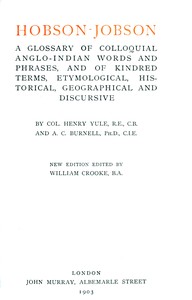
Hobson-Jobson - A Glossary of Colloquial Anglo-Indian Words and Phrases, and of Kindred Terms, Etymological, Historical, Geographical and Discursive
Subjects:
Download Formats:
Excerpt
Project Gutenberg's Hobson-Jobson, by Henry Yule and Arthur Coke Burnell
This eBook is for the use of anyone anywhere in the United States and
most other parts of the world at no cost and with almost no restrictions
whatsoever. You may copy it, give it away or re-use it under the terms
of the Project Gutenberg License included with this eBook or online at
www.gutenberg.org. If you are not located in the United States, you'll
have to check the laws of the country where you are located...
Read the Full Text
— End of Hobson-Jobson - A Glossary of Colloquial Anglo-Indian Words and Phrases, and of Kindred Terms, Etymological, Historical, Geographical and Discursive —
Book Information
- Title
- Hobson-Jobson - A Glossary of Colloquial Anglo-Indian Words and Phrases, and of Kindred Terms, Etymological, Historical, Geographical and Discursive
- Author(s)
- Burnell, A. C. (Arthur Coke), Yule, Henry, Sir
- Language
- English
- Type
- Text
- Release Date
- December 24, 2018
- Word Count
- 822,556 words
- Library of Congress Classification
- PE
- Bookshelves
- Browsing: Culture/Civilization/Society, Browsing: Encyclopedias/Dictionaries/Reference, Browsing: Language & Communication
- Rights
- Public domain in the USA.