Project Gutenberg's Henry Ford: Highlights of His Life, by Edison Institute
This eBook is for the use of anyone anywhere in the United States and most
other parts of the world at no cost and with almost no restrictions
whatsoever. You may copy it, give it away or re-use it under the terms of
the Project Gutenberg License included with this eBook or online at
www.gutenberg.org. If you are not located in the United States, you'll have
to check the laws of the country where you are located before using this ebook.
Title: Henry Ford: Highlights of His Life
Author: Edison Institute
Release Date: May 8, 2018 [EBook #57117]
Language: English
Character set encoding: UTF-8
*** START OF THIS PROJECT GUTENBERG EBOOK HENRY FORD: HIGHLIGHTS OF HIS LIFE ***
Produced by Stephen Hutcheson and the Online Distributed
Proofreading Team at http://www.pgdp.net
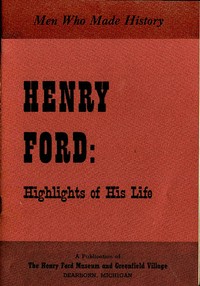
_Men Who Made History_
HENRY FORD:
Highlights of His Life
A Publication of
The Henry Ford Museum and Greenfield Village
DEARBORN, MICHIGAN
Copyright 1964
The Edison Institute
Dearborn, Michigan
Henry Ford spent his early life on a farm. He was born in a small frame
house that stood in a grove a few miles from Detroit, near the River
Rouge. On each side of the river were the farms of people who had come
to the Middle West to get land of their own. Henry’s father, William
Ford, was one of these early settlers.
The elder Ford came to America from Ireland in 1847, the year of the
great potato famine in that country. He made his way to southern
Michigan where he found work. At first, he labored on the railroad and
then at the arsenal in Dearbornville. Later, he was a “hired hand” on
the farm of Patrick O’Hern in Springwells Township. Here William Ford
settled down. He purchased forty acres of land, and with his employer,
Patrick O’Hern, built a farmhouse. In 1861 he married Mary Litogot, the
foster daughter of O’Hern.
Henry Ford, the first son of Mary and William, was born in 1863. Soon
there were brothers and sisters. Their life on the farm was a round of
doing chores, working in the fields, and taking trips to town. In the
winter, the children went to the one-room school over at the “Scotch
settlement.”
Henry Ford might well have remained on the farm and followed in his
father’s footsteps. The soil around Dearborn was fertile, and the
products of the land found a good market in nearby Detroit, a busy lake
port. Although farming meant hard work and long hours, it was an
honorable trade. William Ford was not rich, but neither was he poor. He
held a position of respect in the community.
But Henry Ford had other ideas. He wanted to have something to do with
machinery. He was interested in the tools of the farm rather than in the
farm itself. He also tinkered with watches; at the age of thirteen he
was repairing the timepieces of his friends. It was a real thrill for
him when Fred Reden, a neighbor, brought the first portable steam engine
to Dearborn. Henry was permitted to fire its boiler. On the trips to
town with his father, he saw other machines, road engines, carding
mills, and grist mills.
When Henry finished school at the age of sixteen, he did what thousands
of other farmers’ sons were doing—he left for the city.
Detroit was a bustling town of one hundred thousand people. It was a
commercial center for the Great Lakes shipping trade, and it was also an
industrial center. It was to the shops and factories of Detroit that
Henry Ford came to learn a trade.
His first job, at the Michigan Car Works, lasted only six days, but he
soon found another one at the machine shop of James Flowers and Bros.,
where he became a machinist’s apprentice. In this shop he learned about
engines, and about the tools and machines that made parts for other
machines. At night he repaired watches in the jewelry shop of James
Magill. A few months later, he left the Flowers’ shop to work at the Dry
Dock Engine Company where he had greater opportunity to learn about
steam engines. When his apprenticeship was over, he became Henry Ford,
the machinist.
Instead of continuing to work at his trade in the shops of Detroit, he
went back to Dearborn. William Ford lent his son eighty acres of
timbered land, and Henry Ford set up a saw mill. During the harvesting
season, he operated an engine for a group of threshers. He also found
time to travel about southern Michigan repairing Westinghouse portable
steam engines.
Henry Ford was also continuing his education. For several months he
attended a business college in Detroit, all the while tinkering with
machines and learning still more about tools. He had an opportunity to
repair, and thus become familiar with, a “gas engine” at an iron works
in Detroit. As an apprentice, he had read about such an engine, invented
by a German named Otto, which received its power from an explosion
inside the cylinder. Several Americans were also thinking about this
“internal combustion” engine.
In 1888 he married Clara Bryant, whose father owned a farm near the Ford
homestead in Dearborn. After their marriage, the young couple built a
“square” house nearby, where they lived for nearly three years. During
this time, Henry farmed as well as repaired and operated steam engines.
In 1891, Henry Ford ended his days on the farm by moving back to
Detroit, where he was employed by the Edison Illuminating Company, one
of several companies that furnished electricity to the city. Detroit was
changing—in the days of his apprenticeship, there had been no electric
lights for homes and streets and shops. Henry’s new job was to keep the
steam engines running at the Willis Avenue power station.
The year 1893 was a good year for Henry Ford, in spite of the fact that
it was a hard year of panic for many other people. At the World’s Fair
in Chicago that summer, he was able to add to his knowledge of gas
engines and “horseless carriages.” Late in the year, his son Edsel was
born. Shortly after this, his pay was raised and he was transferred to
the main plant of the Illuminating Company. To be nearer his new job,
the Ford family moved to 58 Bagley Avenue in Detroit. In the back yard
of the new home was a brick shed; here Henry set up his tools and
continued his tinkering with gas engines.
His first experiment was not long in the making. With a piece of gas
pipe, an old wheel, some wire, and other scraps of metal assembled on a
long board fastened to the kitchen sink in the Ford home, he made his
first model gas engine. Although it sputtered and jumped, it worked.
During the years that Henry Ford worked on his homemade engines, other
men were also experimenting with gas engines, and they were just as
determined as he was to make them operate successfully. The fair in
Chicago had aroused the curiosity of many people, and the newspapers
began to carry stories about “horseless carriages.” From France came
word of the exploits of Daimler and Benz with their “road wagons,” and
in 1895, New Yorkers saw three Benz “horseless wagons.” Henry Ford
traveled East to see them. Late in the same year, the Chicago
_Times-Herald_ announced that it would give a $5,000 prize to the winner
of a race between these new contraptions. Only four cars were ready at
race time, and only two got away from the starting line—a Duryea and a
Benz. The Benz won. One of Henry Ford’s friends, Charles B. King of
Detroit, was an umpire of the race. Back in Detroit, the two friends
probably discussed the merits of the cars that King had seen in Chicago.
At any rate, King gave Ford some intake valves for his engines.
Henry Ford continued to add to his knowledge of gas engines. Soon after
the race in Chicago, the _American Machinist_ magazine told of an engine
invented by E. J. Pennington which, in a day when most gas engines were
bulky and heavy, was light and compact. This idea appealed to Ford, and
his work took a new turn.
The First _Ford_ Takes to the Road
By the spring of 1896, he was ready to make a trial run with his own
horseless carriage. First he had to tear out part of the brick wall of
his shed in order to get his machine into the alley. Once in the open,
the engine was started, and the car bumped down the cobblestone street
and continued successfully on its first short run around the block. A
few weeks later, he drove it out to the homestead in Dearborn. His
father was not impressed with the contraption.
These first tests meant more labor; hours of changing, adjusting, and
repairing were ahead. During the day, Ford was the chief engineer of the
Illuminating Company, but in his spare time, he was Ford the
experimenter.
The signs of the times were encouraging. The great inventor, Thomas
Edison, announced in the newspapers that the horse was doomed. Up in
Lansing, R. E. Olds produced his first Oldsmobile. Alexander Winton of
Cleveland drove his auto from Cleveland to New York, making what was
called a “reliability” run. William K. Vanderbilt bought a car to race.
All over the nation, people began to read and hear about the marvels of
the new invention, of the men who were building cars, and of the races
they held at fairgrounds and parks.
A new field was thus opened up for sportsmen. In Detroit, William H.
Murphy, a prominent citizen, heard of Henry Ford’s car. Murphy and his
friends saw an opportunity to get into the racing car business; they
formed a company, called the Detroit Automobile Company, with Henry Ford
as its chief engineer. At last he could leave the Illuminating Company
and devote all of his time to automobiles. It was a bold move for a man
with a family to give up a good job. Some of his friends and relatives
told each other that he should have stayed where he was.
The original investment of Murphy and his friends was not enough.
Improvements and changes in the model were made. Even though $68,000 was
invested in the company, the hoped for production of many cars never
materialized, and in January, 1901, Henry Ford left the Detroit
Automobile Company.
Henry Ford went to work on a racer which he hoped would bring him new
opportunities to manufacture automobiles. His chance came in 1901. It
was announced in Detroit that Alexander Winton would race his world
champion car, “The Bullet,” at the Grosse Pointe race track, a few miles
from the city; Henry Ford challenged the champion.
When the day of the race arrived, stores and shops closed, and a parade
of sixty-eight cars moved out to Grosse Pointe. Three cars lined up for
the ten-mile race, but only Winton and Ford got away. At the end of
eight miles, Ford was trailing Winton, but then the “Bullet” began to
sputter, and it limped to the finish line behind the racer built by
Ford. The newspapers the next day reported that Henry Ford was now in
the first rank of American “chauffeurs.”
In November, 1901, the Henry Ford Company was organized to manufacture
automobiles, but the venture was short-lived, and four months later,
Ford was working for himself again. In his small workshop, he went to
work on two new racers, the “Arrow” and the “999.” With the help of a
draftsman, a mechanic, and a retired bicycle champion, the new cars were
made ready for racing.
Ford found a bicycle champion, Barney Oldfield, to pilot his “999” in
the Manufacturers Challenge Cup Race at Grosse Pointe. This time his car
led the field to a new record, finishing a mile in front of his
competitors.
After the race, A. Y. Malcomson, a Detroit coal dealer, became
interested in Henry Ford and his automobiles. The two men became
partners in a new venture and Henry Ford began work on a “pilot model”
for a new car. During the early months of 1903, more investors were
found. By spring, a new company was organized to carry out the plans of
Ford and Malcomson.
In June, 1903, the Ford Motor Company was incorporated. In addition to
Malcomson, the original stockholders included James Couzens, an employee
of Malcomson; John and Horace Dodge, the owners of a machine shop;
Albert Strelow, a contractor; John S. Gray, a banker; Vernon E. Fry, a
real estate dealer; Charles H. Bennett, an air rifle manufacturer; C. J.
Woodhall, a clerk; Horace H. Rackham and John W. Anderson, lawyers; and
Henry Ford. Together, they had raised $28,000 to start the new venture.
The new company rented a building on Mack Avenue in Detroit for $75 a
month and prepared to manufacture its automobiles. The new factory was
250 feet long by 50 feet wide. This was adequate space, since the new
company did not attempt to make any of the parts for its cars. The Dodge
brothers, who owned a large machine shop, made the Ford chassis, a
carriage company built the body, and the wheels were purchased in
Lansing. Once the parts were brought together, a dozen men assembled,
adjusted, and tested the completed car—the early model A Ford. Soon this
car, which sold for $950 f.o.b. Detroit, was advertised as the “boss of
the road.” Its two cylinders gave it a maximum speed of thirty miles per
hour.
Although Henry Ford’s first two ventures into automobile manufacturing
had not been successful, this third attempt showed great promise. At the
end of the first year, the Ford Motor Company had sold over seventeen
hundred automobiles.
The year 1903, which marked a turning point in the life of Henry Ford,
now forty years of age, was an interesting year for all Americans. The
first successful transcontinental automobile trip was completed in
August. A telegraphic cable was completed across the Pacific to Manila
in the Philippines. In Washington, Theodore Roosevelt was clearing the
way for the building of the Panama Canal, and in New Jersey, the Edison
studios completed the first full-length motion picture, called “The
Great Train Robbery.” Finally, in December, Orville and Wilbur Wright
flew an airplane successfully at Kitty Hawk, North Carolina. During the
next few years, those who marveled at progress in 1903 saw even greater
changes in their way of living brought about by improved transportation
and communication. The twentieth century had started off well.
The Ford Motor Company was also experimenting with changes. Models B, C,
and F appeared. When the Mack Avenue plant was no longer adequate to
house the activities of the company, a new building was erected, ten
times larger than the first one. By 1906, the company announced models
N, S, and R, as well as a six-cylinder K. Experimentation went beyond
the building of different models of automobiles; for example, a tractor
was planned and constructed, but never sold.
During this time, changes were also made in the ownership of the plant.
Some of the stockholders sold out, and Henry Ford became the major owner
of the Ford Motor Company.
A real danger to Ford and his company during these early years was the
threat of a patent suit. Back at the time of the _Times-Herald_ race in
1895, George Selden, a lawyer in Rochester, New York, had patented a
“self-propelled vehicle driven by an internal combustion engine.”
Although he never built an automobile, all those who did were threatened
with infringement suits. This fact made it necessary for the makers of
automobiles to pay royalties to the patent holder. The Ford Motor
Company refused. The result was a long and involved battle in the
federal courts, lasting until 1911 when the case was finally settled in
favor of the Ford Motor Company.
[Illustration: The farmhouse where Henry Ford was born in 1863
stands today in Greenfield Village ...]
[Illustration: ... along with the small brick schoolhouse from the
“Scotch settlement” where he began school in 1871.]
[Illustration: The interior of the 58 Bagley Avenue workshop where
Ford built his first car, as restored in Greenfield Village. The car
itself is now on display in The Henry Ford Museum.]
[Illustration: The “body drop” at the Highland Park plant of the
Ford Motor Company in 1913. The modern automobile assembly line grew
from such operations as this.
_Photo courtesy Ford Motor Company Archives_]
[Illustration: Henry Ford views his first car and the ten millionth
Ford in 1924....]
[Illustration: By this time the Model T standing in front of a
farmhouse was a familiar sight all over America.
_Photo courtesy Ford Motor Company_]
The Model T is Born
In spite of experimentation, reorganization, and patent difficulties,
the year 1907 found the Ford Motor Company operating successfully. This
was a year of panic in the nation, but the company made plans to build
an even bigger factory to manufacture automobiles. In 1908, it was
announced that the Ford Motor Company had purchased a race track in
nearby Highland Park where it would construct the largest automobile
plant in the world. At the same time, draftsmen and engineers were
planning a new model, to be called model T. In October, 1908, the first
model T appeared, and before the year ended, over three hundred of them
had been shipped to dealers throughout the nation. The Ford company
claimed that this new automobile “would sound the death knell of high
prices and big profits.” Its advertisements announced that “we can
devote all our time and money to taking care of the orders for the car
that people have actually been waiting for—a family car at an honest
price.” The engine was new and “get-at-able,” an important feature in a
day when most automobile owners repaired their own cars.
While Henry Ford had been a prominent automobile manufacturer before
1908, it was this new “universal” car that brought a new era in America.
The automobile was no longer intended for sportsmen alone, but for all
those who could afford to buy one, and Henry Ford intended to see that
the price of his automobile was low enough for millions of people to own
a Ford car.
Soon after the success of the model T was assured, Henry Ford was asked
about the secret of his ability to produce automobiles. He divulged his
“secret” in these terms: have a simple design, use the latest machinery,
standardize the parts, make the entire automobile yourself, and always
have a good supply of materials on hand. Throughout the rest of his
life, he held to these principles.
By 1911, Ford cars were manufactured by the hundreds of thousands. The
process of assembling automobiles received more and more attention, and
by 1914, a Ford car could be put together in an hour and a half. By the
end of 1915, a million model T’s had been produced. It had taken seven
years to make this many of them, but in the next eleven years, fourteen
million more were placed on the market. The model T Ford was the
“universal car” in fact as well as in name.
While model T’s changed in appearance from year to year, there was an
even greater and never-ending change in the process of manufacturing
them. The resulting economies brought lower prices, and this meant more
cars for more people.
Henry Ford was ever on the lookout for ways and means to produce cars
more efficiently. By 1914, a floor conveyor was in operation at the
Highland Park plant, so that the half-completed cars moved through the
plant while the workers stayed in one place. This assembly line became
the key to greater production. In order to keep the line moving
smoothly, machinery was continually being rearranged and new chutes and
conveyors were installed. Each improvement brought new and often
unforeseen problems in the never-ending task of fitting together the
pieces of the huge jig-saw puzzle of production.
Although the Ford Motor Company did not manufacture the parts that were
used in assembling the first Ford, this policy was changed through the
years. More and more of the model T was made by the company in its own
plant. In 1915, Henry Ford sent an agent out to Dearborn to buy farm
land along the River Rouge—thousands of acres were purchased. Now there
would be room not only to enlarge the assembly line itself, but to
manufacture more of the Ford in one factory. Here it would be possible
to begin with raw materials—iron ore, sand, cotton, rubber, and the
countless other materials—and convert them into steel, glass, and cloth
to make the Ford. With this in view, a tremendous program of
construction was begun along the banks of the River Rouge.
Soon there were industries within industries at the Rouge. Blast
furnaces and coke ovens were fed with coal, iron ore, and limestone
brought to the plant from Ford mines by Ford railroads and Ford
freighters. There were glass mills, paper factories, tire plants, and
saw mills. The products of these mills and plants flowed into the
assembly lines not only at the Rouge plant but at other assembly plants
scattered all over the world.
The production of Ford cars rose to gigantic proportions. In 1914, the
year that Henry Ford and his engineers began to plan for the plant on
the Rouge, over two hundred thousand automobiles were produced. But in
the year 1923, over two million model T’s rolled off the assembly lines.
In 1925, nearly ten thousand Fords were completed in a single day in
Ford plants. The world had never before seen such an industrial giant as
the one Henry Ford and his son Edsel had created.
The automobiles produced by Ford and his competitors did more than
replace the horse and carriage. They changed the daily habits of
Americans everywhere.
No longer did families in the cities have to live in the shadow of the
factories where the head of the household was employed. Some families
moved to the “suburbs” many miles away from stores and industries, while
other city dwellers left the urban areas completely to live in the
country. On the other hand, those who had always lived on farms could
come to the city with ease in automobiles. The farmers were able to
enjoy the advantages of the city. Thus it was that Americans moved about
in a way unheard of years before.
As travel increased, dirt roads were replaced by the super-highways.
Service stations, motels, and garages dotted the newly-built concrete
and brick roads. In the cities, people became aware of the “parking”
problem, and of “traffic jams.” The increasing number of automobiles
also brought death on the highways and city streets to hundreds of
Americans each year.
As the years went by, automobile manufacturers changed too. At first,
there were dozens of makers of automobiles whose names are all but
forgotten now. As the number of manufacturers decreased, the number of
cars made annually by the remaining companies grew larger and larger.
Eventually people talked about the “big three” of the automobile
industry.
Competition between rival makers and Henry Ford brought the days of the
model T to an end. From 1908 to 1927, fifteen million Fords had been
produced, the Ford Motor Company had become the colossus of the
industry, and Henry Ford’s name was known all over the world.
Nevertheless, in order to maintain this position, it was necessary to
keep pace with the times. In order to do this, the Rouge plant was
silenced until a “new” Ford could be designed and put into production.
Machine tools had to be replaced, and new dies and fixtures made. To
accomplish this in the largest factory in the world was a herculean
task. Industrial leaders all over the nation watched with eager eyes for
news from Henry Ford at Dearborn. Finally, in December, 1927, the new
model A was shown to the public. This new Ford was front page news over
the nation. At the Madison Square Garden in New York City, attendance
records were broken when crowds came to see the model A.
This new Ford bore little resemblance to the model T. It now had a gear
shift, four-wheel brakes, and a foot throttle. It offered many
variations in body styles and color, and it was the first automobile to
have a safety-glass windshield.
The River Rouge plant once again hummed with activity. Thousands of
model A’s were produced each day. By 1932, five million of the “new”
Fords were on the highways of the nation. That year, the Ford Motor
Company introduced the V-8 engine, which was unique in its field.
The transition from the gas-pipe cylinder on the kitchen sink back at 58
Bagley Avenue in the 1890’s to powerful eight-cylinder engines that were
turned out by the thousands each day at the largest industrial plant in
the world had taken a long time to accomplish. During these decades,
Henry Ford relentlessly pursued his idea—more cars for more people.
New Fields Beckon
Automobiles, however, were not the only thing that interested the man
who put America on wheels. He had many other ideas, some of which failed
while others succeeded.
There was, first, the matter of his interest in farming, and in the
land. He had experimented with a gasoline farm tractor early in the
1900’s, but he was unsuccessful in developing a line of farm engines. In
1915, a tractor plant at Dearborn was begun. Some of the first tractors
were sent to British farmers during the first World War. Out of this
experience grew the Fordson tractor, which, like the model T, was light
in weight and had a low selling price. Much more important to the
farmers than his tractors was the effect that the model T Ford car had
on the life of the people in rural areas. It had, in fact, been called
“the farmers’ car.” Eventually Henry Ford became interested in farming
itself. He had thousands of acres put under cultivation on Ford farms.
In the 1930’s, with the world burdened under an economic depression,
Ford revived his interest in a program which he had begun in 1919 of
establishing small factories in the rural areas of Michigan. He hoped to
reverse the tide that saw farmers rushing to become city dwellers,
thereby bringing about a decline of agricultural areas. He also became
interested in the products of the soil that could be used in the making
of automobiles. The agricultural laboratories he established discovered
many substitutes for metals, and Ford cars began to appear with parts
made from soybeans and other agricultural crops.
He also had an idea about transportation in the air. The idea ranged
from “flivver planes” to all-metal three-motored transport ships. The
Ford “tri-motor” played an important part in the development of
commercial aviation. Pilots called it the “tin goose,” and it became
known far and wide as a “safe” airplane in a day when flying was
hazardous. Aviation safety was also aided when a radio beacon system was
first perfected at Dearborn. Then for a period of years, Ford dropped
the manufacture of airplanes, but in 1941, with the coming of World War
II, airplane production became a necessary part of war preparation, and
Henry Ford made airplanes again. This time they were faster, bigger, and
more deadly. Bombers moved down the assembly lines at the Willow Run
plant, which was the “Rouge” of the bomber industry. When the war ended
and production was halted, over eight thousand “Liberators” had been
assembled by the Ford Motor Company.
Henry Ford watched over the assembly line at Willow Run just as he did
at the Rouge. He continued to learn from tools and machines and to
“read” the story they had to tell. Out of his own experiences came his
ideas about education. In speaking of his youth, he once said, “I was
studying all the time, not only from books but also from things.” In
1929 he put his ideas into practice by establishing a combined school
and museum, which he called The Edison Institute.
Here he brought the schoolhouses, the dwellings, the workshops, and the
stores of other days so that the pupils in the schools of the Institute
could study not only from books but from things. This part of the
Institute he called Greenfield Village. He gathered thousands of objects
to put into The Henry Ford Museum so that they could be studied by all
who wanted to learn about the past. “I am collecting the history of our
people as written into things their hands made and used,” he said; “...
a piece of machinery or anything that is made is like a book, if you can
read it. It is part of man’s spirit.” He thus provided a school not only
for children but also for workers. Henry Ford once called the museum and
Village that he had created “a people’s university.” Here at The Edison
Institute the creator of mass production methods—now intensely
interested in the hand work of village craftsmen—spent many hours. He
continued to be keenly interested in the future of the automobile
industry while he collected relics of the past. His unusual appreciation
of both the past and the future is illustrated by the description of
Henry Ford as the one man who could spend his time collecting old churns
while he followed the experiments of his chemists concerning synthetic
milk.
From his home in Dearborn, he kept a watchful eye over the Rouge plant,
now headed by his grandson, and over The Edison Institute. It was after
a visit to Greenfield Village on the afternoon of April 7, 1947, that
Henry Ford became ill. He died during the evening at the age of
eighty-three. This man, who had been born into a world of horse-drawn
carriages, had left a world of powered wheels.
While the entire Edison Institute stands as a memorial to Henry Ford’s
interest in the past, certain exhibits have a particularly close
relationship to his life and work.
At the Henry Ford Museum, visitors can see a special exhibition entitled
“Henry Ford: a Personal History.” This display depicts the important
stages in Henry Ford’s busy career.
In Greenfield Village, buildings which were closely associated with his
life include:
The Birthplace of Henry Ford.
The Bagley Avenue workshop, where Henry Ford built his first
automobile.
The Magill Jewelry Store, where, as a youth, he repaired watches and
clocks.
The Scotch Settlement School and the Miller School, where Henry Ford
received his formal education.
Transcriber’s Notes
—Silently corrected a few typos.
—Retained publication information from the printed edition: this eBook
is public-domain in the country of publication.
—In the text versions only, text in italics is delimited by
_underscores_.
End of the Project Gutenberg EBook of Henry Ford: Highlights of His Life, by
Edison Institute
*** END OF THIS PROJECT GUTENBERG EBOOK HENRY FORD: HIGHLIGHTS OF HIS LIFE ***
***** This file should be named 57117-0.txt or 57117-0.zip *****
This and all associated files of various formats will be found in:
http://www.gutenberg.org/5/7/1/1/57117/
Produced by Stephen Hutcheson and the Online Distributed
Proofreading Team at http://www.pgdp.net
Updated editions will replace the previous one--the old editions will
be renamed.
Creating the works from print editions not protected by U.S. copyright
law means that no one owns a United States copyright in these works,
so the Foundation (and you!) can copy and distribute it in the United
States without permission and without paying copyright
royalties. Special rules, set forth in the General Terms of Use part
of this license, apply to copying and distributing Project
Gutenberg-tm electronic works to protect the PROJECT GUTENBERG-tm
concept and trademark. Project Gutenberg is a registered trademark,
and may not be used if you charge for the eBooks, unless you receive
specific permission. If you do not charge anything for copies of this
eBook, complying with the rules is very easy. You may use this eBook
for nearly any purpose such as creation of derivative works, reports,
performances and research. They may be modified and printed and given
away--you may do practically ANYTHING in the United States with eBooks
not protected by U.S. copyright law. Redistribution is subject to the
trademark license, especially commercial redistribution.
START: FULL LICENSE
THE FULL PROJECT GUTENBERG LICENSE
PLEASE READ THIS BEFORE YOU DISTRIBUTE OR USE THIS WORK
To protect the Project Gutenberg-tm mission of promoting the free
distribution of electronic works, by using or distributing this work
(or any other work associated in any way with the phrase "Project
Gutenberg"), you agree to comply with all the terms of the Full
Project Gutenberg-tm License available with this file or online at
www.gutenberg.org/license.
Section 1. General Terms of Use and Redistributing Project
Gutenberg-tm electronic works
1.A. By reading or using any part of this Project Gutenberg-tm
electronic work, you indicate that you have read, understand, agree to
and accept all the terms of this license and intellectual property
(trademark/copyright) agreement. If you do not agree to abide by all
the terms of this agreement, you must cease using and return or
destroy all copies of Project Gutenberg-tm electronic works in your
possession. If you paid a fee for obtaining a copy of or access to a
Project Gutenberg-tm electronic work and you do not agree to be bound
by the terms of this agreement, you may obtain a refund from the
person or entity to whom you paid the fee as set forth in paragraph
1.E.8.
1.B. "Project Gutenberg" is a registered trademark. It may only be
used on or associated in any way with an electronic work by people who
agree to be bound by the terms of this agreement. There are a few
things that you can do with most Project Gutenberg-tm electronic works
even without complying with the full terms of this agreement. See
paragraph 1.C below. There are a lot of things you can do with Project
Gutenberg-tm electronic works if you follow the terms of this
agreement and help preserve free future access to Project Gutenberg-tm
electronic works. See paragraph 1.E below.
1.C. The Project Gutenberg Literary Archive Foundation ("the
Foundation" or PGLAF), owns a compilation copyright in the collection
of Project Gutenberg-tm electronic works. Nearly all the individual
works in the collection are in the public domain in the United
States. If an individual work is unprotected by copyright law in the
United States and you are located in the United States, we do not
claim a right to prevent you from copying, distributing, performing,
displaying or creating derivative works based on the work as long as
all references to Project Gutenberg are removed. Of course, we hope
that you will support the Project Gutenberg-tm mission of promoting
free access to electronic works by freely sharing Project Gutenberg-tm
works in compliance with the terms of this agreement for keeping the
Project Gutenberg-tm name associated with the work. You can easily
comply with the terms of this agreement by keeping this work in the
same format with its attached full Project Gutenberg-tm License when
you share it without charge with others.
1.D. The copyright laws of the place where you are located also govern
what you can do with this work. Copyright laws in most countries are
in a constant state of change. If you are outside the United States,
check the laws of your country in addition to the terms of this
agreement before downloading, copying, displaying, performing,
distributing or creating derivative works based on this work or any
other Project Gutenberg-tm work. The Foundation makes no
representations concerning the copyright status of any work in any
country outside the United States.
1.E. Unless you have removed all references to Project Gutenberg:
1.E.1. The following sentence, with active links to, or other
immediate access to, the full Project Gutenberg-tm License must appear
prominently whenever any copy of a Project Gutenberg-tm work (any work
on which the phrase "Project Gutenberg" appears, or with which the
phrase "Project Gutenberg" is associated) is accessed, displayed,
performed, viewed, copied or distributed:
This eBook is for the use of anyone anywhere in the United States and
most other parts of the world at no cost and with almost no
restrictions whatsoever. You may copy it, give it away or re-use it
under the terms of the Project Gutenberg License included with this
eBook or online at www.gutenberg.org. If you are not located in the
United States, you'll have to check the laws of the country where you
are located before using this ebook.
1.E.2. If an individual Project Gutenberg-tm electronic work is
derived from texts not protected by U.S. copyright law (does not
contain a notice indicating that it is posted with permission of the
copyright holder), the work can be copied and distributed to anyone in
the United States without paying any fees or charges. If you are
redistributing or providing access to a work with the phrase "Project
Gutenberg" associated with or appearing on the work, you must comply
either with the requirements of paragraphs 1.E.1 through 1.E.7 or
obtain permission for the use of the work and the Project Gutenberg-tm
trademark as set forth in paragraphs 1.E.8 or 1.E.9.
1.E.3. If an individual Project Gutenberg-tm electronic work is posted
with the permission of the copyright holder, your use and distribution
must comply with both paragraphs 1.E.1 through 1.E.7 and any
additional terms imposed by the copyright holder. Additional terms
will be linked to the Project Gutenberg-tm License for all works
posted with the permission of the copyright holder found at the
beginning of this work.
1.E.4. Do not unlink or detach or remove the full Project Gutenberg-tm
License terms from this work, or any files containing a part of this
work or any other work associated with Project Gutenberg-tm.
1.E.5. Do not copy, display, perform, distribute or redistribute this
electronic work, or any part of this electronic work, without
prominently displaying the sentence set forth in paragraph 1.E.1 with
active links or immediate access to the full terms of the Project
Gutenberg-tm License.
1.E.6. You may convert to and distribute this work in any binary,
compressed, marked up, nonproprietary or proprietary form, including
any word processing or hypertext form. However, if you provide access
to or distribute copies of a Project Gutenberg-tm work in a format
other than "Plain Vanilla ASCII" or other format used in the official
version posted on the official Project Gutenberg-tm web site
(www.gutenberg.org), you must, at no additional cost, fee or expense
to the user, provide a copy, a means of exporting a copy, or a means
of obtaining a copy upon request, of the work in its original "Plain
Vanilla ASCII" or other form. Any alternate format must include the
full Project Gutenberg-tm License as specified in paragraph 1.E.1.
1.E.7. Do not charge a fee for access to, viewing, displaying,
performing, copying or distributing any Project Gutenberg-tm works
unless you comply with paragraph 1.E.8 or 1.E.9.
1.E.8. You may charge a reasonable fee for copies of or providing
access to or distributing Project Gutenberg-tm electronic works
provided that
* You pay a royalty fee of 20% of the gross profits you derive from
the use of Project Gutenberg-tm works calculated using the method
you already use to calculate your applicable taxes. The fee is owed
to the owner of the Project Gutenberg-tm trademark, but he has
agreed to donate royalties under this paragraph to the Project
Gutenberg Literary Archive Foundation. Royalty payments must be paid
within 60 days following each date on which you prepare (or are
legally required to prepare) your periodic tax returns. Royalty
payments should be clearly marked as such and sent to the Project
Gutenberg Literary Archive Foundation at the address specified in
Section 4, "Information about donations to the Project Gutenberg
Literary Archive Foundation."
* You provide a full refund of any money paid by a user who notifies
you in writing (or by e-mail) within 30 days of receipt that s/he
does not agree to the terms of the full Project Gutenberg-tm
License. You must require such a user to return or destroy all
copies of the works possessed in a physical medium and discontinue
all use of and all access to other copies of Project Gutenberg-tm
works.
* You provide, in accordance with paragraph 1.F.3, a full refund of
any money paid for a work or a replacement copy, if a defect in the
electronic work is discovered and reported to you within 90 days of
receipt of the work.
* You comply with all other terms of this agreement for free
distribution of Project Gutenberg-tm works.
1.E.9. If you wish to charge a fee or distribute a Project
Gutenberg-tm electronic work or group of works on different terms than
are set forth in this agreement, you must obtain permission in writing
from both the Project Gutenberg Literary Archive Foundation and The
Project Gutenberg Trademark LLC, the owner of the Project Gutenberg-tm
trademark. Contact the Foundation as set forth in Section 3 below.
1.F.
1.F.1. Project Gutenberg volunteers and employees expend considerable
effort to identify, do copyright research on, transcribe and proofread
works not protected by U.S. copyright law in creating the Project
Gutenberg-tm collection. Despite these efforts, Project Gutenberg-tm
electronic works, and the medium on which they may be stored, may
contain "Defects," such as, but not limited to, incomplete, inaccurate
or corrupt data, transcription errors, a copyright or other
intellectual property infringement, a defective or damaged disk or
other medium, a computer virus, or computer codes that damage or
cannot be read by your equipment.
1.F.2. LIMITED WARRANTY, DISCLAIMER OF DAMAGES - Except for the "Right
of Replacement or Refund" described in paragraph 1.F.3, the Project
Gutenberg Literary Archive Foundation, the owner of the Project
Gutenberg-tm trademark, and any other party distributing a Project
Gutenberg-tm electronic work under this agreement, disclaim all
liability to you for damages, costs and expenses, including legal
fees. YOU AGREE THAT YOU HAVE NO REMEDIES FOR NEGLIGENCE, STRICT
LIABILITY, BREACH OF WARRANTY OR BREACH OF CONTRACT EXCEPT THOSE
PROVIDED IN PARAGRAPH 1.F.3. YOU AGREE THAT THE FOUNDATION, THE
TRADEMARK OWNER, AND ANY DISTRIBUTOR UNDER THIS AGREEMENT WILL NOT BE
LIABLE TO YOU FOR ACTUAL, DIRECT, INDIRECT, CONSEQUENTIAL, PUNITIVE OR
INCIDENTAL DAMAGES EVEN IF YOU GIVE NOTICE OF THE POSSIBILITY OF SUCH
DAMAGE.
1.F.3. LIMITED RIGHT OF REPLACEMENT OR REFUND - If you discover a
defect in this electronic work within 90 days of receiving it, you can
receive a refund of the money (if any) you paid for it by sending a
written explanation to the person you received the work from. If you
received the work on a physical medium, you must return the medium
with your written explanation. The person or entity that provided you
with the defective work may elect to provide a replacement copy in
lieu of a refund. If you received the work electronically, the person
or entity providing it to you may choose to give you a second
opportunity to receive the work electronically in lieu of a refund. If
the second copy is also defective, you may demand a refund in writing
without further opportunities to fix the problem.
1.F.4. Except for the limited right of replacement or refund set forth
in paragraph 1.F.3, this work is provided to you 'AS-IS', WITH NO
OTHER WARRANTIES OF ANY KIND, EXPRESS OR IMPLIED, INCLUDING BUT NOT
LIMITED TO WARRANTIES OF MERCHANTABILITY OR FITNESS FOR ANY PURPOSE.
1.F.5. Some states do not allow disclaimers of certain implied
warranties or the exclusion or limitation of certain types of
damages. If any disclaimer or limitation set forth in this agreement
violates the law of the state applicable to this agreement, the
agreement shall be interpreted to make the maximum disclaimer or
limitation permitted by the applicable state law. The invalidity or
unenforceability of any provision of this agreement shall not void the
remaining provisions.
1.F.6. INDEMNITY - You agree to indemnify and hold the Foundation, the
trademark owner, any agent or employee of the Foundation, anyone
providing copies of Project Gutenberg-tm electronic works in
accordance with this agreement, and any volunteers associated with the
production, promotion and distribution of Project Gutenberg-tm
electronic works, harmless from all liability, costs and expenses,
including legal fees, that arise directly or indirectly from any of
the following which you do or cause to occur: (a) distribution of this
or any Project Gutenberg-tm work, (b) alteration, modification, or
additions or deletions to any Project Gutenberg-tm work, and (c) any
Defect you cause.
Section 2. Information about the Mission of Project Gutenberg-tm
Project Gutenberg-tm is synonymous with the free distribution of
electronic works in formats readable by the widest variety of
computers including obsolete, old, middle-aged and new computers. It
exists because of the efforts of hundreds of volunteers and donations
from people in all walks of life.
Volunteers and financial support to provide volunteers with the
assistance they need are critical to reaching Project Gutenberg-tm's
goals and ensuring that the Project Gutenberg-tm collection will
remain freely available for generations to come. In 2001, the Project
Gutenberg Literary Archive Foundation was created to provide a secure
and permanent future for Project Gutenberg-tm and future
generations. To learn more about the Project Gutenberg Literary
Archive Foundation and how your efforts and donations can help, see
Sections 3 and 4 and the Foundation information page at
www.gutenberg.org
Section 3. Information about the Project Gutenberg Literary Archive Foundation
The Project Gutenberg Literary Archive Foundation is a non profit
501(c)(3) educational corporation organized under the laws of the
state of Mississippi and granted tax exempt status by the Internal
Revenue Service. The Foundation's EIN or federal tax identification
number is 64-6221541. Contributions to the Project Gutenberg Literary
Archive Foundation are tax deductible to the full extent permitted by
U.S. federal laws and your state's laws.
The Foundation's principal office is in Fairbanks, Alaska, with the
mailing address: PO Box 750175, Fairbanks, AK 99775, but its
volunteers and employees are scattered throughout numerous
locations. Its business office is located at 809 North 1500 West, Salt
Lake City, UT 84116, (801) 596-1887. Email contact links and up to
date contact information can be found at the Foundation's web site and
official page at www.gutenberg.org/contact
For additional contact information:
Dr. Gregory B. Newby
Chief Executive and Director
[email protected]
Section 4. Information about Donations to the Project Gutenberg
Literary Archive Foundation
Project Gutenberg-tm depends upon and cannot survive without wide
spread public support and donations to carry out its mission of
increasing the number of public domain and licensed works that can be
freely distributed in machine readable form accessible by the widest
array of equipment including outdated equipment. Many small donations
($1 to $5,000) are particularly important to maintaining tax exempt
status with the IRS.
The Foundation is committed to complying with the laws regulating
charities and charitable donations in all 50 states of the United
States. Compliance requirements are not uniform and it takes a
considerable effort, much paperwork and many fees to meet and keep up
with these requirements. We do not solicit donations in locations
where we have not received written confirmation of compliance. To SEND
DONATIONS or determine the status of compliance for any particular
state visit www.gutenberg.org/donate
While we cannot and do not solicit contributions from states where we
have not met the solicitation requirements, we know of no prohibition
against accepting unsolicited donations from donors in such states who
approach us with offers to donate.
International donations are gratefully accepted, but we cannot make
any statements concerning tax treatment of donations received from
outside the United States. U.S. laws alone swamp our small staff.
Please check the Project Gutenberg Web pages for current donation
methods and addresses. Donations are accepted in a number of other
ways including checks, online payments and credit card donations. To
donate, please visit: www.gutenberg.org/donate
Section 5. General Information About Project Gutenberg-tm electronic works.
Professor Michael S. Hart was the originator of the Project
Gutenberg-tm concept of a library of electronic works that could be
freely shared with anyone. For forty years, he produced and
distributed Project Gutenberg-tm eBooks with only a loose network of
volunteer support.
Project Gutenberg-tm eBooks are often created from several printed
editions, all of which are confirmed as not protected by copyright in
the U.S. unless a copyright notice is included. Thus, we do not
necessarily keep eBooks in compliance with any particular paper
edition.
Most people start at our Web site which has the main PG search
facility: www.gutenberg.org
This Web site includes information about Project Gutenberg-tm,
including how to make donations to the Project Gutenberg Literary
Archive Foundation, how to help produce our new eBooks, and how to
subscribe to our email newsletter to hear about new eBooks.
Henry Ford: Highlights of His Life
Subjects:
Download Formats:
Excerpt
Project Gutenberg's Henry Ford: Highlights of His Life, by Edison Institute
This eBook is for the use of anyone anywhere in the United States and most
other parts of the world at no cost and with almost no restrictions
whatsoever. You may copy it, give it away or re-use it under the terms of
the Project Gutenberg License included with this eBook or online at
www.gutenberg.org. If you are not located in the United States, you'll have
to check the laws of the country where you are located...
Read the Full Text
— End of Henry Ford: Highlights of His Life —
Book Information
- Title
- Henry Ford: Highlights of His Life
- Author(s)
- Henry Ford Museum and Greenfield Village
- Language
- English
- Type
- Text
- Release Date
- May 8, 2018
- Word Count
- 8,153 words
- Library of Congress Classification
- CT
- Bookshelves
- Browsing: Biographies, Browsing: History - American
- Rights
- Public domain in the USA.
Related Books

Elämäni ja työni
by Crowther, Samuel, Ford, Henry
Finnish
1326h 1m read
Henry Ford's Own Story - How a Farmer Boy Rose to the Power that goes with Many Millions, Yet Never Lost Touch with Humanity
by Lane, Rose Wilder
English
687h 32m read
My Life and Work
by Crowther, Samuel, Ford, Henry
English
1583h 28m read