The Project Gutenberg EBook of He Knew Lincoln, by Ida M. Tarbell
This eBook is for the use of anyone anywhere in the United States and
most other parts of the world at no cost and with almost no restrictions
whatsoever. You may copy it, give it away or re-use it under the terms
of the Project Gutenberg License included with this eBook or online at
www.gutenberg.org. If you are not located in the United States, you'll
have to check the laws of the country where you are located before using
this ebook.
Title: He Knew Lincoln
Author: Ida M. Tarbell
Release Date: July 18, 2018 [EBook #57536]
Language: English
Character set encoding: UTF-8
*** START OF THIS PROJECT GUTENBERG EBOOK HE KNEW LINCOLN ***
Produced by Richard Tonsing and the Online Distributed
Proofreading Team at http://www.pgdp.net (This file was
produced from images generously made available by The
Internet Archive)
[Illustration]
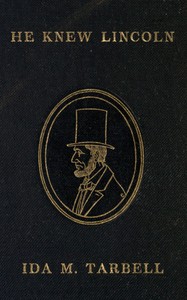
HE KNEW LINCOLN
BY
IDA M. TARBELL
AUTHOR OF “LIFE OF ABRAHAM LINCOLN”
[Illustration]
NEW YORK
McCLURE, PHILLIPS & CO.
MCMVII
_Copyright, 1907, by McClure, Phillips & Co._
Copyright, 1907, by The Phillips Publishing Company
------------------------------------------------------------------------
_To My Mother_
LIST OF ILLUSTRATIONS
_Facing page_
“_Come and set by the stove by the hour and tell stories 4
and talk and argue_”
“_Horace Greeley, he came in here to buy quinine_” 16
“_Aunt Sally, you couldn’t a done nuthin’ which would 18
have pleased me better_”
“_He just talked to us that time out of his heart_” 24
“_You’re actin’ like a lot of cowards. You’ve helped make 26
this war, and you’ve got to help fight it_”
“_We went out on the back stoop and sat down and talked 30
and talked_”
HE KNEW LINCOLN
“Did I know Lincoln? Well, I should say. See that chair there? Take it,
set down. That’s right. Comfortable, ain’t it? Well, sir, Abraham
Lincoln has set in that chair hours, him and Little ‘Doug,’ and Logan
and Judge Davis, all of ’em, all the big men in this State, set in that
chair. See them marks? Whittlin’. Judge Logan did it, all-firedest man
to whittle. Always cuttin’ away at something. I just got that chair new,
paid six dollars for it, and I be blamed if I didn’t come in this store
and find him slashin’ right into that arm. I picked up a stick and said:
‘Here, Judge, s’posin’ you cut this.’ He just looked at me and then
flounced out, mad as a wet hen. Mr. Lincoln was here, and you ought to
heard him tee-hee. He was always here. Come and set by the stove by the
hour and tell stories and talk and argue. I’d ruther heard the debates
them men had around this old stove than heard Webster and Clay and
Calhoun and the whole United States Senate. There wan’t never no United
States Senate that could beat just what I’ve heard right here in this
room with Lincoln settin’ in that very chair where you are this minute.
[Illustration: “_Come and set by the stove by the hour and tell stories
and talk and argue_”]
“He traded here. I’ve got his accounts now. See here, ‘quinine, quinine,
quinine.’ Greatest hand to buy quinine you ever seen. Give it to his
constituents. Oh, he knew how to be popular, Mr. Lincoln did. Cutest man
in politics. I wan’t a Whig. I was then and I am now a Democrat, a real
old-fashioned Jackson Democrat, and my blood just would rise up
sometimes hearin’ him discuss. He was a dangerous man—a durned dangerous
man to have agin you. He’d make you think a thing when you knew it wan’t
so, and cute! Why, he’d just slide in when you wan’t expectin’ it and do
some unexpected thing that just’d make you laugh, and then he’d get your
vote. You’d vote for him because you liked him—just because you liked
him and because he was so all-fired smart, and do it when you knew he
was wrong and it was agin the interest of the country.
“Tell stories? Nobody ever could beat him at that, and how he’d enjoy
’em, just slap his hands on his knees and jump up and turn around and
then set down, laughin’ to kill. Greatest man to git new yarns that ever
lived, always askin’, ‘Heard any new stories, Billy?’ And if I had I’d
trot ’em out, and how he’d laugh. Often and often when I’ve told him
something new and he’d kin’ a forgit how it went, he’d come in and say,
‘Billy, how was that story you’se tellin’ me?’ and then I’d tell it all
over.
“He was away a lot, you know, ridin’ the circuit along with some right
smart lawyers. They had great doin’s. Nuthin’ to do evenings but to set
around the tavern stove tellin’ stories. That was enough when Lincoln
was there. They was all lost without him. Old Judge Davis was boss of
that lot, and he never would settle down till Lincoln got around. I’ve
heard ’em laugh lots of times how the Judge would fuss around and keep
askin’, ‘Where’s Mr. Lincoln, why don’t Mr. Lincoln come? Somebody go
and find Lincoln,’ and when Lincoln came he would just settle back and
get him started to yarning, and there they’d set half the night.
“When he got home he’d come right in here first time he was downtown and
tell me every blamed yarn he’d heard. Whole crowd would get in here
sometimes and talk over the trip, and I tell you it was something to
hear ’em laugh. You could tell how Lincoln kept things stirred up. He
was so blamed quick. Ever hear Judge Weldon tell that story about what
Lincoln said one day up to Bloomington when they was takin’ up a
subscription to buy Jim Wheeler a new pair of pants? No? Well, perhaps I
oughten to tell it to you, ma says it ain’t nice. It makes me mad to
hear people objectin’ to Mr. Lincoln’s stories. Mebbe he did say words
you wouldn’t expect to hear at a church supper, but he never put no
meanin’ into ’em that wouldn’t ‘a’ been fit for the minister to put into
a sermon, and that’s a blamed sight more’n you can say of a lot of
stories I’ve heard some of the people tell who stick up their noses at
Mr. Lincoln’s yarns.
“Yes, sir, he used to keep things purty well stirred up on that circuit.
That time I was a speakin’ of he made Judge Davis real mad; it happened
right in court and everybody got to gigglin’ fit to kill. The Judge knew
’twas something Lincoln had said and he began to sputter.
“‘I am not going to stand this any longer, Mr. Lincoln, you’re always
disturbin’ this court with your tomfoolery. I’m goin’ to fine you. The
clerk will fine Mr. Lincoln five dollars for disorderly conduct.’ The
boys said Lincoln never said a word; he just set lookin’ down with his
hand over his mouth, tryin’ not to laugh. About a minute later the
Judge, who was always on pins and needles till he knew all the fun that
was goin’ on, called up Weldon and whispered to him, ‘What was that
Lincoln said?’ Weldon told him, and I’ll be blamed if the Judge didn’t
giggle right out loud there in court. The joke was on him then, and he
knew it, and soon as he got his face straight he said, dignified like,
‘The clerk may remit Mr. Lincoln’s fine.’
“Yes, he was a mighty cute story-teller, but he knew what he was about
tellin’ ’em. I tell you he got more arguments out of stories than he did
out of law books, and the queer part was you couldn’t answer ’em—they
just made you see it and you couldn’t get around it. I’m a Democrat, but
I’ll be blamed if I didn’t have to vote for Mr. Lincoln as President,
couldn’t help it, and it was all on account of that snake story of his’n
illustratin’ the takin’ of slavery into Kansas and Nebraska. Remember
it? I heard him tell it in a speech once.
“‘If I saw a pizen snake crawlin’ in the road,’ he says, ‘I’d kill it
with the first thing I could grab; but if I found it in bed with my
children, I’d be mighty careful how I touched it fear I’d make it bite
the children. If I found it in bed with somebody else’s children I’d let
them take care of it; but if I found somebody puttin’ a whole batch of
young snakes into an empty bed where mine or anybody’s children was
going to sleep pretty soon, I’d stop him from doin’ it if I had to fight
him.’ Perhaps he didn’t say ‘fight him,’ but somehow I always tell that
story that way because I know I would and so would he or you or anybody.
That was what it was all about when you come down to it. They was trying
to put a batch of snakes into an empty bed that folks was goin’ to sleep
in.
“Before I heard that story I’d heard Lincoln say a hundred times,
settin’ right there in that chair, where you are, ‘Boys, we’ve got to
stop slavery or it’s goin’ to spread all over this country,’ but,
somehow, I didn’t see it before. Them snakes finished me. Then I knew
he’d got it right and I’d got to vote for him. Pretty tough, though, for
me to go back on Little ‘Doug.’ You see he was our great man, so we
thought. Been to the United States Senate and knew all the big bugs all
over the country. Sort o’ looked and talked great. Wan’t no comparison
between him and Lincoln in looks and talk. Of course, we all knew he
wan’t honest, like Lincoln, but blamed if I didn’t think in them days
Lincoln was too all-fired honest—kind of innocent honest. He couldn’t
stand it nohow to have things said that wan’t so. He just felt plumb bad
about lies. I remember once bein’ in court over to Decatur when Mr.
Lincoln was tryin’ a case. There was a fellow agin him that didn’t have
no prejudices against lyin’ in a lawsuit, and he was tellin’ how Lincoln
had said this an’ that, tryin’ to mix up the jury. It was snowin’ bad
outside, and Mr. Lincoln had wet his feet and he was tryin’ to dry ’em
at the stove. He had pulled off one shoe and was settin’ there holdin’
up his great big foot, his forehead all puckered up, listenin’ to that
ornery lawyer’s lies. All at onct he jumped up and hopped right out into
the middle of the court-room.
“‘Now, Judge,’ he says, ‘that ain’t fair. I didn’t say no sich thing,
and he knows I didn’t. I ain’t goin’ to have this jury all fuddled up.’
“You never see anything so funny in a court-room as that big fellow
standin’ there in one stockin’ foot, a shoe in his hand, talking so
earnest. No, sir, he couldn’t stand a lie.
“‘Think he was a big man, then?’ Nope—never did. Just as I said, we all
thought Douglas was _our_ big man. You know I felt kind of sorry for
Lincoln when they began to talk about him for President. It seemed
almost as if somebody was makin’ fun of him. He didn’t look like a
president. I never had seen one, but we had pictures of ’em, all of ’em
from George Washington down, and they looked somehow as if they were
different kind of timber from us. Leastwise that’s always the way it
struck me. Now Mr. Lincoln he was just like your own folks—no trouble to
talk to him, no siree. Somehow you just settled down comfortable to
visitin’ the minute he come in. I couldn’t imagine George Washington or
Thomas Jefferson settin’ here in that chair you’re in tee-heein’ over
some blamed yarn of mine. None of us around town took much stock in his
bein’ elected at first—that is, none of the men, the women was
different. They always believed in him, and used to say, ‘You mark my
word, Mr. Lincoln will be president. He’s just made for it, he’s good,
he’s the best man ever lived and he ought to be president.’ I didn’t see
no logic in that then, but I dunno but there was some after all.
“It seems all right now though. I reckon I learned somethin’ watchin’
him be President—learned a lot—not that it made any difference in _him_.
Funniest thing to see him goin’ around in this town—not a mite
changed—and the whole United States a watchin’ him and the biggest men
in the country runnin’ after him and reporters hangin’ around to talk to
him and fellers makin’ his pictures in ile and every other way. That
didn’t make no difference to him—only he didn’t like bein’ so busy he
couldn’t come in here much. He had a room over there in the Court
House—room on that corner there. I never looked up that it wan’t chuck
full of people wantin’ him. This old town was full of people all the
time—delegations and committees and politicians and newspaper men. Only
time I ever see Horace Greeley, he came in here to buy quinine. Mr.
Lincoln sent him. Think of that, Horace Greeley buyin’ quinine of _me_.
[Illustration: “_Horace Greeley, he came in here to buy quinine_”]
“No end of other great men around. He saw ’em all. Sometimes I used to
step over and watch him—didn’t bother him a mite to see a big man—not a
mite. He’d jest shake hands and talk as easy and natural as if ’twas
me—and he didn’t do no struttin’ either. Some of the fellers who come to
see him looked as if _they_ was goin’ to be president, but Mr. Lincoln
didn’t put on any airs. No, sir, and he didn’t cut any of his old
friends either. Tickled to death to see ’em every time, and they all
come—blamed if every old man and woman in Sangamon County didn’t trot up
here to see him. They’d all knowed him when he was keepin’ store down to
New Salem and swingin’ a chain—surveyed lots of their towns for ’em—he
had—and then he’d electioneered all over that county, too, so they just
come in droves to bid him good-by. I was over there one day when old
Aunt Sally Lowdy came in the door. Aunt Sally lived down near New Salem,
and I expect she’d mended Mr. Lincoln’s pants many a time; for all them
old women down there just doted on him and took care of him as if he was
their own boy. Well, Aunt Sally stood lookin’ kind a scared seein’ so
many strangers and not knowin’ precisely what to do, when Mr. Lincoln
spied her. Quick as a wink he said, ‘Excuse me, gentlemen,’ and he just
rushed over to that old woman and shook hands with both of his’n and
says, ‘Now, Aunt Sally, this is real kind of you to come and see me. How
are you and how’s Jake?’ (Jake was her boy.) ‘Come right over here,’ and
he led her over, as if she was the biggest lady in Illinois, and says,
‘Gentlemen, this is a good old friend of mine. She can make the best
flapjacks you ever tasted, and she’s baked ’em for me many a time.’ Aunt
Sally was jest as pink as a rosy, she was so tickled. And she says,
‘Abe’—all the old folks in Sangamon called him Abe. They knowed him as a
boy, but don’t you believe anybody ever did up here. No, sir, we said
Mr. Lincoln. He was like one of us, but he wan’t no man to be over
familiar with. ‘Abe,’ says Aunt Sally, ‘I had to come and say good-by.
They say down our way they’re goin’ to kill you if they get you down to
Washington, but I don’t believe it. I just tell ’em you’re too smart to
let ’em git ahead of you that way. I thought I’d come and bring you a
present, knit ’em myself,’ and I’ll be blamed if that old lady didn’t
pull out a great big pair of yarn socks and hand ’em to Mr. Lincoln.
[Illustration: “_Aunt Sally, you couldn’t a done nuthin’ which would
have pleased me better_”]
“Well, sir, it was the funniest thing to see Mr. Lincoln’s face pucker
up and his eyes twinkle and twinkle. He took them socks and held ’em up
by the toes, one in each hand. They was the longest socks I ever see.
‘The lady got my latitude and longitude ’bout right, didn’t she,
gentlemen?’ he says, and then he laid ’em down and he took Aunt Sally’s
hand and he says tender-like, ‘Aunt Sally, you couldn’t a done nothin’
which would have pleased me better. I’ll take ’em to Washington and wear
’em, and think of you when I do it.’ And I declare he said it so first
thing I knew I was almost blubberin’, and I wan’t the only one nuther,
and I bet he did wear ’em in Washington. I can jest see him pullin’ off
his shoe and showin’ them socks to Sumner or Seward or some other big
bug that was botherin’ him when he wanted to switch off on another
subject and tellin’ ’em the story about Aunt Sally and her flapjacks.
“‘Was there much talk about his bein’ killed?’ Well, there’s an awful
lot of fools in this world and when they don’t git what they want
they’re always for killin’ somebody. Mr. Lincoln never let on, but I
reckon his mail was pretty lively readin’ sometimes. He got pictures of
gallows and pistols and other things and lots of threats, so they said.
I don’t think that worried him much. He was more bothered seein’ old
Buchanan givin’ the game away. ‘I wish I could have got down there
before the horse was stole,’ I heard him say onct in here, talkin’ to
some men. ‘But I reckon I can find the tracks when I do git there.’ It
was his cabinet bothered him most, I always thought. He didn’t know the
men he’d got to take well enough. Didn’t know how far he could count on
’em. He and Judge Gillespie and one or two others was in here one day
sittin’ by the stove talkin,’ and he says, ‘Judge, I wisht I could take
all you boys down to Washington with me, Democrats and all, and make a
cabinet out of you. I’d know where every man would fit and we could git
right down to work. Now, I’ve got to learn my men before I can do much.’
‘Do you mean, Mr. Lincoln, you’d take a Democrat like Logan?’ says the
Judge, sort of shocked. ‘Yes, sir, I would; I know Logan. He’s agin me
now and that’s all right, but if we have trouble you can count on Logan
to do the right thing by the country, and that’s the kind of men I
want—them as will do the right thing by the country. ‘Tain’t a question
of Lincoln, or Democrat or Republican, Judge; it’s a question of the
country.’
“Of course he seemed pretty cheerful always. He wan’t no man to show out
all he felt. Lots of them little stuck-up chaps that came out here to
talk to him said, solemn as owls, ‘He don’t realize the gravity of the
situation.’ Them’s their words, ‘gravity of the situation.’ Think of
that, Mr. Lincoln not realizing. They ought to heard him talk to us the
night he went away. I’ll never forgit that speech—nor any man who heard
it. I can see him now just how he looked, standin’ there on the end of
his car. He’d been shakin’ hands with the crowd in the depot, laughing
and talking, just like himself, but when he got onto that car he seemed
suddint to be all changed. You never seen a face so sad in all the
world. I tell you he had woe in his heart that minute, woe. He knew he
was leavin’ us for good, nuthin’ else could explain the way he looked
and what he said. He knew he never was comin’ back alive. It was rainin’
hard, but when we saw him standin’ there in bare head, his great big
eyes lookin’ at us so lovin’ and mournful, every man of us took off his
hat, just as if he’d been in church. You never heard him make a speech,
of course? You missed a lot. Curious voice. You could hear it away
off—kind of shrill, but went right to your heart—and that night it
sounded sadder than anything I ever heard. You know I always hear it to
this day, nights when the wind howls around the house. Ma says it makes
her nervous to hear me talk about him such nights, but I can’t help it;
just have to let out.
“He stood a minute lookin’ at us, and then he began to talk. There ain’t
a man in this town that heard him that ever forgot what he said, but I
don’t believe there’s a man that ever said it over out loud—he couldn’t,
without cryin’. He just talked to us that time out of his heart. Somehow
we felt all of a suddint how we loved him and how he loved us. We hadn’t
taken any stock in all that talk about his bein’ killed, but when he
said he was goin’ away not knowin’ where or whether ever he would return
I just got cold all over. I begun to _see_ that minute and everybody
did. The women all fell to sobbin’ and a kind of groan went up, and when
he asked us to pray for him I don’t believe that there was a man in that
crowd, whether he ever went to church in his life, that didn’t want to
drop right down on his marrow bones and ask the Lord to take care of
Abraham Lincoln and bring him back to us, where he belonged.
[Illustration: “_He just talked to us that time out of his heart_”]
“‘Ever see him again?’ Yes, onct down in Washington, summer of ’64.
Things was lookin’ purty blue that summer. Didn’t seem to be anybody who
thought he’d git reëlected. Greeley was abusin’ him in _The Tribune_ for
not makin’ peace, and you know there was about half the North that
always let Greeley do their thinkin’ fer ’em. The war wan’t comin’ on at
all—seemed as if they never would do nuthin’. Grant was hangin’ on to
Petersburg like a dog to a root, but it didn’t seem to do no good. Same
with Sherman, who was tryin’ to take Atlanta. The country was just
petered out with the everlastin’ taxes an’ fightin’ an’ dyin’. It wan’t
human nature to be patient any longer, and they just spit it out on Mr.
Lincoln, and then, right on top of all the grumblin’ and abusin’, he up
and made another draft. Course he was right, but I tell you nobody but a
brave man would ‘a’ done such a thing at that minute; but he did it. It
was hard on us out here. I tell you there wan’t many houses in this
country where there wan’t mournin’ goin’ on. It didn’t seem as if we
_could_ stand any more blood lettin.’ Some of the boys round the State
went down to see him about it. They came back lookin’ pretty sheepish.
Joe Medill, up to Chicago, told me about it onct. He said, ‘We just told
Mr. Lincoln we couldn’t stand another draft. We was through sendin’ men
down to Petersburg to be killed in trenches. He didn’t say nuthin’; just
stood still, lookin’ down till we’d all talked ourselves out; and then,
after a while, he lifted up his head, and looked around at us,
slow-like; and I tell you, Billy, I never knew till that minute that
Abraham Lincoln could get mad clean through. He was just white he was
that mad. “Boys,” he says, “you ought to be ashamed of yourselves.
You’re actin’ like a lot of cowards. You’ve helped make this war, and
you’ve got to help fight it. You go home and raise them men and don’t
you dare come down here again blubberin’ about what I tell you to do. I
won’t stan’ it.” We was so scared we never said a word. We just took our
hats and went out like a lot of school-boys. Talk about Abraham Lincoln
bein’ easy! When it didn’t matter mebbe he was easy, but when it did you
couldn’t stir him any more’n you could a mountain.’
[Illustration: “_You’re actin’ like a lot of cowards. You’ve helped make
this war, and you’ve got to help fight it_”]
“Well, I kept hearin’ about the trouble he was havin’ with everybody,
and I just made up my mind I’d go down and see him and swap yarns and
tell him how we was all countin’ on his gettin’ home. Thought maybe it
would cheer him up to know we set such store on his comin’ home if they
didn’t want him for president. So I jest picked up and went right off.
Ma was real good about my goin’. She says, ‘I shouldn’t wonder if
’twould do him good, William. And don’t you ask him no questions about
the war nor about politics. You just talk home to him and tell him some
of them foolish stories of yourn.’
“Well, I had a brother in Washington, clerk in a department—awful set up
’cause he had an office—and when I got down there I told him I’d come to
visit Mr. Lincoln. He says, ‘William, be you a fool? Folks don’t visit
the President of the United States without an invitation, and he’s too
busy to see anybody but the very biggest people in this administration.
Why, he don’t even see me,’ he says. Well, it made me huffy to hear him
talk. ‘Isaac,’ I says, ‘I don’t wonder Mr. Lincoln don’t see you. But
it’s different with me. Him and me is friends.’
“‘Well’ he says, ‘you’ve got to have cards anyway.’ ‘Cards,’ I says,
‘what for? What kind?’ ‘Why,’ he says, ‘visitin’ cards—with your name
on.’ ‘Well,’ I says, ‘it’s come to a pretty pass, if an old friend like
me can’t see Mr. Lincoln without sendin’ him a piece of pasteboard. I’d
be ashamed to do such a thing, Isaac Brown. Do you suppose he’s
forgotten me? Needs to see my name printed out to know who I am? You
can’t make me believe any such thing,’ and I walked right out of the
room, and that night I footed it up to the Soldiers’ Home where Mr.
Lincoln was livin’ then, right among the sick soldiers in their tents.
“There was lots of people settin’ around in a little room, waitin’ fer
him, but there wan’t anybody there I knowed, and I was feelin’ a little
funny when a door opened and out came little John Nicolay. He came from
down this way, so I just went up and says, ‘How’d you do, John; where’s
Mr Lincoln?’ Well, John didn’t seem over glad to see me.
“‘Have you an appintment with Mr. Lincoln?’ he says.
“‘No, sir,’ I says; ‘I ain’t, and it ain’t necessary. Mebbe it’s all
right and fittin’ for them as wants post-offices to have appintments,
but I reckon Mr. Lincoln’s old friends don’t need ’em, so you just trot
along, Johnnie, and tell him Billy Brown’s here and see what he says.’
Well, he kind a flushed up and set his lips together, but he knowed me,
and so he went off. In about two minutes the door popped open and out
came Mr. Lincoln, his face all lit up. He saw me first thing, and he
laid holt of me and just shook my hands fit to kill. ‘Billy,’ he says,
‘now I am glad to see you. Come right in. You’re goin’ to stay to supper
with Mary and me.’
[Illustration: “_We went out on the back stoop and sat down and talked
and talked_”]
“Didn’t I know it? Think bein’ president would change him—not a mite.
Well, he had a right smart lot of people to see, but soon as he was
through we went out on the back stoop and set down and talked and
talked. He asked me about pretty nigh everybody in Springfield. I just
let loose and told him about the weddin’s and births and the funerals
and the buildin’, and I guess there wan’t a yarn I’d heard in the three
years and a half he’d been away that I didn’t spin for him. Laugh—you
ought to a heard him laugh—just did my heart good, for I could see what
they’d been doin’ to him. Always was a thin man, but, Lordy, he was
thinner’n ever now, and his face was kind a drawn and gray—enough to
make you cry.
“Well, we had supper and then talked some more, and about ten o’clock I
started downtown. Wanted me to stay all night, but I says to myself,
‘Billy, don’t you overdo it. You’ve cheered him up, and you better light
out and let him remember it when he’s tired.’ So I said, ‘Nope, Mr.
Lincoln, can’t, goin’ back to Springfield to-morrow. Ma don’t like to
have me away and my boy ain’t no great shakes keepin’ store.’ ‘Billy,’
he says, ‘what did you come down here for?’ ‘I come to see you, Mr.
Lincoln.’ ‘But you ain’t asked me for anything, Billy. What is it? Out
with it. Want a post-office?’ he said, gigglin’, for he knowed I didn’t.
‘No, Mr. Lincoln, just wanted to see _you_—felt kind a lonesome—been so
long since I’d sen you, and I was afraid I’d forgit some of them yarns
if I didn’t unload soon.’
“Well, sir, you ought to seen his face as he looked at me.
“‘Billy Brown,’ he says, slow-like, ‘do you mean to tell me you came all
the way from Springfield, Illinois, just to have a _visit_ with _me_,
that you don’t want an office for anybody, nor a pardon for anybody,
that you ain’t got no complaints in your pockets, nor any advice up your
sleeve?’
“‘Yes, sir,’ I says, ‘that’s about it, and I’ll be durned if I wouldn’t
go to _Europe_ to see you, if I couldn’t do it no other way, Mr.
Lincoln.’
“Well, sir, I never was so astonished in my life. He just grabbed my
hand and shook it nearly off, and the tears just poured down his face,
and he says, ‘Billy, you never’ll know what good you’ve done me. I’m
homesick, Billy, just plumb homesick, and it seems as if this war never
would be over. Many a night I can see the boys a-dyin’ on the fields and
can hear their mothers cryin’ for ’em at home, and I can’t help ’em,
Billy. I have to send them down there. We’ve got to save the Union,
Billy, we’ve got to.’
“‘Course we have, Mr. Lincoln,’ I says, cheerful as I could, ‘course we
have. Don’t you worry. It’s most over. You’re goin’ to be reëlected, and
you and old Grant’s goin’ to finish this war mighty quick then. Just
keep a stiff upper lip, Mr. Lincoln, and don’t forget them yarns I told
you.’ And I started out. But seems as if he couldn’t let me go. ‘Wait a
minute, Billy,’ he says, ‘till I get my hat and I’ll walk a piece with
you.’ It was one of them still sweet-smellin’ summer nights with no end
of stars and you ain’t no idee how pretty ’twas walkin’ down the road.
There was white tents showin’ through the trees and every little way a
tall soldier standin’ stock still, a gun at his side. Made me feel
mighty curious and solemn. By-and-by we come out of the trees to a
sightly place where you could look all over Washington—see the Potomac
and clean into Virginia. There was a bench there and we set down and
after a while Mr. Lincoln he begun to talk. Well, sir, you or nobody
ever heard anything like it. Blamed if he didn’t tell me the whole
thing—all about the war and the generals and Seward and Sumner and
Congress and Greeley and the whole blamed lot. He just opened up his
heart if I do say it. Seemed as if he’d come to a p’int where he must
let out. I dunno how long we set there—must have been nigh morning, fer
the stars begun to go out before he got up to go. ‘Good-by, Billy,’ he
says, ‘you’re the first person I ever unloaded onto, and I hope you
won’t think I’m a baby,’ and then we shook hands again, and I walked
down to town and next day I come home.
“Tell you what he said? Nope, I can’t. Can’t talk about it somehow. Fact
is, I never told anybody about what he said that night. Tried to tell ma
onct, but she cried, so I give it up.
“Yes, that’s the last time I seen him—last time alive.
“Wan’t long after that things began to look better. War began to move
right smart, and, soon as it did, there wan’t no use talkin’ about
anybody else for President. I see that plain enough, and, just as I told
him, he was reëlected, and him an’ Grant finished up the war in a hurry.
I tell you it was a great day out here when we heard Lee had
surrendered. ’Twas just like gettin’ converted to have the war over.
Somehow the only thing I could think of was how glad Mr. Lincoln would
be. Me and ma reckoned he’d come right out and make us a visit and get
rested, and we began right off to make plans about the reception we’d
give him—brass band—parade—speeches—fireworks—everything. Seems as if I
couldn’t think about anything else. I was comin’ down to open the store
one mornin’, and all the way down I was plannin’ how I’d decorate the
windows and how I’d tie a flag on that old chair, when I see Hiram Jones
comin’ toward me. He looked so old and all bent over I didn’t know what
had happened. ‘Hiram,’ I says, ‘what’s the matter? Be you sick?’
“‘Billy,’ he says, and he couldn’t hardly say it, ‘Billy, they’ve killed
Mr. Lincoln.’
“Well, I just turned cold all over, and then I flared up. ‘Hiram Jones,’
I says, ‘you’re lyin,’ you’re crazy. How dare you tell me that? It ain’t
so.’
“‘Don’t Billy,’ he says, ‘don’t go on so. I ain’t lyin’. It’s so. He’ll
never come back, Billy. He’s dead!’ And he fell to sobbin’ out loud
right there in the street, and somehow I knew it was true.
“I come on down and opened the door. People must have paregoric and
castor ile and liniment, no matter who dies; but I didn’t put up the
shades. I just sat here and thought and thought and groaned and groaned.
It seemed that day as if the country was plumb ruined and I didn’t care
much. All I could think of was _him_. He wan’t goin’ to come back. He
wouldn’t never sit here in that chair again. He was dead.
“For days and days ’twas awful here. Waitin’ and waitin’. Seemed as if
that funeral never would end. I couldn’t bear to think of him bein’
dragged around the country and havin’ all that fuss made over him. He
always hated fussin’ so. Still, I s’pose I’d been mad if they hadn’t
done it. Seemed awful, though. I kind a felt that he belonged to us now,
that they ought to bring him back and let us have him now they’d killed
him.
“Of course they got here at last, and I must say it was pretty grand.
All sorts of big bugs, Senators and Congressmen, and officers in grand
uniforms and music and flags and crape. They certainly didn’t spare no
pains givin’ him a funeral. Only we didn’t want ’em. We wanted to bury
him ourselves, but they wouldn’t let us. I went over onct where they’d
laid him out for folks to see. I reckon I won’t tell you about that. I
ain’t never goin’ to get that out of my mind. I wisht a million times
I’d never seen him lyin’ there black and changed—that I could only see
him as he looked sayin’ ‘good-by’ to me up to the Soldiers’ Home in
Washington that night.
“Ma and me didn’t go to the cemetery with ’em. I couldn’t stan’ it.
Didn’t seem right to have sich goin’s on here at home where he belonged,
for a man like him. But we go up often now, ma and me does, and talk
about him. Blamed if it don’t seem sometimes as if he was right
there—might step out any minute and say ‘Hello, Billy, any new stories?’
“Yes. I knowed Abraham Lincoln; knowed him well; and I tell you there
wan’t never a better man made. Leastwise I don’t want to know a better
one. He just suited _me_—Abraham Lincoln did.”
THE END
THE McCLURE PRESS, NEW YORK
------------------------------------------------------------------------
TRANSCRIBER’S NOTES
1. Silently corrected typographical errors.
2. Retained anachronistic and non-standard spellings as printed.
3. Enclosed italics font in _underscores_.
End of the Project Gutenberg EBook of He Knew Lincoln, by Ida M. Tarbell
*** END OF THIS PROJECT GUTENBERG EBOOK HE KNEW LINCOLN ***
***** This file should be named 57536-0.txt or 57536-0.zip *****
This and all associated files of various formats will be found in:
http://www.gutenberg.org/5/7/5/3/57536/
Produced by Richard Tonsing and the Online Distributed
Proofreading Team at http://www.pgdp.net (This file was
produced from images generously made available by The
Internet Archive)
Updated editions will replace the previous one--the old editions will
be renamed.
Creating the works from print editions not protected by U.S. copyright
law means that no one owns a United States copyright in these works,
so the Foundation (and you!) can copy and distribute it in the United
States without permission and without paying copyright
royalties. Special rules, set forth in the General Terms of Use part
of this license, apply to copying and distributing Project
Gutenberg-tm electronic works to protect the PROJECT GUTENBERG-tm
concept and trademark. Project Gutenberg is a registered trademark,
and may not be used if you charge for the eBooks, unless you receive
specific permission. If you do not charge anything for copies of this
eBook, complying with the rules is very easy. You may use this eBook
for nearly any purpose such as creation of derivative works, reports,
performances and research. They may be modified and printed and given
away--you may do practically ANYTHING in the United States with eBooks
not protected by U.S. copyright law. Redistribution is subject to the
trademark license, especially commercial redistribution.
START: FULL LICENSE
THE FULL PROJECT GUTENBERG LICENSE
PLEASE READ THIS BEFORE YOU DISTRIBUTE OR USE THIS WORK
To protect the Project Gutenberg-tm mission of promoting the free
distribution of electronic works, by using or distributing this work
(or any other work associated in any way with the phrase "Project
Gutenberg"), you agree to comply with all the terms of the Full
Project Gutenberg-tm License available with this file or online at
www.gutenberg.org/license.
Section 1. General Terms of Use and Redistributing Project
Gutenberg-tm electronic works
1.A. By reading or using any part of this Project Gutenberg-tm
electronic work, you indicate that you have read, understand, agree to
and accept all the terms of this license and intellectual property
(trademark/copyright) agreement. If you do not agree to abide by all
the terms of this agreement, you must cease using and return or
destroy all copies of Project Gutenberg-tm electronic works in your
possession. If you paid a fee for obtaining a copy of or access to a
Project Gutenberg-tm electronic work and you do not agree to be bound
by the terms of this agreement, you may obtain a refund from the
person or entity to whom you paid the fee as set forth in paragraph
1.E.8.
1.B. "Project Gutenberg" is a registered trademark. It may only be
used on or associated in any way with an electronic work by people who
agree to be bound by the terms of this agreement. There are a few
things that you can do with most Project Gutenberg-tm electronic works
even without complying with the full terms of this agreement. See
paragraph 1.C below. There are a lot of things you can do with Project
Gutenberg-tm electronic works if you follow the terms of this
agreement and help preserve free future access to Project Gutenberg-tm
electronic works. See paragraph 1.E below.
1.C. The Project Gutenberg Literary Archive Foundation ("the
Foundation" or PGLAF), owns a compilation copyright in the collection
of Project Gutenberg-tm electronic works. Nearly all the individual
works in the collection are in the public domain in the United
States. If an individual work is unprotected by copyright law in the
United States and you are located in the United States, we do not
claim a right to prevent you from copying, distributing, performing,
displaying or creating derivative works based on the work as long as
all references to Project Gutenberg are removed. Of course, we hope
that you will support the Project Gutenberg-tm mission of promoting
free access to electronic works by freely sharing Project Gutenberg-tm
works in compliance with the terms of this agreement for keeping the
Project Gutenberg-tm name associated with the work. You can easily
comply with the terms of this agreement by keeping this work in the
same format with its attached full Project Gutenberg-tm License when
you share it without charge with others.
1.D. The copyright laws of the place where you are located also govern
what you can do with this work. Copyright laws in most countries are
in a constant state of change. If you are outside the United States,
check the laws of your country in addition to the terms of this
agreement before downloading, copying, displaying, performing,
distributing or creating derivative works based on this work or any
other Project Gutenberg-tm work. The Foundation makes no
representations concerning the copyright status of any work in any
country outside the United States.
1.E. Unless you have removed all references to Project Gutenberg:
1.E.1. The following sentence, with active links to, or other
immediate access to, the full Project Gutenberg-tm License must appear
prominently whenever any copy of a Project Gutenberg-tm work (any work
on which the phrase "Project Gutenberg" appears, or with which the
phrase "Project Gutenberg" is associated) is accessed, displayed,
performed, viewed, copied or distributed:
This eBook is for the use of anyone anywhere in the United States and
most other parts of the world at no cost and with almost no
restrictions whatsoever. You may copy it, give it away or re-use it
under the terms of the Project Gutenberg License included with this
eBook or online at www.gutenberg.org. If you are not located in the
United States, you'll have to check the laws of the country where you
are located before using this ebook.
1.E.2. If an individual Project Gutenberg-tm electronic work is
derived from texts not protected by U.S. copyright law (does not
contain a notice indicating that it is posted with permission of the
copyright holder), the work can be copied and distributed to anyone in
the United States without paying any fees or charges. If you are
redistributing or providing access to a work with the phrase "Project
Gutenberg" associated with or appearing on the work, you must comply
either with the requirements of paragraphs 1.E.1 through 1.E.7 or
obtain permission for the use of the work and the Project Gutenberg-tm
trademark as set forth in paragraphs 1.E.8 or 1.E.9.
1.E.3. If an individual Project Gutenberg-tm electronic work is posted
with the permission of the copyright holder, your use and distribution
must comply with both paragraphs 1.E.1 through 1.E.7 and any
additional terms imposed by the copyright holder. Additional terms
will be linked to the Project Gutenberg-tm License for all works
posted with the permission of the copyright holder found at the
beginning of this work.
1.E.4. Do not unlink or detach or remove the full Project Gutenberg-tm
License terms from this work, or any files containing a part of this
work or any other work associated with Project Gutenberg-tm.
1.E.5. Do not copy, display, perform, distribute or redistribute this
electronic work, or any part of this electronic work, without
prominently displaying the sentence set forth in paragraph 1.E.1 with
active links or immediate access to the full terms of the Project
Gutenberg-tm License.
1.E.6. You may convert to and distribute this work in any binary,
compressed, marked up, nonproprietary or proprietary form, including
any word processing or hypertext form. However, if you provide access
to or distribute copies of a Project Gutenberg-tm work in a format
other than "Plain Vanilla ASCII" or other format used in the official
version posted on the official Project Gutenberg-tm web site
(www.gutenberg.org), you must, at no additional cost, fee or expense
to the user, provide a copy, a means of exporting a copy, or a means
of obtaining a copy upon request, of the work in its original "Plain
Vanilla ASCII" or other form. Any alternate format must include the
full Project Gutenberg-tm License as specified in paragraph 1.E.1.
1.E.7. Do not charge a fee for access to, viewing, displaying,
performing, copying or distributing any Project Gutenberg-tm works
unless you comply with paragraph 1.E.8 or 1.E.9.
1.E.8. You may charge a reasonable fee for copies of or providing
access to or distributing Project Gutenberg-tm electronic works
provided that
* You pay a royalty fee of 20% of the gross profits you derive from
the use of Project Gutenberg-tm works calculated using the method
you already use to calculate your applicable taxes. The fee is owed
to the owner of the Project Gutenberg-tm trademark, but he has
agreed to donate royalties under this paragraph to the Project
Gutenberg Literary Archive Foundation. Royalty payments must be paid
within 60 days following each date on which you prepare (or are
legally required to prepare) your periodic tax returns. Royalty
payments should be clearly marked as such and sent to the Project
Gutenberg Literary Archive Foundation at the address specified in
Section 4, "Information about donations to the Project Gutenberg
Literary Archive Foundation."
* You provide a full refund of any money paid by a user who notifies
you in writing (or by e-mail) within 30 days of receipt that s/he
does not agree to the terms of the full Project Gutenberg-tm
License. You must require such a user to return or destroy all
copies of the works possessed in a physical medium and discontinue
all use of and all access to other copies of Project Gutenberg-tm
works.
* You provide, in accordance with paragraph 1.F.3, a full refund of
any money paid for a work or a replacement copy, if a defect in the
electronic work is discovered and reported to you within 90 days of
receipt of the work.
* You comply with all other terms of this agreement for free
distribution of Project Gutenberg-tm works.
1.E.9. If you wish to charge a fee or distribute a Project
Gutenberg-tm electronic work or group of works on different terms than
are set forth in this agreement, you must obtain permission in writing
from both the Project Gutenberg Literary Archive Foundation and The
Project Gutenberg Trademark LLC, the owner of the Project Gutenberg-tm
trademark. Contact the Foundation as set forth in Section 3 below.
1.F.
1.F.1. Project Gutenberg volunteers and employees expend considerable
effort to identify, do copyright research on, transcribe and proofread
works not protected by U.S. copyright law in creating the Project
Gutenberg-tm collection. Despite these efforts, Project Gutenberg-tm
electronic works, and the medium on which they may be stored, may
contain "Defects," such as, but not limited to, incomplete, inaccurate
or corrupt data, transcription errors, a copyright or other
intellectual property infringement, a defective or damaged disk or
other medium, a computer virus, or computer codes that damage or
cannot be read by your equipment.
1.F.2. LIMITED WARRANTY, DISCLAIMER OF DAMAGES - Except for the "Right
of Replacement or Refund" described in paragraph 1.F.3, the Project
Gutenberg Literary Archive Foundation, the owner of the Project
Gutenberg-tm trademark, and any other party distributing a Project
Gutenberg-tm electronic work under this agreement, disclaim all
liability to you for damages, costs and expenses, including legal
fees. YOU AGREE THAT YOU HAVE NO REMEDIES FOR NEGLIGENCE, STRICT
LIABILITY, BREACH OF WARRANTY OR BREACH OF CONTRACT EXCEPT THOSE
PROVIDED IN PARAGRAPH 1.F.3. YOU AGREE THAT THE FOUNDATION, THE
TRADEMARK OWNER, AND ANY DISTRIBUTOR UNDER THIS AGREEMENT WILL NOT BE
LIABLE TO YOU FOR ACTUAL, DIRECT, INDIRECT, CONSEQUENTIAL, PUNITIVE OR
INCIDENTAL DAMAGES EVEN IF YOU GIVE NOTICE OF THE POSSIBILITY OF SUCH
DAMAGE.
1.F.3. LIMITED RIGHT OF REPLACEMENT OR REFUND - If you discover a
defect in this electronic work within 90 days of receiving it, you can
receive a refund of the money (if any) you paid for it by sending a
written explanation to the person you received the work from. If you
received the work on a physical medium, you must return the medium
with your written explanation. The person or entity that provided you
with the defective work may elect to provide a replacement copy in
lieu of a refund. If you received the work electronically, the person
or entity providing it to you may choose to give you a second
opportunity to receive the work electronically in lieu of a refund. If
the second copy is also defective, you may demand a refund in writing
without further opportunities to fix the problem.
1.F.4. Except for the limited right of replacement or refund set forth
in paragraph 1.F.3, this work is provided to you 'AS-IS', WITH NO
OTHER WARRANTIES OF ANY KIND, EXPRESS OR IMPLIED, INCLUDING BUT NOT
LIMITED TO WARRANTIES OF MERCHANTABILITY OR FITNESS FOR ANY PURPOSE.
1.F.5. Some states do not allow disclaimers of certain implied
warranties or the exclusion or limitation of certain types of
damages. If any disclaimer or limitation set forth in this agreement
violates the law of the state applicable to this agreement, the
agreement shall be interpreted to make the maximum disclaimer or
limitation permitted by the applicable state law. The invalidity or
unenforceability of any provision of this agreement shall not void the
remaining provisions.
1.F.6. INDEMNITY - You agree to indemnify and hold the Foundation, the
trademark owner, any agent or employee of the Foundation, anyone
providing copies of Project Gutenberg-tm electronic works in
accordance with this agreement, and any volunteers associated with the
production, promotion and distribution of Project Gutenberg-tm
electronic works, harmless from all liability, costs and expenses,
including legal fees, that arise directly or indirectly from any of
the following which you do or cause to occur: (a) distribution of this
or any Project Gutenberg-tm work, (b) alteration, modification, or
additions or deletions to any Project Gutenberg-tm work, and (c) any
Defect you cause.
Section 2. Information about the Mission of Project Gutenberg-tm
Project Gutenberg-tm is synonymous with the free distribution of
electronic works in formats readable by the widest variety of
computers including obsolete, old, middle-aged and new computers. It
exists because of the efforts of hundreds of volunteers and donations
from people in all walks of life.
Volunteers and financial support to provide volunteers with the
assistance they need are critical to reaching Project Gutenberg-tm's
goals and ensuring that the Project Gutenberg-tm collection will
remain freely available for generations to come. In 2001, the Project
Gutenberg Literary Archive Foundation was created to provide a secure
and permanent future for Project Gutenberg-tm and future
generations. To learn more about the Project Gutenberg Literary
Archive Foundation and how your efforts and donations can help, see
Sections 3 and 4 and the Foundation information page at
www.gutenberg.org Section 3. Information about the Project Gutenberg
Literary Archive Foundation
The Project Gutenberg Literary Archive Foundation is a non profit
501(c)(3) educational corporation organized under the laws of the
state of Mississippi and granted tax exempt status by the Internal
Revenue Service. The Foundation's EIN or federal tax identification
number is 64-6221541. Contributions to the Project Gutenberg Literary
Archive Foundation are tax deductible to the full extent permitted by
U.S. federal laws and your state's laws.
The Foundation's principal office is in Fairbanks, Alaska, with the
mailing address: PO Box 750175, Fairbanks, AK 99775, but its
volunteers and employees are scattered throughout numerous
locations. Its business office is located at 809 North 1500 West, Salt
Lake City, UT 84116, (801) 596-1887. Email contact links and up to
date contact information can be found at the Foundation's web site and
official page at www.gutenberg.org/contact
For additional contact information:
Dr. Gregory B. Newby
Chief Executive and Director
[email protected]
Section 4. Information about Donations to the Project Gutenberg
Literary Archive Foundation
Project Gutenberg-tm depends upon and cannot survive without wide
spread public support and donations to carry out its mission of
increasing the number of public domain and licensed works that can be
freely distributed in machine readable form accessible by the widest
array of equipment including outdated equipment. Many small donations
($1 to $5,000) are particularly important to maintaining tax exempt
status with the IRS.
The Foundation is committed to complying with the laws regulating
charities and charitable donations in all 50 states of the United
States. Compliance requirements are not uniform and it takes a
considerable effort, much paperwork and many fees to meet and keep up
with these requirements. We do not solicit donations in locations
where we have not received written confirmation of compliance. To SEND
DONATIONS or determine the status of compliance for any particular
state visit www.gutenberg.org/donate
While we cannot and do not solicit contributions from states where we
have not met the solicitation requirements, we know of no prohibition
against accepting unsolicited donations from donors in such states who
approach us with offers to donate.
International donations are gratefully accepted, but we cannot make
any statements concerning tax treatment of donations received from
outside the United States. U.S. laws alone swamp our small staff.
Please check the Project Gutenberg Web pages for current donation
methods and addresses. Donations are accepted in a number of other
ways including checks, online payments and credit card donations. To
donate, please visit: www.gutenberg.org/donate
Section 5. General Information About Project Gutenberg-tm electronic works.
Professor Michael S. Hart was the originator of the Project
Gutenberg-tm concept of a library of electronic works that could be
freely shared with anyone. For forty years, he produced and
distributed Project Gutenberg-tm eBooks with only a loose network of
volunteer support.
Project Gutenberg-tm eBooks are often created from several printed
editions, all of which are confirmed as not protected by copyright in
the U.S. unless a copyright notice is included. Thus, we do not
necessarily keep eBooks in compliance with any particular paper
edition.
Most people start at our Web site which has the main PG search
facility: www.gutenberg.org
This Web site includes information about Project Gutenberg-tm,
including how to make donations to the Project Gutenberg Literary
Archive Foundation, how to help produce our new eBooks, and how to
subscribe to our email newsletter to hear about new eBooks.
He Knew Lincoln
Subjects:
Download Formats:
Excerpt
The Project Gutenberg EBook of He Knew Lincoln, by Ida M. Tarbell
This eBook is for the use of anyone anywhere in the United States and
most other parts of the world at no cost and with almost no restrictions
whatsoever. You may copy it, give it away or re-use it under the terms
of the Project Gutenberg License included with this eBook or online at
www.gutenberg.org. If you are not located in the United States, you'll
have to check the laws of the country where you are located before...
Read the Full Text
— End of He Knew Lincoln —
Book Information
- Title
- He Knew Lincoln
- Author(s)
- Tarbell, Ida M. (Ida Minerva)
- Language
- English
- Type
- Text
- Release Date
- July 18, 2018
- Word Count
- 9,662 words
- Library of Congress Classification
- E456
- Bookshelves
- Browsing: Biographies, Browsing: History - American
- Rights
- Public domain in the USA.
Related Books
The inner life of Abraham Lincoln
by Carpenter, F. B. (Francis Bicknell)
English
1445h 18m read
How we elected Lincoln
by Dittenhoefer, Abram J. (Abram Jesse)
English
387h 32m read
All in the Day's Work: An Autobiography
by Tarbell, Ida M. (Ida Minerva)
English
2410h 15m read

Madame Roland: A Biographical Study
by Tarbell, Ida M. (Ida Minerva)
English
1376h 18m read
The History of the Standard Oil Company
by Tarbell, Ida M. (Ida Minerva)
English
4889h 57m read
The Tariff in Our Times
by Tarbell, Ida M. (Ida Minerva)
English
2095h 44m read