Project Gutenberg's Harpsichords and Clavichords, by Cynthia A. Hoover
This eBook is for the use of anyone anywhere at no cost and with
almost no restrictions whatsoever. You may copy it, give it away or
re-use it under the terms of the Project Gutenberg License included
with this eBook or online at www.gutenberg.org
Title: Harpsichords and Clavichords
Author: Cynthia A. Hoover
Release Date: May 13, 2012 [EBook #39690]
Language: English
Character set encoding: UTF-8
*** START OF THIS PROJECT GUTENBERG EBOOK HARPSICHORDS AND CLAVICHORDS ***
Produced by Chris Curnow, Turgut Dincer, Joseph Cooper and
the Online Distributed Proofreading Team at
http://www.pgdp.net
CYNTHIA A. HOOVER
DIVISION OF MUSICAL INSTRUMENTS
NATIONAL MUSEUM OF HISTORY AND TECHNOLOGY
_Harpsichords and Clavichords_
SMITHSONIAN INSTITUTION PRESS
CITY OF WASHINGTON
1969
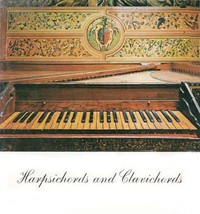
_Cover: Virginal by Giovanni Battista Boni, 1617_ (_see pages 22-25_)
_Photo: Robert Lautman_
_For sale by the Superintendent of Documents, U.S. Government Printing
Office Washington, D.C. 20402 Price 40 cents_
_Harpsichords and Clavichords_
The harpsichord and the clavichord represent the two most important
types of stringed keyboard instruments used from the 15th through the
18th centuries. By the 19th century, the piano had become the most
important domestic keyboard instrument.
In this booklet are described a few of the restored Smithsonian
harpsichords and clavichords that are occasionally on exhibit in the
Hall of Musical Instruments or in use in the series of concerts
sponsored by the Division of Musical Instruments. Models showing how the
sound is produced on these instruments are also on exhibit.
A complete list of the keyboard collection is found in _A Checklist of
Keyboard Instruments at the Smithsonian Institution_ (Washington, 1967),
which is available from the Division of Musical Instruments, Smithsonian
Institution, Washington, D.C. 20560.
_Harpsichords_
The harpsichord and its smaller relatives, the virginal and the spinet,
have strings that are _plucked_. The harpsichord is wing-shaped, most
virginals and spinets are either rectangular or polygonal.
When the harpsichord key is pressed, a wooden jack is raised so that a
quill or leather plectrum inserted into the jack tongue plucks the
string. When the key is released, the jack falls back into place, the
pivoted tongue allowing the plectrum to pass the string without plucking
it. A felt damper (inserted in a slit at the top of the jack) touches
the string to stop the sound.
Figure 1 shows the jack arrangement in an 18th century English spinet.
The second jack from the left on the front row has been raised so that
its quill is just about to pluck the string. Note that the quill has
lifted the string above its rest position.
Inherent in the design of a harpsichord is the limitation of dynamic
nuance. The sound of a harpsichord is not greatly altered by increasing
or lessening the impact of fingers on the keys. Rather, the dynamic
level and quality of sound can be changed by varying the number of
strings plucked (many harpsichords have three sets of strings: two sets
tuned in unison [8′] and a third tuned an octave higher [4′]), by
varying the location of the plucking point, and by muting the strings
with felt or leather pads.
The tone of a keyboard instrument is also affected by its general
outline, the material and thickness of the soundboard, the length and
material of the strings, and the type of case construction. The case
must be strong enough to counteract the tension of the strings and yet
light enough to allow the sound to resonate.
[Illustration: 1. Harpsichord action. _Photo: Robert Lautman._]
Among the Smithsonian’s extensive keyboard collection are fine examples
of harpsichords that represent several of the major national trends in
harpsichord building: the Flemish, Italian, English, and French.
_Flemish Harpsichords_
Antwerp was the harpsichord-making center of northern Europe during the
16th and 17th centuries. The earliest examples of harpsichords had only
one keyboard and one or two sets of 8′ strings. The progressive Flemish
makers added a second keyboard and another set of strings, tuned an
octave higher than the others, which allowed a wider range in pitch and
more variety in sound. Later French and English harpsichords were
largely derived from the Flemish style.
Virginal, _1620; made by Andreas Ruckers, Antwerp One manual;
Range C/E-c³ (apparent); 1×8′_
[Illustration: 2. Ruckers virginal: Plan view.]
[Illustration: 3. Ruckers virginal: Full view.]
[Illustration: 4. Ruckers virginal: Detail of keyboard.
_Photo: Robert Lautman_]
[Illustration: 5. Ruckers virginal: View of soundboard and lid.
_Photo: Robert Lautman_]
Instruments built by the famous Ruckers family were and are still highly
prized. Although simply painted on the exterior, the case of this
virginal is decorated on the inside in characteristic Ruckers style.
Block-printed papers cover the interior of the case; the inside of
the lid bears a Latin motto and the soundboard is painted with flowers
and arabesques. Figure 4 illustrates a detail of the block printing, and
of the keys. The arcades on the end of the keys appear to be cut from
several layers of leather which were then applied to the key fronts.
This instrument is tuned a fourth higher than it might appear. When the
C key is pressed, the note sounded is F, a fourth above.
_Short-Octave Tuning_
Since chromatic notes in the lowest octave of the keyboard were not
often needed in the music of the 16th and 17th centuries, the practice
of short-octave tuning was adopted.
Although the lowest note on a short-octave instrument appears to be E,
the range was actually extended down to C. (The notation C/E indicates
this arrangement.)
[Illustration: NORMAL TUNING]
[Illustration: SHORT-OCTAVE TUNING]
A typical short-octave instrument of the 16th and 17th centuries would
be tuned in the following manner: E (1) is tuned down to C (I); F♯ (2)
tuned to D (II); and G♯ (3) tuned to E (III).
Harpsichord, _1745; made by Johann Daniel Dulcken, Antwerp Two manuals;
Range FF-f³; 2×8v, 1×4′, lute_
Typical of northern European instruments, the Dulcken harpsichord has a
heavy case, two keyboards or manuals, and two 8′ choirs and one 4′
choir. It also has a lute stop, whose jacks, very close to the nut,
pluck one set of unison strings to produce a pungent, nasal tone.
[Illustration: 6. Dulcken harpsichord: Full view.
_Photo: Robert Lautman_.]
[Illustration: 7. Front view. _Photo: Robert Lautman_.]
[Illustration: 8. Dulcken harpsichord: Plan view.]
[Illustration: 9. Dulcken harpsichord: Detail of keyboards.
_Photo: Robert Lautman_]
[Illustration: 10. Dulcken harpsichord: Detail of soundboard.
_Photo: Robert Lautman_]
_Italian Harpsichords_
Typical Italian harpsichords had two choirs of unison strings and two
jacks for each key. They were of much lighter construction than those
made in northern Europe—the sides of the case were only about an eighth
of an inch thick. These fragile instruments were usually placed in
heavier, often elaborately decorated, outer cases from which the
harpsichord could be removed.
Harpsichord, _1693; maker unknown, Italy One manual; Range GG-c³ (no
GG♯); 2×8′_
The typical construction of Italian harpsichords can be seen in this
large Italian instrument. The original nameboard is missing; however, as
was common practice, the maker marked the date on the tail of the lowest
and highest keys.
The Italian harpsichord serves as an ideal _basso continuo_ keyboard
instrument because it blends well in instrumental combinations. Its
clean, crisp sound also allows individual lines to emerge clearly from a
polyphonic musical texture.
[Illustration: 11. Italian harpsichord (1693): Full view of instrument
in outer case.]
[Illustration: 12. Italian harpsichord (1693): Plan view.]
[Illustration: 13. Detail of keyboard. _Photo: Robert Lautman_.]
Harpsichord, _1694; made by Nicolaus DeQuoco, Italy One-manual: Range
C-c³ (no C♯); 2×8′, 1×4′_
This instrument is one of the few examples of an Italian harpsichord
with a third set of strings tuned an octave higher than the two unison
choirs. It is possible that the third set was added to this instrument
sometime after it was constructed with two unison registers.
Figure 15 shows the instrument before restoration; Figures 14 and 16
show the restored harpsichord removed from its heavy outer case and
details of the handsome keyboard and moldings typical of Italian
instruments.
[Illustration: 14. DeQuoco harpsichord: Plan view.]
[Illustration: 15. DeQuoco harpsichord: Full view of instrument in outer
case.]
[Illustration: 16. DeQuoco harpsichord:
View of instrument removed from outer case.]
[Illustration: 17. DeQuoco harpsichord:
Inscription on wrest plank.]
[Illustration: 18. DeQuoco harpsichord:
Detail of keyboard. _Photo: Robert Lautman_.]
Virginal, _1617; made by Giovanni Battista Boni, Cortona One manual;
Range C/E-f³; 1×8′_
The smaller virginals and spinets were commonly found in homes of modest
means, as well as in royal courts. This polygonal virginal has six split
keys which represent a complicated tuning scheme.
[Illustration: 21. Tuning scheme.]
Keys 1-2: This is a system of short-octave tuning (see Ruckers Virginal)
in which the two lowest accidentals are split into two sections. The
back section is tuned to the apparent accidental, the front section to
the short octave. Thus, on the Boni, the back section of the bottom
split key is tuned F♯, the front section is tuned D; the back section of
the second lowest split key is tuned A♭, the front section is tuned E.
Keys 3-6: The top four keys are split to provide for enharmonic
tuning—that is, both D♭ and E♭, G♯ and A♭. In the meantone system of
tuning, which was the prevailing tuning of the time, scales distant from
the key of C were often out of tune. To improve the intonation of these
scales, some makers divided some of the accidental keys to provide
alternate tunings.
[Illustration: 19. Boni virginal: Full view.]
[Illustration: 20. Boni virginal: Plan view.]
[Illustration: 21. Boni virginal: View of keyboard.
_Photo: Robert Lautman_.]
_English Harpsichords_
In the 18th century, London became a center of harpsichord making. The
two most important makers, Jacob Kirckman and Burkat Shudi, were Swiss
immigrants who first apprenticed with Hermann Tabel, a Flemish
harpsichord maker who had also emigrated to England. In America, where
English culture was highly regarded, Thomas Jefferson owned a Kirckman
harpsichord, Francis Hopkinson a Shudi and Broadwood.
The heavy cases of the typical English instruments were veneered in
walnut, mahogany, and later satinwood, and rested on trestle stands. The
usual range was five octaves: FF-f³ for harpsichords; GG-g³ for
spinets (and organs). In general, the sound produced on an English
harpsichord is more thick and lush than the sound of instruments from
other European centers.
Spinet, _about 1710; made by Thomas Hitchcock, London One manual; Range
GG-g³; 1×8′_
The spinet, a member of the harpsichord family, was a popular domestic
keyboard instrument in England and America during the 18th century and
was mentioned in many American diaries and inventories of that time. The
spinet often served as the keyboard instrument for the household that
could not afford or did not have room for the harpsichord or organ.
The Hitchcock family supplied many spinets for early 18th-century
gentility. Note in Figure 24 the handsome brass hinges, one of many
examples of the beautiful hardware used by English builders. This
instrument is quilled with crow quill, the most common material used for
plectra at that time. A detail of the jacks and stringing is shown in
Figure 1.
[Illustration: 22. Hitchcock spinet: Full view and nameboard.]
[Illustration: 23. Hitchcock spinet: Plan view.]
[Illustration: 24. Hitchcock spinet: Top view. _Photo: Robert Lautman_.]
Harpsichord, _about 1743; made by Burkat Shudi, London Two manuals;
Range FF-f³ (no FF♯); 2×8′, 1×4′, lute, buff_
Most of the stops on early harpsichords were changed by hand. From left
to right, the stop knobs shown in Figure 25 operate the following
registers: _lute_, _octave_ (4′), _buff_ (muting the second unison by
pressing soft leather pads against the strings), _first unison_ (8′),
and _second unison_ (8′). The lute stop plays from the upper manual, the
first unison from both manuals, and the remaining stops from the lower
manual.
Figures 25 and 26 show the instrument before restoration. The name
batten on which the date of 1747 appears is not original to the
instrument. The date of the instrument is based on the serial number 144
stamped on the lower keyboard. From all records it appears Shudi would
have built an instrument with that serial number in 1743.
[Illustration: 25. Shudi harpsichord: View of keyboards.]
[Illustration: 26. Shudi harpsichord: Plan view.]
[Illustration: 27. Shudi harpsichord: Full view.]
_French Harpsichords_
Although Paris claimed many harpsichord builders, few French
harpsichords remain today. Many were destroyed at the time of the
Revolution and later when firewood was needed to heat Conservatoire
classrooms.
French builders, the most famous among them the Blanchet family and
Pascal Taskin, spent much of their time reconstructing Ruckers
harpsichords to satisfy the musical and decorative tastes of
18th-century France. Included in this reconstruction or _ravalement_
were the extension of compass (usually from C-c³ to FF-f³),
enlargement of the case and soundboard, and often replacement of
keyboards, jacks, and registers.
Housed in elegantly painted cases supported by cabriole or fluted legs,
typical French harpsichords had two manuals and were praised for their
lightness of touch. Later 18th-century developments included a fourth
register called _peau de buffle_ (plectra of soft chamois-type leather)
and knee levers to operate the registers.
Harpsichord, _1760; made by Benoist Stehlin, Paris Two manuals; Range
FF-f³; 2×8′, 1×4v, buff, shove coupler_
In recent years the Smithsonian was fortunate to acquire one of the few
remaining French harpsichords. The builder’s name is known from the
design on the soundboard rose which includes the initials “B” and “S”;
also, the name “Benoist Stehlin” is inscribed on two of the jacks. The
1760 date is painted on the left side of the soundboard. An inventory of
Stehlin’s workshop and house made at the time of his death in 1774 lists
a Ruckers harpsichord altered by Stehlin along with several other
instruments in various stages of completion. Figures 28 and 30 show the
instrument before its restoration.
[Illustration: 28. Stehlin harpsichord: Full view.]
This instrument was restored to playing condition in the conservation
laboratory of the Division of Musical Instruments in 1968. Typical of
most French instruments, it is equipped with a shove coupler, which
enables the player to operate both manuals from the lower keyboard by
shoving the upper keyboard away from him. In this pushed-back position,
wooden uprights (dogs) attached to the upper surface of the far ends of
the lower key levers couple the two manuals and cause the upper manual
keys to descend when the lower manual keys are pressed.
[Illustration: 29. Stehlin harpsichord: Detail of rose.]
[Illustration: 30. Stehlin harpsichord: Plan view.]
_Clavichords_
Dynamic shadings are possible in the clavichord, as in the piano,
through variation of finger pressure. In both, the strings are struck—by
metal tangents in the clavichord and by leather or felt hammers in the
piano.
In the clavichord the strings extend over a soundboard bridge on the
player’s right and are damped (stopped from vibrating) by strips of
cloth on the left. The metal hammer (tangent) mounted in the end of the
key strikes the string and continues to touch it as long as the player
presses the key. The tangent, while touching the string, divides it into
two segments—the segment on the right being free to vibrate, the segment
on the left being damped by the cloth. When the key is released, the
cloth damps the entire string.
Figure 31 shows a player depressing a clavichord key (middle c). The
tangent at the far end of the key lever has been raised so that it has
struck the strings and has lifted them above rest position. The damping
cloth on the left of this raised string can also be seen.
Known as early as the 15th century, the clavichord produces tones,
though limited in volume, that are very expressive and even capable of
vibrato (_Bebung_). Because it lacks carrying power, the clavichord
historically was a solo or practice instrument, for it could not be
heard in combination with other instruments or with the voice.
[Illustration: 31. Clavichord action. _Photo: Robert Lautman_.]
Fretted Clavichord, _about 1700; maker unknown, Germany_
Unfretted Clavichord, _18th century; maker unknown, Germany_
The clavichord was usually housed in a rectangular case which rested
upon a simple stand. The range of the earlier instruments was about four
octaves. By the 18th century the range had been expanded to five
octaves.
The larger, later clavichords had separate strings for each key and were
unfretted or _bundfrei_. Many smaller and earlier clavichords were
fretted (_gebunden_), having some strings that would produce more than
one pitch when struck at different points by adjacent keys.
Figure 32 shows the fretted clavichord keyboard in more detail. Tangents
on keys numbered 16 and 17 strike the same strings to produce the notes
e♭ and e. Some other fretted notes shown in the picture include: keys 18
and 19 (f and f♯), keys 20 and 21 (g and g♯]), keys 23 and 24 (b♭ and
b), and keys 25 and 26 (middle c and c♯). Figure 31 is also a detail
from this clavichord.
The Smithsonian clavichord shown in Figures 35 and 36, in unrestored
condition, is typical of the large unfretted instruments that became
standard in Germany by the mid-18th century and for which Carl Philipp
Emanuel Bach wrote many solo keyboard compositions.
[Illustration: 32. Fretted clavichord: Detail of fretting.
_Photo: Robert Lautman_.]
[Illustration: 33. Fretted clavichord: Full view.]
[Illustration: 34. Fretted clavichord: Plan view.]
[Illustration: 35. Unfretted clavichord: Full view.]
[Illustration: 36. Unfretted clavichord: Plan view.]
By the beginning of the 18th century the desire was strong for a more
expressive keyboard instrument to use in ensembles. Harpsichord builders
added new stops, devised special leather plectra, and added Venetian
swell effects and other innovations to alter the sound of the
harpsichord. But no matter what they did, they could not produce enough
dynamic gradation to satisfy musical taste. The clavichord was capable
of dynamic nuance, but it lacked carrying power.
Instrument builders, seeking to satisfy the demands created by the
change in sensibility and musical taste, turned naturally to the
domestic instruments they knew best—the harpsichord and clavichord—as
the process of adaptation began. For this reason, as the pianoforte was
developed and perfected, the general proportions and arrangement of the
grand piano resembled those of the harpsichord. Similarly, the relation
between the keyboard and strings, the scaling, and other features of the
square piano resembled those of the clavichord.
By the beginning of the 19th century the pianoforte, an instrument
capable of subtle changes between soft and loud, had become the most
important domestic and concert keyboard instrument. After 1800 few
clavichords or harpsichords were built or used until they were revived
by early music enthusiasts at the end of the 19th century.
_Selected Bibliography_
BOALCH, DONALD. _Makers of the Harpsichord and Clavichord_. London:
George Ronald, 1955.
HIRT, FRANZ JOSEF. _Meisterwerke des Klavierbaus_. Olten, Switzerland:
Urs Graf-Verlag, 1955.
HUBBARD, FRANK. _Harpsichord Regulating and Repairing_. Boston: Tuner’s
Supply, Inc., 1963.
HUBBARD, FRANK. _Three Centuries of Harpsichord Making_. Cambridge,
Massachusetts: Harvard University Press, 1965.
JAMES, PHILIP. _Early Keyboard Instruments_. London: Peter Davies, 1930.
RIPIN, EDWIN M. “The Early Clavichord,” _Musical Quarterly_, 53(4)
(October 1967): 518-538.
RUSSELL, RAYMOND. _The Harpsichord and the Clavichord_. London: Faber
and Faber, 1959.
SHORTRIDGE, JOHN D. “Italian Harpsichord-Building in the 16th and 17th
Centuries.” _United States National Museum Bulletin_, 225 (15): 93-107,
1960.
End of Project Gutenberg's Harpsichords and Clavichords, by Cynthia A. Hoover
*** END OF THIS PROJECT GUTENBERG EBOOK HARPSICHORDS AND CLAVICHORDS ***
***** This file should be named 39690-0.txt or 39690-0.zip *****
This and all associated files of various formats will be found in:
http://www.gutenberg.org/3/9/6/9/39690/
Produced by Chris Curnow, Turgut Dincer, Joseph Cooper and
the Online Distributed Proofreading Team at
http://www.pgdp.net
Updated editions will replace the previous one--the old editions
will be renamed.
Creating the works from public domain print editions means that no
one owns a United States copyright in these works, so the Foundation
(and you!) can copy and distribute it in the United States without
permission and without paying copyright royalties. Special rules,
set forth in the General Terms of Use part of this license, apply to
copying and distributing Project Gutenberg-tm electronic works to
protect the PROJECT GUTENBERG-tm concept and trademark. Project
Gutenberg is a registered trademark, and may not be used if you
charge for the eBooks, unless you receive specific permission. If you
do not charge anything for copies of this eBook, complying with the
rules is very easy. You may use this eBook for nearly any purpose
such as creation of derivative works, reports, performances and
research. They may be modified and printed and given away--you may do
practically ANYTHING with public domain eBooks. Redistribution is
subject to the trademark license, especially commercial
redistribution.
*** START: FULL LICENSE ***
THE FULL PROJECT GUTENBERG LICENSE
PLEASE READ THIS BEFORE YOU DISTRIBUTE OR USE THIS WORK
To protect the Project Gutenberg-tm mission of promoting the free
distribution of electronic works, by using or distributing this work
(or any other work associated in any way with the phrase "Project
Gutenberg"), you agree to comply with all the terms of the Full Project
Gutenberg-tm License available with this file or online at
www.gutenberg.org/license.
Section 1. General Terms of Use and Redistributing Project Gutenberg-tm
electronic works
1.A. By reading or using any part of this Project Gutenberg-tm
electronic work, you indicate that you have read, understand, agree to
and accept all the terms of this license and intellectual property
(trademark/copyright) agreement. If you do not agree to abide by all
the terms of this agreement, you must cease using and return or destroy
all copies of Project Gutenberg-tm electronic works in your possession.
If you paid a fee for obtaining a copy of or access to a Project
Gutenberg-tm electronic work and you do not agree to be bound by the
terms of this agreement, you may obtain a refund from the person or
entity to whom you paid the fee as set forth in paragraph 1.E.8.
1.B. "Project Gutenberg" is a registered trademark. It may only be
used on or associated in any way with an electronic work by people who
agree to be bound by the terms of this agreement. There are a few
things that you can do with most Project Gutenberg-tm electronic works
even without complying with the full terms of this agreement. See
paragraph 1.C below. There are a lot of things you can do with Project
Gutenberg-tm electronic works if you follow the terms of this agreement
and help preserve free future access to Project Gutenberg-tm electronic
works. See paragraph 1.E below.
1.C. The Project Gutenberg Literary Archive Foundation ("the Foundation"
or PGLAF), owns a compilation copyright in the collection of Project
Gutenberg-tm electronic works. Nearly all the individual works in the
collection are in the public domain in the United States. If an
individual work is in the public domain in the United States and you are
located in the United States, we do not claim a right to prevent you from
copying, distributing, performing, displaying or creating derivative
works based on the work as long as all references to Project Gutenberg
are removed. Of course, we hope that you will support the Project
Gutenberg-tm mission of promoting free access to electronic works by
freely sharing Project Gutenberg-tm works in compliance with the terms of
this agreement for keeping the Project Gutenberg-tm name associated with
the work. You can easily comply with the terms of this agreement by
keeping this work in the same format with its attached full Project
Gutenberg-tm License when you share it without charge with others.
1.D. The copyright laws of the place where you are located also govern
what you can do with this work. Copyright laws in most countries are in
a constant state of change. If you are outside the United States, check
the laws of your country in addition to the terms of this agreement
before downloading, copying, displaying, performing, distributing or
creating derivative works based on this work or any other Project
Gutenberg-tm work. The Foundation makes no representations concerning
the copyright status of any work in any country outside the United
States.
1.E. Unless you have removed all references to Project Gutenberg:
1.E.1. The following sentence, with active links to, or other immediate
access to, the full Project Gutenberg-tm License must appear prominently
whenever any copy of a Project Gutenberg-tm work (any work on which the
phrase "Project Gutenberg" appears, or with which the phrase "Project
Gutenberg" is associated) is accessed, displayed, performed, viewed,
copied or distributed:
This eBook is for the use of anyone anywhere at no cost and with
almost no restrictions whatsoever. You may copy it, give it away or
re-use it under the terms of the Project Gutenberg License included
with this eBook or online at www.gutenberg.org
1.E.2. If an individual Project Gutenberg-tm electronic work is derived
from the public domain (does not contain a notice indicating that it is
posted with permission of the copyright holder), the work can be copied
and distributed to anyone in the United States without paying any fees
or charges. If you are redistributing or providing access to a work
with the phrase "Project Gutenberg" associated with or appearing on the
work, you must comply either with the requirements of paragraphs 1.E.1
through 1.E.7 or obtain permission for the use of the work and the
Project Gutenberg-tm trademark as set forth in paragraphs 1.E.8 or
1.E.9.
1.E.3. If an individual Project Gutenberg-tm electronic work is posted
with the permission of the copyright holder, your use and distribution
must comply with both paragraphs 1.E.1 through 1.E.7 and any additional
terms imposed by the copyright holder. Additional terms will be linked
to the Project Gutenberg-tm License for all works posted with the
permission of the copyright holder found at the beginning of this work.
1.E.4. Do not unlink or detach or remove the full Project Gutenberg-tm
License terms from this work, or any files containing a part of this
work or any other work associated with Project Gutenberg-tm.
1.E.5. Do not copy, display, perform, distribute or redistribute this
electronic work, or any part of this electronic work, without
prominently displaying the sentence set forth in paragraph 1.E.1 with
active links or immediate access to the full terms of the Project
Gutenberg-tm License.
1.E.6. You may convert to and distribute this work in any binary,
compressed, marked up, nonproprietary or proprietary form, including any
word processing or hypertext form. However, if you provide access to or
distribute copies of a Project Gutenberg-tm work in a format other than
"Plain Vanilla ASCII" or other format used in the official version
posted on the official Project Gutenberg-tm web site (www.gutenberg.org),
you must, at no additional cost, fee or expense to the user, provide a
copy, a means of exporting a copy, or a means of obtaining a copy upon
request, of the work in its original "Plain Vanilla ASCII" or other
form. Any alternate format must include the full Project Gutenberg-tm
License as specified in paragraph 1.E.1.
1.E.7. Do not charge a fee for access to, viewing, displaying,
performing, copying or distributing any Project Gutenberg-tm works
unless you comply with paragraph 1.E.8 or 1.E.9.
1.E.8. You may charge a reasonable fee for copies of or providing
access to or distributing Project Gutenberg-tm electronic works provided
that
- You pay a royalty fee of 20% of the gross profits you derive from
the use of Project Gutenberg-tm works calculated using the method
you already use to calculate your applicable taxes. The fee is
owed to the owner of the Project Gutenberg-tm trademark, but he
has agreed to donate royalties under this paragraph to the
Project Gutenberg Literary Archive Foundation. Royalty payments
must be paid within 60 days following each date on which you
prepare (or are legally required to prepare) your periodic tax
returns. Royalty payments should be clearly marked as such and
sent to the Project Gutenberg Literary Archive Foundation at the
address specified in Section 4, "Information about donations to
the Project Gutenberg Literary Archive Foundation."
- You provide a full refund of any money paid by a user who notifies
you in writing (or by e-mail) within 30 days of receipt that s/he
does not agree to the terms of the full Project Gutenberg-tm
License. You must require such a user to return or
destroy all copies of the works possessed in a physical medium
and discontinue all use of and all access to other copies of
Project Gutenberg-tm works.
- You provide, in accordance with paragraph 1.F.3, a full refund of any
money paid for a work or a replacement copy, if a defect in the
electronic work is discovered and reported to you within 90 days
of receipt of the work.
- You comply with all other terms of this agreement for free
distribution of Project Gutenberg-tm works.
1.E.9. If you wish to charge a fee or distribute a Project Gutenberg-tm
electronic work or group of works on different terms than are set
forth in this agreement, you must obtain permission in writing from
both the Project Gutenberg Literary Archive Foundation and Michael
Hart, the owner of the Project Gutenberg-tm trademark. Contact the
Foundation as set forth in Section 3 below.
1.F.
1.F.1. Project Gutenberg volunteers and employees expend considerable
effort to identify, do copyright research on, transcribe and proofread
public domain works in creating the Project Gutenberg-tm
collection. Despite these efforts, Project Gutenberg-tm electronic
works, and the medium on which they may be stored, may contain
"Defects," such as, but not limited to, incomplete, inaccurate or
corrupt data, transcription errors, a copyright or other intellectual
property infringement, a defective or damaged disk or other medium, a
computer virus, or computer codes that damage or cannot be read by
your equipment.
1.F.2. LIMITED WARRANTY, DISCLAIMER OF DAMAGES - Except for the "Right
of Replacement or Refund" described in paragraph 1.F.3, the Project
Gutenberg Literary Archive Foundation, the owner of the Project
Gutenberg-tm trademark, and any other party distributing a Project
Gutenberg-tm electronic work under this agreement, disclaim all
liability to you for damages, costs and expenses, including legal
fees. YOU AGREE THAT YOU HAVE NO REMEDIES FOR NEGLIGENCE, STRICT
LIABILITY, BREACH OF WARRANTY OR BREACH OF CONTRACT EXCEPT THOSE
PROVIDED IN PARAGRAPH 1.F.3. YOU AGREE THAT THE FOUNDATION, THE
TRADEMARK OWNER, AND ANY DISTRIBUTOR UNDER THIS AGREEMENT WILL NOT BE
LIABLE TO YOU FOR ACTUAL, DIRECT, INDIRECT, CONSEQUENTIAL, PUNITIVE OR
INCIDENTAL DAMAGES EVEN IF YOU GIVE NOTICE OF THE POSSIBILITY OF SUCH
DAMAGE.
1.F.3. LIMITED RIGHT OF REPLACEMENT OR REFUND - If you discover a
defect in this electronic work within 90 days of receiving it, you can
receive a refund of the money (if any) you paid for it by sending a
written explanation to the person you received the work from. If you
received the work on a physical medium, you must return the medium with
your written explanation. The person or entity that provided you with
the defective work may elect to provide a replacement copy in lieu of a
refund. If you received the work electronically, the person or entity
providing it to you may choose to give you a second opportunity to
receive the work electronically in lieu of a refund. If the second copy
is also defective, you may demand a refund in writing without further
opportunities to fix the problem.
1.F.4. Except for the limited right of replacement or refund set forth
in paragraph 1.F.3, this work is provided to you 'AS-IS', WITH NO OTHER
WARRANTIES OF ANY KIND, EXPRESS OR IMPLIED, INCLUDING BUT NOT LIMITED TO
WARRANTIES OF MERCHANTABILITY OR FITNESS FOR ANY PURPOSE.
1.F.5. Some states do not allow disclaimers of certain implied
warranties or the exclusion or limitation of certain types of damages.
If any disclaimer or limitation set forth in this agreement violates the
law of the state applicable to this agreement, the agreement shall be
interpreted to make the maximum disclaimer or limitation permitted by
the applicable state law. The invalidity or unenforceability of any
provision of this agreement shall not void the remaining provisions.
1.F.6. INDEMNITY - You agree to indemnify and hold the Foundation, the
trademark owner, any agent or employee of the Foundation, anyone
providing copies of Project Gutenberg-tm electronic works in accordance
with this agreement, and any volunteers associated with the production,
promotion and distribution of Project Gutenberg-tm electronic works,
harmless from all liability, costs and expenses, including legal fees,
that arise directly or indirectly from any of the following which you do
or cause to occur: (a) distribution of this or any Project Gutenberg-tm
work, (b) alteration, modification, or additions or deletions to any
Project Gutenberg-tm work, and (c) any Defect you cause.
Section 2. Information about the Mission of Project Gutenberg-tm
Project Gutenberg-tm is synonymous with the free distribution of
electronic works in formats readable by the widest variety of computers
including obsolete, old, middle-aged and new computers. It exists
because of the efforts of hundreds of volunteers and donations from
people in all walks of life.
Volunteers and financial support to provide volunteers with the
assistance they need are critical to reaching Project Gutenberg-tm's
goals and ensuring that the Project Gutenberg-tm collection will
remain freely available for generations to come. In 2001, the Project
Gutenberg Literary Archive Foundation was created to provide a secure
and permanent future for Project Gutenberg-tm and future generations.
To learn more about the Project Gutenberg Literary Archive Foundation
and how your efforts and donations can help, see Sections 3 and 4
and the Foundation information page at www.gutenberg.org
Section 3. Information about the Project Gutenberg Literary Archive
Foundation
The Project Gutenberg Literary Archive Foundation is a non profit
501(c)(3) educational corporation organized under the laws of the
state of Mississippi and granted tax exempt status by the Internal
Revenue Service. The Foundation's EIN or federal tax identification
number is 64-6221541. Contributions to the Project Gutenberg
Literary Archive Foundation are tax deductible to the full extent
permitted by U.S. federal laws and your state's laws.
The Foundation's principal office is located at 4557 Melan Dr. S.
Fairbanks, AK, 99712., but its volunteers and employees are scattered
throughout numerous locations. Its business office is located at 809
North 1500 West, Salt Lake City, UT 84116, (801) 596-1887. Email
contact links and up to date contact information can be found at the
Foundation's web site and official page at www.gutenberg.org/contact
For additional contact information:
Dr. Gregory B. Newby
Chief Executive and Director
[email protected]
Section 4. Information about Donations to the Project Gutenberg
Literary Archive Foundation
Project Gutenberg-tm depends upon and cannot survive without wide
spread public support and donations to carry out its mission of
increasing the number of public domain and licensed works that can be
freely distributed in machine readable form accessible by the widest
array of equipment including outdated equipment. Many small donations
($1 to $5,000) are particularly important to maintaining tax exempt
status with the IRS.
The Foundation is committed to complying with the laws regulating
charities and charitable donations in all 50 states of the United
States. Compliance requirements are not uniform and it takes a
considerable effort, much paperwork and many fees to meet and keep up
with these requirements. We do not solicit donations in locations
where we have not received written confirmation of compliance. To
SEND DONATIONS or determine the status of compliance for any
particular state visit www.gutenberg.org/donate
While we cannot and do not solicit contributions from states where we
have not met the solicitation requirements, we know of no prohibition
against accepting unsolicited donations from donors in such states who
approach us with offers to donate.
International donations are gratefully accepted, but we cannot make
any statements concerning tax treatment of donations received from
outside the United States. U.S. laws alone swamp our small staff.
Please check the Project Gutenberg Web pages for current donation
methods and addresses. Donations are accepted in a number of other
ways including checks, online payments and credit card donations.
To donate, please visit: www.gutenberg.org/donate
Section 5. General Information About Project Gutenberg-tm electronic
works.
Professor Michael S. Hart was the originator of the Project Gutenberg-tm
concept of a library of electronic works that could be freely shared
with anyone. For forty years, he produced and distributed Project
Gutenberg-tm eBooks with only a loose network of volunteer support.
Project Gutenberg-tm eBooks are often created from several printed
editions, all of which are confirmed as Public Domain in the U.S.
unless a copyright notice is included. Thus, we do not necessarily
keep eBooks in compliance with any particular paper edition.
Most people start at our Web site which has the main PG search facility:
www.gutenberg.org
This Web site includes information about Project Gutenberg-tm,
including how to make donations to the Project Gutenberg Literary
Archive Foundation, how to help produce our new eBooks, and how to
subscribe to our email newsletter to hear about new eBooks.
Harpsichords and Clavichords
Subjects:
Download Formats:
Excerpt
Project Gutenberg's Harpsichords and Clavichords, by Cynthia A. Hoover
This eBook is for the use of anyone anywhere at no cost and with
almost no restrictions whatsoever. You may copy it, give it away or
re-use it under the terms of the Project Gutenberg License included
with this eBook or online at www.gutenberg.org
Read the Full Text
— End of Harpsichords and Clavichords —
Book Information
- Title
- Harpsichords and Clavichords
- Author(s)
- Hoover, Cynthia A. (Cynthia Adams)
- Language
- English
- Type
- Text
- Release Date
- May 13, 2012
- Word Count
- 6,030 words
- Library of Congress Classification
- ML
- Bookshelves
- Browsing: Music
- Rights
- Public domain in the USA.