*** START OF THE PROJECT GUTENBERG EBOOK 66364 ***
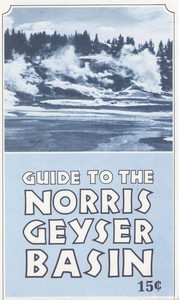
GUIDE TO THE
NORRIS GEYSER BASIN
15¢
[Illustration: uncaptioned]
NORRIS GEYSER BASIN
The Norris Geyser Basin was named for Philetus W. Norris who served as
Yellowstone’s second superintendent from 1877 until 1882. Although he
did not discover it, his explorations and reports were largely
responsible for calling attention to that area.
Norris is considered to be the hottest and most active geyser basin in
Yellowstone. Here geysers and hot springs exhibit greater change in
activity over a short span of time than elsewhere in the park. It is not
unusual for a new hot spring to come into existence literally overnight.
The new feature may last for just a few days or perhaps a month or so;
upon occasion some have endured for many years.
Because of constant change in the thermal features, the ground here is
unstable and hazardous in many locations. Therefore, you are required to
stay on designated trails and boardwalks at all times. This not only
protects you from possible serious burns but also helps preserve the
features as well. Remember also not to throw any objects into thermal
features. Debris of any kind in a hot spring or geyser could clog the
vent and destroy the feature. Because many scalding hot pools and
run-off channels are near trails and boardwalks, pets are not permitted
on the trails.
The fact that thermal features change may come as a surprise, but
remember that geysers, hot springs and other thermal phenomena are
subject to natural stresses just like plant and animal communities. Of
course the changes in thermal activity result from a different set of
factors than those affecting plants and animals. Can you guess what they
might be?
Shifts in the earth’s crust (earthquakes) result in movements along
cracks and fissures in the ground. These tremors usually cause changes
in the underground “plumbing systems” of thermal features, thus altering
activity patterns. Look for signs of recent activity variations as you
walk along the trails, or ask a naturalist if there have been some
recent changes.
As you explore, look closely at the often intricate formations around
the edges of a few hot pools, geysers and in some thermal runoff
channels. You will notice a mineral called sinter or geyserite (a form
of silicon dioxide, SiO₂) being deposited like tiny spines. These rather
prickly formations result when geyserite is deposited from slightly acid
water, a characteristic of most thermal water in the Norris area. This
is in contrast to the bead-like structures that result when geyserite
forms from slightly alkaline water found in thermal features in the Old
Faithful area.
Notice too the variety of colors staining the basins. The refraction
(breaking up) of light, mineral deposits and living organisms, algae and
bacteria, all add their hues. The assortment of colors reflects
variations in water temperature and chemistry.
As you enjoy your walk remember that Norris is a great natural preserve
where nature is constantly at work designing and redesigning one of its
most unusual displays. We are only visitors here and must not spoil it
in any way. It also serves as a great natural research laboratory where
scientists from all over the world learn more about geothermal energy.
Help us preserve this unique area so that the next generation and those
who follow can come and enjoy it in the same grandeur you did.
The Norris Geyser Basin is made up of two or more less separate areas
called Porcelain Basin and Back Basin. Both basins are served by trails
which begin at the Norris Museum and are shown on this map. The
following briefly describes a few features in each.
THERMAL FEATURES IN PORCELAIN BASIN
VALENTINE GEYSER—Located at the base of a large pear-shaped alcove,
Valentine is a typical cone type geyser that first erupted on
Valentine’s Day, 1907. Its activity has varied considerably—being
dormant some seasons, erratic during others, yet showing a high degree
of regularity at times. During the past several seasons, it has erupted
from a minimum of once every two days to a maximum of once a day. An
eruption lasts 5-7 minutes and reaches a height of 20-50 feet (6-15 m.)
above the seven foot cone. The eruption is followed by a steam phase
lasting an hour.
LEDGE GEYSER—The largest geyser in the Porcelain Basin, changed
dramatically after an earthquake that occurred June 30, 1975. In 1974 it
had been erupting about twice a day, but after the quake Ledge was
dormant for nearly two years. Then during the summer of 1977 it had but
two eruptions. Check the prediction board at the museum to see if Ledge
Geyser is active this year.
AFRICA GEYSER—named for the spring that preceded it which was roughly
the shape of the continent. The spring became a geyser in February of
1971. At first it was intermittent but as time passed the periods
between eruptions grew shorter until it became a constant geyser. In
1977 it was always powerful—sometimes emitting a mixture of steam and
water; other times just steam.
THE WHIRLIGIGS AND CONSTANT GEYSERS—these three features seem to be
interconnected. Constant Geyser, dormant for several years, reactivated
in the early ’70’s and now erupts up to 30 feet (9 m.) once or twice an
hour; often prior to an eruption of one of the Whirligigs. In recent
years, Big and Little Whirligig have traded active periods. When one is
more active, the other is less. Watch for the 15 foot (4 m.) angled
plume from Little Whirligig’s orange vent or listen to the distinctive
chugging produced during Big Whirligig’s splashing eruption. As with
many geysers, the water level rises in these pools prior to an eruption.
EBONY AND BEAR DEN GEYSERS—are another set of related features. In the
’60’s Bear Den Geyser first appeared and as it increased in activity,
Ebony Geyser became dormant. Today Bear Den Geyser erupts in bursts,
arcing up to 40 feet (12 m.) from the den-like vent, four to six times
daily. The death of Ebony Geyser may have been hastened by objects
thrown into its vent by thoughtless visitors. This debris is cemented
into place by the silica deposited from the water, choking off the vent.
Minute Geyser in the Back Basin may have suffered a similar fate.
THERMAL FEATURES IN BACK BASIN
EMERALD SPRING—The colors in and around thermal features are often
created by several kinds of algae that grow in hot water. However, the
deep green color of this spring is a result of a combination of the
yellow color from the sulphur lining the edge of the pool with the blue
that is refracted (“scattered”) from the clear water in the pool. The
bowl of this feature is about 27 feet (8 m.) deep and the temperature
normally varies between 194 and 200 degrees F. (90-93° C.)
STEAMBOAT GEYSER—The world’s largest geyser, Steamboat has eruptions of
more than 300 feet (91 meters). It was largely dormant for nine years,
then startled observers in March 1978 with a full-scale eruption. The
water phase lasted approximately 20 minutes, followed by bellowing steam
for over 40 hours. This spectacular display inundated the immediate
area. At this writing, March 30, 1978, it is not known if Steamboat’s
eruptions will follow any pattern. Between 1961 and March 1969, it had a
total of 103 major eruptions, none of which could be predicted. You can
still see the effects of downpouring water on the landscape which killed
trees and scoured away soil. The nine-year respite allowed new lodgepole
pines to gain a foothold. We hope you are fortunate enough to witness
Steamboat Geyser and share in the excitement. Remember—protect camera
and eye glass lenses from the spray as it can scratch glass after
drying.
CISTERN SPRING—In 1966 this feature changed from a grayish-black color
to its present brilliant blue. Concurrent with this the overflow
increased killing many trees near the spring. Since then a silica
terrace has rapidly built up. When Steamboat had a major eruption the
water level in Cistern dropped 4-8 feet, (1.2-2.4 m.) with a
corresponding drop in water temperature of around 60 degrees F. This
seems to indicate some connection between the two features. Whether or
not the increased water output of Cistern has resulted in the decline of
Steamboat is still unknown.
ECHINUS GEYSER (ē-kī′-nŭs)—although not as well known as some other
geysers, erupts in a display that surpasses many of them. The name comes
from the sinter spine-covered rocks surrounding the pool which bear a
fanciful resemblance to spiny sea urchins. _Echinus_ was the Greek name
for these tide-pool dwellers. Stop and watch the water fill the basin
and begin to boil. Soon it will be propelled skyward in great explosive
bursts of steam and water, some reaching heights of over 75 feet (23
m.). Usually the eruptions last three to six minutes but in 1977 Echinus
was erupting for up to twelve minutes. After erupting the pool drains
and begins to refill. Intervals between eruptions may be as short as 45
minutes or better than 75 minutes. Listen for the peculiar gurgling
sound produced as the vent drains after each eruption.
VIXEN GEYSER—Although its usual eruptions are small compared to others
(5-15 feet every few minutes), the geyser is unique in that water comes
from a circular tub-like vent. During normal activity little water is
ejected. Occasionally Vixen may have major eruptions of considerable
water, lasting 5 to 50 minutes and playing up to 30 feet. Listen for the
peculiar gurgling sound produced as the vent drains after each eruption.
TODAY’S GEYSER PREDICTIONS
(Obtain data from the museum prediction board or from a naturalist).
Echinus ______________________________
Ledge ______________________________
Valentine ______________________________
Others ______________________________
______________________________
______________________________
Text written by George A. Algard, Norris Summer Naturalist 3/74
4/78
[Illustration: NORRIS GEYSER BASIN]
BACK BASIN
Phillip’s Caldron
Grey Lakes
Green Dragon Spring
Yellow Funnel Spring
Palpitator Spring
Pearl Geyser
Vixen Geyser
Black Hermit’s Caldron
Minute Geyser
Mt. Holmes (10,336 feet—3160 meters) visible to the northwest
Veteran Geyser
Monarch Geyser Crater
Emerald Spring
Bathtub Spring
PORCELAIN BASIN
Ebony Geyser
Bear Den Geyser
Crackling Lake
Whale’s Mouth
Dark Cavern Geyser
Arch Steam Vent
Cistern Spring
NORRIS MUSEUM
Steamboat Geyser
Valentine Geyser
Lodge Geyser
Little Whirligig Geyser
Sieve Lake
Africa Geyser
Pinwheel Geyser
Echinus Geyser
Hurricane Vent
Colloidal Pool
Congress Pool
Ragged Spouter
Blue Geyser
Feisty Geyser
Carnegie Drill Site
Parking
Porcelain Terrace Springs
Nuphar Lake
LEGEND
trails and boardwalk
described thermal features
other thermal features
roads and parking
TO MADISON—16 MILES—26 KM
TO MAMMOTH HOT SPRINGS—22 MILES—35 KM
TO CAMPGROUND—½ MILE—⅘ KM
TO CANYON VILLAGE—12 MILES—19 KM
DANGEROUS THERMAL AREA
Boiling Water—Thin Crusts
Always Stay on Constructed Walkways
Transcriber’s Notes
—Silently corrected a few typos.
—Retained publication information from the printed edition: this eBook
is public-domain in the country of publication.
—In the text versions only, text in italics is delimited by
_underscores_.
*** END OF THE PROJECT GUTENBERG EBOOK 66364 ***
Guide to the Norris Geyser Basin
Subjects:
Download Formats:
Excerpt
GUIDE TO THE
NORRIS GEYSER BASIN
The Norris Geyser Basin was named for Philetus W. Norris who served as
Yellowstone’s second superintendent from 1877 until 1882. Although he
did not discover it, his explorations and reports were largely
responsible for calling attention to that area.
Norris is considered to be the hottest and most active geyser basin in
Yellowstone. Here geysers and hot springs exhibit greater change in
activity over a short span of time than...
Read the Full Text
— End of Guide to the Norris Geyser Basin —
Book Information
- Title
- Guide to the Norris Geyser Basin
- Author(s)
- Algard, George A.
- Language
- English
- Type
- Text
- Release Date
- September 23, 2021
- Word Count
- 1,795 words
- Library of Congress Classification
- F721
- Bookshelves
- Browsing: History - American, Browsing: Travel & Geography
- Rights
- Public domain in the USA.