*** START OF THE PROJECT GUTENBERG EBOOK 74336 ***
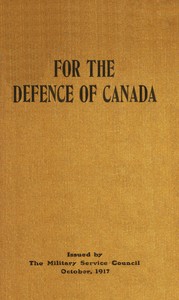
FOR THE
DEFENCE OF CANADA
Issued by
THE MILITARY SERVICE COUNCIL
October, 1917
FOR THE DEFENCE OF CANADA
I.
There is no serious suggestion among British people that Great Britain
could have remained neutral in the Great War which broke across Europe
three years ago and which still fills the earth with devastation and
mourning. By British people one means not only those of English speech
and British origin, but all of any race or tongue or creed who salute
the flag, and enjoy the heritage of freedom which belongs to British
citizenship. The mother country had an understanding with France which
could not be ignored; an obligation to Belgium which could not be
repudiated without dishonor. In the conventions and understandings
to which the British Empire was committed there was no menace to any
other nation. The object was not to make war but to keep peace; not to
divide or convulse Europe but to assure international security and the
honorable and happy independence of all peoples.
II.
It is true that the British navy was maintained in strength, vigor and
efficiency, but the navy was not an instrument of aggression nor even
the guardian of exclusive paths for British commerce across the seas.
It was the bulwark of freedom; the police force of all nations. The
trade of the Empire had no other protection. The Empire itself had no
other wall of defence. There was no British army to challenge other
communities nor any thought of aggression or conquest. Indeed it is
certain that the people of Great Britain and the Dominions could not be
united in support of a war for territorial extension or a wanton attack
upon the independence of any other country. There may be doubtful
chapters in British history. There may have been ages when Great
Britain was willing to live by the sword; when her statesmen strove
for dominion over other lands and peoples. But with the Victorian
era a new spirit entered into British councils. Her statesmen thought
of the sword only as a necessary guarantee of British security. They
gave earnest support to all movements designed to settle international
differences by conciliation and arbitration. They were so “slow to
anger” that envious and restless neighbors persuaded themselves that
the old might and puissance of Imperial Britain had gone forever.
III.
There is no better evidence of the purity of British motives and the
disinterestedness of British action than the complete unity of the
Empire in the desperate struggle in which it is now engaged. If there
could be better evidence it lies in the fact that the United States,
removed for a century from the quarrels of Europe, has entered the
conflict, in sheer revolt against Teutonic aggression and driven by
a noble impatience with actions that have destroyed the reign of law
among nations and put earth and heaven to shame. Thus we have not only
the British people, so seldom united in war, animated by a common
purpose, but also the American Republic, nurtured in love of peace
and distrustful of the old world’s ideals and ambitions, inspired and
united by a common sense of danger and a common concern for freedom and
civilization.
IV.
It was manifest even before war was declared that there would be
no indecision or division in Canada. We knew that with the mother
country at war we would be at war. We could not be neutral and remain
within the Empire. There was no apprehension of compulsion by the
Imperial Government. There was certainty of compulsion by Germany
if our attitude was not defined and unequivocal. We had to proclaim
independence and neutrality or pledge our manhood and resources to
maintain the security and integrity of the Empire. If we had done
otherwise than we have we would now be skulking in the world’s byways
and writhing under the contempt of decent peoples. Who suggests that
in time of peace we can sing God save the King, boast of our British
citizenship and send our trade on the seas under protection of the
British navy, and do nothing in time of war? There could, however, be
no greater mistake than to think that we are in the war at the command
of Great Britain or purely to sustain British interests. We are in
the war primarily to defend and maintain freedom and self-government
in Canada. At least Great Britain is fighting for Canada as surely as
Canada is fighting for Great Britain.
V.
It is almost inconceivable that Germany could have doubted what our
decision would be. We acted involuntarily and instinctively. There was
unanimity in the press and in Parliament. We did not think of degrees
of obligation or conditions of alliance. In Quebec there was rejoicing
over the compact between Britain and France, while in the English
provinces we saw national and Imperial value in a union of French and
English, in defence of free institutions. We believed that through the
common sacrifices of war would come that happy understanding between
the races in Canada which has been the aspiration of Canadian patriots
for a century. We took deep satisfaction in the prospect that France,
in alliance with Britain, would emerge from a long humiliation with the
“lost provinces” recovered and the ancient national dignity restored.
Hence we said to the mother country as Jehoshaphat said to the King
of Israel, “I am as thou art and my people as thy people and we will
be with thee in the war.” For her as for us the choice was between
sacrifice and dishonor, and when these are the conditions honor and
sacrifice are the immemorial obligation and inheritance of the British
people.
VI.
No one foresaw the duration or the magnitude of the conflict.
Armageddon was a vision of poets and prophets. The 20th century,
inspired by enthusiasts and instructed by economists, believed that
the world had grown soft and “practical.” We were told that war lords
were legendary figures of an evil past. It was a common belief that
no nation could command the resources for a long struggle. It was
said that finance and commerce, interlocked and internationalized,
would compel a speedy cessation of hostilities by exhaustion of the
combatants. We were assured that the industrial armies of the workshops
could not be mobilized for mutual destruction. To the few who were
wiser we would not listen. Possibly much of their wisdom was rooted
in apprehension and suspicion. There never was so much of mercy and
charity and goodwill and brotherhood among men as during the first
years of the century. We had the Hague tribunal and treaties of
arbitration. We had international law and worldwide organizations for
the common protection and enrichment of mankind. It is not strange,
therefore, if men believed that there was a happy prospect of enduring
peace or if there was general impatience with those who spoke of war
and preparation for war.
VII.
It is not necessary to consider at length the immediate causes of
the war or to marshal the evidence in proof of Great Britain’s
disinterested and resolute endeavor to avert the conflict. Few of the
great wars of history stand the cold, unimpassioned scrutiny of later
generations. We have, however, overwhelming evidence that Germany
plotted and prepared for sovereignty in Europe and an unchallenged
primacy among the nations. The world has been astounded by the
revelation of German motives, the inflexible persistence of German
policy, the extent and efficiency of German preparation. It was only
by the mercy of God and the martyrdom of Belgium that France was not
brought to her knees before she could organize her valiant defence or
the heroic British regiments unite with the French legions to check the
advance on Paris. While time lasts the betrayal of Belgium will have
shameful pre-eminence in what John Morley calls “The sombre tragedy of
human history.” Nor would Great Britain have escaped lasting dishonor
if she had failed in fidelity to France and Belgium at any cost of
life and treasure. It is not necessary to argue that the violation of
Belgian neutrality alone explains the British declaration of war upon
Germany. That cause was adequate, if there were no other, but there
were other considerations of direct and tremendous consequence to the
British Empire.
VIII.
Looking to the future British statesmen could not doubt that Germany,
triumphant over France and Belgium, with power of dictation over
Russia, with mastery of Turkey, and with Vienna in subjection to
Berlin, would organize its resources and consolidate its energies for
an attack upon Britain and her Dominions. Indeed all that has been
disclosed shows clearly that the destruction of Great Britain and
partial or complete suzerainty over the self-governing British nations
was the ultimate object of German policy. With a land army unequalled
in Europe the Kaiser set himself to rival the British navy and the
British merchant marine. A great navy was not required to ensure the
political security or protect the commerce of Germany. Only by naval
power could the British Empire exist. When we think of the achievements
of the Germanic alliance against a world in arms we realize what a
mortal hazard the British Empire would have faced in single combat
against enemies enriched by the spoils of victory over France, Russia
and Belgium, and with all the smaller nations of Europe reduced to
submissive neutrality. It was vital, therefore, that Britain should
enter the struggle not only by virtue of honorable alliances but to
guard her very existence. Moreover, if Britain had hesitated at the
outset it is certain that her position would quickly have become
intolerable. In a few weeks or months she would have had to send her
fleet to sea and organize her manhood for defence. Delay, resulting
from foolish confidence or timid counsels, would have been dangerous
and possibly fatal to all the vital interests which depend upon a
solvent and powerful British Commonwealth.
A thousand years scarce serve to form a state;
An hour may lay it in the dust.
IX.
Whether or not there was lack of vigilance or failure in preparation by
Great Britain, there is nothing more remarkable in human history than
the achievements of the British people in the war. Few doubted that
the navy would be vigilant and invincible. It was not feared that the
old historic regiments would fail in valor or endurance. But there is
nothing even in British annals so wonderful as the voluntary enlistment
of an army of four millions. If only as a measure of the danger which
threatened the Empire the figures are impressive. Men would not have
recruited in hundreds of thousands if they had not felt that the
institutions they cherished, even their very households, stood in the
shadow of death. No doubt a flame of wrath swept over England as the
revolting story of German brutality in Belgium was unfolded, but a
living, conscious sense of actual danger to the Empire was the moving
impulse to British action. The tremendous voluntary enlistment is only
rivalled as a phenomenon in British history by the final adoption of
the principle of compulsory service. It was not only in Canada that
this method of recruiting was regarded with disfavor. For generations
compulsion for military service has been repugnant to the genius of
British institutions. It was held to be the essential basis of the
militarism of continental countries. The conviction or prejudice which
obtained in England was as deeply rooted in the United States. A great
standing army was treated in both countries as incompatible with the
ideals of a free people.
X.
In framing the constitution the fathers of the American Republic
were chiefly concerned to repose power in Congress and to establish
conditions under which a military dictatorship would be forever
impossible. Across the world for a century fell the shadow of Napoleon.
Behind stood the sinister figures of ancient dictators and despots.
During the American Civil War the draft produced disaffection and
riot in the North, while Lincoln was permitted to exercise autocratic
power because he held his authority from “the people.” There was
confusion of thinking through facts of history which had no validity
under democracy, and sincere devotion to theories and prejudices which
challenge the basic ideals and principles of popular government. A
writer in The London Times Literary Supplement, discussing “The ways
of Revolution,” said, “In modern times democracy has almost invariably
had the best of the fighting. France herself was never led to defeat by
a Republican Government; Waterloo and Sedan were lost by her Emperors.
Swiss history is one long tale of democratic success in defence; two
Dutch provinces defied the arms of Philip II., and thirteen American
colonies the might of the British Empire. Democracy is more prone to
suicide than liable to conquest.”
XI.
It is idle to suggest that compulsion should have been applied in
Great Britain when the war began. The certain result would have been
resistance and disorder. The nation would have been weakened, divided,
disabled for the mighty task before it. Only actual experience and
the undesirable consequences of unregulated enlistment established
the necessity for selection and made compulsory service possible.
Railway workers, coal miners and various classes of skilled mechanics
had to be brought back from the trenches. It was found necessary
to reserve and organize labor for the shipyards and the munition
factories. Agriculture had to be stimulated to the utmost. For a time
there was a degree of industrial confusion, and under-production of
essential war materials because men had joined the colors who could
give better service to the Empire in the shops and mines than they
could give in the field. It was essential that transportation should
be efficient and the armies well fed and well equipped if battles
were to be won against the long preparation, the scientific machinery
and the accumulated war stores of Germany. Hence selection became
necessary in order that the industrial forces should be competent and
adequate and organized to secure the maximum of production. Unexpected
revelations of German brutality and ruthlessness affected the thinking
of multitudes of the British people. They began to realize that all
the energies and resources of the kingdom must be employed if victory
over the Germanic alliance was to be achieved. There was reason to
rejoice over the results of voluntary recruiting. What had been done
was magnificent. But it was recognized that there was still man-power
available and that the situation required the enrolment of every
citizen who was physically equal to military service, and engaged in
activities less vital to the security of the State. Great Britain
adopted every expedient to secure recruits before the selective draft
was applied. It was found that the voluntary system was costly, partial
and undemocratic. Enlistment was uncertain, haphazard and uneven. Many
incidents, when appeals for recruits became strident and coercive,
were repugnant to national self-respect and national dignity. Through
adversity Great Britain discovered that equality of service and
sacrifice is the essential basis of democracy. Under the system of
National Service there is no distinction of race or creed or class or
position. There is restriction upon freedom but only that the State may
be preserved and the citizen secured in life and liberty, under the
flag of his choice and in the land of his fathers.
XII.
In the light of history the ready submission of the United States to
compulsory draft when peace with Germany could no longer be maintained
is remarkable. If the Republic had been among the original combatants
it is inconceivable that the draft at the outset would have been
sanctioned. There is nothing in the history of the Revolutionary War,
the war of 1812 or the Civil War to suggest that the United States
would raise armies by compulsion while the forces required could be
secured by the voluntary system. Nearly three years elapsed before
the statesmen at Washington resolved to engage in the great struggle
between freedom and despotism. It is not necessarily a reproach to the
American people that there was long delay before friendly relations
with Germany were severed. A divided nation cannot strike with all its
strength. Until the people were substantially united compulsion was
impracticable and dangerous. Through the patience and wise dealing of
the President and the arrogance, insolence and devious manœuvring of
Germany a common national feeling was finally developed upon which
Mr. Wilson could rely for support in all measures necessary to secure
appropriations, raise armies and ensure sympathetic and effective
co-operation between the Government and the people. Supported by the
national feeling the President was able to establish national service
and save his country from the waste, strain, clamor and inequity of
raising armies by voluntary appeal.
XIII.
The United States was in a position to profit by the experiences of
Britain and Canada. It had knowledge of the disadvantages of the
voluntary system as revealed in the British countries and freedom from
the illusions which delayed and embarrassed the original combatants. We
hardly yet realize what a revolution in opinion was necessary before
the draft could be applied in Britain or the United States. We have a
new revelation in democracy which would have come slowly, if at all,
if the war had gone more prosperously for the Allies. It would not
have come had the war ended in one or two campaigns. Sheer military
necessity chiefly explains the change in popular feeling. At least
in Britain and Canada the demand for compulsion became so general
and formidable that the Governments could not resist. Jean Jaures,
an extreme Socialist and idealist, argues that the rooted objection
to national service which has been so common in democratic countries
finds its support in the spirit of caste and the vested interests of a
class who cling to the idea of commanding a great army, segregated from
the nation in a world of its own, with its own laws, its own pomp and
circumstance, rather than of accepting their position as the leading
citizens in an armed nation. He insists that “just as there is no power
more majestic than that of the national will embodied in law, so there
is no army more powerful and more capable of endowing its leaders with
moral authority and prestige, if they are in harmony with it, than an
army which is the armed nation itself, inspired with the determination
to defend its independence and organized for the purpose.” Events
justify Jaures and go far to establish national service as the sound
and necessary military system for a democracy at war. The feeling that
the army necessarily constitutes a separate class is dying. So is the
idea that only those who choose to bear arms are responsible for the
national safety. Passing, too, is the notion which divides armies into
free men and “conscripts” and regards compulsory national service as
destructive of individual freedom and personal independence.
XIV.
Napoleon conscripted for aggression and conquest. Under National
Service Republican France has had freedom from internal convulsions
and Chauvinistic military adventures. In defence the French people
have made sacrifices of blood and treasure beyond computation. But for
nearly half a century, notwithstanding the brutal arrogance and avarice
of Prussia in 1870, they kept the peace themselves and were among the
active forces for peace in the councils of Europe. In Germany national
service is not the “Will of the people,” but the instrument of rulers
lusting for dominion and intolerant of the privileges and ideals of
democracy. If France had trusted to the voluntary system she would have
been overcome in 1914, before her forces could have been organized to
resist the German attack. We reach false conclusions because we think
of the origin of “conscription” rather than of the equity of national
service. A democracy chooses its rulers; an autocracy commands its
subjects. In France and Germany we have the conflicting ideals of an
autocracy organized for attack and a democracy organized for defence. A
looser military organization in France would have ensured the success
of the attack. Failure to arm the nation would have been equivalent
to self-destruction. Where the power to command, without assent of
the people, exists, democracy has not come to birth. Where democracy
rejects the supreme obligation of citizenship it is not full born. One
may not think that the world must “stand to arms” forever but until the
free democracies develop the power and the spirit to disarm autocracies
and command peace, enduring peace will not prevail. Whether or not any
league of nations will ever “fight for peace” only the gods know. From
the welter of blood and ruin upon which we look to-day it would be a
dark prospect if we could not cherish the vision.
XV.
As has been said there was no thought of a draft in Canada when the war
began. The press and the political leaders gave many assurances that
compulsion would not be employed. It was assumed that the response to
the appeal of the Department of Militia would be adequate. There was
a common expectation that the war would not last for twelve months
and that at most Canada would provide an army of 50,000 or 100,000.
In the first months of war more men offered themselves that we could
arm and equip. In the course of ten weeks over 30,000 had embarked
at Quebec for England. Among these were many British-born, instant
in response to the call to arms, and peculiarly conscious of the
danger which threatened the mother country. It was natural that they
should predominate in the first Canadian contingent. If there had been
immediate danger to Canada, such as that to which the old countries
were exposed, the enlistment of Canadians would have exceeded all
other elements of the population. But notwithstanding that the causes
of the war lay in Europe natives of Canada were numerous in the first
oversea regiments. Many of those who enlisted as officers made great
sacrifices. Many who enlisted as privates made even greater sacrifices.
They abandoned responsible and remunerative positions and the certainty
of commissions if they had sought to avoid service in the ranks. All
put life at stake. In those heroic battalions East and West, Quebec
and Ontario, were represented, and whether English-speaking or French
speaking they displayed valor and endurance in the field.
XVI.
From month to month and from year to year the call for men has been
continuous and insistent. When we had organized an army of 100,000
another 100,000 was demanded. When 200,000 had enlisted there was an
appeal for 300,000. When 350,000 had enrolled a Canadian contribution
of 500,000 was authorized. By voluntary enlistment 430,000 men were
secured and 332,000 of these have crossed the sea. In all the long span
of human history there is nothing more romantic and majestic than this
great gift of manhood from the new world to restore freedom in the old.
Even when the bells ring for peace many of those who left Canada in the
pride of youth and strength will not come back. The loss is grievous
even though they were where they should have been when they fell.
The casualties in the Canadian army exceed 100,000 and 30,000 sleep
in France and Flanders. Many of those in the trenches have borne the
strain and shock of war for years, separated from wives and children,
from fathers and mothers, from all the associations and interests which
give normal life zest and value. They have no obligation to country or
Empire which does not lie as clearly upon all of us. If we deny the
support which they need we shall be dishonored.
If ye break faith with us who die,
We shall not sleep though poppies grow
In Flanders’ fields.
XVII.
In Canada as in Great Britain we enrolled a great army under the
voluntary system. If it had been said a few years ago that the Dominion
could secure 400,000 men for a war in Europe the statement would have
been treated with derision. But the fact that voluntary enlistment has
been so satisfactory is an argument for, not against, a compulsory
draft. The need for selection is more imperative. Such great sacrifices
demand our last effort to ensure that they shall not be in vain.
The magnitude of the enlistment emphasizes the danger and the vital
interest of Canada in the issue. It is admitted by the authorities
that in a few months all available reinforcements will be exhausted.
Appeal and persuasion have ceased to bring any considerable response,
although not wholly without effect. There is no prospect of peace
in the near future. We must, therefore, gradually withdraw from the
war as our regiments become ineffective fighting units or supply such
fresh troops as will meet the loss and wastage. There is no suggestion
that fresh troops should be withheld. Even those who oppose the draft
declare that adequate reinforcements must be provided. It may be
that compulsion would not have been applied in Canada if voluntary
recruiting could have been maintained, but with comparative failure
of voluntary recruiting and little prospect of revival it is curious
that the draft should be opposed if the necessity for reinforcements is
admitted.
XVIII.
In 1863 Lincoln prepared an opinion on the draft for the Civil War in
which he said, “At the beginning of the war, and ever since, a variety
of motives, pressing some in one direction and some in the other, would
be presented to the mind of each man physically fit for a soldier
upon the combined effect of which motives he would, or would not,
voluntarily enter the service. Among these motives would be patriotism,
political bias, ambition, personal courage, love of adventure, want
of employment and convenience or the opposites of some of these. We
already have, and have had in the service, substantially all that can
be obtained upon this voluntary weighing of motives. And yet we must
somehow obtain more or relinquish the original object of the contest,
together with all the blood and treasure already expended in the
effort to secure it. To meet this necessity the law for the draft has
been enacted. You who do not wish to be soldiers do not like the law.
This is natural, nor does it imply want of patriotism. Nothing can be
so just and necessary as to make us like it if it be disagreeable to
us. We are prone, too, to find false arguments with which to excuse
ourselves for opposing such disagreeable things. In this case, those
who desire the rebellion to succeed, and others who seek reward in
a different way, are very active in accommodating us with this class
of arguments.” He added, “The republican institutions and territorial
integrity of our country cannot be maintained without the further
raising and supporting of armies. There can be no army without men.
Men can be had only voluntarily or involuntarily. We have ceased to
obtain them voluntarily, and to obtain them involuntarily is the
draft--is conscription. If you dispute the fact, and declare that men
can still be had voluntarily in sufficient numbers, prove the assertion
by yourselves volunteering in such numbers and I shall gladly give up
the draft. Or if any one of you will volunteer he for his single self
will escape all the horrors of the draft and will thereby do only what
each one of at least a million of his manly brothers have already done.
Their toil and blood has been given as much for you as for themselves.
Shall it all be lost rather than that you, too, will bear your part? I
do not say that all who would avoid serving in the war are unpatriotic,
but I do think every patriot should willingly take his chance under a
law made with great care in order to secure entire fairness.”
XIX.
The situation that Lincoln describes is very much the situation in
Canada. The blood that was shed by valiant Canadians at Ypres, and
Givenchy and Festubert and on the Somme, at Vimy Ridge and before Lens,
will have been shed in vain if an inglorious peace is imposed upon
Britain and her Allies and the German people strengthened in allegiance
to a dynasty which will vex mankind with its pretentions, conspiracies
and infamies until it is destroyed. Moreover, as long as Germany has
power to fill the earth with apprehension Governments will continue
their eager competition in armaments and high expenditures for defence.
The war is for safety as well as for freedom, and upon its result the
free institutions of Canada depend. If it was the unanimous judgment
of Parliament that Canada should enter the war, and if among the people
there was universal approval of the action of Parliament, how can we
withdraw until victory is achieved? How can we continue in the war
unless we can maintain and reinforce the regiments in the field? How
can we get men except by command of the State when the persuasion of
the State has ceased to be effective? There are those who talk wildly
about “driving men to slaughter.” But more than 400,000 of the sons of
Canada have driven themselves to “slaughter,” and because they have
done so our homes and institutions have been secure.
XX.
The Military Service Act only requires that those among us who can
best be released from the occupations in which they are now engaged
shall serve in the field under conditions as honorable as surround
their fellow Canadians in uniform and under regulations no more
onerous or exacting. The Militia Act as amended in 1906 provided that
the Government could place the militia “on active service anywhere
in Canada and also beyond Canada for the defence thereof at any time
when it appears advisable so to do by reason of emergency.” Enough has
been said to reveal an emergency in which nothing less fundamental is
at stake than the existence of Canada as a free country. If Germany
should triumph we would not have a choice between Independence and
British Connection. We would pass under German sovereignty. There would
be no protection under the Monroe Doctrine. If Germany should not be
conquered the United States, in arms against the Germanic alliance,
would be involved in the common defeat of the Allies. Washington
would be as powerless as London or Ottawa to determine the future
political status of the Canadian people. Recalling the desperate valor
of Canadian soldiers in many battles with the best troops of Germany,
is it likely that Ontario or Quebec or any other Canadian province
would escape the hard fate of Alsace and Lorraine or receive a greater
portion of mercy than the harassed Polish subjects of the Kaiser?
Clearly, therefore, the Canadian regiments are as surely defending
Canada in France and Flanders as though they were actually resisting
invasion along the St. Lawrence.
XXI.
By the Militia Act it was provided that “if at any time enough men do
not volunteer to complete the quota required the men liable to serve
shall be drafted by ballot.” Chiefly because of this provision the
Militia Act was amended or superseded by the Military Service Act.
It was manifest that selection by ballot would continue and multiply
the inequalities produced by voluntary recruiting. Occupations and
industries embarrassed by scarcity of labor would suffer still further,
and physical fitness for war would be the general test of eligibility.
It was, therefore, declared that “by reason of the large number of men
who have already left agricultural and industrial pursuits in Canada
to join the Expeditionary Force as volunteers, and of the necessity
of sustaining under such conditions the productivity of the Dominion,
it is expedient to secure the men still required, not by ballot, as
provided in the Militia Act, but by selective draft.” Other provisions
of the Act divide the available manhood of the country into six classes
ranging in age from 20 to 45 and subject to selection according to
military necessity, number of dependents and order of physical fitness.
XXII.
Under national service “conscript” has no invidious meaning. It is
expunged from the language. As Lincoln said, failure to volunteer
does not necessarily imply want of patriotism. Who has the right to
judge his neighbor? Who fully understands his neighbor’s position?
If we think of our school days we will recall the boys who had a
natural instinct for fighting. We will think, too, of those who
shrank from rough physical encounters, and were almost suspected of
actual cowardice. But how often in emergencies those under suspicion
of cowardice revealed courage and daring at least equal to their
more pugnacious comrades. They would, perhaps, be the last to join a
volunteer fire brigade but, if occasion required, they would fight a
fire as courageously and resolutely as their adventurous associates.
The new regiments to go forward under the Military Service Act will
perform deeds of valor equal to any that have glorified Canadian arms.
There will be Military Crosses for many of those who found it hard to
decide between private and public duty. “I will give unto this last
even as unto thee.”
XXIII.
Under national service the State calls all its manhood to arms but
relieves from odium and suspicion all those who can better serve its
interests on the farms, in the factories, or in other necessary civil
activities. The Military Service Act of Canada, as has been said,
was passed by Parliament in obedience to a general public demand and
in assertion of the Government’s deliberate conviction that only by
selective draft could the necessary reinforcements for the army in
France be obtained and the orderly continuance of production and
industry assured. In the machinery for applying and enforcing the
measure there are ample safeguards against partiality, injustice
or partisanship. The Military Service Council has been constituted
to advise and assist in the administration and enforcement of the
Act. The Deputy Minister of Justice is the chairman of the Council,
and the other members have been chosen equally from the two great
political parties. The advice of the Council is sought in order to
ensure that the Act will be administered with just and equal regard to
the interests of all classes of the community, and in all questions
affecting the draft, requiring the consideration of the Governor
General or the Minister of Justice, the conclusions will be reached in
consultation with the Council. Moreover, the provincial registrars and
the local tribunals receive instructions from the Council as to the
manner in which their duties are to be discharged; and, while the local
tribunals exercise their judicial functions with perfect independence,
so far as concerns the determination of individual cases, they may
nevertheless refer to the Council for direction or advice upon general
questions of doubt or difficulty. Provincial tribunals, chosen from the
judiciary of the various provinces, are provided for resort by those
who are dissatisfied with decisions of the local tribunals; and, in
order to ensure uniform treatment of claims for exemption, as well as
sympathetic and consistent consideration alike of local and national
conditions, an ultimate appeal is authorized to Mr. Justice Duff, a
distinguished member of the Supreme Court of Canada.
XXIV.
The scruples of those belonging to recognized religious denominations
which forbid military service will be respected. All those whose
services in the occupations in which they are now engaged, whether
agricultural, industrial or commercial, are essential to the national
interest or whose business or domestic responsibilities are so onerous
that serious hardship would result if they were enrolled, are entitled
to conditional exemption. There is, however, no provision that any
occupation or industry shall be absolutely exempted. Each individual
claim for exemption must be considered on its merits, but the general
dispositions of the law are such as to ensure that civil occupation
will compete successfully with military service in any case in which it
is established that the withdrawal of the man from his civil occupation
would materially diminish the output or production, or seriously
impair the service necessary for the maintenance or efficiency of the
expeditionary force, or for the support of the people at home. It will
readily be perceived, having regard to this principle, that the supply
of useful farm labor must not be substantially diminished since food
production is so vital not only to the inhabitants of Canada, but to
the armies, to Great Britain and to the allied countries within the
actual area of war; and also because the volume of exports must be
maintained, for upon these greatly depend the national revenues and the
ability of the Dominion to provide credits for the mother country. More
and more increasingly Britain’s purchases in Canada will be measured
by the amount of credit that Canada can supply. The huge war burdens
of Britain, and the immense obligations assumed for the allies have
strained her financial resources; and in proportion, therefore, as we
can afford relief, we will render service secondary in importance only
to reinforcement of the army.
XXV.
There is reason to believe that the selective draft will operate
with greater equality than has distinguished voluntary recruiting
in the townships. Doubtless there are farms from which the only son
has gone to the Front, while from other farms the men who could have
gone have exercised the option which they had to remain at home. Such
inequalities will be avoided under the draft system, and the men will
be taken who can best be spared. If in any occupation, be it that of
the farmer, the miner, the skilled artisan or the mechanic, there be
men available for military service who for the present are not needed
in their ordinary pursuits, these will be required to serve; but it
will be the duty of the tribunals, as much to uphold a natural title
to exemption, as to reject a claim which cannot compatibly with the
national interest be established. Professional and literary men as well
as men employed at manual occupations, and those engaged in directing
them, may seek exemption by reason of the importance to the community
of the work in which they are habitually engaged and which would in a
material degree remain undone if they were taken. The State will first
seek those who have no dependents, but the fact that a young man is
unmarried will not be conclusive evidence against his exemption. He may
hold a position for which he has peculiar qualifications, and in which
his service is essential to the prosperity or comfort of the community.
It is not possible to review here the various considerations which may
arise with respect to individuals engaged in different callings each
presenting questions peculiar to itself, but it is intended that in all
cases the tribunals shall afford protection and assume the task, be it
difficult or otherwise, of relieving an applicant from the anxiety of
an embarrassing personal decision. No doubt there are many young men in
Canada who should not have waited until compelled to serve, but there
are also thousands who have chafed and fretted because they could not
enlist, and whom it would be grossly unjust to describe as “slackers”
or “shirkers.” Reflection upon these considerations emphasizes the
defects of the voluntary system and suggests the essential justice and
fairness of national service.
XXVI.
The first call will be for men between the ages of 20 and 34, who are
unmarried or are widowers without children, and all belonging to this
class must within the period limited by the proclamation report for
service or apply for exemption from service. Convenient arrangements
have been made, and notified to the public, whereby these reports and
applications may be submitted through the post without loss of time or
expense to the persons who are required to report or apply. Medical
boards have been established at convenient centres for determining the
physical qualifications of all men within the class. It is advisable
that each man affected by the call should make up his mind as to
whether he will report for service or apply for exemption and promptly
act in accordance with his resolution. No possible advantage, either in
obtaining exemption or as to the time for entering upon active service,
will be gained by delay; on the contrary, a man who delays may suffer
some unnecessary inconvenience and loss of time in the attendance
which will be required, if his report or application be postponed
until near the expiration of the period defined by the proclamation.
The importance of immediate appearance before the Medical Boards which
will sit at every centre of mobilization is apparent. Until men have
undergone medical examination they cannot know whether or not their
services will be required. Certificates of physical unfitness from the
Medical Boards will be accepted by the exemption tribunals without
further investigation. But anyone dissatisfied with the decision of a
Medical Board may nevertheless invoke the judgment of the tribunals
upon his physical condition. Under the provisions of the Act only
100,000 men can be drafted. The Militia Department is anxious that
only those of undoubted physical fitness shall be accepted. Unfit men
reduce the efficiency of the army and become charges upon the country
while still equal to civil duties. The Medical Boards, therefore, are
under as great obligation to reject the unfit as they are to declare
the soundness of any who may seek to escape by misrepresenting their
physical condition. It is not suggested that there will be many cases
of evasion or misrepresentation. We have had so many examples of
persistent and even pathetic endeavor by those of doubtful physical
vigor to enlist that the Medical Boards will have to guard against the
unfit rather than to exercise vigilance against deceit and imposition.
XXVII.
It has been said that failure to volunteer does not necessarily imply
want of patriotism, but it will be hard to find any decent excuse for
men who neglect to register under the Military Service Act. There is
assurance of consideration for those in difficult circumstances. There
is certainty of exemption for adequate reasons. Failure, therefore,
to respond to the State’s appeal will imply want of patriotism and
expose the recalcitrants to compulsion in its ancient and more odious
significance. The Government cannot be partial towards individuals
or classes or communities. There is no provision for the purchase of
substitutes such as unfortunately occurs in the Canadian Militia Act of
1906, and which constituted a flagrant defect in the draft as applied
in the American Civil War. Rich and poor are on a common level. Equal
in citizenship, from all equal service and sacrifice are required. As
reinforcements are needed those who have been found liable and fit
for service will receive notice to report at the nearest mobilization
centre. Neglect of the summons will expose offenders to a maximum
sentence of five years’ imprisonment at hard labor. Nor will any
civil punishment relieve such offenders from the performance of their
military duties. All sentences will be imposed ordinarily by the civil
magistrates but in cases of refusal or wilful neglect to report for
duty the military authorities may inflict the severe penalties due to
deserters.
XXVIII.
A direct obligation rests upon employers to assist the registration
tribunals. They will fail in patriotism and public spirit unless
they encourage those in their service to enroll. They will fail as
surely if they demand exemption for employees of military age and
physical fitness who can be released without serious detriment to the
enterprises with which they are connected or who are connected with
enterprises of inconsiderable national significance. It is assumed that
in many cases applications for exemption will be made by employers
or by relatives rather than by those liable to military duty. The
evidence of employers that men are indispensable in their civil
occupations will generally be necessary to secure favorable judgment.
In Great Britain many employers furnished lists of those whom they
desired to retain and appeared on their behalf before the tribunals.
No doubt this will also be the general practice in Canada, although
the right of personal appeal must be regarded as proper and absolute.
There will be those whose circumstances peculiarly justify exemption
for whom no one else can appeal. While the great and immediate object
is to secure reinforcements for the expeditionary forces, selection
without injustice to individuals or unwise interference with essential
industries is the definite duty and obligation of the tribunals.
XXIX.
In Great Britain there has been much controversy and some anger over
the “disabilities of conscience.” Men have been found willing to
fabricate “conscientious scruples.” Of these an official under the
Military Service Acts justly speaks with severe reprobation, and he
emphasizes “the bitterness with which a man who is required to leave
wife, children and livelihood, and does so with a quiet dignity of
which I have been a respectful witness in hundreds of cases, regards a
conscientious objector, remaining at home and enjoying the fruits of
other men’s sacrifices.” He accepts religious objection to combatant
service as legitimate ground for exemption, but would require from
such objectors the performance of other duties which war creates.
Conscientious objections are apt to emerge as the demand for men
becomes more searching and opportunities for escape from military
service upon other grounds become more remote. And, in order to guard
against imposition, since “having in your mind is nothing, for it is
common learning that the thought of man is not triable,” conscientious
objection has been made a ground of exemption in Canada only for
those who belong to some well recognized religious denomination which
forbids combatant service by the articles of its faith in effect when
the Military Service Act was passed. Those who are able _bona fide_ to
place themselves in this category escape upon statutory grounds. It
would be unwise and unjust if this were not so. But while religious
objection is a lawful ground for exemption, it affects combatant
service only, and such objectors who enjoy the privileges, although
refusing the duties required of the ordinary citizen, remain liable for
any other branch of the national service.
XXX.
If employers co-operate heartily and unselfishly with the tribunals
any unnecessary delay in registering for medical examination and
exemption will be avoided. The selective draft tests the patriotism
of all classes. An employer who denounces “shirkers” and yet seeks to
hold men who are not essential to his business is as deaf to the appeal
from the trenches as he who would evade the call to the colors. If men
of means and position, who by reason of age or other circumstances are
not subject to the draft, refuse to sacrifice convenience or profit for
flag and country, how can they ask other men to risk life itself? It is
not suggested that employers should practise intimidation or coercion,
but only that they should require their staffs to register and
discourage dubious petitions for relief. We may not regard sacrifice as
the exclusive duty and privilege of soldiers. Men may not live, write
and speak as though the war had no relation to themselves or as though
they knew no higher duty than to exploit the apprehensions, anxieties
and miseries inseparable from war for selfish, personal advantage.
There cannot be war without sacrifice for all elements and interests,
and he is the best patriot who bears inevitable losses and distresses
with fortitude and by word and example maintains the spirit and unity
of the Commonwealth.
XXXI.
No greater effort is required from Canada than from the other nations
whose freedom and independence are assailed. If we falter we betray
those who have “borne the battle” for us. We cast the splendor of their
sufferings and sacrifices in shadow forever. They loved peace as much
as we do. Life was as dear to them as it is to us. They cherished the
ties of home and family just as we do. They had affections as intimate
and obligations as sacred as any that we feel or know. If they are
deserted shame will be our portion in history. It will be said that the
honor they won for us among the nations we meanly cast away and that
we were unworthy of their chivalry, courage and sacrifice. We cannot
escape comparison with Britain and Australia and New Zealand. If we
deny obligation to the Empire or responsibility for the war we are
still subject to judgment. At least we have a political connection with
the Old World which the United States has not, and, therefore, cannot
withdraw from a conflict into which our neighbors have entered through
high concern for the decencies of civilization and the elementary
rights of mankind. To-day we command the world’s respect and keep our
own. To lose either would be to barter decency, dignity and glory for
ease, discredit and humiliation.
XXXII.
If ever there was a struggle to keep men’s faces turned towards the
sun it is this in which we are engaged. Never were free men so bound
to enforce the decree that they who take the sword shall perish by
the sword. If we fail now the earth will enter upon a long era of
unrest and tumult for it is inconceivable that the nations which are
withstanding the German assault will ever surrender control over
their own destinies whatever be the cost in life and money now or in
the future. We must also remember how Germany makes war and steel
ourselves to suffer and endure until the despots who would master
the world are driven out of the lands they have seized and defiled
and beaten into submission. In “The Retreat from Mons,” by Major A.
Corbett Smith, there is this passage: “We have seen from the very
beginning that ‘chivalry’ and ‘fair play’ are words unknown to the
Germans. To them nothing matters but to win, preferably by foul means.
So, on the very first day, British soldiers were terribly undeceived.
They saw German infantry advancing to the attack behind a screen of
Belgian women and children, driven on at the bayonet point. From then
onward we lost hundreds of gallant men simply through their feelings of
humanity towards wounded enemies, being shot at by other Germans, or
being treacherously shot or stabbed by the very men to whose lips they
were holding a flask of water. And yet, with such examples before them
of their comrades’ fate, the sense of humanity and chivalry was never
dulled. Despite the stringent orders on the subject, the men, even now,
hesitate to fire when the enemy raises a white flag, and will always,
whenever possible, succor a wounded German lying before the trench.
These are the men who have only, as yet, learned of German treachery
by hearsay evidence. But there are others. There are companies and
battalions who know from ghastly experience. These men adopt other
methods.”
XXXIII.
Major Corbett Smith continues: “But nothing I can write will make
people at home understand what this war really is. Nothing short of
actual experience can do that. Stay, perhaps there is one thing; the
genius of Louis Raemaekers. He, at least, by his cartoons, is bringing
home to millions the hideous meaning of this war. And not only of this
war, but of all modern war. I would have a volume of his cartoons
distributed gratis by the Government to every household in the kingdom.
I would have half a dozen of the cartoons thrown upon the screen in
every cinema-house at every entertainment. The people would shudder
with horror, but they would see them and learn what Germany is and
what war means. Apart from this, I hold it to be the sacred duty of
every man and woman who can use a pen to advantage, or who can command
the attention of an audience, to make known this meaning. To cry
from the housetops what is this foul thing which Germany has thrust
upon the world, and to show the people why and how Civilization must
crush it out for ever. There is no greater honor to-day that a man
may wear--alas, there are but few left to wear it!--than the honor of
having served his King and Country in France throughout August and
September, 1914. Just that. He needs no decoration, no ‘mention.’ He
served through the ‘Retreat from Mons.’ In days to come our children,
our children’s children, will point with pride to that one little word
on the regimental color, ‘Mons.’ For in that single word will be summed
up the liberation of the world. It was the victory of the Marne which
won for Civilization that freedom, but it was, under God’s hand, the
British Navy, the stand of Belgium, and the ‘Retreat from Mons’ which
made that victory possible.”
XXXIV.
But the victory for freedom has not yet been fully won. The foe, in
turn, retreats but he contests every foot of ground, and the advance
of the allies is as costly as it is glorious. In this advance the
soldiers of Canada have fought as bravely as their comrades of Britain,
France, Belgium and Australia. They call for the reinforcements which
the draft will supply in confidence that we at home are as jealous for
the reputation of Canada as they, and as determined to prosecute the
war until complete victory is achieved. The call comes from those who
gave themselves in answer to our appeal. They are not asking to be
taken out of the trenches. They do not seek consideration or relief
for themselves. They ask only that the gaps in their ranks shall be
filled and we who sent them away to guard our honor and protect our
institutions cannot do less than resolve that the response to their
appeal shall be speedy and adequate. It may be that the day is still
remote “when peace shall over all the earth her ancient splendors
fling,” but somewhere in the distance there is a hilltop bathed in the
sunshine of victory and radiant with the glory of the morning.
*** END OF THE PROJECT GUTENBERG EBOOK 74336 ***
For the defence of Canada
Download Formats:
Excerpt
Issued by
THE MILITARY SERVICE COUNCIL
October, 1917
There is no serious suggestion among British people that Great Britain
could have remained neutral in the Great War which broke across Europe
three years ago and which still fills the earth with devastation and
mourning. By British people one means not only those of English speech
and British origin, but all of any race or tongue or creed who salute
the flag, and enjoy the heritage of freedom which belongs to British
citizenship....
Read the Full Text
— End of For the defence of Canada —
Book Information
- Title
- For the defence of Canada
- Author(s)
- Canada. Military Service Council
- Language
- English
- Type
- Text
- Release Date
- August 30, 2024
- Word Count
- 9,050 words
- Library of Congress Classification
- UB
- Bookshelves
- Browsing: History - American, Browsing: History - Warfare
- Rights
- Public domain in the USA.
Related Books

Nova Scotia's Part in the Great War
English
2282h 21m read

Over the Canadian Battlefields - Notes of a Little Journey in France, in March, 1919
by Dafoe, John Wesley
English
255h 37m read
Thirty Canadian V.Cs., 23d April 1915 to 30th March 1918
by Roberts, Theodore Goodridge, Richards, Robin, Martin, Stuart, Military Historian, Canadian War Records Office
English
537h 32m read

England, Canada and the Great War
by Desjardins, L. G. (Louis Georges)
English
1668h 59m read

From the St. Lawrence to the Yser with the 1st Canadian brigade
by Curry, Frederic C.
English
558h 3m read

The Great War As I Saw It
by Scott, Frederick George
English
2345h 41m read