*** START OF THE PROJECT GUTENBERG EBOOK 61796 ***
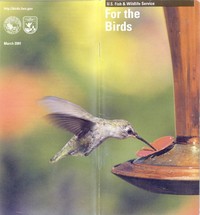
U.S. Fish & Wildlife Service
For the Birds
http://birds.fws.gov
March 2001
_Among the fondest and most memorable moments of childhood are the
discoveries of songbirds nesting in the backyard. The distinctive,
mud-lined nests of robins and their beautiful blue eggs captivate people
of all ages. Likewise, the nesting activities of house wrens, cardinals,
chickadees and other common birds can stimulate a lifelong interest in
nature._
_As you learn to enjoy the beauty of birdlife around their home, you may
wish to improve the “habitat” in your yard so that more birds will visit
your property. You can attract birds by placing bird feeders, nest
boxes, and bird baths in your yard, and by planting a variety of trees,
shrubs, and flowers. These can provide good nesting sites, winter
shelter, places to hide from predators and natural food supplies that
are available year-round._
_Backyard bird feeding is a convenient way to enjoy wildlife. More than
65 million Americans of all ages watch, feed and landscape for birds._
_It doesn’t matter where you live—in an apartment, townhouse or single
family dwelling, in the city, suburbs or country. Just stand still and
you’ll hear them: wild birds. It is hard to imagine life without them._
_Bird watching is one of the fastest growing forms of outdoor recreation
in the country. Each year millions of people discover for the first time
the joys of birdwatching. It’s easy to understand why. Birds are fun to
watch._
_And you can watch them just about everywhere. The most convenient place
to start is right in your own backyard. All it takes to get their
attention is food or water, a place to build a nest and appropriate
vegetation._
[Illustration: Bird on window feeder]
_Getting Started_
Backyard Bird Feeding
When you want to attract a particular bird species and keep it coming
back to your backyard, what you do will be determined by where you
live, and the time of year. For example, on any winter day, you are
likely to see a cardinal at a sunflower feeder in Virginia, a
goldfinch at a thistle feeder in Massachusetts and hummingbirds at a
nectar feeder in southern California.
A bird field identification book has pictures of different birds and
will help you find the names for the birds you’re likely to see and
the time of year you’re most likely to see them. So, first determine
what birds are likely to occur in your area.
Feeder Selection
When the ground is covered with snow and ice, it’s hard to resist just
tossing seed out the door. But it’s healthier for the birds to get
their handouts at a feeding station, rather than off the ground.
Regardless of the season, food that sits on the ground for even a
short time is exposed to contamination by dampness, mold, bacteria,
animal droppings, lawn fertilizers and pesticides.
You can start simply with a piece of scrap wood elevated a few inches
above the ground. Add a few holes for drainage and you’ve built a
platform feeder. It won’t be long before the birds find it.
There are several factors to consider after you’ve decided to feed
birds in your backyard.
_Placement_
Where do you want to watch your birds? From a kitchen window ... a
sliding glass door opening onto a deck ... a second-story window?
[Illustration: Window feeder]
Pick a location that is easy to get to. When the weather is bad and
birds are most vulnerable, you may be reluctant to fill a feeder that
is not in a convenient spot near a door or an accessible window. Also,
pick a site where discarded seed shells and bird droppings won’t be a
cleanup problem.
Put your feeder where the squirrels can’t reach. Squirrels become a
problem when they take over a bird feeder, scaring the birds away and
tossing seed all over. Squirrels have been known to chew right through
plastic and wooden feeders.
If you’ve seen squirrels in your neighborhood, it is safe to assume
they will visit your feeder. Think long and hard before you hang
anything from a tree limb. Squirrels are incredibly agile, and any
feeder hanging from a tree is likely to become a squirrel feeder.
[Illustration: _Photo: Kevin Tennyson, USDOI_]
In the long run, a squirrel-proof feeder or any feeder on a pole with
a baffle is the least aggravating solution. The most effective
squirrel-proof feeder is the pole-mounted metal “house” type.
If you must hang a feeder, select a tube protected with metal mesh.
Most plastic “squirrel-proof” feeders, despite manufacturers’ claims,
may eventually succumb to the squirrels. Any wood or plastic feeder
can be effective when mounted on a pole with a plastic or metal
baffle, if the pole is at least 10 feet or more from a tree limb or
trunk (squirrels can jump great distances).
_Durability_
Bird feeders are made from a variety of materials. You can buy
disposable plastic bag feeders; feeders made of cloth, nylon, vinyl
and metal netting; clear, lexan, colored and PVC plastic tubes;
ceramic and terra cotta; redwood, western cedar, birch, pine and
plywood; sheet metal and aluminized steel; glass tubes and bottles.
[Illustration: Terra Cotta feeder]
How long a feeder lasts depends on how well you maintain it, the
effects of weather, and whether squirrels can get to it. Water can get
into any feeder regardless of how carefully you protect it. Cloth,
vinyl, nylon and metal netting feeders are inexpensive, but they do
not protect your seed from spoiling in damp or wet weather. Improve
them by adding a plastic dome.
Most wood, plastic, ceramic and solid metal feeders keep seed dry, but
water can get into the feeding portals. Look for feeders with drainage
holes in the bottoms of both the feeder hopper and the seed tray.
Even bowl-type feeders and trays with drainage holes will clog with
seed and bird droppings that can mix with rainwater and be unhealthy
for any animal. Look for shallow plate-like seed trays to catch
dropped seeds while allowing spent seed shells to blow away.
When you feed birds, expect bird droppings and a leftover food mess.
While you do not have to wash the feeder daily, you should clean it at
least every few weeks. Diseases like salmonella can grow in moldy, wet
seed and bird droppings in your feeder tray and on the ground below.
Move your feeder a few feet each season to give the ground underneath
time to assimilate the seed debris and bird droppings.
The maintenance required to keep your feeder clean varies according to
the type of feeder. A thistle feeder for goldfinches should be cleaned
about once a month depending on how often it rains. Feeding
hummingbirds requires cleaning at the very least weekly, but
preferably two or three times a week. Sunflower and suet feeders need
to be cleaned only once a month.
Plastic, ceramic and glass feeders are easy to clean. Wash them in a
bucket of hot, soapy water fortified with a capful or two of chlorine
bleach. Use the same regimen with wood feeders, but substitute another
disinfectant for the bleach so your wood won’t fade.
_Food Capacity_
The ideal feeder capacity varies with your situation, and the types of
birds you want to attract. If you feed hummingbirds, big feeders are
not always better. One hummingbird will drink about twice its body
weight (less than an ounce) a day. Early in the season, hummers are
territorial and won’t share a feeder. A sixteen-ounce feeder can be
wasteful, or even lethal, because artificial nectar (sugar water) can
ferment in the hot summer sun. A two-ounce feeder is more than enough
for one hummer. Increase the size of your feeder depending on your
location and how many hummers you see in your yard.
[Illustration: Winter feeding]
If you opt for a large-volume seed feeder, protect it from the weather
and keep it clean. If after months of use, the birds suddenly abandon
your feeder full of seed, it’s time for a cleaning.
How Many Birds
If too many birds at your feeder become a problem, you can control
their numbers by putting out smaller amounts of seed, or by using
specialty seeds or restrictive feeders that will attract only certain
species. If you fill your feeder only when it’s empty, the birds will
look for food elsewhere.
You can encourage small birds and discourage large birds with feeders
that restrict access. Wood feeders with vertical bars and feeders
covered with wire mesh frustrate larger birds.
The most non-selective feeders are the tray, platform or house feeders
because they allow easy access by all birds.
Tube feeders without trays also restrict access to only small birds.
Remove the perches, and you’ve further restricted the feeder to only
those birds that can easily cling—finches, chickadees, titmice and
woodpeckers.
If starlings are a problem at your suet feeder, discourage them by
using a suet feeder with access only from the bottom. Starlings are
reluctant to perch upside down. Chickadees and woodpeckers don’t find
that a problem.
You can virtually eliminate visits by birds you would rather not see
by offering seeds they won’t eat. If you use more than one type of
seed, put them in separate feeders. This will reduce wasted seeds, as
birds will toss unwanted seeds out of a feeder to get to their
favorites.
Watch a feeder filled with a seed mix and you’ll see the birds
methodically drop or kick out most of the seeds to get to their
favorite—sunflower.
[Illustration: Seed mixtures]
Many birds prefer sunflower. Some prefer millet. A few prefer peanuts.
Sparrows, blackbirds, doves and juncos will eat the other grains used
in pre-made mixes: corn, milo, red millet, oats, wheat and canary
seed. Birds will also kick out artificial “berry” pellets, processed
seed flavored and colored to look like real fruit.
Black oil sunflower is the hands-down favorite of all the birds that
visit tube and house feeders. Birds who visit platform feeders (doves
and sparrows) favor white proso millet. Ducks, geese and quail will
eat corn. Many cereal grains (corn, milo, oats, canary, wheat, rape,
flax and buckwheat) in mixed bird seeds are NOT favorites of birds
that visit tube feeders.
The most effective way to attract the largest variety of birds to your
yard is to put out separate feeders for each food:
a starling-resistant suet feeder
a house feeder for sunflower
a bluebird feeder
a wire mesh cage feeder for peanut
a nectar feeder
a tube feeder for thistle
a stationary or tray fruit feeder
a house or platform feeder for millet
[Illustration: Suet Feeder]
[Illustration: Thistle Feeder]
[Illustration: Feeding Tray]
[Illustration: Nut Feeder]
Birds Attracted by Various Feeders and Foods
_Tube Feeder with Black Oil Sunflower_
goldfinches
chickadees
woodpeckers
nuthatches
titmice
redpolls
pine siskins
_... Adding a Tray to the Tube Feeder Will Also Attract_
cardinals
jays
crossbills
purple finches
house finches
white-throated sparrows
white-crowned sparrows
_Tray or Platform Feeder—with Millet_
doves
house sparrows
blackbirds
juncos
cowbirds
towhees
white-throated sparrows
tree sparrows
white-crowned sparrows
chipping sparrows
_Tray or Platform Feeder—with Corn_
starlings
house sparrows
grackles
jays
juncos
bobwhite quail
doves
ring-necked pheasants
white-throated sparrows
_Platform Feeder or Tube Feeder and Tray—with Peanuts_
cardinals
grackles
titmice
starlings
jays
_Niger Thistle Feeder with Tray_
goldfinches
house finches
purple finches
redpolls
pine siskins
doves
chickadees
song sparrows
dark-eyed juncos
white-throated sparrows
_Nectar Feeder_
hummingbirds
orioles
cardinals
tanagers
woodpeckers
finches
thrushes
_Fruit_
orioles
tanagers
mockingbirds
bluebirds
thrashers
cardinals
woodpeckers
jays
starlings
thrushes
cedar waxwings
yellow-breasted chats
_Hanging Suet Feeder_
woodpeckers
wrens
chickadees
nuthatches
kinglets
thrashers
creepers
cardinals
starlings
_Peanut Butter Suet_
woodpeckers
goldfinches
juncos
cardinals
thrushes
jays
kinglets
bluebirds
wrens
starlings
_Hanging Peanut Feeder_
woodpeckers
chickadees
titmice
Uninvited Guests at the Birdfeeder
Once you get your bird feeding station up and running, you may run
into problems with two kinds of uninvited guests—those interested in
the seeds (squirrels and chipmunks, rats and mice, and starlings and
house sparrows), and those interested in eating a bird for dinner
(cats and hawks).
[Illustration: Squirrel-resistant feeder]
When a squirrel is at the feeder, you’re not likely to see birds.
Squirrels will scare off the birds while they eat the seed and
sometimes they will eat the feeder too. The simplest solution is a
squirrel-proof feeder or pole.
Starlings and house sparrows are not native to North America and are
aggressive towards other species. Choose your feeder and seed to
exclude these species if possible.
Chipmunks, rats and mice can also become a problem where there is seed
spillage under the feeder. Don’t use mixed bird seed, and if you don’t
have a squirrel problem, add a feeder tray.
Feral cats and your neighbor’s tabby are a serious threat to many
birds. Keep feeders away from brushpiles and shrubbery, as this offers
cats the necessary cover to surprise birds.
If there are no cats in your neighborhood and you find a pile of
feathers near your feeder, look for a full-bellied hawk perching on a
tree nearby. Don’t put out poisons or try to trap hawks though, as
this is against state and federal law.
Questions about Feeding Wild Birds
_When is the best time to start?_
Usually, whenever the weather is severe, birds will appreciate a
reliable supplemental food source. In northern areas, start before the
onset of cold weather so birds have time to find the feeder.
_When’s the best time to stop?_
Although you can feed birds year-round, especially with fruit and
nectar, you can stop feeding seeds once a reliable supply of insects
is available in the spring.
_Is it best to stop feeding hummingbirds after Labor Day?_
There is no evidence that feeding hummingbirds after Labor Day will
keep them from migrating. In fact, it may help a weakened straggler
refuel for the long haul. Leave your nectar feeders out until the
birds stop coming.
_How long does it take for birds to find a feeder?_
It may take more time for birds to find window feeders than hanging or
pole-mounted feeders. You may want to wrap aluminum foil around the
top of the feeder hanger. Sometimes all it takes is the reflection of
light on the foil to catch their attention.
_My feeder is full of seeds. I haven’t seen a bird in months. Am I doing
something wrong?_
When birds desert your feeder, it may be simply that a lot of natural
food is available nearby. Or something may be wrong, such as spoiled
seeds or a contaminated feeder. Throw the seeds away and wash the
feeder. Look at where your feeder is placed. Be sure it’s not
vulnerable to predators. At the same time, make sure it is not in an
open area, away from the cover in which birds usually travel.
_Will birds’ feet stick to metal feeders and perches in the wet winter
weather?_
Birds don’t have sweat glands in their feet, so they won’t freeze onto
metal feeders. There’s no need to cover any metal feeders parts with
plastic or wood to protect birds’ feet, tongues or eyes.
_Do wild birds need grit?_
Birds have no teeth to grind their food. The dirt, sand, pebbles and
grit they eat sit in their crop and help grind up their food. Adding
grit to your feeder is helpful, particularly in the winter and spring.
Crushed eggshells do the same thing, and in the spring have an added
benefit: they provide birds with extra calcium for producing eggs of
their own.
_Can birds choke on peanut butter?_
There is no evidence that birds can choke on peanut butter. However,
birds have no salivary glands. You can make it easier on them by
mixing peanut butter with lard, cornmeal or grit. Your birds will
appreciate drinking water too, from a bird bath or trough.
_Won’t suet go bad in the summer?_
In the winter, raw beef fat from the local butcher is all you need for
your suet feeder. When temperatures rise, raw fat can melt and get
rancid. It’s safer to use commercially rendered suet cakes in the
spring and summer months. Rendering (boiling) the fat kills bacteria.
_What is hummingbird nectar? Do hummers need nectar fortified with vitamins
and minerals?_
You can make your own hummingbird nectar by adding ¼ cup of sugar to a
cup of boiling water. Remember, sugar water will ferment when left in
the hot sun, turning nectar deadly. Do not put out a nectar feeder if
you are not willing to clean it at least weekly, preferably twice a
week.
Hummers eat insects for their protein. There is no evidence that these
tiny birds need vitamin and mineral supplements. There is also no
evidence that adding red food coloring to nectar will harm the birds,
but it probably is not necessary to attract them. Just put your feeder
near red flowers or buy a red hummingbird feeder.
[Illustration: Hummingbird feeder]
_How can I avoid bees at my hummingbird feeder?_
Bees will inevitably visit your hummingbird feeder, especially in hot
weather. Little plastic bee guards may help keep them from getting
nectar but it won’t stop them from trying. Don’t take the chance of
contaminating your nectar by putting vegetable oil around the feeding
portals. One solution is to add a few small feeders away from where
people are likely to be bothered by bees.
_How close to my window can I put a feeder?_
Birds will come right to your window. Sometimes it takes a while for
them to overcome their initial reluctance, so be patient. Don’t worry
that a feeder on the window will cause birds to fly into the window.
Birds fly into the window because they see the reflection of the
woods. Window feeders and decals help break up the reflection.
_Is cracked corn coated with a red dye safe to use?_
No. The red or pink coating is capstan, a fungicide used on seeds
meant for planting. If you buy a bag of cracked corn or other seed
treated with capstan, return it to the store. It can kill horses,
other mammals and wild birds.
_I bought a bag of sunflower seeds early in the spring. Over the summer I
first noticed worms, then moths. What can I do to keep the bugs out?_
Moths lay their eggs in sunflower seeds. The eggs lay dormant as long
as the seeds are stored in a cool dry place. In the summer, seeds get
hot and the eggs hatch. The best way to avoid this problem is to buy
seeds in smaller quantities, or store your seeds in a cool, dry place.
It also helps to know where your retailer stores the seed. An
air-conditioned storage unit is the better choice.
Insects also lay their eggs in burlap bags. Don’t buy seeds in burlap
bags. Don’t buy seed in paper and plastic bags with patched holes.
That may be a sign of insect or rodent infestation.
Homes for Birds
_Birds You Can Attract to Nest Boxes_
Many of the birds that visit feeders and baths may stay and nest in
nearby trees. Most of them, including cardinals, doves and orioles,
don’t nest in boxes. You can still help them by considering their food
and shelter requirements in your landscape plans.
More than two dozen North American birds nest in bird houses. The
following descriptions will help you determine which birds might visit
your neighborhood.
_Bluebirds_
If you put up a bluebird house near an old field, orchard, park,
cemetery or golf course, you might have a chance of attracting a pair
of bluebirds. They prefer nest boxes on a tree stump or wooden fence
post between three and five feet high. Bluebirds also nest in
abandoned woodpecker nest holes.
The most important measurement is the hole diameter. An inch and a
half is small enough to deter starlings, which, along with house
sparrows, have been known to kill bluebirds, as well as adults sitting
on the nest. Bluebirds have problems with other animals too.
Discourage cats, snakes, raccoons and chipmunks by mounting the house
on a metal pole, or use a metal predator guard on a wood post.
_American Robins_
The robin is our largest thrush. They prefer to build their nest in
the crotch of a tree. If you don’t have an appropriate tree, you can
offer a nesting platform. Pick a spot six feet or higher up on a
shaded tree trunk or under the overhang of a shed or porch. Creating a
“mud puddle” nearby offers further enticement, as robins use mud to
hold their nests together.
_Chickadees, Nuthatches and Titmice_
Chickadees, titmice and nuthatches share the same food, feeders, and
habitat. If you put a properly designed nest box in a wooded yard, at
least one of these species might check it out.
Put chickadee houses at eye level. Hang them from limbs or secure them
to tree trunks. The entrance hole should be 1⅛ inches to attract
chickadees, yet exclude house sparrows. Anchor houses for nuthatches
on tree trunks five to six feet off the ground.
[Illustration: Titmouse house]
_Brown Creepers and Prothonotary Warblers_
Look for brown creepers to nest behind the curved bark of tree trunks.
In heavily wooded yards, slab bark houses appeal to creepers.
Prothonotary warblers also prefer slab bark houses, or bluebird boxes
attached to a tree trunk, but theirs must be placed over water (lakes,
rivers or swamps) with a good canopy of trees overhead.
_Wrens_
Wrens don’t seem to be very picky about where they nest. Try nest
boxes with a 1 inch × 2 inch horizontal slot (1½ inch × 2½ inch for
the larger Carolina wrens) instead of a circle. These are easier for
the wrens to use. However, the larger the opening, the more likely it
is house sparrows will occupy the box.
Wrens are known for filling a nest cavity with twigs, regardless of
whether they use the nest to raise their young. Since male house wrens
build several nests for the female to choose from, hang several nest
boxes at eye level on partly sunlit tree limbs. Wrens are sociable and
will accept nest boxes quite close to your house.
[Illustration: Inside of nesting cavity]
_Tree and Violet-green Swallows_
Tree swallows prefer nest boxes attached to dead trees. Space the
boxes about seven feet apart for these white-bellied birds with
iridescent blue-green backs and wings. The ideal setting for these
insect-eaters is on the edge of a large field near a lake, pond or
river.
Violet-green swallows nest in forested mountains of the West; boxes
placed on large trees in a semi-open woodland will attract them.
_Barn Swallows and Phoebes_
If you have the right habitat, like an open barn or old shed, barn
swallows and phoebes are easy to attract. It’s their nesting behavior,
not their plumage or song, that catches your attention. However, these
birds tend to nest where you would rather not have them: on a ledge
right over your front door. To avoid a mess by your door, offer the
birds a nesting shelf nearby where you’d rather have them.
[Illustration: Nesting ledge]
_Purple Martins_
Many people want martins in their yards because, it’s been said, these
birds eat 2,000 mosquitoes a day. While it’s true that they eat flying
insects, don’t expect purple martins to eliminate mosquitoes in your
yard completely. Martins prefer dragonflies, which prey on mosquito
larvae. If you want to help rid your yard of mosquitoes, put up a bat
roosting box. One bat can eat thousands of mosquitoes a night.
Martins are entertaining creatures, however, and you’ll enjoy watching
their antics in your backyard. You have the best chance of attracting
martins if you put a house on the edge of a pond or river, surrounded
by a field or lawn. Martins need a radius of about 40 feet of
unobstructed flying space around their houses. A telephone wire nearby
gives them a place to perch in sociable groups.
[Illustration: Ceramic house]
Martins nest in groups, so you’ll need a house with a minimum of four
large rooms—6 or more inches on all sides, with a 2½ inch entrance
hole about 1½ inches above the floor. Ventilation and drainage are
critical factors in martin house design. Porches, railings, porch
dividers and supplemental roof perches, like a TV antenna, make any
house more appealing.
You can also make houses from gourds by fashioning an entrance hole
and small holes in the bottom for drainage. If you use gourds, it’s
not necessary to add railings and perches. Adult martins will perch on
the wire used to hang the houses. Before you select a house, think
about what kind of pole you’re going to put it on. Martins occupy a
house ten to twenty feet off the ground. Some poles are less
cumbersome than others.
Gourd houses are the easiest to set up. String them from a wire
between two poles, from a sectional aluminum pole, or on pulleys
mounted to a crossbar high up on a pole.
You can mount lightweight aluminum houses for martins on telescoping
poles, providing easy access for maintenance and inspection. Because
of their weight (more than 30 pounds), wood houses should not be
mounted on telescoping poles. You’ll have to use a sturdy metal or a
wood pole attached to a pivot post. The problem with this lowering
technique is that you can’t tilt the house without damaging the nests
inside. If you put your house on a shorter, fixed pole, ten to twelve
feet high, you can use a ladder to inspect and maintain it.
_Flycatchers_
The great crested flycatcher and its western cousin, the ash-throated
flycatcher, are common in wooded suburbs and rural areas with
woodlots. Their natural nesting sites are abandoned woodpecker holes.
Flycatchers may nest in a bird house if it is placed about ten feet up
in a tree in an orchard or at the edge of a field or stream. This is a
longshot, but well worth the effort if you are successful.
_Woodpeckers_
You can attract all types of woodpeckers with a suet feeder, but only
the flicker is likely to use a bird house. They prefer a box with
roughened interior and a floor covered with a two-inch layer of wood
chips or coarse sawdust. Flickers are especially attracted to nest
boxes filled with sawdust, which they “excavate” to suit themselves.
For best results, place the box high up on a tree trunk, exposed to
direct sunlight.
Try building a birdhouse for the other species of woodpeckers
following the guidelines in this booklet. You might be surprised!
_Owls_
Most owls seldom build their own nests. Great horned and long-eared
owls prefer abandoned crow and hawk nests. Other owls (barred, barn,
saw-whet, boreal and screech) nest in tree cavities and bird houses.
Barn owls are best known for selecting nesting sites near farms. Where
trees are sparse, these birds will nest in church steeples, silos and
barns. If you live near a farm or a golf course, try fastening a nest
box for owls about 15 feet up on a tree trunk.
Screech owls prefer abandoned woodpecker holes at the edge of a field
or neglected orchard. They will readily take to boxes lined with an
inch or two of wood shavings. If you clean the box out in late spring
after the young owls have fledged, you may attract a second tenant—a
kestrel. Trees isolated from larger tracts of woods have less chance
of squirrels taking over the box.
[Illustration: Owl house]
Selecting a House
In the bird house business, there’s no such thing as “one size fits
all.” Decide which bird you want to attract, then get a house for that
particular bird. Look through any book or catalog and you’ll see bird
houses of all sizes and shapes, with perches and without, made of
materials you might not have thought of: recycled paper, gourds,
plastic, rubber, pottery, metal and concrete. The proper combination
of quality materials and design makes a good birdhouse.
[Illustration: Covered tray feeder]
Materials
Wood is just about the best building material for any birdhouse. It’s
durable, has good insulating qualities and breathes.
Three-quarter-inch thick bald cypress and red cedar are recommended.
Pine and exterior grade plywood will do, but they are not as durable.
It makes no difference whether the wood is slab, rough-cut or
finished, as long as the inside has not been treated with stains or
preservatives. Fumes from the chemicals could harm the birds.
There’s no need to paint cypress and cedar, but pine and plywood
houses will last longer with a coat of water-based exterior latex
paint. White is the color for purple martin houses. Tan, gray or dull
green works best for the other cavity nesting species. The dull, light
colors reflect heat and are less conspicuous to predators. Don’t paint
the inside of the box or the entrance hole.
Regardless of which wood you select, gluing all the joints before you
nail them will extend the life of your bird house. Galvanized or brass
shank nails, hinges and screws resist rusting and hold boxes together
more tightly as they age.
[Illustration: Suspended wooden nesting box]
Resist the temptation to put a metal roof on your bird house.
Reflective metal makes sense for martin houses up on a sixteen-foot
pole, but when it’s tacked onto the roof of a wood chickadee house,
the shiny metal is more likely to attract predators.
Natural gourds make very attractive bird houses. They breathe, and
because they sway in the wind they are less likely to be taken over by
house sparrows and starlings.
Grow your own gourds and you’ll have dozens to choose from in the
years ahead. If you don’t have the space to grow them, a coat of
polyurethane or exterior latex (on the outside only) will add years to
the one you have.
Properly designed pottery, aluminum (for purple martins only),
concrete and plastic houses are durable, but don’t drop them.
Be sure to provide ventilation, drainage, and easy access for
maintenance and monitoring. Concrete (or a mix of concrete and
sawdust) offers protection other houses cannot: squirrels can’t chew
their way in.
Design
How elaborate you make your bird house depends on your own tastes. In
addition to where you place the box, the most important considerations
are: box height, depth, floor dimensions, diameter of entrance hole
and height of the hole above the box floor.
Refer to the following chart before building your nest box, keeping in
mind that birds make their own choices, without regard for charts. So
don’t be surprised if you find tenants you never expected in a house
you intended for someone else.
[Illustration: Squirrel on feeder]
Nest Box Dimensions
Species Box floor Box Entrance Entrance Placement
(inches) height height (inches) diameter
(inches) (inches) height
(feet)
American Robin[1] 7×8 8 —— ——
Eastern & Western 5×5 8-12 6-10 1½ 4-6
Bluebirds
Mountain Bluebird 5×5 8-12 6-10 1½ 4-6
Chickadee 4×4 8-10 6-8 1⅛ 4-15
Titmouse 4×4 10-12 6-10 1¼ 5-15
Ash-throated Flycatcher 6×6 8-12 6-10 1½ 5-15
Great Crested Flycatcher 6×6 8-12 6-10 1¾ 5-15
Phoebe[1] 6×6 6 —— —— 8-12
Brown-headed/Pygmy/ 4×4 8-10 6-8 1¼ 5-15
Red-breasted Nuthatch
White-breasted Nuthatch 4×4 8-10 6-8 1⅜ 5-15
Prothonotary Warbler 5×5 6 4-5 1⅛ 4-8
Barn Swallow[1] 6×6 6 —— —— 8-12
Purple Martin 6×6 6 1-2 2¼ 6-20
Tree and Violet-Green 5×5 6-8 4-6 1½ 5-15
Swallows
Downy Woodpecker 4×4 8-10 6-8 1¼ 5-15
Hairy Woodpecker 6×6 12-15 9-12 1½ 8-20
Lewis’s Woodpecker 7×7 16-18 14-16 2½ 12-20
Northern Flicker 7×7 16-18 14-16 2½ 6-20
Pileated Woodpecker 8×8 16-24 12-20 3×4 15-25
Red-Headed Woodpecker 6×6 12-15 9-12 2 10-20
Yellow-bellied Sapsucker 5×5 12-15 9-12 1½ 10-20
Bewick’s/House Wrens 4×4 6-8 4-6 1¼ 5-10
Carolina Wren 4×4 6-8 4-6 1½ 5-10
Barn Owl 10×18 15-18 4 6 12-18
Screech-Owl and Kestrel 8×8 12-15 9-12 3 10-30
Osprey 48×48 platform
Red-tailed Hawk/Great 24×24 platform
Horned Owl
Wood Duck 10×18 10-24 12-16 4 10-20
[1]_Use nesting shelf, platform with three sides and an open front_
Now that you have the correct dimensions for your bird house, take a
look at how to make it safe: ventilation, drainage, susceptibility to
predators, and ease of maintenance.
_Ventilation_
You should provide air vents in bird boxes. There are two ways to
provide ventilation: leave gaps between the roof and sides of the box,
or drill ¼ inch holes just below the roof.
_Drainage_
Water becomes a problem when it sits in the bottom of a bird house. A
roof with sufficient slope and overhang offers some protection.
Drilling the entrance hole on an upward slant may also help keep the
water out. Regardless of design, driving rain will get in through the
entrance hole. You can assure proper drainage by cutting away the
corners of the box floor and drilling ¼-inch holes. Nest boxes will
last longer if the floors are recessed about ¼ inch.
_Entrance Hole_
Look for the entrance hole on the front panel near the top. A rough
surface both inside and out makes it easier for the adults to get into
the box and, when it’s time, for the nestlings to climb out.
If your box is made of finished wood, add a couple of grooves outside
below the hole. Open the front panel and add grooves, cleats or wire
mesh to the inside. Never put up a bird house with a perch below the
entrance hole. Perches offer starlings, house sparrows and other
predators a convenient place to wait for lunch. Don’t be tempted by
duplexes or houses that have more than one entrance hole. Except for
purple martins, cavity-nesting birds prefer not to share a house.
While these condos look great in your yard, starlings and house
sparrows are inclined to use them.
_Accessibility_
Bird houses should be easily accessible so you can see how your birds
are doing and clean out the house. Monitor your bird houses every week
and evict unwanted creatures such as house sparrows or starlings.
Be careful when you inspect your bird boxes—you may find something
other than a bird inside. Don’t be surprised to see squirrels, mice,
snakes or insects. Look for fleas, flies, mites, larvae and lice in
the bottom of the box. If you find insects and parasites, your first
reaction may be to grab the nearest can of insect spray. If you do,
use only insecticides known to be safe around birds: 1 percent
rotenone powder or pyrethrin spray. If wasps are a problem, coat the
inside top of the box with bar soap.
[Illustration: Squirrel in nest box]
Here’s how to check your nest boxes for unwanted visitors:
Watch the nest for 20-30 minutes. If you don’t see or hear any birds
near the box, go over and tap on the box. If you hear bird sounds,
open the top and take a quick peek inside. If everything is all right,
close the box. If you see problems (parasites or predators), remove
them and close the box.
A bird house with easy access makes the job simple. Most bird houses
can be opened from the top, the side, the front or the bottom. Boxes
that open from the top and the front provide the easiest access.
Opening the box from the top is less likely to disturb nesting birds.
It’s impossible to open a box from the bottom without the nest falling
out. While side- and front-opening boxes are convenient for cleaning
and monitoring, they have one drawback: the nestlings may jump out. If
this happens, don’t panic. Pick them up and put them back in the nest.
Don’t worry that the adults will reject the nestlings if you handle
them. That’s a myth; most birds have a terrible sense of smell.
[Illustration: Cleaning house]
If you clean out your nest boxes after each brood has fledged, several
pairs may use the nest throughout the summer. Some cavity-nesting
birds will not nest again in a box full of old nesting material.
In the fall, after you’ve cleaned out your nest box for the last time,
you can put it in storage or leave it out. Gourds and pottery last
longer if you take them in for the winter. You can leave your purple
martin houses up, but plug the entrance holes to discourage starlings
and house sparrows.
Leaving your wood and concrete houses out provides shelter for birds,
flying squirrels and other animals during winter. Each spring,
thoroughly clean all houses left out for the winter.
_Limiting Predator Access_
Proper box depth, and roof and entrance hole design will help reduce
access by predators, such as raccoons, cats, opossums, and squirrels.
Sometimes all it takes is an angled roof with a three-inch overhang to
discourage small mammals.
The entrance hole is the only thing between a predator and a bird
house full of nestlings. By itself, the ¾-inch wall is not wide enough
to keep out the arm of a raccoon or house cat. Add a predator guard (a
¾-inch thick rectangular wood block with an entrance hole cut in it)
to thicken the wall and you’ll discourage sparrows, starlings, and
cats.
Bird House Placement
Where you put your bird house is as important as its design and
construction. Cavity-nesting birds are very particular about where
they live. If you don’t have the right habitat, the birds are not
likely to find the house. You can modify your land to attract the
birds you want to see by putting out a bird bath, planting
fruit-bearing shrubs, including more trees or installing a pond with a
waterfall.
[Illustration: Variety of bird feeders]
Once you’ve matched up the right bird house with the appropriate
habitat, you have to know where to put the nest box. Should you hang
it from a tree limb, nail it to a fence or mount it on a pole or a
tree trunk?
Most species require a fairly narrow range of heights for nest boxes.
After checking the table in this brochure, pick a height that’s
convenient for you. After all, you will want to watch what goes on and
keep the box clean. If you want to watch chickadees from your second
floor window or deck, fifteen feet is reasonable but it’s a lot easier
to clean out a box at eye level.
Here are some tips on where to put bird houses:
don’t put bird houses near bird feeders.
houses mounted on metal poles are less vulnerable to predators than
houses nailed to tree trunks or hung from tree limbs.
use no more than four small nest boxes or one large box per acre for
any one species.
put about 100 yards between bluebird boxes and 75 yards between
swallow boxes. (If you have both species, pair the houses with one
bluebird box 25 feet from a swallow box.)
don’t put more than one box in a tree unless the tree is extremely
large or the boxes are for different species.
if you have very hot summers, face the entrance holes of your boxes
north or east to avoid overheating the box.
Protection from Predators
_Cats_
[Illustration: Cat]
Nesting birds are extremely vulnerable to cats, as are fledglings and
birds roosting for the night. Bell collars on cats offer birds little
protection. Nailing a sheet metal guard or cone to a tree trunk is
unsightly, but may deter less agile felines. Houses mounted on metal
poles are the most difficult for predators to reach, especially if you
smear the poles with a petroleum jelly and hot pepper mixture. The
best deterrent is for owners to keep their cats inside whenever
possible.
_Dogs_
Pet dogs are a hazard to nestlings in the spring and summer. Don’t let
your dog run loose during nesting time.
_Squirrels_
Red squirrels, and sometimes gray squirrels, can become a serious
menace to bird houses and the birds themselves. If you find your nest
hole enlarged, chances are a red squirrel is the culprit. Once inside
the box, squirrels make a meal of the eggs and young. Adding a
predator guard made of sheet metal to the entrance hole is usually
enough to keep squirrels out.
_Raccoons and Opossums_
Raccoons and opossums will stick their arms inside nest boxes and try
to pull out the adult, young, and eggs. Adding a ¾-inch thick predator
guard to the bird house or an inverted cone to its pole support is a
simple solution.
_Snakes_
Snakes play an important part in the balance of nature. If you find
one in your bird house, don’t kill it. Snake-proof your house by
putting it on a metal pole lathered with petroleum jelly or red
cayenne pepper.
_House Sparrows and Starlings_
If you don’t discourage them, these two nuisance species introduced
from Europe will harass or kill cavity-nesting birds. Since house
sparrows and starlings are not protected by law, you may destroy their
nests. But remember, other birds are protected by law.
_House Wrens_
House wrens sometimes interfere with the nesting success of other
birds by puncturing their eggs. But, unlike the house sparrow and
starling, these birds are native to North America and are protected by
law. Don’t be tempted to intervene when wrens appear at your backyard
birdhouse.
_Insects_
Many insects lay their eggs and pupate in bird houses. Inspect your
bird houses for signs of gypsy moths, blow flies, wasps, ants, gnats
and bees. Keep bees and wasps from attaching their nests by coating
the inside of the roof with bar soap. In areas where gypsy moths
abound, avoid placing boxes in oak trees, which the gypsy moths favor.
Pyrethrin and rotenone insecticides are recommended for killing fly
larvae, bird lice and mites after birds have finished nesting for the
season.
Attracting Birds
As people learn to enjoy the beauty of birds around their home, they
may wish to improve the “habitat” in their yard so that more birds
will visit their property. You can attract birds by placing bird
feeders, nest boxes and bird baths in your yard, and by planting a
variety of trees, shrubs, and flowers. These can provide good nesting
sites, winter shelter, places to hide from predators and natural food
supplies that are available year-round.
[Illustration: Bird bath]
Landscaping for Birds
The most surefire way to attract birds to your backyard is to make
certain the appropriate habitat is available to them. You may be lucky
and already have a good supply of food, shelter, and water available
for our feathered friends. In that case, you have to do little more
than stand back and watch.
However, for most backyards, bird habitat must be created. It’s called
“landscaping for birds” and it can be as simple or extravagant as you
wish. Whatever the approach, anyone who has ever tried this type of
landscaping comes away with a real love for it after their first
sparkling hummingbirds hover at the coral bells, or the perky catbird
comes down for a drink of water from the birdbath, or the sleek
waxwings gather en masse to sample bittersweet berries.
Benefits of Landscaping for Birds
You can derive many benefits from landscaping to attract birds to your
yard:
_Increased Wildlife Populations_
You can probably double the number of bird species using your property
with a good landscaping plan.
_Energy Conservation_
By carefully arranging your conifer and hardwood trees, you can lower
winter heating and summer cooling bills for your house.
_Soil Conservation_
Certain landscape plants can prevent soil erosion.
_Natural Beauty_
A good landscaping plan contributes to a beautiful, natural setting
around your home that is pleasing to people as well as birds.
[Illustration: Bath in garden setting]
_Wildlife Photography_
Wildlife photography is a wonderful hobby for people of all ages.
_Birdwatching_
Try keeping a list of all the birds you see in your yard or from your
yard. Some people have counted nearly 200 species of birds in their
yard!
_Natural Insect Control_
Birds such as tree swallows, house wrens, brown thrashers and orioles
eat a variety of insects.
_Food Production_
Some plants that attract wildlife are also appealing to humans. People
and wildlife can share cherries, chokecherries, strawberries, and
crabapples.
_Property Value_
A good landscaping plan can greatly increase the value of your
property by adding natural beauty and an abundance of wildlife.
_Habitat for Kids_
Some of the best wildlife habitats are the best habitats for young
people to discover the wonders of nature. A backyard bird habitat can
stimulate young people to develop a lifelong interest in wildlife and
conservation.
Basics of Landscaping for Birds
Landscaping for birds involves nine basic principles:
_Food_
Every bird species has its own unique food requirements that may
change as the seasons change. Learn the food habits of the birds you
wish to attract. Then plant the appropriate trees, shrubs, and flowers
to provide the fruits, berries, seeds, acorns, nuts and nectar.
_Water_
You may be able to double the number of bird species in your yard by
providing a source of water. A frog pond, water garden, or bird bath
will get lots of bird use, especially if the water is dripping,
splashing or moving.
_Shelter_
Birds need places where they can hide from predators and escape from
severe weather. Trees (including dead ones), shrubs, tall grass and
bird houses provide excellent shelter.
_Diversity_
The best landscaping plan is one that includes a variety of native
plants. This helps attract the most bird species.
_Four Seasons_
Give birds food and shelter throughout the year by planting a variety
of trees, shrubs and flowers that provide year-round benefits.
_Arrangement_
Properly arrange the different habitat components in your yard.
Consider the effects of prevailing winds (and snow drifting) so your
yard will be protected from harsh winter weather.
_Protection_
Birds should be protected from unnecessary mortality. When choosing
the placement of bird feeders and nest boxes, consider their
accessibility to predators. Picture windows can also be dangerous for
birds, who fly directly at windows when they see the reflection of
trees and shrubs. A network of parallel, vertical strings spaced 4
inches apart can be placed on the outside of windows to prevent this
problem. Be cautious about the kinds of herbicides and pesticides used
in your yard. Apply them only when necessary and strictly according to
label instructions. In fact, try gardening and lawn care without using
pesticides. Details can be found in gardening books at the library.
_Hardiness Zones_
When considering plants not native to your area, consult a plant
hardiness zone map, found in most garden catalogues. Make sure the
plants you want are rated for the winter hardiness zone classification
of your area.
_Soils and Topography_
Consult your local garden center, university or county extension
office to have your soil tested. Plant species are often adapted to
certain types of soils. If you know what type of soil you have, you
can identify the types of plants that will grow best in your yard.
Plants for Wild Birds
Seven types of plants are important as bird habitat:
_Conifers_
Conifers are evergreen trees and shrubs that include pines, spruces,
firs, arborvitae, junipers, cedars, and yews. These plants are
important as escape cover, winter shelter and summer nesting sites.
Some also provide sap, fruits and seeds.
_Grasses and Legumes_
Grasses and legumes can provide cover for ground nesting birds—but
only if the area is not mowed during the nesting season. Some grasses
and legumes provide seeds as well. Native prairie grasses are becoming
increasingly popular for landscaping purposes.
_Nectar-producing Plants_
Nectar-producing plants are very popular for attracting hummingbirds
and orioles. Flowers with tubular red corollas are especially
attractive to hummingbirds. Other trees, shrubs, vines and flowers
also can provide nectar for hummingbirds.
_Summer-fruiting Plants_
This category includes plants that produce fruits or berries from May
through August. In the summer these plants can attract brown
thrashers, catbirds, robins, thrushes, waxwings, woodpeckers, orioles,
cardinals, towhees and grosbeaks. Examples of summer-fruiting plants
are various species of cherry, chokecherry, honeysuckle, raspberry,
serviceberry, blackberry, blueberry, grape, mulberry, plum and
elderberry.
_Fall-fruiting Plants_
This landscape component includes shrubs and vines whose fruits ripen
in the fall. These foods are important both for migratory birds which
build up fat reserves before migration and as a food source for
nonmigratory species that need to enter the winter season in good
physical condition. Fall-fruiting plants include dogwoods, mountain
ash, winter-berries, cotoneasters and buffalo-berries.
_Winter-fruiting Plants_
Winter-fruiting plants are those whose fruits remain attached to the
plants long after they first become ripe in the fall. Many are not
palatable until they have frozen and thawed many times. Examples are
glossy black chokecherry, Siberian and “red splendor” crabapple,
snowberry, bittersweet, sumacs, American highbush cranberry, eastern
and European wahoo, Virginia creeper, and Chinaberry.
_Nut and Acorn Plants_
These include oaks, hickories, buckeyes, chestnuts, butternuts,
walnuts and hazels. A variety of birds, such as jays, woodpeckers and
titmice, eat the meats of broken nuts and acorns. These plants also
contribute to good nesting habitat.
How to Get Started
Think of this project as landscaping for birds. Your goal will be to
plant an assortment of trees, shrubs and flowers that will attract
birds. If you plan carefully it can be inexpensive and fun for the
whole family. The best way to get started is to follow these
guidelines:
_Set Your Priorities_
Decide what types of birds you wish to attract, then build your plan
around the needs of those species. Talk to friends and neighbors to
find out what kinds of birds frequent your area. Attend a local bird
club meeting and talk to local birdwatchers about how they have
attracted birds to their yards.
_Use Native Plants When Possible_
Check with the botany department of a nearby college or university or
with your state’s natural heritage program for lists of trees, shrubs,
and wildflowers native to your area. Use this list as a starting point
for your landscape plan. These plants are naturally adapted to the
climate of your area and are a good long-term investment. Many native
plants are both beautiful for landscaping purposes and excellent for
birds. If you include nonnative plant species in your plan, be sure
they are not considered “invasive pests” by plant experts. Check out
the bird books in your local library.
_Draw a Map of Your Property_
Draw a map of your property to scale using graph paper. Identify
buildings, sidewalks, power lines, buried cables, fences, septic tank
fields, trees, shrubs and patios. Consider how your plan relates to
your neighbor’s property—will the tree you plant shade out the
neighbor’s vegetable garden? Identify and map sunny or shady sites,
low or wet sites, sandy sites, and native plants that will be left in
place.
Also identify special views that you wish to enhance—areas for pets,
benches, picnics, storage, playing, sledding, vegetable gardens and
paths.
_Get Your Soil Tested_
Get your soil tested by your local garden center, county extension
agent or soil conservation service. Find out what kinds of soil you
have and then find out if your soils have nutrient or organic
deficiencies that fertilization or addition of compost can correct.
The soils you have will help determine the plants which can be
included in your landscaping plan.
_Review the Seven Plant Habitat Components_
Review the seven plant components described previously. Which
components are already present? Which ones are missing? Remember that
you are trying to provide food and cover through all four seasons.
Develop a list of plants that you think will provide the missing
habitat components.
_Talk to Resource Experts_
Review this plant list with landscaping resource experts who can match
your ideas with your soil types, soil drainage and the plants
available through state or private nurseries. People at the nearby
arboretum can help with your selections. At an arboretum you can also
see what many plants look like. Talk with local bird clubs, the
members of which probably are knowledgeable about landscaping for
birds.
_Develop Your Planting Plan_
Sketch on your map the plants you wish to add. Draw trees to a scale
that represents three-fourths of their mature width, and shrubs at
their full mature width. This will help you calculate how many trees
and shrubs you need. There is a tendency to include so many trees that
eventually your yard will be mostly shaded. Be sure to leave open
sunny sites where flowers and shrubs can thrive. Decide how much money
you can spend and the time span of your project. Don’t try to do too
much at once. You might try a five-year development plan.
_Implement Your Plan_
Finally, go to it! Begin your plantings and include your entire family
so they can all feel they are helping wildlife. Document your
plantings on paper and by photographs. Try taking pictures of your
yard from the same spots every year to document the growth of your
plants.
_Maintain Your Plan_
Keep your new trees, shrubs and flowers adequately watered, and keep
your planting areas weed-free by use of landscaping film and wood
chips or shredded bark mulch. This avoids the use of herbicides for
weed control. If problems develop with your plants, consult a local
nursery, garden center or county extension agent.
_And Finally ..._
Make sure to take the time to enjoy the wildlife that will eventually
respond to your landscaping efforts.
Protecting Bird Habitat
Each year your state wildlife agency, private conservation groups, the
U.S. Fish & Wildlife Service, other federal agencies, and many private
landowners and business leaders work together to conserve and manage
millions of acres of habitat—swamps, forests, ponds and grasslands.
These habitats provide nesting habitat for songbirds and shorebirds,
ducks and geese, hawks and owls.
You can make a difference in helping protect habitats for migratory
birds by joining Partners in Flight, a consortium of the above groups
dedicated to finding reasonable ways to maintain the health of bird
populations in the Western Hemisphere. For more information about
Partners in Flight, please contact U.S. Fish & Wildlife Service,
Office of Migratory Bird Management, 4401 North Fairfax Drive,
Arlington, VA 22203.
Another way that you can help preserve a disappearing but valuable
natural resource—wetlands—is by buying Federal Duck Stamps at your
local post office. Money from sales of these stamps is used to protect
wetlands. For more information, write U.S. Fish & Wildlife Service,
Federal Duck Stamp Office, 1849 C Street, NW, Washington, DC 20240.
_All photos copyright Maslowski Photo, Inc. except as noted._
Additional Resources
_Books_
A large variety of books are available on attracting, housing,
feeding, and gardening for birds. Check your local library, book
store, or the Internet, for a selection of books on attracting birds
to your yard.
_Web Sites_
There are many good on-line resources for bird enthusiasts. Below are
a few useful web sites that discuss some of the more popular backyard
birds; general information on bird feeding, housing, and gardening for
birds; ways to keep birds safe from predators; and opportunities for
you to become citizen scientists just by watching birds at your
feeder.
_WildBirds.com_—feeding and attracting
http://www.wildbirds.com
_Birding/Wild Birds_—backyard birds, birdhouses and feeders
http://www.birding.about.com/hobbies/birding
_Backyard Wildlife Habitats_—National Wildlife Federation
http://www.nwf.org/habitats
_Cats Indoors_—American Birding Conservancy
http://www.abcbirds.org/cats/catsindoors.htm
_North American Bluebird Society_
http://www.nabluebirdsociety.org
_Purple Martin Conservation Association_
http://www.purplemartin.org
_BirdSource_—FeederWatch and Classroom FeederWatch
http://birdsource.org
_National Bird-Feeding Society_
http://www.birdfeeding.org/
_Stokes Birds at Home/Birding_—feeding, housing, and gardening
http://www.stokesbirdsathome.com/birding
_Disclaimer_
_The U.S. Fish and Wildlife Service intends no endorsement and cannot
guarantee the accuracy of information found on these web sites._
Transcriber’s Notes
—Silently corrected a few typos.
—Retained publication information from the printed edition: this eBook
is public-domain in the country of publication.
—In the text versions only, text in italics is delimited by
_underscores_.
—Website references from the printed book may not be current.
End of the Project Gutenberg EBook of For the Birds, by Anonymous
*** END OF THE PROJECT GUTENBERG EBOOK 61796 ***
For the Birds
Subjects:
Download Formats:
Excerpt
_Among the fondest and most memorable moments of childhood are the
discoveries of songbirds nesting in the backyard. The distinctive,
mud-lined nests of robins and their beautiful blue eggs captivate people
of all ages. Likewise, the nesting activities of house wrens, cardinals,
chickadees and other common birds can stimulate a lifelong interest in
nature._
_As you learn to enjoy the beauty of birdlife around their home, you may
wish to improve the “habitat” in your yard so that more...
Read the Full Text
— End of For the Birds —
Book Information
- Title
- For the Birds
- Author(s)
- U.S. Fish and Wildlife Service
- Language
- English
- Type
- Text
- Release Date
- April 10, 2020
- Word Count
- 9,361 words
- Library of Congress Classification
- QL
- Bookshelves
- Browsing: Nature/Gardening/Animals, Browsing: Science - General
- Rights
- Public domain in the USA.
Related Books
Bird studies with a camera
by Chapman, Frank M. (Frank Michler)
English
750h 11m read

Boy bird house architecture
by Baxter, Leon H. (Leon Harold)
English
97h 34m read
Some Common Birds Useful to the Farmer (1915 edition)
by Beal, F. E. L. (Foster Ellenborough Lascelles)
English
296 hours read
Some Common Birds Useful to the Farmer (1926 edition)
by Beal, F. E. L. (Foster Ellenborough Lascelles)
English
305h 13m read
Some Common Birds in Their Relation to Agriculture
by Beal, F. E. L. (Foster Ellenborough Lascelles)
English
230h 58m read
Bird Biographies
by Ball, Alice Eliza
English
1158h 16m read