*** START OF THE PROJECT GUTENBERG EBOOK 42522 ***
[Illustration: Truly Yours Amos Lawrence
R Andrews Print.]
EXTRACTS
FROM THE
DIARY AND CORRESPONDENCE
OF THE LATE
AMOS LAWRENCE;
WITH A
+Brief Account of Some Incidents in his Life.+
EDITED BY HIS SON,
WILLIAM R. LAWRENCE, M. D.
BOSTON:
GOULD AND LINCOLN,
59 WASHINGTON STREET.
NEW YORK: SHELDON, LAMPORT & BLAKEMAN.
LONDON: TRUBNER & CO.
1856.
Entered according to Act of Congress, in the year 1855, by
WILLIAM R. LAWRENCE,
In the Clerk's Office of the District Court of the
District of Massachusetts
BOSTON:
Stereotyped by
HOBART & ROBBINS,
New England Type and Stereotype Foundery.
Press of George C. Rand & Avery.
+To his+
ONLY SURVIVING BROTHER,
A M O S A. L A W R E N C E,
OF BOSTON,
+This Volume is Affectionately Inscribed+,
BY
THE EDITOR.
PREFACE.
Among the papers of the late Amos Lawrence were found copies of a
large number of letters addressed to his children.
With the hope that the good counsels there given, during a succession
of years, extending from their childhood to adult age, might still be
made profitable to their descendants, he had caused them to be
carefully preserved.
These letters, as well as an irregular record of his daily experience,
were scattered through many volumes, and required arrangement before
they could be of use to those for whom they were intended.
As no one else of the immediate family could conveniently undertake
the task, the editor considered it his duty to do that which could not
properly be committed to one less nearly connected with the deceased.
The present volume, containing what was thought most interesting among
those letters and extracts, was accordingly prepared for private
circulation; and an edition of one hundred copies was printed and
distributed among the nearest relatives and friends.
It has been thought by many that the record of such a life as is here
portrayed would be useful to other readers, and especially to young
men,--a class in whom Mr. Lawrence was deeply interested, and with
whom circumstances in his own life had given him a peculiar bond of
sympathy.
Although many, among both friends and strangers, have urged the
publication of the present memorial, and some have even questioned the
moral right of withholding from the view of others the light of an
example so worthy of imitation, much hesitation has been felt in
submitting to the public the recital of such domestic incidents as are
treasured in the memory of every family; those incidents which cast a
sunbeam or a shadow across every fireside, and yet possess little or
no interest for the busy world without.
At the solicitation of the "Boston Young Men's Christian Union," the
"Boston Young Men's Christian Association," and the students of
Williams College, through their respective committees, and at the
request of many esteemed citizens, the pages which were prepared for
the eye of kindred and friends alone are now submitted to the public.
Personal feeling is forgotten in the hope that the principles here
inculcated may tend to promote the ends for which the subject of this
memorial lived and labored.
The interest manifested in his life, and the tributes rendered to his
memory, have been a source of sincere gratification to his family; and
they would here tender their acknowledgments to all those who have
expressed their interest and their wishes in regard to this
publication.
The present volume is submitted with a few unimportant omissions, and
with the addition of some materials, received after the issue of the
first edition, which will throw light upon the character and
principles of Mr. Lawrence during his early business career.
His course was that of a private citizen, who took but little part in
public measures or in public life.
To the general reader, therefore, there may be but little to amuse in
a career so devoid of incident, and so little connected with the
stirring events of his times; but there cannot fail to be something to
interest those who can appreciate the spirit which, in this instance,
led to a rare fidelity in the fulfilment of important trusts, and the
consecration of a life to the highest duties.
Mr. Lawrence was eminently a religious man, and a deep sense of
accountability may be discovered at the foundation of those acts of
beneficence, which, during his lifetime, might have been attributed to
a less worthy motive.
It has been the object of the editor to allow the subject of this
memorial to tell his own story, and to add merely what is necessary to
preserve the thread of the narrative, or to throw light upon the
various matters touched upon in the correspondence.
It is designed to furnish such materials as will afford a history of
Mr. Lawrence's charitable efforts, rather than give a detailed account
of what was otherwise an uneventful career.
Such selections from his correspondence are made as seemed best
adapted to illustrate the character of the man; such as exhibit his
good and valuable traits, without attempting to conceal those
imperfections, an exemption from which would elevate him above the
common sphere of mortals.
Most of his letters are of a strictly private nature, and involve the
record of many private details. His domestic tastes, and his affection
for his family, often led him to make mention of persons and events in
such a way that few letters could be wholly given without invading the
precincts of the family circle.
The engraving at the commencement of the volume is from an original
portrait, by Harding, in the possession of the editor, a copy of which
hangs in the library of Williams College.
It seems also fitting to include a portrait of the Hon. Abbott
Lawrence, who, for forty-three years, was so intimately associated
with the subject of this memorial in all the trials, as well as in the
triumphs, of business life, and who was still more closely connected
by the bonds of fraternal affection and sympathy. A few days only have
elapsed since he was removed from the scene of his earthly labors.
The grave has rarely closed over one who to such energy of character
and strength of purpose united a disposition so gentle and forbearing.
Amidst the perplexities attending his extended business relations, and
in the excitement of the political struggles in which he was called to
take part, he was never tempted to overstep the bounds of courtesy, or
to regard his opponents otherwise than with feelings of kindness.
His wealth was used freely for the benefit of others, and for the
advancement of all those good objects which tended to promote the
welfare of his fellow-men.
That divine spark of charity, which burned with such ceaseless energy
in the bosom of his elder brother, was caught up by him, and exhibited
its fruits in those acts of munificence which will make him long
remembered as a benefactor of his race.
BOSTON, _September_ 1st, 1855.
LETTERS,
REQUESTING PUBLICATION.
_Rooms of the Boston Young Men's Christian Union,
6 Bedford-street, Boston, June 22, 1855._
WILLIAM R. LAWRENCE, ESQ.
DEAR SIR: The undersigned, members of the Government of the Boston
Young Men's Christian Union, some of whom have perused the excellent
memoir of your honored father, feel deeply impressed with the desire
that it should be published and circulated, knowing that its
publication and perusal would greatly benefit the young, the old, and
all classes of our busy mercantile community.
Remembering with pleasure the friendship which your father expressed,
not only in kind words, but in substantial offerings to the treasury
and library of our Society, the Union would be most happy, should it
comport with your feelings, to be made the medium of the publication
and circulation of the memoir, which you have compiled with so much
ability and faithfulness.
Hoping to receive a favorable response to our desire,
We are most truly yours,
THOMAS GAFFIELD, H. K. WHITE,
JOHN SWEETSER, J. F. AINSWORTH,
JOSEPH H. ALLEN, W. H. RICHARDSON,
CHAS. C. SMITH, FRANCIS S. RUSSELL,
C. J. BISHOP, FREDERIC H. HENSHAW,
F. H. PEABODY, CHARLES F. POTTER,
W. IRVING SMITH, THORNTON K. LOTHROP,
ARTHUR W. HOBART. GEO. S. HALE.
* * * * *
_Rooms of the Boston Young Men's Christian Association,
Tremont Temple, Boston, July 10, 1855._
DEAR SIR:
The Committee on the Library of the Boston Young Men's Christian
Association beg leave, in its behalf, to tender you sincere thanks for
your donation of a copy of the "Diary and Correspondence of Amos
Lawrence." It will remain to the members of the Association a valued
memorial of one of its earliest benefactors. It will be yet more
prized for its record of his invaluable legacy,--the history of a long
life--a bright example.
The Committee, uniting with the subscribers, managers of the
Association, are happy to improve this opportunity to express the hope
that you may be induced to give the book a more general circulation.
The kindly charities of your late lamented parent are still fresh in
impressions of gratitude upon their recipients. They require no herald
to give them publicity. The voice of fame would do violence to their
spirit.
Yet, now that "the good man" can no more utter his words of sympathy
and counsel,--that his pen can no more subscribe its noble
benefactions, or indite its lessons of wisdom and experience,--the
press may silently perpetuate those which survive him.
We must assure you of our pleasure in the knowledge that the liberal
interest in the Association, so constantly manifested by your revered
father, is actively maintained by yourself.
We remain, in the fraternal bonds of Christian regard,
Yours, truly,
JACOB SLEEPER, FRANCIS D. STEDMAN,
J. S. WARREN, ELIJAH SWIFT,
SAMUEL GREGORY, B. C. CLARK, JR.,
LUTHER L. TARBELL, JOSEPH P. ELLICOTT,
ALONZO C. TENNEY, GEO. N. NOYES,
MOSES W. POND, PEARL MARTIN,
STEPHEN G. DEBLOIS, W. H. JAMESON,
HENRY FURNAS, W. F. STORY.
FRANKLIN W. SMITH, }
E. M. PUTNAM, } _Committee
CHAS. L. ANDREWS, } on
GEO. C. RAND, } Library and Rooms_
H. C. GILBERT, }
To
WILLIAM R. LAWRENCE, M.D.
* * * * *
_Williams College, June 30, 1855._
DEAR SIR:
The students of Williams College having learned that you have
prepared, for private distribution, a volume illustrating the
character of the late Amos Lawrence, whose munificence to this
Institution they appreciate, and whose memory they honor; the
undersigned, a Committee appointed for the purpose, express to you
their earnest desire that you would allow it to be published.
Very truly yours,
SAMUEL B. FORBES,
E. C. SMITH,
FRED. W. BEECHER,
HENRY HOPKINS.
To
W. R. LAWRENCE, M.D., _Boston_.
CONTENTS.
PAGE
CHAPTER I.
BIRTH.--ANCESTRY.--PARENTS, 15
CHAPTER II.
EARLY YEARS.--SCHOOL DAYS.--APPRENTICESHIP, 20
CHAPTER III.
ARRIVAL IN BOSTON.--CLERKSHIP.--COMMENCES BUSINESS.--HABITS, 28
CHAPTER IV.
BUSINESS HABITS.--HIS FATHER'S MORTGAGE.--RESOLUTIONS.--ARRIVAL
OF BROTHERS IN BOSTON, 35
CHAPTER V.
VISITS AT GROTON.--SICKNESS.--LETTER FROM DR. SHATTUCK.--
ENGAGEMENT.--LETTER TO REV. DR. GANNETT.--MARRIAGE, 40
CHAPTER VI.
BRAMBLE NEWS.--JUNIOR PARTNER GOES TO ENGLAND.--LETTERS TO
BROTHER, 47
CHAPTER VII.
DEATH OF SISTER.--LETTERS, 54
CHAPTER VIII.
DOMESTIC HABITS.--ILLNESS AND DEATH OF WIFE, 59
CHAPTER IX.
JOURNEYS.--LETTERS.--JOURNEY TO NEW YORK, 68
CHAPTER X.
MARRIAGE.--ELECTED TO LEGISLATURE.--ENGAGES IN MANUFACTURES.--
REFLECTIONS, 77
CHAPTER XI.
REFLECTIONS.--BUNKER HILL MONUMENT.--LETTERS, 82
CHAPTER XII.
JOURNEY TO CANADA.--LETTERS.--DIARY.--CHARITIES, 89
CHAPTER XIII.
CORRESPONDENCE WITH MR. WEBSTER.--LETTERS, 96
CHAPTER XIV.
TESTIMONIAL TO MR. WEBSTER.--DANGEROUS ILLNESS.--LETTERS, 102
CHAPTER XV.
JOURNEY TO NEW HAMPSHIRE.--LETTERS.--RESIGNS OFFICE OF TRUSTEE
AT HOSPITAL.--LETTERS, 109
CHAPTER XVI.
DAILY EXERCISE.--REGIMEN.--IMPROVING HEALTH.--LETTERS, 122
CHAPTER XVII.
REFLECTIONS.--VISIT TO WASHINGTON.--VISIT TO RAINSFORD
ISLAND.--REFLECTIONS.--VIEW OF DEATH.--REFLECTIONS, 137
CHAPTER XVIII.
BROTHER'S DEATH.--LETTERS.--GIFTS.--LETTERS.--BIRTH-PLACE.--
DIARY.--APPLICATIONS FOR AID.--REFLECTIONS.--LETTER FROM
REV. DR. STONE.--DIARY, 147
CHAPTER XIX.
REFLECTIONS.--LETTERS.--ACCOUNT OF EFFORTS TO COMPLETE BUNKER
HILL MONUMENT, 165
CHAPTER XX.
INTEREST IN MOUNT AUBURN.--REV. DR. SHARP.--LETTER FROM BISHOP
McILVAINE.--LETTER FROM JUDGE STORY, 175
CHAPTER XXI.
ACQUAINTANCE WITH PRESIDENT HOPKINS.--LETTERS.--AFFECTION FOR
BRATTLE-STREET CHURCH.--DEATH OF MRS. APPLETON.--
LETTERS.--AMESBURY CO., 182
CHAPTER XXII.
DEATH OF HIS DAUGHTER.--LETTERS.--DONATION TO WILLIAMS
COLLEGE.--BENEFICENCE.--LETTERS, 193
CHAPTER XXIII.
LETTER FROM DR. SHARP.--ILLNESS AND DEATH OF HIS SON.--
LETTERS.--AFFLICTIONS, 203
CHAPTER XXIV.
REFLECTIONS.--EXPENDITURES.--LETTERS.--DONATION FOR LIBRARY AT
WILLIAMS COLLEGE.--VIEWS ON STUDY OF ANATOMY, 212
CHAPTER XXV.
DONATION TO LAWRENCE ACADEMY.--CORRESPONDENCE WITH R. G.
PARKER.--SLEIGH-RIDES.--AVERSION TO NOTORIETY.--CHILDREN'S
HOSPITAL, 221
CHAPTER XXVI.
CAPTAIN A. S. MCKENZIE.--DIARY.--AID TO IRELAND.--MADAM
PRESCOTT.--SIR WILLIAM COLEBROOKE, 234
CHAPTER XXVII.
MR. LAWRENCE AS AN APPLICANT.--LETTERS.--DIARY.--PRAYER AND
MEDITATIONS.--FAC-SIMILE OF HAND-WRITING.--LIBERALITY
TO A CREDITOR.--LETTERS, 242
CHAPTER XXVIII.
REFLECTIONS.--VIEWS ON HOLDING OFFICE.--LETTERS.--CAPT. A.
SLIDELL McKENZIE.--DEATH OF BROTHER AND OF HON. J. MASON, 255
CHAPTER XXIX.
SYSTEM IN ACCOUNTS.--LETTER FROM PROF. STUART--LETTERS.--
DIARY.--DR. HAMILTON.--FATHER MATHEW, 264
CHAPTER XXX.
CODICIL TO WILL.--ILLNESS--GEN. WHITING.--LETTERS.--DIARY, 271
CHAPTER XXXI.
DIARY.--REFLECTIONS.--SICKNESS.--LETTER FROM DR. SHARP.--
CORRESPONDENCE, 278
CHAPTER XXXII.
AMIN BEY.--AMOUNT OF DONATIONS TO WILLIAMS COLLEGE, 285
CHAPTER XXXIII.
LETTERS--LIKENESS OF ABBOTT LAWRENCE.--DIARY, 292
CHAPTER XXXIV.
SIR T. F. BUXTON.--LETTER FROM LADY BUXTON.--ELLIOTT
CRESSON.--LETTERS, 298
CHAPTER XXXV.
LETTERS.--REV. DR. SCORESBY.--WABASH COLLEGE, 304
CHAPTER XXXVI.
DIARY.--AMOUNT OF CHARITIES.--LETTERS.--THOMAS TARBELL.--
UNCLE TOBY.--REV. DR. LOWELL, 311
CHAPTER XXXVII.
CORRESPONDENCE.--DIARY, 324
CHAPTER XXXVIII.
MR. LAWRENCE SERVES AS PRESIDENTIAL ELECTOR.--GEN. FRANKLIN
PIERCE--SUDDEN DEATH.--FUNERAL, 334
CHAPTER XXXIX.
SKETCH OF CHARACTER BY REV. DRS. LOTHROP AND HOPKINS, 343
CHAPTER XL.
CONCLUSION, 352
INDEX, 361
DIARY AND CORRESPONDENCE.
CHAPTER I.
BIRTH.--ANCESTRY.--PARENTS.
Amos Lawrence was born in Groton, Mass., on the 22d of April, 1786.
His ancestor, John Lawrence, was baptized, according to the records,
on the 8th of October, 1609, at Wisset, County of Suffolk, England,
where the family had resided for a long period, though originally from
the County of Lancaster.
Butler, in his "History of Groton," has, among other details, the
following:
"The first account of the ancestor of the numerous families of
this name in Groton and Pepperell, which can be relied upon as
certain, is, that he was an inhabitant of Watertown as early as
1635. He probably came in the company which came with Governor
Winthrop, in 1630. His given name was John, and that of his wife
was Elizabeth. Whether they were married in England or not, has
not been ascertained. Their eldest child was born in Watertown,
January 14, 1635. He removed to Groton, with probably all his
family, at an early period of its settlement, as his name is
found in the records there in 1663. He was an original
proprietor, having a twenty-acre right."
Of the parents of the subject of this memoir, the same author writes:
"Samuel Lawrence, the son of Captain Amos Lawrence, sen., was an
officer in the continental army, in the former part of the
Revolutionary War. He was in the battle of Bunker Hill, where a
musket-ball passed through his beaver hat. He was also in the
battle in Rhode Island, where he served as adjutant under General
Sullivan. On the 22d day of July, 1777, being at home, on a
furlough, for the express purpose, he was married to Susanna
Parker. * * * *
"Having faithfully served in the cause of his country during the
term of his engagement, he returned to his native town, to enjoy
the peace and quiet of domestic life on his farm. He was elected
by his townsmen to some of the highest offices in their gift; he
was a deacon of the church, and a justice of the peace _quorum
unus_. He took a deep interest in providing means for the
education of youth, particularly in establishing and supporting
the seminary in Groton, which now, in gratitude to him and his
sons, bears the family name. Of this institution he was a trustee
thirty-three years, and in its benefits and advantages he gave
ample opportunities for all his children to participate. Here
their minds undoubtedly received some of those early impressions,
the developments and consequences of which it will be the work of
their biographers hereafter to portray. No deduction, however,
should here be made from the importance of parental instruction,
to add to the merit of academical education. The correct lessons
given by the mother in the nursery are as necessary to give the
right inclination to the tender mind as are those of the tutor in
the highest seminary to prepare it for the business of life and
intellectual greatness. In the present case, all the duties
incumbent on a mother to teach her offspring to be good, and
consequently great, were discharged with fidelity and success.
Both parents lived to see, in the subject of their care, all that
they could reasonably hope or desire. He died November 8, 1827,
æt. seventy-three; and his venerable widow, May 2, 1845, æt.
eighty-nine."
Mr. Lawrence writes, in 1849, to a friend:
"My father belonged to a company of _minute-men_ in Groton, at
the commencement of the Revolution. On the morning of the 19th of
April, 1775, when the news reached town that the British troops
were on the road from Boston, General Prescott, who was a
neighbor, came towards the house on horseback, at rapid speed,
and cried out, 'Samuel, notify your men: _the British are
coming_.' My father mounted the general's horse, rode a distance
of seven miles, notified the men of his circuit, and was back
again at his father's house in forty minutes. In three hours the
company was ready to march, and on the next day (the 20th)
reached Cambridge. My father was in the battle of Bunker Hill;
received a bullet through his cap, which cut his hair from front
to rear; received a spent grape-shot upon his arm, without
breaking the bone; and lost a large number of men. His veteran
Captain Farwell was shot through the body, was taken up for dead,
and was so reported by the man who was directed to carry him off.
This report brought back the captain's voice, and he exclaimed,
with his utmost power, '_It an't true; don't let my poor wife
hear of this; I shall live to see my country free._' And so it
turned out. This good man, who had served at the capture of Cape
Breton in 1745, again in 1755, and now on Bunker Hill in 1775, is
connected with everything interesting in my early days. The
bullet was extracted, and remains, as a memento, with his
descendants. My father and mother were acquainted from their
childhood, and engaged to be married some time in 1775. They kept
up a correspondence through 1776, when he was at New York; but,
on a visit to her, in 1777 (his mother having advised them to be
married, as Susan had better be Sam's widow than his forlorn
damsel), they were married; but, while the ceremony was going
forward, the signal was given to call all soldiers to their
posts; and, within the hour, he left his wife, father, mother,
and friends, to join his regiment, then at Cambridge. This was on
the 22d day of July, 1777. In consideration of the circumstances,
his colonel allowed him to return to his wife, and to join the
army at Rhode Island in a brief time (two or three days). He did
so, and saw nothing more of home until the last day of that year.
The army being in winter quarters, he got a furlough for a short
period, and reached home in time to assist at the ordination of
the Rev. Daniel Chaplin, of whose church both my parents were
then members. His return was a season of great joy to all his
family. His stay was brief, and nothing more was seen of him
until the autumn of 1778, when he retired from the army, in time
to be with his wife at the birth of their first child. From that
time he was identified with everything connected with the good of
the town. As we children came forward, we were carefully looked
after, but were taught to use the talents intrusted to us; and
every nerve was strained to provide for us the academy which is
now doing so much there. We _sons_ are doing less for education
_for our means_ than our father for his means."
Of his mother Mr. Lawrence always spoke in the strongest terms of
veneration and love, and in many of his letters are found messages of
affection, such as could have emanated only from a heart overflowing
with filial gratitude. Her form bending over their bed in silent
prayer, at the hour of twilight, when she was about leaving them for
the night, is still among the earliest recollections of her children.
She was a woman well fitted to train a family for the troubled times
in which she lived. To the kindest affections and sympathies she
united energy and decision, and in her household enforced that strict
and unhesitating obedience, which she considered as the foundation of
all success in the education of children. Her hands were never idle,
as may be supposed, when it is remembered that in those days,
throughout New England, in addition to the cares of a farming
establishment, much of the material for clothing was manufactured by
the inmates of the family. Many hours each day she passed at the
hand-loom, and the hum of the almost obsolete spinning-wheel even now
comes across the memory like the remembrance of a pleasant but
half-forgotten melody.
CHAPTER II.
EARLY YEARS.--SCHOOL DAYS.--APPRENTICESHIP.
The first public instruction received by Mr. Lawrence was at the
district school kept at a short distance from his father's house.
Possessing a feeble constitution, he was often detained at home by
sickness, where he employed himself industriously with his books and
tools, in the use of which he acquired a good degree of skill, as may
be seen from a letter to his son, at Groton, in 1839:
"Near the barn used to be an old fort, where the people went to
protect themselves from the Indians; and, long since my
remembrance, the old cellar was there, surrounded by elder-bushes
and the like. I made use of many a piece of the elder for
pop-guns and squirts, in the preparation of which I acquired a
strong taste for the use of the pen-knife and jack-knife. I like
the plan of boys acquiring the taste for tools, and of their
taking pains to learn their use; for they may be so situated as
to make a very slight acquaintance very valuable to them. And,
then, another advantage is that they may have exercise of body
and mind in some situations where they would suffer without. How
do you employ yourself? Learn as much as you can of farming; for
the work of your hands in this way may prove the best resource
in securing comfort to you. The beautiful images of early life
come up in these bright moonlight nights, the like of which I
used to enjoy in the fields below our old mansion, where I was
sent to watch the cattle. There I studied astronomy to more
account than ever afterwards; for the heavens were impressive
teachers of the goodness of that Father who is ever near to each
one of his children. May you never lose sight of this truth, and
so conduct yourself that at any moment you may be ready to answer
when He calls!"
He did not allow himself to be idle, but, from his earliest years,
exhibited the same spirit of industry which led to success in after
life. With a natural quickness of apprehension, and a fondness for
books, he made commendable progress, in spite of his disadvantages.
His father's social disposition and hospitable feelings made the house
a favorite resort for both friends and strangers; and among the most
welcome were old messmates and fellow-soldiers, to whose marvellous
adventures and escapes the youthful listener lent a most attentive
ear. In after life he often alluded to the intense interest with which
he hung upon these accounts of revolutionary scenes, and times which
"tried men's souls." The schoolmaster was usually billeted upon the
family; and there are now living individuals high in political and
social life who served in that capacity, and who look back with
pleasure to the days passed under that hospitable roof.
At a later period, he seems to have been transferred to another
school, in the adjoining district, as will be seen by the following
extract of a letter, written in 1844, to a youth at the Groton
Academy:
"More than fifty years ago, your father and I were school
children together. I attended then at the old meeting-house, or
North Barn, as it was called, by way of derision, where I once
remember being in great tribulation at having lost my
spelling-book on the way. It was afterwards restored to me by
Captain Richardson, who found it under his pear-tree, where I had
been, without leave, on my way to school, and with the other
children helped myself to his fruit."
From the district school, Mr. Lawrence entered the Groton Academy, of
which all his brothers and sisters were members at various times. As
his strength was not sufficient to make him useful upon the farm, in
the autumn of 1799 he was placed in a small store, in the neighboring
town of Dunstable. There he passed but a few months; and, on account,
perhaps, of greater facilities for acquiring a knowledge of business,
he was transferred to the establishment of James Brazer, Esq., of
Groton, an enterprising and thrifty country merchant, who transacted a
large business, for those times, with his own and surrounding towns.
The store was situated on the high road leading from Boston to New
Hampshire and Canada, and was, consequently, a place of much resort,
both for travellers and neighbors who took an interest in passing
events. Several clerks were employed; and, as Mr. Brazer did not take
a very active part in the management of the business, after a year or
two nearly the whole responsibility of the establishment rested upon
young Lawrence. The stock consisted of the usual variety kept in the
country stores of those days, when neighbors could not, as now, run
down to the city, thirty or forty miles distant, for any little matter
of fancy, and return before dinner-time. Puncheons of rum and brandy,
bales of cloth, kegs of tobacco, with hardware and hosiery, shared
attention in common with silks and thread, and all other articles for
female use. Among other duties, the young clerk was obliged to
dispense medicines, not only to customers, but to all the physicians
within twenty miles around, who depended on this establishment for
their supply.
The confidence in his good judgment was such that he was often
consulted, in preference to the physician, by those who were suffering
from minor ails; and many were the extemporaneous doses which he
administered for the weal or woe of the patient. The same confidence
was extended to him in all other matters, no one doubted his
assertion; and the character for probity and fairness which
accompanied him through life was here established.
The quantity of rum and brandy sold would surprise the temperance men
of modern days. At eleven o'clock, each forenoon, some stimulating
beverage, according to the taste of the clerk who compounded it, was
served out for the benefit of clerks and customers. Mr. Lawrence
partook with the others; but, soon finding that the desire became more
pressing at the approach of the hour for indulgence, he resolved to
discontinue the habit altogether:
"His mind was soon made up. Understanding perfectly the ridicule
he should meet with, and which for a time he did meet with in its
fullest measure, he yet took at once the ground of _total
abstinence_. Such a stand, taken at such an age, in such
circumstances of temptation, before temperance societies had been
heard of, or the investigations had been commenced on which they
are based, was a practical instance of that judgment and decision
which characterized him through life."[1]
[1] President Hopkins's Sermon in commemoration of Amos Lawrence
In regard to this resolution, he writes, many years afterward, to a
young student in college:
"In the first place, take this for your motto at the commencement
of your journey, that the difference of going _just right_, or a
_little wrong_, will be the difference of finding yourself in
good quarters, or in a miserable bog or slough, at the end of it.
Of the whole number educated in the Groton stores for some years
before and after myself, no one else, to my knowledge, escaped
the bog or slough; and my escape I trace to the simple fact of my
having put a restraint upon my appetite. We five boys were in the
habit, every forenoon, of making a drink compounded of rum,
raisins, sugar, nutmeg, &c., with biscuit,--all palatable to eat
and drink. After being in the store four weeks, I found myself
admonished by my appetite of the approach of the hour for
indulgence. Thinking the habit might make trouble if allowed to
grow stronger, without further apology to my seniors I declined
partaking with them. My first resolution was to abstain for a
week, and, when the week was out, for a month, and then for a
year. Finally, I resolved to abstain for the rest of my
apprenticeship, which was for five years longer. During that
whole period, I never drank a spoonful, though I mixed gallons
daily for my old master and his customers. I decided not to be a
slave to tobacco in any form, though I loved the odor of it then,
and even now have in my drawer a superior Havana cigar, given me,
not long since, by a friend, but only to smell of. I have never
in my life smoked a cigar; never chewed but one quid, and that
was before I was fifteen; and never took an ounce of snuff,
though the scented rappee of forty years ago had great charms for
me. Now, I say, to this simple fact of starting _just right_ am I
indebted, with God's blessing on my labors, for my present
position, as well as that of the numerous connections sprung up
around me. I have many details that now appear as plain to me as
the sun at noonday, by which events are connected together, and
which have led to results that call on me to bless the Lord for
all his benefits, and to use the opportunities thus permitted to
me in cheering on the generation of young men who have claims
upon my sympathies as relations, fellow-townsmen, or brethren on
a more enlarged scale."
Of this period he writes elsewhere, as follows:
"When I look back, I can trace the small events which happened at
your age as having an influence upon all the after things. My
academy lessons, little academy balls, and eight-cent expenses
for music and gingerbread, the agreeable partners in the hall,
and pleasant companions in the stroll, all helped to make me feel
that I had a character even then; and, after leaving school and
going into the store, there was not a month passed before I
became impressed with the opinion that restraint upon appetite
was necessary to prevent the slavery I saw destroying numbers
around me. Many and many of the farmers, mechanics, and
apprentices, of that day, have filled drunkards' graves, and have
left destitute families and friends.
"The knowledge of every-day affairs which I acquired in my
business apprenticeship in Groton has been a source of pleasure
and profit even in my last ten years' discipline."
The responsibility thrown upon the young clerk was very great; and he
seems cheerfully to have accepted it, and to have given himself up
entirely to the performance of his business duties. His time, from
early dawn till evening, was fully taken up; and, although living in
the family of his employer, and within a mile of his father's house, a
whole week would sometimes pass without his having leisure to pay even
a flying visit.
But few details of his apprenticeship can now be gathered either from
his contemporaries or from any allusions in his own writings. He was
disabled for a time by an accident which came near being fatal. In
assisting an acquaintance to unload a gun, by some means the charge
exploded, and passed directly through the middle of his hand, making
a round hole like that of a bullet. Sixty-three shot were picked out
of the floor after the accident, and it seemed almost a miracle that
he ever again had the use of his hand.
CHAPTER III.
ARRIVAL IN BOSTON.--CLERKSHIP.--COMMENCES BUSINESS.--HABITS.--LETTERS.
On the 22d of April, 1807, Mr. Lawrence became of age; and his
apprenticeship, which had lasted seven years, was terminated.
On the 29th of the same month, he took his father's horse and chaise,
and engaged a neighbor to drive him to Boston, with, as he says, many
years afterwards,--
"Twenty dollars in my pocket, but feeling richer than I had ever
felt before, or have felt since; so rich that I gave the man who
came with me two dollars to save him from any expense, and insure
him against loss by his spending two days on the journey here and
back (for which he was glad of an excuse)."
His object was to make acquaintances, and to establish a credit which
would enable him to commence business in Groton on his own account, in
company with a fellow-apprentice.
A few days after his arrival in Boston, he received the offer of a
clerkship from a respectable house; and, wishing to familiarize
himself with the modes of conducting mercantile affairs in the
metropolis, and with the desire of extending his acquaintance with
business men, he accepted the offer. His employers were so well
satisfied with the capacity of their new clerk, that, in the course of
a few months, they made a proposition to admit him into partnership.
Without any very definite knowledge of their affairs, he, much to
their surprise, declined the offer. He did not consider the principles
on which the business was conducted as the true ones. The result
showed his sagacity; for, in the course of a few months, the firm
became insolvent, and he was appointed by the creditors to settle
their affairs. This he did to their satisfaction; and, having no
further occupation, decided upon commencing business on his own
account. He accordingly hired a small store in what was then called
Cornhill, and furnished it by means of the credit which he had been
able to obtain through the confidence with which he had inspired those
whose acquaintance he had made during his brief sojourn in Boston.
On the 17th of December, 1807, he commenced business, after having
engaged as his clerk Henry Whiting, in after years well and honorably
known as Brigadier-General Whiting, of the United States Army.
Mr. Lawrence writes to General Whiting, in 1849, as follows:
"I have just looked into my first sales-book, and there see the
entries made by you more than forty-one years ago. Ever since,
you have been going up from the cornet of dragoons to the present
station. Abbott, who took your place, is now the representative
of his country at the Court of St. James."
In a memorandum in one of his account-books, he thus alludes to his
condition at that time:
"I was then, in the matter of property, not worth a dollar. My
father was comfortably off as a farmer, somewhat in debt; with
perhaps four thousand dollars. My brother Luther was in the
practice of law, getting forward, but not worth two thousand
dollars; William had nothing; Abbott, a lad just fifteen years
old, at school; and Samuel, a child seven years old."
Of the manner in which he occupied himself when not engaged about his
business, he writes to his son in 1832:
"When I first came to this city, I took lodgings in the family of
a widow who had commenced keeping boarders for a living. I was
one of her first, and perhaps had been in the city two months
when I went to this place; and she, of course, while I remained,
was inclined to adopt any rules for the boarders that I
prescribed. The only one I ever made was, that, after supper, all
the boarders who remained in the public room should remain quiet
at least for one hour, to give those who chose to study or read
an opportunity of doing so without disturbance. The consequence
was, that we had the most quiet and improving set of young men in
the town. The few who did not wish to comply with the regulation
went abroad after tea, sometimes to the theatre, sometimes to
other places, but, to a man, became bankrupt in after life, not
only in fortune, but in reputation; while a majority of the other
class sustained good characters, and some are now living who are
ornaments to society, and fill important stations. The influence
of this small measure will perhaps be felt throughout
generations. It was not less favorable on myself than on others."
Mr. Lawrence was remarkable through life for the most punctilious
exactness in all matters relating to business. Ever prompt himself in
all that he undertook, he submitted with little grace to the want of
the same good trait in others. He writes to a friend:
"And now having delivered the message, having the power at the
present moment, and not having the assurance that I shall be able
to do it the next hour, I will state that I practised upon the
maxim, '_Business before friends_,' from the commencement of my
course. During the first seven years of my business in this city,
I never allowed a bill against me to stand unsettled over the
Sabbath. If the purchase of goods was made at auction on
Saturday, and delivered to me, I always examined and settled the
bill by note or by crediting it, and having it clear, so that, in
case I was not on duty on Monday, there would be no trouble for
my boys; thus keeping the business _before_ me, instead of
allowing it to _drive_ me."
Absence from his home seemed only to strengthen the feelings of
attachment with which he regarded its inmates.
"My interest in home, and my desire to have something to tell my
sisters to instruct and improve them, as well as to hear their
comments upon whatever I communicated, was a powerful motive for
me to spend a portion of each evening in my boarding-house, the
first year I came to Boston, in reading and study."
During the same month in which he commenced his business, he opened a
correspondence with one of his sisters by the following letter:
"BOSTON, December, 1807.
"DEAR E.: Although the youngest, you are no less dear to me than
the other sisters. To you, therefore, I ought to be as liberal in
affording pleasure (if you can find any in reading my letters) as
to S. and M.; and, if there is any benefit resulting from them,
you have a claim to it as well as they. From these
considerations, and with the hope that you will write to me
whenever you can do so with convenience, I have begun a
correspondence which I hope will end only with life. To be able
to write a handsome letter is certainly a very great
accomplishment, and can best be attained by practice; and, if you
now begin, I have no hesitation in saying, that, by the time you
are sixteen, you will be mistress of a handsome style, and thrice
the quantity of ideas you would otherwise possess, by omitting
this part of education. At present, you can write about any
subject that will afford you an opportunity of putting together a
sentence, and I shall read it with pleasure. I mention this, that
you need not fear writing on subjects not particularly
interesting to me; the manner at present being of as much
consequence as the matter.
"For our mutual pleasure and benefit, dear E., I hope you will
not fail to gratify your affectionate brother
AMOS."
To show the nature of the correspondence between the parties, extracts
are given below from a letter dated within a few days of the
preceding, and addressed to another sister:
"From you, my dear sister, the injunction not to forget the
duties of religion comes with peculiar grace. You beg I will
pardon you for presuming to offer good advice. Does a good act
require pardon? Not having committed an offence, I can grant you
no pardon; but my thanks I can give, which you will accept, with
an injunction never to withhold any caution or advice which you
may think necessary or beneficial on account of fewer years
having passed over your head. * * * *
"Many, when speaking of perfection, say it is not attainable, or
hitherto unattainable, and it is therefore vain to try or hope
for it. To such I would observe, that, from motives of duty to
our Creator, and ambition in ourselves, we ought to strive for
it, at least so far as not to be distanced by those who have
preceded us. Morality is strict justice between man and man;
therefore, a man being moral does not imply he is a Christian,
but being a Christian implies he is a moral man. * * * *
"We ought to use our utmost endeavors to conquer our passions and
evil propensities, to conform our lives to the strict rules of
morality and the best practice of Christianity. I cannot go
further, without introducing the subject of evil speaking, which
you will perhaps think I have exhausted. * * *
"I do not, my dear M., set myself up as a reformer of human
nature, or to find fault with it; but these observations (which
have occurred to me as I am writing) may serve to show how apt we
are to do things which afford us no pleasure, and which
oftentimes are attended with the most disagreeable consequences.
If you receive any improvement from the sentiments, or pleasure
from the perusal, of this letter, the time in writing will be
considered as well spent by your affectionate brother
AMOS."
CHAPTER IV.
BUSINESS HABITS.--HIS FATHER'S MORTGAGE.--RESOLUTIONS.--ARRIVAL OF
BROTHERS IN BOSTON.
Mr. Lawrence had early formed, in the management of his affairs,
certain principles, to which he rigidly adhered till the close of
life. He writes:
"I adopted the plan of keeping an accurate account of merchandise
bought and sold each day, with the profit as far as practicable.
This plan was pursued for a number of years; and I never found my
merchandise fall short in taking an account of stock, which I did
as often at least as once in each year. I was thus enabled to
form an opinion of my actual state as a business man. I adopted
also the rule always to have property, after my second year's
business, to represent forty per cent. at least more than I owed;
that is, never to be in debt more than two and a half times my
capital. This caution saved me from ever getting embarrassed. If
it were more generally adopted, we should see fewer failures in
business. Excessive credit is the rock on which so many business
men are broken.
"When I commenced, the embargo had just been laid, and with such
restrictions on trade that many were induced to leave it. But I
felt great confidence, that, by industry, economy, and integrity,
I could get a living; and the experiment showed that I was right.
Most of the young men who commenced at that period failed by
spending too much money, and using credit too freely.
"I made about fifteen hundred dollars the first year, and more
than four thousand the second. Probably, had I made four thousand
the first year, I should have failed the second or third year. I
practised a system of rigid economy, and never allowed myself to
spend a fourpence for unnecessary objects until I had acquired
it."
It is known to many of Mr. Lawrence's friends that his father
mortgaged his farm, and loaned the proceeds to his son; thereby
enabling him, as some suppose, to do what he could not have done by
his own unaided efforts. To show how far this supposition is correct,
the following extract is given. It is copied from the back of the
original mortgage deed, now lying before the writer, and bearing date
of September 1, 1807. The extract is dated March, 1847:
"The review of this transaction always calls up the deep feelings
of my heart. My honored father brought to me the one thousand
dollars, and asked me to give him my note for it. I told him he
did wrong to place himself in a situation to be made unhappy, if
I lost the money. He told me he _guessed I wouldn't lose it_, and
I gave him my note. The first thing I did was to take four per
cent. premium on my Boston bills (the difference then between
passable and Boston money), and send a thousand dollars in bills
of the Hillsborough Bank to Amherst, New Hampshire, by my father,
to my brother L. to carry to the bank and get specie, as he was
going there to attend court that week. My brother succeeded in
getting specie, principally in silver change, for the bills, and
returned it to me in a few days. In the mean time, or shortly
after, the bank had been sued, the bills discredited, and, in the
end, proved nearly worthless. I determined not to use the money,
except in the safest way; and therefore loaned it to Messrs.
Parkman, in whom I had entire confidence. After I had been in
business, and had made more than a thousand dollars, I felt that
I could repay the money, come what would of it; being insured
against fire, and trusting nobody for goods. I used it in my
business, but took care to pay off the mortgage as soon as it
would be received. The whole transaction is deeply interesting,
and calls forth humble and devout thanksgiving to that merciful
Father who has been to us better than our most sanguine hopes."
In alluding to this transaction in another place, he says:
"This incident shows how dangerous it is to the independence and
comfort of families, for parents to take pecuniary
responsibilities for their sons in trade, beyond their power of
meeting them without embarrassment. Had my Hillsborough Bank
notes not been paid as they were, nearly the whole amount would
have been lost, and myself and family might probably have been
ruined. The incident was so striking, that I have uniformly
discouraged young men who have applied to me for credit, offering
their fathers as bondsmen; and, by doing so, I have, I believe,
saved some respectable families from ruin. My advice, however,
has been sometimes rejected with anger. A young man who cannot
get along without such aid will not be likely to get along with
it. On the first day of January, 1808, I had been but a few days
in business; and the profits on all my sales to that day were one
hundred and seventy-five dollars and eighteen cents. The
expenses were to come out, and the balance was my capital. In
1842, the sum had increased to such an amount as I thought would
be good for my descendants; and, from that time, I have been my
own executor. How shall I show my sense of responsibility? Surely
by active deeds more than by unmeaning words. God grant me to be
true and faithful in his work!"
Having become fairly established in Boston, Mr. Lawrence concluded to
take his brother Abbott, then fifteen years of age, as an apprentice.
On the 8th of October, 1808, Abbott accordingly joined his brother,
who says of him:
"In 1808, he came to me as my apprentice, bringing his bundle
under his arm, with less than three dollars in his pocket (and
this was his fortune); a first-rate business lad he was, but,
like other bright lads, needed the careful eye of a senior to
guard him from the pitfalls that he was exposed to."
In his diary of February 10, 1847, he writes:
"In the autumn of 1809, I boarded at Granger's Coffee House,
opposite Brattle-street Church; and, in the same house, Mr.
Charles White took up his quarters, to prepare his then new play,
called the 'Clergyman's Daughter.' He spent some months in
preparing it to secure a _run_ for the winter; and used to have
Tennett, Canfield, Robert Treat Paine, and a host of others, to
dine with him very often. I not unfrequently left the party at
the dinner-table, and found them there when I returned to tea.
Among the boarders was a fair proportion of respectable young
men, of different pursuits; and, having got somewhat interested
for White, we all agreed to go, and help bring out his
'Clergyman's Daughter.' Mrs. Darley was the lady to personate
her, and a more beautiful creature could not be found. She and
her husband (who sung his songs better than any man I had ever
heard then) had all the spirit of parties in interest. We filled
the boxes, and encored, and all promised a great run. After three
nights, we found few beside the friends, and it was laid aside a
failure. In looking back, the picture comes fresh before me; and,
among all, I do not recollect one who was the better, and most
were ruined. The theatre is no better now."
In 1849, he resumes:
"About this time, my brother William made me a little visit to
recruit his health, which he had impaired by hard work on the
farm, and by a generous attention to the joyous meetings of the
young folks of both sexes, from six miles around, which meetings
he never allowed to break in upon his work. He continued his
visit through the winter, and became so much interested in my
business that I agreed to furnish the store next my own for his
benefit. Soon after that, I was taken sick; and he bought goods
for himself to start with, and pushed on without fear. From that
time, he was successful as a business man. He used his property
faithfully, and I trust acceptably to the Master, who has called
him to account for his talents. Our father's advice to us was,
"'Do not fall out by the way, for a three-fold cord is not
quickly broken.'"
CHAPTER V.
VISITS AT GROTON.--SICKNESS.--LETTER FROM DR.
SHATTUCK.--ENGAGEMENT.--LETTER TO REV. DR. GANNETT.--MARRIAGE.
During these years, Mr. Lawrence was in the habit of making occasional
visits to his parents in Groton, thirty-five miles distant. His custom
was to drive himself, leaving Boston at a late hour on Saturday
afternoon, and often, as he says, encroaching upon the Sabbath before
reaching home. After midnight, on Sunday, he would leave on his
return; and thus was enabled to reach Boston about daybreak on Monday
morning, without losing a moment's time in his business.
In 1810, Mr. Lawrence was seized with an alarming illness, through
which he enjoyed the care and skill of his friend and physician, the
late Dr. G. C. Shattuck, who, shortly before his own death,
transmitted the following account of this illness to the editor of
these pages, who also had the privilege of enjoying a friendship so
much prized by his father:
"Feb. 28, 1853.
"More than forty years ago, New England was visited with a
pestilence. The people were stricken with panic. The first
victims were taken off unawares. In many towns in the interior
of the commonwealth, the people assembled in town meeting, and
voted to pay, from the town treasury, physicians to be in
readiness to attend on any one assailed with the premonitory
symptoms of disease. The distemper was variously named, cold
plague, spotted fever, and malignant remittent fever. After a day
of unusual exercise, your father was suddenly taken ill. The
worthy family in which he boarded were prompt in their sympathy.
A physician was called: neighbors and friends volunteered their
aid. Remedies were diligently employed. Prayers in the church
were offered up for the sick one. A pious father left his home,
on the banks of the Nashua, to be with his son. To the physician
in attendance he gave a convulsive grasp of the hand, and, with
eyes brimful of tears, and choked utterance, articulated,
'Doctor, if Amos has not money enough, I have!' To the anxious
father his acres seemed like dust in the balance contrasted with
the life of his son. He was a sensible man, acting on the
principle that the stimulus of reward is a salutary adjunct to
the promptings of humanity. God rebuked the disorder, though the
convalescence was slow. A constitution with an originally
susceptible nervous temperament had received a shock which
rendered him a long time feeble. An apprentice, with a discretion
beyond his years, maintained a healthy activity in his mercantile
operations, to the quiet of his mind. He did not need great
strength; for sagacity and decision supplied every other lack.
Supply and demand were as familiar to him as the alphabet. He
knew the wants of the country, and sources of supply.
Accumulation followed his operations, and religious principle
regulated the distribution of the cumbrous surplus. A sensible
and pious father, aided by a prudent mother, had trained the
child to become the future man. You will excuse my now addressing
you, when you recur to the tradition that I had participated in
the joy of the house when you first opened your eyes to the
light. That God's promises to the seed of the righteous may
extend to you and yours, is the prayer of your _early_
acquaintance,
"GEORGE C. SHATTUCK."
But few details of Mr. Lawrence's business from this date until 1815
are now found. Suffice it to say, that, through the difficult and
troubled times in which the United States were engaged in the war with
England, his efforts were crowned with success. Dark clouds sometimes
arose in the horizon, and various causes of discouragement from time
to time cast a gloom over the mercantile world; but despondency formed
no part of his character, while cool sagacity and unceasing
watchfulness and perseverance enabled him to weather many a storm
which made shipwreck of others around him.
Amidst the engrossing cares of business, however, Mr. Lawrence found
time to indulge in more genial pursuits, as will be seen from the
following lines, addressed to his sister:
"BOSTON, March 17, 1811.
"My not having written to you since your return, my dear M., has
proceeded from my having other numerous avocations, and partly
from a carelessness in such affairs reprehensible in me. You
will, perhaps, be surprised to learn the extent and importance of
my avocations; for, in addition to my usual routine of mercantile
affairs, I have lately been engaged in a negotiation of the
first importance, and which I have accomplished very much to my
own satisfaction. It is no other than having offered myself as a
husband to your very good friend Sarah Richards, which offer she
has agreed to accept. So, next fall, you must set your mind on a
wedding. Sarah I have long known and esteemed: there is such a
reciprocity of feelings, sentiments, and principles, that I have
long thought her the most suitable person I have seen for me to
be united with. Much of my time, as you may well suppose, is
spent in her society; and here I cannot but observe the infinite
advantage of good sense and good principles over the merely
elegant accomplishments of fashionable education. By the latter
we may be fascinated for a time; but they will afford no
satisfaction on retrospection. The former you are compelled to
respect and to love. Such qualities are possessed by Sarah; and,
were I to say anything further in her favor, it would be that she
is beloved by you. Adieu, my dear sister,
A. L."
As this volume is intended only for the perusal of the family and
friends of the late Amos Lawrence, no apology need be made for
introducing such incidents of his life, of a domestic nature, as may
be thought interesting, and which it might not seem advisable to
introduce under other circumstances. Of this nature are some details
connected with this engagement. The young lady here alluded to, whose
solid qualities he thus, at the age of twenty-five and in the first
flush of a successful courtship, so calmly discusses, in addition to
these, possessed personal charms sufficient to captivate the fancy of
even a more philosophical admirer than himself. Her father, Giles
Richards, was a man of great ingenuity, who resided in Boston at the
close of the Revolutionary War. He owned an establishment for the
manufactory of cards for preparing wool. A large number of men were
employed; and, at that time, it was considered one of the objects
worthy of notice by strangers. As such, it was visited by General
Washington on his northern tour; and may be found described, in the
early editions of Morse's Geography, among the industrial
establishments of Boston. As in the case of many more noted men of
inventive genius, his plans were more vast than the means of
accomplishment; and the result was, loss of a handsome competency, and
embarrassment in business, from which he retired with unsullied
reputation, and passed his latter years in the vicinity of Boston.
Here the evening of his life was cheered by the constant and watchful
care of his wife, whose cheerful and happy temperament shed a radiance
around his path, which, from a naturally desponding character, might
otherwise have terminated in gloom. She had been the constant
companion of her husband in all his journeyings and residences in
nearly every State in the Union, where his business had called him;
and, after forty years, returned to die in the house where she was
born,--the parsonage once occupied by her father, the Rev. Amos Adams,
of Roxbury, who, at the time of the Revolution, was minister of the
church now under the pastoral care of the Rev. Dr. Putnam.
Sarah had been placed in the family of the Rev. Dr. Chaplin, minister
of the church at Groton, and was a member of the academy when Mr.
Lawrence first made her acquaintance. "The academy balls, the
agreeable partners in the hall, the pleasant companions in the
stroll," remembered with so much pleasure in after life, were not
improbably associated with this acquaintance, who had become a visitor
and friend to his own sisters. After a separation of four years, the
acquaintance was accidentally renewed in the year 1807. Sarah was on a
visit at Cambridge to the family of Caleb Gannett, Esq., then and for
many years afterwards Steward of Harvard University. In a letter to
Rev. Dr. Gannett, dated February 15, 1845, Mr. Lawrence thus alludes
to this interview:
"My first interview with you, thirty-eight years ago, when you
were led by the hand into the store where I then was, in
Cornhill, by that friend (who was afterwards my wife),
unconscious of my being within thirty miles, after a four years'
separation, connects you in my thoughts with her, her children
and grandchildren, in a way that no one can appreciate who has
not had the experience."
Enclosed in this letter was a faded paper, on which were written
several verses of poetry, with the following explanation:
"Only think of your sainted mother writing this little scrap
thirty-eight years ago, when on her death-bed, for her young
friend, then on a visit to her, to teach to you, who could not
read; and this scrap, written upon a blank term-bill without
premeditation, being preserved by that friend while she lived,
and, after her death, by her daughter while she lived, and, after
her death, being restored to me as the rightful disposer of it;
and my happening, within four days after, to meet you under such
circumstances as made it proper to show it to you."
MRS. GANNETT'S HYMN FOR HER LITTLE BOY IN 1807.
How can a child forgetful prove
Of all that wakes the heart to love,
And from the path of duty stray,
To spend his time in sport and play;
Neglectful of the blessing given,
Which marks the path to peace and heaven?
O! how can I, who daily share
A mother's kind, assiduous care,
Be idle, and ungrateful too;
Forsake the good, the bad pursue;
Neglectful of the blessings given,
Which mark the path to peace and heaven?
O! how can I such folly show,
When faults indulged to vices grow,--
Who know that idle days ne'er make
Men that are useful, good, or great?
Dear mother, still be thou my guide,
Nor suffer me my faults to hide;
And O may God his grace impart
To fix my feeble, foolish heart,
That I may wait the blessing given,
Which marks the path to peace and heaven!
MEM.--Mrs. Gannett died soon after writing this on a blank
term-bill of Harvard College, in 1807.--A. L., 1847.
The marriage of Mr. Lawrence took place in Boston, on the 6th of June,
1811, three months after announcing his engagement to his sister.
CHAPTER VI.
BRAMBLE NEWS.--JUNIOR PARTNER GOES TO ENGLAND.--LETTERS TO BROTHER.
In 1849, Mr. Lawrence writes as follows:
"On the 1st of January, 1814, I took my brother Abbott into
partnership on equal shares, putting fifty thousand dollars, that
I had then earned, into the concern. Three days afterwards, the
'Bramble News' came, by which the excessive high price of goods
was knocked down. Our stock was then large, and had cost a high
price. He was in great anguish, considering himself a bankrupt
for at least five thousand dollars. I cheered him by offering to
cancel our copartnership indentures, give him up his note, and,
at the end of the year, pay him five thousand dollars. He
declined the offer, saying I should lose that, and more beside,
and, as he had enlisted, would do the best he could. This was in
character, and it was well for us both. He was called off to do
duty as a soldier, through most of the year. I took care of the
business, and prepared to retreat with my family into the country
whenever the town seemed liable to fall into the hands of the
British, who were very threatening in their demonstrations. We
still continue mercantile business under the first set of
indentures, and under the same firm, merely adding '& Co.,' as
new partners have been admitted."
In March, 1815, the junior partner embarked on board the ship Milo,
the first vessel which sailed from Boston for England after the
proclamation of peace. On the eve of his departure, he received from
his brother and senior partner a letter containing many good counsels
for his future moral guidance, as well as instructions in relation to
the course of business to be pursued. From that letter, dated March
11th, the following extracts are taken:
"MY DEAR BROTHER: I have thought best, before you go abroad, to
suggest a few hints for your benefit in your intercourse with the
people among whom you are going. As a first and leading
principle, let every transaction be of that pure and honest
character that you would not be ashamed to have appear before the
whole world as clearly as to yourself. In addition to the
advantages arising from an honest course of conduct with your
fellow-men, there is the satisfaction of reflecting within
yourself that you have endeavored to do your duty; and, however
greatly the best may fall short of doing all they ought, they
will be sure not to do more than their principles enjoin.
"It is, therefore, of the highest consequence that you should not
only cultivate correct principles, but that you should place your
standard of action so high as to require great vigilance in
living up to it.
"In regard to your business transactions, let everything be so
registered in your books, that any person, without difficulty,
can understand the whole of your concerns. You may be cut off in
the midst of your pursuits, and it is of no small consequence
that your temporal affairs should always be so arranged that you
may be in readiness.
"If it is important that you should be well prepared in this
point of view, how much more important is it that you should be
prepared in that which relates to eternity!
"You are young, and the course of life seems open, and pleasant
prospects greet your ardent hopes; but you must remember that the
race is not always to the swift, and that however flattering may
be your prospects, and however zealously you may seek pleasure,
you can never find it except by cherishing pure principles, and
practising right conduct. My heart is full on this subject, my
dear brother, and it is the only one on which I feel the least
anxiety.
"While here, your conduct has been such as to meet my entire
approbation; but the scenes of another land may be more than your
principles will stand against. I say, _may be_, because young
men, of as fair promise as yourself, have been lost by giving a
small latitude (innocent in the first instance) to their
propensities. But I pray the Father of all mercies to have you in
his keeping, and preserve you amid temptations.
* * * * *
"I can only add my wish to have you write me frequently and
particularly, and that you will embrace every opportunity of
gaining information.
Your affectionate brother,
"AMOS LAWRENCE.
"TO ABBOTT LAWRENCE."
Again, on the 28th of the month, he writes to the same, after his
departure:
"I hope you will have arrived in England early in April; and if
so, you will be awaiting with anxious solicitude the arrival of
the 'Galen,' by which vessel you will receive letters from
_home_, a word which brings more agreeable associations to the
mind and feelings of a young stranger in a foreign land than any
other in our language. I have had many fears that you have had a
rough passage, as the weather on the Friday following your
departure was very boisterous, and continued so for a number of
days, and much of the time since has been uncomfortable. I trust,
however, that the same good Hand which supplies our daily wants
has directed your course to the desired port.
"With a just reliance on that Power, we need have no fear, though
winds and waves should threaten our destruction. The interval
between the time of bidding adieu and of actual departure called
into exercise those fine feelings which those only have who can
prize friends, and on that account I was happy to see so much
feeling in yourself.
"Since your departure nothing of a public nature has transpired
of particular interest. All that there is of news or interest
among us you will gather from the papers forwarded.
"Those affairs which relate particularly to ourselves will be of
as much interest as any; I shall therefore detail our business
operations.
* * * * *
"My next and constant direction will be to keep a particular
watch over yourself, that you do not fall into any habits of
vice; and, as a means of preserving yourself, I would most
strictly enjoin that your Sabbaths be not spent in noise and
riot, but that you attend the public worship of God. This you may
think an unnecessary direction to you, who have always been in
the habit of doing so. I hope it may be; at any rate, it will do
no harm.
"That you may be blessed with health, and enjoy properly the
blessings of life, is the wish of your ever affectionate brother,
"A. L.
"TO ABBOTT LAWRENCE."
(TO ABBOTT LAWRENCE.)
"BOSTON, April 15th, 1815.
"MY DEAR BROTHER: By the favor of Heaven I trust ere this you
have landed upon the soil from which sprang our forefathers. In
the contemplation of that wonderful 'Isle' on your first arrival,
there must be a feeling bordering on devotion. The thousand new
objects, which make such constant demand on your attention, will
not, I hope, displace the transatlantic friends from the place
they should occupy in your remembrance. Already do I begin to
count the days when I may reasonably hear from you.
"I pray you to let no opportunity pass without writing, as you
will be enabled to appreciate the pleasure your letters will give
by those which you receive from home. Since your departure, our
father has been dangerously ill; he seems fast recovering, but we
much fear a relapse, when he would, in all probability, be
immediately deprived of life, or his disease would so far weaken
him as to terminate his usefulness. Our mother continues as
comfortable as when you left us. Should you live to return,
probably one or both our parents may not be here to welcome you;
we have particular reason for thankfulness that they have both
been spared to us so long, and have been so useful in the
education of their children.
"All others of our connection have been in health since your
departure, and a comfortable share of happiness seems to have
been enjoyed by all.
* * * * *
"Now for advice: you are placed in a particularly favorable
situation, my dear brother, for improving yourself in the
knowledge of such things as will hereafter be useful to you. Let
no opportunity pass without making the most of it. There are
necessarily many vacant hours in your business, which ought not
to pass unemployed. I pretend not to suggest particular objects
for your attention, but only the habit generally of active
employment, which, while making your time useful and agreeable to
yourself, will be the best safeguard to your virtue. The American
character, I trust, is somewhat respected in England at this
time, notwithstanding it was lately at so low an ebb; and I would
wish every American to endeavor to do something to improve it.
Especially do I wish you, my dear A., who visit that country
under circumstances so favorable, to do your part in establishing
a character for your country as well as for yourself. Thus prays
your affectionate brother,
A. L."
To his wife, at Groton, Mr. Lawrence writes, under date of June 4,
1815:
"The Milo got in yesterday, and brought letters from Abbott,
dated 4th April. He was then in Manchester, and enjoyed the best
health. He wrote to our father, which letter, I hope, will arrive
at Groton by to-morrow's mail. I received from him merchandise,
which I hope to get out of the ship and sell this week. I suspect
there are few instances of a young man leaving this town, sending
out goods, and having them sold within ninety days from the time
of his departure. It is eighty-four days this morning since he
left home."
(TO ABBOTT LAWRENCE.)
"BOSTON, June 7, 1815.
"DEAR BROTHER: By the arrival of the Milo last Saturday, and
packet on Monday, I received your several letters, giving an
account of your proceedings. You are as famous among your
acquaintances here for the rapidity of your movements as
Bonaparte. Mr. ---- thinks that you leave Bonaparte entirely in
the background. I really feel a little proud, my dear brother,
of your conduct. Few instances of like despatch are known.
"The sensations you experienced in being greeted so heartily by
the citizens of Liverpool, were not unlike those you felt on
hearing the news of peace. I am happy to state to you that our
father has so far recovered from his illness as to be able to
attend to his farm. Our mother's health is much as when you left.
"Your friends here feel a good deal of interest in your welfare,
and read with deep interest your letters to them. The opportunity
is peculiarly favorable for establishing a reputation as a close
observer of men and manners, and for those improvements which
travelling is reputed to give.
"When writing to you sentences of advice, my heart feels all the
tender sympathies and affections which bind me to my own
children. This is my apology, if any be necessary, for so
frequently touching on subjects for your moral improvement.
"In any condition I can subscribe myself no other than your ever
affectionate brother,
A. L."
CHAPTER VII.
DEATH OF SISTER.--LETTERS.
On the 19th of August, 1815, Mr. Lawrence, in the following letter to
his brother, announced the sudden death of a sister, who to youth and
beauty united many valuable qualities of mind and character:
"To you, who are at such a distance from home, and employed in
the busy pursuits of life, the description of domestic woe will
not come with such force as on us who were eye-witnesses to an
event which we and all our friends shall not cease to deplore. We
have attended this morning to the last sad office of affection to
our loved sister S. Although for ourselves we mourn the loss of
so much excellence, yet for her we rejoice that her race is so
soon run. We are permitted to hope that she is now a saint in
heaven, celebrating before the throne of her Father the praises
of the redeemed. She met death in the enjoyment of that hope
which is the peculiar consolation of the believer. This event, I
know, my dear brother, is calculated to awaken all the tender
recollections of home, and to call forth all your sympathy for
the anguish of friends; but it is also calculated to soften the
heart, and to guide you in your own preparation for that great
day of account. The admonition, I hope, may not be lost on any of
us, and happy will it be for us if we use it aright."
(TO THE SAME.)
"BOSTON, October 19, 1815.
"DEAR ABBOTT: By this vessel I have written to you, but am always
desirous of communicating the last intelligence from home,
therefore I write again. The situation of our town, our country,
our friends, and all the objects of endearment, continues the
same as heretofore. We are, to be sure, getting into a religious
controversy which does not promise to increase the stock of
charity among us, but good will undoubtedly arise from it. The
passions of some of our brethren are too much engaged, and it
would seem from present appearances that consequences unfavorable
to the cause of our Master may ensue; but the wrath of man is
frequently made subservient to the best purposes, and the good of
mankind may in this case be greatly promoted by what at present
seems a great evil. Men's passions are but poor guides to the
discovery of truth, but they may sometimes elicit light by which
others may get at the truth.
"It does seem to me that a man need only use his common sense,
and feel a willingness to be instructed in the reading of the
Scriptures, and there is enough made plain to his understanding
to direct him in the way he should go.
"Others, however, think differently; but that should not be a
reason with me for calling them hard names, especially if by
their lives they show that they are followers of the same
Master."
On December 2d, he writes again:
"I heard from you verbally on the 1st of October, in company with
a platoon of New England Guards; and hope the head of the corps
allowed Lord Wellington the honor of an introduction, and of
inspecting this choice corps, which once had the honor of
protecting the constitution and independence of the United
States, when menaced by the 'proud sons of Britain.' This is a
theme on which _you_ may be allowed to dwell with some delight,
although there are no recitals of hair-breadth escapes and
hard-fought actions, when numbers bit the dust. Yet to you, who
were active in performing duty, this should be a source of
comfortable feeling, as the amount of human misery has not been
increased by your means. Shakspeare's knight of sack thought 'the
better part of valor was discretion,' but I do not believe the
Guards would have confirmed this sentiment, had the opportunity
offered for a trial. I am really glad to hear of you in Paris,
and hope you will improve every moment of your time in acquiring
information that will be agreeable and interesting; and, more
particularly, I hope you will have gone over the ground where the
great events have happened that now allow Europe to repose in
peace. How much should I delight in a few hours' intercourse with
you; but that must be deferred to another period, perhaps to a
very distant period.
"I feel very healthy and very happy; my wife and children all
enjoying health, and a good share of the bounties of Providence
in various ways. Well you may be contented, you will say. What
more is wanting? Such is not always the lot of man possessing
those blessings. There is often a voracious appetite for other
and greater blessings. The desire for more splendor, the
possession of more wealth, is coveted, without the disposition to
use it as an accountable creature; and too late the poor man
finds that all his toil for these earthly objects of his worship
fails in satisfying or giving a good degree of content. I,
therefore, have reason for thankfulness that I am blessed with a
disposition to appreciate tolerably the temporal blessings I
enjoy. To the Father of all mercies I am indebted for this and
every other good thing; even for the increased affection with
which I think of you. That he may bless and keep you, dear
Abbott, is the prayer of your brother,
A. L."
On June 6th, 1817, a few days after the birth of a daughter, he writes
to a friend:
"I am the richest man, I suppose, that there is on this side of
the water, and the richest because I am the happiest. On the 23d
ult. I was blessed by the birth of a fine little daughter; this,
as you may well suppose, has filled our hearts with joy. S. is
very comfortable, and is not less gratified than I am. I wish you
were a married man, and then (if you had a good wife) you would
know how to appreciate the pleasures of a parent. I have lately
thought more than ever of the propriety of your settling soon. It
is extremely dangerous to defer making a connection until a late
period; for a man is in more and more danger of not forming one
the longer he puts it off; and any man who does not form this
connection grossly miscalculates in the use of the means which
God has given him to supply himself with pleasures in the
downhill journey of life.
"He is also foolish to allow himself to be cheated in this
connection by the prospect of a few present advantages, to the
exclusion of the more permanent ones. Every man's best pleasures
should be at home; for there is the sphere for the exercise of
his best virtues; and he should be particularly careful, in the
selection of a partner, to get one who will jeopardize neither.
On this subject, you know, I am always eloquent. But, at this
time, there is reason for my being so, as it is the anniversary
of my wedding day.
"S. has put her eye on a _rib_ for you. The said person, you
must know, is of a comely appearance (not beautiful), is rather
taller than ----, has a good constitution, is perfectly
acquainted with domestic economy, and has all the most desirable
of the fashionable accomplishments, such as music, painting &c.;
and my only objection to her is, as far as I have observed her,
that she has a few thousand dollars in cash. This, however, might
be remedied; for, after furnishing a house, the balance might be
given to her near connections, or to some public institution. I
will give no further description, but will only say that her
connections are such as you would find pleasure in. No more on
this subject. The subject of principal interest among us now is
the new tariff of duties." * * * *
CHAPTER VIII.
DOMESTIC HABITS.--ILLNESS AND DEATH OF WIFE.
In searching for records of the business at this period, the first
copied letters are found in a volume commencing with the date of March
10, 1815; since which period the correspondence, contained in many
volumes, is complete. On the first page of this volume is a letter
from the senior partner somewhat characteristic. It relates to a bill
of exchange for two thousand rupees, which he knew was a doubtful one,
but which he had taken to relieve the pressing necessities of a young
Englishwoman from Calcutta, with a worthless husband. He writes to his
friends in that city:
"We have been so particular as to send a clerk to her with the
money, that we might be sure of her receiving it. Previous to her
receiving the money from us, we were told her children were
ragged, barefooted, and hungry; afterwards we knew they were kept
comfortably clad."
In tracing the course of business as revealed by the perusal of the
correspondence, it is evident that Mr. Lawrence's time and attention
must have been engrossed by the increasing importance and magnitude
of the mercantile operations of his firm. The cares and perplexities
of the day did not, however, unfit him for the quiet enjoyments of
domestic life; and, however great and urgent were the calls upon his
time and his thoughts from abroad, home, with its endearments,
occupied the first place in his affections. So much did its interests
transcend all others in his feelings, that he speaks in after life of
having "watched night and day without leaving, for a fortnight," a
sick child; and then being rewarded for his care by having it restored
to him after the diligent application of remedies, when the physician
and friends had given up all hope of recovery.
With such affections and sources of happiness, connected with
prosperity in his affairs, it may well be supposed that the current of
life flowed smoothly on. His evenings were passed at home; and urgent
must have been the call which could draw him from his fireside, where
the social chat or friendly book banished the cares of the day.
A gentleman, now a prominent merchant in New York, who was a clerk
with Mr. Lawrence at this time, says of him:
"When the business season was over, he would sit down with me,
and converse freely and familiarly, and would have something
interesting and useful to say. I used to enjoy these sittings;
and, while I always feared to do anything, or leave anything
undone, which would displease him, I at the same time had a very
high regard, and I may say love, for him, such as I never felt
for any other man beside my own father. He had a remarkable
faculty of bringing the sterling money into our currency, with
any advance, by a calculation in his mind, and would give the
result with great accuracy in one quarter of the time which it
took me to do it by figures. I used to try hard to acquire this
faculty, but could not, and never saw any other person who
possessed it to the degree he did. His mind was remarkably
vigorous and accurate; and consequently his business was
transacted in a prompt and correct manner. Nothing was left
undone until to-morrow which could be done to-day. He was master
of and controlled his business, instead of allowing his business
to master and control him. When I took charge of the books, they
were kept by single entry; and Mr. Lawrence daily examined every
entry to detect errors. He was dissatisfied with this loose way
of keeping the books; and, at his request, I studied book-keeping
by double entry with Mr. Gershom Cobb, who had just introduced
the new and shorter method of double entry. I then transferred
the accounts into a new set of books on this plan, and well
remember his anxiety during the process, and his expression of
delight when the work was completed, and I had succeeded in
making the first trial-balance come out right. This was the first
set of books opened in Boston on the new system. While Mr.
Lawrence required all to fulfil their engagements fully and
promptly, so long as they were able to do so, he was lenient to
those who were unfortunate, and always ready to compromise
demands against such. No case occurred, while I was with him,
which I thought he dealt harshly with a debtor who had failed in
business."
The year 1818 opened with cheering prospects; but a cloud was
gathering which was destined to cast a shadow over all these pleasant
hopes. During the spring, Mrs. Lawrence was troubled with a cough,
which became so obstinate at the beginning of the summer, that she was
persuaded to remain at Groton for a short period, in order to try the
benefit of country air. Mr. Lawrence writes to her, July 16:
"I am forcibly reminded of the blessings of wife, children, and
friends, by the privation of wife and children; and, when at
home, I really feel homesick and lonesome. Here I am, in two
great rooms, almost alone; so you must prepare at a minute's
notice to follow your husband."
She remained in the country for several weeks, and was summoned
suddenly home by the alarming illness of her husband; the result of
which, for a time, seemed very doubtful. After a season of intense
anxiety and unremitted watchings at his bedside, Mrs. Lawrence was
seized during the night with a hemorrhage from the lungs. This
symptom, which so much alarmed her friends, was hailed by herself with
joy, as she now had no wish to outlive her husband, whose life she had
despaired of. Mr. Lawrence's recovery was slow; and, as soon as it was
deemed prudent, he was sent to Groton to recruit his strength. He
writes, under date of November 5, 1818:
"DEAREST SARAH: We have heard of the fire on Tuesday evening, and
hope the alarm has not impaired your health. I enjoy myself here
as much as it is possible for any one to do under like
circumstances: The idea of leaving the objects most dear to me, a
wife and child sick, is too great a drawback upon my happiness to
allow me as much quiet as is desirable. Yet I have great reason
for thankfulness that I am at this time able to enjoy the society
of friends, and that you are so comfortable as to give good
reason to hope that the next season will restore to you a
tolerable share of health."
Mrs. Lawrence writes, in reply to his letter:
"I have just received yours, and feel better to hear that you are
so well. I hope that you will leave no means unimproved to regain
health. Do not allow unreasonable fears on my account. I am as
well as I was the week past; but we are uneasy mortals, and I do
not improve as I could wish. You know me: therefore make all
allowances. It is a cloudy day."
It soon became evident to all that the disease under which Mrs.
Lawrence labored was a settled consumption, and that there could be
little hope of recovery. To her mother Mr. Lawrence writes, Dec. 7:
"Since I last wrote to you, there has been no material change in
Sarah's situation. She suffers less pain, and has more cheerful
spirits than when you were here. She is very well apprised of her
situation, and complains that those who are admitted to see her
look so sorrowful, that it has a painful effect upon her
feelings. She is desirous of being kept cheerful and happy; and,
as far as I am capable of making her so, I do it. Yet I am a poor
hand to attempt doing, with my feeble health, what is so foreign
to my feelings. Although she is much more comfortable than she
was, I cannot flatter myself that she is any better. She still
retains a faint hope that she may be so; yet it is but a faint
one. It takes much from my distress to see her so calm, and so
resigned to the will of the Almighty. Although her attachments to
life are as strong and as numerous as are the attachments of
most, I believe the principle of resignation is stronger. She is
a genuine disciple of Christ; and, if my children walk in her
steps, they will all be gathered among the blest, and sing the
song of the redeemed. Should it be the will of God that we be
separated for a season, there is an animation in the hope that we
shall meet again, purified from the grossness of the flesh, and
never to be parted. 'God tempers the wind to the shorn lamb.' I
shall have, therefore, no more put upon me than I am able to
bear; yet I know not how to bring my mind to part with so
excellent a friend, and so good a counsellor."
On Jan. 13, 1819, he writes:
"Sarah has continued to sink since you left, and is now
apparently very easy, and very near the termination of her
earthly career. She may continue two or three days; but the
prospect is, that she will not open her eyes upon another
morning. She suffers nothing, and it is, therefore, no trial to
our feelings, compared with what it would be did she suffer. Her
mind is a little clouded at times, but, in the main, quite clear.
We shall give you early information of the event which blasts our
dearest earthly hopes. _But God reigns: let us rejoice._"
A few hours before her death, she called for a paper (now in
possession of the writer), and, with a pencil, traced, in a trembling
hand, some directions respecting small memorials to friends, and then
added:
"Feeling that I must soon depart from this, I trust, to a better
world, I resign very dear friends to God, who has done so much
for me. I am in ecstacies of love. How can I praise him enough!
To my friends I give these tokens of remembrance."
On the 14th of January, 1819, Mr. Lawrence closed the eyes of this
most beloved of all his earthly objects, and immediately relapsed into
a state of melancholy and gloom, which was, no doubt, greatly promoted
by the peculiar state of health and physical debility under which he
had labored since his last illness.
A valued friend writes, a few days after the death of Mrs. L.:
"It was my privilege to witness the closing scene; to behold
faith triumphing over sense, and raising the soul above this
world of shadows. It was a spectacle to convince the sceptic, and
to animate and confirm the Christian. About a week before her
death, her increasing weakness taught her the fallacy of all hope
of recovery. From this time, it was the business of every moment
to prepare herself and her friends for the change which awaited
her. Serene, and even cheerful, she could look forward without
apprehension into the dark valley, and beyond it she beheld those
bright regions where she should meet her Saviour, through whose
mediation she had the blessed assurance that her sins were
pardoned, and her inheritance secure. God permitted a cloud to
obscure the bright prospect; it was but for a moment, and the sun
broke forth with redoubled splendor. On the last night of her
life, she appeared to suffer extremely, though, when asked, she
constantly replied in the negative. She repeated, in a feeble
voice, detached portions of hymns of which she had been fond.
Towards morning, as she appeared nearly insensible, Mrs. R. was
persuaded to lie down and rest. Shortly after, Sarah roused
herself, and said to L., 'I am going; call my mother.' Mrs. R.
was at her bedside immediately, and asked her if she was sensible
that she was leaving the world. She answered 'Yes,' and expressed
her resignation.
"Mrs. R. then repeated a few lines of Pope's Dying Christian, and
the expiring saint, in broken accents, followed her. On her
mother's saying 'the world recedes,' she added, 'It
disappears,--heaven opens.' These were the last words I heard her
utter. She then became insensible, and in about ten minutes
expired. Not a sound interrupted the sacred silence; the tear of
affection was shed, but no lamentation was heard. The eye of
affection dwelt on the faded form, but faith pointed to those
regions where the blessed spirit was admitted to those joys which
eye has not seen, nor ear heard, neither hath it entered into the
heart of man to conceive. Mr. L. is wonderfully supported. He
feels as a man and a Christian."
Upon this letter Mr. Lawrence has endorsed the following memorandum:
"I saw this letter to-day for the first time. My son-in-law
handed to me yesterday a number of memorials of my beloved
daughter, who was called home on the second day of December
last, when only a few months younger than her mother, whose death
is so beautifully described within. The description brought the
scene back to my mind with a force that unmanned me for a time,
and leads me to pray most earnestly and humbly that I may be
found worthy to join them through the beloved, when my summons
comes.
A. L.
"February 5th, 1845."
CHAPTER IX.
JOURNEYS.--LETTERS.--JOURNEY TO NEW YORK.
The sense of loss and the state of depression under which Mr. Lawrence
labored were so great, that he was advised to try a change of scene;
and accordingly, after having placed his three children with kind
relatives in the country, he left Boston, on a tour, which lasted some
weeks, through the Middle States and Virginia. He wrote many letters
during this time, describing the scenes which he daily witnessed, and
particularly the pleasure which he experienced in Virginia from the
unbounded hospitality with which he was welcomed by those with whom he
had become acquainted. He also visited Washington, and listened to
some important debates on the admission of Missouri into the Union,
which produced a strong and lasting influence upon his mind respecting
the great questions then discussed.
In a letter to his brother from the latter city, dated Feb. 25th,
after describing a visit to the tomb of Washington at Mount Vernon, he
writes:
"Friend Webster has taken a stand here which no man can surpass;
very few are able to keep even with him. He has made a wonderful
argument for the United States Bank. If he does not stand
confessedly first among the advocates here, he does not stand
second. Tell brother L. of this; it will do him good."
On March 30, he writes to his sister, after his return to Boston:
"I am once more near the remains of her who was lately more dear
to me than any other earthly object, after an absence of two
months; my health much improved,--I may say restored; my heart
filled with gratitude to the Author of all good for so many and
rich blessings, so rapidly succeeding such severe privations and
trials."
A few days later, he writes to his sister-in-law:
"Sunday evening, April 4, 1819.
"DEAR S.: It is proper that I should explain to you why my
feelings got so much the better of my reason at the celebration
of the sacrament this morning. The last time I attended that
service was with my beloved S., after an absence on her part of
fifteen months, during which period you well know what passed in
both our minds. On this occasion our minds and feelings were
elevated with devotion, and (as I trust) suitably affected with
gratitude to the Father of mercies for once more permitting her
to celebrate with her husband this memorial of our Saviour. Then,
indeed, were our hearts gladdened by the cheering prospect of her
returning health and continued life. The consideration that I had
since this period been almost within the purlieu of the grave,
that my beloved Sarah had fallen a sacrifice to her care and
anxiety for me, and that I was for the first time at the table
of the Lord without her, with a view to celebrate the most solemn
service of our religion, overwhelmed me as a torrent, and my
feelings were too powerful to be restrained; I was almost
suffocated in the attempt.
"Comment is unnecessary. God grant us a suitable improvement of
the scene!
"Your affectionate brother,
A. L."
On April 6, he writes to a friend in England:
"Since I last wrote, family misfortunes, of which you have from
time to time been apprised, have pressed heavily upon me. I am
now in tolerable health, and hope soon to see it entirely
confirmed."
After a visit to his parents, at Groton, he says, on April 9:
"I arrived at home last Saturday night, at eleven o'clock, after
rather an uncomfortable ride. However, I had the satisfaction on
Monday of exercising my right of suffrage, which, had I not done,
I should have felt unpleasantly. I wrote to M., on Tuesday, under
a depression of spirits altogether greater than I have before
felt. The effect of hope upon my feelings, before I saw the
little ones, was very animating; since that time (although I
found them all I could desire), the stimulus is gone, and I have
been very wretched. The principles I cherish will now have their
proper effect, although nature must first find its level. Do not
imagine I feel severely depressed all the time; although I
certainly have much less of animal spirits than I had before my
return, I do not feel positively unhappy. Under all the
circumstances it is thought best for me to journey. Hitherto, I
have experienced the kind protection of an almighty Friend; it
will not hereafter be withheld. Commending all dear friends and
myself to Him, I remain your truly affectionate brother,
"A. L."
To another sister he writes five days afterwards, before commencing a
second journey:
"In a few moments I am off. I gladly seize the leisure they
furnish me, to tell you I feel well, and have no doubt of having
such a flow of spirits as will make my journey pleasant. At any
rate, I start with this determination. You know not, dear E., the
delight I feel in contemplating the situation of my little ones;
this (if no higher principle) should be sufficient to do away all
repining and vain regrets for the loss of an object so dear as
was their mother. In short, her own wishes should operate very
strongly against these regrets. I hope to be forgiven the
offence, if such it be; and to make such improvement of it as
will subserve the purposes of my heavenly Father, who doth not
willingly afflict the children of men, but for their improvement.
My prayer to God is, that the affliction may not be lost upon me;
but that it may have the effect of making me estimate more justly
the value of all temporal objects, and, by thus softening the
heart, open it to the kind influences of our holy religion, and
produce that love and charity well pleasing to our Father. I have
no object in view further south than Baltimore; from thence I
shall go across the Alleghanies, or journey through the interior
to the northern border of this country. At Baltimore I remain a
few days; my business there is as delegate from Brattle-street
Church, in the settlement of a minister, a young gentleman named
Sparks, from Connecticut."
(TO ABBOTT LAWRENCE.)
"PHILADELPHIA, April 26, 1819.
"DEAR BROTHER: When I see how people in other places are doing
business, I feel that we have reason to thank God that we are not
obliged to do as they do, but are following that regular and
profitably safe business that allows us to sleep well o' nights,
and eat the bread of industry and quietness. The more I see of
the changes produced by violent speculation, the more satisfied I
am that our maxims are the only true ones for a life together.
Different maxims may prove successful for a part of life, but
will frequently produce disastrous results just at the time we
stand most in need; that is, when life is on the wane, and a
family is growing around us.
"Two young brokers in ---- have played a dashing game. They have
taken nearly one hundred thousand dollars from the bank, without
the consent of the directors. A clerk discounted for them. They
have lost it by United States Bank speculations.
"Look after clerks well, if you wish to keep them honest. Too
good a reputation sometimes tempts men to sin, upon the strength
of their reputation.
"As to business, it must be bad enough; that is nothing new; but
patience and perseverance will overcome all obstacles, and,
notwithstanding all things look so dark, I look for a good year's
work.
"You must remember that I have done nothing yet, and I have never
failed of accomplishing more than my expectations; so I say
again, we will make a good year's work of it yet, by the blessing
of Heaven."
From Lancaster, Penn., April 29, he writes to his sister:
"My feelings are usually buoyant, except occasionally when
imagination wanders back to departed days; then comes over me a
shadow, which, by its frequency, I am now enabled to dispel
without violence, and even to dwell upon without injury."
(TO ABBOTT LAWRENCE.)
"BALTIMORE, May 25, 1819.
"DEAR BROTHER: I arrived in this city this morning, in the
steamboat, from Norfolk, and have found a number of letters from
you and brother W. From the present aspect of affairs in this
city, I fear that I shall make but a short stay. At no period has
the face of affairs been more trying to the feelings of the
citizens. Baltimore has never seen but two days which will
compare with last Friday: one of those was the mob day, the other
was the day of the attack by the British.
"Nearly one half the city, embracing its most active and hitherto
wealthiest citizens, have stopped or must stop payment.
Confidence is prostrated, capital vanished.
"I am rejoiced to hear of your easy situation, and hope it may
continue. Avoid responsibilities, and all is well with us. I am
in no wise avaricious, and of course care not whether we make
five thousand dollars more or less, if we risk twenty thousand to
do it.
"I have a high eulogium to pay the Virginians, which I must
reserve for another letter; as also an account of my travels from
Petersburg."
In a letter to a friend, dated at Baltimore, he says:
"Since I have been here, I have been constantly occupied; and,
although the heavy cloud which overhangs this city is discharging
its contents upon their heads, they bear it well, resolving
that, if they are poor, they will not be unsocial, nor uncivil,
and on this principle they meet in little groups, without much
style or ceremony, and pass sensible and sociable evenings
together.
"I have really become very much interested in some of the people
here.
"And now my advice to you is, get married, and have no fear about
the expense being too great. If you have two children born unto
you within a twelve-month, you will be the richer man for it.
Nothing sharpens a man's wits, in earning property and using it,
better than to see a little flock growing up around him. So I say
again, man, fear not."
On his return, it seems to have been his object to interest himself as
much as possible in business, and thus endeavor to divert his mind
from those painful associations, which, in spite of all his efforts,
would sometimes obtain the mastery. In the mean time, he had given up
his house, and resided in the family of his brother Abbott; where he
was welcomed as an inmate, and treated with so much sympathy and
considerate kindness, that his mind, after a time, recovered its tone:
his health was restored, and he was once more enabled to give his full
powers to the growing interests of his firm. For the few succeeding
years, he was engaged in the usual routine of mercantile affairs, and
has left but few memorials or letters, except those relating to his
business. In the winter of 1820, he made a visit to New York, which
he describes in his diary under date of February 15, 1846:
"Yesterday was one of the most lovely winter days. To-day the
snow drives into all the cracks and corners, it being a
boisterous easterly snow-storm, which recalls to my mind a
similar one, which I shall never forget, in February, 1820.
"I went to New York during that month, for the New England Bank,
with about one hundred thousand dollars in foreign gold, the
value of which by law at the mint was soon to be reduced from
eighty-seven to eighty-five cents per pennyweight, or about that.
I also had orders to buy bills with it, at the best rate I could.
Accordingly I invested it, and had to analyze the standing of
many who offered bills, as drawers or endorsers.
"Some of the bills were protested for non-acceptance, and were
returned at once, and damages claimed. This was new law in New
York, and resisted; but the merchants were convinced by suits,
and paid the twenty per cent. damages. The law of damage was
altered soon after.
"On my return, I took a packet for Providence, and came at the
rate of ten knots an hour for the first seven hours of the night.
I was alarmed by a crash, which seemed to me to be breaking in
the side of the ship, within a few inches of my head. I ran upon
deck, and it was a scene to be remembered. Beside the crew, on
board were the officers of a wrecked vessel from Portsmouth, N.
H., and some other old ship-masters, all at work, and giving
directions to a coaster, which had run foul of us, and had lost
its way. By favor and labor, we were saved from being wrecked;
but were obliged to land at some fifteen miles from Providence,
and get there as we could through the snow. I arrived there
almost dead with headache and sickness. Madam Dexter and her
daughter left the day before, and reached home in perfect safety
before the storm. Such are the scenes of human life! Here am I
enjoying my own fireside, while all who were then active with me
in the scenes thus recalled are called to their account,
excepting Philip Hone, M. Van Schaick, N. Goddard, Chancellor
Kent, and his son-in-law, Isaac Hone."
CHAPTER X.
MARRIAGE.--ELECTED TO LEGISLATURE.--ENGAGES IN
MANUFACTURES.--REFLECTIONS.
In April, 1821, Mr. Lawrence was married to Mrs. Nancy Ellis, widow of
the late Judge Ellis, of Claremont, N. H., and daughter of Robert
Means, Esq., of Amherst, in the same State. His children, who had been
placed with his parents and sisters at Groton, were brought home; and
he was now permitted again to unite his family under his own roof, and
to enjoy once more those domestic comforts so congenial to his taste,
and which each revolving year seemed to increase until the close of
his life.
Mr. Lawrence was elected a representative from Boston to the
Legislature for the session of 1821 and 22; and this was the only
occasion on which he ever served in a public legislative body.
Although deeply engaged in his own commercial pursuits, he was
constantly at his post in the House of Representatives; and attended
faithfully to the duties of his office, although with much sacrifice
to his own personal interests. Very little is found among his
memoranda relating to this new experience. As a member of a committee
of the Legislature having in charge the subject of the erection of
wooden buildings in Boston, he seems to have had a correspondence with
the late Hon. John Lowell, who took strong ground before the committee
against the multiplication of buildings of this material, and backed
his arguments with some very characteristic statements and
observations. On one of these letters Mr. Lawrence made a memorandum,
dated March, 1845, as follows:
"The _Boston Rebel_ was a true man, such as we need more of in
these latter days. The open-mouthed lovers of the _dear people_
are self-seekers in most instances. Beware of such."
The following extract is taken from a letter, dated January 4th, 1822,
addressed by Mr. Lawrence to Hon. Frederic Wolcott, of Connecticut,
respecting a son who was about to be placed in his counting-room, and
who, in after years, became his partner in business:
"H. will have much leisure in the evening, which, if he choose,
may be profitably devoted to study; and we hope he will lay out
such a course for himself, as to leave no portion of his time
unappropriated. It is on account of so much leisure, that so many
fine youths are ruined in this town. The habit of industry once
well fixed, the danger is over.
"Will it not be well for him to furnish you, at stated periods,
an exact account of his expenditures? The habit of keeping such
an account will be serviceable, and, if he is prudent, the
satisfaction will be great, ten years hence, in looking back and
observing the process by which his character has been formed. If
he does as well as he is capable, we have no doubt of your
experiencing the reward of your care over him."
For the several following years, Mr. Lawrence was deeply engaged in
business; and the firm of which he was the senior partner became
interested in domestic manufactures, which, with the aid of other
capitalists, afterwards grew into so much importance, until now it has
become one of the great interests of the country. Apart from all
selfish motives, he early became one of the strongest advocates for
the protection of American industry, believing that the first duty of
a government is to advance the interests of its own citizens, when it
can be accomplished with justice to others; and in opposition to the
system of free trade, which, however plausible in theory, he
considered prejudicial to the true interests of our own people. He was
conscientious in these opinions; and, in their support, corresponded
largely with some of the leading statesmen at Washington, as well as
with prominent opponents at the South, who combatted his opinions
while they respected the motives by which he was actuated. He tested
his sincerity, by embarking a large proportion of his property in
these enterprises; and, to the last, entertained the belief that the
climate, the soil, and the habits of the people, rendered domestic
manufactures one of the permanent and abiding interests of New
England. During seasons of high political excitement and sectional
strife, he wrote to various friends at the South, urging them to
discard all local prejudices, and to enter with the North into manly
competition in all those branches of domestic industry which would
tend, not only to enrich, but also to improve the moral and
intellectual character of their people. He watched, with increasing
interest, the progress of Lowell and other manufacturing districts,
and was ever ready to lend a helping hand to any scheme which tended
to advance their welfare. Churches, hospitals, libraries, in these
growing communities, had in him a warm and earnest advocate; and it
was always with honest pride that he pointed out to the intelligent
foreigner the moral condition of the operative here, when compared
with that of the same class in other countries.
On the 1st of January, in each year, Mr. Lawrence was in the habit of
noting down, in a small memorandum-book, an accurate account of all
his property, in order that he might have a clear view of his own
affairs, and also as a guide to his executors in the settlement of his
estate, in case of his death. This annual statement commences in 1814,
and, with the exception of 1819, when he was in great affliction on
account of the death of his wife, is continued every year until that
of his own death, in 1852. In this little volume the following
memorandum occurs, dated January 1, 1826:
"I have been extensively engaged in business during the last two
years, and have added much to my worldly possessions; but have
come to the same conclusions in regard to them that I did in
1818. I feel distressed in mind that the resolutions then made
have not been more effectual in keeping me from this
_overengagedness_ in business. I now find myself so engrossed
with its cares, as to occupy my thoughts, waking or sleeping, to
a degree entirely disproportioned to its importance. The quiet
and comfort of home are broken in upon by the anxiety arising
from the losses and mischances of a business so extensive as
ours; and, above all, that communion which ought ever to be kept
free between man and his Maker is interrupted by the incessant
calls of the multifarious pursuits of our establishment."
After noting down several rules for curtailing his affairs, he
continues:
"Property acquired at such sacrifices as I have been obliged to
make the past year costs more than it's worth; and the anxiety in
protecting it is the extreme of folly."
* * * * *
_1st of January, 1827._--"The principles of business laid down a
year ago have been very nearly practised upon. Our
responsibilities and anxieties have greatly diminished, as also
have the accustomed profits of business; but there is sufficient
remaining for the reward of our labor to impose on us increased
responsibilities and duties, as agents who must at last render an
account. God grant that mine be found correct!"
CHAPTER XI.
REFLECTIONS.--BUNKER HILL MONUMENT.--LETTERS.
_1st of January, 1828._--After an account of his affairs, he remarks:
"The amount of property is great for a young man under forty-two
years of age, who came to this town when he was twenty-one years
old with no other possessions than a common country education, a
sincere love for his own family, and habits of industry, economy,
and sobriety. Under God, it is these same self-denying habits,
and a desire I always had to please, so far as I could without
sinful compliance, that I can now look back upon and see as the
true ground of my success. I have many things to reproach myself
with; but among them is not idling away my time, or spending
money for such things as are improper. My property imposes upon
me many duties, which can only be known to my Maker. May a sense
of these duties be constantly impressed upon my mind; and, by a
constant discharge of them, God grant me the happiness at last of
hearing the joyful sound, 'Well done, good and faithful servant,
enter thou into the joy of thy Lord!' Amen. Amen."
Previous to this date, but few private letters written by Mr. Lawrence
were preserved. From that time, however, many volumes have been
collected, a greater part of them addressed to his children. Out of a
very large correspondence with them and with friends, such selections
will be made as are thought most interesting, and most worthy to be
preserved by his family and their descendants. The nature of this
correspondence is such, involving many personal matters of transient
interest that often scraps of letters only can be given; and, although
it will be the aim of the editor to give an outline of the life of the
author of these letters, it will be his object to allow him to speak
for himself, and to reveal his own sentiments and character, rather
than to follow out, from year to year, the details of his personal
history. This correspondence commences with a series of letters
extending through several years, and addressed to his eldest son, who
was, during that time, at school in France and Spain.
"BOSTON, November 11, 1828.
"I trust that you will have had favoring gales and a pleasant
passage, and will be safely landed at Havre within twenty days
after sailing. You will see things so different from what you
have been accustomed to, that you may think the French are far
before or behind us in the arts of life, and formation of
society. But you must remember that what is best for one people
may be the worst for another; and that it is true wisdom to study
the character of the people among whom you are, before adopting
their manners, habits, or feelings, and carrying them to another
people. I wish to see you, as long as you live, a well-bred,
upright _Yankee_. Brother Jonathan should never forget his
self-respect, nor should he be impertinent in claiming more for
his country or himself than is due; but on no account should he
speak ungraciously of his country or its friends abroad, whatever
may be said by others. Lafayette in France is not what he is
here; and, whatever may be said of him there, he is an ardent
friend of the United States; and I will venture to say, if you
introduce yourself to him as a grandson of one of his old Yankee
officers, he will treat you with the kindness of a father. You
must visit La Grange, and G. will go with you. He will not
recollect your grandfather, or any of us. But tell him that your
father and three uncles were introduced to him here in the State
House; that they are much engaged in forwarding the Bunker Hill
Monument; and, if ever he return to this country, it will be the
pride of your father to lead him to the top of it."
Among Mr. Lawrence's papers, this is the first allusion to the Bunker
Hill Monument, in the erection of which he afterwards took so
prominent a part, and to which he most liberally contributed both time
and money. From early associations, perhaps from the accounts received
from his father, who was present during the battle, his mind became
strongly interested in the project of erecting a monument, and
particularly in that of reserving the whole battle-ground for the use
of the public forever. He had been chosen one of the Building
Committee of the Board of Directors in October, 1825, in company with
Dr. John C. Warren, General H. A. S. Dearborn, George Blake, and
William Sullivan. From this time until the completion of the monument,
the object occupied a prominent place in his thoughts; and allusion to
his efforts in its behalf during the succeeding years will, from time
to time, be introduced.
On December 13, 1828, he thus alludes to the death of an invalid
daughter six years of age:
"She was taken with lung fever on the 4th, and died, after much
suffering and distress, on the 8th. Nothing seemed to relieve her
at all; and I was thankful when the dear child ceased to suffer,
and was taken to the bosom of her Saviour, where sickness and
suffering will no more reach her, and the imperfections of her
earthly tenement will be corrected, and her mind and spirit will
be allowed to expand and grow to their full stature in Christ. In
his hands I most joyfully leave her, hoping that I may rejoin her
with the other children whom it has pleased God to give me."
(TO HIS SON.)
"December 29.
"My thoughts are often led to contemplate the condition of my
children in every variety of situation, more especially in
sickness, since the death of dear M. Although I do not allow
myself to indulge in melancholy or fearful forebodings, I cannot
but feel the deepest solicitude that their minds and principles
should be so strengthened and stayed upon their God and Saviour
as to give them all needed support in a time of such trial and
suffering. You are so situated as perhaps not to recall so
frequently to your mind as may be necessary the principles in
which you have been educated. But let me, in the absence of these
objects, remind you that God is ever present, and sees the inmost
thoughts; and, while he allows every one to act freely, he gives
to such as earnestly and honestly desire to do right all needed
strength and encouragement to do it. Therefore, my dear son, do
not cheat yourself by doing what you suspect _may_ be wrong. You
are as much accountable to your Maker for an enlightened exercise
of your conscience, as you would be to me to use due diligence in
taking care of a bag of money which I might send by you to Mr. W.
If you were to throw it upon deck, or into the bottom of the
coach, you would certainly be culpable; but, if you packed it
carefully in your trunk, and placed the trunk in the usual
situation, it would be using common care. So in the exercise of
your conscience: if you refuse to examine whether an action is
right or wrong, you voluntarily defraud yourself of the guide
provided by the Almighty. If you do wrong, you have no better
excuse than he who had done so willingly and wilfully. It is the
sincere desire that will be accepted."
To his second son, then at school in Andover, he writes:
"I received your note yesterday, and was prepared to hear your
cash fell short, as a dollar-bill was found in your chamber on
the morning you left home. You now see the benefit of keeping
accounts, as you would not have been sure about this loss without
having added up your account. Get the habit firmly fixed of
putting down every cent you receive and every cent you expend. In
this way you will acquire some knowledge of the relative value of
things, and a habit of judging and of care which will be of use
to you during all your life. Among the numerous people who have
failed in business within my knowledge, a prominent cause has
been a want of system in their affairs, by which to know when
their expenses and losses exceeded their profits. This habit is
as necessary for professional men as for a merchant; because, in
their business, there are numerous ways to make little savings,
if they find their income too small, which they would not adopt
without looking at the detail of all their expenses. It is the
habit of consideration I wish you to acquire; and the habit of
being accurate will have an influence upon your whole character
in life."
(TO HIS SON IN FRANCE.)
"April 28, 1829.
"I beseech you to consider well the advantages you enjoy, and to
avail yourself of your opportunities to give your manners a
little more ease and polish; for, you may depend upon it, manners
are highly important in your intercourse with the world. Good
principles, good temper, and good manners, will carry a man
through the world much better than he can get along with the
absence of either. The most important is good principles. Without
these, the best manners, although, for a time, very acceptable,
cannot sustain a person in trying situations.
"If you live to attain the age of thirty, the interim will appear
but a span; and yet at that time you will be in the full force of
manhood. To look forward to that period, it seems very long; and
it is long enough to make great improvement. Do not omit the
opportunity to acquire a character and habits that will continue
to improve during the remainder of life. At its close, the
reflection that you have thus done will be a support and stay
worth more than any sacrifice you may ever feel called on to make
in acquiring these habits."
(TO THE SAME.)
"June 7, 1829.
"I was forcibly reminded, on entering our tomb last evening, of
the inroads which death has made in our family since 1811, at the
period when I purchased it. How soon any of us who survive may
mingle our dust with theirs, is only known to Omniscience; but,
at longest, it can be in his view but a moment, a mere point of
time. How important, then, to us who can use this mere point for
our everlasting good, that we should do it, and not squander it
as a thing without value! Think upon this, my son; and do not
merely admit the thought into your mind and drive it out by vain
imaginations, but give it an abiding and practical use. To set a
just value upon time, and to make a just use of it, deprives no
one of any rational pleasure: on the contrary, it encourages
temperance in the enjoyment of all the good things which a good
Providence has placed within our reach, and thankfulness for all
opportunities of bestowing happiness on our fellow-beings. Thus
you have an opportunity of making me and your other friends
happy, by diligence in your studies, temperance, truth,
integrity, and purity of life and conversation. I may not write
to you again for a number of weeks, as I shall commence a journey
to Canada in a few days. You will get an account of the journey
from some of the party."
CHAPTER XII.
JOURNEY TO CANADA.--LETTERS.--DIARY.--CHARITIES.
Mr. Lawrence, with a large party, left Boston on the 13th of June, and
passed through Vermont, across the Green Mountains, to Montreal and
Quebec. Compared with these days of railroad facilities, the journey
was slow. It was performed very leisurely in hired private vehicles,
and seems to have been much enjoyed. He gives a glowing account of the
beauty of the country through which he passed, as well as his
impressions of the condition of the population.
From Quebec the party proceeded to Niagara Falls, and returned through
the State of New York to Boston, "greatly improved in health and
spirits." This, with one other visit to Canada several years before,
was the only occasion on which Mr. Lawrence ever left the territory of
the United States; for, though sometimes tempted, in after years, to
visit the Old World, his occupations and long-continued feeble health
prevented his doing so.
(TO HIS SON.)
"July 27.
"If, in an endeavor to do right, we fall short, we shall still be
in the way of duty; and that is first to be looked at. We must
keep in mind that we are to render an account of the use of those
talents which are committed to us; and we are to be judged by
unerring Wisdom, which can distinguish all the motives of action,
as well as weigh the actions. As our stewardship has been
faithful or otherwise, will be the sentence pronounced upon us.
Give this your best thoughts, for it is a consideration of vast
importance."
"August 27.
"Bring home no foreign fancies which are inapplicable to our
state of society. It is very common for our young men to come
home and appear quite ridiculous in attempting to introduce their
foreign fashions. It should be always kept in mind that the state
of society is widely different here from that in Europe; and our
comfort and character require it should long remain so. Those who
strive to introduce many of the European habits and fashions, by
displacing our own, do a serious injury to the republic, and
deserve censure. An idle person, with good powers of mind,
becomes torpid and inactive after a few years of indulgence, and
is incapable of making any high effort; highly important it is,
then, to avoid this enemy of mental and moral improvement. I have
no wish that you pursue trade. I would rather see you on a farm,
or studying any profession."
"October 16.
"It should always be your aim so to conduct yourself that those
whom you value most in the world would approve your conduct, if
all your actions were laid bare to their inspection; and thus you
will be pretty sure that He who sees the motive of all our
actions will accept the good designed, though it fall short in
its accomplishment. You are young, and are placed in a situation
of great peril, and are perhaps sometimes tempted to do things
which you would not do if you knew yourself under the eye of your
guardian. The blandishments of a beautiful city may lead you to
forget that you are always surrounded, supported, and seen, by
that best Guardian."
"December 27.
"I suppose Christmas is observed with great pomp in France. It is
a day which our Puritan forefathers, in their separation from the
Church of England, endeavored to blot out from the days of
religious festivals; and this because it was observed with so
much pomp by the Romish Church. In this, as well as in many other
things, they were as unreasonable as though they had said they
would not eat bread because the Roman Catholics do. I hope and
trust the time is not far distant when Christmas will be observed
by the descendants of the Puritans with all suitable respect, as
the first and highest holiday of Christians; combining all the
feelings and views of New England Thanksgiving with all the other
feelings appropriate to it."
"January 31, 1830.
"You have seen, perhaps, that the Directors of the Bunker Hill
Monument Association have applied to the Legislature for a
lottery. I am extremely sorry for it. I opposed the measure in
all its stages, and feel mortified that they have done so. They
cannot get it, and I desire that General Lafayette may understand
this; and, if he will write us a few lines during the coming
year, it will help us in getting forward a subscription. When our
citizens shall have had one year of successful business, they
will be ready to give the means to finish the monument. My
feelings are deeply interested in it, believing it highly
valuable as a nucleus for the affections of the people in after
time; and, if my life be spared and my success continue, I will
never cease my efforts until it be completed."
Further details will be given in this volume to show now nobly Mr.
Lawrence persevered in the resolution thus deliberately formed; and,
though he was destined to witness many fruitless efforts, he had the
satisfaction at last of seeing the completion of the monument, and
from its summit of pointing out the details of the battle to the son
of one of the British generals in command[2] on that eventful day.
[2] Lord Prudhoe, now Duke of Northumberland.
On the same page with the estimate of his property for the year 1830,
he writes:
"With a view to know the amount of my expenditures for objects
other than the support of my family, I have, for the year 1829,
kept a particular account of such other expenses as come under
the denomination of charities, and appropriations for the benefit
of others not of my own household, for many of whom I feel under
the same obligation as for my own family."
This memorandum was commenced on the 1st of January, 1829, and is
continued until December 30, 1852, the last day of his life. It
contains a complete statement of his charities during that whole
period, including not only what he contributed in money, but also all
other donations, in the shape of clothing materials, books,
provisions, &c. His custom was to note down at cost the value of the
donation, after it had been despatched; whether in the shape of a
book, a turkey, or one of his immense bundles of varieties to some
poor country minister's family, as large, as he says in addressing
one, "as a small haycock." Two rooms in his house, and sometimes
three, were used principally for the reception of useful articles for
distribution. There, when stormy weather or ill health prevented him
from taking his usual drive, he was in the habit of passing hours in
selecting and packing up articles which he considered suitable to the
wants of those whom he wished to aid. On such days, his coachman's
services were put in requisition to pack and tie up "the small
haycocks;" and many an illness was the result of over-exertion and
fatigue in supplying the wants of his poorer brethren. These packages
were selected according to the wants of the recipients, and a
memorandum made of the contents. In one case, he notifies Professor
----, of ---- College, that he has sent by railroad "a barrel and a
bundle of books, with broadcloth and pantaloon stuffs, with odds and
ends for poor students when they go out to keep school in the winter."
Another, for the president of a college at the West, one piece of silk
and worsted, for three dresses; one piece of plaid, for "M. and
mamma;" a lot of pretty books; a piece of lignum-vitæ from the Navy
Yard, as a text for the support of the navy; and various items for
the children: value, twenty-five dollars.
To a professor in a college in a remote region he sends a package
containing "dressing-gown, vest, hat, slippers, jack-knife, scissors,
pins, neck-handkerchiefs, pantaloons, cloth for coat, 'History of
Groton,' lot of pamphlets," &c.
Most of the packages forwarded contained substantial articles for
domestic use, and were often accompanied by a note containing from
five to fifty dollars in money.
The distribution of books was another mode of usefulness to which Mr.
Lawrence attached much importance.
In his daily drives, his carriage was well stored with useful volumes,
which he scattered among persons of all classes and ages as he had
opportunity.
These books were generally of a religious character, while others of a
miscellaneous nature were purchased in large numbers, and sent to
institutions, or individuals in remote parts of the country.
He purchased largely the very useful as well as tasteful volumes of
the American Tract Society and the Sunday-School Union. An agent of
the latter society writes: "I had almost felt intimately acquainted
with him, as nearly every pleasant day he visited the depository to
fill the front seat of his coach with books for distribution."
Old and young, rich and poor, shared equally in these distributions;
and he rarely allowed an occasion to pass unimproved when he thought
an influence could be exerted by the gift of an appropriate volume.
While waiting one day in his carriage with a friend, in one of the
principal thoroughfares of the city, he beckoned to a genteelly-dressed
young man who was passing, and handed him a book. Upon being asked
whether the young man was an acquaintance, he replied:
"No, he is not; but you remember where it is written, 'Cast thy bread
upon the waters, for thou shalt find it after many days.'"
"A barrel of books" is no uncommon item found in his record of
articles almost daily forwarded to one and another of his distant
beneficiaries.
CHAPTER XIII.
CORRESPONDENCE WITH MR. WEBSTER.--LETTERS.
(TO HIS SON.)
"February 5, 1830.
"Be sure and visit La Grange before you return; say to General
Lafayette that the Bunker Hill Monument will _certainly be
finished_, and that the foolish project of a lottery has been
abandoned. If, in the course of Providence, I should be taken
away, I hope my children will feel it a duty to continue the
efforts that are made in this work, which I have had so much at
heart, and have labored so much for."
To his son, then at school at Versailles, he writes on Feb. 26, 1830:
"After hearing from you again, I can judge better what to advise
respecting your going into Spain. At all events, let no hope of
going, or seeing, or doing anything else, prevent your using the
present time for improving yourself in whatever you find to do.
My greatest fear is, that you may form a wrong judgment of what
constitutes your true respectability, happiness, and usefulness.
To a youth just entering on the scenes of life, the roses on the
wayside appear without thorns; but, in the eagerness to snatch
them, many find, to their sorrow, that all which appears so fair
is not in possession what it was in prospect, and that beneath
the rose there is a thorn that sometimes wounds like a serpent's
bite. Let not appearances deceive you; for, when once you have
strayed, the second temptation is more likely to be fallen into
than the first."
"March 6, 1830.
"We are all in New England deeply interested by Mr. Webster's
late grand speech in the Senate, vindicating New England men and
New England measures from reproach heaped upon them by the South;
it was his most powerful effort, and you will see the American
papers are full of it. You should read the whole debate between
him and Mr. Hayne of South Carolina; you will find much to
instruct and interest you, and much of what you ought to know.
Mr. Webster never stood so high in this country as, at this
moment; and I doubt if there be any man, either in Europe or
America, his superior. The doctrines upon the Constitution in
this speech should be read as a text-book by all our youth."
After reading the great speech of Mr. Webster, Mr. Lawrence addressed
to that gentleman a letter, expressing his admiration of the manner in
which New England had been vindicated, and also his own personal
feelings of gratitude for the proud stand thus taken.
Mr. Webster replied as follows:
"WASHINGTON, March 8, 1830.
"DEAR SIR: I thank you very sincerely for your very kind and
friendly letter. The sacrifices made in being here, and the
mortifications sometimes experienced, are amply compensated by
the consciousness that my friends at home feel that I have done
some little service to our New England. I pray you to remember me
with very true regard to Mrs. Lawrence, and believe me
"Very faithfully and gratefully yours,
"DANIEL WEBSTER.
"TO AMOS LAWRENCE, Esq."
EXTRACTS OF LETTERS TO HIS SON.
"April 13, 1830.
"You may feel very sure that any study which keeps your mind
engaged will be likely to strengthen it; and that, if you leave
your mind inactive, it will run to waste. Your arm is
strengthened by wielding a broadsword, or even a foil. Your legs
by various gymnastic exercises, and the organs of sight and
hearing by careful and systematic use, are greatly improved; even
the finger is trained, by the absence of sight, to perform almost
the service of the eye. All this shows how natural it is for all
the powers to grow stronger by use. You needed not these examples
to convince you; but my desire to have you estimate your
advantages properly induces me to write upon them very often.
Every American youth owes his country his best talents and
services, and should devote them to the country's welfare. In
doing that, you will promote not only your own welfare, but your
highest enjoyment.
"The duty of an American citizen, at this period of the world, is
that of a responsible agent; and he should endeavor to transmit
to the next age the institutions of our country uninjured and
improved. We hope, in your next letter, to hear something more of
General Lafayette. The old gentleman is most warm in his
affection for Americans. May he live long to encourage and bless
by his example the good of all countries! In contemplating a life
like his, who can say that compensation even here is not fully
made for all the anguish and suffering he has formerly endured?
Long life does not consist in many years; but in the period being
filled with good services to our fellow-beings. He whose life
ends at thirty may have done much, while he who has reached the
age of one hundred may have done little. With the Almighty, a
thousand years are a moment; and he will therefore give no credit
to any talents not used to his glory; which use is the same thing
as promoting, by all means in our power, the welfare and
happiness of the beings among whom we are placed."
"May 7, 1830.
"I have been pretty steady at my business, without working hard,
or having anxious feelings about it. It is well to have an
agreeable pursuit to employ the mind and body. I think that I can
work for the next six years with as good a relish as ever I did;
but I make labor a pleasure. I have just passed into my
forty-fifth year, you know. At my age, I hope you will feel as
vigorous and youthful as I now do. A temperate use of the good
things of life, and a freedom from anxious cares, tend, as much
as anything, to keep off old age."
"June 17, 1830.
"To-day completes fifty-five years since the glorious battle of
Bunker Hill, and five years since the nation's guest assisted at
the laying of the corner-stone of the monument which is to
commemorate to all future times the events which followed that
battle. If it should please God to remove me before this
structure is completed, I hope to remember it in my will, and
that my sons will live to see it finished. But what I deem of
more consequence is to retain for posterity the battle-field, now
in the possession of the Bunker Hill Monument Association. The
Association is in debt, and a part of the land may pass out of
its possession; but I hope, if it do, there will be spirit
enough among individuals to purchase it and restore it again;
for I would rather the whole work should not be resumed for
twenty years, than resume it by parting with the land. I name
this to you now, that you may have a distinct intimation of my
wishes to keep the land open for our children's children to the
end of time."
"July 17, 1830.
"Temptation, if successfully resisted, strengthens the character;
but it should always be avoided. 'Lead us not into temptation'
are words of deep meaning, and should always carry with them
corresponding desires of obedience. At a large meeting of
merchants and others held ten days ago, it was resolved to make
an effort to prevent the licensing of such numbers of soda-shops,
retailers of spirits and the like, which have, in my opinion,
done more than anything else to debase and ruin the youth of our
city. It is a gross perversion of our privileges to waste and
destroy ourselves in this way. God has given us a good land and
many blessings. We misuse them, and make them minister to our
vices. We shall be called to a strict account. Every good citizen
owes it to his God and his country to stop, as far as he can,
this moral desolation. Let me see you, on your return, an
advocate of good order and good morals. * * *
"Our old neighbor the sea-serpent was more than usually
accommodating the day after we left Portsmouth. He exhibited
himself to a great number of people who were at Hampton Beach
last Saturday. They had a full view of his snakeship from the
shore. He was so civil as to raise his head about four feet, and
look into a boat, where were three men, who thought it the wisest
way to retreat to their cabin. His length is supposed to be about
one hundred feet, his head the size of a ten-gallon cask, and his
body, in the largest part, about the size of a barrel. I have
never had any more doubt respecting the existence of this animal,
since he was seen here eleven years ago, than I have had of the
existence of Bonaparte. The evidence was as strong to my mind of
the one as of the other. I had never seen either; but I was as
well satisfied of the existence of both, as I should have been
had I seen both. And yet the idea of the sea-serpent's existence
has been scouted and ridiculed."
"September 25.
"The events of the late French Revolution have reached us up to
the 17th August. The consideration of them is animating, and
speaks in almost more than human language. We are poor, frail,
and mortal beings; but there is something elevating in the
thought of a whole people acting as with the mind and the aim of
one man, a part which allies man to a higher order of beings. I
confess it makes me feel a sort of veneration for them; and trust
that no extravagance will occur to mar the glory and the dignity
of this enterprise. Our beloved old hero, too, acting as the
guiding and presiding genius of this wonderful event! May God
prosper them, and make it to the French people what it is capable
of being, if they make a right use of it! I hope that you have
been careful to see and learn everything, and that you will
preserve the information you obtain in such a form as to recall
the events to your mind a long time hence. We are all very well
and very busy, and in fine spirits, here in the old town of
Boston. Those who fell behind last year have some of them placed
themselves in the rear rank, and are again on duty. Others are
laid up, unfit for duty; and the places of all are supplied with
fresh troops. We now present as happy and as busy a community as
you would desire to see."
CHAPTER XIV.
TESTIMONIAL TO MR. WEBSTER.--DANGEROUS ILLNESS.--LETTERS.
During the autumn of 1830, in order to testify in a more marked manner
his appreciation of Mr. Webster's distinguished services in the Senate
of the United States, Mr. Lawrence presented to that gentleman a
service of silver plate, accompanied by the following note:
"BOSTON, October 23, 1830.
"HON. DANIEL WEBSTER.
"DEAR SIR: Permit me to request your acceptance of the
accompanying small service of plate, as a testimony of my
gratitude for your services to the country in your late efforts
in the Senate; especially for your vindication of the character
of Massachusetts and of New England.
"From your friend and fellow-citizen,
"AMOS LAWRENCE.
"P. S.--If by any emblem or inscription on any piece of this
service, referring to the circumstances of which this is a
memorial, the whole will be made more acceptable, I shall be glad
to have you designate what it shall be, and permit me the
opportunity of adding it."
To which Mr. Webster replied, on the same evening, as follows:
"SUMMER-STREET, October 23, 1830.
"MY DEAR SIR: I cannot well express my sense of your kindness,
manifested in the present of plate, which I have received this
evening. I know that, from you, this token of respect is sincere;
and I shall ever value it, and be happy in leaving it to my
children, as a most gratifying evidence of your friendship. The
only thing that can add to its value is your permission that it
may be made to bear an inscription expressive of the donation.
"I am, dear sir, with unfeigned esteem,
"Your friend and obedient servant,
"DANIEL WEBSTER.
"AMOS LAWRENCE, Esq."
(TO HIS SON.)
"BOSTON, January 16, 1831.
"Our local affairs are very delightful in this state and city. We
have no violent political animosities; and the prosperity of the
people is very great. In our city, in particular, the people have
not had greater prosperity for twenty years. There is a general
industry and talent in our population, that is calculated to
produce striking results upon their character. In your
reflections upon your course, you may settle it as a principle,
that no man can attain any valuable influence or character among
us, who does not labor with whatever talents he has to increase
the sum of human improvement and happiness. An idler, who feels
that he has no responsibilities, but is contriving to get rid of
time without being useful to any one, whatever be his fortune,
can find no comfort in staying here. We have not enough such to
make up a society. We are literally all working-men; and the
attempt to get up a 'Working-men's party' is a libel upon the
whole population, as it implies that there are among us large
numbers who are not working-men. He is a working-man whose mind
is employed, whether in making researches into the meaning of
hieroglyphics or in demonstrating any invention in the arts, just
as much as he who cuts down the forests, or holds the plough, or
swings the sledge-hammer. Therefore let it be the sentiment of
your heart to use all the talents and powers you may possess in
the advancement of the moral and political influence of New
England. New England, I say; for here is to be the stronghold of
liberty, and the seat of influence to the vast multitude of
millions who are to people this republic."
At the period when the preceding letter was written, the manufacturing
interests had become of vast importance in this community; and the
house of which Mr. Lawrence was the senior partner had identified
itself with many of the great manufacturing corporations already
created, or then in progress. With such pecuniary interests at stake,
and with a sense of responsibility for the success of these
enterprises, which had been projected on a scale and plan hitherto
unknown, it may be supposed that his mind and energies were fully
taxed, and that he could be fairly ranked among the working-men
alluded to. While in the full tide of active life, and, as it were, at
the crowning point of a successful career, the hand of Providence was
laid upon him to remove him, for the rest of his days, from this
sphere of honor and activity to the chamber of the invalid, and the
comparatively tame and obscure walks of domestic life. Ever after
this, his life hung upon a thread; and its very uncertainty, far from
causing him to despond and rest from future effort, seemed only to
excite the desire to work while the day lasted. The discipline thus
acquired, instead of consigning him to the inglorious obscurity of a
sick chamber, was the means of his entering upon that career of active
philanthropy which is now the great source of whatever distinction
there may be attached to his memory. His business life was ended; and,
though he was enabled to advise with others, and give sometimes a
direction to the course of affairs, he assumed no responsibility, and
had virtually retired from the field.
On the 1st of June, 1831, the weather being very warm, Mr. Lawrence,
while engaged in the business of his counting-room, drank moderately
of cold water, and, soon after, was seized with a violent and alarming
illness. The functions of the stomach seemed to have been destroyed;
and, for many days, there remained but small hope of his recovery.
Much sympathy was expressed by his friends and the public, and in such
a manner as to afford gratification to his family, as well as surprise
to himself when sufficiently recovered to be informed of it. He had
not yet learned the place which he had earned, in the estimation of
those around him, as a merchant and a citizen; and it was, not
improbably, a stimulus to merit, by his future course, the high
encomiums which were then lavished upon him.
Mr. Lawrence announced his sickness to his son, then in Spain, in the
following letter, dated
"BOSTON, June 27, 1831.
"I desire to bless God for being again permitted to address you
in this way. On the 1st day of this month, I was seized with a
violent illness, which caused both myself and my friends almost
to despair of my life. But, by the blessing of God, the remedies
proved efficacious; and I am still in the land of the living,
with a comfortable prospect of acquiring my usual health,
although, thus far, not allowed to leave my chamber. In that
dread hour when I thought that the next perhaps would be my last
on earth,--my thoughts resting upon my God and Saviour, then upon
the past scenes of my life, then upon my dear children,--the
belief that their minds are well directed, and that they will
prove blessings to society, and fulfil, in some good degree, the
design of Providence in placing them here, was a balm to my
spirits that proved more favorable to my recovery than any of the
other remedies. May you never forget that every man is
individually responsible for his actions, and must be held
accountable for his opportunities! Thus he who has ten talents
will receive a proportionate reward, if he makes a right use of
them; and he who receives one will be punished, if he hides it in
a napkin."
"June 29, 1831.
"MY DEAR AND EVER-HONORED MOTHER: Through the divine goodness, I
am once more enabled to address you by letter, after having
passed through a sickness alarming to my friends, although to
myself a comparatively quiet one. I cannot in words express my
grateful sense of God's goodness in thus carrying me, as it
were, in his hand, and lighting the way by the brightness of his
countenance. During that period in which I considered my recovery
as hardly probable, my mind was calm; and, while in review of the
past I found many things to lament, and in contemplation of the
future much to fear, but more to hope, I could find no other
words in which to express my thoughts than the words of the
publican, 'God be merciful to me a sinner!' All the small
distinctions of sects and forms dwindled into air, thin air, and
seemed to me even more worthless than ever. The cares and
anxieties of the world did not disturb me, believing it to be of
small moment whether I should be taken now or spared a few years
longer. With returning health and strength, different prospects
open, and different feelings take the place of those which were
then so appropriate; and the social feelings and sympathies have
their full share in their hold upon me. * * * *
"From your ever-loving and dutiful son,
A. L."
(TO HIS SON.)
"July 14.
"I have been constantly gaining since my last to you, and with
constant care, hope to acquire my usual health. I am, however,
admonished, by the two attacks I have experienced within a month,
that the continuance of my life for any considerable period will
be very likely to depend upon a rigid prudence in my labor and
living. The recovery from this last sickness is almost like being
restored to life; and I hope the span that may be allowed me may
be employed in better service than any period of my past life. We
are placed here to be disciplined for another and higher state;
and whatever happens to us makes a part of this discipline. In
this view, we ought never to murmur, but to consider, when ills
befall us, how we can make them subserve our highest good. What I
am more desirous than anything else for you is, that you may feel
that you are accountable for all your talents, and that you may
so use them as to have an approving conscience, and the final
recompense of a faithful servant at last. The period of trial is
short; but the consequences are never-ending. How important to
each individual, then,--to you and to me,--that we use aright the
period assigned us!"
CHAPTER XV.
JOURNEY TO NEW HAMPSHIRE.--LETTERS.--RESIGNS OFFICE OF TRUSTEE AT
HOSPITAL.--LETTERS.
A few days after the date of the preceding letter, a change was
thought desirable for the improvement of Mr. Lawrence's health; and he
accordingly, with Mrs. L., went to Portsmouth, New Hampshire, and
remained a week with his friend and brother-in-law, the late Hon.
Jeremiah Mason. From thence he proceeded to visit friends in Amherst,
New Hampshire, where he was attacked by a severe rheumatic fever,
which confined him for several weeks; and it was with great difficulty
that he succeeded in reaching home about the 20th of September, after
an absence of nearly two months. On the 27th of September, he writes
to his son:
"It is only within a few days that I have been able to be removed
to my own house. I am now able to walk my chamber, and sit up
half the day; and, by the best care in the world, I have a fair
hope of again enjoying so much health as to feel that I may yet
be of some use in the world. My bodily sufferings have been great
during this last sickness; but my mind in general has been
quiet. I seem to want nothing which this world can give to make
me an enviably happy man, but your presence and a return of my
health; but these last are wisely withheld. We are apt, in the
abundance of the gift, to lose the recollection whence it came,
and feel that by our own power we can go forward. Happy for us
that we are thus made to feel that all we have is from God; this
recurrence to the Source of all our blessings makes us better
men. I do not expect to be able to leave the house before the
next spring; and, in the mean time, must be subject to the
casualties incident to a person in my situation."
On October 29, Mr. Lawrence, in a letter to the same son, expresses
his gratitude for the enjoyment of life, "even in a sick chamber, as
mine must be termed."
"I receive my friends here, and once only have walked abroad for
a few minutes. I drive in a carriage every pleasant day, and I
can truly say that my days pass in the full enjoyment of more
than the average of comfort. 'My mind is as easy as it ever is,
and as active as is safe for the body. I employed myself
yesterday in looking over your letters since you left home three
years ago, and was reminded by them that the fourth year of your
absence has just commenced. Although a brief space since it is
passed, an equal time, if we look forward, appears to be far
distant. The question you will naturally ask yourself is, How has
the time been spent? and from the answer you may gather much
instruction for the future. If you have made the best use of this
period, happy is it for you, as the habit of the useful
application of your time will make its continuance more natural
and easy. If you have misused and abused your opportunities,
there is not a moment to be lost in retracing your steps, and
making good, by future effort, what has been lost by want of it.
In short, we can none of us know that a future will be allowed us
to amend and to correct our previous misdoings and omissions; and
it is not less the part of wisdom than of duty to be always up
and doing, that whenever our Master comes we may be ready. I
never was made so sensible before of the power of the mind over
the body. It is a matter of surprise to some of my friends, who
have known my constant habits of business for a quarter of a
century, that I can find so much comfort and quiet in the
confinement of my house, when I feel so well, and there are so
many calls for my labors abroad. I hope to pursue such a discreet
course as shall allow me to come forth in the spring with my poor
frame so far renovated and restored as to enable me to take my
place among the active laborers of the day, and do what little I
may for the advancement and well-being of my generation. If,
however, I should, by any accident or exposure, be again brought
to a bed of pain and suffering, may God grant me a patient and
submissive temper to bear whatever may be put upon me, with a
full conviction that such chastisements will tend to my good, if
I make a right use of them!"
The first of January, 1832, found Mr. Lawrence confined to his sick
room, and unable, from bodily weakness, to drive out in the open air,
as he had hitherto done. He writes to his son:
"I am reminded, by the new year, that another portion of time has
passed, by which we are accustomed to measure in prospect the
space that is allotted us here; and the reflections at the close
of the old and the commencement of the new year are calculated,
if we do not cheat ourselves, to make us better than we otherwise
should be. I am enjoying myself highly under the close
confinement of two parlor chambers, from which I have only
travelled into the entry since November. I have lived pretty much
as other prisoners of a different character live, as regards
food; namely, on bread and water, or bread and coffee or cocoa. I
have come to the conclusion that the man who lives on bread and
water, if he have enough, is the genuine epicure, according to
the original and true meaning. I am favored with the visits of
more pretty and interesting ladies than any _layman_ in the city,
I believe. My rooms are quite a resort; and, old fellow as I am,
I have the vanity to suppose I render myself quite agreeable to
them."
On the same day, in a letter of sympathy to his sister-in-law, whose
invalid son was about to leave for a long voyage, he writes:
"While my family are all absent at church, I am sitting alone, my
mind going back to the beginning of the year just ended and
forward through that just commenced; and, in view of both
periods, I can see nothing but the unbounded goodness of our
heavenly Father and best friend, in all that has been taken from
me, as well as in all that is left to me. I can say, with
sincerity, that I never have had so much to call forth my warmest
and deepest gratitude for favors bestowed as at the present time.
Among my sources of happiness is a settled conviction that, in
chastening his children, God desires their good; and if his
chastisements are thus viewed, we cannot receive them in any
other light than as manifestations of his fatherly care and
kindness. Although, at times, 'clouds and darkness are round
about him,' we do certainly know, by the words of inspiration,
'that justice and judgment are the habitation of his throne,' and
goodness and mercy the attributes of his character; and if it
should please him further to try me with disease during the
period of my probation, my prayer to him is that my mind and
heart may remain stayed on him, and that I may practically
illustrate those words of our blessed Saviour, 'Not my will, but
thine be done.' It is quite possible that there may still be a
few years of probation for me; but it is more probable that I may
not remain here to the close of the present; but whether I remain
longer or shorter is of little consequence, compared with the
preparation or the dress in which I may be found when called
away. It has seemed to me that the habit of mind we cultivate
here will be that which will abide with us hereafter; and that
heaven is as truly begun here as that the affections which make
us love our friends grow stronger by use, and improve by
cultivation. We are here in our infancy; the feelings cherished
at this period grow with our growth, and, in the progress of
time, will fit us for the highest enjoyments of the most distant
future. I say, then, what sources of happiness are open to us,
not only for the present, but for all future time! These hasty
remarks are elicited on occasion of the separation so soon to
take place from your son. I know full well the anxieties of a
parent on such an occasion.
"His health cannot, of course, be certainly predicted; but you
will have the comfort of knowing that you have done everything
that the fondest parents could do in this particular, whatever
effect the absence may have upon him.
"---- should feel that his obligations are increased, with his
means and opportunities for improvement. If by travel he acquire
a better education, and can make himself more useful on his
return, he can no more divest himself of his increased duties,
than he can divest himself of his duty to be honest. The account
is to be rendered for the use of the talents, whether they be
ten, or five, or one. If I have opportunity, I shall write a few
lines to ---- before he leaves. If I should not, I desire him to
feel that I have great affection for him, and deep interest in
his progress, and an ardent hope that his health, improvement,
and knowledge, may be commensurate with the rare advantages he
will enjoy for the acquisition of all.
"I know the tender feelings of your husband on all things
touching his family or friends; and perhaps I may find
opportunity to speak a word of comfort to him. But I know not
what more to say than to reiterate the sentiment here expressed.
Nature will have its way for a time, but I hope reason will be
sufficient to make that time very short. Whatever time it may be,
of this I feel confident, that, after the feelings have once
subsided, ---- will have all the sunshine and joy which the event
is calculated to produce. He cannot know until he has realized
the pleasure of hearing the absent ones speak, as it were, in his
ear, from a distance of three thousand miles.
"May the best blessings of the Almighty rest on you and yours!
From your ever affectionate
A. L."
(TO HIS SON.)
"Sunday morning, Feb. 5, 1832.
"I have seated myself at my writing-desk, notwithstanding it is
holy time, in the hope and belief that I am in the way of duty.
This consecration of one day in seven to the duties of
religion,--comprising, as these do, every duty,--and if they be
well performed, to self-examination, is a glorious renovation of
the world. Who that has witnessed the effects of this rest upon
the moral and physical condition of a people, can doubt the
wisdom of the appointment? Wherever we turn our eyes or our
thoughts, if we only will be as honest and candid, in our
estimate of the value of the provision made for us, as we
ordinarily are in our estimate of the character and conduct of
our fellow-men, we must be struck with admiration and gratitude
to that merciful Father who has seen our wants, and provided for
our comfort to an extent to which the care and provision of the
best earthly parents for their children hardly gives the name of
resemblance."
In speaking of some application for aid which he had received from a
charitable institution, he writes to his son:
"Our people are liberally disposed, and contribute to most
objects which present a fair claim to their aid. I think you will
find great advantage in doing this part of your duty upon a
system which you can adopt; thus, for instance, divide your
expenses into ten parts, nine of which may be termed for what is
considered necessary, making a liberal calculation for such as
your situation would render proper, and one part applied for the
promotion of objects not directly or legally claiming your
support, but such as every good citizen would desire to have
succeed. This, I think, you will find the most agreeable part of
your expense; and, if you should be favored with an abundance of
means later in life, you may enlarge your appropriations of this
sort, so as to be equal to one tenth of your income. Neither
yourself nor those who depend upon you will ever feel the poorer.
I assume that you have plenty, in thus fixing the proportion. I
believe the rule might be profitably adopted by many who have
small means; for they would save more by method than they would
be required to pay.
"To-morrow completes a hundred years since the birth of
Washington. The day will be celebrated, from one end of the
country to the other, with suitable demonstrations of respect, by
processions, orations, and religious ceremonies, according to the
feelings of the people who join in it. I think the spectacle will
be a grand one, of a whole people brought together to commemorate
the birth of one of their fellow-mortals, who by his virtues and
his talents has made his memory immortal, and whose precepts and
example are calculated to secure happiness to the countless
millions of his fellow-beings who are to people this vast empire
through all future time. It is permitted to few to have open to
them such a field as Washington had; but no one since the
Christian era has filled his sphere so gloriously. We are jogging
along, in political, theological and commercial affairs, very
much as usual."
During the month of January, Mr. Lawrence, on account of ill health,
resigned his seat in the Board of Trustees of the Massachusetts
General Hospital, in which he had served for several years. This duty
had always been one of unmingled pleasure to him; and, by means of his
visits there, and at the McLean Asylum for the Insane, under the
management of the same board, he became conversant with a class of
sufferers who had excited a great interest in his mind, and whom he
often visited during the remainder of his life, to cheer them in their
sadness, and to convey to them such little tokens of kindness as
assured them of his interest and sympathy.
In a letter to his second son, at Andover, he writes, April 21:
"You will be glad to hear I have got along very well through the
wet, cold weather of the week, and am looking forward with
cheerful hope to the sunny days to come. If it were not for my
faculty of turning present disappointments to future pleasures in
prospect, I should run down in spirits. I have always indulged
myself in castle-building; but have generally taken care so to
build as to be in no danger of their falling on my head, so that
when I have gone as far with one as is safe, if it does not
promise well, I transfer my labor to another, and thus am always
supplied with objects. The last one finished was commenced last
May, and it is one I delight to think of. It was then I
determined to get your Uncle Mason[3] here. N. thought it a
castle without foundation, but the result shows otherwise.
"I send some of W.'s late letters, by which you perceive he is
not idle; the thought of the dear fellow makes the tears start.
God in mercy grant him a safe return, fully impressed with his
obligations as a man and a Christian! That I am now living in the
enjoyment of so much health, surrounded by so many blessings, is
overpowering to my feelings. What shall I render unto God for all
these benefits? I feel my unworthiness, and devoutly pray him
that I may never lose sight of the great end of my being; and
that, whenever it shall please him to call me hence, I may be
found in the company of the redeemed through the merits and
mediation of the Son of his love. If there is any one thing I
would impress on your mind more strongly than another, it is to
give good heed to the religious impressions with which you may
be imbued; and, at a future day, these may prove a foundation
that will support you when all other supports would fail. The
youthful imagination frequently magnifies objects at a distance;
experience is an able teacher, and detects, too late, perhaps,
the fraud upon youth. Be wise in time, and avoid this fraud."
[3] Hon. Jeremiah Mason, of Portsmouth, New Hampshire, who passed the
rest of his life in Boston.
A few days later, he writes to the same son, on the subject of
systematic charity:
"It is one of my privileges, not less than one of my duties, to
be able thus to administer to the comfort of a circle of very
dear friends. I hope you will one day have the delightful
consciousness of using a portion of your means in a way to give
you as much pleasure as I now experience. Your wants may be
brought within a very moderate compass; and I hope you will never
feel yourself at liberty to waste on yourself such means, as, by
system and right principles, may be beneficially applied to the
good of those around you. Providence has given us unerring
principles to guide us in our duties of this sort. Our first duty
is to those of our own household, then extending to kindred,
friends, neighbors (and the term 'neighbor' may, in its broadest
sense, take in the whole human family), citizens of our state,
then of our country, then of the other countries of the world."
In another letter, written soon after the preceding, he speaks of
certain principles of business which governed him in early life, and
adds:
"The secret of the whole matter was, that we had formed the habit
of promptly acting, thus taking the _top of the tide_; while the
habit of some others was to delay until about _half-tide_, thus
getting on the flats; while we were all the time prepared for
action, and ready to put into any port that promised well. I
wish, by all these remarks, to impress upon you the necessity of
qualifying yourself to support yourself. The best education that
I can secure shall be yours, and such facilities for usefulness
as may be in my power shall be rendered; but no food to pamper
idleness or wickedness will I ever supply willingly to any
connection, however near. I trust I have none who will ever
misuse so basely anything that may come to them as a blessing.
This letter, you may think, has an undue proportion of advice.
'Line upon line, precept upon precept,' is recommended by one
wiser than I am."
(TO HIS DAUGHTER.)
"Sunday morn.
"MY DEAR DAUGHTER: In the quiet of this morning, my mind
naturally rests on those objects nearest and dearest to me; and
you, my child, are among the first.
"The family are all at church, but the weather is not such as to
permit my going; and the season by them employed in the service
of the sanctuary will by me be employed in communicating with
you.
"You have now arrived at an age when the mind and heart are most
susceptible of impressions for weal or woe; and the direction
which may be given to them is what no parent can view with
indifference, or pass over without incurring the guilt of being
unfaithful in his duties. My earnest desire for you is, that you
may fully appreciate your opportunities and responsibilities, and
so use them that you may acquire a reasonable hope that you may
secure the object for which we are placed here. The probation is
short, but long enough to do all that is required of us, if
faithfully used; the consequences are never-ending.
"These simple views are such as any child of your age can
comprehend, and should be made as familiar to your mind as the
every-day duties of life. If the mind, from early days, be thus
accustomed to look upon life as a school of preparation for
higher services, then the changes and adversities to which we are
all liable can only be viewed as necessary discipline to fit us
for those higher services, and as such be considered as applied
for our good, however painful they may seem at first. There is no
truth better settled than this: that all the discipline of our
heavenly Parent, if rightly used, will eventuate in our good.
How, then, can we murmur and repine at his dealings with us? This
conduct only shows our weakness and folly, and illustrates the
better care of us than we should take of ourselves.
"We are in the condition of the sick man, who sometimes craves
that which, if given him by his friend, would cause his certain
death; but he is not aware at the time that it is withheld for
his good. The importance, then, of cultivating a right
understanding of the things of which our duties and our happiness
are composed, is second to no object which can employ the mind;
for, with this knowledge, we must suppose that no one can be so
lost to his own interest as not to feel that in the performance
of these duties is to result the possession of those riches which
are promised to the faithful by our Father in heaven, through the
Son of his love. In the preparation which awaits you, do not stop
at the things which are seen, but look to those which are unseen.
These views, perhaps, may be profitably pondered long after I
have been gathered to my fathers.
"The tenure of my life seems very frail; still it may continue
longer than the lives of my children; but, whenever it shall
please God to call me hence, I hope to feel resigned to his will,
and to leave behind me such an influence as shall help forward
the timid and faint-hearted in the path of duty; and particularly
on you, my child, do I urge these views. They debar you from no
real or reasonable pleasure; they speak to you, in strong
language, to enjoy all those blessings which a bountiful Parent
has scattered in your path with unsparing plenty, and admonish
you that to enjoy is not to abuse them; when abused, they cease
to be enjoyed."
CHAPTER XVI.
DAILY EXERCISE.--REGIMEN.--IMPROVING HEALTH.--LETTERS.
During the summer and autumn of 1832, Mr. Lawrence's health and
strength were so much improved, that he was enabled to take exercise
on horseback; and almost daily he took long rides, sometimes alone,
sometimes with a friend, about the environs of the city. This habit he
was enabled to continue, with some intermissions, for two or three
years, through summer and winter. The effect of the exercise amidst
the beautiful scenery of the environs of Boston, of which he was an
enthusiastic admirer, was most beneficial to his health, and, it is
believed, was a great means of prolonging his life. Whenever he could
do so, he secured the company of a friend, and kept a horse expressly
for the purpose. As the ride was taken in the morning, when his
business acquaintances were occupied, his most usual companion was
some one of the city clergy, whom he secured for the occasion, or one
of his sons. No denominational distinctions seemed to regulate his
choice on these occasions. His own beloved pastor and friend, the Rev.
Dr. Lothrop, Rev. Drs. Stone and Greenwood, and Father Taylor, the
seamen's chaplain, were often his companions. Occasionally a stray
merchant or lawyer was engaged; and, as was sometimes the case where
they had not been much accustomed to the exercise, a long trot of many
miles in the sun, or in the face of a keen winter north-wester, would
severely tax their own strength, while they wondered how so frail a
figure as that of Mr. Lawrence could possess so much endurance. With
all this apparent energy and strength, he was extremely liable to
illness, which would come when least expected, and confine him for
days to his house. An item of bad news, some annoying incident, a
little anxiety, or a slight cold, would, as it were, paralyze his
digestive functions, and reduce his strength to the lowest point. It
was this extreme sensitiveness which unfitted him to engage in the
general current of business, and which compelled him to keep aloof
from participation in commercial affairs, and to adopt that peculiar
system in diet and living which he adhered to for the remainder of his
life. This system limited him to the use of certain kinds of food,
which, from time to time, was slightly modified, as was thought
expedient. This food was of the most simple kind, and was taken in
small quantities, after being weighed in a balance, which always stood
before him upon his writing-table. To secure perfect quiet during his
meals, and also that he might not be tempted to overstep the bounds
of prudence, a certain amount was sent to him in his chamber, from
which he took what was allowed. The amount of liquid was also weighed;
and so rigid was he in this system of diet, that, for the last sixteen
years of his life, he sat down at no meal with his family. The amount
of food taken varied, of course, with his strength and condition. In a
letter to his friend, President Hopkins, of Williams College, he says:
"If your young folks want to know the meaning of epicureanism,
tell them to take some, bits of coarse bread (one ounce and a
little more), soak them in three gills of coarse-meal gruel, and
make their dinner of them and nothing else; beginning very
hungry, and leaving off more hungry. The food is delicious, and
such as no modern epicureanism can equal."
For a considerable period, he kept a regular diet-table, in which he
noted down the quantity of solid and liquid food taken during the
twenty-four hours. One of his memorandum-books, labelled "Record of
Diet and Discipline for 1839 and 1840," contains accurate records of
this sort.
In October, 1832, in writing to his son in the country, he alludes to
this improvement in his health and strength:
"We are all doing as well as usual here, myself among them doing
better than usual. My little 'Doctor'[4] does wonders for me. I
ride so much, and so advantageously, that I do not know but I
shall be bold enough, by and by, to ride to B---- and back in a
day, but shall hardly dare do so until I have practised a little
more in this neighborhood.
"I want you to analyze more closely the tendency of principles,
associations, and conduct, and strive to adopt such as will make
it easier for you to go right than go wrong. The moral taste,
like the natural, is vitiated by abuse. Gluttony, tobacco, and
intoxicating drink, are not less dangerous to the latter, than
loose principles, bad associations, and profligate conduct, are
to the former. Look well to all these things."
[4] The name of his horse.
The year 1833 opened with bright and cheering prospects; for, with Mr.
Lawrence's increasing strength and improved health, there seemed a
strong ground of hope that he might yet recover all his powers, and
once more take his place among his former business associates.
He writes at this time to his son at Andover:
"I am as light as a feather this morning, and feel as if I could
mount upon a zephyr, and ride upon its back to A----; but I am
admonished to be careful when my spirits are thus buoyant, lest I
come down to the torpor of the insect, which is shut up by the
frost. Extremes are apt to follow, unless I take great care. Last
Sabbath, I kept my bed, most of the day, with a poor turn.
Brother A. said, on Saturday, he knew I was going to have one,
for I talked _right on_."
In March, he writes:
"The season is coming forward now so as to allow me the use of
the roads around Roxbury and Dorchester. My 'Doctor' looks so
altered by a two hours' canter, that his own mother would hardly
know him at first sight. We continue excellent friends; and I
think he has never used me better than during the last few days.
We both 'feel our oats' and our youth. I feel like sweet
twenty-five; and he, I judge, like vigorous seven."
On April 28, he writes to a young friend:
"When you get married, do not expect a higher degree of
perfection than is consistent with mortality in your wife. If you
do, you will be disappointed. Be careful, and do not choose upon
a theory either. I dislike much of the nonsense and quackery that
is dignified with the name of intellectual among people.
Old-fashioned common sense is a deal better. * * * *
"There was a part of Boston which used to be visited by young men
out of curiosity when I first came here, into which I never set
foot for the whole time I remained a single man. I avoided it,
because I not only wished to keep clear of the temptations common
in that part, but to avoid the appearance of evil. I never
regretted it; and I would advise all young men to strengthen
their good resolutions by reflection, and to plant deep and
strong the principles of right, and to avoid temptation, as time
gives them strength to stand against it."
On December 23, he writes to his wife, who had been summoned to the
bedside of a dying relative:
"Your absence makes a great blank in the family; and I feel that
I must be very careful lest any little accident should make me
feel of a _deep blue_ while you are away. Confidence is a great
matter, not only in curing, but in preventing disease, whether of
the body or the mind; and I have somehow got the notion that I am
more safe when you[5] are looking after me than when you are not,
and that any trouble is sooner cured when you are present than
when you are not. This is, I suppose, the true charm which some
people have faith in to keep off their ills. I have been forcibly
reminded of the passage of time, by reviewing the scenes of the
last three years, and am deeply sensible of the mercies that have
been extended to me. What little I do is a poor return: may a
better spirit prompt and guide my future services! What few I
have rendered are estimated by my brethren beyond their value,
and of course tend to flatter my self-love. This should not be;
and I ought to see myself as I am seen by that eye that never
sleeps. The situation I occupy is one that I would not exchange,
if I had the power, with any man living: it is full of agreeable
incidents, and free from the toils and anxieties frequently
attendant on a high state of prosperity; and is, beside, free
from that jealousy, or from any other cause of uneasiness, so
common among the ardent and successful in this world's race."
[5] The editor, in justice to his own feelings, will here remark, that
he believes the continuation of Mr. Lawrence's life, after he became a
confirmed invalid, was, under Providence, in a great measure due to
the care and faithful attentions of his wife. For more than twenty
years, and during his frequent seasons of languor and sickness, she
submitted to many sacrifices, and bestowed a degree of care and
watchfulness such as affection alone could have enabled her to render.
To his daughter, who was on a visit at Washington, he writes:
"BOSTON, May 18th, 1834. Sunday evening.
"MY DEAR CHILD: The contrast in the weather to-day with what it
has been most of the time since you left home, is as great as is
usual between a bleak November day and the soft air of June.
To-day it is beautiful, but on Wednesday it snowed, hailed, and
rained, and I am told, indeed, that a few miles beyond Amherst
the snow fell four inches in depth. You have reason to be
thankful that you have been in a milder climate, and, at the same
time, are seeing all the wonders that open upon you in the new
world on which you have entered.
"I shall be expecting a letter from you within a day or two;
there can be no want of materials where so many new objects are
constantly presenting themselves, and there is a pleasure in
receiving them just as they appear to you; so you need not be
afraid to place before me the first sketches, precisely as you
catch them.
"To-day I suppose you are in Philadelphia, and, if so, I hope you
have attended a Friends' meeting. The manner of worship and the
appearance of the people are different from anything you have
seen; and the influence of this sect upon the taste and manners
of the people is very striking, particularly in the matter of
their dress. It is said that you can judge something of the
character of a lady from her dress. Without deeming it an
essential, I think it of some consequence. This strikes the eye
only, and may deceive; how much more important that the dress of
the heart and mind and affections be right, and that no deception
be found there! I do most earnestly pray God that every
opportunity may be improved by you, my dear S., to adorn yourself
with all those graces that shall not only charm the eye, but also
with those that shall win the affections of those whose affection
you would prize, and more especially that you will secure the
approval of our best Friend.
* * * * *
"_Monday afternoon, May 19._--I have received your charming
letter, dated on Thursday last. It is just the thing, a simple
narrative of facts; and you will find plenty of materials of this
sort, as I stated to you before. I have been in the saddle to-day
nearly five hours with your Uncle W. and Father Taylor, and am
very tired, but shall get refreshed by a night's rest.
"The day is beautiful, finer than any we have had since you left
home. We went to Mount Auburn, and it appears very lovely; how
much better than the dreary resting-places for the dead so common
in New England, overgrown with thistles, and the graves hardly
designated by a rude stone! Our Puritan forefathers mistook very
much, I think, in making the place of deposit for our mortal
remains so forbidding in appearance to the living. A better taste
is growing among us. It may become a matter of ostentation (we
are so apt to go to extremes), to build sepulchres and monuments
to hold our bodies, that will speak to our shame when we are no
longer subjects of trial; when, in short, we shall have gone to
our account. If these monuments could speak to their living
owners, and induce them to labor to merit, while they may, a good
word from the future lookers on, then they would be valuable
indeed. As it is, I have no fault to find; it is decidedly better
than the old fashion of making these tenements look as dreary as
anything in this world can look."
To the same he writes, a few days later:
"Tell ---- that I saw little ---- this morning. She is the
sweetest little creature that ever lived, and I find myself
smiling whenever I think of the dear child in health. Sympathy is
a powerful agent in illustrating through the countenance the
feelings within. I believe my face is as arrant a tell-tale as
ever was worn; and whenever I think of those I love, under happy
circumstances, I am happy, too. So you may judge how much I
enjoy in the belief that you are enjoying so much, and doing so
well, in this journey."
On February 8, 1835, he writes to a young friend:
"Take care that fancy does not beguile you of your understanding
in making your choice: a mere picture is not all that is needful
in the up and down hills of life. The arrangements of the
household and the sick room have more in them to fasten upon the
heart than all the beauties and honors of the mere gala days,
however successfully shown off. Be careful, when you pick, to get
a heart, a soul, and a body; not a show of a body that has mere
vitality. All this comes in _by the ears_; but it is in,--I will
not blot it out."
March 16, he writes to his sister.
"I have had so much call for my sympathy, assistance, and advice,
among my brethren in trade, that I have little inclination or
spirit to write social or family letters since my last; but, in
all this turmoil and trouble (and it really is as disastrous as a
siege or a famine to the country), I have kept up a good heart,
and have been able to view the work of destruction with as much
composure as the nature of the case will allow. Whatever effects
it shall produce on my property, I shall submit to, as the
inevitable destruction that comes without any fault of my own, of
course without any self-reproaches; but for the authors I feel a
just indignation. As regards the pecuniary distress among us, it
is subsiding: there have been fewer failures than were
anticipated; but there have been numbers on the brink, who have
been saved by the help of friends. A few persons have done great
service in helping those who could not help themselves; and the
consequences will be felt here for years to come in the credit
and standing of many worthy people, who must otherwise have been
broken down. Brother A. has had a load of care and responsibility
much too severe for him, and has now agreed to throw off a part
of the business as soon as the present pressure is past."
April 29, he writes:
"I am busy these days, but have no very important duties, except
riding with the ministers and the young ladies."
Again, a few days later:
"I am completely on one side, while I appear to be quite busy in
putting in an oar now and then."
To his daughter, on her eighteenth birth-day, he writes:
"BOSTON, May 23, 1835.
"MY DEAR S.: You have been much in my mind to-day, and now that I
am sitting alone this evening, I place myself at your
writing-desk to communicate with you, and thus impart some
portion of those feelings of interest and affection which a
return of this day brings more strongly into play. Eighteen years
of your life are now passed, and the events of this period have
been deeply interesting to me, and have made such impressions on
you, and have left such marks of progress, I hope, in the divine
life, as will insure your onward and upward course, until you
shall join that dear one whose home has been in heaven for nearly
the whole period of your life. When I look upon you, or think of
your appearance, the image of your mother is before me, and then
I feel that deep solicitude that your mind and heart may be
imbued with those heavenly influences that gave a grace and charm
to all she did.
"There is no substitute for those traits, and you may feel entire
confidence that a practical use of them in prosperity will prove
the best security against the changes which adversity brings
about. If I were to select for you the richest portion which a
fond father could choose, it would be that you might have a mind
and a heart to perform all those duties which your station and
condition in life require, upon the true Christian principle of
using your one or more talents, and thus, at the day of account,
receive the cheering sound of the Master's voice.
"What treasure will compare with this? The charms of life are
captivating to the imagination, but there are none more
calculated to add to our joys here than elevated Christian
principles, however they may be branded by the mere worldling as
'cold, unsocial,' and the like. You see how important it is to
form a just estimate of the value of these different objects.
When a mistake is made here, the consequences may be
never-ending. Our danger is in cheating ourselves, by leaving
undone those things our conscience tells us we ought to do, and
doing others that it tells us we ought not to do.
"I have thought, for some time past, my dear child, that your
mind was laboring under the influence of religious truth, and I
have been made most comfortable in this belief. "Cultivate those
feelings, and study to make your example good to others, as well
as safe for yourself. Our time here is short, but it is long
enough to accomplish the work we are sent to perform, and the
consequences will be on our own heads if we omit or neglect to do
it."
(TO THE SAME.)
"GROTON, August 9, 1835.
"DEAR S.: I have been talking with your grandmother, for the last
hour, upon the events of her early days, and I feel (as I always
do when I contrast our present condition with the past) that we,
as a whole people, and as individuals, have more reasons for
gratitude and obedience to our heavenly Father than have ever
before been placed before any people; and it seems to me we are
more likely to disregard them than any other people I have any
knowledge of. The fact is, we are so prosperous that we seem to
forget the source of our prosperity, and take it as a matter of
course that the character and conduct of a people cannot
influence their condition. We are ready to say of an individual
when he has been reckless and extravagant, that he has brought
destruction on himself. Why, then, may not a whole people be
judged by the same standard? Our great danger arises from false
principles. We never act above the standard we adopt; and if our
standard be so low as to authorize the gratification of the
basest passions, how natural that our tastes become conformed to
this standard!
"These reflections arose in my mind by hearing from my mother the
stories of the 'times that tried men's souls;' how she was
separated from her husband immediately after her marriage, when
he joined the army in Rhode Island; how, after a battle, his
mother said to her 'she did not know but Sam was killed;' how she
fell instantly upon the floor, and how, within a day or two,
after a separation of eight months, she was rejoiced to see her
husband safe and sound (although at the time alluded to he had
been in great peril, having been saved from captivity by the
desperate efforts of a company of blacks, and by the fleetness
and force of his fine charger); and how, by confidence in the
justness of the cause and the aid of the Almighty, they trusted
they should get through the contest, and be permitted to enjoy
the fruits of their own labor in their own way. And now, what
proportion of the people do you suppose refer to the aid of the
Almighty, or to his justice or judgment as a motive to their
actions, or how far does his fear or his love influence their
conduct? These questions are more easily asked than answered; but
they fill the mind with mournful forebodings of the necessary
consequences to any people of forgetting God and departing from
his love. You and I, and every individual, have it in our power
to keep off in some degree this fatal consummation. Let us,
therefore, examine well ourselves, and strive to be numbered
among those faithful stewards who, at their Master's coming,
shall be placed among the happy company who enter the joy of
their Lord.
"This morning is one of those delightful quiet Sabbaths that seem
to be like the rest of the saints above. We are all soon to be on
our way to public worship. * * * *
(TO HIS MOTHER.)
"Aug. 16, 1835.
"MY DEAR AND HONORED MOTHER: My mind turns back to you almost as
frequently as its powers are brought into separate action, and
always with an interest that animates and quickens my pulse; for,
under God, it is by your good influence and teachings that I am
prepared to enjoy those blessings which he has so richly
scattered in my path in all my onward progress in life. How could
it be otherwise than that your image should be with me, unless I
should prove wholly unworthy of you? Your journey is so much of
it performed, that those objects which interested you greatly in
its early stages have lost their charms; and well it is that they
have; for they now would prove _clogs_ in the way and it is to
your children, to your Saviour, and your God, that your mind and
heart now turn as the natural sources of pleasure. Each of these,
I trust, in their proper place and degree, supply all your wants.
The cheering promise that has encouraged you when your powers
were the highest, will not fail you when the weight of years and
infirmities have made it more necessary to your comfort to get
over the few remaining spans of the journey. To God I commend
you; and pray him to make the path light, and your way confiding
and joyful, until you shall reach that home prepared for the
faithful."
In a letter to his sister, dated Oct. 25, he further alludes to his
mother, as follows
"My thoughts this morning have been much engaged with my early
home. I conclude it best to embody them in part, and send them
forward to add (if they may) a token of gratitude and
thankfulness to that dear one who is left to us, for her care of
our early days, and her Christian instruction and example to her
children, grandchildren, and great-grandchildren; each generation
of whom, I trust, will be made better in some of its members by
her. It is more natural, when in our weakness and want, to turn
our thoughts to those whom they have been accustomed to look to
for assistance; and thus to me the impression of the blessing I
enjoy in having such a home as mine is, and the blessing I early
enjoyed of having such a home as mine was under my father's roof,
say to my heart: 'All these increase thy responsibilities, and
for their use thou must account.' I have had one of my slight ill
turns within the last two days, that has brought back all these
feelings with increased force; and I look upon these as gentle
monitors, calculated to make me estimate more fully my blessings
and my duties. Frequently as I am admonished of the frail tenure
by which I hold my life, I am negligent and careless in the
performance of those high and every-day duties which I should
never lose sight of for an hour. I have also such buoyancy of
spirits, that life seems to me a very, very great blessing, and I
do at times strive to make it useful to those around me."
CHAPTER XVII.
REFLECTIONS.--VISIT TO WASHINGTON.--VISIT TO RAINSFORD ISLAND.--VIEWS
OF DEATH.--REFLECTIONS.
From memorandum-book of property, December 31, 1835:
"My expenses have been ---- thousand dollars this year; of which
about one half went for persons and objects that make me feel
that it has been well expended, and is better used than to remain
in my possession. God grant that I may have the disposition to
use these talents in such manner as to receive at last the joyful
sound of 'Well done!'"
On March 29, 1836, Mr. Lawrence writes:
"My anxiety for a day or two about little things kept me from the
enjoyment of those bright scenes that are so common to me when
not oppressed by any of these _may_ be events. My nerves are in
such a shattered state, that I am quite unfit to encounter the
responsibilities incident to my station, and I am ashamed of
myself thus to expose my weakness."
During the spring, Mr. Lawrence's health was so feeble, and his
nervous system so shattered, that a journey was recommended; and, in
the month of May, in company with his friend and pastor, the Rev. Dr.
Lothrop, he paid a visit to his brother Abbott, at Washington, then
the representative in Congress for Boston. During this journey, he
experienced a severe illness, and was shortly joined by Mrs. Lawrence.
The visit to Washington extended through several weeks: and, although
his health remained feeble and the weather unfavorable, he seems to
have been alive to objects around him, and interested in what was
going forward in the halls of Congress as well as in the society of
the capital. He speaks of visits to the houses of Congress, and
pleasant rides on horseback, "with hosts of agreeable companions ready
to sally forth when the weather shall permit." He also takes a survey
of the general state of society in Washington, with an occasional
allusion to some particular personage. He writes:
"It used to be said that Washington and the Springs were the
places for matrimonial speculations. I feel a natural dislike to
a lady being brought out as an extraordinary affair, having all
perfections, and having refused _forty-nine_ offers, and still
being on the carpet. It shows that she is either very silly
herself, or has very silly friends, or both. Good strong common
sense is worth more than forty-nine offers, with any quantity of
slaves, or bank-notes, or lands, without it. * * * * *
"I have passed two hours in the Representatives' Hall and Senate
Chamber to-day. I heard the usual sparring, and confess myself
greatly interested in it. I could learn nothing of the merits of
any of the questions; but I had a preference, such as one feels
in seeing two dogs fight, that one should beat. It was very
agreeable to me to see and hear those various distinguished
characters, and goes to demonstrate the common saying, that some
objects appear smaller by our getting nearer to them."
During this absence, one of his family remaining at home had
experienced a light attack of varioloid; and, according to the law
then in force, was obliged to be transported to the Quarantine
Hospital, situated in Boston Harbor. Soon after Mr. Lawrence's return
from the South, he paid a visit to Rainsford Island, on the invitation
of Dr. J. V. C. Smith, then Quarantine Physician, and there passed
some weeks very pleasantly, riding about the island on his horse, and
watching, from the shores, the sea-views, which, with the passing
ships, here afford an endless variety.
In August, he returned to his own house in Boston; and, on the 21st,
writes to his sister as follows:
"The scenery in front, side, and rear, and all within, is
unrivalled, except by the charms of the dear old home of my
mother and sister; in short, it seems to me that no two spots
combine so many charms as my early and present homes; and they
impress me more fully now by my being so well as to enjoy not
only natural scenery, but the social intercourse with loved ones,
that more than compensate for anything I may have lost by
sickness and suffering. I yesterday was on horseback nearly three
hours, but did not ride more than ten miles; and, in that
distance, I went over some scenes that I felt unwilling to leave,
especially some of the old works on and near Dorchester Heights,
for they appeared more interesting than ever before, from the
circumstance of your showing me that mass of original letters
from Washington, Hancock, Samuel Adams, and various other
revolutionary characters, to General Ward; some of them touching
the occupation of these heights sixty years ago, and some of them
alluding to scenes which have scarcely been noticed in the
published histories of those days. All go to show, however, the
whole souls of those men to have been engaged in their work; and,
further, how vain it is for us of this day, who are ambitious of
distinction, to found it on any other basis than uprightness of
character, purity of life, and the active performance of all
those duties included in 'the doing justly, loving mercy, and
walking humbly.' How few of us remember this! I hardly know when
I have been more forcibly impressed with a plain truth than I was
yesterday, while sitting alone on horseback, on the top of the
redoubt on Dorchester Heights, and the considerations of the
past, the present, and the future, were the subject of my
thoughts, connecting the men of those days with the present, and
the men of these days with the future. The evidence is
irresistible, that there is a downhill tendency in the character
of the people, which, in sixty years more, will make us more
corrupt than any other enlightened nation so young as ours,
unless we are checked by adversity and suffering. But this is not
what I intended to write about, so I will go to something else.
The old revolutionary documents, memorials of our father, never
appeared to me so interesting as now; and those I now return to
you will be carefully preserved, and such others as you may find,
added to them. I would give a great sum of money, if by it I
could get all the documents I used to see when I was a child, and
which we thought of so little value that we did not preserve them
with that care which should have been used in a family which
cherishes such deep feelings of respect and affection for
parents."
The year 1837 will be remembered as one of great pecuniary
embarrassment and distress in the commercial world. Mr. Lawrence
alludes to it as follows, on May 13
"The violent pecuniary revulsion that has been anticipated for
more than a year has at length overtaken this country, and is
more severe than our worst fears. In addition to the failure of
people to pay their debts, in all sections of the country, for
the last two months, the banks, from Baltimore to Boston, and
probably throughout the Union, as fast as the intelligence
spreads, have suspended specie payment, and will not probably
resume again very soon."
On December 17 of the same year, he writes to his mother as follows
"This day completes thirty years since my commencing business,
with the hope of acquiring no very definite amount of property,
or having in my mind any anticipation of ever enjoying a tithe of
that consideration my friends and the public are disposed to
award me at this time. In looking back to that period, and
reviewing the events as they come along, I can see the good hand
of God in all my experience; and acknowledge, with deep
humiliation, my want of gratitude and proper return for all his
mercies. May each day I live impress me more deeply with a sense
of duty, and find me better prepared to answer his call, and
account for my stewardship! The changes in our family have been
perhaps no greater than usual in other families in that period,
excepting in the matter of the eminent success that has attended
our efforts of a worldly nature. This worldly success is the
great cause of our danger in its uses, and may prove a snare,
unless we strive to keep constantly in mind, that to whom much is
given, of him will much be required. I feel my own deficiencies,
and lament them; but am encouraged and rewarded by the enjoyment,
in a high degree, of all my well-meant efforts for the good of
those around me. In short, I feel as though I can still do a
little to advance the cause of human happiness while I remain
here. My maxim is, that I ought to 'work while the day lasts; for
the night of death will soon overtake me, when I can no more
work.' I continue to mend in strength, and feel at times the
buoyancy of early days. It is now raining in torrents, keeping us
all within doors. I have been at work with gimblet, saw,
fore-plane, and hammer, thus securing a good share of exercise
without leaving my chamber."
* * * * *
"_January 1, 1838._--Bless the Lord, O my soul! and forget not
all his benefits; for he has restored my life twice during the
past year, when I was apparently dead, and has permitted me to
live, and see and enjoy much, and has surrounded me with
blessings that call for thankfulness. The possession of my mind,
the intercourse with beloved friends, the opportunity of
performing some labor as his steward (although imperfectly done),
all call upon me for thanksgiving and praise. The violent
revulsion in the business of the country during the past year has
been ruinous to many; but, so far as my own interests are
concerned, has been less than I anticipated. My property remains
much as it was a year ago. Something beyond my income has been
disposed of; and I have no debts against me, either as a partner
in the firm or individually. Everything is in a better form for
settlement than at any former period, and I hope to feel ready
to depart whenever called."
The following is copied from an account-book, presented at the
commencement of the year to his youngest son, then twelve years of
age:
"MY DEAR SON: I give you this little book, that you may write in
it how much money you receive, and how you use it. It is of much
importance, in forming your early character, to have correct
habits, and a strict regard to truth in all you do. For this
purpose, I advise you never to cheat yourself by making a false
entry in this book. If you spend money for an object you would
not willingly have known, you will be more likely to avoid doing
the same thing again if you call it by its right name here,
remembering always that there is _One_ who cannot be deceived,
and that _He_ requires his children to render an account of all
their doings at last. I pray God so to guide and direct you that,
when your stewardship here is ended, he may say to you that the
talents intrusted to your care have been faithfully employed.
"Your affectionate father,
A. L."
In transmitting to his sister a letter received from Baltimore, from a
mutual friend, he writes, on March 12, in a postscript:
"This morning seems almost like a foretaste of heaven. The sun
shines bright, the air is soft; I am comfortable, and expect a
pleasant drive in the neighborhood. It is indeed brilliant,
beautiful, and interesting to me, beyond any former experience of
my life. I am the happiest man alive, and yet would willingly
exchange worlds this day, if it be the good pleasure of our best
Friend and Father in heaven."
The extract quoted above will give an idea of that state of mind in
which Mr. Lawrence was often found by his friends, and which he
unceasingly strove to cultivate. He could not always exult in the same
buoyant and almost rapturous feelings here expressed; for, with his
feeble frame and extreme susceptibility to outward influences, to
believe such was the case would be to suppose him more than mortal.
The willingness to exchange worlds was, however, a constant frame of
mind; and the daily probability of such an event he always kept in
view. The work of each day was performed with the feeling that it
might be his last; and there is, throughout his correspondence and
diary, frequent allusion to the uncertain tenure by which he held
life, and his determination to work while the day lasted. If a matter
was to be attended to, of great or little importance, whether the
founding a professorship, signing a will, or paying a household bill,
all was done at the earliest moment, with the habitual remark, "I may
not be here to-morrow to do it."
In the same cheerful spirit, he writes to his son a few days after his
marriage, and then on a journey to Virginia:
"The whole scene here on Thursday last was so delightful that I
hardly knew whether I was on the earth, or floating between earth
and heaven. I have been exalted ever since, and the group of
happy friends will be a sunny spot in your no less than in their
remembrance."
To his sister he writes, Dec. 22:
"It is thirty-one years this week since I commenced business on
my own account, and the prospects were as gloomy at that period
for its successful pursuit as at any time since; but I never had
any doubt or misgiving as to my success, for I then had no more
wants than my means would justify. The habits then formed, and
since confirmed and strengthened by use, have been the foundation
of my good name, good fortune, and present happy condition. At
that time (when you know I used to visit you as often as I could,
by riding in the night until I sometimes encroached upon the
earliest hour of the Sabbath before reaching my beloved home, to
be at my business at the dawn of day on Monday morning), my gains
were more than my expenses; thus strengthening and encouraging me
in the steady pursuit of those objects I had in view as a
beginner. From that time to this, I am not aware of ever desiring
or acquiring any great amount by a single operation, or of taking
any part of the property of any other man and mingling it with my
own, where I had the legal right to do so. I have had such
uniform success as to make my fidelity a matter of deep concern
to myself; and my prayer to God is, that I may be found to have
acted a uniform part, and receive the joyful 'Well done,' which
is substantial wealth, that no man can take away. If my
experience could be made available by my successors, I sometimes
feel that it would be a guaranty that they would keep in the best
path; but, as they are to be fitted by discipline for the
journey, it is perhaps a vain thing for me to allow any doubts
to rest upon my mind that _that_ discipline is not for their
highest good. The pleasures of memory have never been more highly
enjoyed than during the period of my last sickness. They have
solaced my pains, and supported me through numerous fainting
fits, growing out of the surgical treatment I have endured. I
would ask you, my dear sister, if a merciful Parent has not
stretched forth his hand almost visibly to support me through
this trying scene, by scattering in my path these flowers and
fruits so freely as almost to make me forget bodily pains; and
bless him for what is past, and trust that what is future will be
the means of making me a better man."
* * * * *
"_December 31, 1838._--The business of the year now brought to a
close has been unexpectedly productive, and the prospects of
continued success are very flattering. At the commencement of the
year, my life seemed a flickering light, with small hope of its
continuance through the winter; but a merciful Providence has
permitted a brighter view, and my happiness through the year has
been superior to that of any year of my life."
After enumerating some domestic events which had contributed to this
result, he adds:
"My own health is so far restored as to allow me the enjoyment of
everything around me in perfection. May God in mercy keep me
mindful of my duties, and prepared to surrender my account at any
moment he may call me hence!"
CHAPTER XVIII.
BROTHER'S DEATH.--LETTERS.--GIFTS.--LETTERS.--DIARY.--APPLICANTS FOR
AID.--REFLECTIONS.--LETTER FROM REV. DR. STONE.--DIARY.
If, at the close of the last year, Mr. Lawrence could say that "his
happiness had been superior to that of any year of his life," it could
not be said that its successor was one of unmingled brightness. The
unbroken band of brothers who had marched thus far hand in hand,
united by a common bond of sympathy and affection, sustaining each
other in all trials, and rejoicing together in their common
prosperity, was about to be sundered. Since their earliest days, they
had had but one interest, and, residing near each other after leaving
their early home, had been in the habit of most constant and intimate
intercourse. Many of their friends will well remember seeing four, and
sometimes five, of them, on Sunday evening, after service, walking
together abreast, arm in arm; and have been tempted to exclaim,
"Behold how good and pleasant a thing it is for brethren to dwell
together in unity." They had more than obeyed their father's
injunction "not to fall out by the way, for a three-fold cord is not
quickly broken." With them, it had been a five-fold cord; and, amidst
all the perplexities of business, the management of important
interests, and the various vicissitudes of domestic life, no strand
had been broken until severed by the ruthless hand of death. The
eldest brother, Luther, had been educated at Harvard College; had
studied law with the Hon. Timothy Bigelow, then of Groton, afterwards
of Medford, whose sister he subsequently married; and had commenced
the practice of his profession in his native town. There he met with
good success, and, for many years, represented the town in the House
of Representatives, of which he was chosen Speaker for the session of
1821 and 1822. He was induced by his brothers, who had become largely
interested in the new town of Lowell, to remove thither; and he
accordingly took up his residence there in 1831, having accepted the
presidency of the bank which had been lately established. In 1838, he
had been elected Mayor of the city, and had given himself up to the
pressing duties incident to the office in a new and growing community.
While holding this office, he, on the 17th of April, 1839, accompanied
an old friend and connection, who was on a visit at Lowell, to inspect
the works of the Middlesex Manufacturing Company, recently erected by
his brothers. In passing rapidly through one of the rooms, he made a
misstep, and was precipitated many feet into a wheel-pit, causing
almost instant death. This sad event was deeply felt by Mr. Lawrence,
as well as by all who knew and appreciated the character of the
deceased. In a letter to his sisters, dated April 22, he says:
"I should have addressed a word of comfort to you before this.
That he should be taken, and I left, is beyond my _ken_, and is a
mystery which will be cleared up hereafter. I do, however, know
_now_ that all is right, and better ordered than we could have
done it. We _must_ submit, and _should_ be resigned. Brother L.'s
death may, perhaps, be more efficient in instructing us in the
path of duty than would have been his life; and the whole
community around is admonished by this event in a way that I have
rarely seen so marked. The homage to his character is a legacy to
his children of more value than all the gold of the mint. Shall
we, then, repine at his separation from us? Surely not. He has
fulfilled his mission, and is taken home, with all his powers
fresh and perfect, and with the character of having used these
powers for the best and highest good of all around him. We shall
all soon be called away, and should make his departure the signal
to be also ready. This is the anniversary of my birth, and has
been marked by many circumstances of peculiar interest."
On the same date, he writes to a connection, who was about to take
possession of his house on that day for the first time after his
marriage:
"I intended speaking a word in your ear before your leaving us
for your own fireside and home, but have concluded to take this
mode of doing it; and it is to say, that you possess a jewel in
your wife, above price, which should be worn in such an
atmosphere as will increase its purity and value the longer you
possess it; and that is around the family altar. That you intend
to establish it, I have no doubt; but, as to the precise time,
you may not be fixed. What time so good as the present time, when
the first evening of possession of this paradise on earth (a
house and home of your own with such a wife), to make that
offering to the Father of mercies which ascends to his throne as
sweet incense from his children? It is the nutriment and
efficient producing power of the best principles and the best
fruits of our nature. Be wise in time, and strive to secure
these, that you may go on from one degree to another, until you
shall have reached our Father's house, and shall hear the
cheering 'Well done!' promised to such as have used their talents
without abusing them. My blessing attend you!"
(TO HIS DAUGHTER.)
"Monday evening.
"DEAR S.: The admonition of the last week comes home to me in a
way not to be neglected, and I hope to keep in mind that, in my
best days, I am as likely to be called off, as in these days of
anxious care, when pressed down with pain and weakness, and
surrounded by those dear ones who look upon every emotion with
deep solicitude. On comparing myself now with myself a year ago,
I have much to animate and cheer in the increased strength of
body and renewed powers, by which I can enjoy life; but I have
also much to speak to the heart, and to tell me to be constantly
ready to be called off without previous note of preparation. May
I never lose sight, for a single hour, of the tenure by which I
hold the privilege of seeing the dear ones settled so happily! It
is more than I had reason to anticipate.
"May you, dear child, never lose sight of the end for which your
privileges are made so ample, nor forego the happiness of doing
the best in your power at every stage of your journey, so that
whenever you may be called hence, you may feel that you are
ready, and that your work is done. It will not do for me to rely
upon my every-day firmness to secure me against attacks of the
kind last experienced. I do most fervently desire to be kept in
mind of my exposure, and never for an hour forget that it may be
my last."
[Illustration: BIRTH PLACE AT GROTON.]
Several passages in Mr. Lawrence's letters will show the attachment
which he felt towards the place of his birth, connected as it was with
so many associations and memories of the past. The old house, with the
great elm in front and its welcome shade; the green meadow, stretching
for a mile along a gentle declivity to the river; the range of
mountains in the west, just distant enough to afford that tinge of
blue which adds an indescribable charm to every landscape; the
graceful undulations of the hills on the east, with the quiet village
sleeping at their base, all seemed in his mind so associated with the
loved inmates of his early home, that he ever contemplated the picture
with delight.
On June 4, in a letter to his sisters, he writes:
"R. leaves us this morning, on his way to the old homestead,
which, to my mind's eye, has all the charms of the most lovely
associations of early days, with all the real beauty of those
splendid descriptions given by the prophets of the holy city. I
would earnestly impress all my children with a deep sense of the
beauty and benefit of cherishing and cultivating a respect and
affection for this dear spot, and for those more dear objects
that have served to make it what it really is to all us
children."
In a letter to his son, whose visit is alluded to above, he says:
"The beautiful scenery from Gibbet Hill, in Groton, and from the
road from our old mansion south for a mile, towards the Wachusett
and the Monadnock Mountains, comes next, in point of beauty, to
my taste, to these views around the Boston Common. Be careful to
do all things as you will wish you had done, that you may look
back upon this visit with pleasure, and forward to another visit
with increased relish. Remember that in the best performance of
all your duties lies the highest enjoyment of all your pleasures.
Those pleasures that flow from plans and doings that your
conscience condemns are to be shunned as the net of the wicked
one. When once entangled, the desire and effort to be released
grow weaker, till, at length, conscience is put asleep, and the
sleep of death comes over the soul. Be careful, therefore, to
avoid evil, and not only so, but to avoid all appearance of evil.
In this way, you will grow up with principles and fixed habits
that will secure you against the ills of life, and supply a
foretaste of the enjoyments of a better life to come."
During a visit which he made to his early home a few months subsequent
to the date of the preceding extract, he writes to his daughter:
"I was very tired on arriving here last evening, but a quiet
sleep has brought me into my best state.
"This morning has allowed me to ride for two hours, and I have
enjoyed everything and everybody here to the utmost. Groton is
beautiful beyond any other place I have ever seen; but perhaps I
am in the situation of old Mr. ----, whose opinion of his wife's
beauty, when questioned of its accuracy, was justified by the
declaration that the person must have his eyes to look through.
"The whole country is full of charms; nothing seems wanting to
impress upon the heart the goodness of that Parent who seeks by
all means to bring us nearer to himself.
"This visit has been full of interest, and it is a source of
unfeigned thanksgiving that it has been permitted to me."
Mr. Lawrence always took great delight in sending to friends and
relatives, little and great, mementoes of his affection; and a great
deal of time was spent in penning and reading the letters and notes
which such transactions called forth. He had a rare faculty of
adapting his gift to the peculiar necessities or tastes of the
recipient; and, whether the matter treated of was a check for
thousands or a bouquet of flowers, equal pleasure seemed to be given
and received. In sending a gift of the former description, he notices
the commencement of the year 1840 as follows:
"January 1.
"DEAR S.: W. will prize the enclosed more highly from your hand;
for he will have proof that a good wife brings many blessings,
that he never would know the value of but for you. May you
experience many returns of the 'new year,' and each more happy
than the past!"
In a letter to his second son, then on a visit to Europe, he writes,
under date of March 5, 1840:
"We are all curious to know what impressions your visit to France
and Italy produces, and still more what impressions a careful
overlooking of our fatherland makes upon you. There is much food
for reflection, and abundant material for the exercise of your
powers of observation, in every league of the '_fast_-anchored
isle,' especially in the scenes so beautifully portrayed in many
of the books we have access to. In fact, I have an extensive
collection of materials to renew your travels and observations,
and shall value them more highly when you point out this or that
seat or castle or abbey, which has arrested your notice. But the
best scenes will be those in which the living souls of the
present day are engaged. The habits and tastes of the people of
England have doubtless much changed since the _Spectator_ days;
but, in many important particulars, I should hope they had not.
Some thirty years ago, I had a good specimen of the feelings and
principles of a great variety of people, embracing almost all
classes, from the year 1774 to 1776, in a multitude of letters
that had accumulated in the post-office in this town, under
Tuthill Hubbart. After his death, his house was pulled down; and,
among the strange things found in it, were bushels of letters, of
which I was permitted to take what I pleased. These letters
showed a deeper religious feeling in the writers of those days,
from England, Ireland, and Scotland, than I have seen in any
miscellaneous collections of a later date. If that deep-toned
piety which pervaded them has not been extinguished by the
Jacobinism and freethinking of later days, happy for the people
and the government! But I fear it has, in some great measure,
been blotted out or obscured, as there seems to be a spirit of
reckless adventure in politics and religion not contemplated
seventy years ago. How far our experience in self-government in
this country is going to advance the cause of good government,
and the ultimate happiness of man, is yet a problem. Our
principles are of the most elevating character; our practices
under them, of the most debasing; and, if we continue in this way
another generation, there will not be virtue enough in active use
to save the forms of our government. We may hope that a better
heart may be given us."
In a letter to his son-in-law, the Rev. Charles Mason, who was at that
time in company with his own son on a visit to England, he writes on
June 28th, 1840:
"I intended to defer writing until to-morrow morning; but the
beauty of the western scenery and sunset is so striking, that I
am strongly impelled to tell you that, much as you see, and
highly as you enjoy the scenes of old England, there is nothing
there more beautiful and sublime than this very scene from my
chamber windows. It seems as though nature never was so
beautifully dressed at this time of the year as at present. The
season has been unusually favorable for the foliage, fruits, and
flowers; and all around bears evidence of that goodness that
never rests, and in my own person I feel that I am enjoying in a
month what ought to content me for a year."
The foregoing extract is selected from among many others of a similar
nature, as an illustration of Mr. Lawrence's appreciation of the
beauties of natural scenery.
Towards the close of the day, his favorite seat was at a window, from
which he could witness the glories of the setting sun, and, still
later, the fading beauties of the twilight. Nature to him was no
sealed volume; and with her, in all her phases, he loved to commune.
The gorgeous hues of the western sky, the changing tints of the
autumnal foliage, and the smiling features of the landscape, were in
his mind typical of the more resplendent beauties of the future world.
He writes:
"To-day is one of those holy spring days which make us feel that,
with right principles and conduct, we may enjoy a foretaste of
that beautiful home we all long for. I have been over the Roxbury
and Dorchester hills, which are a transcript of the beautiful
scenery around Jerusalem. Mount Zion seemed before me, and by
stretching my arms, I could almost fly upon its sides."
He loved to think that the spirits of the departed may be permitted to
hover around, and minister to those whom they have once loved on
earth; and sometimes, as he viewed nature in her softer moods, he
would imagine himself as holding communion with former cherished
objects of affection. He writes to a friend:
"Dear S. and R. speak in words without sounds, through every
breeze and in every flower, and in the fragrance of every perfume
from the field or the trees."
And again:
"Is there anything in Scripture to discourage the belief that the
spirits of departed friends are still ministering spirits to such
as are left here, and that a recognition and reünion will follow
when we are called off? I believe fully in this happy reünion;
and it is, next to the example of the beloved, the most animating
feeling that prompts me through this wearisome journey."
To a friend who had invited him to pay her a visit at her residence in
the country, he writes:
"N---- says I am like a child in the matter of the visit, and
would be as much disappointed if it should not be accomplished;
and I must admit that I am guilty of this weakness. There are so
many loved ones on the old spot, so many lessons to be reviewed,
and so many friends 'passed on,' whose spirits surround and fill
the place with the peculiar halo and charm of the good angels
(those ministering spirits in whose company we may ever find
comfort, if we will think so). I say, with all these things, can
I be blamed for being a child in this matter? You will all say
No, and will love me the better for it."
On the anniversary of his commencing his business, Dec. 17, Mr.
Lawrence, as usual, reviews his past life and mercies, and adds:
"My daily aspirations are for wisdom and integrity to do what is
required of me; but the excuses for omissions, and the hidden
promptings of pride or selfishness in the sins of commission,
take away all confidence that all is done as it should be. I am
in the enjoyment of as much as belongs to our condition here.
Wife, children, and friends, those three little blessings that
were spared to us after the fall, impart enjoyment that makes my
home as near a heaven on earth as is allowed to mortals.
"_Dec. 23._--This morning has been clear and beautiful, and I
have enjoyed it highly. Have been sleigh-riding with Chancellor
Kent. Went over to Bunker Hill Monument, and around by the
river-side to Charlestown Neck, and had a regular old-fashioned
talk with him. He gave me an account of the scenes which occurred
where he was studying, in Connecticut, when the news came of the
Lexington fight. As we parted, he promised to come again in the
spring, take another ride, and resume the conversation. He leaves
for New York at three o'clock, and is as bright and lively as a
boy, though seventy-eight years old. The old gentleman attends to
all his own affairs, had walked around the city this morning some
miles, been to the Providence Railroad Dépôt for his ticket,
overlooked divers bookstores, and so forth. He is very
interesting, and has all the simplicity of a child."
About this time, also, Mr. Lawrence seems to have had pleasant
intercourse with the Chevalier Hulsemann, the Austrian Minister, so
well known by his correspondence with Mr. Webster when the latter was
Secretary of State. The minister was on a visit to Boston, and, from
the correspondence which ensued, seems to have conceived a high regard
for Mr. Lawrence, expressed in very kind and courteous terms; and this
regard seems to have been fully reciprocated.
"_April 1, 1841._--S. N., of T., an apprentice on board the
United States ship 'Columbus,' in this harbor, thirteen years
old, whom I picked up intoxicated in Beacon-street a month ago,
and to whom I gave some books, with request to call and see me
when on shore, came to-day, and appears very well. Gave him a
Testament and some good counsel.
"_June 6._--G. M. called to sell a lot of sermons called the
----, which he said he caused to be published to do good; he
repeated it so often that I doubted him. He seems to me a _wooden
nutmeg_ fellow, although he has the Rev. Mr. ----'s certificate."
The preceding entry is given here merely as a sample of many such
which are found in Mr. Lawrence's diary. Few who have not had the like
experience can estimate the annoyance to which his reputation for
benevolence and well-doing subjected him, in the shape of applications
for aid in every imaginable form. His perceptions were naturally
acute; and a long experience and intercourse with men enabled him to
form, at a single glance, a pretty fair estimate of the merits of the
applicant. He may sometimes have judged precipitately, and perhaps
harshly; but, when he discovered that he had done so, no one could
have been more ready to confess his fault and make reparation. A few
years after this time, the annoyance became so serious, from the
number and character of the applicants, that he felt obliged, on
account of ill-health, to deny himself to all, unless personally known
to him, or accredited by some one in whose statement he had
confidence. Further than this, he was confirmed in his decision by
actual abuse which had occasionally been administered to him by
disappointed candidates for charitable aid. He kept upon his table a
small memorandum-book, in which he recorded the names of those who
sought aid, with their business, and often their age, the age and
number of their children, sometimes facts in their past history, and
any other information which could enable him to form an opinion of
their claim upon him for assistance. He sometimes indulges also in
somewhat quaint remarks respecting those who apply, or the manner in
which they have presented their application.
To the Rev. Robert Turnbull, a Baptist clergyman then settled in
Boston, and who had sent to Mr. Lawrence a copy of his work entitled
"Claims of Jesus," he writes under date of Nov. 2:
"REV. AND DEAR SIR: I thank you for the little volume so kindly
presented, and deem it the duty of all the friends of the Saviour
to do what they can to stop the flood of infidelity and atheism
that threatens such waste and devastation among us. However we
may seem to be, I trust many may be found, in the ranks of my
Unitarian friends, who admit the 'claims of Jesus' in their most
elevated character, and who repudiate the doctrine of those who
sink him to the level of a mere human teacher, as subversive of
his authority and as nullifying his teachings. We take the
record, and what is clearly declared; we do not go behind, even
though we do not clearly comprehend it. It gives me pleasure to
learn you are so well recovered from the injury you received from
the overturn of your carriage near my house.
"With great respect, believe me truly yours,
A. L."
"_January, 1842._--This year opens with renewed calls upon me to
bless God for his mercies throughout its course. My family circle
has not been broken by the death of any one of our whole number,
and my own health has been better for the last half-year than for
five years before. I have not had occasion to call a physician
through the year. My brothers A. and W. have been dangerously
sick, but are happily recovered; and both feel, I believe, that
their hold on life is not as firm as they have felt it to be in
former years. My dear children are growing up around me to bless
and comfort me; and all I need is a right understanding of my
duties, and a sincere purpose to fulfil them. I hope to have the
will to continue them in as faithful a manner as heretofore, to
say the least."
Among the traits in Mr. Lawrence's character was that enlarged spirit
of Christian feeling which enabled him to appreciate goodness in
others, without reference to sect or denomination. This spirit of
universal brotherhood was not in him a matter of mere theory, but was
carried out in the practice of daily life, and was the means of
cementing many and lasting friendships, especially among the clergy of
various denominations around him. It may not be uninteresting in
future years, for those now in childhood, for whom this volume has
been prepared, to be reminded of the strong feeling of sympathy and
affection which their grandfather entertained for the Rev. John S.
Stone, D.D., once the Rector of St. Paul's Church, in Boston, and now
the Rector of St. Paul's, in Brookline, Mass. The following is an
extract from a letter written by that gentleman from Brooklyn, N. Y.,
daring the year 1842, with a memorandum endorsed by Mr. Lawrence,
dated October, 1847, in which he says:
"This letter was very interesting to me when received. I kept it
in my pocket-book with one from Judge Story, which he had
requested me to keep for my children. While son ---- was in
Europe, I did not expect to live but a short time, and sent him
the two letters, as the proper person to keep them for the use of
his children."
The letter commences by strong expressions of affection and regard,
over which Mr. Lawrence's modesty had induced him to paste a slip of
paper, endorsed as follows: "Personal matters between the writer and
myself, covered up here, and not to be read by any of the friends to
whom I may show this letter." The letter continues as follows:
"Shall I ever forget the happy moments, hours, days, I may say
weeks, which I have spent in riding with you, and chatting, as we
rode, of all things as we passed them, till I seemed to myself to
be living in the by-gone days of Boston and its neighborhood; and
all its old families, houses, names, and anecdotes, became as
familiar to my mind as the stories of my boyhood? Can I forget it
all? I trow not. These things are all blended in with the
beautiful scenery through which we used to ride, and associated
with those graver lessons and reflections which you used to give
me; insomuch that the picture which my memory retains of nature,
society, history, and feeling, truth, friendship, and religion,
and in which Boston and the living friends there are
comprehended, has become imperishable. It never can fade out of
my mind. It is a picture in which man has done much, friendship
more, religion most, and God all; for religion is his, and
friendship is from him, and man is his creature, and the green
earth and glorious heavens are his home. There are many, very
many, objects in this picture, which I contemplate with special
delight; and few which give me pain, or which I would not have
had there, had the whole ordering of its composition been left to
me. Indeed, had this whole ordering been left to me, it may well
be doubted whether, as a whole, it would have contained half of
the beautiful and blessed things which it now contains. Taking it
as it is, therefore, I am well content to receive it, hang it up
in the choicest apartment of my memory, and keep it clean and in
good order for use." * * *
As an illustration of the pleasant intercourse alluded to above, among
Mr. Lawrence's papers is found another most friendly letter from the
Rev. Henry Ware, jun., dated a few days afterwards, with the following
endorsement:
"I went on Friday to Mr. Ware's house, and had a free, full, and
deeply-interesting conversation upon the appointment of his
successor; and was delighted to find him with the same views I
have upon the necessity of removing the theological department
from Cambridge."
Dec. 2, Mr. Lawrence alludes to the probability of his own death
taking place in the manner in which it actually occurred ten years
afterwards, as follows:
"Yesterday I was very well, and have been so for some time past.
Experienced a severe ill turn this morning at five o'clock, more
so than for years. This check brings me back to the reflection
that, when I feel the best, I am most likely to experience one of
my ill turns; some one of which will probably end my journey in
this life. God grant me due preparation for the next!"
CHAPTER XIX.
REFLECTIONS.--LETTERS.--ACCOUNT OF EFFORTS TO COMPLETE BUNKER HILL
MONUMENT.
In the memorandum-book of property for 1843 is found the usual
estimate and list of expenditures; after which Mr. Lawrence writes as
follows:
"My outlay for other objects than my own family, for the last
fourteen years, has been ---- dollars, which sum I esteem better
invested than if in bond and mortgage in the city; and I have
reason to believe many have been comforted and assisted by it,
and its influence will be good on those who follow me. God grant
me grace to be faithful to my trust!"
To Hon. R. C. Winthrop, Member of Congress, at Washington, enclosing a
letter from a young colored man:
"BOSTON, Feb. 15, 1843.
"DEAR SIR: This young man, as you will observe by his style, is
well educated; and the circumstances he states, I have no doubt,
are true. He applied to me, about two years since, for employment
in writing or other business, to obtain means for further
education; and I interested myself to secure to him what was
required. A few months since, he started from here to go to
Jamaica, to commence the practice of law, and was supplied by
those who had taken an interest in him with a library suited to
his wants. He received his early education in Indiana; and his
parents were once slaves. He is a handsome colored fellow,
better-mannered, better-looking, and more to be respected, than
many young gentlemen who move in the higher walks of life, either
in Carolina or Massachusetts. Now, I should like to know, if he
should be admitted as an attorney to practice in our courts, and
should take passage for Jamaica, and put into Charleston, would
he be imprisoned, as is now the practice in regard to our black
sailors? I feel a much stronger desire to see your report upon
this subject of imprisoning our colored people, after the unfair
course taken by the majority of your house to smother it; and I
hope still to see it in print before the adjournment. I would
further remark, that N. T. is a member of Grace Church in this
city, I believe, under the care of Rev. T. M. Clark; and would,
doubtless, bear affliction, if it should ever be his fortune to
be afflicted by being imprisoned because his skin is dark, with a
spirit becoming his profession. With great respect and esteem,
believe me very truly yours,
AMOS LAWRENCE."
(TO HIS SISTER.)
"BOSTON, April 19, 1843.
"DEAR SISTER M.: When I heard a gun this morning, I was
immediately transported back in imagination to the 19th of April,
1775, when our grandmother retreated from her house on the
roadside in Concord, with her family, to keep out of the way of
the 'regulars;' and that day and its scenes, as described, came
back upon me with a force which kept me awake in considering
whether the gun was fired to recall the facts to the people of
this day; and, if recalled, whether we can profit by the events
which followed. I found, however, on receiving my newspapers,
that the gun was not for commemoration of Lexington and Concord,
but to announce the arrival of the British steamer from
Liverpool. The news by this steamer is of no more than common
interest; and the intercourse is now so easy and rapid, that the
interest felt to learn what is passing in Europe is not much
greater than we used to feel on Call's stage-coach arriving at
Groton from Boston once a week, fifty years ago. The changes
within my own recollection are such as almost to make me distrust
my own senses; and many of the changes are at the cost of much
good. The downhill tendency in the standard of character is a bad
sign, and threatens the prostration of our political fabric.
Built as it is on the virtue and intelligence of the people,
every waste of these endangers the stability of the whole
structure."
"_April 24._--I resume, though not in the same train of thought,
which is slept off. My birth-day has passed since then; and I am
now in my fifty-eighth year. This is the birth-day of our father,
who would have been eighty-nine if living; and this week on
Saturday will also complete thirty-six years since I left home to
spend a few months in this city, preparatory to my commencing
business in Groton. Here I have continued; and the consequences
to our family seem to have stamped upon us such marks as make us
objects of influence, for good or evil, to a much greater extent
than if I had returned to commence my business career in my
native town. I view in this a hand pointing upward,--'Seek me and
ye shall find,'--and a caution to us to use without abusing the
good things intrusted to us. How hard it is for those in
prosperity to bring home to their feelings their dependence,
their abuse of their privileges, their desires for objects wholly
disproportionate to their value, their anxiety about trifles,
while they are so utterly careless and indifferent about those of
the highest moment! How we strive unceasingly to secure objects
that can, at best, give us but a slight reward, and, in many
cases, if attained to the full extent of our hopes, only serve
to sharpen our appetite for more; thus demonstrating the
benevolence of our heavenly Father in removing these obstacles to
our progress in the ways and works of godliness! How important,
then, for us to see a Father's hand in the disappointments, not
less than in the success, of our plans! I now speak practically
of those anxieties which I feel and condemn myself for, in
looking forward to the condition of my family. This is all wrong;
and I pray God to pardon me the want of faith this feeling
implies.
"I have thought much of your account of Mrs. N. going out, on the
Sabbath after her husband's death, with her nine children. I
remember her, and many others of my youthful schoolmates, with
interest and regard. Please say so to her. And now, dear M., as
the clouds seem thinner, I may hope to secure a little run, and
shall take the post-office in my way; so must bid you adieu."
(TO GENERAL ----.)
"May 5, 1843.
"MY DEAR OLD GENERAL: Our anticipated drive to-day is not to be:
the weather settles it that I must keep house; and, to indemnify
myself for the disappointment, will you allow me to feel that I
have not gone too far in requesting you to receive the enclosed
check? I am spared here for some object, and do not feel that to
hoard money is that object. While I am in the receipt of an
income so ample, I find it sometimes troublesome to invest
exactly to my mind. In the present case, the hope that you may,
by using this, add something to your enjoyment, makes me feel
that it is one of my best investments; and for the reason that
your proverbial good-will cannot refuse me such a boon, I have
made this request. My heart yearns strongly toward the
old-fashioned John Jay school in politics and morals; and, when
I have an opportunity to minister in any way to one of the early
members, it is a pleasure that sweetens my days as they pass."
On the letter written in reply to the above, Mr. Lawrence has
endorsed:
"This letter from old General ----, now eighty-eight years old,
and blind, is an acknowledgment of some little kindnesses I was
enabled to render through the hand of Judge Story. It has
afforded me more pleasure than it could have done either the
Judge or the General. I am sure the good old man's feelings were
gratified; and I am thankful that I could comfort him."
On the 17th of June, 1843, took place the celebration in honor of the
completion of the Bunker Hill Monument; an event which was regarded
with no ordinary emotions by Mr. Lawrence, after so many years of
effort and expectation. His only regret was that the whole
battle-field could not have been preserved, and have remained, to use
his own words, "a field-preacher for posterity." Eleven years before
this, he had written to his son in Europe:
"If we be true to ourselves, our city is destined to be the
Athens of America, and the hallowed spots in our neighborhood to
be the objects of interest throughout all future time. In this
view, I would never permit a foot of the battle-field of Bunker
Hill to be alienated; but keep it for your
great-great-grandchildren, as a legacy of patriotism worth more
than their portion of it, if covered with gold by measure. Until
you are older, I do not expect you to feel as I do on this
subject."
This would seem to be the proper place to mention a few facts in
regard to Mr. Lawrence's agency in securing the completion of the
monument. It has already been mentioned that he was one of the
earliest friends of the project to erect a monument, and, in 1825, had
been placed upon the Standing Committee of Directors, with full powers
to manage the affairs of the Association. In September, 1831, in a
letter to his friend, Dr. J. C. Warren, who himself had been one of
the warmest and most efficient advocates of the measure, he proposed
to subscribe five thousand dollars, on condition that fifty thousand
dollars should be raised within one year. The following passage occurs
in that letter:
"I think it inexpedient to allude to the sale of the land on
Bunker Hill, as a resource for paying the debt, except in case of
extreme necessity; and, at this time, I should personally sooner
vote to sell ten acres of the Common, in front of my house, to
pay the city debt (of Boston), than vote to sell the ten acres on
Bunker Hill, until it shall appear that our citizens will not
contribute the means of saving it."
The proposition thus made was not responded to by the public.[6] As
early as December, 1830, he had made provision by his will, in case of
his own death, to secure the battle-field, liquidate the debts of the
corporation, and complete the monument. These provisions were
superseded by another will, executed April 1, 1833, after his health
had failed, so as to forbid active participation in affairs. An
extract from this document will show the views of the testator:
"I am of opinion that the land owned by the Bunker Hill Monument
Association, in Charlestown, will be of great value to posterity,
if left as public ground. The spot is the most interesting in the
country; and it seems to me it is calculated to impress the
feelings of those who come after us with gratitude to the people
of this generation, if we preserve it to them. The whole field
contains about fifteen acres; and, in the hope of preserving it
entire, either as the property of the State, of this city, or of
any other competent body, and with the further view of insuring
the completion of the monument, which now stands as a reproach to
us, I have set apart a larger share of my property than would be
necessary, had not the subject been presented to the public in
such a manner as to discourage future attempts at raising the
necessary funds by voluntary contribution."
[6] For a history of the Bunker Hill Monument, see an article in
collections of "Maine Historical Society," vol. iii., by Professor
Packard, of Bowdoin College.
The amount thus devised for the monument, in case that amount should
not be raised in other ways, was fifty thousand dollars. In June,
1832, before the annual meeting of the Bunker Hill Monument
Association, the same offer of five thousand dollars, as first named,
was renewed, with an urgent appeal for the preservation of the land,
and completion of the monument. A movement followed this appeal, but
was not successful. In April, 1833, Mr. Lawrence proposed to the
Massachusetts Charitable Mechanic Association to attempt the raising
of fifty thousand dollars, to be secured within three months, for
completing the monument and preserving the field; accompanying the
proposition was an offer of five thousand dollars, or ten per cent. on
any less sum that might be raised, as a donation to the Association. A
public meeting was held in Faneuil Hall in response to this
proposition, at which Hon. Edward Everett made a most powerful appeal,
which produced so great an effect upon his auditors that the object
was considered as accomplished. The effort was again unsuccessful.
Early in 1839, Mr. Lawrence addressed a letter to George Darracott,
Esq., President of the Mechanic Association, in which, after
expressing regret that his feeble and precarious health would not
permit him to make personal application to the citizens of Boston, he
adds:
"The next best thing I can do is to give money. The Monument
Association owes a debt. To discharge the debt, finish the
monument, surround it with a handsome iron fence, and otherwise
ornament the ground as it deserves, will require forty thousand
dollars more than it now has. If the Association will collect
thirty thousand dollars the present year, and pay off the debt, I
will give to the Charitable Mechanic Association ten thousand
dollars to enable it to complete the work in a manner which our
fathers would have done, had they been here to direct it."
A further donation of ten thousand dollars was made by Judah Touro,
Esq., of New Orleans; five thousand dollars were received from other
sources; and this, with thirty thousand dollars received at the great
fair held in Quincy Hall, September, 1840, afforded the means of
completing the monument according to the original design. Thus was
consummated a work which had been very near to Mr. Lawrence's heart,
and which had cost him many a sleepless night, as well as days of toil
and perplexity. To his associates in this work too much credit cannot
be awarded, discouraged, as they often were, by indifference, and even
censure. Their names will be handed down for centuries, in connection
with a monument, which, while it commemorates a nation's freedom,
teaches also a practical lesson of the perseverance and energy of man.
The following is an extract from a newspaper published about the time
the monument was completed, giving an account of a festival held in
commemoration of the event:
"The president remarked, that, among the benefactors to whom the
Association had been particularly indebted for the means of
completing the monument, two, whose names were written on a
scroll at the other end of the hall, were Amos Lawrence and Judah
Touro, each of whom had made a donation of ten thousand dollars.
He thought it proper they should be remembered at the festive
board, and gave the following:
"Amos and Judah! venerated names!
Patriarch and prophet press their equal claims;
Like generous coursers, running neck and neck,
Each aids the work by giving it a check.
Christian and Jew, they carry out a plan;
For, though of different faith, each is in heart a man."
CHAPTER XX.
INTEREST IN MOUNT AUBURN.--REV. DR. SHARP.--LETTER FROM BISHOP
McILVAINE.--LETTER FROM JUDGE STORY.
After the establishment of the cemetery at Mount Auburn, Mr. Lawrence
had taken a deep interest in its progress, as well as in every plan
for its gradual improvement and embellishment. In connection with his
brothers, he had purchased a large space, which had been enclosed by a
permanent granite wall and iron railing. To this spot he habitually
resorted, containing, as it did, the remains of some of the dearest
earthly objects of his affection, and destined, as it was, to be the
final resting-place of not only himself, but of the various branches
of his family. When this enclosure had been finished, it became an
object with him to gather around him in death those whom he had loved
and honored in life. In this way, he had been instrumental in causing
to be removed to a burial-lot adjoining his own the remains of the
Rev. J. S. Buckminster, the former minister of Brattle-street Church;
and had also presented another lot to his friend and pastor, the Rev.
Dr. Lothrop. Another friend, whose grave he wished to have near his
own, was the Rev. Daniel Sharp, D.D., minister of the Charles-street
Baptist Church, in Boston. There were few in Boston who were not
familiar with the appearance of this venerable clergyman, as he daily
appeared in the streets; and fewer still who had not learned to
appreciate the truly catholic and Christian spirit which animated him
in his intercourse with men of all sects and parties. Mr. Lawrence had
early entertained a great esteem for his character; and this esteem
had become mutual, and had ripened into the closest intimacy and
friendship. On receiving a deed of a lot at Mount Auburn, Dr. Sharp
writes as follows:
"BOSTON, August 23, 1843.
"MY DEAR SIR: I cannot find words with which to express my sense
of your unexpected and considerate kindness, in providing so
beautiful a resting-place in Mount Auburn for me and my loved
ones. It is soothing to me to anticipate that my grave will be so
near your own. May the Almighty, in his infinite mercy, grant,
that, when the trumpet shall sound, and the dead shall awake, we
may both rise together, to be forever with the Lord! If the
proximity of my last place of repose to ministers of another
denomination shall teach candor, charity, and peace, I enjoy the
sweet consciousness that this will be in harmony with the object
of my life.
Yours, gratefully,
"DANIEL SHARP.
"AMOS LAWRENCE, Esq."
The enlarged Christian spirit which formed so prominent a trait in Mr.
Lawrence's character, and which enabled him to appreciate goodness
wherever it could be found, without reference to nation, sect, or
color, may be further illustrated by the following note of
acknowledgment, received about the same time with the preceding, from
Bishop McIlvaine, of the Protestant Episcopal Church in Ohio, who was
then on a visit to Boston to procure funds in aid of Kenyon College:
"Wednesday evening.
"MY DEAR SIR: I have just received your very kind and grateful
letter, with its cheering enclosure of a hundred dollars towards
an object which engrosses me much just now. Thank you, dear sir,
most truly, for your kindness, and the _first fruits_ of Boston,
for I came only to-day. I trust the ingathering will not
dispossess the first ripe sheaf. Coming from one not of my own
church, it is the more kind and grateful. O, sir! if God shall so
bless my present effort as to send me home with the sum I seek, I
shall know a freedom of mind from care and anxiety such as I have
not experienced for many years, during which our present crisis
has been anticipated. I shall have great pleasure in riding with
you, according to your note to Mr. R. To-morrow will probably be
a day of more leisure to me than any other while I shall be in
Boston.
"Yours, very truly and respectfully,
"CHARLES P. MCILVAINE."
(TO ONE OF HIS PARTNERS.)
"December 18, 1843.
"DEAR MR. PARKER: I am _puffed up_ (with ague), but not in a
manner to gratify my pride, as I am housed, and denied the sight
of most of those who call, but not the privilege of reading
their papers, and spending money. In short, I have more use for
money when in the house than when able to be abroad. If you will
tell Brother Sharp[7] his beautiful bills find an exceedingly
ready use, I shall be glad of one hundred in ones and twos, two
hundred in fives, and three hundred in tens and twenties; say six
hundred dollars, just to keep me along till the end of the month.
The calls are frequent and striking. 'Do with thy might what thy
hand findeth to do; for the night cometh, when no man can work.'
God grant me the blessing of being ready to answer the call,
whether it be at noon or at midnight!"
[7] For more than forty years Teller in Massachusetts Bank.
Twelve days after, he writes to the same gentleman for another supply;
the sum already received not having been sufficient apparently to
carry him through the year:
"December 30, 1843.
"'The good there is in riches lieth altogether in their use, like
the woman's box of ointment; if it be not broken and the contents
poured out for the refreshment of Jesus Christ, in his distressed
members, they lose their worth; the covetous man may therefore
truly write upon his rusting heaps, "These are good for nothing."
He is not rich who lays up much, but he who lays out much; for it
is all one not to have, as not to use. I will therefore be the
richer by charitable laying out, while the worldling will be
poorer by his covetous hoarding up.'
"Here is the embodiment of a volume, and whoever wrote it
deserves the thanks of good men. I would fain be rich, according
as he defines riches; but _possession, possession, is the devil_,
as the old Frenchman at ---- said to George Cabot. This devil I
would try to cast out; you will therefore please send me twelve
hundred dollars, which may do something for the comfort of those
who have seen better days.
Your friend,
A. L.
"TO C. H. PARKER, Esq."
The following letter from Judge Story was received at about the time
the preceding letter was written; but no memorandum is found by which
to ascertain the occasion which called it forth. It may be that he had
been made the channel, as was the case a few months before, of some
donation to a third person; a mode which Mr. Lawrence often adopted
when he felt a delicacy in proffering direct aid to some one whose
sensitiveness might be wounded in receiving assistance from a
comparative stranger:
"CAMBRIDGE, Saturday noon.
"MY DEAR SIR: I have this moment finished reading your letter and
its enclosures, which did not reach me until this noon, and I can
scarcely describe to you how deeply I have been affected by them.
I almost feel that you are too much oppressed by the constant
calls for charitable purposes, and that your liberal and
conscientious spirit is tasked to its utmost extent. 'The poor
have ye always with you' is a Christian truth; and I know not, in
the whole circle of my friends, any one who realizes it so fully,
and acts upon it so nobly, as yourself. God, my dear sir, will
reward you for all your goodness; man never can. And yet the
gratitude of the many whom you relieve, their prayers for your
happiness, their consciousness of your expanded benevolence, is
of itself a treasure of inestimable value. It is a source of
consolation, which you would not exchange for any earthly boon
of equal value. Wealth is to you an enlightened trust, for the
benefit of your race. You administer it so gracefully, as well as
so justly, that I can only regret that your means are not ten
times as great. Gracious Heavens! What a contrast is your life to
that of some wealthy men, who have lived many years, and have yet
to learn how to give, or, as you beautifully expressed it the
other day, who have yet to learn to be their own executors! My
heart is so full of you, and of the whole matter, that I would
fain pour out my thoughts at large to you; for you understand
_me_, and I can sympathize with _you_. But just now I am full of
all sorts of business, and without a moment to spare, having many
judicial opinions to prepare in the few remaining days before I
go to Washington; and, withal, having Mrs. S. very ill, in
respect to whom I feel a deep anxiety. But, wherever I am, I pray
you to believe that you are always in my thoughts, with the
warmest affection and dearest remembrance. And, if this hasty
scrawl is not too slight for such a matter, pray preserve it
among your papers, that your children may know what I thought of
their father, when you and I shall be both in our graves.
"I am most truly and faithfully your obliged friend,
"JOSEPH STORY.
"AMOS LAWRENCE, Esq.
"P. S.--I have sent the letter and its accompaniments to Mr.
----. Think of ----. Think of those rich men in ----, who have
never dreamed of the duties of charity. Cast a view to their own
posterity. How striking a memento is the very case of ----,
presented in his own letters, of the instability of human
fortune!"
Mr. Lawrence closes the year 1843 by a review of his temporal affairs,
and by fresh resolutions of fidelity to his trusts. He then gives an
estimate of his income and expenditures, showing a somewhat large
excess of the latter, though, as he says, from the state of the times,
not to the detriment of his property.
(TO THE MECHANIC APPRENTICES' LIBRARY ASSOCIATION.)
"MY YOUNG FRIENDS: It cheers and comforts me to learn of your
well-doing, and encourages me to offer a word of counsel, as
prosperity is often more dangerous in its time than adversity.
Now is your seed-time. See to it that it is good; for 'whatsoever
a man soweth, that shall he also reap.' The integrity,
intelligence, and elevated bearing, of the Boston mechanics, have
been and are a property for each citizen of great value; inasmuch
as the good name of our beloved city is a common property, that
every citizen has an interest in, and should help to preserve. At
your time of life, habits are formed that grow with your years.
Avoid rum and tobacco, in all forms, unless prescribed as a
medicine; and I will promise you better contracts, heavier
purses, happier families, and a more youthful and vigorous old
age, by thus avoiding the beginning of evil. God speed you, my
young friends, in all your good works! With the enclosed, I pray
you to accept the felicitations of the season.
"AMOS LAWRENCE."
CHAPTER XXI.
ACQUAINTANCE WITH PRESIDENT HOPKINS.--LETTERS.--AFFECTION FOR
BRATTLE-STREET CHURCH.--DEATH OF MRS. APPLETON.--LETTERS.--AMESBURY
CO.
At the commencement of the year 1844, President Hopkins, of Williams
College, delivered a course of lectures on the "Evidences of
Christianity," before the Lowell Institute, in Boston. Mr. Lawrence
had previously seen him, and had thought that he detected, in some
features of his face, a resemblance to the family of his first wife.
In allusion to this acquaintance, he writes to his son about this
period:
"President H. has the family look of your mother enough to belong
to them; and it was in consequence of that resemblance, when I
was first introduced to him many years ago, that I inquired his
origin, and found him to be of the same stock."
The acquaintance was renewed, and an intimacy ensued, which was not
only the cause of much happiness to Mr. Lawrence through the remainder
of his life, but was also the means of directing his attention to the
wants of Williams College, of which he eventually became the greatest
benefactor. An active and constant correspondence followed this
acquaintance, and was so much prized by Mr. Lawrence that he had most
of the letters copied, thereby filling several volumes, from which
extracts will from time to time be made. In one of his first letters
to that gentleman, dated May 11, he says:
"If, by the consecration of my earthly possessions to some
extent, I can make the Christian character practically more
lovely, and illustrate, in my own case, that the higher
enjoyments here are promoted by the free use of the good things
intrusted to me, what so good use can I make of them? I feel that
my stewardship is a very imperfect one, and that the use of these
good things might be extended profitably to myself; and, since I
have known how much good the little donation did your college, I
feel ashamed of myself it had not been larger,--at any rate,
sufficient to have cleared the debt."
To the same gentleman, who had informed Mr. Lawrence that an accident
had befallen a plaster bust of himself, he writes, under date of May
16:
"DEAR PRESIDENT: You know the phrase 'Such a man's head is full
of notions' has a meaning that we all understand to be not to his
credit for discretion, whatever else may be said of him. As I
propose throwing in a caveat against this general meaning, I
proceed to state my case. And, firstly, President H. is made
debtor to the Western Railroad Corporation for the transportation
of a barrel to Pittsfield. The bill is receipted, so that you can
have the barrel to-morrow by sending for it; which barrel
contains neither biscuit nor flour, but the clay image of your
friend. In the head are divers notions that my hand fell upon as
I was preparing it for the jaunt; and, when the head was filled
with things new and old, I was careful to secure the region under
the shoulders, especially on the _left side_, and near the heart,
by placing there that part of a lady's dress which designates a
government that we men are unwilling openly to acknowledge, but
is, withal, very conservative. Within its folds I wrapped up very
securely 'Pilgrim's Progress,' and stuffed the empty space
between my shoulders, and near my heart, _brim full_, I hope my
young friend will find a motive and a moral in the image and in
the book, to cheer him on in his pilgrimage of life."
* * * * *
"_July 22, 1844._--Sixty-seven years ago this day, my mother, now
living, was married; and, while standing up for the ceremony, the
alarm-bell rang, calling all soldiers to their posts. My father
left her within the hour, and repaired to Cambridge; but the
colonel, in consideration of the circumstances, allowed him to
return to Groton to his wife, and to join his regiment within
three days at Rhode Island. This he did, spending but a few hours
with his wife; and she saw nothing more of him until the last day
of the year, when he made her a visit. I have ordered a thousand
dollars paid to the Massachusetts General Hospital, to aid in
enlarging its wings, and to commemorate this event. The girls of
this day know nothing of the privations and trials of their
grandmothers."
On the same day with the above entry in his diary occurs another, in
which he alludes to assistance afforded to some young persons in
Brattle-street Church,--"sons of Brattle-street, and, as such,
assisted by me." Mr. Lawrence's early religious associations were
connected with this church, where, it is believed, he attended from
the first Sunday after his coming to Boston. With such associations,
and connected as they were with the most endeared recollections of
those who had worshipped there with him in early days, all that
pertained to this venerable church possessed a strong and abiding
interest. In this connection is quoted the beautiful testimony of his
pastor, the Rev. Dr. Lothrop, furnished in the funeral sermon
delivered by him, where he speaks of Mr. Lawrence's love for the
church, as well as of his religious character:
"The prominent feature in Mr. Lawrence's life and character, its
inspiration and its guide, was religion,--religious faith,
affection, and hope. He loved God, and therefore he loved all
God's creatures. He believed in Christ as the Messiah and Saviour
of the world, and therefore found peace and strength in his soul,
amid all the perils, duties, and sorrows of life. His religious
opinions lay distinct and clear in his own mind. They were the
result of careful reading and of serious reflection, and were
marked by a profound reverence for the Sacred Scriptures, and the
divine authority of Jesus Christ. A constant worshipper here
during the forty-six years of his residence in this city, for
more than forty years of this period a communicant, and for more
than ten a deacon of this church,--resigning the office, at
length, because of his invalid state of health,--he had strong
attachments to this house of God. 'Our venerable church,' he says
in one of his notes to me, 'has in it deeply impressive,
improving, instructive, and interesting associations, going back
to the early days of my worshipping there; and the prayers of my
friends and fellow-worshippers of three generations, in part now
belonging there, come in aid of my weakness in time of need; and
no other spot, but that home where I was first taught my prayers,
and this my domestic fireside, where my children have been taught
theirs, has the same interest as our own old Brattle-square
Church.'"
To an old business friend and acquaintance, Joshua Aubin, Esq., the
agent of the Amesbury Company, who had from the beginning been
associated with him in this first and favorite manufacturing
enterprise in which he had engaged, he writes on September 18, after
receiving a quantity of manufactured articles for distribution among
the poor:
"You are brought very near to me on such a day as this (when I am
shut up in the house), by your work as well as by your words.
"Now, as to your last consignment, I have derived, and expect to
derive, as much comfort and enjoyment from it as I ordinarily
should from a cash dividend on my shares. In truth, I am able to
employ these _odds and ends_ to such uses and for such persons as
will make me feel as though I were spared here for some use.
"For instance, I had a call from a most respectable friend
(president of one of the best colleges in the West) last week,
who agreed to come again this week to do some shopping as soon as
he got some money for preaching on Sunday, and look over my stock
of goods.
"I intend making him up a good parcel of your work, and, depend
on it, it is good seed, and will take root at the West. He says
that they have no money, but plenty of corn, and beef, and pork.
Corn pays for growing at ten cents a bushel, and will not bring
that in cash; and ten bushels will not pay for a calico gown, or
a flannel petticoat.
"With his large family of children, don't you think these _odds
and ends_ will come as a blessing? Besides, he is an
old-fashioned Massachusetts Whig; loves the old Bay State as well
as ever the Jews loved their State, and is, through his college
exercising an influence in ---- that no body of men in that State
can do; and will, in the end, bring them into regular line, as to
education and elevation of character. Send me some of your
flannels to give to Madam ---- for her family of one or two
hundred children in the Children's Friend Society.
"---- will give them over to these poor little destitute, unclad
creatures. They are taken and saved by this interesting society.
"A rainy day like this is the very time for me to work among my
household goods. Many a poor minister and his family, and many a
needy student at school or college, fare the better for your
spinning and weaving.
"I am living in my chamber, and on very close allowance. Every
day to me is a day of glorious anticipations, if I am free from
bodily suffering, and if my mind is free."
On another occasion he writes to the same gentleman:
"I have your letter and package; the cold of this morning will
make the articles doubly acceptable to the shivering and sick
poor among us. J. C.'s case is one for sympathy and relief.
Engage to supply him a hundred dollars, which I will hand to you
when you visit me; and tell the poor fellow to keep in good
heart, for our merciful Father afflicts in love, and thus I trust
that this will prove a stepping-stone to the mansions of bliss.
I shall never cease to remember with interest the veterans of
the A. F. Co. How are my friends B. and others of early days?
Also, how is old father F.? Does he need my warm outside coat,
when I get supplied with a better?
"After your call upon me a few weeks since, I went back in memory
to scenes of olden times, which had an interest that you can
sympathize in, and which I intended to express to you before
this; but I have had one of those admonitory ill turns since,
that kept me under the eye of the doctor for a number of days.
"In reviewing my beginnings in manufacturing, under your
recommendation and care, almost a quarter of a century ago, I can
see the men, the machines, the wheel-pit, and the speed-gauge,
and especially I can see our old friend W. lying on the bottom of
the pit, lamp in hand, with his best coat on, eying the wheels
and cogs as an astronomer makes observations in an observatory.
All these scenes are as fresh in my memory as though seen but
yesterday.
"Do you remember C. B., the brother of J. and G. B.? All three of
whom were business men here at the time you were, and all were
unfortunate. C. tried his; hand in ----, and did not succeed
there; returned to this country, and settled on a tract of land
in ----, where he has been hard at work for ten years, and has
maintained his family. His wife died a few months since. One
after another of his family sickened, and he became somewhat
straitened, and knew not what to do. He wrote to an old business
friend, who was his debtor, and who had failed, had paid a part
only, and was discharged thirty years ago, and who has since been
prosperous. He stated his case, and asked me to say a good word
for him. That person sent one half, and I sent the other half,
the day before Thanksgiving. It will reach him on Monday next,
and will make his eyes glisten with joy.
"Remember me to Capt. ---- and J. C, and B., and any other of the
veterans."
Sept. 23, Mr. Lawrence receives from an old debtor, once a clerk in
his establishment, a check for five hundred dollars, which a sense of
justice had induced him to send, though the debt of some thousands had
been long since legally discharged. On receiving it, he writes, in a
memorandum at the bottom of the letter received, to his brother and
partner:
"DEAR ABBOTT: I have the money. J. D. was always a person of
truth. I take the statement as true; but I had no recollection of
the thing till recalled by his statement. What say you to putting
this money into the life office, in trust for his sister?
Your affectionate brother,
AMOS."
"MEMORANDUM. _November 23._--Done, and policy sent to the
sister."
There are but few men, distinguished in public or private life, who
are burdened with an undue amount of praise from their contemporaries;
and yet this was the case with Mr. Lawrence, who was often chagrined,
after some deed of charity, or some written expression of sympathy, to
see it emblazoned, with superadded colors, in the public prints. Some
one had enclosed to him a newspaper from another city, which contained
a most labored and flattering notice of the kind referred to, to which
he writes the following reply:
"September, 1844.
"DEAR ----: I received the paper last evening, and have read and
re-read it with deep interest and attention. However true it may
he, it is not calculated to promote the ultimate good of any of
us; for we are all inclined to think full well enough of
ourselves; and such puffs should be left for our obituaries.
Truth is not always to be pushed forward; and its advocates may
sometimes retard it by injudicious urging. Such is the danger in
the present case. The writer appears to be a young man who has
received favors, and is laboring to repay them or secure more. He
has told the truth; but, as I before said, neither you nor I, nor
any one of our families, are improved or benefited in any degree
by it. God grant us to be humble, diligent, and faithful to the
end of our journey, that we may then receive his approval, and be
placed among the good of all nations and times!"
On the 29th. of October, Mrs. Appleton, his sister-in-law, and widow
of the Rev. Jesse Appleton, D.D., formerly President of Bowdoin
College, died at his house, after a lingering illness. In a letter to
his son, after describing her character and peaceful death, he says:
"With such a life and such hopes, who can view the change as any
other than putting away the fugitive and restless pleasures of an
hour for the quiet and fixed enjoyments of eternity? Let us,
then, my dear children, not look upon the separation of a few
short years as a calamity to be dreaded, should we not meet here
again in any other way than as we now meet. While I am here,
every joy and enjoyment you experience, and give us an account
of, is not less so to us than if we were with you to partake, as
we have done of all such heretofore; and, in this source of
enjoyment, few people have such ample stores. Three families of
children and grandchildren within my daily walk,--is not this
enough for any man? And here I would impress upon my grandsons
the importance of looking carefully to their steps. The
difference between going just right and a little wrong in the
commencement of the journey of life, is the difference between
their finding a happy home or a miserable slough at the end of
the journey. Teach them to avoid tobacco and intoxicating drink,
and all temptations that can lead them into evil, as it is easier
to prevent than to remedy a fault. 'An ounce of prevention is
worth a pound of cure.' I was going on to say that, according to
my estimate of men and things, I would not change conditions with
Louis Philippe if I could by a wish, rich as he is in the matter
of good children. I have a great liking for him, and a sincere
respect for his family, as they are reported to me; but I trust
that mine will not be tried by the temptations of great worldly
grandeur, but that they will be found faithful stewards of the
talents intrusted to them. Bring up your boys to do their work
first, and enjoy their play afterwards. Begin early to teach them
habits of order, a proper economy, and exact accountability in
their affairs. This simple rule of making a child, after he is
twelve years old, keep an exact account of all that he wears,
uses, or expends, in any and every way, would save more suffering
to families than can fairly be estimated by those who have not
observed its operation.
"And now, to change the subject," he writes Nov. 15, "we have got
through the elections, and are humbled as Americans. The
questions affecting our local labor, produce, and pecuniary
interests, are of small moment, compared with that of annexing
Texas to this Union. I wrote a brief note yesterday to our friend
Chapman, late Mayor of the city, and a member of the Whig
Committee, which speaks the language of my heart. It was as
follows:
"'MY DEAR SIR: The result of the election in Massachusetts is
matter of devout and grateful feelings to every good citizen,
and, so far as pride is allowable, is a subject of pride to every
citizen, whatever his politics; for, wherever he goes, and
carries the evidence of belonging to the old Bay State, he may be
sure of the respect of all parties. This glorious result has not
been wrought "without works;" and for it we, the people, are
greatly indebted to your committee. So far as may be needed, I
trust you will find no backwardness on our part in putting
matters right. I bless God for sparing my life to this time; and
I humbly beseech him to crown your labors with success in future.
If Texas can be kept off, there will be hope for our government.
All other questions are insignificant in comparison with this.
The damning sin of adding it to this nation to extend slavery
will be as certain to destroy us as death is to overtake us. The
false step, once taken, cannot be retraced, and will be to the
people who occupy what rum is to the toper. It eats up and
uproots the very foundation on which Christian nations are based,
and will make us the scorn of all Christendom. Let us work, then,
in a Christian spirit, as we would for our individual salvation,
to prevent this sad calamity befalling us.'"
CHAPTER XXII.
DEATH OF HIS DAUGHTER.--LETTERS.--DONATION TO WILLIAMS
COLLEGE.--BENEFICENCE.--LETTERS.
On the 29th of November, Mr. Lawrence addressed to his son a most
joyous letter, announcing the birth of twin-grand daughters, and the
comfortable health of his daughter, the wife of the Rev. Charles
Mason, Rector of St. Peter's Church, at Salem, Massachusetts. The
letter is filled with the most devout expressions of gratitude at the
event, and cheering anticipations for the future, and yet with some
feelings of uneasiness lest the strength of his daughter should not be
sufficient to sustain her in these trying circumstances. He adds:
"Why, then, should I worry myself, about what I cannot help, and
practically distrust that goodness that sustains and cheers and
enlivens my days?"
The fears expressed were too soon and sadly realized; the powers of
her constitution had been too severely taxed, nature gave way, and,
four days afterwards, she ceased to live. Mr. Lawrence announced the
death of this cherished and only daughter in the following letter:
"BOSTON, December 14, 1844.
"MY DEAR SON: The joyous event I mentioned of S.'s twins has in
it sad memorials of the uncertainty of all joys, excepting those
arising from the happiness of friends whose journey is ended, and
whose joys are commencing. Long life does not consist in many
years, but in the use of the years allowed us; so that many a man
who has seen his four-score has, for all the purposes of life,
not lived at all. And, again, others, who have impressed distinct
marks, and have been called away before twenty-eight years have
passed over them, may have lived long lives, and have been
objects of grateful interest to multitudes who hardly spoke to
them while living. Such has been the case with our hearts' love
and desire, Susan Mason. The giving birth to those two babes,
either of whom would have been her pride and delight, was more
than she could recruit from. The exhaustion and faintness at the
time were great, but not alarming; and the joy of our hearts for
a season seemed unmixed. After three days, the alarm for her
safety had taken stronger hold of her other friends than of
myself; and, at the time I wrote you last, I felt strong
confidence in her recovery. On Sunday evening, at seven o'clock,
a great change came over her, that precluded all hope, and she
was told by C. how it was. She seemed prepared for it, was clear
in her mind, and, with what little strength she had, sent
messages of love. 'Give love to my father, and tell him I hope we
shall meet in heaven,' was her graphic and characteristic
message; and then she desired C. to lead and guide her thoughts
in prayer, which he continued to do for as many as six times,
until within the last half-hour of her life. At three o'clock on
Monday morning, the 2d instant, her pure spirit passed out of its
earthly tenement to its heavenly home, where our Father has
called her to be secured from the trials and pains and exposures
to which she was here liable. It is a merciful Father, who knows
better than we do what is for our good. What is now mysterious
will be made plain at the right time; for 'He doeth all things
well.' Shall we, then, my dear children, doubt him in this?
Surely not. S. was ripe for heaven, and, as a good scholar, has
passed on in advance of her beloved ones; but beckons us on, to
be reünited, and become joint heirs with her of those treasures
provided for those who are found worthy. We are now to think of
her as on the other side of Jordan, before the same altar that we
worship at, without any of the alloy that mixes in ours; she
praising, and we praying, and all hoping an interest in the
Beloved that shall make all things seem less than nothing in
comparison with this. We have had the sympathy of friends; and
the circumstances have brought to light new friends, that make us
feel our work here is not done. I feel called two ways at once:
S. beckoning me to come up; the little ones appealing to the
inmost recesses of my heart to stay, and lead them, with an old
grandfather's fondest, strongest, tenderest emotions, as the
embodiment of my child. Her remains are placed at the head of her
mother's; and those two young mothers, thus placed, will speak to
their kindred with an eloquence that words cannot. I try to say,
in these renewed tokens of a Father's discipline, 'Thy will be
done,' and to look more carefully after my tendency to have some
idol growing upon me that is inconsistent with that first place
_he_ requires; and I further try to keep in mind, that, if I
loved S. much, _he_ loved her more, and has provided against the
changes she was exposed to under the best care I could render.
Let us praise God for her long life in a few years, and profit by
the example she has left. The people of her own church are deeply
afflicted, and not until her death were any of us aware of the
strong hold she had upon them. Some touching incidents have
occurred, which are a better monument to her memory than any
marble that can be reared. * * * *
"This morning opens most splendidly, and beautifully illustrates,
in the appearance of the sky, that glorious eternity so much
cherished in the mind of the believer.
"With sincerest affection, your father,
A. L."
"TREMONT-STREET, Tuesday morning.
"DEAR PARTNERS: The weather is such as to keep me housed to-day,
and it is important to me to have something to think of beside
myself. The sense of loss will press upon me more than I desire
it, without the other side of the account. All is ordered in
wisdom and in mercy; and we pay a poor tribute to our Father and
best Friend in distrusting him. I do most sincerely hope that I
may say, from the heart, 'Thy will be done.' Please send me a
thousand dollars by G., in small bills, thus enabling me to fill
up the time to some practical purpose. It is a painful thought to
me that I shall see my beloved daughter no more on earth; but it
is a happy one to think of joining her in heaven.
Yours, ever,
A. L.
"A. & A. LAWRENCE & CO."
On the last day of 1844, a date now to be remembered by his friends as
that on which his own departure took place, eight years later, he
writes to his children in France:
"This last day of the year seems to have in it such tokens and
emblems as are calculated to comfort and encourage the youthful
pilgrim, just in his vigor, not less than the old one, near the
end of his journey; for the sun in the heavens, the hills in the
west, and the ocean on the east, all speak, in tones not to be
mistaken, 'Be of good courage,' 'Work while it is day,' and
receive, without murmuring, the discipline a Father applies; for
he knows what is best for his children. Whether he plants thorns
in the path, or afflicts them in any way, he does all for their
good. Thus, my dear children, are we to view the removal of our
beloved S. This year had been one of unusual prosperity and
enjoyment, from the first day to the present month; and all
seemed so lovely here that there was danger of our feeling too
much reliance on these temporals. The gem in the centre has been
removed, to show us the tenure by which we held the others."
At the opening of the year 1845, Mr. Lawrence, after noting in his
property-book the usual annual details, makes the following
reflections:
"The business of the past year has been eminently successful, and
the increased value of many of the investments large. In view of
these trusts, how shall we appear when the Master calls? I would
earnestly strive to keep constantly in mind the fact that he
_will_ call, and that speedily, upon each and all of us; and
that, when he calls, the question will be, How have you used
these? not How much have you hoarded?"
With the new year, he set himself at work with renewed zeal to carry
into effect his good resolutions. One of the first results was a
donation of ten thousand dollars to Williams College, which he enters
upon his book with the following memorandum:
"I am so well satisfied with the appropriations heretofore made
for the advancement and improvement of Williams College that I
desire to make further investment in the same, to the amount of
ten thousand dollars. In case any new professorship is
established in the college, I should be gratified to have it
called the Hopkins Professorship, entertaining, as I do, the most
entire confidence and respect for its distinguished President."
Nearly every day, at this period, bears some record of his charities;
and among others was a considerable donation to a Baptist college, in
another State, enclosed to a Baptist clergyman in Boston, with a check
of fifty dollars for himself, to enable him to take a journey for
recruiting his health and strength, of which he was much in need. Soon
after Mr. Lawrence's death, an article appeared in an influential
religious publication giving an estimate of the amount of his
charities, and also stating that his pocket-book had written upon it a
text of Scripture, calculated to remind him of his duties in the
distribution of his wealth. The text was said to be, "What shall it
profit a man if he gain the whole world, and lose his own soul?"
After making diligent search, the editor of this volume, rather to
correct the statement in regard to the amount of his charities than
for any other object, contradicted the assertion, and also expressed
the opinion that Mr. Lawrence needed no such memorial as this to
remind him of his duties; for the law of charity was too deeply graven
on his heart to require the insertion of the text in the manner
described. Some time afterward, an old pocket-book was found, which
had not probably been in use for many years, but which contained the
text alluded to, inscribed in ink, though faded from the lapse of time
and constant use. It may have been useful to him in early years,
before he engaged systematically in the work of charity; but, during
the latter years of his life, if we can judge from his writings, as
well as from his daily actions, his sense of accountability was
extreme, if there can be an extreme in the zealous performance of
one's duty in this respect.
If the class of politicians alluded to in the following extract could
have foreseen the course of events with the same sagacity, it might
have saved them from much uncertainty, and have been of service in
their career:
"We are in a poor way, politically, in this country. This
practice of taking up demagogues for high office is no way to
perpetuate liberty. The new party of Native Americans is likely
to go forward, and will break up the Whig party, and where it
will stop is to be learned."
"_March 1._--Spring opens upon us this morning with a frowning
face; the whole heaven is veiled, and the horizon dark and
lowering."
"_May 7._--My venerated mother finished her earthly course last
Friday, with the setting sun, which was emblematic of her end.
She was such a woman as I am thankful to have descended from.
Many interesting circumstances connected with her life, before
and after her marriage (in July, 1777), are worth recording. She
was in her ninetieth year."
(TO HIS SON.)
"April 30
"I began a record yesterday morning, referring to my position and
duties thirty-eight years ago, when I left my father's house (one
week after I was free), with less than twenty dollars in my
possession. I came an unknown and unfriended young man, but
feeling richer the morning after I came than I have ever felt
since; so that I gave the man who came with me, in my father's
chaise, a couple of dollars to save him from any expense, and
insure him against loss, by his spending two days on the journey,
for which he was glad of an excuse. Had he been as industrious
and temperate and frugal, he would have left his wife and
children independent, instead of leaving them poor and dependent.
These contrasts, and the duties they impose, have pressed heavily
upon my strength for a few days past; and, in endeavoring to
place in a clear view my hopes and wishes, I became pressed down,
and, since yesterday, have been upon my abstinence remedy. My
wish has been to do a good work for our Athenæum and our
Institution for Savings, by making it the interest of the Savings
Institution to sell their building to the Athenæum, so that a
handsome and convenient building may be erected while we are
about it. To this end, I have offered to supply the beautiful
temple built for the Washington Bank, rent free, for one year, or
a longer period to the end of time, while used as a Savings Bank;
intending, by this, to express to those who deposit their money
there that I feel deeply interested in their welfare, and would
earnestly impress upon them the importance of saving, and, when
they become rich, of spending for the good of their
fellow-mortals the surplus which a bountiful Father in heaven
allows them to acquire. This surplus with me, at the present
time, will be sufficient to allow me to speak with earnestness,
sincerity, and power, to the tens of thousands of industrious
_Thomases_ and _Marthas_,[8] as well as to the young mechanics,
or the youngsters who have had little sums deposited for their
education. All these characters appreciate a kind act as fully as
those who move in a different sphere in the world.
"7 P. M.--I have just learned that there is some difficulty not
easily overcome in this removal of the Bank; and, after all,
nothing may come out of my offer. If not, I shall have more spare
means for something else."
[8] Names of two faithful domestics.
The value of the building thus offered was about twenty thousand
dollars. Owing to the difficulties alluded to in the preceding letter,
the offer was declined, though the motive for the act was fully
appreciated.
(TO A FRIEND.)
"MY DEAR FRIEND: I have this moment learned the death of your
dear boy J. L., and am with you in spirit in this trying scene.
Our Father adapts his discipline to our needs; and in this
(although to our weak perception it may seem harsh discipline) he
has a Father's love and care of and for you; and the time will
come when all will be made clear to you. In this trust and
confidence, I hope both your dear wife and self will be able to
say from the heart, 'Thy will be done.' Our business in this
world is to prepare for another; and, if we act wisely, we shall
view aright the calls upon us to make this world our great
object, by attaining its honors, its houses, its lands, its
praises for generosity, disinterestedness, and divers other
things that pass well among men. Where we hope to be welcomed,
temptations are not needed. We pray, therefore, to be accepted,
through the Beloved, and so make all things work together to help
us safely through our course.
Yours ever,
A. L."
To the agent of a manufactory in which he was largely interested he
writes:
"We must make a good thing out of this establishment, unless you
ruin us by working on Sundays. Nothing but works of necessity
should be done in holy time; and I am a firm believer in the
doctrine that a blessing will more surely follow those exertions
which are made with reference to our religious obligations, than
upon those made without such reference. The more you can impress
your people with a sense of religious obligation, the better they
will serve you."
CHAPTER XXIII.
LETTER FROM DR. SHARP.--ILLNESS AND DEATH OF
SON.--LETTERS.--AFFLICTIONS.
The Rev. Dr. Sharp, of the Baptist denomination, who has been
previously alluded to as a valued friend of Mr. Lawrence, had made a
visit to England, the land of his birth, after an absence of forty
years, and thus addresses him from Leeds, July 1:
"I esteem it one of the happy events of my life that I have been
made personally acquainted with you. Not certainly because of
your kind benefactions to me and mine, but because I have enjoyed
your conversation, and have been delighted with those
manifestations of principle and conduct, which, let them grow
under what Christian culture they may, I know how to honor, to
knowledge, and to love."
The same gentleman writes, shortly afterwards:
"I thank you for the kind manner in which you express yourself in
regard to my occasional sermons. I never had any taste for
controversy, nor for theological speculation; although, as a
Christian watchman, I have kept myself informed of the religious
opinions that have been, and that are. I thank you, as does my
dear wife, for your thoughtful concern of the sacred spot so
dear both to my recollections and hopes. There, when life's
journey is ended, I hope to rest by the side of those whose
company and unfailing affection have gladdened so many of my
years; and it has given me a subdued pleasure, when I have
thought that my own bed of death would be so near that of the
kind and gentle-hearted friend who provided me with mine. May all
who shall repose near that interesting spot be imbued with a pure
and loving Christian spirit, that, when the trumpet shall sound,
and the dead shall arise, we may all rise together in glorious
forms, to be forever with the Lord!"
(TO ONE OF HIS PARTNERS.)
"Tremont-street, September 30, 1845.
"DEAR MR. PARKER: I am buoyant and afloat again, and able to
enjoy the good things you are so liberal in providing. The
widow's box of ointment was broken before its value was learned.
The sermon is significant and practical. I would be thankful to
improve under its teaching. Will you send me two thousand dollars
this morning in Mr. Sharp's clean money? thus allowing me the
opportunity of expressing my gratitude to a merciful Father
above, that he still permits me to administer the good things he
has intrusted to me. Dear R. had a quiet night, although he did
not sleep much during the first part. This experience is, indeed,
the most trying; but I hope to be able to say truly, 'Thy will be
done.'
Your friend,
"A. L.
"C. H. PARKER, Esq."
The trying experience alluded to was the serious illness of his
youngest son, Robert, then a member of Harvard College. He had for
some time been troubled by a cough, which had now become alarming,
and excited the worst apprehensions of his friends. In relation to
this sickness, he writes several letters to his son, from which the
following extracts are made:
"October 15
"We are in great anguish of spirit on account of dear R. We are
getting reconciled to parting with the dear child, and to feel
that he has done for us what any parents might feel thankful for,
by living a good life, and in nineteen years giving us no cause
to wish any one of them blotted out. If now called away, he will
have lived a long life in a few years, and will be spared the
trials and sufferings that flesh is heir to, and will be gathered
like early fruit, before the blight or frost or mildew has marked
it."
"October 29.
"R. remains gradually failing with consumption, but without much
suffering, and perfectly aware of his situation. He never
appeared so lovely as he has on his sick bed; so that his happy
spirit and resignation, without a complaint or a wish that
anything had been done differently, keep us as happy as we can be
under such a weight of apprehension that we may so soon part with
him. He asked me yesterday what I should write to you about him.
I told him I should say that he was very sick, and might never be
any better; but that he might also be better if the great
Physician saw best, as it is only for him to speak, and the
disease would be cured. If he were taken before me, I told him,
it would be, I hoped, to welcome me to the company of the loved
ones of our kindred and friends who have gone before, and to the
society of angels and just men made perfect, who compose the
great congregation that are gathered there from all the world,
that God's love, through Christ, has redeemed. God so loved the
world that he gave his only-begotten Son to redeem it from sin;
and his teachings should not be lost on us, while we have power
to profit by them. In this spirit, we talked of the good men
whose writings have an influence in helping on this good work;
and especially we talked of Dr. Doddridge, and his 'Rise and
Progress.'
"P. M.--I have been with M. to Brookline since writing the above.
The falling leaves teach a beautiful lesson. The green leaf, the
rose, the cypress, now enclosed to you, and all from your
grounds, are instructive. These were cut within the last two
hours."
"November 1.
"Dear R. had a trying day yesterday, and we thought might not
continue through the night. He is still alive, and may continue
some time; was conscious and clear in his mind after he revived
yesterday; feels ready and willing and hoping to be with his
Saviour."
"November 14.
"We toil for treasure through our years of active labor, and,
when acquired, are anxious to have it well secured against the
time when we or our children may have need of it; and we feel
entire confidence in this security. We allow the common flurries
of the world to pass by without disturbing our quiet or comfort
essentially. What treasure of a temporal character is comparable
with a child who is everything a Christian parent could desire,
and who is just coming into mature life universally respected and
beloved, and who is taken before any cloud or spot has touched
him, and who has left bright and clear marks upon those who have
come within his sphere of influence? Such was R. The green earth
of Mount Auburn covers his mortal remains; the heavens above
have his immortal; he was a ripe child of God, and I therefore
feel that blessed assurance of entire security which adds another
charm to that blessed company to which I hope, through mercy, to
be admitted in our Father's own good time. This early death of
our beloved youngest comes upon us as an additional lesson,
necessary, without doubt, to prepare us for our last summons; and
the reasons which now seem mysterious will be fully understood,
and will show us that our good required this safe keeping of this
treasure, so liable to be made our idol. R. had passed the
dangerous period of his college life without blemish, and was
only absent from prayers three times (which were for good cause),
and had a settled purpose, from the beginning of his college
life, so to conduct in all respects as to give his parents no
cause for anxiety; and, for the last year, I have felt perfectly
easy in regard to him. We have visited his grave to-day. The
teachings there are such as speak to the heart with an eloquence
that language cannot. Dear S. and R.! She the only daughter, he
the only son of his mother! and both placed there since you
left!"
"November 22.
"President H., in a letter a few days before I wrote to you, had
this sentiment: 'The old oak, shorn of its green branches, is
more liable to decay.' Applying this to the old oak fronting the
graves of those loved ones who have passed on, the outspread
branches of which make the spot more lovely, I was more deeply
impressed than mere words could have impressed me. A few months
after the death of S., a violent storm tore off a main limb of
the old oak about midway between the ground and the top, in such
way as to mar its beauty, and endanger its life. The limb fell
upon the graves, but avoided the injury to the monuments which
might have been expected. Since then, I noticed that some of the
lower limbs cast a sort of blight or mildew upon the pure white
of your mother's monument, and they required dressing. I desired
the 'master' to do this, and also to come and heal the wound
occasioned by the loss of this main limb on that side of the
tree. The trimming out was done at once; the other was left
undone until the request was renewed. On my visit there last
week, I discovered, for the first time, that the wound had been
healed, and the body of the tree appeared smooth, and of its
natural color, and its health such as to give good hope that its
other branches will spread out their shade more copiously than
before. What a lesson was here! The appeal was to the heart; and,
in my whole life, I remember none more eloquent. To-day I have
been to Mount Auburn again; and the spot seems to be none other
than the gate of heaven.'"
"December 22.
"Twenty-five years ago this morning, I came home from Plymouth,
where I had spent the night previous, and heard Webster's great
address. He has never done anything to surpass it; and it now is
a model and a text for the youth of our country. The people who
then were present are principally taken hence; and the
consideration of how the time allowed has been spent, and how it
now fares with us, is of deep interest. God in mercy grant us to
act our part so as to meet his approval, when called to answer
for the trust in our hands! I have thought of the emblem of the
'old oak,' till it has assumed a beauty almost beyond anything in
nature; and, if I live to see the fresh leaves of spring
spreading their covering over the head of the stranger or the
friend who may stop under its shade, I will have a sketch of the
spot painted, if the right person can be found. There is in the
spot and scene a touching eloquence that language can scarcely
communicate. The dear child's expressive look, and motion of his
finger, when he said 'I am going up,' will abide with me while I
live. The dealings of a Father with me have been marked, but
ofttimes mysterious for a season. Now many things are clear; and
all others will be, I trust, when I am fitted to know them."
(TO HIS GRANDSON.)
"BOSTON, December 30, 1845.
"MY DEAR F.: Your charming letter of 28th November reached me by
last steamer, and showed, in a practical way, how important the
lessons of childhood are to the proper performance of the duties
of manhood. It carried me back to the time when my own mother
taught me, and, from that period, forward through the early
lessons inculcated upon your father, and especially to the time
when he began to write me letters, which I always encouraged him
in, and thus formed a habit which has been the best security for
our home affections that can be devised when separated from those
most dear to us. If the prayers and labors of your ancestors are
answered by your good progress and good conduct in the use of the
privileges you enjoy, you will come forth a better and more
useful man than any of the generations preceding; for you enjoy
advantages that none of us have enjoyed. My heart beats quicker
and stronger whenever I think of you; and my prayers ascend for
you at all hours, and through every scene connecting us. Last
Saturday, I had the first sleigh-ride of the season. The day was
beautiful; and there was just snow enough to make the sleigh run
smoothly. I visited Mount Auburn; and the day and place, the 'old
oak' standing in front of our graves leafless and apparently
almost lifeless, spoke to me a language as intelligible as if
utterance had been given in sounds. I thought of you, dear F., as
my eldest grandson, and in a manner the representative of the
family to future times, and asked myself whether I was doing all
I ought to make you feel the force of your trusts. There lie the
mortal parts of your dear aunt and uncle, both placed there since
you left home; and the spirits of both, I trust, are now
rejoicing with the multitude of the beloved ones, whose work here
is well done, and whom the Saviour has bid to 'come unto him,'
and through whom they hoped to be accepted. Dear R. seems to call
to us to 'come up;' and, whether I ever see you again or not, I
pray you never to forget that he was such an uncle as you might
well feel anxious to copy in your conduct to your parents; for he
had a settled principle to do nothing to cause his parents
anxiety. So, if you see your young companions indulging in any
evil practices which may lead to bad habits, avoid them; for
prevention is better than remedy. When you stand near the 'old
oak,' whether its branches are green with shady leaves, or dry
from natural decay, let it speak to your conscience, 'Come up,'
and receive the reward promised to the faithful.
"Ever your affectionate grandfather,
A. L."
The year 1845 closed with many sad recollections; and nearly every
letter written at this period dwells upon the mournful events which
had marked its course. In one letter, he says, "Death has cut right
and left in my family." In a little more than twelve months, ten of
his own immediate family and near connections were removed, and most
of them when least expected. Although bowed down, and penetrated with
grief at each successive blow, there was a deep-seated principle in
Mr. Lawrence's heart, which made him rise above them all, and receive
each call in that spirit of submission which the Christian faith alone
can give. His own sorrows seemed only to augment his sympathy for the
woes of others, and to excite him to renewed efforts in the great
cause of charity and truth, to which he had consecrated every talent
he possessed. In this spirit he makes an entry in his memorandum-book
on the first day of the opening year.
CHAPTER XXIV.
EXPENDITURES.--LETTERS.--DONATION FOR LIBRARY AT WILLIAMS
COLLEGE.--VIEWS ON STUDY OF ANATOMY.
"_January 1, 1846._--The business of the past year has been very
prosperous in our country; and my own duties seem more clearly
pointed out than ever before. What am I left here for, and the
young branches taken home? Is it not to teach me the danger of
being unfaithful to my trusts? Dear R. taken! the delight of my
eyes, a treasure secured! which explains better than in any other
way what my Father sees me in need of. I hope to be faithful in
applying some of my trusts to the uses God manifestly explains to
me by his dealings. I repeat, 'Thy will be done.'"
That his trusts, so far as the use of his property was concerned, were
faithfully performed, may be inferred from the fact that, in July, or
at the termination of the half-year, in making up his estimate of
income and expenditures, he remarks that the latter are nearly twenty
thousand dollars in advance of the former.
Mr. Lawrence was often much disturbed by the publicity which attended
his benevolent operations. There are, perhaps, thousands of the
recipients of his favors now living, who alone are cognizant of his
bounty towards themselves; but when a public institution became the
subject of his liberality, the name of the donor could not so easily
be concealed. The following letter will illustrate the mode which he
sometimes was obliged to adopt to avoid that publicity; and it was his
custom not unfrequently to contribute liberally to objects of charity
through some person on whom he wished the credit of the donation to
fall.
(TO PRESIDENT HOPKINS.)
"BOSTON, Jan. 26, 1846.
"MY DEAR FRIEND: Since Saturday, I have thought much of the best
mode of helping your college to a library building without
getting into the newspapers, and have concluded that you had
better assume the responsibility of building it; and, if anybody
objects that you can't afford it, you may say you have friends
whom you hope to have aid from; and I will be responsible to you
for the cost to an amount not exceeding five thousand dollars; so
that you may feel at liberty to prepare such a building as you
will be satisfied with, and which will do credit to your taste
and judgment fifty years hence. If I am taken before this is
finished, which must be this year, my estate will be answerable,
as I have made an entry in my book, stating the case. I had
written a longer story, after you left me, on Saturday evening,
but have laid it aside to hand you this, with best wishes, and
that all may be done 'decently and in order.' I will pay a
thousand or two dollars whenever it is wanted for the work.
"Your friend,
A. L."
Mr. Lawrence had read in the newspapers the memorial to Congress of
Mrs. Martha Gray, widow of Captain Robert Gray, the well-known
navigator, who discovered, first entered, and gave its present name to
the Columbia River. Captain Gray had been in the naval service of his
country; and his widow, who had survived him for forty years, amidst
many difficulties and struggles for support, petitioned for a pension,
in consideration of the important discovery, and for the services
rendered by her husband. Mr. Lawrence sent to Mrs. Gray a memorial of
his regard, with the following note:
"As a token of respect to the widow of one whose name and fame
make a part of the property of every American who has a true
heart, will Mrs. Gray accept the accompanying trifle from one,
who, though personally unknown, felt her memorial to Congress
through every nerve, and will hope to be allowed the pleasure of
paying his respects in person when his health permits."
About the same date, he says to President Hopkins:
"I am happily employed, these days, in administering upon my own
earnings, and have hope of hearing soon from you and your good
work. I am still on my good behavior, but have been able to chat
a little with Mr. D., and administer to His Excellency Governor
Briggs, who has had a severe trial of fever and ague. On Saturday
he rode an hour with me, and returned with his face shortened
considerably. I can only say to you that I believe I am left here
to do something more to improve and help on the brethren and
sons who have more mind and less money than I have; but the
precise way to do it is not so clear to me as it may be by and
by."
After receiving the proposed plan of the library which he had
authorized to be built at Williams College, Mr. Lawrence writes to the
same, on May 15:
"I left off, after a brief note to you, three hours since,
furnishing you a text on epicureanism to preach from, which I
trust will find favor and use.
"What think you? Why, that I am interfering in your business.
When I awoke this morning, thinks I to myself, My friend won't
have elbow-room in the centre of his octagon; and, as there is
plenty of land to build upon, he may as well make his outside to
outside fifty feet as forty-four feet, and thus give himself more
space in the centre. The alcoves appear to me to be very nice;
and, in the matter of expense, my young friend A. L. H. will see
to that, to the tune of one or two thousand dollars. So you may
feel yourself his representative in acting in this matter."
* * * * *
"_April 22._--My birth-day! Three-score years old! My life,
hanging by a thread for years, and apparently, at times, within a
few hours of its close, still continued, while so many around in
the prime of life and vigor have been called away!"
(TO A FRIEND.)
"Tremont-street, April, 1846.
"MY FRIEND ----: I have arisen after my siesta, and, as the
Quakers say, am moved by the spirit to speak. So you will give
what I have to say the value you consider it worth. And, in the
first place, I will say, that this period of the year is so full
of deeply-interesting memories of the past, that I hardly know
where to begin. From my earliest days, the story of the
intelligence reaching Groton at ten o'clock on the 19th April,
1775, that the British were coming, was a most interesting one.
My father mounted Gen. Prescott's horse, and rode, at a speed
which young men even of the present day would think rapid, to the
south end of the town, by Sandy Pond, and notified the minute-men
to assemble at the centre of the town forthwith. He made a range
of seven miles, calling on all the men, and was back at his
father's house in forty minutes. At one o'clock, P. M., the
company was in readiness to march, and under way to Concord to
meet the British. They kept on until they reached Cambridge; but,
before that, they had seen and heard all that had been done by
the troops sent out to Concord. The plough was left in the field;
and my grandfather, with his horse and wagon, brought provisions
to his neighbors and his son shortly after. My grandmother on my
mother's side, then living in Concord, has described to me over
and over again the appearance of the British, as she first saw
them coming over the bill from Lincoln, about two miles from the
centre of Concord; the sun just rising; and the red coats,
glittering muskets, and fearful array, so captivating to us in
peace-times, appearing to her as the angel of destruction, to be
loathed and hated. She therefore left her house with her children
(the house was standing within the last thirty years, and may be
now, near the turn to go through Bedford, half a mile or more
this side of Concord meeting-house), and went through the fields,
and over the hills, to a safe place of retreat. The British, you
are aware, on their retreat, had a hard time of it. They were
shot down like wild game, and left by the wayside to die or be
taken up as it might happen. Three thus left within gun-shot of
my grandmother's house were taken up, and died in the course of a
very few hours. But what I am coming to is this: Lord Percy, you
know, was sent out from Boston with a strong body of troops to
protect those first sent out; and, but for this, the whole would
have been destroyed or made prisoners. About three years ago,
Lord Prudhoe, second son of Lord Percy, was here; and I had
considerable delightful intercourse with him. He, as you may well
suppose, was deeply interested in all that related to his father;
and I met him in the library at Cambridge, where he was very
observant of the order and arrangement, and especially of the
curious old documents and books, so nicely arranged, touching the
early history of the province. After leaving Cambridge, he went
to Mr. Cushing's and Mr. Pratt's, at Watertown, and was much
interested in all that we in this city are proud of. I had not
strength to be devoted to him more than an hour or two at a time,
having then some other strangers under my care, belonging to Gov.
Colebrooke's family, Lady Colebrooke being a niece of Major
André; so that I had only some half-dozen interviews with him,
all of which were instructive and interesting."
The dissection of human bodies by medical students has always been a
subject of deep-rooted prejudice in New England; and, even to this
day, it exists in so great a degree that the facilities for this
important and absolutely essential branch of instruction are not
nearly as great as they should be, nor such as are afforded in the
schools of other countries. When these difficulties shall be removed,
and the prejudice allayed against the acquisition of a kind of
knowledge which it is of the utmost interest to every one that the
surgeon and physician shall receive, many young men will remain at
home, and acquire that education which, with few exceptions, might be
attained here as well as by a resort to foreign schools. In this
prejudice Mr. Lawrence could not sympathize, as will be seen in the
following extract of a letter to a friend
* * * * *
"Many years ago, there was a great stir, on account of graves
being robbed for subjects for dissection, and some laws were
passed: the want became so pressing, that subjects were brought
from a long distance, and in a very bad state. Dr. Warren was
attending me, and said he had invited the Legislature, then in
session, to attend a lecture in the Medical College. He told me
he intended to explain the necessity of having fit subjects, he
having been poisoned in his lecture to his students a few days
before, and was then suffering from it. He invited me also to
attend, which I did, and took with me my precious boy R. While
lecturing, the doctor had a man's hand, which he had just taken
off at the hospital, brought in, nicely wrapped up in a wet
cloth, by his son J. M. W., then a youngster. There were present
about two hundred representatives; and, as soon as they saw the
real hand, two or three fainted nearly away, and a half-dozen or
more made their escape from the room. The scene was so striking,
that I told Dr. Warren it was a pity that such a prejudice should
exist; and, as I was desirous to be of use as far as in my power,
and probably should be a good subject for him, I would gladly
have him use me in the way to instruct the young men; but to take
care of my remains, and have them consumed or buried, unless my
bones were kept. I also told him that I desired very much to have
this false feeling corrected, and perhaps my example might do
something toward it. Some time afterwards, I spoke to ---- upon
the subject; but I found it gave pain, and the plan was given up.
* * *
A. L."
"Outward gains are ordinarily attended with inward losses. He
indeed is rich in grace whose graces are not hindered by his
riches."
In a letter, dated June 3, Mr. Lawrence bears testimony to the
character and services of the late Louis Dwight, so long and favorably
known as the zealous Secretary of the Massachusetts Prison Discipline
Society:
"I have this moment had an interview with Louis Dwight, who
leaves for Europe in two days. My labors and experience with him
for nearly a quarter of a century enable me to testify to his
ability, and unceasing efforts in the cause."
"_May 27, 1846._--The following commentary[9] on the Lectures of
the Rev. Dr. ---- accompanied their return to me from one to whom
I had loaned the volume. I have now no recollection who the
person is; but the words are full, and to the point:
"'This sucking the marrow all out of our Bible, and leaving it as
dry as a husk, pray what good to man, or honor to God, does that
do? If we are going to fling away the old book from which ten
thousand thousand men have drawn and are still drawing the life
of their souls, then let us stand boldly up, and fling it away,
cover and all; unless, indeed, a better way would be to save the
boards and gilding, and make a family checker-board of it.'"
[9] Supposed to be by Hon. Jeremiah Mason.
CHAPTER XXV.
DONATION TO LAWRENCE ACADEMY.--CORRESPONDENCE WITH R. G.
PARKER.--SLEIGH-RIDES.--LETTERS.--AVERSION TO NOTORIETY.--CHILDREN'S
HOSPITAL.
Mr. Lawrence had always taken a deep interest in the academy at
Groton, of which he, with all his brothers and sisters, had been
members. The residence of his former master, James Brazer, Esq., with
whom he lived when an apprentice, bordered on the academy grounds. It
was a large, square, old-fashioned house, and easily convertible to
some useful purpose, whenever the growing prosperity of the
institution should require it. He accordingly purchased the estate;
and, in July, 1846, presented it to the Board of Trustees by a deed,
with the following preamble:
"To all persons to whom these presents shall come, I, Amos
Lawrence, of the City of Boston, in the County of Suffolk, and
Commonwealth of Massachusetts, Esquire, send greeting:
"Born and educated in Groton, in the County of Middlesex, in said
Commonwealth, and deeply interested in the welfare of that town,
and especially of the Lawrence Academy, established in it by my
honored father, Samuel Lawrence, and his worthy associates, and
grateful for the benefits which his and their descendants have
derived from that institution, I am desirous to promote its
future prosperity; trusting that those charged with the care and
superintendence of it will ever strive zealously and faithfully
to maintain it as a nursery of piety and sound learning."
This had been preceded by a donation of two thousand dollars, with
smaller gifts, at various dates, of valuable books, a telescope, etc.,
besides the foundation of several free scholarships. The present
prosperity of the academy is, however, mainly due to his brother,
William Lawrence, who has been by far its greatest benefactor; having,
in 1844, made a donation of ten thousand dollars, followed by another,
in 1846, of five thousand, and, finally, by will, bequeathed to it the
sum of twenty thousand. The following memoranda are copied from Mr.
Lawrence's donation-book:
"_August 20, 1847._--I have felt a deep interest in Groton
Academy for a long time; and while brother L. was living, and its
president, he had it in charge to do what should be best to
secure its greatest usefulness, and, while perfecting these
plans, he was suddenly taken from this world. Since then, I have
kept on doing for it; which makes my outlay for the school about
twenty thousand dollars. I had prepared ten thousand dollars
more, which brother William has assumed, and has taken the school
upon himself, to give it such facilities as will make it a very
desirable place for young men to enter to get a good preparation
for business or college life."
In an address[10] delivered at the jubilee celebration of the
Lawrence Academy, held in Groton, July 12, 1854, the Rev. James Means,
a former preceptor of the Institution, thus speaks of the benefactions
of the two brothers:
"It was my good fortune, after becoming the preceptor, in 1845,
to have frequent intercourse with them in this particular
regard,--the interests of the school. I shall never forget the
impression made upon my mind by the depth of their feeling, and
the strength of their attachment. They were both of them men of
business; had been trained to business habits, and would not
foolishly throw away the funds which God had intrusted to them as
stewards. But it seemed to me then, as the event has proved, that
they were willing to go as far as they could see their way clear
before them to establish this school on a foundation that never
should be shaken.
"There was a singular difference in the character of these two
brothers, and there is a similar difference in the results of
their benefactions. I have reason personally to know that they
conferred frequently and earnestly respecting the parts which
they should severally perform in upbuilding this school. There
was an emulation; but there was no selfishness, there was no
difference of opinion. Both loved the academy, both wished to
bless it and make it a blessing; each desired to accommodate the
feelings of the other, each was unwilling to interfere with the
other, each was ready to do what the other declined. Out of more
than forty-five thousand dollars provided for the academy by Mr.
William Lawrence, forty thousand still remain in the hands of the
trustees for purposes of instruction. Of the library Mr. Amos
Lawrence says, in one of his letters: 'I trust it will be second
to no other in the country except that of Cambridge, and that the
place will become a favorite resort of students of all ages
before another fifty years have passed away. When he presented a
cabinet of medals, he writes, 'I present them to the Institution
in the name of my grandsons, F. W. and A. L., in the hope and
expectation of implanting among their early objects of regard
this school, so dear to us brothers of the old race, and which
was more dear to our honored father, who labored with his hands,
and gave from his scanty means, in the beginning, much more in
proportion than we are required to do, if we place it at the head
of this class of institutions, by furnishing all it can want.'"
[10] See account of Jubilee of Lawrence Academy.
At the same celebration, the Hon. John P. Bigelow, president of the
day, in his opening address, said:
"Charles Sprague, so loved and so honored as a man and a poet,
was an intimate friend of the lamented William and Amos Lawrence.
I invited him hither to-day. He cannot come, but sends a
minstrel's tribute to their memory, from a harp, which, till now,
has been silent for many years.
'These, these no marble columns need:
Their monument is in the deed;
A moral pyramid, to stand
As long as wisdom lights the land.
The granite pillar shall decay,
The chisel's beauty pass away;
But this shall last, in strength sublime,
Unshaken through the storms of time.'"
On July 15, Mr. Lawrence made a considerable donation of books to the
Johnson School for girls, accompanied by a note to R. G. Parker, Esq.,
the Principal, from which the following extract is taken:
"The sleigh-ride comes to me as though daguerreotyped, and I can
hardly realize that I am here to enjoy still further the comfort
that I then enjoyed. If the pupils of your school at that time
were gratified, I was more than satisfied, and feel myself a
debtor to your school of this day; and, in asking you to accept,
for the use of the five hundred dear girls who attend upon your
instruction, such of the books accompanying as you think proper
for them, I only pay a debt which I feel to be justly due. The
Johnson School is in my own district; and many a time, as I have
passed it in my rides, have I enjoyed the appropriate animation
and glee they have manifested in their gambols and sports during
their intermission, and have felt as though I would gladly be
among them to encourage them. Say to them, although personally
unknown, I have looked on, and felt as though I wanted to put my
hand upon their heads, and give them a word of counsel,
encouragement, and my blessing. This is what I am left here for;
and, when the Master calls, if I am only well enough prepared to
pass examination, and receive the 'Well done' promised to such as
are faithful, then I may feel that all things here are less than
nothing in comparison to the riches of the future."
The allusion to the sleigh-ride was called forth by a note received
from Mr. Parker a day or two before, in which that gentleman writes:
"As you have not the credit of a very good memory, so far as your
own good actions are concerned, it will be proper that I should
remind you that the occasion to which I refer was the time that
the pupils of the Franklin School were about enjoying a
sleigh-ride, from which pleasure a large number were excluded. On
that occasion, as you were riding by, you were induced to
inquire the reason of the exclusion of so many sad little faces;
and, on learning that their inability to contribute to the
expense of the excursion would cause them to be left behind, you
very generously directed that all should be furnished with seats,
and a draft made upon you for the additional expense."
To a fondness for children, there seemed to be united in Mr. Lawrence
a constant desire to exert an influence upon the youthful mind; and
rarely was the opportunity passed over, when, by a word of advice or
encouragement, or the gift of an appropriate book, he thought he could
effect his object. His person was well known to the boys and girls who
passed him in the streets; and, in the winter season, his large, open
sleigh might often be seen filled with his youthful friends, whom he
had allowed to crowd in to the utmost capacity of his vehicle.
The acquaintances thus made would often, by his invitation, call to
see him at his residence, and there would receive a kind notice,
joined with such words of encouragement and advice as could not
sometimes fail to have a lasting and beneficial influence.
"_August 2._--'Give an account of thy stewardship, for thou
mayest be no longer steward.'--Luke 16:2.
"How ought this to be sounded in our ears! and how ought we to be
influenced by the words! Surely there can be no double meaning
here. The words are emphatic, clear, and of vast concern to every
man. Let us profit by them while it is day, lest the night
overtake us, when we can no longer do the work of the day."
On the 22d of August, Mr. Lawrence sent a cane to Governor Briggs, at
Pittsfield, with the following inscription graven upon it:
FROM THE "OLD OAK" OF MOUNT AUBURN:
+A Memento of Loved Ones gone before+.
AMOS LAWRENCE TO GEORGE N. BRIGGS.
1846.
The cane was accompanied by the following note:
"MY DEAR FRIEND: Your letter of Monday last came, as all your
letters do, just right as a comforter through a feeble week; for
I have been confined to the house, and unable to speak above a
whisper, most of the time, and am still not allowed to talk or
work much. The corresponding week of the last year, when our
precious R. was your guest, comes over my mind and heart, at all
hours of the night and the day, in a manner I need not attempt to
describe to _you_; and it is only distressing when I see the
suffering of his dear mother. But we feel that he is now the
guest of the Supreme Governor, whose care and kindness takes from
him all that can interrupt his perfect happiness through all
time; and this surely ought to satisfy us. The good opinion of
good men you know how to value, and can therefore judge how much
I prize yours. Acting upon the public mind for good as you do,
the memorial from the old oak will not be without its use in your
instruction and advice to the young, whose special improvement
and safety you have so much at heart. The cane is a part of the
same branch as that sent to President H., and came to me since
noon to-day. Accept it with assurances of continued and increased
affection and respect.
Most sincerely yours,
"A. L."
"_August 28._--Called at ---- shop, Washington-street, and there
saw a nice-looking boy seventeen or eighteen years old, named T.
S., to whom I gave a word of good counsel and encouragement.
Shall look after him a little, as I like his manners."
"_August 29._--A woman writes a figuring letter, calling herself
S. M.; says she is sixty years old; has lost her sons, and wants
help; came from New Hampshire. Also, N. T. wants aid to study, or
something else. Also, a Mr. F., with a great share of hair on his
face, gold ring, and chains, wants to travel for his health; has
a wife and child. Those three cases within twenty-four hours are
very forbidding."
In a letter of advice to a young gentleman who was a stranger to him,
but who through a mutual friend had asked his opinion on a matter of
business, he writes, on Sept. 19th:
"Your letter of the 17th is a flattering token of confidence and
respect, that I wish were better merited. Such as I am, I am at
your service; _but there is nothing of me_. I have been stricken
down within a few days, and am hardly able to stand up. A kind
Father keeps me vigilant by striking without notice, and when
least expected; and on some one of these occasions I am to close
the account of my stewardship, and no matter when, if the
accounts are right. I cannot advise you except in one particular:
Do with your might what your hands find to do; spend no man's
money but your own, and look carefully after little items that
tempt you."
The notoriety attendant upon acts of beneficence which Mr. Lawrence
instinctively shrunk from, and which so often deters the sensitive
from the good acts which, without this penalty, they would gladly
perform, was, as has before been stated, a subject of serious
annoyance. This is illustrated by the following note, written to Mr.
Parker, the Principal of the Johnson School for girls:
"October 2, 1846.
"I hope to send a few volumes to help forward the young guides of
the mind and heart of the sons of New England, wherever they may
be; for it is the mothers who act upon their sons more than all
others. I hope to be felt as long as I am able, to work, and am
quite as vain as I ought to be of my name and fame, but am really
afraid I shall wear out my welcome if my little paragraphs are
printed so frequently in the newspapers. I gave some books last
Monday, and saw them acknowledged yesterday in the newspaper, and
since have received the letter from the children. Now, my dear
sir, I merely want to say, that I hope you will not put me in the
newspaper at present; and, when my work is done here, if you have
anything to say about me that will not hurt my children and
grandchildren, _say on_."
A few days afterwards, Mr. Lawrence received a letter from the parties
to whom the books above alluded to had been sent, inquiring if he
could suggest the name of some benevolent individual, to whom
application might be made for aid in furthering the objects of the
Association. He writes:
"In reply to yours of to-day, I know of no one, but must request
that my name be not thrust forward, as though I was to be a
byword for my vanity. I want to do good, but am sorry to be
published, as in the recent case."
During the autumn of this year, Mr. Lawrence purchased the large
building in Mason-street, which had, for many years, been used as the
Medical School of Harvard College, with the intention of founding a
charitable hospital for children. He had heard of the manner in which
such institutions were conducted in France, and believed that a great
benefit would be conferred on the poorer classes by caring for their
sick children when their own poverty or occupations prevented their
giving them that attention which could be secured in an institution of
this kind. The great object was to secure the confidence of that
class, and to overcome their repugnance to giving up their children to
the care of others. The plan had not been tried in this country;
though in France, where there exists a much larger and more needy
population, the system was completely successful. Although but an
experiment, Mr. Lawrence considered the results which might be
obtained of sufficient magnitude to warrant the large outlays
required. He viewed it not only as a mode of relieving sickness and
suffering, but as a means of exercising a humanizing effect upon those
who should come directly under its influence, as well as upon that
class of persons generally for whose benefit it was designed. His
heart was ever open to the cry of suffering; and he was equally ready
to relieve it, whether it came from native or foreigner, bond or free.
The building which had been purchased for the object, from its
internal arrangement, and from its too confined position, was found
less suitable than another, in the southerly part of the city, where
an open view and ample grounds were more appropriate for the purpose;
while there was no cause for that prejudice which, it was found,
existed toward the project in the situation first thought of. With
characteristic liberality, Mr. Lawrence offered the Medical College,
now not required, to the Boston Society of Natural History at the
cost, with a subscription from himself of five thousand dollars. The
offer was accepted. An effort was made by the Society to raise by
subscription the necessary funds; and the result was their possession
of the beautiful building since occupied by their various collections
in the different departments of natural history. The large house on
Washington-street was soon put in complete repair, suitably furnished,
provided with physicians and nurses, and opened as the Children's
Infirmary, with accommodations for thirty patients. The following
spring was marked by a great degree of mortality and suffering among
the emigrant passengers, and consequently the beds were soon occupied
by whole families of children, who arrived in the greatest state of
destitution and misery. Many cases of ship-fever were admitted; so
that several of the attendants were attacked by it, and the service
became one of considerable danger. Many now living in comfort
attribute the preservation of their life to the timely succor then
furnished; and, had no other benefits followed, the good bestowed
during the few weeks of spring would have compensated for the labor
and cost. This institution continued in operation for about eighteen
months, during which time some hundreds of patients were provided for.
The prejudices of parents, which had been foreseen, were found to
exist, but disappeared with the benefits received; and the whole
experiment proved conclusively that such an institution may be
sustained in this community with vast benefit to a large class of the
suffering; and it is hoped that it may one day lead to an
establishment of the kind on a larger scale, and with a more extensive
organization and means of usefulness. In this experiment, it was
found, from the limited number of beds, that the cost of each patient
was much greater than if four times the number had been provided for,
and so large that Mr. Lawrence decided that the same amount of money
could be made to afford relief to much larger numbers of the same
class of sufferers applied in some other way. He was a constant
visitor at the Infirmary, and took a deep interest in many of the
patients, whose varied history had been recited to him; and in after
years, as he passed through the streets, many an eye would brighten
as it caught a glimpse of the kind friend who had whispered words of
consolation and hope in the lonely hours of sickness.
CHAPTER XXVI.
CAPTAIN A. S. McKENZIE.--DIARY.--AID TO IRELAND.--MADAM PRESCOTT.--SIR
WILLIAM COLEBROOKE.
(TO CAPT. ALEXANDER SLIDELL MCKENZIE, U. S. N.)
"November 2, 1846.
"MY DEAR SIR: I was exceedingly gratified by your kind
remembrance of me, a few days since, in sending me a copy of your
'Life of Decatur,' which to its merits as a biography adds the
charm of bringing before me my old friend Bainbridge, and the
writer, whom I have felt a strong interest in ever since reading
his 'Year in Spain;' for my son resided in the same family soon
after you left, and made me acquainted with you before I had seen
you. I am a 'minute-man' in life, but, while I remain here, shall
always be glad to take you by the hand when you visit us. Whether
we meet here is of less importance than that our work be done,
and be said by the Master to be well done, when called off.
Respectfully and faithfully yours,
"A. L."
"_December 17._--Thirty-nine years have passed since my first
entry in this book; and, in reviewing this period, I have
abundant reason to bless God for his great mercies, and
especially for continuing us four brothers, engaged as we have
been in business, an unbroken band to this day, and for the
success attending our labors. We have been blessed more than most
men, and have the power, by our right use of these blessings, of
benefiting our fellow-men. God grant that the spirits of our
parents may be cheered in their heavenly home by our doing the
work here that we ought to do! To my descendants I commend this
memorial, with the prayer that they may each of them be better
than I am." * * *
"Fifteen years hence, and the chief interest in us will be found
in our Mount Auburn enclosure; and we ought to look well to the
comment."
As an expression of the feeling here referred to, he purchased a gold
box of beautiful workmanship, and forwarded it to his youngest
brother, then a resident of Lowell, with the following inscription
engraven upon it:
"BEHOLD, HOW GOOD AND HOW PLEASANT IT IS FOR BRETHREN TO DWELL
TOGETHER IN UNITY!"
TO SAMUEL LAWRENCE,
FROM
HIS BROTHER AMOS.
"_December 19._--Rode to-day to the Asylum for the Blind with
Major Arthur Lawrence, of the Rifle Brigade, British Army, and
had a very interesting visit. Dr. Howe very attentive; and Laura
Bridgman and Oliver Caswell both appeared well."
"_December 27._--Rev. Mr. Rogers said to-day, 'Gold is not the
coin of heaven: if it had been, Christ would have been rich; but
he was a poor man.'"
"_January 1, 1847._--In July last, I had spent the advance of my
income, but am thankful now to be able to state the case
differently, being in the receipt of ample means to be a comfort
to the needy."
From the various entries quoted in his Diary, it will be inferred that
Mr. Lawrence's means for charitable distribution varied considerably
in amount from year to year. To explain this difference, it may not be
amiss to state here, that he had, from the first efforts to establish
home manufactures in New England, taken a deep interest in their
success, and had consequently invested a large proportion of his
property in the various manufacturing corporations which had been
built up in Lowell and other towns in Massachusetts and New Hampshire.
The great fluctuations in this department of industry are known to
every one; for, while the returns of one year would be ample, those of
the next year would, from embarrassments in the commercial world, or
from some other cause, be little or nothing.
"_January 8._--T. R. and S. J., two Englishmen in the employ of
J. C., mended our pump to-day. I gave them some books and a word
of counsel, and hope to observe their progress."
"_February 15._--T. J. called, and is to embark to-morrow, on his
way to the war in Mexico. He asked me to give him money to buy a
pistol, which I declined, as I could not wish them success in
Mexico; but gave him some books, a Bible, and good counsel."
During the month of February, an appeal was made to the citizens of
Boston in behalf of the famished population of Ireland, and resulted
in the sending to that country a large quantity of food and clothing.
Mr. Lawrence contributed himself towards the object, and, as was
often the case, endeavored to interest others equally with himself. On
the 24th of that month, he addressed a note to J. A. Stearns, Esq.,
Principal of the Mather School, at South Boston, for the pupils of his
school composing the Lawrence Association. This Association,
comprising a large number of boys and girls, had been formed for moral
and intellectual improvement, and had been named in honor of Mr.
Lawrence, who had, from its commencement, taken a deep interest in its
success, and had often contributed books and money when needed.
"Wednesday, March 2.
"MY FRIENDS: The value of the offering to suffering Ireland from
our city will be enhanced by the numbers contributing, as the
offering will do more good as an expression of sympathy than as a
matter of relief. The spirit of dear R. seems to speak through
your 'Oak Leaf,'[11] and to say, 'Let all who will of the
Association subscribe a half-dollar each, and all others a
quarter each, for their suffering brethren, and children of a
common Father.'
A. L.
"P. S.--The purses were presents to me, and must be returned. One
of them from the lady of Sir John Strachan, herself a descendant
of one of our Boston girls; the two open-work ones from ladies in
this city. Take from them what is required, and return the
balance, if any be left. If more is required, let me know, as I
do not know the amount in the purses.
"A. L."
[11] A little newspaper published by the Association.
One hundred and two members of the Association, and four hundred and
thirty-eight other members of the school, in all five hundred and
forty, availed themselves of the privilege thus offered them, and
contributed the sum of one hundred and sixty dollars towards the
object.
At the church in Brattle-street, a collection was taken in aid of the
same object; and, among other contributions, was a twenty-dollar
bank-note, with the following attached to it, probably by Mr.
Lawrence:
"A ship of war to carry bread to the hungry and suffering,
instead of powder and ball to inflict more suffering on our
brethren,--children of the same Father,--is as it should be; and
this is in aid of the plan."
Among the most respected and valued friends of Mr. Lawrence was the
venerable Madam Prescott, widow of the late Judge William Prescott,
and mother of the distinguished historian of "Ferdinand and Isabella."
Years seemed rather to quicken her naturally warm sympathies for the
distresses of others; and, at the age of more than four-score, she was
to be daily seen on foot in the streets, actively engaged upon her
errands of mercy. Mr. Lawrence had, the year before, found a small
volume, entitled the "Comforts of Old Age," by Sir Thomas Bernard; and
had sent it to several of his friends, principally those in advanced
age, asking for some record of their experience. His note to Madam
Prescott on this subject was as follows.
"March 8, 1847.
"DEAR MADAM PRESCOTT: I have been a long time anxious to receive
a favor from you, and have felt diffident in asking it; but am
now at the required state of resolution. The book I send you is
so much in character with your own life, that my grandchildren,
who love you, will read to their grandchildren your words,
written by your own hand in this book, if you will but place them
there. I must beg you, my excellent friend, to believe that I am
desirous of securing for my descendants some of your precious
encouragements in the discipline of life.
"Your friend,
"AMOS LAWRENCE."
The volume was returned with the following record:
"BOSTON, March 10, 1847.
"MY DEAR SIR: You ask me what are the comforts of old age. I
answer, the retrospection of a well-spent life. The man who
devotes himself to the cause of humanity, who clothes the naked,
feeds the hungry, soothes the sorrows of the afflicted, and
comforts the mourner,--whom each rising sun finds in the
contemplation of some good deed, and each night closes with the
assurance that it has been performed,--surely such a life must be
the comfort of an old age. But where shall we find such a man?
May I not be permitted to apply the character to my highly valued
and respected friend, whose charities are boundless, and who
daily dispenses blessings to all around him? May the enduring oak
be emblematical of the continuance of your life! I depend much
upon accompanying you to Mount Auburn, and to visit the spot
which contains the precious relics of him whose life it is sweet
to contemplate, and whose death has taught us how a Christian
should die. The perusal of this little volume has increased my
veneration and friendship for its owner.
"Respectfully and affectionately,
"C. G. PRESCOTT."
"MEM. _by A. L., May 20, 1850._--Madam P., now much passed
four-score years of age (born August 1, 1767), is as bright and
active in body and mind as most ladies of fifty."
* * * * *
"_April 10._--Mrs. T. called to ask aid for a poor widow, which I
declined, by telling her I did not hear or read people's stories
from necessity, and I could not inquire this evening. She claims
to be acquainted with Rev. Mr. ---- and Rev. Mr. ----. She gave
me a severe lecture, and berated me soundly."
"_April 19._--Mrs. C., of Lowell, asks me to loan her three
hundred dollars to furnish a boarding-house for twelve young
ladies at S., which I declined by mail this morning."
In reply to Sir William Colebrooke, Governor of New Brunswick, who
requested Mr. Lawrence to notify certain poor people in the
neighborhood of Boston that their deposits in the Frederickstown
Savings' Bank, which had been previously withheld, would be paid by
means of an appropriation for the purpose recently made by the
Provincial Assembly, he writes:
"BOSTON, April 26, 1847.
"MY DEAR SIR WILLIAM: Your kind letter of the 8th instant reached
me on the 13th, and is most welcome and grateful, in making me
the medium of so much solid comfort to the numerous people whose
earnings are thus restored to them through your unceasing and
faithful labors. May God reward you, and enable you to enjoy
through life the elevated satisfaction that follows such good
works to those who can give you nothing but their prayers! It is
alike creditable to your Provincial Government and those true
principles which are the best riches of all free governments; and
I hope may exercise some good influence upon our State
Governments, which have done injustice to many poor persons who
have given credit to their promises. I have caused your notice to
be scattered broadcast, and trust that all who have any interest
in the Frederickstown Savings' Bank will know that their money
and interest are ready for them. Pray present me most
affectionately to Lady Colebrooke and your daughters; and assure
her we shall take more comfort than ever in showing her over our
beautiful hills, that have health and joy in every breeze. My own
health continues as good as when you were last here; and my
family (who have not been taken hence) seem devoted to my
comfort. What reason have we for devout thanksgiving, that our
two countries are not at swords' points, and that the true
feeling of our common ancestry is now sweeping over our land! We
are in deep disgrace on account of this wicked Mexican business.
What the end is to be can only be known to Infinite Wisdom; but
one thing is certain,--no good can come to us from it.
"Again I pray you to be assured of my highest respect and regard,
and am very faithfully yours,
"AMOS LAWRENCE."
CHAPTER XXVII.
MR. LAWRENCE AS AN APPLICANT.--LETTERS.--DIARY.--PRAYER AND
MEDITATIONS.--LIBERALITY TO A CREDITOR.--LETTERS.
It was not uncommon for Mr. Lawrence, when a good work was in
progress, to give not only his own means, but to lend a helping hand
by soliciting contributions from others. The following note, addressed
to a wealthy bachelor, is a specimen:
"BOSTON, June 11, 1847.
"MY DEAR SIR: You will be surprised at this letter, coming as it
does as a first; but I know, from my experience of your skill and
talents as a business man, how pleasant it is to you to make good
bargains and safe investments; and, although you are a bachelor,
the early business habits you acquired are marked, and are to be
carried forward till the footing up of the account, and the
trial-balance presented to the Master at his coming. As I said
before, you like safe investments, that shall be returned
four-fold, if such can be made. Now, I am free to say to you, I
know of such an one; and the promisor is a more secure one than
A. & A. L. & Co., Uncle Sam, the Old Bay State, or bonds and
mortgages in your own neighborhood. You ask, Then why not take it
yourself? I answer, Because I have invested in advance in the
same sort of stock in other quarters, but am willing to give my
guaranty that you shall be satisfied that it is all I represent
when you make your final settlement. It is this: Amherst College
you know all about; and that is now in especial need of new
instructors, and increased funds for their support. Twenty
thousand dollars from you will place it on high ground, give a
name to a professorship, make you feel happier and richer than
you ever did in your life. What say you?--will you do it? The
respect of good men will be of more value to you through your
remaining days than any amount of increase, even if as vast as
Girard's or Astor's. As I am a mere looker-on, you will take
this, as I design it, as an expression of good-will to the
college, no less than to you."
"MEM. by A. L.--Received an answer on the 16th, very good and
kind, from Mr. ----."
In addition to the "very good answer," Mr. Lawrence had soon after the
gratification of knowing that the application had been successful, and
that the necessary sum had been contributed by his correspondent.
About the same date, he writes to his friend, Professor Packard, of
Bowdoin College, as follows:
"Your visit to us the last week has opened new views and visions,
that are better described in the last chapter of Revelations than
in any account I can give. Bowdoin College is connected with all
that is near and dear to President Appleton,--not only those on
the stage of action with him, but all who came after, embracing
in this latter class your own loved ones, who may continue to
exercise an important agency in making the college what the good
man, in his lifetime, strove to make it. The love, veneration,
and respect, my dear wife had for him, makes her feel a peculiar
pleasure in doing what would have cheered and comforted him so
much had he lived till this time. The thousand dollars handed to
you is a first payment of six thousand that she will give to the
college in aid of the fund now in progress of collection; and she
directs that the Lawrence Academy, at Groton, may be allowed to
send one scholar each year to Bowdoin College, to be carried
through the four years without charge for instruction; and that,
whenever the trustees of the academy do not supply a pupil, the
college may fill the place. I will hold myself responsible to
make good Mrs. L.'s intentions, should she be deprived in any way
of this privilege before the work is done."
Early in the summer of this year, the Hon. Abbott Lawrence made his
munificent donation of fifty thousand dollars to Harvard College, for
the purpose of founding what was afterwards called, in honor of the
donor, the Lawrence Scientific School. After reading the letter
accompanying this donation, Mr. Lawrence addressed to his brother the
following:
"Wednesday morning, June 9, 1847.
"DEAR BROTHER ABBOTT: I hardly dare trust myself to speak what I
feel, and therefore write a word to say that I thank God I am
spared to this day to see accomplished by one so near and dear to
me this last best work ever done by one of our name, which will
prove a better title to true nobility than any from the
potentates of the world. It is more honorable, and more to be
coveted, than the highest political station in our country,
purchased as these stations often are by time-serving. It is to
impress on unborn millions the great truth that our talents are
trusts committed to us for use, and to be accounted for when the
Master calls. This magnificent plan is the great thing that you
will see carried out, if your life is spared; and you may well
cherish it as the thing nearest your heart. It enriches your
descendants in a way that mere money never can do, and is a
better investment than any one you have ever made.
"Your affectionate brother,
AMOS.
"TO ABBOTT LAWRENCE."
To a friend he writes, soon after:
"This noble plan is worthy of him; and I can say truly to you,
that I feel enlarged by his doing it. Instead of our sons going
to France and other foreign lands for instruction, here will be a
place, second to no other on earth, for such teaching as our
country stands now in absolute need of. Here, at this moment, it
is not in the power of the great railroad companies to secure a
competent engineer to carry forward their work, so much are the
services of such men in demand."
* * * * *
"BOSTON, June 18, 1847.
"DEAR PARTNERS: Please pass to the credit of my friend, the Rev.
Mark Hopkins, two thousand dollars, to pay for four scholarships
at Williams College, to be used through all time by the Trustees
of Lawrence Academy, in Groton. The said trustees, or their
representatives, may send and keep in college four pupils from
the academy, without any charge for tuition; and, whenever they
omit or decline keeping up their full number, the government or
the proper authorities of the college are authorized to fill the
vacancy or vacancies from their own college pupils. Charge the
same to my account.
A. L."
"To A. & A. L. & Co."
During the last twenty years of his life, Mr. Lawrence was unable to
attend more than the morning services of the church on Sunday, on
account of the state of his health.
He was a most devout and constant worshipper, and many of those who
have conducted the religious services of the church which he attended
will well remember the upturned countenance, the earnest attention,
and the significant motions of his head, as he listened with an
expression of approval to the faithful declarations of the speaker. He
loved to listen to those who "did not shun to declare all the counsel
of God," and would sometimes express disappointment when the preacher
failed to declare what he considered the important truths of the
Gospel.
In writing to a friend, after listening to a discourse of the latter
description from a stranger, he compares it, in its adaptation to the
spiritual wants of the hearers, to the nourishment which a
wood-chopper would receive by placing him in the top of a flowering
tree, and allowing him to feed only on the odor of its blossoms. His
feelings on this subject are expressed in a letter to an esteemed
clergyman, who had solicited his aid in behalf of a church in a
distant city.
"BOSTON, June 11, 1847.
"MY FRIEND: I have your letter of yesterday; and, in reply, I
offer it as my opinion that the Unitarianism growing up among us
the few years past has so much philosophy as to endanger the
Christian character of our denomination, and to make us mere
rationalists of the German school, which I dread more than
anything in the way of religious progress. The church at ---- may
be of use in spreading Christianity; but it may also be a
reproval to it. I do not feel sufficient confidence in it to give
money to keep life in it until I see evidence of some of the
conservative influences that my own beloved and honored pastor is
calling back among us.
Your well-wisher and friend,
"A. L.
"P. S.--I fully agree in the opinion that ---- is an important
point for the dissemination of truth; and, before giving aid, I
must know the man before I help support the minister, having
small confidence in the teachings of many who enjoy considerable
reputation as teachers of righteousness. I may have expressed
doubts and fears that may not seem well founded; but I feel
them."
The following entry in his diary will give some idea of Mr. Lawrence's
exactness in his daily business:
"_Saturday, July 24, 1847._--Enclosed in a note to the Rev. ----
----, of ----, a fifty-dollar bank-note, of the Atlantic Bank,
No. 93, dated Jan. 1, 1846, payable to George William Dodd;
letter A at each end of the bill, and A. P. P. in blue ink, in my
writing, at the top. Sent the letter to the post-office by
coachman, and paid the postage; he keeping a memorandum of his
having delivered it, and paid for it.
A. L."
"_Sept. 14._--Professor ----, of the Baptist College in ----, has
called, to whom I shall give a parcel of books for the use of
the college, and also a good word, which I hope will make him
remember in whose service he is engaged."
"_Sept. 15._--Delivered him about two hundred and fifty volumes,
various; all of value to him and his college, he said. He is a
young man (under thirty years) and a minister."
"_September 16, 1847, Sabbath-day._[12]--'O most blessed Lord and
Saviour; thou who didst, by thy precious death and burial, take
away the sting of death and the darkness of the grave! grant unto
me the precious fruit of this holy triumph of thine, and be my
guide both in life and in death. In thy name will I lay me down
in peace and rest; for thou, O Lord, makest me to dwell in
safety! Enlighten, O Lord, the eyes of my understanding, that I
may not sleep the sleep of death! Into thy hands I commend my
spirit; for thou hast redeemed me, O thou covenant-keeping God!
Bless and preserve me, therefore, both now and forever! Amen!'
"These are suitable thoughts and aspirations, such as every
Christian may profitably indulge on retiring each night. His bed
should remind him of his grave; and, as the day past brings him
so much nearer to it, the appearance, when summoned hence, should
be the point most distinctly before him. If he pass on with the
'Well done,' no time can be amiss when called up. O God! grant me
to be ever ready; and, by thy blessing and thy mercy, grant me to
be allowed to join company with those loved and precious ones
whom I feel entirely assured are at thy right hand, then to be no
more separated!
AMOS LAWRENCE."
[12] The opposite page is a fac-simile of the original manuscript
found in Mr. Lawrence's pocket-book after his death. It may serve as a
fair specimen of his chirography during his latter years.
[Illustration: Fac-Simile of Mr Lawrence's Hand-writing in 1847.]
The following note and memorandum by Mr. Lawrence will show how he
dealt with an old debtor:
(TO MR. G.)
"MY DEAR SIR: If you have any mode by which I can have the
pleasure of receiving your note and interest, amounting to
twenty-three hundred dollars, to be vested by me for the benefit
of your wife, I shall be pleased to do it, having long since
determined to appropriate this money, whenever received, in this
way
"Yours, truly,
A. L.
"For himself and brother A."
"MEM.--Mr. ---- was an invalid, and confined to his house at that
period, and sent for me to call and see him. I did so, and he
seemed much affected at my offer; but told me he was in better
circumstances than I had supposed him, and declined the proffered
aid. The information thus given me in this last interview was
most welcome: from that time, I never mentioned his debt. After
his decease, it was paid by his sons; and the family has been
prosperous since. I spent the money for others in need, and am
rejoiced that all his are so comfortable."
Many of our readers who can look back a few years will recall to
memory the manly form, and fine, open countenance, of William L.
Green, who was so suddenly cut off at the very threshold of what
promised to be an honorable and useful career. He had come to Boston
from his native town of Groton; and, after serving an apprenticeship,
had entered upon a successful business. He had endeared himself to a
large circle of friends, and possessed such qualities of mind and
heart as had made him the stay and hope of his parents in their
declining years.
Upon hearing of the death of this nephew, Mr. Lawrence addressed to
his parents the following letter of sympathy:
"BOSTON, October 22, 1847.
"DEAR BROTHER AND SISTER: God speaks to us through the rustling
of the leaves no less distinctly than in the voice of the
whirlwind and the storm; and it is now our business and our
privilege to look at him and to him for the lesson of yesterday.
Dear W., as he parted from me the Sabbath noon before the last,
looked the embodiment of health, long life, and happiness. Now,
that noble figure, face, expression, and loved spirit, which
lightened his path, is no longer among us, to be in danger of
injury from our yielding him that which belongs to God only. Were
we not liable, dear brother and sister, to interrupt those
communings which God calls us to with himself? He is our merciful
Father, and does for us what he sees is best; and, if we receive
his teachings, however dark they may appear to us at present, all
will be made clear at the right time. Your precious treasure is
secured, I trust, and will prove an increased attraction to you
to follow; and it seems to me that our children are uniting in
their joyful meeting in heaven. May we see in this event, more
clearly than ever, where we are to look for direction,
instruction, and support! May we be ready when called! So prays
your affectionate and afflicted brother,
A. L."
To a friend he writes, Dec. 27:
"In our domestic relations, we are all as we could desire, save
the individual case of my brother William, who is barely
remaining this side Jordan, and in a happy state, I trust, to
pass over. For a number of days, we have supposed each might be
the last but he may continue for some days, or possibly weeks.
Death strikes right and left, and takes from our midst the
long-honored and beloved, in their maturity. Dr. Codman and Judge
Hubbard are both to be buried to-day; two men whose places will
not soon be filled, I fear. Only last Tuesday, in my ride with
good Dr. Sharp, we agreed to call and pay our respects to Dr. C.
on Thursday; but, on that morning, learned that he was dead. On
Thursday, Judge Hubbard rode out, and transacted legal business
as a magistrate; in the evening went to bed as usual; in the
night-time was turned over in bed, as he requested to be, and
ceased to breathe. How could a good man pass over Jordan more
triumphantly and gloriously?"
The reader will not fail to note the coïncidence, that, almost exactly
five years later, Mr. Lawrence was summoned to "pass over" in the same
manner, which, from the expression used, seems to have been to him so
desirable; though his own departure was still more sudden and
striking.
(TO A PHYSICIAN.)
"Sabbath evening, seven o'clock.
"DEAR W.: I have been reading to ---- the last hour, beginning at
the second chapter of Matthew, and so on in course. Please look
at the fourth chapter, and the latter part of the twenty-third
verse, and I think you will need no apology for doing what you
do, with such instruction. Christ's example, no less than his
precepts, is designed to be practically useful to the whole
family of man; and I feel humbled and grieved that I have not
followed him better, and preached better by all the motives he
has thus spread out. I say, then, to you and yours, God bless you
in your good work, and make you a worthy follower of the Beloved!
A. L."
CHAPTER XXVIII.
REFLECTIONS.--VIEWS ON HOLDING OFFICE.--LETTERS.--CAPTAIN A. SLIDELL
McKENZIE.--DEATH OF BROTHER, AND OF HON. J. MASON.
"_Jan. 1, 1848._--In reviewing the scenes and the business of the
past year, I have continued evidence of that mercy which a Father
bestows on his children, and a louder call to yield more fully
than I ever yet have done to the teachings he designs. Many
things that seem dark, of which the reasons are not understood,
will be made clear at the right time. It is manifest that my
stewardship is not so far well done as to permit me to fold my
arms and feel easy. No: my life is spared for more work. May its
every day be marked by some token that shall meet Thine approval,
when the final call shall come!"
(TO PRESIDENT HOPKINS.)
"BOSTON, March 9.
"This religious awakening among your college students is among
the blessings that our Father vouchsafes to his servants who
labor faithfully in their work; and I can see his hand as plainly
in it as though it were thrust before my face as I write this
sentence. Let us, then, bless his holy name, and thank him, as
disciples and followers of Christ the Beloved; and urge upon
these young men to come forward, as doves to their windows. If my
life and my trusteeship have been in any manner instrumental in
this good work in your college, it will be matter of grateful
thanksgiving while I live. Mrs. L. and myself both felt our
hearts drawn out to you as we read your letter; and we commend
you, and the good work of guiding these interesting young
Christians in the ways and the works that lead to that blessed
home to which our loved ones have been called, and to which we
hope to be welcomed. To his grace and guidance we commend all
things touching this onward and upward movement. I have been
under the smarting-rod a few days within the past fortnight.
Severe pain took all my courage and light-heartedness out of me,
and made me a sorry companion; and my friends, seeing me in my
every-day dress, would hardly know me in this sombre garb. Again,
dear friend, I bid you God-speed in the good work; and, at last,
may you receive the 'Well done' promised to the faithful!"
In the presidential campaign of 1848, the Hon. Abbott Lawrence was
made a prominent candidate of the Whig party for the Vice-Presidency;
and, in the convention which assembled at Philadelphia in June, was
voted for, and received but one vote short of that which would have
secured the nomination. Mr. Fillmore, it will be recollected, was the
successful candidate. During the canvass, a gentleman, editing a
newspaper which strongly advocated the nomination of Taylor and
Lawrence, addressed a very courteous letter to Mr. Amos Lawrence,
asking for aid in supporting this movement, which he supposed he would
of course be deeply interested in. The reply is given here, as an
illustration of his views in regard to holding high political office:
"DEAR SIR: In reply to yours, this moment handed me, I state that
my income is so reduced, thus far, this year, that I am compelled
to use prudence in the expenditure of money, and must therefore
decline making the loan. If my vote would make my brother
Vice-President, I would not give it, as I think it lowering his
good name to accept office of any sort, by employing such means
as are now needful to get votes. I hope 'Old Zack' will be
President.
"Respectfully yours,
A. L."
To President Hopkins he writes, April 15:
"What should we do, if the Bible[13] were not the foundation of
our system of self-government? and what will become of us, when
we wilfully and wickedly cast it behind us? We have all more than
common reason to pray, in the depths of our sins, God be merciful
to us sinners. The efforts made to lessen respect for it, and
confidence in it, will bring to its rescue multitudes who
otherwise would not have learned how much they owe it. The 'Age
of Reason,' fifty years ago, told, on the whole, in advancing
truth, by bringing to its support the best minds of Christendom.
I hope it may be so now. This is a theme for your head and heart
and pen. No man in New England can make a deeper mark. What say
ye? The Bible is our great charter, and does more than all
others, written or unwritten."
"W. C. writes from N., asking me to loan him three thousand
dollars to buy a farm, and to improve his health and mind;
stating that he is a cripple, but wants to do something for the
world."
"That man may last, but never lives,
Who much receives, but nothing gives,
Whom none can love, whom none can thank,
Creation's blot, creation's blank."
[13] In looking over the list of Life Directors of the American Bible
Society, made such by the payment of one hundred and fifty dollars
each, there are found at least ten who are known to have been
constituted by Mr. Lawrence.
(TO PRESIDENT HOPKINS.)
"BOSTON, June 12, 1848
"MY DEAR FRIEND: Only think what changes a few weeks have
produced in Europe, and the probable effects upon this country.
It seems now certain that vast numbers will emigrate here, rich
and poor, from the continent and from England. The question for
us is, How shall we treat them? It is certain that foreigners
will come here. We have land enough for them, but have not the
needful discipline to make them safe associates in maintaining
our system of government. Virtue and intelligence are our
platform; but the base passions of our country have been
ministered to so abundantly by unscrupulous politicians, that our
moral sense has been blunted; and these poor, ignorant foreigners
are brought into use for selfish purposes, and the prospects for
the future are appalling. Yet a ray of light has just broken in
upon us by the nomination of General Taylor for President; and my
belief is, he is the best man for the place who can be named,
with any prospect of success. He is not a politician, but a
plain, straight-forward, honest man, anxious to do his duty in
all his relations. As to my brother's nomination for
Vice-President, I am thankful they did not make it in convention:
he is in a higher position before the country than he would be if
chosen Vice-President. His course has been elevated and
magnanimous in this matter; for he might, by his personal
influence and efforts, have received the nomination.
"ADDITIONAL.--It is now almost two, P. M., and I have but just
returned from Mount Auburn. The visit has been deeply
interesting, on many accounts, and has almost unfitted me to
finish this letter. However, there is nothing in the visit but
what ought to make me thankful that my treasures, though removed,
are secured; and, if my poor efforts can bring me again into
their society through the blessed Saviour, I ought not allow this
gush of feeling to unman me."
A few days later, he writes to the same friend:
"I have not as yet heard of the examination of yesterday at the
Lawrence Academy, which son. A. A. attended, but hope for a good
report. In truth, I feel as if that school and your college are
to go hand in hand in making whole men for generations to come.
There is a pleasant vision which opens to me when I look forward
to the characters that the academy and the college are to send
forth for the next hundred years. I bless God for my old home,
and the great elm in front, which has a teaching and a
significance that I shall endeavor to make use of in training my
grandchildren and dear ones of my family connection. How
important, then, that our places of education be sustained, as
supplying the pure and living streams that shall irrigate every
hill and valley of this vast empire, and train men to know and do
their duty! I will not quarrel with a man's Presbyterian,
Episcopal, or Baptist creed, so be he will act the part of a good
soldier of Christ; for I verily believe great multitudes, of all
creeds, desire to serve him faithfully."
"_Aug. 23._--T. G. sent me a paper this morning, having many
names on it, with a polite note. The paper I returned without
reading; telling him I did not read such, or hear stories, and
must be excused. He took the answer in high dudgeon, and sent
another note, saying he had mistaken me, and desired that his
first note should be returned. I wrote upon it that I lived by
the day and hour, an invalid, and, for two years, had adopted
this course, and had treated bishops, clergymen, and laymen, with
the fewest words; that I intended no disrespect, and begged his
pardon if I had done anything wrong. I also told him this course
was urged upon me by my medical adviser; but, with all my care,
there is now an average of six applications a day through the
year."
Mr. Lawrence had, many years previous to this date, formed an
acquaintance with Captain Slidell McKenzie, of the United States Navy,
which had been continued, and was a source of mutual pleasure. Among
other relics in the possession of the writer, is a cane of palm-wood,
presented by Capt. McKenzie, on his return from Mexico as commander of
the United States Steamship "Mississippi," to Mr. Lawrence, who had
caused to be engraven upon it, on a silver plate, the following
inscription:
ALEXANDER SLIDELL McKENZIE TO AMOS LAWRENCE.
1845.
PALM-WOOD FROM THE BANKS OF THE TOBASCO RIVER.
FROM THE UNITED STATES NAVAL COMMANDER WHO WAS NOT AFRAID
TO DO HIS DUTY WHEN LIFE WAS REQUIRED AT THE YARD-ARM.
The latter part of the inscription is in allusion to the course which
Capt. McKenzie felt obliged to adopt in the mutiny on board the United
States Brig "Somers," in 184--.
On Sept. 15, he thus notices the death of that officer in his diary:
"This, morning's newspapers give the intelligence that the
excellent and accomplished Capt. McKenzie died at Sing Sing, N.
Y., two days ago. He fell from his horse by an affection of the
heart; and died almost instantly. Thus has departed a man whom I
esteemed as among the best and purest I am acquainted with, and
whose character should be a treasure for his family and the
nation. I think him a model officer and a good Christian."
* * * * *
"_Oct. 11._--
CANADIAN BOAT-SONG.
'Faintly as tolls the evening chime,
Our voices keep tune, and our oars keep time;
Soon as the woods on shore look dim,
We'll sing at St. Ann's our parting hymn.
Row, brothers, row: the stream runs fast,
The rapids are near, and daylight's past.'
I first heard this song sung and played on the piano by ----,
afterwards Mrs. ----, at her house in ---- street, in 1809. The
song rang in my ears sweetly for weeks, as I was taken down with
fever the next morning. I never think of it but with delight."
"_Oct. 15._--My brother William died on Saturday, Oct. 14, at
three, P. M., in the sixty-sixth year of his age; and my brother
Mason died only five hours afterwards, in his eighty-first
year,--within three doors of each other. Both were very dear to
me in life, and both are very dear to me in death; and, in God's
good time, I trust that I shall meet them again, not subject to
the ills and changes of my present abode."
In a letter of the same date to a friend, he says:
"My letter of last Tuesday will have prepared you for the sad
intelligence in this. Brother William continued without much
suffering or consciousness till two o'clock yesterday, and then
ceased breathing, without a groan. Yesterday morning, the hand of
death was manifestly upon Brother Mason, who was conscious to
objects around, and requested C. to pray with him; and, when
asked if he understood what was said, answered, 'Yes,' and
expressed by words and signs his wants and feelings. He continued
in a quiet, humble, and hopeful frame, we judge, until just eight
o'clock, when, with a single gasp and a slight noise, his mighty
spirit passed out of its immense citadel of clay, to join the
throng of the loved ones gone before. Brother W. was in his
sixty-sixth year, Brother M. in his eighty-first; and both were
such men as we need, true as steel in all good works and words.
Mr. M. was never sick a day to disable him from attending to his
professional and public duties in fifty years, and, until within
a short time, never confined a day to his house by illness. On
the last Sunday evening, I passed a most refreshing half-hour
with him. He appeared as well as he had done for a year; inquired
very particularly into Brother W.'s state; expressed the opinion
that his own time was near at hand, and a hope that he might be
taken without losing his mental and bodily powers. He remarked
that protracted old age, after the loss of power to give and
receive comfort, was not to be desired. He has often expressed
to me the hope that he should be taken just as he has been. Have
we not reason to praise and bless God in taking, no less than in
sparing, these honored and loved ones?"
CHAPTER XXIX.
SYSTEM IN ACCOUNTS.--LETTER FROM PROF. STUART.--LETTERS.--DIARY.--DR.
HAMILTON.--FATHER MATTHEW.
"_January 1, 1849._--THE habit of keeping an account of my
expenditures for objects other than for my family, and for
strictly legal calls, I have found exceedingly convenient and
satisfactory; as I have been sometimes encouraged, by looking
back to some entry of aid to a needy institution or individual,
to do twice as much for some other needy institution or
individual. I can truly say, that I deem these outlays my best,
and would not, if I could by a wish, have any of them back again.
I adopted the practice, ten years ago, of spending my income. The
more I give, the more I have; and do most devoutly and heartily
pray God that I may be faithful in the use of the good things
intrusted to me."
"_January 2._--Yesterday, Peter C. Brooks died, aged eighty-two;
a man who has minded his own business through life, and from a
poor boy became the richest man in the city. I honor him as an
honest man."
(FROM PROF. STUART, OF ANDOVER.)
"ANDOVER, January 23, 1849.
"MY DEAR SIR: Soon after my daughter's return from Boston, I
received a garment exceedingly appropriate to the severe cold to
which I am daily exposed in my rides. Many, many hearty thanks
for your kindness! To me the article in question is of peculiar
value. The cold can hardly penetrate beneath such a garment. God
has blessed you with wealth; but he has given you a richer
blessing still; that is, a heart overflowing with kindness to
your fellow-beings, and a willingness to do good to all as you
have opportunity. I accept, with warm emotions of gratitude and
thankfulness, the kindness you have done to me. I would not
exchange your gift for a large lump of the California gold. Be
assured you have my fervent prayer and wishes, that you may at
last receive a thousand-fold for all the kindness that you have
shown to your fellow-men. You and I are near our final account.
May I not hope that this will also be entering on our final
reward? I do hope this; I must hope it. What else is there in
life that can make us patiently and submissively and calmly
endure its ills? God Almighty bless and sustain and guide and
comfort you until death; and then may you pass through the dark
valley without a fear, cheerfully looking to what lies beyond it!
"I am, my dear sir, with sincere gratitude, your friend and
obedient servant,
MOSES STUART."
To President Hopkins he writes, Jan. 3:
"Your letters always bring light to our path, and joy to our
hearts, in one way or another. The two last seemed to come at the
very time to do both, in a way to impress our senses and
feelings, as the clear heavens, and brilliant sky, and
exhilarating atmosphere, of this charming cold day, do mine, in
contrast with a beautiful bouquet of flowers on my table as a
love-token from some of my young sleigh-riding friends, and which
makes me feel a boy with these boys, and an old man with such
wise ones as you.
"In the scenes of the past year, much that will mark its
character stands out in bold relief; and, if we of this country
are true to our principles, the great brotherhood of man will be
elevated; for there have been overturns and overturns which will
act until He whose right it is shall reign. If we live up to our
political professions, our Protestant religion will elevate the
millions who will be brought under our levelling process. 'Level
up,' but not down, was Judge Story's maxim of democratic
levelling, as he began his political career. In the business of
levelling up, the Lawrence Academy, I trust, may do something.
The late notices of it have been somewhat various by the
newspaper editors to whom the preceptor sent catalogues."
* * * * *
"_February 25._--Attended Brattle-street Church this morning, and
heard a consolatory sermon; and, at the closing prayer, the
giving of thanks to our Father in heaven, through Jesus Christ,
who lived to serve us, and died to save us."
On the 28th, he writes to his brother Abbott, who had had tendered to
him, by General Taylor, the office of Secretary of the Navy:
"DEAR BROTHER: I have heard since noon that you have the
invitation of General Taylor to take a seat in his cabinet, and
that you will proceed to Washington forthwith to answer for
yourself. I am not less gratified by the offer than you can be;
but I should feel deep anguish, if I thought you could be induced
to accept it, even for a brief period. Your name and fame as a
private citizen is a better inheritance for your children than
any distinction you may attain from official station; and the
influence you can exercise for your country and friends, as you
are, is higher and better than any you can exercise as an
official of the government."
On March 3, he writes to his brother at Washington:
"I awoke this morning very early, and, after a while, fixed my
mind in prayer to God, that your duty may be clearly seen, and
that you may perform it in the spirit of a true disciple."
And again on March 5, after hearing that his brother had declined the
proffered seat in the cabinet, he writes to him:
"The morning papers confirm my convictions of what you would do;
and I do most heartily rejoice, and say that I never felt as
proud before."
* * * * *
"_April 11._--A subscription paper, with an introductory letter
from ----, was handed me, on which were seven or eight names for
a hundred dollars each, to aid the family of ----, lately
deceased. Not having any acquaintance with him or family, I did
not subscribe. Applications come in from all quarters, for all
objects. The reputation of giving freely is a very bad
reputation, so far as my personal comfort is concerned."
April 21, he writes to a friend:
"The matters of deepest interest in my last were ----, the
religious movement, ----'s ill-health, and ----'s accident. All
these matters are presenting a sunny show now. Our dead
Unitarianism of ten or fifteen years ago is stirred up, and the
deep feelings of sin, and salvation through the Beloved, are
awakened, where there seemed to be nothing but indifference and
coldness; my hope and belief are that great good will follow. In
the matter of the enjoyment of life, you judge me rightly; few
men have so many and rich blessings to be thankful for; and,
while I am spared with sufficient understanding to comprehend
these, I pray that I may have the honesty to use them in the way
that the Master will approve. Of what use will it be to have my
thoughts directed to the increase of my property, at the cost of
my hopes of heaven? There, a Lazarus is better off than a score
of Dives. Pray without ceasing, that I may be faithful."
The following extract of a letter is taken from a work entitled "A
Romance of the Sea-Serpent, or the Ichthyosaurus," and will show Mr.
Lawrence's views respecting the much contested subject of which it
treats:
"BOSTON, April 26, 1849.
"I have never had any doubt of the existence of the _Sea-Serpent_
since the morning he was seen off Nahant by Martial Prince,
through his famous mast-head spy-glass. For, within the next two
hours, I conversed with Mr. Samuel Cabot, and Mr. Daniel P.
Parker, I think, and one or more persons beside, who had spent a
part of that morning in witnessing his movements. In addition,
Colonel Harris, the commander at Fort Independence, told me that
the creature had been seen by a number of his soldiers while
standing sentry in the early dawn, some time before this show at
Nahant; and Colonel Harris believed it as firmly as though the
creature were drawn up before us in State-street, where we then
were.
"I again say, I have never, from that day to this, had a doubt of
the _Sea-Serpent's existence_. The revival of the stories will
bring out many facts that will place the matter before our people
in such a light as will make them _as much ashamed_ to doubt, as
_they formerly_ were to believe in its existence.
"Yours truly,
AMOS LAWRENCE."
To a friend he writes, July 18:
"Brother A. has received the place of Minister to the Court of
St. James; the most flattering testimony of his worth and
character that is within the gift of the present administration,
and the only office that I would not advise against his
accepting."
About this time, Mr. Lawrence read a small work, entitled "Life in
Earnest," by the Rev. James Hamilton, D.D., Minister of the Scotch
Church, Regent's Square, London. The sentiments of this little volume
were so much akin to his own, and were withal so forcibly exemplified,
that he commenced a correspondence with the author, which became a
most interesting one, and continued until the close of his life.
"BOSTON, July 18, 1849.
"TO REV. J. HAMILTON, D.D.
"SIR: The few lines on the other side of this sheet are addressed
to me by our excellent governor, whose good word may be grateful
to you, coming as it does from a Christian brother across the
Atlantic. If it should ever happen to you to visit this country,
I need not say how great would be my pleasure to see you. I am a
minute-man, living by the day and by the ounce; but am
compensated for all privations, by reading such tracts as 'Life
in Earnest,' in such a way that few are allowed. I have cleared
out the Sunday-school depository three times in the last four
weeks, and have scattered the work broadcast, and intend to
continue to do so if my health allows. Among those to whom I have
given one is my younger brother, who is soon to be with you in
England, as Minister to your Court. I recommend him to your
prayers and your confidence.
"With great respect for your character, I am yours,
"AMOS LAWRENCE."
"_July 23._--We are to have Father Matthew here to-morrow: he is
a lion, but I probably shall only see him at a distance. The
influence he is said to have upon his Irish people may result in
making many of them industrious citizens, who would, without him,
be criminals, and a pest to honest people. The evil of such
masses being thrown upon us we must bear, and study how to
relieve ourselves in any practicable way. I see none but to
educate the children, and circulate the Bible and good books
among them, which shall encourage them to do the best they can
for themselves.
"The Christian banner may have many local influences and
teachings; but its broad folds, I trust, will cover many true
followers, however exact its worldly interpreters may be of what
constitutes a true follower. I saw, in the _New York Observer_ (I
think it was), a statement of a district in the South-west, where
were forty-one Christian denominations, and no two of whose
ministers could exchange pulpit labors. Do not these people need
a Christian teacher?"
"_August 3_.--Father Matthew is doing a good work here; and the
result of his power is in his benevolent and sincere expression,
and charming head and face. He has called to see me twice, and I
intend to call and see him to-morrow. His ease and eloquence
could not do for him what his heavenly expression does."
CHAPTER XXX.
CODICIL TO WILL.--ILLNESS.--GEN. WHITING.--LETTERS.--DIARY.
In August, 1849, Mr. Lawrence reviewed his will and added to it the
following codicil:
"Through the mercy of God, my life has been prolonged to this
time, and my mental and bodily powers continued to me to an
extent that has enabled me to see to the application of those
trusts that have been confided to me; and, should my stewardship
end now or next year, and the 'Well done' of the Master be
pronounced upon my labors, all things here will seem nothing, and
less than nothing, in comparison.
"In short, my life, cheerful and happy as it is made by the three
blessings conferred upon man after his fall (wife, children, and
friends), is in the keeping of a merciful Father, who, by thus
continuing it, allows me a foretaste of that future home I hope
for whenever he calls.
"In reviewing my will, above written, executed on the 21st day of
February, A. D. 1846, I see nothing to alter, and everything to
confirm. And I do hereby declare it still my will, and this
codicil is to be taken as a confirmation of it; and I do
earnestly hope all in interest will see clearly the meaning of
every clause, and carry out my meaning without any quibbling,
question, or controversy. I have been my own executor, for many
years, of the surplus property I have received, and intend to be
while my powers of mind will allow it. Many near and dear friends
to whom I looked for counsel and direction, at the time my will
was executed, have been taken hence, which makes me more desirous
of giving a renewed expression at this time."
In this connection was the following note to his sons, found in his
pocket-book after his decease:
"DEAR W. AND A.: In my will, I have made no bequests as tokens of
remembrance, and have endeavored to do for all (whom I am
interested in out of my own family connections) what is needful
and proper and best; yet I wish some expression of kindness to M.
and F., if in the family when I am taken." * * * *
Here follow donations to domestics who had been for many years in his
family.
About the 20th of September, Mr. Lawrence experienced a severe attack
of cholera morbus, which was then a sort of epidemic in the community.
Of this attack, he writes to President Hopkins as follows:
"I hardly know how to address you, since I find myself once more
spared to lay open my heart to you; for I do indeed feel all the
force of the words, What shall I render unto God for all his
unspeakable goodness? I have been upon the brink of Jordan, and,
with my outstretched hand, seized hold of our merciful Father's
hand, that was held out towards me, and was supported by his
grasp as plainly as I could have been by your own hand. I was
waiting, and praying to him to conduct me to the other side and
permit me to join the company of loved ones _passed on_, and
felt almost sure I should never see the sunlight of this world
again, when, to my amazement, I found my pains subsiding, and
that I had not finished the work he had assigned. When you were
here, I gave you some little outline of my plan of work for ----.
On the 18th of September, I completed that work, and felt
stronger on that day than on any day for a month. Under the
excitement of the scene and a sudden change of weather, I took
cold, and had a terrible attack of cholera, which, by the
immediate administration of remedies, was in a degree quieted.
Thus my poor old worn-out machine was still kept from parting, as
the sole of the shoe is sometimes kept on by freezing snow and
water upon it."
In the beginning of this volume, mention is made of the first clerk
whom Mr. Lawrence employed after entering business in the year 1807.
To that gentleman, now Brigadier-General Whiting, was addressed the
following letter, which was the recommencement of a correspondence
which had ceased for many years:
"BOSTON, November, 1849.
"MY DEAR GENERAL: I have been deeply interested in overlooking
your volume of revolutionary orders of Washington, selected from
your father's manuscripts, as it brought back scenes and memories
of forty years and more ago, when I used to visit at your house
in Lancaster, and to read those papers with a relish that might
well be coveted by the youth of the present day. I thank you for
this token of auld lang syne, and shall feel the more thankful if
you will come and see me. I would certainly go to you, if I had
the strength, and could do it safely; but shall never go so far
from home, being at any moment liable to be called off. My
earnest desire is to be 'in line,' and to be able to answer,
promptly, 'here.' I hope to hear from you and your wife and wee
things: all have a hold upon me, and you will give them an old
man's love. I have taken the opportunity to send you some little
reminiscences of old times. Butler's 'History of Groton' (which
connects Lancaster in early days) is a model for its exact
truthfulness: he was the preceptor of the academy until long
after you entered the army. Then I have sent a catalogue of the
school, from its beginning for fifty years or more; 'History of
Lowell as it Was, and Lowell as it Is,' well written and true;
'Boston Notions,' put together by old Mr. Dearborn, the printer,
whom you knew; and some other little matters, which will serve to
freshen old things, as your 'Evolutionary Orders of Washington'
have done with me. I have just looked into my first sales-book,
and there see the entries made by you more than forty years ago.
Ever since, you have been going up, from the cornet of dragoons
to the present station.
"Farewell. Your old friend,
AMOS LAWRENCE.
"GEN. HENRY WHITING, Fort Hamilton, N. Y."
(TO ROBERT BARNWELL RHETT, ESQ., OF SOUTH CAROLINA.)
"BOSTON, Dec. 12, 1849.
"MY DEAR SIR: Your letter of November 30 reached me in due
course, and gave me unfeigned pleasure in seeing my hopes
confirmed, that the practical common sense of South Carolina was
returning, and that the use of their head and hands was getting
to be felt among the citizens, as necessary to their salvation as
common brethren in the great family of States. Without the use of
those trusts placed in their hands by our common Father, the
State will not be worth the parchment on which to draw the deeds
fifty years hence; and I most earnestly pray God to guide,
guard, and save the State from their childishness in their fears
that our northern agitators can harm them. I spent the winter of
1819 in Washington, and heard the whole of the debate upon
admitting Alabama and Missouri into the Union. Alabama was
admitted, Missouri rejected; and I made up my mind then that I
would never interfere until requested by my brethren of the
Slave-holding States; which resolution I have carried out from
that day to this; and I still hold to it. But I would not have
admitted Alabama then or Missouri on the terms they were
admitted. We of the North have windy, frothy politicians, who
hope to make capital out of their ultraism; but, in the
aggregate, they soon find their level. Now, of the point to which
I desire to come, I do earnestly desire your State to carry out
your prophecy, that, in ten years, you will spin all your own
crop of cotton; for we of Massachusetts will gladly surrender to
you the manufacture of coarse fabrics, and turn our industry to
making fine articles. In short, we could now, if you are ready,
give up to you the coarse fabrics, and turn one half of our
machinery into spinning and weaving cotton hose; and nothing will
help us all so much as specific duties. The whole kingdom of
Saxony is employed at this moment in making cotton hose for the
United States from yarns purchased in England, and made of your
cotton. How much better would it be for you and for us to save
these treble profits and transport, by making up the cotton at
home! Think of these matters, and look at them without the
prejudice that prevails so extensively in your State. A few years
ago, I asked our kinsman, Gen. ----, of your State, how the
forty-bale theory was esteemed at that time. His answer was, 'We
all thought it true when it was started, and it had its effect;
but nobody is of that mind now.' Still, I believe, when an error
gets strong hold of the popular mind, it is much more difficult
to eradicate it than it is to supply the truth in its place. If I
know myself, I would not mete to you any different measure from
what I would ask of you; and I must say to you, that your State
and people have placed themselves in a false position, which will
be as apparent to them in a few years as the sun is at noonday.
My own family and friends are in usual health; and no man this
side heaven enjoys earth better than I do. I do pray you to come
and see us. I hope to see your son at Cambridge this week.
Most respectfully yours,
"AMOS LAWRENCE."
* * * * *
"BOSTON, December 11, 1849.
"To Gen. HENRY WHITING, U. S. A., Fort Hamilton, N. Y.
"MY EARLY FRIEND: Forty years and more ago, we used to talk over
together the dismemberment of Poland and the scenes that
followed, and to pour out together our feelings for those martyrs
of liberty. At the present moment, my feelings are deeply moved
by taking by the hand Colonel P. and Major F., just landed here,
and driven from their country, martyrs to the same cause. I need
only say to you that they are strangers among us, and any
attentions from you will be grateful to them, and duly felt by
your old friend,
A. L."
* * * * *
"_December 24, 1849._--I have been daily employed, of late, in
accompanying visitors to our public institutions; among these,
Mr. Charles Carroll, of Maryland, to the Mather School and the
Perkins Asylum for the Blind. The effect of kindness upon the
character of children is more strikingly illustrated in the
Mather School than in any other I know of. Three fifths of the
pupils are children of foreigners,--English, Irish, Scotch,
German, Swiss, and the like,--mostly very poor. Two fifths are
American; and these foreign children, after a few months, are
ambitious to look as well and do as well as the best. The little
Irish creatures are as anxious to have their faces clean, their
hair smooth, their clothes mended, and to learn to read, write,
and explain their lessons, as the upper children. These upper
children, to the number of about one hundred, belong to the
Lawrence Association."
"_December 25, Christmas afternoon._--The following beautiful
little note, accompanied by a silver cup, almost unmanned me.
Forty-three girls signed the note; two others engaged in it are
sick; and one died, and was buried at Mount Auburn by her
particular request,--making forty-six of these children, who, of
their own motion, got up this token. Their note is dated to-day,
and runs thus:
"'RESPECTED SIR: The misses of the Lawrence Association, anxious
to testify their gratitude for the kind interest which you have
ever manifested towards them, would most respectfully request
your acceptance of this small token of their gratitude.'" (Signed
by forty-three girls.)
"_26._--We had great times with the children last evening at Sister
M.'s. It really seemed to me that the entertainment gave me as much
pleasure as any child among them; beside which, I went to the house of
my old friend Dr. Bowditch (where I used to visit twenty-five years
ago on like occasions), for a few minutes, and there found seventeen
of his grandchildren enjoying the fruits of the Christmas-tree in the
best manner possible."
CHAPTER XXXI.
DIARY.--REFLECTIONS.--SICKNESS.--LETTER PROM REV. DR.
SHARP.--CORRESPONDENCE.
On the first of January, 1850, Mr. Lawrence, as usual, reviews, in his
property-book, the state of his affairs during the preceding year,
with an estimate of his expenditures. The entry for the present year
is as follows:
"The amount of my expenditures for all objects (taxes included)
is about one hundred and twenty thousand dollars. I consider the
money well spent, and pray God constantly that I may be watchful
in the use of the blessings he bestows, so that at last he may
admit me among the faithful that surround his throne."
The above entry will give some idea of the fidelity with which his
trusts had been fulfilled, so far as regarded his worldly possessions.
Each year, as it rolled by, as well as each successive attack of
illness, seemed only to stimulate him in his efforts to accomplish
what he could while the day lasted. No anxious fears disturbed him as
he looked forward to the near approach of "that night when no man can
work." That night to him was but a prelude of rest from bodily
weakness and suffering, and the forerunner of a brighter day, of
which, even in this world, he was sometimes permitted to obtain a
glimpse. He says:
"My own health and strength seem renewed. That cholera attack has
changed the whole man; and it is only now and then I am brought
to a pause that quickens me in my work when again started. A week
since, I ventured on two ounces of solid food for my dinner,
differing from what I have taken for many years. Nine hours
after, in my sleep, I fainted, and was brought to life by dear N.
standing over me, giving ammonia, rubbing, and the like. Fasting
the day following brought me back to the usual vigor and
enjoyments. Do you not see in this the sentence, 'Do with thy
might what thy hand findeth to do,' stereotyped in large letters
before me. This it is that brings me to the work at this hour in
the morning."
* * * * *
"_March 24._--Received a letter from Rev. Mr. Hallock, Secretary
of the American Tract Society, saying that the Society will
publish Dr. Hamilton's lecture on the literary attractions of the
Bible, which I had sent them a few weeks since; and will supply
me with two thousand copies, as I requested.
"Received also, this morning, another tract of Dr. H. from sister
K., in London; called the 'Happy Home,' which finished that
series to the working people. After reading this number, I feel a
strong desire to see the preceding nine numbers."
(TO THE REV. JAMES HAMILTON, D.D.)
"BOSTON, March 24, 1850.
"REV. AND DEAR SIR: I need not repeat to you how deeply
interesting all your writings which I have seen have been to me;
but you may not feel indifferent to the fact that the lecture you
delivered four months ago, on the literary attractions of the
Bible (which I received from my sister, Mrs. Abbott Lawrence, a
few weeks since), is now in process of republication by the
American Tract Society, agreeably to my request. I hope to assist
in scattering it broadcast over our broad land; and thus you will
be speaking from your own desk, with the speed of light, to an
audience from Passamaquoddy to Oregon. Will you do me the favor
to give me a copy of 'Happy Home,' from which I may teach my
children and grandchildren.
"Respectfully your friend, and brother in Christ,
"AMOS LAWRENCE."
(TO A COUNTRY CLERGYMAN (ORTHODOX CONGREGATIONAL).)
"BOSTON, May 16, 1850.
"REV. AND DEAR SIR: I make no apology in asking your acceptance
of the above, as I am quite sure it cannot come amiss to a poor
clergyman, situated as you are. I pray that you will feel, in
using it, you cheer my labors, and make me more happy while I am
able to enjoy life, in thus sending an occasional remembrancer to
one for whom I have always felt the highest respect and esteem.
Your friend,
"AMOS LAWRENCE."
The above letter contained a draft for one hundred dollars, of which
Mr. Lawrence makes the following memorandum, dated on the 18th:
"Mr. ---- acknowledges the above letter in very grateful terms,
being what his pressing wants require."
In a letter to President Hopkins, dated June 22, Mr. Lawrence says:
"If I cannot visit you bodily, as I had vainly hoped to do, I can
convince you that the life and hope of younger days are still in
me. Your parting word touched me to the quick, and I cannot
repeat or read it without a sympathetic tear filling my own eye.
I am not able to stand up; but am cheered by the hope that,
before many weeks, I may be able to stand alone. Our good friend
Governor Briggs called to see me this week, and was quite
horrified to see me trundled about on a hospital chair; however,
after a good talk, he concluded that what was cut off from the
lower works was added to the upper, and the account in my favor.
It has always been so with me; the dark places have been made
clear at the right time; so I am no object of pity."
The lameness here mentioned was caused by a slight sprain of the
ankle, but was followed by great prostration of the bodily strength,
and a feeble state of all the functions, resulting in that vitiated
state of the blood called by physicians "purpura." Violent hemorrhages
from the nose succeeded; and these, with the intense heat of the
weather, so reduced his strength, that the only hope of recovery
seemed to be in removing him from the city to the bracing air of the
sea-shore. Towards the end of July, he was accordingly removed upon a
mattress to the house of his son, at Nahant; and, from the moment he
came within the influence of the fresh sea-breeze, he began to recover
his spirits and his strength. A day or two after reaching Nahant, he
received from his friend, the Rev. Dr. Sharp, the following letter,
which is so characteristic, and reminds one so forcibly of the calm
and staid manner of that venerable man, that it is given entire:
"BOSTON, July 30, 1850.
"MY VERY DEAR FRIEND: It was with deep regret I learned, on
Friday last, that you were quite unwell, and at Nahant. It was in
my mind yesterday morning to visit you; nothing prevented me but
an apprehension that it might be deemed inexpedient to admit any
one to your sick room, except your own family. But, although I
have not seen you in person since your last sickness, yet I have
been with you in spirit. I have felt exceedingly sad at the
probability of your earthly departure. Seldom as we have seen
each other, your friendship has been precious to me; and, to say
nothing of your dear family, your continuance in life is of great
importance to that large family of humanity, the poor, who have
so often participated in your bounty. Indeed, as we cannot well
spare you, I rather cherish the hope that, in his good
providence, God will continue you to us a little longer. But,
whatever may be the issue of your present illness, I trust that
you, with all your friends, will be enabled to say, 'The will of
the Lord be done.' If he 'lives the longest who answers life's
great end,' your life, compared with most, has not been short.
Not that any of us have done more than our duty. Nay, we have all
come short, and may say, with all modesty and truthfulness, we
are unprofitable servants; although, in some respects, and to our
fellow-beings, we may have been profitable. I trust, my dear
friend, you are looking for the mercy of God, through our Lord
Jesus Christ, unto eternal life. Death is not an eternal sleep;
no, it is the gate to life. It opens up a blessed immortality to
all who, in this world, have feared God and wrought
righteousness. This world is a probationary state; if we have
been faithful, in some humble degree, to our convictions of duty;
if we have regretted our follies and sins; if we have sought to
do the will of our heavenly Father, and sought forgiveness
through the mediation of his Son,--God will receive us to his
heavenly glory. I believe, in his own good time, he will receive
you, my very dear friend; although my prayer is, with submission,
that he will restore you to comfortable health, and allow you to
remain with us a little longer. May God be with you, and bless
you, in life, in death, and forevermore! With most respectful
regard to Mrs. L., and sympathy with you in your afflictions, in
which my dear wife joins,
I am truly yours,
DANIEL SHARP."
From Little Nahant, Mr. Lawrence writes to a friend, under date of
Aug. 16:
"I have just arisen from bed, and am full of the matter to tell
you how much good your letter has done. I came here as the last
remedy for a sinking man; and, blessed be God, it promises me
renewed life and enjoyment. What is it for, that I am thus saved
in life, as by a miracle? Surely it must be in mercy, to finish
out my work begun (in your college and other places), yet
unfinished. Pray, give us what time you can when you visit
Andover. If I continue to improve as I have done for ten days, I
hope to return home next week; but may have some drawback that
will alter the whole aspect of affairs. This beautiful Little
Nahant seems to have been purchased, built up, and provided, by
the good influence of our merciful Father in heaven upon the
heart of ----, that he might save me from death, when it was made
certain I could not hold out many days longer. Surely I am called
on by angel voices to render praise to God."
The five weeks' residence upon the sea-shore was greatly enjoyed by
Mr. Lawrence. As the weather was generally fine, much of his time was
passed in the open air, in watching the ever-varying sea-views, in
reading, or in receiving the visits of his friends. Near the end of
August, his health and strength had become so far restored as to
warrant his return to the city, and, as his memoranda show, to
increased efforts in the field of charity.
CHAPTER XXXII.
AMIN BEY.--AMOUNT OF DONATIONS TO WILLIAMS COLLEGE.
In November, 1850, Amin Bey, Envoy from the Sultan of Turkey to the
United States, visited Boston. Among other attentions, Mr. Lawrence
accompanied him on a visit to the Female Orphan Asylum, then
containing about one hundred inmates; and the pleasant intercourse was
continued by a visit of the minister at Mr. Lawrence's house.
The following note accompanied a number of volumes relating to Boston
and its vicinity:
(TO HIS EXCELLENCY AMIN BEY.)
"MY BROTHER: The manifest pleasure you felt in visiting our
Female Orphan Asylum yesterday has left a sunbeam on my path,
that will illumine my journey to our Father's house. When we meet
there, may the joy of that reünion you hope for with the loved
ones in your own country be yours and mine, and all the good of
all the world be our companions for all time! With the highest
respect, believe me your friend,
A. L."
(TO PRESIDENT HOPKINS.)
"BOSTON, November 11, 1850.
"MY DEAR FRIEND: My brief letter of introduction by my young
friend S., and your answer to it, which I mislaid or lost soon
after it came, has made me feel a wish to write every day since
the first week after I received yours. S. made me out better than
I was when he saw me. I could walk across the rooms, get down and
up stairs without much aid, and bear my weight on each foot;
having strength in my ankle-bones that enabled me to enter the
temple walking, not leaping, but praising God. If ever I am able
to walk so far as around the Common, what gratitude to God should
I feel to take your arm as my support! I am frequently admonished
by faint turns that I am merely a 'minute-man,' liable to be
called for at any moment. Only a few days since, I had a charming
call from Amin Bey and suite, whom I received in my parlors
below, where were some friends to meet him. All seemed
interested, and Amin as much so as a Turk ever does. When he left
us, I went with him to the door, saw him out and in his carriage,
turned to open the inner entry-door, became faint just as M. was
leaving the party, and leaned on her to get into the parlor. I
was laid on the sofa, insensible for a short time, but, by labor,
abstinence, and great care, for two or three days, have got upon
my high horse again, and rode with N. to make calls upon the good
people of Cambridge. After dinner, when I awoke, I tried to go
about my work, but was called off again, and, from that time to
this, have been up a little, and then down a little; thus asking
me, with angels' voices, Why are you left here? The answer is
plain: You have more work to do. Pray, my dear friend, for me to
be faithful while my powers are left with me. The reports of and
from your college make me feel that my labors in helping it to
get on its legs have been repaid four-fold. I am its debtor, and
will allow the money out of the next year's income to be used for
a telescope, if you deem it best. I have made no further inquiry
for the one in progress here, but will ask W. to look and see
what progress is making. When I leave off writing, I shall ride
to the office in Court-square, and deposit my Whig vote for
Governor Briggs and the others. We are so mixed up here as hardly
to know who are supporters of the regular ticket, and who not.
This fugitive-slave business will keep our people excited till
the law is blotted out. In some of our best circles the law is
pronounced unconstitutional; and my belief is that Franklin
Dexter's argument on that point will settle the question by
starting it, our great men to the contrary notwithstanding."
In the above letter Mr. Lawrence speaks of the gratification which he
had derived from the results of his efforts in behalf of Williams
College; and, as there may be no more fitting place to give an account
of these efforts, the following record is here introduced, from the
pen of President Hopkins. It is found in his sermon commemorative of
the donor, delivered at the request of the students, on February 21,
1853.
"In October, 1841, the building known as the East College was
burned. Needy as the institution was before, this rendered
necessary an application to the Legislature for funds; and, when
this failed, to the public at large. Owing to a panic in the
money market, this application was but slightly responded to,
except in this town. In Boston the sum raised was less than two
thousand dollars; and the largest sum given by any individual was
one hundred dollars. This sum was given by Mr. Lawrence, who was
applied to by a friend of the college; and this, it is believed,
was the only application ever made to him on our behalf. This
directed his attention to the wants of the college; but nothing
more was heard from him till January, 1844. At that time, I was
delivering a course of the Lowell Lectures, in Boston, when his
son, Mr. Amos A. Lawrence, called and informed me that his father
had five thousand dollars which he wished to place at the
disposal of the college. As I was previously but slightly
acquainted with Mr. Lawrence, and had had no conversation with
him on the subject, this was to me an entire surprise; and,
embarrassed as the institution then was by its debt for the new
buildings, the relief and encouragement which it brought to my
own mind, and to the minds of others, friends of the college, can
hardly be expressed. Still, this did not wholly remove the debt.
On hearing this casually mentioned, he said, if he had known how
we were situated, he thought he should have given us more; and
the following July, without another word on the subject, he sent
me a check for five thousand dollars. This put the college out of
debt, and added two or three thousand dollars to its available
funds. In January, 1846, he wrote, saying he wished to see me;
and, on meeting him, he said his object was to consult me about
the disposition of ten thousand dollars, which he proposed to
give the college. He wished to know how I thought it would do the
most good. I replied, at once, By being placed at the disposal of
the trustees, to be used at their discretion. He said, 'Very
well;' and that was all that passed on that point. So I thought;
and, knowing his simplicity of character, and singleness of
purpose, I felt no embarrassment in making that reply. Here was a
beautiful exemplification of the precept of the apostle, 'He that
giveth, let him do it with simplicity.' Such a man had a right to
have, for one of his mottoes, 'Deeds, not words.' This was just
what was needed; but it gave us some breadth and enlargement, and
was a beginning in what it had long been felt must, sooner or
later, be undertaken,--the securing of an available fund
suitable as a basis for such an institution. His next large gift
was the library. This came from his asking me, as I was riding
with him the following winter, if we wanted anything. Nothing
occurred to me at the time, and I replied in the negative; but,
the next day, I remembered that the trustees had voted to build a
library, provided the treasurer should find it could be done for
twenty-five hundred dollars. This I mentioned to him. He inquired
what I supposed it would cost. I replied, 'Five thousand
dollars.' He said, at once, 'I will give it.' With his
approbation, the plan of a building was subsequently adopted that
would cost seven thousand dollars; and he paid that sum. A year
or two subsequently, he inquired of me the price of tuition here,
saying he should like to connect Groton Academy with Williams
College; and he paid two thousand dollars to establish four
scholarships for any one who might come from that institution.
His next gift was the telescope, which cost about fifteen hundred
dollars. The history of this would involve some details which I
have not now time to give. In 1851, accompanied by Mrs. Lawrence,
he made a visit here. This was the first time either of them had
seen the place. In walking over the grounds, he said they had
great capabilities, but that we needed more land; and authorized
the purchase of an adjoining piece of four acres. This purchase
was made for one thousand dollars; and, if the college can have
the means of laying it out, and adorning it suitably, it will,
besides furnishing scope for exercise, be a fit addition of the
charms of culture to great beauty of natural scenery. In addition
to these gifts, he has, at different times, enriched the library
with costly books, of the expense of which I know nothing. Almost
everything we have in the form of art was given by him. In
December, 1845, I received a letter from him, dated the 22d, or
'Forefathers' Day,' which enclosed one hundred dollars, to be
used for the aid of needy students in those emergencies which
often arise. This was entirely at his own suggestion; and nothing
could have been more timely or appropriate in an institution like
this, where so many young men are struggling to make their own
way. Since that time, he has furnished me with at least one
hundred dollars annually for that purpose; and he regarded the
expenditure with much interest. Thus, in different ways, Mr.
Lawrence had given to the college between thirty and forty
thousand dollars; and he had expressed the purpose, if he should
live, of aiding it still further. Understanding as he did the
position and wants of this college, he sympathized fully with the
trustees in their purpose to raise the sum of fifty thousand
dollars, and, at the time of his death, was exerting a most
warm-hearted and powerful influence for its accomplishment. In
reference to this great effort, we feel that a strong helper is
taken away. The aid which Mr. Lawrence thus gave to the college
was great and indispensable; and probably no memorial of him will
be more enduring than what he has done here. By this, being dead,
he yet speaks, and will continue to speak in all coming time.
From him will flow down enjoyment and instruction to those who
shall walk these grounds, and look at the heavens through this
telescope, and read the books gathered in this library, and hear
instruction from teachers sustained, wholly or in part, by his
bounty. Probably he could not have spent this money more
usefully; and there is reason to believe that he could have spent
it in no way to bring to himself more enjoyment. The prosperity
of the college was a source of great gratification to him; and he
said, more than once, that he had been many times repaid for what
he had done here. That he should have thus done what he did
unsolicited, and that he--and, I may add, his family--should have
continued to find in it so much of satisfaction, is most grateful
to my own feelings, and must be so to every friend of the
college. In doing it, he seemed to place himself in the relation,
not so much of a patron of the college, as of a sympathizer and
helper in a great and good work."
CHAPTER XXXIII.
LETTERS.--DIARY.
At the beginning of the year 1851, Mr. Lawrence writes to President
Hopkins:
"The closing of the old year was like our western horizon after
sunset, bright and beautiful; the opening of the new, radiant
with life, light, and hope, and crowned with such a costume of
love as few old fathers, grandfathers, and uncles, can muster; in
short, my old sleigh is the pet of the season, and rarely appears
without being well filled, outside and inside. It is a teacher to
the school-children, no less than to my grandchildren; for they
all understand that, if they are well-behaved, they can ride with
me when I make the signal; and I have a strong persuasion that
this attention to them, with a present of a book and a kind word
now and then, makes the little fellows think more of their
conduct and behavior. At any rate, it does me good to hear them
call out, 'How do you do, Mr. Lawrence?' as I am driving along
the streets and by-ways of the city." * * *
To an aged clergyman in the country, who was blind and in indigent
circumstances, he writes:
"Jan. 14.
"Your letter of last week reached me on Saturday, and was indeed
a sunbeam, which quickened me to do what I had intended for a
'happy new-year,' before receiving yours. I trust you will have
received a parcel sent by railroad, on Monday, directed to you,
and containing such things as I deemed to be useful in your
family; and I shall be more than paid, if they add one tint to
the 'purple light' you speak of, that opens upon your further
hopes of visiting us the coming season. For many months I was
unable to walk; but my feet and ankle-bones have now received
strength. I feel that the prayers of friends have been answered
by my renewed power to do more work. How, then, can I enjoy life
better than by distributing the good things intrusted to me among
those who are comforted by receiving them? So you need not feel,
my friend, that you are any more obliged than I am. The enclosed
bank-bills may serve to fit up the materials for use; at any
rate, will not be out of place in your pocket. I trust to see you
again in this world, which has to me so many interesting
connecting links between the first and only time I have ever seen
you (thirty-five or more years ago, in Dr. Huntington's pulpit,
Old South Church) and the present."
(FROM REV. JAMES HAMILTON, D.D.)
"42 GOWER-STREET, LONDON, Feb. 15, 1851.
"MY DEAR SIR: No letter which authorship has brought to me ever
gave me such pleasure as I received from yours of July, 1849,
enclosing one which Governor Briggs had written to you. That
strangers so distinguished should take such interest in my
writings, and should express yourselves so kindly towards myself,
overwhelmed me with a pleasing surprise, and with thankfulness to
God who had given me such favor. I confess, too, it helped to
make me love more the country which has always been to me the
dearest next to my own. In conjunction with some much-prized
friendships which I have formed among your ministers, it would
almost tempt me to cross the Atlantic. But I am so bad a sailor
that I fear I must postpone personal intercourse with those
American friends who do not come to England, until we reach the
land where there is no more sea. However feebly expressed, please
accept my heartfelt thanks for all the cost and trouble you have
incurred in circulating my publications. It is pleasant to me to
think that your motive in distributing them, in the first
instance, could not be friendship for the author; and to both of
us it will be the most welcome result, if they promote the cause
of practical Christianity. Owing to weakness in the throat and
chest, I cannot preach so much as many of my neighbors, and
therefore I feel the more anxious that my tracts should do
something for the honor of the Saviour and the welfare of
mankind. You were kind enough to reprint my last lecture to young
men. I could scarcely wish the same distinction bestowed on its
successor, because it is a fragment. I have some thoughts of
extending it into a short exposition of Ecclesiastes, which is a
book well suited to the times, and but little understood. * * *
"Yours, most truly,
JAMES HAMILTON."
[Illustration: ABBOTT LAWRENCE
Print. by R. Andrews.]
In reply to the above letter, Mr. Lawrence writes, April 8:
"I will not attempt to express to you in words my pleasure in
receiving your letter of Feb. 15, with its accompaniments. The
lecture delivered to the young men on the 4th of February,
although designated by you as a fragment, I sent to my friend,
with a copy of your letter, asking him whether he would advise
its publication, and whether he would scatter it with its
predecessor; and, if so, I would pay the expense. His answer you
have here, and I have the pleasure of saying that the 'Fragment'
will be ready to circulate by thousands the present week; and,
when you shall have added your further comments upon Solomon and
his works, our American Tract Society will be ready to publish
the whole by hundreds of thousands, I trust, thus enabling you to
preach through our whole country. The Memoir of Lady Colquhon is
a precious jewel, which I shall keep among my treasures to leave
my descendants. I had previously purchased a number of copies of
the American edition, and scattered them among my friends, so
that there is great interest to see your copy sent me. The part
of your letter which touched my heart most was that in which you
speak of my brother Abbott, and say of him that 'no foreign
minister is such a favorite with the British public.' It brought
him before me like a daguerreotype likeness, through every period
of his life for fifty years. First, as the guiding spirit of the
boys of our neighborhood, in breaking through the deep
snow-drifts which often blocked up the roads in winter; then as
my apprentice in the city; and, in a few years, as the young
military champion, to watch night and day, under arms, on the
point of Bunker Hill nearest the ocean, the movements of a
British fleet lying within four or five miles of him, and
threatening the storming of Boston; then, soon after, as
embarking in the very first ship for England, after the close of
the war, to purchase goods, which were received here in
eighty-three days after he sailed. Since that time, our firm has
never been changed, except by adding '& Co.,' when other partners
were admitted. He has been making his way to the people's respect
and affection from that time to this, and now fills the only
public station I would not have protested against his accepting,
feeling that _place_ cannot impart _grace_. My prayers ascend
continually for him, that he may do his work under the full
impression that he must give an account to Him whose eye is
constantly upon him, and whose 'Well done' will be infinitely
better than all things else. I believe he is awakening an
interest to learn more about this country; and the people will be
amazed to see what opportunities are here enjoyed for happiness
for the great mass. What we most fear is _that_ ignorance which
will bring everything down to its own level, instead of that true
knowledge, which shall level up the lowest places, now inundated
with foreign emigrants. Our duty is plain; and, if we do not
educate and elevate this class of our people they will change our
system of government within fifty years. Virtue and intelligence
are the basis of this government; and the duty of all good men is
to keep it pure. * * *
"And now, my friend, what can I say that will influence you to
come here, and enjoy with me the beautiful scenes upon and around
our Mount Zion?
"With the highest respect and affection, I am most truly yours,
"AMOS LAWRENCE.
"P. S.--Mrs. L. desires me to present to you and your lady her
most respectful regard, with the assurance that your writings are
very precious to her. She is a granddaughter to a clergyman of
your 'Kirk,' and enjoys much its best writings."
To the same gentleman he writes soon after:
"And now let me speak about the 'Royal Preacher.'[14] I expected
much, but not so much as I found in it. We, on this side the
Atlantic, thank you; and the pictures of some of our own great
men are drawn to the life, although their history and character
could not have been in your eye. Truth is the same now as in
Solomon's time; and it is surprising that the mass of men do not
see and acknowledge that 'the saint is greater than the sage,
and discipleship to Jesus the pinnacle of human dignity.' I have
had, this morning, two calls, from different sections of our
Union, for your 'Life in Earnest,' 'Literary Attractions of the
Bible,' 'Solomon,' 'Redeemed in Glory,' &c., which I responded to
with hearty good-will. Some of the books will go out of the
country many thousand miles, and will do good. I must shake hands
with you across the Atlantic, if you can't 'screw up' your
courage to come here, and bid you God-speed in all your broad
plans for the good of your fellow-men.
"I have a great respect for deep religious feelings, even when I
cannot see as my friends do; and therefore pray God to clear
away, in his good time, all that is now dark and veiled.
"It is time for me to say farewell."
[14] A tract by Dr. Hamilton.
CHAPTER XXXIV.
SIR T. F. BUXTON.--LETTER FROM LADY BUXTON.--ELLIOTT
CRESSON.--LETTERS.
After the death of Sir Thomas Fowell Buxton, Mr. Lawrence had read
what had been published respecting his life and character, and had
formed an exalted opinion of his labors in behalf of the African race.
A small volume had been issued, entitled "A Study for Young Men, or a
Sketch of Sir T. F. Buxton," by Rev. T. Binney, of London. Mr.
Lawrence had purchased and circulated large numbers of this work,
which recorded the deeds of one upon whom he considered the mantle of
Wilberforce to have fallen; and, through a mutual friend, he had been
made known to Lady Buxton, who writes to him as follows:
"Very, very grateful am I for your love for him, and, through
him, to me and my children. I desire that you may be enriched by
all spiritual blessings; and that, through languor and illness
and infirmity, the Lord may bless and prosper you and the work of
your hands. I beg your acceptance of the third edition, in the
large octavo, of the memoir of Sir Fowell."
Those who have read the memoir referred to will remember the writer,
before her marriage, as Miss Hannah Gurney, a member of that
distinguished family of Friends of which Mrs. Fry was the elder
sister. During the remaining short period of Mr. Lawrence's life, a
pleasant correspondence was kept up, from which a few extracts will
hereafter be given.
To Elliott Cresson, of Philadelphia, the enthusiastic and veteran
champion of the colonization cause, Mr. Lawrence writes, June 12,
1851:
"MY DEAR OLD FRIEND CRESSON: I have just re-read your kind letter
of June 2, and have been feasting upon the treasure you sent me
in the interesting volume entitled 'Africa Redeemed.' I will set
your heart at rest at once by assuring you that I feel just as
you do towards that land. Do you remember visiting me, a dozen or
more years ago, to get me to lead off with a thousand-dollar
subscription for colonization, and my refusing by assuring you
that I would not interfere with the burden of slavery, then
pressing on our own Slave States, until requested by them? * * *
* Liberia, in the mean time, has gone on, and now promises to be
to the black man what New England has been to the Pilgrims, and
Pennsylvania to the Friends. I say, with all my heart, to Gov.
Roberts and his associates, God speed you, and carry onward and
upward the glorious work of redeeming Africa! I had a charming
message from a young missionary in Africa a few days since,--the
Rev. Mr. Hoffman, of the Episcopal Mission; and you will be glad
to hear that the good work of education for Liberia progresses
surely and steadily here. My son A. is one of the trustees and
directors (Prof. Greenleaf is president), and has given a
thousand dollars from 'a young merchant;' and I bid him give
another thousand from 'an old merchant,' which he will do as soon
as he returns from our old home with his family. Now I say to
you, my friend, I can sympathize and work with you while I am
spared. God be praised! we are greatly favored in many things. No
period of my life has been more joyous.
"With constant affection, I am yours,
"AMOS LAWRENCE."
Among other memoranda of the present month is found a cancelled note
of five hundred dollars, which had been given by a clergyman in
another State to a corporation, which, by reason of various
misfortunes, he had not been able to pay. Mr. Lawrence had heard of
the circumstance, and, without the knowledge of the clergyman, had
sent the required sum to the treasurer of the corporation, with
directions to cancel the obligation.
(TO LADY BUXTON.)
"BOSTON, July 8, 1851.
"DEAR LADY BUXTON: Your letter, and the beautiful copy of the
memoir of your revered and world-wide honored husband, reached me
on the 26th of June. I have read and re-read your heart-touching
note with an interest you can understand better than I can
describe. I can say that I thank you, and leave you to imagine
the rest. Sir Fowell was born the same year, and in the same
month, that I was; and his character and his labors I have been
well acquainted with since he came into public life; and no man
of his time stood higher in my confidence and respect. Although I
have never been in public life, I have been much interested in
public men; and have sometimes had my confidence abused, but
have generally given it to men who said what they meant, and did
what they said. I feel no respect for the demagogue, however
successful he may be; but am able to say, with the dear and
honored friend whose mantle fell upon Sir Fowell, 'What shadows
we are, and what shadows we pursue!' I feel pity for the man who
sacrifices his hopes of heaven for such vain objects as end in
the mere gaze of this world. The 'Study for Young Men,'
republished here a short time since, is doing such work among us
as must cheer the spirit of your husband in his heavenly home.
"I enclose you a note from Laura Bridgman, a deaf, dumb, and
blind girl, who has been educated at our asylum for the last
twelve years or more (now about twenty-two years old), which may
interest you from the fact of her extraordinary situation.
"With great respect, I remain most truly yours,
"AMOS LAWRENCE."
(TO A LADY IN PHILADELPHIA.)
"DEAR L.: Your call on me to 'pay up' makes me feel that I had
forgotten, and therefore neglected, my promise. I begin without
preface. When a child, and all the way up to fifty years of age,
the incidents of revolutionary history were so often talked over
by the old soldiers who made our house their rendezvous whenever
they came near it, that I feel as if I had been an actor in the
scenes described. Among these, the Battle of Bunker Hill was more
strongly impressed upon my mind than any other event. My father,
then twenty-one years old, was in Captain Farwell's company, a
subaltern, full of the right spirit, as you may know, having some
sparks left when you used to ride on his sled and in his wagon,
and eat his 'rattle apples,' which were coveted by all the
children. He was in the breastwork; and his captain was shot
through the body just before or just after Pitcairn was shot. My
father did not know Major Pitcairn personally, but understood it
was he who mounted the breastwork, calling to his soldiers to
follow, when he pitched into the slight trench outside, riddled
and dead, as my father always thought as long as he lived. But it
turned out otherwise. He was brought from the field, and lodged
in a house in Prince-street, now standing (the third from
Charlestown Bridge); and the intelligence was immediately
communicated to the Governor, then in the Royal House, now called
the Province House. He sent Dr. Kast and an officer, accompanied
by young Bowdoin as an amateur, to see to the major, and report.
On entering the chamber, the doctor wished to examine the wound;
but Pitcairn declined allowing him, saying it was of no use, as
he should soon die. When pressed by the argument that his
excellency desired it, he allowed Dr. Kast to open his vest, and
the blood, which had been stanched, spirted out upon the floor;
so that the room carried the mark, and was called 'Pitcairn's
Chamber' until long after the peace. The doctor returned
immediately to the Governor to report; and, before he could get
back, life had fled. He was laid out in his regimentals, and was
deposited in the vault of St. George's Church, now the Stone
Chapel, and there remained until 1788, when Dr. Winship, of
Roxbury, then on a visit to London, had occasion to call on Dr.
C. Letsom, and informed him that he had in his possession the key
of the vault; that he had examined the body, which was in so good
a state of preservation, that he recognized the features; and
that he had counted at least thirty marks of musket-balls in
various parts of the body. An arrangement was made, through Dr.
Winship, for the removal of the body to England. Dr. William
Pitcairn built a vault in the Burying-ground of St. Bartholomew,
near the hospital, for its reception. Capt. James Scott, the
commander of a trading vessel between Boston and London at that
period, undertook the service of removal, although he foresaw
difficulty in undertaking the business, on account of the strong
prejudice of sailors to having a corpse on board. With a view to
concealment, the coffin was enclosed in a square deal case,
containing the church-organ, which was to be sent to England for
repairs. This case, with 'Organ' inscribed upon it, was placed,
as it was said, for better security, in a part of the ship near
the sailors' berths, and in that situation was used occasionally
during the passage for their seat or table. On arrival of the
ship in the river, an order was obtained for the landing of the
case; and, as it was necessary to describe its contents, the
order expressed permission to land a corpse. This revealed the
stratagem of Capt. Scott, and raised such a feeling among the
sailors as to show that they would not have been quiet had they
known the truth respecting their fellow-lodger. Major Pitcairn
was the only British officer particularly regarded by our
citizens, as ready to listen to their complaints, and, as far as
in his power, to relieve them, when not impeded by his military
duties. Our excellent old friend B. will be interested in the
'Stone Chapel' part of this story, and probably can add
particulars that I may have omitted.
"Your affectionate
AMOS LAWRENCE."
CHAPTER XXXV.
LETTERS--REV. DR. SCORESBY.--WABASH COLLEGE.
After receiving a note from a relative of Lady Colebrooke, announcing
her death, at Dunscombe, in the island of Barbadoes, Mr. Lawrence
wrote the following note of sympathy to her husband, Sir William
Colebrooke, then Governor of that island. She will be remembered as
the lady who had formerly visited Boston, and who was alluded to in
one of his letters, as a niece of Major André:
"DEAR SIR WILLIAM: I lose no time in expressing to you the
feelings of my heart, on reading the brief notice of the last
hours of dear Lady Colebrooke. All my recollections and
associations of her are of the most interesting character; and
for yourself I feel more than a common regard. We may never meet
again in this world; but it matters little, if, when we are
called off, we are found 'in line,' and ready to receive the
cheering 'Well done' when we reach that better world we hope for.
I trust that you, and all your dear ones, have been in the hollow
of our Father's hand, through the shadings of his face from you;
and that, in his own good time, all will be cleared away.
"Faithfully and respectfully yours,
AMOS LAWRENCE.
"BOSTON, Aug. 8, 1851."
(TO THE HON. CHARLES B. HADDOCK, MINISTER OF THE UNITED STATES
TO PORTUGAL.)
"BOSTON, Aug. 19, 1851.
"DEAR AND KIND-HEARTED FRIEND: Your letters to me before leaving
the country, and after reaching England, awakened many tender
remembrances of times past, and agreeable hopes of times to come.
In that, I felt as though I had you by the hand, with that
encouraging 'Go forward' in the fear of God, and confidence in
his fatherly care and guidance. I know your views have always put
this trust at the head of practical duties, and that you will go
forward in your present duties, and do better service to the
country than any man who could be sent. Portugal is a sealed
book, in a great degree, to us. Who so able to unlock and lay
open its history as yourself? Now, then, what leisure you have
may be most profitably applied to the spreading out the treasures
before us; and, my word for it, your reputation as a writer and a
thinker will make whatever you may publish of this sort desirable
to be read by the great mass of our reading population.
* * * * *
"I hold that God has given us our highest enjoyments, in every
period, from childhood to old age, in the exercise of our talents
and our feelings with reference to his presence and oversight;
and that, at any moment, he may call us off, and that we may thus
be left to be among the children of light or of darkness,
according to his word and our preparation. These enjoyments of
childhood, of middle age, of mature life, and of old age, are all
greatly increased by a constant reference to the source from
whence they come; and the danger of great success in life is more
to be feared, in our closing account, than anything else. A brief
space will find us in the earth, and of no further consequence
than as we shall have marked for good the generation of men
growing up to take our places. The title of an honest man, who
feared God, is worth more than all the honors and distinction of
the world. Pray, let me hear from you, and the dear lady, whom I
hope to escort once more over the sides of our Mount Zion, and
introduce to some of my children and grandchildren settled upon
the borders; and, if any stranger coming this way from you will
accept such facilities as I can give to our institutions, I shall
gladly render them. It is now many years since I have sat at
table with my family, and I am now better than I have been at any
time during that period; in short, I am light-hearted as a child,
and enjoy the children's society with all the zest of early days.
I must say, 'God speed you, my friend,' and have you constantly
in the hollow of his hand! In all kind remembrances, Mrs. L.
joins me, to your lady and yourself.
"Faithfully and respectfully your friend,
"AMOS LAWRENCE."
On the same day that the preceding letter was penned, Mr. Lawrence, in
acknowledgment of some work sent to him by the Rev. Dr. Scoresby, of
Bradford, England, wrote the following letter. That gentleman had
visited this country twice, and had made many friends in Boston. Once
an Arctic traveller, and a man of great scientific acquirement, he has
now become an eminent and active clergyman in the Church of England,
and has devoted all his energies to the task of elevating the lower
orders of the population where his field of labor has been cast.
"BOSTON, Aug. 19, 1851.
"MY DEAR FRIEND: Your letter from Torquay, of ninth July, reached
me on the sixth of this month. It brought to memory our agreeable
intercourse of former years, and cheered me with the hope that I
might again see you in this world, and again shake your hand in
that cordial, social way that goes direct to the heart. I had
been much interested in the account brought by ----, and in your
kind messages by him. Your memorials of your father interest me
exceedingly, and I thank you most sincerely for the volume and
the sermon you sent. This sermon I sent to a friend of mine, and
also a friend of yours, who became such after hearing you preach
in Liverpool. Professor ----, of ---- College, is a most
talented, efficient, and popular teacher; and his present
position he has attained by his industry and his merit. He was a
poor youth, in Liverpool, who followed you in your preaching;
came here, and went as an apprentice to a mechanical business;
was noticed as a bright fellow; was educated by persons assisting
him, and graduated at ---- College. He became a tutor, and is now
a professor, and is an honor to the college and his nation. We
are all at work in New England, and now feel a twinge from too
fast driving in some branches of business; but, in the aggregate,
our country is rapidly advancing in wealth, power, and strength,
notwithstanding the discontent of our Southern brethren. We have
allowed the 'black spot' to be too far spread over our land; it
should have been restrained more than thirty years ago, and then
our old Slave States would have had no just cause of complaint. I
am called off, and must bid you farewell, with kind regards of
Mrs. L., and my own most faithful and affectionate remembrance.
AMOS LAWRENCE.
"REV. WILLIAM SCORESBY, D.D., Torquay, Devonshire, Eng."
(TO PRESIDENT HOPKINS.)
"BOSTON, Nov. 15, 1851.
"MY DEAR FRIEND: This is a rainy day, which keeps me housed; and,
to improve it in 'pursuit,' I have a bundle made up, of the size
of a small 'haycock,' and directed to you by railroad, with a few
lines enclosed for the amusement of the children. I have told A.
and L. that they couldn't jump over it; but H. could, by having a
clear course of two rods. Louis Dwight has spent a half-hour with
me this morning, exhibiting and explaining his plan for the new
Lunatic Asylum of the State, which I think is the best model I
have ever seen, and is a decided improvement on all our old ones.
The committee, of which Governor Briggs is chairman, will give it
a careful consideration and comparison with Dr. Bell's, and
perhaps Dr. Butler's and others; and, with such an amount of
talent and experience, the new asylum will be the best, I trust,
that there is on this side of the Atlantic. Louis Dwight is in
fine spirits, and in full employ in his peculiar line. The new
institution in New York for vagrant children will very likely be
built on his plan. He is really doing his work most successfully,
in classing and separating these young sinners, so that they may
be reclaimed, and trained to become useful citizens; in that
light, he is a public benefactor. * * *
"Faithfully and affectionately yours,
"AMOS LAWRENCE."
In a letter to a friend, written on Sunday, and within a few days of
the preceding, Mr. Lawrence says, after describing one of his severe
attacks:
"I am not doing wrong, I think, in consecrating a part of the day
to you, being kept within doors by one of those kindly
admonitions which speaks through the body, and tells me that my
home here is no shelter from the storm. I had been unusually well
for some weeks past, and it seemed to me that my days passed with
a rapidity and joyousness that nothing short of the intercourse
with the loved ones around me could have caused. What can be more
emphatic, until my final summons? If my work is done, and well
done, I should not dread the summons; pray that it may be, and
that we may meet again after a brief separation. I am hoping to
be safely housed by and by where cold and heat, splendid
furniture, luxurious living, and handsome houses, and attendants,
will all be thought of as they really merit."
Mr. Lawrence had, for a considerable time, been interested in the
Wabash College, at Crawfordsville, Indiana; and, on the 24th of
November, announced to the Trustees a donation from Mrs. L. of twelve
hundred dollars, to found four free scholarships for the use of the
academy at Groton. He adds:
"I would recommend that candidates for the scholarships who
abstain from the use of intoxicating drinks and tobacco always
have a preference. This is not to be taken as a prohibition, but
only as a condition to give a preference."
Mr. Lawrence speaks of his interest in Wabash College, growing out of
his affection and respect for its President, the Rev. Charles White,
D.D., who went from New England, and with whom he had become
acquainted during a visit which that gentleman had made to his native
State. Eight days after this donation to Wabash College, Mr. Lawrence
enclosed to Rev. Dr. Pond, of the Theological School at Bangor, Maine,
the sum of five hundred dollars; which he says, with other sums
already subscribed by others for new professorships, would "prove a
great blessing to all who resort to the institution through all
time."
CHAPTER XXXVI.
DIARY.--AMOUNT OF CHARITIES.--LETTERS.--THOMAS TARBELL.--UNCLE
TOBY.--REV. DR. LOWELL.
"_January 1, 1852._--The value of my property is somewhat more
than it was a year ago, and I pray God that I may be faithful in
its use. My life seems now more likely to be spared for a longer
season than for many years past; and I never enjoyed myself more
highly. Praise the Lord, O my soul!
"P. S.--The outgoes for all objects since January 1, 1842 (ten
years), have been six hundred and four thousand dollars more than
five sixths of which have been applied in making other people
happy; and it is no trouble to find objects for all I have to
spare."
This sum, in addition to the subscriptions and donations for the year
1852, makes the amount of his expenditures for charitable purposes,
during the last eleven years of his life, to be about five hundred and
twenty-five thousand dollars. From 1829 to 1842, the sum expended for
like appropriations was, according to his memoranda, one hundred and
fourteen thousand dollars; making, for the last twenty-three years of
his life the sum of six hundred and thirty-nine thousand dollars
expended in charity. Taking the amount of his property at various
times, as noted by himself, from the year 1807 to 1829, a period of
twenty-two years, with his known liberality and habits of systematic
charity, it would be safe to assert that during his life he expended
seven hundred thousand dollars for the benefit of his fellow-men. Many
persons have done more; but few perhaps have done as much in
proportion to the means which they had to bestow.
In a letter to President Hopkins, dated March 31, Mr. Lawrence writes:
"I am interested in everything you write about in your last
letter; but among the items of deepest interest is the fact of
the religious feeling manifested by the young men; and I pray God
it may take deep root, and grow, and become the controlling power
in forming their character for immortality. I trust they will
count the cost, and act consistently. May God speed them in this
holy work!"
A few days later, he writes on the same subject:
"And now let us turn to matters of more importance; the awakening
of the young men of your college to their highest interest,--the
salvation of their souls. I have been moved to tears in reading
the simple statement of the case, and I pray God to perfect the
good work thus begun. I have much to think of to-day, this being
my sixty-sixth birth-day. The question comes home to me, What I
am rendering to the Lord for all his benefits; and the answer of
conscience is, Imperfect service. If accepted, it will be
through mercy; and, with this feeling of hope, I keep about,
endeavoring to scatter good seed as I go forth in my daily
ministrations."
The following correspondence was not received in time to be placed in
the order of its date, but is now given as an illustration of Mr.
Lawrence's views on some important points, and also as an instance of
his self-control. In the autumn of 1847, he became acquainted with the
Rev. Dr. ----, a Scotch Presbyterian clergyman, then on a visit to
some friends in Boston. During a drive in the environs, with this
gentleman and the Rev. Dr. Blagden, Mr. Lawrence made a remark of a
practical nature upon some religious topic, which did not coincide
with the views of his Scotch friend; and a debate ensued, which was
characterized by somewhat more of warmth than was warranted by the
nature of the subject. Mutual explanations and apologies followed, and
the correspondence, which was continued after the return of Dr. ----
to Scotland, shows that the discussion on the occasion referred to had
caused no diminution of their mutual regard or good-will.
The Rev. Dr. Blagden, in a note to the editor, dated Boston, April 18,
1855, writes as follows:
"As the result of our incidental conversation on Monday last, let
me say, that the facts of which we spoke occurred during a drive
which the Rev. Dr. ----, of Scotland, and I were enjoying with
your father, in his carriage, at his kind invitation, in October,
1847.
"Without being able to recall the precise connection in which the
remarks were made, I only now remember that Mr. Lawrence was led
to speak with some degree of warmth, but with entire kindness, on
the great error of relying on any idea of justification before
God by faith, without corresponding works; so that, to one not
familiar with the religious events in the history of this
community, which, by operating on Mr. Lawrence's habits of
thought, might well lead him to be jealous of any view of faith
which did not directly express the necessity of good works, his
remarks might very readily have seemed like a direct attack on
that great truth of justification by faith, which Luther affirmed
to be, as it was held or rejected, the test of a falling or
rising church.
"Immediately, that which the late Edward Irving, in one of his
sermons, under the name of 'Orations,' calls the 'ingenium
perfervidum Scotorum,' burst from the Rev. Dr. ----, with
something of that zeal for the doctrines of Knox and Calvin for
which I understand he has been somewhat remarkable in his own
country. He vehemently declared his abhorrence of any such denial
of the first and fundamental truth of the Gospel, evidently
taking it somewhat in the light of an insult to us as the
preachers of that truth. He ended by saying, with much force and
warmth, that the apostle Paul sometimes condensed the whole of
the Gospel into a single phrase; and one of these phrases, as
expressed in the Epistle to the Philippians, he commended to the
notice of Mr. Lawrence, namely, 'We are the circumcision which
worship God in the spirit; and rejoice in Christ Jesus, and have
no confidence in the flesh.'
"Mr. Lawrence met this strong, and apparently indignant and truly
honest expression of feeling, with entire courtesy and
self-command, but with evident and deep emotion; and, repressing
all expression of displeasure, he gradually led the conversation
to less unwelcome subjects, so that our ride ended pleasantly,
though the embarrassment created by this event continued, in a
lessening degree, to its close.
"It will probably add to the interest of the whole transaction,
in your own mind, if I state, not only what you seemed aware of
on Monday, that your father sent me, a day or two after, 'Barr's
Help' (I believe is the name of the volume), with a very kind and
polite note, alluding to what had passed, and a paper containing
some development of his own religious belief; but Rev. Dr. ----,
also, soon after, in alluding to the circumstances in a note to
me, on another subject, and which is now before me, wrote:
"'I regret the warmth with which I did so. Alas! it is my
infirmity; but it was only a momentary flash, for I was enabled,
through a silent act of prayer, to get my mind purged of all
heat, before I ventured to resume the conversation on the vital
topic which our good and kind friend himself was led to
introduce.'
"I suspect this will reach you at an hour too late entirely for
the use which you thought might possibly be made of it. It may,
however, have some little interest, as a further development of
the excellent character of your father; and it refers to a scene
of which I have never been in the habit of speaking to others,
but which I shall always remember with great interest, as one
among many pleasing and profitable recollections of him."
The following extracts are taken from the paper referred to in the
preceding communication:
"BOSTON, November 4, 1847.
"To Rev. G. W. BLAGDEN, D.D.
"REV. AND DEAR SIR: Our interesting ride last Thursday has
peculiar claims upon me as a teacher and a preacher for a better
world. To one who knows me well, my unceremonious manner to our
friend would not seem so strange; but it was none the less unkind
in me to treat him thus.
"My first impressions are generally the right ones, and govern
the actions of daily and hourly experience here; and these
impressions were entirely favorable to our friend; and my
treatment, up to the moment that you 'poured your oil upon the
waters,' had been such as I am now well pleased with. But the
conversation then commenced; and the lecture, illustrations,
arguments, and consequences, were all stereotyped in my mind,
having been placed there twenty-seven years ago by a learned and
pious Scotchman, whose character came back to my memory like a
flash of light. It is enough to say that a multitude of matters
wholly adverse to my first impressions left me no command of my
courtesies; and I stopped the conversation. * * *
"I believe that our Saviour came among men to do them good, and,
having performed his mission, has returned to his Father and to
our Father, to his God and our God; and if, by any means, he will
receive me as a poor and needy sinner with the 'Well done' into
the society of those whom he shall have accepted, I care not what
sort of _ism_ I am ranked under here.
"There is much, I think, that may be safely laid aside among
Christians who are honest, earnest, and self-denying. Again I
say, I have no hope in _isms_, but have strong hope in the cross
of Christ.
"The little book[15] I send is a fuller exposition of the Kirk's
doctrine than our friend's. I have reviewed it, and see no reason
to alter a prayer or an expression. Return it at your leisure,
with the two notes of our friend to me since our drive. Soon
after I left you, I came home, sat down at my table to write a
note as an apology to him for my rudeness in stopping his
discourse, fainted, went to bed; next day, ate three ounces of
crusts, rode out, and went to bed sick with a cold in my face.
For the following forty-eight hours, I did not take an ounce of
food; the slightest amount of liquid sustained me; and yesterday
was the first day of my being a man. To-day, I called to see and
apologize to you." * * * * *
[15] "Help to Professing Christians. By Rev. John Barr. Published by
Perkins and Marvin. Boston, 1831."
(TO A FRIEND IN SOUTH CAROLINA.)
"BOSTON, June 12, 1852.
"MY DEAR FRIEND: The announcement of the death of your beloved
wife, and the queries and suggestions you made, touched me in a
tender place. You and your dear wife are separated, it is true;
but she is in the upper room, you in the lower. She is with
Jesus, where, with his disciples, he keeps the feast; and, not
long hence, he will say to you, 'Come up hither.' Your spirit and
hers meet daily at the same throne,--hers to praise, yours to
pray; and, when you next join her in person, it will be to part
no more. Is not the prospect such as to gild the way with all
those charms, which, in our childhood, used to make our hours
pass too slowly? * * * * *
"My connection with the people of your State, growing out of my
marriage, has brought me into personal intercourse, for more than
thirty years past, with a great family connection, embracing in
its circle many of your distinguished characters. All the M.
family, of whom your present Governor is one, came from the same
stock; and the various ramifications of that family at the South
include, I suppose, a great many thousand souls. I, therefore
take a lively interest in everything interesting to your people.
We have hot heads, and so have you; but I think your people
misjudge, when they think of setting up an independent
government. The peculiar institution which is so dear to them
will never be interfered with by sober, honest men; but will
never be allowed to be carried where it is not now, under the
Federal government. Politicians, like horse-jockeys, strive to
cover up wind-broken constitutions, as though in full health; but
hard driving reveals the defect, and, within thirty years, the
old Slave States will feel compelled to send their chattels away
to save themselves from bankruptcy and starvation. I have never
countenanced these abolition movements at the North; and have
lately lent a hand to the cause of Colonization, which is
destined to make a greater change in the condition of the blacks
than any event since the Christian era. * * *
"You need no new assurance of my interest in, and respect for,
yourself, and the loved ones around you. I enjoy life as few old
men do, I believe; for my family seem to live around and for me.
My nephew by marriage, Franklin Pierce, seems to be a prominent
candidate for the 'White House' for the next four years. He is
the soul of honor, and an old-fashioned Democrat, born and bred,
and to be depended on as such; but, as I am an old-fashioned
George Washington, John Jay Federalist, from my earliest days,
and hope to continue to be, I shall prefer one of this stamp to
him. * * *
"With a heart overflowing, I hardly know where to stop. We shall
meet in the presence of the Saviour, if we hold fast to the hem
of his garment; and I hope may be of the number of those whose
sins are forgiven.
"Ever yours,
AMOS LAWRENCE."
During the summer, a small volume appeared, entitled "Uncle Toby's
Stories on Tobacco." Mr. Lawrence read it; and the views there
inculcated so nearly coincided with his own, so often expressed during
his whole life, that he caused two editions, of some thousands of
copies, to be published and circulated, principally by the boys of the
Mather School. On this subject, he writes to President Hopkins, under
date of Aug. 5:
"My two last scraps told their own stories to the children, and
to-day you will receive a package by express that may require
explanation. Uncle Toby has hit the nail on the head in telling
his tobacco stories to American lads; and I think your students
will do good service in carrying them among their friends
wherever they are, to show them how much better it is to prevent
an evil than to remedy it; and, taking school-boys as they are,
these stories will do more good than any that have been
published. I met the author yesterday accidentally at the
American Sabbath School Union Depository, where I had just paid
for the fifty copies sent to you, and he was very earnest to have
me write a few lines for him to publish in his book; but I
referred him to the three hundred boys of the Mather School, who
are full of the matter to help other school-boys to do as they
are doing. However, I may say to him, that, as a school-boy, I
was anxious to be _manly_, like the larger boys; and, by the
advice of one, I took a quid, and kept it till I was very sick,
but did not tell my parents what the matter was; and, from that
time to this, have never chewed, smoked, or snuffed. To this
abstinence from its use (and from spirit) I owe, under God, my
present position in society. Further, I have always given the
preference to such persons as I have employed, for more than
forty years past, who have avoided rum and tobacco; and my
experience has been such as to confirm me that it is true wisdom
to have done so. The evil is growing in a fearfully rapid ratio
among us; and requires the steady course of respected and honored
men to prevent its spread, by influencing the school-children of
our land against becoming its slaves. You will please use the
fifty copies in the way you think best. If my life is spared, the
Mather School boys will be allowed to tell their own experience
to the boys of all the other public schools in this city and
neighborhood. In short, I look to these boys influencing three
millions of boys within the next thirty or forty years. Is not
this work worth looking after?"
The following well-merited tribute to the character of a respected
citizen, who devoted his life to the promotion of every good object,
is extracted from a note written by Mr. Lawrence to the Hon. Benjamin
Seaver, then Mayor of the city, and dated Aug. 23:
"MY FRIEND SEAVER: I have desired, for some weeks past, to
inquire of you some further particulars of the disposition our
friend Tarbell[16] made of his property. You mentioned that
something would be paid over to A. & A. Lawrence, and something
to the Old Ladies' Home, which institution he helped forward by
his labors and his influence, in an important stage of its
existence; and he was called off just as he was beginning to
enjoy the fruits of his labor, in making a multitude of old
ladies happy in thus supplying them a home for the remainder of
their days on earth. Our friend has passed on; but I doubt not
that his labors have prepared him to enter that world where
there is no weariness or want, and all sufferings are at an end.
I have journeyed side by side, for more than three-score years,
with our friend; and can say, with truth, that I never knew him
guilty of a dishonest or dishonorable act, and that his life was
a practical exponent of his Christian principles. I pray to our
Father to make me more faithful in doing the work our friend had
so much at heart, while I can do it. My share of the money,[17]
coming from his estate, I shall wish paid over to the Old Ladies'
Home, and I doubt not brother A. will wish the same done with his
share. This appropriation will increase our friend's happiness,
even in his heavenly home; for the voice from Heaven proclaims,
'Blessed are the dead which die in the Lord from henceforth; that
they may rest from their labors, and their works do follow
them.'"
[16] The late Thomas Tarbell, originally from Groton, Mass.
[17] This was a debt contracted by Mr. T., in 1826, amounting, at that
time, to about fifteen hundred dollars, when he failed in business.
The amount of the debt was soon after transferred to the "Old Ladies'
Home."
The editor feels some delicacy in inserting the following, from a
gentleman still living, and in our own vicinity; but the tribute to
Mr. Lawrence, coming, as it does, from a divine so distinguished in
all those qualities which adorn his own profession, as well as for
every Christian virtue, is too flattering to be omitted:
"ELMWOOD, Sept. 3.
"MY DEAR FRIEND: I take such paper as happens to be near me, in
my sick chamber, to thank you for the books and pamphlets, which
I have read as much as my dim sight and weak nerves will allow me
at present to read. I wish, when you write to your friend Dr.
Hamilton, you would thank him for me for his eloquent and
evangelical appeals for Christian truth and duty. Tell him I am a
Congregational Minister of Boston, but no sectarian; that I was
matriculated at the University of Edinburgh, fifty years ago, and
studied divinity there under Drs. Hunter, Micklejohn, Moodie,
&c., and moral philosophy, under Dugald Stewart;--that my
particular friends were David Dickson, since Minister of St.
Cuthbert's, Edinburgh; David Wilkie, since Minister of Old Gray
Friar's Church, Edinburgh; Patrick McFarlane, since Minister in
Glasgow and Greenock; Thomas Brown, since Professor of Moral
Philosophy at Edinburgh; David Brewster, since Sir David, &c.:
most of whom he probably knows. Tell him I should be glad of his
correspondence, as I have that of his friend, Principal Lee, of
the University of Edinburgh; and that we should be glad to see
him in Boston. I was happy to see your name appended to a
petition on the subject of the liquor law, though I always expect
to find it among the advocates of every benevolent enterprise
within your reach. Your visit did me much good. I have much
valued your friendship, and your manifestations of respect and
regard for me. Heaven bless you and yours, and make you more and
more a blessing! Come and see me when you can, my dear friend.
With much affection and respect,
"Your old friend,
CHARLES LOWELL.
"P. S.--I write with a feeble hand, dim sight, and nervous
temperament."
In enclosing the preceding note to the Rev. Dr. Hamilton, Mr. Lawrence
writes, Sept. 4:
"The writer of the foregoing is the Rev. Dr. Lowell, of this
city, who is broken down in health, but not at all in his
confidence and hope and joy in the beloved Jesus. Of all men I
have ever known, Dr. Lowell is one of the brightest exemplars of
the character and teachings of the Master; for all denominations
respect him, and confide in him. For more than forty years I have
known him; and, in all the relations of a good pastor to his
people, I have never known a better. I have met him in the sick
chamber, with the dying, and in the house of prayer. In the
character of a teacher, and a leader of the people heavenward, no
one among us has been more valued. Although I have not been a
member of his church, he has, in times of great urgency, supplied
our pulpit, and has always been ready to attend my family and
friends when asked. I sent him such of your writings as I had in
store for circulation, 'The Royal Preacher' among them; and I
must say to you that I think no living man is preaching to
greater multitudes than you are at this day. I have circulated
tens of thousands of your tracts and volumes, and, if I am
spared, hope to continue the good work. Millions of souls will be
influenced by your labors."
CHAPTER XXXVII.
CORRESPONDENCE.--DIARY.
(FROM LADY BUXTON.)
"NORTHRUPP'S HILL, Sept. 8, 1852.
"MY DEAR FRIEND: Again I have to thank you for your kind
remembrance of me in your note and little book on the abuse of
tobacco, and your sympathy with me in my late deep anxiety,
ending in the removal of my most tenderly beloved and valued
daughter Priscilla. It pleased God to take her to himself on June
18, to the inexpressible loss and grief of myself, and her
husband and children. We surely sorrow with hope; for she had
loved and followed the Lord Jesus from her childhood, and had
known and obeyed the Holy Scriptures, which did make her, under
the influence of the blessed Spirit, wise unto salvation. To her,
to live was Christ, and therefore to die, gain; and we are
thankful, and rejoice for her. Her spirit is with the Lord,
beholding and sharing his glory, and reünited to her dearest
father, brothers, and sisters, and many beloved on earth, in joy
unspeakable. Still, we do and are permitted to mourn. * *
"Priscilla traced the foundation of her illness to the great
exertion she used in revising and altering her father's work on
the remedy for the slave-trade. The stress upon her feelings and
mind was too great for her susceptible nature. I believe it might
be traced further back to her very great efforts to assist her
father in his public business; so that I may say, I have had to
part with the two most beloved, and gifted nearly, I have ever
known, for the cause of God. But the comfort is intense that they
cannot lose the abundant recompense of reward given through mercy
and favor, not for any merits of their own, to those who love and
serve the Lord. I must thank you most warmly again for the
valuable gift of 'Uncle Tom's Cabin.' When it arrived, it was
unknown in this country; now it is universally read, but sold at
such a cheap rate, in such poor print, that this very beautiful
copy is quite sought after. How wonderfully successful a work it
has proved! I hope your little book upon tobacco may be of use
here. I shall send it to my grandsons at Rugby. I fear you have
been suffering much from bodily illness and infirmity, my dear
friend. I trust your interesting circle about you are all well
and prospering, and enjoying the blessing and presence of the
Saviour. With kindest regards and affection, I am yours very
sincerely,
H. BUXTON."
"_September 23, 1852._--By a singular coincidence, at the same
time I received Lady Buxton's letter, I received one from 'Mrs.
Sunny Side,'[18] from her sick chamber, asking the loan of some
of Miss Edgeworth's works; also a note from Mrs. Stowe, giving me
some information respecting the publication of 'Uncle Tom's
Cabin' in England and Germany; also a letter from our minister in
Portugal; and, three or four hours later, 'Uncle Toby' called,
having spent the day in the Mather School, lecturing on tobacco."
[18] Mrs. Phelps, wife of Professor Phelps, of Andover, and daughter
of Professor Stuart, the authoress of "Sunny Side," "Peep at Number
Five," and other popular works.
From a letter written about this time, an extract is made, which is
interesting as showing his system of diet.
"My own wants are next to nothing, as I live on the most simple
food,--crusts and coffee for breakfast; crusts and champagne for
dinner, with never more than three ounces of chicken, or two
ounces of tender beef, without any vegetable, together eight
ounces; coarse wheat-meal crusts, and two or three ounces of
meat, in the twenty-four hours,--beginning hungry, and leaving
off more hungry. I have not sat at table with my family for
fifteen years, nor eaten a full meal during that time, and am now
more hale and hearty than during that whole period."
(TO A LADY IN FLORIDA.)
"BOSTON, Oct. 14, 1852.
"DEAR MRS. ----: Your deeply interesting note reached me within
the last half-hour; and I feel that no time should be lost in my
reply. My life has been protracted beyond all my friends'
expectations, and almost beyond my own hopes; yet I enjoy the
days with all the zest of early youth, and feel myself a spare
hand to do such work as the Master lays out before me. This of
aiding you is one of the things for which I am spared; and I
therefore forward one hundred dollars, which, if you are not
willing to accept, you may use for the benefit of some other
person or persons, at your discretion. Your precious brother has
passed on; and, in God's good time, I hope to see him face to
face, and to receive, through the Beloved, the 'Well done'
promised to such as have used their Lord's trusts as he approves.
I enclose you Lieut. ----'s letter on his return from sea. * * *
*
"I had a charming ride yesterday with my nephew Frank Pierce, and
told him I thought he must occupy the White House the next term,
but that I should go for Scott. Pierce is a fine, spirited
fellow, and will do his duty wherever placed; but Scott will be
my choice for President of the United States. God bless you, my
child, and have you in the hollow of his hand, in these days of
trial.
Your friend,
A. L."
(TO THE HON. JONATHAN PHILLIPS.)
"BOSTON, Oct. 25, 1852.
"TO MY RESPECTED AND HONORED FRIEND: The changing scenes of life
sometimes recall with peculiar freshness the events and feelings
of years long past; and such is the case with me, growing out of
the death of our great New England statesman, who has, for a long
period of years, been looked up to as preaching and teaching the
highest duties of American citizens with a power rarely equalled,
never surpassed. He is now suddenly called to the bar of that
Judge who sees not as man sees, and where mercy, not merit, will
render the cheering 'Well done' to all who have used their trusts
as faithful stewards of their Lord,--the richest prize to be
thought of. Our great man had great virtues, and, doubtless, some
defects; and I pray God that the former may be written in the
hearts of his countrymen, the latter in the sea. Here I begin the
story that comes over my thoughts.
"About forty years ago, walking past your father's house, with my
wife and some of our family friends, on a bright, moonlight
night, we were led to discuss the character of the owner (your
honored father); some of the party wishing they might possess a
small part of the property which would make them happy, others
something else, when my own wish was expressed. It was, that I
might use whatever Providence might allow me to possess as
faithfully as your father used his possessions, and that I should
esteem such a reputation as his a better inheritance for my
children than the highest political honors the country could
bestow. A few years later, I was visiting Stafford Springs with
my wife, and there met you and Mrs. P., and first made your
acquaintance. Still a few years later, I became personally
acquainted with your father by being chosen a Director of the
Massachusetts Bank, he being President. Still later, I became
more intimate with yourself by being a member of the Legislature
with you, when the seceders from Williams College petitioned to
be chartered as Amherst College, which you opposed by the best
speech that was made; and we voted against the separation, and, I
believe, acted together on all the subjects brought up during
that session. Since then, which is about thirty years, I have
been a successful business man, although, for the last twenty
years, I have been a broken machine, that, by all common
experience, should have been cast aside. But I am still moving;
and no period of my life has had more to charm, or has had more
flowers by the wayside, than my every-day life, with all my
privations. The great secret of the enjoyment is, that I am able
to do some further work, as your father's example taught me, when
the question was discussed near forty years ago. Can you wonder,
then, my friend, that I wish our names associated in one of the
best literary institutions in this country; viz., Williams
College? My interest in it seemed to be accidental, but must have
been providential; for we cannot tell, till we reach a better
world, what influence your speech had in directing my especial
attention to the noble head of the college, when I first met him
in a private circle in this city; and, since then, my respect for
his character, my love for him as a man and a brother, has caused
me to feel an interest in his college that I never should have
felt without this personal intercourse. The two hundred young men
there need more teachers; and the college, in view of its wants
has appealed to the public for fifty thousand dollars, to place
it upon an independent footing. * * * * *
"There is money enough for all these good objects; and, if our
worthy citizens can only be made to see that it will be returned
to them four-fold, in the enjoyment of life in the way that never
clogs, it will not be thought presumptuous in me to advise to
such investments. From long observation, I am satisfied that we
do better by being our own executors, than by hoarding large sums
for our descendants. Pardon me for thus writing to you; but
knowing, as I do, that the college has commenced its appeal for
aid, I am sure you will excuse me, whether you contribute to its
aid or not. With great respect, I am, as I have always been,
"Your friend,
AMOS LAWRENCE.
"P. S.--If you wish to talk with me, I shall be rejoiced to say
what I know about the college."
In his diary of the same date, Mr. Lawrence writes:
"6 P. M.--My good old friend has called to see and talk with me,
and a most agreeable conversation we have had. He expressed good
wishes for the college, and will subscribe a thousand dollars at
once, which is a cheering beginning in this city. The interest in
the college will grow here, when people know more about it."
"BOSTON, _Saturday morning, Nov. 13, 1852_.--The circumstances
which have brought me the following letter from my valued friend,
'Honest John Davis,' are these: Many years ago, I learned, from
undoubted sources, that his pecuniary losses, through the agency
of others, had so straitened him as to decide him to take his two
sons from Williams College, which seemed to me a pity; and I
therefore enclosed to him five hundred dollars, with a request
that he would keep his boys in college, and, when his affairs
became right again, that he might pay the same to the college for
some future needy pupils. Two or three years afterwards, he said
he was intending to hand over to the college the five hundred
dollars, which I advised not to do until it was perfectly
convenient for him. The circumstances which now call him out are
very interesting; and, to me, the money seems worth ten times the
amount received in the common business of life. Within ten
minutes after Mr. Davis's letter was read to me, Dr. Peters, the
agent of the college to collect funds for its necessities, called
in to report progress in his work. I immediately handed over the
five hundred dollars from John Davis, with a request that he
would acknowledge its reception to my friend at once."
"WORCESTER, Nov. 12, 1852.
"MY DEAR SIR: I have been in Boston but once since my return from
Washington, and then failed to see you. Nevertheless, you are
seldom absent from our thoughts; you do so much which reminds us
of the duties of life, and fixes in our minds sentiments of
cherished regard and unalterable affection. No one can desire a
more enviable distinction, a more emphatic name, than he whom all
tongues proclaim to be the good man; the man who comprehends his
mission, and, with unvarying steadiness of purpose, fulfils it.
There is such a thing as mental superiority, as elevated station,
as commanding influence, as glory, as honor; and these are
sometimes all centered in the same individual; but, if that
individual has no heart; if humanity is not mixed in his nature;
if he has no ear for the infirmities, the weaknesses, and
sufferings of his fellow-beings,--he is like the massive, coarse
walls of a lofty fortress, having strength, greatness, and power;
but, as a man, he is unfinished. He may have much to excite
surprise or to overawe, but nothing to awaken the finer
sensibilities of our nature, or to win our love. The divine
efflatus has never softened the soul of such a man. The heavenly
attributes of mercy, brotherly love, and charity, have never
touched his heart with sympathy for his race. He forgets that a
fellow-being, however humble, is the work of the same God who
made him, and that the work of the Almighty has a purpose. He
forgets the great command to love our neighbor. He forgets that
all who are stricken down with disease, poverty, affliction, or
suffering, are our neighbors; and that he who ministers to such,
be he Jew or Samaritan, is, in the lofty, scriptural sense, a
neighbor. Neither the hereditary descent of the Levite, nor the
purple of the priest, makes a neighbor; but it is he who binds up
the bleeding wound. This is the act upon which Heaven places its
seal of approval, as pleasing in the sight of him that is
perfect. Where there is an absence of purity of heart or generous
sympathy, the man lacks the most ornate embellishment of
character, that lustrous brightness which is the type of heaven.
To minister to the necessities of the humble and lowly is the
work of God's angels; and the man who follows their example
cannot be far from his Maker. You have the means of doing good;
but have what is greater, and a more marked distinction, the
disposition to do it when and where it is needed. Your heart is
always alive, and your hand untiring. * * * * *
"Some years ago, you did that for me and mine which will command
my gratitude while I live. I needed aid to educate my children;
and you, in a spirit of marked generosity, came unasked to my
relief. I need not say how deeply, how sincerely thankful I was,
that one, upon whom I had no claim, should manifest so generous a
spirit. After a while, times changed somewhat for the better;
and, feeling that I was able to do it, I asked permission to
restore the sum advanced, that you, to whom it belonged, might
have the disposition of it, since it had performed with me the
good that was intended. You kindly gave me leave to hand it over
to the college, but advised me to take my own time, and suit my
convenience. That time has now come; and, as you are again
extending to the college your sustaining arm, and may wish to
take this matter into the account, I herewith enclose a check for
five hundred dollars, with the renewed thanks of myself and my
wife for the great and generous service which you have done us.
We shall, in all respects, have profited greatly by it; and have
no wish to cancel our obligations by this act, but to recognize
them in their fullest extent. I am, most truly and faithfully,
"Your friend and obedient servant,
"JOHN DAVIS."
Some inquiries having been made of Mr. Lawrence respecting the early
history of the Bunker Hill Monument, he writes, on the 12th of
November, in a short note:
DEAR SON: You may be glad to copy the twelfth section of my will,
executed in 1833. This information is not before the world, but
may be interesting to your children. I could have finished the
monument, sick as I was, at any time before Edmund Dwight's
death, by enlisting with him, who made me the offer, to join a
small number of friends (three Appletons, Robert G. Shaw, and us
three Lawrences), without saying, 'by your leave,' to the
public."
* * * * *
"Surety-ship is a dangerous craft to embark in. Avoid it as you
would a sail-boat with no other fastenings than mere wooden pegs
and cobweb sails."
CHAPTER XXXVIII.
MR. LAWRENCE SERVES AS PRESIDENTIAL ELECTOR.--GEN. FRANKLIN
PIERCE.--SUDDEN DEATH.--FUNERAL.
In November, Robert G. Shaw, Esq., and Mr. Lawrence, were chosen
Presidential Electors for the district in which they resided. Both, at
that time, were in the enjoyment of their usual health, and yet both
were removed within a few months by death. The Electoral College was
convened in the State House at Boston, in December; and Mr. Lawrence
has noticed the event by a memorandum, endorsed upon his commission of
Elector, as follows:
"_December 1._--I have attended to the duty, and have given my
vote to Winfield Scott for President, and William A. Graham for
Vice-President."
He did not add, that, before leaving the State House, he gave the
customary fee paid in such cases towards freeing the family of a negro
from slavery.
But little is found in the handwriting of Mr. Lawrence for the month
of December, except his usual record of donations to charitable
objects. He seems to have written but few letters, which may in part
be accounted for by having had his time much occupied by a most
agreeable intercourse with Gen. Franklin Pierce, who, with his family,
were his guests during a part of the month. That gentleman had for
many years been on terms of intimate friendship with Mr. Lawrence, and
had kept up a familiar correspondence from Washington and elsewhere,
which no political differences had abated. He had always been a
favorite; and now, having been elected to the Presidential chair, and
engaged in plans for his future administration, it may be imagined
what interest this intercourse excited in Mr. Lawrence, deeply
concerned as he was in every movement that tended to promote the
political and moral welfare of the country. Many excursions were made
to the interesting spots and charitable institutions of Boston and its
vicinity, during this visit, which has a melancholy interest from the
events which immediately followed it. On the twenty-sixth, General and
Mrs. Pierce left Boston for their home at Concord, N. H., with the
intention of spending a few days with their friends at Andover. They
were accompanied by their only child Benjamin, a bright and promising
boy, twelve years of age, whose melancholy death, but a few days
afterwards, will give an interest to the following note, which he
wrote to Mr. Lawrence in acknowledgment of a little token of
remembrance:
"ANDOVER, Dec. 27, 1852.
"DEAR UNCLE LAWRENCE: I admire the beautiful pencil you sent me,
and I think I shall find it very useful. I shall keep it very
carefully for your sake, and I hope that I may learn to write all
the better with it. It was kind in you to write such a good
little note, too; and I see that being industrious while you were
young enables you to be kind and benevolent now that you are old.
I think that you have given me very good advice, and I hope I
shall profit by it. So, dear uncle, with much love to aunt, I am
"Your affectionate nephew,
"B. PIERCE."
The brief history of this promising boy, who exhibited a maturity and
thoughtfulness far beyond his years, is soon told. Nine days
afterwards, in company with his father and mother, he left Andover on
his return home. A few minutes after starting, the cars were
precipitated down a steep bank, among the rocks, causing the instant
death of Benjamin, and bruising the father and many other passengers
severely. The accident sent a thrill of sympathy throughout the Union,
and cast a withering blight upon the prospects of the bereaved
parents, which, amidst all earthly distinctions, can never be
forgotten, and which has perhaps rendered more irksome the great and
unceasing responsibilities of high official station.
"_Dec. 28._--I sent a large bundle of clothing materials, books,
and other items, with sixty dollars, by steamer for Bangor, to
Professor Pond, of Bangor Theological Seminary, for the students.
Also gave a parcel, costing twenty-five dollars, to Mrs. ----,
who is a Groton girl, and now having twins, making twenty
children: is very poor.
"_Dec. 30._--To Professor ----, by dear S., one hundred dollars.
Books and items to-day, five dollars."
These were his last entries.
On the afternoon of the above date, the writer, in his usual walk,
passed Mr. Lawrence's door with the intention of calling on his
return, but, after proceeding a few steps, decided, from some
unaccountable motive, to give up the accustomed exercise, and pass the
time with his father. Mr. Lawrence appeared in excellent health and
spirits; and nearly an hour was agreeably spent in discussing the
topics of the day. He seemed more than usually communicative; and,
although always kind and affectionate, there was, on this occasion, an
unusual softness of manner, and tenderness of expression, which cannot
be forgotten. The last topic touched upon was the character of a
prominent statesman, just deceased, and the evidence which he had
given of preparation for an exchange of worlds. He spoke somewhat
fully upon the nature of such preparation, and expressed a strong
hope, that, in the present instance, the exchange had been a happy
one.
In the latter part of the evening, Mr. Lawrence addressed to his
friend, Prof. Packard, of Bowdoin College, the following note, in
reply to some questions asked by that gentleman in regard to the
Bunker Hill Monument, of which he was preparing a history for
publication among the records of the Maine Historical Society:
"BOSTON, December 30, 1852, evening.
"MY DEAR FRIEND: Your letter of Tuesday reached me just before my
morning excursion to Longwood to see our loved one there. In
reply to your first query, I answer, that Mr. E. Everett
presented a design of Bunker Hill Monument, which was very
classic, and was supported by Col. Perkins and Gen. Dearborn, I
believe, and perhaps one or two more. Young Greenough (Horatio),
then a student of Harvard College, sent in a plan with an essay,
that manifested extraordinary talents, and was substantially
adopted, although the column was amended by the talents, taste,
and influence of Loammi Baldwin, one of our directors. The
discussion of the model was very interesting; and, among the
whole mass of plans, this of Mr. Everett and Mr. Baldwin, or, as
I before said, a modification of Greenough's, were the only ones
that were thought of. Mr. Everett, and those who favored his
classic plan, were very cordial in their support of the plan of
the monument as it is, very soon after its adoption. Mr. Ticknor
was very active in support of the plan as adopted; and I have a
strong impression that young Greenough's arguments were wholly
just, and, abating some assertions which seemed a little strong
for a mere college-lad, were true and unexceptionable. I write
from memory, and not from overlooking the plans carefully since
the time they were considered. Young Greenough I felt a deep
interest in, and advanced money to his father to allow him to go
abroad to study, which has been repaid since his father's death.
Here I have an interesting story to tell you of this debt, which
I wished to cancel, that the widow might receive the amount. Mr.
Greenough was near his end, and deeply affected, but fully
persuaded that, by the provisions of his will, his widow would
soon have an ample income, and declined the offer. It has turned
out better than he ever anticipated. The books shall go forward,
as you requested. All our family, 'kith and kin,' are pretty
well. The President elect has, I think, the hardest time, being
over-worked; and, as we are now without any one, we shall be
rejoiced to see you here. Pray, come. I shall write again when I
send the 'red book' you request.
"With love to all, N. and I join; and I bid you adieu.
"From your friend,
"AMOS LAWRENCE.
"To Prof. PACKARD, Brunswick, Me."
The above letter was folded, directed, and left upon his table, and
doubtless contained the last words he ever wrote.
After the usual family devotions, he retired at about ten o'clock,
and, before his attendant left the room, asked a few questions
relating to the situation of a poor family which he had relieved a day
or two before. Mrs. Lawrence had been in an adjoining room, and, on
returning, found him lying quietly, and apparently engaged in silent
prayer. She did not, therefore, disturb him, but retired for the night
without speaking. In less than two hours, she was awakened by one of
his usual attacks. Remedies were applied; but, no rallying symptoms
appearing, the physician and family were summoned. All that medical
skill could do was in vain; and, at a quarter past twelve, on the last
day of the year, he quietly breathed his last, without having
awakened to consciousness after his first sleep.
All his temporal affairs seemed to have been arranged in view of this
event. The partnership with his brother, which had existed for nearly
forty years, was dissolved in that way which he had resolved in former
years should alone terminate it. From various prudential reasons,
however, he had changed his opinion, and had decided to withdraw from
all business relations, and accordingly furnished the advertisement,
which was to appear on the next day in the public prints, announcing
his withdrawal. Four days previous, he had executed a codicil to his
will; and thus seemed to have settled his concerns with the closing
year. The summons did not find him unprepared; for it was such as he
had long expected, and had alluded to many times in his conversation,
as well as in his letters to friends. The plans of each day were made
with reference to such a call. Nor can we doubt that he was, in the
highest sense, prepared to exchange what he sometimes was permitted to
call "the heaven on earth" for that higher heaven where so many of his
most cherished objects of earthly affection had preceded him. On the
morning of his death, the editor found upon his table the following
lines, which had been copied by him a few days previous, and which are
the more interesting from being a part of the same hymn containing the
lines repeated by his wife upon her death-bed, thirty-three years
before:
"Vital spark of heavenly flame,
Quit, O, quit this mortal frame!
Trembling, hoping, lingering, flying,--
O, the pain, the bliss, of dying!
Cease, fond nature,--cease the strife,
And let me languish into life.
Hark!--------"
It would almost seem that a vision of the angel-messenger had been
afforded, and that the sound of his distant footsteps had fallen upon
his ear; for, with the unfinished line, the pen thus abruptly stops.
The funeral ceremonies were performed on Tuesday, the 4th of January.
A prayer was first offered before the body was taken from the house,
in the presence of the family and friends of the deceased, by the Rev.
A. H. Vinton, D.D., Rector of St. Paul's Church. Public exercises in
Brattle-street Church were then performed, in the presence of a
crowded congregation, composed of the numerous friends and former
associates of the deceased, clergymen of all denominations, and large
numbers representing the various professions and trades of the
community.
The religious services were conducted by three of Mr. Lawrence's most
intimate and valued friends, representing three different
denominations. These were the Rev. Dr. Lothrop, pastor of
Brattle-street Church; the Rev. Dr. Hopkins, President of Williams
College; and the Rev. Dr. Sharp, pastor of the Baptist Society in
Charles-street. A beautiful and appropriate hymn was sung by the
members of the Lawrence Association, from the Mather School, who
surrounded the coffin, and, at the conclusion of the hymn, covered it
with flowers. The body, followed by a large procession of mourning
friends, was then conveyed to Mount Auburn, and deposited by the side
of the loved ones who had preceded him, and under the shade of the
"Old Oak," where may it rest until summoned to the presence of that
Saviour whose example and precepts he so much loved on earth, and
through whom alone he looked for happiness in heaven!
CHAPTER XXXIX.
SKETCH OF CHARACTER BY REV. DRS. LOTHROP AND HOPKINS.
The correspondence in the preceding pages will, perhaps, give a
clearer view of the character of Mr. Lawrence than anything which can
be adduced by others. It may not be amiss, however, to quote what has
been written by two of his most intimate friends, who had the most
ample means of forming a just estimate of the man, and of the motives
by which he was actuated. Dr. Lothrop, in his sermon preached on the
Sunday after the funeral, says:
"I have intimated that Mr. Lawrence was intellectually great. I
think he was so. By this, I do not mean he was a scholar or
learned man, with a mind developed and disciplined by severe
training, and enlarged and enriched by varied culture in the
various departments of human thought and study. This, we know, he
was not; although he was a man of considerable reading, who loved
and appreciated the best books in English literature. But I mean
that he was a man of great native vigor of intellect, whose mind
was clear, strong, comprehensive in its grasp, penetrating,
far-reaching in its observation, discerning and discriminating in
its judgments, sagacious in its conclusions; a mind, which, if
enriched by the requisite culture, and directed to such objects,
would have made him eminent in any of the walks of literary or
professional life, as, without that culture, it did make him
eminent in those walks of practical, commercial life to which he
did direct it. I mention this, not to dwell upon it, but simply
because some who have known him little, and that only since
disease had somewhat sapped his strength, may not do him justice
in this respect. Those who remember his early manhood; who saw
the strong, bold, and vigorous tread with which he walked forward
to his rightful place among the merchants of the city; those who
remember the sagacity of his enterprises, his quick and accurate
discernment of character, and the commanding influence he
exercised over others; the ease and rapidity with which he
managed the concerns of a large commercial establishment, and
decided and despatched the most important commercial
negotiation,--these will be ready to admit that he was
intellectually a strong man. To the last this vigor of intellect
showed itself; if not always in his conversation, yet always in
his letters, many of which will be found to have a force of
thought, a fulness of wisdom and sound judgment, a terse,
epigrammatic comprehensiveness of expression, of which no man,
however distinguished by his learning and scholarship, would have
need to be ashamed. The merchants of this city have ever been
distinguished, I believe, for their integrity and benevolence.
Nowhere is wealth acquired by a more honest and healthy activity;
nowhere is a larger portion of it devoted to all the objects
which a wise philanthropy, an extended patriotism, and a tender
Christian sympathy, would foster and promote. Mr. Lawrence was
conspicuous for these qualities. His integrity, I may venture to
say, stands absolutely unimpeached, without spot or blemish. His
history, as a merchant, from first to last, will bear the
strictest scrutiny. Its minutest incidents, which have faded from
the memory of those concerned; its most secret acts, those of
which no human eye could take knowledge,--might all be brought
into the light before us; and like those, I trust, of many of his
fraternity, they would seem only to illustrate the purity and
integrity of his principles, the conscientious regard to truth
and right and justice with which he conducted all the
negotiations of business, and all the affairs of his life. He
seemed ever to me to have a reverence for right, unalloyed,
unfaltering, supreme; a moral perception and a moral sensibility,
which kept him from deviating a hair's breadth from what he saw
and felt to be his duty. It was this that constituted the
strength of his character, and was one of the great secrets of
his success. It was this that secured him, when a young man, the
entire confidence, and an almost unlimited use of capital, of
some of the wealthiest and best men of that day. * * * * *
"The prominent feature in Mr. Lawrence's life and character, its
inspiration and its guide, was religion; religious faith,
affection, and hope. He loved God, and therefore he loved all
God's creatures. He believed in Christ, as the promised Messiah
and Saviour of the world; and therefore found peace and strength
to his soul, amid all the perils, duties, and sorrows of life. *
* * * *
"There was nothing narrow or sectarian about Mr. Lawrence's
religious opinions or feelings. He had a large, catholic spirit,
which embraced within the arms of its love, and of its pecuniary
bounty also when needed, all denominations of Christians; and it
is to be hoped that the influence of his example and character
has done something, and will continue to do more, to rebuke that
bigotry which 'makes its own light the measure of another's
illumination.' He took no pleasure in religious disputes or
discussions. The practical in Christianity was what interested
him. His great aim was to illustrate his faith by his daily
walk, and authenticate his creed by a life of practical
usefulness, constant benevolence, and cheerful piety. This aim he
successfully accomplished, to the conviction of persons of all
creeds and of every name. These will all give him a name in the
church universal; will all admit that he was a noble specimen of
a true Christian,--a loving and believing disciple, who had the
very spirit of his Master. That spirit pervaded his daily life,
and formed the moral atmosphere in which he lived and breathed.
It quickened in him all holy, devout, and pious affections; gave
him a profound reverence, a cheerful submission, a bright and
glorious hope,--a hope that crowned every hour with gladness,
robbed death of all terrors, and, in _his_ soul, brought heaven
down to earth."
The following extracts are taken from the sermon, by President
Hopkins, before the students of Williams College,--a sermon from which
extracts have been already made:
"Having thus spoken of the use of his property by Mr. Lawrence, I
observe that it was distinguished by the three characteristics
which seem to me essential to the most perfect accomplishment of
the ends of benevolence, and that in two of these he was
preëminent.
"The first of these is, that he gave the money in his life-time.
No man, I presume, has lived on this continent who has
approximated him in the amount thus given; and in this course
there are principles involved which deserve the careful attention
of those who would act conscientiously, and with the highest
wisdom. There may doubtless be good reasons why property destined
for benevolent uses should be retained till death, and he is
justly honored who then gives it a wise direction; but giving
thus cannot furnish either the same test or discipline of
character, or the same enjoyment, nor can it always accomplish
the same ends. By his course, Mr. Lawrence put his money to its
true work long before it could have done anything on the
principle of accumulation; and to a work, too, to which it never
could have been put in any other way. He made it sure, also, that
that work should be done; and had the pleasure of seeing its
results, and of knowing that through it he became the object of
gratitude and affection. So doing, he showed that he stood
completely above that tendency to accumulate which seems to form
the chief end of most successful business men; and which, unless
strongly counteracted, narrows itself into avarice, as old age
comes on, almost with the certainty of a natural law. He did
stand completely above this. No one could know him, without
perceiving, that, in his giving, there was no remnant of grudging
or reluctance; that he gave, not only freely, but with gladness,
as if it were the appropriate action of a vital energy. And in so
doing, and in witnessing the results, and in the atmosphere of
sympathy and love thus created, there was a test and a discipline
and an enjoyment, as well as a benefit to others, that could have
been reached in no other way.
"The second peculiarity in the bounty of Mr. Lawrence, and in
which he was preëminent, was the personal attention and sympathy
which he bestowed with it. He had in his house a room where he
kept stores of useful articles for distribution. _He_ made up the
bundle; _he_ directed the package. No detail was overlooked. He
remembered the children, and designated for each the toy, the
book, the elegant gift. He thought of every want, and was
ingenious and happy in devising appropriate gifts. In this
attention to the minutest token of regard, while, at the same
time, he could give away thousands like a prince, I have known no
one like him. And, if the gift was appropriate, the manner of
giving was not less so. There was in this the nicest appreciation
of the feelings of others, and an intuitive perception of
delicacy and propriety. These were the characteristics that gave
him a hold upon the hearts of many, and made his death really
felt as that of few other men in Boston could have been. In this,
we find not a little of the utility, and much of the beauty, of
charity. Even in his human life, man does not live by bread
alone, but by sympathy and the play of reciprocal affection, and
is often more touched by the kindness than by the relief. Only
this sympathy it is that can establish the right relation between
the rich and the poor; and the necessity for this can be
superseded by no legal provision. This only can neutralize the
repellent and aggressive tendencies of individuals and of
classes, and make society a brotherhood, where the various
inequalities shall work out moral good, and where acts of mutual
kindness and helpfulness may pass and repass, as upon a golden
chain, during a brief pilgrimage and scene of probation. It is a
great and a good thing for a rich man to set the stream of
charity in motion, to employ an agent, to send a check, to found
an asylum, to endow a professorship, to open a fountain that
shall flow for ages; but it is as different from sympathy with
present suffering, and the relief of immediate want, as the
building of a dam to turn a factory by one great sluiceway is
from the irrigation of the fields. By Mr. Lawrence both were
done.
"The third characteristic referred to of the bounty of Mr.
Lawrence was, that he gave as a Christian man,--from a sense of
religious obligation. Not that all his gifts had a religious
aspect: he gave gifts of friendship and of affection. There was a
large enclosure, where the affections walked foremost, and where,
though they asked leave of Duty, they yet received no prompting
from her. Whether he always drew this line rightly; whether, in
the measure and direction of his charities, he was always right;
whether so much of diffusion and individuality was wise,--it is
not for me to say. Certain it is, that this form of charity holds
a place in the church now less prominent relatively than it did
in the early ages; and it may be that the proportions of
Christian character, in portions of the church, need to be
remodelled and recast in this respect. These are questions for
each individual. It is sufficient to know that Mr. Lawrence
looked the great doctrine of stewardship full in the face, and
prayed earnestly over it, and responded to it practically, as few
have done. * * * *
"Undoubtedly, he was a man of great original powers. On this
point, I have had but one opinion since knowing him. His mind was
not speculative, discursive, metaphysical: but, in the high moral
qualities; in decision and energy; in intuitive perception, and
sound, practical judgment; in the sensibility and affections, and
in the imagination,--he was great. Like all remarkable men who
are not one-sided, he had large faculties, which found their
harmony in their conflict, or rather in their balance. He was
quick and tender in his feelings, yet firm; ardent in his
affections, yet judicious; large in his gifts, yet
discriminating; he was a keen observer, yet kind in his feelings;
he had a fertile and shaping imagination: he built air-castles,
and they vanished, and then he built others; but, when he decided
to build anything on the ground, it was well-planned and promptly
finished. His tastes were natural and simple, his habits plain,
and his feelings always fresh, genuine, and youthful. Not even
the smell of the fire of prosperity had passed on him. He shunned
notoriety. He had a strong repugnance to all affectation and
pretence and misplaced finery. A young man with rings on his
fingers had small chance of favor or employment from him. He was
impatient of talk when action was called for, and of all
attempts to substitute talk for action. His command over the
English language, especially in writing, indicated his power.
Style is no mechanical product, that can be formed by rules, but
is the outgrowth and image of the mind; and his had often great
felicity and strength. When he wrote under the impulse of his
feelings, he seemed to impregnate the very paper, and make it
redolent of them. He loved nature; and, instead of becoming
insensible to it as years came on, it seemed rather to open upon
him like a new revelation. It was full of life and of teaching,
and the charms of natural beauty were heightened by those
associations which his quick imagination connected with its
objects and scenes. After the death of two of his children, he
says: 'Dear S. and R. speak in words without sound through every
breeze, and in every flower, and in the fragrance of every
perfume from the fields or the trees.' Years ago, after a long
confinement, with little hope of recovery, he visited, when first
able to get out, the Panorama of Jerusalem, then on exhibition in
Boston, and remained there till the scene took full possession of
his mind. Shortly after, on a fine day, he rode out to Brookline;
and, as returning health threw over those hills a mantle of
beauty that he had never seen before, they were immediately
associated in his mind with the Panorama of Jerusalem, and then
with the glories of the Jerusalem above. This association was
indissoluble, and he would take his friends out to see his 'Mount
Zion.' In 1850, he says, 'It really seems to me like the sides of
Mount Zion, and that I can cling to them as I view them.' * * * *
*
"He was a deeply religious man. His trust in God, and his hope of
salvation through Christ, were the basis of his character. He
believed in the providence of God as concerned in all events, and
as discriminating and retributive in this world. He felt that he
could trust God in his providence, where he could not see. 'The
events of my life,' he writes, 'have been so far ordered in a way
to make me feel that I know nothing at the time, except that a
Father rules; and his discipline, however severe, is never more
so than is required.' He believed in the Bible, and saw rightly
its relation to all our blessings. 'What,' he writes again,
'should we do, if the Bible were not the foundation of our
self-government? and what will become of us, when we wilfully and
wickedly past it behind us?' He read the Bible morning and
evening in his family, and prayed with them; and it may aid those
who are acquainted with the prayers of Thornton, in forming a
conception of his religious character, to know that he used them.
Family religion he esteemed as above all price; and, when he
first learned that a beloved relative had established family
worship, he wept for joy. He distributed religious books very
extensively, chiefly those of the American Tract Society, and of
the American Sunday School Union. * * * * Of creeds held in the
understanding, but not influencing the life, he thought little;
and the tendency of his mind was to practical rather than
doctrinal views. He believed in our Lord Jesus Christ as a
Saviour, and trusted in him for salvation. He was a man of
habitual prayer. The last time I visited him, he said to me, that
he had been restless during the night, and that the only way in
which he could 'get quieted was by getting near to God,' and that
he went to sleep repeating a prayer. During the same visit, he
spoke strongly of his readiness, and even of his desire, to
depart. He viewed death with tranquillity and hope and
preparation, for it was habitual with him. What need I say more?
At midnight the summons came, and his work was done."
CHAPTER XL.
CONCLUSION.
Mr. Lawrence was of about the medium height, and, until reduced by
sickness, was erect in person, and active and vigorous in his
movements. The expression of his countenance was mild and cheerful,
partaking of that benevolent cast which one would have been led to
expect from the tenor of his daily life. His affections were warm, and
his feelings quick and ardent. His temperament was of a nervous
character, thereby inclining him to impatience. With this defect he
had to struggle much in early life. It is related of him, that he
once, by some hasty reply, wounded the sensitive feelings of a
cherished sister, who afterwards died; and so much did he regret his
impatience, that he made a resolution to persevere in his efforts
until he had conquered the fault. A great change was soon remarked in
him in this respect; so much so, that a relative, who passed several
months under his roof during his early married life, was surprised at
not seeing the least evidence of this tendency. During his latter
years, when weakened by disease, and when his nervous system had been
shattered by his violent and peculiar attacks of illness, he had more
difficulty in controlling his feelings and expressions. On the second,
sober thought, however, no one could have been more ready to confess
the fault, and to make such reparation as the case demanded.
His daily actions were guided by the most exalted sense of right and
wrong; and in his strict sense of justice, Aristides himself could not
surpass him. He was a living example of a successful merchant, who
had, from the earliest period of his business career, risen above all
artifice, and had never been willing to turn to his own advantage the
ignorance or misfortune of others. He demonstrated in his own case the
possibility of success, while practising the highest standard of moral
obligation. He had ever commanded the confidence of those around him.
When an apprentice in his native town, many of his customers relied
upon his judgment rather than their own. He never deceived them, and
early adopted as his rule of life, to do to others as he would have
them do to him. Thus he stood high in the confidence, as well as in
the estimation, of his neighbors. What "Amos" said was right, and no
one could gainsay.
If any one thing was, more than another, the means of promoting his
success in life, we should say it was this faculty of commanding the
confidence of others. To this can be traced the prosperity of his
earliest business years; and, as his sphere enlarged, and his
financial operations were extended, the same feeling of confidence
gave him the unlimited command of the means of some of the wealthiest
capitalists in New England, who, through the most critical seasons in
the mercantile world, placed implicit confidence in the house of which
he was the senior partner.
Mr. Lawrence had no fluency in conversation. His mind was ever active;
but the volume of thought found no corresponding channel of utterance.
The very number of ideas seemed to impede the power of expression.
Had his talents been devoted to literary or scientific pursuits, he
would have earned distinction by his pen. His mind was not of that
logical cast, which, from patient reasoning, can deduce effects from a
succession of causes; but arrived at its conclusions by a kind of
intuition, somewhat like those rare instances of mathematicians who
solve a difficult problem, and yet can give no account of the mental
process by which the solution has been reached.
As a husband and father, he was ever kind and affectionate. He was
domestic in his tastes, and found his greatest enjoyment in his home.
Here he was eminently favored, and ever found the warmest sympathy,
and that considerate care and kindness so necessary in latter years to
his feeble health. No one who has read the preceding correspondence
can have failed to see the interest which he ever took in all that
concerned the welfare of those whom Providence had committed to his
keeping. His letters to his children would fill many volumes, and are
in themselves an enduring testimony to his fidelity and watchful care
during a long series of years. His motto was, "Line upon line, precept
upon precept;" and thus his constant aim was to impress upon their
minds the great principles of religion and morality. No parent could
be more indulgent when such indulgence was consistent with the true
welfare of his children, or more resolute in denying what was hurtful.
Their present happiness was a great object; but his desire for their
ultimate good was still greater.
As a friend, he was most faithful and sympathizing; and many now
living can testify to the value of his friendship. Few, perhaps, have
had more friends. Their affection for him was not founded so much upon
gratitude for his constantly recurring favors, as upon the warm
sympathy and affection with which his heart, was filled toward them
and theirs.
As a citizen, his views were comprehensive, and were bounded by no
lines of sectional or party feeling. He was most deeply interested in
all that concerned the honor and prosperity of his country, and keenly
sensitive to the injury inflicted by such measures as tended to
depreciate her standing in the estimation of other nations, or of good
men among her own citizens. He was a true patriot, and had adopted the
views and aims of the best men of the republic in former days, while
he viewed with distrust many of the popular movements of more modern
times. From his father he had inherited the most profound veneration
for Gen. Washington, and faith in his public policy; while the
political principles of Alexander Hamilton and John Jay were those
alone by which he thought the permanent happiness and prosperity of
the country could be secured.
As a Christian, he endeavored to walk in the footsteps of his Master.
He had no taste for the discussion of those minor points of doctrine
upon which good men so often differ, but embraced with all his heart
the revealed truths of the Gospel, which the great body of Christians
can unite in upholding. He sought those fields of labor where all can
meet, rather than those which are hedged in by the dividing lines of
sect and party.
He reverenced the Bible, and, from the first chapter of the Old
Testament to the last chapter of the New, received it as the inspired
Word of God. This was his sheet-anchor; and to doubt was, in his view,
to leave a safe and peaceful haven, to embark upon an unknown ocean of
danger and uncertainty.
Religion was for him a practical thing for every-day use, consisting
not so much in frames and emotions as in the steady and persevering
performance of the daily duties of life. His view of duty did not
limit him to the common obligations of morality, but included the
highest sense of duty towards God; or, as he has expressed it in one
of his early letters, "to be a moral man merely, is not to be a
Christian." He was an active helper in all that tended to promote the
cause of Christianity among nations, as well as to promote spiritual
progress among individuals. The Christian banner, in his view, covered
many denominations; and, with this belief, his charities were directed
to the building up of institutions under the influence of the various
sects differing from that under which he himself was classed.
What has been said of John Thornton might be applied to him:
"He was a merchant renowned in his generation for a munificence
more than princely. He was one of those rare men in whom the
desire to relieve distress assumes the form of a master-passion.
Conscious of no aims but such as may invite the scrutiny of God
and man, he pursued them after his own fearless fashion, yielding
to every honest impulse, choosing his associates in scorn of mere
worldly precepts, and worshipping with any fellow-Christian whose
heart beat in unison with his own, however inharmonious might be
some of the articles of their respective creeds. His benevolence
was as unsectarian as his general habits; and he stood ready to
assist a beneficent design in every party, but would be the
creature of none. He not only gave largely, but he gave wisely.
He kept a regular account (not for ostentation, or the
gratification of vanity, but for method) of every pound he gave.
With him, his givings were made a matter of business, as Cowper
says, in an 'Elegy' he wrote upon him,--
'Thou hadst an industry in doing good,
Restless as his who toils and sweats for food'"
Those who were not acquainted with Mr. Lawrence might suppose that his
long continued ill-health, extending through a period of twenty-one
years, permitted the formation of a character which few could attain
who should not be called upon to pass through a similar discipline.
That the isolation from the business-world, and freedom from the cares
and struggles of active life, to which most men are subjected, tended
to give him a more just and dispassionate view of his relations to
God, as well as to his fellow-men, cannot be doubted.
The peculiar elevation and spirituality of mind which he acquired must
not, however, be looked upon as the hot-bed growth of the invalid's
chamber; but rather as the gradual development of a character whose
germ was planted far back in the years of childhood. The principles of
religion and truth which were inculcated by a faithful and sensible
mother upon the heart of the child, shone forth in all the events
which marked the life of the future man.
Of Mr. Lawrence's religious opinions respecting those doctrinal points
upon which Christians are divided, the writer will not speak; though,
from repeated conversations with his father on the subject, in the
hours of health as well as of sickness, he might consistently do so.
Rather than make assertions which might lead to discussion, it is more
grateful to his feelings to leave the subject to the unbiassed
judgment of those who shall read the preceding correspondence.
Let it rather be the aim of those who loved and honored him in life to
imitate his example, now that he is dead. They may rejoice that they
were permitted to claim as a relative, and to have daily intercourse
with, one who has exhibited, in such an abundant degree, those fruits
which are the truest and best evidence of a genuine faith.
In completing this volume, the editor feels that he has fulfilled a
sacred trust; and his great regret is, that the work could not have
been undertaken by some one more fitted, by his qualifications and
past experience, to do justice to the subject. For reasons given in
the Preface, this could not be; and it is, therefore, with great
diffidence that these pages are submitted as a memorial of one whose
life and character deserve more than a passing record.
If, however, what has been done shall be the means of directing the
attention of those for whom the volume has been prepared to the
consideration of the precepts here recorded; and, above all, if those
precepts shall be the means of influencing them for good in their
future course in life,--the effort will not have been in vain.
INDEX.
Abstinence; total, from tobacco and intoxicating drinks, by
Mr. Lawrence, 25
Accounts, benefit of keeping, illustrated, 86
Adams, Amos, 44
Adams, Samuel, 140
Advice, letters of, to Abbott Lawrence, 48-53
Amherst College, effort of Mr. Lawrence in behalf of, 243
Amin Bey, letter to, from Mr. Lawrence, 285
Anatomy, views of Mr. Lawrence respecting the dissection of human
bodies, 218
André, Major, 217
Appleton, Jesse, 190
Appleton, Mrs., death of, 190
Athenæum, in Boston, Mr. Lawrence's plans for benefit of, 200
Baldwin, Loammi, 338
Baltimore, derangement of business in, 73
Bangor Theological Seminary, donation by Mr. Lawrence to, 310
donation for students in, 337
Banks, suspension of in 1837, 141
Bible, Mr. Lawrence's estimate of the, 257
Birth-place, attachment to expressed by Mr. Lawrence, 151
of Mr. Lawrence, engraving of, 151
Blagden, George W., note from, respecting Rev. Dr. ----, of
Scotland, 313
letter from Mr. Lawrence to, 316
Blake, George, 84
Bondsmen, advice respecting fathers becoming, 37
Book-keeping by double entry, adopted by Mr. Lawrence, 61
Boston, religious controversy in, 65
Mr. Lawrence elected representative of, 77
wooden buildings in, 78
post-office, dead letters from, 154
Bowdoin College, donation by Mrs. Lawrence to, 244
Brattle-street Church, Mr. Lawrence's connection with, 184
Brazer, James, 22, 221
his store described, 23
Bridgman, Laura, 235
Briggs, George N., 214, 281
presentation of a cane to, by Mr. Lawrence, 227
Brooks, Peter C., death and character of, 263
Buckminster, J. S., remains of removed to Mount Auburn by Mr.
Lawrence, 175
Bunker Hill, desire of Mr. Lawrence to retain for posterity the
battlefield, 99
Bunker Hill Monument, Mr. Lawrence's interest in, 84
objection to a lottery for, 91
completion of, 169
Mr. Lawrence's agency in securing the completion of, 170-174
note from Mr. Lawrence respecting early history of, 332
history of the plan of, 338
Burial-places, Mr. Lawrence's views respecting, 129
Business, secret of Mr. Lawrence's success in, 145
Buxton, Lady, letter from, to Mr. Lawrence, 298
letter from, to Mr. Lawrence, 324
Buxton, Sir Thomas Fowell, 298
Cabot, Samuel, 268
Cambridge Theological School, views respecting, 163
Canada, journey of Mr. Lawrence to, 89
Canadian Boat-song, 261
Canfield, Mr., 38
Carroll, Charles, 276
Caswell, Oliver, 235
Chaplin, Daniel, 18
Chapman, Jonathan, 192
Charities, memorandum of, 92-95
proportion of, in 1835, 137
money for, 178
"odds and ends" for, 186-187
correction of a public statement respecting Mr. Lawrence's, 198
amount expended during ten years in, 311
total amount expended in, 312
Charity, systematic, inculcated by Mr. Lawrence, 118
Children, fondness of Mr. Lawrence for, 225-226
hospital for, founded by Mr. Lawrence, 230-233
Christ, object of his death, 266
Christmas, Mr. Lawrence's view of, 91
Cobb, Gershom, introduces book-keeping by double entry, 61
Codman, Dr., 253
Colebrooke, Lady, 217
death of, 304
Colebrooke, Sir William, letter to, from Mr. Lawrence, 240
letter from Mr. Lawrence to, 304
Colonization of Africa, aided by Mr. Lawrence, 299, 318
Concord, Mr. Lawrence's account of the fight in 1775 at, 215-217
Controversy, religious, in Boston, 55
Copartnership, offer of Amos Lawrence to dissolve,--declined by
Abbott Lawrence, 47
Copartnership of A. & A. Lawrence dissolved by death, 340
Cornhill-street, store of Mr. Lawrence in, 29
Credit system, Mr. Lawrence's view of, 35
Cresson, Elliott, letter to, from Mr. Lawrence, 299
Darley, Mrs., 39
Darracott, George, 172
Davis, John, loan of $500 by Mr. Lawrence to, 330
letter from, to Mr. Lawrence, 330
Dearborn, H. A. S., 84, 338
Debts, Mr. Lawrence's promptness in paying, 31
Dexter, Franklin, estimate of his argument on the fugitive
slave law, 287
Dexter, Madam, 75
Diet of Mr. Lawrence, 123, 326
table of, kept by Mr. Lawrence, 124
Dorchester Heights, reflections on, 140
Drinking habits in Mr. Lawrence's early days, 23
Dwight, Edmund, 332
Dwight, Louis, 308
testimony of Mr. Lawrence respecting, 219
Ellis, Judge, 77
Ellis, Mrs. Nancy, marriage of Mr. Lawrence to, 77
Epicureanism, Mr. Lawrence's notion of, 124
European fashions, introduction of discountenanced, 90
Everett, Edward, 172, 338
Expenditures, by Mr. Lawrence, in 1849, 278
from 1842 to 1852, 311
Fac-simile of Mr. Lawrence's hand-writing, 248
Family worship, Mr. Lawrence's remarks on, 150
Farwell, Captain, 17, 301
Fillmore, Millard, 256
Foreign gold, exchange of negotiated, 75
Fraternal affection, example of, 147
French Revolution of 1830, Mr. Lawrence's sympathy with, 101
Fugitive slave law, Mr. Lawrence's opinion of the, 287
Funeral ceremonies at the death of Amos Lawrence, 341, 342
Gannett, Ezra S., letter to, 45
Gannett, Caleb, 45
Gannett, Mrs., hymn for her little boy by, 46
Goddard, N., 76
Granger's Coffee House, 38
Gray, Mrs. Martha, present from Mr. Lawrence to, 214
Gray, Robert, 214
Green, Wm. L., death of, 251
Greenough, Horatio, 338
Greenwood, Rev. Dr., 123
Groton, scenery in, 152, 153
Groton Academy, donations of Mr. Lawrence to, preamble of the
deed, 221
amount of donations to, by Mr. Lawrence, 222
donations of $45,000 by William Lawrence to, 222
extract from address at jubilee of, 223
Gurney, Hannah (see Buxton, Lady), 299
Haddock, Charles B., letter from Mr. Lawrence to, 305
Hallock, Rev. Mr., 279
Hamilton, James, letters from Mr. Lawrence to, 269, 279, 322
letter from, to Mr. Lawrence, 293
Hancock, John, 140
Harris, Colonel, 268
Harvard College, donation of $50,000 by Abbott Lawrence to, 244
Heaven, reunion of friends in, 157
Hillsborough Bank, Mr. Lawrence's draft on for specie, 36, 37
Hone, Isaac, 76
Hone, Philip, 76
Hopkins, Mark, President of Williams College, 341
letters to, from Mr. Lawrence, 124, 183, 213, 214, 255, 257,
258, 259, 265, 272, 280, 285, 292
lectures in Boston, 182
Hopkins, Mark, extract from his sermon on death of Mr. Lawrence, 287
peculiarities of Mr. Lawrence's bounty sketched by, 346-360
Howe, Dr., 235
Hubbard, Judge, 253
Hubbart, Tuthill, 154
Hulsemann, Chevalier, interview of Mr. Lawrence with, 158
Immigration from Europe, Mr. Lawrence's view of, 258, 270
Income, net, of Mr. Lawrence in the first two years, 36
practice of spending it, adopted by Mr. Lawrence, 263
Intoxicating liquors, total abstinence from, by Mr. Lawrence, 25
Ireland, Mr. Lawrence's contributions to the famished in, 236, 238
Johnson School, donation to, by Mr. Lawrence, 224
Kast, Dr., 302
Kent, Chancellor, 76
ride with--character of, 158
Kenyon College, aid to by Mr. Lawrence, 177
Lafayette, General, Mr. Lawrence's opinion of, 84
message to, 96
Lothrop, Samuel K., 122, 138, 175, 342
extract from his sermon on the death of Mr. Lawrence, 185
sketch of character of Mr. Lawrence by, 343-346
Lawrence, Abbott, 30, 131, 138
letters to, 48, 49, 51, 52, 55, 56, 72, 73, 189, 244, 266, 267
becomes partner with Amos, 38
character as an apprentice, 38
declines offer to dissolve copartnership, 47
sails for Europe, 48
his dispatch of business, 52
his military service in the last war with Great Britain, 56, 295
donation of $50,000 to Harvard College, 244
candidate for the Vice-Presidency, 256
tendered the office of Secretary of the Navy, 266
appointed Minister to the Court of St. James, 269
his popularity in Great Britain, 295
likeness of, 295
Lawrence, Mrs. Abbott, 280
Lawrence, Amos, when and where born, 15
ancestry of, 15
early instruction of, 20
his mechanical skill in boyhood, 20
anecdote of his school-days, 22
enters Groton Academy, 22
becomes a merchant's clerk, 22
adopts the principle and practice of total abstinence, 24
wounded by a gun-shot, 26
apprenticeship terminated, 28
accepts a clerkship in Boston, 29
commences business in Boston, 29
his boarding-house rule, 30
his promptness in paying bills, 31
motive for daily study, 32
his remarks on letter-writing, 32
his distinction between morality and religion, 34
his mercantile principles, 35
view of the credit system, 35
net income of first two years, 36
advice against parents becoming bondsmen for their sons, 37
his opinion of the theatre, 39
assists to establish his brother William in business, 39
flying visits to Groton, 40
alarming illness, 40
engagement of marriage, 43
marriage, 46
offer to dissolve copartnership declined, 47
letter on the death of his sister, 54
letter on the birth of his daughter, 57
recommends marriage, 57
domestic attachments, 60
adoption of book-keeping by double entry, 61
leniency to unfortunate debtors, 61
second alarming illness, 62
resignation in prospect of his wife's death, 64
tour through the Middle States, 68
appreciation of the right of suffrage, 70
delegate to assist in settlement of Jared Sparks, 71
becomes an inmate of his brother's family, 74
negotiates an exchange of foreign gold, 75
narrow escape from shipwreck, 75
second marriage of, 77
resumes housekeeping, 77
representative in the Legislature, 77
letter to Mr. Wolcott respecting his son, 78
becomes a manufacturer, 79
curtailment of his business, 81
extent of his correspondence, 83
opinion of Lafayette, 84
interest in Bunker Hill Monument, 84
journey to Canada, 89
objection to European fashions, 90
objection to a lottery for Bunker Hill Monument, 91
presentation of plate to Daniel Webster, 102, 103
dangerous illness of, 105
feelings in sickness, 106, 107, 111
visit to New Hampshire, 109
his life in a sick chamber, 112
his submission under divine chastisements, 112-114
inculcates systematic charity, 118
secret of his success, 118
exercise on horseback, 122
his diet, 123
improvement of health, 125
avoids the appearance of evil,126
his views of burial-places, 129
advice about selecting a wife, 130
advice to his daughter, 131, 132
gratitude towards his mother, 135
visit to Washington, 138
aversion to matrimonial speculations, 138
estimate of Congressional debates, 139
visit to Rainsford Island, 139
reflections on completing thirty years of business, 141
pecuniary condition, January 1st, 1838, 142
habits of promptness, 144
prospects on December 31st, 1838, 146
reflections on the death of his brother, 149
advocates family worship, 150
engraving of his birth-place, 151
character in the bestowal of gifts, 153
enjoyment of natural scenery, 155, 156
belief in reunion of friends hereafter, 157
annoyances arising from his reputation for benevolence, 159
his religious belief, 160
interest in a young colored lawyer, 165-6
reflections on his fifty-eighth birth-day, 167
his agency in securing completion of Bunker Hill Monument, 170-174
poetical toast to, 174
renders aid to Kenyon College, 177
acquaintance with Pres. Hopkins, 182
presents sent to President Hopkins, 183-4
his aversion to public commendation of himself, 189, 229
advice respecting his grandchildren, 191
opposes annexation of Texas, 192
joy at birth of twin granddaughters, 193
letter on death of his daughter, 194-196
sentiments in view of his prosperity, 197
his view of keeping the Sabbath, 202
offer of his remains for the dissecting-room, 218
his interest in the Johnson School, 224
fondness for children, 226
provides a hospital for sick children, 230
his gratitude for prosperity, 234
contributes to the famished in Ireland, 236
his application in behalf of Amherst College, 242
congratulates Abbott Lawrence on his donation to Harvard College, 244
his attendance at church, 246
his exactness in business, 247
kindness to an old debtor, 248
fac-simile of his hand-writing, 248
sentiments respecting a religious awakening in college, 255, 312
objects to his brother's taking political office, 256-257, 258, 266
estimate of the Bible, 257
prefers Gen. Taylor for President, 258
treatment of an applicant for aid, 260
joy at a revival of religion among Unitarians, 267
interview with Father Mathew, 270
adds a codicil to his will, 271
illness, 272
desire for death, 272
keeps Christmas with children, 277
circulates Dr. Hamilton's works, 279, 291, 292, 294
lameness, 281
attentions to children, 292
circulates Buxton's Life, 298
cancels a note for $500 against a clergyman, 300
interest in Wabash College, 309
controversy with a Scotch clergyman, 313-315
his ground of religious hope, 316
circulates Uncle Toby's Stories on Tobacco, 319
his diet, 326
prefers Scott for President, 327
solicits aid for Williams College, from Jonathan Phillips, 328
relieves the straitened circumstances of Gov. Davis, 330
chosen presidential elector, 333
votes for Scott and Graham, 334
intercourse with Franklin Pierce, 335
his last writing, 339
death of, 340
funeral ceremonies, 341, 342
sketches of his character, 343
personal appearance, 352
character of John Thornton applied to, 357
general character, 352-359
Lawrence, Amos A., 288
Lawrence, Arthur, 235
Lawrence, John, 15
Lawrence, Luther, value of his property, 30
Speaker of House of Representatives, 148
Mayor of Lowell, 148
death of, 148, 149
Lawrence, Robert, illness of, 205
letters of Mr. Lawrence respecting, 206-210
Lawrence, Samuel, Sen., 30
account of, 16
sketch of his military career, 17, 18
Lawrence, Samuel, presentation of a gold box to, by Mr. Lawrence, 235
Lawrence, Mrs. Sarah, illness of, 62
letter to her husband, 63
her condition described by Mr. Lawrence, 64
death of, 65
her death-bed scene described, 65-6
Lawrence, Mrs. Susanna, character of, 19
death of, 199
Lawrence, William, 30, 252
commences business in Boston, 39
donations of $45,000 to Groton Academy by, 222
death and character of, 261, 262
Lawrence Association, in the Mather School, note to, 237
contributions for Ireland by, 238
presentation of a silver cup to Mr. Lawrence by, 277
hymn sung at funeral of Mr. Lawrence by, 342
Letsom, Dr. C., 302
Letters from Amos Lawrence, 47
to a friend, 17, 57, 70, 73, 126, 130, 157, 186, 187, 190, 201,
215, 245, 246, 252, 262, 267, 283
to his son, 20, 30, 85, 99, 100, 101, 112, 114, 115, 124, 152,
190, 194, 200, 205, 206, 207, 332
to a college student, 24, 25
to Gen. Henry Whiting, 30, 273, 276
to a sister, 32, 33, 42, 68, 71, 73, 130, 166, 145
to Dr. Gannett, 45
to Abbott Lawrence, 48, 49, 51, 52, 55, 56, 72, 73, 189, 244,
266, 267
to his wife, 52, 63, 126
to a brother, 54, 68
to his mother-in-law, 63
to his sister-in-law, 69, 112
to Frederic Wolcott, 78
to his eldest son, abroad, 83, 87, 90, 91, 96, 98, 103, 106
to his second son, at Andover, 86, 117, 118, 125
to Daniel Webster, 97, 102
to his mother, 106, 107, 109, 110, 134, 141
to his daughter, 119, 127, 129, 131, 133, 150, 152
to his youngest son, 143
to his sisters, 149, 151
to a connection, 149
to his second son, in Europe, 154
to Rev. Charles Mason, 155
to Rev. Robert Turnbull, D.D., 160
to Hon. Robert C. Winthrop, 165
to General ----, 168
to Mr. Parker (a partner), 177, 204
to the Mechanic Apprentices' Library Association, 181
to President Hopkins, 183, 213, 214, 255, 257, 258, 259, 265,
272, 280, 285, 292
to his partners, 196, 245
to his children in France, 196
to his grandson, 209
to R. G. Parker, 224, 229
to Gov. Briggs, 227
to Alexander S. McKenzie, 234
to J. A. Stearns, for Lawrence Association, 237
to Madam Prescott, 239
to Sir Wm. Colebrooke, 240, 304
to a wealthy bachelor, 242
to Prof. Packard, 243, 338
to Mr. G----, 251
to Mr. and Mrs. Green, 252
to a physician, 253
to a newspaper editor, 257
to Rev. James Hamilton, D.D., 269, 279, 294, 296, 322
to his sons, 272
to Robert Barnwell Rhett, 274
to a country clergyman, 280
to an aged clergyman, 292
to Elliott Cresson, 299
to Lady Buxton, 300
to a lady in Philadelphia, 301
to Charles B. Haddock, 305
to Rev. Dr. Scoresby, 307
to. Rev. Geo. W. Blagden, D.D., 316
to a friend in South Carolina, 317
to Benjamin Seaver, 320
to a lady in Florida, 326
to Jonathan Phillips, 327
Levelling, Judge Story's maxim of, 266
Loan of money to Mr. Lawrence by his father, 36
Lowell, Charles, letter to Mr. Lawrence from, 321
Lowell, John, 78
Lunatic Asylum, plan for the new, 308
Manufactures, engagement of Mr. Lawrence in, 79
largeness of his interest in, 104
fluctuations in, 236
views of Mr. Lawrence respecting coarse and fine, 275
Marriage of Amos Lawrence, 46
Mason, Charles, 193 letter from Mr. Lawrence to, 155
Mason, Jeremiah, 109, 117
remarks of, on Rev, Dr. ----'s lectures, 219, 220
death and character of, 261, 262
Mason, Mrs. Susan, Mr. Lawrence's letter on the death of, 194-196
Massachusetts General Hospital, place of Trustee resigned by Mr.
Lawrence, 116
Mather School, character of, 276
Mathew, Father, 270
Matrimonial speculations, aversion of Mr. Lawrence to, 138
Maxims of business--speculation condemned, 72
McIlvaine, Charles P., letter from, to Mr. Lawrence, 177
McKenzie, Alexander S., letter to,
from Mr. Lawrence, 234
present of a cane to Mr. Lawrence from, 260
death of, 261
Means, James, extract from address at jubilee of Groton Academy,
by, 223
Means, Robert, 77
Mercantile principles adopted by Mr. Lawrence, 35
"Milo," arrival of ship, 52
Money, advice about spending, 143
Morality and religion, Mr. Lawrence's distinction between, 34
Mortgage of his father's farm, 36
Mount Auburn, interest taken in, by Mr. Lawrence, 175
National character, reflections upon, 133, 134
Native Americans, Mr. Lawrence's view of, 199
Natural History Society, donation to, by Mr. Lawrence, 231
Old Ladies' Home, donation to, by Mr. Lawrence, 321
"Old Oak," in Mount Auburn, 207, 208
Paine, Robert Treat, 38
Parker, C. H., letter to, 177
Parker, Daniel P., 268
Parker, R. G., letter from to Mr. Lawrence, 225
Parker, Susanna, 16
Parkman, Messrs., 37
Percy, Lord, 217
Perkins, Thomas H., 338
Pestilence, Dr. Shattuck's account of the, 40-42
Phelps, Mrs., 325
Phillips, Jonathan, letter from Mr. Lawrence to, respecting aid
to Williams College, 327
donation from, to Williams College, 229
Pierce, Benjamin, son of President Pierce, note from, to Mr.
Lawrence, 336
sudden death of, 336
Pierce, Franklin, character of, 318, 326
his intercourse with Mr. Lawrence, 335
Pitcairn, Major, account of his death, 302
removal of his remains to England, 303
Pitcairn, William, 302
Pond, Rev. Dr., 310
Prayer adopted by Mr. Lawrence, 248
Prescott, General, 17
Madam, note from Mr. Lawrence to, 239
her views on the comforts of old age, 239
Presidential Elector, Mr. Lawrence chosen in 1852, 334
Prince, Martial, 268
Property, memorandum-book of Mr. Lawrence respecting his, 80
Prudhoe, Lord, 217
Rainsford Island, visit to, and description of scenery, 139
Religion. (See Morality.)
its cultivation urged upon his daughter, 119-121
Representative, Mr. Lawrence elected, 77
Richards, Giles, his card manufactory, 44
Richards, Sarah, Mr. Lawrence's engagement of marriage with, 43
Richardson, Captain, 22
Sabbath, Mr. Lawrence's view of keeping the, 202
Savings Institution. (See Athenæum.)
Scenery, Mr. Lawrence's enjoyment of, 155, 156
Scoresby, Wm., letter from Mr. Lawrence to, 307
Sea-serpent seen at Hampton Beach in 1830, Mr. Lawrence's belief
in the, 100
Mr. Lawrence's belief in the existence of the, 268
Sectarianism, Mr. Lawrence's freedom from, 161
Sharp, Daniel, 253, 342
letters from, to Mr. Lawrence, 176, 203, 282
Shattuck, George C, his account of the New England pestilence, 40-42
Shaw, Robert G., 333, 334
Shipwreck, narrow escape of Mr. Lawrence from, 75
Slavery, views of Mr. Lawrence on questions of, 275
view of its tendencies, 318
contribution for freeing a negro from, 334
South Carolina, manufactures in, encouraged by Mr. Lawrence, 275
Sparks, Jared, Mr. Lawrence a delegate to assist in the
settlement of, 71
Story, Joseph, 169
letter from, to Mr. Lawrence, 179, 180
his maxim of "levelling," 266
Stone, John S., 123
letter from to Mr. Lawrence, 162
Stowe, Harriet Beecher, 325
Strachan, Lady, 237
Stuart, Moses, letter of thanks from, 263
Sullivan, William, 84
Tarbell, Thomas, tribute to the memory of, 320
Taylor, Father, 123
Zachary, preferred for President by Mr. Lawrence, 258
Tennett, Mr., 38
Texas, letter of Mr. Lawrence to Mayor Chapman, on the annexation
of, 192
Ticknor, George, 338
Tobacco, total abstinence from, by Mr. Lawrence, 25
book against, circulated by Mr. Lawrence, 319
letter respecting use of, 319
Touro, Judah, his donation for Bunker Hill Monument, 173
Turnbull, Robert, letter from Mr. Lawrence to, 160
Uncle Tom's Cabin, Lady Buxton's testimony respecting, 325
Unitarianism, Mr. Lawrence's opinion of, 246, 247
Van Schaick, M., 76
Vinton, Alexander H., 341
Wabash College, donation from Mrs. Lawrence to, 309
Ward, General, 140
Ware, Henry, Jr., 163
Warren, John C., 84, 170, 218
Washington, General, 44
celebration of his birth-day, 116
Webster, Daniel, letter from Mr. Lawrence respecting, 68, 69
Mr. Lawrence's view of his speech in reply to Hayne, 97
letter to Mr. Lawrence from, 97
letter to, from Mr. Lawrence, accompanying a presentation of
plate, 102
letter from to Mr. Lawrence, 103
remarks on his address at Plymouth, 208
view of his character by Mr. Lawrence, 327
of his preparation for death, 337
White, Charles, account of his play, the "Clergyman's Daughter,"
38, 39
White, Charles, President of Wabash College, 309
Whiting, Henry, clerk to Mr. Lawrence, 29
Will of Amos Lawrence, codicil to, 271
Williams College, Mr. Lawrence's interest in, 182
donation of $10,000 to, by Mr. Lawrence, 197
donation of $5,000 by Mr. Lawrence, for a library building at, 213
enlargement of library building proposed, 215
scholarships established in, by Mr. Lawrence, 245
account of Mr. Lawrence's benefactions to, 287-291
donation to, by Jonathan Phillips, 329
Winship, Dr., 302
Wolcott, Frederic, letter to, from Mr. Lawrence, 78
* * * * *
IMPORTANT
LITERARY AND SCIENTIFIC WORKS,
PUBLISHED BY
GOULD AND LINCOLN,
59 WASHINGTON STREET, BOSTON.
ANNUAL OF SCIENTIFIC DISCOVERY;
Or, Year Book of Facts in Science and Art. By DAVID A. WELLS, A. M.
12mo, cloth, $1.25.
This work, commenced in the year 1850, and issued in the month of
January, annually, embraces an enumeration and description of
every important Invention, Discovery, or Scientific Theory,
reported during the year. Each volume is distinct in itself, and
contains ENTIRELY NEW MATTER, with a fine portrait of some person
distinguished for his attainments in science and art.
LAKE SUPERIOR;
Its Physical Character, Vegetation, and Animals. By L. AGASSIZ, and
others. One volume, octavo, elegantly Illustrated. Cloth, $3.50.
THE PLURALITY OF WORLDS.
New Edition. With a SUPPLEMENTARY DIALOGUE, in which the author's
reviewers are reviewed. 12mo, cloth, $1.00.
This masterly production, which has excited so much interest in
this country and in Europe, will now have increased attraction in
the SUPPLEMENT, in which the author's reviewers are triumphantly
reviewed.
COMPARATIVE ANATOMY OF THE ANIMAL KINGDOM.
By Prof. C. TH. VON SIEBOLD and H. STANNIUS. Translated, with Notes,
Additions, &c., By WALDO J. BURNETT, M. D. One vol., octavo, cloth,
$3.00.
This is unquestionably the best and most complete work of its
class ever yet published.
WORKS BY HUGH MILLER.
THE FOOTPRINTS of the CREATOR; or, The Asterolepis of Stromness. With
Illustrations. Memoir of the Author by LOUIS AGASSIZ. 12mo, cloth,
$1.00.
MY SCHOOLS and SCHOOLMASTERS; or, The Story of my Education. With an
elegant Likeness. 12mo, cloth, $1.25.
This is a personal narrative of a deeply interesting and
instructive character, concerning one of the most remarkable men
of the age.
THE OLD RED SANDSTONE; or, New Walks in an Old Field. Illustrated with
Plates and Geological Sections. 12mo, cloth, $1.00.
FIRST IMPRESSIONS OF ENGLAND AND ITS PEOPLE. With a fine Engraving of
the Author. 12mo, cl., $1.00.
A thrillingly interesting, and very instructive book of travels;
presenting the most perfectly lifelike views of England and its
people, to be found in the language.
DR. BUCKLAND said, "He would give his left hand to possess such
powers of description as this man."
THE NATURAL HISTORY OF THE HUMAN SPECIES.
Its Typical Forms and Primeval Distribution. By CHARLES HAMILTON
SMITH. With an Introduction, containing an Abstract of the Views of
Blumenbach, Prichard, Bachman, Agassiz, and other writers of repute.
By SAMUEL KNEELAND, Jr., M. D. With elegant Illustrations. 12mo,
cloth, $1.25.
It is a book of learning, and full of interest, and may be
regarded as among the comparatively few real contributions to
science.--[Christian Witness.
THESAURUS OF ENGLISH WORDS AND PHRASES.
So classified and arranged as to facilitate the expression of ideas,
and assist in literary composition. By PETER MARK ROGET. Revised and
Edited, with a List of Foreign Words Defined in English, and other
additions, by BARNAS SEARS, D.D., President of Brown University. A New
American, from the late stereotype London edition, with ADDITIONS AND
IMPROVEMENTS. 12mo, cloth, $1.50.
This edition contains important additions of words and phrases
NOT IN THE ENGLISH EDITION, making it in all respects MORE FULL
AND PERFECT THAN THE AUTHOR'S EDITION. The work has already
become one of standard authority, both in this country and in
Great Britain.
THE ELEMENTS OF GEOLOGY.
Adapted to Schools and Colleges. With numerous Illustrations. By J. R.
LOOMIS, Lewisburg University, Pa. 12mo, cloth, 75 cts.
It is surpassed by no work before the American public. We hope
that every teacher among our readers will examine the work and
put the justness of our remarks to the test of his judgment and
experience.--M. B. ANDERSON, LL. D.--[Pres. of Rochester
University, N. Y.
This is just such a work as is needed for all our schools. It
should take its place as a text-book in all the schools of the
land.--[N. Y. Observer.
THE EARTH AND MAN.
By Prof. ARNOLD GUYOT. With Illustrations. 12mo, cloth, $1.25.
INFLUENCE OF THE HISTORY OF SCIENCE UPON INTELLECTUAL EDUCATION.
By WILLIAM WHEWELL, D. D. 16mo, cloth, 25 cents.
PRINCIPLES OF ZOÖLOGY.
With Illustrations. By LOUIS AGASSIZ and AUGUSTUS A. GOULD. 12mo,
cloth, $1.
This work places us in possession of information half a century
in advance of all our elementary works on this subject.--PROF.
JAMES HALL.
A work emanating from so high a source hardly requires
commendation to give it currency. Simple and elementary in its
style, full in its illustrations, comprehensive in its
range.--[Silliman's Journal.
The best book of the kind in our language.--[Christian Examiner.
Zoology is an interesting science, and is here treated with a
masterly hand.--[Scientific American.
THE LANDING AT CAPE ANNE;
Or, The Charter of the First Permanent Colony on the Territory of the
Massachusetts Company. Now discovered and first published from the
_original manuscript_. By JOHN WINGATE THORNTON. Octavo, cloth, $1.50.
GEOLOGICAL MAP OF THE UNITED STATES AND BRITISH PROVINCES.
With an Explanatory Text, Geological Sections, and Plates of the
Fossils which characterize the Formations. By JULES MARCOU. Two
volumes. Octavo, cloth, $3.00.
[Pointing finger symbol] The Map is elegantly colored, and done up
with linen cloth back, and folded in octavo form, with thick cloth
covers.
KNOWLEDGE IS POWER.
A view of the Productive Forces of Modern Society, and the Results of
Labor, Capital and Skill. By CHARLES KNIGHT. With numerous
Illustrations. American edition. Revised, with Additions, by DAVID A.
WELLS, editor of the "Annual of Scientific Discovery." 12mo, cloth,
$1.25.
CYCLOPÆDIA OF ANECDOTES OF LITERATURE AND THE FINE ARTS.
A choice selection of Anecdotes of the various forms of Literature, of
the Arts, of Architecture, Engravings, Music, Poetry, Painting and
Sculpture, and of the most celebrated Literary Characters and Artists
of different Countries and Ages, &c. By KAZLITT ARVINE, A. M. With
numerous Illustrations. 725 pages, octavo, cloth, $3.00.
This is unquestionably the choicest collection of ANECDOTES ever
published. It contains THREE THOUSAND AND FORTY ANECDOTES, and
more than ONE HUNDRED AND FIFTY ILLUSTRATIONS. It is admirably
adapted to literary and scientific men, to artists, mechanics,
and others, as a DICTIONARY FOR REFERENCE, in relation to facts
on the numberless subjects and characters introduced.
KITTO'S POPULAR CYCLOPÆDIA OF BIBLICAL LITERATURE.
Condensed from the larger work, by the author, JOHN KITTO, D. D.
Assisted by JAMES TAYLOR, D. D. With _over 500 Illustrations_. Octavo,
812 pp., cloth, $3.00.
This work answers the purpose of a commentary, while at the same
time it furnishes a complete DICTIONARY OF THE BIBLE, embodying
the products of the best and most recent researches in biblical
literature, in which the scholars of Europe and America have been
engaged. It is not only intended for ministers and theological
students, but is also particularly adapted to parents,
Sabbath-school teachers, and the great body of the religious
public.
HISTORY OF PALESTINE.
With the Geography and Natural History of the Country, the Customs and
Institutions of the Hebrews, etc. By JOHN KITTO, D. D. With upwards of
200 Illustrations. 12mo, cloth; $1.25.
Beyond all dispute this is the best historical compendium of the
Holy Land, from the days of Abraham to those of the late Pasha of
Egypt, Mehemet Ali.--[Edinburgh Review.
++- In the numerous notices and reviews, the
work has been strongly recommended, as not only admirably adapted
to the FAMILY, but also as a text-book for SABBATH and WEEK DAY
SCHOOLS.
CHAMBERS'S CYCLOPÆDIA OF ENGLISH LITERATURE.
Two large imperial octavo volumes of 1400 pages; with upwards of 300
elegant Illustrations. By ROBERT CHAMBERS. Embossed cloth, $5.00
This work embraces about ONE THOUSAND AUTHORS, chronologically
arranged and classed as Poets, Historians, Dramatists, Philosophers,
Metaphysicians, Divines, etc., with choice selections from their
writings, connected by a Biographical, Historical, and Critical
Narrative; thus presenting a complete view of English literature from
the earliest to the present time. Let the reader open where he will,
he cannot fail to find matter for profit and delight. The selections
are gems--infinite riches in a little room; in the language of
another, "A WHOLE ENGLISH LIBRARY FUSED DOWN INTO ONE CHEAP BOOK!"
CHAMBER'S MISCELLANY OF USEFUL AND ENTERTAINING KNOWLEDGE.
By WILLIAM CHAMBERS. With Illustrations. Ten vols., 16mo, cloth,
$7.00.
CHAMBERS'S HOME BOOK AND POCKET MISCELLANY.
A choice Selection of Interesting and Instructive Reading for the Old
and the Young. Six vols. 16mo, cloth, $3.00.
This work is fully equal, if not superior, to either of the
Chambers's other works in interest, containing a vast fund of
valuable information, furnishing ample variety for every class of
readers.
CHAMBERS'S REPOSITORY OF INSTRUCTIVE AND AMUSING PAPERS.
With Illustrations. 16mo, cloth, bound, 4 vols. in two, $1.75; and 4
vols. in one, $1.50.
PLEASANT PAGES FOR YOUNG PEOPLE;
Or, Book of Home Education and Entertainment. By S. PROUT NEWCOMBE.
With numerous Illustrations. 16mo, cloth, 75 cts.
Designed for the pleasure and profit of young people. The great
variety of subjects presented, consisting of Moral Lessons,
Natural History, History, Travels, Physical Geography, Object
Lessons, Drawing and Perspective, Music, Poetry, &c., and withal,
so skilfully treated as to make truth simple and attractive,
renders it an admirable family book for summer days and winter
evenings.
YOUNG AMERICANS ABROAD;
Or, Vacation in Europe. A Tour through Great Britain, France, Holland,
Belgium, Germany and Switzerland. By JOHN OVERTON CHOULES, D.D., and
his Pupils. With elegant Illustrations. 16mo, cloth, 75 cts.
This is a highly entertaining work, embracing more real
information, such as every one wishes to know about Europe, than
any other book of travels ever published.
THE ISLAND HOME;
Or, the Young Castaways. By CHRISTOPHER ROMAUNT, Esq. With elegant
Illustrations. 16mo, cloth, 75 cts.
A new and exceedingly captivating "Robinson Crusoe" story.
THE AMERICAN STATESMAN;
Or, Illustrations of the Life and Character of Daniel Webster; for the
Entertainment and Instruction of American Youth. By JOSEPH BANVARD,
A.M. With numerous Illustrations. 16mo, cloth, 75 cts.
THE GUIDING STAR;
Or, the Bible God's Message. By LOUISA PAYSON HOPKINS. 16mo, cloth, 50
cts.
An exceedingly interesting and instructive work for youth, on the
evidences of Christianity.
THE AIMWELL STORIES.
OSCAR; or, The Boy who had his own Way. 16mo, cloth, gilt, 63 cts.
CLINTON; or, Boy-Life in the Country. 16mo, cloth, gilt, 63 cts.
ELLA; or, Turning Over a New Leaf. With Illustrations. 16mo, cloth,
gilt, 63 cts.
++- The above volumes are uniform in size and style, and while
each is intended to be complete and independent of itself, the
series will be connected by a partial identity of character,
localities, &c.
AMERICAN HISTORIES, BY JOSEPH BANVARD, A.M.
PLYMOUTH AND THE PILGRIMS; or, Incidents of Adventure in the History
of the First Settlers. With Illustrations. 16mo, cloth, 60 cts.
NOVELTIES OF THE NEW WORLD. The Adventures and Discoveries of the
First Explorers of North America. With Illustrations. 16mo, cloth, 60
cts.
ROMANCE OF AMERICAN HISTORY; or, an Account of the Early Settlement of
North Carolina and Virginia. With Illustrations. 16mo, cloth, 60 cts.
TRAGIC SCENES in the History of Maryland and the Old French War, with
various interesting events occurring in the early history of America.
With Illustrations. 16mo, cloth, 60 cts.
WORKS BY THE REV. HARVEY NEWCOMB.
HOW TO BE A MAN. A Book for Boys; containing useful Hints on the
Formation of Character. Cloth, gilt, 50 cts.
ANECDOTES FOR BOYS. Entertaining Anecdotes and Narratives,
illustrative of Principles and Character. 18mo, cloth, gilt, 42 cts.
HOW TO BE A LADY. A Book for Girls; containing useful Hints on the
Formation of Character. Cl., gilt, 50 cts.
ANECDOTES FOR GIRLS. Entertaining Anecdotes and Narratives,
illustrative of Principles and Character. 18mo, cloth, gilt, 42 cts.
VALUABLE WORKS
PUBLISHED BY
GOULD AND LINCOLN,
59 WASHINGTON STREET, BOSTON.
THE CHRISTIAN'S DAILY TREASURY.
A Religious Exercise for Every Day in the Year. By E. TEMPLE. A new
and improved edition. 12mo, cloth, $1.00.
A work for every Christian. It is indeed a "Treasury" of good
things.
THE SCHOOL OF CHRIST;
Or, Christianity Viewed in its Leading Aspects. By the Rev. A. L. R.
FOOTE, author of "Incidents in the Life of our Saviour," etc. 16mo,
cloth, 50 cents.
THE CHRISTIAN LIFE,
Social and Individual. By PETER BAYNE, M. A. 12mo; cloth, $1.25.
The demand for this extraordinary work, commencing before its
publication, is still eager and constant. There is but one voice
respecting it; men of all denominations agree in pronouncing it
one of the most admirable works of the age.
GOD REVEALED IN THE PROCESS OF CREATION,
And by the Manifestation of Jesus Christ. Including an Examination of
the Development Theory contained in the "Vestiges of the Natural
History of Creation." By JAMES B. WALKER, author of "Philosophy of the
Plan of Salvation." 12mo, cloth, $1.00.
PHILOSOPHY OF THE PLAN OF SALVATION.
By an AMERICAN CITIZEN. An Introductory Essay, by CALVIN E. STOWE, D.
D. New improved edition, with a SUPPLEMENTARY CHAPTER. 12mo, cloth, 75
cts.
This book is generally admitted to be one of the best in the
English language. The work has been translated into several
different languages in Europe. A capital book to circulate among
young men.
A WREATH AROUND THE CROSS;
Or, Scripture Truths Illustrated. By A. MORTON BROWN, D. D.
Recommendatory Preface, by JOHN ANGELL JAMES. Beautiful Frontispiece.
16mo, cloth, 60 cents.
THE BETTER LAND;
Or, The Believer's Journey and Future Home. By REV. A. C. THOMPSON.
12mo, cloth, 85 cents.
A most charming and instructive book for all now journeying to
the "Better Land," and especially for those who have friends
already entered upon its never-ending joys.
THE MISSION OF THE COMFORTER.
With copious Notes. By JULIUS CHARLES HARE. With the Notes translated
for the American edition. 12mo, cloth, $1.25.
DR. WAYLAND'S UNIVERSITY SERMON
Delivered in the Chapel of Brown University. 12mo, cloth, $1.00.
THE RELIGIONS OF THE WORLD.
And their Relations to Christianity. By FREDERICK DENISON MAURICE, A.
M., Professor of Divinity, King's College, London. 16mo, cloth, 60
cts.
SACRED RHETORIC;
Or, Composition and Delivery of Sermons. By HENRY J. RIPLEY,
Professor in Newton Theological Institution. Including Professor
Ware's Hints on Extemporaneous Preaching. 12mo, 75 cts.
THE PREACHER AND THE KING;
Or, Bourdaloue in the Court of Louis XIV. An Account of that
distinguished Era, Translated from the French of L. F. BUNGENER.
With an Introduction by the Rev. GEORGE POTTS. D. D. New edition,
with a fine Likeness, and a Sketch of the Author's Life. 12mo,
cloth, $1.25.
It combines substantial history with the highest charm of romance. Its
attractions are so various that it can hardly fail to find readers of
almost every description.--[Puritan Recorder.
THE PRIEST AND THE HUGUENOT;
Or, Persecution in the Age of Louis XV. Translated from the
French of L. F. BUNGENER. 2 vols., 12mo, cloth, $2.25.
++- This is truly a masterly production, full of interest, and may be
set down as one of the greatest Protestant works of the age.
FOOTSTEPS OF OUR FOREFATHERS.
What they Suffered and what they Sought. Describing Localities
and portraying Personages and Events conspicuous in the Struggles
for Religious Liberty. By JAMES G. MIALL. Thirty-six fine
Illustrations. 12mo, $1.00.
An exceedingly entertaining work. The reader soon becomes so deeply
entertained that he finds it difficult to lay aside the book till
finished.--[Ch. Parlor Mag.
A work absorbingly interesting, and very instructive.--[Western Lit.
Magazine.
MEMORIALS OF EARLY CHRISTIANITY.
Presenting, in a graphic, compact, and popular form, Memorable
Events of Early Ecclesiastical History, etc. By JAMES G. MIALL.
With numerous elegant Illustrations. 12mo, cloth, $1.00.
++- This, like the "Footsteps of our Forefathers," will be found a
work of uncommon interest.
WORKS BY JOHN HARRIS, D. D.
THE PRE-ADAMITE EARTH. Contributions to Theological Science.
12mo, cloth, $1.00.
MAN PRIMEVAL; or, the Constitution and Primitive Condition of the
Human Being. With a fine Portrait of the Author. 12mo, cloth,
$1.25.
PATRIARCHY; or, THE FAMILY. Its Constitution and Probation; being
the _third_ volume of "Contributions to Theological Science."
$1.25.
THE GREAT TEACHER; or, Characteristics of our Lord's Ministry.
With an Introductory Essay. By H. HUMPHREY, D. D. 12mo, cloth, 85
cts.
THE GREAT COMMISSION; or, the Christian Church constituted and
charged to convey the Gospel to the World. Introductory Essay by
W. R. WILLIAMS, D. D. 12mo, cloth, $1.00.
ZEBULON; Or, the Moral Claims of Seamen. 18mo, cloth, 25 cts.
PHILIP DODDRIDGE.
His Life and Labors. By JOHN STOUGHTON, D. D., with beautiful
Illuminated Title-page and Frontispiece. 16mo, cloth, 60 cents.
THE EVIDENCES OF CHRISTIANITY,
As exhibited in the writings of its apologists, down to
Augustine. By W. J. BOLTON; of Gonville and Caius College,
Cambridge. 12mo, cloth, 80 cents.
WORKS BY DR. TWEEDIE.
GLAD TIDINGS; or, The Gospel of Peace. A series of Daily
Meditations for Christian Disciples. By Rev. W. K. TWEEDIE, D. D.
With elegant Illustrated Title-page. 16mo, cloth, 63 cts.
THE MORN OF LIFE; or, Examples of Female Excellence. A Book for
Young Ladies. 16mo, cloth. _In press._
A LAMP TO THE PATH; or, the Bible in the Heart, the Home, and the
Market Place. With an elegant Illustrated Title-page. 16mo,
cloth, 63 cts.
SEED TIME AND HARVEST; or, Sow Well and Reap Well. A Book for the
Young. With an elegant Illustrated Title-page. 16mo, cloth, 63
cts.
++- The above works, by Dr. Tweedie, are of uniform size and style.
They are most charming, pious, and instructive works, beautifully
gotten up, and well adapted for "gift-books."
WORKS BY JOHN ANGELL JAMES.
THE CHURCH MEMBER'S GUIDE; Edited by J. O. CHOULES, D.D. New
edition. With an Introductory Essay by Rev. HUBBARD WINSLOW.
Cloth, 33c.
CHRISTIAN PROGRESS. A Sequel to the Anxious Inquirer. 18mo,
cloth, 31c.
++- one of the best and most useful works of this popular author.
THE CHURCH IN EARNEST. Seventh thousand. 18mo, cloth, 40 cents
MOTHERS OF THE WISE AND GOOD.
By JABEZ BURNS, D. D. 16mo, cloth, 75 cents.
We wish it were in every family, and read by every mother in the
land.--[Lutheran Observer.
MY MOTHER;
Or, Recollections of Maternal Influence. By a New England
Clergyman. With a beautiful Frontispiece. 12mo, cloth, 75 cents.
This is one of the most charming books that have issued from the press
for a long period. "It is," says a distinguished author, "one of those
rare pictures painted from life with the exquisite skill of one of the
'Old Masters,' which so seldom present themselves to the amateur."
THE EXCELLENT WOMAN.
With an Introduction by Rev. W. B. SPRAGUE, D. D. Containing
twenty-four splendid Illustrations. 12mo, cloth, $1.00; cloth,
gilt, $1.75; extra Turkey, $2.50.
++- This elegant volume is an appropriate and valuable "gift book" for
the husband to present the wife, or the child the mother.
MEMORIES OF A GRANDMOTHER.
By a Lady of Massachusetts. 16mo, cloth, 50 cents.
THE MARRIAGE RING;
Or, How to make Home Happy. By JOHN ANGELL JAMES. Beautiful
illustrated edition. 16mo, cloth, gilt, 75 cents.
A beautiful volume, and a very suitable present to a newly-married
couple.--[N. Y. Christian Intelligencer.
WORKS BY WILLIAM R. WILLIAMS, D. D.
RELIGIOUS PROGRESS; Discourses on the Development of the
Christian Character. 12mo, cloth, 85 cts.
This work is from the pen of one of the brightest lights of the
American pulpit. We scarcely know of any living writer who has a finer
command of powerful thought and glowing, impressive language than
he.--[DR. SPRAGUE, Alb. Atl.
LECTURES ON THE LORD'S PRAYER. Third edition. 12mo, cloth, 85
cts.
Their breadth of view, strength of logic, and stirring eloquence place
them among the very best homilitical efforts of the age. Every page is
full of suggestions as well as eloquence.--[Ch. Parlor Mag.
MISCELLANIES. New improved edition. _Price reduced_. 12mo, $1.25.
THE CRUISE OE THE NORTH STAR;
A Narrative of the Excursion of Mr. Vanderbilt's Party, in her
Voyage to England, Russia, Denmark, France, Spain, Italy, Malta,
Turkey, Madeira, etc. By Rev. JOHN OVERTON CHOULES, D. D. With
elegant Illustrations, etc. 12mo, cloth, gilt back and sides,
$1.50.
VISITS TO EUROPEAN CELEBRITIES.
By the Rev. WILLIAM B. SPRAGUE, D. D. 12mo, cloth, $1.00.
A series of graphic and life-like Personal Sketches of many of the
most distinguished men and women of Europe, with whom the author
became acquainted in the course of several European tours, where he
saw them in their own homes and under the most advantageous
circumstances. "It was my uniform custom, after every such interview,
to take copious memoranda of the conversation, including an account of
the individual's appearance and manners; in short, defining, as well
as I could, the whole impression which his physical, intellectual, and
moral man had made upon me." From the memoranda thus made, the
material for the present instructive and exceedingly interesting
volume is derived. Besides these "pen and ink" sketches, the work
contains the novel attraction of a FAC SIMILE OF THE SIGNATURE of each
of the persons introduced.
PILGRIMAGE TO EGYPT; EXPLORATIONS OF THE NILE.
With Observations, illustrative of the Manners, Customs, etc. By
Hon. J. V. C. SMITH, M. D. With numerous elegant Engravings.
12mo, cloth, $1.25.
THE STORY OF THE CAMPAIGN.
A complete Narrative of the War in Southern Russia. Written in a
Tent in the Crimea. By Major E. BRUCE HAMLEY, author of "Lady
Lee's Widowhood." With a new and complete Map of the Seat of War.
12mo, paper covers, 37-1/2 cts.
POETICAL WORKS.
MILTON'S POETICAL WORKS. With Life and Elegant Illustrations.
16mo, cloth, $1.00; fine cloth, gilt, $1.25.
POETICAL WORKS OF SIR WALTER SCOTT. With Life, and Illustrations
on Steel. 16mo, cl., $l; fine cl., gilt, $1.25.
COMPLETE POETICAL WORKS OF WILLIAM COWPER. With a Life, and
Critical Notices of his Writings. With new and elegant
Illustrations on Steel. 16mo, cloth, $1.00; fine cloth, gilt,
$1.25.
++- The above Poetical Works, by standard authors, are all of uniform
size and style, printed on fine paper, from clear, distinct type, with
new and elegant illustrations, richly bound in full gilt, and plain;
thus rendering them, in connection with the exceedingly LOW PRICE at
which they are offered, the cheapest and most desirable of any of the
numerous editions of these author's works now in the market.
LIFE AND CORRESPONDENCE OF JOHN FOSTER.
Edited by J. E. RYLAND, with Notices of Mr. Foster as a Preacher
and a Companion. By JOHN SHEPPARD. Two volumes in one, 700 pages.
12mo, cloth, $1.25.
In simplicity of language, in majesty of conception, in the eloquence
of that conciseness which conveys in a short sentence more meaning
than the mind dares at once admit,--his writings are unmatched.--[North
British Review.
GUIDO AND JULIUS.
The Doctrine of Sin and the Propitiator; or, the True
Consecration of the Doubter. Exhibited in the Correspondence of
two Friends. By FREDERICK AUGUSTUS O. THOLUCH, D. D. Translated
by JONATHAN EDWARDS RYLAND. With an Introduction by JOHN PYE
SMITH, D. D. 16mo, cloth, 60 cents.
NEW AND COMPLETE CONDENSED CONCORDANCE
To the Holy Scriptures. By ALEXANDER CRUDEN. Revised and
re-edited by Rev. DAVID KING, L.L. D. Octavo, cloth backs, $1.25;
sheep, $1.50.
* * * * *
Transcriber's note:
On the Fronstispiece:
"Truly Yours
Amos Lawrence"
is hand written.
In the Table of Contents the page number for Chapter XXIX
has been changed from 262 to 264.
Text enclosed by underscores is in italics (_italics_).
Text enclosed by +so+ is in blackletter font.
Small capital text has been replaced with all capitals.
++- refers to a right pointing finger symbol.
On the Frontispiece: Handwritten note is unclear, but may read
"Truly Yours Amos Lawrence".
Page 294: Abbott Lawrence's signature is handwritten below his picture.
Variations in spelling, punctuation and hyphenation have been retained
except in obvious cases of typographical error.
The cover for the eBook version of this book was created by the
transcriber and is placed in the public domain.
End of the Project Gutenberg EBook of Extracts from the Diary and
Correspondence of the Late Amos Lawrence; with a brief account of some incidents of his life, by Amos Lawrence
*** END OF THE PROJECT GUTENBERG EBOOK 42522 ***
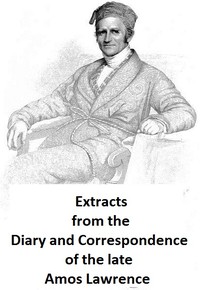
Extracts from the Diary and Correspondence of the Late Amos Lawrence; with a brief account of some incidents of his life
Subjects:
Download Formats:
Excerpt
BOSTON:
GOULD AND LINCOLN,
59 WASHINGTON STREET.
NEW YORK: SHELDON, LAMPORT & BLAKEMAN.
LONDON: TRUBNER & CO.
1856.
Entered according to Act of Congress, in the year 1855, by
In the Clerk's Office of the District Court of the
District of Massachusetts
Stereotyped by
HOBART & ROBBINS,
New England Type and Stereotype Foundery.
Among the papers of the late Amos Lawrence were found copies of a
large number of letters addressed to his children.
With the hope that...
Read the Full Text
— End of Extracts from the Diary and Correspondence of the Late Amos Lawrence; with a brief account of some incidents of his life —
Book Information
- Title
- Extracts from the Diary and Correspondence of the Late Amos Lawrence; with a brief account of some incidents of his life
- Author(s)
- Lawrence, Amos
- Language
- English
- Type
- Text
- Release Date
- April 13, 2013
- Word Count
- 100,402 words
- Library of Congress Classification
- F001
- Bookshelves
- Browsing: Biographies, Browsing: History - American
- Rights
- Public domain in the USA.