*** START OF THE PROJECT GUTENBERG EBOOK 73556 ***
A gold strike is likely to change a man’s viewpoint on many things ~
ESPECIALLY DANCE HALL WOMEN
By Alma and Paul Ellerbe
Long Jim Briggs wandered into Al’s Dance Hall one night when “Captain
Mac” was drunk and throwing things.
She had splendid deep red hair and a skin as white as blanched almonds,
and he admired her extravagantly. As a child admires a Christmas tree.
And differently, too--very differently. He had even given up
prospecting now and then and made good money as a carpenter so that he
could spend it on her. He had spent it all, and he knew her very well,
but he had never seen her drunk before. He had been in such places a
good deal, but he hadn’t got used to seeing women drunk. It hurt him.
He was about to wander on out again when he heard one of the other
girls say:
“She’s gonna pay for this all right! Al will make ’er come acrost with
the expenses of the whole damn’ place for a month for that big mirror
she broke!”
Long Jim hesitated and then started toward her. She took a saucer from
one of the little tables and sailed it like a clay pigeon. It curved
and hit him over the eye. The blood ran down his cheek and everybody
laughed. He wiped it away with his handkerchief and put his hand on her
arm just as she was going to throw another saucer.
“Why, Rosie--” he said reproachfully, in his soft, rumbling bass, and
stopped helplessly. His soft black eyes looked out kindly above his
soft brown mustache and his great soft brown beard, and said what his
tongue couldn’t find the words for.
Captain Mac was madder than she was drunk. All her sensations and her
thoughts were combined in one ache, like the ache in a tooth, and she
was biting upon it savagely and taking a kind of satisfaction in the
keen shoots of her pain. She could have knifed Al that night out of
hand and seen through stoically whatever might have come of it, but Jim
Briggs’ voice and his eyes were the kind of things she had forgotten
the existence of, and they slipped in under her guard and pierced the
quick of her.
She didn’t throw the other saucer, but suddenly Rosie Ellen McCarthy, a
decent Irish girl, looked out of her eyes and said with a flash of
passionate appeal--
“For God’s sake, Jim, take me out o’ this!”
Jim didn’t expect it. It touched him so deeply that he could only gulp
and nod his head. With his great height and bent shoulders and baggy
clothes he looked uncouth and awkward, standing beside painted, half
nude Captain Mac in her spangled dress. He looked around helplessly for
something to cover her shoulders with.
“This’ll do,” she said, stretching out her hand for a yellow scarf on
the top of a gilded upright piano.
She took it with one strong pull, slinging heedlessly along the floor
in a rain of broken bits half a dozen pieces of bric-a-brac that had
rested upon it.
Jim folded the gaudy stuff clumsily about her and took her by the arm
and started to go out, when Al came up and stood in front of him,
dapper, suave and touched with cynicism.
“There’s money owing me,” he said politely, “and she ain’t going
nowhere till it’s paid, see?”
The red surged into Jim’s cheeks, pale from working underground, and
his voice rose dangerously out of its soft rumble.
“There’s a hell of a lot more than money owing you, you God-forgotten
little skunk, and if you don’t get out o’ my way I’m liable to pay you
the part of it you ain’t lookin’ for!”
He kept his eye on the other’s hands and his muscles braced. If you
started things in Al’s place you finished them swiftly, or they
finished you.
The white hairy fingers twitched into the expected signal and Jim swung
the bony mass of his fist against Al’s ear as he would have swung a
pick into a stubborn conglomeration of quartz. But that was incidental.
He didn’t even notice where the little man rolled. Jerked forward by
Al’s signal, a very different antagonist was coming on the jump--Hard
Pan Schmitz, the dance hall bouncer.
Jim Briggs was no match for him and knew it. Almost as if he had
followed through the blow that sent Al spinning, he snatched up a heavy
lighted lamp, whirled it above his head and flung it. It struck
Schmitz’s raised forearm, smashed down his guard and covered him with
broken glass and burning oil.
In the stunned second before the racket began Jim took Rosie by the
wrist and broke through to the street. Behind them the place seethed
like an ants’ nest laid open by a spade.
He pulled her around the first corner. They pelted through the snow as
fast as she could run. He zigzagged his way through the town, taking
alleys when he could. They came at length to the door of a wooden shack
below the level of the sidewalk, on an unlighted street. Its unpainted
boards were warped, it listed heavily and, in common with all the other
houses in the block, it looked deserted. But Jim jumped down to it, key
in hand, and by the time Rosie had descended the rickety steps that led
from the sidewalk he had opened the door.
He shut it behind her, struck a match and led the way into a room
furnished with a stove, a camp cot, a chair and a small pine table with
a smoke blackened lamp on it. He lighted the lamp. Rosie fell into the
chair, breathing in big painful gulps. She wasn’t used to running. The
great altitude--ten thousand feet--had played havoc with her breath.
Jim had swung a pick there too long to be much affected. They looked at
each other in the dim light.
“It’s jest a place to sleep,” he said awkwardly. “Nobody knows I own
it. Feller gave it to me that struck it rich an’ went away. Mostly I’m
in the hills anyhow. So wouldn’t anybody look for us here.”
And then:
“The sheriff and the marshal’s both down on Al. If we can get away
without bein’ noticed, it ain’t likely anybody’ll foller.”
“Maybe it’d be safe for you to stay, then,” said Rosie, when she had
breath enough to say anything.
“Maybe. But I was aimin’ to go anyhow. Why don’t you go with me,
an’--an’ stay with me?”
She looked at him steadily.
“I ain’t fit.”
“You’re as fit as I am,” he said quietly, in the soft, rumbling,
reassuring bass that seemed kin to rivers and winds. “What d’you say to
a clean break an’ a new start together?” He lingered on the last word
wistfully. “I’ve been pretty lonesome, you know, a-knockin’ round from
one prospect hole to another an’ livin’ like a pack rat.”
She got up and came close and looked at him intently. The yellow piano
scarf that covered her befrizzled red head like an incongruous cowl and
clashed crudely with her red dress; her silver slippers, her spangles,
the bunch of cotton roses at her waist, her rouged cheeks and scarlet
lips and half-bared heaving breasts contrasted strangely with her
honest eyes.
“Do you want it for yourself, Jim?”
“For myself--more’n anything.”
“You’re not lying to me?”
“So help me God.”
He had expected her arms about his neck, but she gave him her hand like
a man.
“I’ll never let you down,” she said shortly. “Let’s go.”
They went out under a sky of faint, clean blue, where a frosty moon
queened it amidst a scattering of small pale stars, and found a man who
was driving out of town in a wagon and went with him.
By one means and another they made their way into the Gray Dome country
and Jim built a cabin there.
* * * * *
Fifteen years later, Rosie Briggs stood in the door of it and watched
Jim climb down the steep trail toward his latest prospect hole.
There was a fresh sprinkling of snow, so light and dry that the faint
wind started bits of it to rolling like feathers. Beneath it the smells
of spruce and pine and juniper and little silver mountain sage were
dormant. The cold, clean, thin air of early morning was stripped for
the odor of Long Jim’s pipe, and it drifted up, rank and acrid. Rosie
liked it, at that hour and in that place.
She watched him until he waved his hand far below like a tiny
marionette before he took the fork of the trail under the big Engelmann
spruce and disappeared for the day. She waved back and turned to her
tubs. Every week she washed the clothes of four families in Gray Dome,
the mining town down the main road just around the next bend. It was
hard work, but she didn’t mind it much.
She didn’t think about it. Besides, she only worked four days a week.
The other three she rested--sewed a little, crocheted a little, knit a
little--sweaters and stockings and mittens for Jim and herself, and
kept her diminutive house as clean as a chemist’s scales; or sat
quietly out in front in summer or inside by the stove in winter and let
the long waves of peace wash deeper and deeper in. Peace is good after
a life like Rosie’s. She lay in it thankfully, as in a bath, and soaked
old stains away.
On the side of Gray Dome Mountain, with the sheer drop of the cañon at
her feet and the range spread out beyond; in the midst of cleanness and
silence unbroken since that old rocky backbone of the continent thrust
itself up into the sun, she had risen slowly out of the shards of the
life of Captain Mac and come, late but surely, into her heritage of
womanliness and dignity. The years had chipped away her prettiness, but
in its place was beauty for those who could see it. The smooth face had
been sculptured into something fine and strong and self-directed,
something steadfast and serene. She wasn’t blown about by tantrums any
more.
She had a stake in the game of life now, and she played to hold it. She
had steadied to meet the responsibilities thrust upon her by Jim. He
was as kind and patient as the seasons, and as unreliable. And she was
like a cottonwood tree; she put out the leaves of her affection and
confidence surely and abundantly, but with tireless caution and she
rarely got nipped. She controlled him where he could be controlled, and
where he couldn’t she accepted him as she did the weather. Her
knowledge of men was empirical, unhampered by theories.
Jim would give anybody anything she had--he possessed nothing
himself--and be perennially surprized if she objected. Usually she
didn’t, but if it was something she wanted she went after it and got it
back if she could. Any bum or crook or sharper could win his friendship
and pick his mind or his pocket if either happened to have anything in
it.
But Rosie’s mind was her own, and instead of a pocket she used the
Conifer County Savings Bank. She met him at all points as shrewdly as
if he had been an opponent--which in a sense he was--but she loved him.
And she knew that he loved her, and counted on it, but only for what it
was worth.
She put more trust in his poverty. Every day, of course, he expected to
strike it. And for a while she had thought he might. But gradually as
the days lay themselves down in long, pleasantly monotonous rows until
the sum of them made many years, she came to know that he wouldn’t. And
that, far more than his love, was the foundation of her content. While
he was poor he was hers--wholly, unqualifiedly, unthinkingly hers.
Poor was scarcely the word, though. Jim lived in a moneyless world. Out
of the little she made she supplied the simple necessities of both of
them, and he was willing to wait for everything else until he struck
it. “Then--! Then--!” was what he thought of as he made his slow way up
and down the mountainside. To him the thought was roseate, luminous,
rejuvenescent.
But Rosie hated it. If for nothing else, because it held the seeds of
possible change. After a chancy life, she valued most, of things
attainable by human beings, a life that was free from chances.
On this morning in spring an eagle slanted down the sky on wide, still
wings; the ice broke up and tinkled in Little Cub Creek in the cañon;
the orange and yellow shoots of the willows swelled out toward catkins;
and Rosie washed her clothes contentedly, secure in the knowledge that
there was no “then”; while over in his hole in the side of Old Baldy
Jim broke up her world with quick excited blows of a short-handled
miner’s pick.
She was hanging out the clothes on the squawberry bushes at the back
when she heard the impatient crash of his elk hide boots. She went
quickly through the house and stopped in the front door at sight of
him.
When he swung up his heavy bag of samples for a signal, she knew. Knew
before she heard his whoop. And when it cut across the stillness like
the whistle of a locomotive it struck her cold. It chilled the core of
her spirit, as an icy wind loosed in the tropics would chill a naked
native.
“Struck it, by thunder! Two hundred dollars to the ton, if it’s worth a
cent! An’ the vein as plain as a layer ’o choc’late in a cake!”
He fell into a chair on the porch. Rosie stood and stared at him. The
one thing he knew was ore. He had the kind of knowledge that men had
been willing to pay for when he’d sell it. His “then” had come. The
realization went through her consciousness in widening rings. Whatever
else it meant, it meant the end of this; the beginning of uncertainty.
He caught her in his arms and swept her into the cabin and danced her
about until the place shook.
“Didn’t I tell you? Didn’t I say you’d ride in your own auto yet? It
had to come, old lady, it jest nacherally had to come!”
He gave her a hug and turned her loose.
“I knowed it,” he said solemnly. “I’ve allus knowed it. Away down deep
in there--” he tapped his breast--“I’ve had a hunch.”
He flung himself into a chair and looked at her hard. “‘Ain’t you
glad?” he said suddenly.
She was like a boat that has luffed into the wind. For a moment her
mental sails hung flapping. Then they filled and strained and she set
out before this new cold breeze. She told him as best she could that
she was glad.
“To look at you a feller might think you was kinder sorry like,” he
said quizzically. “What’s the matter?”
“I was thinkin’ a little about how happy we’d been right here--just you
and me and the house you made yourself.”
“’Twarn’t a patch on what it’s gonna be,” he said, and jumped up and
was off with his samples to the assayer’s in Gray Dome. He stepped
strongly, as a young man does. Half the stoop was gone from his
shoulders.
Rosie turned back slowly and sat down heavily at the kitchen table, her
occupation gone. Jim didn’t need a grubstaker now. She sat there a long
time, while memories of other miners who had got rich swarmed in her
brain like little devils that fell over each other in their eagerness
to stab her: Senator Sherrill, and Tom Potts, the hotel man, and Hooker
Bates, who took his flier in Wall Street; and Mike Watson, who divorced
his wife for Dora Schoonmaker, and a dozen others. They made their
money and then were gathered in by women like the Schoonmakers. She had
seen so many of them. They always left the women they had picked up
when they were poor. Especially dance hall women. Even when they were
their wives.
And she and Jim had never been married.
* * * * *
But Rosie Briggs wasn’t a quitter. Little in her life had gone by
default. When the terms of the sale of the mine had been arranged and
everybody in Conifer County knew that Jim was going to be a rich man,
she capped his plans with hers and squared about to meet what was
coming. She went over her clothes and spruced up as much as she could
to match her new station. And very carefully she laid down a program of
buying to be carried out as soon as the money came in.
Among her things she found a picture that she had clipped from a
fashion magazine twelve years ago--a colored picture of an
electric-blue plush dress of a style that she had admired. She felt a
twinge of sadness as she wondered how many other things that she had
wanted and gone without would look as queer as that now.
The dress she had worn when Jim took her out of the dance hall--the red
dress with the spangles on it--looked queerer, but that night while Jim
was in the village on an errand after supper she put it on and sat
waiting for him by the fire, determined to play such cards as she had.
When he came in he stopped at the door of the little sitting room with
a whistle of surprize.
“I ain’t seen that for ten years. Didn’t know you had it.”
“It isn’t much--” she said, smoothing the skirt.
She had lengthened and renovated it as best she could. It was the only
piece of finery she owned.
“It’s all right. Lord, how purty I uster think it was!”
The windows were open to the night. The weather had turned suddenly
warm that day, as if the old earth had decided to start life all over
again with the Briggses. There was a moon, and the new tender leaves of
the aspens about the cabin made patterns on it that twinkled. You could
almost feel the soft wooly anemones thrusting up their oval spear
points outside.
The feel of it all had got into Rosie’s heart and driven out some of
her fears. She even had her old banjo in her lap. She wanted to prove
to him that she meant to help him to be happy. She touched the strings
and began to sing.
She knew only the songs that had been popular a good while
ago--“Daisy”, “Two Little Girls in Blue”, “Sweet Rosie O’Grady” and one
or two more of the same sort. These, to her, were “music”--all there
was of it. She sang:
“Daisy, Daisy, give me your answer true.
I’m half crazy, just for the love of you . . .”
and felt a load slipping from her heart as the snow slips from the
summit of Gray Dome Mountain when warm weather comes.
“Gosh!” Jim murmured. “You ain’t sung that sence--”
He let the sentence die. His eyes smiled above his grizzling brown
mustache and beard. She wanted to put down the banjo and go to him and
touch his hand. But she went on singing, pleased that she remembered
the tune so well, that her voice rang out so clear and true, and Jim
came and sat close beside her.
A strange, deliciously sweet odor crept in under the smells of growing
things and wet earth out there on the dripping mountainside. She felt
just then that Jim was as steadfast and as sure to stand by as the huge
silver spruce that the cabin was built against. She let her cheek rest
on the shoulder of his coat.
“It won’t be a stylish marriage,
For I can’t afford a carriage . . .”
The odor came more strongly. It was like orange flowers. She smiled at
the sentimental notion. Orange flowers on the side of Gray Dome--
“But you’d look sweet--upon the seat
Of a bicycle built--”
The odor came from Jim’s coat.
It said suddenly, “Lorraine Schoonmaker,” as plainly as Jim’s lips
could have said it. To smell it was to see the girl standing behind the
counter in the Gray Dome Dry Goods Company’s store. Probably there was
no one in town who would have failed to connect her with that perfume.
A knife seemed to unfold inside of Rosie. It cut her song off in the
middle of the line and brought her upright in her chair with a gasp.
“What’s the matter?” Jim said, startled.
She got to her feet. She almost came straight out with it. That would
have been like her. It was what she wanted to do. But for the first
time in many years she was afraid. She stared at Jim with deep
revulsion. Suddenly he was part of an elemental horror that she had
climbed out of long ago and that now was closing around her again.
“I--I hadn’t ought to’ve sung that,” she said thickly. “It--makes me
think too much of the old days,” and went stumbling off to the bedroom.
He followed her and stood around, saying things to comfort her, and
finally she pretended that her mood had passed. But when she lay still
at last by his side and thought about Lorraine Schoonmaker, hard lines
pulled at the corners of her mouth that hadn’t been there for fifteen
years. Long after all traces of it had vanished, she fancied that the
air was faintly touched with the perfume of orange flowers.
“Women” would have been bad enough, but he would have tired of them and
come back. There’d be no coming back from this girl of twenty-one,
clever and hard of mind and soft and pink of body, with the first taste
of what money could do fresh in her mouth.
Men didn’t come back from the Schoonmaker women. Behind Lorraine, with
her sleek black pomaded hair, her short tight pussy-willow taffeta one
piece gown, her chiffon stockings and high-heeled satin pumps with
rhinestone buckles, her vanity case almost as big as a traveling bag,
her jeweled wrist watch and swinging bead girdle, Rosie saw Ally
Schoonmaker, her older sister, who had married Timothy Bund practically
on his death-bed for his house and his shares in the North Star Mine.
And behind Ally, up the ladder of the years a rung or two, Dora
Schoonmaker, breaking up the Watson home when Mike Watson’s mine began
to pay, and somehow juggling him into a divorce from the woman who had
seen him through the lean grim years of penury and into marriage with
her and then carrying him off East. And Effie, the oldest of the four,
who had run away with Perce Williams, nearly two decades her junior,
when he came into his father’s money, and held him grimly to her side
ever since.
Yes, and even Bertha Schoonmaker, the mother, with her wig and her
dirty chiffon blouses and her painted cheeks and brown teeth and
pink-lined hats with floating pink veils, playing the man-game still,
at sixty-four. Their lean, rapacious Schoonmaker hands were all alike.
If Lorraine took Jim, she’d take him to keep. At the altar. For very
definite financial ends of her own.
The tacit bargain between Long Jim and Rosie had never got itself into
words; they hadn’t felt the need of them. He had pulled her out of
hell. The strength of her allegiance to him couldn’t be increased by
the mere saying of words, however sacred, or the giving of a ring.
Marriage would have added nothing to her side of it. Nor, she had
thought, to his. She wished now that she had it, but it had not
occurred to her to wish it before. She had had something so much
solider in poverty. Marriage might hold and it might not, but while he
had been dependent upon her for his food and clothes, there had been no
doubt.
She went back to that over and over that night, seeing the placid years
in the little house as very beautiful through a mist of pain. She had a
feeling that, pulling at the almost forgotten cadences of the song, she
had brought the past down about her ears. She felt the old trapped
fatalistic despair and sick rage, without the old vigor. Something
began banking up inside of her, steadily, relentlessly. She was
terribly afraid of it. It seemed to her that it was a great bubble of
black blood in her brain, and that when it burst-- She tried to keep
from thinking to ease the strain on it, but her thoughts streamed out
swiftly from oubliettes in obscure corners of her mind.
They were hideous thoughts and really not hers at all. It seemed that
some devil sent them to torture her. The unfairness of it gagged in her
throat. She had fought her way out of filth and blackness to cleanness
and the sun, and now, without volition, the old horror came on her
again from within--clicked through her brain like yards and yards of
cinema film. The current of her life had swept past its one clean
tranquil place and was swirling along muddied and normal. The familiar
ache was in her heart, and Rosie was herself again--Captain Mac, of
Al’s Dance Hall. You didn’t get away from things like that.
Well, there were things that Captain Mac knew how to do that Rosie
Briggs had forgotten. She had whipped a can along the street once with
revolver bullets as a child whips a hoop to the admiration of every
idle man in town, and ended the demonstration by shooting a stranger’s
plug hat off his head without disturbing his hair. Her whirling
thoughts showed her Jim’s old .44 in the left-hand end of the bottom
drawer of the dresser.
She must wait, she told herself--and her heart gave a great bound--she
must wait until she had them together! She laughed out with sudden
raucous cruelty in the still cool night. Jim stirred in his sleep but
didn’t waken. She raised herself on one elbow and looked down at him,
while her thoughts raced and danced, piling themselves into the bubble.
And then it burst and left her weak with compassion, seeing them
together in her mind’s eye; seeing them as clearly as the daylight that
was climbing over Gray Dome Mountain. That fragile, empty, smart little
thing and Long Jim Briggs! Gaunt, weathered, grizzled old Jim--and her!
She’d no more be able to shoot than to enter into her dead mother’s
womb and be born again.
Feeling as old as the granite hills that ramparted the cañon, and with
something too of their plain ineluctable dignity, she arose and dressed
herself and built the breakfast fire in the stove.
When Jim came out to her she got slowly to her feet, closed the damper
and faced him.
“Jim,” she said, “that girl don’t want you. Take a good look at
yourself in the mirror over there, and then think of her. She’ll throw
you away like a sucked orange when the money’s gone.”
Long Jim Briggs stood up with his head in the rafters of the tiny room
and stared like an idiot.
“I smelled her perfumery on your coat,” said Rosie shortly, and
comprehension dawned slowly in his face.
“Holy jumping June bugs!” he said from somewhere down in his boots. “So
that’s what you thought! Wait a minute. I was hidin’ it in the wood
house. I wanted to surprize you.”
In a moment he returned with a package. With awkward swift movements he
ripped off the wrapping paper and shook out the folds of a brilliant
electric blue plush dress of a fashion fallen into forgotten desuetude
ten years before.
He displayed it pridefully down the front of his long person, head
a-cock and a twinkle in his eye.
“That’s all there was between us! Smell it!” The room reeked of orange
blossoms. “She made it for me nights, to make some extra money. It’s
the kind you kep’ a picture of from a fashion book. I got it off your
dresser. Do you--do you like it, Rosie?”
She tried to speak, but could only nod her head. He patted her shoulder
awkwardly. The dress swam before her eyes like a pane of blue glass in
the rain.
“It’s goin’ to be the swellest weddin’,” he said huskily, “that little
old Gray Dome ever seen. An’ then--” he cleared his throat with a
rumble like summer thunder--“we’re goin’ to Denver an’ buy a house on
Capitol Hill an’ the finest auto in town, an’ a nigger to run it an’
drive around an’ tell ’em all to go to hell!”
[Transcriber’s Note: This story appeared in the July 1, 1928 issue of
Adventure magazine.]
*** END OF THE PROJECT GUTENBERG EBOOK 73556 ***
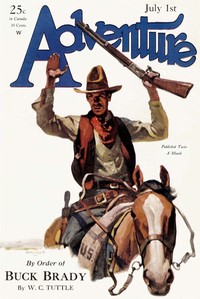
Especially dance hall women
Download Formats:
Excerpt
A gold strike is likely to change a man’s viewpoint on many things ~
Long Jim Briggs wandered into Al’s Dance Hall one night when “Captain
Mac” was drunk and throwing things.
She had splendid deep red hair and a skin as white as blanched almonds,
and he admired her extravagantly. As a child admires a Christmas tree.
And differently, too--very differently. He had even given up
prospecting now and then and made good money as a carpenter so that he
could spend it on her. He had...
Read the Full Text
— End of Especially dance hall women —
Book Information
- Title
- Especially dance hall women
- Author(s)
- Ellerbe, Alma, Ellerbe, Paul
- Language
- English
- Type
- Text
- Release Date
- May 7, 2024
- Word Count
- 4,995 words
- Library of Congress Classification
- PS
- Bookshelves
- Browsing: Culture/Civilization/Society, Browsing: Literature, Browsing: Fiction
- Rights
- Public domain in the USA.
Related Books
Wild oats
by Oppenheim, James
English
685h 5m read

Famous stories from foreign countries
English
494h 26m read
The incredible slingshot bombs
by Williams, Robert Moore
English
96h 4m read

Aunt Anne, Vol. 2 (of 2)
by Clifford, W. K., Mrs.
English
856h 19m read

Aunt Anne, Vol. 1 (of 2)
by Clifford, W. K., Mrs.
English
835h 50m read
The dangerous inheritance
by Forrester, Izola L. (Izola Louise)
English
1060h 22m read