*** START OF THE PROJECT GUTENBERG EBOOK 75356 ***
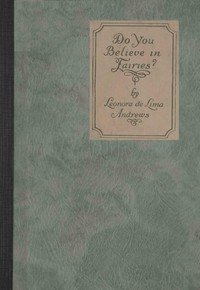
Do You
Believe
in
Fairies?
by
Leonora de Lima Andrews
LITERARY COMMODITIES
25 West 43rd Street
New York, N. Y.
Copyrighted 1924
by
Literary Commodities
TABLE OF CONTENTS
The Little Girl 7
To Please Eight and a Half 11
The Music Charm 16
The Tale of the Fretful Child 17
Ballade for Believers in Fairies 26
The Revenge of Gobble-me-up 28
The Piper 35
Richard the Lion-Hearted 37
Daughter-Goose Rhymes 40
Beauty and the Beach 43
Sensations of Swinburning 46
Day Dreams 47
Rain in the City at Night 48
Christmas 49
Romantic Adventure into Religion 50
Sunday 58
New Year’s Day 59
Silence 60
Bluffing 61
The Delicatessen Shop 62
Listening In 63
Mt. Riga Road 64
Rain 65
Growing Pains 66
Adolescence 68
To ---- 69
Fragment 69
To Marie 70
Freudianisms 72
The Old Man Speaks 74
Ballade for Moralists 75
Heaven at Last 77
The Future 78
DO YOU BELIEVE IN FAIRIES?
(A book of fantasy for grown-up children)
THE LITTLE GIRL
The little girl ran and ran and let the wind blow her hair until it
stood out behind her as though it were wired. The air was so clear and
blue that she thought: “If I jump a little I will land on the top of
that mountain over there.”
But she didn’t jump. It would have been taking a mean advantage of
the mountain, she thought. She would just fly up the side of it, much
as she was flying along the road now. And when she had gotten to the
very topmost part, she would not deign to look down upon all the silly
people in the valley--the people who just went on working, and didn’t
have the sense to shout with joy because the sun was shining. She would
reach up her hand, and feel the little fleecy cloud that was sitting so
still and quiet, way up there. She would squash it between her fingers
to see if it was wet or dry. And if it was dry, she would wrap it
around her, to keep it warm forever, and would spend the rest of her
days trying to catch, in a rose-colored bottle, the cold wind that went
rushing past.
And so the little girl ran and ran.
The wind whistled at her speed. The dewy grass kissed her feet, and the
cows in the meadows yawned as she passed.
* * * * *
Then she stumbled. A round smooth rock had rolled across her path: a
granite rock, with specks that twinkled like bad men’s eyes. It was an
orthodox rock--the sort that rarely rolled from its ledge. It growled:
“Look at this astounding young person’s behavior on a Sunday! The idea!
A gentleman and a preacher should put an end to such goings-on.”
And so the smooth stone rolled in her path-way, and she stumbled and
fell over it.
A discreet silence had settled over the countryside, just as though
all the fields were on their best behavior. The rows and rows of
conscientiously trained beets and onions drew themselves up in the
pride of their posture. They too are very orthodox. They look down upon
those of their vegetable brethren who have allowed themselves to be
blown away from the straight and narrow path while still in the seed
stage. It is fair, in a kingdom of stones, that these should do penance
by eternal excommunication from the pale. And thus pondering, in pious
disgust, the beets and carrots were spending their Sunday.
The truant asparagus, long since reformed from rigid rows, was
glorifying heaven in its own sweet way. It sprawled over the edge of
its patch, as though to cover as much of the earth as possible--to
be as near to her as possible. It does her honor, by dressing up in
feathery finery to adorn her. It even catches the dew-drops, and
roguishly uses them as pearls; for it makes its religion a perpetual
pageant to glorify nature, and it scorns the priggish severity of
the onion elders who have carefully stored up all their dew, for the
cultivation of orthopedic roots.
These were the extremes of the vegetable Sunday behavior, and they are
interspersed with just such in between stages as the meadows show,--a
sort of tired business man-ish relief from the droning haying machines,
and the hard cobble-stone wall.
Over the vegetable kingdom the round stones rule in their smooth sly
fashion, appearing in the furrows to retard the busy harrower in his
task, and censoring the human children’s play.
But past them all the Little Girl ran, laughing at the wind, brushing
off the dirt that spotted her starched dress, and forgetting all
about her bruises and scratches. On and on she ran, her eye fixed on
the fleecy white cloud, her heart aching to fondle it, and her legs
tireless in their never-ending race for the stars.
TO PLEASE EIGHT AND A HALF
First of all there was Mildred, who was eleven, and quite sedate. Then
there were the twins, Eveline and Madeline, who were eight and a half
and eight and a half and ten minutes old, respectively, and who liked
stories.
“Can you tell ’em?” Madeline inquired anxiously. She was curled up in
my lap, and when she spoke she wrinkled up her nose in a funny little
way that hid the one freckle on its tip that was the only means of
distinguishing her from Eveline.
“I’ll try,” I offered.
“Make it about goblins, please,” ordered Madeline.
“And fairies,” Eveline added.
“And real people, too,” suggested Mildred who was, as I said, eleven,
and almost beyond fairies, which was rather a pity.
“Once upon a time,” I started, and paused. A grown-up had interrupted
us with some foolish grown-up question.
“Once upon a time,” again I began.
“You said that before,” objected Eveline.
“Yes’m,” accused Madeline.
“--Many, many years ago, there was a big forest, bigger than any you
have ever seen.”
“’Scuse me, Ma’am, I know where there is a biggest forest.”
“Well, this was even bigger,” I insisted. “So big, in fact, that the
leaves were as large as--as the flowers on that chair.” I finished
pointing to the exaggerated tapestry on the furniture.
“Now at the edge of the woods there was a little village, where a
blacksmith lived, with his only daughter, Hope.
“One day he sent Hope out into the forest to pick berries. As she went
into the woods, by the little path which led from her house, there
hopped out on it a little bunny--like the ones in the park, you know,
excepting that this one had =two= tails.”
(“Why?” asked Madeline.
“To clean out his house with, of course,” explained Mildred.)
“Now, although Hope had walked in the forest ever since she was a
little girl, she had never, =never= seen a bunny with two tails. So she
followed this one. Further and further she went, and darker and darker
it grew, but Hope did not notice this, for she was too busy watching
Mr. Two-tails.
“Suddenly he disappeared, and left her standing in front of a great,
green-grey stone. It was very dark, and poor Hope was very much
frightened. I would have been, too. Wouldn’t you?”
Three heads bobbed up and down energetically, and three pairs of eyes
opened =very= wide.
“But she was a sensible little girl, and knew that the good fairies
would help her. So she knocked on the stone. There started a whirring
noise, as of wings.
“Say the magic word, and tell me your name,” sang a silvery voice.
“Hope,” said the little girl.
At this the stone opened, and she went into a beautiful little room,
all lighted with fireflies and glow-worms. On the floor sat a fairy,
busy mending a butterfly’s broken wing.
‘Do you live here all alone?’ asked Hope, as she drank honey and
dew-drops which the busy ants had brought her.
“Yes,” sighed the fairy sadly. “I used to live with the forest
goblins--”
“But they are bad,” interrupted Hope. “Father has told me stories about
them.”
“Not bad!” reproved the fairy “but they did not like me to help the
wood-land folks. They made me come here, and said they would keep every
one from seeing me. Nobody can enter without the pass-word, Hope. And I
cannot be free until a prince comes to sing to me.”
“The next morning the blacksmith awoke, and called Hope to him, but of
course she did not come. He was very much frightened and called out all
the village folk to help look for her. Then a strange thing happened.
The blacksmith looked at the wall of his hut, and saw a message appear
in letters of gold which said, ‘Whosoever shall find Hope shall be made
by the fairies a Prince, and shall be given a beauteous castle.’
“The villagers started out, and with them a little apprentice lad
searched too. Now, of course, the goblins kept every one away from the
great green-grey stone, but in spite of all the goblin’s enchantments
the apprentice lad came to the house of the fairy, because he had
followed a little two-tailed bunny. And when he got there he was so
happy he just sang, and sang, and as he sang his coarse village clothes
fell off him and the royal robes of a Prince appeared in their place.
“And so he took Hope back to the village with him, and the fairy flew
out, singing and happy to be free. At the village there was great
rejoicing, and they feasted at the Prince’s palace for a month and a
day.”
“Didn’t they get sick?” inquired Mildred.
“And a few years later they were married.”
“And lived happily ever after?” asked Eveline, anxiously.
“And lived happily ever after!” I assured them.
THE MUSIC CHARM
(A Tiny Tot Rhyme)
When the great man came to play
He didn’t chase me far away,
But let me stand beside him so
That I could watch his fingers go.
I never, never saw him make
The very tiniest mistake....
And, say, I saw that player look
At his =ten= fingers, =and= the book
At once! So I =knew= there must be
Some trick that he had hid from me!
And maybe, when he’d gone away
The spell that brought the tunes would stay!
So when I felt that nobody
Was bothering to notice me,
I looked about that piano
Inside and outside, high and low,
To find that music. Timidly
I pressed each finger on a key;
Ma said it didn’t sound the same ...
It sounded queer and sounded lame,
But I don’t care, because some day
I’ll make him charm it so’s to stay!
And then maybe =I’ll= sit and look
At =my= ten fingers and the book!
THE TALE OF THE FRETFUL CHILD
There lived once upon a time, in the Land of Grown-ups, a very little
boy. As soon as he was old enough to cry, which was when he was very
young indeed, he began to cry for an adventure. But he always cried for
it in baby talk, which Grown-ups cannot understand because they have
forgotten it; and so nobody knew what he wanted. They gave him milk,
and they spanked him. They sang to him and they rocked him, and they
even showed him how the wheels in Daddy’s watch go round. But they did
not give him an adventure, and so he kept right on crying, until bye
and bye he came to be known as That Fretful Child, and everyone hated
his parents.
Now there is only one person in all Grown-up Land who understands
baby talk, and that is the Oldest Woman in the World. People say that
she understands it only because she is so old that she has learned
everything there is to know and is going back to begin all over again.
And, since she is as wise as she is old, and equally as gossipy, she
soon heard everyone talking about That Fretful Child.
She suspected that the baby wanted something very badly, and that that
something was neither warm milk, nor a spanking, nor the wheels in
Daddy’s watch. And she decided to find out what it was that he did want.
So she put on her grey cobweb scarf, which makes her invisible, and
climbed up the handle of her carpet-sweeper, for she is a very modern
Old Woman indeed. She grasped the handle of her carpet-sweeper, right
where the shiny part ends, said a magic word, which I have forgotten,
and Higgelley, piggelley, before you might say “=I spy=” three times
without winking, she was driving up to the home of the Fretful Child
with a fearful clatter.
Now the Fretful Child’s Mother was a regular sort of a Mother,
excepting that on Sunday’s she always used silk handkerchiefs,
embroidered with storks, and folded in thirds, instead of the linen
ones folded in quarters that she used every day. When she heard the
noise, and saw the carpet-sweeper drive up to the door she became very
much excited.
“Look, Timothy,” she called to her husband, who is also the Baby’s
Father, “Look at the carpet-sweeper I have found outside of the door.”
In Grown-up Land, you see, carpet sweepers do not always wander about
by themselves.
Timothy, however was not impressed. He only said “Un-huh”, and went on
reading his newspaper.
So the Fretful Child’s Mother took in the carpet-sweeper, and put it
next to the Baby’s crib, for safe-keeping. Then, because the baby was
crying very hard indeed, she hurried away to get him some warm milk,
and left him alone to drink it, for she had learned by experience that
he could not cry while he was doing this.
When she had gone, the Oldest Woman hopped down from the
carpet-sweeper, and took off her cobweb scarf, which made her visible.
Then she looked at the Fretful Child over her dark green spectacles,
and said:
“Google de Goo.”
Now the Baby was so surprised to hear anyone besides himself
speaking his language, that he stopped swallowing warm milk, right
in the middle of a gulp, and simply stared. But, although this is
generally considered very rude, the Oldest Woman paid no attention
to it whatsoever, and instead went right on to say something which
translated means:
“What are you crying for, anyway?”
By that time the Fretful Child had stopped staring, and had finished
his warm milk, and was able to tell her that he wanted an adventure,
and that he wanted it badly.
Upon hearing this, the Oldest Woman became very serious indeed. She
shook her head, and wiped away a tear which had settled on the rim of
her green spectacles and was about to roll down her nose. Then she said:
“Doodle de doo,” which, as all babies know, means “You are very young
indeed, but I will do the best I can for you.”
She told him that there are very few places where adventures still grow
wild, for they have all been collected many years ago by a group of
people called “Famous Persons”. However, she did know of one adventure
tree that was just beginning to bear fruit. It was quite far away, but
all that one needed to get there was a silk handkerchief embroidered
with a stork. Now this was very fortunate indeed. For you see, the baby
knew that once a week his Mother used to wipe his tears off with a silk
handkerchief, and he remembered that something on it sometimes used to
bite him.
“It must have been a stork,” exclaimed the Oldest Woman, and at
this she became so excited that her eyes twinkled behind her green
spectacles.
In less time than it takes to tell about it, the baby was flying
through the air on his Mother’s silk handkerchief, with his eyes
tightly closed, and the Oldest Woman was astride a carpet-sweeper. He
could feel the wind blowing through his hair, and the stars snapping at
him as he went whizzing past. All the time the Oldest Woman kept saying
magic words, and telling him not to open his eyes whatever he did, so
that it all sounded something like this:
Hoity toity, keep them shut,
Ali pali poo,
Flutter, gutter, down he’ll clut
Sniggle, snaggle yo-u-u-u-u
O-o-o-o-w
You-u-u-u-u
And all the voices of the night owls and snapping stars echoed
You-u-u-u-u-u-u-U*U*U*U!
Until the Fretful Child felt very pale indeed.
When at last the Oldest Woman told him that he might look, he found
that they had flown all the way to Nowhereland. He knew it was
Nowhereland, by all the Nothings standing about. There were tall
Nothings, and short Nothings, and fat Nothings, and thin Nothings, and
they were all kept in order by Nobodies with grey dresses on. These
Nobodies are very much like the people in Grown-up Land. Excepting
that, as you will notice when you look at them very closely, their
faces are made up entirely of cheeks.
The Fretful Child stared about very hard indeed. Then, because he
couldn’t see any adventure tree, he was just beginning to take a long
breath in order to cry. But he stopped short, just as his face was
beginning to turn from pink to purple. For, right in the midst of the
Nobodies stood the most beautiful adventure tree you ever saw. Its pale
blue branches were weighed down to the place where the ground would
have been, if there had been a ground in Nowhereland. And from even the
lowest branches there hung luscious adventures that were dark red, and
just right for picking. All about lay others that the wind had blown
down, or that the Nobodies had picked, tasted, and thrown away. But
they had missed the very best of all. And this was perfectly natural,
when you stop to think that the Nobodies have no eyes, and their faces
are made up entirely of cheeks.
But the Fretful Child was not a Nobody. He had eyes. He saw the red
adventures dangling there, and he squealed and crowed, and did all the
things that fretful children never do. And then he picked one.
Now it is strange to tell about, but as soon as the Fretful Child bit
into that adventure, he stopped being a Fretful Child, and became a
Regular Boy. Even his skin, at that very moment forgot how to change
from pink to purple, as it used to when he wanted to cry.
When the Nobodies felt what he was doing, they became very angry
indeed, and shouted Nonsense at him, and threw Nothings at him. But
these did not hurt him much, and so he went right on eating his
adventure.
The adventure did not taste at all the way he thought it would, and
it puckered his mouth all up. So he tried to hold his breath to make
his face change from pink to purple, but it wouldn’t do what he told
it to. And then he knew that the adventure must have done something
to him. He was not sure, but he strongly suspected that it must have
changed him into a Regular Boy. So he stopped crying, even before he
had let out the tiniest bit of a sound, and he smiled all over instead.
And thereupon the Nobodies, feeling that some thing just hadn’t
happened, dropped their nothings on the spot. And a brand new adventure
bloomed on the tree, where the one the Fretful Child had eaten hung.
He squealed in glee, and looked around for the Oldest Woman, but as
she was as wise as she was old, and equally as gossipy, she must have
ridden away on her carpet-sweeper to tell her friends about it, for she
was not to be found.
Just as he was wondering where she could have gone to, he felt a
tugging at his right arm. It was the embroidered stork. Without a
minute’s delay he climbed upon the handkerchief, stuck out his tongue
at the Nobodies, which shows that he was a Regular Boy, and, higgelley,
piggelley, before you might say “I spy” three times without winking, he
was back in his own little crib.
His Mother was just coming to get the carpet-sweeper, which she had
left beside the crib, for, you see, in Grown-up Land time passes
much more slowly than in Nowhere land. There was a great to-do when
she found that it was gone, but just as she was growing very excited
about this, she noticed that the Fretful Child had stopped crying, and
this made her even more excited (but in a different way) so that she
forgot all about the carpet-sweeper. She rushed in to tell Timothy,
her husband about it; but he was reading the newspaper, and only said
“Un-huh.”
Soon all the neighbors came in to find out why That Fretful Child had
stopped crying, and his Mother proudly told them that she had given him
warm milk.
Whereupon all the neighbors shook their heads and opened their mouths
very wide, and went home to feed warm milk to their Fretful Children,
as they have been doing ever since.
BALLADE FOR BELIEVERS IN FAIRIES
All dressed up in our best we ride ...
From Adam’s Square and Harvard too
And read the ads there for our guide
To see what other people do;
Or if a paper we glance through,
At night time, when our curls we comb
This lonesome thought our souls imbue
“Have you a fairy in your home?”
Or when the little folks decide
To play a game of house, or two,
And roles amongst them they divide ...
John is papa, and mama’s Sue ...
Alas the parts are far too few
And those left out in anguish foam
Till someone brings this thought anew
“Have you a fairy in your home?”
A poor stern father has denied
To sweet sixteen a dress that’s new,
And sweet sixteen has vainly tried
And valiantly her suit to sue ...
She sees her older dress must do
Then finds it in a fashion tome
Some thoughtful fairy brought to view ...
“Have you a fairy in your home?”
L’Envoi
O, Pollyanna, here’s to you--
I’ll greet you, if you chance to roam
My way, and ask when I am blue
“Have you a fairy in your home?”
THE JUSTIFICATION AND REVENGE OF GOBBLE-ME-UP
(A Story for Children with Appetites, and for Children Who Do Not Eat.)
Once upon a time, in the days of long ago, when ogres and giants were
as plentiful as policemen, and when the ocean was dotted with desert
islands, there lived a Giant whose name was Gobble-me-up. As you may
have guessed, he lived on one of these islands. All about him stretched
ocean, and ocean, and more and more waves; but they didn’t bother him
at all. He just lived there alone, and was very happy.
He was a great, large, burly giant, who would have stood over six
feet tall in his stocking feet, if he had worn stockings. He had
round red cheeks, and dancing blue eyes, and his hair curled itself
up into “irrepressible locks” just like your favorite hero’s. He was
comfortably fat, and when he laughed he shook all over, just the way
the dessert that we have on Sunday does.
As I said, he was a very happy giant indeed, and he used to laugh and
shake all over a very great deal. You see, he never realized that he
was all alone on his island, because he had never known what it would
be like to have someone there to play with him. Every morning when he
had finished his rhubarb, he used to walk along the seashore, dabbling
his toes in the soapy waves, and singing:
“Gobble-me-up is my name,
A Happy Giant am I ...
And I always feel just the same ...
And I’ll sing this song till I die.”
When he came to this point he would always whirl about on his left heel
three times, and clap his hands above his head.
Now at the particular moment when my story would be beginning if I
hadn’t wasted all this time talking, Gobble-me-up was just setting out
for his morning walk. He was tossing his head in the breeze ... it was
the first day of Spring, you see ... and he breathed in the ozone, and
enjoyed it, because he didn’t know that it was ozone. And, according to
his habit, he began to sing:
“Gobble-me-up is my name....”
when all of a sudden three clams that were lying on the beach opened
their shells very wide, and laughed, in perfect rhythm:
“Ha! HA!! HA!!!”
Gobble-me-up looked about in surprise, and the clams continued to laugh
in a way that was rude, even for clams.
Then Gobble-me-up became very angry ... no self-respecting Giant likes
to be laughed at. He shook his curls at them, trying to look very
fierce indeed. At last he sputtered:
“WHAT do you
Mean
By
Talking to
ME
Like =that=?”
(He was so angry, you see, that he leaped into free verse, a thing
which had always been against his principles.)
When the clams had laughed until they could laugh no more, and had
rolled over in the sand to wipe the perspiration off their shells, the
most imposing clam answered him.
“Ha! ha!” she said (I am quite sure it was a “she”), “the idea of a
giant who only eats rhubarb ... he! he! ... the idea of =his= being
called Gobble-me-up!”
At this all the other clams went off into wild gales of laughter, and
snapped their shells to show how very funny they thought it was.
Gobble-me-up was perplexed. He didn’t quite know what they meant.
But they did not intend to leave him in any doubt about this. They
explained immediately, interrupting each other, and acting in a way
that was very rude indeed.
They said that he ought to be a “very-cannibal-and-wear-a-red-sash-and-
whiskers-and-eat-up-little-boys-and-girls” (they said it quickly, like
that) and that he ought to go around muttering dreadful things like:
“Fe, fi, fo, fum,
I smell the blood of an Englishmun,”
instead of reciting his silly little rhymes. They said that he should
flourish a tomahawk, and dye his hair black, or at least train it to
stand up on end. In fact they abused him horribly, telling him that
he was ruining the time-honored reputation of the race of Giants.
Any Giant, they said, to be worthy of the name, should endeavor to
represent all the Giants on every occasion. He, they said, was an
unsatisfactory specimen, and therefore deserved to be squelched most
effectively. This they felt to be their duty, and unpleasant though it
was, it had to be done.
After this last remark, they sighed sadly, and retired into their
shells.
* * * * *
From that moment on, Gobble-me-up was a changed giant. He hardly ever
laughed, and when he sang his little song he put it in a minor key,
which shows how very sad he was. Every morning he spoiled his rhubarb
by weeping salty tears into it.
He felt that he really must do =something=.
He sat down on a log to think about it. He turned his toes inward so
that they might console each other. He dug his elbows hard into his
knees, and held his forehead in his hands. Then he said to himself:
“The clams win out,
Without a doubt,
I’ve simply ruined my rep ...
I must fix this,
Or else, I wis,
I’ll have to get some pep.”
This last thought seemed to appeal to him a great deal, even though the
rhyme wasn’t very good.
But as he pondered it, he had a more awful thought. How could he act
like a blood-thirsty Giant, and go about killing men, when he was the
only creature that was anything like a man on the island?
It was a most disturbing idea, and for three days it bothered him.
He grew paler, and proportionately thinner. He did not weep into his
rhubarb now, but left it strictly alone.
* * * * *
And then he found a solution, and worked it out in a manner truly
worthy of a Giant. This was what he did:
One night, when the moon was hidden and the stars were yawning and
dropping off to sleep, one by one, he crept out along the beach.
Without a sound, he crept up behind the three sleeping clams.
Stealthily he reached out his left hand, took the youngest by its
little neck and squashed it. Noiselessly he stretched out his right
hand, and grasped the second one. And with a maddened shriek of triumph
he grabbed up the last clam, before it could snap its shell at him.
With an exalted countenance, he pranced up and down the beach, shouting
his paean of victory, so that the stars stopped blinking, and the moon
peered around the corner of a cloud to listen:
“Gobble-me-up is my name,
A Fearsome Giant am I,
I’ve a dreadful awesome fame,
Which nobody can deny...!
Gobble-me-up is my name,
No Giant is madder than I ...
Ha! =Ha!!= Ha! =Ha!!=
No Giant is madder than I!”
Whereupon he sat down on his log, and, one by one he =ate= the clams.
It didn’t matter at all that he had indigestion the next day. He knew
that he really was an honest-to-goodness Giant, and the thought made
him laugh and shake all over, just as he used to do in the good old
days, before the clams had tried to disillusion him.
THE PIPER
The valley is clad in a misty white fog,
Where the Sun God dares not intrude,
The hoots of the night owls have dulled and have died,
And the whimpering night winds brood.
Over the purple-topped rims of the earth,
Riding a proud little breeze,
Are tinkling pipings that whisper that Pan,
Away from the haunts of humdrum man,
Has led forth the day from the seas....
Dancing and prancing o’er grove and o’er hill,
Rollicking, frolicking, gay,
Glad in the fragrance, and glad in the dawn,
And proud to be leading the day.
The grey gnomes that live in the fog hear his pipes,
And they hide in their thick weeping veils,
And they dwindle and melt at the sound of his mirth,
When his cloven hoofs dance in the dales.
Now the King of the Day has awakened at last,
And has climbed to his throne in the sky,
And the world is astir in its workaday tasks ...
But Pan has gone merrily by.
Now a child who lives in the village lane
Hears the reed notes and tries to pursue;
Fast he leaps over rocks on the heath on his way ...
All of a sudden the piping is near ...
Now it’s lost to him ... again, it is here ...
For sudden Pan comes ... e’er you grasp for his cheer,
Sudden he’s sung, and away.
Away from the heart of everyday folk
To the hills where the west wind blows;
Laughing and dancing and chasing the bees ...
(How dreary for them just to hum in their hives!)
When the brown brook is gurgling, and sings as it flows,
And the blood-red poppy smiles as it blows ...
Over the hills, and away ...
Smiles that Pan comes ... e’er you see him, he goes ...
Sudden he’s sung, and away.
AN INTERVIEW WITH RICHARD THE LION-HEARTED
“I don’t like women,” said Richard of Brookline, and to prove it he
sucked more violently upon a lavender lollipop.
Richard spoke with all the authority of one who has spent seven years
living across the street from five fair ladies. One might mention that
these seven years were his first spent anywhere, and that these fair
but fearsome feminists ranged from six to sixteen. The locale was
Brookline, and the time romantic summer--at this point my story begins.
Not long ago Richard wandered down the broad highway sucking upon his
solitary lollipop, and wearing on his eyebrows the air of a world-weary
capitalist. He did not offer to share his bounty with the ladies
across the way, but did not object to having them watch him from their
lollipopless porch. It was this haughty attitude that first made the
Sleuth suspect him to be a woman hater.
And so the Sleuth set off upon his trail immediately, but Richard, like
many a courtly gentleman, proved to be as diffident as he was bold.
“Why don’t you like women?” he was asked. And he replied:
“Because.”
“Because what?” the Sleuth persisted; whereupon Richard raised his
eyebrows with an air of finality.
“Because I don’t,” he said.
“Don’t you like your Mama?” he was asked, and regarded the questioner
scornfully.
“She isn’t a girl,” quoth he.
“But she probably was once!” The Sleuth hazarded a guess.
Alas, at this point Richard was called to bed. But the next day
the argument was continued. It was after a nerve-racking game of
puss-in-the-corner, when the assembled court had been astonished at
the lion-hearted Richard’s chivalry. Twice had he surrendered his
hard-earned corner to a fluffy little four-year-old blond. The Sleuth
joshed him as man to man. But Richard smiled about it, and man-like
waived present contingencies to speak glittering generalities.
“Girls,” he said, “are like fish.” But he omitted further details; and
as he mused on the matter, his thoughts fell into metaphors. “Like
fish,” he repeated solemnly. And then he spied a crop of bobbed and
almost masculine hair that was bouncing outside the hedge fence. “Or
like hares. Some say that they are chickens, but I think that they are
more like trees.”
“Because they wear fine feathers,” someone contributed.
“Certainly,” he agreed.
“But you don’t think they’re all shady, do you?” the Sleuth hastened to
interpose.
“Most are,” he sighed.
And at this point he rose, to show that the interview was at an end,
and, swinging his tin drum about his neck, he solemnly paraded down the
block to that very masculine tune “Johnny get your Gun.”
DAUGHTER-GOOSE RHYMES
I
Little Jack Horner
Sat in a corner
Busily writing checks ...
His partners grew lazy,
His balance hazy,
His creditors all became wrecks!
II
Flitter, flitter, little dime,
You can stay here a long time.
If I leave you as I oughter
Pretty soon you’ll be a quarter!
III
Little Miss Millions
Longed to have billions,
And dreamed about trillions beside;
But while she was sighing,
Not working, just crying ...
Her bank account dwindled and died!
Little Miss Penny
Didn’t have any
Money at all, but she tried;
And so she kept saving,
And ardently slaving ...
And she owned a house when she died!
IV
Ride in a taxi,
The Biltmore for lunch ...
Eat ... for the music
Will play while you munch.
Eat all you want to,
While large grows your dome ...
For after you’ve eaten
You’ll have to walk home!
V
Old Mr. Croesus
Was worried to pieces
To pay for the monthly rent ...
For what with investments,
And bonds and assessments,
He found all his money had went!
VI
Ike and Mike
(They look alike)
Began to work together ...
But Ike was sly,
While Mike ran dry ...
So they struck stormy weather!
VII
Dickory, dickory, dock,
The ticker reported the stock,
Each bull a bear,
Brokers, beware
Dickory, dickory, dock!
VIII
“Hi diddle, diddle ...”
“Hoorah, ich ga bibble”
The pawn-brokers chortle in glee ...
The bankers all giggle to see the fun,
And int’rest mounts high as can be!
IX
Sing a song of sixpence ...
A suitcase full of rye ...
But that is meant for millionaires ...
The rest of us go dry!
BEAUTY AND THE BEACH
Once upon a time before Caesar had conquered Britain, and therefore in
the very early days indeed, there dwelt in southern England a princess
named Talc. Her life was pampered and happy, just like the lives of all
the princesses who lived a long time ago. Each day she sat by the edge
of a pool of still green water, and allowed her handmaidens to comb her
tresses (it was in the days, you see, when ladies wore tresses where
most modern folk wear hair).
“I am very beautiful,” she remarked casually, glancing at herself in
the pool, “but ...”
“Yes, indeed, Madam,” chorused the handmaidens, who did not realize
that she was about to say more.
“Silence, wretches,” snapped the princess, squirting water at them with
a lily white hand, and thereby mussing up her image in the pool. Then
she continued in a low tragic tone: “I have a blemish, I tell you. My
nose shines. Poets have written of brilliant eyes and gleaming teeth,
but not one has mentioned a glittering nose. Therefore I know that the
perfect nose does not shine. My beauty is ruined. Ah woe is me, ah woe
is me!” An she bowed her head forward, sobbing so violently that she
pulled the pigtails out of her handmaidens’ grasp.
“No more,” she roared at them, as they started to reclaim the lost
tresses. And then she sobbed as though her heart would break, “Oh my
blemish, oh my nose, oh my nose, oh my blemish. Throw away your combs.
I am going to tell the sea of my woe. I am going to walk along the
cliffs. You may follow at a distance.”
She sprang to her feet, and hurried to the cliffs. She looked at the
sea roaring on the rocks below.
“Oh sea,” she moaned in her grief, “what would you do if you had a nose
and it was shiny?”
As she was thus bewailing she stumbled and fell upon the smooth, soft,
chalky cliffs. When she lifted herself up she found that her hands were
covered with a white dust.
“Arabella!” she called to her handmaiden, “bring me a bowl of water.”
Talc looked into the glassy surface of the water. Lo and behold her
nose no longer shone, but was white with a thick opaque whiteness!
“My beauty!” she exulted, “my beauty has returned! Arabella, you may
get the comb and continue in the making of my royal pigtails. Neither
my nose nor my chin shines. I am truly beautiful.” And she rejoiced
until the tears flowed down her face, making furrows in their whiteness.
And thereafter each morning the princess and her handmaidens could be
seen prostrate upon the cliff, solemnly rubbing their noses in its
smooth dust.
SENSATIONS OF SWINBURNING
I fly through the air ...
Ah where, tell me where
Shall I land, when I drop?
Shall I splash? Shall I flop?
When I plunge in the sea ...
Will the waves cover me?
Pause I here on the brink ...
Will I float? Will I sink
Through the green, glassy waves ...
Through the myriad of deep...?
When I die, shall I sleep ...
In the murm’ring sea caves?
Pray, is life fair enough...?
Shall I plunge from the bluff
Take the ultimate jump?
And land there ...
... with a thump?
DAY DREAMS
“We had a table cloth, as white as the paint on the wall beside my
kitchen stove, when it was new, five years ago. Ice tinkled in the
glasses, but I saw every glass cloud up to hide the ice, because it
costs an awful lot these days: They brought the turkey in,--it must
have weighed twelve pounds. Its brown breast was so fat it seemed about
to burst. It sizzled. Um. Then came the cranberry, all red and clear
and quivery from its mold. A pianola played all the time, and we danced
on the swell white tiles up to the cashier’s desk.
“I had on a picture hat, black velvet, trimmed with fur and cloth of
gold, just like a movie star--that’s how I felt. Say, ain’t it queer,
the things you dream about?”
A half a loaf of bread lay awry on a crumby and rumpled and mended
table cloth where the breakfast dishes were stacked in crooked piles.
The room was dark ... an oil stove in the corner made the hot air
heavier. On the tubs, wrapped in towels, a tiny baby lay. The mother
was speaking: and trying to wipe the wisps of hair out of her heavy
eyes. She said: “Say, ain’t it queer the things you dream about?”
RAIN IN THE CITY AT NIGHT
The streets are black.
They shine.
And every light,
From lamp-post and from store,
Makes a golden path
Across the street.
Drops of rain
Spatter,
And trickle down
The glowing window panes.
Red and yellow,
With silver frosting.
That’s all that I can see
In the windows.
CHRISTMAS
Christmas doesn’t come on the twenty-fifth of December. It begins
with the first cold, snappy day, when ladies, fur-coated, and with
unaccustomed red noses patter down Broadway. Tall fragrant pine trees,
their branches roped in, are piled on the curbs. There are little
stacks of very, very green stands, leaning against a box of rosy
cheeked apples. Delivery boys bustle about, much more energetically
than ever before. In the windows cauliflowers and half frozen beets
cuddle in a bed of red crepe paper in an attempt to keep warm and
cheerful. Next door the fish-man has garnished his wares with holly and
eked a “Merry Christmas” on the frosty window pane. On the corner the
Salvation Army girl stamps to keep warm and tinkles her little bell.
And it’s not even December twenty-fourth!
A ROMANTIC ADVENTURE INTO RELIGION
Once upon a time there
Was a little
Girl.
And she never read the
Bible, and when her fond parents
Decided that she ought to be
Religiously educated, she
Rebelled, and on Sundays developed
Colds--and so forth.
But--
When anyone mentioned
Saul or
Rachel or
Anything, she felt
Uncomfortable
And blushed
And giggled
And tried to
Change the subject, which
She couldn’t always do.
And everyone accused her of not
“Having religion”
Until she fully
Believed it.
Bye and bye
When she grew older she
Began to wonder
What this =religion=
That everybody thought so much about--
That preachers preached about--
That revivalists ranted about--
Is.
And when she asked
People
Some carefully stroked their beards
And thoughtfully cleaned their spectacles
And said:--“It is
The divine life in the human soul” whatever
That is.
And some
Sat up straight
And promptly answered
“The natural gratitude to God for creating us which makes us want
to obey his commands, in return,” which
Was clearer, but sounded too much like a
Bargain.
And she asked some who had been
Brought up on
Catechisms and
Things.
And they
Looked shocked at the
Question.
Perhaps because they
Didn’t know.
And there were many
More answers
But
The girl thought
That, as there
Were so many and
So many people had
Bothered about it,
It must be pretty
Important and
Useful.
And so she looked
Up in card indices and
Read many
Deep books
And had many
Deep discussions
And things.
Finally she decided
That
Religion is a very
Personal thing,
And so
There couldn’t be a
Single definition for
Everyone.
But as for herself, she
Considered it
One’s idea of perfection,
The attempt to live up to this idea as an ideal,
And
One’s attitude toward the world in trying to do this.
And as for the ways of “getting religion”
She could not believe
That this should be
Thrust upon a poor defenseless
Babe, or that a mean advantage should be
Taken of his
Youth
By his parents, in biasing his
Later saner judgment by
Prejudicing him in favor of certain
Opinions that They
Happened to have.
She did not mean
That one should not read the
Bible, or obey general morals or
Know who Rachel was or
Be as uneducated, as
She. She meant that one should be
Left to oneself,
When it comes to thinking out
What his Motive in life,
And
Conception of perfection, and
Explanation of the big whys of
Life, and
Things
Like that
Are.
For one must get an
Understanding of such
Things
(If one is to have a =real= understanding of them)
Either through
Much theory,
Or better,
By the experience which only
Living gives--
If you get what I mean.
But,
Thought the girl,
What is the use of
Worrying
About things like that
Anyhow?
And then she
Realized how
People always turn toward
Religion
When they are in
Trouble; as the
Religious revival in
Europe now
Shows.
And she realized the
Comfort that they
Get
From it.
And after all
It is only natural that when
Material things
And means toward the real end
Go wrong,
And one feels blue,
That one should try to
Look ahead
And beyond
At the =real= goal,
And get
Cheered up,
By the confirmation that there =is= a goal.
And that is one use of
Religion.
And besides
People
Are apt to be too
Materialistic, nowadays.
And the very presence of ideals,
Or recognition of their presence,
Will lead one
Beyond
Such narrowness
And
Such binding materialism, and so
Will lead to
Higher ideals--
Hence
Higher strivings--
Hence
A better world--
Which is
An asset in itself,
If you get what I
Mean.
And this is the
Real
Use of religion.
And with this off her mind she felt better.
SUNDAY
A-top the palisades that touch the sky
Where friendly elms flirt with each passing cloud,
There let me lie--with Heaven for my shroud,
With Nature live, and close to Nature die.
I, too, would flirt with clouds that pass me by,
Holding my head aloft, my spirit proud,
Only by Nature’s wrath shall I be cowed,
Only by hand of Providence I die.
For Art we live, since Art is Nature’s toy,
Fashioned each man in mold almost the same ...
Religion, Nation, Race ... are things of name.
Cast these aside--God’s playthings are for joy.
Amongst the waves that vainly slap the shore,
Please God, help me to carry on some more.
NEW YEAR’S DAY
An evening dress in a window ...
Sheer,
Crimson;
An ostrich fan beside it ...
Soft
Willowy.
Outside the hard cold glass,
A woman.
Pale cheeked,
Red nosed,
Clutches a furless muff
And pulls her frayed coat collar
About her scrawny neck.
Gentleman in a high hat,
Tan gloves,
Yellow cane,
Fur coat.
Buys spring flowers
From a dirty-faced Greek.
Confetti in long yellow streamers,
Lying on the grey curbstone.
Shivering children
Rolling it up.
SILENCE
You think the house is silent when you’re out?
The ticking clock
Obtrudes its measured beat,
Slower than before.
The windows knock.
’Way down the hall I hear a creaking door.
A tenseness in the air ...
Someone behind me.
Frantically I try to think ...
Of other things ...
Of anything ...
“This is mere nonsense ...
Nonsense,
Nonsense ...
The room =is= empty!”
Hush ...
What was that noise out in the hall?
That brushing sound...?
That creaking...?
Oh, how can you think
The house is silent when I’m here alone?
BLUFFING
So that was Russian Art--A blotch of red
And yellow flames, and towers childishly
Drawn in thick lines, and curved as though the walls
Were falling in. Scores and scores of these
Were crowded in a narrow frame, thick piled
That left us stunned, amazed--we could not guess
From the queer Russian signs and mumbled words
What we were meant to think the show was for.
But going out, we coughed importantly
And then we said “Here’s a new tone in Art.”
While inwardly we wondered what =that= meant.
THE DELICATESSEN SHOP
You must have noticed, on a Sunday night,
The line of husbands, forming on the right, ...
A bent old fogey, and a spatted fop
Are rubbing shoulders in the crowded shop
Where lurid signs proclaim a pale green tea
Or shriek in praise of chicken fricassee.
Furtively they take their places in line
And meditate the where-withall to dine ...
Then whisper it quite deprecatingly,
And steal away as humble as can be!
LISTENING IN.
(Recess in a College Corridor)
Footsteps paced down the hall--slow, meditative footsteps, with long
intervals between them. Then there was a swish of skirts, and little
pattering taps on the hard marble. Then both footsteps stopped, and
I heard a high treble tittering, and a deep long-drawn out, but
kindly roar. There was a clatter as though books had fallen on the
floor--another titter, and rather a bored basso sigh. A bell rang.
The pattering and swishing recommenced and faded out of earshot. The
steady, determined strides drew nearer and nearer--and by that time the
second bell had rung--and the door was slowly opened.
MT. RIGA ROAD
If I could draw--
The country lies
A beacon to my pointed pen,
Enticing me to sketch again,
Or paint the colored twilight skies.
If I could play--
I’d harmonize
The babbling brooks in mossy glen
Or sing the whispered words of men
Or wordless songs in misty eyes.
I wish that God had given to me
Expression that real artists show ...
The power to understand and see,
Uplifted by the will to know.
Instead, I write my paltry stint,
Which usually isn’t fit to print.
RAIN
Here’s the pool, close to the lake
Where the humming rainbow flies
Seek their prey with myriad eyes,
Where the maple, touched with red,
Bends across the dusty pool,
Bathing in its welcome cool,
Sunspots break the veil of leaves
Like diluted drops of gold,
Cloud the pool with dust-like mold.
Now the sunspots fade away.
Buzzing flies hum louder still,
Tense the air hangs damp and chill,
And the maple’s glittering leaves
Turn their silver-frosted backs
To the wind. A pine-tree cracks.
On its breast the first rain falls.
Drops like pebbles sharply pelt,
Widen to a ring, and melt.
GROWING PAINS
When I was a rosy, wide-eyed child
And the world was new to me
I tried to explore it with searching eyes
That knew no secrecy.
And I came one day, in my wanderings,
On a curtain of green and gold
With the deepest colors reflected in
Each mysterious fold.
And I tried to break through it, and tried to go ’round
To pluck at the colors that shone,
But as I reached toward it, it vanished away.
And I cried in the forest, alone.
Seven years passed, e’er I saw it again,
All proud in my new-found teens ...
But I passed by the gate with a haughty glance,
And I scoffed at its beckoning greens.
Seven years more, and I find it again,
In my own private fairy wood.
Its shimmering colors, and sun-flecked hues
Call me, as naught else could.
The gates are translucent. There, tinted with rose,
Is the sapphire blue of a cloudless day ...
And I know there are reaped the harvests of love,
And I know there the children of happiness play.
But I know that for me the gate is shut ...
And I feel that I trespass on hallowed ground,
So I fix my eyes on the stones below,
And I follow the lone path, homeward bound.
ADOLESCENCE
Childlike still, we gaze at fleeting fairy thoughts,
Childlike still, we cast pale shadows in the air--
Civilized imaginations--weakling sparks
That we’ve folded fast in words--and buried there.
Look: A school of doves on silver-frosted wings
Hold the sunshine for a moment as they fly,
Toss a vagrant shaft of sunbeams in the air
As they float across a shining turquoise sky.
For a moment there’s the glitter of their wings ...
Just a moment ... then the sunbeam melts away
And the happy brightness of the turquoise sky
Has faded, like their silver wings, to grey.
TO--
Glorious love, if the passion were thine,
To thee I would open my heart and myself;
Yours is the spirit to whom I’d resign,
Yours are the arms I would rest in, in sleep.
Yours is the face I would look to for help,
Yours are the hopes that would buoy me, until
After our labors had won, or had failed,
Yours are the thoughts that would guide me on still.
FRAGMENT
Glorious Virgin, thine the light ...
The spark-fire of maternal love ...
Of thine own self, hast thou made
A Living God, thy Monument.
TO MARIE
Such a dainty little miss
Is Marie,
Whom I love to pet and kiss ...
Sweet Marie!
Auburn hair in sunny wave,
Freckled face, now sad, now grave ...
Would you teach me to behave ...
Dear Marie?
You’ve culled learning from deep books
Fair Marie,
A Phi Beta ... and such looks!
Oh Marie!
That you set my heart a-flutter,
Not the wise words that you utter ...
It’s your charm that makes me stutter ...
My Marie!
But though lyrics I indite you,
Fair Marie,
Ardent love letters I write you,
Still Marie,
You prefer to let me pine, dear,
Lonely hours have been mine, dear.
Oh your art is superfine, dear,
Dear Marie!
But I never give up hope,
Of Marie,
Liberally I hand soft soap
To Marie ...
For I know when I grow older,
And my beaux affairs grow bolder ...
By her tactics, I’ll be colder
Than Marie!
FREUDIANISMS
Then the fish all turn into girls, and the shimmery tale of the
goldfish-in-chief changes into dance slippers. Soon her voice begins to
call to you. It grows louder and louder. At last you realized that she
is saying--
“Eight o’clock--time to get up!”
You heave a sleepy sigh and look at the clock. It says “eight o’clock”
but it is probably fast. You turn over and try to remember that dream
about goldfish. Or was it girls? Girls or goldfish? Goldfish or girls?
They both begin with “g”. Queer, “g.” Stands for “goloshes” and
“grapes” and “gloves” and--
“Ten minutes past eight.”
“All right,” you drone dutifully. (But you know it isn’t all right).
You turn on your back and stare at the ceiling. There is no use
in getting up yet. You would spend so much time just dressing and
undressing. Think of the hours people spend in clothing themselves. If
all those minutes were laid end to end they would probably reach from
their elbows to--
And then the door bell rings, and someone says something about mail.
Mail!
That’s different.
In a minute you are up and rushing into the hall-way.
“Mail!”
THE OLD MAN SPEAKS
I dare not come to you with virile phrase
To tell you to give heed to what I say:
To live your life in age-instructed way,
To light your dawn with sunset’s fading rays.
I dare not wish to live again my days.
I, too, was careless when birds sang in May,
I loved to wander on the primrose way,
Untaught, I crashed through life’s conflicting maze.
Reverance, sanctity, and holy awe,
Your body’s kingdom, and your soul the king.
These are the messages of God I bring,
To keep your holiness without a flaw.
God gave to you the priceless gift of youth,
And I, unheeded, offer you mere truth.
BALLADE FOR MORALISTS
Sing me a lilting, laughing song,
Some spritely, springtime roundelay,
That’s not too burdensome or long ...
That hasn’t got too much to say.
O sing of goblin, elf or fay,
And deck your verse with imagery
Just this remember: Make it gay ...
O poet, do not preach to me!
Weave me weird tales of old Hong Kong,
Of China, or of far Cathay,
With pig-tailed heroes, called Hoo Chong
Who struggle in a tyrant’s sway.
Be sure the setting of your lay
(If it should end unpleasantly)
Be very, very far away ...
O poet, do not preach to me!
If to some antique, classic wrong
Poetic tribute you would pay ...
Resound some martyr’s funeral gong ...
Awake the tears of yesterday ...
I am not one to bid you nay,
But this I beg you earnestly
Don’t tack a moral to your lay ...
O poet, do not preach to me!
L’envoi
I only hope some poet may
Read this, and act accordingly,
Not tear into bits, and say:
“O poet, do not preach to me!”
HEAVEN, AT LAST
I staggered up the last step of the golden stairs and stood puffing and
gasping. St. Peter came over to me and flapped his wings in my face.
I noticed that the wings were all lettered--A.B.C.D.--I didn’t look
further.
“Your admittance ticket,” he growled, and gloatingly fingered his keys.
The largest was square and shiny--a Phi Beta Kappa Key.
I pulled a crumpled sheet of 8-¹⁄₂×11 paper from my pocket. St. Peter
took it, slowly looked at it upside down, then sideways, then right
side up.
“Un-huh,” said St. Peter at last, with celestial vagueness, “Un-huh,”
he repeated wisely.
“May I ...” I whispered.
St. Peter turned around slowly, showing me a great expanse of wing.
“Close your eyes,” he said, “and pull out a feather, and while you are
about it, take one for each of your little friends.”
“I can’t see which one to choose, if I close my eyes,” I objected most
knowingly.
“It doesn’t make any difference which one you choose,” said St. Peter,
“I only give them out as souvenirs. A feather doesn’t really help you
to fly. It just gives you confidence. The rest is up to you.”
THE FUTURE
Far in the depths of the dark green sea
A forest of scrawny weeds
Imprisons a giant and holds him fast,
Twine themselves round his knotted hand
And chain him down to their sunless land
Where the waves rush raging past.
His face is hard with deep’ning lines,
And his eyes are glazed with slime,
Yet, deep in his heart there grows a hope
That he will be freed by time.
He is the God of Things to Be,
Chained to the floor of the thoughtless sea.
Transcriber’s note
Minor punctuation errors have been changed without notice.
Inconsistencies in hyphenation have been standardized where appropriate.
Page 9: “rogueishly uses them” “roguishly uses them”
*** END OF THE PROJECT GUTENBERG EBOOK 75356 ***
Do you believe in fairies?
Subjects:
Download Formats:
Excerpt
LITERARY COMMODITIES
25 West 43rd Street
New York, N. Y.
New Year’s Day 59
The little girl ran and ran and let the wind blow her hair until it
stood out behind her as though it were wired. The air was so clear and
blue that she thought: “If I jump a little I will land on the top of
that mountain over there.”
But she didn’t jump. It would have been taking a mean advantage of
the mountain, she thought. She would just fly up the side of it,...
Read the Full Text
— End of Do you believe in fairies? —
Book Information
- Title
- Do you believe in fairies?
- Author(s)
- Andrews, Leonora de Lima
- Language
- English
- Type
- Text
- Release Date
- February 12, 2025
- Word Count
- 9,749 words
- Library of Congress Classification
- PS
- Rights
- Public domain in the USA.
Related Books
Joyce Kilmer
by Kilmer, Joyce
English
951h 11m read

Library of the best American literature - Containing the lives of our authors in story form, their portraits, their homes, and their personal traits, how they worked and what they wrote; choice selections from eminent writers, embracing great American poets and novelists, foremost women in American letters, distinguished critics and essayists, our national humorists, noted journalists and magazine contributors, popular writers for young people, great orators and public lecturers
English
4756h 20m read

Bigfoot Joe, and Others: Figments of Fancy
by Bedford-Jones, H. (Henry)
English
78h 7m read
The Collected Works of Ambrose Bierce, Volume 11 - Antepenultimata
by Bierce, Ambrose
English
1245h 32m read
The Collected Works of Ambrose Bierce, Volume 10 - The Opinionator
by Bierce, Ambrose
English
1160h 8m read
The Collected Works of Ambrose Bierce, Volume 09 - Tangential Views
by Bierce, Ambrose
English
1160h 12m read