The Project Gutenberg EBook of Checklist, by Marion Zimmer Bradley
This eBook is for the use of anyone anywhere at no cost and with
almost no restrictions whatsoever. You may copy it, give it away or
re-use it under the terms of the Project Gutenberg License included
with this eBook or online at www.gutenberg.org
Title: Checklist
A complete, cumulative Checklist of lesbian, variant and
homosexual fiction, in English or available in English
translation, with supplements of related material, for the
use of collectors, students and librarians.
Author: Marion Zimmer Bradley
Release Date: March 17, 2012 [EBook #39184]
Language: English
Character set encoding: UTF-8
*** START OF THIS PROJECT GUTENBERG EBOOK CHECKLIST ***
Produced by David Starner, Turgut Dincer and the Online
Distributed Proofreading Team at http://www.pgdp.net
[Transcriber's note: Extensive research found no evidence that
the copyright for this book had been renewed.]
Marion Zimmer Bradley
_CHECKLIST_
A complete, cumulative Checklist of lesbian,
variant and homosexual fiction, in English
or available in English translation, with
supplements of related material, for the use
of collectors, students and librarians.
table of contents
Editorial; History and purpose of the Checklist 2
List of symbols and abbreviations 6
The complete cumulative Checklist, indexed by author 7
The poetry of Lesbiana; chronological reference
list (compiled by Gene Damon) 58
Variant Films 61
Related Publications; the homosexual Press 63
For Collectors Only; a list of book services 64
Paperback Publishers; addresses 65
Hardcover Publishers; addresses 66
Behind the scenes; meet the editors 68
Edited and Published by: MARION ZIMMER BRADLEY
Associate Editor: GENE DAMON
Cover design and layouts by Kerry Dame
Entire contents copyright, May 1960, by Marion Zimmer Bradley,
Box 158, Rochester, Texas. All rights reserved.
editorial
THE PURPOSE AND HISTORY OF THE CHECKLIST
Here, in a single volume, it has been our intention to list, document
and review every novel dealing, however slightly, with female variance,
lesbianism or intense emotional relationships between women. We have
also included a majority of the better known novels which, dealing
primarily with male homosexuality, are of interest to the collector of
variant fiction in general.
In related supplements we have compiled lists of variant poetry, variant
films, of the major book services and publishing houses where these
books can be obtained, and of the homosexual press.
The titles in the major portion of the Checklist are listed in a single
comprehensive index by author. Information includes date published,
number of reprints and publisher’s name. Brief reviews are included of
most titles. An effort has been made in each case to distinguish whether
the work under discussion is a novel about lesbianism, whether the
variant content has been included mostly for shock effect, or whether
(as in some excellent modern novels) homosexual characters appear
incidentally to the other main themes of action in the book.
In such a comprehensive listing, reviews must of necessity be brief. For
further discussion of many of the titles listed here, with excellent and
complete critical analysis of their variant content, the serious student
or collector is earnestly urged to invest in the definitive and major
work on the subject:
FOSTER, Jeannette Howard; _Sex Variant Women in
Literature._ N. Y. Vantage Press, 1956.
Although now officially out of print, this book can occasionally be
obtained second hand, and copies will soon be offered for sale through
the Daughters of Bilitis publication, THE LADDER. (See appendix.) We
have made no effort to give more than cursory reviews of titles which
are discussed at length in Dr. Foster’s work. However, since the
publication of the Foster book, many new novels of lesbianism have been
published, and the diligent search of many collectors, working with the
Checklist editors, has brought many old ones to light.
We have tried to review in some detail the novels which were omitted
from Dr. Foster’s work, and to strive for completeness, even at the
expense of discriminatory judgment about the excellence or otherwise of
the works included. Therefore this Checklist includes many works whose
lesbian content was too slight, too subtle—or too “trashy”—to have
come within the scope of the scholarly studies of Dr. Foster or the
running column, _Lesbiana_, conducted by junior editor Gene Damon in
the pages of THE LADDER.
It is our further contention that many novels dealing with male
homosexuality come also within the province of the serious collector of
lesbiana. We make, however, no claim for completeness for novels which
fall within the homosexual, rather than the lesbian province. In
general, the male titles included in this list—clearly defined, in each
case, by the sign (m)—have been included because they were of special
interest to the editors and therefore are presumably of interest to
other collectors of lesbiana.
For those who wish a complete list of works dealing with male
homosexuality, we suggest the comprehensive bibliography compiled by
Noel I. Garde, discussed in the Appendix of Related Publications. Mr.
Garde has indexed virtually every homosexual work from antiquity to the
latest paperback shocker, and has also performed the mighty task of
separating them into categories ... a task from which the Checklist
editors have shrunk, though we have made some attempt at classification
in our reviews and by awarding a plus sign to books of exceptional
value. (For further discussion of this division, please consult the
“List of Symbols and Abbreviations” on page 2.)
Most of the reviews in the present listing were written by one of the
editors; no attempt has been made to divide the reviews written by MZB
from those written by Damon. In general, these reviews have been
gathered from so many sources that the awarding of individual credit
would be impossible.
This Checklist, 1960, is the last of the cumulative Checklists. Plans at
present are to publish brief supplements annually, listing only new
titles, new reprints of old titles, or new discoveries of overlooked
titles. Since this is the case, we feel that some brief history of the
Checklist might be of interest to the readers.
Nearly 10 years ago, in the mailing of the Fantasy Amateur Press
Association, a very bitter discussion was raging on the subject of
censorship—pro and con. Complicating this discussion, a man who is now
dead, and shall therefore be nameless, published a scathing attack on
homosexuals. By way of subtle reproof, and partially as a deadpan joke
on this man, your senior editor, with Royal Drummond (whose “Digression”
was highly praised by Checklist readers last year ...) published a
12-page offset leaflet, with editorials attacking censorship, and
extensive reviews of perhaps a dozen of the best known homosexual
novels. This leaflet had a cartoon cover and the general light-hearted
tone of the publication was indicated by the title, which was _Fairy
Tales for Fabulous Faps_. Reaction to this leaflet was mixed, but in
general the readers enjoyed it, and said, “Do this again some time — ”.
However, soon after this, Mr. Drummond dropped out of the Fantasy
Amateur Press Association, and your present editor had no impetus to
continue the series single-handed.
Early in the history of the publication known as THE LADDER, your senior
editor had the privilege of reviewing the Foster book mentioned above,
while the junior editor was in charge of the _Lesbiana_ column. After
reading the Foster work, your editor (MZB) resolved to publish a list of
the omitted titles; when I began cutting the mimeograph stencils,
however, I resolved to review not only the titles which Dr. Foster had
omitted, but all of those which I had read, for the purpose of putting
into print my own personal opinions and reactions. This first Checklist
was called _Astra’s Tower #2_, and the number 2 seems to have baffled a
good many people—they all wrote in, inquiring about #1. Number 1,
however, was a mimeographed booklet of my own fiction, published during
my late teens for the FAPA, mentioned above.
Through this first Checklist, I came into contact with Miss Damon, and
because paperback lesbiana was blossoming on all the stands, we quickly
resolved to publish another Checklist. I had fully intended to give Miss
Damon full credit for her work last year; however, the mimeograph work
on last year’s list was so poor, the quality of the paper so bad, and
some unreliable reviewers fouled me up so badly on data, that I refused
to foist off any portion of the blame on other shoulders.
The relaxing of censorship of recent years—as documented in the Supreme
Court judgment relevant to _Lady Chatterley’s over_, etc.—has meant,
in recent fiction, fewer taboos and in general a franker treatment of
sexual themes. On the whole this is a good thing. However and
unfortunately, it has also released a flood of trash and borderline
erotica, of no literary worth and “interesting” only for the sexual
content. Your editors have conscientiously waded through all this
newsstand slush (and believe me, we get no kick out of it) because
experience has taught us that even the worst peddlers of commercialized
sex-trash sometimes come up with exceptionally well-written, honest and
sincere work. For instance, Beacon Books (a subsidiary of Universal
Publishing and Distributing Company)—some of whose paperback originals
can be called printable only by the uttermost charity,—are currently
also publishing the work of Artemis Smith, one of the major writers in
the variant field today.
However, actually reviewing the majority of this stuff is impossible.
Most of these books are not novels at all. They have impossibly complex
plots—or no plots at all—since the story exists only as an excuse for
the characters to jump into amorous exercise with the closest male, or
female, or sometimes both. This sort of thing, “lesbian” only remotely,
belongs more properly to the field of curiosa. One can, of course,
display a Place Pigalle post card in a gallery with the Botticelli
Venus, and classify them both as “nudes”. I personally consider this an
insult to the Venus, and the devotee of “feelthy peectures” will find
the restraint and taste of fine art too tame for his jaded tastes.
We are unalterably opposed to most censorship—but after wading through
almost a hundred books whose only excuse for existence is to provide
phony “thrills” for people too inhibited, too ignorant or too fearful to
provide their own, well—we think wistfully of some self-imposed
standards of taste.
We also realize, flatly and realistically, that too much license in this
stuff is going to bring on a wave of public reaction which may impose a
sure-enough censorship—making the standards of the 1940s and 1950s look
liberal.
Now obviously the field of homosexual literature is going to place a
certain emphasis on the sexual problems of humanity which will be
quantitatively greater than that of—say—the Western novel, or the
detective story. Sex alone has not been made an excuse for consigning
any novel to the trashbin. If the treatment is honest, the characters
even remotely believable and the purpose of the book seems reasonably
genuine, then the quantity of sex is purely a matter for the author’s
discretion; and be it much, as in the works of March Hastings, Artemis
Smith or Henry Miller, or little, as in Iris Murdoch’s delicate and
subtle THE BELL, or Shirley Jackson’s THE HAUNTING OF HILL HOUSE,—we
give the book judgment only on its merits as a book.
However, in self-defense, we have had to find a way to dispose of the
more repetitive rubbish. Allowing for differences in taste, and granting
that many people like their books well-spiced, if there is a reasonably
well-written story along with the sex we have called it “Evening
waster”—on the grounds that it may very well provide pleasant
entertainment for anyone not a hopeless prude. But if the story is just
a peg on which to hang up a lot of poorly written, gamy erotic episodes,
with no literary value, and just evasive enough to keep the printer out
of jail, then we have given it short shrift with the abbreviation
“scv”—which cryptic letters are editorial shorthand for “Short Course
in Voyeurism”—and have been the basis of a lot of jokes in the tedious
business of passing reviews around the editorial staff (The junior and
senior editors live a thousand miles apart and have never met; the
others who occasionally contribute reviews are scattered from Alabama to
Oregon.). So we have to have some fun in the endless correspondence—and
“scv” books are fair game.
Regrettably, we are well aware that some people are going to use this
designation in precisely the opposite fashion than we intended—go
through the list picking out the sexy books and carefully avoiding the
others. Well—we shan’t spoil your fun. Each to her own taste, as the
old lady said when she kissed the cow.
We wish here to give some slight acknowledgment to all those who, over
the years since the initiation of this endeavor, have contributed
overlooked titles, pointed out our errors, sent comments, criticisms and
sometimes cash, laboriously tracked down elusive data, worked as unpaid
researchers and stencil-cutters, and in general helped us to feel we
were not working in a vacuum.
Special acknowledgments are due to Dr. Jeannette Howard Foster,
unfailingly generous and gracious in allowing us to pick her brains; to
Leslie Laird Winston, of the Winston Book Service; to the editors of THE
LADDER, Del Martin in particular, for helping us to publicize our
Checklist, and for allowing us to use reviews run in the _Lesbiana_
column; to Forrest Ackerman, for endless help and encouragement; and to
Kerry Dame, whose generous gift of stamps proved invaluable to the heavy
load of correspondence necessary to keep this one-woman publishing house
rolling. And to all those others, anonymous by choice, who have sent
small gifts of cash and stamps, turned up elusive paperbacks for me in
news-standless West Texas, contributed reviews and data, and, above all,
provided cheer and encouraging support. We hope this Checklist is half
as much fun for you to read as it was for us—all things considered—to
prepare.
And here at the end I take off my editorial “We” for a special, personal
THANK YOU to my collaborator and co-editor, GENE DAMON.
And now, until the first Supplement time, it’s time to turn the
Checklist over to you. Comments and criticisms are invited.
Marion Z Bradley
[Illustration]
List of Symbols and Abbreviations
pbo—paperbacked original; first published in paperback
or first English edition in paperback.
pbr—paperbacked reprint.
n.d.—no date listed or date unknown.
ss—short story.
qpb—quality paperback book (as, Grove Press or Vintage).
tct—title changed to (as, _Torchlight to Valhalla_, pbr
tct _The Strange Path_).
fco—for completists only; variant content either extremely
slight or problematical.
+ before a title indicates a book of considerable value.
Occasionally used to call attention to a fine new
release or the discovery of an old title overlooked
in previous bibliographies. In general, the plus
sign has been reserved for books of honest purpose,
sincere if not always entirely favorable treatment of
the homosexual theme, and some genuine literary merit.
In one or two cases, a plus has been given to a book
of little intrinsic worth because of some major and
exceptional contribution to thought on the variant
theme; or to an occasional book for being extremely
good entertainment of its kind, even if no masterpiece.
We have tried to avoid including only our favorites.
(m) indicates a novel concerned mostly with male homosexuality.
A very large proportion of such novels,
however, contain some discussion of female variance,
or lesbian characters, as well.
BAYOR—Buy at your own risk ... either no accurate data is
available or the editors find themselves in hopeless
disagreement about its relevance.
Evening Waster—good solid entertainment and reasonably
well-written, though worthless as literature.
scv—see editorial for complete discussion of this term.
This is the literary ghetto, the gutter books, the
commercialized sex trash as distinguished from honest
erotic realism.
THE COMPLETE, CUMULATIVE CHECKLIST OF LESBIAN FICTION
ACKWORTH, ROBERT C. _The Moments Between._ pbo, Hillman Books
1959. Characters in a college novel include an
instructor—male—who is homosexual, very sympathetically
portrayed. Also a subtle, but sympathetic attachment between an
unlovely, unloved student and an older woman; the relationship is
shown as constructive for both in the end.
+ ADAMS, FAY. _Appointment in Paris._ pbo, N. Y., Gold Medal 1952.
An American girl in Paris has a brief affair with a French woman
and is thereby enabled to break the hold of her old-maid aunt. She
later marries.
ADDAMS, KAY. _Queer Patterns._ pbo, Beacon, 1959. scv. Trashy
shocker about young Nora Card, who briefly forsakes her boy
friend, Roger, for a corrupt lesbian employer.
_Warped Desires._ pbo, Beacon, 1960. scv. Teen-age Doris goes to a
boarding school and is seduced by everyone on the premises, male
and female.
ALDRICH, ANN (pseud.)
_We Too Must Love._ pbo Gold Medal 1958.
_We Walk Alone._ pbo, Gold Medal 1955.
Non-fiction studies of the lesbian world, highly subjective,
mostly vignettes of gay life in and around Greenwich Village, with
some added data about the manners, customs and language of the
“gay” world. Good reading, if somewhat biased.
see also VIN PACKER
ALEXANDER, DAVID. _Madhouse in Washington Square._ Lippincott,
1958. Mystery novel of high quality, introducing a pair of
lesbians for window-dressing.
ANDERSON, HELEN. _Pity for Women._ N. Y., Doubleday, 1937. An
unhappy and tense relationship among three women, inhabitants of a
women’s residence club in New York.
ANDERSON, SHERWOOD. _Dark Laughter._ N. Y., Boni & Liveright, 1925,
pbr Pocket Books, 1952. Very slight.
_Poor White_; N. Y., B. W. Huebsch, 1920, hcr in The Portable
Sherwood Anderson, qpb Viking Press P42. In the course of a novel
about the rise of a “shantytown boy’s” rise to prosperity, there
is a brief but extremely sympathetic portrait of the lesbian, Kate
Chancellor; the hero’s wife, Clara, is briefly captivated by Kate
during her college days.
ANDREYA, GUY. _Tormented Venus._ N. Y. Key Pub. Co 1958. scv.
ANONYMOUS. _Adam and Two Eves._ Macauley Co, N. Y., 1934, pbr Beacon
Books 1956. Evening waster. Neurotically heartbroken woman
mourning her dead lover becomes entangled with a married woman
because a woman’s love does not constitute infidelity to the dead;
once initiated she becomes entangled in a long affair _a trois_,
from which she is eventually extricated (somewhat the worse for
wear) by a man she later marries.
ANTHOLZ, PEYSON. _All Shook Up._ pbo, Ace Books, 1958, (m). Alan,
small-town teen-age rowdy, fights against his friendship with
newcomer Howard Sirche, because it is rumored that Howard, who
avoids women, is homosexual. Very good of its kind.
ANTON, CAL. _The Private Life of a Strip Tease Girl._ pbo, Beacon
1959, scv. Just what it sounds like. Among her many “affairs” is a
brief episode with another girl.
ASQUITH, CYNTHIA. “The Lovely Voice”. ss, in _This Mortal Coil._
Arkham House, Sauk City, Wisconsin. Fantasy, 1947
BAKER, DENYS VAL. _A Journey With Love._ Bridgehead Books, 1955,
pbr Crest Books 1956. fco. The hero’s first marriage fails because
of his wife’s insistence that a woman friend shall share their
home. Nothing is explicit.
BAKER, DOROTHY. _Trio._ Boston, Houghton Mifflin Co, 1943, hcr Sun
Dial 1945, pbr Penguin Books 1946. Tells of the captivation of a
young woman by an unscrupulous literary agent who also happens to
be a lesbian. Highly defamatory.
_Young Man with A Horn._ Boston; Houghton Mifflin, 1938, pbr
Signet 1953. Very minor lesbian incident in a jazz novel.
+ BALDWIN, JAMES. _Giovanni’s Room._ Dial 1956, pbr Signet 1959,
(m). An American boy in Paris fights against his affair with a
young Italian, Giovanni; his fear and resistance to this
relationship leads to separation, tragedy and their separate
destruction. A powerful, tender and tragic book.
BALDWIN, MONICA. _The Called and the Chosen._ Farrar, Straus _&_
Cudahy, N. Y., 1957, pbr Signet 1958. A good study of repression and
frustration in convent life, containing passim the story of Sister
Helena, novice-mistress; although her behavior was strictly
correct even for a nun, she once inspired such violent passions in
her juniors that she was removed from this office. The heroine
refers to Sister Helena, after her death, as “the one human being
I ever loved”.
BALZAC, HONORÉ DE. _Cousin Bette._ Classic; many standard editions
and translations. The story of a neurotic spinster’s half-realised
passion for a woman friend.
_The Girl with the Golden Eyes._ Many standard editions and
translations, including pbr Avon Books 1957, (trans. Ernest
Dowson.) Shocker of the 19th century, dealing with the passion of
the Chevalier de Marsay for a strange, unspoilt girl, Paquita—who
is virtually enslaved to a sinister lesbian Countess.
_Seraphita._ London, J.W. Dent & Sons, 1897; also as above. A
romance of an angelic hermaphrodite. All of these are classics of
world literature, as well as the literature of variance, and are
apt to be available even in small libraries.
+ BANNON, ANN.
_Odd Girl Out._ pbo, Gold Medal, 1957, 1960.
_I am a Woman._ pbo, Gold Medal, 1959.
_Women in the Shadows._ pbo, Gold Medal, 1959.
These three form a single, connected narrative, although any of
the three novels can be read as a self-contained story. The first
volume introduces the heroine of the series, Laura Landon, at
college; where, in undergoing an affair with her roommate, lovely
but frigid Beth, she discovers her homosexuality. Softened by the
affair, Beth marries, and Laura runs away. In the second book,
Laura, in Greenwich Village, is sharing an apartment, with Marcie,
a divorcee, entirely “straight” who plays Laura along strictly for
kicks; Laura suffers under this treatment for a long time, then
runs away again to shack up with a butch-type Village character,
Beebo. In the third book, Laura and Beebo have been living
together for two years; Laura is tiring of this lengthy affair and
cheats on Beebo with a colored dancer named Tris, while Beebo, to
win Laura back, resorts to such trickery as staging a phony “rape”
... inflicting wounds on herself in search of sympathy. Tiring of
this life, Laura runs away again, this, time to marry a male
homosexual friend, Jack, in a search for stability and permanence.
The whole story invites comparison with Weiraugh’s THE SCORPION:
homosexuality per se is not attacked, but the drawbacks of the
life, and the dangers and difficulties to anyone trying to adjust
him-or-herself to that life, are frankly and brutally delineated;
there is a pervasive air of dissatisfaction, or resignation, and
gradual withdrawal; and the ending of the third book is
unsatisfactory and hardly complete. Nevertheless, the impact of
these books, particularly when read all together, is considerable;
Miss Bannon’s grasp of character, technique and construction
improve with each novel. Despite wild improbabilities and
gimmicky, contrived situations, these are perhaps the major
contribution to lesbian literature in the paperback field
anywhere.
+ BARNES, DJUNA. “Dusie”, ss in _American Esoterica_, NY,
Macy-Masius, 1927. This collection also contains short stories of
(m) interest.
_Nightwood._ N. Y., Harcourt 1937, hcr New Directions n.d. A
well-known and excellent lesbian novel laid in Paris.
+ BARR, JAMES. _Derricks._ NY, Greenberg 1951, (m) hcr Pan, 1957.
Although those short stories all deal with male homosexuality,
their coherent, fresh and constructive philosophy make this a book
of primary importance for every reader.
_Quatrefoil._ N. Y., Greenberg, 1950, (m).
_Game of Fools._ ONE, 1954, 1955.
BARRY, JEROME. _Malignant Stars._ N. Y., Doubleday, 1960. Signe, a
handsome Valkyrie-type girl, is found dead, and the note beside
her body is apparently a love letter from her roommate Lyn; the
suspicion that Lyn is her lover and murderer forms the main theme
of the plot. Well done.
BAUM, VICKI. _Theme for Ballet._ N. Y., Doubleday 1958, pbr Dell
1959, (m). Minor but excellent.
_The Mustard Seed._ Dial 1953, pbr Pyramid 1956 (m minor).
BEER, THOMAS. _Mrs Egg and Other Barbarians._ Knopf, 1933. Rarer
than hen’s teeth—lesbian humor.
BELLAMANN, HENRY. _King’s Row._ N. Y., Simon & Schuster, 1940, (m).
BELOT, ADOLPHE. _Mademoiselle Giraud, My Wife._ Paris, Dentu 1870,
Chicago, Laird & Lee 1891. The wife remains a “miss”, refusing her
husband’s approaches because of her attachment to another woman.
Typically the husband drowns this monstrous creature (other woman)
during an ostensible seaside rescue.
BENNETT, ARNOLD. _Elsie and the Child._ N. Y., Doran, 1924. “Common
sense” treatment of an attachment between Elsie the housemaid, and
a girl of twelve, which subsides when the little girl is sent to
school.
_The Pretty Lady._ N. Y., Doran 1918. A subtle picture of indirect
variance between two women in wartorn Paris.
BERKMAN, SYLVIA. _Blackberry Wilderness._ N. Y., Doubleday, 1959.
Esoteric, melancholy, beautifully written short stories, of which
two are overtly lesbian in content.
BERTIN, SYLVIA. _The Last Innocence._ (Trans. by Marjorie Dean). N
Y McGraw Hill, 1955. Story of Paula, a member of a French
provincial family. “The refreshing thing is that Paula is treated
as a matter of course ... that she wears trousers, hates men, etc.
is presented with no more excuse or explanation than the
individual foibles of the rest of the family.”
BESTER, ALFRED. _Who He?_ N. Y., Doubleday 1955, pbr Berkley 1956,
(m) tct. _The Rat Race_. Tense, tightly plotted novel of split
personality. The hero’s housemate is a deeply sublimated
homosexual who cracks up when Jake gets a girl; this episode snaps
the high pitch of tightrope tension and precipitates the
denouement of the novel. Excellent.
BISHOP, LEONARD. _Creep Into thy Narrow Bed._ Dial 1954, pbr
Pyramid 1956. Story of a vicious abortion racket; woven into the
story is the sympathetically treated story of a young lesbian’s
self-realization. Very good of kind.
BODIN, PAUL. _All Woman’s Flesh_ (trans. from the French of Le
Voyage Sentimental, by Lowell Bair.) pbo Berkley 1957.
_The Sign of Eros_ (trans. from French) Putnam 1953, pbr Berkley
1955.
Both of these involve a man’s attachment to two women who have
some homosexual contact, but the emphasis is heterosexual, rather
than lesbian.
BOLTON, ISABEL. “Ruth and Irma”, ss in The New Yorker, Jan 26,
1947; also in Donald Webster Cory’s _21 Variations on a Theme_.
BOTTOME, PHYLLIS. _Jane._ Vanguard, 1957. Story of a street
urchin, including lesbian episodes in a girl’s reformatory.
BOURDET, ÉDOUARD. _The Captive._ N. Y., Brentano’s 1926. Drama based
on a triangle—man, wife, and a woman who is winning the
affections of the latter.
BOURJAILY, VANCE. _The End of My Life._ Scribner’s 1947, pbr
Bantam 1952, (m).
_The Violated._ Dial 1958, pbr Bantam 1959, (m).
_The Hound of Earth._ Scribner 1955, pbr Permabooks, 1956, (m).
Also includes a minor, and unsympathetic lesbian character.
BOWEN, ELIZABETH. _The Hotel._ N. Y. Dial 1928. A shy young girl
sent to catch a husband at a fashionable hotel is, instead,
captivated by a sophisticated woman.
BOWLES, JANE. _Two Serious Ladies._ N. Y. Knopf, 1943. The
emancipation of an inhibited American housewife.
BOYLE, KAY. “The Bridegroom’s Body” ss in _The Crazy Hunter_,
Harcourt 1938, 1940. Also qpb, Beacon Press, 1958, (m).
_Gentlemen, I Address you Privately._ NY, Smith 1933, (m).
_Monday Night._ N. Y. Harcourt 1938, hcr New Directions, n.d. Brief
account of a lesbian affair through the eyes of a child.
BRADLEY, MARION Z. “Centaurus Changeling” in The Magazine of
Fantasy and Science Fiction, April, 1954. Science Fiction novel;
intensely emotional relationship between three wives of alien
bureaucrat leads to jealousy and tragedy when the eldest,
Cassiana, takes an outsider into their home and makes a favorite
of her.
_The Planet Savers_, in Amazing Stories, Dec. 1958, (m). Science
fiction of split personality, one equivocally homosexual.
BRAND, MAX. (pseud of Frederick Faust). _The Night Horseman._ G.P.
Putnam’s Sons, 1920, hcr Dodd, Mead 1952, pbr Pocket Books 1954,
(m). Unusual Western story of a strange cowboy who has an almost
supernatural influence on horses and other men; his foster father
mysteriously declines when he leaves, makes a miraculous recovery
when he returns home. Subtle and good of its kind.
BRINIG, MYRON. _The Looking Glass Heart._ Sagamore, 1958. One
lesbian episode, treated vaguely. (Minority report says that
nevertheless it is so clearly and well done that the book is worth
anyone’s reading.)
BRITAIN, SLOAN. _The Needle._ pbo Beacon Books, 1959. Overly
contrived shocker about Gina, a young girl who falls
simultaneously into narcotics, lesbianism, prostitution and the
hands of a weird couple dabbling in incest. Evening waster, rather
better than most but leaves a bitter taste.
+ _First Person, Third Sex._ pbo Newsstand Library 1959. Very
well-written novel of Paula Harman, young schoolteacher coming to
terms with her life as a lesbian through bitter experience. Don’t
let the lurid paperback covers and blurb scare you off, this is a
NOVEL—well worth hard covers and a steal at 35¢.
BROCK, LILYAN. _Queer Patterns._ Greenberg 1935, pbr Avon 1951,
1952. Purple-patched sloppily sentimental tale of Sheila,
beautiful young actress with a perfect husband who nevertheless
loses her heart to Nicoli, a stereotype lesbian complete with
tuxedo. They part to avoid gossip and live unhappily ever after.
BROMFIELD, LOUIS. _The Rains Came._ N. Y. Collier 1937, pbr Bantam
1952. In a long novel of India there is a brief but important
episode involving two old missionary ladies. The elder, an
engaging old battleax, muses as she tucks the younger and sillier
into bed that her friend had never understood why they had been
driven out of the school where they had, as young girls, been
teaching. Ironically, the nice old grim one is killed in a flood
while the silly one remains to pester everybody.
_Mister Smith_, Harper, 1951; no pbr on record, but your editor
has owned one—perhaps an “Armed Forces” edition? (m). Four men,
marooned on a desert island in WW2.
+ BROPHY, BRIGID. _King of a Rainy Country._ Knopf. 1957. Poignant
novel of a young girl who lives with Neale, a young male
homosexual, out of wedlock. They both become enamored with a
portrait of Cynthia, a girl out of the childhood of the
heroine....
BROWN, WENZELL. _Prison Girl._ pbo, Pyramid, 1958. One of many
books documenting in painful detail the abuses prevalent in the
women’s prison system, with special attention to the undeniable
fact that the system breeds various sexual aberrations. A few of
these books are excellent. This one isn’t.
BROWNRIGG, GAWEN. _Star Against Star._ N. Y., Macaulay, 1936. Story
of a girl conditioned from childhood to lesbian affairs, first by
an overly seductive mother, then by a school friend. The book has
the doom-ridden atmosphere of its day, and is emotional and
somewhat over-written.
BURNS, VINCENT G. _Female Convict._ Macaulay 1934, pbr Pyramid
1959. More women in prison and the unfortunate relationships
developing among them.
BURT, STRUTHERS. _Entertaining the Islanders._ N. Y. Scribners,
1933. Sophisticated, satirical, novel in which a man becomes aware
that his ex-sweetheart has been captivated by another woman.
+ BUSSY, DOROTHY. _Olivia._ (by Olivia). Wm. Sloane Associates,
1949, Berkley pbr 1955, 1957, 1958, 1959. An English schoolgirl,
sent to boarding school in Paris, becomes an unwitting third party
to a long-standing affair between Julie and Cara, the two
schoolmistresses. Julie’s response to the girl, and Cara’s
jealousy, and suicide, form the main events of the story, which is
told with delicate restraint, after a retrospect of many years, as
Olivia, now herself a lesbian, has come to understand the
procession of events.
CAIN, JAMES M. _Serenade._ Knopf 1937, pbr Signet ca. 1953, (m).
CAINE, HALL. _The Bondsman._ R.F. Fenno & Co, ca. 1890; other
editions available, frequently very cheap secondhand. Called a
“Modern Saga”, this is laid in 18th-Century Iceland. Two
half-brothers, Jason the Red and Michael Sunlocks, sons of the
same man by different mothers, grow up knowing of one another’s
existence, but unknown to each other personally. Through a series
of saga-like coincidences, they fall in love with the same woman,
and are eventually exiled together to the sulphur mines—Iceland’s
prison colony—still unaware of each other’s real identity. There
Jason undergoes a psychological and emotional upheaval which can
only be described as “falling in love” with Michael, who is still
known to him only as Prisoner A-25, not as his hated brother. This
story is probably more explicit, emotionally, than anything
written before the 20th century and the freedom given by Freud to
the emotions of novelists. Recommended.
_The Deemster._ Rand McNally, 1888, Chicago; D. Appleton, 1888;
numerous other editions, (m). A glorified friendship between two
cousins ends in murder.
CALDWELL, ERSKINE. _Tragic Ground._ Little, Brown & Co, 1944, pbr
Signet 1948, fco.
CAPOTE, TRUMAN. _Breakfast at Tiffany’s._ Random House 1958, pbr
Signet 1959. In the story of a promiscuous, rather pathetic girl,
a sadistic lesbian neighbor brings on violent events. Everything
very subtle and indirect.
_Other Voices, Other Rooms._ Random House 1948, pbr Signet 1959.
Young boy slowly falling under the influence of a decadent uncle
who is a transvestite. Macabre.
CARCO, FRANCIS. _Depravity._ pbo Berkley 1957.
_Infamy._ pbo Berkley 1958.
Both of these books hint at lesbianism on the cover blurbs, but
are, rather, highly risque French novels with brief, irrelevant
and heterosexually oriented contact between women characters
strictly for voyeuristic effect.
CARPENTER, EDWARD. _Iolaus_; _an Anthology of Friendship._ N. Y.,
Albert & Charles Boni, 1935, (m). Listed as “the first of its
kind”, this is said also to be “very vague and old-fashioned.”
+ CASAL, MARY. _The Stone Wall. An Autobiography._ Chicago,
Eyncourt Press, 1930. In casual, conversational and entirely
frank form, a woman born in 1865 (and therefore, at the time of
writing, in her sixties) tells the story of her entire life as a
lesbian. With the exception of “slightly autobiographical”—and
always greatly disguised—fiction, this is probably the earliest
such memoir in the literature. The writing is highly competent and
professional, (subtly denying the author’s insistence that she was
not a writer;) and filled with most interesting revelations about
the lesbian world of New York and Paris at the turn of this
century. Unfortunately the book is rare and expensive, but it
stands alone as a classic of its kind.
CHAMALES, TOM T. _Go Naked in the World._ N. Y. Scribners 1959. Nick
Stratton, wounded veteran, returns to find that his girl friend is
a call-girl and a lesbian.
CHANDLER, RAYMOND. _The Big Sleep._ Knopf 1939, pbr Pocket Books
1950, and others. (m). The bizarre murder of a homosexual hoodlum,
and the interrogation of his boy friend, form important sequences
in this hard-boiled murder mystery.
CHEEVER, JOHN. “Clancy in the Tower of Babel”, ss in _The Enormous
Radio_, Funk 1953, pbr Berkley 1958, (m).
+ CHRISTIAN, PAULA. _The Edge of Twilight._ pbo Crest 1959.
Airline stewardess Val, in an alcoholic haze, allows herself to
make love to a young girl friend, Toni. Fearing her own response
to this “abnormal” love, she redoubles her promiscuous
sleeping-around, but the girls end up together. The treatment,
though sensational, is honest and constructive; the book will win
no literary prizes, but whatever the reader’s sympathies and
prejudices, he will approve the stand that happy adjustment to
love and affection—even homosexual—is a more constructive
solution than promiscuity. Very good of its kind.
CHRISTIE, AGATHA. _A Murder is Announced._ Dodd, Mead 1950, fco.
Suspects include a pair of problematical lesbians.
CLARK, DORENE. _The Exotic Affair._ Magnet Books, 1959, scv. “I
really think this one should be Maggot Books,” wrote my reviewer.
“One of those fastmoving sloppy jobs where two men and two women
on an exotic cruise complete with mis-spelled and misapplied
foreign phrases spend most of their time trying all of the
printable and some of the unprintable variations on an old old
theme. All sex and no sentiment makes Jack and Jill sickening (and
the reviewer sick) or, for that matter, Jack and Jack or Jill and
Jill.”
+ CLAYTON, JOHN. _Dew in April._ Kendall & Sharpe, 1935. Romance
of the Middle Ages, laid in the Convent of St. Lazarus of the
Butterflies. Dolores, a homeless vagabond, is given shelter by
Mother Leonor, a mystic, repressed, white-hot and deeply tender
woman whose passionate emotional attachments to her young novices
are never explicit but pervade the entire book. Much of the story
is concerned with a subtle, sweet and innocently sensual
blossoming of adolescent emotions into homo-erotic form under the
pressures of convent life; the interplay of delicate love
relationships between Dolores, Mother Leonor, and the young
novices Dezirada and Clarisse, and their fluctuation between
despair, self-sacrifice and compassionate love when Dolores finds
a knightly lover, Pedro, is probably unmatched in studies of
feminine variance.
_Gold of Toulouse._ Kendall & Sharpe, 1935. Sequel to _Dew in
April_, but laid chronologically six or seven years earlier.
Though mostly concerned with the adventures of Don Marcos, the
Spanish knight, it also tells the story of Leonor, and shows the
beginning of her relationship with Dezirada.
CLIFTON, BUD. _Muscle Boy._ pbo Ace Books, 1958, (m). Teen-age
athlete inveigled into posing for dirty pictures. Good evening
waster.
COLE, JERRY. _Secrets of a Society Doctor._ Greenberg, 1935. pbr
Universal Publishing & Distributing, ca. 1953, (m).
+ COLEMAN, LONNIE. _Ship’s Company._ Little, Brown & Co, 1955, pbr
Dell, 1957. Collection of short stories, of which two are
homosexual.
_Sam._ David McKay, 1959, pbr Pyramid, 1960, (m). Major, excellent,
important. Don’t waste time reading reviews, just go out and buy
it.
COLETTE, SIDONIE-GABRIELLE. _Claudine at School._ _Claudine in
Paris._ _The Indulgent Husband_ (in The Short Novels of Colette).
“Bella Vista” in _The Tender Shoot._ “Gitanette” in _Music Hall
Sidelights._
All of these are currently in print in excellent, uniform English
translation of the standard “Fleuron” edition of Colette’s
complete works, from Farrar, Straus & Cudahy, of recent date. The
two “Claudine” novels have had recent Avon pbr editions under the
titles of _Diary of a 15 Year Old French Girl_, and _Claudine_.
Much of the work of this important French novelist was variant.
Only the most explicit are named above. The first three form a
connected narrative, telling of Claudine’s school crushes, her
friendship with a male-homosexual cousin, and her “indulgent
husband” who connives at her lesbian affair with a woman friend,
in order to enjoy it secondhand. “Bella Vista” tells of a vacation
spent at a hotel managed by two middle-aged lesbians; the
narrator’s fascinated interest in the couple vanishes when one of
the “ladies” turns out to be, actually, a disguised man.
CONNOLLY, CYRIL. _The Rock Pool._ Scribner 1936, hcr New
Directions n.d. Very well written novel of a group of expatriates
in the South of France. Nearly all are homosexuals; the story is
told without comment or judgment.
CONSTANTINE, MURRAY, and Margaret Goldsmith. _Venus in Scorpio._
John Lane, 1940. Heavily fictionalized biography, (erroneously
listed elsewhere as a novel) of Marie Antoinette, suggesting
lesbianism in her adolescence.
+ CORY, DONALD WEBSTER. _21 Variations on a Theme._ N. Y., Greenberg
1953. The classic anthology of short stories about homosexuals;
four deal with feminine variance.
COUPEROUS, LOUIS. _The Comedians_, N. Y. Doran 1926. Variant
couple in a novel of Imperial Rome.
COURAGE, JAMES. _A Way of Love._ G.P. Putnam’s Sons, 1959, (m).
COWLIN, DOROTHY. _Winter Solstice._ Macmillan, 1943. A brief
variant relationship proves beneficial to a hysterical invalid.
CRADOCK, PHYLLIS. _Gateway to Remembrance._ Andrew Dakers, London
1950. fco. Very brief mention of a lesbian couple in a sappy
metaphysical novel about Lost Atlantis.
CRAIG, JONATHAN. _Case of the Village Tramp._ pbo Gold Medal 1959.
Fast, well-written mystery introduces a pair of lesbians among the
suspects; _good_ entertainment.
+ CRAIGIN, ELISABETH. _Either is Love._ Harcourt, Brace, 1937, pbr
Lion Books, 1952, 1956, Pyramid 1960. After the death of her
husband the narrator re-reads the letters she had written him
about her intense love affair with another woman. Almost
unequalled treatment of a lesbian _romance_.
CREAL, MARGARET. _A Lesson in Love._ Simon & Schuster 1957. A
Canadian orphan’s passion for a beautiful schoolmate ends in
disillusion when the older girl, Tammy, tries to force Nicola into
a distasteful affair with a boy, the better to deceive her mother
about a similar affair of her own.
CROUZAT, HENRI. _The Island at the End of the World._ Duell, Sloan
and Pearce, 1959. An ex-schoolteacher, Patrice, is marooned on a
sub-Antarctic island with three nurses; Joan, a nymphomanic;
Victoria, a lesbian, and Kathleen, a quite ordinary girl. Due to
fortuitous circumstances, they manage to assure themselves the
necessities of life, and between Robinson-Crusoe-ish struggles,
embark on a round of excesses gradually diminished by the horrible
deaths of Kathleen, then Victoria. Fascinating, slightly macabre.
+ CUSHING, MARY WATKINS. _The Rainbow Bridge._ G P Putnam’s Sons,
1954. This book is included for the light it sheds on another
novel in this list, Marcia Davenport’s _Of Lena Geyer_, and not
for the sake of any impertinent conclusions about the real people
involved. Mrs. Cushing served for seven years as companion and
buffer against the world for the famous prima donna, Olive
Fremstad, and Mme. Fremstad’s reclusive, fantastically disciplined
personality seems to have served, at least in part, as model for
Lena Geyer. At any rate, both books become more interesting when
read together.
DANE, CLEMENCE. (pseud. of Winifred Ashton); _Regiment of Women._
Macmillan, 1917. Possibly the earliest novel of variance. A
lengthy book of the subtle sadism of the domineering headmistress
of a girl’s school.
DARIUS, MICHEL. _I, Sappho of Lesbos._ Castle Books, May 1960.
Supposedly translated from a Medieval Latin manuscript
conveniently lost on the Andrea Doria. In first-person, this
weaves the better-known traditions about Sappho into a racy,
fast-moving novel. The lesbian content is not emphasized, unduly.
Writing-wise, this invites comparison with the work of Pierre
Louys. The “scholarship” is completely tongue-in-cheekish, of
course, as with the _Songs of Bilitis_. In general, this should
prove the Title of the Year for those who wonder why they don’t
write like Pierre Louys anymore. (Department of Unpaid
Advertising; this one can NOW be ordered through Winston Book
Service; see Appendix.)
DAVENPORT, MARCIA. _Of Lena Geyer._ Scribner, 1936. Well-known
novel of the life of an opera singer. Lena has a young satellite
and adorer, but Elsie is careful to say that while “gossip has had
many cruel things to say of this friendship ... there was,
needless to say, not a word of truth in the essential accusation.”
The two women remain together, even after Lena’s marriage, until
her death.
DAVEY, WILLIAM. _Dawn Breaks the Heart._ Howell Soskin & Co, 1941.
A lengthy episode involves the sensitive hero’s elopement with
Vivian, an irresponsible girl who turns out to be a lesbian and
leaves him for another woman. Excellent.
DAVIES, RHYS. “Orestes”, ss in _The Trip to London._ N. Y. Howell
Soskin & Co, 1946. A lesbian manages to free the protagonist of a
mother-complex, because her attitude is free of feminine
seductiveness.
+ DAVIS, FITZROY. _Quicksilver._ Harcourt, Brace, 1942. Hilarious
novel of the theatre, supposedly based on actual personalities
recognizable to the initiate; my reviewer wrote that some
theatrical people “literally turn purple at the mere mention of
this book ... most real pro actors detest portrayal of
homosexuality in theatre fiction, bad publicity and all that ...
can’t say I blame them much.”
DAY, MAX. _So Nice, So Wild._ pbo, Stanley Library Inc, 1959.
Evening waster; an impossibly complicated murder-story plot with a
hero who, trying to prove he didn’t murder his own uncle, is
pestered by all sorts of girls crawling into his bunk, blondes,
brunettes and a few lesbians trying hard to convert themselves to
heterosexuality. Funny, real fun.
DEAN, RALPH. _One Kind of Woman._ pbo, Beacon, 1959. Evening
waster.
_Forbidden Thrills._ pbo Bedtime Books 1959. Scv.
DEBUSSY, ROY.
—and Jay Arpage; _Non Stop Flight_, Brookwood 1958.
—and Cleo Dorene; _Fountain of Youth_, Brookwood 1958.
—and Arthur Maurier; _Wicked Curves_, Brookwood 1958.
—and Les Maxime; _Eye Lust_, Brookwood 1959.
—and Les Maxime; _The Golden Nymph_, Brookwood 1958.
These are all hardcover risque novels retailing for about $3 in
bookstores which deal in that sort of thing for the adult trade
only; I don’t know, not being a postal inspector, whether they
can legally be sent through the U S Mails. On the whole I would
think not. They are all fairly well written for books of their
kind, amusing and entertaining, and bear about the same
relationship to the paperback scv—evening wasters that ESQUIRE
does to the average cheaper girly magazine. They are, however,
strictly for a male audience; the “lesbian” content in all of them
is presented from a strip-tease point of view and in every case
the girl involved is “cured” of this perversion by male
seduction—in some cases, by brutality. The plot of _Non Stop
Flight_ is typical; hero Eric Leighton discovers his wife dallying
with a lesbian, so he beats up and rapes the lesbian (juicily
described) whereupon his wife commits suicide. Then Eric gets
involved with Celia, a stereotype “dish” with an ineffectual
husband; when Celia tires of him he beats her up and rapes her
(juicily described) then runs across the lesbian who has seduced
his wife _and_ Celia, so he beats her up and rapes her again
(juicily described) after which Eric and the lesbian get married
and live very happily forever after. I don’t know precisely what
to call these books, but lesbiana is hardly descriptive. You have
been warned.
DEISS, JAY. _The Blue Chips._ Simon & Schuster 1957, pbr Bantam
1958. fco. In an excellent novel of medical laboratory workers, a
very very minor lesbian character.
DE FORREST, MICHAEL. _The Gay Year._ N. Y., Woodford Press, 1949,
(m). Happily untypical of this publisher’s racy trash, this story
of a young man searching for self-knowledge in New York’s Bohemia
is very good of its kind.
DELL, FLOYD. _Diana Stair._ Farrar & Rinehart, 1932. Long novel of
the early 19th century. Diana is a woman writer, but also explores
life as mill-girl, schoolteacher and abolitionist. Though
attracted to, and attractive to men, she is never without “some
older woman to adore and emulate, or some younger woman to teach
and inspire.” Delightful, ironic novel of the trouble women can
get into when they refuse to fall neatly into the ruts laid down
by conventional society for women’s lives.
DE MEJO, OSCAR. _Diary of a Nun._ pbo Pyramid 1955. Just what it
sounds like—fictional diary of a young girl in a convent warding
off scandalous advances. Mediocre.
+ DENNIS, NIGEL FORBES. _Cards of Identity._ Vanguard, 1955.
Hilarious novel of confused identity, dealing with both male and
female homosexuality.
DES CARS, GUY. _The Damned One._ pbo Pyramid, 1956. A member of
French aristocracy, ambiguously sexed enough to be classified as
female at birth, grows up unequivocally male but retains the name,
dress and character of a female to avoid scandal—which comes
anyhow when _she_ carries on with an eccentric Englishwoman.
DEUTSCH, DEBORAH. _The Flaming Heart._ Boston, Bruce Humphries,
1959, (m).
DEVLIN, BARRY. Acapulco Nocturne. Vixen Press, 1952.
Cheating Wives. Beacon pbo 1959 (copyright 1955).
Fire and Ice. Vixen Press, 1952.
Golf Widow. Vixen Press, 1953.
Lovers and Madmen. Vixen Press 1952.
Madame Big. Vixen Press 1953.
Moon Kissed. Green Farms, Conn. Modern Pubs 1957, Vixen Press
1953, pbr tct _Forbidden Pleasures_ Beacon Books 1959.
Too Many Women. Vixen(?) 1953, Beacon pbr 1959.
These are all the same sort of thing, evening wasters or scv,
depending on taste. Big handsome men of incredible stamina,
engaging incessantly in that one activity besides which all else
is as naught, with a succession of beautiful women, blonde,
brunette and redhead. Now and then this procession of affairs is
varied a little by letting the girls sport with one another to
give the heroes a breathing spell. In short, sexy books for people
who like reading sexy books. Adults only, please.
DE VOTO, BERNARD. _Mountain Time._ Little, Brown & Co 1946—47,
fco. One very brief overt lesbian episode.
DE VRIES, PETER. _The Tents of Wickedness._ Little, Brown & Co,
1959, Minor episode in a very funny literary satire—Army colonel
who talks pure Hemingway turns out to be a WAC in disguise.
DIBNER, MARTIN. _The Deep Six._ Doubleday 1953, pbr Permabooks
1957, (m).
DIDEROT, DENIS. _Memoirs of a Nun._ (trans from French by Frances
Birrell). London, Rutledge & Sons 1928, hcr London, Elek Books,
Book Centre Ltd, N. Circular Road, Neasden, London, N. W. 10,
England. Classic French novel _La Religieuse_, written in 1760,
published in 1796. Reflects the very bitter anti-clerical
sentiment of the times just before the Revolution. A “cornerstone”
title.
DINESEN, ISAK. _Seven Gothic Tales._ N. Y., Smith & Haas, 1943, hcr
Modern Library n.d.
“The Invincible Slave Owners”, ss in _A Winter’s Tales_, Random
House 1942.
DIXON, CLARISSA. _Janet and her dear Phebe._ Stokes, 1909. Girls
story of two loving little chums, separated by a misunderstanding
between their families, and re-united as women. Though never
explicit, the story is emotional and intense. It is highly
unlikely the author was quite aware of the type of attachment she
was portraying.
DJEBAR, ASSIA. _The Mischief._ Simon & Schuster 1958, pbr Avon
1959 tct _Nadia_. Very brief but well-written novel of a young
girl who falls in love with a former schoolgirl friend, now
married.
+ DONISTHORPE, SHEILA. _Loveliest of Friends_, Claude Kendall
1931, pbr Berkley 1956, 1957, 1958, due for another. Boyish Kim
captivates young happy-housewife Audrey and wrecks her life.
Preachy outburst against lesbians toward the end. Read it with a
hanky handy. (Curiously enough, in spite of the anti-lesbian bias
of the ending, and the overdone sentimentality of the Swinburnian
writing, everybody seems to enjoy this one—all the Checklist
editors included.)
DOWD, HARRISON. _The Night Air._ Dial Press, 1950, (m).
DRESSER, DAVID. _Mardigras Madness._ Godwin 1934. One lesbian
episode in an evening waster about Carnival.
DRUON, MAURICE. _The Rise of Simon Lachaume._ Dutton, 1952; hcr as
part of the trilogy _The Curtain Falls_, Scribner 1960. One
episode in lengthy novel of a French family involves the duping of
an elderly roue by a pair of young lesbians.
+ DU MAURIER, ANGELA. _The Little Legs._ Doubleday, 1941. Sad and
devastating results from a long variant enslavement. “This is a
lovely book if you enjoy crying, and I do,” says one reviewer.
DURRELL, LAWRENCE. _Justine._ N. Y., Dutton, 1957.
_Balthazar._ N. Y., Dutton, 1958, (m).
_Mountolive._ N. Y., Dutton, 1959, (m).
_Clea._ N. Y. Dutton, 1960. The last volume of now-famous tetralogy,
just released, winds up all of the loose ends of the other three.
The lesbian element is minor, but all four novels are excellent.
EICHRODT, JOHN. “Nadia Devereaux”, ss in _Sextet_, ed by Whit &
Hallie Burnett. N. Y., McKay Co. 1951.
EISNER, SIMON. (pseud of Cyril Kornbluth). _The Naked Storm._ pbo,
Lion Library, 1952, 1956. Mixed bag of passengers on a
transcontinental train, including a lesbian who tries to captivate
a young girl and is murdered by another passenger to give her
intended victim “a chance at real happiness with a man.”
ENGSTRAND, STUART. _More Deaths than One._ Julian Messner 1955,
pbr Signet 1957. Mannish woman defending effeminate husband
against charge of rape by kidnapping his victim and hiding her
out, goes through a nervous breakdown involving a morbid and
macabre attachment to the girl; horrible.
_Sling and the Arrow._ Creative Age 1947, hcr Sun Dial n.d., pbr
Signet ca. 1951, (m).
EMERY, CAROL. _Queer Affair._ pbo Beacon Books, 1957. Dancer Draga
moves in with mannish Jo, runs into complications when she tries
to desert Jo for a man. Evening waster but very good nevertheless
... the author got in some good attitudes and philosophies when
the publisher wasn’t looking.
ENTERS, ANGNA. _Among the Daughters._ Coward McCann, 1955.
Autobiographical novel of a girl who, like the author, finally
becomes a dancer and choreographer. A good deal of space is
devoted to a friendship between Lucy and another girl; the story
is tinged with variance but never explicit.
ESTEY, NORBERT. _All My Sins._ A. A. Wyn, 1954. pbr Crest 1956.
fco. Few very minor variant episodes in a long novel of the French
courtesan Ninon l’Enclos.
EUSTIS, HELEN. _The Horizontal Man._ Harper 1946, pbr Pocket Books
1955. Offbeat psychological murder mystery.
EVANS, LESLEY. _Strange are the Ways of Love._ pbo Crest 1959.
Love among the guitar-playing, folk-singing beatniks, with the
lesbians playing Musical Beds. Evening waster.
EVANS, JOHN (pseud. of Howard Browne). _Halo in Brass._
Bobbs-Merrill 1949, pbr Bantam 1958. Hardboiled detective story;
private eye Paul Pine is hired to locate runaway girl with no boy
friends and many girl friends. Suspenseful, nice way to spend (not
waste) a lazy evening.
EWERS, HANNS HEINZ. _Alraune._ John Day, 1929. Alraune is Evil
incarnate—symbol of the Mandrake Root, destroying love in
everyone with whom she comes in contact, bringing out their innate
evil. Among those destroyed by Alraune are a pair of lesbian
lovers. High-quality fantasy, unfortunately rare and rather
expensive.
FADIMAN, EDWIN JR. _The 21 Inch Screen._ Doubleday 1958, pbr
Signet 1960. TV bigshot Rex Lundy has woman trouble—his wife, his
mistress, and his teen-age daughter. The latter is seeking the
love she doesn’t get at home from a Greenwich Village lesbian
friend. Excellent modern fiction.
_The Glass Play Pen._ pbo Signet 1956. Rich girl loses her
parents, loses her money, and turns expensive call girl. One
lesbian episode, treated with tenderness and sympathy.
see also EDWINA MARK.
FAIR, ELIZABETH. _Bramton Wick._ Funk & Wagnalls 1954. fco. Cozy
little story of cozy little English village, including two maiden
ladies who have lived together for many years. “It is all very
light and airy and your old-maid aunt wouldn’t think it at all
odd.” Apt to be in libraries.
FAREWELL, NINA. _Someone to Love._ Messner 1959, pbr Popular
Library, 1960. One brief, incomplete lesbian episode in a long,
interesting novel of a woman’s continual search for real love in a
life filled with fleeting liaisons.
+ FERGUSON, MARGARET. _The Sign of the Ram._ London, Philadelphia,
The Blakiston Co, 1944-45. Sherida comes as companion-secretary to
crippled Leah, passionately adored by her whole family including
sixteen-year-old Christine. Subtly playing on Christine’s
emotions, Leah spurs her to the point where she attempts to murder
Sherida. On the surface, the motivation is simply the love of
power, but Christine’s emotions are clearly variant; when the book
was filmed, they carefully cast Christine as a girl of eleven, to
make it unmistakable that her adoration was only “childish.”
FIRBANK, RONALD. _The Flower Beneath the Foot._ in Five Novels,
New Directions, 1949. “Light and fluffy ... pure fun”.
_Inclinations._ in Three Novels. New Directions 1951, (m).
FITZROY, A.T. _Despised and Rejected._ London, C W Daniel, 1918.
Lesbian incidents in a novel which is, however, mainly about
persecution of Conscientious Objectors in World War I.
FISHER, MARY (PARRISH). _Not Now but NOW._ Viking 1947. Novel of
an ageless, ruthless woman. A long episode on a college campus is
lesbian in emphasis.
FISHER, VARDIS. _The Darkness and the Deep._ Vanguard, 1943, fco,
a novel of the Stone Age.
FLAGG, JOHN. _Dear, Deadly Beloved._ Gold Medal pbo 1954.
_Murder in Monaco._ pbo Gold Medal 1957.
Both of these are fast-moving mysteries, in Mediterranean setting,
both involving lesbian characters.
FLAUBERT, GUSTAVE. _Salammbo._ Classic French Novel in many
editions and translations. A very long novel of a Babylonian High
Priestess; some psychological and literary authorities consider it
variant. The editors all say with one voice that it isn’t. BAYOR.
FLEMING, IAN. _Goldfinger._ Macmillan 1959. No data, BAYOR.
FLORA, FLETCHER. _Desperate Asylum._ pbo Lion Library 1955, pbr
Pyramid 1959, tct _Whisper of Love_. An unhappy lesbian and a
neurotic man who hates women because his mother was promiscuous,
marry to find a mutual “asylum”. Predictably the marriage is
unsuccessful, ending in murder and suicide.
_Strange Sisters_, pbo Lion Library 1954, pbr Pyramid 1960. Weird
novel of a girl’s mental breakdown, indirectly blamed on her
affairs with three cruel and sadistic women.
_Take me Home._ Monarch Books, pbo 1959. A young writer’s slow
captivation with a strange girl just escaping from the domination
of an evil lesbian cousin. All three of these books, though
anti-lesbian in bias, are very well and slickly written, and
entertaining.
FORREST, FELIX. _Carola._ Duell, 1948. Brief recall of a lesbian
episode in the heroine’s girlhood.
FORTUNE, DION. (pseud. of Violet B. Firth). _Moon Magic._ London,
Aquarian Press, 1958, fco. Fascinating, funny novel of a modern
sorceress and an inhibited, bad-tempered doctor. It is implied
that his marriage failed because his wife, a hysteric shamming
invalidism, prefers being cosseted by her faithful companion to
reassuming marital duties.
FOSTER, GERALD. _Strange Marriage._ N. Y., Godwin 1943.
Transvestite, rather than lesbian; heroine in man’s clothing
actually marries a fantastically naive girl.
FOWLER, ELLEN T. _The Farringdons._ N. Y., Appleton, 1900. Three
intense variant attachments by a motherless girl under twenty,
which subside when she falls in love with a man.
FRANKEN, ROSE. _Intimate Story._ Doubleday, 1955. A novel by the
author of the popular Claudia series.
+ FREDERICS, DIANA. (pseud); _Diana, a Strange Autobiography._
Dial 1939, pbr Berkley Books 1955, 1957, 1958. Well known story of
a young musician/teacher’s discovery and slow acceptance and
adjustment to her lesbian personality.
FRANK, WALDO. _The Dark Mother._ N. Y., Boni & Liveright, 1920, (m).
A too-possessive mother ruins her son’s life.
FRIEDMAN, STUART. _Nikki._ Monarch Books, 1960, scv.
_The Revolt of Jill Braddock._ Monarch Books 1960. scv. Male and
female homosexuality in a ballet company, with Jill in the middle.
“Not as bad as _Nikki_, but still a pretty raw evening waster.”
GARLAND, RODNEY. _The Heart in Exile._ Coward McCann 1954, pbr
Lion 1956, (m). Because of courageous approach to the basic problem
of relations between the homosexual and his family, this story of
a young homosexual in an unconventional household deserves
shelfspace everywhere.
GARNETT, DAVID. _A Shot in the Dark._ Little, Brown 1959, pbr tct
_The Ways of Desire_. Popular Library 1960. Complex, fast-moving
adventure story, involving a great number of lesbians.
GARRETT, ZENA. _The House in the Mulberry Tree._ Random House,
1959 Sensitive story of a girl of eleven, fascinated by an
innocently appealing neighbor, a married woman. The mother,
observing innocent caresses between the two, separates them.
+ GARRIGUE, JEAN. “The Other One” ss in _Cross Section_, ed. by E.
Seaver, Simon & Schuster, 1947.
GAUTIER, THÉOPHILE. _Mademoiselle de Maupin._ Many editions,
including Modern Library, n. d. also pbr Pyramid Books 1956, 1957,
1958. Classic novel of lesbianism.
GENET, JEAN. _The Maids._ Grove Press qpb 1954. Offbeat
existentialist drama; involuted love among women.
GEORGIE, LEYLA. _The Establishment of Madame Antonia._ Liveright,
1932. Light entertainment about inhabitants of a high-class
European bordello, including a young recruit protected by an older
woman.
GIDE, ANDRÉ. _The School for Wives._ N. Y., Knopf, 1950
_The Immoralist._ Knopf 1930, hcr 1948, (m).
_The Counterfeiters._ Knopf 1927, (m).
GILBERT, EDWIN. _The Hot and the Cool._ Doubleday 1953, pbr tct
_See How They Burn_, Popular Library, 1959, (m). Minor and subtle
homosexual overtones in a novel of jazz musicians.
GODDEN, RUMER. _The Greengage Summer._ Viking 1957, fco.
_A Candle for St. Jude_, Viking 1948, fco.
GOLDMAN, WILLIAM. _The Temple of Gold._ Knopf 1957, pbr Bantam
1958, (m) minor fco.
GOLDSTON, ROBERT. _The Catafalque._ Rinehart 1957, 1958.
High-quality thriller about ill-fated archaeological expedition to
Spain; crisis precipitated when a sinister Countess takes young
Stephanie, the expedition leader’s daughter, to a grotto where a
pagan goddess has been worshipped with lesbian rites and attempts
to seduce her there.
GREENE, GRAHAM. _The Orient Express._ Doubleday 1933, pbr Bantam
1955. Trainful of mixed adventurers includes a lesbian between
girl-friends but still trying.
GUDMUNDSSON, KRISTMANN. _Winged Citadel._ Holt, 1940, (m). Brief
but very explicit homosexual interlude in a fine historical novel
of Crete and the Bull-dancers.
GUNTER, ARCHIBALD. _A Florida Enchantment._ Home Pubs 1892. No
data available, BAYOR.
HACKETT, PAUL. _Children of the Stone Lions._ G. P. Putnam 1955.
An important lesbian character in a novel which has had good
reviews.
+ HAGGARD, SIR HENRY RIDER. _Allan’s Wife._ First published, 1889;
now in print in Five Novels of H. Rider Haggard, Dover Press,
1951. A strange story, and this year’s special “find”. Allan, hero
of the famous adventure-novelist’s KING SOLOMON’S MINES, is here
shown as a young man, in love with Stella Carson—an English girl
reared in the unspoilt beauty of a lost valley in Darkest Africa.
The romance is complicated by the passionate jealousy of
Hendrika—stolen in infancy by gorillas, reared as a female
Tarzan, and rescued to be Stella’s companion, foster-sister and
adorer. Hendrika first attempts to murder Allan; the scene in
which she rages insanely at Allan for stealing Stella’s love, and
Allan’s quiet acceptance of the “curious” fact that the strongest
loves are not always between those of different sexes, places this
book almost alone in forthright English treatment of variance for
its date. From this high level of psychological realism, the story
reverts to Haggard-type melodrama; Stella is kidnapped by
Hendrika’s gorilla friends; dramatically rescued in a thrilling
jungle battle; her death from exposure and Hendrika’s remorseful
suicide complete the story. Strange, romantic, and quite in a
class by itself.
HALES, CAROL. _Wind Woman._ Woodford Press 1953, pbr tct _Such is
My Beloved_, Berkley 1958. Sad, sad, sad story of the
psychoanalysis of a young lesbian such as was never seen on sea or
land. Harmless and nitwitted ... read it and weep, or giggle.
see also LORA SELA.
+ HALL, RADCLYFFE. _The Well of Loneliness._ Many editions, some
cheap hcr (Sun Dial ed, still in print, n. d.) also Permabooks pbr
n. d. The classic first novel of a lesbian, written soon after
WWI. Stephen Gordon, male in physique, temperament and character,
seeks for lasting love and some measure of acceptance from a
rejecting world.
_The Unlit Lamp._ N. Y., Jonathan Cape 1924; the endless sacrifice
of a daughter into a sterile, wasted life because her mother
cannot accept her right to live her own life.
_Miss Ogilvy Finds Herself._ Harcourt, Brace 1934. A lesbian finds
her true destiny after a lifetime of serving her country.
Overtones of science fiction.
_A Saturday Life._ London, Falcon Press, 1952 (orig. pub 1925). An
attempt at farce, not overt anywhere.
HALL, OAKLEY M. _Corpus of Joe Bailey._ Viking 1953, Permabooks
1955, (m). Also contains a pathetic pair of lesbians, one
camouflaging her true leanings by pretending to be the campus
whore.
HARDY, THOMAS. _Desperate Remedies._ Harper 1896; still in print,
London, the Macmillan Co, 1951 ($3.00). Brief but relevant episode
in a novel by a classic English novelist.
+ HARRIS, SARA. _The Wayward Ones._ Crown 1952, pbr Signet 1956,57
One of the few really good treatments of lesbian attachments in a
girl’s reform school. Bessie, a wayward girl, is sent to a “good”
reform school; at this stage she is naive, fairly innocent and
presumably redeemable. The loneliness, the sadistic persecution by
the corrupt or hardened matrons, and the “racket”—the enforced
division of the school into “moms” and “pops”, by hardened young
girl hooligans who like the power it gives them, and permitted by
the matrons under the self-deception that these attachments are
normal, schoolgirlish crushes—finally complete the girl’s
corruption until it is certain that she will come out of school a
confirmed young criminal, Sara Harris is herself a social worker;
this painfully accurate picture of what our juvenile authorities
contend with may, at least, give some insight into why the police
and social agencies tend to be so violently anti-lesbian. It is
hard to forget the picture painted in this book of the frightened
Bessie insisting “I don’t never do no lovin’ with girls.’”—and
the threats made to her. An absolute MUST book—on the other side.
HARRIS, WILLIAM HOWARD. _The Golden Jungle._ Doubleday 1957, pbr
Berkley 1958. Brittle novel about a wall street banker; his
beautiful wife is a lesbian, but he naively believes her faithful
because she prefers the company of women.
+ HASTINGS, MARCH. _Demands of the Flesh._ Newsstand Library pbo,
1959. Ellen, a young widow suffering from physical frustration,
goes through a period of promiscuity involving several men and a
brief affair with a lesbian, Nita. Oddly enough for this sort of
borderline-risque stuff, the lesbian character is well and
realistically drawn; realizing that Ellen is basically normal, she
helps keep her on an even keel until she remarries. Good of kind.
_Three Women._ pbo Beacon Books 1958. Good and sympathetic story
of a young girl involved with a basically decent older woman, a
lesbian, Byrne. Unfortunately Byrne is deeply involved with, and
obligated to, her insane cousin Greta, and the affair ends in
tragedy, leaving young Paula to marry her faithful boy friend. The
lesbian interlude, however, is treated not as a “twisted love in
the shadows” or any such cliche matter, but simply as a human
relationship, in its total effect on Paula’s personality; and she
always remembers Byrne with affectionate regret. Excellent of
kind.
_The Obsessed._ Newstand Library Magenta Books, 1959. The
psychoanalysis of a nymphomaniac, including an affair with her
boy-friend’s lesbian sister. Not nearly as good as March Hastings'
other books, and much more dedicated to sexy scenes at the expense
of character and situation. Evening waster—almost scv. (It should
be noted that some paperback publishers insist on a specified
number of sex scenes, and in such a book as this one can almost
hear the weary sigh with which the author abandons his story,
which is going well, and stops everything for another measured
dose of sexy writing for the nitwit audience.)
HECHT, BEN. _The Sensualists._ Messner, 1959, pbr Dell 1959. A
great deal of advance publicity built this up to a best-seller.
Highly sensational shock-stuff; a supposedly happily-married woman
discovers her husband is having an affair with a singer, Liza.
When she comes in contact with Liza, however, she realizes that
Liza is a lesbian, having affairs with men for camouflage
purposes, and is soon herself captivated by Liza. From here events
build up to highly shocking climaxes, including a ghastly murder.
Not to be read after dark.
HEMINGWAY, ERNEST. “The Sea Change” ss in _The Fifth Column and
the First 49 Stories_, P. F. Collier & Son, 1938. This volume also
contains two stories dealing with male homosexuality: “A Simple
Inquiry” and “Mother of a Queen.”
HELLMAN, LILLIAN. _The Children’s Hour._ Knopf, 1934. Also Random
House 1942; also in Burns-Mantle, Best Plays of 1934-35. A rumor
of lesbianism (unfounded) wrecks a school, and the lives of the
women who own and manage it.
HENRY, JOAN. _Women in Prison._ Doubleday 1952, pbr Permabooks
1953. This is non-fiction, autobiographical account of a woman’s
experience in two English prisons. Very good.
HEPPENSTALL, RAYNER. _The Blaze Of Noon._ Alliance 1940, pbr
Berkley 1956, (m) minor, fco and BAYOR.
HESSE, HERMAN. _Steppenwolf._ Henry Holt 1929. qpb Frederick
Ungar, 1960. Symbolic (and classic) novel of man’s disintegration,
caused by society’s ignorance. Contains highly sympathetic
homosexual characters (male and female).
HIGHSMITH, PATRICIA. _The Talented Mr. Ripley._ Coward, 1955, pbr
Dell 1959. (m, minor)
_Strangers on a Train._ Harper & Bros. 1950. (m, minor)
see also CLAIRE MORGAN
HILL, PATI. _The Nine Mile Circle._ Houghton, Mifflin 1957 fco.
Dreamy story of two teen-age girls and an idyllic summer during
which they constantly pretend to be man and wife, on a girlish,
unerotic level. Very nice.
HIMMEL, RICHARD. _Soul of Passion._ Star Pub, Co 1950. pbr tct.
_Strange Desires_, Croydon Pub. 1952, pbr Avon, tct.
_The Shame_, 1959, (m). No masterpiece but an interesting story
about a man spending a week with his dead Army friend’s wife and
recalling his long relationship with the dead man; over the week
he slowly comes to acknowledge, and come to terms with the fact
that their relationship had had overtones of homosexuality.
HITT, ORRIE. _Girl’s Dormitory._ Beacon pbo 1958 scv.
_Trapped._ Beacon pbo 1954. scv.
_Wayward Girl._ Beacon pbo 1960 scv.
HOLK, AGNETE. _The Straggler._ (Trans, from the Danish by Anthony
Hinton). London, Arco Pub. 1954, pbr tct.
_Strange Friends_, Pyramid Books 1955, very slightly abridged.
Boyish Scandinavian Vita adopts a “little sister” but is quite
unaware of the nature of her attraction to Hilda. In her late
teens Hilda, stirred but unsatisfied by this attachment, makes an
unwise marriage, and Vita undergoes a period of rootless drifting,
a brief affair ending in separation, and finally makes a permanent
arrangement with Hilda, whose unsuccessful marriage ended in
divorce. Valuable for a portrait of European gay life, very unlike
the American.
HOLLIDAY, DON. _The Wild Night._ Nightstand Books 1960 (no
publisher’s address listed). Composite novel of six lives which
converge on New Year’s Eve in a cheap Greenwich Village strip
joint. “One of those unexpectedly good stories one finds among the
floods of paperback trash.” One of the six characters is a
lesbian.
HOLMES, (JOHN) CLELLON. _Go._ Scribner 1952, pbr Ace Books 1958,
(m).
_The Horn._ Random House 1953, Crest pbr 1958, (m).
HOLMES, OLIVER WENDELL. _Elsie Venner._ Burt, 1859; many editions,
a classic novel of a very strange girl, psychologically akin to
poisonous snakes. In the course of this novel a curious and
intense relationship develops between Elsie and a young
schoolmistress named Helen; a compulsive domination, attraction
and revulsion. One might suspect Dr. Holmes, whose medical
writings and observations place him far ahead of his era
psychologically, of genteelly camouflaging a portrait of variance,
100 years ago, by making the girl a creature of macabre fantasy.
+ HORNBLOW, LEONORA. _The Love Seekers._ Random 1957, pbr Signet
1958. The heroine’s hesitation between marriage with a steady and
reliable man, and insecure excitement with a hoodlum, is resolved
when her affairs are interrupted by concern for the daughter of a
friend; the young lesbian, Mab, whose life has become entangled
with some very shady characters.
+ HULL, HELEN R. “The Fire” ss in Century Magazine, Nov 1917;
Excellent story of a small-town girl’s love for a middle-aged
spinster who awakens her to a world beyond her small one.
“With One Coin for Fee”, novelette in _Experiment_, Coward-McCann
1938, 1939, 1940. An introspective spinster and a lifelong friend,
trapped in a New England house during the 1939 hurricane; subtle
but good.
_The Quest._ Macmillan, 1922. An over-emotional girl, seeking
escape from home tensions, develops crushes on a classmate and on
a teacher: her mother’s over-reaction turns the girl against
variant attachments just as her unhappy home turned her against
marriage.
_The Labyrinth._ Macmillan, 1923. Variant attachments, among
others, in a novel of a woman unhappy in domesticity and trying to
find creative outlets.
_Landfall._ N. Y. Coward-McCann 1953. In a brittle and sarcastic
novel of a brittle and sarcastic woman, the heroine, a capable
businesswoman, alternately repulses and warms toward her adoring
secretary—though she secretly scorns the girl’s devotion, she
feels it would be a nuisance to break in a new secretary, so
wishes to keep her captivated.
HUNEKER, JAMES. _Painted Veils._ Liveright 1920 (still in print);
pbr Avon 1928. Unpleasant novel of the theatrical and literary
world of that day; the heroine, Easter, (an opera singer) has a
mannish satellite.
HURST, FANNIE. _The Lonely Parade._ N. Y. Harper 1942. Very minor
mention of lesbians in a novel of lonely women at hotels.
+ HUTCHINS, MAUDE PHELPS McVEIGH. _A Diary of Love._ New
Directions, 1950, pbr Pyramid 1952, 1960. Weird stuff, written
with a detachment and delicacy reminiscent of the Colette novels.
A teen-age girl, Noel, goes through a bizarre series of
experiences in a strange household where her grandfather seduces
his (male) music pupils and a nymphomanic, neurotic housemaid,
Freida, successively seduces everyone from Grandpa down to Noel.
Beautifully done.
_Georgiana._ New Directions, 1948. The second section of a
sensitive, well-written novel is laid in a girl’s school; there
are three important variant attachments, and as a result one of
Georgiana’s classmates is expelled. In later life Georgiana blames
her failure to find happiness on a “lesbian complex.”
_My Hero._ New Directions, 1953, (m).
ILTON, PAUL. _The Last Days of Sodom and Gomorrah._ pbo, Signet,
1956, 1957, (m). Historical, Biblical setting.
JACKSON, CHARLES. _The Fall of Valor._ Rinehart & Co, 1946, pbr
Signet, 1950, (m).
_The Lost Weekend._ Farrar & Rinehart 1944, pbr Berkley 1955 and
others.
“Palm Sunday” ss in collection _The Sunnier Side_, pbr Berkley nd
and others, also in Cory, _21 Variations_.
+ JACKSON, SHIRLEY. _Hangsaman._ Farrar, 1951. Frightening,
macabre story of a lonely girl who conjures up a thrilling
companion—who looks and acts like a boy but is clearly a girl.
They meet secretly and engage in wild conversation and loveplay,
and only slowly, with dawning horror, does the reader realize that
the child is a split personality and the two girls are one and the
same.
_The Haunting of Hill House._ Viking, 1959. During the
investigation of a reputed “haunted house”, two of the
investigating party—Theo, an admitted lesbian, and Eleanor, a
lonely, inhibited spinster—go through a curious, subtly
delineated relationship wavering, with the intensity of the
“haunting” of the house, from attraction to intense love to
unexplained revulsion. Macabre; good of its kind.
JAMES, HENRY. _Turn of the Screw._ Macmillan 1898, hcr Modern
Library n d, Pocket Books and other editions. Available
everywhere. Some authorities consider subtle and understated
lesbianism to be the mysterious motivations behind the scenes of
this curious psychological ghost story of the struggle of a
governess for the souls of two young children.
_The Bostonians._ Century Magazine 1885, hcr Dial 1945.
JOHNSON, KAY. _My Name is Rusty._ Castle Books, 1958. Allegedly a
novel of a woman’s prison, complete with glossary of “prison
slang”—but if the author has ever been inside a woman’s prison,
or even done any authentic research, your editors will eat a copy
of the book, complete with cover jackets. Brief plot; butchy Rusty
makes a pass at prison newcomer Marcia, in order to share her
commissary credits. When Rusty gets out of prison she marries and
goes straight and Marcia kills herself. Read it and weep.
JONES, JAMES. _From Here to Eternity._ Scribners 1951, pbr Signet
ca. 1952, (m).
KASTLE, HERBERT D. _Koptic Court._ Simon & Schuster 1958, pbr tct
_Seven Keys to Koptic Court_, Crest 1959, (m).
KEENE, DAY and Leonard Pruyn. _World Without Women._ pbo Gold
Medal, 1960, Science-fictional evening waster; all the women in
the world die off, except a few, who must be carefully protected
as potential mothers of the human race. One episode involves all
the surviving lesbians, who barricade themselves in a prison. Good
of type.
KENNEDY, JAY RICHARD. _Short Term._ World, 1959. This one is just
out; reviews indicate some lesbian content, but this could be
anything from a paragraph to three chapters. BAYOR.
KENT, JUSTIN. _Mavis._ Vixen Press 1953, pbr Beacon 1960. scv.
“Mavis is married to a lush, so she dallies and so does he, and
they are really a pair of dillies dallying....”
+ KENT, NIAL. (pseud of William LeRoy Thomas) _The Divided Path_,
(m). Greenberg 1949, Pyramid pbr 1951, 1952, 1959. For once the
plus is used to promote personal prejudice; various authorities
call this book overly sentimental. But when this hardened reviewer
finds herself in tears, she’s apt to think there must be something
to it. Childhood, adolescence and manhood of Michael, a young
homosexual, and his long-continued, scrupulously self-denying
relationship with a boyhood friend who does not suspect his
friend’s “difference”.
KENYON, THEDA. _That Skipper from Stonington._ Messner, 1946. A
juvenile novel, strangely enough, found in a high school library.
The hero runs away to sea as a small boy and is protected by a man
who is obviously homosexual, though the boy does not know it; the
other men on the ship, suspecting that this relationship is
unhealthy (it isn’t) hound the boy’s protector to suicide.
KEOGH, THEODORA. _Meg._ Creative Age Press 1950, pbr Signet 1952,
1956. Sublimated lesbianism in a very young girl.
_The Double Door._ Creative Age 1950, pbr Signet 1952, (m).
KESSEL, JOSEPH. _The Lion._ (trans. from French by Peter Green).
N. Y. Knopf 1959. One editor saw subtle variant emotion in the
mother’s attachment to a school friend.
KING, DON. _The Bitter Love._ Newsstand Library Magenta Book,
1959. Rather good evening waster about a supposed double murder,
gradually solved by the slow revelation of the affair between
Brenda and her 16 year old stepdaughter.
KING, MARY JACKSON. _The Vine of Glory._ Bobbs-Merrill, 1948. This
won a prize as the best novel on race relations by a Southern
writer for its year. A repressed, inhibited, small-town girl,
Lavinia, at the mercy of elderly tyrannical relatives, forms a
close friendship with a Negro man who was her only childhood
friend. The friendship between Lavinia and Augustus is purely
platonic; she attends a school he has set up for colored girls who
wish to improve themselves, and he helps to find her a job; but
enraged small-minded bigots bring on a lynching. Early in the book
a preparation is laid for Lavinia’s lack of friends of her own sex
and status by her unfortunate friendship with Dixie Murdoch,
teen-age daughter of a Holy-roller preacher. While spending the
night, Dixie attempts to make homosexual advances to the younger
girl, and Lavinia becomes hysterical. The episode is brief,
condemnatory and very realistic.
KIN, DAVID GEORGE. _Women Without Men._ Brookwood, 1958. The
author calls this “True stories of lesbian life in Greenwich
Village”. It represents a roundup of a dozen or so famous literary
and artistic figures, presented as case histories. They are
presented, picture after sordid picture, without a glimmer of
understanding or real insight, though he sometimes shows smug
sympathy for a few he claims to have reformed by something he
calls “cultural therapy”. He baldly states in the preface: “I take
my mental hygiene from Moses, rather than Freud, and have the
Mosaic horror of homosexuality”. Despite this vicious slanting,
the book is explicit, funny in places, and presumably
verifiable—but certainly makes homosexuality look like a Fate
Worse Than Death. The writing is straight from the tabloid
newspapers.
KINSEY, CHET. _Kate._ pbo, Beacon 1959. scv.
KOESTLER, ARTHUR. _Arrival and Departure._ Macmillan 1943. A man
makes the most important decision of his life on the rebound of
disillusion after discovering that a woman who risked her life to
save him is a lesbian.
+ KRAMER, N. MARTIN (pseud. of Beatrice Ann Wright). _Hearth and
The Strangeness._ Macmillan 1956, pbr Pyramid 1957. An excellent
novel of the fear of inherited insanity in a family. The youngest
child, Aliciane, becomes a lesbian; this is one of the few
realistic and unromanticized portraits of the factors in the
development of homosexuality from childhood.
_Sons of the Fathers._ Macmillan 1959, (m).
LACRETELLE, JACQUES DE. _Marie Bonifas._ (trans. from the French
of La Bonifas) London & N. Y., G. P. Putnam’s Sons, 1929. Classic
novel of feminine variance. Exclusively lesbian characters are
rare in French literature (although bisexual women are relatively
common), and this was one of the best known; it follows the
heroine from childhood to old age.
LACY, ED. _Room to Swing._ Harper Bros. 1957, pbr Pyramid 1958. A
colored detective is retained by a pair of lesbians to solve a
murder; is instead accused of committing it. Good.
+ LANDON, MARGARET. _Never Dies the Dream._ Doubleday, 1949. An
unmarried woman missionary in Siam incurs criticism and suspicion
when she shows marked favor to an unfortunate American girl at the
mercy of the Orient; later, when she risks her own life by
isolating herself to nurse Angela through typhoid, she loses her
own position. Neither the author nor the heroine of the novel
admit the faintest tinge of lesbianism to the relationship, which
is full of warmth and selfless sacrifice, and India angrily denies
the accusation when it is made; but the high emotional intensity
of the whole story bring it well within the boundaries of the
field and place it high on the list.
LA FARGE, CHRISTOPHER. _The Sudden Guest._ Coward-McCann, 1946.
The human driftwood blown up by a hurricane includes a pair of
lesbians, stirring latent memories in the novel’s heroine—an
embittered, abandoned spinster.
+ LAPSLEY, MARY. _Parable of the Virgins._ R. R. Smith, 1931.
High-keyed novel of many emotional fevers, hetero and homosexual,
in a woman’s college.
LAWRENCE, D. H. “The Fox”, ss in Dial Magazine 1922, also in hcr
but NOT in pbr edition of _The Captain’s Doll_, Thomas Seltzer,
1923.
_The Rainbow._ Modern Library 1915, 1943, pbr Avon 1959, 1960. In
a long, three-generation novel of the Brangwyn family, one variant
episode between young Ursula and a teacher.
LAURENT-TAILHADE, MARIE LOUISE. _Courtesans, Princesses,
Lesbians._ (Trans. from French by G. M. C.) Paris, Libraire Astra.
Casanova-ish memoir; French pamphleteering of Pre-revolutionary
days. Bitter, explicit and mildly disgusting; mentioned mostly to
state emphatically that the French Libraire Astra, and the Astra’s
Tower Checklist, have NO connection.
LE CLERQ, JACQUES. _Show Cases._ Macy-Masius, 1928. Offbeat short
stories, dealing with male and female homosexuality.
LEAR-HEAP, WINIFRED. _The Shady Cloister._ Macmillan, 1950. Quiet,
understated and sympathetic story of feminine relationships in a
school setting—but without the melodramatic atmosphere of tragedy
which usually surrounds such stories.
+ LEE, MARJORIE. _The Lion House._ Rinehart, 1959. Well-written
attempt to capture and document the confused and shifting morals
of modern suburban living. Brad, husband of Jo, starts the story
by flirting with Frannie; this backfires when Frannie and Jo
become friends. As the relationship grows more intense, it proves
so disturbing that even after Frannie has admitted its nature Jo
cannot accept it; Frannie attempts to solve her problems via
psychoanalysis, while Jo continues floundering in her unresolved
conflicts. This year’s best new novel.
LEE, GYPSY ROSE. _Gypsy, a Memoir._ Harper Bros. 1959, pbr Dell
1959. In a fascinating, probably largely fictional autobiography,
the ex-burlesque queen/novelist shows one thoroughly comical
lesbian character. This is really minor, but marvelously funny,
and anyone who plows through all the crud we mention will get a
real break from this.
LE FANU, SHERIDAN. “Carmilla” in _Green Tea and Other Ghost
Stories._ Also in Vol III of “The Forgotten Classics of Mystery”,
entitled _Sheridan Le Fanu, the Diabolical Genius_. Also in
_Strange and Fantastic Stories_, ed. by Joseph Margolies, McGraw
Hill, 1946. Fantastic lesbian vampire.
LEIBER, FRITZ. “The Ship Sails at Midnight”, in _The Outer
Reaches_, ed. August Derleth, Arkham House, Sauk City, Wisc. 1951.
Science-fiction or fantasy of a strange, unusual woman who
captivates a whole group of college students; tragedy is touched
off by their jealous rage when it is discovered that she has been
making love to all of them—not simultaneously of course.
Extremely well done, hint of allegory.
LEGRAND, NADIA. _The Rainbow Has Seven Colors._ N. Y. St Martins,
1958. After the death of the heroine her life is reviewed by seven
people who loved her (as with _Of Lena Geyer_) including a lesbian
who loved her and a young girl who wanted to.
+ LEHMANN, ROSAMOND. _Dusty Answer._ N. Y., Holt, 1927. Still in
print. Well-known novel in which the heroine’s whole life is
conditioned by her love for a college classmate. Delicate,
beautifully written.
LENGEL, FRANCES. _Helen and Desire._ Olympia Press, Paris, 1954.
scv, and you can’t buy it in this country legally. If you locate a
copy you’ll know why we say you aren’t missing a thing. Seamy
novel of a nymphomanic ——ing her way around the world. (It’s not
worth going to Paris to read.)
LESLIE, DAVID STUART. _The Man on the Beach._ London, Hutchinson
1957, (m).
LEVAILLANT, MAURICE. _The Passionate Exiles._ (trans. Malcolm
Barnes.) Farrar, Straus & Cudahy 1958. Historical “dual biography”
of Madame de Stael and Madame Recamier.
+ LEVIN, MEYER. _Compulsion._ Simon & Schuster 1956. pbr Pocket
Books 1958, (m).
LEWIS, SINCLAIR. _Ann Vickers._ Doubleday, 1933. One important
lesbian episode in a novel of woman suffrage, viciously
condemnatory.
LEVERIDGE, RALPH. _Walk on the Water._ Farrar, 1951, pbr tct _The
Last Combat_, Signet 1952, Pyramid 1959, (m).
LEWIS, WYNDHAM. _The Apes of God._ N. Y., R. M. McBride & Co, 1932,
London, Arthur Press 1950, London, Arco, 1955. Satire, including
sharp studies of homosexuality, male and female.
LIN, HAZEL. _The Moon Vow._ Pageant Press, 1958. A Chinese woman
psychiatrist, attempting to solve a patient’s problems, is led
into seamy byways of Peking, including a somewhat gruesome lesbian
cult.
LINDOPS, AUDREY ERSKINE. _The Outer Ring._ Appleton 1955, pbr
Popular Library tct _The Tormented_. (m)
LINGSTROM, FREDA. _Axel._ Boston, Little, Brown & Co., 1939.
Wealthy man adopts two boys and a girl. One boy, Valentine, has
homosexual affair with an older boy, Teddy, who later commits
suicide; the girl, Auriol, studying music in Germany, lives with 2
older women, one of whom is very innocently but very ardently in
love with her. Well-written.
LIPSKY, ELEAZAR. _The Scientists._ Appleton-Century-Crofts 1959,
pbr Pocket Books, 1960. Minor character in a long novel is a
vaguely treated, but explicit lesbian.
LIPTON, LAWRENCE. _The Holy Barbarians._ Messner, 1959. Love among
the beat generation, including all kinds of homosexuality.
LITTLE, JAY. _Somewhere between the Two._ Pageant, 1956, (m).
_Maybe Tomorrow._ Pageant, 1952, (m). Amusing.
LIVINGSTON, MARJORIE. _Delphic Echo._ London, Andrew Dakers, 1948,
(m). Minor, in a novel of ancient Greece.
LODGE, LOIS. _Love Like a Shadow._ Phoenix Press, 1935.
Purple-passaged novel of a lesbian seeking true love.
+ LOFTS, NORAH. _Jassy._ Knopf 1945, pbr Signet 1948, others.
Roughly a third of this novel, about a young English girl who,
herself innocent, brings tragedy on everyone, is lesbian in
emphasis. In a girl’s school she comes between Mrs. Twysdale, a
rather slimy, neurotic woman who has adored her boyish cousin,
Katherine, for years. Katherine, chafing at this adoration, turns
to Jassy for undemanding friendship and Mrs. Twysdale connives to
have her expelled—which spurs Katherine to precipitate a
long-desired break with her.
_The Lute Player._ Doubleday, 1951; pbr Bantam 1951, (m). Fine
historical of Richard III, based on the thesis that he was
homosexual.
+ LONG, MARGARET. _Louisville Saturday._ Random 1950, pbr Bantam
1951, 53, 56, 57, 59. A study of women in wartime includes a brief
study of a woman’s acceptance of a variant friendship (the
sections titled GLADYS).
LORD, SHELDON. _A Strange Kind of Love._ N. Y., Midwood-Tower Pubs
pbo 1959. Evening waster about a writer who discovers that two of
his (dozens of) girl friends are involved with one another.
_69 Barrow Street._ Midwood-Tower pbo 1959, scv. Love, if you can
call it that, in Greenwich Village.
+ LOUŸS, PIERRE. _Aphrodite._ (Many editions, of which the
standard English translation seems to be The Collected Works of
Pierre Louys, Liveright, 1926, still in print. Also various Avon
paperbacks.) The beautifully written story of an Alexandrian
courtesan also includes the story of two young Greek girls, Rhodis
and Myrtocleia, no more than children, who wish to marry one
another.
_The Adventures of King Pausole._ As above. Fine, funny, highly
risque story of the king of a strange country, who has a thousand
wives, like Solomon, and believes in freedom for everybody except
his daughter, Aline—who eventually runs away with a “boy” who is
really a girl.
_The Songs of Bilitis._ As above. Prose or poetry, depending on
translation, and perhaps the classic story of lesbianism in an
ancient setting.
LUCAS, RICK. _Dreamboat._ pbo, Berkley, 1956, 1957. scv.
LYNDON, BAREE, and Jimmie Sangster. _The Man who Could Cheat
Death_, based on the screenplay, for the recent movie, which in
turn was based on a play, The Man in Half Moon Street. Without
the fantastic photography which made the movie superb, this is a
remarkably silly pseudo-science thing about a man who finds away
to survive indefinitely by glandular transplants. To camouflage
his deathlessness he pulls up his roots and moves every ten years
and during one such interlude he falls for beautiful Avril Barnes,
who turns out to be a lesbian. He converts her, and she becomes
such a pest that he murders her. Shocker, silly.
MacCOWN, EUGENE. _The Siege of Innocence._ Doubleday, 1950, (m).
And minor lesbian element.
MacKENZIE, COMPTON. _Extraordinary Women._ Martin Secker, London;
Macy-Masius N. Y. 1928, hcr New Adelphi 1932. The Winston Book
Service offered this for sale quite recently. Amusing, satirical
and well-known novel of lesbians.
_The Vestal Fire._ N. Y. Doran, 1927, (m). However, in this novel
of Americans living abroad, there are also important lesbian
characters.
MacRAE, KEVIN. _Nikki._ Vantage. 1955. Not to be confused with the
rubbishy book by the same title by Stuart Friedman, this is a
story of Nikki, who loses her beloved in an air raid in London and
nearly cracks up before finding a home in a lesbian “colony” in
Southern California; silly, but a lot of fun.
+ MacINNES, COLIN. _Absolute Beginners._ London, MacGibbon & Rae,
1959. A novel about London teen-agers, told in Soho idiom—a sort
of bastard hip-talk. The characters in this novel include several
male homosexuals, and one lesbian, Big Jill. Enough space is
devoted to social problems, by an author who is quite obviously
one of the “angry young men”, to give this novel real status.
McMINNIES, MARY. _The Visitors._ Harcourt, Brace 1958. A
diplomat’s wife abroad, fancying herself as Madame Bovary,
attempts to use everyone around her for her own purposes. She has
an affair with an American correspondent and also captivates
Sophie, a countess, and an extremely well-portrayed character. One
of the most sympathetic portraits of a lesbian in recent fiction,
as well as a ruthless portrayal of women who enjoy flirting in
both fields.
+ MAHYERE, EVELINE. _I Will not Serve._ Dutton 1959, 1960. This
book, boycotted by many major reviewers, was written by a young
Frenchwoman who committed suicide before its publication.
Precocious, nonconformist Sylvie has been expelled from a convent
for writing, in a letter, that she loves one of the nuns. The
story deals with the unfolding pattern of Sylvie’s meetings with
Julienne, an older novice in the convent. The conflict is clear;
Sylvie’s creed is “I will not serve”—a statement of her refusal
to become a good wife and mother—and she wants nothing of life
but Julienne. Julienne, has given herself to God. Refusing to
accept this, Sylvie commits suicide. The book is profound and
sincere, and on the basis of this one work the author’s premature
death was a loss to the field of literature.
MAINE, CHARLES ERIC. _World Without Men._ pbo, Ave Books 1958.
Science fiction of a world thousands of years in the future, where
the men have all died out, reproduction is scientific and the
women, having no one else to love, love one another. In defiance
of all conceivable theories of heredity and environment, a few
women still think this state of affairs is “unnatural” and band
together to create a male birth, assuming everyone will turn
normal overnight. Silly.
MALLET, FRANÇOISE. _The Illusionist._ (Trans. by Herma Briffault).
Farrar, Straus & Cudahy, 1952 tct _The Loving and the Daring_,
Popular 1953. (pbr). Now well-known novel, by a young French
writer, of a girl captivated by her father’s mistress.
_The Red Room._ (trans. by Herma Briffault). Farrar, Strauss &
Cudahy 1956, pbr Popular 1958. Sequel to the above.
MALLOY, FRED. _The End of the Road._ Woodford Press 1952, pbr
Berkley tct _Wicked Woman_, 1959. Good evening waster about a girl
who is picked up by Charlotte, a truck-driver “dike” type;
Charlotte gives Alice a home, but eventually Alice runs off with a
man who is worse than she is. Surprisingly, for this type of
thing, the author implies that there _is_ a fate worse than
lesbianism.
MANNING, BRUCE. _Triangle of Sin._ Intimate Novel (Universal Pub.)
1952, pbr Beacon Books 1959; same title, but author listed as
Manning Stokes. Evening waster.
MANNIX, DANIEL P. _The Beast._ pbo Ballantine Books 1959, (m).
MARECHAL, LUCIE. _The Mesh_ (trans. by Virgilia Peterson.)
Appleton 1949, pbr Bantam, 1951, 1953, 1959. Excellent novel of a
Belgian family; the weakling son marries, brings his bride into
home dominated by his mother, shadowed by his lonely sister.
Eventually sister takes the young woman away from her brother.
MARLOWE, STEPHEN. _Homicide is My Game._ Gold Medal 1959 pbo.
Hardboiled murder mystery involving a teen-age sex club—a
businessman is involved of running it, but the real culprit is his
daughter, Liz. She is also a lesbian. Evening waster.
MARK, EDWINA. (pseud of Edwin Fadiman jr). _My Sister, my
Beloved._ Citadel 1955, pbr Berkley 1956. Two young sisters,
daughters of a drunken lush of a mother, fall into a too-close
relationship as Eve, the older, protects young Sheila from their
mother’s beatings and tantrums. Sheila plays around and gets
pregnant; mother, at the stage where alcohol will kill her, is
given a big drink by Eve, who then arranges for Sheila to have an
abortion and the two of them to live happily ever after; instead,
Sheila marries the boy and Eve is whipped half to death by one of
her mother’s gigolos. One of _those_ books—where anything from
abortion to rape is preferable to lesbianism.
+ _The Odd Ones._ Berkley pbo, 1959. Jean, small-town girl running
away, comes to New York and falls in with Sherri, tied to a crazy
husband. Rather good and not condemnatory at all; rather
restrained for a pbo, although of course it has the obligatory
sexy stuff.
MARR, REED. _Women without Men._ Gold Medal pbo, 1956. Naive, if
not too intelligent girl sent to a woman’s reformatory, encounters
the usual hardening experiences—corrupt matrons,
police-court-type lesbians, trusties and well-meaning officials
who have their lives to live and can’t or won’t do anything to
better conditions. Good of its kind.
MARSHE, RICHARD. _A Woman Called Desire._ (Orig. pub. 1950 under
title of _Wicked Woman_) Berkley pbr 1959, scv.
MARSTON, JOHN. _Venus With Us; a Tale of the Caesars._ N. Y.
Sears, 1932. pbr Universal Pub. 1953 tct _The Private Life of
Julius Caesar_. Fast, funny, risque historical novel—or
romance—with approximately six historical errors per chapter, but
a lot of fun nevertheless. The scenes laid in the College of
Vestals are exclusively lesbian; there are both serious, emotional
affairs between women, and funny light-hearted ones in the manner
of King Pausole. Good of kind.
+ MARTIN, KENNETH. _Aubade._ London, Chapman & Hall 1957, (m).
MASEFIELD, JOHN. _Multitude and Solitude._ Macmillan 1909, 1916.
MASSIE, CHRIS. _The Incredible Truth._ Random, N. Y., 1958, pbr
Berkley 1959. Victorian husband narrates, many years afterward,
his wife’s successive attachment to two woman friends.
MAUGHAM, SOMERSET. _Theatre._ Doubleday 1937, Bantam pbr tct
_Woman of the World_, 1951, pbr Bantam tct _Theatre_ 1959.
Theatrical novel of a worldly actress, Julia, contains brief
mention of a fat, elderly lesbian admirer who finances her works;
one amusing scene where Julia’s husband advises her on how to
manipulate Dolly’s feelings. Smart, brittle.
MAUPASSANT, GUY DE. _Paul’s Mistress._ ss in various collections
including Cory, _21 Variations on a Theme_.
MAYHALL, JANE. _Cousin to Human._ Harcourt, Brace 1960. Valeda,
friend of the heroine, has a sad, depressing affair with an
adolescent schoolgirl athlete friend, named Mildred.
MEAGHER, MAUDE. _The Green Scamander._ Houghton Mifflin, 1933. A
novel of the Trojan war, largely concerned with the passionate
friendship between Penthesilea, co-queen with the Amazon tribe,
and her co-ruler Camilla. Beautifully written, available in most
medium-sized libraries.
MEEKER, RICHARD. _The Better Angel._ Greenberg 1933, pbr Universal
Pub. tct _Torment_ ca. 1952, (m).
+ MEREZOWSKII, DMITRI. (Trans. from Russian by Natalia A.
Duddington) London, J. M. Dent & Co, 1925, 1926. _Birth of the
Gods._ A fine novel of Crete and the bull-dancers (and perhaps the
first of its kind). Dio, a strangely bisexual young girl,
priestess of the Great Mother, though attracted and attractive to
men, is vowed to remain a virgin in the service of the Goddess;
much of the novel is devoted to her passionate friendship for her
young novice, Eoia. One of Dio’s rejected lovers, believing that
the “little witch” has cast a spell on Dio to prevent her loving
him, plots to have Eoia killed in the ring; instead Eoia’s death
nearly destroys Dio as well.
_Akhnaton, King of Egypt._ (as above) London, Dent, 1927.
Continues and concludes the story of Dio.
MERGENDAHL, CHARLES. _The Girl Cage._ pbo Gold Medal 1953, 1959.
Brief, minor lesbian episode in a novel about war widows.
MERRITT, A(braham); _The Metal Monster._ Copyright Munsey
Magazines, (this ran serially in Argosy ca. 1920) Revised version,
Frank A. Munsey 1941, pbr Avon, 1946. Offbeat variant episode in
an adventure-fantasy; Norhala, pagan slave of the “metal people”
steals the explorer’s sister, Ruth, to “play with her”; after her
death Ruth weeps, saying “she loved me dearly, dearly,” but
significantly can remember nothing of their time together. Wildly
fantastic, good of type.
METALIOUS, GRACE. _Return to Peyton Place._ Messner 1959, pbr Dell
1959. Another sexy “expose” of a small town. In one episode, the
unpleasant wife of a local boy recalls her schooldays, when she
taunted and enslaved a lesbian schoolmate.
MEYER, GLADYS ELEANOR, _The Magic Circle._ Knopf, 1944. fco Subtle
novel of close friendship between two women; never explicit, and
on the borderline for variant interest.
+ MILLAY, KATHLEEN. _Against the Wall._ Macaulay, 1929. College
novel by the sister of the well-known poet (see poetry
supplement).
MILLER, WALTER M. “The Lineman” ss in Fantasy and Science Fiction,
August 1957, (m). Excellent attitudes on homosexuality in general,
in short story of isolated men.
MILLER, HENRY. _Plexus._ Paris, Olympia Press 1953, 2 vols.
Chapter 16 of the 2nd Volume is supposed to be devoted to a
variant affair. Most of Henry Miller’s books cannot be legally
imported into the USA—this is one—and your editors haven’t been
to Paris yet. When you go, tell us.
MISHIMA, YUKIO. _Confessions of a Mask._ New Directions 1958, (m).
+ MITCHELL, S. WEIR. _Constance Trescott._ N. Y., Century 1900. The
plus is to draw attention to an old, overlooked title. Major (for
its date) treatment of variant enslavement between two half
sisters.
+ MITCHISON, NAOMI. _The Delicate Fire._ Harcourt, N. Y. 1932. A
major writer, and scholar, presents a collection of lovely short
stories of ancient Greece; the title story deals with Sappho and
her group of girl lovers.
_The Corn King and the Spring Queen._ Harcourt, 1931, (m).
“Black Sparta” and “Krypteia” in _Greek Stories_, Harcourt, 1928,
(m).
MORAVIA, ALBERTO. _The Conformist._ Farrar, Straus & Young 1951,
pbr Signet 1954. Penetrating study of a fascist whose compulsive
drive for power destroys everyone he loves. An interlude between
his wife and a friend provides a brief diversion before the
macabre ending.
MOORE, HAL. _The Naked and the Fair._ pbo, Beacon, 1958, scv.
MOORE, PAMELA. _Chocolates for Breakfast._ Rinehart 1956, pbr
Bantam 1957. Candid, shocking story of a young girl’s
disintegration; the opening episodes involve her rejection by a
teacher on whom she has a crush, and there are variant overtones
in her prolonged friendship with a school roommate, Janet’s
suicide being the spur which makes Courtney resolve to pull
herself together.
MORELL, LEE. _Mimi._ pbo Beacon Books 1959. Unusually good evening
waster about night-club and theatrical people, with both male and
female homosexual episodes; handled with subtlety and lightness
almost unknown in this publisher’s paperbacks.
+ MORGAN, CLAIRE. (pseud of Patricia Highsmith) _The Price of
Salt._ Coward-McCann, 1952, pbr Bantam 1953, 1959. Fine novel of
an affair between two very nice, very courageous, very
well-adjusted women whose initial attraction becomes the
mainspring of both their lives. The author does not use one single
stereotype or cliche; this is probably _the_ American novel of the
lesbian.
MORGAN, NANCY. _City of Women_, pbo Gold Medal 1952, 1959. Lesbian
episodes in a novel of women living in barracks at Pearl Harbor.
MORLEY, IRIS. _The Proud Paladin._ N. Y. Morrow 1936. Lesbian
content vague and doubtful, BAYOR and fco.
MORRO, DON. _The Virgin._ pbo Beacon 1955, released in 1959. scv.
MOSS, GEOFFREY. _That Other Love._ Doubleday, 1930. A
long-continued affair between Phillida and an older friend breaks
off because of the younger woman’s desire for children.
MOTLEY, WILLARD. _Knock on Any Door._ N. Y., Appleton-Century,
1947, pbr Signet 1953, (m).
+ MURDOCH, IRIS. _The Bell._ N. Y. Viking 1958, (m). A fine,
occasionally funny novel of an Anglican lay church-community
centers around Michael Meade, a man of honor, intelligence, and
integrity—and a homosexual. His hopes of being ordained as a
priest were destroyed when, as a schoolteacher, he became
entangled with young Nick; Nick’s appearance at the community
destroys Michael’s peace of mind thoroughly, and an obliquely
handled relationship between Nick, Michael and a guileless
youngster, Toby, spending the summer at the community, eventually
destroys the community entirely. But it isn’t all gloom and doom;
the level of the writing is highly competent, sometimes wildly
hilarious, and through all his difficulties Michael is able to
realize that eventually he will “experience again ... that
infinitely extended requirement which one human being makes on
another.” A book which emphasizes the triumph of love, and one of
the recent best. ((Editor’s note; why are the best novels of male
homosexuality written by women? Mesdames Renault and Murdoch are
giving their best to the men. Is it a question of detachment?))
MURPHY, DENNIS. _The Sergeant._ Viking 1958, pbr Crest 1959, (m).
MURRAY, WILLIAM. _The Fugitive Romans._ pbo, Popular Library 1955.
Brief variant episode among a Hollywood location crew abroad.
NEILSEN, HELEN. _The Fifth Caller._ Morrow, 1959. Dr. Lillian
Whitehall, metaphysician, is murdered; as each of her five callers
is interviewed to find the guilty party, it develops that the dead
woman was a cruel, domineering repressed lesbian. Well written,
though unsympathetic.
NEFF, WANDA FRAIKEN. _We Sing Diana._ Boston, Houghton 1928. Story
of a girl too inhibited to face her own nature.
NILES, BLAIR. _Strange Brother._ N. Y. Liveright 1931, pbr Harris
Publications 1949, pbr Avon 1952, 1958, 1959.
NIN, ANAIS. _Winter of Artifice._ Paris, Obelisk Press 1939, also
in _Under a Glass Bell_, Dutton, 1948. The first edition has 100
pages or so, not included in later editions, in which she recounts
her liaison with a famous American writer and his wife, all
disguised, of course. (All of this writer’s work seems to be
vaguely tinged with variance.)
_Ladders to Fire._ Dutton, 1945, 1946.
NORDAY, MICHAEL. _Stage for Fools._ Vixen Press 1955. pbr tct
_Strange Thirsts_, Beacon 1959. Evening waster about a lush
actress making a comeback on a college campus, who revenges
herself on an indifferent male by entrapping his girl into a
drunken lesbian episode and inviting him to watch the show. A
shocker.
_Warped._ Beacon pbo 1955, 1960. Very apt title; evening waster
about a crooked fight game. One sympathetically portrayed lesbian
character in the many mixed affairs.
NORMANDIE, ROGER. _The Lion’s Den._ N. Y., Key 1957. scv.
+ O’BRIEN, KATE. _As Music and Splendor._ Harper. 1958. Novel of
two very different young Irish girls sent to study music on the
Continent during the great age of Italian opera; their personal
lives differ as widely as their careers. One, Clare Halvey, drifts
into a love affair with Luisa Carriaga, a Spanish contralto; their
relationship is treated delicately, but with warmth and impersonal
sympathy. Excellent for opera lovers and for those who are tired
to death of books where every last detail is spelled out as
frankly as the law allows.
+ O’DONOVAN, JOAN. _Dangerous Worlds._ Morrow, 1958. Collection of
excellent short stories.
O’HIGGINS, HARVEY. _The Story of Julie Cane._ Harper, 1924.
Explicit, for its day, story of an intense relationship between a
schoolmistress and her ward.
OLIVIA (see DOROTHY BUSSY).
O’NEILL, ROSE. _The Goblin Woman._ N. Y. Doubleday 1930. Fey,
symbolic novel of Helga, the Goblin Woman (who represents purity)
set down in a society far from pure. There are many lesbian
episodes and references to inter-feminine love. (see poetry
supplement.)
O’HARA, NOEL. _The Last Virgin._ Chariot Books pb 1959. This is a
reprint of David George Kin’s “Women Without Men”, containing six
of the ten stories; new title, new author, even new copyright
date—who’s kidding who? It does not contain the damning
introduction, and without it, appears fairly sympathetic. Curious
little item.
PACKER, VIN (pseud; see also ANN ALDRICH) _Spring Fire._ pbo Gold
Medal 1952. Now well-known and rather gamy novel of sorority house
life and an unhappy lesbian affair between naive freshman Mitch
and neurotic Lana.
_Whisper His Sin._ Gold Medal pbo 1954, (m).
+ _The Evil Friendship._ pbo Crest 1958. Viciously condemnatory
novel of two little girls of fourteen who, consequent to their
lesbianish attachment, plot together and carry out “a murder
club”. Shuddersome, but, alas, well written. (Editorial query; why
must so many of the detractors of lesbianism write such good
books, while those who defend it are, all to often, of the Carol
Hales “quality”?)
_The Twisted Ones._ pbo, Gold Medal 1959, (m).
PARK, JORDAN. (pseud of Cyril Kornbluth). _Valerie._ pbo, Lion,
1953, 1957. Minor lesbian episodes in a novel of witch-hunting;
the episodes occur at a Witches Sabbat. Evening waster.
PARKER, DOROTHY. “Glory in the Daytime” in _After Such Pleasures_,
N. Y., Viking 1934.
PATTON, MARION. _Dance on the Tortoise._ N. Y., Dial 1930.
Boarding-school novel; the heroine, repelled by the emotional
friendships around her, throws herself with relief into the arms
of a man.
PAVESE, CESARE. _Among Women Only._ Noonday Press, qpb 1959
($1.75). Recommended, highly tragic, novel by a writer considered,
until his untimely death, one of Italy’s best.
+ PETERS, FRITZ. _Finistere._ Farrar, Straus & Co 1951, pbr Signet
1953, (m).
+ PETRONIUS, _The Satyricon._ (the earliest known novel, written
about the time of Christ; the last flush of the pagan world.)
Trans. William Arrowsmith, University of Michigan Press, 1959.
This is also available in a highly expurgated Modern Library
edition, n. d. Male, of course, and the Arrowsmith translation is
hilarious and _very_ readable.
PEN, JOHN. _Temptation._ (trans. from the Hungarian by John
Manheim,) Avon Red and Gold, 1959, (m). Fine picaresque.
PEYREFITTE, ROGER. _Special Friendships._ NY, Vanguard 1950, (m).
+ PHELPS, ROBERT. _Heroes and Orators._ N. Y., McDowell & Oblensky
1958. Fine modern novel of family relationships, containing a
lesbian character described as the most real, human and
sympathetic in recent years; Margot, in love with her ex-husband’s
sister Elizabeth. The two women live together, but any intimate
relationship between them is disclaimed.
PHILLIPS, THOMAS HAL. _The Bitterweed Path._ Rinehart 1949, pbr
Avon 1954, 1959, (m).
POWELL, DAWN. _A Cage for Lovers._ Boston, Houghton Mifflin 1957.
Mannish, wealthy hypochondriac keeps her nurse-companion in
virtual slavery until the younger girl breaks away and marries.
Competent novel by a popular author.
PRIEST, J. C. _Private School._ Beacon pbo 1959 scv.
PRITCHARD, JANET. _Warped Women._ Beacon pbo 1951, 1956, 1959.
Despite the lurid blurb and cover, this is a nice evening waster
about an innocent young girl who goes to work for a woman’s health
club which is, behind the scenes, an abortion mill run by
gangsters. Fronting for the group, an attractive lesbian takes a
fancy to the heroine, eventually protects her against the gangster
boss at the risk of her own life. The heroine then marries a nice
boy who’s been telling her all along that the place is rotten.
Suspenseful, interesting.
PROUST, MARCEL. _Remembrance of Things Past_, the great work of
the well-known French homosexual author, is available in many
(virtually all except rural-provincial) libraries, numerous
college editions, etc. Long sections are variant, male-homosexual
or lesbian; bibliography would occupy entirely too much space. Try
a stray volume in qpb and see if Proust is your cup of tea—he
isn’t everyone’s.
PURTSCHER, NORA. _Woman Astride._ Appleton-Century, 1934. Woman
spends almost her entire life in male disguise. Offbeat, variant
rather than explicitly lesbian.
PYKE, RICHARD. _The Lives and Deaths of Roland Greer._ NY, Boni
1929, (m). Horrifying.
RAVEN, SIMON. _The Feathers of Death._ London, A. Blond, 1959,
Simon & Schuster 1960, (m).
RAYTER, JOE (pseud. of Mary McChesney). _Asking for Trouble._
Morrow 1955, pbr Pocket Books 1959. Murder mystery. A mannish,
hard-boiled lesbian plays an important part.
REHDER, JESSIE. _Remembrance Way._ G P Putnam’s Sons 1956.
Retrospective tale in which the heroine recalls a summer in girl’s
camp, when she was enslaved simultaneously to a domineering
director (woman) and her daughter.
REMARQUE, ERICH MARIA. _Arch of Triumph_ Appleton 1945, pbr Signet
1950, 1959.
+ RENAULT, MARY. _Promise of Love._ Morrow, 1939. Novel, in a
hospital background, contains variant relationship, lightly
treated.
_The Middle Mist._ Morrow, 1945. Excellent, humorous novel,
featuring the boyish Leo (Leonora) who, with her friend Helen,
lives on a houseboat quite happily ("It only makes sense for the
surplus women to arrange themselves one way or another.") This is,
beyond a doubt, the wittiest, most refreshing book on the list;
the girls have problems, but they have them, and solve them,
without any well-of-loneliness agonizing. The story is resolved in
Leo’s gradual feminization and marriage.
_The Last of the Wine._ Pantheon, 1956 (m; Greek.).
_The King Must Die._ Pantheon 1958, pbr Pocket Books 1959. Minor
male and female homosexuality in Cretan setting.
_The Charioteer._ Longmans, 1953, Pantheon hcr 1959. Male, major,
femininely delicate. Virtually all of this writer’s work contains
some reference, though sometimes remote and slight, to variance.
RENAULT, PAUL. _Raw Interludes._ Brookwood, 1957, scv. _No_
relation to Mary Renault; since Renault, Mary, has a double plus,
the editors agree we should invent a double minus.
RICE, CRAIG. _Having Wonderful Crime._ Simon & Schuster, 1943.
Hilarious murder mystery leads into the byways and gay bars of
Greenwich village.
RICHARDSON, HENRY HANDEL. _The End of a Childhood._ London,
Reinemann, 1934, hcr N. Y. Norton.
_The Getting of Wisdom._ N. Y. Duffield, 1910. Both are volumes of
loosely connected variant short stories.
ROLLAND, ROMAINE. _Annette and Sylvie._ Holt, 1925. The first
volume of a trilogy, this deals with an intense attachment between
two young (adolescent) half sisters who meet for the first time in
their teens.
RONALD, JAMES. _The Angry Woman._ Lippincott 1948, Bantam pbr
1950. A businesswoman keeps a young girl reluctantly captivated
until the girl commits suicide.
RONNS, EDWARD. _The State Department Murders._ pbo, Gold Medal
1952, (m) fco.
ROSMANITH, OLGA. _Unholy Flame._ pbo Gold Medal 1952, (m) fco. (But
I like this personally very much. A modern Svengali.)
+ ROSS, WALTER. _The Immortal._ Simon & Schuster 1958, Pocket
Books Cardinal Edition 1959, (m).
ROYDE-SMITH, NAOMI. _The Tortoiseshell Cat._ Boni & Liveright
1925. An unworldly girl’s capture by a predatory lesbian.
_The Island._ Harper, 1930. Sad, tense book about an ugly, unhappy
girl nicknamed “Goosey” and a clinging cousin who will neither
love her nor let her go.
RUARK, ROBERT. _Something of Value._ Doubleday 1955, pbr Pocket
Books 1958. Very minor.
RYAN, MARK. _Twisted Loves._ Bedside Books 1959, pbo, scv.
SABATIER, ROBERT. _Boulevard._ (Prix de Paris award novel, trans.
from French by Lowell Blair). David McKay 1958, pbr Dell 59, (m).
marginal.
SACKVILLE-WEST, VICTORIA. _The Dark Island._ Doubleday, 1934.
Shirin is the over-emotional, unconventional wife of Venn, dour
owner of the “dark island”, Storn. He treats Shirin so badly that
she seeks companionship, love and affection from Christina, her
husband’s secretary; through jealousy (not unmixed with pure
sadism) Venn arranges for Christina to be drowned in a boating
“accident”. Haunting.
+ SALEM, RANDY. _Chris._ Beacon pbo, 1959. The plus indicates good
of kind, not intrinsic merit. An interesting story of a lesbian
triangle—Chris, Dizz, and young Carol. One reader commented that
this story was a sort of lesbian dreamworld—these women seemed to
live in a society, and a world, completely unmixed with ordinary
life at all. Certainly they are all treated as quite the ordinary
thing, and there are almost no hints that there is a heterosexual
world outside the gay one, which must be taken into account.
Certainly it makes no incursions into the novel. Chris, a
conchologist, her life complicated by her frigid girl-friend Dizz,
suffers and drinks too much and sleeps around until Carol, one of
her random pick-ups, decides to stick to her, and eventually frees
Chris from this attachment. Good but unreal.
+ SANDBURG, HELGA. _The Wheel of Earth._ McDowell, Oblensky 1958.
Roughly a third of a long novel of Midwestern rural life deals
with the lengthy attachment between Frankie Gaddy and an older
woman, Genevieve.
SARTON, MAY. _A Shower of Summer Days._ Rinehart, 1952.
SARTRE, JEAN-PAUL. _No Exit._ Knopf 1947, qpb Vintage 1955. Play.
SAVAGE, KIM. _Girl’s Dorm._ Vixen Press 1952.
_Baby Makes Three._ Vixen, 1953. No reports on either of these,
but in view of the publisher they are probably evening wasters at
best.
SAYERS, DOROTHY L. _The Dawson Pedigree._ Harcourt 1928, fco.
+ SCHIDDEL, EDMUND. _Girl with the Golden Yo-Yo._ pbo Berkley
1955, 1959, (m). Also contains some brief analysis of lesbian jazz
circles in Germany after WWI.
_The Other Side of the Night._ pbo Avon 1954-5, Berkley 1959, (m).
SCHMITT, GLADYS. _Confessors of the Name._ Dial, 1952, pbr
Permabooks ca. 1953-55. A relatively minor lesbian character in a
long novel of ancient Rome, with explicit lesbian scenes during a
Saturnalia orgy.
_A Small Fire._ Dial 1958. (m.) minor.
_Alexandra._ Dial 1947, pbr Pocket Books 1949. Very vague and
minor threads of contact in a novel of intense friendship between
two women. Emotionally high.
SCOTT, LES. _Twilight Women._ Arco 1952, pbr Beacon 1956.
Evening-waster suspenseful adventure story of a chase-type
kidnapping: Rance, the hero, pleasantly entangled with two
beautiful Polynesian girls, who eventually take him to a Utopian
tropical island where he happily marries both of them. The contact
between the girls is incidental and included simply to heighten
excitement for male readers, but it’s good fun in a Sax Rohmer-ish
way.
_Three Can Love._ Arco, 1952.
_Touchable._ Arco, 1951. Probably much the same as above.
SCULLY, ROBERT. _A Scarlet Pansy._ N. Y., Faro, 1933, Hesor 1937,
hcr. Reprinted and completely rewritten by Royal, no pub. no date,
Baltimore, Oppenheimer, 30s and 40s. In 1950, D W Cory called this
“the low point of the homosexual novel”. A lot of trash has been
written since, which makes this look simply silly. (m). A
confusing novel of the “gay” world, including some butchy and
peculiar lesbians.
SEELEY, E. S. _Sorority Sin._ Beacon pbo, 1959. scv.
SELA, LORA. (pseud of Carol Hales) _I Am a Lesbian._ Saber pbo,
1959. Would-be shocker about a poor innocent girl being pushed
into love affairs with brutal boys, raped, etc, by cruel relatives
and friends, when all that God wants of her, according to the
author, is for her to be a Happy Well-Adjusted Noble Lesbian. This
isn’t even scv, since the writers of sexy trash usually know
something about sex or trash or both. Read it and snicker.
SETON, ANYA. _Katherine._ Houghton, 1954. (m. minor)
SHAW, WILENE. _The Fear and the Guilt._ pbo, Ace, 1954.
Softball-playing Ruby brings sweet-leech Christy to her Tobacco
Road home. There, to disarm suspicion, Christy allows herself to
be first seduced, then married, by Ruby’s father. Sympathetic for
a shocker, but oh, my!
SIDGWICK, ETHEL. _A Lady of Leisure._ Boston, Small, 1914. A
passionate, but quite innocent, attachment between women in their
twenties.
SIMENON, GEORGES. _In Case of Emergency._ Doubleday 1958, pbr Dell
1959. A common theme—a good man enslaved by a worthless girl—is
treated here by a very good European writer. A subplot deals with
the attachment between the girl and her maidservant.
SINCLAIR, JO. (pseud. of Ruth Seid) _Wasteland._ Harper Bros.
1946. This is the excellent and heavily lauded Harper prize novel
of that year. Told on the psychiatrist’s couch, it concerns the
failure of Jewish Jake Braunowitz to live up to his manhood ...
which forces this job onto the shoulders of his sister Debbie, a
lesbian. The psychiatrist discovers that he ran from his
responsibilities in the first place due to feeling weaker than the
masterful intelligent Debbie; then, after forcing her to take a
man’s role in the family, he turns around and feels guilt and
shame at her adjustment to the situation. Excellently done.
SPEERS, MARY. _We Are Fires Unquenchable._ Murray and Gee,
Hollywood 1946. fco. A badly written, almost illiterate novel, the
first few scenes of which are laid in a girl’s college swarming
with luridly treated lesbians and in an assortment of Bohemian
settings.
+ SMITH, ARTEMIS. _Odd Girl._ Beacon pbo, 1959. The blurb reads
“Life and love among warped women”, but don’t let it scare you.
This is one of the better and more serious approaches to the
writing of a serious novel of lesbians through the stereotyped
pattern of the paperback novel. The basic plot concerns Anne, and
her experiences in trying to find out for herself, the hard way,
whether she is a lesbian or whether she can successfully adjust to
life as a normal woman. The story ends with the surprising, but
growingly popular affirmation that “adjustment” is not always to
be desired at all costs. The cover also calls this a story of
“society’s greatest curse”, meaning homosexuality; but for once it
isn’t treated that way.
_The Third Sex._ pbo, Beacon, 1959. Most of the remarks made above
also apply to this one, though the heroine is Joan, a college girl
who fears that she is becoming a lesbian, and fights it by
redoubling her affairs with men. Slightly more sensational than
“Odd Girl”, but well written, well thought out and generally
excellent.
SMITH, DOROTHY EVELYN. _The Lovely Day._ N. Y., Dutton, 1957.
Interesting novel of an English village on a choir outing,
contains a minor but funny account of an unconscious lesbian’s
decisions.
SMITH, SHELLEY. (pseud. of Nancy Bodington.) _The Lord Have
Mercy_, Harper 1956, pbr tct _The Shrew is Dead_, Dell 1959.
English mystery story; a major subplot involves a pair of
lesbians.
SNEDEKER, CAROLINE DALE. _The Perilous Seat._ Doubleday, Doran
1929, marginal (m) in a juvenile of ancient Greece; the hero,
being sold into slavery, attempts to disfigure himself to escape
“the fate of handsome boys among the Persians.”
STAFFORD, JEAN. _Boston Adventure._ Harcourt, 1944.
STEIN, GERTRUDE. _Things as They Are._ Banyan Press, Pawlet,
Vermont. (Very rare; $25 and up second hand.) A novel by the
well-known surrealist poet ... possibly her only coherent work ...
dealing with lesbianism.
STONE, SCOTT. _The Divorcees._ Beacon pbo 1955, released 1959
Evening waster about a racketeer who specializes in quick
divorces, and his girl-friend who flirts with all the women as he
disengages them from their husbands.
_Margo._ Beacon pbo 1955, released 1959. scv.
_Blaze._ Berkley pbo or pbr, n. d. no data except “trash”.
SOUBIRAN, ANDRÉ. _Bedlam._ Putnam 1957, pbr Pyramid 1959, (m)
minor.
STONEBRAKER, FLORENCE. _Sinful Desires._ pbr Bedside Books, 1959.
(previous paperback, publisher unknown, ca. 1951). Silly novel
about a married woman briefly captivated by a stereotyped lesbian.
+ STURGEON, THEODORE. (pseud. of Edward Hamilton Waldo). “Affair
with a Green Monkey”. Venture Science Fiction May 1957; also in _A
Touch of Strange_, Doubleday 1959.
“The Sex Opposite”. in _E. Pluribus Unicorn_, Abelard 1952,
Ballantine pbr 1953.
“The World Well Lost” in _E Pluribus Unicorn._ Many of Sturgeon’s
other short stories and novelettes touch on extremely strange,
offbeat relationships.
+ SWADOS, FELICE. _House of Fury._ Doubleday 1941, pbr Lion 1955,
Berkley 1959. One of the better paperbacks, dealing with racial
tensions and muted lesbian attachments in a girl’s reformatory.
SWINBURNE, ALGERNON. _Lesbia Brandon._ Falcon Press 1952, edited
and annotated by Randolph Hughes. A famous incomplete novel by the
well-known poet, for students rather than readers. Really only a
handful of scattered chapters, too scrappy to judge; see also
poetry supplement.
SYDNEY, GALE. _Strange Circle._ Beacon Books pbo 1959, 1960. Grace
Garney, feeling unwanted, gets a job with Mrs. Flocke, a repulsive
lesbian, and repels a pass; this, however, revives childhood
memories, and during a rift in her affairs with a man, she has a
brief affair with Inez, a friend with an unsatisfactory husband.
Evening waster.
SYKES, GERALD. _The Center of the Stage._ N. Y., Farrar 1952, pbr
Signet 1954. Witty novel of the theatre, with a minor lesbian
character.
TAYLOR, DYSON. _Bitter Love._ orig. copyright 1952, Pyramid 1958,
(m). Worldly woman marries a homosexual who wants her for a
“front”.
TAYLOR, JOHN. _Shadows of Shame._ Pyramid 1956, 1959, (m).
TAYLOR, VALERIE. _Whisper Their Love._ Crest pbo 1957.
Unsympathetic college novel of a girl suffering through a lesbian
affair while all around her the other girls suffer through rape,
incest and abortion. Over-written.
_Girls in 3-B._ Crest pbo 1959. One of three young girls who come
to the city to find jobs or careers, Barby drifts into a lesbian
relationship, mostly out of revulsion against two unfortunate
experiences with men. Excellent, sympathetic.
+ _Stranger on Lesbos._ Crest pbo 1959. A married woman with a
grown son and indifferent husband, returning to college for work
on a college degree, is ripe for an affair with “Bake”, a
confirmed lesbian. The affair is told with sufficient skill and
restraint to make it believable; even Frankie’s eventual return to
her old life is not a cliche “happy ending” but well prepared and
well characterized. Remarkably good; the degree of progress from
the first to the third of these novels makes your editors anxious
to see where Miss Taylor goes from here.
TELLIER, ANDRÉ. _Twilight Men._ Greenberg 1931, pbr Lion 1950, 52,
56, Pyramid 1959, (m). Well known.
+ TEY, JOSEPHINE. (pseud. of Elizabeth MacKintosh.) _Miss Pym
Disposes._ Macmillan 1948; also in _Three by Tey_, Macmillan 1954.
Slowly built-up, excellently constructed mystery of a girl’s
school, where a close attachment between two seniors provides
solution and motivation for a murder. The level of mystification
is so high that even on the last page the reader is gasping with
the final, shocking surprise.
_To Love and be Wise._ Macmillan 1951. Another well done mystery,
with a variant attachment also providing motive and solution and a
high level of suspense and surprise.
TESCH, GERALD. _Never The Same Again._ G P Putnam’s Sons 1956, pbr
Pyramid 1958, (m). Not for the squeamish, but a well-done novel of
an affair between a teen age boy and an older man.
+ TIMPERLEY, ROSEMARY. _Child in the Dark._ Crowell 1956. Two of
the three stories in this book involve intense attachments,
variant but not explicitly lesbian, between an English
schoolmistress and a young girl.
THAYER, TIFFANY. _Thirteen Women._ Claude Kendall, 1932. Mildly
nasty shock-story of a murder, involving thirteen women, one mixed
up with a lesbian; she eventually commits suicide.
_Thirteen Men._ Claude Kendall 1930, (m). Much the same stuff as
above only masculine in emphasis. Thayer is a good writer, but not
everyone’s choice.
THOMPSON, JOHN B. _Girls of the French Quarter._ Beacon pbo 1954.
_Frenzy of Desire._ Encore Press 1957. Evening wasters.
THOMPSON, MORTON. _Not as a Stranger._ Chas. Scribner’s Sons, 1954
pbr Pocket Books 1955. fco, very minor episodes.
+ THORNE, ANTHONY. _Delay in the Sun._ Literary Guild, 1934. A
“heartening idyll” of two friends who, during a long stopover in
Spain, resolve their relationship.
+ TORRES, TERESKA. _Woman’s Barracks._ Gold Medal pbo 1950, 51,
52, 53, 54, 55, 56, 57, 58, 59 and probably every year from now
on, for a while anyhow. Gold Medal’s most popular title so far is
the story of a group of women with the Free French women’s army,
at loose ends and disassociated from family, friends and personal
attachments. Among the many threads of the plot is the story of
naive young Ursula, who, through her relationship with warm,
tough, friendly Claude is helped to maturity and eventually to
readjustment to normal life.
_Dangerous Games._ Dial 1957, pbr Crest 1958. A married woman,
discovering her husband is having an affair with her closest
friend, briefly becomes infatuated with her too.
_Not Yet._ Crown 1957, pbr Crest 1958. The story of four young
girls in a French school; not children but “not yet” women, and
their adjustment to life and love. The narrator, the least mature,
is as yet infatuated only with Mother Nathalie, her teacher; no
overt behavior is implied except kisses, but the nun’s reaction
when the heroine begins to be interested in boys brings this under
the scope of the study.
_The Golden Cage._ Dial 1959. (trans. from French by Meyer Levin).
A group of refugees in wartime, waiting for visas in Portugal,
undergo various transient attachments. Among the group are several
lesbians, treated with sympathy and sensitivity.
TRAVIS, BEN. _The Strange Ones._ Beacon pbo 1959, (m). Evening
waster about a young no-good who earns his living as a paid
escort/gigolo and relaxes with boy friends but still loudly
insists he is normal. Your editor enjoyed this out of sheer
perversity; usually novels treating of male homosexuality engage
the subject with deadly seriousness, while the paperback originals
reek with drooling voyeuristic strip-teases about lesbians, for
the sake of men who like to enjoy pipe-dreams about lesbians
making love, and about some Big Handsome Hero who eventually
converts the girls to “normality” with some secret formula of
caresses. So it is a nice change to see the gay BOYS getting the
in-and-out-of-the-sheets treatment for once.
TRYON, MARK. _The Fire that Burns._ Berkley pbo 1959 scv.
_Take it Off._ Vixen Press 1953, Modern Press 1956, scv.
UNTERMEYER, LOUIS. (Editor). _The Treasury of Ribaldry._ Doubleday
1956, pbr Popular Library 1959 (v. 1). This contains Lucian’s
“Dialogues of Courtesans”, entitled in this translation “The
Lesbian” and “A Curious Deception”. The hardcover edition also
contains some of the Songs of Bilitis.
VAIL, AMANDA (pseud. of Warren Miller). _The Bright Young Things._
Little, Brown, 1958. pbr Crest 1960.
In a story of two worldly young college girls experimenting with
life and love, a subplot involves two of their friends, lesbians.
Minor but fun.
VANEER, WILLIAM. _Love Starved Wife._ Bedside Books Inc, 1959.
scv.
VAN HELLER, MARCUS. _The House of Borgia_, Paris, Olympia Press,
1957. Volume #16 in The Traveler’s Companion, straight scv.
VAN ROYEN, ASTRID. _Awake, Monique._ Duell, Sloan & Pearce, 1957,
pbr Crest 1958. Astrid, an orphaned child in some unnamed European
country (Holland, Belgium, Sweden?) is sent to live with her uncle
Rainier; she lives upstairs with Rainier (eventually with a
Lolita-like intimacy) while Rainier’s wife lives downstairs with a
lesbian friend, Dini. Despite a “broadminded” plea for
understanding, Rainier strictly forbids Astrid to have anything to
do with the girls. The book is well-written, tasteful, and
certainly candid.
VAUGHAN, HILDA. _The Curtain Rises._ N. Y., Chas Scribner 1935. A
young girl, Nest, in London, falls in with a fiftyish spinster
with a reputation for aiding young and pretty girls who also have
talent. Miss Fremlyn invites Nest to live with her as her
companion, showering her with education, attention and
restrictions; Nest is naive, Miss Fremlyn unaware, at least
consciously, of her own emotions. They travel and live together
for some time, but the affair breaks up when Nest, who has always
kept in touch with her boy friend, is discovered with him and Miss
Fremlyn, considering this a betrayal, dismisses her. Explicit,
well done.
VERNE, CHARLES. _The Wheel of Passion._ N. Y., Key 1957. scv.
VIDAL, GORE. _The City and the Pillar._ E P Dutton 1948, pbr
Signet ca. 1950, (m).
_The Season of Comfort._ E P Dutton 1949, (m).
WAHL, LOREN. _The Invisible Glass._ Greenberg, 1950, pbr tct _If
This be Sin_, Avon 1952, pbr tct _Take Me as I Am_, Berkley 1959,
(m).
WALFORD, FRANK. _Twisted Clay._ Claude Kendall, 1934. fco. A young
girl, a psychotic sadist ... is bisexual and has one big affair
with an older woman. It must be marked for people with very
complete collections only; it is depressing, inaccurate, etc. “The
writing, etc, are excellent, but oh my, what a plot!”
+ WARD, ERIC. _Uncharted Seas._ Paris, Obelisk Press 1937. (Fairly
easy to obtain second hand, and not at all like most of the sexy
trash tagged Paris elsewhere in this list.) An excellent,
perceptive and controlled story of Diana Bellew, a young married
woman with children, a childish husband and too much money and
time on her hands, and her successive affairs with three women.
The writing is unusually good for male authorship.
WEBB, JON EDGAR. _Four Steps to the Wall._ Dial 1948, pbr Bantam
1953, (m). Prison novel.
+ WEIRAUGH, ANNA ELISABET. _The Scorpion._ Greenberg 1932, Willey
Book co, 1948, pbr Avon Books 1957, complete; pbr tct _Of Love
Forbidden_, greatly abridged, 1958. Well-known novel of well-bred
German girl, Metta (in some translations, Myra) who, in her late
teens, falls in love with a worldly lesbian, Olga, who does much
to free her from her stuffy background, but repudiates her
painfully in a family crisis. After Olga’s suicide Metta seeks for
her real self and real destiny, first in the Bohemian
drink-drugs-sex merrygoround of Berlin between the wars, then
hides from life in a stuffy middle-class setting; when even here
she finds herself pursued by a lesbian tease, Gwen, who flirts
with Metta to inveigle her into a sordid party _a trois_, Metta
resolves to go away and come to terms with her own soul.
_The Outcast._ Greenberg 1933, Willey Book Co 1948. The sequel to
the above, this finds the heroine of _The Scorpion_ living quietly
in the country. She undergoes a painful and unsatisfactory affair
with Fiametta, a dancer, but when this proves unsatisfactory
settles down sadly but peacefully with a couple of sexless men
friends.
WEISS, JOE, and Ralph Dean. _Anything Goes._ Bedside Books pbo,
1959. Fast-moving evening waster with a minor lesbian angle.
WELCH, DENTON. _Maiden Voyage._ L. B. Fischer 1945, (m) minor.
_In Youth is Pleasure._ L. B. Fischer 1946, (m) minor.
+ WELLS, CATHERINE. “The Beautiful House” Harpers, March 1912. An
idyll of two women ends tragically with the marriage of the
younger.
WELLS, KERMIT. _Reformatory Women._ Bedside Books pbo 1959.
Surprisingly good for this publisher of rubbish. After escaping
from a sadistic lesbian matron in the reformatory, Noreen works as
a fake butch in a Greenwich Village Gay bar and tourist trap;
later goes to work for gangsters in a roadhouse, falls for a nice
boy and goes back to serve her reformatory sentence and marry him
when she gets out. Pleasant evening waster.
WETHERELL, ELIZABETH (pseud of Susan Warner). _The Wide Wide
World._ Many editions, very easily obtained, a well-known girls
story of the 1880s or thereabout, dealing with Ellen, an orphan of
twelve. Much of the first half of the novel is devoted to a very
innocent, but exceptionally intense, close relationship between
Ellen and her beloved “Miss Alice”, daughter of the local
minister. Good of kind, and distinctly relevant on an adolescent
level.
WHEELER, HUGH. _The Crippled Muse._ Rinehart, 1952. A “sparkling
comedy” of Capri contains the story of two women who have lived
together for ten years; the younger girl is tired of the
arrangement, and the older uses her feelings of guilt and shame to
hold her captive. In the course of the novel she manages to free
herself.
WHITE, PATRICK. _The Aunt’s Story._ Viking Press 1948. fco.
WIMBERLEY, GWYNNE. _One Touch of Ecstasy._ Frederick Fell, 1959. A
lesbian affair gives “one touch of ecstasy” to a woman’s
inhibited, unhappy life, allowing her to return to her husband
with wakened perceptions.
WILDER, ROBERT. _Wait for Tomorrow._ Putnam 1950, Bantam 1953. A
girl’s unwilling entanglement with a predatory lesbian, in a
romance of an imaginary Balkan country, leads to all sorts of
violence and cloak-and-dagger stuff. Good.
+ WILHELM, GALE. _Torchlight to Valhalla._ Random, 1938, pbr tct
_The Strange Path_, Lion 1953, Berkley 1958, 1959. Morgen,
rootless and drifting after the death of her artist father, to
whom she had been childishly close, is loved by two fine young
men, but finds her happiness with a strange young girl, Toni.
Major, well known.
_We Too Are Drifting._ Triangle Books 1938-39; Modern Library
1935. pbr Lion Books 1951, Berkley 1957, 58, 59, 60. Probably the
major novel of the thirties to deal with lesbians; perhaps the
best of all time. In substance it deals with the boyish, but
feminine Jan Morale; her struggle to escape a slightly sordid
affair with Madelaine, a married woman, and to find happiness,
despite family complications, with a young girl, Victoria. Told
with fairness, restraint, and skill—not to mention that this is
one of the dozen or so books on this entire list to display not
only _some_, but _exceptional_ literary merit.
WILLIAMS, TENNESSEE. “Something Unspoken” in _27 Wagons Full of
Cotton._ New Directions, 1953. Also in Best Short Plays of
1955-56, Dodd, Mead, 1956. A play; I marked this for fco, received
a protest: “Everybody will enjoy this.” Compromise; everybody will
enjoy this who likes Tennessee Williams.
WILLIAMS, WILLIAM CARLOS. _The Knife of the Times._ Dragon Press,
1932, hcr tct _Make Light of It_, Random House 1950, (m). The title
story is in DWCory, _21 Variations_.
WILLIAMS, ISABEL. _Hellcat._ Greenberg 1934, pbr Dell 1952.
Unpleasant girl who uses everyone for her own purposes includes a
lesbian among her victims.
WILLINGHAM, CALDER. (pseud). _End as a Man._ Vanguard 1947, pbr
Signet co. 1957, (m).
WILLIS, GEORGE. _Little Boy Blues._ Dutton, 1947. Concerns the
machinations of a lesbian to achieve marriage and motherhood as a
“front”.
WILSON, ETHEL D. _Hetty Dorval._ Macmillan 1948, fco.
WINDHAM, DONALD. _The Hitchhiker._ Florence, Italy, priv. print.
(m).
_Servants with Torches._ N. Y. 1955 priv. print. (m).
_Dog Star._ Doubleday, 1950, (m).
WINSLOE, CHRISTA. _The Child Manuela._ (Trans. Agnes Scott Farrar,
1933.) Motherless Manuela, sent to a strict boarding-school
because of supposed misconduct with a boy (actually she was only
fascinated with his mother) falls in love with Elizabeth von
Bernberg, one of the teachers. The woman’s behavior is strictly
correct, but her warmth of personality attracts all the
love-starved, inhibited children; Manuela, exhilarated and
slightly drunk at a school party, babbles of her love for the
Fraulein, and is punished so severely that she throws herself from
a top-floor window.
_Girl Alone._ (Trans. Agnes Scott). Farrar 1936. A girl in
difficulties finds temporary refuge with a lesbian friend.
WINSTON, DAOMA. _The Golden Tramp._ pbo Beacon Books 1959. Evening
waster about a woman writer trying it both ways.
WOLLER, OLGA. _Strange Conflict._ Pageant, 1955. Purple-passaged
and would-be-horrifying story about a Eurasian
hermaphrodite—supposedly as she is because of her mother’s
intercourse with demons before her birth—who inspires love and
brings death to everyone she knows, male or female.
WOODFORD, JACK. _Male and Female._ Woodford Press, 1935.
_Unmoral._ Woodford Press, 1938. Both of these are evening
wasters—racy stuff, not bad at all when compared with the current
crop of trashy paperbacks. The “lesbian” content, of course, is
strictly for fun.
WOOD, CLEMENT. _Strange Fires._ Woodford Press, 1951. “Shipwreck
on Lesbos” in his _Desire_, Berkeley n. d. 1958 (copyright 1950,
perhaps Woodford Press?) Clement Wood is either a pen name for, or
a successor to, Jack Woodford, a popular writer of racy, risque,
sexy books of little literary merit but relatively innocuous even
for teen-agers ... the trash of the thirties and forties was a
very different thing from the scv of the fifties.
WOOD, CLEMENT, and Gloria Goddard. _Fair Game._ Woodford Press,
1949, pbr Beacon 1958. Evening waster about girls coming to the
wicked big city, and we all know what happens to such girls in
this kind of book. One of them falls in with the dangerous women
instead of the dangerous men.
+ WOOLF, VIRGINIA. _Orlando._ _To The Lighthouse._
_Mrs. Dalloway._ All of these are classics easily available in
small, medium and large libraries, college bookstores, and the
like. The lesbian content is vague and subtle, but good; one of
the best woman writers.
WOUK, HERMAN. _Marjorie Morningstar._ Doubleday 1955, pbr 1956.
The variant element in this is minor and problematical. In
conversation, it occurred to a group of reviewers that the
developing relationship between Marjorie and Marsha “resembled a
love affair”, that Marsha’s attack of hysterics at her wedding,
and her outcry that all she had ever wanted was a friend, and now
she’d always be alone, was of distinct significance. BAYOR.
WYLIE, PHILIP. _The Disappearance._ Rinehart 1951, pbr Pocket
Books 1958. Science fiction; for men, all women vanish; for women,
all men vanish. The problem of lesbianism arises in the women’s
world; Wylie, though technically and superficially approving of
homosexuality, has his heroine reject it for herself, saying “I’m
not a child.”
_Opus 21._ Rinehart 1949, pbr Signet 1952, 1960. The hero,
rewriting a book in a hotel during a weekend of crisis, runs
across many unusual characters; among them a woman, shaken because
her husband is having a homosexual affair, is shamed into
tolerance by dallying with a lesbian prostitute. Wylie, again
superficially approving, has his hero act in a skirt-withdrawing
way, refusing such things for himself at the last minute in every
book.
WYNDHAM, JOHN. “Consider her Ways” in _Sometime, Never_,
Ballantine 1956-57. Science Fiction; a woman experimenting with
strange drugs goes into the future, where all men have perished
and society resembles that of the ant. Good.
_The Midwich Cuckoos._ Ballantine, 1957. Science Fiction. Alien
visitation from outer space leaves every nubile female in
Midwich—married or single, young or old—pregnant. Hilariously
funny situations arise; one of the funniest involves a pair of
lesbians. Wonderful fun.
YAFFE, JAMES. _Nothing But the Night._ Little, Brown & Co, 1957,
pbr Bantam 1959, (m). More fake Leopold-Loeb. Good.
YOURCENAR, MARGUERITE. _Hadrian’s Memoirs._ Farrar, 1954, qpb
Anchor 1954, (m).
ZOLA, ÉMILE. _Nana._ Literally dozens of hardcover and paperback
editions of a shocker about a street girl who, in addition to all
her affairs with men, also has an affair with Satin, a
streetwalker.
_A Lesson in Love._ Abridged edition of Pot Bouille. Pyramid,
1959.
ZUGSMITH, ALBERT. _The Beat Generation._ Bantam pbo based on
screenplay by Richard Mathesen, (m) minor.
_The Poetry of Lesbiana_
An index of Poems and Poets of interest to Collectors of Lesbiana
_Compiled by Gene Damon_
Briefly, this includes variant as well as overtly lesbian
poetry, written in English or available in English
translation. The arrangement is chronological, rather than
alphabetical. All of these are easily available in public
libraries, unless otherwise indicated.
THE ANCIENT WORLD:
_Erinna_—only one fragment left. Available in the Greek Anthology
and other miscellaneous collections of that type.
_Nossis_—Various variant poems and fragments. Greek Anthology,
Putnam, 1915-26 (5 vol.). Also in similar collections.
_Sappho_—The classic poet of lesbianism. Over 50 editions available
in hard covers. New translation by Mary Barnard, University of
California Press, 1958, qpb $1.25. An attractive edition is also
published for $2.50 by the Pater Pauper Press, on display in most
bookstores.
_Juvenal_—Satires. Many editions in hardcover and qpb. (Rolfe
Humphries trans. and ed. the Indiana University Press, 1958, $1.50;
also number 997 in Everyman’s Library, $1.85.) The Sixth Satire.
_Martial_—His “Epigrams” contain various references to lesbians.
Cambridge University Press, 1924, $2.75.
THE MIDDLE AGES:
_Ariosto, Ludovico_—Orlando Furioso. London, Bell, 1907.
_Labe, Louise_—Love Sonnets (trans. by Frederick Prokosch), New
Directions, 1947, $2.50, still in print.
_Shakespeare, William_—The first 27 of the “Sonnets” are generally
adjudged to be male-homosexual in emphasis and are therefore of
interest to collectors in this field.
THE ROMANTIC POETS—19th CENTURY:
_Coleridge, Samuel T._—Christabel. Long narrative poem of a curious
attachment between a guileless young girl and a female demon;
available in virtually every anthology of English literature.
_Rossetti, Christina_—Goblin Market. Lovely and fantastic poem with
distinctly variant overtones. See anthologies of English literature.
_Romani, Felice_—Norma. Italian libretto for the opera by Vincenzo
Bellini, generally adjudged to be subtly lesbian in overtones. Many
translations are available in collections of opera libretti, but
most English translations edit out the variant content or alter the
emphasis.
_Baudelaire, Charles_—The Flowers of Evil, (trans. from the French
of Les Fleurs du Mal by Edna St. Vincent Millay and George Dillon)
N. Y., Harper, 1936, also New Directions, pbr, 1958. Many other
editions and translations available.
_Swinburne, Algernon Charles_—Poems and Ballads, 2 vols, London,
Chatto & Windus, 1893, 1895. Many of the poems in this series are
explicitly or implicitly lesbian. In the interests of space
limitation, only the major titles will be listed for those who want
to sift through anthologies; Anactoria, Fragoletta, Sapphics, At
Eleusis, Sonnet with a copy of Mlle. de Maupin, The Masque of Queen
Bersabe, Erotion. The entire series of Poems and Ballads is
available in hcr no. 961, Everyman’s Library, Dutton, 1940, 50, for
$1.95.
_Louÿs, Pierre_—Songs of Bilitis. Many editions available, the most
easily located probably being the Liveright “Collected works of
Pierre Louys”, $3.50. There is also a paperback edition, Avon Red
and Gold Library, no date. The “Songs” have been published singly in
numerous privately printed and illustrated editions, some of which
are very beautiful collector’s items.
_Brontë, Emily_—Complete Poems. N. Y. Columbia University Press,
1941 (still in print at $4.00). A scattering of these poems are (or
can be interpreted as) vaguely variant.
_Mencken, Idah Isaacs_—Infelicia. Philadelphia, Lippincott, 1875.
(Rare, and expensive.)
_Field, Michael_—(pseud. of two Englishwomen.) Entire work of
lesbian interest and a “must” for completists. Most medium to large
public libraries have some of their work.
_Dickinson, Emily_—Bolts of Melody. N. Y. Harper, 1945. Also variant
poems are scattered throughout her earlier editions. (Selected
Poems, Modern Library, 1948, $1.65.)
THE MODERN POETS:
_Lowell, Amy_—No one volume of her work can be singled out; her
poems are perhaps the most openly variant of any of the English or
American poets. Her “Complete Poetical Works” is still in print;
Boston, Houghton & Mifflin Co., 1955; Introduction by Louis
Untermeyer, $6.00.
_O’Neill, Rose_—The Master Mistress. N. Y., Knopf, 1922. The creator
of the “Kewpies” also was the writer of these sensitive,
occasionally erotic poems. Perhaps a dozen are explicitly lesbian.
_Hall, Radclyffe_—Poems of the Past and Present, London, Chapman &
Hall, 1910. Songs of Three Counties, Chapman & Hall, 1913. The
Forgotten Island, London, Chapman & Hall, 1915. Sheaf of Verses,
London, Chapman & Hall, 1905. Twixt Earth and Stars, London, Chapman
& Hall, 1906.
These poems by the author of “Well of Loneliness” are so overt that
it is almost unbelievable that they were printed at all, but they
were, and I have the books to prove it ... she managed to get away
with it, I guess, because she talks in these poems as if she were a
man, writing to a woman.
_Millay, Edna St. Vincent_—Collected Poems, N. Y., Harper, 1956,
$6.00. This is the favored anthology of Millay for this purpose,
since it contains everything of hers which is variant in tone.
However, there are many single volumes of her poetry available, and
also pbrs; Collected Lyrics (Washington Square, 50¢), and Collected
Sonnets (Washington Square, 50¢).
_Sackville-West, Victoria_—King’s Daughter, N. Y., Doubleday, 1930.
_Sterling, George_—Strange Waters. Privately printed, n.d., also in
American Esoterica, N. Y. Macy-Masius, 1927. Lengthy narrative poem
of supposed incestuous lesbianism ... shocker.
_Doolittle, Hilda (H.D.)_—Red Roses for Bronze, London, Lord,
Chatto & Windus. Also the Grove Press qpb, Selected Poems of H.D.,
1957; this, however, does not contain the best-known of Sappho
paraphrases, “Fragment Thirty-six”. Also “Collected Poems”,
Liveright, $2.50.
_Pitter, Ruth_—English poetess, whose work is rather difficult to
locate in this country. Many of her early poems are tinged with
variance and well worth the effort of locating them in large
libraries.
_Smith, Alicia Kay_—Only in Whispers. Privately printed; Falmouth,
Rockport, Maine. This is the hardest book on this list to obtain,
and of course, the most overt. Ardently but in good taste, this
tells of a lengthy and beautiful lesbian affair. A “must” book for
serious collectors who like poetry.
_Wright, James_—The Green Wall. Yale University Press, 1957, $3.00.
Two overt poems in an excellent and sensitive collection.
_Variant Films_
compiled by LauraJean Ermayne and Gene Damon
With the exception of a few privately filmed and circulated
stag films, which of course do not come within the scope of
this study, lesbianism is treated only vaguely and by
indirection in motion pictures. Hollywood codes (which
regulate distribution even of foreign films in this country)
state unequivocally that homosexuality may not be portrayed
_or suggested._ (Italics mine). Even when the predominantly
homosexual novel COMPULSION was filmed, the script—though
including a rape scene—was fudged so that the relationship
between the two boys was never hinted at—except vaguely in
one scene, where Orson Welles as the great lawyer said that
the opposition might find “something fishy” in the fact that
they had no other friends. Your editor has since been informed
that the movie NEVER SO FEW portrayed recognizable
homosexuals. Hollywood codes are growing less stringent by the
day, with the general relaxation of censorship, and by next
year there should be some additions to this list. Thanks are
due to Miss Ermayne for allowing us to reprint the material
used in her article on The Sapphic Cinema in THE LADDER for
March, 1959 ... the Editors.
THE ADVENTURES OF KING PAUSOLE. Filmed in France in 1932, with Emil
Jannings. Based on the Pierre Louys novel, this starred 366 models and
dancers from the Folies Bergère; among these near-nude and nubile
nymphs was one disguised as a male ballet dancer, with whom the King’s
daughter Aline had a romance even after discovering that they were of
the same sex.
ALL ABOUT EVE took the Academy Award in 1950. There is a very lesbian
situation used to introduce the main protagonist into the movie; later
events proved the woman only pretending lesbian-type devotion, but the
inference, in the beginning, is clear and unmistakable. (GD)
THE BARKER 1928. A short silent picture which was banned in many cities
because it featured a scene in which a very butchy type in men’s pajamas
got into bed with a fluffy blonde type; caused a lot of critical
hoop-la. (GD)
THE CHILDREN’S HOUR, a film based on the Lillian Hellman play reviewed
in this Checklist, bears a question mark; will someone who has seen the
picture please let us know whether lesbian content was implicit in the
movie?
CHILDREN OF LONELINESS, outright anti-homophile propaganda, was mostly
male-oriented, but did contain a gay night-club scene, and picture and
office butch whose offer of affection and protection drove one girl to a
psychiatrist’s couch—where she was counselled against “abnormal love”.
DARK VICTORY. 1939, recently shown on TV, concerns a talented, charming
woman (Bette Davis) dying of a brain tumor; her constant companion and
secretary is clearly in love with her, and there were numerous beautiful
and heartbreaking scenes, some of which would be impossible in a movie
not dealing with such a sad situation.
CLUB DES FEMMES (Girl’s Club in English) an admirable French film
starring Danielle Darieux, reviewed at length in THE LADDER. The lesbian
element is treated explicitly and with taste and charm.
ESCAPE TO YESTERDAY, a French film with one brief sequence in a cabaret,
where recognizably lesbian types were portrayed.
MAEDCHEN IN UNIFORM, a classic German film of the thirties, reviewed at
length in J H Foster’s book, starring Hertha Thiele as Manusia and
Dorothea Wieck as her teacher. The film has recently been re-made but
has not yet reached the USA.
THE GODDESS, an art film released about a year ago, starring Kim
Stanley, shows the life of an unwanted child who grows up to be a movie
queen and ends up living with her secretary, obviously a lesbian; the
relationship is portrayed with unusual frankness. This movie is still
playing in specialty theatres around the big cities.
NO EXIT, a French film of the play by Jean-Paul Sartre; setting, limbo;
one of the characters, a lesbian who fell in love with a married woman
and drove her to suicide by spooking her.
OPEN CITY, realistic Italian film of 10 years or so ago, had a
recognizable lesbian type-cast in it.
PIT OF LONELINESS, a French film based on the novel OLIVIA and starring
Simone Simon. “Something of a disappointment” says LJE.
QUEEN CHRISTINA, 1934. This famous screen classic starred Greta Garbo;
the variant bits were minor, but they were there. (GD)
ROSE OF WASHINGTON SQUARE 1939. Now-dated tear-jerker starring Alice
Faye; in one long scene the heroine sings standing by a piano, while a
clearly seen, very mannish and extremely obvious “type” drools over her.
Not imagination; this one was the veddy veddy correct, monocled type.
(GD)
SIGN OF THE RAM, a filming circa 1947 of the Margaret Ferguson novel,
starred Susan Peters as the wheelchaired heroine; the “crush” between
Leah and Christine was treated vaguely but recognizably to anyone who
had read the book.
TIME OF DESIRE. “Much has been made of the Uranian aspect of this film
but personally I couldn’t see it....” LJE
TORST ("Thirst") directed by Ingmar Bergman, is supposed to tell the
lives of three women strangely in love, including a lesbian. As yet none
of your editors or contributors have seen the film.
TURNABOUT, the Thorne Smith sex-farce where a man’s ego is transmuted
into a woman’s body.
TITLE UNKNOWN; 1950 or 1951; French with English subtitles; action took
place in a girl’s reformatory, much reference to lesbianism and some
overt scenes; one where a girl caressed the breast of another and
whispered love words to her, another where a tough street type tells a
young innocent “See these marks on my thighs, they are each the marks of
a lover, the left leg for boys and the right for girls.” I don’t see any
other way to interpret that scene. (GD)
THE END, OF COURSE, IS NOT YET.
[Illustration]
Related Publications
Information about the following publishers in the field of homosexual
studies was supplied by the editors; we at the Checklist assume no
responsibility for this information. We have, however, been constant
readers of all three of these magazines and can recommend them as
dignified, worthwhile and occasionally scholarly pioneering in a
neglected field; they deserve support.
ONE, INCORPORATED. 232 South Hill Street, Los Angeles 12, California.
Non-profit organization, established in 1952, concerned with the
problems and interests of homosexual men and women; publishers of:
ONE Magazine, monthly. Five dollars per year, fifty cents per
copy. Sent first class, sealed. Editor Don Slater; Woman’s
editor, Alison Hunter. Editorials, fiction, poetry, articles,
book reviews, letters, artwork. Special attention given to the
Feminine Viewpoint. Fiction, articles, poetry by and about the
lesbian.
ONE Institute Quarterly; Homophile Studies. Official Organ of
One Institute, a university-level facility presenting classes
on the history, biology, sociology and psychology of
homosexuality. Articles include scholarly evaluation of
literary figures such as Gertrude Stein, Walt Whitman,
homosexuality and religion, etc. Five dollars per year, $1.50
single copy. Editor James Kepner, Jr.
THE DAUGHTERS OF BILITIS, INC. 165 O’Farrell St, Room 405, San
Francisco, Calif. A woman’s organization for promoting the
integration of the homosexual into society; membership limited to
woman. Emphasis on education of the variant to promote adjustment
and self-understanding, and education of the public at large through
acceptance of the individual. Publishers of:
THE LADDER. Monthly, $4.00 a year, 50¢ single copy, mailed
first class sealed. Editor, Del Martin. Fiction and poetry of
special interest, letters from readers, book reviews and a
running column of lesbiana managed by Gene Damon, reports on
special study and discussion groups, and the conductors of a
recent survey on lesbians personally.
THE MATTACHINE SOCIETY, 693 Mission Street, San Francisco, California.
Founded 1950, Incorporated 1954; purpose, to conduct projects of
education, research and social service in sex problems, particularly
those of homosexual adults. Publishers of:
MATTACHINE REVIEW, monthly, offset printed, circulation 2250;
$5 a year, 50¢ single copy, mailed sealed; issued annually in
bound volumes, indexed at end of each year. Reflects the
policies and purpose of the Mattachine Society with scientific
articles, research reports, news of sexological trends, book
reviews, letters from readers, a small amount of fiction and
annual poetry supplement. Hal Call, Editor.
DORIAN BOOK QUARTERLY. $2 a year, 50¢ per copy. Primarily
concerned with books and periodicals on socio-sexual themes,
particularly fiction and non fiction dealing with
homosexuality and related themes. Purpose: to fight censorship
and encourage publishing in this field. Advertising accepted,
reviews and news of books in the field solicited. Controlled
circulation. Harold L. Call, Editor.
SEE ALSO FOR COLLECTORS ONLY
[Illustration]
collectors only
Every year, following the publication of the Checklist, we receive a
number of queries. Where, they want to know, can we buy these books? We
can only tell you where we buy books; and have therefore assembled the
following list of reputable dealers, mail order, who handle these books
and many others.
WINSTON BOOK SERVICE, 250 Fulton Avenue; Hempstead, New York.
Successor to the famous Cory Book Service which was founded by
Donald Webster Cory, author of “The Homosexual in America”. This is
perhaps the best American source for current novels in hard covers
and non-fiction. They issue catalogs and lists, give a sizable
discount for large orders, and will also locate hard-to-find or
out-of-print books. Leslie Laird Winston, who is the presiding
genius here, is one of the nicest people to deal with that we have
ever known. Every month they feature some new or special book in the
field, at a special price. Getting on their mailing list is the
_best_ thing that can happen to a collector.
DORIAN BOOK SERVICE, 693 Mission Street, San Francisco 5,
California. A subsidiary of the Mattachine Review and the
Pan-Graphic Press. They publish the Dorian Book Quarterly, dealt
with elsewhere, and also a fat, fascinating catalogue listing
several hundred titles of current hardcover and paperback fiction.
They can also furnish, or will locate, many out-of-print titles. My
experience with them: prompt service, fast shipment, up-to-date
information on cheap reprints of rare titles.
VILLAGE BOOKS AND PRESS, 114-116 Christopher Street, New York 14,
New York. This is the outfit behind the Noel Garde bibliography of
Homosexual Literature, mentioned in the editorial. They can still
supply this biblio list for $1.50. They also issue lists at frequent
intervals, and will search for hard-to-find and out-of-print titles.
Prices seem reasonable considering the scarcity of some of the
paperbacks he handles. The proprietor, Howard Frisch, is one of the
most co-operative dealers in the business.
ONE Magazine, listed in “Related Publications” has published one
volume of short stories, and is soon to do more publishing; they
also list several dozen books sold by mail order.
THE LADDER, listed in “Related Publications”, is soon to set up a
book service; their first special release will be Jeannette Howard
Foster’s “Sex Variant Women in Literature”, so keep your eyes open.
THE TENTH MUSE, bookshop managed by Julia Newman, 326 West 15th St,
New York 11, New York, also does some mail order business. Write for
a list.
A POINTS NORTHE, unusual bookshop at 15 Robinson Street, in Oklahoma
City, managed by James Neill Northe, into which your senior editor
virtually stumbled during a rainstorm, specializes in very rare,
esoteric and scholarly titles, curiosa, etc. He can supply even the
most fantastically rare stuff; prices are in line with the rarity of
the items wanted. (It was Mr. Northe who, with disinterested
kindness, supplied some biblio data on the real rarities on the
list; he has our thanks and endorsement.)
BOOKPOST, C. Rogers, Box 3251, San Diego 3, California. This outfit
specializes in Americana, but can supply almost anything. The prices
here are the most reasonable I’ve ever encountered; if Rogers quotes
you a price, there’s no point in shopping around for a lower one.
INTERNATIONAL BOOKFINDERS, P O Box 3003, Beverly Hills, California.
These people are the out-of-print bookfinders par excellence. I’ve
ordered many books from them; their prices are reasonable, never
exorbitant; their service is good, the books they supply are always
of high quality. They’re nice to deal with. I’ve never had a
complaint in ten years of bookhunting.
RAYMOND TRANFIELD, Antiquarian Book Dealer, 31 Hart Street,
Henley-Upon-Thames, Oxon, England, is probably the best source for
older books published in England. His prices are reasonable, his
service is fast (he quotes by airmail and sends his parcels insured,
which is a blessing for anything which has to travel across the
ocean).
[Illustration]
paperbacks
Paperbacks. We hate them and we love them. The worst rubbish, and the
best literature brought within the reach of a slim budget. If you missed
it on the news-stands, all is not lost....
ACE BOOKS Inc., 23 West 47th Street, New York 36, New York. (25¢)
AVON Books; Avon Publications, Inc., 575 Madison Ave, N. Y. 22, N. Y.
(35¢ & 50¢)
BALLANTINE BOOKS, Inc., 101 Fifth Ave, New York 3, N. Y.(35¢)
BEACON BOOKS, 117 East 31st St, New York 16, N. Y. (35¢ or 3 for one
dollar)
BERKLEY Publishing Corp., 146 West 57th St, New York 19, N. Y.
CREST and GOLD MEDAL books; Fawcett Publications, Greenwich,
Connecticut.
CARDINAL editions, POCKET BOOKS and PERMABOOKS, Pocket Books, Inc, 630
Fifth Avenue, New York 20, N. Y. Free catalogue on request.
NEWSSTAND LIBRARY EDITIONS, (Magenta Books, and others) 3143 Diversey
Avenue, Chicago, Illinois. Free lists sent on request.
BANTAM BOOKS, 25 West 45th Street, New York 36, N. Y.
DELL BOOKS, Dell Publishing Corp. Inc, 750 Third Avenue, New York 17,
NY
PYRAMID BOOKS, 444 Madison Avenue, New York 22, New York.
POPULAR LIBRARY, Hillman Books and others, do not print their address
in the books and evidently don’t want to bother with mail orders. If
you miss them on the news-stands, you’ll have to root in secondhand
stores. Saber and Fabian Books can be ordered through the Dorian Book
Service, and some secondhand book dealers will locate paperbacks,
including Village Books and Press, above.
BEDSIDE and BEDTIME books, (50¢ each) 200 West 34th Street, New York,
N. Y.
[Illustration]
_hardcover publishers_
Compiled by Kerry Dame
A list of all obtainable addresses of the publishers of hardcover
books mentioned in the Checklist. (Paperback publishers listed
elsewhere.)
Appleton-Century-Crofts, Inc—35 W. 32nd St, NYC 1, N. Y.
Arco Publishing Co, Inc.—480 Lexington Ave. NYC 17, NY
Arkham House; Publishers.—Sauk City, Wisconsin.
A. S. Barnes & Co.—11 E. 36th St, NYC 16, NY
Barnes & Noble, Inc.—105 Fifth Ave. NYC 3, NY
Beacon _Press_, Inc.—25 Beacon St, Boston 8, Mass.
Blakiston Co.—(see McGraw-Hill Book Co, Inc.)
Bobbs-Merrill Co., Inc.—717 Fifth Avenue, NY 22, NY
Borden Publishing Co.—3077 Wabash Avenue, Los Angeles 63, Cal.
Boxwood Press—Box 7171, Pittsburgh 13, Penna.
C. F. Braun & Co.—1000 S. Fremont Ave, Alhambra, Calif.
Citadel Press—222 Fourth Ave, NYC 3, NY
Clarion Press—510 Madison Avenue, Room 700, NYC 22, NY
P. F. Collier & Son—Library Division, 640 Fifth Avenue, NYC 19
Comet Press Books—200 Varick St, NYC 14, N. Y.
F. E. Compton & Co.,—1000 N. Dearborn St, Chicago 10, Illinois
Coward-McCann, Inc.—210 Madison Avenue, N. Y. C. 16, NY
Creative Age Press—(see “Farrar, Straus & Cudahy”)
Criterion Books—257 Fourth Ave, NYC 10, NY
Thomas Y. Crowell Co.—432 Fourth Ave, NYC 16, NY
Crown Publishers, Inc.—419 Fourth Avenue, NYC 16, NY
Dial Press, Inc.—461 Fourth Ave, NYC 16, NY
Dodd, Mead & Co.—432 Fourth Avenue, NYC 16, NY
Dorrance & Co., Inc.—131 N. 20th St, Philadelphia 3, Penna.
Doubleday & Co., Inc.—mail orders; Garden City, New York.
Dover Publications, Inc.—180 Varick Street, NYC 14, NY
Duell, Sloan and Pearce, Inc.—19 W. 40th St, NYC 18, NY
E. P. Dutton & Co.,—300 Fourth Avenue, NYC 10, NY
Farrar, Straus & Cudahy, Inc.—101 Fifth Avenue, NYC 3, NY
Frederick Fell, Inc.—386 Fourth Ave, NYC 16, NY
Fleet Publishing Corp.—70 E. 45th St, NYC 17, NY
Funk & Wagnalls Co.—153 E. 24th St, NYC 10, NY
Greenberg—(see Chilton Co, Book Division, 56th & Chestnut St,
Philadelphia 39, Penna.—what became of Greenberg; NY?)
Grosset & Dunlap, Inc.—mail orders; 227 E. Center St, Kingsport,
Tennessee.
Grove Press, Inc.—64 University Place, NYC 3, NY
Harper & Brothers—49 E. 33rd St, NYC 16, NY
Hastings House, Publishers—151 E. 50th St, NYC 22, NY
Henry Holt & Co.—383 Madison Ave, NYC 17, NY
Houghton, Mifflin Co.—2 Park St, Boston 7, Mass.
Indiana University Press, Bloomington, Indiana.
Alfred E. Knopf Inc.—501 Madison Avenue, NYC 22, NY
Lane Publishing Co.—Menlo Park, Calif.
J. B. Lippincott Co.—East Washington Square, Philadelphia 5, Penna.
Little, Brown & Co.—34 Beacon Street, Boston 6, Mass.
Liveright Publishing Corp.—386 Fourth St, NYC 16, NY
Robert M. McBride—235 Fourth Avenue, NYC 3, NY
McDowell, Oblensky, Inc.—219 E. 61st St, NYC (no zone listed)
McGraw-Hill Book Co., Inc.—330 West 42nd St, NYC 36, NY
David McKay Co., Inc.—119 West 40th St, NYC 18, NY
Macauley Co.—(Book Sales, Inc, 352 Fourth Ave, NYC 10, NY)
Macmillan Co.—60 Fifth Avenue, NYC 11, NY
Julian Messner, Inc.—8 W. 40th St, NYC 18, NY
Wm. Morrow & Co., Inc.—425 Fourth Avenue, NYC 16, NY
New Directions—333 Sixth Avenue, NYC 14, NY
Noonday Press, Inc.—80 E. 11th St, NYC 3, NY
Ottenheimer Publishers—4805 Nelson Avenue, Baltimore 15, Md.
Pageant Press, Inc.—101 Fifth Avenue, NYC 3, NY
G. P. Putnam’s Sons—210 Madison Avenue, NYC 16, NY
Rand McNally & Co.—Box 7600, Chicago 80, Illinois
Random House, Inc.—457 Madison Avenue, NYC 22, NY
Rinehart & Co, Inc.—232 Madison Avenue, NYC 16, NY
Simon & Schuster, Inc.—Mail Orders; 136 West 52nd St, NYC 19, NY
Sagamore Press, Inc.—11 E. 36th St, NYC 16, NY
St. Martin’s Press, Inc.—175 Fifth Avenue, NYC 10, NY
Charles Scribners Sons—597 Fifth Avenue, NYC 17, NY
Tudor Publishing Co.—(Order From; Harlem Book Co, 221 Fourth Ave. NYC
3, NY)
University of California Press, Berkeley 4, Calif.
Vanguard Press, Inc.—424 Madison Ave. NYC 17, NY
Vantage Press, Inc.—120 West 31st St, NYC 1, NY
Viking Press—625 Madison Avenue, NYC 22, NY
Wm. Sloane Associates—(see Wm. Morrow & Co)
World Publishing Co.—2231 W. 110th St, Cleveland 2, Ohio.
[Illustration]
ADDENDA
Misfiled, dropped in copyright or, we goofed;
BRANDEL, MARC. _The Choice._ New York, Dial, 1950. no data.
CATTO, MAX. _The Killing Frost._ London, Wm. Heinemann, 1950, (m).
Tense relationship between two circus performers motivates an
unusual, and excellent mystery novel.
RAY, SANFORD. _Satan’s Harvest._ Saber Books pbo ca. 1957. Evening
waster; a Mexican girl, Lupe, from a broken home, goes—with her
older sister—into a brothel, but is “protected” from the advances
of the men by the fact that the lesbian madame has taken a fancy
to her. Lupe’s older sister burns the place down to free Lupe from
this fate.
SAYRE, GORDON. (pseud. of Jack Woodford.) _Wife to Trade._ N. Y.
Godwin, 1936. No reviews available, but probably racy stuff, not
too badly written.
WILLINGHAM, CALDER. “The Sum of two Angles”, ss in _The Gates OF
Hell._ N. Y. Vanguard, 1951.
YOUNG, FRANCES BRETT. _White Ladies._ NY, Harper 1935. A
boarding-school tomboy, infatuated with a schoolteacher, finally
comes to see her as a vampire, feeding on the emotions of the
young.
behind the scenes
Introducing the editors and contributors....
MARION ZIMMER BRADLEY, Editor and publisher of the Checklist, who
attends to such minor chores as editorial format and manhandling the
mimeograph, is by profession a writer of science fiction. Her work
has appeared in virtually every science fiction magazine on the
market. She is thirty years-old, lives in a small town in Texas, and
her other interests are Italian opera, acrobatics and mountain
climbing.
GENE DAMON, whose competent brain does the bibliographical work for the
Checklist, is in her mid-twenties, lives in the midwest, and is a
librarian; she previously worked as a book-keeper and on a large
city newspaper. Her chief interests are classical music and the
collecting of variant literature; her private library contains over
600 titles of lesbiana alone. It was the untiring, perfectionist
efforts of Miss Damon which checked every biblio reference in this
list; she also supplied a summary or precis for every title which
the senior editor had not read. In general, Damon is the brains of
the Checklist; MZB merely the brawn.
KERRY DAME, stencil-cutter, artist and printer’s devil, is in her early
twenties and lives in New England with her mother and many cats. She
is no stranger to the readers of the _Ladder_, who all know her gay,
airy cover drawings.
LAURAJEAN ERMAYNE, contributor to _Vice Versa_, collector of lesbiana,
specialist in films, and tireless hunter of the news-stands, lives
in California and, under her own name, is a well-known editor and
writer.
HOUSEKEEPING DEPARTMENT: In a forgotten closet, your editor has just
discovered a stack of copies of the ASTRA’S TOWER Checklist #3. We
thought they’d all been destroyed. This is the last-year’s list,
containing Royal Drummond’s “Digression”, and my account of a hassle
with the fascinatin' Miss Apple. I want to get these things out of my
broom closet, and my soul revolts at the thought of tossing the things
into the trash burner for the edification of the garbage collector.
Therefore, we will make the following offer. Mailing these things out by
printed-matter, fourth class mail costs 7-1/2 cents. By first class
mail, 12 cents postage is required. Envelopes cost something. If anyone
wants these (who knows, they might be valuable as examples of
prehistoric lesbiana some day) you can have then for a quarter (first
class mail) or six for a dollar to pass around among your friends. Hurry
up—I’m going to need my broom closet for the mimeograph when I get
finished with this year’s Checklist. You’ll find the address on the
titlepage.—And this is it—The End—Marion.
End of the Project Gutenberg EBook of Checklist, by Marion Zimmer Bradley
*** END OF THIS PROJECT GUTENBERG EBOOK CHECKLIST ***
***** This file should be named 39184-0.txt or 39184-0.zip *****
This and all associated files of various formats will be found in:
http://www.gutenberg.org/3/9/1/8/39184/
Produced by David Starner, Turgut Dincer and the Online
Distributed Proofreading Team at http://www.pgdp.net
Updated editions will replace the previous one--the old editions
will be renamed.
Creating the works from public domain print editions means that no
one owns a United States copyright in these works, so the Foundation
(and you!) can copy and distribute it in the United States without
permission and without paying copyright royalties. Special rules,
set forth in the General Terms of Use part of this license, apply to
copying and distributing Project Gutenberg-tm electronic works to
protect the PROJECT GUTENBERG-tm concept and trademark. Project
Gutenberg is a registered trademark, and may not be used if you
charge for the eBooks, unless you receive specific permission. If you
do not charge anything for copies of this eBook, complying with the
rules is very easy. You may use this eBook for nearly any purpose
such as creation of derivative works, reports, performances and
research. They may be modified and printed and given away--you may do
practically ANYTHING with public domain eBooks. Redistribution is
subject to the trademark license, especially commercial
redistribution.
*** START: FULL LICENSE ***
THE FULL PROJECT GUTENBERG LICENSE
PLEASE READ THIS BEFORE YOU DISTRIBUTE OR USE THIS WORK
To protect the Project Gutenberg-tm mission of promoting the free
distribution of electronic works, by using or distributing this work
(or any other work associated in any way with the phrase "Project
Gutenberg"), you agree to comply with all the terms of the Full Project
Gutenberg-tm License (available with this file or online at
http://gutenberg.org/license).
Section 1. General Terms of Use and Redistributing Project Gutenberg-tm
electronic works
1.A. By reading or using any part of this Project Gutenberg-tm
electronic work, you indicate that you have read, understand, agree to
and accept all the terms of this license and intellectual property
(trademark/copyright) agreement. If you do not agree to abide by all
the terms of this agreement, you must cease using and return or destroy
all copies of Project Gutenberg-tm electronic works in your possession.
If you paid a fee for obtaining a copy of or access to a Project
Gutenberg-tm electronic work and you do not agree to be bound by the
terms of this agreement, you may obtain a refund from the person or
entity to whom you paid the fee as set forth in paragraph 1.E.8.
1.B. "Project Gutenberg" is a registered trademark. It may only be
used on or associated in any way with an electronic work by people who
agree to be bound by the terms of this agreement. There are a few
things that you can do with most Project Gutenberg-tm electronic works
even without complying with the full terms of this agreement. See
paragraph 1.C below. There are a lot of things you can do with Project
Gutenberg-tm electronic works if you follow the terms of this agreement
and help preserve free future access to Project Gutenberg-tm electronic
works. See paragraph 1.E below.
1.C. The Project Gutenberg Literary Archive Foundation ("the Foundation"
or PGLAF), owns a compilation copyright in the collection of Project
Gutenberg-tm electronic works. Nearly all the individual works in the
collection are in the public domain in the United States. If an
individual work is in the public domain in the United States and you are
located in the United States, we do not claim a right to prevent you from
copying, distributing, performing, displaying or creating derivative
works based on the work as long as all references to Project Gutenberg
are removed. Of course, we hope that you will support the Project
Gutenberg-tm mission of promoting free access to electronic works by
freely sharing Project Gutenberg-tm works in compliance with the terms of
this agreement for keeping the Project Gutenberg-tm name associated with
the work. You can easily comply with the terms of this agreement by
keeping this work in the same format with its attached full Project
Gutenberg-tm License when you share it without charge with others.
1.D. The copyright laws of the place where you are located also govern
what you can do with this work. Copyright laws in most countries are in
a constant state of change. If you are outside the United States, check
the laws of your country in addition to the terms of this agreement
before downloading, copying, displaying, performing, distributing or
creating derivative works based on this work or any other Project
Gutenberg-tm work. The Foundation makes no representations concerning
the copyright status of any work in any country outside the United
States.
1.E. Unless you have removed all references to Project Gutenberg:
1.E.1. The following sentence, with active links to, or other immediate
access to, the full Project Gutenberg-tm License must appear prominently
whenever any copy of a Project Gutenberg-tm work (any work on which the
phrase "Project Gutenberg" appears, or with which the phrase "Project
Gutenberg" is associated) is accessed, displayed, performed, viewed,
copied or distributed:
This eBook is for the use of anyone anywhere at no cost and with
almost no restrictions whatsoever. You may copy it, give it away or
re-use it under the terms of the Project Gutenberg License included
with this eBook or online at www.gutenberg.org
1.E.2. If an individual Project Gutenberg-tm electronic work is derived
from the public domain (does not contain a notice indicating that it is
posted with permission of the copyright holder), the work can be copied
and distributed to anyone in the United States without paying any fees
or charges. If you are redistributing or providing access to a work
with the phrase "Project Gutenberg" associated with or appearing on the
work, you must comply either with the requirements of paragraphs 1.E.1
through 1.E.7 or obtain permission for the use of the work and the
Project Gutenberg-tm trademark as set forth in paragraphs 1.E.8 or
1.E.9.
1.E.3. If an individual Project Gutenberg-tm electronic work is posted
with the permission of the copyright holder, your use and distribution
must comply with both paragraphs 1.E.1 through 1.E.7 and any additional
terms imposed by the copyright holder. Additional terms will be linked
to the Project Gutenberg-tm License for all works posted with the
permission of the copyright holder found at the beginning of this work.
1.E.4. Do not unlink or detach or remove the full Project Gutenberg-tm
License terms from this work, or any files containing a part of this
work or any other work associated with Project Gutenberg-tm.
1.E.5. Do not copy, display, perform, distribute or redistribute this
electronic work, or any part of this electronic work, without
prominently displaying the sentence set forth in paragraph 1.E.1 with
active links or immediate access to the full terms of the Project
Gutenberg-tm License.
1.E.6. You may convert to and distribute this work in any binary,
compressed, marked up, nonproprietary or proprietary form, including any
word processing or hypertext form. However, if you provide access to or
distribute copies of a Project Gutenberg-tm work in a format other than
"Plain Vanilla ASCII" or other format used in the official version
posted on the official Project Gutenberg-tm web site (www.gutenberg.org),
you must, at no additional cost, fee or expense to the user, provide a
copy, a means of exporting a copy, or a means of obtaining a copy upon
request, of the work in its original "Plain Vanilla ASCII" or other
form. Any alternate format must include the full Project Gutenberg-tm
License as specified in paragraph 1.E.1.
1.E.7. Do not charge a fee for access to, viewing, displaying,
performing, copying or distributing any Project Gutenberg-tm works
unless you comply with paragraph 1.E.8 or 1.E.9.
1.E.8. You may charge a reasonable fee for copies of or providing
access to or distributing Project Gutenberg-tm electronic works provided
that
- You pay a royalty fee of 20% of the gross profits you derive from
the use of Project Gutenberg-tm works calculated using the method
you already use to calculate your applicable taxes. The fee is
owed to the owner of the Project Gutenberg-tm trademark, but he
has agreed to donate royalties under this paragraph to the
Project Gutenberg Literary Archive Foundation. Royalty payments
must be paid within 60 days following each date on which you
prepare (or are legally required to prepare) your periodic tax
returns. Royalty payments should be clearly marked as such and
sent to the Project Gutenberg Literary Archive Foundation at the
address specified in Section 4, "Information about donations to
the Project Gutenberg Literary Archive Foundation."
- You provide a full refund of any money paid by a user who notifies
you in writing (or by e-mail) within 30 days of receipt that s/he
does not agree to the terms of the full Project Gutenberg-tm
License. You must require such a user to return or
destroy all copies of the works possessed in a physical medium
and discontinue all use of and all access to other copies of
Project Gutenberg-tm works.
- You provide, in accordance with paragraph 1.F.3, a full refund of any
money paid for a work or a replacement copy, if a defect in the
electronic work is discovered and reported to you within 90 days
of receipt of the work.
- You comply with all other terms of this agreement for free
distribution of Project Gutenberg-tm works.
1.E.9. If you wish to charge a fee or distribute a Project Gutenberg-tm
electronic work or group of works on different terms than are set
forth in this agreement, you must obtain permission in writing from
both the Project Gutenberg Literary Archive Foundation and Michael
Hart, the owner of the Project Gutenberg-tm trademark. Contact the
Foundation as set forth in Section 3 below.
1.F.
1.F.1. Project Gutenberg volunteers and employees expend considerable
effort to identify, do copyright research on, transcribe and proofread
public domain works in creating the Project Gutenberg-tm
collection. Despite these efforts, Project Gutenberg-tm electronic
works, and the medium on which they may be stored, may contain
"Defects," such as, but not limited to, incomplete, inaccurate or
corrupt data, transcription errors, a copyright or other intellectual
property infringement, a defective or damaged disk or other medium, a
computer virus, or computer codes that damage or cannot be read by
your equipment.
1.F.2. LIMITED WARRANTY, DISCLAIMER OF DAMAGES - Except for the "Right
of Replacement or Refund" described in paragraph 1.F.3, the Project
Gutenberg Literary Archive Foundation, the owner of the Project
Gutenberg-tm trademark, and any other party distributing a Project
Gutenberg-tm electronic work under this agreement, disclaim all
liability to you for damages, costs and expenses, including legal
fees. YOU AGREE THAT YOU HAVE NO REMEDIES FOR NEGLIGENCE, STRICT
LIABILITY, BREACH OF WARRANTY OR BREACH OF CONTRACT EXCEPT THOSE
PROVIDED IN PARAGRAPH 1.F.3. YOU AGREE THAT THE FOUNDATION, THE
TRADEMARK OWNER, AND ANY DISTRIBUTOR UNDER THIS AGREEMENT WILL NOT BE
LIABLE TO YOU FOR ACTUAL, DIRECT, INDIRECT, CONSEQUENTIAL, PUNITIVE OR
INCIDENTAL DAMAGES EVEN IF YOU GIVE NOTICE OF THE POSSIBILITY OF SUCH
DAMAGE.
1.F.3. LIMITED RIGHT OF REPLACEMENT OR REFUND - If you discover a
defect in this electronic work within 90 days of receiving it, you can
receive a refund of the money (if any) you paid for it by sending a
written explanation to the person you received the work from. If you
received the work on a physical medium, you must return the medium with
your written explanation. The person or entity that provided you with
the defective work may elect to provide a replacement copy in lieu of a
refund. If you received the work electronically, the person or entity
providing it to you may choose to give you a second opportunity to
receive the work electronically in lieu of a refund. If the second copy
is also defective, you may demand a refund in writing without further
opportunities to fix the problem.
1.F.4. Except for the limited right of replacement or refund set forth
in paragraph 1.F.3, this work is provided to you 'AS-IS' WITH NO OTHER
WARRANTIES OF ANY KIND, EXPRESS OR IMPLIED, INCLUDING BUT NOT LIMITED TO
WARRANTIES OF MERCHANTIBILITY OR FITNESS FOR ANY PURPOSE.
1.F.5. Some states do not allow disclaimers of certain implied
warranties or the exclusion or limitation of certain types of damages.
If any disclaimer or limitation set forth in this agreement violates the
law of the state applicable to this agreement, the agreement shall be
interpreted to make the maximum disclaimer or limitation permitted by
the applicable state law. The invalidity or unenforceability of any
provision of this agreement shall not void the remaining provisions.
1.F.6. INDEMNITY - You agree to indemnify and hold the Foundation, the
trademark owner, any agent or employee of the Foundation, anyone
providing copies of Project Gutenberg-tm electronic works in accordance
with this agreement, and any volunteers associated with the production,
promotion and distribution of Project Gutenberg-tm electronic works,
harmless from all liability, costs and expenses, including legal fees,
that arise directly or indirectly from any of the following which you do
or cause to occur: (a) distribution of this or any Project Gutenberg-tm
work, (b) alteration, modification, or additions or deletions to any
Project Gutenberg-tm work, and (c) any Defect you cause.
Section 2. Information about the Mission of Project Gutenberg-tm
Project Gutenberg-tm is synonymous with the free distribution of
electronic works in formats readable by the widest variety of computers
including obsolete, old, middle-aged and new computers. It exists
because of the efforts of hundreds of volunteers and donations from
people in all walks of life.
Volunteers and financial support to provide volunteers with the
assistance they need are critical to reaching Project Gutenberg-tm's
goals and ensuring that the Project Gutenberg-tm collection will
remain freely available for generations to come. In 2001, the Project
Gutenberg Literary Archive Foundation was created to provide a secure
and permanent future for Project Gutenberg-tm and future generations.
To learn more about the Project Gutenberg Literary Archive Foundation
and how your efforts and donations can help, see Sections 3 and 4
and the Foundation web page at http://www.pglaf.org.
Section 3. Information about the Project Gutenberg Literary Archive
Foundation
The Project Gutenberg Literary Archive Foundation is a non profit
501(c)(3) educational corporation organized under the laws of the
state of Mississippi and granted tax exempt status by the Internal
Revenue Service. The Foundation's EIN or federal tax identification
number is 64-6221541. Its 501(c)(3) letter is posted at
http://pglaf.org/fundraising. Contributions to the Project Gutenberg
Literary Archive Foundation are tax deductible to the full extent
permitted by U.S. federal laws and your state's laws.
The Foundation's principal office is located at 4557 Melan Dr. S.
Fairbanks, AK, 99712., but its volunteers and employees are scattered
throughout numerous locations. Its business office is located at
809 North 1500 West, Salt Lake City, UT 84116, (801) 596-1887, email
[email protected]. Email contact links and up to date contact
information can be found at the Foundation's web site and official
page at http://pglaf.org
For additional contact information:
Dr. Gregory B. Newby
Chief Executive and Director
[email protected]
Section 4. Information about Donations to the Project Gutenberg
Literary Archive Foundation
Project Gutenberg-tm depends upon and cannot survive without wide
spread public support and donations to carry out its mission of
increasing the number of public domain and licensed works that can be
freely distributed in machine readable form accessible by the widest
array of equipment including outdated equipment. Many small donations
($1 to $5,000) are particularly important to maintaining tax exempt
status with the IRS.
The Foundation is committed to complying with the laws regulating
charities and charitable donations in all 50 states of the United
States. Compliance requirements are not uniform and it takes a
considerable effort, much paperwork and many fees to meet and keep up
with these requirements. We do not solicit donations in locations
where we have not received written confirmation of compliance. To
SEND DONATIONS or determine the status of compliance for any
particular state visit http://pglaf.org
While we cannot and do not solicit contributions from states where we
have not met the solicitation requirements, we know of no prohibition
against accepting unsolicited donations from donors in such states who
approach us with offers to donate.
International donations are gratefully accepted, but we cannot make
any statements concerning tax treatment of donations received from
outside the United States. U.S. laws alone swamp our small staff.
Please check the Project Gutenberg Web pages for current donation
methods and addresses. Donations are accepted in a number of other
ways including checks, online payments and credit card donations.
To donate, please visit: http://pglaf.org/donate
Section 5. General Information About Project Gutenberg-tm electronic
works.
Professor Michael S. Hart is the originator of the Project Gutenberg-tm
concept of a library of electronic works that could be freely shared
with anyone. For thirty years, he produced and distributed Project
Gutenberg-tm eBooks with only a loose network of volunteer support.
Project Gutenberg-tm eBooks are often created from several printed
editions, all of which are confirmed as Public Domain in the U.S.
unless a copyright notice is included. Thus, we do not necessarily
keep eBooks in compliance with any particular paper edition.
Most people start at our Web site which has the main PG search facility:
http://www.gutenberg.org
This Web site includes information about Project Gutenberg-tm,
including how to make donations to the Project Gutenberg Literary
Archive Foundation, how to help produce our new eBooks, and how to
subscribe to our email newsletter to hear about new eBooks.
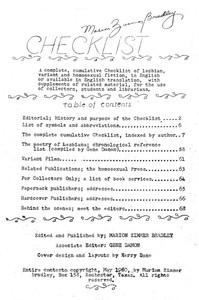
Checklist - A complete, cumulative Checklist of lesbian, variant and homosexual fiction, in English or available in English translation, with supplements of related material, for the use of collectors, students and librarians.
Download Formats:
Excerpt
The Project Gutenberg EBook of Checklist, by Marion Zimmer Bradley
This eBook is for the use of anyone anywhere at no cost and with
almost no restrictions whatsoever. You may copy it, give it away or
re-use it under the terms of the Project Gutenberg License included
with this eBook or online at www.gutenberg.org
Title: Checklist
A complete, cumulative Checklist of lesbian, variant and
homosexual fiction, in English or available in English
translation, with...
Read the Full Text
— End of Checklist - A complete, cumulative Checklist of lesbian, variant and homosexual fiction, in English or available in English translation, with supplements of related material, for the use of collectors, students and librarians. —
Book Information
- Title
- Checklist - A complete, cumulative Checklist of lesbian, variant and homosexual fiction, in English or available in English translation, with supplements of related material, for the use of collectors, students and librarians.
- Language
- English
- Type
- Text
- Release Date
- March 17, 2012
- Word Count
- 29,463 words
- Library of Congress Classification
- Z
- Bookshelves
- Browsing: Encyclopedias/Dictionaries/Reference, Browsing: Literature
- Rights
- Public domain in the USA.