*** START OF THE PROJECT GUTENBERG EBOOK 44822 ***
“ASK MAMMA”,
or
THE RICHEST COMMONER IN ENGLAND
By R. S. Surtees
Illustrated by JOHN LEECH
001m
_Original Size_
CONTENTS
PREFACE TO THE ORIGINAL EDITION.
CHAPTER I. OUR HERO AND CO.—A SLEEPING PARTNER.
CHAPTER II. THE ROAD.
CHAPTER III. THE ROAD RESUMED.—MISS PHEASANT-FEATHERS.
CHAPTER IV. A GLASS COACH.—MISS WILLING (EN GRAND COSTUME)
CHAPTER V. THE LADY’S BOUDOIR.—A DECLARATION.
CHAPTER VI. THE HAPPY UNITED FAMILY.—CURTAIN CRESCENT.
CHAPTER VII. THE EARL OF LADYTHORNE.—MISS DE GLANCEY.
CHAPTER VIII. CUB-HUNTING.
CHAPTER IX. A PUP AT WALK.—IMPERIAL JOHN.
CHAPTER X. JEAN ROUGIER, OR JACK ROGERS.
CHAPTER XI. THE OPENING DAY.—THE HUNT BREAKFAST.
CHAPTER XII. THE MORNING FOX.—THE AFTERNOON FOX.
CHAPTER XIII. GONE AWAY!
CHAPTER XIV. THE PRINGLE CORRESPONDENCE.
CHAPTER XV. MAJOR YAMMERTON’S COACH STOPS THE WAY.
CHAPTER XVI. THE MAJOR’S MENAGE.
CHAPTER XVII. ARRIVAL AT YAMMERTON GRANGE.—A FAMILY PARTY.
CHAPTER XVIII. A LEETLE, CONTRETEMPS.
CHAPTER XIX. THE MAJOR’S STUD.
CHAPTER XX. CARDS FOR A SPREAD.
CHAPTER XXI. THE GATHERING.—THE GRAND SPREAD ITSELF.
CHAPTER XXII. A HUNTING MORNING.—UNKENNELING.
CHAPTER XXIII. SHOWING A HORSE.—THE MEET.
CHAPTER XXIV. THE WILD BEAST ITSELF.
CHAPTER XXV. A CRUEL FINISH.
CHAPTER XXVI. THE PRINGLE CORRESPONDENCE.
CHAPTER XXVII. SIR MOSES MAINCHANCE.
CHAPTER XXVIII. THE HIT-IM AND HOLD-IM SHIRE HOUNDS.
CHAPTER XXIX. THE PANGBURN PARK ESTATE.
CHAPTER XXX. COMMERCE AND AGRICULTURE.
CHAPTER XXXI. SIR MOSES’S MENAGE.—DEPARTURE OF FINE BILLY.
CHAPTER XXXII. THE BAD STABLE; OR, “IT’S ONLY FOR ONE NIGHT.”
CHAPTER XXXIII. SIR MOSES’S SPREAD.
CHAPTER XXXIV. GOING TO COVER WITH THE HOUNDS.
CHAPTER XXXV. THE MEET.
CHAPTER XXXVI. A BIRD’S EYE VIEW.
CHAPTER XXXVII. TWO ACCOUNTS OF A RUN; OR, LOOK ON THIS PICTURE.
CHAPTER XXXVIII. THE SICK HORSE AND THE SICK MASTER.
CHAPTER XXXIX. MR. PRINGLE SUDDENLY BECOMES A MEMBER OF THE H.
H. H.
CHAPTER XL. THE HUNT DINNER,
CHAPTER XLI. THE HUNT TEA.—BUSHEY HEATH AND BARE ACRES.
CHAPTER XLII. MR. GEORDEY GALLON.
CHAPTER XLIII. SIR MOSES PERPLEXED—THE RENDEZVOUS FOR THE RACE.
CHAPTER XLIV. THE RACE ITSELF.
CHAPTER XLV. HENEREY BROWN & CO. AGAIN.
CHAPTER XLVI. THE PRINGLE CORRESPONDENCE.
CHAPTER XLVII. A CATASTROPHE.—A TÊTE-À-TÊTE DINNER
CHAPTER XLVIII. ROUGIER’S MYSTERIOUS LODGINGS—THE GIFT HORSE.
CHAPTER XLIX. THE SHAM DAY.
CHAPTER L. THE SURPRISE.
CHAPTER LI. MONEY AND MATRIMONY.
CHAPTER LII. A NIGHT DRIVE.
CHAPTER LIII. MASTER ANTHONY THOM.
CHAPTER LIV. MR. WOTHERSPOON’S DEJEUNER À LA FOURCHETTE.
CHAPTER LV. THE COUNCIL OF WAR.—POOR PUSS AGAIN!
CHAPTER LVI. A FINE RUN!—THE MAINCHANCE CORRESPONDENCE.
CHAPTER LVII. THE ANTHONY THOM TRAP.
CHAPTER LVIII. THE ANTHONY THOM TAKE.
CHAPTER LIX. ANOTHER COUNCIL OF WAR.—MR. GALLON AT HOME.
CHAPTER LX. MR. CARROTY KEBBEL.
CHAPTER LXI. THE HUNT BALL.—MISS DE GLANCEY’S REFLECTIONS.
CHAPTER LXII. LOVE AT SECOND SIGHT.—CUPID’S SETTLING DAY.
CHAPTER LXIII. A STARTLING ANNOUNCEMENT.
PREFACE TO THE ORIGINAL EDITION.
IT may be a recommendation to the lover of light literature to be
told, that the following story does not involve the complication
of a plot. It is a mere continuous narrative of an almost
everyday exaggeration, interspersed with sporting scenes and
excellent illustrations by Leech.
March 31, 1858.
CHAPTER I. OUR HERO AND CO.—A SLEEPING PARTNER.
017m _Original Size_
ONSIDERING that Billy Pringle, or Fine Billy, as his good-natured
friends called him, was only an underbred chap, he was as good an
imitation of a Swell as ever we saw. He had all the airy
dreaminess of an hereditary high flyer, while his big talk and
off-hand manner strengthened the delusion.
It was only when you came to close quarters with him, and found
that though he talked in pounds he acted in pence, and marked his
fine dictionary words and laboured expletives, that you came to
the conclusion that he was “painfully gentlemanly.” So few
people, however, agree upon what a gentleman is, that Billy was
well calculated to pass muster with the million. Fine shirts,
fine ties, fine talk, fine trinkets, go a long way towards
furnishing the character with many. Billy was liberal, not to say
prodigal, in all these. The only infallible rule we know is, that
the man who is always talking about being a gentleman never is
one. Just as the man who is always talking about honour,
morality, fine feeling, and so on never knows anything of these
qualities but the name.
Nature had favoured Billy’s pretensions in the lady-killing way.
In person he was above the middle height, five feet eleven or so,
slim and well-proportioned, with a finely-shaped head and face,
fair complexion, light brown hair, laughing blue eyes, with long
lashes, good eyebrows, regular pearly teeth and delicately
pencilled moustache. Whiskers he did not aspire to. Nor did Billy
abuse the gifts of Nature by disguising himself in any of the
vulgar groomy gamekeepery style of dress, that so effectually
reduce all mankind to the level of the labourer, nor adopt any of
the “loud” patterns that have lately figured so conspicuously in
our streets. On the contrary, he studied the quiet unobtrusive
order of costume, and the harmony of colours, with a view of
producing a perfectly elegant general effect. Neatly-fitting
frock or dress coats, instead of baggy sacks, with trouser legs
for sleeves, quiet-patterned vests and equally quiet-patterned
trousers. If he could only have been easy in them he would have
done extremely well, but there was always a nervous twitching,
and jerking, and feeling, as if he was wondering what people were
thinking or saying of him.
In the dress department he was ably assisted by his mother, a
lady of very considerable taste, who not only fashioned his
clothes but his mind, indeed we might add his person, Billy
having taken after her, as they say; for his father, though an
excellent man and warm, was rather of the suet-dumpling order of
architecture, short, thick, and round, with a neck that was
rather difficult to find. His name, too, was William, and some,
the good-natured ones again of course, used to say that he might
have been called “Fine Billy the first,” for under the auspices
of his elegant wife he had assumed a certain indifference to
trade; and when in the grand strut at Ramsgate or Broadstairs, or
any of his watering-places, if appealed to about any of the
things made or dealt in by any of the concerns in which he was a
“Co.,” he used to raise his brows and shrug his shoulders, and
say with a very deprecatory sort of air, “‘Pon my life, I should
say you’re right,” or “‘Deed I should say it was so,” just as if
he was one of the other Pringles,—the Pringles who have nothing
to do with trade,—and in noways connected with Pringle & Co.;
Pringle & Potts; Smith, Sharp & Pringle; or any of the firms that
the Pringles carried on under the titles of the original
founders. He was neither a tradesman nor a gentleman. The
Pringles—like the happy united family we meet upon wheels; the
dove nestling with the gorged cat, and so on—all pulled well
together when there was a common victim to plunder; and kept
their hands in by what they called taking fair advantages of each
other, that is to say, cheating each other, when there was not.
Nobody knew the ins and outs of the Pringles. If they let their
own right hands know what their left hands did, they took care
not to let anybody else’s right hand know. In multiplicity of
concerns they rivalled that great man “Co.,” who the country-lad
coming to London said seemed to be in partnership with almost
everybody. The author of “Who’s Who?” would be puzzled to post
people who are Brown in one place, Jones in a second, and
Robinson in a third. Still the Pringles were “a most respectable
family,” mercantile morality being too often mere matter of
moonshine. The only member of the family who was not exactly
“legally honest,”—legal honesty being much more elastic than
common honesty,—was cunning Jerry, who thought to cover by his
piety the omissions of his practice. He was a fawning,
sanctified, smooth-spoken, plausible, plump little man, who
seemed to be swelling with the milk of human kindness, anxious
only to pour it out upon some deserving object. His manner was so
frank and bland, and his front face smile so sweet, that it was
cruel of his side one to contradict the impression and show the
cunning duplicity of his nature. Still he smirked and smiled, and
“bless-you, dear” and “hope-your-happy,” deared the women, that,
being a bachelor, they all thought it best to put up with his
“mistakes,” as he called his peculations, and sought his favour
by frequent visits with appropriate presents to his elegant villa
at Peckham Rye. Here he passed for quite a model man; twice to
church every Sunday, and to the lecture in the evening, and would
not profane the sanctity of the day by having a hot potato to eat
with his cold meat.
He was a ripe rogue, and had been jointly or severally, as the
lawyers say, in a good many little transactions that would not
exactly bear inspection; and these “mistakes” not tallying with
the sanctified character he assumed, he had been obliged to
wriggle out of them as best he could, with the loss of as few
feathers as possible. At first, of course, he always tried the
humbugging system, at which he was a great adept; that failing,
he had recourse to bullying, at which he was not bad, declaring
that the party complaining was an ill-natured, ill-conditioned,
quarrelsome fellow, who merely wanted a peg to hang a grievance
upon, and that Jerry, so far from defrauding him, had been the
best friend he ever had in his life, and that he would put him
through every court in the kingdom before he would be imposed
upon, by him. If neither of these answered, and Jerry found
himself pinned in a corner, he feigned madness, when his
solicitor, Mr. Supple, appeared, and by dint of legal threats,
and declaring that if the unmerited persecution was persisted in,
it would infallibly consign his too sensitive client to a lunatic
asylum, he generally contrived to get Jerry out of the scrape by
some means or other best known to themselves. Then Jerry, of
course, being clear, would inuendo his own version of the story
as dexterously as he could, always taking care to avoid a
collision with the party, but more than insinuating that he
(Jerry) had been infamously used, and his well-known love of
peace and quietness taken advantage of; and though men of the
world generally suspect the party who is most anxious to
propagate his story to be in the wrong, yet their number is but
small compared to those who believe anything they are told, and
who cannot put “that and that” together for themselves.
So Jerry went on robbing and praying and passing for a very
proper man. Some called him “cunning Jerry,” to distinguish him
from an uncle who was Jerry also; but as this name would not do
for the family to adopt, he was generally designated by them as
“Want-nothin’-but-what’s-right Jerry,” that being the form of
words with which he generally prefaced his extortions. In the
same way they distinguished between a fat Joe and a thin one,
calling the thin one merely “Joe,” and the fat one “Joe who can’t
get within half a yard of the table;” and between two clerks,
each bearing the not uncommon name of Smith, one being called
Smith, the other “Head-and-shoulders Smith,”—the latter, of
course, taking his title from his figure.
With this outline of the Pringle family, we will proceed to draw
out such of its members as figure more conspicuously in our
story.
With Mrs. William Pringle’s (_née_ Willing) birth, parentage, and
education, we would gladly furnish the readers of this work with
some information, but, unfortunately, it does not lie in our
power so to do, for the simple reason, that we do not know
anything. We first find her located at that eminent Court
milliner and dressmaker’s, Madame Adelaide Banboxeney, in
Furbelow Street, Berkeley Square, where her elegant manners, and
obliging disposition, to say nothing of her taste in torturing
ribbons and wreaths, and her talent for making plain girls into
pretty ones, earned for her a very distinguished reputation. She
soon became first-hand, or trier-on, and unfortunately, was
afterwards tempted into setting-up for herself, when she soon
found, that though fine ladies like to be cheated, it must be
done in style, and by some one, if not with a carriage, at all
events with a name; and that a bonnet, though beautiful in Bond
Street, loses all power of attraction if it is known to come out
of Bloomsbury. Miss Willing was, therefore, soon sold up; and
Madame Banboxeney (whose real name was Brown, Jane Brown, wife of
John Brown, who was a billiard-table marker, until his wife’s
fingers set him up in a gig), Madame Banboxeney, we say, thinking
to profit by Miss Willing’s misfortunes, offered her a very
reduced salary to return to her situation; but Miss Willing
having tasted the sweets of bed, a thing she very seldom did at
Madame Banboxeney’s, at least not during the season, stood out
for more money; the consequence of which was, she lost that
chance, and had the benefit of Madame’s bad word at all the other
establishments she afterwards applied to. In this dilemma, she
resolved to turn her hand to lady’s-maid-ism; and having mastered
the science of hair-dressing, she made the rounds of the
accustomed servant-shops, grocers, oilmen, brushmen, and so on,
asking if they knew of any one wanting a perfect lady’s-maid.
As usual in almost all the affairs of life, the first attempt was
a failure. She got into what she thoroughly despised, an untitled
family, where she had a great deal more to do than she liked, and
was grossly “put upon” both by the master and missis. She gave
the place up, because, as she said, “the master would come into
the missis’s room with nothing but his night-shirt and spectacles
on,” but, in reality, because the missis had some of her things
made-up for the children instead of passing them on, as of right
they ought to have been, to her. She deeply regretted ever having
demeaned herself by taking such a situation. Being thus out of
place, and finding the many applications she made for other
situations, when she gave a reference to her former one, always
resulted in the ladies declining her services, sometimes on the
plea of being already suited, or of another “young person” having
applied just before her, or of her being too young (they never
said too pretty, though one elderly lady on seeing her shook her
head, and said she “had sons”); and, being tired of living on old
tea leaves, Miss Willing resolved to sink her former place, and
advertise as if she had just left Madame Banboxeney’s.
Accordingly she drew out a very specious advertisement, headed
“_to the nobility_,” offering the services of a lady’s-maid, who
thoroughly understood millinery, dress-making, hair-dressing, and
getting up fine linen, with an address to a cheese shop, and made
an arrangement to give Madame Banboxeney a lift with a heavy
wedding order she was busy upon, if she would recommend her as
just fresh from her establishment.
This advertisement produced a goodly crop of letters, and Miss
Willing presently closed with the Honourable Mrs. Cavesson, whose
husband was a good deal connected with the turf, enjoying that
certain road to ruin which so many have pursued; and it says much
for Miss Willing’s acuteness, that though she entered Mrs.
Cavesson’s service late in the day, when all the preliminaries
for a smash had been perfected, her fine sensibilities and
discrimination enabled her to anticipate the coming evil, and to
deposit her mistress’s jewellery in a place of safety
three-quarters of an hour before the bailiffs entered. This act
of fidelity greatly enhanced her reputation, and as it was well
known that “poor dear Mrs. Cavesson” would not be able to keep
her, there were several great candidates for this “treasure of a
maid.” Miss Willing had now nothing to do but pick and choose;
and after some consideration, she selected what she called a high
quality family, one where there was a regular assessed tax-paper
establishment of servants, where the butler sold his lord’s
wine-custom to the highest bidder, and the heads of all the
departments received their “reglars” upon the tradesmen’s bills;
the lady never demeaning herself by wearing the same gloves or
ball-shoes twice, or propitiating the nurse by presents of
raiment that was undoubtedly hers—we mean the maid’s. She was a
real lady, in the proper acceptation of the term.
This was the beautiful, and then newly married, Countess Delacey,
whose exquisite garniture will still live in the recollection of
many of the now bald-headed beaux of that period. For these
delightful successes, the countess was mainly indebted to our
hero’s mother, Miss Willing, whose suggestive genius oft came to
the aid of the perplexed and exhausted milliner. It was to the
service of the Countess Delacey that Miss Willing was indebted
for becoming the wife of Mr. Pringle, afterwards “Fine Billy the
first,”—an event that deserves to be introduced in a separate
chapter.
CHAPTER II. THE ROAD.
IT was on a cold, damp, raw December morning, before the
emancipating civilisation of railways, that our hero’s father,
then returning from a trading tour, after stamping up and down
the damp flags before the Lion and Unicorn hotel and
posting-house at Slopperton, waiting for the old True Blue
Independent coach “comin’ hup,” for whose cramped inside he had
booked a preference seat, at length found himself bundled into
the straw-bottomed vehicle, to a very different companion to what
he was accustomed to meet in those deplorable conveyances.
Instead of a fusty old farmer, or a crumby basket-encumbered
market-woman, he found himself opposite a smiling, radiant young
lady, whose elegant dress and ring-bedizened hand proclaimed, as
indeed was then generally the case with ladies, that she was
travelling in a coach “for the first time in her life.”
This was our fair friend, Miss Willing.
The Earl and Countess Delacey had just received an invitation to
spend the Christmas at Tiara Castle, where the countess on the
previous year had received if not a defeat, at all events had not
achieved a triumph, in the dressing way, over the Countess of
Honiton, whose maid, Miss Criblace, though now bribed to secrecy
with a full set of very little the worse for wear Chinchilla fur,
had kept the fur and told the secret to Miss Willing, that their
ladyships were to meet again. Miss Willing was now on her way to
town, to arrange with the Countess’s milliner for an annihilating
series of morning and evening dresses wherewith to extinguish
Lady Honiton, it being utterly impossible, as our fair friends
will avouch, for any lady to appear twice in the same attire. How
thankful men ought to be that the same rule does not prevail with
them!
Miss Willing was extremely well got up; for being of nearly the
same size as the countess, her ladyship’s slightly-worn things
passed on to her with scarcely a perceptible diminution of
freshness, it being remarkable how, in even third and fourth-rate
establishments, dresses that were not fit for the “missus” to be
seen in come out quite new and smart on the maid.
On this occasion Miss Willing ran entirely to the dark colours,
just such as a lady travelling in her own carriage might be
expected to wear. A black terry velvet bonnet with a single
ostrich feather, a dark brown Levantine silk dress, with rich
sable cuffs, muff, and boa, and a pair of well-fitting
primrose-coloured kid gloves, which if they ever had been on
before had not suffered by the act.
Billy—old Billy that is to say—was quite struck in a heap at such
an unwonted apparition, and after the then usual salutations, and
inquiries how she would like to have the window, he popped the
old question, “How far was she going?” with very different
feelings to what it was generally asked, when the traveller
wished to calculate how soon he might hope to get rid of his
_vis-à-vis_ and lay up his legs on the seat.
“To town,” replied the lady, dimpling her pretty cheeks with a
smile. “And you?” asked she, thinking to have as good as she
gave.
“Ditto,” replied the delighted Billy, divesting himself of a
great coarse blue and white worsted comforter, and pulling up his
somewhat dejected gills, abandoning the idea of economising his
Lincoln and Bennett by the substitution of an old Gregory’s
mixture coloured fur cap, with its great ears tied over the top,
in which he had snoozed and snored through many a long journey.
Miss Willing then drew from her richly-buckled belt a beautiful
Geneva watch set round with pearls, (her ladyship’s, which she
was taking to town to have repaired), and Billy followed suit
with his substantial gold-repeater, with which he struck the
hour. Miss then ungloved the other hand, and passed it down her
glossy brown hair, all smooth and regular, for she had just been
scrutinising it in a pocket-mirror she had in her
gold-embroidered reticule.
Billy’s commercial soul was in ecstacies, and he was fairly over
head and ears in love before they came to the first change of
horses. He had never seen sich a sample of a hand before, no, nor
sich a face; and he felt quite relieved when among the
multiplicity of rings he failed to discover that thin plain gold
one that intimates so much.
Whatever disadvantages old stage coaches possessed, and their
name certainly was legion, it must be admitted that in a case of
this sort their slowness was a recommendation. The old True Blue
Independent did not profess to travel or trail above eight miles
an hour, and this it only accomplished under favourable
circumstances, such as light loads, good roads, and stout steeds,
instead of the top-heavy cargo that now ploughed along the woolly
turnpike after the weak, jaded horses, that seemed hardly able to
keep their legs against the keen careering wind. If, under such
circumstances, the wretched concern made the wild-beast-show
looking place in London, called an inn, where it put up, an hour
or an hour and a half or so after its time, it was said to be all
very well, “considering,”—and this, perhaps, in a journey of
sixty miles.
Posterity will know nothing of the misery their forefathers
underwent in the travelling way; and whenever we hear—which we
often do—unreasonable grumblings about the absence of trifling
luxuries on railways, we are tempted to wish the parties
consigned to a good long ride in an old stage coach. Why the
worst third class that ever was put next the engine is infinitely
better than the inside of the best of them used to be, to say
nothing of the speed. As to the outsides of the old coaches, with
their roastings, their soakings, their freezings, and their
smotherings with dust, one cannot but feel that the establishment
of railways was a downright prolongation of life. Then the coach
refreshments, or want of refreshments rather; the turning out at
all hours to breakfast, dine, or sup, just as the coach reached
the house of a proprietor “wot oss’d it,” and the cool incivility
of every body about the place. Any thing was good enough for a
coach passenger.
On this auspicious day, though Miss Willing had her reticule full
of macaroons and sponge biscuits, and Fine Billy the first had a
great bulging paper of sandwiches in his brown overcoat pocket,
they neither of them felt the slightest approach to hunger, ere
the lumbering vehicle, after a series of clumsy,
would-be-dash-cutting lurches and evolutions over the rough
inequalities of the country pavement, pulled up short at the
arched doorway of the Salutation Inn—we beg pardon, hotel—in
Bramfordrig, and a many-coated, brandy-faced, blear-eyed guard
let in a whole hurricane of wind while proclaiming that they
“dined there and stopped half an hour.” Then Fine Billy the first
had an opportunity of showing his gallantry and surveying the
figure of his innamorata, as he helped her down the perilous
mud-shot iron steps of the old Independent, and certainly never
countess descended from her carriage on a drawing-room day with
greater elegance than Miss Willing displayed on the present
occasion, showing a lettle circle of delicate white linen
petticoat as she protected her clothes from the mud-begrimed
wheel, and just as much fine open-worked stocking above the
fringed top of her Adelaide boots. On reaching the ground, which
she did with a curtsey, she gave such a sweet smile as emboldened
our Billy to offer his arm; and amid the nudging of outsiders,
and staring of street-loungers, and “make way"-ing of inn
hangers-on, our Billy strutted up the archway with all the
dignity of a drum-major. His admiration increased as he now
became sensible of the lady’s height, for like all little men he
was an admirer of tall women. As he caught a glimpse of himself
in the unbecoming mirror between the drab and red fringed window
curtains of the little back room into which they were ushered, he
wished he had had on his new blue coat and bright buttons, with a
buff vest, instead of the invisible green and black spot
swansdown one in which he was then attired.
The outside passengers having descended from their eminences,
proceeded to flagellate themselves into circulation, and throw
off their husks, while Billy strutted consequentially in with the
lady on his arm, and placed her in the seat of honour beside
himself at the top of the table. The outsides then came swarming
in, jostling the dish-bearers and seating themselves as they
could. All seemed bent upon getting as much as they could for
their money.
Pork was the repast. Pork in varions shapes: roast at the top,
boiled at the bottom, sausages on one side, fry on the other; and
Miss Willing couldn’t eat pork, and, curious coincidence! neither
could Billy. The lady having intimated this to Billy in the most
delicate way possible, for she had a particular reason for not
wishing to aggravate the new landlord, Mr. Bouncible, Billy
gladly sallied forth to give battle as it were on his own
account, and by way of impressing the household with his
consequence, he ordered a bottle of Teneriffe as he passed the
bar, and then commenced a furious onslaught about the food when
he got into the kitchen. This reading of the riot act brought
Bouncible from his “Times,” who having been in the profession
himself took Billy for a nobleman’s gentleman, or a house-steward
at least—a class of men not so easily put upon as their masters.
He therefore, after sundry regrets at the fare not being ‘zactly
to their mind, which he attributed to its being washing-day,
offered to let them have the first turn at a very nice dish of
hashed venison that was then simmering on the fire for Mrs. B.
and himself, provided our travellers would have the goodness to
call it hashed mutton, so that it might not be devoured by the
outsiders, a class of people whom all landlords held in great
contempt. To this proposition Billy readily assented, and
returned triumphantly to the object of his adoration. He then
slashed right and left at the roast pork, and had every plate but
hers full by the time the hashed mutton made its appearance. He
then culled out all the delicate tit-bits for his fair partner,
and decked her hot plate with sweet sauce and mealy potatoes.
Billy’s turn came next, and amidst demands for malt liquor and
the arrival of smoking tumblers of brown brandy and water,
clatter, patter, clatter, patter, became the order of the day,
with an occasional suspicious, not to say dissatisfied, glance of
a pork-eating passenger at the savoury dish at the top of the
table. Mr. Bonncible, however, brought in the Teneriffe just at
the critical moment, when Billy having replenished both plates,
the pork-eaters might have expected to be let in; and walked off
with the dish in exchange for the decanter. Our friends then
pledged each other in a bumper of Cape. The pork was followed by
an extremely large strong-smelling Cheshire cheese, in a high
wooden cradle, which in its turn was followed by an extremely
large strong-smelling man in a mountainous many-caped greatcoat,
who with a bob of his head and a kick out behind, intimated that
paying time was come for him. Growls were then heard of its not
being half an hour, or of not having had their full time,
accompanied by dives into the pockets and reticules for the
needful—each person wondering how little he could give without a
snubbing.
027m
_Original Size_
Quite “optional” of course. Billy, who was bent on doing the
magnificent, produced a large green-and-gold-tasseled purse,
almost as big as a stocking, and drew therefrom a great
five-shilling piece, which having tapped imposingly on his plate,
he handed ostentatiously to the man, saying, “for this lady and
me,” just as if she belonged to him; whereupon down went the head
even with the table, with an undertoned intimation that Billy
“needn’t ‘urry, for he would make it all right with the guard.”
The waiter followed close on the heels of the coachman, drawing
every body for half-a-crown for the dinner, besides what they had
had to drink, and what they “pleased for himself,” and Billy
again anticipated the lady by paying for both. Instead, however,
of disputing his right so to do, she seemed to take it as a
matter of course, and bent a little forward and said in a sort of
half-whisper, though loud enough to be heard by a twinkling-eyed,
clayey-complexioned she-outsider, sitting opposite, dressed in a
puce-coloured cloth pelisse and a pheasant-feather bonnet, “I
fear you will think me very troublesome, but do you think you
could manage to get me a finger-glass?” twiddling her pretty
taper fingers as she spoke.
“Certainly!” replied Billy, all alacrity, “certainly.”
“With a little tepid water,” continued Miss Willing, looking
imploringly at Billy as he rose to fulfil her behests.
“Such airs!” growled Pheasant-feathers to her next neighbour with
an indignant toss of her colour-varying head.
Billy presently appeared, bearing one of the old deep
blue-patterned finger-glasses, with a fine damask napkin, marked
with a ducal coronet—one of the usual perquisites of servitude.
Miss then holding each pretty hand downwards, stripped her
fingers of their rings, just as a gardener strips a stalk of
currants of its fruit, dropping, however, a large diamond ring
(belonging to her ladyship, which she was just airing) skilfully
under the table, and for which fat Billy had to dive like a dog
after an otter.
“Oh, dear!” she was quite ashamed at her awkwardness and the
trouble she had given, she assured Billy, as he rose red and
panting from the pursuit.
“Done on purpose to show her finery,” muttered Pheasant-feather
bonnet, with a sneer.
Miss having just passed the wet end of the napkin across her
cherry lips and pearly teeth, and dipped her fingers becomingly
in the warm water, was restoring her manifold rings, when the
shrill _twang, twang, twang_ of the horn, with the prancing of
some of the newly-harnessed cripples on the pavement as they
tried to find their legs, sounded up the arch-way into the little
room, and warned our travellers that they should be reinvesting
themselves in their wraps. So declining any more Teneriffe, Miss
Willing set the example by drawing on her pretty kid gloves, and
rising to give the time to the rest. Up they all got.
CHAPTER III. THE ROAD RESUMED.—MISS PHEASANT-FEATHERS.
THE room, as we said before, being crammed, and our fair friend
Miss Willing taking some time to pass gracefully down the line of
chair-backs, many of whose late occupants were now swinging their
arms about in all the exertion of tying up their mouths, and
fighting their ways into their over-coats, Mr. Pringle, as he
followed, had a good opportunity of examining her exquisite
_tournure_, than which he thought he never saw anything more
beautifully perfect. He was quite proud when a little more width
of room at the end of the table enabled him to squeeze past a
robing, Dutch-built British-lace-vending pack-woman, and reclaim
his fair friend, just as a gentleman does his partner at the end
of an old country dance. How exultingly he marched her through
the line of inn hangers-on, hostlers, waiters, porters,
post-boys, coachmen, and insatiable Matthews-at-home of an inn
establishment, “Boots,” a gentleman who will undertake all
characters in succession for a consideration. How thankful we
ought to be to be done with these harpies!
Bouncible, either mistaking the rank of his guests, or wanting to
have a better look at the lady, emerged from his glass-fronted
den of a bar, and salaam’d them up to the dirty coach, where the
highly-fee’d coachman stood door in hand, waiting to perform the
last act of attention for his money. In went Billy and the
beauty, or rather the beauty and Billy, bang went the door, the
outsiders scrambled up on to their perches and shelves as best
they could. “_All right! Sit tight!_” was presently heard, and
whip, jip, crack, cut, three blind ‘uns and a bolter were again
bumping the lumbering vehicle along the cobble-stoned street,
bringing no end of cherry cheeks and corkscrew ringlets to the
windows, to mark that important epoch of the day, the coach
passing by.
031m
_Original Size_
Billy, feeling all the better for his dinner, and inspirited by
sundry gulps of wine, proceeded to make himself comfortable, in
order to open fire as soon as ever the coach got off the stones.
He took a rapid retrospect of all the various angels he had
encountered, those who had favoured him, those who had frowned,
and he was decidedly of opinion that he had never seen anything
to compare to the fair lady before him. He was rich and thriving
and would please himself without consulting
Want-nothin’-but-what’s-right Jerry, Half-a-yard-of-the-table
Joe, or any of them. It wasn’t like as if they were to be in Co.
with him in the lady. She would never come into the balance
sheets. No; she was to be all his, and they had no business with
it. He believed Want-nothin’-but-what’s-right would be glad if he
never married. Just then the coach glid from the noisy pavement
on to the comparatively speaking silent macadamised road, and
Billy and the lady opened fire simultaneously, the lady about the
discomforts of coach-travelling, which she had never tried
before, and Billy about the smack of the Teneriffe, which he
thought very earthy. He had some capital wine at home, he said,
as everybody has. This led him to London, the street conveniences
or inconveniences as they then were of the metropolis, which
subject he plied for the purpose of finding out as well where the
lady lived as whether her carriage would meet her or not; but
this she skilfully parried, by asking Billy where he lived, and
finding it was Doughty Street, Russell Square, she observed, as
in truth it is, that it was a very airy part of the town, and
proceeded to expatiate on the beauty of the flowers in Covent
Garden, from whence she got to the theatres, then to the opera,
intimating a very considerable acquaintance as well with the
capital as with that enchanted circle, the West-end, comprising
in its contracted limits what is called the world. Billy was
puzzled. He wished she mightn’t be a cut above him—such lords,
such ladies, such knowledge of the court—could she be a
maid-of-honour? Well, he didn’t care. No ask no have, so he
proceeded with the pumping process again. “Did she live in town?”
_Fair Lady_.—“Part of the year.”
_Billy_.—“During the season I ‘spose?”
_Fair Lady_.—“During the sitting of parliament.”
“There again!” thought Billy, feeling the expectation-funds fall
ten per cent, at least. “Well, faint heart never won fair lady,”
continued he to himself, considering how next he should sound
her. She was very beautiful—what pretty pearly teeth she had, and
such a pair of rosy lips—such a fair forehead too, and _such_
nice hair—he’d give a fipun note for a kiss!—he’d give a tenpun
note for a kiss!—dashed if he wouldn’t give a fifty-pun for a
kiss. Then he wondered what Head-and-shoulders Smith would think
of her. As he didn’t seem to be making much progress, however, in
the information way, he now desisted from that consideration, and
while contemplating her beauty considered how best he should
carry on the siege. Should he declare who and what he was, making
the best of himself of course, and ask her to be equally
explicit, or should he beat about the bush a little longer and
try to fish out what he could about her.
They had a good deal of day before them yet, dark though the
latter part of it would be; which, however, on second thoughts,
he felt might be rather favourable, inasmuch as she wouldn’t see
when he was taken aback by her answers. He would beat about the
bush a little longer. It was very pleasant sport.
“Did you say you lived in Chelsea?” at length asked Billy, in a
stupid self-convicting sort of way.
“No,” replied the fair lady with a smile; “I never mentioned
Chelsea.”
“Oh, no; no more you did,” replied Billy, taken aback, especially
as the lady led up to no other place.
“Did she like the country?” at length asked he, thinking to try
and fix her locality there, if he could not earth her in London.
“Yes, she liked the country, at least out of the season—there was
no place like London in the season,” she thought.
Billy thought so too; it was the best place in summer, and the
only place in winter.
Well, the lady didn’t know, but if she had to choose either place
for a permanency, she would choose London.
This sent the Billy funds up a little. He forgot his intention of
following her into the country, and began to expatiate upon the
luxuries of London, the capital fish they got, the cod and
hoyster sauce (for when excited, he knocked his h’s about a
little), the cod and hoyster sauce, the turbot, the mackerel, the
mullet, that woodcock of the sea, as he exultingly called it,
thinking what a tuck-out he would have in revenge for his country
inn abstinence. He then got upon the splendour of his own house
in Doughty Street—the most agreeable in London. Its spacious
entrance, its elegant stone staircase; his beautiful
drawing-room, with its maroon and rose-coloured brocaded satin
damask curtains, and rich Tournay carpet, its beautiful
chandelier of eighteen lights, and Piccolo pianoforte, and was
describing a most magnificent mirror—we don’t know what size, but
most beautiful and becoming—when the pace of the vehicle was
sensibly felt to relax; and before they had time to speculate on
the cause, it had come to a stand-still.
“Stopped,” observed Billy, lowering the window to look out for
squalls.
No sooner was the window down, than a head at the door proclaimed
mischief. The _tête-à-tête_ was at an end. The guard was going to
put Pheasant-feather bonnet inside. Open sesame _—W-h-i-s-h_. In
came the cutting wind—oh dear what a day!
“Rum for a leddy?” asked the guard, raising a great half-frozen,
grog-blossomy face out of the blue and white coil of a
shawl-cravat in which it was enveloped,—“Git in” continued he,
shouldering the leddy up the steps, without waiting for an
answer, and in popped Pheasant-feathers; when, slamming-to the
door, he cried “_right!_” to the coachman, and on went the
vehicle, leaving the enterer to settle into a seat by its
shaking, after the manner of the omnibus cads, who seem to think
all they have to do is to see people past the door. As it was,
the new-comer alighted upon Billy, who cannoned her off against
the opposite door, and then made himself as big as he could, the
better to incommode her. Pheasant-feathers, however, having
effected an entrance, seemed to regard herself as good as her
neighbours, and forthwith proceeded to adjust the window to her
liking, despite the eyeing and staring of Miss Willing. Billy was
indignant at the nasty peppermint-drop-smelling woman intruding
between the wind and his beauty, and inwardly resolved he would
dock the guard’s fee for his presumption in putting her there.
Miss Willing gathered herself together as if afraid of
contamination; and, forgetting her _role_, declared, after a jolt
received in one of her seat-shiftings, that it was just the
“smallest coach she had ever been in.” She then began to
scrutinise her female companion’s attire.
A cottage-bonnet, made of pheasant-feathers; was there ever such
a frightful thing seen,—all the colours of the rainbow
combined,—must be a poacher’s daughter, or a poulterer’s. Paste
egg-coloured ribbons; what a cloth pelisse,—puce colour in some
parts,—bath-brick colour in others,—nearly drab in
others,—thread-bare all over. Dare say she thought herself fine,
with her braided waist, up to her ears. Her glazy gloves might be
any colour—black, brown, green, gray. Then a qualm shot across
Miss Willing’s mind that she had seen the pelisse before. Yes,
no, yes; she believed it was the very one she had sold to Mrs.
Pickles’ nursery governess for eighteen shillings. So it was. She
had stripped the fur edging off herself, and there were the
marks. Who could the wearer be? Where could she have got it? She
could not recollect ever having seen her unwholesome face before.
And yet the little ferrety, white-lashed eyes settled upon her as
if they knew her. Who could she be? What, if she had lived
fellow—(we’ll not say what)—with the creature somewhere. There
was no knowing people out of their working clothes, especially
when they set up to ride inside of coaches. Altogether, it was
very unpleasant.
Billy remarked his fair friend’s altered mood, and rightly
attributed it to the intrusion of the nasty woman, whose gaudy
headgear the few flickering rays of a December sun were now
lighting up, making the feathers, so beautiful on a bird, look,
to Billy’s mind, so ugly on a bonnet, at least on the bonnet that
now thatched the frightful face beside him. Billy saw the fair
lady was not accustomed to these sort of companions, and wished
he had only had the sense to book the rest of the inside when the
coach stopped to dine. However, it could not be helped now; so,
having ascertained that Pheasant-feathers was going all the way
to “Lunnnn,” as she called it, when the sun sunk behind its
massive leadeen cloud, preparatory to that long reign of darkness
with which travellers were oppressed,—for there were no oil-lamps
to the roofs of stage-coaches,—Billy being no longer able to
contemplate the beauties of his charmer, now changed his seat,
for a little confidential conversation by her side.
He then, after a few comforting remarks, not very flattering to
Pheasant-feathers’ beauty, resumed his expatiations about his
splendid house in Doughty Street, Russell Square, omitting, of
course, to mention that it had been fitted up to suit the taste
of another lady, who had jilted him. He began about his
dining-room, twenty-five feet by eighteen, with a polished steel
fender, and “pictors” all about the walls; for, like many people,
he fancied himself a judge of the fine arts, and, of course, was
very frequently fleeced.
This subject, however, rather hung fire, a dining-room being
about the last room in a house that a lady cares to hear about,
so she presently cajoled him into the more genial region of the
kitchen, which, unlike would-be fine ladies of the present day,
she was not ashamed to recognise. From the kitchen they proceeded
to the store-room, which Billy explained was entered by a door at
the top of the back stairs, six feet nine by two feet eight,
covered on both sides with crimson cloth, brass moulded in panels
and mortise latch. He then got upon the endless, but
“never-lady-tiring,” subject of bed-rooms—his best bed-room, with
a most elegant five-feet-three canopy-top, mahogany bedstead,
with beautiful French chintz furniture, lined with pink, outer
and inner valance, trimmed silk tassel fringe, &c., &c., &c. And
so he went maundering on, paving the way most elaborately to an
offer, as some men are apt to do, instead of getting briskly to
the “ask-mamma” point, which the ladies are generally anxious to
have them at.
To be sure, Billy had been bowled over by a fair, or rather
unfair one, who had appeared quite as much interested about his
furniture and all his belongings as Miss Willing did, and who,
when she got the offer, and found he was not nearly so well off
as Jack Sanderson, declared she was never so surprised in her
life as when Billy proposed; for though, as she politely said,
every one who knew him must respect him, yet he had never even
entered her head in any other light than that of an agreeable
companion. This was Miss Amelia Titterton, afterwards Mrs.
Sanderson. Another lady, as we said before (Miss Bowerbank), had
done worse; for she had regularly jilted him, after putting him
to no end of expense in furnishing his house, so that, upon the
whole, Billy had cause to be cautious. A coach, too, with its
jolts and its jerks, and its brandy-and-water stoppages, is but
ill calculated for the delicate performance of offering, to say
nothing of having a pair of nasty white-lashed,
inquisitive-looking, ferrety eyes sitting opposite, with a pair
of listening ears, nestling under the thatch of a
pheasant-feather bonnet. All things considered, therefore, Billy
may, perhaps, stand excused for his slowness, especially as he
did not know but what he was addressing a countess.
And so the close of a scarcely dawned December day, was followed
by the shades of night, and still the jip, jip, jipping; whip,
whip, whipping; creak, creak, creaking of the heavy lumbering
coach, was accompanied by Billy’s maunderings about his noble
ebony this, and splendid mahogany that, varied with, here and
there, a judicious interpolation of an “indeed,” or a “how
beautiful,” from Miss Willing, to show how interested she was in
the recital; for ladies are generally good listeners, and Miss
Willing was essentially so.
The “demeanour of the witness” was lost, to be sure, in the
chancery-like darkness that prevailed; and Billy felt it might be
all blandishment, for nothing could be more marked or agreeable
than the interest both the other ladies had taken in his family,
furniture, and effects. Indeed, as he felt, they all took much
the same course, for, for cool home-questioning, there is no man
can compete with an experienced woman. They get to the
“What-have-you-got, and What-will-you-do” point, before a man has
settled upon the line of inquiry—very likely before he has got
done with that interesting topic—the weather.
At length, a sudden turn of the road revealed to our friends, who
were sitting with their faces to the horses, the first distant
curve of glow-worm-like lamps in the distance, and presently the
great white invitations to “try warren’s,” or “day and martin’s
blacking,” began to loom through the darkness of the dead walls
of the outskirts of London. They were fast approaching the
metropolis. The gaunt elms and leafless poplars presently became
fewer, while castellated and sentry-box-looking summer-houses
stood dark in the little paled-off gardens. At last the villas,
and semi-detached villas, collapsed into one continuous gas-lit
shop-dotted street. The shops soon became better and more
frequent,—more ribbons and flowers, and fewer periwinkle stalls.
They now got upon the stones. Billy’s heart jumped into his month
at the jerk, for he knew not how soon his charmer and he might
part, and as yet he had not even ascertained her locality. Now or
never, thought he, rising to the occasion, and, with difficulty
of utterance, he expressed a hope that he might have the pleasure
of seeing her ‘ome.
“Thank you, _no_,” replied Miss Willing, emphatically, for it was
just the very thing she most dreaded, letting him see her
reception by the servants.
“Humph!” grunted Billy, feeling his funds fall five-and-twenty
per cent.—“Miss Titterton or Miss Bowerbank over again,” thought
he.
“Not but that I most fully appreciate your kindness,” whispered
Miss Willing, in the sweetest tone possible, right into his ear,
thinking by Billy’s silence that her vehemence had offended him;
“but,” continued she, “I’m only going to the house of a friend, a
long way from you, and I expect a servant to meet me at the Green
Man in Oxford Street.”
“Well, but let me see you to the”—(puff, gasp)—“Green Man,”
ejaculated Billy, the funds of hope rising more rapidly than his
words.
“It’s very kind,” whispered Miss Willing, “and I feel it _very,
very_ much, but”—
“But if your servant shouldn’t come,” interrupted Billy, “you’d
never find your way to Brompton in this nasty dense yellow fog,”
for they had now got into the thick of a fine fat one.
“Oh, but I’m not going to Brompton,” exclaimed Miss Willing,
amused at this second bad shot of Billy’s at her abode.
“Well, wherever you are going, I shall only be too happy to
escort you,” replied Billy, “I know Lunnun well.”
“So do I,” thought Miss Willing, with a sigh. And the coach
having now reached that elegant hostelry, the George and Blue
Badger, in High Holborn, Miss showed her knowledge of it by
intimating to Billy that that was the place for him to alight; so
taking off her glove she tendered him her soft hand, which Billy
grasped eagerly, still urging her to let him see her home, or at
all events to the Green Man, in Oxford Street.
Miss, however, firmly but kindly declined his services, assuring
him repeatedly that she appreciated his kindness, which she
evinced by informing him that she was going to a friend’s at No.
—, Grosvenor Square, that she would only be in town for a couple
of nights; but that if he _really_ wished to see her
again,—“_really_ wished it,” she repeated with an emphasis, for
she didn’t want to be trifled with,—she would be happy to see him
to tea at eight o’clock on the following evening.
“_Eight o’clock!_” gasped Billy. “No. ——, Gruvenor Square,”
repeated he. “I knows it—I’ll be with you to a certainty—I’ll be
with you to a”—(puff)—“certainty.” So saying, he made a sandwich
of her fair taper-fingered hand, and then responded to the
inquiry of the guard, if there was any one to “git oot there,” by
alighting. And he was so excited that he walked off, leaving his
new silk umbrella and all his luggage in the coach, exclaiming,
as he worked his way through the fog to Doughty Street, “No.——,
Gruvenor Square—eight o’clock—eight o’clock—No.——, Gruvenor
Square—was there ever such a beauty!—be with her to a certainty,
be with her to a certainty.” Saying which, he gave an ecstatic
bound, and next moment found himself sprawling a-top of a
murder!—crying apple-woman in the gutter. Leaving him there to
get up at his leisure, let us return to his late companion in the
coach.
Scarcely was the door closed on his exit, ere a sharp shrill
“_You don’t know me!—you don’t know me!_” sounded from under the
pheasant-feather bonnet, and shot through Miss Willing like a
thrill.
“Yes, no, yes; who is it?” ejaculated she, thankful they were
alone.
“Sarey Grimes, to be sure,” replied the voice, in a semi-tone of
exultation.
“Sarah Grimes!” exclaimed Miss Willing, recollecting the veriest
little imp of mischief that ever came about a place, the daughter
of a most notorious poacher. “So it is! Why, Sarah, who would
ever have thought of seeing you grown into a great big woman.”
“I thought you didn’t know me,” replied Sarah; “I used often to
run errands for you,” added she.
“I remember,” replied Miss Willing, feeling in her reticule for
her purse. Sarah had carried certain delicate missives in the
country that Miss Willing would now rather have forgotten, how
thankful she was that the creature had not introduced herself
when her fat friend was in the coach. “What are you doing now?”
asked Miss Willing, jingling up the money at one end of the purse
to distinguish between the gold and the silver.
Sarey explained that being now out of place (she had been
recently dismissed from a cheesemonger’s at Lutterworth for
stealing a copper coal-scoop, a pound of whitening, and a pair of
gold spectacles, for which a donkey-travelling general merchant
had given her seven and sixpence), the guard of the coach, who
was her great-uncle, had given her a lift up to town to try what
she could do there again; and Miss Willing’s quick apprehension
seeing that there was some use to be made of such a sharp-witted
thing, having selected a half-sovereign out of her purse, thus
addressed her:
“Well, Sarah, I’m glad to see you again. You are very much
improved, and will be very good-looking. There’s half a sovereign
for you,” handing it to her, “and if you’ll come to me at six
o’clock to-morrow evening in Grosvenor Square, I dare say I shall
be able to look out some things that may be useful to you.”
“Thanke, mum; thanke!” exclaimed Sarey, delighted at the idea.
“I’ll be with you, you may depend.”
“You know Big Ben,” continued Miss Willing, “who was my lord’s
own man; he’s hall-porter now, ring and tell him you come for me,
and he’ll let you in at the door.”
“Certainly, mum, certainly,” assented Pheasant-feathers, thinking
how much more magnificent that would be than sneaking down the
area.
And the coach having now reached the Green Man, Miss Willing
alighted and took a coach to Grosvenor Square, leaving Miss
Grimes to pursue its peregrinations to the end of its journey.
And Billy Pringle having, with the aid of the “pollis,” appeased
the basket-woman’s wrath, was presently ensconced in his
beautiful house in Doughty Street.
So, _tinkle, tinkle, tinkle_,—down goes the curtain on this
somewhat long chapter.
CHAPTER IV. A GLASS COACH.—MISS WILLING (EN GRAND COSTUME)
NEXT day our friend Billy was buried in looking after his lost
luggage and burnishing up the gilt bugle-horn buttons of the
coat, waist-coat, and shorts of the Royal Epping Archers, in
which he meant to figure in the evening. Having, through the
medium of his “Boyle,” ascertained the rank of the owner of the
residence where he was going to be regaled, he ordered a
glass-coach—not a coach made of glass, juvenile readers, in which
we could see a gentleman disparting himself like a gold-fish in a
glass bowl, but a better sort of hackney coach with a less filthy
driver, which, by a “beautiful fiction” of the times, used to be
considered the hirer’s “private carriage.”
It was not the “thing” in those days to drive up to a gentleman’s
door in a public conveyance, and doing the magnificent was very
expensive: for the glass fiction involved a pair of gaunt
raw-boned horses, which, with the napless-hatted
drab-turned-up-with-grease-coated-coachman, left very little
change out of a sovereign. How thankful we ought to be to
railways and Mr. Fitzroy for being able to cut about openly at
the rate of sixpence a mile. The first great man who drove up St.
James’s Street at high tide in a Hansom, deserves to have his
portrait painted at the public expense, for he opened the door of
common sense and utility.
What a follow-my-leader-world it is! People all took to street
cabs simultaneously, just as they did to walking in the Park on a
Sunday when Count D’Orsay set up his “‘andsomest ombrella in de
vorld,” being no longer able to keep a horse. But we are getting
into recent times instead of attending Mr. Pringle to his party.
He is supposed to have ordered his glass phenomenon.
Now Mr. Forage, the job-master, in Lamb’s Conduit Street, with
whom our friend did his magnificence, “performed funerals” also,
as his yard-doors indicated, and being rather “full,” or more
properly speaking, empty, he acted upon the principle of all
coaches being black in the dark, and sent a mourning one, so
there was a striking contrast between the gaiety of the Royal
Epping Archers’ uniform—pea-green coat with a blue collar,
salmon-coloured vest and shorts—in which Mr. Pringle was attired,
and the gravity of the vehicle that conveyed him. However, our
lover was so intent upon taking care of his pumps, for the fog
had made the flags both slippery and greasy, that he popped in
without noticing the peculiarity, and his stuttering knock-knee’d
hobble-de-hoy, yclept “Paul,” having closed the door and mounted
up behind, they were presently jingling away to the west, Billy
putting up first one leg and then the other on to the opposite
seat to admire his white-gauze-silk-encased calves by the gas and
chemists’ windows as they passed. So he went fingering and
feeling at his legs, and pulling and hauling at his coat,—for the
Epping Archer uniform had got rather tight, and, moreover, had
been made on the George-the-Fourth principle, of not being easily
got into—along Oxford Street, through Hanover Square, and up
Brook Street, to the spacious region that contained the object of
his adoration. The coach presently drew up at a stately
Italian-column porticoed mansion: down goes Paul, but before he
gets half through his meditated knock, the door opens suddenly in
his face, and he is confronted by Big Ben in the full livery,—we
beg pardon,—uniform of the Delacey family, beetroot-coloured
coat, with cherry-coloured vest and shorts, the whole elaborately
bedizened with gold-lace.
043m
_Original Size_
The unexpected apparition, rendered more formidable by the
blazing fire in the background, throwing a lurid light over the
giant, completely deprived little Paul of his breath, and he
stood gaping and shaking as if he expected the monster to address
him.
“Who may you please to want?” at length demanded Ben, in a deep
sonorous tone of mingled defiance and contempt.
“P—p—p—please, wo—wo—wo—want,” stuttered little Paul, now
recollecting that he had never been told who to ask for.
“Yes, who do you wish to see?” demanded Ben, in a clear
explanatory tone, for though he had agreed to dress up for the
occasion on the reciprocity principle of course—Miss Willing
winking at his having two nephews living in the house—he by no
means undertook to furnish civility to any of the undergraduates
of life, as he called such apologies as Paul.
“I—I—I’ll ask,” replied Paul, glad to escape back to the coach,
out of which the Royal Archer’s bull-head was now protruding,
anxious to be emancipated.
“Who—ho—ho am I to a—a—ask for, pa—pa—per—please?” stuttered
Paul, trembling all over with fear and excitement, for he had
never seen such a sight except in a show.
“Ask for!” muttered Billy, now recollecting for the first time
that the fair lady and he were mutually ignorant of each other’s
names. “Ask for! What if it should be a hoax?” thought he; “how
foolish he would look!”
While these thoughts were revolving in Billy’s mind, Big Ben,
having thrust his hands deep into the pockets of his
cherry-coloured shorts, was contemplating the dismal-looking
coach in the disdainful cock-up-nose sort of way that a high-life
Johnny looks at what he considers a low-life equipage; wondering,
we dare say, who was to be deceived by such a thing.
Billy, seeing the case was desperate, resolved to put a bold face
on the matter, especially as he remembered his person could not
be seen in the glass coach; so, raising his crush hat to his
face, he holloaed out, “_I say! is this the Earl of Delacey’s?_”
“It is,” replied Ben, with a slight inclination of his gigantic
person.
“Then, let me out,” demanded Billy of Paul. And this request
being complied with, Billy skipped smartly across the flags, and
was presently alongside of Ben, whispering up into his now
slightly-inclined ear, “_I say, was there a lady arrived here
last night from the country?_” (He was going to say “by the
coach,” but he checked himself when he got to the word country.)
“There was, sir,” replied Ben, relaxing into something like
condescension.
“Then I’m come to see her,” whispered Billy, with a grin.
“Your name, if you please, sir?” replied Ben, still getting up
the steam of politeness.
“Mr. Pringle—Mr. William Pringle!” replied Billy with firmness.
“All right, sir,” replied the blood-red monster, pretending to
know more than he did; and, motioning Billy onward into the black
and white marble-flagged entrance hall, he was about to shut him
in, when Billy, recollecting himself, holloaed, “‘_Ome!_” to his
coachman, so that he mightn’t be let in for the two days’ hire.
The door then closed, and he was in for an adventure.
It will be evident to our fair friends that the Archer bold had
the advantage over the lady, in having all his raiment in town,
while she had all hers, at least all the pick of hers,—her
first-class things,—in the country. Now every body knows that
what looks very smart in the country looks very seedy in London,
and though the country cousins of life do get their new things to
take back with them there, yet regular town-comers have theirs
ready, or ready at all events to try on against they arrive, and
so have the advantage of looking like civilised people while they
are up. London, however, is one excellent place for remedying any
little deficiency of any sort, at least if a person has only
either money or credit, and a lady or gentleman can soon be
rigged out by driving about to the different shops.
Now it so happened that Miss Willing had nothing of her own in
town, that she felt she would be doing herself justice to appear
before Billy in, and had omitted bringing her ladyship’s keys,
whereby she might have remedied the deficiency out of that
wardrobe; however, with such a commission as she held, there
could be no difficulty in procuring the loan of whatever was
wanted from her ladyship’s milliner. We may mention that on
accepting office under Lady Delacey, Miss Willing, with the
greatest spirit of fairness, had put her ladyship’s custom in
competition among three distinguished modistes, viz. her old
friend Madame Adelaide Banboxeney, Madame Celeste de Montmorency,
of Dover Street, and Miss Julia Freemantle, of Cowslip Street,
May Fair; and Miss Freemantle having offered the same percentage
on the bill (£15) as the other two, and £20 a year certain money
more than Madame Banboxeney, and £25 more than Madame Celeste de
Montmorency, Miss Freemantle had been duly declared the
purchaser, as the auctioneers say, and in due time (as soon as a
plausible quarrel could be picked with the then milliner) was in
the enjoyment of a very good thing, for though the Countess
Delacey, in the Gilpin-ian spirit of the age, tried to tie Miss
Freemantle down to price, yet she overlooked the extras, the
little embroidery of a bill, if we may so call it, such as four
pound seventeen and sixpence for a buckle, worth perhaps the odd
silver, and the surreptitious lace, at no one knows what, so long
as they were not all in one item, and were cleverly scattered
about the bill in broken sums, just as the lady thought the
ribbon dear at a shilling a yard, but took it when the
counter-skipper replied, “S’pose, marm, then, we say thirteen
pence”—Miss Willing having had a consultation with Miss
Freemantle as to the most certain means of quashing the Countess
of Honiton, broached her own little requirements, and Miss
Freemantle, finding that she only wanted the dress for one night,
agreed to lend her a very rich emerald-green Genoa velvet
evening-dress, trimmed with broad Valenciennes lace, she was on
the point of furnishing for Alderman Boozey’s son’s bran-new
wife; Miss Freemantle feeling satisfied, as she said, that Miss
Willing would do it no harm; indeed, would rather benefit it by
the sit her fine figure would give it, in the same way as
shooters find it to their advantage to let their keepers have a
day or two’s wear out of their new shoes in order to get them to
go easy for themselves.
The reader will therefore have the goodness to consider Miss
Willing arrayed in Alderman Boozey’s son’s bran-new wife’s
bran-new Genoa velvet dress, with a wreath of pure white
camellias on her beautiful brown Madonna-dressed hair, and a
massive true-lover’s-knot brooch in brilliants at her bosom. On
her right arm she wears a magnificent pearl armlet, which Miss
Freemantle had on sale or return from that equitable
diamond-merchant, Samuel Emanuel Moses, of the Minories, the
price ranging, with Miss Freemantle, from eighty to two hundred
and fifty guineas, according to the rank and paying properties of
the inquirer, though as between Moses and “Mantle,” the price was
to be sixty guineas, or perhaps pounds, depending upon the humour
Moses might happen to be in, when she came with the dear £. s. d.
The reader will further imagine an elegant little boudoir with
its amber-coloured silk fittings and furniture, lit up with the
united influence of the best wax and Wallsend, and Miss Willing
sitting at an inlaid centre-table, turning over the leaves of
Heath’s “Picturesque Annual” of the preceding year. Opposite the
fire are large white and gold folding-doors, opening we know not
where, outside of which lurks Pheasant-feathers, placed there by
Miss Willing on a service of delicacy.
CHAPTER V. THE LADY’S BOUDOIR.—A DECLARATION.
THIS way, sir,—please, sir,—yes, sir,” bowed the now obsequious
Ben, guiding Billy by the light of a chamber candle through the
intricacies of the half-lit inner entrance. “Take care, sir,
there’s a step, sir,” continued he, stopping and showing where
the first stumbling-block resided. Billy then commenced the
gradual accent of the broad, gently-rising staircase, each step
increasing his conviction of the magnitude of the venture, and
making him feel that his was not the biggest house in town. As he
proceeded he wondered what Nothin’-but-what’s-right Jerry, or
Half-a-yard-of-the-table Joe, above all Mrs.
Half-a-yard-of-the-table, would say if they could see him thus
visiting at a nobleman’s house, it seemed more like summut in a
book or a play than downright reality. Still there was no reason
why a fine lady should not take a fancy to him—many deuced deal
uglier fellows than he had married fine ladies, and he would take
his chance along with the rest of them—so he laboured up after
Ben, hoping he might not come down stairs quicker than he went
up.
The top landing being gained, they passed through lofty
folding-doors into the suite of magnificent but now put-away
drawing-rooms, whose spectral half collapsed canvas bags, and
covered statues and sofas, threw a Kensal-Green-Cemetery sort of
gloom over Billy’s spirits; speedily, however, to be dispelled by
the radiance of the boudoir into which he was now passed through
an invisible door in the gilt-papered wall. “Mr. William Pringle,
ma’m,” whispered Ben, in a tone that one could hardly reconcile
to the size of the monster: and Miss Willing having risen at the
sound of the voice, bowing, Billy and she were presently locked
hand in hand, smiling and teeth-showing most extravagantly. “I’ll
ring for tea presently,” observed she to Ben, who seemed disposed
to fuss and loiter about the room. “If you please, my lady,”
replied Ben, bowing himself backwards through the panel. Happy
Billy was then left alone with his charmer, save that
beetroot-coloured Ben was now listening at one door on his own
account, and Pheasant-feathers at the other on Miss Willing’s.
Billy was quite taken aback. If he had been captivated in the
coach what chance had he now, with all the aid of dress, scenery,
and decorations. He thought he had never seen such a beauty—he
thought he had never seen such a bust—he thought he had never
seen such an arm! Miss Titterton—pooh!—wasn’t to be mentioned in
the same century—hadn’t half such a waist. “Won’t you be seated?”
at length asked Miss Willing, as Billy still stood staring and
making a mental inventory of her charms. “Seat”—(puff)—“seat”
(wheeze), gasped Billy, looking around at the shining
amber-coloured magnificence by which he was surrounded, as if
afraid to venture, even in his nice salmon-coloured shorts. At
length he got squatted on a gilt chair by his charmer’s side,
when taking to look at his toes, she led off the ball of
conversation. She had had enough of the billing and cooing or
gammon and spinach of matrimony, and knew if she could not bring
him to book at once, time would not assist her. She soon probed
his family circle, and was glad to find there was no “mamma” to
“ask,” that dread parent having more than once been too many for
her. She took in the whole range of connection with the precision
of an auctioneer or an equity draftsman.
There was no occasion for much diplomacy on her part, for Billy
came into the trap just like a fly to a “Ketch-’em-alive O!” The
conversation soon waxed so warm that she quite forgot to ring for
the tea; and Ben, who affected early hours in the winter, being
slightly asthmatical, as a hall-porter ought to be, at length
brought it in of his own accord. Most polite he was; “My lady”
and “Your ladyship-ing” Miss Willing with accidental intention
every now and then, which raised Billy’s opinion of her
consequence very considerably. And so he sat, and sipped and
sipped, and thought what a beauty she would be to transfer to
Doughty Street. Tea, in due time, was followed by the tray—Melton
pie, oysters, sandwiches, anchovy toast, bottled stout, sherry
and Seltzer water, for which latter there was no demand.
A profane medicine-chest-looking mahogany case then made its
appearance, which, being opened, proved to contain four cut-glass
spirit-bottles, labelled respectively, “Rum,” “Brandy,”
“Whiskey,” “Gin,” though they were not true inscriptions, for
there were two whiskey’s and two brandy’s. A good old-fashioned
black-bottomed kettle having next mounted a stand placed on the
top bar, Miss intimated to Ben that if they had a few more coals,
he need not “trouble to sit up;” and these being obtained, our
friends made a brew, and then drew their chairs together to enjoy
the feast of reason and the flow of soul; Miss slightly raising
Alderman Boozey’s son’s bran-new wife’s bran-new emerald-green
velvet dress to show her beautiful white-satin slippered foot, as
it now rested on the polished steel fender.
The awkwardness of resuming the interrupted addresses being at
length overcome by sundry gulphs of the inspiring fluid, our
friend Mr. Pringle was soon in full fervour again. He
anathematised the lawyers and settlements, and delay, and was all
for being married off-hand at the moment.
Miss, on her part, was dignified and prudent. All she would say
was that Mr. William Pringle was not indifferent to her,—“No,”
sighed she, “he wasn’t”—but there were many, many considerations,
and many, many points to be discussed, and many, many questions
to be asked of each other, before they could even begin to _talk_
of such a thing as immediate—“hem”—(she wouldn’t say the word)
turning away her pretty head.
“_Ask away, then!_” exclaimed Billy, helping himself to another
beaker of brandy—for he saw he was approaching the
“Ketch-’em-alive O.” Miss then put the home-question whether his
family knew what he was about, and finding they did not, she saw
there was no time to lose; so knocking off the expletives, she
talked of many considerations and points, the main one being to
know how she was likely to be kept,—whether she was to have a
full-sized footman, or an under-sized stripling, or a buttony boy
of a page, or be waited upon by that greatest aversion to all
female minds, one of her own sex. Not that she had the slightest
idea of saying “No,” but her experience of life teaching her that
all early grandeur may be mastered by footmen, she could very
soon calculate what sort of a set down she was likely to have by
knowing the style of her attendant. “Show me your footman, and I
will tell you what you are,” was one of her maxims. Moreover, it
is well for all young ladies to have a sort of rough estimate, at
all events, of what they are likely to have,—which, we will
venture to say, unlike estimates in general, will fall very far
short of the reality. Our friend Billy, however, was quite in the
promising mood, and if she had asked for half-a-dozen Big Bens he
would have promised her them, canes, powder, and all.
“Oh! she should have anything, everything she wanted! A tall man
with good legs, and all right about the mouth,—an Arab horse, an
Erard harp, a royal pianoforte, a silver tea-urn, a gold
coffee-pot, a service of gold—_eat gold_, if she liked,” and as
he declared she might eat gold if she liked, he dropped upon his
salmon-coloured knees, and with his glass of brandy in one hand,
and hers in the other, looked imploringly up at her, a beautiful
specimen of heavy sentimentality; and Miss, thinking she had got
him far enough, and seeing it was nearly twelve o’clock, now
urged him to rise, and allow her maid to go and get him a coach.
Saying which, she disengaged her hand, and slipping through the
invisible door, was presently whispering her behests to the
giggling Pheasant-feathers, on the other side of the folding
ones. A good half-hour, however, elapsed before one of those
drowsy vehicles could be found, during which time our suitor
obtained the fair lady’s consent to allow him to meet her at her
friend Mrs. Freemantle’s, as she called her, in Cowslip Street,
May Fair, at three o’clock in the following afternoon; and the
coach having at length arrived, Miss Willing graciously allowed
Mr. Pringle to kiss her hand, and then accompanied him to the
second landing of the staircase, which commanded the hall, in
order to check any communication between Pheasant-feathers and
him.
The reader will now perhaps accompany us to this famed milliner,
dress and mantle-maker’s, who will be happy to execute any orders
our fair ones may choose to favour her with.
Despite the anathemas of a certain law lord, match-forwarding is
quite the natural prerogative and instinct of women. They all
like it, from the duchess downwards, and you might as well try to
restrain a cat from mousing as a woman from match-making. Miss
Freemantle (who acted Mrs. on this occasion) was as fond of the
pursuit as any one. She looked Billy over with a searching,
scrutinising glance, thinking what a flat he was, and wondered
what he would think of himself that time twelvemonths. Billy, on
his part, was rather dumb-foundered. Talking before two women was
not so easy as talking to one; and he did not get on with the
immediate matrimony story half so well as he had done over-night.
The ladies saw his dilemma, and Miss Willing quickly essayed to
relieve him. She put him through his pleadings with all the skill
of the great Serjeant Silvertougue, making Billy commit himself
most irretrievably.
“Mamma” (Miss Freemantle that is to say) then had her innings.
She was much afraid it couldn’t be done off-hand—indeed she was.
There was a place on the Border—Gretna Green—she dare say’d he’d
heard of it; but then it was a tremendous distance, and would
take half a lifetime to get to it. Besides, Miss p’raps mightn’t
like taking such a journey at that time of year.
Miss looked neither yes nor no. Mamma was more against it than
her, Mamma feeling for the countess’s coming contest and her
future favours. Other difficulties were then discussed,
particularly that of publicity, which Miss dreaded more than the
journey to Gretna. It must be kept secret, whatever was done.
Billy must be sworn to secrecy, or Miss would have nothing to say
to him. Billy was sworn accordingly.
Mamma then thought the best plan was to have the banns put up in
some quiet church, where no questions would be asked as to where
they lived, and it would be assumed that they resided within the
parish, and when they had been called out, they could just go
quietly and get married, which would keep things square with the
countess and everybody else. And this arrangement being
perfected, and liberty given to Billy to write to his bride,
whose name and address were now furnished him, he at length took
his departure; and the ladies having talked him over, then
resolved themselves into a committee of taste, to further the
forthcoming tournament. And by dint of keeping all hands at work
all night, Miss Willing was enabled to return to the countess
with the first instalment of such a series of lady-killing
garments as mollified her heart, and enabled her to sustain the
blow that followed, which however was mitigated by the assurance
that Mr. and Mrs. William Pringle were going to live in London,
and that Madam’s taste would always be at her ladyship’s command.
We wish we could gratify our lady readers with a description of
the brilliant attire that so completely took the shine out of the
Countess of Honiton as has caused her to hide her diminished head
ever since, but our pen is unequal to the occasion, and even if
we had had a John Leech to supply our deficiencies, the dresses
of those days would look as nothing compared to the rotatory
haystacks of the present one.
What fair lady can bear the sight of her face painted in one of
the old poke bonnets of former days? To keep things right, the
bonnet ought to be painted to the face every year or two.
But to the lovers.
In due time “Mamma” (Miss Freemantle) presented her blooming
daughter to the happy Billy, who was attended to the hymeneal
alter by his confidential clerk, Head-and-shoulders Smith. Big
Ben, who was dressed in a blue frock coat with a velvet collar,
white kerseymere trousers, and varnished boots, looking very like
one of the old royal dukes, was the only other person present at
the interesting ceremony, save Pheasant-feathers, who lurked in
one of the pews.
The secret had been well kept, for the evening papers of that day
and the morning ones of the next first proclaimed to the “great
world,” that sphere of one’s own acquaintance, that William
Pringle, Esquire, of Doughty Street, Russell Square, was married
to Miss Emma Willing, of—the papers did not say where.
CHAPTER VI. THE HAPPY UNITED FAMILY.—CURTAIN CRESCENT.
052m
_Original Size_
THE PRINGLES of course were furious when they read the
announcement of Billy’s marriage. Such a degradation to such a
respectable family, and communicated in such a way. We need
scarcely say that at first they all made the worst of it, running
Mrs. William down much below her real level, and declaring that
Billy though hard enough in money matters, was soft enough in
love affairs. Then Mrs. Half-a-yard-of-the-table Joe, who up to
that time had been the _belle_ of the family, essayed to pick her
to pieces, intimating that she was much indebted to her
dress—that fine feathers made fine birds—hoped that Billy would
like paying for the clothes, and wondered what her figure would
be like a dozen years thence. Mrs. Joe had preserved hers, never
having indeed having been in the way of spoiling it. Joe looked
as if he was to perpetuate the family name. By-and-by, when it
became known that the Countess Delacey’s yellow carriage, with
the high-stepping greys and the cocked-up-nose
beet-root-and-cherry-coloured Johnnies, was to be seen
astonishing the natives in Doughty Street, they began to think
better of it; and though they did not stint themselves for
rudeness (disguised as civility of course), they treated her less
like a show, more especially when Billy was present. Still,
though they could not make up their minds to be really civil to
her, they could not keep away from her, just as the moth will be
at the candle despite its unpleasant consequences. Indeed, it is
one of the marked characteristics of Snobbism, that they won’t be
cut. At least, if you do get a Snob cut, ten to one but he will
take every opportunity of rubbing up against you, or sitting down
beside you in public, or overtaking you on the road, or stopping
a mutual acquaintance with you in the street, either to show his
indifference or his independence, or in the hope of its passing
for intimacy. There are people who can’t understand any coolness
short of a kick. The Pringles were tiresome people. They would
neither be in with Mrs. William, nor out with her. So there was
that continual knag, knag, knagging going on in the happy united
family, that makes life so pleasant and enjoyable. Mrs. William
well knew, when any of them came to call upon her, that her
sayings and doings would furnish recreation for the rest of the
cage. It is an agreeable thing to have people in one’s house
acting the part of spies. One day Mrs. Joe, who lived in
Guildford Street, seeing the Countess’s carriage-horses
cold-catching in Doughty Street, while her ladyship discussed
some important millinery question with Mrs. William, could not
resist the temptation of calling, and not being introduced to the
Countess, said to Mis. William, with her best vinegar sneer, the
next time they met. She “‘oped she had told her fine friend that
the vulgar woman she saw at her ‘ouse was no connection of
her’s.” But enough of such nonsense. Let us on to something more
pleasant.
Well, then, of course the next step in our story is the
appearance of our hero, the boy Billy——Fine Billy, aforesaid.
Such a boy as never was seen! All other mammas went away
dissatisfied with theirs, after they had got a peep of our Billy.
If baby-shows had been in existence in those days, Mrs. Billy
might have scoured the country and carried away all the prizes.
Everybody was struck in a heap at the sight of him, and his
sayings and doings were worthy of a place in Punch. So thought
his parents, at least. What perfected their happiness, of course,
operated differently with the family, and eased the minds of the
ladies, as to the expediency of further outward civility to Mrs.
William, who they now snubbed at all points, and prophesied all
sorts of uncharitableness of. Mrs., on her side, surpassed them
all in dress and good looks, and bucked Billy up into a very
produceable-looking article. Though he mightn’t exactly do for
White’s bay-window on a summer afternoon, he looked uncommonly
well on “‘Change,” and capitally in the country. Of course, he
came in for one of the three cardinal sources of abuse the world
is always so handy with, viz., that a man either behaves ill to
his wife, is a screw, or is out-running the constable, the
latter, of course, being Billy’s crime, which admitted of a large
amount of blame being laid on the lady, though, we are happy to
say, Billy had no trial of speed with the constable, for his
wife, by whose permission men thrive, was a capital manager, and
Billy slapped his fat thigh over his beloved balance-sheets every
Christmas, exclaiming, as he hopped joyously round on one leg,
snapping his finger and thumb, “_Our Billy shall be a gent! Our
Billy shall be a gent!_” And he half came in to the oft-expressed
wish of his wife, that he might live to see him united to a
quality lady: Mr. and Lady Arabella Pringle, Mr. and Lady Sophia
Pringle, or Mr. and Lady Charlotte Elizabeth Pringle, as the case
might be.
Vainglorious ambition! After an inordinate kidney supper, poor
Billy was found dead in his chair. Great was the consternation
among the Pringle family at the lamentable affliction. All except
Jerry, who, speculating on his habits, had recently effected a
policy on his life, were deeply shocked at the event. They buried
him with all becoming pomp, and then, Jerry, who had always
professed great interest in the boy Billy—so great, indeed, as to
induce his brother (though with no great opinion of Jerry, but
hoping that his services would never be wanted, and that it might
ingratiate the nephew with the bachelor uncle,) to appoint him an
executor and guardian—waited upon the widow, and with worlds of
tears and pious lamentations, explained to her in the most
unexplanatory manner possible, all how things were left, but
begging that she would not give herself any trouble about her
son’s affairs, for, if she would attend to his spiritual wants,
and instil high principles of honour, morality, and fine feeling
into his youthful mind, he would look after the mere worldly
dross, which was as nothing compared to the importance of the
other. “Teach him to want nothin’ but what’s right,” continued
Jerry, as he thought most impressively. “Teach him to want
nothin’ but what’s right, and when he grows up to manhood marry
him to some nice, pious respectable young woman in his own rank
of life, with a somethin’ of her own; gentility is all very well
to talk about, but it gets you nothin’ at the market,” added he,
forgetting that he was against the mere worldly dross.
But Mrs. Pringle, who knew the value of the article, intimated at
an early day, that she would like to be admitted into the money
partnership as well, whereupon Jerry waxing wroth, said with an
irate glance of his keen grey eyes, “My dear madam, these family
matters, in my opinion, require to be treated not only in a
business-like way, but with a very considerable degree of
delicacy,” an undisputed dogma, acquiring force only by the
manner in which it was delivered. So the pretty widow saw she had
better hold her tongue, and hope for the best from the little
fawning bully.
055m
_Original Size_
The melancholy catastrophe with which we closed our last chapter
found our hero at a preparatory school, studying for Eton,
whither papa proposed sending him on the old principle of getting
him into good society; though we believe it is an experiment that
seldom succeeds. The widow, indeed, took this view of the matter,
for her knowledge of high life caused her to know that though a
“proud aristocracy” can condescend, and even worship wealth, yet
that they are naturally clannish and exclusive, and tenacious of
pedigree. In addition to this, Mrs. Pringle’s experience of men
led her to think that the solemn pedantic “Greek and Latin ones,”
as she called them, who know all about Julius Cæsar coming,
“_summa diligentia_,” on the top of the diligence, were not half
so agreeable as those who could dance and sing, and knew all that
was going on in the present-day world; which, in addition to her
just appreciation of the delicate position of her son, made her
resolve not to risk him among the rising aristocracy at Eton,
who, instead of advancing, might only damage his future prospects
in life, but to send him to Paris, where, besides the three
R’s,—“reading, riting, and rithmetic,”—he would acquire all the
elegant accomplishments and dawn fresh upon the world an
unexpected meteor.
This matter being arranged, she then left Dirty Street, as she
called Doughty Street, with all the disagreeable Pringle family
espionage, and reminiscences, and migrated westward, taking up
her abode in the more congenial atmosphere of Curtain Crescent,
Pimlico, or Belgravia, as, we believe the owners of the houses
wish to have it called. Here she established herself in a very
handsome, commodious house, with porticoed doorway and balconied
drawing-rooms—every requisite for a genteel family in short; and
such a mansion being clearly more than a single lady required,
she sometimes accommodated the less fortunate, through the medium
of a house-agent, though both he and she always begged it to be
distinctly understood that she did not let lodgings, but
“apartments;” and she always requested that the consideration
might be sent to her in a sealed envelope by the occupants, in
the same manner as she transmitted them the bill. So she managed
to make a considerable appearance at a moderate expense, it being
only in the full season that her heart yearned towards the
houseless, when of course a high premium was expected. There is
nothing uncommon in people letting their whole houses; so why
should there be anything strange in Mrs. Pringle occasionally
letting a part of one? Clearly nothing. Though Mrs. Joe did say
she had turned a lodging-house keeper, she could not refrain from
having seven-and-sixpence worth of Brougham occasionally to see
how the land lay.
It is but justice to our fair friend to say that she commenced
with great prudence. So handsome unprotected a female being open
to the criticisms of the censorious, she changed her good-looking
footman for a sedate elderly man, whose name, Properjohn, John
Properjohn, coupled with the severe austerity of his manners, was
enough to scare away intruders, and to keep the young girls in
order, whom our friend had consigned to her from the country, in
the hopes that her drilling and recommendation would procure them
admission into quality families.
057m
_Original Size_
Properjohn had been spoiled for high service by an attack of the
jaundice, but his figure was stately and good, and she sought to
modify his injured complexion by a snuff-coloured, Quaker-cut
coat and vest, with claret-coloured shorts, and buckled shoes.
Thus attired, with his oval-brimmed hat looped up with gold cord,
and a large double-jointed brass-headed cane in his hand, he
marched after his mistress, a damper to the most audacious.
Properjohn, having lived in good families until he got spoiled by
the jaundice, had a very extensive acquaintance among the
aristocracy, with whom Mrs. Pringle soon established a peculiar
intercourse. She became a sort of ultimate Court of Appeal, a
_Cour de Cassation_, in all matters of taste in apparel,—whether
a bonnet should be lilac or lavender colour, a dress deeply
flounced or lightly, a lady go to a ball in feathers or diamonds,
or both—in all those varying and perplexing points that so excite
and bewilder the female mind: Mrs. Pringle would settle all
these, whatever Mrs. Pringle said the fair applicants would abide
by, and milliners and dress-makers submitted to her judgment.
This, of course, let her into the privacies of domestic life. She
knew what husbands stormed at the milliners’ and dress-makers’
bills, bounced at the price of the Opera-box, and were eternally
complaining of their valuable horses catching cold. She knew who
the cousin was who was always to be admitted in Lavender Square,
and where the needle-case-shaped note went to after it had
visited the toy-shop in Arcadia Street. If her own information
was defective, Properjohn could supply the deficiency. The two,
between them, knew almost everything.
Nor was Mrs. Pringle’s influence confined to the heads of houses,
for it soon extended to many of the junior members also. It is a
well known fact that, when the gorgeous Lady Rainbow came to
consult her about her daughter’s goings on with Captain Conquest,
the Captain and Matilda saw Mamma alight from the flaunting
hammer-clothed tub, as they stood behind the figured yellow
tabaret curtains of Mrs. Pringle’s drawing-room window, whither
they had been attracted by the thundering of one of the old noisy
order of footmen. Blessings on the man, say we, who substituted
bells for knockers—so that lovers may not be disturbed, or
visitors unaccustomed to public knocking have to expose their
incompetence.
We should, however, state, that whenever Mrs. Pringle was
consulted by any of the juveniles upon their love affairs, she
invariably suggested that they had better “Ask Mamma,” though
perhaps it was only done as a matter of form, and to enable her
to remind them at a future day, if things went wrong, that she
had done so. Many people make offers that they never mean to have
accepted, but still, if they are not accepted, _they made them
you know_. If they are accepted, why then they wriggle out of
them the best way they can. But we are dealing in generalities,
instead of confining ourselves to Mrs. Pringle’s practice. If the
young lady or gentleman—for Mrs. Pringle was equally accessible
to the sexes—preferred “asking” her to “Asking Mamma,” Mrs.
Pringle was always ready to do what she could for them; and the
fine Sèvres and Dresden china, the opal vases, the Bohemian
scent-bottles, the beautiful bronzes, the or-molu jewel caskets,
and Parisian clocks, that mounted guard in the drawing-room when
it was not “in commission” (occupied as apartments), spoke
volumes for the gratitude of those she befriended. Mrs. Pringle
was soon the repository of many secrets, but we need not say that
the lady who so adroitly concealed Pheasant Feathers on her own
account was not likely to be entrapped into committing others;
and though she was often waited upon by pleasant
conversationalists on far-fetched errands, who endeavoured to
draw carelessly down wind to their point, as well as by seedy and
half-seedy gentlemen, who proceeded in a more business-like
style, both the pleasant conversationalists and the seedy and the
half-seedy gentlemen went away as wise as they came. She never
knew anything; it was the first she had heard of anything of the
sort.
Altogether, Mrs. Pringle was a wonderful woman, and not the least
remarkable trait in her character was that, although servants,
who, like the rest of the world, are so ready to pull people down
to their own level, knew her early professional career, yet she
managed them so well that they all felt an interest in elevating
her, from the Duke’s Duke, down to old quivering-calved Jeames de
la Pluche, who sipped her hop champagne, and told all he heard
while waiting at table—that festive period when people talk as if
their attendants were cattle or inanimate beings.
The reader will now have the goodness to consider our friend,
Fine Billy, established with his handsome mother in Curtain
Crescent—not Pimlico, but Belgravia—with all the airs and action
described in our opening chapter. We have been a long time in
working up to him, but the reader will not find the space wasted,
inasmuch as it has given him a good introduction to “Madam,”
under whose auspices Billy will shortly have to grapple with the
“Ask Mamma” world. Moreover, we feel that if there has been a
piece of elegance overlooked by novelists generally, it is the
delicate, sensitive, highly-refined lady’s-maid. With these
observations, we now pass on to the son He had exceeded, if
possible, his good mother’s Parisian anticipations, for if he had
not brought away any great amount of learning, if he did not know
a planet from a fixed star, the difference of oratory between
Cicero and Demosthenes, or the history of Cupid and the minor
heathen deities, he was nevertheless an uncommonly good hand at a
polka, could be matched to waltz with any one, and had a
tremendous determination of words to the mouth. His dancing
propensities, indeed, were likely to mislead him at starting;
for, not getting into the sort of society Mrs. Pringle wished to
see him attain, he took up with Cremorne and Casinos, and
questionable characters generally.
Mrs. Pringle’s own establishment, we are sorry to say, soon
furnished her with the severest cause of disquietude; for having
always acted upon the principle of having pretty maids—the
difference, as she said, between pretty and plain ones being,
that the men ran after the pretty ones, while the plain ones ran
after the men—having always, we say, acted upon the principle of
having pretty ones, she forgot to change her system on the return
of her hopeful son; and before she knew where she was, he had
established a desperate _liaison_ with a fair maid whose aptitude
for breakage had procured for her the _sobriquet_ of Butter
Fingers. Now, Butter Fingers, whose real name was Disher—Jane
Disher—was a niece of our old friend, Big Ben, now a flourishing
London hotel landlord, and Butter Fingers partook of the goodly
properties and proportions for which the Ben family are
distinguished. She was a little, plump, fair, round-about thing,
with every quality of a healthy country beauty.
Fine Billy was first struck with her one Sunday afternoon,
tripping along in Knightsbridge, as she was making her way home
from Kensington Gardens, when the cheap finery—the parasol, the
profusely-flowered white gauze bonnet, the veil, the machinery
laced cloak, the fringed kerchief, worked sleeves, &c., which she
kept at Chickory the greengrocer’s in Sun Street, and changed
there for the quiet apparel in which she left Mrs. Pringle’s
house in Curtain Crescent—completely deceived him; as much as did
the half-starting smile of recognition she involuntarily gave him
on meeting. Great was his surprise to find that such a smart,
neat-stepping, well-set-up, _bien chaussée_ beauty and he came
from the same quarters. We need not say what followed: how
Properjohn couldn’t see what everybody else saw; and how at
length poor Mrs. Pringle, having changed her mind about going to
hear Mr. Spurgeon, caught the two sitting together, on her richly
carved sofa of chaste design, in the then non-commissioned
put-away drawing room. There was Butter Fingers in a flounced
book-muslin gown with a broad French sash, and her hair clubbed
at the back _à la_ crow’s-nest. It was hard to say which of the
three got the greatest start, though the blow was undoubtedly the
severest on the poor mother, who had looked forward to seeing her
son entering the rank of life legitimately in which she had
occupied a too questionable position. The worst of it was, she
did not know what to do—whether to turn her out of the house at
the moment, and so infuriate the uncle and her son also, or give
her a good scolding, and get rid of her on the first plausible
opportunity. She had no one to consult. She knew what
“Want-nothin’-but-what’s-right Jerry” would say, and that nothing
would please Mrs. Half-a-yard-of-the-table Joe more than to read
the marriage of Billy and Butter Fingers.
Mrs. Pringle was afraid too of offending Big Ben by the abrupt
dismissal of his niece, and dreaded if Butter Fingers had gained
any ascendancy over William, that he too might find a convenient
marrying place as somebody else had done.
Altogether our fair friend was terribly perplexed. Thrown on the
natural resources of her own strong mind, she thought, perhaps,
the usual way of getting young ladies off bad matches, by showing
them something better, might be tried with her son. Billy’s
_début_ in the metropolis had not been so flattering as she could
have wished, but then she could make allowances for town
exclusiveness, and the pick and choice of dancing activity which
old family connections and associations supplied. The country was
very different; there, young men were always in request, and were
taken with much lighter credentials.
If, thought she, sweet William could but manage to establish a
good country connection, there was no saying but he might retain
it in town; at all events, the experiment would separate him from
the artful Butter Fingers, and pave the way for her dismissal.
To accomplish this desirable object, Mrs. Pringle therefore
devoted her undivided attention.
CHAPTER VII. THE EARL OF LADYTHORNE.—MISS DE GLANCEY.
AMONG Mrs. Pringle’s many visitors was that gallant old
philanthropist, the well-known Earl of Ladythorne, of Tantivy
Castle, Featherbedfordshire and Belvedere House, London.
His lordship had known her at Lady Delacey’s, and Mrs. Pringle
still wore and prized a ruby ring he slipped upon her finger as
he met her (accidentally of course) in the passage early one
morning as he was going to hunt. His saddle-horses might often be
seen of a summer afternoon, tossing their heads up and down
Curtain Crescent, to the amusement of the inhabitants of that
locality. His lordship indeed was a well-known general patron of
all that was fair and fine and handsome in creation, fine women,
fine houses, fine horses, fine hounds, fine pictures, fine
statues, fine every thing. No pretty woman either in town or
country ever wanted a friend if he was aware of it.
He had long hunted Featherbedfordshire in a style of great
magnificence, and though latterly his energies had perhaps been
as much devoted to the pursuit of the fair as the fox, yet, as he
found the two worked well together, he kept up the hunting
establishment with all the splendour of his youth. Not that he
was old: as he would say, “_far from it!_” Indeed, to walk behind
him down St. James’s Street (he does not go quite so well up),
his easy jaunty air, tall graceful figure, and elasticity of
step, might make him pass for a man in that most uncertain period
of existence the “prime of life,” and if uncivil, unfriendly,
inexorable time has whitened his pow, his lordship carries it off
with the aid of gay costume and colour. He had a great reputation
among the ladies, and though they all laughed and shook their
heads when his name was mentioned, from the pretty simpering Mrs.
Ringdove, of Lime-Tree Grove, who said he was a “naughty man,”
down to the buxom chambermaid of the Rose and Crown, who giggled
and called him a “gay old gentleman,” they all felt pleased and
flattered by his attentions.
Hunting a country undoubtedly gives gay old gentlemen great
opportunities, for, under pretence of finding a fox, they may
rummage any where from the garret[1] to the cellar.
[1] Ex. gra., As we say in the classics. “A Fox Run into a Lady’s
Dressing-Room.—The Heythrop hounds met at Ranger’s Lodge, within about
a mile of Charlbury, found in Hazell Wood, and went away through Great
Cranwell, crossing the park of Cornbury, on by the old kennel to Live
Oak, taking the side hill, leaving Leafield (so celebrated for
clay-pipes) to his left, crossed the bottom by Five Ashes; then turned
to the right, through King’s Wood. Smallstones, Knighton Copse, over
the plain to Ranger’s Lodge, with the hounds close at his brush, where
they left him in a mysterious manner. After the lapse of a little time
he was discovered by a maid- servant in the ladies’ dressing-room,
from which he immediately bolted on the appearance of the petticoats,
without doing the slightest damage to person or property."—Bell’s
Life. What a gentlemanly fox!
In this interesting pursuit, his lordship was ably assisted by
his huntsman, Dicky Boggledike. Better huntsman there might be
than Dicky, but none so eminently qualified for the double
pursuit of the fox and the fine. He had a great deal of tact and
manner, and looked and was essentially a nobleman’s servant. He
didn’t come blurting open-mouthed with “I’ve seen a davilish,”
for such was his dialect, “I’ve seen a davilish fine oss, my
lord,” or “They say Mrs. Candle’s cow has gained another prize,”
but he would take an opportunity of introducing the subject
neatly and delicately, through the medium of some allusion to the
country in which they were to be found, some cover wanting
cutting, some poacher wanting trouncing, or some puppy out at
walk, so that if his lordship didn’t seem to come into the humour
of the thing, Dicky could whip off to the other scent as if he
had nothing else in his mind. It was seldom, however, that his
lordship was not inclined to profit by Dicky’s experience, for he
had great sources of information, and was very careful in his
statements. His lordship and Dicky had now hunted
Featherbedfordshire together for nearly forty years, and though
they might not be so punctual in the mornings, or so late in
leaving off in the evenings, as they were; and though his
lordship might come to the meet in his carriage and four with the
reigning favourite by his side, instead of on his neat cover
hack, and though Dicky did dance longer at his fences than he
used, still there was no diminution in the scale of the
establishment, or in Dicky’s influence throughout the country.
Indeed, it would rather seem as if the now well-matured hunt ran
to show instead of sport, for each succeeding year brought out
either another second horseman (though neither his lordship nor
Dicky ever tired one), or another man in a scarlet and cap, or
established another Rose and Crown, whereat his lordship kept dry
things to change in case he got wet. He was uncommonly kind to
himself, and hated his heir with an intensity of hatred which was
at once the best chance for longevity and for sustaining the
oft-disappointed ambitious hopes of the fair.
Now Mrs. Pringle had always had a very laudable admiration of
fox-hunters. She thought the best introduction for a young man of
fortune was at the cover side, and though Jerry Pringle (who
looked upon them as synonymous) had always denounced “gamblin’
and huntin’” as the two greatest vices of the day, she could
never come in to that opinion, as far as hunting was concerned.
She now thought if she could get Billy launched under the
auspices of that distinguished sportsman, the Earl of Ladythorne,
it might be the means of reclaiming him from Butter Fingers, and
getting him on in society, for she well knew how being seen at
one good place led to another, just as the umbrella-keepers at
the Royal Academy try to lead people into giving them something
in contravention of the rule above their heads, by jingling a few
half-pence before their faces. Moreover, Billy had shown an
inclination for equitation—by nearly galloping several of Mr.
Spavin, the neighbouring livery-stable-keeper’s horses’ tails
off; and Mrs. Pringle’s knowledge of hunting not being equal to
her appreciation of the sport, she thought that a master of
hounds found all the gentlemen who joined his hunt in horses,
just as a shooter finds them in dogs or guns, so that the thing
would be managed immediately.
Indeed, like many ladies, she had rather a confused idea of the
whole thing, not knowing but that one horse would hunt every day
in the week; or that there was any distinction of horses, further
than the purposes to which they were applied. Hunters and
racehorses she had no doubt were the same animals, working their
ways honestly from year’s end to year’s end, or at most with only
the sort of difference between them that there is between a
milliner and a dressmaker. Be that as it may, however, all things
considered, Mrs. Pringle determined to test the sincerity of her
friend the Earl of Ladythorne: and to that end wrote him a
gossiping sort of letter, asking, in the postscript, when his
dogs would be going out, as her son was at home and would “_so
like_” to see them.
Although we introduced Lord Ladythorne as a philanthropist, his
philanthropy, we should add, was rather lop-sided, being chiefly
confined to the fair. Indeed, he could better stand a dozen women
than one man. He had no taste or sympathy, for the hirsute tribe,
hence his fields were very select, being chiefly composed of his
dependents and people whom he could d—— and do what he liked
with. Though the Crumpletin Railway cut right through his
country, making it “varry contagious,” as Harry Swan, his first
whip, said, for sundry large towns, the sporting inhabitants
thereof preferred the money-griping propensities of a certain
Baronet—Sir Moses Mainchance—whose acquaintance the reader will
presently make, to the scot-free sport with the frigid civilities
of the noble Earl. Under ordinary circumstances, therefore, Mrs.
Pringle had made rather an unfortunate selection for her son’s
_début_, but it so happened that her letter found the Earl in
anything but his usual frame of mind.
He was suffering most acutely for the hundred and twentieth time
or so from one of Cupid’s shafts, and that too levelled by a hand
against whose attacks he had always hitherto been thought
impervious. This wound had been inflicted by the
well-known—perhaps to some of our readers too
well-known—equestrian coquette, Miss de Glancey of
Half-the-watering-places-in-England-and-some-on-the-Continent,
whose many conquests had caused her to be regarded as almost
irresistible, and induced, it was said—with what degree of truth
we know not—a party of England’s enterprising sons to fit her out
for an expedition against the gallant Earl of Ladythorne under
the Limited Liability Act.
Now, none but a most accomplished, self-sufficient coquette, such
as Miss de Glancey undoubtedly was, would have undertaken such an
enterprise, for it was in direct contravention of two of the
noble Earl’s leading principles, namely, that of liking large
ladies (fine, coarse women, as the slim ones call them,) and of
disliking foxhunting ones, the sofa and not the saddle being, as
he always said, the proper place for the ladies; but Miss de
Glancey prided herself upon her power of subjugating the tyrant
man, and gladly undertook to couch the lance of blandishment
against the hitherto impracticable nobleman. In order, however,
to understand the exact position of parties, perhaps the reader
will allow us to show how his lordship came to be seized with his
present attack, and also how he treated it.
Well, the ash was yellow, the beech was brown, and the oak ginger
coloured, and the indomitable youth was again in cub-hunting
costume—a white beaver hat, a green cut-away, a buff vest, with
white cords and caps, attended by Boggledike and his whips in
hats, and their last season’s pinks or purples, disturbing the
numerous litters of cubs with which the country abounded, when,
after a musical twenty minutes with a kill in Allonby Wood, his
lordship joined horses with Dicky, to discuss the merits of the
performance, as they rode home together.
“Yas, my lord, yas,” replied Dicky, sawing away at his hat, in
reply to his lordship’s observation that they ran uncommonly
well; “yas, my lord, they did. I don’t know that I can ever
remamber bein’ better pleased with an entry than I am with this
year’s. I really think in a few more seasons we shall get ’em as
near parfection as possible. Did your lordship notish that
Barbara betch, how she took to runnin’ to-day? The first time she
has left my oss’s eels. Her mother, old Blossom, was jest the
same. Never left my oss’s eels the first season, and everybody
said she was fit for nothin’ but the halter; but my!” continued
he, shaking his head, “what a rare betch she did become.”
“She did that,” replied his lordship, smiling at Dicky’s
pronunciation.
“And that reminds me,” continued Dicky, emboldened by what he
thought the encouragement, “I was down at Freestone Banks
yasterday, where Barbara was walked, a seein’ a pup I have there
now, and I think I seed the very neatest lady’s pad I ever set
eyes on!”—Dicky’s light-blue eyes settling on his lordship’s
eagle ones as he spoke. “Aye! who’s was that?” asked the gay old
gentleman, catching at the word “lady.”
“Why, they say she belongs to a young lady from the south—a Miss
Dedancey, I think they call her,” with the aptitude people have
for mistaking proper names.
“Dedancey,” repeated his lordship, “Dedancey; never heard of the
name before—what’s set her here?”
“She’s styin’ at Mrs. Roseworth’s, at Lanecroft House, but her
osses stand at the Spread Heagle, at Bush Dill—Old Sam
‘Utchison’s, you know.”
_Indomitable Youth_. Horses! what, has she more than one?
_Dicky_. Two, a bay and a gray,—it’s the bay that takes my fancy
most:—the neatest stepper, with the lightest month, and fairest,
freeest, truest action I ever seed.
_Indomitable Youth_. What’s she going to do with them?
_Dicky._ Ride them, ride them! They say she’s the finest
oss-woman that ever was seen.
“In-deed,” mused his lordship, thinking over the _pros_ and
_cons_ of female equestrianism,—the disagreeableness of being
beat by them,—the disagreeableness of having to leave them in the
lurch,—the disagreeableness of seeing them floored,—the
disagreeableness of seeing them all running down with
perspiration;—the result being that his lordship adhered to his
established opinion that women have no business out hunting.
Dicky knew his lordship’s sentiments, and did not press the
matter, but drew his horse a little to the rear, thinking it
fortunate that all men are not of the same way of thinking. Thus
they rode on for some distance in silence, broken only by the
occasional flopping and chiding of Harry Swan or his brother whip
of some loitering or refractory hound. His lordship had a great
opinion of Dicky’s judgment, and though they might not always
agree in their views, he never damped Dicky’s ardour by openly
differing with him. He thought by Dicky’s way of mentioning the
lady that he had a good opinion of her, and, barring the riding,
his lordship saw no reason why he should not have a good opinion
of her too. Taking advantage of the Linton side-bar now bringing
them upon the Somerton-Longville road, he reined in his horse a
little so as to let Dicky come alongside of him again.
“What is this young lady like?” asked the indomitable youth, as
soon as they got their horses to step pleasantly together again.
“Well now,” replied Dicky, screwing up his mouth, with an
apologetic touch of his hat, knowing that that was his weak
point, “well now, I don’t mean to say that she’s zactly—no, not
zactly, your lordship’s model,—not a large full-bodied woman like
Mrs. Blissland or Miss Poach, but an elegant, _very_ elegant,
well-set-up young lady, with a high-bred hair about her that one
seldom sees in the country, for though we breeds our women very
beautiful—uncommon ‘andsome, I may say—we don’t polish them hup
to that fine degree of parfection that they do in the towns, and
even if we did they would most likely spoil the ‘ole thing by
some untoward unsightly dress, jest as a country servant spoils a
London livery by a coloured tie, or goin’ about with a great
shock head of ‘air, or some such disfigurement; but this young
lady, to my mind, is a perfect pictor, self, oss, and seat,—all
as neat and perfect as can be, and nothing that one could either
halter or amend. She is what, savin’ your lordship’s presence, I
might call the ‘pink of fashion and the mould of form!’—Dicky
sawing away at his hat as he spoke.
“Tall, slim, and genteel, I suppose,” observed his lordship
drily.
“Jest so,” assented Dicky, with a chuck of the chin, making a
clean breast of it, “jest so,” adding, “at least as far as one
can judge of her in her ‘abit, you know.”
“Thought so,” muttered his lordship.
And having now gained one of the doors in the wall, they cut
across the deer-studded park, and were presently back at the
Castle. And his lordship ate his dinner, and quaffed his sweet
and dry and twenty-five Lafitte without ever thinking about
either the horse, or the lady, or the habit, or anything
connected with the foregoing conversation, while the reigning
favourite, Mrs. Moffatt, appeared just as handsome as could be in
his eyes.
CHAPTER VIII. CUB-HUNTING.
069m _Original Size_
THOUGH his lordship, as we said before, would stoutly deny being
old, he had nevertheless got sufficiently through the morning of
life not to let cub-hunting get him out of bed a moment sooner
than usual, and it was twelve o’clock on the next day but one to
that on which the foregoing conversation took place, that Mr.
Boggledike was again to be seen standing erect in his stirrups,
yoiking and coaxing his hounds into Crashington Gorse. There was
Dicky, cap-in-hand, in the Micentre ride, exhorting the young
hounds to dive into the strong sea of gorse. “_Y-o-o-icks! wind
him! y-o-o-icks! pash him up!_” cheered the veteran, now turning
his horse across to enforce the request. There was his lordship
at the high corner as usual, ensconced among the clump of
weather-beaten blackthorns—thorns that had neither advanced nor
receded a single inch since he first knew them,—his eagle eye
fixed on the narrow fern and coarse grass-covered dell down which
Reynard generally stole. There was Harry Swan at one corner to
head the fox back from the beans, and Tom Speed at the other to
welcome him away over the corn-garnered open. And now the whimper
of old sure-finding Harbinger, backed by the sharp “yap” of the
terrier, proclaims that our friend is at home, and presently a
perfect hurricane of melody bursts from the agitated gorse,—every
hound is in the paroxysm of excitement, and there are
five-and-twenty couple of them, fifty musicians in the whole!
“_Tally-ho!_ there he goes across the ride!”
“_Cub!_” cries his lordship.
“_Cub!_” responded Dicky.
“_Crack!_” sounds the whip.
Now the whole infuriated phalanx dashed across the ride and dived
into the close prickly gorse on the other side as if it were the
softest, pleasantest quarters in the world. There is no occasion
to coax, and exhort, and ride cap-in-hand to them now. It’s all
fury and commotion. Each hound seems to consider himself
personally aggrieved,—though we will be bound to say the fox and
he never met in their lives,—and to be bent upon having immediate
satisfaction. And immediate, any tyro would think it must
necessarily be, seeing such preponderating influence brought to
bear upon so small an animal. Not so, however: pug holds his own;
and, by dint of creeping, and crawling, and stopping, and
listening, and lying down, and running his foil, he brings the
lately rushing, clamorous pack to a more plodding, pains-taking,
unravelling sort of performance.
Meanwhile three foxes in succession slip away, one at Speed’s
corner, two at Swan’s; and though Speed screeched, and screamed,
and yelled, as if he were getting killed, not a hound came to see
what had happened. They all stuck to the original scent.
“Here he comes again!” now cries his lordship from his
thorn-formed bower, as the cool-mannered fox again steals across
the ride, and Dicky again uncovers, and goes through the capping
ceremony. Over come the pack, bristling and lashing for
blood—each hound looking as if he would eat the fox
single-handed. Now he’s up to the high corner as though he were
going to charge his lordship himself, and passing over fresh
ground the hounds get the benefit of a scent, and work with
redoubled energy, making the opener gorse bushes crack and bend
with their pressure. Pug has now gained the rabbit-burrowed bank
of the north fence, and has about made up his mind to follow the
example of his comrades, and try his luck in the open, when a
cannonading crack of Swan’s whip strikes terror into his heart,
and causes him to turn tail, and run the moss-grown mound of the
hedge. Here he unexpectedly meets young Prodigal face to face,
who, thinking that rabbit may be as good eating as fox, has got
up a little hunt of his own, and who is considerably put out of
countenance by the _rencontre_; but pug, not anticipating any
such delicacy on the part of a pursuer, turns tail, and is very
soon in the rear of the hounds, hunting them instead of their
hunting him. The thing then becomes more difficult, businesslike,
and sedate—the sages of the pack taking upon them to guide the
energy of the young. So what with the slow music of the hounds,
the yap, yap, yapping of the terriers, and the shaking of the
gorse, an invisible underground sort of hunt is maintained—his
lordship sitting among his blackthorn bushes like a gentleman in
his opera-stall, thinking now of the hunt, now of his dinner, now
of what a good thing it was to be a lord, with a good digestion
and plenty of cash, and nobody to comb his head.
At length pug finds it too hot to hold him. The rays of an
autumnal sun have long been striking into the gorse, while a warm
westerly wind does little to ventilate it from the steam of the
rummaging inquisitive pack. Though but a cub, he is the son of an
old stager, who took Dicky and his lordship a deal of killing,
and with the talent of his sire, he thus ruminates on his
uncomfortable condition.
“If,” says he, “I stay here, I shall either be smothered or fall
a prey to these noisy unrelenting monsters, who seem to have the
knack of finding me wherever I go. I’d better cut my stick as I
did the time before, and have fresh air and exercise at all
events, in the open:” so saying he made a dash at the hedge near
where Swan was stationed, and regardless of his screams and the
cracks of his whip, cut through the beans and went away, with a
sort of defiant whisk of his brush.
What a commotion followed his departure! How the screeches of the
men mingled with the screams of the hounds and the twangs of the
horn! In an instant his lordship vacates his opera-stall and is
flying over the ragged boundary fence that separates him from the
beans; while Mr. Boggledike capers and prances at a much smaller
place, looking as if he would fain turn away were it not for the
observation of the men. Now Dicky is over! Swan and Speed take it
in their stride, just as the last hound leaves the gorse and
strains to regain his distant companions. A large grass field,
followed by a rough bare fallow, takes the remaining strength out
of poor pug; and, turning short to the left, he seeks the
friendless shelter of a patch of wretched oats. The hounds
overrun the scent, but, spreading like a rocket, they quickly
recover it; and in an instant, fox, hounds, horses, men, are
among the standing corn,—one ring in final destruction of the
beggarly crop, and poor pug is in the hands of his pursuers. Then
came the grand _finale_, the _who hoop!_ the baying, the blowing,
the beheading, &c. Now Harry Swan, whose province it is to
magnify sport and make imaginary runs to ground, exercises his
calling, by declaring it was five-and-thirty minutes (twenty
perhaps), and the finest young fox he ever had hold of. Now his
lordship and Dicky take out their _tootlers_ and blow a shrill
reverberating blast; while Swan stands straddling and yelling,
with the mangled remains high above his head, ready to throw it
into the sea of mouths that are baying around to receive it.
After a sufficiency of noise, up goes the carcase; the wave of
hounds breaks against it as it falls, while a half-ravenous,
half-indignant, growling worry succeeds the late clamourous
outcry.
“Tear ‘im and eat ‘im!” cries Dicky.
“Tear ‘im and eat ‘im!” shouts his lordship.
“Tear ‘im and eat ‘im!” shrieks Speed.
“_Hie worry! worry! worry!_” shouts Swan, trying to tantalize the
young hounds with a haunch, which, however, they do not seem much
to care about.
073m
_Original Size_
The old hounds, too, seem as if they had lost their hunger with
their anger; and Marmion lets Warrior run off with his leg with
only a snap and an indignant rise of his bristles.
Altogether the froth and effervescence of the thing has
evaporated; so his lordship and Dicky turning their horses’
heads, the watchful hounds give a bay of obedient delight as they
frolic under their noses; and Swan having reclaimed his horse
from Speed, the onward procession is formed to give Brambleton
Wood a rattle by way of closing the performance of the day.
His lordship and Dicky ride side by side, extolling the merits of
the pack and the excellence of Crashington Gorse. Never was so
good a cover. Never was a better pack. Mainchance’s! _pooh!_ Not
to be mentioned in the same century. So they proceed, magnifying
and complimenting themselves in the handsomest terms possible,
down Daisyfield lane, across Hill House pastures, and on by
Duston Mills to Broomley, which is close to Brambleton Wood.
Most of our Featherbedfordshire friends will remember that after
leaving Duston Mills the roads wind along the impetuous Lime,
whose thorn and broom-grown banks offer dry, if not very secure,
accommodation for master Reynard; and the draw being pretty, and
the echo fine, his lordship thought they might as well run the
hounds along the banks, not being aware that Peter Hitter, Squire
Porker’s keeper, had just emerged at the east end as they came up
at the west. However, that was neither here nor there, Dicky got
his _Y-o-o-icks_, his lordship got his view, Swan and Speed their
cracks and canters, and it was all in the day’s work. No fox, of
course, was the result. “_Tweet, tweet, tweet_,” went the horns,
his lordship taking a blow as well as Dicky, which sounded up the
valley and lost itself among the distant hills. The hounds came
straggling leisurely out of cover, as much as to say, “You know
there never _is_ a fox there, so why bother us?”
All hands being again united, the cavalcade rose the hill, and
were presently on the Longford and Aldenbury turnpike. Here the
Featherbedfordshire reader’s local knowledge will again remind
him that the Chaddleworth lane crosses the turnpike at right
angles, and just as old Ringwood, who, as usual, was trotting
consequentially in advance of the pack, with the fox’s head in
his mouth, got to the finger-post, a fair equestrian on a tall
blood bay rode leisurely past with downcast eyes in full view of
the advancing party. Though her horse whinnied and shied, and
seemed inclined to be sociable, she took no more notice of the
cause than if it had been a cart, merely coaxing and patting him
with her delicate primrose-coloured kid gloves. So she got him
past without even a sidelong look from herself.
But though she did not look my lord did, and was much struck with
the air and elegance of everything—her mild classic features—her
black-felt, Queen’s-patterned, wide-awake, trimmed with
lightish-green velvet, and green cock-feathered plume, tipped
with straw-colour to match the ribbon that now gently fluttered
at her fair neck,—her hair, her whip, her gloves, her _tout
ensemble_. Her lightish-green habit was the quintessence of a
fit, and altogether there was a high-bred finish about her that
looked more like Hyde Park than what one usually sees in the
country.
“Who the deuce is that, Dicky?” asked his lordship, as she now
got out of hearing.
“That be _her_, my lord,” whispered Dicky, sawing away at his
hat. “That be _her_,” repeated he with a knowing leer.
“_Her!_ who d’ye mean?” asked his lordship, who had forgotten all
Dicky’s preamble.
“Well,—Miss—Miss—What’s her name—Dedancev, Dedancey,—the lady I
told you about.”
And the Earl’s heart smote him, for he felt that he had done
injustice to Dicky, and moreover, had persevered too long in his
admiration of large ladies, and in his repudiation of
horsemanship. He thought he had never seen such a graceful seat,
or such a piece of symmetrical elegance before, and inwardly
resolved to make Dicky a most surprising present at Christmas,
for he went on the principle of giving low wages, and of
rewarding zeal and discretion, such as Dicky’s, profusely. And
though he went and drew Brambleton Wood, he was thinking far more
of the fair maid, her pensive, downcast look, her long eyelashes,
her light silken hair, her graceful figure, and exquisite seat,
than of finding a fox; and he was not at all sorry when he heard
Dicky’s horn at the bridle-gate at the Ashburne end blowing the
hounds out of cover. They then went home, and his lordship was
very grumpy all that evening with his fat fair-and-forty friend,
Mrs. Moffatt, who could not get his tea to his liking at all.
We dare say most of our readers will agree with us, that when a
couple want to be acquainted there is seldom much difficulty
about the matter, even though there be no friendly go-between to
mutter the cabalistic words that constitute an introduction; and
though Miss de Glancey did ride so unconcernedly past, it was a
sheer piece of acting, as she had long been waiting at Carlton
Clumps, which commands a view over the surrounding country,
timing herself for the exact spot where she met the too
susceptible Earl and his hounds.
No one knew better how to angle for admiration than this renowned
young lady,—when to do the bold—when the bashful—when the
timid—when the scornful and retiring, and she rightly calculated
that the way to attract and win the young old Earl was to look as
if she didn’t want to have anything to say to him. Her downcast
look, and utter indifference to that fertile source of
introduction, a pack of hounds, had sunk deeper into his tender
heart than if she had pulled up to admire them collectively, and
to kiss them individually. We all know how useful a dog can be
made in matters of this sort—how the fair creatures can express
their feelings by their fondness. And if one dog can be so
convenient, by how much more so can a whole pack of hounds be
made!
CHAPTER IX. A PUP AT WALK.—IMPERIAL JOHN.
N ext day his lordship, who was of the nice old Andlesey school
of dressers, was to be seen in regular St. James’s Street attire,
viz. a bright blue coat with gilt buttons, a light blue scarf, a
buff vest with fawn-coloured leathers, and brass heel spurs,
capering on a long-tailed silver dun, attended by a diminutive
rosy-cheeked boy—known in the stables as Cupid-without-Wings—on a
bay.
He was going to see a pup he had at walk at Freestone Banks, of
which the reader will remember Dicky had spoken approvingly on a
previous day; and the morning being fine and sunny, his lordship
took the bridle-road over Ashley Downs, and along the range of
undulating Heathmoor Hills, as well for the purpose of enjoying
the breeze as of seeing what was passing in the vale below. So he
tit-up’d and tit-up’d away, over the sound green sward, on his
flowing-tailed steed, his keen far-seeing eye raking all the
roads as he went. There seemed to be nothing stirring but heavy
crushing waggons, with doctor’s gigs and country carts, and here
and there a slow-moving steed of the grand order of agriculture.
When, however, he got to the broken stony ground where all the
independent hill tracks join in common union to effect the
descent into the vale, his hack pricked his ears, and looking
a-head to the turn of the lane into which the tracks ultimately
resolved themselves, his lordship first saw a fluttering,
light-tipped feather, and then the whole figure of a horsewoman,
emerge from the concealing hedge as it were on to the open space
beyond. Miss, too, had been on the hills, as the Earl might have
seen by her horse’s imprints, if he had not been too busy looking
abroad; and she had just had time to effect the descent as he
approached. She was now sauntering along as unconcernedly as if
there was nought but herself and her horse in the world. His
lordship started when he saw her, and a crimson flush suffused
his healthy cheeks as he drew his reins, and felt his hack gently
with his spur to induce him to use a little more expedition down
the hill. Cupid-without-Wings put on also, to open the rickety
gate at the bottom, and his lordship telling him, as he passed
through, to “shut it gently,” pressed on at a well-in-hand trot,
which he could ease down to a walk as he came near the object of
his pursuit. Miss’s horse heard footsteps coming and looked
round, but she pursued the even tenour of her way apparently
indifferent to everything—even to a garotting. His lordship,
however, was not to be daunted by any such coolness; so stealing
quietly alongside of her, he raised his hat respectfully, and
asked, in his mildest, blandest tone, if she had “seen a man with
a hound in a string?”
“_Hound! me! see!_” exclaimed Miss de Glancey, with a well
feigned start of astonishment. “_No, sir, I have not,_” continued
she haughtily, as if recovering herself, and offended by the
inquiry.
“I’m afraid my hounds startled your horse the other day,”
observed his lordship, half inclined to think she didn’t know
him.
“Oh, no, they didn’t,” replied she with an upward curl of her
pretty lip; “my horse is not so easily startled as that; are you,
Cock Robin?” asked she, leaning forward to pat him.
Cock Robin replied by laying back his ears, and taking a snatch
at his lordship’s hack’s silver mane, which afforded him an
opportunity of observing that Cock Robin was not very sociable.
“_Not with strangers_,” pouted Miss de Glancey, with a flash of
her bright hazel eyes. So saying, she touched her horse lightly
with her gold-mounted whip, and in an instant she was careering
away, leaving his lordship to the care of the now grinning
Cupid-without-Wings.
079m
_Original Size_
And thus the mynx held the sprightly youth in tow, till she
nearly drove him mad, not missing any opportunity of meeting him,
but never giving him too much of her company, and always pouting
at the suggestion of _her_ marrying a “_mere fox-hunter._” The
whole thing, of course, furnished conversation for the gossips,
and Mr. Boggledike, as in duty bound, reported what he heard. She
puzzled his lordship more than any lady he had ever had to do
with, and though he often resolved to strike and be free, he had
only to meet her again to go home more subjugated than ever. And
so what between Miss de Glancey out of doors and Mrs. Moffatt in,
he began to have a very unpleasant time of it. His hat had so
long covered his family, that he hardly knew how to set about
obtaining his own consent to marry; and yet he felt that he ought
to marry if it was only to spite his odious heir—_old_ General
Binks; for his lordship called him old though the General was ten
years younger than himself; but still he would like to look about
him a little longer. What he would now wish to do would be to
keep Miss de Glancey in the country, for he felt interested in
her, and thought she would be ornamental to the pack. Moreover,
he liked all that was handsome, _piquant_, and gay, and to be
joked about the Featherbedfordshire witches when he went to town.
So he resolved himself into a committee of ways and means, to
consider how the object was to be effected, without surrendering
himself. That must be the last resource at all events, thought
he.
Now upon his lordship’s vast estates was a most unmitigated
block-head called Imperial John, from his growing one of those
chin appendages. His real name was Hybrid—John Hybrid, of Barley
Hill Farm; but his handsome sister, “Imperial Jane,” as the wags
called her, having attracted his lordship’s attention, to the
danger as it was thought of old Binks, on leaving her furnishing
seminary at Turnham Green, John had been taken by the hand, which
caused him to lose his head, and make him set up for what he
called “a gent.” He built a lodge and a portico to Barley Hill
Farm, rough cast, and put a pine roof on to the house, and then
advertised in the “Featherbedfordshire Gazette,” that letters and
papers were for the future to be addressed to John Hybrid,
Esquire, Barley Hill Hall, and not Farm as they had hitherto
been. And having done so much for the place, John next revised
his own person, which, though not unsightly, was coarse, and a
long way off looking anything like that of a gentleman. He first
started the imperial aforesaid, and not being laughed at as much
as he expected for that, he was emboldened to order a red coat
for the then approaching season. Mounting the pink is a critical
thing, for if a man does not land in the front rank they will not
admit him again into the rear, and he remains a sort of red bat
for the rest of his life,—neither a gentleman nor a farmer.
John, however, feeling that he had his lordship’s countenance,
went boldly at it, and the first day of the season before that
with which we are dealing, found him with his stomach buttoned
consequentially up in a spic and span scarlet with fancy buttons,
looking as bumptious as a man with a large balance at his
banker’s. He sat bolt upright, holding his whip like a
field-marshal’s bâton, on his ill-groomed horse, with a
tight-bearing rein chucking the Imperial chin well in the air,
and a sort of half-defiant “you’d better not laugh at me” look.
And John was always proud to break a fence, or turn a hound, or
hold a horse, or do anything his lordship bid him, and became a
sort of hunting aide-de-camp to the great man. He was a boasting,
bragging fool, always talking about m-o-y hall, and m-o-y lodge,
and m-o-y plate in m-o-y drawing-room, for he had not discovered
that plate was the appendage of a dining-room, and altogether he
was very magnificent.
Imperial Jane kept old Binks on the fret for some time, until
another of his lordship’s tenants, young Fred Poppyfield,
becoming enamoured of her charms, and perhaps wishing to ride in
scarlet too, sought her fair hand, whereupon his lordship, acting
with his usual munificence, set them up on a farm at so low a
rent that it acquired the name of Gift Hall Farm. This
arrangement set Barley Hall free so far as the petticoats were
concerned, and his lordship little knowing how well she was “up”
in the country, thought this great gouk of a farmer, with his
plate in his drawing-room, might come over the accomplished Miss
de Glancey,—the lady who sneered at himself as “a mere
fox-hunter.” And the wicked monkey favoured the delusion, which
she saw through the moment his lordship brought the pompous
egotist up at Newington Gorse, and begged to be allowed to
introduce his friend, Mr Hybrid, and she inwardly resolved to
give Mr. Hybrid a benefit. Forsaking his lordship therefore
entirely, she put forth her most seductive allurements at
Imperial John, talked most amazingly to him, rode over whatever
he recommended, and seemed quite smitten with him.
And John, who used to boast that somehow the “gals couldn’t
withstand him,” was so satisfied with his success, that he
presently blundered out an offer, when Miss de Glancey, having
led him out to the extreme length of his tether, gave such a
start and shudder of astonishment as Fanny Kemble, or Mrs.
Siddons herself, might have envied.
“O, Mr. Hybrid! O, Mr. Hybrid!” gasped she, opening wide her
intelligent eyes, as if she had but just discovered his meaning.
“O, Mr. Hybrid!” exclaimed she for the third time,
“_you—you—you_,” and turning aside as if to conceal her emotion,
she buried her face in her laced-fringed, richly-cyphered
kerchief.
John, who was rather put out by some women who were watching him
from the adjoining turnip-field, construing all this into the
usual misfortune of the ladies not being able to withstand him,
returned to the charge as soon as he got out of their hearing,
when he was suddenly brought up by such a withering “_Si-r-r-r!
do you mean to insult me?_” coupled with a look that nearly
started the basket-buttons of his green cut-away, and convinced
him that Miss de Glancey, at all events, could withstand him. So
his Majesty slunk off, consoling himself with the reflection,
that riding-habits covered a multitude of sins, and that if he
was not much mistaken, she would want a deal of oil-cake, or cod
liver oil, or summut o’ that sort, afore she was fit to show.
And the next time Miss met my lord (which, of course, she did by
accident), she pouted and frowned at the “mere fox-hunter,” and
intimated her intention of leaving the country—going home to her
mamma, in fact.
It was just at this juncture that Mrs. Pringle’s letter arrived,
and his lordship’s mind being distracted between love on his own
account, dread of matrimony, and dislike of old Binks, he caught
at what he would in general have stormed at, and wrote to say
that he should begin hunting the first Monday in November, and if
Mrs. Pringle’s son would come down a day or two before, he would
“put him up” (which meant mount him), and “do for him” (which
meant board and lodge him), all, in fact, that Mrs. Pringle could
desire. And his lordship inwardly hoped that Mr. Pringle might be
more to Miss de Glancey’s liking than his Imperial Highness had
proved. At all events, he felt it was but a simple act of justice
to himself to try. Let us now return to Curtain Crescent.
CHAPTER X. JEAN ROUGIER, OR JACK ROGERS.
083m
_Original Size_
WE need not say that Mrs. Pringle was overjoyed at the receipt of
the Earl’s letter. It was so kind and good, and so like him. He
always said he would do her a good turn if he could: but there
are so many fine-weather friends in this world that there is no
being certain of any one. Happy are they who never have occasion
to test the sincerity of their friends, say we.
Mrs. Pringle was now all bustle and excitement, preparing Billy
for the great event.
His wardrobe, always grand, underwent revision in the
undergarment line. She got him some magnificently embroidered
dress shirts, so fine that the fronts almost looked as if you
might blow them out, and regardful of the _rôle_ he was now about
to play, she added several dozen with horses, dogs, birds, and
foxes upon them, “suitable for fishing, shooting, boating, &c.,”
as the advertisements said. His cambric kerchiefs were of the
finest quality, while his stockings and other things were in
great abundance, the whole surmounted by a splendid
dressing-case, the like of which had ne’er been seen since the
days of Pea-Green Haine. Altogether he was capitally provided,
and quite in accordance with a lady’s-maid’s ideas of gentility.
Billy, on his part, was active and energetic too, for though he
had his doubts about being able to sit at the jumps, he had no
objection to wear a red coat; and mysterious-looking boys, with
blue bags, were constantly to be found seated on the mahogany
bench, in the Curtain Crescent passage, waiting to try on his top
boots; while the cheval glass up-stairs was constantly reflecting
his figure in scarlet, _à la_ Old Briggs. The concomitants of the
chase, leathers, cords, whips, spurs, came pouring in apace. The
next thing was to get somebody to take care of them.
It is observable that the heads of the various branches of an
establishment are all in favour of “master” spending all his
money on their particular department. Thus, the coachman would
have him run entirely to carriages, the groom to horses, the cook
to the _cuisine_, the butler to wines, the gardener to grapes,
&c., and so on.
Mrs. Pringle, we need hardly say, favoured lady’s-maids and
valets. It has been well said, that if a man wants to get
acquainted with a gentleman’s private affairs, he should either
go to the lawyer or else to the valet that’s courting the
lady’s-maid; and Mrs. Pringle was quite of that opinion.
Moreover, she held that no man with an efficient, properly
trained valet, need ever be catspawed or jilted, because the
lady’s-maid would feel it a point of honour to let the valet know
how the land lay, a compliment he would return under similar
circumstances. To provide Billy with this, as she considered,
most essential appendage to a gentleman, was her next
consideration—a valet that should know enough and not too
much—enough to enable him to blow his master’s trumpet properly,
and not too much, lest he should turn restive and play the wrong
tune.
At length she fixed upon the Anglo-Frenchman, whose name stands
at the head of this chapter—Jean Rougier, or Jack Rogers. Jack
was the son of old Jack Rogers, so well known as the enactor of
the Drunken Huzzar, and similar characters of Nutkins’s Circus;
and Jack was entered to his father’s profession, but disagreeing
with the clown, Tom Oliver, who used to give him sundry most
unqualified cuts and cuffs in the Circus, Jack, who was a
tremendously strong fellow, gave Oliver such a desperate beating
one night as caused his life to be despaired off. This took place
at Nottingham, from whence Jack fled for fear of the
consequences; and after sundry vicissitudes he was next
discovered as a post-boy, at Sittingbourne, an office that he was
well adapted for, being short and stout and extremely powerful.
No brute was ever too bad for Jack’s riding: he would tame them
before the day was over. Somehow he got bumped down to Dover,
when taking a fancy to go “foreign,” he sold his master’s horses
for what they would fetch; and this being just about the time
that the late Mr. Probert expiated a similar mistake at the Old
Bailey, Jack hearing of it, thought it was better to stay where
he was than give Mr. Calcraft any trouble. He therefore accepted
the situation of boots to the Albion Hotel, Boulogne-sur-mer; but
finding that he did not get on half so well as he would if he
were a Frenchman, he took to acquiring the language, which, with
getting his ears bored, letting his hair and whiskers grow, and
adopting the French costume in all its integrity, coupled with a
liberal attack of the small-pox, soon told a tale in favour of
his fees. After a long absence, he at length returned at the Bill
Smith Revolution; and vacillating for some time between a courier
and a valet, finally settled down to what we now find him.
We know not how it is, if valets are so essentially necessary,
that there should always be so many out of place, but certain it
is that an advertisment in a morning paper will always bring a
full crop to a door.
Perhaps, being the laziest of all lazy lives, any one can turn
his hand to valeting, who to dig is unable, and yet to want is
unwilling.
Mrs. Pringle knew better than hold a levee in Curtain Crescent,
letting all the applicants pump Properjohn or such of the maids
as they could get hold of; and having advertised for written
applications, stating full particulars of previous service, and
credentials, to be addressed to F. P. at Chisel the baker’s, in
Yeast Street, she selected some half-dozen of the most promising
ones, and appointed the parties to meet her, at different hours
of course, at the first-class waiting-room of the great Western
Station, intimating that they would know her by a bunch of red
geraniums she would hold in her hand. And the second applicant,
Jean Rougier, looked so like her money, having a sufficient
knowledge of the English language to be able to understand all
that was said, and yet at the same time sufficiently ignorant of
it to invite confidential communications to be made before him;
that after glancing over the testimonials bound up in his little
parchment-backed passport book, she got the name and address of
his then master, and sought an interview to obtain Monsieur’s
character. This gentleman, Sir Harry Bolter, happening to owe
Jack three-quarters of a year’s wages, which he was not likely to
pay, spoke of him in the highest possible terms, glossing over
his little partiality for drink by saying that, like all
Frenchmen, he was of a convivial turn; and in consequence of Sir
Harry’s and Jack’s own recommendations, Mrs. Pringle took him.
The reader will therefore now have the kindness to consider our
hero and his valet under way, with a perfect pyramid of luggage,
and Monsieur arrayed in the foraging cap, the little coatee, the
petticoat trowsers, and odds and ends money-bag of his long
adopted country, slung across his ample chest.
Their arrival and reception at Tantivy Castle will perhaps be
best described in the following letter from Billy to his mother:—
Tantivy Castle.
My dearest Mamma,
_I write a line to say that I arrived here quite safe by the 5-30
train, and found the Earl as polite as possible. I should tell
you that I made a mistake at starting, for it being dark when I
arrived, and getting confused with a whole regiment of footmen, I
mistook a fine gentleman who came forward to meet me for the
Earl, and made him a most respectful bow, which the ass returned,
and began to talk about the weather; and when the real Earl came
in I took him for a guest, and was going to weather him. However
he soon put all matters right, and introduced me to Mrs. Moffatt,
a very fine lady, who seems to rule the roast here in grand
style. They say she never wears the same dress twice._
_There are always at least half-a-dozen powdered footmen, in
cerulean blue lined with rose-coloured silk, and pink silk
stockings, the whole profusely illustrated with gold lace, gold
aigulets, and I don’t know what, lounging about in the halls and
passages, wailing for company which Rougier says never comes.
This worthy seems to have mastered the ins and outs of the place
already, and says, “my lor has an Englishman to cook his
beef-steak for breakfast, a Frenchman to cook his dinner, and an
Italian confectioner; every thing that a ‘my lord’ ought to have”
It is a splendid place,—as you will see by the above picture, *
more like Windsor than anything I ever saw, and there seems to be
no expense spared that could by any possibility be incurred. I’ve
got a beautiful bedroom with warm and cold baths and a
conservatory attached._
* Our friend was writing on Castle-paper, of course.
_To-morrow is the first day of the season, and all the world and
his wife will be there to a grand déjeuner à la Fourchette. The
hounds meet before the Castle. His lordship says he will put me
on a safe, steady hunter, and I hope he will, for I am not quite
sure that I can sit at the jumps. However I’ll let you know how I
come on. Meanwhile as the gong is sounding for dressing, believe
me, my dearest mamma,_
_Ever your truly affectionate son,_
Wm. PRINGLE.
Mrs. Pringle,
Curtain Crescent, Belgrade Square, London.
CHAPTER XI. THE OPENING DAY.—THE HUNT BREAKFAST.
087m
_Original Size_
REVERSING the usual order of things, each first Monday in
November saw the sporting inmates of Tantivy Castle emerge from
the chrysalis into the butterfly state of existence. His
lordship’s green-duck hunter and drab caps disappeared, and were
succeeded by a spic-and-span span new scarlet and white top; Mr.
Roggledike’s last year’s pink was replaced by a new one, his hat
was succeeded by a cap; and the same luck attended the garments
of both Swan and Speed. The stud-groom, the pad-groom, the
sending-on groom, all the grooms down to our little friend,
Cupid-without-Wings, underwent renovation in their outward men.
The whole place smelt of leather and new cloth. The Castle itself
on this occasion seemed to participate in the general festivity,
for a bright sun emblazoned the quarterings of the gaily
flaunting flag, lit up the glittering vanes of the lower towers,
and burnished the modest ivy of the basements. Every thing was
bright and sunny, and though Dicky Boggledike did not “zactly
like” the red sunrise, he “oped the rine might keep off until
they were done, ‘specially as it was a show day.” Very showy
indeed it was, for all the gentlemen out of livery,—those strange
puzzlers—were in full ball costume; while the standard footmen
strutted like peacocks in their rich blue liveries with
rose-coloured linings, and enormous bouquets under their noses,
feeling that for once they were going to have something to do.
The noble Earl, having got himself up most elaborately in his new
hunting garments, and effected a satisfactory tie of a
heart’s-ease embroidered blue satin cravat, took his usual stand
before the now blazing wood and coal fire in the enormous grate
in the centre of his magnificent baronial hall, ready to receive
his visitors and pass them on to Mrs. Moffat in the banqueting
room. This fair lady was just as fine as hands could make her,
and the fit of her rich pale satin dress, trimmed with
swan’s-down, reflected equal credit on her milliner and her maid.
Looking at her as she now sat at the head of the
sumptuously-furnished breakfast table, her plainly dressed hair
surmounted by a diminutive point-lace cap, and her gazelle-like
eye lighting up an intelligent countenance, it were hardly
possible to imagine that she had ever been handsomer, or that
beneath that quiet aspect there lurked what is politely called a
“high spirit,” that is to say, a little bit of temper.
That however is more the Earl’s look-out than ours, so we will
return to his lordship at the entrance hall fire.
Of course this sort of gathering was of rather an anomalous
character,—some coming because they wanted something, some
because they “dirsn’t” stay away, some because they did not know
Mrs. Moffat would be there, some because they did not care
whether she was or not. It was a show day, and they came to see
the beautiful Castle, not Mrs. Anybody.
The first to arrive were the gentlemen of the second class, the
agents and dependents of the estate,—Mr. Cypher, the auditor, he
who never audited; Mr. Easylease, the land agent; his son, Mr.
John Easylease, the sucking land agent; Mr. Staple, the mining
agent; Mr. James Staple, the sucking mining agent; Mr. Section,
the architect; Mr. Pillerton, the doctor; Mr. Brick, the builder;
&c., who were all very polite ard obsequious, “your lordship” and
my “my lording” the Earl at every opportunity. These, ranging
themselves on either side of the fire, now formed the nucleus of
the court, with the Earl in the centre.
Presently the rumbling of wheels and the grinding of gravel was
succeeded by the muffled-drum sort of sound of the wood pavement
of the grand covered portico, and the powdered footmen threw back
the folding-doors as if they expected Daniel Lambert or the
Durham Ox to enter. It was our old friend Imperial John, who
having handed his pipeclayed reins to his ploughman-groom,
descended from his buggy with a clumsy half buck, half hawbuck
sort of air, and entered the spacious portals of the Castle hall.
Having divested himself of his paletot in which he had been doing
“the pride that apes humility,” he shook out his red feathers,
pulled up his sea-green-silk-tied gills, finger-combed his stiff
black hair, and stood forth a sort of rough impersonation of the
last year’s Earl. His coat was the same cut, his hat was the same
shape, his boots and breeches were the same colour, and
altogether there was the same sort of resemblance between John
and the Earl that there is between a cart-horse and a race-horse.
Having deposited his whip and paletot on the table on the
door-side of a tall, wide-spreading carved oak screen, which at
once concealed the enterers from the court, and kept the wind
from that august assembly, John was now ready for the very
obsequious gentleman who had been standing watching his
performances without considering it necessary to give him any
assistance. This bland gentleman, in his own blue coat with a
white vest, having made a retrograde movement which cleared
himself of the screen, John was presently crossing the hall,
bowing and stepping and bowing and stepping as if he was
measuring off a drain.
His lordship, who felt grateful for John’s recent services, and
perhaps thought he might require them again, advanced to meet him
and gave him a very cordial shake of the hand, as much as to say,
“Never mind Miss de Glancey, old fellow, we’ll make it right
another time.” They then fell to conversing about turnips, John’s
Green Globes having turned out a splendid crop, while his Swedes
were not so good as usual, though they still might improve.
A more potent wheel-roll than John’s now attracted his lordship’s
attention, and through the far windows he saw a large
canary-coloured ark of a coach, driven by a cockaded coachman,
which he at once recognised as belonging to his natural enemy
Major Yammerton, “five-and-thirty years master of haryers,” as
the Major would say, “without a subscription.” Mr. Boggledike had
lately been regaling his lordship with some of the Major’s
boastings about his “haryars” and the wonderful sport they
showed, which he had had the impudence to compare with his
lordship’s fox hounds. Besides which, he was always disturbing
his lordship’s covers on the Roughborough side of the country,
causing his lordship to snub him at all opportunities. The Major,
however, who was a keen, hard-bitten, little man, not easily
choked off when he wanted anything, and his present want being to
be made a magistrate, he had attired himself in an antediluvian
swallow-tailed scarlet, with a gothic-arched collar, and brought
his wife and two pretty daughters to aid in the design. Of course
the ladies were only coming to see the Castle.
The cockaded coachman having tied his reins to the rail of the
driving-box, descended from his eminence to release his
passengers, while a couple of cerulean-blue gentlemen looked
complacently on, each with half a door in his hand ready to throw
open as they approached, the party were presently at the hall
table, where one of those indispensable articles, a
looking-glass, enabled the ladies to rectify any little
derangement incidental to the joltings of the journey, while the
little Major run a pocket-comb through a fringe of carroty curls
that encircled his bald head, and disposed of a cream-coloured
scarf cravat to what he considered the best advantage. Having
drawn a doeskin glove on to the left hand, he offered his arm to
his wife, and advanced from behind the screen with his hat in his
ungloved right hand ready to transfer it to the left should
occasion require.
“Ah Major Yammerton!” exclaimed the Earl, breaking off in the
middle of the turnip dialogue with Imperial John. “Ah, Major
Yammerton, I’m delighted to see you” (getting a glimpse of the
girls). “Mrs. Yammerton, this is indeed extremely kind,”
continued he, taking both her hands in his; “and bringing your
lovely daughters,” continued he, advancing to greet them.
Mrs. Yammerton here gave the Major a nudge to remind him of his
propriety speech. “The gi—gi—girls and Mrs. Ya—Ya—Yammerton,” for
he always stuttered when he told lies, which was pretty often;
“the gi—gi—girls and Mrs. Ya—Ya—Yammerton have done me the
honour—”
Another nudge from Mrs. Yammerton.
“I mean to say the gi—gi—girls and Mrs. Ya—Ya—Yammerton,”
observed he, with a stamp of the foot and a shake of the head,
for he saw that his dread enemy, Imperial John, was laughing at
him, “have done themselves the honour of co—co—coming, in hopes
to be allowed the p—p—p—pleasure of seeing your mama—magnificent
collection of pi—pi—pictors.” the Major at length getting out
what he had been charged to say.
091m
_Original Size_
“By all means!” exclaimed the delighted Earl, “by all means; but
first let me have the pleasure of conducting you to the
refreshment-room;” saying which his lordship offered Mrs.
Yammerton his arm. So passing up the long gallery, and entering
by the private door, he popped her down beside Mrs. Moffatt
before Mrs. Yammerton knew where she was.
Just then our friend Billy Pringle, who, with the aid of Rougier,
had effected a most successful _logement_ in his hunting things,
made his appearance, to whom the Earl having assigned the care of
the young ladies, now beat a retreat to the hall, leaving Mrs.
Yammerton lost in astonishment as to what her Mrs. Grundy would
say, and speculations as to which of her daughters would do for
Mr. Pringle.
Imperial John, who had usurped the Earl’s place before the fire,
now shied off to one side as his lordship approached, and made
his most flexible obeisance to the two Mr. Fothergills and Mr.
Stot, who had arrived during his absence. These, then, gladly
passed on to the banqueting-room just as the Condor-like wings of
the entrance hall door flew open and admitted Imperial Jane, now
the buxom Mrs. Poppyfield. She came smiling past the screen,
magnificently attired in purple velvet and ermine, pretending she
had only come to warm herself at the “‘All fire while Pop looked
for the groom, who had brought his ‘orse, and who was to drive
her ‘ome;” but hearing from the Earl that the Yammertons were all
in the banqueting-room, she saw no reason why she shouldn’t go
too; so when the next shoal of company broke against the screen,
she took Imperial John’s arm, and preceded by a cloud of lackeys,
cerulean-blue and others, passed from the hall to the grand
apartment, up which she sailed majestically, tossing her plumed
head at that usurper Mrs. Moffatt; and then increased the kettle
of fish poor Mrs. Yammerton was in by seating herself beside her.
“Impudent woman,” thought Mrs. Yammerton, “if I’d had any idea of
this I wouldn’t have come;” and she thought how lucky it was she
had put the Major up to asking to see the “pictors.” It was
almost a pity he was so anxious to be a magistrate. Thought he
might be satisfied with being Major of such a fine regiment as
the Featherbedfordshire Militia. Nor were her anxieties
diminished by the way the girls took the words out of each
other’s mouths, as it were, in their intercourse with Billy
Pringle, thus preventing either from making any permanent
impression.
The great flood of company now poured into the hall, red coats,
green coats, black coats, brown coats, mingled with
variously-coloured petticoats. The ladies of the court, Mrs.
Cypher, Mrs. Pillerton, Mrs. and the Misses Easylease, Mrs.
Section, and others, hurried through with a shivering sort of
step as if they were going to bathe. Mr. D’Orsay Davis, the “we”
of the Featherbedfordshire Gazette, made his bow and passed on
with stately air, as a ruler of the roast ought to do. The Earl
of Stare, as Mr. Buckwheat was called, from the fixed
protuberance of his eyes—a sort of second edition of Imperial
John, but wanting his looks, and Gameboy Green, the hard rider of
the hunt, came in together; and the Earl of Stare, sporting
scarlet, advanced to his brother peer, the Earl, who, not
thinking him an available card, turned him over to Imperial John
who had now returned from his voyage with Imperial Jane, while
his lordship commenced a building conversation with Mr. Brick.
A lull then ensuing as if the door had done its duty, his
lordship gave a wave of his hand, whereupon the trained courtiers
shot out into horns on either side, with his lordship in the
centre, and passed majestically along to the banqueting-room.
The noble apartment a hundred feet long, and correspondingly
proportioned, was in the full swing of hospitality when the Earl
entered. The great influx of guests for which the Castle was
always prepared, had at length really arrived, and from Mrs.
Moffatt’s end of the table to the door, were continuous lines of
party-coloured eaters, all engaged in the noble act of
deglutition. Up the centre was a magnificent avenue of choice
exotics in gold, silver, and china vases, alternating with
sugar-spun Towers, Temples, Pagodas, and Rialtos, with here and
there the more substantial form of massive plate, _èpergnes_,
testimonials, and prizes of different kinds. It was a regular
field day for plate, linen, and china.
The whole force of domestics was now brought to bear upon the
charge, and the cerulean-blue gentlemen vied with the gentlemen
out of livery in the assiduity of their attentions. Soup, game,
tea, coffee, chocolate, ham, eggs, honey, marmalade, grapes,
pines, melons, ices, buns, cakes, skimmed and soared, and floated
about the room, in obedience to the behests of the callers. The
only apparently disengaged person in the room, was Monsieur Jean
Rougier, who, in a blue coat with a velvet collar and bright
buttons, a rolling-collared white vest, and an amplified
lace-tipped black Joinville, stood like a pouter pigeon behind
Mr. Pringle’s chair, the _beau ideal_ of an indifferent
spectator. And yet he was anything but an indifferent spectator;
for beneath his stubbly hair were a pair of little roving,
watchful eyes, and his ringed ears were cocked for whatever they
could catch. The clatter, patter, clatter, patter of eating,
which was slightly interrupted by the entrance of his lordship
was soon in full vigour again, and all eyes resumed the
contemplation of the plates.
Presently, the “fiz, pop, bang” of a champagne cork was heard on
the extreme right, which was immediately taken up on the left,
and ran down either side of the table like gigantic crackers.
Eighty guests were now imbibing the sparkling fluid, as fast as
the footmen could supply it. And it was wonderful what a
volubility that single glass a-piece (to be sure they were good
large ones) infused into the meeting; how tongue-tied ones became
talkative, and awed ones began to feel themselves sufficiently at
home to tackle with the pines and sugar ornaments of the centre.
Grottoes and Pyramids and Pagodas and Rialtos began to topple to
their fall, and even a sugar Crystal Palace, which occupied the
post of honour between two flower-decked Sèvres vases, was
threatened with destruction. The band and the gardeners were
swept away immediately, and an assault on the fountains was only
prevented by the interference of Mr. Beverage, the butler. And
now a renewed pop-ponading commenced, more formidable, if
possible, than the first, and all glasses were eagerly drained,
and prepared to receive the salute.
All being ready, Lord Ladythorne rose amid the applause so justly
due to a man entertaining his friends, and after a few prefatory
remarks, expressive of the pleasure it gave him to see them all
again at the opening of another season, and hoping that they
might have many more such meetings, he concluded by giving as a
toast, “Success to fox-hunting!”—which, of course, was drunk
upstanding with all the honours.
All parties having gradually subsided into their seats after this
uncomfortable performance, a partial lull ensued, which was at
length interrupted by his lordship giving Imperial John, who sat
on his left, a nod, who after a loud throat-clearing _hem!_ rose
bolt upright with his imperial chin well up, and began,
“Gentlemen and Ladies!” just as little weazeley Major Yammerton
commenced “Ladies and gentlemen!” from Mrs. Moffatt’s end of the
table. This brought things to a stand still—some called for
Hybrid, some for Yammerton, and each disliking the other, neither
was disposed to give way. The calls, however, becoming more
frequent for Yammerton, who had never addressed them before,
while Hybrid had, saying the same thing both times, the Earl gave
his Highness a hint to sit down, and the Major was then left in
that awful predicament, from which so many men would be glad to
escape, after they have achieved it, namely,—the possession of
the meeting.
However, Yammerton had got his speech well off, and had the heads
of it under his plate; so on silence being restored, he thus went
away with it:—
“Ladies and gentlemen,—(cough)—ladies and gentlemen,—(hem) I
rise, I assure you—(cough)—with feelings of considerable
trepidation—(hem)—to perform an act—(hem)—of greater difficulty
than may at first sight appear—(hem, hem, haw)—for let me ask
what it is I am about to do? (“You know best,” growled Imperial
John, thinking how ill he was doing it.) I am going to propose
the health of a nobleman—(applause)—of whom, in whose presence,
if I say too much, I may offend, and if I say too little, I shall
most justly receive your displeasure (renewed applause). But,
ladies and gentlemen, there are times when the ‘umblest abilities
become equal to the occasion, and assuredly this is
one—(applause). To estimate the character of the illustrious
nobleman aright, whose health I shall conclude by proposing, we
must regard him in his several capacities—(applause)—as
Lord-Lieutenant of the great county of Featherbedford, as a great
and liberal landlord, as a kind and generous neighbour, and
though last, not least, as a brilliant sportsman—(great applause,
during which Yammerton looked under his plate at his notes.)—As
Lord-Lieutenant,” continued he, “perhaps the greatest praise I
can offer him, the ‘ighest compliment I can pay him, is to say
that his appointments are so truly impartial as not to disclose
his own politics—(applause)—as a landlord, he is so truly a
pattern that it would be a mere waste of words for me to try to
recommend him to your notice,—(applause)—as a neighbour, he is
truly exemplary in all the relations of life,—(applause)—and as a
sportsman, having myself kept haryers five-and-thirty years
without a subscription, I may be permitted to say that he is
quite first-rate,—(laughter from the Earl’s end of the table, and
applause from Mrs. Moffatt’s.)—In all the relations of life,
therefore, ladies and gentlemen,”—continued the Major, looking
irately down at the laughers—“I beg to propose the bumper toast
of health, and long life to our ‘ost, the noble Earl of
Ladythorne!”
Whereupon the little Major popped down on his chair, wondering
whether he had omitted any thing he ought to have said, and
seeing him well down, Imperial John, who was not to be done out
of his show-off, rose, glass in hand, and exclaimed in a
stentorian voice,
“Gentlemen and Ladies! Oi beg to propose that we drink this toast
up standin’ with all the honours!—Featherbedfordshire fire!” upon
which there was a great outburst of applause, mingled with
demands for wine, and requests from the ladies, that the
gentlemen would be good enough to take their chairs off their
dresses, or move a little to one side, so that they might have
room to stand up; Crinoline, we should observe, being very
abundant with many of them.
A tremendous discharge of popularity then ensued, the cheers
being led by Imperial John, much to the little Major’s chagrin,
who wondered how he could ever have sat down without calling for
them.
Now, the Earl, we should observe, had not risen in the best of
moods that morning, having had a disagreeable dream, in which he
saw old Binks riding his favourite horse Valiant, Mazeppa
fashion, making a drag of his statue of the Greek slave,
enveloped in an anise-seeded bathing-gown; a vexation that had
been further increased when he arose, by the receipt of a letter
from his “good-natured friend” in London, telling him how old
Binks had been boasting at Boodle’s that he was within an ace of
an Earldom, and now to be clumsily palavered by Yammerton was
more than he could bear.
He didn’t want to be praised for anything but his sporting
propensities, and Imperial John knew how to do it. Having,
however, a good dash of satire in his composition, when the
applause and the Crinoline had subsided, he arose as if highly
delighted, and assured them that if anything could enhance the
pleasure of that meeting, it was to have his health proposed by
such a sportsman as Major Yammerton, a gentleman who he believed
had kept harriers five-and-thirty years, a feat he believed
altogether unequalled in the annals of sporting—(laughter and
applause)—during which the little Major felt sure he was going to
conclude by proposing his health with all the honours, instead of
which, however, his lordship branched off to his own department
of sport, urging them to preserve foxes most scrupulously, never
to mind a little poultry damage, for Mr. Boggledike would put all
that right, never to let the odious word Strychnine be heard in
the country, and concluded by proposing a bumper to their next
merry meeting, which was the usual termination of the
proceedings. The party then rose, chairs fell out of line, and
flying crumpled napkins completed the confusion of the scene.
CHAPTER XII. THE MORNING FOX.—THE AFTERNOON FOX.
097m
_Original Size_
THE day was quite at its best, when the party-coloured bees
emerged from the sweets of Tantivy Castle, to taint the pure
atmosphere with their nasty cigars, and air themselves on the
terrace, letting the unadmitted world below see on what excellent
terms they were with an Earl. Then Imperial John upbraided Major.
Yammerton for taking the words out of his mouth, as it were, and
the cockey Major turned up his nose at the “farmer fellow” for
presuming to lector him. Then the emboldened ladies strolled
through the picture-galleries and reception-rooms, regardless of
Mrs. Moffatt or any one else, wondering where this door led to
and where that. The hounds had been basking and loitering on the
lawn for some time, undergoing the inspection and criticisms of
the non-hunting portion of the establishment, the gardeners, the
gamekeepers, the coachmen, the helpers, the housemaids, and so
on. They all pronounced them as perfect as could be, and Mr.
Hoggledike received their compliments with becoming satisfaction,
saying, with a chuck of his chin, “Yas, Yas, I think they’re
about as good as can be! Parfaction. I may say!”
Having abused the cigars, we hope our fair friends will now
excuse us for saying that we know of few less agreeable scenes
than a show meet with fox-hounds. The whole thing is opposed to
the wild nature of hunting. Some people can eat at any time, but
to a well-regulated appetite, having to undergo even the
semblance of an additional meal is inconvenient; while to have to
take a _bonâ fide_ dinner in the morning, soup, toast, speeches
and all, is perfectly suicidal of pleasure. On this occasion, the
wine-flushed guests seemed fitted for Cremorne or Foxhall, as
they used to pronounce Vauxhall, than for fox-hunting. Indeed,
the cigar gentry swaggered about with a very rakish, Regent
Street air. His lordship alone seemed impressed with the
importance of the occasion; but his anxiety arose from
indecision, caused by the Binks’ dream and letter, and fear lest
the Yammerton girls might spoil Billy for Miss de Glancey, should
his lordship adhere to his intention of introducing them to each
other. Then he began to fidget lest he might be late at the
appointed place, and Miss de Glancey go home, and so frustrate
either design.
“_To horse! to horse!_” therefore exclaimed he, now hurrying
through the crowd, lowering his Imperial Jane-made hat-string,
and drawing on his Moffatt-knit mits. “_To horse! to horse!_”
repeated he, flourishing his cane hunting-whip, causing a
commotion among the outer circle of grooms. His magnificent black
horse, Valiant (the one he had seen old Binks bucketing),
faultless in shape, faultless in condition, faultless every way,
stepped proudly aside, and Cupid-without-Wings dropping himself
off by the neck, Mr. Beanley, the stud groom, swept the
coronetted rug over the horse’s bang tail, as the superb and
sensible animal stepped forward to receive his rider, as the Earl
came up. With a jaunty air, the gay old gentleman vaulted lightly
into the saddle, saying as he drew the thin rein, and felt the
horse gently with his left leg, “Now get Mr. Pringle his horse.”
His lordship then passed on a few paces to receive the
sky-scraping salutes of the servants, and at a jerk of his head
the cavalcade was in motion.
Our friend Billy then became the object of attention. The
dismounted Cupid dived into the thick of the led horses to seek
his, while Mr. Beanley went respectfully up to him, and with a
touch of his flat-brimmed hat, intimated that “his oss was at
‘and.”
“What sort of an animal is it?” asked the somewhat misgiving
Billy, now bowing his adieus to the pretty Misses Yammerton.
“A very nice oss, sir,” replied Mr. Beanley, with another touch
of hat; “yes, sir, a very nice oss—a perfect ‘unter—nothin’ to do
but sit still, and give ‘im ‘is ‘ead, he’ll take far better care
o’ you than you can of ‘im.” So saying, Mr. Beanley led the way
to a very sedate-looking, thorough-bred bay, with a flat flapped
saddle, and a splint boot on his near foreleg, but in other
respects quite unobjectionable. He was one of Swan’s stud, but
Mr. Beanley, understanding from the under butler, who had it from
Jack Rogers—we beg his pardon,—Monsieur Rougier himself, that Mr.
Pringle was likely to be a good tip, he had drawn it for him. The
stirrups, for a wonder, being the right length, Billy was
presently astride, and in pursuit of his now progressing
lordship, the gaping crowd making way for the young lord as they
supposed him to be—for people are all lords when they visit at
lords.
Pop, pop, bob, bob, went the black caps of the men in advance,
indicating the whereabouts of the hounds, while his lordship
ambled over the green turf on the right, surrounded by the usual
high-pressure toadies. Thus the cavalcade passed through the
large wood-studded, deer-scattered park, rousing the nearer herds
from their lairs, frightening the silver-tails into their holes,
and causing the conceited hares to scuttle away for the
fern-browned, undulating hills, as if they had the vanity to
suppose that this goodly array would condescend to have anything
to do with them. Silly things! Peppercorn, the keeper, had a much
readier way of settling their business. The field then crossed
the long stretch of smooth, ornamental water, by the old
gothic-arched bridge, and passed through the beautiful iron gates
of the south lodge, now wheeled back by grey-headed porters, in
cerulean-blue plush coats, and broad, gold-laced hats. Meanwhile,
the whereabouts of the accustomed hunt was indicated by a
lengthening line of pedestrians and small cavalry, toiling across
the park by Duntler the watcher’s cottage and the deer sheds, to
the door in the wall at the bottom of Crow-tree hill, from whence
a bird’s-eye view of the surrounding country is obtained. The
piece had been enacted so often, the same company, the same day,
the same hour, the same find, the same finish, that one might
almost imagine it was the same fox On this particular occasion,
however, as if out of pure contradiction, Master Reynard, by a
series of successful manoeuvres, lying down, running a wall,
popping backwards and forwards between Ashley quarries and
Warmley Gorse, varied by an occasional trip to Crow-tree hill,
completely baffled Mr. Boggledike, so that it was afternoon
before he brought his morning fox to hand, to the great
discomfort of the Earl, who had twice or thrice signaled Swan to
“who hoop” him to ground, when the tiresome animal popped up in
the midst of the pack. At length Boggledike mastered him; and
after proclaiming him a “cowardly, short-running dastardly
traitor, no better nor a ‘are,” he chucked him scornfully to the
hounds, decorating Master Pillerton’s pony with the brush, while
Swan distributed the pads among others of the rising generation.
The last act of the “show meet” being thus concluded, Mr.
Boggledike and his men quickly collected their hounds, and set
off in search of fresh fields and pastures new.
The Earl, having disposed of his show-meet fox—a bagman, of
course—now set up his business-back, and getting alongside of Mr.
Boggledike, led the pack at as good a trot as the hounds and the
state of the line would allow. The newly laid whinstone of the
Brittleworth road rather impeded their progress at first; but
this inconvenience was soon overcome by the road becoming less
parsimonious in width, extending at length to a grass siding,
along which his lordship ambled at a toe in the stirrup trot, his
eagle-eye raking every bend and curve, his mind distracted with
visions of Binks, and anxiety for the future.
He couldn’t get over the dream, and the letter had anything but
cheered him.
“Very odd,” said he to himself, “very odd,” as nothing but
drab-coated farmers and dark-coated grooms lounging leisurely
“on,” with here and there a loitering pedestrian, broke the
monotony of the scene. “Hope she’s not tired, and gone home,”
thought he, looking now at his watch, and now back into the
crowd, to see where he had Billy Pringle. There was Billy riding
alongside of Major Yammerton’s old flea-bitten grey, whose rider
was impressing Billy with a sense of his consequence, and the
excellence of his “haryers,” paving the way for an invitation to
Yammerton Grange. “_D-a-ash_ that Yammerton,” growled his
lordship, thinking how he was spoiling sport at both ends; at the
Castle by his uninvited eloquence, and now by his fastening on to
the only man in the field he didn’t want him to get acquainted
with. And his lordship inwardly resolved that he would make
Easylease a magistrate before he would make the Major one. So
settling matters in his own mind, he gave the gallant Valiant a
gentle tap on the shoulder with his whip, and shot a few paces
ahead of Dicky, telling the whips to keep the crowd off the
hounds—meaning off himself. Thus he ambled on through the quiet
little village of Strotherdale, whose inhabitants all rushed out
to see the hounds pass, and after tantalising poor Jonathan Gape,
the turnpike-gate man, at the far end, who thought he was going
to get a grand haul, he turned short to the left down the
tortuous green lane leading to Quarrington Gorse.
“There’s a footmark,” said his lordship to himself, looking down
at the now closely eaten sward. “Ah! and there’s a hat and
feather,” added he as a sudden turn of the lane afforded a
passing glimpse. Thus inspirited, he mended his pace a little,
and was presently in sight of the wearer. There was the bay, and
there was the wide-awake, and there was the green trimming, and
there was the feather; but somehow, as he got nearer, they all
seemed to have lost _caste_. The slender waist and graceful
upright seat had degenerated into a fuller form and lazy slouch;
the habit didn’t look like her habit, nor the bay horse like her
bay horse, and as he got within speaking distance, the healthy,
full-blown face of Miss Winkworth smiled upon him instead of the
mild, placid features of the elegant de Glancey.
“Ah, my dear Miss Winkworth!” exclaimed his half-disgusted,
half-delighted lordship, raising his hat, and then extending the
right-hand of fellowship; “Ah, my dear Miss Winkworth, I’m
charmed to see you” (inwardly wondering what business women had
out hunting). “I hope you are all well at home,” continued he
(most devoutly wishing she was there); and without waiting for an
answer, he commenced a furious assault upon Benedict, who had
taken a fancy to follow him, a performance that enabled General
Boggledike to come up with that army of relief, the pack, and
engulf the lady in the sea of horsemen in the rear.
“If that had been _her_,” said his lordship to himself, “old
Binks would have had a better chance;” and he thought what an
odious thing a bad copy was.
Another bend of the land and another glimpse, presently put all
matters right. The real feather now fluttered before him. There
was the graceful, upright seat, the elegant air, the well-groomed
horse, the _tout ensemble_ being heightened, if possible, by the
recent contrast with the coarse, country attired Miss Winkworth.
The Earl again trotted gently on, raising his hat most
deferentially as he came along side of her, as usual, unaverted
head.
“Good morning, my Lord!” exclaimed she gaily, as if agreeably
surprised, tendering for the first time her pretty, little,
primrose-coloured kid-gloved hand, looking as though she would
condescend to notice a “mere fox-hunter.”
The gay old gentleman pressed it with becoming fervour, thinking
he never saw her looking so well before.
They then struck up a light rapid conversation.
Miss perhaps never did look brighter or more radiant, and as his
lordship rode by her side, he really thought if he could make up
his mind to surrender his freedom to any woman, it would be to
her. There was a something about her that he could not describe,
but still a something that was essentially different to all his
other flames.
He never could bear a riding-woman before, but now he felt quite
proud to have such an elegant, piquant attendant on his
pack.—Should like, at all events, to keep her in the country, and
enjoy her society.—Would like to add her to the collection of
Featherbedfordshire witches of which his friends joked him in
town.—“Might have done worse than marry Imperial John,” thought
his lordship. John mightn’t be quite her match in point of
manner, but she would soon have polished him up, and John must be
doing uncommonly well as times go—cattle and corn both selling
prodigiously high, and John with his farm at a very low rent. And
the thought of John and his beef brought our friend Billy to the
Earl’s mind, and after a sort of random compliment between Miss
de Glancey and her horse, he exclaimed, “By the way! I’ve got a
young friend out I wish to introduce to you,” so rising in his
saddle and looking back into the crowd he hallooed out,
“Pringle!” a name that was instantly caught up by the quick-eared
Dicky, a “Mister” tacked to it and passed backward to Speed, who
gave it to a groom; and Billy was presently seen boring his way
through the opening crowd, just as a shepherd’s dog bores its way
through a flock of sheep.
“Pringle,” said his lordship, as the approach of Billy’s horse
caused Valiant to lay back his ears, “Pringle! I want to
introduce you to Miss de Glancey, Miss de Glancey give me leave
to introduce my friend Mr. Pringle,” continued he, adding _soto
voce_, as if for Miss de Glancey’s ear alone, “young man of very
good family and fortune—_richest Commoner, in England, they
say_.” But before his lordship got to the richest Commoner part
of his speech, a dark frown of displeasure had overcast the sweet
smile of those usually tranquil features, which luckily, however,
was not seen by Billy; and before he got his cap restored to his
head after a sky scraping salute, Miss de Glancey had resumed her
wonted complacency,—inwardly resolving to extinguish the “richest
Commoner,” just as she had done his lordship’s other “friend Mr.
Hybrid.” Discarding the Earl, therefore, she now opened a most
voluble battering on our good-looking Billy who, to do him
justice, maintained his part so well, that a lady with less
ambitious views might have been very well satisfied to be Mrs.
Pringle. Indeed, when his lordship looked at the two chattering
and ogling and simpering together, and thought of that abominable
old Binks and the drag, and the letter from the Boodleite, his
heart rather smote him for what he had done; for young and fresh
as he then felt himself, he knew that age would infallibly creep
upon him at last, just as he saw it creeping upon each particular
friend when he went to town, and he questioned that he should
ever find any lady so eminently qualified to do the double duty
of gracing his coronet and disappointing the General. Not but
that the same thought had obtruded itself with regard to other
ladies; but he now saw that he had been mistaken with respect to
all of them, and that this was the real, genuine, no mistake,
“right one.” Moreover, Miss de Glancey was the only lady who
according to his idea had not made up to him—rather snubbed him
in fact. Mistaken nobleman! There are, many ways of making up to
a man. But as with many, so with his lordship, the last run was
always the finest, and the last lady always the fairest—the most
engaging. With distracting considerations such as these, and the
advantage of seeing Miss de Glancey play the artillery of her
arts upon our young friend, they reached the large old pasture on
the high side of Quarrington Gorse, a cover of some four acres in
extent, lying along a gently sloping bank, with cross rides cut
down to the brook. Mr. Boggledike pulled up near the rubbing-post
in the centre of the field, to give his hounds a roll, while the
second-horse gentlemen got their nags, and the new comers
exchanged their hacks for their hunters. Judging by the shaking
of hands, the exclamations of “halloo! old boy is that you?”
“I say! where are you from?” and similar inquiries, there were a
good many of the latter—some who never went to the Castle, some
who thought it too far, some who thought it poor fun. Altogether,
when the field got scattered over the pasture, as a shop-keeper
scatters his change on the counter, or as an old stage coachman
used to scatter his passengers on the road with an upset, there
might be fifty or sixty horsemen, assmen, and gigmen.
Most conspicuous was his lordship’s old eye-sore, Hicks, the
flying hatter of Hinton (Sir Moses Mainchance’s “best man”), who
seemed to think it incumbent upon him to kill his lordship a
hound every year by his reckless riding, and who now came out in
mufti, a hunting-cap, a Napoleon-grey tweed jacket, loose white
cords, with tight drab leggings, and spurs on his shoes, as if
his lordship’s hounds were not worth the green cut-a-way and
brown boots he sported with Sir Moses. He now gave his cap-peak a
sort of rude rap with his fore-finger, as his lordship came up,
as much as to say, “I don’t know whether I’ll speak to you or
not,” and then ran his great raking chestnut into the crowd to
get at his old opponent Gameboy Green, who generally rode for the
credit of the Tantivy hunt. As these sort of cattle always hunt
in couples, Hicks is followed by his shadow, Tom Snowdon, the
draper—or the Damper, as he is generally called, from his unhappy
propensity of taking a gloomy view of everything.
To the right are a knot of half-horse, half-pony mounted
Squireen-looking gentlemen, with clay pipes in their mouths,
whose myrtle-green coats, baggy cords, and ill-cleaned tops,
denote as belonging to the Major’s “haryers.” And mark how the
little, pompons man wheels before them, in order that Pringle may
see the reverence they pay to his red coat. He raises his punt
hat with all the dignity of the immortal Simpson of Vauxhall
memory, and passes on in search of further compliments.
His lordship has now settled himself into the “Wilkinson and
Kidd” of Rob Roy, a bay horse of equal beauty with Valiant, but
better adapted to the country into which they are now going,
Imperial John has drawn his girths with his teeth, D’Orsay Davis
has let down his hat-string, Mr. John Easylease has tightened his
curb, Mr. Section drawn on his gloves, the Damper finished his
cigar, and all things are approximating a start.
“_Elope, lads! Elope!_” cries Dicky Boggledike to his hounds,
whistling and waving them together, and in an instant the rollers
and wide-spreaders are frolicking and chiding under his horse’s
nose. “_G-e-e-ntly_, lads! _g-e-ently!_” adds he, looking the
more boisterous ones reprovingly in the face—“gently lads,
gently,” repeats he, “or you’ll be rousin’ the gem’lman i’ the
gos.” This movement of Dicky and the hounds has the effect of
concentrating the field, all except our fair friend and Billy,
who are still in the full cry of conversation, Miss putting forth
her best allurements the sooner to bring Billy to book.
At a chuck of his lordship’s chin, Dicky turns his horse towards
the gorse, just as Billy, in reply to Miss de Glancey’s question,
if he is fond of hunting, declares, as many a youth has done who
hates it, that he “doats upon it!”
A whistle, a waive, and a cheer, and the hounds are away. They
charge the hedge with a crash, and drive into the gorse as if
each hound had a bet that he would find the fox himself.
Mr. Boggledike being now free of his pack, avails himself of this
moment of ease, to exhibit his neat, newly clad person of which
he is not a little proud, by riding along the pedestrian-lined
hedge, and requesting that “you fut people,” as he calls them,
“will have the goodness not to ‘alloa, but to ‘old up your ‘ats
if you view the fox;” and having delivered his charge in three
several places, he turns into the cover by the little white
bridle-gate in the middle, which Cupid-without-Wings is now
holding open, and who touches his hat as Dicky passes.
The scene is most exciting. The natural inclination of the land
affords every one a full view of almost every part of the
sloping, southerly-lying gorse, while a bright sun, with a clear,
rarified atmosphere, lights up the landscape, making the distant
fences look like nothing. Weak must be the nerves that would
hesitate to ride over them as they now appear.
Delusive view! Between the gorse and yonder fir-clad hills are
two bottomless brooks, and ere the dashing rider reaches Fairbank
Farm, whose tall chimney stands in bold relief against the clear,
blue sky, lies a tract of country whose flat surface requires
gulph-like drains to carry off the surplus water that rushes down
from the higher grounds. To the right, though the country looks
rougher, it is in reality easier, but foxes seem to know it, and
seldom take that line; while to the left is a strongly-fenced
country, fairish for hounds, but very difficult for horses,
inasmuch as the vales are both narrow and deep. But let us find
our fox and see what we can do among them. And as we are in for a
burst, let us do the grand and have a fresh horse.
CHAPTER XIII. GONE AWAY!
SEE! a sudden thrill shoots through the field, though not a hound
has spoken; no, not even a whimper been heard. It is Speed’s new
cap rising from the dip of the ground at the low end of the
cover, and now having seen the fox “right well away,” as he says,
he gives such a ringing view halloa as startles friend Echo, and
brings the eager pack pouring and screeching to the cry—
“_Tweet! tweet! tweet!_” now goes cantering Dicky’s superfluous
horn, only he doesn’t like to be done out of his blow, and thinks
the “fut people” may attribut’ the crash to his coming.
All eyes are now eagerly strained to get a view of old Reynard,
some for the pleasure of seeing him, others to speculate upon
whether they will have to take the stiff stake and rise in front,
or the briar-tangled boundary fence below, in order to fulfil the
honourable obligation of going into every field with the hounds.
Others, again, who do not acknowledge the necessity, and mean to
take neither, hold their horses steadily in hand, to be ready to
slip down Cherry-tree Lane, or through West Hill fold-yard, into
the Billinghurst turnpike, according as the line of chase seems
to lie.
“_Talli-ho!_” cries the Flying Hatter, as he views the fox
whisking his brush as he rises the stubble-field over Fawley May
Farm, and in an instant he is soaring over the boundary-fence to
the clamorous pack just as his lordship takes it a little higher
up, and lands handsomely in the next field. Miss de Glancey then
goes at it in a canter, and clears it neatly, while Billy
Pringle’s horse, unused to linger, after waiting in vain for an
intimation from his rider, just gathers himself together, and
takes it on his own account, shooting Billy on to his shoulder.
“He’s off! no, he’s on; he hangs by the mane!” was the cry of the
foot people, as Billy scrambled back into his saddle, which he
regained with anything but a conviction that he could sit at the
jumps. Worst of all, he thought he saw Miss de Glancey’s
shoulders laughing at his failure.
The privileged ones having now taken their unenviable precedence,
the scramble became general, some going one way, some another,
and the recent frowning fences are soon laid level with the
fields.
A lucky lane running parallel with the line, along which the
almost mute pack were now racing with a breast-high scent,
relieved our friend Billy from any immediate repetition of the
leaping inconvenience, though he could not hear the clattering of
horses’ hoofs behind him without shuddering at the idea of
falling and being ridden over. It seemed very different he
thought to the first run, or to Hyde Park; people were all so
excitcd, instead of riding quietly, or for admiration, as they do
in the park. Just as Billy was flattering himself that the
leaping danger was at an end, a sudden jerk of his horse nearly
chucked him into Imperial John’s pocket, who happened to be next
in advance. The fox had been headed by the foot postman between
Hinton and Sambrook; and Dicky Boggledike, after objurgating the
astonished man, demanding, “What the daval business he had
there?” had drawn his horse short across the lane, thus causing a
sudden halt to those in the rear.
The Flying Hatter and the Damper pressing close upon the pack as
usual, despite the remonstrance of Gameboy Green and others, made
them shoot up to the far-end of the enclosure, where they would
most likely have topped the fence but for Swan and Speed getting
round them, and adding the persuasion of their whips to the
entreaties of Dicky’s horn. The hounds sweep round to the twang,
lashing and bristling with excitement.
“_Yo doit!_” cries Dicky, as Sparkler and Pilgrim feather up the
lane, trying first this side, then that. Sparkler speaks! “He’s
across the lane.”
“_Hoop! hoop! tallio! tallio!_” cries Dicky cheerily, taking off
his cap, and sweeping it in the direction the fox has gone, while
his lordship, who has been bottling up the vial of his wrath, now
uncorks it as he gets the delinquents within hearing.
“Thank you, Mr. Hicks, for pressing on my hounds! Much obleged to
you, Mr. Hicks, for pressing on my hounds! Hang you, Mr. Hicks,
for pressing on my hounds!” So saying, his lordship gathered Rob
Roy together, and followed Mr. Boggledike through a very stiff
bullfinch that Dicky would rather have shirked, had not the eyes
of England been upon him.
_S-w-ic-h!_ Dicky goes through, and the vigorous thorns close
again like a rat-trap.
“Allow me, my lord!” exclaims Imperial John from behind, anxious
to be conspicuous.
“Thank ‘e, no,” replied his lordship, carelessly thinking it
would not do to let Miss de Glancey too much into the secrets of
the hunting field. “Thank ‘e, no,” repeated he, and ramming his
horse well at it, he gets through with little more disturbance of
the thorns than Dicky had made. Miss de Glancey comes next, and
riding quietly up the bank, she gives her horse a chuck with the
curb and a touch with the whip that causes him to rise well on
his haunches and buck over without injury to herself, her hat, or
her habit. Imperial John was nearly offering his services to
break the fence for her, but the “_S-i-r-r!_ do you mean to
insult me?” still tingling in his ears, caused him to desist.
However he gives Billy a lift by squashing through before him,
whose horse then just rushed through it as before, leaving Billy
to take care of himself. A switched face was the result, the
pain, however, being far greater than the disfigurement.
While this was going on above, D’Orsay Davis, who can ride a
spurt, has led a charge through a weaker place lower down; and
when our friend had ascertained that his eyes were still in his
head, he found two distinct lines of sportsmen spinning away in
the distance as if they were riding a race. Added to this, the
pent-up party behind him having got vent, made a great show of
horsemanship as they passed.
“Come along!” screamed one.
“Look alive!” shouted another.
“Never say die!” cried a third, though they were all as ready to
shut up as our friend.
Billy’s horse, however, not being used to stopping, gets the bit
between his teeth, and scuttles away at a very overtaking pace,
bringing him sufficiently near to let him see Gameboy Green and
the Flying Hatter leading the honourable obligation van, out of
whose extending line now a red coat, now a green coat, now a dark
coat drops in the usual “had enough” style.
In the ride-cunning, or know-the-country detachment, Miss de
Glancey’s flaunting habit, giving dignity to the figure and
flowing elegance to the scene, might be seen going at perfect
ease beside the noble Earl, who from the higher ground surveys
Gameboy Green and the Hatter racing to get first at each fence,
while the close-packing hounds are sufficiently far in advance to
be well out of harm’s way.
“C—a—a—tch ’em, if you can!” shrieks his lordship, eyeing their
zealous endeavours.
“C—a—a—tch ’em, if you can!” repeats he, laughing, as the pace
gets better and better, scarce a hound having time to give
tongue.
“Yooi, over he goes!” now cries his lordship, as a spasmodic jerk
of the leading hounds, on Alsike water meadow, turns Trumpeter’s
and Wrangler’s heads toward the newly widened and deepened
drain-cut, and the whole pack wheel to the left. What a scramble
there is to get over! Some clear it, some fall back, while some
souse in and out.
Now Gameboy, seeing by the newly thrown out gravel the magnitude
of the venture, thrusts down his hat firmly on his brow, while
Hicks gets his chesnut well by the head, and hardening their
hearts they clear it in stride, and the Damper takes soundings
for the benefit of those who come after. What a splash he makes!
And now the five-and-thirty years master of “haryers” without a
subscription coming up, seeks to save the credit of his
quivering-tailed grey by stopping to help the discontented Damper
out of his difficulty, whose horse coming out on the wrong side
affords them both a very fair excuse for shutting up shop.
The rest of the detachment, unwilling to bathe, after craning at
the cut, scuttle away by its side down to the wooden
cattle-bridge below, which being crossed, the honourable
obligationers and the take-care-of-their-neckers are again joined
in common union. It is, however, no time to boast of individual
feats, or to inquire for absent friends, for the hounds still
press on, though the pace is not quite so severe as it was. They
are on worse soil, and the scent does not serve them so well. It
soon begins to fail, and at length is carried on upon the silent
system, and looks very like failing altogether.
Mr. Boggledike, who has been riding as cunning as any one, now
shows to the front, watching the stooping pack with anxious eye,
lest he should have to make a cast over fences that do not quite
suit his convenience.
“G—e—ntly, urryin’! gently!” cries he, seeing that a little
precipitancy may carry them off the line. “Yon cur dog has chased
the fox, and the hounds are puzzled at the point where he has
left him.”
“Ah, sarr, what the daval business have you out with a dog on
such an occasion as this?” demands Dicky of an astonished drover
who thought the road was as open to him as to Dicky.
“O, sar! sar! you desarve to be put i’ the lock-up,” continues
Dicky, as the pack now divide on the scent.
“O, sar! sar! you should be chaasetised!” added he, shaking his
whip at the drover, as he trotted on to the assistance of the
pack.
The melody of the majority however recalls the cur-ites, and
saves Dicky from the meditated assault.
While the brief check was going on, his lordship was eyeing Miss
de Glancey, thinking of all the quiet captivating women he had
ever seen, she was the most so. Her riding was perfection, and he
couldn’t conceive how it was that he had ever entertained any
objection to sports-women. It must have been from seeing some
clumsy ones rolling about who couldn’t ride; and old Binks’s
chance at that moment was not worth one farthing.
“Where’s Pringle?” now asked his lordship, as the thought of
Binks brought our hero to his recollection.
“Down,” replied Miss de Glancey carelessly, pointing to the
ground with her pretty amethyst-topped whip.
“Down, is he!” smiled the Earl, adding half to himself and half
to her, “thought he was a mull’.”
Our friend indeed has come to grief. After pulling and hauling at
his horse until he got him quite savage, the irritated animal,
shaking his head as a terrier shakes a rat, ran blindfold into a
bullfinch, shooting Billy into a newly-made manure-heap beyond.
The last of the “harryer” men caught his horse, and not knowing
who he belonged to, just threw the bridle-rein over the next
gatepost, while D’Orsay Davis, who had had enough, and was glad
of an excuse for stopping, pulls up to assist Billy out of his
dirty dilemma.
Augh, what a figure he was!
But see! Mr. Boggledike is hitting off the scent, and the
astonished drover is spurring on his pony to escape the
chasetisement Dicky has promised him.
At this critical moment, Miss de Glancey’s better genius
whispered her to go home. She had availed herself of the short
respite to take a sly peep at herself in a little pocket-mirror
she carried in her saddle, and found she was quite as much heated
as was becoming or as could be ventured upon without detriment to
her dress. Moreover, she was not quite sure but that one of her
frizettes was coming out.
So now when the hounds break out in fresh melody, and the Flying
Hatter and Gameboy Green are again elbowing to the front, she
sits reining in her steed, evidently showing she is done.
“Oh, come along!” exclaimed the Earl, looking back for her. “Oh,
come along,” repeated he, waving her onward, as he held in his
horse.
There was no resisting the appeal, for it was clear he would come
back for her if she did, so touching her horse with the whip, she
is again cantering by his side.
“I’d give the world to see you beat that impudent ugly hatter,”
said he, now pointing Hicks out in the act of riding at a stiff
newly-plashed fence before his hounds were half over.
And his lordship spurred his horse as he spoke with a vigour that
spoke the intensity of his feelings.
The line of chase then lay along the swiftly flowing Arrow banks
and across Oxley large pastures, parallel with the Downton
bridle-road, along which Dicky and his followers now pounded;
Dicky hugging himself with the idea that the fox was making for
the main earths on Bringwood moor, to which he knew every yard of
the country.
And so the fox was going as straight and as hard as ever he
could, but as ill luck would have it, young Mr. Nailor, the son
of the owner of Oxley pastures, shot at a snipe at the west
corner of the large pasture just as pug entered at the east,
causing him to shift his line and thread Larchfield plantations
instead of crossing the pasture, and popping down Tillington Dean
as he intended.
Dicky had heard the gun, and the short turn of the hounds now
showing him what had happened, he availed himself of the
superiority of a well-mounted nobleman’s huntsman in scarlet over
a tweed-clad muffin-capped shooter, for exclaiming at the top of
his voice as he cantered past, horn in hand,
“O ye poachin’ davil, what business ‘ave ye there!”
“O ye nasty sneakin’ snarin’ ticket-o’-leaver, go back to the
place from whance you came!” leaving the poor shooter staring
with astonishment.
A twang of the horn now brings the hounds—who have been running
with a flinging catching side-wind scent on to the line, and a
full burst of melody greets the diminished field, as they strike
it on the bright grass of the plantation.
“For—rard! for—rard!” is the cry, though there isn’t a hound but
what is getting on as best as he can.
The merry music reanimates the party, and causes them to press on
their horses with rather more freedom than past exertions
warrant.
Imperial John’s is the first to begin wheezing, but his Highness
feeling him going covers a retreat of his
hundred-and-fifty-guineas-worth, as he hopes he will be, under
shelter of the plantation.
****
“I think the ‘atter’s oss has about ‘ad enough,” now observes
Dicky to his lordship, as he holds open the bridle-gate at the
end of the plantation into the Benington Lane for his lordship
and Miss de Glancey to pass.
“Glad of it,” replied the Earl, thinking the Hatter would not be
able to go home and boast how he had cut down the Tantivy men and
hung them up to dry.
“Old ‘ard, one moment!” now cries Dicky, raising his right hand
as the Hatter comes blundering through the quickset fence into
the hard lane, his horse nearly alighting on his nose.
“Old ‘ard, please!” adds he, as the Hatter spurs among the
road-stooping pack.
“Hooick to Challenger! Hooick to Challenger!” now holloas Dicky,
as Challenger, after sniffing up the grassy mound of the opposite
hedge, proclaims that the fox is over; and Dicky getting his
horse short by the head, slips behind the Hatter’s horse’s tail
for his old familiar friend the gap in the corner, while the
Hatter gathers his horse together to fulfil the honourable
obligation of going with the hounds.
“C—u—r—m up!” cries he, with an _obligato_ accompaniment of the
spur rowels, which the honest beast acknowledges by a clambering
flounder up the bank, making the descent on his head on the field
side that he nearly executed before. The Hatter’s legs perform a
sort of wands of a mill evolution.
“Not hurt, I hope!” holloas the Earl, who with Miss de Glancey
now lands a little above, and seeing the Hatter rise and shake
himself he canters on, giving Miss de Glancey a touch on the
elbow, and saying with a knowing look, “_That’s capital!_ get rid
of him, leggings and all!”
His lordship having now seen the last of his tormentors, has time
to look about him a little.
“Been a monstrous fine run,” observes he to the lady, as they
canter together behind the pace-slackening pack.
“Monstrous,” replies the lady, who sees no fun in it at all.
“How long has it been?” asks his lordship of Swan, who now shows
to the front as a whip-aspiring huntsman is wont to do.
“An hour all but five minutes, my lord,” replies the magnifier,
looking at his watch. “No—no—an hour ‘zactly, my lord,” adds he,
trotting on—restoring his watch to his fob as he goes.
“An hour best pace with but one slight check—can’t have come less
than twelve miles,” observes his lordship, thinking it over.
“Indeed,” replied Miss de Glancey, wishing it was done.
“Grand sport fox-hunting, isn’t it?” asked his lordship, edging
close up to her.
“Charming!” replied Miss de Glancey, feeling her failing
frizette.
The effervescence of the thing is now about over, and the hounds
are reduced to a very plodding pains-taking pace. The day has
changed for the worse, and heavy clouds are gathering overhead.
Still there is a good holding scent, and as the old saying is, a
fox so pressed must stop at last, the few remaining sportsmen
begin speculating on his probable destination, one backing him
for Cauldwell rocks, another for Fulford woods, a third for the
Hawkhurst Hills.
“‘Awk’urst ‘ills for a sovereign!” now cries Dicky, hustling his
horse, as, having steered the nearly mute pack along Sandy-well
banks, Challenger and Sparkler strike a scent on the track
leading up to Sorryfold Moor, and go away at an improving pace.
“‘Awk’urst ‘ills for a fi’-pun note!” adds he, as the rest of the
pack score to cry.
“Going to have rine!” now observes he, as a heavy drop beats upon
his up-turned nose. At the same instant a duplicate drop falls
upon Miss de Glancey’s fair cheek, causing her to wish herself
anywhere but where she was.
Another, and another, and another, follow in quick succession,
while the dark, dreary moor offers nothing but the inhospitable
freedom of space. The cold wind cuts through her, making her
shudder for the result. “He’s for the hills!” exclaims Gameboy
Green, still struggling on with a somewhat worse-for-wear looking
steed.
“He’s for the hills!” repeats he, pointing to a frowning line in
the misty distance.
At the same instant his horse puts his foot in a stone-hole, and
Gameboy and he measure their lengths on the moor.
“That comes of star-gazing,” observed his lordship, turning his
coat-collar up about his ears. “That comes of star-gazing,”
repeats he, eyeing the loose horse scampering the wrong way.
“We’ll see no more of him,” observed Miss de Glancey, wishing she
was as well out of it as Green.
“Not likely, I think,” replied his lordship, seeing the evasive
rush the horse gave, as Speed, who was coming up with some tail
hounds, tried to catch him.
The heath-brushing fox leaves a scent that fills the painfully
still atmosphere with the melody of the hounds, mingled with the
co-beck—co-beck—co-beck of the startled grouse. There is a solemn
calm that portends a coming storm. To Miss de Clancey, for whom
the music of the hounds has no charms, and the fast-gathering
clouds have great danger, the situation is peculiarly
distressing. She would stop if she durst, but on the middle of a
dreary moor how dare she.
An ominous gusty wind, followed by a vivid flash of lightning and
a piercing scream from Miss de Glancey, now startled the Earl’s
meditations.
“Lightning!” exclaimed his lordship, turning short round to her
assistance. “Lightning in the month of November—never heard of
such a thing!”
But ere his lordship gets to Miss de Glancey’s horse, a most
terrific clap of thunder burst right over head, shaking the earth
to the very centre, silencing the startled hounds, and satisfying
his lordship that it _was_ lightning.
Another flash, more vivid if possible than the first, followed by
another pealing crash of thunder, more terrific than before,
calls all hands to a hurried council of war on the subject of
shelter.
“We must make for the Punch-bowl at Rockbeer,” exclaims General
Boggledike, flourishing his horn in an ambiguous sort of way, for
he wasn’t quite sure he could find it.
“_You_ know the Punch-bowl at Rockbeer!” shouts he to Harry Swan,
anxious to have some one on whom to lay the blame if he went
wrong.
“I know it when I’m there,” replied Swan, who didn’t consider it
part of his duty to make imaginary runs to ground for his
lordship.
“Know it when you’re there, man,” retorted Dicky in disgust; “why
any————” the remainder of his sentence being lost in a
tremendously illuminating flash of lightning, followed by a long
cannonading, reverberating roll of thunder.
Poor Miss de Glancey was ready to sink into the earth.
113m
_Original Size_
“_Elope, hounds! elope!_” cried Dicky, getting his horse short by
the head, and spurring him into a brisk trot. “_Elope, hounds!
elope!_” repeated he, setting off on a speculative cast, for he
saw it was no time for dallying.
And now,
“From cloud to cloud the rending lightnings rage; Till in the furious
elemental war Dissolved, the whole precipitated mass, Unbroken floods
and solid torrents pour.”
Luckily for Dicky, an unusually vivid flash of lightning so lit
up the landscape as to show the clump of large elms at the
entrance to Rockbeer; and taking his bearings, he went swish
swash, squirt spurt, swish swash, squirt spurt, through the
spongy, half land, half water moor, at as good a trot as he could
raise. The lately ardent, pressing hounds follow on in long-drawn
file, looking anything but large or formidable. The frightened
horses tucked in their tails, and looked fifty per cent. worse
for the suppression. The hard, driving rain beats downways, and
sideways, and frontways, and backways—all ways at once. The
horses know not which way to duck, to evade the storm. In less
than a minute Miss de Glancey is as drenched as if she had taken
a shower-bath. The smart hat and feathers are annihilated; the
dubious frizette falls out, down comes the hair; the
bella-donna-inspired radiance of her eyes is quenched; the
Crinoline and wadding dissolve like ice before the fire; and ere
the love-cured Earl lifts her off her horse at the Punch-bowl at
Rockbeer, she has no more shape or figure than an icicle. Indeed
she very much resembles one, for the cold sleet, freezing as it
fell, has encrusted her in a rich coat of ice lace, causing her
saturated garments to cling to her with the utmost pertinacity. A
more complete wreck of a belle was, perhaps, never seen.
“_What an object!_” inwardly ejaculated she, as Mrs.
Hetherington, the landlady, brought a snivelling mould candle
into the cheerless, fireless little inn-parlour, and she caught a
glimpse of herself in the—at best—most unbecoming mirror. What
would she have given to have turned back!
And as his lordship hurried up stairs in his water-logged boots,
he said to himself, with a nervous swing of his arm, “I was
right!—women _have_ no business out hunting.” And the Binks
chance improved amazingly.
The further _denouement_ of this perishing day will be gleaned
from the following letters.
CHAPTER XIV. THE PRINGLE CORRESPONDENCE.
MR WILLIAM TO HIS MAMMA.
“Tantivy Castle, November.
“My dearest Mamma,
_“Though I wrote to you only the other day, I take up my pen,
stiff and sore as I am and scarcely able to sit, to tell you of
my first day’s hunt, which, I assure you, was anything but
enjoyable. In fact, at this moment I feel just as if I had been
thumped by half the pugilists in London and severely kicked at
the end. To my fancy, hunting is about the most curious,
unreasonable amusement that ever was invented. The first fox was
well enough, running backwards and forwards in an agreeable
manner, though they all abused him and called him a cowardly
beggar, though to my mind it was far pluckier to do what he did,
with fifty great dogs after him, than to fly like a thief as the
next one did. Indeed I saw all the first run without the
slightest inconvenience or exertion, for a very agreeable
gentleman, called Major Hammerton, himself an old keeper of
hounds, led me about and showed me the country._
_“I don’t mean to say that he led my horse, but he showed me the
way to go, so as to avoid the jumps, and pointed out the places
where I could get a peep of the fox. I saw him frequently. The
Major, who was extremely polite, asked me to go and stay with him
after I leave here, and I wouldn’t mind going if it wasn’t for
the hounds, which, however, he says are quite as fine as his
lordship’s, without being so furiously and inconveniently fast.
For my part, however, I don’t see the use of hunting an animal
that you can shoot, as they do in France. It seems a monstrous
waste of exertion. If they were all as sore as I am this morning,
I’m sure they wouldn’t try it again in a hurry. I really think
racing, where you pay people for doing the dangerous for you, is
much better fun, and prettier too, for you can choose any lively
colour you like for your jacket, instead of having to stick to
scarlet or dark clothes._
_“But I will tell you about fox No. 2. I was riding with a very
pretty young lady, Miss de Glancey, whom the Earl had just
introduced me to, when all of a sudden everybody seemed to be
seized with an uncontrollable galloping mania, and set off as
hard as ever their horses could lay legs to the ground. My horse,
who they said was a perfect hunter, but who, I should say, was a
perfect brute, partook of the prevailing epidemic, and, though he
had gone quite quietly enough before, now seized the bit between
his teeth, and plunged and reared as though he would either knock
my teeth down my throat, or come back over upon me. ‘Drop your
hand!’ cried one. ‘Ease his head!’ cried another, and what was
the consequence? He ran away with me and, dashing through a flock
of turkeys, nearly capsized an old sow._
_“Then the people, who had been so civil before, all seemed to be
seized with the rudes. It was nothing but ‘g-u-u-r along, sir!
g-u-u-r along! Hang it! don’t you see the hounds are running!’
just as if I had made them run, or as if I could stop them. My
good friend, the Major, seemed to be as excited as any body:
indeed, the only cool person was Miss de Glancey, who cantered
away in a most unconcerned manner. I am sorry to say she came in
for a desperate ducking. It seems that after I had had as much as
I wanted, and pulled up to come home, they encountered a most
terrific thunder-storm in crossing some outlandish moor, and as
his lordship, who didn’t get home till long after dark, said she
all at once became a dissolving view, and went away to nothing.
Mrs. Moffatt, who is stout and would not easily dissolve, seemed
amazingly tickled with the joke, and said she supposed she would
look like a Mermaid—which his lordship said was exactly the case.
When the first roll of thunder was heard here, the Earl’s
carriage and four was ordered out, with dry things, to go in
quest of him; but they tried two of his houses of call before
they fell in with him. It then had to return to take the Mermaid
to her home, who had to borrow the publican’s wife’s Sunday
clothes to travel in._
_“After dinner, the stud-groom came in to announce the horses for
to-day; and hearing one named for me, I begged to decline the
honour, on the plea of having a great many letters to write, so
Mrs. Moffatt accompanied his lordship to the meet, some ten miles
north of this, in his carriage and four, from whence she has just
returned, and says they went away with a brilliant scent from
Foxlydiate Gorse, meaning, I presume, with another such clatter
as we had yesterday. I am glad I didn’t go, for I don’t think I
could have got on to a horse, let alone sit one, especially at
the jumps, which all the Clods in the country seem to have
clubbed their ideas to concoct. Rougier says people are always
stiff after the first day’s hunting; but if I had thought I
should be as sore and stiff as I am, I don’t think I would ever
have taken a day, because Major Hammerlon says it is not
necessary to go out hunting in the morning to entitle one to wear
the dress uniform in the evening—which is really all I care for._
_“The servants here seem to live like fighting-cocks, from
Rougier’s account; breakfasts, luncheons, dinners, teas, and
suppers. They sit down, ten or a dozen at the second table, and
about thirty or so in the hall, besides which there are no end of
people out of doors. Rougier says they have wine at the second
table, and eau de vie punch at night at discretion, of which, I
think, he takes more than is discreet, for he came swaggering
into my room at day-break this morning, in his evening dress,
with his hat on, and a great pewter inkstand in his hand, which
he set down on the dressing-table, and said, ‘dere, sir, dere is
your shavin’ water!’ Strange to say, the fellow speaks better
English when he’s drunk than he does when he’s sober. However, I
suppose I must have a valet, otherwise I should think it would be
a real kindness to give the great lazy fellows here something to
do, other than hanging about the passages waylaying the girls,
I’ll write you again when I know what I’m going to do, but I
don’t think I shall stay here much longer, if I’m obliged to risk
my neck after these ridiculous dogs. Ever, my dearest Mamma your
most affectionate, but excruciatingly sore, son._
“Wm. PRINGLE.”
The following is Mrs. Pringle’s answer; who, it will be seen,
received Billy’s last letter while she was answering his first
one:—
“25, Curtain Crescent, “Belgrave Square, London.
“My own dearest William,
_“I was overjoyed, my own darling, to receive your kind letter,
and hear that you had arrived safe, and found his lordship so
kind and agreeable. I thought you had known him by sight, or I
would have prevented your making the mistake by describing him to
you. However, there is no harm done. In a general way, the great
man of the place is oftentimes the least.—The most accessible,
that is to say. The Earl is an excellent, kind-hearted man, and
it will do you great good among your companions to be known to be
intimate with him, for I can assure you it is not every one he
takes up with. Of course, there are people who abuse him, and say
he is this and that, and so on; but you must take
people—especially great ones—as you find them in this world; and
he is quite as good as his whites of their eyes turning-up
neighbours. Don’t, however presume on his kindness by attempting
to stay beyond what he presses you to do, for two short visits
tell better than one long one, looking as though you had been
approved of. You can easily find out from the butler or the groom
of the chambers, or some of the upper servants, how long you are
expected to stay, or perhaps some of the guests can tell you how
long they are invited for._
_“I had written thus far when your second welcome letter arrived,
and I can’t tell you how delighted I am to hear you are safe and
well, though I’m sorry to hear you don’t like hunting, for I
assure you it is the best of all possible sports, and there is
none that admits of such elegant variety of costume._
_“Look at a shooter,—what a ragamuffin dress his is, hardly
distinguishable from a keeper; and yachters and cricketers might
be taken for ticket-of-leave men. I should be very sorry indeed
if you were not to persevere in your hunting; for a red coat and
leathers are quite your become, and there is none, in my opinion,
in which a gentleman looks so well, or a snob so ill. Learning to
hunt can’t be more disagreeable than learning to sail or to
smoke, and see how many hundreds—thousands I may say—overcome the
difficulty every year, and blow their clouds, as they call them,
on the quarterdeck, as though they had been born sailors with
pipes in their mouths. Remember, if you can’t manage to sit your
horse, you’ll be fit for nothing but a seat in Parliament along
with Captain Catlap and the other incurables. I can’t think there
can be much difficulty in the matter, judging from the lumpy
wash-balley sort of men one hears talking about it. I should
think if you had a horse of your own, you would be able to make
better out. Whatever you do, however, have nothing to do with
racing. It’s only for rogues and people who have more money than
they know what to do with, and to whom it doesn’t matter whether
they win or they lose. We musn’t have you setting up a
confidential crossing-sweeper with a gold eyeglass. No gentleman
need expect to make money on the turf, for if you were to win
they wouldn’t pay you, whereas, if you lose it’s quite a
different thing. One of the beauties of hunting is that people
have no inducement to poison each other; whereas in racing, from
poisoning horses they have got to poisoning men, besides which
one party must lose if the other is to win. Mutual advantage is
impossible. Another thing, if you were to win ever so, the
trainer would always keep his little bill in advance of your
gains, or he would be a very bad trainer._
_“I hope Major Hammerton is a gentleman of station, whose
acquaintance will do you good, though the name is not very
aristocratic—Hamilton would have been better. Are there any Miss
H’s? Remember there are always forward people in the world, who
think to advance themselves by taking strangers by the hand, and
that a bad introduction is far worse than none. Above all, never
ask to be introduced to a great man. Great people have their eyes
and ears about them just as well as little ones, and if they
choose to know you, they will make the advance. Asking to be
introduced only prejudices them against you, and generally
insures a cut at the first opportunity._
_“Beware of Miss de Glancey. She is a most determined coquette,
and if she had fifty suitors, wouldn’t be happy if she saw
another woman with one, without trying to get him from her. She
hasn’t a halfpenny. If you see her again, ask her if she knows
Mr. Hotspur Smith, or Mr. Enoch Benson, or Mr. Woodhorn, and tell
me how she looks. What is she doing down there? Surely she hasn’t
the vanity to think she can captivate the Earl. You needn’t
mention me to Mrs. Moffatt, but I should like to know what she
has on, and also if there are any new dishes for dinner. Indeed,
the less you talk about your belongings the better; for the world
has but two ways, that of running people down much below their
real level, or of extolling them much beyond their deserts.
Remember, well-bred people always take breeding for granted, ‘one
of us,’ as they say in others when they find them at good houses,
and as you have a good name, you have nothing to do but hold your
tongue, and the chances are they will estimate you at far more
than your real worth._
_“A valet is absolutely indispensable for a young gentleman.
Bless you! you would be thought nothing of among the servants if
you hadn’t one. They are their masters’ trumpeters. A valet,
especially a French one, putting on two clean shirts a day, and
calling for Burgundy after your cheese, are about the most
imposing things in the lower regions. In small places, giving as
much trouble as possible, and asking for things you think they
haven’t got, is very well; but this will not do where you now
are. In a general way, it is a bad plan taking servants to great
houses, for, as they all measure their own places by the best
they have ever seen, and never think how many much worse ones
there are, they come back discontented, and are seldom good for
much until they have undergone a quarter’s starving or so, out of
place. It is a good thing when the great man of a country sets an
example of prudence and economy, for then all others can quote
him, instead of having the bad practices of other places raked up
as authority for introducing them into theirs. The Earl, however,
would never be able to get through half his income if he was not
to wink at a little prodigality, and the consumption of wine in
great houses would be a mere nothing if it was not for the
assistance of the servants. Indeed, the higher you get into
society, the less wine you get, until you might expect to see it
run out to nothing at a Duke’s. I dare say Rougier will be fond
of drink, and the English servants will perhaps be fond of plying
him with it; but, so long as he does not get incompetent, a
little jollity on his part will make them more communicative
before him, and it is wonderful what servants can tell. They know
everything in the kitchen—nothing in the parlour. His lordship, I
believe, doesn’t allow strange servants to wait except upon very
full occasions, otherwise it might be well to put Rougier under
the surveillance of Beverage, the butler, lest he should come
into the room drunk and incompetent, which would be very
disagreeable._
_“I enclose you a gold fox-head pin to give Mr. Boggledike, who
doesn’t take money, at least nothing under £5, and this only
costs 18s. He is a favourite with his lordship, and it will be
well to be in with him. You had better give the men who whip the
hounds a trifle, say 10s. or half-a-sovereign each—gold looks
better than silver. If you go to Major Hammertons you must let me
know; but perhaps you will inquire further before you fix. And
now, hoping that you will stick to your hunting, and be more
successful on another horse after a quieter fox, believe me ever,
my own dearest William, your most truly and sincerely
affectionate mother,_
_ “Emma Pringle. _
_“P.S.—Don’t forget the two clean shirts._
_“P.S.—When you give Dicky Boggledike the pin, you can compliment
him on his talents as a huntsman (as Mr. Redpath did the actor);
and as they say he is a very bad one, he will be all the more
grateful for it._
_“P.S.—I have just had another most pressing letter from your
uncle Jerry, urging me to go and look through all the accounts
and papers, as he says it is not fair throwing such a heavy
responsibility upon him. Poor man! He need not be so pressing. He
little knows how anxious I am to do it. I hope now we shall get
something satisfactory, for as yet I know no more than I did
before your poor father died._
_“P.S.—Don’t forget to tell me if there are any Miss H.‘s, and
whatever you do, take care of Dowb, that is, yourself.”_
But somehow Billy forgot to tell his Mamma whether there were any
Miss H.‘s or not, though he might have said “No,” seeing they
were Miss “Y.‘s.”
And now, while our hero is recovering from his bruises, let us
introduce the reader further to his next host, Major Y.
CHAPTER XV. MAJOR YAMMERTON’S COACH STOPS THE WAY.
MAJOR Yammerton was rather a peculiar man, inasmuch as he was an
Ass, without being a Fool. He was an Ass for always puffing and
inflating himself, while as regarded worldly knowledge,
particularly that comprised in the magic letters £. s. d., few,
if any, were his equals. In the former department, he was always
either on the strut or the fret, always either proclaiming the
marked attention he had met with, or worrying himself with the
idea that he had not had enough. At home, instead of offering
people freely and hospitably what he had, he was continually
boring them with apologies for what he had not. Just as if all
men were expected to have things alike, or as if the Major was an
injured innocent who had been defrauded of his rights. If he was
not boring and apologising, then he was puffing or praising
everything indiscriminately—depending, of course, upon who he had
there—a great gun or a little one.
He returned from his Tantivy Castle hunt, very much pleased with
our Billy, who seemed to be just the man for his money, and by
the aid of his Baronetage he made him out to be very highly
connected. Mrs. Yammerton and the young ladies were equally
delighted with him, and it was unanimously resolved that he
should be invited to the Grange, for which purpose the standing
order of the house “never to invite any one direct from a great
house to theirs,” was suspended. A very salutary rule it is for
all who study appearances, seeing that what looks very well one
way may look very shady the other; but this being perhaps a case
of “now or never,” the exception would seem to have been
judiciously made. The heads of the house had different objects in
view; Mamma’s, of course, being matrimonial, the Major’s, the
laudable desire to sell Mr. Pringle a horse. And the mention of
Mamma’s object leads us to the young ladies.
These, Clara, Flora, and Harriet, were very pretty, and very
highly educated—that is to say, they could do everything that is
useless—play, draw, sing, dance, make wax-flowers, bead-stands,
do decorative gilding, and crochet-work; but as to knowing how
many ounces there are in a pound of tea, or how many pounds of
meat a person should eat in a day, they were utterly, entirely,
and most elegantly ignorant. Towards the close of the last
century, and at the beginning of the present one, ladies ran
entirely to domesticity, pickling, preserving, and pressing
people to eat. Corded petticoats and patent mangles long formed
the staple of a mid life woman’s conversation. Presently a new
era sprang up, which banished everything in the shape of
utilitarianism, and taught the then rising generation that the
less they knew of domestic matters the finer ladies they would
be, until we really believe the daughters of the nobility are
better calculated for wives, simply because they are generally
economically brought up, and are not afraid of losing _caste_, by
knowing what every woman ought to do. No man thinks the worse of
a woman for being able to manage her house, while few men can
afford to marry mere music-stools and embroidery frames. Mrs.
Yammerton, however, took a different view of the matter. She had
been brought up in the patent mangle and corded petticoat school,
and inwardly resolved that her daughters should know nothing of
the sort—should be “real ladies,” in the true kitchen acceptation
of the term. Hence they were mistresses of all the little
accomplishments before enumerated, which, with making calls and
drinking tea, formed the principal occupation of their lives. Not
one of them could write a letter without a copy, and were all
very uncertain in their spelling—though they knew to a day when
every King and Queen began to reign, and could spout all the
chief towns in the kingdom. Now this might have been all very
well, at least bearable, if the cockey Major had had plenty of
money to give them, but at the time they were acquiring them, the
“contrary was the case,” as the lawyers say. The Major’s
grandfather (his father died when he was young) had gone upon the
old annexation principle of buying land and buying land simply
because “it joined,” and not always having the cash to pay for it
with, our Major came into an estate (large or small, according as
the reader has more or less of his own) saddled with a good,
stout, firmly setting mortgage. Land, however, being the only
beast of burthen that does not show what it carries, our
orphan—orphan in top-boots to be sure—passed for his best, and
was speedily snapped up by the then beautiful, Italian—like Miss
Winnington, who consoled herself for the collapse of his fortune,
by the reflection that she had nothing of her own. Perhaps, too,
she had made allowance for the exaggeration of estimates, which
generally rate a man at three or four times his worth. The
Winningtons, however, having made a great “crow” at the “catch,”
the newly-married couple started at score as if the estate had
nothing to carry but themselves.
123m
_Original Size_
In due time the three graces appeared,—Clara, very fair, with
large languishing blue eyes and light hair; Flora, with auburn
hair and hazel eyes; and Harriet, tall, clear, and dark, like
Mamma. As they grew up, and had had their heads made into
Almanacs at home, they were sent to the celebrated Miss
Featherey’s finishing and polishing seminary at Westbourne Grove,
who for £200 a-year, or as near £200 as she could get, taught
them all the airs and graces, particularly how to get in and out
of a carriage properly, how to speak to a doctor, how to a
counter-skipper, how to a servant, and so on. The Major, we may
state, had his three daughters taken as two. Well, just as Miss
Harriet was supplying the place of Miss Clara (polished), that
great agricultural revolution, the repeal of the corn laws, took
place, and our Major, who had regarded his estate more with an
eye to its hunting and shooting capabilities than to high
farming, very soon found it slipping away from him, just as Miss
de Glancey slipped away from her dress in the thunder-storm. Up
to that time, his easy-minded agent, Mr. Bullrush, a twenty stone
man of sixty years of age, had thought the perfection of
management was not to let an estate go back, but now the Major’s
seemed likely to slip through its girths altogether. To be sure,
it had not had any great assistance in the advancing line, and
was just the same sour, rush-grown, poachy, snipe-shooting
looking place that it was when the Major got it; but this was not
his grandfather’s fault, who had buried as many stones in great
gulf-like drains, as would have carried off a river and walled
the estate all round into the bargain; but there was no making
head against wet land with stone drains, the bit you cured only
showing the wetness of the rest. The blotchy March fallows looked
as if they had got the small pox, the pastures were hardly green
before Midsummer, and the greyhound-like cattle that wandered
over them were evidently of Pharaoh’s lean sort, and looked as if
they would _never_ be ready for the butcher. Foreign cattle, too,
were coming in free, and the old cry of “down corn, down horn,”
frightened the fabulously famed “stout British farmer” out of his
wits.
Then those valuable documents called leases—so binding on the
landlord, were found to be wholly inoperative on the tenants, who
threw up their farms as if there were no such things in
existence.
If the Major wouldn’t take their givings up, why then he might
just do his “warst;” meanwhile, of course, they would “do their
warst,” by the land. With those who had nothing (farming and
beer-shop keeping being about the only trades a man can start
with upon nothing), of course, it was of no use persisting, but
the awkward part of the thing was, that this probing of pockets
showed that in too many cases the reputed honesty of the British
farmer was also mere fiction; for some who were thought to be
well off, now declared that their capital was their aunt’s, or
their uncle’s, or their grandmother’s, or some one else’s, so
that the two classes, the have-somethings, and the have-nothings,
were reduced to a level. This sort of thing went on throughout
the country, and landlords who could not face the difficulty by
taking their estates in hand, had to submit to very serious
reductions of rent, and rent once got down, is very difficult to
get up again, especially in countries where they value by the
rate-book, or where a traditionary legend attaches to land of the
lowest rent it has ever been let for.
Our Major was sorely dispirited, and each market-day, as he
returned from Mr. Bullrush’s with worse and worse news than
before, he pondered o’er his misfortunes, fearing that he would
have to give up his hounds and his horses, withdraw his daughters
from Miss Featherey’s, and go to Boulogne, and as he contemplated
the airy outline of their newly-erected rural palace of a
workhouse, he said it was lucky they had built it, for he thought
they would all very soon be in it. Certainly, things got to their
worst in the farming way, before they began to mend, and such
land as the Major’s—good, but “salivated with wet,” as the cabman
said of his coat—was scarcely to be let at any price.
In these go-a-head days of farming, when the enterprising sons of
trade are fast obliterating the traces of the heavy-heel’d order
of easy-minded Hodges who,
——“held their farms and lived content While one year paid another’s
rent,”
without ever making any attempt at improvement, it may be amusing
to record the business-like offer of some of those indolent
worthies who would bid for a pig in a poke. Thus it runs:—It
should have been dated April 1, instead of 21:—
TO MAJOR YAMMERTON.
“Onard Sir,
_“Hobnail Hill, April 21. _
“Wheas We have considered we shall give you for Bonnyrig’s farme
the som £100 25 puns upon condishinds per year if you should
think it to little we may perhaps advance a little as we have not
looked her carefully over her and for character Mr. Sowerby will
give you every information as we are the third giniration that’s
been under the Sowerbys.
_“Yours sincerely,_
“Henerey Brown,
“Homfray Brown—Co.
“_If you want anye otes I could sell you fifteen bowels of verye
fine ones._”
Now the “som £100 25 puns” being less than half what the Major’s
grandfather used to get for the farm:—viz. “£200 63 puns,”—our
Major was considerably perplexed; and as “Henerey and Homfray”’s
offer was but a sample of the whole, it became a question between
Boulogne and Bastile, as those once unpopular edifices, the
workhouses, were then called. And here we may observe, that there
is nothing perhaps, either so manageable or so unmanageable as
land—nothing easier to keep right than land in good order, and
nothing more difficult to get by the head, and stop, than land
that has run wild; and it may be laid down as an infallible rule,
that the man who has no taste for land or horses should have
nothing to do with either. He should put his money in the funds,
and rail or steam when he has occasion to travel. He will be far
richer, far fatter, and fill the bay window of his club far
better, than by undergoing the grinding of farmers and the
tyranny of grooms. Land, like horses, when once in condition is
easily kept so, but once let either go down, and the owner
becomes a prey to the scratchers and the copers.
If, however, a man likes a little occupation better than the
eternal gossip, and “_who’s that?_” of the clubs, and prefers a
smiling improving landscape to a barren retrograding scene, he
will find no pleasanter, healthier, or more interesting
occupation than improving his property. And a happy thing it was
for this kingdom, that Prince Albert who has done so much to
refine and elevate mankind, should have included farming in the
list of his amusements,—bringing the before despised pursuit into
favour and fashion, so that now instead of land remaining a prey
to the “Henerey Browns & Co.” of life, we find gentlemen
advertising for farms in all directions, generally stipulating
that they are to be on the line of one or other of the once
derided railways.
But we are getting in advance of the times with our Major, whom
we left in the slough of despond, consequent on the coming down
of his rents. Just when things were at their worst, the first
sensible sunbeam of simplicity that ever shone upon land,
appeared in the shape of the practical, easy-working Drainage
Act, an act that has advanced agriculture more than all previous
inventions and legislation put together. But our gallant friend
had his difficulties to contend with even here.
Mr. Bullrush was opposed to it. He was fat and didn’t like
trouble, so he doubted the capacity of such a pocket companion as
a pipe to carry off the superfluous water, then he doubted the
ability of the water to get into the pipe at such a depth, above
all he doubted the ability of the tenants to pay drainage
interests. “How could they if they couldn’t pay their rents?” Of
course, the tenants adopted this view of the matter, and were all
opposed to making what they called “experiences,” at their own
expense; so upon the whole, Mr. Bullrush advised the Major to
have nothing to do with it. It being, however, a case of
necessity with the Major, he disregarded Mr. Bullrush’s advice
which led to a separation, and being now a free agent, he went
boldly at the government loan, and soon scared all the snipes and
half the tenants off his estate. The water poured off in
torrents; the plump juicy rushes got the jaundice, and Mossington
bog, over which the Major used to have to scuttle on foot after
his “haryers,” became sound enough to carry a horse. Then as Mr.
Bullrush rode by and saw each dreary swamp become sound ground,
he hugged himself with the sloven’s consolation that it “wouldn’t
p-a-a-y.” Pay, however, it did, for our Major next went and got
some stout horses, and the right sort of implements of
agriculture, and soon proved the truth of the old adage, that it
is better to follow a sloven than a scientific farmer. He worked
his land well, cleaned it well, and manured it well; in which
three simple operations consists the whole science of husbandry,
and instead of growing turnips for pickling, as his predecessors
seemed to do, he got great healthy Swedes that loomed as large as
his now fashionable daughter’s dresses. He grew as many “bowels”
of oats upon one acre of land as any previous tenant had done
upon three. So altogether, our Major throve, and instead of going
to Boulogne, he presently set up the Cockaded Coach in which we
saw him arrive at Tantivy Castle. Not that he went to a
coachmaker’s and said, “Build me a roomy family coach regardless
of expense,” but, finding that he couldn’t get an inside seat
along with the thirty-six yard dresses in the old chariot, he
dropped in at the sale of the late Squire Trefoil’s effects, who
had given some such order, and, under pretence of buying a
shower-bath, succeeded in getting a capital large coach on its
first wheels for ten pounds,—scarcely the value of the pole.
As a contrast to Henerey Brown and Co.‘s business-like offer for
the farm, and in illustration of the difference between buying
and selling, we append the verbose estimate of this ponderous
affair. Thus it runs—
HENRY TREFOIL, ESQ.
To CHALKER AND CHARGER COACHMAKERS, BY APPOINTMENT, TO THE
EMPEROR OF CHINA, Emperor of Morocco, the King of Oude, the King
of the Cannibal Islands, &c., &c., &c., &c.
_Long Acre, London_.
(Followed by all the crowns, arms, orders, flourish, and flannel,
peculiar to aristocratic tradesmen.)
128m
_Original Size_
Three hundred and ninety pounds! And to think that the whole
should come to be sold for ten sovereigns. Oh, what a falling off
was there, my coachmakers! Surely the King of the Cannibal
Islands could never afford to pay such prices as those! Verily,
Sir Robert Peel was right when he said that there was no class of
tradespeople whose bills wanted reforming so much as coachmakers.
What ridiculous price they make wood and iron assume, and what
absurd offers they make when you go to them to sell!
CHAPTER XVI. THE MAJOR’S MENAGE.
129m
_Original Size_
AND first about the “haryers!”
“Five-and-thirty years master of haryers without a subscription!”
This, we think, is rather an exaggeration, both as regards time
and money, unless the Major reckons an undivided moiety he had in
an old lady-hound called “Lavender” along with the village
blacksmith of Billinghurst when he was at school. If he so
calculates, then he would be right as to time, but wrong as to
money, for the blacksmith paid his share of the tax, and found
the greater part of the food. For thirty years, we need hardly
tell the reader of sporting literature, that the Major had been a
master of harriers—for well has he blown the horn of their
celebrity during the whole of that long period—never were such
harriers for finding jack hares, and pushing them through
parishes innumerable, making them take rivers, and run as
straight as railways, putting the costly performances of the
foxhounds altogether to the blush. Ten miles from point to point,
and generally without a turn, is the usual style of thing, the
last run with this distinguished pack being always unsurpassed by
any previous performance. Season after season has the sporting
world been startled with these surprising announcements, until
red-coated men, tired of blanks and ringing foxes, have almost
said, “Dash my buttons, if I won’t shut up shop here and go and
hunt with these tremendous harriers,” while other currant-jelly
gentlemen, whose hares dance the fandango before their plodding
pack, have sighed for some of these wonderful “Jacks” that never
make a curve, or some of the astonishing hounds that have such a
knack at making them fly.
Well, but the reader will, perhaps, say it’s the blood that does
it—the Major has an unrivalled, unequalled strain of harrier
blood that nobody else can procure. Nothing of the sort! Nothing
of the sort! The Major’s blood is just anything he can get. He
never misses a chance of selling either a single hound or a pack,
and has emptied his kennel over and over again. But then he
always knows where to lay hands on more; and as soon as ever the
new hounds cross his threshold they become the very “best in the
world”—better than any he ever had before. They then figure upon
paper, just as if it was a continuous pack; and the field being
under pretty good command, and, moreover, implicated in the
honour of their performances, the thing goes on smoothly and
well, and few are any the wiser. There is nothing so popular as a
little fuss and excitement, in which every man may take his
share, and this it is that makes scratch packs so celebrated.
Their followers see nothing but their perfections. They are
“To their faults a little blind, And to their virtues ever kind.”
At the period of which we are writing, the Major’s pack was
rather better than usual, being composed of the pick of three
packs,—“cries of dogs” rather—viz., the Corkycove harriers, kept
by the shoemakers of Waxley; the Bog-trotter harriers (four
couple), kept by some moor-edge miners; the Dribbleford dogs,
upon whom nobody would pay the tax; and of some two or three
couple of incurables, that had been consigned from different
kennels on condition of the Major returning the hampers in which
they came.
The Major was open to general consignments in the canine
line—Hounds, Pointers, Setters, Terriers, &c.—not being of George
the Third’s way of thinking, who used to denounce all “presents
that eat.” He would take anything; anything, at least, except a
Greyhound, an animal that he held in mortal abhorrence. What he
liked best was to get a Lurcher, for which he soon found a place
under a pear-tree.
The Major’s huntsman, old Solomon, was coachman, shepherd, groom,
and gamekeeper, as well as huntsman, and was the cockaded
gentleman who drove the ark on the occasion of our introduction.
In addition to all this, he waited at table on grand occasions,
and did a little fishing, hay-making, and gardening in the
summer. He was one of the old-fashioned breed of servants, now
nearly extinct, who passed their lives in one family and turned
their hands to whatever was wanted. The Major, whose maxim was
not to keep any cats that didn’t catch mice, knowing full well
that all gentlemen’s servants can do double the work of their
places, provided they only get paid for it, resolved, that it was
cheaper to pay one man the wages of one-and-a-half to do the work
of two men, than to keep two men to do the same quantity;
consequently, there was very little hissing at bits and
curb-chains in the Major’s establishment, the hard work of other
places being the light work, or no work at all, of his. Solomon
was the _beau idéal_ of a harrier huntsman, being, as the French
say, _d’un certain age_, quiet, patient, and a pusillanimous
rider.
Now about the subscription.
It is true that the Major did not take a subscription in the
common acceptation of the term, but he took assistance in various
ways, such as a few days ploughing from one man, a few “bowels”
of seed-wheat from another, a few “bowels” of seed-oats from a
third, a lamb from a fourth, a pig from a fifth, added to which,
he had all the hounds walked during the summer, so that his
actual expenses were very little more than the tax. This he
jockeyed by only returning about two-thirds the number of hounds
he kept; and as twelve couple were his hunting maximum, his
taxing minimum would be about eight—eight couple—or sixteen
hounds, at twelve shillings a-piece, is nine pound twelve, for
which sum he made more noise in the papers than the Quorn, the
Belvoir, and the Cottesmore all put together. Indeed the old
adage of “great cry and little wool,” applies to packs as well as
flocks, for we never see hounds making a great “to-do” in the
papers without suspecting that they are either good for nothing,
or that the fortunate owner wants to sell them.
With regard to horses, the Major, like many people, had but one
sort—the best in England—though they were divided into two
classes, viz., hunters and draught horses. Hacks or carriage
horses he utterly eschewed. Horses must either hunt or plough
with him; nor was he above putting his hunters into the harrows
occasionally. Hence he always had a pair of efficient horses for
his carriage when he wanted them, instead of animals that were
fit to jump out of their skins at starting, and ready to slip
through them on coming home.
Clothing he utterly repudiated for carriage horses, alleging,
that people never get any work out of them after they are once
clothed.
The hunters were mostly sedate, elderly animals, horses that had
got through the “morning of life” with the foxhounds, and came to
the harriers in preference to harness. The Major was always a
buyer or an exchanger, or a mixer of both, and would generally
“advance a little” on the neighbouring job-master’s prices. Then
having got them, he recruited the veterans by care and crushed
corn, which, with cutting their tails, so altered them, that
sometimes their late groom scarcely knew them again.
Certainly, if the animals could have spoken, they would have
expressed their surprise at the different language the Major held
as a buyer and as a seller; as a buyer, when like Gil Blas’ mule,
he made them out to be all faults, as a seller when they suddenly
seemed to become paragons of perfection. He was always ready for
a deal, and would accommodate matters to people’s
convenience—take part cash, part corn, part hay, part anything,
for he was a most miscellaneous barterer, and his stable loft was
like a Marine Store-dealer’s shop. Though always boasting that
his little white hands were not “soiled with trade,” he would
traffic in anything (on the sly) by which he thought he could
turn a penny. His last effort in the buying way had nearly got
him into the County Court, as the following correspondence will
show, as also how differently two people can view the same thing.
Being in town, with wheat at 80s. and barley and oats in
proportion, and consequently more plethoric in the pocket than
usual, he happened to stray into a certain great furniture mart
where two chairs struck him as being cheap. They were standing
together, and one of them was thus ticketed:
No. 8205.
2 Elizabethan chairs.
India Japanned.
43 s.
The Major took a good stare at them, never having seen any
before. Well, he thought they could not be dear at that; little
more than a guinea each. Get them home for fifty shillings, say.
There was a deal of gold, and lacker, and varnish about them.
Coloured bunches of flowers, inlaid with mother of pearl, Chinese
temples, with “insolent pig-tailed barbarians,” in pink silk
jackets, with baggy blue trowsers, and gig whips in their hands,
looking after the purple ducks on the pea-grcen lake—all very
elegant.
He’d have them, dashed if he wouldn’t! Would try and swap them
for Mrs. Rocket Larkspur’s Croydon basket-carriage that the girls
wanted. Just the things to tickle her fancy. So he went into the
office and gave his card most consequentially, with a reference
to Pannell, the sadler in Spur Street, Leicestor-square, desiring
that the chairs might be most carefully packed and forwarded to
him by the goods train with an invoice by post.
When the invoice came, behold! the 43s. had changed into 86s.
“Hilloa!” exclaimed the astonished Major. This won’t do! 86s. is
twice 43s.; and he wrote off to say they had made a mistake. This
brought the secretary of the concern, Mr. Badbill, on to the
scene. He replied beneath a copious shower of arms, orders,
flourish, and flannel, that the mistake was the Major’s—that
they, “never marked their goods in pairs,” to which the Major
rejoined, that they had in this instance, as the ticket which he
forwarded to Pannell for Badbill’s inspection showed, and that he
must decline the chairs at double the price they were ticketed
for.
Badbill, having duly inspected the ticket, retorted that he was
surprised at the Major’s stupidity, that two meant one, in fact,
all the world over.
The Major rejoined, that he didn’t know what the Reform Bill
might have done, but that two didn’t mean one when he was at
school; and added, that as he declined the chairs at 86s. they
were at Badhill’s service for sending for.
Badbill wrote in reply—
“_We really cannot understand how it is possible, for any one to
make out that a ticket on an article includes the other that may
stand next it. Certainly the ticket you allude to referred only
to the chair on which it was placed_.”
And in a subsequent letter he claimed to have the chairs repacked
at the Major’s expense, as it was very unfair saddling them with
the loss arising entirely from the Major’s mistake.
To which our gallant friend rejoined, “that as he would neither
admit that the mistake was his, nor submit to the imputation of
unfairness, he would stick to the chairs at the price they were
ticketed at.”
Badbill then wrote that this declaration surprised them much—that
they did not for a moment think he “intentionally misunderstood
the ticket as referring to a pair of chairs, whereas it only gave
the price of one chair,” and again begged to have them back; to
which the Major inwardly responded, he “wished they might get
them,” and sent them an order for the 43s.
This was returned with expressions of surprise, that after the
explanation given, the Major should persevere in the same “course
of error,” and hoped that he would, without further delay, favour
the Co. with the right amount, for which Badbill said they
“anxiously waited,” and for which the Major inwardly said, they
“might wait.”
In due time came a lithographed circular, more imposingly
flourished and flanneled than ever, stating the terms of the firm
were “cash on delivery;” and that unless the Major remitted
without further delay, he would be handed over to their
solicitor, &c.; with an intimation at the bottom, that that was
the “third application”—of which our gallant friend took no
notice.
Next came a written,
“Sir,
“_I am desired by this firm to inform you, that unless we hear
from you by return of post respecting the payment of our account,
we shall place the matter in the hands of our solicitors without
further notice, and regret you should have occasioned us so much
trouble through your own misunderstanding_.”
Then came the climax. The Major’s solicitor went, ticket in hand,
and tendered the 43s., when the late bullying Badbill was obliged
to write as follows:—
“_It appears you are quite correct rejecting the ticket, and we
are in error. Our ticketing clerk had placed the figure in the
wrong part of the card, the figure ‘two’ referring to the number
of chairs in stock, and not as understood to signifying chairs
for 43s.;_” and Badbill humorously concluded by expressing a hope
that the Major would return the chairs and continue his
custom—two very unlikely events, as we dare say the reader will
think, to happen.
Such, then, was the knowing gentleman who now sought the company
of Fine Billy; and considering that he is to be besieged on both
sides, we hope to be excused for having gone a little into his
host and hostess’ pedigree and performances.
The Major wrote Billy a well-considered note, saying, that when
he could spare a few days from his lordship and the foxhounds, it
would afford Mrs. Yammerton and himself great pleasure if he
would come and pay them a visit at Yammerton Grange, and the
Major would be happy to mount him, and keep his best country for
him, and show him all the sport in his power, adding, that they
had been having some most marvellous runs lately—better than any
he ever remembered.
Now, independently of our friend Billy having pondered a good
deal on the beauty of the young lady’s eyes, he could well spare
a few days from the foxhounds, for his lordship, being quite de
Glancey-cured, and wishing to get rid of him, had had him out
again, and put him on to a more fractious horse than before, who
after giving him a most indefinite shaking, had finally shot him
over his head.
The Earl was delighted, therefore, when he heard of the Major’s
invitation, and after expressing great regret at the idea of
losing our Billy, begged he would “come back whenever it suited
him:” well knowing that if he once got him out of the house, he
would be very sly if he got in again. And so Billy, who never
answered Mamma’s repeated inquiries if there were any “Miss H’s”
engaged himself to Yammerton Grange, whither the reader will now
perhaps have the kindness to accompany him.
CHAPTER XVII. ARRIVAL AT YAMMERTON GRANGE.—A FAMILY PARTY.
135m _Original Size_
AILWAYS have taken the starch out of country magnificence, as
well as out of town.
Time was when a visitor could hardly drive up to a great man’s
door in the country in a po’chav—now it would be considered very
magnificent—a bliss, or a one-oss fly being more likely the
conveyance. The Richest Commoner in England took his departure
from Tantivy Castle in a one-horse fly, into which he was
assisted by an immense retinue of servants. It was about time for
him to be gone for Mons. Jean Rougier had been what he called
“boxaing” with the Earl’s big watcher, Stephen Stout, to whom
having given a most elaborate licking, the rest of the
establishment were up in arms, and would most likely have found a
match for Monsieur among them. Jack—that is to say, Mons.
Jean—now kissed his hand, and grinned, and bowed, and
_bon-jour’d_ them from the box of the fly, with all the
affability of a gentleman who has had the best of it.
Off then they ground at as good a trot as the shaky old quadruped
could raise.
It is undoubtedly a good sound principle that Major and Mrs.
Yammerton went upon, never to invite people direct from great
houses to theirs; it dwarfs little ones so. A few days
ventilation at a country inn with its stupid dirty waiters,
copper-showing plate, and wretched cookery, would be a good
preparation, only no one ever goes into an inn in England that
can help it. Still, coming down from a first-class nobleman’s
castle to a third-class gentleman’s house, was rather a trial
upon the latter. Not that we mean to say anything disrespectful
of Yammerton Grange, which, though built at different times, was
good, roomy, and rough-cast, with a man-boy in brown and yellow
livery, who called himself the “Butler,” but whom the
women-servants called the “Bumbler.” The above outline will give
the reader a general idea of the “style of thing,” as the
insolvent dandy said, when he asked his creditors for a “wax
candle and eau-de-Cologne” sort of allowance. Everything at the
Grange of course was now put into holiday garb, both externally
and internally—gravel raked, garden spruced, stables strawed, &c.
All the Major’s old sheep-caps, old hare-snares, old hang-locks,
old hedging-gloves, pruning-knives, and implements of husbandry
were thrust into the back of the drawer of the passage table,
while a mixed sporting and military trophy, composed of whips,
swords and pistols, radiated round his Sunday hat against the
wall above it.
The drawing-room, we need not say, underwent metamorphose, the
chairs and sofas suddenly changing from rather dirty print to
pea-green damask, the druggeted carpet bursting into cornucopias
of fruit and gay bouquets, while a rich cover of many colours
adorned the centre table, which, in turn, was covered with the
proceeds of the young ladies’ industry. The room became a sort of
exhibition of their united accomplishments. The silver inkstand
surmounted a beautiful unblemished blotting-book, fresh pens and
paper stood invitingly behind, while the little dictionary was
consigned, with other “sundries,” to the well of the ottoman.
As the finishing preparations were progressing, the Major and
Mrs. Yammerton carried on a broken discussion as to the programme
of proceedings, and as, in the Major’s opinion,
“There’s nothing can compare, To hunting of the hare,”
he wanted to lead off with a _gallope_, to which Mrs. Yammerton
demurred. She thought it would be a much better plan to have a
quiet day about the place—let the girls walk Mr. Pringle up to
Prospect Hill to see the view from Eagleton Rocks, and call on
Mrs. Wasperton, and show him to her ugly girls, in return for
their visit with Mr. Giles Smith. The Major, on the contrary,
thought if there was to be a quiet day about the place, he would
like to employ it in showing Billy a horse he had to sell; but
while they were in the midst of the argument the click of front
gate sneck, followed by the vehement bow-wow-wow-wow-wow bark of
the Skye terrier, Fury, announced an arrival, and from behind a
ground-feathering spruce, emerged the shaky old horse, dragging
at its tail the heavily laden cab. Then there was such a
scattering of crinoline below, and such a gathering of cotton
above, to see the gentleman alight, and such speculations as to
his Christian name, and which of the young ladies he would do
for.
“I say his name’s Harry!” whispered Sally Scuttle, the housemaid,
into Benson’s—we beg pardon—Miss Benson’s, the ladies’-maid’s
ear, who was standing before her, peeping past the faded curtains
of the chintz-room.
“I say it’s John!” replied Miss Benson, now that Mr. Pringle’s
head appeared at the window.
“I say it’s Joseph!” interposed Betty Bone, the cook, who stood
behind Sally Scuttle, at which speculation they all laughed.
“Hoot, no! he’s not a bit like Joseph,” replied Sally, eyeing
Billy as he now alighted.
“Lauk! he’s quite a young gent,” observed Bone.
“_Young!_ to be sure!” replied Miss Henson; “you don’t s’pose we
want any old’uns here.”
“He’ll do nicely for Miss;” observed Sally.
“And why not for Miss F.?” asked Henson, from whom she had just
received an old gown.
“Well, either,” rejoined Sally; “only Miss had the last chance.”
“Oh, curates go for nothin’!” retorted Benson; “if it had been a
captin it would have been something like.”
“Well, but there’s Miss Harriet; you never mention Miss Harriet,
why shouldn’t Miss Harriet have a chance?” interposed the cook.
“Oh. Miss Harriet must wait her turn. Let her sisters be served
first. They can’t all have him, you know, so it’s no use trying.”
Billy having entered the house, the ladies’ attention was now
directed to Monsieur.
“What a thick, plummy man he is!” observed Benson, looking down
on Rougier’s broad shoulders.
“He looks as if he got his vittles well,” rejoined Bone,
wondering how he would like their lean beef and bacon fare.
“Where will he have to sleep?” asked Sally Scuttle.
“O, with the Bumbler to be sure,” replied Bone.
“Not _he!_” interposed Miss Benson, with disdain. “You don’t
s’pose a reg’lar valley-de-chambre ‘ill condescend to sleep with
a footman! You don’t know them—if you think that.”
“He’s got mouse catchers,” observed Sally Scuttle, who had been
eyeing Monsieur intently.
“Ay, and a beard like a blacking brush,” whispered Bone.
“He’s surely a foreigner,” whispered Benson, as Monsieur’s, “_I
say!_ take _vell_ care of her!—_lee_aft her down j-e-a-ntly”
(alluding to his own carpet bag, in which he had a bottle of rum
enveloped in swaddling clothes of dirty linen) to the cabman,
sounded upstairs.
“So he is,” replied Benson, adding, after a pause, “Well, anybody
may have him for me;”—saying which she tripped out of the room,
quickly followed by the others.
Our Major having, on the first alarm, rushed off to his dirty
Sanctum, and crowned himself with a drab felt wide-a-wake, next
snatched a little knotty dog-whip out of the trophy as he passed,
and was at the sash door of the front entrance welcoming our hero
with the full spring tide of hospitality as he alighted from his
fly.
The Major was overjoyed to see him. It was indeed kind of him,
leaving the castle to “come and visit them in their ‘umble
abode.” The Major, of course, now being on the humility tack.
“Let me take your cloak!” said he; “let me take your cap!” and,
with the aid of the Bumbler, who came shuffling himself into his
brown and yellow livery coat, Billy was eased of his wrapper, and
stood before the now thrown-open drawing-room door, just as Mrs.
Yammerton having swept the last brown holland cover off the
reclining chair, had stuffed it under the sofa cushion. She, too,
was delighted to see Billy, and thankful she had got the room
ready, so as to be able presently to subside upon the sofa,
“Morning Post” in hand, just as if she had been interrupted in
her reading. The young ladies then dropped in one by one; Miss at
the passage door, Miss Flora at the one connecting the
drawing-room with the Sanctum, and Miss Harriet again at the
passage door, all divested of their aprons, and fresh from their
respective looking-glasses. The two former, of course, met Billy
as an old acquaintance, and as they did not mean to allow Misa
Harriet to participate in the prize, they just let her shuffle
herself into an introduction as best she could. Billy wasn’t
quite sure whether he had seen her before or he hadn’t. At first
he thought he had; then he thought he hadn’t; but whether he had
or he hadn’t, he knew there would be no harm in bowing, so he
just promiscuated one to her, which she acknowledged with a best
Featherey curtsey. A great cry of conversation, or rather of
random observation, then ensued; in the midst of which the Major
slipped out, and from his Sanctum he overheard Monsieur getting
up much the same sort of entertainment in the kitchen. There was
such laughing and giggling and “_he-hawing_” among the maids,
that the Major feared the dinner would be neglected.
The Major’s dining-room, though small, would accommodate a dozen
people, or incommode eighteen, which latter number is considered
the most serviceable-sized party in the country where people feed
off their acquaintance, more upon the debtor and creditor system,
than with a view to making pleasant parties, or considering who
would like to meet. Even when they are what they call “alone,”
they can’t be “alone,” but must have in as many servants as they
can raise, to show how far the assertion is from the truth.
Though the Yammertons sat down but six on the present occasion,
and there were the two accustomed dumb-waiters in the room, three
live ones were introduced, viz., Monsieur, the Bumbler, and
Solomon, whose duty seemed to consist in cooling the victuals, by
carrying them about, and in preventing people from helping
themselves to what was before them, by taking the dishes off the
steady table, and presenting them again on very unsteady hands.
No one is ever allowed to shoot a dish sitting if a servant can
see it. How pleasant it would be if we were watched in all the
affairs of life as we are in eating!
Monsieur, we may observe, had completely superseded the Bumbler,
just as a colonel supersedes a captain on coming up.
“Oi am Colonel Crushington of the Royal Plungers,” proclaims the
Colonel, stretching himself to his utmost altitude.
“And I am Captain Succumber, of the Sugar-Candy Hussars,” bows
the Captain with the utmost humility; whereupon the Captain is
snuffed out, and the Colonel reigns in his stead.
“I am Monsieur Jean Rougier, valet-de-chambre to me lor Pringle,
and I sail take in de potage,—de soup,” observed Rougier, coming
down stairs in his first-class clothes, and pushing the now
yellow-legged Bumbler aside.
141m
_Original Size_
And these hobble-de-hoys never being favourites with the fair,
the maids saw him reduced without remorse.
So the dinner got set upon the table without a fight and though
Monsieur allowed the Bumbler to announce it in the drawing-room,
it was only that he might take a suck of the sherry while he was
away. But he was standing as bolt upright as a serjeant-major on
parade when “me lor” entered the dining-room with Mrs. Yammerton
on his arm, followed by the Graces, the Major having stayed
behind to blow out the composites.
They were soon settled in their places, grace said, and the
assault commenced.
The Major was rather behind Imperial John in magnificence, for
John had got his plate in his drawing-room, while the Major still
adhered to the good old-fashioned blue and red, and gold and
green crockery ware of his youth.
Not but that both Mamma and the young ladies had often
represented to him the absolute necessity of having plate, but
the Major could never fall in with it at his price—that of German
silver, or Britannia metal perhaps.
We dare say Fine Billy would never have noticed the deficiency,
if the Major had not drawn attention to it by apologising for its
absence, and fearing he would not be able to eat his dinner
without; though we dare say, if the truth were known our
readers—our male readers at least—will agree with us, that a
good, hot well-washed china dish is a great deal better than a
dull, lukewarm, hand-rubbed silver one. It’s the “wittles” people
look to, not the ware.
Then the Major was afraid his wine wouldn’t pass muster after the
Earl’s, and certainly his champagne was nothing to boast of,
being that ambiguous stuff that halts between the price of
gooseberry and real; in addition to which, the Major had omitted
to pay it the compliment of icing it, so that it stood forth in
all its native imperfection. However, it hissed, and fizzed, and
popped, and banged, which is always something exciting at all
events; and as the Major sported needle-case-shaped glasses which
he had got at a sale (very cheap we hope), there was no fear of
people getting enough to do them any harm.
Giving champagne is one of those things that has passed into
custom almost imperceptibly. Twenty, or five-and-twenty years
ago, a mid-rank-of-life person giving champagne was talked of in
a very shake-the-head, solemn, “I wish-it-may-last,” style; now
everybody gives it of some sort or other. We read in the papers
the other day of ninety dozen, for which the holder had paid
£400, being sold for 13s. 6d. a doz.! What a chance that would
have been for our Major. We wonder what that had been made of.
It was a happy discovery that giving champagne at dinner saved
other wine after, for certainly nothing promotes the conviviality
of a meeting so much as champagne, and there is nothing so
melancholy and funereal as a dinner party without it. Indeed,
giving champagne may be regarded as a downright promoter of
temperance, for a person who drinks freely of champagne cannot
drink freely of any other sort of wine after it: so that
champagne may be said to have contributed to the abolition of the
old port-wine toping wherewith our fathers were wont to beguile
their long evenings. Indeed, light wines and London clubs have
about banished inebriety from anything like good society.
Enlarged newspapers, too, have contributed their quota, whereby a
man can read what is passing in all parts of the world, instead
of being told whose cat has kittened in his own immediate
neighbourhood.—With which philosophical reflections, let us
return to our party.
Although youth is undoubtedly the age of matured judgment and
connoisseurship in everything, and Billy was quite as knowing as
his neighbours, he accepted the Major’s encomiums on his wine
with all the confidence of ignorance, and, what is more to the
purpose, he drank it. Indeed, there was nothing faulty on the
table that the Major didn’t praise, on the old horse-dealing
principle of lauding the bad points, and leaving the good ones to
speak for themselves. So the dinner progressed through a
multiplicity of dishes; for, to do the ladies justice, they
always give good fare:—it is the men who treat their friends to
mutton-chops and rice puddings.
Betty Bone, too, was a noble-hearted woman, and would undertake
to cook for a party of fifty,—roasts, boils, stews, soups,
sweets, savouries, sauces, and all! And so what with a pretty
girl along side of him, and two sitting opposite, Billy did
uncommonly well, and felt far more at home than he did at Tantivy
Castle with the Earl and Mrs. Moffatt, and the stiff dependents
his lordship brought in to dine.
The Major stopped Billy from calling for Burgundy after his
cheese by volunteering a glass of home-brewed ale,
“bo-bo-bottled,” he said, “when he came of age,” though, in fact,
it had only arrived from Aloes, the chemist’s, at Hinton, about
an hour before dinner. This being only sipped, and smacked, and
applauded, grace was said, the cloth removed, the Major was
presently assuring Billy, in a bumper of moderate juvenile port,
how delighted he was to see him, how flattered he felt by his
condescension in coming to visit him at his ‘umble abode, and how
he ‘oped to make the visit agreeable to him. This piece of
flummery being delivered, the bottles and dessert circulated, and
in due time the ladies retired, the Misses to the drawing-room,
Madam to the pantry, to see that the Bumbler had not pocketed any
of the cheese-cakes or tarts, for which, boy-like, he had a
propensity.
* * * *
The Major, we are ashamed to say, had no mirror in his
drawing-room, wherein the ladies could now see how they had been
looking; so, of course, they drew to that next attraction—the
fire, which having duly stirred, Miss Yammerton and Flora laid
their heads together, with each a fair arm resting on the
old-fashioned grey-veined marble mantel-piece, and commenced a
very laughing, whispering conversation. This, of course,
attracted Miss Harriet, who tried first to edge in between them,
and then to participate at the sides; but she was repulsed at all
points, and at length was told by Miss Yammerton to “_get away!_”
as she had “nothing to do with what they were talking about.”
“Yes I have,” pouted Miss Harriet, who guessed what the
conversation was about.
“No, you haven’t,” retorted Miss Flora.
“It’s between Flora and me,” observed Miss Yammerton dryly, with
an air of authority.
“Well, but that’s not fair!” exclaimed Miss Harriet.
“Yes it is!” replied Miss Yammerton, throwing up her head.
“Yes it _is!_” asserted Miss Flora, supporting her elder sister’s
assertion.
“No, it’s _not!_” retorted Miss Harriet.
“You weren’t there at the beginning,” observed Miss Yammerton,
alluding to the expedition to Tantivy Castle.
“That was not my fault,” replied Miss Harriet, firmly; “Pa would
go in the coach.”
“Never mind, you were _not_ there,” replied Miss Yammerton
tartly.
“Well, but I’ll _ask mamma_ if that’s fair?” rejoined Miss
Harriet, hurrying out of the room.
CHAPTER XVIII. A LEETLE, CONTRETEMPS.
THE Major having inducted his guest into one of those expensive
articles of dining-room furniture, an easy chair—expensive,
inasmuch as they cause a great consumption of candles, by sending
their occupants to sleep,—now set a little round table between
them, to which having transferred the biscuits and wine, he drew
a duplicate chair to the fire for himself, and, sousing down in
it, prepared for a _tête-à-tête_ chat with our friend. He wanted
to know what Lord Ladythorne said of him, to sound Billy, in
fact, whether there was any chance of his making him a
magistrate. He also wanted to find out how long Billy was going
to stay in the country, and see whether there was any chance of
selling him a horse; so he led up to the points, by calling upon
Billy to fill a bumper to the “Merry haryers,” observing
casually, as he passed the bottle, that he had now kept them
“five-and-thirty years without a subscription, and was as much
attached to the sport as ever.” This toast was followed by the
foxhounds and Lord Ladythorne’s health, which opened out a fine
field for general dissertation and sounding, commencing with Mr.
Boggledike, who, the Major not liking, of course, he condemned;
and Mrs. Pringle having expressed an adverse opinion of him too,
Billy adopted their ideas, and agreed that he was slow, and ought
to be drafted.
With his magisterial inquiry the Major was not so fortunate, his
lordship being too old a soldier to commit himself before a boy
like Billy; and the Major, after trying every meuse, and every
twist, and every turn, with the proverbial patience and
pertinacity of a hare-hunter, was at length obliged to whip off
and get upon his horses. When a man gets upon his horses,
especially after dinner, and that man such an optimist as the
Major, there is no help for it but either buying them in a lump
or going to sleep; and as we shall have to endeavour to induce
the reader to accompany us through the Major’s stable by-and-bye,
we will leave Billy to do which he pleases, while we proceed to
relate what took place in another part of the house. For this
purpose, it will be necessary to “_ease_ her—_back_ her,” as the
Thames steamboat boys say, our story a little to the close of the
dinner.
Monsieur Jean Rougier having taken the general bearings of the
family as he stood behind “me lor Pringle’s” chair, retired from
active service on the coming in of the cheese, and proceeded to
Billy’s apartment, there to arrange the toilette table, and see
that everything was _comme il faut_. Billy’s dirty boots, of
course, he took downstairs to the Bumbler to clean, who, in turn,
put them off upon Solomon.
Very smart everything in the room was. The contents of the
gorgeous dressing-case were duly displayed on the fine white
damask cloth that covered the rose-colour-lined muslin of the
gracefully-fringed and festooned toilette cover, whose flowing
drapery presented at once an effectual barrier to the legs, and
formed an excellent repository for old crusts, envelopes,
curlpapers, and general sweepings. Solid ivory hair-brushes, with
tortoiseshell combs, cosmetics, curling fluids, oils and essences
without end, mingled with the bijouterie and knick-nacks of the
distinguished visitor. Having examined himself attentively in the
glass, and spruced up his bristles with Billy’s brushes, Jack
then stirred the fire, extinguished the toilette-table candle,
which he had lit on coming in, and produced a great blue blouse
from the bottom drawer of the wardrobe, in which, having
enveloped himself in order to prevent his fine clothes catching
dust, he next crawled backwards under the bed. He had not lain
there very long ere the opening and shutting of downstairs doors,
with the ringing of a bell, was followed by the rustling of
silks, and the light tread of airy steps hurrying along the
passage, and stopping at the partially-opened door. Presently
increased light in the apartment was succeeded by less rustle and
tip-toe treads passing the bed, and making up to the
looking-glass. The self-inspection being over, candles were then
flashed about the room in various directions; and Jack having now
thrown all his energies into his ears, overheard the following
hurried _sotto voce_ exclamations:—
First Voice. “Lauk! what a little dandy it is!”
Second Voice. “Look, I say! look at his boots—one, two, three,
four, five, six, seven, eight, nine, ten: ten pair, as I live,
besides jacks and tops.”
145m
_Original Size_
First Voice. “And shoes in proportion,” the speaker running her
candle along the line of various patterned shoes.
Second Voice. (Advancing to the toilette-table). “Let’s look at
his studs. Wot an assortment! Wonder if those are diamonds or
paste he has on.”
First Voice. “Oh, _diamonds_ to be sure” (with an emphasis on
diamonds). “You don’t s’pose such a little swell as that would
wear paste. See! there’s a pearl and diamond ring. Just fits me,
I do declare,” added she, trying it on.
Second Voice. “What beautiful carbuncle pins!”
First Voice. “Oh. what studs!”
Second Voice. “Oh. what chains!”
First Voice. “Oh, what pins!”
Second Voice. “Oh, what a love of a ring!” And so the ladies
continued, turning the articles hastily over. “Oh, how happy he
_must_ be,” sighed a languishing voice, as the inspection
proceeded.
“See! here’s his little silver shaving box,” observed the first
speaker, opening it.
“Wonder what _he_ wants with a shaving box,—got no more beard
than I have,” replied the other, taking up Billy’s badger-hair
shaving-brush, and applying it to her own pretty chin.
“Oh! smell what delicious perfume!” now exclaimed the discoverer
of the shaving-box. “Essence of Rondeletia, I do believe! No,
extrait de millefleurs,” added she, scenting her ‘kerchief with
some.
Then there was a hurried, frightened “_hush!_” followed by a
“Take care that ugly man of his doesn’t come.”
“Did you ever _see_ such a monster!” ejaculated the other
earnestly.
“Kept his horrid eyes fixed upon me the whole dinner,” observed
the first speaker.
“Frights they are,” rejoined the other.
“He must keep him for a foil,” suggested the first.
“Let’s go, or we’ll be caught!” replied the alarmist; and
forthwith the rustling of silks was resumed, the candles hurried
past, and the ladies tripped softly out of the room, leaving the
door ajar, with Jack under the bed to digest their compliments at
his leisure.
* * * *
But Monsieur was too many for them. Miss had dropped her glove at
the foot of the bed, which Jack found on emerging from his hiding
place, and waiting until he had the whole party reassembled at
tea, he walked majestically into the middle of the drawing-room
with it extended on a plated tray, his “horrid eyes” combining
all the venom of a Frenchman with the _hauteur_ of an Englishman,
and inquired, in a loud and audible voice, “Please, has any lady
or shentleman lost its glo-o-ve?”
“Yes, I have!” replied Miss, hastily, who had been wondering
where she had dropped it.
“Indeed, marm,” replied Monsieur, bowing and presenting it to her
on the tray, adding, in a still louder voice, “I found it in
Monsieur Pringle’s bed-room.” And Jack’s flashing eye saw by the
brightly colouring girls which were the offenders.
Very much shocked was Mamma at the announcement; and the young
ladies were so put about, that they could scarcely compose
themselves at the piano, while Miss Harriet’s voice soared
exultingly as she accompanied herself on her harp.
CHAPTER XIX. THE MAJOR’S STUD.
MRS. Yammerton carried the day, and the young ladies carried
paper-booted Billy, or rather walked him up to Mrs. Wasperton’s
at Prospect Hill, and showed him the ugly girls, and also the
beautiful view from Eagleton Rocks, over the wide-spreading vale
of Vernerley beyond, which, of course, Billy enjoyed amazingly,
as all young gentlemen do enjoy views under such pleasant
circumstances. Perhaps he might have enjoyed it more, if two out
of three of the dear charmers had been absent, but then things
had not got to that pass, and Mamma would not have thought it
proper—at least, not unless she saw her way to a very decided
preference—which, of course, was then out of the question. Billy
was a great swell, and the “chaws” who met him stared with
astonishment at such an elegant parasol’d exquisite, picking his
way daintily along the dirty, sloppy, rutty lanes. Like all
gentlemen in similar circumstances, he declared his boots
“wouldn’t take in wet.”
Of course, Mamma charged the girls not to be out late, an
injunction that applied as well to precaution against the night
air, as to the importance of getting Billy back by afternoon
stable time, when the Major purposed treating him to a sight of
his stud, and trying to lay the foundation of a sale.
Perhaps our sporting readers would like to take a look into the
Major’s stable before he comes with his victim, Fine Billy. If
so, let them accompany us; meanwhile our lady friends can skip
the chapter if they do not like to read about horses—or here; if
they will step this way, and here comes the Dairymaid, they can
look at the cows: real Durham short-horns, with great milking
powers and most undeniable pedigrees. Ah, we thought they would
tickle your fancy. The cow is to the lady, what the horse is to
the gentleman, or, on the score of usefulness, what hare-hunting
is to fox-hunting—or shooting to hunting. Master may have many
horses pulled backwards out of his stable without exciting half
the commiseration among the fair, that the loss of one nice quiet
milk-giving cushy cow affords. Cows are friendly creatures. They
remember people longer than almost any other animal, dogs not
excepted. Well, here are four of them, Old Lily, Strawberry
Cream, Red Rose, and Toy; the house is clean and sweet, and
smells of milk, and well-made hay, instead of the nasty
brown-coloured snuff-smelling stuff that some people think good
enough for the poor cow.
The Major is proud of his cows, and against the whitewashed wall
he has pasted the description of a perfect one, in order that
people may compare the originals with the portrait. Thus it
runs:—
She’s long in the face, she’s fine in the horn, She’ll quickly get fat
without cake or corn; She’s clean in her jaws, and full in her chine,
She’s heavy in flank, and wide in her loin; She’s broad in her ribs,
and long in her rump, A straight and flat back without ever a hump;
She’s wide in her hips, and calm in her eyes, She’s fine in her
shoulders, and thin in her thighs; She’s light in her neck, and small
in her tail, She’s wide at the breast, and good at the pail. She’s fine
in her bone and silky of skin. She’s a grazier’s without, and a
butcher’s within.
Now for the stable; this way, through the saddle-room, and mind
the whitening on the walls. Stoop yonr head, for the Major being
low himself, has made the door on the principle of all other
people being low too. There, there you are, you see, in a stable
as neat and clean as a London dealer’s; a Newmarket straw plait,
a sanded floor with a roomy bench against the wall on which the
Major kicks his legs and stutters forth the merits of his steeds.
They are six in number, and before he comes we will just run the
reader through the lot, with the aid of truth for an
accompaniment.
This grey, or rather white one next the wall, White Surrey, as he
calls him, is the old quivering tailed horse he rode on the de
Glancey day, and pulled up to save, from the price-depressing
inconvenience of being beat. He is eighteen years old, the Major
having got him when he was sixteen, in a sort of part purchase,
part swap, part barter deal. He gave young Mr. Meggison of
Spoonbill Park thirteen pounds ten shillings, an old mahogany
Piano-Forte, by Broadwood, six and a half octaves, a Squirrel
Cage, two Sun-blinds, and a very feeble old horse called
Nonpareil, that Tom Rivett the blacksmith declared it would be
like robbing Meggison to put new shoes on to, for him. He is a
game good shaped old horse, but having frequently in the course
of a chequered career, been in that hardest of all hard places,
the hands of young single horse owners, White Surrey has done the
work of three or four horses. He has been fired and blistered,
and blistered and fired, till his legs are as round and as
callous as those of a mahogany dining-table; still it is
wonderful how they support him, and as he has never given the
Major a fall, he rides him as if he thought he never would. His
price is sometimes fifty, sometimes forty, sometimes thirty, and
there are times when he might be bought for a little less—two
sovereigns, perhaps, returned out of the thirty. The next one to
him—the white legged brown,—is of the antediluvian order too. He
is now called Woodpecker, but he may be traced by half-a-dozen
aliases through other stables—Buckhunter, Captain Tart,
Fleacatcher, Sportsman, Marc Anthony, &c. He is nearly, if not
quite thorough bred, and the ignoble purposes to which he has
been subjected, false start making, steeple chasing, flat and
hurdle racing, accounts for the number of his names. The Major
got him from Captain Caret, of the Apple-pie huzzars, when that
gallant regiment was ordered out to India,—taking him all away
together, saddle, bridle, clothing, &c., for twenty-three pounds,
a strong iron-bound chest, fit for sea purposes, as the Major
described it, and a spying glass. This horse, like all the rest
of them, indeed, is variously priced, depending upon the party
asking, sometimes fifty, sometimes five-and-twenty would buy him.
The third is a mare, a black mare, called Star, late the property
of Mr. Hazey, the horse-dealing master of the Squeezington
hounds. Hazey sold her in his usual course of horse-dealing
cheating to young Mr. Sprigginson, of Marygold Lodge, for a
hundred and twenty guineas (the shillings back), Hazey’s
discrimination enabling him to see that she was turning weaver,
and Sprigginson not liking her, returned her on the warranty;
when, of course, Hazey refusing to receive her, she was sent to
the Eclipse Livery and Bait Stables at Hinton, where, after
weaving her head off, she was sold at the hammer to the Major for
twenty-nine pounds. Sprig then brought an action against Hazey
for the balance, bringing half-a-dozen witnesses to prove that
she wove when she came; Hazey, of course, bringing a dozen to
swear that she never did nothin’ ‘o the sort with him, and must
have learnt it on the road; and the jury being perplexed, and one
of them having a cow to calve, another wanting to see his
sweetheart, and the rest wanting their dinners, they just tossed
up for it, “Heads!” for Sprig; “Tails!” for Hazey, and Sprig won.
There she goes, you see, weaving backwards and forwards like a
caged panther in a den. Still she is far from being the worst
that the Major has; indeed, we are not sure that she is not about
the best, only, as Solomon says, with reference to her weaving,
she gets the “langer the warser.”
Number four is a handsome whole coloured bright bay horse,
“Napoleon the Great,” as the Major calls him, in hopes that his
illustrious name will sell him, for of all bad tickets he ever
had, the Major thinks Nap is the worst. At starting, he is all
fire, frisk, and emulation, but before he has gone five miles, he
begins to droop, and in hunting knocks up entirely before he has
crossed half-a-dozen fields. He is a weak, watery, washy
creature, wanting no end of coddling, boiled corn, and linseed
tea. One hears of two days a-week horses, but Napoleon the Great
is a day in two weeks one. The reader will wonder how the Major
came to get such an animal, still more how he came to keep him;
above all, how he ever came to have him twice. The mystery,
however, is explained on the old bartering, huckstering,
half-and-half system. The Major got him first from Tom
Brandysneak, a low public-house-keeping leather-plater, one of
those sporting men, not sportsmen, who talk about supporting the
turf, as if they did it like the noblemen of old, upon principle,
instead of for what they can put into their own pockets; and the
Major gave Sneak an old green dog-cart, a melon frame, sixteen
volumes of the “Racing Calendar,” bound in calf, a ton of
seed-hay, fifty yards of Croggon’s asphalt roofing felt, and
three “golden sovereigns” for him. Nap was then doing duty under
the title of Johnny Raw, his calling being to appear at different
posts whenever the cruel conditions of a race required a certain
number of horses to start in order to secure the added money; but
Johnny enacted that office so often for the benefit of the
“Honourable Society of Confederated Legs,” that the stewards of
races framed their conditions for excluding him; and Johnny’s
occupation being gone, he came to the Major in manner aforesaid.
Being, however, a horse of prepossessing appearance, a good bay,
with four clean black legs, a neat well set-on head, with an
equally neat set-on tail, a flowing mane, and other &c’s, he soon
passed into the possession of young Mr. Tabberton, of Green
Linnet Hill, whose grandmamma had just given him a hundred
guineas wherewith to buy a good horse—a _real_ good one he was to
be—a hundred-guinea-one in fact. Tabberton soon took all the gay
insolence out of Johnny’s tail, and brought him back to the
Major, sadly dilapidated—a sad satire upon his former self.
Meanwhile the Major had filled up his stall with a handsome
rich-coloured brown mare, with a decidedly doubtful fore-leg; and
the Major, all candour and affability, readily agreed to
exchange, on condition of getting five-and-twenty pounds to boot.
The mare presently went down to exercise, confirming the Major’s
opinion of the instability of her leg, and increasing his
confidence in his own judgment. Napoleon the Great, late Johnny
Raw, now reigns in her stead, and very well he looks in the
straw. Indeed, that is his proper place; and as many people only
keep their horses to look at, there is no reason why Napoleon the
Great should remain in the Major’s stables. He certainly won’t if
the Major can help it.
Number five is a vulgar looking little dun-duck-et-y mud-coloured
horse, with long white stockings, and a large white face, called
Bull-dog, that Solomon generally rides. Nobody knows how old he
is, or how many masters he has had, or where he came from, or who
his father was, or whether he had a grandfather, or anything
whatever about him. The Major got him for a mere nothing—nine
pounds—at Joe Seton’s, the runaway Vet’s sale, about five years
ago, and being so desperately ugly and common looking, no one has
ever attempted to deprive the Major of him either in the way of
barter or sale. Still Bully is a capital slave, always ready
either to hunt, or hack, or go in harness, and will pass anything
except a public-house, being familiarly and favourably known at
the doors of every one in the county. Like most horses, he has
his little peculiarity; and his consists of a sort of rheumatic
affection of the hind leg, which causes him to catch it up, and
sends him limping along on three legs, like a lame dog, but still
he never comes down, and the attack soon goes off. Solomon and he
look very like their work together.
The next horse to Bull-dog, and the last in the stable, is
Golden-drop, a soft, mealy chestnut—of all colours the most
objectionable. He is a hot, pulling, hauling, rushing,
rough-actioned animal, that gives a rider two days’ exercise in
one.
The worst of him is, he has the impudence to decline harness; for
though he doesn’t “mill,” as they call it, he yet runs backwards
as fast as forwards, and would crash through a plate-glass
window, a gate, a conservatory, or anything else that happened to
be behind. As a hack he is below mediocrity, for in his walk he
digs his toes into the ground about every tenth step, and either
comes down on his nose, or sets off at score for fear of a
licking, added to which, he shies at every heap of stones and
other available object on the road, whereby he makes a ten miles’
journey into one of twelve. The Major got him of Mr. Brisket, the
butcher, at Hinton, being taken with the way in which his hatless
lad spun him about the ill-paved streets, with the meat-basket on
his arm—the full trot, it may be observed, being the animal’s
pace—but having got him home, the more the Major saw of him the
less he liked him. He had a severe deal for him too, and made two
or three journeys over to Hinton on market-days, and bought a
pennyworth of whipcord of one saddler, a set of spur-leathers of
another, a pot of harness-paste of a third, in order to pump them
about the horse ere he ventured to touch. He also got Mr. Paul
Straddler, the disengaged gentleman of the place, whose greatest
pleasure is to be employed upon a deal, to ferret out all he
could about him, who reported that the horse was perfectly sound,
and a capital feeder, which indeed he is, for he will attack
anything, from a hayband down to a hedge-stake. You see he’s busy
on his bedding now.
Brisket knowing his man, and that the Major killed his own
mutton, and occasionally beef, in the winter, so that there was
no good to be got of him in the meat way, determined to ask a
stiff price, viz., £25 (Brisket having given £14, which the Major
having beat down to £23 commenced on the mercantile line, which
Brisket’s then approaching marriage favoured, and the Major
ultimately gave a four-post mahogany bedstead, with blue damask
furniture, palliasse and mattress to match; a mahogany
toilet-mirror, 23 inches by 28: a hot-water pudding-dish, a
silver-edged cake-basket, a bad barometer, a child’s birch-wood
crib, a chess-board, and £2 10 s. in cash for him, the £2 10 s..
being, as the Major now declares (to himself, of course,) far
more than his real worth. However, there the horse stands; and
though he has been down twice with the Major, and once with the
Humbler, these little fore paws (_faux pas_) as the Major calls
them, have been on the soft, and the knees bear no evidence of
the fact. Such is our friend’s present stud, and such is its
general character.
But stay! We are omitting the horse in this large
family-pew-looking box at the end, whose drawn curtains have
caused us to overlook him. He is another of the Major’s bad
tickets, and one of which he has just become possessed in the
following way:—
Having—in furtherance of his character of a “thorrer sportsman,”
and to preserve the spirit of impartiality so becoming an old
master of “haryers”—gone to Sir Moses Mainchance’s opening day,
as well as to my Lord’s, Sir Moses, as if in appreciation of the
compliment, had offered to give the horse on which his second
whip was blundering among the blind ditches.
The Major jumped at the offer, for the horse looked well with the
whip on him; and, as he accepted, Sir Moses increased the stream
of his generosity by engaging the Major to dine and take him
away. Sir Moses had a distinguished party to meet him, and was
hospitality itself. He plied our Major with champagne, and hock,
and Barsac, and Sauterne, and port, and claret, and compliments,
but never alluded to the horse until about an hour after dinner,
when Mr. Smoothley, the jackal of the hunt, brought him on the
_tapis_.
“Ah!” exclaimed Sir Moses, as if in sudden recollection, “that’s
true! Major, you’re quite welcome to ‘Little-bo-peep,’ (for so he
had christened him, in order to account for his inquisitive
manner of peering). Your _quite_ welcome to ‘Little-bo-peep,’ and
I hope he’ll be useful to you.”
“Thank’e, Sir Moses, thank’e!” bobbed the grateful Major,
thinking what a good chap the baronet was.
“_Not a bit!_” replied Sir Moses, chucking up his chin, just as
if he was in the habit of giving a horse away every other day in
the week. “_Not a bit!_ Keep him as long as you like—all the
season if you please—and send him back when you are done.”
Then, as if in deprecation of any more thanks, he plied the wine
again, and gave the Major and his “harriers” in a speech of great
gammonosity. The Major was divided between mortification at the
reduction of the gift into a loan, and gratification at the
compliment now paid him, but was speedily comforted by the
flattering reception his health, and the stereotyped speech in
which he returned thanks, met at the hands of the company. He
thought he must be very popular. Then, when they were all well
wined, and had gathered round the sparkling fire with their
coffee or their Curaçoa in their hands, Sir Moses button-holed
the Major with a loud familiar, “I’ll tell ye what, Yammerton!
you’re a devilish good feller, and there shall be no obligation
between us—you shall just give me forty puns for
‘Little-bo-peep,’ and that’s making you a present of him for it’s
a hundred less than I gave.”
“‘Ah! that’s the way to do it!” exclaimed Mr. Smoothley, as if
delighted at Sir Moses having dropped upon the right course. “Ah!
_that’s_ the way to do it!” repented he, swinging himself gaily
round on his toe, with a loud snap of his finger and thumb in the
air.
And Sir Moses said it in such a kind, considerate,
matter-of-course sort of way, before company too, and Smoothley
clenched it so neatly, that our wine-flushed Major, acute as he
is, hadn’t presence of mind to say “No.” So he was saddled with
“Little-bo-peep,” who has already lost one eye from cataract,
which is fast going with the other.
But see! Here comes Solomon followed by the Bumbler in fustian,
and the boy from the farm, and we shall soon have the Major and
Billy, so let us step into Bo-peep’s box, and I hear the Major’s
description of his stud.
* * * *
Scarcely have the grooms dispersed the fast-gathering gloom of a
November afternoon, by lighting the mould candles in the
cord-suspended lanterns slung along the ceiling, and began to
hiss at the straw, when the Major entered, with our friend Billy
at his heels. The Bumbler and Chaw then put on extra activity,
and the stable being presently righted, heads were loosened,
water supplied, and the horses excited by Solomon’s well-known
peregrination to the crushed corn-bin. All ears were then
pricked, eyes cast back, and hind-quarters tucked under to
respond gaily to the “come over” of the feeder.
155m
_Original Size_
The late watchful whinnying restlessness is succeeded by gulping,
diving, energetic eating. Our friend having passed his regiment
of horses in silent review, while the hissing was going on, now
exchanges a few confidential words with the stud groom, as if he
left everything to him, and then passes upwards to where he
started from. Solomon having plenty to do elsewhere, presently
retires, followed by his helpers, and the Major and Billy seat
themselves on the bench. After a few puffs and blows of the
cheeks and premonitory jerks of the legs, the Major nods an
approving “nice ‘oss, that,” to Napoleon the Great, standing
opposite, who is the first to look up from his food, being with
it as with his work, always in a desperate hurry to begin, and in
an equally great one to leave off.
“Nice ‘oss, that,” repeats the Major, nodding again.
“Yarse, he looks like a nice ‘orse;” replied Billy, which is
really as much as any man can say under the circumstances.
“That ‘oss should have won the D-d-d-derby in Nobbler’s year,”
observed the Major; “only they d-d-drugged him the night before
starting, and he didn’t get half round the c-c-co-course,” which
was true enough, only it wasn’t owing to any drugging, for he
wasn’t worth the expense.
“That ‘oss should be in Le-le-le-leieestershire,” observed the
Major. “He has all the commandin’ s-s-s-statur requisite to make
large fences look s-s-s-small, and the s-s-s-smoothest, oiliest
action i-ma-ma-maginable.”
“Yarse;” replied Billy, wondering what pleasure there was in
looking at a lot of blankets and hoods upon horses—which was
about all he could see.
“He should be at Me-me-melton,” observed the Major; still harping
on Napoleon—“wasted upon haryers,” added he.
“Yarse,” replied Billy, not caring where he was.
The Major then took a nod at the Weaver, who, as if in aid of her
master’s design, now stood bolt upright, listening, as it were,
instead of reeling from side to side.
“That’s a sw-sw-swe-e-t mare,” observed the Major, wishing he was
rid of her. “I don’t know whether I would rather have her or the
horse (Nap);” which was true enough, though he knew which he
would like to sell Billy.
“You’ll remember the g-g-gray, the whi-white,” continued he;
looking on at the old stager against the wall. “That’s the ‘oss I
rode with the Peer, on the Castle day, and an undeniable g-g-good
one he is;” but knowing that he was not a young man’s
horse—moreover, not wanting to sell him, he returned to Napoleon,
whose praises he again sounded considerably. Billy, however,
having heard enough about him, and wanting to get into the house
to the ladies, drew his attention to Bull-dog, now almost
enveloped in blankets and straw; but the Major, not feeling
inclined to waste any words on him either, replied, “That he was
only a servant’s ‘oss.” He, however, spoke handsomely of
Golden-drop, declaring he was the fastest trotter in England,
perhaps in Europe, perhaps in the world, and would be invaluable
to a D-d-doctor, or any man who wanted to get over the ground.
And then, thinking he had said about enough for a beginning, it
all at once occurred to him that Billy’s feet must be wet, and
though our friend asserted most confidently that they were not,
as all townsmen do assert who walk about the country in thin
soles, the Major persisted in urging him to go in and change,
which Billy at length reluctantly assented to do.
CHAPTER XX. CARDS FOR A SPREAD.
158m
_Original Size_
THE Major’s ménage not admitting of two such great events as a
hunt and a dinner party taking place on the same day, and market
interfering as well, the hunt again had to be postponed to the
interests of the table. Such an event as a distinguished
stranger—the friend of an Earl, too—coming into the country could
not but excite convivial expectations, and it would ill become a
master of hounds and a mother of daughters not to parade the
acquisition. Still, raising a party under such circumstances,
required a good deal of tact and consideration, care, of course,
being taken not to introduce any matrimonial competitor, at the
same time to make the gathering sufficiently grand, and to
include a good bellman or two to proclaim its splendour over the
country. The Major, like a county member with his constituents,
was somewhat hampered with his hounds, not being able to ask
exactly who he liked, for fear of being hauled over the coals,
viz. warned off the land of those who might think they ought to
have been included, and altogether, the party required a good
deal of management. Inclination in these matters is not of so
much moment, it being no uncommon thing in the country for people
to abuse each other right well one day, and dine together the
next. The “gap” which the Major prized so much with his hounds,
he strongly objected to with his parties.
Stopping gaps, indeed, sending out invitations at all in the
country, so as not to look like stopping gaps, requires
circumspection, where people seem to have nothing whatever to do
but to note their neighbours’ movements. Let any one watch the
progress of an important trial, one for murder say, and mark the
wonderful way in which country people come forward, long after
the event, to depose to facts, that one would imagine would never
have been noticed—the passing of a man with a cow, for instance,
just as they dropped their noses upon their bacon plates, the
suspension of payment by their clock, on that morning, or the
post messenger being a few minutes late with the letters on that
day, and so on. What then is there to prevent people from laying
that and that together, where John met James, or Michael saw
Mary, so as to be able to calculate, whether they were included
in the first, second, or third batch of invitations? Towns-people
escape this difficulty, as also the equally disagreeable one of
having it known whether their “previous engagements” are real or
imaginary; but then, on the other hand, they have the
inconvenience of feeling certain, that as sure as ever they issue
cards for a certain day, every one else will be seized with a
mania for giving dinners on the same one. No one can have an idea
of the extent of London hospitality—who has not attempted to give
a dinner there. Still, it is a difficult world to please, even in
the matter of mastication, for some people who abuse you if you
don’t ask them to dine, abuse you quite as much if you do. Take
the Reverend Mr. Tightlace, the rector, and his excellent lady,
for instance. Tightlace was always complaining, at least
observing, that the Yammertons never asked them to dine—wondered
“_why_ the Yammertons never asked them to dine, was very odd they
never asked them to dine,” and yet, when Miss Yammerton’s best
copper-plate handwriting appeared on the highly-musked best
cream-laid satin note-paper, “requesting, &c.” Tightlace
pretended to be quite put out at the idea of having to go to meet
that wild sporting youth, who, “he’d be bound to say, could talk
of nothing but hunting.” Indeed, having most reluctantly accepted
the invitation, he found it necessary to cram for the occasion,
and having borrowed a copy of that veteran volume, the “British
Sportsman,” he read up all the long chapter on racing and
hunting, how to prepare a horse for a hunting match or plate;
directions for riding a hunting match or plate; of hunting the
hare, and hunting the fox, with directions for the choice of a
hunter, and the management of a hunter; part of which latter
consisted in putting him to grass between May and
Bartholomew-tide, and comforting his stomach before going out to
hunt with toasted bread and wine, or toasted bread and ale, and
other valuable information of that sort—all of which Tightlace
stored in his mind for future use—thinking to reduce his great
intellect to the level of Billy’s capacity.
Mr. and Mrs. Rocket Larkspur, of Ninian Green, were also
successfully angled for and caught; indeed, Mrs. Larkspur would
have been much disappointed if they had not been invited, for she
had heard of Billy’s elegant appearance from her maid, and being
an aspiring lady, had a great desire to cultivate an acquaintance
with high life, in which Billy evidently moved. Rocket was a good
slow sort of gentleman-farmer, quite a contrast to his fast wife,
who was all fire, bustle, and animation, wanting to manage
everybody’s house and affairs for them. He had married her, it
was supposed, out of sheer submission, because she had made a
dead set at him, and would not apparently be said “nay” to. It is
a difficult thing to manouvre a determined woman in the country,
where your habits are known, and they can assail you at all
points—church, streets, fields, roads, lanes, all are open to
them; or they can even get into your house under plea of a
charity subscription, if needs be. Mrs. and Miss Dotherington, of
Goney Garth, were invited to do the Morning Post department, and
because there was no fear of Miss Dotherington, who was “very
amiable,” interfering with our Billy. Mrs. Dotherington’s other
_forte_, besides propagating parties, consisted in angling for
legacies, and she was continually on the trot looking after or
killing people from whom she had, or fancied she had,
expectations. “I’ve just been to see poor Mrs. Snuff,” she would
say, drawing a long face; “she’s looking _wretchedly_ ill, poor
thing; fear she’s not long for this world;” or, with a grin, “I
suppose you’ve heard old Mr. Wheezington has had another attack
in the night, which nearly carried him off.” Nothing pleased her
so much as being told that any one from whom she had expectations
was on the wane. She could ill conceal her satisfaction.
So far so good; the party now numbered twelve, six of themselves
and six strangers, and nobody to interfere with Fine Billy. The
question then arose, whether to ask the Blurkinses, or the
Faireys, or the Crickletons, and this caused an anxious
deliberation. Blurkins was a landowner, over whose property the
Major frequently hunted; but then on the other hand, he was a
most disagreeable person, who would be sure to tread upon every
body’s corns before the evening was over. Indeed, the Blurkins’
family, like noxious vermin, would seem to have been sent into
the world for some inscrutable purpose, their mission apparently
being to take the conceit out of people by telling them home
truths. “Lor’ bless us! how old you have got! why you’ve lost a
front tooth! declare I shouldn’t have known you!” or “Your nose
and your chin have got into fearful proximity,” was the sort of
salute Blurkins would give an acquaintance after an absence. Or
if the “Featherbedfordshire Gazette,” or the “Hit-im and Hold-im
shire Herald” had an unflattering paragraph respecting a party’s
interference at the recent elections, or on any other subject,
Blurkins was the man who would bring it under his notice. “There,
sir, there; see what they say about you!” he would say, coming up
in the news-room, with the paper neatly folded to the paragraph,
and presenting it to him.
The Faireys of Yarrow Court were the most producible people, but
then Miss was a beauty, who had even presumed to vie with the
Yammertons, and they could not ask the old people without her.
Besides which, it had transpired that a large deal box, carefully
covered with glazed canvas, had recently arrived at the Rosedale
station, which it was strongly suspected contained a new dinner
dress from Madame Glace’s in Hanover Street; and it would never
do to let her sport it at Yammerton Grange against their girl’s
rather soiled—but still by candle-light extremely
passable—watered silk ones. So, after due deliberation, the
Faireys were rejected.
The Crickletons’ claims were then taken into consideration.
Crick was the son of Crickleton, the late eminent chiropodist of
Bolton Row, whom many of our readers will remember parading about
London on his piebald pony, with a groom in a yellow coat, red
plush breeches, and boots; and the present Crickleton was now
what he called “seeking repose” in the country, which, in his
opinion, consisted in setting all his neighbours by the ears. He
rented Lavender Lodge and farm, and being a thorough Cockney,
with a great inclination for exposing his ignorance both in the
sporting and farming way, our knowing Major was making rather a
good thing of him. At first there was a little rivalry between
them, as to which was the greater man: Crickleton affirming that
his father might have been knighted; the Major replying, that as
long as he wasn’t knighted it made no matter. The Major, however,
finding it his interest to humour his consequence, compromised
matters, by always taking in Mrs. Crickleton, a compliment that
Crick returned by taking in Mrs. Yammerton. Though the Major
used, when in the running-down tack, to laugh at the idea of a
knight’s son claiming precedence, yet, when on the running-up
one, he used to intimate that his friend’s father might have been
knighted, and even sometimes assigned the honour to his friend
himself. So he talked of him to our Billy.
The usual preponderating influence setting in in favour of
acceptances, our host and hostess were obliged to play their
remaining card with caution. There were two sets of people with
equal claims—the Impelows of Buckup Hill, and the Baskyfields of
Lingworth Lawn; the Impelows, if anything, having the prior
claim, inasmuch as the Yammertons had dined with them last; but
then, on the other hand, there was a very forward young Impelow
whom they couldn’t accommodate, that is to say, didn’t want to
have; while, as regarded the Baskyfields, old Basky and
Crickleton were at daggers drawn about a sow Basky had sold him,
and they would very likely get to loggerheads about it during the
evening. A plan of the table was drawn up, to see if it was
possible to separate them sufficiently, supposing people would
only have the sense to go to their right places, but it was found
to be impracticable to do justice to their consequence, and
preserve the peace as well; so the idea of having the Baskyfields
was obliged to be relinquished. This delay was fatal to the
Impelows, for John Giles, their man-of-all-work, having seen
Solomon scouring the country on horseback with a basket, in
search of superfluous poultry, had reported the forthcoming grand
spread at the Grange to his “Missis”; and after waiting patiently
for an invitation, it at length came so late as to be an evident
convenience, which they wouldn’t submit to; so after taking a
liberal allowance of time to answer, in order to prevent the
Yammertons from playing the same base trick upon any one else,
they declined in a stiff, non-reason-assigning note. This was the
first check to the hitherto prosperous current of events, and
showed our sagacious friends that the time was past for stopping
gaps with family people, and threw them on the other resources of
the district.
The usual bachelor stop-gaps of the neighbourhood were Tom
Hetherington, of Bearbinder Park, and Jimmy Jarperson, of
Fothergill Burn, both of whom had their disqualifications;
Jarperson’s being an acute nerve-shaking sort of laugh, that set
every one’s teeth on edge who heard it, and earned for him the
title of the Laughing Hyæna; the other’s misfortune being, that
he was only what may be called an intermediate gentleman, that is
to say, he could act the gentleman up to a pint of wine or so,
after which quantity nature gradually asserted her supremacy, and
he became himself again.
Our friend Paul Straddler, of Hinton, at one time had had the
call of them both, but the Major, considering that Straddler had
not used due diligence in the matter of Golden-drop, was not
inclined to have him. Besides which, Straddler required a bed,
which the Major was not disposed to yield, a bed involving a
breakfast, and perhaps a stall for his horse, to say nothing of
an out-of-place groom Straddler occasionally adopted, and who
could eat as much as any two men. So the Laughing Hyæna and
Hetherington were selected.
And now, gentle reader, if you will have the kindness to tell
them off on your fingers as we call them over, we will see if we
have got country, and as many as ever the Major can cram into his
diningroom. Please count:—
Major, Mrs., three Misses Yammerton and Fine Billy...6
The Rev. Mr. and Mrs. Tightlace......................2
Mr. and Mrs. Rocket Larkspur.........................2
Mrs. and Miss Dotherington...........................2
Mr. and Mrs. Blurkins................................2
Mr. and Mrs. Crickleton..............................2
The Hyæna, and Hetherington..........................2
18
All right! eighteen; fourteen for dining-room chairs, and four
for bedroom ones. There are but twelve Champagne needle-cases,
but the deficiency is supplied by half-a-dozen ale glasses at the
low end of the table, which the Major says will “never be seen.”
So now, if you please, we will go and dress—dinner being sharp
six, recollect.
CHAPTER XXI. THE GATHERING.—THE GRAND SPREAD ITSELF.
IF a dinner-party in town, with all the aids and appliances of
sham-butlers, job-cooks, area-sneak-entrés, and extraneous
confectionary, causes confusion in an establishment, how much
more so must a party in the country, where, in addition to the
guests, their servants, their horses, and their carriages, are to
be accommodated. What a turning-out, and putting-up, and
make-shifting, is there! What a grumbling and growling at not
getting into the best stable, or at not having the state-vehicle
put into the coach-house. If Solomon had not combined the wisdom
of his namesake, with the patience of Job, he would have
succumbed to the pressure from without. As it was, he kept
persevering on until having got the last shandry-dan deposited
under the hay house, he had just time to slip up-stairs to “clean
himself,” and be ready to wait at dinner.
But what a commotion the party makes in the kitchen! Everybody is
in a state of stew, from the gallant Betty Bone down to the
hind’s little girl from Bonnyriggs Farm, whom they have “got in”
for the occasion.
Nor do their anxieties end with the dishing-up of the dinner; for
no sooner is it despatched, than that scarcely less onerous
entertainment, the supper for the servants, has to be provided.
Then comes the coffee, then the tea, then the tray, and then the
carriages wanted, then good night, good night, good night; most
agreeable evening; no idea it was so late; and getting away. But
the heat, and steam, and vapour of the kitchen overpowers us, and
we gladly seek refuge in the newly “done-up” drawing-room.
In it behold the Major!—the Major in all the glory of the
Yammerton harrier uniform, a myrtle-green coat, with a gold
embroidered hare on the myrtle-green velvet collar, and puss with
her ears well back, striding away over a dead gold surface, with
a raised burnished rim of a button, a nicely-washed,
stiffly-starched, white vest, with a yellow silk one underneath,
black shorts, black silk stockings, and patent leather pumps. He
has told off his very rare and singularly fine port wine, his
prime old Madeira, matured in the West Indies; his nutty sherry,
and excellently flavoured claret, all recently bought at the
auction mart, not forgetting the ginger-pop-like
champagne,—allowing the liberal measure of a pint for each person
of the latter, and he is now trying to cool himself down into the
easy-minded, unconcerned, every-day-dinner-giving host.
Mrs. Yammerton too, on whom devolves the care of the wax and the
modérateurs, is here superintending her department—seeing that
the hearth is properly swept, and distributing the Punches, and
Posts, and “Ask Mamma’s” judiciously over the fine variegated
table-cover. She is dressed in a rich silvery grey—with a sort of
thing like a silver cow tie, with full tassels, twisted and
twined serpent-like into her full, slightly streaked, dark hair.
The illumination being complete, she seats herself fan in hand on
the sofa, and a solemn pause then ensues, broken only by Billy’s
and Monsieur’s meanderings over-head, and the keen whistle of the
November wind careering among the hollies and evergreens which
the Major keeps interpreting into wheels.
Then his wife and he seek to relieve the suspense of the moment
by speculating on who will come first.
“Those nasty Tightlaces for a guinea,” observed the Major,
polishing his nails, while Mrs. Yammerton predicted the
Larkspurs.
“No, the Tights,” reiterated the Major, jingling his silver;
“Tights always comes first—thinks to catch one unprepared—”
At length the furious bark of the inhospitable terrier, who
really seemed as if he would eat horses, vehicle, visitors, and
all, was followed by a quick grind up to the door, and such a
pull at the bell as made the Major fear would cause it to suspend
payment for good—_ring-ring-ring-ring-ring_ it went, as if it was
never going to stop.
“Pulled the bell out of the socket, for a guinea,” exclaimed the
Major, listening for the letting down of steps, iron or
recessed—recessed had it.
“Mrs. D.” said the Major—figuring her old Landaulet in his mind.
“_Ladies_ evidently,” assented Mrs. Yammerton, as the rustle of
silks on their way to the put-to-rights Sanctum, sounded past the
drawing-room door. The Major then began speculating as to whether
they would get announced before another arrival took place, or
not.
****
Presently a renewed rustle was succeeded by the now
yellow-legged, brown-backed Bumbler, throwing open the door and
exclaiming in a stentorian voice, as if he thought his master and
mistress had turned suddenly deaf, “Mrs. and Miss Dotherington!”
and in an instant the four were hugging, and grinning, and
pump-handling each other’s arms as if they were going into
ecstacies, Mrs. Dotherington interlarding her gymnastics with
Mrs. Yammerton, with sly squeezes of the hand, suited to _soto
voce_ observations not intended for the Major’s ears, of “so
_‘appy_ to ear it! so glad to congratulate you! _So nice!_” with
an inquisitive whisper of—“_which is it? which is it?_ Do tell
me!”
****
_Bow-wow-wow-wow-wow-wow_ went the clamorous Fury again;
_Ring-ring-ring-ring-ring-ring-ring_ went the aggravated bell,
half drowning Mrs. Yammerton’s impressive “O dear! nothin’ of the
sort—nothin’ of the sort, only a fox-hunting acquaintance of the
Major’s—only a fox-hunting acquaintance of the Major’s.” And then
the Major came to renew his affectionate embraces, with inquiries
about the night, and the looks of the moon—was it hazy, or was it
clear, or how was it?
“Mr. and Mrs. Rocket Larkspur!” exclaimed the Bumbler, following
up the key-note in which he had pitched his first announcement
and forthwith the hugging and grinning was resumed with the new
comers, Mrs. Larkspur presently leading Mrs. Yammerton off
sofawards, in order to poke her inquiries unheard by the Major,
who was now opening a turnip dialogue with Mr. Rocket—yellow
bullocks, purple tops, and so on. “Well, tell me—_which is it?_”
ejaculated Mrs. Rocket Larkspur, looking earnestly, in Mrs.
Yammerton’s expressive eyes—“_which is it,_” repeated she, in a
determined sort of take-no-denial tone.
“Oh dear! nothin’ of the sort—nothin’ of the sort, I assure you!”
whispered Mrs. Yammerton anxiously, well knowing the danger of
holloaing before you are out of the wood.
“Oh, _tell me—tell me_,” whispered Mrs. Rocket, coaxingly; “I’m
not like Mrs.————um there, looking at Mrs. Dotherington, who
would blab it all over the country.”
“_Really_ I have nothing to tell,” replied Mrs. Yammerton
serenely.
“Why, do you mean to say he’s not after one of the————um’s?”
demanded Mrs. Rocket eagerly.
“I don’t know what you mean,” laughed Mrs. Yammerton.
167m
_Original Size_
_Bow-wow-wow-wow-wow-wow_ went the terrier again, giving Mrs.
Yammerton an excuse for sidling off to Mrs. “um,” who with her
daughter were lost in admiration at a floss silk cockatoo,
perched on an orange tree, the production of Miss Flora. “Oh, it
was so beautiful! Oh, what a love of a screen it would make; what
would she give if her Margaret could do such work,” inwardly
thinking how much better Margaret was employed making her own—we
will not say what.
_Bow-wow-wow-wow-wow-wow_ went Fury again, the proceeds of this
bark being Mr. and Mrs. Tightlace, who now entered, the former
“‘oping they weren’t late,” as he smirked, and smiled, and looked
round for the youth on whom he had to vent his “British
Sportsman” knowledge—the latter speedily drawing Mrs. Yammerton
aside—to the ladies know what. But it was “no go” again. Mrs.
Yammerton really didn’t know what Mrs. Tightlace meant. No; she
_really_ didn’t. Nor did Mrs. Tightlace’s assurance that it was
“the talk of the country,” afford any clue to her meaning—but
Mrs. Tightlace’s large miniature brooch being luckily loose, Mrs.
Yammerton essayed to fasten it, which afforded her an opportunity
of bursting into transports of delight at its beauty, mingled
with exclamations as to its “_wonderful_ likeness to Mr. T.,”
though in reality she was looking at Mrs. Tightlace’s berthe, to
see whether it was machinery lace, or real.
Then the grand rush took place; and Fury’s throat seemed wholly
inadequate to the occasion, as first Blurkins’s Brougham, then
Jarperson’s Gig, next the corn-cutter’s _calèche_, and lastly,
Hetherington’s Dog-cart whisked up to the door, causing a meeting
of the highly decorated watered silks of the house, and the
hooded enveloped visitors hurrying through the passage to the
cloak-room.
By the time the young ladies had made their obeisances and got
congratulated on their looks, the now metamorphosed visitors came
trooping in, flourishing their laced kerchiefs, and flattening
their _chapeaux mèchaniques_ as they entered. Then the full
chorus of conversation was established; moon, hounds, turnips,
horses.
Parliament, with the usual—“Oi see by the papers that Her Majesty
is gone to Osborne,” or, “Oi see by the papers that the Comet is
coming;” while Mrs. Rocket Larkspur draws Miss Yammerton aside to
try what she can fish out of her. But here comes Fine Billy, and
if ever hero realised an author’s description of him, assuredly
it is our friend, for he sidles as unconcernedly into the room as
he would into a Club or Casino, with all the dreamy listlessness
of a thorough exquisite, apparently unconscious of any change
having taken place in the party. But if Billy is unconscious of
the presence of strangers, his host is not, and forthwith he
inducts him into their acquaintance—Hetherington’s, Hyæna’s, and
all.
It is, doubtless, very flattering of great people to vote all the
little ones “one of us,” and not introduce them to anybody, but
we take leave to say, that society is considerably improved by a
judicious presentation. We talk of our advanced civilisation, but
manners are not nearly so good, or so “at-ease-setting,” as they
were with the last generation of apparently stiffer, but in
reality easier, more affable gentlemen of the old school. But
what a note of admiration our Billy is! How gloriously he is
attired. His naturally curling hair, how gracefully it flows; his
elliptic collar, how faultlessly it stands; his cravat, how
correct; his shirt, how wonderfully fine; and, oh! how happy he
must be with such splendid sparkling diamond studs—such beautiful
amethyst buttons at his wrists—and such a love of a chain
disporting itself over his richly embroidered
blood-stone-buttoned vest. Altogether, such a first-class swell
is rarely seen beyond the bills of mortality. He looks as if he
ought to be kept under a glass shade. But here comes the Bumbler,
and now for the agony of the entertainment.
The Major, who for the last few minutes has been fidgetting about
pairing parties off according to a written programme he has in
his waistcoat pocket, has just time to assign Billy to Mrs.
Rocket Larkspur, to assuage her anguish at not being taken in
before Mrs. Crickleton, when the Bumbler’s half-fledged voice is
heard proclaiming at its utmost altitude—“dinner is sarved!” Then
there is such a bobbing and bowing, and backing of chairs, and
such inward congratulations, that the “‘orrid ‘alf’our” is over,
and hopes from some that they may not get next the fire—while
others wish to be there. Though the Major could not, perhaps,
manage to get twenty thousand men out of Hyde Park, he can,
nevertheless, manouvre a party out of his drawing-room into his
dining-room, and forthwith he led the way, with Mrs. Crickleton
under his arm, trusting to the reel winding off right at the end.
And right it would most likely have wound off had not the
leg-protruding Bumbler’s tongue-buckle caught the balloon-like
amplitude of Mrs. Rocket Larkspur’s dress and caused a slight
stoppage—in the passage,—during which time two couples slipped
past and so deranged the entire order of the table. However,
there was no great harm done, as far as Mrs. Larkspur’s
consequence was concerned, for she got next Mr. Tightlace, with
Mr. Pringle between her and Miss Yammerton, whom Mrs. Larkspur
had just got to admit, that she wouldn’t mind being Mrs. P————,
and Miss having been thus confidential, Mrs. was inclined, partly
out of gratitude,—partly, perhaps, because she couldn’t help
it—to befriend her. She was a great mouser, and would promote the
most forlorn hope, sooner than not be doing.
We are now in the dining-room, and very smart everything is. In
the centre of the table, of course, stands the Yammerton
testimonial,—a “Savory” chased silver plated candelabrum, with
six branches, all lighted up, and an ornamental centre
flower-basket, decorated with evergreens and winter roses,
presented to our friend on his completing his “five and twentieth
year as master of harriers,” and in gratitude for the
unparalleled sport he had uniformly shown the subscribers.
Testimonialising has become quite a mania since the Major got
his, and no one can say whose turn it may be next. It is not
everybody who, like Mr. Daniel Whittle Harvey with the police
force one, can nip them in the bud; but Inspector Field, we
think, might usefully combine testimonial-detecting with his
other secret services. He would have plenty to do—especially in
the provinces. Indeed London does not seem to be exempt from the
mania, if we may judge by Davis the Queen’s huntsman’s recent
attempt to avert the intended honour; neatly informing the
projectors that “their continuing to meet him in the hunting
field would be the best proof of their approbation of his
conduct.” However, the Major got his testimonial; and there it
stands, flanked by two pretty imitation Dresden vases decorated
with flowers and evergreens also. And now the company being at
length seated and grace said, the reeking covers are removed from
the hare and mock turtle tureens, and the confusion of tongues
gradually subsides into sip-sip-sipping of soup. And now
Jarperson, having told his newly caught footman groom to get him
hare soup instead of mock turtle, the lad takes the plate of the
latter up to the tureen of the former, and his master gets a
mixture of both—which he thinks very good.
And now the nutty sherry comes round, which the Major introduces
with a stuttering exordium that would induce anyone who didn’t
know him to suppose it cost at least 80s. a-dozen, instead of
36s. (bottles included); and this being sipped and smacked and
pronounced excellent, “two fishes” replace the two soups, and the
banquet proceeds, Mr. Tightlace trying to poke his sporting
knowledge at Billy between heats, but without success, the
commoner not rising at the bait, indeed rather shirking it.
A long-necked green bottle of what the Bumbler called
“bluecellas,” then goes its rounds; and the first qualms of
hunger being appeased, the gentlemen are more inclined to talk
and listen to the luncheon-dining ladies. Mrs. Rocket Larkspur
has been waiting most anxiously for Billy’s last mouthful, in
order to interrogate him, as well as to London fashion, as to his
opinions of the Miss “ums.” Of course with Miss “um” sitting just
below Billy, the latter must be done through the medium of the
former,—so she leads off upon London.
“She supposed he’d been very gay in London?”
“Yarse,” drawled Billy in the true dandified style, drawing his
napkin across his lips as he spoke.
Mrs. Rocket wasn’t so young as she had been, and Billy was too
young to take up with what he profanely called “old ladies.”
“He’d live at the west-end, she s’posed?”
“Yarse,” replied Billy, feeling his amplified tie.
“Did he know Billiter Square?”
“Yarse,” replied he, running his ringed fingers down his studs.
“Was it fashionable?” asked Mrs. Rocket. (She had a cousin lived
there who had asked her to go and see her.)
“Y-a-a-rse, I should say it is,” drawled Billy, now playing with
a bunch of trinkets, a gold miniature pistol, a pearl and diamond
studded locket, a gold pencil-case, and a white cornelian heart,
suspended to his watch-chain. “Y-a-a-rse, I should say it is,”
repeated he; adding “not so fashionable as Belgrave.”
“Sceuse me, sare,” interrupted Monsieur Jean Rougier from behind
his master’s chair, “Sceuse me, it is not fashionable, sare,—it
is not near de Palace or de Park of Hyde, sare, bot down away
among those dem base mechanics in de east—beyond de Mansion
‘Ouse, in fact.”
“Oh, ah, y-a-a-rse, true,” replied Billy, not knowing where it
was, but presuming from Mrs. Larkspur’s inquiry that it was some
newly sprung-up square on one of the western horns of the
metropolis.
Taking advantage of the interruption, Mr. Tightlace again essayed
to edge in his “British Sportsman” knowledge beginning with an
inquiry if “the Earl of Ladythorne had a good set of dogs this
season?” but the Bumbler soon cut short the thread of his
discourse by presenting a bottle of brisk gooseberry at his ear.
The fizzing stuff then went quickly round, taxing the ingenuity
of the drinkers to manoeuvre the frothy fluid out of their
needlecase-shaped glasses. Then as conversation was beginning to
be restored, the door suddenly flew open to a general rush of
returning servants. There was Soloman carrying a sirloin of beef,
followed by Mr. Crickleton’s gaudy red-and-yellow young man with
a boiled turkey, who in turn was succeeded by Mr. Rocket
Larkspur’s hobbledehoy with a ham, and Mr. Tightlace’s with a
stew. Pâtés and côtelettes, and minces, and messes follow in
quick succession; and these having taken their seats, immediately
vacate them for the Chiltern-hundreds of the hand. A shoal of
vegetables and sundries alight on the side table, and the feast
seems fairly under weigh.
But see! somehow it prospers not!
People stop short at the second or third mouthful, and lay down
their knives and forks as if they had had quite enough. Patties,
and cutlets, and sausages, and side-dishes, all share the same
fate!
“Take round the champagne,” says the Major, with an air, thinking
to retrieve the character of his kitchen with the solids. The
juicy roast beef, and delicate white turkey with inviting green
stulling, and rich red ham, and turnip-and-carrot-adorned stewed
beef then made their progresses, but the same fate attends them
also. People stop at the second or third mouthful;—some send
their plates away slily, and ask for a little of a different dish
to what they have been eating, or rather tasting. That, however,
shares the same fate.
“Take round the champagne,” again says the Major, trying what
another cheerer would do. Then he invites the turkey-eaters—or
leavers, rather—to eat beef; and the beef eaters—or leavers—to
eat turkey: but they all decline with a thoroughly satisfied
‘no-more-for-me’ sort of shake of the head.
“Take away!” at length says the Major, with an air of disgust,
following the order with an invitation to Mrs. Rocket Larkspur to
take wine. The guests follow the host’s example, and a momentary
rally of liveliness ensues. Mrs. Rocket Larkspur and Mr.
Tightlace contend for Fine Billy’s ear; but Miss Yammerton
interposing with a sly whisper supersedes them both. Mrs. Rocket
construes that accordingly. A general chirp of conversation is
presently established, interspersed with heavy demands upon the
breadbasket by the gentlemen. Presently the door is thrown open,
and a grand procession of sweets enters—jellies, blancmanges,
open tarts, shut tarts, meringues, plum pudding, maccaroni, black
puddings,—we know not what besides: and the funds of conviviality
again look up. The rally is, however, but of momentary duration.
The same evil genius that awaited on the second course seems to
attend on the third. People stop at the second or third mouthful
and send away the undiminished plates slily, as before. Some
venture on other dishes—but the result is the same—the plate
vanishes with its contents. There is, however, a great run upon
the cheese—Cheshire and Gloucester; and the dessert suffers
severely. All the make-weight dishes, even, disappear; and when
the gentlemen rejoin the ladies in the drawing-room they attack
the tea as if they had not had any dinner.
At length a “most agreeable evening” is got through; and as each
group whisks away, there is a general exclamation of “What a most
extraordinary taste everything had of—————” What do you think,
gentle reader?
“Can’t guess! can’t you?”
“What do you think, Mrs. Brown?”
“What do you think, Mrs. Jones?
“What do you, Mrs. Robinson?”
“What! none of you able to guess! And yet everybody at table hit
off directly!”
“All give it up?” Brown, Jones, and Robinson?
“Yes—yes—yes.”
“Well then, we’ll tell you”:—
“Everything tasted of Castor oil!”
“_Castor oil!_” exclaims Mrs. Brown.
“Castor oil!” shrieks Mrs. Jones.
“Castor oil!” shudders Mrs. Robinson.
“O-o-o-o! how nasty!”
“But how came it there?” asks Mrs. Brown.
“We’ll tell you that, too—”
The Major’s famous cow Strawberry-cream’s calf was ill, and they
had tapped a pint of fine “cold-drawn” for it, which Monsieur
Jean Rougier happening to upset, just mopped it up with his
napkin, and chucking it away, it was speedily adopted by the
hind’s little girl in charge of the plates and dishes, who
imparted a most liberal castor oil flavour to everything she
touched.
And that entertainment is now known by the name of the “Castor
Oil Dinner.”
CHAPTER XXII. A HUNTING MORNING.—UNKENNELING.
WHAT a commotion there was in the house the next morning! As
great a disturbance as if the Major had been going to hunt an
African Lion, a royal Bengal Tiger, or a Bison itself.
_Ring-ring-ring-ring_ went one bell, _tinkle-tinkle-tinkle_ went
another, _ring-ring-ring_ went the first again, followed by
exclamations of “There’s master’s bell again!” with such a
running down stairs, and such a getting up again. Master wanted
this, master wanted that, master had carried away the buttons at
his knees, master wanted his other pair of White
what-do-they-call-ems—not cords, but moleskins—that treacherous
material being much in vogue among masters of harriers. Then
master’s boots wouldn’t do, he wanted his last pair, not the
newly-footed ones, and they were on the trees, and the Bumbler
was busy in the stable, and Betty Bone could not skin the trees,
and altogether there was a terrible hubbub in the house. His
overnight exertions, though coupled with the castor oil
catastrophe, seemed to have abated none of his ardour in pursuit
of the hare.
Meanwhile our little dandy, Billy, lay tumbling and tossing in
bed, listening to the dread preparations, wishing he could devise
an excuse for declining to join him. The recollection of his
bumps, and his jumps, and his falls, arose vividly before him,
and he would fain have said “no” to any more. He felt certain
that the Major was going to give him a startler, more dreadful
perhaps than those he had had with his lordship. Would that he
was well out of it! What pleasure could there be in galloping
after an animal they could shoot? In the midst of these
reflections Mons. Rougier entered the apartment and threw further
light on the matter by opening the shutters.
“You sall get up, sare, and pursue the vild beast of de voods—de
Major is a-goin’ to hont.”
“Y-a-r-se,” replied Billy, turning over.
“I sal get out your habit verd, your green coat, dat is to say.”
“_No! no!_” roared Billy; “_the red! the red!_”
“_De red!_” exclaimed Monsieur in astonishment, “de red Not for
de soup dogs! you only hont bold reynard in de red.”
“Oh, yes, you do,” retorted Billy, “didn’t the Major come to the
carstle in red?”
“Because he came to hont de fox,” replied Monsieur; “if he had
com’ for to hont poor puss he would ‘ave ‘ad on his green or his
grey, or his some other colour.”
Billy now saw the difference, and his mortification increased.
“Well, I’ll breakfast in red at all events,” said he, determined
to have that pleasure.
“Vell, sare, you can pleasure yourself in dat matter; but it sall
be moch ridicule if you pursue de puss in it.”
“But why not?” asked Billy, “hunting’s hunting, all the world
over.”
“I cannot tell you vy, sir; but it is not _etiquette_, and I as a
professor of garniture, toggery vot you call, sid lose _caste_
with my comrades if I lived with a me lor vot honted poor puss in
de pink.”
“_Humph!_” grunted Billy, bouncing out of bed, thinking what a
bore it was paying a man for being his master. He then commenced
the operations of the occasion, and with the aid of Monsieur was
presently attired in the dread costume. He then clonk, clonk,
clonked down stairs with his Jersey-patterned spurs, toes well
out to clear the steps, most heartily wishing he was clonking up
again on his return from the hunt.
175m
_Original Size_
Monsieur was right. The Major is in his myrtle-green coat—a coat,
not built after the fashion of the scanty swallow-tailed red in
which he appears at page 65 of this agreeable work, but with the
more liberal allowance of cloth peculiar to the period in which
we live. A loosely hanging garment, and not a strait-waistcoat,
in fact, a fashion very much in favour of bunglers, seeing that
anybody can make a sack, while it takes a tailor to make a coat.
The Major’s cost him about two pounds five, the cloth having been
purchased at a clothier’s and made up at home, by a three
shilling a day man and his meat. We laugh at the ladies for
liking to be cheated by their milliners; but young gentlemen are
quite as accommodating to their tailors. Let any man of forty
look at his tailor’s bill when he was twenty, and see what a
liberality of innocence it displays. And that not only in matters
of taste and fashion, which are the legitimate loopholes of
extortion, but in the sober articles of ordinary requirement. We
saw a once-celebrated west-end tailor’s bill the other day, in
which a plain black coat was made to figure in the following
magniloquent item:—
“A superfine black cloth coat, lappels sewed on” (we wonder if
they are usually pinned or glued) “lappels sewed on, cloth
collar, cotton sleeve linings, velvet handfacings,” (most likely
cotton too,) “embossed edges and fine wove buttons”—how much does
the reader think? four guineas? four pound ten? five guineas? No,
five pound eighteen and sixpence! An article that our own
excellent tailor supplies for three pounds fifteen! In a tailor’s
case that was recently tried, a party swore that fourteen guineas
was a fair price for a Taglioni, when every body knows that they
are to be had for less than four. But boys will be boys to the
end of the chapter, so let us return to our sporting Major. He is
not so happy in his nether garments as he is in his upper ones;
indeed he has on the same boots and moleskins that Leech drew him
in at Tantivy Castle, for these lower habiliments are not so easy
of accomplishment in the country as coats, and though most people
have tried them there, few wear them out, they are always so ugly
and unbecoming. As, however, our Major doesn’t often compare his
with town-made ones, he struts about in the comfortable belief
that they are all right—very smart.
He is now in a terrible stew, and has been backwards and forwards
between the house and the stable, and in and out of the kennel,
and has called Solomon repeatedly from his work to give him
further instructions and further instructions still, until the
Major has about confused himself and every body about him. As
soon as ever he heard by his tramp overhead that Billy had got
into his boots, he went to the bottom of the stairs and holloaed
along the passage towards the kitchen. “Betty! Betty! Betty! send
in breakfast as soon as ever Mr. Pringle comes down!”’ “Ah, dere
is de Majur.” observed Monsieur, pausing from Billy’s
hair-arranging to listen—“him kick up dc deval’s own dost on a
huntin’ mornin’.”
“What’s happened him?” asked Billy.
“Don’t know—but von vould think he was going to storm a city—take
Sebastopol himself,” replied Monsieur, shrugging his broad
shoulders. He then resumed his valeting operations, and crowned
the whole by putting Billy into his green cut-away, without
giving him even a peep of the pink.
Meanwhile, Mrs. Yammerton has been holding a court of inquiry in
the kitchen and larder, as to the extent of the overnight
mischief, smelling at this dish and that, criticising the spoons,
and subjecting each castor-oily offender to severe ablution in
boiling water. Of course no one could tell in whose hands the
bottle of “cold drawn” had come “in two,” and Monsieur was too
good a judge to know anything about it; so as the mischief
couldn’t be repaired, it was no use bewailing it farther than to
make a knot in her mind to be more careful of such dangerous
commodities in future.
Betty Bone had everything—tea, coffee, bread, cakes, eggs, ham
(fried so as to hide the spurious flavour), honey, jam, &c.,
ready for Miss Benson, who had been impressed into the carrying
service, _vice_ the Bumbler turned whip, to take in as soon as
Mr. Pringle descended, a fact that was announced to the household
by the Major’s uproarious greeting of him in the passage. He was
overjoyed to see him! He hoped he was none the worse for his
over-night festivities; and without waiting for an answer to
that, he was delighted to say that it was a fine hunting morning,
and as far as human judgment could form an opinion, a good
scenting one; but after five-and-thirty years’ experience as a
master of “haryers,” he could conscientiously say that there was
nothing so doubtful or ticklish as scent, and he made no doubt
Mr. Pringle’s experience would confirm his own, that many days
when they might expect it to be first-rate, it was bad, and many
days when they might expect it to be bad, it was first-rate; to
all which accumulated infliction Billy replied with his usual
imperturbable “Yarse,” and passed on to the more agreeable
occupation of greeting the young ladies in the dining-room. Very
glad they all were to see him as he shook hands with all three.
The Major, however, was not to be put off that way; and as he
could not get Billy to talk about hunting, he drew his attention
to breakfast, observing that they had a goodish trot before them,
and that punctuality was the politeness of princes. Saying which,
he sat down, laying his great gold watch open on a plate beside
him, so that its noisy ticking might remind Billy of what they
had to do. The Major couldn’t make it out how it was that the
souls of the young men of the present day are so difficult to
inflame about hunting. Here was he, turned of————, and as eager
in the pursuit as ever. “Must be that they smoke all their
energies out,” thought he; and then applied himself vigorously to
his tea and toast, looking up every now and then with irate looks
at his wife and daughters, whose volubility greatly retarded
Billy’s breakfast proceedings. He, nevertheless, made sundry
efforts to edge in a hunting conversation himself, observing that
Mr. Pringle mustn’t expect such an establishment as the Peer’s,
or perhaps many that he was accustomed to—that they would have
rather a shortish pack out, which would enable them to take the
field again at an early day, and so on; all of which Billy
received with the most provoking indifference, making the Major
wish he mightn’t be a regular crasher, who cared for nothing but
riding. At length, tea, toast, eggs, ham, jam, all had been
successively taxed, the Major closed and pocketed his noisy
watch, and the doomed youth rose to perform the dread penance
with the pack. “Good byes,” “good mornings,” “hope you’ll have
good sport,” followed his bowing spur-clanking exit from the
room.
A loud crack of the Major’s hammer-headed whip now announced
their arrival in the stable-yard, which was at once a signal for
the hounds to raise a merry cry, and for the stable-men to loosen
their horses’ heads from the pillar-reins. It also brought a bevy
of caps and curl-papers to the back windows of the house to see
the young Earl, for so Rougier had assured them his master
was—(heir to the Earldom of Ladythorne)—mount. At a second crack
of the whip the stable-door flew open, and as a shirt-sleeved lad
receded, the grey-headed, green-coated sage Solomon advanced,
leading forth the sleek, well-tended, well-coddled, Napoleon the
Great.
Amid the various offices filled by this Mathews-at-home of a
servant, there was none perhaps in which he looked better or more
natural than in that of a huntsman. Short, spare, neat, with a
bright black eye, contrasting with the sobered hue of his thin
grey hair, no one would suppose that the calfless little yellow
and brown-liveried coachman of the previous night was the trim,
neatly-booted, neatly-tied huntsman now raising his cap to the
Richest Commoner in England, and his great master Major
Yammerton—Major of the Featherbedfordshire Militia, master of
“haryers,” and expectant magistrate.
“Well, Solomon,” said the Major, acknowledging his salute, as
though it was their first meeting of the morning, “well, Solomon,
what do you think of the day?”
“Well, sir, I think the day’s well enough,” replied Solomon, who
was no waster of words.
“I think so too,” said the Major, drawing on his clean doeskin
gloves. The pent-up hounds then raised another cry.
“That’s pretty!” exclaimed the Major listening
“That’s _beautiful!_” added he, like an enthusiastic admirer of
music at the opera.
Imperturbable Billy spoke not.
“Pr’aps you’d like to see them unkenneled?” said the Major,
thinking to begin with the first act of the drama.
“Yarse,” replied Billy, feeling safe as long as he was on foot.
The Major then led the way through a hen-house-looking door into
a little green court-yard, separated by peeled larch palings from
a flagged one beyond, in which the expectant pack were now
jumping and frisking and capering in every species of wild
delight.
“Ah, you beauties!” exclaimed the Major, again cracking his whip.
He then paused, thinking there would surely be a little praise.
But no; Billy just looked at them as he would at a pen full of
stock at a cattle show.
“Be-be-beauties, ar’n’t they?” stuttered the Major.
“Yarse,” replied Billy; thinking they were prettier than the
great lounging, slouching foxhounds.
“Ca-ca-capital hounds,” observed the Major.
No response from Billy.
“Undeniable b-b-blood,” continued our friend.
No response again.
“F-f-foxhounds in mi-mi-miniature,” observed the Major.
“Yarse,” replied Billy, who understood that.
“Lovely! Lovely! Lovely! there’s a beautiful bitch,” continued
the Major, pointing to a richly pied one that began frolicking to
his call.
“Bracelet! Bracelet! Bracelet!” holloaed he to another; “pretty
bitch that—pure Sir Dashwood King’s blood, just the right size
for a haryer—shouldn’t be too large. I hold with
So-so-somerville,” continued the Major, waxing warm, either with
his subject, or at Billy’s indifference, “that one should
‘A di-di-different hound for every chase Select with judgment; nor the
timorous hare, O’ermatch’d, destroy; but leave that vile offence To the
mean, murderous, coursing crew, intent On blood and spoil.’”
“Yarse,” replied Billy, turning on his heel as though he had had
enough of the show.
At this juncture, the Major drew the bolt, open flew the door,
and out poured the pack; Ruffler and Bustler dashing at Billy,
and streaking his nice cream-coloured leathers down with their
dirty paws, while Thunder and Victim nearly carried him off his
legs with the couples. Billy was in a great fright, never having
been in such a predicament before.
The Major came to the rescue, and with the aid of his whip and
his voice, and his “for shame, Ruffler! for shame, Bustler!” with
cuts at the coupled ones, succeeded in restoring order.
“Let’s mount,” said he, thinking to get Billy out of further
danger; so saying he wheeled about and led the way through the
outer yard with the glad pack gamboling and frisking around him
to the stables.
The hounds raise a fresh cry of joy as they see Solomon with his
horse ready to receive them.
CHAPTER XXIII. SHOWING A HORSE.—THE MEET.
THE Bumbler, like our Mathews-at-home of a huntsman, is now
metamorphosed, and in lieu of a little footman, we have a capped
and booted whip. Not that he _is_ a whip, for Solomon carries the
couples as well as the horn, and also a spare stirrup-leather
slung across his shoulder; but our Major has an eye as well to
show as to business, and thinks he may as well do the
magnificent, and have a horse ready to change with Billy as soon
as Napoleon the Great seems to have had enough. To that end the
Bumbler now advances with the Weaver which he tenders to Billy,
with a deferential touch of his cap.
“Ah, that’s _your_ horse!” exclaimed the Major, making for White
Surrey, to avoid the frolics and favours of his followers;
adding, as he climbed on, “you’ll find her a ca-ca-capital hack
and a first-rate hunter. Here, _elope, hounds, elope!_” added he,
turning his horse’s head away to get the course clear for our
friend to mount unmolested.
Billy then effects the ascent of the black mare, most devoutly
wishing himself safe off again. The stirrups being adjusted to
his length, he gives a home thrust with his feet in the irons,
and gathering the thin reins, feels his horse gently with his
left leg, just as Solomon mounts Napoleon the Great and advances
to relieve the Major of his charge. The cavalcade then proceed;
Solomon, with the now clustering hounds, leading; the Major and
Billy riding side by side, and the Bumbler on Bulldog bringing up
the rear. Caps and curl-papers then disappear to attend to the
avocations of the house, the wearers all agreeing that Mr.
Pringle is a very pretty young gentleman, and quite worthy of the
pick of the young ladies.
Crossing Cowslip garth at an angle they get upon Greenbat
pasture, where the first fruits of idleness are shown by Twister
and Towler breaking away at the cows.
“_Yow, yow!_” they go in the full enjoyment of the chase. It’s a
grand chance for the Bumbler, who, adjusting his whip-thong,
sticks spurs into Bulldog and sets off as hard as ever the old
horse can lay legs to the ground.
“Get round them, man! get round them,” shouts the Major, watching
Bully’s leg-tied endeavours, the old horse being a better hand at
walking than galloping.
At length they are stopped and chided and for shamed, and two
more fields land our party in Hollington lane, which soon brings
them into the Lingytine and Ewehurst-road, whose liberal width
and ample siding bespeaks the neighbourhood of a roomier region.
Solomon at a look from the Major now takes the grass siding with
his hounds, while the gallant master just draws his young friend
alongside of them on the road, casting an unconcerned eye upon
the scene, in the hope that his guest will say something handsome
at last. But no, Billy doesn’t. He is fully occupied with his
boots and breeches, whose polish and virgin purity he still
deplores. There’s a desperate daub down one side. The Major tries
to engage his attention by coaxing and talking to the hounds.
“Cleaver, good dog! Cleaver! Chaunter, good dog! Chaunter!”
throwing them bits of biscuit, but all his efforts are vain.
Billy plods on at the old post-boy pace, apparently thinking of
nothing but himself.
Meanwhile Solomon ambles cockily along on Napoleon, with a
backward and forward move of his leg to the horse’s action, who
ducks and shakes his head and plays good-naturedly with the
hounds, as if quite delighted at the idea of what they are going
to do. He shows to great advantage. He has not been out for a
week, and the coddling and linseeding have given a healthy bloom
to his bay coat, and he has taken a cordial ball with a little
catechu, and ten grains of opium, to aid his exertions. Solomon,
too, shows him off well. Though he hasn’t our friend Dicky
Boggledike’s airified manner, like him he is little and light,
sits neatly in his saddle, while his long coat-lap partly
conceals the want of ribbing home of the handsome but washy
horse. His boots and breeehes, drab cords and brown tops, are
good, so are his spurs, also his saddle and bridle.
There is a difference of twenty per cent, between the looks of a
horse in a good, well-made London saddle, and in one of those
great, spongy, pulby, puddingy things we see in the country.
Again, what a contrast there is between a horse looking through a
nice plain-fronted, plain-buckled, thin-reined, town-made bridle,
and in one of those gaudy-fronted things, all over buckles, with
reins thick enough for traces to the Lord Mayor’s coach.
All this adornment, however, is wasted upon fine Billy, who
hasn’t got beyond the mane and tail beauties of a horse. Action,
strength, stamina, symmetry, are as yet sealed subjects to him.
The Major was the man who could enlighten him, if Billy would
only let him do it, on the two words for himself and one for
Billy principle. Do it he would, too, for he saw it was of no use
waiting for Billy to begin.
181m
_Original Size_
“Nice ‘oss that,” now observed the Major casually, nodding
towards Nap.
“Yarse,” replied Billy, looking him over.
“That’s the o-o-oss I showed you in the stable.”
“Is it?” observed Billy, who didn’t recognize him.
“Ought to be at M-m-melton, that oss,” observed the Major.
“Why isn’t he?” asked Billy, in the innocence of his heart.
“Don’t know,” replied the Major carelessly, with a toss of his
head; “don’t know. The fact is, I’m idle—no one to send with
him—too old to go myself—haryers keep me at home—year too short
to do all one has to do—see what a length he is—ord bless us he’d
go over Ashby p-p-pastures like a comet.”
Billy had now got his eyes well fixed upon the horse, which the
Major seeing held his peace, for he was a capital seller, and had
the great gift of knowing when he had said enough. He was not the
man to try and bore a person into buying, or spoil his market by
telling a youngster that the horse would go in harness, or by not
asking enough. So with Solomon still to and froing with his
little legs, the horse still lively and gay, the hounds still
frisking and playing, the party proceeded through the
fertility-diminishing country, until the small fields with live
fences gradually gave way to larger, drabber enclosures with
stone walls, and Broadstruther hill with its heath-burnt summit
and quarry broken side at length announces their approach to the
moors. The moors! Who does not feel his heart expand and his
spirit glow as he comes upon the vast ocean-like space of
moorland country? Leaving the strife, the cares, the contentions
of a narrow, elbow-jostling world for the grand enjoyment of pure
unrestricted freedom! The green streak of fertile soil, how sweet
it looks, lit up by the fitful gleam of a cloud-obscured sun, the
distant sky-touching cairn, how tempting to reach through the
many intricacies of mountain ground—so easy to look at, so
difficult to travel. The ink rises gaily in our pen at the
thought, and pressing on, we cross the rough, picturesque, stone
bridge over the translucent stream, so unlike the polished,
chiseled structures of town art, where nothing is thought good
that is not expensive; and now, shaking off the last enclosure,
we reach the sandy road below the watcher’s hill-ensconced hut,
and so wind round into the panorama of the hills within.
“Ah! there we are!” exclaimed the Major, now pointing out the
myrtle-green gentlemen with their white cords, moving their
steeds to and fro upon the bright sward below the grey rocks of
Cushetlaw hill.
“There we are,” repeated he, eyeing them, trying to make out who
they were, so as to season his greetings accordingly.
There was farmer Rintoul on the white, and Godfrey Faulder, the
cattle jobber, on the grey; and Caleb Bennison, the
horse-breaker, in his twilled-fustian frock, ready to ride over a
hound as usual; and old Duffield, the horse-leech, in his
low-crowned hat, black tops, and one spur; and Dick Trail, the
auctioneer, on his long-tailed nag; and Bonnet, the
billiard-table keeper of Hinton, in his odious white hat, grey
tweed, and collar-marked screw; but who the cluster of men are on
the left the Major can’t for the life of him make out. He had
hoped that Crickleton might have graced the meet with his
presence, but there is no symptom of the yellow-coated groom, and
Paul Straddler would most likely be too offended at not being
invited to dine and have gone to Sir Moses’s hounds at the Cow
and Calf on the Fixton and Primrose-bank road. Still there were a
dozen or fourteen sportsmen, with two or three more coming over
the hill, and distance hiding the deficiencies as well of steeds
as of costume, the whole has a very lively and inspiriting
effect.
At the joyous, well-known “here they come!” of the lookers out, a
move is perceptible among the field, who forthwith set off to
meet the hounds, and as the advancing parties near, the Major has
time to identify and appropriate their faces and their persons.
First comes Captain Nabley, the chief constable of Featherbeds,
who greets our master with the friendliness of a brother soldier,
“one of us” in arms, and is forthwith introduced to our Billy.
Next is fat farmer Nettlefold, who considers himself entitled to
a shake of the hand in return for the Major’s frequent comings
over his farm at Carol-hill green, which compliment being duly
paid the great master then raises his hat in return for the
salutes of Faulder, Rennison, and Trail, and again stops to shake
hands with an aged well-whiskered dandy in mufty, one Mr.
Wotherspoon, now farming or starving a little property he
purchased with his butlerage savings under the great Duke of
Thunderdownshire. Wotherspoon apes the manners of high life with
the brandified face of low, talks parliament, and takes snuff
from a gold box with a George-the-Fourthian air. He now offers
the Major a pinch, who accepts it with graceful concession.
The seedy-looking gentleman in black, on the too palpable three
and sixpence a sider, is Mr. Catoheside, the County Court
bailiff, with his pocket full of summonses, who thinks to throw a
round with the Major into the day’s hire of his broken-knee’d
chestnut, and the greasy-haired, shining-faced youth with him, on
the longtailed white pony, is Ramshaw, the butcher’s boy, on the
same sort of speculation. Then we have Mr. Meggison’s coachman
availing himself of his master’s absence to give the family horse
a turn with the hounds instead of going to coals, as he ought;
and Mr. Dotherington’s young man halting on his way to the
doctor’s with a note. He will tell his mistress the doctor was
out and he had to wait ever so long till he came home. The four
truants seem to herd together on the birds-of-a-feather
principle. And now the reinforced party reach the meet below the
grey ivy-tangled rocks, and Solomon pulls up at the accustomed
spot to give his hounds a roll, and let the Major receive the
encomiums of the encircling field. Then there is a repetition of
the kennel scene: “Lovely! Lovely! Lovely!—beautiful bitch
that—Chaunter. Chaunter! Chaunter!—there’s a handsome
hound—Bustler, good dog!” Only each man has his particular
favourite or hound that he has either bred or walked, or knows
the name of, and so most of the pack come in for more or less
praise. It is agreed on all hands that they never looked better,
or the establishment more complete. “Couldn’t be better if it had
cost five thousand a-year!”
Most grateful were their commendations to the Major after the
dry, monotonous “yarses” of Billy, who sits looking unconcernedly
on, a regular sleeping partner in the old established firm of
“Laudation and Co.” The Major inwardly attributes his
indifference to conceited fox-hunting pride. “Looks down upon
haryers.”
The field, however, gradually got the steam of praise up to a
very high pitch. Indeed, had not Mr. Wotherspoon, who was only an
air-and-exercise gentleman, observed, after a pompous pinch of
snuff, that he saw by the papers that the House of Lords, of
which he considered himself a sort of supernumerary member, were
going to do something or not to do something, caused a check in
the cry, there is no saying but they might altogether have
forgotten what they had come out about. As it was, the mention of
Mr. Wotherspoon’s favourite branch of the legislature, from which
they had all suffered more or less severely, operated like the
hose of a fire-engine upon a crowd, sending one man one way,
another another, until Wotherspoon had only Solomon and the
hounds to finish off before. “Indeed, sir,” was all the
encouragement he got from Solomon. But let us get away from the
insufferable Brummagem brandy-faced old bore by supposing Solomon
transferred from Napoleon the Great to Bulldog, Billy mounted on
the washy horse instead of the weaving mare, the Major’s girths
drawn, clay pipes deposited in the breast pockets of the owners,
and thongs unloosened to commence the all-important operation of
thistle-whipping.
At a nod from the Major, Solomon gives a wave of his hand to the
hounds, and putting his horse on, the tide of sportsmen sweep
after, and Cushetlaw rocks are again left in their pristine
composure.
Despite Billy’s indifference, the Major is still anxious to show
to advantage, not knowing who Billy may relate his day’s sport
to, and has therefore arranged with Solomon not to cast off until
they get upon the more favourable ground of Sunnylaws moor. This
gives Billy time to settle in his new saddle, and scrape
acquaintance with Napoleon, whom he finds a very complacent,
easy-going horse. He has a light, playful mouth, and Billy
doesn’t feel afraid of him. Indeed, if it wasn’t for the idea of
the jumps, he would rather enjoy it. His mind, however, might
have been easy on that score, for they are going into the hills
instead of away from them, and the Major has scuttled over the
ground so often that he knows every bog, and every crossing, and
every vantage-taking line; where to view the hare, and where to
catch up his hounds, to a nicety.
At length they reached a pretty, amphitheatreish piece of
country, encircled by grassy hills, folding gracefully into each
other, with the bolder outline of the Arkenhill moors for the
background. A silvery stream meanders carelessly about the
lowland, occasionally lost to view by sand wreaths and gravel
beds thrown up by impetuous torrents rushing down from the higher
grounds.
The field is here reinforced by Tom Springer, the generally
out-of-place watcher, and his friend Joe Pitfall, the beer-shop
keeper of Wetten hill, with their tenpenny wide-awakes,
well-worn, baggy-pocketed shooting-coats, and strong oak staffs,
suitable either for leaping or poking poles.
The Major returns their salute with a lowering brow, for he
strongly suspects they are there on their own account, and not
for the sake of enjoying a day with his unrivalled hounds.
However, as neither of them have leave over the ground, they can
neither of them find fault, and must just put up with each other.
So the Major, addressing Springer, says “I’ll give you a shillin’
if you’ll find me a hare,” as he turns to the Bumbler and bids
him uncouple Billy’s old friends Ruffler and Bustler. This done,
the hounds quickly spread to try and hit off the morning scent,
while the myrtle-greeners and others distribute themselves,
cracking, Hopping, and hissing, here, there, and everywhere.
Springer and Pitfall go poke, poke, tap, tap, peep, peep, at
every likely bush and tuft, but both the Major and they are too
often over the ground to allow of hares being very plentiful.
When they do find them they are generally well in wind from work.
Meanwhile, Mr. Wotherspoon, finding that Billy Pringle is a
friend of Lord Ladythorne’s, makes up to him, and speaks of his
lordship in the kind, encouraging way, so becoming a great man
speaking of a lesser one. “Oh, he knew his lordship well,
excellent man he was, knew Mrs. Moffatt, too—‘andsome woman she
was. Not so ‘andsome, p’raps, as Mrs. Spangles, the actress, but
still a v-a-a-ry ‘andsome woman. Ah, he knew Mrs. Spangles, poor
thing, long before she came to Tantivy—when she was on the stage,
in fact.” And here the old buck, putting his massive,
gold-mounted riding-whip under his arm, heaved a deep sigh, as
though the mention of her name recalled painful recollections,
and producing his gold snuff-box, after offering it to Billy, he
consoled himself with a long-drawn respiration from its contents.
He then flourished his scarlet, attar-of-rose-scented bandana,
and seemed lost in contemplation of the stripes down his trowsers
and his little lacquered-toe’d boots. Billy rode silently on with
him, making no doubt he was a very great man—just the sort of man
his Mamma would wish him to get acquainted with.
187m
_Original Size_
CHAPTER XXIV. THE WILD BEAST ITSELF.
JUST as the old buck was resuming the thread of his fashionable
high-life narrative, preparatory to sounding Billy about the
Major and his family, the same sort of electric thrill shot
through the field that characterised the terrible “g-n-r
along—don’t you see the hounds are running?” de Glancey day with
the Earl. Billy felt all over he-didn’t-know-how-ish—very
wish-he-was-at-home-ish. The horse, too, began to caper.
The thrill is caused by a shilling’s-worth of wide-awake on a
stick held high against the sky-line of the gently-swelling hill
on the left, denoting that the wild beast is found, causing the
Major to hold up his hat as a signal of reply, and all the rest
of the field to desist from their flopping and thistle-whipping,
and rein in their screws for the coming conflict.
“Now s-s-sir!” exclaims the stuttering Major, cantering up to our
Billy all flurry and enthusiasm. “Now, s-s-sir! we ha-ha-have
her, and if you’ll fo-fo-follow me, I’ll show you her,” thinking
he was offering Billy the greatest treat imaginable. So saying
the Major drops his hands on White Surrey’s neck, rises in his
stirrups, and scuttles away, bounding over the gorse bushes and
broom that intervened between him and the still stick-hoisted
tenpenny.
****
“_Where is she?_” demands the Major. “_Where is she!_’ repeats
he, coming up.
“A Major, he mun gi’ us halfe-croon ony ho’ this time,” exclaims
our friend Tom Springer, whose head gear it is that has been
hoisted.
“Deed mun ye!” asserts Pitfall, who has now joined his companion.
“_No, no!_” retorts the Major angrily, “I said a shillin’—a
shillin’s my price, and you know it.”
“Well, but consider what a time we’ve been a lookin’ for her,
Major,” replied Springer, mopping his brow.
“Well, but consider that you are about to partake of the
enjoyments as well as myself, and that I find the whole of this
expensive establishment,” retorted the Major, looking back for
his hounds. “Not a farthin’ subscription.”
“Say two shillin’s, then,” replied Springer coaxingly.
“No, no,” replied the Major, “a shillin’s plenty.”
“Make it eighteen-pence then,” said Pitfall, “and oop she goes
for the money.”
“Well, come,” snapped the Major hurriedly, as Billy now came
elbowing up. “Where is she? Where is she?” demanded he.
“A, she’s not here—she’s not here, but I see her in her form
thonder,” replied Springer, nodding towards the adjoining
bush-dotted hill.
“Go to her, then,” said the Major, jingling the eighteen-pence in
his hand, to be ready to give him on view of the hare.
The man then led the way through rushes, brambles, and briars,
keeping a steady eye on the spot where she sate. At length he
stopped. “There she’s, see!” said he, _sotto voce_, pointing to
the green hill-side.
“I have her!” whispered the Major, his keen eyes sparkling with
delight. “Come here,” said he to Billy, “and I’ll show her to
you. There,” said he, “there you see that patch of gorse with the
burnt stick stumps, at the low end—well, carry your eye down the
slope of the land, past the old willow-tree, and you have her as
plain as a pike-staff.”
Billy shook his head. He saw nothing but a tuft or two of rough
grass.
“O yes, you see her large eyes watching us,” continued the Major,
“thinking she sees us without our seeing her.
“No,” our friend didn’t.
“Very odd,” laughed the Major, “very odd,” with the sort of
vexation a man feels when another can’t be made to see the object
he does.
“Will you give them a view now?” asked Springer, “or put her away
quietly?”
“Oh, put her away quietly,” replied the Major, “put her away
quietly; and let them get their noses well down to the scent;”
adding—“I’ve got some strange hounds out, and I want to see how
they work.”
The man then advanced a few paces, and touching one of the
apparently lifeless tufts with his pole, out sprang puss and went
stotting and dotting away with one ear back and the other
forward, in a state of indignant perturbation. “Buck!” exclaims
Pitfall, watching her as she goes.
“Doubt it,” replied the Major, scrutinising her attentively.
“Nay look at its head and shoulders; did you iver see sic red
shoulders as those on a doe?” asked Springer.
“Well,” said the Major, “there’s your money,” handing Springer
the eighteen-pence, “and I hope she’ll be worth it; but mind, for
the futur’ a shillin’s my price.”
After scudding up the hill, puss stopped to listen and ascertain
the quality of her pursuers. She had suffered persecution from
many hands, shooters, coursers, snarers, and once before from the
Major and his harriers. That, however, was on a bad scenting day,
and she had not had much difficulty in beating them.
Meanwhile Solomon has been creeping quietly on with his hounds,
encouraging such to hunt as seemed inclined that way, though the
majority were pretty well aware of the grand discovery and lean
towards the horsemen in advance. Puss however had slipped away
unseen by the hounds, and Twister darts at the empty form
thinking to save all trouble by a chop. Bracelet then strikes a
scent in advance. Ruffler and Chaunter confirm it, and after one
or two hesitating rashes and flourishes, increasing in intensity
each time, a scent is fairly established, and away they drive
full cry amid exclamations of “Beautiful! beautiful! never saw
anything puttier!” from the Major and the field—the music of the
hounds being increased and prolonged by the echoes of the valleys
and adjacent hills.
The field then fall into line, Silent Solomon first, the Major of
course next. Fine Billy third, with Wotherspoon and Nettlefold
rather contending for his company. Nabley, Duffield, Bonnet,
Reunison. Fanlder, Catcheside, truants, all mixed up together in
heterogeneous confusion, jostling for precedence as men do when
there are no leaps. So they round Hawthorn hill, and pour up the
pretty valley beyond, each man riding a good deal harder than his
horse, the hounds going best pace, which however is not very
great.
“Give me,—” inwardly prays the Major, cantering consequentially
along with his thong-gathered whip held up like a sword, “give me
five and twenty minutes, the first fifteen a burst, then a fault
well hit off’, and the remaining ten without a turn,” thinking to
astonish the supercilious foxhunter. Then he takes a sly look to
see how Napoleon is faring, it being by no means his intention to
let Fine Billy get to the bottom of him.
On, on, the hounds press, for now is the time to enjoy the scent
with a hare, and they have run long enough together to have
confidence in their leaders.
Now Lovely has the scent, now Lilter, now Ruffler flings in
advance, and again is superseded by Twister.
They brush through the heathery open with an increasing cry, and
fling at the cross-road between Birwell Mill and Capstone with
something like the energy of foxhounds; Twister catches it up
beyond the sandy track, and hurrying over it, some twenty yards
further on is superseded by Lovely, who hits it off to the left.
Away she goes with the lead.
“Beautiful! beautiful!” exclaims the Major, hoping the fox-hunter
sees it.
“Beautiful! beautiful!” echoes Nettlefold, as the clustering pack
drop their sterns to the scent and push forward with renewed
velocity.
The Major again looks for our friend Billy, who is riding in a
very careless slack-rein sort of style, not at all adapted for
making the most of his horse. However it is no time for
remonstrance, and the music of the hounds helps to make things
pleasant. On, on they speed; up one hill, down another, round a
third, and so on.
One great advantage of hunting in a strange country undoubtedly
is, that all runs are straight, with harriers as well as
foxhounds, with some men, who ride over the same ground again and
again without knowing that it is the same, and Billy was one of
this sort. Though they rounded Hawthorn hill again, it never
occurred to him that it was the second time of asking; indeed he
just cantered carelessly on like a man on a watering-place hack,
thinking when his hour will be out, regardless of the beautiful
hits made by Lovely and Lilter or any of them, and which almost
threw the Major and their respective admirers into ecstacies.
Great was the praise bestowed upon their performances, it being
the interest of every man to magnify the run and astonish the
stranger. Had they but known as much of the Richest Commoner as
the reader does, they would not have given themselves the
trouble.
Away they pour over hill and dale, over soft ground and sound,
through reedy rushes and sedgy flats, and over the rolling stones
of the fallen rocks.
Then they score away full cry on getting upon more propitious
ground. What a cry they make! and echo seemingly takes pleasure
to repeat the sound!
Napoleon the Great presently begins to play the castanets with
his feet, an ominous sound to our Major, who looks back for the
Bumbler, and inwardly wishes for a check to favour his design of
dismounting our hero.
Half a mile or so further on, and the chance occurs. They get
upon a piece of bare heather burnt ground, whose peaty smell
baffles the scent, and brings the hounds first to a check, then
to a stand-still.
Solomon’s hand in the air beckons a halt, to which the field
gladly respond, for many of the steeds are eating new oats, and
do not get any great quantity of those, while some are on swedes,
and others only have hay. Altogether their condition is not to be
spoken of.
The Major now all hurry scurry, just like a case of “second
horses! second horses! where’s my fellow with my second horse?”
at a check in Leicestershire, beckons the Bumbler up to Billy;
and despite of our friend’s remonstrance, who has got on such
terms with Napoleon as to allow of his taking the liberty of
spurring him, and would rather remain where he is, insists upon
putting him upon the mare again, observing, that he couldn’t
think of taking the only spare ‘orse from a gen’lman who had done
him the distinguished honour of leaving the Earl’s establishment
for his ‘umble pack; and so, in the excitement of the moment,
Billy is hustled off one horse and hurried on to another, as if a
moment’s hesitation would be fatal to the fray. The Major then,
addressing the Bumbler in an undertone, says, “Now walk that
‘orse quietly home, and get him some linseed tea, and have him
done up by the time we get in.” He then spurs gallantly up to the
front, as though he expected the hounds to be off again at score.
There was no need of such energy, for puss has set them a puzzle
that will take them some time to unravel; but it saved an
argument with Billy, and perhaps the credit of the bay. He now
goes drooping and slouching away, very unlike the cock-horse he
came out.
Meanwhile, the hounds have shot out and contracted, and shot out
and contracted—and tried and tested, and tried and tested—every
tuft and every inch of burnt ground, while Solomon sits
motionless between them and the head mopping chattering field.
“Must be on,” observes Caleb Rennison, the horse-breaker, whose
three-year-old began fidgetting and neighing.
“Back, I say,” speculated Bonnet, whose domicile lay to the rear.
“Very odd,” observed Captain Nabley, “they ran her well to here.”
“Hares are queer things,” said old Duffield, wishing he had her
by the ears for the pot.
“Far more hunting with a hare nor a fox,” observed Mr. Rintoul,
who always praised his department of the chase.
“Must have squatted,” observes old “Wotherspoon, taking a pinch
of snuff, and placing his double gold eye-glasses on his nose to
reconnoitre the scene.
“Lies very close, if she has,” rejoins Godfrey Faulder, flopping
at a furze-bush as he spoke.
“Lost her, I fear,” ejaculated Mr. Trail, who meant to beg her
for a christening dinner if they killed.
The fact is, puss having, as we said before, had a game at romps
with her pursuers on a bad scenting day, when she regulated her
speed by their pace, has been inconveniently pressed on the
present occasion, and feeling her strength fail, has had recourse
to some of the many arts for which hares are famous. After
crossing the burnt ground she made for a greasy sheep-track, up
which she ran some fifty yards, and then deliberately retracing
her steps, threw herself with a mighty spring into a rushy furze
patch at the bottom of the hill. She now lies heaving and
panting, and watching the success of her stratagem from her
ambush, with the terror-striking pack full before her.
191m
_Original Size_
And now having accommodated Mr. Pringle with a second horse,
perhaps the reader will allow us to take a fresh pen and finish
the run in another Chapter.
CHAPTER XXV. A CRUEL FINISH.
EVERY hound having at length sniffed and snuffed, and sniffed and
snuffed, to satiety, Solomon now essays to assist them by casting
round the flat of smoke-infected ground. He makes the ‘head good
first, which manouvre hitting off the scent, he is hailed and
applauded as a conqueror. Never was such a huntsman as Solomon!
First harrier huntsman in England! Worth any money is a huntsman!
The again clamorous pack bustle up the sheep-path, at such a pace
as sends the leaders hurrying far beyond the scent. Then the rear
rush to the front, and a general spread of bewildered, benighted,
confusion ensues.
“Where _has_ she got to?” is the question.
“Doubled!” mutters the disappointed Major, reining in his steed.
“Squatted!” exclaims Mr. Rintoul, who always sported an opinion.
“Hold hard!” cries Mr. Trail, though they were all at a
standstill; but then he wished to let them know he was there.
The leading hounds retrace their steps, and again essay to carry
the scent forward. The second effort is attended with the same
result as the first. They cannot get it beyond the double.
“Cunning animal!” mutters the Major, eyeing their endeavours.
“Far more hunt with a hare nor a fox,” now observes Mr. Bonnet,
raising his white hat to cool his bald head.
“Far!” replies Mr. Faulder, thinking he must be off.
“If it weren’t for the red coats there wouldn’t be so many
fox-hunters,” chuckles old Duffield, who dearly loves roast hare.
Solomon is puzzled; but as he doesn’t profess to be wiser than
the hounds, he just lets them try to make it out for themselves.
If they can’t wind her, he can’t: so the old sage sits like a
statue.
At length the majority give her up.
And now Springer and Pitfall, and two or three other pedestrians
who have been attracted from their work by the music of the
hounds, and have been enjoying the panorama of the chase with
their pipes from the summit of an inside hill, descend to see if
they can either prick her or pole her.
Down go their heads as if they were looking for a pin.—The
hounds, however, have obliterated all traces of her, and they
soon have recourse to their staves.
_Bang, bang, bang_, they beat the gorse and broom and juniper
bushes with vigorous sincerity. Crack, flop, crack, go the field
in aid of their endeavours. Solomon leans with his hounds to the
left, which is lucky for puss, for though she withstood the
downward blow of Springer’s pole on her bush, a well-directed
side thrust sends her flying out in a state of the greatest
excitement. What an outburst of joy the sight of her occasioned!
Hounds, horses, riders, all seemed to participate in the common
enthusiasm! How they whooped, and halloo’d and shouted! enough to
frighten the poor thing out of her wits. Billy and the field have
a grand view of her, for she darts first to the right, then to
the left, then off the right and again to the left, ere she tucks
her long legs under her and strides up Kleeope hill at a pace
that looks quite unapproachable. Faulder alone remains where he
is, muttering “fresh har” as she goes.
The Major and all the rest of the field hug their horses and tear
along in a state of joyous excitement, for they see her life is
theirs. They keep the low ground and jump with the hounds at the
bridlegate between Greenlaw sheep-walks and Hindhope cairn just
as Lovely hits the scent off over the boundary wall, and the rest
of the pack endorse her note. They are now on fresh ground, which
greatly aids the efforts of the hounds, who push on with a head
that the Major thinks ought to procure them a compliment from
Billy. Our friend, however, keeps all his compliments for the
ladies, not being aware that there is anything remarkable in the
performance, which he now begins to wish at an end. He has ridden
as long as he likes, quite as much as Mr. Spavin, or any of the
London livery stable-keepers, would let him have for
half-a-guinea. Indeed he wishes he mayn’t have got more than is
good for him.
The Major meanwhile, all energy and enthusiasm, rides gallantly
forward, for though he is no great hand among the enclosures, he
makes a good fight in the hills, especially when, as now, he
knows every yard of the country. Many’s the towl he’s had over
it, though to look at his excited face one would think this was
his first hunt. He’ll now “bet half-a-crown they kill her!” He’ll
“bet a guinea they kill her!” He’ll “bet a fi-pun note they kill
her!” He’ll “bet half the national debt they kill her!” as
Dainty, and Lovely, and Bustler, after dwelling and hesitating
over some rushy ground, at length proclaim the scent beyond.
Away they all sweep like the careering wind. On follow the field
in glorious excitement. A flock of black-faced sheep next foil
the ground—sheep as wild, if not wilder, than the animal the
hounds are pursuing. We often think, when we see these
strong-scented animals scouring the country, that a good beast of
chase has been overlooked for the stag. Why shouldn’t an old wiry
black-faced tup, with his wild sparkling eyes and spiral horns,
afford as good a run as a home-fed deer? Start the tup in his own
rough region, and we will be bound to say he will give the hounds
and their followers a scramble. The Major now denounces the
flying flock—“Oh, those nasty muttons!” exclaims he, “bags of
bone rather, for they won’t be meat these five years. Wonder how
any sane people can cultivate such animals.”
The hounds hunt well through the difficulty, or the Major would
have been more savage still. On they go, yapping and towling, and
howling as before, the Major’s confidence in a kill increasing at
every stride.
The terror-striking shouts that greeted poor puss’s exit from the
bush, have had the effect as well of driving her out of her
country as of pressing her beyond her strength; and she has no
sooner succeeded in placing what she hopes is a comfortable
distance between herself and her pursuers, than she again has
recourse to those tricks with which nature has so plentifully
endowed her. Sinking the hill she makes for the little enclosed
allotments below, and electing a bare fallow—bare, except in the
matter of whicken grass—she steals quietly in, and commences her
performances on the least verdant part of it.
First she described a small circle, then she sprung into the
middle of it and squatted. Next she jumped up and bounded out in
a different direction to the one by which she had entered. She
then ran about twenty yards up a furrow, retracing her steps
backwards, and giving a roll near where she started from. Then
she took three bounding springs to the left, which landed her on
the hard headland, and creeping along the side of the wall she
finally popped through the water-hole, and squeezed into an
incredibly small space between the kerbstone and the gate-post.
There she lay with her head to the air, panting and heaving, and
listening for her dread pursuers coming. O what agony was hers!
Presently the gallant band came howling and towling over the
hill, in all the gay delirium of a hunt without leaps—the Major
with difficulty restraining their ardour as he pointed out the
brilliance of the performance to Billy—“Most splendid running!
most capital hunting! most superb pack!” with a sly “_pish_” and
“_shaw_” at foxhounds in general, and Sir Mosey’s in particular.
The Major hadn’t got over the Bo-peep business, and never would.
The pack now reached the scene of Puss’s frolics, and the music
very soon descended from a towering tenour to an insignificant
whimper, which at length died out altogether. Soloman and Bulldog
were again fixtures, Solomon as usual with his hand up beckoning
silence. He knew how weak the scent must be, and how important it
was to keep quiet at such a critical period; and let the hounds
hit her off if they could.
Puss had certainly given them a Gordian knot to unravel, and not
all the hallooing and encouragement in the world could drive them
much beyond the magic circle she had described. Whenever the hunt
seemed likely to be re-established, it invariably resulted in a
return to the place from whence they started. They couldn’t get
forward with it at all, and poked about, and tested the same
ground over and over again.
It was a regular period or full stop.
“Very rum,” observed Caleb Rennison, looking first at his
three-year-old, then at his watch, thinking that it was about
pudding-time.
“She’s surely a witch,” said Mr. Wotherspoon, taking a prolonged
pinch of snuff.
“‘We’ll roast her for one at all events,” laughed Mr. Trail, the
auctioneer, still hoping to get her.
“First catch your hare, says Mrs. Somebody,” responded Captain
Nabley, eyeing the sorely puzzled pack.
“O ketch her! we’re sure to ketch her,” observed Mr. Nettlefold,
chucking up his chin and dismounting.
“Not so clear about that,” muttered Mr. Rintoul, as Lovely, and
Bustler, and Lilter, again returned to repeat the search.
“If those hounds can’t own her, there are no hounds in England
can,” asserted the Major, anxious to save the credit of his pack
before the—he feared—too critical stranger.
At this depressing moment, again come the infantry, and commence
the same system of peering and poking that marked their descent
on the former occasion.
And now poor puss being again a little recruited, steals out of
her hiding-place, and crosses quietly along the outside of the
wall to where a flock of those best friends to a hunted hare,
some newly-smeared, white-faced sheep, were quietly nibbling at
the halfgrass, half-heather, of the little moor-edge farm of
Mossheugh-law, whose stone-roofed buildings, washed by a clear
mountain stream, and sheltered by a clump of venerable Scotch
firs, stand on a bright green patch, a sort of oasis in the
desert. The sheep hardly deign to notice the hare, far different
to the consternation bold Reynard carries into their camp, when
they go circling round like a squadron of dragoons, drawing
boldly up to charge when the danger’s past. So poor, weary, foot
sore, fur-matted puss, goes hobbling and limping up to the
farm-buildings as if to seek protection from man against his
brother man.
Now it so happened that Mrs. Kidwell, the half-farmer,
half-shepherd’s pretty wife, was in the fold-yard, washing her
churn, along with her little chubby-faced Jessey, who was equally
busy with her Mamma munching away at a very long slice of
plentifully-buttered and sugar’d bread; and Mamma chancing to
look up from the churn to see how her darling progressed, saw
puss halting at the threshold, as if waiting to be asked in.
199m
_Original Size_
“It’s that mad old Major and his dogs!” exclaimed Mrs. Kidwell,
catching up the child lest its red petticoat might scare away the
visitor, and popping into the dairy, she saw the hare, after a
little demur, hobble into the cow-house. Having seen her well in,
Mrs. Kidwell emerged from her hiding-place, and locking the door,
she put the key in her pocket, and resumed her occupation with
her churn. Presently the familiar melody—the yow, yow, yap, yap,
yow, yow of the hounds broke upon her ear, increasing in strength
as she listened, making her feel glad she was at hand to befriend
the poor hare.
The hunt was indeed revived. The hounds, one and all, having
declared their inability to make any thing more of it.
Solomon had set off on one of his cruises, which resulted in the
yeomen prickers and he meeting at the gate, where the hare had
squatted, when Lovely gave tongue, just as Springer, with his
eyes well down, exclaimed, “_here she’s!_” Bustler, and Bracelet,
and Twister, and Chaunter, confirmed Lovely’s opinion, and away
they went with the feeble scent peculiar to the sinking animal.
Their difficulties are further increased by the sheep, it
requiring Solomon’s oft-raised hand to prevent the hounds being
hurried over the line—as it is, the hunt was conducted on the
silent system for some little distance. The pace rather improved
after they got clear of the smear and foil of the muttons, and
the Major pulled up his gills, felt his tie, and cocked his hat
jauntily, as the hounds pointed for the pretty farm-house, the
Major thinking to show off to advantage before Mrs. Kidwell. They
presently carried the scent up to the still open gates of the
fold-yard. Lovely now proclaims where puss has paused. Things
look very critical.
“Good mornin’, Mrs. Kidwell,” exclaimed the gallant Major,
addressing her; “pray how long have you been at the churn?”
“O, this twenty minutes or more, Major,” replied Mrs. Kidwell,
gaily.
“You haven’t got the hare in it, have you?” asked he.
“Not that I know of; but you can look if you like,” replied Mrs.
Kidwell, colouring slightly.
“Why, no; we’ll take your word for it,” rejoined the Major
gallantly. “Must be on, Solomon; must be on,” said he—nodding his
huntsman to proceed.
Solomon is doubtful, but “master being master,” Solomon holds his
hounds on past the stable, round the lambing-sheds and stackyard,
to the front of the little three windows and a doored farm-house,
without eliciting a whimper, no, not even from a babbler.
Just at this moment a passing cloud discharged a gentle shower
over the scene, and when Solomon returned to pursue his inquiries
in the fold-yard, the last vestige of scent had been effectually
obliterated.
Mrs. Kidwell now stood watching the inquisitive proceedings if
the party, searching now the hen-house, now the pigstye, now the
ash-hole; and when Solomon tried the cow-house door, she observed
carelessly: “Ah, that’s locked;” and he passed on to examine the
straw-shed adjoining. All places were overhauled and scrutinized.
At length, even Captain Nabley’s detective genius failed in
suggesting where puss could be.
“Where did you see her last?” asked Mrs. Kidwell, with
well-feigned ignorance.
“Why, we’ve not seen her for some time; but the hounds hunted her
up to your very gate,” replied the Major.
“Deary me, how strange! and you’ve made nothin’ of her since?”
observed she.
“Nothin’,” assented the Major, reluctantly.
“Very odd,” observed Mr. Catcheside, who was anxious for a kill.
“Never saw nothin’ like it,” asserted Mr. Rintoul, looking again
into the pigstye.
“She must have doubled back,” suggested Mr. Nettlefold.
“Should have met her if she had,” observed old Duffield.
“She must be somewhere hereabouts,” observes Mr. Trail,
dismounting, and stamping about on foot among the half-trodden
straw of the fold-yard.
No puss there.
“Hard upon the hounds,” observes Mr. Wotherspoon, replenishing
his nose with a good charge of snuff.
“_Cruel_, indeed,” assented the Major, who never gave them more
than entrails.
“Never saw a hare better hunted!” exclaimed Captain Nabley,
lighting a cigar.
“Nor I,” assented fat Mr. Nettleford, mopping his brow.
“How long was it?” asked Mr. Rintoul.
“An hour and five minutes,” replied the Major, looking at his
watch (five-and-forty minutes in reality).
“V-a-a-ry good running,” elaborates old dandy Wortherspoon. “I
see by the _Post_, that——”
“Well, I s’pose we must give her up,” interrupted the Major, who
didn’t want to have the contents of his own second-hand copy
forestalled.
“Pity to leave her,” observes Mr. Trail, returning to his horse.
“What can you do?” asked the Major, adding, “it’s no use sitting
here.”
“None,” assents Captain Nabley, blowing a cloud.
At a nod from the Major, Solomon now collects his hounds, and
passing through the scattered group, observes with a sort of
Wellingtonian touch of his cap, in reply to their condolence,
“Yes, sir, but it takes a _slee_ chap, sir, to kill a moor-edge
hare, sir!”
So the poor Major was foiled of his fur, and when the cows came
lowing down from the fell to be milked, kind Mrs. Kidwell opened
the door and out popped puss, as fresh and lively as ever; making
for her old haunts, where she was again to be found at the end of
a week.
CHAPTER XXVI. THE PRINGLE CORRESPONDENCE.
THE reader will perhaps wonder what our fair friend Mrs. Pringle
is about, and how there happens to be no tidings from Curtain
Crescent. Tidings there were, only the Tantivy Castle servants
were so oppressed with work that they could never find time to
redirect her effusions. At length Mr. Beverage, the butler,
seeing the accumulation of letters in Mr. Packwood, the
house-steward’s room, suggested that they might perhaps be
wanted, whereupon Mr. Packwood huddled them into a fresh
envelope, and sent them to the post along with the general
consignment from the Castle. Very pressing and urgent the letters
were, increasing in anxiety with each one, as no answer had been
received to its predecessor. Were it not that Mrs. Pringle knew
the Earl would have written, she would have feared her Billy had
sustained some hunting calamity. The first letter merely related
how Mrs. Pringle had gone to uncle Jerry’s according to
appointment to have a field-day among the papers, and how Jerry
had gone to attend an anti-Sunday-band meeting, leaving
seed-cake, and sponge-cake, and wine, with a very affectionate
three-cornered note, saying how deeply he deplored the necessity,
but how he hoped to remedy the delay by another and an early
appointment. This letter enclosed a very handsome large
coat-of-arms seal, made entirely out of Mrs. Pringle’s own
head—containing what the heralds call assumptive arms—divided
into as many compartments as a backgammon board, which she
advised Billy to use judiciously, hinting that Major H. (meaning
our friend Major Y.) would be a fitter person to try it upon than
Lord L. The next letter, among many other things of minor
importance, reminded Billy that he had not told his Mamma what
Mrs. Moffatt had on, or whether they had any new dishes for
dinner, and urging him to write her full particulars, but to be
careful not to leave either his or her letters lying about, and
hoping that he emptied his pockets every night instead of leaving
that for Rougier to do, and giving him much other good and
wholesome advice. The third letter was merely to remind him that
she had not heard from him in answer to either of her other two,
and begging him just to drop her a single line by return of post,
saying he was well, and so on. The next was larger, enclosing him
a double-crest seal, containing a lion on a cap of dignity, and
an eagle, for sealing notes in aid of the great seal, and saying
that she had had a letter from uncle Jerry, upbraiding her for
not keeping her appointment with him, whereas she had never made
any, he having promised to make one with her, and again urging
Billy to write to her, if only a single line, and when he had
time to send her a full account of what Mrs. Moffatt had on every
day, and whether they had any new dishes for dinner, and all the
news, sporting and otherwise, urging him as before to take care
of Dowb (meaning himself), and hoping he was improving in his
hunting, able to sit at the jumps, and enjoying himself
generally..
The fifth, which caused the rest to come, was a mere repetition
of her anxieties and requests for a line, and immediately
produced the following letter:—
MR. WILLIAM TO HIS MAMMA.
“Yammerton Grange.
“My dearest Mamma,
“Your letters have all reached me at once, for though both
Rougier and I especially charged the butler and another fine
fellow, and gave them heads to put on, to send all that came
immediately, they seem to have waited for an accumulation so as
to make one sending do. It is very idle of them.
“The seals are beautiful, and I am very much obliged to you for
them. I will seal this letter with the large one by way of a
beginning. It seems to be uncommonly well quartered—quite noble.
“I will now tell you all my movements.
“I have been here at Major Yammerton’s,—not Hammerton’s as you
called him—for some days enjoying myself amazingly, for the Major
has a nice pack of harriers that go along leisurely, instead of
tearing away at the unconscionable pace the Earl’s do. Still, a
canter in the Park at high tide in my opinion is a much better
thing with plenty of ladies looking on. Talking of cantering
reminds me I’ve bought a horse of the Major’s,—bought him all
except paying for him, so you had better send me the money, one
hundred guineas; for though the Major says I may pay for him when
I like, and seems quite easy about it, they say horses are always
ready money, so I suppose I must conform to the rule. It is a
beautiful bay with four black legs, and a splendid mane and
tail—very blood-like and racing; indeed the Major says if I was
to put him into some of the spring handicaps I should be sure to
win a hatful of money with him, or perhaps a gold cup or two. The
Major is a great sportsman and has kept hounds for a great number
of years, and altogether he is very agreeable, and I feel more at
home here than I did at the Castle, where, though everything was
very fine, still there was no fun and only Mrs. Moffatt to talk
to, at least in the lady way, for though she always professed to
be expecting lady callers, none ever came that I saw or heard of.
“I really forget all about the dinners there, except that they
were very good and lasted a long time. We had a new dish here the
other night, which if you want a novelty, you can introduce,
namely, to flavour the plates with castor oil; you will find it a
very serviceable one for saving your meat, as nobody can eat it.
Mrs. Moffatt was splendidly dressed every day, sometimes in blue,
sometimes in pink, sometimes in green, sometimes in silk,
sometimes in satin, sometimes in velvet with a profusion of very
lovely lace and magnificent jewelry. Rougier says, ‘she makes de
hay vile the son does shine.’
“I don’t know how long I shall stay here, certainly over Friday,
and most likely until Monday, after which I suppose I shall go
back to the Castle. The Major says I must have another day with
his hounds, and I don’t care if I do, provided he keeps in the
hills and away from the jumps, as I can manage the galloping well
enough. It’s the jerks that send me out of my saddle. A hare is
quite a different animal to pursue to a fox, and seems to have
some sort of consideration for its followers. She stops short
every now and then and jumps up in view, instead of tearing away
like an express train on a railway.
“The girls here are very pretty—Miss Yammerton extremely
so,—fair, with beautiful blue eyes, and such a figure; but
Rougier says they are desperately bad-tempered, except the
youngest one, who is dark and like her Mamma; but I shouldn’t say
Monsieur is a particular sweet-tempered gentleman himself. He is
always grumbling and grouting about what he calls his ‘grob’ and
declares the Major keeps his house on sturdied mutton and stale
beer. But he complained at the Castle that there was nothing but
port and sherry, and composite candles to go to bed with, which
he declared was an insult to his station, which entitles him to
wax.
“You can’t, think how funny and small this place looked after the
Castle. It seemed just as if I had got into a series of closets
instead of rooms. However, I soon got used to it, and like it
amazingly. But here comes Monsieur with my dressing things, so I
must out with the great seal and bid you good bye for the
present, for the Major is a six o’clock man, and doesn’t like to
be kept waiting for his dinner, so now, my dearest Mamma, believe
me to remain ever your most truly affectionate son,
“Wm. Pringle,”
To which we need scarcely say the delighted Mrs. Pringle replied
by return of post, writing in the following loving and judicious
strain.
“25, Curtain Crescent,
“Belgrave Square.
“My own Beloved Darling,
“I was so overjoyed you can’t imagine, to receive your most
welcome letter, for I really began to be uneasy about you, not
that I feared any accident out hunting, but I was afraid you
might have caught cold or be otherwise unwell—mind, if ever you
feel in the slightest degree indisposed send for the doctor
immediately. There is nothing like taking things in time. It was
very idle of the servants at Tantivy Castle to neglect your
instructions so, but for the future you had better always write a
line to the post-master of the place where you are staying,
giving him your next address to forward your letters to; for it
is the work for which they are paid, and there is no shuffling it
off on to anybody else’s shoulders. The greatest people are
oftentimes the worst served, not because the servants have any
particular objection to them personally—but because they are so
desperately afraid of being what they call put upon by each
other, that they spend double the time in fighting off doing a
thing that it would take to do it. This is one of the drawbacks
upon rank. Noblemen must keep a great staff of people, whom in a
general way they cannot employ, and who do nothing but squabble
and fight with each other who is to do the little there is, the
greatest man among servants being he who does the least. However,
as you have got the letters at last we will say no more about it.
“I hope your horse is handsome, and neighs and paws the ground
prettily; you should be careful, however, in buying, for few
people are magnanimous enough to resist cheating a young man in
horses;—still, I am glad you have bought one if he suits you, as
it is much better and pleasanter to ride your own horse than be
indebted to other people for mounts. Nevertheless, I would
strongly advise you to stick to either the fox or the stag, with
either of which you can sport pink and look smart. Harriers are
only for bottle-nosed old gentlemen with gouty shoes. I can’t
help thinking, that a day with a milder, more reasonable fox than
the ones you had with Lord Ladythorne, would convince you of the
superiority of fox-hounds over harriers. I was asking Mr. Ralph
Rasper, who called here the other day, how little Tom Stott of
the Albany managed with the Queen’s, and he said Tom always shoes
his horses with country nails, and consequently throws a shoe
before he has gone three fields, which enables him to pull up and
lament his ill luck. He then gets it put on, and has a glorious
ride home in red—landing at the Piccadilly end of the Albany
about dusk. He then goes down to the Acacia or some other Club,
and having ordered his dinner, retires to one of the
dressing-rooms to change—having had, to his mind, a delightful
day.
“Beware of the girls!—There’s nothing so dangerous as a young man
staying in a country house with pretty girls. He is sure to fall
in love with one or other of them imperceptibly, or one or other
of them is sure to fall in love with him; and then when at length
he leaves, there is sure to be a little scene arranged, Miss with
her red eye-lids and lace fringed kerchief, Mamma with her smirks
and smiles, and hopes that he’ll _soon return,_ and so on. There
are more matches made up in country houses than in all the
west-end London ones put together,—indeed, London is always
allowed to be only the cover for finding the game in, and the
country the place for running it down. Just as you find your fox
in a wood and run him down in the open. Be careful therefore what
you are about.
“It is much easier to get entangled with a girl than to get free
again, for though they will always offer to set a young man free,
they know better than do it, unless, indeed, they have secured
something better,—above all, never consult a male friend in these
matters.
“The stupidest woman that ever was born, is better than the
cleverest man in love-affairs. In fact, no man is a match for a
woman until he’s married,—not all even then. The worst of young
men is, they never know their worth until it is too late—they
think the girls are difficult to catch, whereas there is nothing
so easy, unless, as I said before, the girls are better engaged.
Indeed, a young man should always have his Mamma at his elbow, to
guard him against the machinations of the fair. As, however, that
cannot be, let me urge you to be cautious what you are about, and
as you seem to have plenty of choice, Don’t be more attentive to
one sister than to another, by which means you will escape the
red eye-lids, and also escape having Mamma declaring you have
trifled with Maria or Sophia’s feelings, and all the old women of
the neighbourhood denouncing your conduct and making up to you
themselves for one of their own girls. Some ladies ask a man’s
intentions before he is well aware that he has any himself, but
these are the spoil-sport order of women. Most of them are
prudent enough to get a man well hooked before they hand him over
to Papa. It is generally a case of ‘Ask Mamma’ first. Beware of
brothers!—I have known undoubted heiresses crumpled up into
nothing by the appearance (after the catch) of two or three great
heavy dragooners. Rougier will find all that out for you.
“Be cautious too about letter-writing. There is no real privacy
about love-letters, any more than there is about the flags and
banners of a regiment, though they occasionally furl and cover
them up. The love letters are a woman’s flags and banners, her
trophies of success, and the more flowery they are, the more
likely to be shown, and to aid in enlivening a Christmas
tea-party. Then the girls’ Mammas read them, their sisters read
them, their maids read them, and ultimately, perhaps, a
boisterous energetic barrister reads them to an exasperated jury,
some of whose daughters may have suffered from simitar effusions
themselves. Altogether, I assure you, you are on very ticklish
ground, and I make no doubt if you could ascertain the opinion of
the neighbourhood, you are booked for one or other of the girls,
so again I say, my dearest boy, beware what you are about, for it
is much easier to get fast than to get free again;—get a lady of
rank, and not the daughter of a little scrubby squire; and
whatever you do, don’t leave this letter lying about, and mind,
empty your pockets at nights, and don’t leave it for Rougier to
find.
“Now, about your movements. I think I wouldn’t go back to Lord
L.‘s unless he asks you, or unless he named a specific day for
your doing so when you came away. Mere general invitations mean
nothing; they are only the small coin of good society. ‘Sorry
you’re going. Hope we shall soon meet again. Hope we shall have
the pleasure of seeing you to dinner some day,’ is a very common
mean-nothing form of politeness.
“Indeed, I question that your going to a master of harriers from
Tantivy Castle would be any great recommendation to his Lordship;
for masters of foxhounds and masters of harriers are generally at
variance. Altogether, I think I would pause and consider before
you decided on returning. I would not talk much about his
Lordship where you now are, as it would look as if you were not
accustomed to great people. You’ll find plenty of friends ready
to bring him in for you, just as Mr. Handycock brings in Lord
Privilege in Peter Simple. We all like talking of titles.
Remember, all noblemen under the rank of dukes are lords in
common conversation. No earls or marquises then.
“It just occurs to me, that as you are in the neighbourhood, you
might take advantage of the opportunity for paying a visit to
Yawnington Hot Wells, where you will find a great deal of good
society assembled at this time of year, and where you might
pickup some useful and desirable acquaintances. Go to the best
hotel whatever it is, and put Rougier on board wages, which will
get rid of his grumbling. It is impertinent, no doubt, but still
it carries weight in a certain quarter.
“As you have got a hunting horse, you will want a groom, and
should try to get a nice-looking one. He should not be
knocknee’d; on the contrary, bow-legged,—the sort of legs that a
pig can pop through. Look an applicant over first, and if his
appearance is against him. just put him off quietly by taking his
name and address, and say that there are one or two before him,
and that you will write to him if you are likely to require his
services.
“You will soon have plenty to choose from, but it is hard to say
whether the tricks of the town ones, or the gaucheries of the
country ones are most objectionable. The latter never put on
their boots and upper things properly. A slangy, slovenly-looking
fellow should be especially avoided. Also men with great shock
heads of hair. If they can’t trim themselves, there will not be
much chance of their trimming their horses. In short, I believe a
groom—a man who really knows and cares anything about horses—is a
very difficult person to get. There are plenty who can hiss and
fuss, and be busy upon nothing, but very few who can both dress a
horse, and dress themselves.
“I know Lord Ladythorne makes it a rule never to take one who has
been brought up in the racing-stable, for he says they are all
hurry and gallop, and for putting two hours’ exercise into one.
Whatever you do, don’t take one without a character, for however
people may gloss over their late servant’s faults and
imperfections, and however abject and penitent the applicants may
appear, rely upon it, nature will out, and as soon as ever they
get up their condition, as they call it, or are installed into
their new clothes, they begin to take liberties, and ultimately
relapse into their old drunken dissolute habits. It is fortunate
for the world that most of them carry their characters in their
faces. Besides, it isn’t fair to respectable servants to bring
them in contact with these sort of profligates.
“Whatever you do, don’t let him find his own clothes. There isn’t
one in twenty who can be trusted to do so, and nothing looks
worse than the half-livery, half-plain, wholly shabby clothes
some of them adopt.
“It is wonderful what things they will vote good if they have to
find others themselves, things that they would declare were not
fit to put on, and they couldn’t be seen in if master supplied
them. The best of everything then is only good enough for them.
“Some of them will grumble and growl whatever you give them;
declare this man’s cloth is bad, and another’s boots inferior,
and recommend you to go to Mr. Somebody else, who Mr. This, or
Captain That, employs, Mr. This, or Captain That, having, in all
probability, been recommended to this Mr. Somebody by some other
servant. The same with the saddlers and tradespeople generally.
If you employ a saddler who does not tip them, there will be
nothing bad enough for his workmanship, or they will declare he
does not do that sort of work, only farmer’s work—cart-trappings,
and such like things.
“The remedy for this is to pay your own bills, and give the
servants to understand at starting that you mean to be master.
They are to be had on your own terms, if you only begin as you
mean to go on. If the worst comes to the worst, a month’s notice,
or a month’s pay, settles all differences, and it is no use
keeping and paying a servant that doesn’t suit you. Perhaps you
will think Rougier trouble enough, but he would be highly
offended if you were to ask him to valet a horse. I will try if I
can hear of anything likely to suit you, but the old saying, ‘who
shall counsel a man in the choice of a wife, or a horse,’ applies
with equal force to grooms.
“And now, my own dearest boy, having given you all the advice and
assistance in my power, I will conclude by repeating what joy the
arrival of your letter occasioned me, and also my advice to
beware of the girls, and request that you will not leave this
letter in your pockets, or lying about, by signing myself ever,
my own dearest son, your most truly loving and affectionate
Mamma,
“Emma Pringle.
“_P.S.—I will enclose the halves of two fifty-pound notes for the
horse, the receipt of which please to acknowledge by return of
post, when I will send the other halves._
“P.S.—Mind the red eyelids! There’s nothing so infectious
CHAPTER XXVII. SIR MOSES MAINCHANCE.
OUR friend Billy, as the foregoing letter shows, was now very
comfortably installed in his quarters, and his presence brought
sundry visitors, as well to pay their respects to him and the
family, as to see how matters were progressing.
Mr. and Mrs. Rocket Larkspur, Mrs. Blurkins, and Mrs.
Dotherington, also Mrs. Crickleton came after their castor-oil
entertainment, and Mrs. and Miss Wasperton, accompanied by their
stiff friend Miss Freezer, who had the reputation of being very
satirical. Then there were Mr. Tight and Miss Neate, chaperoned
by fat Mrs. Plumberry, of Hollingdale Lodge, and several others.
In fact Billy had created a sensation in the country, such
godsends as a London dandy not being of every-day occurrence in
the country, and everybody wanted to see the great “catch.” How
they magnified him! His own mother wouldn’t have known him under
the garbs he assumed; now a Lord’s son, now a Baronet’s, now the
Richest Commoner in England; with, oh glorious recommendation! no
Papa to consult in the matter of a wife. Some said not even a
Mamma, but there the reader knows they were wrong. In proportion
as they lauded Billy they decried Mrs. Yammerton; she was a
nasty, cunning, designing woman, always looking after somebody.
Mrs. Wasperton, alluding to Billy’s age, declared that it was
just like kidnapping a child, and she inwardly congratulated
herself that she had never been guilty of such meanness. Billy,
on his part, was airified and gay, showing off to the greatest
advantage, perfectly unconscious that he was the observed of all
observers. Like Mrs. Moffatt he never had the same dress on
twice, and was splendid in his jewelry.
Among the carriage company who came to greet him was the sporting
Baronet, Sir Moses Mainchance, whose existence we have already
indicated, being the same generous gentleman that presented Major
Yammerton with a horse, and then made him pay for it.
Sir Moses had heard of Billy’s opulence, and being a man of great
versatility, he saw no reason why he should not endeavour to
partake of it. He now came grinding up in his dog cart, with his
tawdry cockaded groom (for he was a Deputy-Lieutenant of Hit-im
and Holt-im shire), to lay the foundation of an invitation, and
was received with the usual _wow, wow, wow, wow_, of Fury, the
terrier, and the coat shuffling of the Bumbler.
If the late handsome Recorder of London had to present this ugly
old file to the Judges as one of the Sheriffs of London and
Middlesex, he would most likely introduce him in such terms as
the following:—
“My Lords, I have the honour to present to your Lordships’ (hem)
notice Sir Moses Mainchance, (cough) Baronet, and (hem)
foxhunter, who has been unanimously chosen by the (hem) livery of
London to fill the high and important (cough) office of Sheriff
of that ancient and opulent city. My Lords, Sir Moses, as his
name indicates, is of Jewish origin. His great-grandfather, Mr.
Moses Levy, I believe dealt in complicated penknives,
dog-collars, and street sponges. His grandfather, more ambitious,
enlarged his sphere of action, and embarked in the old-clothes
line. He had a very extensive shop in the Minories, and dealt in
rhubarb and gum arabic as well. He married a lady of the name of
Smith, not an uncommon one in this country, who inheriting a
large fortune from her uncle, Mr. Mainchance, Mr. Moses Levy
embraced Christianity, and dropping the name of Levy became Mr.
Mainchance, Mr. Moses Mainchance, the founder of the present most
important and distinguished family. His son, the Sheriff elect’s
father, also carried on the business in the Minories, adding very
largely to his already abundant wealth, and espousing a lady of
the name of Brown.
“In addition to the hereditary trade he opened a curiosity shop
in the west end of London, where, being of a highly benevolent
disposition, he accommodated young gentlemen whose parents were
penurious,—unjustly penurious of course,—with such sums of money
as their stations in life seemed likely to enable them to repay.
“But, my Lords, the usury laws, as your Lordships will doubtless
recollect, being then in full operation, to the great detriment
of heirs-at-law, Mr. Mainchance, feeling for the difficulties of
the young, introduced an ingenious mode of evading them, whereby
_some_ article of _vertu_—generally a picture or something of
that sort—was taken as half, or perhaps three-quarters of the
loan, and having passed into the hands of the borrower was again
returned to Mr. Mainchance at its real worth, a Carlo Dolce, or a
Coal Pit, as your Lordships doubtless know, being capable of
representing any given sum of money. This gentleman, my Lords,
the Sheriff elect’s father, having at length paid the debt of
nature—the only debt I believe that he was ever slow in
discharging—the opulent gentleman who now stands at my side, and
whom I have the honour of presenting to the Court, was enabled
through one of those monetary transactions to claim the services
of a distinguished politician now no more, and obtain that
hereditary rank which he so greatly adorns. On becoming a baronet
Sir Moses Mainchance withdrew from commercial pursuits, and set
up for a gentleman, purchasing the magnificent estate of Pangburn
Park, in Hit-im and Hold-im shire, of which county he is a
Deputy-Lieutenant, getting together an unrivalled pack of
foxhounds—second to none as I am instructed—and hunting the
country with great circumspection; and he requests me to add, he
will be most proud and happy to see your Lordships to take a day
with his hounds whenever it suits you, and also to dine with him
this evening in the splendid Guildhall of the ancient and
renowned City of London.’”
The foregoing outline, coupled with Sir Moses’ treatment of the
Major, will give the reader some idea of the character of the
gentleman who had sought the society of our hero. In truth, if
nature had not made him the meanest, Sir Moses would have been
the most liberal of mankind, for his life was a continual
struggle between the magnificence of his offers and the penury of
his performances. He was perpetually forcing favours upon people,
and then backing out when he saw they were going to be accepted.
It required no little face to encounter the victim of such a
recent “do” as the Major’s, but Sir Moses was not to be foiled
when he had an object in view. Telling his groom to stay at the
door, and asking in a stentorian voice if Mr. Pringle is at home,
so that there may be no mistake as to whom he is calling upon,
the Baronet is now ushered into the drawing-room, where the
dandified Billy sits in all the dangerous proximity of three
pretty girls without their Mamma. Mrs. Yammerton knew when to be
out. “Good morning, young ladies!” exclaims Sir Moses gaily,
greeting them all round—“Mr. Pringle,” continued he, turning to
Billy, “allow me to introduce myself—I believe I have the
pleasure of addressing a nephew of my excellent old friend Sir
Jonathan Pringle, and I shall be most happy if I can contribute
in any way to your amusement while in this neighbourhood. Tell me
now,” continued he, without waiting for Billy’s admission or
rejection of kindred with Sir Jonathan, “tell me now, when you
are not engaged in this delightful way,” smiling round on the
beauties, “would you like to come and have a day with my hounds?”
Billy shuddered at the very thought, but quickly recovering his
equanimity, he replied, “Yarse, he should like it very much.
“Oh, Mr. Pringle’s a mighty hunter!” exclaimed Miss Yammerton,
who really thought he was.—“Very good!” exclaimed Sir Moses,
“very good! Then I’ll tell you what we’ll do. We meet on Monday
at the Crooked Billet on the Bushmead Road—Tuesday at Stubbington
Hill—Thursday, Woolerton, by Heckfield—Saturday, the Kennels.
S’pose now you come to me on Sunday, I would have said Saturday,
only I’m engaged to dine with Lord Oilcake, but you wouldn’t mind
coming over on a Sunday, I dare say, would you?” and without
waiting for an answer he went on to say, “Come on Sunday, I’ll
send my dogcart for you, the thing I have at the door, we’ll then
hunt Monday and Tuesday, dine at the Club at Hinton on Wednesday,
where we always have a capital dinner, and a party of excellent
fellows, good singing and all sorts of fun, and take Thursday at
Woolerton, in your way home—draw Shawley Moss, the Withy beds at
Langton, Tangleton Brake, and so on, but sure to find before we
get to the Brake, for there were swarms of foxes on the moss the
last time we were there, and capital good ones they are. Dom’d if
they aren’t. So know I think you couldn’t be better Thursday, and
I’ll have a two-stalled stable ready for you on Sunday, so that’s
a bargain—ay, young ladies, isn’t it?” appealing to our fair
friends. And now fine Billy, who had been anxiously waiting to
get a word in sideways while all this dread enjoyment was
paraded, proceeded to make a vigorous effort to deliver himself
from it. He was very much obliged to this unknown friend of his
unknown uncle, Sir Jonathan, but he had only one horse, and was
afraid he must decline. “Only one horse!” exclaimed Sir Moses,
“only one horse!” who had heard he had ten, “ah, well, never
mind,” thinking he would sell him one. “I’ll tell you what I’ll
do, I’ll mount you on the Tuesday—I’ll mount you on the
Tuesday—dom’d if I won’t—and that’ll make it all right—and
that’ll make all right.” So extending his hand he said, “Come on
Sunday then, come on Sunday,” and, bowing round to the ladies, he
backed out of the room lest his friend the Major might appear and
open his grievance about the horse. Billy then accompanied him to
the door, where Sir Moses, pointing to the gaudy vehicle, said,
“Ah, there’s the dog-cart you see, there’s the dog-cart, much at
your service, much at your service,” adding, as he placed his
foot upon the step to ascend, “Our friend the Major here I make
no doubt will lend you a horse to put in it, and between
ourselves,” concluded he in a lower tone, “you may as well try if
you can’t get him to lend you a second horse to bring with you.”
So saying, Sir Moses again shook hands most fervently with his
young friend, the nephew of Sir Jonathan, and mounting the
vehicle soused down in his seat and drove off with the air of a
Jew bailiff in his Sunday best.
213m
_Original Size_
Of course, when Billy returned to the drawing-room the young
ladies were busy discussing the Baronet, aided by Mamma, who had
gone up stairs on the sound of wheels to reconnoitre her person,
and was disappointed on coming down to find she had had her
trouble for nothing.
If Sir Moses had been a married man instead of a widower, without
incumbrance as the saying is, fine Billy would have been more
likely to have heard the truth respecting him, than he was as
matters stood. As it was, the ladies had always run Sir Moses up,
and did not depart from that course on the present occasion. Mrs.
Yammerton, indeed, always said that he looked a great deal older
than he really was, and had no objection to his being talked of
for one of her daughters, and as courtships generally go by
contraries, the fair lady of the glove with her light sunny hair,
and lambent blue eyes, rather admired Sir Moses’ hook-nose and
clear olive complexion than otherwise. His jewelry, too, had
always delighted her, for he had a stock equal to that of any
retired pawnbroker. So they impressed Billy very favourably with
the Baronet’s pretensions, far more favourably the reader may be
sure than the Recorder did the Barons of the Court of Exchequer.
CHAPTER XXVIII. THE HIT-IM AND HOLD-IM SHIRE HOUNDS.
DESCENDING Long Benningborough Hill on the approach from the
west, the reader enters the rich vale of Hit-im and Hold-im
shire, rich in agricultural productions, lavish of rural
beauties, and renowned for the strength and speed of its foxes.
As a hunting country Hit-im and Hold-im shire ranks next to
Featherbedfordshire, and has always been hunted by men of wealth
and renown. The great Mr. Bruiser hunted it at one time, and was
succeeded by the equally great Mr. Customer, who kept it for
upwards of twenty years. He was succeeded by Mr. Charles Crasher,
after whom came the eminent Lord Martingal, who most materially
improved its even then almost perfect features by the judicious
planting of gorse covers on the eastern or Droxmoor side, where
woodlands are deficient.
It was during Lord Martingal’s reign that Hit-im and Hold-im
shire may be said to have attained the zenith of its fame, for he
was liberal in the extreme, not receiving a farthing
subscription, and maintaining the Club at the Fox and Hounds
Hotel at Hinton with the greatest spirit and popularity. He
reigned over Hit-im and Hold-im shire for the period of a quarter
of a century, his retirement being at length caused by a fall
from his horse, aggravated by distress at seeing his favourite
gorses Rattleford and Chivington cut up by a branch-line of the
Crumpletin railway.
On his lordship’s resignation, the country underwent the
degradation of passing into the hands of the well-known Captain
Flasher, a gentleman who, instead of keeping hounds, as Lord
Martingal had done, expected the hounds to keep him. To this end
he organised a subscription—a difficult thing to realise even
when men have got into the habit of paying, or perhaps promising
one—but most difficult when, as in this case, they had long been
accustomed to have their hunting for nothing. It is then that the
beauties of a free pack are apparent. The Captain, however,
nothing daunted by the difficulty, applied the screw most
assiduously, causing many gentlemen to find out that they were
just going to give up hunting, and others that they must go
abroad to economise. This was just about the gloomy time that our
friend the Major was vacillating between Boulogne and Bastille;
and it so happened that Mr. Plantagenet Brown, of Pangburn Park,
whose Norman-conquest family had long been pressing on the vitals
of the estate, taking all out and putting nothing in, suddenly
found themselves at the end of their tether. The estate had
collapsed. Then came the brief summing-up of a long career of
improvidence in the shape of an auctioneer’s advertisement,
offering the highly valuable freehold property, comprising about
two thousand five hundred acres in a ring fence, with a modern
mansion replete with every requisite for a nobleman or
gentleman’s seat, for sale, which, of course, brought the usual
train of visitors, valuers, Paul-Pryers, and so on—some lamenting
the setting, others speculating on the rising sun.
At the sale, a most repulsive, poverty-stricken looking little
old Jew kept protracting the biddings when everybody else seemed
done, in such a way as to cause the auctioneer to request an
_imparlance_, in order that he might ascertain who his principal
was; when the Jew, putting his dirty hands to his bearded mouth,
whispered in the auctioneer’s ear, “Shir Moshes Mainchance,”
whereupon the languid biddings were resumed, and the estate was
ultimately knocked down to the Baronet.
Then came the ceremony of taking possession—the
carriage-and-four, the flags, the band of music, the triumphal
arch, the fervid address and heartfelt reply, amid the prolonged
cheers of the wretched pauperised tenantry.
That mark of respect over, let us return to the hounds.
Captain Flasher did not give satisfaction, which indeed was not
to be expected, considering that he wanted a subscription. No man
would have given satisfaction under the circumstances, but the
Captain least of all, because he brought nothing into the common
stock, nothing, at least, except his impudence, of which the
members of the hunt had already a sufficient supply of their own.
The country was therefore declared vacant at the end of the
Captain’s second season, the Guarantee Committee thinking it best
to buy him off the third one, for which he had contracted to hunt
it. This was just about the time that Sir Moses purchased
Pangburn Park, and, of course, the country was offered to him. A
passion for hunting is variously distributed, and Sir Moses had
his share of it. He was more than a mere follower of hounds, for
he took a pleasure in their working and management, and not
knowing much about the cost, he jumped at the offer, declaring he
didn’t want a farthing subscription, no, not a farthing: he
wouldn’t even have a cover fund—no, not even a cover fund! He’d
pay keepers, stoppers, damage, everything himself,—dom’d if he
wouldn’t. Then when he got possession of the country, he declared
that he found it absolutely indispensable for the promotion of
sport, and the good of them all, that there should be a putting
together of purses—every man ought to have a direct interest in
the preservation of foxes, and, therefore, they should all pay
five guineas,—just five guineas a-year to a cover fund. It wasn’t
fair that he should pay all the cost—dom’d if it was. He wouldn’t
stand it—dom’d if he would.
Then the next season he declared that five guineas was all
moonshine—it would do nothing in the way of keeping such a
country as Hit-im and Hold-im shire together—it must be ten
guineas, and that would leave a great balance for him to pay.
Well, ten guineas he got, and emboldened by his success, at the
commencement of the next season he got a grand gathering
together, at a hand-in-the-pocket hunt dinner at the Fox and
Hounds Hotel at Hinton, to which he presented a case of
champagne, when his health being drunk with suitable enthusiasm,
he got up and made them a most elaborate speech on the pleasures
and advantages of fox-hunting, which he declared was like meat,
drink, washing and lodging to him, and to which he mainly
attributed the very excellent health which they had just been
good enough to wish him a continuance of in such complimentary
terms, that he was almost overpowered by it. He was glad to see
that he was not a monopoliser of the inestimable blessings of
health, for, looking round the table, he thought he never saw
such an assemblage of cheerful contented
countenances—(applause)—and it was a great satisfaction to him to
think that he in any way contributed to make them so—(renewed
applause). He had been thinking since he came into the room
whether it was possible to increase in any way the general stock
of prosperity—(great applause)—and considering the success that
had already marked his humble endeavours, he really thought that
there was nothing like sticking to the same medicine, and, if
possible, increasing the dose; for—(the conclusion of this
sentence was lost in the general applause that followed). Having
taken an inspiriting sip of wine, he thus resumed, “He now hunted
the country three days a-week,” he said, “and, thanks to their
generous exertions, and the very judicious arrangement they had
spontaneously made of having a hunt club, he really thought it
would stand four days.”—(Thunders of applause followed this
announcement, causing the glasses and biscuits to dance jigs on
the table. Sir Moses took a prolonged sip of wine, and silence
being at length again restored, he thus resumed):—“It had always
stood four in old Martingal’s time, and why shouldn’t it do so in
theirs?—(applause). Look at its extent! Look at its splendid
gorses! Look at its magnificent woodlands! He really thought it
was second to none!” And so the company seemed to think too by
the cheering that followed the announcement.
“Well then,” said Sir Moses, drawing breath for the grand effort,
“there was only one thing to be considered—one leetle difficulty
to be overcome—but one, which after the experience he had had of
their gameness and liberality, he was sure they would easily
surmount.”—(A murmur of “O-O-O’s,” with Hookey Walkers, and
fingers to the nose, gradually following the speaker.)
“That _leetle_ difficulty, he need hardly say, was their old
familiar friend £ s. d.! who required occasionally to be looked
in the face.”—(Ironical laughter, with _sotto voce_ exclamations
from Jack to Tom and from Sam to Harry, of—) “I say! _three_ days
are _quite_ enough—_quite_ enough. Don’t you think so?” With
answers of “Plenty! plenty!” mingled with whispers of, “I say,
this is what he calls hunting the country for nothing!”
“Well, gentlemen,” continued Sir Moses, tapping the table with
his presidential hammer, to assert his monopoly of noise, “Well,
gentlemen, as I said before, I have no doubt we can overcome any
difficulty in the matter of money—what’s the use of money if it’s
not to enjoy ourselves, and what enjoyment is there equal to
fox-hunting? (applause). None! none!” exclaimed Sir Moses with
emphasis.
“Well then, gentlemen, what I was going to say was this: It
occurred to me this morning as I was shaving myself——”
“That you would shave us,” muttered Mr. Paul Straddler to Hicks,
the flying hatter, neither of whom ever subscribed.
“—It occurred to me this morning, as I was shaving myself, that
for a very little additional outlay—say four hundred a year—and
what’s four hundred a-year among so many of us? we might have
four days a-week, which is a great deal better than three in many
respects, inasmuch as you have two distinct lots of hounds,
accustomed to hunt together, instead of a jumble for one day, and
both men and horses are in steadier and more regular work; and as
to foxes, I needn’t say we have plenty of them, and that they
will be all the better for a little more exercise.—(Applause from
Sir Moses’ men, Mr. Smoothley and others). Well, then, say four
hundred a-year, or, as hay and corn are dear and likely to
continue so, suppose we put it at the worst, and call it
five—five hundred—what’s five hundred a-year to a great
prosperous agricultural and commercial country like this?
Nothing! A positive bagatelle! I’d be ashamed to have it known at
the ‘Corner’ that we had ever haggled about such a sum.”
“You pay it, then,” muttered Mr. Straddler.
“Catch him doing that,” growled Hicks.
Sir Moses here took another sip of sherry, and thus resumed:—
“Well, now, gentlemen, as I said before, it only occurred to me
this morning as I was shaving, or I would have been better
prepared with some definite proposal for your consideration, but
I’ve just dotted down here, on the back of one of Grove the
fishmonger’s cards (producing one from his waistcoat pocket as he
spoke), the names of those who I think ought to be called upon to
contribute;—and, waiter!” exclaimed he, addressing one of the
lanky-haired order, who had just protruded his head in at the
door to see what all the eloquence was about, “if you’ll give me
one of those mutton fats,—and your master ought to be kicked for
putting such things on the table, and you may tell him I said
so,—I’ll just read the names over to you.” Sir Moses adjusting
his gold double eye glasses on his hooked nose as the waiter
obeyed his commands.
“Well, now,” said the Baronet, beginning at the top of the list,
“I’ve put young Lord Polkaton down for fifty.”
“But my Lord doesn’t hunt, Sir Moses!” ejaculated Mr. Mossman,
his Lordship’s land-agent, alarmed at the demand upon a very
delicate purse.
“Doesn’t hunt!” retorted Sir Moses angrily. “No; but he might if
he liked! If there were no hounds, how the deuce could he? It
would do him far more good, let me tell him, than dancing at
casinos and running after ballet girls, as he does. I’ve put him
down for fifty, however,” continued Sir Moses, with a jerk of his
head, “and you may tell him I’ve done so.”
“Wish you may get it,” growled Mr. Mossman, with disgust.
“Well, then,” said the Baronet, proceeding to the next name on
the list, “comes old Lord Harpsichord. He’s good for fifty, too,
I should say. At all events, I’ve put him down for that sum;”
adding, “I’ve no notion of those great landed cormorants cutting
away to the continent and shirking the obligations of country
life. I hold it to be the duty of every man to subscribe to a
pack of fox-hounds. In fact, I would make a subscription a first
charge upon land, before poor-rate, highway-rate, or any sort of
rate. I’d make it payable before the assessed taxes
themselves”—(laughter and applause, very few of the company being
land-owners). “Two fifties is a hundred, then,” observed Sir
Moses, perking up; “and if we can screw another fifty out of old
Lady Shortwhist, so much the better; at all events. I think
she’ll be good for a pony; and then we come to the Baronets.
First and foremost is that confounded prosy old ass, Sir George
Persiflage, with his empty compliments and his fine cravats. I’ve
put him down for fifty, though I don’t suppose the old sinner
will pay it, though we may, perhaps, get half, which we shouldn’t
do if we were not to ask for more. Well, we’ll call the
supercilious old owls five-and-twenty for safety,” added Sir
Moses. “Then there’s Sir Morgan Wildair; I should think we may
say five-aud-twenty for him. What say you, Mr. Squeezely?”
appealing to Sir Morgan’s agent at the low end of the table.
“I’ve no instructions from Sir Morgan on the subject, Sir Moses,”
replied Mr. Squeezely, shaking his head.
“Oh, but he’s a young man, and you must tell him that it’s
right—_necessary_, in fact,” replied Sir Moses. “You just pay it,
and pass it through his accounts—that’s the shortest way. It’s
the duty of an agent to save his principal trouble. I wouldn’t
keep an agent who bothered me with all the twopenny-halfpenny
transactions of the estate—dom’d if I would,” said Sir Moses,
resuming his eye-glass reading.
He then went on through the names of several other parties, who
he thought might be coaxed or bullied out of subscriptions, he
taking this man, another taking that, and working them, as he
said, on the fair means first, and foul means principle
afterwards.
“Well, then, now you see, gentlemen,” said Sir Moses, pocketing
his card and taking another sip of sherry prior to summing up;
“it just amounts to this. Four days a-week, as I said before, is
a dom’d deal better than three, and if we can get the fourth day
out of these shabby screws, why so much the better; but if that
can’t be done entirely, it can to a certain extent, and then it
will only remain for the members of the club and the strangers—by
the way, we shouldn’t forget them—it will only remain for the
members of the club and the strangers to raise any slight
deficiency by an increased subscription, and according to my plan
of each man working his neighbour, whether the club subscription
was to be increased to fifteen, or seventeen, or even to twenty
pounds a-year will depend entirely upon ourselves; so you see,
gentlemen, we have all a direct interest in the matter, and
cannot go to work too earnestly or too strenuously; for believe
me, gentlemen, there’s nothing like hunting, it promotes health
and longevity, wards off the gout and sciatica, and keeps one out
of the hands of those dom’d doctors, with their confounded
bills—no offence to our friend Plaister, there,” alluding to a
doctor of that name who was sitting about half-way down the
table—“so now,” continued Sir Moses, “I think I cannot do better
than conclude by proposing as a bumper toast, with all the
honours, Long life and prosperity to the Hit-im and Hold-im shire
hounds!”
When the forced cheering had subsided, our friend—or rather Major
Yammerton’s friend—Mr. Smoothley, the gentleman who assisted at
the sale of Bo-peep, arose to address the meeting amid coughs and
knocks and the shuffling of feet. Mr. Smoothley coughed too, for
he felt he had an uphill part to perform; but Sir Moses was a
hard task-master, and held his “I. O. U.‘s” for a hundred and
fifty-seven pounds. On silence being restored, Mr. Smoothley
briefly glanced at the topics urged, as he said, in such a
masterly manner by their excellent and popular master, to whom
they all owed a deep debt of gratitude for the spirited manner in
which he hunted the country, rescuing it from the degradation to
which it had fallen, and restoring it to its pristine fame and
prosperity—(applause from Sir Moses and his _claqueurs_). “With
respect to the specific proposal submitted by Sir Moses, Mr.
Smoothley proceeded to say, he really thought there could not be
a difference of opinion on the subject—(renewed applause, with
murmurs of dissent here and there). It was clearly their interest
to have the country hunted four days a week, and the mode in
which Sir Moses proposed accomplishing the object was worthy the
talents of the greatest financier of the day—(applause)—for it
placed the load on the shoulders of those who were the best able
to bear it—(applause). Taking all the circumstances of the case,
therefore, into consideration, he thought the very least they
could do would be to pass a unanimous vote of thanks to their
excellent friend for the brilliant sport he had hitherto shown
them, and pledge themselves to aid to the utmost of their power
in carrying out his most liberal and judicious proposal.
“Jewish enough,” whispered Mr. Straddler into the flying hatter’s
ear.
And the following week’s Hit-im and Hold-im shire Herald, and
also the Featherbedfordshire Gazette, contained a string of
resolutions, embodying the foregoing, as unanimously passed at a
full meeting of the members of the Hit-im and Hold-im shire hunt,
held at the Fox and Hounds Hotel, in Ilinton, Sir Moses
Mainchance, Bart., in the chair.
And each man set to work on the pocket of his neighbour with an
earnestness inspired by the idea of saving his own. The result
was that a very considerable sum was raised for the four days
a-week, which, somehow or other, the country rarely or ever got,
except in the shape of advertisements; for Sir Moses always had
some excuse or other for shirking it,—either his huntsman had got
drunk the day before, or his first whip had had a bad fall, or
his second whip had been summoned to the small debts court, or
his hounds had been fighting and several of them had got lamed,
or the distemper had broken out in his stable, or something or
other had happened to prevent him.
Towards Christmas, or on the eve of an evident frost, he came
valiantly out, and if foiled by a sudden thaw, would indulge in
all sorts of sham draws, and short days, to the great disgust of
those who were not in the secret. Altogether Sir Moses Mainchance
rode Hit-im and Hold-im shire as Hit-im and Hold-im shire had
never been ridden before.
223m
_Original Size_
CHAPTER XXIX. THE PANGBURN PARK ESTATE.
THE first thing that struck Sir Moses Mainchance after he became
a “laird” was that he got very little interest for his money.
Here he was he who had always looked down with scorn upon any
thing that would not pay ten per cent., scarcely netting three by
his acres. He couldn’t understand it—dom’d if he could. How could
people live who had nothing but land? Certainly Mr. Plantagenet
Smith had left the estate in as forlorn a condition as could well
be imagined. Latterly his agent, Mr. Tom Teaser, had directed his
attention solely to the extraction of rent, regardless of
maintenance, to say nothing of improvements, consequently the
farm buildings were dilapidated, and the land impoverished in
every shape and way. Old pasture-field after old pasture-field
had gradually succumbed to the plough, and the last ounce of
freshness being extracted, the fields were left to lay themselves
down to weeds or any thing they liked. As this sort of work never
has but one ending, the time soon arrived when the rent was not
raiseable. Indeed it was the inability to make “both ends meet,”
as Paul Pry used to say, which caused Mr. Plantagenet Smith to
retire from Burke’s landed gentry, which he did to his own
advantage, land being sometimes like family plate, valuable to
sell, but unprofitable to keep.
Sir Moses, flushed with his reception and the consequence he had
acquired, met his tenants gallantly the first rent-day, expecting
to find everything as smooth and pleasant as a London house-rent
audit. Great was his surprise and disgust at the pauperised
wretches he encountered, creatures that really appeared to be but
little raised above the brute creation, were it not for the
uncommon keenness they showed at a “catch.” First came our old
friend Henerey Brown & Co., who, foiled in their attempt to
establish themselves on Major Yammerton’s farm at Bonnyrigs, and
also upon several other farms in different parts of the county,
had at length “wheas we have considered” Mr. Teaser to some
better purpose for one on the Pangburn Park Estate.
This was Doblington farm, consisting of a hundred and sixty of
undrained obdurate clay, as sticky as bird-lime in wet, and as
hard as iron in dry weather, and therefore requiring extra
strength to take advantage of a favourable season. Now Henerey
Brown & Co. had farmed, or rather starved, a light sandy soil of
some two-thirds the extent of Doblington, and their half-fed pony
horses and wretched implements were quite unable to cope with the
intractable stubborn stuff they had selected. Perhaps we can
hardly say they selected it, for it was a case of Hobson’s choice
with them, and as they offered more rent than the outgoing
tenant, who had farmed himself to the door, had paid, Mr. Teaser
installed them in it. And now at the end of the year, (the farms
being let on that beggarly pauper-encouraging system of a running
half year) Henerey & Humphrey came dragging their legs to the
Park with a quarter of a year’s rent between them, Henerey who
was the orator undertaking to appear, Humphrey paying his
respects only to the cheer. Sir Moses and Mr. Teaser were sitting
in state in the side entrance-hall, surrounded by the usual
paraphernalia of pens, ink, and paper, when Henerey’s short,
square turnip-headed, vacant-countenanced figure loomed in the
distance. Mr. Teaser trembled when he saw him, for he knew that
the increased rent obtained for Henerey’s farm had been much
dwelt upon by the auctioneer, and insisted upon by the vendor as
conducive evidence of the improving nature of the whole estate.
Teaser, like the schoolboy in the poem, now traced the day’s
disaster in Henerey’s morning face. However, Teaser put a good
face on the matter, saying, as Henerey came diverging up to the
table, “This is Mr. Brown, Sir Moses, the new tenant of
Doblington—the farm on the Hill.” he was going to add “with the
bad out-buildings,” but he thought he had better keep that to
himself. _Humph_ sniffed the eager baronet, looking the new
tenant over.
“Your sarvent, Sir Moses,” ducked the farmer, seating himself in
the dread cash-extracting chair.
“Well, my man, and how dy’e do? I hope you’re well—How’s your
wife? I hope she’s well,” continued the Baronet, watching
Henerey’s protracted dive into his corduroy breeches-pockets, and
his fish up of the dirty canvas money-bag. Having deliberately
untied the string, Henerey, without noticing the Baronet’s polite
enquiries, shook out a few local five pound notes, along with
some sovereigns, shillings, and sixpence upon the table, and
heaving a deep sigh, pushed them over towards Mr. Teaser. That
worthy having wet his thumb at his mouth proceeded to count the
dirty old notes, and finding them as he expected, even with the
aid of the change, very short of the right amount, he asked
Henerey if he had any bills against them?
“W-h-o-y no-a ar think not,” replied Henerey, scratching his
straggling-haired head, apparently conning the matter over in his
mind. “W-h-o-y, yeas, there’s the Income Tax, and there’s the
lime to ‘loo off.”
“Lime!” exclaimed the Baronet, “What have I to do with lime?”
“W-h-o-y, yeas, you know you promised to ‘loo the lime,” replied
Hererey, appealing to Mr. Teaser, who frowned and bit his lip at
the over-true assertion.
“Never heard of such a thing!” exclaimed Sir Moses, seeing
through the deceit at a glance. “Never heard of such a thing,”
repeated he. “That’s the way you keep up your rents is it?” asked
he: “Deceive yourselves by pretending to get more money than you
do, and pay rates and taxes upon your deceit as a punishment.
That ‘ill not do! dom’d if it will,” continued the Baronet,
waxing warm.
“Well, but the income tax won’t bring your money up to anything
like the right amount,” observed Mr. Teaser to Henerey, anxious
to get rid of the lime question.
“W-h-o-y n-o-a,” replied Henerey, again scratching his pate, “but
it’s as much as I can bring ye to-day.”
“To-day, man!” retorted Sir Moses, “Why, don’t you know that this
is the rent-day! the day on which the entire monetary
transactions on the whole estate are expected to be settled.”
_Henerey_—“O, w-h-o-y it ‘ill make ne odds to ye, Sir Moses.”
_Sir Moses_—“Ne odds to me! How do you know that?”
_Henerey_—(apologetically) “Oh, Sir Moses, you have plenty, Sir
Moses.”
_Sir Moses_—“Me plenty! me plenty! I’m the poorest crittur
alive!” which was true enough, only not in the sense Sir Moses
intended it.
_Henerey_—“Why, why, Sir Moses, ar’ll bring ye some more after a
bit; but ar tell ye,” appealing to Teaser, “_Ye mun ‘loo for the
lime._”
“The lime be hanged,” exclaimed Sir Moses. “Dy’e sp’ose I’m such
a fool as to let you the land, and farm ye the land, and pay
income tax on rent that I never receive? That won’t do—dom’d if
it will.”
_Henerey_—(boiling up) “Well, but Sir Moses, wor farm’s far o’er
dear.”
_Sir Moses_—(turning flesh-colour with fury) “O’er dear! Why,
isn’t it the rent you yourself offered for it?”
_Henerey_—“Why, why, but we hadn’t looked her carefully over.”
“Bigger fool you,” ejaculated the Jew.
“The land’s far worse nor we took it for—some of the plough’s a
shem to be seen—wor stable rains in desprate—there isn’t a dry
place for a coo—the back wall of the barn’s all bulgin oot—the
pigs get into wor garden for want of a gate—there isn’t a fence
‘ill turn a foal—the hars eat all wor tormots—we’re perfectly
ruined wi’ rats,” and altogether Henerey opened such a battery of
grievances as completely drove Sir Moses, who hated anyone to
talk but himself, from his seat, and made him leave the finish of
his friend to Mr. Teaser.
As the Baronet went swinging out of the room he mentally
exclaimed, “Never saw such a man as that in my life—dom’d if ever
I did!”
Mr. Teaser then proceeded with the wretched audit, each
succeeding tenant being a repetition of the
first—excuses—drawbacks—allowances for lime—money no matter to
Sir Moses—and this with a whole year’s rent due, to say nothing
of hopeless arrears.
“How the deuce,” as Sir Moses asked, “do people live who have
nothing but land?”
When Sir Moses returned, at the end of an hour or so, he found
one of the old tenants of the estate, Jacky Hindmarch, in the
chair. Jacky was one of the real scratching order of farmers, and
ought to be preserved at Madame Tussaud’s or the British Museum,
for the information of future ages. To see him in the fields,
with his crownless hat and tattered clothes, he was more like a
scare-crow than a farmer; though, thanks to the influence of
cheap finery, he turned out very shiney and satiney on a Sunday.
Jacky had seventy acres of land,—fifty acres of arable and twenty
acres of grass, which latter he complimented with an annual
mowing without giving it any manure in return, thus robbing his
pastures to feed his fallows,—if, indeed, he did not rob both by
selling the manure off his farm altogether. Still Jacky was
reckoned a cute fellow among his compatriots. He had graduated in
the Insolvent Debtors’ Court to evade his former landlord’s
claims, and emerged from gaol with a good stock of bad law
engrafted on his innate knavery. In addition to this, Jacky, when
a hind, had nearly had to hold up his hand at Quarter Sessions
for stealing his master’s corn, which he effected in a very
ingenious way:—The granary being above Jacky’s stable, he bored a
hole through the floor, to which he affixed a stocking; and,
having drawn as much corn as he required, he stopped the hole up
with a plug until he wanted a fresh supply. The farmer—one Mr.
Podmore—at length smelt a rat; but giving Jacky in charge rather
prematurely, he failed in substantiating the accusation, when the
latter, acting “under advice,” brought an action against Podmore,
which ended in a compromise, Podmore having to pay Jacky twenty
pounds for robbing him! This money, coupled with the savings of a
virtuous young woman he presently espoused, and who had made free
with the produce of her master’s dairy, enabled Jacky to take the
farm off which he passed through the Insolvent Debtors’ Court, on
to the Pangburn Park estate, where he was generally known by the
name of Lawyer Hindmarch.
Jacky and his excellent wife attempted to farm the whole seventy
acres themselves; to plough, harrow, clean, sow, reap, mow, milk,
churn,—do everything, in fact; consequently they were always well
in arrear with their work, and had many a fine run after the
seasons. If Jacky got his turnips in by the time other people
were singling theirs, he was thought to do extremely well. To see
him raising the seed-furrow in the autumn, a stranger would think
he was ploughing in a green crop for manure, so luxuriant were
the weeds. But Jacky Hindmarch would defend his system against
Mr. Mechi himself; there being no creature so obstinate or
intractable as a pig-headed farmer. A landlord had better let his
land to a cheesemonger, a greengrocer, a draper, anybody with
energy and capital, rather than to one of these self-sufficient,
dawdling nincompoops. To be sure, Jacky farmed as if each year
was to be his last, but he wouldn’t have been a bit better if he
had had a one-and-twenty years’ lease before him. “Take all out
and put nothing in,” was his motto. This was the genius who was
shuffling, and haggling, and prevaricating with Mr. Teaser when
Sir Moses returned, and who now gladly skulked off: Henerey Brown
not having reported very favourably of the great man’s temper.
The next to come was a woman,—a great, mountainous woman—one Mrs.
Peggy Turnbull, wife of little Billy Turnbull of Lowfield Farm,
who, she politely said, was not fit to be trusted from home by
hisself.—Mrs. Turnbull was, though, being quite a match for any
man in the country, either with her tongue or her fists. She was
a great masculine knock-me-down woman, round as a sugar-barrel,
with a most extravagant stomach, wholly absorbing her neck, and
reaching quite up to her chin. Above the barrel was a round,
swarthy, sunburnt face, lit up with a pair of keen little
twinkling beady black eyes. She paused in her roll as she neared
the chair, at which she now cast a contemptuous look, as much as
to say, “How can I ever get into such a thing as that?”
Mr. Teaser saw her dilemma and kindly gave her the roomier one on
which he was sitting—while Sir Moses inwardly prepared a little
dose of politeness for her.
“Well, my good woman,” said he as soon as she got soused on to
the seat. “Well, my good woman, how dy’e do? I hope you’re well.
How’s your husband? I hope he’s well;” and was proceeding in a
similar strain when the monster interrupted his dialogue by
thumping the table with her fist, and exclaiming at the top of
her voice, as she fixed her little beady black eyes full upon
him—
“_D’ye think we’re ganninn to get a new B-a-r-r-u-n?_”
“Dom you and your b-a-r-r-n!” exclaimed the Baronet, boiling up.
“Why don’t you leave those things to your husband?”
“_He’s see shy!_” roared the monster.
“You’re not shy, however!” replied Sir Moses, again jumping up
and running away.
And thus what with one and another of them, Sir Moses was so put
out, that dearly as he loved a let off for his tongue, he
couldn’t bring himself to face his friends again at dinner. So
the agreeable duty devolved upon Mr. Teaser, of taking the chair,
and proposing in a bumper toast, with all the honours and one
cheer more, the health of a landlord who, it was clear, meant to
extract the uttermost farthing he could from his tenants.
And that day’s proceedings furnished ample scope for a beginning,
for there was not one tenant on the estate who paid up; and Sir
Moses declared that of all the absurdities he had ever heard tell
of in the whole course of his life, that of paying income-tax on
money he didn’t receive was the greatest. “Dom’d if it wasn’t!”
said he.
In fact the estate had come to a stand still, and wanted nursing
instead of further exhaustion. If it had got into the hands of an
improving owner—a Major Yammerton, for instance,—there was
redemption enough in the land; these scratching fellows, only
exhausting the surface; and draining and subsoiling would soon
have put matters right, but Sir Moses declared he wouldn’t throw
good money after bad, that the rushes were meant to be there and
there they should stay. If the tenants couldn’t pay their rents
how could they pay any drainage interest? he asked. Altogether
Sir Moses declared it shouldn’t be a case of over shoes, over
boots, with him—that he wouldn’t go deeper into the mud than he
was, and he heartily wished he had the price of the estate back
in his pocket again, as many a man has wished, and many a one
will wish again—there being nothing so ticklish to deal with as
land. There is no reason though why it should be so; but we will
keep our generalities for another chapter.
Sir Moses’s property went rapidly back, and soon became a sort of
last refuge for the destitute, whither the ejected of all other
estates congregated prior to scattering their stock, on failing
to get farms in more favoured localities. As they never meant to
pay, of course they all offered high rents, and then having got
possession the Henerey Brown scene was enacted—the farm was “far
o’er dear”—they could “make nout on’t at that rent!” nor could
they have made aught on them if they had had them for nothing,
seeing that their capital consisted solely of their intense
stupidity. Then if Sir Moses wouldn’t reduce the rent, he might
just do his “warst,” meanwhile they pillaged the land both by day
and by night. The cropping of course corresponded with the
tenure, and may be described as just anything they could get off
the land. White crop succeeded white crop, if the weeds didn’t
smother the seeds, or if any of the slovens did “try for a few
turnips,” as they called it, they were sown on dry spots selected
here and there, with an implement resembling a dog’s-meat man’s
wheelbarrow—drawn by one ass and steered by another.
Meanwhile Mr. Teaser’s labours increased considerably, what with
the constant lettings and leavings and watchings for “slopings.”
There was always some one or other of the worthies on the wing,
and the more paper and words Mr. Teaser employed to bind them,
the more inefficient and futile he found the attempt. It soon
became a regular system to do the new landlord, in furtherance of
which the tenants formed themselves into a sort of mutual aid
association. Then when a seizure was effected, they combined not
to buy, so that the sufferer got his wretched stock back at
little or no loss.
Wretched indeed, was the spectacle of a sale; worn out horses,
innocent of corn; cows, on whose hips one could hang one’s hat;
implements that had been “fettled oop” and “fettled oop,” until
not a particle of the parent stock remained; carts and trappings
that seemed ready for a bonfire; pigs, that looked as if they
wanted food themselves instead of being likely to feed any one
else; and poultry that all seemed troubled with the pip.
The very bailiff’s followers were shocked at the emptiness of the
larders. A shank bone of salt meat dangling from the ceiling, a
few eggs on a shelf, a loaf of bread in a bowl, a pound of butter
in a pie-dish,—the whole thing looking as unlike the plentiful
profusion of a farm-house as could well be imagined.
The arduous duties of the office, combined with the difficulty of
pleasing Sir Moses, at length compelled Mr. Teaser to resign,
when our “laird,” considering the nature of the services required
concluded that there could be no one so fit to fulfil them as one
of the “peoplish.” Accordingly he went to town, and after
Consulting Levy this, and “Goodman” that, and Ephraim t’other, he
at length fixed upon that promising swell, young Mr. Mordecai
Nathan, of Cursitor-street, whose knowledge of the country
consisted in having assisted in the provincial department of his
father’s catchpoll business in the glorious days of writs and
sponging-houses.
In due time down came Mordecai, ringed and brooched and chained
and jewelled, and as Sir Moses was now the great man, hunting the
country, associating with Lord Oilcake, and so on, he gave
Mordecai a liberal salary, four-hundred a year made up in the
following clerical way:
230m
_Original Size_
Besides, which, Sir Moses promised him ten per cent, upon all
recovered arrears, which set Mordecai to work with all the
enthusiastic energy of his race.
CHAPTER XXX. COMMERCE AND AGRICULTURE.
231m
_Original Size_
ONE of the most distinguishing features between commerce and
agriculture undoubtedly is the marked indifference shown to the
value of time by the small followers of the latter, compared to
the respectful treatment it receives at the hands of the members
of the commercial world. To look at their relative movements one
would think that the farmer was the man who carried on his
business under cover, instead of being the one who exposes all
his capital to the weather. It is a rare thing to see a
farmer—even in hay time—in a hurry. If the returns could be
obtained we dare say it would be found that three-fourths of the
people who are late for railway trains are farmers.
In these accelerated days, when even the very street waggon
horses trot, they are the only beings whose pace has not been
improved. The small farmer is just the same slowly moving
dawdling creature that he was before the perfection of steam.
Never punctual, never ready, never able to give a direct answer
to a question; a pitchfork at their backs would fail to push some
of these fellows into prosperity. They seem wholly lost to that
emulative spirit which actuates the trader to endeavour to make
each succeeding year leave him better than the last. A farmer
will be forty years on a farm without having benefited himself,
his family, his landlord, or any human being whatever. The last
year’s tenancy will find him as poor as the first, with, in all
probability, his land a great deal poorer. In dealing, a small
farmer is never happy without a haggle. Even if he gets his own
price he reproaches hiself when he returns home with not having
asked a little more, and so got a wrangle. Very often, however,
they outwit themselves entirely by asking so much more than a
thing is really worth, that a man who knows what he is about, and
has no hopes of being able to get the sun to stand still,
declines entering upon an apparently endless negotiation.
See lawyer Hindmarch coming up the High Street at Halterley fair,
leading his great grey colt, with his landlord Sir Moses hailing
him with his usual “Well my man, how d’ye do? I hope you’re well,
how much for the colt?”
The lawyer’s keen intellect—seeing that it is his landlord, with
whom he is well over the left—springs a few pounds upon an
already exorbitant price, and Sir Moses, who can as he says,
measure the horse out to ninepence, turns round on his heel with
a chuck of his chin, as much as to say, “you may go on.” Then the
lawyer relenting says, “w—h—o—y, but there’ll be summit to return
upon that, you know, Sir Moses, Sir.”
“I should think so,” replies the Baronet, walking away, to “Well
my man—how d’ye do? I hope you’re well,” somebody else.
A sale by auction of agricultural stock illustrates our position
still further, and one remarkable feature is that the smaller the
sale the more unpunctual people are. They seldom get begun under
a couple of hours after the advertised time, and then the
dwelling, the coaxing, the wrangling, the “puttings-up” again,
the ponderous attempts at wit are painful and oppressive to any
one accustomed to the easy gliding celerity of town auctioneers.
A conference with a farmer is worse, especially if the party is
indiscreet enough to let the farmer come to him instead of his
going to the farmer.
The chances, then, are, that he is saddled with a sort of old man
of the sea; as a certain ambassador once was with a gowk of an
Englishman, who gained an audience under a mistaken notion, and
kept sitting and sitting long after his business was discussed,
in spite of his Excellency’s repeated bows and intimations that
he might retire.
Gowk seemed quite insensible to a hint. In vain his Excellency
stood bowing and bowing—hoping to see him rise. No such luck. At
length his Excellency asked him if there was anything else he
could do for him?
“Why, noa.” replied Gowk drily; adding after a pause, “but you
haven’t asked me to dine.”
“Oh, I beg your pardon!” replied his Excellency, “I wasn’t aware
that it was in my instructions, but I’ll refer to them and see,”
added he, backing out of the room.
Let us fancy old Heavyheels approaching his landlord, to ask if
he thinks they are gannin to get a new barrun, or anything else
he may happen to want, for these worthies have not discovered the
use of the penny-post, and will trudge any distance to deliver
their own messages. Having got rolled into the room, the first
thing Heels does is to look out for a seat, upon which he squats
like one of Major Yammerton’s hares, and from which he is about
as difficult to raise. Instead of coming out with his question as
a trader would, “What’s rum? what’s sugar? what’s indigo?” he
fixes his unmeaning eyes on his landlord, and with a heavy
aspiration, and propping his chin up with a baggy umbrella,
ejaculates—“_N-o-o_,” just as if his landlord had sent for him
instead of his having come of his own accord.
“Well!” says the landlord briskly, in hopes of getting him on.
“It’s a foine day,” observes Heavyheels, as if he had nothing
whatever on his mind, and so he goes maundering and sauntering
on, wasting his own and his landlord’s time, most likely ending
with some such preposterous proposition as would stamp any man
for a fool if it wasn’t so decidedly in old Heavyheel’s own
favour.
To give them their due, they are never shy about asking, and have
always a host of grievances to bait a landlord with who gives
them an opportunity. Some of the women—we beg their pardon—ladies
of the establishments, seem to think that a landlord rides out
for the sake of being worried, and rush at him as he passes like
a cur dog at a beggar.
Altogether they are a wonderful breed! It will hardly be credited
hereafter, when the last of these grubbing old earthworms is
extinct, that in this anxious, commercial, money-striving
country, where every man is treading on his neighbour’s heels for
cash, that there should ever have been a race of men who required
all the coaxing and urging and patting on the back to induce them
to benefit themselves that these slugs of small tenant farmers
have done. And the bulk of them not a bit better for it. They say
“y-e-a-s,” and go and do the reverse directly.
Fancy our friend Goodbeer, the brewer, assembling his tied
Bonnifaces at a banquet consisting of all the delicacies of the
season—beef, mutton, and cheese, as the sailor said—and after
giving the usual loyal and patriotic toasts, introducing his
calling in the urgent way some landlords do theirs—pointing out
that the more swipes they sell the greater will be their profit,
recommending them to water judiciously, keeping the capsicum out
of sight, and, in lieu of some new implement of husbandry,
telling them that a good, strong, salt Dutch cheese, is found to
be a great promoter of thirst, and recommending each man to try a
cheese on himself—perhaps ending by bowling one at each of them
by way of a start.
But some will, perhaps, say that the interests of the landlord
and tenant-farmer are identical, and that you cannot injure the
latter without hurting the former.
Not more identical, we submit, than the interests of Goodbeer
with the Bonnifaces; the land is let upon a calculation what each
acre will produce, just as Goodbeer lets a public-house on a
calculation founded on its then consumption of malt liquor; and
whatever either party makes beyond that amount, either through
the aid of guano, Dutch cheese, or what not, is the tenant’s. The
only difference we know between them is, that Goodbeer, being a
trader, will have his money to the day; while in course of time
the too easy landlord’s rent has become postponed to every other
person’s claim. It is, “O, it will make ne matter to you, Sir
Moses,” with too many of them.
Then, if that convenient view is acquiesced in, the party
submitting is called a “good landlord” (which in too many
instances only means a great fool), until some other favour is
refused, when the hundredth one denied obliterates the
recollection of the ninety-nine conferred, and he sinks into a
“rank bad un.” The best landlord, we imagine, is he who lets his
land on fair terms, and keeps his tenants well up to the mark
both with their farming and their payments. At present the
landlords are too often a sort of sleeping partners with their
tenants, sharing with them the losses of the bad years without
partaking with them in the advantages of the good ones.
“Ah, it’s all dom’d well,” we fancy we hear Sir Moses Mainchance
exclaim, “saying, ‘keep them up to the mark,’ but how d’ye do it?
how d’ye do it? can you bind a weasel? No man’s tried harder than
I have!”
We grant that it is difficult, but agriculture never had such
opportunities as it has now. The thing is to get rid of the
weasels, and with public companies framed for draining, building,
doing everything that is required without that terrible
investigation of title, no one is justified in keeping his
property in an unproductive state. The fact is that no man of
capital will live in a cottage, the thing therefore is to lay a
certain number of these small holdings together, making one good
farm of them all, with suitable buildings, and, as the saying is,
let the weasels go to the wall. They will be far happier and more
at home with spades or hoes in their hands, than in acting a part
for which they have neither capital, courage, nor capacity.
Fellows take a hundred acres who should only have five, and
haven’t the wit to find out that it is cheaper to buy manure than
to rent land.
This is not a question of crinoline or taste that might be
advantageously left to Mrs. Pringle; but is one that concerns the
very food and well being of the people, and landlords ought not
to require coaxing and patting on the back to induce them to
partake of the cheese that the commercial world offers them. Even
if they are indifferent about benefiting themselves they should
not be regardless of the interests for their country. But there
are very few people who cannot spend a little more money than
they have. Let them “up then and at” the drainage companies, and
see what wonders they’ll accomplish with their aid!
We really believe the productive powers of the country might be
quadrupled.
CHAPTER XXXI. SIR MOSES’S MENAGE.—DEPARTURE OF FINE BILLY.
235m
_Original Size_
SIR MOSES, being now a magnate of the land, associating with Lord
Oilcake, Lord Repartee, Sir Harry Fuzball and other great dons,
of course had to live up to the mark, an inconvenient arrangement
for those who do not like paying for it, and the consequence was
that he had to put up with an inferior article.—take first-class
servants who had fallen into second-class circumstances. He had a
ticket-of-leave butler, a _delirium tremens_ footman, and our old
friend pheasant-feathers, now calling herself Mrs. Margerum, for
cook and house-keeper. And first, of the butler. He was indeed a
magnificent man, standing six feet two and faultlessly
proportioned, with a commanding presence of sufficient age to awe
those under him, and to inspire confidence in an establishment
with such a respectable looking man at the head. Though so
majestic, he moved noiselessly, spoke in a whisper, and seemed to
spirit the things off the table without sound or effort. Pity
that the exigencies of gambling should have caused such an
elegant man to melt his master’s plate, still greater that he
should have been found out and compelled to change the faultless
white vest of upper service for the unbecoming costume of prison
life. Yet so it was: and the man who was convicted as Henry
Stopper, and sentenced to fourteen years’ transportation, emerged
at the end of four with a ticket-of-leave, under the assumed name
of Demetrius Bankhead. Mr. Bankhead, knowing the sweets of
office, again aspired to high places, but found great difficulty
in suiting himself, indeed in getting into service at all.
People who keep fine gentlemen are very chary and scrupulous whom
they select, and extremely inquisitive and searching in their
inquiries.
In vain Mr. Bankhead asserted that he had been out of health and
living on the Continent, or that he had been a partner in a
brewery which hadn’t succeeded, or that his last master was
abroad he didn’t know where, and made a variety of similar
excuses.
Though many fine ladies and gentlemen were amazingly taken with
him at first, and thought he would grace their sideboards
uncommonly, they were afraid to touch for fear “all was not
right.”
Then those of a lower grade, thought he wouldn’t apply to them
after having lived in such high places as he described, and this
notwithstanding Bankhead’s plausible assertion, that he wished
for a situation in a quiet regular family in the country, where
he could get to bed at a reasonable hour, instead of being kept
up till he didn’t know when. He would even come upon trial, if
the parties liked, which would obviate all inquiries about
character; just as if a man couldn’t run off with the plate the
first day as well as the last.
Our readers, we dare say, know the condescending sort of
gentleman “who will accept of their situations,” and who
deprecate an appeal to their late masters by saying in an
airified sort of way, with a toss of the head or a wave of the
hand, that they told his Grace or Sir George they wouldn’t
trouble to ask them for characters. Just as if the Duke or Sir
George were infinitely beneath their notice or consideration.
And again the sort of men who flourish a bunch of testimonials,
skilfully selecting the imposing passages and evading the want of
that connecting link upon which the whole character depends, and
who talk in a patronising way of “poor lord this,” or “poor Sir
Thomas that,” and what they would have done for them if they had
been alive, poor men!
Mr. Demetrius Bankhead tried all the tricks of the trade—we beg
pardon—profession—wherever he heard of a chance, until hope
deferred almost made his noble heart sick. The “puts off” and
excuses he got were curiously ingenious. However, he was pretty
adroit himself, for when he saw the parties were not likely to
bite, he anticipated a refusal by respectfully declining the
situation, and then saying that he might have had so and so’s
place, only he wanted one where he should be in town half the
year, or that he couldn’t do with only one footman under him.
It was under stress of circumstances that Sir Moses Mainchance
became possessed of Mr. Bankhead’s services. He had kicked his
last butler (one of the fine characterless sort) out of the house
for coming in drunk to wait at dinner, and insisting upon putting
on the cheese first with the soup, then with the meat, then with
the sweets, and lastly with the dessert; and as Sir Moses was
going to give one of his large hunt dinners shortly after, it
behoved him to fill up the place—we beg pardon—office—as quickly
as possible. To this end he applied to Mrs. Listener, the
gossiping Register Office-keeper of Hinton, a woman well
calculated to write the history of every family in the county,
for behind her screen every particular was related, and Mrs.
Listener, having paraded all the wretched glazey-clothed,
misshapen creatures that always turn up on such occasions, Sir
Moses was leaving after his last visit in disgust, when Mr.
Bankhead walked in—“quite promiscuous,” as the saying is, but by
previous arrangement with Mrs. Listener. Sir Moses was struck
with Bankhead’s air and demeanour, so quiet, so respectful,
raising his hat as he met Sir Moses at the door, that he jumped
to the conclusion that he would do for him, and returning shortly
after to Mrs. Listener, he asked all the usual questions, which
Mrs. Listener cleverly evaded, merely saying that he professed to
be a perfect butler, and had several most excellent testimonials,
but that it would be much better for Sir Moses to judge for
himself, for really Mrs. Listener had the comfort of Sir Moses so
truly at heart that she could not think of recommending any one
with whom she was not perfectly conversant, and altogether she
palavered him so neatly, always taking care to extol Bankhead’s
personal appearance as evidence of his respectability, that the
baronet was fairly talked into him, almost without his knowing
it, while Mrs. Listener salved her own conscience with the
reflection that it was Sir Moses’s own doing, and that the bulk
of his plate was “Brummagem” ware—and not silver. So the
oft-disappointed ticket-of-leaver was again installed in a
butlers pantry. And having now introduced him, we will pass over
the delirium tremens footman and arrive at that next important
personage in an establishment, the housekeeper, in this case our
old friend pheasant’s-feathers. Mrs. Margerum, late Sarey Grimes,
the early coach companion and confidante of our fair friend Mrs.
Pringle—had undergone the world’s “ungenerous scorn,” as well for
having set up an adopted son, as for having been turned away from
many places for various domestic peculations. Mrs. Margerum,
however, was too good a judge to play upon anything that anybody
could identify, consequently though she was often caught, she
always had an answer, and would not unfrequently turn the tables
on her accusers—lawyer Hindmarch like—and make them pay for
having been robbed. No one knew better than Mrs. Margerum how
many feathers could be extracted from a bed without detection,
what reduction a horse-hair mattress would stand, or how to make
two hams disappear under the process of frying one. Indeed she
was quite an adept in housekeeping, always however preferring to
live with single gentlemen, for whom she would save a world of
trouble by hiring all the servants, thus of course having them
well under her thumb.
Sir Moses having suffered severely from waste, drunkenness and
incapacity, had taken Mrs. Margerum on that worst of all
recommendations, the recommendation of another servant—viz., Lord
Oilcake’s cook, for whom Mrs. Margerum had done the out-door
carrying when in another situation. Mrs. Margerum’s long career,
coupled with her now having a son equal to the out-door
department, established a claim that was not to be resisted when
his lordship’s cook had a chance, on the application of Sir
Moses, of placing her.
Mrs. Margerum entered upon her duties at Pangburn Park, with the
greatest plausibility, for not content with the usual finding
fault with all the acts of her predecessors, she absolutely
“reformed the butcher’s bills,” reducing them nearly a pound
a-week below what they had previously been, and showed great
assiduity in sending in all the little odds and ends of good
things that went out. To be sure the hams disappeared rather
quickly, but then they _do_ cut so to waste in frying, and the
cows went off in their milk, but cows are capricious things, and
Mrs. Hindmarch and she had a running account in the butter and
egg line, Mrs. Hindmarch accommodating her with a few pounds of
butter and a few score of eggs when Sir Moses had company, Mrs.
Margerum repaying her at her utmost convenience, receiving the
difference in cash, the repayment being always greatly in excess
of the advance. Still as Mrs. Margerum permitted no waste, and
allowed no one to rob but herself, the house appeared to be
economically kept, and if Sir Moses didn’t think that she was a
“charming woman,” he at all events considered he was a most
fortunate man, and felt greatly indebted to Lord Oilcake’s cook
for recommending her—“dom’d if he didn’t.”
But though Mrs. Margerum kept the servants well up to their tea
and sugar allowances, she granted them every indulgence in the
way of gadding about, and also in having their followers,
provided the followers didn’t eat, by which means she kept the
house quiet, and made her reign happy and prosperous.
Being in full power when Mr. Bankhead came, she received him with
the greatest cordiality, and her polite offer of having his
clothes washed in Sir Moses’s laundry being accepted, of course
she had nothing to fear from Mr. Bankhead. And so they became as
they ought to be, very good friends—greatly to Sir Moses’s
advantage.
Now for the out-door department of Sir Moses’s ménage. The
hunting establishment was of the rough and ready order, but still
the hounds showed uncommon sport, and if the horses were not
quite up to the mark, that perhaps was all in favour of the
hounds. The horses indeed were of a very miscellaneous order—all
sorts, all sizes, all better in their wind than on their
legs—which were desperately scored and iron-marked. Still the
cripples could go when they were warm, and being ridden by men
whose necks were at a discount, they did as well as the best.
There is nothing like a cheap horse for work.
Sir Moses’s huntsman was the noted Tom Findlater, a man famous
for everything in his line except sobriety, in which little item
he was sadly deficient. Tom would have been quite at the top of
the tree if it hadn’t been for this unfortunate infirmity. “The
crittur,” as a Scotch huntsman told Sir Moses at Tattersall’s,
“could no keep itself sober.” To show the necessities to which
this degrading propensity reduces a man, we will quote Tom’s
description of himself when he applied to be discharged under the
Insolvent Debtors’ Act before coming to Sir Moses. Thus it
ran—“John Thomas Findlater known also as Tom Find’ater, formerly
huntsman to His Grace the Duke of Streamaway, of Streamaway
Castle, in Streamaway-shire, then of No. 6, Back Row,
Broomsfield, in the county of Tansey, helper in a livery stable,
then huntsman to Sampson Cobbyford, Esq., of Bluntfield Park,
master of the Hugger Mugger hounds in the county of
Scramblington, then huntsman to Sir Giles Gatherthrong, Baronet,
of Clipperley Park, in the county of Scurry, then huntsman to the
Right Honourable Lord Lovedale, of Gayhurst Court, in the county
of Tipperley, then of No. 11, Tan Yard Lane, Barrenbin, in the
county of Thistleford, assistant to a ratcatcher, then huntsman
to Captain Rattlinghope, of Killbriton Castle, in the County
Steepleford, then whipper-in to the Towrowdeshire hounds in
Derrydownshire, then helper at the Lion and the Lamb public-house
at Screwford, in the County of Mucklethrift, then of 6 1/2 Union
Street, in Screwford, aforesaid, moulder to a clay-pipe maker,
then and now out of business and employ, and whose wife is a
charwoman.”
Such were the varied occupations of a man, who might have lived
like a gentleman, if he had only had conduct. There is no finer
place than that of a huntsman, for as Beckford truly says, his
office is pleasing and at the same time flattering, he is paid
for that which diverts him, nor is a general after a victory more
proud, than is a huntsman who returns with his fox’s head.
When Sir Moses fell in with Tom Findlater down Tattersall’s
entry, Tom was fresh from being whitewashed in the Insolvent
Debtors’ Court, and having only ninepence in the world, and what
he stood up in, he was uncommonly good to deal with. Moreover,
Sir Moses had the vanity to think that he could reclaim even the
most vicious; and, provided they were cheap enough, he didn’t
care to try. So, having lectured Tom well on the importance of
sobriety, pointing out to him the lamentable consequences of
drunkenness—of which no one was more sensible than Tom—Sir Moses
chucked him a shilling, and told him if he had a mind to find his
way down to Pangburn Park, in Hit-im-and-Hold-im shire, he would
employ him, and give him what he was worth; with which vague
invitation Tom came in the summer of the season in which we now
find him.
And now having sketched the ménage, let us introduce our friend
Billy thereto. But first we must get him out of the dangerous
premises in which he is at present located—a visit that has
caused our handsome friend Mrs. Pringle no little uneasiness.
It was fortunate for Sir Moses Mainchance, and unfortunate for
our friend Fine Billy, that the Baronet was a bachelor, or Sir
Moses would have fared very differently at the hands of the
ladies who seldom see much harm in a man so long as he is single,
and, of course, refrains from showing a decided preference for
any young lady. It is the married men who monopolise all the vice
and improprieties of life. The Major, too, having sold Billy a
horse, and got paid for him, was not very urgent about his
further society at present, nor indisposed for a little quiet,
especially as Mrs. Yammerton represented that the napkins and
table-linen generally were running rather short. Mamma, too,
knowing that there would be nothing but men-parties at Pangburn
Park, had no uneasiness on that score, indeed rather thought a
little absence might be favourable, in enabling Billy to modify
his general attentions in favour of a single daughter, for as yet
he had been extremely dutiful in obeying his Mamma’s injunctions
not to be more agreeable to one sister than to another. Indeed,
our estimable young friend did not want to be caught, and had
been a good deal alarmed at the contents of his Mamma’s last
letter.
One thing, however, was settled, namely, that Billy was to go to
the Park, and how to get there was the next consideration; for,
though the Baronet had offered to convey him in the first
instance, he had modified the offer into the loan of the gig at
the last, and there would be more trouble in sending a horse to
fetch it, than there would be in starting fair in a hired horse
and vehicle from Yammerton Grange. The ready-witted Major,
however, soon put matters right.
“I’ll te te tell you wot,” said he, “you can do. You can have old
Tommy P-p-plumberg, the registrar of b-b-births, deaths, and
marriages, t-t-trap for a trifle—s-s-say, s-s-seven and
sixpence—only you must give him the money as a p-p-present, you
know, not as it were for the hire, or the Excise would be down
upon him for the du-du-duty, and p-p-p’raps fine him into the
b-b-bargain.”
Well, that seemed all right and feasible enough, and most likely
would have been all right if Monsieur had proposed it; but,
coming from master, of course Monsieur felt bound to object.
“It vouldn’t hold alf a quarter their things,” he said; “besides,
how de deuce were they to manage with de horse?”
The Major essayed to settle that, too. There would be no occasion
for Mr. Pringle to take all his things with him, as he hoped he
would return to them from Sir Moses’s and have another turn with
the haryers—try if they couldn’t circumvent the old hare that had
beat them the other day, and the thing would be for Mr. Pringle
to ride his horse quietly over, Monsieur going in advance with
the gig, and having all things ready against Mr. Pringle arrived;
for the Major well knew that the Baronet’s promises were not to
be depended upon, and would require some little manouvering to
get carried out, especially in the stable department.
Still there was a difficulty—Monsieur couldn’t drive. No, by his
vord, he couldn’t drive. He was _valet-de-chambre_, not coachman
or grum, and could make nothing of horses. Might know his ear
from his tail, but dat was all. Should be sure to opset, and
p’raps damage his crown. (Jack wanted to go in a carriage and
pair.) Well, the Major would accommodate that too. Tom Cowlick,
the hind’s lad at the farm, should act the part of charioteer,
and drive Monsieur, bag, baggage and all. And so matters were
ultimately settled, it never occurring to Billy to make the
attempt on the Major’s stud that the Baronet proposed, in the
shape of borrowing a second horse, our friend doubtless thinking
he carried persecution enough in his own nag. The knotty point of
transit being settled, Billy relapsed into his usual easy languor
among the girls, while Monsieur made a judicious draft of clothes
to take with them, leaving him a very smart suit to appear in at
church on Sunday, and afterwards ride through the county in. We
will now suppose the dread hour of departure arrived.
It was just as Mrs. Pringle predicted! There were the red
eye-lids and laced kerchiefs, and all the paraphernalia of
leave-taking, mingled with the hopes of Major and Mrs. Yammerton,
that Billy would soon return (after the washing, of course); for,
in the language of the turf, Billy was anybody’s game, and one
sister had just as good a right to red eye-lids as another.
Having seen Billy through the ceremony of leave-taking, the Major
then accompanied him to the stable, thinking to say a word for
himself and his late horse ‘ere they parted. After admiring
Napoleon the Great’s condition, as he stood turned round in the
stall ready for mounting, the Major observed casually, “that he
should not be surprised if Sir Moses found fault with that ‘oss.”
“Why?” asked Billy, who expected perfection for a hundred
guineas.
“D-d-don’t know,” replied the Major, with a Jack Rogers’ shrug of
the shoulders. “D-d-don’t know, ‘cept that Sir Moses seldom says
a good word for anybody’s ‘oss but his own.”
The clothes being then swept over the horse’s long tail into the
manger, he stepped gaily out, followed by our friend and his
host.
“I thought it b-b-better to send your servant on,” observed the
Major confidentially, as he stood eyeing the gay deceiver of a
horse: “for, between ourselves, the Baronet’s stables are none of
the best, and it will give you the opportunity of getting the
pick of them.”
“Yarse,” replied Billy, who did not enter into the delicacies of
condition.
“That ho-ho-horse requires w-w-warmth,” stuttered the Major, “and
Sir Moses’s stables are both d-d-damp and d-d-dirty;” saying
which, he tendered his ungloved hand, and with repeated hopes
that Billy would soon return, and wishes for good sport, not
forgetting compliments to the Baronet, our hero and his host at
length parted for the present.
And the Major breathed more freely as he saw the cock-horse
capering round the turn into the Helmington road.
CHAPTER XXXII. THE BAD STABLE; OR, “IT’S ONLY FOR ONE NIGHT.”
FROM Yammerton Grange to Pangburn Park is twelve miles as the
crow flies, or sixteen by the road. The Major, who knows every
nick and gap in the country, could ride it in ten or eleven; but
this species of knowledge is not to be imparted to even the most
intelligent head. Not but what the Major tried to put it into
Billy’s, and what with directions to keep the Helmington road
till he came to the blacksmith’s shop, then to turn up the
crooked lane on the left, leaving Wanley windmill on the right,
and Altringham spire on the left, avoiding the village of
Rothley, then to turn short at Samerside Hill, keeping Missleton
Plantations full before him, with repeated assurances that he
couldn’t miss his way, he so completely bewildered our friend,
that he was lost before he had gone a couple of miles. Then came
the provoking ignorance of country life,—the counter-questions
instead of answers,—the stupid stare and tedious drawl, ending,
perhaps, with “ars a stranger,” or may be the utter negation of a
place within, perhaps, a few miles of where the parties live.
Billy blundered and blundered; took the wrong turning up the
crooked lane, kept Wanley windmill on the left instead of the
right, and finally rode right into the village of Rothley, and
then began asking his way. It being Sunday, he soon attracted
plenty of starers, such an uncommon swell being rare in the
country; and one told him one way; another, another; and then the
two began squabbling as to which was the right one, enlisting of
course the sympathies of the bystanders, so that Billy’s progress
was considerably impeded. Indeed, he sometimes seemed to recede
instead of advance, so contradictory were the statements as to
distance, and the further be went the further he seemed to have
to go.
If Sir Moses hadn’t been pretty notorious as well from hunting
the country as from his other performances, we doubt whether
Billy would have reached Pangburn Park that night. As it was, Sir
Moses’s unpopularity helped Billy along in a growling uncivil
sort of way, so different to the usual friendly forwarding that
marks the approach to a gentleman’s house in the country.
243m
_Original Size_
“Ay, ay, that’s the way,” said one with a sneer. “What, you’re
gannin to him—are ye?” asked another, in a tone that as good as
said, I wouldn’t visit such a chap. “Aye, that’s the way—straight
on, through Addingham town”—for every countryman likes to have
his village called a town—“straight on through Addingham town,
keep the lane on the left, and then when ye come to the beer-shop
at three road ends, ax for the Kingswood road, and that’ll lead
ye to the lodges.”
All roads are long when one has to ask the way—the distance seems
nearly double in going to a place to what it does in returning,
and Billy thought he never would get to Pangburn Park. The shades
of night, too, drew on—Napoleon the Great had long lost his
freedom and gaiety of action, and hung on the bit in a heavy
listless sort of way. Billy wished for a policeman to protect and
direct him. Lights began to be scattered about the country, and
day quickly declined in favour of night. The darkening mist
gathered perceptibly. Billy longed for those lodges of which he
had heard so much, but which seemed ever to elude him. He even
appeared inclined to compound for the magnificence of two by
turning in at Mr. Pinkerton’s single one. By the direction of the
woman at this one, he at length reached the glad haven, and
passing through the open portals was at length in Pangburn Park.
The drab-coloured road directed him onward, and Billy being
relieved from the anxieties of asking his way, pulled up into a
walk, as well to cool his horse as to try and make out what sort
of a place he had got to. With the exception, however, of the
road, it was a confused mass of darkness, that might contain
trees, hills, houses, hay-stacks, anything. Presently the
melodious cry of hounds came wafted on the southerly breeze,
causing our friend to shudder at the temerity of his undertaking.
“Drat these hounds,” muttered he, wishing he was well out of the
infliction, and as he proceeded onward the road suddenly divided,
and both ways inclining towards certain lights, Billy gave his
horse his choice, and was presently clattering on the pavement of
the court-yard of Pangburn Park.
Sir Moses’s hospitality was rather of a spurious order; he would
float his friends with claret and champagne, and yet grudge their
horses a feed of corn. Not but that he was always extremely
liberal and pressing in his offers, begging people would bring
whatever they liked, and stay as long as they could, but as soon
as his offers were closed with, he began to back out. Oh, he
forgot! he feared he could only take in one horse; or if he could
take in a horse he feared he couldn’t take in the groom. Just as
he offered to lend Billy his gig and horse and then reduced the
offer into the loan of the gig only. So it was with the promised
two-stalled stable. When Monsieur drove, or rather was driven,
with folded arms into the court-yard, and asked for his “me lors
stable,” the half-muzzy groom observed with a lurch and a hitch
of his shorts, that “they didn’t take in (hiccup) osses
there—leastways to stop all night.”
“Vell, but you’ll put up me lor Pringle’s,” observed Jack with an
air of authority, for he considered that he and his master were
the exceptions to all general rules.
“Fear we can’t (hiccup) it,” replied the blear-eyed caitiff; “got
as many (hiccup) osses comin to-night as ever we have room for.
Shall have to (hiccup) two in a (hiccup) as it is” (hiccup).
“Oh, you can stow him away somewhere,” now observed Mr. Demetrius
Bankhead, emerging from his pantry dressed in a pea-green
wide-awake, a Meg Merrilies tartan shooting-jacket, a
straw-coloured vest, and drab pantaloons.
“You’ll be Mr. Pringle’s gentleman, I presume,” observed
Bankhead, now turning and bowing to Jack, who still retained his
seat in the gig.
“I be, sare,” replied Jack, accepting the proffered hand of his
friend.
“Oh, yes, you’ll put him up somewhere, Fred,” observed Bankhead,
appealing again to the groom, “he’ll take no harm anywhere,”
looking at the hairy, heated animal, “put ‘im in the empty
cow-house,” adding “it’s only for one night—only for one night.”
“O dis is not the quadruped,” observed Monsieur, nodding at the
cart mare before him, “dis is a job beggar vot ve can kick out at
our pleasure, but me lor is a cornin’ on his own proper cheval,
and he vill vant space and conciliation.”
“Oh, we’ll manage him somehow,” observed Bankhead confidently,
“only we’ve a large party to-night, and want all the spare stalls
we can raise, but they’ll put ‘im up somewhere,” added he,
“they’ll put ‘im up somewhere,” observing as before, “it’s only
for one night—only for one night. Now won’t you alight and walk
in,” continued he, motioning Monsieur to descend, and Jack having
intimated that his lor vould compliment their politeness if they
took vell care of his ‘orse, conceived he had done all that a
faithful domestic could under the circumstances, and leaving the
issue in the hands of fate, alighted from his vehicle, and
entering by the back way, proceeded to exchange family
“particulars” with Mr. Bankhead in the pantry.
Now the Pangburn Park stables were originally very good, forming
a crescent at the back of the house, with coach-houses and
servants’ rooms intervening, but owing to the trifling
circumstance of allowing the drains to get choked, they had
fallen into disrepute. At the back of the crescent were some
auxiliary stables, worse of course than the principal range, into
which they put night-visitors’ horses, and those whose owners
were rash enough to insist upon Sir Moses fulfilling his offers
of hospitality to them. At either end of these latter were loose
boxes, capable of being made into two-stalled stables, only these
partitions were always disappearing, and the roofs had long
declined turning the weather; but still they were better than
nothing, and often formed receptacles for sly cabby’s, or
postboys who preferred the chance of eleemosynary fare at Sir
Moses’s to the hand in the pocket hospitality of the Red Lion, at
Fillerton Hill, or the Mainchance Arms, at Duckworth Bridge. Into
the best of these bad boxes the gig mare was put, and as there
was nothing to get in the house, Tom Cowlick took his departure
as soon as she had eaten her surreptitious feed of oats. The
pampered Napoleon the Great, the horse that required all the
warmth and coddling in the world, was next introduced, fine Billy
alighting from his back in the yard with all the unconcern that
he would from one of Mr. Splint’s or Mr. Spavins’s week day or
hour jobs. Indeed, one of the distinguishing features between the
new generation of sportsmen and the old, is the marked
indifference of the former to the comforts of their horses
compared to that shown by the old school, who always looked to
their horses before themselves, and not unfrequently selected
their inns with reference to the stables. Now-a-days, if a youth
gives himself any concern about the matter, it will often only be
with reference to the bill, and he will frequently ride away
without ever having been into the stable. If, however, fine Billy
had seen his, he would most likely have been satisfied with the
comfortable assurance that it was “only for one night,” the old
saying, “enough to kill a horse,” leading the uninitiated to
suppose that they are very difficult to kill.
“Ah, my dear Pringle!” exclaimed Sir Moses, rising from the
depths of a rather inadequately stuffed chair (for Mrs. Margerum
had been at it). “Ah, my dear Pringle, I’m delighted to see you!”
continued the Baronet, getting Billy by both hands, as the
noiseless Mr. Bankhead, having opened the library door, piloted
him through the intricacies of the company. Our host really was
glad of a new arrival, for a long winter’s evening had exhausted
the gossip of parties who in a general way saw quite enough, if
not too much, of each other. And this is the worst of country
visiting in winter; people are so long together that they get
exhausted before they should begin.
They have let off the steam of their small talk, and have nothing
left to fall back upon but repetition. One man has told what
there is in the “Post,” another in “Punch,” a third in the “Mark
Lane Express,” and then they are about high-and-dry for the rest
of the evening. From criticising Billy, they had taken to
speculating upon whether he would come or not, the odds—without
which an Englishmen can do nothing—being rather in favour of Mrs.
Yammerton’s detaining him. It was not known that Monsieur Rougier
had arrived. The mighty problem was at length solved by the
Richest Commoner in England appearing among them, and making the
usual gyrations peculiar to an introduction. He was then at
liberty for ever after to nod or speak or shake hands with or bow
to Mr. George and Mr. Henry Waggett, of Kitteridge Green, both
five-and-twenty pound subscribers to the Hit-im and Hold-im-shire
hounds, to Mr. Stephen Booty, of Verbena Lodge, who gave ten
pounds and a cover, to Mr. Silverthorn, of Dryfield, who didn’t
give anything, but who had two very good covers which he had been
hinting he should require to be paid for,—a hint that had
procured him the present invitation, to Mr. Strongstubble, of
Buckup Hill, and Mr. Tupman, of Cowslip Cottage, both very good
friends to the sport but not “hand in the pocket-ites,” to Mr.
Tom Dribbler, Jun., of Hardacres, and his friend Captain
Hurricane, of Her Majesty’s ship Thunderer, and to Mr. Cuthbert
Flintoff, commonly called Cuddy Flintoff, an “all about”
sportsman, who professed to be of all hunts but blindly went to
none. Cuddy’s sporting was in the past tense, indeed he seemed to
exist altogether upon the recollections of the chace, which must
have made a lively impression upon him, for he was continually
interlarding his conversation with view holloas, yoicks wind
‘ims! yoick’s push ‘im ups! Indeed, in walking about he seemed to
help himself along with the aid of for-rardson! for-rards on! so
that a person out of sight, but within hearing, would think he
was hunting a pack of hounds.
He dressed the sportsman, too, most assiduously, bird’s-eye
cravats, step-collared striped vests, green or Oxford-grey
cutaways, with the neatest fitting trousers on the best bow-legs
that ever were seen. To see him at Tattersall’s sucking his cane,
his cheesy hat well down on his nose, with his stout,
well-cleaned doe-skin gloves, standing criticising each horse, a
stranger would suppose that he lived entirely on the saddle,
instead of scarcely ever being in one. On the present occasion,
as soon as he got his “bob” made to our Billy, and our hero’s
back was restored to tranquillity, he at him about the
weather,—how the moon looked, whether there were any symptoms of
frost, and altogether seemed desperately anxious about the
atmosphere. This inquiry giving the conversation a start in the
out-of-doors line, was quickly followed by Sir Moses asking our
Billy how he left the Major, how he found his way there, with
hopes that everything was comfortable, and oh! agonising promise!
that he would do his best to show him sport.
The assembled guests then took up the subject of their
“magnificent country” generally, one man lauding its bottomless
brooks, another its enormous bullfinches, a third its terrific
stone walls, a fourth its stupendous on-and-offs, a fifth its
flying foxes, and they unanimously resolved that the man who
could ride over Hit-im and Hold-im-shire could ride over any
country in the world. “_Any country in the world!_” vociferated
Cuddy, slowly and deliberately, with a hearty crack of his fat
thigh. And Billy, as he sat listening to their dreadful recitals,
thought that he _had_ got into the lion’s den with a vengeance.
Most sincerely he wished himself back at the peaceful pursuits of
Yammerton Grange. Then, as they were in full cry with their
boasting eulogiums, the joyful dressing-bell rang, and Cuddy
Flintoff putting his finger in his ear, as if to avoid deafening
himself, shrieked, “_hoick halloa! hoick!_” in a tone that almost
drowned the sound of the clapper. Then when the “ticket of
leaver” and the _delirium tremens_ footman appeared at the door
with the blaze of bedroom candles, Cuddy suddenly turned
whipper-in, and working his right arm as if he were cracking a
whip, kept holloaing, “_get away hoick! get away hoick!_” until
he drove Billy and Baronet and all before him.
****
“Rum fellow that,” observed the Baronet, now showing Billy up to
his room, as soon as he had got sufficient space put between them
to prevent Cuddy hearing, “Rum fellow that,” repeated he, not
getting a reply from our friend, who didn’t know exactly how to
interpret the word “rum.”
“That fellow’s up to everything,—cleverest fellow under the sun,”
continued Sir Moses, now throwing open the door of an evident
bachelor’s bed-room. Not but that it was one of the best in the
house, only it was wretchedly furnished, and wanted all the
little neatnesses and knic-knaceries peculiar to a lady-kept
house. The towels were few and flimsy, the soap hard and dry,
there was a pincushion without pins, a portfolio without paper, a
grate with a smoky fire, while the feather-bed and mattress had
been ruthlessly despoiled of their contents. Even the imitation
maple-wood sofa on which Billy’s dress-clothes were now laid, had
not been overlooked, and was as lank and as bare as a third-rate
Margate lodging-house, one—all ribs and hollows.
“Ah, there you are!” exclaimed Sir Moses, pointing to the
garments, “There you are!” adding, “You’ll find the bell at the
back of your bed,” pointing to one of the old smothering order of
four-posters with its dyed moreen curtains closely drawn, “You’ll
find the bell at the back of the bed, and when you come down we
shall be in the same room as we were before.” So saying, the
Baronet retired, leaving our Billy to commence operations.
CHAPTER XXXIII. SIR MOSES’S SPREAD.
251m
_Original Size_
WE dare pay it has struck such of our readers as have followed
the chace for more than the usual average allowance of three
seasons, that hunts flourish most vigorously where there is a
fair share of hospitality, and Sir Moses Mainchance was quite of
that opinion. He found it answered a very good purpose as well to
give occasional dinners at home as to attend the club meetings at
Hinton. To the former he invited all the elite of his field, and
such people as he was likely to get anything out of while the
latter included the farmers and yeomen, the Flying Hatters, the
Dampers, and so on, whereby, or by reason or means whereof, as
the lawyers say, the spirit of the thing was well sustained. His
home parties were always a great source of annoyance to our
friend Mrs. Margerum, who did not like to be intruded upon by the
job cook (Mrs. Pomfret, of Hinton), Mrs. Margerum being in fact
more of a housekeeper than a cook, though quite cook enough for
Sir Moses in a general way, and perhaps rather too much of a
housekeeper for him—had he but known it. Mrs. Pomfret, however,
being mistress of Mrs. Margerum’s secret (viz., who got the
dripping), the latter was obliged to “put up” with her, and
taking her revenge by hiding her things, and locking up whatever
she was likely to want. Still, despite of all difficulties, Mrs.
Pomfret, when sober, could cook a very good dinner, and as Sir
Moses allowed her a pint of rum for supper, she had no great
temptation to exceed till then. She was thought on this occasion,
if possible, to surpass herself, and certainly Sir Moses’s dinner
contrasted very favourably with what Billy Pringle had been
partaking of at our friend Major Yammerton’s, whose cook had more
energy than execution. In addition to this, Mr. Bankhead plied
the fluids most liberally, as the feast progressed, so that what
with invitations to drink, and the regular course of the tide,
the party were very happy and hilarious.
Then, after dinner, the hot chestnuts and filberts and anchovy
toasts mingling with an otherwise excellent desert flavoured the
wine and brought out no end of “yoicks wind ‘ims” and aspirations
for the morrow. They all felt as if they could ride—Billy and
all!
“Not any more, thank you,” being at length the order of the day,
a move was made back to the library, a drawing-room being a
superfluous luxury where there is no lady, and tea and coffee
were rung for. A new subject of conversation was wanted, and
Monsieur presently supplied the deficiency.
“That’s a Frenchman, that servant of yours, isn’t he, Pringle?”
asked Sir Moses, when Monsieur retired with the tray.
“Yarse,” replied Billy, feeling his trifling moustache after its
dip in the cup.
“Thought so,” rejoined Sir Moses, who prided himself upon his
penetration. “I’ll have a word with him when he comes in again,”
continued he.
Tea followed quickly on the heels of coffee, Monsieur coming in
after Bankhead. Monsieur now consequentially drank, and dressed
much in the manner that he is in the picture of the glove scene
at Yammerton Grange.
“_Ah, Monsieur! comment vous portez-vous?_” exclaimed the
Baronet, which was about as much French as he could raise.
“Pretty middlin’, tenk you, sare,” replied Jack, bowing and
grinning at the compliment.
“What, you speak English, do you?” asked the Baronet, thinking he
might as well change the language.
“I spake it, sare, some small matter, sare,” replied Jack, with a
shrug of his shoulders—“Not nothing like my modder’s tongue, you
knows.”
“Ah! you speak it domd well,” replied Sir Moses. “Let you and I
have a talk together. Tell me, now, were you ever out hunting?”
_Jean Rougier_. “Oh, yes, sare, I have been at the chasse of de
small dicky-bird—tom-tit—cock-robin—vot you call.”
_Sir Moses_ (laughing). “No, no, that is not the sort of chace I
mean; I mean, have you ever been out fox-hunting?”
_Jean Rougier_ (confidentially). “Nevare, sare—nevare.”
Sir Moses. “Ah, my friend, then you’ve a great pleasure to come
to—a great pleasure to come to, indeed. Well, you’re a domd good
feller, and I’ll tell you what I’ll do—I’ll tell you what I’ll
do—I’ll mount you to-morrow—domd if I won’t—you shall ride my old
horse, Cockatoo—carry you beautifully. What d’ye ride? Thirteen
stun, I should say,” looking Jack over, “quite up to that—quite
up to that—stun above it, for that matter. You’ll go streaming
away like a bushel of beans.”
“Oh, sare, I tenk you, sare,” replied Jack, “but I have not got
my hunting apparatus—my mosquet—my gun, my—no, not notin at all.”
“Gun!” exclaimed Sir Moses, amidst the laughter of the company.
“Why, you wouldn’t shoot the fox, would ye?”
“_Certainement_” replied Jack. “I should pop him over.”
“Oh, the devil!” exclaimed Sir Moses, throwing up his hands in
astonishment. “Why, man, we keep the hounds on purpose to hunt
him.”
“Silly fellers,” replied Jack, “you should pepper his jacket.”
“Ah, Monsieur, I see you have a deal to learn,” rejoined Sir
Moses, laughing. “However, it’s never too late to begin—never too
late to begin, and you shall take your first lesson to-morrow.
I’ll mount you on old Cockatoo, and you shall see how we manage
these matters in England.”
“Oh, sare, I tenk you moch,” replied Jack, again excusing
himself. “But I have not got no breeches, no boot-jacks—no notin,
_comme il faut_.”
“I’ll lend you everything you want,—a boot-jack and all,” replied
Sir Moses, now quite in the generous mood.
“Ah, sare, you are vare beautiful, and I moch appreciate your
benevolence; bot I sud not like to risk my neck and crop outside
an unqualified, contradictory quadruped.”
“Nothing of the sort!” exclaimed Sir Moses, “nothing of the sort!
He’s the quietest, gentlest crittur alive—a child might ride him,
mightn’t it, Cuddy?”
“Safest horse under the sun,” replied Cuddy Flintoff,
confidently. “Don’t know such another. Have nothing to do but sit
on his back, and give him his head, and he’ll take far better
care of you than you can of him. He’s the nag to carry you close
up to their stems. _Ho-o-i-ck, forrard, ho-o-i-ck!_ Dash my
buttons, Monsieur, but I think I see you sailing away. Shouldn’t
be surprised if you were to bring home the brush, only you’ve got
one under your nose as it is,” alluding to his moustache.
Jack at this looked rather sour, for somehow people don’t like to
be laughed at; so he proceeded to push his tray about under the
guests’ noses, by way of getting rid of the subject. He had no
objection to a hunt, and to try and do what Cuddy Flintoff
predicted, only he didn’t want to spoil his own clothes, or be
made a butt of. So, having had his say, he retired as soon as he
could, inquiring of Bankhead, when he got out, who that porky old
fellow with the round, close-shaven face was.
When the second flight of tea-cups came in, Sir Moses was seated
on a hardish chaise longue, beside our friend Mr. Pringle, to
whom he was doing the agreeable attentive host, and a little of
the inquisitive stranger; trying to find out as well about the
Major and his family, as about Billy himself, his friends and
belongings. The Baronet had rather cooled on the subject of
mounting Monsieur, and thought to pave the way for a back-out.
“That’s a stout-built feller of yours,” observed he to Billy,
kicking up his toe at Jack as he passed before them with the
supplementary tray of cakes and cream, and so on.
“Yarse,” drawled Billy, wondering what matter it made to Sir
Moses.
“Stouter than I took him for,” continued the Baronet, eyeing
Jack’s broad back and strong undersettings. “That man’ll ride
fourteen stun, I dessay.”
Billy had no opinion on the point so began admiring his pretty
foot; comparing it with Sir Moses’s, which was rather thick and
clumsy.
The Baronet conned the mount matter over in his mind; the man was
heavy; the promised horse was old and weak; the country deep, and
he didn’t know that Monsieur could ride,—altogether he thought it
wouldn’t do. Let his master mount him if he liked, or let him
stay at home and help Bankhead with the plate, or Peter with the
shoes. So Sir Moses settled it in his own mind, as far as he was
concerned, at least, and resumed his enquiries of our Billy.
Which of the Miss Yammertons he thought the prettiest, which sang
the best, who played the harp, if the Major indulged him with
much hare-soup, and then glanced incidentally at his stud, and
Bo-Peep.
He then asked him about Lord Ladythorne; if it was true that Mrs.
Moffatt and he quarrelled; if his lordship wasn’t getting rather
slack; and whether Billy didn’t think Dicky Boggledale an old
woman, to which latter interrogatory he replied, “Yarse,”—he
thought he was, and ought to be drafted.
While the _tête-à-tête_ was going on, a desultory conversation
ensued among the other guests in various parts of the room, Mr.
Booty button-holeing Captain Hurricane, to tell him a capital
thing out of “Punch,” and receiving in return an exclamation
of—“Why, man, I told you that myself before dinner.” Tom Dribbler
going about touching people up in the ribs with his thumb,
inquiring with a knowing wink of his eye, or a jerk of his head,
“Aye, old feller, how goes it;” which was about the extent of
Tom’s conversational powers. Henry Waggett talking “wool” to Mr.
Tupman; while Cuddy Flintoff kept popping out every now and then
to look at the moon, returning with a “hoick wind ‘im; ho-ick!”
or—
“A southerly wind and a cloudy sky, Proclaimeth a hunting morning.”
Very cheering the assurance was to our friend Billy Pringle, as
the reader may suppose; but he had the sense to keep his feelings
to himself.
At length the last act of the entertainment approached, by the
door flying open through an invisible agency, and the _delirium
tremens_ footman appearing with a spacious tray, followed by
Bankhead and Monsieur, with “Cardigans” and other the materials
of “night-caps,” which they placed on the mirth-promoting circle
of a round table. All hands drew to it like blue-bottle-flies to
a sugar-cask, as well to escape from themselves and each other,
as to partake of the broiled bones, and other the good things
with which the tray was stored.
“Hie, worry! worry! worry!” cried Cuddy Flintoff, darting at the
black bottles, for he dearly loved a drink, and presently had a
beaker of brandy, so strong, that as Silverthorn said, the spoon
almost stood upright in it.
“Let’s get chairs!” exclaimed he, turning short round on his
heel: “let’s get chairs, and be snug; it’s as cheap sitting as
standing,” so saying, he wheeled a smoking chair up to the table,
and was speedily followed by the rest of the party, with various
shaped seats. Then such of the guests as wanted to shirk drinking
took whiskey or gin, which they could dilute as much as they
chose; while those who didn’t care for showing their predilection
for drink, followed Cuddy’s example, and made it as strong as
they liked. This is the time that the sot comes out
undisguisedly. The form of wine-drinking after dinner is mere
child’s play in their proceedings: the spirit is what they go
for.
At length sots and sober ones were equally helped to their
liking; and, the approving sips being taken, the other great want
of life—tobacco—then became apparent.
“Smoking allowed here,” observed Cuddy Flintoff, diving into his
side-pocket for a cigar, adding, as he looked at the wretched old
red chintz-covered furniture, which, not even the friendly light
of the _moderateur_ lamps could convert into anything
respectable: “No fear of doing any harm here, I think?”
So the rest of the company seemed to think, for there was
presently a great kissing of cigar-ends and rising of clouds, and
then the party seeming to be lost in deep reveries. Thus they sat
for some minutes, some eyeing their cocked-up toes, some the
dirty ceiling, others smoking and nursing their beakers of spirit
on their knees.
At length Tom Dribbler gave tongue—“What time will the hounds
leave the kennel in the morning, Sir Moses?” asked he.
“Hoick to Dribbler! Hoick!” immediately cheered Cuddy—as if
capping the pack to a find.
“Oh, why, let me see,” replied Sir Moses, filliping the ashes off
the end of his cigar—“Let me see,” repeated he—“Oh—ah—tomorrow’s
Monday; Monday, the Crooked Billet—Crooked Billet—nine
miles—eight through Applecross Park; leave here at nine—ten to
nine, say—nothing like giving them plenty of time on the road.”
“Nothing,” assented Cuddy Flintoff, taking a deep drain at his
glass, adding, as soon as he could get his nose persuaded to come
out of it again, “I _do_ hate to see men hurrying hounds to cover
in a morning.”
“No fear of mine doing that,” observed Sir Moses, “for I always
go with them myself when I can.”
“Capital dodge, too,” assented Cuddy, “gets the fellers past the
public houses—that drink’s the ruin of half the huntsmen in
England;” whereupon he took another good swig.
“Then, Monsieur, and you’ll all go together, I suppose,”
interrupted Dribbler, who wanted to see the fun.
“Monsieur, Monsieur—oh, ah, that’s my friend Pringle’s valet,”
observed Sir Moses, drily; “what about him?”
“Why he’s going, isn’t he?” replied Dribbler.
“Oh, poor fellow, no,” rejoined Sir Moses; “he doesn’t want to
go—it’s no use persecuting a poor devil because a Frenchman.”
“But I dare say he’d enjoy it very much,” observed Dribbler.
“Well, then, will you mount him?” asked Sir Moses.
“Why I thought _you_ were going to do it,” replied Dribbler.
“_Me_ mount him!” exclaimed Sir Moses, throwing out his ringed
hands in well-feigned astonishment, as if he had never made such
an offer—“_Me_ mount him! why, my dear fellow, do you know how
many people I have to mount as it is? Let me tell you,” continued
he, counting them off on his fingers, “there’s Tom, and there’s
Harry, and there’s Joe, and there’s the pad-groom and myself,
five horses out every day—generally six, when I’ve a hack—six
horses a day, four days a week—if that isn’t enough, I don’t know
what is—dom’d if I do,” added he, with a snort and a determined
jerk of his head.
“Well, but we can manage him a mount among us, somehow, I dare
say,” persevered Dribbler, looking round upon the now partially
smoke-obscured company.
“Oh no, let him alone, poor fellow; let him alone,” replied Sir
Moses, coaxingly, adding, “he evidently doesn’t wish to
go—evidently doesn’t wish to go.”
“I don’t know that,” exclaimed Cuddy Flintoff, with a knowing
jerk of his head; “I don’t know that—I should say he’s rather a
y-o-o-i-cks wind ‘im! y-o-i-eks push ‘im up! sort of chap.” So
saying, Cuddy drained his glass to the dregs.
“I should say you’re rather a y-o-i-eks wind ‘im—y-o-i-cks drink
‘im up sort of chap,” replied Sir Moses, at which they all
laughed heartily.
Cuddy availed himself of the _divertissement_ to make another
equally strong brew—saying, “It was put there to drink, wasn’t
it?” at which they all laughed again.
Still there was a disposition to harp upon the hunt—Dribbler tied
on the scent, and felt disposed to lend Jack a horse if nobody
else would. So he threw out a general observation, that he
thought they could manage a mount for Monsieur among them.
“Well, but perhaps his master mayn’t, like it,” suggested Sir
Moses, in hopes that Billy would come to the rescue.
“O, I don’t care about it,” replied Billy, with an air of
indifference, who would have been glad to hunt by deputy if he
could, and so that chance fell to the ground.
“_Hoick to Governor! Hoick to Governor!_” cheered Cuddy at the
declaration. “Now who’ll lend him a horse?” asked he, taking up
the question. “What say you, Stub?” appealing to Mr.
Strongstubble, who generally had more than he could ride.
“He’s such a beefey beggar,” replied Strongstubble, between the
whiffs of a cigar.
“Oh, ah, and a Frenchman too!” interposed Sir Moses, “he’ll have
no idea of saving a horse, or holding a horse together, or making
the most of a horse.”
“Put him on one that ‘ll take care of himself,” suggested Cuddy;
“there’s your old Nutcracker horse, for instance,” added he,
addressing himself to Harry Waggett.
“Got six drachms of aloes,” replied Waggett, drily.
“Or your Te-to-tum, Booty,” continued Cuddy, nothing baffled by
the failure.
“Lame all round,” replied Booty, following suit.
“Hut you and your lames,” rejoined Cuddy, who knew better—“I’ll
tell you what you must do then, Tommy,” continued he, addressing
himself familiarly to Dribbler, “you must lend him your old
kicking chestnut—the very horse for a Frenchman,” added Cutty,
slapping his own tight-trousered leg—“you send the Shaver to the
Billet in the morning along with your own horse, and old Johnny
Crapaud will manage to get there somehow or other—walk if he
can’t ride: shoemaker’s pony’s very safe.”
“Oh, I’ll send him in my dog-cart if that’s all,” exclaimed Sir
Moses, again waxing generous.
“That ‘ll do! That ‘ll do!” replied Cuddy, appealing triumphantly
to the brandy. Then as the out-door guests began to depart, and
the in-door ones to wind up their watches and ask about
breakfast, Cuddy took advantage of one of Sir Moses’ momentary
absences in the entrance hall to walk off to bed with the
remainder of the bottle of brandy, observing, as he hurried away,
that he was “apt to have spasms in the night”; and Sir Moses,
thinking he was well rid of him at the price, went through the
ceremony of asking the “remanets” if they would take any more,
and being unanimously answered in the negative, he lit the
bedroom candles, turned off the _modérateurs_, and left the room
to darkness and to Bankhead.
CHAPTER XXXIV. GOING TO COVER WITH THE HOUNDS.
HOW different a place generally proves to what we anticipate, and
how difficult it is to recall our expectations after we have once
seen it, unless we have made a memorandum beforehand. How
different again a place looks in the morning to what we have
conjectured over-night. What we have taken for towers perhaps
have proved to be trees, and the large lake in front a mere
floating mist.
Pangbum Park had that loose rakish air peculiar to rented places,
which carry a sort of visible contest between landlord and tenant
on the face of everything. A sort of “it’s you to do it, not me”
look. It showed a sad want of paint and maintenance generally.
Sir Moses wasn’t the man to do anything that wasn’t absolutely
necessary, “Dom’d if he was,” so inside and outside were pretty
much alike.
Our friend Billy Pringle was not a man of much observation in
rural matters, though he understood the cut of a coat, the tie of
a watch-ribbon cravat, or the fit of a collar thoroughly. We are
sorry to say he had not slept very well, having taken too much
brandy for conformity’s sake, added to which his bed was hard and
knotty, and the finely drawn bolsters and pillows all piled
together, were hardly sufficient to raise his throbbing temples.
As he lay tossing and turning about, thinking now of Clara
Yammerton’s beautiful blue eyes and exquisitely rounded figure,
now of Flora’s bright hair, or Harriet’s graceful form, the dread
Monsieur entered his shabbily furnished bed-room, with, “Sare, I
have de pleasure to bring you your pink to-day,” at once
banishing the beauties and recalling the over-night’s
conversation, the frightful fences, the yawning ditches, the
bottomless brooks, with the unanimous declaration that the man
who could ride over Hit-im and Hold-im-shire could ride over any
country in the world. And Billy really thought if he could get
over the horrors of that day he would retire from the purgatorial
pleasures of the chace altogether.
259m
_Original Size_
With this wise resolution he jumped out of bed with the vigorous
determination of a man about to take a shower-bath, and proceeded
to invest himself in the only mitigating features of the chace,
the red coat and leathers. He was hardly well in them before a
clamorous bell rang for breakfast, quickly followed by a knock at
the door, announcing that it was on the table.
Sir Moses was always in a deuce of a hurry on a hunting morning.
Our hero was then presently performing the coming downstairs feat
he is represented doing at page 147. and on reaching the lower
regions he jumped in with a dish of fried ham which led him
straight to the breakfast room.
Here Sir Moses was doing all things at once, reading the “Post,”
blowing his beak, making the tea, stirring the fire, crumpling
his envelopes, cussing the toast, and doming the footman, to
which numerous avocations he now added the pleasing one of
welcoming our Billv.
“Well done you! First down, I do declare!” exclaimed he,
tendering him his left hand, his right one being occupied with
his kerchief. “Sit down, and let’s be at it,” continued he,
kicking a rush-bottomed chair under Billy as it were, adding
“never wait for any man on a hunting morning.” So saying, he
proceeded to snatch an egg, in doing which he upset the
cream-jug. “Dom the thing,” growled he, “what the deuce do they
set it there for. D’ye take tea?” now asked he, pointing to the
tea-pot with his knife—“or coffee?” continued he, pointing to the
coffee-pot with his fork, “or both praps,” added he, without
waiting for an answer to either question, but pushing both pots
towards his guest, following up the advance with ham, eggs,
honey, buns, butter, bread, toast, jelly, everything within
reach, until he got Billy fairly blocked with good things, when
he again set-to on his own account, munching and crunching, and
ended by nearly dragging all the contents of the table on to the
floor by catching the cloth with his spur as he got up to go
away.
He then went doming and scuttling out of the room, charging Billy
if he meant to go with the hounds to “look sharp.”
During his absence Stephen Booty and Mr. Silverthorn came
dawdling into the room, taking it as easy as men generally do who
have their horses on and don’t care much about hunting.
Indeed Silverthorn never disguised that he would rather have his
covers under plough than under gorse, and was always talking
about the rent he lost, which he estimated at two pounds an acre,
and Sir Moses at ten shillings.
Finding the coast clear, they now rang for fresh ham, fresh eggs,
fresh tea, fresh everything, and then took to pumping Billy as to
his connection with the house, Sir Moses having made him out over
night to be a son of Sir Jonathan Pringle’s, with whom he
sometimes claimed cousinship, and they wanted to get a peep at
the baronetage if they could. In the midst of their subtle
examination, Sir Moses came hurrying back, whip in one hand, hat
in the other, throwing open the door, with, “Now, are you ready?”
to Billy, and “morning, gentlemen,” to Booty and Silverthorn.
Then Billy rose with the desperate energy of a man going to a
dentist’s, and seizing his cap and whip off the entrance table,
followed Sir Moses through the intricacies of the back passages
leading to the stables, nearly falling over a coal-scuttle as he
went. They presently changed the tunnel-like darkness of the
passage into the garish light of day, by the opening of the dirty
back door.
Descending the little flight of stone steps, they then entered
the stable-yard, now enlivened with red coats and the usual
concomitants of hounds leaving home. There was then an increased
commotion, stable-doors flying open, from which arch-necked
horses emerged, pottering and feeling for their legs as they
went. Off the cobble-stone pavement, and on to the grass grown
soft of the centre, they stood more firm and unflinching. Then
Sir Moses took one horse, Tom Findlater another, Harry the first
whip a third, Joe the second whip a fourth, while the blue-coated
pad groom came trotting round on foot from the back stables,
between Sir Moses’s second horse and Napoleon the Great.
Billy dived at his horse without look or observation, and the
clang of departure being now at its height, the sash of a
second-floor window flew up, and a white cotton night-capped head
appeared bellowing out, “_Y-o-i-cks wind ‘im! y-o-i-cks push ‘im
up!_” adding, “_Didn’t I tell ye_ it was going to be a hunting
morning?”
“Ay, ay, Cuddy you did,” replied Sir Moses laughing, muttering as
he went: “That’s about the extent of your doings.”
“He’ll be late, won’t he?” asked Billy, spurring up alongside of
the Baronet.
“Oh, he’s only an afternoon sportsman that,” replied Sir Moses;
adding, “he’s greatest after dinner.”
“Indeed!” mused Billy, who had looked upon him with the respect
due to a regular flyer, a man who could ride over Hit-im and
Hold-im-shire itself.
The reverie was presently interrupted by the throwing open of the
kennel door, and the clamorous rush of the glad pack to the
advancing red coats, making the green sward look quite gay and
joyful.
“Gently, there! gently!” cried Tom Findlater, and first and
second whips falling into places, Tom gathered his horse together
and trotted briskly along the side of the ill-kept carriage road,
and on through the dilapidated lodges: a tattered hat protruding
through the window of one, and two brown paper panes supplying
the place of glass in the other. They then got upon the high
road, and the firy edge being taken off both hounds and horses,
Tom relaxed into the old post-boy pace, while Sir Moses proceeded
to interrogate him as to the state of the kennel generally, how
Rachael’s feet were, whether Prosperous was any better, if
Abelard had found his way home, and when Sultan would be fit to
come out again.
They then got upon other topics connected with the chace, such
as, who the man was that Harry saw shooting in Tinklerfield
cover; if Mrs Swan had said anything more about her confounded
poultry; and whether Ned Smith the rat-catcher would take half a
sovereign for his terrier or not.
Having at length got all he could out of Tom, Sir Moses then let
the hounds flow past him, while he held back for our Billy to
come up. They were presently trotting along together a little in
the rear of Joe, the second whip.
“I’ve surely seen that horse before,” at length observed Sir
Moses, after a prolonged stare at our friend’s steed.
“Very likely,” replied Billy, “I bought him of the Major.”
“The deuce you did!” exclaimed Sir Moses, “then that’s the horse
young Tabberton had.”
“What, you know him, do you?” asked Billy.
“Know him! I should think so,” rejoined Moses; “everybody knows
him.”
“Indeed!” observed Billy, wondering whether for good or evil.
“I dare say, now, the Major would make you give thirty, or
five-and-thirty pounds for that horse,” observed Sir Moses, after
another good stare.
“Far more!” replied Billy, gaily, who was rather proud of having
given a hundred guineas.
“Far more!” exclaimed Sir Moses with energy; “far more! Ah!”
added he, with a significant shake of the head, “he’s an
excellent man, the Major—an excellent man,—but a _leet_le too
keen in the matter of horses.”
Just at this critical moment Tommy Heslop of Hawthorndean, who
had been holding back in Crow-Tree Lane to let the hounds pass,
now emerged from his halting-place with a “Good morning, Sir
Moses, here’s a fine hunting morning?”
“Good morning, Tommy, good morning,” replied Sir Moses, extending
his right hand; for Tommy was a five-and-twenty pounder besides
giving a cover, and of course was deserving of every
encouragement.
The salute over, Sir Moses then introduced our friend Billy,—“Mr.
Pringle, a Featherbedfordshire gentleman, Mr. Heslop,” which
immediately excited Tommy’s curiosity—not to say jealousy—for the
“Billet” was very “contagious,” for several of the Peer’s men,
who always brought their best horses, and did as much mischief as
they could, and after ever so good a run, declared it was nothing
to talk of. Tommy thought Billy’s horse would not take much
cutting down, whatever the rider might do. Indeed, the good steed
looked anything but formidable, showing that a bad stable, though
“only for one night,” may have a considerable effect upon a
horse. His coat was dull and henfeathered; his eye was watery,
and after several premonitory sneezes, he at length mastered a
cough. Even Billy thought he felt rather less of a horse under
him than he liked. Still he didn’t think much of a cough. “Only a
slight cold,” as a young lady says when she wants to go to a
ball.
Three horsemen in front, two black coats and a red, and two reds
joining the turnpike from the Witch berry road, increased the
cavalcade and exercised Sir Moses’ ingenuity in appropriating
backs and boots and horses. “That’s Simon Smith,” said he to
himself, eyeing a pair of desperately black tops dangling below a
very plumb-coloured, long-backed, short-lapped jacket. “Ah! and
Tristram Wood,” added he, now recognising his companion. He then
drew gradually upon them and returned their salutes with an
extended wave of the hand that didn’t look at all like money. Sir
Moses then commenced speculating on the foremost group. There was
Peter Linch and Charley Drew; but who was the fellow in black? He
couldn’t make out.
“Who’s the man in black, Tommy?” at length asked he of Tommy
Heslop.
“Don’t know,” replied Tommy, after scanning the stranger
attentively.
“It can’t be that nasty young Rowley Abingdon; and yet I believe
it is,” continued Sir Moses, eyeing him attentively, and seeing
that he did not belong to the red couple, who evidently kept
aloof from him. “It is that nasty young Abingdon,” added he.
“Wonder at his impittance in coming out with me. It’s only the
other day that ugly old Owl of a father of his killed me young
Cherisher, the best hound in my pack,” whereupon the Baronet
began grinding his teeth, and brewing a little politeness
wherewith to bespatter the young Owl as he passed. The foremost
horses hanging back to let their friends the hounds overtake
them, Sir Moses was presently alongside the black coat, and
finding he was right in his conjecture as to who it contained, he
returned the youth’s awkward salute with, “Well, my man, how d’ye
do? hope you’re well. How’s your father? hope he’s well,” adding,
“dom ‘im, he should be hung, and you may tell ‘im I said so.” Sir
Moses then felt his horse gently with his heel, and trotted on to
salute the red couple. And thus he passed from singles to
doubles, and from doubles to triples, and from triples to
quartets, and back to singles again, including the untold
occupants of various vehicles, until the ninth milestone on the
Bushmead road, announced their approach to the Crooked Billet.
Tom Findlater then pulled up from the postboy jog into a wallk,
at which pace he turned into the little green field on the left
of the blue and gold swinging sign. Here he was received by the
earthstopper, the antediluvian ostler, and other great officers
of state. But for Sir Moses’ presence the question would then
have been “What will you have to drink?” That however being
interdicted, they raised a discussion about the weather, one
insisting that it was going to be a frost; another, that it was
going to be nothing of the sort.
CHAPTER XXXV. THE MEET.
THE Crooked Billet Hotel and Posting house, on the Bushmead road
had been severed from society by the Crumpletin Railway. It had
indeed been cut off in the prime of life: for Joe Cherriper, the
velvet-collared doeskin-gloved Jehu of the fast Regulator Coach,
had backed his opinion of the preference of the public for horse
transit over steam, by laying out several hundred pounds of his
accumulated fees upon the premises, just as the surveyors were
setting out the line.
“A rally might be andy enough for goods and eavy marchandise,”
Joe said; “but as to gents ever travellin’ by sich contraband
means, that was utterly and entirely out of the question. Never
would appen so long as there was a well-appointed coach like the
Regulator to be ad.” So Joe laid on the green paint and the white
paint, and furbished up the sign until it glittered resplendent
in the rays of the mid-day sun. But greater prophets than Joe
have been mistaken.
One fine summer’s afternoon a snorting steam-engine came puffing
and panting through the country upon a private road of its own,
drawing after it the accumulated rank, beauty, and fashion of a
wide district to open the railway, which presently sucked up all
the trade and traffic of the country. The Crooked Billet fell
from a first-class way-side house at which eight coaches changed
horses twice a-day, into a very seedy unfrequented place—a very
different one to what it was when our hero’s mother, then Miss
Willing, changed horses on travelling up in the Old True Blue
Independent, on the auspicious day that she captured Mr. Pringle.
Still it was visited with occasional glimpses of its former
greatness in the way of the meets of the hounds, when the stables
were filled, and the long-deserted rooms rang with the revelry of
visitors. This was its first gala-day of the season, and several
of the Featherbedfordshire gentlemen availed themselves of the
fineness of the weather to see Sir Moses’ hounds, and try whether
they, too, could ride over Hit-im and Hold-im shire.
The hounds had scarcely had their roll on the greensward, and old
black Challenger proclaimed their arrival with his usual
deep-toned vehemence, ere all the converging roads and lanes
began pouring in their tributaries, and the space before the
bay-windowed red brick-built “Billet” was soon blocked with
gentlemen on horseback, gentlemen in Malvern dog-carts, gentlemen
in Newport Pagnells, gentlemen in Croydon clothesbaskets, some
divesting themselves of their wraps, some stretching themselves
after their drive, some calling for brandy, some for baccy, some
for both brandy and baccy.
Then followed the usual inquiries, “Is Dobbinson coming?”
“Where’s the Damper?”
“Has anybody seen anything of Gameboy Green?” Next, the heavily
laden family vehicles began to arrive, containing old fat
_paterfamilias_ in the red coat of his youth, with his “missis”
by his side, and a couple of buxom daughters behind, one of whom
will be installed in the driving seat when papa resigns. Thus we
have the Mellows of Mawdsley Hill, the Chalkers of Streetley, and
the Richleys of Jollyduck Park, and the cry is still, “They come!
they come!” It is going to be a bumper meet, for the foxes are
famous, and the sight of a good “get away” is worth a dozen
Legers put together.
See here comes a nice quiet-looking little old gentleman in a
well-brushed, flat-brimmed hat, a bird’s-eye cravat, a dark grey
coat buttoned over a step-collared toilanette vest, nearly
matching in line his delicate cream-coloured leathers, who
everybody stares at and then salutes, as he lifts first one
rose-tinted top and then the other, working his way through the
crowd, on a thorough-bred snaffle-bridled bay. He now makes up to
Sir Moses, who exclaims as the raised hat shows the familiar
blue-eyed face, “Ah! Dicky my man! how d’ye do? glad to see you?”
and taking off his glove the Baronet gives our old friend
Boggledike a hearty shake of the hand. Dicky acknowledges the
honour with becoming reverence, and then begins talking of sport
and the splendid runs they have been having, while Sir Moses,
instead of listening, cons over some to give him in return.
But who have we here sitting so square in the tandem-like
dogcart, drawn by the high-stepping, white-legged bay with
sky-blue rosettes, and long streamers, doing the pride that apes
humility in a white Macintosh, that shows the pink collar to
great advantage? Imperial John, we do believe?
Imperial John, it is! He has come all the way from Barley Hill
Hall, leaving the people on the farm and the plate in the
drawing-room to take care of themselves, starting before
daylight, while his footman groom has lain out over night to the
serious detriment of a half sovereign. As John now pulls up, with
a trace-rattling ring, he cocks his Imperial chin and looks round
for applause—a “Well done, you!” or something of that sort, for
coming such a distance. Instead of that, a line of winks, and
nods, and nudges, follow his course, one man whispering another,
“I say, here’s old Imperial John,” or “I say, look at Miss de
Glancey’s boy;” while the young ladies turn their eyes languidly
upon him to see what sort of a hero the would-be Benedict is. His
Highness, however, has quite got over his de Glancey failure, and
having wormed his way after divers “with your leaves,” and “by
your leaves,” through the intricacies of the crowd, he now pulls
up at the inn door, and standing erect in his dog-cart, sticks
his whip in the socket, and looks around with a “This is Mr.
Hybrid the-friend-of-an-Earl” sort of air.
“Ah! Hybrid, how d’ye do?” now exclaims Sir Moses familiarly;
“hope you’re well?—how’s the Peer? hope he’s well. Come all the
way from Barley Hill?”
“Barley Hill _Hall_,” replies the great man with an emphasis on
the Hall, adding in the same breath, “Oi say, ostler, send moy
fellow!” whereupon there is a renewed nudging and whispering
among the ladies beside him, of “That’s Mr. Hybrid!”
“That’s Imperial John, the gentleman who wanted to marry Miss de
Glancey for though Miss de Glancey was far above having him, she
was not above proclaiming the other.”
His Highness then becomes an object of inquisitive scrutiny by
the fair; one thinking he might do for Lavinia Edwards; another,
for Sarah Bates; a third, for Rachel Bell; a fourth, perhaps, for
herself. It must be a poor creature that isn’t booked for
somebody.
Still, John stands erect in his vehicle, flourishing his whip,
hallooing and asking for his fellow.
“Ring the bell for moy fellow!—Do go for moy fellow!—Has anybody
seen moy fellow? Have you seen moy fellow?” addressing an old
smock-frocked countryman with a hoe in his hand.
“Nor, arm d—d if iver ar i did!” replied the veteran, looking him
over, a declaration that elicited a burst of laughter from the
bystanders, and an indignant chuck of the Imperial chin from our
John.
“_Tweet, tweet, tweet!_” who have we here? All eyes turn up the
Cherryburn road; the roused hounds prick their ears, and are with
difficulty restrained from breaking away. It’s Walker, the cross
postman’s gig, and he is treating himself to a twang of the horn.
But who has he with him? Who is the red arm-folded man lolling
with as much dignity as the contracted nature of the vehicle will
allow? A man in red, with cap and beard, and all complete. Why
it’s Monsieur! Monsieur coming _in forma pauperis_, after Sir
Moses’ liberal offer to send him to cover,—Monsieur in a faded
old sugar-loaf shaped cap, and a scanty coat that would have been
black if it hadn’t been red.
266m
_Original Size_
Still Walker trots him up like a man proud of his load amid the
suppressed titters and “Who’s this?” of the company. Sir Moses
immediately vouchsafes him protection—by standing erect in his
stirrups, and exclaiming with a waive of his right hand, “Ah,
Monsieur! _comment vous portez-vous?_”
“Pretty bobbish, I tenk you, sare, opes you are vell yourself and
all de leetle Mainchanees,” replied Monsieur, rising in the gig,
showing the scrimpness of his coat and the amplitude of his
cinnamon-coloured peg-top trousers, thrust into green-topped
opera-boots, much in the style of old Paul Pry. Having put
something into Walker’s hand, Monsieur alights with due caution
and Walker whipping on, presently shows the gilt “V. R.” on the
back of his red gig as he works his way through the separating
crowd. Walker claims to be one of Her Majesty’s servants; if not
to rank next to Lord Palmerston, at all events not to be far
below him. And now Monsieur being left to himself, thrusts his
Malacca cane whip stick under his arm, and drawing on a pair of
half-dirty primrose-coloured kid gloves, pokes into the crowd in
search of his horse, making up to every disengaged one he saw,
with “Is dee’s for me? Is dee’s for me?”
Meanwhile Imperial John having emancipated himself from his
Mackintosh, and had his horse placed becomingly at the step of
the dog-cart, so as to transfer himself without alighting, and
let everybody see the magnificence of the establishment, now
souces himself into the saddle of a fairish young grey, and turns
round to confront the united field; feeling by no means the
smallest man in the scene. “Hybrid!” exclaims Sir Moses, seeing
him approach the still dismounted Monsieur, “Hybrid! let me
introduce my friend Rougier, Monsieur Rougier, Mr. Hybrid! of
Barley Hill Hall, a great friend of Lord Ladythorne’s,” whereupon
off went the faded sugar-loaf-shaped cap, and down came the
Imperial hat, Sir Moses interlarding the ceremony with, “great
friend of Louis Nap’s, great friend of Louis Nap’s,” by way of
balancing the Ladythorne recommendation of John. The two then
struck up a most energetic conversation, each being uncommonly
taken with the other. John almost fancied he saw his way to the
Tuileries, and wondered what Miss “somebody” would say if he got
there.
The conversation was at length interrupted by Dribbler’s grinning
groom touching Jack behind as he came up with a chestnut horse,
and saying, “Please, Sir, here’s your screw.”
“Ah, my screw, is it!” replied Jack, turning round, “dat is a
queer name for a horse—screw—hopes he’s a good ‘un.”
“A good ‘un, and nothin’ but a good ‘un,” replied the groom,
giving him a punch in the ribs, to make him form up to Jack, an
operation that produced an ominous grunt.
“Vell” said Jack, proceeding to dive at the stirrup with his foot
without taking hold of the reins; “if Screw is a good ‘un I sall
make you handsome present—tuppence a penny, p’raps—if he’s a bad
‘un, I sall give you good crack on the skoll,” Jack flourishing
his thick whipstick as he spoke.
“Will you!” replied the man, leaving go of the rein, whereupon
down went the horse’s head, up went his heels, and Jack was
presently on his shoulder.
“Oh, de devil!” roared Jack, “he vill distribute me! he vill
distribute me! I vill be killed! Nobody sall save me! here,
garçon, grum!” roared he amid the mirth of the company. “Lay ‘old
of his ‘ead! lay ‘old of his ‘ocks! lay ‘old of ‘eels! Oh,
murder! murder!” continued he in well-feigned dismay, throwing
out his supplicating arms. Off jumped Imperial John to the rescue
of his friend, and seizing the dangling rein, chucked up the
horse’s head with a resolute jerk that restored Jack to his seat.
“Ah, my friend, I see you are not much used to the saddle,”
observed His Highness, proceeding to console the friend of an
Emperor.
“Vell, sare, I am, and I am not,” replied Jack, mopping his brow,
and pretending to regain his composure, “I am used to de leetle
‘orse at de round-about at de fair, I can carry off de ring ten
time out of twice, but these great unruly, unmannerly, undutiful
screws are more than a match for old Harry.”
“Just so,” assented His Highness, with a chuck of his Imperial
chin, “just so;” adding in an under-tone, “then I’ll tell you
what we’ll do—I’ll tell you what we’ll do—we’ll pop into the bar
at the back of the house, and have a glass of something to
strengthen our nerves.”
“By all means, sare,” replied Jack, who was always ready for a
glass. So they quietly turned the corner, leaving the field to
settle their risible faculties, while they summoned the pretty
corkscrew ringletted Miss Tubbs to their behests.
“What shall it be?” asked Imperial John, as the smiling young
lady tripped down the steps to where they stood.
“Brandy,” replied Jack, with a good English accent.
“Two brandies!” demanded Imperial John, with an air of authority.
“Cold, _with_?” asked the lady, eyeing Monsieur’s grim visage.
“_Neat!_” exclaimed Jack in a tone of disdain.
“Yes, Sir,” assented the lady, bustling away.
“_Shilling_ glasses!” roared Jack, at the last flounce of her
blue muslin.
Presently she returned bearing two glasses of very brown brandy,
and each having appropriated one, Jack began grinning and bowing
and complimenting the donor.
“Sare,” said he, after smelling at the beloved liquor, “I have
moch pleasure in making your quaintance. I am moch pleased, sare,
with the expression of your mog. I tink, sare, you are de
‘andsomest man I never had de pleasure of lookin’ at. If, sare,
dey had you in my country, sare, dey vod make you a King—Emperor,
I mean. I drink, sare, your vare good health,” so saying, Jack
swigged off the contents of his glass at a draught.
Imperial John felt constrained to do the same.
“Better now,” observed Jack, rubbing his stomach as the liquid
fire began to descend. “Better now,” repeated he, with a jerk of
his head, “Sare,” continued he, “I sall return the compliment—I
sall treat you to a glass.”
Imperial John would rather not. He was a glass of sherry and a
biscuit sort of man; but Monsieur was not to be balked in his
liberality. “Oh, yes, sare, make me de pleasure to accept a
glass,” continued Jack, “Here! Jemima! Matilda! Adelaide! vot the
doose do they call de young vomans—look sharp,” added he, as she
now reappeared. “Apportez, dat is to say, bring tout suite,
directly; two more glasses; dis gentlemans vill be goode enough
to drink my vare good ‘ealth.”
“Certainly,” replied the smiling lady, tripping away for them.
“Ah, sare, it is de stoff to make de air corl,” observed Jack,
eyeing his new acquaintance. “Ye sall go like old chaff before
the vind after it. Vill catch de fox myself.”
The first glass had nearly upset our Imperial friend, and the
second one appeared perfectly nauseous. He would give anything
that Jack would drink them both himself. However, Monsieur
motioned blue muslin to present the tray to John first, so he had
no alternative but to accept. Jack then took his glass, and
smacking his lips, said—“I looks, sare, towards you, sare, vith
all de respect due to your immortal country. De English, sare,
are de finest nation under de moon; and you, sare, and you are as
fine a specimens of dat nation as never vas seen. Two such mans
as you, sare, could have taken Sebastopol. You could vop all de
ell ound savage Sepoys by yourself. So now, sare,” continued
Jack, brandishing his glass, “make ready, present, _fire!_” and
at the word fire, he drained off his glass, and then held it
upside down to show he had emptied it.
Poor Imperial John was obliged to follow suit.
The Imperial head now began to swim. Mr. Hybrid saw two girls in
blue muslin, two Monsieurs, two old yellow Po-chaises, two
water-carts with a Cochin-China cock a gollowing a-top of each.
Jack, on the contrary, was quite comfortable. He had got his
nerves strung, and was now ready for anything. “S’pose, now,”
said he, addressing his staring, half-bewildered friend, “you
ascend your gallant grey, and let us look after dese mighty
chasseurs. But stop,” added he, “I vill first pay for de tipple,”
pretending to dive into his peg-top trousers pocket for his
purse. “_Ah! malheureusement_,” exclaimed he, after feeling them
both. “I have left my blont, my tin, in my oder trousers pockets.
Navare mind! navare mind,” continued he, gaily, “ve vill square
it op some other day. Here,” added he to the damsel, “dis
gentlemens vill pay, and I vill settle vid him some oder day—some
oder day.” So saying, Jack gathered his horse boldly together,
and spurred out of the inn-yard in a masterly way, singing
_Partant pour la Syrie_ as he went.
CHAPTER XXXVI. A BIRD’S EYE VIEW.
273m _Original Size_
HE friends reappeared at the front of the Crooked Billet Hotel
when the whole cavalcade had swept away, leaving only the return
ladies, and such of the grooms as meant to have a drink, now that
“master was safe.” Sir Moses had not paid either Louis Napoleon’s
or Lord Ladythorne’s friend the compliment of waiting for them.
On the contrary, having hailed the last heavy subscriber who was
in the habit of using the Crooked Billet meet, he hallooed the
huntsman to trot briskly away down Rickleton Lane, and across
Beecham pastures, as well to shake off the foot-people, as to
prevent any attempted attendance on the part of the carriage
company. Sir Moses, though very gallant, was not always in the
chattering mood; and, assuredly, if ever a master of hounds may
be excused for a little abruptness, it is when he is tormented by
the rival spirits of the adjoining hunt, people who always see
things so differently to the men of the country, so differently
to what they are meant to do.
It was evident however by the lingering looks and position of
parties that the hunt had not been long gone—indeed, the last red
coat might still be seen bobbing up and down past the weak and
low parts of the Rickleton Lane fence. So Monsieur, having
effected a satisfactory rounding, sot his horse’s head that way,
much in the old threepence a-mile and hopes for something over,
style of his youth. Jack hadn’t forgotten how to ride, though he
might occasionally find it convenient to pretend to be a tailor.
Indeed, his horse seemed to have ascertained the fact, and
instead of playing any more monkey-tricks, he began to apply
himself sedulously to the road. Imperial John was now a fitter
subject for solicitude than Monsieur, His Highness’s usual
bumptious bolt-upright seat being exchanged for a very slouchy,
vulgar roll. His saucy eyes too seemed dim and dazzled, like an
owl’s flying against the sun. Some of the toiling pedestrians,
who in spite of Sir Moses’s intention to leave them in the lurch,
had started for the hunt, were the first overtaken, next two
grinning boys riding a barebacked donkey, one with his face to
the tail, doing the flagellation with an old hearth-brush, then a
brandy-nosed horse-breaker, with a badly-grown black colt that
didn’t promise to be good for anything, next Dr. Linton on his
dun pony, working his arms and legs most energetically, riding
far faster than his nag; next Noggin, the exciseman, stealing
quietly along on his mule as though he were bent on his business
and had no idea of a hunt; and at length a more legitimate
representative of the chace in the shape of young Mr. Hadaway, of
Oakharrow Hill, in a pair of very baggy white cords, on but
indifferent terms about the knees with his badly cleaned tops.
They did not, however, overtake the hounds, and the great body of
scarlet, till just as they turned off the Summersham road into an
old pasture-field, some five acres of the low end of which had
been cut off for a gorse to lay to the adjoining range of rocky
hills whose rugged juniper and broom-dotted sides afforded very
comfortable and popular lying for the foxes. It being, if a find,
a quick “get away,” all hands were too busy thinking of
themselves and their horses, and looking for their usual
opponents to take heed of anything else, and Jack and his friends
entered without so much as an observation from any one.
Just at that moment up went Joe’s cap on the top of the craig,
and the scene changed to one of universal excitement. Then,
indeed, had come the tug of war! Sir Moses, all hilarity, views
the fox! Now Stephen Booty sees him, now Peter Lynch, and now a
whole cluster of hats are off in his honour.
****
And now his honour’s off himself—
“Shrill horns proclaim his flight.” Oh dear! oh dear! where’s Billy
Pringle? Oh dear! oh dear! where’s Imperial John? Oh dear! where’s Jack
Rogers?
Jack’s all right! There he is grinning with enthusiasm, quite
forgetting that he’s a Frenchman, and hoisting his brown cap with
the best of them. Another glass would have made him give a
stunning view-halloa.
Imperial John stares like a man just awoke from a dream. Is he in
bed, or is he out hunting, or how! he even thinks he hears Miss
de Glancey’s “_Si-r-r!_ do you mean to insult me?” ringing in his
ears.
Billy Pringle! poor Billy! he’s not so unhappy as usual. His
horse is very docile. His tail has lost all its elegant gaiety,
and altogether he has a very drooping, weedy look: he coughs,
too, occasionally. Billy, however, doesn’t care about the coughs,
and gives him a dig with his spur to stop it.
“Come along, Mr. Pringle, come along!” now shrieks Sir Moses,
hurrying past, hands down, head too, hugging and spurring his
horse as he goes. He is presently through the separating throng,
leaving Billy far in the rear. “_Quick’s_” the word, or the
chance is lost. There are no reserved places at a hunt. A flying
fox admits of no delay. It is either go or stay.
And now, Monsieur Jean Rougier having stuck his berry-brown
conical cap tight on his bristly black head, crams his chestnut
horse through the crowd, hallooing to his transfixed brandy
friend, “Come along, old cock-a-doodle! come along, old Blink
Bonny!”
Imperial John, who has been holding a mental conference with
himself, poising himself in the saddle, and making a general
estimate of his condition, thinking he is not so drunk as “all
that,” accepts the familiar challenge, and urges his horse on
with the now flying crowd. He presently makes a bad shot at a
gate on the swing, which catching him on the kneecap, contributes
very materially to restore his sobriety, the pain making him
first look back for his leg, which he thinks must be off, and
then forward at the field. It is very large; two bustling
Baronets, two Monsieurs, two huntsmen, two flying
hatters—everybody in duplicate, in short.
Away they scud up Thorneycroft Valley at a pace that looks very
like killing. The foremost rise the hill, hugging and holding on
by the manes.
“I’ll go!” says his Highness to himself, giving up rubbing his
kneecap, and settling himself in his saddle, he hustles his
horse, and pushing past the undecided ones, is presently in the
thick of the fray. There is Jack going, elbows and legs, elbows
and legs, at a very galloping, dreary, done sort of pace, the
roaring animal he bestrides contracting its short, leg-tied
efforts every movement. Jack presently begins to objurgate the
ass who lent it him; first wishes he was on himself, then
declares the tanner ought to have him. He now sits sideways, and
proceeds to give him a good rib-roasting in the old post-boy
style.
And now there’s a bobbing up and down of hats, caps, and horses’
heads in front, with the usual deviation under the “hounds
clauses consolidation act,” where the dangerous fencing begins. A
pair of white breeches are summersaulting in the air, and a bay
horse is seen careering in a wild head in the air sort of way,
back to the rear instead of following the hounds.
“That’s lucky,” said Jack Rogers to himself, as soon as he saw
him coming towards him, and circumventing him adroitly at the
corner of a turnip-field, he quits his own pumped-out animal and
catches him. “That’s good,” said he, looking him over, seeing
that he was a lively young animal in fairish condition, with a
good saddle and bridle.
“Stirrups just my length, too, I do believe,” continued he,
preparing to mount. “All right, by Jove!” added he, settling
himself into the saddle, feet well home, and gathering his horse
together, he shot forward with the easy elasticity of breeding.
It was a delightful change from the rolling cow-like action of
the other.
“Let us see vot he as in his monkey,” said Jack to himself, now
drawing the flask from the saddle-case.
“Sherry, I fear,” said he, uncorking it.
“Brandy, I declare,” added he with delight, after smelling it. He
then took a long pull at the contents.
“Good it is, too!” exclaimed he, smacking his lips; “better nor
ve ad at de poblic;” so saying, he took another long suck of it.
“May as vell finish it,” continued he, shaking it at his ear to
ascertain what was left; and having secured the remainder, he
returned the monkey to the saddle-case, and put on his horse with
great glee, taking a most independent line of his own.
Jack’s triumph, however, was destined to be but of short
duration. The fox being hard pressed, abandoned his original
point for Collington Woods, and swerving to the left over
Stanbury Hundred, was headed by a cur, and compelled to seek
safety in a drain in the middle of a fallow field. The hounds
were presently feathering over the mouth in the usual wild,
disappointed sort of way, that as good as says, “No fault of
ours, you know; if he won’t stay above ground, we can’t catch him
for you.”
Such of the field as had not ridden straight for Collington
Woods, were soon down at the spot; and while the usual enquiries,
“Where’s Pepper?” “Where’s Viper?” “Where can we get a spade?”
“Does anybody know anything about the direction of this drain?”
were going on, a fat, fair, red-coated, flushed-faced
pedestrian—to wit, young Mr. Threadcroft, the woolstapler’s son
of Harden Grange and Hinton, dived into the thick of the throng,
and making up to Monsieur, exclaimed in an anger-choked voice,
“This (puff) is my (gasp) horse! What the (gasp, puff) devil do
you mean by riding away with him in this (puff-, gasp) way?” the
youth mopping his brow with a yellow bandanna as he spoke.
277m
_Original Size_
“Your oss!” exclaimed Jack with the greatest effrontery, “on de
loose can he be your os: I catched him fair! and I’ve a right to
ride him to de end of de run;” a claim that elicited the
uproarious mirth of the field, who all looked upon the young
wool-pack, as they called him, as a muff.
“_Nonsense!_” retorted the youth, half frantic with rage. “How
can that be?”
“Ow can dat be,” repeated Jack, turning sideways in his saddle,
and preparing to argue the case, “Ow can dat be? Dis hont, sare,
I presume, sare, is condocted on de principle of de grand hont de
Epping, vere every mans vot cotched anoder’s oss, is entitled to
ride him to the end of de ron,” replied Jack gravely.
“Nonsense!” again retorted the youth, amidst the renewed laughter
of the field. “We know nothing of Epping hunts here!”
“Nothin’ of Epping onts here?” exclaimed Jack, throwing out his
hands with well feigned astonishment. “Nothin’ of Epping honts
here! Vy, de grand hont de Epping rules all the oder honts, jost
as the grand Clob de Jockey at Newmarket rules all oder Jockey
Clubs in de kingdom.”
“Hoot, toot,” sneered the fat youth, “let’s have none of yonr
jaw. Give me my horse, I say, how can he be yours?”
“Because, sare,” replied Jack, “I tells you I cotched ‘im fairly
in de field. Bot for me he vod have been lost to society—to de
vorld at large—eat up by de loup—by de volf—saddle, bridle, and
all.”
“Nothing of the sort!” retorted Mr. Treadcroft, indignantly, “you
had no business to touch him.”
Monsieur (with energy). I appeal to you, Sare Moses Baronet, de
grand maître de chien, de master of all de dogs and all de dogs’
vives, if I have not a right to ride ‘im.
“Ah, I’m afraid, Monsieur, it’s not the law of this country,”
replied Sir Moses, laughing. “It may be so in France, perhaps;
but tell me, where’s your own horse?”
Monsieur. Pomped out de beggar; had no go in ‘im; left him in a
ditch.
Sir Moses. That’s a pity!—if you’d allowed me, I’d have sent you
a good ‘un.
Mr. Treadcroft, thus reinforced by Sir Moses’s decision, returned
to the charge with redoubled vigour. “If you don’t give me up my
horse, sir,” says he, with firmness, “I’ll give you in charge of
the police for stealing him.” Then
“Conscience, which makes cowards of us all,”
caused Jack to shrink at the recollection of his early
indiscretion in the horse-stealing line, and instantly resolving
not to give Jack Ketch a chance of taking any liberties with his
neck, he thus addresses Mr. Treadcroft:—
“Sare, if Sare Moses Baronet, de grand maître de chien, do
grandmodder of all de dogs and all de dogs’ vives, says it is not
a case of catch ‘im and keep ‘im ‘cordin’ to de rules of de grand
hont de Epping, I must surrender de quadruped, but I most say it
is dem un’andsome treatment, after I ‘ave been at de trouble of
catching ‘im.” So saying, Jack dropped off on the wrong side of
the saddle, and giving the horse a slap on his side left his
owner to take him.
“_Tally-ho! there he goes!_” now exclaimed a dozen voices, as out
bounced the fox with a flourish of his well tagged brush that
looked uncommonly defiant. What a commotion he caused! Every man
lent a shout that seemed to be answered by a fresh effort from
the flyer: but still, with twenty couple of overpowering animals
after him, what chance did there seem for his life, especially
when they could hunt him by his scent after they had lost sight.
Every moment, however, improved his opportunity, and a friendly
turn of the land shutting him out of view, the late darting,
half-frantic pack were brought to their noses.
“Hold hard for _one_, minute!” is the order of the day.
“Now, catch ’em if you can!” is the cry.
Away they go in the settled determined way of a second start. The
bolt taking place on the lower range of the gently swelling
Culmington hills, that stretch across the north-east side of
Hit-im and Hold-im shire, and the fox making for the vale below,
Monsieur has a good bird’s eye view of the scramble, without the
danger and trouble of partaking of the struggle. Getting astride
a newly stubbed ash-tree near the vacated drain mouth, he thus
sits and soliloquises—“He’s a pretty flyer, dat fox—if dey catch
‘im afore he gets to the hills,” eyeing a gray range uudulating
in the distance, “they’ll do well. That Moff of a man,” alluding
to Treadcroft, “‘ill never get there. At all events,” chuckled
Jack, “his brandy vont. Dats ‘im! I do believe,” exclaimed Jack,
“off again!” as a loose horse is now seen careering across a
grass field. “No; dat is a black coat,” continued Jack, as the
owner now appeared crossing the field in pursuit of his horse.
“Bot dat vill be ‘im! dat vill be friend Moll’,” as a red rider
now measures his length on the greensward of a field in the rear
of the other one; and Jack, taking off his faded cap, waives it
triumphantly as he distinctly recognises the wild, staring
running of his late steed. “Dash my buttons!” exclaims he,
working his arms as if he was riding, “bot if it hadn’t been for
dat unwarrantable, unchristian-like cheek I’d ha’ shown those red
coats de vay on dat oss, for I do think he has de go in him and
only vants shovin’ along.—Ah Moff—my friend Moff!” laughed he,
eyeing Treadcroft’s vain endeavour to catch his horse, “you may
as vell leave ‘im where he is—you’ll only fatigue yourself to no
purpose. If you ‘ad ‘im you’d be off him again de next minute.”
The telescope of the chace is now drawn out to the last joint,
and Jack, as he sits, has a fine bird’s eye view of the scene. If
the hounds go rather more like a flock of wild geese than like
the horses in the chariot of the sun, so do the field, until the
diminutive dots, dribbling through the vale, look like the line
of a projected railway.
“If I mistake not,” continued Jack, “dat leetle shiny eel-like
ting,” eyeing a tortuous silvery thread meandering through the
vale, “is vater, and dere vill be some fon by de time dey get
there.”
Jack is right in his conjecture. It is Long Brawlingford brook,
with its rotten banks and deep eddying pools, describing all
sorts of geographical singularities in its course through the
country, too often inviting aspiring strangers to astonish the
natives by riding at it, while the cautious countrymen rein in as
they approach, and, eyeing the hounds, ride for a ford at the
first splash.
Jack’s friend, Blink Bonny, has ridden not amiss, considering his
condition—at all events pretty forward, as may be inferred from
his having twice crossed the Flying Hatter and come in for the
spray of his censure. But for the fact of his Highness getting
his hats of the flyer, he would most likely have received the
abuse in the bulk. As it was, the hatter kept letting it go as he
went.
And now as the hounds speed over the rich alluvial pastures by
the brook, occasionally one throwing its tongue, occasionally
another, for the scent is first-rate and the pace severe, there
is a turning of heads, a checking of horses, and an evident
inclination to diverge. Water is in no request.
“Who knows the ford?” cries Harry Waggett, who always declined
extra risk.—“You know the ford, Smith?” continued he, addressing
himself to black tops.
“Not when I’m in a hur-hur-hurry,” ejaculates Smith, now fighting
with his five-year-old bay.
“O’ill show ye the ford!” cries Imperial John, gathering his grey
together and sending him at a stiff flight of outside slab-made
rails which separate the field from the pack. This lands His
Highness right among the tail hounds.
“Hold hard, Mr. Hybrid!” now bellows Sir Moses, indignant at the
idea of a Featherbedfordshire farmer thinking to cut down his
gallant field.
“One minuit! and you may go as hard as iver you like!” cries Tom
Findlater, who now sees the crows hovering over his fox as he
scuttles away on the opposite side of the brook.
There is then a great yawing of mouths and hauling of heads and
renewed inquiries for fords.—You know the ford, Brown? You know
the ford, Green? _Who_ knows the ford?
His Highness, thus snubbed and rebuked on all sides, is put on
his mettle, and inwardly resolves not to be bullied by these low
Hit-im and Hold-im shire chaps. “If they don’t know what is due
to the friend of an Earl, he will let them see that he does.” So,
regardless of their shouts, he shoves along with his Imperial
chin well in the air, determined to ride at the brook—let those
follow who will. He soon has a chance. The fox has taken it right
in his line, without deviating a yard either way, and Wolds-man,
and Bluecap, and Ringwood, and Hazard, and Sparkler are soon
swimming on his track, followed by the body of the screeching,
vociferating pack.
Old Blink Bonny now takes a confused, wish-I-was-well-over, sort
of look at the brook, shuddering when he thought how far he was
from dry clothes. It is however, too late to retreat. At it he
goes in a half resolute sort of way, and in an instant the
Imperial hat and the Imperial horse’s head are all that appear
above water.
“_Hoo-ray!_” cheer some of the unfeeling Hit-im and Hold-im
shireites, dropping down into the ford a little below.
“_Hoo-ray!_” respond others on the bank, as the Red Otter, as
Silverthorne calls His Highness, rises hatless to the top.
“Come here, and I’ll help you out!” shouts Peter Linch, eyeing
Mr. Hybrid’s vain darts first at the hat and then at the horse.
“Featherbedfordshire for ever!” cries Charley Drew, who doesn’t
at all like Imperial John.
And John, who finds the brook not only a great deal wider, but
also a great deal deeper and colder than he expected, is in such
a state of confusion that he lands on one side and his horse on
the other, so that his chance of further distinction is out for
the day. And as he stands shivering and shaking and emptying his
hat, he meditates on the vicissitudes of life, the virtues of
sobriety, and the rashness of coping with a friend of His
Imperial brother, Louis Nap. His horse meanwhile regales upon
grass, regardless of the fast receding field. Thus John is left
alone in his glory, and we must be indebted to other sources for
an account of the finish of this day’s sport.
CHAPTER XXXVII. TWO ACCOUNTS OF A RUN; OR, LOOK ON THIS PICTURE.
MONSIEUR Jean Rougier having seen the field get small by degrees,
if not beautifully less, and having viewed the quivering at the
brook, thinking the entertainment over, now dismounted from his
wooden steed, and, giving it a crack with his stick, saying it
was about as good as his first one, proceeded to perform that
sorry exploit of retracing his steps through the country on foot.
Thanks to the influence of civilisation, there is never much
difficulty now in finding a road; and, Monsieur was soon in one
whose grassy hoof-marked sides showed it had been ridden down in
chase. Walking in scarlet is never a very becoming proceeding;
but, walking in such a scarlet as Jack had on, coupled with such
a cap, procured him but little respect from the country people,
who took him for one of those scarlet runners now so common with
hounds. One man (a hedger) in answer to his question, “If he had
seen his horse?” replied, after a good stare—“Nor—nor nobody
else;” thinking that the steed was all imaginary, and Jack was
wanting to show off: another said, “Coom, coom, that ill not de;
you’ve ne horse.” Altogether, Monsieur did not get much
politeness from anyone; so he stumped moodily along, venting his
spleen as he went.
The first thing that attracted his attention was his own
pumped-out steed, standing with its snaffle-rein thrown over a
gate-post; and Jack, having had about enough pedestrian exercise,
especially considering that he was walking in his own boots, now
gladly availed himself of the lately discarded mount.
“Wooay, ye great grunting brute!” exclaimed he, going up with an
air of ownership, taking the rein off the post, and climbing on.
He had scarcely got well under way, ere a clattering of horses’
hoofs behind him, attracted his attention; and, looking back, he
saw the Collington Woods detachment careering along in the usual
wild, staring, _which-way? which-way?_ sort of style of men, who
have been riding to points, and have lost the hounds. In the
midst of the flight was his master, on the now woe-begone bay;
who came coughing, and cutting, and hammer and pincering along,
in a very ominous sort of way. Billy, on the other hand,
flattered himself that they were having a very tremendous run,
with very little risk, and he was disposed to take every
advantage of his horse, by way of increasing its apparent
severity, thinking it would be a fine thing to tell his Mamma how
he had got through his horse. Monsieur having replied to their
_which ways?_ with the comfortable assurance “that they need not
trouble themselves any further, the hounds being miles and miles
away,” there was visible satisfaction on the faces of some; while
others, more knowing, attempted to conceal their delight by
lip-curling exclamations of “What a bore!”
“Thought _you_ knew the country, Brown.” “Never follow you again,
Smith,” and so on. They then began asking for the publics.
“Where’s the Red Lion?”
“Does anybody know the way to the Barley Mow?”
“How far is it to the Dog and Duck at Westpool?”
“Dat oss of yours sall not be quite vell, I tink, sare,” observed
Jack to his master, after listening to one of its ominous coughs.
“Oh, yes he is, only a little lazy,” replied Billy, giving him a
refresher, as well with the whip on his shoulder, as with the
spur on his side.
“He is feeble, I should say, sare,” continued Jack, eyeing him
pottering along.
“What should I give him, then?” asked Billy, thinking there might
be something in what Jack said.
“I sud say a leetle gin vod be de best ting for im,” replied
Jack.
“Gin! but where can I get gin here?” asked Billy.
“Dese gentlemens is asking their vays to de Poblic ouses,”
replied Jack; “and if you follows dem, you vill laud at some tap
before long.”
Jack was right. Balmey Zephyr, as they call Billy West, the
surgeon of Hackthorn, who had joined the hunt quite promiscuous,
is leading the way to the Red Lion, and the cavalcade is
presently before the well-frequented door; one man calling for
Purl, another Ale, a third for Porter; while others hank their
horses on to the crook at the door, while they go in to make
themselves comfortable. Jack dismounting, and giving his horse in
charge of his master, entered the little way-side hostelry; and,
asking for a measure of gin, and a bottle of water, he drinks off
the gin, and then proceeds to rinse Billy’s horse’s mouth out
with the water, just as a training-groom rinses a horse’s after a
race.
“Dat vill do,” at length said Jack, chucking the horse’s head up
in the air, as if he gets him to swallow the last drop of the
precious beverage. “Dat vill do,” repeated he, adding, “he vill
now carry you ome like a larkspur.” So saying, Jack handed the
bottle back through the window, and, paying the charge, remounted
his steed, kissing his hand, and _bon-jouring_ the party, as he
set off with his master in search of Pangburn Park.
Neither of them being great hands at finding their way about a
country, they made sundry bad hits, and superfluous deviations,
and just reached Pangburn Park as Sir Moses and Co. came
triumphantly down Rossington hill, flourishing the brush that had
given them a splendid fifty minutes (ten off for exaggeration)
without a check, over the cream of their country, bringing
Imperial John, Gameboy Green, and the flower of the
Featherbedfordshire hunt, to the most abject and unmitigated
grief.
“Oh, such a run!” exclaimed Sir Moses, throwing out his paws.
“Oh, such a run! Finest run that ever was seen! Sort of run, that
if old Thorne (meaning Lord Ladythorne) had had, he’d have talked
about it for a year.” Sir Moses then descended to particulars,
describing the heads up and sterns down work to the brook, the
Imperial catastrophe which he dwelt upon with great _goût_, dom’d
if he didn’t; and how, leaving John in the water, they went away
over Rillington Marsh, at a pace that was perfectly appalling,
every field choking off some of those Featherbedfordshireites,
who came out thinking to cut them all down; then up Tewey Hill,
nearly to the crow trees, swinging down again into the vale by
Billy Mill, skirting Laureston Plantations, and over those
splendid pastures of Arlingford, where there was a momentary
check, owing to some coursers, who ought to be hung, dom’d if
they shouldn’t. “This,” continued Sir Moses, “let in some of the
laggers, Dickey among the number; but we were speedily away
again; and, passing a little to the west of Pickering Park,
through the decoy, and away over Larkington Rise, shot down to
the Farthing-pie House, where that great Owl, Gameboy Green,
thinking to show off, rode at an impracticable fence, and got a
cropper for his pains, nearly knocking the poor little Damper
into the middle of the week after next by crossing him. Well,
from there he made for the main earths in Purdoe Banks, where, of
course, there was no shelter for him; and, breaking at the east
end of the dene, he set his head straight for Brace well Woods,
good two miles off (one and a quarter, say); but his strength
failing him over Winterflood Heath, we ran from scent to view, in
the finest, openest manner imaginable,—dom’d if we didn’t,”
concluded Sir Moses, having talked himself out of breath.
The same evening, just as Oliver Armstrong was shutting up day by
trimming and lighting the oil-lamp at the Lockingford toll-bar,
which stands within a few yards from where the apparently
well-behaved little stream of Long Brawlingford brook divides the
far-famed Hit-im and Hold-im shire from Featherbedfordshire, a
pair of desperately mud-stained cords below a black coat and
vest, reined up behind a well wrapped and buttoned-up gentleman
in a buggy, who chanced to be passing, and drew forth the usual
inquiry of “What sport?”
The questioner was no less a personage than Mr. Easylease, Lord
Ladythorne’s agent—we beg pardon, Commissioner—and Mr. Gameboy
Green, the tenant in possession of the soiled cords, recognising
the voice in spite of the wraps, thus replied—
“Oh, Mr. Easylease it’s you, sir, is it? Hope you’re well, sir,”
with a sort of move of his hat—not a take off, nor yet a keep
on—“hope Mrs. Easylease is quite well, and the young ladies.”
“Quite well, thank you; hope Mrs. G.‘s the same. What sport have
you had?” added the Commissioner, without waiting for an answer
to the inquiry about the ladies.
“Sport!” repeated Gameboy, drawing his breath, as he conned the
matter hastily over. “Sport!” recollecting he was as good as
addressing the Earl himself—master of hounds—favours past—hopes
for future, and so on. “Well,” said he, seeing his line; “We’ve
had a nice-ish run—a fair-ish day—five and twenty minutes, or
so.”
“Fast?” asked Mr. Easylease, twirling his gig-whip about, for he
was going to Tantivy Castle in the morning, and thought he might
as well have something to talk about beside the weather.
“Middlin’—nothin’ partieklar,” replied Green, with a chuck of the
chin.
“Kill?” asked the Commissioner, continuing the laconics.
“Don’t know,” replied the naughty Green, who knew full well they
had; for he had seen them run into their fox as he stood on
Dinglebank Hill; and, moreover, had ridden part of the way home
with Tommy Heslop, who had a pad.
“Why, you’ve been down!” exclaimed the Commissioner, starting
round at the unwonted announcement of Gameboy Green, the best man
of their hunt, not knowing if they had killed.
“Down, aye,” repeated Gameboy, looking at his soiled side, which
looked as if he had been at a sculptor’s, having a mud cast taken
of himself. “I’m indebted to the nasty little jealous Damper for
that.”
“The Damper!” exclaimed the Commissioner, knowing how the Earl
hated him. “The Damper! that little rascally draper’s always
doing something wrong. How did he manage it?”
“Just charged me as I was taking a fence,” replied Green, “and
knocked me clean over.”
“What a shame!” exclaimed the Commissioner, driving on. “What a
shame,” repeated he, whipping his horse into a trot.
And as he proceeded, he presently fell in with Dr. Pillerton, to
whom he related how infamously the Hit-im and Hold-im shire chaps
had used poor Green, breaking three of his ribs, and nearly
knocking his eye out. And Dr. Pillerton, ever anxious, &c., told
D’Orsay Davis, the great we of the Featherbedfordshire Gazette,
who forthwith penned such an article on fox-hunting Jealousy,
generally, and Hit-im and Hold-im shire Jealousy in particular,
as caused Sir Moses to declare he’d horsewhip him the first time
he caught him,—“dom’d if he wouldn’t.”
CHAPTER XXXVIII. THE SICK HORSE AND THE SICK MASTER.
288m
_Original Size_
YOUR oss sall be seek—down in de mouth dis mornin’, sare,”
observed Monsieur to Billy, as the latter lay tossing about in
his uncomfortable bed, thinking how he could shirk that day’s
hunting penance; Sir Moses, with his usual dexterity, having
evaded the offer of lending him a horse, by saying that Billy’s
having nothing to do the day before would be quite fresh for the
morrow.
“Shall be w-h-a-w-t?” drawled our hero, dreading the reply.
“Down in de mouth—seek—onvell,” replied Jack, depositing the
top-boots by the sofa, and placing the shaving-water on the
toilette table.
“Oh, is he!” said Billy, perking up, thinking he saw his way out
of the dilemma. “What’s the matter with him?”
“He coughs, sare—he does not feed, sare—and altogether he is not
right.”
“So-o-o,” said Billy, conning the matter over—“then, p’raps I’d
better not ride him?”
“Vot you think right, sare,” replied Jack. “He is your quadruped,
not mine; but I should not say he is vot dey call, op to
snoff—fit to go.”
“Ah,” replied Billy. “I’ll not ride ‘im! hate a horse that’s not
up to the mark.”
“Sare Moses Baronet vod perhaps lend you von, sare,” suggested
Jack.
“Oh, by no means!” replied Billy in a fright. “By no means! I’d
just as soon not hunt to-day, in fact, for I’ve got a good many
letters to write and things to do; so just take the water away
for the present and bring it back when Sir Moses is gone.” So
saying, Billy turned over on his thin pillow, and again sought
the solace of his couch. He presently fell into a delightful
dreamy sort of sleep, in which he fancied that after dancing the
Yammerton girls all round, he had at length settled into an
interminable “Ask Mamma Polka,” with Clara, from which he was
disagreeably aroused by Jack Rogers’ hirsute face again
protruding between the partially-drawn curtains, announcing,
“Sare Moses Baronet, sare, has cot his stick—is off.”
“Sir Moses, _what!_” started Billy, dreading to hear about the
hunt.
“Sare Moses Baronet, sare, is gone, and I’ve brought you your
_l’eau chaude_, as you said.”
“All right!” exclaimed Billy, rubbing his eyes and recollecting
himself, “all right;” and, banishing the beauty, he jumped out of
bed and resigned himself to Rogers, who forthwith commenced the
elaborate duties of his office. As it progressed he informed
Billy how the land lay. “Sare Moses was gone, bot Coddy was left,
and Mrs. Margerum said there should be no _déjeuner_ for Cod”
(who was a bad tip), till Billy came down. And Jack didn’t put
himself at all out of his way to expedite matters to accommodate
Cuddy.
At length Billy descended in a suit of those tigerish tweeds into
which he had lapsed since he got away from Mamma, and was
received with a round of tallihos and view-holloas by Cuddy, who
had been studying _Bell’s Life_ with exemplary patience in the
little bookless library, reading through all the meets of the
hounds as if he was going to send a horse to each of them. Then
Cuddy took his revenge on the servants by ringing for everything
he could think of, demanding them all in the name of Mr. Pringle;
just as an old parish constable used to run frantically about a
fair demanding assistance from everybody in the name of the
Queen. Mr. Pringle wanted devilled turkey, Mr. Pringle wanted
partridge pie, Mr. Pringle wanted sausages, Mr. Pringle wanted
chocolate, Mr. Pringle wanted honey, jelly and preserve. Why the
deuce, didn’t they send Mr. Pringle his breakfast in properly?
And if the servants didn’t think Billy a very great man, it
wasn’t for want of Cuddy trying to make them.
And so, what with Cuddy’s exertions and the natural course of
events, Billy obtained a very good breakfast. The last cup being
at length drained, Cuddy clutched _Bell’s Life_, and wheeling his
semicircular chair round to the fire, dived into his side pocket,
and, producing a cigar-case, tendered Billy a weed. And Cuddy did
it in such a matter-of-course way, that much as Billy disliked
smoking, he felt constrained to accept one, thinking to get rid
of it by a sidewind, just as he had got rid of old Wotherspoon’s
snuff, by throwing it away. So, taking his choice, he lit it, and
prepared to beat a retreat, but was interrupted by Cuddy asking
where “he was going?”
“Only into the open air,” replied Billy, with the manner of a
professed smoker.
“Open air, be hanged!” retorted Cuddy. “Open airs well enough in
summer-time when the roses are out, and the strawberries ripe,
but this is not the season for that kind of sport. No, no, come
and sit here, man,” continued he, drawing a chair alongside of
him for Billy, “and let’s have a chat about hunting.”
“But Sir Moses won’t like his room smoked in,” observed Billy,
making a last effort to be off.
“Oh, Sir Moses don’t care!” rejoined Cuddy, with a jerk of his
head; “Sir Moses don’t care! can’t hurt such rubbish as this,”
added he, tapping the arm of an old imitation rose-wood painted
chair that stood on his left. “No old furniture broker in the
Cut, would give ten puns for the whole lot, curtains, cushions,
and all,” looking at the faded red hangings around.
So Billy was obliged to sit down and proceed with his cigar.
Meanwhile Cuddy having established a good light to his own, took
up his left leg to nurse, and proceeded with his sporting
speculations.
“Ah, hunting wasn’t what it used to be (whiff), nor racing either
(puff). Never was a truer letter (puff), than that of Lord
Derby’s (whiff), in which he said racing had got into the (puff)
hands of (whiff) persons of an inferior (puff) position, who keep
(puff) horses as mere instruments of (puff) gambling, instead of
for (whiff) sport.” Then, having pruned the end of his cigar, he
lowered his left leg and gave his right one a turn, while he
indulged in some hunting recollections. “Hunting wasn’t what it
used to be (puff) in the days of old (whiff) Warde and (puff)
Villebois and (whiff) Masters. Ah no!” continued he, taking his
cigar out of his month, and casting his eye up at the dirty
fly-dotted ceiling. “Few such sportsmen as poor Sutton or Ralph
Lambton, or that fine old fire-brick, Assheton Smith. People want
to be all in the ring now, instead of sticking to one sport, and
enjoying it thoroughly—yachts, manors, moors, race-horses,
cricket, coaches, coursing, cooks—and the consequence is, they
get blown before they are thirty, and have to live upon air the
rest of their lives. Wasn’t one man in fifty that hunted who
really enjoyed it. See how glad they were to tail off as soon as
they could. A good knock on the nose, or a crack on the crown
settled half of them. Another thing was, there was no money to be
made by it. Nothing an Englishman liked so much as making money,
or trying to make it.” So saying, Cuddy gave his cigar another
fillip, and replacing it in his mouth, proceeded to blow a series
of long revolving clouds, as he lapsed into a heaven of hunting
contemplations.
From these he was suddenly aroused by the violent retching of
Billy. Our friend, after experiencing the gradual growth of
seasickness mingled with a stupifying headache, was at length
fairly overcome, and Cuddy had just time to bring the slop-basin
to the rescue. Oh, how green Billy looked!
****
“Too soon after breakfast—too soon after breakfast,” muttered
Cuddy, disgusted at the interruption. “Lie down for half an hour,
lie down for half an hour,” continued he ringing the bell
violently for assistance.
“Send Mr. Pringle’s valet here! send Mr. Pringle’s valet here!”
exclaimed he, as the half-davered footman came staring in,
followed by the ticket-of-leave butler, “Here, Monsieur!”
continued he, as Rougier’s hairy face now peeped past the door,
“your master wants you—eat something that’s disagreed with
him—that partridge-pie, I think, for I feel rather squeamish
myself; and you, Bankhead,” added he, addressing the butler,
“just bring us each a drop of brandy, not that nasty brown stuff
Mother Margermn puts into the puddings, but some of the white,
you know—the best, you know,” saying which, with a “now old boy!”
he gave Billy a hoist from his seat by the arm, and sent him away
with his servant. The brandy, however, never came, Bankhead
declaring they had drunk all he had out, the other night. So
Cuddy was obliged to console himself with his cigars and _Bell’s
Life_, which latter he read, marked, learned, and inwardly
digested, pausing every now and then at the speculative passages,
wondering whether Wilkinson and Kidd, or Messrs. Wilkinson and
Co. were the parties who had the honour of having his name on
their books, where Henry Just, the backer of horses, got the
Latin for his advertisement from, and considering whether Nairn
Sahib, the Indian fiend, should be roasted alive or carried round
the world in a cage. He also went through the column and a
quarter of the meets of hounds again, studied the doings at
Copenhagen Grounds, Salford Borough Gardens, and Hornsea Wood,
and finally finished off with the time of high-water at London
Bridge, and the list of pedestrian matches to come. He then
folded the paper carefully up and replaced it in his pocket,
feeling equal to a dialogue with anybody. Having examined the day
through the window, he next strolled to his old friend the
weather-glass at the bottom of the stairs, and then constituting
himself huntsman to a pack of hounds, proceeded to draw the house
for our Billy; “_Y-o-o-icks_, wind him! _y-o-o-icks_, push him
up!” holloaed he, going leisurely up-stairs, “_E’leu in there!
E’leu in!_” continued he, on arriving at a partially closed door
on the first landing.
“_There’s nobody here! There’s nobody here!_” exclaimed Mrs.
Margerum, hurrying out. “There’s nobody here, sir!” repeated she,
holding steadily on by the door, to prevent any one entering
where she was busy packing her weekly basket of perquisites, or
what the Americans more properly call “stealings.”
“Nobody here! bitch-fox, at all events!” retorted Cuddy, eyeing
her confusion—“where’s Mr. Pringle’s room?” asked he.
“I’ll show you, sir; I’ll show you,” replied she, closing the
room-door, and hurrying on to another one further along. “This is
Mr. Pringle’s room, sir,” said she, stopping before it.
“All right!” exclaimed Cuddy, knocking at the door.
“Come in,” replied a feeble voice from within; and in Cuddy went.
There was Billy in bed, with much such a disconsolate face as he
had when Jack Rogers appeared with his hunting things. As,
however, nobody ever admits being sick with smoking, Billy
readily adopted Cuddy’s suggestion, and laid the blame on the
pie. Cuddy, indeed, was good enough to say he had been sick
himself, and of course Billy had a right to be so, too.
“Shouldn’t have been so,” said Cuddy, “if that beggar Bankhead
had brought the brandy; but there’s no getting anything out of
that fellow.” And Caddy and Billy being then placed upon terms of
equality, the interesting invalids agreed to have a walk
together. To this end Billy turned out of bed and re-established
himself in his recently-discarded coat and vest; feeling much
like a man after a bad passage from Dover to Calais. The two then
toddled down-stairs together, Cuddy stopping at the bottom of the
flight to consult his old friend the glass, and speculate upon
the Weather.
“Dash it! but it’s falling,” said he, with a shake of the head
after tapping it. “Didn’t like the looks of the sky this
morning—wish there mayn’t be a storm brewing. Had one just about
this time last year. Would be a horrid bore if hunting was
stopped just in its prime,” and talked like a man with
half-a-dozen horses fit to jump out of their skins, instead of
not owning one. And Billy thought it would be the very thing for
him if hunting was stopped. With a somewhat light heart, he
followed Cuddy through the back slums to the stables.
“Sir Moses doesn’t sacrifice much to appearances, does he?” asked
Cuddy, pointing to the wretched rough-cast peeling off the back
walls of the house, which were greened with the drippings of the
broken spouts.
“No,” replied Billy, staring about, thinking how different things
looked there to what they did at the Carstle.
“Desperately afraid of paint,” continued Cuddy, looking about.
“Don’t think there has been a lick of paint laid upon any place
since he got it. Always tell him he’s like a bad tenant at the
end of a long lease,” which observation brought them to the first
stable-door. “Who’s here?” cried Cuddy, kicking at the locked
entrance.
“Who’s there?” demanded a voice from within.
“Me! _Mr. Flintoff_’!” replied Cuddy, in a tone of authority;
“_open the door_” added he, imperiously.
The dirty-shirted helper had seen them coming; but the servants
generally looking upon Cuddy as a spy, the man had locked the
door upon him.
“Beg pardon, sir,” now said the Catiff, pulling at his cowlick as
he opened it; “beg pardon, sir, didn’t know it was you.”
“Didn’t you,” replied Cuddy, adding, “you might have known by my
knock,” saying which Cuddy stuck his cheesey hat down on his
nose, and pocketing his hands, proceeded to scrutinise the stud.
“What’s this ‘orse got a bandage on for?” asked he about one.
“Why don’t ye let that ‘orse’s ‘ead down?” demanded he of
another. “Strip this ’orse,” ordered he of a third. Then Cuddy
stood criticising his points, his legs, his loins, his hocks, his
head, his steep shoulder, as he called it, and then ordered the
clothes to be put on again. So he went from stable to stable,
just as he does at Tattersall’s on a Sunday, Cuddy being as true
to the “corner” as the needle to the pole, though, like the
children, he looks, but _never_ touches, that is to say, “bids,”
at least not for himself. Our Billy, soon tiring of this
amusement—if, indeed, amusement it can be called—availed himself
of the interregnum caused by the outside passage from one set of
stables to another, to slip away to look after his own horse, of
whose health he suddenly remembered Rougier had spoken
disparagingly in the morning. After some little trouble he found
the Juniper-smelling head groom, snoring asleep among a heap of
horse-cloths before the fire in the saddle-room.
It is said that a man who is never exactly sober is never quite
drunk, and Jack Wetun was one of this order, he was always
running to the “unsophisticated gin-bottle,” keeping up the steam
of excitement, but seldom overtopping it, and could shake himself
into apparent sobriety in an instant. Like most of Sir Moses’s
people, he was one of the fallen angels of servitude, having
lived in high places, from which his intemperate habits had
ejected him; and he was now gradually descending to that last
refuge of the destitute, the Ostlership of a farmer’s inn.
Starting out of his nest at the rousing shake of the helper, who
holloaed in his ear that “Mr. Pringle wanted to see his ‘orse,”
Wetun stretched his brawny arms, and, rubbing his eyes, at length
comprehended Billy, when he exclaimed with a start, “Oss, sir?
Oh, by all means, sir;” and, bundling on his greasy-collared,
iron-grey coat, he reeled and rolled out of the room, followed by
our friend. “That (hiccup) oss of (hiccup) yours is (hiccup)
amiss, I think (hiccup), sir,” said he, leading, or rather
lurching the way. “A w-h-a-w-t?” drawled Billy, watching Weton’s
tack and half-tack gait.
“Amiss (hiccup)—unwell—don’t like his (hiccup) looks,” replied
the groom, rolling past the stable-door where he was. “Oh, beg
pardon,” exclaimed he, bumping against Billy on turning short
back, as he suddenly recollected himself; “Beg pardon, he’s in
here,” added he, fumbling at the door. It was locked. Then, oh
dear, he hadn’t got the (hiccup) key, then (hiccup); yes, he had
got the (hiccup) key, as he recollected he had his coat on, and
dived into the pocket for it. Then he produced it; and, after
making several unsuccessful pokes at the key-hole, at length
accomplished an entry, and Billy again saw Napoleon the Great,
now standing in the promised two-stalled stable along with Sir
Moses’s gig mare.
To a man with any knowledge of horses, Napoleon certainly did
look very much amiss—more like a wooden horse at a
harness-maker’s, than an animal meant to go,—stiff, with his
fore-logs abroad, and an anxious care-worn countenance
continually cast back at its bearing flanks.
“Humph!” said Billy, looking him over, as he thought, very
knowingly. “Not so much amiss, either, is he?”
“Well, sir, what you think,” replied Wetun, glad to find that
Billy didn’t blame him for his bad night’s lodgings.
“Oh, I dare say he’ll be all right in a day or two,” observed
Billy, half inclined to recommend his having his feet put into
warm water.
“Ope so,” replied Wetun, looking up the horse’s red nostrils,
adding, “but he’s not (hiccup) now, somehow.”
Just then a long reverberating crack sounded through the
courtyard, followed by the clattering of horses’ hoofs, and Wetun
exclaiming, “_Here be Sir Moses!_” dropped the poor horse’s head,
and hurried ont to meet his master, accompanied by Billy.
“Ah, Pringle!” exclaimed Sir Moses, gaily throwing his leg over
his horse’s head as he alighted. “Ah, Pringle, my dear fellow,
what, got you?”
“Well, what sport?” demanded Cuddy Flintoff, rushing up with
eager anxiety depicted on his face.
“Very good,” replied Sir Moses, stamping the mud off his boots,
and then giving himself a general shake; “very good,” repeated
he; “found at Lobjolt Corse—-ran up the banks and down the banks,
and across to Beatie’s Bog, then over to Deep-well Rocks, and
back again to the banks.”
“_Did you kill?_” demanded Cuddy, not wanting to hear any more
about the banks—up the banks or down the banks either.
“Why, no,” replied Sir Moses, moodily; “if that dom’d old Daddy
Nevins hadn’t stuck his ugly old mug right in the way, we should
have forced him over Willowsike Pastures, and doubled him up in
no time, for we were close upon him; whereas the old infidel
brought us to a check, aud we never could get upon terms with him
again; but, come,” continued Sir Moses, wishing to cut short this
part of the narrative, “let’s go into the house and get ourselves
warmed, for the air’s cold, and I haven’t had a bite since
breakfast.”
“Ay, come in!” cried Cuddy, leading the way; “come in, and get
Mr. Pringle a drop of brandy, for he’s eat something that’s
disagreed with him.”
“Eat something that’s disagreed with him. Sorry to hear that;
what could it be?—what could it be?” asked Sir Moses, as the
party now groped their way along the back passages.
“Why, I blame the partridge-pie,” replied Cuddy, demurely.
“Not a bit of it!” rejoined Sir Moses—“not a bit of it! eat some
myself—eat some myself—will finish it now—will finish it now.”
“We’ve saved you that trouble,” replied Cuddy, “for we finished
it ourselves.”
“The deuce you did!” exclaimed Sir Moses, adding, “and were _you_
sick?”
“Squeamish,” replied Cuddy—“Squeamish; not so bad as Mr.
Pringle.”
“But bad enough to want some brandy, I suppose,” observed the
Baronet, now entering the library.
“Quite so,” said Cuddy—“quite.”
“Why didn’t you get some?—why didn’t you get some?” asked the
Baronet, moving towards the bell.
“Because Bankhead has none out,” replied Mr. Cuddy, before Sir
Moses rang.
“None out!” retorted Sir Moses—“none out!—what! have you finished
that too!”
“Somebody has, it seems,” replied Cuddy, quite innocently.
“Well, then, I’ll tell you what you must do—I’ll tell you what
you must do,” continued the Baronet, lighting a little red taper,
and feeling in his pocket for the keys—“you must go into the
cellar yourself and get some—go into the cellar yourself and get
some;” so saying, Sir Moses handed Cuddy the candle and keys,
saying, “shelf above the left hand bin behind the door,” adding,
“you know it—you know it.”
“Better bring two when I’m there, hadn’t I?” asked Cuddy.
“Well,” said Sir Moses, dryly, “I s’pose there’ll be no great
harm if you do;” and away Cuddy went.
“D-e-e-a-vil of a fellow to drink—d-e-e-a-vil of a fellow to
drink,” drawled Sir Moses, listening to his receding footsteps
along the passage. He then directed his blarney to Billy. “Oh
dear, he was sorry to hear he’d been ill; what could it be? Lost
a nice gallop, too—dom’d if he hadn’t. Couldn’t be the pie!
Wondered he wasn’t down in the morning.” Then Billy explained
that his horse was ill, and that prevented him.
“Horse ill!” exclaimed Sir Moses, throwing out his hands, and
raising his brows with astonishment—“horse ill! O dear, but that
shouldn’t have stopped you, if I’d known—should have been most
welcome to any of mine—dom’d if you shouldn’t! There’s Pegasus,
or Atalanta, or Will-o’-the-Wisp, or any of them, fit to go. O
dear, it was a sad mistake not sending word. Wonder what Wetun
was about not to tell me—would row him for not doing so,” and as
Sir Moses went on protesting and professing and proposing, Cuddy
Flintoff’s footstep and “_for-rard on! for-rard on!_” were heard
returning along the passage, and he presently entered with a
bottle in each hand.
“There are a brace of beauties!” exclaimed he, placing them on
the round table, with the dew of the cellar fresh on their
sides—“there are a brace of blood-like beauties!” repeated he,
eyeing their neat tapering necks, “the very race-horse of
bottles—perfect pictures, I declare; so different to those great
lumbering roundshouldered English things, that look like black
beer or porter, or something of that sort.” Then Cuddy ran off
for glasses and tumblers and water; and Sir Moses, having taken a
thimble-full of brandy, retired to change his clothes, declaring
he felt chilly; and Cuddy, reigning in his stead, made Billy two
such uncommonly strong brews, that we are sorry to say he had to
be put to bed shortly after.
And when Mr. Bankhead heard that Cuddy Flintoff had been sent to
the cellar instead of him, he declared it was the greatest insult
that had ever been offered to a gentleman of his “order,” and
vowed that he would turn his master off the first thing in the
morning.
CHAPTER XXXIX. MR. PRINGLE SUDDENLY BECOMES A MEMBER OF THE H. H.
H.
NEXT day being a “dies non” in the hunting way, Sir Moses
Mainchance lay at earth to receive his steward, Mr. Mordecai
Nathan, and hear what sport he had had as well in hunting up
arrears of rent as in the management of the Pangburn Park estate
generally. Very sorry the accounts were, many of the apparent
dullard farmers being far more than a match for the sharp London
Jew. Mr. Mordecai Nathan indeed, declared that it would require a
detective policeman to watch each farm, so tricky and subtile
were the occupants. And as Sir Moses listened to the sad
recitals, how Henery Brown & Co. had been leading off their straw
by night, and Mrs. Turnbull selling her hay by day, and Jacky
Hindmarch sowing his fallows without ever taking out a single
weed, he vowed that they were a set of the biggest rogues under
the sun, and deserved to be hung all in a row,—dom’d if they
didn’t! And he moved and seconded and carried a resolution in his
own mind, that the man who meddled with land as a source of
revenue was a very great goose. So, charging Mr. Mordecai Nathan
to stick to them for the money, promising him one per cent. more
(making him eleven) on what he recovered, he at length dissolved
the meeting, most heartily wishing he had Pangburn Park in his
pocket again. Meanwhile Messrs. Flintoff and Pringle had yawned
away the morning in the usual dreamy loungy style of guests in
country-houses, where the meals are the chief incidents of the
day. Mr. Pringle not choosing to be tempted with any more “pie,”
had slipped away to the stable as soon as Cuddy produced the
dread cigar-case after breakfast, and there had a conference with
Mr. Wetun, the stud-groom, about his horse Napoleon the Great.
The drunkard half laughed when Billy asked “if he thought the
horse would be fit to come out in the morning, observing that he
thought it would be a good many mornins fust, adding that Mr.
Fleams the farrier had bled him, but he didn’t seem any better,
and that he was coming back at two o’clock, when p’raps Mr.
Pringle had better see him himself.” Whereupon our friend Billy,
recollecting Sir Moses’s earnest deprecation of his having stayed
at home for want of a horse the day before, and the liberal way
he had talked of Atalanta and Pegasus, and he didn’t know what
else, now charged Mr. Wetun not to mention his being without a
horse, lest Sir Moses might think it necessary to mount him;
which promise being duly accorded, Billy, still shirking Cuddy,
sought the retirement of his chamber, where he indited an epistle
to his anxious Mamma, telling her all, how he had left Major
Yammerton’s and the dangerous eyes, and had taken up his quarters
with Sir Moses Mainchance, a great fox-hunting Hit-im and Hold-im
shire Baronet at Pangburn Park, expecting she would be very much
pleased and struck with the increased consequence. Instead of
which, however, though Mrs. Pringle felt that he had perhaps hit
upon the lesser evil, she wrote him a very loving letter by
return of post, saying she was glad to hear he was enjoying
himself, but cautioning him against “Moses Mainchance” (omitting
the Sir), adding that every man’s character was ticketed in
London, and the letters “D. D.” for “Dirty Dog” were appended to
his. She also told him that uncle Jerry had been inquiring about
him, and begging she would call upon him at an early day on
matters of business, all of which will hereafter “more full and
at large appear,” as the lawyers say; meanwhile, we must back the
train of ideas a little to our hero. Just as he was affixing the
great seal of state to the letter, Cuddy Flintoff’s “for-rard on!
for-rard on!” was heard progressing along the passage, followed
by a noisy knock, with an exclamation of “Pringle” at our
friend’s door.
“Come in!” cried he; and in obedience to the invitation, Flintoff
stood in the doorway. “Don’t forget,” said he, “that we dine at
Hinton to-day, and the Baronet’s ordered the trap at four,”
adding, “I’m going to dress, and you’d better do the same.” So
saying, Cuddy closed the door, and hunted himself along to his
own room at the end of the passage—“_E’leu in there! E’leu in!_”
oried he as he got to the door.
Hinton, once the second town in Hit-im and Hold-im shire, stands
at the confluence of the Long Brawlinerford and Riplinton brooks,
whose united efforts here succeed in making a pretty respectable
stream. It is an old-fashioned country place, whose component
parts may be described as consisting of an extensive
market-place, with a massive church of the florid Gothic, or
gingerbread order of architecture at one end, a quaint
stone-roofed, stone-pillared market cross at the other, the Fox
and Hounds hotel and posting-house on the north side, with
alternating shops and public houses on the south.
Its population, according to a certain “sore subject”
topographical dictionary, was 23,500, whilst its principal trade
might have been described as “fleecing the foxhunters.” That was
in its golden days, when Lord Martingal hunted the country,
holding his court at the Fox and Hounds hotel, where gentlemen
stayed with their studs for months and months together, instead
of whisking about with their horses by steam. Then every stable
in the town was occupied at very remunerative rents, and the
inhabitants seemed to think they could never build enough.
Like the natives of most isolated places, the Hintonites were
very self-sufficient, firmly believing that there were no such
conjurors as themselves; and, when the Grumpletin railway was
projected, they resolved that it would ruin their town, and so
they opposed it to a man, and succeeded in driving it several
miles off, thus scattering their trade among other places along
the line. Year by year the bonnet and mantle shops grew less gay,
the ribbons less attractive, until shop after shop lapsed into a
sort of store, hardware on one side, and millinery, perhaps, on
the other. But the greatest fall of all was that of the Fox and
Hounds hotel and posting-house. This spacious hostelry had
apparently been built with a view of accommodating everybody;
and, at the time of our story, it loomed in deserted grandeur in
the great grass-grown market-place. In structure it was more like
a continental inn than an English one; quadrangular, entered by a
spacious archway, from whose lofty ceiling hung the crooks, from
whence used to dangle the glorious legs and loins of
four-year-old mutton, the home-fed hams, the geese, the ducks,
the game, with not unfrequently a haunch or two of presentation
venison. With the building, however, the similarity ended, the
cobble-stoned courtyard displaying only a few water-casks and a
basket-caged jay, in lieu of the statues, and vases, and
fountains, and flower-stands that grace the flagged courts of the
continent. But in former days it boasted that which in the eye of
our innkeeper passes show, namely, a goodly line of two-horse
carriages drawn across its ample width. In those days county
families moved like county families, in great, caravan-like
carriages, with plenty of servants, who, having drunk the “Park
or Hall” allowance, uphold their characters and the honour of
their houses, by topping up the measure of intemperance with
their own money. Their masters and mistresses, too, considered
the claims of the innkeepers, and ate and drank for the good of
the house, instead of sneaking away to pastry-cooks for their
lunches at a third of the price of the inn ones. Not that any
landlord had ever made money at the Fox and Hounds hotel. Oh, no!
it would never do to admit that. Indeed, Mr. Binny used to
declare, if it wasn’t “the great regard he had for Lord Martingal
and the gents of his hunt, he’d just as soon be without their
custom;” just as all Binnys decry, whatever they have—military
messes, hunt messes, bar messes, any sort of messes. They never
make anything by them—not they.
Now, however, that the hunt was irrevocably gone, words were
inadequate to convey old Peter the waiter’s lamentations at its
loss. “Oh dear, sir!” he would say, as he showed a stranger the
club-room, once the eighth wonder of the world, “Oh dear, sir! I
never thought to see things come to this pass. This room, sir,
used to be occupied night after night, and every Wednesday we had
more company than it could possibly hold. Now we have nothing but
a miserable three-and-sixpence a head once a month, with Sir
Moses in the chair, and a shilling a bottle for corkage. Formerly
we had six shillings a bottle for port and five for sherry,
which, as our decanters didn’t hold three parts, was pretty good
pay.” Then Peter would open the shutters and show the proportions
of the room, with the unrivalled pictures on the walls: Lord
Martingal on his horse, Lord Martingal off his horse; Mr.
Customer on his horse, Mr. Customer off his horse, Mr. Customer
getting drunk; Mr. Crasher on his horse, Mr. Crasher with a
hound, &c., all in the old woodeny style that prevailed before
the gallant Grant struck out a fresh light in his inimitable
“Breakfast,” and “Meet of the Stag-hounds.” But the reader will
perhaps accompany us to one of Sir Moses’s “Wednesday evenings;”
for which purpose they will have the goodness to suppose the
Baronet and Mr. Flintoff arrayed in the dress uniform of the
hunt—viz., scarlet coats with yellow collars and facings, and Mr.
Pringle attired in the height of the fashion, bundling into one
of those extraordinary-shaped vehicles that modern times have
introduced. “_Right!_” cries the footman from the steps of the
door, as Bankhead and Monsieur mount the box of the carriage, and
away the well-muffled party drive to the scene of action.
The great drawback to the Hit-im and Hold-im shire hunt club-room
at the Fox and Hounds hotel and posting-house at Hinton,
undoubtedly was, that there was no ante or reception room. The
guests on alighting from their vehicles, after ascending the
broad straight flight of stairs, found themselves suddenly
precipitated into the dazzling dining-room, with such dismantling
accommodation only as a low screen before the door at the low-end
of the room afforded. The effect therefore was much the or same
as if an actor dressed for his part on the stage before the
audience; a fox-hunter in his wraps, and a fox-hunter in his red,
being very distinct and different beings. It was quite
destructive of anything like imposing flourish or effect.
Moreover the accumulation of steaming things on a wet night,
which it generally was on a club dinner, added but little to the
fragrance of the room. So much for generalities; we will now
proceed to our particular dinner.
301m
_Original Size_
Sir Moses being the great gun of the evening, of course timed
himself to arrive becomingly late—indeed the venerable post-boy
who drove him, knew to a moment when to arrive; and as the party
ascended the straight flight of stairs they met a general buzz of
conversation coming down, high above which rose the discordant
notes of the Laughing Hyæna. It was the first hunt-dinner of the
season, and being the one at which Sir Moses generally broached
his sporting requirements, parties thought it prudent to be
present, as well as to hear the prospects of the season as to
protect their own pockets. To this end some twenty or
five-and-twenty variegated guests were assembled, the majority
dressed in the red coat and yellow facings of the hunt,
exhibiting every variety of cut, from the tight short-waisted
swallow-tails of Mr. Crasher’s (the contemporary of George the
Fourth) reign, down to the sack-like garment of the present day.
Many of them looked as if, having got into their coats, they were
never to get out of them again, but as pride feels no pain, if
asked about them, they would have declared they were quite
comfortable. The dark-coated gentry were principally farmers, and
tradespeople, or the representatives of great men in the
neighbourhood. Mr. Buckwheat, Mr. Doubledrill, Mr. James
Corduroys, Mr. Stephen Broadfurrow; Mr. Pica, of the “Hit-im and
Hold-im shire Herald;” Hicks, the Flying Hatter, and his shadow
Tom Snowdon the draper or Damper, Manford the corn-merchant,
Smith the saddler. Then there was Mr. Mossman, Lord Polkaton’s
Scotch factor, Mr. Squeezeley, Sir Morgan Wildair’s agent, Mr.
Lute, on behalf of Lord Harpsichord, Mr. Stiff representing Sir
George Persiflage, &c., &c. These latter were watching the
proceedings for their employers, Sir Moses having declared that
Mr. Mossman, on a former occasion (see page 188, ante), had
volunteered to subscribe fifty pounds to the hounds, on behalf of
Lord Polkaton, and Sir Moses had made his lordship pay it
too—“dom’d if he hadn’t.” With this sketch of the company, let us
now proceed to the entry.
Though the current of conversation had been anything but
flattering to our master before his arrival, yet the reception
they now gave him, as he emerged from behind the screen, might
have made a less self-sufficient man than Sir Moses think he was
extremely popular. Indeed, they rushed at him in a way that none
but Briareus himself could have satisfied. They all wanted to hug
him at once. Sir Moses having at length appeased their
enthusiasm, and given his beak a good blow, proceeded to turn
part of their politeness upon Billy, by introducing him to those
around. Mr. Pringle, Mr. Jarperson—Mr. Pringle, Mr. Paul
Straddler—Mr. Pringle, Mr. John Bullrush, and so on.
Meanwhile Cuddy Flintoff kept up a series of view halloas and
hunting noises, as guest after guest claimed the loan of his hand
for a shake. So they were all very hearty and joyful as members
of a fox-hunting club ought to be.
303m
_Original Size_
The rules of the Hit-im and Hold-im-shire hunt, like those of
many other hunts and institutions, were sometimes very stringent,
and sometimes very lax—very stringent when an objectionable
candidate presented himself—very lax when a good one was to be
obtained. On the present occasion Sir Moses Mainchance had little
difficulty in persuading the meeting to suspend the salutary rule
(No. 5) requiring each new candidate to be proposed and seconded
at one meeting, and his name placed above the mantelpiece in the
club-room, until he was ballotted for at another meeting, in
favour of the nephew of his old friend and brother Baronet, Sir
Jonathan Pringle; whom he described as a most promising young
sportsman, and likely to make a most valuable addition to their
hunt. And the members all seeing matters in that light, Cuddy
Flintoff was despatched for the ballot-box, so that there might
be no interruption to the advancement of dinner by summoning
Peter. Meanwhile Sir Moses resumed the introductory process, Mr.
Heslop Mr. Pringle, Mr. Pringle Mr. Smoothley, Mr. Drew Mr.
Pringle, helping Billy to the names of such faces as he could not
identity for want of their hunting caps. Cleverer fellows than
Billy are puzzled to do that sometimes.
Presently Mr. Flintoff returned with the rat-trap-like ballot-box
under his arm, and a willow-pattern soup-plate with some beans in
the bottom of it, in his hand.
“Make way!” cried he, “make way!” advancing up the room with all
the dignity of a mace-bearer. “Where will you have it, Sir
Moses?” asked he, “where will you have it, Sir Moses?”
“Here!” replied the Baronet, seizing a card-table from below the
portrait of Mr. Customer getting drunk, and setting it out a
little on the left of the fire. The ballot-box was then duly
deposited on the centre of the green baize with a composite
candle on each side of it.
Sir Moses, then thinking to make up in dignity what he had
sacrificed to expediency, now called upon the meeting to appoint
a Scrutineer on behalf of the club, and parties caring little who
they named so long as they were not kept waiting for dinner,
holloaed out “Mr. Flintoff!” whereupon Sir Moses put it to them
if they were all content to have Mr. Flintoff appointed to the
important and responsible office of Scrutineer, and receiving a
shower of “yes-es!” in reply, he declared Mr. Flintoff was duly
elected, and requested him to enter upon the duties of his
office.
Cuddy, then turning up his red coat wrists, so that there might
be no suspicion of concealed beans, proceeded to open and turn
the drawers of the ballot-box upside down, in order to show that
they were equally clear, and then restoring them below their
“Yes” and “No” holes, he took his station behind the table with
the soup-plate in his hand ready to drop a bean into each
member’s hand, as he advanced to receive it. Mr. Heslop presently
led the way at a dead-march-in-Saul sort of pace, and other
members falling in behind like railway passengers at a pay place,
there was a continuous dropping of beans for some minutes, a
solemn silence being preserved as if the parties expected to hear
on which side they fell.
At length the constituency was exhausted, and Mr. Flintoff having
assumed the sand-glass, and duly proclaimed that he should close
the ballot, if no member appeared before the first glass was out,
speedily declared it was run, when, laying it aside, he emptied
the soup-plate of the remaining beans, and after turning it
upside down to show the perfect fairness of the transaction,
handed it to Sir Moses to hold for the result. Drawing out the
“Yes” drawer first, he proceeded with great gravity to count the
beans out into the soup-plate—one, two, three, four, five, six,
seven, and so on, up to eighteen, when the inverted drawer
proclaimed they were done.
“Eighteen Ayes,” announced Sir Moses to the meeting, amid a
murmur of applause.
Mr. Flintoff then produced the dread “No,” or black-ball drawer,
whereof one to ten white excluded, and turning it upside down,
announced, in a tone of triumph, “_none!_”
“Hooray!” cried Sir Moses, seizing our hero by both hands, and
hugging him heartily—“Hooray! give you joy, my boy! you’re a
member of the first club in the world! The Caledonian’s nothing
to it;—dom’d if it is.” So saying, he again swung him severely by
the arms, and then handed him over to the meeting.
And thus Mr. Pringle was elected a member of the Hit-im and
Hold-im shire hunt, without an opportunity of asking his Mamma,
for the best of all reasons, that Sir Moses had not even asked
him himself.
CHAPTER XL. THE HUNT DINNER,
307m _Original Size_
CARCELY were the congratulations of the company to our hero, on
his becoming a member of the renowned Hit-im and Hold-im shire
hunt, over, ere a great rush of dinner poured into the room,
borne by Peter and the usual miscellaneous attendants at an inn
banquet; servants in livery, servants out of livery, servants in
a sort of half-livery, servants in place, servants out of place,
post-boys converted into footmen, “boots” put into shoes. Then
the carrot and turnip garnished roasts and boils, and stews were
crowded down the table, in a profusion that would astonish any
one who thinks it impossible to dine under a guinea a head.
Rounds, sirloins middles, sucking-pigs, poultry, &c. (for they
dispensed with the formalities of soup and fish ), being duly
distributed. Peter announced the fact deferentially to Sir Moses,
as he stood monopolizing the best place before the fire,
whereupon the Baronet, drawing his hands out of his trowser’s
pockets, let fall his yellow lined gloves and clapping his hands,
exclaimed. “DINNER GENTLEMAN!” in a stentorian voice, adding,
“PRINGLE you sit on my right! and CUDDY!” appealing to our friend
Flintoff’. “will you take the vice-chair?”
“With all my heart!” replied Cuddy, whereupon making an imaginary
hunting-horn of his hand, he put it to his mouth, and went
blowing and hooping down the room, to entice a certain portion of
the guests after him. All parties being at length suited with
seats, grace was said, and the assault commenced with the
vigorous determination of over-due appetites.
If a hand-in-the-pocket-hunt-dinner possesses few attractions in
the way of fare, it is nevertheless free from the restraints and
anxieties that pervade private entertainments, where the host
cranes at the facetious as he scowls at his butler, or madame
mingles her pleasantries with prayers for the safe arrival of the
creams, and those extremely capricious sensitive jellies. People
eat as if they had come to dine and not to talk, some, on this
occasion, eating with their knives, some with their forks, some
with both occasionally. And so, what with one aid and another,
they made a very great clatter.
The first qualms of hunger being at length appeased, Sir Moses
proceeded to select subjects for politeness in the wine-taking
way—men whom he could not exactly have at his own house, but who
might be prevented from asking for cover-rent, or damages, by a
little judicious flattery, or again, men who were only supposed
to be lukewarmly disposed towards the great Hit-im and Hold-im
shire hunt.
Sir Moses would rather put his hand into a chimney-sweep’s pocket
than into his own, but so long as anything could be got by the
tongue he never begrudged it. So he “sherried” with Mossman and
the army of observation generally, also with Pica, who always
puffed his hunt, cutting at D’Orsay Davis’s efforts on behalf of
the Earl, and with Buckwheat (whose son he had recently dom’d à
la Rowley Abingdon), and with Corduroys, and Straddler, and
Hicks, and Doubledrill—with nearly all the dark coats, in
short—Cuddy Flintoff, too, kept the game a-going at his end of
the table, as well to promote conviviality as to get as much wine
as he could; so altogether there was a pretty brisk consumption,
and some of the tight-clad gentlemen began to look rather
apoplectic. Cannon-ball-like plum-puddings, hip-bath-like
apple-pies, and foaming creams, completed the measure of their
uneasiness, and left little room for any cheese. Nature being at
length most abundantly satisfied throughout the assembly, grace
was again said, and the cloth cleared for action. The regulation
port and sherry, with light—very light—Bordeaux, being duly
placed upon the table, with piles of biscuits at intervals, down
the centre, Sir Moses tapped the well-indented mahogany with his
presidential hammer, and proceeded to prepare the guests for the
great toast of the evening, by calling upon them to fill bumpers
to the usual loyal and patriotic ones. These being duly disposed
of, he at length rose for the all-important let off, amid the
nudges and “now then’s,” of such of the party as feared a fresh
attempt on their pockets—Mossman and Co., in particular, were all
eyes, ears, and fears.
“Gentlemen!” cries Sir Moses, rising and diving his hands into
his trouser’s pockets—“Gentlemen!” repeated he, with an ominous
cough, that sounded very like cash.
“_Hark to the Bar owl!—hark_” cheered Cuddy Flintoff from the
other end of the room, thus cutting short a discussion about
wool, a bargain for beans, and an inquiry for snuff in his own
immediate neighbourhood, and causing a tapping of the table
further up.
“Gentlemen!” repeated Sir Moses, for the third time, amid cries
of “hear, hear,” and “order, order,”—“I now have the pleasure of
introducing to your notice the toast of the evening—a toast
endeared by a thousand associations, and rendered classical by
the recollection of the great and good men who have given it in
times gone by from this very chair—(applause). I need hardly say,
gentlemen, that that toast is the renowned Hit-im and Hold-im
shire hunt—(renewed applause)—a hunt second to none in the
kingdom; a hunt whose name is famous throughout the land, and
whose members are the very flower and élite of society—(renewed
applause). Never, he was happy to say, since it was established,
were its prospects so bright and cheering as they were at the
present time—(great applause, the announcement being considered
indicative of a healthy exchequer)—its country was great, its
covers perfect, and thanks to their truly invaluable allies—the
farmers—their foxes most abundant—(renewed applause). Of those
excellent men it was impossible to speak in terms of too great
admiration and respect—(applause)—whether he looked at those he
was blessed with upon his own estate—(laughter)—or at the great
body generally, he was lost for words to express his opinion of
their patriotism, and the obligations he felt under to them. So
far from ever hinting at such a thing as damage, he really
believed a farmer would be hooted from the market-table who
broached such a subject—(applause, with murmurs of dissent)—or
who even admitted it was possible that any could be
done—(laughter and applause). As for a few cocks and hens, he was
sure they felt a pleasure in presenting them to the foxes. At all
events, he could safely say he had never paid for any—(renewed
laughter). Looking, therefore, at the hunt in all its aspects—its
sport past, present, and to come—he felt that he never addressed
them under circumstances of greater promise, or with feelings of
livelier satisfaction. It only remained for them to keep matters
up to the present mark, to insure great and permanent prosperity.
He begged, therefore, to propose, with all the honours, Success
to the Hit-im and Hold-im shire hunt!”—(drunk with three times
three and one cheer more). Sir Moses and Cuddy Flintoff mounting
their chairs to mark time. Flintoff finishing off with a round of
view halloas and other hunting noises.
When the applause and Sir Moses had both subsided, parties who
had felt uneasy about their pockets, began to breathe more
freely, and as the bottles again circulated, Mr. Mossman and
others, for whom wine was too cold, slipped out to get their
pipes, and something warm in the bar; Mossman calling for
whiskey, Buckwheat for brandy, Broadfurrow for gin, and so on.
Then as they sugared and flavoured their tumblers, they chewed
the cud of Sir Moses’s eloquence, and at length commenced
discussing it, as each man got seated with his pipe in his mouth
and his glass on his knee, in a little glass-fronted bar.
“What a man he is to talk, that Sir Moses,” observed Buckwheat
after a long respiration.
“He’s a greet economist of the truth, I reckon,” replied Mr.
Mossman, withdrawing his pipe from his mouth, “for I’ve written
to him till I’m tired, about last year’s damage to Mrs. Anthill’s
sown grass.”
“He’s right, though, in saying he never paid for poultry,”
observed Mr. Broadfurrow, with a humorous shake of his big head,
“but, my word, his hook-nosed agent has as many letters as would
paper a room;” and so they sipped, and smoked, and talked the
Baronet over, each man feeling considerably relieved at there
being no fresh attempt on the pocket.
Meanwhile Sir Moses, with the aid of Cuddy Flintoff, trimmed the
table, and kept the bottles circulating briskly, presently
calling on Mr. Paul Straddler for a song, who gave them the old
heroic one, descriptive of a gallant run with the Hit-im and
Hold-im shire hounds, in the days of Mr. Customer, at which they
all laughed and applauded as heartily as if they had never heard
it before. They then drank Mr. Straddler’s health, and thanks to
him for his excellent song.
As it proceeded, Sir Moses intimated quietly to our friend Billy
Pringle that he should propose his health next, which would
enable Mr. Pringle to return the compliment by proposing Sir
Moses, an announcement that threw our hero into a very
considerable state of trepidation, but from which he saw no mode
of escape. Sir Moses then having allowed a due time to elapse
after the applause that followed the drinking of Mr. Straddler’s
health, again arose, and tapping the table with his hammer,
called upon them to fill bumpers to the health of his young
friend on his right (applause). “He could not express the
pleasure it afforded him,” he said, “to see a nephew of his old
friend and brother Baronet, Sir Jonathan Pringle, become a member
of their excellent hunt, and he hoped Billy would long live to
enjoy the glorious diversion of fox-hunting,” which Sir Moses
said it was the bounden duty of every true-born Briton to support
to the utmost of his ability, for that it was peculiarly the
sport of gentlemen, and about the only one that defied the
insidious arts of the blackleg, adding that Lord Derby was quite
right in saying that racing had got into the hands of parties who
kept horses not for sport, but as mere instruments of gambling,
and if his (Sir Moses’s) young friend, Mr. Pringle, would allow
him to counsel him, he would say, Never have anything to do with
the turf (applause). Stick to hunting, and if it didn’t bring him
in money, it would bring him in health, which was better than
money, with which declaration Sir Moses most cordially proposed
Mr. Pringle’s health (drunk with three times three and one cheer
more).
Now our friend had never made a speech in his life, but being, as
we said at the outset, blessed with a great determination of
words to the mouth, he rose at a hint from Sir Moses, and assured
the company “how grateful he was for the honour they had done him
as well in electing him a member of their delightful sociable
hunt, as in responding to the toast of his health in the
flattering manner they had, and he could assure them that nothing
should be wanting on his part to promote the interests of the
establishment, and to prove himself worthy of their continued
good opinion,” at which intimation Sir Moses winked knowingly at
Mr. Smoothley, who hemmed a recognition of his meaning.
Meanwhile Mr. Pringle stood twirling his trifling moustache,
wishing to sit down, but feeling there was something to keep him
up: still he couldn’t hit it off. Even a friendly round of
applause failed to help him out; at length, Sir Moses, fearing he
might stop altogether, whispered the words “_My health_,” just
under his nose; at which Billy perking up, exclaimed, “Oh, aye,
to be sure!” and seizing a decanter under him, he filled himself
a bumper of port, calling upon the company to follow his example.
This favour being duly accorded, our friend then proceeded, in a
very limping, halting sort of way, to eulogise a man with whom he
was very little acquainted amid the friendly word-supplying
cheers and plaudits of the party. At length he stopped again,
still feeling that he was not due on his seat, but quite unable
to say why he should not resume it. The company thinking he might
have something to say to the purpose, how he meant to hunt with
them, or something of that sort, again supplied the cheers of
encouragement. It was of no use, however, he couldn’t hit it off.
****
“_All the honors!_” at length whispered Sir Moses as before.
“O, ah, to be sure! _all the honors!_” replied Billy aloud,
amidst the mirth of the neighbours. “Gentlemen!” continued he,
elevating his voice to its former pitch, “This toast I feel
assured—that is to say, I feel quite certain. I mean,” stammered
he, stamping with his foot, “I, I, I.”
“_Aye, two thou’s i’ Watlington goods!_” exclaimed the
half-drunken Mr. Corduroys, an announcement that drew forth such
a roar of laughter as enabled Billy to tack the words, “all the
honors,” to the end, and so with elevated glass to continue the
noise with cheers. He then sate down perfectly satisfied with
this his first performance, feeling that he had the germs of
oratory within him.
A suitable time having elapsed, Sir Moses rose and returned
thanks with great vigour, declaring that beyond all comparison
that was the proudest moment of his life, and that he wouldn’t
exchange the mastership of the Hit-im and Hold-im shire hounds
for the highest, the noblest office in the world—Dom’d if he
would! with which asseveration he drank all their very good
healths, and resumed his seat amidst loud and long continued
applause, the timidest then feeling safe against further demands
on their purses. Another song quickly followed, and then
according to the usual custom of society, that the more you abuse
a man in private the more you praise him in public, Sir Moses
next proposed the health of that excellent and popular nobleman
the Earl of Ladythorne, whose splendid pack showed such
unrivalled sport in the adjoining county of Featherbedford; Sir
Moses, after a great deal of flattery, concluding by declaring
that he would “go to the world’s end to serve Lord
Ladythorne—Dom’d if he wouldn’t,” a sort of compliment that the
noble Earl never reciprocated; on the contrary, indeed, when he
condescended to admit the existence of such a man as Sir Moses,
it was generally in that well-known disparaging enquiry, “Who
_is_ that Sir Aaron Mainchance? or who is that Sir Somebody
Mainchance, who hunts Hit-im and Hold-im shire?” He never could
hit off the Baronet’s Christian or rather Jewish name. Now,
however, it was all the noble Earl, “my noble friend and brother
master,” the “noble and gallant sportsman,” and so on. Sir Moses
thus partly revenging himself on his lordship with the freedom.
When a master of hounds has to borrow a “draw” from an adjoining
country, it is generally a pretty significant hint that his own
is exhausted, and when the chairman of a hunt dinner begins
toasting his natural enemy the adjoining master, it is pretty
evident that the interest of the evening is over. So it was on
the present occasion. Broad backs kept bending away at intervals,
thinking nobody saw them, leaving large gaps unclosed up, while
the guests that remained merely put a few drops in the bottoms of
their glasses or passed the bottles altogether.
Sir Aaron, we beg his pardon—Sir Moses, perceiving this, and
knowing the value of a good report, called on those who were left
to “fill a bumper to the health of their excellent and truly
invaluable friend Mr. Pica, contrasting his quiet habits with the
swaggering bluster of a certain Brummagem Featherbedfordshire
D’Orsay.” (Drunk with great applause, D’Orsay Davis having more
than once sneered at the equestrian prowess of the Hit-im aud
Hold-im shire-ites.)
Mr. Pica, who was a fisherman and a very bad one to boot, then
arose and began dribbling out the old stereotyped formula about
air we breathe, have it not we die, &c., which was a signal for a
general rise; not all Sir Moses and Cuddy Flintoff’s united
efforts being able to restrain the balance of guests from
breaking away, and a squabble occurring behind the screen about a
hat, the chance was soon irrevocably gone. Mr. Pica was,
therefore, left alone in his glory. If any one, however, can
afford to be indifferent about being heard, it is surely an
editor who can report himself in his paper, and poor Pica did
himself ample justice in the “Hit-im and Hold-im shire Herald” on
the Saturday following.
CHAPTER XLI. THE HUNT TEA.—BUSHEY HEATH AND BARE ACRES.
313m
_Original Size_
THE 15th rule of the Hit-im and Hold-im shire hunt, provides that
all members who dine at the club, may have tea and muffins ad
libitum for 6 d. a head afterwards, and certainly nothing can be
more refreshing after a brawling riotous dinner than a little
quiet comfortable Bohea. Sir Moses always had his six-penn’orth,
as had a good many of his friends and followers. Indeed the rule
was a proposition of the Baronet’s, such a thing as tea being
unheard of in the reign of Mr. Customer, or any of Sir Moses’s
great predecessors. Those were the days of “lift him up and carry
him to bed.” Thank goodness they are gone! Men can hunt without
thinking it necessary to go out with a headache. Beating a jug in
point of capacity is no longer considered the accomplishment of a
gentleman.
Mr. Pica’s eloquence having rather prematurely dissolved the
meeting, Sir Moses and his friends now congregated round the fire
all very cheery and well pleased with themselves—each flattering
the other in hopes of getting a compliment in return. “Gone off
amazingly well!” exclaimed one, rubbing his hands in delight at
its being over. “Capital party,” observed another. “Excellent
speech yours, Sir Moses,” interposed a third. “Never heard a
better,” asserted a fourth. “Ought to ask to have it printed,”
observed a fifth. “O, never fear! Pica’ll do that,” rejoined a
sixth, and so they went on warding off the awkward thought, so
apt to arise of “what a bore these sort of parties are. Wonder if
they do any good?”
The good they do was presently shown on this occasion by Mr.
Smoothley, the Jackall of the hunt, whose pecuniary obligations
to Sir Moses we have already hinted at, coming bowing and fawning
obsequiously up to our Billy, revolving his hands as though he
were washing them, and congratulating him upon becoming one of
them. Mr. Smoothley was what might be called the head pacificator
of the hunt, the gentleman who coaxed subscriptions, deprecated
damage, and tried to make young gentlemen believe they had had
very good runs, when in fact they had only had very middling
ones.
The significant interchange of glances between Sir Moses and him
during Billy’s speech related to a certain cover called Waverley
gorse, which the young Woolpack, Mr. Treadcroft, who had
ascertained his inability to ride, had announced his intention of
resigning. The custom of the hunt was, first to get as many
covers as they could for nothing; secondly to quarter as few on
the club funds as possible; and thirdly to get young gentlemen to
stand godfathers to covers, in other words to get them to pay the
rent in return for the compliment of the cover passing by their
names, as Heslop’s spiny, Linch’s gorse, Benson’s banks, and so
on.
This was generally an after-dinner performance, and required a
skilful practitioner to accomplish, more particularly as the
trick was rather notorious. Mr. Smoothley was now about to try
his hand on Mr. Pringle. The bowing and congratulations over, and
the flexible back straightened, he commenced by observing that,
he supposed a copy of the rules of the hunt addressed to Pangburn
Park, would find our friend.
“Yarse,” drawled Billy, wondering if there would be anything to
pay. “Dash it, he wished there mightn’t? Shouldn’t be surprised
if there was?”
315m
_Original Size_
Mr. Smoothley, however, gave him little time for reflection, for
taking hold of one of his own red-coat buttons, he observed,
“that as he supposed Mr. Pringle would be sporting the hunt
uniform, he might take the liberty of mentioning that Garnett the
silversmith in the market-place had by far the neatest and best
pattern’d buttons.”
“Oh, Garnett, oh, yarse,” replied Billy, thinking he would get a
set for his pink, instead of the plain ones he was wearing.
“His shop is next the Lion and the Lamb public house,” continued
Mr. Smoothley, “between it and Mrs. Russelton the milliner’s, and
by the way that reminds me,” continued he, though we don’t
exactly see how it could, “and by the way that reminds me that
there is an excellent opportunity for distinguishing yourself by
adopting the cover young Mr. Treadcroft has just abandoned.”
“The w-h-a-at?” drawled Billy, dreading a “do;” his mother having
cautioned him always to be mindful after dinner.
“O, merely the gorse,” continued Mr. Smoothley, in the most
affable matter-of-course way imaginable, “merely the gorse—if
you’ll step this way, I’ll show you,” continued he, leading the
way to where a large dirty board was suspended against the wall
below the portrait of Lord Martingal on his horse.
“_Now he’s running into him!_” muttered Sir Moses to himself, his
keen eye supplying the words to the action.
“This, you see,” explained Mr. Smoothley, hitching the board off
its brass-headed nail, and holding it to the light—“this, you
see, is a list of all the covers in the country—Screechley,
Summer-field, Reddingfield, Bewley, Lanton Hill, Baxterley, and
so forth. Then you see here,” continned he, pointing to a ruled
column opposite, “are the names of the owners or patrons—yes”
(reading), “owners or patrons—Lord Oilcake, Lord Polkaton, Sir
Harry Fuzball, Mr. Heslop, Lord Harpsichord, Mr. Drew, Mr. Smith.
Now young Mr. Treadcroft, who has had as many falls as he likes,
and perhaps more, has just announced his intention of retiring
and giving up this cover,” pointing to Waverley, with Mr.
Treadcroft, Jun.‘s name opposite to it, “and it struck me that it
would be a capital opportunity for you who have just joined us,
to take it before anybody knows, and then it will go by the name
of Pringle’s gorse, and you’ll get the credit of all the fine
runs that take place from it.”
“Y-a-r-s-e,” drawled Billy, thinking that that would be a sharp
thing to do, and that it would be fine to rank with the lords.
“Then,” continued Mr. Smoothley, taking the answer for an assent,
“I’ll just strike Treadey’s name ont, and put yours in;” so
saying, he darted at the sideboard, and seizing an old
ink-clotted stump of a pen, with just enough go in it to make the
required alteration, and substituted Mr. Pringle’s name for that
of Mr. Treadcroft. And so, what with his cover, his dinner, and
his button, poor Billy was eased of above twenty pounds.
Just as Sir Moses was blowing his beak, stirring the fire, and
chuckling at the success of the venture, a gingling of cups and
tinkling of spoons was heard in the distance, and presently a
great flight of tea-trays emerged from either side of the screen,
conspicuous among the bearers of which were the tall
ticket-of-leave butler and the hirsute Monsieur Jean Rougier.
These worthies, with a few other “gentlemen’s gentlemen,” had
been regaled to a supper in the “Blenheim,” to which Peter had
contributed a liberal allowance of hunt wine, the consumption of
which was checked by the corks, one set, it was said, serving
Peter the season. That that which is everybody’s business is
nobody’s, is well exemplified in these sort of transactions, for
though a member of the hunt went through the form of counting the
cork-tops every evening, and seeing that they corresponded with
the number set down in Peter’s book, nobody ever compared the
book with the cellar, so that in fact Peter was both check-keeper
and auditor. Public bodies, however, are all considered fair
game, and the Hit-im and Hold-im shire hunt was no exception to
the rule. In addition to the wine, there had been a sufficient
allowance of spirits in the “Blenheim” to set the drunkards to
work on their own account, and Jack Rogers, who was quite the
life of the party, was very forward in condition when the
tea-summons was heard.
“Hush!” cried Peter, holding up his hand, and listening to an
ominous bell-peal, “I do believe that’s for tea! So it is,”
sighed he, as a second summons broke upon the ear. “Tea at this
hour!” ejaculated he, “who’d ha’ thought it twenty years ago!
Why, this is just the time they’d ha’ been calling for Magnums,
and beginnin’ the evening—_Tea!_ They’d as soon ha’ thought of
callin’ for winegar!” added he, with a bitter sneer. So saying,
Peter dashed a tear from his aged eye, and rising from his chair,
craved the assistance of his guests to carry the degrading
beverage up-stairs, to our degenerate party. “A set of
weshenvomen!” muttered he, as the great slop-basin-like-cups
stood ranged on trays along the kitchen-table ready for
conveyance. “Sarves us right for allowing such a chap to take our
country,” added he, adopting his load, and leading the tea-van.
When the soothing, smoking beverage entered, our friend, Cuddy
Flintoff, was “yoicking” himself about the club-room, stopping
now at this picture, now that, holloaing at one, view-holloaing
at another, thus airing his hunting noises generally, as each
successive subject recalled some lively association in his too
sensitive hunting imagination. Passing from the contemplation of
that great work of art, Mr. Customer getting drunk, he suddenly
confronted the tea-brigade entering, led by Peter, Monsieur, and
the ticket-of-leave butler.
“Holloa! old Bushey Heath!” exclaimed Cuddy, dapping his hands,
as Mousieur’s frizzed face loomed congruously behind a
muffin-towering tea-tray. “Holloa! old Bushey Heath!” repeated
he, louder than before, “_What cheer there?_”
“Vot cheer there, Brother Bareacres?” replied Jack in the same
familiar tone, to the great consternation of Cuddy, and the
amusement of the party.
“Dash the fellow! but he’s getting bumptious,” muttered Cuddy,
who had no notion of being taken up that way by a servant. “Dash
the fellow! but he’s getting bumptious,” repeated he, adding
aloud to Jack, “That’s not the way you talked when you tumbled
off your horse the other day!”
“Tombled off my ‘oss, sare!” replied Jack, indignantly—“tombled
off my ‘oss, sare—nevare, sare!—nevare!”
“What!” retorted Cuddy, “do you mean to say you didn’t tumble off
your horse on the Crooked Billet day?” for Cuddy had heard of
that exploit, but not of Jack’s subsequent performance.
“No, sare, I jomp off,” replied Jack, thinking Cuddy alluded to
his change of horses with the Woolpack.
“_Jo-o-m-p_ off! j-o-omp off!” reiterated Cuddy, “we all jomp
off, when we can’t keep on. Why didn’t old Imperial John take you
into the Crooked Billet, and scrape you, and cherish you, and
comfort you, and treat you as he would his own son?” demanded
Cuddy.
“Imperial John, sare, nevare did nothin’ of the sort,” replied
Jack, confidently. “Imperial John and I retired to ‘ave leetle
drop drink together to our better ‘quaintance. I met John there,
_n’est-ce pas?_ Monsieur Sare Moses, Baronet! Vasn’t it as I
say?” asked Jack, jingling his tea-tray before the Baronet.
“Oh yes,” replied Sir Moses,—“Oh yes, undoubtedly; I introduced
you there; but here! let me have some tea,” continued he, taking
a cup, wishing to stop the conversation, lest Lord Ladythorne
might hear he had introduced his right-hand man, Imperial John,
to a servant.
Cuddy, however, wasn’t to be stopped. He was sure Jack had
tumbled off, and was bent upon working him in return for his
Bareacres compliment.
“Well, but tell us,” said he, addressing Jack again, “did you
come over his head or his tail, when you jomp off?”
“Don’t, Cuddy! don’t!” now muttered Sir Moses, taking the entire
top tier off a pile of muffins, and filling his mouth as full as
it would hold; “don’t,” repeated he, adding, “it’s no use (munch)
bullying a poor (crunch) beggar because he’s a (munch) Frenchman”
(crunch). Sir Moses then took a great draught of tea.
Monsieur’s monkey, however, was now up, and he felt inclined to
tackle with Flintoff. “I tell you vot, sare Cuddy,” said he,
looking him full in the face, “you think yourself vare great man,
vare great ossmaan, vare great foxer, and so on, bot I vill ride
you a match for vot monies you please.”
“Hoo-ray! well done you! go it, Monsieur! Who’d ha’ thought it!
Now for some fun!” resounded through the room, bringing all
parties in closer proximity.
Flintoff was rather taken aback. He didn’t expect anything of
that sort, and though he fully believed Jack to be a tailor, he
didn’t want to test the fact himself; indeed he felt safer on
foot than on horseback, being fonder of the theory than of the
reality of hunting.
“Hut you and your matches,” sneered he, thrusting his hands deep
in his trousers’ pockets, inclining to sheer of, adding, “go and
get his Imperial Highness to ride you one.”
“His Imperial Highness, sare, don’t deal in oss matches. He is
not a jockey, he is a gentlemans—great friend of de great lords
vot rules de oder noisy dogs,” replied Jack.
“_Humph_, grunted Sir Moses, not liking the language.
“In-deed!” exclaimed Cuddy with a frown, “In-deed! Hark to
Monsieur! Hark!”
“Oh, make him a match, Cuddy! make him a match!” now interposed
Paul Straddler, closing up to prevent Cuddy’s retreat. Paul, as
we said before, was a disengaged gentleman who kept a house of
call for Bores at Hinton,—a man who was always ready to deal, or
do anything, or go any where at any body else’s expense. A great
judge of a horse, a great judge of a groom, a great judge of a
gig, a gentleman a good deal in Cuddy Flintoff’s own line in
short, and of course not a great admirer of his. He now thought
he saw his way to a catch, for the Woolpack had told him how
shamefully Jack had bucketed his horse, and altogether he thought
Monsieur might be as good a man across country as Mr. Flintoff.
At all events he would like to see.
“Oh, make him a match, Cuddy! make him a match!” now exclaimed
he, adding in Flintoff’s ear, “never let it be said you were
afraid of a Frenchman.”
“Afraid!” sneered Cuddy, “nobody who knows me will think that, I
guess.”
“Well then, _make_ him a match!” urged Tommy Heslop, who was no
great admirer of Cuddy’s either; “_make_ him a match, and I’ll go
your halves.”
“And I’ll go Monsieur’s,” said Mr. Straddler, still backing the
thing up. Thus appealed to, poor Cuddv was obliged to submit, and
before he knew where he was, the dread pen, ink and paper were
produced, and things began to assume a tangible form. Mr. Paul
Straddler, having seated himself on a chair at the opportune
card-table, began sinking his pen and smoothing out his paper,
trying to coax his ideas into order.
“Now, let us see,” said he, “now let us see. Monsieur, what’s his
name—old Bushey-heath as you call him, agrees to ride Mr.
Flintoff a match across country—now for distance, time, and
stake! now for distance, time, and stake!” added he, hitting off
the scent.
“Well, but how can you make a match without any horses? how can
you make a match without any horses?” asked Sir Moses,
interposing his beak, adding “I’ll not lend any—dom’d if I will.”
That being the first time Sir Moses was ever known not to
volunteer one.
“O, we’ll find horses,” replied Tommy Heslop, “we’ll find
horses!” thinking Sir Moses’s refusal was all in favor of the
match. “Catch weights, catch horses, catch every thing.”
“Now for distance, time, and stake,” reiterated Mr. Straddler.
“Now for distance, time, and stake, Monsieur!” continued he,
appealing to Jack. “What distance would you like to have it?”
“Vot you please, sare,” replied Monsieur, now depositing his tray
on the sideboard; “vot you please, sare, much or little; ten
miles, twenty miles, any miles he likes.”
“O, the fellow’s mad,” muttered Cuddy, with a jerk of his head,
making a last effort to be off.
“Don’t be in a hurry, Cuddy, don’t be in a hurry,” interposed
Heslop, adding, “he doesn’t understand it—he doesn’t understand
it.”
“O, I understands it, nicely, vell enough,” replied Jack, with a
shrug of his shoulders; “put us on to two orses, and see vich
gets first to de money post.”
“Aye, yes, exactly, to be sure, that’s all right,” asserted Paul
Straddler, looking up approvingly at Jack, “and you say you’ll
beat Mr. Flintoff?”
“I say I beat Mr. Flintoff,” rejoined Jack—“beat im dem vell
too—beat his ead off—beat him _stupendous!_” added he.
“O, dash it all, we can’t stand that, Caddy!” exclaimed Mr.
Heslop, nudging Mr. Flintoff; “honor of the country, honor of the
hunt, honor of England, honor of every thing’s involved.” Cuddy’s
bristles were now up too, and shaking his head and thrusting his
hands deep into his trousers pockets, “he declared he couldn’t
stand that sort of language,—shot if he could.”
“No; nor nobody else,” continued Mr. Heslop, keeping him up to
the indignity mark; “must be taught better manners,” added he
with a pout of the lip, as though fully espousing Caddy’s cause.
“Come along, then! come along!” cried Paul Straddler, flourishing
his dirty pen; “let’s set up a school for grown sportsmen. Now
for the good boys. Master Bushey-heath says he’ll ride Master
Bareacres a match across country—two miles say—for, for, how
much?” asked he, looking up.
This caused a pause, as it often does, even after dinner, and not
the less so in the present instance, inasmuch as the promoters of
the match had each a share in the risk. What would be hundreds in
other people’s cases becomes pounds in our own.
Flintoff and Straddler looked pacifically at each other, as much
as to say, “There’s no use in cutting each other’s throats, you
know.”
“Suppose we say,” (exhibiting four fingers and a thumb, slyly to
indicate a five pound note), said Heslop demurely, after a
conference with Cuddy.
“With all my heart,” asserted Straddler, “glad it was no more.”
“And call it fifty,” whispered Heslop.
“Certainly!” assented Straddler, “very proper arrangement.”
“Two miles for fifty pounds,” announced Straddler, writing it
down.
“P. P. I s’pose?” observed he, looking up.
“P. P.” assented Heslop.
“Now, what next?” asked Paul, feeling that there was something
more wanted.
“An umpire,” suggested Mr. Smoothley.
“Ah, to be sure, an umpire,” replied Mr. Straddler; “who shall it
be?”
“Sir Moses!” suggested several voices.
“Sir Moses, by all means,” replied Straddler.
“Content,” nodded Mr. Heslop.
“It must be on a non-hunting day, then,” observed the Baronet,
speaking from the bottom of his tea-cup.
“Non-hunting day!” repeated Cuddy; “non-hunting day; fear that
‘ill not do—want to be off to town on Friday to see Tommy White’s
horses sold. Have been above a week at the Park, as it is.”
“You’ve been a fortnight to-morrow, sir,” observed the
ticket-of-leave butler (who had just come to announce the
carriage) in a very different tone to his usual urbane whisper.
“Fortnight to-morrow, have I?” rejoined Cuddy sheepishly;
“greater reason why I should be off.”
“O, never think about that! O, never think about that! Heartily
welcome, heartily welcome,” rejoined Sir Moses, stuffing his
mouth full of muffin, adding “Mr. Pringle will keep you company;
Mr. Pringle will keep you company.” (Hunch, munch, crunch.)
“Mr. Pringle _must_ stop,” observed Mr. Straddler, “unless he
goes without his man.”
“To besure he must,” assented Sir Moses, “to be sure he must,”
adding, “stop as long as ever you like. I’ve no engagement till
Saturday—no engagement till Saturday.”
Now putting off our friend’s departure till Saturday just gave a
clear day for the steeple-chase, the next one, Thursday, being
Woolerton by Heckfield, Saturday the usual make-believe day at
the kennels; so of course Friday was fixed upon, and Sir Moses
having named “noon” as the hour, and Timberlake toll-bar as the
_rendezvous_, commenced a series of adieus as he beat a retreat
to the screen, where having resumed his wraps, and gathered his
tail, he shot down-stairs, and was presently re-ensconced in his
carriage.
The remanets then of course proceeded to talk him and his friends
over, some wishing the Baronet mightn’t be too many for Billy,
others again thinking Cuddy wasn’t altogether the most desirable
acquaintance a young man could have, though there wasn’t one that
didn’t think that he himself was.
That topic being at length exhausted, they then discussed the
projected steeple-chase, some thinking that Cuddy was a muff,
others that Jack was, some again thinking they both were. And as
successive relays of hot brandy and water enabled them to see
matters more clearly, the Englishman’s argument of betting was
introduced, and closed towards morning at “evens,” either jockey
for choice.
Let us now take a look at the homeward bound party.
It was lucky for Billy that the night was dark and the road rough
with newly laid whinstones, for both Sir Moses and Cuddy opened
upon him most volubly and vehemently as soon as ever they got off
the uneven pavement, with no end of inquiries about Jack and his
antecedents. If he could ride? If he had ever seen him ride? If
he had ever ridden a steeplechase? Where he got him? How long he
had had him?
To most of which questions, Billy replied with his usual
monosyllabic drawling, “yarses,” amid jolts, and grinds, and
gratings, and doms from Sir Moses, and cusses from Cuddy, easing
his conscience with regard to Jack’s service, by saying that he
had had him “some time.” Some time! What a fine elastic period
that is. We’d back a lawyer to make it cover a century or a
season. Very little definite information, however, did they
extract from Billy with regard to Jack for the best of all
reasons, that Billy didn’t know anything. Both Cuddy and Sir
Moses interpreted his ignorance differently, and wished he
mightn’t know more than was good for them. And so in the midst of
roughs and smooths, and jolts and jumps, and examinings, and
cross-examinings, and re-examinings, they at length reached
Pangburn Park Lodges, and were presently at home.
“Breakfast at eight!” said Sir Moses to Bankhead, as he alighted
from the carriage.
“Breakfast at eight, Pringle!” repeated he, and seizing a flat
candlestick from the half-drunken footman in the passage, he
hurried up-stairs, blowing his beak with great vigour to drown
any appeal to him about a horse.
He little knew how unlikely our young friend was to trouble him
in that way.
CHAPTER XLII. MR. GEORDEY GALLON.
CUDDY Flintoff did not awake at all comfortable the next morning,
and he distinctly traced the old copyhead of “Familiarity breeds
contempt,” in the hieroglyphic pattern of his old chintz
bed-hangings. He couldn’t think how he could ever be so foolish
as to lay himself open to such a catastrophe; it was just the
wine being in and the wit being out, coupled with the fact of the
man being a Frenchman, that led him away—and he most devoutly
wished he was well out of the scrape. Suppose Monsieur was a top
sawyer! Suppose he was a regular steeple-chaser! Suppose he was a
second Beecher in disguise! It didn’t follow because he was a
Frenchman that he couldn’t ride. Altogether Mr. Flintoff
repented. It wasn’t nice amusement, steeple-chasing he thought,
and the quicksilver of youth had departed from him; getting
called Bareacres, too, was derogatory, and what no English
servant would have done, if even he had called him Bushy Heath.
Billy Pringle, on the other hand, was very comfortable, and slept
soundly, regardless of clubs, cover rents, over-night
consequences, altogether. Each having desired to be called when
the other got up, they stood a chance of lying in bed all day,
had not Mrs. Margerum, fearing they would run their breakfast,
and the servants’-hall dinner together, despatched Monsieur and
the footman with their respective hot-water cans, to say the
other had risen. It was eleven o’clock ere they got dawdled
down-stairs, and Cuddy again began demanding this and that
delicacy in the name of Mr. Pringle: Mr. Pringle wanted Yorkshire
pie; Mr. Pringle wanted potted prawns; Mr. Pringle wanted
bantams’ eggs; Mr. Pringle wanted honey. Why the deuce didn’t
they attend to Mr. Pringle?
The breakfast was presently interrupted by the sound of wheels,
and almost ere they had ceased to revolve, a brisk pull at the
doorbell aroused the inmates of both the front and back regions,
and brought the hurrying footman, settling himself into his
yellow-edged blue-livery coat as he came.
It was Mr. Heslop. Heslop in a muffin cap, and so disguised in
heather-coloured tweed, that Mr. Pringle failed to recognise him
as he entered. Cuddy did, though; and greeting him with one of
his best view holloas, he invited him to sit down and partake.
Heslop was an early bird, and had broke his fast hours before:
but a little more breakfast being neither here nor there, he did
as he was requested, though he would much rather have found Cuddy
alone. He wanted to talk to him about the match, to hear if Sir
Moses had said anything about the line of country, what sort of a
horse he would like to ride, and so on.
Billy went munch, munch, munching on, in the tiresome,
pertinacious sort of way people do when others are anxiously
wishing them done,—now taking a sip of tea, now a bit of toast,
now another egg, now looking as if he didn’t know what he would
take. Heslop inwardly wished him at Jericho. At length another
sound of wheels was heard, followed by another peal of the bell;
and our hero presently had a visitor, too, in the person of Mr.
Paul Straddler. Paul had come on the same sort of errand as
Heslop, namely, to arrange matters about Monsieur; and Heslop and
he, seeing how the land lay, Heslop asked Cuddy if there was any
one in Sir Moses’s study; whereupon Cuddy arose and led the way
to the sunless little sanctum, where Sir Moses kept his other
hat, his other boots, his rows of shoes, his beloved but rather
empty cash-box, and the plans and papers of the Pangburn Park
estate.
Two anxious deliberations then ensued in the study and
breakfast-room, in the course of which Monsieur was summoned into
the presence of either party, and retired, leaving them about as
wise as he found them. He declared he could ride, ride “dem vell
too,” and told Paul he could “beat Cuddy’s head off;” but he
accompanied the assertions with such wild, incoherent arguments,
and talked just as he did to Imperial John before the Crooked
Billet, that they thought it was all gasconade. If it hadn’t been
P. P., Paul would have been off. Cuddy, on the other hand, gained
courage; and as Heslop proposed putting him on his famous horse
General Havelock, the reported best fencer in the country, Cuddy,
who wasn’t afraid of pace, hoped to be able to give a good
account of himself. Indeed, he so far recovered his confidence,
as to indulge in a few hunting noises—“_For-rard, on! For-rard
on!_” cheered he, as if he was leading the way with the race well
in hand.
323m
_Original Size_
Meanwhile Monsieur, who could keep his own counsel, communicated
by a certain mysterious agency that prevails in most countries,
and seems to rival the electric telegraph in point of speed, to
enlist a confederate in his service. This was Mr. Geordey Gallon,
a genius carrying on the trades of poacher, pugilist, and
publican, under favour of that mistaken piece of legislation the
Beer Act. Geordey, like Jack, had begun life as a post-boy, and
like him had undergone various vicissitudes ere he finally
settled down to the respectable calling we have named. He now
occupied the Rose and Crown beershop at the Four Lane-Ends, on
the Heatherbell Road, some fifteen miles from Pangburn Park,
where, in addition to his regular or irregular calling, he
generally kept a racing-like runaway, that whisked a light
spring-cart through the country by night, freighted with pigeons,
poultry, game, dripping—which latter item our readers doubtless
know includes every article of culinary or domestic use. He was
also a purveyor of lead, lead-stealing being now one of the
liberal professions.
Geordey had had a fine time of it, for the Hit-im and Hold-im
shire constables were stupid and lazy, and when the short-lived
Superintendent ones were appointed, it was only a trifle in his
way to suborn them. So he made hay while the sun shone, and
presently set up a basket-buttoned green cutaway for Sundays, in
lieu of the baggy pocketed, velveteen shooting-jacket of
week-days, and replaced the fox-skin cap with a bare shallow
drab, with a broad brim, and a black band, encasing his
substantial in cords and mahogany tops, instead of the navvie
boot that laced his great bulging calves into globes. He then
called himself a sporting man.
Not a fair, not a fight, not a fray of any sort, but Geordey’s
great square bull-headed carcase was there, and he was always
ready to run his nag, or trot his nag, or match his nag in any
shape or way—Mr. George Gallon’s Blue Ruin, Mr. George Gallon’s
Flower of the West, Mr. George Gallon’s Honor Bright, will be
names familiar to most lovers of leather-plating. * Besides this,
he did business in a smaller way. Being a pure patriot, he was a
great promoter of the sports and pastimes of the people, and
always travelled with a prospectus in his pocket of some raffle
for a watch, some shooting-match for a fat hog, some dog or some
horse to be disposed of in a surreptitious way, one of the
conditions always being, that a certain sum was to be spent by
the winner at Mr. Gallon’s, of the Hose and Crown, at the Four
Lane-ends on the Heatherbell Road.
Such was the worthy selected by Monsieur Rougier to guard his
interests in the matter. But how the communication was made, or
what were the instructions given, those who are acquainted with
the wheels within wheels, and the glorious mystification that
prevails in all matters relating to racing or robbing, will know
the impossibility of narrating. Even Sir Moses was infected with
the prevailing epidemic, and returned from hunting greatly
subdued in loquacity. He wanted to be on for a £5 or two, but
couldn’t for the life of him make out which was to be the right
side. So he was very chary of his wine after dinner, and wouldn’t
let Cuddy have any brandy at bed-time—“Dom’d if he would.”
CHAPTER XLIII. SIR MOSES PERPLEXED—THE RENDEZVOUS FOR THE RACE.
THE great event was ushered in by one of those fine bright
autumnal days that shame many summer ones, and seem inclined to
carry the winter months fairly over into the coming year. The sun
rose with effulgent radiance, gilding the lingering brown and
yellow tints, and lighting up the landscape with searching,
inquisitorial scrutiny. Not a nook, not a dell, not a cot, not a
curl of smoke but was visible, and the whole scene shone with the
vigour of a newly burnished, newly varnished picture. The cattle
stood in bold relief against the perennially green fields, and
the newly dipped lambs dotted the hill-sides like white marbles.
A clear bright light gleamed through the stems of the Scotch fir
belt, encircling the brow of High Rays Hill, giving goodly
promise of continued fineness.
* We append one of Mr. Gallon’s advertisements for a horse, which is
very characteristic of the man:—
“A Flash high-stepping SCREW WANTED. Must be very fast, steady in
single harness, and the price moderate. Blemishes no object. Apply, by
letter, real name and address, with full description, to Mr. George
Gallon, Rose and Crown, Four-Lane-ends. Hit-im and Hold-im shire.”
Sir Moses, seeing this harbinger of fair from his window as he
dressed, arrayed himself in his best attire, securing his new
blue and white satin cravat with a couple of massive blood-stone
pins, and lacing his broad-striped vest with a multiplicity of
chains and appendant gew-gaws. He further dared the elements with
an extensive turning up of velvet. Altogether he was a great
swell, and extremely well pleased with his appearance.
The inmates of the Park were all at sixes and sevens that
morning, Monsieur having left Billy to be valeted by the footman,
whose services were entirely monopolised by Cuddy Flintoff and
Sir Moses. When he did at length come, he replied to Billy’s
enquiry “how his horse was,” that he was “quite well,” which was
satisfactory to our friend, and confirmed him in his opinion of
the superiority of his judgment over that of Wetun and the rest.
Sir Moses, however, who had made the tour of the stables, thought
otherwise, and telling the Tiger to put the footboard to the back
of the dog-cart, reserved the other place in front for his guest.
A tremendous hurry Sir Moses was in to be off, rushing in every
two or three minutes to see if Billy wasn’t done his breakfast,
and at last ordering round the vehicle to expedite his movements.
Then he went to the door and gave the bell such a furious ring as
sounded through the house and seemed well calculated to last for
ever.
Billy then came, hustled along by the ticket-of-leave butler and
the excitable footman, who kept dressing him as he went; and
putting his mits, his gloves, his shawl, cravat, and his taper
umbrella into his hands, they helped him up to the seat by Sir
Moses, who forthwith soused him down, by touching the mare with
the whip, and starting off at a pace that looked like trying to
catch an express train. Round flew the wheels, up shot the yellow
mud, open went the lodge gates, bark went the curs, and they were
presently among the darker mud of the Marshfield and Greyridge
Hill Road.
On, on, Sir Moses pushed, as if in extremis.
“Well now, how is it to be?” at length asked he, getting his mare
more by the head, after grinding through a long strip of
newly-laid whinstone: “How is it to be? Can this beggar of yours
ride, or can he not?” Sir Moses looking with a scrutinising eye
at Billy as he spoke.
“Yarse, he can ride,” replied Billy, feeling his collar; “rode
the other day, you know.”
_Sir Moses_. “Ah, but that’s not the sort of riding I mean. Can
he ride across country? Can he ride a steeple-chase, in fact?”
_Mr. Pringle_. “Yarse, I should say he could,” hesitated our
friend.
_Sir Moses_. “Well, but it won’t do to back a man to do a thing
one isn’t certain he can do, you know. Now, between ourselves,”
continued he, lowering his voice so as not to let the Tiger
hear—“Cuddy Flintoff is no great performer—more of a mahogany
sportsman than any thing else, and it wouldn’t take any great
hand to beat him.”
Billy couldn’t say whether Monsieur was equal to the undertaking
or not, and therefore made no reply. This perplexed Sir Moses,
who wished that Billy’s downy face mightn’t contain more mischief
than it ought. It would be a devil of a bore, he thought, to be
done by such a boy. So he again took the mare short by the head,
and gave expression to his thoughts by the whip along her sides.
Thus he shot down Walkup Hill at a pace that carried him half way
up the opposing one. Still he couldn’t see his way—dom’d if he
could—and he felt half inclined not to risk his “fi-pun” note.
In this hesitating mood he came within sight of the now
crowd-studded rendezvous.
Timberlake toll bar, the rendezvous for the race, stands on the
summit of the hog-backed Wooley Hill, famous for its frequent
sheep-fairs, and commands a fine view over the cream of the west
side of Featherbedfordshire, and by no means the worst part of
the land of Jewdea, as the wags of the former country call Hit-im
and Hold-im shire.
Sir Moses had wisely chosen this rendezvous, in order that he
might give Lord Ladythorne the benefit of the unwelcome intrusion
without exciting the suspicion of the farmers, who would
naturally suppose that the match would take place over some part
of Sir Moses’s own country. In that, however, they had reckoned
without their host. Sir Moses wasn’t the man to throw a chance
away—dom’d if he was.
The road, after crossing the bridge over Bendibus Burn, being all
against collar, Sir Moses dropped his reins, and sitting back in
his seat, proceeded to contemplate the crowd. A great gathering
there was, horsemen, footmen, gigmen, assmen, with here and there
a tinkling-belled liquor-vending female, a tossing pie-man, or a
nut-merchant. As yet the spirit of speculation was not aroused,
and the people gathered in groups, looking as moody as men
generally do who want to get the better of each other. The only
cheerful faces on the scene were those of Toney Loftus, the
pike-man, and his wife, whose neat white-washed, stone-roofed
cottage was not much accustomed to company, save on the occasion
of the fairs. They were now gathering their pence and having a
let-off for their long pent-up gossip.
Sir Moses’s approach put a little liveliness into the scene, and
satisfied the grumbling or sceptical ones that they had not come
to the wrong place. There was then a general move towards the
great white gate, and as he paid his fourpence the nods of
recognition and How are ye’s? commenced amid a vigorous salute of
the muffin bells. _Tinkle tinkle tinkle, buy buy buy_, toss and
try! toss and try! _tinkle tinkle tinkle_. Barcelona nuts, crack
’em and try ’em, crack ’em and try ’em; the invitation being
accompanied with the rattle of a few in the little tin can.
“Now, where are the jockeys?” asked Sir Moses, straining his
eye-balls over the open downs.
“They’re coomin. Sir Moses, they’re coomin,” replied several
voices; and as they spoke, a gaily-dressed man, on a milk-white
horse, emerged from the little fold-yard of Butterby farm, about
half a mile to the west, followed by two distinct groups of
mounted and dismounted companions, who clustered round either
champion like electors round a candidate going to the hustings.
“There’s Geordey Gallon!” was now the cry, as the hero of the
white horse shot away from the foremost group, and came best pace
across the rush-grown sward of the sheep-walk towards the
toll-bar. “There’s Geordey Gallon! and now we shall hear summut
about it;” whereupon the scattered groups began to mingle and
turn in the direction of the coming man.
It was Mr. Gallon,—Gallon on his famous trotting hack Tippy Tom—a
vicious runaway brute, that required constant work to keep it
under, a want that Mr. Gallon liberally supplied it with. It now
came yawning and boring on the bit, one ear lying one way, the
other another, shaking its head like a terrier with a rat in its
mouth, with a sort of air that as good as said. “Let me go, or
I’ll either knock your teeth down your throat with my head, or
come back over upon you.” So Mr. Gallon let him go, and came
careering along at a leg-stuck-out sort of butcher’s shuffle, one
hand grasping the weather-bleached reins, the other a
cutting-whip, his green coat-laps and red kerchief ends lying
out, his baggy white cords and purple plush waistcoat strings all
in a flutter, looking as if he was going to bear away the gate
and house, Toney Loftus and wife, all before him. Fortunately for
the byestanders there was plenty of space, which, coupled with
the deep holding ground and Mr. Gallon’s ample weight—good
sixteen stone—enabled him to bring the white nag to its bearings;
and after charging a flock of geese, and nearly knocking down a
Barcelona-nut merchant, he got him manoeuvred in a semicircular
sort of way up to the gate, just as if it was all right and plain
sailing. He then steadied him with a severe double-handed jerk of
the bit, coupled with one of those deep ominous _wh-o-o ah’s_
that always preceded a hiding. Tippy Tom dropped his head as if
he understood him.
All eyes were now anxiously scrutinising Gallon’s great rubicund
double-chinned visage, for, in addition to his general sporting
knowledge and acquirements, he was just fresh from the scene of
action where he had doubtless been able to form an opinion. Even
Sir Moses, who hated the sight of him, and always declared he
“ought to be hung,” vouchsafed him a “good morning, Gallon,”
which the latter returned with a familiar nod.
He then composed himself in his capacious old saddle, and taking
off his white shallow began mopping his great bald head, hoping
that some one would sound the key-note of speculation ere the
advancing parties arrived at the gate. They all, however, seemed
to wish to defer to Mr. Gallon—Gallon was the man for their
money, Gallon knew a thing or two, Gallon was up to snuff,—go it,
Gallon!
****
“What does onybody say ‘boot it Frenchman?” at length asked he in
his elliptical Yorkshire dialect, looking round on the company.
“What do you say ‘boot it Frenchman, Sir Moses?” asked he, not
getting an answer from any one.
“Faith, I know nothing,” replied the Baronet, with a slight curl
of the lip.
“Nay, yeer tied to know summut, hooever,” replied Gallon, rubbing
his nose across the back of his hand; “yeer tied to know summut,
hooever. Why, he’s a stoppin’ at yeer house, isn’t he?”
“That may all be,” rejoined Sir Moses, “without my knowing
anything of his riding. What do you say yourself? you’ve seen
him.”
“Seen him!” retorted Gallon, “why he’s a queer lookin’ chap, ony
hoo—that’s all ar can say: haw, haw, haw.”
“You won’t back him, then?” said Sir Moses, inquiringly.
“Hardly that,” replied Gallon, shaking his head and laughing
heartily, “hardly that, Sir Moses. Ar’ll tell you whatar’ll do,
though,” said he, “just to mak sport luike, ar’ll tak yeer two to
one—two croons to one,” producing a greasy-looking
metallic-pencilled betting-book as he spoke.
Just then a move outside the ring announced an arrival, and
presently Mr. Heslop came steering Cuddy Flintoff along in his
wife’s Croydon basket-carriage, Cuddy’s head docked in an
orange-coloured silk cap, and his whole person enveloped in a
blue pilot coat with large mother-of-pearl buttons. The ominous
green-pointed jockey whip was held between his knees, as with
folded arms he lolled carelessly in the carriage, trying to look
comfortable and unconcerned.
“Mornin’, Flintoff’, how are ye?” cried Sir Moses, waving his
hand from his loftier vehicle, as they drew up.
“Mornin’, Heslop, how goes it? Has anybody seen anything of
Monsieur?” asked he, without waiting for an answer to either of
these important inquiries.
“He’s coming, Sir Moses,” cried several voices, and presently the
Marseillaise hymn of liberty was borne along on the southerly
breeze, and Jack’s faded black hunting-cap was seen bobbing up
and down in the crowd that encircled him, as he rode along on
Paul Straddler’s shooting pony.
Jack had been at the brandy bottle, and had imbibed just enough
to make him excessively noisy.
“Three cheers for Monsieur Jean Rougier, de next Emperor of de
French!” cried he, rising in his stirrups, as he approached the
crowd, taking off his old brown hunting-cap, and waving it
triumphantly, “Three cheers for de best foxer, de best fencer, de
best fighter in all Europe!” and at a second flourish of the cap
the crowd came into the humour of the thing, and cheered him
lustily. And then of course it was one cheer more for Monsieur;
and one cheer more he got.
“Three cheers for ould England!” then demanded Mr. Gallon on
behalf of Mr. Flintoff, which being duly responded to, he again
asked “What onybody would do ‘boot it Frenchman?”
“Now, gentlemen,” cried Sir Moses, standing erect in his dogcart,
and waving his hand for silence: “Now, gentlemen, listen to me!”
Instead of which somebody roared out, “Three cheers for Sir
Moses!” and at it they went again, _Hooray, hooray, hooray_, for
when an English mob once begins cheering, it never knows when to
stop. “Now, gentlemen, listen to me,” again cried he, as soon as
the noise had subsided. “It’s one o’clock, and it’s time to
proceed to business. I called you here that there might be no
unnecessary trespass or tampering with the ground, and I think
I’ve chosen a line that will enable you all to see without risk
to yourselves or injury to anyone” (applause, mingled with a
tinkling of the little bells). “Well now,” added he, “follow me,
and I’ll show you the way;” so saying, he resumed his seat, and
passing through the gate turned short to the right, taking the
diagonal road leading down the hill, in the direction of
Featherbedfordshire.
“Where can it be?” was then the cry.
“I know,” replied one of the know-everything ones.
“Rainford, for a guinea!” exclaimed Mr. Gallon, fighting with
Tippy Tom, who wanted to be back.
“I say Rushworth!” rejoined Mr. Heslop, cutting in before him.
“Nothin’ o’ the sort!” asserted Mr. Buckwheat; “he’s for
Harlingson green to a certainty.”
The heterogeneous cavalcade then fell into line, the vehicles and
pedestrians keeping the road, while the horsemen spread out on
either side of the open common, with the spirit of speculation
divided between where the race was to be and who was to win.
Thus they descended the hill and joined the broad, once well-kept
turnpike, whose neglected milestones still denoted the distance
between London and Hinton—London so many miles on one side,
Hinton so many miles on the other—things fast passing into the
regions of antiquity. Sir Moses now put on a little quicker, and
passing through the village of Nettleton and clearing the
plantation beyond, a long strip of country lay open to the eye,
hemmed in between the parallel lines of the old road and the new
Crumpletin Railway.
He then pulled up on the rising ground, and placing his whip in
the socket, stood up to wait the coming of the combatants, to
point them out the line he had fixed for the race. The spring
tide of population flowed in apace, and he was presently
surrounded with horsemen, gigmen, footmen, and bellmen as before.
“Now, gentlemen!” cried Sir Moses, addressing Mr. Flintoff and
Monsieur, who were again ranged on either side of his dogcart:
“Now, gentlemen, you see the line before you. The stacks, on the
right here,” pointing to a row of wheat stacks in the adjoining
field, “are the starting post, and you have to make your ways as
straight as ever you can to Lawristone Clump yonder,” pointing to
a clump of dark Scotch firs standing against the clear blue sky,
on a little round hill, about the middle of a rich old pasture on
Thrivewell Farm, the clump being now rendered more conspicuous by
sundry vehicles clustered about its base, the fair inmates of
which had received a private hint from Sir Moses where to go to.
The Baronet always played up to the fair, with whom he flattered
himself he was a great favourite.
“Now then, you see,” continued he, “you can’t get wrong, for
you’ve nothing to do but to keep between the lines of the rail
and the road, on to neither of which must you come: and now you
gentlemen,” continued he, addressing the spectators generally,
“there’s not the slightest occasion for any of you to go off the
road, for you’ll see a great deal better on it, and save both
your own necks and the farmers’ crops; so just let me advise you
to keep where you are, and follow the jockeys field by field as
they go. And now, gentlemen,” continued he, again addressing the
competitors, ‘“having said all I have to say on the subject, I
advise you to get your horses and make a start of it, for though
the day is fine its still winter, you’ll remember, and there are
several ladies waiting for your coming.” So saying, Sir Moses
soused down in his seat, and prepared to watch the proceedings.
Mr. Flintoff was the first to peel; and his rich orange and white
silk jacket, natty doeskins, and paper-like boots, showed that he
had got himself up as well with a due regard to elegance as to
lightness. He even emptied some halfpence out of his pockets, in
order that he might not carry extra weight. He would, however,
have been a great deal happier at home. There was no “yoieks,
wind him,” or “yoicks, push ‘im up,” in him now.
Monsieur did not show to so much advantage as Cuddy; but still he
was a good deal better attired than he was out hunting on the
Crooked-Billet day. He still retained the old brown cap, but in
lieu of the shabby scarlet, pegtop trousers and opera-boots, he
sported a red silk jacket, a pair of old-fashioned broad-seamed
leathers, and mahogany boots—the cap being the property of Sir
Moses’s huntsman, Tom Findlater, the other articles belonging to
Mr. George Gallon of the Rose and Crown. And the sight of them,
as Monsieur stripped, seemed to inspirit the lender, for he
immediately broke out with the old inquiry, “What does onybody
say ‘boot it Frenchman?”
“What do _you_ say ‘boot it Frenchman, Sir Moses?” asked he.
Sir Moses was silent, for he couldn’t see his way to a
satisfactory investment; so, rising in his seat, he holloaed out
to the grooms, who were waiting their orders outside the crowd,
to “bring in the horses.”
“Make way, there! make way, there!” cried he, as the hooded and
sheeted animals approached and made up to their respective
riders.
“Takeoff his nightcap! take off his nightcap!” cried Jack,
pulling pettedly at the strings of the hood; “take off his
nightcap!” repeated he, stamping furiously, amid the laughter of
the bystanders, many of whom had never seen a Frenchman, let
alone a mounted one, before.
The obnoxious nightcap being removed, and the striped sheet swept
over his tail, Mr. Rowley Abingdon’s grey horse Mayfly Blood
showing himself as if he was in a dealer’s yard, for as yet he
had not ascertained what he was out for. A horse knows when he is
going to hunt, or going to exercise, or going to be shod, or
going to the public house, but these unaccustomed jaunts puzzle
him. Monsieur now proceeded to inform him by clutching at the
reins, as he stood preparing for a leg-up on the wrong side.
“The other side, mun, the other side,” whispered Paul Straddler
in his ear; whereupon Monsieur passed under the horse’s head, and
appeared as he ought. The movement, however, was not lost on Sir
Moses, who forthwith determined to back Cuddy. Cuddy might be
bad, but Monsieur must be worse, he thought.
“I’ll lay an even five on Mr. Flintoff!” cried he in a loud and
audible voice. “I’ll lay an even five on Mr. Flintoff,” repeated
he, looking boldly round. “Gallon, what say you?” asked he,
appealing to the hero of the white horse.
“Can’t be done, Sir Moses, can’t be done,” replied Gallon,
grinning from ear to ear, with a shake of his great bull head.
“Tak yeer three to two if you loike,” added he, anxious to be on.
Sir Moses now shook his head in return.
“Back myself, two pound ten—forty shillin’, to beat dis serene
and elegant Englishman!” exclaimed Jack, now bumping up and down
in his saddle as if to establish a seat.
“Do you owe him any wages?” asked Sir Moses of Billy in an
under-tone, wishing to ascertain what chance there was of being
paid if he won.
“Yarse, I owe him some,” replied Billy; but how much he couldn’t
say, not having had Jack’s book lately.
Sir Moses caught at the answer, and the next time Jack offered to
back himself, he was down upon him with a “Done!” adding, “I’ll
lay you an even pund if you like.”
“With all my heart, Sare Moses Baronet,” replied Jack gaily;
adding, “you are de most engagin’, agreeable mans I knows; a
perfect beauty vidout de paint.”
Gallon now saw his time was come, and he went at Sir Moses with a
“Weell, coom, ar’le lay ye an even foive.”
“Done!” cried the Baronet.
“A tenner, if you loike!” continued Gallon, waxing valiant.
Sir Moses shook his head.
“Get me von vet sponge, get me von vet sponge,” now exclaimed
Jack, looking about for the groom.
“Wet sponge! What the deuce do you want with a wet sponge?”
demanded Sir Moses with surprise.
“Yet sponge, just damp my knees leetle—make me stick on better,”
replied Jack, turning first one knee and then the other out of
the saddle to get sponged.
“O dom it, if it’s come to that, I may as well have the ten,”
muttered Sir Moses to himself. So, nodding to Gallon, he said
“I’ll make it ten.”
“Done!” said Gallon, with a nod, and the bet was made—Done, and
Done, being enough between gentlemen.
“Now, then,” cried Sir Moses, stepping down from his dogcart,
“come into the field, and I’ll start you.”
Away then the combatants went, and the betting became brisk in
the ring. Mr. Flintoff the favourite at evens.
CHAPTER XLIV. THE RACE ITSELF.
335m
_Original Size_
FROM the Nettleton cornstacks to Lawristone Clump was under two
miles, and, barring Bendibus Brook, there was nothing formidable
in the line—nothing at least to a peaceably disposed man pursuing
the even tenor of his way, either on horseback or in his carriage
along the deserted London road.
Very different, however, did the landscape now appear to our
friend Cuddy Flintoff as he saw it stretching away in diminishing
perspective, presenting an alternating course of husbandry
stubble after grass, wheat after stubble, seeds after wheat, with
perhaps pasture again after fallow. Bendibus, too, as its name
indicates, seemed to be here, there, and everywhere; here, as
shown by the stone bridge on the road,—there, as marked by the
pollard willows lower down—and generally wherever there was an
inconvenient breadth and irregularity of fence. The more Mr.
Flintoff looked at the landscape, the less he liked it. Still he
had a noble horse under him in General Havelock—a horse that
could go through deep as fast as he could over grass, and that
only required holding together and sitting on to carry him safe
over his fences. It was just that, however, that Cuddy couldn’t
master. He couldn’t help fancying that the horse would let him
down, and he didn’t like the idea.
Mayfly, on the other hand, was rather skittish, and began
prancing and capering as soon as he got off the road into the
field.
“Get ‘im by de nob! get ‘im by de nob!” cried Jack, setting up
his shoulders. “Swing ‘im round by de tail! swing ‘im round by de
tail!” continued he, as the horse still turned away from his
work.
“Ord dom it, that’s that nasty crazy brute of old Rowley
Abingdon’s, I do declare!” exclaimed Sir Moses, getting out of
the now plunging horse’s way. “Didn’t know the beggar since he
was clipped. That’s the brute that killed poor Cherisher,—best
hound in my pack. Take care, Monsieur! that horse will eat you if
he gets you off.”
“Eat me!” cried Jack, pretending alarm; “dat vod be vare unkind.”
_Sir Moses_. “Unkind or not, he’ll do it, I assure you.”
“Oh, dear! oh! dear!” cried Jack, as the horse laid back his
ears, and gave a sort of wincing kick.
“I’ll tell you what,” cried Sir Moses, emboldened by Jack’s fear,
“I’ll lay you a crown you don’t get over the brook.”
“Crown, sare! I have no crowns,” replied Jack, pulling the horse
round. “I’ll lay ve sovereign—von pon ten, if vou like.”
“Come, I’ll make it ten shillings. I’ll make it ten shillings,”
replied Sir Moses: adding, “Mr. Flintoff is my witness.”
“Done!” cried Monsieur. “Done! I takes the vager. Von pon I beats
old Cuddy to de clomp, ten shillin’ I gets over de brook.”
“All right!” rejoined Sir Moses, “all right! Now,” continued he,
clapping his hands, “get your horses together—one, two, three,
and _away!_”
Up bounced Mayfly in the air; away went Cuddy amidst the cheers
and shouts of the roadsters—“_Flintoff! Flintoff! Flinfoff!! The
yaller! the yaller! the yaller!_” followed by a general rush
along the grass-grown Macadamised road, between London and
Hinton.
“Oh, dat is your game, is it?” asked Jack as Mayfly, after a
series of minor evolutions, subsided on all fours in a sort of
attitude of attention. “Dat is your game, is it!” saying which he
just took him short by the head, and, pressing his knees closely
into the saddle, gave him such a couple of persuasive digs with
his spurs as sent him bounding away after the General. “_Go it,
Frenchman!_” was now the cry.
“Go it! aye he _can_ go it,” muttered Jack, as the horse now
dropped on the bit, and laid himself out for work. He was soon in
the wake of his opponent.
The first field was a well-drained wheat stubble, with a newly
plashed fence on the ground between it and the adjoining pasture;
which, presenting no obstacle, they both went at it as if bent on
contending for the lead, Monsieur _sacré_ing, grinning, and
grimacing, after the manner of his adopted country; while Mr.
Flintoff sailed away in the true jockey style, thinking he was
doing the thing uncommonly well.
Small as the fence was, however, it afforded Jack an opportunity
of shooting into his horse’s shoulders, which Cuddy perceiving,
he gave a piercing view holloa, and spurred away as if bent on
bidding him goodbye. This set Jack on his mettle; and getting
back into his seat he gathered his horse together and set too,
elbows and legs, elbows and legs, in a way that looked very like
frenzy.
The _feint_ of a fall, however, was a five-pound note in Mr.
Gallon’s way, for Jack did it so naturally that there was an
immediate backing of Cuddv. “_Flintoff! Flintoff! Flintoff! The
yaller! the yaller! the yaller!_” was again the cry.
The pasture was sound, and they sped up it best pace, Mr.
Flintoff well in advance.
The fence out was nothing either—a young quick fence set on the
ground, which Cuddy flew in Leicestershire style, throwing up his
right arm as he went. Monsieur was soon after him with a high
bucking jump.
They were now upon plough,—undrained plough, too, which the
recent rains bad rendered sticky and holding. General Havelock
could have crossed it at score, but the ragged boundary fence of
Thrivewell farm now appearing in view, Mr. Flintoff held him well
together, while he scanned its rugged irregularities for a place.
“These are the nastiest fences in the world,” muttered Cuddy to
himself, “and I’ll be bound to say there’s a great yawning ditch
either on this side or that. Dash it! I wish I was over,”
continued he, looking up and down for an exit. There was very
little choice. Where there weren’t great mountain ash or alder
growers laid into the fence, there were bristling hazel uprights,
which presented little more attraction. Altogether it was not a
desirable obstacle. Even from the road it looked like something.
“_Go it, Cuddy! Go it!_” cried Sir Moses, now again in his
dogcart, from the midst of the crowd, adding, “It’s nothing of a
place!”
“Isn’t it,” muttered Cuddy, still looking up and down, adding, “I
wish you had it instead of me.”
“Ord dom it, go at it like a man!” now roared the Baronet,
fearing for his investments. “Go at it for the honour of the
hunt! for the honour of Hit-im and Hold-im shire!” continued he,
nearly stamping the bottom of his dog-cart out. The mare started
forward at the sound, and catching Tippy Tom with the shafts in
the side, nearly upset Geordey Gallon, who, like Sir Moses, was
holloaing on the Frenchman. There was then a mutual interchange
of compliments. Meanwhile Cuddy, having espied a weak
bush-stopped gap in a bend of the hedge, now walks his horse
quietly up to it, who takes it in a matter-of-course sort of way
that as good as says, “What _have_ you been making such a bother
about.” He then gathers himself together, and shoots easily over
the wide ditch on the far side, Cuddy hugging himself at its
depth as he lands. Monsieur then exclaiming, “Dem it, I vill not
make two bites of von cherry,” goes at the same place at the rate
of twenty miles an hour, and beat beside Cuddy ere the latter had
well recovered from his surprise at the feat. “Ord rot it!”
exclaimed he, starting round, “what d’ye mean by following a man
that way? If I’d fallen, you’d ha’ been a-top of me to a
certainty.”
“Oh, never fear,” replied Monsieur, grinning and flourishing his
whip. “Oh, never fear, I vod have ‘elped you to pick up de
pieces.”
“Pick up the pieces, sir!” retorted Cuddy angrily. “I don’t want
to pick up the pieces. I want to ride the race as it should be.”
“Come then, old cock,” cried Monsieur, spurring past, “you shall
jomp ‘pon me if you can.” So saying, Jack hustled away over a
somewhat swampy enclosure, and popping through an open
bridle-gate, led the way into a large rich alluvial pasture
beyond.
Jack’s feat at the boundary fence, coupled with the manner in
which he now sat and handled his horse, caused a revulsion of
feeling on the road, and Gallon’s stentorian roar of “The
_Frenchman! the Frenchman!_” now drowned the vociferations on
behalf of Mr. Flintoff and the “yaller.” Sir Moses bit his lips
and ground his teeth with undisguised dismay. If Flintoff let the
beggar beat him, he—-he didn’t know what he would do. “_Flintoff!
Flintoff!_” shrieked he as Cuddy again took the lead.
And now dread Rendibus appears in view! There was no mistaking
its tortuous sinuosities, even if the crowd on the bridge had not
kept vociferating, “The bruk! the bruk!”
“The bruk be hanged!” growled Cuddy, hardening his heart for the
conflict. “The bruk be hanged!” repeated he, eyeing its varying
curvature, adding, “if ever I joke with any man under the rank of
a duke again, may I be capitally D’d. Ass that I was,” continued
he, “to take a liberty with this confounded Frenchman, who cares
no more for his neck than a frog. Dashed, if ever I joke with any
man under the rank of a prince of the blood royal,” added he,
weaving his eyes up and down the brook for a place.
“_Go at it full tilt!_” now roars Sir Moses from the bridge; “go
at it full tilt for the honour of Hit-im and Hold-im shire!”
“Honour of Hit-im and Hold-im shire be hanged!” growled Cuddy;
“who’ll pay for my neck if I break it, I wonder!”
“Cut along, old cock of vax!” now cries Monsieur, grinning up on
the grey. “Cut along, old cock of vax, or I’ll be into your
pocket.”
“_Shove him along!_” roars stentorian-lunged Gallon, standing
erect in his stirrups, and waving Monsieur on with his hat.
“_Shove him along!_” repeats he, adding, “he’ll take it in his
stride.”
Mayfly defers to the now-checked General, who, accustomed to be
ridden freely, lays back his vexed ears for a kick, as Monsieur
hurries up. Cuddy still contemplates the scene, anxious to be
over, but dreading to go. “Nothing so nasty as a brook,” says he;
“never gets less, but may get larger.” He then scans it
attentively. There is a choice of ground, but it is choice of
evils, of which it is difficult to choose the least when in a
hurry.
About the centre are sedgy rushes, indicative of a bad taking
off, while the weak place next the ash involves the chance of a
crack of the crown against the hanging branch, and the cattle gap
higher up may be mended with wire rope, or stopped with some
awkward invisible stuff. Altogether it is a trying position,
especially with the eyes of England upon him from the bridge and
road.
“Oh, go at it, mun!” roars Sir Moses, agonised at his hesitation;
“Oh, go at it, mun! It’s _nothin_’ of a place!”
“Isn’t it,” muttered Cuddy; “wish you were at it instead of me.”
So saying, he gathers his horse together in an undecided sort of
way, and Monsieur charging at the moment, lands Cuddie on his
back in the field and himself in the brook.
339m
_Original Size_
Then a mutual roar arose, as either party saw its champion in
distress.
“_Stick to him, Cuddy! stick to him!_” roars Sir Moses.
“_Stick to him, Mouncheer! stick to him!_” vociferates Mr. Gallon
on the other side.
They do as they are bid; Mr. Flintoff remounting just as Monsieur
scrambles out of the brook, aud Cuddy’s blood now being roused,
he runs the General gallantly at it, and lands, hind legs and
all, on the opposite bank. Loud cheers followed the feat.
It is now anybody’s race, and the vehemence of speculation is
intense.
“The red!”—“The yaller! the yaller!”—“The red!” Mr. Gallon is
frantic, and Tippy Tom leads the way along the turnpike as if he,
too, was in the race. Sir Moses’s mare breaks into a canter, and
makes the action of the gig resemble that of a boat going to sea.
The crowd rush pell-mell without looking where they are going; it
is a wonder that nobody is killed.
Lawristone Clump is now close at hand, enlivened with the gay
parasols and colours of the ladies.
There are but three more fences between the competitors and it,
and seeing what he thinks a weak place in the next, Mr. Flintoff
races for it over the sound furrows of the deeply-drained
pasture. As he gets near it begins to look larger, and Cuddy’s
irresolute handling makes the horse swerve.
“Now, then, old stoopid!” cries Jack, in a good London cabman’s
accent; “Now, then, old stoopid! vot are ye stargazing that way
for? Vy don’t ye go over or get out o’ de vay?”
“_Go yourself_,’” growled Cuddy, pulling his horse round.
“Go myself!” repeated Jack; “‘ow the doose can I go vid your
great carcase stuck i’ the vay!”
“My great carcase stuck i’ the way!” retorted Cuddy, spurring and
hauling at his horse. “My great carcase stuck in the way! Look at
your own, and be hanged to ye!”
“Vell, look at it!” replied Jack, backing his horse for a run,
and measuring his distance, he clapped spurs freely in his sides,
and going at it full tilt, flew over the fence, exclaiming as he
lit, “Dere, it is for you to ’zamine.”
“That feller can ride a deuced deal better than he pretends,”
muttered Cuddy, wishing his tailorism mightn’t be all a trick;
saying which he followed Jack’s example, and taking a run he
presently landed in the next field, amidst the cheers of the
roadsters. This was a fallow, deep, wet, and undrained, and his
well ribbed-up horse was more than a match for Jack’s across it.
Feeling he could go, Cuddy set himself home in his saddle, and
flourishing his whip, cantered past, exclaiming, “Come along old
stick in the mud!”
“I’ll stick i’ the mod ye!” replied Jack, hugging and holding his
sobbing horse. “I’ll stick i’ the mod ye! Stop till I gets off
dis birdliming field, and I’ll give you de go-bye, Cuddy, old
cock.”
Jack was as good as his word, for the ground getting sounder on
the slope, he spurted up a wet furrow, racing with Cuddy for the
now obvious gap, that afforded some wretched half-starved calves
a choice between the rushes of one field and the whicken grass of
the other. Pop, Jack went over it, looking back and exclaiming to
Cuddy, “Bon jour! top of de mornin’ to you, sare!” as he hugged
his horse and scuttled up a high-backed ridge of the sour blue
and yellow-looking pasture.
The money was now in great jeopardy, and the people on the road
shouted and gesticulated the names of their respective favourites
with redoubled energy, as if their eagerness could add impetus to
the animals. “_Flintoff! Flintoff! Flintoff!_” “_The Frenchman!
the Frenchman!_” as Monsieur at length dropped his hands and
settled into something like a seat. On, on, they went, Monsieur
every now and then looking back to see that he had a proper space
between himself and his pursuer, and, giving his horse a good dig
with his spurs, he lifted him over a stiff stake-and-rice fence
that separated him from the field with the Clump.
“Here they come!” is now the cry on the hill, and fair faces at
length turn to contemplate the galloppers, who come sprawling up
the valley in the unsightly way fore-shortened horses appear to
do. The road gate on the right flies suddenly open, and Tippy Tom
is seen running away with Geordey Gallon, who just manages to
manouvre him round the Clump to the front as Monsieur comes
swinging in an easy winner.
Glorious victory for Geordey! Glorious victory for Monsieur! They
can’t have won less than thirty pounds between them, supposing
they get paid, and that Geordey gives Jack his “reglars.” Well
may Geordey throw up his shallow hat and hug the winner. But who
shall depict the agony of Sir Moses at this dreadful blow to his
finances? The way he dom’d Cuddy, the way he dom’d Jack, the way
he swung frantically about Lawristone Clump, declaring he was
ruined for ever and ever! After thinking of everybody at all
equal to the task, we are obliged to get, our old friend Echo to
answer “Who!”
CHAPTER XLV. HENEREY BROWN & CO. AGAIN.
THE first paroxysm of rage being over, Sir Moses remounted his
dog-cart, and drove rapidly off, seeming to take pleasure in
making his boy-groom (who was at the mare’s head) run after it as
long as he could.
“What’s it Baronet off?” exclaimed Mr. Gallon, staring with
astonishment at the fast-receding vehicle; “what’s it, Baronet
off?” repeated he, thinking he would have to go to Pangburn Park
for his money.
“O dear Thir Mothes is gone!” lisped pretty Miss Mechlinton, who
wanted to have a look at our hero, Mr. Pringle, who she heard was
frightfully handsome, and alarmingly rich. And the ladies, who
had been too much occupied with the sudden rush of excited people
to notice Sir Moses’s movements, wondered what had happened that
he didn’t come to give his tongue an airing among them as usual.
One said he had got the tooth-ache; another, the ear-ache; a
third, that he had got something in his eye; while a satirical
gentleman said it looked more like a B. in his bonnet.
“Ony hoo,” however, as Mr. Gallon would say, Sir Moses was
presently out of the field and on to the hard turnpike again.
We need scarcely say that Mr. Pringle’s ride home with him was
not of a very agreeable character: indeed, the Baronet had seldom
been seen to be so put out of his way, and the mare came in for
frequent salutations with the whip—latitudinally, longitudinally,
and horizontally, over the head and ears, accompanied by cutting
commentaries on Flintoff’s utter uselessness and inability to do
anything but drink.
He “never saw such a man—domd if ever he did,” and he whipped the
mare again in confirmation of the opinion.
Nor did matters mend on arriving at home; for here Mr. Mordecai
Nathan met him in the entrance hall, with a very doleful face, to
announce that Henerey Brown & Co., who had long been coddling up
their horses, had that morning succeeded in sloping with them and
their stock to Halterley Fair, and selling them in open market,
leaving a note hanging to the key in the house-door, saying that
they had gone to Horseterhaylia where Sir Moses needn’t trouble
to follow them.
“Ond dom it!” shrieked the Baronet, jumping up in the air like a
stricken deer; “ond dom it! I’m robbed! I’m robbed! I’m ruined!
I’m ruined!” and tottering to an arm-chair, he sank, overpowered
with the blow. Henerey Brown & Co. had indeed been too many for
him. After a long course of retrograding husbandry, they seemed
all at once to have turned over a new leaf, if not in the tillage
way, at all events in that still better way for the land, the
cattle line,—store stock, with some symptoms of beef on their
bones, and sheep with whole fleeces, going on all-fours
depastured the fields, making Mordecai Nathan think it was all
the fruits of his superior management. Alaek a-day! They belonged
to a friend of Lawyer Hindmarch’s, who thought Henerey Brown &
Co. might as well eat all off the land ere they left. And so they
ate it as bare as a board.
“Ond dom it, how came you to let them escape?” now demanded the
Baronet, wringing his hands in despair; “ond dom it, how came you
to let them escape?” continued he, throwing himself back in the
chair.
“Why really, Sir Moses, I was perfectly deceived; I thought they
were beginning to do better, for though they were back with their
ploughing, they seemed to be turning their attention to stock,
and I was in hopes that in time they would pull round.”
“Pull round!” ejaculated the Baronet; “pull round! They’ll
flatten me I know with their pulling;” and thereupon he kicked
out both legs before him as if he was done with them altogether.
His seat being in the line of the door, a rude draught now caught
his shoulder, which making him think it was no use sitting there
to take cold and the rheumatism, he suddenly bounced up, and
telling Nathan to stay where he was, he ran up stairs, and
quickly changed his fine satiney, velvetey, holiday garments, for
a suit of dingy old tweeds, that looked desperately in want of
the washing-tub. Then surmounting the whole with a drab
wide-awake, he clutched a knotty dog-whip, and set off on foot
with his agent to the scene of disaster, rehearsing the licking
he would give Henerey with the whip if he caught him, as he went.
Away he strode, as if he was walking a match, down Dolly’s Close,
over the stile, into Farmer Hayford’s fields, and away by the
back of the lodges, through Orwell Plantation and Lowestoff End,
into the Rushworth and Mayland Road.
Doblington farm-house then stood on the rising ground before him.
It was indeed a wretched, dilapidated, woe-begone-looking place;
bad enough when enlivened with the presence of cattle and the
other concomitants of a farm; but now, with only a poor white
pigeon, that Henerey Brown & Co., as if in bitter irony, had left
behind them, it looked the very picture of misery and
poverty-stricken desolation.
It was red-tiled and had been rough-cast, but the casting was
fast coming off, leaving fine map-like tracings of green damp on
the walls,—a sort of map of Italy on one side of the door, a map
of Africa on the other, one of Horseterhaylia about the centre,
with a perfect battery of old hats bristling in the broken panes
of the windows. Nor was this all; for, by way of saving coals,
Henerey & Humphrey had consumed all the available wood about the
place—stable-fittings, cow-house-fittings, pig-sty-fittings, even
part of the staircase—and acting under the able advice of Lawyer
Hindmarch, had carried away the pot and oven from the kitchen,
and all the grates from the fire-places, under pretence of having
bought them of the outgoing tenant when they entered,—a fact that
the lawyer said “would be difficult to disprove.” If it had not
been that Henerey Brown & Co. had been sitting rent-free, and
that the dilapidated state of the premises formed an excellent
subject of attack for parrying payment when rent came to be
demanded, it would be difficult to imagine people living in a
house where they had to wheel their beds about to get to the
least drop-exposed quarter, and where the ceilings bagged down
from the rafters like old-fashioned window-hangings. People,
however, can put up with a great deal when it saves their own
pockets. Master and man having surveyed the exterior then
entered.
“Well,” said Sir Moses, looking round on the scene of desolation,
“they’ve made a clean sweep at all events.”
“They have that,” assented Mr. Mordecai Nathan.
“I wonder it didn’t strike you, when you caught them selling
their straw off at night, that they would be doing something of
this sort,” observed Sir Moses.
“Why, I thought it rather strange,” replied Mr. Nathan; “only
they assured me that for every load of straw they sold, they
brought back double the value in guano, or I certainly should
have been more on the alert.”
“Guano be hanged!” rejoined the Baronet, trying to open the
kitchen window, to let some fresh air into the foul apartment;
“guano be hanged! one ton of guano makes itself into twenty ton
with the aid of Kentish gravel. No better trade than spurious
manure-manufacturing; almost as good as cabbage-cigar making.
Besides,” continued he, “the straw goes off to a certainty,
whereas there’s no certainty about the guano coming back instead
of it. Oh, dom it, man,” continued he, knocking some of the old
hats out of the broken panes, after a fruitless effort to open
the window, “I’d have walked the bailiffs into the beggars if I
could have foreseen this.”
“So would I, Sir Moses,” replied Mr. Nathan; “only who could we
get to come in their place?”
That observation of Mr. Mordecai Nathan comprises a great deal,
and accounts for much apparent good landlordism, which lets a bad
tenant go on from year to year with the occasional payment of a
driblet of rent, instead of ejecting him; the real fact being
that the landlord knows there is no one to get to come in his
place—no better one at least—and that fact constitutes one of the
principal difficulties of land-owning. If a landlord is not
prepared to take an out-of-order farm into his own hands, he must
either put up with an incompetent non-paying tenant, or run the
risk of getting a worse one from the general body of outlying
incompetence. A farm will always let for something.
There is a regular rolling stock of bad farmers in every country,
who pass from district to district, exercising their ingenuity in
extracting whatever little good their predecessors have left in
the land. These men are the steady, determined enemies to grass.
Their great delight is to get leave to plough out an old
pasture-field under pretence of laying it down better. There
won’t be a grass field on a farm but what they will take some
exception to, and ask leave to have “out” as they call it. Then
if they get leave, they take care never to have a good take of
seeds, and so plough on and plough on, promising to lay it down
better after each fresh attempt, just as a thimble-rigger urges
his dupe to go on and go on, and try his luck once more, until
land and dupe are both fairly exhausted. The tenant then marches,
and the thimble-rigger decamps, each in search of fresh fields
and flats new.
Considering that all writers on agriculture agree that grass land
pays double, if not treble, what arable land does, and that one
is so much more beautiful to the eye than the other, to say
nothing of pleasanter to ride over, we often wonder that
landlords have not turned their attention more to the increase
and encouragement of grass land on their estates than they have
done.
To be sure they have always had the difficulty to contend with we
have named, viz., a constant hankering on the part of even some
good tenants to plough it out. A poor grass-field, like Gay’s
hare, seems to have no friends. Each man proposes to improve it
by ploughing it out, forgetful of the fact, that it may also be
improved by manuring the surface. The quantity of arable land on
a farm is what puts landlords so much in the power of bad
farmers. If farms consisted of three parts grass and one part
plough, instead of three parts plough and one part grass, no
landlord need ever put up with an indifferent, incompetent
tenant; for the grass would carry him through, and he could
either let the farm off, field by field, to butchers and
graziers, or pasture it himself, or hay it if he liked. Nothing
pays better than hay. A very small capital would then suffice for
the arable land; and there being, as we said before, a rolling
stock of scratching land-starvers always on the look-out for
out-of-order farms, so every landowner should have a rolling
stock of horses and farm-implements ready to turn upon any one
that is not getting justice done it. There is no fear of
gentlemen being overloaded with land; for the old saying, “It’s a
good thing to follow the laird,” will always insure plenty of
applicants for any farm a landlord is leaving—supposing, of
course, that he has been doing it justice himself, which we must
say landlords always do; the first result we see of a gentleman
farming being the increase of the size of his stock-yard, and
this oftentimes in the face of a diminished acreage under the
plough.
Then see what a saving there is in grass-farming compared to
tillage husbandry: no ploughs, no harrows, no horses, no lazy
leg-dragging clowns, who require constant watching; the cattle
will feed whether master is at home or polishing St. James’s
Street in paper boots and a tight bearing-rein.
Again, the independence of the grass-farmer is so great. When the
wind howls and the rain beats, and the torrents roar, and John
Flail lies quaking in bed, fearing for his corn, then old Tom
Nebuchadnezzar turns quietly over on his side like the Irish
jontleman who, when told the house was on fire, replied, “Arrah,
by Jasus, I’m only a lodger!” and says, “Ord rot it, let it rain;
it’ll do me no harm! I’m only a grass-grower!”
But we are leaving Sir Moses in the midst of his desolation, with
nothing but the chilly fog of a winter’s evening and his own
bright thoughts to console him.
“And dom it, I’m off,” exclaimed he, fairly overcome with the
impurity of the place; and hurrying out, he ran away towards
home, leaving Mr. Mordecai Nathan to lock the empty house up, or
not, just as he liked.
And to Pangburn Park let us now follow the Baronet, and see what
our friend Billy is about.
CHAPTER XLVI. THE PRINGLE CORRESPONDENCE.
MR. Pringle’s return was greeted with an immense shoal of
letters, one from Mamma, one with “Yammerton Grange” on the seal,
two from his tailors—one with the following simple heading, “To
bill delivered,” so much; the other containing a vast catalogue
of what a jury of tailors would consider youthful “necessaries,”
amounting in the whole to a pretty round sum, accompanied by an
intimation, that in consequence of the tightness of the
money-market, an early settlement would be agreeable—and a very
important-looking package, that had required a couple of heads to
convey, and which, being the most mysterious of the whole, after
a due feeling and inspection, he at length opened. It was from
his obsequious friend Mr. Smoothley, and contained a printed copy
of the rules of the Hit-im and Hold-im shire Hunt, done up in a
little red-backed yellow-lined book, with a note from the sender,
drawing Mr. Pringle’s attention to the tenth rule, which
stipulated that the annual club subscription of fifteen guineas
was to be paid into Greedy and Griper’s bank, in Hinton, by
Christmas-day in each year at latest, or ten per cent, interest
would be charged on the amount after that.
“Fi-fi-fifteen guineas! te-te-ten per cent.!” ejaculated Billy,
gasping for breath; “who’d ever have thought of such a thing!”
and it was some seconds before he sufficiently recovered his
composure to resume his reading. The rent of the cover he had
taken, Mr. Smoothley proceeded to say, was eight guineas a-year.
“Eight guineas a-year!” again ejaculated Billy; “eight guineas
a-year! why I thought it was a mere matter of form. Oh dear, I
can’t stand this!” continued he, looking vacantly about him.
“Surely, risking one’s neck is quite bad enough, without paying
for doing so. Lord Ladythorne never asked me for any money, why
should Sir Moses? Oh dear, oh dear! I wish i’d never embarked in
such a speculation. Nothing to be made by it, but a great deal to
be lost. Bother the thing, I wish I was out of it,” with which
declaration he again ventured to look at Mr. Smoothley’s letter.
It went on to say, that the rent would not become payable until
the next season, Mr. Treadcroft being liable for that year’s
rent. “Ah well, come, that’s some consolation, at all events,”
observed our friend, looking up again; “that’s some consolation,
at all events,” adding, “I’ll take deuced good care to give it up
before another year comes round.”
Smoothley then touched upon the more genial subject of the
hunt-buttons. he had desired Garnet, the silversmith, to send a
couple of sets off the last die, one for Billy’s hunting, the
other for his dress coat; and he concluded by wishing our friend
a long life of health and happiness to wear them with the
renowned Hit-im and Hold-im shire hunt; and assuring him that he
was always his, with great sincerity, John Smoothley. “Indeed,”
said Billy, throwing the letter down; “more happiness if I don’t
wear them,” continued he, conning over his many misfortunes, and
the great difficulty he had in sitting at the jumps. “However,”
thought he, “the dress ones will do for the balls,” with which
not uncommon consolation he broke the red seal of the Yammerton
Grange letter.
This was from our friend the Major, all about a wonderful hunt
his “haryers” had had, which he couldn’t resist the temptation of
writing to tell Billy of. The description then sprawled over four
sides of letter paper, going an arrant burst from end to end,
there not being a single stop in the whole, whatever there might
have been in the hunt; and the Major concluded by saying, that it
was by far the finest run he had ever seen during his long
mastership, extending over a period of five-and-thirty years.
Glancing his eye over its contents, how they found at Conksbury
Corner, and ran at a racing pace without a check to Foremark
Hill, and down over the water-meadows at Dove-dale Green to
Marbury Hall, turning short at Fullbrook Folly, and over the
race-course at Ancaster Lawn, doubling at Dinton Dean, and back
over the hill past Oakhanger Gorse to Tufton Holt, where they
killed, the account being interwoven, parenthesis within
parenthesis, with the brilliant hits and performances of Lovely,
and Lilter, and Dainty, and Bustler, and others, with the names
of the distinguished party who were out, our old friend
Wotherspoon among the number, Billy came at last to a sly
postscript, saying that “his bed and stall were quite ready for
him whenever he liked to return, and they would all be delighted
to see him.” The wording of the Postscript had taken a good deal
of consideration, and had undergone two or three revisions at the
hands of the ladies before they gave it to the Major to add—one
wanting to make it rather stronger, another rather milder, the
Major thinking they had better have a little notice before Mr.
Pringle returned, while Mamma (who had now got all the linen up
again) inclined, though she did not say so before the girls, to
treat Billy as one of the family. Upon a division whether the
word “quite” should stand part of the Postscript or not, the
Major was left in a minority, and the pressing word passed. His
bed and stall were “quite ready,” instead of only “ready” to
receive him. Miss Yammerton observing, that “quite” looked as if
they really wished to have him, while “ready” looked as if they
did not care whether he came or not. And Billy, having pondered
awhile on the Postscript, which he thought came very opportunely,
proceeded to open his last letter, a man always taking those he
doesn’t know first.
This letter was Mamma’s—poor Mamma’s—written in the usual strain
of anxious earnestness, hoping her beloved was enjoying himself,
but hinting that she would like to have him back. Butterfingers
was gone, she had got her a place in Somersetshire, so anxiety on
that score was over. Mrs. Pringle’s peculiar means of
information, however, informed her that the Misses Yammerton were
dangerous, and she had already expressed her opinion pretty
freely with regard to Sir Moses. Indeed, she didn’t know which
house she would soonest hear of her son being at—Sir Moses’s with
his plausible pocket-guarding plundering, or Major Yammerton’s,
with the three pair of enterprising eyes, and Mamma’s mature
judgment directing the siege operations. Mrs. Pringle wished he
was either back at Tantivy Castle, or in Curtain Crescent again.
Still she did not like to be too pressing, but observed, as
Christmas was coming, when hunting would most likely be stopped
by the weather, she hoped he would run up to town, where many of
his friends, Jack Sheppard, Tom Brown, Harry Bean, and others,
were asking for him, thinking he was lost. She also said, it
would be a good time to go to Uncle Jerry’s, and try to get a
settlement with him, for though she had often called, sometimes
by appointment, she had never been able to meet with him, as he
was always away, either seeing after some chapel he was building,
or attending a meeting for the conversion of the Sepoys, or some
other fanatics.
The letter concluded by saying, that she had looked about in vain
for a groom likely to suit him; for, although plenty had
presented themselves from gentlemen wishing for high wages with
nothing to do, down to those who would garden and groom and look
after cows, she had not seen anything at all to her mind. Mr.
Luke Grueler, however, she added, who had called that morning,
had told her of one that he could recommend, who was just leaving
the Honourable Captain Swellington; and being on his way to town
from Doubleimupshire, where the Captain had got to the end of his
tether, he would very possibly call; and, if so, Billy would know
him by his having Mr. Grueler’s card to present. And with renewed
expressions of affection, and urging him to take care of himself,
as well among the leaps as the ladies, she signed herself his
most doting and loving “Mamma.”
“Groom!” (humph) “Swellington!” (humph) muttered Billy, folding
up the letter, and returning it to its highly-musked envelope.
“Wonder what sort of a beggar he’ll be?” continued he, twirling
his mustachios; “Wonder how he’ll get on with Rougier?” and a
thought struck him, that he had about as much as he could manage
with Monsieur. However, many people have to keep what they don’t
want, and there is no reason why such an aspiring youth as our
friend should be exempt from the penance of his station. Talking
of grooms, we are not surprised at “Mamma’s” difficulty in
choosing one, for we know of few more difficult selections to
make; and, considering the innumerable books we have on the
choice and management of horses, we wonder no one has written on
the choice and management of grooms. The truth is, they are as
various as the horse-tribe itself; and, considering that the best
horse may soon be made a second-rate one by bad grooming, when a
second-rate one may be elevated to the first class by good
management, and that a man’s neck may be broken by riding a horse
not fit to go, it is a matter of no small importance. Some men
can dress themselves, some can dress their horses; but very few
can dress both themselves and their horses. Some are only fit to
strip a horse and starve him. It is not every baggy-corded fellow
that rolls slangily along in top-boots, and hisses at everything
he touches, that is a groom. In truth, there are very few grooms,
very few men who really enter into the feelings and constitutions
of horses, or look at them otherwise than as they would at chairs
or mahogany tables. A horse that will be perfectly furious under
the dressing of one man, will be as quiet as possible in the
hands of another—-a rough subject thinking the more a horse
prances and winces, the greater the reason to lay on. Some
fellows have neither hands, nor eyes, nor sense, nor feeling, nor
anything. We have seen one ride a horse to cover without ever
feeling that he was lame, while a master’s eye detected it the
moment he came in sight. Indeed, if horses could express their
opinions, we fear many of them would have very indifferent ones
of their attendants. The greater the reason, therefore, for
masters giving honest characters of their servants.
Our friend Mr. Pringle, having read his letters, was swinging up
and down the little library, digesting them, when the great Mr.
Bankhead bowed in with a card on a silver salver, and announced,
in his usual bland way, that the bearer wished to speak to him.
“Me!” exclaimed Billy, wondering who it could be; “Me!” repeated
he, taking the highly-glazed thin pasteboard missive off the
tray, and reading, “Mr. Luke Grueler, Half-Moon Street,
Piccadilly.”
“Grueler, Grueler!” repeated Billy, frowning and biting his
pretty lips; “Grueler—I’ve surely heard that name before.”
“The bearer, sir, comes _from_ Mr. Grueler, sir,” observed Mr.
Bankhead, in explanation: “the party’s own name, sir, is Gaiters;
but he said by bringing in this card, you would probably know who
he is.”
“Ah! to be sure, so I do,” replied Billy, thus suddenly
enlightened, “I’ve just been reading about him. Send him in, will
you?”
“If you please, sir,” whispered the bowing Bankhead as he
withdrew.
Billy then braced himself up for the coming interview.
A true groom’s knock, a loud and a little one, presently sounded
on the white-over-black painted door-panel, and at our friend’s
“Come in,” the door opened, when in sidled a sleek-headed well
put on groomish-looking man, of apparently forty or
five-and-forty years of age. The man bowed respectfully, which
Billy returned, glancing at his legs to see whether they were
knock-kneed or bowed, his Mamma having cautioned him against the
former. They were neither; on the contrary, straight good legs,
well set off with tightish, drab-coloured kerseymere shorts, and
continuations to match. His coat was an olive-coloured cutaway,
his vest a canary-coloured striped toilanette, with a slightly
turned-down collar, showing the whiteness of his well-tied
cravat, secured with a gold flying-fox pin. Altogether he was a
most respectable looking man, and did credit to the
recommendation of Mr. Grueler.
Still he was a groom of pretension—that is to say, a groom who
wanted to be master. He was hardly, indeed, satisfied with that,
and would turn a gentleman off who ventured to have an opinion of
his own on any matter connected with his department. Mr. Gaiters
considered that his character was the first consideration, his
master’s wishes and inclinations the second; so if master wanted
to ride, say, Rob Roy, and Gaiters meant him to ride Moonshine,
there would be a trial of skill which it should be.
Mr. Gaiters always considered himself corporally in the field,
and speculated on what people would be saying of “his horses.”
Some men like to be bullied, some don’t, but Gaiters had dropped
on a good many who did. Still these are not the lasting order of
men, and Gaiters had attended the dispersion of a good many studs
at the Corner. Again, some masters had turned him off, while he
had turned others off; and the reason of his now being disengaged
was that the Sheriff of Doubleimupshire had saved him the trouble
of taking Captain Swellington’s horses to Tattersall’s, by
selling them off on the spot. Under these circumstances, Gaiters
had written to his once former master—or rather employer—Mr.
Grueler, to announce his retirement, which had led to the present
introduction. Many people will recommend servants who they
wouldn’t take themselves. Few newly married couples but what have
found themselves saddled with invaluable servants that others
wanted to get rid of.
Mutual salutations over, Gaiters now stood in the first position,
hat in front, like a heavy father on the stage.
Our friend not seeming inclined to lead the gallop, Mr. Gaiters,
after a prefatory hem, thus commenced: “Mr. Grueler, sir, I
presume, would tell you, sir, that I would call upon you, sir?”
Billy nodded assent.
“I’m just leaving the Honourable Captain Swellington, of the
Royal Hyacinth Hussars, sir, whose regiment is ordered out to
India; and fearing the climate might not agree with my
constitution, I have been obliged to give him up.”
“Ah!” ejaculated Billy.
“I have his testimonials,” continued Gaiters, putting his hat
between his legs, and diving into the inside pocket of his
cutaway as he spoke. “I have his testimonials,” repeated he,
producing a black, steel-clasped banker or bill-broker’s looking
pocket-book, and tedding up a lot of characters, bills, recipes,
and other documents in the pocket. He then selected Captain
Swellington’s character from the medley, written on the best
double-thick, cream-laid note-paper, sealed with the Captain’s
crest—a goose—saying that the bearer John Gaiters was an
excellent groom, and might safely be trusted with the management
of hunters. “You’ll probably know who the Captain is, sir,”
continued Mr. Gaiters, eyeing Billy as he read it. “He’s a son of
the Right Honourable Lord Viscount Flareup’s, of Flareup Castle,
one of the oldest and best families in the kingdom—few better
families anywhere,” just as if the Peer’s pedigree had anything
to do with Gaiters’s grooming. “I have plenty more similar to
it,” continued Mr. Gaiters, who had now selected a few out of the
number which he held before him, like a hand at cards. “Plenty
more similar to it,” repeated he, looking them over. “Here is Sir
Rufus Rasper’s, Sir Peter Puller’s, Lord Thruster’s, Mr.
Cropper’s, and others. Few men have horsed more sportsmen than I
have done; and if my principals do not go in the first flight, it
is not for want of condition in my horses. Mr. Grueler was the
only one I ever had to give up for overmarking my horses; and he
was so hard upon them I couldn’t stand it; still he speaks of me,
as you see, in the handsomest manner,” handing our friend Mr.
Grueler’s certificate, couched in much the same terms as Captain
Swellington’s.
“Yarse,” replied Billy, glancing over and then returning it,
thinking, as he again eyed Mr. Gaiters, that a smart lad like
Lord Ladythorne’s Cupid without wings would be more in his way
than such a full-sized magnificent man. Still his Mamma and Mr.
Grueler had sent Gaiters, and he supposed they knew what was
right. In truth, Gaiters was one of those overpowering people
that make a master feel as if he was getting hired, instead of
suiting himself with a servant.
This preliminary investigation over, Gaiters returned the
characters to his ample book, and clasping it together, dropped
it into his capacious pocket, observing, as it fell, that he
should be glad to endeavour to arrange matters with Mr. Pringle,
if he was so inclined.
Our friend nodded, wishing he was well rid of him.
“It’s not every place I would accept,” continued Mr. Gaiters,
growing grand; “for the fact is, as Mr. Grueler will tell you, my
character is as good as a Bank of England note; and unless I was
sure I could do myself justice, I should not like to venture on
an experiment, for it’s no use a man undertaking anything that
he’s not allowed to carry out his own way; and nothing would be
so painful to my feelings as to see a gentleman not turned out as
he should be.”
Mr. Pringle drawled a “yarse,” for he wanted to be turned out
properly.
“Well, then,” continued Mr. Gaiters, changing his hat from his
right hand to his left, subsiding into the second position, and
speaking slowly and deliberately, “I suppose you want a groom to
take the entire charge and management of your stable—a stud
groom, in short?”
“Yarse, I s’pose so,” replied Billy, not knowing exactly what he
wanted, and wishing his Mamma hadn’t sent him such a swell.
“Well, then, sir,” continued Mr. Gaiters, casting his eyes up to
the dirty ceiling, and giving his chin a dry shave with his
disengaged hand; “Well, then, sir, I flatter myself I can fulfil
that office with credit to myself and satisfaction to my
employer.”
“Yarse,” assented Billy, thinking there would be very little
satisfaction in the matter.
“Buy the forage, hire the helpers, do everything appertaining to
the department,—in fact, just as I did with the Honourable
Captain Swellington.”
“Humph,” said Billy, recollecting that his Mamma always told him
never to let servants buy anything for him that he could help.
“Might I ask if you buy your own horses?” inquired Mr. Gaiters,
after a pause.
“Why, yarse, I do,” replied Billy; “at least I have so far.”
“Hum! That would be a consideration,” muttered Gaiters,
compressing his mouth, as if he had now come to an obstacle;
“that would be a consideration. Not that there’s any benefit or
advantage to be derived from buying horses,” continued he,
resuming his former tone; “but when a man’s character’s at stake,
it’s agreeable, desirable, in fact, that he should be intrusted
with the means of supporting it. I should like to buy the
horses,” continued he, looking earnestly at Billy, as if to
ascertain the amount of his gullibility.
“Well,” drawled Billy, “I don’t care if you do,” thinking there
wouldn’t be many to buy.
“Oh!” gasped Gaiters, relieved by the announcement; he always
thought he had lost young Mr. Easyman’s place by a similar
demand, but still he couldn’t help making it. It wouldn’t have
been doing justice to the Bank of England note character, indeed,
if he hadn’t.
“Oh!” repeated he, emboldened by success, and thinking he had met
with the right sort of man. He then proceeded to sum up his case
in his mind,—forage, helpers, horses, horses, helpers, forage;—he
thought that was all he required; yes, he thought it was all he
required, and the Bank of England note character would be
properly supported. He then came to the culminating point of the
cash. Just as he was clearing his throat with a prefatory “_Hre_”
for this grand consideration, a sudden rush and banging of doors
foreboding mischief resounded through the house, and something
occurred——that we will tell in another chapter.
CHAPTER XLVII. A CATASTROPHE.—A TÊTE-À-TÊTE DINNER
ON, Sir, Sir, please step this way! please step this way!”
exclaimed the _delirium tremems_ footman, rushing coatless into
the room where our hero and Mr. Gaiters were,—his shirt-sleeves
tucked up, and a knife in hand, as if he had been killing a pig,
though in reality he was fresh from the knife-board.
“Oh, Sir, Sir, please step this way!” repeated he, at once
demolishing the delicate discussion at which our friend and Mr.
Gaiters had arrived.
“What’s ha-ha-happened?” demanded Billy, turning deadly pale; for
his cares were so few, that he couldn’t direct his fears to any
one point in particular.
“Please, sir, your ‘oss has dropped down in a f-f-fit!” replied
the man, all in a tremble.
“Fit!” ejaculated Billy, brushing past Gaiters, and hurrying out
of the room.
“Fit!” repeated Gaiters, turning round with comfortable
composure, looking at the man as much as to say, what do you know
about it?
“Yes, f-f-fit!” repeated the footman, brandishing his knife, and
running after Billy as though he were going to slay him.
Dashing along the dark passages, breaking his shins over one of
those unlucky coal-scuttles that are always in the way, Billy
fell into an outward-bound stream of humanity,—Mrs. Margerum,
Barbara the housemaid, Mary the Lanndrymaid, Jones the gardener’s
boy, and others, all hurrying to the scene of action.
Already there was a ring formed round the door, of bare-armed
helpers, and miscellaneous hangers-on, looking over each other’s
shoulders, who opened a way for Billy as he advanced.
The horse was indeed down, but not in a fit; for he was dying,
and expired just as Billy entered. There lay the glazy-eyed
hundred-guinea Napoleon the Great, showing his teeth, reduced to
the mere value of his skin; so great is the difference between a
dead horse and a live one.
“Bad job!” said Wetun, who was on his knees at its head, looking
up; “bad job!” repeated he, trying to look dismal.
“What! is he dead?” demanded Billy, who could hardly realise the
fact.
“Dead, ay—he’ll never move more,” replied Wetun, showing his
fast-stiffening neck.
“By Jove! why didn’t you send for the doctor?” demanded Billy.
“Doctor! we had the doctor,” replied Wetun, “but he could do
nothin’ for him.”
“Nothin’ for him!” retorted Billy; “why not?”
“Because he’s rotten,” replied Wetun.
“Rotten! how can that be?” asked our friend, adding, “I only
bought him the other day!”
“If you open ‘im you’ll find he’s as black as ink in his inside,
rejoined the groom, now getting up in the stall and rubbing his
knees.
“Well, but what’s that with?” demanded Billy. “It surely must be
owing to something. Horses don’t die that way for nothing.”
“Owing to a bad constitution—harn’t got no stamina,” replied
Wetun, looking down upon the dead animal.
Billy was posed with the answer, and stood mute for a while.
“That ‘oss ‘as never been rightly well sin he com’d,” now
observed Joe Bates, the helper who looked after him, over the
heads of the door-circle.
“I didn’t like his looks when he com’d in from ‘unting that day,”
continued Tom Wisp, another helper.
“No, nor the day arter nonther,” assented Jack Strong, who was a
capital hand at finding fault, and could slur over his work with
anybody.
Just then Mr. Gaiters arrived; and a deferential entrance was
opened for his broadcloth by the group before the door.
The great Mr. Gaiters entered.
Treating the dirty blear-eyed Wetun more as a helper than an
equal, he advanced deliberately up the stall and proceeded to
examine the dead horse.
He looked first up his nostrils, next at his eye, then at his
neck to see if he had been bled.
“I could have cured that horse if I’d had him in time,” observed
he to Billy with a shake of the head.
“Neither you nor no man under the sun could ha’ done it,”
asserted Mr. Wetun, indignant at the imputation.
“I could though—at least he never should have been in that
state,” replied Gaiters coolly.
“I say you couldn’t!” retorted Wetun, putting his arms a-kimbo,
and sideling up to the daring intruder, a man who hadn’t even
asked leave to come into his stable.
A storm being imminent, our friend slipped off, and Sir Moses
arrived from Henerey Brown &, Co.‘s just at the nick of time to
prevent a fight.
So much for a single night in a bad stable, a result that our
readers will do well to remember when they ask their friends to
visit them—“Love me, love my horse,” being an adage more attended
to in former times than it is now.
“Ah, my dear Pringle! I’m so sorry to hear about your horse! go
sorry to hear about your horse!” exclaimed Sir Moses, rushing
forward to greet our friend with a consolatory shake of the hand,
as he came sauntering into the library, flat candlestick in hand,
before dinner. “It’s just the most unfortunate thing I ever knew
in my life; and I wouldn’t have had it happen at my house for all
the money in the world—dom’d if I would,” added he, with a
downward blow of his fist.
Billy could only reply with one of his usual monotonous
“y-a-r-ses.”
“However,” said the Baronet, “it shall not prevent your hunting
to-morrow, for I’ll mount you with all the pleasure in the
world—all the pleasure in the world,” repeated he, with a
flourish of his hand.
“Thank ye,” replied Billy, alarmed at the prospect; “but the fact
is, the Major expects me back at Yammerton Grange, and——”
“That’s nothin!” interrupted Sir Moses; “that’s nothin; hunt, and
go there after—all in the day’s work. Meet at the kennel, find a
fox in five minutes, have your spin, and go to the Grange
afterwards.”
“O, indeed, yes, you shall,” continued he, settling it so, “shall
have the best horse in my stable—Pegasus, or Atalanta, or Old
Jack, or any of them—dom’d if you shalln’t—so that matter’s
settled.”
“But, but, but,” hesitated our alarmed friend, “I—I—I shall have
no way of getting there after hunting.”
“O, I’ll manage that too,” replied Sir Moses, now in the generous
mood. “I’ll manage that too—shall have the dog-cart—the thing we
were in to-day; my lad shall go with you and bring it back, and
that’ll convey you and your traps and all altogether. Only sorry
I can’t ask you to stay another week, but the fact is I’ve got to
go to my friend Lord Lundyfoote’s for Monday’s hunting at Harker
Crag,”—the fact being that Sir Moses had had enough of Billy’s
company and had invited himself there to get rid of him.
The noiseless Mr. Bankhead then opened the door with a bow, and
they proceeded to a tête-à-tête dinner, Cuddy Flintoff having
wisely sent for his things from Heslop’s house, and taken his
departure to town under pretence, as he told Sir Moses in a note,
of seeing Tommy White’s horses sold.
Cuddy was one of that numerous breed of whom every sportsman
knows at least one—namely, a man who is always wanting a horse, a
“do you know of a horse that will suit me?” sort of a man.
Charley Flight, who always walks the streets like a lamplighter
and doesn’t like to be checked in his stride, whenever he sees
Cuddy crawling along Piccadilly towards the Corner, puts on extra
steam, exclaiming as he nears him, “How are you, Cuddy, how are
you? I _don’t_ know of a horse that will suit you!” So he gets
past without a pull-up.
But we are keeping the soup waiting—also the fish—cod sounds
rather—for Mrs. Margerum not calculating on more than the usual
three days of country hospitality,—the rest day, the drest day,
and the pressed day,—had run out of fresh fish. Indeed the whole
repast bespoke the exhausted larder peculiar to the end of the
week, and an adept in dishes might have detected some old friends
with new faces. Some _rechauffers_ however are quite as good if
not better than the original dishes—hashed venison for
instance—though in this case, when Sir Moses inquired for the
remains of the Sunday’s haunch, he was told that Monsieur had had
it for his lunch—Jack being a safe bird to lay it upon, seeing
that he had not returned from the race. If Jack had been in the
way then, the cat would most likely have been the culprit, or old
Libertine, who had the run of the house.
Neither the Baronet nor Billy however was in any great humour for
eating, each having cares of magnitude to oppress his thoughts,
and it was not until Sir Moses had imbibed the best part of a
pint of champagne besides sherry at intervals, that he seemed at
all like himself. So he picked and nibbled and dom’d and dirted
as many plates as he could. Dinner being at length over, he
ordered a bottle of the green-sealed claret (his best), and
drawing his chair to the fire proceeded to crack walnuts and pelt
the shells at particular coals in the fire with a vehemence that
showed the occupation of his mind. An observing eye could almost
tell which were levelled at Henerey Brown, which at Cuddy
Flintoff, and which again at the impudent owner of Tippy Tom.
At length, having exhausted his spleen, he made a desperate dash
at the claret-jug, and pouring himself out a bumper, pushed it
across to our friend, with a “help yourself,” as he sent it. The
ticket-of-leave butler, who understood wine, had not lost his
skill during his long residence at Portsmouth, and brought this
in with the bouquet in great perfection. The wine was just as it
should be, neither too warm nor too cold; and as Sir Moses
quaffed a second glass, his equanimity began to revive.
When not thinking about money, his thoughts generally took a
sporting turn,
Horses and hounds, and the system of kennel, Leicestershire saga, and
the hounds of old Moynell,
as the song says; and the loss of Billy’s horse now obtruded on
his mind.
“How the deuce it had happened he couldn’t imagine; his man,
Wetun,—and there was no better judge—said he seemed perfectly
well, and a better stable couldn’t be than the one he was in;
indeed he was standing alongside of his own favourite mare,
Whimpering Kate,—‘faith, he wished he had told them to take her
out, in case it was anything infectious,—only it looked more like
internal disease than anything else.—Wished he mightn’t be
rotten. The Major was an excellent man,—cute,——” and here he
checked himself, recollecting that Billy was going back there on
the morrow. “A young man,” continued he, “should be careful who
he dealt with, for many what were called highly honourable men
were very unscrupulous about horses;” and a sudden thought struck
Sir Moses, which, with the aid of another bottle, he thought he
might try to carry out. So apportioning the remains of the jug
equitably between Billy and himself, he drew the bell, and
desired the ticket-of-leave butler to bring in another bottle and
a devilled biscuit.
“That wine won’t hurt you,” continued he, addressing our friend,
“that wine won’t hurt you, it’s not the nasty loaded stuff they
manufacture for the English market, but pure, unadulterated juice
of the grape, without a headache in a gallon of it so saying, Sir
Moses quaffed off his glass and set it down with evident
satisfaction, feeling almost a match for the owner of Tippy Tom.
He then moved his chair a little on one side, and resumed his
contemplation of the fire,—the blue lights rising among the
red,—the gas escaping from the coal,—the clear flame flickering
with the draught. He thought he saw his way,—yes, he thought he
saw his way, and forthwith prevented any one pirating his ideas,
by stirring the fire. Mr. Bankhead then entered with the bottle
and the biscuit, and, placing them on the table, withdrew.
“Come, Pringle!” cried Sir Moses cheerfully, seizing the massive
cut-glass decanter, “let’s drink the healths of the young ladies
at——, you know where,” looking knowingly at our friend, who
blushed. “We’ll have a bumper to that,” continued he, pouring
himself out one, and passing the bottle to Billy.
“The young ladies at Yammerton Grange!” continued Sir Moses,
holding the glass to the now sparkling fire before he transferred
its bright ruby-coloured contents to his thick lips. He then
quaffed it off with a smack.
“The young ladies at Yammerton Grange!” faltered Billy, after
filling himself a bumper.
“Nice girls those, dom’d if they’re not,” observed the Baronet,
now breaking the devilled biscuit. “You must take care what
you’re about there, though, for the old lady doesn’t stand any
nonsense; the Major neither.”
Billy said he wasn’t going to try any on——.
“No—but they’ll try it on with you,” retorted Sir Moses; “mark my
words if they don’t.”
“O, but I’m only there for hunting,” observed Billy, timidly.
“I dare say,” replied Sir Moses, with a jerk of his head, “I dare
say,—but it’s very agreeable to talk to a pretty girl when you
come in, and those _are_ devilish pretty girls, let me tell
you,—dom’d if they’re not,—only one talk leads to another talk,
and ultimately Mamma talks about a small gold ring.”
Billy was frightened, for he felt the truth of what Sir Moses
said. They then sat for some minutes in silence, ruminating on
their own affairs,—Billy thinking he would be careful of the
girls, and wondering how he could escape Sir Moses’s offer of a
bump on the morrow,—Sir Moses thinking he would advance that
performance a step. He now led the way.
“You’ll be wanting a horse to go with the Major’s harriers,”
observed he; “and I’ve got the very animal for that sort of work;
that grey horse of mine, the Lord Mayor, in the five-stalled
stable on the right; the safest, steadiest animal ever man got on
to; and I’ll make you a present of him, dom’d if I won’t; for I’m
more hurt at the loss of yours than words can express; wouldn’t
have had such a thing happen at my house on any account; so
that’s a bargain, and will make all square; for the grey’s an
undeniable good ‘un—worth half-a-dozen of the Major’s—and will do
you some credit, for a young man on his preferment should always
study appearances, and ride handsome horses; and the grey is one
of the handsomest I ever saw. Lord Tootleton, up in
Neck-and-crop-shire, who I got him of, gave three ‘under’d for
him at the hammer, solely, I believe, on account of his looks,
for he had never seen him out except in the ring, which is all my
eye, for telling you whether a horse is a hunter or not; but,
however, he _is_ a hunter, and no mistake, and you are most
heartily welcome to him, dom’d if you’re not; and I’m deuced glad
that it occurred to me to give him you, for I shall now sleep
quite comfortable; so help yourself, and we’ll drink Foxhunting,”
saying which, Sir Moses, who had had about enough wine, filled on
a liberal heel-tap, and again passed the bottle to his guest.
Now Billy, who had conned over the matter in his bedroom before
dinner, had come to the conclusion that he had had about hunting
enough, and that the loss of Napoleon the Great afforded a
favourable opportunity for retiring from the chase; indeed, he
had got rid of the overpowering Mr. Gaiters on that plan, and he
was not disposed to be cajoled into a continuance of the penance
by the gift of a horse; so as soon as he could get a word in
sideways, he began hammering away at an excuse, thanking Sir
Moses most energetically for his liberality, but expressing his
inability to accept such a magnificent offer.
Sir Moses, however, who did not believe in any one refusing a
gift, adhered pertinaciously to his promise,—“Oh, indeed, he
should have him, he wouldn’t be easy if he didn’t take him,” and
ringing the bell he desired the footman to tell Wetun to see if
Mr. Pringle’s saddle would fit the Lord Mayor, and if it didn’t,
to let our friend have one of his in the morning, and “here!”
added he, as the man was retiring, “bring in tea.”—And Sir Moses
being peremptory in his presents, Billy was compelled to remain
under pressure of the horse.—So after a copious libation of tea
the couple hugged and separated for the night, Sir Moses
exclaiming “Breakfast at nine, mind!” as Billy sauntered up
stairs, while the Baronet ran off to his study to calculate what
Henerey Brown & Co. had done him out of.
CHAPTER XLVIII. ROUGIER’S MYSTERIOUS LODGINGS—THE GIFT HORSE.
MR. Gallon’s liberality after the race with Mr. Flintoff was so
great that Monsieur Rougier was quite overcome with his kindness
and had to be put to bed at the last public-house they stopped
at, viz.—the sign of the Nightingale on the Ashworth road.
Independently of the brandy not being particularly good, Jack
took so much of it that he slept the clock round, and it was past
nine the next morning ere he awoke. It then took him good twenty
minutes to make out where he was; he first of all thought he was
at Boulogne, then in Paris, next at the Lord Warden Hotel at
Dover, and lastly at the Coal-hole in the Strand.
Presently the recollection of the race began to dawn upon him—the
red jacket—the grey horse, Cuddy in distress, and gradually he
recalled the general outline of the performance, but he could not
fill it up so as to make a connected whole, or to say where he
was.
He then looked at his watch, and finding it was half-past four,
he concluded it had stopped,—an opinion that was confirmed on
holding it to his ear; so without more ado, he bounded out of bed
in a way that nearly sent him through the gaping boards of the
dry-rotting floor of the little attic in which they had laid him.
He then made his way to the roof-raised window to see what was
outside. A fine wet muddy road shone below him, along which a
straw-cart was rolling; beyond the road was a pasture, then a
turnip field; after which came a succession of green, brown, and
drab fields, alternating and undulating away to the horizon,
varied with here and there a belt or tuft of wood. Jack was no
wiser than he was, but hearing sounds below, he made for the
door, and opening the little flimsy barrier stood listening like
a terrier with its ear at a rat-hole. These were female voices,
and he thus addressed them—“I say, who’s there? Theodosia, my
dear,” continued he, speaking down stairs, “vot’s de time o’ day,
my sweet?”
The lady thus addressed as Theodosia was Mrs. Windybank, a very
forbidding tiger-faced looking woman, desperately pitted with the
small-pox, who was not in the best of humours in consequence of
the cat having got to the cream-bowl; so all the answer she made
to Jack’s polite enquiry was, “Most ten.”
“Most ten!” repeated Jack, “most ten! how the doose can that be?”
“It is hooiver,” replied she, adding, “you may look if you like.”
“No, my dear, I’ll take your word for it,” replied Jack; “but
tell me, Susannah,” continued he, “whose house is this I’m at?”
“Whose house is’t?” replied the voice; “whose house is’t? why,
Jonathan Windybank’s—you knar that as well as I do.”
“De lady’s not pleasant,” muttered Jack to himself; so returning
into the room, he began to array himself in his yesterday’s
garments, Mr. Gallon’s boots and leathers, his own coat with
Finlater’s cap, in which he presently came creaking down stairs
and confronted the beauty with whom he had had the flying
colloquy. The interview not being at all to her advantage, and as
she totally denied all knowledge of Pangburn Park, and “de great
Baronet vot kept the spotted dogs,” Monsieur set off on foot to
seek it; and after divers askings, mistakings, and deviations, he
at length arrived on Rossington hill just as the servants’ hall
dinner-bell was ringing, the walk being much to the detriment of
Mr. Gallon’s boots.
In consequence of Monsieur’s _laches_, as the lawyers would say,
Mr. Pringle was thrown on the resources of the house the next
morning; but Sir Moses being determined to carry out his
intention with regard to the horse, sent the footman to remind
Billy that he was going to hunt, and to get him his things if
required. So our friend was obliged to adorn for the chase
instead of retiring from further exertion in that line as he
intended; and with the aid of the footman he made a very
satisfactory toilette,—his smart scarlet, a buff vest, a green
cravat, correct shirt-collar, with unimpeachable leathers and
boots.
Though this was the make-believe day of the week, Sir Moses was
all hurry and bustle as usual, and greeted our hero as he came
down stairs with the greatest enthusiasm, promising, of all
things in the world! to show him a run.
“Now bring breakfast! bring breakfast!” continued he, as if they
had got twenty miles to go to cover; and in came urn and eggs,
and ham, and cakes, and tongue, and toast, and buns, all the
concomitants of the meal.—At it Sir Moses went as if he had only
ten minutes to eat it in, inviting his guest to fall-to also.
Just as they were in the midst of the meal a horse was heard to
snort outside, and on looking up the great Lord Mayor was seen
passing up the Park.
“Ah, there’s your horse!” exclaimed Sir Moses, “there’s your
horse! been down to the shop to get his shoes looked to,” though
in reality Sir Moses had told the groom to do just what he was
doing, viz.—to pass him before the house at breakfast-time
without his clothing.
The Lord Mayor was indeed a sort of horse that a youngster might
well be taken in with, grey, with a beautiful head and neck, and
an elegantly set-on tail. He stepped out freely and gaily, and
looked as lively as a lark.
He was, however, as great an impostor as Napoleon the Great; for,
independently of being troubled with the Megrims, he was a
shocking bad hack, and a very few fields shut him up as a hunter.
“Well now,” said Sir Moses, pausing in his meal, with the
uplifted knife and fork of admiration, “that, to my mind, is the
handsomest horse in the country,—I don’t care where the next
handsomest is.—Just look at his figure, just look at his
action.—Did you ever see anything so elegant? To my mind he’s as
near perfection as possible, and what’s more, he’s as good as he
looks, and all I’ve got to say is, that you are most heartily
welcome to him.”
“O, thank’e,” replied Billy, “thank’e, but I couldn’t think of
accepting him,—I couldn’t think of accepting him indeed.”
“O, but you shall,” said Sir Moses, resuming his eating, “O but
you shall, so there’s an end of the matter.—And now have some
more tea,” whereupon he proceeded to charge Billy’s cup in the
awkward sort of way men generally do when they meddle with the
tea-pot.
Sir Moses, having now devoured his own meal, ran off to his
study, telling Billy he would call him when it was time to go,
and our friend proceeded to dandle and saunter, and think what he
would do with his gift horse. He was certainly a handsome
one—handsomer than Napoleon, and grey was a smarter colour than
bay—might not be quite so convenient for riding across country
on, seeing the color was conspicuous, but for a hot day in the
Park nothing could be more cool or delightful. And he thought it
was extremely handsome of Sir Moses giving it to him, more, he
felt, than nine-tenths of the people in the world would have
done.
Our friend’s reverie was presently interrupted by Sir Moses
darting back, pen and paper in hand, exclaiming, “I’ll tell ye
what, my dear Pringle! I’ll tell ye what! there shall be no
obligation, and you shall give me fifty puns for the grey and pay
for him when you please. But _mark_ me!” added he, holding up his
forefinger and looking most scrutinisingly at our friend, “_Only
on one condition, mind! only on one condition, mind!_ that you
give me the refusal of him if ever you want to part with him;”
and without waiting for an answer, he placed the paper before our
friend, and handing him the pen, said, “There, then, sign that I.
O. U.” And Billy having signed it, Sir Moses snatched it up and
disappeared, leaving our friend to a renewal of his cogitations.
365m
_Original Size_
Sir Moses having accomplished the grand “do,” next thought he
would back out of the loan of the dog-cart. For this purpose he
again came hurrying back, pen in hand, exclaiming, “Oh dear, he
was so sorry, but it had just occurred to him that he wanted the
mare to go to Lord Lundyfoote’s; however, I’ll make it all
square, I’ll make it all square,” continued he; “I’ll tell
Jenkins, the postman, to send a fly as soon as he gets to Hinton,
which, I make no doubt, will be here by the time we come in from
hunting, and it will take you and your traps all snug and
comfortable; for a dog-cart, after all, is but a chilly concern
at this time of year, and I shouldn’t like you to catch cold
going from my house;” and without waiting for an answer, he
pulled-to the door and hurried back to his den. Billy shook his
head, for he didn’t like being put off that way, and muttered to
himself, “I wonder who’ll pay for it though.” However, on
reflection, he thought perhaps he would be as comfortable in a
fly as finding his way across country on horseback; and as he had
now ascertained that Monsieur could ride, whether or not he could
drive, he settled that he might just as well take the grey to
Yammerton Grange as not. This then threw him back on his position
with regard to the horse, which was not so favourable as it at
first appeared; indeed, he questioned whether he had done wisely
in signing the paper, his Mamma having always cautioned him to be
careful how he put his name to anything. Still, he felt he
couldn’t have got off without offending Sir Moses; and after all,
it was more like a loan than a sale, seeing that he had not paid
for him, and Sir Moses would take him back if he liked.
Altogether he thought he might be worse off, and, considering
that Lord Tootleton had given three hundred for the horse, he
certainly must be worth fifty. There is nothing so deceiving as
price. Only tell a youngster that a horse has cost a large sum,
and he immediately looks at him, while he would pass him by if he
stood at a low figure. Having belonged to a lord, too, made him
so much more acceptable to Billy.
A loud crack of a whip, accompanied by a “Now, Pringle!”
presently resounded through the house, and our friend again found
himself called upon to engage in an act of horsemanship.
“Coming!” cried he, starting from the little mirror above the
scanty grey marble mantel-piece, in which he was contemplating
his moustachios; “Coming!” and away he strode, with the desperate
energy of a man bent on braving the worst. His cap, whip, gloves,
and mits, were all laid ready for him on the entrance hall-table;
and seizing them in a cluster, he proceeded to decorate himself
as he followed Sir Moses along the intricate passages leading to
the stable-yard.
CHAPTER XLIX. THE SHAM DAY.
SATURDAY is a very different day in the country to what it is in
London. In London it is the lazy day of the week, whereas it is
the busy one in the country. It is marked in London by the coming
of the clean-linen carts, and the hurrying about of Hansoms with
gentlemen with umbrellas and small carpet-bags, going to the
steamers and stations for pleasure; whereas in the country
everybody is off to the parliament of his local capital on
business. All the markets in Hit-im and Hold-im shire were held
on a Saturday, and several in Featherbedfordshire; and as
everybody who has nothing to do is always extremely busy, great
gatherings were the result. This circumstance made Sir Moses hit
upon Saturday for his fourth, or make-believe day with the
hounds, inasmuch as few people would be likely to come, and if
they did, he knew how to get rid of them. The consequence was,
that the court-yard at Pangburn Park exhibited a very different
appearance, on this occasion, to what it would have done had the
hounds met there on any other day of the week. Two red coats
only, and those very shabby ones, with very shady horses under
them—viz., young Mr. Billikins of Red Hill Lodge, and his cousin
Captain Luff of the navy (the latter out for the first time in
his life), were all that greeted our sportsmen; the rest of the
field being attired in shooting-jackets, tweeds, antigropolos and
other anti-fox-hunting looking things.
“Good morning, gentlemen! good morning!” cried Sir Moses, waving
his hand from the steps at the promiscuous throng; and without
condescending to particularise any one, he hurried across for his
horse, followed by our friend. Sir Moses was going to ride Old
Jack, one of the horses he had spoken of for Billy, a venerable
brown, of whose age no one’s memory about the place supplied any
information—though when he first came all the then wiseacres
prophesied a speedy decline. Still Old Jack had gone on from
season to season, never apparently getting older, and now looking
as likely to go on as ever. The old fellow having come pottering
out of the stable and couched to his load, the great Lord Mayor
came darting forward as if anxious for the fray. “It’s _your_
saddle, sir,” said Wetun, touching his forehead with his finger,
as he held on by the stirrup for Billy to mount. Up then went our
friend into the old seat of suffering. “There!” exclaimed Sir
Moses, as he got his feet settled in the stirrups; “there, you do
look well! If Miss ‘um’ sees you,” continued he, with a knowing
wink, “it’ll be all over with you;” so saying, Sir Moses touched
Old Jack gently with the spur, and proceeded to the slope of the
park, where Findlater and the whips now had the hounds.
Tom Findlater, as we said before, was an excellent huntsman, but
he had his peculiarities, and in addition to that of getting
drunk, he sometimes required to be managed by the rule of
contrary, and made to believe that Sir Moses wanted him to do the
very reverse of what he really did. Having been refused leave to
go to Cleaver the butcher’s christening-supper at the sign of the
Shoulder of Mutton, at Kimberley, Sir Moses anticipated that this
would be one of his perverse days, and so he began taking
measures accordingly.
“Good morning, Tom,” said he, as huntsman and whips now
sky-scraped to his advance—“morning all of you,” added he, waving
a general salute to the hound-encircling group.
“Now, Tom,” said he, pulling up and fumbling at his horn, “I’ve
been telling Mr. Pringle that we’ll get him a gallop so as to
enable him to arrive at Yammerton Grange before dark.”
“Yes, Sir Moses,” replied Tom, with a rap of his cap-peak,
thinking he would take very good care that he didn’t.
“Now whether will Briarey Banks or the Reddish Warren be the
likeliest place for a find?”
“Neither, Sir Moses, neither,” replied Tom confidently,
“Tipthorne’s the place for us.”
This was just what Sir Moses wanted.
“Tipthorne, you think, do you?” replied he, musingly. “Tipthorne,
you think—well, and where next?”
“Shillington, Sir Moses, and Halstead Hill, and so on to
Hatchington Wood.”
“Good!” replied the Baronet, “Good!” adding, “then let’s be
going.”
At a whistle and a waive of his hand the watchful hounds darted
up, and Tom taking the lead, the mixed cavalcade swept after them
over the now yellow-grassed park in a north-easterly direction,
Captain Luff working his screw as if he were bent on treading on
the hounds’ stems.
There being no one out to whom Sir Moses felt there would be any
profitable investment of attention, he devoted himself to our
hero, complimenting him on his appearance, and on the gallant
bearing of his steed, declaring that of all the neat horses he
had ever set eyes on the Lord Mayor was out-and-out the neatest.
So with compliments to Billy, and muttered “cusses” at Luff, they
trotted down Oxclose Lane, through the little village of
Homerton, past Dewfield Lawn, over Waybridge Common, shirking
Upwood toll-bar, and down Cornforth Bank to Burford, when
Tipthorne stood before them. It was a round Billesdon Coplow-like
hill, covered with stunted oaks, and a nice warm lying gorse
sloping away to the south; but Mr. Tadpole’s keeper having the
rabbits, he was seldom out of it, and it was of little use
looking there for a fox.
That being the case, of course it was more necessary to make a
great pretension, so halting noiselessly behind the high
red-berried hedge, dividing the pasture from the gorse, Tom
despatched his whips to their points, and then touching his cap
to Sir Moses, said, “P’raps Mr. Pringle would like to ride in and
see him find.”
“Ah, to be sure,” replied Sir Moses, “let’s both go in,”
whereupon Tom opened the bridle-gate, and away went the hounds
with a dash that as good as said if we don’t get a fox we’ll get
a rabbit at all events.
“A fox for a guinea!” cried Findlater, cheering them, and looking
at his watch as if he had him up already. “A fox for a guinea!”
repeated he, thinking how nicely he was selling his master.
“Keep your eye on this side,” cried Sir Moses to Billy. “he’ll
cross directly!” Terrible announcement. How our friend did quake.
“_Yap, yap, yap_,” now went the shrill note of Tartar, the
tarrier, “_Yough, yough, yough_” followed the deep tone of young
Venturesome, close in pursuit of a bunny.
“_Crack!_” went a heavy whip, echoing through the air and
resounding at the back of the hill.
All again was still, and Tom advanced up the cover, standing
erect in his stirrups, looking as if half-inclined to believe it
was a fox after all.
“_Eloo in! Eloo in!_” cried he, capping Talisman and Wonderful
across. “Yoicks wind ‘im! yoicks push him up!” continued he,
thinking what a wonderful performance it would be if they did
find.
“Squeak, yap, yell, squeak,” now went the well-known sound of a
hound in a trap. It is Labourer, and a whip goes diving into the
sea of gorse to the rescue.
“Oh, dom those traps,” cries Sir Moses, as the clamour ceases,
adding, “no fox here, I told you so,” adding, “should have gone
to the Warren.”
He then took out his box-wood horn and stopped the performance by
a most discordant blast. The hounds came slinking out to the
summons, some of them licking their lips as if they had not been
there altogether for nothing.
“Where to, now, please Sir Moses?” asked Tom, with a touch of his
cap, as soon as he had got them all out.
371m
_Original Size_
“_Tally-ho!_” cries Captain Luff, in a most stentorian
strain—adding immediately, “Oh no! I’m mistaken, _It’s a hare!_”
as half the hounds break away to his cry.
“Oh, dom you and your noise,” cries Sir Moses, in well-feigned
disgust, adding—“Why don’t you put your spectacles on?”
Luff looks foolish, for he doesn’t know what to say, and the
excitement dies out in a laugh at the Captain’s expense.
“Where to, now, please, Sir Moses?” again asks Tom, chuckling at
his master’s displeasure, and thinking how much better it would
have been if he had let him go to the supper.
“Where you please,” growled the Baronet, scowling at Luff’s nasty
rusty Napoleons—“where you please, you said Shillington, didn’t
you—anywhere, only let us find a fox,” added he, as if he really
wanted one.
Tom then got his horse short by the head, and shouldering his
whip, trotted off briskly, as if bent on retrieving the day. So
he went through the little hamlet of Hawkesworth over Dippingham
water meadows, bringing Blobbington mill-race into the line, much
to Billy’s discomfiture, and then along the Hinton and London
turnpike to the sign of the Plough at the blacksmith’s shop at
Shillington.
The gorse was within a stone’s throw of the “Public,” so Luff and
some of the thirsty ones pulled up to wet their whistles and
light the clay pipes of gentility.
The gorse was very open, and the hounds ran through it almost
before the sots had settled what they would have, and there being
a bye-road at the far end, leading by a slight _détour_ to
Halstead Hill, Sir Moses hurried them out, thinking to shake off
some of them by a trot. They therefore slipped away with scarcely
a crack of the whip, let alone the twang of a horn.
“Bad work this,” said Sir Moses, spurring and reining up
alongside of Billy, “bad work this; that huntsman of mine,” added
he, in an under tone, “is the most obstinate fool under the sun,
and let me give you a bit of advice,” continued he, laying hold
of our friend’s arm, as if to enforce it. “If ever you keep
hounds, always give orders and never ask opinions. Now, Mister
Findlater!” hallooed he, to the bobbing cap in advance, “Now,
Mister Findlater! you’re well called Findlater, by Jove, for I
think you’ll never find at all. Halstead Hill, I suppose, next?”
“Yes, Sir Moses,” replied Tom, with a half-touch of his cap,
putting on a little faster, to get away, as he thought, from the
spray of his master’s wrath. And so with this comfortable game at
cross purposes, master and servant passed over what is still
called Lingfield common (though it now grows turnips instead of
gorse), and leaving Cherry-trees Windmill to the left, sunk the
hill at Drovers’ Heath, and crossing the bridge at the
Wellingburn, the undulating form of Halstead Hill stood full
before them. Tom then pulled up into a walk, and contemplated the
rugged intricacies of its craggy bush-dotted face.
“If there’s a fox in the country one would think he’d be here,”
observed he, in a general sort of way, well knowing that Mr.
Testyfield’s keeper took better care of them than that. “Gently
hurrying!” hallooed he, now cracking his whip as the hounds
pricked their ears, and seemed inclined to break away to an
outburst of children from the village school below.
Tom then took the hounds to the east end of the hill, where the
lying began, and drew them along the face of it with the usual
result, “_Nil_.” Not even a rabbit.
“Well, that’s queer,” said he, with well feigned chagrin, as
Pillager, Petulant, and Ravager appeared on the bare ground to
the west, leading out the rest of the pack on their lines. They
were all presently clustering in view again. A slight twang of
the horn brought them pouring down to the hill to our obstinate
huntsman just as Captain Luff and Co. hove in sight on the
Wellingburn Bridge, riding as boldly as refreshed gentlemen
generally do.
There was nothing for it then but Hatchington Wood, with its deep
holding rides and interminable extent.
There is a Hatchington Wood in every hunt, wild inhospitable
looking thickets, that seem as if they never knew an owner’s
care, where men light their cigars and gather in groups, well
knowing that whatever sport the hounds may have, theirs is over
for the day. Places in which a man may gallop his horse’s tail
off, and not hear or see half as much as those do who sit still.
Into it Tom now cheered his hounds, again thinking how much
better it would have been if Sir Moses had let him go to the
supper. “_Cover hoick! Cover hoick!_” cheered he to his hounds,
as they came to the rickety old gate. “I wouldn’t ha’ got drunk,”
added he to himself. “_Yoi, wind him! Yoi, rouse him, my boys!_
what ‘arm could it do him, my going, I wonders?” continued he to
himself. “Yoi, try for him, Desp’rate, good lass! Desp’rate bad
job my not gettin’, I know,” added he, rubbing his nose on the
back of his hand; and so with cheers to his hounds and
commentaries on Sir Moses’s mean conduct, the huntsman proceeded
from ride to road and from road to ride, varied with occasional
dives into the fern and the rough, to exhort and encourage his
hounds to rout out a fox; not that he cared much now whether he
found one or not, for the cover had long existed on the
reputation of a run that took place twelve years before, and it
was not likely that a place so circumstanced would depart from
its usual course on that day.
There is nothing certain, however, about a fox-hunt, but
uncertainty; the worst-favoured days sometimes proving the best,
and the best-favoured ones sometimes proving the worst. We dare
say, if our sporting readers would ransack their memories, they
will find that most of their best days have been on unpromising
ones. So it was on the present occasion, only no one saw the run
but Tom and the first whip. Coming suddenly upon a fine
travelling fox, at the far corner of the cover, they slipped away
with him down wind, and had a bona fide five and thirty minutes,
with a kill, in Lord Ladythorne’s country, within two fields of
his famous gorse cover, at Cockmere.
“Ord! rot ye, but ye should ha’ seen that, if you’d let me go to
the supper,” cried Tom, as he threw himself off his lathered
tail-quivering horse to pick up his fox, adding, “I knows when to
blow the horn and when not.”
Meanwhile Sir Moses, having got into a wrangle with Jacky
Phillips about the price of a pig, sate on his accustomed place
on the rising ground by the old tumble-down farm-buildings,
wrangling, and haggling, and declaring it was a “do.” In the
midst of his vehemence, Robin Snowball’s camp of roystering,
tinkering besom-makers came hattering past; and Robin, having a
contract with Sir Moses for dog horses, gave his ass a forwarding
bang, and ran up to inform his patron that “the hunds had gone
away through Piercefield plantins iver see lang since:”—a fact
that Robin was well aware of, having been stealing besom-shanks
in them at the time.
“Oh, the devil!” shrieked Sir Moses, as if he was shot. “Oh, the
devil!” continued he, wringing his hands, thinking how Tom would
be bucketing Crusader now that he was out of sight; and catching
up his horse, he stuck spurs in his sides, and went clattering up
the stony cross-road to the west, as hard as ever the old Jack
could lay legs to the ground, thinking what a wigging he would
give Tom if he caught him.
“Hark!” continued he, pulling short up across the road, and
nearly shooting Billy into his pocket with the jerk of his
suddenly stopped horse, “Hark!” repeated he, holding up his hand,
“Isn’t that the horn?”
“Oh, dom it! it’s Parker, the postman,” added he,—“what business
has the beggar to make such a row!” for, like all noisy people,
Sir Moses had no idea of anybody making a noise but himself. He
then set his horse agoing again, and was presently standing in
his stirrups, tearing up the wretched, starvation, weed-grown
ground outside the cover.
Having gained a sufficient elevation, he again pulled up, and
turning short round, began surveying the country. All was quiet
and tranquil. The cattle had their heads to the ground, the sheep
were scattered freely over the fields, and the teams were going
lazily over the clover-lays, leaving shiny furrows behind them.
“Well, that’s a sell, at all events!” said he, dropping his
reins. “Be b’und to say they are right into the heart of
Featherbedfordshire by this time,—most likely at Upton Moss in
Woodberry Yale,—as fine a country as ever man crossed,—and to
think that that wretched deluded man has it all to himself!—I’d
draw and quarter him if I had him, dom’d if I wouldn’t,” added
Sir Moses, cutting frantically at the air with his thong-gathered
whip.
Our friend Billy, on the other hand, was all ease and composure.
He had escaped the greatest punishment that could befall him, and
was so clean and comfortable, that he resolved to surprise his
fair friends at Yammerton Grange in his pink, instead of changing
as he intended.
Sir Moses, having strained his eye-balls about the country in
vain, at length dropped down in his saddle, and addressing the
few darkly-clad horsemen around him with, “Well, gentlemen, I’m
afraid it’s all over for the day,” adding, “Come, Pringle, let us
be going,” he poked his way past them, and was presently
retracing his steps through the wood, picking up a lost hound or
two as he went. And still he was so loth to give it up, that he
took Forester Hill in his way, to try if he could see anything of
them; but it was all calm and blank as before; and at length he
reached Pangburn Park in a very discontented mood.
In the court-yard stood the green fly that had to convey our
friend back to fairy-land, away from the red coats, silk jackets
and other the persecutions of pleasure, to the peaceful repose of
the Major and his “haryers.” Sir Moses looked at it with
satisfaction, for he had had as much of our friend’s society as
he required, and did not know that he could “do” him much more if
he had him a month; so if he could now only get clear of Monsieur
without paying him, that was all he required.
Jack, however, was on the alert, and appeared on the back-steps
as Sir Moses dismounted; nor did his rapid dive into the stable
avail him, for Jack headed him as he emerged at the other end,
with a hoist of his hat, and a “Bon jour, Sare Moses, Baronet!”
“Ah, Monsieur, comment vous portez-vous?” replied the Baronet,
shying off, with a keep-your-distance sort of waive of the hand.
Jack, however, was not to be put off that way, and following
briskly up, he refreshed Sir Moses’s memory with, “Pund, I beat
Cuddy, old cock, to de clomp; ten franc—ten shillin’—I get over
de brook; thirty shillin’ in all, Sare Moses, Baronet,” holding
out his hand for the money.
“Oh, ah, true,” replied Sir Moses, pretending to recollect the
bets, adding, “If you can give me change of a fifty-pun note, I
can pay ye,” producing a nice clean one from his pocket-book that
he always kept ready for cases of emergency like the present.
“Fifty-pun note, Sare Moses!” replied Jack, eyeing it. “Fifty-pun
note! I ‘ave not got such an astonishin’ som about me at
present,” feeling his pockets as he spoke; “bot I vill seek
change, if you please.”
“Why, no,” replied Sir Moses, thinking he had better not part
with the decoy-duck. “I’ll tell you what I’ll do, though,”
continued he, restoring it to its case; “I’ll send you a
post-office order for the amount, or pay it to your friend, Mr.
Gallon, whichever you prefer.”
“Vell, Sir Moses, Baronet,” replied Jack, considering, “I think
de leetle post-office order vill be de most digestible vay of
squarin’ matters.”
“Va-a-ry good,” cried Sir Moses, “Va-a-ry good. I’ll send you
one, then,” and darting at a door in the wall, he slipped through
it, and shot the bolt between Jack and himself.
And our hero, having recruited nature with lunch, and arranged
with Jack for riding his horse, presently took leave of his most
hospitable host, and entered the fly that was to convey him back
to Yammerton Grange. And having cast himself into its ill-stuffed
hold he rumbled and jolted across country in the careless,
independent sort of way that a man does who has only a temporary
interest in the vehicle, easy whether he was upset or not. Let us
now anticipate his arrival by transferring our imaginations to
Yammerton Grange.
CHAPTER L. THE SURPRISE.
IT is all very well for people to affect the magnificent, to give
general invitations, and say “Come whenever it suits you; we
shall always be happy to see you,” and so on; but somehow it is
seldom safe to take them at their word. How many houses has the
reader to which he can ride or drive up with the certainty of not
putting people “out,” as the saying is. If there is a running
account of company going on, it is all very well; another man
more or less is neither here nor there; but if it should happen
to be one of those solemn lulls that intervene between one set of
guests going and another coming, denoted by the wide-apart
napkins seen by a side glance as he passes the dining-room
window, then it is not a safe speculation. At all events, a
little notice is better, save, perhaps, among fox-hunters, who
care less for appearances than other people.
It was Saturday, as we said before, and our friend the Major had
finished his week’s work:—paid his labourers, handled the heifers
that had left him so in the lurch, counted the sheep, given out
the corn, ordered the carriage for church in case it kept dry,
and as day closed had come into the house, and exchanged his
thick shoes for old worsted worked slippers, and cast himself
into a semicircular chair in the druggeted drawing-room to wile
away one of those long winter evenings that seem so impossible in
the enduring length of a summer day, with that best of all
papers, the “Hit-im and Hold-im shire Herald.” The local paper is
the paper for the country gentleman, just as the “Times” is the
paper for the Londoner. The “Times” may span the globe, tell what
is doing at Delhi and New York, France, Utah, Prussia, Spain,
Ireland, and the Mauritius; but the paper that tells the squire
of the flocks and herds, the hills and dales, the births and
disasters of his native district, is the paper for his money. So
it was with our friend the Major. He enjoyed tearing the
half-printed halfwritten envelope off his “Herald,” and holding
its damp sides to the cheerful fire until he got it as crisp as a
Bank of England note, and then, sousing down in his easy chair to
enjoy its contents, conscious that no one had anticipated them.
How he revelled in the advertisements, and accompanied each
announcement with a mental commentary of his own.
We like to see country gentlemen enjoying their local papers.
Ashover farm to let, conjured up recollections of young Mr.
Gosling spurting past in white cords, and his own confident
prediction that the thing wouldn’t last.
Burlinson the auctioneer’s assignment for the benefit of his
creditors, reminded him of his dogs, and his gun, and his manor,
and his airified looks, and drew forth anathemas on Burlinson in
particular, and on pretenders in general.
Then Mr. Napier’s announcement that Mr. Draggleton of Rushworth
had applied for a loan of four thousand pounds from the Lands
Improvement Company for draining, sounded almost like a triumph
of the Major’s own principles, Draggleton having long derided the
idea of water getting into a two-inch pipe at a depth of four
feet, or of draining doing any good.
And the Major chuckled with delight at the thought of seeing the
long pent-up water flow in pure continuous streams off the
saturated soil, and of the clear, wholesome complexion the land
would presently assume. Then the editorial leader on the state of
the declining corn markets, and of field operations (cribbed of
course from the London papers) drew forth an inward opinion that
the best thing for the land-owners would be for corn to keep low
and cattle to keep high for the next dozen years or more, and so
get the farmers’ minds turned from the precarious culture of corn
to the land-improving practice of grazing and cattle-feeding.
And thus the Major sat, deeply immersed in the contents of each
page; but as he gradually mastered the cream of their contents,
he began to turn to and fro more rapidly; and as the rustling
increased, Mrs. Yammerton, who was dying for a sight of the
paper, at length ventured to ask if there was anything about the
Hunt ball in it.
“Hunt ball!” growled the Major, who was then in the hay and straw
market, wondering whether, out of the twenty-seven carts of hay
reported to have been at Hinton Market on the previous Saturday,
there were any of his tenants there on the sly; “Hunt ball!”
repeated he, running the candle up and down the page; “No,
there’s nothin’ about it here,” replied he, resuming his reading.
“It’ll be on the front page, my dear,” observed Mrs. Yammerton,
“if there is anything.”
“Well, I’ll give it you presently,” replied the Major, resuming
his reading; and so he wens on into the wool markets, thence to
the potato and hide departments, until at length he found himself
floundering among the Holloway Pills, Revalenta Food, and
“Sincere act of gratitude,” &c., advertisements; when, turning
the paper over with a wisk, and an inward “What do they put such
stuff as that in for?” he handed it to his wife: while, John Bull
like, he now stood up, airing himself comfortably before the
fire.
No sooner was the paper fairly in Mamma’s hands, than there was a
general rush of the young ladies to the spot, and four pairs of
eyes were eagerly glancing up and down the columns of the front
page, all in search of the magical letter “B” for Ball.
Education—Fall in Night Lights—Increased Rate of Interest—Money
without Sureties—Iron and Brass Bedsteads—Glenfield
Starch—Deafness Cured—German Yeast—Insolvent Debtor—Elkington’s
Spoons—Boots and Shoes,—but, alas! no Ball.
“Yes, there it is! No it isn’t,” now cried Miss Laura, as her
blue eye caught at the heading of Mrs. Bobbinette the milliner’s
advertisement, in the low corner of the page, Mrs. Bobbinette,
like some of her customers, perhaps, not being a capital payer,
and so getting a bad place. Thus it ran—
HIT-IM AND HOLD-IM SHIRE HUNT BALL.
—Mrs. Bobbinette begs to announce to the ladies her return from
Paris, with every novelty in millinery, mantles, embroideries,
wreaths, fans, gloves, &c.
“Mrs. Bobbinette be hanged,” growled the Major, who winced under
the very name of milliner; “just as much goes to Paris as I do.
Last time she was there I know she was never out of Hinton, for
Paul Straddler watched her.”
“Well, but she gets very pretty things at all events,” replied
Mrs. Yammerton, thinking she would pay her a visit.
“Aye, and a pretty bill she’ll send in for them,” replied the
Major.
“Well, my dear, but you must pay for fashion, you know,” rejoined
Mamma.
“Pay for fashion! pay for haystacks!” growled the Major; “never
saw such balloons as the women make of themselves. S’pose we
shall have them as flat as doors next. One extreme always leads
to another.”
This discussion was here suddenly interrupted by a hurried
“hush!” from Miss Clara, followed by a “hish!” from Miss Flora;
and silence being immediately accorded, all ears recognised a
rumbling sound outside the house that might have been mistaken
for wind, had it not suddenly ceased before the door.
The whole party was paralysed: each drawing breath, reflecting on
his or her peculiar position:—Mamma thinking of her
drawing-room—Miss, of her hair—Flora, of her sleeves—Harriet, of
her shabby shoes—the Major, of his dinner.
The agony of suspense was speedily relieved by the grating of an
iron step and a violent pull at the door-bell, producing
ejaculations of, “It _is_, however!”
“Him, to a certainty!” with, “I told you so,—nothing but liver
and bacon for dinner,” from the Major; while Mrs. Yammerton, more
composed, swept three pair of his grey worsted stockings into the
well of the ottoman, and covered the old hearth-rug with a fine
new one from the corner, with a noble antlered stag in the
centre. The young ladies hurried out of the room, each to make a
quick revise of her costume.
The shock to the nervous sensibilities of the household was
scarcely less severe than that experienced by the inmates of the
parlour; and the driver of the fly was just going to give the
bell a second pull, when our friend of the brown coat came,
settling himself into his garment, wondering who could be coming
at that most extraordinary hour.
“Major at home?” asked our hero, swinging himself out of the
vehicle into the passage, and without waiting for an answer, he
began divesting himself of his muffin-cap, cashmere shawl, and
other wraps.
He was then ready for presentation. Open went the door. “Mr.
Pringle!” announced the still-astonished footman, and host and
hostess advanced in the friendly emulation of cordiality. They
were overjoyed to see him,—as pleased as if they had received a
consignment of turtle and there was a haunch of venison roasting
before the fire. The young ladies presently came dropping in one
by one, each “_so_ astonished to find Mr. Pringle there!” Clara
thinking the ring was from Mr. Jinglington, the pianoforte-tuner;
Flora, that it was Mr. Tightlace’s curate; while Harriet did not
venture upon a white lie at all.
Salutations and expressions of surprise being at length over, the
ladies presently turned the weather-conversation upon Pangburn
Park, and inquired after the sport with Sir Moses, Billy being in
the full glory of his pink and slightly soiled leathers and
boots, from which they soon diverged to the Hunt ball, about
which they could not have applied to any better authority than
our friend. He knew all about it, and poured forth the volume of
his information most freely.
Though the Major talked about there being nothing but liver and
bacon for dinner, he knew very well that the very fact of there
being liver and bacon bespoke that there was plenty of something
else in the larder. In fact he had killed a south-down,—not one
of your modern muttony-lambs, but an honest, home-fed,
four-year-old, with its fine dark meat and rich gravy; in
addition to which, there had been some minor murders of ugly
Cochin-China fowls,—to say nothing of a hunted hare, hanging by
the heels, and several snipes and partridges, suspended by the
neck.
It is true, there was no fish, for, despite the railroad, Hit-im
and Hold-im shire generally was still badly supplied with fish,
but there was the useful substitute of cod-sounds, and some
excellent mutton-broth; which latter is often better than half
the soups one gets. Altogether there was no cause for
despondency; but the Major, having been outvoted on the question
of requiring notice of our friend’s return, of course now felt
bound to make the worst of the case—especially as the necessary
arrangements would considerably retard his dinner, for which he
was quite ready. He had, therefore, to smile at his guest, and
snarl at his family, at one and the same time.—Delighted to see
Mr. Pringle back.—Disgusted at his coming on a Saturday.—Hoped
our hero was hungry.—Could answer for it, he was himself,—with a
look at Madam, as much as to say, “Come, you go and see about
things and don’t stand simpering there.”
But Billy, who had eaten a pretty hearty lunch at Pangburn Park,
had not got jolted back into an appetite by his transit through
the country, and did not enter into the feelings of his
half-famished host. A man who has had half his dinner in the
shape of a lunch, is far more than a match for one who has fasted
since breakfast, and our friend chatted first with one young
lady, and then with another, with an occasional word at Mamma,
delighted to get vent for his long pent-up flummery. He was
indeed most agreeable.
Meanwhile the Major was in and out of the room, growling and
getting into everybody’s way, retarding progress by his anxiety
to hurry things on.
At length it was announced that Mr. Pringle’s room was ready; and
forthwith the Major lit him a candle, and hurried him upstairs,
where his uncorded boxes stood ready for the opening keys of
ownership.
“Ah, there you are!” cried the Major, flourishing the composite
candle about them; “there you are! needn’t mind much
dressing—only ourselves—only ourselves. There’s the
boot-jack,—here’s some hot water,—and we’ll have dinner as soon
as ever you are ready.” So saying, he placed the candle on the
much be-muslined toilette-table, and, diving into his pocket for
the key of the cellar, hurried off to make the final arrangement
of a feast.
Our friend, however, who was always a dawdling leisurely
gentleman, took very little heed of his host’s injunctions, and
proceeded to unlock and open his boxes as if he was going to
dress for a ball instead of a dinner; and the whole party being
reassembled, many were the Major’s speculations and enquiries
“what could he be about?” “must have gone to bed,” “would go up
and see,” ere the glad sound of his opening door announced that
he might be expected. And before he descended a single step of
the staircase the Major gave the bell such a pull as proclaimed
most volubly the intensity of his feelings. The ladies of course
were shocked, but a hungry man is bad to hold, and there is no
saying but the long-pealing tongue of the bell saved an explosion
of the Major’s. At all events when our friend came sauntering
into the now illuminated drawing-room, the Major greeted him
with, “Heard you coming, rang the bell, knew you’d be hungry,
long drive from Sir Moses’s here;” to which Billy drawled a
characteristic “Yarse,” as he extinguished his candle and
proceeded to ingratiate himself with the now elegantly attired
ladies, looking more lovely from his recent restriction to the
male sex.
The furious peal of the bell had answered its purpose, for he had
scarcely got the beauties looked over, and settled in his own
mind that it was difficult to say which was the prettiest, ere
the door opened, the long-postponed dinner was announced to be on
the table, and the Major, having blown out the composites, gladly
followed the ladies to the scene of action.
And his host being too hungry to waste his time in apologies for
the absence of this and that, and the footboy having plenty to do
without giving the dishes superfluous airings, and the gooseberry
champagne being both lively and cool, the dinner passed off as
pleasantly as a luncheon, which is generally allowed to be the
most agreeable sociable meal of the day, simply because of the
absence of all fuss and pretension. And by the time the Major had
got to the cheese, he found his temper considerably improved.
Indeed, so rapidly did his spirits rise, that before the cloth
was withdrawn he had well-nigh silenced all the ladies, with his
marvellous haryers,—five and thirty years master of haryers
without a subscription,—and as soon as he got the room cleared,
he inflicted the whole hunt upon Billy that he had written to him
about, an account of which he had in vain tried to get inserted
in the Featherbedfordshire Gazette, through the medium of old
‘Wotherspoon, who had copied it out and signed himself “A
Delighted Stranger.” Dorsay Davis, however, knew his cramped
handwriting, and put his manuscript into the fire, observing in
his notice to correspondents that “A Delighted Stranger” had
better send his currant jelly contributions to grandmamma,
meaning the Hit-im and Hold-im shire Herald. So our friend was
victimised into a _viva voce_ account of this marvellous chase,
beginning at Conksbury corner and the flight up to Foremark Hill
and down over the water meadows to Dove-dale Green, &c.,
interspersed with digressions and explanations of the wonderful
performance of the particular members of the pack, until he
scarcely knew whether a real run or the recital of one was the
most formidable. At length the Major, having talked himself into
a state of excitement, without making any apparent impression on
his guest’s obdurate understanding, proposed as a toast “The
Merry Haryers,” and intimated that tea was ready in the drawing
room, thinking he never had so phlegmatic an auditor before. Very
different, however, was his conduct amid the general conversation
of the ladies, who thought him just as agreeable as the Major
thought him the contrary. And they were all quite surprised when
the clock struck eleven, and declared they thought it could only
be ten, except the Major, who knew the odd hour had been lost in
preparing the dinner. So he moved an adjournment, and proclaimed
that they would breakfast at nine, which would enable them to get
to church in good time. Whereupon mutual good-nights were
exchanged, our friend was furnished with a flat candlestick, and
the elder sisters retired to talk him over in their own room; for
however long ladies may be together during the day, there is
always a great balance of conversation to dispose of at last, and
so the two chatted and talked until midnight.
Next morning they all appeared in looped-up dresses, showing the
party-coloured petticoats of the prevailing fashion, which looked
extremely pretty, and were all very well—a great improvement on
the draggletails—until they came to get into the coach, when it
was found, that large as the vehicle was, it was utterly
inadequate for their accommodation. Indeed the door seemed
ludicrously insufficient for the ingress, and Miss Clara turned
round and round like a peacock contending with the wind,
undecided which way to make the attempt. At last she chose a bold
sideways dash, and entered with a squeeze of the petticoat, which
suddenly expanded into its original size, but when the sisters
had followed her example there was no room for the Major, nor
would there have been any for our hero had not Mamma been
satisfied with her own natural size, and so left space to squeeze
him in between herself and the fair Clara. The Major then had to
mount the coach box beside old Solomon, and went growling and
grumbling along at the extravagances of fashion, and wondering
what the deuce those petticoats would cost, he was presently
comforted by seeing two similar ones circling over the road in
advance, which on overtaking proved to contain the elegant Miss
Bushels, daughters of his hind at Bonnyrigs farm, whereupon he
made a mental resolution to reduce Bushel’s wages a shilling a
week at least.
This speedy influx of fashion and abundance of cheap tawdry
finery has well nigh destroyed the primitive simplicity of
country churches. The housemaid now dresses better—finer at all
events—than her mistress did twenty years ago, and it is almost
impossible to recognise working people when in their Sunday
dresses. Gauze bonnets, Marabout feathers, lace scarfs, and silk
gowns usurp the place of straw and cotton print, while
lace-fringed kerchiefs are flourished by those whose parents
scarcely knew what a pocket-handkerchief was. There is a medium
in all things, but this mania for dress has got far beyond the
bounds of either prudence or propriety; and we think the Major’s
recipe for reducing it is by no means a bad one.
385m
_Original Size_
We need scarcely say, that our hero’s appearance at church caused
no small sensation in a neighbourhood where the demand for gossip
was far in excess of the supply. Indeed, we fear many fair
ladies’ eyes were oftener directed to Major Yammerton’s pew than
to the Reverend Mr. Tightlace in the pulpit. Wonderful were the
stories and exaggerations that ensued, people always being on the
running-up tack until a match is settled, after which, of course,
they assume the running-down one, pitying one or other victim
extremely—wouldn’t be him or her for anything—Mr. Tightlace
thought any of the young ladies might do better than marry a mere
fox-hunter, though we are sorry to add that the fox-hunter was
far more talked of than the sermon. The general opinion seemed to
be that our hero had been away preparing that dread document, the
proposals for a settlement; and there seemed to be very little
doubt that there would be an announcement of some sort in a day
or two—especially when our friend was seen to get into the
carriage after the gay petticoats, and the little Major to
remount the box seat.
And when at the accustomed stable stroll our master of haryers
found the gallant grey standing in the place of the bay, he was
much astonished, and not a little shocked to learn the sad
catastrophe that had befallen the bay.
“Well, he never heard anything like that!—_dead_! What, do you
mean to say he absolutely died on your hands without any apparent
cause?” demanded the Major; “must have been poisoned surely;” and
he ran about telling everybody, and making as much to do as if
the horse had still been his own. He then applied himself to
finding out how Billy came by the grey, and was greatly surprised
to learn that Sir Moses had given it him. “Well, that was queer,”
thought he, “wouldn’t have accused him of that.” And he thought
of the gift of Little Bo-peep, and wondered whether this gift was
of the same order.
CHAPTER LI. MONEY AND MATRIMONY.
MONEY and matrimony! what a fine taking title! If that does not
attract readers, we don’t know what will. Money and matrimony!
how different, yet how essentially combined, how intimately
blended! “No money, no matrimony,” might almost be written above
some doors. Certainly money is an essential, but not so absorbing
an essential as some people make it. Beyond the expenditure
necessary for a certain establishment, a woman is seldom much the
better for her husband’s inordinate wealth. We have seen the wife
of a reputed millionaire no better done by than that of a country
squire.
Mr. Prospero Plutus may gild his coach and his harness, and his
horses too, if he likes, but all the lacker in the world will not
advance him a step in society; therefore, what can he do with his
surplus cash but carry it to the “reserve fund,” as some
Joint-Stock Bankers pretend to do. Still there is a money-worship
among us, that is not even confined to the opposite sex, but
breaks out in veneration among men, just as if one man having
half a million or a million pieces of gold could be of any
advantage to another man, who only knows the rich man to say “How
d’ye do?” to. A clever foreigner, who came to this country some
years ago for the honestly avowed purpose of marrying an heiress,
used to exclaim, when any one told him that another man had so
many thousands a year, “Vell, my good friend, vot for that to me?
I cannot go for be marry to him!” and we never hear a man
recommended to another man for his wealth alone, without thinking
of our foreign friend. What earthly good can Plutus’s money do
us? We can safely say, we never knew a rich man who was not
uncommonly well able to take care of his cash. It is your poor
men who are easy about money. To tell a young lady that a young
gentleman has so many thousands a year is very different; and
this observation leads us to say, that people who think they do a
young man a kindness by exaggerating his means or expectations,
are greatly mistaken. On the contrary, they do him an injury;
for, sooner or later, the lawyers know everything, and
disappointment and vexation is the result.
Since our friend Warren wrote his admirable novel, “Ten Thousand
a Year,” that sum has become the fashionable income for
exaggerators. Nobody that has anything a year has less, though we
all know how difficult a sum it is to realise, and how impossible
it is to extract a five-pound note, or even a sovereign, from the
pockets of people who talk of it as a mere bagatelle. This money
mania has increased amazingly within the last few years, aided,
no doubt, by the gigantic sums the Joint-Stock Banks have enabled
penniless people to “go” for.
When Wainwright, the first of the assurance office defrauders by
poison, was in prison, he said to a person who called upon him,
“You see with what respect they treat me. They don’t set me to
make my bed, or sweep the yard, like those fellows,” pointing to
his brother prisoners; “no, they treat me like a gentleman. They
think I’m in for ten thousand pounds.” Ten thousand pounds! What
would ten thousand pounds be nowadays, when men speculate to the
extent of a quarter or may be half a million of money? Why
Wainwright would have had to clean out the whole prison on the
present scale of money delinquency. A hundred thousand pounder is
quite a common fellow, hardly worth speaking of. There was a time
when the greediest man was contented with his plum. Now the cry
is “More! more!” until some fine morning the crier is “no more”
himself.
This money-craving and boasting is all bad. It deceives young
men, and drives those of moderate income into the London clubs,
instead of their marrying and settling quietly as their fathers
did before them. They hear of nothing but thousands and tens of
thousands until they almost believe in the reality, and are
ashamed to encounter the confessional stool of the lawyers,
albeit they may have as much as with prudence and management
would make married life comfortable. Boasting and exaggeration
also greatly misleads and disappoints anxious “Mammas,” all ready
to believe whatever they like, causing very likely promising
speculations to be abandoned in favour of what turn out great
deal worse ventures. Only let a young man be disengaged,
professionally and bodily, and some one or other will be sure to
invest him with a fortune, or with surprising expectations from
an uncle, an aunt, or other near relation. It is surprising how
fond people are of fanning the flame of a match, and how they
will talk about what they really know nothing, until an
unfortunate youth almost appears to participate in their
exaggerations. Could some of these Leviathans of fortune know the
fabulous £ s. d. colours under which they have sailed, they would
be wonderfully astonished at the extent of their innocent
imposture. Yet they were not to blame because people said they
had ten thousand a year, were richest commoners in fact. Many
would then understand much unexplained politeness, and appreciate
its disinterestedness at its true value. Captain Quaver would see
why Mrs. Sunnybrow was to anxious that he should hear Matilda
sing; Mr. Grist why Mrs. Snubwell manoeuvred to get him next
Bridget at dinner; and perhaps our “Richest Commoner” why Mrs.
Yammerton was so glad to see him back at the Grange.
CHAPTER LII. A NIGHT DRIVE.
PEOPLE who travel in the winter should remember it isn’t summer,
and time themselves accordingly. Sir Moses was so anxious to see
Monsieur Rougier off the premises, in order to stop any extra
hospitality, that he delayed starting for Lundyfoote Castle until
he saw him fairly mounted on the gift grey and out of the
stable-yard; he then had the mare put to the dog-cart, and tried
to make up for lost time by extra speed upon the road. But winter
is an unfavourable season for expedition; if highways are
improving, turnpikes are getting neglected, save in the matter of
drawing the officers’ sinecure salaries, and, generally speaking,
the nearer a turnpike is to a railway, the worse the turnpike is,
as if to show the wonderful advantage of the former. So Sir Moses
went flipping and flopping, and jipping and jerking, through
Bedland and Hawksworth and Washingley-field, but scarcely reached
the confines of his country when he ought to have been nearing
the Castle. It was nearly four o’clock by the great gilt-lettered
clock on the diminutive church in the pretty village of Tidswell,
situated on the banks of the sparkling Lune, when he pulled up at
the sign of the Hold-away Harriers to get his mare watered and
fed. It is at these sort of places that the traveller gets the
full benefit of country slowness and stupidity. Instead of the
quick ostler, stepping smartly up to his horse’s head as he reins
up, there is generally a hunt through the village for old Tom, or
young Joe, or some worthy who is either too old or too idle to
work. In this case it was old bow-legged, wiry Tom Brown, whose
long experience of the road did not enable him to anticipate a
person’s wants; so after a good stare at the driver, whom at
first he thought was Mr. Meggison, the exciseman; then Mr.
Puncheon, the brewer; and lastly, Mr. Mossman, Lord Polkaton’s
ruler; he asked, with a bewildered scratch of his head, “What, de
ye want her put oop?”
“Oop, yes,” replied Sir Moses; “what d’ye think I’m stopping for?
Look alive; that’s a good fellow,” added he, throwing him the
reins, as he prepared to descend from the vehicle.
“Oh, it’s you, Sir Moses, is it,” rejoined the now enlightened
patriarch, “I didn’t know you without your red coat and cap;” so
saying, he began to fumble at the harness, and, with the aid of
the Baronet, presently had the mare out of the shafts. It then
occurred to the old gentleman that he had forgotten the key of
the stable. “A sink,” said he, with a dash of his disengaged
hand, “I’ve left the key i’ the pocket o’ mar coat, down i’ Willy
Wood’s shop, when ar was helpin’ to kill a pig—run, lad, doon to
Willy Wood,” said he to a staring by-standing boy, “and get me
mar coat,” adding to Sir Moses, as the lad slunk unwillingly
away, “he’ll be back directly wi’ it.” So saying, he proceeded to
lead the mare round to the stable at the back of the house.
When the coat came, then there was no pail; and when they got a
pail, then the pump had gone dry; and when they got some water
from the well, then the corn had to be brought from the top of
the house; so, what with one delay and another, day was about
done before Sir Moses got the mare out of the stable again. Night
comes rapidly on in the short winter months, and as Sir Moses
looked at the old-fashioned road leading over the steepest part
of the opposite hill, he wished he was well on the far side of
it. He then examined his lamps, and found there were no candles
in them, just as he remembered that he had never been to
Lundyfoote Castle on wheels, the few expeditions he had made
there having been performed on horseback, by those nicks and cuts
that fox-hunters are so famous at making and finding. “Ord dom
it,” said he to himself, “I shall be getting benighted. Tell me,”
continued he, addressing the old ostler, “do I go by Marshfield
and Hengrove, or——”
“No, no, you’ve no business at noughter Marshfield nor Hengrove,”
interrupted the sage; “veer way is straight oop to Crowfield-hall
and Roundhill-green, then to Brackley Moor and Belton, and so on
into the Sandywell-road at Langley. But if ar were you,”
continued he, beginning to make confusion worse confounded, “ar
would just gan through Squire Patterson’s Park here,” jerking his
thumb to the left to indicate the direction in which it lay.
“Is it shorter?” demanded Sir Moses, re-ascending the vehicle.
“W-h-o-y no, it’s not shorter,” replied the man, “but it’s a
better road rayther—less agin collar-like. When ye get to the new
lodge ye mun mind turn to the right, and keep Whitecliffe Law to
the left, and Lidney Mill to the right, you then pass Shimlow
tilery, and make straight for Roundhill Green, and Brackley Moor,
and then on to Belton, as ar toll’d ye afoor—ye can’t miss yeer
way,” added he, thinking he could go it in the dark himself.
“Can’t I?” replied Sir Moses, drawing the reins. He then chucked
the man a shilling, and touching the mare with the point of the
whip, trotted across the bridge over the Lane, and was speedily
brought up at a toll-bar on the far side.
It seems to be one of the ordinances of country life, that the
more toll a man pays the worse road he gets, and Sir Moses had
scarcely parted with his sixpence ere the sound running turnpike
which tempted him past Squire Patterson’s lodge, ran out into a
loose, river-stoned track, that grew worse and worse the higher
he ascended the hill. In vain he hissed, and jerked, and jagged
at the mare. The wheels revolved as if they were going through
sea-sand. She couldn’t go any faster.
It is labour and sorrow travelling on wheels, with a light horse
and a heavy load, on woolly winter roads, especially under the
depressing influence of declining day—when a gorgeous sunset has
no charms. It is then that the value of the hissing,
hill-rounding, plain-scudding railway is appreciated. The worst
line that ever was constructed, even one with goods, passengers,
and minerals all mixed in one train, is fifty times better than
one of these ploughing, sobbing, heart-breaking drives. So
thought Sir Moses, as, whip in hand, he alighted from the vehicle
to ease the mare up the steep hill, which now ran parallel with
Mr. Patterson’s rather indifferent park wall.
What a commentary on consequence a drive across country affords,
One sees life in all its phases—Cottage, House, Grange, “Imperial
John” Hall, Park, Tower, Castle, &c. The wall, however, is the
true index of the whole. Show me your wall and I’ll tell you what
you have. There is the five hundred—by courtesy, thousand—a year
wall, built of common stone, well embedded in mortar, extending
only a few yards on either side of the lodgeless green gate. The
thousand—by courtesy, fifteen hundred—a year wall, made of the
same material, only the mortar ceases at the first convenient
bend of the road, and the mortared round coping of the top is
afterwards all that holds it together. Then there is the aspiring
block and course wall, leading away with a sweep from either side
of a handsome gateway, but suddenly terminating in hedges. The
still further continued wall, with an abrupt juncture in split
oak paling, that looks as if it had been suddenly nipped by a
want-of-cash frost. We then get to the more successful
all-round-the-park alike efforts of four or five thousand
a-year—the still more solid masonry and ornamental work of “Ten
Thousand a Year,” a Warren wall in fact, until at length we come
to one so strong and so high, that none but a man on a laden wain
can see over it, which of course denotes a Ducal residence, with
fifty or a hundred thousand a year. In like manner, a drive
across country enables a man to pick up information without the
trouble of asking for it.
The board against the tree at the corner of the larch plantation,
stating that “Any one trespassing on these grounds, the property
of A. B. C. Sowerby, Esq., will, &c., with the utmost, &c.,”
enables one to jump to the conclusion that the
Westmoreland-slated roof we see peering among the eagle-winged
cedars and luxuriant Scotch firs on the green slope to the left,
is the residence of said Sowerby, who doesn’t like to be
trespassed upon. A quick-eyed land-agent would then trace the
boundaries of the Sowerby estate from the rising ground, either
by the size of its trees, its natural sterility, or by the rough,
gateless fences, where it adjoins the neighbouring proprietors.
Again, the sign of the Smith Arms at a wayside public-house,
denotes that some member of that illustrious family either lives
or has property in that immediate neighbourhood, and as everybody
has a friend Smith, we naturally set about thinking whether it is
our friend Smith or not. So a nobleman’s coronet surmounting his
many-quartered coat-of-arms, suggests that the traveller is in
the neighbourhood of magnificence; and if his appearance is at
all in his favour, he will, perhaps, come in for a touch, or a
demi-touch, of the hat from the passers-by, the process being
almost mechanical in aristocratic parts. A board at a branch road
with the words “To Lavender Lodge only,” saves one the trouble of
asking the name of the place towards which we see the road
bending, while a great deal of curious nomenclature may be
gleaned from shop-fronts, inn-signs, and cart-shafts.
But we are leaving Sir Moses toiling up the hill alongside of his
dog-cart, looking now at his watch, now at his jaded mare, now at
Mr. Patterson’s fragile park wall, thinking how he would send it
over with his shoulder if he came to it out hunting. The wall was
at length abruptly terminated by a cross-road intersecting the
hill along a favourable fall of the ground, about the middle of
it, and the mare and Sir Moses mutually stopped, the former to
ease herself on the piece of level ground at the junction, the
latter to consider whether his course was up the hill or along
the more inviting line to the left.
“Marshfield,” muttered he to himself, “is surely that way, but
then that old buffer said I had no business at Marshfield. Dom
the old man,” continued he, “I wish I’d never asked him anything
about it, for he has completely bewildered me, and I believe I
could have found my way better without.”
So saying, Sir Moses reconnoitered the scene; the balance of the
fat hill in front, with the drab-coloured road going straight up
the steepest part of it, the diverging lines either way; above
all, the fast closing canopy around. Across the road, to the
right, was a paintless, weather-beaten finger-post, and though
our friend saw it had lost two of its arms, he yet thought the
remaining ones might give him some information. Accordingly, he
went over to consult it. Not a word, no, not a letter was
legible. There were some upright marks, but what they had stood
for it was impossible to decipher. Sir Moses was nonplussed. Just
at this critical moment, a rumbling sound proceeded from below,
and looking down the hill, a grey speck loomed in the distance,
followed by a darker one a little behind. This was consoling; for
those who know how soon an agricultural country becomes quiet
after once the labourers go to their homes can appreciate the
boon of any stirrers.
Still the carts came very slowly, and the quick falling shades of
night travelled faster than they. Sir Moses stood listening
anxiously to their jolting noises, thinking they would never come
up. At the same time, he kept a sharp eye on the cross-road, to
intercept any one passing that way. A tinker, a poacher, a
mugger, the veriest scamp, would have been welcome, so long as he
knew the country. No one, however, came along. It was an
unfrequented line; and old Gilbert Price, who worked by the day,
always retired from raking in the mud ruts on the approach of
evening. So Sir Moses stood staring and listening, tapping his
boot with his whip, as he watched the zig-zag course of the grey
up the hill. He seemed a good puller, and to understand his work,
for as yet no guiding voice had been heard. Perhaps the man was
behind. As there is always a stout pull just before a
resting-place, the grey now came to a pause, to collect his
energies for the effort.
Sir Moses looked at his mare, and then at the carts halting
below, wondering whether if he left her she would take off. Just
as he determined to risk it, the grey applied himself vigorously
to the collar, and with a grinding, ploughing rush, came up to
where Sir Moses stood.
The cart was empty, but there was a sack-like thing, with a
wide-awake hat on the top, rolling in the one behind.
“Holloo, my man!” shouted Sir Moses, with the voice of a Stentor.
The wide-awake merely nodded to the motion of the cart.
“_Holloo, I say!_” roared he, still louder.
An extended arm was thrown over the side of the cart, and the
wide-awake again nodded as before.
“The beggar’s asleep!” muttered Sir Moses, taking the butt-end of
his whip, and poking the somnambulist severely in the stomach.
A loud grunt, and with a strong smell of gin, as the monster
changed his position, was all that answered the appeal.
“The brute’s drunk,” gasped Sir Moses, indignant at having wasted
so much time in waiting for him.
The sober grey then made a well-rounded turn to the right,
followed by the one in the rear, leaving our friend enveloped in
many more shades of darkness than he was when he first designed
him coming. Night had indeed about closed in, and lights began to
appear in cottages and farm-houses that sparsedly dotted the hill
side.
“Well, here’s a pretty go,” said Sir Moses, remounting the
dogcart, and gathering up the reins; “I’ll just give the mare her
choice,” continued he, touching her with the whip, and letting
her go. The sensible animal took the level road to the left, and
Sir Moses’s liberality was at first rewarded by an attempted trot
along it, which, however, soon relaxed into a walk. The creaking,
labouring vehicle shook and rolled with the concussion of the
ruts.
He had got upon a piece of township road, where each surveyor
shuffled through his year of office as best he could, filling up
the dangerous holes in summer with great boulder stones that
turned up like flitches of bacon in winter. So Sir Moses rolled
and rocked in imminent danger of an upset. To add to his
misfortunes, he was by no means sure but that he might have to
retrace his steps: it was all chance.
There are but two ways of circumventing a hill, either by going
round it or over it; and the road, after evading it for some
time, at length took a sudden turn to the right, and grappled
fairly with its severity. The mare applied herself sedulously to
her task, apparently cheered by the increasing lights on the
hill. At length she neared them, and the radiant glow of a
blacksmith’s shop cheered the drooping spirit of the traveller.
“Holloo, my man!” cried Sir Moses, at length, pulling up before
it.
“Holloo!” responded the spark-showering Vulcan from within.
“Is this the way to Lord Lundyfoote’s?” demanded Sir Moses,
knowing the weight a nobleman’s name carries in the country.
“Lord Lundyfoote’s!” exclaimed Osmand Hall, pausing in his work;
“Lord Lundyfoote’s!” repeated he; “why, where ha’ you come from?”
“Tidswell,” replied Sir Moses, cutting off the former part of the
journey.
“Why, what set ye this way?” demanded the dark man, coming to the
door with a red-hot horse-shoe on a spike, which was nearly all
that distinguished him from the gloom of night; “ye should never
ha’ coom’d this way; ye should ha’ gone by Marshfield and
Hengrove.”
“Dom it, I said so!” ejaculated the Baronet, nearly stamping the
bottom of his gig out with vexation. “However, never mind,”
continued he, recollecting himself, “I’m here now, so tell me the
best way to proceed.”
This information being at length accorded, Sir Moses proceeded;
and the rest of the hill being duly surmounted, the dancing and
stationary lights spreading o’er the far-stretching vale now
appeared before him, with a clustering constellation, amid many
minor stars scattered around, denoting the whereabouts of the
castle.
It is always cheering to see the far end of a journey, distant
though the haven be, and Sir Moses put on as fast as his lampless
condition would allow him, trusting to his eyes and his ears for
keeping on the road. Very much surprised would he have been had
he retraced his steps the next morning, and seen the steep banks
and yawning ditches he had suddenly saved himself from going over
or into by catching at the reins or feeling either wheel running
in the soft.
At length he reached the lodges of the massive variously-windowed
castle, and passing gladly through them, found, on alighting at
the door, that, instead of being late for dinner as he
anticipated, his Lordship, who always ate a hearty lunch, was
generally very easy about the matter, sometimes dining at seven,
sometimes at eight, sometimes in summer even at nine o’clock. The
footman, in reply to Sir Moses inquiring what time his Lordship
dined, said he believed it was ordered at seven, but he didn’t
know when it would be on the table.
Being an ardent politician, Lord Lundyfoote received Sir Moses
with the fellow-feeling that makes us wondrous kind cordiality,
and dived so energetically into his subject, as soon as he got
the weather disposed of, as never to wait for an answer to his
question, whether his guest would like to take anything before
dinner, the consequence of which was, that our poor friend was
nearly famished with waiting. In vain the library time-piece
ticked, and chimed, and struck; jabber, jabber, jabber, went his
voluble Lordship; in vain the deep-toned castle-clock
reverberated through the walls—on, on he went, without noticing
it, until the butler, in apparent despair, took the gong, and
gave it such a beating just outside the door, that he could
scarcely hear himself speak. Sir Moses then adroitly slipped in
the question if that was the signal for dressing; to which his
Lordship having yielded a reluctant “Yes,” he took a candle from
the entering footman, and pioneered the Baronet up to his
bedroom, amid a running commentary on the state of the country
and the stability of the ministry. And when he returned he found
his Lordship distributing his opinions amoung an obsequious
circle of neighbours, who received all he said with the deference
due to a liberal dispenser of venison; so that Sir Moses not only
got his dinner in comparative peace, but warded his Lordship off
the greater part of the evening.
CHAPTER LIII. MASTER ANTHONY THOM.
396m
_Original Size_
THE two-penny post used to be thought a great luxury in London,
though somehow great people were often shy of availing themselves
of its advantages, indeed of taking their two-penny-posters in.
“Two-penny-posters,” circulars, and ticketed shops, used to be
held in about equal repugnance by some. The Dons, never thought
of sending their notes or cards of invitation by the two-penny
post. John Thomas used always to be trotted out for the purpose
of delivery. Pre-paying a letter either by the two-penny post or
the general used to be thought little short of an insult. Public
opinion has undergone a great change in these matters. Not paying
them is now the offence. We need scarcely expatiate on the boon
of the penny post, nor on the advantage of the general diffusion
of post-offices throughout the country, though we may observe,
that the penny post was one of the few things that came without
being long called for: indeed, so soon as it was practicable to
have it, for without the almost simultaneous establishment of
railways it would have been almost impossible to have introduced
the system. The mail could not have carried the newspaper traffic
and correspondence of the present day. The folded tablecloths of
_Times_, the voluminous _Illustrated News_, the _Punch’s,_ the
huge avalanches of papers that have broken upon the country
within the last twenty years. Sir Moses Mainchance, unlike many
country gentlemen, always had his letters forwarded to him
where-ever he went. He knew it was only the trouble of writing a
line to the Post-office, saying re-direct my letters to
so-and-so, to have what he wanted, and thus to keep pace with his
correspondence. He was never overpowered with letters when he
came home from a visit or tour, as some of our acquaintance are,
thus making writing doubly repugnant to them.
The morning after his arrival at Lundyfoote Castle brought him a
great influx of re-directed letters and papers. One from Mr.
Heslop, asking him to meet at his house on the Friday week
following, as he was going to have a party, one from Signior
Quaverini, the eminent musician, offering his services for the
Hunt ball: one from Mr. Isinglass, the confectioner, hoping to be
allowed to supply the ices and refreshment as usual; another (the
fifth), from Mr. Mossman, about the damage to Mr. Anthill’s sown
grass; an envelope, enclosing the card and terms of Signior
Dulcetto, an opposition musician, offering lower terras than
Quaverini; a note from Mr. Paul Straddler, telling him about a
horse to be bought dog cheap; and a “dead letter office”
envelope, enclosing a blue ink written letter, directed to Master
Anthony Thom, at the Inn-in-the-Sands Inn, Beechwood Green,
stating that the party was not known at the address, reintroduces
Mr. Geordey Gallon, a gentleman already known to the reader.
How this letter came to be sent to Sir Moses was as follows:—
When Mr. Geordey Gallon went upon the “Torf,” as he calls it,
becoming, as he considered, the associate of Princes, Prime
Ministers, and so on, he bethought him of turning respectable,
and giving up the stolen-goods-carrying-trade,—a resolution that
he was further confirmed in by the establishment of that
troublesome obnoxious corps the Hit-im-and-Hold-im-shire Rural
Police.
To this end, therefore, he gradually reduced the number of his
Tippy-Tom-jaunts through the country by night, intimating to his
numerous patrons that they had better suit themselves elsewhere
ere he ceased travelling altogether.
Among the inconvenienced, was our old friend Mrs. Margerum, long
one of his most regular customers; for it was a very rare thing
for Mr. Gallon not to find a carefully stitched-up bundle in the
corner of Lawyer Hindmarch’s cattle-shed, abutting on the
Shillburn road as he passed in his spring cart.
To remedy this serious inconvenience, Mrs. Margerum had
determined upon inducting her adopted son, Master Anthony Thom,
into the about-to-be-relinquished business; and Mr. Gallon having
made his last journey, the accumulation of dripping caused by our
hero’s visit to Pangburn Park made it desirable to have a
clearing-out as soon as possible.
To this end, therefore, she had written the letter now sent to
Sir Moses; but, being a very prudent woman, with a slight
smattering of law, she thought so long as she did not sign her
surname at the end she was safe, and that no one could prove that
it was from her. The consequence was, that Anthony Thom not
having shifted his quarters as soon as intended, the letter was
refused at the sign of the Sun-in-the-Sands, and by dint of
postmark and contents, with perhaps a little _malice prepense_ on
the part of the Post-master, who had suffered from a dishonest
housekeeper himself, it came into the hands of Sir Moses. At
first our master of the hounds thought it was a begging-letter,
and threw it aside accordingly; but in course of casting about
for a fresh idea wherewith to propitiate Mr. Mossman about the
sown grass, his eye rested upon the writing, which he glanced at,
and glanced at, until somehow he thought he had seen it before.
At length he took the letter up, and read what made him stare
very much as he proceeded. Thus it run:—
“PANGBURN PARK, Thursday Night.
“My own ever dear Anthony Thom,
“_I write to you, trusting you will receive this safe, to say
that as Mr. George Gallon has discontinued travelling altogether,
I must trust to you entirely to do what is necessary in futur,
but you must be most careful and watchful, for these nasty Pollis
fellers are about every where, and seem to think they have a
right to look into every bodies basket and bundle. We live in
terrible times, I’m sure, my own beloved Anthony Thom, and if it
wasn’t for the hope that I may see you become a great gentleman,
like Mr. George Gallon, I really think I would forswear place
altogether, for no one knows the anxiety and misery of living
with such a nasty, mean, covetous body as Old Nosey._”
“Old Nosey!” ejaculated Sir Moses, stopping short in his reading,
and feeling his proboscis; “Old Nosey! dom it, can that mean me?
Do believe it does—and it’s mother Margerum’s handwriting—dom’d
if it isn’t,” continued he, holding the letter a little way off
to examine and catch the character of the writing; “What does she
mean by calling me a nasty, covetous body? I that hunt the
country, subscribe to the Infirmary, Agricultural Society, and do
everything that’s liberal and handsome. I’ll Old Nosey her!”
continued he, grinding his teeth, and giving a vigorous flourish
of his right fist; “I’ll Old Nosey her! I’ll turn her out of the
house as soon as ever I get home, dom’d if I won’t,” said Sir
Moses quivering with rage as he spoke. At length he became
sufficiently composed to resume his reading—
“-_No one knows the anxiety and misery of living with such a
nasty, mean, covetous body as Old Nosey, who is always on the
fret about expense, and thinks everybody is robbing him._”
“Oh, dom it, that means me sure enough!” exclaimed Sir Moses;
“that’s on account of the row I was kicking up t’other day about
the tea—declared I drank a pound a week myself. I’ll tea her!”
continued he, again turning to the letter and reading,—
“-_I declare I’d almost as soon live under a mistress as under
such a shocking mean, covetous man._”
“Would you?” muttered Sir Moses; adding, “you shall very soon
have a chance then.” The letter thus continued,—
“-_The old feller will be away on Saturday and Sunday, so come
afore lightning on Monday morning, say about four o’clock, and
I’ll have everything ready to lower from my window_.”
“Oh the deuce!” exclaimed Sir Moses, slapping his leg; “Oh the
deuce! going to rob the house, I declare!”
“-_To lower from my window_” read he again, “_for it’s not safe
trusting things by the door as we used to do, now that these
nasty knavish Pollis fellers are about; so now my own beloved
Anthony Thom, if you will give a gentle whistle, or throw a
little bit of soft dirt up at the window, where you will see a
light burning, I’ll be ready for you, and you’ll be clear of the
place long afore any of the lazy fellers here are up,—for a set
of nastier, dirtier drunkards never were gathered together._”
“Humph!” grunted Sir Moses, “that’s a cut at Mr. Findlater.” The
writer then proceeded to say,—
“_—But mind my own beloved Anthony Thom, if any body questions
you, say it’s a parcel of dripping, and tell them they are
welcome to look in if they like, which is the readiest way of
stopping them from doing so. We have had a large party here,
including a young gent from that fine old Lord Ladythorne, who I
would dearly like to live with, and also that nasty, jealous,
covetous body Cuddy Flintoff, peeping and prying about everywhere
as usual. He deserves to have a dish-clout pinned to his tail_.”
“_He, he, he!_” chuckled Sir Moses, as he read it
“-_I shall direct this letter by post to you at the sign of the
Sun in the Sands, unless I can get it conveyed by a private hand.
I am half in hopes Mr. Gallon may call, as there is going to be a
great steeple match for an immense sum of money, £200 they say,
and they will want his fine judgment to direct matters. Mr.
Gallon is indeed a man of a thousand_.”
“Humph!” grunted Sir Moses, adding, “we are getting behind the
curtain now.” He then went on reading,—
“—_Oh my own dear darling Anthony Thom! what would I give to see
you a fine gentleman like Mr. George Gallon. I do hope and trust,
dearest, that it may yet come to pass; but we must make money,
and take care of our money when made, for a man is nothing
without money. What a noble example you have before you in Mr.
George Gallon! He was once no better nor you, and now he has
everything like a gentleman,—a hunting horse to ride on, gold
studs in his shirt, and goose for his dinner. O my own beloved
Anthony Thom, if I could but see you on a white horse, with a
flowered silk tie, and a cut velvet vest with bright steel
buttons, flourishing a silver-mounted whip, how glad, how
rejoiced it would make me. Then I shouldn’t care for the pryings
and grumblings of Old Nosey, or the jealous watchings of the
nasty, waspish set with which one is surrounded, for I should say
my Anthony Thom will revenge and protect me, and make me
comfortable at last. So now my own dearest Anthony Thom, be
careful and guarded in coming about here, for I dread those nasty
lurkin Pollis men more nor can I say, for I never knew suspicious
people what were good for any thing themselves; and how they ever
come to interduce such nasty town pests into the quiet peaceful
country, I can’t for the life of me imagine; but Mr. George
Gallon, who is a man of great intellect, says they are dangerous,
and that is partly why he has given up travelling; so therefore
my own dearest Anthony Thom be guarded, and mind put on your pee
jacket and red worsted comforter, for I dread these hoar frosts,
and I’ll have everything ready for my darling pet, so that you
won’t be kept waiting a moment; but mind if there’s snow on the
ground you don’t come for fear of the tracks. I think I have
littel more to say this time, my own darling Anthony Thom, except
that I am, my own dear, dear son, _
“Your ever loving mother,
“Sarah.”
“B-o-o-y Jove!” exclaimed Sir Moses, sousing himself down in an
easy chair beside the table at which he had been writing “b-o-y
Jove, what a production! Regular robber, dom’d if she’s not.
Would give something to catch Master Anthony Thom, in his red
worsted comforter, with his parcel of dripping. Would see whether
I’d look into it or not. And Mr. Geordey Gallon, too! The
impudent fellow who pretended not to know the Frenchman. Regular
plant as ever was made. Will see whether he gets his money from
me. Ten punds the wretch tried to do me out of by the basest
deceit that ever was heard of. Con-found them, but I’ll see if I
can’t be upsides with them all though,” continued he, writhing
for vengeance. And the whole of that day, and most of that night,
and the whole of the following day when hunting at Harker Crag,
he was thinking how he could manage it. At length, as he was
going quietly home with the hounds, after only an indifferent
day’s sport, a thought struck him which he proceeded to put in
execution as soon as he got into the house. He wrote a note to
dear Lord Repartee, saying, if it would be quite convenient to
Lady Repartee and his Lordship, he would be glad to stay all
night with them before hunting Filberton forest; and leaving the
unfolded note on the library table to operate during the night,
he wrote a second one in the morning, inquiring the character of
a servant; and putting the first note into the fire, he sealed
the second one, and laid it ostentatiously on the hall table for
the post.
We take it we all have some ambitious feeling to gratify—all have
some one whom we either wish to visit, or who we desire should
visit us. We will candidly state that our ambition is to dine
with the Lord Mayor. If we could but achieve that great triumph,
we really think we should rest satisfied the rest of our life. We
know how it would elevate us in the eyes of such men as Cuddy
Flintoff and Paul Straddler, and what an advantage it would be to
us in society being able to talk in a familiar way of his
Lordship (Lordship with a capital L., if you please, Mr.
Printer).
Thus the world proceeds on the aspiring scale, each man looking
to the class a little in advance of his own.
“O knew they but their happiness, of men the happiest” are the
sporting country gentlemen who live at home at ease—unvexed alike
with the torments of the money-maker and the anxieties of the
great, and yet sufficiently informed and refined to be the
companions of either—men who see and enjoy nature in all her
moods and varieties, and live unfettered with the pomp and
vexation of keeping up appearances, envying no one, whoever may
envy them. If once a man quits this happy rank to breast the
contending billows of party in hopes of rising to the one above
it, what a harvest of discord he sows for his own reaping. If a
man wants to be thoroughly disgusted with human nature, let him
ally himself unreservedly to a political party. He will find
cozening and sneaking and selfishness in all their varieties, and
patriotic false pretences in their most luxuriant growth. But we
are getting in advance of our subject, our thesis being Mr. and
Mrs. Wotherspoon.
Our snuffy friend Spoon was not exempt from the ambitious
failings of lesser men. His great object of ambition was to get
Major Yammerton to visit him—or perhaps to put it more correctly,
his great object of ambition was to visit Major Yammerton. But
then, unfortunately, it requires two parties to these bargains;
and Mrs. Yammerton wouldn’t agree to it, not so much because old
Spoon had been a butler, but because his wife (our pen splutters
as it writes the objection) his wife had been a—a—housekeeper. A
handsome housekeeper she was, too, when she first came into the
country; so handsome, indeed, that Dicky Boggledike had made two
excursions over to their neighbour, Farmer Flamstead, to see her,
and had reported upon her very favourably to the noble Earl his
august master.
Still Mrs. Yammerton wouldn’t visit her. In vain Mrs. Wotherspoon
sent her bantams’ eggs, and guinea fowls’ eggs, and cuttings from
their famous yellow rose-tree; in vain old Spoon got a worn-out
horse, and invested his nether man in white cords and top boots
to turn out after the harriers; in vain he walked a hound in
summer, and pulled down gaps, and lifted gates off their hinges
in winter—it all only produced thanks and politeness. The
Yammertons and they were very good How-do-you-do? neighbours, but
the true beef-and-mutton test of British friendship was wanting.
The dinner is the thing that signs and seals the acquaintance.
Thus they had gone on from summer to summer, and from season to
season, until hope deferred had not only made old Spoon’s heart
sick, but had also seen the white cords go at the knees, causing
him to retire his legs into the military-striped
cinnamon-coloured tweeds in which he appears in:
In addition to muffling his legs, he had begun to mutter and talk
about giving up hunting,—getting old,—last season—and so on,
which made the Major think he would be losing one of the most
personable of his field. This made him pause and consider how to
avert the misfortune. Hunted hares he had sent him in more than
regular rotation: he had liquored him repeatedly at the door; the
ladies had reciprocated the eggs and the cuttings, with dahlias,
and Sir Harry strawberry runners; and there really seemed very
little left about the place wherewith to propitiate a refractory
sportsman. At this critical juncture, a too confiding hare was
reported by Cicely Bennett, farmer Merry field’s dairymaid, to
have taken up her quarters among some tussuckey brambles at the
north-east corner of Mr. Wotherspoon’s cow pasture—a most
unusual, indeed almost unprecedented circumstance, which was
communicated by Wotherspoon in person to the Major at the next
meet of the hounds at Girdle Stone Green, and received with
unfeigned delight by the latter.
“You don’t say so!” exclaimed he, wringing the old dandy’s hand;
“you don’t say so!” repeated he, with enthusiasm, for hares were
scarce, and the country good; in addition to which the Major knew
all the gaps.
“_I do_,” replied Spoon, with a confident air, that as good as
said, you may take my word for anything connected with hunting.
“Well, then, I’ll tell you what we’ll do,” rejoined the Major,
poking him familiarly in the ribs with his whip, “I’ll tell you
what we’ll do; we’ll have a turn at her on Tuesday—meet at your
house, eh? what say you to that?”
“With all my heart,” responded the delighted Wotherspoon, adding,
in the excitement of the moment, “S’pose you come to breakfast?”
“Breakfast,” gasped the Major, feeling he was caught. “Dash it,
what would Mrs. Yammerton say? Breakfast!” repeated he, running
the matter through his mind, the wigging of his wife, the walk of
his hound, the chance of keeping the old boy to the fore if he
went—go he would. “With all my heart,” replied he, dashing boldly
at the oiler; for it’s of no use a man saying he’s engaged to
breakfast, and the Major felt that if the worst came to the
worst, it would only be to eat two, one at home, the other with
Spoon.
So it was settled, much to Mr. and Mrs. Wotherspoon’s
satisfaction, who were afterwards further delighted to hear that
our friend Billy had returned, and would most likely be of the
party. And most assiduously they applied themselves to provide
for this, the great event of their lives.
CHAPTER LIV. MR. WOTHERSPOON’S DÉJEUNER À LA FOURCHETTE.
404m
_Original Size_
IVY BANK Tower (formerly caled Cow gate Hill), the seat of Jeames
Wotherspoon Esquire, stands on a gentle eminence about a stone’s
throw from the Horseheath and Hinton turnpike road, and looks
from the luxuriance of its ivy, like a great Jack-in-the-green.
Ivy is a troublesome thing, for it will either not grow at all or
it grows far too fast, and Wotherspoon’s had fairly overrun the
little angular red brick, red tiled mansion, and helped it to its
new name of Ivy Bank Tower. If the ivy flourished, however, it
was the only thing about the place that did; for Wotherspoon was
no farmer, and the 75A, 3R. 18P., of which the estate consisted,
was a very uninviting looking property. Indeed Wotherspoon was an
illustration of the truth of Sydney Smith’s observation that
there are three things which every man thinks he can do, namely,
drive a gig, edit a newspaper, and farm a small property, and
Spoon bought Cowgate Hill thinking it would “go of itself,” as
they say of a horse, and that in addition to the rent he would
get the farmer’s profit as well, which he was told ought to be
equal to the rent. Though he had the Farmers’ Almanack, he did
not attend much to its instructions, for if Mrs. Wotherspoon
wanted the Fe-a-ton, as she called it, to gad about the country
in, John Strong, the plough-boy footman “loused” his team, and
arraying himself in a chocolate-coloured coat, with a red striped
vest and black velveteens, left the other horse standing idle for
the day. So Spoon sometimes caught the season and sometimes he
lost it; and the neighbours used to hope that he hadn’t to live
by his land. If he caught the season he called it good
management; if he didn’t he laid the blame upon the weather, just
as a gardener takes the credit for all the good crops of fruit,
and attributes the failures to the seasons. Still Spoon was not
at all sensible of his deficiencies, and subscribed a couple of
guineas a year to the Harrowford Agricultural Society, in return
for which he always had the toast of the healths of the tenant
farmers assigned to him, which he handled in a very magnificent
and condescending way, acknowledging the obligations the
landowners were under to them, and hoping the happy union would
long subsist to their mutual advantage; indeed, if he could only
have got the words out of his mouth as fast as he got the drink
into it, there is no saying but he might some day have filled the
presidential chair. Now, however, a greater honour even than that
awaited him, namely, the honour of entertaining the great Major
Yammerton to breakfast. To this end John Strong was first set to
clean the very dirty windows, then to trim the ivy and polish the
brass knocker at the door, next to dig the border, in which grew
the famous yellow rose, and finally to hoe and rake the
carriage-drive up to the house; while Mrs. Wotherspoon, aided by
Sally Brown, her maid-of-all-work, looked out the best blue and
gold china, examined the linen, selected a tongue, guillotined
the poultry, bespoke the eggs, and arranged the general programme
of the entertainment.
The Major thought himself very sly, and that he was doing the
thing very cleverly by nibbling and playing with his breakfast on
the appointed morning, instead of eating voraciously as usual;
but ladies often know a good deal more than they pretend to do,
and Mrs. Yammerton had seen a card from Mrs. Wotherspoon to their
neighbour, Mrs. Broadfurrow, of Blossomfield Farm, inviting
Broadfurrow and her to a “_déjeuner à la fourchette_” to meet
Major Yammerton and see the hounds. However, Mrs. Yammerton kept
the fact to herself, thinking she would see how her Major would
manoeuvre the matter, and avoid a general acquaintance with the
Wotherspoons. So she merely kept putting his usual viands before
him, to try to tempt him into indulgence; but the Major, knowing
the arduous part he would have to perform at the Tower, kept
rejecting all her insidious overtures for eating, pretending he
was not altogether right. “Almond pudding hadn’t agreed with
him,” he thought. “Never did—should have known better than take
it,” and so on.
Our dawdling hero rather discontented his host, for instead of
applying himself sedulously to his breakfast, he did nothing but
chatter and talk to the young ladies, as if there was no such
important performance before them as a hare to pursue, or the
unrivalled harriers to display. He took cup after cup, as though
he had lost his reckoning, and also the little word “no” from his
vocabulary. At length the Major got him raised from the table, by
telling him they had two miles farther to go than they really
had, and making for the stable, they found Solomon and the
footman whipper-in ready to turn out with the hounds. Up went our
sportsmen on to their horses, and forth came the hounds wriggling
and frolicking with joy. The cavalcade being thus formed, they
proceeded across the fields, at the back of the house, and were
presently passing up the Hollington Lane. The gift grey was the
first object of interest as soon as they got well under way, and
the Major examined him attentively, with every desire to find
fault.
“Neatish horse,” at length observed he, half to himself, half to
our friend; “neatish horse—lightish of bone below the knee,
p’raps, but still by no means a bad shaped ‘un.”
Still though the Major could’nt hit off the fault, he was pretty
sure there was a screw loose somewhere, to discover which he now
got Billy to trot the horse, aud cauter him, and gallop him,
successively.
“Humph!” grunted he, as he returned after a brush over the rough
ground of Farthingfield Moor; “he has the use of his legs—gets
well away; easy horse under you, I dessay?” asked he.
Billy said he was, for he could pull him about anywhere; saying
which he put him boldly at a water furrow, and landed handsomely
on the far side.
“Humph!” grunted the Major again, muttering to himself, “May be
all right—but if he is, it’s devilish unlike the Baronet, giving
him. Wish he would take that confounded moon-eyed brute of mine
and give me my forty puns back.”
“And he gave him ye, did he?” asked the Major, with a
scrutinising stare at our friend.
“Why—yarse—no—yarse—not exactly,” replied Billy, hesitating. “The
fact is, he offered to give me him, and I didn’t like taking him,
and so, after a good deal to do, he said I might give him fifty
pounds for him, and pay him when it suited me.”
“I twig,” replied the Major, adding, “then you have to pay fifty
pounds for him, eh?”
“Or return him,” replied Billy, “or return him. He made me
promise if over I wanted to part with him, I would give him the
refusal of him again.”
“Humph!” grunted the Major, looking the horse over attentively.
“Fifty puns,” muttered he to himself,—“must be worth that if he’s
sound, and only eight off. Wouldn’t mind giving fifty for him
myself,” thought he; “must be something wrong about him—certain
of that—or Sir Moses wouldn’t have parted with him;” with which
firm conviction, and the full determination to find out the
horse’s weak point, the Major trotted along the Bodenham Road,
through the little hamlet of Maywood, thence across Faulder the
cattle jobber’s farm, into the Heath-field Road at Gilden Bridge.
A quarter of a mile further, and Mr. Wotherspoon’s residence was
full in sight.
The “Tower” never, perhaps, showed to greater advantage than it
did on this morning, for a bright winter’s sun lit up the
luxuriant ivy on its angular, gable-ended walls, nestling myriads
of sparrows that flew out in flocks at the approach of each
visitor.
“What place is this?” asked our hero, as, at a jerk of the
Major’s head, Solomon turned off the road through the now
propped-open gate of the approach to the mansion.
“Oh, this is where we meet,” replied the Major; “this is Mr.
Wotherspoon’s, the gentleman you remember out with us the day we
had the famous run when we lost the hare at Mossheugh Law—the
farm by the moor, you know, where the pretty woman was
churning—you remember, eh?”
“O, ah!” repeated Billy: “but I thought they called his place a
Tower,—Ivy something Tower,” thinking this was more like two
great sentry boxes placed at right angles, and covered with ivy
than anything else.
“Well, yes; he calls this a Tower,” replied the Major, seeing by
Billy’s face that his friend had not risen in his estimation by
the view of his mansion. “Capital feller Spoon, though,”
continued he, “must go in and pay our respects to him and his
lady.” So saying, he turned off the road upon the closely eaten
sward, and, calling to Solomon to stop and let the hounds have a
roll on the grass, he dismounted, and gave his horse in charge of
a fustian-clad countryman, telling him to walk him about till he
returned, and he would remember him for his trouble. Our friend
Billy did the same, and knocking the mud sparks off his boots
against the well pipe-clayed door-steps, prepared to enter the
Tower. Before inducting them, however, let us prepare the inmates
for their reception.
Both Mr. and Mrs. Wotherspoon had risen sufficiently early to
enable them to put the finishing stroke to their respective
arrangements, and then to apparel themselves for the occasion.
They were gorgeously attired, vieing with the rainbow in the
colour of their clothes. Old Spoon, indeed, seemed as if he had
put all the finery on he could raise, and his best brown
cauliflower wig shone resplendent with Macassar oil. He had on a
light brown coat with a rolling velvet collar, velvet facings and
cuffs, with a magnificent green, blue, and yellow striped tartan
velvet vest, enriched with red cornelian buttons, and crossed
diagonally with a massive Brazilian gold chain, and the broad
ribbon of his gold double-eye-glasses. He sported a light blue
satin cravat, an elaborately worked ruby-studded shirt front,
over a pink flannel vest, with stiff wrist-bands well turned up,
showing the magnificence of his imitation India garnet buttons.
On his clumsy fingers he wore a profusion of rings—a brilliant
cluster, a gold and opal, a brilliant and sapphire, an emerald
half-hoop ring, a massive mourning, and a signet ring,—six in
all,—genuine or glass as the case might be, equally distributed
between the dirty-nailed fingers of each hand. His legs were
again encased in the treacherous white cords and woe-begone
top-boots that were best under the breakfast table. He had drawn
the thin cords on very carefully, hoping they would have the
goodness to hang together for the rest of the day.
Mrs. Wotherspoon was bedizened with jewellery and machinery lace.
She wore a rich violet-coloured velvet dress, with a beautiful
machinery lace chemisette, fastened down the front with large
Cairngorum buttons, the whole connected with a diminutive
Venetian chain, which contrasted with the massive mosaic one that
rolled and rattled upon her plump shoulders. A splendid imitation
emerald and brilliant brooch adorned her bust, while her
well-rounded arms were encircled with a mosaic gold, garnet and
turquoise bracelet, an imitation rose diamond one, intermixed
with pearl, a serpent armlet with blood-stone eyes, a heavy jet
one, and an equally massive mosaic gold one with a heart’s ease
padlock. Though in the full development of womanhood, she yet
distended her figure with crinoline, to the great contraction of
her room.
The two had scarcely entered the little parlour, some twelve feet
square, and Spoon got out his beloved Morning Post, ere Mr. and
Mrs. Broadfurrow were seen wending their way up the road, at the
plodding diligent sort of pace an agricultural horse goes when
put into harness; and forthwith the Wotherspoons dismissed the
last anxieties of preparation, and lapsed into the easy,
unconcerned host and hostess. When John Strong threw open the
door, and announced Mr. and Mrs. Broadfurrow, they were
discovered standing over the fire, as if _d’ejeuner à la
fourchette_ giving was a matter of every day’s occurrence with
them. Then, at the summons, they turned and came forward in the
full glow of cordiality, and welcomed their guests with all the
fervour of sincerity; and when Mrs. Wotherspoon mounted the
weather for a trot with Mrs. Broadfurrow, old Spoon out with his
engine-turned gold snuff-box, and offered Broadfurrow a pinch ere
he threw his conversation into the columns of his paper. The
offer being accepted, Wotherspoon replenished his own nose, and
then felt ready for anything. He was in high feather. He sunk his
favourite topic, the doings of the House of Lords, and expatiated
upon the Princess Royal’s then approaching marriage. Oh, dear, he
was so glad. He was so glad of it—glad of it on every
account—glad of it on the Princess’s account—glad of it on her
most gracious Majesty’s account. Bless her noble heart! it almost
made him feel like an old man when he remembered the Prince
Consort leading her to the hymeneal altar herself. Well, well,
life was life, and he had seen as much of it as most men; and
just as he was going to indulge in some of his high-flown
reminiscences, the crack of a hunting whip sounded through the
house, and farmer Nettlefold’s fat figure, attired in the
orthodox green coat and white cords of the Major Yammerton’s hunt
was seen piled on a substantial brown cob, making his way to the
stables at the back of the Tower. Mr. Nettlefold, who profanely
entered by the back door, was then presently announced, and the
same greetings having been enacted towards him, Wotherspoon made
a bold effort to get back to the marriage, beginning with “As I
was observing,” when farmer Rintoul came trotting up on his white
horse, and holloaed out to know if he could get him put up.
“Oh, certainly,” replied Wotherspoon, throwing up the window,
when a sudden gust of wind nearly blew off his wig, and sadly
disconcerted the ladies by making the chimney smoke.
Just at this moment our friend appeared in sight, and all eyes
were then directed to the now gamboling tongue-throwing hounds,
as they spread frisking over the green.
“What beauties!” exclaimed Mrs. Wotherspoon, pretending to admire
them, though in reality she was examining the Point de Paris lace
on Mrs. Broadfurrow’s mantle—wondering what it would be a yard,
thinking it was very extravagant for a person like her to have it
so broad. Old Spoon, meanwhile, bustled away to the door, to be
ready to greet the great men as they entered.
“Major Yammerton and Mr. Jingle!” announced John Strong, throwing
it open, and the old dandy bent nearly double with his bow.
“How are ye, Wotherspoon?” demanded our affable master, shaking
him heartily by the hand, with a hail-fellow-well-met air of
cordiality. “Mr. Pringle you know,” continued he, drawing our
friend forward with his left hand, while he advanced with his
right to greet the radiant Mrs. Wotherspoon.
The Major then went the round of the party, whole handing Mrs.
Broadfurrow, three fingering her husband, presenting two to old
Rintonl, and nodding to Nettlefold.
“Well, here’s a beautiful morning,” observed he, now
Colossus-of-Rhodesing with his clumsily built legs—“most
remarkable season this I ever remember during the five-and-thirty
years that I have kept haryers—more like summer than winter, only
the trees are as bare of leaves as boot-trees, _haw, haw, haw_.”
“_He, he, he_,” chuckled old Wotherspoon, “v-a-a-ry good, Major,
v-a-a-ry good,” drawled he, taking a plentiful replenishment of
snuff as he spoke.
Breakfast was then announced, and the Major making up to the
inflated Mrs. Wotherspoon tendered his arm, and with much
difficulty piloted her past the table into the little duplicate
parlour across the passage, followed by Wotherspoon with Mrs.
Broadfurrow and the rest of the party.
And now the fruits of combined science appeared in the elegant
arrangement of the breakfast-table, the highly polished plate
vieing with the snowy whiteness of the cloth, and the pyramidical
napkins encircling around. Then there was the show pattern tea
and coffee services, chased in wreaths and scrolls, presented to
Mr. Wotherspoon by the Duke of Thunderdownshire on his marriage;
the Louis Quatorze kettle presented to Mrs. Wotherspoon by the
Duchess, with the vine-leaf-patterned cake-basket, the
Sutherland-patterned toast-rack, and the tulip-patterned
egg-stand, the gifts and testimonials of other parties.
Nor was the entertainment devoted to mere show, for piles of
cakes and bread of every shape and make were scattered profusely
about, while a couple of covered dishes on the well polished
little sideboard denoted that the fourchette of the card was not
a mere matter of form. Best of all, a group of flat vine-leaf
encircling Champagne glasses denoted that the repast was to be
enlivened with the exhilarating beverage.
The party having at length settled into seats, Major Yammerton on
Mrs. Wotherspoon’s right, Mr. Pringle on her left, Mrs.
Broadfurrow on Spoon’s right, her husband on his left, with
Rintoul and Nettlefold filling in the interstices, breakfast
began in right earnest, and Mrs. Wotherspoon having declined the
Major’s offer of assisting with the coffee, now had her hands so
full distributing the beverages as to allow him to apply himself
sedulously to his food. This he did most determinedly, visiting
first one detachment of cakes, then another, and helping himself
liberally to both hashed woodcocks and kidneys from under the
covers. His quick eye having detected the Champagne glasses, and
knowing Wotherspoon’s reputed connoisseurship in wines, he
declined Mrs. Wotherspoon’s tea, reserving himself for what was
to follow. In truth, Spoon was a good judge of wine, so much so
that he acted as a sort of decoy duck to a London house, who sent
him very different samples to the wine they supplied to the
customers with whom he picked up. He had had a great deal of
experience in wines, never, in the course of a longish life
having missed the chance of a glass, good, bad, or indifferent.
We have seen many men set up for judges without a tithe of
Wotherspoon’s experience. Look at a Club for instance. We see the
footman of yesterday transformed into the butler of to-day,
giving his opinion to some newly joined member on the next, with
all the authority of a professor—talking of vintages, and
flavours, and roughs and smooths, and sweets, and drys, as if he
had been drinking wine all his life. Wotherspoon’s prices were
rather beyond the Major’s mark, but still he had no objection to
try his wine, and talk as if he would like to have some of the
same sort. So having done ample justice to the eatables he turned
himself back in his chair and proceeded to criticise Mrs.
Wotherspoon’s now slightly flushed face, and wonder how such a
pretty woman could marry such a snuffy old cock. While this
deliberate scrutiny was going on, the last of the tea-drinkers
died out, and at a pull of the bell, John Strong came in, and
after removing as many cups and saucers as he could clutch, he
next proceeded to decorate the table with Champagne glasses amid
the stares and breath-drawings of the company.
While this interesting operation was proceeding, the old dandy
host produced his snuff-box, and replenishing his nose passed it
on to Broadfurrow to send up the table, while he threw himself
back in his chair and made a mental wager that Strong would make
a mistake between the Champagne and the Sillery. The glasses
being duly distributed, and the Major’s eye at length caught, our
host after a prefatory throat-clearing hem thus proceeded to
address him, individually, for the good of the company generally.
“Major Yammerton,” said he, “I will take the liberty of
recommending a glass of Sillery to you.—The sparkling, I believe,
is very good, but the still is what I particularly pride myself
upon and recommend to my friends.”
“Strong!” continued he, addressing the clown, “the Sillery to
Major Yammerton,” looking at Strong as much as to say, “you know
it’s the bottle with the red cord round the neck.”
The Major, however, like many of us, was not sufficiently versed
in the delicacies of Champagne drinking to prefer the Sillery,
and to his host’s dismay called for the sparkling-stuff that
Wotherspoon considered was only fit for girls at a boarding
school. The rest of the party, however, were of the Major’s
opinion, and all glasses were eagerly held for the sparkling
fluid, while the Sillery remained untouched to the master.
It is but justice to Wotherspoon to add, that he showed himself
deserving of the opportunity, for he immediately commenced taking
two glasses to his guest’s one.
That one having been duly sipped and quaffed and applauded, and a
becoming interval having elapsed between, Mr. Wotherspoon next
rose from his chair, and looking especially wise, observed, up
the table “that there was a toast he wished—he had—he had—he
wished to propose, which he felt certain under any—any (pause)
circumstances, would be (pause again) accepted—he meant received
with approbation (applause), not only with approbation, but
enthusiasm,” continued he, hitting off the word he at first
intended to use, amid renewed applause, causing a slight “this is
my health,” droop of the head from the Major—“But when,”
continued the speaker, drawing largely on his snuff-box for
inspiration, “But when in addition to the natural and intrinsic
(pause) merit of the (hem) illustrious individual” (“Coming it
strong,” thought the Major, who had never been called illustrious
before,) “there is another and a stronger reason,” continued
Wotherspoon, looking as if he wished he was in his seat again—“a
reason that comes ‘ome to the ‘earts and symphonies of us all
(applause). (“Ah, that’s the hounds,” thought the Major, “only I
‘spose he means sympathies.”) “I feel (pause) assured,” continued
Mr. Wotherspoon, “that the toast will be received with the
enthusiasm and popularity that ever attends the (pause) mention
of intrinsic merit, however (pause) ‘umbly and inadequately the
(pause) toast may be (pause) proposed,” (great applause, with
cries of no, no,) during which the orator again appealed to his
snuff-box. He knew he had a good deal more to say, but he felt he
couldn’t get it out. If he had only kept his seat he thought he
might have managed it. “I therefore,” said he, helping Mrs.
Broadfurrow to the sparkling, and passing the bottle to her
husband while he again appealed to the Sillery, “beg to propose,
with great sincerity, the ‘ealth of Her most gracious Majesty The
Queen! The Queen! God bless her!” exclaimed Wotherspoon, holding
up a brimming bumper ere he sunk in his chair to enjoy it.
“With all my heart!” gasped the disgusted Major, writhing with
vexation—observing to Mrs. Wotherspoon as he helped her, and then
took severe toll of the passing bottle himself, “by Jove, your
husband ought to be in Parliament—never heard a man acquit
himself better”—the Major following the now receding bottle with
his eye, whose fast diminishing contents left little hopes of a
compliment for himself out of its contents. He therefore felt his
chance was out, and that he had been unduly sacrificed to
Royalty. Not so, however, for Mr. Wotherspoon, after again
charging his nose with snuff, and passing his box round the table
while he collected his scattered faculties for the charge, now
drew the bell-cord again, and tapping with his knife against the
empty bottle as “Strong” entered, exclaimed, “Champagne!” with
the air of a man accustomed to have all the wants of life
supplied by anticipation. There’s nobody gets half so well waited
upon as an old servant.
This order being complied with, and having again got up the steam
of his eloquence, Mr. Wotherspoon arose, and, looking as wise as
before, observed, “That there was another toast he had to
propose, which he felt (pause) sure would (pause) would be most
agreeable and acceptable to the meeting,—he meant to say the
party, the present party (applause)—under any circumstances
(sniff, snuff, sneeze); he was sure it would be most (snuff)
acceptable, for the great and distinguished (pause), he had
almost said illustrious (sniff), gentleman (pause), was—was
estimable”—
“This is me, at all events,” thought the Major, again slightly
drooping his too bashful head, as though the shower-bath of
compliment was likely to be too heavy for him.
“——was estimable (pause) and glorious in every relation of life
(applause), and keeps a pack of hounds second to none in the
kingdom (great applause, during which the drooping head descended
an inch or two lower). I need not after that (snuff) expression
of your (sniff) feelings (pause), undulate on the advantage such
a character is of to the country, or in promoting (pause)
cheerful hospitality in all its (pause) branches, and drawing
society into sociable communications; therefore I think I shall
(pause) offer a toast most, most heartily acceptable (sniff) to
all your (snuff) feelings, when I propose, in a bumper toast, the
health of our most—most distinguished and—and hospitable
host—guest, I mean—Major Yammerton, and his harriers!” saying
which, the old orator filled himself a bumper of Sillery, and
sent the sparkling beverage foaming and creaming on its tour. He
then presently led the charge with a loud, “Major! your very good
health!”
“Major, your very good health!”
“Your very good health, Major!”
“Major, your very good health!” then followed up as quickly as
the glasses could be replenished, and the last explosion having
taken place, the little Major arose, and looked around him like a
Bantam cock going to crow. He was a man who could make what he
would call an off-hand speech, provided he was allowed to begin
with a particular word, and that word was “for.” Accordingly, he
now began with,—
“Ladies and gentlemen, _For_ the very distinguished honour you
have thus most unexpectedly done me, I beg to return you my most
grateful and cordial thanks. (Applause.) I beg to assure you,
that the ‘steem and approbation of my perhaps too partial
friends, is to me the most gratifying of compliments; and if
during the five-and-thirty years I have kept haryers, I have
contributed in any way to the ‘armony and good fellowship of this
neighbourhood, it is indeed to me a source of unfeigned pleasure.
(Applause.) I ‘ope I may long be spared to continue to do so.
(Renewed applause.) Being upon my legs, ladies and gentlemen,”
continued he, “and as I see there is still some of this most
excellent and exhilarating beverage in the bottle (the Major
holding up a half-emptied one as he spoke), permit me to conclude
by proposing as a toast the ‘ealth of our inestimable ‘ost and
‘ostess—a truly exemplary couple, who only require to be known to
be respected and esteemed as they ought to be. (Applause.) I have
great pleasure in proposing the ‘ealth of Mr. and Mrs.
Wotherspoon! (Applause.) Mrs. Wotherspoon,” continued he, bowing
very low to his fair hostess, and looking, as he thought, most
insinuating, “your _very_ good ‘ealth! Wotherspoon!” continued
he, standing erect, and elevating his voice, “Your very good
‘ealth!” saying which he quaffed off his wine, and resumed his
seat as the drinking of the toast became general.
Meanwhile old Wotherspoon had taken a back hand at the Sillery,
and again arose, glass in hand, to dribble out his thanks for the
honour the Major and company had done Mrs. Wotherspoon and
himself, which being the shortest speech he had made, was
received with the greatest applause.
All parties had now about arrived at that comfortable state when
the inward monitor indicates enough, and the active-minded man
turns to the consideration of the “next article, mem,”—as the
teasing shop-keepers say, The Major’s “next article,” we need
hardly say, was his haryers, which were still promenading in
front of the ivy-mantled tower, before an admiring group of
pedestrians and a few sorrily mounted horsemen,—old Duffield,
Dick Trail, and one or two others,—who would seem rather to have
come to offer up their cattle for the boiler, than in expectation
of their being able to carry them across country with the hounds.
These are the sort of people who stamp the farmers’ hedges down,
and make hare hunting unpopular.
“Well, sir, what say you to turning out?” now asked our Master,
as Wotherspoon still kept working away at the Sillery, and
maundering on to Mr. Broadfurrow about the Morning Post and high
life.
“Well, sir, what you think proper,” replied Spoon, taking a heavy
pinch of snuff, and looking at the empty bottles on the table.
“The hare, you say, is close at hand,” observed our master of
hounds.
“Close at hand, close at hand—at the corner of my field, in
fact,” assented Wotherspoon, as if there was no occasion to be in
a hurry.
“Then let’s be at her!” exclaimed the Major rising with
wine-inspired confidence, and feeling that it would require a
very big fence to stop him with the hounds in full cry.
“Well, but we are going to see you, ain’t we?” asked Mrs.
Wotherspoon.
“By all means,” replied our Master; adding, “but hadn’t you
better get your bonnet on?”
“Certainly,” rejoined Mrs. Wotherspoon, looking significantly at
Mrs. Broadfurrow; whereupon the latter rose, and with much
squeezing, and pardoning, and thank-you-ing, the two succeeded in
effecting a retreat. The gentlemen then began kicking their legs
about, feeling as though they would not want any dinner that day.
CHAPTER LV. THE COUNCIL OF WAR.—POOR PUSS AGAIN!
WHILE the ladies were absent adorning themselves, the gentlemen
held a council of war as to the most advisable mode of dealing
with the hare, aud the best way of making her face a good
country. The Major thought if they could set her a-going with her
head towards Martinfield-heath, they would stand a good chance of
a run; while Broadfurrow feared Borrowdale brook would be in the
way.
“Why not Linacres?” asked Mr. Rintoul, who preferred having the
hounds over any one’s farm but his own.
“Linacres is not a bad line,” assented the Major thoughtfully;
“Linacres is not a bad line, ‘specially if she keeps clear of
Minsterfield-wood and Dowland preserve; but if once she gets to
the preserve it’s all U. P., for we should have as many hares as
hounds in five minutes, to say nothing of Mr. Grumbleton reading
the riot act among us to boot.”
“I’ll tell ye how to do, then,” interposed fat Mr. Nettlefold,
holding his coat laps behind him as he protruded his great
canary-coloured stomach into the ring; “I’ll tell you how to do,
then. Just crack her away back over this way, and see if you
can’t get her for Witherton and Longworth. Don’t you mind,”
continued he, button-holeing the Major, “what a hunt we had aboot
eighteen years since with a har we put off old Tommy Carman’s
stubble, that took us reet away over Marbury Plot, the Oakley
hill, and then reet down into Woodbury Yale, where we killed?”
“To be sure I do!” exclaimed the delighted Major, his keen eyes
glistening with pleasure at the recollection. “The day Sam
Snowball rode into Gallowfield bog and came out as black as a
sweep—I remember it well. Don’t think I ever saw a better thing.
If it had been a—a—certain somebody’s hounds (_he, he, he!_),
whose name I won’t mention (_haw, haw, haw!_), we should never
have heard the last of it (_he, he, he!_).”
While this interesting discussion was going on, old Wotherspoon
who had been fumbling at the lock of the cellaret, at length got
it open, and producing therefrom one of those little square
fibre-protected bottles, with mysterious seals and hieroglyphical
labels, the particoloured letters leaning different ways, now
advanced, gold-dotted liquor-glass in hand, towards the group,
muttering as he came, “Major Yammerton, will you ‘blege me with
your ‘pinion of this Maraschino di Zara, which my wine merchants
recommend to me as something very ‘tickler,” pouring out a glass
as he spoke, and presenting it to his distinguished guest.
“With all my heart,” replied the Major, who rather liked a glass
of liquor; adding, “we’ll all give our opinion, won’t we,
Pringle?” appealing to our hero.
“Much pleasure,” replied Billy, who didn’t exactly know what it
was, but still was willing to take it on trust.
“That’s right,” rejoined old Spoon; “that’s right; then ‘blege
me,” continued he, “by helping yourselves to glasses from the
sideboard,” nodding towards a golden dotted brood clustering
about a similarly adorned glass jug like chickens around a
speckled hen.
At this intimation a move was made to the point; and all being
duly provided with glasses, the luscious beverage flowed into
each in succession, producing hearty smacks of the lips, and
“very goods” from all.
“Well, I think so,” replied the self-satisfied old dandy; “I
think so,” repeated he, replenishing his nose with a good pinch
of snuff; “Comes from Steinberger and Leoville, of King Street,
Saint Jeames’s—very old ‘quaintance of mine—great house in the
days of George the Fourth of festive memory. And, by the way,
that reminds me,” continued he, after a long-drawn respiration,
“that I have forgotten a toast that I feel (pause) we ought to
have drunk, and—”
“Let’s have it now then,” interrupted the Major, presenting his
glass for a second helping.
“If you please,” replied “Wotherspoon, thus cut short in his
oration, proceeding to replenish the glasses, but with more
moderate quantities than before.
“Well, now what’s your toast?” demanded the Major, anxious to be
off.
“The toast I was about to propose—or rather, the toast I forgot
to propose,” proceeded the old twaddler, slowly and deliberately,
with divers intermediate sniffs and snuffs, “was a toast that I
feel ‘sured will come ‘ome to the ‘arts and symphonies of us all,
being no less a—a—(pause) toast than the toast of the illustrious
(pause), exalted—I may say, independent—I mean Prince—Royal
Highness in fact—who (wheeze) is about to enter into the holy
state of matrimony with our own beloved and exalted Princess
(Hear, hear, hear). I therefore beg to (pause) propose that we
drink the ‘ealth of His Royal (pause) ‘Ighness Prince (pause)
Frederick (snuff) William (wheeze) Nicholas (sniff) Charles!”
with which correct enunciation the old boy brightened up and
drank off his glass with the air of a man who has made a clean
breast of it.
“Drink both their ‘ealths!” exclaimed the Major, holding up his
glass, and condensing the toast into “The ‘ealths of their Royal
Highnesses!” it was accepted by the company with great applause.
Just as the last of the glasses was drained, and the lip-smacking
guests were preparing to restore them to the sideboard, a slight
rustle was heard at the door, which opening gently, a smart black
velvet bonnet trimmed with cerise-coloured velvet and leaves, and
broad cerise-coloured ribbons, piloted Mrs. Wotherspoon’s pretty
face past the post, who announced that Mrs. Broadfurrow and she
were ready to go whenever they were.
“Let’s be going, then,” exclaimed Major Yammerton, hurrying to
the sideboard and setting down his glass. “How shall it be, then?
How shall it be?” appealing to the company. “Give them a view or
put her away quietly?—give them a view or put her away quietly?”
“Oh, put her away quietly,” responded Mr. Broadfurrow, who had
seen many hares lost by noise and hurry at starting.
“With her ‘ead towards Martinfield?” asked the Major.
“If you can manage it,” replied Broadfurrow, well knowing that
these sort of feats are much easier planned than performed.
“‘Spose we let Mrs. Wotherspoon put her away for us,” now
suggested Mr. Rintonl.
“By all means!” rejoined the delighted Major; “by all means! She
knows the spot, and will conduct us to it. Mrs. Wotherspoon,”
continued he, stumping up to her as she now stood waiting in the
little passage, “allow me to have the honour of offering you my
arm;” so saying, the Major presented it to her, observing
confidentially as they passed on to the now open front door, “I
feel as if we were going to have a clipper!” lowering the ominous
hat-string as he spoke.
“Solomon! Solomon!” cried he, to the patient huntsman, who had
been waiting all this time with the hounds. “We are going! we are
going!”
“Yes, Major,” replied Solomon, with a respectful touch of his
cap.
“Now for it!” cried the Major, wheeling sharp round with his fair
charge, and treading on old Wotherspoon’s gouty foot, who was
following too closely behind with Mrs. Broadfurrow on his arm,
causing the old cock to catch up his leg and spin round on the
other, thus splitting the treacherous cords across the knee.
419m
_Original Size_
“_Oh-o-o-o!_” shrieked he, wrinkling his face up like a Norfolk
biffin, and hopping about as if he was dancing a hornpipe.
“_Oh-o-o-o!_” went he again, on setting it down to try if he
could stand.
“I really beg you ten thousand pardons!” now exclaimed the
disconcerted Major, endeavouring to pacify him. “I really beg you
ten thousand pardons; but I thought you were ever so far behind.”
“So did I, I’m sure,” assented Mrs. Wotherspoon.
“You’re such a gay young chap, and step so smartly, you’d tread
on any body’s heels,” observed the Major jocularly.
“Well, but it was a pincher, I assure you,” observed Wotherspoon,
still screwing up his mouth.
At length he got his foot down again, and the assault party was
reformed, the Major and Mrs. Wotherspoon again leading, old Spoon
limping along at a more respectful distance with Mrs.
Broadfurrow, while the gentlemen brought up the rear with the
general body of pedestrians, who now deserted Solomon and the
hounds in order to see poor puss started from her form. Solomon
was to keep out of sight until she was put away.
Passing through the little American blighted orchard, and what
Spoon magnificently called his kitchen garden, consisting of a
dozen grass-grown gooseberry bushes, and about as many winter
cabbages, they came upon a partially-ploughed fallow, with a most
promising crop of conch grass upon the unturned part, the hungry
soil looking as if it would hardly return the seed.
“Fine country! fine country!” muttered the Major, looking around
on the sun-bright landscape, and thinking he could master it
whichever way the hare went. Up Sandywell Lane for Martinfield
Moor, past Woodrow Grange for Linacres, and through Farmer
Fulton’s fold-yard for Witherton.
Oh, yes, he could do it; and make a very good show out of sight
of the ladies.
“Now, where have you her? where have you her?” whispered he,
squeezing Mrs. Wotherspoon’s plump arm to attract her attention,
at the same time not to startle the hare.
“O, in the next field,” whispered she, “in the next field,”
nodding towards a drab-coloured pasture in which a couple of lean
and dirty cows were travelling about in search of a bite. They
then proceeded towards it.
The gallant Major having opened the ricketty gate that intervened
between the fallow and it, again adopted his fair charge, and
proceeded stealthily along the high ground by the ragged hedge on
the right, looking back and holding up his hand for silence among
the followers.
At length Mrs. Wotherspoon stopped. “There, you see,” said she,
nodding towards a piece of rough, briary ground, on a sunny
slope, in the far corner of the field.
“I see!” gasped the delighted Major; “I see!” repeated he, “just
the very place for a hare to be in—wonder there’s not one there
always. Now,” continued he, drawing his fair charge a little
back, “we’ll see if we can’t circumvent her, and get her to go to
the west. Rintoul!” continued he, putting his hand before his
mouth to prevent the sound of what he said being wafted to the
hare. “Rintoul! you’ve got a whip—you go below and crack her away
over the hill, that’s a good feller, and we’ll see if we can’t
have something worthy of com-mem-mo-ration”—the Major thinking
how he would stretch out the run for the newspapers—eight miles
in forty minutes, an hour and twenty with only one check—or
something of that sort.
The pause thrilled through the field, and caused our friend Billy
to feel rather uncomfortable, he didn’t appreciate the beauties
of the thing.
Rintoul having now got to his point, and prepared his heavy
whip-thong, the gallant band advanced, in semicircular order,
until they came within a few paces of where the briars began. At
a signal from the Major they all hailed. The excitement was then
intense.
“I see her!” now whispered the Major into Mrs. Wotherspoon’s ear.
“I see her!” repeated he, squeezing her arm, and pointing
inwardly with his thong-gathered whip.
Mrs. Wotherspoon’s wandering eyes showed that she did not
participate in the view.
“Don’t you see the tuft of fern just below the thick red-berried
rose bush a little to the left here?” asked the Major; “where the
rushes die out?”
Mrs. Wotherspoon nodded assent.
“Well, then, she’s just under the broken piece of fern that lies
bending this way. You can see her ears moving at this moment.”
Mrs. Wotherspoon’s eyes brightened as she saw a twinkling
something.
“_Now then, put her away!_” said the Major gaily.
“She won’t bite, will she?” whispered Mrs. Wotherspoon,
pretending alarm.
“Oh, bite, no!” laughed the Major; “hares don’t bite—not pretty
women at least,” whispered he. “Here take my whip and give her a
touch behind,” handing it to her as he spoke.
Mrs. Wotherspoon having then gathered up her violet-coloured
velvet dress a little, in order as well to escape the frays of
the sharp-toothed brambles as to show her gay red and black
striped petticoat below, now advanced cautiously into the rough
sea, stepping carefully over this tussuck and t’other, avoiding
this briar and that, until she came within whip reach of the
fern. She then paused, and looked back with the eyes of England
upon her.
“_Up with her!”_ cried the excitcd Major, as anxious for a view
as if he had never seen a hare in his life.
Mrs. Wotherspoon then advanced half a step farther, and
protruding the Major’s whip among the rustling fern, out
sprang—what does the reader think?—A GREAT TOM CAT!
“_Tallyho!_” cried Billy Pringle, deceived by the colour.
“_Hoop, hoop, hoop!_” went old Spoon, taking for granted it was a
hare.
_Crack!_ resounded Rintoul’s whip from afar.
“_Haw, haw, haw!_ never saw anything like that!” roared the
Major, holding his sides.
“Why, it’s a cat!” exclaimed the now enlightened Mrs.
Wotherspoon, opening wide her pretty eyes as she retraced her
steps towards where he stood.
“Cat, ay, to be sure, my dear! why, it’s your own, isn’t it?”
demanded our gallant Master.
“No; ours is a grey—that’s a tabby,” replied she, returning him
his whip.
“Grey or tab, it’s a cat,” replied the Major, eyeing puss
climbing up a much-lopped ash-tree in the next hedge.
“Why, Spoon, old boy, don’t you know a cat when you see her?”
demanded he, as his chagrined host now came pottering towards
them.
“I thought it was a hare, ‘pon honour, as we say in the Lords,”
replied the old buck, bowing and consoling himself with a copious
pinch of snuff.
“Well, it’s a sell,” said the Major, thinking what a day he had
lost.
“D-a-a-vilish likely place for a hare,” continued old
Wotherspoon, reconnoitring it through his double eye-glasses;
“D-a-a-vilish likely place, indeed.”
“Oh, likely enough,” muttered the Major, with a chuck of his
chin, “likely enough,—only it isn’t one, _that’s all!_”
“Well, I wish it had been,” replied the old boy.
“So do I,” simpered his handsome wife, drawing her fine
lace-fringed kerchief across her lips.
The expectations of the day being thus disappointed, another
council of war was now held, as to the best way of retrieving the
misfortune. Wotherspoon, who was another instance of the truth of
the observation, that a man who is never exactly sober is never
quite drunk, was inclined to get back to the bottle. “Better get
back to the house,” said he, “and talk matters quietly over
before the fire;” adding, with a full replenishment of snuff up
his nose, “I’ve got a batch of uncommonly fine Geisenheimer that
I would like your ‘pinion of, Major,” but the Major, who had had
wine enough, and wanted to work it off with a run, refused to
listen to the tempter, intimating, in a whisper to Mrs. Spoon,
who again hung on his arm, that her husband would be much better
of a gallop.
And Mrs. Wotherspoon, thinking from the haziness of the old
gentleman’s voice, and the sapient twinkling of his gooseberry
eyes, that he had had quite enough wine, seconded this view of
the matter; whereupon, after much backing and bowing, and shaking
of hands, and showing of teeth, the ladies and gentlemen parted,
the former to the fire, the latter to the field, where the
performance of the pack must stand adjourned for another chapter.
CHAPTER LVI. A FINE RUN!—THE MAINCHANCE CORRESPONDENCE.
424m _Original Size_
HE worst of these _dejeuners à la fourchette_, and also of
luncheons, is, that they waste the day, and then send men out
half-wild to ride over the hounds or whatever else comes in their
way. The greatest funkers, too, are oftentimes the boldest under
the influence of false courage; so that the chances of mischief
are considerably increased. The mounted Champagne bottle smoking
a cigar, at page 71, is a good illustration of what we mean. We
doubt not Mr. Longneck was very forward in that run.
All our Ivy Tower party were more or less primed, and even old
Wotherspoon felt as if he could ride. Billy, too, mounted the
gallant grey without his usual nervous misgivings, and trotted
along between the Major and Rintoul with an easy Hyde Park-ish
sort of air. Rintonl had intimated that he thought they would
find a hare on Mr. Merryweather’s farm at Swayland, and now led
them there by the fields, involving two or three little
obstacles—a wattled hurdle among the rest—which they all charged
like men of resolution. The hurdle wasn’t knocked over till the
dogs’-meatmen came to it.
Arrived at Swayland, the field quickly dispersed, each on his own
separate hare-seeking speculation, one man fancying a fallow,
another a pasture: Rintonl reserving the high hedge near the Mill
bridle-road, out of which he had seen more than one whipped in
his time. So they scattered themselves over the country, flipping
and flopping all the tufts ard likely places, aided by the
foot-people with their sticks, and their pitchings and tossings
of stones into bushes and hollows, and other tempting-looking
retreats.
The hounds, too, ranged far and wide, examining critically each
likely haunt, pondering on spots where they thought she had been,
but which would not exactly justify a challenge.
While they were all thus busily employed, Rintoul’s shallow hat
in the air intimated that the longed-for object was discerned,
causing each man to get his horse by the head, and the
foot-people to scramble towards him, looking anxiously forward
and hurriedly back, lest any of the riders should be over them.
Rintoul had put her away, and she was now travelling and
stopping, and travelling and stopping, listening and wondering
what was the matter. She had been coursed before but never
hunted, and this seemed a different sort of proceeding.
The terror-striking notes of the hounds, as they pounced upon her
empty form, with the twang of the horn and the cheers of the
sportsmen urging them on, now caused her to start; and, laying
back her long ears, she scuttled away over Bradfield Green and up
Ridge Hill as hard as ever she could lay legs to the ground.
“Come along, Mr. Pringle! come along, Mr. Pringle!” cried the
excited Major, spurring up, adjusting his whip as if he was going
to charge into a solid square of infantry. He then popped through
an open gate on the left.
The bustling beauties of hounds had now fallen into their
established order of precedence, Lovely and Lilter contending for
the lead, with Bustler and Bracelet, and Ruffler and Chaunter,
and Ruin and Restless, and Dauntless and Driver, and Dancer and
Flaunter and others striving after, some giving tongue because
they felt the scent, others, because the foremost gave it.—So
they went truthfully up the green and over the hill, a gap, a
gate, and a lane serving the bustling horsemen.
The vale below was not quite so inviting to our “green linnets”
as the country they had come from, the fields being small, with
the fences as irregular as the counties appear on a map of
England. There was none of that orderly squaring up and
uniformity of size, that enables a roadster to trace the line of
communication by gates through the country.—All was zigzag and
rough, indicating plenty of blackthorns and briers to tear out
their eyes. However, the Champagne was sufficiently alive in our
sportsmen to prevent any unbecoming expression of fear, though
there was a general looking about to see who was best acquainted
with the country. Rintoul was now out of his district, and it
required a man well up in the line to work them satisfactorily,
that is to say, to keep them in their saddles, neither shooting
them over their horses’ heads nor swishing them over their tails.
Our friend Billy worked away on the grey, thinking, if anything,
he liked him better than the bay. He even ventured to spur him.
The merry pack now swing musically down the steep hill, the
chorus increasing as they reach the greener regions below. The
fatties, and funkers, and ticklish forelegged ones, begin
who-a-ing and g-e-e-ntly-ing to their screws, holding on by the
pommels and cantrells, and keeping their nags’ heads as straight
as they can. Old Wotherspoon alone gets off and leads down. He’s
afraid of his horse slipping upon its haunches. The sight of him
doing so emboldens our Billy, who goes resolutely on, and
incautiously dropping his hand too soon, the grey shot away with
an impetus that caused him to cannon off Broadfurrow and the
Major and pocket himself in the ditch at the bottom of the hill.
Great was the uproar! The Richest Commoner in England was in
danger! Ten thousand a-year in jeopardy! “Throw yourself off!”
“Get clear of him!”
“Keep hold of him!”
“Mind he doesn’t strike ye!” resounded from all parts, as first
the horse’s head went up, and then his tail, and then his head
again, in his efforts to extricate himself.
At length Billy, seizing a favourable opportunity, threw himself
off on the green sward, and, ere he could rise, the horse, making
a desperate plunge, got out, and went staring away with his head
in the air, looking first to the right and then to the left, as
the dangling reins kept checking and catching him.
427m
_Original Size_
“Look sharp or you’ll loss him!” now cried old Duffield, as after
an ineffectual snatch of the reins by a passing countryman, the
horse ducked his head and went kicking and wriggling and
frolicking away to the left, regardless of the tempting cry of
the hounds.
The pace, of course, was too good for assistance—and our friend
and the field were presently far asunder.
Whatever sport the hounds had—and of course they would have a
clipper—we can answer for it Mr. Pringle had a capital run; for
his horse led him a pretty Will-o’-the-wisp sort of dance,
tempting him on and on by stopping to eat whenever his rider—or
late rider, rather—seemed inclined to give up the chase, thus
deluding him from field to lane and from lane to field until our
hero was fairly exhausted.—Many were the rushes and dashes and
ventures made at him by hedgers and ditchers and drainers, but he
evaded them all by laying back his ears and turning the battery
of his heels for the contemplation, as if to give them the choice
of a bite or a kick.
At length he turned up the depths of the well-known Love Lane,
with its paved _trottoir_, for the damsels of the adjoining
hamlets of East and West Woodhay to come dry-shod to the
gossip-shop of the well; and here, dressed in the
almost-forgotten blue boddice and red petticoat of former days,
stood pretty Nancy Bell, talking matrimonially to Giles Bacon,
who had brought his team to a stand-still on the higher ground of
the adjoining hedge, on the field above.
Hearing the clatter of hoofs, as the grey tried first the hard
and then the soft of the lane, Bacon looked that way; and seeing
a loose horse he jumped bodily into the lane, extending his arms
and his legs and his eyes and his mouth in a way that was very
well calculated to stop even a bolder animal than a horse. He
became a perfect barrier. The grey drew up with an indignant
snort and a stamp of his foot, and turning short round he trotted
back, encountering in due time his agitated and indignant master,
who had long been vowing what a trimming he would give him when
he caught him. Seeing Billy in a hurry,—for animals are very good
judges of mischief, as witness an old cock how he ducks when one
picks up a stone,—seeing Billy in a hurry we say, the horse again
wheeled about, and returned with more leisurely steps towards his
first opponent. Bacon and Nancy were now standing together in the
lane; and being more pleasantly occupied than thinking about
loose horses, they just stood quietly and let him come towards
them, when Giles’s soothing w-ho-o-ays and matter-of-course style
beguiled the horse into being caught.
Billy presently came shuffling up, perspiring profusely, with his
feet encumbered with mud, and stamping the thick of it off while
he answered Bacon’s question as to “hoo it happened,” and so on,
in the grumpy sort of way a man does who has lost his horse, he
presented him with a shilling, and remounting, rode off, after a
very fine run of at least twenty minutes.
The first thing our friend did when he got out of sight of Giles
Bacon and Nancy, was to give his horse a good rap over the head
with his whip for its impudent stupidity in running away, causing
him to duck his head and shake it, as if he had got a pea or a
flea in his ear.—He then began wheeling round and round, like a
dog wanting to lie down, much to Billy’s alarm, for he didn’t
wish for any more nonsense. That performance over, he again began
ducking and shaking his head, and then went moodily on, as if
indifferent to consequences. Billy wished he mightn’t have hit
him so hard.
When he got home, he mentioned the horse’s extraordinary
proceedings to the Major, who, being a bit of a vet. and a strong
suspector of Sir Moses’ generosity to boot, immediately set it
down to the right cause—megrims—and advised Billy to return him
forthwith, intimating that Sir Moses was not altogether the thing
in the matter of horses; but our friend, who kept the blow with
the whip to himself, thought he had better wait a day or two and
see if the attack would go off.—In this view he was upheld by
Jack Rogers, who thought his old recipe, “leetle drop gin,” would
set him all right, and proceeded to administer it to himself
accordingly. And the horse improved so much that he soon seemed
himself again, whereupon Billy, recollecting Sir Moses’s
strenuous injunctions to give him the refusal of him if ever he
wanted to part with him, now addressed him the following letter:—
“Yammerton Grange.
“Dear Sir Moses,
_“As I find I must return to town immediately after the hunt
ball, to which you were so good as invite me, and as the horse
you were so good as give me would be of no use to me there, I
write, in compliance with my promise to offer him back to you if
ever I wanted to part with him, to say that he will be quite at
your service after our next day’s hunting, or before if you like,
as I dare say the Major will mount me if I require it. He is a
very nice horse, and I feel extremely obliged for your very
handsome intentions with regard to him, which, under other
circumstances, I should have been glad to accept. Circumstanced
as I am, however, he would be wasted upon me, and will be much
better back in your stud. _
“I will, therefore, send him over on hearing from you; and you
can either put my I.O.U. in the fire, or enclose it to me by the
Post.
“Again thanking you for your very generous offer, and hoping you
are having good sport, I beg to subscribe myself,
“Dear Sir Moses,
“Yours very truly,
“Wm. PRINGLE
“To Sir Moses Mainchance, Bart.,
“Pangburn Park.”
And having sealed it with the great seal of state, he handed it
to Rougier to give to the postman, without telling his host what
he had done.
The next post brought the following answer:—
“_Many, very many thanks to you, my dear Pringle, for your kind
recollection of me with regard to the grey, which I assure you
stamps you in my opinion as a most accurate and excellent young
man.—You are quite right in your estimate of my opinion of the
horse; indeed, if I had not considered him something very far out
of the common way, I should not have put him into your hands; but
knowing him to be as good as he’s handsome, I had very great
satisfaction in placing him with you, as well on your own account
as from your being the nephew of my old and excellent friend and
brother baronet, Sir Jonathan Pringle—to whom I beg you to make
my best regards when you write._
_“Even were it not so, however, I should be precluded from
accepting your kind and considerate offer for only yesterday I
sent Wetun into Doubleimupshire, to bring home a horse I’ve
bought of Tom Toweler, on Paul Straddler’s recommendation, being,
as I tell Paul, the last I’ll ever buy on his judgment, unless he
turns out a trump, as he has let me in for some very bad ones._
_“But, my dear Pringle, ain’t you doing yourself a positive
injustice in saying that you would have no use for the grey in
town? Town, my dear fellow, is the very place for a horse of that
colour, figure, and pretension; and a very few turns in the Park,
with you on his back, before that best of all pennyworths, the
chair-sitting swells, might land you in the highest ranks of the
aristocracy—unless, indeed, you are booked elsewhere, of which,
perhaps, I have no business to inquire._
_“I may, however, as a general hint, observe to the nephew of my
old friend, that the Hit-im and Hold-imshire Mammas don’t stand
any nonsense, so you will do well to be on your guard. No; take
my advice, my dear fellow, and ride that horse in town.—It will
only be sending him to Tat.‘s if you tire of him there, and if it
will in any way conduce to your peace of mind, and get rid of any
high-minded feeling of obligation, you can hand me over whatever
you get for him beyond the £50 —And that reminds me, as life is
uncertain, and it is well to do everything regularly, I’ll send
my agent, Mr. Mordecai Nathan, over with your I.O.U., and you can
give me a bill at your own date—say two or three months—instead,
and that will make us all right and square, and, I hope, help to
maintain the truth of the old adage, that short reckonings make
long friends,—which I assure you is a very excellent one._
_“And now, having exhausted both my paper and subject, I shall
conclude with repeating my due appreciation of your kind
recollection of my wishes; and with best remembrances to your
host and hostess, not forgetting their beautiful daughters, whom
I hope to see in full feather at the ball, I remain,_
_“My dear Pringle._
_“Very truly and sincerely, yours,_
_“Moses Mainchance._
_“To Wm. Pringle”_
We need scarcely add that Mr. Mordecai Nathan followed quickly on
the heels of the letter, and that the I. 0. U. became a
short-winded bill of exchange, thus saddling our friend
permanently with the gallant grey. And when Major Yammerton heard
the result, all the consolation Billy got from him was, “_I told
you so_,” meaning that he ought to have taken his advice, and
returned the horse as unsound.
With this episode about the horse, let us return to Pangburn
Park.
CHAPTER LVII. THE ANTHONY THOM TRAP.
SIR Moses was so fussy about his clothes, sending to the laundry
for this shirt and that, censuring the fold of this cravat and
that, inquiring after his new hunting ties and best boots, that
Mrs. Margerum began to fear the buxom widow, Mrs. Vivian, was
going to be at Lord Repartee’s, and that she might be saddled
with that direst of all dread inflictions to an honest
conscientious housekeeper, a teasing, worreting, meddling
mistress. That is a calamity which will be best appreciated by
the sisterhood, and those who watch how anxiously “widowers and
single gentlemen” places are advertised for in the newspapers, by
parties who frequently, not perhaps unaptly, describe themselves
as “thoroughly understanding their business.”
Sir Moses, indeed, carried out the deception well; for not only
in the matter of linen, but in that of clothes also, was he
equally particular, insisting upon having all his first-class
daylight things brought out from their winter quarters, and
reviewing them himself as they lay on the sofa, ere he suffered
Mr. Bankhead to pack them.
At length they were sorted and passed into the capacious depths
of an ample brown leather portmanteau, and the key being duly
turned and transferred to the Baronet, the package itself was
chucked into the dog-cart in the unceremonious sort of way
luggage is always chucked about. The vehicle itself then came to
the door, and Sir Moses having delivered his last injunctions
about the hounds and the horses, and the line of coming to cover
so as to avoid public-houses, he ascended and touching the mare
gently with the whip, trotted away amid the hearty—“well shut of
yous” of the household. Each then retired to his or her private
pursuits; some to drink, some to gamble, some to write letters,
Mrs. Margerum, of course, to pick up the perquisites. Sir Moses,
meanwhile, bowled away ostentatiously through the lodges,
stopping to talk to everybody he met, and saying he was going
away for the night.
Bonmot Park, the seat of Lord Repartee, stands about the junction
of Hit-im and Hold-imshire, with Featherbedfordshire. Indeed, his
great cover of Tewington Wood is neutral between the hunts, and
the best way to the park on wheels, especially in winter time, is
through Hinton and Westleak, which was the cause of Sir Moses
hitting upon it for his deception, inasmuch as he could drive
into the Fox and Hounds Hotel; and at Hinton, under pretence of
baiting his mare without exciting suspicion, and there make his
arrangements for the night. Accordingly, he took it very quietly
after he got clear of his own premises, coveting rather the
shades of evening that he had suffered so much from before, and
as luck would have it by driving up Skinner Lane, instead of
through Nelson Street, he caught a back view of Paul Straddler,
as for the twenty-third time that worthy peeped through the panes
of Mrs. Winship, the straw-bonnet maker’s window in the
market-place, at a pretty young girl she had just got from
Stownewton. Seeing his dread acquaintance under such favourable
circumstances, Sir Moses whipped Whimpering Kate on, and nearly
upset himself against the kerb-stone as he hurried up the archway
of the huge deserted house,—the mare’s ringing hoofs alone,
announcing his coming.
_Ostler! Ostler! Ostler!_ cried he in every variety of tone, and
at length the crooked-legged individual filling that and other
offices, came hobbling and scratching his head to the summons.
Sir Moses alighting then, gave him the reins and whip; and
wrapper in hand, proceeded to the partially gas-lit door in the
archway, to provide for himself while the ostler looked after the
mare.
Now, it so happened, that what with bottle ends and whole
bottles, and the occasional contributions of the generous, our
friend Peter the waiter was even more inebriated than he appears
at page 263; and the rumbling of gig-wheels up the yard only made
him waddle into the travellers’ room, to stir the fire and twist
up a bit of paper to light the gas, in case it was any of the
despised brotherhood of the road.—He thought very little of
bagmen—Mr. Customer was the man for his money. Now, he rather
expected Mr. Silesia, Messrs. Buckram the clothiers’
representative, if not Mr. Jaconette, the draper’s also, about
this time; and meeting Sir Moses hurrying in top-coated and
cravated with the usual accompaniments of the road, he concluded
it was one of them; so capped him on to the commercial room with
his dirty duster-holding hand.
“Get me a private room, Peter; get me a private room,” demanded
the Baronet, making for the bottom of the staircase away from the
indicated line of scent.
“Private room,” muttered Peter.
“Why, who is it?”
“Me! me!” exclaimed Sir Moses, thinking Peter would recognise
him.
“Well, but whether are ye a tailor or a draper?” demanded Peter,
not feeling inclined to give way to the exclusiveness of either.
“Tailor or draper! you stupid old sinner—don’t you see it’s me—me
Sir Moses Mainchance?”
“Oh, Sir Moses, Sir, I beg your pardon, Sir,” stammered the now
apologising Peter, hurrying back towards the staircase. “I really
begs your pardon, Sir; but my eyes are beginning to fail me,
Sir—not so good as they were when Mr. Customer hunted the
country.—Well Sir Moses, Sir, I hope you’re well, Sir; and
whether will you be in the Sun or the Moon? You can have a fire
lighted in either in a minute, only you see we don’t keep fires
constant no ways now, ‘cept in the commercial room.—Great change,
Sir Moses, Sir, since Mr. Customer hunted the country; yes, Sir,
great change—used to have fires in every room, Sir, and brandy
and—”
“Well, but,” interrupted Sir Moses, “I can’t sit freezing up
stairs till the fire’s burnt up.—You go and get it lighted, and
come to me in the commercial-room and tell me when it’s ready;
and here!” continued he, “I want some dinner in an hour’s time,
or so.”
“By all means, Sir Moses. What would you like to take, Sir
Moses?” as if there was everything at command.
_Sir Moses_—“Have you any soup?”
_Peter_—“Soup, Sir Moses. No, I don’t think there is any soup.”
_Sir Moses_—“Fish; have you any fish?”
_Peter_—“Why, no; I don’t think there’ll be any fish to-day, Sir
Moses.”
_Sir Moses_—“What have you, then?”
_Peter_—(Twisting the dirty duster), “Mutton chops—beef
steak—beef steak—mutton chops—boiled fowl, p’raps you’d like to
take?”
_Sir Moses_—“No. I shouldn’t (_muttering_, most likely got to be
caught and killed yet.) Tell the cook,” continued he, speaking
up, “to make on a wood and coal fire, and to do me a nice dish of
mutton chops on the gridiron; not in the frying-pan mind, all
swimming in grease; and to boil some mealy potatoes.”
_Peter_—“Yes, Sir Moses; and what would you like to have to
follow?”
“_Cheese!_” said Sir Moses, thinking to cut short the inquiry.
“And hark’e.” continued Sir Moses: Don’t make a great man of me
by bringing out your old battered copper showing-dishes; but tell
the cook to send the chops up hot and hot, between good warm
crockery-ware plates, with ketchup or Harvey sauce for me to use
as I like.”
“Yes, Sir Moses,” replied Peter, toddling off to deliver as much
of the order as he could remember.
And Sir Moses having thawed himself at the commercial-room fire,
next visited the stable to see that his mare had been made
comfortable, and told the ostler post-boy boots to be in the way,
as he should most likely want him to take him out in the fly
towards night. As he returned, he met Bessey Bannister, the
pretty chambermaid, now in the full glow of glossy hair and
crinoline, whom he enlisted as purveyor of the mutton into the
Moon, in lieu of the antiquated Peter, whose services he was too
glad to dispense with.—It certainly is a considerable aggravation
of the miseries of a country inn to have to undergo the
familiarities of a dirty privileged old waiter.
435m
_Original Size_
So thought Sir Moses, as he enjoyed each succeeding chop, and
complimented the fair maiden so on her agility and general
appearance, that she actually dreamt she was about to become Lady
Mainchance.
CHAPTER LVIII. THE ANTHONY THOM TAKE.
SIR Moses Mainchance, having fortified himself against the night
air with a pint of club port, and a glass of pale brandy after
his tea, at length ordered out the inn fly, without naming its
destination to his fair messenger. These vehicles, now so
generally scattered throughout the country, are a great
improvement on the old yellow post-chaise, that made such a hole
in a sovereign, and such a fuss in getting ready, holloaing,
“Fust pair out!” and so on, to give notice to a smock-frocked old
man to transform himself into a scarlet or blue jacketed post-boy
by pulling off his blouse, and who, after getting a leg-up and a
ticket for the first turnpike-gate, came jingling, and
clattering, and cracking his dog-whip round to the inn door,
attracting all the idlers and children to the spot, to see who
was going to get into the “chay.” The fly rumbles quietly round
without noise or pretension, exciting no curiosity in any one’s
mind; for it is as often out as in, and may only be going to the
next street, or to Woodbine Lodge, or Balsam Bower, on the
outskirts of the town, or for an hour’s airing along the
Featherbedfordshire or the old London road. It does not even
admit of a pull of the hair as a hint to remember the ostler as
he stands staring in at the window, the consequence of which is,
that the driver is generally left to open the door for his
passenger himself. Confound those old iniquities of travelling!—a
man used never to have his hand out of his pocket. Let not the
rising generation resuscitate the evil, by contravening the
salutary regulation of not paying people on railways.
Sir Moses hearing the sound of wheels, put on his wraps; and, rug
in hand, proceeded quietly down stairs, accompanied only by the
fair Bessy Bannister, instead of a flight of dirty waiters,
holloaing “Coming down! coming down! now then! look sharp!” and
so on.
The night was dark, but the ample cab-lamps threw a gleam over
the drab and red lined door that George Beer the driver held back
in his hand to let his customer in.
“Good night, my dear,” said Sir Moses, now slyly squeezing Miss
Bannister’s hand, wondering why people hadn’t nice clean
quiet-stepping women to wait upon them, instead of stuck-up men,
who thought to teach their masters what was right, who wouldn’t
let them have their plate-warmers in the room, or arrange their
tables according to their own desires.—With these and similar
reflections he then dived head-foremost into the yawning abyss of
a vehicle. “Bang” went the door, and Beer then touched the side
of his hat for instructions where to go to.
“Let me see,” said Sir Moses, adjusting his rug, as if he hadn’t
quite made up his mind. “Let me see—oh, ah! drive me northwards,
and I’ll tell you further when we stop at the Slopewell
turnpike-gate:” so saying Sir Moses drew up the gingling window,
Beer mounted the box, and away the old perpetual-motion horse
went nodding and knuckling over the uneven cobble-stone pavement,
varying the motion with an occasional bump and jump at the open
channels of the streets. Presently a smooth glide announced the
commencement of Macadam, and shortly after the last gas-lamp left
the road to darkness and to them. All was starlight and serene,
save where a strip of newly laid gravel grated against the
wheels, or the driver objurgated a refractory carter for not
getting out of his way. Thus they proceeded at a good, steady,
plodding sort of pace, never relaxing into a walk, but never
making any very vehement trot.
At the Slopewell gate Sir Moses told Beer to take a ticket for
the Winterton Burn one; arrived at which, he said, “Now go on and
stop at the stile leading into the plantation, about half a mile
on this side of my lodges,” adding, “I’ll walk across the park
from there;” in obedience to which the driver again plied his
whip along the old horse’s ribs, and in due time the vehicle drew
up at the footpath along-side the plantation.—The door then
opened, Sir Moses alighted and stood waiting while the man turned
his fly round and drove off, in order to establish his night eyes
ere he attempted the somewhat intricate passage through the
plantation to his house.
The night, though dark, was a good deal lighter than it appeared
among the gloom of the houses and the glare of the gaslights at
Hinton; and if he was only well through the plantation, Sir Moses
thought he should not have much difficulty with the rest of the
way. So conning the matter over in his mind, thinking whereabouts
the boards over the ditch were, where the big oak stood near
which the path led to the left, he got over the stile, and dived
boldly into the wood.
The Baronet made a successful progress, and emerged upon the open
space of Coldnose, just as the night breeze spread the twelve
o’clock notes of his stable clock through the frosty air, upon
the quiet country.
“All right,” said he to himself, sounding his repeater to
ascertain the hour, as he followed the tortuous track of the
footpath, through cowslip pasture, over the fallow and along the
side of the turnip field; he then came to the turn from whence in
daylight the first view of the house is obtained.
A faint light glimmered in the distance, about where he thought
the house would be situate.
“Do believe that’s her room,” said Sir Moses, stopping and
looking at the light. “Do believe that’s her signal for beloved
Anthony Thom. If I catch the young scoundrel,” continued he,
hurrying on, “I’ll—I’ll—I’ll break every bone in his skin.” With
this determination, Sir Moses put on as fast as the now darker
lower ground would allow, due regard being had to not missing his
way.
At length he came to the cattle hurdles that separated the east
side of the park from the house, climbing over which he was
presently among the dark yews and hollies, and box-bushes of the
shrubbery. He then paused to reconnoitre.—The light was still
there.—If it wasn’t Mrs. Margerum’s room, it was very near it;
but he thought it was hers by the angle of the building and the
chimneys at the end. What should he do?—Throw a pebble at the
window and try to get her to lower what she had, or wait and see
if he could take Anthony Thom, cargo and all? The night was cold,
but not sufficiently so, he thought, to stop the young gentleman
from coming, especially if he had his red worsted comforter on;
and as Sir Moses threw his rug over his own shoulders, he thought
he would go for the great haul, at all events; especially as he
felt he could not converse with Mrs. Margerum à la Anthony Thom,
should she desire to have a little interchange of sentiment. With
this determination he gathered his rug around him, and proceeded
to pace a piece of open ground among the evergreens, like the
Captain of a ship walking the quarter-deck, thinking now of his
money, now of his horses, now of Miss Bannister, and now of the
next week’s meets of his hounds.—He had not got half through his
current of ideas when a footstep sounded upon the gravel-walk;
and, pausing in his career, Sir Moses distinctly recognised the
light patter of some one coming towards him. He down to charge
like a pointer to his game, and as the sound ceased before the
light-showing window, Sir Moses crept stealthily round among the
bushes, and hid behind a thick ground-sweeping yew, just as a
rattle of peas broke upon the panes.
The sash then rose gently, and Sir Moses participated in the
following conversation:—
_Mrs. Margerum_ (from above)—“O, my own dearly beloved Anthony
Thom, is that you, darling! But don’t, dear, throw such big
‘andfulls, or you’ll be bricking the winder.”
_Master Anthony Thom_ (from below)—“No, mother; only I thought
you might be asleep.”
_Mrs. Margerum_—“Sleep, darling, and you coming! I never sleep
when my own dear Anthony Thom is coming! Bless your noble heart!
I’ve been watching for you this—I don’t know how long.”
_Master Anthony Thom_—“Couldn’t get Peter Bateman’s cuddy to come
on.”
_Mrs. Margerum_—“And has my Anthony Thom walked all the way?”
_Master Anthony Thom_—“No; I got a cast in Jackey Lishman the
chimbley-sweep’s car as far as Burnfoot Bridge. I’ve walked from
there.”
_Mrs. Margerum_—“Bless his sweet heart! And had he his worsted
comforter on?”
_Master Anthony Thom_—“Yes; goloshes and all.”
_Mrs. Margerum_—“Ah, goloshes are capital things. They keep the
feet, warm, and prevent your footsteps from being heard. And has
my Anthony Thom got the letter I wrote to him at the Sun in the
Sands?”
_Master Anthony Thom_—“No, never heard nothin’ of it.”
_Mrs. Margerum—“No!_ Why what can ha’ got it?”
_Master Anthony Thom_—“Don’t know.—Makes no odds.—I got the
things all the same.”
_Mrs. Margerum_—“O, but my own dear Anthony Thom, but it does.
Mr. Gerge Gallon says it’s very foolish for people to write
anything if they can ‘elp it—they should always send messages by
word of mouth. Mr. Gallon is a man of great intellect, and I’m
sure what he says is right, and I wish I had it back.”
_Master Anthony Thom_—“O, it’ll cast up some day, I’ll be
bound.—It’s of no use to nobody else.”
_Mrs. Margerum_—“I hope so, my dear. But it is not pleasant to
think other folks may read what was only meant for my own Anthony
Thom. However, it’s no use crying over spilt milk, and we must
manish better another time. So now look out, my beloved, and I’ll
lower what I have.”
So saying, a grating of cord against the window-sill announced a
descent, and Master Anthony Thom, grasping the load, presently
cried, “All right!”
_Mrs. Margerum_,—“It’s not too heavy for you, is it, dear?”
_Master Anthony Thom_ (hugging the package)—“O, no; I can manish
it. When shall I come again, then, mother?” asked he, preparing
to be off.
_Mrs. Margerum_—“Oh, bless your sweet voice, my beloved. When
shall you come again, indeed? I wish I could say very soon; but,
dearest, it’s hardly safe, these nasty pollis fellers are always
about, besides which, I question if old Nosey may be away again
before the ball; and as he’ll be all on the screw for a while, to
make up for past expense, I question it will be worth coming
before then. So, my own dear Anthony Thom, s’pose we say the ball
night, dear, about this time o’ night, and get a donkey to come
on as far as the gates, if you can, for I dread the fatigue; and
if you could get a pair of panniers, so much the better, you’d
ride easier, and carry your things better, and might have a few
fire-bricks or hearth-stones to put at the top, to pretend you
were selling them, in case you were stopped—which, however, I
hope won’t be the case, my own dear; but you can’t be too
careful, for it’s a sad, sinful world, and people don’t care what
they say of their neighbours. So now, my own dearest Anthony
Thom, good night, and draw your worsted comforter close round
your throat, for colds are the cause of half our complaints, and
the night air is always to be dreaded; and take care that you
don’t overheat yourself, but get a lift as soon as you can, only
mind who it is with, and don’t say you’ve been here, and be back
on the ball night. So good night, my own dearest Anthony Thom,
and take care of yourself whatever you do, for——”
“Good night, mother,” now interrupted Anthony Thom, adjusting the
bundle under his arm, and with repeated “Good night, my own
dearest,” from her, he gave it a finishing jerk, and turning
round, set off on his way rejoicing.
Sir Moses was too good a sportsman to holloa before his game was
clear of the cover; and he not only let Anthony Thom’s footsteps
die out on the gravel-walk, but the sash of Mrs. Margerum’s
window descend ere he withdrew from his hiding-place and set off
in pursuit. He then went tip-toeing along after him, and was soon
within hearing of the heavily laden lad.
“Anthony Thom, my dear! Anthony Thom,” whispered he, coming
hastily upon him as he now turned the corner of the house.
Anthony Thom stopped, and trembling violently exclaimed, “O Mr.
Gallon, is it you?”
“Yes, my dear, it’s me,” replied Sir Moses, adding, “you’ve _got_
a great parcel, my dear; let me carry it for you,” taking it from
him as he spoke.
441m
_Original Size_
“_Shriek! shriek! scream!_” now went the terrified Thom, seeing
into whose hands he had fallen. “O you dom’d young rascal,”
exclaimed Sir Moses, muffling him with his wrapper,—“I’ll draw
and quarter you if you make any noise. Come this way, you young
miscreant!” added he, seizing him by the worsted comforter and
dragging him along past the front of the house to the private
door in the wall, through which Sir Moses disappeared when he
wanted to evade Mon s. Rougier’s requirements for his
steeple-chase money.
That passed, they were in the stable-yard, now silent save the
occasional stamp of the foot or roll of the halter of some horse
that had not yet lain down. Sir Moses dragged his victim to the
door in the corner leading to the whipper-in’s bedroom, which,
being open, he proceeded to grope his way up stairs. “Harry! Joe!
Joe! Harry!” holloaed he, kicking at the door.
Now, Harry was away, but Joe was in bed; indeed he was having a
hunt in his sleep, and exclaimed as the door at length yielded to
the pressure of Sir Moses’ foot. “‘Od rot it! Don’t ride so near
the hounds, man!”
“Joe!” repeated Sir Moses, making up to the corner from whence
the sound proceeded. “Joe! Joe!” roared he still louder.
“O, I beg your pardon! I’ll open the gate!” exclaimed Joe, now
throwing off the bed-clothes and bounding vigorously on to the
floor.
“Holloa!” exclaimed he, awaking and rubbing his eyes. “Holloa!
who’s there?”
“Me,” said Sir Moses, “me,”—adding: “Don’t make a row, but strike
a light as quick as you can; I’ve got a bag fox I want to show
you.”
“Bag fox, have you?” replied Joe, now recognising his master’s
voice, making for the mantel-piece and feeling for the box. “Bag
fox, have you? Dreamt we were in the middle of a run from Ripley
Coppice, and that I couldn’t get old Crusader over the brook at
no price.” He then hit upon the box, and with a scrape of a
lucifer the room was illuminated.
Having lit a mould candle that stood stuck in the usual
pint-bottle neck, Joe came with it in his hand to receive the
instructions of his master.
“Here’s a dom’d young scoundrel I’ve caught lurking about the
house,” said Sir Moses, pushing Anthony Thom towards him “and I
want you to give him a good hiding.”
“Certainly, Sir Moses; certainly,” replied Joe, taking Anthony
Thom by the ear as he would a hound, and looking him over amid
the whining and whimpering and beggings for mercy of the boy.
“Why this is the young rascal that stole my Sunday shirt off Mrs.
Saunders’s hedge!” exclaimed Joe, getting a glimpse of Anthony
Thom’s clayey complexioned face.
“No, it’s not,” whined the boy. “No, it’s not. I never did
nothin’ o’ the sort.”
“Nothin’ o’ the sort!” retorted Joe, “why there ain’t two hugly
boys with hare lips a runnin’ about the country,” pulling down
the red-worsted comforter, and exposing the deformity as he
spoke.
“It’s you all over,” continued he, seizing a spare stirrup
leather, and proceeding to administer the buckle-end most
lustily. Anthony Thom shrieked and screamed, and yelled and
kicked, and tried to bite; but Joe was an able practitioner, and
Thom could never get a turn at him.
Having finished one side, Joe then turned him over, and gave him
a duplicate beating on the other side.
“There! that’ll do: kick him down stairs!” at length cried Sir
Moses, thinking Joe had given him enough; and as the boy went
bounding head foremost down, he dropped into his mother’s arms,
who, hearing his screams, had come to the rescue.
Joe and his master then opened the budget and found the following
goods:—
2 lb. of tea, 1 bar of brown soap in a dirty cotton night-cap,
marked C. F.; doubtless, as Sir Moses said, one of Cuddy
Flintoff’s.
“Dom all such dripping,” said Sir Moses, as he desired Joe to
carry the things to the house. “No wonder that I drank a great
deal of tea,” added he, as Joe gathered them together.
“Who the deuce would keep house that could help it?” muttered Sir
Moses, proceeding on his way to the mansion, thinking what a
trouncing he would give Mrs. Margerum ere he turned her out of
doors.
1 lb. of coffee
3 lb. of brown sugar
3 lb. of starch
1 lb. of currants
1 lb. of rushlights
1 roll of cocoa
2 oz. of nutmegs
1 lb. of mustard
1 bar of pale soap
1 lb. of orange peel
1 bottle of capers
1 quail of split pras
CHAPTER LIX. ANOTHER COUNCIL OF WAR.—MR. GALLON AT HOME.
MRS. Margerum having soothed and pressed her beautiful boy to her
bosom, ran into the house, and hurrying on the everlasting
pheasant-feather bonnet in which she was first introduced to the
reader, and a faded red and green tartan cloak hanging under it,
emerged at the front door just as Sir Moses and Joe entered at
the back one, vowing that she would have redress if it cost her a
fi’ pun note. Clutching dear Anthony Thom by the waist, she made
the best of her way down the evergreen walk, and skirting the
gardens, got upon the road near the keeper’s lodge. “Come along,
my own dear Anthony Thom,” cried she, helping him along, “let us
leave this horrid wicked hole.—Oh, dear! I wish I’d never set
foot in it; but I’ll not have my Anthony Thom chastised by any
nasty old clothesman—no, that I won’t, if it cost me a fifty pun
note”—continued she, burning for vengeance. But Anthony Thom had
been chastised notwithstanding, so well, indeed, that he could
hardly hobble—seeing which, Mrs. Margerum halted, and again
pressing him to her bosom, exclaimed, “Oh, my beloved Anthony
Thom can’t travel; I’ll take him and leave him at Mr.
Hindmarch’s, while I go and consult Mr. Gallon.”—So saying, she
suddenly changed her course, and crossing Rye-hill green, and the
ten-acre field adjoining, was presently undergoing the _wow-wow
wow-wow_ of the farmer lawyer’o dog, Towler. The lawyer, ever
anxious for his poultry, was roused by the noise; and after a
rattle of bolts, and sliding of a sash, presented his cotton
night-capped head at an upper window, demanding in a stentorian
voice “who was there?”
“Me! Mr. Hindmarch, me! Mrs. Margerum; for pity’s sake take us
in, for my poor dear boy’s been most shemfully beat.”
“Beat, has he!” exclaimed the lawyer, recognising the voice, his
ready wit jumping to an immediate conclusion; “beat, has he!”
repeated he, withdrawing from the window to fulfil her behest,
adding to himself as he struck a light and descended the
staircase, “that’ll ha’ summut to do with the dripping, I
guess—always thought it would come to mischief at last.” The
rickety door being unbolted and opened, Mrs. Margerum and her boy
entered, and Mrs. Hindmarch having also risen and descended, the
embers of the kitchen fire were resuscitated, and Anthony Thom
was examined by the united aid of a tallow candle and it. “Oh,
see! see!” cried Mrs. Margerum, pointing out the wales on his
back,—“was there ever a boy so shemfully beat? But I’ll have
revenge on that villainous man,—that I will, if it cost me a
hundred pun note.”—The marks seen, soothed, and deplored, Mr.
Hindmarch began inquiring who had done it. “Done it! that nasty
old Nosey,” replied Mrs. Margerum, her eyes flashing with fire;
“but I’ll make the mean feller pay for it,” added she,—“that I
will.”
“No, it wasn’t old No-No-Nosey, mo-mo-mother,” now sobbed Anthony
Thom, “it was that nasty Joe Ski-Ski-Skinner.”
“Skinner, was it, my priceless jewel,” replied Mrs. Margerum,
kissing him, “I’ll skin him; but Nosey was there, wasn’t he, my
pet?”
“O, yes, Nosey was there,” replied Anthony Thom, “it was him that
took me to Ski-Ski-Skinner”—the boy bursting out into a fresh
blubber, and rubbing his dirty knuckles into his streaming eyes
as he spoke.
“O that Skinner’s a bad un,” gasped Mrs. Margerum, “always said
he was a mischievous, dangerous man; but I’ll have satisfaction
of both him and old Nosey,” continued she, “or I’ll know the
reason why.”
The particulars of the catastrophe being at length related (at
least as far as it suited Mrs. Margerum to tell it), the kettle
was presently put on the renewed fire, a round table produced,
and the usual consolation of the black bottle resorted to. Then
as the party sat sipping their grog, a council of war was held as
to the best course of proceeding. Lawyer Hindmarch was better
versed in the law of landlord and tenant—the best way of a tenant
doing his landlord,—than in the more recondite doctrine of master
and servant, particularly the delicate part relating to
perquisites; and though he thought Sir Moses had done wrong in
beating the boy, he was not quite sure but there might be
something in the boy being found about the house at an
unseasonable hour of the night. Moreover, as farming times were
getting dull, and the lawyer was meditating a slope _à la_
Henerey Brown & Co.? he did not wish to get mixed up in a case
that might bring him in collision with Sir Moses or his agent, so
he readily adopted Mrs. Margerum’s suggestion of going to consult
Mr. George Gallon. He really thought Mr. Gallon would be the very
man for her to see. Geordey was up to everything, and knew nicely
what people could stand by, and what they could not; and lawyer
Hindmarch was only sorry his old grey gig-mare was lame, or he
would have driven her up to George’s at once. However, there was
plenty of time to get there on foot before morning, and they
would take care of Anthony Thom till she came back, only she must
be good enough not to return till nightfall; for that nasty
suspicious Nathan was always prowling about, and would like
nothing better than to get him into mischief with Sir Moses.—And
that point being settled, they replenished their glasses, and
drank success to the mission; and having seen the belaboured
Anthony Thom safe in a shakedown, Mrs. Margerum borrowed Mrs.
Hindmarch’s second best bonnet, a frilled and beaded black velvet
one with an ostrich feather, and her polka jacket, and set off on
foot for the Rose and Crown beer-shop, being escorted to their
door by her host and hostess, who assured her it wouldn’t be so
dark when she got away from the house a bit.
And that point being accomplished, lawyer and Mrs. Hindmarch
retired to rest, wishing they were as well rid of Anthony Thom,
whom they made no doubt had got into a sad scrape, in which they
wished they mightn’t be involved.
A sluggish winter’s day was just dragging its lazy self into
existence as Mrs. Margerum came within sight of Mr. Gallon’s
red-topped roof at the four lane ends, from whose dumpy chimney
the circling curl of a wood fire was just emerging upon the pure
air. As she got nearer, the early-stirring Mr. Gallon himself
crossed the road to the stable, attired in the baggy velveteen
shooting-jacket of low with the white cords and shining
pork-butcher’s top-boots of high life. Mr. Gallon was going to
feed Tippy Tom before setting off for the great open champion
coursing meeting to be held on Spankerley Downs, “by the kind
permission of Sir Harry Fuzball, Baronet,” it being one of the
peculiar features of the day that gentlemen who object to having
their game killed in detail, will submit to its going wholesale,
provided it is done with a suitable panegyrick. “By the kind
permission of Sir Harry Fuzball, Baronet,” or “by leave of the
lord of the manor of Flatshire,” and so on; and thus every idler
who can’t keep himself is encouraged to keep a greyhound, to the
detriment of a nice lady-like amusement, and the encouragement of
gambling and poaching.
Mr. Gallon was to be field steward of this great open champion
meeting, and had been up betimes, polishing off Tippy Tom; which
having done, he next paid a similar compliment to his own person;
and now again was going to feed the flash high-stepping screw,
ere he commenced with his breakfast.
Mrs. Margerum’s “_hie Mr. Gallon, hie!_” and up-raised hand, as
she hurried down the hill towards his house, arrested his
progress as he passed to the stable with the sieve, and he now
stood biting the oats, and eyeing her approach with the
foreboding of mischief that so seldom deceives one.
“O Mr. Gallon! O Mr. Gallon!” cried Mrs. Margerum, tottering up,
and dropping her feathered head on his brawny shoulder.
“_What’s oop? What’s oop?_” eagerly demanded our sportsman,
fearing for his fair character.
“O Mr. Gallon! _such_ mischief! _such_ mischief!”
“Speak, woman! speak!” demanded our publican; “say, _has he
cotched ye?_”
“Yes, Gerge, yes,” sobbed Mrs. Margerum, bursting into tears. “To
devil he has!” exclaimed Mr. Gallon, stamping furiously with his
right foot, “Coom into it hoose, woman; coom into it hoose, and
tell us arl aboot it.” So saying, forgetting Tippy Toni’s wants,
he retraced his steps with the corn, and flung frantically into
the kitchen of his little two-roomed cottage.
“Here, lassie!” cried he, to a little girl, who was frying a dish
of bubble-and-squeak at the fire. “Here, lassie, set doon it pan
loike, aud tak this corn to it huss, and stand by while it eats
it so saying he handed her the sieve, and following her to the
door, closed it upon her.
“Noo,” said he to Mrs. Margerum, “sit doon and tell us arl aboot
it. Who cotched ye? Nosey, or who?”
“0 it wasn’t me! It was Anthony Thom they caught, and they used
him most shemful; but I’ll have him tried for his life ofore my
Lord Size, and transported, if it costs me all I’m worth in the
world.”
“Anthony Thom was it?” rejoined Mr. Gallon, raising his great
eye-brows, and staring wide his saucer eyes, “Anthony Thom was
it? but he’d ha’ nothin’ upon oi ‘ope?”
“Nothin’, Gerge,” replied Mrs. Margerum, “nothin’—less now it
might just appen to be an old rag of a night-eap of that nasty,
covetous body Cuddy Flintoff; but whether it had a mark upon it
or not I really can’t say.”
“O dear, but that’s a bad job,” rejoined Mr. Gallon, biting his
lips and shaking his great bull-head; “O dear, but that’s a bad
job. you know I always chairged ye to be careful ‘boot unlawful
goods.”
“You did, Gerge! you did!” sighed Mrs. Margerum; “and if this old
rag had a mark, it was a clear oversight. But, O dear!” continued
she, bursting into tears, “how they did _beat_ my Anthony Thom!”
With this relief she became more composed, and proceeded to
disclose all the particulars.
“Ah, this ‘ill be a trick of those nasty pollis fellers,”
observed Mr. Gallon thoughtfully, “oi know’d they’d be the ruin
o’ trade as soon as ever they came into it country loike—nasty
pokin’, pryin’, mischievous fellers. Hoosomiver it mun be seen
to, aud that quickly,” continued he. “for it would damage me
desp’rate on the Torf to have ony disturbance o’ this sorrt, and
we mun stop it if we can.
“Here, lassie!” cried he to the little girl who had now returned
from the stable, “lay cloth i’ next room foike, and then finish
the fryin’; and oi’ll tell ve what,” continued he, laying his
huge hand on Mrs. Margerum’s shoulder, “oi’ve got to go to it
champion cooursin’ meetin’, so I’ll just put it hus into harness
and droive ye round by it Bird-i’-the-Bush, where we’ll find
Carroty Kebbel, who’ll tell us what te do, for oi don’t like the
noight-cap business some hoo,” so saying Mr. Gallon took his
silver plated harness down from its peg in the kitchen, and
proceeded to caparison Tippy Tom, while the little girl, now
assisted by Mrs. Margerum, prepared the breakfast, and set it on
the table. Rather a sumptuous repast they had, considering it was
only a way-side beer-shop; bubble-and-squeak, reindeer-tongue,
potted game, potted shrimps, and tea strikingly like some of Sir
Moses’s. The whole being surmounted with a glass a-piece of pure
British gin, Mr. Gallon finished his toilette, and then left to
put the high-stepping screw into the light spring-cart, while
Mrs. Margerum reviewed her visage in the glass, and as the
openworks clock in the kitchen struck nine, they were dashing
down the Heatherbell-road at the rate of twelve miles an hour.
CHAPTER LX. MR. CARROTY KEBBEL.
MR. Carroty Kebbel was a huge red-haired, Crimean-bearded,
peripatetic attorney, who travelled from petty sessions to petty
sessions, spending his intermediate time at the public houses,
ferreting out and getting up cases. He was a roistering ruffian,
who contradicted everybody, denied everything, and tried to get
rid of what he couldn’t answer with a horse-laugh. He was in good
practice, for he allowed the police a liberal per-centage for
bringing him prosecutions, while his bellowing bullying insured
him plenty of defences on his own account. He was retained by
half the ragamuffins in the country. He had long been what Mr.
Gallon not inaptly called his “liar,” and had done him such good
service as to earn free quarters at the Rose and Crown whenever
he liked to call. He had been there only the day before, in the
matter of an _alibi_ he was getting up for our old hare-finding
friend Springer, who was most unhandsomely accused of
night-poaching in Lord Oilcake’s preserves, and that was how Mr.
Gallon knew where to find him. The Crumpletin railway had opened
out a fine consecutive line of petty sessions, out of which
Carrots had carved a “home circuit” of his own. He was then on
his return tour.
With the sprightly exertions of Tippy Tom, Gallon and Mrs.
Margerum were soon within sight of the Bird-in-the-Bush Inn, at
which Gallon drew up with a dash. Carrots, however, had left some
half-hour before, taking the road for Farningford, where the
petty sessions were about to be held; and though this was
somewhat out of Gallon’s way to Spankerley Downs, yet the urgency
of the case determined him to press on in pursuit, and try to see
Carrots. Tippy Tom, still full of running, went away again like a
shot, and bowling through Kimberley toll-bar with the air of a
man who was free, Gallon struck down the Roughfield road to the
left, availing himself of the slight fall of the ground to make
the cart run away with the horse, as it were, and so help him up
the opposing hill. That risen, they then got upon level ground;
and, after bowling along for about a mile or so, were presently
cheered with the sight of the black wide-awake crowned lawyer
striding away in the distance.
Carrots was a disciple of the great Sir Charles Napier, who said
that a change of linen, a bit of soap, and a comb were kit enough
for any one; and being only a two-shirts-a-week man, he generally
left his “other” one at such locality as he was likely to reach
about the middle of it, so as to apportion the work equally
between them. This was clean-shirt day with him, and he was
displaying his linen in the ostentatious way of a man little
accustomed to the luxury. With the exception of a
lavender-and-white coloured watch-ribbon tie, he was dressed in a
complete suit of black-grounded tweed, with the purple dots of an
incipient rash, the coat having capacious outside pockets, and
the trousers being now turned up at the bottoms to avoid the mud;
“showing” rhinoceros hide-like shoes covering most
formidable-looking feet. Such was the monster who was now
swinging along the highway at the rate of five miles an hour, in
the full vigour of manhood, and the pride of the morning. At the
sight of him in advance, Mr. Gallon just touched Tippy Tom with
the point of the whip, which the animal resented with a dash at
the collar and a shake of the head, that as good as said, “You’d
better not do that again, master, unless you wish to take your
vehicle home in a sack.” Mr. Gallon therefore refrained,
enlisting the aid of his voice instead, and after a series of
those slangey-whiney _yaah-hoo! yaah-hoo’s!_ that the
swell-stage-coachmen, as they called the Snobs, used to indulge
in to clear the road or attract attention, Mr. Gallon broke out
into a good downright “Holloa, Mr. Kebbel! Holloa!”
At the sound of his name, Carrots, who was spouting his usual
exculpatory speech, vowing he felt certain no bench of Justices
would convict on such evidence, and so on, pulled up; and Mr.
Gallon, waving his whip over his head, he faced about, and sat
down on a milestone to wait his coming. The vehicle was presently
alongside of him.
“Holloa, George!” exclaimed Carrots, rising and shaking hands
with his client. “Holloa! What’s up? Who’s this you’ve got?”
looking intently at Mrs. Margerum.
“I’ll tell you,” said George, easing the now quivering-tailed
Tippy Tom’s head; “this is Mrs. Margerum you’ve heard me speak
‘boot; and she’s loike to get into a little trooble loike; and I
tell’d her she’d best see a ‘liar’ as soon as she could.”
“Just so,” nodded Kebbel, anticipating what had happened. “You
see,” continued Mr. Gallon, winding his whip thong round the
stick as he spoke “in packing up some little bit things in a
hurry loike, she put up a noight cap, and she’s not quoite sure
whether she can stand by it or not, ye know.”
“I see,” assented Carrots; “and they’ve got it, I ‘spose?”
“I don’t know that they got it,” now interposed Mrs. Margerum;
“but they got my Anthony Thom, and beat him most shameful. Can’t
I have redress for my Anthony Thom?”
“We’ll see,” said Carrots, resuming his seat on the milestone,
and proceeding to elicit all particulars, beginning with the
usual important inquiry, whether Anthony Thom had said anything
or not. Finding he had not, Carrots took courage, and seemed
inclined to make light of the matter. “The groceries you bought,
of course,” said he, “of Roger Rounding the basket-man—Roger will
swear anything for me; and as for the night-cap, why say it was
your aunt’s, or your niece’s, or your sister’s—Caroline
Somebody’s—Caroline Frazer’s, Charlotte Friar’s, anybody’s whose
initials are C. F.”
“O! but it wasn’t a woman’s night-cap, sir, it was a man’s; the
sort of cap they hang folks in; and I should like to hang Old
Mosey for beating my Anthony Thom,” rejoined Mrs. Margerum.
“I’m afraid we can’t hang him for that,” replied Mr. Kebbel,
laughing. “Might have him up for the assault, perhaps.”
“Well, have him up for the assault,” rejoined Mrs. Margerum;
“have him up for the assault. What business had he to beat my
Anthony Thom?”
“Get him fined a shilling, and have to pay your own costs,
perhaps,” observed Mr. Kebbel; “better leave that alone, and
stick to the parcel business—better stick to the parcel business.
There are salient points in the case. The hour of the night is an
awkward part,” continued he, biting his nails; “not but that the
thing is perfectly capable of explanation, only the Beaks don’t
like that sort of work, it won’t do for us to provoke an inquiry
into the matter.”
“Just so,” assented Mr. Gallon, who thought Mrs. Margerum had
better be quiet.
“Well, but it’s hard that my Anthony Thom’s to be beat, and get
no redress!” exclaimed Mrs. Margerum, bursting into tears.
“Hush, woman! hush!” muttered Mr. Gallon, giving her a dig in the
ribs with his elbow; adding, “ye mun de what it liar tells ye.”
“I’ll tell you what I can do,” continued Mr. Kebbel, after a
pause. “They’ve got my old friend Mark Bull, the
ex-Double-im-up-shire Super, into this force, and think him a
great card. I’ll get him to go to Sir Moses about the matter; and
if Mark finds we are all right about the cap, he’s the very man
to put Mosey up to a prosecution, and then we shall make a rare
harvest out of him,” Carrots rubbing his hands with glee at the
idea of an action for a malicious prosecution.
“Ay, that’ll be the gam,” said Mr. Gallon, chuckling,—“that’ll be
the gam; far better nor havin’ of him oop for the ‘sult.”
“I think so,” said Mr. Kebbel, “I think so; at all events I’ll
consider the matter; and if I send Mark to Sir Moses, I’ll tell
him to come round by your place and let you know what he does;
but, in the meantime,” continued Kebbel, rising and addressing
Mrs. Margerum earnestly, “_don’t you answer any questions_ to
anybody, and tell Anthony Thom to hold his tongue too, and I’ve
no doubt Mr. Gallon and I’ll make it all right;” so saying, Mr.
Kebbel shook hands with them both, and stalked on to his
petty-sessional practice.
Gallon then coaxed Tippy Turn round, and, retracing his steps as
far as Kimberley gate, paid the toll, and shot Mrs. Margerum out,
telling her to make the best of her way back to the Rose and
Crown, and stay there till he returned. Gallon then took the road
to the right, leading on to the wide-extending Spankerley Downs;
where, unharnessing Tippy Tom under lea of a secluded plantation,
he produced a saddle and bridle from the back of the cart, which,
putting on, he mounted the high-stepping white, and was presently
among the coursers, the greatest man at the meeting, some of the
yokels, indeed, taking him for Sir Harry Fuzball himself.
But when Mr. Mark Bull arrived at Sir Moses’s, things had taken
another turn, for the Baronet, in breaking open what he thought
was one of Mrs. Margerum’s boxes, had in reality got into Mr.
Bankhead’s, where, finding his ticket of leave, he was availing
himself of that worthy’s absence to look over the plate prior to
dismissing him, and Sir Moses made so light of Anthony Thom’s
adventure that the Super had his trouble for nothing. Thus the
heads of the house—_the_ Mr. and Mrs. in fact, were cleared out
in one and the same day, by no means an unusual occurrence in an
establishment, after which of course Sir Moses was so inundated
with stories against them, that he almost resolved to imitate his
great predecessor’s example and live at the Fox and Hounds Hotel
at Hinton in future. To this place his mind was now more than
ordinarily directed in consequence of the arrangements that were
then making for the approaching Hunt Ball, to which long
looked-for festival we will now request the company of the
reader.
CHAPTER LXI. THE HUNT BALL.—MISS DE GLANCEY’S REFLECTIONS.
452m
_Original Size_
THE Hit-im and Hold-im shire hunt balls had long been celebrated
for their matrimonial properties, as well for settling ripe
flirtations, as for bringing to a close the billing and cooing of
un-productive love, and opening fresh accounts with the popular
firm of “Cupid and Co.” They were the greenest spot on the
memory’s waste of many, on the minds of some whose recollections
carried them back to the romping, vigorous Sir Roger de Coverley
dances of Mr. Customer’s time,—of many who remembered the more
stately glide of the elegant quadrille of Lord Martingal’s reign,
down to the introduction of the once scandalising waltz and polka
of our own. Many “Ask Mamma’s” had been elicited by these balls,
and good luck was said to attend all their unions.
Great had been the changes in the manners and customs of the
country, but the one dominant plain gold ring idea remained fixed
and immutable. The Hit-im and Hold-im shire hunt ball was
expected to furnish a great demand for these, and Garnet the
silversmith always exhibited an elegant white satin-lined morocco
case full in his window, in juxtaposition with rows of the bright
dress-buttons of the hunt, glittering on beds of delicate
rose-tinted tissue paper.
All the milliners far and wide used to advertise their London and
Parisian finery for the occasion, like our friend Mrs.
Bobbinette,—for the railway had broken through the once
comfortable monopoly that Mrs. Russelton and the Hinton ones
formerly enjoyed, and had thrown crinoline providing upon the
country at large. Indeed, the railway had deranged the old order
of things; for whereas in former times a Doubleimnpshire or a
Neck-and-Crop shire sportsman was rarely to be seen at the balls,
aud those most likely under pressure of most urgent “Ask Mamma”
circumstances, now they came swarming down like swallows,
consuming a most unreasonable quantity of Champagne—always, of
course, returning and declaring it was all “gusberry.” Formerly
the ball was given out of the Hit-im and Hold-im shire hunt
funds; but this unwonted accession so increased the expense, that
Sir Moses couldn’t stand it, dom’d of he could; and he caused a
rule to be passed, declaring that after a certain sum allowed by
the club, the rest should be paid by a tax on the tickets, so
that the guest-inviting members might pay for their friends. In
addition to this, a sliding-seale of Champagne was adopted,
beginning with good, and gradually relaxing in quality, until
there is no saying but that some of the late sitters might get a
little gooseberry. Being, however, only a guest, we ought not
perhaps to be too critical in the matter, so we will pass on to
the more general features of the entertainment.
We take it a woman’s feelings and a man’s feelings with regard to
a ball are totally different and distinct.
Men—unmarried men, at least—know nothing of the intrinsic value
of a dress, they look at the general effect on the figure.
Piquant simplicity, something that the mind grasps at a glance
and retains—such as Miss Yammerton’s dress in the glove scene—is
what they like. Many ladies indeed seem to get costly dresses in
order to cover them over with something else, just as gentlemen
build handsome lodges to their gates, and then block them out of
sight by walls.
But even if ball-dresses were as attractive to the gentlemen as
the ladies seem to think them, they must remember the competition
they have to undergo in a ball-room, where great home beauties
may be suddenly eclipsed by unexpected rivals, and young
gentlemen see that there are other angels in the world besides
their own adored ones. Still balls are balls, and fashion is
fashion, and ladies must conform to it, or what could induce them
to introduce the bits of black of the present day into their
coloured dresses, as if they were just emerging from mourning.
Even our fair friends at Yammerton Grange conformed to the
fashion, and edged the many pink satin-ribboned flounces of their
white tulle dresses with narrow black lace—though they would have
looked much prettier without.
Of all the balls given by the members of the Hit-im and Hold-im
shire hunt, none had perhaps excitcd greater interest than the
one about to take place, not only on account of its own intrinsic
merits as a ball, but because of the many tender emotions waiting
for solutions on that eventful evening. Among others it may be
mentioned that our fat friend the Woolpack, whose portrait adorns
page 241, had confided to Mrs. Rocket Larkspur, who kept a sort
of register-office for sighers, his admiration of the fair
auburn-haired Flora Yammerton; and Mrs. Rocket having duly
communicated the interesting fact to the young lady, intimating,
of course, that he would have the usual “ten thousand a year,”
Flora had taken counsel with herself whether she had not better
secure him, than contend with her elder sister either for Sir
Moses or Mr. Pringle, especially as she did not much fancy Sir
Moses, and Billy was very wavering in his attentions, sometimes
looking extremely sweet at her, sometimes equally so at Clara,
and at other times even smiling on that little childish minx
Harriet. Indeed Mrs. Rocket Larkspur, in the multiplicity of her
meddling, had got a sort of half-admission from that young owl,
Rowley Abingdon, that he thought Harriet very pretty, and she
felt inclined to fan the flame of that speculation too.
Then Miss Fairey, of Yarrow Court, was coming, and it was
reported that Miss de Glancey had applied for a ticket, in order
to try and cut her out with the elegant Captain Languisher, of
the Royal Hollyhock Hussars. Altogether it was expected to be a
capital ball, both for dancers and lookers-on.
People whose being’s end and aim is gaiety, as they call
converting night into day, in rolling from party to party, with
all the means and appliances of London, can have little idea of
the up-hill work it is in the country, getting together the
ingredients of a great ball. The writing for rooms, the fighting
for rooms—the bespeaking of horses, the not getting horses—the
catching the train, the losing the train—above all, the choosing
and ordering those tremendous dresses, with the dread of not
getting those tremendous dresses, of their being carried by in
the train, or not fitting when they come. Nothing but the
indomitable love of a ball, as deeply implanted in a woman’s
heart as the love of a hunt is in that of a man, can account for
the trouble and vexation they undergo.
But if ’tis a toil to the guests, what must it be to the givers,
with no friendly Grange or Gunter at hand to supply everything,
guests included, if required, at so much per head! Youth,
glorious youth, comes to the aid, aud enters upon the labour with
all the alacrity that perhaps distinguished their fathers.
Let us now suppose the absorbing evening come; and that
all-important element in country festivities, the moon shining
with silvery dearness as well on the railway gliders as on the
more patient plodders by the road. What a converging there was
upon the generally quiet town of Hinton; reminding the older
inhabitants of the best days of Lord Martingal and Mr. Customer’s
reigns. What a gathering up there was of shining satins and
rustling silks and moire antiques, white, pink, blue, yellow,
green, to say nothing of clouds of tulle; what a compression of
swelling eider-down and watch-spring petticoats; and what a
bolt-upright sitting of that happy pride which knows no pain, as
party after party took up and proceeded to the scene of hopes and
fears at the Fox and Hounds Hotel and Posting House.
The ball-room was formed of the entire suite of first-floor front
apartments, which, on ordinary occasions, did duty as private
rooms—private, at least, as far as thin deal partitions could
make them so—and the supper was laid out in our old acquaintance
the club-room, connected by a sort of Isthmus of Suez, with a
couple of diminutive steps towards the end to shoot the
incautious becomingly, headforemost, into the room.
Carriages set down under the arched doorway, and a little along
the passage the Blenheim was converted into a cloak-room for the
ladies, where the voluminous dresses were shook out, and the last
hurried glances snatched amid anxious groups of jostling
arrivals. Gentlemen then emerging from the commercial room
rejoined their fair friends in the passage, and were entrusted
with fans and flowers while, with both hands, they steered their
balloon-like dresses up the red druggetted staircase.
455m
_Original Size_
Gentlemen’s balls have the advantage over those given by ladies,
inasmuch as the gentlemen must be there early to receive their
fair guests; and as a ball can always begin as soon as there are
plenty of gentlemen, there are not those tedious delays and
gatherings of nothing but crinoline that would only please Mr.
Spurgeon.
The large highly-glazed, gilt-lettered, yellow card of
invitation, intimated nine o’clock as the hour; by which time
most of the Hinton people were ready, and all the outlying ones
were fast drawing towards the town. Indeed, there was nothing to
interfere with the dancing festivities, for dinner giving on a
ball night is not popular with the ladies—enough for the evening
being the dance thereof. Country ladies are not like London ones,
who can take a dinner, an opera, two balls, and an at-home in one
and the same night. As to the Hinton gentlemen, they were very
hospitable so long as nobody wanted anything from them; if they
did, they might whistle a long time before they got it. If, for
instance, that keeper of a house of call for Bores, Paul
Straddler, saw a mud-sparked man with a riding-whip in his hand,
hurrying about the town, he would after him, and press him to
dine off, perhaps, “crimped cod and oyster sauce, and a leg of
four year old mutton, with a dish of mince pies or woodcocks,
whichever he preferred;” but on a ball night, when it would be a
real convenience to a man to have a billet, Paul never thought of
asking any one, though when he met his friends in the ball, and
heard they had been uncomfortable at the Sun or the Fleece, he
would exclaim, with well-feigned reproach, “Oh dash it, man, why
didn’t you come to me?”
But let us away to the Fox and Hounds, and see what is going on.
To see the repugnance people have to being early at a ball, one
would wonder how dancing ever gets begun. Yet somebody must be
there first, though we question whether any of our fair readers
ever performed the feat; at all events, if ever they did, we will
undertake to say they have taken very good care not to repeat the
performance.
The Blurkinses were the first to arrive on this occasion, having
only themselves to think about, and being anxious, as they said,
to see as much as they could for their money. Then having been
duly received by Sir Moses and the gallant circle of fox-hunters,
and passed inwardly, they took up a position so as to be able to
waylay those who came after with their coarse compliments,
beginning with Mrs. Dotherington, who, Blurkins declared, had
worn the grey silk dress she then had on, ever since he knew her.
Jimmy Jarperson, the Laughing Hyæna, next came under his notice,
Blurkins telling him that his voice grated on his ear like a
file; asking if any body else had ever told him so.
Mrs. Rocket Larkspur, who was duly distended in flaming red
satin, was told she was like a full-blown peony; and young
Treadcroft was asked if he knew that people called him the
Woolpack.
Meanwhile Mrs. Blurkins kept pinching and feeling the ladies’
dresses as they passed, making a mental estimate of their cost.
She told Miss Yammerton she had spoilt her dress by the black
lace.
A continuously ascending stream of crinoline at length so
inundated the room, that by ten o’clock Sir Moses thought it was
time to open the ball; so deputing Tommy Heslop to do the further
honours at the door, he sought Lady Fuzball, and claimed the
favour of her hand for the first quadrille.
This was a signal for the unmated ones to pair; and forthwith
there was such a drawing on of gloves, such a feeling of ties,
such a rising on tiptoes, and straining of eyes, and running
about, asking for Miss This, and Miss That, and if anybody had
seen anything of Mrs. So-and-so.
At length the sought ones were found, anxiety abated, and the
glad couples having secured suitable _vis-à-vis_, proceeded to
take up positions.
At a flourish of the leader’s baton, the enlivening “La Traviata”
struck up, and away the red coats and black coats went sailing
and sinking, and rising and jumping, and twirling with the
lightly-floating dresses of the ladies.
The “Pelissier Galop” quickly followed, then the “Ask Mamma
Polka,” and just as the music ceased, and the now
slightly-flushed couples were preparing for a small-talk
promenade, a movement took place near the door, and the elegant
swan-like de Glancey was seen sailing into the room with her
scarlet-geranium-festooned dress set off with eight hundred yards
of tulle! Taking her chaperone Mrs. Roseworth’s arm, she came
sailing majestically along, the men all alive for a smile, the
ladies laughing at what they called her preposterous dimensions.
But de Glancey was not going to defeat her object by any
premature condescension; so she just met the men’s raptures with
the slightest recognition of her downcast eyes, until she
encountered the gallant Captain Languisher with lovely Miss
Fairey on his arm, when she gave him one of her most captivating
smiles, thinking to have him away from Miss Fairey in no time.
But Miss de Glancey was too late! The Captain had just “popped
the question,” and was then actually on his way to “Ask Mamma,”
and so returned her greeting with an air of cordial indifference,
that as good as said, “Ah, my dear, you’ll not do for me.”
Miss de Glancey was shocked. It was the first time in her life
that she had ever missed her aim. Nor was her mortification
diminished by the cool way our hero, Mr. Pringle, next met her
advances. She had been so accustomed to admiration, that she
could ill brook the want of it, and the double blow was too much
for her delicate sensibilities. She felt faint, and as soon as
she could get a fly large enough to hold herself and her
chaperone, she withdrew, the mortification of this evening far
more than counterbalancing all the previous triumphs of her life.
One person more or less at a ball, however, is neither here nor
there, and the music presently struck up again, and the whirling
was resumed, just as if there was no such person as Miss de
Glancey in existence. And thus waltz succeeded polka, and polka
succeeded quadrille, with lively rapidity—every one declaring it
was a most delightful ball, and wondering when supper would be.
At length there was a lull, and certain unmistakeable symptoms
announced that the hour for that superfluous but much talked of
meal had arrived, whereupon there was the usual sorting of
consequence to draw to the cross table at the top of the room,
with the pairing off of eligible couples who could be trusted
alone, and the shirking of Mammas by those who were not equally
fortunate. Presently a movement was made towards the Isthmus of
Suez, on reaching which the rotund ladies had to abandon their
escorts to pilot their petticoats through the straits amid the
cries of “take care of the steps!” “mind the steps at the end!”
from those who knew the dangers of the passage. And thus the
crinoline came circling into the supper room—each lady again
expanding with the increased space, and reclaiming her beau.
Supper being as we said before a superfluous meal, it should be
light and airy, something to please the eye and tempt the
appetite; not composed of great solid joints that look like a
farmer’s ordinary, or a rent-day dinner with “night mare”
depicted on every dish. The Hit-im and Hold-im shire hunt balls
had always been famous for the elegance of their supper, Lord
Ladythorne kindly allowing his Italian confectioner, Signor
Massaniello, to superintend the elegancies, that excited such
admiration from the ladies as they worked their ways or wedged
themselves in at the tables, but whose beauty did not save them
from destruction as the evening advanced. At first of course the
solids were untouched, the tongues, the hams, the chickens, the
turkeys, the lobster salads, the nests of plover eggs, the
clatter patter being relieved by a heavy salvo of Champagne
artillery. Brisk was the demand for it at starting, for the
economical arrangement was as well known as if it had been
placarded about the room. When the storm of corks had subsided
and clean plates been supplied, the sweets, the jellies, the
confectionery were attacked, and occasional sly sorties were made
against the flower sugar vases and ornaments of the table. Then
perspiring waiters came panting in with more Champagne fresh out
of the ice, and again arm-extended the glasses hailed its coming,
though some of the Neck-and-Crop-shire gentlemen smacked their
lips after drinking it, and pronounced it to be No. 2.
Nevertheless they took some more when it came round again. At
length the most voracious cormorant was appeased, and all eyes
gradually turned towards the sporting president in the centre of
the cross table.
We have heard it said that the House of Commons is the most
appalling and critical assembly in the world to address, but we
confess we think a mixed party of ladies and gentlemen at a
sit-down supper a more formidable audience.
We don’t know anything more painful than to hear a tongue-tied
country gentleman floundering for words and scrambling after an
idea that the quick-witted ladies have caught long before he
comes within sight of his subject. Theirs is like the sudden dart
of the elastic greyhound compared to the solemn towl of the old
slow-moving “southern” hound after its game.
Sir Moses, however, as our readers know, was not one of the
tongue-tied sort—on the contrary, he had a great flow of words
and could palaver the ladies as well as the gentlemen. Indeed he
was quite at home in that room where he had coaxed and wheedled
subscriptions, promised wonders, and given away horses without
the donees incurring any “obligation.” Accordingly at the fitting
time he rose from his throne, and with one stroke of his hammer
quelled the remaining conversation which had been gradually dying
out in anticipation of what was coming. He then called for a
bumper toast, and after alluding in felicitous terms to the happy
event that so aroused the “symphonies” of old Wotherspoon, he
concluded by proposing the health of her Majesty the Queen, which
of course was drunk with three times three and one cheer more.
The next toast, of course, was the ladies who had honoured the
Ball with their presence, and certainly if ever ladies ought to
be satisfied with the compliments paid them, it was on the
present occasion, for Sir Moses vowed and protested that of all
beauties the Hit-im and Hold-im shire beauties were the fairest,
the brightest, and the best; and he said it would be a downright
reflection upon the rising generation if they did not follow the
Crown Prince of Prussia’s excellent example, and make that ball
to be the most blissful and joyous of their recollections. This
toast being heartily responded to, Sir Moses leading the cheers,
Sir Harry Fuzball rose to return thanks on behalf of the ladies,
any one of whom could have done it a great deal better; after
which old Sir George Persiflage, having arranged his lace-tipped
tie, proposed the health of Sir Moses, and spoke of him in very
different terms to what Sir Moses did of Sir George at the hunt
dinner, and this, answer affording Sir Moses another
opportunity—the good Champagne being exhausted—he renewed his
former advice, and concluded by moving an adjournment to the
ball-room. Then the weight of oratory being off, the school broke
loose as it were, and all parties paired off as they liked. Many
were the trips at the steps as they returned by the narrow
passage to the ball-room. The “Ask Mamma” Polka then
appropriately struck up, but polking being rather beyond our
Baronet’s powers he stood outside the ring rubbing his nose and
eyeing the gay twirlers, taking counsel within himself what he
should do. The state of his household had sorely perplexed him,
aud he had about come to the resolution that he must either marry
again or give up housekeeping and live at Hinton. Then came the
question whom he should take? Now Mrs. Yammerton was a noted good
manager, and in the inferential sort of way that we all sometimes
deceive ourselves, he came to the conclusion that her daughters
would be the same. Clara was very pretty—dom’d if she wasn’t—She
would look very well at the head of his table, and just at the
moment she came twirling past with Billy Pringle, the pearl loops
of her pretty pink wreath dancing on her fair forehead. The
Baronet was booked; “he would have her, dom’d if he wouldn’t,”
and taking courage within himself as the music ceased, he claimed
her hand for the next quadrille, and leading her to the top of
the dance, commenced joking her about Billy, who he said would
make a very pretty girl, and then commenced praising herself. He
admired her and everything she had on, from the wreath to her
ribbon, and was so affectionate that she felt if he wasn’t a
little elevated she would very soon have an offer. Then Mammas,
and Mrs. Rocket Larkspurs, and Mrs. Dotherington, and Mrs.
Impelow, and many other quick-eyed ladies followed their
movements, each thinking that they saw by the sparkle of Clara’s
eyes, and the slight flush of her pretty face, what was going on.
But they were prématuré. Sir Moses did not offer until he had
mopped his brow in the promenade, when, on making the second slow
round of the room, a significant glance with a slight inclination
of her handsome head as she passed her Mamma announced that she
was going to be Lady Mainchance!
463m
_Original Size_
Hoo-ray for the Hunt Ball!
Sold again and the money paid! as the trinket-sellers say at a
fair.
Another offer and accepted say we. Captain and Mrs. Languisher,
Sir Moses and Lady Mainchance. Who wouldn’t go to a
Hit-im-and-Hold-im-shire hunt ball?
Then when the music struck up again, instead of fulfilling her
engagements with her next partner. Clara begged to be excused—had
got a little headache, and went and sat down between her Mamma
and her admiring intended; upon which the smouldering fire of
surmise broke out into downright assertion, and it ran through
the room that Sir Moses had offered to Miss Yammerton. Then the
indignant Mammas rose hastily from their seats and paraded slowly
past, to see how the couple looked, pitying the poor creature,
and young gentlemen joked with each other, saying—“Go thou and do
likewise.” and paired off to the supper room to acquire courage
from the well iced but inferior Champagne.
And so the ardent ball progressed, some laying the foundations
for future offers, some advancing their suits a step, others
bringing them to we hope, a happy termination. Never was a more
productive hunt ball known, and it was calculated that the little
gentleman who rides so complacently on our first page exhausted
all his arrows o the occasion.
465m
_Original Size_
When the mortified Miss de Glancey returned to her lodgings at
Mrs. Sarsnet the milliner’s, in Verbena Crescent, she bid Mrs.
Roseworth good-night, and dismissing her little French maid to
bed, proceeded to her own apartment, where, with the united aid
of a chamber and two toilette-table candles, she instituted a
most rigid examination, as well of her features as her figure, in
her own hand-mirror and the various glasses of the room, and
satisfied herself that neither her looks nor her dress were any
way in fault for the indifference with which she had been
received. Indeed, though she might perhaps be a little partial,
she thought she never saw herself looking better, and certainly
her dress was as stylish and looming as any in the ball-room.
Those points being satisfactorily settled, she next unclasped the
single row of large pearls that fastened the bunch of scarlet
geraniums into her silken brown hair; and taking them off her
exquisitely modelled head, laid them beside her massive scarlet
geranium bouquet and delicate kid gloves upon the toilette-table.
She then stirred the fire; and wheeling the easy-chair round to
the front of it, took the eight hundred yards of tulle
deliberately in either hand and sunk despondingly into the depths
of the chair, with its ample folds before her. Drawing her dress
up a little in front, she placed her taper white-satined feet on
the low green fender, and burying her beautiful face in her
lace-fringed kerchief, proceeded to take an undisturbed
examination of what had occurred. How was it that she, in the
full bloom of her beauty and the zenith of her experience, had
failed in accomplishing what she used so easily to perform? How
was it that Captain Langnisher seemed so cool, and that
supercilious Miss eyed her with a side-long stare, that left its
troubled mark behind, like the ripple of the water after a boat.
And that boy Pringle, too, who ought to have been proud and
flattered by her notice, instead of grinning about with those
common country Misses?
All this hurt and distressed our accomplished coquette, who was
unused to indifference and mortification. Then from the present
her mind reverted to the past; aud stirring the fire, she
recalled the glorious recollections of her many triumphs,
beginning with her school-girl days, when the yeomanry officers
used to smile at her as they met the girls out walking, until
Miss Whippey restricted them to the garden during the eight days
that the dangerous danglers were on duty. Next, how the triumph
of her first offer was enhanced by the fact that she got her old
opponent Sarah Snowball’s lover from her—who, however, she
quickly discarded for Captain Capers—who in turn yielded to Major
Spankley.
Dicer, and the grave Mr. Woodhouse all in tow together, each
thinking himself the happy man and the others the cat’s-paw,
until the rash Hotspur Smith exploded amongst them, and then
suddenly dwindled from a millionaire into a mouse. Other names
quickly followed, recalling the recollections of a successful
career. At last she came to that dread, that fatal day, when,
having exterminated Imperial John, and with the Peer well in
hand, she was induced, much against her better judgment, to
continue the chase, and lose all chance of becoming a Countess.
Oh, what a day was that! She had long watched the noble Earl’s
increasing fervour, and marked his admiring eye, as she sat in
the glow of beauty and the pride of equestrianism; and she felt
quite sure, if the chase had ended at the check caused by the
cattle-drover’s dog, he would have married her. Oh, that the run
should ever have continued! Oh, that she should ever have been
lured on to her certain destruction! Why didn’t she leave well
alone? And at the recollection of that sad, that watery day, she
burst into tears and sobbed convulsively. Her feelings being thus
relieved, and the fire about exhausted, she then got out of her
crinoline and under the counterpane.
CHAPTER LXII. LOVE AT SECOND SIGHT.—CUPID’S SETTLING DAY.
A sudden change now came over the country.—The weather, which had
been mild and summer-like throughout, changed to frost, binding
all nature up in a few hours. The holes in the streets which were
shining with water in the gas-lights when Miss de Glancey retired
to bed, had a dull black-leaded sort of look in the morning,
while the windows of her room glistened with the silvery spray of
ferns and heaths and fancy flowers.—The air was sharp and bright,
with a clear blue sky overhead, all symptomatic of frost, with
every appearance of continuing.—That, however, is more a
gentleman’s question than a lady’s, so we will return within
doors.
Flys being scarce at Hinton, and Miss de Glancey wishing to avoid
the gape and stare of the country town, determined to return by
the 11.30 train; so arose after a restless night, and taking a
hurried breakfast, proceeded, with the aid of her maid, to make
one of those exquisite toilettes for which she had so long been
justly famous. Her sylph-like figure was set off in a
bright-green terry-velvet dress, with a green-feathered bonnet of
the same colour and material, trimmed with bright scarlet
ribbons, and a wreath of scarlet flowers inside.—A snow-white
ermine tippet, with ermine cuffs and muff, completed her costume.
Having surveyed herself in every mirror, she felt extremely
satisfied, and only wished Captain Languisher could see her. With
that exact punctuality which constant practice engenders, but
which sometimes keeps strangers sadly on the fret, the useful fly
was at length at the door, and the huge box containing the eight
hundred yards of tulle being hoisted on to the iron-railed roof,
the other articles were huddled away, and Miss de Glancey
ascending the steps, usurped the seat of honour, leaving Mrs.
Roseworth and her maid to sit opposite to her. A smile with a
half-bow to Mrs. Sarsnet, as she now stood at the door, with a
cut of the whip from the coachman, sent our party lilting and
tilting over the hard surface of the road to the rail.
The line ran true and smooth this day, and the snorting train
stopped at the pretty Swiss cottage station at Fairfield just as
Mrs. Roseworth saw the last of the parcels out of the fly, while
Miss de Glancey took a furtive peek at the passengers from an
angle of the bay window, at which she thought she herself could
not be seen.
Now, it so happened that the train was in charge of the
well-known Billy Bates, a smart young fellow, whose good looks
had sadly stood in the way of his preferment, for he never could
settle to anything; and after having been a footman, a
whipper-in, a watcher, a groom, and a grocer, he had now taken up
with the rail, where he was a great favourite with the fair, whom
he rather prided himself upon pairing with what he considered
appropriate partners. Seeing our lovely coquette peeping out, it
immediately occurred to him, that he had a suitable _vis-à-vis_
for her—a dashing looking gent., in a red flannel Emperor shirt,
a blue satin cravat, a buff vest, aud a new bright-green cut-away
with fancy buttons; altogether a sort of swell that isn’t to be
seen every day.
“This way, ladies!” now cried Billy, hurrying into the
first-class waiting-room, adjusting the patent leather pouch-belt
of his smart grcen-and-red uniform as he spoke. “This way,
ladies, please!” waving them on with his clean white
doeskin-gloved hand towards the door; whereupon Miss de Glancey,
drawing herself up, and primming her features, advanced on to the
platform, like the star of the evening coming on to the stage of
a theatre.
Billy then opened the frosty-windowed door of a carriage a few
paces up the line; whereupon a red railway wrapper-rug with brown
foxes’ heads being withdrawn, a pair of Bedford-corded legs
dropped from the opposite seat, and a dogskin gloved hand was
protruded to assist the ascent of the enterer. A pretty
taper-fingered primrose-kidded one was presently inside it; but
ere the second step was accomplished, a convulsive thrill was
felt, and, looking up, Miss de Glancey found herself in the grasp
of her old friend Imperial John!
“O Mr. Hybrid!” exclaimed she, shaking his still retained hand
with the greatest cordiality; “O Mr. Hybrid! I’m so _glad_ to see
you! I’m so _glad_ to meet somebody I know!” and gathering
herself together, she entered the carriage, and sat down opposite
him.
Mrs. Roseworth then following, afforded astonished John a moment
to collect his scattered faculties, yet not sufficient time to
compare the dread. “_Si-r-r-r!_ do you _mean to insult me!_” of
their former meeting, with the cordial greeting of this. Indeed,
our fair friend felt that she had a great arrear of politeness to
make up, and as railway time is short, she immediately began to
ply her arts by inquiring most kindly after His Highness’s sister
Mrs. Poppeyfield and her baby, who she heard was _such_ a sweet
boy; and went on so affably, that before Billy Bates arrived with
the tickets, which Mrs. Roseworth had forgotten to take, Imperial
John began to think that there must have been some mistake
before, and Miss de Glancey couldn’t have understood him. Then,
when the train was again in motion, she applied the artillery of
her eyes so well—for she was as great an adept in her art as the
Northumberland horse-tamer is in his—that ere they stopped at the
Lanecroft station, she had again subjugated Imperial John;—taken
his Imperial reason prisoner! Nay more, though he was going to
Bowerbank to look at a bull, she actually persuaded him to alight
and accompany her to Mrs. Roseworth’s where we need scarcely say
he was presently secured, and in less than a week she had him so
tame that she could lead him about, anywhere.
The day after the ball was always a busy one in
Hit-im-and-Hold-em-shire. It was a sort of settling day, only the
parties scattered about the country instead of congregating at
the “corner.” Those who had made up their minds overnight, came
to “Ask Mamma” in the morning, and those who had not mustered
sufficient courage, tried what a visit to inquire how the young
lady was after the fatigue of the ball would do to assist them.
Those who had got so far on the road as to have asked both the
young lady and “Mamma,” then got handed over to the more
business-like inquiries of Papa—when Cupid oft “spreads his light
wings and in a moment flies.” Then it is that the terrible money
exaggerations come out—the great expectations dwindling away, and
the thousands a-year becoming hundreds. We never knew a reputed
Richest Commoner’s fortune that didn’t collapse most grievously
under the “what have you got, and what will you do?” operation.
But if it passes Papa, the still more dread ordeal of the lawyer
has to be encountered when one being summoned on either side, a
hard money-driving bargain ensues, one trying how much he can
get, the other how little he can give—until the whole nature and
character of the thing is changed. Money! money! money! is the
cry, as if there was nothing in the world worth living for but
those eternal bits of yellow coin. But we are getting in advance
of our subject, our suitor not having passed the lower, or
“Ask-Mamma” house.
Among the many visited on this auspicious day were our fair
friends at Yammerton Grange, our Richest Commoner having infused
a considerable degree of activity into the matrimonial market.
There is nothing like a little competition for putting young
gentlemen on the alert. First to arrive was our friend Sir Moses
Mainchance, who dashed up to the door in his gig with the air of
a man on safe ground, saluting Mamma whom he found alone in the
drawing-room, and then the young ladies as they severally entered
in succession. Having thus sealed and delivered himself into the
family, as it were, he enlarged on the delights of the ball—the
charming scene, the delightful music, the excellent dancing, the
sudden disappearance of de Glancey and other the incidents of the
evening. These topics being duly discussed, and cake and wine
produced, “Mamma” presently withdrew, her example being followed
at intervals by Flora and Harriet.
Scarcely had she got clear of the door ere the vehement bark of
the terrier called her attention to the front of the house, where
she saw our fat friend the Woolpack tit-tup-ing up on the
identical horse Jack Rogers so unceremoniously appropriated on
the Crooked Billet day. There was young Treadcroft with his
green-liveried cockaded groom behind him, trying to look as
unconcerned as possible, though in reality he was in as great a
fright as it was well possible for a boy to be. Having dismounted
and nearly pulled the bell out of its socket with nervousness, he
gave his horse to the groom, with orders to wait, and then
followed the footman into the dining-room, whither Mrs. Yammerton
had desired him to be shown.
Now, the Woolpack and the young Owl (Rowley Abingdon), had been
very attentive both to Flora and Harriet at the ball, the
Woolpack having twice had an offer on the tip of his tongue for
Flora, without being able to get it off.
Somehow his tongue clave to his lips—he felt as if his mouth was
full of claggum. He now came to see if he could have any better
luck at the Grange.
Mrs. Yammerton had read his feelings at the ball, and not
receiving the expected announcement from Flora, saw that he
wanted a little of her assistance, so now proceeded to give it.
After a most cordial greeting and interchanges of the usual
nothings of society, she took a glance at the ball, and then
claimed his congratulations on Clara’s engagement, which of
course led up to the subject, opening the locked jaw at once; and
Mamma having assured the fat youth of her perfect approval and
high opinion of his character, very soon arranged matters between
them, and produced Flora to confirm her. So she gained two
sons-in-law in one night. Miss Harriet thus left alone, took her
situation rather to heart, and fine Billy, forgetful of his
Mamma’s repeated injunctions and urgent entreaties to him to
return now that the ball was over, and the hunting was stopped by
the frost, telling him she wanted him on most urgent and
particular business, was tender-hearted enough on finding Harriet
in tears the next day to offer to console her with his hand,
which we need not say she joyfully accepted, no lady liking to
emulate “the last rose of summer and be left blooming alone.” So
all the pretty sisters were suited, Harriet perhaps the best off,
as far as looks at least went.
But, when in due course the old “what have you got and what will
you do?” inquiries came to be instituted, we are sorry to say our
fine friend could not answer them nearly so satisfactorily as the
Woolpack, who had his balance-sheets nearly off by heart. Billy
replying in the vacant _negligè_ sort of way young gentlemen do,
that he supposed he would have four or five thousand a-year,
though when asked why he thought he’d have four or five thousand
a-year, he really could not tell the reason why. Then when
further probed by our persevering Major, he admitted that it was
all at the mercy of uncle Jerry, and that his Mamma had said
their lawyer had told her he did not think pious Jerry would
account except under pressure of the Court of Chancery, whereupon
the Major’s chin dropped, as many a man’s chin has dropped, at
the dread announcement. It sounds like an antidote to matrimony.
Even Mrs. Yammerton thought under the circumstances that the
young Owl might be a safer speculation than fine Billy, though
she rather leant to fine Billy, as people do lean to strangers in
preference to those they knew all about. Still Chancery was a
choker. Equity is to the legal world what Newmarket is to the
racing world, the unadulterated essence of the thing. As at
Newmarket there is none of the fun and gaiety of the great
race-meetings, so in Chancery there is none of the pomp and
glitter and varied incident that rivets so many audiences to the
law courts.
All is dull, solemn, and dry—paper, paper, paper—a redundancy of
paper, as if it were possible to transfer the blush of perjury to
paper. Fifty people will make affidavits for one that will go
into a witness-box and have the truth twisted out of them by
cross-examination. The few strangers who pop into court pop out
again as quickly as they can, a striking contrast to those who go
in in search of their rights—though wrestling for one’s rights
under a pressure of paper, is very like swimming for one’s life
enveloped in a salmon-net. It is juries that give vitality to the
administration of justice. A drowsy hum pervades the bar, well
calculated for setting restless children to sleep, save when some
such brawling buffoon as the Indian juggler gets up to pervert
facts, and address arguments to an educated judge that would be
an insult to the mind of a petty juryman. One wonders at men
calling themselves gentlemen demeaning themselves by such
practices. Well did the noble-hearted Sir William Erie declare
that the licence of the bar was such that he often wished the
offenders could be prosecuted for a misdemeanour. We know an
author who made an affidavit in a chancery suit equal in length
to a three-volume novel, and what with weighing every word in
expectation of undergoing some of the polished razors keen of
that drowsy bar, he could not write fiction again for a
twelvemonth. As it was, he underwent that elegant extract Mr.
Verde, whose sponsors have done him such justice in the vulgar
tongue, and because he made an immaterial mistake he was held up
to the Court as utterly unworthy of belief! We wonder whether Mr.
Verde’s character or the deponent’s suffered most by the
performance. But enough of such worthies. Let all the bullies of
the bar bear in mind if they have tongues other people have pens,
and that consideration for the feelings of others is one of the
distinguishing characteristics of gentlemen.
CHAPTER LXIII. A STARTLING ANNOUNCEMENT.
473m _Original Size_
HE proverbial serenity of Poodles was disturbed one dull winter
afternoon by our old friend General Binks banging down the
newly-arrived evening paper with a vehemence rarely witnessed in
that quiet quarter. Mr. Dorfold, who was dosing as usual with
outstretched leg’s before the fire, started up, thinking the
General was dying. Major Mustard’s hat dropped off, Mr. Proser
let fall the “Times Supplement,” Mr. Crowsfoot ceased conning the
“Post..” Alemomh, the footman, stood aghast, and altogether there
was a general cessation of every thing—Beedles was paralyzed.
The General quickly followed up the blow with a tremendous oath,
and seizing Colonel Callender’s old beaver hat instead of his own
new silk one, flung frantically out of the room, through the
passage and into St. James’s Street, as if bent on immediate
destruction.
All was amazement! What’s happened the General? Something must
have gone wrong with the General! The General—the calmest, the
quietest, the most, placid man in the world—suddenly convulsed
with such a violent paroxysm. He who had neither chick nor child,
nor anything to care about, with the certainty of an Earldom,
what _could_ have come over him?
“I’ll tell you,” exclaimed Mr. Bullion who had just dropped in on
his way from the City: “I’ll tell you,” repeated he. taking up
the paper which the General had thrown down. “_His bank’s
failed!_ Heard some qweerish hints as I came down Cornhill:” and
forthwith! Bullion turned to the City article, and ran his
accustomed eye down its contents.
“Funds opened heavily. Foreign stocks quiet. About £20,000 in bar
gold. The John Brown arrived from China. Departure of the
Peninsular Mail postponed,” and so on; but neither failures, nor
rumours of failures, either of bankers or others, were there.
Very odd—what could it be, then? must be something in the paper.
And again the members resolved themselves into a committee of the
whole house to ascertain what it was.
The first place that a lady would look to for the solution of a
mystery of this sort, is, we believe, about the last place that a
man would look to, namely, the births, deaths, and marriages; and
it was not until the sensation had somewhat subsided, and Tommy
White was talking of beating up the General’s quarter in Bury
Street, to hear what it was, that his inseparable—that “nasty
covetous body Cuddy Flintoff,” who had been plodding very
perseveringly on the line, at length hit off what astonished him
as much as we have no doubt it will the reader, being neither
more nor less than the following very quiet announcement at the
end of the list of marriages:—
“This morning, at St. Barnabas, by the Rev. Dr. Duff, the Right
Hon. The Earl of Ladythorne, to Emma, widow of the late Wm,
Pringle, Esq.”
The Earl of Ladythorne married to Mrs. Pringle! Well done our
fair friend of the frontispiece! The pure white camellias are
succeeded by a coronet! The borrowed velvet dress replaced by
anything she likes to own. Who would have thought it!
But wonders will never cease; for on this eventful day Mr. George
Gallon was seen driving the Countess’s old coach companion, Mrs.
Margerum, from Cockthorpe Church, with long white rosettes flying
at Tippy Tom’s head, and installing her mistress of the Rose and
Crown, at the cross roads; thus showing that truth is stranger
than fiction. “George,” we may add, has now taken the Flying
Childers Inn at Eversley Green, where he purposes extending his
“Torf” operations, and we make no doubt will be heard of
hereafter.
Of our other fair friends we must say a few parting words on
taking a reluctant farewell.
Though Miss Clara, now Lady Mainchance, is not quite so good a
housekeeper as Sir Moses could have wished, she is nevertheless
extremely ornamental at the head of his table; and though she has
perhaps rather exceeded with Gillow, the Major promises to make
it all right by his superior management of the property. Mr.
Mordecai Nathan has been supplanted by our master of “haryers,”
who has taken a drainage loan, and promises to set the
water-works playing at Pangburn Park, just as he did at Yammerton
Grange. He means to have a day a week there with his “haryers,”
which, he says, is the best way of seeing a country.
Miss de Glancey has revised Barley Hill Hall, for which place his
Highness now appears in Burke’s “Landed Gentry,” very
considerably; and though she has not been to Gillow, she has got
the plate out of the drawing-room, and made things very smart.
She keeps John in excellent order, and rides his grey horse
admirably. Blurkins says “the grey mare is the better horse,” but
that is no business of ours.
475m
_Original Size_
Of all the brides, perhaps, Miss Flora got the best set down; for
the Woolpack’s house was capitally furnished, and he is far
happier driving his pretty wife about the country with a pair of
pyebald ponies, making calls, than in risking his neck across
country with hounds—or rather after them.
Of all our beauties, and thanks to Leech we have dealt in nothing
else, Miss Harriet alone remains unsettled with her two strings
to her bow—fine Billy and Rowley Abingdon; though which is to be
the happy man remains to be seen.
We confess we incline to think that the Countess will be too many
for the Yammertons; but if she is, there is no great harm done;
for Harriet is very young, and the Owl is a safe card in the
country where men are more faithful than they are in the towns.
Indeed, fine Billy is almost too young to know his own mind, and
marrying now would only perhaps involve the old difficulty
hereafter of father and son wanting top boots at the same time,
supposing our friend to accomplish the difficult art of sitting
at the Jumps.
So let us leave our hero open. And as we have only aimed at
nothing but the natural throughout, we will finish by proposing a
toast that will include as well the mated and the single of our
story, as the mated and the single all the world over, namely,
the old and popular one of “The single married, and the married
happy!” drunk with three times three and one cheer more! HOO-RAY!
THE END.
End of the Project Gutenberg EBook of Ask Mamma, by R. S. Surtees
*** END OF THE PROJECT GUTENBERG EBOOK 44822 ***
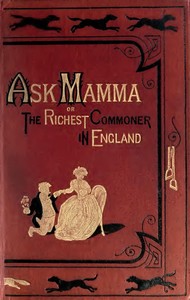
"Ask Mamma"; or, The Richest Commoner In England
Download Formats:
Excerpt
CHAPTER III. THE ROAD RESUMED.—MISS PHEASANT-FEATHERS.
CHAPTER IV. A GLASS COACH.—MISS WILLING (EN GRAND COSTUME)
CHAPTER VI. THE HAPPY UNITED FAMILY.—CURTAIN CRESCENT.
CHAPTER VII. THE EARL OF LADYTHORNE.—MISS DE GLANCEY.
CHAPTER XI. THE OPENING DAY.—THE HUNT BREAKFAST.
CHAPTER XII. THE MORNING FOX.—THE AFTERNOON FOX.
CHAPTER XV. MAJOR YAMMERTON’S COACH STOPS THE WAY.
CHAPTER XVII. ARRIVAL AT YAMMERTON GRANGE.—A FAMILY PARTY.
CHAPTER XXI. THE GATHERING.—THE GRAND...
Read the Full Text
— End of "Ask Mamma"; or, The Richest Commoner In England —
Book Information
- Title
- "Ask Mamma"; or, The Richest Commoner In England
- Author(s)
- Surtees, Robert Smith
- Language
- English
- Type
- Text
- Release Date
- February 2, 2014
- Word Count
- 179,360 words
- Library of Congress Classification
- PR
- Bookshelves
- Browsing: Culture/Civilization/Society, Browsing: Literature, Browsing: Fiction
- Rights
- Public domain in the USA.
Related Books
The fatal three, vol. III
by Braddon, M. E. (Mary Elizabeth)
English
807h 15m read

The fatal three, vol. II
by Braddon, M. E. (Mary Elizabeth)
English
854h 48m read
The fatal three, vol. I
by Braddon, M. E. (Mary Elizabeth)
English
938h 43m read
All in the dark
by Le Fanu, Joseph Sheridan
English
1645h 29m read
Concerning Isabel Carnaby
by Fowler, Ellen Thorneycroft
English
1720h 52m read
Fragment of a novel written by Jane Austen, January-March 1817
by Austen, Jane
English
495h 25m read