The Project Gutenberg eBook of Antiquarian gleanings in the North of
England
This ebook is for the use of anyone anywhere in the United States and
most other parts of the world at no cost and with almost no restrictions
whatsoever. You may copy it, give it away or re-use it under the terms
of the Project Gutenberg License included with this ebook or online
at www.gutenberg.org. If you are not located in the United States,
you will have to check the laws of the country where you are located
before using this eBook.
Title: Antiquarian gleanings in the North of England
Subtitle: being examples of antique furniture, plate, church
decorations, objects of historical interest, etc.
Author: William B. Scott
Release Date: August 11, 2023 [eBook #71387]
Language: English
Credits: The Online Distributed Proofreading Team at
https://www.pgdp.net (This file was produced from images
generously made available by The Internet Archive)
*** START OF THE PROJECT GUTENBERG EBOOK ANTIQUARIAN GLEANINGS IN THE
NORTH OF ENGLAND ***
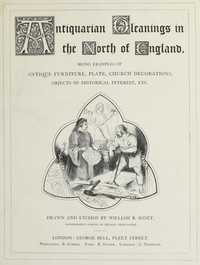
Antiquarian Gleanings in
the North of England,
BEING EXAMPLES OF
ANTIQUE FURNITURE, PLATE, CHURCH DECORATIONS,
OBJECTS OF HISTORICAL INTEREST, ETC.
[Illustration]
DRAWN AND ETCHED BY WILLIAM B. SCOTT,
GOVERNMENT SCHOOL OF DESIGN, NEWCASTLE.
LONDON: GEORGE BELL, FLEET STREET.
NEWCASTLE: R. CURRIE. YORK: R. SUNTER. CARLISLE: C. THURNAM.
Preliminary.
Some of the sketches constituting these Antiquarian Gleanings were done
before the idea of publication presented itself: very soon, however,
the author found that objects of antiquarian interest were sufficiently
numerous in this Nor-Humbrian province to suggest the advantage of going
over the field, pencil in hand, and dedicating a small work to its
Ornamental Antiquities.
In following out this intention, the author has not confined himself to
any particular class of objects. In some cases Historical association has
determined the choice, in others the rarity of examples of the particular
kind of ornament illustrated, but in all cases it is hoped both the
connoisseur and the artist will find something worthy attention. In one
or two instances the objects may have been represented to the public
before with more or less fidelity, but when such are here repeated, as
in some measure necessary to enable the book when finished the better to
comprehend the moveable antiquities of the province,—other matters of
interest from the same locality, hitherto inedited, will be found on the
same plate.
WILLIAM B. SCOTT.
Government School of Design, Newcastle.
[Illustration]
Description of Plates.
I. Nautilus Cup, set in Gold with Cover.
This is a beautiful specimen of cinque-cento goldsmith work, preserved
at Corby Castle, the seat of H. P. Howard, Esq. M. P. Many specimens of
the Shell of the Nautilus, mounted in this manner, and all produced about
the same date are to be found; none of them, however, that we have seen,
exceed, or even equal the present in excellence of design.
II. Ivory Cup, set in Gold.
The ornamentation of this cup is of the same date as the preceding. It
is like the Nautilus cup enriched with pearls and other precious stones,
and its lofty cover is surmounted by the figure of St. George killing the
Dragon.
This beautiful cup is also the property of Mr. Howard, with whose family
it is historically associated, having been presented by the valiant
admiral Sir Edward Howard to Catherine of Arragon. At the Queen’s death
it reverted to the Earl of Arundel, and can be traced in the family ever
since. During this long period it has been called The Grace Cup of St.
Thomas à Becket, and the legends and initials upon it, which may have
been retained from some earlier decorations, vouch for this ancient and
interesting tradition. Round the lid is the motto “SOBRII ESTOTE,” with
the letters T. B. supporting a mitre. Round the body of the cup is chased
“VINUM TUUM BIBE CUM GAUDIO.”
Round the neck of the top is the name GOD*FERARE, probably the name of
the goldsmith.
III. Antiquities in Jarrow Church.
The Reading-desk is a rich example of Perpendicular, with waving
Flamboyant lines in the carving of some portions. From the introduction
of these forms Mr. Bloxam has inferred that it is not English
workmanship. The Stone carving is very curious, most probably Norman,
although it has peculiarities considered until lately to belong to a
still earlier date.
Of the chair of the Venerable Bede, little can be said. It has often been
engraved: is four feet ten inches high: made of oak. Its ornamentation
has never been great, probably not more than the following restoration
exhibits.
[Illustration]
IV. Norman Book-Binding.
This is from a MS. of the book of the Prophet Isaiah, with a gloss or
commentary, presented to the Prior and convent of Durham, along with
others by Robert de Adington, who is known to have lived about 1160,
and preserved in the Library of the Cathedral of Durham, to the present
time. It is a leather cover without knobs, those having been added in the
etching as characteristic of the binding of that time. It will be seen
that the general design is completed by repeating the individual stamps
of which it is composed.
V. Relics of the Commonwealth.
These have been preserved in the family of F. H. Fawkes, Esq. of Farnley
Hall. Cromwell’s sword is double-edged, straight and light, with quarter
basket steel guard. The sword of Sir T. Fairfax is a straight broad-sword
with basket hilt: on the blade is the name of the maker Andrea Ferara.
Lambert’s sword is a hanger, serrated at the back; the hilt is brass;
date on the blade 1648. The Watch is a small repeater, bearing the name
of the maker, Jaques Cartier: the outer case is of leather perforated,
and studded with silver. The matrix of the Seal is silver, and inscribed
“The Seale for the approbation of Ministers.”
VI. Carved Chimney Piece in the Merchants’ Hall, Guildhall, Newcastle.
This lofty and elaborate chimney piece is dated 1636, and is evidently of
Flemish workmanship. The large panels represent the Judgment of Solomon,
and the Miraculous Draught of Fishes. The upper frieze is composed of
mythological figures, and that below, immediately over the stone work,
seems to be a representation of the four quarters of the world.
VII. Norman Wall-Painting.
This is a painting of the twelfth century (1154) on the side of a recess
in the Galilee, Durham Cathedral, formerly the Altar of our Lady of Pity.
VIII. The Same. The opposite Wall of the Recess.
The soffit of the arch which connects these two jambs being decorated
with Norman foliage, and the wide back of the recess painted in imitation
of hangings. Whether these paintings can be properly termed Fresco—i. e.
the colours applied simply with clear water to the lime while wet,—is a
question. They are more likely distemper of a rude kind. The forms are
expressed by a red outline; the spaces within these outlines being filled
in with colour, with little attempt at shading.
IX. Carved Chairs, and Flower Jar for the Wall.
These chairs, the property of the Rev. G. Abbes, are of walnut wood,
and very excellent execution. The flower-jar is Dutch, of a kind of
earthenware, judging from the number of specimens remaining, much
imported about a century and a half ago. A vessel for the same purpose
might be now manufactured with advantage.
X. Carved Furniture.
The Chair is one of a set, and very curious although rude: the figures
most probably being heraldic. The Cabinet is very choice in its
ornamentation. They belong to Dr. Charlton of Newcastle.
XI. Ancient Pulpit of Jarrow Church.
The remains of this beautiful carved pulpit are in the possession of Mr.
Rippon, a zealous collector of carvings and antique furniture. It has
been very small—less in proportion to the figure than in our engraving
it has been made to appear for the sake of effect—indeed scarcely large
enough for a man to stand inside. It is in the same style of workmanship
and of the same date as the reading desk given in a former plate (p.
III.) of this work.
XII. Small Stone Figures. Durham Cathedral.
These figures are here given not only for the beauty of their action and
drapery in some parts, but as valuable illustrations of costume. They
are about 20 inches high under the canopies on the sides of the altar
tomb of John, Lord Neville; 1389. They were much mutilated by the Scotch
prisoners, confined here after the battle of Dunbar. The heads are here
restored in order to complete the characters.
XIII. Carved Ivory Pastoral Staffs.
The first and largest of these is a very choice specimen of Ivory
carving. It has been elaborately illuminated, but the colors are now
nearly worn off. Over the head of our Saviour there has probably been a
canopy of precious metal now gone, the supports only remaining. On each
side of Christ are small angels in white dresses, decorated with gold
fleur-de-lys, bearing the instruments of crucifixion, and the saints
rising out of their graves are seen in the ornament under one of these
angels. The figures round the lower part are the twelve apostles. Between
this lower part and the top some ornament has intervened, as socket holes
in the ivory show.
The other side is similar to the one given, only the Virgin and child
take the place of the single figure of our Saviour. Date 1300 to 1320.
It is in the possession of P. H. Howard, Esquire, M. P. The smaller
and plainer specimen is in the Museum of Newcastle, and is a good deal
earlier in date than the former.
XIV. Antiquities at Hexham, &c.
1. The Frith-Stool or Seat of Peace, of the Sanctuary of Hexham. “There
were four crosses set up at a certain distance from the church, in the
four ways leading thereto, within which the whole town of Hexham was
included. If a malefactor flying for refuge was taken within these
crosses but without the town, the arresting party forfeited 200, a sum
probably represented by £10. If within the town, 600; within the walls of
the church-yard, 600; within the Church, 1200; within the choir, 1800;
but if the pursuer dared to take the fugitive from the FRITH-STOOL, or
from among the holy relics behind the altar, the offence was beyond
redemption.” _W. Sidney Gibson._
2. Early English ornaments on the arcade in the Transept: Hexham Church.
3. Asperging vessel of copper. Now in Wreay Church, Cumberland, having
been presented by Miss Losh of Woodside, who designed and principally
built that beautiful and curious little church. The legend round the lip
is as follows. † Pries. Pur. Lalme. G. Glanuille. †
4. Two keys in the possession of Mr. Rippon. The small one was found in
Tynemouth ruins, the large one is that of the former church of Gateshead:
it is near a foot in length, and furnished with a series of staples.
XV. Antiquities in York Minster.
The horn of Ulphus is about 2 feet and a half in length. By means of it
Ulphus, a Danish nobleman of the time of Canute enfeoffed the church with
his lands and revenues. It was sold to a goldsmith during the Civil war,
and was returned to the church by the Fairfax family, to which event the
inscription on the silver hoop refers.
2. The Cordwainer’s Bowl, commonly said to have been given to the
cordwainers by Archbishop Scrope, who was beheaded for rebellion in 1405.
It seems however more probable that it originally belonged to the guild
of Corpus Christi at York, having been given to them by Agnes Wyman who
died in 1413. This Bowl had the valuable privilege attached to it of
granting indulgences, as the inscription round it describes. “Recharde,
arche becchope Scrope grant onto all tho that drinkis of this cope xl
dayis to pardun. Robart Gobsim Becchope mosm [?] grant ye same for me a
fore saide xl dayes to pardun. Robart Strensall.” It was presented to
the Cathedral on the breaking up of the Guild: 1808. It holds 4½ quarts,
wine measure, and is 38½ inches circumference. See “Proceedings of the
Archæological Institute at York.”
The ancient tiles were found to have been part of the early floor of the
Chapter House.
XVI. Ancient Crucifix.
This relic is a good specimen of the work of the early enamellers of
Limoges. The Byzantine origin of this school is shown by the monogram IHS
XPS, and the wooden board to which the feet are _separately_ attached.
The Saviour is clothed in a long tunic, with a crown on his head; above
appears a hand in benediction, the usual symbol of the first person
of the Trinity. The figure below may represent the dead rising at the
crucifixion. The back ground is a copper plate in which various enamels
are embedded, to this is fixed the figure in relief, the tunic enamelled,
and the eyes formed with blue glass. The whole has been gilt.
This cross has been used for the face of a book cover or the centre
compartment of a shrine. Date end of the 12th century.
XVII. Oak Chair.
This chair is in the Ratcliffe Room, Corby Castle, and is called _My
Lady’s Chair_, having belonged to the Countess of Derwentwater, who went
over to Brussels on the execution of her husband at the Tower 1715, and
died 1723. There is an account of it in the “Memorials of James Earl of
Derwentwater, collected by H. Howard.”
It belongs to the latter half of the 17th century, although the ornaments
have evidently been partly borrowed from very ancient examples.
XVIII. Roman Plough in Bronze, and Queen Mary’s Rosary.
This antique is curious as showing the mode of ploughing, probably
introduced into Britain by the Romans. The oxen are heavily harnessed,
and there is an appearance of bands round the inner horns of each. The
right hand of the figure has probably held a long goad. It was found at
Piercebridge, Durham. The Rosary is gold, having 110 round beads, and
11 large of filigree work, was sold in Edinburgh by a French refugee,
Captain Leger, at the beginning of the century, who claimed to be a
descendant from Melville, Queen Mary’s Secretary, and to have had the
relic with others in his family from that time. As far as internal
evidence goes it belongs to the date attributed to it. It is now in the
possession of George Mennell, Esquire, Newcastle.
XIX. Iron Work.
In the absence of iron work properly belonging to the district having
come under our notice, we have given these fine specimens, belonging
to the Society of Arts, Edinburgh. They are probably of Nuremberg
manufacture. The first is a bell-pull. The second a lock-handle. The
three scutcheons are for latch or key plates.
XX. Carved Furniture.
This beautiful carved chest is in the possession of Mr. Grey of
Newcastle. The principal mouldings are given below the plate. The large
carved settle is very bold and rich in design.
XXI. Ivory Pix, or Cup with Cover.
This very remarkable carved cup or Pix was formerly in the Museum of
Mr. Allan of Grange near Darlington, “a good lawyer and very accurate
antiquary,” and was transferred with the rest of his Museum to the
Natural History Society of Newcastle. Where it originally came from
is not known, and its form and ornamentation present difficulties in
assigning a time and place to its production.
At the top is the Virgin and Child, and on the base towards which depend
four dead serpents, is rudely carved Daniel in the Lion’s den. It is
unquestionably of considerable antiquity, although it has been well
preserved: the outer case (which fits exactly to its shape and opens with
hinges and fine clasps) being very much decayed. This case is of wood, it
has been lined with velvet and is covered outside with stamped and gilt
leather, the patterns however are nearly lost. The cup Cover is 10 inches
high.
In Mr. Fox’s Synopsis of the Museum it is stated that the inscription on
a piece of parchment still attached to the Pix, was partially recovered
as follows. Johannes Schlevel * * * Johannes E * * * Schffle. De E * * *
* ine hujus poculi * * * entur nostrum Testimonium.
XXII. A Water Vessel of Bronze.
Discovered near Hexham about 15 years ago imbedded in the banks of a
rivulet. The height is 13½ inches, and from the armour and the shape of
the Knight’s Helmet it would appear to belong to the early part of the
13th Century.
It is said to be a vessel for washing the Priest’s hands, the water being
poured from the spout at the head of the Vessel; it is possible that
these Vessels are of Eastern origin, but they seem subsequently to have
been widely spread over western Europe. Similar Vessels are in the Museum
at Copenhagen.
XXIII. Enamelled Brass.
This is a leaf of one of the portable diptychs or triptychs which are
much used in the Greek Church. In the upper part, which is of a pointed
shape peculiar to the east, is represented the Assumption of the Virgin;
the Virgin is seated in the centre surrounded by patriarchs, prophets,
priests and Kings. Among the former Jacob may be distinguished by his
ladder. All these figures have the nimbus, which is not confined to
saints in the iconography of the Greek Church, but is also attributed
to patriarchs and others. In each of the four lower compartments, the
Virgin and child appear within a square frame receiving salutations of
bishops, priests, hermits, and saints. In the fourth are the Virgin and
child also, but represented under the form of the mystical conception.
Various inscriptions of the names of the characters &c. appear on the
borders, and on the labels in the hands of the figures. Above the head of
the Virgin are the monograms M θού, IC XC, (Μητηρ Θεου, Ιηδους Χριδτος.)
The strictness of the rules which were laid down in former times for
the representation of sacred subjects in Greek art renders it difficult
to assign any date to objects of this kind. Each artist has followed so
closely the tradition of his predecessors that little variation is to be
found in works of periods considerably distant. The relic in question may
be either of the Greek or the Russo-Greek schools, and if of the latter
it was probably made at Kiev in Russia where the manufactory of similar
objects is still carried on.
XXIV. Flooring Tiles. Money Box. Scold’s Cap. Rasp. Key Plate.
1. Flooring Tiles from Fountains Abbey. These are given as showing the
manner of tesselating by tiles of various colours and forms fitting
together to produce figures.
2. Small Iron Money Box. This is made of beat iron: the original is about
three times the size of the etching. It has a slit in the top, similar to
the “penny pigs” formerly common among children.
3. The Branks or Scold’s Cap. This instrument of punishment for scolds
has been in very general use. It was found by Pennant at Langholm in
Scotland, is still to be found at Macclesfield, and is recorded to have
been used at Lichfield, Stafford, and at Doddington, Lincolnshire. The
one figured is still in the police court at Newcastle. The nose projected
through the opening in the front belt, and the spike under the opening
entered the mouth, in the vain endeavour to suppress the unruly member.
4. The Rasp. This instrument, the forerunner of the knocker, was formerly
in general use in Edinburgh and elsewhere. The rings hanging upon the
projecting limb were drawn rapidly up and down the surface of the iron,
which in the present instance appears to have been furnished with teeth
both on the projecting part and on that against the wood of the door.
5. Key Plate: is a very pretty Specimen of the 16th Century. Society of
Arts. Edinburgh.
XXV. Lamp pendant. French Carving.
1. Pendant for a Lamp carved in Oak. This graceful piece of carving
formerly hung from the roof of the Hall in Anderson’s Place, an
Elizabethan Mansion in which lodged Charles I. during his stay in
Newcastle, and in which took place the negotiation between the Scotch
Army and the Parliamentarians. It now serves to suspend a Chandelier and
belongs to G. Rippon, Esq. South Shields.
2. Is a beautiful specimen of French carving, 17th century. It has been
cast in brass lately at Birmingham, but, owing to the complexity of the
parts, is expensive even in that form.
XXVI. Crucifixion.
This seems to have been an Altar piece. It is evidently of Flemish
workmanship, and is said to have come from a church in Lincolnshire. The
figures are gilded. The crosses with their figures which are now gone,
have probably risen to some height against a black or crimson ground.
Some of the draperies in the German manner of the 16th century are very
well managed.
XXVII. Stained Glass in Wetheral Church, near Carlisle.
The Virgin and Child. This is a specimen of late English glass, probably
not much earlier than the beginning of the reign of Henry VII. There are
only two kinds of glass used, one greenish almost colourless, and the
other a yellow, deepened by the addition of the same colour. The figure
is not deficient in feeling, and some good treatment in the drapery is
easily discovered. It is about 2½ feet in height.
XXVIII. Purse. Panel. Wall-Cupboard.
1. The Privy Purse of Catherine of Braganza, at Sizergh, the seat of
the Strickland family. Sir Thomas Strickland was keeper of the privy
purse to Catherine, till the operation of the Test Act compelled him and
other Roman Catholics to relinquish the place. He vacated his seat in
Parliament as knight of the Shire for Westmoreland at the time of the
Popish plot. Miss Strickland in her life of this Queen, thus mentions the
relic. The privy purse, the badge of his office is still preserved among
the heir-looms of the family at Lizergh. It is of crimson velvet, the
size and shape of a reticule, richly embroidered with the royal arms, and
the initials C. R. in gold and silver twist and coloured silk twist.
2. Panel from a chimney piece at Sizergh. Many rooms in this mansion
are covered with oak, and the chimney-pieces are of an immense size
and elaboration. They are however not in any way remarkable in general
design, though occasionally exhibiting good portions, as the one given in
the engraving.
3. Oak Wall-Cupboard in the house of I. Y. Yeates, Esq. near Sizergh.
This is very good in general form and the lower part particularly well
managed. It is comparatively of late construction, bearing the date 1695.
XXIX. Carved Oak Bread Tray and Andirons, &c.
The Tray is very beautiful in its foliage: it is also at Mr. Yeates’
house, of Parkhead. The fire plate furniture is at Levens, an ancient
house with a very curious Dutch garden in excellent preservation. The two
figures rest on French scroll-work, and seem to represent the huntsman
and the student. The plate at the back of the grate is of the same date.
XXX. and XXXI. Figures of the Apostles.
Between the piers of Carlisle Cathedral are several large oak screens
placed against the stalls of the prebends and painted on the side towards
the aisles. Three of these give a series of pictures describing each the
history of a Saint. They are much decayed, as is also the fourth which
is divided into twelve compartments, filled by the twelve Apostles. The
date of these paintings is not determined, but it is conjectured that the
legends in English rhyme on the Histories of the Saints were written by
Prior Senhouse whose name occurs in 1507, and internal evidence would not
assign them much greater antiquity than 1500.
Over the figures of the Apostles are scrolls illuminated with the
Apostles’ creed, and the name of the Apostle over whose head each
particular scroll is placed. “Credo in Deum Patrem omnipotentem,
creatorem cœli et terræ. Petrus.” “Et in Jesu Christum filium ejus
unicum, dominum nostrum. Andreu.” etc.
St. Simon is here represented not with the long saw usually attributed
to him, but with a great axe, if the instrument in the hand of Mathias,
which is too much decayed to be distinctly made out, has been a saw,
these two saints have exchanged symbols, or possibly the painter has
named them wrong. The figures are life size or somewhat smaller.
XXXII. Almeries.
The first of these, now in Weatheral Church was removed from another
parish Church at a little distance, where it had long supplied the place
of a Vestry, which office it now fills. The other is in the little chapel
called St. Catherine’s in Carlisle Cathedral. Beside it is another of the
same date which has been similarly decorated with a border of rosettes,
within each of which however we find the letters T. G. in cypher. The
style of decoration is very rude. Under the terminating ends of the
hinges which seem intended to represent the heads of serpents, are
remains of crimson velvet. These letters T. G. are the initials of Thomas
Gondibour, Prior about 1490.
XXXIII. Vestry Chest.
This very rich specimen of carving and iron work belongs to the early
period of the Renaissance, the lock being pure flamboyant tracery and
canopied figures, while the wood-carving exhibits the figures of Saints
in good style divided by pilasters instead of buttresses, and surmounted
by tent-shaped instead of pointed canopies. The angels above, who raise
the hangings from the niches, also show the transition character of the
work, some of them being full draped as in earlier, and others naked as
they appear in later Italian ornament; an angel gradually changing into a
cupid.
The upper part of the centre portion of the lock lifts up by the hinge
seen above, disclosing a keyhole, the lower part of the same portion
falls down with a like purpose. The feet of the Chest appear to have
been added. The figures appear to be the Virgin, SS. Barbara and Mary
Magdalene, SS. Peter and Paul.
XXXIV. Drinking Vessels.
1. The cup of Venetian Glass called the Luck of Eden Hall, preserved
at that place: the seat of Sir G. Musgrave, near Penrith. It derives
its name and its careful preservation from the tradition, that it was
originally stolen from the Fairies, to whom the legendary rhyme attached
to it is ascribed:—
If this Cup shall brake or fall,
Farewell the Luck of Eden Hall.
The stamped leather cover is ornamented with foliage and has the sacred
monogram on the cover.
3. German beer Jug. This is in the Museum of Newcastle, and is stamped
with the date 1589. It has figures of David and Joshua, and coats of
arms above and below the figures, on the side represented are those of
Nuremberg and Wurtemburg.
4. Has three figures upon it, Justice, Faith, and Patience, and the date
1566.
5. A Peg-tankard, in the possession of Mrs. Davidson of Ripley Hall. This
species of tankard takes its name as the reader is doubtless aware from
a series of keys or pegs projecting inside, to regulate the depth of
draught allowed to each drinker as it passed down the table. The vessel
under notice holds five pints, one pint being contained between each peg.
XXXV. Shrine of Prior Richard, Hexham.
The lower part of this curious little chapel has the appearance of an
altar tomb. It is however much wider and longer and contains an interior
area of 11 ft. 7 in. by 4 ft. 9 in. with access by the west end. This
small apartment is covered by a wooden roof with painted bosses, and is
open to the chancel; the elaborate tracery on that side having no flat
panelling behind it as on the side to the aisle which our engraving
represents. Opposite the door in this miniature Chapel is a stone altar
over which have been painted three saints, Peter, Andrew and Paul, on
three panels, with a half figure of our Saviour standing apparently in
the tomb with his hands bound, and the instruments of the passion on
either side.
The beautiful perpendicular tracery is so much decayed that we give an
engraving of it fully made out, and drawn to scale by Mr. T. Gibson,
architect.
[Illustration]
XXXVI. Carved Oak Furniture at Sizergh.
This fine Mansion from which we have already given some illustrations,
possesses much furniture of the description here given. The form or
long seat is peculiar in style and is one of a number, formerly in the
Chapel. It has the date 1562 and the letters W. S., the initials of the
Strickland of that time, carved upon it.
XXXVII. Door of a Cupboard, and Carved Seat ends in the Chapel of
Brougham Hall.
This Chapel has become, for its size, perhaps the most gorgeously
decorated in England, under the direction of Mr. W. Brougham. Many rich
carvings have been collected and the whole illuminated. The cupboard or
press is beside the altar and holds the sacramental vessels. It is carved
wood, and the iron hinges and the lock have been lately gilt.
XXXVIII. Knocker. Fibulae. Celt. Spur.
1. Great Knocker on the door of Durham Cathedral. 2. Bronze Fibula about
3 in. diameter found in the Tyne. 3. Beautiful enamelled Fibula. The
original is a third larger than the engraving. It is of brass or bronze
thickly enamelled, and is an elegant adaptation of the form of a harp to
the purposes of a buckle. It was dug up at Risington, Northumberland,
1842. 4. Ancient bronze Celt. This form of weapon has been frequently
found, but the present example is decorated with a formal ornament, which
gives it a greater value. 5. A Spur found in a morass; it resembles the
earliest form in the collection at Goodrich Court, described as Norman by
Sir S. Meyrick.
[Illustration: PLATE I
Nautilus Cup and Cover
SET IN GOLD
_The Property of P. H. Howard Esqʳ. M. P. Corby Castle_
_Pubᵈ. by G. Bell Fleet Sᵗ. London_]
[Illustration: PLATE II
Ivory Cup Set in Gold
_The Property of P. H. Howard Esqʳ. M. P. Corby Castle_
_Pubᵈ. by G. Bell Fleet Sᵗ. London_]
[Illustration: PLATE III
Antiquities in Jarrow Church
_1ˢᵗ. Chair of the Venerable Bede. 2ⁿᵈ. Norman Stone Carving. 3ʳᵈ. Oak
Reading Desk._
_Pubᵈ. by G. Bell Fleet Stᵗ. London_]
[Illustration: PLATE IV
Norman Book Cover
_In the Library of Durham Cathedral._
_The seperate stamps are the size of the Originals._
_Pubᵈ. by G. Bell Fleet Sᵗ. London_]
[Illustration: PLATE V
Relics of the Commonwealth
_1ˢᵗ. Sword of Cromwell. 2ⁿᵈ. Sword of Genˡ. Lambert. 3ʳᵈ. Sword of Sir
T. Fairfax. 4ᵗʰ. Cromwell’s Watch. 5ᵗʰ. Matrix of seal for the Licensing
of Preachers._
_The property of F. H. Fawkes Esqʳ. Farnley Hall._
_Pubᵈ. by G. Bell Fleet Sᵗ. London._]
[Illustration: PLATE VI
Carved Chimney Piece.
_In the Merchants Hall. Guildhall. Newcastle._
_Pubᵈ. by G. Bell Fleet Sᵗ. London._]
[Illustration: PLATE VII
Norman Wall-Painting
_In the Galilee. Durham Cathedral._
_Pubᵈ. by G. Bell Fleet Sᵗ. London._]
[Illustration: PLATE VIII
Norman Wall-Painting
_In the Galilee. Durham Cathedral._
_Pubᵈ. by G. Bell Fleet Sᵗ. London._]
[Illustration: PLATE IX
Carved Chairs
_& Earthenware_ FLOWER JAR. _for the Wall_
_Property of the Revᵈ. G. Abbes Cleadon_
_Pubᵈ. by G. Bell Fleet Sᵗ. London._]
[Illustration: PLATE X
Carved Furniture
_Property of E. Charlton Esqʳ. M.D. Newcastle_
_Pubᵈ. by G. Bell Fleet Sᵗ. London_]
[Illustration: Plate XI
Ancient Pulpit
_Of Jarrow Church from portions in the Possession of G. Rippon Esq. North
Shields._
_Pubᵈ. by G. Bell Fleet Sᵗ. London_]
[Illustration: PLATE XII
Small Figures.
_Under Canopies on the Altar Tomb of John Lord Neville 1389. Durham
Cathedral._
(HEADS ALL RESTORED)
_Pubᵈ. by G. Bell Fleet Sᵗ. London._]
[Illustration: PLATE XIII
Pastoral Staff,
_Of Ivory Illuminated, Property of P. H. Howard Esq._
_2 Ornament on Base. 3 Ivory Pastoral Staff in the Museum, Newcastle._
_Pubᵈ. by G. Bell Fleet Sᵗ. London._]
[Illustration: PLATE XIV
_1 Frith Stool of the Ancient Sanctuary, Hexham Church. 2 Enrichments
Arcade, ditto. 3 Ancient Key of Sᵗ. Edmund’s Church, Gateshead. 4 Key
found at Tynemouth Abbey. 5 Ancient Copper Vessel, presented to Wreay
Church, by Miss Losh of Woodside._
_Pubᵈ. by G. Bell Fleet Sᵗ. London._]
[Illustration: PLATE XV
Antiquities in York Minster.
_1 Horn of Ulphus. 2 Cordwainer’s Bowl. 3 Ancient Tiles._
_Pubᵈ. by G. Bell Fleet Sᵗ. London._]
[Illustration: PLATE XVI
Crucifix.
_Enamelled and Gilt on Copper, in the possession of W. H. Charlton Esq._
_Pubᵈ. by G. Bell Fleet Sᵗ. London._]
[Illustration: PLATE XVII
Oak Chair.
_In Corby Castle, the Seat of P. H. Howard Esq M. P._
_Pubᵈ. by G. Bell Fleet Sᵗ. London._]
[Illustration: PLATE XVIII
ROMAN PLOUGH IN BRONZE,
_In the possession of Sir Cuthbert Sharpe._
ROSARY IN GOLD (_Mary Queen of Scots_)
_Property of George Menell Newcastle._
_Pubᵈ. by G. Bell Fleet Sᵗ. London_]
[Illustration: PLATE XIX
Iron Work
_1. Bell Pull. 2. Lock Handle. 3. Three Scutcheons for Latches or Keys._
_Pubᵈ. by G. Bell Fleet Sᵗ. London._]
[Illustration: PLATE XX
Carved Furniture
_Large Settle in the possession of G. Rippon Esq. N. Shields, Chest the
property Mʳ. Grey Newcastle._
_Pubᵈ. by G. Bell Fleet Sᵗ. London._]
[Illustration: PLATE XXI
Ivory Pyx, or Cup, with Cover.
_In the Museum of Nat. Histʸ. Socʸ. Newcastle_
_Pubᵈ. by G. Bell, Fleet Sᵗ. London._]
[Illustration: Plate XXII
Water Vessel of Bronze.
_Date 13ᵗʰ. Centʸ. Found in the Tyne. Height 13½ inˢ._
_Pubᵈ. by G. Bell Fleet Sᵗ. London._]
[Illustration: Plate XXIII
Enamelled Brass.
_Door of a Reliquary (Celebration of the Virgin, Greek Church)_
_In the possession of the Revᵈ. R Green._
_Pubᵈ. by G. Bell Fleet Sᵗ. London._]
[Illustration: Plate XXIV
_1 Flooring Tiles from Fountains Abbey Yorkshire 2 Iron Money Box, Museum
Newcastle 3 Scolds Cap, Police Office Newcastle 4 Rasp or Tirling Pin
Socʸ. Art. Museum 5 Key Plate 15ᵗʰ. Century_
_Pubᵈ. by G. Bell Fleet Sᵗ. London._]
[Illustration: PLATE XXV
_Chandelier in Walnut. In possession of J. Dobson Esqʳ._
_Pendent for a lamp carved in Oak formerly in Andersons Place Newcastle._
_Pubᵈ. by G. Bell Fleet Sᵗ. London._]
[Illustration: PLATE XXVI.
Crucifixion.
_Carved in Oak: the figures gilt. The upper part wanting. Property of J.
Adamson Esqʳ._
_Pubᵈ. by G. Bell Fleet Sᵗ. London._]
[Illustration: PLATE XXVII.
Stained Glass.
_Weatheral Church, Cumberland._
_Pubᵈ. by G. Bell Fleet Sᵗ. London._]
[Illustration: PLATE XXVIII.
_1 Privy Purse of Catherine of Braganza, Sizergh Hall, Westmorland. 2
Panel on a Carved Chimney Piece, Sizergh Hall, Westmorland. 3 Oak Wall
Cupboard, Parkhead, T. Y. Yeates Esqʳ._
_Pubᵈ. by G. Bell Fleet Sᵗ. London._]
[Illustration: PLATE XXIX.
_Carved Oak Bread Tray at Parkhead. Westmorland. J. Y. Yeates Esqʳ._
_Brass Andirons and Iron Chimney Plate at Levens, Westmorland Hon. Mʳˢ.
Howard._
_Pubᵈ. by G. Bell Fleet Sᵗ. London._]
[Illustration: PLATE XXX.
Apostles.
_Painted on Screen—North Aisle—Carlisle Cathedral._
_Pubᵈ. by G. Bell Fleet Sᵗ. London._]
[Illustration: PLATE XXXI.
Apostles.
_Painted on Screen—North Aisle—Carlisle Cathedral._
_Pubᵈ. by G. Bell Fleet Sᵗ. London._]
[Illustration: PLATE XXXII.
Almeries.
_1 In Weatheral Church. 2 Oak painted Carlisle Cathedral._
_Pubᵈ. by G. Bell Fleet Sᵗ. London._]
[Illustration: PLATE XXXIII.
Vestry Chest
_In Walnut wood, with Iron Lock, property of G. C. Atkinson Esqʳ. West
Denton._
_Pubᵈ. by G. Bell Fleet Sᵗ. London._]
[Illustration: PLATE XXXIV.
Drinking Vessels.
_1 “The luck of Eden Hall.” 2 Leather Case for Dᵒ. 3 German beer Jug
Dated 1589. 4 Ditto 1566. 5 Peg Tankard of Wood._
_Pubᵈ. by G. Bell, Fleet Sᵗ. London_]
[Illustration: PLATE XXXV.
Shrine or Tomb
_of Prior Richard—Hexham Church._
_Pubᵈ. by G. Bell, Fleet Sᵗ. London._]
[Illustration: PLATE XXXVI.
Oak Furniture.
_at Sizergh Hall, Westmorland._
_Pubᵈ. by G. Bell Fleet Sᵗ. London._]
[Illustration: PLATE XXXVII
_Wall Cupboard and Seat Ends in the Chapel._
_Brougham Hall, near Penrith._
_Pubᵈ. by G. Bell. Fleet Sᵗ. London._]
[Illustration: PLATE XXXVIII
Knocker &c.
_1 Great knocker Durham Cathedral Door. 2 Bronze fibula Museum Anti:
Socʸ. Newcastle. 3 Enamelled fibula Museum Anti: Socʸ. Newcastle. 4
Bronze Axe head Dᵒ. 5 Norman Spur Museum Anti: Socʸ. Newcastle._
_Pubᵈ. by G. Bell Fleet Sᵗ. London._]
*** END OF THE PROJECT GUTENBERG EBOOK ANTIQUARIAN GLEANINGS IN THE
NORTH OF ENGLAND ***
Updated editions will replace the previous one—the old editions will
be renamed.
Creating the works from print editions not protected by U.S. copyright
law means that no one owns a United States copyright in these works,
so the Foundation (and you!) can copy and distribute it in the United
States without permission and without paying copyright
royalties. Special rules, set forth in the General Terms of Use part
of this license, apply to copying and distributing Project
Gutenberg™ electronic works to protect the PROJECT GUTENBERG™
concept and trademark. Project Gutenberg is a registered trademark,
and may not be used if you charge for an eBook, except by following
the terms of the trademark license, including paying royalties for use
of the Project Gutenberg trademark. If you do not charge anything for
copies of this eBook, complying with the trademark license is very
easy. You may use this eBook for nearly any purpose such as creation
of derivative works, reports, performances and research. Project
Gutenberg eBooks may be modified and printed and given away—you may
do practically ANYTHING in the United States with eBooks not protected
by U.S. copyright law. Redistribution is subject to the trademark
license, especially commercial redistribution.
START: FULL LICENSE
THE FULL PROJECT GUTENBERG LICENSE
PLEASE READ THIS BEFORE YOU DISTRIBUTE OR USE THIS WORK
To protect the Project Gutenberg™ mission of promoting the free
distribution of electronic works, by using or distributing this work
(or any other work associated in any way with the phrase “Project
Gutenberg”), you agree to comply with all the terms of the Full
Project Gutenberg™ License available with this file or online at
www.gutenberg.org/license.
Section 1. General Terms of Use and Redistributing Project Gutenberg™ electronic works
1.A. By reading or using any part of this Project Gutenberg™
electronic work, you indicate that you have read, understand, agree to
and accept all the terms of this license and intellectual property
(trademark/copyright) agreement. If you do not agree to abide by all
the terms of this agreement, you must cease using and return or
destroy all copies of Project Gutenberg™ electronic works in your
possession. If you paid a fee for obtaining a copy of or access to a
Project Gutenberg™ electronic work and you do not agree to be bound
by the terms of this agreement, you may obtain a refund from the person
or entity to whom you paid the fee as set forth in paragraph 1.E.8.
1.B. “Project Gutenberg” is a registered trademark. It may only be
used on or associated in any way with an electronic work by people who
agree to be bound by the terms of this agreement. There are a few
things that you can do with most Project Gutenberg™ electronic works
even without complying with the full terms of this agreement. See
paragraph 1.C below. There are a lot of things you can do with Project
Gutenberg™ electronic works if you follow the terms of this
agreement and help preserve free future access to Project Gutenberg™
electronic works. See paragraph 1.E below.
1.C. The Project Gutenberg Literary Archive Foundation (“the
Foundation” or PGLAF), owns a compilation copyright in the collection
of Project Gutenberg™ electronic works. Nearly all the individual
works in the collection are in the public domain in the United
States. If an individual work is unprotected by copyright law in the
United States and you are located in the United States, we do not
claim a right to prevent you from copying, distributing, performing,
displaying or creating derivative works based on the work as long as
all references to Project Gutenberg are removed. Of course, we hope
that you will support the Project Gutenberg™ mission of promoting
free access to electronic works by freely sharing Project Gutenberg™
works in compliance with the terms of this agreement for keeping the
Project Gutenberg™ name associated with the work. You can easily
comply with the terms of this agreement by keeping this work in the
same format with its attached full Project Gutenberg™ License when
you share it without charge with others.
1.D. The copyright laws of the place where you are located also govern
what you can do with this work. Copyright laws in most countries are
in a constant state of change. If you are outside the United States,
check the laws of your country in addition to the terms of this
agreement before downloading, copying, displaying, performing,
distributing or creating derivative works based on this work or any
other Project Gutenberg™ work. The Foundation makes no
representations concerning the copyright status of any work in any
country other than the United States.
1.E. Unless you have removed all references to Project Gutenberg:
1.E.1. The following sentence, with active links to, or other
immediate access to, the full Project Gutenberg™ License must appear
prominently whenever any copy of a Project Gutenberg™ work (any work
on which the phrase “Project Gutenberg” appears, or with which the
phrase “Project Gutenberg” is associated) is accessed, displayed,
performed, viewed, copied or distributed:
This eBook is for the use of anyone anywhere in the United States and most
other parts of the world at no cost and with almost no restrictions
whatsoever. You may copy it, give it away or re-use it under the terms
of the Project Gutenberg License included with this eBook or online
at www.gutenberg.org. If you
are not located in the United States, you will have to check the laws
of the country where you are located before using this eBook.
1.E.2. If an individual Project Gutenberg™ electronic work is
derived from texts not protected by U.S. copyright law (does not
contain a notice indicating that it is posted with permission of the
copyright holder), the work can be copied and distributed to anyone in
the United States without paying any fees or charges. If you are
redistributing or providing access to a work with the phrase “Project
Gutenberg” associated with or appearing on the work, you must comply
either with the requirements of paragraphs 1.E.1 through 1.E.7 or
obtain permission for the use of the work and the Project Gutenberg™
trademark as set forth in paragraphs 1.E.8 or 1.E.9.
1.E.3. If an individual Project Gutenberg™ electronic work is posted
with the permission of the copyright holder, your use and distribution
must comply with both paragraphs 1.E.1 through 1.E.7 and any
additional terms imposed by the copyright holder. Additional terms
will be linked to the Project Gutenberg™ License for all works
posted with the permission of the copyright holder found at the
beginning of this work.
1.E.4. Do not unlink or detach or remove the full Project Gutenberg™
License terms from this work, or any files containing a part of this
work or any other work associated with Project Gutenberg™.
1.E.5. Do not copy, display, perform, distribute or redistribute this
electronic work, or any part of this electronic work, without
prominently displaying the sentence set forth in paragraph 1.E.1 with
active links or immediate access to the full terms of the Project
Gutenberg™ License.
1.E.6. You may convert to and distribute this work in any binary,
compressed, marked up, nonproprietary or proprietary form, including
any word processing or hypertext form. However, if you provide access
to or distribute copies of a Project Gutenberg™ work in a format
other than “Plain Vanilla ASCII” or other format used in the official
version posted on the official Project Gutenberg™ website
(www.gutenberg.org), you must, at no additional cost, fee or expense
to the user, provide a copy, a means of exporting a copy, or a means
of obtaining a copy upon request, of the work in its original “Plain
Vanilla ASCII” or other form. Any alternate format must include the
full Project Gutenberg™ License as specified in paragraph 1.E.1.
1.E.7. Do not charge a fee for access to, viewing, displaying,
performing, copying or distributing any Project Gutenberg™ works
unless you comply with paragraph 1.E.8 or 1.E.9.
1.E.8. You may charge a reasonable fee for copies of or providing
access to or distributing Project Gutenberg™ electronic works
provided that:
• You pay a royalty fee of 20% of the gross profits you derive from
the use of Project Gutenberg™ works calculated using the method
you already use to calculate your applicable taxes. The fee is owed
to the owner of the Project Gutenberg™ trademark, but he has
agreed to donate royalties under this paragraph to the Project
Gutenberg Literary Archive Foundation. Royalty payments must be paid
within 60 days following each date on which you prepare (or are
legally required to prepare) your periodic tax returns. Royalty
payments should be clearly marked as such and sent to the Project
Gutenberg Literary Archive Foundation at the address specified in
Section 4, “Information about donations to the Project Gutenberg
Literary Archive Foundation.”
• You provide a full refund of any money paid by a user who notifies
you in writing (or by e-mail) within 30 days of receipt that s/he
does not agree to the terms of the full Project Gutenberg™
License. You must require such a user to return or destroy all
copies of the works possessed in a physical medium and discontinue
all use of and all access to other copies of Project Gutenberg™
works.
• You provide, in accordance with paragraph 1.F.3, a full refund of
any money paid for a work or a replacement copy, if a defect in the
electronic work is discovered and reported to you within 90 days of
receipt of the work.
• You comply with all other terms of this agreement for free
distribution of Project Gutenberg™ works.
1.E.9. If you wish to charge a fee or distribute a Project
Gutenberg™ electronic work or group of works on different terms than
are set forth in this agreement, you must obtain permission in writing
from the Project Gutenberg Literary Archive Foundation, the manager of
the Project Gutenberg™ trademark. Contact the Foundation as set
forth in Section 3 below.
1.F.
1.F.1. Project Gutenberg volunteers and employees expend considerable
effort to identify, do copyright research on, transcribe and proofread
works not protected by U.S. copyright law in creating the Project
Gutenberg™ collection. Despite these efforts, Project Gutenberg™
electronic works, and the medium on which they may be stored, may
contain “Defects,” such as, but not limited to, incomplete, inaccurate
or corrupt data, transcription errors, a copyright or other
intellectual property infringement, a defective or damaged disk or
other medium, a computer virus, or computer codes that damage or
cannot be read by your equipment.
1.F.2. LIMITED WARRANTY, DISCLAIMER OF DAMAGES - Except for the “Right
of Replacement or Refund” described in paragraph 1.F.3, the Project
Gutenberg Literary Archive Foundation, the owner of the Project
Gutenberg™ trademark, and any other party distributing a Project
Gutenberg™ electronic work under this agreement, disclaim all
liability to you for damages, costs and expenses, including legal
fees. YOU AGREE THAT YOU HAVE NO REMEDIES FOR NEGLIGENCE, STRICT
LIABILITY, BREACH OF WARRANTY OR BREACH OF CONTRACT EXCEPT THOSE
PROVIDED IN PARAGRAPH 1.F.3. YOU AGREE THAT THE FOUNDATION, THE
TRADEMARK OWNER, AND ANY DISTRIBUTOR UNDER THIS AGREEMENT WILL NOT BE
LIABLE TO YOU FOR ACTUAL, DIRECT, INDIRECT, CONSEQUENTIAL, PUNITIVE OR
INCIDENTAL DAMAGES EVEN IF YOU GIVE NOTICE OF THE POSSIBILITY OF SUCH
DAMAGE.
1.F.3. LIMITED RIGHT OF REPLACEMENT OR REFUND - If you discover a
defect in this electronic work within 90 days of receiving it, you can
receive a refund of the money (if any) you paid for it by sending a
written explanation to the person you received the work from. If you
received the work on a physical medium, you must return the medium
with your written explanation. The person or entity that provided you
with the defective work may elect to provide a replacement copy in
lieu of a refund. If you received the work electronically, the person
or entity providing it to you may choose to give you a second
opportunity to receive the work electronically in lieu of a refund. If
the second copy is also defective, you may demand a refund in writing
without further opportunities to fix the problem.
1.F.4. Except for the limited right of replacement or refund set forth
in paragraph 1.F.3, this work is provided to you ‘AS-IS’, WITH NO
OTHER WARRANTIES OF ANY KIND, EXPRESS OR IMPLIED, INCLUDING BUT NOT
LIMITED TO WARRANTIES OF MERCHANTABILITY OR FITNESS FOR ANY PURPOSE.
1.F.5. Some states do not allow disclaimers of certain implied
warranties or the exclusion or limitation of certain types of
damages. If any disclaimer or limitation set forth in this agreement
violates the law of the state applicable to this agreement, the
agreement shall be interpreted to make the maximum disclaimer or
limitation permitted by the applicable state law. The invalidity or
unenforceability of any provision of this agreement shall not void the
remaining provisions.
1.F.6. INDEMNITY - You agree to indemnify and hold the Foundation, the
trademark owner, any agent or employee of the Foundation, anyone
providing copies of Project Gutenberg™ electronic works in
accordance with this agreement, and any volunteers associated with the
production, promotion and distribution of Project Gutenberg™
electronic works, harmless from all liability, costs and expenses,
including legal fees, that arise directly or indirectly from any of
the following which you do or cause to occur: (a) distribution of this
or any Project Gutenberg™ work, (b) alteration, modification, or
additions or deletions to any Project Gutenberg™ work, and (c) any
Defect you cause.
Section 2. Information about the Mission of Project Gutenberg™
Project Gutenberg™ is synonymous with the free distribution of
electronic works in formats readable by the widest variety of
computers including obsolete, old, middle-aged and new computers. It
exists because of the efforts of hundreds of volunteers and donations
from people in all walks of life.
Volunteers and financial support to provide volunteers with the
assistance they need are critical to reaching Project Gutenberg™’s
goals and ensuring that the Project Gutenberg™ collection will
remain freely available for generations to come. In 2001, the Project
Gutenberg Literary Archive Foundation was created to provide a secure
and permanent future for Project Gutenberg™ and future
generations. To learn more about the Project Gutenberg Literary
Archive Foundation and how your efforts and donations can help, see
Sections 3 and 4 and the Foundation information page at www.gutenberg.org.
Section 3. Information about the Project Gutenberg Literary Archive Foundation
The Project Gutenberg Literary Archive Foundation is a non-profit
501(c)(3) educational corporation organized under the laws of the
state of Mississippi and granted tax exempt status by the Internal
Revenue Service. The Foundation’s EIN or federal tax identification
number is 64-6221541. Contributions to the Project Gutenberg Literary
Archive Foundation are tax deductible to the full extent permitted by
U.S. federal laws and your state’s laws.
The Foundation’s business office is located at 809 North 1500 West,
Salt Lake City, UT 84116, (801) 596-1887. Email contact links and up
to date contact information can be found at the Foundation’s website
and official page at www.gutenberg.org/contact
Section 4. Information about Donations to the Project Gutenberg Literary Archive Foundation
Project Gutenberg™ depends upon and cannot survive without widespread
public support and donations to carry out its mission of
increasing the number of public domain and licensed works that can be
freely distributed in machine-readable form accessible by the widest
array of equipment including outdated equipment. Many small donations
($1 to $5,000) are particularly important to maintaining tax exempt
status with the IRS.
The Foundation is committed to complying with the laws regulating
charities and charitable donations in all 50 states of the United
States. Compliance requirements are not uniform and it takes a
considerable effort, much paperwork and many fees to meet and keep up
with these requirements. We do not solicit donations in locations
where we have not received written confirmation of compliance. To SEND
DONATIONS or determine the status of compliance for any particular state
visit www.gutenberg.org/donate.
While we cannot and do not solicit contributions from states where we
have not met the solicitation requirements, we know of no prohibition
against accepting unsolicited donations from donors in such states who
approach us with offers to donate.
International donations are gratefully accepted, but we cannot make
any statements concerning tax treatment of donations received from
outside the United States. U.S. laws alone swamp our small staff.
Please check the Project Gutenberg web pages for current donation
methods and addresses. Donations are accepted in a number of other
ways including checks, online payments and credit card donations. To
donate, please visit: www.gutenberg.org/donate.
Section 5. General Information About Project Gutenberg™ electronic works
Professor Michael S. Hart was the originator of the Project
Gutenberg™ concept of a library of electronic works that could be
freely shared with anyone. For forty years, he produced and
distributed Project Gutenberg™ eBooks with only a loose network of
volunteer support.
Project Gutenberg™ eBooks are often created from several printed
editions, all of which are confirmed as not protected by copyright in
the U.S. unless a copyright notice is included. Thus, we do not
necessarily keep eBooks in compliance with any particular paper
edition.
Most people start at our website which has the main PG search
facility: www.gutenberg.org.
This website includes information about Project Gutenberg™,
including how to make donations to the Project Gutenberg Literary
Archive Foundation, how to help produce our new eBooks, and how to
subscribe to our email newsletter to hear about new eBooks.
Antiquarian gleanings in the North of England
Subjects:
Download Formats:
Excerpt
The Project Gutenberg eBook of Antiquarian gleanings in the North of
England
This ebook is for the use of anyone anywhere in the United States and
most other parts of the world at no cost and with almost no restrictions
whatsoever. You may copy it, give it away or re-use it under the terms
of the Project Gutenberg License included with this ebook or online
at www.gutenberg.org. If you are not located in the United States,
you will have to check the laws of the country where you are...
Read the Full Text
— End of Antiquarian gleanings in the North of England —
Book Information
- Title
- Antiquarian gleanings in the North of England
- Language
- English
- Type
- Text
- Release Date
- August 10, 2023
- Word Count
- 8,874 words
- Library of Congress Classification
- NK
- Bookshelves
- Browsing: Art & Photography, Browsing: Culture/Civilization/Society
- Rights
- Public domain in the USA.