*** START OF THE PROJECT GUTENBERG EBOOK 74818 ***
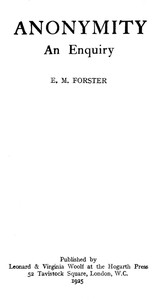
ANONYMITY
_An Enquiry_
THE HOGARTH ESSAYS.
I. MR. BENNETT AND MRS. BROWN.
By VIRGINIA WOOLF. 2_s_. 6_d_.
II. THE ARTIST AND PSYCHO-ANALYSIS.
By ROGER FRY. 2_s_. 6_d_.
III. HENRY JAMES AT WORK.
By THEODORA BOSANQUET. 2_s_. 6_d_.
IV. HOMAGE TO JOHN DRYDEN,
By T. S. ELIOT. 3_s_. 6_d_.
V. HISTRIOPHONE.
By BONAMY DOBRÉE. 3_s_. 6_d_.
VI. IN RETREAT.
By HERBERT READ. 3_s_. 6_d_.
VII. FEAR AND POLITICS: A DEBATE AT THE ZOO.
By LEONARD WOOLF. 2_s_. 6_d_.
VIII. CONTEMPORARY TECHNIQUES OF POETRY.
By ROBERT GRAVES. 3_s_. 6_d_.
IX. THE CHARACTER OF JOHN DRYDEN.
By ALAN LUBBOCK. 2_s_. 6_d_.
X. WOMEN: AN INQUIRY.
By WILLA MUIR. 2_s_. 6_d_.
XI. POETRY AND CRITICISM.
By EDITH SITWELL. 2_s_. 6_d_.
XII. ANONYMITY: AN INQUIRY.
By E. M. FORSTER. 2_s_.
ANONYMITY
AN ENQUIRY
E. M. FORSTER
Published by
Leonard & Virginia Woolf at the Hogarth Press
52 Tavistock Square, London, W.C.
1925
Printed by
LOXLEY BROS. LTD., LONDON.
To
L. H. C. S.
ANONYMITY: An Enquiry
DO you like to know who a book’s by?
The question is more profound and even more literary than may appear.
A poem for example: do we gain more or less pleasure from it when we
know the name of the poet? The _Ballad of Sir Patrick Spens_, for
example. No one knows who wrote _Sir Patrick Spens_. It comes to
us out of the northern void like a breath of ice. Set beside it another
ballad whose author is known--_The Rime of the Ancient Mariner_.
That, too, contains a tragic voyage and the breath of ice, but it is
signed Samuel Taylor Coleridge, and we know a certain amount about
this Coleridge. Coleridge signed other poems and knew other poets; he
ran away from Cambridge; he enlisted as a Dragoon under the name of
Trooper Comberback, but fell so constantly from his horse that it had
to be withdrawn from beneath him permanently; he was employed instead
upon matters relating to sanitation; he married Southey’s sister, and
gave lectures; he became stout, pious and dishonest, took opium and
died. With such information in our heads, we speak of the _Ancient
Mariner_ as “a poem by Coleridge,” but of _Sir Patrick Spens_
as “a poem.” What difference, if any, does this difference between them
make upon our minds? And in the case of novels and plays--does
ignorance or knowledge of their authorship signify? And newspaper
articles--do they impress more when they are signed or unsigned?
Thus--rather vaguely--let us begin our quest.
Books are composed of words, and words have two functions to perform:
they give information or they create an atmosphere. Often they do both,
for the two functions are not incompatible, but our enquiry shall keep
them distinct. Let us turn for our next example to Public Notices.
There is a word that is sometimes hung up at the edge of a tramline:
the word “Stop.” Written on a metal label by the side of the line, it
means that a tram should stop here presently. It is an example of pure
information. It creates no atmosphere--at least, not in my mind. I
stand close to the label and wait and wait for the tram. If the tram
comes, the information is correct; if it doesn’t come, the information
is incorrect; but in either case it remains information, and the notice
is an excellent instance of one of the uses of words.
Compare it with another public notice which is sometimes exhibited
in the darker cities of England: “Beware of pickpockets, male and
female.” Here, again, there is information. A pickpocket may come along
presently, just like a tram, and we take our measures accordingly.
But there is something else besides. Atmosphere is created. Who can
see those words without a slight sinking feeling at the heart? All
the people around look so honest and nice, but they are not, some of
are pickpockets, male or female. They hustle old gentlemen, the old
gentleman glances down, his watch is gone. They steal up behind an old
lady and cut out the back breadth of her beautiful sealskin jacket
with sharp and noiseless pairs of scissors. Observe that happy little
child running to buy sweets. Why does he suddenly burst into tears? A
pickpocket, male or female, has jerked his halfpenny out of his hand.
All this, and perhaps much more, occurs to us when we read the notice
in question. We suspect our fellows of dishonesty, we observe them
suspecting us. We have been reminded of several disquieting truths,
of the general insecurity of life, human frailty, the violence of the
poor, and the fatuous trustfulness of the rich, who always expect to
be popular without having done anything to deserve it. It is a sort of
_memento mori_, set up in the midst of Vanity Fair. By taking the
form of a warning it has made us afraid, although nothing is gained
by fear; all we need to do is to protect our precious purses, and
fear will not help us to do this. Besides conveying information it
has created an atmosphere, and to that extent is literature. “Beware
of pickpockets, male and female,” is not good literature, and it is
unconscious. But the words are performing two functions, whereas the
word “Stop” only performed one, and this is an important difference,
and the first step in our journey.
Next step. Let us now collect together all the printed matter
of the world into a single heap; poetry books, exercise books,
plays, newspapers, advertisements, street notices, everything.
Let us arrange the contents of the heap into a line, with the works
that convey pure information at one end, and the works that create
pure atmosphere at the other end, and the works that do both in their
intermediate positions, the whole line being graded so that we pass
from one attitude to another. We shall find that at the end of pure
information stands the tramway notice “Stop,” and that at the extreme
other end is lyric poetry. Lyric poetry is absolutely no use. It is the
exact antithesis of a street notice, for it conveys no information of
any kind. What’s the use of “A slumber did my spirit seal” or “Whether
on Ida’s snowy brow” or “So we’ll go no more a roving” or “Far in a
western brookland”? They do not tell us where the tram will stop or
even whether it exists. And, passing from lyric poetry to ballad, we
are still deprived of information. It is true that the _Ancient
Mariner_ describes an antarctic expedition but in such a muddled
way that it is no real help to the explorer, the accounts of the polar
currents and winds being hopelessly inaccurate. It is true that the
_Ballad of Sir Patrick Spens_ refers to the bringing home of the
Maid of Norway in the year 1285, but the reference is so vague and
confused that the historians turn from it in despair. Lyric poetry is
absolutely no use, and poetry generally is almost no use.
But when, proceeding down the line, we leave poetry behind and
arrive at the drama, and particularly at those plays that purport
to contain normal human beings, we find a change. Uselessness
still predominates, but we begin to get information as well.
_Julius Cæsar_ contains some reliable information about Rome.
And when we pass from the drama to the novel, the change is still
more marked. Information abounds. What a lot we learn from _Tom
Jones_ about the west countryside! And from _Northanger Abbey_
about the same countryside fifty years later. In psychology too the
novelist teaches us much. How carefully has Henry James explored
certain selected recesses of the human mind! What an analysis of a
country rectory in _The Way of All Flesh_! The instincts of
Emily Brontë--they illuminate passion. And Proust--how amazingly does
Proust describe not only French Society, not only the working of his
characters, but the personal equipment of the reader, so that one keeps
stopping with a gasp to say “Oh! how did he find that out about me? I
didn’t even know it myself until he informed me, but it is so!” The
novel, whatever else it may be, is partly a notice board. And that is
why many men who do not care for poetry or even for the drama enjoy
novels and are well qualified to criticise them.
Beyond the novel we come to works whose avowed aim is information,
works of learning, history, sociology, philosophy, psychology, science,
etc. Uselessness is now subsidiary, though it still may persist as it
does in the _Decline and Fall_ or the _Stones of Venice_. And
next come those works that give, or profess to give, us information
about contemporary events: the newspapers. (Newspapers are so important
and so peculiar that I shall return to them later, but mention them
here in their place in the procession of printed matter.) And then come
advertisements, time tables, the price list inside a taxi, and public
notices: the notice warning us against pickpockets, which incidentally
produced an atmosphere, though its aim was information, and the pure
information contained in the announcement “Stop.” It is a long journey
from lyric poetry to a placard beside a tram line, but it is a journey
in which there are no breaks. Words are all of one family, and do not
become different because some are printed in a book and others on a
metal disc. It is their functions that differentiate them. They have
two functions, and the combination of those functions is infinite. If
there is on earth a house with many mansions, it is the house of words.
Looking at this line of printed matter, let us again ask ourselves:
Do I want to know who wrote that? Ought it to be signed or not? The
question is becoming more interesting. Clearly, in so far as words
convey information, they ought to be signed. Information is supposed
to be true. That is its only reason for existing, and the man who
gives it ought to sign his name, so that he may be called to account
if he has told a lie. When I have waited for several hours beneath the
notice “Stop,” I have the right to suggest that it be taken down, and I
cannot do this unless I know who put it up. Make your statement, sign
your name. That’s common sense. But as we approach the other function
of words--the creation of atmosphere--the question of signature surely
loses its importance. It does not matter who wrote “A slumber did my
spirit steal” because the poem itself does not matter. Ascribe it to
Ella Wheeler Wilcox and the trams will run as usual. It does not matter
much who wrote _Julius Cæsar_ and _Tom Jones_. They contain
descriptions of ancient Rome and eighteenth century England, and to
that extent we wish them signed, for we can judge from the author’s
name whether the description is likely to be reliable; but beyond
that, the guarantee of Shakespeare or Fielding might just as well be
Charles Garvice’s. So we come to the conclusion, firstly, that what
is information ought to be signed; and, secondly, that what is not
information need not be signed.
The question can now be carried a step further.
What is this element in words that is not information? I have
called it “atmosphere,” but it requires stricter definition than
that. It resides not in any particular word, but in the order in
which words are arranged--that is to say, in style It is the power
that words have to raise our emotions or quicken our blood. It is
also something else, and to define that other thing would be to
explain the secret of the universe. This “something else” in words
is undefinable. It is their power to create not only atmosphere,
but a world, which, while it lasts, seems more real and solid than
this daily existence of pickpockets and trams. Before we begin to
read the _Ancient Mariner_ we know that the Polar Seas are not
inhabited by spirits, and that if a man shoots an albatross he is
not a criminal but a sportsman, and that if he stuffs the albatross
afterwards he becomes a naturalist also. All this is common knowledge.
But when we are reading the _Ancient Mariner_, or remembering it
intensely, common knowledge disappears and uncommon knowledge takes
its place. We have entered a universe that only answers to its own
laws, supports itself, internally coheres, and has a new standard of
truth. Information is true if it is accurate. A poem is true if it
hangs together. Information points to something else. A poem points
to nothing but itself. Information is relative. A poem is absolute.
The world created by words exists neither in space nor time though it
has semblances of both, it is eternal and indestructible, and yet its
action is no stronger than a flower: it is adamant, yet it is also what
one of its practitioners thought it to be, namely, the shadow of a
shadow. We can best define it by negations. It is not this world, its
laws are not the laws of science or logic, its conclusions not those of
common sense. And it causes us to suspend our ordinary judgments.
Now comes the crucial point. While we are reading _The Ancient
Mariner_ we forget our astronomy and geography and daily ethics.
Do we not also forget the author? Does not Samuel Taylor Coleridge,
lecturer, opium eater, and dragoon, disappear with the rest of the
world of information? We remember him before we begin the poem
and after we finish it, but during the poem nothing exists but
the poem. Consequently while we read _The Ancient Mariner_ a
change takes place in it. It becomes anonymous, like the _Ballad
of Sir Patrick Spens_. And here is the point I would support:
that all literature tends towards a condition of anonymity, and
that, so far as words are creative, a signature merely distracts us from
their true significance. I do not say literature “ought” not to be
signed, because literature is alive, and consequently “ought” is the
wrong word to use. It wants not to be signed. That puts my point. It
is always tugging in that direction and saying in effect: “I, not my
author, exist really.” So do the trees, flowers and human beings say “I
really exist, not God,” and continue to say so despite the admonitions
to the contrary addressed to them by clergymen and scientists. To
forget its Creator is one of the functions of a Creation. To remember
him is to forget the days of one’s youth. Literature does not want to
remember. It is alive--not in a vague complementary sense--but alive
tenaciously, and it is always covering up the tracks that connect it
with the laboratory.
It may here be objected that literature expresses personality, that it
is the result of the author’s individual outlook, that we are right in
asking for his name. It is his property--he ought to have the credit.
An important objection; also a modern one, for in the past neither
writers nor readers attached the high importance to personality that
they do to-day. It did not trouble Homer or the various people who
were Homer. It did not trouble the writers in the Greek Anthology, who
would write and re-write the same poem in almost identical language,
their notion being that the poem, not the poet, is the important
thing, and that by continuous rehandling the perfect expression
natural to the poem may be attained. It did not trouble the mediæval
balladists, who, like the Cathedral builders, left their works
unsigned. It troubled neither the composers nor the translators of the
Bible. The Book of Genesis to-day contains at least three different
elements--Jahvist, Elohist and Priestly--which were combined into a
single account by a committee who lived under King Josiah at Jerusalem
and translated into English by another committee who lived under King
James I at London. And yet the Book of Genesis is literature. These
earlier writers and readers knew that the words a man writes express
him, but they did not make a cult of expression as we do to-day. Surely
they were right, and modern critics go too far in their insistence on
personality.
They go too far because they do not reflect what personality is.
Just as words have two functions—information and creation--so each
human mind has two personalities, one on the surface, one deeper
down. The upper personality has a name. It is called S. T. Coleridge,
or William Shakespeare, or Mrs. Humphry Ward. It is conscious and
alert, it does things like dining out, answering letters, etc.,
and it differs vividly and amusingly from other personalities. The
lower personality is a very queer affair. In many ways it is a
perfect fool, but without it there is no literature, because, unless
a man dips a bucket down into it occasionally he cannot produce
first-class work. There is something general about it. Although it
is inside S. T. Coleridge, it cannot be labelled with his name. It
has something in common with all other deeper personalities, and
the mystic will assert that the common quality is God, and that here, in
the obscure recesses of our being, we near the gates of the Divine. It
is in any case the force that makes for anonymity. As it came from the
depths, so it soars to the heights, out of local questionings; as it
is general to all men, so the works if inspires have something general
about them, namely beauty. The poet wrote the poem no doubt, but he
forgot himself while he wrote it, and we forget him while we read. What
is so wonderful about great literature is that it transforms the man
who reads it towards the condition of the man who wrote, and brings to
birth in us also the creative impulse. Lost in the beauty where he was
lost, we find more than we ever threw away, we reach what seems to be
our spiritual home, and remember that it was not the speaker who was in
the beginning but the Word.
If we glance at one or two writers who are not first class this point
will be illustrated. Charles Lamb and R. L. Stevenson will serve.
Here are two gifted, sensitive, fanciful, tolerant, humorous fellows,
but they always write with their surface-personalities and never let
down buckets into their underworld. Lamb did not try: bbbbuckets,
he would have said, are bbeyond me, and he is the pleasanter writer
in consequence. Stevenson was always trying oh ever so hard, but
the bucket either stuck or else came up again full of the R.L.S.
who let it down full of the mannerisms, the self-consciousness, the
sentimentality, the quaintness which he was hoping to avoid. He and
Lamb append their names in full to every sentence they write. They
pursue us page after page, always to the exclusion of higher joy. They
are letter writers, not creative artists, and it is no coincidence
that each of them did write charming letters. A letter comes off the
surface: it deals with the events of the day or with plans: it is
naturally signed. Literature tries to be unsigned. And the proof is
that, whereas we are always exclaiming “How like Lamb!” or “How typical
of Stevenson!” we never say “How like Shakespeare!” or “How typical of
Dante!” We are conscious only of the world they have created, and we
are in a sense co-partners in it. Coleridge, in his smaller domain,
makes us co-partners too. We forget for ten minutes his name and our
own, and I contend that this temporary forgetfulness, this momentary
and mutual anonymity, is sure evidence of good stuff. The demand that
literature should express personality is far too insistent in these
days, and I look back with longing to the earlier modes of criticism
where a poem was not an expression but a discovery, and was sometimes
supposed to have been shown to the poet by God.
“Explique moi d’où vient ce souffle par ta bouche façonné en mots.
Car quand tu parles, comme un arbre qui de toute sa feuille
S’émeut dans le silence du Midi, la paix en nous peu à peu succède
à la pensée.
Par le moyen de ce chant sans musique et de cette parole sans voix,
nous sommes accordés à la mélodie de ce monde.
Tu n’explique rien, ô poète, mais toutes choses par toi nous deviennent
explicables.”
“Je ne parle pas selon ce que je veux, mais je conçois dans le sommeil.
Et je ne saurais expliquer, d’où je retire ce souffle, c’est le souffle
qui m’est retiré.
Dilatant ce vide que j’ai en moi, j’ouvre la bouche,
Et ayant aspiré l’air, dans ce legs de lui même par lequel l’homme à
chaque seconde expire l’image de sa mort,
Je restitue une parole intelligible,
Et l’ayant dite, je sais ce que j’ai dit.”[1]
[Footnote 1: Claudel: La Ville (second version).]
The personality of a writer does becomes important after we have read
his book and begin to study it. When the glamour of creation ceases,
when the leaves of the divine tree are silent, when the intelligible
word is restored to the universe, when the co-partnership is over, then
a book changes its nature, and we can ask ourselves questions about
it such as “What is the author’s name?” “Where did he live?” “Was he
married?” and “Which was his favourite flower?” Then we are no longer
reading the book, we are studying it and making it subserve our desire
for information, “Study” has a very solemn sound. “I am studying Dante”
sounds much more than “I am reading Dante.” It is really much less.
Study is only a serious form of gossip. It teaches us everything about
the book except the central thing, and between that and us it raises
a circular barrier which only the wings of the spirit can cross. The
study of science, history, etc., is necessary and proper, for they
are subjects that belong to the domain of information, but a creative
subject like literature--to study that is excessively dangerous, and
should never be attempted by the immature. Modern education promotes
the unmitigated study of literature and concentrates our attention on
the relation between a writer’s life--his surface life--and his work.
That is one reason why it is such a curse. There are no questions to
be asked about literature while we read it because “la paix succède à
la pensée.” An examination paper could not be set on the _Ancient
Mariner_ as it speaks to the heart of the reader, and it was to
speak to the heart that it was written, and otherwise it would not have
written. Questions only occur when we cease to realise what it was
about and become inquisitive and methodical.
A word in conclusion on the newspapers--for they raise an interesting
contributory issue. We have already defined a newspaper as something
which conveys, or is supposed to convey, information about passing
events. It is true, not to itself like a poem, but to the facts it
purports to relate--like the tram notice. When the morning paper
arrives it lies upon the breakfast table simply steaming with truth in
regard to something else. Truth, truth, and nothing but truth. Unsated
by the banquet, we sally forth in the afternoon to buy an evening
paper, which is published at mid-day as the name implies, and feast
anew. At the end of the week we buy a weekly, or a Sunday, paper, which
as the name implies has been written on the Saturday, and at the end of
the month we buy a monthly. Thus do we keep in touch with the world of
events as practical men should.
And who is keeping us in touch? Who gives us this information upon
which our judgments depend, and which must ultimately influence
our characters? Curious to relate, we seldom know. Newspapers are
for the most part anonymous. Statements are made and no signature
appended. Suppose we read in a paper that the Emperor of Guatemala
is dead. Our first feeling is one of mild consternation; out of
snobbery we regret what has happened, although the Emperor didn’t
play much part in our lives, and if ladies we say to one another
“I feel so sorry for the poor Empress.” But presently we learn that
the Emperor cannot have died, because Guatemala is a Republic, and
the Empress cannot be a widow, because she does not exist. If the
statement was signed, and we know the name of the goose who made it, we
shall discount anything he tells us in the future. If--which is more
probable--it is unsigned or signed “Our Special Correspondent”--we
remain defenceless against future misstatements. The Guatemala lad may
be turned on to write about the Fall of the Franc and mislead us over
that.
It seems paradoxical that an article should impress us more if it is
unsigned than if it is signed. But it does, owing to the weakness of
our psychology. Anonymous statements have, as we have seen, a universal
air about them. Absolute truth, the collected wisdom of the universe,
seems to be speaking, not the feeble voice of a man. The modern
newspaper has taken advantage of this. It is a pernicious caricature
of literature. It has usurped that divine tendency towards anonymity.
It has claimed for information what only belongs to creation. And
it will claim it as long as we allow it to claim it, and to exploit
the defects of our psychology. “The High Mission of the Press.” Poor
Press! as if it were in a position to have a mission! It is we who
have a mission to it. To cure a man through the newspapers or through
propaganda of any sort is impossible: you merely alter the symptoms
of his disease. We shall only be cured by purging our minds of
confusion. The papers trick us not so much by their lies as by their
exploitation of our weakness. They are always confusing the two functions
of words and insinuating that “The Emperor of Guatemala is dead” and
“A slumber did my spirit seal” belong to the same category. They are
always usurping the privileges that only uselessness may claim, and
they will do this as long as we allow them to do it.
This ends our enquiry. The question “Ought things to be signed?”
seemed, if not an easy question, at all events an isolated one,
but we could not answer it without considering what words are, and
disentangling the two functions they perform. We decided pretty
easily that information ought to be signed: common sense leads to
this conclusion, and newspapers which are largely unsigned have
gained by that device their undesirable influence over civilisation.
Creation--that we found a more difficult matter. “Literature wants
not to be signed” I suggested. Creation comes from the depths--the
mystic will say from God. The signature, the name, belongs to the
surface-personality, and pertains to the world of information, it
is a ticket, not the spirit of life. While the author wrote he
forgot his name; while we read him we forget both his name and our
own. When we have finished reading we begin to ask questions, and
to study the book and the author, we drag them into the realm of
information. Now we learn a thousand things, but we have lost the
pearl of great price, and in the chatter of question and answer, in
the torrents of gossip and examination papers we forget the purpose
for which creation was performed. I am not asking for reverence.
Reverence is fatal to literature. My plea is for something more vital:
imagination. Imagination is as the immortal God which should assume
flesh for the redemption of mortal passion (Shelley). Imagination is
our only guide into the world created by words. Whether those words
are signed or unsigned becomes, as soon as the imagination redeems
us, a matter of no importance, because we have approximated to the
state in which they were written, and there are no names down there,
no personality as we understand personality, no marrying or giving in
marriage. What there is down there--ah, that is another enquiry, and
may the clergymen and the scientists pursue it more successfully in the
future than they have in the past.
*** END OF THE PROJECT GUTENBERG EBOOK 74818 ***
Anonymity
Subjects:
Download Formats:
Excerpt
I. MR. BENNETT AND MRS. BROWN.
By VIRGINIA WOOLF. 2_s_. 6_d_.
II. THE ARTIST AND PSYCHO-ANALYSIS.
By ROGER FRY. 2_s_. 6_d_.
III. HENRY JAMES AT WORK.
By THEODORA BOSANQUET. 2_s_. 6_d_.
IV. HOMAGE TO JOHN DRYDEN,
By T. S. ELIOT. 3_s_. 6_d_.
V. HISTRIOPHONE.
By BONAMY DOBRÉE. 3_s_. 6_d_.
VI. IN RETREAT.
By HERBERT READ. 3_s_. 6_d_.
VII. FEAR AND POLITICS: A DEBATE AT THE ZOO.
By LEONARD WOOLF. 2_s_. 6_d_.
VIII. CONTEMPORARY TECHNIQUES OF POETRY....
Read the Full Text
— End of Anonymity —
Book Information
- Title
- Anonymity
- Author(s)
- Forster, E. M. (Edward Morgan)
- Language
- English
- Type
- Text
- Release Date
- November 30, 2024
- Word Count
- 4,814 words
- Library of Congress Classification
- PN
- Bookshelves
- Browsing: Literature, Browsing: Philosophy & Ethics
- Rights
- Public domain in the USA.
Related Books
Straws and prayer-books; dizain des diversions
by Cabell, James Branch
English
1004h 55m read

Matka Indiaan
by Forster, E. M. (Edward Morgan)
Finnish
1714h 38m read
The eternal moment, and other stories
by Forster, E. M. (Edward Morgan)
English
619h 1m read
L'Écrivain
by Mille, Pierre
French
563h 6m read
The modern writer
by Anderson, Sherwood
English
169h 35m read
Aspects of the novel
by Forster, E. M. (Edward Morgan)
English
756h 37m read