*** START OF THE PROJECT GUTENBERG EBOOK 75337 ***
AN
ADDRESS TO HIGHLANDERS
RESPECTING THEIR
NATIVE GAELIC:
SHOWING
ITS AND THE BROAD SCOTCH’S SUPERIORITY
OVER THE ARTIFICIAL ENGLISH
FOR THE
FAMILY AND THE SOCIAL CIRCLE,
AND ALSO FOR
LYRIC POETRY.
BY
ARCHIBALD FARQUHARSON.
EDINBURGH: MACLACHLAN AND STEWART.
GLASGOW: W. LOVE. OBAN: J. MILLER.
INVERNESS: J. NOBLE. STORNOWAY: MACPHERSON & CO.
1868.
GENTLEMEN OF THE PRESS,
Aware of your great powers, I stand before your bar to plead, that ye
may plead for my countrymen, that they may be taught first to read their
mother tongue, which would not only be the most rational, but also the
most natural way of teaching them.
What an encouragement would it be to children to find their mother tongue
in their lessons—the very words they heard from her lips and their
playmates. How different from groping their way in the dark, in reading a
language they know nothing about. In the former case their judgment would
not only be in exercise, but would also assist and help to keep them
right; whereas in the latter case their judgment would give them no aid,
the whole depending upon their memory.
Were they thus taught first to read the Gaelic, and then to commence with
the English alphabet and the English pronunciation, and when reading,
to translate every word into Gaelic, it would not only exercise their
memory, but their judgment also, and encourage them to persevere, seeing
they were enabled to master the difficulties, being aided by one another
as well as by the teacher.
Is there no native Scotchman also that will stand at your bar to plead
for his mother tongue? Is that not the tongue, gentlemen, that many of
you heard from your mother’s lips, and that soothed you in the days of
your childhood? And ought you not to have the natural instinct to plead
for it yourselves?—to plead that the Broad Scotch should be the first
language taught in every part of Scotland, except where the Gaelic is
spoken; and when they could read their mother tongue, to commence at once
with the English alphabet and the English pronunciation, and when reading
it to translate every word into broad Scotch, such as _have_, hae; _so_,
sae; _of_, o’; _with_, wi, &c.
Before the time of the singing of birds shall ever dawn upon Scotland,
the Scotch must not only return to their native tongue but to their
native melodies also. Is it not a fact that there are no songs listened
to in the city of London with so much pleasure as the Scotch. I would
not be surprised although the native language and the native melodies of
Scotland are destined to give songs of praise to every part of the world
where the English language is spoken.
ADDRESS TO HIGHLANDERS.
MY FELLOW-COUNTRYMEN,
I lately considered it my duty to address the Highland Proprietors on
a subject which has been most painful to us all, namely, on “Highland
Clearances,”[1] and the same spirit which urged me to write that address,
urges me to write the present. A lover of my country I am, and ever have
been; and if there is anything more than another that is peculiar to my
native country which I love, it is the language. It was the language that
gave us a name, and that made us to differ from the rest of Scotland. If
there is anything more than another that makes me feel proud as a man,
it is this: that the Gaelic is my native tongue, and the Highlands of
Scotland my native country. A language more glittering with a refined
imagination than the former, and a country more glittering with the same
than the latter, in the names given to the different places, is not, I
believe, to be found on earth. I am also a great lover of the native
melodies of my country. I am aware that many of a serious turn of mind,
not putting a distinction between songs and the melodies accompanying
them, have been led to look upon them as something bad, calling them
cursed songs and cursed bagpipes. But they might as well call the
Gaelic by the same name, because wicked men use it for a bad purpose.
The Gaelic may be used for a good purpose, and so may these beautiful
melodies. There are many who use instruments of music in their parlours
for a good purpose, and why might not the bagpipes be used in the same
way? Any music that surpasses the melody of the bagpipes, in a Highland
glen, resounding from rocks, I have never listened to. I am sorry that
the old beautiful melodies of the Highlands are only to be found now, in
most places, amongst the aged, and that the young race have lost them
almost entirely. As the friend of our race, I would say to them: Gather
them all up, that none of them be lost. You can scarcely leave a better
inheritance for your children. I would willingly part with everything I
have in the world to be in possession of them.
Do not suppose that when a man becomes a Christian he ceases to be a
patriot—a lover of his country. No doubt he ceases to be a lover of
everything sinful peculiar to his countrymen, but I have no idea of
that religion that would make a man cease to be a man. Did the great
Apostle of the Gentiles ever forget that he was a Hebrew of the Hebrews?
No doubt he renounced it as the foundation of his hope before God,
but to the latest day of his life he never forgot it. The highest
degree of patriotism that ever existed in the soul of man existed in
his great heart. Hear his language: “I say the truth in Christ, I lie
not, my conscience also bearing me witness in the Holy Ghost, that I
have great heaviness and continual sorrow in my heart, for I could wish
that myself were accursed from Christ [was willing to be appointed
by Christ to suffering and death, if by that means he could save his
countrymen.—_Barnes_], for my brethren and kinsmen according to the
flesh.” _Romans_ ix. 1-3. Did religion drive away patriotism from the
hearts of Jeremiah, Daniel, and Nehemiah? No; instead of that, it made
them patriots in the highest sense of the term.
As a lover of my country, I cannot but be grieved to see the Gaelic dying
away in many parts. In several districts where, thirty or forty years
ago, the great body of the people remained after the English service, now
the great body of the people retire. In those districts where Buchanan’s,
Grant’s, and M’Gregor’s poems were read and sung, now the great body of
the people cannot read a word of them; and as for their beautiful airs,
they have lost them almost entirely. This has arisen, no doubt, from the
youth not having been taught to read it in their schools; and the reason
of that again is, that it is generally considered as a barrier in the way
of their education. Parents wish to make scholars of their children, and
they think the best way to do so is by renouncing the Gaelic altogether.
This, I have no hesitation in saying, is a false, and quite an erroneous
view of the subject. The Germans, the greatest scholars in the world—I
have been told that the first language which many of them study is the
Gaelic; and I can tell those parents who wish to make scholars of their
children, by all means to give them a good English education, but never,
never lay aside the Gaelic, but have them well grounded in it. Where is
the man that ever attempted to acquire the knowledge of Latin, Greek,
or Hebrew, that did not feel how greatly he was aided in doing so by a
knowledge of it? Were one to see two boys at school together enjoying
equal advantages, the one having the Gaelic and the other not, he would
generally see the Highlander actually rising above his fellow; and I
believe that were Highlanders to enjoy equal advantages with others,
they would be found generally rising above their fellows at college.
Were there two brothers of equal talents—the one to neglect the Gaelic
entirely, and to commence with the English, then Latin, Greek, and
Hebrew; and the other with greater patience, while engaged with the
English, to have himself well grounded in the Gaelic, and then, although
more tardy and apparently behind his brother, to commence with Latin,
Greek, and Hebrew, he would in the long run fairly outstrip his brother.
It has been remarked that, in the time of the Peninsular war, none in the
British army could more readily hold intercourse with the inhabitants
than the Highland regiments. The Governor of Auckland, New Zealand, is
a Highlander, and the reason why he succeeded to that honourable post
was because he was enabled to act as an interpreter between the British
and the natives. How was he so successful? His knowledge of the Gaelic
accounts for it.
Another thing that has a tendency to do away with the Gaelic is because
individuals from the low country are getting in amongst them, and as they
find the people able to converse with them, they do not put themselves
to the trouble of acquiring a knowledge of their language. I would not
wish my countrymen to act uncivilly towards such, yet I think they might
show them at least that they respect their own language; and as they have
chosen the Highlands as their place of residence, they would also choose
their language as their own. I have known many who could not speak one
word of Gaelic, and who in a short time could speak it quite well.
Another thing that has a tendency to do away with the Gaelic, is, that
many Highland ministers marry wives who cannot speak one word of Gaelic.
Their children, especially their daughters, follow the mother, and not
one word of Gaelic is spoken in the family, nothing but genteel pure
English. So that the man, however hearty a Highlander he might have been,
is fairly vanquished in his own house. He loses heart in the Gaelic; not
accustomed to speak it in his family, he loses his relish to preach in
it. He gets careless about it in his sermons, in the school, and in the
whole parish; and perhaps whispers in the ears of some that it is in
vain attempting to keep it up, and that it is as well that it should die
a natural death. The daughters are no doubt taught music and drawing,
and, of course, French, but not one word of Gaelic, which is considered
too vulgar for young Misses. And these the daughters of a Highland
clergyman—a Gaelic preaching minister! Tell it not in London, publish it
not in the streets of Paris, lest the daughters of the former rejoice,
lest the daughters of the latter triumph. I think that a minister’s
wife should be humble, and so condescending as that when she enters the
manse she should provide herself with Munro’s Grammar and M’Alpine’s
Dictionary, and with the aid of her husband and female servants, to
master the Gaelic, which would be more to her credit than—while their
union lasted—to be in the habit of leaving her pew, and retiring with
the genteel, the fashionable, and the gay, when her husband was about to
commence the Gaelic service; proving to a demonstration that she had no
great regard either for himself or for the truths which he preached.
It has a tendency likewise to do away with the Gaelic that the genteel,
the polite, and the fashionable do not speak it. Genteel! That man does
not deserve the name of a Highland gentleman who does not speak, not
only the English, but the Gaelic properly. It is true that there are
many Highland proprietors going about through the country dressed in the
Highland garb, who cannot speak one sentence properly in the Gaelic. Were
I to meet any such I think I would be disposed to give them the following
salutation:—“I am glad, sir, to see you in that dress, but how dare you
wear that kilt without speaking the Gaelic?” Were these gentlemen to
know the commanding influence which the Gaelic would give them in the
affection and esteem of the people, and how their very names would be
cherished by them, not only during their life-time, but embalmed after
their death, they would consider it a perquisite to a Highland proprietor
to speak the Gaelic. If there is an individual on earth that I would be
disposed to envy, he is a Highland proprietor who speaks the Gaelic, who
appears among his tenants,—not as the haughty lord, not as the sectarian
bigot, not as the foreigner, not in his representative, the factor—but in
his precious self; as the warm-hearted, the noble, the homely Highland
gentleman. The command of such a man would move the whole country,
because he who gave it had a place in the affections of the inhabitants.
His threatenings would have a greater influence in keeping down roguery
than all the police in the world, and his frown would be more dreaded
than transportation for life. There was a very touching account given in
the _Perthshire Advertiser_ of the late John Stewart Menzies, Esq., of
Chestill, not more touching than true. I know the thrill of delight it
spread, not only amongst his own tenants, but over the whole country,
when it was known that he would not allow his servants to speak anything
to his children but the Gaelic. I remember seeing him upwards of twenty
years ago, when in the prime of manhood—the day that the Queen arrived
at Taymouth Castle. The impression is still fresh upon my mind,—the
noble appearance of the man dressed in the Highland garb, the sonorous
sound of his voice as he addressed the Highlanders in Gaelic, requesting
them to give three hearty cheers, so loud as to be heard at Benmore (a
mountain upwards of twenty miles distant.) He gave a similar address in
English, but it made no impression on me compared with the Gaelic. There
was a majestic tone that accompanied the Gaelic which the English could
not imitate. The Breadalbane Gaelic is the most appropriate that could
be used from the lips of commanding officers of any in the Highlands. I
could easily conceive what a powerful effect an address from a Chieftain
would have over his clan in ancient times.
I know that we have been accustomed to look upon ourselves as a sociable
and warm-hearted race, and to look upon our neighbours as cold-hearted.
Now, the Lowland Scotch are anything but cold-hearted; they are also
warm-hearted; but compared with us they are cold—at least we think them
so. We cannot be called a cruel people; no doubt there are such among
us—it is not our characteristic. We cannot be called proud or haughty.
There is a good deal of that amongst us, but it is generally confined
to a certain class, and more in the west than in the east—it is not our
characteristic. We cannot be called a deceitful race; there is certainly
too much of that amongst us, but it is not universal, it is confined to
certain individuals. I have known some long-headed fellows amongst us,
as perfectly up to the art of deception as any I have ever seen—still it
is not our characteristic. Revenge cannot be called the characteristic
of Highlanders. Revengeful certainly they are, and perhaps as much so as
any in Britain, so that I cannot, I dare not say that revenge may not
be characteristic of some of them—still it is not their characteristic.
This then is the characteristic of our race—_a warm-hearted Highlander_.
I know, without fear of contradiction, that this will find a response in
every mind that knows them properly. It is also characteristic of the
native Irish. If Robert Burns saw that nasty thing amongst us which he
called “Hieland pride,” he saw something else that caught his attention,
namely, “a Hieland Welcome;” and what can that be but the welcome that
the warm-hearted give to their friends. I know a young lad who was in a
certain glen for a week in search of sheep who had wandered. He was in
many a house, but in none of them did they ask him “Had he dined?” No
such questions were put, but in every house they put meat on the table,
and urged him with a heartiness peculiar to themselves, to partake of it.
Now, I ask, where in Scotland or in England would a man meet with such
warm-hearted hospitality. The same lad was in a house at another time,
where the wife was a Baptist, who asked him, “Have you breakfasted?” He
reasoned with himself—If I say “No,” it will be the same as asking my
breakfast, so he said “Yes.” The consequence was that he was that day
in the hills without breakfast, well chastised for telling a falsehood.
But was the good woman to be justified after all; ought she not to have
entered more into the feelings of bashful youth. I know two ministers
who were in a certain glen preaching the Gospel together. The one a
Highlander, the other asked him two or three times, “Where shall we rest
all night?” The other had no anxiety on the subject, knowing that the
difficulty would be how to refuse invitations, answered, “Do you see that
slated house on the other side of the river?” “Yes,” he replied. “Well, I
do not know who is there, but if we get no other place we’ll go there.”
Now, a warm heart is one of the most agreeable features of human nature.
Whatever a man may have, if this be awanting in him, he is destitute of
that which would render him an object of affection. A man may be wise,
shrewd, clever, intelligent, patient, and even sincere; but if he has
not a warm heart, he is destitute of the brightest ornament that can
adorn his nature. Now, I ask, what is it that gives us this feature
in our character? Is it because we entered into the world with kinder
dispositions than others? I have no idea of that. I believe it is our
Gaelic that has done it. Whether it was our warm hearts that gave us
the Gaelic, or the Gaelic that gave us the warm hearts, is a difficult
question. The influence, I believe, has been mutual. And I am certain,
if there is a language upon earth that might be called the language of
a warm-hearted people, it is the Gaelic. So that, as a race, we have
received our shape from the mould into which we have been cast, by the
lips of our fond mothers pouring the eloquence of their affectionate
souls into our tender minds. I have known mothers in the Highlands,
who could speak the English as well as any in Edinburgh who, when
their children, being hurt, came crying to them, would fling away their
grammatical English as quite unsuited for the occasion, and begin to
address them in the endearing epithets of the Gaelic, which alone could
express their feelings.
Let any person compare the endearing epithets in the Gaelic with those
in the English, and even in the broad Scotch, which is far in advance of
the English in that respect, and he cannot but see how far short they
come. They are few in the English—“love,” “my love;” “dear,” “my dear;”
“darling,” “my darling.” They are not only few, but they are entirely
without melody. There is no melody in “love:” the lips are closed in
pronouncing it, and entirely exclude melody. “Dear” is equally destitute
of melody: it ends with the driest, and the letter that has the least
melody in the whole alphabet. “Darling” is not so bad, but comparatively
has no melody. Now, to say that melody has no effect upon the human mind
the whole world would contradict. It is a principle of nature’s teaching,
that melody affects the human mind. The English language is artificial,
and not the language of nature, and consequently is entirely without
melody.
Let these endearing epithets be put into the lips of that enchantress,
the Scotchwoman, who sets to music almost everything that passes through
her fingers:—“Love,” “lovie,” “my lovie;” “dear,” “dearie,” “my dearie;”
“my wee darling,” “my darling petty,” “my darling Johnnie;” “my wee
lammie,” “my darling lammie;” “my sweetie,” “my sweet babie.” There is
melody for you that would charm the very adders. Ah! but it is vulgar.
“They are sour, they are sour,” said the fox, when he could not reach
at the grapes. It is vulgar when the pride of a refined style of pure
English prevents many from using it. If there is vulgarity in it, it is
such as the English language cannot produce—not indeed, on account of its
vulgarity, but on account of its true refinement.
Let us turn now to the endearing epithets in the Gaelic, and we shall
find them towering as high above the English and the broad Scotch as our
Highland mountains tower high above theirs. _Gradh_, _a ghraidh_ (love,
my love), the _dh_ almost silent; _a ghraidh_ is equally strong with “my
love,” and full of melody; _gaol_, _a ghaoil_ (love, my love, or dear,
my dear). “_Ghaoil, a ghaoil, do na fearaibh_,” (M’Lachlan), the most
endearing expression which could come from the lips of man, which the
English cannot imitate, and which it is impossible properly to translate.
The nearest approach that can be made to it—“Thou dearest, or most
beloved, or most loving of men.” How touching _Mo ghaolan_, _mo ghaolag_,
the former the diminutive masculine, the latter the diminutive feminine,
the _an_ being the sign of the one and the _ag_ the sign of the other,
and being the same as in broad Scotch affectionate. _Cheist_, _a cheist_,
_mo cheist_, _mo cheistean_, _mo cheisteag_ (the question, thou art the
question, thou art my question, thou art my wee question, boy or girl).
What is the question with the fond mother? What shall I do with my
child? How shall I comfort him? How shall I make him happy? _Eudail_, _m’
eudail_, _m’ eudail bheag_—(thou art property, thou art my property, thou
art my wee property). _Eudail_ literally means cattle or property of any
kind. _Run_ literally means intention, secret, disposition, inclination,
regard; but when used as an endearing epithet, it is the strongest in any
language, and means an object where all the desires and affections of the
soul meet as in a focus, an object on which they are fixed.
O’n bha Iosa, mo rùn,
Greis ’n a luidh anns an ùir,
Rinn e’n leaba so cùbhraidh dhomhs.—M’GREGOR.
This is the epitaph which I wish to place on my grave-stone, which cannot
properly be translated.
Because Jesus, my run,
Was asleep in the uir (dust),
This bed he perfumed to me.
How often such expressions as the following are heard from the lips of
mothers, and are still more powerful when they come from the lips of a
father:—_O! a ruin, gabh mo chomhairle_ (O my child, take my advice); _Mo
runan beag_ (My wee dear boy); _Mo runag bheag_ (My wee dear girl); and,
used as an adjective, _Runach, mo bhalachan runach_ (My wee loving boy);
_Mo chaileag runach_ (My wee loving girl). We have another word, which
is the sweetest in the language and full of melody, _Luaidh_, the _dh_
being almost silent. It literally means “mention,” “to make mention;” but
when used as a noun it means “a beloved person,” “an object of praise,”
“an object on which to expatiate or to talk about by way of praise.” How
powerful from the lips of parents or friends—_Mo luaidh, a luaidh nan
gillean_ (thou dearest of lads); _a luaidh nan nighean_ (thou dearest of
girls).
It adds greatly to the force of these epithets when used along with _mo
chridhe_ (my heart), as _a ghraidh_, _a ghaoil_, _a cheist_, _eudail_,
_a run_, _a luaidh mo chridhe_. Any one of these epithets used along
with _mo chridhe_, from the lips of an affectionate mother, is as much
calculated to soften the heart, and to bring tears from the eyes, as any
sounds that can come from the lips of a human being. And equally strong,
if not more so, _a laoidh mo chridhe_ (thou calf of my heart). Do not
laugh at us, ye Lowland mothers—ye have your ain “wee lammies,” and we
have our ain “wee calfies,” and recollect that our calfies are bonnier
than yours. And, besides, I suppose it is seldom you give milk to the
ewe’s lammies; that is not, however, the case with our mammies—they
frequently give milk to the cow’s calfies, and hence it cannot but occur
to them that each has a calfie of her own to give milk to. The proper
pronunciation of this word is impossible for an Englishman to come to,
and might be called the shibboleth. There is no sound in the Gaelic that
has more of that melody that subdues and softens. The tongue has scarcely
anything to do but merely to touch the upper teeth in pronouncing the
_l_, and then to withdraw, and, remaining passive, the sound is made by
the gullet, and is as if it proceeded from the heart.
For “my sweet lammie,” we have _m’uanan_, _m’uanag mhilis_, masculine and
feminine. For “darling,” “my darling,” we have _chiall_, _mo chiallan_,
_mo chiallag_—both in the diminutive masculine and feminine; and let
it be borne in mind that the diminutive in the Gaelic is expressive
of affection like the broad Scotch. For “kind,” “kindness,” we have
_caoimhneas_, _caoimhneil_, full of melody. But we have also _caoin_
(kind), which is taken from the verb _caoineadh_ (weeping). We know that
weeping is generally expressive of kindness. It is very extraordinary
that _guil_ (to weep), is taken from _guth shuil_ (the voice of the
eyes). There is another word still, and equally melting, and more
soothing to the feelings, _caomh_ (kind), _caomhail_ (kindly), _caomhach_
(a kind person), _caomhan_, _caomhag_, masculine and feminine diminutive.
_Mo dhuine caomh_ (my kind man), the most endearing expression that
can come from the lips of a woman to her husband. I have never had
the pleasure of listening to the endearing epithets expressive of the
maternal feelings of a Northumberland, a Yorkshire, or an Essex mother;
but I am pretty certain that nature has supplied them with something more
expressive of their feelings than the English language can do.
Ye Lowland Scotch, look at our language! Many surly critics amongst
you have hitherto been listening to it with the ear, and looking at it
with the scowling eye of contempt. Look at it again—look at it aright,
and that contempt will give place to admiration! Ye refined, ye learned
Englishmen, enter this our vale of Athol through the Highland mouth’s
paradise, Dunkeld; not with railway speed, but at your leisure. Let your
ears be charmed with the melody of our groves, and let your cold hearts
be warmed with the comforts of our Highland homes.
Now, my countrymen, look at your own language. Have you any cause to be
ashamed of it? Have you not cause rather to be proud of it, and even to
bless God for giving you such a language? Would you wish to renounce
that language, so expressive of the kindest feelings of the heart, and
which has made us what we are—a warm-hearted, sociable race? Would you
wish to renounce it, and to receive in its place the language taught
in your schools? Should you ever do so, let me tell you that you will
renounce your warm hearts along with it—both shall be buried in the same
grave together, and you will make but a very poor exchange; as poor,
as if you passed from sunny France to Greenland, the land of snow and
frost. The language taught in your schools is for the head, but not
for the heart—for the understanding, not for the soul; yes, for the
mental faculties, not for the affections. And as such study it; you will
never be great scholars without a knowledge of it; it is essential to
obtaining the knowledge of the different branches of education. But let
it never be the language of your firesides, of your parlours, of your
social gatherings. The language taught in your schools is the language
of scholars, of learned men (these dry mortals); and may be called the
language of art, or an artificial language. But your language is the
language of nature, of affectionate parents, kind-hearted companions, of
your countrymen; and while speaking it you act as natural a part as the
sheep in bleating.
Men’s great effort in the present time is to do away, not only with
the Highland Gaelic, but also with the Provincial dialects in Scotland
and in England; and to substitute in their place pure English. All are
drilled with the same grammars—regulated by the same vocabularies,
without one word but proper English; and every word to be pronounced
with the same accuracy. This is what they aim at, and rejoice in their
success; and are apt to pity those poor creatures that are not willing to
be ruled by them. Well, should they be successful and reach the summit
of their ambition, to which they no doubt look forward with pleasure;
when they shall get every man, woman, and child, from John o’ Groat’s
to Land’s End, under the sway of pure English, and, standing on the
highest pinnacle of the pyramid which they have reared, what shall they
behold? One universal, uniform level. No rising ground, no elevated
spots, no sloping eminences, no ranges of mountains to relieve the
mind and please the eye. Should they be successful, instead of being a
source of rejoicing to them, they would have a greater cause to weep
over the havoc they have made in the beautiful variety of nature; more
resembling the work of locusts than of rational men. Man’s great effort
is uniformity, perfect uniformity. God’s method is variety. Which the
most glorious—man’s uniformity or God’s variety? The former like the work
of a man, the latter like the work of a God. The former would sicken my
soul, the latter would put me in ecstasy. And the same effort is made
by all the different denominations of Christians. Uniformity of creed
and of worship is their great aim and wish; and the more successful they
are, the more they are pleased with themselves. But by persevering in the
course they are taking, never, never shall they reach millennial glory.
Before they shall reach that, they must not only give over their present
attempt, but retrace their steps, and rest satisfied with God’s method
of a glorious variety. In this way, and in this way alone, shall God’s
people be properly united, and enjoy one another.
Who is not delighted with the different varieties of Gaelic spoken in the
Highlands? Is it not much more agreeable than were the whole under the
sway of our standard Gaelic. The same words used, the same pronunciation,
the same tones everywhere; which would make the whole Highlands, as
regards the Gaelic, a perfect level. Whereas, in its present state, there
is a variety of scenery to relieve the mind—towering mountains here and
there.
There Ben Nevis lifting its head above the rest, as if bidding defiance
to the whole for having the best Gaelic. That was the native place
of M’Lachlan, one of the best Gaelic scholars that ever lived, and a
first-rate poet too. The Fort-William people may ascend the top of Ben
Nevis with the elegy that he composed to Professor Beattie, Aberdeen,
and defy, not only the English, but even the broad Scotch to produce its
equal. The air of that piece is one of the most plaintive that ever I
have listened to, being the air of that old song called “The Massacre of
Glencoe.”
Ben Cruachan, again, at the other end of that range of magnificent
mountains, representing the mainland of Argyleshire. And although it may
not vie with the other in point of height, it may surpass it in point of
rich pasture, and be almost its equal in point of an extensive survey
from its summit.
Ben Lawers represents the Breadalbane Gaelic, _a’ chainnt shocrach,
choir_. Some consider it too drawling; yet I am delighted with it, being
the best suited and the most appropriate that could come from the lips
of a Breadalbanite. They are the best people for being heard in the
distance that I know. A person would be almost led to think they acquired
that habit by their forefathers having been accustomed to talk with one
another across Loch Tay.
_Si-chailinn_, again, representing the Glenlyon, the Strathtummel,
and the Rannoch Gaelic, which I believe is a corruption of “_Ciche
chailinn_.” Our Lowland neighbours have retained the sense, “The Maiden’s
pap.” Rannoch has perhaps the best Gaelic in Perthshire.
_Benaglo_ represents the Blair Athol and the Strathardle Gaelic. May a
race ever surround it that will understand
Beinn a ghlodh nan eag,
Beinn a bheag ’us airgead mheann,
Beinn a bhuirich ’us damh na croic ann,
’S allt nead ’n coin ri ceann.
_Beinn a bhrachdaidh_ represents the Athol Gaelic, rich in pasture, noble
in appearance; but let it take care of a colony forming at its base, that
they will not undermine it and blow it up. Pitlochrie is extending its
cottages, filled with foreigners. May it ever be a source of protection
to the Atholites from the cold northern blasts of the language taught in
their schools.
_Ghlaismhaol_, on whose summit the three counties of Perth, Forfar, and
Aberdeen meet, we may almost score out of our list, as it has almost
deserted us.
_Benmacdui_, representing the Badenoch and the Braemar Gaelic; but let it
take care that it will not be in the descending scale.
_Beinn Bhiogair_, in Islay, raises its head as high as it can,
representing the Islay Gaelic, which is certainly good. The females
in Islay, with the exception of those in North Uist, are the sweetest
speakers of Gaelic that I know. Islay is the native place of M’Alpine,
the author of the pronouncing dictionary, which is very good, only there
are a few words with the Islay pronunciation which do not suit other
places.
_’Bheinnmhor_, in Mull, raises its head high, and so it may, for its
Gaelic is excellent. Its inhabitants speak it generally with great
correctness and fluency. But I am not sure if it can look down upon all
its neighbours. There is an island beyond it, namely, Tiree, which,
though it has no large mountains like those in Mull to boast of, still
the few it has are beautiful, and green to the top, whose inhabitants are
amongst the prettiest and the most fluent speakers in the Highlands. They
have no tone whatever like many others, and it is seldom they commit a
grammatical blunder; their very peculiarities are pretty; a person would
be almost led to think that they are born grammarians. A boy six or eight
years of age might teach grammar to one-third of the Highland population.
Their only fault is having too many English words in their vocabulary.
As this is not a fault peculiar to the Tiree people, I would caution
Highlanders against the practice. If they can find a Gaelic word to suit
the purpose, why use an English word? I have known Highlanders that had
dogs, and that disdained to call them by an English name, or to speak one
word to them in English, and who pitied those poor fellows that thought
their dogs could not be taught to answer in Gaelic.
_Chuillinn Sgiathanach_, the chief mountain in Skye, raising its head
aloft as if saying, “We have the best Gaelic in the Highlands.” Certainly
they have good Gaelic, and they speak it in a way peculiar to themselves,
which is delightful to listen to, but still no one but a simpleton would
attempt to imitate them.
_Hough mor_, South Uist (_Hough_ means mountain), raises its head as if
determined not to be behind the rest; and so it may, for it is second
to no other place in the Highlands. As for Lewes, it is like a kingdom
by itself. There we have the only individual that attempted to write
the history of Scotland in Gaelic. Thanks to him for his effort. May
he not be disappointed in his expectation. Let my countrymen show that
they appreciate his labours, by putting themselves in possession of his
work. Should he publish a second edition, the names of places, I think,
would be better as they are in English, or, if translated, to be put in
the margin. As there is a good deal of provincialism in the Gaelic of
Lewes, I think, in writing, it would be better if possible to follow our
standard of Gaelic.
As I have never been in Sutherlandshire, nor on the mainland of Ross and
Inverness-shires, I am not prepared to speak from personal knowledge of
the various shades of difference there, resembling their chief mountains;
but I know there are differences. Let each class not be ashamed of
their own peculiarity. It is the language of their nature, and they act
according to their nature when they speak it. For a Ross-shire man to
attempt to imitate an Argyleshire man would make him ridiculous, and
for the latter to attempt to imitate the former would make him equally
so. I have known men who, when they sold their stirks, spoke their own
language, but when engaged in prayer to God, spoke in the language and
tones of Ross-shire. Are they so stupid as not to know that it is not to
the tones of the voice that God will listen, but to the earnest pleadings
of believing hearts? There are several districts in the Highlands where
the Gaelic has sadly degenerated; their best plan would be to get
teachers from those parts where it is not so.
The great object, then, at present is not only to do away with our Gaelic
in all its beautiful variety, but to do away with the broad Scotch in all
its beautiful variety likewise, and to establish upon their ruins pure
English. Now, I have not one word to say against the English. I admire it
as the best that could be used for our halls of learning, for discussing
any public question, and for handling any intricate subject. But I
must declare that it has a baneful effect on society. It is the worst
language that could be used for parents, children, brothers, sisters,
companions, and for the social gathering. Being an artificial language,
it makes society so too. It has a tendency to puff them up with pride.
Instead of making them pliable, it makes them stiff; distant and reserved
instead of being homely; unnatural instead of natural; unsociable
instead of sociable; and instead of making them easy, imposes its own
yoke of ceremonial bondage upon its votaries; and I have no hesitation
in affirming, without fear of contradiction, that pure English, instead
of regenerating society, has the contrary effect. It is probable that I
may be sneered at for so affirming, but it will remain a fact when the
sneering is over, and will yet be acknowledged when I am dead and laid
in the grave. Let any person seriously consider the fearful havoc it has
made, not only in the Highlands, but also in our large cities. It has
divided society into two—the refined and the vulgar; the genteel and
the homely; the upper and the lower class; the select and the common.
What has it made of the most of our Highland proprietors? Are they what
they used to be, the men of the people, standing on a common level with
them in speaking their native Gaelic? No, they are now as if they were
a race of foreigners amongst them, high up above their heads, without
any sympathy with them, disdaining to speak one word to them but in
pure English. It has likewise a baneful effect on the middle class of
society, those who aspire after it, who put themselves amongst “the
would-be genteel,” who in the pride of their hearts, although they can
speak Gaelic, deny that they can, and become ashamed of it at home and
abroad. The consequence is, that when the English sermon is over, they
must retire with the genteel and the fashionable, and disdain to remain
amongst a company of vulgar Highlanders, listening to a vulgar discourse
in Gaelic. To what shall I compare these “would-be gentlemen and ladies?”
Shall I compare them to the vain peacock showing his beautiful tail, or
to the ass showing its long ears? I think I will compare them to both.
There they are retiring as if saying, “See what beautiful tails we have
got.” “O yes, yes,” might those within say to them, “we see them, we see
them, but we see your long ears likewise.”
Were there a discourse in broad Scotch delivered in the Lowlands after
the superfine English, depend upon it your fine ladies and gentlemen
would retire all in a band before their ears would be horrified by its
sweet melody, and it would be a first-rate excuse to pretend that they
had lost their broad Scotch.
“Scots wha hae wi’ Wallace bled.”
You are in danger also, not from the chains and slavery of proud Edward’s
power, but from another quarter you never suspect, namely, the _Dominie’s
tawse_. Take care that he’ll not rob you of your wifies, weans; your
Johnnies, Tammies, Willies; your Jessies, Katies, and Betsies; yes, your
bonnie lammies, and from many other wee bits o’ things which you hae
tingling about your hearths, and around your affections, which make you
so sociable and happy, and moreover gives you such unparalleled tongues
for melody and music. Again, as your friendly neighbour, I say take care.
I am convinced, that were the broad Scotch mixed with an English
vocabulary, and pronounced as it is generally by educated Scotsmen,
we would have a language for all the purposes of life, far surpassing
the pure English, and which, instead of it being our envy, ours would
actually be the envy of Englishmen. Such a language would not only give
us clear heads, but also warm hearts; would not only be the best for the
higher departments of literature, but the best for our homes, as husbands
and wives, parents and children, brothers and sisters; for friends;
and in the social circle; and put us in possession of lyric poetry,
such as the English language has not, and never can produce. It is most
extraordinary that intelligent well educated Scotsmen never attempt to
speak their own language but when they wish to be humorous. Now, that
really implies that they see something pretty in it after all, but that
what is fashionable and customary amongst educated men prevents them from
using it but for such a purpose. But I think that the pretty thing should
not be altogether laid aside, but freely used, not merely for making the
social circle smile, but also for warming their hearts, and making each
feel that he is quite at home—in an honest, homely, cheerful Scotsman’s
home.
How highly would I esteem that learned professor who, after delivering
his lecture to the students in pure English, would no sooner leave his
professional chair, and meet his friend, than he would salute him, not
as the learned professor, but as the homely Scotsman;—that when he would
enter his own dwelling and sit at the head of his family, he would appear
there in the same garb, and would set an example before his children, not
so much for correct speaking as for affability, kindness, and homeliness
of manner;—who, when he would appear in the social circle, would be
its life and soul—not indeed as the learned professor, but as the man
of feeling, of intelligence, and of sociality. Is it not a known fact
that great learning in a sermon actually destroys its effect, and that
great scholarship in a man eclipses the affectionate friend, the social
companion. A man brimful of learning we may admire but we cannot love.
Now, such is the English, a learned language. The Scholar is seen almost
in every sentence. I may admire it, and in doing so I feel that it puffs
me up, but love it I cannot. It is not like the Gaelic and the broad
Scotch—the language of nature—but the language of art. In the Gaelic I
see my own image reflected, but in the English the image of the scholar.
As the Gaelic reflects the image of the Highlanders, and the broad Scotch
that of the Lowlanders, I cannot but love them. I may admire the works of
art, but love them I cannot; but the works of nature I not only admire,
but actually love them also, and I cannot but do so.
The English language is not only to a great extent foreign to the Scotch
people, but it is almost equally so to the great body of the people of
England; and is it not extraordinary, that before men are considered
qualified for preaching the gospel to the native inhabitants, they must
do so in a language which they do not speak, and in a style of elocution
which is not natural to them. An Englishman’s elocution is the most
unlikely for moving a Scotchman, and far less a Highlander. I once
attended an elocution class, whether the better of it or not I cannot
say; but one day in the Highlands I opened the door and saw a woman
within twenty yards, beyond a dyke—the upper part of the body only seen,
her hair dishevelled, her hand raised, her fist shut, and scolding at
a fearful rate. I heard her tones, caught her expressions, noticed the
eloquence with which she spoke, and returned into the house, saying to
myself—“It was quite needless for me to have attended Mr Hartley’s class,
when elocution is to be found so near, and that of the right kind, the
elocution of nature.”
Is it not a fact that some of the Methodists are sneered at by the Press
for attempting to speak to the people in their provincialism. Go on,
ye lively Methodists; never heed their sneers. You are doing the very
thing which the Holy Ghost enabled the Apostles to do—to speak unto men
in their own tongues. I question if the present style of preaching the
Gospel will ever gain the hearts of the Scotch people to God. And I would
not be surprised although God would show their folly to those who attempt
to do so by raising up Evangelists—men endowed with a good fund of common
sense and natural talent—men fired with zeal for the glory of God—moved
on with warm hearts and compassionate souls, who will preach the Gospel
to them in that language which is a part of their nature and the best
medium for getting at their hearts. We know that conversion is the work
of God, but when he deals with men he uses appropriate means. He does not
lay aside the natural laws of their nature, but acts in accordance with
them. When He unlocks the door of the heart He uses a key fitted for the
purpose; and is it possible that a pure English style can be the proper
key for unlocking the heart of that man who has been accustomed all his
life long to speak broad Scotch. Had the Gospel ever such an effect as
when it was preached in the native language of the country? There is
not only an orthodox creed, but there must also be an orthodox language
and even an orthodox elocution. It is to be feared that men with their
orthodoxy will allow poor sinners to go to hell.
The orthodox creed, language, elocution, and even melodies, are all
artificial—the handiwork of that being man, who would be as gods, and
which are impossible to admire without being puffed up with a vain
conceit of his great powers. O! how different the effects in admiring
the handiwork of the Great Supreme as they are seen in nature—in birds,
beasts, fish, flowers, mountains, and dales, the native languages and
melodies of our races. The chattings of Highlanders and Lowlanders to one
another is as much the language of nature as the lowing of cattle, the
bleating of sheep, and the chirping of birds. And our native melodies are
as much the melodies of nature as the singing of larks and nightingales.
But proud man must do away with them by introducing his own artificial
language and melodies, on which he puts the stamp of orthodoxy.
The pure English has not only committed a great havoc amongst us,
both in the Highlands and Lowlands, but there is also an Englified
style accompanying it in many places which is disgusting. Were there
an English lady to settle in one of our Highland towns she would soon
be surrounded by a goodly number of mimicking parrots. Cockneyism in
Cockneydom does very well; I would almost dance with delight to listen
to it there; but Cockneyism from the lips of a Scotchman, and far more
from a Highlander, I abominate. I have been quite ashamed of some of my
own countrymen, who, when they go South, are not satisfied with merely
imitating Scotchmen, but they must become regular Cockneys. Ah! the
pride of their hearts is contemptible. I would say to a Scotchman—if you
wish to show yourself a man, show yourself a Scotchman; and I would say
the same to a Highlander—if you also wish to show yourself a man, show
yourself a Highlander. Is an Englishman alone to have the privilege and
the honour of showing himself a man? Is he and his artificial English
to be exalted as a god in every part of the United Kingdom? Must every
knee bow and every tongue confess to him? I declare, in the name of my
countrymen, that we shall not worship at his shrine; we shall not fall
down and worship the golden image which he has set up. As a race, we and
our language have hitherto been unjustly and contemptuously treated.
But as we have in times past made others feel that we were alive, we
shall not only make Scotland, but England also, feel that as a race we
are still alive and have a language of our own. So that, from this time
henceforward, should one Highlander show his peacock-tail to another by
addressing him in any other language but his native Gaelic—considering
it more genteel—let him be told at once without any ceremony, _Tha mi
ga fhaicinn, tha mi ga fhaicinn, ach ata mi faicinn cluasan fad na
h-asail mar an ceudna_; and in like manner, should a Scotchman show his
peacock-tail to another by addressing him in any language but that of his
native country, let him also be told at once, “I see it, I see it, but I
see your long ears also.”
There was an individual at one time called “the Flower o’ Dumblane.”
I wonder if there was one in the present time that might be called
the Flower of Glasgow, what like would she be. I suppose she would
be good-looking, a handsome body, and good features; I don’t say
either pretty or beautiful, but good; her expression sweet, amiable,
intelligent; her manner easy, graceful, natural; nothing awkward, nothing
artificial, but the spontaneous outflow of a kind heart, good taste,
and an enlightened mind. But how would the Flower be dressed? Of course
many would answer—quite in the fashion. I am not very sure about that;
I think quite in the fashion would disfigure the Flower. How then? Just
in such a manner as that no person would notice the dress at all, but
have the attention fixed upon the Flower, and that nothing could be said
about it but that it was befitting. But the Flower of Glasgow would not
require to be dumb, she must speak occasionally, but in doing so would
not put herself in the front rank of speakers. She would, however, be an
acute observer of what was said and done, and should anything deserve a
laugh, she would of course give a hearty one to show her white teeth and
her kind nature. When, however, any remark was made, or any question put
to her, demanding her saying something, she would of course speak out.
Bearing in mind that she is a native of Glasgow, that her mother was
that before her, a truly Scotch woman, who spoke the broad Scotch, but
considerably refined by her intelligence and good taste. Now, what would
be her style of speaking? Many would answer, no doubt, “In first-rate
English style.” I declare that that again would destroy the beauty of
your flower. There must be nothing artificial in a flower. The moment art
lays its hand upon it, or even touches it, its beauty fades. No doubt
there are many flowers in Glasgow, but many of them are artificial, and
differ as much from the real flower as the flowers in their shop windows
differ from those in the West End Park. There are many Scotch parents
who send their daughters to English boarding-schools to be as perfectly
Englified there as possible, but it is the same as if they put their
flowers into a hot-house in the month of July. A flower will never show
its beauty but in connection with its parent stem; remove it from that
and it fades.
In order that a man may be a good member of society, he must be affable
and agreeable in his manner; but he can neither be the one nor the other
unless he is homely. And how can that man be homely who assumes an
Englified style of speaking foreign to his nature. I am aware that in
certain circles to say that a man is homely is nothing to his praise,
but implies that in their estimation he is awanting in something that
would make him a better member of society. He is too homely in his
dress, in his style, in his expressions—too homely in his manner as he
sits and holds his head, laughs and smiles; in short, he is too homely
in everything. But I wonder how they would improve the homely man. I
suspect the improvement would be something like the improvement that a
number of drunkards would make upon a sober man. They are intoxicated
themselves with a vain conceit of a certain standard of refinement, and
they must do their best to get him intoxicated also. In order to come
up to their standard, he must make a fop of himself—must make a fool of
himself by assuming a style of speaking not natural to him. He must sit
and hold his head in the fashionable position; if that is not its natural
position, he would require a person to sit behind him, and with a hand on
each side to keep it in the genteel position. His laughing must be all
feigned, not hearty, not natural; his smiling must be the same. In short,
in order to come up to their standard, he must make himself a regular
play-actor, a hollow hypocrite, a downright mimicking parrot. See that
female, how straight she holds her head. Is that its natural position?
Does she keep it that way at _hame_? I suspect not—there is evidently an
effort. My young woman, I am sorry for the misery you are inflicting upon
yourself. That which is generally called refined society is a society for
inflicting misery upon their dupes, and upon their race; and the females
of that society might be called sisters of cruelty, and not “sisters of
mercy.”
Were there a society formed for improving nature as seen in birds and
four-footed animals, I suppose all men would look upon such as a society
of fools. But a society formed for improving nature as seen in the human
species, is more highly thought of than any society on earth. I leave
wise men to judge if there is not more of the fool in such a society than
they are aware of. And the first attempt that has been made to improve
the human species in Scotland is to do away with their native languages,
which are the languages of their nature, and which God hath given them
to make their feelings and their thoughts known to one another, and to
impose upon them a language which is foreign to their nature and not in
accordance with the feelings of their hearts. God knows what is better
for Highlanders than they know, and their best plan is, if they would
not set themselves up in opposition to him, to aid them in obtaining
more knowledge of their own language, for certainly they will obtain
the knowledge of salvation more readily through the medium of their own
than any language they can teach them. There are various ways in which
men attempt to improve nature as seen in the human species. I would say
leave them, let them alone to be guided by their own natural instincts
under the guidance of their parents. The only improvement that ought to
be attempted is giving them spiritual instincts—to impart the knowledge
of God to them through the medium of their own language—to make them
acquainted with God’s method of saving men through Christ—bringing
them under the influence of the love of God, giving them the hope of
glory—making them to rejoice in God their Saviour, and uniting them to
Christ and to one another in love. Then there will indeed be a refined
society, with heaven’s stamp upon it—natural, beautiful, glorious: as far
above what is called refined society as the heavens are high above the
earth.
It is true that the Gaelic is not to be compared as a learned language
with the English, being very deficient in those technical terms that are
used in the various branches of education. But for ordinary purposes, the
Gaelic is not only equal but in many things surpasses the English. The
tongue of a Highlander surpasses any that I have listened to for sarcasm,
wit, and good humour. For showing the good qualities of one, or the bad
qualities of another, it is before the English. For expressing sympathy
with a fellow sufferer—for the house of prayer—for the family and the
social circle—for expressing the conjugal, the parental, the filial, the
brotherly, the friendly feelings and affections of the heart, it is far
in advance of the English. For preaching the gospel, for expatiating
on the love of God, for holding forth Jesus Christ and him crucified,
for catching and keeping the attention, for reaching and searching the
conscience, and for applying the subject to the heart, I have always
preferred it; and I am convinced that those who know it properly, and are
in the habit of using it, have the same feelings. Its very simplicity
gives it a power which the English does not possess. Who does not see
that the very simplicity of Judah’s pleading with Joseph for his brother
Benjamin gave it greater force than had it been delivered by Lord
Brougham. Many of the translations which I have seen in Gaelic are far
too literal and stiff. A literal translation will never tell on the minds
of Highlanders. The best way is to catch the ideas, and to express them
as they would do themselves.
What the Gaelic is capable of doing is clearly seen from the _Gaelic
Messenger_ and Dr. M’Leod’s Collection, also the _Pilgrim’s Progress_
with notes, and other works of John Bunyan, translated and edited by
Dr. M’Gilvray, Glasgow, which has not only come up to the original,
but in some things surpasses it. If _Good Words_ in the hands of the
son are good, good words in the hands of the father are not behind.
Any periodical more expressive, more telling, more touching, and more
entertaining than the _Gaelic Messenger_ I have never read; and the
principal reason why that periodical had not been more extensively
circulated, and why it has ceased to exist, is the great misfortune
connected with Highlanders—that the great body of them are not taught
to read the Gaelic. This misfortune is their disgrace—the disgrace
of parents—the disgrace of noblemen and gentlemen who are native
proprietors; yes, and the disgrace of ministers and schoolmasters. Let
them all awake and wipe away the disgrace from their native country. It
is with blushing shame for my country that I have to declare that never
in my younger days did I get a single lesson in the Gaelic in any school
that I attended, and I feel the ill effects of it to this day.
There is one thing, however, in which the Gaelic greatly exceeds the
English, namely, in lyric poetry. From the very constitution of the two
languages the English will not even make a near approach to it. It is
capable of a great many contractions that the English is not capable of,
_agus_ and _’us_, _’s_. All monosyllables and trisyllables ending with
_a_, or _e_, may drop the last. Such words as _saoghalta_ (worldly),
_saoghalt_, _saogh’lt_; participles of verbs, such as _riarachadh_
(satisfying), _riarach’_, or _riar’chadh_; the verb to be, _is maith_ (it
is good), _’s maith_; _bithidh_ (will, or shall be), _bi’dh_; _bithibh_
(be ye), _bi’bh_; _bi thusa_ (be thou), _bi’-sa_. But what makes the
Gaelic so superior to the English, is, not merely that it is capable of
more contractions, but as the vowels are more distinctly sounded and the
consonants less so, we are satisfied if we get the vowels to rhyme; but
that will not do in the English, the consonants must rhyme also. The
vowels in the Gaelic have only the two sounds, the short and the long,
and are pronounced as in the broad Scotch. We have several sounds which
are not in the English at all, sounds formed by the union of two and
even three vowels, which are the most melodious in the language. Union
of two vowels—_ao_, _gaol_, _saor_ (love, free); _ia_, _grian_, _srian_
(sun, bridle); _ei_, _greine_, _srein_ (the genitive of sun, bridle);
_eu_, _speur_, _neul_ (sky, cloud); _ua_, _fuachd_, _shuas_ (cold, up);
_ai_, _baigh_, _traigh_ (kindness, seashore); _io_, _fior_, _dion_ (true,
protection); _eo cleoc reota_, (a cloak frozen). The union of three
vowels, the sweetest sounds in the language—_aoi_, _aoibhneas_ (joy);
_uai_, _buaidh_ (victory). Besides these, there are many words where
_eu_ may be changed into _ia_, as _feur_, _geur_, _neul_ (grass, sharp,
cloud), _fiar_, _giar_, _nial_. The former is the standard Gaelic, but
the latter is more common in the west and north.
To translate lyric poetry from English into Gaelic is comparatively
easy, but to translate it into English is not only more difficult, but
we have many pieces which cannot be translated at all so as to rhyme.
Let any person compare our metrical version of the Psalms of David with
the English, and he cannot but see how superior it is; and even the
paraphrases, although originally composed in English, the Gaelic not only
comes up to it, but actually surpasses it in many places. In the English,
in common metre, the last syllable of the second and fourth line only
rhyme, whereas frequently in the Gaelic the last syllable of the first,
and the fourth of the second rhyme.
“C’arson a struidheas sibh ’ur maoin
Air nithibh faoin nach biadh;
’S a chailleas sibh ’ur saoth’ir gach la,
Mu ni nach sasuich miann?”
How smoothly and sweetly does that rhyme flow compared with the English.
I have seen a book called the _Highland Bards_, translated by a great
scholar, and although done as well as possible in a translation, yet
every one who knows Gaelic cannot fail to see how far short it comes of
the strength and beauty of the original. No man, however great, can do an
impossibility. I have also seen translations of Dugald Buchanan’s Poems,
and these by men who were greater scholars than himself; and on looking
at them, I saw as great a change between them and the original as if I
had seen Dugald himself when in his prime, and again at seventy, when it
would be all I could do to recognise his features, but O how changed!
Taking his poem on the day of judgment, I defy the English language to
produce its equal as a piece of lyric poetry. In the language there is
scarcely a single word coined from another language, perhaps a few from
the broad Scotch that came to be naturalized—all the language of his
native country, extraordinary for its simplicity and expressiveness. The
rhyme of that poem is smooth, it is perfect. I have attempted, or should
rather say, I have endeavoured to improve what others attempted, and the
best I could make of some of the verses I give in the following:—
My worldly thoughts, O God inspire,
And touch my lyre that it may play,
That I may put in solemn rhyme
Thy most sublime and awful day.
O! listen all ye sons of men,
This world’s last end is come to pass,
Start all ye dead to life again,
The great Amen has come at last.
The sun, great majesty of lights,
To his great brightness shall succumb,
The shining radiance of his face,
His light with haste shall overcome.
Was it enough that nature’s sun
Aghast did shun the deed to see,
Why did not the creation die
When Christ expired upon the tree?
These are equally strong, and rhyme well, but where is the melody
compared with the Gaelic, and it is most extraordinary that I cannot sing
them without feeling that I am puffed up with the language, whereas in
the Gaelic I have no such feelings. The English will never come up to the
following, sublime in their simplicity:—
Mu mheadhon oidhch’ ’nuair bhios an saogh’l,
Air aomadh thairis ann an suain;
Grad dhuisgear suas an cinne daoin,
Le glaodh na trompaid ’s airde fuaim.
Look at the rhyme how smooth and agreeable to the ear—the language how
simple and artless, the scene presented how solemn. We can scarcely
conceive of any thing more so, than the world having reclined over in
sleep’s soft repose, and then suddenly to be awakened with the trumpet’s
loudest sound.
The English language completely fails in giving a proper translation;
being an artificial language, it disfigures almost every thing it handles.
When the whole world in midnight’s lull,
In silent slumbering sleep is found,
Their rest shall quickly be disturb’d
By the last trumpet’s awful sound.
The following are sublime:—
Tha’m bogha frois muo’n cuairt d’a cheann;
Mar thuil nan gleann tha fuaim a ghuth,
Mar dhealanaich tha sealla ’shul,
A sputadh as na neulaibh tiugh.
Not a single expression but what a herd lad, who was never at school,
could use, and yet how sublime. Put it into the hands of the mistress of
arts, and see how it will appear.
The rainbow bright surrounds his head,
Like flood of glens his voice divine,
Like lightning flashes ’mid dark clouds
The astounding glances of his eyes.
There it is pretty strong, but where is the melody so agreeable to the
ear? The English will never make it rhyme without divesting it of its
sublimity.
Tha mile tairneanach ’na laimh
A chum a naimhdean sgrios a’m feirg,
’S fonna-chrith orr gu dol an greim,
Mar choin air eill ri am na seilg.
Try that again.
A thousand thunders in his hand
At his command his foes to crush,
Shivering, eager to be engaged
Like hounds restrained by the leash.
This is not so far amiss, only “crush” and “leash” as it regards the
vowels, do not rhyme. Look at the Gaelic—how simple; every word forged
and hammered on the anvil of a Highlander’s method of making his thoughts
known. Consider the sublimity of the passage. Dugald was not a classical,
but one of nature’s scholars, who had learned his lessons well, and
I am certain that in learning them he was not puffed up as they are,
but rather humbled. Thunder, one of the most awful agents conceivable.
When the thunder roars the earth keeps silence. A thunder held in the
hand—how sublime? A thousand thunders, a thousand times more so. How are
these thunders held? Like hounds restrained by the leash. Anything more
expressive could not come from the lips of man. A hound at first sight of
the game would almost choke himself at the first spring, if restrained.
Are these things so; and how perilous the condition of those who are
the enemies of the Great Judge? The air to which that poem is sung is
also most appropriate; so that in singing it, one never thinks either of
the language or the melody, any farther than that they are expressive;
but has his mind wholly occupied with the sublime, the awful, and the
beautiful imagery presented before it. I have heard that poem sung to a
crowded audience, and I have never listened to anything spoken or sung
that had a greater effect. Every eye fixed; all attention; awe, anxiety,
concern depicted on every countenance. And I can tell Ministers of the
Gospel all over the Highlands, that could they get two or three to sing
that poem properly to their congregations, that it would have a far
greater effect than most of their sermons. And I can tell them, moreover,
that that poem sung once had a more blessed effect than all my sermons
for a whole twelvemonth.
There are three poems of M’Gregors composed to suit the air of an old
song, called “_Gaoir nam ban Muileach_” (The wail of the Mull women).
There are seven lines in the stanza, and the last is repeated twice.
In singing it it resembles the regular flow of a torrent, but when it
reaches the sixth line it comes to a climax as if the torrent had become
a beautiful waterfall. Or to use another simile. The first part of it
resembles the Atlantic waves as they roll majestically to the shore,
rolling and rolling along with a good deal of monotony till at length
they reach the climax, when they break forth with a tremendous crash like
rolling thunder. Were there a few individuals who could sing it together
till they reached the sixth line, and then the whole to unite with them,
there would be such singing as I have seldom listened to.
Thaom e spiorad neo-ascaoin
Air a naoimh ’us air ’abstoil,
’S rinn iad saighdearachd ghasda,
Mine, macanta ’n gaisge;
Cha do phill iad le masladh,
Ach troimh Chriosd a thug neart dhoibh,
Chuir iad cath gus ’n do chaisg iad an namhaid.
Chuir iad cath, &c.
Perhaps some of my countrymen do not know what _neo-ascaoin_ means;
_caoin_ means kind; _ascaoin_, unkind; _neo-ascaoin_, the reverse, that
is great kindness. I will endeavour to give a translation as near as
possible.
He poured his spirit most kindly
On his saints and apostles,
Who acted most soldierly,
Meekly and lowly in heroism,
Not turning disgracefully,
But through Christ that strengthened them
They fought till they routed the enemy.
Although all the masons in the world were to go on hammering at the
English for a century, they could not make it rhyme like the Gaelic in
this verse. I have composed a considerable number of poems. I suppose,
when published together, they will form the largest collection in the
language. I attempted to translate two or three of them, but found
it impossible to do so by strictly following the rules of English
versification. I attempted to translate more, but found I could not
translate one verse to my satisfaction, and I wish that scholars would
understand this—that it is utterly impossible to give them anything like
a correct idea of our poetry, unless we are allowed to follow the Gaelic
rules of versification, and even with that licence we cannot come up to
it. I saw in a periodical a review of the lyric poetry of Wales, which
showed that it was impossible to give a proper expression of it in an
English translation. The same is equally true of the Gaelic. The strict
rules to which he is tied down who would attempt to compose English verse
prevent him from soaring like the eagle, and his productions must be
comparatively tame, and awanting in energy.
Singing has a mighty power over the human mind, which the church to a
great extent has neglected, and a power which she never wields aright
but when in a revived state. I once went into a house; but the moment I
entered, the youngsters, some of them men and women, all fled. “See,”
said the mother, (a pious woman), “how they have all gone.” “Yes,” I
said, “but we’ll soon bring them back,” and so commenced to sing a
poem, not to the tunes of Martyrdom or Oldham (these would not bring
them back), but to the tune, “Whistle o’er the lave o’t,” and they all
returned immediately.
How shrewd the remark, “Give me the songs of a nation, and I care not
who gives them laws.” It has been stated that the poems of the great
reformer, sung to the native melodies of Germany, had a greater effect in
promoting the Reformation than all his writings. I have heard melodies,
but any that come up to our native melodies, both Highland and Lowland,
I have not heard. If the songs of our country, many of them, have such a
bad effect, and the melodies so sweet and fascinating, why not regenerate
the song? By so doing the instrument would be wrested from the hands of
the enemy; the sword taken from the great Goliath to cut off his own
head, and to destroy the Philistines. In this respect we are in advance
of our neighbours; our songs to a considerable extent are regenerated
already. Dugald Buchanan’s Poems I place first, being superior to any
that has appeared yet, so far as poetry is concerned. Duncan M’Dougall,
a native of Mull, but ultimately residing in Tiree, has a considerable
number, I suppose, with the exception of Peter Grant, the largest
collection we have. His poems are good, most of them sung to the airs
most common in Tiree and Mull. Daniel Grant, a native of Strathspey,
but residing in Athol, comes next to M’Dougall in point of number, and
although he is not his superior either as a Gaelic scholar or as a poet,
he is his superior for conveying real spiritual instruction to the mind.
He has picked up some of the airs in Athol and Strathspey, and even
some from the low country. Donald Henry, I believe, a native of Arran,
has also left some very sweet poems, of which many are very fond. J.
Morrison, Harris, was an extraordinary genius. His language is superior
to Dugald Buchanan, and is not his inferior as a poet. He had more of the
language of the Highland bards that puffs up. Dugald had nothing of that,
but was powerful in his simplicity. The former resembles David clad in
Saul’s armour, the latter David with the sling and the stones. In singing
Morrison’s we cannot but think of the bard, but in singing Dugald’s
he is not thought of at all, and almost every word tells. Dr M’Donald
has left a considerable number of poems; some of them are elegies. He
was certainly the most powerful preacher in the Highlands in his time,
and anything said in his praise is superfluous, as it is all over the
Highlands. Yet it strikes me that he did not shine so much as a poet as
he did as a preacher. His poetry is certainly good, but there is nothing
extraordinary about it, as there is about his preaching. “The Christian
on the Banks of Jordan” is excellent, and very expressive; but there
are some pieces of his containing his own views of disputed points of
doctrine, with an evident intention to give a hit at those who differed
from him, which are not suitable for being sung in the praises of God.
Songs of praise should be for the whole church. No doubt he considered
those opposed to him as holding error, but they consider that he holds
error too, and how is the matter to be settled? Is it not possible to
hold the doctrine of election, and at the same time to hold that, in a
certain sense, Christ died for all men? Is it not possible to lay the
blame at the sinner’s door, where it shall be left at the last day,
without denying the necessity of Divine influence in his conversion?
I come now to my great favourite, M’Gregor. Buchanan was his superior as
one of nature’s poets, and perhaps his superior in point of style. He
did not show so much of the scholar. The scholar seen in lyric poetry,
instead of adding to it, rather detracts from it. But, notwithstanding,
M’Gregor was his superior by far as a theologian for bringing varied and
important truths before the mind. I have seen many a book, but a book of
its size which contains more important truth I have never seen. Every
truth that is important for the Christian to know is systematically
laid down; every poem is like a well-composed discourse, the subject
experimentally handled in all its bearings; and all that in language
excellent, in versification perfect, and suited to be sung to some of
the most beautiful melodies of our country. I have never quarrelled with
a single idea, a single word, a single line. There is not a book in
existence, apart from the Bible, from which I have derived more benefit
to my soul. Every one knows what a hold a truth sung takes of the mind.
I am sorry for the tame manner in which these poems are recommended in
their introduction, as if Dr M’Gregor was nothing but a mere imitator of
the poets. How ridiculous! Did not these poets imitate those who went
before them, taking the measure of their verses from them. I am also
sorry to see some of his pieces sadly disfigured and maimed in the last
edition, especially his poem on the judgment. He must indeed have had a
very high opinion of himself, the man that would come after Dr M’Gregor
and endeavour to improve his versification.
I come now to _Grant’s Poems_, which is the largest collection we have.
His melodies are delicious; and no wonder, they are from the land of
melody. The finest melodies in Scotland are called strathspeys. I believe
that _Grant’s Poems_ and the _Pilgrim’s Progress_ have done as much good
in the Highlands as any publications that have been circulated among
them, apart from the Bible. They are extraordinary for their simplicity.
There is not only milk for babes in abundance, but also strong meat
for men. His “Glory of the Lamb” is splendid, and his “Love Song” is
beautiful. Were these poems to pass through the hands of Archd. Sinclair,
printer, 62 Argyle Street, Glasgow, they would be greatly improved. He is
a good Gaelic scholar, and one of the best printers of that language in
Scotland.
Let us now turn our attention to our neighbours. Is it to be credited
that, in the year of our Lord, 1868, Christian Scotland, the land of
creeds, bibles, ministers, churches, and Sabbath schools, has still
nothing to play on their instruments of music but the old unregenerate
songs of their country? They are so very orthodox, not only in their
creeds, but also in their language and melodies, that they would look
upon hymns composed in broad Scotch and sung to their native melodies
as a kind of heresy not to be tolerated. Scotsmen have generally as
much shrewdness, sagacity, and common sense as any people on the face
of the earth. To call such blockheads would be considered the greatest
falsehood that ever came from the lips of man. But consider what they
have done. They have renounced their own language, which is a natural
language, and the language of their nature, and their native melodies,
which are the melodies of their nature. They have turned their backs on
them. They have rejected their own; and what have they chosen in their
place? An artificial language and artificial melodies quite foreign to
their nature. Had Robert Burns as many hard consonants on his tongue as
an Englishman has, he never would have set his country in a _lowe_ with
his sweet melodies as he hath done. It has been remarked that England
has no national melodies. Is that to be wondered at? England has no
language for melody. The crows have no melody; and before they can have
any, they would require either to get another language, or to send up a
Scotchwoman amongst them to add her affectionate _ie_ to it, which would
give it beautiful melody. _Gira-ie_, which would sound something like our
_ghraidh_, the vocative of _gradh_ (love).
Let any person say, “My wee bonnie lammie;” let him continue doing so,
placing the accent upon one word after another, and while he continues
doing so, a sweet melody proceeds from his lips, which is the melody of
nature, as if he held a tinkling bell in his hand. But let him say, “My
little pretty lamb,” and the melody ceases, as if he struck the bell flat
upon the table, and held nothing but a piece of cork in his hand. It is
true that the English may be covered over with a tinsel of artificial
melody, but what will be its effect? Will it affect the Scottish mind
like its native melodies? These have seized the Scottish heart; have
ingratiated themselves with the very feelings and nature of Scotsmen,
which makes them their own natural melodies as much as the melody of
larks and nightingales is their own.
I heard two females, beautiful singers, singing some revival hymns, one
of them a very tame piece of lyric poetry; while singing it, they were
in raptures about it. Now, I am certain it was the bursts of artificial
melody that put them in raptures. It was the sound of their own voices,
and not what they were singing, that affected them. They were puffed up
with a puff of empty air, so that, in listening to them, I was led to put
the question, What is all that noise about?
Now, I am convinced that were that masterpiece of lyric poetry, “Scots
wha hae,” with the child’s simplicity, but the giant’s grasp in seizing
the Scotch heart, to be sung to a regiment of Scotch warriors, or even
played on the Highland Bagpipe in approaching the front of battle’s
lower; the question, “What is all that noise about?” would be answered
by their daring feats in the field of strife. And I put it to the good
sense, and to the enlightened mind of Scottish Christianity—were there a
piece composed in broad Scotch, as much calculated to fire the soul of
the Christian warrior, as the other is calculated to fire the soul of the
Scottish warrior, and sung to the same tune, what would be its blessed
effect? Would it not put all their Anthems, their Old Hundreds, their
artificial, their drawling slow march melodies entirely into the shade?
But our neighbours are so sensitive and have such fine and delicate
feelings, that the vulgarity of the broad Scotch, and the associations
connected with Scottish melodies, make them shrink back as the patient
would shrink back from the surgeon’s knife. I was in a place of worship
on one occasion, where a few individuals commenced to sing a Revival
Hymn to the air of “Annie Laurie;” a grave Deacon rose from his seat and
silenced them, stating that he could not bear the associations of that
tune. I declare “Annie Laurie” was the most beautiful singer I heard
amongst them; and as that was the first time I heard her voice, I would
like to hear it again. If I could I would pick it up, and do with it as
I have done with other pearls which as swine they are trampling under
their feet. The late Mr Campbell, Oban, who had a fine ear for music, had
a servant girl from Uist who was a beautiful singer; she was constantly
singing a love song she had learned. The sweet melody of the piece caught
the ear of the saint, and soon became his own; the words began to pour in
also, and what could he do? The air he could not hate, but how to keep it
without keeping the words along with it was the difficulty. He however
fell on a plan; he went into his study, took his pen and wrote down some
verses suited to the air. In his circumstances did he not do the best
thing he could do? Let our neighbours follow his example. Sounds take a
long time in coming. It is a long time since the sound was heard from
Rowland Hill’s lips—“What a pity that the devil should have the prettiest
tunes.” These words have at last found a response in the bosom of a
Highlander, which he returns as from the rocky mountains of his country,
saying—“The devil shall not have the prettiest tunes.” That again to
find a response in rocky Wales, louder and louder still—“The devil shall
not have the prettiest tunes,” and like the sound of thunder rolling and
rolling over the United Kingdom, finding a response in all Churches and
Chapels as it rolls along.
Have we not our associations in the Highlands as well as they? Two of
the finest pieces we sing, Grant’s “Glory of the Lamb,” and M’Gregor’s
“Righteousness of Christ,” we sing to the air of that song which Duncan
Ban M’Intyre composed to his spouse (a piece of lyric poetry that the
English can never imitate), and in singing them we never think that
there was such a woman as Mhairi bhan òg in existence. The Scottish
people prove that they find a sweetness in their native melodies, which
they do not find in others. At their soirees do they not as it were cross
over their fences in search of them? How ridiculous at the soirees of
Christian Churches to hear “Scots wha hae,” “Ochone, Widow Machree,” and
such like pieces sung. What vulgar beings they are to be sure!
I had a strong prejudice for the most part of my life against the broad
Scotch. I looked upon it as I would from an eminence look down upon a
number of tinkers and _donkeys_ below me. I saw a _Magazine_ several
years ago, which contained two pieces of poetry on opposite columns.
The one was composed with all the power of the mistress of arts in pure
English, and the other in the artless simplicity of the broad Scotch. The
title of the former, if I recollect well, was “The Houseless Children;”
that of the latter “There’s nae room for twa.” I read the former, and
it did not awaken a single emotion in my soul; I began to suspect I was
not scholar enough to comprehend it: the title was the most moving of
the whole. I read the other piece, and it almost set me a dancing, and
perhaps, had I only been twenty-five years of age, I would have risen up
and danced the Highland Fling. The piece gives an account of a Jamie, and
of a Katie, and a Janet who were in love with him. When crossing over
a very narrow bridge, Jamie said, “Janet must walk behind, there’s nae
room for twa.” Jamie’s words, “There’s nae room for twa,” went to Janet’s
heart. The result was that Katie was his bride, and while the sun shone
upon her, poor Janet was left under the dark clouds. She, however, began
to bethink herself, and said—
I’ll gi’e to God my lingrin’ time,
And Jamie drive awa;
For in this weary heart o’ mine
There’s nae room for twa.
There’s nae room for twa, ye ken,
There’s nae room for twa;
The heart that’s giv’n to God and Heav’n,
Has nae room for twa.
Can the English language produce such a piece of artless simplicity, so
natural, so touching, and so telling! No, never. The only fault that I
could find with it, is, that there is some of it broader than the broad
Scotch itself. I am not aware that “sheen” is ever used for “seen;” and I
am not sure that it is strictly true, that there is nae room for twa in
the grave to which we all must go. That’s a piece I would recommend to be
sung at soirees; it will sing nicely to the air, “There’s nae luck aboot
the house.” I was so delighted with the last verse, that I composed a
poem in Gaelic on the same subject, suited to the same air.
Let us now bid _farewell_ to our neighbours, leaving them to bake their
own cakes the best way they can, and let us retrace our steps to the
land of our birth, and to the language of our nature; and in doing so,
let me put a question to those who would wish to do away with our native
language; can you supply us with a better language for our homes? I defy
you. Is there a language upon earth by which our youth can attain the
knowledge of God as the author of the great salvation, so readily and
with so little trouble and expense, as through the medium of their own
native Gaelic? What then shall we say to those parents and to those who
have the management of our Schools in the Highlands, who do not teach
our youth to read it and to understand it better? I have no hesitation
in declaring that they were guilty of a very great crime—of an act of
cruelty towards our youth, and of an act of rebellion against God.
If God has given a revelation to men, he has appointed the Gaelic to
the Highlanders, as the proper medium for obtaining the knowledge of
that revelation; and how dare men in their shallow wisdom act towards
Highlanders contrary to God’s appointed method of instructing them. The
great stumbling-block with ministers, schoolmasters, and proprietors
in the Highlands, is, that they do not consider the Gaelic genteel and
fashionable, and do not put themselves to the trouble of studying it. I
know no study that would repay better than the study of the Gaelic. It
is not such a dry, such a complicated affair at all as the study of the
English. In studying the Gaelic a man finds himself as among the living,
but in studying the English as among the dead. In studying the former
he finds himself as it were at home, in studying the latter as among
foreigners. The more I study the Gaelic, the more I admire it, and the
more am I astonished at the refined imagination which our forefathers
had. I have no fears of the Gaelic because it has God for its author. I
have no fears of it, because I believe that the spark is still alive in
my countrymen which can be kindled into a flame.
When a boy, and at the end of our house (slated, substantially built,
two-storey high) and raising my voice, every word that I spoke was
repeated by the house. I had a younger brother, who was a great mimic,
and thought he was mocking me; so I turned about and addressed the
supposed brother: “If you’ll take my advice you’ll be quiet.” “If you’ll
take my advice you’ll be quiet,” instantly replied the mimicking brother.
“I tell you again to hold your tongue.” “I tell you again to hold your
tongue,” as quickly replied. “If you’ll not be quiet I’ll thrash you,”
was as quick as lightning repeated. So having spent all my threats, and
becoming more and more furious, the mimicking brother becoming equally
so, I had at last to desist, being fairly mastered; he on my top, in
spite of me. Now I am certain that were I to cry “Shame, shame,” or the
more expressive Gaelic, “_Mo naire, mo naire_” (my shame, my shame), it
would with equal distinctness be repeated by the house. So I would have
all the Highlanders, from John o’ Groat’s to the Mull of Kintyre, and
from Dunkeld to the Butt of Lewes and Cape Wrath, to raise their voices,
and, with the strength of their lungs, to cry out “_Mo naire, mo naire_,”
to those parents, those native proprietors, and those ministers and
schoolmasters who wish to do away with the Gaelic by not teaching them
to read it, so as to make all their castles, palaces, mansions, manses,
school-houses, and dwelling-houses to resound “_Mo naire, mo naire_,”
with such a terrific rattling noise as to startle the whole of them out
of their houses; and seeing them still standing, each to address the
troublesome noise, “_Mo naire_”—“If you’ll take my advice you’ll be
quiet.” “If you’ll take my advice you’ll be quiet,” quickly repeated.
“I tell you again to hold your tongue.” “I tell you again to hold your
tongue,” instantly repeated. “If you’ll not be quiet I’ll thrash you.”
“If you’ll not be quiet I’ll thrash you,” still repeated; and becoming
more and more furious, the mimicking something becoming equally so, one
and all of them be forced to give way, being fairly mastered, with the
hearty Highlanders on their top.
CATECHISM.
A Catechism on the first principles of Divine teaching both by nature and
revelation:—
Who are the two great teachers of mankind?—Nature and Revelation.
Who is the author of both?—The great God.
Is the teaching of both unerring or inspired?—Yes; because God is their
author.
Is the teaching of both in anything opposed the one to the other?—In
nothing, and cannot be so, because they have the same God as their author.
How ought the teaching of both to be received?—With an humble, teachable
disposition of mind.
Does God teach the animal species?—Yes; he teaches them by putting what
is called natural instincts in them.
Seeing that the human species have not only an animal body but also a
rational soul, how does God teach them?—He teaches them by nature and
revelation.
How does God teach them by nature? He teaches them by nature, by putting
natural instincts in them, though not to the same extent as in animals.
How does God teach them by revelation?—By putting spiritual instincts
in them. The unconverted have no spiritual instincts, are entirely
influenced by a depraved nature, under the power of sin and Satan. But
when God teaches them, he destroys the power of sin, puts spiritual
instincts in them; they get an unction from the Holy One. The spiritual
instincts of the converted differ as much from those of the unconverted
as the natural instincts of the sheep differ from those of the wolf.
The same God who by instinct taught the ewe and the moor-hen to love
their young and to care for them; the same God by instinct has taught
the mother to love her child and to care for it. And as the same God
by instinct has taught the former a language to express their kindness
which by instinct their young can comprehend; so in like manner he
has taught a language to mothers to express their kindness, which the
instinct and ultimately the reason of their offspring can comprehend.
The native languages of the Highlands and Lowlands are as much the
languages of nature, of what nature taught them, as the bleating of sheep
or the lowing of cattle. God has given the best languages to beasts and
birds that could be given to them. The Gaelic (and I say the same of
the broad Scotch) is the best that could be given to Highlanders in all
the relations of life, and for keeping them a united, a happy, and a
contented people. Yes, and the best medium for conveying the knowledge
of God our Saviour to their minds. This, then, is the language which a
gracious God in great kindness gave unto them.
But there is another great being—man—who frequently sets himself up in
opposition to the great God, as if he were wiser and disposed to be
kinder than what he is. He also must give a language of his own making,
which he has made up in a great measure from dead languages. He looks
upon his own language as greatly superior to theirs—more learned, more
refined, more respectable, and more genteel. Sets his extraordinary
machinery agoing, gets schools and schoolmasters established all over
the kingdom to teach, not one word of the languages which God taught the
people, but his own; gives prizes to his scholars, and rewards the best
of them by giving them honorary titles—Bachelor of Arts, and Master of
Arts, &c.—puffing them up to the very skies. Thus the artificial English
comes in direct opposition to the native languages of the country,
calling them vulgar. God their author might as well be called so.
It comes and ingratiates itself with the pride and the vanity of the
higher class of society. They were too high before, but it gives them
their heart’s desire, it exalts them to the very clouds. It comes, and
instead of bringing a blessing in its train, brings a curse; instead of
regenerating, actually degenerates society. It found people united—the
rich and the poor, the high and the low—in a society of brotherhood, knit
together by the same language. The Highlanders by their Gaelic and the
Lowlanders by their broad Scotch, living together in mutual friendship,
the one looking upon the other’s language as that which the God of nature
taught them. But the great man comes with his pure English and snaps the
link in the chain asunder that united the rich and the poor, the high
and the low together—puts a complete separation between them—removes the
former from the common brotherhood, and exalting them as high above their
heads as if they were a race of foreigners and not of the same species
at all. There is your handiwork, proud man, who would be as gods. Those
who have received the language you have prepared for them are exalted,
many of them, above common mortals, as if they were gods. Yet they shall
die like men. Both parties are injured, but especially the Englified,
the genteel, and the fashionable. They are puffed up with pride—filled
with a vain conceit of their own superiority—their feelings of affection
are dried up, being so far removed from the commonality as to have no
sympathy with them. The others are injured also, being disheartened and
discouraged from a conviction and a feeling of shame arising from it,
that they are despised and treated with disrespect. This was not the case
in former times. I knew proprietors in my younger days who not only spoke
the Gaelic, but spoke it even better than the common people, and who,
when they spoke English, spoke it in broad Scotch. At that time they were
the men of the people, standing on a common level with them as regarded
the language, and entered into their feelings. But how is the case now?
All the answer that I will give to the question is, “God be merceful to
my countrymen when foreigners are their proprietors!” Who has produced
the melancholy change? Has it been brought about by God’s teaching,
either by nature or revelation? Not at all; it is the doing of vain man,
by introducing his artificial language. Is it not possible for men to
receive all the benefits from the English which it is calculated to give
without renouncing their own language and choosing it as the language of
society.
Nature’s teaching and man’s teaching come contrary, the one to the
other, in another respect. Nature teaches a beautiful variety, but
the master of arts a dull uniformity. I have already referred to the
beautiful varieties of the Gaelic, as spoken in the different parts of
the Highlands. There is also the same variety in the different counties
where the broad Scotch is spoken; but the master of arts comes with his
artificial English, and with its rolling waves disfigures and spoils the
whole, and leaves nothing but his own dull uniformity on their ruins. I
believe that the time has come when God, as the great author of nature,
and consequently as the author of the native languages of Scotland, shall
say to the proud waves of man’s language, “Hitherto shalt thou come and
no farther,” and “Here shall thy proud waves be stayed.” May all hearty
Highlanders and all hearty Scotchmen say, “Amen, God grant it.” The great
man does not duly set himself against the great God by going to the
languages of nature and bringing a language out of them, which he sets up
in opposition to the native languages as better and more genteel, but he
must set himself up in opposition to Him likewise, as if he were wiser
than he, by going to the other fountain of God’s teaching, Revelation,
and bringing a creed and confession out of it, to be set up as the best
and the most fashionable, and brands as a heretic every man who would
differ from him. What do all the denominations of Christians attempt but
to bring a creed and a confession out of Revelation as a bond of union
and uniformity. But nature teaches a very different lesson. It teaches
union and not uniformity, but union and variety. It teaches it in the
human countenance, the human race, in trees and plants, four-footed clean
animals, clean birds; in the Gaelic, broad Scotch, and, I am sure, in
the French. Revelation teaches the same—a Trinity in unity. The bond
of union amongst Highlanders is their Gaelic, and still there is no
uniformity, but a beautiful variety. The bond of union amongst Christians
is their Christianity. Christianity cannot exist without Christians.
Christian union cannot exist amongst men without Christianity, and a
real unity cannot exist amongst Christians without a glorious variety.
This lesson nature teaches with perfect inspiration. Let Christians then
treat Christianity as Highlanders treat the Gaelic. Let them follow their
own views of it conscientiously and allow others to do the same, without
attempting to set up their views as a confession of faith to others. Let
the people of God then separate themselves from the unconverted world,
and let this principle of nature’s Divine teaching be admitted by them,
namely, unity and a glorious variety—unity as it regards the great
essentials of Christianity, and variety as it regards the non-essentials.
In that way, and in that way alone, shall they be properly united; in
that way alone shall they enjoy one another, and, instead of living in
the cold, narrow cell of sectarian selfishness, they will live in the
expansive, the benign, the benevolent region of a glorious variety, and
their minor differences, instead of detracting from, will actually add to
the pleasure, the harmony, and the happiness of the whole.
There is a text which I would give to all the ministers in Scotland
as the subject of their discourse on the first Sabbath of January,
1869—“Doth not nature itself teach you.”—_1 Cor._ xi., 14.
I am convinced that the teaching of nature has not been attended to as
it ought. A person properly influenced by it, and humbly receiving its
teaching, is conscious that he is under the guidance of a safe teacher.
I will give one instance of nature’s teaching. I have two grandchildren
in my house, a boy and a girl, about four years of age, who are very fond
of their grandpapa, so fond that they wish to be oftener with him than
he considers desirable. Should he only request them to go out in the
usual way, they only laugh at him. If he rises to put them out, they run
under the table like kittens. When he is on the one side they are on the
other, where his hand cannot reach them. He then has to take the strap
and threaten them severely and, even when putting them out with that
severity, they put their backs to the door to prevent him from shutting
it, and sometimes weep bitterly, which is very painful to his feelings.
Nature, however, has taught him a different lesson: to speak kindly to
them in a low tone of voice, and instantly they go out quite happy, and
even saying, “Put the snib on the door, grandpapa.”
THE GAELIC BANNER.
BRATACH NA GAELIC.
’S gu’m b’éibhinn, gu’m b’éibhinn,
Gu’m b’éibhinn a’ Bhrataich i,
’S gu’n leumainn, gu’n leumainn,
Gu’m leumainn le h-aiteas rith:
Teannaibh dlùth le aon rùn,—
Teannaibh dlùth gu cabhagach,
Cuiribh ’n àird i ’s gach àit
Biodh gu h-aluinn ’crathadh i,
’S aig éigheach, aig éigheach,
Aig éigheach gur maireann i.
’S gur spéiseil, gur spéiseil,
Gur spéiseil ri labhairt i!
’S gibht o Dhia i gach ial
Chaoidh nan cian cha dealaich rith?
Fhuair i àit ann ar gràdh,
Tha ri ’r nàdur ceangailte,
’S cha tréig sinn, cha tréig sinn,
Cha tréig sinn ’n ar n-anam i;
’S cha ghéill sinn, cha ghéill sinn,
Cha ghéill sinn, do’n t-Shasunnach,
An e so seana Chabair-féidh?
Cumaibh suas a’ Ghàelic ghrinn
Ann ’ur srathaibh ’us ur glinn;
Deanaibh ’teagasg do ur cloinn,
’S na cuireadh Goill fo’n casan i.
Labhraibh i gu sgairteal dàn
Gun aon rugh ’n ’ur gruaidh le nàir;
Anns a’ bhaile ’s air an t-sràid,
Ged bhiodh e làn do Shasunnach.
Cumaibh suas, &c.
Cainnt na h-aoigheachd ’us na fàilt,
Cainnt a’ chaoimhneis ’us a’ ghràidh,
A bheir aoibhneas ’s gean gu fàs,
’S a chuireas blàth’s ’n ’ur n-aignidhean.
Cumaibh suas, &c.
Cha b’ionnan i ’s Bhanshas’nnach mhòr
’Rinn àrd sgoileirean na h-Oigh,
Le Gréigis thioram, ’s Laidionn reòt,
’S ann chuir iad còmhdach’ sneachdaidh oirr.
Cumaibh suas, &c.
Cha’n’eil i tioram, [2]crainntidh, fuar,
Mar bhean mhòr-chuiseach na h’uaill,
Mu bhios sibh pòsda ri bidh truagh,
’Us ni le fuachd ’ur [3]meileachadh
’S dh’ fheumadh pige dh’ uisge sgàld,
A chuir fo bhonn ’ur cos ’se làn,
’S còmhdach tlàth o’r ceann gu’r sàil
Mu’m blàthaich sibh ’san leaba leth.
Cha b’ionann i ’s a’ [4]chruinneag chòir,
Nighinn a’ Ghàel ’s a’ cridh a’ teòth,
Tha innte blàth’s ’us tlus gu leoir,
’S i gun mhòrchuis ceangailt rith.
Cumaibh suas, &c.
A bhan-[5]Ephiteach ’s a’ bhan-tràill
Na gabhaibh steach an caidreamh blàth,
Na bean-taigh’ na biodh gu bràth,
Biodh i ghnàth ’na ban-oglaich.
Cumaibh i ri obair chruaidh,
Biodh i mach ri am an fhuachd,
(Ged tha i làn do ’n stràichd ’s do ’n uaill);
Oir tha [6]ghruagach cleachdta ris.
Cumaibh suas, &c.
Tha ’feachd ’sa h-armailt ri dian strì,
Gach bochd ’us beairteach thoirt fo ’cìs,
’S a cuir ’n a suidhe mar bhanrìgh,
Anns an tìr mar [7]Ealasaid.
Ach fhad ’s a bhios an fhuil gu blàth,
’Ruith ann an cuislibh nan Gàel,
Cha dean iad strìochdadh dhi gu bràth
Ged ni sgàin ’s a chraicionn i.
Cha cheadaich iad d’am [8]Màiri ghrinn,
Mhàlda, bhanail, cheolmhòr bhinn,
Bhi gun tròcair call a cinn
Leis a’ mhilltear Shasunnach.
Cumaibh suas, &c.
Am maighstir-sgoile anns gach àit
Deanaibh ghrad chuairteachadh gun dàil,
’S abraibh ris gu daingean, dàn’,
“Cha leig ’ur cànain seachad sinn!”
“’S dean thusa ’teagasg do ar cloinn,
A chum ’s gu ’n leugh iad i le sgoinn,
’S nach bi iad uimpe mar na doill
’Us na Goill ri fanaid orr’.
“’Us àill leinn thu dhoibh theagasg beurl,
A chum ’s gu ’n tuig iad i ’s gu ’n leugh,
Ach do ’n Ghàelic thug sinn spéis,
’S thoir-sa éisdeachd ealamh dhuinn.”
Cumaibh suas, &c.
’S gach neach ’n ur measg a chi ’ur sùil
’Us earball peacaig air a chùl,
’Le uaill ’s le mòr-chuis a chion-tùir
A’ diùltadh bhi ga labhairt ruibh.
Labhraibh ris gun mhodh gu grad,
Abraibh ris gun sgeig, gun mhag’;
Tha sinne ’faicinn mach troimh t’aid’
Cluasan fad na h-asail ort!
Cumaibh suas, &c.
Tha Goill ’us Sas’nnaich tigh’nn ’nam brùchd
A nios le carbadan ’n a smùid,
’S ni iad a fògradh as an dùth’ch
Mar grad dhùisg na h-Athalaich’.
Dùisgibh, dùisgibh, ’luchd mo ghaoil,
Seasaibh le dùrachd air a taobh,
’Bratach gu sùrdail deanaibh sgaoil,
A chum ’s a ghaoth gun crathadh i.
’S na bodaich dhubh ’n taobh thall [9]Lochbraon,
Abraibh riu le h-iolaich glaoidh,
Nach ’eil sibh uile gabhail nàir,
’S gu’n d’fhàg sinn n’ ur [10]cadal sibh?
Nach ’eil fo nàir sibh thaobh ’ur dùth’ch’,
Ris a bhan Ghàel bhi cuir ’ur cùl,
’S mar na tràillean lub ’ur glùn
’S toirt ùmhlachd do ’n bhan Shasunnaich!
Cumaibh suas, &c.
Gach creag ’us coire, stùchd ’us càrn,
Gach lag ’us cnochd, ’us slios, ’us learg,
Gach glaic ’us tullaich, eas ’us allt,
Tha ’labhairt cainnt ar n-athraichean,
Tha guth ri chluiantinn o gach fonn,—
Gach dail, ’us bail’, ’us dùn, ’us tòm,—
Gach beinn, ’us coill, ’us leachduinn lòm
Tha gu pongail ’labhairt iad.
Cumaibh suas, &c.
Nach ro mhuladach an sgeul,
Ma bhios ’ur gincil thig ’n-’ur déigh
Gun aon smid dhi ann am beul,
Ach i gu lèir mar Laidionn doibh.
[11]Dal-an-amair an Gleann Ile?
Cha tuig aon anam tha ’s an tìr
An [12]t-alltan _burn_ rinn iad na bhurn;
Ach ’n a bhurn ’us cabhbaig air.
Cumaibh suas, &c.
FOOTNOTES
[1] Not published yet.
[2] Parching.
[3] Chill.
[4] A tidy young woman.
[5] The Egyptian Hagar was a foreigner, not a free-born; so is the
English not to be permitted to assume authority, but to keep her own
place as a slave, and not as the mistress.
[6] A word taken from _gruag_ (hair), and given to females on account of
the long hair which they wear, and means a young woman, also a household
goddess, and is often used in irony, as here.
[7] Elizabeth, the Queen of England.
[8] Mary, a name given to the Gaelic, which was the name of the Queen of
the Scots whom Elizabeth beheaded.
[9] A loch between Athole and Strathardle.
[10] The Atholites used to provoke the Ardleites with a tune which they
played on the bagpipes when leaving them—_Bodaich dhubh Sratharduil, gu’n
d’fhag sinn nan cadal iad_—The black churls of Strathardle we have left
them asleep. In the Free Church of Kirkmichael, Strathardle, there has
been no Gaelic preached for several years, and it is going and almost
gone in the Established Church. I wish with all my heart that a company
of the Atholites would cross over with a piper at their head, and play
the following on the street of Kirkmichael:—
Bodaich dhubh Srathàrduil,
Cha Ghàel iad ach Sasannuich,
Thréig iad mar na tràillean
Cainnte bhlath an athraichean.
And that they on their part would play the following:—
Tosdaibh, bithibh sàmhach
Cha n’ àill leinn sibh bhi magadh oirnn,
Bheir ar crìdh do n’ Ghàelic,
’Sa chaoidh gu bràth cha dealaich ri.
’S ’n uair thig rìs do ar tìr
Le ceòl pìob ’us cridhcalas,
Aran grinn, ’s còmhdach’ ìm’
Agus cīr-mheala leis
Gheibh sibh uainn gu càirdeal
A shàsachadh ’ur stamagan,
’Us seinnibh do na Ghaelic
Na h’-Ardlich ’s na h’-Athalich.
Nuair bhios Goill mar na doill
’Us an oidhch a’ luidhe orr,
Gu ro thruagh, crith gu luath,
’Us le fuachd ’g am meileachadh,
Bidh sinne air ar blàth’chadh,
’Sa Ghàelic ’gar teasachadh,
’Us caoimhneas, gean ’us càirdeas
Siòr fhàs ann ar n-anamaibh.
Although my native country, I am quite ashamed of them. Is the
schoolmaster a Highlander? Was it he who wrote the inscription “_Mile
failte_” (a thousand welcomes) on the top of the arch on the occasion
of a certain gentleman up the country taking home his English bride? I
passed under it, and expressed my astonishment to see it, as the children
spoke nothing but English on the street. Is the spark still alive in his
soul? Is that spark capable of being enkindled into a flame? _A thraill!
Na’m bithinn ann ad ait, bheirinn oidhearp air mo chainnt-mhathaireil a
theasairginn, ged a bhiodh i mar an t-uan ann am fiaclan casgraidh an
leomhainn._ Ye slave! Were I in your place, I would endeavour to rescue
my mother-tongue, should it be like the lamb in the devouring teeth of
the lion.
[11] A channel from a river to a mill, or a mill-dam.
[12] _An t-alltan burn._ When the Gaelic was spoken in Glenisla, the
name of the stream was _an t-alltan_, the same as we would say in broad
Scotch, the burnie, that is the small stream. But when the Gaelic ceased
to be spoken, and the broad Scotch came in its place, they called it an
t-alltan-burn. Now burn is taken from the Gaelic word _burn_, which means
water, as the word whisky is taken from _uisge_ (water), also. In singing
this poem, where two, or three, or four verses are following one another
without the chorus, let them be sung to the same key. It will sing to the
air of “_Och nan och, ’us och mo leon!_”
GLASGOW: PRINTED BY WILLIAM GILCHRIST, HOWARD STREET.
*** END OF THE PROJECT GUTENBERG EBOOK 75337 ***
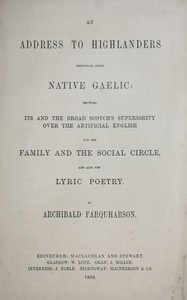
An address to Highlanders respecting their native Gaelic
Subjects:
Download Formats:
Excerpt
AN
ADDRESS TO HIGHLANDERS
RESPECTING THEIR
NATIVE GAELIC:
SHOWING
ITS AND THE BROAD SCOTCH’S SUPERIORITY
OVER THE ARTIFICIAL ENGLISH
FOR THE
FAMILY AND THE SOCIAL CIRCLE,
AND ALSO FOR
LYRIC POETRY.
BY...
Read the Full Text
— End of An address to Highlanders respecting their native Gaelic —
Book Information
- Title
- An address to Highlanders respecting their native Gaelic
- Author(s)
- Farquharson, Archibald
- Language
- English
- Type
- Text
- Release Date
- February 10, 2025
- Word Count
- 19,501 words
- Library of Congress Classification
- PB
- Rights
- Public domain in the USA.