The Project Gutenberg eBook, An Account of the Ladies of Llangollen, by
Rev. John Prichard
This eBook is for the use of anyone anywhere in the United States and most
other parts of the world at no cost and with almost no restrictions
whatsoever. You may copy it, give it away or re-use it under the terms of
the Project Gutenberg License included with this eBook or online at
www.gutenberg.org. If you are not located in the United States, you'll have
to check the laws of the country where you are located before using this ebook.
Title: An Account of the Ladies of Llangollen
Author: Rev. John Prichard
Release Date: May 3, 2020 [eBook #62005]
Language: English
Character set encoding: UTF-8
***START OF THE PROJECT GUTENBERG EBOOK AN ACCOUNT OF THE LADIES OF
LLANGOLLEN***
Transcribed from the H. Jones edition by David Price, email
[email protected]
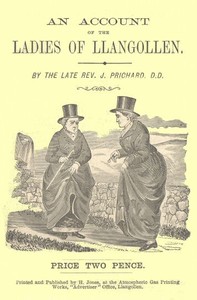
[Picture: Title page of the pamphlet]
AN ACCOUNT
OF THE
LADIES OF LLANGOLLEN.
* * * * *
_BY THE LATE REV. J. PRICHARD_, _D.D._
[Picture: Eleanor Butler and Sarah Ponsonby, the Ladies of Llangollen]
PRICE TWO PENCE
* * * * *
Printed and Published by H. Jones, at the Atmospheric Gas Printing
Works, “Advertiser” Office, Llangollen.
LADY ELEANOR CHARLOTTE BUTLER AND MISS SARAH PONSONBY,
OF PLAS NEWYDD.
LADY Eleanor Butler and Miss Ponsonby were Irish ladies of rank and
beauty, who loved each other with an affection so true that they could
never bear the idea of the separation which the marriage of either would
necessitate. They, therefore, resolved on lives of celibacy, and,
refusing many handsome offers, fled from home. They were, however,
overtaken and brought back to their respective relations. Many attempts
were made to draw Miss Butler into marriage, but all were in vain. In a
short time the ladies eloped again, each having a small sum with her; and
it was said that, although Lady Eleanor arrived here in the natural
aspect of a maid of 34, Miss Ponsonby accompanied her in the guise of a
smart footman, in top boots and buskin breeches. It was about the year
1778 when these errant ladies visited Llangollen. While rambling along
this charming locality, their eyes rested on a gentle eminence near the
village, and there they resolved to fix their abode. They, accordingly,
purchased the estate, built a new cottage on the site of the old one,
laid out gardens, pleasure grounds, rural walks and bridges, by which
they might enjoy the natural charms of this picturesque retreat. Their
mode of life being very singular, and their costume still more so, they
soon became noticed by the many travellers who passed through North
Wales. The celebrated comedian Charles Mathews thus describes their
appearance:—“As they are seated, there is not one point to distinguish
them from men; the dresses and powdering of the hair, their well-starched
neckcloths, the upper part of their habits (which they always wear, even
at a dinner party) made precisely like men’s coats, with regular black
beaver hats, everything contributing to this semblance. To crown all,
they had crop heads, which were rough, bushy, and white as snow.”
Plas Newydd was built at the north-east end of a field called the _Maes_,
and was, therefore, called _Penymaes_—The end of the Maes.
The ladies were, according to their means, charitable to the aged, sick,
and infirm; and had been taught, by wisdom and experience, that the best
way to help the poor labourer was by giving him employment. The workman,
having precious commodities for the market of the world—physical power,
knowledge, and good common sense—that were of more value to society than
gold or land, would, by being given an opportunity to use his capacities,
be able to support himself and family, without losing his independence,
and humbling himself to be a crouching beggar, producing no honey to the
common hive. Although their farm had only thirteen acres of land—four of
their own, and nine held as tenants, they kept a carpenter, a cowman, a
man for all work on the farm, and in the hay-harvest an additional number
of men and poor women; with two ladies’ maids and three female servants
in the house. By the help of these male hands, they made every inch of
ground productive, and every hedge-fence and walk pleasant to the
sight—well answering their end, and the house healthy, orderly, and
comfortable. In employing the labouring class, they were as wise and
praiseworthy as the Society of Friends.
We recollect another feature in the character of the Ladies of
Penymaes,—their non-interference with the religion of their servants.
They wished all to be religious, and possess the root of the matter.
Though they were LADIES, they left conscience to be ruled by its rightful
Owner; they followed the example of a certain German sovereign, who, when
some of his courtiers advised him to compel all his subjects to be of the
same religion as himself, replied, “I rule over the bodies of my faithful
subjects; as touching the soul I am not their king, but a fellow-subject
with them to the Great King, who _can_ govern the soul, and has reserved
conscience as His own sacred province.” Lady Eleanor and the Honourable
Miss Ponsonby knew too well that coercion might make people worthless
hypocrites; but teaching the truth, a life consistent with the truth of
God, with loving persuasion, only could make sincere followers of Him,
who says, My son, give me _thine heart_.
Allow us to relate another incident in the lives of the Ladies of
Llangollen that fell under our observation, under the following
heading:—_Kindness creates kindness and liberality_. Mr. Thomas Jones,
of Bachau Mill, and the minister of Penybryn Chapel were the collectors
for the Bible Society through the township of Bachau, from year to year,
for thirty years. Penymaes being in their district, the collectors
called there as well as every other house in the township, and were
received with a smile, wishes of success, and a handsome subscription
from the ladies’ maids, Misses Elizabeth and Jane Hughes, and something
from the other servants. Either Miss Jane or Miss Elizabeth would always
present the collecting book to the ladies. But the book, for years,
would be returned from the ladies’ room, without anything to gladden the
collectors’ hearts. However, one year, Miss Jane said, with a double
smile, and appearance of confidence on her face, “Please, I will take
your book to Lady Eleanor and Miss Ponsonby.” She soon returned with a
yellow piece that did gladden the hearts of the collectors, and added,
“You must be sure, every year, to call on the ladies.” And so they did
as long as the last of them remained on earth, and met with equal success
and cheerfulness. The collectors had no clue to the welcome change at
Penymaes, in collecting, for years after the death of Miss Ponsonby. In
course of time, Miss June Hughes (now Mrs. Roberts, Ormonde Cottage,
Berwyn Street,) was united in marriage to Mr. Edward Roberts, timber
merchant, and attended the means of grace at Penybryn Chapel, and became
a useful member there. When the minister of Penybryn was taking tea at
her house, she asked him, “Do you remember the time you and Mr. Jones
received the first half-sovereign for the Bible Society from the dear
ladies!” “Yes, as it were yesterday, but we know not the cause of our
success.” “Well, I shall tell you. Do you remember Lady Eleanor’s
severe illness about two years before she died?” The minister replied,
“I do, and shall never forget it.” “You, therefore, remember your
praying so earnestly for her, and for her recovery, that you, and many of
the congregation, were moved to tears? Next day, someone, that was
present at Penybryn, described at Plas Newydd the remarkable prayer, and
its effects upon yourself and those present. When the ladies heard of
the prayer they felt so much that they remembered the words of the
Apostle James (chap. v. 16), ‘The _effectual fervent_ prayer of a
righteous man availeth much.’ And Lady Eleanor soon recovered, and was
restored to her usual health: and both believed that the God of the Bible
had saved her life, and restored her health, and determined, to the end
of their days, to subscribe for the Bible; and so they did, as you know.”
The minister thanked Mrs. Roberts for the encouraging relation that
revealed the secret of the collectors’ success, on behalf of the British
and Foreign Bible Society, at Plas Newydd.
Miss Seward, the clever and amusing gossip, says of the “ladies,” whom
she rhapsodizes as “the enchantreses” of Plas Newydd:—
“Lady Eleanor is of middle height, and somewhat beyond the
_embonpoint_ as to plumpness; her face round and fair, with the glow
of luxuriant health. She has not fine features, but they are
agreeable; enthusiasm in her eye, hilarity and benevolence in her
smile. Exhaustless is her fund of historic and traditionary
knowledge, and of everything passing in the present eventful period.
She expresses all she feels with an ingenuous ardour, at which the
cold-spirited beings stare. I am informed that both these ladies
read and speak most of the modern languages. Of the Italian poets,
especially of Dante, they are warm admirers. Miss Ponsonby, somewhat
taller than her friend, is neither slender nor otherwise, but very
graceful. Easy, elegant, yet pensive, is her address and manner.
“Her voice, like lovers’ watched, is kind and low.”
“A face rather long than round, a complexion clear but without bloom,
with a countenance which, from its soft melancholy, has a peculiar
interest. If her features are not beautiful, they are very sweet and
feminine. Though the pensive spirit within permits not her lovely
dimples to give mirth to her smile, they increase its sweetness, and,
consequently, her power of engaging the affections. We see, through
her veil of shading reserve, that all the talents and accomplishments
which enrich the mind of Lady Eleanor exist, with equal powers, in
this her charming friend.”
The celebrated Madame de Genlis, in an entertaining miscellany, under the
title of “Souvenirs de Felicie L—,” has given the following graphic
narrative of “The Fair Recluses of Llangollen:”—
During my residence in England, nothing struck me so much as the
delicious cottage of Llangollen, in North Wales. It is not a little
extraordinary, that a circumstance, so singular and remarkable, as
that connected with this retreat, should hitherto have escaped the
notice of all modern travellers. The manner in which I became
acquainted with it was this:—During our long stay at Bury, a small
company of five or six persons, including ourselves, met every
evening from seven till half-past ten o’clock. We diverted ourselves
with music and conversation, so that the time passed very agreeably.
One night, friendship happened to be the subject of conversation, and
I declared that I would with pleasure undertake a long journey to see
two persons who had long been united by the bonds of genuine
friendship. ‘Well, madam,’ replied Mr. Stuart (now Lord
Castlereagh), ‘go to Llangollen; you will there see a model of
perfect friendship, which, will afford you the more delight, as it is
exhibited by two females who are yet young and charming in every
respect. Would you like to hear the history of Lady Eleanor Butler
and Miss Ponsonby?’—‘It would give me the greatest pleasure.’—‘I will
relate it to you.’ At these words the company drew nearer to Mr.
Stuart, we formed a little circle round him, and after recollecting
himself a few moments, he thus began his narrative:—
‘Lady Eleanor Butler was born in Dublin. She was left an orphan
while in her cradle; and possessing an ample fortune, together with
an amiable disposition and a beautiful person, her hand was solicited
by persons belonging to the first families in Ireland. At an early
age she manifested great repugnance to the idea of giving herself a
master. This love of independence, which she never dissembled, did
no injury to her reputation; her conduct has always been
irreproachable, and no female is more highly distinguished for
sweetness of temper, modesty, and all the virtues which adorn her
sex. In early life a mutual attachment took place between her and
Miss Ponsonby, by an accident, which made a deep impression on their
imagination. They had no difficulty to persuade themselves that
heaven had formed them for each other; that is, that it had designed
each of them to devote her existence to the other, so that they might
glide together down the stream of life, in the bosom of peace, the
most intimate friendship, and delicious independence. This idea
their sensibility was destined to realize. Their friendship
gradually grew stronger with their years, so that when Miss Ponsonby
was seventeen, and Lady Eleanor Butler thirty-four, they mutually
engaged never to sacrifice their liberty, or to part from each other.
From that moment they formed the design of withdrawing from the
world, and of settling for good in some sequestered retreat. Having
heard of the charming scenery of Wales, they secretly absconded from
their friends for the purpose of fixing upon their future residence.
They visited Llangollen, and there, on the summit of a hill, they
found a little detached cottage, with the situation of which they
were delighted. Here they resolved to form their establishment.
Meanwhile the guardians of the young fugitives sent people after
them, and they were conveyed back to Dublin. They declared that they
would return to their hill as soon as they were free. Accordingly,
when Miss Ponsonby was twenty-one, in spite of the entreaties and
remonstrances of their relatives and friends, they quitted Ireland
for ever, and flew to Llangollen. Miss Ponsonby is not rich, but
Lady Eleanor possesses a considerable fortune. She purchased the
little hut and the property of the hill, where she built a cottage,
very simple in external appearance, but the interior of which
displays the greatest elegance. On the top of the hill she has
formed about the house a court and flower-garden; a hedge of
rosebushes is the only enclosure that surrounds this rural
habitation. A convenient carriage-road, the steepness of which has
been diminished by art, was carried along the hill. On the aide of
the latter some ancient pines of prodigious height were preserved;
fruit trees were planted, and a great number of cherry trees in
particular, which produce the best and finest cherries in England.
The two friends likewise possess a farm for their cattle, with a
pretty farm-house and a kitchen-garden close by. In this sequestered
abode, these two extraordinary persons, with minds equally
cultivated, and accomplishments equally pleasing, have now resided
ten years, without ever having been absent from it a single night.
Nevertheless, they are not unsociable; they sometimes pay visits to
the neighbouring gentry, and receive, with the greatest politeness,
travellers on their way to or from Ireland, who are recommended to
them by any of their old friends.’
This account strongly excited my curiosity, and produced the same
effect on Mademoiselle d’Orleans and my two young companions. We
determined the same night to set out immediately for Llangollen, by
the circuitous route of Brighton, Portsmouth, and the Isle of Wight.
It was the latter end of July when we arrived at Llangollen. This
place has not the rich appearance of the English villages in general,
but nothing can equal the cleanliness of the houses, and among the
lower classes of any country this is an infallible proof of
abundance. Llangollen, surrounded with woods and meadows, clothed
with the freshest verdure, is situated at the foot of the hill
belonging to the two friends, which there forms a majestic pyramid
covered with trees and flowers. We arrived at the cottage, the only
object of our journey, an hour before sunset.
The two friends had received in the morning by a messenger the letter
which Mr. Stuart had given me for them. We were received with a
grace, a cordiality, and kindness, of which it would be impossible
for me to give any idea. I could not turn my eyes from those two
ladies, rendered so interesting by their friendship and so
extraordinary on account of their way of life. I perceived in them
none of that vanity which takes delight in the surprise of others.
Their mutual attachment, and their whole conduct evince such
simplicity, that astonishment soon gives way to softer emotions; all
they do and say breathes the utmost frankness and sincerity. One
circumstance which I cannot help remarking is, that after living so
many years in this sequestered retreat, they speak French with equal
fluency and purity. * * * An excellent library, composed of the best
English, French, and Italian authors, affords them an inexhaustible
source of diversified amusement and solid occupation; for reading is
not truly profitable except when a person has time to read again.
The interior of the house is delightful on account of the just
proportion and distribution of the apartments, the elegance of the
ornaments and furniture, and the admirable view which you enjoy from
all the windows; the drawing-room is adorned with charming
landscapes, drawn and coloured from nature, by Miss Ponsonby. Lady
Eleanor is a great proficient in music; and their solitary habitation
is filled with embroidery, by them both, of wonderful execution.
Miss Ponsonby, who writes the finest hand I ever saw, has copied a
number of select pieces in verse and prose, which she has ornamented
with vignettes and arabesques, in the best taste, and which form a
most valuable collection. Thus the arts are cultivated there with
equal modesty and success, and their productions are admired with a
feeling that is not experienced elsewhere; the spectator observes
with delight that so much merit is secure in this peaceful retreat
from the shafts of satire and envy.
There are several little reminiscences of the Ladies of Penymaes to be
gleaned from the few remaining old residents, such as their habit of
distributing sixpenny pieces on Sunday mornings on their way to Church,
which was always down Butler’s Hill and along Church Street to the gate
which formerly stood in the same street. Their influence was considered
paramount, and very solicitous were the labouring classes and
tradespeople for their patronage and countenance. During hay-harvest,
the poor women of the village were wont to scrape a few pence for the
purpose of buying a quart of beer for the mowers in the ladies’ field,
for the sake of their certain acknowledgment, and thereby causing a
superfluity of drink to run during the ladies’ harvest. The poor cottage
gardeners of the neighbourhood used to vie with each other in being the
first in tendering their earliest and finest vegetables to the ladies.
The working tradesmen of the town would leave any work unfinished to
attend to the building and other tastes of Miss Ponsonby.
They were deemed all-powerful intercessors with the magistracy and
government. Many a mother has stood, twirling her apron, at that dark
threshold, whilst recounting her sorrowful tale about her Will or Tom
having got into a scrape, and consequent durance, and had her burden
lightened by the sympathetic countenance of Lady Eleanor, being at the
same time edified by the wholesome advice of Miss Ponsonby. Fancy
recalls her lightened step and brightened face, as she turned away with
the much-desired promise of their advocacy. Their influence proved
sufficient even to save the life of one young man, who had been sentenced
to death for forgery. Their qualities were such that their whole lives
were spent in performing worthy deeds. Good actions, like sweet herbs,
have a retentive perfume. May their memory be long cherished as virtuous
exponents of that paternal and sympathetic life of the upper order which
knits class to class, and has a strong, refining influence on the poor
and lowly.
On June 2nd, 1829, death severed the faithful friendship which had
existed for so many years between the eccentric residents at Plas Newydd,
by removing from this earthly scene Lady Eleanor Butler, who had attained
the advanced age of ninety. On December 9th, 1831, Miss Ponsonby also
died. They are both buried in the Churchyard of Llangollen, where a
stone monument is erected to their memory. On this record of mortality
are inserted the following memorials:—
SACRED TO THE MEMORY OF
_The Right Honourable_
LADY ELEANOR CHARLOTTE BUTLER,
Late of Plas Newydd, in this Parish,
_Deceased_ 2_nd_ _June_, 1829,
Aged 90 Years,
_Daughter of the Sixteenth_, _Sister of the Seventeenth_
_EARLS OF ORMONDE AND OSSORY_;
Aunt to the late, and to the present
MARQUESS OF ORMONDE.
_Endeared to her friends by an almost unequalled excellence of
heart_, _and by manners worthy of her illustrious birth_, _the
admiration and delight of a very numerous acquaintance from a
brilliant vivacity of mind undiminished to the latest period of a
prolonged existence_. _Her amiable condescension and benevolence
secured the grateful attachment of those by whom they had been so
long and so extensively experienced_. _Her various perfections_,
_crowned by the most pious and cheerful submission to the Divine
will_, _can only be appreciated where it is humbly believed they are_
now _enjoying their Eternal Reward_,_ and by her_, _of whom for more
than fifty years they constituted that happiness which_, _through our
blessed Redeemer_, _she trusts will be renewed when_ THIS TOMB _shall
have closed over its_ latest tenant.
“Sorrow not as others who have no hope.”
1 _Thess._, _chap._ 4, _v._ 13.
* * * * *
SARAH PONSONBY
Departed this Life
On the 9th December, 1831,
Aged 76.
_She did not long survive her beloved companion_, _LADY ELEANOR
BUTLER_, _with whom she lived in this valley for more than half a
century of uninterrupted friendship_. “_But they shall no more
return to their house_, _neither shall their place know them any
more_.”—_Job_, _chap._ 7, _v._ 10.
_Reader_, _pause for a moment and reflect_, _not on the uncertainty
of human life_, _but_, _upon the certainty of its termination_, _and
take comfort from the assurance that_ “_As it is appointed unto men
once to die_, _but after this the judgment_: _so Christ was once
offered to bear the sins of many_; _and unto them that look for Him
shall He appear the second time without sin unto salvation_.”—_Heb._,
_chap._ 9, _v._ 27, 28.
On the same tombstone is also the following inscription, to the memory of
a faithful servant, who accompanied “the ladies” from Ireland:—
IN MEMORY OF
MRS. MARY CARRYL,
_Deceased_ 22_nd_ _November_, 1809.
This Monument is erected by Eleanor Butler and Sarah Ponsonby, of
Plas Newydd, in this Parish.
_Released from earth and all its transient woes_,
_She whose remains beneath this Stone repose_,
_Steadfast in faith resigned her parting breath_,
_Looked up with Christian joy and smiled in death_. _ Patient_,
_industrious_, _faithful_, _generous_, _kind_,
_Her conduct left the proudest far behind_;
_Her virtues dignified her humble birth_,
_And raised her mind above this sordid earth_. _Attachment_ (_sacred
bond of grateful breasts_)_ Extinguished but with life_, _this Tomb
attests_,
_Reared by two friends who will her loss bemoan_,
_Till with her ashes_, _here_, _shall rest their own_.
THE LADIES OF LLANGOLLEN.
ONCE two young girls of rank and beauty rare,
Of features more than ordinary fair,
Who in the heyday of their youthful charms
Refused the proffer of all suitors’ arms,
Lived in a cottage here rich carved in oak,
Though now long passed from life by death’s grim stroke.
Plas Newydd’s gardens then displayed much taste,
And nought about them e’er allowed to waste.
The umbrageous foliage of surrounding trees
Gave them a shelter from the stormy breeze,
Whilst in a snug retreat about south-west,
Was bird-cote placed as shelter for redbreast,
For sparrow, chaffinch, blackbird, or for thrush,
These ladies did not wish the cold to touch.
Then did all species of ferns abound
In every nook and corner of their ground,
Then none were known to come unto their door
That were not welcomed with kind words, or more.
These ladies to each other kind and true,
Around Llangollen’s vale, like them were few.
E’en now I see them seated in yon chair,
In well-starched neckcloths, and with powdered hair,
Their upper habits just like men’s they wore,
With tall black beaver hats outside their door;
To crown it all my muse would whisper low,
With hair cropped short, rough, bushy, white as snow.
They at death’s summons, God’s commands obeyed,
And were in fair Llangollen’s churchyard laid,
As they through life together did abide,
E’en now in death they both lie side by side;
Of them remains nought save dark mould and sod,
Who loved their neighbours second to their God;
Sweet peace be theirs—by death to dust allied,
Through him who near a century was their Guide;
Beloved, respected by the world were they,
By all regretted when they passed away.
PLAS NEWYDD was purchased by General Yorke, C.B., in 1876. He knew the
Ladies intimately in his Eton school-boy days, and has saved their
cottage from decay, and filled the rooms with antiquities and
curiosities, and all persons express delight on leaving the grounds. In
1878–79 the General made an extensive new wing to the back of the house.
He spends his summer months at this delightful retreat, and is becoming a
general favourite in the town, imitating the old Ladies in his liberality
and kindness. He takes great delight in carving, and much of his
handi-work may be seen in and about the house. It is very fortunate that
the property fell to the hands of the present proprietor, whose constant
aim is to improve and keep it in the most perfect repair. May the
gallant general be long spared to reside amongst us. He has been happy
in the selection of Mr. Joseph Davies and his amiable wife Mrs. Davies to
look after the place, who are most careful to keep everything in the
house and grounds in proper trim, and most attentive and obliging to
visitors, who are admitted daily, on payment of a small fee.
* * * * *
* * * * *
_H. Jones_, _Printer_, _Llangollen_.
* * * * *
_Published every Friday Morning_, _by H. Jones_, 17, _Castle_, _Street_,
_Llangollen_, _Price One Penny_,
The Llangollen Advertiser,
AND NORTH WALES JOURNAL.
This Journal was established in 1860, and has a very influential
circulation in Llangollen, and throughout all North Wales. Being
conducted entirely on neutral principles, it finds its way into families
of all classes. As it is also the only paper printed and published in
this district, it offers peculiar advantages to advertisers. Special
attention is paid to local intelligence, and general news is carefully
arranged.
_Terms for Advertisements sent on Application_.
* * * * *
ON SALE AT H. JONES’S, STATIONER,
LLANGOLLEN.
* * * * *
PRICE SIXPENCE, JONES’S
HAND-BOOK TO LLANGOLLEN & CORWEN, with Plan and several Engravings of the
Neighbourhood; being a GUIDE FOR THE VISITOR, TOURIST, ANTIQUARIAN,
GEOLOGIST, BOTANIST, AND ANGLER.
* * * * *
AN ACCOUNT OF VALLE CRUCIS ABBEY AND DINAS BRAN CASTLE. Price Two Pence
Each.
* * * * *
THE GOSPEL OF ST MATTHEW, in English and Welsh, with Notes and
References. Price Four Pence.
* * * * *
ENGLISH AND WELSH VOCABULARY. Price Six Pence.
* * * * *
MAPS AND GUIDES FOR WALKS, and a Well-selected Stock of LITHO. AND
PHOTOGRAPHIC VIEWS.
* * * * *
STATIONERY OF ALL KINDS.—A large Assortment of BOOKS.
***END OF THE PROJECT GUTENBERG EBOOK AN ACCOUNT OF THE LADIES OF
LLANGOLLEN***
******* This file should be named 62005-0.txt or 62005-0.zip *******
This and all associated files of various formats will be found in:
http://www.gutenberg.org/dirs/6/2/0/0/62005
Updated editions will replace the previous one--the old editions will
be renamed.
Creating the works from print editions not protected by U.S. copyright
law means that no one owns a United States copyright in these works,
so the Foundation (and you!) can copy and distribute it in the United
States without permission and without paying copyright
royalties. Special rules, set forth in the General Terms of Use part
of this license, apply to copying and distributing Project
Gutenberg-tm electronic works to protect the PROJECT GUTENBERG-tm
concept and trademark. Project Gutenberg is a registered trademark,
and may not be used if you charge for the eBooks, unless you receive
specific permission. If you do not charge anything for copies of this
eBook, complying with the rules is very easy. You may use this eBook
for nearly any purpose such as creation of derivative works, reports,
performances and research. They may be modified and printed and given
away--you may do practically ANYTHING in the United States with eBooks
not protected by U.S. copyright law. Redistribution is subject to the
trademark license, especially commercial redistribution.
START: FULL LICENSE
THE FULL PROJECT GUTENBERG LICENSE
PLEASE READ THIS BEFORE YOU DISTRIBUTE OR USE THIS WORK
To protect the Project Gutenberg-tm mission of promoting the free
distribution of electronic works, by using or distributing this work
(or any other work associated in any way with the phrase "Project
Gutenberg"), you agree to comply with all the terms of the Full
Project Gutenberg-tm License available with this file or online at
www.gutenberg.org/license.
Section 1. General Terms of Use and Redistributing Project
Gutenberg-tm electronic works
1.A. By reading or using any part of this Project Gutenberg-tm
electronic work, you indicate that you have read, understand, agree to
and accept all the terms of this license and intellectual property
(trademark/copyright) agreement. If you do not agree to abide by all
the terms of this agreement, you must cease using and return or
destroy all copies of Project Gutenberg-tm electronic works in your
possession. If you paid a fee for obtaining a copy of or access to a
Project Gutenberg-tm electronic work and you do not agree to be bound
by the terms of this agreement, you may obtain a refund from the
person or entity to whom you paid the fee as set forth in paragraph
1.E.8.
1.B. "Project Gutenberg" is a registered trademark. It may only be
used on or associated in any way with an electronic work by people who
agree to be bound by the terms of this agreement. There are a few
things that you can do with most Project Gutenberg-tm electronic works
even without complying with the full terms of this agreement. See
paragraph 1.C below. There are a lot of things you can do with Project
Gutenberg-tm electronic works if you follow the terms of this
agreement and help preserve free future access to Project Gutenberg-tm
electronic works. See paragraph 1.E below.
1.C. The Project Gutenberg Literary Archive Foundation ("the
Foundation" or PGLAF), owns a compilation copyright in the collection
of Project Gutenberg-tm electronic works. Nearly all the individual
works in the collection are in the public domain in the United
States. If an individual work is unprotected by copyright law in the
United States and you are located in the United States, we do not
claim a right to prevent you from copying, distributing, performing,
displaying or creating derivative works based on the work as long as
all references to Project Gutenberg are removed. Of course, we hope
that you will support the Project Gutenberg-tm mission of promoting
free access to electronic works by freely sharing Project Gutenberg-tm
works in compliance with the terms of this agreement for keeping the
Project Gutenberg-tm name associated with the work. You can easily
comply with the terms of this agreement by keeping this work in the
same format with its attached full Project Gutenberg-tm License when
you share it without charge with others.
1.D. The copyright laws of the place where you are located also govern
what you can do with this work. Copyright laws in most countries are
in a constant state of change. If you are outside the United States,
check the laws of your country in addition to the terms of this
agreement before downloading, copying, displaying, performing,
distributing or creating derivative works based on this work or any
other Project Gutenberg-tm work. The Foundation makes no
representations concerning the copyright status of any work in any
country outside the United States.
1.E. Unless you have removed all references to Project Gutenberg:
1.E.1. The following sentence, with active links to, or other
immediate access to, the full Project Gutenberg-tm License must appear
prominently whenever any copy of a Project Gutenberg-tm work (any work
on which the phrase "Project Gutenberg" appears, or with which the
phrase "Project Gutenberg" is associated) is accessed, displayed,
performed, viewed, copied or distributed:
This eBook is for the use of anyone anywhere in the United States and
most other parts of the world at no cost and with almost no
restrictions whatsoever. You may copy it, give it away or re-use it
under the terms of the Project Gutenberg License included with this
eBook or online at www.gutenberg.org. If you are not located in the
United States, you'll have to check the laws of the country where you
are located before using this ebook.
1.E.2. If an individual Project Gutenberg-tm electronic work is
derived from texts not protected by U.S. copyright law (does not
contain a notice indicating that it is posted with permission of the
copyright holder), the work can be copied and distributed to anyone in
the United States without paying any fees or charges. If you are
redistributing or providing access to a work with the phrase "Project
Gutenberg" associated with or appearing on the work, you must comply
either with the requirements of paragraphs 1.E.1 through 1.E.7 or
obtain permission for the use of the work and the Project Gutenberg-tm
trademark as set forth in paragraphs 1.E.8 or 1.E.9.
1.E.3. If an individual Project Gutenberg-tm electronic work is posted
with the permission of the copyright holder, your use and distribution
must comply with both paragraphs 1.E.1 through 1.E.7 and any
additional terms imposed by the copyright holder. Additional terms
will be linked to the Project Gutenberg-tm License for all works
posted with the permission of the copyright holder found at the
beginning of this work.
1.E.4. Do not unlink or detach or remove the full Project Gutenberg-tm
License terms from this work, or any files containing a part of this
work or any other work associated with Project Gutenberg-tm.
1.E.5. Do not copy, display, perform, distribute or redistribute this
electronic work, or any part of this electronic work, without
prominently displaying the sentence set forth in paragraph 1.E.1 with
active links or immediate access to the full terms of the Project
Gutenberg-tm License.
1.E.6. You may convert to and distribute this work in any binary,
compressed, marked up, nonproprietary or proprietary form, including
any word processing or hypertext form. However, if you provide access
to or distribute copies of a Project Gutenberg-tm work in a format
other than "Plain Vanilla ASCII" or other format used in the official
version posted on the official Project Gutenberg-tm web site
(www.gutenberg.org), you must, at no additional cost, fee or expense
to the user, provide a copy, a means of exporting a copy, or a means
of obtaining a copy upon request, of the work in its original "Plain
Vanilla ASCII" or other form. Any alternate format must include the
full Project Gutenberg-tm License as specified in paragraph 1.E.1.
1.E.7. Do not charge a fee for access to, viewing, displaying,
performing, copying or distributing any Project Gutenberg-tm works
unless you comply with paragraph 1.E.8 or 1.E.9.
1.E.8. You may charge a reasonable fee for copies of or providing
access to or distributing Project Gutenberg-tm electronic works
provided that
* You pay a royalty fee of 20% of the gross profits you derive from
the use of Project Gutenberg-tm works calculated using the method
you already use to calculate your applicable taxes. The fee is owed
to the owner of the Project Gutenberg-tm trademark, but he has
agreed to donate royalties under this paragraph to the Project
Gutenberg Literary Archive Foundation. Royalty payments must be paid
within 60 days following each date on which you prepare (or are
legally required to prepare) your periodic tax returns. Royalty
payments should be clearly marked as such and sent to the Project
Gutenberg Literary Archive Foundation at the address specified in
Section 4, "Information about donations to the Project Gutenberg
Literary Archive Foundation."
* You provide a full refund of any money paid by a user who notifies
you in writing (or by e-mail) within 30 days of receipt that s/he
does not agree to the terms of the full Project Gutenberg-tm
License. You must require such a user to return or destroy all
copies of the works possessed in a physical medium and discontinue
all use of and all access to other copies of Project Gutenberg-tm
works.
* You provide, in accordance with paragraph 1.F.3, a full refund of
any money paid for a work or a replacement copy, if a defect in the
electronic work is discovered and reported to you within 90 days of
receipt of the work.
* You comply with all other terms of this agreement for free
distribution of Project Gutenberg-tm works.
1.E.9. If you wish to charge a fee or distribute a Project
Gutenberg-tm electronic work or group of works on different terms than
are set forth in this agreement, you must obtain permission in writing
from both the Project Gutenberg Literary Archive Foundation and The
Project Gutenberg Trademark LLC, the owner of the Project Gutenberg-tm
trademark. Contact the Foundation as set forth in Section 3 below.
1.F.
1.F.1. Project Gutenberg volunteers and employees expend considerable
effort to identify, do copyright research on, transcribe and proofread
works not protected by U.S. copyright law in creating the Project
Gutenberg-tm collection. Despite these efforts, Project Gutenberg-tm
electronic works, and the medium on which they may be stored, may
contain "Defects," such as, but not limited to, incomplete, inaccurate
or corrupt data, transcription errors, a copyright or other
intellectual property infringement, a defective or damaged disk or
other medium, a computer virus, or computer codes that damage or
cannot be read by your equipment.
1.F.2. LIMITED WARRANTY, DISCLAIMER OF DAMAGES - Except for the "Right
of Replacement or Refund" described in paragraph 1.F.3, the Project
Gutenberg Literary Archive Foundation, the owner of the Project
Gutenberg-tm trademark, and any other party distributing a Project
Gutenberg-tm electronic work under this agreement, disclaim all
liability to you for damages, costs and expenses, including legal
fees. YOU AGREE THAT YOU HAVE NO REMEDIES FOR NEGLIGENCE, STRICT
LIABILITY, BREACH OF WARRANTY OR BREACH OF CONTRACT EXCEPT THOSE
PROVIDED IN PARAGRAPH 1.F.3. YOU AGREE THAT THE FOUNDATION, THE
TRADEMARK OWNER, AND ANY DISTRIBUTOR UNDER THIS AGREEMENT WILL NOT BE
LIABLE TO YOU FOR ACTUAL, DIRECT, INDIRECT, CONSEQUENTIAL, PUNITIVE OR
INCIDENTAL DAMAGES EVEN IF YOU GIVE NOTICE OF THE POSSIBILITY OF SUCH
DAMAGE.
1.F.3. LIMITED RIGHT OF REPLACEMENT OR REFUND - If you discover a
defect in this electronic work within 90 days of receiving it, you can
receive a refund of the money (if any) you paid for it by sending a
written explanation to the person you received the work from. If you
received the work on a physical medium, you must return the medium
with your written explanation. The person or entity that provided you
with the defective work may elect to provide a replacement copy in
lieu of a refund. If you received the work electronically, the person
or entity providing it to you may choose to give you a second
opportunity to receive the work electronically in lieu of a refund. If
the second copy is also defective, you may demand a refund in writing
without further opportunities to fix the problem.
1.F.4. Except for the limited right of replacement or refund set forth
in paragraph 1.F.3, this work is provided to you 'AS-IS', WITH NO
OTHER WARRANTIES OF ANY KIND, EXPRESS OR IMPLIED, INCLUDING BUT NOT
LIMITED TO WARRANTIES OF MERCHANTABILITY OR FITNESS FOR ANY PURPOSE.
1.F.5. Some states do not allow disclaimers of certain implied
warranties or the exclusion or limitation of certain types of
damages. If any disclaimer or limitation set forth in this agreement
violates the law of the state applicable to this agreement, the
agreement shall be interpreted to make the maximum disclaimer or
limitation permitted by the applicable state law. The invalidity or
unenforceability of any provision of this agreement shall not void the
remaining provisions.
1.F.6. INDEMNITY - You agree to indemnify and hold the Foundation, the
trademark owner, any agent or employee of the Foundation, anyone
providing copies of Project Gutenberg-tm electronic works in
accordance with this agreement, and any volunteers associated with the
production, promotion and distribution of Project Gutenberg-tm
electronic works, harmless from all liability, costs and expenses,
including legal fees, that arise directly or indirectly from any of
the following which you do or cause to occur: (a) distribution of this
or any Project Gutenberg-tm work, (b) alteration, modification, or
additions or deletions to any Project Gutenberg-tm work, and (c) any
Defect you cause.
Section 2. Information about the Mission of Project Gutenberg-tm
Project Gutenberg-tm is synonymous with the free distribution of
electronic works in formats readable by the widest variety of
computers including obsolete, old, middle-aged and new computers. It
exists because of the efforts of hundreds of volunteers and donations
from people in all walks of life.
Volunteers and financial support to provide volunteers with the
assistance they need are critical to reaching Project Gutenberg-tm's
goals and ensuring that the Project Gutenberg-tm collection will
remain freely available for generations to come. In 2001, the Project
Gutenberg Literary Archive Foundation was created to provide a secure
and permanent future for Project Gutenberg-tm and future
generations. To learn more about the Project Gutenberg Literary
Archive Foundation and how your efforts and donations can help, see
Sections 3 and 4 and the Foundation information page at
www.gutenberg.org
Section 3. Information about the Project Gutenberg Literary
Archive Foundation
The Project Gutenberg Literary Archive Foundation is a non profit
501(c)(3) educational corporation organized under the laws of the
state of Mississippi and granted tax exempt status by the Internal
Revenue Service. The Foundation's EIN or federal tax identification
number is 64-6221541. Contributions to the Project Gutenberg Literary
Archive Foundation are tax deductible to the full extent permitted by
U.S. federal laws and your state's laws.
The Foundation's principal office is in Fairbanks, Alaska, with the
mailing address: PO Box 750175, Fairbanks, AK 99775, but its
volunteers and employees are scattered throughout numerous
locations. Its business office is located at 809 North 1500 West, Salt
Lake City, UT 84116, (801) 596-1887. Email contact links and up to
date contact information can be found at the Foundation's web site and
official page at www.gutenberg.org/contact
For additional contact information:
Dr. Gregory B. Newby
Chief Executive and Director
[email protected]
Section 4. Information about Donations to the Project Gutenberg
Literary Archive Foundation
Project Gutenberg-tm depends upon and cannot survive without wide
spread public support and donations to carry out its mission of
increasing the number of public domain and licensed works that can be
freely distributed in machine readable form accessible by the widest
array of equipment including outdated equipment. Many small donations
($1 to $5,000) are particularly important to maintaining tax exempt
status with the IRS.
The Foundation is committed to complying with the laws regulating
charities and charitable donations in all 50 states of the United
States. Compliance requirements are not uniform and it takes a
considerable effort, much paperwork and many fees to meet and keep up
with these requirements. We do not solicit donations in locations
where we have not received written confirmation of compliance. To SEND
DONATIONS or determine the status of compliance for any particular
state visit www.gutenberg.org/donate
While we cannot and do not solicit contributions from states where we
have not met the solicitation requirements, we know of no prohibition
against accepting unsolicited donations from donors in such states who
approach us with offers to donate.
International donations are gratefully accepted, but we cannot make
any statements concerning tax treatment of donations received from
outside the United States. U.S. laws alone swamp our small staff.
Please check the Project Gutenberg Web pages for current donation
methods and addresses. Donations are accepted in a number of other
ways including checks, online payments and credit card donations. To
donate, please visit: www.gutenberg.org/donate
Section 5. General Information About Project Gutenberg-tm electronic works.
Professor Michael S. Hart was the originator of the Project
Gutenberg-tm concept of a library of electronic works that could be
freely shared with anyone. For forty years, he produced and
distributed Project Gutenberg-tm eBooks with only a loose network of
volunteer support.
Project Gutenberg-tm eBooks are often created from several printed
editions, all of which are confirmed as not protected by copyright in
the U.S. unless a copyright notice is included. Thus, we do not
necessarily keep eBooks in compliance with any particular paper
edition.
Most people start at our Web site which has the main PG search
facility: www.gutenberg.org
This Web site includes information about Project Gutenberg-tm,
including how to make donations to the Project Gutenberg Literary
Archive Foundation, how to help produce our new eBooks, and how to
subscribe to our email newsletter to hear about new eBooks.
An Account of the Ladies of Llangollen
Subjects:
Download Formats:
Excerpt
The Project Gutenberg eBook, An Account of the Ladies of Llangollen, by
Rev. John Prichard
This eBook is for the use of anyone anywhere in the United States and most
other parts of the world at no cost and with almost no restrictions
whatsoever. You may copy it, give it away or re-use it under the terms of
the Project Gutenberg License included with this eBook or online at
www.gutenberg.org. If you are not located in the United States, you'll have
to check the laws of the country...
Read the Full Text
— End of An Account of the Ladies of Llangollen —
Book Information
- Title
- An Account of the Ladies of Llangollen
- Author(s)
- Prichard, J. (John)
- Language
- English
- Type
- Text
- Release Date
- May 3, 2020
- Word Count
- 7,509 words
- Library of Congress Classification
- CT
- Bookshelves
- Browsing: Biographies, Browsing: Culture/Civilization/Society, Browsing: Gender & Sexuality Studies, Browsing: History - British
- Rights
- Public domain in the USA.