*** START OF THE PROJECT GUTENBERG EBOOK 73728 ***
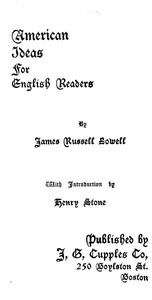
American Ideas For English Readers.
[Illustration: JAMES RUSSELL LOWELL,
AFTER THE BUST BY
WILLIAM ORDWAY PARTRIDGE.
(TAKEN FROM THE CLAY)]
American
Ideas
For
English Readers
By
James Russell Lowell
With Introduction by
Henry Stone
Published by
J, G, Cupples Co,
250 Boylston St.
Boston
Copyright, 1892,
BY J. G. CUPPLES.
_All rights reserved._
Contents.
INTRODUCTION vii
BEFORE THE EDINBURGH PHILOSOPHICAL INSTITUTION 1
BEFORE THE LONDON CHAMBER OF COMMERCE 9
AT THE UNIVERSITY OF CAMBRIDGE 15
ON ROBERT BROWNING 21
AT THE UNVEILING OF THE GRAY MEMORIAL 25
BEFORE THE TOWN COUNCIL OF THE CITY OF WORCESTER 33
ON INTERNATIONAL ARBITRATION 39
AT A ROYAL ACADEMY DINNER 47
AT THE STRATFORD MEMORIAL FOUNTAIN PRESENTATION 57
AT THE DINNER TO AMERICAN AUTHORS 63
BEFORE THE LIVERPOOL PHILOMATHIC SOCIETY 81
Introduction.
Among his many titles to the special consideration and gratitude of his
countrymen, James Russell Lowell had one in pre-eminence--an unyielding
loyalty to all that was best in American ideas and aims. It was this
quality that gave point to the wit of Hosea Biglow, and loftiness to
his imagination in his more serious poems. In the earliest of the
Biglow papers, he calls upon Massachusetts to
“Hold up a beacon peerless
To the oppressed of all the World,”
and the tone is not changed to his very latest utterance. In that
Commemoration Ode, which will remain the crown of his literary and
poetical work, his passion found its highest expression:
“O Beautiful! My Country! * * *
Smoothing thy gold of war-dishevelled hair
O’er such sweet brows as never other wore
* * * * *
What words divine of lover or of poet
Could tell our love--and make thee know it
Among the Nations bright beyond compare?”
An impression has prevailed--and has gained credence at some times
and in some places, that, in his later years, and in the presence of
a society differently organized from that which he found at home, the
ardor of his love of country was quenched:--that he became less an
American as he saw more of other lands. What is it to be an American?
The definition may vary, in different regions. What was it, always,
with him? If to be an American means merely to be successful in a large
and worldly way--whether in politics, or in business, or in letters; to
out-talk, out-spend, out-bid, out-invent others; to drive faster; to
travel farther; to push harder; to build bigger houses; to found more
richly endowed Universities; to construct greater Observatories; to
establish more and larger public libraries:--if to do these and similar
things is all that goes to make an American--the charge is true. In
such sense, Mr. Lowell was not so good an American as some others.
But, in the larger and truer sense:--in striving for all that goes to
make a people more noble in aim, more humane, more intelligent, more
peace-loving, more free, more self-respecting, more artistic, in short
more fully men and women of the best type,--Mr. Lowell may well be
accepted as the representative American, of whom we should all be proud.
It was his rare fortune to be Minister of the United States to Great
Britain during a most interesting period. The serious troubles which
had grown out of the wrong we had suffered at her hands during the
civil war had been happily ended. The era of reconciliation had begun.
In what light should we stand before the world, after winning the
great verdict in the Alabama case:--as a community of sharp traders,
condoning a great national wrong for a petty sum of money?--or as a
people striving chiefly for the maintenance of the true principles
of national honor and international comity? Mr. Lowell, perhaps more
than any one in America, was the man who, by training, by culture,
by scholarship, by attainments in the world of letters, by unsullied
character, was fitted to present to the English people an embodiment of
Americanism, in its best expression. More than that:--he was eminently
fitted to illustrate that idea, and give it weight, dignity and
authority. In all his intercourse with the aristocratic representatives
of privileged countries, he--the plain, untitled representative of a
democratic government--proud to stand for a people with whom liberty
and equality were supreme terms--more than held his own in every trial
of intellect, of courtesy, of wit, of all that wins in society and the
world. So, at last, no circle was complete without him:--to claim him
as guest was matter of emulation.
Some of these things are, in a certain sense, of small account. Yet in
a society so largely conventional as all diplomatic society is, and
of necessity must be, it is much that an American should, by common
consent, stand at the head, even in matters of ceremonial. It reveals
a quickness and versatility of mind which is not common. A certain
native, spontaneous grace, both of words and manner, characterized all
Mr. Lowell’s utterances; and it was so truly genuine that it could not
fail to charm, when the mere external imitation was sure to repel.
The record which this little book gives of his unstudied speeches
and letters in England shows how thoroughly imbued he was with the
American idea. It also shows how strenuously he used every occasion to
try to bring about a higher and truer friendship between the two great
countries whose mission it seems to be to uphold and extend regulated
liberty throughout the world. Some of these speeches were made while
he was still accredited Minister to Great Britain: others, after he
had ceased to hold the title, though he remained in reality the true
American representative to that people. There is, perhaps, no other
instance of a citizen of the United States holding such position, with
ever increasing regard, for years after he had ceased to be titular
representative. The honors bestowed on him by the Universities were
more than out-done by the honor in which he was held by the people.
The one was a tribute to scholarship and attainments:--the other, a
recognition of manhood and integrity.
In the heroic years which made up so large a part of the experience
of all men in the United States from 1861 to 1865, Mr. Lowell’s part
was as efficient as that of many a general on the battle field. When
the era of peace and reconciliation came, he maintained the same lofty
principles which had prompted all his former actions and words. The
spirit which dictated “The Present Crisis” so long ago as 1845, also
dictated the “Fourth of July Ode” in 1876. But how different the tone
of these two impassioned lyrics! The one a vigorous, manly, resistless
protest against the
“Sons of brutish Force and Darkness
Who have drenched the earth with blood,”
The other, a sublime thanksgiving for the salvation of
“The Land to Human Nature dear.”
It is in the light of these strenuous outbursts of the unconquered
spirit of independence that his words spoken in lighter vein are to be
read and considered. Everywhere is the same faith and hope:--only, in
these later speeches, they find expression in words fitted for social
pleasantry and genial intercourse.
Nowhere do after-dinner speeches--which, with us, are usually
momentary and evanescent in effect--carry so much weight as in
England. There often a public dinner is an event. Questions of peace
or war: of party policy: of methods of administration: of national
destiny, are often decided or directed by words spoken at the dinner
table. Therefore, these speeches of Mr. Lowell have a much greater
significance than if made on similar occasions with us. In every
one is to be found an earnest endeavor, first to secure a higher
appreciation of his country than he found prevailing among that insular
and self-contained people:--and next to encourage and stimulate the
formation of a real and sincere friendship between the mother country
and her over-grown child. He gained these ends by the exercise of
unfailing tact, courtesy and courage, which first disarmed criticism;
and then by presenting considerations which commanded respect and
carried conviction. Even his American humor gained the appreciation of
these lovers of _Punch_.
The first of the speeches which are here given was made in 1880--the
last in 1888. One invariable note is struck in them all. Beginning
with that at Edinburgh, he claims--what we all conceive to be
true--that the traditions of English freedom and English civilization
have not only been maintained, but also extended, among us: and he
refers, with evident and just pride, to the quick and intelligent
appreciation of Carlyle in America, long before he won recognition
in his own England. And, in his last speech, on the eve of leaving
Liverpool to return home, he dwells with great earnestness on the duty
laid on English-speaking races everywhere to carry with them the great
lessons of liberty combined with order.
In all these evidently unstudied and spontaneous expressions of
his permanent feeling and conviction, Mr. Lowell claims our hearty
consideration. His voice is everywhere and always loyal to his native
land, which he loved and honored: to freedom, which he held above all
price: to that liberty and civilization which it is the joint mission
of England and America to maintain to the uttermost. Difference of
methods between the two countries there may be: but the end to be
reached is the same. To help reach this, Mr. Lowell gave his best
energies. His words had a power beyond what he could have thought
possible. If there is now, in England, a clearer appreciation of
American ideas: less of that condescension which was once so evident
in foreigners: more readiness to see and to seek the best rather than
the worst in our modes of life and thought: a clearer understanding
that, at heart, we are one people--a very large share of that improved
condition is due to James Russell Lowell. The method of securing that
better understanding was--not by denying or ignoring certain manifest
short-comings or over-doings:--but by constantly holding up to the
world the best we had done, or striven to do:--and, more than all,
by illustrating it in his own person:--so that even our enemies were
compelled to confess that there must be some good in our land, if such
men as he were the
“New birth of our new soil.”
HENRY STONE.
BOSTON,
January 1, 1892.
American Ideas for English Readers.
I.
BEFORE THE EDINBURGH PHILOSOPHICAL INSTITUTION.
On Saturday evening, November 6, 1880, the directors of the Edinburgh
Philosophical Institution entertained Mr. JAMES RUSSELL LOWELL,
American Minister, at dinner in the Balmoral Hotel in that city. Dr.
W. Smith, senior vice-president of the institution, occupied the
chair, and among others present were the Earl of Rosebery, Lord Reay,
Principal Sir Alexander Grant, the Rev. Professor Flint, and Professor
Blackie. Mr. LOWELL, in returning thanks for the toast of his health,
said:
He thought that they in America had done quite their share
of work in their short life, although he was always
inclined to question the statement that they were a young
people. It was supposed, somehow or other, that they
were autochthonic; that they had sprung from the earth
of America, as the Athenians were said to have done from
the soil of Attica. But it was nothing of the kind. If he
might be allowed to say so, they began where those in this
country left off. It must be remembered that they took with
them all the traditions of English freedom and of English
civilization, and that they not only maintained them, but,
in his humble judgment, carried them further. (_Cheers._)
Mr. LOWELL concluded by referring to early association on his part with
Edinburgh.
Afterwards, proposing “The health of Mr. Carlyle and the Philosophical
Institution of Edinburgh,” Mr. LOWELL said that--
America in a certain sense performed the office of
posterity to England and Scotland. Their authors were
first recognized across the Atlantic. (_Cheers._) He would
not say it was owing to quicker perception, but rather to
their clearness of atmosphere (_laughter_) that they had
this luck sometimes. He remembered particularly a book
which was published while he was still at college, and
which produced in his young mind as great a ferment as it
did among all his contemporaries. That book was “Sartor
Resartus.” (_Cheers._) It was first collected and published
in the year 1836 in the city of Boston, in the United
States of America (_cheers_); and it there received its
first approbation. Their chairman, Dr. Smith, had told
him during the course of the evening that when “Sartor
Resartus” first began to appear in _Fraser’s Magazine_
the editor received two letters, one from an Irishman,
if he was not mistaken, saying that if that particular
kind of stuff--describing it with what usually began with
a “d” (_laughter_)--was to be continued he wished his
subscription to be stopped. The other letter was from an
American, saying that if the writer of “Sartor Resartus”
in _Fraser’s Magazine_ had written anything else he wished
it all to be sent to him. (_Laughter._) The second writer
was a man he knew well--Ralph Waldo Emerson. (_Cheers._)
He remembered being very much struck many years ago with
something which Thackeray said to him. It was that Carlyle
was his master. That was said nearly thirty years ago. The
other day he took up a number of the _Nineteenth Century_,
and in an article by Mr. Ruskin he observed that he said
Carlyle was his master. This coincidence, the difference
between Thackeray and Ruskin being remembered, only showed,
he thought, the universality of Carlyle’s influence.
(_Cheers._) He meant to say that Carlyle approached
different men on different sides, which was one of the
strongest marks that could be mentioned of genius. Carlyle
had found an approach to their intellects and to their
hearts, to the intellects and hearts of a great variety
of men of different nations. He had introduced a new
style--a peculiarly English style--of looking at things,
quite as much as Sir Walter Scott introduced a new style
of novel-writing. Sir Walter Scott, he considered, was the
greatest story-teller of the age. (_Cheers._) Carlyle had
the surprising gift of expressing poetic thought in prose.
(_Cheers._) It was particularly their gratitude to him on
the moral and human side that they would feel in drinking,
not only with enthusiasm, but with a sort of reverence,
the health of Mr. Carlyle.
The toast was received with much enthusiasm. Other toasts followed.
✠
II.
BEFORE THE LONDON CHAMBER OF COMMERCE.
The second annual dinner of the London Chamber of Commerce, which was
incorporated in 1881, was held on the evening of January 29, 1883,
in the Cannon-street Hotel, the Right Hon. H. C. E. Childers, M. P.,
Chancellor of the Exchequer, in the chair. The company, which numbered
about 180, included representatives not only of the great commercial
communities of London and all the most important of our colonies, but
of the English-speaking race in every part of the world.
On the chairman’s left sat the Hon. J. RUSSELL LOWELL, D. C. L., United
States Minister.
In proposing “The Chambers of Commerce of the United Kingdom and of the
Whole World,” he said:
MR. CHAIRMAN, MY LORDS AND GENTLEMEN,--I was a few moments
ago discussing with my excellent friend upon the left what
a diplomatist might be permitted to say, and I think the
result of the discussion was that he was left to his choice
between saying nothing that had any meaning or saying
something that had several--(_laughter_); and as one of
those diplomatists to whom the Under Secretary for Foreign
Affairs alluded a short time ago I should rather choose the
latter course, because it gives one afterwards a selection
when the time for explanation comes round. (_Laughter._)
I shall not detain you long, for I know that there are
speakers both on the right and on the left of me who are
impatient to burst the bud; and I know that I have not
been selected for the pleasant duty that has been assigned
to me for any merits of my own. (_Cries of dissent._)
You will allow me to choose my own reason, gentlemen. I
repeat, I have not been chosen so much for my own merits
as for the opportunity afforded you of giving expression
to your kindness and good feeling towards the country I
represent--(_cheers_)--a country which exemplifies what
the colonies of England may come to if they are not wisely
treated. (_Laughter and cheers._) Speaking for myself and
for one or two of my compatriots whom I see here present,
I should certainly say that that was no unpleasant destiny
in itself. But I do not, nor do my countrymen, desire that
those great commonwealths which are now joined to England
by so many filial ties should ever be separated from her.
I am asked to-night to propose the “Chambers of Commerce of
the United Kingdom and of the World,” and I might, if the
clock did not warn me against it--(“_Go on_”)--if my own
temperament did not stand a little in the way--I might say
to you something very solemn on the subject of commerce.
I might say how commerce, if not a great civilizer in
itself, had always been a great intermediary and vehicle
of civilization. I might say that all the great commercial
States have been centres of civilization, and centres of
those forces which keep civilization from becoming stupid.
I do not say which is the _post_ and which the _propter_ in
this inference; but I do say that the two things have been
almost invariably associated.
One word as to commerce in another relation which touches
me more nearly. Commerce and the rights and advantages
of commerce, ill understood and ignorantly interpreted,
have often been the cause of animosities between nations.
But commerce rightly understood is a great pacificator;
it brings men face to face for barter. It is the great
corrector of the eccentricities and enormities of nature
and of the seasons, so that a bad harvest and a bad season
in England is a good season for Minnesota, Kansas and
Manitoba.
But, gentlemen, I will not detain you longer. It gives
me great pleasure to propose, as the representative of
the United States, the toast of “The Chambers of Commerce
of the United Kingdom and of the Whole World,” with
which I associate the names of Mr. C. M. Norwood, M. P.,
vice-president of the Associated Chambers of the United
Kingdom, and the Hon. F. Strutt, president of the Derby
Chamber. (_Cheers._)
✠
III.
AT THE UNIVERSITY OF CAMBRIDGE.
The University of Cambridge having under comparatively recent
regulations given archæology a definitely-recognized position among the
subjects for the Classical Tripos examination, has now advanced another
important step by establishing a suitable home for classical studies,
and under the same roof has provided a home for the antiquarian and
ethnological collections of the University. For the past eleven years
classical archæology has been systematically taught, but what was
previously carried on under difficulties has been since 1884 pursued
under advantageous circumstances. New buildings were formally opened
May 6, 1884, by the Vice-Chancellor. Brief addresses were made by the
Vice-Chancellor and Prof. Colvin. Mr. LOWELL then said:
He also regretted with the Vice-Chancellor, both on his
own account and on theirs, the absence of the French
Ambassador, who could have spoken on archæological subjects
from the position of a master. He had been asked to say a
few words, and with sincerity he could say that it always
gave him great pleasure to be the herald that brought to
the old home a message from the new. That scarlet gown,
which had suddenly converted him into a flaming minister
(_laughter_), reminded him that Cambridge had adopted him
as one of her children. (_Cheers._) He therefore felt
charged to bring a message from the new Cambridge in
the New World--a message of filial respect--to the old
Cambridge in the Old World. There was also a propriety in
his being there, from the fact that a great deal of the
interest which had been felt in this undertaking had been
stimulated by the lectures and the labors of a countryman
of his own. Having said this, he might naturally be
expected to take his seat, but he knew he was not expected
to do so. He was compelled, like the Ancient Mariner, to
go on with his story, whether he would or not. He often
thought of the African and the monkey. The African had a
notion that the monkey could speak if he would, but that
he would not let anybody know he could, for fear he should
be made to work. Now, he had to acknowledge a sort of
prophylactic taciturnity. He had only one word which had
some bearing on the subject. He was exceedingly interested
in going through the museum, under the able guidance of
Professor Colvin. The whole arrangement of it interested
him. Each cast, almost from the rude fetish to the highest
conception of the human brain and the human hand, was very
striking. It was more than striking; it was most hopeful
and encouraging. As he walked through the museum he could
not help remembering that 60 years ago he saw in the museum
at Boston some casts from the antique, and the ignorant
delight which they first gave to his eye; he remembered
also the education they gave to his eye as he grew older,
and he should never forget that debt. These impressions
were of greater value and much more operative when made
early. He was struck, in going through the museum with
Professor Colvin, with the vital relation between æsthetic
archæology (if they would allow him to call it so), as
represented in the museum, and Greek literature. It seemed
to him that what one felt always when brought into contact
with the work of Grecian hands or the production of the
Grecian brain was its powerful vitality. By powerful
vitality he did not mean merely the life in itself, but the
vitality which it communicated. Here, it seemed to him,
was the great value of being brought into more intimate
relation with the Greeks. When he was looking that morning
on the statue of Nikê, the original of which stands at
the head of the great staircase in the Louvre, it seemed
to him that it ought to be the figure of one who stood on
the prow of the ship which brought the news of the victory
of Salamis. It was not by any means certain, mixed race
that we were, that the existence of a museum like that at
Cambridge would not stir in some one an ancestral vigor,
some hereditary quality or faculty that should make him
into an artist.
✠
IV.
ON ROBERT BROWNING.
The fashion of this world passed away, but the fashion
of those things which belonged to the world of
imagination--and it was most emphatically in that world
that Mr. Browning had worked--endured and never passed. In
1848 Mr. Browning said in a preface to a collection of his
poems that many of them were out of print and of the rest
a great number had been withdrawn from circulation, which
implied that even at that time the size of his public was
very small. But he had fully demonstrated that he stood
in no need of a Browning Society to reinforce his native
vigor, for, in spite of the indifference of the public, he
had constantly gone on, from that time to this, producing
and deepening the impression which he had made upon all
thinking minds. It had been said that he had no sense of
form, but this question depended upon the meaning to be
attached to that word. One thing he thought was certain,
and that was that men who had discussed form most, as for
instance Goethe, had not always been the most successful in
producing examples of it. Certainly no one with any sense
of form could call “Faust” other than formless. If form
meant the use of adequate and harmonious means to produce
a certain artistic end, then he knew no one who had given
truer examples of it than the great poet after whom that
society took its name. He thought there was one danger in
a Browning Society, which was that it might lead them to
be partisans, and he thought he had seen some symptoms of
it. They might be apt to insist upon people admiring the
inferior work of the artist with his better work, and this
he thought would be an evil. Every one who read Browning
with attention, and who loved him, must at the same time
admit that he was occasionally whirled away by the sweep
and torrent of his own abundance. But after making these
deductions, there was no poet who had given us a greater
variety or who had shown more originality. Mr. Browning
abided with them. He was not a fashion, nor did he belong
to any one period of their lives. What they felt more
clearly than anything else was his strength. He was of all
others a masculine, a virile poet.
✠
V.
AT THE UNVEILING OF THE GRAY MEMORIAL.
The following address was delivered on the occasion of the unveiling of
the bust of the poet Gray in the hall of Pembroke College, Cambridge,
May 26, 1885:
I have been asked to say a few words, but they must be very
few, as the train is waiting for me that takes me back to
keep an engagement. Mr. Gosse has told you he has been
present at many memorial unveilings, and the newspapers
inform me that I also have been present at the unveiling
of perhaps too many. But never have I been present on any
occasion with more pleasure than on this. You have now, in
the words which Lord Houghton quoted, and which I would
extend in a wider sense than he did, a beautiful memorial
to Gray in permanent form. We also, thanks to Mr. Gosse,
possess a photograph of this memorial in permanent form.
But we have in our hearts and memories, I think, a memorial
to the man quite as true and quite as permanent--that is,
permanent for us. Very few words are fitting on an occasion
which commemorates the one of the English poets who has
written less and pleased more perhaps than any other. There
is a certain appropriateness in my speaking here to-day. I
come here to speak simply as the representative of several
countrymen and countrywomen of mine who have renewed
that affirmation, which I like always to renew, of the
unity of our English race by giving something more solid
than words in commemoration of the poet they loved. And,
I think there is another claim which I perhaps have for
speaking here to-day, and that is that the most picturesque
anecdote relative to the life of Gray--perhaps the most
picturesque related of the life of any poet, certainly of
any English poet--belongs to the Western hemisphere; I mean
the anecdote which connects the name of Wolfe with that of
Gray. Nothing could have been more picturesque than the
surroundings of that saying of Wolfe’s--of that English
hero--and nothing could have been more momentous than the
action and the consequence that followed from it, and which
made the United States, which I have lately represented,
possible. That, I think, gives me a certain right also to
speak here.
I know that sometimes criticisms are made upon Gray. I
think I have often heard him called by some of our juniors
“commonplace.” Upon my word, I think it a compliment. I
think it shows a certain generality of application in
what Gray has done, for if there is one thing more than
another--I say this to the young men whom I see seated
around both sides of the hall--which insures the lead in
life, it is the commonplace. I have to measure my poets,
my authors, by their lasting power, and I find Gray has a
great deal of it. He not only pleases my youth and my age,
but he pleases other people’s youth and age; and I cannot
help thinking this is a proof that he touches on human
nature at a great many periods and at a great many levels,
and, perhaps, that is as high a compliment as can be paid
to the poet. There is, I admit, a certain commonplaceness
of sentiment in his most famous poem, but I think there
is also a certain commonplaceness of sentiment in some
verses that have been famous for more than 3000 years.
I think that when Homer saw somebody smiling through
her tears he said, on the whole, a commonplace thing,
but it touched our feelings for a great many centuries;
and I think that in the “Elegy in a Country Churchyard”
Gray has expressed a simple sentiment, and as long as
there are young men and middle-aged men, Gray’s poem will
continue to be read and loved as in the days when it was
written. There is a Spanish proverb which rebukes those
people who ask something better than bread. Let those who
ask for something better get something better than what
Gray produced. For my own part I ask nothing better. He
was, perhaps, the greatest artist in words that English
literature has possessed. In conclusion, let me say one
word for myself. This will probably be the last occasion on
which I shall have the opportunity of addressing Englishmen
in public; and I wish to express my heartfelt gratitude for
the kindness which has surrounded me both in my official
and private life, and to say that while I came here as a
far-off cousin, I feel you are sending me away as something
like a brother.
✠
VI.
BEFORE THE TOWN COUNCIL OF THE CITY OF WORCESTER.
The following reply from the Hon. J. RUSSELL LOWELL to an address
presented to him by the Mayor of Worcester on behalf of the citizens
was read at the meeting of the Worcester Town Council on the evening of
June 2, 1885, and ordered to be recorded on the minutes:
MR. MAYOR AND GENTLEMEN,--While I cannot but feel highly
honored by the beautiful proof you have just given me that
I am not forgotten by the ever-faithful city, I value
even more the kindly sentiment which prompted it, and to
which you have given such graceful expression. I am well
aware that it is to what I represent far more than to
any merit of my own that I owe this distinction, and that
consciousness makes it doubly grateful to me. They who
endured exile and danger and every form of hardship to
found the great kindred commonwealth beyond the sea--and
what that exile must have been they only can feel who
know how beautiful and how justly dear was the land they
left--took with them, not only such seeds as would bear
good fruit for the body, but those also of many a familiar
flower that could serve only as food for sentiment and
affection. Yet the most precious gems of all were those of
memory and tradition, that had the gift of fern-seed to go
with them invisibly.
They could not forget the land of their birth, nor can we,
their descendants, forget the land of our ancestry. They
fondly gave the old names to the new hamlets they were
planting in the wilderness. The central county of my native
State is a namesake of yours. It calls itself proudly the
heart of the Commonwealth, and its beautiful chief city
is Worcester. You knew how to touch a chord of tenderest
association when, four years ago, you claimed me as of
Worcestershire because my forefathers (the Lowells) had
been so. You have been pleased, Sir, to say that I have
done something to strengthen the good feeling between the
two great households of the English family. I am glad to
think that I in any way deserve this praise, for I look
upon that good feeling as of vital interest to the best
hopes and aspirations of mankind. I am sure that you will
find my excellent successor animated by the same sentiment,
and as happy as I have always been, while warmly loyal
to the country that is and should be the dearest of all,
to recognize ties of blood, of language, and of kindred
institutions which make England the next dearest.
As for me, Sir, the precious gift you have brought me,
truly illuminated by its charming picture of buildings,
some of them dear for their beauty, some because they
recall your kindness or that of friends who have made me
feel as if, when I went to Worcester, I was going home,
is only another witness of that universal kindness (may I
not say affection?) by which the land of my fathers has
gone near to make me fancy that I was a son rather than a
far-off cousin. As such it will always be justly dear to me
and mine.
Wishing continued prosperity to the city of Worcester, I
remain, etc.,
J. R. LOWELL.
✠
VII.
ON INTERNATIONAL ARBITRATION.
A numerous deputation from the Workmen’s Peace Association, headed by
Mr. W. R. Cremer, waited on Mr. LOWELL, at the official residence in
Albemarle street, on the evening of June 6, 1885, for the purpose of
presenting to him an address preparatory to his leaving England for the
United States. Mr. LOWELL, in reply, said:
I have been exceedingly touched latterly by the kindness
which I have received here in England from all classes,
but never have I been more profoundly touched than by the
deputation that has now waited upon me to express the kind
wishes of the English Workingmen. I have twice had the
pleasure of addressing working men since I have been in
England, and I have been gratified to find that, among
all the audiences to whom I have spoken, there were none
more intelligent. They were exceedingly quick to catch all
points and exceedingly agreeable to talk to.
You must not think that I have forgotten the part taken by
the working men of England during our civil war--I won’t
say on behalf of the North, because now we are a united
people--on the side of good order and freedom; and on the
only occasion when I had an opportunity of saying so--that
was when speaking to the provincial press in London--I
alluded to the subject. I agree with you entirely on the
importance of a good understanding and much more between
England and the United States, and between the two chief
branches of the Anglo-Saxon race. I think you exaggerate
a good deal of my own merit in relation to anything of
that sort, but I have always had a feeling about me that
a war between the two countries would be a civil war,
and I believe a cordial understanding between them to
be absolutely essential, not only to the progress of
reasonable liberty, but its preservation and its extension
to other races. (_Hear, hear._)
It is a particular pleasure to me on another account to
meet English workmen. I notice that, however ardent they
may be in their aspirations and however theoretical on
some points, they are always reasonable. The individual
man may set the impossible before him as something to
be obtained, but I think those communities of men have
prospered the best who have aimed at what is possible.
We see daily illustrations of that, and anybody who has
studied the history of France would be convinced that,
though England has a form of Government not so free as that
country, yet you have made a greater advance towards good
will among men and towards peace than France has done. I do
not wish you to suppose that I am out of sympathy with what
I call the French Revolution--although I consider it an
enormous misfortune, which might have been prevented, and
France saved from many evil consequences that followed--but
the manner in which it took place we ought all to regard.
Since I have been in England I have done something, I
trust, to promote a cordial feeling between this country
and the United States. That has been my earnest desire
always, and I hope I have to some extent succeeded. You
will allow me to thank you warmly for this address, which I
shall always feel to be among my most precious possessions,
and I shall carry to the workmen on the other side of
the Atlantic the message expressive of your sympathy and
hope. I hope the occasion will not ever arise even for
arbitration. I think if we can talk together face to face
we shall be able to settle all differences. I am certain
that the relations between the two countries are now of
a most amicable and friendly kind, and I am sure that my
successor is as strongly impressed as I could be with the
necessity of strengthening those friendly relations. I
trust the necessity for arbitration may never arise between
us; I do not think it will.
You will again allow me to give you my most hearty and
profound thanks for the kindness you have done me and to
wish you all manner of prosperity. I trust also that that
reign of peace to which you allude may come soon and last
long. I appreciate extremely what Mr. Cremer said as to
your sympathy with the Northern States in the Civil War,
with whom no one could help sympathizing if they went to
the root of the matter. I believe in peace as strongly
as any man can do, but I believe also that there are
occasions when war is less disastrous than peace; that
there are times when one must resort to what goes before
all law, and what, indeed, forms the foundation of it--the
law of the strongest; and that, as a general rule, the
strongest deserve to get the best of the struggle. They
say satirically that God is on the side of the strong
battalions, but I think they are sometimes in the right,
and my experience goes to prove that.
[The address, engrossed on vellum, was afterwards transmitted to Mr.
LOWELL in America.]
✠
VIII.
AT A ROYAL ACADEMY DINNER.
On Saturday evening, May 3, 1886, the annual dinner of the Royal
Academy was held at Burlington House, the chair being occupied by the
president, Sir Frederic Leighton. On his right hand were the Prince of
Wales, and the Duke of Cambridge, Prince Christian, Prince Henry of
Battenberg, the Duke of Teck, the Lord Chancellor, and the Archbishop
of York; and on his left hand were Prince Albert Victor of Wales, the
Austro-Hungarian Ambassador, the Italian Ambassador, etc., etc.
Mr. LOWELL, in responding for “Literature,” said:
YOUR ROYAL HIGHNESSES, MY LORDS, AND GENTLEMEN,--I think I
can explain who the artist might have been who painted the
reversed rainbow of which the professor has just spoken. I
think, after hearing the too friendly remarks made about
myself, that he was probably some artist who was to answer
for his art at a dinner of the Royal Society (_laughter_);
and, naturally, instead of painting the bow of hope, he
painted the reverse, the bow of despair. (_Laughter._) When
I received your invitation, Mr. President, to answer for
“Literature,” I was too well aware of the difficulties of
your position not to know that your choice of speakers must
be guided much more by the necessities of the occasion than
by the laws of natural selection. (_Laughter and cheers._)
I remembered that the dictionaries give a secondary meaning
to the phrase “to answer for,” and that is the meaning
which implies some expedient for an immediate necessity,
as for example, when one takes shelter under a tree from
a shower one is said to make the tree answer for an
umbrella. (_Laughter._) I think even an umbrella in the
form of a tree has certainly one very great advantage over
its artificial namesake--viz., that it cannot be borrowed
(_laughter_), not even for the exigencies for which the
instrument made of twilled silk is made use of, as those
certainly will admit who have ever tried it during one of
those passionate paroxysms of weather to which the Italian
climate is unhappily subject. (_Laughter._) I shall not
attempt to answer for literature, for it appears to me
that literature, of all other things, is the one which
is most naturally expected to answer for itself. It seems
to me that the old English phrase with regard to a man in
difficulties, which asks “What is he going to do about it?”
perhaps should be replaced in this period of ours, when the
foundations of everything are being sapped by universal
discussion, with the more pertinent question, “What is he
going to say about it?” (_“Hear, hear,” and laughter._) I
suppose that every man sent into the world with something
to say to his fellow men could say it better than anyone
else if he could only find out what it was. (_Laughter._)
I am sure that the ideal after-dinner speech is waiting
for me somewhere with my address upon it, if I could only
be so lucky as to come across it. (_Laughter._) I confess
that hard necessity, or perhaps, I may say, too soft good
nature, has compelled me to make so many unideal ones that
I have almost exhausted my natural stock of universally
applicable sentiment and my acquired provision of anecdote
and allusion. (_Laughter._) I find myself somewhat in the
position of Heine, who had prepared an elaborate oration
for his first interview with Goethe, and when the awful
moment arrived could only stammer out that the cherries on
the road to Weimar were uncommonly fine. (_Laughter._)
But, fortunately, the duty which is given to me to-night
is not so onerous as might be implied in the sentiment
which has called me up. I am consoled not only by the
lexicographer as to the meaning of the phrase “to answer
for,” but also by an observation of mine, which is that
speakers on an occasion like this are not always expected
to allude except in distant and vague terms to the subject
on which they are specially supposed to talk. Now, I have
a more pleasing and personal duty, it appears to me, on
this my first appearance before an English audience on my
return to England. It gives me great pleasure to think
that in calling upon me, you call upon me as representing
two things which are exceedingly dear to me, and which
are very near to my heart. One is that I represent in
some sense the unity of English literature under whatever
sky it may be produced (_cheers_); and the other is that
I represent also that growing friendliness of feeling,
based on a better understanding of each other, which is
growing up between the two branches of the British stock.
(_Cheers._) I could wish that my excellent successor here
as American Minister could fill my place to-night, for I
am sure that he is as fully inspired as I ever was with
a desire to draw closer the ties of friendship between
the mother and daughter, and could express it in a more
eloquent and more emphatic manner than even I myself could
do,--at any rate in a more authoritative manner.
For myself I have only to say that I come back from my
native land confirmed in my love of it and in my faith in
it. I come back also full of warm gratitude for the feeling
that I find in England; I find in the old home a guest
chamber prepared for me and a warm welcome. (_Cheers._)
Repeating what his Royal Highness the commander-in-chief
has said, that every man is bound in duty if he were not
bound in affection and loyalty to put his own country
first, I may be allowed to steal a leaf out of the book of
my adopted fellow-citizens in America; and while I love my
native country first, as is natural, I may be allowed to
say I love the country next best which I cannot say has
adopted me, but which I will say has treated me with such
kindness, where I have met with such universal kindness
from all classes and degrees of people, that I must put
that country at least next in my affection. (_Cheers._)
I will not detain you longer. I know that the essence of
speaking here is to be brief, but I trust I shall not lay
myself open to the reproach that in my desire to be brief
I have resulted in making myself obscure. (_Laughter._) I
hope I have expressed myself explicitly enough; but I would
venture to give another translation of Horace’s words, and
say that I desire to be brief, and therefore I efface
myself. (_Laughter and cheers._)
✠
IX.
AT THE STRATFORD MEMORIAL FOUNTAIN PRESENTATION.
The memorial fountain presented to Stratford-on-Avon by Mr. George W.
Childs, of Philadelphia, was inaugurated Monday, October 17, 1887. Mr.
JAMES RUSSELL LOWELL sent the following letter:
I should more deeply regret my inability to be present at
the interesting ceremonial of the 17th were it not that my
countrymen will be more fitly and adequately represented
there by their accomplished Minister, Mr. Phelps. The
occasion is certainly a most interesting one. The monument
which you accept to-day in behalf of your townsmen
commemorates at once the most marvellous of Englishmen
and the jubilee year of the august lady whose name is
honored wherever the language is spoken, of which he was
the greatest master. No symbol could more aptly serve this
double purpose than a fountain, for surely no poet ever
poured forth so broad a river of speech as he, whether he
was the author of the “Novum Organum” also or not. Nor
could the purity of her character and example be better
typified than by the current that shall flow forever from
the sources opened here to-day. It was Washington Irving
who first embodied in his delightful English the emotion
which Stratford-on-Avon awakes in the heart of the pilgrim,
and especially of the American pilgrim, who visits it.
I am glad to think that this memorial should be the gift
of an American and thus serve to recall the kindred blood
of two great nations, joint heirs of the same noble
language and of the genius that has given it a cosmopolitan
significance. I am glad of it because it is one of the
multiplying signs that those two nations are beginning to
think more and more of the things in which they sympathize
and less and less of those in which they differ. A common
language is not indeed, the surest bond of amity, for this
enables each country to understand whatever unpleasant
thing the other may chance to say about it.
As I am one of those who believe that an honest friendship
between England and America is a most desirable thing,
I trust that we shall on both sides think it equally
desirable in our intercourse one with another to make our
mother tongue search her coffers round for the polished
rather than the sharp-cornered epithets she has stored
there. Let us by all means speak the truth to each other,
for there is no one else who can speak it to either of us
with such a fraternal instinct for the weak point of the
other; but let us do it in such wise as to show that it is
the truth we love and not the discomfort we can inflict
by means of it. Let us say agreeable things to each other
and of each other whenever we conscientiously can. My
friend, Mr. Childs, has said one of these agreeable things
in a very solid and durable way. A common literature and a
common respect for certain qualities of character and ways
of thinking supply a neutral ground where we may meet in
the assurance that we shall find something amiable in each
other, and from being less than kind become more than kin.
In old maps the line which outlined British possessions in
America included the greater part of what is now territory
of the United States. The possessions of the American in
England are laid down on no map, yet he holds them in
memory and imagination by a title such as no conquest ever
established and no revolution can ever overthrow. The
dust that is sacred to you is sacred to him. The annals
which Shakspeare makes walk before us in flesh and blood
are his no less than yours. These are the ties which we
recognize, and are glad to recognize, on occasions like
this. They will be yearly drawn closer as science goes on
with her work of abolishing time and space, and thus render
more easy that peaceful commerce ’twixt dividable shores
which is so potent to clear away whatever is exclusive in
nationality or savors of barbarism in patriotism.
I remain, dear Mr. Mayor,
Faithfully yours,
J. R. LOWELL.
X.
AT THE DINNER TO AMERICAN AUTHORS.
The dinner of the Incorporated Society of Authors, on July 25, 1888,
was given to the “American Men and Women of Letters” who happened to be
in London on that date. Mr. LOWELL spoke as follows:
I confess that I rise under a certain oppression. There
was a time when I went to make an after-dinner speech with
a light heart, and when on my way to the dinner I could
think over my exordium in my cab and trust to the spur of
the moment for the rest of my speech. But I find as I grow
older a certain aphasia overtakes me, a certain inability
to find the right word precisely when I want it; and I
find also that my flank becomes less sensitive to the
exhilarating influences of that spur to which I have just
alluded. I had pretty well made up my mind not to make
any more after-dinner speeches. I had an impression that
I had made quite enough of them for a wise man to speak,
and perhaps more than it was profitable for other wise men
to listen to. I confess that it was with some reluctance
that I consented to speak at all to-night. I had been
bethinking me of the old proverb of the pitcher and well
which is mentioned, as you remember, in the proverb; and it
was not altogether a consolation to me to think that that
pitcher, which goes once too often to the well, belongs to
the class which is taxed by another proverb with too great
length of ears. But I could not resist. I certainly felt
that it was my duty not to refuse myself to an occasion
like this--an occasion which deliberately emphasizes,
as well as expresses, that good feeling between our two
countries which, I think, every good man in both of them
is desirous to deepen and to increase. If I look back to
anything in my life with satisfaction, it is to the fact
that I myself have, in some degree, contributed--and I hope
I may believe the saying to be true--to this good feeling.
You alluded, Mr. Chairman, to a date which gave me, I must
confess, what we call on the other side of the water “a
rather large contract.” I am to reply, I am to answer to
literature, and I must confess that a person like myself,
who first appeared in print fifty years ago, would hardly
wish to be answerable for all his own literature, not to
speak of the literature of other people. But your allusion
to sixty years ago reminded me of something which struck me
as I looked down these tables.
Sixty years ago the two authors you mentioned, Irving and
Cooper, were the only two American authors of whom anything
was known in Europe, and the knowledge of them in Europe
was mainly confined to England. It is true that Bryant’s
“Water-Fowl” had already begun its flight in immortal
air, but these were the only two American authors that
could be said to be known in England. And what is even
more remarkable, they were the only American authors at
that time--there were, and had been, others known to us
at home--who were capable of earning their bread by their
pens. Another singular change is suggested to me as I look
down these tables, and that is the singular contrast they
afford between the time when Johnson wrote his famous lines
about those ills that assail the life of the scholar, and
by the scholar he meant the author--
Toil, envy, want, the patron, and the gaol.
And I confess when I remember that verse it strikes me as
a singular contrast that I should meet with a body of
authors who are able to offer a dinner instead of begging
one; that I have sat here and seen “forty feeding like
one,” when one hundred years ago the one fed like forty
when he had the chance. You have alluded also, in terms
which I shall not qualify, to my own merits. You have made
me feel a little as if I were a ghost revisiting the pale
glimpses of the moon, and reading with considerable wonder
my own epitaph. But you have done me more than justice in
attributing so much to me with regard to International
Copyright. You are quite right in alluding to Mr. Putnam,
who, I think, wrote the best pamphlet that has been written
on the subject; and there are others you did not name
who also deserve far more than I do for the labor they
have expended and the zeal they have shown on behalf of
International Copyright, particularly the secretaries of
our international society--Mr. Lathrop and Mr. G. W. Green.
And since I could not very well avoid touching upon the
subject of International Copyright, I must say that all
American authors without exception have been in favor of
it on the moral ground, on the ground of simple justice
to English authors. But there were a great many local,
topical considerations, as our ancestors used to call them,
that we were obliged to take into account, and which,
perhaps, you do not feel as keenly here as we did. But
I think we may say that the almost unanimous conclusion
of American authors latterly has been that we should be
thankful to get any bill that recognized the principle of
international copyright, being confident that its practical
application would so recommend it to the American people
that we should get afterwards, if not every amendment of
it that we desire, at least every one that is humanly
possible. I think that perhaps a little injustice has been
done to our side of the question; I think a little more
heat has been imported into it than was altogether wise. I
am not so sure that our American publishers were so much
more wicked than their English brethren would have been
if they had had the chance. I cannot, I confess, accept
with patience any imputation that implies that there is
anything in our climate or in our form of government that
tends to produce a lower standard of morality than in
other countries. The fact is that it has been partly due
to a certain--may I speak of our ancestors as having been
qualified by a certain dulness? I mean no disrespect, but I
think it is due to the stupidity of our ancestors in making
a distinction between literary property and other property.
That has been at the root of the whole evil.
I, of course, understand, as everybody understands, that
all property is the creature of municipal law. But you
must remember that it is the conquest of civilization,
that when property passes beyond the boundaries of that
_municipium_ it is still sacred. It is not even yet sacred
in all respects and conditions. Literature, the property
in an idea, has been something that it is very difficult
for the average man to comprehend. It is not difficult for
the average man to comprehend that there may be property
in a form which genius or talent gives to an idea. He
can see it. It is visible and palpable, this property in
an idea when it is exemplified in a machine, but it is
hardly so apprehensible when it is subtly interfused in
literature. Books have always been looked on somewhat as
_feræ naturæ_, and if you have ever preserved pheasants you
know that when they fly over your neighbor’s boundaries he
may take a pot shot at them. I remember that something more
than thirty years ago Longfellow, my friend and neighbor,
asked me to come and eat a game pie with him. Longfellow’s
books had been sold in England by the tens of thousands,
and that game pie--and you will observe the felicity of
its being a game pie, _feræ naturæ_ always you see--was
the only honorarium he had ever received from this country
for reprinting his works. I cannot help feeling as I stand
here that there is something especially--I might almost
use a cant word and say monumentally--interesting in a
meeting like this. It is the first time that English and
American authors, so far as I know, have come together
in any numbers, I was going to say to fraternize when I
remembered that I ought perhaps to add to “sororize.” We,
of course, have no desire, no sensible man in England or
America has any desire, to enforce this fraternization
at the point of the bayonet. Let us go on criticising
each other; it is good for both of us. We Americans have
been sometimes charged with being a little too sensitive;
but perhaps a little indulgence may be due to those who
always have their faults told to them, and the reference
to whose virtues perhaps is sometimes conveyed in a
foot-note in small print. I think that both countries
have a sufficiently good opinion of themselves to have a
fairly good opinion of each other. They can afford it; and
if difficulties arise between the two countries, as they
unhappily may,--and when you alluded just now to what De
Tocqueville said in 1828 you must remember that it was
only thirteen years after our war,--you must remember how
long it has been to get in the thin end of the wedge of
International Copyright; you must remember it took our
diplomacy nearly one hundred years to enforce its generous
principle of the alienable allegiance, and that the
greater part of the bitterness which De Tocqueville found
in 1828 was due to the impressment of American seamen, of
whom something like fifteen hundred were serving on board
English ships when at last they were delivered. These
things should be remembered, not with resentment but for
enlightenment. But whatever difficulties occurred between
the two countries, and there may be difficulties that
are serious, I do not think there will be any which good
sense and good feeling cannot settle. I think I have been
told often enough to remember that my countrymen are apt
to think that they are in the right, that they are always
in the right; that they are apt to look at their side of
the question only. Now, this conduces certainly to peace
of mind and imperturbability of judgment, whatever other
merits it may have. I am sure I do not know where we got
it. Do you? I also sympathize most heartily with what has
been said by the chairman with regard to the increasing
love for England among my countrymen. I find on inquiry
that they stop longer and in greater numbers every year in
the old home, and feel more deeply its manifold charms.
They also are beginning to feel that London is the centre
of the races that speak English, very much in the sense
that Rome was the centre of the ancient world. And I
confess that I never think of London, which I also confess
that I love, without thinking of that palace which David
built, sitting in hearing of a hundred streams--streams
of thought, of intelligence, of activity. And one other
thing about London, if I may be allowed to refer to myself,
impresses me beyond any other sound I have ever heard,
and that is the low, unceasing roar that one hears always
in the air. It is not a mere accident, like the tempest
or the cataract, but it is impressive because it always
indicates human will and impulse and conscious movement,
and I confess that when I hear it I almost feel that I am
listening to the roaring loom of time. A few words more.
I will only say this, that we, as well as you, have
inherited a common trust in the noble language which, in
its subtle compositiveness, is perhaps the most admirable
instrument of human thought and human feeling and cunning
that has ever been unconsciously devised by man. May our
rivalries be in fidelity to that trust. We have also
inherited certain traditions political and moral, and in
doing our duty towards these it seems to me that we shall
find quite enough occupation for our united thought and
feeling.
✠
XI.
BEFORE THE LIVERPOOL PHILOMATHIC SOCIETY.
The Hon. J. RUSSELL LOWELL, formerly the United States representative
at the Court of St. James, was the special guest on Wednesday night,
November 23, 1888, at a banquet of the Liverpool Philomathic Society,
held at the Adelphi Hotel, Liverpool. In response to the toast, “The
Guest of the Evening,” Mr. LOWELL, who met with a cordial reception,
referred at the outset to what he termed a rather pathetic incident of
his literary history. He said:
It is connected, with the first volume which introduced
me to the English public. It was not the “Bigelow Papers”
or “Biglow Papers”--I beg pardon--(_laughter_), but it
was a little volume of rather immature poetry which some
enthusiast on this side of the water reprinted privately.
He was good enough to send me a copy. Perhaps it is known
to you that we have a protective system. (_Laughter_.)
The book was accordingly liable to duty as coming to its
author, and for the information of whomsoever it might
concern there had been written on the outside “Value 6d.”
(_Laughter_.) I laid it to heart at once, and I said to
myself, “Here is a piece of criticism you can appreciate,
and which, perhaps, may do you a great deal of good.”
(_Laughter_.)
As I was saying, I do not intend to make you any formal
speech, and I should not have come here had it not been
that I think it the duty of every man who can say anything
that affects the people, whether by his pen or by his
tongue, to go anywhere where expression is given to the
friendly feeling which it is the desire of all wise and all
honest men, I think, to deepen between the two countries
which you and I represent. You have been good enough, Mr.
President, also to refer to my career as a diplomatist in
England, and you were quite right in saying that it was
my endeavor to maintain those relations--those friendly
relations--and I hope not without some success. (_Cheers_.)
But I cannot listen to this compliment, I cannot accept
it, without saying that I was followed by an American
representative who has the same feeling, and who has
represented America as ably in my judgment as she was
ever represented in England. (_Cheers_.) That reminds me
that we have been rather remarkably represented here in
England. If you look over the list of our Ministers you
will find that we have had three Adamses, one after the
other, grandfather, father and son--one of the most really
striking instances of heredity I know of (_laughter_); and
the last Mr. Adams wore at the Court of Queen Victoria,
as he told me, the regalia in which his grandfather was
robed when he made his bow before George III. as the first
American Minister in England, and was, I am bound to say,
very civilly received by His Majesty. (_Laughter._) Those
are only three illustrations, but we have many others.
We have had Galitz, for instance, a prominent American
diplomatist--though he was not an American by birth, but
was a naturalized Swiss.
There has been lately--I am not going to say a word about
politics; I always rigidly avoid them--but I have seen a
number of allusions in the newspapers lately to a certain
tension, as the journalists like to call it, between the
two countries. I cannot help thinking it is the result of
a little irritation on both sides; but I have always felt
that nothing was more foolish and that nothing ought to be
more rigidly left to children than the “You’re another.”
(_Laughter and cheers._) Now, I dare say metaphysically,
you are another; but there are occasions when the telling
one that he is “another” is apt to have a disastrous
effect, and I think we ought to avoid it. (_Cheers._) When
we look at the enormous extension of the race which speaks
English (as we call it, for I am always desirous to avoid
confining it to the English race, as we used to term it
in our pride); when we consider this growth (though I do
not quite agree with the figures of some of my friends,
I do not believe we shall be a population of one hundred
millions or two hundred millions so soon as is expected);
when we consider this growth we find a remarkable fact,
and one which no thoughtful man can help observing and
reflecting upon. England is the greatest of colonizing
races. This is a great distinction, and ennobles a nation.
England has put a girdle of three prosperous and vigorous
communities around the globe. Of course, it is not for me
to say a word about Imperial federation. I am not sure
Imperial federation would be a good thing. I am not sure,
even if it were a good thing, it is not a dream. It is not
for me to say; but it seems to me nobody who looks far
can help seeing that the time may not be far distant when
the good understanding among all these English-speaking
people and their enormous resources may have great weight
in deciding the destinies of mankind. (_Cheers._) Now, I
am one of those who believe that civilization and freedom
are better married than divided, that they go better
together. Nobody who has studied history would say they
do not exist apart, but it is in divorce, and each is the
worse for it. (_Cheers._) The duty which has been laid upon
the English-speaking races, so far as we can discover, has
been to carry ever the great lessons of liberty combined
with order. (_Cheers._) That is the great secret of
civilization. We may have our different laws and different
forms of government; but so long as we sympathize with any
idea that so far transcends all geographical boundaries
and all municipal limits as that, I think you will agree
with me that nothing can be more important than to preserve
the friendliest relations between the two greatest
representatives of this conquering and colonizing race.
(_Cheers._)
I did not intend to detain you so long as I have (_cries of
“Go on”_), but I have also in my experience of after-dinner
speeches observed that a speech is like an ill-broken
horse; it is apt to take the bit between its teeth and to
bolt at the most unexpected moment. A speaker frequently
brings up, not where he intended to bring up, but where
his steed chooses to land him. I suppose that before
coming here I ought to have studied carefully the history
of Liverpool, with which I ought to have appeared to have
been familiar from my earliest childhood. (_Laughter._)
Unfortunately, there was no history of Liverpool in my
friend Tom Brown’s library. (_Laughter._) There were
histories of inferior places--Chester, and so on--but no
history of Liverpool; and I therefore cannot give you a
great deal of information which I have no doubt would have
been new and very interesting to you, and which would make
the staple of a proper after-dinner speech. But there is
one thing I remember about Liverpool. I have always felt a
sort of literary gratitude to Liverpool, strange as you
may think it. In my father’s library I remember very well
three quarto volumes stood side by side more years ago
than I like to say. Two of these volumes were “Lorenzo the
Magnificent,” and the other was “Poggio Bracciolini.” I,
of course, when I was a boy, did not know precisely the
meaning of those books; but they did to a certain extent
afford me an introduction to the “Renaissance in Italy.”
I thought--but Sir James Picton corrects me--that it was
Roscoe who translated the life of the second Lorenzo; but
it was his son, I am informed, who translated another book
which gave me my first acquaintance with the Italian
Novelists, and which was a book which I remember buying
when I was making a library of my own very early in life.
But to an American Liverpool generally represents the
gate by which he enters the Old World; for as our
ancestors went across West to find a new world there in
that unexplored Atlantic, as they thought it might be,
we go back Eastward to find our new world in the old--a
new world of continental instruction and freshness. And
I am glad, linked as we are in history and speaking, as
I am given to understand, a language which at least can
be understood the one by the other (_laughter_)--I am
glad to find that my countrymen linger more and more in
the land of their ancestors. Formerly Bristol was the
great port through which intercourse with America was
kept up, but now certainly Liverpool is one end of the
three-thousand-mile loom on which the shuttles which are
binding us all in visible ties more and more together are
continually shooting to and fro. Liverpool is also the gate
by which Americans leave the Old World to go home, and I
am to a certain extent, as a person who crosses the seas
not infrequently, interested in a discussion which I saw
in the newspapers the other day as to the difficulties of
embarcation at Liverpool. But I have encountered one which
I did not expect, and that difficulty has been put in my
way by the Philomathic Society. You have made it harder
to get away from Liverpool than I should have expected
or supposed, and I shall carry away with me when I go
to-morrow the recollections of this pleasant meeting with
you, of its cordiality, of the pleasant things that have
been said to me, and that we often accept things that we do
not deserve. (_Laughter and cheers._)
✠
_A Selection_ ...
... _from the Publications of_
[Illustration]
Transcriber’s Note:
Two misspelled words were corrected. Words and phrases in italics are
surrounded by underscores, _like this_.
*** END OF THE PROJECT GUTENBERG EBOOK 73728 ***
American ideas for English readers
Subjects:
Download Formats:
Excerpt
[Illustration: JAMES RUSSELL LOWELL,
AFTER THE BUST BY
WILLIAM ORDWAY PARTRIDGE.
(TAKEN FROM THE CLAY)]
With Introduction by
Henry Stone
Published by
J, G, Cupples Co,
250 Boylston St.
Boston
Copyright, 1892,
BY J. G. CUPPLES.
INTRODUCTION...
Read the Full Text
— End of American ideas for English readers —
Book Information
- Title
- American ideas for English readers
- Author(s)
- Lowell, James Russell
- Language
- English
- Type
- Text
- Release Date
- May 29, 2024
- Word Count
- 11,952 words
- Library of Congress Classification
- PS
- Bookshelves
- Browsing: History - American, Browsing: Literature, Browsing: Politics
- Rights
- Public domain in the USA.
Related Books

History as literature, and other essays
by Roosevelt, Theodore
English
1094h 21m read
The negro workers
by Debs, Eugene V. (Eugene Victor)
English
165h 54m read
My study windows
by Lowell, James Russell
English
2294h 40m read
Abraham Lincoln
by Roosevelt, Theodore, Wilson, Woodrow
English
68h 30m read
The old English dramatists
by Lowell, James Russell
English
600h 13m read
Lectures on English poets
by Lowell, James Russell
English
680h 3m read