The Project Gutenberg eBook, A Supplementary Chapter to the Bible in
Spain, by George Borrow, Edited by Thomas J. Wise
This eBook is for the use of anyone anywhere at no cost and with
almost no restrictions whatsoever. You may copy it, give it away or
re-use it under the terms of the Project Gutenberg License included
with this eBook or online at www.gutenberg.org
Title: A Supplementary Chapter to the Bible in Spain
Author: George Borrow
Editor: Thomas J. Wise
Release Date: July 20, 2009 [eBook #29469]
Language: English
Character set encoding: UTF-8
***START OF THE PROJECT GUTENBERG EBOOK A SUPPLEMENTARY CHAPTER TO THE
BIBLE IN SPAIN***
Transcribed from the 1913 Thomas J. Wise pamphlet by David Price, email
[email protected]. Many thanks to Norfolk and Norwich Millennium Library,
UK, for kindly supplying the images from which this transcription was
made.
[Picture: Cover of pamphlet]
[Picture: Facsimile of last page of pamphlet]
A
SUPPLEMENTARY CHAPTER
TO
THE BIBLE IN SPAIN
_Inspired by_
FORD’S “HAND-BOOK FOR TRAVELLERS IN SPAIN.”
BY
GEORGE BORROW
LONDON:
PRINTED FOR PRIVATE CIRCULATION
1913
PREFATORY NOTE
In 1845 Richard Ford published his _Hand-Book for Travellers in Spain and
Readers at Home_ [2 Vols. 8vo.], a work which still commands attention,
and the compilation of which is said to have occupied its author for more
than sixteen years. In conformity with the wish of Ford (who had himself
favourably reviewed _The Bible in Spain_) Borrow undertook to produce a
study of the _Hand-Book_ for _The Quarterly Review_. The following Essay
was the result.
But the Essay, brilliant as it is, was not a ‘Review.’ Not until page 6
of the suppressed edition (p. 25 of the present edition) is reached is
the _Hand-Book_ even mentioned, and but little concerning it appears
thereafter. Lockhart, then editing the _Quarterly_, proposed to render
it more suitable for the purpose for which it had been intended by
himself interpolating a series of extracts from Ford’s volumes. But
Borrow would tolerate no interference with his work, and promptly
withdrew the Essay, which had meanwhile been set up in type. The
following letter, addressed by Lockhart to Ford, sufficiently explains
the position:
_London_,
_June_ 13_th_, 1845.
_Dear Ford_,
‘_El Gitano_’ _sent me a paper on the_ “_Hand-Book_” _which I read
with delight_. _It seemed just another capital chapter of his_
“_Bible in Spain_,” _and I thought_, _as there was hardly a word of_
‘_review_,’ _and no extract giving the least notion of the peculiar
merits and style of the_ “_Hand-Book_,” _that I could easily_ (_as is
my constant custom_) _supply the humbler part myself_, _and so
present at once a fair review of the work_, _and a lively specimen of
our friend’s vein of eloquence in exordio_.
_But_, _behold_! _he will not allow any tampering_ . . . _I now write
to condole with you_; _for I am very sensible_, _after all_, _that
you run a great risk in having your book committed to hands far less
competent for treating it or any other book of Spanish interest than
Borrow’s would have been_ . . . _but I consider that_, _after all_,
_in the case of a new author_, _it is the first duty of_ “_The
Quarterly Review_” _to introduce that author fully and fairly to the
public_.
_Ever Yours Truly_,
_J. G. Lockhart_.
The action of Lockhart in seeking to amend his Essay excited Borrow’s
keenest indignation, and induced him to produce the following amusing
squib:—
_Would it not be more dignified_
_To run up debts on every side_,
_And then to pay your debts refuse_,
_Than write for rascally Reviews_?
_And lectures give to great and small_,
_In pot-house_, _theatre_, _and town-hall_,
_Wearing your brains by night and day_
_To win the means to pay your way_?
_I vow by him who reigns in_ [_hell_],
_It would be more respectable_!
This squib was never printed by Borrow. I chanced to light upon it
recently in a packet of his as yet unpublished verse.
The Essay itself is far too interesting, and far too characteristic of
its author, to be permitted to remain any longer inaccessible; hence the
present reprint. The original is a folio pamphlet, extending to twelve
numbered pages. Of this pamphlet no more than two copies would appear to
have been struck off, and both are fortunately extant to-day. One of
these was formerly in the possession of Dr. William J. Knapp, and is now
the property of the Hispanic Society of New York. The second example is
in my own library. This was Borrow’s own copy, and is freely corrected
in his handwriting throughout. From this copy the present edition has
been printed, and in preparing it the whole of the corrections and
additions made by Borrow to the text of the original pamphlet have been
adopted.
A reduced facsimile of the last page of the pamphlet serves as
frontispiece to the present volume.
T. J. W.
A SUPPLEMENTARY CHAPTER TO THE BIBLE IN SPAIN
Does Gibraltar, viewing the horrors which are continually taking place in
Spain, and which, notwithstanding their frequent grotesqueness, have
drawn down upon that country the indignation of the entire civilized
world, never congratulate herself on her severance from the peninsula,
for severed she is morally and physically? Who knows what is passing in
the bosom of the old Rock? Yet on observing the menacing look which she
casts upon Spain across the neutral ground, we have thought that provided
she could speak it would be something after the following fashion:—
Accursed land! I hate thee; and, far from being a defence, will
invariably prove a thorn in thy side, a source of humiliation and
ignominy, a punishment for thy sorceries, thy abominations and
idolatries—thy cruelty, thy cowardice and miserable pride; I will look on
whilst thy navies are burnt in my many bays, and thy armies perish before
my eternal walls—I will look on whilst thy revenues are defrauded and
ruined, and thy commerce becomes a bye word and a laughing-stock, and I
will exult the while and shout—‘I am an instrument in the hand of the
Lord, even I, the old volcanic hill—I have pertained to the Moor and the
Briton—they have unfolded their banners from my heights, and I have been
content—I have belonged solely to the irrational beings of nature, and no
human hum invaded my solitudes; the eagle nestled on my airy crags, and
the tortoise and the sea-calf dreamed in my watery caverns undisturbed;
even then I was content, for I was aloof from Spain and her sons. The
days of my shame were those when I was clasped in her embraces and was
polluted by her crimes; when I was a forced partaker in her bad faith,
soul-subduing tyranny, and degrading fanaticism; when I heard only her
bragging tongue, and was redolent of nought but the breath of her
smoke-loving borrachos; when I was a prison for her convicts and a
garrison for her rabble soldiery—Spain, accursed land, I hate thee: may
I, like my African neighbour, become a house and a retreat only for vile
baboons rather than the viler Spaniard. May I sink beneath the billows,
which is my foretold fate, ere I become again a parcel of Spain—accursed
land, I hate thee, and so long as I can uphold my brow will still look
menacingly on Spain.’
Strong language this, it will perhaps be observed—but when the rocks
speak strong language may be expected, and it is no slight matter which
will set stones a-speaking. Surely, if ever there was a time for
Gibraltar to speak, it is the present, and we leave it to our readers to
determine whether the above is not a real voice from Gibraltar heard by
ourselves one moonlight night at Algeziras, as with our hands in our
pockets we stood on the pier, staring across the bay in the direction of
the rock.
‘Poor Spain, unfortunate Spain!’ we have frequently heard Spaniards
exclaim. Were it worth while asking the Spaniard a reason for anything
he says or does, we should be tempted to ask him why he apostrophizes his
country in this manner. If she is wretched and miserable and bleeding,
has she anything but what she richly deserves, and has brought down upon
her own head? By Spain we of course mean the Spanish nation—for as for
the country, it is so much impassible matter, so much rock and sand,
chalk and clay—with which we have for the moment nothing to do. It has
pleased her to play an arrant jade’s part, the part of a _mula falsa_, a
vicious mule, and now, and not for the first time, the brute has been
chastised—there she lies on the road amidst the dust, the blood running
from her nose. Did our readers ever peruse the book of the adventures of
the Squire Marcos de Obregon? {13} No! How should our readers have
perused the scarce book of the life and adventures of Obregon? never
mind! we to whom it has been given to hear the voice of Gibraltar whilst
standing on the pier of Algeziras one moonlight evening, with our hands
in our pockets, jingling the cuartos which they contained, have read with
considerable edification the adventures of the said Marcos, and will tell
the reader a story out of the book of his life. So it came to pass that
in one of his journeys the Señor de Obregon found himself on the back of
a mule, which, to use his own expression, had the devil in her body, a
regular jade, which would neither allow herself to be shod or saddled
without making all the resistance in her power—was in the habit of
flinging herself down whenever she came to a sandy place, and rolling
over with her heels in the air. An old muleteer, who observed her
performing this last prank, took pity on her rider, and said, “Gentleman
student, I wish to give you a piece of advice with respect to that
animal”—and then he gave Marcos the piece of advice, which Marcos
received with the respect due to a man of the muleteer’s experience, and
proceeded on his way. Coming to a sandy place shortly after, he felt
that the mule was, as usual, about to give way to her _penchant_,
whereupon, without saying a word to any body, he followed the advice of
the muleteer and with a halter which he held in his hand struck with all
fury the jade between the two ears. Down fell the mule in the dust, and,
rolling on her side, turned up the whites of her eyes. ‘And as I stood
by looking at her,’ said Marcos, ‘I was almost sorry that I had struck
her so hard, seeing how she turned up the whites of her eyes. At length,
however, I took a luncheon of bread, and steeping it in wine from my
bota, I thrust it between her jaws, and thus revived her; and I assure
you that from that moment she never played any tricks with me, but
behaved both formally and genteelly under all circumstances, but
especially when going over sandy ground. I am told, however, that as
soon as I parted with her she fell into her old pranks, refusing to be
shod or saddled—rushing up against walls and scarifying the leg of her
rider, and flinging herself down in all sandy places.’ Now we say,
without the slightest regard to contradiction, knowing that no one save a
Spaniard will contradict us, that Spain has invariably proved herself
just such a jade as the mule of the cavalier De Obregon: with a kind and
merciful rider what will she not do? Look at her, how she refuses to be
bridled or shod—how she scarifies the poor man’s leg against rude walls,
how ill she behaves in sandy places, and how occasionally diving her head
between her fore-legs and kicking up behind she causes him to perform a
somersault in the air to the no small discomposure of his Spanish
gravity; but let her once catch a Tartar who will give her the garrote
right well between the ears, and she can behave as well as any body. One
of the best of her riders was Charles the First. How the brute lay
floundering in the dust on the plains of Villalar, turning up the whites
of her eyes, the blood streaming thick from her dishonest nose! There
she lay, the Fleming staring at her, with the garrote in his hand.
That’s right, Fleming! give it her again—and withhold the sopa till the
very last extremity.
Then there was Napoleon again, who made her taste the garrote; she was
quiet enough under him, but he soon left her and went to ride other
jades, and his place was filled by those who, though they had no liking
for her, had not vigour enough to bring her down on her side. She is
down, however, at present, if ever she was in her life—blood streaming
from her nose amidst the dust, the whites of her eyes turned up very
much, whilst staring at her with uplifted garrote stands Narvaez.
Yes, there lies Spain, and who can pity her?—she could kick off the kind
and generous Espartero, who, though he had a stout garrote in his hand,
and knew what kind of conditioned creature she was, forbore to strike
her, to his own mighty cost and damage. She kicked off him, and took
up—whom? a regular muleteer, neither more nor less. We have nothing
further to say about him; he is at present in his proper calling, we bear
him no ill-will, and only wish that God may speed him. But never shall
we forget the behaviour of the jade some two years ago. O the yell that
she set up, the true mulish yell—knowing all the time that she had
nothing to fear from her rider, knowing that he would not strike her
between the ears. ‘Come here, you scoundrel, and we will make a
bell-clapper of your head, and of your bowels a string to hang it
by’—that was the cry of the Barcelonese, presently echoed in every town
and village throughout Spain—and that cry was raised immediately after he
had remitted the mulct which he had imposed on Barcelona for unprovoked
rebellion. But the mule is quiet enough now; no such yell is heard now
at Barcelona, or in any nook or corner of Spain. No, no—the Caballero
was kicked out of the saddle, and the muleteer sprang up—There she lies,
the brute! _Bien hecho_, _Narvaez_—Don’t spare the garrote nor the mule!
It is very possible that from certain passages which we have written
above, some of our readers may come to the conclusion that we must be
partisans either of Espartero or Narvaez, perhaps of both. In such case,
however, they would do us wrong. Having occasion at present to speak of
Spain, we could hardly omit taking some notice of what has been lately
going on in the country, and of the two principal performers in the late
_funcion_. We have not been inattentive observers of it; and have,
moreover, some knowledge of the country; but any such feeling as
partisanship we disclaim. Of Narvaez, the muleteer, we repeat that we
have nothing more to say, his character is soon read. Of the
caballero—of Espartero, we take this opportunity of observing that the
opinion which we at first entertained of him, grounded on what we had
heard, was anything but favourable. We thought him a grasping ambitious
man; and, like many others in Spain, merely wishing for power for the
lust thereof; but we were soon undeceived by his conduct when the reins
of government fell into his hand. That he was ambitious we have no
doubt; but his ambition was of the noble and generous kind; he wished to
become the regenerator of his country—to heal her sores, and at the same
time to reclaim her vices—to make her really strong and powerful—and,
above all, independent of France. But all his efforts were foiled by the
wilfulness of the animal—she observed his gentleness, which she mistook
for fear, a common mistake with jades—gave a kick, and good bye to
Espartero! There is, however, one blot in Espartero’s career; we allude
to it with pain, for in every other point we believe him to have been a
noble and generous character; but his treatment of Cordova cannot be
commended on any principle of honour or rectitude. Cordova was his
friend and benefactor, to whom he was mainly indebted for his advancement
in the army. Espartero was a brave soldier, with some talent for
military matters. But when did either bravery or talent serve as
credentials for advancement in the Spanish service? He would have
remained at the present day a major or a colonel but for the friendship
of Cordova, who, amongst other things, was a courtier, and who was raised
to the command of the armies of Spain by a court intrigue—which command
he resigned into the hands of Espartero when the revolution of the Granja
and the downfall of his friends, the Moderados, compelled him to take
refuge in France. The friendship of Cordova and Espartero had been so
well known that for a long time it was considered that the latter was
merely holding the command till his friend might deem it safe and prudent
to return and resume it. Espartero, however, had conceived widely
different views. After the return of Cordova to Spain he caused him to
be exiled under some pretence or other. He doubtless feared him, and
perhaps with reason; but the man had been his friend and benefactor, and
to the relations which had once existed between them Cordova himself
alludes in a manifesto which he printed at Badajoz when on his way to
Portugal, and which contains passages of considerable pathos. Is there
not something like retribution in the fact that Espartero is now himself
in exile?
Cordova! His name is at present all but forgotten, yet it was at one
time in the power of that man to have made himself master of the
destinies of Spain. He was at the head of the army—was the favourite of
Christina—and was, moreover, in the closest connexion with the Moderado
party—the most unscrupulous, crafty, and formidable of all the factions
which in these latter times have appeared in the bloody circus of Spain.
But if ever there was a man, a real man of flesh and blood, who in every
tittle answered to one of the best of the many well-drawn characters in
Le Sage’s wonderful novel—one of the masters of Gil Blas, a certain Don
Mathias, who got up at midday, and rasped tobacco whilst lolling on the
sofa, till the time arrived for dressing and strolling forth to the
prado—a thorough Spanish coxcomb highly perfumed, who wrote love-letters
to himself bearing the names of noble ladies—brave withal and ever ready
to vindicate his honour at the sword’s point, provided he was not called
out too early of a morning—it was this self-same Don Cordova, who we
repeat had the destinies of Spain at one time in his power, and who, had
he managed his cards well, and death had not intervened, might at the
present moment have occupied the self-same position which Narvaez fills
with so much credit to himself. The man had lots of courage, was well
versed in the art military; and once, to his honour be it said, whilst
commanding a division of the Christine army, defeated Zumalacarregui in
his own defiles; but, like Don Mathias, he was fond of champagne suppers
with actresses, and would always postpone a battle for a ball or a
horse-race. About five years ago we were lying off Lisbon in a steamer
in our way from Spain. The morning was fine, and we were upon deck
staring vacantly about us, as is our custom, with our hands in our
pockets, when a large barge with an awning, and manned by many rowers,
came dashing through the water and touched the vessel’s side. Some
people came on board, of whom, however, we took but little notice,
continuing with our hands in our pockets staring sometimes at the river,
and sometimes at the castle of Saint George, the most remarkable object
connected with the ‘white city,’ which strikes the eye from the Tagus.
In a minute or two the steward came running up to us from the cabin, and
said, ‘There are two or three strange people below who seem to want
something; but what it is we can’t make out, for we don’t understand
them. Now I heard you talking ‘Moors’ the other day to the black cook,
so pray have the kindness to come and say two or three words in Moors to
the people below.’ Whereupon, without any hesitation, we followed the
steward into the cabin. ‘Here’s one who can jabber Moors with you,’
bawled he, bustling up to the new comers. On observing the strangers,
however, who sat on one of the sofas, instead of addressing them in
‘Moors,’ we took our hands out of our pockets, drew ourselves up, and
making a most ceremonious bow, exclaimed in pure and sonorous Castilian,
‘Cavaliers, at your feet! What may it please you to command?’
The strangers, who had looked somewhat blank at the first appearance of
our figure, no sooner heard us address them in this manner than they
uttered a simultaneous ‘Ola!’ and, springing up, advanced towards us with
countenances irradiated with smiles. They were three in number, to say
nothing of a tall loutish fellow with something of the look of a
domestic, who stood at some distance. All three were evidently
gentlemen—one was a lad about twenty, the other might be some ten years
older—but the one who stood between the two, and who immediately
confronted us, was evidently the principal. He might be about forty, and
was tall and rather thin; his hair was of the darkest brown; his face
strongly marked and exceedingly expressive; his nose was fine, so was his
forehead, and his eyes sparkled like diamonds beneath a pair of bushy
brows slightly grizzled. He had one disagreeable feature—his mouth—which
was wide and sensual-looking to a high degree. He was dressed with
elegance—his brown surtout was faultless; shirt of the finest Holland,
frill to correspond, and fine ruby pin. In a very delicate and white
hand he held a delicate white handkerchief perfumed with the best
atar-de-nuar of Abderrahman. ‘What can we oblige you in, cavalier?’ said
we, as we looked him in the face: and then he took our hand, our brown
hand, into his delicate white one, and whispered something into our
ear—whereupon, turning round to the steward, we whispered something into
his ear. ‘I know nothing about it,’ said the steward in a surly tone—we
have nothing of the kind on board—no such article or packet is come; and
I tell you what, I don’t half like these fellows; I believe them to be
custom-house spies: it was the custom-house barge they came in, so tell
them in Moors to get about their business.’ ‘The man is a barbarian,
sir,’ said we to the cavalier; ‘but what you expected is certainly not
come.’ A deep shade of melancholy came over the countenance of the
cavalier: he looked us wistfully in the face, and sighed; then, turning
to his companions, he said, ‘We are disappointed, but there is no
remedy—Vamos, amigos.’ Then, making us a low bow, he left the cabin,
followed by his friends. The boat was ready, and the cavalier was about
to descend the side of the vessel—we had also come on deck—suddenly our
eyes met. ‘Pardon a stranger, cavalier, if he takes the liberty of
asking your illustrious name.’ ‘General Cordova,’ said the cavalier in
an under voice. We made our lowest bow, pressed our hand to our heart—he
did the same, and in another minute was on his way to the shore. ‘Do you
know who that was?’ said we to the steward—‘that was the great General
Cordova.’ ‘Cordova, Cordova,’ said the steward. ‘Well, I really believe
I have something for that name. A general do you say? What a fool I
have been—I suppose you couldn’t call him back?’ The next moment we were
at the ship’s side shouting. The boat had by this time nearly reached
the Caesodrea, though, had it reached Cintra—but stay, Cintra is six
leagues from Lisbon—and, moreover, no boat unless carried can reach
Cintra. Twice did we lift up our voice. At the second shout the boat
rested on its oars; and when we added ‘Caballeros, vengan ustedes atras,’
its head was turned round in a jiffy, and back it came bounding over the
waters with twice its former rapidity. We are again in the cabin; the
three Spaniards, the domestic, ourselves, and the steward; the latter
stands with his back against the door, for the purpose of keeping out
intruders. There is a small chest on the table, on which all eyes are
fixed; and now, at a sign from Cordova, the domestic advances, in his
hand a chisel, which he inserts beneath the lid of the chest, exerting
all the strength of his wrist—the lid flies open, and discloses some
hundreds of genuine Havannah cigars. ‘What obligations am I not under to
you!’ said Cordova, again taking us by the hand, ‘the very sight of them
gives me new life; long have I been expecting them. A trusty friend at
Gibraltar promised to send them, but they have tarried many weeks: but
now to dispose of this treasure.’ In a moment he and his friends were
busily employed in filling their pockets. Yes Cordova, the renowned
general, and the two secretaries of a certain legation at Lisbon—for such
were his two friends—are stowing away the Havannah cigars with all the
eagerness of contrabandistas. ‘Rascal,’ said Cordova, suddenly turning
to his domestic with a furious air and regular Spanish grimace, ‘you are
doing nothing; why don’t you take more?’ ‘I can’t hold any more, your
worship,’ replied the latter in a piteous tone. ‘My pockets are already
full; and see how full I am here,’ he continued, pointing to his bosom.
‘Peace, bribon,’ said his master; ‘if your bosom is full, fill your hat,
and put it on your head. We owe you more than we can express,’ said he,
turning round and addressing us in the blandest tones. ‘But why all this
mystery?’ we demanded. ‘O, tobacco is a royal monopoly here, you know,
so we are obliged to be cautious.’ ‘But you came in the custom-house
barge?’ ‘Yes, the superintendent of the customs lent it to us in order
that we might be put to as little inconvenience as possible. Between
ourselves, he knows all about it; he is only solicitous to avoid any
scandal. Really these Portuguese have some slight tincture of gentility
in them, though they are neither Castilian nor English,’ he continued,
making us another low bow. On taking his departure the general gave the
steward an ounce of gold, and having embraced us and kissed us on the
cheek, said, ‘In a few weeks I shall be in England, pray come and see me
there.’ This we promised faithfully to do, but never had the
opportunity; he went on shore with his cigars, gave a champagne supper to
his friends, and the next morning was a corpse. What a puff of smoke is
the breath of man!
But here before us is a Hand-book for Spain. From what we have written
above it will have been seen that we are not altogether unacquainted with
the country; indeed we plead guilty to having performed the grand tour of
Spain more than once; but why do we say guilty—it is scarcely a thing to
be ashamed of; the country is a magnificent one, and the people are a
highly curious people, and we are by no means sorry that we have made the
acquaintance of either. Detestation of the public policy of Spain, and a
hearty abhorrence of its state creed, we consider by no means
incompatible with a warm admiration for the natural beauties of the
country, and even a zest for Spanish life and manners. We love a ride in
Spain, and the company to be found in a Spanish venta; but the Lord
preserve us from the politics of Spain, and from having anything to do
with the Spaniards in any graver matters than interchanging cigars and
compliments, meetings upon the road (peaceable ones of course), kissing
and embracing (see above). Whosoever wishes to enjoy Spain or the
Spaniards, let him go as a private individual, the humbler in appearance
the better: let him call every beggar Cavalier, every Don a Señor Conde;
praise the water of the place in which he happens to be as the best of
all water; and wherever he goes he will meet with attention and sympathy.
‘The strange Cavalier is evidently the child of honourable fathers,
although, poor man, he appears to be, like myself, unfortunate’—will be
the ejaculation of many a proud _tatterdemalion_ who has been refused
charity with formal politeness—whereas should the stranger chuck him
contemptuously an ounce of gold, he may be pretty sure that he has bought
his undying hatred both in this world and the next.
Here we have a Hand-book for Spain—we mean for travellers in Spain—and of
course for English travellers. The various hand-books which our friend
Mr. Murray has published at different times are very well known, and
their merit generally recognized. We cannot say that we have made use of
any of them ourselves, yet in the course of our peregrinations we have
frequently heard travellers speak in terms of high encomium of their
general truth and exactness, and of the immense mass of information which
they contain. There is one class of people, however, who are by no means
disposed to look upon these publications with a favourable eye—we mean
certain gentry generally known by the name of _valets de place_, for whom
we confess we entertain no particular affection, believing them upon the
whole to be about the most worthless, heartless, and greedy set of
miscreants to be found upon the whole wide continent of Europe. These
gentry, we have reason to know, look with a by no means favourable eye
upon these far-famed publications of Albemarle-street. ‘They steal away
our honest bread,’ said one of them to us the other day at Venice, ‘_I
Signori forestieri_ find no farther necessity for us since they have
appeared; we are thinking of petitioning the government in order that
they may be prohibited as heretical and republican. Were it not for
these accursed books I should now have the advantage of waiting upon
those _forestieri_’—and he pointed to a fat English squire, who with a
blooming daughter under each arm, was proceeding across the piazza to St.
Marco with no other guide than a ‘Murray,’ which he held in his hand.
High, however, as was the opinion which we had formed of these Hand-books
from what we had heard concerning them, we were utterly unprepared for
such a treat as has been afforded us by the perusal of the one which now
lies before us—the Hand-book for Spain.
It is evidently the production of a highly-gifted and accomplished man of
infinite cleverness, considerable learning, and who is moreover
thoroughly acquainted with the subject of which he treats. That he knows
Spain as completely as he knows the lines upon the palm of his hand, is a
fact which cannot fail of forcing itself upon the conviction of any
person who shall merely glance over the pages; yet this is a book not to
be glanced over, for we defy any one to take it up without being seized
with an irresistible inclination to peruse it from the beginning to the
end—so flowing and captivating is the style, and so singular and various
are the objects and events here treated of. We have here a perfect
panorama of Spain, to accomplish which we believe to have been the aim
and intention of the author; and gigantic as the conception was, it is
but doing him justice to say that in our opinion he has fully worked it
out. But what iron application was required for the task—what years of
enormous labour must have been spent in carrying it into effect even
after the necessary materials had been collected—and then the collecting
of the materials themselves—what strange ideas of difficulty and danger
arise in our minds at the sole mention of that most important point! But
here is the work before us; the splendid result of the toil, travel,
genius, and learning of one man, and that man an Englishman. The above
is no overstrained panegyric; we refer our readers to the work itself,
and then fearlessly abandon the matter to their decision. We have here
all Spain before us; mountain, plain, and river, _poblado y
desploblado_—the well known and the mysterious—Barcelona and Batuecas.
Amidst all the delight and wonder which we have felt, we confess that we
have been troubled by an impertinent thought of which we could not divest
ourselves. We could not help thinking that the author, generous enough
as he has been to the public, has been rather unjust to himself—by
publishing the result of his labours under the present title. A
Hand-book is a Hand-book after all, a very useful thing, but still—The
fact is that we live in an age of humbug, in which every thing to obtain
much note and reputation must depend less upon its own intrinsic merits
than on the name it bears. The present work is about one of the best
books ever written upon Spain; but we are afraid that it will never be
estimated at its proper value; for after all a Hand-book is a Hand-book.
Permit us, your Ladyship, to introduce to you the learned, talented, and
imaginative author of the—shocking! Her Ladyship would faint, and would
never again admit ourselves and our friends to her _soirées_. What a
pity that this delightful book does not bear a more romantic sounding
title—’Wanderings in Spain,’ for example; or yet better, ‘The Wonders of
the Peninsula.’
But are we not ourselves doing our author injustice? Aye surely; the man
who could write a book of the character of the one which we have at
present under notice, is above all such paltry considerations, so we may
keep our pity for ourselves. If it please him to cast his book upon the
waters in the present shape, what have we to do but to be grateful?—we
forgot for a moment with what description of man we have to do. This is
no vain empty coxcomb; he cannot but be aware that he has accomplished a
great task; but such paltry considerations as those to which we have
alluded above are not for him but for writers of a widely different stamp
with whom we have nothing to do.
WHAT TO OBSERVE IN SPAIN.
Before we proceed to point out the objects best worth seeing in the
Peninsula, many of which are to be seen there only, it may be as well to
mention what is _not_ to be seen: there is no such loss of time as
finding this out oneself, after weary chace and wasted hour. Those who
expect to find well-garnished arsenals, libraries, restaurants,
charitable or literary institutions, canals, railroads, tunnels,
suspension-bridges, steam-engines, omnibuses, manufactories, polytechnic
galleries, pale-ale breweries, and similar appliances and appurtenances
of a high state of political, social, and commercial civilisation, had
better stay at home. In Spain there are no turnpike-trust meetings, no
quarter-sessions, no courts of _justice_, according to the real meaning
of that word, no treadmills, no boards of guardians, no chairmen,
directors, masters-extraordinary of the court of chancery, no assistant
poor-law commissioners. There are no anti-tobacco-teetotal-temperance
meetings, no auxiliary missionary propagating societies, nothing in the
blanket and lying-in asylum line, nothing, in short, worth a revising
barrister of three years’ standing’s notice. Spain is no country for the
political economist, beyond affording an example of the decline of the
wealth of nations, and offering a wide topic on errors to be avoided, as
well as for experimental theories, plans of reform and amelioration. In
Spain, Nature reigns; she has there lavished her utmost prodigality of
soil and climate which a bad government has for the last three centuries
been endeavouring to counteract. _El cielo y suelo es bueno_, _el
entresuelo malo_, and man, the occupier of the Peninsula _entresol_,
uses, or rather abuses, with incurious apathy the goods with which the
gods have provided him. Spain is a _terra incognita_ to naturalists,
geologists, and every branch of ists and ologists. The material is as
superabundant as native labourers and operatives are deficient. All
these interesting branches of inquiry, healthful and agreeable, as being
out-of-door pursuits, and bringing the amateur in close contact with
nature, offer to embryo authors, who are ambitious to _book something
new_, a more worthy subject than the _decies repetita_ descriptions of
bull-fights and the natural history of ollas and ventas. Those who
aspire to the romantic, the poetical, the sentimental, the artistical,
the antiquarian, the classical, in short, to any of the sublime and
beautiful lines, will find both in the past and present state of Spain
subjects enough, in wandering with lead-pencil and note-book through this
singular country, which hovers between Europe and Africa, between
civilisation and barbarism; this is the land of the green valley and
barren mountain, of the boundless plain and the broken sierra, now of
Elysian gardens of the vine, the olive, the orange, and the aloe, then of
trackless, vast, silent, uncultivated wastes, the heritage of the wild
bee. Here we fly from the dull uniformity, the polished monotony of
Europe, to the racy freshness of an original, unchanged country, where
antiquity treads on the heels of to-day, where Paganism disputes the very
altar with Christianity, where indulgence and luxury contend with
privation and poverty, where a want of all that is generous or merciful
is blended with the most devoted heroic virtues, where the most
cold-blooded cruelty is linked with the fiery passions of Africa, where
ignorance and erudition stand in violent and striking contrast.
Here let the antiquarian pore over the stirring memorials of many
thousand years, the vestiges of Phœnician enterprise, of Roman
magnificence, of Moorish elegance, in that storehouse of ancient customs,
that repository of all elsewhere long forgotten and passed by; here let
him gaze upon those classical monuments, unequalled almost in Greece or
Italy, and on those fairy Aladdin palaces, the creatures of Oriental
gorgeousness and imagination, with which Spain alone can enchant the dull
European; here let the man of feeling dwell on the poetry of her
envy-disarming decay, fallen from her high estate, the dignity of a
dethroned monarch, borne with unrepining self-respect, the last
consolation of the innately noble, which no adversity can take away; here
let the lover of art feed his eyes with the mighty masterpieces of
Italian art, when Raphael and Titian strove to decorate the palaces of
Charles, the great emperor of the age of Leo X., or with the living
nature of Velazquez and Murillo, whose paintings are truly to be seen in
Spain alone; here let the artist sketch the lowly mosque of the Moor, the
lofty cathedral of the Christian, in which God is worshipped in a manner
as nearly befitting His glory as the power and wealth of finite man can
reach; art and nature here offer subjects, from the feudal castle, the
vasty Escorial, the rock-built alcazar of imperial Toledo, the sunny
towers of stately Seville, to the eternal snows and lovely vega of
Granada: let the geologist clamber over mountains of marble, and
metal-pregnant sierras, let the botanist cull from the wild hothouse of
nature plants unknown, unnumbered, matchless in colour, and breathing the
aroma of the sweet south; let all, learned or unlearned, listen to the
song, the guitar, the Castanet; let all mingle with the gay,
good-humoured, temperate peasantry, the finest in the world, free, manly,
and independent, yet courteous and respectful; let all live with the
noble, dignified, high-bred, self-respecting Spaniard; let all share in
their easy, courteous society; let all admire their dark-eyed women, so
frank and natural, to whom the voice of all ages and nations has conceded
the palm of attraction, to whom Venus has bequeathed her magic girdle of
grace and fascination; let all—_sed ohe_! _jam satis_—enough for starting
on this expedition, where, as Don Quixote said, there are opportunities
for what are called adventures elbow deep.
The following account of the rivers of Spain would do credit to the pen
of Robertson:—
‘There are six great rivers in Spain,—the arteries which run between
the seven mountain chains, the vertebras of the geological skeleton.
These six watersheds are each intersected in their extent by others
on a minor scale, by valleys and indentations, in each of which runs
its own stream. Thus the rains and melted snows are all collected in
an infinity of ramifications, and carried by these tributary conduits
into one of the six main trunks, or great rivers: all these, with the
exception of the Ebro, empty themselves into the Atlantic. The Duero
and Tagus, unfortunately for Spain, disembogue in Portugal, thus
becoming a portion of a foreign dominion exactly where their
commercial importance is the greatest. Philip II. saw the true value
of the possession of Portugal, which rounded and consolidated Spain,
and insured to her the possession of these valuable outlets of
internal produce, and inlets for external commerce. Portugal annexed
to Spain gave more real power to his throne than the dominion of
entire continents across the Atlantic. The _Miño_, which is the
shortest of these rivers, runs through a bosom of fertility. The
_Tajo_, Tagus, which the fancy of poets has sanded with gold and
embanked with roses, tracks much of its dreary way through rocks and
comparative barrenness. The _Guadiana_ creeps through lonely
Estremadura, infecting the low plains with miasma. The
_Guadalquivir_ eats out its deep banks amid the sunny olive-clad
regions of Andalucia, as the Ebro divides the levels of Arragon.
Spain abounds with brackish streams, _Salados_, and with salt-mines,
or saline deposits, after the evaporation of the sea-waters. The
central soil is strongly impregnated with saltpetre: always arid, it
every day is becoming more so, from the singular antipathy which the
inhabitants of the interior have against trees. There is nothing to
check the power of evaporation, no shelter to protect or preserve
moisture. The soil becomes more and more baked and calcined; in some
parts it has almost ceased to be available for cultivation: another
serious evil, which arises from want of plantations, is, that the
slopes of hills are everywhere liable to constant denudation of soil
after heavy rain. There is nothing to break the descent of the
water; hence the naked, barren stone summits of many of the sierras,
which have been pared and peeled of every particle capable of
nourishing vegetation; they are skeletons where life is extinct. Not
only is the soil thus lost, but the detritus washed down either forms
bars at the mouths of rivers, or chokes up and raises their beds;
they are thus rendered liable to overflow their banks, and convert
the adjoining plains into pestilential swamps. The supply of water,
which is afforded by periodical rains, and which ought to support the
reservoirs of rivers, is carried off at once in violent floods,
rather than in a gentle gradual disembocation. The volume in the
principal rivers of Spain has diminished, and is diminishing. Rivers
which were navigable are so no longer; the artificial canals which
were to have been substituted remain unfinished: the progress of
deterioration advances, while little is done to counteract or amend
what every year must render more difficult and expensive, while the
means of repair and correction will diminish in equal proportion,
from the poverty occasioned by the evil, and by the fearful extent
which it will be allowed to attain. The rivers which are really
adapted to navigation are, however, only those which are perpetually
fed by those tributary streams that flow down from mountains which
are covered with snow all the year, and these are not many. The
majority of Spanish rivers are very scanty of water during the summer
time, and very rapid in their flow when filled by rains or melting
snow: during these periods they are impracticable for boats. They
are, moreover, much exhausted by being drained off, bled, for the
purposes of artificial irrigation. The scarcity of rain in the
central table-lands is much against a regular supply of water to the
springs of the rivers: the water is soon sucked up by a parched,
dusty, and thirsty soil, or evaporated by the dryness of the
atmosphere. Many of the _sierras_ are indeed covered with snow, but
to no great depth, and the coating soon melts under the summer suns,
and passes rapidly away.’
Here we have a sunny little sketch of a certain locality at Seville; it
is too life-like not to have been taken on the spot:—
‘The sunny flats under the old Moorish walls, which extend between
the gates of _Carmona_ and _La Carne_, are the haunts of idlers and
of gamesters. The lower classes of Spaniards are constantly gambling
at cards: groups are to be seen playing all day long for wine, love,
or coppers, in the sun, or under their vine-trellises. There is
generally some well-known cock of the walk, a bully, or _guapo_, who
will come up and lay his hands on the cards, and say, ‘No one shall
play here but with mine’—_aquí no se juega sino con mis barajas_. If
the gamblers are cowed, they give him _dos cuartos_, a halfpenny
each. If, however, one of the challenged be a spirited fellow, he
defies him. _Aquí no se cobra el barato sino con un punal de
Albacete_—‘You get no change here except out of an Albacete knife.’
If the defiance be accepted, _vamos alla_ is the answer—‘Let’s go to
it.’ There’s an end then of the cards, all flock to the more
interesting _écarté_; instances have occurred, where Greek meets
Greek, of their tying the two advanced feet together, and yet
remaining fencing with knife and cloak for a quarter of an hour
before the blow be dealt. The knife is held firmly, the thumb is
pressed straight on the blade, and calculated either for the cut or
thrust, to chip bread and kill men.’
Apropos of Seville. It is sometimes called we believe La Capital de
Majeza; the proper translation of which we conceive to be the Head
Quarters of Foolery, for nothing more absurd and contemptible than this
Majeza ever came within the sphere of our contemplation. Nevertheless it
constitutes the chief glory of the Sevillians. Every Sevillian, male or
female, rich or poor, handsome or ugly, aspires at a certain period of
life to the character of the majo or maja. We are not going to waste
either space or time by entering into any lengthened detail of this
ridiculous nonsense: indeed, it is quite unnecessary; almost every one of
the books published on Spain, and their name at present is legion, being
crammed with details of this same Majeza—a happy combination of
insolence, ignorance, frippery, and folly. The majo or Tomfool struts
about the streets dressed something like a merry Andrew with jerkin and
tight hose, a faja or girdle of crimson silk round his waist, in which is
sometimes stuck a dagger, his neck exposed, and a queer kind of
half-peaked hat on his head. He smokes continually, thinks there is no
place like Seville, and that he is the prettiest fellow in Seville. His
favourite word is ‘Carajo!’ The maja or she-simpleton, wears a fan and
mantilla, exhibits a swimming and affected gait, thinks that there’s no
place like Seville, that she is the flower of Seville—Carai! is her
favourite exclamation. But enough of these poor ridiculous creatures.
Yet, ridiculous in every respect as they are, these majos and majas find
imitators and admirers in people who might be expected to look down with
contempt upon them and their follies; we have seen, and we tell it with
shame, we have seen Englishmen dressed in Tomfool’s livery lounging about
Seville breathing out smoke and affecting the airs of hijos de Sevilla;
and what was yet worse, fair blooming Englishwomen, forgetful of their
rank as daughters of England, appearing à la maja on the banks of the
Guadalquivir, with fan and mantilla, carai and caramba. We wish
sincerely that our countrymen and women whilst travelling abroad would
always bear in mind that they can only be respected or respectable so
long as they maintain their proper character—that of Englishmen and
Englishwomen;—but in attempting to appear French, Italians, and
Spaniards, they only make themselves supremely ridiculous. As the tree
falls, so must it lie. They are children of England; they cannot alter
that fact, therefore let them make the most of it, and after all it is no
bad thing to be a child of England. But what a poor feeble mind must be
his who would deny his country under any circumstances! Therefore,
gentle English travellers, when you go to Seville, amongst other places,
appear there as English, though not obtrusively, and do not disgrace your
country by imitating the airs and graces of creatures whom the other
Spaniards, namely, Castilians, Manchegans, Aragonese, &c., pronounce to
be fools.
THE NORMANS IN SPAIN.
‘In the ninth century, the Normans or Northmen made piratical
excursions on the W. coast of Spain. They passed, in 843, from
Lisbon up to the straits and everywhere, as in France, overcame the
unprepared natives, plundering, burning, and destroying. They
captured even Seville itself, September 30, 844, but were met by the
Cordovese Kalif, beaten, and expelled. They were called by the Moors
_Majus_, _Madjous_, _Magioges_ (Conde, i. 282), and by the early
Spanish annalists _Almajuzes_. The root has been erroneously derived
from Μιyος, Magus, magicians or supernatural beings, as they were
almost held to be. The term _Madjous_ was, strictly speaking,
applied by the Moors to those Berbers and Africans who were Pagans or
Muwallads, _i.e._ not believers in the Khoran. The true etymology is
that of the Gog and Magog so frequently mentioned by Ezekiel
(xxxviii. and xxxix.) and in the Revelations (xx. 8) as ravagers of
the earth and nations, May-Gogg, “he that dissolveth,”—the fierce
Normans appeared, coming no one knew from whence, just when the minds
of men were trembling at the approach of the millennium, and thus
were held to be the forerunners of the destroyers of the world. This
name of indefinite gigantic power survived in the _Mogigangas_, or
terrific images, which the Spaniards used to parade in their
religious festivals, like the Gogs and Magogs of our civic wise men
of the East. Thus Andalucia being the half-way point between the N.
and S.E., became the meeting-place of the two great ravaging swarms
which have desolated Europe: here the stalwart children of frozen
Norway, the worshippers of Odin, clashed against the Saracens from
torrid Arabia, the followers of Mahomet. Nor can a greater proof be
adduced of the power and relative superiority of the Cordovese Moors
over the other nations of Europe, than this, their successful
resistance to those fierce invaders, who overran without difficulty
the coasts of England, France, Apulia, and Sicily: conquerors
everywhere else, here they were driven back in disgrace. Hence the
bitter hatred of the Normans against the Spanish Moors, hence their
alliances with the Catalans, where a Norman impression yet remains in
architecture; but, as in Sicily, these barbarians, unrecruited from
the North, soon died away, or were assimilated as usual with the more
polished people, whom they had subdued by mere superiority of brute
force.’
If the Moors called the Norsemen Al Madjus, which according to our author
signifies Gog and Magog, the Norsemen retorted by a far more definite and
expressive nickname; this was Blue-skins or Bluemen, doubtless in
allusion to the livid countenances of the Moors. The battles between the
Moors and the Northmen are frequently mentioned in the Sagas, none of
which, however, are of higher antiquity than the eleventh century. In
none of these chronicles do we find any account of this raid upon Seville
in 844; it was probably a very inconsiderable affair magnified by the
Moors and their historians. Snorre speaks of the terrible attack of
Sigurd, surnamed the Jorsal wanderer, or Jerusalem pilgrim, upon Lisbon
and Cintra, both of which places he took, destroying the Moors by
hundreds. He subsequently ‘harried’ the southern coasts of Spain on his
voyage to Constantinople. But this occurred some two hundred years after
the affair of Seville mentioned in the Handbook. It does not appear that
the Norse ever made any serious attempt to establish their power in
Spain; had they done so we have no doubt that they would have succeeded.
We entertain all due respect for the courage and chivalry of the Moors,
especially those of Cordova, but we would have backed the Norse,
especially the pagan Norse, against the best of them. The Biarkemal
would soon have drowned the Moorish ‘Lelhies.’
‘Thou Har, who grip’st thy foeman
Right hard, and Rolf the bowman,
And many, many others,
The forky lightning’s brothers,
Wake—not for banquet table,
Wake—not with maids to gabble,
But wake for rougher sporting,
For Hildur’s bloody courting.’
Under the head of La Mancha our author has much to say on the subject of
Don Quixote; and to the greater part of what he says we yield our
respectful assent. His observations upon the two principal characters in
that remarkable work display much sound as well as original criticism.
We cannot however agree with him in preferring the second part, which we
think a considerable falling off from the first. We should scarcely
believe the two parts were written by the same hand. We have read
through both various times, but we have always sighed on coming to the
conclusion of the first. It was formerly our custom to read the Don
‘pervasively’ once every three years; we still keep up that custom _in
part_, and hope to do so whilst life remains. We say _in part_, because
we now conclude with the first part going no farther. We have little
sympathy with the pranks played off upon Sancho and his master by the
Duke and Duchess, to the description of which so much space is devoted;
and as for the affair of Sancho’s government at Barataria, it appears to
us full of inconsistency and absurdity. Barataria, we are told, was a
place upon the Duke’s estate, consisting of two or three thousand
inhabitants; and of such a place it was very possible for a nobleman to
have made the poor squire governor; but we no sooner get to Barataria
than we find ourselves not in a townlet, but in a _capital_ in Madrid.
The governor at night makes his rounds, attended by ‘an immense watch;’
he wanders from one street to another for hours; he encounters all kinds
of adventures, not mock but real adventures, and all kinds of characters,
not mock but real characters; there is talk of bull-circuses, theatres,
gambling-houses, and such like; and all this in a place of two or three
thousand inhabitants, in which, by the way, nothing but a cat is ever
heard stirring after eight o’clock; this we consider to be carrying the
joke rather too far; and it is not Sancho but the reader who is joked
with. But the first part is a widely different affair: all the scenes
are admirable. Should we live a thousand years, we should never forget
the impression made upon us by the adventure of the corpse, where the Don
falls upon the priests who are escorting the bier by torch light, and by
the sequel thereto, his midnight adventures in the Brown Mountain. We
can only speak of these scenes as astonishing—they have never been
equalled in their line. There is another wonderful book which describes
what we may call the city life of Spain, as the other describes the vida
del campo—we allude of course to Le Sage’s novel, which as a whole we
prefer to Don Quixote, the characters introduced being certainly more
true to nature than those which appear in the other great work. Shame to
Spain that she has not long since erected a statue to Le Sage, who has
done so much to illustrate her; but miserable envy and jealousy have been
at the bottom of the feeling ever manifested in Spain towards that
illustrious name. There are some few stains in the grand work of Le
Sage. He has imitated without acknowledgment three or four passages
contained in the life of Obregon, a curious work, of which we have
already spoken, and to which on some future occasion we may perhaps
revert.
But the Hand-book? We take leave of it with the highest respect and
admiration for the author; and recommend it not only to travellers in
Spain, but to the public in general, as a work of a very high order,
written _con amore_ by a man who has devoted his whole time, talents, and
all the various treasures of an extensive learning to its execution. We
repeat that we were totally unprepared for such a literary treat as he
has here placed before us. It is our sincere wish that at his full
convenience he will favour us with something which may claim
consanguinity with the present work. It hardly becomes us to point out
to an author subjects on which to exercise his powers. We shall,
however, take the liberty of hinting that a good history of Spain does
not exist, at least in English—and that not even Shelton produced a
satisfactory translation of the great gem of Spanish literature, ‘The
Life and Adventures of Don Quixote.’
* * * * *
LONDON:
Printed for THOMAS J. WISE, Hampstead, N.W.
_Edition limited to Thirty Copies_
Footnote:
{13} Relaciones de la vida del Escudero Marcos de Obregon.
***END OF THE PROJECT GUTENBERG EBOOK A SUPPLEMENTARY CHAPTER TO THE BIBLE
IN SPAIN***
******* This file should be named 29469-0.txt or 29469-0.zip *******
This and all associated files of various formats will be found in:
http://www.gutenberg.org/dirs/2/9/4/6/29469
Updated editions will replace the previous one--the old editions
will be renamed.
Creating the works from public domain print editions means that no
one owns a United States copyright in these works, so the Foundation
(and you!) can copy and distribute it in the United States without
permission and without paying copyright royalties. Special rules,
set forth in the General Terms of Use part of this license, apply to
copying and distributing Project Gutenberg-tm electronic works to
protect the PROJECT GUTENBERG-tm concept and trademark. Project
Gutenberg is a registered trademark, and may not be used if you
charge for the eBooks, unless you receive specific permission. If you
do not charge anything for copies of this eBook, complying with the
rules is very easy. You may use this eBook for nearly any purpose
such as creation of derivative works, reports, performances and
research. They may be modified and printed and given away--you may do
practically ANYTHING with public domain eBooks. Redistribution is
subject to the trademark license, especially commercial
redistribution.
*** START: FULL LICENSE ***
THE FULL PROJECT GUTENBERG LICENSE
PLEASE READ THIS BEFORE YOU DISTRIBUTE OR USE THIS WORK
To protect the Project Gutenberg-tm mission of promoting the free
distribution of electronic works, by using or distributing this work
(or any other work associated in any way with the phrase "Project
Gutenberg"), you agree to comply with all the terms of the Full Project
Gutenberg-tm License (available with this file or online at
http://www.gutenberg.org/license).
Section 1. General Terms of Use and Redistributing Project Gutenberg-tm
electronic works
1.A. By reading or using any part of this Project Gutenberg-tm
electronic work, you indicate that you have read, understand, agree to
and accept all the terms of this license and intellectual property
(trademark/copyright) agreement. If you do not agree to abide by all
the terms of this agreement, you must cease using and return or destroy
all copies of Project Gutenberg-tm electronic works in your possession.
If you paid a fee for obtaining a copy of or access to a Project
Gutenberg-tm electronic work and you do not agree to be bound by the
terms of this agreement, you may obtain a refund from the person or
entity to whom you paid the fee as set forth in paragraph 1.E.8.
1.B. "Project Gutenberg" is a registered trademark. It may only be
used on or associated in any way with an electronic work by people who
agree to be bound by the terms of this agreement. There are a few
things that you can do with most Project Gutenberg-tm electronic works
even without complying with the full terms of this agreement. See
paragraph 1.C below. There are a lot of things you can do with Project
Gutenberg-tm electronic works if you follow the terms of this agreement
and help preserve free future access to Project Gutenberg-tm electronic
works. See paragraph 1.E below.
1.C. The Project Gutenberg Literary Archive Foundation ("the Foundation"
or PGLAF), owns a compilation copyright in the collection of Project
Gutenberg-tm electronic works. Nearly all the individual works in the
collection are in the public domain in the United States. If an
individual work is in the public domain in the United States and you are
located in the United States, we do not claim a right to prevent you from
copying, distributing, performing, displaying or creating derivative
works based on the work as long as all references to Project Gutenberg
are removed. Of course, we hope that you will support the Project
Gutenberg-tm mission of promoting free access to electronic works by
freely sharing Project Gutenberg-tm works in compliance with the terms of
this agreement for keeping the Project Gutenberg-tm name associated with
the work. You can easily comply with the terms of this agreement by
keeping this work in the same format with its attached full Project
Gutenberg-tm License when you share it without charge with others.
1.D. The copyright laws of the place where you are located also govern
what you can do with this work. Copyright laws in most countries are in
a constant state of change. If you are outside the United States, check
the laws of your country in addition to the terms of this agreement
before downloading, copying, displaying, performing, distributing or
creating derivative works based on this work or any other Project
Gutenberg-tm work. The Foundation makes no representations concerning
the copyright status of any work in any country outside the United
States.
1.E. Unless you have removed all references to Project Gutenberg:
1.E.1. The following sentence, with active links to, or other immediate
access to, the full Project Gutenberg-tm License must appear prominently
whenever any copy of a Project Gutenberg-tm work (any work on which the
phrase "Project Gutenberg" appears, or with which the phrase "Project
Gutenberg" is associated) is accessed, displayed, performed, viewed,
copied or distributed:
This eBook is for the use of anyone anywhere at no cost and with
almost no restrictions whatsoever. You may copy it, give it away or
re-use it under the terms of the Project Gutenberg License included
with this eBook or online at www.gutenberg.org
1.E.2. If an individual Project Gutenberg-tm electronic work is derived
from the public domain (does not contain a notice indicating that it is
posted with permission of the copyright holder), the work can be copied
and distributed to anyone in the United States without paying any fees
or charges. If you are redistributing or providing access to a work
with the phrase "Project Gutenberg" associated with or appearing on the
work, you must comply either with the requirements of paragraphs 1.E.1
through 1.E.7 or obtain permission for the use of the work and the
Project Gutenberg-tm trademark as set forth in paragraphs 1.E.8 or
1.E.9.
1.E.3. If an individual Project Gutenberg-tm electronic work is posted
with the permission of the copyright holder, your use and distribution
must comply with both paragraphs 1.E.1 through 1.E.7 and any additional
terms imposed by the copyright holder. Additional terms will be linked
to the Project Gutenberg-tm License for all works posted with the
permission of the copyright holder found at the beginning of this work.
1.E.4. Do not unlink or detach or remove the full Project Gutenberg-tm
License terms from this work, or any files containing a part of this
work or any other work associated with Project Gutenberg-tm.
1.E.5. Do not copy, display, perform, distribute or redistribute this
electronic work, or any part of this electronic work, without
prominently displaying the sentence set forth in paragraph 1.E.1 with
active links or immediate access to the full terms of the Project
Gutenberg-tm License.
1.E.6. You may convert to and distribute this work in any binary,
compressed, marked up, nonproprietary or proprietary form, including any
word processing or hypertext form. However, if you provide access to or
distribute copies of a Project Gutenberg-tm work in a format other than
"Plain Vanilla ASCII" or other format used in the official version
posted on the official Project Gutenberg-tm web site (www.gutenberg.org),
you must, at no additional cost, fee or expense to the user, provide a
copy, a means of exporting a copy, or a means of obtaining a copy upon
request, of the work in its original "Plain Vanilla ASCII" or other
form. Any alternate format must include the full Project Gutenberg-tm
License as specified in paragraph 1.E.1.
1.E.7. Do not charge a fee for access to, viewing, displaying,
performing, copying or distributing any Project Gutenberg-tm works
unless you comply with paragraph 1.E.8 or 1.E.9.
1.E.8. You may charge a reasonable fee for copies of or providing
access to or distributing Project Gutenberg-tm electronic works provided
that
- You pay a royalty fee of 20% of the gross profits you derive from
the use of Project Gutenberg-tm works calculated using the method
you already use to calculate your applicable taxes. The fee is
owed to the owner of the Project Gutenberg-tm trademark, but he
has agreed to donate royalties under this paragraph to the
Project Gutenberg Literary Archive Foundation. Royalty payments
must be paid within 60 days following each date on which you
prepare (or are legally required to prepare) your periodic tax
returns. Royalty payments should be clearly marked as such and
sent to the Project Gutenberg Literary Archive Foundation at the
address specified in Section 4, "Information about donations to
the Project Gutenberg Literary Archive Foundation."
- You provide a full refund of any money paid by a user who notifies
you in writing (or by e-mail) within 30 days of receipt that s/he
does not agree to the terms of the full Project Gutenberg-tm
License. You must require such a user to return or
destroy all copies of the works possessed in a physical medium
and discontinue all use of and all access to other copies of
Project Gutenberg-tm works.
- You provide, in accordance with paragraph 1.F.3, a full refund of any
money paid for a work or a replacement copy, if a defect in the
electronic work is discovered and reported to you within 90 days
of receipt of the work.
- You comply with all other terms of this agreement for free
distribution of Project Gutenberg-tm works.
1.E.9. If you wish to charge a fee or distribute a Project Gutenberg-tm
electronic work or group of works on different terms than are set
forth in this agreement, you must obtain permission in writing from
both the Project Gutenberg Literary Archive Foundation and Michael
Hart, the owner of the Project Gutenberg-tm trademark. Contact the
Foundation as set forth in Section 3 below.
1.F.
1.F.1. Project Gutenberg volunteers and employees expend considerable
effort to identify, do copyright research on, transcribe and proofread
public domain works in creating the Project Gutenberg-tm
collection. Despite these efforts, Project Gutenberg-tm electronic
works, and the medium on which they may be stored, may contain
"Defects," such as, but not limited to, incomplete, inaccurate or
corrupt data, transcription errors, a copyright or other intellectual
property infringement, a defective or damaged disk or other medium, a
computer virus, or computer codes that damage or cannot be read by
your equipment.
1.F.2. LIMITED WARRANTY, DISCLAIMER OF DAMAGES - Except for the "Right
of Replacement or Refund" described in paragraph 1.F.3, the Project
Gutenberg Literary Archive Foundation, the owner of the Project
Gutenberg-tm trademark, and any other party distributing a Project
Gutenberg-tm electronic work under this agreement, disclaim all
liability to you for damages, costs and expenses, including legal
fees. YOU AGREE THAT YOU HAVE NO REMEDIES FOR NEGLIGENCE, STRICT
LIABILITY, BREACH OF WARRANTY OR BREACH OF CONTRACT EXCEPT THOSE
PROVIDED IN PARAGRAPH F3. YOU AGREE THAT THE FOUNDATION, THE
TRADEMARK OWNER, AND ANY DISTRIBUTOR UNDER THIS AGREEMENT WILL NOT BE
LIABLE TO YOU FOR ACTUAL, DIRECT, INDIRECT, CONSEQUENTIAL, PUNITIVE OR
INCIDENTAL DAMAGES EVEN IF YOU GIVE NOTICE OF THE POSSIBILITY OF SUCH
DAMAGE.
1.F.3. LIMITED RIGHT OF REPLACEMENT OR REFUND - If you discover a
defect in this electronic work within 90 days of receiving it, you can
receive a refund of the money (if any) you paid for it by sending a
written explanation to the person you received the work from. If you
received the work on a physical medium, you must return the medium with
your written explanation. The person or entity that provided you with
the defective work may elect to provide a replacement copy in lieu of a
refund. If you received the work electronically, the person or entity
providing it to you may choose to give you a second opportunity to
receive the work electronically in lieu of a refund. If the second copy
is also defective, you may demand a refund in writing without further
opportunities to fix the problem.
1.F.4. Except for the limited right of replacement or refund set forth
in paragraph 1.F.3, this work is provided to you 'AS-IS', WITH NO OTHER
WARRANTIES OF ANY KIND, EXPRESS OR IMPLIED, INCLUDING BUT NOT LIMITED TO
WARRANTIES OF MERCHANTIBILITY OR FITNESS FOR ANY PURPOSE.
1.F.5. Some states do not allow disclaimers of certain implied
warranties or the exclusion or limitation of certain types of damages.
If any disclaimer or limitation set forth in this agreement violates the
law of the state applicable to this agreement, the agreement shall be
interpreted to make the maximum disclaimer or limitation permitted by
the applicable state law. The invalidity or unenforceability of any
provision of this agreement shall not void the remaining provisions.
1.F.6. INDEMNITY - You agree to indemnify and hold the Foundation, the
trademark owner, any agent or employee of the Foundation, anyone
providing copies of Project Gutenberg-tm electronic works in accordance
with this agreement, and any volunteers associated with the production,
promotion and distribution of Project Gutenberg-tm electronic works,
harmless from all liability, costs and expenses, including legal fees,
that arise directly or indirectly from any of the following which you do
or cause to occur: (a) distribution of this or any Project Gutenberg-tm
work, (b) alteration, modification, or additions or deletions to any
Project Gutenberg-tm work, and (c) any Defect you cause.
Section 2. Information about the Mission of Project Gutenberg-tm
Project Gutenberg-tm is synonymous with the free distribution of
electronic works in formats readable by the widest variety of computers
including obsolete, old, middle-aged and new computers. It exists
because of the efforts of hundreds of volunteers and donations from
people in all walks of life.
Volunteers and financial support to provide volunteers with the
assistance they need are critical to reaching Project Gutenberg-tm's
goals and ensuring that the Project Gutenberg-tm collection will
remain freely available for generations to come. In 2001, the Project
Gutenberg Literary Archive Foundation was created to provide a secure
and permanent future for Project Gutenberg-tm and future generations.
To learn more about the Project Gutenberg Literary Archive Foundation
and how your efforts and donations can help, see Sections 3 and 4
and the Foundation web page at http://www.gutenberg.org/fundraising/pglaf.
Section 3. Information about the Project Gutenberg Literary Archive
Foundation
The Project Gutenberg Literary Archive Foundation is a non profit
501(c)(3) educational corporation organized under the laws of the
state of Mississippi and granted tax exempt status by the Internal
Revenue Service. The Foundation's EIN or federal tax identification
number is 64-6221541. Contributions to the Project Gutenberg
Literary Archive Foundation are tax deductible to the full extent
permitted by U.S. federal laws and your state's laws.
The Foundation's principal office is located at 4557 Melan Dr. S.
Fairbanks, AK, 99712., but its volunteers and employees are scattered
throughout numerous locations. Its business office is located at
809 North 1500 West, Salt Lake City, UT 84116, (801) 596-1887, email
[email protected]. Email contact links and up to date contact
information can be found at the Foundation's web site and official
page at http://www.gutenberg.org/about/contact
For additional contact information:
Dr. Gregory B. Newby
Chief Executive and Director
[email protected]
Section 4. Information about Donations to the Project Gutenberg
Literary Archive Foundation
Project Gutenberg-tm depends upon and cannot survive without wide
spread public support and donations to carry out its mission of
increasing the number of public domain and licensed works that can be
freely distributed in machine readable form accessible by the widest
array of equipment including outdated equipment. Many small donations
($1 to $5,000) are particularly important to maintaining tax exempt
status with the IRS.
The Foundation is committed to complying with the laws regulating
charities and charitable donations in all 50 states of the United
States. Compliance requirements are not uniform and it takes a
considerable effort, much paperwork and many fees to meet and keep up
with these requirements. We do not solicit donations in locations
where we have not received written confirmation of compliance. To
SEND DONATIONS or determine the status of compliance for any
particular state visit http://www.gutenberg.org/fundraising/donate
While we cannot and do not solicit contributions from states where we
have not met the solicitation requirements, we know of no prohibition
against accepting unsolicited donations from donors in such states who
approach us with offers to donate.
International donations are gratefully accepted, but we cannot make
any statements concerning tax treatment of donations received from
outside the United States. U.S. laws alone swamp our small staff.
Please check the Project Gutenberg Web pages for current donation
methods and addresses. Donations are accepted in a number of other
ways including checks, online payments and credit card donations.
To donate, please visit:
http://www.gutenberg.org/fundraising/donate
Section 5. General Information About Project Gutenberg-tm electronic
works.
Professor Michael S. Hart is the originator of the Project Gutenberg-tm
concept of a library of electronic works that could be freely shared
with anyone. For thirty years, he produced and distributed Project
Gutenberg-tm eBooks with only a loose network of volunteer support.
Project Gutenberg-tm eBooks are often created from several printed
editions, all of which are confirmed as Public Domain in the U.S.
unless a copyright notice is included. Thus, we do not necessarily
keep eBooks in compliance with any particular paper edition.
Most people start at our Web site which has the main PG search facility:
http://www.gutenberg.org
This Web site includes information about Project Gutenberg-tm,
including how to make donations to the Project Gutenberg Literary
Archive Foundation, how to help produce our new eBooks, and how to
subscribe to our email newsletter to hear about new eBooks.
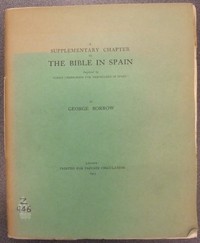
A Supplementary Chapter to the Bible in Spain
Subjects:
Download Formats:
Excerpt
The Project Gutenberg eBook, A Supplementary Chapter to the Bible in
Spain, by George Borrow, Edited by Thomas J. Wise
This eBook is for the use of anyone anywhere at no cost and with
almost no restrictions whatsoever. You may copy it, give it away or
re-use it under the terms of the Project Gutenberg License included
with this eBook or online at www.gutenberg.org
Title: A Supplementary Chapter to the Bible in Spain
Read the Full Text
— End of A Supplementary Chapter to the Bible in Spain —
Book Information
- Title
- A Supplementary Chapter to the Bible in Spain
- Author(s)
- Borrow, George
- Language
- English
- Type
- Text
- Release Date
- July 20, 2009
- Word Count
- 12,786 words
- Library of Congress Classification
- DP
- Bookshelves
- Browsing: History - General, Browsing: Travel & Geography
- Rights
- Public domain in the USA.
Related Books
Sac au dos à travers l'Espagne
by France, Hector
French
1457h 27m read
The pillars of Hercules
by Urquhart, David
English
2106h 22m read
Voyage en Espagne du Chevalier Saint-Gervais (2 de 2)
by Lantier, Etienne François de
French
1622h 33m read
Voyage en Espagne du Chevalier Saint-Gervais (1 de 2)
by Lantier, Etienne François de
French
1881h 14m read

Omwandelingen door een gedeelte van Spanje - De Aarde en haar volken, 1868
by Davillier, Ch. (Charles), baron
Dutch
249h 23m read
The pillars of Hercules
by Urquhart, David
English
2038h 7m read