The Project Gutenberg EBook of A Little Book for Christmas, by Cyrus Townsend Brady
This eBook is for the use of anyone anywhere in the United States and most
other parts of the world at no cost and with almost no restrictions
whatsoever. You may copy it, give it away or re-use it under the terms of
the Project Gutenberg License included with this eBook or online at
www.gutenberg.org. If you are not located in the United States, you'll have
to check the laws of the country where you are located before using this ebook.
Title: A Little Book for Christmas
Author: Cyrus Townsend Brady
Release Date: March 12, 2005 [EBook #15343]
[Most recently updated: July 31, 2020]
Language: English
Character set encoding: UTF-8
*** START OF THIS PROJECT GUTENBERG EBOOK A LITTLE BOOK FOR CHRISTMAS ***
Produced by Gene Smethers and the PG Online Distributed Proofreading Team
A Little Book for Christmas
[Illustration: The author making his book, as pictured by his friend,
Will Crawford.]
Containing a Greeting, a Word of Advice, Some
Personal Adventures, a Carol, a Meditation, and Three Christmas
Stories for All Ages
By
Cyrus Townsend Brady
Author of “And Thus He Came, A Christmas
Fantasy,” “Christmas When the West Was Young,” etc., etc.
With Illustrations and Decorations by
Will Crawford
G.P. Putnam’s Sons
New York and London
The Knickerbocker Press
1917
DEDICATED
TO
MRS. LEONARD L. HILL
AND HER CHARMING COMPANIONS
OF
THE AMERICAN CRITERION SOCIETY
OF NEW YORK
BY
THEIR CHAPLAIN
[Illustration]
PREFACE
Christmas is one of the great days of obligation and observance
in the Church of which I am a Priest; but it is much more than
that, it is one of the great days of obligation and observance in
the world. Furthermore it is one of the evidences of the power of
Him Whose birth we commemorate that its observation is not
limited by conditions of race and creed. Those who fail to see in
Him what we see nevertheless see something and even by imperfect
visions are moved to joy. The world transmutes that joy into
blessing, not merely by giving of its substance but of its soul
because men perceive that it is for the soul’s good and because
they hope to receive its benefits although they well know that
giving is far better than receiving, in the very words of Him Who
gave us the greatest of all gifts—Himself.
As a Priest of the Church, as a Missionary in the Far West, as
the Rector of large and important parishes I have been brought in
touch with varied life. Christmas in all its phases is familiar
to me. The author of many books and stories as well as the
preacher of many sermons, it is natural that Christmas should
have engaged a large part of my attention. Out of the abundance
of material which I have accumulated in the course of a long
ministry and a longer life I have gathered here a sheaf of things
I have written about Christmas; personal adventures, stories
suggested by the old yet ever-new theme; meditations, words of
advice which I am old enough to be entitled to give; and last but
not least good wishes and good will. I might even call this
little volume _A Book of Good Will toward Men_. And so fit it not
only for Christmas but for all other seasons as well.
If it shall add to your joy in Christmas, dear reader, and better
still, if it shall move you to add to the joy of some one else at
Christmas-tide or in any other season, I shall be well repaid for
my efforts and incidentally you will also be repaid for your
purchase.
Cyrus Townsend Brady.
The Hemlocks, Park Hill,
Yonkers, N.Y.
1917
NOTE OF ACKNOWLEDGEMENT
The author is in debt to his long-time and greatly beloved friend
the Rev. Alsop Leffingwell for the beautiful musical setting of
the little carol which this book contains.
[Illustration]
TABLE OF CONTENTS
I.—A CHRISTMAS GREETING
“_Peace on Earth, Good Will toward Men_”
II.—FROM A FAR COUNTRY
A story for grown-ups
_Being a new variation of an ancient theme_
III.—ON CHRISTMAS GIVING
_Being a word of much needed advice_
IV.—IT WAS THE SAME CHRISTMAS MORNING
A story for girls
_In which it is shown how different the same thing may be_
V.—A CHRISTMAS CAROL
_To be sung to the music accompanying it_
VI.—THE LONE SCOUT’S CHRISTMAS
A story for boys
_Wherein is set forth the courage of youth_
VII.—LOOKING INTO THE MANGER
_A Christmas meditation_
VIII.—CHRISTMAS IN THE SNOWS
_Being some personal adventures in the Far West_
IX.— CHRISTMAS WISH
_For everybody everywhere_
[Illustration]
[Illustration]
ILLUSTRATIONS
The Author Making his Book
“I sought dat Santy Claus tame down de chimney,” said the younger of
the twain.
“I am sure, Miss, that they do wish you a Merry Christmas.”
“The Stars look down”
“Thrusting his toes into the straps he struck out boldly.”
“The world bows down to a Mother and her Child—and the Mother herself
is at the feet of the Child.”
[Illustration]
A CHRISTMAS GREETING
“_Good Will Toward Men”—St. Luke 11-14._
There was a time when the spirit of Christmas was of the present.
There is a period when most of it is of the past. There shall
come a day perhaps when all of it will be of the future. The
child time, the present; the middle years, the past; old age, the
future.
Come to my mind Christmas Days of long ago. As a boy again I
enter into the spirit of the Christmas stockings hanging before
my fire. I know what the children think to-day. I recall what
they feel.
Passes childhood, and I look down the nearer years. There rise
before me remembrances of Christmas Days on storm-tossed seas,
where waves beat upon the ice-bound ship. I recall again the
bitter touch of water-warping winter, of drifts of snow, of
wind-swept plains. In the gamut of my remembrance I am once more
in the poor, mean, lonely little sanctuary out on the prairie,
with a handful of Christians, mostly women, gathered together in
the freezing, draughty building. In later years I worship in the
great cathedral church, ablaze with lights, verdant and fragrant
with the evergreen pines, echoing with joyful carols and
celestial harmonies. My recollections are of contrasts like those
of life—joy and sadness, poverty and ease.
And the pictures are full of faces, many of which may be seen no
more by earthly vision. I miss the clasp of vanished hands, I
crave the sound of voices stilled. As we old and older grow,
there is a note of sadness in our glee. Whether we will or not we
must twine the cypress with the holly. The recollection of each
passing year brings deeper regret. How many have gone from those
circles that we recall when we were children? How many little
feet that pattered upon the stair on Christmas morning now tread
softer paths and walk in broader ways; sisters and brothers who
used to come back from the far countries to the old home—alas,
they cannot come from the farther country in which they now are,
and perhaps, saddest thought of all, we would not wish them to
come again. How many, with whom we joined hands around the
Christmas tree, have gone?
Circles are broken, families are separated, loved ones are lost,
but the old world sweeps on. Others come to take our places. As
we stood at the knee of some unforgotten mother, so other
children stand. As we listened to the story of the Christ Child
from the lips of some grey old father, so other children listen
and we ourselves perchance are fathers or mothers too. Other
groups come to us for the deathless story. Little heads which
recall vanished halcyon days of youth bend around another younger
mother. Smaller hands than ours write letters to Santa Claus and
hear the story, the sweetest story ever told, of the Baby who
came to Mary and through her to all the daughters and sons of
women on that winter night on the Bethlehem hills.
And we thank God for the children who take us out of the past,
out of ourselves, away from recollections that weigh us down; the
children that weave in the woof and warp of life when our own
youth has passed, some of the buoyancy, the joy, the happiness of
the present; the children in whose opening lives we turn
hopefully to the future. We thank God at this Christmas season
that it pleased Him to send His beloved Son to come to us as a
little child, like any other child. We thank God that in the
lesser sense we may see in every child who comes to-day another
incarnation of divinity. We thank God for the portion of His
Spirit with which He dowers every child of man, just as we thank
Him for pouring it all upon the Infant in the Manger.
There is no age that has not had its prophet. No country, no
people, but that has produced its leader. But did any of them
ever before come as a little child? Did any of them begin to lead
while yet in arms? Lodges there upon any other baby brow “the
round and top of sovereignty?” What distinguished Christ and His
Christian followers from all the world? Behold! no mighty
monarch, but “a little child shall lead them!”
You may see through the glass darkly, you may not know or
understand the blessedness of faith in Him as He would have you
know it, but there is nothing that can dim the light that
radiates from that birth in the rude cave back of the inn. Ah, it
pierces through the darkness of that shrouding night. It shines
to-day. Still sparkles the Star in the East. He is that Star.
There is nothing that can take from mankind—even doubting
mankind—the spirit of Christ and the Christmas season. Our
celebrations do not rest upon the conclusions of logic, or the
demonstrations of philosophy; I would not even argue that they
depend inevitably or absolutely upon the possession of a certain
faith in Jesus, but we accept Christmas, nevertheless; we
endeavour to apply the Christmas spirit, for just once in the
year; it may be because we cannot, try as we may, crush out
utterly and entirely the divinity that is in us that makes for
God. The stories and tales for Christmas which have for their
theme the hard heart softened are not mere fictions of the
imagination. They rest upon an instinctive consciousness of a
profound philosophic truth.
What is the unpardonable sin, I wonder? Is it to be persistently
and forever unkind? Does it mean perhaps the absolute refusal to
accept the principle of love which is indeed creation’s final
law? The lessons of the Christmastide are so many; the appeals
that now may be made to humanity crowd to the lips from full
minds and fuller hearts. Might we not reduce them all to the
explication of the underlying principle of God’s purpose to us,
as expressed in those themic words of love with which angels and
men greeted the advent of the Child on the first Christmas
morning, “Good will toward men?”
Let us then show our good will toward men by doing good and
bringing happiness to someone—if not to everyone—at this
Christmas season. Put aside the memories of disappointments, of
sorrows that have not vanished, of cares that still burden, and
do good in spite of them because you would not dim the brightness
of the present for any human heart with the shadows of old
regrets. Do good because of a future which opens possibilities
before you, for others, if not for yourselves.
Brethren, friends, all, let us make up our minds that we will be
kindly affectioned one to another in our homes and out of them,
on this approaching Christmas day. That the old debate, the
ancient strife, the rankling recollection, the sharp contention,
shall be put aside, that “envy, hatred, and malice, and all
uncharitableness” shall be done away with. Let us forgive and
forget; but if we cannot forget let us at least forgive. And so
let there be peace between man and man at Christmas—a truce of
God.
Let us pray that Love shall come as a little child to our
households. That He shall be in our hearts and shall find His
expression in all that we do or say on this birthday of goodness
and cheer for the world. Then let us resolve that the spirit of
the day shall be carried out through our lives, that as Christ
did not come for an hour, but for a lifetime, we would fain
become as little children on this day of days that we may begin a
new life of good will to men.
Let us make this a new birthday of kindness and love that shall
endure. That is a Christmas hope, a Christmas wish. Let us give
to it the gracious expression of life among men.
[Illustration]
[Illustration]
FROM A FAR COUNTRY
_Being a New Variation of an Ancient Theme_
A STORY FOR GROWN-UPS
I
“_A certain man had two sons_”—so begins the best and most famous
story in the world’s literature. Use of the absolute superlative
is always dangerous, but none will gainsay that statement, I am
sure. This story, which follows that familiar tale afar off,
indeed, begins in the same way. And the parallelism between the
two is exact up to a certain point. What difference a little
point doth make; like the little fire, behold, how great a matter
it kindleth! Indeed, lacking that one detail the older story
would have had no value; it would not have been told; without its
addition this would have been a repetition of the other.
When the modern young prodigal came to himself, when he found
himself no longer able to endure the husks of the swine like his
ancient exemplar, when he rose and returned to his father because
of that distaste, he found no father watching and waiting for him
at the end of the road! Upon that change the action of this story
hangs. It was a pity, too, because the elder brother was there
and in a mood not unlike that of his famous prototype.
Indeed, there was added to that elder brother’s natural
resentment at the younger’s course the blinding power of a great
sorrow, for the father of the two sons was dead. He had died of a
broken heart. Possessed of no omniscience of mind or vision, he
had been unable to foresee the long delayed turning point in the
career of his younger son and death came too swiftly to enable
them to meet again. So long as he had strength, that father had
stood, as it were, at the top of the hill looking down the road
watching and hoping.
And but the day before the tardy prodigal’s return he had been
laid away with his own fathers in the God’s acre around the
village church in the Pennsylvania hills. Therefore there was no
fatted calf ready for the disillusioned youth whose waywardness
had killed his father. It will be remembered that the original
elder brother objected seriously to fatted calves on such
occasions. Indeed, the funeral baked meats would coldly furnish
forth a welcoming meal if any such were called for.
For all his waywardness, for all his self-will, the younger son
had loved his father well, and it was a terrible shock to him
(having come to his senses) to find that he had returned too
late. And for all his hardness and narrowness the eldest son also
had loved his father well—strong tribute to the quality of the
dead parent—and when he found himself bereft he naturally visited
wrath upon the head of him who he believed rightly was the cause
of the untimely death of the old man.
As he sat in the study, if such it might be called, of the
departed, before the old-fashioned desk with its household and
farm and business accounts, which in their order and method and
long use were eloquent of his provident and farseeing father, his
heart was hot within his breast. Grief and resentment alike
gnawed at his vitals. They had received vivid reports, even in
the little town in which they dwelt, of the wild doings of the
wanderer, but they had enjoyed no direct communication with him.
After a while even rumour ceased to busy itself with the doings
of the youth. He had dropped out of their lives utterly after he
passed over the hills and far away.
The father had failed slowly for a time, only to break suddenly
and swiftly in the end. And the hurried frantic search for the
missing had brought no results. Ironically the god of chance had
led the young man’s repentant footsteps to the door too late.
“Where’s father?” cried John Carstairs to the startled woman who
stared at him as if she had seen a ghost as, at his knock, she
opened the door which he had found locked, not against him, but
the hour was late and it was the usual nightly precaution:
“Your brother is in your father’s study, sir,” faltered the
servant at last.
“Umph! Will,” said the man, his face changing. “I’d rather see
father first.”
“I think you had better see Mr. William, sir.”
“What’s the matter, Janet?” asked young Carstairs anxiously. “Is
father ill?”
“Yes, sir! indeed I think you had bettor see Mr. William at once,
Mr. John.”
Strangely moved by the obvious agitation of the ancient servitor
of the house who had known him from childhood, John Carstairs
hurried down the long hall to the door of his father’s study.
Always a scapegrace, generally in difficulties, full of mischief,
he had approached that door many times in fear of well merited
punishment which was sure to be meted out to him. And he came to
it with the old familiar apprehension that night, if from a
different cause. He never dreamed that his father was anything
but ill. He must see his brother. He stood in no little awe of
that brother, who was his exact antithesis in almost everything.
They had not got along particularly well. If his father had been
inside the door he would have hesitated with his hand on the
knob. If his father had not been ill he would not have attempted
to face his brother. But his anxiety, which was increased by a
sudden foreboding, for Janet, the maid, had looked at him so
strangely, moved him to quick action. He threw the door open
instantly. What he saw did not reassure him. William was clad in
funeral black. He wore a long frock coat instead of the usual
knockabout suit he affected on the farm. His face was white and
haggard. There was an instant interchange of names.
“John!”
“William!”
And then—
“Is father ill?” burst out the younger.
“Janet said—”
“Dead!” interposed William harshly, all his indignation flaming
into speech and action as he confronted the cause of the
disaster.
“Dead! Good God!”
“God had nothing to do with it.”
“You mean?”
“You did it.”
“I?”
“Yes. Your drunken revelry, your reckless extravagance, your
dissipation with women, your unfeeling silence, your—”
“Stop!” cried the younger. “I have come to my senses, I can’t
bear it.”
“I’ll say it if it kills you. You did it, I repeat. He longed and
prayed and waited and you didn’t come. You didn’t write. We could
hear nothing. The best father on earth.”
The younger man sank down in a chair and covered his face with
his hands.
“When?” he gasped out finally.
“Three days ago.”
“And have you—”
“He is buried beside mother in the churchyard yonder. Now that
you are here I thank God that he didn’t live to see what you have
become.”
The respectable elder brother’s glance took in the disreputable
younger, his once handsome face marred—one doesn’t foregather
with swine in the sty without acquiring marks of the
association—his clothing in rags. Thus errant youth, that was
youth no longer, came back from that far country. Under such
circumstances one generally has to walk most of the way. He had
often heard the chimes at midnight, sleeping coldly in the straw
stack of the fields, and the dust of the road clung to his
person. Through his broken shoes his bare feet showed, and he
trembled visibly as the other confronted him, partly from hunger
and weakness and shattered nerves, and partly from shame and
horror and for what reason God only knew.
The tall, handsome man in the long black coat, who towered over
him so grimly stern, was two years older than he, yet to the
casual observer the balance of time was against the prodigal by
at least a dozen years. However, he was but faintly conscious of
his older brother. One word and one sentence rang in his ear.
Indeed, they beat upon his consciousness until he blanched and
quivered beneath their onslaught.
“Dead—you did it!”
Yes, it was just. No mercy seasoned that justice in the heart of
either man. The weaker, self-accusing, sat silent with bowed
head, his conscience seconding the words of the stronger. The
voice of the elder ran on with growing, terrifying intensity.
“Please stop,” interposed the younger. He rose to his feet. “You
are right, Will. You were always right and I was always wrong. I
did kill him. But you need not have told me with such bitterness.
I realized it the minute you said he was dead. It’s true. And yet
I was honestly sorry. I came back to tell him so, to ask his
forgiveness.”
“When your money was gone.”
“You can say that, too,” answered the other, wincing under the
savage thrust. “It’s as true as the rest probably, but sometimes
a man has to get down very low before he looks up. It was that
way with me. Well, I’ve had my share and I’ve had my fling. I’ve
no business here. Good-bye.” He turned abruptly away.
“Don’t add more folly to what you have already done,” returned
William Carstairs, and with the beginnings of a belated pity, he
added, “stay here with me, there will be enough for us both and—”
“I can’t.”
“Well, then,” he drew out of his pocket a roll of bills, “take
these and when you want more—”
“Damn your money,” burst out John Carstairs, passionately. He
struck the other’s outstretched hand, and in his surprise,
William Carstairs let the bills scatter upon the floor. “I don’t
want it—blood money. Father is dead. I’ve had mine. I’ll trouble
you no more.”
He turned and staggered out of the room. Now William Carstairs
was a proud man and John Carstairs had offended him deeply. He
believed all that he had said to his brother, yet there had been
developing a feeling of pity for him in his heart, and in his
cold way he had sought to express it. His magnanimity had been
rejected with scorn. He looked down at the scattered bills on the
floor. Characteristically—for he inherited his father’s business
ability without his heart—he stooped over and picked them slowly
up, thinking hard the while. He finally decided that he would
give his brother yet another chance for his father’s sake. After
all, they were brethren. But the decision came too late. John
Carstairs had stood not on the order of his going, but had gone
at once, none staying him.
William Carstairs stood in the outer door, the light from the
hall behind him streaming out into the night. He could see
nothing. He called aloud, but there was no answer. He had no idea
where his younger brother had gone. If he had been a man of finer
feeling or quicker perception, perhaps if the positions of the
two had been reversed and he had been his younger brother, he
might have guessed that John might have been found beside the
newest mound in the churchyard, had one sought him there. But
that idea did not come to William, and after staring into the
blackness for a long time, he reluctantly closed the door.
Perhaps the vagrant could be found in the morning.
No, there had been no father waiting for the prodigal at the end
of the road, and what a difference it had made to that wanderer
and vagabond!
II
We leave a blank line on the page and denote thereby that ten
years have passed. It was Christmas Eve, that is, it had been
Christmas Eve when the little children had gone to bed. Now
midnight had passed and it was already Christmas morning. In one
of the greatest and most splendid houses on the avenue two little
children were nestled all snug in their beds in a nursery. In an
adjoining room sound sleep had quieted the nerves of the usually
vigilant and watchful nurse. But the little children were
wakeful. As always, visions of Santa Claus danced in their heads.
They were fearless children by nature and had been trained
without the use of bugaboos to keep them in the paths wherein
they should go. On this night of nights they had left the doors
of their nursery open. The older, a little girl of six, was
startled, but not alarmed, as she lay watchfully waiting, by a
creaking sound as of an opened door in the library below. She
listened with a beating heart under the coverlet; cause of
agitation not fear, but hope. It might be, it must be Santa
Claus, she decided. Brother, aged four, was close at hand in his
own small crib. She got out of her bed softly so as not to
disturb Santa Claus, or—more important at the time—the nurse. She
had an idea that Saint Nicholas might not welcome a nurse, but
she had no fear at all that he would not be glad to see her.
Need for a decision confronted her. Should she reserve the
pleasure she expected to derive from the interview for herself or
should she share it with little brother? There was a certain risk
in arousing brother. He was apt to awaken clamant, vociferous.
Still, she resolved to try it. For one thing, it seemed so
selfish to see Santa Claus alone, and for another the adventure
would be a little less timorous taken together.
Slipping her feet into her bedroom slippers and covering her
nightgown with a little blanket wrap, she tip-toed over to
brother’s bed. Fortunately, he too was sleeping lightly, and for
a like reason. For a wonder she succeeded in arousing him without
any outcry on his part. He was instantly keenly, if quietly,
alive to the situation and its fascinating possibilities.
“You must be very quiet, John,” she whispered. “But I think Santa
Claus is down in the library. We’ll go down and catch him.”
Brother, as became the hardier male, disdained further protection
of his small but valiant person. Clad only in his pajamas and his
slippers, he followed sister out the door and down the stair.
They went hand in hand, greatly excited by the desperate
adventure.
What proportion of the millions who dwelt in the great city were
children of tender years only statisticians can say, but
doubtless there were thousands of little hearts beating with
anticipation as the hearts of those children beat, and perhaps
there may have been others who were softly creeping downstairs to
catch Santa Claus unawares at that very moment.
One man at least was keenly conscious of one little soul who,
with absolutely nothing to warrant the expectation, nothing
reasonable on which to base joyous anticipation, had gone to bed
thinking of Santa Claus and hoping that, amidst equally deserving
hundreds of thousands of obscure children, this little mite in
her cold, cheerless garret might not be overlooked by the
generous dispenser of joy. With the sublime trust of childhood
she had insisted upon hanging up her ragged stocking. Santa Claus
would have to be very careful indeed lest things should drop
through and clatter upon the floor. Her heart had beaten, too,
although she descended no stair in the great house. She, too, lay
wakeful, uneasy, watching, sleeping, drowsing, hoping. We may
have some doubts about the eternal springing of hope in the human
breast save in the case of childhood—thank God it is always
verdant there!
III
Now few people get so low that they do not love somebody, and I
dare say that no people get so low that somebody does not love
them.
“Crackerjack,” so called because of his super-excellence in his
chosen profession, was, or had been, a burglar and thief; a very
ancient and highly placed calling indeed. You doubtless remember
that two thieves comprised the sole companions and attendants of
the Greatest King upon the most famous throne in history. His
sole court at the culmination of His career. “Crackerjack” was no
exception to the general rule about loving and being beloved set
forth above.
He loved the little lady whose tattered stocking swung in the
breeze from the cracked window. Also he loved the wretched woman
who with himself shared the honours of parentage to the poor but
hopeful mite who was also dreaming of Christmas and the morning.
And his love inspired him to action. Singular into what devious
courses, utterly unjustifiable, even so exalted and holy an
emotion may lead fallible man. Love—burglary! They do not belong
naturally in association, yet slip cold, need, and hunger in
between and we may have explanation even if there be no
justification. Oh, Love, how many crimes are committed in thy
name!
“Crackerjack” would hardly have chosen Christmas eve for a
thieving expedition if there had been any other recourse.
Unfortunately there was none. The burglar’s profession, so far as
he had practised it, was undergoing a timely eclipse. Time was
when it had been lucrative, its rewards great. Then the law,
which is no respecter of professions of that kind, had got him.
“Crackerjack” had but recently returned from a protracted sojourn
at an institution arranged by the State in its paternalism for
the reception and harbouring of such as he. The pitiful dole with
which the discharged prisoner had been unloaded upon a world
which had no welcome for him had been soon spent; even the
hideous prison-made clothes had been pawned, and some rags, which
were yet the rags of a free man, which had been preserved through
the long period of separation by his wife, gave him a poor
shelter from the winter’s cold.
That wife had been faithful to him. She had done the best she
could for herself and baby during the five years of the absence
of the bread winner, or in his case the bread taker would be the
better phrase. She had eagerly waited the hour of his release;
her joy had been soon turned to bitterness. The fact that he had
been in prison had shut every door against him and even closed
the few that had been open to her. The three pieces of human
flotsam had been driven by the wind of adversity and tossed. They
knew not where to turn when jettisoned by society.
Came Christmas Eve. They had no money and no food and no fire.
Stop! The fire of love burned in the woman’s heart, the fire of
hate in the man’s. Prison life usually completes the education in
shame of the unfortunate men who are thrust there. This was
before the days in which humane men interested themselves in
prisons and prisoners and strove to awaken the world to its
responsibilities to, as well as the possibilities of, the
convict.
But “Crackerjack” was a man of unusual character. Poverty,
remorse, drink, all the things that go to wreck men by forcing
them into evil courses had laid him low, and because he was a man
originally of education and ability, he had shone as a criminal.
The same force of character which made him super-burglar could
change him from criminal to man if by chance they could be
enlisted in the endeavour.
He had involved the wife he had married in his misfortunes. She
had been a good woman, weaker than he, yet she stuck to him. God
chose the weak thing to rejuvenate the strong. In the prison he
had enjoyed abundant leisure for reflection. After he learned of
the birth of his daughter he determined to do differently when he
was freed. Many men determine, especially in the case of an
ex-convict, but society usually determines better—no, not better,
but more strongly. Society had different ideas. It was
Brahministic in its religion. Caste? Yes, once a criminal always
a criminal.
“Old girl,” said the broken man, “it’s no use. I’ve tried to be
decent for your sake and the kid’s, but it can’t be done. I can’t
get honest work. They’ve put the mark of Cain on me. They can
take the consequences. The kid’s got to have some Christmas;
you’ve got to have food and drink and clothes and fire. God, how
cold it is! I’ll go out and get some.”
“Isn’t there something else we can pawn?”
“Nothing.”
“Isn’t there any work?”
“Work?” laughed the man bitterly. “I’ve tramped the city over
seeking it, and you, too. Now, I’m going to get money—elsewhere.”
“Where?”
“Where it’s to be had.”
“Oh, Jack, think.”
“If I thought, I’d kill you and the kid and myself.”
“Perhaps that would be better,” said the woman simply. “There
doesn’t seem to be any place left for us.”
“We haven’t come to that yet,” said the man. “Society owes me a
living and, by God, it’s got to pay it to me.”
It was an oft-repeated, widely held assertion, whether fallacious
or not each may determine for himself.
“I’m afraid,” said the woman.
“You needn’t be; nothing can be worse than this hell.”
He kissed her fiercely. Albeit she was thin and haggard she was
beautiful to him. Then he bent over his little girl. He had not
yet had sufficient time since his release to get very well
acquainted with her. She had been born while he was in prison,
but it had not taken any time at all for him to learn to love
her. He stared at her a moment. He bent to kiss her and then
stopped. He might awaken her. It is always best for the children
of the very poor to sleep. He who sleeps dines, runs the Spanish
proverb. He turned and kissed the little ragged stockings
instead, and then he went out. He was going to play—was it Santa
Claus, indeed?
IV
The strange, illogical, ironical god of chance, or was it
Providence acting through some careless maid, had left an area
window unlocked in the biggest and newest house on the avenue.
Any house would have been easy for “Crackerjack” if he had
possessed the open sesame of his kit of burglar’s tools, but he
had not had a jimmy in his hand since he was caught with one and
sent to Sing Sing. He had examined house after house, trusting to
luck as he wandered on, and, lo! fortune favoured him.
The clock in a nearby church struck the hour of two. The areaway
was dark. No one was abroad. He plunged down the steps, opened
the window and disappeared. No man could move more noiselessly
than he. In the still night he knew how the slightest sounds are
magnified. He had made none as he groped his way through the back
of the house, arriving at last in a room which he judged to be
the library. Then, after listening and hearing nothing, he
ventured to turn the button of a side light in a far corner of
the room.
He was in a large apartment, beautifully furnished. Books and
pictures abounded, but these did not interest him, although if he
had made further examination he might have found things worthy of
his attention even there. It so happened that the light bracket
to which he had blundered, or had been led, was immediately over
a large wall safe. Evidently it had been placed there for the
purpose of illuminating the safe door. His eyes told him that
instantly. This was greater fortune than he expected. A wall safe
in a house like that must contain things of value.
Marking the position of the combination knob, he turned out the
light and waited again. The quiet of the night continued
unbroken. A swift inspection convinced him that the lock was only
an ordinary combination. With proper—or improper—tools he could
have opened it easily. Even without tools, such were his
delicately trained ear and his wonderfully trained fingers that
he thought he could feel and hear the combination. He knelt down
by the knob and began to turn it slowly, listening and feeling
for the fall of the tumblers. Several times he almost got it,
only to fail at the end, but by repeated trials and unexampled
patience, his heart beating like a trip-hammer the while, he
finally mastered the combination and opened the safe door.
In his excitement when he felt the door move he swung it outward
sharply. It had not been used for some time evidently and the
hinges creaked. He checked the door and listened again. Was he to
be balked after so much success? He was greatly relieved at the
absence of sound. It was quite dark in the room. He could see
nothing but the safe. He reached his hand in and discovered it
was filled with bulky articles covered with some kind of cloth,
silver evidently.
He decided that he must have a look and again he switched on the
light. Yes, his surmise had been correct. The safe was filled
with silver. There was a small steel drawer in the middle of it.
He had a broad bladed jack-knife in his pocket and at the risk of
snapping the blade he forced the lock and drew out the drawer. It
was filled with papers. He lifted the first one and stood staring
at it in astonishment, for it was an envelope which bore his
name, written by a hand which had long since mouldered away in
the dust of a grave.
V
Before he could open the envelope, there broke on his ear a still
small voice, not that of conscience, not that of God; the voice
of a child—but does not God speak perhaps as often through the
lips of childhood as in any other way—and conscience, too?
“Are you Santa Claus?” the voice whispered in his ear.
“Crackerjack” dropped the paper and turned like a flash, knife
upraised in his clenched hand, to confront a very little girl and
a still smaller boy staring at him in open-eyed astonishment, an
astonishment which was without any vestige of alarm. He looked
down at the two and they looked up at him, equal bewilderment on
both sides.
“I sought dat Santy Claus tame down de chimney,” said the younger
of the twain, whose pajamas bespoke the nascent man.
“In all the books he has a long white beard. Where’s yours?”
asked the coming woman.
This innocent question no less than the unaffected simplicity and
sincerity of the questioner overpowered “Crackerjack.” He sank
back into a convenient chair and stared at the imperturbable
pair. There was a strange and wonderful likeness in the
sweet-faced golden-haired little girl before him to the worn,
haggard, and ill-clad little girl who lay shivering in the mean
bed in the upper room where God was not—or so he fancied.
“You’re a little girl, aren’t you?” he whispered.
No voice had been or was raised above a whisper. It was a
witching hour and its spell was upon them all.
“Yes.”
“What is your name?”
“Helen.”
Now Helen had been “Crackerjack’s” mother’s name and it was the
name of his own little girl, and although everybody else called
her Nell, to him she was always Helen.
“And my name’s John,” volunteered the other child.
“John!” That was extraordinary!
“What’s your other name?”
“John William.”
The man stared again. Could this be coincidence merely? John was
his own name and William that of his brother.
“I mean what is your last name?”
“Carstairs,” answered the little girl. “Now you tell us who you
are. You aren’t Santa Claus, are you? I don’t hear any reindeers
outside, or bells, and you haven’t any pack, and you’re not by
the fireplace where our stockings are.”
[Illustration: I sought dat Santy Claus tame down de chimney,” said the
younger of the twain.] “I sought dat Santy Claus tame down de chimney,”
said the younger of the twain.
“No,” said the man, “I’m not exactly Santa Claus, I’m his
friend—I—”
What should he say to these children? In his bewilderment for the
moment he actually forgot the letter which he still held tightly
in his hand.
“Dat’s muvver’s safe,” continued the little boy. “She keeps lots
o’ things in it. It’s all hers but dat drawer. Dat’s papa’s and—”
“I think I hear some one on the stairs,” broke in the little girl
suddenly in great excitement. “Maybe that’s Santa Claus.”
“Perhaps it is,” said the man, who had also heard. “You wait and
watch for him. I’ll go outside and attend to his reindeer.”
He made a movement to withdraw, but the girl caught him tightly
by the hand.
“If you are his friend,” she said, “you can introduce us. You
know our names and—”
The golden opportunity was gone.
“Don’t say a word,” whispered the man quickly. “We’ll surprise
him. Be very still.”
He reached his hand up and turned out the light. He half hoped he
might be mistaken, or that in the darkness they would not be
seen, but no. They all heard the footsteps on the stair. They
came down slowly, and it was evident that whoever was approaching
was using every precaution not to be heard. “Crackerjack” was in
a frightful situation. He did not know whether to jerk himself
away from the two children, for the boy had clasped him around
the leg and the girl still held his hand, or whether to wait.
The power of decision suddenly left him, for the steps stopped
before the door. There was a little click as a hand pressed a
button on the wall and the whole room was flooded with light from
the great electrolier in the centre. Well, the game was up.
“Crackerjack” had been crouching low with the children. He rose
to his feet and looked straightly enough into the barrel of a
pistol held by a tall, severe looking man in a rich silk dressing
robe, who confronted him in the doorway. Two words broke from the
lips of the two men, the same words that had fallen from their
lips when they met ten years before.
“John!” cried the elder man, laying the weapon on a nearby table.
“Will!” answered “Crackerjack” in the same breath.
As if to mark the eternal difference as before, the one was
clothed in habiliments of wealth and luxury, the other in the
rags and tatters of poverty and shame.
“Why, that isn’t Santa Claus,” instantly burst out the little
girl, “that’s papa.”
“Dis is Santy Claus’s friend, papa,” said the little boy. “We
were doin’ to su’prise him. He said be very still and we minded.”
“So this is what you have come to, John,” said the elder man, but
there was an unwonted gentleness in his voice.
“I swear to God I didn’t know it was your house. I just came in
here because the window was open.”
The other pointed to the safe.
“But you were—”
“Of course I was. You don’t suppose I wandered in for fun, do
you? I’ve got a little girl of my own, and her name’s Helen, too;
our mother’s name.”
The other brother nodded.
“She’s hungry and cold and there’s no Christmas for her or her
mother.”
“Oh, Santy has been here already,” cried Master John Williams,
running toward the great fireplace, having just that moment
discovered the bulging stockings and piles of gifts. His sister
made a move in the same direction, for at the other corner hung
her stocking and beneath it her pile, but the man’s hand
unconsciously tightened upon her hand and she stopped.
“I’ll stay with you,” she said, after a moment of hesitation.
“Tell me more about your Helen.”
“There’s nothing to tell.” He released her hand roughly. “You
musn’t touch me,” he added harshly. “Go.”
“You needn’t go, my dear,” said her father quickly. “Indeed, I
think, perhaps—”
“Is your Helen very poor?” quietly asked the little girl,
possessing herself of his hand again, “because if she is she can
have”—she looked over at the pile of toys—“Well, I’ll see. I’ll
give her lots of things, and—”
“What’s this?” broke out the younger man harshly, extending his
hand with the letter in it toward the other.
“It is a letter to you from our father.”
“And you kept it from me?” cried the other.
“Read it,” said William Carstairs.
With trembling hands “Crackerjack” tore it open. It was a message
of love and forgiveness penned by a dying hand.
“If I had had this then I might have been a different man,” said
the poor wretch.
“There is another paper under it, or there should be, in the same
drawer,” went on William Carstairs, imperturbably. “Perhaps you
would better read that.”
John Carstairs needed no second invitation. He turned to the open
drawer and took out the next paper. It was a copy of a will. The
farm and business had been left to William, but one half of it
was to be held in trust for his brother. The man read it and then
he crushed the paper in his hand.
“And that, too, might have saved me. My God!” he cried, “I’ve
been a drunken blackguard. I’ve gone down to the very depths. I
have been in State’s prison. I was, I am, a thief, but I never
would have withheld a dying man’s forgiveness from his son. I
never would have kept a poor wretch who was crazy with shame and
who drank himself into crime out of his share of the property.”
Animated by a certain fell purpose, he leaped across the room and
seized the pistol.
“Yes, and I have you now!” he cried. “I’ll make you pay.”
He levelled the weapon at his brother with a steady hand.
“What are you doin’ to do wif that pistol?” said young John
William, curiously looking up from his stocking, while Helen
cried out. The little woman acted the better part. With rare
intuition she came quickly and took the left hand of the man and
patted it gently. For one thing, her father was not afraid, and
that reassured her. John Carstairs threw the pistol down again.
William Carstairs had never moved.
“Now,” he said, “let me explain.”
“Can you explain away this?”
“I can. Father’s will was not opened until the day after you
left. As God is my judge I did not know he had written to you. I
did not know he had left anything to you. I left no stone
unturned in an endeavour to find you. I employed the best
detectives in the land, but we found no trace of you whatever.
Why, John, I have only been sorry once that I let you go that
night, that I spoke those words to you, and that has been all the
time.”
“And where does this come from?” said the man, flinging his arm
up and confronting the magnificent room.
“It came from the old farm. There was oil on it and I sold it for
a great price. I was happily married. I came here and have been
successful in business. Half of it all is yours.”
“I won’t take it.”
“John,” said William Carstairs, “I offered you money once and you
struck it out of my hand. You remember?”
“Yes.”
“What I am offering you now is your own. You can’t strike it out
of my hand. It is not mine, but yours.”
“I won’t have it,” protested the man. “It’s too late. You don’t
know what I’ve been, a common thief. ‘Crackerjack’ is my name.
Every policeman and detective in New York knows me.”
“But you’ve got a little Helen, too, haven’t you?” interposed the
little girl with wisdom and tact beyond her years.
“Yes.”
“And you said she was very poor and had no Christmas.”
“Yes.”
“For her sake, John,” said William Carstairs. “Indeed you must
not think you have been punished alone. I have been punished,
too. I’ll help you begin again. Here”—he stepped closer to his
brother—“is my hand.”
The other stared at it uncomprehendingly.
“There is nothing in it now but affection. Won’t you take it?”
Slowly John Carstairs lifted his hand. His palm met that of his
elder brother. He was so hungry and so weak and so overcome that
he swayed a little. His head bowed, his body shook and the elder
brother put his arm around him and drew him close.
Into the room came William Carstairs’ wife. She, too, had at last
been aroused by the conversation, and, missing her husband, she
had thrown a wrapper about her and had come down to seek him.
“We tame down to find Santy Claus,” burst out young John William,
at the sight of her, “and he’s been here, look muvver.”
Yes, Santa Claus had indeed been there. The boy spoke better than
he knew.
“And this,” said little Helen eagerly, pointing proudly to her
new acquaintance, “is a friend of his, and he knows papa and he’s
got a little Helen and we’re going to give her a Merry
Christmas.”
William Carstairs had no secrets from his wife. With a flash of
womanly intuition, although she could not understand how he came
to be there, she divined who this strange guest was who looked a
pale, weak picture of her strong and splendid husband, and yet
she must have final assurance.
“Who is this gentleman, William?” she asked quietly, and John
Carstairs was forever grateful to her for her word that night.
“This,” said William Carstairs, “is my father’s son, my brother,
who was dead and is alive again, and was lost and is found.”
And so, as it began with the beginning, this story ends with the
ending of the best and most famous of all the stories that were
ever told.
[Illustration]
[Illustration]
ON CHRISTMAS GIVING
_Being a Word of Much Needed Advice_
Christmas is the birthday of our Lord, upon which we celebrate
God’s ineffable gift of Himself to His children. No human soul
has ever been able to realize the full significance of that gift,
no heart has ever been glad enough to contain the joy of it, and
no mind has ever been wise enough to express it. Nevertheless we
powerfully appreciate the blessing and would fain convey it
fitly. Therefore to commemorate that great gift the custom of
exchanging tokens of love and remembrance has grown until it has
become well nigh universal. This is a day in which we ourselves
crave, as never at any other time, happiness and peace for those
we love and that ought to include everybody, for with the angelic
message in our ears it should be impossible to hate any one on
Christmas day however we may feel before or after.
But despite the best of wills almost inevitably Christmas in many
instances has created a burdensome demand. Perhaps by the method
of exclusion we shall find out what Christmas should be. It is
not a time for extravagance, for ostentation, for vulgar display,
it is possible to purchase pleasure for someone else at too high
a price to ourselves. To paraphrase Polonius, “Costly thy gift as
thy purse can buy, rich but not expressed in fancy, for the gift
oft proclaims the man.” In making presents observe three
principal facts; the length of your purse, the character of your
friend, and the universal rule of good taste. Do not plunge into
extravagance from which you will scarcely recover except in
months of nervous strain and desperate financial struggle. On the
other hand do not be mean and niggardly in your gifts. Oh, not
that; avoid selfishness at Christmas, if at no other time. Rather
no gift at all than a grudging one. Let your offerings represent
yourselves and your affections. Indeed if they do not represent
you, they are not gifts at all. “The gift without the giver is
bare.”
And above all banish from your mind the principle of reciprocity.
The _lex talionis_ has no place in Christmas giving. Do not think
or feel that you must give to someone because someone gave to
you. There is no barter about it. You give because you love and
without a thought of return. Credit others with the same feeling
and be governed thereby. I know one upon whose Christmas list
there are over one hundred and fifty people, rich and poor, high
and low, able and not able. That man would be dismayed beyond
measure if everyone of those people felt obliged to make a return
for the Christmas remembrances he so gladly sends them.
In giving remember after all the cardinal principle of the day.
Let your gift be an expression of your kindly remembrance, your
gentle consideration, your joyful spirit, your spontaneous
gratitude, your abiding desire for peace and goodwill toward men.
Hunt up somebody who needs and who without you may lack and
suffer heart hunger, loneliness, and disappointment.
Nor is Christmas a time for gluttonous eating and drinking. To
gorge one’s self with quantities of rich and indigestible food is
not the noblest method of commemorating the day. The rules and
laws of digestion are not abrogated upon the Holy day. These are
material cautions, the day has a spiritual significance of which
material manifestations are, or ought to be, outward and visible
expressions only.
Christmas is one of the great days of obligation in the Church
year, then as at Easter if at no other time, Christians should
gather around the table of the Lord, kneeling before God’s altar
in the ministering of that Holy Communion which unites them with
the past, the present, and the future—the communion of the saints
of God’s Holy Church with His Beloved Son. Then and thus in body,
soul, and spirit we do truly participate in the privilege and
blessing of the Incarnation, then and there we receive that
strength which enables everyone of us to become factors in the
great extension of that marvellous occurrence throughout the ages
and throughout the world.
Let us therefore on this Holy Natal Day, from which the whole
world dates its time, begin on our knees before that altar which
is at once manger, cross, throne. Let us join thereafter in holy
cheer of praise and prayer and exhortation and Christmas carol,
and then let us go forth with a Christmas spirit in our hearts
resolved to communicate it to the children of men, and not merely
for the day but for the future. To make the right use of these
our privileges, this it is to save the world.
In this spirit, therefore, so far as poor, fallible human nature
permits him to realize it and exhibit it, the author wishes all
his readers which at present comprise his only flock—
A MERRY CHRISTMAS AND A HAPPY NEW YEAR.
[Illustration]
[Illustration]
IT WAS THE SAME CHRISTMAS MORNING
_In Which it is Shown how Different the Same Things may Be_
_A Story for Girls_
In Philadelphia the rich and the poor live cheek by jowl—or
rather, back to back. Between the streets of the rich and
parallel to them, run the alleys of the poor. The rich man’s
garage jostles elbows with the poor man’s dwelling.
In a big house fronting on one of the most fashionable streets
lived a little girl named Ethel. Other people lived in the big
house also, a father, a mother, a butler, a French maid, and a
host of other servants. Back of the big house was the garage.
Facing the garage on the other side of the alley was a little,
old one-story-and-a-half brick house. In this house dwelt a
little girl named Maggie. With her lived her father who was a
labourer; her mother, who took in washing; and half a dozen
brothers, four of whom worked at something or other, while the
two littlest went to school.
Ethel and Maggie never played together. Their acquaintance was
simply a bowing one—better perhaps, a smiling one. From one
window in the big playroom which was so far to one side of the
house that Ethel could see past the garage and get a glimpse of
the window of the living-room in Maggie’s house, the two little
girls at first stared at each other. One day Maggie nodded and
smiled, then Ethel, feeling very much frightened, for she had
been cautioned against playing with or noticing the children in
the alley, nodded and smiled back. Now neither of the children
felt happy unless they had held a pantomimic conversation from
window to window at some time during the day.
It was Christmas morning. Ethel awoke very early, as all properly
organized children do on that day at least. She had a beautiful
room in which she slept alone. Adjacent to it, in another room
almost as beautiful, slept Celeste, her mamma’s French maid.
Ethel had been exquisitely trained. She lay awake a long time
before making a sound or movement, wishing it were time to arise.
But Christmas was strong upon her, the infection of the season
was in her blood. Presently she slipped softly out of bed,
pattered across the room, paused at the door which gave entrance
to the hall which led to her mother’s apartments, then turned and
plumped down upon Celeste.
“Merry Christmas,” she cried shaking the maid.
To awaken Celeste was a task of some difficulty. Ordinarily the
French woman would have been indignant at being thus summarily
routed out before the appointed hour but something of the spirit
of Christmas had touched her as well. She answered the salutation
of the little girl kindly enough, but as she sat up in bed she
lifted a reproving finger.
“But,” she said, “you mus’ keep ze silence, Mademoiselle Ethel.
Madame, vôtre maman, she say she mus’ not be disturb’ in ze
morning. She haf been out ver’ late in ze night and she haf go to
ze bed ver’ early. She say you mus’ be ver’ quiet on ze Matin de
Noël!”
“I will be quiet, Celeste,” answered the little girl, her lip
quivering at the injunction.
It was so hard to be repressed all the time but especially on
Christmas Day of all others.
“Zen I will help you to dress immediatement, and zen Villiam, he
vill call us to see ze tree.”
Never had the captious little girl been more docile, more
obedient. Dressing Ethel that morning was a pleasure to Celeste.
Scarcely had she completed the task and put on her own clothing
when there was a tap on the door.
“Vat is it?”
“Mornin’, Miss Celeste,” spoke a heavy voice outside, a voice
subdued to a decorous softness of tone, “if you an’ Miss Ethel
are ready, the tree is lit, an’—”
“Ve air ready, Monsieur Villiam,” answered Celeste, throwing open
the door dramatically.
Ethel opened her mouth to welcome the butler—for if that solemn
and portentous individual ever unbent it was to Miss Ethel, whom
in his heart of hearts he adored—but he placed a warning finger
to his lip and whispered in an awestruck voice:
“The master, your father, came in late last night, Miss, an’ he
said there must be no noise or racket this morning.”
Ethel nodded sadly, her eyes filling at her disappointment;
William then marched down the hall with a stately magnificence
peculiar to butlers, and opened the door into the playroom. He
flung it wide and stood to one side like a grenadier, as Celeste
and Ethel entered. There was a gorgeous tree, beautifully
trimmed. William had bought the tree and Celeste’s French taste
had adorned it. It was a sight to delight any child’s eyes and
the things strewn around it on the floor were even more
attractive. Everything that money could buy, that Celeste and
William could think of was there. Ethel’s mother had given her
maid carte blanche to buy the child whatever she liked, and
Ethel’s father had done the same with William. The two had pooled
their issue and the result was a toyshop dream. Ethel looked at
the things in silence.
“How do you like it, Miss?” asked William at last rather
anxiously.
“Mademoiselle is not pleased?” questioned the French woman.
“It—it—is lovely,” faltered the little girl.
“We haf selected zem ourselves.”
“Yes, Miss.”
“Didn’t mamma—buy anything—or papa—or Santa?”
“Zey tell us to get vatever you vould like and nevair mind ze
money.”
“It was so good of you, I am sure,” said Ethel struggling
valiantly against disappointment almost too great to bear.
“Everything is beautiful but—I—wish mamma or papa had—I wish they
were here—I’d like them to wish me a Merry Christmas.”
The little lip trembled but the upper teeth came down on it
firmly. The child had courage. William looked at Celeste and
Celeste shrugged her shoulders, both knowing what was lacking.
“I am sure, Miss, that they do wish you a Merry Christmas,
an’”—the butler began bravely, but the situation was too much for
him. “There goes the master’s bell,” he said quickly and turned
and stalked out of the room gravely, although no bell had
summoned him.
[Illustration: “I am sure, Miss, that they do wish you a Merry
Christmas.”]
“You may go, Celeste,” said Ethel with a dignity not unlike her
mother’s manner.
The maid shrugged her shoulders again, left the room and closed
the door. Everything was lovely, everything was there except that
personal touch which means so much even to the littlest girl.
Ethel was used to being cared for by others than her parents but
it came especially hard on her this morning. She turned, leaving
the beautiful things as they were placed about the tree, and
walked to the end window whence she could get a view of the
little house beyond the garage over the back wall.
There was a Christmas tree in Maggie’s house too. It wouldn’t
have made a respectable branch for Ethel’s tree, and the
trimmings were so cheap and poor that Celeste would have thrown
them into the waste basket immediately. There were a few common,
cheap, perishable little toys around the tree on the floor but to
Maggie it was a glimpse of heaven. She stood in her little white
night-gown—no such thing as dressing for her on Christmas
morning—staring around her. The whole family was grouped about
her, even the littlest brothers, who went to school because they
were not big enough to work, forgot their own joy in watching
their little sister. Her father, her mother, the big boys all in
a state of more or less dishevelled undress stood around her,
pointing out first one thing and then another which they had been
able to get for her by denying themselves some of the necessities
of life. Maggie was so happy that her eyes brimmed, yet she did
not cry. She laughed, she clapped her hands, and kissed them all
round and finally found herself, a big orange in one hand, a tin
trumpet in the other, perched upon her father’s broad shoulders
leading a frantic march around the narrow confines of the
living-room. As she passed by the one window she caught a glimpse
of the alley. It had been snowing throughout the night and the
ground was white.
“Oh,” she screamed with delight, “let me see the snow on
Christmas morning.”
Her father walked over to the window, parted the cheap lace
curtains, while Maggie clapped her hands gleefully at the
prospect. Presently she lifted her eyes and looked toward the
other window high up in the air, where Ethel stood, a mournful
little figure. Maggie’s papa looked too. He knew how cheap and
poor were the little gifts he had bought for his daughter.
“I wish,” he thought, “that she could have some of the things
that child up there has.”
Maggie however was quite content. She smiled, flourished her
trumpet, waved her orange, but there was no answering smile on
Ethel’s face now. Finally the wistful little girl in the big
house languidly waved her hand, and then Maggie was taken away to
be dressed lest she should catch cold after the mischief was
done.
“I hope that she’s having a nice Christmas,” said Maggie,
referring to Ethel.
“I hope so too,” answered her mother, wishing that her little
girl might have some of the beautiful gifts she knew must be in
the great house.
“Whatever she has,” said Maggie, gleefully, “she can’t have any
nicer Christmas than I have, that you and papa and the boys gave
me. I’m just as happy as I can be.”
Over in the big house, Ethel was also wishing. She was so unhappy
since she had seen Maggie in the arms of her big, bearded father,
standing by the window, that she could control herself no longer.
She turned away and threw herself down on the floor in front of
the tree and buried her face in her hands bursting into tears.
It was Christmas morning and she was all alone.
[Illustration]
[Illustration]
A CHRISTMAS CAROL
“_Christmas Then and Now_”
The Stars look down On David’s town, While angels sing in Winter night;
The Shepherds pray, And far away The Wise Men follow guiding light.
Little Christ Child By Mary Mild In Manger lies without the Inn;
Of Man the Son, Yet God in One, To save the lost in World of Sin.
Still stars look down
On David’s town And still the Christ Child dwells with men,
What thought give we To such as He, Or souls who live in Sin as then?
Show we our love To Him above By offering others’ grief to share;
And Christmas cheer For all the year Bestow to lighten pain and care.
[Illustration: The Stars Look Down (music page one)]
[Illustration: The Stars Look Down (music page two)]
[Illustration]
THE LONE SCOUT’S CHRISTMAS
_Wherein is Set Forth the Courage and Resourcefulness of Youth_
_A Story for Boys_
Every boy likes snow on Christmas Day, but there is such a thing
as too much of it. Henry Ives, alone in the long railroad coach,
stared out of the clouded windows at the whirling mass of snow
with feelings of dismay. It was the day before Christmas, almost
Christmas Eve. Henry did not feel any too happy, indeed he had
hard work to keep down a sob. His mother had died but a few weeks
before and his father, the captain of a freighter on the Great
Lakes, had decided, very reluctantly, to send him to his brother
who had a big ranch in western Nebraska.
Henry had never seen his uncle or his aunt. He did not know what
kind of people they were. The loss of his mother had been a
terrible blow to him and to be separated from his father had
filled his cup of sorrow to the brim. His father’s work did not
end with the close of navigation on the lakes, and he could not
get away then although he promised to come and see Henry before
the ice broke and traffic was resumed in the spring.
The long journey from the little Ohio town on Lake Erie to
western Nebraska had been without mishap. His uncle’s ranch lay
far away from the main line of the railroad on the end of the
branch. There was but one train a day upon it, and that was a
mixed train. The coach in which Henry sat was attached to the end
of a long string of freight cars. Travel was infrequent in that
section of the country. On this day Henry was the only passenger.
The train had been going up-grade for many miles and had just
about reached the crest of the divide. Bucking the snow had
become more and more difficult; several times the train had
stopped. Sometimes the engine backed the train some distance to
get headway to burst through the drift. So Henry thought nothing
of it when the car came to a gentle stop.
The all-day storm blew from the west and the front windows of the
car were covered with snow so he could not see ahead. Some time
before the conductor and rear brakeman had gone forward to help
dig the engine out of the drift and they had not come back.
Henry sat in silence for some time watching the whirling snow. He
was sad; even the thought of the gifts of his father and friends
in his trunk which stood in the baggage compartment of the car
did not cheer him. More than all the Christmas gifts in the
world, he wanted at that time his mother and father and friends.
“It doesn’t look as though it was going to be a very merry
Christmas for me,” he said aloud at last, and then feeling a
little stiff from having sat still so long he got up and walked
to the front of the car.
It was warm and pleasant in the coach. The Baker heater was going
at full blast and Henry noticed that there was plenty of coal. He
tried to see out from the front door; but as he was too prudent
to open it and let in the snow and cold he could make out
nothing. The silence rather alarmed him. The train had never
waited so long before.
Then, suddenly, came the thought that something very unusual was
wrong. He must get a look at the train ahead. He ran back to the
rear door, opened it and standing on the leeward side, peered
forward. The engine and freight cars were not there! All he saw
was the deep cut filled nearly to the height of the car with
snow.
Henry was of a mechanical turn of mind and he realized that
doubtless the coupling had broken. That was what had happened.
The trainmen had not noticed it and the train had gone on and
left the coach. The break had occurred at the crest of the divide
and the train had gone rapidly down hill on the other side. The
amount of snow told the boy that it would not be possible for the
train to back up and pick up the car. He was alone in the
wilderness of rolling hills in far western Nebraska. And this was
Christmas Eve!
It was enough to bring despair to any boy’s heart. But Henry Ives
was made of good stuff, he was a first-class Boy Scout and on his
scout coat in the trunk were four Merit Badges. He had the spirit
of his father, who had often bucked the November storms on Lake
Superior in his great six-hundred-foot freighter, and danger
inspired him.
He went back into the car, closed the door, and sat down to think
it over. He had very vague ideas as to how long such a storm
would last and how long he might be kept prisoner. He did not
even know just where he was or how far it was to the end of the
road and the town where his uncle’s ranch lay.
It was growing dark so he lighted one of the lamps close to the
heater and had plenty of light. In doing so he noticed in the
baggage rack a dinner pail. He remembered that the conductor had
told him that his wife had packed that dinner pail and although
it did not belong to the boy he felt justified in appropriating
it in such circumstances. It was full of food—eggs, sandwiches,
and a bottle of coffee. He was not very hungry but he ate a
sandwich. He was even getting cheerful about the situation
because he had something to do. It was an adventure.
While he had been eating, the storm had died away. Now he
discovered that it had stopped snowing. All around him the
country was a hilly, rolling prairie. The cut ran through a hill
which seemed to be higher than others in the neighbourhood. If he
could get on top of it he might see where he was. Although day
was ending it was not yet dark and Henry decided upon an
exploration.
Now he could not walk on foot in that deep and drifted snow
without sinking over his head under ordinary conditions, but his
troop had done a great deal of winter work, and strapped
alongside of his big, telescope grip were a pair of snow-shoes
which he himself had made, and with the use of which he was
thoroughly familiar.
“I mustn’t spoil this new suit,” he told himself, so he ran to
the baggage-room of the car, opened his trunk, got out his Scout
uniform and slipped into it in a jiffy. “Glad I ran in that
‘antelope dressing race,’” he muttered, “but I’ll beat my former
record now.” Over his khaki coat he put on his heavy sweater,
then donned his wool cap and gloves, and with his snow-shoes
under his arm hurried back to the rear platform. The snow was on
a level with the platform. It rose higher as the coach reached
into the cut. He saw that he would have to go down some distance
before he could turn and attempt the hill.
He had used his snow-shoes many times in play but this was the
first time they had ever been of real service to him. Thrusting
his toes into the straps he struck out boldly.
[Illustration: “Thrusting his toes into the straps he struck out
boldly.”]
To his delight he got along without the slightest difficulty
although he strode with great care. He gained the level and in
ten minutes found himself on the top of the hill, where he could
see miles and miles of rolling prairie. He turned himself slowly
about, to get a view of the country.
As his glance swept the horizon, at first it did not fall upon a
single, solitary thing except a vast expanse of snow. There was
not a tree even. The awful loneliness filled him with dismay. He
had about given up when, in the last quarter of the horizon he
saw, perhaps a quarter of a mile away, what looked like a fine
trickle of blackish smoke that appeared to rise from a shapeless
mound that bulged above the monotonous level.
“Smoke means fire, and fire means man,” he said, excitedly.
The sky was rapidly clearing. A few stars had already appeared.
Remembering what he had learned on camp and trail, he took his
bearing by the stars; he did not mean to get lost if he left that
hill. Looking back, he could see the car, the lamp of which sent
broad beams of light through the windows across the snow.
Then he plunged down the hill, thanking God in his boyish heart
for the snow-shoes and his knowledge of them.
It did not take him long to reach the mound whence the smoke
rose. It was a sod house, he found, built against a sharp knoll,
which no doubt formed its rear wall. The wind had drifted the
snow, leaving a half-open way to the door. Noiselessly the boy
slipped down to it, drew his feet from the snow-shoes and
knocked. There was a burst of sound inside. It made his heart
jump, but he was reassured by the fact that the voices were those
of children. What they said he could not make out; but, without
further ado, he opened the door and entered.
It was a fairly large room. There were two beds in it, a stove, a
table, a chest of drawers and a few chairs. From one of the beds
three heads stared at him. As each head was covered with a wool
cap, drawn down over the ears, like his own, he could not make
out who they were. There were dishes on the table, but they were
empty. The room was cold, although it was evident that there was
still a little fire in the stove.
“Oh!” came from one of the heads in the bed. “I thought you were
my father. What is your name?”
“My name,” answered the boy, “is Henry Ives. I was left behind
alone in the railroad car about a mile back, and saw the smoke
from your house and here I am.”
“Have you brought us anything to burn?” asked the second head.
“Or anything to eat?” questioned the third.
“My name is Mary Wright,” said the first speaker, “and these are
my brothers George and Philip. Father went away yesterday morning
with the team, to get some coal and some food. He went to Kiowa.”
“That’s where I am going,” interrupted Henry.
“Yes,” continued Mary, “I suppose he can’t get back because of
the snow. It’s an awful storm.”
“We haven’t anything to eat, and I don’t know when father will be
back,” said George.
“And it’s Christmas Eve,” wailed Philip, who appeared to be about
seven.
He set up a howl about this which his brother George, who was
about nine, had great difficulty in quieting.
“We put the last shovelful of coal in the stove,” said Mary
Wright, “and got into bed to keep warm.”
“I’ll go outside while you get up and dress,” said Henry
considerately, “and then we will try and get to the car. It is
warm there, and there is something to eat.”
“You needn’t go,” said the girl; “we are all dressed.” She threw
back the covers and sprang out of bed. She was very pretty and
about Henry’s own age, he discovered, although she was pale and
haggard with cold and hunger.
“Goody, goody!” exclaimed little Philip, as his feet landed on
the floor. “Maybe we’ll have some Christmas, too.”
“Maybe we will,” said Henry, smiling at him. “At least we will
have something to eat.”
“Well, let’s start right away then,” urged George.
This brought Henry face to face with a dilemma. “I have only one
pair of snow-shoes,” he said at last, “and you probably don’t
know how to use them anyway, and you can’t walk on the snow.”
“I have a sled,” suggested George.
“That won’t do,” said Henry. “I’ve got to have something that
won’t sink in the snow—that will lie flat, so I can draw you
along.”
“How about that table?” said the girl.
“Good suggestion,” cried Henry.
It was nothing but a common kitchen table. He turned it upside
down, took his Scout axe from its sheath, knocked the legs off,
fastened a piece of clothesline to the butts of two of them.
“Now if I could have something to turn up along the front, so as
not to dig into the snow,” he said, “it would be fine.” He
thought a moment. “Where is that sled of yours, George?”
“Here,” said George, dragging it forth. The runners curved
upwards. Henry cut them off, in spite of Philip’s protests. He
nailed these runners to the front of the table and stretched rope
tightly across them so that he had four up-curves in front of the
table.
“Now I want something to stretch on these things, so as to let
the sled ride over the snow, instead of digging into it,” he said
to the girl.
She brought him her father’s old “slicker.” Henry cut it into
suitable shape and nailed and lashed it securely to the runners
and to the table top. Now he had a flat-bottomed sled with a
rising front to it that would serve. He smiled as he looked at
the queer contrivance and said aloud: “I wish Mr. Lesher could
see that!”
“Who is Mr. Lesher?” asked George.
“Oh, he’s my Scoutmaster back in Ohio. Now come on!”
He opened the door, drew the sled outside, pushed it up on the
snow and stepped on it. It bore his weight perfectly.
“It’s all right,” he cried. “But it won’t take all three of you
at once.”
“I’ll wait,” said Mary, “you take the two boys.”
“Very well,” said Henry.
“You’ll surely come back for me?”
“Surely, and I think it’s mighty brave of you to stay behind. Now
come on, boys,” he said.
Leaving Mary filled with pleasure at such praise, he put the two
boys carefully into the sled, stepped into his snow-shoes and
dragged them rapidly across the prairie. It was quite dark now,
but the sky was clear and the stars were bright. The storm had
completely stopped. He remembered the bearings he had taken by
the stars, and reached the high hill without difficulty. Below
him lay the car.
Presently he drew up before the platform. He put the boys in the
car, told them to go up to the fire and warm themselves and not
to touch anything. Then he went back for the girl.
“Did you think I was not coming?” he asked as he re-entered the
cabin.
“I knew you would come back,” said the girl and it was Henry’s
turn to tingle with pride.
He wrapped her up carefully, and fairly ran back to the car. They
found the boys warm and comfortable and greatly excited.
“If we just had a Christmas tree and Santa Claus and something to
eat and a drink of water and a place to sleep,” said the youngest
boy, “it would be great fun.”
“I am afraid we can’t manage the Christmas tree,” said Henry,
“but we can have everything else.”
“Do you mean Santy?”
“Santy too,” answered the boy. “First of all, we will get
something to eat.”
“We haven’t had anything since morning,” said the girl. Henry
divided the sandwiches into three portions. As it happened, there
were three hard-boiled eggs. He gave one portion to each of his
guests.
“You haven’t left any for yourself,” said Mary.
“I ate before I looked for you,” answered Henry, although the one
sandwich had by no means satisfied his hunger.
“My, but this is good!” said George.
“Our mother is dead,” said Mary Wright after a pause, “and our
father is awful poor. He has taken out a homestead and we are
trying to live on it until he gets it proved up. We have had a
very hard time since mother died.”
“Yes, I know,” said Henry, gravely; “my mother died, too.”
“I wonder what time it is?” asked the girl at last.
Henry pulled out his watch. “It is after six o’clock,” he said.
“Say,” broke in George, “that’s a funny kind of a uniform you’ve
got on.”
“It is a Boy Scout uniform.”
“Oh, is it?” exclaimed George. “I never saw one before. I wish I
could be a Scout!”
“Maybe you can,” answered Henry. “I am going to organize a troop
when I get to Kiowa. But now I’m going to fix beds for you. Of
course we are all sleepy after such a hard day.”
He had seen the trainmen lift up the bottoms of the seats and lay
them lengthwise of the car. He did this, and soon made four
fairly comfortable beds. The two nearest the stove he gave to the
boys. He indicated the next one was for Mary, and the one further
down toward the middle of the car was for himself.
“You can all go to bed right away,” he said when he had made his
preparations. The two boys decided to accept this advice. Mary
said she would stay up a little longer and talk with Henry.
“You can’t undress,” she said to the two boys. “You’ll have to
sleep as you are.” She sat down in one of the car seats; Philip
knelt down at one knee and George at the other. The girl, who was
barely fifteen had already taken her mother’s place. She laid her
hand on each bent head and listened while one after the other the
boys said their prayers. She kissed them good-night, saw them
comfortably laid out on the big cushions with their overcoats for
pillows and turned away.
“Say,” began Philip, “you forgot something, Mary.”
“What have I forgotten, dear?”
“Why, it’s Christmas Eve and we must hang up our stockings.”
Mary threw up her hands. “I am afraid this is too far away for
Santa Claus. He won’t know that we are out here,” she said.
“Oh, I don’t know,” said Henry, thinking rapidly, “let them hang
them up.”
Mary looked at him in surprise. “They haven’t any to hang up,”
she said. “We can’t take those they’re wearing.”
“You should have thought of that,” wailed Philip, “before you
brought us here.”
“I have some extra ones in my bag,” said Henry. “We will hang
them up.”
He opened the bag and brought out three stockings, one for each
of his guests. He fastened them to the baggage racks above the
seats and watched the two boys contentedly close their eyes and
go to sleep.
“They will be awfully disappointed when they wake up in the
morning and do not find anything in them,” said Mary.
“They’re going to find something in them,” said Henry
confidently.
He went to the end of the car, opened his trunk and lifted out
various packages which had been designed for him. Of course he
was going on sixteen, but there were some things that would do
for Philip and plenty of things for George and some good books
that he had selected himself that would do for Mary. Then there
were candy and nuts and cakes and oranges galore. Mary was even
more excited than he was as they filled the boys’ stockings and
arranged things that were too big to go in them.
“These are your own Christmas gifts, I know,” said the girl, “and
you haven’t hung up your stocking.”
“I don’t need to. I have had my Christmas present.”
“And what is that?”
“A chance to make a merry Christmas for you and your little
brothers,” answered Henry, and his heart was light.
“How long do you suppose we will have to stay here?” asked the
girl.
“I don’t know. I suppose they will try to dig us out to-morrow.
Meanwhile we have nuts, oranges, crackers, and little cakes, to
say nothing of the candy, to live on. Now you go to bed and have
a good sleep.”
“And what will you do?”
“I’ll stay up for a while and read one of these books and keep
the fire going.”
“You are awfully good to us,” said Mary, turning away. “You are
just like a real Santa Claus.”
“We have to help other people—especially people in trouble,”
answered the boy. “It is one of the first Scout rules. I am
really glad I got left behind and found you. Good-night.”
The girl, whose experience that day had been hard, soon fell
asleep with her brothers. Henry did not feel sleepy at all; he
was bright and happy and rejoiced. This certainly _was_ an
adventure. He wondered what Dick and Joe and Spike and the other
fellows of his troop would think when he wrote them about it. He
did not realize that he had saved the lives of the children, who
would assuredly have frozen to death in the cabin.
When he was satisfied that Mary was sound asleep, he put some
things in her stocking and then piled in the rack over her head
two books he thought the girl would like. It was late when he
went to sleep himself, happier than he had dreamed he could be.
He awoke once in the night to replenish the fire, but he was
sleeping soundly at seven o’clock in the morning when the door of
the car opened and half a dozen men filed in. They had not made
any noise. Even the big snow-plough tearing open the way from
Kiowa had not disturbed the four sleepers.
The first man in was the conductor. After the trainmen had
discovered that the coach had been left behind they had managed
to get into Kiowa and had started back at once with the rotary
plough to open the road and to rescue the boy. Henry’s uncle had
been in town to meet Henry, and of course the trainmen let him go
back with them on the plough. The third man was Mr. Wright. He
had been caught by the storm and, as he said, the abandoned coach
must be near his claim, he asked to be taken along because he was
afraid his children would be freezing to death.
The men stopped and surveyed the sleeping boys and girl. Their
glances ranged from the children to the bulging stockings and the
pile of Christmas presents in the racks.
“Well, can you beat that?” said the conductor.
“By George!” exclaimed Rancher Ives, “a regular Christmas
layout!”
“These are my children safe and well, thank God!” cried Mr.
Wright.
“Boy,” said the conductor, laying his hand on Henry’s shoulder,
“we came to wish you a Merry Christmas.”
“Father!” cried Mary Wright, awakened by the voice, and the next
minute she was in his arms, while she told him rapidly what Henry
had done for them all.
The boys were awake, too, but humanity had no attraction for
them.
“Santa has come!” shouted Philip making a dive for his stocking.
“This is your uncle, Jim Ives,” said the conductor to Henry.
“And this is my father,” said Mary in turn.
“I am awfully sorry,” said Henry to the conductor, “but we had to
eat your dinner. And I had to chop up your kitchen table,” he
added, turning to Mr. Wright.
“I am glad there was something to eat in the pail,” said one.
“You could have chopped the cabin down,” said the other.
“By George!” said the ranchman proudly. “I wrote to your father
to send you out here and we’d make a man of you, but it seems to
me you are a man already,” he continued as Mary Wright poured
forth the story of their rescue.
“No, I am not a man,” said Henry to his uncle, as he flushed with
pride at the hearty praise of these men. “I am just a—”
“Just a what?” asked the conductor as the boy hesitated.
“Why, just a Boy Scout,” answered Henry.
[Illustration]
[Illustration]
LOOKING INTO THE MANGER
_A Christmas Meditation_
Christmas morning, the day we celebrate as the anniversary of the
birth of our Lord and Saviour, Jesus Christ, in the obscure,
little hill town of Bethlehem in the far-off Judæan land, over
nineteen hundred years ago!
It is said:
“When beggars die, there are no comets seen:
The heavens themselves blaze forth the death of princes.”
What is true of the passing of kings is perhaps more true of
their coming; yet in this birth are singular contradictions. The
Child was born a beggar. There lacks no touch which even
imagination could supply to indicate the meanness of His earthly
condition. Homeless, His mother, save for the stable of the
public inn—and words can hardly describe any place more
unsuited—was shelterless, unprotected, in that hour of travail
pain.
I love to let my imagination dwell upon that scene. Sometimes I
think wayfarers may have gathered in the tavern hard by and with
music and play sought to while away the hours as travellers have
from time immemorial. Perhaps in some pause in their merriment, a
strange cry of anguish, borne by the night wind from the rude
shelter without, may have stopped their revelry for a moment and
one may have asked of another:
“What is that?”
The servant of the house who stood obsequious to promote their
pleasure may have answered apologetically:
“It is the cry of a woman of the people in travail in the inn
yard.”
I can fancy their indifference to the answer, or I can hear
perhaps the rude jest, or the vulgar quip, with which such an
announcement may have been received, as the play or the music
went on again.
Oh, yes, the world in solemn stillness lay, doubtless, that
winter night, but not the people in it. They pursued their
several vocations as usual. They loved or they hated, they worked
or they played, they hoped or they despaired, they dreamed or
they achieved, just as they had done throughout the centuries,
just as they have done since that day, just as they will do far
into the future; although their little God came to them, as never
He came before, in the stable in the Bethlehem hills that night.
And yet, had they but cast their eyes upward like the wise men—it
is always your wise man who casts his eyes upward—they, too,
might have seen the star that blazed overhead. It was placed so
high above the earth that all men everywhere could see to which
spot on the surface it pointed. Or, had they been devout men,
they would have listened for heavenly voices—it is always your
devout man who tries to hear other things than the babble of the
Babel in which he lives—they, too, could have heard the angelic
chorus like the shepherds in the fields and on the hillsides that
frosty night.
For the heavens did blaze forth the birth of the Child. Not with
the thunder of guns, not with the blare of trumpets, not with the
beating of drums, not with the lighting of castle, village, and
town, the kindling of beacons upon the far-flung hills, the cry
of fast-riding messengers through the night, and the loud acclaim
of thousands which greet the coming of an earthly king, was He
welcomed; but by the still shining of a silent star and by the
ineffable and transcendent voices of an Angel Choir.
How long did the Shepherds listen to that chorus? How long did it
ring over the hills and far away? Whither went the Wise Men? Into
what dim distance vanished the star?
“Where are the roses of yesterday?
What has become of last year’s snow?”
And the residuum of it all was a little Baby held to a woman’s
breast in a miserable hovel in the most forlorn and detested
corner of the world. And yet to-day and at this hour, and at
every hour during the twenty-four, men are looking into that
chamber; men are bowing to that Child and His mother, and even
that mother is at the feet of the Child.
From the snow peaks of the North land, “from Greenland’s icy
mountains to India’s coral strand,” and on and on through all the
burning tropics to the companion ice of the other pole, the
antarctic, and girdling the world from east to west as well, the
adoration continues. It comes alike from the world’s noblest,
from the world’s highest, from the world’s truest, from the
world’s kindest, from the world’s poorest, from the world’s
humblest, from the world’s best.
Do not even the soldiers in the trenches upon the far-flung
battle lines pause to listen, look to see as for a moment dies
away the cannonade? Do not even the sailors of war and trade peer
across the tossing waters of the great deep, longing for a truce
of God if only for an hour upon this winter morning?
[Illustration: “The world bows down to a Mother and her Child—and the
Mother herself is at the feet of the Child.”]
Yes, they all look into the manger as they look upon the cross
and if only for an instant this war reddened planet comes to
“_see and believe_.” What keen vision saw in the Baby the Son of
God and the Son of Man? What simple faith can see these things in
Him now? “_Let us now go even unto Bethlehem and see this thing
which is come to pass_.”
That birth is known as the Incarnation. Ye know not “_how the
bones do grow in the womb of her that is with child_.” Life
itself is insusceptible of any definition which satisfies, but we
know that we live, nevertheless. Science points out a common
origin in protoplasmic cells and is quite unable to explain so
common a fact as sex differentiation. I care not what methods of
accounting for life you propose, you yet have to refer it to the
Author of all life “_in whom we live and move and have our
being_.” Why, therefore, should the Incarnation be thought
incredible or impossible because it does not come within the
limitations of our present understanding and it is not taught by
our limited human experience. The sweet reasonableness of the
Incarnation, this conception by Divine power, this birth from the
Virgin mother, should appeal to all who think deeply on these
subjects.
And yet perhaps the manner, place, and circumstance of this birth
may awaken wonder. Possibly you would have the King come as other
kings come, in pomp and circumstance, glory and majesty, with
heralds preceding, music playing, blossoms strewn, and people
cheering. Oh, no, that way did not seem the best way to the
wisdom of God—a young girl, an old man, in the stable, no other
tendance, no luxury, no comfort—poverty, humility, absolute.
Let us forget the Angel Chorus and the blazing star and go now
even unto Bethlehem and look into the manger at that Child, while
the uncomprehending cattle stare resentful perhaps at their
displacement. The King comes as a Child, as weak, as helpless, as
vocal of its pains as any other child. Not a Child of luxury, not
a Child of consequence, not a Child of comfort, but a Child of
poverty; and in the eyes of the blind world, if they had been
privy to it, without the glorious vision of the good man, Joseph,
a Child of shame! If the world had known that the Babe was not
the Child of Joseph and Mary how it would have mocked. What
laughter, what jeers, what contempt, what obloquy, what scorn
would have been heaped upon the woman’s head! Why the world would
heap them there now were it not that that portion of it which
disbelieves in the Incarnation, says that Joseph was after all
the father of the Child.
Nor shall we go down to Bethlehem alone. The poor, ignorant
shepherds came to the cradle that night. They could understand.
It did not seem strange to them that their God was poor, for they
themselves were poor. I wonder how much the shepherds reflected.
Theirs is a profession which gives rise to thought; they are much
alone in the waste places with the gentlest of God’s creatures.
Their paths lead by green pastures and still waters; they enjoy
long, lonely hours for meditation. Did they say:
“Ah! God has come to us as a poor man, not because there is
anything particularly noble or desirable in poverty, but because
so many of us are so very poor, and because the most of us have
been poor all the time, and because it is probable that most of
us will be poor in the future!”
Many a poor man has looked up into the silent heavens and
wondered sometimes whether God understood or cared about his
wretched lot. Of course God always knew and cared, we cannot
gainsay that, but in order to make men know that He knew and to
make them believe that He cared, He let them see that He did not
disdain to be a poor man and humble; that He sought His followers
and supporters in the great majority. _My God was a Carpenter_!
That is why He came to the stable; that is why He came to the
manger. And that is why the poor come to Him.
And there came to that same cradle, a little while after, the
Wise Men. They were professional wise men; they belonged to the
learned, the cultured, the thoughtful class; but they were wise
men as well in the sense in which we use wisdom to-day. That is,
they looked beyond earthly conditions and saw Divinity where the
casual glance does not see it. How many a seamed, rugged face,
how many a burden-bent back, how many a faltering footstep, how
many a knotted, calloused hand is perhaps more nearly in the
image of God than the fairer face, the straighter figure, the
softer palm!
The shepherds were not only poor, but they laboured in their
poverty; they were working men and they worshipped Him, the
Working Man. The wise men were not only wise, but they were rich.
They brought the treasures of the earth from the ends thereof and
laid them before the Babe and the mother. How fragrant the
perfume of the frankincense and the myrrh, and how rich the
lustre of the gold and silver in the mean surroundings of the
hovel. They took no thought of their costly apparel, they had no
fear of contamination from their surroundings, no question of
relative degree entered their heads. As simply and as truly as
the shepherds they worshipped the Christ. The rich and the poor
met together there, and the Lord was the maker of them all.
Was that baby-hand the shaper of destiny? Was that working-hand
the director of events? Even so. The Lord’s power is not less the
Lord’s power though it be not exhibited in the stretched out arm
of majesty.
Some of you who read this and many more who can not are poor,
perhaps very poor, but you can stand beside that manger and look
at that Baby’s face, you can reflect upon the Child, how He grew,
what He said, what He did, until a cross casts its black shadow
across your vision—the war is raising many crosses and many there
be that walk the _via dolorosa_ to them to-day. You shall be
counted blessed if you can gaze at that cross until it is
transformed by the glory of the resurrection. And in it all you
can see your God—the poor man’s God!—the rich man’s
God!—everybody’s God!
You can know that your God was poor, that He was humble, that He
struggled under adverse conditions, that He laboured, that He was
hungry, thirsty, tired, cold, that He was homeless, that He was
denied many of the joys of human society and the solace of
affection, that His best friends went back on Him, that everybody
deserted Him, and that the whole world finally rose up and
crushed Him down. That he suffered all things. Only a very great
God could so endure. Only one who was truly God could so manifest
Himself in pain.
You can understand how He can comprehend what your trouble is.
Oh, yes, the poor and the bereaved have as great a right to look
into that manger and see their God there as have the rich and the
care free.
Now there is a kind of pernicious socialism which condemns riches
as things unholy and exalts poverty as a thing acceptable to God.
That Baby came as well to the rich as to the poor. Do not forget
that. It is not generally understood, but it is true. He accepted
gladly the hospitality, the alms, the gifts, priceless in value,
of those who had great possessions and He loved them even as He
loved those who had nothing. The rich and wise also have a right
to look into that cradle to see their God, too. When we say He is
the God of all classes we do not mean that He is only the God of
the poor any more than we mean He is only the God of the rich.
He came to all the children of men and they can all stand by that
cradle this morning and claim Him as their own; ask, receive, and
share in His blessing. The light that shone in the darkness
lighted impartially the world. Some of you are blessed with
competences and some of the competences are greater than others.
What of it? The poor man may serve God acceptably in his poverty
and the rich man may serve God acceptably in his wealth. There is
one God and though He is King of Kings and Lord of Lords, even
though He may lie lowly in a manger, yet the kingdom of Heaven is
like a republic—it is a democracy in which all are equal, or if
there be distinctions they are based on righteousness
alone—saving only the distinctions Divine.
Now there is one other condition into which all men inevitably
fall. Whether they be rich or whether they be poor, they are all
bound to be sorrowful. Sooner or later, we are certain to be
troubled. And that is more true today, doubtless, than in any
other period in the long history of this old world.
These sorrowful ones can go unto Bethlehem and look into the
cradle and claim the Child as their God. For every sorrow that
has been yours, He experienced; every grief that you have bowed
before, He was forced to struggle with. Very tender and
compassionate is our Lord. I am quite sure that He notices your
bowed head, that He puts His arms across your shoulders, that He
whispers words of comfort into your ear, or that He gives you the
silent sympathy of His presence, that He takes you by the hand;
that whatever action most appeals to you and is best for you He
takes if you wish Him to.
There are many people belonging to you or your family who are far
away, whom you would fain have with you this Christmas morning.
Many of them are fighting manfully in His cause, too. Do not
forget that our Lord came to the family! that He made a family by
coming. These far-off loved ones are doing what we are doing this
morning. And there are some you love who are still farther away.
The sound of their earthly voices is stilled, we may not clasp
their hands, we cannot see them any more. They are gone from the
world, but not from our hearts. If they are not here I think they
are with Him. And we may be sure that it is very pleasant to them
where He is. They are not unmindful of our human regrets and
longings, but I think we ought not to be unmindful of their
peaceful joy in His presence.
And so everybody has a right to come to that cradle, the poor,
the humble, the hard workers, the toilers, the wise, the learned,
the easy, the rich, the joyous, the sad, the sorrowful, the
bereaved. They may all look into the manger and see their God.
He came to a family; He made a family. We are all in that family,
the children of the selfsame Father, the sons of the selfsame
God, the brethren of Him of the manger—German and French, English
and Austrian, Italian and Bulgar, Russian and Turk! Ay, and above
all and with all American and Belgian. Sirs, we be, not twelve,
but many brethren! What does that mean?
There is one musical word with, I think, perhaps the ugliest
meaning in the language. It is _rancour_. Let us do away with it,
let us put it aside. If we are poor let us be brethren to the
other poor, if we are rich let us be brethren to the other rich,
if we are wise let us be brethren to the other wise, if we are
foolish let us be brethren to the other foolish. Ah, that is not
difficult; it is an easy task. But that is not enough.
Brotherhood is broader, thank God! Let the poor be brethren to
the rich and the rich to the poor, the wise to the ignorant, the
misguided to the well-directed, the ignorant to the wise, the
foolish to the discreet, the discreet to the foolish, the glad to
the sorrowful, the sorrowful to the glad, the servants of the
Lord to the sinners against Him!
“Then none was for a party;
Then all were for the state;
Then the great man helped the poor,
And the poor man loved the great:
Then lands were fairly portioned;
Then spoils were fairly sold:
The Romans were like brothers,
In the brave days of old.”
Let us make out of the old pagan ideals present-day realities in
our hearts as we go even unto Bethlehem and look into the cradle
of the King; realities in His own nobler and better words:
“_Jesus answered and said unto them, Go and shew John again
those things which ye do hear and see: the blind receive their
sight, and the lame walk, the lepers are cleansed, and the deaf
hear, the dead are raised up, and the poor have the gospel
preached to them. And blessed is he whosoever shall not be
offended in Me_.”
Peace, goodwill toward men! Peace to men of goodwill! That is
what the angels sang. But there is nothing on earth to prevent
us from making it our human song as well. As we stand by the
cradle of the Master and peer into the manger at that which
every human being loves, a baby, our earthly differences of
nationality, of rank, power, station, and influence—things that
are but the guinea’s stamp upon the gold of character and
personality—fade into insignificance and become as nothing. The
little child in life notices none of these distinctions, he
marks nothing of them. Let us come as little children before
Him. We may be war-battered, sin-marked, toil-stained,
care-burdened. Let us forget it all this Christmas morning.
It was a poor place, that manger—the poorest place on earth—but
it was a place. It was somewhere. Let us give humanity even as
little as a manger. Let us not take up the Christ Child as we
see Him and throw Him out into the streets, or into no man’s
land. That is what we do when we mock Him, when we deny Him,
when we laugh Him to scorn. Let us not shut Him out of His home
place in our souls. Let us not refuse to open when His hand
knocks upon the door. That is what we do when we are
indifferent to Him. Let us take him out of the manger cradle,
each one of us, and enthrone Him in the most precious place we
have, our inmost hearts.
It all happened a very long time ago and much water has run in
the brooks of the world under the bridges thereof since that
time, but the mangers of the world are never empty. They are
always full. In one sense, Christ is being born everywhere at
this very hour and at all hours.
Let us give the Child the best we have, the best we can. Let us
even now go down unto Bethlehem, laden with what we have for
the use of the King, and let us see in every child of man that
lacks anything this Christmas morning the image of Him who in
that manger lay in Bethlehem and let us minister to their needs
in love.
“The little Christ is coming down[1]
Across the fields of snow;
The pine trees greet Him where they stand,
The willows bend to kiss His hand,
The mountain laurel is ablush
In hidden nooks; the wind, ahush
And tiptoe, lest the violets wake
Before their time for His sweet sake;
The stars, down dropping, form a crown
Upon the waiting hills below—
The little Christ is coming down
Across the fields of snow.
“The little Christ is coming down
Across the city streets;
The wind blows coldly from the north,
His dimpled hands are stretching forth,
And no one knows and no one cares,
The priests are busy with their prayers,
The jostling crowd hastes on apace,
And no one sees the pleading face,
None hears the cry as through the town
He wanders with His small cold feet—
The little Christ is coming down
Acrossthe city streets.”
What welcome shall we have for Him, my friends?
[1] These loving and appealing verses were written by Harriet F.
Blodgett, of whom unfortunately I know absolutely nothing but her
name. I am sure, however, that if they had been written today another
verse, even more touching than those I have quoted, would have been
inspired by present conditions. And we should have seen “The Little
Christ” coming down between the lines in Flanders, on the Balkan
Frontier, amid the snows of Russia and the deserts of Mesopotamia, and
perhaps, as of old, even walking on the waters in the midst of the
sea.
[Illustration]
[Illustration]
CHRISTMAS IN THE SNOWS
_Being Some Personal Adventures in the Far West_[2]
The love of Christmas is as strong in the West as it is in any
section of the country—perhaps, indeed, stronger, for people
who have few pleasures cherish holidays more highly than those
for whom many cheap amusements are provided. But when the
manifestation of the Christmas spirit is considered, there is a
great difference between the West and the East. There are vast
sections of country in which evergreens do not grow and to
which it would not pay to ship them; consequently Christmas
trees are not common, and therefore they are the more prized
when they may be had. There are no great rows nor small
clusters of inviting shops filled with suggestive and
fascinating contents at attractive prices. The distances from
centres of trade are so great that the things which may be
purchased even in the smallest towns in more favourable
localities for a few cents have there almost a prohibitive
price put upon them. The efforts of the people to give their
children a merry Christmas in the popular sense, however, are
strong and sometimes pitiful.
It must not be forgotten that the West is settled by Eastern
people, and that no very great difference exists between them
save for the advantages presented by life in the West for the
higher development of character. Western people are usually
brighter, quicker, more progressive and less conservative, and
more liberal than those from whom they came. The survival of
the fittest is the rule out there and the qualities of
character necessary to that end are brought to the top by the
strenuous life necessitated by the hardships of the frontier.
If the people are not any better than they were, it is because
they are still clinging to the obsolete ideas of the East.
The Eastern point of view always reminds me of the reply of the
bishop to the layman who was deploring the poor quality of the
clergy. “Yes,” said the bishop, “some of them are poor; but
consider the stock from which they come. You see, we have
nothing but laymen out of which to make them.”
The East never understands the West—the real West that is,
which lies beyond the Mississippi, the Missouri, and the Rocky
Mountains. They know nothing of its ideas, its capacities, its
possibilities, its educational facilities, its culture, its
real power, in the East. And they do not wish to learn,
apparently. The Easterners fatuously think, like Job, that they
are the people, and wisdom will die with them. Some years since
an article in the “Forum” on the theme, “Kansas more civilized
than New York” conclusively proved the proposition to the
satisfaction of the present writer at least.
Yet I know numberless dwellers in Gotham whose shibboleth is
“nothing outside of New York City but scenery,” and they are a
little dubious about admitting that. When one describes the
Grand Canyon or the Royal Gorge they point to Nassau or Wall
Street, and the Woolworth tower challenges Pike’s Peak!
I sat at a dinner table one day when the salted almonds were
handed me with the remark: “I suppose you never saw anything
like these out West. Try some.” And my wife has been quite
gravely asked if we feared any raids by the Indians and if they
troubled us by their marauding in Kansas. I have found it
necessary to inform the curious that we did not live in tepees
or wigwams when in Nebraska or Colorado.
Shortly after I came East to live I was talking with a man and
a very stupid man at that, who informed me that he graduated
from Harvard; to which surprising statement he added the
startling information, for the benefit of my presumably
untutored occidental mind, that it was a college near Boston!
They have everything in the West that the East has so far as
their sometimes limited means will provide them and when they
have no money they have patience, endurance, grim
determination, and courage, which are better than money in the
long run.
The cities and smaller towns especially as a rule are cleaner,
better governed, more progressive, better provided with
improvements and comforts than corresponding places in the
East. Scarcely a community exists without its water works,
electric light plant, telephone system, trolleys, paved
streets, etc. Of course, this does not apply to the extreme
frontier in which my field of work largely lay so many years
ago. The conditions were different there—the people too in that
now far-distant time.
But to return to Christmas. One Christmas day I left my family
at one o’clock in the morning. Christmas salutations were
exchanged at that very sleepy hour and I took the fast express
to a certain station whence I could drive up country to a
little church in a farming country in which there had never
been a Christmas service. It was a bitter cold morning, deep
snow on the ground, and a furious north wind raging.
The climate is variable indeed out West. I have spent Christmas
days on which it rained all day and of all days in the year on
which to have it rain, Christmas is the worst. Still, the
farmers would be thankful. It was usually safe to be thankful
out there whenever it rained. I knew a man once who said you
could make a fortune by always betting two to one that it would
not rain, no matter what the present promise of the weather
was. You were bound to win nine times out of ten.
I hired a good sleigh and two horses, and drove to my
destination. The church was a little old brick building right
out in the prairie. There was a smouldering fire in a
miserable, worn-out stove which hardly raised the temperature
of the room a degree although it filled the place with smoke.
The wind had free entrance through the ill-fitting window and
door frames and a little pile of snow formed on the altar
during the service. I think there were twelve people who had
braved the fury of the storm. There was not an evergreen within
a hundred miles of the place and the only decoration was
sage-brush. To wear vestments was impossible, and I conducted
the service in a buffalo overcoat and a fur cap and gloves as I
have often done. It was short and the sermon was shorter. Mem.:
If you want short sermons give your Rector a cold church or a
hot one!
After service I went to dinner at the nearest farm-house. Such
a Christmas dinner it was! There was no turkey, and they did
not even have a chicken. The menu was corn-bread, ham, and
potatoes, and mighty few potatoes at that. There were two
children in the family, a girl of six and a boy of five. They
were glad enough to get the ham. Their usual bill of fare was
composed of potatoes and corn-bread, and sometimes corn-bread
alone. My wife had put up a lunch for me, fearing that I might
not be able to get anything to eat, in which there was a small
mince-pie turnover; and the children had slipped a small box of
candy in my bag as a Christmas gift. I produced the turnover
which by common consent was divided between the astonished
children. Such a glistening of eyes and smacking of small lips
you never saw!
“This pie makes it seem like Christmas, after all,” said the
little girl, with her mouth full.
“Yes,” said the boy, ditto, “that and the ham.”
“We didn’t have any Christmas this year,” continued the small
maiden. “Last year mother made us some potato men” (_i.e._,
little animal and semi-human figures made out of potatoes and
matches with buttons for eyes; they went into many stockings
among the very poor out West then).
“But this year,” interrupted the boy, “potatoes are so scarce
that we couldn’t have ’em. Mother says that next year perhaps
we will have some real Christmas.”
They were so brave about it that my heart went out to them.
Children and no Christmas gifts! Only the chill, bare room, the
wretched, meagre meal. I ransacked my brain. Finally something
occurred to me. After dinner I excused myself and hurried back
to the church. There were two small wicker baskets there which
were used for the collection—old but rather pretty. I selected
the best one. Fortunately I had in my grip a neat little
“housewife” which contained a pair of scissors, a huge thimble,
needles, thread, a tiny little pin-cushion, an emery bag,
buttons, etc. I am, like most ex-sailors, something of a
needleman myself. I emptied the contents into the collection
basket and garnished the dull little affair with the bright
ribbon ties ripped off the “housewife” and went back to the
house.
To the boy I gave my penknife which happened to be nearly new,
and to the girl the church basket with the sewing things for a
work-basket. The joy of those children was one of the finest
things I have ever witnessed. The face of the little girl was
positively filled with awe as she lifted from the basket, one
by one, the pretty and useful articles the “housewife” had
supplied and when I added the small box of candy that my
children had provided me, they looked at me with feelings of
reverence, as a visible incarnation of Santa Claus. They were
the cheapest and most effective Christmas presents it was ever
my pleasure to bestow. I hope to be forgiven for putting the
church furniture to such a secular use.
Another Christmas day I had a funeral. There was no snow, no
rain. The day was warm. The woman who died had been the wife of
one of the largest farmers in the diocese. He actually owned a
continuous body of several thousands of acres of fine land,
much of it under cultivation. She had been a fruitful mother
and five stalwart sons, all married, and several daughters
likewise, with numerous grandchildren represented her
contribution to the world’s population. They were the people of
the most consideration in the little community in which they
lived. We had the services in the morning in the Methodist
church, which was big enough to hold about six hundred people.
As it was a holiday, it was filled to the very doors. One of my
farmer friends remarked as we stood on the front steps watching
the crowd assembling:
“My, doc, all of them wagons gatherin’ here makes it seem more
like circus day than a funeral.”
I had been asked to preach a sermon, which I essayed to do. The
confusion was terrific. In order to be present themselves the
mothers in Israel had been obliged to bring their children, and
the most domestic of attentions were being bestowed upon them
freely. They cried and wailed and expostulated with their
parents in audible tones until I was nearly frantic. I found
myself shouting consoling platitudes to a sobbing,
grief-stricken band of relatives and endeavouring to drown the
noise of the children by roaring—the lion’s part à la Bottom.
It was distracting. I was a very young minister at the time and
the perspiration fairly rained from me. That’s what makes me
remember it was a warm day.
When we got through the services after every one of the six
hundred had, in the language of the local undertaker, “viewed
the remains,” we went to the cemetery. I rode behind a horse
which was thirty-eight years old. I do not know what his
original colour had been but at present he was white and hoary
with age.
“I always use him for funerals,” said the undertaker, “because
he naturally sets the proper pace for a funeral procession.”
“Mercy,” said I, “I hope he won’t die on the road.”
“Well, if he does,” continued the undertaker, “your services
will come in handy. We can bury him proper. I am awful fond of
that horse. I shouldn’t wonder if he hadn’t been at as many as
a thousand funerals in his life.”
I thought that he had all the gravity of his grewsome
experiences, especially in his gait. The Christmas dinners were
all late on account of the funeral but they were bountiful and
good nevertheless and I much enjoyed mine.
Another Christmas I was snow-bound on one of the obscure
branches of a Western railroad. If the train had been on time I
would have made a connection and have reached home by Christmas
Eve, but it was very evident, as the day wore on, that it was
not going to be on time. Indeed it was problematical whether it
would get anywhere at all. It was snowing hard outside. Our
progress had become slower and slower. Finally in a deep cut we
stopped. There were four men, one woman, and two little
children in the car—no other passengers in the train. The train
was of that variety known out West as a “plug” consisting of a
combination baggage and smoker and one coach.
One of the trainmen started on a lonely and somewhat dangerous
tramp of several miles up the road to the next station to call
for the snow-plough, and the rest of us settled down to spend
the night. Certainly we could not hope to be extricated before
the next evening, especially as the storm then gave no signs of
abating. We all went up to the front of the car and sat around
the stove in which we kept up a bright fire,—fortunately we had
plenty of fuel—and in such circumstances we speedily got
acquainted with each other. One of the men was a “drummer,” a
travelling man for a notion house; another was a cow-boy; the
third was a big cattle-man; and I was the last. We soon found
that the woman was a widow who had maintained herself and the
children precariously since the death of her husband by sewing
and other feminine odd jobs but had at last given up the
unequal struggle and was going back to live with her mother,
also a widow who had some little property.
The poor little threadbare children had cherished anticipations
of a joyous Christmas with their grandmother. From their talk
we could hear that a Christmas tree had been promised them and
all sorts of things. They were intensely disappointed at the
blockade. They cried and sobbed and would not be comforted.
Fortunately the woman had a great basket filled with
substantial provisions which, by the way, she generously shared
with the rest of us, so we were none of us hungry. As the night
fell, we tipped up two of the seats, placed the bottoms
sideways, and with our overcoats made two good beds for the
little folks. Just before they went to sleep the drummer said
to me:
“Say, parson, we’ve got to give those children some Christmas.”
“That’s what,” said the cow-boy.
“I’m agreed,” added the cattle-man.
“Madam,” said the drummer, addressing the woman with the easy
assurance of his class, after a brief consultation between us,
“we are going to give your kids some Christmas.”
The woman beamed at him gratefully.
“Yes, children,” said the now enthused drummer, as he turned to
the open-mouthed children, “Santa Claus is coming round
to-night sure. We want you to hang up your stockings.”
“We ain’t got none,” quivered the little girl, “’ceptin’ those
we’ve got on and ma says it’s too cold to take ’em off.”
“I’ve got two new pair of woollen socks,” said the cattle-man
eagerly, “which I ain’t never wore, and you are welcome to
’em.”
There was a clapping of little hands in childish glee, and then
the two faces fell as the elder remarked.
“But Santa Claus will know they are not our stockings and he
will fill them with things for you instead.”
“Lord love you,” said the burly cattle-man, roaring with
infectious laughter, “he wont bring me nothin’. One of us will
sit up anyway and tell him it’s for you. You’ve got to hustle
to bed right away because he may be here any time now.”
Then came one of those spectacles which we sometimes meet once
or twice in a lifetime. The children knelt down on the rough
floor of the car beside their improvised beds. Instinctively
the hands of the men went to their heads and at the first words
of “Now I lay me down to sleep,” four hats came off. The
cow-boy stood twirling his hat and looking at the little
kneeling figures; the cattle-man’s vision seemed dimmed; while
in the eyes of the travelling man there shone a distant look—a
look across snow-filled prairies to a warmly lighted home.
The children were soon asleep. Then the rest of us engaged in
earnest conversation. What should we give them? was the
question.
“It don’t seem to me that I’ve got anything to give ’em,” said
the cow-boy mournfully, “unless the little kid might like my
spurs, an’ I would give my gun to the little girl, though on
general principles I don’t like to give up a gun. You never
know when you’re goin’ to need it, ’specially with strangers,”
he added with a rather suspicious glance at me. I would not
have harmed him for the world.
“I’m in much the same fix,” said the cattle-man. “I’ve got a
flask of prime old whiskey here, but it don’t seem like it’s
very appropriate for the occasion, though it’s at the service
of any of you gents.”
“Never seen no occasion in which whiskey wasn’t appropriate,”
said the cow-boy, mellowing at the sight of the flask.
“I mean ’taint fit for kids,” explained the cattle-man handing
it over.
“I begun on’t rather early,” remarked the puncher, taking a
long drink, “an’ I always use it when my feelin’s is onsettled,
like now.” He handed it back with a sigh.
“Never mind, boys,” said the drummer. “You all come along with
me to the baggage car.”
So off we trooped. He opened his trunks, and spread before us
such a glittering array of trash and trinkets as almost took
away our breath.
“There,” he said, “look at that. We’ll just pick out the best
things from the lot, and I’ll donate them all.”
“No, you don’t,” said the cow-boy. “My ante’s in on this game,
an’ I’m goin’ to buy what chips I want, an’ pay fer ’em too,
else there ain’t going to be no Christmas around here.”
“That’s my judgment, too,” said the cattle-man.
“I think that will be fair,” said I. “The travelling man can
donate what he pleases, and we can each of us buy what we
please, as well.”
I think we spent hours looking over the stock which the
obliging man spread out all over the car for us. He was going
home, he said, and everything was at our service. The trainmen
caught the infection, too, and all hands finally went back to
the coach with such a load of stuff as you never saw before. We
filled the socks and two seats besides with it. The grateful
mother was simply dazed.
As we all stood about, gleefully surveying our handiwork
including the bulging socks, the engineer remarked:
“We’ve got to get some kind of a Christmas tree.”
So two of us ploughed off on the prairie—it had stopped snowing
and was bright moon-light—and wandered around until we found a
good-sized piece of sage-brush, which we brought back and
solemnly installed and the woman decorated it with bunches of
tissue paper from the notion stock and clean waste from the
engine. We hung the train lanterns around it.
We were so excited that we actually could not sleep. The
contagion of the season was strong upon us, and I know not
which were the more delighted the next morning, the children or
the amateur Santa Clauses, when they saw what the cow-boy
called the “layout.”
Great goodness! Those children never did have, and probably
never will have, such a Christmas again. And to see the thin
face of that mother flush with unusual colour when we handed
her one of those monstrous red plush albums which we had
purchased jointly and in which we had all written our names in
lieu of our photographs, and between the leaves of which the
cattle-man had generously slipped a hundred dollar bill, was
worth being blockaded for a dozen Christmases. Her eyes filled
with tears and she fairly sobbed before us.
During the morning we had a little service in the car, in
accordance with the custom of the Church, and I am sure no more
heartfelt body of worshippers ever poured forth their thanks
for the Incarnation than those men, that woman, and the little
children. The woman sang “Jesus Lover of my Soul” from memory
in her poor little voice and that small but reverent
congregation—cow-boy, drummer, cattle-man, trainmen, and
parson—solemnly joined in.
“It feels just like church,” said the cow-boy gravely to the
cattle-man. “Say I’m all broke up; let’s go in the other car
and try your flask ag’in.” It was his unfailing resource for
“onsettled feelin’s.”
The train-hand who had gone on to division headquarters
returned with the snow-plough early in the afternoon, but what
was more to the purpose he brought a whole cooked turkey with
him, so the children had turkey, a Christmas tree, and Santa
Claus to their heart’s content! I did not get home until the
day after Christmas.
But, after all, what a Christmas I had enjoyed!
During a season of great privation we were much assisted by
barrels of clothing which were sent to us from the East. One
day just before Christmas, I was distributing the contents of
several barrels of wearing apparel and other necessities to the
women and children at a little mission. The delight of the
women, as the good warm articles of clothing for themselves and
their children which they so sadly needed were handed out to
them was touching; but the children themselves did not enter
into the joy of the occasion with the same spontaneity. Finally
just as I got to the bottom of one box and before I had opened
the other one, a little boy sniffling to himself in the corner
remarked, _sotto voce_:
“Ain’t there no real Chris’mus gif’s in there for us little
fellers, too?”
I could quite enter into his feelings, for I could remember in
my youthful days when careful relatives had provided me with a
“cardigan” jacket, three handkerchiefs, and a half-dozen pairs
of socks for Christmas, that the season seemed to me like a
hollow mockery and the attempt to palm off necessities as
Christmas gifts filled my childish heart with disapproval. I am
older now and can face a Christmas remembrance of a cookbook, a
silver cake-basket, or an ice-cream freezer (some of which I
have actually received) with philosophical equanimity, if not
gratitude.
I opened the second box, therefore, with a great longing,
though but little hope. Heaven bless the woman who had packed
that box, for, in addition to the usual necessary articles,
there were dolls, knives, books, games galore, so the small fry
had some “real Chris’mus gif’s” as well as the others.
After one of the blizzards a young ranchman who had gone into
the nearest town some twenty miles away to get some Christmas
things for his wife and little ones, was found frozen to death
on Christmas morning, his poor little packages of petty
Christmas gifts tightly clasped in his cold hands lying by his
side. His horse was frozen too and when they found it, hanging
to the horn of the saddle was a little piece of an evergreen
tree—you would throw it away in contempt in the East, it was so
puny. There it meant something. The love of Christmas? It was
there in his dead hands. The spirit of Christmas? It showed
itself in that bit of verdant pine over the lariat at the
saddle-bow of the poor bronco.
Do they have Christmas out West? Well, they have it in their
hearts if no place else, and, after all, that is the place
above all others where it should be.
[2] This bit of personal history is reprinted from my book
_Recollections of a Missionary in the Great West_ by the courtesy of
Messrs. Charles Scribner’s Sons, the publishers thereof. Incidentally
the reader will find much interesting matter in the way of
reminiscence and anecdote in that little volume, should he chance upon
it.
There are some amusing things connected with the publication in
serial form of these episodes. The great magazine in which it
appeared has very strong views on certain subjects. Following out a
policy which has deservedly won them perhaps the largest
circulation of any magazine in the world it seemed to the editors
necessary and desirable to make some changes in the story as
originally written and as it appears hereafter.
For instance the revised serial version made the cowboy lift the
flask of whiskey to his lips and then it declared that after a long
look at the sleeping children he put it down! I was quite agreeable
to the change. I remember remarking that the cowboy certainly did
“put it down.” It was a way cowboys had in those bygone days; so
the editor and the author were both satisfied.
Another amusing thing I recall in connection with the serial
publication was this: The art editor of the magazine wrote to the
officials of the railroad, the name of which I gave in the first
version but which I now withhold, saying that the magazine had a
story of a snow-bound train on the railroad in question and asking
for pictures of snow-bound trains to help the artist illustrate it.
By return mail came an indignant remonstrance almost threatening a
lawsuit because the railroad in question, one of the southerly
transcontinental roads, made a point in its appeal to travellers
that its trains were never snow-bound! The art editor who was not
without a vein of humour wrote back and asked if they could furnish
him with pictures of snow-bound trains on competing roads and they
sent him a box full! C.T.B.
[Illustration]
[Illustration]
A CHRISTMAS WISH
_For Everybody, Everywhere_
May peace and goodwill, prosperity and plenty, joy and
satisfaction abound in your homes and in your hearts this day
and all days. May opportunities for good work be many, and may
you avail yourselves of them all. May your sorrows be
lightened, may your griefs be assuaged. May your souls be
fitted for what they must endure; may your backs be
strengthened for your burdens; may your responsibilities be
met; may your obligations be discharged; may your duties be
performed. May love abound more and more until the perfect day
breaks in your lives. In short, every wish that would be
helpful, uplifting, and comforting, I wish you at this hour and
in all hours.
In the words of Tiny Tim.
“_God Bless us every one!_”
Cyrus Townsend Brady
End of the Project Gutenberg EBook of A Little Book for Christmas by Cyrus Townsend Brady
*** END OF THIS PROJECT GUTENBERG EBOOK A LITTLE BOOK FOR CHRISTMAS ***
***** This file should be named 15343-0.txt or 15343-0.zip *****
This and all associated files of various formats will be found in:
https://www.gutenberg.org/1/5/3/4/15343/
Produced by Gene Smethers and the PG Online Distributed Proofreading Team
Updated editions will replace the previous one--the old editions will
be renamed.
Creating the works from print editions not protected by U.S. copyright
law means that no one owns a United States copyright in these works,
so the Foundation (and you!) can copy and distribute it in the United
States without permission and without paying copyright
royalties. Special rules, set forth in the General Terms of Use part
of this license, apply to copying and distributing Project
Gutenberg-tm electronic works to protect the PROJECT GUTENBERG-tm
concept and trademark. Project Gutenberg is a registered trademark,
and may not be used if you charge for the eBooks, unless you receive
specific permission. If you do not charge anything for copies of this
eBook, complying with the rules is very easy. You may use this eBook
for nearly any purpose such as creation of derivative works, reports,
performances and research. They may be modified and printed and given
away--you may do practically ANYTHING in the United States with eBooks
not protected by U.S. copyright law. Redistribution is subject to the
trademark license, especially commercial redistribution.
START: FULL LICENSE
THE FULL PROJECT GUTENBERG LICENSE
PLEASE READ THIS BEFORE YOU DISTRIBUTE OR USE THIS WORK
To protect the Project Gutenberg-tm mission of promoting the free
distribution of electronic works, by using or distributing this work
(or any other work associated in any way with the phrase "Project
Gutenberg"), you agree to comply with all the terms of the Full
Project Gutenberg-tm License available with this file or online at
www.gutenberg.org/license.
Section 1. General Terms of Use and Redistributing Project
Gutenberg-tm electronic works
1.A. By reading or using any part of this Project Gutenberg-tm
electronic work, you indicate that you have read, understand, agree to
and accept all the terms of this license and intellectual property
(trademark/copyright) agreement. If you do not agree to abide by all
the terms of this agreement, you must cease using and return or
destroy all copies of Project Gutenberg-tm electronic works in your
possession. If you paid a fee for obtaining a copy of or access to a
Project Gutenberg-tm electronic work and you do not agree to be bound
by the terms of this agreement, you may obtain a refund from the
person or entity to whom you paid the fee as set forth in paragraph
1.E.8.
1.B. "Project Gutenberg" is a registered trademark. It may only be
used on or associated in any way with an electronic work by people who
agree to be bound by the terms of this agreement. There are a few
things that you can do with most Project Gutenberg-tm electronic works
even without complying with the full terms of this agreement. See
paragraph 1.C below. There are a lot of things you can do with Project
Gutenberg-tm electronic works if you follow the terms of this
agreement and help preserve free future access to Project Gutenberg-tm
electronic works. See paragraph 1.E below.
1.C. The Project Gutenberg Literary Archive Foundation ("the
Foundation" or PGLAF), owns a compilation copyright in the collection
of Project Gutenberg-tm electronic works. Nearly all the individual
works in the collection are in the public domain in the United
States. If an individual work is unprotected by copyright law in the
United States and you are located in the United States, we do not
claim a right to prevent you from copying, distributing, performing,
displaying or creating derivative works based on the work as long as
all references to Project Gutenberg are removed. Of course, we hope
that you will support the Project Gutenberg-tm mission of promoting
free access to electronic works by freely sharing Project Gutenberg-tm
works in compliance with the terms of this agreement for keeping the
Project Gutenberg-tm name associated with the work. You can easily
comply with the terms of this agreement by keeping this work in the
same format with its attached full Project Gutenberg-tm License when
you share it without charge with others.
1.D. The copyright laws of the place where you are located also govern
what you can do with this work. Copyright laws in most countries are
in a constant state of change. If you are outside the United States,
check the laws of your country in addition to the terms of this
agreement before downloading, copying, displaying, performing,
distributing or creating derivative works based on this work or any
other Project Gutenberg-tm work. The Foundation makes no
representations concerning the copyright status of any work in any
country outside the United States.
1.E. Unless you have removed all references to Project Gutenberg:
1.E.1. The following sentence, with active links to, or other
immediate access to, the full Project Gutenberg-tm License must appear
prominently whenever any copy of a Project Gutenberg-tm work (any work
on which the phrase "Project Gutenberg" appears, or with which the
phrase "Project Gutenberg" is associated) is accessed, displayed,
performed, viewed, copied or distributed:
This eBook is for the use of anyone anywhere in the United States and
most other parts of the world at no cost and with almost no
restrictions whatsoever. You may copy it, give it away or re-use it
under the terms of the Project Gutenberg License included with this
eBook or online at www.gutenberg.org. If you are not located in the
United States, you'll have to check the laws of the country where you
are located before using this ebook.
1.E.2. If an individual Project Gutenberg-tm electronic work is
derived from texts not protected by U.S. copyright law (does not
contain a notice indicating that it is posted with permission of the
copyright holder), the work can be copied and distributed to anyone in
the United States without paying any fees or charges. If you are
redistributing or providing access to a work with the phrase "Project
Gutenberg" associated with or appearing on the work, you must comply
either with the requirements of paragraphs 1.E.1 through 1.E.7 or
obtain permission for the use of the work and the Project Gutenberg-tm
trademark as set forth in paragraphs 1.E.8 or 1.E.9.
1.E.3. If an individual Project Gutenberg-tm electronic work is posted
with the permission of the copyright holder, your use and distribution
must comply with both paragraphs 1.E.1 through 1.E.7 and any
additional terms imposed by the copyright holder. Additional terms
will be linked to the Project Gutenberg-tm License for all works
posted with the permission of the copyright holder found at the
beginning of this work.
1.E.4. Do not unlink or detach or remove the full Project Gutenberg-tm
License terms from this work, or any files containing a part of this
work or any other work associated with Project Gutenberg-tm.
1.E.5. Do not copy, display, perform, distribute or redistribute this
electronic work, or any part of this electronic work, without
prominently displaying the sentence set forth in paragraph 1.E.1 with
active links or immediate access to the full terms of the Project
Gutenberg-tm License.
1.E.6. You may convert to and distribute this work in any binary,
compressed, marked up, nonproprietary or proprietary form, including
any word processing or hypertext form. However, if you provide access
to or distribute copies of a Project Gutenberg-tm work in a format
other than "Plain Vanilla ASCII" or other format used in the official
version posted on the official Project Gutenberg-tm web site
(www.gutenberg.org), you must, at no additional cost, fee or expense
to the user, provide a copy, a means of exporting a copy, or a means
of obtaining a copy upon request, of the work in its original "Plain
Vanilla ASCII" or other form. Any alternate format must include the
full Project Gutenberg-tm License as specified in paragraph 1.E.1.
1.E.7. Do not charge a fee for access to, viewing, displaying,
performing, copying or distributing any Project Gutenberg-tm works
unless you comply with paragraph 1.E.8 or 1.E.9.
1.E.8. You may charge a reasonable fee for copies of or providing
access to or distributing Project Gutenberg-tm electronic works
provided that
* You pay a royalty fee of 20% of the gross profits you derive from
the use of Project Gutenberg-tm works calculated using the method
you already use to calculate your applicable taxes. The fee is owed
to the owner of the Project Gutenberg-tm trademark, but he has
agreed to donate royalties under this paragraph to the Project
Gutenberg Literary Archive Foundation. Royalty payments must be paid
within 60 days following each date on which you prepare (or are
legally required to prepare) your periodic tax returns. Royalty
payments should be clearly marked as such and sent to the Project
Gutenberg Literary Archive Foundation at the address specified in
Section 4, "Information about donations to the Project Gutenberg
Literary Archive Foundation."
* You provide a full refund of any money paid by a user who notifies
you in writing (or by e-mail) within 30 days of receipt that s/he
does not agree to the terms of the full Project Gutenberg-tm
License. You must require such a user to return or destroy all
copies of the works possessed in a physical medium and discontinue
all use of and all access to other copies of Project Gutenberg-tm
works.
* You provide, in accordance with paragraph 1.F.3, a full refund of
any money paid for a work or a replacement copy, if a defect in the
electronic work is discovered and reported to you within 90 days of
receipt of the work.
* You comply with all other terms of this agreement for free
distribution of Project Gutenberg-tm works.
1.E.9. If you wish to charge a fee or distribute a Project
Gutenberg-tm electronic work or group of works on different terms than
are set forth in this agreement, you must obtain permission in writing
from both the Project Gutenberg Literary Archive Foundation and The
Project Gutenberg Trademark LLC, the owner of the Project Gutenberg-tm
trademark. Contact the Foundation as set forth in Section 3 below.
1.F.
1.F.1. Project Gutenberg volunteers and employees expend considerable
effort to identify, do copyright research on, transcribe and proofread
works not protected by U.S. copyright law in creating the Project
Gutenberg-tm collection. Despite these efforts, Project Gutenberg-tm
electronic works, and the medium on which they may be stored, may
contain "Defects," such as, but not limited to, incomplete, inaccurate
or corrupt data, transcription errors, a copyright or other
intellectual property infringement, a defective or damaged disk or
other medium, a computer virus, or computer codes that damage or
cannot be read by your equipment.
1.F.2. LIMITED WARRANTY, DISCLAIMER OF DAMAGES - Except for the "Right
of Replacement or Refund" described in paragraph 1.F.3, the Project
Gutenberg Literary Archive Foundation, the owner of the Project
Gutenberg-tm trademark, and any other party distributing a Project
Gutenberg-tm electronic work under this agreement, disclaim all
liability to you for damages, costs and expenses, including legal
fees. YOU AGREE THAT YOU HAVE NO REMEDIES FOR NEGLIGENCE, STRICT
LIABILITY, BREACH OF WARRANTY OR BREACH OF CONTRACT EXCEPT THOSE
PROVIDED IN PARAGRAPH 1.F.3. YOU AGREE THAT THE FOUNDATION, THE
TRADEMARK OWNER, AND ANY DISTRIBUTOR UNDER THIS AGREEMENT WILL NOT BE
LIABLE TO YOU FOR ACTUAL, DIRECT, INDIRECT, CONSEQUENTIAL, PUNITIVE OR
INCIDENTAL DAMAGES EVEN IF YOU GIVE NOTICE OF THE POSSIBILITY OF SUCH
DAMAGE.
1.F.3. LIMITED RIGHT OF REPLACEMENT OR REFUND - If you discover a
defect in this electronic work within 90 days of receiving it, you can
receive a refund of the money (if any) you paid for it by sending a
written explanation to the person you received the work from. If you
received the work on a physical medium, you must return the medium
with your written explanation. The person or entity that provided you
with the defective work may elect to provide a replacement copy in
lieu of a refund. If you received the work electronically, the person
or entity providing it to you may choose to give you a second
opportunity to receive the work electronically in lieu of a refund. If
the second copy is also defective, you may demand a refund in writing
without further opportunities to fix the problem.
1.F.4. Except for the limited right of replacement or refund set forth
in paragraph 1.F.3, this work is provided to you 'AS-IS', WITH NO
OTHER WARRANTIES OF ANY KIND, EXPRESS OR IMPLIED, INCLUDING BUT NOT
LIMITED TO WARRANTIES OF MERCHANTABILITY OR FITNESS FOR ANY PURPOSE.
1.F.5. Some states do not allow disclaimers of certain implied
warranties or the exclusion or limitation of certain types of
damages. If any disclaimer or limitation set forth in this agreement
violates the law of the state applicable to this agreement, the
agreement shall be interpreted to make the maximum disclaimer or
limitation permitted by the applicable state law. The invalidity or
unenforceability of any provision of this agreement shall not void the
remaining provisions.
1.F.6. INDEMNITY - You agree to indemnify and hold the Foundation, the
trademark owner, any agent or employee of the Foundation, anyone
providing copies of Project Gutenberg-tm electronic works in
accordance with this agreement, and any volunteers associated with the
production, promotion and distribution of Project Gutenberg-tm
electronic works, harmless from all liability, costs and expenses,
including legal fees, that arise directly or indirectly from any of
the following which you do or cause to occur: (a) distribution of this
or any Project Gutenberg-tm work, (b) alteration, modification, or
additions or deletions to any Project Gutenberg-tm work, and (c) any
Defect you cause.
Section 2. Information about the Mission of Project Gutenberg-tm
Project Gutenberg-tm is synonymous with the free distribution of
electronic works in formats readable by the widest variety of
computers including obsolete, old, middle-aged and new computers. It
exists because of the efforts of hundreds of volunteers and donations
from people in all walks of life.
Volunteers and financial support to provide volunteers with the
assistance they need are critical to reaching Project Gutenberg-tm's
goals and ensuring that the Project Gutenberg-tm collection will
remain freely available for generations to come. In 2001, the Project
Gutenberg Literary Archive Foundation was created to provide a secure
and permanent future for Project Gutenberg-tm and future
generations. To learn more about the Project Gutenberg Literary
Archive Foundation and how your efforts and donations can help, see
Sections 3 and 4 and the Foundation information page at
www.gutenberg.org
Section 3. Information about the Project Gutenberg Literary Archive Foundation
The Project Gutenberg Literary Archive Foundation is a non profit
501(c)(3) educational corporation organized under the laws of the
state of Mississippi and granted tax exempt status by the Internal
Revenue Service. The Foundation's EIN or federal tax identification
number is 64-6221541. Contributions to the Project Gutenberg Literary
Archive Foundation are tax deductible to the full extent permitted by
U.S. federal laws and your state's laws.
The Foundation's principal office is in Fairbanks, Alaska, with the
mailing address: PO Box 750175, Fairbanks, AK 99775, but its
volunteers and employees are scattered throughout numerous
locations. Its business office is located at 809 North 1500 West, Salt
Lake City, UT 84116, (801) 596-1887. Email contact links and up to
date contact information can be found at the Foundation's web site and
official page at www.gutenberg.org/contact
For additional contact information:
Dr. Gregory B. Newby
Chief Executive and Director
[email protected]
Section 4. Information about Donations to the Project Gutenberg
Literary Archive Foundation
Project Gutenberg-tm depends upon and cannot survive without wide
spread public support and donations to carry out its mission of
increasing the number of public domain and licensed works that can be
freely distributed in machine readable form accessible by the widest
array of equipment including outdated equipment. Many small donations
($1 to $5,000) are particularly important to maintaining tax exempt
status with the IRS.
The Foundation is committed to complying with the laws regulating
charities and charitable donations in all 50 states of the United
States. Compliance requirements are not uniform and it takes a
considerable effort, much paperwork and many fees to meet and keep up
with these requirements. We do not solicit donations in locations
where we have not received written confirmation of compliance. To SEND
DONATIONS or determine the status of compliance for any particular
state visit www.gutenberg.org/donate
While we cannot and do not solicit contributions from states where we
have not met the solicitation requirements, we know of no prohibition
against accepting unsolicited donations from donors in such states who
approach us with offers to donate.
International donations are gratefully accepted, but we cannot make
any statements concerning tax treatment of donations received from
outside the United States. U.S. laws alone swamp our small staff.
Please check the Project Gutenberg Web pages for current donation
methods and addresses. Donations are accepted in a number of other
ways including checks, online payments and credit card donations. To
donate, please visit: www.gutenberg.org/donate
Section 5. General Information About Project Gutenberg-tm electronic works.
Professor Michael S. Hart was the originator of the Project
Gutenberg-tm concept of a library of electronic works that could be
freely shared with anyone. For forty years, he produced and
distributed Project Gutenberg-tm eBooks with only a loose network of
volunteer support.
Project Gutenberg-tm eBooks are often created from several printed
editions, all of which are confirmed as not protected by copyright in
the U.S. unless a copyright notice is included. Thus, we do not
necessarily keep eBooks in compliance with any particular paper
edition.
Most people start at our Web site which has the main PG search
facility: www.gutenberg.org
This Web site includes information about Project Gutenberg-tm,
including how to make donations to the Project Gutenberg Literary
Archive Foundation, how to help produce our new eBooks, and how to
subscribe to our email newsletter to hear about new eBooks.
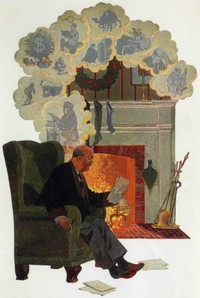
A Little Book for Christmas
Subjects:
Download Formats:
Excerpt
The Project Gutenberg EBook of A Little Book for Christmas, by Cyrus Townsend Brady
This eBook is for the use of anyone anywhere in the United States and most
other parts of the world at no cost and with almost no restrictions
whatsoever. You may copy it, give it away or re-use it under the terms of
the Project Gutenberg License included with this eBook or online at
www.gutenberg.org. If you are not located in the United States, you'll have
to check the laws of the country where you are...
Read the Full Text
— End of A Little Book for Christmas —
Book Information
- Title
- A Little Book for Christmas
- Author(s)
- Brady, Cyrus Townsend
- Language
- English
- Type
- Text
- Release Date
- March 12, 2005
- Word Count
- 26,907 words
- Library of Congress Classification
- PZ
- Bookshelves
- Children's Fiction, Christmas, Browsing: Children & Young Adult Reading, Browsing: Culture/Civilization/Society, Browsing: Fiction
- Rights
- Public domain in the USA.
Related Books
Maisie's merry Christmas
by Rhoades, Nina
English
1006h 44m read
The promise of the bell
by Repplier, Agnes
English
45h 19m read

Christmas under three flags
by Wilcox, Mary Emily Donelson
English
196h 56m read
The catspaw of Piperock
by Tuttle, W. C. (Wilbur C.)
English
159h 36m read
Corrie
by Lynn, Ruth, active approximately 1876-1880
English
434h 43m read
Elsie
by Kielland, Alexander Lange
English
393h 5m read