The Project Gutenberg eBook, A letter addressed to the Right Honourable
Lord Robert Grosvenor, M.P., by Rev. Evan Evans
This eBook is for the use of anyone anywhere in the United States and most
other parts of the world at no cost and with almost no restrictions
whatsoever. You may copy it, give it away or re-use it under the terms of
the Project Gutenberg License included with this eBook or online at
www.gutenberg.org. If you are not located in the United States, you'll have
to check the laws of the country where you are located before using this ebook.
Title: A letter addressed to the Right Honourable Lord Robert Grosvenor, M.P.
expanatory of the object and design of the Chester Cambrian Society
Author: Rev. Evan Evans
Release Date: May 17, 2020 [eBook #62158]
Language: English
Character set encoding: UTF-8
***START OF THE PROJECT GUTENBERG EBOOK A LETTER ADDRESSED TO THE RIGHT
HONOURABLE LORD ROBERT GROSVENOR, M.P.***
Transcribed from the 1832 T. Griffith edition by David Price, email
[email protected]
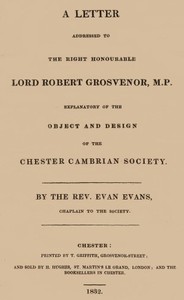
[Picture: Pamphlet cover]
A LETTER
ADDRESSED TO
THE RIGHT HONOURABLE
LORD ROBERT GROSVENOR, M.P.
EXPLANATORY OF THE
OBJECT AND DESIGN
OF THE
CHESTER CAMBRIAN SOCIETY.
* * * * *
BY THE REV. EVAN EVANS,
CHAPLAIN TO THE SOCIETY.
* * * * *
CHESTER:
PRINTED BY T. GRIFFITH, GROSVENOR-STREET;
AND SOLD BY H. HUGHES, ST. MARTIN’S LE GRAND, LONDON; AND THE
BOOKSELLERS IN CHESTER.
* * * * *
1832.
* * * * *
TO THE
RIGHT HON. LORD R. GROSVENOR, M.P.
MY LORD,
THE relation in which your Lordship stands to the City of Chester, as one
of its Representatives, and the lively interest you always evince in
every thing connected with its welfare, induce me to address your
Lordship on behalf of the CAMBRIAN SOCIETY, established in this City,
about six years ago, for the purpose of providing the Welsh residents
with the means of religious instruction in their native language; and
that in connexion with the Established Church. Though the success with
which this Institution has been attended, has far exceeded the most
sanguine expectations of its friends; and though the important benefits
resulting from it, have been fully appreciated by those, for whom they
were originally intended; yet, my Lord, some are still to be found, who
entertain conscientious scruples respecting the propriety of supporting
this Society—who are yet to be convinced of the expediency of providing
the natives of Wales, who come to settle in the principal towns of
England, with the means of vernacular religious instruction;—who are of
opinion that the Welsh, thus situated, ought to learn the language of
their neighbours, by which means they would have access to all their
privileges: this, they contend, would supersede the necessity of all such
institutions as are founded on the principle of the Chester Cambrian
Society.
It is with a view of examining the practicability of this suggestion,
that I beg to submit the following pages for your Lordship’s perusal.
But, before I enter upon the subject, I trust it will not be considered
an improper digression, to furnish your Lordship with a brief sketch of
the circumstances which led to the formation of this Society.
A few years ago, a number of the natives of the Principality, resident in
Chester, associated, and formed themselves into a body, under the
denomination of the “Cymmrodorion Society.” Their original object did
not extend beyond the common purposes of meeting together for social
intercourse, and communicating with each other, in their native language,
on subjects connected with the literature of the land of their fathers.
But, after a lapse of time, and frequent interchanges of kindred
sentiments, their attention was forcibly directed to the moral condition
of the lower classes of their fellow-countrymen, residing in
Chester.—They found, upon inquiry, that a considerable number of these,
were so imperfectly acquainted with the English language, as to exclude
the possibility of rendering it, to them, a proper medium of religious
instruction. Nay, that not a small portion of them, especially of those
who had lately emigrated from their native hills, were often, from their
imperfect knowledge of it, deprived of advantageous situations, which, in
every other respect, they were highly competent to fill. This naturally
led to the conclusion, that if their ignorance of that language was such,
as to incapacitate them for discharging the duties of their secular
employments, how utterly incapable must it render them of performing the
infinitely more important duties of religion?—Thus was the Society
forcibly impressed with the conviction of their destitute condition.
Such, especially, was the situation of those, who had been accustomed,
from their infancy, to worship GOD according to the rites of the
Established Church. The Dissenters were more favourably circumstanced;
for two Denominations, the Calvinistic and Wesleyan Methodists, had
provided places of worship for the accommodation of their respective
adherents: but, for the poor members of the Church of England, no
provision was made. To them, the revolving week brought along with it a
silent Sabbath: the sound of the “Church-going bell” served only to
remind them of the blessings they had left behind; and in vain did our
venerable temples throw open their widely extended portals to receive
them. Under these circumstances, the members of the Society had only one
of three methods to adopt—to allow their countrymen to languish under the
privations which they were suffering—to forego their attachment to the
national Church—or, to supply their wants, by affording them vernacular
instruction, in connexion with the Establishment. The first, their
patriotism—the second, their devotedness to the Church—would not allow
them to entertain: they were therefore determined to attempt the last.
This, very naturally, led to the consideration of the means best
calculated for accomplishing their object: and after repeated meetings on
the subject, at which various plans were suggested, the following
resolutions were unanimously adopted:—
I.—That this Society will direct its particular attention to the moral
and religious interests of the Welsh inhabitants of this City.
II.—That this meeting think it would be productive of great benefit, if
a Church could be opened in Chester, on Sunday evenings, for Divine
Service in Welsh, for their countrymen in this City; many of whom are
acquainted with no other language; at least, not in a degree adequate
to the purpose of religious edification.
III.—That application be made to the Lord Bishop of the Diocese,
requesting his Lordship’s advice and assistance, towards the attainment
of this object.
IV.—That the RIGHT HONOURABLE EARL GROSVENOR be requested to accept the
office of Patron.
In consequence of the foregoing resolutions, applications were made to
your Lordship’s distinguished father, the MARQUIS OF WESTMINSTER, and to
DR. BLOMFIELD—who was at that time Bishop of this Diocese—both of whom,
with a promptness and cordiality, which the Committee of the Cambrian
Society are anxious to mark with expressions of the warmest gratitude,
accepted the invitation, and cheerfully enrolled their names as annual
subscribers. At the same time, BISHOP BLOMFIELD so far exerted himself,
as to procure the use of St. Martin’s Church, for the performance of
Welsh service on Sunday evenings; and the individual, who now addresses
your Lordship, was appointed, by the same Right Reverend Prelate, to the
important situation of Chaplain to the Cambrian Society.
Since the establishment of the Welsh Lectures, the Committee have great
pleasure to record, in the list of Patrons and Subscribers, the names of
several Noblemen and Gentlemen, who have rendered essential service to
the cause, by their kind co-operation and liberal support. Amongst whom
they have the honour to mention, the LORD MOSTYN, the BISHOPS OF CHESTER,
BANGOR, and ST. ASAPH, SIR W. W. WYNN, BART. M.P. SIR S. R. GLYNNE,
BART. M.P. the HON. E. M. LLOYD MOSTYN, M.P. SIR EDWARD MOSTYN, BART.
OWEN WILLIAMS, ESQ. M.P. F. R. PRICE, ESQ. &c. &c. In Chester also, the
undertaking was hailed with peculiar interest; and a number of the most
respectable of its inhabitants have, from the commencement, displayed
unabated zeal in forwarding the objects of the Society.
I cannot conclude this part of my subject, without observing, that our
present worthy Diocesan, has more than once, expressed his conviction of
the usefulness of the Cambrian Institution, and his readiness, on all
occasions, to promote its welfare.
Having thus given your Lordship a brief sketch of the circumstances which
led to the establishment of the Sunday Evening Welsh Lectures, at St.
Martin’s Church, I shall now proceed to the discussion of the expediency
of the measure; in answer to those who contend, that the acquirement of
English, by the Welsh people who come to reside in the principal towns of
England, would supersede the necessity of providing them with the means
of religious instruction in their native language. But, before I enter
upon the subject, I beg to observe, that though I may be, in some
respects, better qualified than others, to prove the great usefulness of
such an Institution; yet, my Lord, I labour under some
disadvantages.—Being so closely connected with the Lectures, it would be
unsuitable for me to enter into detail. I shall, therefore, endeavour to
forget myself, and discuss the subject on principle. I am only the
instrument, my Lord—a separable accident attached to the Institution—and
my connexion with it partakes of that uncertainty, which characterizes
all human engagements. But, the Institution itself, is of a permanent
nature; and as long as the Institution shall continue, its capacity for
doing good will remain; and the same results will be secured.
Now, my Lord, let us proceed to the examination of the method
proposed—“Let the Welsh learn English, &c.” Viewing this abstractedly,
candour compels me to admit, that it is an object highly desirable to be
accomplished. However fondly attached I may feel to my native language,
and however I may admire it; still, my Lord, impressed with the
conviction that every language ought to be valued in proportion to the
degree of knowledge, of which it is the medium; and deeply sensible of
the almost infinite superiority of the English, in this respect, I am far
from wishing to exclude my countrymen from the enjoyment of all its
advantages. The liberal hand of patriotism, having unrolled before my
eyes the ample page of English literature, I should consider myself
unworthy of the privilege, were I not to feel desirous, that every
Welshman should enjoy the same. I am fully aware of the immense benefit
which an acquaintance with English would confer upon the inhabitants of
Wales; and whenever it can be proved, that the purposes for which the
Cambrian Society was established, may be as effectually accomplished
through that medium, I hope I shall be found to possess sufficient
candour to admit, that its continuance is no longer an object to be
desired. But an experience of six years, in the discharge of the
important duties connected with my present situation, has fully enabled
me to state, that that period has not yet arrived.—However pleasing it
may be, my Lord, to expatiate on this subject in the regions of theory,
and to indulge in a prospective view of it, yet, when we come to reduce
it to practice, we are presented with innumerable difficulties.
The Principality of Wales, at this moment, contains seven hundred
thousand inhabitants; to the majority of whom the Welsh language is the
only adequate medium of communication. This statement may appear
exaggerated to those, who have derived their knowledge of the country,
only from occasional excursions to the most frequented parts of it; and
who seldom deviate from the route usually pursued by tourists. Here, it
is true, the English traveller meets with but little inconvenience; his
intercourse being chiefly confined to those, who have found it their
interest to acquire the means of accommodating him. But, were the
traveller to infer from this, that English is the language of the Welsh
peasantry, he would be as much mistaken, as in concluding it to be that
of the _French_, because he meets with no inconvenience in his route from
Calais to Paris. My Lord, I am no stranger to my native country.—The
greater part of my life was spent amongst its hills; studying its
literature, and mingling familiarly with its inhabitants; and, I am
persuaded, your Lordship will agree with me in thinking, that I am better
qualified to form a correct opinion of the present state of the
Principality, than those who acquire their knowledge, only from a late
and partial residence in it; and who, from their ignorance of the
language of the people, are but ill calculated to understand their
national prejudices, and their distinguishing characteristics. I feel
confident, my Lord, that all who gain their knowledge of Wales from the
same source as myself, will be led to the same conclusion, viz. that to
nine-tenths of its peasantry, the English language is, comparatively,
unknown. Though a conviction of the great advantages to be derived, from
an acquaintance with it, has created among the natives, a strong desire
to acquire it, still, my Lord, the means adopted for that purpose are so
limited, as to remove the prospect of its accomplishment, to the distance
of ages. Judging of the future, from the past, we have reason to
apprehend, that for generations yet to come, the ancient British language
will be, throughout the Principality, the language of the domestic
circle, of the public mart, of the Sunday school, and of the solemn
Assembly.
Here, I might take the opportunity of pressing upon those, who would
confine their exertions for the benefit of Wales, solely to the
cultivation of the English language there, the question, What is to
become of the intermediate generations?—Whilst the English Schoolmaster
is making his important tour through the land, how are the affairs of the
country to be conducted? Is all intercourse to be suspended, every
communication to cease—are all the avenues of knowledge, through the
medium of the vernacular tongue, to be locked up—the doors of their
Sanctuaries to be secured—the pages of their Bibles sealed—and the lips
of their Ministers closed? Is the morning incense no more to ascend from
the domestic altar of the rustic cottage? Is the unanimous sound of
praise to be hushed in their Temples?—But, my Lord, it is not necessary I
should pursue the inquiry. I am satisfied, that, however desirable these
gentlemen may consider the end, they are far from thinking it so
desirable, as to justify such means of attaining it. There is,
therefore, my Lord, only one conclusion at which we can possibly arrive,
viz. that for ages yet to come, the Welsh will be the predominant
language of the Principality. Hence, it is evident, that throughout this
period, it must be, also, the language of such of its inhabitants, as may
be induced to leave the country, to settle in any other place; and it is
equally evident, that the contiguity of Chester to the Principality, and
the constant intercourse between them, will not fail to draw, towards
that City, a considerable proportion of those destined for our English
towns.
Now, my Lord, the question very naturally presents itself—What is to
become of such persons, with respect to religious instruction? By what
means is their spiritual welfare to be promoted? As subjects capable of
moral cultivation, how are they to be treated? As beings, who are
qualified to enjoy the benefits of social worship, how are they to
receive them? And when we consider the great difference between their
present and their former situation, their case assumes a more than
ordinary interest. Most of those, for whom the Welsh Lectures were
especially intended, were brought up in a state of great seclusion; the
inhabitants of a humble cottage, or a retired hamlet: without any further
means of knowing the world and mankind, than what could be obtained
within the limited circle of their rustic associates. The lessons they
learnt were few and simple; and their views and habits corresponded with
the rural simplicity of the scene around them.—These peaceful retreats
they have now left behind, and are come to try their fortunes in a new
and different sphere.
In a country like Wales, so formed by nature, that each dell may be
considered as constituting a sort of separate community, the departure of
a single individual, is a subject of general concern; and the result of
his enterprize is watched with a degree of interest, proportionate to the
novelty of the occurrence. In the domestic circle, the sensation excited
is intense; and the event forms an important epoch in the family
history.—If the adventurer is a member of a religious family, the anxiety
is infinitely increased; as there, a concern will be felt, not only for
his temporal, but for his eternal welfare. To his devout parents,
nothing forms a source of such apprehension, as that the plant, which
they have reared with so much solicitude, and cultivated with such tender
care, should fade and wither, upon its being transplanted to a different
clime. They have neither riches nor honours to bestow upon their child;
but they furnish him with what they consider the best treasure—a
Bible—they invoke a blessing upon his head—they resign him to the care of
that Being who is the same every where—and will it be no relief to them,
at such a trying season, to be able to add—Though you are going among
strangers, whose language is unknown to you, yet, you will have the
Gospel preached to you in your mother-tongue; and you will there find a
Pastor from your own land, who, with the sympathy of a countryman, will
be ready to assist you in all your difficulties, and to direct you in the
right way?
We, my Lord, who are aware of the perils which await the stranger on his
arrival at the place of his destination, cannot but feel particularly
anxious for his safety. In the full fervour of youth, with ardent hopes
and warm affections, and with all the credulity incident to inexperienced
years, he comes to mingle in the bustling throng of a populous City.
Into what a Panorama of bewildering novelties is the unsuspecting
adventurer now introduced! How varied—how multiplied his temptations!
His situation will appear still more dangerous, if we consider that he is
no longer under the restraints of his former acquaintance; that he has
lost the protection of a kind father, the watchful eye of a tender
mother, and the timely advice of a faithful friend. And, if he is to be
left without the guidance of an efficient Pastor, can we be surprised, if
the first intelligence received of him, by the anxious inquirers of his
native valley, should be, “He has forsaken the guide of his youth, and
forgotten the covenant of his God.”—“He has left the paths of
uprightness, to walk in the ways of darkness.”
I think, my Lord, that it affords a subject of fair inquiry, whether
those persons, who oppose the benevolent designs of the Cambrian Society,
do not, at the same time, oppose their own interest? Knowing how to
appreciate honesty and integrity, they will be always glad to engage in
their service, those whose general character is distinguished by these
pre-eminent virtues. But, by denying them the privileges which it is the
object of this Society to secure for them, are they not withholding those
very means which are best suited for enabling them to continue in the
path of virtue, and for discharging the various duties of their
respective avocations, with devotedness and fidelity? What is so likely
to guard them against those evils, to which persons in their situation
are so peculiarly exposed, as to have the pure doctrines of Christianity
enforced in “their own tongue wherein they were born?” What is so
calculated to add strength and stability to the good impressions made on
their minds, whilst among their native mountains, as the ministry of the
Gospel in that language, through the instrumentality of which those
impressions were originally produced? Will these individuals receive
them into their houses, engage them in their service, and supply all
their bodily wants, and, yet, leave their nobler part in a state of utter
destitution? My Lord, it is impossible that I can be divested of all
apprehension, for the safety of this class of my countrymen, in this
City, when I know that they are in the vicinity of a fearful _Maelstrom_,
along the surface of which is seen the floating wreck of many a noble
vessel, that left its native shores under the most favourable auspices,
buoyant with hope, and radiant with expectation; but which, for want of a
skilful pilot, coming within the reach of its attractive influence, was
hurried along its impetuous stream, and engulphed in its whirling vortex.
The number of Welsh, resident in Chester, has been differently stated,
and, I have no doubt, my Lord, greatly exaggerated.—It is not within my
province to inquire what may be the exact amount of the whole Welsh
population: I wish to confine myself to that portion of it, which comes
within the object of the Society, viz. those who prefer the Welsh
language, and consider it the only adequate medium of spiritual
instruction.—Without making any definite statement, I feel confident,
that in rating these under a thousand, I should form but a low estimate
of their number. From my own observation, my Lord, I am prepared to
state, that to several hundreds, at least, the Welsh language is the only
avenue of religious communication. Since accommodation has been provided
for the performance of Welsh service, facts have proved, that without a
Welsh Church and Pastor, a very considerable number would have been left
as sheep gone astray, without a fold, and without a shepherd. And if, to
the Divine Shepherd, the restoration of a single wanderer, appeared an
object of such vast importance, what shall we say, my Lord, of the
importance attached to the restoration of hundreds? When there is so
much zeal exhibited in promoting the cause of Missions, and in sending
the Gospel to heathen and foreign lands—when so much interest is
displayed in providing Bibles and Missionaries for distant nations, with
whom we are in no other way connected, than as members of the great
family of mankind, shall we not discover equal zeal for “our brethren,
our kinsmen, according to the flesh?”
Last year, very praiseworthy exertions were made towards supplying our
fellow subjects, who have emigrated to the different British Colonies,
with the means of salvation in their native language, in conformity with
the rites of our Established Church. But I submit, my Lord, whether the
Welsh, who emigrate to the principal towns of England, are not placed in
such a situation, as to render their claims upon our benevolence a matter
of primary importance? Perhaps I may be told, that the case of the
emigrants to our foreign Settlements is very different—the means of
religion, with which they are provided, are in the language of the
Countries, to which they have removed—to make the cases parallel, the
services of religion ought to be established there in the Erse and Gaelic
languages. Now, my Lord, if it could be proved that these languages form
the only adequate medium of religious instruction, to as large a
proportion of the emigrants, as the Welsh language does to the natives of
Wales, I contend that the same necessity would exist for furnishing them
with the means of instruction in those languages.—Again, it may be
objected, that the Welsh would so soon acquire the language of their
neighbours—among whom they live—as to render any instruction in their
native tongue superfluous. But, my Lord, in a case of such vast
importance, involving the eternal interests of so many immortal beings,
can the anticipation of a future benefit, however great, justify the
sacrificing of so much present good? Especially, when the attainment of
the one, is not incompatible with the enjoyment of the other? When a
patient is suffering under an alarming disease, is it safe, during the
first stages of the disorder, to abandon the only means calculated to
check its progress, because, that at some future period, a change of
system may be advantageously adopted? Are we sure that life will be
preserved, until the sufferer reach that eventful period? And, even,
should he live to try the effect of this new system, would not the
abandonment of the old one, at the commencement of the disorder, prove
highly prejudicial to the success of the new?
But suppose, my Lord, that, for the sake of argument, I concede this
point to the objectors; and let us even imagine the interval to be short,
during which the Welshman is excluded from the benefit of religious
ordinances; it is an interval which—in whatever light I view it—I cannot
contemplate without trembling. It is like holding out a flag of truce to
a cruel and relentless foe, in order to give him more time to re-organise
his treacherous plans, and gain fresh strength to execute them. And can
we be surprised, if at the next assault of the enemy, we find the
Christian combatant ingloriously defeated, hurled back upon the world,
with the loss of fame, and a blasted reputation?
But the assumption, that the Welsh, resident in English towns, will soon
acquire a sufficient knowledge of the English language, to render it a
proper vehicle of religious truth, is not founded in fact. It is
contradicted by daily experience. We know, my Lord, that it is not an
easy task for adults to learn a new language. It is true, (as stated in
the Report), “That by the constant intercourse with society, to which
their varied avocations would necessarily lead them, such a smattering of
the tongue would be gradually acquired, as might enable them to fulfil
their civil engagements, without material inconvenience; at the same time
that it would be difficult, or rather impossible, for them to understand
discourses from the pulpit, on moral and religious subjects, when
delivered in English; or to join in the services of Divine worship in
that language.”
As a further proof of the truth of this observation, it may be stated,
that some of the members of the Sunday evening congregation, at St.
Martin’s Church, who have resided in England for several years, affirm,
that at this day, they cannot enter into the spirit of Divine worship,
when performed in English—they declare that they have not yet been able
to think in it; and in order fully to comprehend the meaning of a text or
a sentence, it must undergo the process of a mental translation into
their own language, and be viewed through that medium. This will appear
less surprising, when we consider that it is the language in which they
received their Christian education—that all the good impressions made
upon their minds, were produced through its instrumentality—that it is
the channel through which were conveyed the moral precepts of their early
instructors, and the advice of parents, relatives, and friends. In it
are treasured up all the texts of scripture, with which their memories
are amply supplied. This language is associated with their most
interesting recollections—with their sorrows, and with their joys; they
think in it, they pray in it, they read their Bibles in it, they praise
their Maker in it; and is it not desirable, my Lord, that they should
hear the Gospel preached in it?
There is another consideration calculated to justify the principle of the
Cambrian Society, viz. the paramount—the infinite—importance of that
knowledge, the attainment of which is the grand end of all religious
means. I am not now speaking of theoretical knowledge, but of that,
which, in the language of our Liturgy, is said to be necessary for the
soul’s health; and I am sure it will be readily admitted, that all other
knowledge, when compared with this, sinks into utter insignificance: the
means, therefore, of acquiring it, ought to be plain, easy, and
intelligible, in proportion to its importance. We are told that all
scripture is given by inspiration of God, and is profitable for doctrine,
for reproof, for correction, for instruction in righteousness.—But to the
Welshman, an English Bible is as much a sealed book, as if it had still
remained in the original language. We know that life and immortality are
brought to light by the Gospel; but, how can that light shine upon the
Welshman, through the impenetrably dark medium of an unknown tongue? The
Christian Minister, it is true, delivers his important message with all
plainness of speech, but how can the Welshman understand him, or profit
by him, if he is a barbarian to him? Besides, my Lord, there are several
individuals attending our Lectures, who are not able to read the Bible,
even in their own tongue; and if they are deprived of the ministry of the
Gospel in that language, I cannot picture to myself any thing more
deplorable than would be their condition. How would our sympathy be
called forth towards a criminal at the bar of justice—he is tried for his
life, and all the proceedings against him are conducted in a language of
which he understands not a word—how distressing is his situation! But,
what is it compared with that to which many of the poor Welsh in this
City would be reduced, if they were deprived of the privileges afforded
them by the Cambrian Society? In the case of the criminal, his ignorance
forms no part of his accusation; it has no bearing upon the proceedings
of the Court; it influences neither the verdict of the Jury, nor the
sentence of the Judge: nor would his knowledge have reversed his
fate.—But here, my Lord, ignorance and knowledge are antecedents to
consequents that are diametrically opposite—they connect their subjects
with very different predicates; for in the word of wisdom we are told,
that the one shall perish, and the other be saved. The results of
ignorance and knowledge, in regard to every other subject, revolve within
the contracted sphere of mortality—they descend with the clayey tenement
to the grave, and are confined within the narrow limits of the tomb. But
in this matter, they involve consequences, the scene of which is laid in
eternity, and the development of which will occupy its everlasting
ages.—They attach themselves to the immortal spirit, and will accompany
him in his adventurous flight across the boundary of time, and serve
either to raise him to the regions of bliss ineffable, or to sink him
down to the gulph of interminable woe. Can we contemplate the
possibility of the latter alternative, without using every means in our
power to prevent it?
And, my Lord, I must be allowed to remind the friends of the Established
Church, that they are more backward in attending to the wants of their
countrymen, in this respect, than any other denomination of Christians.
Let them look to the metropolis; there they will find several places of
Divine worship for the accommodation of the natives of Wales, without any
belonging to the Establishment. The case is the same with respect to
Birmingham, Shrewsbury, and Manchester; and at Liverpool there are many
Chapels belonging to different denominations of Dissenters, with only one
Church, and that of a very recent date.—In Chester, my Lord, we found the
ground pre-occupied.—Two Societies had most laudably raised their
respective standards, around which was collected a considerable number of
devotional worshippers; and the manner in which many of them have since
joined our standard, proves, that they flocked around the others, not
because they displayed the colours of their favourite party, but because
they had the word “CYMRAEG” inscribed on their banners.
The last consideration which I shall submit to your Lordship, in order to
shew the great usefulness of the Cambrian Society, is, that by securing
the residence of a Welsh Clergyman, it provides the means of religious
consolation for the poor Welsh at the _Chester Infirmary_. It is
universally acknowledged that one-third of the patients received at this
Institution, are natives of the Principality. But I need not enlarge on
this point, as your Lordship’s noble brother, EARL GROSVENOR, from the
kind and active part which he has taken in the proceedings of this
excellent charity, is fully enabled to judge how far the visits of a
Welsh Pastor are necessary to the welfare of the Institution.
In regard to the success which has attended our Society, I beg to refer
to the “Report.” I shall only observe, with relation to my Ministerial
charge in this City, that I consider the aged as forming a very important
and interesting part. Those who are in the habit of attending the
Lectures, could inform your Lordship with what delight this portion of my
congregation listen to the preaching of the Gospel in their own tongue.
Though years have rolled away since they left their native hills, their
decided partiality to the language remains undiminished.—From these, my
Lord, the bed of sickness, and a dying hour, cannot be very far distant;
and this is a time which will require all the consolation that language
can convey, administered in the most plain and simple manner which words
can express. But what a gloomy prospect, my Lord, must such a season
present to a poor Welshman, without the privileges which this Society
provides for him.—I need not repeat that the number is not small, in
Chester, who will not be capable of receiving consolation in this trying
hour, in any language but the Welsh. And here I may mention a
distressing circumstance, which occurred very soon after my appointment
to my present situation, and before that appointment was generally
known.—I was requested by an English Clergyman to visit a poor man, whom
he represented as being dangerously ill, and totally unacquainted with
the English language. I lost no time in attending to the application;
but when I arrived at the house, I found, in answer to my inquiries, that
he was no more. The nurse who attended him, told me he talked a great
deal, but she could not understand him, as she knew nothing of Welsh, and
he could not speak a word of English.—Here, I was led to indulge in a
train of unavailing conjectures, as to the subject of the poor man’s
conversation, the state of his feelings—the objects of his wishes—but—my
Lord—he was dead!—Now, I would ask those persons who scruple to
co-operate in the benevolent designs of our Society, if they are parents,
how would they feel upon being told of their children—if they are capable
of friendship, how would they like to hear of their friends—dying under
such circumstances? May the time never again arrive, when the poor Welsh
residents in Chester shall be reduced to such an extremity. Whilst they
live, may they have the Gospel preached to them; and when they come to
die, may they never want the attendance of a Pastor, who will be able to
administer consolation to them in their native tongue!
I have the honour to be,
My Lord,
Your Lordship’s obedient humble Servant,
EVAN EVANS.
_Chester_, _April_ 28_th_, 1832.
***END OF THE PROJECT GUTENBERG EBOOK A LETTER ADDRESSED TO THE RIGHT
HONOURABLE LORD ROBERT GROSVENOR, M.P.***
******* This file should be named 62158-0.txt or 62158-0.zip *******
This and all associated files of various formats will be found in:
http://www.gutenberg.org/dirs/6/2/1/5/62158
Updated editions will replace the previous one--the old editions will
be renamed.
Creating the works from print editions not protected by U.S. copyright
law means that no one owns a United States copyright in these works,
so the Foundation (and you!) can copy and distribute it in the United
States without permission and without paying copyright
royalties. Special rules, set forth in the General Terms of Use part
of this license, apply to copying and distributing Project
Gutenberg-tm electronic works to protect the PROJECT GUTENBERG-tm
concept and trademark. Project Gutenberg is a registered trademark,
and may not be used if you charge for the eBooks, unless you receive
specific permission. If you do not charge anything for copies of this
eBook, complying with the rules is very easy. You may use this eBook
for nearly any purpose such as creation of derivative works, reports,
performances and research. They may be modified and printed and given
away--you may do practically ANYTHING in the United States with eBooks
not protected by U.S. copyright law. Redistribution is subject to the
trademark license, especially commercial redistribution.
START: FULL LICENSE
THE FULL PROJECT GUTENBERG LICENSE
PLEASE READ THIS BEFORE YOU DISTRIBUTE OR USE THIS WORK
To protect the Project Gutenberg-tm mission of promoting the free
distribution of electronic works, by using or distributing this work
(or any other work associated in any way with the phrase "Project
Gutenberg"), you agree to comply with all the terms of the Full
Project Gutenberg-tm License available with this file or online at
www.gutenberg.org/license.
Section 1. General Terms of Use and Redistributing Project
Gutenberg-tm electronic works
1.A. By reading or using any part of this Project Gutenberg-tm
electronic work, you indicate that you have read, understand, agree to
and accept all the terms of this license and intellectual property
(trademark/copyright) agreement. If you do not agree to abide by all
the terms of this agreement, you must cease using and return or
destroy all copies of Project Gutenberg-tm electronic works in your
possession. If you paid a fee for obtaining a copy of or access to a
Project Gutenberg-tm electronic work and you do not agree to be bound
by the terms of this agreement, you may obtain a refund from the
person or entity to whom you paid the fee as set forth in paragraph
1.E.8.
1.B. "Project Gutenberg" is a registered trademark. It may only be
used on or associated in any way with an electronic work by people who
agree to be bound by the terms of this agreement. There are a few
things that you can do with most Project Gutenberg-tm electronic works
even without complying with the full terms of this agreement. See
paragraph 1.C below. There are a lot of things you can do with Project
Gutenberg-tm electronic works if you follow the terms of this
agreement and help preserve free future access to Project Gutenberg-tm
electronic works. See paragraph 1.E below.
1.C. The Project Gutenberg Literary Archive Foundation ("the
Foundation" or PGLAF), owns a compilation copyright in the collection
of Project Gutenberg-tm electronic works. Nearly all the individual
works in the collection are in the public domain in the United
States. If an individual work is unprotected by copyright law in the
United States and you are located in the United States, we do not
claim a right to prevent you from copying, distributing, performing,
displaying or creating derivative works based on the work as long as
all references to Project Gutenberg are removed. Of course, we hope
that you will support the Project Gutenberg-tm mission of promoting
free access to electronic works by freely sharing Project Gutenberg-tm
works in compliance with the terms of this agreement for keeping the
Project Gutenberg-tm name associated with the work. You can easily
comply with the terms of this agreement by keeping this work in the
same format with its attached full Project Gutenberg-tm License when
you share it without charge with others.
1.D. The copyright laws of the place where you are located also govern
what you can do with this work. Copyright laws in most countries are
in a constant state of change. If you are outside the United States,
check the laws of your country in addition to the terms of this
agreement before downloading, copying, displaying, performing,
distributing or creating derivative works based on this work or any
other Project Gutenberg-tm work. The Foundation makes no
representations concerning the copyright status of any work in any
country outside the United States.
1.E. Unless you have removed all references to Project Gutenberg:
1.E.1. The following sentence, with active links to, or other
immediate access to, the full Project Gutenberg-tm License must appear
prominently whenever any copy of a Project Gutenberg-tm work (any work
on which the phrase "Project Gutenberg" appears, or with which the
phrase "Project Gutenberg" is associated) is accessed, displayed,
performed, viewed, copied or distributed:
This eBook is for the use of anyone anywhere in the United States and
most other parts of the world at no cost and with almost no
restrictions whatsoever. You may copy it, give it away or re-use it
under the terms of the Project Gutenberg License included with this
eBook or online at www.gutenberg.org. If you are not located in the
United States, you'll have to check the laws of the country where you
are located before using this ebook.
1.E.2. If an individual Project Gutenberg-tm electronic work is
derived from texts not protected by U.S. copyright law (does not
contain a notice indicating that it is posted with permission of the
copyright holder), the work can be copied and distributed to anyone in
the United States without paying any fees or charges. If you are
redistributing or providing access to a work with the phrase "Project
Gutenberg" associated with or appearing on the work, you must comply
either with the requirements of paragraphs 1.E.1 through 1.E.7 or
obtain permission for the use of the work and the Project Gutenberg-tm
trademark as set forth in paragraphs 1.E.8 or 1.E.9.
1.E.3. If an individual Project Gutenberg-tm electronic work is posted
with the permission of the copyright holder, your use and distribution
must comply with both paragraphs 1.E.1 through 1.E.7 and any
additional terms imposed by the copyright holder. Additional terms
will be linked to the Project Gutenberg-tm License for all works
posted with the permission of the copyright holder found at the
beginning of this work.
1.E.4. Do not unlink or detach or remove the full Project Gutenberg-tm
License terms from this work, or any files containing a part of this
work or any other work associated with Project Gutenberg-tm.
1.E.5. Do not copy, display, perform, distribute or redistribute this
electronic work, or any part of this electronic work, without
prominently displaying the sentence set forth in paragraph 1.E.1 with
active links or immediate access to the full terms of the Project
Gutenberg-tm License.
1.E.6. You may convert to and distribute this work in any binary,
compressed, marked up, nonproprietary or proprietary form, including
any word processing or hypertext form. However, if you provide access
to or distribute copies of a Project Gutenberg-tm work in a format
other than "Plain Vanilla ASCII" or other format used in the official
version posted on the official Project Gutenberg-tm web site
(www.gutenberg.org), you must, at no additional cost, fee or expense
to the user, provide a copy, a means of exporting a copy, or a means
of obtaining a copy upon request, of the work in its original "Plain
Vanilla ASCII" or other form. Any alternate format must include the
full Project Gutenberg-tm License as specified in paragraph 1.E.1.
1.E.7. Do not charge a fee for access to, viewing, displaying,
performing, copying or distributing any Project Gutenberg-tm works
unless you comply with paragraph 1.E.8 or 1.E.9.
1.E.8. You may charge a reasonable fee for copies of or providing
access to or distributing Project Gutenberg-tm electronic works
provided that
* You pay a royalty fee of 20% of the gross profits you derive from
the use of Project Gutenberg-tm works calculated using the method
you already use to calculate your applicable taxes. The fee is owed
to the owner of the Project Gutenberg-tm trademark, but he has
agreed to donate royalties under this paragraph to the Project
Gutenberg Literary Archive Foundation. Royalty payments must be paid
within 60 days following each date on which you prepare (or are
legally required to prepare) your periodic tax returns. Royalty
payments should be clearly marked as such and sent to the Project
Gutenberg Literary Archive Foundation at the address specified in
Section 4, "Information about donations to the Project Gutenberg
Literary Archive Foundation."
* You provide a full refund of any money paid by a user who notifies
you in writing (or by e-mail) within 30 days of receipt that s/he
does not agree to the terms of the full Project Gutenberg-tm
License. You must require such a user to return or destroy all
copies of the works possessed in a physical medium and discontinue
all use of and all access to other copies of Project Gutenberg-tm
works.
* You provide, in accordance with paragraph 1.F.3, a full refund of
any money paid for a work or a replacement copy, if a defect in the
electronic work is discovered and reported to you within 90 days of
receipt of the work.
* You comply with all other terms of this agreement for free
distribution of Project Gutenberg-tm works.
1.E.9. If you wish to charge a fee or distribute a Project
Gutenberg-tm electronic work or group of works on different terms than
are set forth in this agreement, you must obtain permission in writing
from both the Project Gutenberg Literary Archive Foundation and The
Project Gutenberg Trademark LLC, the owner of the Project Gutenberg-tm
trademark. Contact the Foundation as set forth in Section 3 below.
1.F.
1.F.1. Project Gutenberg volunteers and employees expend considerable
effort to identify, do copyright research on, transcribe and proofread
works not protected by U.S. copyright law in creating the Project
Gutenberg-tm collection. Despite these efforts, Project Gutenberg-tm
electronic works, and the medium on which they may be stored, may
contain "Defects," such as, but not limited to, incomplete, inaccurate
or corrupt data, transcription errors, a copyright or other
intellectual property infringement, a defective or damaged disk or
other medium, a computer virus, or computer codes that damage or
cannot be read by your equipment.
1.F.2. LIMITED WARRANTY, DISCLAIMER OF DAMAGES - Except for the "Right
of Replacement or Refund" described in paragraph 1.F.3, the Project
Gutenberg Literary Archive Foundation, the owner of the Project
Gutenberg-tm trademark, and any other party distributing a Project
Gutenberg-tm electronic work under this agreement, disclaim all
liability to you for damages, costs and expenses, including legal
fees. YOU AGREE THAT YOU HAVE NO REMEDIES FOR NEGLIGENCE, STRICT
LIABILITY, BREACH OF WARRANTY OR BREACH OF CONTRACT EXCEPT THOSE
PROVIDED IN PARAGRAPH 1.F.3. YOU AGREE THAT THE FOUNDATION, THE
TRADEMARK OWNER, AND ANY DISTRIBUTOR UNDER THIS AGREEMENT WILL NOT BE
LIABLE TO YOU FOR ACTUAL, DIRECT, INDIRECT, CONSEQUENTIAL, PUNITIVE OR
INCIDENTAL DAMAGES EVEN IF YOU GIVE NOTICE OF THE POSSIBILITY OF SUCH
DAMAGE.
1.F.3. LIMITED RIGHT OF REPLACEMENT OR REFUND - If you discover a
defect in this electronic work within 90 days of receiving it, you can
receive a refund of the money (if any) you paid for it by sending a
written explanation to the person you received the work from. If you
received the work on a physical medium, you must return the medium
with your written explanation. The person or entity that provided you
with the defective work may elect to provide a replacement copy in
lieu of a refund. If you received the work electronically, the person
or entity providing it to you may choose to give you a second
opportunity to receive the work electronically in lieu of a refund. If
the second copy is also defective, you may demand a refund in writing
without further opportunities to fix the problem.
1.F.4. Except for the limited right of replacement or refund set forth
in paragraph 1.F.3, this work is provided to you 'AS-IS', WITH NO
OTHER WARRANTIES OF ANY KIND, EXPRESS OR IMPLIED, INCLUDING BUT NOT
LIMITED TO WARRANTIES OF MERCHANTABILITY OR FITNESS FOR ANY PURPOSE.
1.F.5. Some states do not allow disclaimers of certain implied
warranties or the exclusion or limitation of certain types of
damages. If any disclaimer or limitation set forth in this agreement
violates the law of the state applicable to this agreement, the
agreement shall be interpreted to make the maximum disclaimer or
limitation permitted by the applicable state law. The invalidity or
unenforceability of any provision of this agreement shall not void the
remaining provisions.
1.F.6. INDEMNITY - You agree to indemnify and hold the Foundation, the
trademark owner, any agent or employee of the Foundation, anyone
providing copies of Project Gutenberg-tm electronic works in
accordance with this agreement, and any volunteers associated with the
production, promotion and distribution of Project Gutenberg-tm
electronic works, harmless from all liability, costs and expenses,
including legal fees, that arise directly or indirectly from any of
the following which you do or cause to occur: (a) distribution of this
or any Project Gutenberg-tm work, (b) alteration, modification, or
additions or deletions to any Project Gutenberg-tm work, and (c) any
Defect you cause.
Section 2. Information about the Mission of Project Gutenberg-tm
Project Gutenberg-tm is synonymous with the free distribution of
electronic works in formats readable by the widest variety of
computers including obsolete, old, middle-aged and new computers. It
exists because of the efforts of hundreds of volunteers and donations
from people in all walks of life.
Volunteers and financial support to provide volunteers with the
assistance they need are critical to reaching Project Gutenberg-tm's
goals and ensuring that the Project Gutenberg-tm collection will
remain freely available for generations to come. In 2001, the Project
Gutenberg Literary Archive Foundation was created to provide a secure
and permanent future for Project Gutenberg-tm and future
generations. To learn more about the Project Gutenberg Literary
Archive Foundation and how your efforts and donations can help, see
Sections 3 and 4 and the Foundation information page at
www.gutenberg.org
Section 3. Information about the Project Gutenberg Literary
Archive Foundation
The Project Gutenberg Literary Archive Foundation is a non profit
501(c)(3) educational corporation organized under the laws of the
state of Mississippi and granted tax exempt status by the Internal
Revenue Service. The Foundation's EIN or federal tax identification
number is 64-6221541. Contributions to the Project Gutenberg Literary
Archive Foundation are tax deductible to the full extent permitted by
U.S. federal laws and your state's laws.
The Foundation's principal office is in Fairbanks, Alaska, with the
mailing address: PO Box 750175, Fairbanks, AK 99775, but its
volunteers and employees are scattered throughout numerous
locations. Its business office is located at 809 North 1500 West, Salt
Lake City, UT 84116, (801) 596-1887. Email contact links and up to
date contact information can be found at the Foundation's web site and
official page at www.gutenberg.org/contact
For additional contact information:
Dr. Gregory B. Newby
Chief Executive and Director
[email protected]
Section 4. Information about Donations to the Project Gutenberg
Literary Archive Foundation
Project Gutenberg-tm depends upon and cannot survive without wide
spread public support and donations to carry out its mission of
increasing the number of public domain and licensed works that can be
freely distributed in machine readable form accessible by the widest
array of equipment including outdated equipment. Many small donations
($1 to $5,000) are particularly important to maintaining tax exempt
status with the IRS.
The Foundation is committed to complying with the laws regulating
charities and charitable donations in all 50 states of the United
States. Compliance requirements are not uniform and it takes a
considerable effort, much paperwork and many fees to meet and keep up
with these requirements. We do not solicit donations in locations
where we have not received written confirmation of compliance. To SEND
DONATIONS or determine the status of compliance for any particular
state visit www.gutenberg.org/donate
While we cannot and do not solicit contributions from states where we
have not met the solicitation requirements, we know of no prohibition
against accepting unsolicited donations from donors in such states who
approach us with offers to donate.
International donations are gratefully accepted, but we cannot make
any statements concerning tax treatment of donations received from
outside the United States. U.S. laws alone swamp our small staff.
Please check the Project Gutenberg Web pages for current donation
methods and addresses. Donations are accepted in a number of other
ways including checks, online payments and credit card donations. To
donate, please visit: www.gutenberg.org/donate
Section 5. General Information About Project Gutenberg-tm electronic works.
Professor Michael S. Hart was the originator of the Project
Gutenberg-tm concept of a library of electronic works that could be
freely shared with anyone. For forty years, he produced and
distributed Project Gutenberg-tm eBooks with only a loose network of
volunteer support.
Project Gutenberg-tm eBooks are often created from several printed
editions, all of which are confirmed as not protected by copyright in
the U.S. unless a copyright notice is included. Thus, we do not
necessarily keep eBooks in compliance with any particular paper
edition.
Most people start at our Web site which has the main PG search
facility: www.gutenberg.org
This Web site includes information about Project Gutenberg-tm,
including how to make donations to the Project Gutenberg Literary
Archive Foundation, how to help produce our new eBooks, and how to
subscribe to our email newsletter to hear about new eBooks.
A letter addressed to the Right Honourable Lord Robert Grosvenor, M.P. - explanatory of the object and design of the Chester Cambrian Society
Subjects:
Download Formats:
Excerpt
The Project Gutenberg eBook, A letter addressed to the Right Honourable
Lord Robert Grosvenor, M.P., by Rev. Evan Evans
This eBook is for the use of anyone anywhere in the United States and most
other parts of the world at no cost and with almost no restrictions
whatsoever. You may copy it, give it away or re-use it under the terms of
the Project Gutenberg License included with this eBook or online at
www.gutenberg.org. If you are not located in the United States, you'll have
to...
Read the Full Text
— End of A letter addressed to the Right Honourable Lord Robert Grosvenor, M.P. - explanatory of the object and design of the Chester Cambrian Society —
Book Information
- Title
- A letter addressed to the Right Honourable Lord Robert Grosvenor, M.P. - explanatory of the object and design of the Chester Cambrian Society
- Author(s)
- Evans, Evan, active 1832
- Language
- English
- Type
- Text
- Release Date
- May 17, 2020
- Word Count
- 8,927 words
- Library of Congress Classification
- BV
- Bookshelves
- Browsing: Culture/Civilization/Society, Browsing: History - British
- Rights
- Public domain in the USA.