The Project Gutenberg eBook, A Confession of Evangelical Principles, by
John Church
This eBook is for the use of anyone anywhere in the United States and most
other parts of the world at no cost and with almost no restrictions
whatsoever. You may copy it, give it away or re-use it under the terms of
the Project Gutenberg License included with this eBook or online at
www.gutenberg.org. If you are not located in the United States, you'll have
to check the laws of the country where you are located before using this ebook.
Title: A Confession of Evangelical Principles
in a letter to a friend
Author: John Church
Release Date: December 18, 2018 [eBook #58492]
Language: English
Character set encoding: UTF-8
***START OF THE PROJECT GUTENBERG EBOOK A CONFESSION OF EVANGELICAL
PRINCIPLES***
Transcribed from the [1808] J. Cheney edition by David Price, email
[email protected] Many thanks to the Bodleian for allowing their copy to
be consulted.
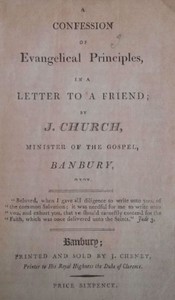
[Picture: Pamphlet cover]
A
CONFESSION
OF
Evangelical Principles,
IN A
LETTER TO A FRIEND;
BY
_J. CHURCH_,
MINISTER OF THE GOSPEL,
_BANBURY_,
OXON.
* * * * *
“Beloved, when I gave all diligence to write unto you, of the common
Salvation; it was needful for me to write unto you, and exhort you,
that ye should earnestly contend for the Faith, which was once
delivered unto the Saints.” _Jude_ 3.
* * * * *
Banbury;
PRINTED AND SOLD BY J. CHENEY,
_Printer to His Royal Highness the Duke of Clarence_.
* * * * *
PRICE SIXPENCE.
* * * * *
Letter.
_Banbury_; _February_ 1st, 1808.
SIR,
AS you have solicited me to vindicate myself from the things laid to my
charge, I take this opportunity of making public the sentiments I hold;
and I will answer the rest of the charges at the close of my confession
of faith. The charges brought against me, are these four; _First_, That
I hold and propogate Antinomian sentiments. _Secondly_, That I create
divisions wherever I preach. _Thirdly_, That after People come to hear
me preach, they cannot with pleasure hear their own Ministers again.
And, _Fourthly_, That I do not preach to Sinners. These are heavy
charges indeed! With respect to the _first_, as my sentiments are deemed
Antinomian, I think it my duty to make them public: the rest of the
charges are not worth an answer. But, I can assure you, Sir, that the
leading doctrines I preach, are in harmony with the Word of God, which is
the only rule of faith and practice: I embrace and propogate no other
doctrines than these, set forth in the doctrinal Articles of the Church
of England; the Westminster Confession of Faith; and what your own
Ministers, who belong to the Associations, generally hold, as appears
upon their circular letters; namely, receiving the Scriptures of the Old
and New Testament, as their only guide in faith and practice; and thence
deriving their belief, in the important doctrines of three equal Persons,
in one divine essence; Eternal and personal Election; Original Sin;
Justification, by the imputed righteousness of Christ; Efficacious Grace
in Regeneration; the final perseverance of Believers to eternal Glory;
the resurrection of the Dead; the last Judgment; the everlasting
happiness of the Righteous; and the punishment of the Impenitent. These,
Sir, are the leading doctrines I preach, and they stand in no need of an
apology: but, as I am set for the defence of that gospel I have felt and
enjoyed, I am not ashamed of one of its glorious doctrines; nor did I
ever intentionally deviate from them in one sentence I ever pronounced,
since I have felt their power, seen their beauty, and have been enabled
to declare them; and that good hand that instructed me in them, and has
owned and blest them, by me, as an instrument, I trust, will enable me to
maintain them to the close of life; then, I hope to feel them supporting
my soul, comforting my heart, and giving me a sweet assurance of an
entrance into that kingdom, that cannot be moved.
The following doctrines I have been enabled to declare amidst great
opposition, and, as they are a part of the revealed will of God, those
who oppose them, are fighting against God himself. As to the loss of the
favor and friendship of those Ministers who are strangers to the power of
Godliness, and averse to the humiliating doctrines of the Cross of
Christ, this, I hope, will not break my heart; and while they are loading
me with reproach, I shall not render railing for railing; for while they
curse, I will bless; while they condemn, I hope God will justify; while
they oppose, I know he will lead on; and, I hope, I shall be enabled to
put up that charitable prayer for my enemies, which the Redeemer did for
his; “Father, forgive them:” in the language of dying Stephen, “Lord, lay
not this to their charge:” and in the pious breathings of the Church of
England Litany, I would pray, “That it may please thee, to forgive our
enemies, persecutors, and slanderers, and to turn their hearts.” And
while many in our day are shy of the doctrines of the gospel, (which is
an awful proof they never felt their power, and never tasted their
sweetness, so that they are but little consequence to them;) I hope, I
shall be enabled to stand fast in the faith, and hold the beginning of my
confidence firm, unto the end; not at all terrified by any of my
adversaries, however popular they may be. If I could palliate and comply
with their dead barren dry system of legality, I believe that they would
cease to reproach me. But, because I maintain and declare the whole
counsel of God, I am deemed an Antinomian; a Troubler of Churches; a
Sower of Dissentions; a Creator of Divisions; One that Disaffects Hearers
with their own Ministers; One that does not preach to Sinners; and, in
fact, every thing that is disrespectful in the estimation of proud
Legalists, and self-righteous Pharisees.
The following Confession, I read at my Ordination, with a few additions;
and as many of my friends have so repeatedly intreated me to make it
public, I take this opportunity of doing it, praying that the best of
blessings may accompany the same, as they are sentiments calculated to
display the glory of God, and bring joy and peace to that Sinner who is
made sensible of his lost condition.
A Confession of Faith.
I. I believe, that the Scriptures of the Old and New Testament are the
word of God, and the only rule of faith and practice.
II. I believe, that there is but One only, living, and true God; that
there are Three Persons in the Godhead, who are equal in nature, power,
and glory; and, that the Son and Holy Ghost, are as truly and properly
God, as the Father. These Three divine Persons are distinguished from
each other by peculiar relative properties. These Three divine distinct
Persons, I profess to reverence, serve, and worship, as the One true God.
III. I believe, that before the World began, God did elect a certain
number of Mankind unto everlasting life, whom he did predestinate to the
adoption of Children, by Jesus Christ, of his own free grace, and
according to the good pleasure of his will; that he appointed holiness as
the means; and that no one has a right to consider himself as a chosen
vessel, till he is effectually called by the grace of God. {6}
IV. I believe, that God made all things in Creation, out of nothing, to
display his goodness, wisdom, power, and glory; and, that by the same
power, he upholds and governs, rules and directs all things in Heaven and
Earth; and, that he displays his sovereignty according to the counsel of
his own will, or his eternal plan, formed before all Worlds.
V. I believe, that there is one Mediator between God and Man; the Man,
Christ Jesus; that he stood in his mediatorial capacity as our
representative and head, in the covenant of eternal redemption and grace;
engaged to be all that to his people, they could possibly need in time,
and their bliss through eternity.
VI. I believe, that God made Man upright; but mutable and liable to
fall: and, being left to the freedom of his own will, through the
influence of Satan, he broke the covenant of works, and fell from the
Image of God; that all Mankind sinned in him and fell with him, as their
head and representative; and both him and his posterity became liable to
the curse and penalty of a violated law.
VII. I believe, that all Mankind are conceived and born in sin, Children
of disobedience, enemies to God, violaters of his commands, averse to
good, prone to evil, Children of wrath, obnoxious to the justice of God,
and the condemnation of his law: and I believe, that no Creature can help
or deliver himself, out of that wretched state into which he has fallen.
I solemnly believe, that this is the state of all Men by nature.
VIII. I believe, that according to the eternal appointment of God the
Father, and the Covenant engagements of the dear Redeemer, that, in the
fulness of time, God sent his Son into the world to redeem fallen Men;
that part of the human race, that was given him in eternity; that their
redemption was obtained by the shedding of his blood; that this
redemption is special and particular, designed only for the elect of God,
the Sheep of Christ, who only share the special and peculiar blessings of
it. And, in order to accomplish our redemption, I believe, it was
necessary that the Redeemer should take upon him our nature, a human body
and soul, created and formed by God the Spirit, conceived in the womb of
the Virgin Mary, born of a Woman, made under the law, that he might
redeem his people from it; work out a righteousness adequate to its
demands, make an atonement by suffering the death of the Cross, satisfy
divine Justice, glorify all the attributes of Deity, and open a way, for
the communication of all those blessings, which are needful for the
Saints of God, both for time and eternity.
IX. I believe, that the matter of the Sinners’ justification before a
holy God, is the righteousness of Christ imputed to them; which is, his
perfect, spotless obedience to the law, in their room and stead, without
the consideration of any works done by them; and, that the full and free
pardon of all their sins, past, present, and to come, is only through the
blood of Christ, according to the riches of his grace; and, that none can
be justified in any other way. This righteousness being seen by the eye
of faith, and embraced by the hand of faith, we are manifestly justified
and freed from the law; that, being dead wherein we were held, we live to
God, and by love serve the Lord, having our fruit unto holiness, and the
end, eternal life. {9}
X. I believe, that all the objects of eternal love, the subjects of his
choice, and the purchase of the Redeemer’s blood, are effectually called
in one way or another, by the efficacious and irresistible grace of God
the divine Spirit; and not by an act of Man’s free will and power. I
believe they are washed, justified, and sanctified, in the name and by
God the Spirit, in some part of their lives.
XI. I believe, that all Saints are kept by the mighty power of God,
through faith, to eternal Salvation; and, that as sure as they are
called, justified, and sanctified, they will infallibly persevere:
because of the perpetuity of God’s love, the liability of his covenant,
and his faithfulness to his absolute promises.
XII. I believe, that the Church of Christ consists of true believers in
his name; that these are his mystical body, of which, he is the only
head, and there is no other: and, that all the Children of God derive
spiritual life from him, by virtue of union to him; that he is our life;
and in consequence of that, we are now quickened by his life-giving power
in conversion; our bodies shall be quickened in the last day, and all
Believers shall enjoy eternal life, in glory for ever.
XIII. I believe, that in the new testament Church of Christ, there are
but two Sacraments; Baptism, and the Supper of the Lord. I believe,
Baptism to be an outward and visible sign; first, of the sufferings,
death, burial, and resurrection of our Lord Jesus Christ; secondly, of an
inward and spiritual operation of the Holy Ghost, upon the hearts of
believers; and is a grand emblem of a death unto sin, and a new birth
unto righteousness; for being by nature the children of wrath, we are by
regeneration, manifested to be children of grace. I believe, that only
those who profess the name of Jesus, have any right thereto. That it
should be administered to Adults alone, in the name of the adorable
Trinity; and, that it is to be performed by immersion. I believe, that
the Lord’s Supper was instituted the night on which he was betrayed, to
represent his sufferings and death; and is to be attended too by all
Believers, until his second coming.
XIV. I believe, that it is the duty of every Christian to obey the laws
of their Country; not to speak evil of Dignities; but, to pray for the
King, his Family, and the Government under which we live; to study to be
quiet, peaceable, and submissive, according to the laws of Jesus Christ,
which is our rule of conduct: and, who has said, “Render unto Cæsar, the
things which are his;” and, by his holy Apostles, has commanded “That
every Soul should be subject to the higher powers; that we should honor
all Men, love the Brotherhood, fear God, honor the King.”
XV. I believe, that it is the duty of all Believers, to take the
commands of our Lord and Saviour Jesus Christ, as their rule of conduct;
that, while they are relying on his Righteousness, for justification; on
his Blood, for pardon; and, on the Spirit, for internal sanctification;
they, from a principle of love shed abroad in their hearts, are made
willing to obey his laws, as King in Mount Zion: and, that his
commandments are the Believer’s rule of life: that it is their duty to
stand fast in one Spirit, with one mind, striving together for the faith
of the gospel: that it is their duty to walk in wisdom, to them that are
without; to exercise a conscience void of offence towards God and Man, by
living soberly, righteously, and godly in this present world: that it is
their duty to walk with each other in all humility and brotherly love; to
watch over each other’s conversation; to stir up one another to love and
to good works; not forsaking the assembling of ourselves together, as we
have opportunity; to worship God, according to his revealed will; and,
when the case requires, to warn, rebuke, and admonish one another,
according to the rules of the gospel: and, that it is our duty to
sympathize with each other, to bear with one another’s weaknesses,
failings, and infirmities; and, particularly to pray for one another.
All these duties we are bound to perform, and every other law of Christ’s
spiritual house, through the gracious influence of a Spirit of love, of
power, and of a sound mind; ever remembering, that we are to obey the
laws of our Sovereign, as King, on his holy hill of Zion. {12}
XVI. I believe, that all the Ordinances of divine appointment ought to
be attended unto, by all that profess their faith in, and love to our
Lord Jesus Christ, as the head of his Church; hearing the Word, public
Prayer, Baptism, and the Lord’s Supper: singing of Psalms, Hymns, and
Spiritual Songs, vocally; this is an ordinance of the gospel, to be
performed by Believers; but, as to time, place, and manner, every one
ought to be left to their liberty in using it.
XVII. I believe, that there will be a Resurrection, both of the just and
unjust; and, that Christ will come a second time, to judge both quick and
dead; when he will take vengeance on the wicked, and introduce his own
People into his kingdom and glory, where they shall be for ever with him;
and, then shall the mediatorial kingdom be delivered up to the Father, by
the Redeemer; the mystery of God be finished: Heaven will be the Saints
final home; and, God, Father, Son, and Spirit, be all in all, for ever
and ever.
XVIII. I believe, that the felicity of the Saints will be eternal; and I
as firmly believe, such will be the eternity of misery; unless, the never
dying worm dies, and the unquenchable fire goes out; which will not,
cannot be; for the mouth of the Lord hath spoken it.
* * * * *
The above Articles are the doctrines I preach, which I did not learn of
Man; but, by the teachings of the Spirit, by the Word. The rest of the
Charges are not worthy my notice, as they arise from pride and envy; and,
I shall only remark, that all faithful preaching ever did create
divisions. God having put an enmity between the seed of the Woman, and
the seed of the Serpent; this enmity is stirred up wherever these two
seeds meet. The history of Truth, in all ages, prove that this is no new
thing. The dear Redeemer, asks an important question, “Suppose ye, that
I am come to give peace on the earth? I tell you, nay; but rather
divisions;” see the 12th chapter of Luke, from the 40th to the 54th
verse. As to the disaffection of the People to their own Ministers,
after hearing me preach, as Ministers inform you; how can I help that? I
do not speak against them; but, advise my hearers to follow after truth,
in its beauty, simplicity, and power. But I am not accountable for the
imprudencies of my hearers. None ever heard me in public or in private,
drop a disrespectful hint of any Ministers around me; although, I am
informed, they have said many cruel things of me: for which, I trust, the
good Lord will pardon them, for I do; as I know, God, for Christ’s sake,
hath forgiven me. As to the last Charge you intimate, that I do not
preach to Sinners. This is an absurd accusation indeed! For who do I,
or who can I preach to, but fallen Sinners, by nature and practice; as
faith the voice of wisdom, “Unto you, O Men, I call, and my voice is to
the Sons of Men.” But, I suppose the meaning of this Charge is, that I
do not command dead Sinners to quicken their own souls; and suppose I
did, would they obey me? That I do not tell blind Sinners to open their
own eyes? If I thought they could do it, I would tell them to do it,
from the pulpit. That I do not tell all Men it is their duty to believe?
Whereas, God says of many, they never shall believe. That I do not
command carnal Persons to perform spiritual acts? and how should they?
seeing they are enemies to God, and the slaves of sin and error. That I
do not tell all Mankind, that Christ is offered to them, if they will but
accept of him? No. Sir. I leave all this Baxterian stubble, and
declare the whole counsel of God. Whereas, the above Calls to Sinners,
form no part of that counsel. God does not condemn Men because he has
been pleased to withold that precious gift of faith from them: there is
sin enough in all Men, to render them obnoxious to the curse of the law:
and the Saviour himself says, “Think not, that I will accuse you to the
Father; there is one that accuseth you already, even, Moses, in whom ye
trust.” To command all Men, where the gospel comes, to obey the internal
call of it, is not my work: but, to tell People, it is their duty to be
found in the means, is another thing. The former, I shall not do; the
latter, is in harmony with many parts of God’s Word. But I know it is
fashionable, to tell Sinners to believe, and to receive an offered
Christ; to open the door of their hearts to him; and, in fact, the Sinner
is set to do that, which the Holy Ghost only can do for him. This is the
modern doctrine so much admired in our day; which is calculated to
cherish the pride of Man, and make Sinners contented with a form of
godliness without the power. But, “From all false doctrine, heresy, and
schism, good Lord deliver us.”
I am yours, in gospel bonds,
J. CHURCH.
* * * * *
Cheney, Printer, Banbury.
Footnotes.
{6} This doctrine is clearly revealed in the Scriptures, embraced by our
Reformers, as set forth in the 17th Article of the Church of England, and
in the Westminster Confession of Faith. The Seventeenth Article of the
Church, thus expresseth this doctrine:—“Predestination to Life, is the
everlasting purpose of God, whereby (before the foundations of the world
were laid) he hath constantly decreed by his counsel, secret to us, to
deliver from curse and damnation those whom he hath chosen in Christ out
of mankind, and to bring them by Christ to everlasting salvation, as
vessels made to honour. Wherefore, they which be endued with so
excellent a benefit of God, be called according to God’s purpose by his
Spirit working in due season; they through grace obey the calling; they
be justified freely: they be made sons of God by adoption: they be made
like the image of his only-begotten Son, Jesus Christ: they walk
religiously in good works, and at length, by God’s mercy, they attain to
everlasting felicity.”—This is the noble testimony of our Reformers, as
agreed and subscribed to by every conscientious Churchman; to this agree,
the Westminster Confession of Faith, as exprest in the 20th Article of
the shorter Catechism. God having out of his mere good pleasure, from
all eternity, elected some to everlasting life, did enter into a Covenant
of grace, to deliver them out of the estate of sin and misery, and to
bring them into an estate of salvation by a Redeemer. A vast many
passages of scripture can easily be brought to prove this important
Article; and, happy for those, who have got the sweet evidence of God’s
Spirit, witnessing their adoption into his family. If this is
Antinomianism, I am willing to bear the name, and enjoy the blessings of
an everlasting Covenant of Election and Sovereign Grace.
{9} This doctrine of a Sinner’s justification before God, as exprest in
this Article, is held forth in almost every part of God’s Word that
relates to our Salvation. This doctrine, however despised in our day by
modern Pharisees, is a glorious and a precious truth: it was received by
our Reformers, as noted in the Eleventh Article of the Church of England,
on the justification of Man. “We are accounted righteous before God,
only for the merit of our Lord and Saviour Jesus Christ, by faith, and
not for our own works or deservings: Wherefore, that we are justified by
faith only, is a most wholesome doctrine, and very full of comfort, as
more largely is expressed in the Homily of justification.” See also, the
Thirty-third Article in the Assembly’s Catechism: “Justification is an
act of God’s free grace, wherein he pardoneth all our sins, and accepteth
us as righteous in his sight, only for the righteousness of Christ
imputed to us, and received by faith alone.” Happy Believer, that can
say in sweet assurance,
“Jesus, thy blood and righteousness,
My beauty are, my glorious dress;
’Midst flaming Worlds, in these array’d,
With joy shall I lift up my head.”
And this honor have all the Saints.
{12} If it can be proved, that this Article has a grain of Antinomianism
in it, I ask, are not these the practical truths of the gospel, which we,
as Believers, are to obey, as a proof we are passed from death unto life,
and are brought to serve the Lord, in newness of Spirit, and not in the
oldness of the letter; not working for life, but from a principle of life
received, as being not without law to God, but under the laws of our
present Husband, Christ. The moral law being fulfilled in our stead, we
are by faith enabled to serve him, who has done so great things for us.
It is the Believer’s desire, that the moral law should be fulfilled; and,
to use the language of a good and great Man, it is evident this law is
fulfilled in a fourfold sense; First, “In precept and penalty, by the
Redeemer himself.” Secondly, “In the Believed, when the love of God is
shed abroad in his heart.” Thirdly, “In the exercise of a conscience
void of offence, by the internal operations of the Spirit, enabling us to
walk in our degree, as he walked.” Fourthly, “In the execution of its
awful sentence upon the wicked; and Heaven and Earth shall pass away,
before a tittle of this law can fail, till it be fulfilled.” It is
strange, that those Ministers, who maintain the holiness, goodness,
truth, and justice of the moral law, should be traduced as Antinomians;
whereas, they are the only characters that handle the law, lawfully; by
representing it to Believers as fulfilled in their stead, by their
covenant Head and Husband; laying them under eternal obligations to love
and serve him in newness of the Spirit. The term Antinomian, cannot
belong to the above characters, but to all Men in a state of nature,
whether professors or prophane, they are in a state of enmity against the
law, and its adorable giver; and, although they may plead for it, they
are enemies to it, ignorant of it, and condemned by it. It is evident,
this was the case of Paul, before his conversion, “I was alive without
the law once;” he was ignorant of its nature, its author, its demands,
and its curse: but, when God led him to see himself in that glass, he
exclaimed, “The law is spiritual, but I am carnal, sold under sin.” When
David was taught the same lesson, he crys out, “I have seen an end of all
perfection, but thy commandments are exceeding broad.” All that are
cleaving to this law, as a covenant of works, are enemies to the Lord
Jesus Christ; and, all that die under it, must be judged by it. Now,
because I hold forth the grand doctrines of the gospel, and enforce a
knowledge of this law, by the teachings of the Spirit of God, that
Sinners may be brought to see their need of a Mediator, and a Surety
righteousness; for this, I am condemned as an Antinomian! But, if this
Article of my Confession, teaches anything like it, I must say it is the
Antinomianism of the gospel, which I shall consider as my duty to
enforce, as ornamental to the Religion of the Son of God. I shall only
add, that I was much pleased to see this subject ably handled, in that
best of monthly publications, the Gospel Magazine: one paragraph I shall
insert, see vol. 9, page 372. “The doctrine of the total abolition of
the covenant of works, and the perfect deliverance of all true Believers
from its power and authority, by the substitution, obedience, and
atonement of Christ, breaks the arms of ungodliness, demolishes the whole
empire of sin, and makes the church of the first born fruitful to God.
Fruitful in heart, fruitful in life, fruitful in every good work. The
proof which the Scriptures afford of the truth of these assertions, mocks
all contradiction, and bids defiance to all assault.”
***END OF THE PROJECT GUTENBERG EBOOK A CONFESSION OF EVANGELICAL
PRINCIPLES***
******* This file should be named 58492-0.txt or 58492-0.zip *******
This and all associated files of various formats will be found in:
http://www.gutenberg.org/dirs/5/8/4/9/58492
Updated editions will replace the previous one--the old editions will
be renamed.
Creating the works from print editions not protected by U.S. copyright
law means that no one owns a United States copyright in these works,
so the Foundation (and you!) can copy and distribute it in the United
States without permission and without paying copyright
royalties. Special rules, set forth in the General Terms of Use part
of this license, apply to copying and distributing Project
Gutenberg-tm electronic works to protect the PROJECT GUTENBERG-tm
concept and trademark. Project Gutenberg is a registered trademark,
and may not be used if you charge for the eBooks, unless you receive
specific permission. If you do not charge anything for copies of this
eBook, complying with the rules is very easy. You may use this eBook
for nearly any purpose such as creation of derivative works, reports,
performances and research. They may be modified and printed and given
away--you may do practically ANYTHING in the United States with eBooks
not protected by U.S. copyright law. Redistribution is subject to the
trademark license, especially commercial redistribution.
START: FULL LICENSE
THE FULL PROJECT GUTENBERG LICENSE
PLEASE READ THIS BEFORE YOU DISTRIBUTE OR USE THIS WORK
To protect the Project Gutenberg-tm mission of promoting the free
distribution of electronic works, by using or distributing this work
(or any other work associated in any way with the phrase "Project
Gutenberg"), you agree to comply with all the terms of the Full
Project Gutenberg-tm License available with this file or online at
www.gutenberg.org/license.
Section 1. General Terms of Use and Redistributing Project
Gutenberg-tm electronic works
1.A. By reading or using any part of this Project Gutenberg-tm
electronic work, you indicate that you have read, understand, agree to
and accept all the terms of this license and intellectual property
(trademark/copyright) agreement. If you do not agree to abide by all
the terms of this agreement, you must cease using and return or
destroy all copies of Project Gutenberg-tm electronic works in your
possession. If you paid a fee for obtaining a copy of or access to a
Project Gutenberg-tm electronic work and you do not agree to be bound
by the terms of this agreement, you may obtain a refund from the
person or entity to whom you paid the fee as set forth in paragraph
1.E.8.
1.B. "Project Gutenberg" is a registered trademark. It may only be
used on or associated in any way with an electronic work by people who
agree to be bound by the terms of this agreement. There are a few
things that you can do with most Project Gutenberg-tm electronic works
even without complying with the full terms of this agreement. See
paragraph 1.C below. There are a lot of things you can do with Project
Gutenberg-tm electronic works if you follow the terms of this
agreement and help preserve free future access to Project Gutenberg-tm
electronic works. See paragraph 1.E below.
1.C. The Project Gutenberg Literary Archive Foundation ("the
Foundation" or PGLAF), owns a compilation copyright in the collection
of Project Gutenberg-tm electronic works. Nearly all the individual
works in the collection are in the public domain in the United
States. If an individual work is unprotected by copyright law in the
United States and you are located in the United States, we do not
claim a right to prevent you from copying, distributing, performing,
displaying or creating derivative works based on the work as long as
all references to Project Gutenberg are removed. Of course, we hope
that you will support the Project Gutenberg-tm mission of promoting
free access to electronic works by freely sharing Project Gutenberg-tm
works in compliance with the terms of this agreement for keeping the
Project Gutenberg-tm name associated with the work. You can easily
comply with the terms of this agreement by keeping this work in the
same format with its attached full Project Gutenberg-tm License when
you share it without charge with others.
1.D. The copyright laws of the place where you are located also govern
what you can do with this work. Copyright laws in most countries are
in a constant state of change. If you are outside the United States,
check the laws of your country in addition to the terms of this
agreement before downloading, copying, displaying, performing,
distributing or creating derivative works based on this work or any
other Project Gutenberg-tm work. The Foundation makes no
representations concerning the copyright status of any work in any
country outside the United States.
1.E. Unless you have removed all references to Project Gutenberg:
1.E.1. The following sentence, with active links to, or other
immediate access to, the full Project Gutenberg-tm License must appear
prominently whenever any copy of a Project Gutenberg-tm work (any work
on which the phrase "Project Gutenberg" appears, or with which the
phrase "Project Gutenberg" is associated) is accessed, displayed,
performed, viewed, copied or distributed:
This eBook is for the use of anyone anywhere in the United States and
most other parts of the world at no cost and with almost no
restrictions whatsoever. You may copy it, give it away or re-use it
under the terms of the Project Gutenberg License included with this
eBook or online at www.gutenberg.org. If you are not located in the
United States, you'll have to check the laws of the country where you
are located before using this ebook.
1.E.2. If an individual Project Gutenberg-tm electronic work is
derived from texts not protected by U.S. copyright law (does not
contain a notice indicating that it is posted with permission of the
copyright holder), the work can be copied and distributed to anyone in
the United States without paying any fees or charges. If you are
redistributing or providing access to a work with the phrase "Project
Gutenberg" associated with or appearing on the work, you must comply
either with the requirements of paragraphs 1.E.1 through 1.E.7 or
obtain permission for the use of the work and the Project Gutenberg-tm
trademark as set forth in paragraphs 1.E.8 or 1.E.9.
1.E.3. If an individual Project Gutenberg-tm electronic work is posted
with the permission of the copyright holder, your use and distribution
must comply with both paragraphs 1.E.1 through 1.E.7 and any
additional terms imposed by the copyright holder. Additional terms
will be linked to the Project Gutenberg-tm License for all works
posted with the permission of the copyright holder found at the
beginning of this work.
1.E.4. Do not unlink or detach or remove the full Project Gutenberg-tm
License terms from this work, or any files containing a part of this
work or any other work associated with Project Gutenberg-tm.
1.E.5. Do not copy, display, perform, distribute or redistribute this
electronic work, or any part of this electronic work, without
prominently displaying the sentence set forth in paragraph 1.E.1 with
active links or immediate access to the full terms of the Project
Gutenberg-tm License.
1.E.6. You may convert to and distribute this work in any binary,
compressed, marked up, nonproprietary or proprietary form, including
any word processing or hypertext form. However, if you provide access
to or distribute copies of a Project Gutenberg-tm work in a format
other than "Plain Vanilla ASCII" or other format used in the official
version posted on the official Project Gutenberg-tm web site
(www.gutenberg.org), you must, at no additional cost, fee or expense
to the user, provide a copy, a means of exporting a copy, or a means
of obtaining a copy upon request, of the work in its original "Plain
Vanilla ASCII" or other form. Any alternate format must include the
full Project Gutenberg-tm License as specified in paragraph 1.E.1.
1.E.7. Do not charge a fee for access to, viewing, displaying,
performing, copying or distributing any Project Gutenberg-tm works
unless you comply with paragraph 1.E.8 or 1.E.9.
1.E.8. You may charge a reasonable fee for copies of or providing
access to or distributing Project Gutenberg-tm electronic works
provided that
* You pay a royalty fee of 20% of the gross profits you derive from
the use of Project Gutenberg-tm works calculated using the method
you already use to calculate your applicable taxes. The fee is owed
to the owner of the Project Gutenberg-tm trademark, but he has
agreed to donate royalties under this paragraph to the Project
Gutenberg Literary Archive Foundation. Royalty payments must be paid
within 60 days following each date on which you prepare (or are
legally required to prepare) your periodic tax returns. Royalty
payments should be clearly marked as such and sent to the Project
Gutenberg Literary Archive Foundation at the address specified in
Section 4, "Information about donations to the Project Gutenberg
Literary Archive Foundation."
* You provide a full refund of any money paid by a user who notifies
you in writing (or by e-mail) within 30 days of receipt that s/he
does not agree to the terms of the full Project Gutenberg-tm
License. You must require such a user to return or destroy all
copies of the works possessed in a physical medium and discontinue
all use of and all access to other copies of Project Gutenberg-tm
works.
* You provide, in accordance with paragraph 1.F.3, a full refund of
any money paid for a work or a replacement copy, if a defect in the
electronic work is discovered and reported to you within 90 days of
receipt of the work.
* You comply with all other terms of this agreement for free
distribution of Project Gutenberg-tm works.
1.E.9. If you wish to charge a fee or distribute a Project
Gutenberg-tm electronic work or group of works on different terms than
are set forth in this agreement, you must obtain permission in writing
from both the Project Gutenberg Literary Archive Foundation and The
Project Gutenberg Trademark LLC, the owner of the Project Gutenberg-tm
trademark. Contact the Foundation as set forth in Section 3 below.
1.F.
1.F.1. Project Gutenberg volunteers and employees expend considerable
effort to identify, do copyright research on, transcribe and proofread
works not protected by U.S. copyright law in creating the Project
Gutenberg-tm collection. Despite these efforts, Project Gutenberg-tm
electronic works, and the medium on which they may be stored, may
contain "Defects," such as, but not limited to, incomplete, inaccurate
or corrupt data, transcription errors, a copyright or other
intellectual property infringement, a defective or damaged disk or
other medium, a computer virus, or computer codes that damage or
cannot be read by your equipment.
1.F.2. LIMITED WARRANTY, DISCLAIMER OF DAMAGES - Except for the "Right
of Replacement or Refund" described in paragraph 1.F.3, the Project
Gutenberg Literary Archive Foundation, the owner of the Project
Gutenberg-tm trademark, and any other party distributing a Project
Gutenberg-tm electronic work under this agreement, disclaim all
liability to you for damages, costs and expenses, including legal
fees. YOU AGREE THAT YOU HAVE NO REMEDIES FOR NEGLIGENCE, STRICT
LIABILITY, BREACH OF WARRANTY OR BREACH OF CONTRACT EXCEPT THOSE
PROVIDED IN PARAGRAPH 1.F.3. YOU AGREE THAT THE FOUNDATION, THE
TRADEMARK OWNER, AND ANY DISTRIBUTOR UNDER THIS AGREEMENT WILL NOT BE
LIABLE TO YOU FOR ACTUAL, DIRECT, INDIRECT, CONSEQUENTIAL, PUNITIVE OR
INCIDENTAL DAMAGES EVEN IF YOU GIVE NOTICE OF THE POSSIBILITY OF SUCH
DAMAGE.
1.F.3. LIMITED RIGHT OF REPLACEMENT OR REFUND - If you discover a
defect in this electronic work within 90 days of receiving it, you can
receive a refund of the money (if any) you paid for it by sending a
written explanation to the person you received the work from. If you
received the work on a physical medium, you must return the medium
with your written explanation. The person or entity that provided you
with the defective work may elect to provide a replacement copy in
lieu of a refund. If you received the work electronically, the person
or entity providing it to you may choose to give you a second
opportunity to receive the work electronically in lieu of a refund. If
the second copy is also defective, you may demand a refund in writing
without further opportunities to fix the problem.
1.F.4. Except for the limited right of replacement or refund set forth
in paragraph 1.F.3, this work is provided to you 'AS-IS', WITH NO
OTHER WARRANTIES OF ANY KIND, EXPRESS OR IMPLIED, INCLUDING BUT NOT
LIMITED TO WARRANTIES OF MERCHANTABILITY OR FITNESS FOR ANY PURPOSE.
1.F.5. Some states do not allow disclaimers of certain implied
warranties or the exclusion or limitation of certain types of
damages. If any disclaimer or limitation set forth in this agreement
violates the law of the state applicable to this agreement, the
agreement shall be interpreted to make the maximum disclaimer or
limitation permitted by the applicable state law. The invalidity or
unenforceability of any provision of this agreement shall not void the
remaining provisions.
1.F.6. INDEMNITY - You agree to indemnify and hold the Foundation, the
trademark owner, any agent or employee of the Foundation, anyone
providing copies of Project Gutenberg-tm electronic works in
accordance with this agreement, and any volunteers associated with the
production, promotion and distribution of Project Gutenberg-tm
electronic works, harmless from all liability, costs and expenses,
including legal fees, that arise directly or indirectly from any of
the following which you do or cause to occur: (a) distribution of this
or any Project Gutenberg-tm work, (b) alteration, modification, or
additions or deletions to any Project Gutenberg-tm work, and (c) any
Defect you cause.
Section 2. Information about the Mission of Project Gutenberg-tm
Project Gutenberg-tm is synonymous with the free distribution of
electronic works in formats readable by the widest variety of
computers including obsolete, old, middle-aged and new computers. It
exists because of the efforts of hundreds of volunteers and donations
from people in all walks of life.
Volunteers and financial support to provide volunteers with the
assistance they need are critical to reaching Project Gutenberg-tm's
goals and ensuring that the Project Gutenberg-tm collection will
remain freely available for generations to come. In 2001, the Project
Gutenberg Literary Archive Foundation was created to provide a secure
and permanent future for Project Gutenberg-tm and future
generations. To learn more about the Project Gutenberg Literary
Archive Foundation and how your efforts and donations can help, see
Sections 3 and 4 and the Foundation information page at
www.gutenberg.org
Section 3. Information about the Project Gutenberg Literary
Archive Foundation
The Project Gutenberg Literary Archive Foundation is a non profit
501(c)(3) educational corporation organized under the laws of the
state of Mississippi and granted tax exempt status by the Internal
Revenue Service. The Foundation's EIN or federal tax identification
number is 64-6221541. Contributions to the Project Gutenberg Literary
Archive Foundation are tax deductible to the full extent permitted by
U.S. federal laws and your state's laws.
The Foundation's principal office is in Fairbanks, Alaska, with the
mailing address: PO Box 750175, Fairbanks, AK 99775, but its
volunteers and employees are scattered throughout numerous
locations. Its business office is located at 809 North 1500 West, Salt
Lake City, UT 84116, (801) 596-1887. Email contact links and up to
date contact information can be found at the Foundation's web site and
official page at www.gutenberg.org/contact
For additional contact information:
Dr. Gregory B. Newby
Chief Executive and Director
[email protected]
Section 4. Information about Donations to the Project Gutenberg
Literary Archive Foundation
Project Gutenberg-tm depends upon and cannot survive without wide
spread public support and donations to carry out its mission of
increasing the number of public domain and licensed works that can be
freely distributed in machine readable form accessible by the widest
array of equipment including outdated equipment. Many small donations
($1 to $5,000) are particularly important to maintaining tax exempt
status with the IRS.
The Foundation is committed to complying with the laws regulating
charities and charitable donations in all 50 states of the United
States. Compliance requirements are not uniform and it takes a
considerable effort, much paperwork and many fees to meet and keep up
with these requirements. We do not solicit donations in locations
where we have not received written confirmation of compliance. To SEND
DONATIONS or determine the status of compliance for any particular
state visit www.gutenberg.org/donate
While we cannot and do not solicit contributions from states where we
have not met the solicitation requirements, we know of no prohibition
against accepting unsolicited donations from donors in such states who
approach us with offers to donate.
International donations are gratefully accepted, but we cannot make
any statements concerning tax treatment of donations received from
outside the United States. U.S. laws alone swamp our small staff.
Please check the Project Gutenberg Web pages for current donation
methods and addresses. Donations are accepted in a number of other
ways including checks, online payments and credit card donations. To
donate, please visit: www.gutenberg.org/donate
Section 5. General Information About Project Gutenberg-tm electronic works.
Professor Michael S. Hart was the originator of the Project
Gutenberg-tm concept of a library of electronic works that could be
freely shared with anyone. For forty years, he produced and
distributed Project Gutenberg-tm eBooks with only a loose network of
volunteer support.
Project Gutenberg-tm eBooks are often created from several printed
editions, all of which are confirmed as not protected by copyright in
the U.S. unless a copyright notice is included. Thus, we do not
necessarily keep eBooks in compliance with any particular paper
edition.
Most people start at our Web site which has the main PG search
facility: www.gutenberg.org
This Web site includes information about Project Gutenberg-tm,
including how to make donations to the Project Gutenberg Literary
Archive Foundation, how to help produce our new eBooks, and how to
subscribe to our email newsletter to hear about new eBooks.
A Confession of Evangelical Principles - in a letter to a friend
Download Formats:
Excerpt
The Project Gutenberg eBook, A Confession of Evangelical Principles, by
John Church
This eBook is for the use of anyone anywhere in the United States and most
other parts of the world at no cost and with almost no restrictions
whatsoever. You may copy it, give it away or re-use it under the terms of
the Project Gutenberg License included with this eBook or online at
www.gutenberg.org. If you are not located in the United States, you'll have
to check the laws of the country where you...
Read the Full Text
— End of A Confession of Evangelical Principles - in a letter to a friend —
Book Information
- Title
- A Confession of Evangelical Principles - in a letter to a friend
- Author(s)
- Church, J. (John)
- Language
- English
- Type
- Text
- Release Date
- December 18, 2018
- Word Count
- 7,709 words
- Library of Congress Classification
- BT
- Bookshelves
- Browsing: Philosophy & Ethics, Browsing: Religion/Spirituality/Paranormal
- Rights
- Public domain in the USA.
Related Books
The influence of Greek ideas and usages upon the Christian church
by Hatch, Edwin
English
1751h 32m read
Gereformeerde dogmatiek. Vierde deel
by Bavinck, Herman
Dutch
3889h 41m read
Gereformeerde dogmatiek. Derde deel
by Bavinck, Herman
Dutch
3775h 8m read
Gereformeerde dogmatiek. Tweede deel.
by Bavinck, Herman
Dutch
3800h 46m read
A Body of Divinity, Vol. 4 (of 4) - Wherein the doctrines of the Christian religion are explained and defended, being the substance of several lectures on the Assembly's Larger Catechism
by Ridgley, Thomas
English
4013h 43m read
A Body of Divinity, Vol. 3 (of 4) - Wherein the doctrines of the Christian religion are explained and defended, being the substance of several lectures on the Assembly's Larger Catechism
by Ridgley, Thomas
English
4643h 31m read